PREFACE.
I began to write this book by way of sequel to “My
Diary North and South,” with the intention of describing
Canada as I saw it at the close of my visit to North
America, but the subject grew upon me as I went on,
and at last I discarded much personal detail, and set
to work with the view of calling attention to the capabilities
of the vast regions belonging to the British
Crown on the American Continent, and of pointing out
the magnificent heritage which is open to our redundant
population. But the subject was too great for the
compass of one volume, because connected with it, too
intimately to be overlooked, were the questions of the
defence and of the future of countries, which the establishment
of a Monarchical principle on an imperfect
basis, and their dependence on the Crown, exposed to
the hostility of a great Republic. I was, therefore,
obliged to contract my own experiences, small as they
were, and to omit many topics included in the original
scope of my writing. The book was nearly finished
when suddenly, as it seemed, the whole of the Provinces,
yielding to a common sentiment of danger, sent
their delegates to consider the policy and possibility of
a great Confederation, which had been strongly recommended
in the pages already written. The idea of such
a Confederation was an old one; but the prompt resolve
to carry it into practical effect, and the words
spoken and acts done in consequence, rendered it
necessary to cancel the work of many hours, as much
of what I had written would have been anticipated by
what has been printed. There are many dangers inherent
in the nature of the proposed Confederation;
there are many obstacles to its harmonious and successful
working; but on the whole some such scheme
appears to be the only practical mode of saving the
British Provinces from the aggression of the North
American Republicans.
What is to become of the existing Governments of
Provinces? How regulate the contentions which may
arise between Provincial Parliaments and Provincial
Ministers and Provincial Governors by the action of
the Federal Parliament and of the representative of the
Crown at the seat of Government? The difficulties we
foresee may never come to pass, and others far greater,
of which we have no foresight, may arise; but for all
this the Confederation presents the only means now
available, as far as we can perceive, for securing to the
Provinces present independence and a future political
life distinct from the turbulent existence of the United
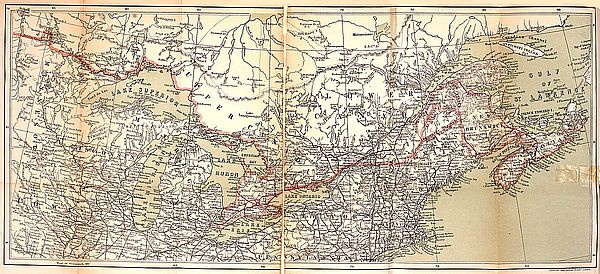
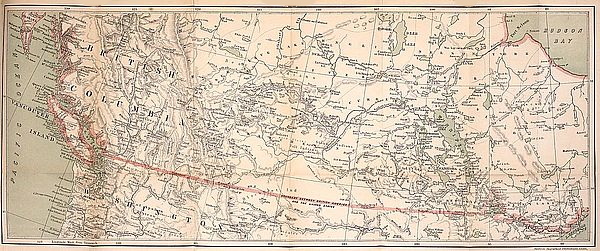
States. A glance at the map will reveal the extent of
the Empire which rests upon the Lakes with one arm
on the Atlantic and the other on the Pacific, whilst
its face is wrapped in a mantle of eternal snow; but it
tells us no more. No reasoning man can maintain that
the people whom a few years will behold as numerous
as the inhabitants of these islands, will be content to
live permanently under the system of the Colonial
Office. That system is probably the only one our Constitution
permits us to adopt; but it is nevertheless the
policy, if not the duty, of this State to foster the youth
and early life of the colonies we have founded, and to
protect them, as far as may be, from the evils which
shall come upon them in consequence of their present
connection with Great Britain. Despised, neglected,
and abandoned, the Provinces would feel less irritation
against their conquerors than against their betrayers,
and England might regret with unavailing sorrow the
indifference which left her without a foot of land or a
friend in the New World. Generosity not inconsistent
with justice may yet lay the foundations of an enduring
alliance where once there was only cold fealty and
unsympathising command. A powerful State may
arise whose greatest citizens shall be proud to receive
such honours as the Monarch of England can bestow,
whose people shall vie with us in the friendly contests
of commerce, and stand side by side with us in battle.
And when the inevitable hour of separation comes, the
parting will not then be in anger. A Constitutional
Republic, in which Monarchy would have been possible
but for the prudence of the mother-country, may
exist without any hatred of Monarchy or of England;
and the people, born with equal rights to pursue liberty
and happiness, would love the land from which flowed
the sources of so many substantial blessings.
I hope that my apprehensions may prove ill-founded,
and that the dangers to which our North American
possessions now, and England herself and the peace of
the world hereafter, are in my opinion exposed, may
be for ever averted.
WILLIAM HOWARD RUSSELL.
Temple, January, 1865.
CHAPTER I.
CANADA:
ITS DEFENCES, CONDITION, AND
RESOURCES.
Introductory—Canada and the Mason and Slidell case—Threats of
annexation—Defence of Canada—Reasons for visiting the British
Provinces—Illness at New York—Hostility displayed there—Monotony
of New York—Hotel life—“Birds of a feather”—Nationality
absorbed—Start for Canada—Railway Companions—Public
credulity—A victory in the papers—History of “A Big
Fight”—General Pumpkin and Jefferson Brick.
I do not pretend to offer any new observations on
the climate, soil, or capabilities of Canada, nor can I
venture to call these pages a “work” on that great
province. I have nothing novel to advance in the hope
of attracting an immigration to its wide-spread territories,
and any statistical facts and figures I may use are
accessible to all interested in the commerce or in the
past, present, and future of the land.
Nor do I write with any particular theory in view, or
with any crotchet on the subject of colonies, outlying
provinces, and dependencies, and their value or detriment
to the dominant commercial and imperial power.
My actual acquaintance with the country and the
people is only such as I acquired in a few weeks’ travelling
in the depth of winter; and such sort of knowledge as
I gathered would certainly afford no great excuse in
itself for intruding my remarks or opinions on the
public when so many excellent books on Canada already
exist.
But it happened that my visit took place at a very
remarkable period of Canadian and American history,
and at a time, too, when certain doctrines, broached
not for the first time, but urged with more than usual
ability, as to the relations between what for convenience
I call the mother-country and her colonies,
were exciting great attention across the Atlantic.
When I left Washington in the winter, a great crisis
had been peacefully but not willingly averted by a concession
on the part of the Federal Government to what
the sentiment of the American people considered an
exhibition of brute force. The first year of the war had
closed over the Federals in gloom. Their arms were
not wielded with credit at home—if credit ever can
attach to arms wielded in a civil war—and the foreign
power which it had been their wont to treat with something
as near akin to disrespect as diplomatic decency
would permit, aroused by an act which outraged the laws
of nations and provoked the censure of every European
power with business on the waters, had made preparations
which could only imply that she would have
recourse to hostility if her demands for satisfaction were
refused.
It was under these circumstances that England
obtained the reparation for which she sought, and in
the eyes of Americans filched a triumph over their flag
and took an insolent advantage over their weakened
power “to do as they pleased.” General McClellan,
playing the part of Fabius, perhaps because he knew
not how to play any other part, had fallen sick and was
nigh at death’s door in the malarious winter at Washington.
The great Union army, like a hybernating eel
in the mud, lay motionless, between the Potomac and
the clever imposture of the Confederate lines and
wooden batteries at Manassas.
But haughty and hopeful as ever, in tone if not in
heart, the Americans raved about vengeance for their
own just concessions. They boasted that the seizure of
Canada would be one of the measures of retaliation
to which they intended promptly to resort, as the
indemnity to their injured vanity and as compensation
for the surrender of Messrs. Mason and Slidell.
Meanwhile the small force of British troops stationed
in Canada was reinforced by the speedy dispatch of
some picked regiments from England, which did not
raise it much beyond its regular strength, and tardy
steps were taken to organise an efficient militia in the
province. The volunteer movement had extended its
influence across the ocean, and a commendable activity
all over the British Colonies and Canada falsified the
complacent statements of the American papers that the
people were not loyal to the Crown nor careful of the
connection, which, it was alleged, they would gladly
substitute for the protection of the standard of the
Northern Republic.
All these necessary precautions against the consequences
of the refusal of the American Government to
yield the passengers taken from under our flag, were
watched angrily and jealously in the States. The British
reinforcements were ridiculed; their tedious passages,
their cheerless marches, were jeeringly chronicled.
Whole ships were reported to have gone down with
living cargoes. Those who landed were represented as
being borne on sleighs by sufferance routes, which
would be impracticable in war. The Canadians were
abused—and so were the Provincialists. The volunteers
were assailed with the weapons which the
American press knows so well how to use.
But that was false policy. It gave a stimulus to
the loyal feeling of the subjects of the Crown. The
Canadian press retorted, and, exulting in the triumph
of the Home Government over the Republican Administration,
uttered the taunts which Americans least
brook to hear.
It was assumed that the task of vengeance and conquest
would be light. I received letters in which it was
maintained that Canada could not be defended, and that
she was not worth defending; others merely urged that
if the Canadians would not take a prominent part in
aid of imperial measures for their protection, they must
be handed over to the invading Americans; that their
country cost more than it was worth, and that it was a
mistake to keep any connection with the wrong side of
the ledger, no matter what the results of rupturing it
might be.
Americans told me “General Scott declares the
Canadian frontier is not capable of defence.” True,
Americans had told me some months ago that General
Scott, now mis en retraite in New York, after a hasty
return from Europe—not, as was asserted, with diplomatic
authority or with the view of invading Canada,
but to save his pension in case of foreign war—would
be in Richmond about July 22nd or 24th, 1861. I
heard some views of the same kind from our own officers,
who expressed doubts respecting the possibility of a
successful resistance to American invasion.
Now if that were so, it struck me that the troops we
had in the country could prove but of little use, and
that at the same time the relative condition of strength
between the United States and Great Britain had
undergone a vital change in face of the very agencies
which ought to have established more solidly the results
obtained in the last trial of force and resources between
them on Canadian ground. It was worth while
trying to ascertain the truth and to resolve these
questions.
The United States, dreading a foreign war which
might interfere with their invasion of the Southern
States, had ungraciously made a concession, in revenge
for making which their press declared they would on
the first convenient occasion make war on the Power
they had offended, in a country which they had invaded
with all their united power—when Great Britain, steamless
and remote, was engaged in European conflicts and
destitute of maritime allies—only to meet with defeat,
or with success of a nature to prove their incompetency
to conquer.
Was the power of this distracted republic, contending
furiously with rebellious members, then,
become so great? If so, with what motive was Great
Britain hurrying across the sea the élite of her
troops—too few to save these vast domains, too many
to lose, and far too many to return as paroled prisoners?
Why try to defend on such terms what was worthless
and indefensible? Canada, if not susceptible of defence,
would be certainly unsuitable as a base for offensive
operations against the States. Obviously the matter
stood thus: that the military question depended on the
temper and spirit of the people themselves.
The whole force of the Canadians, sustained by
Great Britain, might, apparently, defy all the offensive
power of the United States; and I desired to ascertain
in what condition were their temper and defences.
At this time British officers were endeavouring to
prepare the possessions of the Crown against threatened
invasion. The Americans on their side were busy fortifying
some important points on the lakes.
General Totten, an officer of the United States Engineers,
well known for his ability, was understood to be
engaged on a very elaborate plan of works along the
frontier. Colonel Gordon, whose name will be for ever
associated with the left attack at the siege of Sebastopol,
aided by an experienced staff, was employed on
our side, studying the capabilities of the frontier, and
maturing a plan for the consideration of the Government
in case of an American war.
There were reasons, too, of a personal character for
my visiting Canada. I had a fever, which was contracted
at Washington and laid me prostrate at New
York. It was of the low typhoid type, which proved
fatal to so many in the Federal army at the same time,
and its effects made me weaker for the time than I ever
remember to have been. There was no promise whatever
of military operations, and I read every day of the
arrival of friends and acquaintances in Canada, whose
faces it would be pleasant to see, after the endurance of
so many hostile glances and such public exhibition
of ill-will.
I do not wish to dwell on private annoyances, but as
an instance of the feeling displayed towards me in New
York I may mention one circumstance. On my arrival
in 1861 I was elected an honorary member of the club
which derives its name from the state or city, and was
indebted to its members for many acts of courtesy and
for more than one entertainment. Returning to the
city from Washington early this year, I was invited to
dine at the same club by one or two of my friends.
Certain members, as I afterwards heard, took umbrage
at my presence, and fastened a quarrel on my entertainers.
A day or two subsequently the people of New
York were called on, by the notorious journalist who
had honoured me with his animosity ever since I
refused the dishonour of his acquaintance, to express
their indignation at the conduct of the club; and the
members received a characteristic reprimand for their
presumption in letting me into the club, from which
they had kept their censor
and his clientele carefully
out. My offence was rank; and public opinion—or
what is called so—perhaps was in favour of the
ostracism at that moment; for, as far as I know, the
people must have believed I was the sole cause of the
Federal defeat and flight at Bull Run.
There was some novelty in the idea of starting for
Canada in the midst of the bitter winter wind and the
dazzling snow; but I would have gone to Nova Zembla
at the time to have escaped the monotony of New York,
which the effects of recent illness rendered more irksome.
New York is among cities, what one of the lower
order of molluscous animals, with a single intestinal
canal, is to a creature of a higher development,
with various organs, and full of veins and arteries.
Up and down the Broadway passes the stream of life
to and from the heart in Wall-street. In the narrow
space from water to water on either side of this dry canal
there is comparatively little animation, and nothing
at all to reward the researches of a stranger.
Johnson’s remark about Fleet-street would apply with
truth to the gawky thoroughfare of the Atlantic Tyre.
In the Broadway or its “west-end” extensions are to be
found all the hotels, which are the ganglia of the feverish
nervous system so incessantly agitated by the operations
of the journalistic insects living in secret cysts nigh at
hand. All day the great tideway is rolling in, headed
by a noisy crest of little boys, with extras under their
arms, and heralded by a confused surfy murmur of
voices telling “lies” for cents, and enunciating “Another
Great Union Victory!” in one great bore; or it is rushing
out again with a dismal leaden current, laden with
doubts and fears, as the news of some disaster breaks
through the locks of government reservoirs and floods
the press.
In my hotel, where I was fain to seclude myself in
my illness, and to follow the very un-American practice
of living in a suite of private rooms, there was
but little conflict of opinion on any great event, real or
fictitious, which turned up from day to day. The
guests and visitors were well-nigh all of one way of
thinking. They were of the old conservative party,
so oddly denominated Democrats, who believed in States
Rights: in the right of states to create and maintain
their domestic institutions—to secede, if they pleased,
from the Union—to resist the attempts of the General
Government of the other states to coerce them by force
of arms.
Some of these gentlemen were satisfied the South
would not be coerced; some hoped the South would
resist successfully. None, I fear, were “loyal” to
President Lincoln and Mr. Seward, and I am sure
none would have said so much for either of them or
their friends as I would.
The majority principle forces people who hold similar
views to meet together, and to select the same hotels to
live in. This is unfortunate for a stranger who desires
to hear the views of both sides. In the New York,
from the highly artistic and skilful operator who flashed
out cocktails at the bar, up to the highest authority,
there was no man who would like to say that he was
on good terms with Mr. Sumner, or that he did not
think Mr. Seward the representative of evil principles.
The rule was proved by the exceptions: two I suspect
there were—stout Irish waiters, who did not approve of
the attempts to destroy “our glorious Union,” but who
did not find the atmosphere of the place quite favourable
to the free expression of the opinion they mildly
hinted at to myself.
The sameness of ideas, of expressions, of faces,
became unbearable. I could tell quite well by the look
of men’s faces what news they had heard, and what
they were saying or going to say about it. Here
were crafty politicals and practical men of business,
and persons of a philosophical and reflective temperament,
as well as the foolish, the mere pleasure-hunters,
and the unthinking mass of an hotel world, all
looking forward to a near to-morrow to end the woes of
the state, always waiting for a “decisive” battle or “an
indignant uprising of the people” to drive the Republicans
out of power and office.
Not one of them could or would see that the contest,
when terminated, would give birth to others—that the
vast bodies of diverse interests, prejudices, hatreds, and
wrongs set in motion by war over so enormous a
surface, where they had been kept suspended and inert
by the powers of compromise, could never be reconsolidated
and restored to the same state as before, and
that it would be the work of time, the labour of many
years, ere they could settle to rest in any shape whatever.
I am told respectable Americans do not use the word
“Britisher,” but I am bound to say I heard Americans
who looked very respectable using the word at the time
of which I speak, when there was still irritation on both
sides in consequence of the surrender of Mason and
Slidell—in the minds of the friends of the South,
because they were balked in their anticipation of a
foreign war; in the Federal mind, because, after much
threatening and menaces, they had seen the captives
surrendered to the British by the President, or, more
properly speaking, by Mr. Seward.
Hence it was, perhaps, that Canada was always mentioned
in such a tone of contempt, as though the
speakers sought to relieve their feelings by abuse of a
British dependency.
“Goin’ to Canada!” exclaimed the faithful Milesian
who had been my attendant—in fact, my substitute for
a nurse. “Lord help us! That’s a poor place, anyhow.
I thought you’d be contint wid the snow we’ve
got here. It’s plinty, anyhow. But Canada!” The
man had never been there in his life, but he spoke as
if it were beyond the bounds of civilisation. He had
served in a British regiment for many years; many of
his brothers had been, I think he told me, in the service,
but now they were all in the States, and to his notion
thriving like himself.
In no country on earth is an old nationality so soon
absorbed as in America. I am inclined to think the
regard professed for England by American literary men
is sentimental, and is produced by education and study
rather than by any feeling transmitted in families or
by society.
The emigrant, it is remarked, speedily forgets—in
the hurry of his new life the ways of the old slip out of
his memory. One day I said to my man, as a regiment
of volunteers was marching down Broadway, “Those
fellows are not quite as well set up as the 41st, Pat.”
“Well, indeed, and that’s thrue; but they’d fight as
well I b’lieve, and better maybe, if they’d the officers,
poor craychures! Anyhow,” continued he with great
gravity, “they can’t be flogged for nothin’ or for anything.”
“Were you ever flogged?” “No, sirir—not
a lash ever touched my back, but I’ve known fine
sogers spiled by it.” It is likely enough that he had
never thought on the subject till he came to the States—a
short time before and he would have resented
deeply the idea that any regiment on earth could stand
before Her Majesty’s 41st.
It was now near the end of January, and as a gleam
of fine weather might thaw the glorious Union army of
the Potomac, and induce them to advance on the
inglorious army of the Confederacy, I resolved to make
the best of my way northwards forthwith.
My companions were a young British officer,
distinguished in the Crimea, in India, and in
China, who represented a borough in Parliament,
and had come out to see the great contest which
was raging in the United States; and an English
gentleman, who happened to be at New York, and
was anxious to have a look at Niagara, even in its
winter dress.
On the 27th January we were all packed to start by
the 5.30 P.M. train by Albany to Niagara, and thence
to Toronto. The landlord made me up a small assortment
of provisions, as in snow-time trains are not always
certain of anything but irregularity. I was regarded as
one who was about to make myself needlessly miserable
when he might continue in much happiness. “You
had better stay, sir, for a few days. I have certain
intelligence, let me whisper you, that the Abolitionists
will be whipped at the end of this week, and old Abe
driven out of Washington.”
The little boys still shout out, “Another great
Union victory.” The last, by-the-bye, was of General
Thomas, at Somerset, which has gradually sublimed
into uncertainty, though he handled his men well, and
is not bad at a despatch.
The credulity of the American mind is beyond belief.
Populus vult decipi—and certainly its wishes are complied
with to the fullest extent. The process of a
Union victory, from its birth in the first telegram
down to its dissolution in the last despatch, is curious
enough.
Out comes an extra of the New York Herald—“Glorious
Union Victory off Little Bear Creek, Mo.!—Five
Thousand Rebels Disposed of!—Grand Skedaddle!—General
Pumpkin’s Brilliant Charge!—He
Out-Murats Murat!—Sanguinary Encounters!—Cassius
Mudd’s Invincibles!—Doom of the Confederacy!—Jeff
Davis gone to Texas!” and so on, with a display of
large type, in double-headed lines, and a profusion of
notes of admiration.
There is excitement in the bar-rooms. The Democrats
look down-hearted. The War Christians are
jubilant. Fiery eyes devour the columns, which contain
but an elaboration of the heading—swelled
perhaps with a biographical sketch of Brigadier-General
Cyrus Washington Pumpkin, “who was
educated at West Point, where he graduated with
Generals Beauregard and McDowell, and eventually
subsided into pork-packing at Cincinnati, where he was
captain of a fine company till the war broke out, when
he tendered his sword,” &c. Cassius Mudd’s biography
is of course reprinted for the twentieth time, and there
is a list of the names of all the officers in the regiments
near the presumed scene of action.
Then comes the action:—“An intelligent gentleman
has just arrived at Chicago, and has seen Dr. Bray, to
whom he has given full particulars of the fight. It was
commenced by Lieutenant Epaminondas Bellows (‘son
of our respected fellow-citizen, the President of the
Bellowstown and Bellona Railway’—here follows a
biography of Bellows), who was out scouting with ten
more of our boys when they fell into an ambuscade,
which opened on them with masked batteries, uttering
unearthly yells. With Spartan courage the little band
returned the fire, and kept the Seceshers, who were at
least 500 strong, at bay till their ammunition was
exhausted. Bellows, his form dilated with patriotism,
his mellow tones ringing above the storm of battle,
was urged to fly by a tempter, whose name we suppress.
The heroic youth struck the cowardly traitor to the
earth, and indignantly invited the enemy to come on.
They did so at last. The lieutenant, resisting desperately,
then fell, and our men carried his body to the camp,
to the skirts of which they were followed by the Secesh
cavalry and four guns. Our loss was only two more—the
enemy are calculated to have lost 85. The farmers
at Munchausen say they were busy all day carrying
away their dead in carts.
“On reaching the camp, General Pumpkin thought it
right to drive back the dastardly polluters of our
country’s flag. He disposed his troops in platoons,
according to the celebrated disposition made by Miltiades
at Marathon, covering his wings with squadrons
of artillery in columns of sub-divisions, with a reserve
of cavalry in echelon; but he improved upon the idea
by adding the combination of solid squares and skirmishers
in the third line, by which Alexander the
Great decided the Battle of Granicus.
“In this order, then, the Union troops advanced till
they came to Little Bear Creek. Here, to their great
astonishment, they found the enemy under General
Jefferson Brick in person (Brick will be remembered
by many here as the intelligent clerk in our advertisement
department, but he was deeply tainted with
Secesh sentiments, and on the unfurling of our flag
manifested them in such a manner that we were obliged
to dispense with his services). The infamous destroyer
of his country’s happiness had posted his men so that
we could not see them. They were at least three to
one—mustering some 7,000, with guns, caissons, baggage
waggons, and standards in proportion—and were
arranged in an obtuse angle, of which the smaller end
was composed of a mass of veterans, in the order
adopted by Napoleon with the Old Guard at Waterloo:
the larger, consisting of the Whoop-owl Bushwackers
and the Squash River Legion in potence, threatened
us with destruction if we advanced on the other wing,
whilst we were equally exposed to danger if we
remained where we were.
“General Pumpkin’s conduct is, at this most critical
moment, generally described as being worthy of the
best days of Roman story. He simply gave the
word ‘Charge.’ ‘What, General?’ exclaimed our
informant. ‘Charge! Sir,’ said the general, with a
sternness which permitted no further question. With
a yell our gallant fellows dashed at the enemy, but the
water was too deep in the creek, and they retired with
terrific loss. The enemy then dashed at them in turn.
They drove our right for three miles; we drove their
left for three-and-a-quarter miles. Their centre drove
our left, and our right drove their centre again. They
took five of our guns; we took six of theirs and a bread-cart.
“Night put an end to this dreadful struggle, in
which American troops set an example to the war-seamed
soldiers of antiquity. Next morning General
Pumpkin pushed across to Pugstown, and occupied it
in force. Union sentiment is rife all through Missouri.
We demand that General Pumpkin be at once placed
at the head of the Army of the Potomac.”
Now all this—in no degree exaggerated—and the like
of which I have read over and over again, affords infinite
comfort or causes great depression to New York for an
hour or so, coupled with an “editorial,” in which the
energy and enterprise of the Scarron are duly eulogised,
old Greeley’s hat and breeches and umbrella handled
with charming wit and eloquence, and the inevitable
flight of the Richmond Government to Texas clearly
demonstrated. Next day some little doubt is expressed
as to the exact locality of the fight—“Pumpkin’s
force was at Big Bear, 180 miles west of the place
indicated. We doubt not, however, the account is
substantially correct, and that the Secesh forces have
been pretty badly whipped.”
Next day the casualties are reduced from 200 killed
and 310 wounded to 96 killed and none wounded;
and scrutinising eyes notice a statement, in small type,
that the “father of Lieutenant Bellows has written to
us to state his son was not engaged on the occasion in
question, but was at home on furlough.” And by the
time “Another Great Union Victory!” is ready, the
fact oozes out, but is by no means considered worth a
thought, that General Pumpkin has had an encounter
with the Confederates in which he suffered a defeat,
and that he has gone into winter quarters.
I do not suppose for a moment that these deceitful
agencies are exercised only in the North, but am persuaded,
from what I know, that the Southern people are
at least as anxious for news, and as liable to be led away
by suppressions of truth or distorted narratives, as
those of the Free States. If we had had a telegraphic
system and a newspaper press during the Wars of the
Roses, or the struggle of 1645, it is probable our partisans,
on both sides, would have been as open to imposture;
but I do not think they would have continued
long in the faith that the ever-detected impostor was
still worthy of credence.
CHAPTER II.
To the Station—Stars and Stripes—Crowd at Station—Train impeded
by Snow—Classic ground—“Manhattan”—“Yonkers”—Fellow-travellers
and their ways—“Beauties of the Hudson”—West
Point: their education, &c.—Large Towns on the banks of the
Hudson—Arrive at East Albany—Delavan House—Beds at a
premium—Aspect of Albany not impressive—Sights—The Legislature.
As we drove over the execrable snow-heaps to the
station, the streets seemed to me unusually dreary.
The vast Union flags which flapped in the cold air,
now dulled and dim, showed but their great bars
of blood, and the stars had faded out into darkness.
Apropos of the stripes and stars, I may say I never
could meet any one in the States able to account for
the insignia, though it has been suggested that they
are an amplification of the heraldic bearing of George
Washington. Strange indeed if the family blazon of
an English squire should have become the flaunting flag
of the Great Republic, which with all its faults has
done so much for the world, and may yet, purged of
its vanity, arrogance, and aggressive tendency, do so
much more for mankind! Not excepting our own,
it is the most widely-spread flag on the seas; for
whilst it floats by the side of the British ensign in
every haunt of our commerce, it has almost undisputed
possession of vast tracts of sea in the Pacific and South
Atlantic.
At last we got to the end of our very unpleasant
journey, and approached the York and Albany Terminus,
over an alpine concrete of snow-heaps, snow-holes,
and street-rails. At the station my coach-driver
affectionately seized my hand, and bade me good-bye
with a cordiality which might have arisen from the
sensitiveness of touch in his palm as much as from
personal affection. The terminus was crowded with
citizens (eating apples, lemon-drops, and gingerbread-nuts,
and reading newspapers) and a few men in soldier’s
uniform, going north—only one or two of what one
calls in Europe gentlemen or ladies, but all well-dressed
and well-behaved, if they would only spare the
hissing stoves and the feelings of prejudiced foreigners.
The train, with more punctuality than we usually
observe in such matters, started to the minute,
but only went ten yards or so, and then halted for
nearly half an hour—no one knew why, and no one
seemed to care, except a gentleman who was going, he
said, to get his friend, “the Honourable Something
Raymond, to do something for him at Albany,” and was
rather in a hurry. When the engine renewed the
active exercise of its powers, the pace was slow and the
motion was jerking and uneven, owing to snow on the
rails, and the obstacles increased as the train left the
shelter of the low long-stretching suburb which clings
to it, and is dragged, as it were, out of the city with it
along the bank of the Hudson. But even 181st and
182nd streets abandoned their attempts to keep up with
the rail; and all that could be seen of civilisation were
sundry chimneys and walls and uncouth dark masses
of wood or brick rising above the snow. The lights in
the wooden stations shone out frostily through the
dimmed windows as we struggled on.
We were passing through at night what is to Americans
classic ground, in spite of odd names: for here is “Manhattan”
(associated in my mind for ever with a man
who, unfortunately for himself and me, had a wooden leg,
as he planted the iron ferule of that insensible member
on the only weak point of my weaker foot)—and next is
“Yonkers,” where a lady once lived with whom Washington
was once in love, and several “fights” took
place all around, in which the Americans were more
often beaten than victorious;—“Dobb’s Ferry”
“Tarrytown” (poor André! let those who wish to
know all that can be known of the “spy” read Mr.
Sargent’s life of him, published in Philadelphia), which
is “nigh
on to Sleepy Hollow,” where Mr. Diedrich
Knickerbocker had such a remarkable interview with
the ancient Hollander;—“Sing Sing,” where many
gentlemen, not so well known to fame, have interviews
of a less agreeable character with modern American
authorities. We are passing, too, by Sunnyside, where
Washington Irving lived. I would rather have seen
him than all the remarkable politicians in the States—old
Faneuil, or Bunker’s Hill, or all the wonders of the
great nation; though I am told he was unbearably
prosy and sleepy of late days.
Cold and colder it becomes as we creep on, and
slower creaks the train with its motley freight. The
men round the stoves “fire up” till the iron glows
and gives out the heated air to those who can stand
it, and an unsavoury odour, as of baked second-hand
clothing, and a hissing noise to those beyond the torrid
circle. The slamming of the door never ceases. Sometimes
it is a conductor, sometimes it is not. But no
matter who makes the disturbance, he has a right to
do so. No one can sleep on account of that abominable
noise, even if he could court slumber in a seat which is
provided with a rim to hurt his back if he reclines, and
a ridge to smite his face if he leans forward. Apples
and water and somebody’s lemon-drops are in demand;
and vendors of vegetable ivory furtively deposit specimens
of ingenious manufacture but inscrutable purpose
in the lap of the unoffending stranger, who in his sleepy
state often falls a victim to these artifices, and finds
himself called on to pay several dollars for quaint
products of the carver, which he has unduly detained
in his unconsciousness.
The train arrives at Poughkeepsie, seventy-five
miles from New York, an hour and a half late. We
hear that, instead of reaching Albany at 10.30 or
11 P.M., we shall not be in till 1 or 1.30 A.M., and will
“lose communications;” therefore we eat in desperation
at refreshment-rooms large oysters boiled in milk
out of small basins. In the night once more. We have
passed West Point long since, and an enthusiastic child
of nature, who has been pointing out to me the “beauties
of the Hudson,” which is flowing down under its mail
of ice close to our left, has gone to sleep among the
fire-worshippers at the stove.
Now, the fact is, that scenery under snow is, I
may safely affirm, very like beauty under a mask,
or a fine figure in a waterproof blanket. The hills
were mere snow-mounds, and the lines of all objects
were fluffy and indistinct; and I was glad my eulogistic
friend slept at last. West Point I longed to see; for
though its success in turning out great generals has as
yet not been very remarkable, I had met too many
excellent specimens of its handiwork in making good
officers and pleasant gentlemen not to feel a desire to
have purview of the institution. Had I not heard a
live general sing “Benny Haven, ho!”—had I not
seen Mordecai sitting at the gate of Pelissier in vain,
and McClellan and Delafield engaged in a geological
inquiry on the remains of the siege of Sebastopol?
Above all, does not West Point promise to become
something like a military academy, in a country such as
America is likely to be after the war?
It is a mistake rather common in England, and in
Europe, to suppose that a majority, or even a minority,
of the American generals are civilians. With very
few exceptions indeed, they have either been some
time at West Point, or have graduated there. In a
country which has no established lines to mark the
difference of classes, which nevertheless exists there as
elsewhere, there is a positive social elevation acquired
by any man who has graduated at West Point; and if
he has taken a high degree, he is regarded in his State
as a man of mark, whose services must be secured for
the military organisation and public service in the
militia or volunteers.
There is no country in the world where so many
civilians have received their education in military
academies without any view to a military career.
There are of course many “generals” and “colonels”
of States troops who have had no professional training,
but not nearly so many as might be imagined.
But the great defect under which American officers
laboured until this unhappy war broke out, was the
purely empirical and theoretical state of their knowledge.
They had no practical experience. The best of
them had only such knowledge as they could have
gleaned in the Mexican war. A man whose head was
full of Jomini was sent off to command a detachment
in a frontier fort, and to watch marauding Indians, for
long years of his life, and never saw a regiment in the
field. As to working the three arms together creditably
in the field, I doubt if there is an officer in the
whole army who could do it anything like so well as
the Duke of Cambridge, or as an Aldershot or Curragh
brigadier.
It would be hard for any Englishman to be indifferent
to the advantages of military training in a country
where every village around could have told tale’s of the
helpless, hopeless blundering which characterised the
operations of the British generals hereabouts in the
War of Independence. Deflecting thus, too, I felt less
inclined to wonder at the mistakes made by the
Federals, and by the Confederates. Had the British
generals proved more lucky and skilful, should we
now have been passing the towns which cluster on
the banks of the Hudson, or would “monarchy” have
impeded the march of life, commerce, and civilisation
out here?
Towns of 5,000, 10,000, 20,000, and even of
30,000 inhabitants rise on the margin of the fine river,
which in summer presents, I am assured, a scene of
charming variety and animation, and in autumn is
fringed by the most beautiful of all beautiful American
landscapes, surcharged with the glorious colours of that
lovely season. Through the darkness by the bright
starlight we could see the steamboats locked fast in the
ice, like knights in proof, awaiting the signal to set
them free for the charge. But, ah me! how weary it
was!—how horrible the stoves! At last and at last
the train stopped, and finally deposited us at three
o’clock in the morning on the left bank of the Hudson,
at East Albany.
The city proper lies on the opposite shore of the
river; and I got, as I was directed, into a long low box
called the omnibus, which was soon crowded with passengers.
In a few minutes we were off. Then I was
made aware that the ’bus was a sleigh, and that it was
on runners and—— Just at that moment the
machine made a headlong plunge, like a ship going
down by the bows at sea, and in an instant more
had pierced the depths of darkness, and with a crashing
scrunching bump touched the bottom. “We’re on
the river now, I guess,” quoth one. And so it was.
We had shot down the bank, which must be higher
than one would like to leap, even on snow, and were
now rolling, squeaking, and jerking over the frozen
river, amid the groans and shrieks and grumbling protests
of the ice, which seemed in some places to give way
as if it were going to let us down bodily, and in others
to rise up in strong ridges to baffle the horses’ efforts.
Then, after a most disagreeable drive, which seemed half-an-hour
long—and about thrice as long as it really was, I
suppose—a prodigious effort of horse muscle and whipping,
and of manual labour, accomplished the ascent of
the other bank, and the vehicle passed through the
deserted streets of Albany—the capital of the great
State of New York—to the Delavan House, which was
open to receive but not to entertain us. A rush of
citizens was made to “the office” of the hotel. More
citizens followed out of fast-arriving vehicles from the
train—for there was no means of getting on till the forenoon—and
all went perforce to the Delavan House.
The hotel office consisted of a counter with a raised
desk, enclosing a man with a gold chain, a diamond stuck
in the front of a dress shirt—not as pin to a scarf or as a
stud, but as a diamond per se, after the fashion of those
people and of railway conductors in the land—his hat
cocked over one eye, a toothpick even at that hour in
his mouth, a black dress suit of clothes, a dyed
moustache and beard à la Rowdy Americain, and an
air of sovereign contempt for his customers. The
crowd pressed around and hurled volleys of questions—“Can
we have beds, sir?” &c. But the man of Delavan
House replied not. To all their entreaties he returned
not a word. But he did take out a great book and
spread it on the counter, and putting a pen in the ink
he handed it to the citizen nearest, who signed himself
and his State, and asked meekly “if he could have a
bed at once, as he was so” &c. To him the man of
Delavan House deigned no reply. The pen was handed
to another, who signed, and so on—the arbiter of our
destinies watching each inscription with the air of an
attorney’s clerk who takes signatures to an attestation.
There were at least fifty people to sign before me, and
I heard from a waiter there were only ten beds—which
on the most ample allowance would only accommodate
some thirty people—vacant. Were the Britishers to
be beaten? Never! Leaving our luggage, we dashed
out into the snow. And lo! a house nigh at hand,
with lights and open doors. A black waiter sallied
out at the tramp of feet in the hall. He told us, “De
rooms all tuk, sar.” He was told to be less indiscreet
in his assertions, and all the time of colloquy the
invading Celts and Saxons pushed onwards and upwards
to the first landing. Here were doors standing
open. We entered one. Three small rooms—beds
empty! no luggage! This will do. “Massa, dis
room’s all ——” “You be quiet!” And the luggage
was dragged over by our own right hands, eventually
aided by the Ethiop.
I had the satisfaction, as I was gliding away with
my hat-box, to hear the man of Delavan House reading
the book of fate, and selecting his victims at his grim
pleasure. In fact, the house on which we had stumbled
was a sort of succursal to the hotel; and the
proprietor, afraid of offending so mighty a potentate,
was shocked at the idea of letting in any one without
his leave. What became of the victims I know not,
but I do know that the beds—though we went to
them supperless—of the humble hostelry were very
grateful.
I went to bed about 4 A.M., with the fixed intention
of getting up early and visiting the capitol, when
I could have seen with these eyes the glories of the
Hon. —— Raymond as Speaker in the State Hall, and
have heard something more of the interesting proceedings
against a New York alderman, who accused senators
and representatives of being accessible as Danaë to the
golden shower, and even to greenbacks.
No man can see the real merits of a city in snow. I
shall repeat the remark no more; therefore if I say I don’t
like a place, let the snow bear the blame: but Albany
did not impress me when I did get up, and the sight
of the State Capitol at the top of a steep street was so
utterly depressing, that I abandoned my resolve, and
sought less classic ground. What have not these
Greeks to answer for in this new land?
There was a comforting contrast to the hideous domes
and mock porticoes, and generally to the ugliness of
the public buildings, in the solid unpretentious look of
the old Dutch-built houses of private citizens. Though
there is an aspect of decadence about Albany, it seems
more, far more respectable and gentlemanly than its
smug, smirking, meretricious but overwhelming rival,
New York.
I was informed by an American that it was called
after the second name in the title of James the Second,
before he ascended the throne. “Bad as the Stuarts
were to you, they were a great deal better for the
colonies,” said he, “than your Hanover House, and
perhaps if you hadn’t changed them you might not
have lost us.” It was curious to hear an American
saying a good word for the luckless house, though I
am by no means of the opinion that England could
ever have ruled colonies which were saturated with the
principles of self-government.
It was too cold at such a season as this for philosophical
research in a sleigh, and too slippery for
sauntering; and we were whirled out of the State
capital without seeing much of it, except church
steeples, and some decent streets, and the ice-bound
river studded with hard-set steamers.
There are, however, in summer time, as I hear,
and can well imagine, many fine sights to be seen.
There is the Fall of Cohoes, where the Mohawk River, a
stream of greater body than the Thames at Richmond,
leaps full seventy feet down into a gulf, whence it collects
itself to pursue its course to the Hudson. There
are Shaker settlements, and many communities of
“isms” and astounding congregations of “ists;” and
there are clean Dutch streets, and Dutch tenures and
customs to this day. With the tenures, however, the
rule of the majority has made rough work; and the
lords in capite, or padroons, have suffered pauperisation
by the simple process of nonpayment of their rents.
The Legislature is now in solemn conclave. They are
investigating charges implied in the speech of a New
York alderman, who declared he could get any measure
passed he liked, by paying the members—of course
extra-officially, because the payment, per se, could
only be an agreeable addition to their income. The
Speaker is Mr Raymond, of the New York Times, who,
in spite of or perhaps in consequence of the opposition
of the Caledonian Cleon, his rival, was elected to that
high office. It was in course of conversation with an
American gentleman respecting the election, that I
learned there was no more certain way of succeeding
in any contest in the State, than to obtain the abuse
of the organ under that person’s control. Be it
senator, mayor, or common-councilman, the candidate
he favours is lost, for all respectable people instinctively
vote against him.
CHAPTER III.
Unpleasant journey to Niagara—Mr. Seward—The Union and its
dangers—Pass Buffalo—Arrival at Niagara—A ‘Touter’—Bad
weather—The Road—Climate compared—Desolate appearance of
houses—The St. Lawrence viewed from above—One hundred
years ago—Canada the great object of the Americans—The
Welland Canal—Effect of the Falls from a distance—Gradual
approach—Less volume of water in winter—Different effect and
dangers in winter—Icicles—Behind the Cataract—Photographs
and Bazaar—Visit the “Lions” generally—Brock—American and
Canadian sides contrasted—Goat Island—A whisper heard—Mills
and Manufactories.
It was past noon ere the train once more began its
contest with the snow—now conquering, now stubbornly
resisted, and brought to a standstill:—the pace exceedingly
slow, the scenery that of undulating white
tablecloths, the society dull.
The journey to Niagara was as unpleasant as very
bad travelling and absence of anything to see could
make it. The train contained many soldiers or volunteers
going back to their people, who discussed the
conduct of the war with earnestness and acuteness;
but though we were so far north, I could not hear any
of them very anxious about the negro.
Well-dressed men and women got in and out at all the
stations, nor did I see persons in the whole line of the
cars who seemed to have rubbed elbows with adversity.
Schenectady! Utica! Syracuse! Auburn! Here be
comminglings!—the Indian, the Phœno-Numidian,
the Greek-Sicilian, the Anglo-Irish, all reviving here
in fair towns, full of wealth, commerce, and life.
The last-named is, I believe, the birthplace, and is
certainly what auctioneers call the residential abode, of
Mr. Seward. I remember his Excellency relating
how, after the Battle of Bull Run—when he was
threatened by certain people from Baltimore with
hanging, as the reward of his misdeeds in plunging
the country into civil war—he resolved to visit his
fellow-citizens and neighbours, to ascertain whether
there was any change of feeling amongst them. He
was received with every demonstration of kindness and
respect, and then, said he, “I felt my head was quite
safe on my shoulders.” It is but just to say, Mr.
Seward altogether disclaims the intention of seizing on
Canada, which has been attributed to him in England;
although he certainly is of opinion, that the province
cannot continue long to be a dependency of the
English Crown. How long does he think California
will be content to receive orders from a government
at Washington?
The danger which menaces the Union will become
far greater after the success of the Unionists than
it was during the war, because the extinction of
the principle of States Rights will naturally tend to
centralise the power of the Federal Government. They
cannot restore that which they have pulled down.
In virtue of their own principles, they must maintain
a strict watch and supreme control over the State
Governments and Legislatures. Endless disputes and
jealousies will arise. The Democrats, at once the
wealthiest and the ablest party in each State, will take
every opportunity of opposing the centralised Government;
and although the Republicans may raise armies
to fight for the Union, they will not be able to prevent
the slow and certain action of the State Legislatures,
which will tend to detach the States more and more
from any federation in which their interests are not
engaged, and to form them into groups, bound together
by community of commerce, manufacture, feeling, and
destiny.
Canada must of course accept its fate with the rest;
but Englishmen, at least, will not yield it to the
menaces or violence of the Northern Americans, as
long as the people of the province prefer being our
fellow-subjects to an incorporation in the Great Republic,
or any section of it that may be desirous of the
abstraction.
I fear we mostly look at Mr. Seward’s conduct
and language from a point which causes erroneous
inferences. It should be remembered that he is an
American minister—that he has not only the interests
but the passions and prejudices of the American people
to consult, and that, like Lord Palmerston, he is not
the minister of any country but his own. His son,
the Under-secretary of State, is the proprietor and
editor of a journal here, which is conducted with the
moderation and tact to be expected from the amiable
character of the gentleman alluded to.
There was little to be seen of the towns at which we
halted, and our journey was continued from one to the
other monotonously enough. The weary creeping of
the train, the foul atmosphere, the delays, however
inevitable and unavoidable, rather spoiled one’s interest
in the black smoky-looking cities on the white plains
through which we passed; and night found us still
“scrooging on,” and occasionally stopping and digging
out. Thus we passed by Rochester and the Genessee
Falls, which seem extensively used up in mill-working,
and arrived at Buffalo (278 miles) a little before midnight.
There we branched off to Niagara, which is 22
miles further on.
Up to this time we had been minded to go to the
Clifton House, which is on the Canadian side of the
river, though it is kept by Americans, and of which
we had agreeable memories in the summer, when it
was the headquarters of many pleasant Southerners.
There were only three or four men in our car, one of
whom was, even under such hopeless circumstances,
doing a little touting for an hotel at the American side.
After a while he threw a fly over us and landed the
whole basket. All the large hotels, he said, were shut
up on both sides of the Falls, but he could take us to
a very nice quiet and comfortable place, where we
would meet with every attention, and it was the only
house we would find open. This exposition left us no
choice.
We surrendered ourselves therefore to the tout, who
was a very different being from the type of his class in
England: a tall, pleasant-faced man, with a keen eye
and bronzed face, ending in an American Vandyke
beard, a fur collar round his neck, a heavy travelling
coat—from which peered out the ruffles of a white
shirt and a glittering watch-chain—rings on his fingers,
and unexceptionable shoeing. He smoked his cigar
with an air, and talked as if he were conferring a
favour. “And I tell you what! I’ll show you all
over the Falls to-morrow. Yes, sir!” Why, we were
under eternal obligations to such a guide, and internally
thanking our stars for the treasure-trove at once
accepted him.
At the gloomy deserted station we were now shot
out, on a sheet of slippery deep snow, an hour after
midnight. We followed our guide to an hostelry of
the humbler sort, where the attention was not at
first very marked or the comfort at all decided. The
night was very dark, and a thaw had set in under the
influence of a warm rain. The thunder of the Falls
could not be heard through the thick air, but when we
were in the house a quiet little quivering rattle of the
window-panes spoke of its influence. The bar-room
was closed—in the tawdry foul-odoured eating-room
swung a feeble lamp: it was quite unreasonable to
suppose any one could be hungry at such an hour, and
we went to bed with the nourishment supplied by an
anticipation of feasting on scenery. All through the
night the door and window-frames kept up the drum-like
roll to the grand music far away.
We woke up early. What evil fortune! Rain! fog!
thaw!—the snow melting fast in the dark air. But
were we not “bound” to see the Falls? So after
breakfast, and ample supplies of coarse food, we started
in a vehicle driven by the trapper of the night before.
He turned out to be a very intelligent, shrewd
American, who had knocked about a good deal in the
States, and knew men and manners in a larger field
than Ulysses ever wandered over.
The aspect of the American city in winter time
is decidedly quite the reverse of attractive, but there
was a far larger fixed population than we expected
to have seen, and the fame of our arrival had gone
abroad, so that there was a small assemblage round
the stove in the bar-room and in the passage to see
us start. I don’t mean to see us in particular, but
to stare at any three strangers who turned up so suspiciously
and unexpectedly at this season. The walls
of the room in the hotel were covered with placards,
offering large bounties and liberal inducements to
recruits for the local regiment of volunteers; and I
was told that a great number of men had gone for the
war after the season had concluded—but Abolition is
by no means popular in Niagara.
It was resolved that we should drive round to the
British side by the Suspension Bridge, a couple of miles
below, as the best way of inducting my companions
into the wonders of the Falls; and I prepared myself
for a great surprise in the difference between the
character of the scene in winter and in summer.
For some time the road runs on a low level below
the river bank, and does not permit of a sight of the
cataract. The wooden huts of the Irish squatters
looked more squalid and miserable than they were
when I saw them last year—wonderful combinations
of old plank, tarpaulin, tinplate, and stove pipes.
“It’s wonderful the settlement doesn’t catch fire!”
“But it does catch fire. It’s burned down often
enough. Nobody cares: and the Irish grin, and build
it up again, and beat a few of the niggers, whom they
accuse of having blazed ’em up. They’ve a purty hard
time of it now, I think.”
There are too many free negroes and too many
Irish located in the immediate neighbourhood of
the American town, to cause the doctrines of the
Abolitionists to be received with much favour by
the American population; and the Irish of course
are opposed to free negroes, where they are attracted
by papermills, hotel service, bricklaying, plastering,
housebuilding, and the like—the Americans monopolising
the higher branches of labour and money-making,
including the guide business.
At a bend in the road we caught a glimpse of the
Falls, and I was concerned to observe they appeared
diminished in form, in beauty, and in effect. The
cataract appeared of an ochreish hue, like bog-water, as
patches of it came into sight through breaks in the
thick screen of trees which line the banks. The effect
was partly due to the rain, perhaps, but was certainly
developed by the white setting of snow through
which it rushed. The expression on my friends’ faces
indicated that they considered Niagara an imposition.
“The Falls are like one of our great statesmen,”
quoth the guide, “just now. There’s nothing particular
about them when you first catch a view of
them; but when you get close and know them better,
then the power comes out, and you feel small as
potatoes.”
As we splashed on through the snow, I began to
consider the disadvantages to which the poor emigrant
who chooses a land exposed to the rigours of a six
months’ winter, must be exposed; and I wondered in
myself that the early settlers did not fly, if they had a
chance, when they first experienced the effects of bitter
cold. But I recollected how much better were soil,
climate, and communications than they are in the
sunny South, where, for seven months, the heat is far
more intolerable than the cold of Canada—where the
fever revels, where noxious reptiles and insects vex
human life, and the blood is poisoned by malaria, and
where wheat refuses to grow, and bread is a foreign
product.
Even in Illinois the winter is, as a rule, as severe as it
is in Canada, the heat as great in summer—water is
scarce, roads bad. It is better to be a dweller on the
banks of the St. Lawrence than a resident in the
Valley of the Mississippi, even if a tithe of its fabled
future should ever come to pass. There is no reason
why the Canadas should be regarded with less favour
than the Western States, although the winters are long
enough: in the prairie there is a want of wholesome
water in summer, and a scarcity of fuel for cold weather,
which tend to restore the balance in favour of the
provinces.
The country, which I remembered so riant and rich,
now was cold and desolate. At the station, near the
beautiful Suspension Bridge—which one cannot praise
too much, and which I hope may last for ever, though
it does not look like it—the houses had closed windows,
and half of them seemed empty, but the German
proprietors no doubt could have been found in the
lagerbeer saloons and billiard-rooms. The toll-takers
and revenue officers on the bridge showed the usual
apathy of their genus. No novelty moves them. Had
the King of Oude appeared with all his court on
elephants, they would have merely been puzzled how to
assess the animals. They were not in the least disconcerted
at a group of travellers visiting the St. Lawrence
in winter time.
The sight of the St. Lawrence as we crossed over,
roaring and foaming more than a hundred feet below us,
and rushing between the precipitous banks on which
the bridge rests, gave one a sort of “frisson:” it looked
like some stream of the Inferno—the waters, black and
cold, lashed into pyramids of white foam, and seeming
by their very violence to impede their own escape. Some
distance below the bridge, indeed, they rise up in a visible
ridge, crested with high plumes of tossing spray; but
it is related as a fact that the steamer “Maid of the
Mist,” which was wont to ply as a ferry-boat below the
Falls, was let down this awful sluice by a daring captain,
who sought to save her from the grip of certain legal
functionaries, and that she got through with the loss of
her chimney, after a fierce contest with the waters, in
which she was whirled round and buffeted almost to
foundering. At that moment the men on board would
no doubt have surrendered to the feeblest of bailiffs for
the chance of smooth water.
About one hundred years ago, the spot where we
now stood was the scene of continual struggles between
the Red man, still strong enough to strike a blow
for his heritage, and the British. It was on the 14th
September, 1764, that the Indians routed a detachment
at Niagara, and killed and wounded upwards
of two hundred men; and their organisation seemed
so formidable that Amherst was glad to make a treaty
with the tribes through the instrumentality of Sir W.
Johnston. The colonists then left on us the main
burden of any difficulty arising from their great
cupidity and indifference to the rights of the natives.
In ten years afterwards they were engaged in preparing
for the grand revolt which gave birth to the
United States and to the greatest development of self-government
ever seen in the world.
As they were setting about the work of wresting
the New World from the grasp of the monarchical
system, Cook was exploring the shores of the other
vast continent in the Southern Sea, where the spirit
of British institutions, with the widest extension of
constitutional liberty, may yet successfully vindicate
the attachment of a great Anglo-Saxon race to the
Crown.
There are many in America who think the colonies
would never have revolted if the French had retained
possession of Canada, and, indeed, it is likely enough
the Anglo-Saxons would have held to the connection if
the Latin race had been sitting upon them northwards;
but the political accidents and the military
results which expelled the fleur-de-lys from Canada,
doubtless created an unnatural bond of union between
the absolutist Court of St. Germains and the precursors
of Anacharsis Clootz in the colonies. To the
seer there might have been something ominous in the
coalition.
The men who were battling for the divine right of
kings in Europe could scarce fight for the divine right
of man in America without danger. The kiss which
was imprinted at Versailles on Franklin’s cheek, by
the lips of a royal lady, must have had the smack of
the guillotine in it.
Anyway, we must allow, the French-Canadians,
who stood by us shoulder to shoulder and beat back
the American battalions, whose power to invade was
mainly derived from foreign support, showed they had
a surprising instinct for true liberty. No doubt they
would have fought at least as stoutly, had the arrogant
colonists been aided by red-coats, for the sake of
the white banner and the fleur-de-lys; but in the time
of trouble and danger they stood loyally by the Crown
and connection of England, and their services in that
day should not be lightly forgotten.
It is above all things noteworthy, perhaps, that the
Americans in all their wars with the mother-country
have sought to strike swift hard blows in Canada, and
that hitherto, with every advantage and after considerable
successes, they have been driven, weather-beaten
back, and bootless home. It was actually on
the land shaken by the roar of these falling floods
that battles have been fought, and that the air has
listened in doubt to the voice of cannon mingling with
the eternal chorus of the cataract.
There are here two points at which Canada lies open
to the invader. The first lies above the Rapids—the
latter is below them, where the St. Lawrence flows
into the lake. Three considerable actions and various
small engagements have taken place on the Canadian
side of the river, all of which were characterised by
great obstinacy and much bloodshed. Let us consider
them, and see what can or ought to be done in
order to guard the tempting bank which offers such
an excellent base of operations for future hostile
occupation.
An inspection of the map will show the Welland
Canal, running from Port Maitland, Dunnville, and
Port Colborne, on Lake Erie, to Lake Ontario at Port
Dalhousie. The command of this canal would be of
the very greatest importance to an invading army, as
it would establish a communication inside the Falls of
Niagara; but it would be very difficult to obtain such
a command so as to prevent the destruction of the
canal in case of necessity. It is obvious, however, that
the line of it should be defended, and that garrisons
should be stationed to hold points inside the line, such
as Erie and Chippewa, to render it unsafe for the
enemy to move down inside them. At Fort Erie there
is a very insignificant work, but, with that exception,
the line of the Welland Canal may be considered as
perfectly open and defenceless—not by any means as
utterly indefensible.
The river is not broad enough to prevent the dwellers
on the banks from indulging in hostilities if they
pleased; but no practical advantage would be
gained in a campaign by any operation which did not
settle the fate of the Welland Canal. The locks will
permit vessels 142 feet long, with 26 feet beam, and
drawing 10 feet of water, to pass between Erie and
Ontario; and from the latter lake to the sea, or vice
versâ, they can pass by the St. Lawrence Canal, drawing
one foot less water. It would be above all things
important to prevent an enemy getting possession of
this Welland Canal. It would not suffice for us to destroy
it by injuring a lock or the like, as such an act
would militate against our own lines of communication,—more
important to us, who have an inferior power of
transport on the lakes, than it would be to the Americans.
In addition to a well-devised system of field-works, it
is desirable that permanent fortifications should be constructed
to cover the termini of the canal and the feeder
above Port Maitland. At present, the defensive means
of Fort Erie, at the entrance of the river above the
Rapids, are very poor, and quite inadequate to resist
modern artillery. However, this subject will be best
discussed when I come to speak of the general defence
of Canada.
This yawning gap is barrier enough between the two
countries should they ever, unhappily, become belligerent,
but the banks can be commanded by either;
and in case of war the bridge would no doubt be sacrificed
by one or other, as well as the grander structure
at Montreal would be, without some special covenant.
When still a mile and a half away, a whirling pillar of a
leaden gray colour, with wreaths of a lighter silvery hue
playing round it, which rose to the height of several
hundred feet in the air, indicated the position of the
Falls. The vapour was more solid and gloomy-looking
than the cloudlike mantle which shrouds the cataract
oftentimes in the summer. I doubt if there is a very
satisfactory solution of its existence at all. Of course
the cloud is caused by particles of water thrown up
into the atmosphere by the violent impact of the water
on the surface, and by the spray thrown off in the
descent of the torrent; but why those particles remain
floating about, instead of falling at once like rain, is
beyond my poor comprehension. Sure enough, a certain
portion does descend like a thick Scotch mist:
why not all? As one of my companions, with much
gravity and an air of profound wisdom, remarked last
summer, “It’s probable electricity has something to
do with it!” Can any one say more?
Assuredly, this ever-rolling mighty cloud draping
and overhanging the Falls adds much to their weird
and wonderful beauty. Its variety of form is infinite,
changing with every current of air, and altering from
day to day in height and volume; but I never looked
at it without fancying I could trace in the outlines the
indistinct shape of a woman, with flowing hair and
drooping arms, veiled in drapery—now crouching on
the very surface of the flood, again towering along and
tossing up her hands to heaven, or sinking down and
bending low to the edge of the cataract as though to
drink its waters. With the aid of an active fancy,
one might deem it to be the guardian spirit of the
wondrous place.
The wind was unfavourable, and the noise of the
cataract was not heard in all its majestic violence;
but as we came nearer, we looked at each other and
said nothing. It grew on us like the tumult of an
approaching battle.
There is this in the noise of the Falls: produced by
a monotonous and invariable cause, it nevertheless
varies incessantly in tone and expression. As you listen,
the thunder peals loudly, then dies away into a hoarse
grumble, rolls on again as if swelled by minor storms,
clangs in the ear, and after a while, like a river of
sound welling over and irrepressible, drowns the sense
in one vast rush of inexpressible grandeur—then melts
away till you are almost startled at the silence and look
up to see the Falls, like a green mountain-side streaked
with fresh snowdrifts, slide and shimmer over the
precipice.
It may well be conceived with what awe and superstitious
dread honest Jesuit Hennepin, following his
Indian guides through the gloom of the forest primæval,
gazed on the dreadful flood, which had then no garniture
of trimmed banks, cleared fields, snug hotels, and cockney
gazabos to alleviate the natural terror with which man
must gaze on a spectacle which conjures up such solemn
images of death, time, and eternity.
No words can describe the Falls; and Church’s picture,
very truthful and wonderful as to form, cannot
convey an idea of the life of the scene—of the motion
and noise and shifting colour which abound there in
sky and water. I doubt, indeed, if any man can describe
his own sensations very accurately, for they
undergo constant change; and for my own part I
would say that the effect increases daily, and that one
leaves the scene with more vivid impressions of its
grandeur and beauty than is produced by the first
coup-d’œil.
A gradual approach does not at all diminish the
power of the cataract, and the mind is rather unduly
excited by the aspect of the Styx-like flood—black,
foam-crested, and of great volume, with every indication
of profound depth—which hurries on so swiftly and
so furiously below the road on which you are travelling,
between banks cut down through grim, dark rock,
so sheer that the tops of the upper trees which take
root in the strata can be nearly touched by the
traveller’s stick. The idea that the whole of the great
river beneath you has just leaped over a barrier of rock
prepares one’s conception for the greatness of the
cataract itself.
In summer time there were wild ducks flying
about, and terns darted up and down the stream.
Now it was deserted and desolate, looking of more
inky hue in contrast with the snow. Close to the
boiling cataract the fishermen’s tiny barks might then
be seen rocking up and down, or the angler sought
the bass which loves those turbulent depths; but no
such signs of human life and industry are visible in
winter.
Before Niagara was, odd creatures enough lived about
here, which can now be detected fossilised in the
magnesian limestone. How many myriads of years it
has been eating away its dear heart and gnawing the
rock let Sir Charles Lyell or Sir Roderick Murchison
calculate; but I am persuaded that since I saw it some
months ago there has been a change in the aspect of
the Horseshoe Fall, and that it has become more deeply
curved. The residents, however, though admitting the
occurrence of changes, say they are very slow, and that
no very rapid alteration has taken place since the fall
of a great part of Table Rock some years ago: but
masses of stone may be washed away every day without
their knowing it.
One very natural consequence of a visit in the
winter was undeniable—that the Falls were visibly
less: they did not extend so far, and they rolled with
diminished volume. The water did not look so pure,
and incredible icicles and hanging glaciers obscured the
outlines of the rocks and even intruded on the watercourse;
whilst the trees above, laden with snow, stood
up like inverted icicles again, and rendered it difficult
to define the boundary between earth, air, and water.
A noiseless drive brought us to the village. Clifton
House was deserted—the windows closed, the doors
fastened. No gay groups disported on the promenade;
but the bird-stuffer’s, the Jew’s museum,
the photographer’s shed, the Prince’s triumphal arch,
were still extant; and the bazaars, where they sell
views, seashells, Indian beadwork and feathers, moccasins,
stuffed birds, and the like, were open and anxious
for customers. Our party was a godsend; but the
worthy Israelite, who has collected such an odd
museum here—one, under all the circumstances, most
creditable to his industry and perseverance as well as
liberality—said that travellers came pretty often in
fine winter weather to look at the cataract. We
walked in our moccasins to the Table Rock, and thence
to the verge of the Falls, and gazed in silence on the
struggling fury of the terrible Rapids, which seem as if
they wrestled with each other like strong men contending
against death, and fighting to the last till the
fatal leap must be made.
The hateful little wooden staircases, which like black
slugs crawl up the precipice from the foot of the Falls,
caught the eyes of my companions; and when they
were informed that they could go down in safety and get
some way behind the Fall itself, the place was invested
with a new charm, and ice, rheumatism, and the like,
were set at defiance. I knew what it was in summer,
and the winter journey did not seem very tempting;
but there was no alternative, and the party returned
to the museum to prepare for the descent.
Whilst we were waiting for our waterproof dresses to
go under the Falls, we had an opportunity of surveying
the changes produced by winter, and I was the more
persuaded that the effect is not so favourable as that of
summer. The islands are covered with snow—that which
divides the sweep of the cataract looking unusually large;
the volume of water, diminished in the front, is also deprived
of much of its impressive force by a decrease in
the sound produced by its fall. The edges of the bank,
covered with glistening slabs of ice, were not tempting
to the foot, and could not be approached with the
confidence with which they are trod by one of steady
nerves when the actual brink is visible.
There were some peculiarities, however, worthy of
note; and in a brighter day, possibly the effect of the
light on the vast ranges of icicles, and on the fantastic
shapes into which the snow is cut on the rocks at the
margin of the waters, might be very beautiful. These
rocks now looked like a flock of polar bears, twined in
fantastic attitudes, or extended singly and in groups by
the brink as if watching for their prey. Above them
rose the bank, now smooth and polished, with a fringe
of icicles—some large as church steeples; above them,
again, the lines of the pine trees, draped in white, and
looking like church steeples too. At one side, near Table
Rock, the icicles were enormous, and now and then one
fell with a hissing noise, and was dashed on the rock
into a thousand gliding ice arrows, or plunged into the
gulf.
By this time our toilette-room was ready, and each
man, taking off his overcoat, was encased in a tarpaulin
suit with a sou’-wester. In this guise we descended
the spiral staircase, which is carried in a perpendicular
wooden column down the face of the bank near
Table Rock, or what remains of it, to the rugged
margin, formed of boulders now more slippery than
glass.
Our guide, a strapping specimen of negro or mulatto,
in thick solid ungainly boots, planted his splay feet
on them with certainty, and led us by the treacherous
path down towards the verge of the torrent, which
now seemed as though it were rushing from the very
heavens. On our left boiled the dreadful caldron from
which the gushing bubbles, as if overjoyed to escape,
leaped up, and with glad effervescence rushed from the
abyss which plummet never sounded. On our right
towered the sheer precipice of rock, now overhanging
us, and garnished with rows of giant teeth-like icicles.
After a slow cautious advance along this doubtful path,
we perceived that the thin edge of the cataract towards
which we were advancing shot out from the rock, and
left a space between its inner surface and a black shining
wall which it was quite possible to enter. There was no
wind, the day was dull and raw, but the downright rush
of the water created a whirling current of air close to
it which almost whisked away the breath; and a vapour
of snow, fine sleet, and watery particles careered round
the entrance to the recess, which no water kelpie would
be venturesome or lonesome enough to select, except
in the height of the season.
On we thus went, more and more slowly and
cautiously, over the polished ice and rock, till at last
we had fairly got behind the cataract, and enjoyed
the pleasure of seeing the solid wall of water falling,
falling, falling, with the grand monotony of eternity,
so nigh that one fancied he could almost touch it with
his hand. When last I was here, it was possible
to have got as far as a ledge called Termination
Rock; but the ice had accumulated to such an extent
that the guide declared the attempt to do so would
be impracticable or dangerous, and indeed where we
stood was not particularly safe at the moment. As I was
in the cave, gazing at the downpoured ruin of waters
with a sense of security as great as that of a trout in a
mill-race, an icicle from the cliff above cracked on the
rocks outside, and threw its fragments inside the passage.
I own the desire I had to get on still further and pierce
in behind the cataract, where its volume was denser, was
greater than the gratification I derived from getting so
far. But we had reached our ultima thule, and, with
many a lingering look, retraced our steps—now and
then halting to contend the better with the gusts from
the falls, which threaten to sweep one from the ledge.
If the foot once slipped, I cannot conceive a death
more rapid: life would die out with the thought, “I
am in the abyss!” ere a cry could escape.
Whilst returning, another icicle fell near at hand;
therefore it is my humble opinion that going to Termination
Rock in winter is not safe except in hard
frost, the safer plan being not to go at all. And yet no
one has ever been swept or has slipped in, I believe, and
so there is a new sensation to be had very easily. The
path on our return seemed worse than it was on our
going—a very small slippery ridge indeed between us
and the gulf; but danger there can be but little. As
we emerged from the wooden pillar we submitted to
a photographer for our portraits in waterproof.
Poor man! In summer he has a harvest, perhaps;
in winter he gleans his corn with toil and sorrow,
making scenes for stereoscopes. I am not aware that we
omitted anything proper to be done; for we purchased
feather fans—the griffs did—and beadwork and other
“mementoes of the Falls,” which are certainly not
selected for any apposite quality. As if the Falls
needed a bunch of feathers and beads to keep them in
remembrance! Well, many a time has a lock of hair,
a withered flower, the feeblest little atom of substantial
matter, been given as memento ere now, and done its
office well.
As I passed by Clifton House on my return to the
American side, I observed a solitary figure in a blue
overcoat and brass buttons, pacing rapidly up and down
under cover of the verandah. Who on earth could it be?
It can’t be—yes it is—it is, indeed, our excellent guardian
of British customs rights and revenues—good Mr. ——.
The kindly old Scotchman stares in surprise when he
hears his name from an unknown passer-by, but in a
moment he remembers our brief acquaintance in summer
time. Every one who knows him would, I am sure,
be glad, with me, to hear that some better post were
got for Mr. —— in his old age than that of watching
smugglers on the waters of the St. Lawrence, below
Niagara.
After a brief interview, we proceeded on our way, and
continued our explorations. Due honour was paid to
the Rapids, Bath Island, Goat Island, the Cave of the
Winds, Prospect Tower, and all the water lions of the
place, though rain and sleet fell at intervals all the
time when there was no snow.
When the Prince was here he laid the last stone of the
obelisk which marks the place where Brock was killed, in
the successful action against the Americans at Queenstown
in 1812. The present monument to that general is
certainly in as good taste as most British designs of the
sort, and seems but little open to the censure I have
heard directed against it. Its predecessor was so atrociously
bad, that some gentleman of fine feelings in art,
who was probably an American and a Canadian patriot
as well, blew it up some years ago.
There are not wanting at the present time many
men in Canada of the same stuff as Brock and his men.
It is astonishing to find the easy and universal conviction
prevailing in the minds of Americans, contrary
to their experience, that the conquest of Canada would
be one of the most natural and facile feats in the world.
Except in their first war, when they displayed energy
and skill in the attack on Quebec, the active operations
of the Republicans in Canada were not marked by any
military excellence, notwithstanding the very hard
fights which took place, but they showed themselves
most formidable opponents when they were
attacked in position.
The Canadian side of the Falls boasts of charming
scenery. Even in the snow, the neat cottages and
houses—the plantations, gardens, and shrubberies—evince
a degree of taste and comfort which were not
so observable on the American side, notwithstanding
the superior activity of the population.
Our observations on our return to the right bank
of the river confirmed my impression concerning the
diminished volume and effect of the cataract. The ice,
formed by spray, hung over the torrent, which, always
more broken and less ponderous than that on the other
side, is in summer very beautiful, by reason of the
immense variety of form and colour in the jets and cascades,
and of the ease with which you can stand, as it
were, amid the very waters of Niagara.
The town half populated; the monster hotel closed;
the swimming-baths, in which one could take a plunge
into the active rapids safely enclosed in a perforated
room, now fastened up for winter,—presented a great
contrast to the noise and bustle of the American
Niagara in the season. This is the time when the
Indians enable the shopkeepers to accumulate their
stores of bead and feather work; and a few squaws,
dressed in a curious compromise between the garments
of the civilised female and the simpler robes of the
“untutored savage,” flitted through the snow from one
dealer to another with their work. In some houses
they are regularly employed all day, and come in from
their village in the morning and go home at night when
their work is done.
The view of the Rapids from the upper end of Goat
Island is not, to my mind, as fine as that obtained from
the island on the British side higher up. The sight
of that tortured flood, loaded with its charging
lines of “sea horses,”—its surging glistening foam-heaps
streaking the wide expanse which rolled towards
us from a dull leaden horizon,—was inexpressibly grand
and gloomy, and struck me more forcibly than the
aspect of the Rapids had done in August, when I beheld
them in a setting of rich green landscape and
forest.
On the whole, I would much rather, were I going to
Niagara for the first time, select the Canadian side for
my first view. It would be well never to look at the
Falls, if that were possible, till the traveller could open
his eyes from the remnant of the Table Rock on the
Great Horseshoe; but curiosity will probably defeat
any purpose of that kind. Still, the Horseshoe is
grand enough to grow on the spectator day after day,
even if there be some disappointment in the first aspect.
The noise, though it shake the earth and air, is not of
the violent overwhelming character which might have
been expected from its effect on window-panes and
shutters. As the voice of a man can be heard in the
din of battle by those around him, so can even the low
tones of a clear speaker be distinguished most readily
close to the brink of a cataract, the roar of which at
times is very audible, nevertheless, from twelve to fifteen
miles away.
The only drawback to a sojourn on the Canadian
side is, perhaps, the feeling of irritation or unrest produced
by the ceaseless jar and tumult of the Falls, which
become well-nigh unbearable at night, and vex one’s
slumbers with unquiet dreams, in which water plays a
powerful part. The American side is not so much
affected in that way. The Horseshoe presents by far
the greatest mass of water; its rush is grander—the
terrible fathomless gulf into which it falls is more awe-inspiring
than anything on the American side; but the
latter offers to the visitor greater variety of colour—I
had nigh said of substance—in the water. At its first tremendous
blow on the seething surface of the basin, the
column of water seems to make a great cavern, into which
it plunges bodily, only to come up in myriad millions of
foaming particles, very small, bright, and distinct, like
minute, highly-polished shot. These gradually expand
and melt into each other after a wild dance in the caldron,
which boils and bubbles with its awful hell-broth
for ever. In the centre of the Horseshoe, which is
really more the form of two sides of an obtuse-angled
triangle, the water, being of great depth—at least thirty
feet where it falls over the precipice—is of an azure
green, which contrasts well with the yellow, white, and
light emerald colours of the shallower and more broken
portions nearer the sides.
It would be considered rather presumptuous in
any one to think of improving upon Niagara, but I
cannot help thinking that the effect would be increased
immensely if the island which divides the cataract into
the Horseshoe and the American Falls, and the rock
which juts up in the latter and subdivides it unequally,
were removed or did not exist; then the river, in one
grand front of over one thousand yards, would make its
leap en masse. The American Falls are destitute of the
beauty given by the curve of the leap to the Horseshoe;
they descend perpendicularly, and are lost in a sea of
foam, not in an abyss of water, but in the wild confusion
of the vast rocks which are piled up below. But
they are still beautiful exceedingly, and there is more
variety of scene in the islands, in the passage over the
bridges to Goat Island and to the stone tower, which
has been built amid the very waters of the cataract, so
that one can stand on the outside gallery and look down
upon the Falls beneath.
Goat Island is happily intersected with good drives
and walks, laid out with sufficiently fair taste through
the natural forest, and seats are placed at intervals
for the accommodation of visitors. It is no disparagement
to the manner in which the grounds have
been ornamented to say that a good English landscape
gardener would convert the island into the gem of the
world. The ornamentation need not be overdone; it
should be congruous and in keeping with the Falls,
which nature has embellished with such infinity of
colouring. As it is, the island is much visited. Strange
enough, the softest whispered vows can be heard amid
the thunder of Niagara, and it is believed that many
marriages owe their happy inspiration to inadvertent
walking and talking in these secluded yet much-haunted
groves. Sawmills, papermills, and manufactories
delight the utilitarian as he gazes on the Rapids
which have so long been wasting their precious water-power,
and it is not unlikely that a thriving town may
grow up to distressing dimensions on the American side
of the stream, at all events.
CHAPTER IV.
Leave Niagara—Suspension Bridge—In British territory—Hamilton
City—Buildings—Proceed eastward—Toronto—Dine at Mess—Pay
visits—Public edifices—Sleighs—Amusement of the boys—Camaraderie
in the army—Kindly feeling displayed—Journey
resumed towards Quebec—Intense cold—Snow landscape—Morning
in the train—Hunger and lesser troubles—Kingston, its rise
and military position—Harbour, dockyards—Its connection with
the Prince of Wales’ Tour—The Upper St. Lawrence—Canada as
to defence.
We left the Falls with regret—the “city of the Falls”
without any painful emotion. The people at the hotel
were perfectly civil and obliging, though they bore no
particular good-will, perhaps, to one whom they had
been taught to regard as the bitter enemy and traducer
of their country and their cause.
Our guide seemed to pity us for our folly in
going to such a place as Canada, when we could,
if we liked, stay in an American hotel in the States.
He assured us it was “only fit for Irish, Frenchmen,
and free niggers.” The true American of this
type is perhaps the most prejudiced man in the world,
not even excepting the old type of the British farmer,
or men of the Sibthorp epoch. His conviction of his
immense superiority is founded on the readiness with
which others flock to serve him. By their service he
becomes a sort of aristocrat in regard to all immigrants,
and can live without having recourse to any menial
office or duty. I presume our hairy friend never
brushed his boots in his life, and would sooner wear
them dirty for ever than stoop to the unwonted task.
At last came our time to depart.
Our sleighs glided smoothly down to the railway
station at the Clifton, where the train was waiting to
take us over the Suspension Bridge. That structure
is, I fear, too beautiful to last. It requires a good
deal of coolness and custom to look down from it on
the fearful flood of the river rolling below, and mark
the vibration as a heavy train passes over it. Then,
too, there is the influence of cold on iron to be considered,
the effects of tension, and the like: all have
been duly provided for; and yet the bridge looks very
light and very graceful, and let us hope it may be very
strong and very lasting.
In five minutes we were in British territory. The first
palpable and outward sign of the fact was an examination
of our luggage by the customs officers at a station a few
miles from the frontier, during which, or by which, one
of the party lost a hat and its guardian box. The examination
was rendered as little irksome as possible by
the civility of the officials; and it made me quite happy
to see the crowns on their brass buttons, degraded
British subject as I was. One burly fellow congratulated
me on “escaping alive out of the hands of the
Yankees—he would not have given a cent for my life
for the last six months.”
Our journey was not so much impeded by snow
as we expected. It is forty-three miles from Niagara
to the rising city of Hamilton, and we were little more
than one hour and a quarter in doing the distance. All
I am aware of is that on our way we passed through
vast snow-fields, by the mineral waters of St. Catherine’s,
the frozen canal, and that we caught glimpses on our
right of the blue expanse of Lake Ontario.
The first sight of Hamilton caused a rapid change in
my mind respecting the condition of Canada, and a most
agreeable feeling of surprise. It was evident the Americans
were not justified in their affected depreciation of
the provinces, if they contained such towns as these.
Despite the unfavourable circumstances under which it
was visited, the city presented an appearance of comfort
and prosperity which even a democratic people might
envy, and which scarcely justified the corporation in
refusing, as I hear they do, to rely on local sources for
liquidation of certain claims against them.
Fine-looking streets, a forest of spires, important
public buildings, did no discredit to the old standard
which floated over the Custom-house near the station.
And yet it was not possible to help remarking that the
passengers in the train were reading American not
Canadian newspapers. They were enjoying the fruits
of American piracy in their more serious studies. The
literary thefts of the sanctimonious Harpers, who play
for ever on the moods and tenses of the verb to steal—were
in the hands of all the people who were reading
books.
Not alone the British flag did we see at Hamilton,
but the British soldier; for at the doorway
of the hotel were two well-known faces. A battalion
of the Rifle Brigade was expected every
moment, and two officers had been sent on to provide
for their reception, as there were no barracks to receive
the force, and they were hunting up house-owners to
let their premises on the instant. It may be imagined
that house-owners take a favourable view for themselves
of the value of property thus suddenly in request;
and the officers were proportionately indignant with
those griping Canadians, as if they would have met
different treatment from English colonists anywhere.
Hamilton is a city of some 20,000 inhabitants. It
is on a bay (Burlington), which runs in at the west of
Lake Ontario north of the peninsula formed by the
lake, by the St. Lawrence, by Lake Erie, and by the
river falling into Erie at Maitland. It is on the rail
between the west from Detroit and London, the south-east
from the States, and the east from Toronto, Montreal,
and Quebec. In event of war it is exposed to an
attack by any American gunboat from the harbours on
the south shore of Lake Ontario, and yet, to the best of
my belief, it is utterly destitute of defence, and has not
even a martello tower for its protection.
The name is not fifty years old, and twenty years
ago Hamilton had less than 4000 inhabitants. Its
growth bears no comparison with that of some American
cities, but it is still very remarkable, and its wealth,
importance, and defencelessness are quite sufficient to
make it an object of attack. The houses are built of
stone. Banks, hotels, manufactories, churches—well
constructed and handsome—give proof of the prosperity
of the community; and the residence there of Sir Alan
MacNab, who lived somewhere in the vicinity in
a brand new mediæval castle, should be some guarantee for
their loyalty. Indeed, I was told that in no place had
the Prince a more gratifying or enthusiastic reception.
But men without discipline, organisation, or defensive
works can do but little against gunboats. It is true
that Hamilton would not be of much service to the
enemy, as it would not command the communications;
but its possession by them would be very embarrassing,
and its destruction, for lack of means to defend it,
would be very discreditable. The population ought to
yield at least 4000 able-bodied men for local service;
and a casemated work, armed with powerful guns, could
keep a mere mischief-seeking gunboat at proper distance,
and save the place from destruction or injury.
Our halt at Hamilton was brief, and soon we were
on our way eastwards once more, skirting the shores of
the lake, fenced in by a monotonous line of snow-laden
fir trees and palings. The people who got in and out
at the stations were of a different race from the
Americans—stouter and ruddier of hue, and many of
them spoke with a Scotch or Irish accent, the former
predominating. They did not talk much about anything
but the weather, and did not give themselves concern
about anything except the winter and its prospects,
having made up their minds long ago that there was to
be no fight between England and the United States.
Just as it became dusk we reached Toronto, having
accomplished the thirty-eight miles in two hours, but
late as it was we could make out the picturesque outlines
of a large city. Close to the station a line of
sleighs, and a mass of well-dressed people drawn up by
the margin of a sheet of ice, on which a skated crowd
were whirling about, gave an air of gaiety to the
place.
A sharp smart sleigh drive, and we were at the comfortable
hotel, called Rossin House, where an invitation
from the officers of Her Majesty’s 30th to dinner was
awaiting us. They were quartered in a substantial
old-fashioned barrack on the shore of lake Ontario,
some distance outside the city. The barracks are
surrounded by an earthen parapet, provided with
traverses and embrasures, and there is a very quaint
and fantastic earthen redoubt on the beach, but any
ordinary vessel of war could lay the whole establishment
in ruins with perfect impunity in half-an-hour.
The mess table was surrounded by an unusual number
of old Crimean officers, and I was glad to find
the fears I had entertained that the inducements
offered by the Americans to soldiers to desert, had not
as yet given any considerable increase to the tendency
in that direction, which causes such anxiety to regimental
officers stationed near the frontier. Whilst I
remained at Toronto, I dined daily at the same hospitable
board.
A snapping fierce wind, laden with icy arrows, set in
the day after our arrival. In the afternoon, however, I
sleighed out and visited the bishop, one of the most lively,
agreeable men conceivable, of the age of ninety or
thereabouts; Mr. Brown, who is one of the powers of
the State, and the editor and owner of the ablest paper
in West Canada; the mayor, and other Torontians of
eminence.
The city is so very surprising in the extent and
excellence of its public edifices, that I was fain to write
to an American friend at New York to come up and
admire what had been done in architecture under a
monarchy, if he wished to appreciate the horrible state
of that branch of the fine arts under his democracy.
Churches, cathedrals, market, post-office, colleges,
schools, mechanics’ institute, rise in imperial dignity
over the city; but there was a visible deterioration in
the beer and billiard saloons, and the drinking exchanges.
The shops are large, and well furnished with
goods, and trade even now is brisk enough, considering
the time of the year. All this is within an enemy’s
grasp, and more than this, the command of the railway
east and west.
In this winter time the streets are filled with sleighs,
and the air is gay with the caroling of their bells.
Some of these vehicles are exceedingly elegant in form
and finish, and are provided with very expensive furs,
not only for the use of the occupants, but for mere
display. The horses are small spirited animals, of no
great pretension to beauty or breeding. The people
in the streets were well-dressed, comfortable-looking,
well-to-do—not so tall as the people in New York, but
stouter and more sturdy-looking. Their winter brings
no discomfort; for fuel is abundant and not dear, and
when the wind is not blowing high, the weather is
very agreeable.
Here, again, I observed that the young people
have a curious custom of going about with small
sleighs, which are, to the best of my belief, called “tarboggins,”
though I did not see them indulge in the
practice by which the youth of New York vex and fret
the drivers of all vehicles in sleighing-time. I have
been amused by observing the urchins in the Empire
City prowling about with these primitive sleighs, watching
for an opportunity to exercise their talents. Fortunate
it is for the British coachman that the youth
of these islands are not acquainted with this pleasing
mode of locomotion. Our omnibuses, having a conductor
behind, would be better defended than the
American vehicles, which have no such protection; but
the four-wheeled cabs would fall a helpless prey into
their hands.
The sport is carried on in this wise: the youths
take their tarboggin or sleigh—a flat piece of board four
feet long, with or without runners, will do; through a
hole at one end is attached a piece of cord. The
boys watch their opportunity, and when a vehicle
passes, noiselessly on the snow they run out, slip the
cord over the iron or any projection of the carriage
behind, and, holding the end fast, throw themselves
down on their sleigh, which is dragged along by the
vehicle; and if cabby should arise in his wrath, in an
instant the end of the cord is let go, and the young
navigator, starting to his feet, runs off with his instrument
of torture in search of a new victim. It adds
much to this entertainment for one boy to catch hold
of the leg or the sleigh of another boy, so that a string
of four or five youths may be seen in full enjoyment of
the recreation. Bless them! If I had not seen them
following this sport, I should have fairly doubted if
there were any boys in the United States.
If there was not all the cordiality which could
be desired between the natives and the military, no
fault could be found with the full measure of hospitality
dealt out to their own countrymen by the officers
of the garrison. Removed from the stiffness of home
stations, the genial, kindly character of our young
soldiers expatiates, in despite of middling cookery and
colonial wines, and keeps open house for friends on
foreign service. When sleighing for the day is over,
and the skating party has come to an end, it is hard
indeed for poor Jones to think of anything more than
his dinner; but if he made the most of his opportunities,
he might write a book in the solitude of his barrack, as
those famous prisoners have done whose brains have
conceived and brought forth such brilliant works in the
darkness of the Tower.
The snows are well-nigh as binding and environing
for a third of the year in bad seasons, and no
doubt something would come of it all, but that
the officer has his duties to attend to, and cannot
escape from Private 1000’s stoppages, grievances, or
failings. Now, it is no easy matter indeed for British
officers to be very great friends in the same regiment.
Of course you will find Pylades and Orestes there,
but you may be sure if you do they are men who
have no clashing interests, no contest of purses, no
conflicting views about leave or steps. It is to me
quite wonderful, all things considered, how bravely
the natural kindliness of our officers contends against
a system which, with all its advantages, creates a
source of rivalry and jealousy not known in other
services.
In a promotion-by-seniority service there can of
course be no feeling against a man on the part of his
juniors because he happens to be older; but no one
can well brook the greater fortune which depends on
the command of money,—though he may be willing
to seize on it, if he can, by the same means,—in the
case of his own juniors. I do not speak without
some small knowledge when I say that there is a
much larger amount of camaraderie in our service than
ought to be found in it, but that there is much less
than exists in some other armies. The French officer is
jealous of the man promoted by merit, for the declaration
of that superiority is a tacit censure on himself,
and he is also prone to take umbrage at the good
fortune of the immortels of the État major; but he
has little ground for antipathy to any of his own set,
as regards social position or military rank in the corps.
Our strong love of field-sports also tends to create
small difficulties when at home, from which spring
other causes of estrangement. One man, for instance,
wants to get to the spring-meeting when another is
burning for the spring-fishing—shooting-leaves and
hunting-leaves clash together, though in no army in
the world is there such a liberal system of furlough
as in our own. These causes do not operate in
Canada, where there is now, in fact, but little sport
of any kind within easy distances. Moose shooting in
snow is slow work, and for other game the sportsman
must wander far and wide. But when the table is
set, and the full tide of conversation flows, what a
cheery group of warriors, young and old, may be seen in
Canadian quarters! They have had sleighing parties
and skating adventures, and altogether have got over
the day somehow, and are prepared to look pleasantly
on the world, albeit the snow is two feet deep over it.
As to the position afforded by the buildings in these
particular old barracks in Toronto, no more uncomfortable
place could well be imagined in face of an enemy.
The defences are so ludicrous, that a Chinese engineer
would despise them. Certainly, we have no right
to laugh at Americans, or to hold their works in petto,
if we take one glance at the fortifications of Toronto;
and yet, as will be seen, it is a place of the very greatest
importance.
My stay here would have been longer, perhaps,
but that I was informed of a very kindly intention on
the part of the people which I did not desire to have
carried out, at all events under the existing circumstances—being
in hopes that a future opportunity would
occur of proving that I was not indifferent to the good
feeling and very flattering sentiments of the gentlemen
who had commenced the movement towards myself;
and so, in the sure hope that I would be back in
Toronto ere I left America, I bade my good friends
good-bye, never, as it proves, in all likelihood, to see
them again, and, in the midst of a snow-fall, resumed
my journey with my companions towards Quebec.
After undergoing a year of obloquy, ill-looks, slander,
and popular disfavour in a great country, it was very
pleasant to meet with such marks of good-will and
kindness from one’s countrymen and fellow-subjects
on the same continent; and it was quite as gratifying
to know that such feelings were entertained by them,
as it would have been to receive the outward token of
their existence, which alone would have contented my
friends.
The evening on which I left Toronto was intensely
cold. Never for a moment had the snow and frost
relented, and a wind of piercing keenness swept up the
frozen dust in thick clouds, which penetrated every
chink. The railway officials did their best for us, and the
stove in the carriage was poked up to excessive energy;
but the heat of these calorifiers is worse than cold itself.
Our way lay through a snow-field bordered by
snow-hills, or by the stiff cones of snow-covered
firs. Our fellow-passengers were big men in fur-coats
and thick boots, who were given to silence and sleep.
Slowly the train creaked through the soft barrier which
so gently yet stiffly, opposed the tramp of the iron
horse. The landscape was simply nothing to see. It
looked as if one were going for ever through a vast
array of newly-washed sheets spread over the whole
country. Darkness fell suddenly out of the skies on
the whiteness, but still could not darken it. The
whiteness shone through the depths of night, and
flashed out in streaks of dazzling light, as the flare of
the engine-fires and of the lamps shot out over the
surface. And so it came to pass that at last we went
to sleep, gathering up rug and greatcoat and wrapper
into vast mounds, from which issued many a spiritus
asper and susurrous sounds for the livelong night.
On waking up it seemed as though day had
just dawned, but the watch said it was nearly eight
o’clock. A cold white light, filled with rime, battled
through the frost on the windows of the carriage,
which was spread over the glass like beautiful
damascened white tablecloths. Scraping away a
lovely trellis pattern with my nail, I opened a space
of clear transparent ocean in the ice-sea, and was
rewarded for my pains by a view of a cloud of snow
which had been falling all night, and now rested deep
on the ground, and turned the pines and firs bounding
the line of rail into ragged white tumuli.
The train still creaked and bumped now and then over
the snow, squeaked, puffed, and grated, and at last
came to a standstill, again went on, and again halted.
At last we reached a station. Seven hours behind
time! A sensation of hunger by no means slight fell
upon us. Frost is an appetizer of undoubted merit.
We had neglected laying in a viaticum. More prudent
and accustomed travellers produced flasks and
brown-paper parcels, and all the wonderful things
which Americans consume on the voyage. Let me
not be fastidious, however; for after a time I envied
men who were discussing pleasantly fragments of
unseemly cakes, spice-nuts, and brandy-balls for breakfast.
My companions prowled up and down the horrid
car, reeking with the stove-drawn odours of many
bodies during the night—they sought food like young
lions. Pah! what an atmosphere it was!—all windows
closed by reason of cold intense outside, the hateful
stoves, one in the centre of the car, and one at each
end, heated almost to redness, surrounded by men
who crowded up, and chewed tobacco, and smote the
iron surface with hissing burnt-sienna-coloured jets!—frowsty,
fusty, and muggy exceedingly. There was a
deposit of train-oil,—a hot humanised dew all over us.
And water, there was none to wash with. So I applied a
handful of snow gathered on the carriage platform to
my face and hands in lieu thereof, and got back to
my seat just as A——n returned from some distant
part of the train with hands full of apples. They were
delicious, and with three or four of them, and a few
cigars, we managed to construct a charming breakfast.
It was so dark when the train reached Kingston,
that we could see nothing more than the outlines
of the station. I was exceedingly anxious to visit
a place of so much importance historically, commercially,
and strategically, and fully intended to remain
there for some days on my return to Toronto; but the
Fates ordained that it was not to be, and all my personal
knowledge of Kingston was derived from that glimpse
in the dark of the railway terminus, and certain
steeples and spires rising above the snow. But the
position of the city confers upon it a very high place on
the list of military posts for the defence of Canada, and
some considerations connected with it will be discussed
hereafter.
Politically Kingston has become a dead body since
1844, when its short-lived career as the capital and
seat of government was cut short. The military
genius of the French occupants in early days, in seizing
on the best positions for the defence and maintenance
of their conquest, is shown still, by the fact that our
forts occupy the sites of those which were originally
constructed by them. More than a hundred years
before there was any trace of a city at Kingston, or
any building save the wigwam of the Indian or the
log-huts of the soldiery, the Count de Frontenac
built a fort in communication with the great system,
from the St. Lawrence to the Ohio, of the French
strongholds, which was destined to extend to the
Mississippi, and to enclose the troublesome English
Colonies within stringent limits. When this fort was
captured by Colonel Bradstreet in 1756, the French had
only established a kind of military colony and a very
insignificant trading-post round the fort. In little
more than twenty years subsequently, the present town
was founded; and in the war with America the place
became of very great consequence.
It is a fact curious enough, and worthy of some consideration,
that the great war in the middle of the last
century, which ended in the loss to France of her hopes
of Indian influence and of empire, and in the seizure of
her American Colonies by Great Britain, should have,
according to the best of American statesmen and
philosophical reasoners, led also to the establishment of
the United States, and the foundation of the greatest
Republic the world has ever seen.
Kingston commands the entrance to the Rideau Canal,
one of the principal means of communication between
Lake Ontario and the interior of the country, forming
an admirable connection between the Ottawa River
and Lake Ontario: it is, in fact, the most important
means of inland intercourse, because the difficulties
in the way of an enemy are very considerable, either
in a direct attack upon Kingston, if properly fortified,
or in a flank movement against it from the interior.
The canal is brought into working order with the
Grand Trunk Railway; so that if the Americans, our
only possible enemy, were to make demonstrations
against our frontier and our lines, with a view of
intercepting our supplies and internal relations between
the east and west of the province, it would be easy to
disembark men and munitions at Kingston Mills and
forward them by railway. Kingston, again, is an excellent
point of observation, and with proper defences and
aggressive resources, ought to command Lake Ontario
and the entrance from the St. Lawrence. An adequate
force stationed there, with a proper flotilla, could
effectually keep in check any hostile demonstration
from Cape Vincent, Sacket’s Harbour, or the other
posts from Oswego to the western extremity of Lake
Ontario.
The harbour is said to be excellent; there is a
dockyard, which could be rendered capable of doing
most of the work required for our light gunboats: and
with the additions pointed out and urged by our engineer
officers to the existing fortifications, Kingston
could be made a position of as much military
strength as it undoubtedly now is of strategical importance.
Between Toronto and Kingston there are, however,
Port Hope, Coburg, and Belville on the line of railway,
all of which present facilities for the landing of an
enemy: at any one of these points a hostile occupation
would cut the regular communications at once; and
indeed it is very much to be regretted, in a military
point of view, that engineering, commercial, or other
considerations caused the makers of the Grand Trunk
Railway to run the line close to the shores of a
great inland sea, the opposite side of which belongs to
a foreign country which has from time to time announced
(if not through the lips of statesmen, by the
popular voice) that the conquest of Canada is a fixed
principle in its policy.
The Americans, whether by accident or design, have
constructed the New York Central, which runs along
the south coast, at a distance of many miles from Lake
Ontario, but cross-lines connect it with the principal
ports upon the lake, from Buffalo to Sandusky; their
line runs tolerably close to the shore of Lake Erie
higher up, but there is no position on that lake which
has to fear the aggression of such a force as could be
collected at Kingston.
Perhaps to the generality of people in England,
Kingston was first made known by the unpleasant
incidence which compelled the Prince of Wales to pass
it unvisited, or rather to remain on board the steamer.
No doubt the Orangemen are now very sorry for what
they did, and, in fact, feel that they were led by the
fanaticism or the desire for notoriety of some small
local leaders to make themselves very ridiculous and
offensive. The zeal of these Defenders of the Faith was
no doubt stimulated by the presence of a large number
of Irish Roman Catholics, who are at least as violent as
their opponents.
The French-Canadians, with just as much fidelity to
their faith, do not enter into the violent polemical, political,
and miscalled religious controversies which led to
such an unseemly result at Kingston; and certainly, it
is much to be regretted that the peculiar influence of
American institutions, which checks any attempt of
religious parties to disturb the public peace or social
relations for their own purposes and for the gratification
of pride or lust of power, cannot be extended to the
provinces and to the British Possessions, where they
work such prodigious mischief.
From Kingston the line winds along the shore of the
great lake-like river, studded with a thousand islands.
Here, again, the Americans would possess considerable
advantage in case of war, as their main-line is far inland,
but branch-lines from it lead to Cape Vincent and
Ogdensburgh, at right-angles to our line of communication.
The American water-boundary, I believe,
passes outside a considerable number of the more
important islands; but the power which possesses
naval supremacy on Lake Ontario will probably find
the means of commanding the Upper St. Lawrence,
no matter which belligerent establishes himself on the
islands.
The Canadians with whom I conversed in the train
declared they were quite ready to defend their country
in case of invasion, but did not understand, they said,
being taken away to distant points to fight for the
homes of others. It seemed quite clear to them that
the United States would only invade Canada to humiliate
and weaken the mother-country, and that the
general defence of the province ought to devolve on
the power whose policy had led to the war; whilst the
inhabitants should be ready to give the imperial troops
every assistance in the localities where they are actually
resident.
CHAPTER V.
Arrive at Cornwall—The St. Lawrence—Gossip on India—Aspect of
the country—Montreal—The St. Lawrence Hall Hotel—Story
of a Guardsman—Burnside—Dinner—Refuse a banquet—Flags—Climate—Salon-à-manger—Contrast
of Americans and English—Sleighs—The
“Driving Club”—The Victoria Bridge—Uneasy
feeling—Monument to Irish emigrants—Irish character—Montreal
and New York—The Rink—Sir F. Williams—Influence of the
Northerners.
It was noon ere we reached Cornwall, a place some
seventy miles from Montreal, where a rough restaurant
at the station enabled us to make a supplement to
the deficiencies of our simple repast. The people
who poured in and out of the train here were fine
rough-looking fellows, with big, broad, sallow faces and
large beards, wrapped up in furs, wearing great long
boots,—men of a new type. Several of them were
speaking in French; but the literature which travelled
along with us was American, mostly New York, in the
matter of periodicals: it was of course English, and
pirated, in the more substantial forms. The frost still
clung to the outside of the windows; inside, the foliage
and broad tracery of leaves, and cathedral aisles, and
plumes of knight and lady, tumbled down in big drops,
and by degrees the sun cleared away the crust on one
side, so that we could look out on the flat expanse of
snow-covered forest.
On our right, now and then glimpses could be caught
of a pale blue riband-like streak across the dazzling
white plain. “That’s the St. Lawrence you see there.
Pitty it’s friz up so long. We wouldn’t envy the
Yankees anything they’ve got to show us if we had a
port open all the year,” quoth an honest Canadian
beside me. For the first time I began to feel sympathy
for a country that “can’t get out” for five
mortal months, and that breathes through another
man’s nostrils and mouth. A horrible semi-suffocated
sort of existence. No wonder the Canadians look
longingly over at that bit of land which Lord
Ashburton yielded to the United States and the State
of Maine.
A——n and I, by way of counteracting the influence
of the atmosphere and external scenery, talked of
India. Some poor creatures half the world’s girth away,
whom we were speaking of at that moment, would have
given a good deal for some of the despised ice and
snow around us, groaning no doubt under that sun
which even in February knows no coolness in Central
India in mid-day. How oddly things turn up! I had
ever firmly believed that a young soldier friend of mine
had slain many enemies in that great rebellion, and
had, Achilles-like, sent many souls of sepoys to Hades,
and so in that faith speaking, suddenly I was interrupted
by A——n. “What are you talking of? He kill so
many budmashes at Nulla-Nullah! Why, I don’t
believe he ever fired a shot or made a cut at a nigger
in his life.” My fierce little friend had done both,
and many a time and oft. And so, as he knew, away
went a reputation, within thirty miles of Montreal;
thermometer 10°.
Hereabouts were seen many snug homesteads rising
up through the snow, with farmhouses, and outhouses—all
clad in the same livery. The country looked
well cleared and settled; sleighs glided over the surface,
and were drawn up at the stations to carry passengers
and luggage. Anon we came upon a great frozen river,
and crossed it by a series of arches too great for a
bridge; but this was nevertheless the Ottawa itself
rolling away under its ice coat, as the blood flows
through an artery, to rush unseen into the cold embrace
of the St. Lawrence. These two great bridges
must be worth visiting when they can be seen in the
full exercise of their functions. The river forms an
island here which the ice now continentalises.
About four o’clock, very much as land looms
up in the ocean, we saw the dark mass of Montreal
rising up in contrast to the whitened mountain at the
foot of which it lies; the masts of vessels frozen in,
and funnels of steamers, mingled with steeples and
domes; and as the sun struck the windows a thousand
flashes of glowing red darted back upon us. Then the
train ran past a “marine factory,” whatever that
may be, and a suburb of stone and wooden houses intermixed,
and a population of children whose faces looked
preternaturally pale, perhaps from the reflection of
the snow, and of women in pork-pie hats with thick
veils over their faces, and of men, mostly smoking, in
great fur coats and boots; and at last the train reached
the terminus, where a great concourse of sleigh-drivers,
who spoke as though they had that moment left Kingstown
jetty, Ireland, claimed our body and property.
These were promptly routed by the staff of the St.
Lawrence Hall, who carried off our party to an omnibus
without wheels, which finally bore us off to the hotel
so called.
The soldiers about the streets were all comfortably
clad in dark overcoats, fur caps with flaps for the
ears, and long boots; but the dress takes from their
height, and does not conduce to a smart soldier-like
appearance.
The streets through which we passed were lined
with well-built lofty houses. It might scarce be
fancy which made me think that Montreal was better
built than American cities of the same size. In the
great cold hall of the hotel there was excessive
activity: befurred officers of the regiments sent to
Canada during the Trent difficulty, before Mr. Seward
had made up his mind and persuaded the President
to give up the Southern envoys, were coming
in, going out, or were congregated in the passage.
Orderlies went to and fro with despatches and office
papers. In fact the general-in-chief, Sir Fenwick
Williams of Kars, and staff, the commanding officer of
the Guards, Lord G. Paulet, and staff, were quartered
here, and carried on their office business; and the
Commissary-General, Power, and the Principal Medical
Officer, Dr. Muir, were also lodging in the hotel, with a
host of combatant officers of inferior grade.
There was no rush to the table-d’hôte, after the
American fashion, but the dinner itself was very much
in the American style. I was much amused at the
distress of a Guardsman who made his appearance
at the doorway during dinner, with a letter in his
hand for one of the officers. He halted stiffly at the
threshold, and stood staring at the brilliancy of the
splendid ormolu ornaments, and the array of lacquered
chandeliers and covers. In vain the waiters
pointed out to him the officer he sought; he would not
intrude on the gorgeous scene, nor would he trust
his missive to another hand. At last, after gazing
in a desperate manner on space, and balancing from
one leg to another, he took a maddening resolve, put
his hand to his cap, held the other out with the letter
in it as his dumb apology and in mitigation of punishment,
and marching straight to his mark, trampling
crowds of waiters in his way, only halted when he
came up to the table he sought, where, with eyeballs
starting, he put the missive to the level of the captain’s
nose, saluted, and ejaculated, “By order of Colonel
Jones, sir.” “All right.” With a wheel round and
a salute, the perturbed warrior countermarched and
escaped into the prosaic outward world. A Frenchman
would have come in with the most perfect self-possession,
and possibly with some little grace. An American
would probably have turned his chew, have addressed
some remarks to the waiters on his way, have given
the captain a tap on the back or a nudge of the elbow,
and would rather have expected a drink. And which
of the three, after all, is to be preferred?
I met a whole regiment of men I knew, and after
dinner adjourned with some of them to my rooms.
They all growled of course, found fault with Canada
and abused the Government, and seemed to think
it ought not to snow in winter.
I received a most interesting letter from a friend of
mine with the Burnside expedition, which revealed as
large an amount of bad management as could well be
conceived. Burnside, personally, has enough ingenuity,
but is quite wanting in self-reliance, presence of mind,
and vigour. The expedition from which so much was
expected did more than might have been thought possible
at one time under the circumstances.
A telegram from Toronto informed me that it was in
contemplation to invite me to a public banquet, and
desired me to state my wishes. Very much as I
appreciated such an honour from my countrymen and
fellow-subjects, it was inconsistent, as I conceived, with
my position, as it certainly was with my sense of
the merits attributed to me, to accept the very great
compliment offered to me. It came all the more
agreeably as it was in such contrast to the manner
in which I had been received in the United States for
the last few months; and it touched me very sensibly,
more than my friends at Toronto could have imagined.
A——n came in rather wroth about a matter of flags.
He had been to see some Frenchmen, whether real or
true Zouaves of the Crimea I know not, who gave out
on tremendous posters that they were the identical
children of the Beni Zoug Zoug, who had acted before
us all in that theatre on the Woronzow Road once so
charming and well filled; and he had been seized with
indignation because they, in that Canadian city, under
the British flag, had dared to perform under the
folds of the tricolor, and the stars and stripes of the
United States. I explained that the British flag was
metaphorically and properly supposed to float above
both; all which much comforted him, and so to bed—cold
enough, in despite of stoves and open fire. The
servants here are Irish men and women, with a sprinkling
of free negroes.
Next day the weather was not at all warmer. In
winter time the cold is by no means unbearable in this
Canadian clime, when one is well furred and clad; to
the poor it must be very trying, for furs and fuel are
dear, and even clothing of an ordinary kind is not
cheap. The emigrant, in his rude log hut open in
many chinks, must shrink and shiver and suffer in the
blast. What do they, who follow, not owe to the hardy
explorer who has opened up wood and mountain, and
laid down paths on the sea for them?
A thick haze had now settled down on all things, a
cold freezing rime, which clung and crept to one, and
almost sat down on the very hearth. Descending the
stairs, which were in a transition state and in the
hands of carpenters, to the long “salon-à-manger,” I
found the tables well filled by guardsmen, riflemen,
and members of the staff, military and civil, who gave
the place the air of a mess-room under disorderly circumstances.
I had before this seen many such rooms in American
hotels in cities filled with soldiery, and I am bound to
say the difference between the two sets of men was
remarkable. The noise, gaiety, and life of these grave
English were exuberant when compared to the silence
of American gatherings of the same kind, which are,
indeed, disturbed by the clatter of plates and dishes,
and the horrible squeaking of chair legs over the
polished floors, but otherwise are quiet enough. Here,
men laughed out, talked loud, shouted to the waiters,
aired their lungs in occasional scoldings and objurgations,
having reference to chops and steaks and tardy-coming
dishes; “old-fellowed” their friends; asked or
told the news. I don’t know that the Englishmen
were better looking, taller, or in any physical way had
the advantage of the men of the continent, except in
ruddier cheeks perhaps, and in frames better provided
with cellular tissue; but the distinction of style and
manner was marked.
The Americans usually came into the salon singly;
each man, with a bundle of newspapers under his
arm, took a seat at a vacant table, ordered a prodigious
repast, which he gobbled in haste, as though
he was afraid of losing a train, and then rushed off to
the bar or smoked in the passages, never sitting for a
moment after his breakfast. The Englishmen came in
little knots or groups, exhibited no great anxiety about
newspapers, ordered simple and substantial feasts, enjoyed
them at their ease, chattered much, and were in
no particular hurry to leave the table. The taciturnity
of the American was not well-bred, nor was the good
humour of the Briton vulgar. It may be said the
comparison is not just, because the Americans were
engaged in a fearful war, which engrossed all their
thoughts; whilst the English officer was merely sent
out on a tour of duty. But in the bar-room, restaurants,
or streets, the American did not maintain the same
aspect: he put on what is called a swaggering air, and
was not at all disposed to let his shoulder-straps or his
sword escape notice.
The good people at home would have been greatly
surprised to hear the way in which the officers spoke
of their exile to the snows of Canada; but though they
growled and grumbled when breakfast was over, probably
till dinner time, they would have fought all the
better for it. Indeed there was not much else to do.
The streets were piled with snow; and at the front of
the hotel, sleighs, driven by Irishmen, such as are seen
managing the Dublin hacks, wrapped up in fur and
sheepskins, were drawn up waiting for fares, to the
constant jingle of the bells, which enlivened the air.
It was too early and too raw and cold for many of the
ladies of Montreal to trust their complexions to the
cruelties of the climate, thickly veiled though they
might be; but now and then a sleigh slid by with a
bright-eyed freight half-buried in fourrures, and some
handsome private vehicles of this description reached
in their way as high a point of richness and elegance
as could well be conceived. The horses were rarely
of corresponding quality. The guardsmen and other
soldiers, “red” and “green,” strode about in cold
defiant boots, and seemed to like the town and climate
better than their officers. Mr. Blackwell, the amiable
and accomplished chief of the Grand Trunk Railway,
called for me, and drove me out to an early dinner.
It was a matter of some ceremony to set forth: a fur
cap with flaps secured over the ears and under the chin,
a large fur cloak, and a pair of moccasins for the feet, had
to be put on; and
then we climb the sides of the boat-like
sleigh, and started off at a rapid pace, which produced
a sea-sick sensation—at least what I am told is
like it—in very rough places where the runners of the
sleighs have cut into the snow. On our way we were
rejoiced by the sight of the “Driving Club” going out
for an excursion, Sir Fenwick Williams leading. All
one could see, however, was a certain looming up of
dark forms through the drift gliding along to the
music of the bells, which followed one after the other,
and were lost in the hazy yet glittering clouds tossed
up by the horses’ hoofs from the snow. In the afternoon
the rime passed off, and the day became clearer,
but no warmer.
At about three o’clock, we sleighed over by rough
roads to the terminus of the railway, close to the
Victoria Bridge, where a party of the directors
and some officers—Colonel Mackensie, Colonel
Wetherall, Colonels Ellison and Earle of the Guards,
and others recently arrived—were assembled to view
the great work which would stamp the impress of
English greatness on Canada, if her power were to be
rooted out to-morrow. The royal carriage—a prettily
decorated long open waggon, with the Prince of Wales’s
coat of arms, plume, and initials still shining brightly—was
in readiness; and as cold makes one active, or very
lazy, as the case may be, we lost no time in starting to
explore the bridge, which threw its massive weight in
easy stretches across the vast frozen highway of the St.
Lawrence—so light, so strong, so graceful, for all its
rigid lines, that I can compare the impression of the
thing to nothing so much as to that of the bounds of
a tiger.
The entrance, in the limestone rock, is grandly
simple; but ere we could well admire its proportions
the car ran into the darkness of the great tube. The
light admitted by the neatly designed windows in the
iron sides of the aërial tunnel was not enough to enable
us to pierce through the smoke and the fog which clung
to the interior. The car proceeded to the end, the
thermometer marking 6°. Statistics, though I have
them all by me, I am not about to give, as the history
of the bridge is well known; but Mr. Blackwell showed
me a table which indicated that the monster suffers or
rejoices like a living thing, and contracts and expands
and swells out his lines wondrously, just in proportion
as the temperature alters.
From this end of the magnificent bridge one
could see, nearly a hundred feet below him, the rugged
surface of the ice, beneath which was rolling the St.
Lawrence. It was distinguished from the snowy
expanse covering the land by the bluish glint of the
ice, and by the torn glacier-like aspect of the course of
the stream, where the frozen masses had been contending
fiercely with the current and with each other till
the frost-king had clutched them and bound them in
the midst of the conflict. You could trace the likeness
of spires, pinnacles, castles, battlements, and alpine peaks
in the wild confusion of those serried heaps, which were
tilted up and forced together; but the haze did not
permit us to follow the course of the stream for any
great distance. It was too cold for enthusiastic enjoyment,
and we got into the car and backed into the
darkness till we reached the centre of the bridge.
I confess, when it occurred to me that great cold
makes iron brittle, the uneasy feeling I experienced of
suspense, malgré moi, in passing over any of these great
engineering triumphs, was aggravated so far that it
required a good deal of faith in the charming diagram
of the effects of temperature on the bridge, to make
me quite at ease. I suppose it is only an engineer
who can be quite above the thought, “Suppose, after
all, the bridge does go at this particular moment.”
And then the iron did crackle and bang and shriek
most unmistakeably and demonstratively.
At the centre of the bridge we got out, and had
another look at the river, some sixty feet below. Remarked
the thinness of the iron; was informed it was
on purpose, every plate being made specially for its
place. Examined carefully a bolt driven in by the
Prince of Wales; rather liked its appearance, as it was
well hammered and seemed sound. Then the car
received us, and we were drawn through this ghastly
cold gallery once more, and were divulged at the railway
station among a crowd of furred citizens.
Thence through the city over the rough road in
our carrioles and sleighs. On our way I remarked a
stone obelisk standing out of the snow close to the
railway, in a low patch of ground near the river.
“That,” said my companion, “is a memorial to six
thousand Irish emigrants who died here of ship fever.”
What a history in those few words—a tale of sorrow
and woe unutterable—I hope, not of neglect and indifference
too! The railway engineers have thoughtfully
erected the monument of the nameless dead, and so
far rescued their fate from oblivion.
I am not so philosophic as to witness the desolating
emigrations which leave the homes of a country waste,
and fill the lands of future kingdoms and possible rivals
with an alienated population, without regret. Above
all, I pity the fate of the poor pioneers whose hapless
lot it is to labour unthanked and despised, to build
up the stranger’s cities, to clear his forests, and make
his roads, to found his power and greatness, and then
to sit at his gate waiting for alms when the hour
cometh that no man can work.
It is most strange, indeed, and yet too true, that
a race which, above all others, ought to seek the
material advantages and the substantial results of
hard work, should be the most readily led astray by
windy agitators and by political disputes and passions.
Here we are driving through the streets of Montreal,
which owes much of its existence to Irish labour, and
the labourer lives in filth and degradation, in the back
slums of the city, intensely interested in elections and
clerical discussions, little better cared for or regarded
than the dogs thereof till his vote is required.
The city is now in its winter mantle, but it shows fair
proportions. The Roman Catholic chapels are well
placed and handsome, and excel in size and numbers
the Protestant churches. The Quarter-master-General,
who has had to hire one of the Catholic colleges to serve
as barracks for the troops, says the priests are remarkably
keen practitioners at a bargain: good Churchmen
always were in old times. The metal-covered domes
and spires, the roofs of houses sheeted with tin, now
began to glisten in the sun, and gave a bright look to
the place which did not make it all the warmer.
Montreal is a much finer-looking place than I had
expected. The irregularity of the streets pleased the
eye, wearied by straight lines and regular frontage.
The houses of stone with double windows have plain
bare fronts, and do not present so good an appearance
as the best of New York; but the character of the
residences as a whole is better, and the effect of the
city, to compare small things with great, very much
more interesting and picturesque.
Our destination in this drive was the Rink, or
covered skating-ground, which is the fashionable sporting
resort of Montrealese in the winter time. The
crowd of sleighs and sleigh-drivers around the doors
of a building which looked like a Methodist chapel,
announced that the skaters were already assembled.
Anything but a Methodist-looking place inside. The
room, which was like a large public bath-room,
was crowded with women, young and old, skating
or preparing to skate, for husbands, and spread in
maiden rays over the glistening area of ice, gliding,
swooping, revolving on legs of every description, which
were generally revealed to mortal gaze in proportion
to their goodness, and therefore were displayed on a
principle so far unobjectionable. The room was lighted
with gas, which, with the heat of the crowd, made
the ice rather sloppy; but the skating of the natives
was admirable, and some hardened campaigners of
foreign origin had by long practice learned to emulate
the graces and skill of the inhabitants.
It was a mighty pretty sight. The spectators sat or
stood on the raised ledge round the ice parallelogram
like swallows on a cliff, and now and then dashed off
and swept away as if on the wing over the surface,
in couples or alone, executing quadrilles, mazurkas,
waltzes, and tours de force, that made one conceive
the laws of gravitation must be suspended in the
Rink, and that the outside edge is the most stable
place for the human foot and figure. Mercy, what
a crash! There is a fine stout young lady sprawling
on the ice, tripped up by Dontstop of the Guards, who
is making a first attempt, to the detriment of the
lieges. How delighted the ladies are, and pretend not
to be; for the fallen fair one is the best contortionist in
the place! She is on her legs again—has shaken the
powdered ice and splash off her dandy jacket and
neat little breeches,—yes, they wear breeches, a
good many of them,—and is zigzagging about once
more like a pretty noiseless firework.
The little children skate, so do most portentous
mammas. A line of recently arrived officers, in fur caps
and coats, look on, all sucking their canes, and resolving
to take private lessons early in the morning.
Some, in the goose-step stage, perform awful first lines
with their skates, and leave me in doubt as to whether
they will split up or dash out their brains. The young
ladies pretend to avoid them with unanimity, but sail
round them still as seagulls sweep by a drowning man.
And if a fellow should fall—and be saved by a lady?
Well! It may end in an introduction, and a condition
of “muffinage.” And what that is we must tell you
hereafter. I can’t answer your question as to whether
the women were pretty; eyes dark generally, and good
complexions. The Rink is a bad place to judge of that
point.
I paid my respects to Sir Fenwick Williams, who
has his quarters in the hotel. The general has plenty
of work to do at present, and did not seem quite
so well as when I saw him after his return from Kars.
There is a general impression that the Federals will
keep their armies in good humour at the end of the
war, by annexing Canada, if they can. No one asks
what they will do with them when that work has been
accomplished. Dined at the house of the Hon. John
Rose, member for Montreal, and formerly a member
of the Government. He had, after his hospitable wont,
some young officers to dine also; and, after an agreeable
evening, I slid home in a bitter snow drift to the
hotel, and so to bed. Here is a page from my diary.
February 6.—The severe cold makes the head ache,
and stupefies me ultra modum. I wrote to Mr. Hope,
stating my reasons for declining the great compliment
of a public dinner intended for me at Toronto. As I
move about here, I feel that society is much under the
influence of the unruly fellow, our next neighbour.
There is no great love for him; but his prodigious
kicks and blows, his threats, his bad language, his size
and insolence, frighten them up here. There is great
anxiety for the American news; and I am bound to
say, the Northern Americans must have done something
to make the Canadians dislike them, as there is
little love for them even where little is felt for England.
I saw a great many of the principal personages to-day.
Called on the Bishop, whose sweet, benevolent face is
an index of his mind. He spoke in high terms of his
Roman Catholic coadjutor; indeed, it would be difficult
to quarrel with Dr. Mountain. In education, they
work harmoniously together. Mr. D’Arcy M’Ghie
called on me. He is now a member of the Canadian
Parliament, and is giving his support to the authority
of the British Crown. His loyalty is, of course, stigmatised
by some as treason to what they call the cause
of Ireland; but I believe the atmosphere of Canada is
found to have a vapour-dispelling, febrifuge character
about it which works well on the mind of the Irish
immigrant. A most entertaining, witty, well-informed
barrister, also an Irishman, paid me a visit, and gave
some admirable sketches of Canadian society, of the
bar, of the working of parties, as well as his own ideas
on all points, in a peculiarly terse and pleasant way.
CHAPTER VI.
Visit the “lions” of Montreal—The 47th Regiment—The city open to
attack—Quays, public buildings—French colonisation—Rise of
Montreal—Stone—A French-Anglicised city—Loyalty of Canadians—Arrival
of Troops—Facings—British and American Army
compared—Experience needed by latter—Slavery.
I remained several days at Montreal, examining the
lions, and making the most of my brief stay.
Here are living a knot of Southern families in a sort
of American Siberia, at a very comfortable hotel, who
nurse their wrath against the Yankee to keep it warm
and sustain each other’s spirits. They form a nucleus
for sympathising society to cluster around, and so
germinate into innocent little balls, sleigh-parties, and
occasional matrimonial engagements.
“Waiting for his regiment,” too, was old General
Bell—the veteran who saw his first shot fired in the
Peninsula, and his last, forty-four years afterwards,
before Sebastopol. There were parades of the 47th
Regiment and inspection-drills on the St. Lawrence
in snow-shoes; and Penn marched out his Armstrongs
in beautiful order, on their sleighs, for all to see.
The position of this fine city leaves it open to attack
from the American frontier, which is so near that the
blue tops of the mountain ridges of the bordering
States can be seen
on a clear day. The rail from the
centre of New York runs direct to it, through the
arsenal and fort of Rouse’s Point on Lake Champlain;
and there are two other lines converging on it, so that
an enormous force could be swiftly sent against it.
The frontier is here a mere line on the map, so drawn
as to leave the head of Lake Champlain and Rouse’s
Point in the hands of the Americans. Its importance,
its beauty, and the feeling of the inhabitants would
render it tempting to the Northern armies; and the
fierce, relentless, and destructive spirit which has
been evoked in their civil war, might lead them to
destroy all that is valuable and handsome in a city
which stands in strong contrast to the hideousness of
American towns, if they were, as of old, obliged to
abandon the city.
The quays of Montreal are of imperial beauty, and
would reflect credit on any city in Europe. They present
a continuous line of cut-stone from the Lachine
Canal along the river-front before the city, leaving a
fine broad mall or esplanade between the water’s edge
and the houses. The public buildings, built of solid
stone, in which a handsome limestone predominates,
are of very great merit. Churches, court-houses, banks,
markets, hospitals, colleges, all are worthy of a capital;
and these would present a very different appearance to
an invader from that which was offered by the poverty-stricken
and insignificant Montreal of 1812.
There are a few guns mounted on a work on the left
bank of the river above the city, but for military purposes
the place may be considered perfectly open. There are
more than 90,000 people in the city, but it is said not to
be a fighting population; and there are many foreigners
and emigrants of an inferior class, who taint the place
with rowdyism. The British element was active in
volunteering when I was there, and figures in uniform
were frequently to be seen in the streets; but the time
was unfavourable for any public displays, and I never
saw any of the volunteers working en masse.
Here, as elsewhere, the jealousies of claimants for
command, local and personal rivalry, have impeded the
good work; but such obstacles would vanish in the
presence of danger. National feeling has tended to
make the organisation of corps too expensive, and the
question of drafting for the militia has also interfered
with the full development of the movement.
It would be unjustifiable to assert that the enterprise
of the French people, and their capacity for colonisation,
have been diminished by republican institutions;
but, unquestionably, the great convulsions which have
agitated society since the fall of the monarchy appear
to have concentrated the energies of the race upon
objects nearer home, even though they have annexed
Algeria, established a protectorate over Tahiti, and are
engaged in war with the Cambodians. Where is the
enterprise which, more than 200 years ago, originated a
company of merchant adventurers, who pushed out
settlements into this wilderness, and founded factories
among the Iroquois and the Mohawks? In those days,
indeed, the zeal of Jesuits and other Roman Catholic
missionaries preceded the march and directed the
course of commerce.
Montreal owes its existence to a certain Monsieur
Maisonneuve, the factor of the Commercial Association
in 1642. More than 100 years afterwards it was
nearly destroyed by fire; and ten years after the conflagration
the troops of the insurgent colonies took
possession of the town, which was a favourite object of
attack in the two American wars.
In spite of many misfortunes—fire, hostile occupation,
insurrection, riot—Montreal has flourished exceedingly,
and the energy of its population has been
displayed in securing for it a principal share of the
trade between England and the Upper Provinces. Its
railway communications have been pushed with great
energy, and the canals and quays are in imperial
grandeur; but still, in case of war with the States, the
only outlet in winter (by rail to Portland) would be
effectually blocked up.
The city contains nearly 100,000 inhabitants, of whom
60,000 are Roman Catholics—representing a great
variety of nationalities, with a predominance, however,
of French-Canadians and Irish. An abundance of fine
stone, found near the town, has enabled the inhabitants
to build substantial houses in lieu of the wooden edifices
from which they were driven by two great conflagrations;
but the material is of a dull cold grey
colour, and the streets, seen in winter-time, have in
consequence a gloomy and melancholy aspect. Many
of the cupolas and spires and the roofs of many of the
houses are covered with metal plates, which shine
out in the sun, and give the city a bright appearance
from a distance, which is not altogether maintained on
a nearer approach.
The mental activity of the population, displayed in
a large crop of newspapers, doubtless indicates a close
intimacy with the United States; but Montreal is,
after all, French Anglicised, and, notwithstanding the
disaffection of which it gave symptoms in the rebellion,
the sympathies of its people are very far removed
from the bald republicanism of the New England
States.
Nuns and priests seem, to a Protestant eye, to be
rather too numerous for the good of the people; but
having seen the schools of the Christian Brothers, and
having heard the testimony of all classes to the services
rendered to morals and religion, to charity and
to Christianity, by the various religious orders, I am
forced to believe that Montreal is much indebted to
their labours.
The number of hospitals, schools, scientific institutions—the
libraries, reading-rooms, universities, are remarkable.
They are worthy of a highly-civilised, wealthy,
and prosperous community; but, in fact, the economy
with which they are managed is not one of the least
remarkable features about the Montreal institutions.
Party animosities have now been softened: but there
is no doubt of the satisfaction with which the Liberal
Canadian points to the fact that those who were imprisoned
and persecuted by the Government, for rebellious
acts or tendencies, have since been called to office, and
have served the Crown in high official positions.
The people of Canada are learning a useful piece of
knowledge or two from what is passing so close to them.
The annexation party are heard no more: in their room
stand the people of Canada, loyal to the Crown and
to the connexion, prepared to defend their homes and
altars against invasion. So far as I have gone, in no
place in the Queen’s dominions is there greater attachment
to her person and authority.
The Canadians see with sorrow the ills which afflict
their neighbours, in spite of all the ill-advised menaces of
the Northern Press; but they felt naturally indignant
at being spoken of as if they were a mere chattel, which
could be taken away by the United States from Great
Britain in order to spite her. With such turbulent and
dangerous elements at work close to them, they
will no doubt eagerly assist the authorities in their
efforts to secure their borders and their country, by
putting the militia on a proper footing. The patriotism
of the Legislature can be relied on to do this. England
will do the rest, and give her best blood, if need be,
to aid this magnificent dependency of the same Crown
as that to which she is herself subject, in maintaining
the present situation.
It was most agreeable to hear praise instead of grumbling,
and to know that amid no ordinary difficulties the
troops were landed and conveyed across the snows
of Nova Scotia and New Brunswick in the month of
January without casualty or mishap worth mentioning,
and that the arrangements were worthy of every commendation.
It made us feel proud of our army when
we saw the cheerfulness, soldierly look, cleanliness, and
deportment of the men, and learnt that they had conducted
themselves in the most exemplary manner,
though exposed to great temptation by the hospitality
of the New Brunswickers and the cheapness of intoxicating
liquors.
And what wonderful vicissitudes of service those officers
and men have seen! Here is a face yet burned by
the suns of India, encircled in fur-cap, and peering into
the railway carriage to welcome some well-known
friend from China or Aldershot. There marches a
sturdy Guardsman, one of the few who remain of the
men of Alma and Inkerman, with that small ladder of
glory on his breast. Here is one of the old Riflemen—alas,
most gracious Queen! they feel proud in sadness
of their name now—one of “the Prince Consort’s
Own Rifle Brigade,” who heard, that bright evening
when our good ship was gliding through the blue
waters of the Dardanelles, the rich chorus of those
manly voices, most of which are silenced for ever:—
“Soldiers, merrily march away!
Soldier’s glory lives in story,
His laurels are green when his locks are grey,
Then hurrah for the life of a soldier!”
Firm and clean and straight as of yore, under all his
load of greatcoat, furs, and boots, struts the soldier of
the 47th, mindful of De Lacy Evans, “little Inkerman,”
and of the greater in which it was eclipsed. Will he be
as trim and neat, I wonder, if they take away his white
facings? Of the old “fours”—the second brigade of
the division which with the light divided the “general”
fighting—the 41st and 47th, though perhaps no better,
always looked better than the 49th, because of their
facings.
The influence of facings, indeed, goes much further
than that in general society. The hotel in which
I live (a very attentive host is doing his best to
complete the resemblance by extensive dilapidations)
is as like a barracks as can be. The “St. Lawrence
Hall” is in a military occupation. The obstacles in
way of “alterations” are bestridden by Guardsmen,
Riflemen, and Engineers, on their way to breakfast and
dinner, as if they were getting through breaches. In
the hall abundance of soldiers, anxious orderlies with
the quaint quartoes full of orders, and military idlers
smoking as much as you like, but, I am glad to say,
not chewing—nor, as a New York paper calls the
Republican Senators, “tobacco-expectorant.” To
appreciate this boon properly, pray be prepared to
limit the suffrage immensely. In the passages more
orderlies and soldier-servants, who now and then do a
little of what is called flirting with the passing demoiselles
de service; tubs outside in the passage; doors of
rooms open à la caserne; military chests and charts on
the table.
It would have given those who admit that war is
necessary sometimes, as the sole means of redressing
national grievances, considerable satisfaction to have
seen the difference presented by the regular troops of
Great Britain in Canada and the vast masses of volunteers
assembled on the Potomac by the United States.
It is not that the British are one whit finer men:
taking even the Guards, there are some few regiments
there which in height and every constituent of physique,
except gross weight, cannot be excelled.
As a whole, perhaps, the average of intelligence,
taken there to mean reading and writing, may be
higher among the United States volunteers than among
the British regulars;—not much, however. The Sanitary
Commission of New York, a very patriotic and
thoroughly American body, did not attempt to claim
more than three-fifths of the United States armies as
of American birth. The immediate descendants of
Irish and German parents are thus included among
native-born Americans, though they are in all respects
except birth Irish and Germans still. Very probably
they have not partaken to the full, or to any great
extent, of the advantages of public education.
But, taking the statement of the Commissioners—which,
by-the-bye, is a very serious reflection on the
patriotism of the Northern populations—it may be
doubted whether in reading, writing, and arithmetic
there is any great superiority on the part of the United
States troops over the British. I admit that in some
regiments of the New England States there is a higher
average of such knowledge as may enable a man to
argue on the orders of his officers, and of such intelligence
as may induce him to believe he is competent to
criticise the conduct of a campaign.
There is an immense amount of newspaper reading
and letter-writing, the former taste predominating;
but our own mailbags are ample enough to satisfy
any one that the same preponderance which is maintained
by London over New York in correspondence
is to be found in the English army over the
American. Many Irish and Germans here have no
inducements to write letters, but there are few who are
unable to read their newspapers.
What is it, then, one may reasonably ask, which
would satisfy the grumbler, who finds fault with
the expenditure of standing armies, that he has got
value for his money when he contrasts the British
troops here with the battalions on the Potomac? It is
the efficiency produced by obedience, which is the very
life of discipline: the latter is obedience incorporated,
and, in motion or at rest, acting by fixed rules, with
something approaching to certainty in its results.
The small army in Canada could be massed together,
with its artillery and transport, in a very short time, and
directed with precision to any one point, though it is
a series of detachments on garrison duty rather than
a corps d’armée, and it has neither cavalry nor baggage
animals. With all the liberal (if not occasionally extravagant)
outlay, and the cost of transporting it, the
force in a few weeks would be far less expensive than
an American corps of the same strength; and it is no
disparagement to the latter to say they would be less
efficient than the British. I do not speak of actual
fighting; for our battle-fields in Canada tell how desperate
may be the encounters between the armies. Our
force would be under the orders of experienced officers.
The staff would consist of men who have seen service in
the Russian war, in Asia, in India, and in China, and
who have witnessed the operations of great European
armies. The United States is laboriously seeking to
acquire experience, at a cost which may be ruinous to its
national finances, and a delay which may be fatal to its
cause; but it cannot galvanise the inert mass with the
fire of military efficiency, though it burns, we are told,
with hidden volcanic energies, and is pregnant with
patriotic life. The use of an army in war is to fight, to
be able to move to and after its enemy, to beat and to
pursue him.
It is not greatly to be wondered at if the work,
which Great Britain has only partially accomplished,
notwithstanding the greatness of its progress, should
be only begun in the United States. The aptitude of
a large mass of the inhabitants for arms, whether they
be foreign or native-born, is marred by many things.
There is the principle of equality intruding itself in
military duty, confounding civil rights with the relations
between superior and inferior—between officer and rank-and-file.
There is the difficulty of getting men to
follow officers who have no special fitness for their post.
A soldier may be made in a year; a company officer
cannot be made in three years. There are many
officers in the American army of great theoretical and
some practical knowledge; there are many in the
British army lazy and indifferent;—but no one would
think for a moment of comparing the acquirements, in
a military sense, of the officers of the two nations.
In the Crimean war, when our army was enlarged at
a time that severe losses had much diminished the number
of officers, we saw that our standard was considerably
lowered by the precipitate infusion of new men.
No wonder, then, that the United States had and has
great difficulty in procuring officers of the least value
for a levy of more than half-a-million of volunteers.
But the system itself is a most formidable barrier to
success. Under no circumstances can it reach a moderate
degree of efficiency, unless the test of subsequent
examination be rigidly enforced. There is no superiority
of rank, of military knowledge, of personal
character, of social position, to create an emulation in
the mind of the private to be the obedient but daring
equal of the officer in the time of danger. To such
general remarks there are many and brilliant exceptions.
In the course of time, the personal qualities and the
reputation for bravery and skill of officers would stand
in the Republican armies in lieu of those influences
which move the British soldier. No one is foolish
enough to think or say that the private follows his
officer because the latter has paid so much money for
his commission or has so much a year. The gradual
rise from one rank to another is a guarantee of some
military knowledge—at all events, of acquaintance with
drill. Social position counts for much. Men who are
equal before the law are very unequal in the drill-book.
It would be lamentable to see so much faith in a
cause, such devotion, zeal, boundless expenditure, and
splendid material comparatively lost—to behold the
petted Republic wasting away under this influence, and
the vis inertiæ of the force it has called into being, were
it not that the spectacle is a lesson for the nations.
It has not yet come to its end.
If standing armies there must be, let them be as
complete in organisation as possible. If an empire must
rely on volunteers as its main defence, let care be taken
that they are organised and officered so as to be effective,
and regulated on such principles of economy that they
may not overwhelm with debt the country they are
engaged in protecting by their arms.
It is quite true that the Confederates suffer from the
same disadvantages as those which affect the Federals,
but in a far less degree. Mr. Davis, early in the war,
got hold of the army and subjected it to discipline. It
was not so difficult to do so in the South as in the
North, owing to the difference in the people. The
officers were appointed by him. The men were animated,
as they are now, by an intense hatred of their
enemy. Their armies were in a defensive attitude; a
large number, comprising some of the best, of the
United States officers sided with them. They are
operating besides on the inner lines.
But, after all, if the possession of the seaboard, the
use of navies, the vast preponderance of population, the
ability to get artillery and arms, and the occupation
of the heads of the great river communications be not
utterly thrown away, the North must overrun the
South, if only the Northerners can fight as well as
the Southerners, and if the North can raise money to
maintain the struggle.
Let us leave out of view the slave element for once.
The Abolitionists assert that the most formidable weapon
in the United States armoury is the use of the emancipated
slave; but it is rather difficult to see how the
slaves could assist the North as long as they remain
obedient and quiet in the South, or how the North can
get at them by a mere verbal declaration till it has conquered
the Slave States. Above all, it is not clear that
it would benefit the penniless exchequer of the North
to have 4,000,000 black paupers suddenly thrown on it
for support.
Slavery is to me truly detestable; the more I saw
of it the less I liked it. It is painful, to one who
has seen the system at work and its results, to read
in English journals philosophical—pseudo-philosophical
treatises on the subject, and dissertations on the “ethics
and æsthetics” of the curse, from which we shook ourselves
free years ago with the approbation of our own
consciences and of the world.
Before I speak of the defence of Montreal in connection
with the general military position of the
Canadian frontier, I shall continue my brief narrative
of my tour through Canada.
CHAPTER VII.
First view of Quebec—Passage of the St. Lawrence—Novel and rather
alarming situation—Russell’s Hotel—The Falls of Montmorenci,
and the “Cone”—Aspect of the City—The Point—“Tarboggining”—Description
of the “Cone”—Audacity of one of my companions—A
Canadian dinner—Call on the Governor—Visit the Citadel—Its
position—Capabilities for defence—View from parapet—The
armoury—Old muskets—Red-tape thoughtfulness—French and
English occupation of Quebec—Strength of Quebec.
It was early in the morning when the train from
Montreal arrived at Point Levi on the right bank of
the St. Lawrence, a little above Quebec. The impression
produced on us by the heights of Abraham, by the
frowning citadel, by the picturesque old city glistening
in the sun’s rays, and by the great river battling its
way through the fields of ice and the countless miniature
bergs, which it hustled upwards with full-tide
power, can never be effaced.
It required some faith to enable one to believe the passage
could be made by mortal boat of that vast flood
from which the crash of ice sounded endlessly, as floes
and bergs floating full speed were dashed against each
other—flying fast as clouds in a wintry sky up the
river, the banks of which resembled
the sheer sides of an Alpine crevasse. The force of the stream is so great
as to rend through and rupture the coat of ice which is
thickened daily, and the masses thus broken, tossed
into all sorts of singular shapes, jagged and quaint, are
borne up and down by the flood till they are melted
by the increasing warmth of spring. An ice bridge is
occasionally formed by the concentration of the ice in
such masses as to resist the action of the water, and
then sleigh horses cross by a path which is marked
out by poles or twigs stuck in the snow, but it more
usually happens that the river opposite Quebec remains
unfrozen, and offers the singular spectacle of the ice
rushing up and down every day as the tide rises and
falls, to the great interest and excitement of strangers
who have to cross from one side to the other.
At first the attempt seems impracticable. The deep
blue of the St. Lawrence can be only seen here and there
through the bergs and floes, like the veins beneath a
snowy skin, but those glints are for ever varying as
the ice passes on. The clear spaces are no sooner
caught by the eye than they are filled up again, and
every instant there are
fresh rifts made in the shifting
surface, which is at once as solid as a glacier and as
yielding as water. In this race the bergs are carried
with astonishing force and rapidity, and a grating noise;
and a grinding, crashing sound continually rises from
the water.
At the station there was a goodly crowd of men
in ragged fur coats and caps, pea jackets, and long
boots, of an amphibious sort, who did not quite look
like sailors, and who yet were not landsmen. These
were clamouring for passengers, and touting with
energy in a mixture of French and English. “Prenez
notr’ bateau, M’sieu’—La Belle Alliance! Good boat,
Sar! Jean Baptiste, M’sieu’: I well known boat-man,
Sir.” “The blue boat, Sir, gentleman’s boat,
Mon Espoir,” “L’Hirondelle,” and so on at the top of
their voices. And sure enough there, drawn up on the
snow near the station, was a range of stout whale boats,
double planked on the sides, and provided with remarkably
broad keels.
We selected, after a critical inspection, the captain of
one of these—a merry-eyed, swarthy fellow, with a big
beard and brawny shoulders—as our Charon, and following
his directions we were stowed away in a sort of
well between the steersman and the stroke oar, where
we sat down with our legs stretched out very comfortably,
and were then covered up to the chin with
old skins, furs, and great coats. When all was ready,
a horse was brought forward with a sling bar, to which
a rope was attached from the bow, and we glided forward
along the road towards the most favourable point
for crossing at that stage of the tide. The boat was
steadied and guided by the crew, who ran alongside
with their hands on the gunwales. Houses by the roadside
snowed up—shop windows with French names—sallow-faced,
lean people looking out of the grimy windows—some
large ships on the stocks, roughly placed
on the river bank—these met the eye as we passed over
the snow road towards the point opposite the city now
looming nearer. With cheap timber and labour it is
not surprising that the shipbuilding trade of Quebec
flourishes.
For more than a mile and a half the boat careered
eastwards, in active emulation with several other boats
which were in our track, and the citadel on the opposite
shore already lay behind us, before the horse was detached
at the side of a deep incline leading to the river,
and in another moment the boat was gliding down the
bank and rushing for a blue rent in the midst of the
heavy surface, into which we splashed as unerringly as
a wild duck drops into a moss hole. The moment the
bow touched the water, all the crew, some seven or
eight in number, leaped in and seized their oars, which
they worked with a will, whilst the skipper, standing
in the bow, directed the course of the steersman.
We were now in a basin of clear water surrounded
quite by ice, which only left the tops of the small bergs
and the high banks on each side visible to us seated
low down in the boat; and as we looked the floes were
rapidly closing in upon us; but the skipper saw where
the frozen wall was about opening, and forced the boat
to the point of the advancing and narrowing circle, in
which suddenly a tiny canal was cleft by the parting
of the bergs, and the opportunity was instantly seized
by the boatmen.
The ice was already closing and gripping the
timbers as soon as we had fairly entered, and in an
instant out leaped the crew on the treacherous surface,
which here and there sank till they were knee-deep,
and by main force they slid the boat up on a floe, and
rocking her from side to side as a kite flutters before it
makes a swoop, they roused her along on the surface
of the ice, which was floating up towards the city very
rapidly. With loud cries to a sort of chorus, the crew
forced the craft across the floe till they floundered in
some half-frozen snow, through which the boat dropped
into the water. Then in they leaped, like so many
Newfoundland dogs coming to land, all wet and furry,
took the oars again, and rowed across and against the
tide-set as hard as they could. Now in the water, then
hanging on by the gunwales, this moment rowing, in
another tugging at the boat ropes, clambering over
small ice rocks, running across floes, sinking suddenly
to the waist in the cold torrent, the men battled with
the current, and by degrees the shore grew nearer, and
the picturesque outlines of the city became more
distinct in the morning sun.
What with the extraordinary combinations and
forms of the ice drifts, the inimitably fantastic outlines
of the miniature ice architecture, and the novelty of
the scene, one’s attention was entirely fixed on what
was passing around, and it was not till we had nearly
touched land that we had time to admire the fine effect of
the streets and citadel, which, rising from the icy wall
of the river bank, towered aloft over us like the old
town of Edinburgh suddenly transplanted to the sea.
We found an opening in the blue cold water-rocks
near the Custom-house landing-wharf, at which place
there was a shelving bank; a stout horse was attached
to the boat by a rope, on which the crew
threw themselves with enthusiasm; and in a few
seconds more we were on the quay, and thence proceeded
to Russell’s Hotel, which was recommended to
us as the best in the place. One may find fault with
American hostelries; but assuredly they are better
than the imitations of them which one finds in Canada,
combining all the bad qualities of hotels in the States
and in Europe, and destitute of any of the good ones.
The master of the hotel was an American, and he had
struggled hard “under the depressing influences of the
British aristocracy” to establish an American hotel, and
he only succeeded in introducing the least agreeable
features of the institution; but the attendants were
civil and obliging, and there was no extravagant pressure
on the resources of the place, so that we fared better
than if we had been down south of the frontier. Even
the landlord, though not particularly well-disposed
towards one so unpopular among his countrymen as
myself, yielded so far to the genius loci as to be civil.
The rooms were small, and not particularly clean; but
as painting and papering were going on, those who
follow me may be better provided for.
A short rest was very welcome; but what fate is like
that which drives the sightseer ever onwards, and forces
him, with the rage of all the furies, from repose? “The
Falls of Montmorenci were but a drive away, and the
‘Cone’ was in great perfection.”
“What is ‘the Cone?’” The effect of our ignorance
on the waiter was so touching—he was so astonished
by the profound barbarism of our condition—that we
felt it necessary for our own character to proceed at
once to a spot which forms the delight of Quebec in
the winter season, and to which the bourgeoisie were
repairing in hot haste for the afternoon’s pleasure.
A sleigh was brought round, and in it, ensconced in
furs, we started off for the Falls, which are about eight
miles distant. It was delightful to see anything so old on
this continent as the tortuous streets of the city, which
bear marks of their French origin, after such a long
contact as I had endured with the raw youth of American
cities in general, but it was impossible to deny that the
antiquity before us had a certain air of dreary staleness
about it also. The double-windowed flat-faced houses
had a lanky, compressed air, as if they had been starved
in early life, and the citizens had the appearance of people
who had no particular object in being there, and set no
remarkable value on time. A considerable sprinkling
of priests was perhaps the most remarkable feature in
the scene, and occasionally knots of ruddy-faced riflemen,
in all the glory of winter fur caps and great coats,
disputed the narrow pavement, alternating with the
“red” soldiers of the line.
The city is built on very irregular ground, and some
of the streets are so steep that it is desirable for new
comers to have steel spikes screwed into the foot-gear to
combat the inclination to proneness on the part of the
wearers. Emerging through a postern in the ancient
battlemented wall we came out in an uninteresting
suburb of small houses, from which a descent led to
the margin of the water. Far as the eye could reach a
vast snow plain extended, with surface broken into
ridges, mounds, and long dark lines, and dotted with
opaque blocks from which the church steeples sprung
aloft, indicating the sites of villages. The ridges were
the hills over the St. Lawrence, the mounds its islands,
and the lines its banks, which expand widely on the
left to embrace the sweep of the St. Charles Lake, on
which stands the projecting ledge of the eastern part of
the city.
As we approached the Lake, over which our route lay,
black specks, which were resolved into sleighs, or men
and women on foot, were visible making their way
over the ice, which was marked by lines of bushes and
branches of trees dressed up in the snow so as to indicate
the route, and far away similar black specks could
be made out crossing the St. Lawrence below, which
has now become the great highway. But not a very
smooth road. The surface is far from being level, and
consists indeed of a succession of undulations in which
the profound cavities sometimes give one a sense of insecure
travelling.
On the whole, however, the expedition was much
to be enjoyed, the air was bracing, and the cold
not intense, and the scene “slid into the soul” with
all its deep tranquillity. Doubtless it produced a very
different effect on the red-nosed Britons who were
keeping watch and ward on the ramparts of the citadel,
or on the poor “habitant” trudging patiently beside
his sleigh-load of wood, and knowing that snow is his
portion for the next five months.
On our right a continuous movement of white
rugged masses, to all appearance like a stream of
polar bears, betokened the course of the unfrozen St.
Lawrence; on our left rose the high bank of the lake
over which we were travelling, and cottages of the
villagers; before us the sleighs were streaming towards
a point which ran out into the river and beyond
which there seemed to be a shallow bay. This was the
point at which the Montmorenci river, recovering from
its fall, expanded into a broad sheet at its junction with
the greater river. Here we arrived in about an hour.
At the Point there were a few houses, some vessels
imbedded in the snow, and piles of sawn timber and deal
planks, and a great concourse of sleighs; and beyond it,
looking up to the left, at the distance of some half-mile,
we saw a glistening sugarloaf of snow, on the summit of
which the creaming, yellow-tinged mass of the Falls apparently
precipitated itself from the high precipice which
bars the course of the stream. On the snow between
us and the sugarloaf, and up the white sides of the
latter, little black objects were toiling with small progress,
but at intervals one of them, gliding from the top
of the cone like a falling star in the Inferno, rushed
prone to the base, and thence carried by the impetus of
the descent skimmed over the ice towards us for
hundreds of yards, like a round shot till its force
was spent.
Of the crowd gathered at the Point nearly every one
had the small hand-sleigh, something like a tiny truck
with iron runners, under the arm, known in the vernacular
as a “tarboggin,” of the derivation of which it is
better to confess ignorance. A few were provided with
sleighs of ampler proportions, and all the visitors were
bent on tarboggining it, either from a shoulder of
the Cone or from the summit of the mass itself.
As we approached over the snow the natives, men and
women, flew past us on their way after a rush down
the Cone, shouting to the bystanders to take care.
Sometimes two were together, the lady seated on the
front part of the machine, the man behind lying on his
face with his feet stretched out so as to guide the sleigh
by the smallest touch against the ice. At a distance
the pleasure-seekers looked like some hideous insects
impelled towards us with incredible velocity. As they
came near and flew past, the expression of their countenances
by no means indicated serene enjoyment.
Near the Cone itself a crowd of “tarboggin” hirers
and guides beset us and guaranteed a safe descent, but
it seemed a doubtful pleasure at best, and there was
some chance of breaking limb, as we were told happened
frequently during the season. We ascended to the
lower shoulder of the Cone by steps in the snow and
gazed on the scene with some curiosity. Not only
were the people launching themselves from the Cone,
but more adventurous still there were who, climbing
up the steep side of the precipice, tarboggin under arm,
at last reached some vantage snow, by the side of
the Fall, where they threw themselves flat on the
sleigh, and then came rushing down with a force
which carried them clear up the side of the lower
ledge of the Cone and over it, so that they were
once more plunged downwards and were borne off towards
the St. Lawrence.
It could now be very plainly seen that the Falls
fell behind the Cone into a boiling turbulent basin,
which fretted the edge of the ice and repelled
its advances. Although much diminished in volume the
body of water, which makes a leap of 250 feet down a
sheer rock face into the caldron, was sufficiently large
to present all the finest characteristics of a waterfall,
but it was at times enveloped in a mist of snow, or
rather of frozen spray, which blew into eyes, mouth,
ears, and clothes, and penetrated to the very marrow of
one’s bones. And it is of this ever-falling frozen rain
the Cone is built, and as the winter lengthens on the
Cone grows higher and higher, till in favourable seasons
it reaches an altitude of 120 feet. It is as regular as
the work of an architect, and, I need not say, much more
beautiful. At present it had not attained its full
growth, and was only 80 feet in height—but its
symmetry was of Nature’s own handiwork. The Falls
are in a narrow concave cup of rock crested with pine
forests, and its sides now forbid the ascent, which is practicable
in summer time by a series of natural steps in the
strata. The waters cover this young cone with wings of
spray and foam, and flittering, tremulous, and unsubstantial
as they are, it is nevertheless from their aerial
vapours that the solid and sturdy ice mountain grows up.
Of its substantial nature we had an excellent proof—of
a human, practical kind: for, obeying many invitations,
we walked along a snow path which led to a portal
cut in the solid oxide of hydrogen, and entering found
ourselves in a hot and stuffy apartment excavated from
the body of the Cone, in which there was an Americanised
bar, with drinks suited to the locality, and as
much want of air as one would find in a house in the
Fifth Avenue of New York. It was full of people, who
drank whiskey and other strong waters.
I know not by what seduction overcome, but, somehow,
so it happened, that one of my companions, on
our return to the outer air and light, was led to sacrifice
himself on a tarboggin, and yielded to a demon guide.
I watched him toiling on, with painful steps and
slow, doggedly up the path towards the slippery summit,
and, when he had gained it, I slid down below
to observe the result of the experiment, and judge
whether it looked pleasant or not. He was but an
item among many, but I knew he was among the braves
des braves, and had received a baptism of fire in the
trenches of Sebastopol, which had rained a very font
of glory in India, and scarcely paled in China. I
watched him assuming the penal attitude to which the
young tarbogginer is condemned, and after a balance
for a moment on the giddy height, his guide gave a
kick to the snow, and down like a plunging bomb flew
the ice-winged Icarus. He passed me close; I could
see and mark him well. Never, to judge from facial
expression, could man have been in deadlier fear. With
hard-set mouth, staring and rigid eyes, and aspect
quite antipathetic to pleasure, he careered like one who
is falling from a house top, and his countenance had
scarce assumed its wonted placid look when I met
him gasping and half faint. And yet he had the
astounding audacity to say, “It was delicious. Never
had a more delightful moment,” when he came back
pale and panting from his flight.
We returned from the Falls by a hilly, rough road
over the bank of the Lake, and arrived at our hotel in
time to dress for dinner, to which I was invited at the
house of a Canadian gentleman, I think an Englishman
by birth, who entertained us right hospitably.
There is a wonderful calm in the conversation of
the Canadians, perhaps a little too much so, but it is a
relief from the ambitious restlessness of the common
American. The Canadian mind suffers as the mind of
every country which is not a nationality must suffer,
and caution assumes the place of enterprise. If the
Americans knew the business of diplomacy a little
better, and could but restrain the democratic vice of
boastful threatening and arrogant menace, they could
have alienated Canada from our cold rule long ago,
even though Canada would have lost by the change
many privileges and a cheap protection to her industry,
commerce, and social expansion.
February 10th.—To-day I paid my respects to His
Excellency the Governor, Viscount Monck, and proceeded
to visit the citadel, which is now occupied by a
battalion of the 60th Rifles under Colonel Hawley.
Independently of the historical associations which
attach to this commanding-looking work, I was
attracted to it by the consideration that it has twice
saved Canada to Great Britain. I am bound to say
that, in my poor opinion, it will never do so again, if
left in its present condition. The works, once strong,
have lost much of their importance since the introduction
of long-range artillery, and the armament is
in a very imperfect condition, consisting of old-fashioned
pieces of small calibre, which could furnish
no reply to a battery established on the heights
across the St. Lawrence.
The citadel itself has in its construction some of
the points of a regular fortress after Vauban, and on
the river side the parapets tower aloft from a steep
rock, which puts one in mind of the site of the platform
at Berne; but on the east side it is hampered
by houses and by the suburbs of the city; and it
could be approached without much difficulty from the
other side, as soon as a lodgment could be effected
on the heights of Abraham. The fosses and ditches
were partially filled with snow, which obscured the
ground and the adjacent country, if such whiteness can
obscure anything. Colonel Hawley was good enough
to show us over the works and point out the objects of
interest as far as they could be discerned. Among
them were some ancient iron guns on which Great
Britain ought not to rely for very effective service in
the defence of the place.
But some new heavy guns have recently been
mounted, others are to follow, and as the ordnance
stores in Canada will soon be replenished with the best
description of pieces, there then need be no apprehension
for Quebec on the score of weak artillery: or
for a position that is the key of Quebec, which is most
emphatically the master-key of Canada.
The outworks of the citadel itself, however, are not by
any means in a satisfactory condition; even the high
parapet overlooking the lower town might be crumbled
away and expose the interior of the place; in one particular
part of this work the guns are masked by blocks
of houses, the windows of which actually look into the
interior of the citadel, and the fire of the place could
be so impeded, and the defence so cramped by
the existing enceinte, that I very much doubt whether
it would not be better to remove the latter
altogether.
We trudged patiently around the long lines of
parapet in the snow, now looking down upon the
river clamorous with its burden of ice, and on the
tortuous streets of the old-fashioned town. In summer
and in the open months the St. Lawrence is
thickly studded with ships; and dense forests of masts
line the course of its banks; but now the only specimen
of commercial enterprise on its bosom consisted
of a few canoes struggling backwards and forwards
through ice and water with their scanty freights.
Inside the citadel, cherry-cheeked riflemen were playing
like schoolboys in the snow. In spite of temptation
the regiment was in good condition; and although
in modern days some objection might be taken to the
closeness of their quarters in summer, the British
soldiers who served under Wolfe would have been
greatly astonished if they could have seen the comforts
enjoyed by, and the cares bestowed on, their descendants.
Even those much-neglected, injured Penelopes,
the soldiers’ wives, are tolerably well off in their
quarters, somewhat too crowded, it is true, but still
more comfortable than at Aldershot or the Tower.
After a long march along the parapet, in which I
stumbled across more rotting gun-carriages, useless
mortars, and bad platforms than I care to mention,
we visited the Armoury, which is near the parade-ground
of the citadel. The stock of firearms is
arranged with great taste, and the cleanliness and
effectiveness of all the material reflected credit on the
storekeeper.
Some of the contents consisted of very interesting
rifles of renowned makers in former days, with
carved stocks, flint locks, and barrels encrusted with
gold, intended as presents to Indian chiefs and warriors
of tribes sufficiently strong to cause us injury
by their hostility or render us service by their alliance.
Old flint-lock muskets of inferior quality, with barrels
like so many feet of cast-iron piping, intended for the
indiscriminate destruction of friend or foe; horse-pistols
of the fashion in vogue one hundred years
ago, and the like, were to be found in the same
spacious apartment, which contained specimens of the
most recent improvements in firearms. Formerly flint
pistols were served out to the frontier patrols, but
of course percussion locks have, for many years,
been given to all those employed in the service
of the Crown in a military capacity. Some worthy
official at home, however, still continues to send out
barrels of flints with laudable punctuality, as he has
not been relieved by superior order from the necessity
of keeping up the supply of these articles. We have
all heard of the forethought evinced by the home
authorities, when they sent out water-tanks for our
lake flotilla, forgetting that they were borne on an
element quite fit for drinking. But I heard in the
citadel of a still more remarkable instance of thoughtfulness.
A ship arrived at Quebec some time ago with an
enormous spar reaching from her bowsprit to her
taffrail consigned to the storekeeper. It had been the
plague of the ship’s company, it had been in everybody’s
way, and had nearly caused the loss of the
vessel in some gales of wind. The whole resources of
the quarter-master-general’s department were taxed to
get it safely on shore, and transport it to the heights.
And what was it? A flag-staff for the citadel. And
what was it made of? A stout Canadian pine, which
had probably been sent from the St. Lawrence in a
timber ship to the government officials at home; who,
having duly shaped and pruned it into a flag-staff,
returned it to the land of its birth at some considerable
expense to John Bull.
The citadel is of no mean extent, but covers
about forty acres of ground, and necessarily requires a
very strong garrison; if they were exposed to shell or
vertical fire from the opposite side of the river, or from
the western side of the place, as there is no defence
provided, they would certainly suffer great loss. It
is obvious that a permanent work must be built at
Point Levi, to sweep the approaches and prevent the
establishment of hostile batteries on the river. A
regular bastion with outworks should be constructed
on the heights above the point, in order to make
Quebec safe.
There are also dangers to be apprehended from the
occupation of the railway terminus at Rivière du Loup
which do not affect Quebec immediately, but are,
nevertheless, to be carefully guarded against. In the
event of war appearing imminent, a temporary work
to cover the terminus on the land side, and sweep
the river, would be necessary.
There exist the remains of some outworks in advance
of the citadel, which are so well placed that it would be
very desirable to reconstruct defences on their sites.
They are called the French works, and their position
does credit to the skill of the engineer who chose it.
The British flag has waved for just 102 years from
Cape Diamond, but the Fleur-de-lys had fluttered on
the same point for 220 years, with the exception of the
three years from 1629 to 1632, when Sir David Kirke
placed Quebec in our hands.
Nothing proves the inaccuracy of artillery in those
days more strikingly than the inability of the French,
on Cape Diamond, to prevent the British transports
landing their men at Point Levi, although the St.
Lawrence is little more than 1000 yards broad opposite
the citadel. By our bombardment, however, we nearly
laid Quebec in the dust before the action.
On account of the very natural remembrance of the
glory of Wolfe’s attack, his death and victory, it has
almost been forgotten that our first attempt to land
at Montmorenci was repulsed by Montcalm with the
loss of 500 men; and it was only when the original
scheme failed, that Wolfe conceived the plan of re-embarking
his troops, and landing above the town. He
had 8000 regular troops; the French had 10,000 men,
but of these only five battalions were regular French
soldiers. Montcalm believed no doubt that he could
drive the British into the river, or force them to surrender,
and he threw the force of his attack on the
British right, which rested on the river. The French
right, consisting of Indians and Canadians, was easily
routed; the French left, deprived of the services of its
general and of his second in command, was ultimately
broken, and fled towards the town, covered in some
degree by the centre battalions, which fell back steadily;
nor was it till five days after the battle that Quebec fell
into our hands. The fire must have been exceedingly
close and desperate; and its effects speak well for the
efficiency of old Brown Bess at close quarters, for out
of the force engaged, the British lost over 630, and the
French 1500, of whom 1000 were wounded or taken
prisoners. There was little artillery engaged; for we
had but one, and the French but two or three pieces
on the heights. A very few months afterwards we had
nigh lost that which we had so gallantly and fortunately
gained.
On the 28th April next year, General Murray, following
the example of Montcalm, and depriving himself
of the advantages which a position inside the walls
of Quebec would have given him, moved out on the
heights of Abraham, with 3000 men and twenty guns,
to oppose the French under the Chevalier de Levi, who
were moving down upon the city. In an ill-conceived
attack on the enemy, Murray lost no less than 1000
men and all his guns, and had to retreat to the city.
He was only relieved by the arrival of a British
squadron in the river, which compelled the French to
retire with the loss of all their artillery.
Looking down upon the narrow path below the
parapet, one must do credit to the daring of Arnold,
Montgomery, and the Americans in their disastrous
attempt to carry the citadel by an escalade. Arnold,
after his astonishing march and desperate perils by the
Kennebeck and Chaudière—which has been well styled
by General Carmichael Smyth one of the most wonderful
instances of perseverance and spirit of enterprise
upon record—followed the course pursued by Wolfe;
and embarking at Point Levi, occupied the heights of
Abraham, but when Montgomery joined him from
Montreal, it was found they had no heavy artillery.
Thus they were forced either to march back again, or
to try to carry the place by storm. Two columns,
led by Arnold and Montgomery, endeavoured to push
through the street at the foot of the citadel, one from
the east and another from the west.
The Canadians say, that after Montgomery carried
the entrenchment, which extended from the foot of the
cliff to the river, he rushed at the head of his column,
followed by a group of officers, towards a second work, on
which was mounted a small field-piece. The Americans
were just within twenty yards when a Canadian fired
the gun, which was loaded with grape. Montgomery
and the officers who followed him were swept down in
a heap of killed and wounded, and the column at once
fled in confusion. Arnold, who had forced his way into
the houses under the citadel, was carried back wounded
soon after his gallant advance: and the Canadians
again claim for one of their own countrymen, named
Dambourges, the honour of having led the sortie from
the citadel which charged the Americans, and forced
those who were not slain to surrender.
Certainly the Canadians showed upon that occasion,
as no doubt they would again, a strong indisposition
to fraternise with the American apostles of liberty,
equality, and fraternity; they harassed their communications,
and, under their seigneurs, cut off several
detachments. The attempt on Quebec was never
repeated; and the Americans fared but ill in both
their Canadian campaigns.
A well-organised expedition made in winter-time
would now be attended with far greater danger than
it was in former days, and if the snow remained in
good condition, artillery, provisions, and munitions of
war could be transported with greater facility than
on the ordinary country roads. Quebec would, under
these circumstances, be deprived of the co-operation of
the fleet; but with the improvement in the defence
which would be effected by the erection of a regular
work at Point Levi, and by the alterations indicated in
the citadel itself, Quebec would be in a position to
resist any force the Americans might direct against it,
and would have nothing to fear except from regular
siege operations, which there was no chance of interrupting
or raising. It would be most important to
have the feelings of the inhabitants enlisted on our
side. I fear there is reason to believe that they are
antagonistic to the Americans, rather than violently
enamoured of ourselves.
Having enjoyed a view from the Flag-staff Tower,
350 feet above the river, which in summer must be one
of the grandest in the world, and which even now was
full of interest, my visit to the Citadel was terminated
by lunch in the mess-room, and I returned homewards
through the city. I was encircled with people enjoying
the keen bright air, though the thermometer was
twenty degrees below freezing point.
Not the least interesting to me of the people were the
habitans in their long robes gathered in round the waist
by scarlet or bright-coloured sashes, with long boots, and
fur caps, and French faces, chatting in their Old-World
French; and the monks, or regular clergy, who moved
as beings of another age and world through the more
modern types of civilisation—such as fast officers in
fast sleighs, and the Anglicised families in their wheelless
calèches. I had the honour of an invitation to dine at
the club called Stadacona, which is a corruption or
modification of Indian words signifying “the site of
a strait,” where I met a number of the citizens of
Quebec at an excellent substantial dinner, which had
far more of English tastes than of French cookery about
it. The conversation did not disclose any symptoms
of the tendency towards Americanisation which the
Northern journals are so fond of attributing to the
people of Canada; but it was perceptible that a war
with America was regarded as an evil which could only
fall on Canada because of her connection with Great
Britain, and that Great Britain ought therefore to take
a main part in it. The Canadians are proud of the
part borne by De Salaberry and others in the former
war; but, greatly as the country has advanced, I doubt if
there is now such a population of ready, hardy fighting
men as then existed: for most of the hunters, lumberers,
and nomad half-castes, who cannot be called settlers,
have been absorbed in cultivated lands and settled
habits. The appointment of British officers to organise
and command the volunteers has given offence;
and I think it would be advisable, if not necessary, in
case of actual war, to let the volunteers choose their
officers within certain limits, and to give the authorities
corresponding to our lords-lieutenant of counties power
to name the commanding officers of corps, under the
sanction of the Governor-General.
CHAPTER VIII.
Lower Canada and Ancient France—Soldiers in Garrison at Quebec—Canadian
Volunteers—The Governor-General Viscount Monck—Uniform
in the United States—A Sleighing Party—Dinner and
Calico Ball.
I am afraid that in this Lower Canada just now
we do but occupy the position of a garrison. The
aspect and the habit of the popular mind are foreign,
but they are not French any more—at least modern
French; rather are they of an Old-World France—of a
France when there was an ancient faith and a son of
St. Louis; when there was a white flag blazoned with
fleur-de-lys, and a priesthood dominant—a France
loyal, chivalrous, and bigoted, without knowledge and
without railways, content to stand on ancient paths,
and hating reform and active mutation. What a
change has occurred since the old Bourbon struck
the medal with its inscription, “Francia in Novo Orbe
Victrix, Kebeca Liberata. 1690.” There may be many
in Canada who cannot forget their origin and their
race, kept alive in their memories by a common
tongue, ancient traditions, and antipathy to a foreign
rule exercised from a far-off land, and sometimes
manifested by rude, rough instruments, and by a
mechanism of force; but it would be well for them to
remember that, whilst France has passed through many
convulsions, Canada has been saved from external and
internal foes, with the exception of the American invasion
in 1812, and the troubles caused by her own disaffected
people at a later period, whilst as an appanage
of France she must have undergone incessant anxieties
and assaults. She has been spared the agonies of the
Revolution, the exhaustive glories and collapse of
the Empire, the reaction of the “Desired one”—the
consequences of the convulsions of 1830, of 1848,
of 1852. Great Britain, too, is bound to remember that
she is dealing with a brave and ancient race, delivered to
her rule under treaty, who have, on the whole, resisted
many temptations, and preserved a firm attachment to
her government in the face of an aggressive and prosperous
Republic. Our soldiers must be taught to
respect the people of Canada as their equals and fellow-subjects—a
hard lesson perhaps for imperious islanders,
but not the less necessary to learn, if we would preserve
their attachment and our territories.
In justice to them I must say that the 60th Rifles
gave no occasion to the people to complain, though
Quebec is not destitute of its “rough” fellows, and of
provocations; and that during my stay in Canada I
only heard of one instance in which officers or men
could be accused of indiscretion or want of respect for
the people. Whiskey is shockingly cheap and atrociously
bad, and public-houses are only too numerous,
so that the base upon which the evils which afflict the
soldier rest is not wanting here any more than at
home.
A garrison rule must be very galling unless the
officers and men are minded to behave themselves,
and it would cause me regret if my observations of
some regrettable circumstances in that relation were
confirmed by larger experience. Of course the
peasants are provoking; they are heavy and coarse,
relying on their vis inertiæ, and aggressively passive.
The other day, for instance, when Lord Monck was
leading his sleigh party, several country carts came
down from the opposite direction in the deep track,
and it was with the utmost difficulty the driver of our
party avoided collision with them, as the habitans
would not get out of the way. Still one does not like
to see young Greenhorn of the Invincibles flicking up
the bourgeoisie with his whip as he whisks round a
corner, for not getting out of the way. A gallant
captain of volunteer artillery complained greatly of
matters of this kind, but he also expressed very unreasonable
jealousy respecting the appointment of English
officers to superintend, and organise, and command
the force.
February 11th.—Still more snow falling, and the cold
sharper than ever. Visited the Parliament Houses and
Library, of which more hereafter; saw the Ursuline
Chapel; called on Mr. Cartier, Mr. Macdonald, Mr.
Cauchon, and Mr. Galt, members of the Ministry, to
whom I had introductions. In the evening dined with
the Governor-General and Lady Monck at Government
House. Although His Excellency has been but a short
time in the country, and succeeded an able, energetic
man, he has already gained the confidence of men difficult
to win, and gives fair promise of administering the
affairs of the provinces with sagacity and vigour. It
occurred to me, considering the position of Canada, that,
to escape from the consequences of divided views and
command, it would be desirable to have the military
and civil administration in one hand at critical junctures,
or to send out a soldier as Governor-General.
To be a good soldier one must be gifted with the
faculties which constitute a good ruler, and the civilian
can only possess those same qualities minus the special
knowledge of the professional military man. Lord
Monck, however, has applied himself with ability and
zeal to the consideration of the provincial defences.
The table of the Canadian Viceroy was elegant and
hospitable; and it was a relief to the eye to catch such
semblance of state as was afforded by the scarlet
uniforms and gold lace of the aides-de-camp, military
secretary, and others of His Excellency’s household,
who were at dinner, after the long monotony of
American black. Not but that now and then uniform
was creeping in at private dinner-tables in the States
also, principally on the persons of foreign-born officers.
But it is, or rather it was, opposed to the custom of
the country.
I remember Mr. Seward telling me one day, when
we met in Washington, that it was contrary to etiquette
for a foreigner to wear the livery of his royal
master or mistress in the United States. Soon afterwards
I saw at table a colonel in full uniform of the
French infantry; but, on inquiry, I learned he was
in command of a New York regiment composed of
his exiled compatriots; and a very gallant regiment—in
spite of its Anglophobia, loudly expressed during
the Trent affair—it proved itself. Even here let me
tell a story. When the colonel in question, who had
been for many years a journalist in New York, appeared
in Washington, after getting his commission, he
repaired to the house of an astute and witty diplomatist,
with whom he had an ancient intimacy. “Ah! my
dear colonel,” exclaimed the Minister, “by accepting
the command of your regiment, you have cut short the
friendship of ten years.” “How is that, Excellence?”
“Why, how can we ever meet again as of yore? I
cannot dine with you; for how dare I present
myself in your camp?” “Why not, Excellence?”
“Why, my dear friend, do you think I could ever get
my hair dressed well enough to please the five hundred
French coiffeurs in your regiment?” “But, at all
events, my dear Minister, I can come and dine with
you!” “Impossible, my friend! How could I venture
to ask a man to dinner who has under his orders five
hundred French cooks!”
More snow. The landlord is rather impressed with
the news that the Union army is positively about to
march on Richmond at once; and, indeed, it is only
the sceptical mind, with some knowledge of facts, that
can resist the effect of the constant iteration of falsehoods
in the American papers, which never loses its
influence on the American mind.
February 12th.—Notwithstanding a slight fall of white
rain, Lord Monck had a sleighing party to Lorette, an
Indian village, where we repaired in great force, ladies
and gentlemen, furred and muffed, and enjoyed ourselves
greatly, lunching in a very pleasant rustic sort of
auberge, half-buried in the snow. These sleighing
parties render a Canadian winter tolerable, and
there is a certain degree of “chance of being
lost” which commends them to the adventurous and
forms a theme for many small stories. On our
coming home, we had nigh experienced one of these
mild adventures, for the snow fell again and obscured
the face of the country—a very white and
well-washed face indeed, with no remarkable features
in it,—and it was by chance we got on the track
at a certain turn in the road, which was only marked
out by the summits of the submerged fences and
hedges peering over the drift, and looking uncommonly
like each other all over the country. This little experience
of travel rather dispelled notions I had of
the great practicability of a winter campaign, for it
would be quite impossible to move guns and troops with
certainty in a country where all movements depended on
the snow not falling, in opposition to the probability
that it would do so.
The officers of the 60th Rifles entertained His
Excellency at dinner in the evening, and I had the
honour of being invited to meet him. The entertainment
took place in the mess-room of the citadel. Little
more than a century ago, M. de Montcalm may have
been dining on the same spot with the regiment of
Musketeers of Guienne. Who may dine there in 1962?
The evening was ended at a “calico” ball for the benefit
of the poor of the city, which was attended by the
townspeople only, the ladies being dressed in calico,
which was afterwards, I believe, with the receipts, distributed
to the indigent.
February 13th.—Accompanied Mr. Bernard, who
kindly placed his knowledge and good offices at my
disposal, to see some of the lions of the city; and, thus
ably conducted, I visited the Parliament Houses, the
Library, the Ursuline Convent, the Rink, and many
other places; I dined in the evening with Mr. Galt, the
Finance Minister, whom I had the pleasure of meeting
at Washington some time before. Mr. Cartier, the head
of the Administration, and nearly all the Ministers,
were present. Afterwards attended a ball at Mr.
Cauchon’s, one of Mr. Galt’s colleagues, which was
an assemblage of the élite of the old French society of
the place. My companions left me to-day for England,
where one was anxious to take his seat on the opening
of Parliament, and the other went with him, I suppose,
for companionship’s sake.
CHAPTER IX.
Canadian view of the American Struggle—English Officers in the
States—My own position in the States and in Canada—The
Ursulines in Quebec—General Montcalm—French Canadians—Imperial
Honours—Celts and Saxons—Salmon Fishing—Early
Government of Canada—Past and Future.
Whilst I was in Quebec the American papers ceased
not to record great Union successes, impending expeditions,
and, as is their wont, to throw out hints of
some inscrutable woe conceived by the head of Stanton,
and to be wrought by the arm of McClellan on
the South. “Jeff. Davis going to Texas or Mexico—The
neck of the rebellion broken—Our young Napoleon
preparing for the last grand campaign.” Many of our
officers were very anxious to visit the Federal armies,
but the tone of the Northern press was so exceedingly
virulent and insulting toward Englishmen, that the
authorities, mistaking their license for the real opinion
of Americans, discouraged applications for leave as much
as possible. This was to be regretted; the more so that
those officers who went from Canada to the States
were not provided with any official letters, and were,
indeed, in some instances, misguided so far as to conceal
their military character. It could not but have
been most useful to our officers to have been enabled
to take fair measure of the system and capability of
an American army, North or South; to have formed
an estimate of their generals and of the value of their
several arms—cavalry, artillery, and infantry, each of
which presented conspicuous examples of what to
avoid, more especially the first, whilst the second had
peculiar features worthy of study, and the third was
a very wonderful illustration of the volunteer principle.
When I represented the importance of sending
officers to the armies for the special purpose of examining
and reporting on their condition, I was met
by the reply that it would be a violation of neutrality
to dispatch commissioners to the Federal army, unless
similar officers were sent to the Confederate headquarters;
and that it would not be possible to adopt
the latter step, as the Washington Government would
not grant them leave to go through the lines, and
would resent the proposal. When some officers were
at last dispatched with an official sanction to the army
at Yorktown, they made their appearance in a forlorn,
destitute, and helpless condition, which made their
companions in arms blush for them.
For myself, I had every reason to believe that no objection
would be made to my accompanying the army
under General McClellan. Several senators who had
given me their good wishes, were most desirous that
I should be able to set off an account of a victory
against the narrative of the retreat from Bull Bun.
Although I had been recovering a little from the
effects of the ludicrous and malignant falsehoods circulated
against me up to the Trent affair, I was très
mal vu in some quarters in Washington, and of course
I was included in the general outburst against all
British subjects with which the surrender of Mason
and Slidell was accompanied.
In Canada I had recovered health and spirits; nay,
more—some small shreds of popularity in the States.
The secretaries of literary institutions renewed their
requests for lectures, the autograph hunters sought the
post-office once more with their flattering though ill-spelt
missives; but there was no inducement to return
to the States till the army of McClellan was actually
about to take the field. The exploits of the army of
the West had, indeed, attracted my eyes in that direction.
The capture of Fort Henry and Fort Donelson
promised well for its future career, but if I travelled
so far out of my way I should have lost my chance of
seeing the most brilliant and important campaign.
The chief interest was certainly concentrated on the
Potomac, and in the operations against Richmond.
The West was far away, and it would have been a
chance against my letters reaching home so as to anticipate
the exaggerated illusions of the New York
journals. And so I quietly waited and watched till
the news from the States became so triumphant and
decided that it behoved me to return, lest some important
movement should take place on the Potomac.
As I could not be with more than one army, I then
resolved to follow the fortunes of McClellan’s great
host, which indeed was regarded by Americans themselves
with the greatest anxiety. And so, after a few
days, I set about leaving cards and paying farewell visits
to those who had so kindly entreated me in the City of
the Strait.
The learned institutions, the libraries, the machinery
of education, the various literary and scientific associations,
and the admirable seminaries of Quebec, are
most creditable to the community; they would place
that city on a level with some of the most learned of
European cities of far greater antiquity; and the public
spirit and intelligence of its citizens have been fully
evinced in the aid and support they have rendered to
institutions designed for the spread of knowledge.
The public buildings have also the stamp of respectable
antiquity upon them; none of them possess
any considerable architectural merits, but several are
exceedingly interesting. Constant fires have proved
nearly ruinous to the buildings erected by the
original settlers; and those which have been subsequently
built are not remarkable for beauty—indeed, I
may say that the Laval University is one of the plainest
buildings it has ever been my lot to behold.
On all sides it is admitted that the nuns of the
Ursuline Convent have conferred the greatest benefit
upon the city by their unceasing devotion to the
task of education. Many people of respectability—Protestants
as well as Catholics—send their children
to be educated by these excellent women, representing
the system inaugurated more than 200 years ago by
Madeleine de Chauvigny, who, moved by grief for the
loss of her husband to devote herself to Heaven, and
to the spread of the Christian faith, sailed forth from
France, and, landing at Quebec, established schools for
the Indian girls to learn the faith of the white race,
which was destined to destroy their own.
The Ursuline Convent is a massive building, ugly as
most convents of modern date are, standing amidst the
houses of the city. The day I visited it there were no
means of seeing the schools, and I was obliged to be
content with a sight of the chapel instead. On ringing
the bell by the side of a massive iron-bound door, I
was admitted to the front of a grille, through which I
conveyed my wishes to the unseen lady who demanded
the purport of my visit; and, after a short delay, the
clergyman attached to the service of the church was
ready, and an old Swiss or porteress conducted me to
the entrance of the chapel, which is of large size, of
no pretensions to architectural beauty, and of little
interest to me for anything but the fact that within
its walls lie the bones of Montcalm.
The Ursulines, however, are of opinion that they
have got a collection of paintings of merit, and I was
called upon to admire some extraordinary specimens
of art very nearly approaching the class denominated
daubs, which were not recommended even by antiquity.
Although the priest bore a pure Irish patronymic, he
had never been in the British isles, having been educated
in France, where he was born, whence he came
out to Canada in the course of his ministry. He was
an agreeable, intelligent, gentlemanly man, but he had
evidently no faith in the pictures, and probably not
much greater in some other remarkable decorations
exhibited within the holy walls. The altar-piece and
two or three subjects belonging probably to the old
convent, rescued the collection from entire condemnation.
On the wall of the chapel, on the left-hand side from
the entrance, there is a marble slab, on which are
engraved the following words: “Honneur à Montcalm!
Le destin en lui dérobant la victoire l’a récompensé par
une mort glorieuse!” The graceful words are due to
Lord Aylmer. Montcalm received his death-wound
from a ball fired by the only piece of artillery which
we could get up the heights; but like his great rival
and conqueror he was wounded in the fight by a
musket-shot at a comparatively early stage of the
battle. Like Wolfe, too, Montcalm loved literature:
“également propre aux batailles et aux académies, son
désir était d’unir aux lauriers de Mars les palmes de
Minerve.”
The following is a translation of the inscription and
epitaph written by the Academy of Inscriptions and
Belles Lettres of Paris in 1761, and inscribed on a
monument which that body had designed to erect in
Quebec, but which never reached that city, the vessel on
which it had been embarked having been lost at sea:
“Here Lieth
In either hemisphere to live for ever,
LEWIS JOSEPH DE MONTCALM GOZON,
Marquis of St. Véran, Baron of Gabriac,
Commander of the Order of St. Lewis,
Lieutenant-General of the French army;
not less an excellent citizen than soldier,
who knew no desire but that of
TRUE GLORY;
Happy in a natural genius, improved by literature;
Having gone through the several steps of military honours
with an uninterrupted lustre;
skilled in all the arts of war,
the juncture of the times and the crisis of danger;
In Italy, in Bohemia, in Germany,
an indefatigable general:
He so discharged his important trusts,
that he seemed always equal to still greater.
At length, grown bright with perils,
sent to secure the province of Canada,
with a handful of men,
he more than once repulsed the enemy’s forces,
and made himself master of their forts,
replete with troops and ammunition.
Inured to cold, hunger, watching and labours,
unmindful of himself,
he had no sensation but for his soldiers:
An enemy with the fiercest impetuosity;
a victor with the tenderest humanity;
adverse fortune he compensated with valour;
the want of strength with skill and activity;
and, with his counsel and support,
for four years protracted the impending
fate of the colony.
Having, with various artifices,
long baffled a great army,
headed by an expert and intrepid commander,
and a fleet furnished with all warlike stores,
compelled at length to an engagement,
he fell—in the first rank—in the first onset,
warm with those hopes of religion
which he had always cherished;
to the inexpressible loss of his own army,
and not without the regret of the enemy’s,
XIV September, A.D. MDCCLIX.
Of his age, XLVIII.
His weeping countrymen
deposited the remains of their excellent General in a grave
which a fallen bomb in bursting had excavated for him,
recommending them to the generous faith of their enemies.”
Had his counsel been taken by de Vaudreuil, we
never could bare occupied Point Levi, and in all probability
the expedition to Quebec would have failed.
There is something exceedingly touching in the
death of the two generals in the same battle. My
guide, however, was more interested in calling my
attention to the ornaments of the altar, and to a skull,
which he assured me was that of Montcalm.
“Through each lack-lustre eyeless hole,
The gay recess of wisdom and of wit,
And passion’s host that never brook’d control,”
was seen filled with dust, and the priest held in his
hand, like a cricket-ball, the home of the subtle intellect
of the man who raised to such a height the power
of France in the western world. When the old Indian
chief told Montcalm—“Tu es petit! mais je vois dans
tes yeux la hauteur du chêne et la vivacité des yeux des
aigles,” how little the politic, gallant Frenchman ever
thought his skull would be kept in a box in a priest’s
cupboard, and shown as a curiosity to strangers from
that barbarous Britain.
I cannot say that the priest succeeded in pointing
out anything as interesting among the pictures as even
the skull of the Marquis de Montcalm.
So far as I can ascertain, no Canadian painter has
yet been inspired by the faith and devotion which
wrought such miracles and wonders in mediæval
Europe, to concentrate his talents on church pictures.
There is not much good fellowship between the
French Roman Catholics and their Irish co-religionists;
and I was told that few of the latter ever entered the
chapel of the Ursulines, though they constitute an
appreciable proportion of the population. The Canadians,
indeed, retain a good deal of the old French
sentiment, and regard the Irish very much as their
ancestors, under St. Ruth, looked on the poor vassals
of the Irish Jacobins. The Irish are, however, more
energetic and restless, and do not lose by comparison
with the unenterprising inhabitants.
The feelings and faith of the French Canadian tend
to keep up all that is French in his nature. Small
wonder that it should be so. But it may be doubted
whether he has much sympathy with the Empire,
though he is proud of the glory and renown attained
by the parent stock under the “Great Gaul” who
founded it.
In visiting the beautiful and well-ordered Library
of the Houses of Parliament, the state of which does
honour to the excellent curator, I observed several very
handsome volumes of the most costly works marked
with the French imperial cipher. They had, it appeared,
been presented to the Canadian Parliament by
the Emperor Louis Napoleon, and they were pointed
out to me with much pride and pleasure; but I looked
in vain for any such outward and visible sign of favour
and policy on the part of the reigning House in England.
The conduct of France towards Canada in
former times, if not always just to the settlers, was
indeed exceedingly liberal to the landed interest; on
one occasion some sixteen country gentlemen were
raised to the French peerage. The most a Canadian
can hope for now is a barren baronetcy or the honours
of the Bath. By conferring on our colonies, dependencies,
and provinces very liberal democratic forms of
government institutions, and at the same time refusing
to give the counterpoise which an extension of the
aristocratic system to them would bestow, we hasten
the coming of the day when separation becomes inevitable.
When separation takes place, the difference
of institutions begets opposition of views and of policy,
distrust, and, finally, collision.
One of my New York acquaintances, who professed
to be somewhat of a philosopher, said, one day, he was
quite sure the colonies never would have revolted, no
matter how high tea was taxed, if the king had made
a few of the leading Americans peers of the realm.
The dream of an Imperial Senate with representatives
from all the portions of the wide-spread territories of
Great Britain may excite the imagination, but it is
not likely to be ever realised. The honours which
have been conferred on such men as Sir Etienne Taché
and Sir Narcisse Belleau, are highly prized, and a
more liberal bestowal of the cheap defence of nations
would do much to gratify the reasonable ambition of
the Canadians.
That there should be some—and not a little—jealousy
of foreign interference and usurpation of places, profits,
and honours, by the English families, is not unnatural.
I am not persuaded that it was right to hand over the
whole direction of the volunteer and militia organisation
to British officers, who are by the many often identified
with the last noisy ensign who has been playing pranks
in the Rue de Montagne. The remembrances of the
old rebellion have not altogether died out, but it
appeared to me that the Canadians are a mild, tractable
race, fond of justice, a little too fond of law, and
quite content to live under any rule which secured
them equal rights, and gave them facility for moderate
litigation and religious exercises.
While I was in Quebec some foolish young men
stormed a house under a misapprehension as to its character.
The same thing might have happened in Great
Britain; it would have excited no feeling—the perpetrators
might have compounded for their folly, or have
suffered the penalty. Here the matter was hushed
up, and some of the Canadians were vexed and angry.
Provincials must necessarily be jealous of the smallest
appearance of disrespect or show of distinctive justice
between the two races.
There are very few persons in England acquainted
with the many ancient and glorious memories which
endear Quebec to the French Canadians. Jacques
Cartier is to them a greater discoverer and navigator
than Captain Cook is to us, and a long list of names
thoroughly French illustrate the early history of the
city. De Frontenac, Le Chevalier de Levi, Dambourges
and others are not known to those who are well acquainted
with Wolfe and Montcalm.
Quebec, though doubtless the oldest city existing on
the continent, is in a very different condition from that
in which it was for many a year after it was founded by
Champlain, more than two centuries and a half ago.
It is quite delightful, after a sojourn in the United
States, to ramble through the tortuous streets, lined
by tall narrow-windowed houses with irregular gables,
even though an air of something like decay has settled
upon the place. There is no trace in Quebec of the
feverish activity of American cities—no great hotels
nor eager multitudes thronging the pavements; but in
summer the quays present a most animated appearance,
for the noble waters of the St. Lawrence are then laden
with stately ships, and traffic is carried on extensively
in the exchange of the exhaustless forest-produce of
the back country for the manufactures of Europe.
The Indian squaws and their people have well-nigh
vanished from the scene, and it would almost seem as
though they were unfit to learn the doctrines of Christianity—it
is certain they had not qualities to permit
of their flourishing in the midst of Christians. Other
coloured races brought in contact with the white man
have saved themselves from extermination by service;
but the individual Indian is feudatory to no man—he
says “Ich Dien” to no created being. The result is,
that, slowly and surely, he is driven further and further
out into the waste, or is caught up in the waters of
civilisation, and held, like the fly in amber, as a curious
instance of the incompatibility of one substance with the
surrounding particles of another. He will never again
play a part in any contest which may take place
between the British and Americans; notwithstanding
the efforts made by the Confederates to use the
Southern Indians in the present war, no adequate
results have been obtained for the trouble.
In the War of Independence the Indians served on
both sides, but the odium of employing them in the
first instance against the colonists must undoubtedly
rest on the British ministry of the day.
Although the distance from Montreal to Quebec,
taking the course of the river, is but 180 miles, there
is considerable difference in climate. The scenery
around the capital of the Lower Province, and the
present seat of Government, is more elevated and
picturesque; but the quality of the soil is not so
favourable to agriculture. The habitant is a very
different being from the Scotch or English farmer;
he regards with aversion agricultural implements of
the new school, and woos the earth to yield its fruits
with the most simple appliances; he is stubborn in
his attachment to antique customs, and if he has most
of the virtues, he assuredly has some of the faults of a
purely rural agricultural population.
The events of the rebellion induced us, perhaps,
to underrate the military capacity of the French
Canadians, but they may point with pride to the deeds
of their ancestors in defence of their soil against
American invasion, and they would, no doubt, maintain
in the field the reputation of the race from which
they spring. The great defect of the native is, perhaps,
his want of enterprise. He rarely emigrates to new
scenes of labour, and even the inhabitant of the town
shrinks from an encounter with the active American or
Anglo-Saxon. Thus it is, at the present moment, that
nearly all the agricultural and industrial enterprises of
Lower Canada have originated with or been developed
by persons of a different stock. Want of capital is the
great evil which afflicts the inhabitants of both Canadas,
and even the oil-wells and gold mines have, to a
large extent, fallen into the hands of the solid men of
Boston, and of the hard men of New England; but
the Canadians would behave in the face of an enemy
with the spirit, courage, and conduct which they have
exhibited on their own limited battle-fields.
It would be of little value, within the limits of this
volume, to attempt a recapitulation of the principal
events of Canadian history, either in connection with
its early founders or with the English government; but
surely the materials are not wanting for an interesting
record of the struggles of the enterprising Europeans
who contended so fiercely with barbarous races and
an inclement clime to found what already promises to
be a great nation. The savage has died out, or he has
been civilised into a degraded creature for whom no
place seems left at the great table of nature, and the
civilised man his successor has learned to control and
mollify the influences of climate, and to extort from the
soil fruits in abundance. But Canada is by no means
as cold as it has been painted, or rather, it would be
more proper to say, the cold there is not so intolerable
as we think. It would astonish many people in this
country to learn that the Northern States of America
suffer more from cold than does the vast frontier region
of Canada which borders on the Lakes. In Iowa, for
instance, the cold is more intense than at Montreal.
Grapes and peaches ripen on the Canadian shores of
the great lakes; plums,
melons, tomatoes, and apples
thrive and grow to perfection in the provinces. As
cultivation advances the rigour of winter is appreciably
diminished, although the farmers, with that customary
want of submission to the will of Providence
which characterises all people who live in dependence
on the seasons, complain that the frost is not as severe
as it was in the good old times, and that they are
deprived of the advantages of long-enduring snow
and rigid winters.
What glorious visions of shooting now and of fishing
in spring had opened before me, if the Federal army
would only stay quiet! Not, indeed, that there is
much sport for the rifle or fowling-piece now left in
this part of Canada in winter, except moose, for which
I did not care much, but that such strange scenes
could be visited and described. In open weather there
is a little shooting of quails, partridges, and ground
game; before winter sets in there is plenty of wild ducks,
but it is in fishing that the province is most tempting.
The Godbout, uncertain as it is, would tempt any
fisherman to a pilgrimage—a river in which one man,
Captain Strachan, played and landed forty-two salmon
and grilse in two half-days. But then the black-flies
and musquitoes! Well, of this more hereafter.
Though little that more must be, as long as there is
such a guide-book as that of Dr. Adamson—the charming,
amiable, and accomplished gentleman, in whom I
was rejoiced to recognise the type of le vrai gentilhomme
irlandais; who knows every thing that ever was done
or thought by Canadian salmon, and is ever willing to
impart his knowledge.
To a young officer fresh from a Mediterranean or
home station—unless he were at Aldershot or the
Curragh, perhaps—Quebec must appear rather dull.
He has none of the excellent sporting for great and
small game which India affords. Society presents itself
under a new aspect. A people speaking a different
language are not his servants, nor his kith and kin, and
yet he must protect and fight for them. He has no
sympathy with a nationality which is prouder of Montcalm
than of Wolfe, and which claims, nevertheless,
the lions and the harp as “notre drapeau.” So if he
be unwise and unreasonable, he takes dislikes and
ascribes every inconvenience he endures, not to the
policy of the mother-country he serves, but to the
people of the province.
I was present one evening at a ball given by one of
the ministers, a French Canadian, at which there was
a large assemblage of all the best people in the city,
and I was struck by the absence of young officers,
although many of higher rank were present. A lady,
to whom I mentioned the circumstance, said, “Oh!
they rarely come among us, so we have left off asking
them. If they do come, they stand with their backs
against the wall criticising our style and our dresses,
and never offer to dance till supper is over, when they
vanish.” This is by no means universally applicable
to all societies or regiments, but it is no doubt the
truth in some instances.
One must regret that the English language was not introduced
into the law courts and legislature. Experience
proves that there are no instruments so powerful in sustaining
the existence of a nationality, as the tongue
and pen. The Canadians of to-day affect to be French,
more because they speak a French at which Paris
laughs, than from any real sympathy founded on
mutual interests or present history between France
and Canada. I was assured by one earnest Canadian,
that France had never forgiven the Bourbons for the
fault of Louis XV., in ceding Canada to Great Britain.
He had more reason probably for asserting that, but for
the establishment of our supremacy in 1765, the rebellion
of the thirteen colonies of North America would
not have occurred when it did. But the conquest by
Wolfe, confirmed by treaty, put an end to most cruel
and barbarous massacres, outrages, and petty border
wars, between the French and English settlers and their
auxiliary tribes of Indians, and if it had been attended
or followed by any wise and liberal acts of government,
must have produced very great results on the tone and
temper of the Canadian mind.
It would have been wonderful indeed, if, a century
ago, when our statute book was written in blood, when
our fellow-subjects at home were under the ban of
religious disability, and beaten to the earth beneath the
weight of penal enactments, any traces of wisdom had
been exhibited in the management of a distant dependency.
Keeping alive the feelings of a distinct nationality
by the powerful machinery of different national
laws and customs, the conquerors ruled the province
by military law for more than ten long years; but the
tempest which agitated the American colonies was
already felt in the air. The ministry, anxious only to
drain money from their distant dependencies, were
engaged in devising taxes, whilst the colonists prepared
to vindicate, by force of arms, their great principle,
that representation was the basis of taxation. The
two Acts of 1774 were passed to enable the government
to raise revenues for the maintenance of the
local government, and for the appointment of a council
of government, nominated by the Crown. By the
capitulation of Quebec, the free exercise of their
religion was accorded to the Canadians. By the Act
of 1774, the Roman Catholic Church was recognised as
established, and the “Coutume de Paris” accepted as the
foundation of civil and equity administration.
Is it not strange that Great Britain should have accorded
such concessions to Roman Catholics and colonists,
when the penal system was most rigorously
enforced in Ireland? But is it not stranger still,
that the people of the American colonies, who were
about to set themselves up as the children and the
champions of freedom of faith and conscience, should
have taken bitter umbrage at those very concessions!
The Americans of the North bore an exceeding animosity
to the French Canadians. They remonstrated
in fierce, intolerant, and injurious language with the
people of Great Britain, for the cession of these
privileges to the Canadians, and the Continental Congress
did not hesitate to say that they thought “Parliament
was not authorised by the constitution to establish
a religion fraught with sanguinary and impious
tenets.”
In a strain of sublime impudence, considering the
work they were ready for, the same Congress also
expressed their astonishment that Parliament should
have consented to permit in Canada, “a religion that
has deluged your island with blood, and dispersed
impiety, bigotry, persecution, murder, and rebellion
through the world.”
It may be worth while to notice the fact that the
first notion of united action on the part of the British
North American colonies may have been developed by
the British government, and that the idea of independence
was suggested by the very recommendations to
self-defence which came from the mother country.
The Convention of Delegates at Albany in 1754, which
met in consequence of the advice tendered by the
Home Government, adopted a federal system, which
contained, in effect, the germ of the United States.
Though this and similar propositions were not entertained,
the growth of such an idea must have been
rapid indeed. In the British Colonial system there was
the breath of life—a little fanning, and the whole body
was alive and active. In the Canadian system there
was only the animating spirit of dependency on France,
and on a system in France, which was perishing before
the sneers of the new philosophy.
The French Canadians of the present day, in accusing
the British government of a hundred years ago of
want of liberality and foresight in the administration
of their newly acquired territory, are wilfully blind to
the sort of government which they received from the
Bourbons. The dominion of a foreign race, however,
is always galling, be it covered ever so thickly with
velvet, and all its acts are regarded with suspicion and
dislike. The concessions and liberality of the British
government which drew forth such indignant protests
from the bigoted New Englanders, was ascribed to
fears of Canadian revolt, or to a selfish desire to conciliate
the good-will of subjects who might become
formidable enemies. If England lost the American
colonies because she refused to accept a principle
which, however sound and just, was certainly new and
not accepted as of universal application, she needed
not to apprehend the recurrence of a separation,
forcible or peaceable, of Canada on any such grounds.
It is impossible for a country to be held by a more
slender cord; and in all but the actual exercise
of the sovereign style, title, and attributes, Canada is
free and independent. If the sentiment or the nationality
of the Lower Canadians ever induces them to
seek the protection or rule of any European State, they
will no doubt at once come into collision with Upper
Canada and the United States, and we can but pity
their infatuation. If Upper Canada thinks to better
herself by separation, and union with the Western
States, Great Britain assuredly will never hold her by
force. It would be useless to discuss the rights and
obligations of a sovereignty and its nominal dependency
in relation to mutual succour in time of war;
but it seems only fair that the great permanent works
necessary for strategical purposes, and as points d’appui
for the forces of the protecting military power, should
be made and repaired and garrisoned at the imperial
expense, whilst on the mass of the population must be
placed the task of rising to defend their country from
invasion, assisted by such imperial troops as can be
spared from the occupation of the fixed points of
defence. The Canadians must not content themselves
with the empty assertion that if their country should
be invaded Great Britain alone is attacked. Let them
emulate the Old England colonies, and the conduct
of their ancestors in 1812. The United States bear
them no good-will; and as the only power from which
Canada has anything to fear, the Americans would be
just as likely to make war against the Province as
against the Empire, and trust to their own impregnability,
except at sea, as a guarantee against any dangerous
consequences.
The future is beyond our ken. There are prophets
who long ago predicted the amalgamation of the Upper
Province with the West, and who now find greater hope
for the realisation of their soothsayings in the approaching
dissolution of the Federal States. Others
there are who see at no distant time the re-establishment
of a French dependency on the northern portion
of the Anglo-Saxon States, already hemmed in on the
slave border by the shadowy outlines of an empire
under French protection. When we see what has
taken place on that continent within the last hundred
years, it is not to be said that combinations and occurrences
much more wonderful will not come to pass
before the present century closes. The policy of a
State, as the duty of an individual, is to do what is right
and leave the future to work out its destiny.
CHAPTER X.
Canadian Hospitality—Muffins—Departure for the States—Desertions—Montreal
again—Southerners in Montreal—Drill and Snow Shoes—Winter
Campaigning—Snow Drifts—Military Discontent.
Although my residence in Quebec was very short, I
left the city with regret. Compared with the cities
of the States, its antiquity is venerable and its ways
are peace; but from what I heard of public amusement
in summer time I should say that life here
would be found dull, as compared with existence in a
European capital, or in a city so vainly gay and profitably
festive as New York. There is no great wealth
among the people, but a moderate competency is largely
enjoyed, and neither wealth nor poverty attains undue
dimensions.
I found at Quebec a very agreeable society, the tone
of feeling which prevails in a capital, the utmost hospitality.
Had I had a hundred mouths they would
here all have been kept busy. Invitations came in
scores, and were to be resisted with difficulty. Knowing
all this I am the more astonished at the recent
statements which I have heard, that the Canadians
have not extended any civilities to our officers. If so,
a great change must have taken place. I am not now
talking of sleighing parties, but of the hospitality of
the inner house. The fair Canadians may have been
too kind in accepting the name and position of “muffins”
from the young Britishry; but the latter cannot
say they have suffered much in consequence. A
muffin is simply a lady who sits beside the male occupant
of the sleigh—Sola cum solo, “and all the rest is
leather and prunella.”
The social system is intended rather for the comfort
of the inner life, and for the development of domestic
happiness, than for such external glare and glitter as
Broadway delights in, or for such unsound social relations
as mark the America of hotels. The great artists
who adorn the drama or the lyric stage can rarely be
bribed sufficiently high to visit these northern regions;
but I doubt whether there is not a better taste in art
among the people of Quebec than there is to be found
in most cities of the same size in the United States.
On a gloomy winter evening I was once more
battling with the ice on the St. Lawrence; and, after
a long passage, left Point Levi for Montreal.
A weary life-long night it seemed, and a still wearier
day in the train. It was close upon twenty-one hours
of stuffy, foodless travel, ere we arrived at Montreal.
Nor can I remember anything worth recording of all that
linked weariness, long drawn out, except that, halting at
a roadside station in the night, I came on a detachment
of the Scots Fusilier Guards, who had come up from
Rivière du Loup, after their passage in sleighs over the
snows of New Brunswick, and were in high spirits,
looking very red in the face, and bulky in comparison
with the lean habitans. “Misthress,” quoth one of them
to the woman at the bar, “wad ye gi’e me a dhrap av
whuskie?” The Hebe complied with this request, and
for some very small pecuniary consideration filled him
out nearly a tumblerful of the dreadful preparation
known in the States as “Fortyrod.” The soldier tasted
it, blinked his eyes, squeezed them close, pursed up his
lips, smacked them, gave a short watery cough, smelt
the mixture, and, looking at his comrades, exclaimed,
“My Gude! Hech! I’d jist as soon face a charge of
baynets.” After that proem I was prepared to see the
hardy warrior eject the fluid, but he proceeded to a most
inconsequent act: for, nodding his head, he said, “Sae,
here’s t’ye, my lads,” and tossed down the fire-water
incontinent.
There were several companies of H.M.’s 63rd
Regiment in the train, also going up to Montreal. It
did not escape me that at the station pickets were
looking sharply out for intending deserters, who might
have cut away in the darkness; and I was told, and felt
inclined to believe it might be worth their while, that
there were Yankee crimps lying in wait at all the
stations to help the deserters across the frontier, if
they could induce them to leave their colours. The
anxiety and annoyance caused by desertion, and by the
chance of it, add to the dissatisfaction which is now
expressed in our army in Canada; but I must say I
cannot quite sympathise with the violence and exaggeration
in which that dislike finds vent.
Captains of companies suffer losses, but in many
instances they have only themselves to blame. The
men, seduced by high pay, either in the States or as
farm-labourers in Canada, are seized with an irresistible
desire to quit the service abruptly, “without
leave,” and resort to ingenious artifices to escape.
Sometimes a whole guard will march off bodily, non-commissioned
officers and all; occasionally one of the
number will submit to be handcuffed, and will be
marched by his comrades through the post as a deserter,
or a man will put on a sergeant’s jacket or sew chevrons
on his coat sleeve, and march off his party as if they
were going out on picket or patrol duty. Such artifices
cannot always be successfully encountered, but they
are to be met to some extent by increased vigilance.
I need not say that it was with satisfaction I exchanged
my railway van for a comfortable room in the house of
Mr. Rose at Montreal. The news of an immediate
advance of the army of the Potomac which had been
received from New York turned out to be untrue; no
immediate hurry was there need for to go down to
the seat of war. I dined at the club, where we had a
very agreeable party, enlivened by the fervent conversation
of some Southern gentlemen of the little colony
of refugees which finds shelter in Montreal under the
British flag. There is some work of Nemesis in the
condition of these gentlemen. Here are Charleston
people, who claimed the right to imprison British subjects
because they had dark skins, now taking refuge
under the British flag, from the exercise of the very
power which enabled them to maintain their claim,
and apologising to Englishmen for the peculiar institution
on the ground that they treated their niggers
better than the Yankees do.
The snow again falling, and the day cold. On the Sunday
after my arrival, I walked into town in moccasins,
and attended service in Christchurch, where the ritual
was in close imitation of the cathedral formula at
home. I saw a party of the Guards marched to church,
who had an air of profound discontent on their manly
features. Some Canadians near me evidently regarded
them as hardened heretics going to a place of punishment,
and at the same time deserving it as foreign
mercenaries; but the Guards certainly did not seem
to care one farthing for their opinion, if they understood
the expression of it. The building is very handsome;
but, in spite of the cold outside, I found the
atmosphere unbearable, owing to the stoves, iron pipes,
or some other undesirable calorific apparatus. The sermon
was respectable and frigid.
I spent the next day visiting the remarkable places and
persons passed over in Montreal on my last brief visit.
In the evening I dined with Colonel Kelly and H.M.’s
47th Regiment, who entertained Sir Fenwick Williams
and the officers of the Guards then in garrison,
and on the following morning at 9 o’clock I drove
over to the Barracks to see a drill of the regiment
on the St. Lawrence in snow-shoes. Sir Fenwick
Williams and some staff officers were on the ground.
The regiment was admirably handled by Colonel
Kelly, and the scene was very novel and amusing.
The regiment was in excellent condition: the men
seemed rather to like the fun with the snow-shoes,
and when skirmishers were thrown out or called in
at the double, there was certainty of a fall or two
from unlucky privates tripping up in their shoes and
tumbling in the snow, which flew like puffs of musketry.
Fresh from parades of volunteers I felt the force of
Lord Clyde’s maxim—“The first duty of a soldier is to
obey”—as I looked at the measured tread even at the
quickest, and the alert, agile formations of the men to
whom discipline was the whole scope of military
intellect. There was, I thought, in that complex
machine of many parts, but of only one animating,
moving power, what would be cheaply bought by the
United States by many hundreds of thousands of dollars
for the purposes of war, though man to man one of their
regiments might be more intelligent, and quite as
capable of deeds of valour as the old 47th, of whom
indeed not many had the Crimean medal, though the
campaign is now but a few years old.
In the evening I dined with the Commander-in-Chief,
Sir Fenwick Williams, and met Mr. Cartier, Mr.
Galt, and Mr. Rose.
The letters from England which came by every mail
showed that the position was not much understood, as
it was believed there would be a speedy movement of
the army of the Potomac, which I knew to be buried
in mud. The American papers of course deluded their
readers by constant assurances that McClellan was
about to move next week. It would seem, after all,
that in new countries the practice of going into
winter quarters, which prevailed among sixteenth and
seventeenth century generals, was founded on good
reason; but that as the land became better drained,
and the roads were improved by civilisation and populations,
the necessity for inaction was diminished.
Napoleon astonished Europe by some wonderful
escapades in the field; but even in the Peninsula the
British suffered greatly in winter movements. In the
old French war, operations in Canada were usually over
in August or early in September; but the Americans,
in their bold and skilful campaign of 1775, commenced
their invasion or dash late in the year—managed so
well that they broke in almost simultaneously at Montreal
and Quebec, on the British, who had only one
regular regiment in the Provinces, in November—and
it was on the last day of the year that Montgomery and
Arnold made their brilliant and unsuccessful attempt
to carry the citadel by escalade.
Again, in 1812, it was as late as October before the
Americans opened their campaign on the Niagara
frontier; and it was about the middle of November
when they directed their ill-managed and abortive demonstration
against Montreal. They again moved in
January, 1813, and several actions took place in the
early months of the year, nor did the approach of
winter drive the contending parties from the field;
and a good deal of sharp fighting took place in
December. In the following year the Americans began
the offensive at a later period, though the corps intended
to operate against the Montreal district was in motion
in the first week of March. Our defeat at Plattsburgh
occurred on September 11th. The Americans make
much of it—with great justice. They defeated the best
regiments of an army which had proved itself, in face
of the picked troops of Napoleon, the first in Europe.
When winter is well established in these high latitudes,
perhaps it is, under ordinary circumstances, more
favourable to military operations than it is in lower
latitudes, where tremendous rains alternate with heavy
snow-storms, which do not form permanent deposits
over which to move men or guns.
On the following day I dined with Mr. Chamberlain, of
the “Montreal Gazette,” Mr. Rose, Mr. Ryland, Major
Penn, and a number of gentlemen connected with the
Canadian press, at a famous old-fashioned English
tavern, kept by an old-fashioned John Bull cook, who
would have fainted outright at the sight of a vol-au-vent
and died of an omelette glacée, where we had much old-fashioned
English talk. On our issuing into the outer
world there was a snow-fall going on, the like of which
I, unaccustomed, had never seen before; and my voyage
out to Mr. Rose’s was diversified by attempts of the
sleigh-driver to get over boundary-walls and into gardens,
till we came to a dead stop just as the fall cleared
off a little, and permitted us to get a glimpse of the
moon. But the moon gave no assistance, for its rays
only lighted up great snow-mounds and a universal
whiteness, and the road seemed as doubtful as ever.
As I was deliberating what was best to be done, a
sleigh-bell was heard jingling in the distance, and the
vehicle gradually approached us. We hailed the occupant,
and I heard a well-known voice in answer: it
was that of Colonel Lysons, an inmate of the same
hospitable abode as that I occupied. Our united
efforts at last discovered the mansion.
The snow-storm continued next day: the fall was so
great that Lysons, who was bound to Quebec on duty
connected with the Militia Bill, and started early, was
compelled to return re infecta in the morning. Towards
the afternoon the storm ceased, and left a thick
outer garment over the body of the country. The
younger people of the house considered the occasion
favourable for snow-balling, and I was included in some
diffusive arrangements, very unfavourable to literary
composition, for the spread of the white artillery,
directed by willing hands and unrelenting aim at short
range. I dined with the artillery mess—went afterwards
to a ball given by H.M.’s 16th Regiment at
the Donegana, which is the headquarters of Secessiondom—and
finished the evening by a visit to the
house of Mr. Judah, who gave a dance which was
attended by Lord F. Paulet and a number of soldiers,
and, above all, by a lovely American, who created a
strong current in favour of the Union, of which she
was a staunch advocate.
As already hinted, I have heard of complaints from
officers of the Guards and other regiments that the
Canadians during the period in question did not treat
them with the hospitality for which they were once celebrated.
Of that point I am not well able to judge; but I
must say, that during the whole period of my stay in
Canada, I never was in any society in which I did not
see British officers, and never knew of their having had
reason to complain of neglect till lately. If there was
any want of hospitable civility, I must think the officers
were in some measure to blame for it: for among those
stationed any length of time in Canada, or who knew
the country in former years, I always heard unreserved
praise of those Canadians who had the means of
entertaining visitors. It must be remembered that
there are few Canadians who are wealthy enough to
give set dinners, and that the reserve which guards the
family of the Frenchman existed in the times from
which his descendants in Canada take their traditions
and manners. Many people in Montreal, well inclined
to show every attention in their power to the officers
quartered among them, were deterred by the very
prestige of the Guards’ social position from offering
them ordinary civility; and by degrees in many cases
an estrangement grew up.
I saw nothing to account for the discontent of
officers who were quartered at Montreal, save and
except the fact that they were on foreign service, that
they were not in England or London among their
friends, and that they did not like the people,—all
grounds which they might unfortunately allege against
any other part of the world in which the British army
is forced to serve. The subject is only important, in
so far as it exercises an influence over the relations
of the two countries; a common expression of dislike
on the part of men who exercise a great influence
among the most powerful classes in this country must
increase any tendency to regard with indifference the
possession of the great territory which it is my belief
we should seek to attach to the Crown by every possible
legitimate means, Professor Goldwin Smith and the
political economists of his school notwithstanding.
After a stay of some days in Montreal, I received
intelligence which rendered it necessary for me to depart
at once for the United States, and I returned to
New York by Rouse’s Point, travelling night and day.
I had seen enough of Canada to inspire me with a real
regard for the people, and a sincere interest in the
fortunes of such a magnificent dependency of the
Crown, and I resolved, as far as in me lay, to attract
the attention of the home country to a region which
offers so many advantages to her children, and promises
one day to be the seat of flourishing communities, if
not of a vast and independent empire.
CHAPTER XI.
Extent of Canada—The Lakes—Canadian Wealth—Early History—Jacques
Cartier—English and French Colonists—Colonial and
Acadian Troubles—La Salle—Border Conflicts—Early Expeditions—Invasions
from New England—Louisburgh and Ticonderoga—The
Colonial Insurrection—Partition of Canada—Progress of
Upper Canada—France and Canada—The American Invasion—Winter
Campaign—New Orleans and Plattsburgh—Peace of
Ghent—Political Controversies—Winter Communication—Sentiments
of Hon. Joseph Howe—General View of Imperial and
Colonial relations.
A victory won not a century ago gratified the
animosities of the American colonies, and added to
the countries ruled by the Sovereign of Great Britain a
tract of territory thrice the size of his kingdom. From
Labrador to the western limit of Lake Superior, a line
drawn east and west within the boundaries of Canada,
is 1600 miles long; but the breadth of the country
from its Southern frontiers to the ill-defined boundary
on the North, is but 225 miles. This vast region is
divided into Upper and Lower Canada. The former
lies between long. 40° and 49° N., and lat. 74° and 117°
W. The latter lies between 45° and 50° North and 57°
and 80° W. The three hundred and forty thousand
square miles thus bounded present every variety of
scenery and of soil. The climate is mainly influenced
by the relations of the land to the enormous inland seas
and great rivers which occupy such a space in the map
of British North America. From Lake Superior, which
is larger than all Ireland, flows the mighty stream
which feeds Lake Huron by the River St. Mary. Huron
is nearly 250 miles long and 221 miles broad. From
Lake Huron the river and lake of St. Clair lead
the flood into Lake Erie, which is 280 miles long and
63 miles broad. From Lake Erie the current runs
with quickening pace, till it rushes in ceaseless flight
into the fathomless depths of Niagara, and whirls onward
to melt into the waters of Lake Ontario. The
last and smallest of these seas, Ontario, is 180 miles
long and 50 miles broad. The St. Lawrence, winding
through many islands, emerges from its eastern
extremity and commences its uninterrupted career of
700 miles to the Atlantic. The land of this northern
continent in fact reverses the part of Ocean, and
enfolds sea after sea within its arms. The water blesses
the land for its protection; it yields an easy way to the
progress of civilisation; transports the produce of the
settler’s labour to distant markets, and lays open to his
enterprise the wide-spreading forests and plains which,
but for them, would still be the heritage of the Indian
and of his prey. Among the greatest proofs of enterprise
in the world are the canals by which the people
living on the shores of the lakes have rendered navigation
practicable from the sea to Lake Superior. The
display of the natural and artificial products of the far-reaching
lands watered by the giant St. Lawrence at
the Great Exhibition of 1862, came to the eyes of most
of us with a sort of shock. It was surprising indeed to
behold such evidences of wealth given by a dependency
which was associated in the popular mind with frost
and snow, with Niagara, Labrador, and French insurrection—Moose,
moccasins, and Indians. There we saw
an exuberance and excellence of growth in timber and
in cereals—in all kinds of agricultural produce, combined
with prodigious mineral riches. Sir William
Logan, assisted by the zealous, skilful, and indefatigable
staff of Canadian geologists, showed what a future
Canada may expect when capital and population combine
to disinter the treasures which now lie hid within
its rocky ribs.
According to Jesuit Hennepin, the name of Canada
furnishes a proof of an ignorance and deficient appreciation
of the true value of the country that still
mark the workings of the European mind in reference
to the resources of Canada. According to him,
the word Canada was derived from a corruption of the
Spanish words Capo da Nada, or Cape of Nothing,
which they gave to the scene of their early discoveries
when, under a conviction of its utter barrenness and inutility,
they were about abandoning it in disgust. The
derivation may be well doubted, but the implication may
be true enough. The mainspring of Spanish, and indeed
of all European enterprise in those days, was the hope of
gold, and although there is reason to know that the precious
metal is associated with others scarcely less valuable
in Canada, of course it was not found lying in heaps
and blocks on the sea-shore, and therefore the Spaniards
concluded that it did not exist. It has been conjectured,
with greater appearance of probability, that Canada is
a modification of the Spanish word signifying “a
passage;” because the Spaniards thought they could
find a passage to India through Canada; as others,
with greater reason, believe there may yet be found
a permanent practicable way to the shores of the
Pacific through its wide expanse of lake and mountain.
The accounts of the first discovery of Canada, meagre
as they are, possess a romantic interest which is never
likely to assume any very precise or substantial form.
Although Cabot, who discovered Labrador and Hudson’s
Bay, was the first person who suggested or projected
the establishment of colonies or settlements in these
newly-found regions, and English merchants actually
established some small colonies there, it is to Jacques
Cartier, of St. Malo, that the credit of the first real
establishment of Europeans in Canada must be assigned.
Cabot discovered the Gulf of St. Lawrence: it was
Cartier who found that the Gulf was but the mouth of
a vast river; and who urged his little craft among its
unknown dangers till he came to the site of Quebec. It
was no ordinary man who, having accomplished thus
much, pressed onwards till he reached Hochelaga, the
site of Montreal. He was impelled by the love of gold
and precious stones, and believed that here he had
found them, but they were indeed only Lagenian mines.
Cartier, and many another gallant sailor, found glittering
mica and crystals on the shores of their new found
lands, which in their innocent faith they believed to be
gold and diamonds, and so filled ship and were off to
sea again. The failure of these early adventures cast
Canada into disfavour with those who led the enterprise
of the East. Whilst the English merchants and
navigators were, with uncertain steps, seeking some
solid resting-place on the eastern shores of America
below the St. Lawrence, Canada was left in the possession
of the Indians—not a peaceable possession,
because the great Tribes were as irreclaimably belligerent
as the Highland Clans or the Irish Septs. It is
curious to reflect on the fact, indeed, that little more
than two hundred years ago the whole of the vast
region between Massachusetts and Hudson’s Bay was
in the hands of the Red Man. But he was then
yielding ground rapidly before the imperious strangers
who had seized his shore farther south. The merchants
of Bristol and of London turned their attention
to Virginia before the French of St. Malo had well
established themselves on the shores of the St. Lawrence.
Both English and French alike were encouraged
and stimulated in these early efforts by the
Crown. About the time that James the First was
granting charters and framing corporations for colonies
in Virginia, Champlain was establishing French settlements
at Tadousac and Quebec, in Nouvelle France.
The early dealings of English and French with the
natives are discreditable to both nations; both fomented
or availed themselves of dissensions among the Tribes,
and when hostilities broke out, threw their weight
on one side or the other. Whilst the New England
Puritans were encouraging themselves in the work of
destroying the Red Man by quoting passages from the
Old Testament, which clearly showed how they the
chosen people of God were called upon to slay the
Canaanite, Champlain, with his Roman Catholic priests,
was quite as busy in rooting out Iroquois in the name
of Heaven and of the Church. Of the two invading
races, indeed, the French were the least exclusive, for
they neither burned nor banished Dissenters. So great
was the liberality of France in those days, that Protestant
and Roman Catholic emigrants shared in the
same enterprise, and abode in the same settlements.
But the Brethren of New Plymouth took a very limited
view of Christian fraternisation, and at the very outset
the colonists of the Northern and of the Southern
States were animated by principles so opposed that even
in the grub state they bit and stung each other.
English and French colonists were alike undergoing
the spasmodic influences of the jealousy and
intrigue which usually preside over the birthplace of
colonies, when the operations of the war which broke
out between France and England in 1628, were extended
to those distant regions. The growing power of
England at sea enabled her to strike a tremendous
blow at New France. Champlain, with all his garrison,
was starved into capitulation by Sir David Kirke;
but on the restoration of peace and of the colony to
France, in 1633, he returned to Canada, where he
died two years afterwards. Champlain, with all his
faults, was undoubtedly a man noteworthy, politic, and
valuable in his time and generation, and his name will
ever be associated with the early history of the continent.
Priests and nuns and missionaries after his
death swooped down on the Indians, who began to
hate each other worse than ever they had done before,
whilst at the same time they learned to entertain a
savage dislike for the race which they had welcomed
to their shores so courteously and gently. Thousands
of Indians were indeed converted, as it was
called, to Christianity; but it was only that they
might rage with greater cruelty and fierceness against
their brethren. Massacres of Christians and of converts
by furious savages fanned these unholy flames.
Little is left of either the Indians or of their Christianity
now. A common animosity to the aborigines brought
about the first “rapprochement” between the French
and British colonists. The New English and the
New French first met in America to consider the propriety
of an alliance against their Indian enemies,
which should not be broken by war between the parent
countries, but the status of the two offshoots of the
great European rivals was very different. The French
in Canada at one time displayed a wonderful amount of
enterprise, energy, and perseverance in their dealings
with the savages, which can only be appreciated by those
who have studied their early records, but it contrasts
strongly with the quiescence and political folly of their
descendants. Their early explorations were characterised
by a spirit worthy of the countrymen of Cartier.
Among these, the voyage of La Salle from Niagara
deserves to be mentioned, as indicative of the highest
qualities of a traveller. In a little craft of some sixty
tons, he ascended the rapid river above the Falls of
Niagara, amidst difficulties which we can but little
understand, and gained the broad expanse of Lake
Erie; thence boldly steering westward, he came upon
the narrow river or strait of Detroit, crossed the lucid
waters of Lake St. Clair, and was at last rewarded
by the grand discovery of Lake Huron. Still boldly
pursuing his course westward, La Salle at last came to
Lake Michigan, whence in company with Father
Hennepin, his jesuit historian, he undertook the feat of
penetrating to the head waters of the Mississippi. Nor
did he stop when he reached the mystic stream; he
trusted himself to the mighty flood, and never turned
round or bated breath till he floated out, 2000 miles
below, on the turbid waters of the Gulf of Mexico.
Whilst the hierarchy of France were busy founding
bishoprics, building churches, and establishing
seminaries, the English, distracted by internal convulsions,
left their American colonies pretty much to
themselves. France sent out governors, councillors,
and bishops to New France; England dispatched her
Puritans, adventurers, younger sons, Catholic cavaliers,
and Nonconformists; but the natives were sure to
suffer, no matter in what form the colony was ruled, or
of what Europeans it was composed. Terrible diseases,
although known in Europe for two hundred years previously,
according to contemporary writers, appeared
suddenly, and without European communication, among
the indigenes, and ravaged the miserable tribes, already
decimated by intestine war and ruin. Christians were
naturally held accountable for all the evil; and for a
large part indeed they were.
Whilst James the Second was making a last stand
for his Crown against the victorious Dutchman, La
Salle, with a patent of Governor, was sailing from La
Rochelle, for the dependency of Louisiana, which now
completed the vast semicircle over which the King of
France claimed authority, and which enclosing the
British settlements in a belt from Newfoundland through
the lakes, swept thence by the Ohio down to the Gulf of
Mexico, far away to the terra incognita under the setting
sun. The superior trading resources of the Indians
of the South, the favourable conditions for the expansion
of trade possessed by the British on the Hudson over
the French, who had to struggle with longer frost, and
the wintry storms of the St. Lawrence, and the greater
commercial enterprise of the English colonists, nullified
that vast territorial superiority. The French governors
thought, by displays of vigour and violence towards the
natives, to alter the course of trade; but they could not
compete with their neighbours, and quarrels and petty
wars vexed the life of both colonial systems. In 1690,
M. de Frontenac launched three little corps of invading
savages, aided and led by French troops, against the British
settlements in the New England Colonies. Schenectady
in New York, Salmon Falls in New Hampshire,
Casco in Maine, were surprised and burned, and the
colonists were given to the sword and the scalping-knife.
For a time the survivors of the massacre had
something else to do besides persecuting each other to
death for witchcraft or torturing their heretics. They
set to work to avenge their slaughtered saints. Sir
William Phipps, a native of Massachusetts, led his
Puritan hosts to Port Royal in Nova Scotia, but was
obliged to retreat ingloriously from an attempt against
Montreal. His rival, de Frontenac, had no better
fortune in a projected attack by land and sea against
New York. The war which raged between the colonists
was terminated by the Peace of Ryswick; but
peace did not last long, and the declaration of war by
Great Britain against France and Spain revived the
bloody contests between the borderers. The British
Government sent out Marlborough’s veterans, and those
sailors who had swept the seas of every enemy, to aid
the colonists. An immense expedition, which seemed
capable of destroying any trace of French rule in Canada,
sailed from Boston in 1710, against Quebec, but failed
miserably at sea and in the St. Lawrence ere it reached
the city. The Peace of Utrecht, in 1713, brought about
a cessation of hostilities, but not of jealousies, or of
Indian wars and massacres. By that time the predominance
of the white man was well established, and
the faces of the Indians were turned steadily towards
the setting sun, and their footsteps followed his course
towards the forests of the west. Fort after fort encroached
on their decreasing domain, and Englishman
and Frenchman, each after his kind, sought to reproduce
in the New World those features of the mother
country which he loved or admired or respected most.
In the period which elapsed between the Treaty of
Utrecht and the declaration of war in 1745, both the
Colonies and Canada prospered, but the increase of the
former was to that of the latter as the increase of grain
compared with that of moss. The people of Massachusetts,
led by their colonial chief, Pepperell, with contingents
from Rhode Island, Vermont, and Connecticut,
were joined by the British fleet under Warren, and set
out on them darling project of reducing Louisburg, the
great French arsenal and station at Cape Breton. On the
17th of August, 1746, after a siege of two months, the
place surrendered with all its stores to the victorious Colonists.
It was with difficulty that France could communicate
with her menaced dependency, for the sea was
nearly controlled by the British fleets, but her pride was
aroused, and great armaments were prepared and dispatched
to Canada. Afflavit Deus et hostes dissipantur.
Two expeditions were nigh lost altogether on the waves.
A third was destroyed by the fleet under Warren and
Anson. The Peace of Rochelle put an end to the
passionate efforts of France to retrieve her disasters, but
the rivalries and excesses of the British and French
fur-traders continued the strife between the Colonies
and New France. The latter claiming the whole course
of the Ohio, as it appears with some reason, forbade
our traders to resort there. Forts were built to enable
the French to exercise their jurisdiction and authority
on ground which was regarded by the British Colonists
as their own, and it is a remarkable fact, that George
Washington’s first military service was in command of
an expedition of Virginians to capture the works
erected by the French, and that he was compelled to
lay down his arms by De Villiers, after a brief and
inglorious—not to say very badly-managed campaign.
Although Great Britain made considerable efforts to
aid the colonists in their wars, she could not very well
continue to do so when she was at peace with France,
if her distant subjects chose to carry on hostilities on
their own account. The King’s Government gave
advice to the Colonies to unite for self-defence, which
led in 1754 to the assemblage of a convention at Albany,
at which Massachusetts, Rhode Island, New Hampshire,
Connecticut, Pennsylvania, Maryland, and New
York were represented. The delegates drew up a plan
for what was in effect a Federal Union, but the plan
fell to the ground. The Home Government refused to
adopt it, because of certain encroachments which it
contained on the prerogatives of the Crown; and the
colonial assemblies, which had already exhibited a
sturdy self-reliance and independence worthy of attention
at home, were equally dissatisfied with the proposal.
But the seed had been sown—the idea of
Federal Union, of self-taxation, of levying troops and
regulating trade, was busy in men’s minds. In the
same year the Colonists were preparing for their great
attack on Canada—an attack which was made, not
because France was the enemy of England, but because
Frenchmen in Canada were rivals of the American
colonists.
The lines of invasion of French Canada marked out
by the American subjects of the British Crown, were
very much the same as those of the American rebels
against the Crown, when some twenty odd years afterwards
they prepared to invade British Canada. It is
singular that the men who, under the authority of the
Crown of England, or using at least the pretext of a
state of war between the home countries, waged war
against the subjects of France in Canada, should have
been foremost in the rebellion against England, and
that, in the invasion of Canada, which was one of their
first undertakings in pursuance of their rebellion,
they should have found neither sympathy nor aid
amongst the French Canadians, whose allegiance had
been so recently transferred to the King of England.
More singular still is it that France, which had
received so many tremendous blows from these very
colonists, and which suffered so much in her efforts to
defend her Canadian dependencies from these inveterate
assailants, should have been mainly instrumental
in establishing their independence, and in leading
their great revolution to a successful issue. The
condition of the Scottish borders in the fourteenth
and fifteenth centuries furnishes but a very poor
parallel to the state of the debateable land which spread
from the banks of the Ohio, by the great lakes, down to
the Atlantic. Constant aggressions took place from
one side or the other by trading parties, bands of
Indians, or by armed parties with larger purposes of
occupation or vengeance. Whilst the English colonies
were enjoying the full fruit of the principles on which
they had been founded, Canada, regarded as a mere
dependency of the French Crown, vexed with the complicated
and inconsistent form of government, was
daily losing ground. The ill-paid governors were corrupt,
or at all events exacting: the Intendants ground
the province to powder to make the most of their office,
and beneath each of these officers was an army of ecclesiastics,
bent on appropriating, for that incarnation
of the Church which appeared in their proper persons,
the best of the land and the great tithes of all trade and
commerce. Of the many encounters which took place on
the borders, there are few authentic records: it is sufficient
to know that neither the French nor the English succeeded
at the period in effecting a permanent lodgment
within the frontiers of the enemy. The Governors of
Canada commemorated their victory, “Rebellibus Novæ
Angliæ Incolis,” on medals and brasses, and Great
Britain rewarded by various honours the colonial
generals and governors who were supposed to have
attained advantages over their Canadian neighbours.
In 1756 war was again declared by Great Britain
against France. Montcalm, availing himself of the
utter imbecility of Lord Loudon, who commanded the
British troops, speedily fell upon the important post of
Oswego, on Lake Ontario, and captured it with its
garrison, guns, flotilla, and stores. He followed up
that great success in the following year, by the capture
of Fort Edward, which surrendered, with its garrison
of 8000 men under Monroe, who were massacred by
the Indian auxiliaries. The officers who were sent from
England to command the troops, and their continental
allies at this period, must have inspired the American
continentals with a feeling of profound contempt: but
Lord Chatham, perceiving that the Colonists must be
the mainstay of military operations, aroused the various
New England settlements, by spirited despatches and
promises of help, to make strenuous efforts against the
enemy. Once more a British fleet under Admiral
Boscawen appeared upon the scene, and a force of
14,000 men, under Lord Amherst, was covered by its
guns in the operations which led to the surrender of
Louisburgh on the 26th of July, 1756. This success
was tarnished by the defeat of a powerful army under
Abercrombie, in an ill-judged assault against Ticonderoga,
where 16,000 men were beaten back by the
French garrison, which numbered only 3000; but
Kingston, on Lake Ontario, surrendered to the British-American
troops, and Fort du Quesne—in the advance
against which Braddock lost his life in the former war—was
abandoned without a blow by its French garrison,
who would be somewhat astounded, if, revisiting the
glimpses of the moon, they could gaze upon the Pittsburgh
of the present day on the site of their ancient
post. In July, 1759, three great expeditions were
directed against Canada. The Ministry resolved at
any cost to trample under foot every trace of French
dominion on the American continent, and in that
resolution they were mainly sustained by the passion
and animosity of the New England colonists. A
powerful corps under Lord Amherst was directed
against Ticonderoga. Another corps, under Sir
William Johnson, mainly composed of continentals
and Indians, advanced against Fort Niagara, whilst
an army commanded by General Wolfe, covered by the
fleet, made an attack from the St. Lawrence against
Quebec. Ticonderoga and Crown Point were abandoned
by the French, and Fort Niagara was taken after
an engagement with the enemy. How Wolfe fared all
the world knows: an elaborate account of the great
victory which gave Canada to the Crown would be out
of place in this volume, but elsewhere I have made a
few remarks concerning the events of that memorable
battle. On the 18th of September the British standard
floated from the citadel of Quebec. Ever since that
time the country, handed over four years afterwards by
the Treaty of Paris to the British, has remained under
the protection of England, acquiring year by year a
greater measure of freedom and self-government, till, at
this moment, it may be considered as attached to the
Empire solely by what Mr. O’Connell called “the
golden link of the Crown.” The whole population
of the country then ceded was under 70,000. The
population of the British colonies in America was at
least twenty times as numerous. The American
Colonists were at last gratified by a conquest which
relieved them from a dangerous neighbour, who was
backed by the power of France, and which opened to
their enterprise not only the lakes and rivers of Canada,
but Nova Scotia, Cape Breton, the St. Lawrence, and
all the valuable fisheries of the seaboard. It was unfortunate
that no attempt was made to define the exact
boundary line between the Colonies and the new territory,
although the Proclamation of 1763 no doubt was
supposed at the time to be sufficiently accurate; but
we shall see hereafter that the neglect proved very
damaging to the interests of Canada. The Americans,
perhaps, would have resented any attempt to define
very nicely the frontier between the new conquest of
England and the territories of the colonists who had
contributed to some extent in effecting it; and there
were not many who foresaw the rupture which
divided the mother-country and her dependencies for
ever.
For fifteen years Canada, content with the preservation
of her ecclesiastical establishments, of freedom
of religion, and of the “Custom of Paris,” seemed perfectly
indifferent to the transfer of her allegiance
from one king to another, the change, perhaps, being
more in the language of her rulers, and the blazon of
her standard, than in the mode of government. In fact
the British military governors were singularly like the
French military governors; but it was felt at home, as
soon as the difficulties with the colonies began, that
Canada could not continue to be like a mere military
division of a conquered country. In 1774, the Quebec
Act was passed, which created a council to aid in the
administration of the province, guaranteed the freedom
of the Roman Catholic Church, and abrogated the Royal
Proclamation of 1763. In lieu of the administration of
a military pro-consulate, there was established a settled
government, with some show of a representative basis.
The American colonists were then upon the verge of
the great rebellion, and as a proof of the spirit in which
they acted, it may be remarked that the Continental
Congress made a most violent remonstrance against the
toleration of Roman Catholicism in Canada, guaranteed
by the Quebec Act. The very next year the rebellious
colonists captured Ticonderoga and Crown Point, and
Montreal; and had their enterprise against Quebec
succeeded, Canada might have become included in
the territory which eventually became portion of the
United States. So bent were the colonists on including
Canada in the scope of their great design,
that in 1776, immediately after their unsuccessful
invasion, Franklin, who was one of the main movers of
Wolfe’s expedition, and two gentlemen, were sent by
Congress to offer the Canadians a free press and State
rights, and the free exercise of the faith which but two
years before they had so bitterly denounced the British
Government for guaranteeing, if they would but join
in the revolt against Great Britain. In the war which
followed between the British and the American colonists,
Canada was made the base of operations against the
colonies, which generally terminated in disasters, such
as that of Burgoyne, though, in pitched battles, the
British were almost invariably victorious. The habitans
took little or no part in the contest, but on the
Declaration of Independence, a number of Royalists
emigrated from the States and settled in the country,
in very much the same way as the Southern Americans
are now taking refuge in Canada from the persecution
of their Northern neighbours. The wish to
give, in their new country, these devoted men some equivalent
for that which they had lost, suggested a course
which has been condemned by subsequent events. The
Home Government resolved upon the unfortunate step
of dividing the province into Upper and Lower Canada,
with a governor-in-chief in Lower, and a lieutenant-governor
in Upper Canada, so that the Royalists
might not be quite swamped by the French element.
The governors selected were often men without particular
aptitude for administration, certainly destitute
of the ability needed in dealing with the very peculiar
state of society, trade, and interests prevailing in the
provinces.
Although the legislative council and assembly of
Upper Canada had equal privileges with that of Lower
Canada, the condition of the people was very different,
principally owing to the paucity of population. Governor
Simcoe, to whom the care of Upper Canada was
first confided, ruled over a wilderness, in which a
few clearings around the trading stations on the lakes
and rivers, and some huts gathered about the military posts,
were the sole vestiges of the white man and
civilisation. As the English colonists gained the upper
hand in the constant strife which raged during the
latter period of the French occupation, the habitans
of the remoter settlements had gradually withdrawn
towards Lower Canada, and had concentrated in the
neighbourhood of the towns on the St. Lawrence,
where they could find safety in case of danger, and
transport should their friends be unable to protect
them. It was not surprising that the whole French population
flocked into the lower province; for under a foreign
rule they gained confidence and ease by the contemplation
of their numbers and the concentration of their
masses. Although many American Royalists came into
the lake country so abandoned, they were not equal in
number to the population that fled. It required no
small amount of courage and perseverance in Governor
Simcoe to conduct the affairs of his little government,
from the site which his sagacity pointed out to him as
the most favourable for the development of his province.
The Red Man’s wigwam still clung to the
border of the British posts, and the few intrepid men
who ventured to fix their homes along the shore of the
Upper St. Lawrence, found themselves amidst an
uncongenial population of half-breeds and Indians,
accustomed indeed to the chase, and to the rude barter
which represented the only trade of those vast regions,
but utterly averse to settled life and agricultural labour;
obnoxious also to handicraft-men, mechanics, and the
followers of the peaceful, regular pursuits which are
the handmaidens of civilisation. Under these circumstances
the advance of Upper Canada, slow as it was
for some years, is surprising, and the rapidity of her
subsequent progress is certainly worthy of admiration.
In 1793 the revenue of Upper Canada was less than
1000l. a-year; and although the machinery of carrying
on government and law existed, it was but imperfectly,
if at all, worked. In theory the English law
prevailed, and one cannot but admit, if we are to judge
by its fruits, that it was far better calculated to promote
the security and prosperity of the country,
than the Custom of Paris, to which the French Canadians
clung in virtue of the capitulation of Quebec.
Even thus early the militia occupied the attention of
the legislature, although they were obliged to do battle
against the denizens of the forest, and to encourage
the hunter by rewards for the destruction of bears and
wolves. The regulation of trade between the provinces
and the United States—the establishment of ports of
entry—the adjustment of land titles, and other useful
matters of the kind, were not neglected by the earliest
Parliaments. Unhappily religious questions arose soon
after the close of the last century in Lower Canada.
The national feeling became associated with the ancient
religion in opposition to the aims of the British Government
and of the Protestant clergy. Whilst Dissenters
and Presbyterians and other schismatics from the
Church of England were allowed free scope in Upper
Canada, the Government set itself to work to give to
the Protestant Church in Lower Canada the prestige
which belonged to the Catholic Church. The Canadians
raised the cry—Nos institutions! notre langue! et nos lois!
When hostilities with America seemed imminent in
1807, the militia nevertheless responded to the call
with enthusiasm in Lower Canada, and Acts were
passed in Upper Canada for raising, training and
billeting the force in case of need. Although the language
for which the Lower Canadians cried out was
that of France Acadianised, the institutions and the
laws in which they took pride belonged only to a
France of the past. The Republic had placed between
Canada and France a barrier which the priesthood
declared to be impassable. What had they to do with
the Goddess of Reason and a calendar without a saint?
What had a people steeped in feudalism, or the Custom
of Paris, to do with the Code Napoleon? Nevertheless
the rulers of Canada suspected the habitans of treason,
whilst the habitans suspected the rulers of designs
upon their faith; and so it was that want of confidence,
one of the most formidable impediments to the good
understanding between governor and governed which
can exist, took root and grew apace. The second war
with the United States was at hand. The animosity of
the Americans of the Southern and Middle States
against England was much augmented by the discovery
of a project of the Canadian Secretary, Ryland, to
detach the New England States from the Union, and
to annex them to Canada. The bitter feelings which
the old New England Colonists had entertained towards
their French neighbours had been mitigated by the
influence of a common language and the congenial
religion and laws of the English rulers of Canada. Certain
it is that the New England delegates opposed the
war which was declared against Great Britain by the
Government of Washington by every means in their
power, though they were by no means complimentary
to Canada, which they supposed it to be one of the
objects of the war party in America to annex. On the
declaration of war in 1812, the Canadians, with the
exception of the inhabitants of one parish, turned out
with the greatest alacrity, and in considerable force, to
defend their country. General Hall, the American
Governor of Michigan, seized upon Sandwich in July
in the same year; but he was soon very glad to cross
over to Detroit again, where he very ingloriously capitulated
soon afterwards to General Brock, with 2500
men and 33 pieces of cannon, thus surrendering the
whole State of Michigan to Great Britain.
The Americans, elated by their naval successes however,
resolved to conquer Canada, although Massachusetts,
Connecticut, and New York opposed the war with
so much determination, that it seemed very probable
the Union would be broken up by the persistence of
the Southern statesmen in their policy. A corps under
Colonel
Van Rensselaer attacked the British and the
Colonists under Brock at Queenstown, near Niagara,
and although that gallant, intrepid, and able officer fell
at the head of the 49th regiment, the British, aided by
Canadians and Indians, captured or slew nearly the
whole of the American invading force, under the eyes
of a large number of American militia, at the other
side of the river, who refused to cross to the aid of
their countrymen. The Americans demanded an
armistice, which was most injudiciously granted by
General Sheaffe. The American General Dearborn,
meantime, with a force varying, it is said, from 8000
to 10,000 men, invaded Lower Canada, but after some
unsuccessful skirmishes retreated to Plattsburgh. A
few days afterwards the American General Smith made
an attack on Fort Erie, which was characterised by
pusillanimity, and ended in disgraceful failure. When
the campaign opened in January, 1813, it was not
auspicious for the invading Americans. General Winchester’s
force was defeated by Colonel Proctor, near
Frenchtown; Ogdensburg was taken; but the Americans,
nevertheless, continued the war with characteristic
perseverance and foresight, and set to work to use
the water communications which we had neglected,
and thus gained an assured advantage. General
Sheaffe was driven out of Toronto by an expedition
which landed under the guns of a newly-created
American lake fleet, commanded by an experienced and
brave sailor, Commodore Chancey. The capture of Fort
George followed; but an attempt to overrun Lower
Canada ended in utter defeat, Prevost, however, being
beaten back in an attack upon Sackett’s Harbour, and
Proctor being repulsed in an assault on Sanduskey, so
as to moderate any undue exultation on the side of the
British on account of their success.
This war excited little attention in England, where
men thought only of their great naval victories, in which
their ships captured, sunk, or dispersed whole fleets of
the enemy, or of the grand operations in Spain, where
Wellington was worsting in succession the best generals
of the Empire. All the strength of the United States
was put forth in their war against Canada, and it is only
astonishing that the Americans did so little with the
means at their disposal. In July a British expedition,
covered by two sloops of war, destroyed stores, barracks,
and property at Plattsburgh, Burlington, and Swanton,
whilst the Americans burned the British stores at
York. It must be remembered that the Americans
had every facility in the command of the lakes,
and in the command of the waters. The connection
between Lower and Upper Canada was carried on by
rapid and dangerous rivers, and by lakes which were
constantly patrolled by the Americans, the roads
being simply tracks through a forest, or causeways of a
most rudimentary character. For some time both
sides contended for the supremacy of the Lakes. On
the 31st of July the British, under Sir J. Yeo, captured
two of Commodore Chancey’s squadron, which was
further reduced by the loss of two gunboats, which
capsized in trying to escape from the victorious
English. But Chancey repaired damages in Sackett’s
Harbour, and on the 28th of September attacked the
British flotilla, which eventually retreated under the
guns of Burlington Heights. For the time, therefore,
the Americans were masters of Lake Ontario, and they
used their advantages in capturing British stores and
reinforcements. On the 10th of September the British
lost the command of Lake Erie also. An American
squadron of nine vessels under Perry, far superior in
size, number of men, and in calibre of guns, defeated
a British squadron of six vessels under Barclay. The
result of this defeat was that the British under Proctor
had to evacuate Detroit and Amherstburg, and fall back
to open communication with their base of supplies.
On the river Thames the pursuit became so severe,
that Proctor turned to bay, but he was overwhelmed
by the Americans under Harrison, who numbered
3500, whilst the British did not exceed a third of that
strength, Michigan was lost to us, and the only port
retained by the British west of Burlington was Michilimacinac,
which they had taken early in the war.
Nothing less than the conquest of Lower Canada would
now satisfy the Americans. A force of 12,000 men
was assembled to operate against Montreal. On the
20th of September, Colonel de Salaberry, a Canadian in
command of a post of militia, and a few Indians,
checked the advance of the enemy, and fell back to
Chateaugay, where in a most creditable and gallant
action he defeated an American column under Hampton,
which was intended to co-operate with an expedition
down the St. Lawrence, against Montreal. Another
portion of the force was defeated at Chrystler’s Farm,
with some loss, by a body of British regulars, Canadian
militia, and Indians. The attack on Montreal was precipitately
abandoned, and the Canadians, who had done
so well, were sent back to their homes. But winter did
not put an end to the war. The British determined to
drive the enemy out of Canada, and the Americans retired
before them. On the 10th of December the enemy
abandoned and burned the town of Newark. On the
18th of December the British surprised Fort Niagara
with all its garrison, and gave Lewiston and Manchester
to the flames. Buffalo and Black Rock were
captured and destroyed by the British under Riall, and
the whole country-side was laid waste in retaliation for
the burning of Newark. Sir George Prevost was able
to meet the Canadian Parliament with pride, and to
congratulate it on the conduct of the provincial militia
in the field, and the loyalty of the people. Before the
coming of spring had loosed the lakes and rivers, the
Americans returned to the attack on Canada, and in
March, 1814, Macomb crossed Lake Champlain; but
a part of his force was repulsed in an attack on Lacolle,
and he retired to Plattsburgh. In May, Sir J. Yeo
fitted out an expedition from Kingston, which sailed on
the 4th of May, captured Oswego, and destroyed some
military stores, but did not succeed in a similar
attempt against Sackett’s Harbour. On the 3rd of
July a strong force of Americans landed near Chippewa,
and defeated a body of British, Canadians,
and Indians, of inferior numbers, under Riall. A
very bloody and determined contest ensued on the
25th, near the same place, in which the Americans
made repeated efforts to break the British, but were
repulsed, and finally retired to their camp, whence they
retreated towards Fort Erie, destroying their baggage
and stores. The British followed, and were beaten in
a desperate attack to storm the fort. Whilst these
small yet sanguinary actions were breaking out sporadically
along the Canadian frontier, the Government at
home made use of a part of the forces liberated by the
peace with France, and resolved on giving the Americans
a little diversion from their pursuit of glory and
conquest in Canada. A British force under Ross
defeated the American army at the Races of Bladensburg,
captured Washington, and destroyed public
buildings and property of all kinds. A demonstration
against Baltimore did not succeed because the fleet
could not co-operate, although the British troops routed
the American covering army with the utmost ease, and
at New Orleans our troops endured a humiliating repulse.
The war did not languish in Canada. The British
took Prairie du Chien in the west, and seized on all
the country between the river Penobscot and New
Brunswick. The most important part of the State
of Maine thus fell into British possession, and a
provisional government was established over it till the
end of the war, when Maine was restored to the United
State. To compensate for these successes, the British
flotilla was beaten by the Americans under McDonough,
and Sir George Prevost sustained a discreditable defeat
at the hands of a very inferior force under General
Macomb, on the 8th of September, at Plattsburgh.
The Americans, however, abandoned Fort Erie on
the 5th of November, which was the last vestige of
their great plans for the conquest of Canada. The
Peace of Ghent put an end to a contest in which the
United States would have soon found itself opposed to
the whole power of Great Britain. The conditions of
that Treaty were disastrous for Canada, as they shut
her out from any seaport for several months of the
year. In fact, Admiral Gambier, Mr. Goulburn, and
Mr. Adams, knew nothing at all about their business,
and exercised neither diligence, research, nor caution,
in examining the stipulations of the treaty. They
accepted all the American conditions and statements
without inquiry or hesitation. They never bestowed
a thought on the effect of such observations as “the
high lands lying due north from the source of the river
St. Croix, and the head of the Connecticut river not
having been ascertained;” “part of the boundary
between the two powers not having been surveyed,” and
the like, which many years after became essential
and powerful arguments in the discussion. In the
war the Canadians had displayed courage and spirit,
and the best American generals and statesmen were
very speedily satisfied that they could effect very little
in the way of conquest. They were but too glad to
make peace. The war had not only damaged their
resources, but threatened the very existence of the
Union. The northern delegates at the Hartford Convention
had not merely objected to the proceedings of
the Federal Government, but had entered upon the
discussion of fundamental changes in the constitution.
In the Treaty of Ghent no concession was
made on any of the points on which the declaration
of war was made. In some respects the contest with
the United States proved of decided benefit to Canada;
the money spent by the army enriched the country,
and the incidents of the campaign tended to raise
the reputation of the Canadians in England, and
elevated the sentiment of self-respect among the people.
Roads were made or projected for military purposes.
Canals were discussed and planned, and steam began
to contend with currents and rapids. The revenue
exceeded the expenditure, although nearly 27,000l.
figured as an item for militia services the first year
after the war.
Had it not been for political and civil complications,
the progress of Canada would have been still
more rapid; but truth to say, progress encountered a
considerable obstacle in the character of the people
of Lower Canada. Probably not less than 35,000 of
the whole population were of French descent, strongly
attached to their institutions, and therefore indisposed
to change—influenced by traditions of a most conservative
character, and by territorial arrangements which
perpetuated the very essence of feudalism. Nevertheless,
emigration was encouraged, free passages were
given to some immigrants, food to others, one hundred
acres of land to all. Banks were established; but through
all the extent of the upper province in 1817, there were
not quite seven persons to the square mile. In some
instances injudicious governors exercised their power to
counteract the good disposition of the House of Parliament,
and occasionally Parliament marred the excellent
intentions of the representatives of the Crown. Impeachment
of judges, imprisonment of journalists, questions
of privilege and the like arose, which interrupted
the good feeling so necessary to the progress of colonial
life. Constant fears of sedition, privy conspiracy, and
rebellion, haunted the minds of governors, whilst the
colonists and the habitans struggled for greater freedom
of action. Although the Canadians had resisted the
Americans with the greatest energy, they were suspected
of a desire to coalesce with, or to imitate the
institutions of, the enemy. England at this time was
agitated by aspirations for reform, and those who led
the masses certainly justified the suspicion with which
their designs were regarded, by intemperance of language.
Among the emigrants who flocked to Canada
were men who were tinged deeply with the dye of dangerous
democratic doctrine, and notwithstanding the
great gulf fixed between the new comers and the
French habitans, it was feared that the two parties
would unite in founding a government which could not
be congenial to one or the other. When Lord Dalhousie
came out in 1820, he found however a tolerably
prosperous community. The dissensions respecting the
civil list which had occurred for several years previously,
inaugurated Lord Dalhousie’s administration. The
Assembly would not grant a permanent civil list, and
took the extraordinary step of appointing an agent,
who was a member of the British Parliament, to represent
them in England. The impolicy of dividing the
country into two provinces became more apparent as
questions connected with revenue arose, and the discussion
of these questions was embittered by deficient
harvests and commercial distress. Now it was seen
how injuriously the want of a port open all the year
affected the interests of Canada, which for five or six
months was denied all access to the sea, unless through
the United States. The union of the two provinces
was agitated, but the French population did not
support the project. They believed they would lose
by amalgamation; that they would forfeit their privileges,
and be deprived of the advantages they enjoyed
in the free import of American produce. When it
became known that the Government really had a project
for the union of the provinces, Mr. Papineau,
the Speaker of the Assembly, was dispatched to England
with a petition against the proposed amalgamation,
and it was deferred for a time. Financial difficulties
increased the ill-temper of the governed, and the
harshness and resolution of the Government widened
the breach between them. Squabbles and ill-blood
sprang up with greater vehemence and animosity every
day, and the seeds of the evil which came to maturity
in 1837, if not then first planted, were certainly invigorated.
The energies of the English, Scotch, and
Irish emigrants who flocked into the north were not
to be repressed by these malign influences. The
citizens of the old world pushed their way into Upper
Canada, and finding lakes and rivers unfit for navigation,
projected and carried out canals, and already
grasped the probability of landing cargoes of Canadian
wheat in Liverpool, from vessels loaded at Kingston
and Montreal.
The Imperial negotiators who renounced all the
claims which they might have preferred in behalf of
Canada on the peace of 1815, would probably have
failed to secure for the province a port on the sea,
although the British, who held so large a portion of the
State of Maine, might have fairly sought some equivalent
for it. At all events no strenuous effort was
made to obtain such an advantage—nor was there any
attempt on our part to ascertain what the precise
boundaries were which the Americans claimed. We
will just see how a British negotiator many years
later consented to draw a line which placed the land
communications of the mother country with the provinces
in war time at the mercy of an enemy for many
miles of its course—Canadian interests and Imperial
considerations being alike neglected—peace and war
alike hampered, by want of foresight, prudence, or
statesmanlike consideration. The increasing prosperity
of Canada forced her to enter into closer relations
with the United States, and to accede to arrangements
with the Federal Government, which were of course
regulated by Imperial agency, and which were not
always characterised by wisdom. But there was no
alternative—at least not one which could then be
adopted. The idea of a great confederation of the
British Provinces, which would enable Canada to avail
herself of the ports of New Brunswick and Nova
Scotia, if it presented itself at all, was seen to be surrounded
by embarrassing obstacles and conflicting
sentiments. The skill in the conception, and the
energy displayed in the execution, of the canal system,
which is the grandest and most extensive in the world,
have made a practicable passage of more than 2000
miles from Anticosti up to Superior City; and works
proposed or in progress by land and water attest the
enterprise and resolution with which the Canadians
contended against the only impediments in the way of
their prosperity and greatness. The claims of Canada
to Imperial aid against invasion are strengthened by
concessions made by the Imperial agents, which clear
away the path of the invaders. Although all the
border States had their representatives and champions,
the voice of Canada was not heard in the deliberations
of the Commission. It was British territory which was
in debate—there are some who hold that Canada is
alone called upon to defend it. Although the land
may be invaded because it belongs to Great Britain, so
far that Great Britain is actually attacked by aggression
upon it, Canada, involved in war because of its dependency
on the British Crown, must bear the brunt of
defending that which British diplomacy has rendered
peculiarly liable to invasion. It is plain that those
who insist on leaving Canada to defend herself, are
advocating a policy which tends to separate Canada
from the British Crown. The provinces are ruled by
a British viceroy, and are under the British flag, which
would be the cause of an American attack. Canada can
do nothing to provoke hostility, but the English may be
struck with effect as long as the provinces are ruled by
the Crown, and contain a company of British soldiers.
It would be interesting to inquire whether the
Canadians would be better off by themselves than they
are at present, supposing always that the new theories
are likely to prevail, in case of war. Notwithstanding
the violence and exaggerated language of the American
press, it is only right to conclude that Canada is far
less liable to insult and aggression under British protection
than she would be without it. But that remark
can only hold good in cases where the Americans do
not feel more than usual irritation against Great
Britain. The Canadians must feel that if they stood
alone, pretexts would not long be wanting to treat the
provinces as Texas was served. Canada has at present
the power of England at her back, and the threat to
deprive her of it by no means implies that she will be
left to fight single-handed in the day of need. On the
whole, balancing the chances of aggression on account
of England against the chances of aggression if she
stood alone, it is certain that Canada gains more
than she loses by her present connection. The
growth of great states along her frontier, and the
excessive weakness of a water boundary in face of a
maritime power, have caused us at home to insist on
the engineering impossibility of defending the whole of
the land and lake boundaries, but it by no means
follows that the conquest of the country would be
equally easy. With the full command of the sea and
all its advantages—with commerce free—with a wonderful
unanimity in the object of the war—with immense
exaltation of spirit, and unparalleled expenditure
of money, the Northern Americans have not yet subdued
the Southern States, though they have more than tested
the quality of their inner armour. Canada, with its
narrow belt of inhabited territory, flanked by inland seas
and vast rivers, offers no resemblance, it is true, to the
South, but aided by Great Britain and her army, her
fleet, and her purse, she might defy subjugation if she
could not escape invasion. It must be noted that the
Americans frequently dwell on ideas for a long time
ere they attempt to carry them out, but that generally
they do make an effort to give practical effect to
those theories which have taken hold of the popular
mind. For many years before the annexation of Texas
and the war with Mexico took place, the people were
prepared for both by the constant inculcation of their
necessity. It is only justice to the Government of the
United States to declare that their action has been
generally restrictive, and that it has acted as a drag on
the wheels of the popular chariot. There is in fact a
great people standing between the fringe of the noisy
democracy and the highlands of Federal authority,
which breaks the force of the popular wave, and hears
unmovedly the beatings of the turbulent press, and
raging voices of the Cleons of the hour. Shame it is
indeed to them that they so often permit the worth,
and sense, and honour of the nation to be represented
by the worthless, foolish, degraded scum that simmers
in its noisy ebullitions on the surface of the social
system. We cannot be sure how far the Americans
are actuated by the feelings which find expression in
the most scandalous public paper of New York, but we
do know that the paper in question is largely read, and
that its favourite topic, when there is a lack of subjects
for abuse or menace, is the forthcoming doom of
Canada, “When this weary war is over.”
In case of an invasion caused by any quarrel with
Great Britain, or by any policy for which the Canadians
are not responsible, what ought they to expect from us?
Everything but impossibilities. Among the greatest of
impossibilities would be protection of the whole of the
frontier, with all the aid they could give us. The
greatest would be the defence of their territories without
all the aid they could afford. The Canadians tell
us that in the hour of danger they will be ready, but as
yet they have fallen short of that degree of preparation
which we have a right to expect. If the blow falls at
all it will come swift and strong, but if they do their
duty to us there can be no fear of our failing them in
the time of peril.
The Honourable Joseph Howe has vindicated the
claims of the colonies to the care, protection, and assistance
of the mother country. He has pointed out the
defects in our system, from which the inevitable necessity
arises, that the colony shall become detached from
the mother country, to become its rival, or probably
its enemy at some future stage of its existence. Though
California—3000 miles away—is represented at Washington;
“though Algeria is represented at Paris;” the
provinces of North America have no representation in
London.
“Our columns of gold,” he exclaims, “and our pyramids
of timber, may rise in your Crystal Palaces, but
our statesmen in the great council of the empire never.
Saxony or Wirtemberg are treated with a deference never
accorded to Canada, though they are peopled by foreigners.
The war of 1812-15 was neither sought nor provoked
by the British Americans. It grew out of the
continental wars, with which we certainly had as little
to do. Whether a Bourbon or a Bonaparte sat upon
the throne of France, was a matter of perfect indifference
to us. We were pursuing our lawful avocations—clearing
up our country, opening roads into the
wilderness, bridging the streams, and organising society
as we best could, trading with our neighbours,
and wishing them no harm. In the meantime British
cruisers were visiting and searching American vessels
on the sea. Then shots were fired, and, before we
had time to recall our vessels engaged in foreign
commerce, or to make the slightest preparation for
defence, our coasts were infested by American cruisers
and privateers, and our whole frontier was in a
blaze.
“You count the cost of war by the army and navy
estimates, but who can ever count the cost of that
war to us? A war, let it be borne in mind, into which
we were precipitated without our knowledge or consent.
Let the coasts of England be invaded by powerful
armies for three summers in succession; let the
whole Channel from Falmouth to the Nore be menaced,
let Southampton be taken and burnt, let the South-downs
be swept from the Hampshire hills, and the rich
pastures of Devonshire supply fat beeves to the enemy
encamped in the western counties, or marching on
Manchester and London; let the youth of England be
drawn from profitable labour to defend these great
centres of industry, the extremities of the island being
given up to rapine and to plunder; fancy the women
of England living for three years with the sound of
artillery occasionally in their ears, and the thoughts of
something worse than death ever present to their imaginations;
fancy the children of England, with wonder
and alarm on their pretty faces, asking for three years
when their fathers would come home; fancy, in fact,
the wars of the Roses or the civil wars back again, and
then you can understand what we suffered from 1812
to 1815. Talk of the cost of war at a distance; let
your country be made its theatre, and then you will
understand how unfair is your mode of calculation
when you charge us with the army estimates, and give
us no credit for what we have done and suffered in
your wars.
“Though involved in the war of 1812 by no interest
or fault of our own; though our population was
scattered, and our coasts and frontiers almost defenceless;
the moment it came, we prepared for combat
without a murmur. I am just old enough to remember
that war. The commerce of the Maritime Provinces
was not a twentieth part of what it is now, but what
we had was almost annihilated. Our mariners, debarred
from lawful trade, took to privateering, and
made reprisals on the enemy. Our Liverpool ‘clippers’
fought some gallant actions, and did some service
in those days. The war expenditure gave to Halifax
an unhealthy excitement, but improvement was stopped
in all other parts of the province; and, when peace
came, the collapse was fearful even in that city. Ten
years elapsed before it recovered from the derangement
of industry, and the extravagant habits fostered by the
war.
“A few regiments were raised in the Maritime Provinces,
their militia was organised, and some drafts
from the interior were brought in to defend Halifax,
whence the expeditions against the French Islands and
the State of Maine were fitted out. Canada alone was
invaded in force.
“General Smith describes the conduct of the Canadian
militia in the few but weighty words that become
a sagacious military chieftain pronouncing a judgment
on the facts of history.
“In 1812 the Republicans attacked Canada with two
corps, amounting in the whole to 13,300 men. The
British troops in the Province were but 4500, of which
3000 were in garrison at Quebec and Montreal. But
1500 could be spared for the defence of Upper Canada.
From the capture of Michilimacinac, the first blow of
the campaign, down to its close, the Canadian Militia
took their share in every military operation. French
and English vied with each other in loyalty, steadiness,
and discipline.
“Of the force that captured Detroit, defended by
2500 men, but a few hundreds were regular troops.
Brock had but 1200 men to oppose 6300 on the
Niagara frontier. Half his force were Canadian
Militia, yet he confronted the enemy, and, in the
gallant action in which he lost his life, left an imperishable
record of the steady discipline with which
Canadians can defend their country.
“The invading army of yeomen sent to attack
Montreal were as stoutly opposed by a single brigade
of British troops, aided by the militia. In the only
action which took place the Canadians alone were
engaged. The enemy was beaten back, and went into
winter quarters.
“In 1813, Canada was menaced by three separate
corps. The Niagara district was for a time overrun,
and York, the capital of the Upper Province, was taken
and burnt. The handful of British troops that could
be spared from England’s European wars, were inadequate
to its defence; but in every struggle of the campaign,
disastrous or triumphant, the Canadian Militia
had their share. The French fought with equal gallantry
in the Lower Province. At Chateaugay, Colonel
de Salaberry showed what could be done with those
poor, undisciplined colonists, who, it is now the fashion
to tell us, can only be made good for anything by
withdrawing them from their farms and turning
them into regular soldiers. The American general
had a force of 7000 infantry, 10 field pieces, and 250
cavalry. De Salaberry disputed their passage into the
country he loved, with 1000 bayonets, beat them back,
and has left behind a record of more value in this
argument than a dozen pamphlets or ill-natured
speeches in parliament.
“When the independence of the United States was
established in 1783, they were left with one half of the
continent, and you with the other. You had much
accumulated wealth and an overflowing population.
They were three millions of people, poor, in debt, with
their country ravaged and their commerce disorganised.
By the slightest effort of statesmanship you could have
planted your surplus population in your own provinces,
and, in five years, the stream of emigration would have
been flowing the right way. In twenty years the
British and Republican forces would have been
equalised. But you did nothing, or often worse than
nothing. From 1784 to 1841, we were ruled by little
paternal despotisms established in this country. We
could not change an officer, reduce a salary, or impose
a duty, without the permission of Downing Street.
For all that dreary period of sixty years, the Republicans
governed themselves, and you governed us.
They had uniform duties and free trade with each
other. We always had separate tariffs, and have them
to this day. They controlled their foreign relations—you
controlled ours. They had their ministers and
consuls all over the world, to open new markets, and
secure commercial advantages. Your ministers and
consuls knew little of British America, and rarely consulted
its interests. Till the advent of Huskisson, our
commerce was cramped by all the vices of the old
colonial system. The Republicans could open mines
in any part of their country. Our mines were locked
up, until seven years ago, by a close monopoly held in
this country by the creditors of the Duke of York.
How few of the hundreds of thousands of Englishmen,
who gazed at Nova Scotia’s marvellous column of coal
in the Exhibition, this summer, but would have blushed
had they known that for half a century the Nova
Scotians could not dig a ton of their own coal without
asking permission of half a dozen English capitalists
in the city of London. How few Englishmen now
reflect, when riding over the rich and populous states
of Illinois, Michigan, Missouri, and Arkansas, that had
they not locked up their great west, and turned it into
a hunting ground, which it is now, we might have had
behind Canada, three or four magnificent provinces,
enlivened by the industry of millions of British subjects,
toasting the Queen’s health on their holidays,
and making the vexed question of the defence of our
frontiers one of very easy solution.
“When the Trent affair aroused the indignant feeling
of the empire last autumn, we were—as we were in
1812—utterly unprepared. The war again was none
of our seeking.
“Nova Scotia and New Brunswick had thousands
of vessels upon the sea, scattered all over the world.
Canada had her thousand miles of frontier unprotected.
Had war come, we knew that our money losses would
have been fearful, and the scenes upon our sea-coasts
and our frontiers, sternly painted as they must occur,
without any stretch of the imagination, might well bid
the ‘boldest hold his breath for a time.’ But, did a
single man in all those noble provinces falter? No!
Every man, ay, every woman accepted the necessity,
and prepared for war.
“Again it was a question of honour, and not of
interest. In a week we could have arranged, by
negociation, for peace with the United States, and
have kept out of the quarrel. But who thought of
such a thing? Your homesteads were safe; ours
in peril. A British—not a colonial ship—had been
boarded: but what then? The old flag that had
floated over our fathers’ heads, and droops over their
graves, had been insulted; and our British blood
was stirred—without our ever thinking of our pockets.
The spirit and unanimity of the provinces, no less than
the fine troops and war material shipped from this
country, worked like a charm at Washington. President
Lincoln, like Governor Fairfield, saw clearly that
he was to be confronted not only by the finest soldiers
in the world, but by a united and high-spirited population.
The effect was sedative; the captives were given
up. And the provincials—as is their habit, when there
is no danger to confront—returned to their peaceful
avocations.”
It may be necessary to make some allowance for the
tinge of colonial patriotism in this passage, but after
all the Hon. J. Howe is a transplanted Englishman.
He speaks with the voice of some millions of people,
and we must listen to it, or be prepared for a good deal
of lukewarmness or “disloyalty.” I have avoided any
reference to the disputes which broke out into rebellion
in 1837, because no useful end would be gained by an
account of an unfortunate schism which was produced
by want of judgment on the part of the Government
at home, and by the extreme fanaticism of a party in
the province. But the fanaticism has in no small
degree been justified by what has since taken place.
When “rebels” are pardoned, it may be a proof that
the government which pardons is strong and generous.
When “rebels” are not only restored to civic rights,
but are invested with office, it is almost a demonstration
that the government which permits them to
exercise important functions under it, was in error in
the contest which drove these men to resistance. The
rebellion in Canada had, however, nothing to do with
the great question we are now discussing. We are
approaching the larger subject, which is opened by the
consideration of the arguments which are used by
Imperialists and Colonists in their controversy respecting
the magnitude and relation of the empire and the
colony in war.
It becomes of high practical value to consider what
Canada can do, and what Canada has done in the
direction of self-defence, should she be threatened
with war, either from imperial or colonial causes.
It can be no satisfaction to Canada to become a fief
of the new Federal quasi-republic because Great
Britain failed in her duty; and all the references to
the patriotism and exertions of valour of Canadians in
past times, would reflect all the greater discredit on
them now, when they enjoy rights and privileges
unknown to their hardy ancestors. Let us first see
what her resources and defensive powers are, and then
cast a glance at what Canada and the British Provinces
in North America have got to defend. The only
military force Canada can employ is the militia. Her
present proud position should induce the people of
Canada to make every effort to preserve the conditions
under which they enjoy so much liberty, happiness, and
prosperity; but she has in the future a heritage of
priceless value, which she holds in trust for the
great nation that must yet sit enthroned on the Lakes
and the St. Lawrence, and rule from Labrador to
Columbia.
CHAPTER XII.
The Militia—American Intentions—Instability of the Volunteer Principle—The
Drilling of Militia—The Commission of 1862—The
Duke of Newcastle’s Views—Militia Schemes—Volunteer Force—Apathy
of the French Canadians—The First Summons.
In a country situated as Canada is, without well-defined
obligations as regards the sovereign power, there
can be but two kinds of military force available for
defence—a militia and an organisation of volunteers.
The first is essentially the proper constitutional force
on which Canada must mainly rely in case of invasion.
The second, notwithstanding its enormous importance
and value, is but accidental. Unless Canada assumed
towards us the relations of a protected state, like India,
and raised an army officered by the British such as
was that of Oude, or as that, to a certain extent, of
some states at the present day, her volunteers could
have no fixed and adequate value in a general scheme
of defence. The Canadian militia must constitute the
chief strength of Canada in operations on her territory.
It would be impossible for Great Britain to do more
than provide officers, money, arms, artillery, and ammunition—perhaps
the head and backbone of the force
which would be needed for a large system of campaigns.
The only enemy Canada has to fear is the Northern
Republic. I am quite willing to do every justice to
the moderation of Mr. Seward, and to the pacific policy
of Mr. Lincoln, but it cannot be disputed that the
strength of the central Government will be much
diminished on the cessation of the present conflict, and
that whatever way it ends the Cabinet of Washington
will be little able to oppose the passions of the people
in the crisis which peace, whether it be one of humiliation
or of triumph, will bring with it. Passion, the
passion wrought of pride, love of dominion, national
feeling, and the like, is far stronger than the silken
bond of commerce. There is danger of war with Great
Britain as soon as this war in America is over; and the
question is, how far Canada will be able to aid herself?
Because if she does not contribute largely to her own
defence, it seems certain that British statesmen will not
strive very strenuously to avert her doom. At the
moment I write there is not, in a state of organised
efficiency, one regiment of militia in the length, which
is great, and the breadth, which is small, of Canada.
Party violence has set at nought all warnings and all
solicitations. The Canadians appear to rely on the
traditions of the past, and on the result of the small campaigns
in the war with America, without any appreciation
of the vast changes which have taken place since.
Northern Americans, reaching their boundaries with
pain and many a toilsome march, filtered small corps
upon their soil—far inferior in numbers and equipment
to those which now represent the quota of the smallest
state in the Union. In my letters from America I called
attention to the significant fact that the northernmost
point of the territory claimed by the Southern Confederacy
was within 120 miles of the lake which forms
the southern boundary of Canada. It may not be
likely that the Confederacy will ever make good its
claim to Western Virginia, and fix its standard in undisturbed
supremacy at Wheeling, but it is nevertheless
true that a strong passionate instinct urges the people
of the North to consolidate the states of the West and
those of the East by the absorption of Canada, which,
with its lakes and its St. Lawrence, would be ample
recompense for the loss of the South; and, with the
South in the Union, would be the consummation of
the dream of empire in which Americans wide-awake
pass their busy restless lives. The Americans are well
aware of the vast advantage of striking a sudden blow.
The whole subject of Canadian invasion lies developed
in well-considered papers in the bureau drawers of
Washington. At the time of the Trent affair I was
assured by an officer high in rank in the government
that General Winfield Scott had come back from
France solely to give the State the benefit of his
counsels and experience in conducting an invasion of
Canada; and I cannot think it doubtful that the
Federal Government would, in four or five weeks after
a declaration of war with England, be prepared to pour
120,000 or 150,000 men across the British frontier.
What has Canada done to meet the danger? In May,
1862, the Honourable John Macdonald proposed that a
minimum of 30,000 men or a maximum of 50,000 men
should be enrolled and drilled for one month every year
for three or for five years, but it was considered that
Canada could not spare so large a number of men from
the pursuits of trade, and above all of agriculture, during
the open season when drill would be practicable. The
measure was rejected. Mr. Sandfield Macdonald, after
the failure of this proposal, introduced and carried a
measure which gave the Government a permissive
power to call out the unmarried militiamen for six days’
drill in every year, and which provided that militia
officers might be attached to the regular regiments
serving in Canada for two months every year in order
to learn their duties. By the fundamental law of
Canada the Government has the power of calling out
in time of war, first, all eligible unmarried men between
18 and 45 years of age; secondly, married men
between 18 and 45; and finally, those males fit to carry
arms between 45 and 60 years of age. Under these
laws Canada should have a force of 470,000 men available
for service, and of these there are actually on the
muster rolls of the militia 197,000 unmarried men
between 18 and 31 years of age, whose service would
be compulsory in case of need. The Canadian Parliament
voted half a million of dollars in each of the
years 1863 and 1864 for military purposes, but the
greater proportion of these sums was expended on
the volunteers and on the staff of the militia. There
has been no adequate return for the heavy drain
such a sum causes on the Provincial exchequer.
The best commentary on the voluntary system in
militia drills is to be found in the fact that less
than 10,000 men have been in attendance on
them.
With the experience we have had of the unstable
character of volunteer forces in the field, it is not
prudent for Canada to rely on her volunteers so much
as she does. They have within their very body the
seeds of dissolution. Some corps can decree their disbandment
at two months’, others at six months’ notice—in
other words, they may melt away at the very crisis
of the war. Does American volunteering teach us nothing?
In all human probability the South would
have been struck to the earth at the first Battle of Bull
Bun, if the Pennsylvania volunteers had not presented
to the world the extraordinary and disgraceful spectacle
of whole battalions under arms marching off from the
field, as their unfortunate General McDowell expressed
it, “to the sound of the enemy’s guns.” That was
no isolated case. The desertion, at the same time,
of other volunteer battalions under the equally unfortunate
General Patterson in the Shenandoah Valley,
left him unable to prevent the Confederate General
Johnston marching with all his men to the aid of
Beauregard. Over and over again the Federal leaders
have been paralysed by similar defections, and it was
not till they became strong enough to hold the volunteers
by force, as Meade did before he made his attempt
against Richmond, that the evil was cured. Had the
Federals gained Bull Bun, they were ready to have
marched on Richmond at once—they would have
found the city defenceless, and the South disorganised.
Such a proof of Federal power as a decisive victory
would, I believe, from what I saw in the South,
have crushed the Secession party, and have strengthened
the adherents of the Union, who were then
numerous in many of the States. It might not have
stopped the civil war, but it would have certainly given
the most enormous preponderance to the North. The
defeat mainly caused by McDowell’s weakness in men,
and the reinforcements received by the enemy in consequence
of Patterson’s inability to hinder their arrival,
which was caused by the wholesale disbandment of
volunteers, gave such an impetus to the Confederates,
that their principle was carried triumphantly over the
States, and crushed all opposition. We have seen what
that defeat has cost the Federals since. In Canada
the volunteers belong almost exclusively to the urban
population—only a fifth come from rural districts; and
as the towns in Canada are very small, it is plain that
the volunteer system would operate very injuriously on
the trade of the cities, and would in all likelihood
break down, without any imputation on the courage
and patriotism of the townsmen. It is, of course, beyond
the power of Canada to cope with the people of
the United States single-handed, but the agencies
which England could bring to bear against the enemy
on the American seaboard, and on all the seas furrowed
by her ships, would damp the ardour which the
Northerners would exhibit at the first onslaught. It
would be, no doubt, a very deplorable and a very disgraceful
contest, but Great Britain would not be
responsible for the beginning of hostilities.
Just in proportion to the celerity and magnitude of
their first successes would be the efforts of the Americans
to secure their conquest. It is far easier to repel
than to expel. A handful of militia, ill-drilled,
supported by a similar force of volunteers of similar
inefficiency, could offer no resistance to the swarms of
invaders, and would but increase the stress to which
the little army of Queen’s troops in garrison here and
there would be subjected at the outbreak of war. To
all argument and entreaty, to insinuations and menace,
Canada opposes the grand simplicity of her non possumus.
She is burthened with debt, and even
without any expenditure for the militia her outlay is
considerably more than her income. A party in
Canada called for a regular agreement with the Government
at home to regulate the amount to be paid by
Canada, and the troops to be furnished by her, as a
part of the British Empire. These troops were to consist
of militia of the first class, to be drilled by detachments
in each succeeding year, till the whole number,
whether it were 50,000 or 100,000, should be properly
disciplined. It was proposed by some advocates of this
scheme that each body of militia should be called out
for six months; and that when that period expired the
men should be entitled to immunity from further drills
till war broke out, when they would become liable for
ten years’ service, after which they would go into a
reserve only to be used in great emergencies.
Many modes of raising, maintaining, and drilling
this force have been suggested; but as the principle
was not adopted they are scarcely worth discussing.
Drills for short periods are certainly of little or no
avail; and if money cannot be borrowed to put 100,000
men in a state of readiness, the organisation of 50,000
men to be drilled for three months in each year in
bodies of 12,000 or 15,000 does not seem at all unreasonable.
The rate of wages in Canada is very high,
and the lowest estimate for the support, pay, and clothing
of a militiaman for six months comes to about £20
per man. It is, therefore, a simple sum in multiplication
to arrive at the ultimate figure of Canadian possumus
in regard to the paying power of the Provinces.
It is not true that if one man can be kept for £20 for six
months two men can be kept for the same sum for three
months. The levy of 50,000 militiamen for six months
would cost Canada, if she were alone, one million
sterling. Mr. Cartwright has pointed out that Canada
could discipline 100,000 militia, with half a year’s instruction
each, for as much as would support a standing
army of 2,000 men for the same period. We may be
very angry with the Canadians for their happy security.
It is not so very long ago since the Duke’s letters to
Sir John Burgoyne startled us out of a similar insouciance.
We may feel that the sudden development of
the United States has placed us in a very doubtful
military position. It is not so easy to shake off the obligations
incurred by conquest and by emigration under
the flag of Great Britain. In the face of very frigid
warnings from the press, and very lukewarm enunciations
of policy from her best friends, Canada had some
reason to fear that there is a secret desire “to let her
slide,” and that nothing would please England so much
as a happy chance which placed the Provinces beyond
our care without humiliation or war.
The duty of Canadians to their own country is very
plain indeed if the people of England refuse to give
them distinct guarantees that under certain conditions
they will give them the whole aid of money, men, and
ships that is required; but these guarantees are implied
in the very fact of suzerainty of the Crown. It must,
however, be made known—if it be not plain to every
Englishman—that the abandonment of Canada implies
a surrender of British Columbia, of New Brunswick,
Nova Scotia, Prince Edward’s, Newfoundland, if not
also the West India Islands. Many bitter words written
and spoken here rankle in the breasts of the Canadians,
and I have quoted the words in which a Canadian
statesman has placed before Englishmen the terrible consequences
which Canada may suffer from war, because
she is a part of the British empire, engaged in a quarrel
on imperial grounds with the Government of the United
States. We do undoubtedly owe something to Canada,
from the bare fact that for many years she resisted
temptation, and remained under our flag unmoved by
the blandishments and threats of the United States.
In my poor judgment the abandonment of Canada
would be the most signal triumph of the principle of
democracy, and the most pregnant sign of the decadence
of the British empire which could be desired by
our enemies. No matter by what sophistry or by
what expediency justified, the truth would crop out
through the fact itself that we were retiring as the
Romans did from Britain, Gaul, and Dacia, but that
the retreat would be made in the face of united
and civilised enemies, and that the sound of our
recall would animate every nation in the world to come
forth and despoil us.
As yet there is no reason for such a pusillanimous
policy.
The Commission of 1862 laid it down as their opinion
that an active force of 50,000, with a reserve of the
same number, would be required for Canada; but as
the bill founded on their report did not become law,
the Canadian Government had no power to borrow
arms from the home Government for the whole number,
as would have been the case had they passed the
bill. Lord Monck, however, procured from the home
Government a considerable augmentation of the supplies
in store of artillery, small arms, ammunition and
accoutrements. But the rejection of the Militia Bill
of 1862 filled the home Government with apprehension.
The Duke of Newcastle, on the 20th of August of that
year, wrote as follows:—
“If I urge upon you the importance of speedily resuming
measures for some better military organisation
of the inhabitants of Canada than that which now
exists, it must not be supposed that Her Majesty’s
Government is influenced by any particular apprehension
of an attack on the Colony at the present moment,
but undoubtedly the necessity for preparation which
has from time to time been urged by successive Secretaries
of State is greatly increased by the presence, for
the first time on the American Continent, of a large
standing army, and the unsettled condition of the
neighbouring States. Moreover, the growing importance
of the Colony, and its attachment to free institutions,
make it every day more essential that it should
possess in itself that without which no free institutions
can be secure—adequate means of self-defence. The
adequacy of those means is materially influenced by
the peculiar position of the country. Its extent of
frontier is such that it can be safe only when its population
capable of bearing arms is ready and competent
to fight. That the population is ready, no one will
venture to doubt; that it cannot be competent, is no
less certain, until it has received that organisation, and
acquired that habit of discipline which constitute the
difference between a trained force and an armed mob.
The drill required in the regular army, or even in the
best volunteer battalion, is not necessary, nor would it
be possible, in a country like Canada, for so large a
body of men as ought to be prepared for any emergency;
but the Government should be able to avail
itself of the services of the strong and healthy portion
of the male adult population at short notice, if the
dangers of invasion by an already organised army are
to be provided against.
“We have the opinions of the best military authorities,
that no body of troops which England could send
would be able to make Canada safe without the efficient
aid of the Canadian people. Not only is it impossible
to send sufficient troops, but if there were four times
the numbers which we are now maintaining in British
North America, they could not secure the whole of the
frontier. The main dependence of such a country must
be upon its own people. The irregular forces which can
be formed from the population, know the passes of the
woods, are well acquainted with the country, its roads,
its rivers, its defiles: and for defensive warfare (for
aggression they will never be wanted), would be far
more available than regular soldiers.
“It is not therefore the unwillingness, or the inability
of Her Majesty’s Government to furnish sufficient
troops, but the uselessness of such troops without
an adequate militia force, that I wish to impress upon
you.
“In your despatch of the 17th May last, you informed
me that there were then 14,760 volunteers
enrolled, besides others who had been more or less
drilled. It is far, indeed, from my intention to discredit
either the zeal or the efficiency of these volunteers,
who have, I hope, greatly increased in number
since the date of your despatch; but they constitute a
force which cannot suffice for Canada in the event of
war. They might form an admirable small contingent;
but what would be required, would be a large army.
They might form a force stronger than is necessary in
time of peace to secure internal tranquillity, but would
be inadequate to repel external attack in time of war.
Past experience shows that no reasonable amount of
encouragement can raise the number of volunteers to
the required extent.
“It appears to me that the smallest number of men
partially drilled which it would be essential to provide
within a given time, is 50,000. The remainder of the
militia would of course be liable to be called upon in an
emergency. Perhaps the best course would be, to drill
every year one or more companies of each battalion of
the sedentary militia. In this manner the training of
a large number of men might be effected, and all companies
so drilled should, once at least in two years, if
not in each year, be exercised in battalion drill, so as
to keep up their training.
“I put forward these suggestions for the consideration
of the Canadian Government and Parliament, but
Her Majesty’s Government have no desire to dictate
as to details, or to interfere with the internal government
of the Colony. Their only object is so to assist
and guide its action in the matter of the militia as to
make that force efficient at the least possible cost to the
Province and to the mother country.
“The Canadian Government will doubtless be fully
alive to the important fact that a well-organised system
of militia will contribute much towards sustaining the
high position with reference to pecuniary credit, which,
in spite of its large debt, and its deficient revenue for
the past few years, the Colony has hitherto held in the
money markets of Europe. A country which, however
unjustly, is suspected of inability or indisposition to
provide for its own defence, does not, in the present
circumstances of America, offer a tempting field for
investment in public funds or the outlay of private
capital. Men question the stable condition of affairs
in a land which is not competent to protect itself.
“It may, no doubt, be argued on the other hand,
that the increased charge of a militia would diminish
rather than enlarge the credit of the Colony. I am
convinced that such would not be the case, if steps
were taken for securing a basis of taxation sounder in
itself than the almost exclusive reliance on Customs
duties. It is my belief that a step in this direction
would not only supply funds for the militia, but would
remove all apprehension which exists as to the resources
of the Colony.
“Whatever other steps may be taken for the improved
organisation of the militia, it appears to Her
Majesty’s Government to be of essential importance
that its administration, and the supply of funds for its
support, should be exempt from the disturbing action
of ordinary politics. Unless this be done there can be
no confidence that, in the appointment of officers, and
in other matters of a purely military character, no
other object than the efficiency of the force is kept in
view. Were it not that it might fairly be considered
too great an interference with the privileges of the
representatives of the people, I should be inclined to
suggest that the charge for the militia, or a certain
fixed portion of it, should be defrayed from the consolidated
fund of Canada, or voted for a period of three
or five years.
“It has further occurred to me, that the whole of
the British Provinces on the continent of North America
have, in this matter of defence, common interests
and common duties. Is it impossible that, with the
free consent of each of these Colonies, one uniform
system of militia training and organisation should be
introduced into all of them? The numbers of men to
be raised and trained in each would have to be fixed,
and the expenses of the whole would be defrayed from
a common fund, contributed in fair proportion by each
of the Colonies. If the Governor-General of Canada
were Commander-in-Chief of the whole, the Lieutenant-Governors
of the other Colonies would act as Generals
of Division under him; but it would be essential that
an Adjutant-General of the whole force, approved by
Her Majesty’s Government, should move to and fro,
as occasion might require, so as to give uniformity to
the training of the whole, and cohesion to the force
itself.
“As such a scheme would affect more than one
Colony, it must, of course, emanate from the Secretary
of State, but Her Majesty’s Government would not
entertain it unless they were convinced that it would be
acceptable both to the people of Canada and to the
other Colonies; and they desire to know, in the first
instance, in what light any such plan would be viewed
by the members of your Executive Council. I understand
that the Lieutenant-Governors of Nova Scotia
and New Brunswick, availing themselves of the leave
of absence lately accorded to them, intend to meet you
in Quebec in the course of the ensuing month. This
visit will afford you a good opportunity for consulting
them upon this important question.
“The political union of the North American Colonies
has often been discussed. The merits of that measure,
and the difficulties in the way of its accomplishment,
have been well-considered; but none of the objections
which oppose it seem to impede a union for defence.
This matter is one in which all the Colonies have interests
common with each other, and identical with the
policy of England.”
The Government of the day presented a scheme
which was rightly characterised by Lord Monck as
containing no principle calculated to produce effective
results, and to be entirely illusory and nugatory as far
as the enrolment of the militia was concerned. Lord
Monck enclosed the heads of a plan for the reorganisation
and increase of the active militia, based mainly on
the voluntary principle, with rules for the erection of
armouries, drill-sheds and rifle-ranges, and the appointment
of brigade-majors and sergeants, &c., and other
means of a perfect organisation. The scheme was to
raise an active battalion for each territorial division of
the country corresponding with the regimental district
of the sedentary militia, to be increased in number as
needed, each active battalion to be taken from the sub-division
of the district. Mr. Macdonald thought no
Government could exist which would venture to recommend
the raising of 50,000 partially trained militia,
although the cost, spread over five years, would scarcely
exceed the annual appropriations. In fact, at the root
of all these various schemes and plans lay the evil of
uncertainty. Canada did not know how far England
would go in her defence, and seemed fearful of granting
anything, lest it might be an obligation which the
mother country would have otherwise incurred, whilst
England, by withholding any definite promise, or
indulging only in vague remonstrances, sought to
make the Canadians show their hands. Each was
anxious for an answer to the question, “How much
will you give us?” The Military Commissioners
reported that Canada ought to provide 150,000 men,
including the reserves, which force, large as it is, would
be less than that furnished by states of smaller population
in the Northern Union; but Canada is very
poor, and not unnaturally makes the most of the argument
that she can have no war of her own, and that
her defence should be our affair. No one, I apprehend,
will allow himself to be beaten to death because
there is no policeman by.
In February, 1863, a report of the state of the militia
of the Province was prepared by Lieutenant-Colonel
de Salaberry and Lieutenant-Colonel Powell, of the
Adjutant-Generals of Militia Department in Lower and
Upper Canada, respectively, from which it appears that
there were then 25,000 volunteers organised, of whom
10,230 belonged to Lower, and 14,780 belonged to
Upper Canada. Of these there were proportionately
33 for every 1000 in the cities, and 7⅓ for every 1000
in the counties; those in the upper section contributing
less than those in the lower section, and Upper Canada
contributing a larger number on the 1000 than
Lower Canada. In the enumeration of the various
companies—field batteries, troops of horse, companies
of artillery, engineers, rifles, infantry, naval and marine
companies—it is to be observed that only one naval
company appears as having performed twelve days’ drill.
Some steps should be taken to develop naval and marine
companies in the passes along the shores of the lakes.
The importance of having trained sailors and gunners
stationed just where they are wanted cannot be exaggerated,
but it is not very likely that Brigade-Majors
will look after such a force. It must be remembered
that the national force of Canada consists of two
different organisations—the volunteer militia and the
regular militia. Canada is divided into twenty-one
military districts, eleven in Lower and ten in Upper
Canada. In each district there is a Brigade-Major to
superintend the drill and instruction of all volunteer
companies, furnish monthly reports thereon, and by
inspections and active organisation to promote the efficiency
of the volunteer service as far as possible. The appointment
of these officers has been attended with very
good results in this branch of the Militia Staff. In
August, 1862, forty-six non-commissioned officers were
sent out by Government, and paid by the Canadian
Parliament, to drill volunteers; and sixty-eight sergeants
were subsequently applied for to meet the
increasing demand for instruction. The report of the
Deputy Adjutant-Generals of Militia, presented to
Lord Monck in 1863, stated——
“Taking population as a basis, these Volunteer Corps
are distributed as follows:—
“Population all Canada (census 1861), 2,506,752,—present
Volunteer force, 25,010, or say 10 Volunteers
for each 1,000 inhabitants.
“Population—Lower Canada.
| 1,110,664 |
Volunteers, |
10,230, |
—or say 9¼ for each 1,000. |
Upper Canada.
| 1,396,088 |
Volunteers, |
14,780, |
—or say 10⅔ for each 1,000. |
| ———— |
|
——— |
| 2,506,752 |
|
25,010 |
“Population all Canada, showing proportion of
Volunteers in cities and counties.
| Cities, |
257,273 |
Volunteers |
8,525, |
—or say 33 for each 1,000. |
| Rural, |
2,249,479 |
” |
16,485, |
—or say 7⅓ for each 1,000. |
|
———— |
|
——— |
|
2,506,752 |
|
25,010 |
“Population of Cities.
| Lower Canada, |
153,389 |
Volunteers, |
5,500, |
or say 36 for each 1,000. |
| Upper Canada, |
103,884 |
” |
3,025, |
or say 29 for each 1,000. |
|
——— |
|
——– |
|
257,273 |
|
8,525 |
“Population of Rural Parts.
| Lower Canada, |
957,275 |
Volunteers, |
4,730, |
or say 5 for each 1,000. |
| Upper Canada, |
1,292,204 |
” |
11,755, |
or say 9 for each 1,000. |
|
———— |
|
——— |
|
2,249,479 |
|
16,485 |
“It will thus be seen that in the cities of Canada,
those in the Upper Section of the Province contribute
less, in proportion to their population, than do those
in the Lower Section; while in the rural parts, Upper
Canada contributes a larger number for each 1,000
inhabitants than does Lower Canada.
“The volunteering, thus far, has been the free-will
offering of the people, and it is gratifying to observe
that in the counties of Upper Canada, with the exception
of three, nearly every one has furnished its quota
of the 25,000 now organised, while in many instances
they are considerably beyond the proportionate number.
“In Lower Canada, until of late, volunteer corps
have been chiefly organised in the cities, but within the
last six months a considerable number of volunteers
have been organised in the rural parts, and now evidences
are not wanting that ere long applications will
be received at this department for permission to increase
this number considerably.
“The present volunteer force comprises field batteries,
troops of cavalry, foot companies of artillery,
engineer companies, rifle companies, companies of
infantry, and naval and marine companies, and is
divided properly into three classes, viz.: Class A, and
two divisions of Class B.
“Corps in Class A are those who have furnished
their own uniforms, and who have been paid $6.00, for
each man uniformed, for 12 days’ drill performed in
1862.
“First corps in Class B who have furnished their own
uniforms, and who have been paid $6.00 in lieu of
clothing, after 12 days’ drill performed in 1862.
“Second corps in Class B who have been organised
upon the understanding that they receive no pay for
the 12 days’ drill, but that the Government will provide
them with uniforms and drill instruction.
“Of the corps in Class A, 6 field batteries, 11 troops
of cavalry, 2 companies of foot artillery, and 33 rifle
companies have certified to the performance of 12 days’
drill in accordance with the General Order of the 4th
November last, and have received from the Government
$22,672 therefor.
“Of the corps in Class B, 3 troops of cavalry, 8 foot
companies of artillery, 2 engineer corps, 49 rifle companies,
15 companies of infantry and one naval company
have certified to the performance of 12 days’ drill
in accordance with the General Order of the 4th
November last, and have received from the Government
$20,952 therefor.”
In the twenty-one districts there were recorded
468 battalions of sedentary militia. Seventy-six drill
associations, composed of the officers and non-commissioned
officers, had been formed, and were to be
supplied with arms and instructors, to which number
considerable additions have since been made. The
total number of militiamen in Lower Canada was
estimated at 190,000; in Upper Canada, at 280,000.
In the former, 63,000 first-class service men; in the
latter, only 33,000 first-class service men. Second-class,
58,000 and 83,000 respectively. Reserve, 20,000
and 25,000 respectively. The cities of Upper Canada
gave 29 volunteers for every 1000—the rural districts
only 9 volunteers for every 1000. In three counties
containing 50,000 people there was no volunteer or
volunteer corps. In thirteen counties the average
number of volunteers was 250, and in sixteen counties
it was only 125.
In Lower Canada, however, the zeal of the people
for militia volunteering was by no means remarkable.
Thirty counties, with a population of 450,000, had not
a single volunteer corps, nor one volunteer. The towns
gave 36 volunteers per 1000, the rural districts only
5 per 1000. In fact, the people of French descent
appeared to consider militia volunteering a sort of
playing at soldiers, which had no particular attractions
for them. England had taken them in charge, and
might do as she liked with them.
By degrees, a great change occurred in the sentiments
if not in the actions of the people. A little
more address in dealing with their prejudices; a little
more of a conciliatory tone; somewhat greater tact in
legislative business, produced beneficial results. The
foundation, at all events, was laid of a sound militia
bill. The Commissioners who reported in 1862, including
Mr. Cartier, Mr. John A. Macdonald, Mr.
Galt, and Colonel Lysons, proposed a scheme which was
very comprehensive and ably conceived; but it was not
considered suitable to the means of the country by the
politicians, and the debates which arose on the Militia
Bill prepared in accordance with its recommendations,
were characterised by an acrimony and party spirit
which flavoured the subsequent discussions on the same
subject. They recommended complete battalions as
the base of the system, for reasons which are in the
abstract irrefutable. They then recommended that
the Province should be divided into military districts,
as the Commander-in-Chief might direct, and that
each military district should be divided into regimental
divisions. They further recommended as follows:—
“That in order to facilitate the enrolment, relief and
reinforcement of an active force, each regimental division
be divided into ‘sedentary battalion divisions,’ and be
sub-divided into ‘sedentary company divisions.’
“That each regimental division shall furnish one
active and one reserve battalion, to be taken as nearly
as practicable in equal proportions from the male population
of such division, between the ages of 18 and 45.
“That each company of an active battalion, together
with its corresponding reserve company, be taken from
within the limits of a defined territorial division, the
boundary of which shall be identical with that of a
sedentary battalion division, or of a distinct portion of
such division.
“That in order to accommodate the sedentary battalion
divisions to the organisation of the active battalions,
the limits of the former be, where necessary,
re-arranged.
“We recommend that each of the principal cities of
the Province, namely—Quebec, Montreal, Ottawa,
Kingston, Toronto, Hamilton, and London, with such
portions of the surrounding country as may, from time
to time, be added to them by the Commander-in-Chief,
shall constitute a military district, to be divided into
regimental and sedentary battalion divisions, as hereinbefore
detailed; that they be allowed to furnish
volunteer militia of the three arms in the proportions
hereinafter detailed in lieu of active battalions of regular
militia. In the event of these cities failing to furnish
their full complement of volunteers, they shall in part,
or altogether, fall under the general regulations of the
regular militia, in such manner as the Commander-in-Chief
shall direct.”
The recommendations of the Commissioners were to
some extent acted upon; and since the foregoing pages
were written the first-fruits of the volunteer organisation
have been witnessed, in the actual appearance
on service of a number of companies, which have been
dispatched to guard the frontiers of Canada from being
made the base of offensive operations against the
Northern States by Confederate partisans sheltered for
the time under the British banner. These are but the
advance guard of the 80,000 men who have been
ordered to hold themselves in readiness for active
service.
The summons of the Governor-General has been
heard and obeyed in the best spirit. The people of
Canada have answered to the call with an honourable
alacrity, and have displayed a temper which gives the
fairest guarantee of their services; but they have not
indulged in threats or offensive language, and the most
irritable of Federal Republicans must admit that the
cause which has called them from their homes is
entitled to consideration and respect.
CHAPTER XIII.
Possible Dangers—The Future Danger—Open to Attack—Canals and
Railways—Probable Lines of Invasion—Lines of Attack and Defence—London—Toronto—Defences
of Kingston—Defences of
Quebec.
The return of able-bodied males fit for military service
in Montcalm’s time, exceeded the whole number of
volunteers now actually enrolled; but the present force
is possessed of seven field batteries, of several squadrons
of cavalry, and of 15,000 men armed with rifled muskets.
There must be at this moment in Canada at
least 50,000 rifles of the best kind. There were four
18-pound batteries, two 20-pound Armstrong batteries,
a large number of howitzers, and an immense accumulation
of stores last year, which have received constant
accessions ever since, as the threats of the New
York press have produced to us in increased expense
some of the evil results of war. There are also in the
stores great quantities of old-fashioned brass and iron
field and siege guns, of shot and shell, of mortars, and
of ammunition.
The Americans can find no fault with us for taking
steps, in view of contingencies which they have
threatened, to obviate, as far as possible, the disadvantages
to which distance from the mother country
exposes the Provinces. It was enough that before the
days of steam, which has greatly increased the disparity
between us, Great Britain submitted to conditions
in regard to the Lakes which could only be justified
by the supposition that Canada was the western
shore of Great Britain. By the articles of the Treaty
of 1817, the United States of America and Great
Britain are limited to one vessel with one 18-pounder
and a crew of one hundred men each on Lake Ontario,
Lake Champlain, and the upper lakes. No other
vessels of war are to be built or armed, and six months’
notice is required to terminate the treaty obligations.
It will have been observed that the Americans of the
Northern States are spoken of as the only enemies
whom Canada has to fear. They are the only people
who threaten from time to time the conquest and
annexation of the Provinces, and who have declared by
the mouths of their statesmen, that they intend to insist,
when they are strong enough, on the fulfilment of the
doctrine that the whole continent is theirs; for the natural
basis of the Monroe dogma is, the right of the Americans
to lay down the doctrine at all, and if they can say to
the nations of Europe, “You shall make no further
settlements on this soil,” they can say, when it pleases
them, with just as much right, “You who are now
occupying this soil must either leave it or own allegiance
to the Union.” The Union is now, what it
never was before, a sovereignty, and Americans in its
name fancy that they can do what they please. The
Canadians are by no means well-disposed towards their
neighbours’ institutions, manners, and customs, and
do not desire to be incorporated with them. The annexation
must, therefore, be effected by force, sufficiently
great to overpower the resistance of the inhabitants,
whether singly, or supported by the British army
and navy.
It fortunately happens that the freedom of speech
and writing prevalent in the United States are safety-valves
for the popular steam, and that words are not
always indicative of immediate or even of remote
action. It would be difficult to estimate the nature of
the influences which shall prevail when the American
civil war is over. If the North succeeds in overcoming
the South, no great danger of war with Great
Britain or of invasion of Canada will exist. It will
need every man of the Federal army to occupy the
Southern States. If, on the other hand, the North
should be obliged to abandon her project of forcing
the carcase of the South back into the Union by the
sword, she will suddenly find herself with a large
army on her hands, with a ruined exchequer, and
an immense fund of mortified ambition and angry
passion to discount.
It is possible that the sober and just-minded men
who form a large part of American society may be able
to avert a conflict, if the American soldiery and statesmen
entertain the views attributed to them; but that
is just the point on which no information exists. It is
not easy to ascertain the actual weight of the classes
who would naturally oppose the press and the populace
in a crusade against Great Britain. My own experience,
limited and imperfect as it is, leads me to think that there
is in the States a very great number, if not an actual
majority, of people whose views are not much influenced
by violent journals or intemperate politicians,
who rarely take part in public affairs, but exercise,
nevertheless, their influence on those who do. There
is not a community in the Northern States which does
not contain a large proportion of educated, intelligent,
and upright men, who shrink from participation in
party struggles and intrigue; and I regret that they
are not more largely known. Their existence is
marked by no outward sign which foreign nations
can recognise. It is on them, however, that the safety
and reputation of the Federal Government depends;
it will be on them that their country’s reliance must be
placed when the legions return home.
If the war were over in 1865 there would probably
be 600,000 men under arms, and there would be
at least 200,000 more men in the States who had
served, and would take up arms against England
with alacrity. A considerable proportion of that army
would indeed seek their discharge, and go quietly
back to their avocations; but the Irish, Germans,
&c., to whom the license of war was agreeable, would
not be unwilling to invade Canada, and
a percentage of Americans would doubtless eagerly seek for an
opportunity of gaining against a foreign enemy the
laurels they had not found whilst contending with their
fellow countrymen. Commerce indeed would suffer—the
Americans would find for the first time what it was
to enter upon a quarrel single-handed with the British
nation. They have hitherto met only the side blows
and stray shots of the old mother country—and they
believe they have encountered the full weight of her
arm, and the utmost extent of her energies. The
wicked men who are striving to engage the two States
in a quarrel which would cover the seas of the world
with blood and wreck, cannot be deterred from their
horrible work by any appeals to fear or conscience; but
the influence of the past, and of the Christian and civilised
people of the ex-United States will, it is to be
hoped, defeat their efforts, seconded though they may
be by the prejudice, religious animosity, and national
dislike of a portion of the people. If the war party
prevail they will have no want of pretexts—the San
Juan question alone would suffice them if they had
not a whole series of imaginary wrongs to resent
arising from the incidents of the present war, and a
multitude of claims to prefer to which England can
never listen.
At some day, near or remote, Canada must become
either independent in whole or in part, or a portion of
a foreign state. It will be of no small moment for
those then living in Great Britain whether they have
alienated the affections or have won the hearts of the
newly-created power. Those who doubt this may consider
how a Gaul now rules over the ruler of Rome, and how
all that remains of an evidence of the occupancy of this
Island by the masters of the world for four hundred
years, are tumuli, ruined walls, stratified roads, and
bits of tile and pottery. The climate of Canada is not
more severe than that of Russia—her natural advantages
are much greater—her inland seas are never
frozen—her communications with Europe are easy—she
offers a route to all the world from the Atlantic
to the Pacific. The United States will be no longer
a country for the poor man to live in; the load of
taxation will force emigration to Canada, and the States
lying on the left banks of the lakes and of the St.
Lawrence will be enriched by the demands of America
for her produce, in proportion as the waste lands are
occupied, and the Union is filled with a tax-paying
swarming population. It is astonishing how soon a
man liberates himself from the traditions and allegiance
of his native country in the land of his adoption, when
his interests and his pride are touched. The attitude
of our immediate colonies in face of the transportation
question will at once satisfy us that the mother country
has little to expect from old associations, whenever her
interests are made to appear antagonistic to those of her
colonies. Canada has the most liberal institutions in
the world—her municipal freedom is without parallel—education
is widely disseminated—religious toleration
restrains the violence of factions. The cold is by no
means as great as that which is borne by the inhabitants
of the greater part of northern Europe, and is
far less dangerous to health than the more temperate
climates of lower latitudes, where rain and tempest are
substituted for snow and hard frosts.
The frontier of Canada is assailable at all points.
In some places it is constituted by a line only visible
on a map, in others it is a navigable inland sea, in
others a line drawn in water, in others the bank of a
river or the shore of a lake. Coincident with it runs
the frontier of the United States.
The best guarantee against invasion would be, complete
naval supremacy on the lakes and rivers, because they
constitute the most accessible roads for the invaders,
and the most serviceable barriers for defenders if they
have the proper means of defence. To give any chance
of successful resistance, some equality of naval force
on the part of the invaded is almost indispensable. The
question arises, who shall provide this naval force?
Canada cannot. She is prevented by Imperial treaties,
by want of means, and even if she had them, she is
forbidden to use the means, by the principle which forbids
a dependency equipping ships of war in times of
peace. Great Britain has no doubt a powerful fleet,
but the far inferior navy of the United States, close at
hand, contains more vessels suitable for warlike operations
in inland waters and canals than we possess, 4000
miles away. In fact we ought to have a very great
preponderance of small vessels to give us a fair start,
and even then it would be difficult to begin hostilities
on equal terms. Lake Michigan, with the enormous
resources of Chicago, is entirely American, and the
possession of such a base is an advantage which is by
no means counterbalanced by our position on Lake
Huron. To prevent the enemy clearing all before
them on the lakes, by an energetic naval sortie from
their ports, it would be necessary to have the means of
furnishing a flotilla as soon as hostilities became imminent,
and to watch every point, particularly such as
that of Sorel, where communication from Richelieu to
the St. Lawrence might be interrupted. But it is
thought we cannot hope to cope with the Americans
on equal terms in all the lakes, and that we must be
content with concentrating our strength on Lake
Ontario and in the St. Lawrence. All our water-ways
are very much exposed. Whilst Great Britain
retains her supremacy, the St. Lawrence is open during
the summer, and can be kept free by iron-plated vessels
as far up as Montreal. The day of wooden gunboats has
passed, and it becomes requisite for the Government to
take immediate steps to secure an adequate supply of
armoured vessels on the spot as soon as hostilities
become probable. It is gratifying to know that the
Canadian Legislature is about to fortify the harbour
and arsenal at Kingston, so as to cover the infant
naval force. Under any circumstances, it is not possible
to defend a canal by guarding the locks, or by
placing forts at particular places, and yet the canals are
of vital importance to us. The Beauharnais Canal runs
on the right bank of the St. Lawrence, and is peculiarly
unfortunate in its military position. The Welland
Canal is of consequence, but it would be better to
destroy it than permit an enemy to hold it. The Rideau
Canal, which runs from Lake Huron to Kingston, is a
very valuable communication, but it needs to be deepened
and enlarged at the Rapids. All the canals require to be
enlarged and improved, but they are far better placed,
bad as their state and position are, than the roads and
railways. The Grand Trunk Railway is open to attack
for many miles at different parts of its course, and
in some places trains could be fired upon from
American territory! Our reinforcements last winter
were sent through New Brunswick and Nova Scotia,
in sleighs, along a route which for miles could be cut
across at any time by the enemy from Maine, and it
would be necessary, to make all safe, for us to follow
the Metapodliac road, or to construct the intercolonial
railway.
The harbours of Halifax and of St. John’s are not
closed in winter, and the mode which was adopted of
sending troops into Canada by those points would no
doubt be reverted to till some better means shall be
provided. From St. Andrew’s, in New Brunswick,
there is a railroad to Woodstock, which lies near the
state boundary of Maine. Here the route from St.
John’s meets the St. Andrew road, and united the line
follows the course of the St. John River, and may be
divided into four days’ marches—to Florenceville, 1; to
Tobique, 2; to Grand Falls, 3; to Little Falls, 4. All
this route lies close to the American frontier, and is
therefore quite unfit for the march of troops in detachments.
The St. John’s route also takes four days to
Woodstock. Even with the advantages afforded by the
line of railroad, it must be remembered that the snows
of winter may often mar all combinations;—our first
detachments suffered considerably from cold in the
railway carriages, and it may be readily conceived that
the course of an army in sleighs to Rivière du Loup on
the St. Lawrence, where the Grand Trunk Railway
begins or terminates, might be rendered very unsafe
by no more formidable agencies than violent snow-storms
alone.
Our military authorities do not, it is said, fear a winter
campaign, but the Americans have already shown that
they are not to be deterred by frost and snow from moving
troops into Canada. To ensure moderate security the
Metis road, notwithstanding its greater length, should
be improved and adapted for military purposes, and the
railway should be constructed to complete the work.
In considering the three modes of invasion of which
I shall speak, it may be inferred that Montreal will
be the most likely point of attack, and that Quebec
will be comparatively safe at first, but it would not
be wise to act on the hypothesis as if it were an absolute
certainty.
In the State of New York, at its capital of Albany,
the Americans possess an admirable base of operations
against us. Except in winter, the Hudson is an open
highway between Albany and New York, and the sea
and railways connect it with the shores of the lakes and
with the vast centres of American resource and industry.
Albany is specially capable of serving as a base against
the very places most likely to be assailed, Montreal
and Quebec. There is no necessity for any argument
to show that the loss of these places would be equivalent
to the overthrow of the British in Canada. From
the Hudson there is a canal to Lake Champlain, on the
upper extremity of which, and almost on the railroad
connecting Montreal with New York, is situated a casemated
work popularly known as Rouse’s Point, about
two days’ march from the commercial capital of Canada.
Rouse’s Point would serve as an immediate base for the
collection of supplies and the concentration of an army,
whilst Albany would become the great dépôt for the
war. It is probable that the Americans would try to
strike several blows at once. They might direct one expeditionary
force from Rouse’s Point against Montreal, and
others from Albany and Rouse’s Point against Quebec.
They might also menace, or actually attack, the frontier
at Detroit or at Niagara. As a war with Great Britain
would be popular, and no lack of men would be found,
it would also be practicable for them to direct from
either of those points an expedition to attack Ottawa,
or the towns west of the river Ottawa.
Kingston would also be a point of attack, as much
from its importance to us as from its value to the
enemy, who would, by the possession of it, command
the Rideau Canal, which connects the river Ottawa with
Lake Ontario. It is plain that if the points liable to
attack were left in their present state, there would be
little hope of our ability to defend them by fighting in
the open field. United, the Americans are to the
Canadians as about eight to one. The State of New
York alone is as populous, and is richer, than the
Canadas. Great Britain, thousands of miles away, could
not hope, by any expenditure of money, or by any display
of military skill, to equalise the conditions of the
assailants and the defenders of her sovereignty. The
engineers are right, therefore, in the argument, that
the only way of enabling the Canadians and their
British allies to make way against the Republicans, is
to establish fortified works supported by or supporting
a naval force. The Americans have an idea that it is
possible to carry on operations during winter. Our
engineers start with the assumption that it is impossible
to do so on any large scale, and that it is out of the
question for some five months of the year in Canada.
The obstructions to siege operations might not be so
serious, but they would be so considerable as to render
the undertaking of them exceedingly hazardous, and
little likely to succeed. The question, then, presents
itself whether Canada can be defended for the time in
each year during which operations are practicable, and
if so, in what manner the defence is to be conducted.
Our military authorities are of opinion that Canada can
be defended. The Americans, as far as I could judge
from their remarks on the subject, and from conversations
with several of their officers, conceive that Canada
lies at their mercy whenever they choose to attack it.
As a chain of great frontier fortresses could not be established
or maintained, the means suggested for the
purposes of defence are principally of a provisional
character. To meet the flood of invasion, it is proposed
to cover the approaches to the vulnerable points. Ottawa,
Montreal, and Quebec would be defended by
forces posted in earthworks, and covered by entrenched
camps at Prescott and Richmond, and other suitable
places.
If we examine the modes of proceeding to which
the enemy would probably resort, we shall find them
classified under five heads. First, a naval descent on
Goderich. Second, the descent of a force between
Detroit and London. Thirdly, the descent of a force
on Niagara. Fourthly, the passage of a force between
the St. Lawrence and Ogdensburg. Fifthly, an attack
by several columns converging in concert on a point
between Derby and Huntingdon, with a view of concentrating
on Montreal, and cutting the communications
with Kingston as well as with Quebec. Let us
take a glance at the present state of the principal points,
and consider what is needed to improve their condition.
If we look at the map of Upper Canada, the position
of Paris at once attracts the eye as a favourable site for
the main body of the defensive force; whilst Stratford
and London, being points of railway junction, would
naturally be held as long as possible. Guelph would
serve as a point of concentration for troops obliged to fall
back from London or from Stratford, according to the
direction from which the enemy came. Toronto would
become the natural point of concentration for troops
obliged to retire from Guelph, and under the conditions
necessitating such a retreat the force defending the
Niagara frontier would be obliged to fall back upon
Hamilton to the entrenched position covering that
town. If the Americans attack the western settlements
near Georgian Bay, it seems impossible to oppose them
with assured advantage. A calm consideration of the
subject has led the best authorities to the conclusion
that we cannot hope at present to establish a naval
force on either Lake Huron or Lake Erie. The Welland
Canal is, in its present state, unsuited to the
purposes of modern naval warfare, and a canal is at all
times, and under the most favourable circumstances,
very little to be depended upon. With the aid of fortified
harbours there is, however, no reason to fear for
our naval supremacy on Lake Ontario, and it is to that
object our best efforts should be directed. It would of
course be impolitic to leave Toronto and Hamilton open
to naval demonstrations, but the principal efforts of the
authorities should be directed to establish permanent
works to protect Ottawa, Montreal, Kingston, and
Quebec, and to prepare positions for entrenched camps
and earthworks on the points most likely to be assailed.
It is plain that a navy alone can prevent descents
on the land line of such extensive waters, and that the
possession of Rouse’s Point enables the Americans to
turn the line of the Richelieu and threaten Montreal.
Let us run rapidly over the positions, beginning with
the west. If works were thrown up at Goderich and
Sydenham on points there which are suitable for defensive
positions, it might be possible to check any adventurous
force intent on speedy victory and conquest; but
no fortifications could be maintained on those remote
points for permanent occupation, as the enemy could
operate on the flanks and rear and turn them from
Huron or Georgian Bay.
A permanent work on Point Edward Sarnia, to command
the St. Clair River, has been suggested, and it
has been recommended that the defences of Fort
Maldon and Bar Island should be made permanent
works, but other engineers have considered it unwise
to erect fortifications at Sarnia or Amherstburg, and
contend that the Niagara and Detroit frontiers are too
much exposed to be tenable by any works. Guelph
should also be rendered worthy of its important position.
London, being a railway station, is, in event of
a war, an important point to hold for the carriage of
troops; and although there is no ground close at
hand admitting of tenacious grip, there is a tolerably
good line of defence at Konoska, which the spade could
convert into a fair position.
When we come to consider the condition of the
Toronto district it becomes apparent that two points
require especial attention—Fort Dalhousie and Port
Colborne. It is unwise to leave these places without
defences to cover the garrisons, and to enable them to
protect the shore against desultory operations and
isolated detachments. Domville and Maitland are open
to predatory attacks which might be prevented by ordinary
fortifications or earthworks on eligible sites. It
is impossible to defend a canal; but much good might
be done by enlisting the employés on the Welland as a
sort of guard, whose local knowledge would be available
in time of danger. Although, as I have said,
strong reasons are urged against any outlay for the
defence of the Niagara frontier, on the ground of its
exposure, there are distinguished authorities who insist
that a permanent work is required at Fort Erie; and
who contend that another fort should be erected at
Niagara, in support of an entrenched camp, which
would exercise a most powerful influence over the
movements of an invading force, particularly if there
were gunboats placed on the Chippewa. One of the
painful necessities of war between the United States
and Great Britain would be the destruction of the
suspension bridges over the river. Hamilton is generally
considered as incapable of defence, but it lies in a district
which presents two lines of hills capable of being
adapted to defensive purposes, and earthworks there
might be stiffly held, in case of attack, by the troops
of the district, to enable the forces to concentrate and
retire along routes previously determined. Toronto
itself may be regarded as an open place equally incapable
of defence by ordinary works; but it should
not be left open to such a coup by a single cruiser, as
might be obviated by the erection of a fort on the site
of the new barracks: and it would be necessary to construct
a strong entrenched camp to cover it and protect
the troops retiring before the enemy. A chain of
earthworks might be placed on the elevated ridges
which run from the Don River towards Humber Bay.
A casemated fort on the island is also most desirable.
Toronto has something more than its mere strategical
importance to recommend it. It has special claims to
consideration as an important centre of civilised life,
commerce, enterprise, and learning.
The defences of Kingston are more worthy of its
ancient importance. In fact, the only works in Canada
suited to modern warfare are those at Kingston
and Quebec. The latter are capable of much improvement,
as has been already pointed out. Both
need to be strengthened, and to be extended. If the
Americans have beaten us by treaty, why should we
not at all events have iron-plated vessels sent up the
St. Lawrence as far as treaty will allow them to go,
and prepare naval establishments and encourage naval
volunteers for times of danger at Kingston? Port
Henry, Fort Frederick, an earthen work, and the
Market Battery, are in good condition, but much must
be done before the place can be regarded as being in
a satisfactory state. The Shoal Tower, the Cedar
Island Tower, and the Murney Tower, constructed of
stone, are placed on points covering the water approaches
to Kingston. But all the guns in these
works, with one exception, are en barbette, and to
render Kingston safe it would be necessary to erect
strong works to resist the advance of an enemy landing
either above or below the town. It is estimated that
£390,000 would be sufficient for the purpose of erecting
the permanent forts absolutely indispensable for
the safety of the harbour and dockyard establishment.
The position of these works should be chosen with a
due regard to all possible conditions of attack. Wolfe
Island, Abraham’s Head, Snake Island, Simcoe Island,
and Garden Island, should be provided with adequate
forts to support the new scheme of defence. The Navy
Yard should be removed, and the points now open to
attack at once fortified. Belleville and Prescott both
afford admirable ground for works of great importance:
the former possesses a most advantageous site for temporary
works and for a line of defence; and the latter
has such a commanding situation that a permanent
work, with casemates, should be constructed there to
guard what is, according to some of our engineers, one
of the most valuable positions in the province.
When we come to consider the actual state of Montreal,
its importance, its liability to attack and the
difficulty of offering an adequate defence, the best
means to adopt are not very obvious. The best method
of defence would doubtless be to construct an entrenched
position, consisting of a parapet strengthened by redoubts,
to cover the approach from the south side. A
tête de pont should be built to cover the approaches
now so open and exposed to attack.
The enlargement of the Ottawa and Rideau canals
is of obvious importance, and outlying works might be
traced which could be used in case of invasion to hold
the enemy in check; but still, as a precautionary measure,
it would be desirable to remove the more important
stores at Montreal to Quebec and Ottawa, if it is in
contemplation to make this valuable position subsidiary
to any other place in Canada.
Permanent works might be erected at St. John’s,
the Isle aux Noix and St. Helen’s Island, where forts
should be reconstructed on improved principles. But
the most obvious measure, in the opinion of some engineers,
the fortification of the hill over the city, and the
erection of a Citadel upon it, which would render the
mere occupation of the town below valueless to an
enemy, is not approved of by more recent authorities.
Gunboats on Lake St. Louis would prove most valuable
in defending the works at Vaudrueuil.
Quebec is however the key of Canada; and that key
can be wrested from our own grasp at any moment by
a determined enemy, unless the recommendations so
strongly urged from time to time by all military
authorities meet with consideration. The old enceinte
should be removed, and the French works restored,
according to the suggestions of scientific officers,
and of the ablest engineers we possess. An entrenched
camp might be marked out to the west of the Citadel,
with a line of parapet and redoubts extending from
the St. Lawrence to the St. Charles river. In order
to cover the city from an attack on the south side, it
would be necessary to occupy Point Levi, and to construct
a strong entrenched line, with redoubts at such
a distance as would prevent the enemy from coming
near the river to shell the city and citadel. But it is
evident that they are nil ad rem, unless behind these
works, and in support of them in the open, can be
assembled a force of sufficient strength to prevent an
investment, or to attack the investing armies, and at
the same time to hold front against them in the field.
It is estimated that 150,000 men might hold the whole
of the Canadas, East and West, against twice that
number of the enemy. If we are to judge by what
has passed, it is not probable the United States will be
inclined or able for such an effort. Quebec might be
held with 10,000 men against all comers. From
25,000 to 30,000 men would make Montreal safe.
Kingston would require 20,000 men, and Ottawa would
need 5000. The greater part, if not all of them, might
be composed of militia, and volunteers trained to gunnery
and the use of small arms. For the protection of
the open country, and to meet the enemy in the field,
an army of from 25,000 to 35,000 men would be needed
from Lake Ontario to Quebec. The western district on
Lake Erie could not be protected by less than 60,000
men.
Thus, in case of a great invasion from the United
States, Canada, with any assistance Great Britain
could afford her, must have 150,000 men ready for action.
What prospect there is of this, may best be learned
from a consideration, not so much of the resources of
Canada, as of the willingness of the people to use
them.
CHAPTER XIV.
Rapid Increase of Population—Mineral Wealth—Cereals—Imports and
Exports—Climate—Agriculture—A Settler’s Life—Reciprocity
Treaty—Report of the Committee of the Executive Council—Mr.
Galt—Senator Douglas—A Zollverein—Terms of the Convention—Free
Trade, and what is meant by it—Mr. Galt’s opinion on the
subject—Canadian Imports and Exports.
The rapid increase of population and settlements in
Canada, and the growth of cities and towns, are among
the great marvels of the last and of the present century,
so rich in wonders of the kind. It is not too much to
say, that any approximation to a similar rate of increase
will make British North America a great power in the
world. The direction of emigration has not been
favourable. The Germans and the Irish have rather
sought the United States. The emigrating powers
of Scotland are rapidly decreasing, and the few English
who emigrate prefer Australia, New Zealand, even the
States of the Union, to a country which suffers from
the early neglect of the home government, the studied
aspersions and misrepresentations of powerful agencies,
and the ignorance of the poorer classes who seek to
improve their condition by going forth in search of
new homes.
Mr. Sheridan Hogan, the writer of a prize essay on
Canada of no ordinary excellence, has devoted some of
his pages to show that the growth of Canada in population
has been overlooked in the scope of the wondering
gaze which Europe has fixed on the development of the
United States, although, in fact, the increase of Canadians
in the land has been quite as astonishing as that of
Americans south of the St. Lawrence. In 1800, he says
the population of the United States was 5,305,925.
In 1850 it was 20,250,000. The increase was therefore
300 per cent. nearly. In 1811 the population of Upper
Canada was 77,000, and in 1851 it was 952,000, an increase
of over 1100 per cent. in forty years. Within the
decade up to 1855 the rate of increase in the United
States was 13·20 per cent. In Upper Canada it was
104 per cent. from 1841 to 1851. Upper Canada exhibited
in forty years nearly four times the increase of
the United States in fifty years. Even the population
of Lower Canada increased 90 per cent. from 1829 to
1854. In a table in the same work it appears that the
Irish in Lower Canada were more than double the
English and Scotch together, and that they equalled
both in Upper Canada. The writer says:—
“The ‘World’s Progress,’ published by Putnam, of
New York,—a reliable authority,—gives the population
and increase of the principal cities in the United States.
Boston, between 1840 and 1850, increased forty-five
per cent. Toronto, within the same period, increased
ninety-five per cent. New York, the great emporium
of the United States, and regarded as the most prosperous
city in the world, increased, in the same time,
sixty-six per cent., about thirty less than Toronto.
“The cities of St. Louis and Cincinnati, which have
also experienced extraordinary prosperity, do not compare
with Canada any better. In the thirty years preceding
1850, the population of St. Louis increased
fifteen times. In the thirty-three years preceding the
same year, Toronto increased eighteen times. And Cincinnati
increased, in the same period given to St. Louis,
but twelve times.
“Hamilton, a beautiful Canadian city at the head of
Lake Ontario, and founded much more recently than
Toronto, has also had almost unexampled prosperity.
In 1836 its population was but 2,846, in 1854 it was
upwards of 20,000.
“London, still farther west in Upper Canada, and a
yet more recently-founded city than Hamilton, being
surveyed as a wilderness little more than twenty-five
years ago, has now upwards of ten thousand inhabitants.
“The City of Ottawa, recently called after the magnificent
river of that name, and upon which it is situated,
has now above 10,000 inhabitants, although in 1830 it
had but 140 houses, including mere sheds and shanties;
and the property upon which it is built was purchased,
not many years before, for eighty pounds.
“The Town of Bradford, situated between Hamilton
and London, and whose site was an absolute wilderness
twenty-five years ago, has now a population of
6,000, and has increased, in ten years, upwards of three
hundred per cent.; and this without any other stimulant
or cause save the business arising from the settlement
of a fine country adjacent to it.
“The Towns of Belleville, Cobourg, Woodstock, Goderich,
St. Catherine’s, Paris, Stratford, Port Hope, and
Dundas, in Upper Canada, show similar prosperity,
some of them having increased in a ratio even greater
than that of Toronto, and all of them but so many
evidences of the improvement of the country, and the
growth of business and population around them.
“That some of the smaller towns in the United States
have enjoyed equal prosperity I can readily believe,
from the circumstance of a large population suddenly
filling up the country contiguous to them. Buffalo and
Chicago, too, as cities, are magnificent and unparalleled
examples of the business, the energy, and the progress,
of the United States. But that Toronto should have
quietly and unostentatiously increased in population in
a greater ratio than New York, St. Louis, and Cincinnati,
and that the other cities and towns of Upper
Canada should have kept pace with the Capital, is a fact
creditable alike to the steady industry and the noiseless
enterprise of the Canadian people.
“Although Lower Canada, from the circumstance
already alluded to of the tide of emigration flowing
westward, has not advanced so rapidly as her sister Province,
yet some of her counties and cities have recently
made great progress. In the seven years preceding
1851, the fine County of Megantic, on the south side of
the St. Lawrence, and through which the Quebec and
Richmond Railroad passes, increased a hundred and
sixteen per cent.; the County of Ottawa, eighty-five;
the County of Drummond, seventy-eight; and the
County of Sherbrooke, fifty. The City of Montreal,
probably the most substantially-built city in America,
and certainly one of the most beautiful, has trebled her
population in thirty-four years. The ancient City of
Quebec has more than doubled her population in the
same time, and Sorel, at the mouth of the Richelieu,
has increased upwards of four times; showing that
Lower Canada, with all the disadvantages of a feudal
tenure, and of being generally looked upon as less
desirable for settlement than the West, has quietly but
justly put in her claim to a portion of the honour
awarded to America for her progress.”
Save and except coal, the want of which is to a considerable
extent compensated by the vast stores of
forest, of bog and of mineral oils in the Provinces,
Canada is very rich in many minerals of the first importance.
Iron is deposited in exceeding abundance in
the Laurentian System—lead, plumbago, phosphate
of lime, sulphate of barytes, and marbles are found
in the same wide-spread formation of gneiss and
limestone.
The Huron System of slate, &c., contains copper,
silver, and nickel, jaspers and agates. The Quebec
group in the East promises to be equally valuable. The
bases of metallic and ochreous pigments, every
description of marble and slate, minerals, and substances
useful in chemistry, in arts, in agriculture, in architecture,
are scattered throughout the land, from Lake Superior
to Gaspé. Notwithstanding the long winter, Upper
Canada yielded, according to late averages, 21 bushels
of winter wheat and 18½ bushels of spring wheat to the
acre; Lower Canada, where agriculture has not received
the same development, yields a smaller proportion to
the acre, but the wheat is of excellent quality. In
Upper Canada the yield of oats is about 30 bushels to
the acre; in Lower Canada it is 23 bushels. Barley is
a little less in Upper, and about the same as oats
in Lower Canada, and Indian corn is about as much
as oats. The potato yields from 125 to 176 bushels
per acre. All these crops, as well as those of
roots of every description, are increasing rapidly, and it
is calculated that the value of the farms of Upper
Canada is no less than 60,000,000l. sterling, whilst the
live stock in the same Province was estimated to be
worth nearly 9,000,000l. In 1860 the value of the
timber exported was, 1,750,000l., and the forest yielded
altogether just 2,000,000l. sterling. As there is reason
to know that in 1851 the value of agricultural exports
was 6,000,000l., it may be assumed with some degree
of certainty as a near approximation that Canada sends
abroad about ten millions’ worth of forest and farm
produce. It is estimated that the imports of the same
year were worth eighteen millions sterling.
There are many other illustrations of the rapidity of
Canadian increase, but the foregoing must suffice for
the purposes of this volume. It is only surprising
that the Provinces should have advanced at all, considering
the misrepresentations which have been circulated
concerning their climate, condition, and prospects,
and the attractions held forth to emigrants by
the United States.
The popular idea as to the barrenness and cold of
Canada would be most effectually dispelled by a glance
at garden products and cereals in autumn only, or by
the experience of a winter in New York and a winter
in London or Hamilton. The author of a pamphlet,
published by authority of the Bureau of Agriculture,
observes:—
“The most erroneous opinions have prevailed abroad
respecting the climate of Canada. The so-called rigour
of Canadian winters is often advanced as a serious
objection to the country by many who have not the
courage to encounter them, who prefer sleet and fog to
brilliant skies and bracing cold, and who have yet to
learn the value and extent of the blessings conferred
upon Canada by her world-renowned ‘snows.’
“It will scarcely be believed by many who shudder
at the idea of the thermometer falling to zero, that the
gradual annual diminution in the fall of snow, in certain
localities, is a subject of lamentation to the farmers
in Western Canada. Their desire is for the old-fashioned
winters, with sleighing for four months, and
spring bursting upon them with marvellous beauty at
the beginning of April. A bountiful fall of snow,
with hard frost, is equivalent to the construction of the
best macadamised roads all over the country. The
absence of a sufficient quantity of snow in winter for
sleighing, is a calamity as much to be feared and deplored
as the want of rain in spring. Happily neither
of these deprivations is of frequent occurrence.
“The climate of Canada is in some measure exceptional,
especially that of the Peninsular portion. The
influence of the great Lakes is very strikingly felt in the
elevation of winter temperatures and in the reduction of
summer heats. East and West of Canada, beyond the
influence of the Lakes, as in the middle of the states of
New York and Iowa, the greatest extremes prevail,—intense
cold in winter, intense heat in summer, and to
these features may be added their usual attendant,
drought.
“Perhaps the popular standard of the adaptation of
climate to the purposes of agriculture is more suitable
for the present occasion than a reference to monthly
and annual means of temperature. Much information
is conveyed in the simple narration of facts bearing
upon fruit culture. From the head of Lake Ontario,
round by the Niagara frontier, and all along the Canadian
shores of Lake Erie, the grape and peach grow
with luxuriance, and ripen to perfection in the open
air, without the slightest artificial aid. The island of
Montreal is distinguished everywhere for the fine
quality of its apples, and the island of Orleans, below
Quebec, is equally celebrated for its plums. Over the
whole of Canada the melon and tomato acquire large
dimensions, and ripen fully in the open air, the seeds
being planted in the soil towards the latter end of
April, and the fruit gathered in September. Pumpkins
and squashes attain gigantic dimensions; they have
exceeded 300 pounds in weight in the neighbourhood of
Toronto. Indian corn, hops, and tobacco, are common
crops and yield fair returns. Hemp and flax are indigenous
plants, and can be cultivated to any extent in
many parts of the Province. With a proper expenditure
of capital, England could be made quite independent
of Russia, or any other country, for her supply of
these valuable products.
“The most striking illustration of the influence of
the great Lakes in ameliorating the climate of Canada,
especially of the western peninsula, is to be found in
the natural limits to which certain trees are restricted
by climate. That valuable wood, the black walnut, for
which Canada is so celebrated, ceases to grow north of
latitude 41° on the Atlantic coast, but under the
influence of the comparatively mild Lake climate of
Peninsular Canada it is found in the greatest profusion,
and of the largest dimensions, as far north as latitude
43°.”
This subject is well illustrated by the subjoined
table, showing the mean temperature and rainfall at
Toronto from 1840 to 1859:—
Table of Mean Monthly and Animal Temperature at Toronto, Canada West, from
1840 to 1859, taken from the Records of the Provincial Magnetic Observatory, by
Professor Kingston.
|
|
|
|
MONTHS. |
Mean
Annual |
|
|
| |
Jan. |
Feb. |
March. |
April. |
May. |
June. |
July. |
Aug. |
Sept. |
Oct. |
Nov |
Dec |
|
|
|
| 1840 } |
° |
° |
° |
° |
° |
° |
° |
° |
° |
° |
° |
° |
° |
| 1859 } |
23.72 |
22.83 |
30.07 |
41.00 |
51.38 |
61.27 |
67.06 |
66.12 |
57.98 |
45.27 |
36.65 |
25.97 |
44.11 |
|
|
|
| Mean Monthly and Annual Fall of Rain at Toronto, from 1840 to 1859. |
| |
|
MONTHS. |
Mean
Annual |
|
|
| |
Jan. |
Feb. |
March. |
April. |
May. |
June. |
July. |
Aug. |
Sept. |
Oct. |
Nov. |
Dec. |
|
|
|
| 1840 } |
In. |
In. |
In. |
In. |
In. |
In. |
In. |
In. |
In. |
In. |
In. |
In. |
In. |
| 1859 } |
1.480 |
1.043 |
1.553 |
2.492 |
3.305 |
3.198 |
3.490 |
2.927 |
4.099 |
2.557 |
3.109 |
1.606 |
30.859 |
|
|
|
The Rev. Mr. Hope, who has been indefatigable in
his efforts to promote the interest of his adopted
country, quotes the following passage from the Toronto
Globe of September 21st, 1860, to show that people at
home are much mistaken in considering Canada a
region of frost and snow.
“The display of fruit, in quantity and quality, surpassed
what has been shown at any previous Exhibition.
The results in this department were very satisfactory,
proving that the climate of Canada admirably adapts it
for the raising of many of the most valuable kinds of
fruit. One of the principal exhibitors was Mr. Beadle
of St. Catharine’s nurseries. On one side of the
central stand in the Crystal Palace, he had 115 plates
of apples, pears, peaches, &c., and 30 jars of cherries,
currants, raspberries, blackberries, &c. Mr. Beadle
exhibited ten varieties of peaches grown in the open
air. Several of these varieties were of very large
dimensions, and were much admired for the delicate
richness of their tints. He exhibited also numerous
varieties of apples; 41 in one collection of three of
each sort, and 20 in another collection of six of each
sort. He had also a large show of pears, comprising a
large number of varieties. Among the varieties of
open-air grapes shown by Mr. Beadle, were the Blood-blacks,
the Delaware, the Diana, the Northern Muscadine,
the Perkins, Sage’s Mammoth, and the Wild
Fox.”
In 1828, when the whole population of Upper
Canada amounted to 185,500 inhabitants, the number
of acres under agricultural improvement was 570,000,
or about 3-1/14 for each individual; in 1851 the average
for each inhabitant was very nearly four acres. The
comparative progress of Upper and Lower Canada, in
bringing the forest-clad wilderness into cultivation,
may be inferred from the following table:—
|
LOWER CANADA. |
UPPER CANADA. |
| Year. |
No. acres cultivated. |
No. acres cultivated. |
| 1831 |
2,065,913 |
818,432 |
| 1844 |
2,802,317 |
2,166,101 |
| 1851 |
3,605,376 |
3,695,763 |
Hence, in a period of twenty years, Lower Canada increased
her cultivated acres by ·75, and Upper Canada
by 3·5. Before proceeding to describe in detail the
progress of agriculture in Upper Canada, it will be
advisable to glance at the efforts made by societies and
the Government of the Province to elevate the condition
of husbandry in all its departments, and to induce the
people at large to join hand in hand in the march of
improvement.
The Board of Agriculture for Lower Canada took
decisive steps during the year 1862 to secure the
proper disbursements of the provincial grant, and to
devote liberal awards of public money to the promotion
of agricultural industry in all its important
branches. The Lower Canadian Provincial Shows
had previously partaken more of the character of an
agricultural festival than of a meeting for the purpose
of securing the progress of the Science and Art of
Agriculture by fair and open competition and peaceful
rivalry. In this respect they differed materially
from the same annual expositions in Upper Canada,
where astonishing advances in the proper direction
had been made. The Board determined to establish
an Agricultural Museum, and to give assistance to
county societies towards the importation of improved
breeds of horses, cattle and sheep. The Board is
willing to advance to any society funds for the purchase
of stock, retaining one-third of the annual government
allowance for three successive years to discharge
the debt thus incurred. If this new spirit of enterprise
should continue, the progress of agriculture in
Lower Canada will be much accelerated. Although it
must be acknowledged that in the face of many difficulties,
national prejudices, and peculiarities of character,
a very marked improvement has taken place in many
departments of husbandry, and in many parts of the
Lower Province, much, very much, remains to be
done. The influence exercised by the Agricultural
School at St. Anne is already favourably felt, and
this establishment appears likely to work a beneficial
change in Lower Canadian husbandry. The details
of its operations show its great utility.
The indirect assistance given by the Imperial Government
to Agriculture in Upper Canada dates from a
much earlier period than the encouragement given to
Agricultural Societies by the Provincial Government;
for we find among the donations of George III. to the
U. E. Loyalists the old English plough. It consisted of
a small piece of iron fixed to the coulter, having the
shape of the letter L, the shank of which went through
the wooden beam, the foot forming the point, which
was sharpened for use. One handle, and a plank split
from a curved piece of timber, which did the duty of a
mold-board, completed the rude implement. At that
time the traces and leading lines were made of the
bark of the elm or bass-wood, which was manufactured
by the early settlers into a strong rope. About the
year 1808 the “hog-plough” was imported from the
United States; and in 1815 a plough with a cast-iron
share and mold-board, all in one piece, was one of the
first implements, requiring more than an ordinary degree
of mechanical skill, which was manufactured in the
province. The seeds of improvement were then sown,
and while in the address of the President at the
Frontenac Cattle Show in 1833, we observe attention
called to the necessity for further improvement in
the ploughs common throughout the country, we witness,
in 1855, splendid fruit at the Paris Exhibition. In a
notice of the trial of ploughs at Trappes, the Journal
d’Agriculture Pratique makes the following reference
to a Canadian plough: “The ploughing tests were brought
to a close by a trial of two ploughs equally remarkable—to
wit, the plough of Ransome and Sims, of Suffolk,
England, and that of Bingham, of Norwich, Upper
Canada. The first is of wood and iron, like all the
English ploughs, and the results which it produced
seemed most satisfactory, but it appeared to require a
little more draught than the Howard plough. Bingham’s
plough very much resembles the English plough; it is
very fine and light in its build; the handles are longer
than ordinary, which makes the plough much more easy
to manage. The opinion of the French labourers and
workmen who were there, appeared, on the whole, very
favourable to this plough.”
The following extracts from Mr. Hogan’s book are
as truthful as they are eloquent:—
“Great as has been the prosperity of America, and
of the settlements which mark the magnificent country
just described, yet nature has not been wooed in them
without trials, nor have her treasures been won without
a struggle worthy of their worth. Those who have
been in the habit of passing early clearings in Upper
Canada must have been struck with the cheerless and
lonely, even desolate appearance of the first settler’s little
log hut. In the midst of a dense forest, and with a
‘patch of clearing’ scarcely large enough to let the
sun shine in upon him, he looks not unlike a person
struggling for existence on a single plank in the middle
of an ocean. For weeks, often for months, he sees not
the face of a stranger. The same still, and wild, and
boundless forest every morning rises up to his view;
and his only hope against its shutting him in for life
rests in the axe upon his shoulder. A few blades of
corn, peeping up
between stumps whose very roots
interlace, they are so close together, are his sole safeguards
against want; whilst the few potato plants, in
little far-between ‘hills,’ and which struggle for existence
against the briar bush and luxuriant underwood,
are to form the seeds of his future plenty. Tall pine
trees, girdled and blackened by the fires, stand out as
grim monuments of the prevailing loneliness, whilst the
forest itself, like an immense wall round a fortress,
seems to say to the settler,—‘how can poverty ever
expect to escape from such a prison house.’
“That little clearing—for I describe a reality—which
to others might afford such slender guarantee for bare
subsistence, was nevertheless a source of bright and
cheering dreams to that lonely settler. He looked
at it, and instead of thinking of its littleness, it was
the foundation of great hopes of a large farm and rich
cornfields to him. And this very dream, or poetry, or
what you will, cheered him at his lonely toil, and
made him contented with his rude fire-side. The
blades of corn, which you might regard as conveying
but a tantalising idea of human comforts, were
associated by him with large stacks and full granaries;
and the very thought nerved his arm, and made him
happy.
“Seven years afterwards I passed that same settler’s
cottage—it was in the valley of the Grand River in
Upper Canada, not far from the present village of
Caledonia. The little log hut was used as a back
kitchen to a neat two story frame house, painted white.
A large barn stood near by, with stock of every description
in its yard. The stumps, round which the blades
of corn, when I last saw the place, had so much difficulty
in springing up, had nearly all disappeared.
Luxuriant Indian corn had sole possession of the place
where the potatoes had so hard a struggle against the
briar bushes and the underwood. The forest—dense,
impenetrable though it seemed—had been pushed far
back by the energetic arm of man. A garden, bright
with flowers, and enclosed in a neat picket fence,
fronted the house; a young orchard spread out in rear.
I met a farmer as I was quitting the scene, returning
from church with his wife and family. It was on a
Sunday, and there was nothing in their appearance,
save perhaps a healthy brown colour in their faces, to
distinguish them from persons of wealth in cities. The
waggon they were in, their horses, harness, dresses,
everything about them, in short, indicated comfort and
easy circumstances. I enquired of the man—who was
the owner of the property I have just been describing?
‘It is mine, sir,’ he replied; ‘I settled on it nine years
ago, and have, thank God, had tolerable success.’
“There is, perhaps, no class in the world who live
better—I mean who have a greater abundance of the
comforts of life—than men having cleared farms, and
who know how to make a proper use of them, in Upper
Canada. The imports of the country show that they
dress not only well, but in many things expensively.
You go into a church or meeting-house in any part of
the province which has been settled for fifteen or
twenty years, and you are struck at once with the
fabrics, as well as the style of the dresses worn by both
sexes, but especially by the young. The same shawls,
and bonnets, and gowns which you see in cities, are
worn by the women, whilst the coats of the men are
undistinguishable from those worn by professional men
and merchants in towns. A circumstance which I
witnessed some years ago, in travelling from Simcoe to
Brantford—two towns in the interior of the province—will
serve to convey an idea of the taste as well as the
means of enjoyment of these people. At an ordinary
Methodist meeting-house, in the centre of a rural
settlement, and ten miles from a village or town, there
were twenty-three pleasure carriages, double and single,
standing in waiting. The occasion was a quarterly
meeting, and these were the conveyances of the farmers
who came to attend it. Yet twenty years before, and
this was a wilderness; twenty years before, and many
of these people were working as labourers, and were
not possessed of a pair of oxen; twenty years before,
and these things exceeded even their brightest dreams
of prosperity.
“The settler who nobly pushes back the giant
wilderness, and hews out for himself a home upon the
conquered territory, has necessarily but a bony hand
and a rough visage to present to advancing civilisation.
His children, too, are timid, and wild, and uncouth.
But a stranger comes in; buys the little improvement
on the next lot to him; has children who are educated,
and a wife with refined tastes,—for such people mark,
in greater or less numbers, every settlement in Upper
Canada. The necessities of the new comer soon bring
about an acquaintance with the old pioneer. Their
families meet—timid and awkward enough at first,
perhaps; but children know not the conventionalities
of society, and, happily, are governed by their innocence
in their friendships. So they play together, go to
school in company; and thus, imperceptibly to themselves,
are the tastes and manners of the educated imparted
to the rude, and the energy and fortitude of the
latter are infused into their more effeminate companions.
Manly but ill-tutored success is thus taught
how to enjoy its gains, whilst respectable poverty is
instructed how to better its condition. That pride
occasionally puts itself to inconvenience to prevent
these pleasant results, my experience of Canada forces
me to admit; and that the jealousy and vanity of mere
success sometimes views with unkindness the manner
and habit of reduced respectability—never perhaps
more exacting than when it is poorest—I must also
acknowledge. But that the great law of progress, and
the influence of free institutions, break down these
exceptional feelings and prejudices, is patent to every
close observer of Canadian society. Where the educated
and refined undergo the changes incident to
laborious occupations—for the constant use of the axe
and the plough alters men’s feelings as well as their
appearances,—and where rude industry is also changed
by the success which gives it the benefit of education,
it is impossible for the two classes not to meet. As the
one goes down—at least in its occupations,—it meets
the other coming up by reason of its successes, and
both eventually occupy the same pedestal. I have seen
this social problem worked out over and over again in
Upper Canada, and have never known the result
different. Pride, in America, must ‘stoop to conquer;’
rude industry rises always.
“The manner of living of the Upper Canadian farmer
may be summed up in few words. He has plenty, and
he enjoys it. The native Canadians almost universally,
and a large proportion of the old country people, sit at
the same table with their servants or labourers. They
eat meat twice, and many of them thrice a day: it
being apparently more a matter of taste than of
economy as to the number of times. Pork is what
they chiefly consume. There being a great abundance
of fruit, scarcely a cleared farm is without an orchard;
and it is to be found preserved in various ways on every
farmer’s table. Milk is in great abundance, even in
the early settler’s houses, for where there is little
pasture there are sure to be large woods, and ‘brouse,’
or the tops of the branches of trees, supply the place of
hay. The sweetest bread I have eaten in America I
have eaten in the farmers’ houses of Upper Canada.
They usually grind the ‘shorts’ with the flour for
home consumption, and as their wheat is among the
finest in the world, the bread is at once wholesome and
exceedingly delicious. Were I asked what is the
characteristic of Canadian farmers, I would unhesitatingly
answer ‘Plenty!’”
CHAPTER XV.
Reciprocal Rights—American Ideas of Reciprocity—The Ad Valorem
System—Commercial Improvements—Trade with America—The
Ottawa Route—The Saskatchewan—Fertility of the Country—Water
Communication—The Maritime Provinces—Area and
Population.
The absence of a winter port is an evil to Canada,
for which no energy and no advantages can compensate.
Although Halifax has a magnificent harbour, New
Brunswick and Nova Scotia offer but small facilities
for winter navigation; and the day seems distant when
the great railroad of which so much has been spoken
and written shall open the communication between
England and the remotest portions of the vast empire
which reaches from the Atlantic to the Pacific.
The position of Canada threw her into close relations
with the United States, and the result of her geographical
condition was the Reciprocity Treaty, which has
caused so much discussion and discontent on both
sides of the St. Lawrence, and which the Government
of the Federal States has now given notice to terminate.
In March, 1862, the report of the Committee of the
Executive Council, to which an able paper of Mr. Galt,
then Finance Minister, had been referred, advised
that the views and suggestions therein expressed by
Mr. Galt should be adopted, and that report was
approved by Lord Monck. Mr. Galt’s Report was
founded on a reference made to him of the report of
the Committee on Commerce of the House of Representatives
at Washington respecting the Reciprocity
Treaty, and of a memorial from the Chamber of Commerce
of Minnesota.
The House of Representatives reported in favour of
a system resembling that of the “Zollverein” as the
only means of securing the benefits of reciprocal trade,
and recommended as desirable a uniform system of
lighthouses, copyrights, postage, patents, telegraphs,
weights and measures, and coinage.
This was a favourite scheme of the late Senator
Douglas; and if the American Government had exhibited
any desire to diminish the rigours of Morrill
Tariffs and of State protective enactments, we might
applaud the liberality of their views and the noble
candour of their conclusions. They believed that “free
commercial intercourse between the United States and
the British North-American Provinces, developing the
natural, geographical, and other advantages of each for
the good of all, is conducive to the present interests of
each, and is the proper basis of our intercourse for all
time to come”—sentiments certainly noble, if somewhat
vaguely expressed. We will see presently how Mr.
Galt deals with the practical rendering of them by
the Federal Government. The Reciprocity Treaty, negotiated
between Lord Elgin and Mr. Marcey in
June, 1854, was entered into to avoid further misunderstanding
in regard to the extent of the right of
fishing on the coasts of British North America, and to
regulate the commerce and navigation between the
respective territories and people in such a manner as
to render the same reciprocally beneficial and satisfactory.
The Convention secured to American fishermen the
liberty of taking, curing, and drying fish on the British
North-American coast generally; the Treaty extended
to them the liberty to take fish of every kind (except shellfish)
along the coast of Canada, New Brunswick, Prince
Edward’s Island, &c., with permission to land, to dry
nets, and cure fish, without any restrictions as to distance
from shore—reserving only the right of private
property and the salmon and shad-fishings in the
rivers; and the same rights were conceded to British
subjects on the eastern sea-coasts of the United States
north of the 36th parallel of latitude. It provided that
the following articles should be admitted duty-free
reciprocally:—Grain, flour and breadstuffs, animals,
fresh and salt meat, cotton seed and vegetables, fruit,
fish, poultry, hides and skins, butter, cheese, tallow,
lard, horns, manure, ores, coal, stone, slate, pitch, turpentine,
timber and lumber, plants, firs, gypsum, grindstones,
dye-stuffs, flax, rags, and unmanufactured
tobacco. It gave to Americans the right to navigate
the St. Lawrence and the Canadian canals, subject to
the tolls, and it gave to British subjects the right to
navigate Lake Michigan; but it reserved to the British
Government the right of suspending, on due notice,
the privileges of Canadian navigation, in which event
the right of British subjects to navigate Lake Michigan
should also cease and determine, and the United
States should have the right of suspending the free
import and export of the articles specified. But here,
it will be observed, there was a one-sided reciprocity.
The Americans received, absolutely, the right of using
all the canals in Canada from the British Government;
the Government of the United States conferred no
such privilege reciprocally on British subjects. All
they did—perhaps all they could do in consonance
with the doctrine of States Rights they are so busily
engaged at present in destroying—was to engage to
urge on the State Governments to secure to the subjects
of Her Britannic Majesty the use of the several
ship-canals on terms of equality with the inhabitants of
the United States. It was also provided that “American
lumber floated down to St. John and shipped to
the United States from New Brunswick should be free
of duty.” This treaty was to remain in force for ten
years from the date at which it came into operation,
and further until the expiration of twelve months after
either of the contracting parties gave notice to the
other of its wish to terminate the same—each of them
being at liberty to give notice at the end of the ten
years, or at any time afterwards. This treaty expired
on the 11th September, 1864, since which time the
United States and Great Britain have been free to give
notice of the termination of its provisions, to take
effect in twelve months after the date of the notice.
Of this power, as already stated, the United States
Government has availed itself. An exception to the
operation of the treaty is made in the case of Newfoundland,
in respect to which its provisions hold good
till December 12th, 1865. The State of New York, by
its Legislature, urged Congress to protect the United
States from what they denounced as an “unequal
and unjust system of commerce.” They asserted
that nearly all the articles which Canada has to sell
are admitted into the United States free of duty,
whilst heavy duties are imposed on many articles of
American manufacture, with the intention of excluding
them from the Canadian market; and that discriminating
tolls and duties, in favour of an isolating and
exclusive policy against American merchants and forwarders,
to destroy the effect of the treaty and in
opposition to its spirit, have been adopted by Canada;
and on these grounds they demanded a change in the
system of commerce now existing, to protect the interests
of the United States in the manner intended by
the treaty.
The Canadian Minister, in reply, observed that the
treaty made no mention whatever of the matters complained
of, and, in a very lucid argument, charges
against the Legislature of the United States the very
same grounds of complaint as the Committee alleged
against Canada. No accusation of an infraction of
the treaty is made, and therefore the subjects treated
of in the Report affect the commercial relations and
not the good faith of the contracting parties. The
Committee accuse Canada of violating the spirit and
intent of the treaty, by an increase of duties on manufactured
articles, by a change in the mode of levying
duties, and by abolishing tolls on the St. Lawrence
canals and river; but Mr. Galt contends that the
treaty had nothing to do with manufactures, but was
expressly limited to the growth and produce of the
two countries mentioned in the schedule. Those articles
not enumerated in it are necessarily excluded from
its operations, and must be made the subject of special
legislation between the two States before any act of
either respecting the mode of their admission can be
made ground of remonstrance.
As a proof of the narrow spirit in which these fine
declaimers about “liberty of commerce and reciprocity
of trading advantages” have dealt with the treaty, it
may be mentioned that they imposed duties on planks
in part planed, tongued, or grooved, and on flour
ground in Canada from American wheat, and on
lumber made in Canada out of American logs. The
Canadian Government, however, have maintained, both
against the Americans and the mother country, their
right to decide for themselves both as to the mode
and the extent to which taxation should be imposed.
Declamations against a policy of Protection come indeed
with a bad grace from the United States; and
Mr. Galt, in suppressed sarcasm and irony, shows that
their doctrine of Free Trade with Canada really means
an exclusive protection for themselves against the
manufactures of Great Britain.
If the gentlemen who composed the elaborate Report,
bristling all over with generous sentiments and with the
expression of the most enlightened and liberal doctrines,
could blush, they might well perform that
interesting operation when reading Mr. Galt’s reply.
Canada admits the registration of foreign vessels without
charge; the United States do not. Canada has sought
admission to the great lakes for coasters; the United
States refuse. Canada allows American vessels to pass
free through her canals; not a Canadian vessel is
allowed, even on payment of toll, to enter an American
canal. The promise in the treaty, that the Government
of Washington would urge on the States the concession
of a right to navigate their canals on equal terms with
American subjects, has not been kept; at least, there
is no trace of any effort having been made to induce
the State Legislatures to relax their present extreme
policy, which is in strong contrast with the professions
of their Committee-men. Canada permits foreign
goods bought in the United States to be imported on
the payment of duty on the original invoice; the
United States will not permit similar purchases to be
made in Canada. Tea imported from Canada is
weighted with duty of ten per cent., while the duties
under the Canadian tariff are very much lower than
those levied in America. The permission to pass goods
under bond through the States conferred an obvious
advantage on American railroads; but, indeed, the
Committee were fain to admit that the United States
had not established a fair reciprocity, inasmuch as they
recommend that reciprocity should be made complete.
Duties have been imposed in the United States for
purposes of Protection, and they can scarcely bring
accusations against Canada until they have established
a system of duties as low as those of Canada. The ad
valorem system of Canada, against which the Committee
protest, is the system of the United States; for tea and
sugar there is a discriminating duty in favour of
American vessels of twenty per cent. Duty is levied in
Canada solely for purposes of revenue: and though
this policy, which has led the late Minister and his
predecessors to reduce tolls and customs-dues to a
minimum, has alarmed the canal and ship-owners and
railway-directors of New York, it is viewed with approbation
by the great Western States.
“It is,” says Mr. Galt, “a singular charge to make
of discrimination on our part against them, that we do
not permit one section of our public works to be used
for purposes exclusively beneficial to them, when they
absolutely, and contrary to the engagements of the
treaty, debar any Canadian vessel from entering their
waters, if we except Lake Michigan, specially mentioned
in the treaty. Surely Canada does enough for
them when she places them precisely on the same
footing as she does her own vessels; and it is a novel
doctrine that because the whole St. Lawrence is made
free, therefore an injury is done to the New York route.
The remedy is simple, and in their own hands: let them
do as Canada has done—repeal the tolls on their canals,
and admit Canadian vessels to ply upon them—and then
the desired state of ‘fair competition’ will have arisen.
But the Committee must have formed but a low
estimate of the intelligence of their own people in the
West, when they make it a subject of complaint against
Canada that she has opened the St. Lawrence freely
to their trade. The undersigned apprehends that the
inhabitants of those great States will be much more
likely to demand from their own Government an
equitable application of their own customs-laws, so as
to permit them to import direct viâ the St. Lawrence,
and to buy in the Canadian market, rather than to join
with the Committee in requiring a return to a system
by which the entire West has hitherto been held in
vassalage to the State of New York.”
Mr. Galt argues that an increase of customs-duties
does not, necessarily, injuriously affect foreign trade
within certain limits, and that those limits have not
been exceeded in Canada. Formerly the cost of British
goods in Canada was much enhanced, owing to natural
causes, whilst Canadian producers obtained a minimum
price for their exports. The duty was then
generally 2½ per cent., but the price was enormous;
and the Canadian suffered, pro tanto, in his means to
purchase them. Suppose the duties, increased five per
cent., were to produce a reduction of ten per cent. on
other charges, “the benefit,” says Mr. Galt, “would
accrue equally to the British manufacturer and to the
consumer; the consumer would pay five per cent. more
to the Government, but ten per cent. less to the merchant
and forwarder.” As Mr. Galt considers the
principle of Canadian finance and customs to be misapprehended
in England as well as in the United States,
it may be as well to give his own words:—
“The Government has increased the duties for the
purpose of enabling them to meet the interest on the
public works necessary to reduce all the various charges
upon the imports and exports of the country. Lighthouses
have been built, and steamships subsidised, to
reduce the charges for freight and insurance; the St.
Lawrence has been deepened, and the canals constructed,
to reduce the cost of inland navigation to a
minimum; railways have been assisted, to give speed,
safety, and permanency to trade interrupted by the
severity of winter. All these improvements have been
undertaken with the twofold object of diminishing the
cost to the consumer of what he imports, and of increasing
the net result of the labour of the country
when finally realised in Great Britain. These great
improvements could not be effected without large outlays;
and the burthen necessarily had to be put either
through direct taxation, or by customs-duties on the
goods imported, or upon the trade by excessive tolls
corresponding with the rates previously charged. Direct
taxation was the medium employed, through the local
municipalities, for the construction of all minor local
works—roads, court-houses and gaols, education, and
the vast variety of objects required in a newly-settled
country; and this source of taxation has thus been
used to the full extent which is believed practicable
without producing serious discontent. No one can,
for a moment, argue that, in an enlightened age, any
Government could adopt such a clumsy mode of raising
money as to maintain excessive rates of tolls; nor
would it have attained the object, as American channels
of trade were created simultaneously, that would
then have defied competition. The only effect, therefore,
of attempting such course would have been to
give the United States the complete control of our
markets, and virtually to exclude British goods. The
only other course was therefore adopted, and the producer
has been required to pay, through increased
customs-duties, for the vastly greater deductions he
secured through the improvements referred to. What,
then, has been the result to the British manufacturer?
His goods are, it is true, in many cases subjected to
20 per cent. instead of 2½ per cent., but the cost to
the consumer has been diminished in a very much
greater degree; and the aggregate of cost, original
price, duty, freight, and charges are now very much
less than when the duty was 2½ per cent., and consequently
the legitimate protection to the home-manufacturer
is to this extent diminished. Nor is this all: the
interest of the British manufacturer is not merely that
he shall be able to lay down his goods at the least cost
to the consumer, but equally is he interested in the
ability of the consumer to buy. Now, this latter point
is attained precisely through the same means which have
cheapened the goods. The produce of Canada is now
increased in value exactly in proportion to the saving on
the cost of delivering it in the market of consumption.
“If the aggregate of cost to the consumer remained
the same now as it was before the era of canals and
railroads in Canada, what possible difference would it
make to the British manufacturers whether the excess
over the cost in Great Britain were paid to the Government
or to merchants and forwarders? It would
certainly not in any way affect the question of the
protection to home-manufacturers: but when it can
be clearly shown that by the action of the Government,
in raising funds through increased customs-duties,
the cost to the consumer is now very much
less, upon what ground can the British manufacturer
complain that these duties have been restrictive on his
trade?
“The undersigned might truly point to the rapid
increase in the population and wealth of Canada,
arising from its policy of improvement, whereby its
ability of consumption has been so largely increased.
He might also show that these improvements have, in
a great degree, also tended to the rapid advance of the
Western States, and to their increased ability to purchase
British goods. He might point to the fact that
the grain supplied from the Western States and
Canada keeps down prices in Great Britain, and therefore
enables the British manufacturer to produce still
cheaper. But he prefers resting his case, as to the
propriety of imposing increased customs-duties, solely
on the one point, that through that increase the cost
of British manufactured goods, including duty, has
been reduced to the Canadian consumer, and that consequently
the increase has in its results, viewing the
whole trade, tended to an augmentation of the market
for British goods.”
In a tabular statement it is shown that the average
amount of duty levied on imports from the United
States in 1861 is the same as the average of the previous
twelve years, that the variations have been very
slight, and that the rate per cent. was less than half
what it had been a few years before, whilst American
trade has been steadily increasing. Under the operation
of the treaty, the imports from the United States,
in 1861, were nearly trebled, and the exports from
Canada to the United States were nearly quadrupled;
the whole amount of trade in 1851 being, in round
numbers, 12,500,000 dollars, which was increased to
24,000,000 dollars in 1854, and to 35,500,000 dollars in
1861. These advantages may be still further extended
without injury to either nation or to the just claims of
Great Britain to an equality in the Canadian market;
and Mr. Galt professed himself quite ready for the
abolition of the coasting laws on inland waters—of
all discrimination as to nationality in respect of vessels—the
free import of wooden wares, agricultural implements,
machinery, and books—the assimilation of the
patent-laws: but he totally opposes the project of a Zollverein,
on the ground that it would be inconsistent
with the maintenance of connexion with Great Britain,
inasmuch as Canada would be called upon to tax goods
of British manufacture, while she admitted those of the
United States free.
“Great Britain is,” he observes, “the market for
Canadian produce to a far greater extent than the
United States.” The United States would necessarily
impose her views on the Zollverein, and “the result
would be,” says Mr. Galt, “a tariff not, as now,
based on the simple wants of Canada, but upon those
of a country engaged in a colossal war.” It must
be regretted, notwithstanding Mr. Galt’s arguments,
that the Canadian tariff is so high; but if she be called
upon to incur a fresh debt for the purposes of defence,
it is more likely that it will be increased rather than
diminished. In connection with the relations of Canada
and the West to the United States, the opening of new
water-ways and roads becomes of paramount interest
and importance.
In March, 1863, a Select Committee was appointed
by the Legislative Assembly to investigate the subject
of a navigable line between Montreal and Lake Huron,
by the Ottawa and Matawan Rivers, Lake Nipissing,
and French River. That Committee reported that
there were no engineering difficulties to interfere
with the opening of this route for vessels of every class
up to the draught of twelve feet, and that it would
shorten the line to Chicago 350 miles, the exact difference
in favour of the Ottawa communication from
Montreal to Mackinaw being 68 miles. In point of
time there would be a reduction of 47 hours. The
trade between the Western States and the sea has
increased to such an extent during the last four years,
that 120,000,000 of bushels of wheat and grain stood
in need of transport, according to the last calculation;
and even with its present communications, Montreal is
second only to New York as a grain-exporting port,
the quantity shipped last year from it being over
15,000,000 of bushels. The Ottawa route would actually
be the shortest line of communication between
the ports on Lake Michigan and New York itself by
150 miles, when the Champlain Canal shall have been
made, and the Northern Canal enlarged.
The tract through which the proposed line would
pass, exceeding in area the whole of the five New
England States, is covered with a wealth of timber surpassing
belief; and the forestless prairies would furnish
a market valuable as gold itself to the lumberer.
Vessels going down and discharging their cargoes
would return with cargoes of timber, the demand for
which in the West is so great, that the city of Chicago
consumes alone 100,000l. worth in the year. Canadian
pines would be in demand to construct the new cities
which are rising in the Prairie State, and to keep the
hearth fires alight through their rigid winters. The
effect of such a line in developing local traffic, agricultural
improvement, commercial enterprise, and the spread
of civilisation, cannot be over-estimated. In reference to
the military advantages to be derived from its construction,
the Committee makes but a meagre reference; but
it is obvious that by securing such a route, far removed
from a foreign frontier, between the sea and the western
lakes, the means of defence and of transport in war
would be very much strengthened and improved.
The St. Lawrence canals can be destroyed, as Mr.
Chamley observes, by the Americans, without their
being obliged to land a man in Canada; whilst by
the Ottawa route gunboats could proceed from the St.
Lawrence to Lake Huron in less time than they would
now require to get to Lake Erie. It is not to be overlooked,
however, that the higher latitudes through
which the canal would run, expose the waters to a
longer frost and necessary cessation of traffic. The
advantages of the route to New York and to other
North-Eastern States of America, can only be gained by
completing the proposed Cooknawoogo Canal, between
the St. Lawrence and Lake Champlain, and it is doubtful
whether the jealousy of the Americans would not prevent
their furthering a project which would confer
great benefits on the Provinces, even though their
refusing to do so might deprive them of certain advantages.
This line would, in fact, give us or the Canadians
an admirable interior communication, and at the
same time confer military, political, and commercial
benefits on the Provinces, the extent of which cannot
be easily foreseen.
Mr. Galt admits that there may be jealousies, though
he protests there should not be, and calls to mind the
opposition of Mohawk Dutchmen, the Frenchmen of
Detroit, and others, to the Erie Canal. If the plans
for improving the communications which have been
suggested should ever be developed, the valley of Red
River would be reached without much difficulty, and
land as good as that in the unsettled portions of
Iowa and Minnesota would be opened to the British
emigrant.
In the valleys of the Saskatchewan and Assiniboine,
Canada possesses a vast north-west of her own, enjoying
a mild climate, which contains, according to one of the
witnesses whose opinion is cited by the Committee,
500,000 square miles of fertile land, capable of sustaining
a population of nearly 30,000,000 of people.
It has been ascertained beyond doubt, that the tract
between the North and South Saskatchewan on the east
is exceedingly fertile, and that no intense cold prevails
throughout an enormous region of rich prairies on cretaceous
and tertiary deposits. It is scarcely possible
for us to conceive what an enormous expanse of fertile
land lies to the east of the Rocky Mountains, about
the sources of those rivers; but there are too many
witnesses of unmistakeable veracity to render us sceptical
concerning the beauty and capabilities of these
regions. Could the poor emigrant be carried to these
fertile districts, instead of sinking into the rowdyism of
American cities, or beating down the rate of wages by
competition, he would find at least a comfortable subsistence,
even if he were unable at once to obtain a
profitable market for his labours.
Father de Smet, the missionary, a man whose name
is a tower of strength and faith, describes a district
which makes us wonder that poverty should ever be
known in Europe, and corroborates the glowing picture
of Sir George Simpson:—a soil and climate better suited
for agriculture than that of Toronto—a region abounding
in game of all kinds, rivers and lakes swarming
with fish, plains covered with buffaloes—seams of coal—delicious
wild fruits—forests of pine, cypress, poplar,
and aspen. Even at Edmonton, potatoes, wheat and
barley, corn and beans, are produced in abundance.
“Are these vast and innumerable fields of hay,” asks
Father de Smet, “for ever destined to be consumed by
fire, or perish in wintry snows? How long shall these
superb forests be the haunts of wild beasts? Are these
abundant mines of coal, lead, sulphur, iron, copper, and
saltpetre doomed to remain for ever valueless? No;
the day must come when the hand of labour shall give
them value, and stirring and enterprising people are
destined ere long to fill this void; the wild beasts will
give place to domestic animals; flocks and herds will
graze on the beautiful meadows, and the mountain-sides
and valleys will swarm with life.”
Before this picture, however, be realised, some communication
must be opened east or west between the
community and the outer world; and if the British
Government does not take some steps to secure a
settlement of these regions by its own subjects, the
irresistible agency of American emigration will erase
mere lines upon the map, and determine the question
of nationality beyond the power of appeal or alteration.
It is agreeable to admit that the inhabitants of the
State of Minnesota have not hitherto evinced any
design of raising difficulties as to jurisdiction, or of disturbing
the relations between the two Governments.
In fact, the St. Paul Chamber of Commerce, in 1862,
presented a strong memorial against the proposal to
suspend or abrogate the provisions of the Reciprocity
Treaty. This memorial says:—
“Central British America, including an inhabitable
area of 300,000 square miles, and extending north-west
of Minnesota to the Rocky Mountains, will probably
be organised as a crown colony of England, with the
seat of government at Selkirk. There is good reason
to believe that a bill for this purpose will become an
Act of Parliament at the session now impending.
British Columbia, on the Pacific coast, having received
a similar organisation in 1858, the establishment of the
province of Central British America will go far to realise
the hope so gracefully expressed three years since from
the throne of England: ‘That her Majesty’s dominions
in North America may ultimately be peopled in
an unbroken chain from the Atlantic to the Pacific, by
a loyal and industrious population of subjects of the
British crown.’
“Minnesota, with the co-operation of the Government
at Washington, has relied with confidence upon the
probability of such a colonisation of the fertile valleys
which stretch beyond the international boundary, from
the lakes of Superior
and Winnipeg, or the western
limits of Canada, to the Pacific colony of British
Columbia. Our mails, our trains of regular transportation,
and our steam-vessels on the Red River of the
North, are already provided as important links of international
communication from Toronto to St. Paul, and
thence to Fort Garry. The projected railroads of Minnesota,
with extensive grants of land from Congress in
behalf of their construction, harmonise in a north-western
trend to the valleys of the Red River of the
North, and the still more remote Saskatchewan. Our
whole commercial future has been projected in concert
with the victories of peace, even more renowned than
war, of which we still hope to witness the achievement
in north-west America, irrespective of the imaginary
line of an international frontier.
“Animated by these expectations, which the march
of events has hitherto justified, we invoke the ‘sober
second thought’ of the country upon the subject of
our continental policy. With the suppression of the
Southern rebellion; with dispassionate discussions by
all the parties interested; with the happy accord of
minds like Cobden in England and Chase in America
upon the best methods of revenue; and lastly, with the
lessons and suggestions of the next three years, a treaty,
eminently deserving the designation of a reciprocity
treaty, will probably be submitted to the Congress of
1864.”
When the Committee of Commerce, to which the
Legislature of New York referred its petition against the
Reciprocity Treaty, made their report, they gave expression
to very different sentiments; and enlarged
on the magnitude of the present possessions of the
British Crown on the American continent, and the probable
grandeur of their future, in a manner which indicated
certainly the existence of a feeling not far removed
from jealousy. With great truth they say, that
the value of the British North-American possessions is
seldom appreciated: stretching from the Atlantic to the
Pacific, they contain an area of at least
3,478,380 square miles.
The isothermal line of 60 degrees for summer rises on
the interior plains of this continent as high as the
61st parallel,—its average position in Europe. And a
favourable comparison may also be traced for winter
and other seasons in the year. Then, elevated by the
subject, and warming by degrees, the Committee draw
a glowing picture of this enormous empire. “Spring
opens simultaneously,” they say, “on the plains, which
stretch for 1200 miles, from St. Paul’s to the McKenzie
River. Westward are countries of still milder climate,
now scarcely inhabited, but of incalculable value in the
future. Eastward are the small settlements, yet distant
from the other abodes of civilisation, enjoying the rich
lands and pleasant climate of the Red River.” It may
well surprise the inhabitants of these isles, who have
not got 100 miles of natural navigable rivers in the
three kingdoms, to learn that this same Red River is
capable of steamboat navigation for 400 miles.
The following extract from this Report gives perhaps
the best idea of the British Possessions in a few words
which can be presented to the reader:
“It is asserted by those who add personal knowledge
of the subject to scientific investigation, that the
habitable but undeveloped area of the British Possessions
westerly from Lake Superior and Hudson’s Bay,
comprises sufficient territory to make twenty-five States
equal in size to Illinois. Bold as this assertion is, it
meets with confirmation in the isothermal charts of
Blodgett, the testimony of Richardson, Simpson, Mackenzie,
the maps published by the Government of
Canada, and the recent explorations of Professor Hind,
of Toronto.
“North of a line drawn from the northern limit of
Lake Superior to the coast at the southern limit of
Labrador exists a vast region, possessing in its best
parts a climate barely endurable, and reaching into the
Arctic regions. This country, even more cold, desolate,
and barren on the Atlantic coast than in the interior
latitudes, becoming first known to travellers, has
given character in public estimation to the whole
north.
“Another line, drawn from the northern limit of
Minnesota to that of Maine, includes nearly all the
inhabited portion of Canada, a province extending
opposite the Territory of Dakota and States of Minnesota,
Wisconsin, Michigan, Ohio, Pennsylvania, New
York, Vermont, New Hampshire, and Maine, possessing
a climate identical with that of our Northern
States.
“The ‘Maritime Provinces’ on the Atlantic coast
include New Brunswick, Nova Scotia, Prince Edward’s
Island, and Newfoundland. Geographically they may
be regarded as a north-easterly prolongation of the
New England system. Unitedly they include an area
of at least 86,000 square miles, and are capable of supporting
a larger population than that at present existing
in the United States or Great Britain. They are equal
in extent to the united territory of Holland, Greece,
Belgium, Portugal, and Switzerland.
“New Brunswick is 190 miles in length and 150 in
breadth. Its interests are inseparably connected with
those of the adjacent State of Maine. It has an area
of 22,000,000 acres, and a seacoast 400 miles in extent,
and abounding in harbours. Its population some years
ago numbered 210,000, whose chief occupations are
connected with shipbuilding, the fisheries, and the
timber trade. Commissioners appointed by the Government
of Great Britain affirm that it is impossible to
speak too highly of its climate, soil, and capabilities.
Few countries are so well wooded and watered. On its
unreclaimed surface is an abundant stock of the finest
timber; beneath are coal fields. The rivers, lakes, and
seacoast abound with fish.
“Nova Scotia, a long peninsula, united to the
American continent by an isthmus only fifteen miles
wide, is 280 miles in length. The numerous indentations
on its coast form harbours unsurpassed in any
part of the world. Including Cape Breton, it has an
area of 12,000,000 acres. Wheat, and the usual cereals
and fruits of the Northern States, flourish in many
parts of it. Its population in 1851 was declared by
the census to be 276,117. Besides possessing productive
fisheries and agricultural resources, it is rich in
mineral wealth, having beneath its surface coal, iron,
manganese, gypsum, and gold.
“The province of Prince Edward’s Island is separated
from New Brunswick and Nova Scotia by straits only
nine miles in width. It is crescent-shaped, 130 miles
in length, and at its broadest part is 34 miles wide. It
is a level region, of a more moderate temperature than
that of Lower Canada, and well adapted to agricultural
purposes. Its population in 1848 was 62,678.
“The island of Newfoundland has a seacoast 1000
miles in extent. It has an area of 23,040,000 acres, of
which only a small portion is cultivated. Its spring is
late, its summer short, but the frost of winter is less
severe than in many parts of our own Northern States
and Territories. It is only 1665 miles distant from
Ireland. It possesses a large trade with various
countries, including Spain, Portugal, Italy, the West
Indies, and the Brazils.
“The chief wealth of Newfoundland and of the
Labrador coast is to be found in their extensive and
inexhaustible fisheries, in which the other Provinces
also partake. The future products of these, when properly
developed by human ingenuity and industry, defy
human calculation. The Gulf Stream is met near the
shores of Newfoundland by a current from the Polar
basin, vast deposits are formed by the meeting of the
opposing waters, the great submarine islands, known
as ‘The Banks,’ are formed; and the rich pastures
created in Ireland by the warm and humid influences
of the Gulf Stream are compensated by the ‘rich sea-pastures
of Newfoundland.’ The fishes of warm or
tropical waters, inferior in quality and scarcely capable
of preservation, cannot form an article of commerce
like those produced in inexhaustible quantities in these
cold and shallow seas. The abundance of these marine
resources is unequalled in any portion of the globe.
“Canada, rather a nation than a province in any
common acceptation of the term, includes not less than
346,863 square miles of territory, independently of its
North-western Possessions not yet open for settlement.
It is three times as large as Great Britain and Ireland,
and more than three times as large as Prussia. It
intervenes between the Great North-west and the
Maritime Provinces, and consists chiefly of a vast territorial
projection into the territory of the United States,
although it possesses a coast of nearly 1000 miles on
the river and gulf of the St. Lawrence, where fisheries
of cod, herring, mackerel, and salmon are carried on
successfully. Valuable fisheries exist also in its lakes.
It is rich in metallic ore and in the resources of its
forests. Large portions of its territory are peculiarly
favourable to the growth of wheat, barley, and the
other cereals of the north. During the life of the
present generation, or the last quarter of a century, its
population has increased more than fourfold, or from
582,000 to 2,500,000.
“The population of all the provinces may be fairly
estimated as numbering 3,500,000. Many of the inhabitants
are of French extraction, and a few German
settlements exist; but two-thirds of the people of the
provinces owe their origin either to the United States
or to the British Islands, whose language we speak, and
who ‘people the world with men industrious and
free.’
“The climate and soil of these Provinces and Possessions,
seemingly less indulgent than those of tropical
regions, are precisely those by which the skill, energy,
and virtues of the human race are best developed.
Nature there demands thought and labour from man
as conditions of his existence, but yields abundant
rewards to wise industry. Those causes which, in our
age of the world, determine the wealth of nations are
those which render man most active; and it cannot be
too often or too closely remembered in discussing subjects
so vast as these, where the human mind may be
misled if it attempts to comprehend them in their
boundless variety of detail, that sure and safe guides in
the application of political economy, and to our own
prosperity, are to be found in the simple principles of
morality and justice, because they alone are true alike
in minute and great affairs, at all times and in every
place.”
CHAPTER XVI.
The “Ashburton Capitulation”—Boundaries of Quebec—Arbitration in
1831—Lord Ashburton’s Mission—The Questions in Dispute—“The
Sea” v. “The Atlantic”—American Diplomatists—Franklin’s
Red Line—Compromise—The Maps—Maine—Damage to Canada—Mr.
Webster’s Defence—His Opinion of the Road—Value of the
Heights—Our Share of Equivalents—Value of Rouse’s Point—Vermont—New
Hampshire.
It was by the celebrated Treaty of Washington,
August 9th, 1842, that the boundary line between the
British possessions in Canada and the State of Maine
in the territories of the United States, was settled and
determined. That treaty has been sometimes spoken
of as the “Ashburton Capitulation.” The story of the
two maps which played so distinguished a part in the
negotiations, is tolerably well known, and has formed a
subject of many discussions which have now settled
down into fixed convictions. By many, if not by most
Americans, acquainted with the subject, it is believed
that Mr. Webster did a very smart thing. Englishmen,
similarly instructed, believe their country to have
been cheated by the great American elocutionist.
Canadians are of opinion that they have suffered an
irreparable injury at the hands of, or through the
weakness of, those appointed to guard their interests
by the Imperial Government. The Treaty of Paris, in
1783, did not define the north-eastern boundary of the
United States; it merely declared that the boundary was
drawn along the highlands which divide the rivers that
empty themselves into the river St. Lawrence from those
which fall into the Atlantic Ocean. If we had had at
that time the knowledge of geography and geology,
with respect to the basin of the St. Lawrence, which,
thanks to the labours of the United States’ engineers
and of Sir William Logan, we now possess, there would
not have been much difficulty in fixing on the real line,
as there could not well be any dispute respecting the
exact line of highlands from which the rivers flowing
into the St. Lawrence came, and from the other side
of which the water-shed was towards the Atlantic
Ocean. Tons of pamphlets, years of controversy, and
thousands of pounds might have been spared, not to
speak of much national animosity.
It may be remarked here, that the difficulty of reconciling
States’ rights with Imperial Federal policy was
fore-shadowed in the original disputes which took place
at the time of the treaty adjustment. The Treaty
speaks of the “boundaries between the possessions of
Her Britannic Majesty in North America and the territories
of the United States;” but the State of Maine
in its vehement protest against the line of the King of
the Netherlands, assumed the language and the port
of an independent Power. Mr. Thomas Colley Grattan,
in his work, “Civilised America,” has collected an
immense amount of information, and has drawn up an
argument on the subject, which prove beyond a doubt,
even without collateral aid, that the line yielded by
Lord Ashburton was not that which was meant by the
framers of the Treaty of 1783. Let us consider how
the case stood.
In 1763 the French possessions in North America
were ceded to Great Britain, and in the October of
that year a royal proclamation defined the boundaries
of the government of Quebec, “bounded on the
Labrador coast by the river St. John, which falls into
the mouth of the St. Lawrence, and from there by a
line drawn from the head of that river through the
Lake of St. John to the south end of the Lake Nipissing,
from whence the said line, crossing the river
St. Lawrence and Lake Champlain in 45 degrees of
north latitude, passes along the highlands which divide
the rivers that empty themselves into the said river St.
Lawrence from those which fall into the sea, and also
along the north coast of the Bay of Chaleurs and the
coast of the Gulf of St. Lawrence to Cape Rosière,
and from thence crossing the mouth of the river St.
Lawrence by the west end of the island of Anticosti,
terminates in the aforesaid Lake of St. John.” It is
fortunate enough that we have no neighbours to raise
any question about “the line drawn through the
Lake of St. John to the south end of the Lake Nipissing.”
Previous to the Treaty of Independence only one
Act was passed bearing upon the southern boundary
of Canada. The Quebec Act of 1774 draws its
boundaries between the province of Quebec and the
colonies of Nova Scotia and Massachusetts, in words
nearly the same as those of the Proclamation of
1763. When the State of Massachusetts and the
State of Maine were acknowledged to be “free,
sovereign, and independent,” by the Treaty of 1783,
the contracting parties appeared to have defined the
boundary-line with tolerable exactitude. They wished
to prevent disputes between the United States and
the colonies, and therefore the boundaries were constituted
“from the north-west angle of Nova Scotia,—viz.,
that angle which is formed by a line drawn due
north from the source of the St. Croix river to the
highlands, along the said highlands which divide those
rivers that empty themselves into the St. Lawrence
from those which fall into the Atlantic Ocean,—to the
north-westernmost head of Connecticut river east, by
a line to be drawn along the middle of the river St.
Croix from its mouth in the Bay of Fundy to its source,
and from its source directly north to the aforesaid highlands
which divide the rivers which fall into the
Atlantic Ocean from those which fall into the river St.
Lawrence, comprehending all highlands within twenty
leagues of any harbour of the United States, and lying
between lines to be drawn due east from the points
where the aforesaid boundaries between Nova Scotia
on the one part, and East Florida on the other, shall
respectively touch the Bay of Fundy and the Atlantic
Ocean, except such highlands as now are, or heretofore
have been, within the limits of the said province of
Nova Scotia.”
The north-west angle of Nova Scotia thus becomes
a point of consequence—upon the determination
of it rests the true line. The British maintain
that the angle is contained at the point “where the
line due north from the river St. Croix touches the
highlands at a point about 100 miles south of the point
claimed by the United States.” The Americans argue
that the north-west angle was “considerably nearer to
the St. Lawrence, at a spot 145 miles north of the
source of the St. Croix.” In 1794 Commissioners were
appointed to determine “where a line drawn due north
from the St. Croix would intersect a line of highlands
corresponding with those mentioned in the Treaty of
1783.” The umpire called in by the Commissioners
fixed on the most northern point of the river as the
place from which the line to the highlands was to be
drawn, and the result was that the line so drawn did
not strike the highlands which we held to be those
meant by the treaty, but passing them at a distance of
twenty miles on the west, came to an isolated mountain
called Mars Hill, from which the Americans
desired to prolong it northwards beyond the river St.
John to the highlands above the source
of the Restigouche; but the British Commissioners insisted that
the line should not proceed further north, and that the
highlands which ran west from near that point to the
head of the Connecticut river should form the next
boundary-line.
Events of greater importance for a time prevented
any attempt to adjust a question, which promised,
however, no slight difficulty in time to come. Then
war broke out between the United States and Great
Britain; but the Peace of 1814 rendered it necessary
to renew the attempt to define the boundaries
of the two States. The Commissioners appointed
by the Treaty of Ghent were not more fortunate than
their predecessors; and it was thirteen years after the
signing of that treaty before the Governments of the two
countries arranged a convention, to carry out the provision
made by an article in the Treaty for the appointment
of a referee in case of disagreement. The King of the
Netherlands, who accepted the office of arbiter in 1831,
delivered his award, which, taking the line drawn north
from the St. Croix to Mars Hill, passed beyond it to
the river St. John, whence it took the course of the river
westward, inside the line claimed by the United States
to the head of the Connecticut River. This compromise
was identical with the actual line established by the
Treaty of 1842, except on the western side, where the
line fixed by the King and that claimed by the United
States are the same. The King’s line approximates
much more closely to the United States’ line than it
does to that which we claim: however, the Americans
refused to accept it, on the grounds that the King had no
right to go beyond the matter referred to him of determining
which of the two lines was right, and that he
had exceeded his province in proposing a line which
had not been referred to him by either of the parties.
Eleven years passed in unavailing endeavours to
adjust a question which rose into the highest rank of
diplomatic difficulties. Lord Ashburton, the head of
the commercial house of Baring, whose relations with
American commerce were supposed to be likely to
recommend him to American statesmen, was dispatched
in 1842 to determine the boundary, in concert with
Mr. Webster. These gentlemen were assisted by seven
Commissioners from Maine and Massachusetts. The
author of a pamphlet of very great ability, quoted
by Mr. Grattan, arrived at the conclusion that the line
designated in the Proclamation of 1763, is identical
with that claimed by the United States, and that the
line indicated in the treaty of 1783 is almost the
same as that claimed by Great Britain. He argued
that it was clearly intended to create a new boundary,
because Mr. Townsend said so, and Lord North repeated
the statement in Parliament. He maintained
that the variations in the wording of the treaty from
that of the proclamation, were specially introduced
to show that a new boundary was intended, and that if
it had not been so, the description in the treaty would
have been the same as it was in the proclamation; and
he then proceeded further to contend, with greater force
of reasoning, that the proclamation boundary, although
it might have adequately defined the limits of a province,
would have been obviously unsuitable as between two
independent nations, because it would cut off communication
between two portions of the territory of one of
the Powers, and give it to another independent State.
He further asserted, that all negotiations and projects
for peace on the part of the United States were based
on the supposition that England would demand a
new line, and that Congress never contemplated an
adherence to the Proclamation of 1763. All the
reasoning of the pamphleteer in support of these propositions
is distinguished by acuteness, and inclines the
mind to accept them with confidence; and he is not
less happy in his argument that the Madawaska river
is distinct from the river St. John—that it is a tributary,
not a branch, of that stream.
The question as to the range of highlands meant
by the treaties can only be settled by analytical
reasoning, which, in relation to matters of fact of the
kind under dispute, is satisfactory only to those who
direct their own course of argument. There are two
ranges of highlands dividing the rivers which flow into
the St. Lawrence and those which empty themselves
into the Atlantic; the first, running from the sources
of the Connecticut towards the Bay of Chaleurs, certainly
separates rivers emptying into the St. Lawrence
from those emptying into the sea; but the second line
starting from the same mountainous germ at the
sources of the Connecticut, branching off from the
first range at a point about eighty miles from its commencement,
takes a southern course towards the head
of the St. Croix, and divides the rivers which empty
themselves into the St. Lawrence from those which
flow into the Atlantic Ocean. It is contended on one
side, with much force of reasoning and probability,
that the highlands specified in the Treaty of 1783 are
those of the southern range. It was necessary of
course to fix upon some great natural features in a
district vast in extent and unknown to all but the Red
men and the hunter. Rivers and the summit level
between two great watersheds would be obviously
selected. It was the object of England to secure free
communication between all parts of her American territory,
and, of course, between Canada and Nova
Scotia. The Americans proposed the line of the St.
John, which was at once rejected. That being the
case, it is difficult to conceive how they could go back
and propose, as a line more likely to meet the views of
England, the highlands of the northern range close to
the St. Lawrence, which would throw the greatest difficulties
in the way of the communication which it was
a vital point for England to secure. It will have been
observed that the words “the Sea” and the “Atlantic
Ocean” are used in the treaties, and it certainly is not
easy to comprehend how the Americans can maintain
that these terms have an identical meaning, if the
description of the maps which they had before them
at the time is correct. The Connecticut, the Penobscot,
and the Kennebeck, can be considered as flowing
into the Atlantic Ocean from one range of highlands
only, and it is equally plain that the other, or northern,
range was that which was meant as the highlands from
which rivers flowed into the “sea.”
It has been urged, ingeniously and truly, that the
words “The Sea,” give a larger range of boundary than
the words “The Atlantic;” and that therefore the
boundary which depended on a reference to the Atlantic,
was intended to have a smaller extent than that which
was made to depend upon the Sea. The Atlantic was
certainly substituted for the Sea, not only in the treaty,
but in the Commissions of the Governors of Quebec,
showing an alteration of the boundary of their jurisdiction,
whilst no change was made in the Commissions
of the Governors of New Brunswick, because the
boundary of their province depended upon that of
Quebec. The highlands separating rivers that empty
into the Atlantic Ocean, are by no means identical with
the highlands separating the rivers that empty into
the Sea. The Americans have urged that the northern
range divides the rivers of the St. Lawrence from the
Atlantic rivers, but it certainly does not separate the
Penobscot branches north and east which flow into the
Atlantic from the southern range; and the term “The
rivers,” of course means all the rivers, because, otherwise,
such a considerable stream as the Penobscot would
have been excepted specially. The southern range
separated all the rivers which flow into the Atlantic,
from all the rivers which flow into the St. Lawrence.
Had the Commissioners drawn the due north line
from the western branch of the St. Croix, which
formed the ancient boundary of Nova Scotia, instead of
from the northern branch, the whole of the complicated
and vexatious questions might have been evaded, and
the claim urged by the United States might never have
been heard. It was the doctrine of State rights alone
which justified the rejection of the Netherlands compromise.
The tract in dispute was indeed but seven
million acres of river, mountain, and forest, but the
northern boundary of this tract overlooked the course
of the St. Lawrence, and carried American territory
within a day’s march of its stream, whilst the direct
roads and communications between the Provinces east
and west, would be placed inside American territory.
To the Maine lumberers, however, this tract was not
uninviting, and it became a debateable land, in which
British colonists from New Brunswick, and American
squatters, carried on a series of inroads and forcible
settlements, which were fortunately unattended by
actual bloodshed. Lord Palmerston, who in 1835
notified the refusal of the British Government to accept
the Netherlands compromise, appointed Commissioners
in 1839 to inquire into the state of the question upon
the spot, and their report, which was handed to the
United States Government in 1840, in the most absolute
terms laid it down that the southern range was
that intended by the treaty of 1783. Mr. Grattan, who
was by no means unduly disposed to favour American
pretensions, describes with terse propriety the disputes
which now arose. “All on our side,” he says, “was
supercilious pride; on that of the United States, aggressive
coarseness.”
To Sir Robert Peel is due the praise of having taken
a decided step to settle the north-eastern boundary.
Lord Ashburton, received with considerable enthusiasm
in the United States, was at once accepted by President
Tyler, and for the better adjustment of the difficulty,
it was arranged that he should be met by Mr. Webster
in a spirit of perfect candour; that memoranda and
despatches were to be dispensed with, and that every
honest, straightforward exertion should be made on
both sides to come to a satisfactory settlement of
the vexed question. Lord Ashburton had, however,
to encounter not only the Secretary of State, but
the Commissioners of Maine and Massachusetts,
among whom were Mr. Abbott Lawrence and Mr.
Preble.
Mr. Grattan, who was actually invited to assist at
the negotiations by the American Commissioners, and
went to Washington as amicus curiæ, gives a most
minute and interesting account of the whole of the
proceedings, and states positively that Mr. Webster
sent a confidential agent to the Commissioners, proposing
a line far south of the St. John’s River, before
they had got further than New York, which gave great
offence to Mr. Preble, by whose influence it was
rejected. His pertinacity and the pomposity of Lawrence,
with which we are well acquainted in England,
were obstacles in the way of a calm discussion of adverse
claims, but the other Commissioners are described
as exceedingly forbearing, unassuming, and well-behaved.
At first Lord Ashburton seemed to make way with Mr.
Webster, and to be on the point of obtaining a more
favourable line than that proposed by the Netherlands
compromise, but the British Commissioner had no
special proof or absolute document to show that the
highlands south of St. John indicated the boundary
meant by the treaty of 1783. It was known that Dr.
Franklin sent from Paris to Washington, at the time of
making the treaty, a map on which was drawn a red
ink line to show the boundary to Mr. Jefferson.
It is strange enough that, in the state of confusion
caused by conflicting statements and contradictory
documents, it should not have occurred to Lord
Ashburton or to Mr. Grattan, who records his own
anxious searches after Dr. Franklin’s map, that a counterpart
might have been readily found in Paris in the
archives of the Foreign Office; but the fact was, Franklin’s
map could nowhere be found in the State Paper
Department of Washington.
The production of that map with the red ink line
must have placed the boundary question beyond the
reach of controversy; in fact, the map of De Vergènnes
could have been consulted at Paris, and the same red
line might have been seen on it as that which was seen
in Franklin’s. Lord Aberdeen had for some inscrutable
reason resolved that the boundary should be drawn so
as to include the settlement of Madawaska on the St.
John, within the British possessions, whilst the Commissioners
were equally resolute not to except an inch
south of the St. John itself; and the arrangement
proposed by a small European monarch was regarded
by the Americans as a proof that they were entitled to
all that they had asked, and that the compromise was
suggested to propitiate England.
The expectations which had been entertained of an
immediate adjustment were followed by a renewal of
angry feeling and political commotion. Lord Ashburton,
after an unequal struggle with Webster and
the Commissioners, in a controversial correspondence
on which he had not very wisely entered, yielded
in a spirit of honourable concession the claim of
Great Britain to the southern line of highlands. He
was impressed somewhat, no doubt, by the vehemence
and force of unanimous public opinion in America
respecting the justice of their claim, the strong and
general conviction felt that the country was in the
right. Extended and accessible on every side, his mind
could not resist the constant pressure of the audacious
and penetrating weight of Webster’s intellect, and he
gradually gave way like a crumbling wall to the flood-tide
of intense determination by which he was assailed.
The middle of the St. John was accepted as the boundary,
but instead of following the highlands overlooking
the valley of the St. Lawrence, a line was determined
upon sixty miles more to the south, which thus removes
the United States frontier to a tolerable distance from
the navigation of the river and the military control of
the banks.
On both sides of the Atlantic this compromise was
received with expressions of disgust and anger. The
Americans, knowing themselves very well and Englishmen
very little, declared that Daniel Webster had been
bought.
In the land of liberty it is the custom of the representatives
of the people to conduct their debates in
secret whenever any question of public interest arises,
and the Senate ratified the treaty by a large majority,
after a long debate carried on with closed doors for
several days.
Some time after the treaty had been signed, it turned
out that Mr. Webster had all the time possessed a
map on which Franklin’s red line, tracing the boundary
of 1783 south of the St. John, was distinctly
marked.
The map in question was an authentic copy of one
which was given to De Vergènnes by Dr. Franklin himself
when the treaty was made. Its existence had been
made known to the President, to the Senate, and to all
the Americans engaged in the negotiation. This map
was no doubt the same as that which had disappeared
from the State Department. Its existence was known
to many people. It appears that Mr. Jared Sparkes,
of Boston, found in the archives at Paris the following
letter.
“Paissey, Decr. 6th, 1782.
“Sir,—I have the honour of returning herewith the
map your Excellency sent me yesterday. I have marked
with a strong red line, according to your desire, the
limits of the United States as settled in the preliminaries
between the British and American Plenipotentiaries.
“With great respect,
“I am, &c.,
“B. Franklin.”
This letter was addressed to the Count De Vergènnes,
the French Minister. Mr. Sparkes, in fact, discovered
the actual map of North America of 1746, and on it was
drawn a strong red line throughout the entire boundary
of the United States, answering exactly to Franklin’s
description. “Imagine,” says Mr. Sparkes, “my surprise
on discovering that this line runs wholly south of
the St. John’s, and between the head waters of that
river and those of the Penobscot and Kennebec;
in short, it is exactly the line contended for by Great
Britain, except that it concedes more than is
claimed.”
When the secret debates of the Senate were published,
it was seen that Mr. Rives, the Chairman of
the Committee on Foreign Affairs, had fortified his
argument against the rejection of this Ashburton line
by quoting the existence of this map, and warning them
of the risk and danger of a further search into the
archives of Europe. In the debate that followed, Mr.
Benton, eager to overthrow the value of Mr. Sparkes’
discovery and of Mr. Rives’s argument, produced a map
from the Jefferson collection in the library of Congress,
which contained a dotted line marking the boundary of
the Government of Quebec under the proclamation of
1763, but strange to say, he overlooked the fact which
was at once visible to every eye, that a strong red line,
indicating the limits of the United States according to
the Treaty of Peace, was traced across it, which coincided
minutely and exactly with the boundary on Mr.
Sparkes’ map.
Those who wish for the most minute details respecting
this map, may be referred to Mr. Grattan’s work.
The map of Baron Steiben, and that of Faden, coincide
in a most remarkable manner in marking the limits of
the United States.
It is worthy of note that Mr. Buchanan, the last
President of the United States, did his very best to
maintain the propriety of the deceit. Mr. Calhoun is
supposed to have appreciated the importance of the
discoveries, and to have felt the injury to American
diplomacy which Mr. Webster’s suppressions of truth
might create on future occasions. The Americans
actually made use of the weakness of the English
Minister as an argument that they had been cheated
themselves, and Mr. Webster’s ability in concealing
the truth was considered evidence that he had not
gone far enough in the same line, and his reputation
as a skilful and successful negotiator was considered
not to stand very high. The action of Sir Robert
Peel, however, prevented any endeavour to obtain the
legitimate advantages which the discovery of these
maps ought to have produced.
The decision arrived at affected the State of Maine
and the pretensions of its people, but it had little to
do with the prosperity or military strength of the whole
of the Union: whilst it weakened Canada in its weakest
point, and conferred most signal advantage on the
only enemy it had to fear: it bit in to the substance of
the Provinces, and at the same time cut the vein of
communication with the sea for five long winter
months. Strange that a line drawn upon a piece of
paper by the hand of a man gathered to his fathers for
so many years, should for a time at least decide so much
of a nation’s happiness and prosperity—for a time only,
because it must soon be that the increasing power or
failing resources of the United States, or of Canada,
will cause a modification of the present frontier, more
in accordance with the commercial and military exigencies
of the two States. The Canadians feel that
Imperial diplomacy has done them a great wrong, possibly
very much as France feels in respect to her Rhenish
boundary; but in a military point of view, perhaps the
cession of Rouse’s Point has been the most serious of
all the circumstances affecting the relations for aggressive
purposes of the United States with the Provinces.
In order that we may appreciate the importance of
Mr. Webster’s achievement, let us quote his own
description of it in the great debate which took place
in the Senate on the Washington Treaty. Mr. Webster,
in noticing some of the many charges made against him
in reference to the treaty, dealt with the question of
military concession in the following manner:—
“Lord Palmerston (if he be the author of certain publications
ascribed to him) says that all the important
points were given up by Lord Ashburton to the United
States. I might here state, too, that Lord Palmerston
called the whole treaty ‘the Ashburton capitulation,’
declaring that it yielded everything that was of importance
to Great Britain, and that all its stipulations were
to the advantage of the United States, and to the
sacrifice of the interests of England. But it is not on
such general, and, I may add, such unjust statements,
nor on any off-hand expressions used in debate, though
in the roundest terms, that this question must turn.
He speaks of this military road, but he entirely misplaces
it. The road which runs from New Brunswick
to Canada follows the north side of the St. John to the
mouth of the Madawaska, and then, turning north-west,
follows that stream to Lake Temiscoata, and
thence proceeds over a depressed part of the highlands
till it strikes the St. Lawrence 117 miles below Quebec.
This is the road which has been always used, and there
is no other.
“I admit that it is very convenient for the British
Government to possess territory through which they
may enjoy a road; it is of great value as an avenue of
communication in time of peace; but as a military
communication it is of no value at all. What business
can an army ever have there? Besides, it is no gorge,
no pass, no narrow defile, to be defended by a fort. If
a fort should be built there, an army could, at pleasure,
make a détour so as to keep out of the reach of its
guns. It is very useful, I admit, in time of peace.
But does not everybody know, military man or not,
that unless there is a defile, or some narrow place
through which troops must pass, and which a fortification
will command, that a mere open road must, in
time of war, be in the power of the strongest? If we
retained by treaty the territory over which the road is
to be constructed, and war came, would not the English
take possession of it if they could? Would they be
restrained by a regard to the treaty of Washington? I
have never yet heard a reason adduced why this communication
should be regarded as of the slightest
possible advantage in a military point of view.
“But the circumstance to which I allude is, that, by a
map published with the speech of the honourable
member from Missouri, made in the Senate, on the
question of ratifying the treaty, this well-known and
long-used road is laid down, probably from the same
source of error which misled Lord Palmerston, as
following the St. John, on its south side, to the mouth
of the St. Francis; thence along that river to its source,
and thence, by a single bound, over the highlands to
the St. Lawrence, near Quebec. This is all imagination.
It is called the ‘Valley Road,’ Valley Road,
indeed! Why, Sir, it is represented as running over
the very ridge of the most inaccessible part of the
highlands! It is made to cross abrupt and broken
precipices, 2000 feet high! It is, at different points of
its imaginary course, from fifty to a hundred miles
distant from the real road.
“So much, Mr. President, for the great boon of
military communication conceded to England. It is
nothing more nor less than a common road, along
streams and lakes, and over a country in great part
rather flat. It then passes the heights to the St.
Lawrence. If war breaks out, we shall take it if we
can, and if we need it, of which there is not the
slightest probability. It will never be protected by
fortifications, and never can be. It will be just as easy
to take it from England, in case of war, as it would be
to keep possession of it, if it were our own.
“In regard to the defence of the heights, I shall dispose
of that subject in a few words. There is a ridge
of highlands which does approach the river St. Lawrence,
although it is not true that it overlooks Quebec;
on the contrary, the ridge is at the distance of thirty or
forty miles.
“It is very natural that military men in England, or
indeed in any part of Europe, should have attached
great importance to these mountains. The great military
authority of England, perhaps the highest living
military authority, had served in India and on the
European continent, and it was natural enough that
he should apply European ideas of military defences
to America. But they are quite inapplicable. Highlands
such as these are not ordinarily found on the
great battle-fields of Europe. They are neither Alps
nor Pyrenees; they have no passes through them, nor
roads over them, and never will have.
“Then there was another cause of misconception on
this subject in England. In 1839 an ex parte survey
was made, as I have said, by Colonel Mudge and Mr.
Featherstonhaugh, if survey it could be called, of the
region in the North of Maine, for the use of the British
Government. I dare say Colonel Mudge is an intelligent
and respectable officer; how much personal attention
he gave the subject I do not know. As to Mr.
Featherstonhaugh, he has been in our service, and his
authority is not worth a straw. These two persons
made a report, containing this very singular statement:
That in the ridge of highlands nearest to the St. Lawrence,
there was a great hiatus in one particular place,
a gap of thirty or forty miles, in which the elevation
did not exceed fifty feet. This is certainly the strangest
statement that ever was made. Their whole report
gave but one measurement by the barometer, and that
measurement stated the height of 1200 feet. A survey
and map were made the following year by our own
commissioners, Messrs. Graham and Talcott, of the
Corps of Topographical Engineers, and Professor
Renwick, of Columbia College. On this map, the very
spot where this gap was said to be situated is dotted
over thickly with figures, showing heights varying from
1200 to 2000 feet, and forming one rough and lofty
ridge, marked by abrupt and almost perpendicular
precipices. When this map and report of Messrs.
Mudge and Featherstonhaugh were published, the
British authorities saw that this alleged gap was laid
down as an indefensible point, and it was probably on
that ground alone that they desired a line east of that
ridge, in order that they might guard against access of
a hostile power from the United States. But in truth
there is no such gap; our engineers proved this, and
we quite well understood it when agreeing to the
boundary. Any man of common sense, military or
not, must therefore now see, that nothing can be more
imaginary or unfounded than the idea that any importance
attaches to the possession of these heights.
“Sir, there are two old and well-known roads to
Canada; one by way of Lake Champlain and the
Richelieu, to Montreal—this is the route which
armies have traversed so often, in different periods of
our history. The other leads from the Kennebec
river to the sources of the Chaudière and the Du
Loup, and so to Quebec—this last was the track of
Arnold’s march. East of this, there is no practicable
communication for troops between Maine and Canada,
till we get to the Madawaska. We had before us a
report from General Wool, while this treaty was under
negotiation, in which that intelligent officer declares
that it is perfectly idle to think of fortifying any point
east of this road. East of Arnold’s track it is a
mountain region, through which no army can possibly
pass into Canada. With General Wool was associated,
in this examination, Major Graham, whom I
have already mentioned. His report to General Wool,
made in the year 1838, clearly points out the Kennebec
and Chaudière road as the only practicable
route for an army between Maine and Quebec. He
was subsequently employed as a commissioner in the
ex parte surveys of the United States. Being an
engineer officer of high character for military knowledge
and scientific accuracy, his opinion had the
weight it ought to have, and which will be readily
given to it by all who know him. His subsequent and
still more thorough acquaintance with this mountain
range, in its whole extent, has only confirmed the
judgment which he had previously formed. And, Sir,
this avenue to Canada, this practicable avenue, and
only practicable avenue east of that by way of Lake
Champlain, is left now just as it was found by the
treaty. The treaty does not touch it, nor in any
manner affect it.
“But I must go further. I said that the treaty of
Washington was a treaty of equivalents, in which it
was expected that each party should give something
and receive something. I am now willing to meet any
gentleman, be he a military man or not, who will make
the assertion, that, in a military point of view, the
greatest advantages derived from that treaty are on the
side of Great Britain. It was on this point that I
wished to say something in reply to an honourable
member from New York, who will have it that in this
treaty England supposes that she got the advantage
of us. Sir, I do not think the military advantages she
obtained by it are worth a rush. But even if they
were, if she had obtained advantages of the greatest
value, would it not have been fair in the member from
New York to state, nevertheless, whether there were
not equivalent military advantages obtained on our
side, in other parts of the line? Would it not have
been candid and proper in him, when adverting to the
military advantages obtained by England, in a communication
between New Brunswick and Canada, if such
advantages there were, to have stated, on the other
hand, and at the same time, our recovery of Rouse’s
Point, at the outlet of Lake Champlain? an advantage
which overbalanced all others, forty times told. I
must be allowed to say, that I certainly never expected
that a member from New York, above all other men,
should speak of this treaty as conferring military
advantages on Great Britain without full equivalents.
I listened to it, I confess, with utter astonishment.
A distinguished senator from that State saw at the
time, very clearly, the advantage gained by this treaty
to the United States and to New York. He voted
willingly for its ratification, and he never will say that
Great Britain obtained a balance of advantages in a
military point of view.
“Why, how is the State of New York affected by this
treaty? Sir, is not Rouse’s Point perfectly well-known,
and admitted, by every military man, to be the
key of Lake Champlain? It commands every vessel
passing up or down the lake, between New York and
Canada. It had always been supposed that this point
lay some distance south of the parallel of 45°,
which was our boundary line with Canada, and therefore
was within the United States; and, under this
supposition, the United States purchased the land, and
commenced the erection of a strong fortress. But a
more accurate survey having been made in 1818, by
astronomers on both sides, it was found that the
parallel of 45° ran south of this fortress, and thus
Rouse’s Point, with the fort upon it, was found to be
in the British dominions. This discovery created, as
well it might, a great sensation here. None knows
this better than the honourable member from South
Carolina, who was then at the head of the Department
of War. As Rouse’s Point was no longer ours,
we sent our engineers to examine the shores of the
lake, to find some other place or places which we
might fortify. They made a report on their return,
saying that there were two other points some distance
south of Rouse’s Point, one called Windmill Point, on
the east side of the lake, and the other called Stony
Point, on the west side, which it became necessary now
to fortify, and they gave an estimate of the probable
expense. When this treaty was in process of negotiation,
we called for the opinion of military men
respecting the value of Rouse’s Point, in order to see
whether it was highly desirable to obtain it. We had
their report before us, in which it was stated that the
natural and best point for the defence of the outlet of
Lake Champlain was Rouse’s Point. In fact, anybody
might see that this was the case who would look at the
map. The point projects into the narrowest passage
by which the waters of the lake pass into the Richelieu.
Any vessel passing into or out of the lake, must
come within point-blank range of the guns of a fortress
erected on this point; and it ran out so far that any
such vessel must approach the fort, head on, for several
miles, so as to be exposed to a raking fire from the
battery, before she could possibly bring her broadside
to bear upon the fort at all. It was very different
with the points farther south. Between them the
passage was much wider; so much so, indeed, that a
vessel might pass directly between the two, and not be
in reach of point-blank shot from either.”
Mr. Dickinson, of New York, here interposed, to
ask whether the Dutch line did not give us Rouse’s
Point.
“Certainly not. It gave us a semicircular line, running
round the fort, but not including what we had
possessed before. And besides, we had rejected the
Dutch line, and the whole point now clearly belonged
to England. It was all within the British territory.
“I was saying that a vessel might pass between Windmill
Point and Stony Point, and be without the range
of both, till her broadside could be brought to bear
upon either of them. The forts would be entirely
independent of each other, and, having no communication,
could not render each other the least assistance in
case of attack. But the military men told us there
was no sort of question that Rouse’s Point was extremely
desirable as a point of military defence. This
is plain enough, and I need not spend time to prove it.
Of one thing I am certain, that the true road to
Canada is by the way of Lake Champlain. That is the
old path. I take to myself the credit of having said
here, thirty years ago, speaking of the mode of taking
Canada, that, when an American woodsman undertakes
to fell a tree, he does not begin by lopping off the
branches, but strikes his axe at once into the trunk.
The trunk, in relation to Canada, is Montreal, and the
River St. Lawrence down to Quebec; and so we found
in the last war. It is not my purpose to scan the
propriety of military measures then adopted, but I
suppose it to have been rather accidental and unfortunate
that we began the attack in Upper Canada. It
would have been better military policy, as I suppose,
to have pushed our whole force by the way of Lake
Champlain, and made a direct movement on Montreal;
and though we might thereby have lost the glories of
the battles of the Thames and of Lundy’s Lane, and
of the sortie from Port Erie, yet we should have won
other laurels of equal, and perhaps greater value, at
Montreal. Once successful in this movement, the
whole country above would have fallen into our power.
Is not this evident to every gentleman?
“Rouse’s Point is the best means of defending both
the ingress into the lake, and the exit from it. And I
say now, that on the whole frontier of the State of
New York, with the single exception of the Narrows
below the city, there is not a point of equal importance.
I hope this government will last for ever; but if it
does not, and if, in the judgment of Heaven, so great
a calamity shall befall us as the rupture of this Union,
and the State of New York shall thereby be thrown
upon her own defences, I ask, is there a single point,
except the Narrows, the possession of which she will
so much desire? No, there is not one. And how did
we obtain this advantage for her? The parallel of 45°
north was established by the treaty of 1783 as our
boundary with Canada in that part of the line. But,
as I have stated, that line was found to run south of
Rouse’s Point. And how did we get back this precious
possession? By running a semicircle like that
of the King of the Netherlands? No; we went back
to the old line, which had always been supposed to be
the true line, and the establishment of which gave us
not only Rouse’s Point, but a strip of land containing
some thirty or forty thousand acres between the parallel
of 45° and the old line.
“The same arrangement gave us a similar advantage
in Vermont; and I have never heard that the constituents
of my friend near me made any complaint
of the treaty. That State got about sixty or seventy
thousand acres, including several villages, which would
otherwise have been left on the British side of the line.
We received Rouse’s Point, and this additional land,
as one of the equivalents for the cession of territory
made in Maine. And what did we do for New
Hampshire? There was an ancient dispute as to
which was the north-westernmost head of the Connecticut
River. Several streams were found, either of
which might be insisted on as the true boundary.
But we claimed that which is called Hall’s Stream.
This had not formerly been allowed; the Dutch award
did not give to New Hampshire what she claimed;
and Mr. Van Ness, our commissioner, appointed under
the Treaty of Ghent, after examining the ground,
came to the conclusion that we were not entitled to
Hall’s Stream. I thought that we were so entitled,
although I admit that Hall’s Stream does not join
the Connecticut River till after it has passed the
parallel of 45°. By the Treaty of Washington this
demand was agreed to, and it gave New Hampshire
100,000 acres of land. I do not say that we obtained
this wrongfully; but I do say that we got that which
Mr. Van Ness had doubted our right to. I thought
the claim just, however, and the line was established
accordingly. And here let me say, once for all, that,
if we had gone for arbitration, we should inevitably
have lost what the treaty gave to Vermont and New
York; because all that was clear matter of cession, and
not adjustment of doubtful boundary.”
Unfortunately Mr. Webster but too well described
our share of the advantages obtained by this “treaty
of equivalents.” The consequences to us in a war
might be more disastrous than those he indicated.
CHAPTER XVII.
The Acadian Confederation—Union is Strength—The Provinces—New
Brunswick—The Temperature—Trade of St. John—Climate
and Agriculture of Nova Scotia—Prince Edward Island—Newfoundland—The
Red River District—Assiniboia—The Red River
Valley—Minnesota and the West—The Hudson’s Bay Company—Their
Territory—The North-West Regions—Climate of Winnipeg
Basin—Its Area—Finances of the Confederation—Imports,
Exports, and Tonnage—Proposed Federal Constitution—Lessons
from the American Struggle.
We have now seen the dangers which threaten
Canada, we have to some extent examined the means of
resisting them, and have followed the process by which
a severe injury was inflicted on her powers of defence.
Mr. Webster was a grand specimen of unscrupulous
intelligence—he was a colossal “Yankee.” It will be
observed that he regarded the acquisitions so dexterously
made—quocunque modo rem—as valuable on
account of their military capabilities—that he took the
highest point accessible to the American mind when he
showed that his work could be made available for the
annoyance and injury of Great Britain. In so far he
betrayed—if indeed there is any deception in the
matter—the animating principle of American political
life. Let any public man prove that he has hurt the
English power or affronted it—that he has damnified
its commerce and lowered its prestige, and the popular
sentiment will applaud him, no matter the agency by
which his purpose was effected. Recent events have
greatly inflamed the spirit which always burned against
us. The very events which have broken up the Union
may resolve its fragments into a new combination more
formidable and more aggressive.
The course open to Canada, which may feel once
more the force of that permanent principle in the
American mind, is plain. Great Britain may be too
far off. She may be too much engaged to be able to
aid Canada efficiently and fully. But on the borders
of Canada there are provinces with great resources and
a great future, which have hitherto been prevented by
various considerations from welding themselves into a
Confederation. The time has come now in the white
heat of American strife for the adoption of the process.
The Confederation of States with divers interests
under a weak executive has fallen to pieces. All the
more reason for a Confederation of States with common
interests and with one governing principle. If we
accept the common governing principle of all the
Colonies and Provinces to be their attachment to
Monarchical institutions, any pressure from the influences
of Republican institutions can but consolidate
their union.
Under the circumstances in which the various distinct
dependencies of the British Crown in the Continent
of North America find themselves placed, it is
not surprising that the idea of a Confederation for the
purposes of common defence and military corroboration
should have arisen. It is surprising that it should
have floated about so long, and have stirred men to
action so feebly. I think it is the first notion that
occurs to a stranger visiting Canada and casting about
for a something to put in place of the strength which
distant England cannot, and Canadians will not, afford.
At least, there is no sign as yet that the Canadians will
quite arouse from a sleep which no fears disturb,
although they hear the noise of robbers. They will not
prepare for war, because they wish for peace, and it is
plain enough that if war should come instead of peace,
England would be too late to save them, because she
would be too far. Now, let it not be supposed that any
confederation of the Canadas and British North
American provinces would yield such an increase of
force as would enable the collective or several members
of it to resist the force of the Republic of the
Northern American United States—at least, not just
now. But in the very conflict in which the Northern
and Southern Confederations are engaged, we see the
vast energy and resources of a union of States in war
time as compared with the action of States not so
joined:—France, Great Britain, Turkey, and Sardinia
were associated in the war with Russia, but their power
would have been much greater had they acted under a
common head. There is in every association of the
States the danger of ultimate convulsions, and of death
itself, whenever the Constitution and ideas of one State
differ from those of another: for the difference of constitution
and ideas is sure to produce soon a conflict of
interests and opinions which the bond of Federation
cannot compress. In the two Canadas there are certain
opposing principles at work which have interfered with
harmonious action at times. These might receive
greater vitality and power on each side if the cohesion
of the British dependencies were not complete. The
religious questions which now are mixed with questions
of race would perhaps acquire development, and become
more active and more mischievous. But the actual
positive visible dangers of non-Confederation are more
weighty than those which may come by-and-by from
the adoption of a common central government subject
to the Crown. Setting out with the principle of submission
to the Throne—with the recognition of the
sovereignty of the monarch of Great Britain and Ireland—with
the full acknowledgment of the rights and
prerogatives pertaining to the Crown—with the charters
of their several and collective liberties in their possession,
the only great schism to be apprehended is one
which might arise from the exercise of Parliamentary
control over the action of the Confederation, because
colonists will never admit that the Parliament can stand
in the place of the Crown. Let us take a glance at
the vast area, and consider the importance of the various
colonies which own now no bond of connection, except
a common obedience to the Queen, in order that we
may appreciate their strength as a Confederation.
The Province of New Brunswick contains just
28,000 square miles; it lies between 45° and 48° lat.
(north), and 63° 45’ and 67° 50’ long. (west), washed on
the east by the waters of the Gulf of St. Lawrence,
and on the south by those of the Bay of Fundy. It
has a very extensive seaboard, not less than two-thirds
being maritime; whilst on the west it is bounded by the
frontier of the State of Maine, and on the north by
Lower Canada. The population in 1851 was 193,000,
and it probably is not less now than 225,000 souls.
The boastfulness of the Americans, and more especially
of New Englanders, in all that relates to their country,
causes us to overlook the progress of our own colonies,
and we shall be surprised to find the increase of
people in New Brunswick has been greater than that
of Vermont, Maine, or New Hampshire, by an average
of 10 per cent. within the decade up to 1851. The
Government is vice-monarchical and parliamentary; the
Lieutenant-Governor of the Province being Commander-in-Chief,
Admiral, and Chancellor. His ministers are
the Executive Council, consisting of nine members,
whose tenure of office depends on the will of the
people, inasmuch as they must retire on a vote of want
of confidence. The Parliament consists of the Legislative
Council, which is somewhat analogous to the
House of Peers. It is composed of 21 members, who
are appointed by the Crown durante placito, but who
usually hold office for life. Although the Peers of Parliament
are in one sense nominated by the Crown, they
are legislators durante vitâ, and cannot be removed
from their functions by the Crown, and in other
respects there are defects in an analogy between them
and the House of Lords. The House of Assembly,
consisting of 41 members, is elected every four years
by the people of the fourteen counties, and of the city
of St. John. The House levies taxes and duties, and
regulates the expenditure and internal affairs of the
Province; but the Legislative Council may reject all
its measures except those relating to money matters,
and the assent of the Governor-General is needed to
all measures whatever. But it does not follow that the
consent of Council, Assembly, and Lieutenant-Governor
will do more than stamp the measure with the popular
and official imprimatur in the eyes of the Home Government,
because Her Majesty in Council may reject any
law whatever. It is rather in theory than in practice,
however, that such an exercise of prerogative exists;
but in case of any marked difference of opinion between
the Home Government and the Colonial Legislature,
it is obvious that such a power, however consonant
with monarchical right and tradition, might
cause serious antagonism and create wide breaches.
The risk of such disturbing influences would, of course,
be diminished by the action of a general government.
It is little more than 100 years since a number of
English settlers and colonists, then loyal, coming from
Massachusetts, sailed from Newbury Fort to the coast
of New Brunswick, which had been ceded by France to
the British in 1713. Constantly menaced by the French
Canadians, the few English who represented the Crown
could scarcely be considered to hold the most attenuated
possession of the Province, until the French were
obliged finally to cede all claims to the possession of
an acknowledged nationality in British North America.
The English maintained that the whole tract of country
now known as Nova Scotia and New Brunswick belonged
to the Crown by virtue of the discoveries of Sebastian
Cabot; but the French were the first to found permanent
settlements, and certainly gave good reason why Acadia,
as they termed the district, despite its frosts and snows
and long lugubrious winters, should belong to the
fleur-de-lys. As soon as Wolfe’s victory had established
the power of England, the enterprising spirit of
the New Englanders led them to undertake settlements
in these neglected regions. They carried with them
what they had derived from the old country—a love of
law, not of litigation; the forms of justice in the courts
which administered its substance:—a magistracy, a
police, a moral life and social liberty; these were possessed
by the settlers at a time when the vast majority
of the people of Ireland was deprived of any semblance
of such rights; and when Scotland, unsuccessful
in her last effort for legitimacy and the Divine right
of kings, was just recovering from the swoon into
which she had fallen as the last volleys rolled away
from Culloden.
The New Englanders who settled Mangerville and
civilised Sunbury were loyal to the Crown in the revolt
of the colonies; they formed a nucleus round which
gathered many of the New England Tories and their
families, so that in 1783 it was considered expedient
by the Government to locate those who were called
loyalists, and who shook the dust off their feet at the
door of the New Republic, along the cleared settlements
adjoining the Bay of Fundy and the water of St. John.
It is strange that the first newspaper should have been
printed by these outcasts at a time when there were
scarcely half-a-dozen journals known in the mother
country; but the peculiar circumstances under which
these immigrants were placed no doubt developed the
energies of a press which was not shackled by any
political censorship. The wealth of the people lay
around them; their mines were in the forest, and the
axe provided them with currency. To Sir Guy Carlton,
the first Governor, when New Brunswick received a
distinct Charter and a new Constitution and was separated
from Nova Scotia, in 1788, must be conceded the
credit of having nursed for twenty years, with singular
care and success, the infancy of the colony:—a succession
of Presidents or Governors and Councillors, whose
names are reproduced in the history of the American
colonies,—such men as Beverley, Robinson, Putman,
Winslow, and Ludlow,—succeeded in the charge, and
gradually developed the resources of the rising community.
Fire has wrought more than one great wrong to this
land of frost and snow. Yet it would not be just
to describe New Brunswick as a Siberia. From
Christmas to March the country is tolerably well provided
with a coating of snow. From April to May
ploughing and seed time last, and before October
the harvests are generally gathered in. A glorious
autumn yields to the rainfalls of November, and
these in their turn harden to sleet and snow in
December; but, after all, nearly seven months give
space for sowing, ploughing, reaping, and saving. The
New Brunswickers, indeed, believe that the very seventy
of the frost in winter tends to render the cultivation
of the land more easy than it is in Britain; and
certainly rainfalls, and all the variableness of climate,
do more injury in England than they do in New
Brunswick. The greatest ranges of temperature are
in the Gulf of St. Lawrence, where they reach from
20° below zero to 90° above it; the highest temperature
at St. John may be reckoned at 86°, the lowest
at 14°. There are about 180 clear days and 120
cloudy days in the year, and the snow-storms rarely
last more than two days at a time. Now here is a
region to which one would think the bedrenched
Highlander, the betaxed Englishman, and much-vexed
Irishman would resort in myriads. And there is land
for many. At least 6,000,000 acres of land suited for
crops and wood settlements are still to be disposed of.
For half-a-crown a man may buy an acre of land, but
of that sum only 7½d. is demanded on sale, and the
remainder may be paid in instalments extending over
three years. The sales of the country lands are
monthly. If the settler likes to pay on the spot he
can have his land for 2s. an acre. Think of that, conacre
men of Tipperary and Leitrim! Think of that,
farmers of the Lothians, or tenants of the Highland
straths! Shall I ask the men of Dorsetshire and East
Gloucester to think of it too? Nor need they fear to
change their mode of life, except it be for the better,
after the first rude work of labour is done; nor need
they fear to suffer from climate or disease. Typhus
will cease to kill—fever and dysentery to decimate.
And if the settler has kinsmen and friends willing to
join with him, he can claim for himself and each of
them 100 acres of land, and pay for it by the work
of road-making in the new country, so that in four
years, if the work set by the Commissioners be executed,
each man who has been one year resident and
has brought ten acres into cultivation, becomes, ipso
facto, owner of the whole lot of 100 acres. Now this
is in a country which has been described by no incompetent
witness, not as the peer of any region on earth
in the beauty of wood and water, but as the superior
of the best. The St. John flows in all its grandeur
through the midst of the province, and the Restigouche
gives a charm of scenery to the forest not to be
surpassed. Lakes and streams open up dell, valley,
and mountain pass. Every creek in the much-indented
coast swarms with fish. The Bay of Fundy
abounds with codfish and pollock, bake, haddock, shad,
herring, halibut, mackerel, eels, skate, and many other
kinds of fish. The mouths of the rivers swarm with
salmon, trout, striped basse, gaspereaux, shad, and white
trout. The Gulf of St. Lawrence and the Bay of
Chaleurs yield nearly every description of valuable
fish, as well as lobsters, crabs, oysters, and other shellfish.
The Province receives nearly 100,000l. a year in
exchange for the fish packed in ice, or cured and exported
to foreign countries. Its wealth in timber is
incalculable, because the value rises gradually with the
demand for the produce of its forests all over the
world, and, with prudent management, these forests may
be considered as inexhaustible. Coal of a bituminous
character has been worked for some years past in
several districts; iron, manganese, lead, and copper, also
exist in considerable quantities, and the mineral produce
of the Province will no doubt add much to its importance
as the works receive greater development.
Although the trade of shipbuilding does not show a
regular increase, the size of the vessels built at St.
John and Miramichi has been increasing. Upwards
of 100 ships were launched at these ports in 1860,
with a measurement of 41,000 tons, and were worth
upwards of 320,000l. Various branches of trade have
obtained respectable dimensions and are growing steadily.
Fredericton, the capital of the Province, is
situated on the St. John, eighty-two miles from the
sea, where the navigation for sea-going ships may be
regarded as at an end. The number of great lakes
which are available for internal commerce and transport
complete the facilities offered by the river system
and by the main roads, the latter of which have been
liberally promoted by the Province. The water power
of the colony is boundless. Education is provided by
the Legislature, so that the poorest man can give his
children the advantage of a sound instruction almost
without cost. Religion is free, and the voluntary
system mitigates the animosity of sects. Emigrants
from the South of Ireland have found here all the conditions
of prosperity, and have turned them to good
account. Scotch and English thrive exceedingly.
Indeed, if it were not that the greater clamour and
bustle of the United States had succeeded in overpowering
the appeals of New Brunswick to the favour
of the emigrant, many thousands of our countrymen
would have there found the ease and comfort which
they have sought in vain under the rule of the Republic.
The very name, New Brunswick, has no doubt repelled
settlers. A New Brunswick ship they know nothing of
even if they see one, and the name itself rarely reaches
their ears.
Nova Scotia formerly comprised the Province of
New Brunswick, but is now reduced to the length of
256 miles, and the breadth of 100 miles. The island
of Cape Breton, which belongs to it, is 100 miles
long, and 72 broad. The area of Nova Scotia and
Cape Breton is over 18,000 square miles. The population
is estimated at 370,000, the Census of 1861 having
given 330,860 and the ratio of increase having been
on an average of four per cent. per annum; but emigrants
are rarely attracted to the colony. In 1861,
of the people, 294,000 were native Nova Scotians,
16,000 were of Scottish, 9,000 of Irish, 3,000 of English
origin; France, which founded the colony, had only 88
representatives on land. The English Church had
48,000 members, the Scotch Church numbered 88,000,
the Church of Rome 80,000; there were 56,000 Baptists,
34,000 Wesleyans, and, wonderful to say, only 3 Deists.
When it is considered that the coal-fields of Nova
Scotia are the finest in the world, that her mining
wealth is extraordinary, that her seas, lakes, and rivers
teem with fish, that her forests yield the finest timber,
that the soil gives an ample return to the farmer,
and the earth is full of mineral resources, it is surprising
that emigrants of limited means have not
been tempted to try their fortune, in spite of the
threatening skies and somewhat rigid winters. Nearly
five millions and a half acres of land are still in
the hands of the Crown, of which upwards of four
million acres are open for settlement, and the average
price is about 1s. 8d. an acre. From a very trustworthy
work prepared by Messrs. Hind, Keefer, Hodgins,
Robb, Perley, and the Rev. Wm. Murray, to which I
am indebted for much valuable information, it would
appear that the climate of Nova Scotia is by no means
so severe as it is reported to be, both in Great Britain
and the United States. Though, at some seasons, the
weather is very severe, as compared with England,
Ireland, the South of Scotland, and a great portion of
the United States of America, still it is more conducive
to health than the milder but more humid corresponding
seasons in those countries. The length and severity
of Nova Scotia winters are greatly compensated by the
mildness and beauty of autumn—which is protracted,
not unfrequently, into the middle of December—as well
as by the months of steady sleighing which follow. The
extreme of cold is 24° Fahr. below zero; the extreme
of heat, 95° above, in the shade. These extremes have
not been often attained to of late years. The mean temperature
of the year is 43°. There are about 100 days in
which the temperature is above 70° in summer. There
are about twenty nights in the year in which the
temperature is below zero. The coldest season is from
the last week of December till the first week of March.
The following table exhibits the annual mean temperature
of several European cities, as compared with
Halifax, Nova Scotia, and Toronto, C. W.:—
| Latitude. |
|
Fahrenheit. |
| 44° 40´ |
Halifax |
43·8 |
| 43 39 |
Toronto |
44·4 |
| 52 31 |
Berlin |
47·5 |
| 53 23 |
Dublin |
49·1 |
| 50 7 |
Frankfort |
49·5 |
| 49 39 |
Cherbourg |
52·1 |
| |
| MEAN SUMMER TEMPERATURE. |
|
|
Fahrenheit. |
| Halifax |
|
62·0 |
| Toronto |
|
64·5 |
| Greenwich |
|
60·9 |
| Berlin |
|
63·2 |
| Cherbourg |
|
61·9 |
The annual quantity of rain which falls is about
forty-one inches. Of this quantity about six and a
half inches fall in the form of snow. The annual depth
of snow is eight and a half feet. Much of this quantity
of snow is not allowed to rest long in its solid form.
There are about 114 days of rain on the average in
each year; much of this occurs in winter. The average
number of days of snow in each year is about sixty.
Violent tempests are not of frequent occurrence in
Nova Scotia. The prevailing winds are the south-west,
west, and north-west. In summer the north, north-west,
and west winds are cool and dry. In winter they
are cold and piercing. The south and south-west are
mild—agreeable—delightful. The north-east brings
the greatest snow-storms; the east and south-east the
most disagreeable rain-storms. Spring commences in
Nova Scotia with the beginning of April. Seed-time
and planting continue till the middle of June. Summer
begins with the latter part of June, and embraces
July and August. Vegetation is very rapid in the
middle and western parts of the province, where the
hay crop, and usually nearly all the grain crops, are
harvested by the last week of August or first week of
September. Autumn is the finest season in Nova
Scotia. It is mild, serene, and cool enough to be
bracing, and the atmosphere is of a purity that
renders it peculiarly exhilarating and health-giving.
The “Indian summer” occurs sometimes as late as
the middle of November, and lasts from three to ten
days. The winter in Nova Scotia may be said to comprise
about four months. It begins, some seasons, with
the 1st of December, and runs into the month of April.
In other seasons it begins in the middle of December and
ends with the last of March. The mean temperature of
spring is 49°; of summer, 62°; of autumn, 35°; of winter,
22°. Similarity in agricultural productions furnishes
a very fair criterion for the comparison of the climates
of different countries. Wheat, rye, oats, barley, buckwheat,
Indian corn, potatoes, turnips, mangel-wurzel,
tomatoes, and other roots and grains grow in abundance
and perfection in Nova Scotia. Apples, pears, plums,
cherries, and a multitude of smaller garden-fruits attain
the utmost perfection. In some sections of the country
peaches and grapes ripen in the open air. The climate
of Nova Scotia is highly favourable both to health and
length of days. Men and women frequently attain to
the age of eighty years with the full possession of their
mental faculties, and in excellent bodily health. It is
not unusual to find men enjoying good health at ninety;
and not a few reach one hundred years, while some
pass that extreme boundary. Let the proportion of
deaths to population in Nova Scotia he compared with
that in Great Britain and the State of Rhode Island:—
Nova Scotia, 1 in 70·71, or less than 1½ per cent.
Rhode Island, 1 in 46·11, or more than 2 ”
Great Britain, 1 in 44·75, or more than 2 ”
The climate of Nova Scotia is not noted for the
generation of any disease peculiar to itself. Diphtheria
has, of late years, been its most terrible scourge.
Prince Edward Island—called so after the father of
Queen Victoria—is another member of the great group
of British colonies and dependencies. This island,
which is about 130 miles long and 30 miles broad, has less
than 100,000 inhabitants. It contained less than 5,000
souls in 1770, when it was separated from the government
of Nova Scotia, and was erected into an independent
province under unfavourable circumstances,
arising out of the unfortunate conditions which were
made when the land was allotted to the original proprietors.
The early history of the colony afforded a
remarkable exemplification of wrong-doing with good
intentions, and the errors of the first English rulers
who regulated the settlement of the province were not
atoned for till many years of patient effort on the part
of the people had been devoted to a removal of abuses.
The island is under a Governor named by the Crown,
whose Cabinet consists of an Executive Council of nine,
selected from the Legislative Council and from the
House of Assembly, the former consisting of twelve,
the latter of thirty members, elected by the people.
Newfoundland is 420 miles long, and has an extreme
breadth of 300 miles. The population is now about
130,000. Notwithstanding its name, there is reason to
believe that it was known to Icelanders and Norwegians,
to Vikings and Danes, four centuries before Cabot came
upon his Bonavista. The early history of our connection
with this great island is not creditable to those
who had influence with the home authorities. In
1832, following the principle of universal suffrage,
which was considered applicable to a colony, though it
was rejected at home, a Legislative system was erected
on the basis of manhood franchise, the only qualification
being that the voter should have been a year in
the same house. The Governor, who is of course a
representative and nominee of the Crown, is assisted
by an Executive Council of five members, and the
Parliament consists of a Legislative Council of twelve
and a House of Assembly of thirty members.
There exists on the west of Canada a vast region
which may, perhaps, become great and flourishing in
less time than the districts which, inhabited by red
men and wild beasts in 1776, now form some of the
most important of the North and South American
States.
It is one of the very greatest of the evils connected
with our parliamentary system, that small or local
interests at home are likely to receive attention in preference
to the largest general interests of dependencies.
The Colonial Office is a sort of buffer between Parliament
and the shocks of colonial aggressions and
demands; and the Chancellor of the Exchequer can
at any time find easy means of squelching any tendency
in the chancellor of a barbarian administration
“to dip his finger” into the Imperial purse. Now,
when “the People of Red River settlement” address
a memorial to the British and Canadian Governments
with the view of obtaining a road to open up the
wonderfully fine country they inhabit to British subjects
and to commerce, without dependency on the
United States, it may so happen that at the period in
question the smallest claim of a metropolitan borough
shall be considered of far greater preponderance; nor
will the Government or the Colonial Office at any time
be much disposed to irritate a friendly member who is
inimical to colonies, or to provoke the animosity of
economists, for an object which is as intangible and incomprehensible
to the mass of Parliament as a project
to run a railway to Eutopia, or to connect Timbuctoo with
China. Mr. Sandford Fleming, who has been selected
as the agent of these very settlers, has set forth their case
with much ability; but he will scarce become the
Lesseps of this overland Suez, unless some members of
the House, who really look beyond the interests of the
day, and take heed for the future of the Empire, can
be induced to listen to his facts and arguments. In
1863 a statement was submitted by that gentleman to
Lord Monck in elucidation of the memorial of the
settlers, which contains most interesting facts and some
valuable arguments. Among the works of good Governments
the making of roads and securing of easy means
of intercommunication among the people subject to
them must ever be of paramount importance. The
people of Red River ask for the opening of the Lake
Superior route to British Columbia, and to have a telegraphic
line established, to both of which objects they
will contribute to the best of their ability. The point
of British territory nearest to the Red River settlement
by water is on the northern shore of Lake Superior, 400
miles distant; and the intervening distance can only be
traversed by a combined system of “portages” and
canoe voyages so difficult and tedious as in effect to bar
the access of commercial enterprise, and to chill any
spirit but that of adventurous geography, amateur
travel, or the search after gold and game—thus, in fact,
constituting obstacles which are well described as “practically
exiling the settlers for the last two generations.”
The route proposed for the links which are to connect the
exiles with the world would be a part of the great project
to connect the shores of the Atlantic and Pacific within
the British possessions; and it is maintained that the
favourable character of the Red River district for such
a road removes the objections which might be formed on
the ground of distance and difficulty. The Hudson’s Bay
Company used the Pigeon River route, which runs along
by the boundary of the United States, and is therefore not
desirable in case of hostilities, and the Kaministiguia
route, called so from the river of that name. Mr.
Fleming, taking up the suggestions of Mr. Dawson in
his report to the Canadian Government, recommends
the creation of a territorial road from some point in
connection with the railway system, such as Ottawa, to
Nipigon Bay on Lake Superior, which would be ample
as a trading port, whence a stage and steamboat communication
could be established by making 197 miles
of roads and two dams—one at the outlet of Dog Lake,
and the other at Little Falls; or, by making 232 miles
of road, and a couple of locks at Fort Francis, and a
dam, the route might be reduced to 273 miles of water,
if the road were pushed on to Savanne River. It
must be remembered that the Americans have already
established a route by Chicago; but an examination of
the distances from Toronto shows that the Lake Superior
route would save no less than 715 miles of rail, 35
of water, and 58 of road. The American route, however,
possesses the advantage of having already 820 miles of
rail, of which 514 carry the traveller to Chicago from
Toronto, and 306 convey him from Chicago to Prairie
La Crosse; whereas there is only a length of 95 miles
open in Canada, from Toronto westwards to Collingwood.
There is also an American route by Detroit, Milwaukee,
and La Crosse to Port Garry, 1696 miles long,
but that is still 646 miles longer than the communication
which could be made by means of 232 miles of
road, the construction of a dam and the locks in question.
Labour might be tempted by offering, as is
suggested, blocks of 100 acres to settlers on condition
of their giving ten days’ work in each year for ten
years on the road, and thus preparing it for a railway
track; but the settlers must be more patient and easily
satisfied than their language now indicates, if they are
content with the prospect of such a tedious fulfilment
of their wishes. They are willing to open a road
100 miles long to the Lake of Woods if England or
Canada will guarantee the rest of the road to Lake
Superior; and they believe such a road would rapidly
fill Central British America with an industrious loyal
people, and counteract the influence of the North
American Republics. Whether the grand confederation
which they foresee of flourishing provinces from
Vancouver’s Island to Nova Scotia, commanding the
Atlantic and the Pacific, and keeping in line the
boundaries of the Republicans, be ever realised in our
day, it is plain that the people will neither be British
nor loyal if they are neglected. The Americans
have long been turning their eyes in the direction of
these regions. Mr. Sibley, the last Governor of
Minnesota, ordered Mr. James W. Taylor to obtain
reliable information relative to the physical aspects
and other facts connected with the British possessions
on the line of the overland route from Pembina, viâ the
Red River settlement and the Saskatchewan Valley, to
Frazer’s River. That gentleman’s report was presented
by Governor Ramsay to the Legislature of the State in
1860, with a recommendation to their attention as
“relating to matters which concern in a great degree
the future growth and development of our State.”
Mr. Taylor was received by Mr. McTavish at the Selkirk
settlement with every respect and consideration. He
found the British colony of Assiniboia prosperous and
flourishing. Respecting that colony he says:—
“Of the present community of ten thousand souls,
about five thousand are competent, at this moment, to assume
any civil or social responsibility which may be imposed
upon them. The accumulations from the fur trade
during fifty years, with few excitements or opportunities
of expenditure, have secured general prosperity, with
frequent instances of affluence; while the numerous
churches and schools sustain a high standard of
morality and intelligence.
“The people of Selkirk fully appreciate the advantages
of communication with the Mississippi River and
Lake Superior through the State of Minnesota. They
are anxious for the utmost facilities of trade and intercourse.
The navigation of the Red River by a steam-boat
during the summer of 1859 was universally
recognised as marking a new era in their annals. This
public sentiment was pithily expressed by the remark:
‘In 1851 the Governor of Minnesota visited us; in
1859 comes a steamboat; and ten years more will
bring the railroad!’”
The persons who expressed that sentiment differed
entirely from the memorialists already mentioned;
but it must be that the Selkirk people, if neglected,
will incline towards the hand which is stretched out to
them across the waste, no matter whence it comes.
“Most amicable relations” do no doubt “exist between
the trading-post at Port Garry and Kitson’s Station at
St. Boniface;” but long as they may endure—and I
trust they may be perpetual—they will not amount to a
preference for Republican institutions, if the mother
country seeks to secure the settlers by the most tender
or subtle link of interest or regard. What change
may be made in respect to the jurisdiction and powers
of the Hudson’s Bay Company by the home authorities
must depend for the time on circumstances; but
the actual settlers seem to hope that the rumours
which attributed to Lord Derby’s Government the intention
of organising a colony, bounded by Lakes
Superior and Winnipeg on the east, by the Rocky
Mountains on the west, by the American frontier on
the south, and by lat. 55 deg. on the north, may yet be
justified. The Canadian Government, Palliser’s expedition,
Noble’s explorations, Mr. J. W. Hamilton’s
surveys, and a considerable number of public and
private investigations conducted in the interests of
politics, commerce, religion, and geographical science,
have all contributed their share to our knowledge of
this vast territory; and the more we know of it the
more eligible it seems as a field for individual enterprise,
and an area for the exercise of legitimate Imperial
ambition.
From Lake Winnipeg to the highest navigable point
of Red River, which flows into the lake with a course
from north to south, there is a distance of 575 miles,
only interrupted by some very insignificant shoals at the
mouth of Goose River and the Shayenne. Red Lake
River and the Assiniboina extend the area of “coast”
navigable by steamers in the Red River Valley to 900
miles—much more than is enjoyed internally by the
United Kingdom and France together. Throughout
the districts thus permeated by navigable rivers, rye,
oats, barley, potatoes, grass, and wheat, grow as well as
they do in Minnesota; and to these wild regions must
be added the country along the great north Saskatchewan,
and even the region which lies between it and
the Rocky Mountains in a northerly direction. When
Mr. Taylor wrote his Report, there was no reason to
believe that “an adjustment of the future relations of
the British Provinces and of the American States on a
basis of mutual good-will and interest” might not be
practicable; but Fort Sumter changed all that, we
fear, and there seems little chance of such an international
compact as he anticipates for a customs and
postal union. In reference to such an adjustment he
says:—
“It should, at all events, stipulate that the Reciprocity
Treaty, enlarged in its provisions and renewed for a
long period of years, shall be extended to the Pacific
Ocean, and, in connection therewith, all laws discriminating
between American and foreign built vessels
should be abolished, establishing freedom of navigation
on all the intermediate rivers and lakes of the respective
territories. Such a policy of free trade and navigation
with British America would give to the United States,
and especially to the western States, all the commercial
advantages, without the political embarrassments,
of annexation, and would, in the sure progress
of events, relieve our extended northern frontier from
the horrors and injuries of war between fraternal communities.”
It is little to be doubted that the people of Minnesota
are very well-disposed to remain on friendly terms
with their neighbours; but the Federal Government
at Washington, no matter for what party or section it
acts, must, by the very necessity of its being and conditions
of power, conduct the policy of the United
States in a very different spirit. It is true, our friends
have, even so early, given some indications that they
are prepared for eventualities.
Whilst they have not been indifferent to the erection
of a military post at Pembina, some of their politicians,
with a ludicrous pretence of fear from the colonists, in
case of war, have called for the creation of frontier
forts; and the Indians in the north-west of Minnesota,
who had a reservation, are to be treated with the usual
measure of justice used by the white skin in dealing
with the red skin, and to be exterminated or driven
into space as soon as convenient or practicable. Mr.
Taylor, in reference to the existence of coal near
the sources of the Saskatchewan, which is undoubted,
admits the uncertainty of carboniferous strata in the
ridges between the Minnesota and the Red River north
of the Mississippi and Saskatchewan, though there are
geological reasons to hold that they will be found
there. In justice to the spirit in which this Report is
conceived, I quote the concluding passages:—
“The allusion just made to the exploring expedition
conducted under the authority of Canada, justifies a
tribute to the zeal and intelligence with which the
enterprise of an emigration and transportation route,
from Fort William on the north shore of Lake Superior,
to Fort Garry, is prosecuted. With the civil organisation
of Central British America, a waggon road between
those points, to be followed by a railroad, will receive
all requisite encouragement, certainly from the
Canadian Treasury, perhaps by the efficient co-operation
of the Home Government. The North-west Transit
Company, acting under a Canadian charter, but understood
to have enlisted London capitalists, is expected
to resume operations during the summer of 1860.
These movements of our provincial neighbours cannot
fail to influence the policy of Minnesota in favour of
more satisfactory communications than we now possess
between Lake Superior and the channels of the Upper
Mississippi and the Red River of the north.
“I desire, in conclusion, to express my obligations
to the late Executive of Minnesota, for the confidence
implied by the commission, to which the foregoing is a
response. Believing firmly that the prosperity and
development of this State is intimately associated with
the destiny of North-west British America, I am
gratified to record the rapid concurrence of events
which indicate that the frontier, hitherto resting upon
the sources of the St. Lawrence and the Mississippi,
is soon to be pushed far beyond the international
frontier by the march of Anglo-Saxon civilisation.”
It is indeed “a country worth fighting for;” and
whether the contest be carried on by the slow processes
of immigration or by the ruder agencies of neglect,
the conqueror and the conquered will have reason to
regard the result with very decided sentiments of joy
or sorrow at no distant time. In the language of
the report of the New York Chamber of Commerce—“There
is in the heart of North America
a distinct sub-division, of which Lake Winnipeg
may be regarded as the centre. This sub-division,
like the valley of the Mississippi, is distinguished for
the fertility of its soil, and for the extent and gentle
slope of its great plains, watered by rivers of great
length, and admirably adapted for steam navigation.
It has a climate not exceeding in severity that of many
portions of Canada and the eastern States. It will,
in all respects, compare favourably with some of the
most densely peopled portions of the continent of
Europe. In other words, it is admirably fitted to
become the seat of a numerous, hardy, and prosperous
community. It has an area equal to eight or ten first-class
American States. Its great river, the Saskatchewan,
carries a navigable water-line to the very base
of the Rocky Mountains. It is not at all improbable
that the valley of this river may yet offer the best route
for a railroad to the Pacific. The navigable waters of
this great sub-division interlock with those of the Mississippi.
The Red River of the north, in connection
with Lake Winnipeg, into which it falls, forms a navigable
water-line, extending directly north and south
nearly eight hundred miles. The Red River is one of
the best adapted to the use of steam in the world, and
waters one of the finest regions on the continent.
Between the highest point at which it is navigable, and
St. Paul, on the Mississippi, a railroad is in process of
construction and when this road is completed, another
grand division of the continent, comprising half a
million square miles, will be open to settlement.”
It would be unjust to the Hudson’s Bay Company
to refuse them the praise due to the efforts of their
servants in exploring the vast region over which they
ruled, and to the constancy with which they have
resisted aggression; but as the privileges of that body
have now become part of the stock-in-trade of a great
mercantile association, there can be no reason for
doubting that a change of policy, in consonance with
the tone of the governing sentiment of the age, will
take place, and that the interests of free trade, and the
more extensive interests connected with Imperial and
Colonial progress and with colonisation itself, will be
found not incompatible. When the ichthyophilists of
London betake themselves, in the leafy month of June,
to Gravesend, in search of the placid turtle or the
strenuous shrimp, they may be startled by the booming
of guns from the bosom of the river, and by certain
loud cheers from two strict-rigged craft anchored in
the stream. A gaily-decked river-steamer, from the
flag-staff of which flutters a hieroglyph in blue and
white, with the motto, “Pro pelle cutem,” is lying alongside
the larger of the two. On board the steamer are
many sorts and conditions of men—the friends of
directors, outlying members of both Houses, old salts
and older commercial personages, and men wearing the
bright, crisp, clean look of prosperous clerkdom. These
circulate from the deck of the steamer to the broader
expanse of the vessel alongside, where a stout weather-beaten
crew are drawn up, listening to the recital of
articles. Dipping down the companion it is probable
that the visitor will find in the captain’s cabin an assemblage
of gentlemen, eating biscuit and drinking sherry
to the health of the skipper, whilst others are peering
into compartments and berths ’twixt bulkheads filled
with odd merchandise, from gas-pipe-barrelled guns
to needles, anchors, blankets, crinoline, and artificial
flowers. They are people whom we might meet in any
place in London from west to east, wearing the indescribable
air of men “out for the day.” On deck are
some old-fashioned brass-bound boxes, inscribed “Hudson’s
Bay Company,” guarded by very ancient and fish-like
attendants, in a red and blue livery. The steamer
leaves the bluff double-cased sides of the vessel for a visit
to her consort, for the two ships now-a-days form the
sum total of the fleet sailing annually to the Hudson’s
Bay settlements, where once there was a flotilla of
smaller craft, dressed in all their bravery of flags, and
making old Gravesend re-echo to their salvos as they
went forth on that which was then a dubious and
adventurous voyage. Then, after much leave-taking,
and drinking of anchor cups, the steamer starts, amid
the cheers of the outward-bound crew, for the Nore, to
enjoy a little fresh air before she comes back to the
Falcon at Gravesend, where the annual dinner is held,
and where many good speeches are made and friendly
sentiments expressed in support of the Hudson’s Bay
Company. The sagacious face of old Edward Ellice,
seamed with the fine graver of thought, and plastic still
as in youth, for many a long year fixed men’s eyes
with kindly regard; and the mitis sapientia of his
counsels, his unrivalled tact, albeit the exquisite touch
lay inside a shagreen glove, and his great ability in the
conduct of affairs, gave the Company that which
Rupert’s charters, Charles’s parchments, or prescriptive
rights, never could have secured so long.
It was under Sir E. L. Bulwer’s administration of
foreign affairs that the most strenuous attempt was
made by the Government to adjust the conflicting claims
of Canada and Great Britain with those of the Hudson’s
Bay Company, by the decision of the Judicial Committee
of Privy Council; but the Company, though always
willing to enter into an arrangement with the Government
for the adjustment of contending interests, uniformly
and not unwisely refused to accept any arbitration
or judgment involving the question of the validity
of their charters. The refusal of Parliament to renew
the exclusive right of trading, in 1859, and the
assumption of the control of Vancouver’s Island by
the Crown on the expiration of the lease in the same
year, were heavy blows at the vested interests of the
Company, which deprived its cessio bonorum to the
English Credit Mobilier, in 1863, of great political importance,
though enormous commercial results may
still be obtained from the extension of trading and
from settling and gold-exploring operations. When
the speedy colonisation and rapid rise of British
Columbia caused some attention to be directed towards
the means of getting there, and of cultivating an acquaintance
promising such great advantages, and it
was found that from east to west two routes were
practicable, it was not surprising if jealousy and alarm
were aroused because the Americans, by further representations,
unhappily baseless, respecting the energy
of the initiative taken by Canada and England, had
first started to clear the way to the west, and to
open communications with the Red River settlement,
en route. Fort Garry, in the Selkirk settlement, was
first visited by a steamer from the American post of
Fort Abercrombie, in 1859. Minnesota was a State
which had the advantage of a continental existence
on the soil of the Great Republic. “Organised as
a territory in 1849, a single decade had brought the
population, the resources, and the public recognition
of an American State. A railroad system, connecting
the lines of the Lake States and Provinces
at La Crosse with the international frontier on the
Red River at Pembina, was not only projected, but
had secured in aid of its construction a grant by
the Congress of the United States of three thousand
eight hundred and forty acres a mile, and a loan of
State credit to the amount of twenty thousand dollars
a mile, not exceeding an aggregate of five million
dollars. Different sections of this important extension
of the Canadian and American railways were under
contract and in process of construction. In addition,
the land surveys of the Federal Government had
reached the navigable channel of the Red River; and
the line of frontier settlement, attended by a weekly
mail, had advanced to the same point. Thus the
Government of the United States, no less than the
people and authorities of Minnesota, were represented
in the north-west movement.”
No matter how prosperous a colony of Great Britain
may he, a colony it must be so long as it is not independent.
The first result of the prosperity of an
American colony is its independence as a State, and its
incorporation as a member of the common sovereignty.
The distinction arises from geographical considerations,
but it is not the less potent—I shall not yet say, more
to be regretted. The retention of Canada would be of
little value to us if there were to the west of it a great
and populous community, absorbing its capital, labour,
and enterprise for the benefit of aliens, and if to the
south there were a series of States animated by an
intense political dislike to the mother country. But
there is, as they say in Ireland, “the makings” of four
free and independent States, on the American model of
Ohio, in that district between the valleys of the North
and South Saskatchewan. In 1858 an American
writer again described the region which the British
Government, the Colonial Office, and the Imperialism
of bureaux, inclined to cast away without even a mess
of pottage. That writer says:—
“Here is the great fact of the north-western areas
of this continent. An area not inferior in size to the
whole United States east of the Mississippi, which is
perfectly adapted to the fullest occupation by cultivated
nations, yet is almost wholly unoccupied, lies west of
the 98th meridian, and above the 43rd parallel, that
is, north of the latitude of Milwaukee, and west of
the longitude of Red River, Fort Kearney, and Corpus
Christi; or, to state the fact in another way, east of
the Rocky Mountains, and west of the 98th meridian,
and between the 43rd and 60th parallels, there is a
productive, cultivable area of 500,000 square miles.
West of the Rocky Mountains and between the same
parallels, there is an area of 300,000 square miles.
“It is a great mistake to suppose that the temperature
of the Atlantic coast is carried straight across the
continent to the Pacific. The isothermals deflect
greatly to the north, and the temperatures of the
Northern Pacific are paralleled in the high temperatures
in high latitudes of Western and Central Europe.
The latitudes which inclose the plateaus of the Missouri
and Saskatchewan, in Europe inclose the rich
central plains of the Continent. The great grain
growing districts of Russia lie between the 45th and
60th parallel, that is, north of the latitude of St.
Paul, Minnesota, or Eastport, Maine. Indeed, the
temperature in some instances is higher for the same
latitudes here than in Central Europe. The isothermal
of 70 deg. for the summer, which on our plateau ranges
from along latitude 50 deg. to 52 deg., in Europe skirts
through Vienna and Odessa in about parallel 46 deg.
The isothermal of 55 deg. for the year runs along the
coast of British Columbia, and does not go far from
New York, London, and Sebastopol. Furthermore,
dry areas are not found above 47 deg., and there are
no barren tracts of consequence north of the Bad
Lands and the Coteau of the Missouri; the land grows
grain finely, and is well wooded. All the grains of the
temperate districts are here produced abundantly, and
Indian corn may be grown as high as the Saskatchewan.
“The buffalo winters as safely on the upper Athabasca
as in the latitude of St. Paul, and the spring opens
at nearly the same time along the immense line of
plains from St. Paul to Mackenzie’s River. To these
facts, for which there is the authority of Blodgett’s
Treatise on the Climatology of the United States, may
be added this, that to the region bordering the Northern
Pacific, the finest maritime positions belong throughout
its entire extent, and no part of the west of Europe
exceeds it in the advantages of equable climate, fertile
soil, and commercial accessibility of coast. We have
the same excellent authority for the statement that in
every condition forming the basis of national wealth,
the continental mass lying westward and northward from
Lake Superior is far more valuable than the interior in
lower latitudes, of which Salt Lake and Upper New
Mexico are the prominent known districts. In short,
its commercial and industrial capacity is gigantic.
Its occupation was coeval with the Spanish occupation
of New Mexico and California.”
The climate of this district is at least as favourable
to the agriculturist as that of Kingston, Upper Canada,
and is quite salubrious. Special science thus describes
it:—
Professor Hind, who spent two summers in the
country in charge of an expedition sent out by the
Canadian Government, writes: “The basin of Lake
Winnipeg extends over twenty-eight degrees of
longitude, and ten degrees of latitude. The elevation
of its eastern boundary, at the Prairie Portage, 104
miles west of Lake Superior, is 1480 feet above the
sea, and the height of land at the Vermillion Pass is
less than 5000 feet above the same level. The mean
length of this great inland basin is about 920 English
miles, and its mean breadth 380 miles; hence its area
is approximately 360,000 square miles, or a little more
than that of Canada.
“Lake Winnipeg, at an altitude of 628 feet above
the sea, occupies the lowest depression of this great
inland basin, covering with its associated lakes, Manitobah,
Winnipegosis, Dauphin, and St. Martin, an
area slightly exceeding 13,000 square miles, or nearly
half as much of the earth’s surface as is occupied by
Ireland.
“The outlet of Lake Winnipeg is through the contracted
and rocky channel of Nelson River, which flows
into Hudson’s Bay.
“The country, possessing a mean elevation of 100
feet above Lake Winnipeg, is very closely represented
by the outline of Pembina Mountain, forming part of
the eastern limit of the cretaceous series in the north-west
of America.
“The area occupied by this low country, which
includes a large part of the valley of Red River, the
Assiniboine, and the main Saskatchewan, may be estimated
at 70,000 square miles, of which nine-tenths are
lakes, marsh, or surface rock of Silurian or Devonian
age, and, generally so thinly covered with soil as to be
unfit for cultivation, except in small isolated areas.
“Succeeding this low region there are the narrow
terraces of the Pembina Mountain, which rise in abrupt
steps, except in the valleys of the Assiniboine, Valley
River, Swan River, and Red Deer’s River, to the level
of a higher plateau, whose eastern limit is formed by
the precipitous escarpments of the Riding, Duck, and
Porcupine Mountains, with the detached outliers,
Turtle, Thunder, and Pasquia Mountains. This is the
great prairie plateau of Rupert’s Land; it is bounded
towards the south-west and west by the Grand Coteau
de Missouri, and the extension of the tableland between
the two branches of the Saskatchewan, which forms the
eastern limit of the plains of the north-west. The area
of the prairie plateau, in the basin of Lake Winnipeg,
is about 120,000 square miles; it possesses a mean
elevation of 1100 feet above the sea.
“The plains rise gently as the Rocky Mountains are
approached, and at their western limit have an altitude
of 4000 feet above the sea level. With only a very
narrow belt of intervening country, the mountains rise
abruptly from the plains, and present lofty precipices
that frown like battlements over the level country to
the eastward. The average altitude of the highest
part of the Rocky Mountains is 12,000 feet (about lat.
51 deg). The forest extends to the altitude of 7000
feet, or 2000 feet above the lowest pass.
“The fertile belt of arable soil, partly in the form of
rich, open prairie, partly covered with groves of aspen,
which stretches from the Lake of the Woods to the
foot of the Rocky Mountains, averages 80 to 100 miles
in breadth.”
Dr. James Hector, and all the explorers, agree in
their descriptions of this region. It is difficult to
reach; but is it so difficult to reach as the shores of
America itself were, 300, or 200, or 100 years ago?
We cannot conceive what a century has done in America,
or at home. How little, then, can we conjecture
what the next fifty years will effect in these distant
lands! The map, which now is crowded with the
names of cities where red men roamed in terra incognita
so recently as the beginning of this century,
should reprove any incredulity. The nations are like
water. When a country is filled above its capacity, its
surplus overflows. As soon as all the eligible districts
of Canada are occupied, the streams of settlers will
pour westwards; tracks and roads will be made; and,
if the land be good, it will soon be filled with people.
As to the great regions which lie to the west, and open
on the Pacific, it can only be said that they are to us
what California was to the United States on the first
discovery of gold; and that after fifty years they may
be less than California is now, if steps be not taken to
bind them up with British interests, and to oppose
the Americanisation with which they are threatened.
Without reference to the Far West, or the Far North-West,—without
regard to the Red River and Assiniboia
or to British Columbia, there is before us the great fact,
that out of the Canadas, and the British North American
Provinces and dependencies, can be created a
powerful Confederation attached to this country, and
capable of the grandest development in spite of climatic
influences. We have already given a slight sketch
of the extent and capability of these provinces, and
hinted at the difficulties that may arise in the working
of the Confederation. Canada is now more than
threatened with the loss of the advantages which were
supposed to depend on the Reciprocity Treaty, and
Great Britain is formally warned that she must prepare
to meet Federal encroachments on the Lakes.
Mr. Galt, in a very elaborate speech, exhaustive of the
topics connected with the financial aspect of the future
Confederation, lately laid before his hearers a series of
calculations which deserve close attention, and which
are, we believe, entitled to full confidence. The United
States at the end of the year 1865 will either have
effected the subjugation of the South by the destruction
of all her armies in the field, or she will see an
increase to her debt of at least forty millions sterling,
or she will have arranged a compromise with the South
of which one feature will be the assumption of the
Southern debt. In the first case, the North must prepare
for a long and costly military occupation. In no
case as yet have the trade and commerce of any Southern
port or city subjugated and held by Union troops, paid
the Federal Government for the cost of holding it. In
the second case, increase of taxation must fall with
such a crushing weight on the poorer classes, especially
in the agricultural States, as to force many of the
people to take refuge in Canada, unless deterred by
unforeseen obstacles. In the third case, the immediate
result will be to throw on the Northern States
for some considerable period, a greater amount of debt,
and of consequent derangement, than they would have
been subjected to by either of the preceding conditions.
There can be no just comparison between the United
States and the projected Confederation, except in the
ratio of taxation per capita. And, if we take income,
expenditure, and possible debt at the end of 1865, and
contrast the financial position of the British Confederate
with that of the American Federalist, we will find
that the advantage is decidedly on the side of the
latter.
According to the Hon. A. T. Galt, the following
is a fair statement of the revenue and expenditure
of the provinces, of the debts and liabilities, of the
trade exports and imports, and of all the assets and
demands by which the future Confederation would
be influenced, excluding of course the cost of such
undertakings as great intercolonial roads or enlargements
of canals. Mr. Galt may not be a favourite with
some theorists of the Colonial Office; he certainly is
not popular at Washington, and he is not more
honoured at home than most prophets, but he is an
able, clear-headed, trustworthy man:—
| THE FINANCIAL POSITION OF THE PROVINCES. |
| |
|
Debt, 1863. |
Income, 1863. |
Outlay, 1863. |
| Nova Scotia |
$4,858,547 |
$1,185,629 |
$1,072,274 |
| New Brunswick |
5,702,991 |
899,991 |
884,613 |
| Newfoundland (1862) |
946,000 |
480,000 |
479,420 |
| Prince Edward Island |
240,673 |
197,384 |
171,718 |
|
————— |
————— |
————— |
| Maritime Provinces |
$11,748,211 |
$2,763,004 |
$2,608,025 |
| Canada |
67,263,994 |
9,760,316 |
10,742,807 |
|
————— |
————— |
————— |
| Totals |
$79,012,205 |
$12,523,320 |
$13,350,832 |
| INCREASED REVENUES IN 1864. |
| Canada, without the produce of the new taxes |
|
$1,500,000 |
| New Brunswick |
|
100,000 |
| Nova Scotia |
|
100,000 |
|
|
———— |
|
|
$1,700,000 |
| Deficit of 1863 |
$827,512 |
| Surplus of 1864 |
872,488 |
|
———— |
|
$1,700,000 |
| Total Revenues of all the Colonies, 1864 |
|
$14,223,320 |
| Outlay |
|
13,350,832 |
|
|
———— |
| Estimated Surplus |
|
$872,488 |
| THE POSITION OF THE CONFEDERATION, ESTIMATED ON THE BASIS OF 1864. |
|
Revenue now produced for General Government. |
Local Revenues which would not go into the general Chest. |
Subsidy to be paid to each Province. |
Difference, available for the purposes of the Genl. Government. |
| Canada |
$11,250,000 |
$1,297,043 |
$2,006,121 |
| Nova Scotia |
1,300,000 |
107,000 |
264,000 |
| New Brunswick |
1,000,000 |
89,000 |
264,000 |
| Prince Edward Island |
200,000 |
32,000 |
153,728 |
| Newfoundland |
480,000 |
5,000 |
369,000 |
|
————— |
———— |
———— |
|
$14,230,000 |
$1,530,043 |
$3,056,849 |
$9,643,108 |
|
|
|
Expenditure. |
Local Outlay. |
Difference payable by the Genl. Government. |
| Canada |
|
$9,800,000 |
$2,260,149 |
| Nova Scotia |
|
1,222,555 |
667,000 |
| New Brunswick |
|
834,518 |
424,047 |
| Prince Edward Island |
|
171,718 |
124,016 |
| Newfoundland |
|
479,000 |
479,000 |
|
|
———— |
———— |
|
|
$12,507,591 |
$3,954,212 |
$8,553,379 |
|
|
|
|
———— |
| Surplus at the disposal of the General Government |
$1,089,729 |
| AVERAGE OF THE PRESENT TARIFFS. |
| Canada |
20 per cent. |
Newfoundland |
11 per cent |
| Nova Scotia |
10 ” |
Prince Edward Island |
10 ” |
| New Brunswick |
15½ ” |
| FUTURE POSITION OF THE PROVINCES. |
|
Local Revenues. |
Estimated Outlay for
1864 under present
Government. |
Estimated Local Outlay
under the Union. |
| Nova Scotia |
$107,000 |
$667,000 |
$371,000 |
| New Brunswick |
89,000 |
404,047 |
353,000 |
| Prince Edward Island |
32,000 |
171,718 |
124,015 |
| Newfoundland |
5,000 |
479,000 |
250,000 |
|
——— |
———— |
———— |
|
$233,000 |
$1,721,765 |
$1,098,015 |
| Canada |
1,297,043 |
{ [1] 2,021,979 |
[3] |
|
|
{ [2] 238,170 |
|
———— |
———— |
———— |
|
$1,530,043 |
$3,981,914 |
[3] |
| THE AUDITOR’S STATEMENT OF THE LIABILITIES OF CANADA |
| Debenture Debt, direct and indirect |
|
$65,238,649 21 |
| Miscellaneous liabilities |
|
64,426 14 |
| Common School Fund |
|
1,181,958 85 |
| Indian Fund |
|
1,577,802 46 |
| Banking Accounts |
|
3,396,982 81 |
| Seigniorial Tenure:— |
| Capital to Seigniors |
$2,889,711 09 |
| Chargeable on Municipalities’ Fund |
196,719 66 |
| On account of Jesuits’ Estates |
140,271 87 |
| Indemnity to the Townships |
891,500 00 |
|
—————— |
4,118,202 62 |
|
|
——————— |
|
|
$75,578,022 09 |
| Less—Sinking Funds |
$4,883,177 11 |
| Cash and Bank Accounts |
2,248,891 87 |
|
———— |
7,132,068 98 |
|
|
——————— |
|
|
$68,445,953 11 |
From which, for reasons given in his speech, Mr. Galt
deducted the Common School Fund |
1,181,958 85 |
|
|
——————— |
| Leaving as Net Liabilities |
$67,263,994 26 |
| IMPORTS, EXPORTS, AND TONNAGE OF THE PROVINCES. |
|
Imports. |
Exports. |
Sea-going Tonnage.
Inward and Outward. |
| Canada |
$45,964,000 |
$41,831,000 |
2,133,000 |
| Nova Scotia |
10,201,391 |
8,420,968 |
1,432,954 |
| New Brunswick |
7,764,824 |
8,964,784 |
1,386,980 |
| Prince Edward Island |
1,428,028 |
1,627,540 |
No returns. |
| Newfoundland |
5,242,720 |
6,002,312 |
” ” |
|
————— |
————— |
————— |
|
$70,600,963 |
$66,846,604 |
4,952,934 |
|
66,846,604 |
|
Lake Tonnage 6,907,000 |
|
————— |
|
————— |
| Total Trade |
$137,447,567 |
|
Total Tons 11,859,934 |
A people of more than four millions will owe something
over £13,000,000, as compared with a people of
thirty millions owing £900,000,000 sterling; and with
a trade of £27,000,000 a-year there is no compensating
power in any commercial superiority the United States
may possess to establish an equation. If the expenses of
the local and of the Federal Governments be properly
kept in hand, the condition of the British Confederation,
in a pecuniary point of view at all events, must be
infinitely better than that of the Federal Union either
by itself or with the Southern States.
The Confederation which has just been proposed by
delegates at Quebec, and which will come before Parliament
soon after this volume escapes from the printers,
vests the Executive in the Sovereign of Great
Britain; a superfluous investiture, unless the delegates
meant rebellion; and it provides for its administration
according to the British constitution, by the Sovereign or
authorised representative. It does not appear very plain
how the Sovereign of a mixed monarchy with a limited
franchise for the people can administer his quasi-republican
and unaristocratic viceroyalty according to the
principles of the British constitution; particularly, as the
Sovereign or his representative is to be the Commander-in-Chief
of the land and naval forces of the Confederation,
which are thus expressly removed from the control
of the War-Office at home. Difficulties of a merely
technical character will no doubt be overcome. But
the King of Great Britain and Ireland, in whom the
Executive is vested, will have to deal with a Transatlantic
House of Commons founded on abstract returns
of population, and elected by the provinces according
to their local laws; so that some members will represent
universal suffrage, and others limited constituencies,
which is very different indeed from the House of Commons
of Great Britain and Ireland.
In the Upper House a Wensleydale peerage is reproduced.
It is to consist of seventy-six members nominated
by the Sovereign for life, of whom twenty-four
are assigned to Upper Canada, and twenty-four to
Lower Canada, ten for Nova Scotia, ten for New
Brunswick, four for Newfoundland, and four for Prince
Edward Island. The Lower House, far less aristocratic
in its relations to Lower and Upper Canada, has
eighty-two members from the latter, and sixty-five
from the former, nineteen from Nova Scotia, fifteen
for New Brunswick, eight for Newfoundland, and five
for Prince Edward Island. “Saving the Sovereignty
of England,” the powers of the Federal Parliament, as
enumerated under thirty-seven different heads, are very
large, and on such heads as currency and coinage seem
to trench on dangerous ground, and in the last head of
all are dangerously vague. The appointment of the
Lieutenant-Governor by the Federal Government itself
is obviously open to exception, because it is anomalous;
but as all the principles as well as the details
of the measure will receive the most careful consideration,
it is not necessary to treat the proposal as an
accomplished fact, although it certainly is most desirable
to treat every article with respectful attention, and
to give every weight to the expressed opinion of the
delegates. Among the objects specially indicated for
the future action of the Confederate or Federal Government
are the completion of the Intercolonial Railway
from Rivière du Loup to Truro, in Nova Scotia, through
the Province of New Brunswick, and the completion of
communication with the North-Western territories, so
as to open the trade to the Atlantic seacoast; both to
be effected as soon as the Federal finances permit.
Here there is the most tangible proposal for the opening
up of the great regions to which I have called
attention; and the Valley of the Saskatchewan is promised
the facility which is alone wanting to make it
the seat of a flourishing colony. When the Red River
Settlement is once connected with Lake Superior, the
way to the sea is open, but the advantages of access to
the world will be increased enormously as soon as the
railway is pushed on to the shores of Lake Huron from
Nova Scotia.
So eager is one to grasp at the benefits which some
such Confederation promises to confer, that the perils
to the prerogative of the Crown, and to the body so
formed, are apt to lie hid from view. But they must
be well guarded against; and I for one am persuaded
that it would be far better for us to see the Provinces
of British America independent than to behold them
incorporated with the Northern Republic. The greatest
of all these internal perils is in the maintenance of the
Local Parliaments, which may come into collision with
the Federal Government on local questions impossible
to foresee, or define, or adjust; but as the delegates
considered the plan of a complete Legislative Union
quite incompatible with the reserved rights of a portion
of the Confederation, the only way left to escape the
mischiefs which threaten the future life of the new
body is to bind those Local Parliaments within the
most narrow limits, consistent with local utility and
existence.
It is not for the sake of our future connection, but
for their own integrity and happiness that such a course
is recommended. They have “an awful example” at
their doors. The torrents of blood which have deluged
the soil of the North American Republics all welled
out of the little chink in the corner-stone of the Constitution,
on one side of which lay States’ Rights, and
on the other Federal Authority. Without some justification
in law and in argument, such men as Calhoun,
and Stephens, and Davis, would never have reasoned,
and planned, and fought, and worked a whole people
up to make war against the Union. Sad as the spectacle
is of a community of freemen waging war against
the principles of self-government, it must be admitted
that their instinct may be sounder than their reasoning,
and that they are engaged in a struggle for self-preservation,
in which they have swelled their proportions
into that of a gigantic despotism, but have after
all attained a giant’s port and strength. It is impossible
to say whether the corruption which Montesquieu
has declared to be the destruction of a democracy, has
yet seized upon the tremendous impersonation of brute
force, of unconquerable will, of passion, of lust of empire,
which now rules in the Capitol, and occupies the
throne whereon feebly sat heretofore the mild impuissance
of the old Federal Executive; but if the pictures
which have been presented to us be true, there is a
prophetic meaning in the words of the philosophic
Frenchman:—“Les politiques grecs, qui vivaient dans
le gouvernement populaire, ne reconnaissaient d’autre
force qui pût le soutenir que celle de la vertu. Ceux
d’aujourd’hui ne nous parlent que des manufactures, de
commerce, de finances, de richesse, et de luxe même.”
The giant’s feet may be of clay, and his body may be of
that artificial stiffening which gives to worthless stuffs
a temporary substantiality, but behind the giant stand
the great American people, with hands dyed in their
brothers’ gore, and who, having sacrificed friendship,
traditions, constitution, and liberty at home, will think
but little of adding to the pyre of their angry passions
the peace and happiness of others.
THE END.
BRADBURY AND EVANS, PRINTERS, WHITEFRIARS.