As the train stopped before a small station
built of logs, two boys carrying guns
and rods sprang from their seats and hurried
out into the fragrant, pine-laden air of northern
Maine. They were Edward Williams
and his friend, George Rand. They waved
their hands to the conductor as he swung
himself back upon the train, and then they
turned to face a vast forest which seemed to
surround the tiny station on every side.
As they were too young to enter college
until the following year, the lads had been
sent to spend the fall and winter in the Maine
woods. Their fathers, both outdoor enthusiasts,
whose boyhood days had been passed
on a farm, believed that a taste of pioneer
life would strengthen the boys for their life-work.
They would be thrown largely upon
their own resources, and their parents hoped
that the results would justify the experiment.
It was to be a new venture in education—a
course for the building of clean, self-reliant
manhood.
Ed and George were accordingly intrusted
to the care and tutorage of Ben Adams, a
tried and trusted old woodsman, who had
guided their fathers for many years. Ben
was told to teach them whatever he considered
it necessary for them to know. They
had their text-books, also, and a tutor was to
keep in touch by letter. So at the end of a
two days’ journey we find the city boys standing
curiously on the threshold of a new world.
Suddenly a friendly voice called to them,
and turning, they saw a figure which seemed
to belong to the forests.
“Well, boys, you got here all right, eh?”
They looked up to see a tall, gray-haired
man dressed in corduroys smiling down at
them. His face was tanned and kindly, and
his keen, penetrating dark eyes looked at
them approvingly; for he winked at the young
station agent, who had just greeted him, and
nodded toward the lads.
“Are you Mr. Adams?” asked Ed.
“Yes, I reckon that’s me; but I guess you’d
better call me Ben. It sounds more natural
up here,” he laughed.
The boys smiled at each other, and then Ed
offered his hand to the guide, who smothered
it in his own great brown one.
“I am Ed Williams; and this is my friend,
George Rand,” he explained, introducing
his chum.
Adams then made them acquainted with
the agent, and said they had come to take a
course at nature’s school in the woods.
“Well, now that we all know one another,
I’ll get the team, and we’ll load up and mosey
away from here,” and, so saying, the guide
disappeared around the corner of the station.
The agent had departed to report the passing
of the train which had just gone.
“Well, what about it?” asked Ed of his
friend.
“I think it is going to be great!” declared
George, looking off into the woods which
they were soon to enter.
Ben drove up with the team and, assisted
by the agent, began loading the luggage into
his wagon. When everything was finally
tucked away, he called the boys.
“You fellows had better telegraph some
word to your folks to let them know you
arrived all right. When we get into the
woods it may be some time before you can
send a letter out,” he advised.
“I almost forgot,” confessed Ed, guiltily,
as he and George followed the agent into the
station to send a telegram to their parents.
When they returned, the guide was sitting
on the wagon, reins in hand, impatient to
start for camp. The boys quickly climbed
aboard and found seats on top of the baggage.
Ben spoke to the team of wiry little mountain
ponies, and with a sudden jerk the wagon
started and rattled down the road toward
the wall of towering pines at the edge of the
forest.
Once in the woods, the road became rougher,
and the ponies subsided to a walk. “Hang
on there, you fellows!” shouted the guide,
each time the wheels dropped into a rut or
bumped over the top of a rock. The boys
found it great sport, and Ed declared it made
him think of stories he had read about Rocky
Mountain roads.
A low-hanging hemlock limb swept the
cap from George’s head, and Ben stopped
the team that he might go back and recover
it. George jumped down. He was about
to pick up his cap when something went
tearing through the woods at the roadside
with such a tremendous noise that he half-started
toward the wagon in alarm.
Ed grasped the guide by the arm and inquired
breathlessly, “What’s that?”
“Don’t get scared so easy,” laughed Ben.
“That was only a partridge, or ruffed grouse
some call them. You’ll see and shoot lots
of them; yes, and eat them, too. Why, look
at George, he’s pale yet,” he chuckled.
George had meanwhile recovered his cap
and climbed thankfully back to his seat.
As they traveled along, Ben told about the
bird that had given them their first fright
in the woods.
“He has lots of tricks to fool you with,
but you fellows will learn them all before
you go back home,” he promised.
For some time they bumped along over
the rough wood-road in silence, the boys gazing
with interest into the deep, somber woods
which stretched away for miles on both sides
of them. Once George thought he saw some
large animal sneaking off between the trees.
He pulled Ed excitedly by the sleeve and
endeavored to make him see it. They spoke
to Ben about it, but he only smiled and said
he guessed it was nothing much.
“You’ll see plenty of animals later on,” he
told them; and they poked each other in
gleeful anticipation.
All at once the guide stopped the team and
pointed down at a muddy spot in the road.
“See anything?” he asked.
They looked carefully, and finally Ed said:
“Why, yes, there are some marks down
there.”
“What kind of marks?” demanded Ben.
They had to confess they did not know;
and then he told them they were the footprints
of deer. Instantly both boys were
down from the wagon, bending eagerly over
those interesting tracks. Neither of them
had ever seen a wild deer, though they had
heard their fathers tell many stories of these
graceful creatures, and how Ben tracked
them through the woods.
“Don’t you notice any difference in them?”
he asked.
“They all look very much alike, except
that some are bigger than others,” declared
George, glancing over his shoulder as though
he half expected to see the animals themselves
walk into view.
“Is that all you notice?” persisted Ben.
“That is all we can see,” replied Ed.
“Well, now let me tell you about them,”
and the guide began to explain. “You see,
there are large tracks, medium-sized tracks,
and small ones. The large ones, you’ll observe,
are rather blunt, and so I know they were
made by a buck. He blunts the tips of his
toes by stamping around. The medium-sized
ones are quite sharp at the point, and
were undoubtedly made by a doe, and the
small tracks beside them were made by her
fawn, a little deer born last spring.
“Then you’ll see, if you look sharp, that
the big tracks cover the medium-sized ones
in several places, which shows that the buck
came along some time after the doe and her
fawn had passed. Notice that the little
pools in the big tracks are still roiled, which
means that the buck has passed only a short
time ago.
“Now, look here; see, his tracks are nearer
together and run into one another. He heard
something which frightened him, possibly
us, and started to trot away. Here is where
he turned from the road. See that long mark
in the bank? He left the road, jumped up
that steep place, and went galloping away
through the woods. Yes, here are some
broken twigs where he went through.”
Ben smiled at the boys and led them to
the wagon.
“Well, all aboard, we’ll go on now,” he said.
The lads looked at him in wonder. They
did not understand how he could read so much
from the few marks in the mud, which, had
he not called them to their attention, they
would never have noticed.
“Well, that’s your first lesson,” said Ben,
as he started the team. “You’ll have many
more.”
“My, you know a lot!” declared Ed, enthusiastically.
“Who told you all that, Ben?”
“‘The Old Man of the Woods,’” he laughed,
and the boys wondered who that might be.
At the foot of a long hill they came to a
bit of low, open country, apparently a swamp,
or marsh. The wagon bumped and bounced
so that the boys had all they could do to hang
on. Looking down, they were surprised to
find that the road was made of logs laid side
by side, lengthwise, across it. They asked
Ben for an explanation, and he said it was
what was called a “corduroy” road; so named
because of its similarity to the ridges in that
cloth.
Then he explained that the ground beneath
was soft and marshy, and that without the
logs the wagon would sink to the hubs. He
said the lumbermen built such roads that they
could draw out their great loads of logs which
they cut far back in the forest. The boys
became interested at once and asked about
these men and their work. The guide finally
promised that some time he would take them
to a lumber camp, where they could see these
things for themselves.
Suddenly Ben stopped his story and stood
up, pulling on the reins and shouting orders
to his team. Almost before Ed and George
realized what had happened, the wagon
plunged down a steep bank and was bumping
its way through the racing waters of a fair-sized
river. The ponies tugged and splashed,
the wagon rocked and creaked, and Ben yelled
and plied his whip. The river roared angrily,
and great white-crested waves broke over the
side of the wagon-box.
Then came a jolt that almost tumbled the
boys off into the water. They clutched each
other in panic as they saw one of the ponies
fall to its knees, and felt the wagon swung
around by the powerful current. The guide
was plying his whip unmercifully, for they
were tipping dangerously over on one side.
He finally got the pony on its feet again, and
his wagon straightened out and made the opposite
bank in safety; and the boys yelled
with delight.
A little farther on, however, they came to
real grief, for the forward wheels sank over
the hubs into a bog-hole, and in trying to
drag them out one of the ponies became
mired in the black, oozy ground.
Shouting to the lads to throw off such parts
of the load as they could lift before the weight
of it sent the wheels deeper, Ben jumped
down and quickly unhitched the other horse.
Taking a stout rope from beneath the wagon-seat,
he made one end fast to the free pony
and tied the other end to the bemired animal.
Urging and helping the straining horse, he
at length freed the imprisoned pony.
Then assisting the boys, who had been
working with a will, the guide unloaded the
balance of the baggage. He told the lads to
collect some rocks and pile them near the
sunken axle. Next he took his ax and
chopped down a small spruce-tree, from which
he trimmed the branches. Fastening the
ponies together again, he led them forward
the full length of the rope until they stood
on firm ground. Then he cut a number of
stout poles, which the boys carried and placed
across the road in front of the wheels, so
that when once released they would not
sink again, but might travel over the improvised
“corduroy” to solid ground.
After much hard work everything was in
readiness for an attempt at moving the
wagon. Ben ordered the boys forward to
guide the team, and cautioned them not to
start the horses until he gave the word. Then,
using the ax for a shovel, he dug the earth
away from before the forward wheels. He
placed the spruce pole between the pile of
rocks and one of the forward hubs, to serve
as a lever or prop.
Ben gave the word to start and, as the
boys urged the ponies forward, threw his
weight on the end of the pole. The wheels
came up, lurched forward upon the bridge of
poles, and the wagon bumped its way safely
along to solid ground, where it was repacked.
Tired, but elated at the thought that they
had been of actual use in their first real difficulty,
the boys resumed their places with
much satisfaction. They blushed with pride
when Ben turned and complimented them on
their behavior.
Several times they flushed grouse, which
rose with a great roar of wings and thundered
away between the tree-trunks. George declared
they looked like chickens. To which
Ben added, “And taste better.”
Coming at length to an old camp-site by
the side of a pretty little woodland stream,
the guide stopped his team and, turning, said:
“It’s some time past noon, boys, and we’ve
got quite a spell to go yet before dark. Guess
your breakfast must have been shook down
long ago. Suppose we get off here, build a
fire, and cook a bite to eat?”
They were quite ready; but what they were
to eat, or how or where they were to cook it,
they did not know, for neither Ed nor George
had ever camped in the real wilderness before.
Ben soon solved the difficulty by taking
from a box beneath the wagon-seat tin-plates,
knives, forks, cups, and spoons. Then
from a small deer-hide case he brought forth
six eggs, some delicious-looking brown biscuits,
a piece of bacon, and a coffee-pot.
Having deposited all these things on the
ground near a convenient log, he set the boys
at work gathering sticks with which to start
a fire.
These sticks were skilfully arranged between
two logs, and soon a crackling blaze
was frying the eggs and bacon in the pan,
while farther along between the logs the
coffee-pot was giving forth a tempting aroma.
The lads sat cross-legged on the ground and
ate their first woodland meal with keen relish.
When they had finished, and Ben had smoked
a pipe, he sent them to the stream for water,
which was heated over the bed of glowing
embers. Then he gave George a dish-cloth
and Ed a coarse towel, and set them at work
cleaning and drying the dishes. This task
finished, the horses were hitched to the wagon;
and Ben and the lads climbed aboard, and
once more started along the trail.
Noisy jays chattered from the tops of the
tallest pines; squirrels scolded from beside
the road; and high overhead a large hawk circled
about on motionless wings and screamed
down at them. The boys asked Ben all sorts
of questions about the birds and animals they
were likely to see in the woods.
Late in the afternoon they branched off
upon a new road that led straight away into
the deepest solitudes of the forest. Ben said
they were within a short distance of the cabin,
and the boys peered anxiously forward to
obtain a glimpse of the place which was to
be their home for many months to come.
This new route followed along the shore of a
beautiful woodland lake, and visions of fishing
filled their minds as they gazed out over its
glistening blue waters.
Just as the sun was sinking behind a ridge
of pine-clad mountains Ben shouted, and,
much to the surprise of his companions, an
answer at once came back. Looking ahead,
as the guide pointed with his whip, the boys
saw the outlines of a log house. In a few
moments more the wagon came to a stop before
the door, where stood a great bearded
man in rough hunting clothes, who greeted
them heartily.
Ben introduced him as the owner of the
team, and said that after spending the night
with them he would drive to his own cabin,
some fifteen or twenty miles distant, in the
morning.
While Ben and his friend unhitched the
horses, and busied themselves with unloading
the wagon, the boys wandered about examining
the cozy log cabin, which was the first
one they had ever seen.
It was of generous proportions, and was
built entirely of great peeled logs, laid one
on top of the other. The spaces between
them had been closed with pine slabs sealed
over with mud. The roof was made of split
logs scooped out in the style of troughs and
placed side by side, with another slab over
each two where they came together, scooped
side down. On top of them was piled earth
and moss, which gave the appearance of a
sod roof. The house contained but one large
room, in which was a door and three good-sized
windows. At the back of this room were
four bunks, two on either side, built one above
the other. They were of large dimensions,
and would each accommodate two persons
comfortably. These bunks were filled with
the tips of balsam boughs to a considerable
depth, and over this improvised mattress was
spread, first, a piece of heavy tarpaulin, and
then, on top of this, several heavy blankets.
In the front part of the room was a small
cook-stove, on which several pots were simmering.
Along one side of this combination
living, sleeping, and dining room was a home-made
bookcase of unpeeled logs, whose shelves
held many old and entertaining volumes,
mostly of adventure. On the other side were
racks and hooks for clothes and accouterments.
In one corner a pantry was built for
dishes and cooking accessories. Midway between
the hard earth floor and the roof-peak,
poles were laid crosswise of the room, thus
forming a sort of overhead attic for the storing
of additional baggage. A pine table covered
with red oil-cloth did service for reading,
writing, and dining; and home-made three-legged
stools served as chairs.
Their inspection finished, the boys went
outside and found the men at work building
an improvised corral of logs. The ponies were
driven into it and bedded down for the night
with soft hemlock boughs. Then they all
turned into the cabin, for the autumn twilight
had already descended, and supper,
thoughtfully prepared by the owner of the
team, was ready.
In the light furnished by a large lantern
hung overhead in the center of the room they
sat about the red-topped table and partook
of a bountiful meal. There was deliciously
browned fish fresh from the near-by lake,
hot, crumbly corn-bread, fried potatoes, great
steaming cups of tea, and canned peaches and
home-made cookies for dessert. The boys
ate until they could scarcely move; and when
they had finally stopped because they were
ashamed to eat any more, they rose and helped
Ben with the dishes.
The two woodsmen sat for some time smoking
and telling experiences, and Ed and
George listened to every word. It was very
dark outside, and from time to time one or
other of the boys cast glances out through
the open door and wondered what animals
were prowling about in the great black woods
which surrounded the cabin on all sides.
Suddenly the stillness of the night was
broken by a wild, piercing scream from the
forest. The men stopped talking and looked
first at each other and then at the boys, who
sat with staring eyes and open mouths gazing
out into the darkness. Not a word was
spoken while they waited and listened for a
repetition of the uncanny call. Then an involuntary
exclamation of alarm escaped the
lads, for the cry was repeated, this time nearer
at hand; and they moved uneasily away from
the door.
The woodsmen smiled reassuringly, and
then Ben allayed the fears of his young guests.
“That’s a lynx out hunting for his supper.
Don’t get uneasy about him; you’ll hear and
see him often between now and spring.”
“What sort of a creature is it?” inquired
Ed, glancing toward the door.
“Why, he’s a kind of overgrown wildcat,”
Ben explained, laughing. “He’s savage enough
if you corner him and make him fight; but
otherwise he’ll usually get out of your way.”
The call was not repeated; but it made a
deep impression on the boys, who, never having
seen the animal that made it, conjured
up all sorts of dreadful creatures in their
imaginations.
At last the guide knocked the ashes from
his pipe, and after closing and bolting the
door, much to the satisfaction of the boys,
declared it time to go to bed. Ed and George
decided to share a bunk between them, and
chose one of the upper ones. Bidding the
men good night, they climbed aloft, rolled
themselves in the heavy blankets, and, sinking
deep in the fragrant bed of balsam, were
soon sound asleep.
George was rudely awakened by something
striking him forcibly on the chest and scampering
across his face. Rising bolt upright
in his fright, he grasped Ed by the hair. As
he, too, sat up half asleep, George inquired,
breathlessly, “What’s that?”
“What’s what?” asked Ed, at once wide
awake.
“Listen!” cautioned George, in a hoarse
whisper.
They sat perfectly still, and, above the
nervous thumpings of their own hearts, heard
strange scamperings, thuds, and scratchings
on the logs near the roof of the cabin. Then
something soft and furry sailed through
space and struck Ed full in the face. This
was more than they could stand, and, uttering
a wild yell, both of them tumbled out of their
bunk and scrambled hastily down to where
the woodsmen lay convulsed with laughter.
“What’s the matter with you fellows?”
asked Ben, when they tugged at his arm with
trembling fingers.
“Say, Ben, there is some kind of wild animal
up there!” stammered George, endeavoring
to keep his teeth from chattering.
“Yes, and it sprang right in my face!”
added Ed, ducking his head when he heard
another sound above him in the darkness.
Ben laughed so heartily that the boys began
to feel somewhat ashamed for having
told him anything about it. Then he explained
it to them.
“Why, those are little flying squirrels, the
prettiest little fellows you ever saw. I’ll
show them to you to-morrow. They couldn’t
harm a baby. However, you can take that
lower bunk opposite us, and they won’t
bother you any more to-night.”
Neither of the boys was a coward, however;
and, now that they knew what had disturbed
them, they climbed manfully back to
their bunk and pulled the blankets over their
heads, determined to pay no more attention
to their strange bed-fellows.
“Say, Tom, those lads are all right,” said
Ben, addressing the blanketed figure beside
him.
“Looks like they’d make good,” was the
sleepy reply.
II A WILD RIDE
With the first gleam of daylight Ben was
astir cooking breakfast. Awakened by
the noise, the boys dressed and jumped from
the bunk to join him.
“Listen to that,” he cried, as a weird,
trembling laugh sounded from the water.
“That’s a loon; and if you fellows will sneak
down to the shore of the lake you’ll get a
peep at him.”
The boys ran outside and made their way
quietly down the trail toward the lake, which
they could see shimmering brightly between
the tree-trunks.
The call was repeated, and, reaching a group
of white birches growing at the edge of the
water, they parted the branches and looked
eagerly out. A great white mist was curling
up from the water, and for some time they
could see nothing more. Then George pointed
excitedly out toward the center of the lake,
and, following the direction with his eyes,
Ed saw a large, dark bird with a white circle
about its neck swimming leisurely along.
Every few minutes it uttered a wild, tremulous
laugh, and the lads endeavored to imitate
it without success. They watched the
loon while it swam about and dove beneath
the water, until it finally disappeared from
view.
Then they sat on a moss-grown log and
looked across the great blue expanse of water
to the opposite wooded shore, which rose to
form a pine-topped mountain. They saw
the sun rise over this mountain in golden
splendor, and shed its rays on lake and forest.
A big fish jumped into the air and returned
to the water with a noisy splash. They instantly
nudged each other in delightful anticipation
of the sport in store for them with
rod and reel.
“Oh, look, look!” cried George; and he
pointed to a small brown animal swimming
along near the shore. Only its head and part
of its neck showed above the water, and its
mouth was full of green leaves.
“It’s a rat!” declared Ed, seizing a stone
and hurling it at the unknown creature, which
promptly dove beneath the water.
When it reappeared some distance away,
George took several ineffectual shots at it;
but each time it dove before the stone reached
it, and finally drew out of range unharmed.
Disgusted with their marksmanship, the boys
hastened to the cabin, where they found
breakfast ready.
They asked Ben about the little brown
animal they had seen, and he told them it was
a muskrat. He said he would some day show
them its wonderful houses, and told how it
lived and traveled long distances under the
ice in winter.
Breakfast was soon over, and the dishes
washed and put away. As the owner of
the team was anxious to get started on the
long journey to his cabin, Ben and the boys
went outside to help him hitch up. The
task was quickly accomplished, and, wishing
them many pleasant experiences in the woods,
he bade the boys good-by, spoke to the faithful
team of ponies, and was soon lost to view.
Returning to the cabin, the lads went to
work willingly under the direction of Ben, and
unpacked and stowed away their many belongings.
The guide examined their rifles
and shotguns, and pronounced them satisfactory.
The heavy boots and waterproof
moccasins which they had brought for winter
wear also met his approval, and he promised
they would have much need of them later on.
When everything had been properly stowed
away, he bade them bring their shotguns, and
led the way to the lake. Walking into some
bushes near by, he dragged forth a canvas
canoe and launched it. Placing Ed in the
bow and George amidships, the guide took
his place in the stern and paddled swiftly
up the lake.
He kept well in toward the shore, and explained
that there was more to be seen there
than on the open water farther out. Not a
sound was made, so easily did the canoe skim
along. Ben cautioned them that if they used
their eyes instead of their tongues they might
see something worth while. Consequently,
they sat very quiet, watching for something
to happen.
All at once the bow of the canoe turned
toward the middle of the lake, and the little
craft commenced to leap through the water
in great forward bounds.
“There he goes!” cried Ben. “Now for
some fun.”
The boys looked out on the lake and saw
the head and antlers of a deer, which was
swimming desperately to reach the other
shore. He had already spied them, and was
doing his best to escape. Ben sent the canoe
racing along, and the excited lads saw that
they were rapidly gaining. They shouted
aloud in the excitement of the chase, and then
began to wonder what might happen when
they drew alongside.
“Shall we shoot him?” inquired George,
eagerly.
“Don’t you dare!” thundered Ben, between
paddle-strokes. “No one but a ‘tenderfoot’
or a ‘pot-hunter’ would shoot a deer
in the water. And never try to kill a deer
with anything but a rifle. We’ll just have
some fun with him and let him go.”
They felt rather disappointed at losing
such a chance. They did not quite know
what a “tenderfoot” or a “pot-hunter”
might be, but were sure neither was a pattern
for them.
Meanwhile they had approached to within
a few yards of the buck. They could hear his
hoarse, quick breathing and see the big,
brown eyes turned toward them in fear as
they drew close up beside him. The deer was
doing all in its power to evade capture. But
Ben was an expert with the paddle, and, twist
and turn as it would, the frightened creature
found the pursuing canoe always beside it.
The boys, thoroughly carried away by the
sport, reached forth to touch it on the neck.
Instantly a change came over the hunted
animal. An angry light of battle shone in its
eyes, and even as Ben called a warning it
half raised itself from the water and struck
a wicked blow at the frail canoe with its
sharp-pointed forefeet.
In jumping back from the sudden attack,
the boys overturned the canoe and were
thrown out. Ed and Ben fell into the water,
but George landed squarely astride the back
of the frightened buck. He had sufficient
presence of mind to grasp the antlers and
hang on. And then began a ride the like
of which few if any boys have ever experienced!
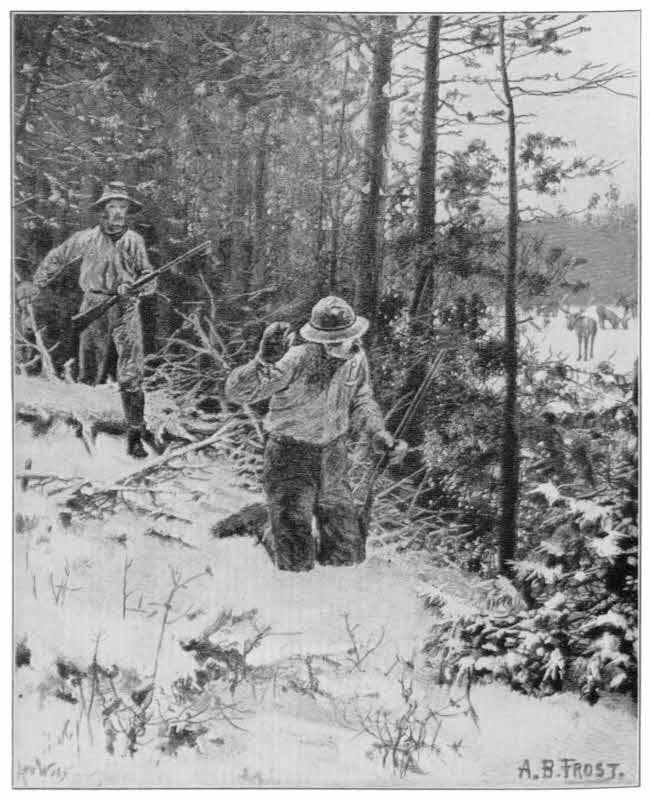
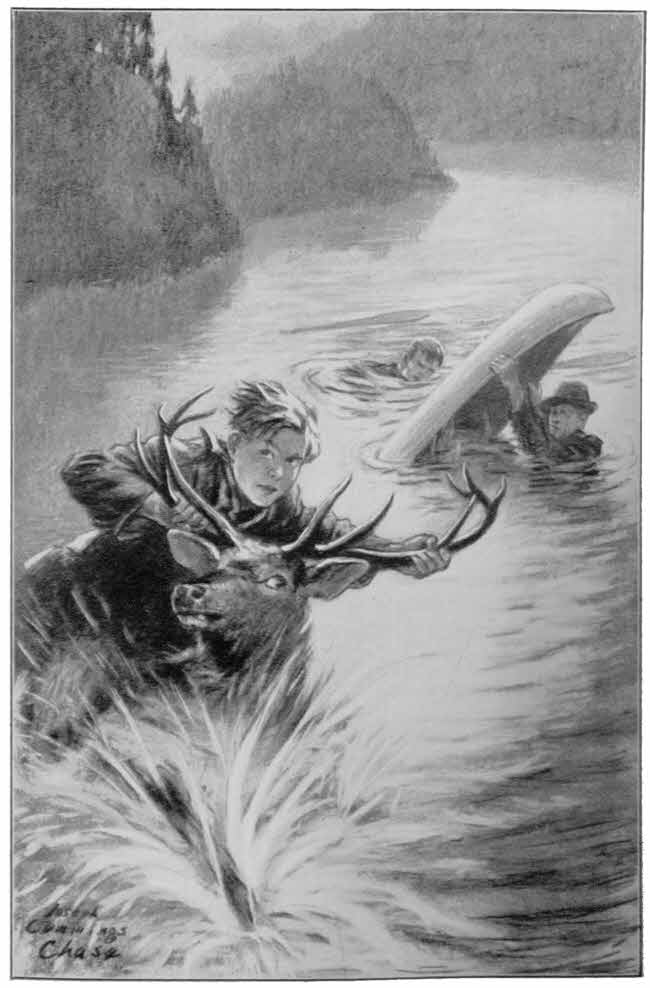
GEORGE LANDED FAIRLY ASTRIDE THE BACK OF THE FRIGHTENED BUCK
The deer, feeling the weight of the lad on
its back, threw itself forward in a series of
wild leaps half out of water. George gripped
the wet body with his knees and hung grimly
to the rough horns. He had no desire to fall
off into the deep water through which the
animal was taking him in its mad flight to
the opposite side of the lake.
Ben had meantime boosted Ed to the top
of the overturned canoe, and was swimming
with it toward the shore they had just left.
Both of them were yelling encouragement to
the alarmed boy racing through the water
on the back of the deer.
The buck, unable to rid himself of his unwelcome
rider, began to twist and turn his
lithe body in an effort to throw him off.
Then what the guide had dreaded happened.
The buck dove beneath the water and took
George with it!
Ed gave a startled cry when he saw his
friend disappear from sight beneath the surface,
and poor Ben groaned audibly. In
breathless silence they watched for what
seemed an eternity for the buck and its rider
to reappear.
When the deer plunged under the water
George instinctively held his breath and shut
his eyes, as he was accustomed to do when
ducked in the school swimming-tank by mischievous
school-mates. He went much deeper
this time, however, and the water went up
his nostrils and roared in his ears. He gripped
the frenzied animal beneath him more tightly.
He could hear it gasping and choking down
there under the water, and it seemed as though
he, too, must soon open his mouth and free
his bursting lungs. He could hold his breath
but a moment longer. Then, just as he gave
an involuntary gasp for air, his head shot
above the water, and, coughing and snorting,
the buck once more swam rapidly toward the
land.
Ed and Ben, who had reached shallow
water, yelled with delight when they saw
their comrade reappear far out on the lake.
George was too full of water to reply to their
shouts and cheers. It was all he could do to
keep his hold on that slippery wet back.
The buck seemed to realize that it could
not lose its rider in deep water, and it swam
strongly and steadily for the shore, now but
a short distance away. From the heaving of
its sides and its short, rasping gasps, George
knew it was fairly well spent. As for himself,
he had regained his wind and some of
his confidence, and he determined to hold
on until he reached land.
At last the deer found footing and jumped
forward into water to its knees. Then it
began a series of bounds and bucks which
sent George soaring through space to land on
his back in a foot or more of water. For a
moment the buck stood looking at him, and
he feared it was going to charge. But, to his
relief, it uttered a loud snort and dashed up
the bank and disappeared in the forest. Despite
his wild ride, George was unhurt; and,
scrambling to his feet, he waded ashore and
sat down.
Ed and the guide, having turned the water
out of the canoe, paddled across the lake to
get him.
“Well, you certainly had a ride and a half,”
laughed Ben, when they were within speaking
distance. “You’re not hurt any, are
you?”
“No, indeed,” George assured them, rising.
“Say, Ed, it’s your turn next.”
But Ed’s answer was, “Not for mine!”
They entered the canoe, and Ben paddled
quickly across the lake to the other shore,
where they alighted and ran to the cabin to
change to dry clothing.
While they were drying the dishes after
dinner, Ben touched them lightly on the arm,
and, cautioning them to be still, pointed overhead
toward the cross-poles of the cabin.
The boys heard the scratching that had
alarmed them the night previous. Watching
closely, they saw a pretty little animal peering
inquisitively down at them with big black
eyes. It was white underneath and soft-brown
above. Ben said it was a flying squirrel.
He promised, if they would watch at twilight,
they would see the dainty creatures go
sailing through the air. Thoroughly interested,
the lads decided to look at the proper
time.
“Ah-oonk, ah-oonk!”
The sound came from above, and Ben ran
outside, followed by the boys. Looking up to
where he pointed, they saw a V-shaped flock
of large birds flying rapidly toward the lake.
The guide said they were wild geese, and that
their coming foretold cold weather. The lads
watched them wheel and drop toward the
water. Then they distinctly heard the splash
as the flock alighted.
Ed and George were for getting their guns
and going after the birds at once, but Ben
told them to wait. He explained that when
the geese first settled on the lake they were
wary and suspicious, but said that after a
while, if not molested, they would begin to
feed, and might then be approached more
easily.
The boys grew very impatient as the afternoon
wore on, and finally sneaked away to
the lake to have a look at the geese while
Ben was busy. They could hear the birds
calling somewhere out on the water, and
when near the lake threw themselves flat on
their stomachs and crawled carefully along.
They peered from behind a big boulder; and
there, but a short distance away, was the flock,
feeding and splashing about in fancied security.
“Great Scott! Why didn’t we bring our
guns?” demanded Ed, in a disgusted whisper.
“You go back and get them, and I’ll stay
here and watch,” replied George, crouching
lower behind the rock as one of the great
birds raised itself on the water and flapped
its wings. “We’ll get one for supper and surprise
Ben,” he added, chuckling at the
thought.
Ed started eagerly away on his errand, but
in his haste was inexcusably clumsy, and fell
head foremost over a prostrate log which
happened to lie in his path. He went down
with a loud crash in the midst of a tangled
mass of broken branches and brittle sticks.
Instantly the geese jumped into the air
with loud, frightened calls, and flew swiftly
along close to the water toward a point of the
shore a short distance away.
“You’re a peach!” cried George, in dismay,
as he rose from behind the rock and surveyed
his friend, who was still floundering about in
the tangle of deadwood.
“Did they hear me?” inquired Ed, anxiously.
“Hear you! Why—”
Bang, bang!
The report of a gun sounded across the
water from the direction of the point toward
which the geese had flown. Running to the
water’s edge, the boys saw the bodies of
two dead geese floating on the surface some
distance out. Looking along the shore, they
beheld Ben, gun in hand, waving to them.
“Well, what do you think of that?” asked
George.
“Beat us at our own game; but we’ll eat
goose, anyhow,” laughed Ed, slapping his
friend on the back.
Ben was calling across to them, and they
listened to catch his words.
“Hey, you fellows, watch those birds. I
guess they’re dead, all right, and I’ll come
around and get the canoe.”
The boys sat down at the edge of the lake,
and Ben disappeared into the woods. When
he joined them they entered the canoe and
went out to where the geese were drifting
slowly away. Ben steadied the frail craft
while the boys lifted the heavy birds in over
the side.
“Always pick them up by the head and give
them a shake to get the water off before
you bring them in,” he cautioned.
Then he began to chuckle, for the lads were
crestfallen and silent.
“That’s all right, boys; you see, I missed
you and knew you had sneaked away to have
a peep at the geese. I went inside and saw
you had left your guns, which was right and
proper, for I want you to remember never to
take them unless I’m with you or give you
permission.”
The boys looked at each other, thankful
that Ed had failed in his mission, for they
dreaded to think of the lecture that might
have come from Ben had they taken the guns
without permission.
“Just as I said, I knew you had no chance
of getting any of the birds; and as I was sure
they would sooner or later see or hear you,
I decided to steal down and knock over a
couple. They’re mighty fine eating.” He
smiled mischievously.
They landed from the canoe, and each of
the lads threw a goose over his shoulder and
carried it triumphantly to the cabin. They
tied the birds up outside, for Ben told them it
was best to let them hang for a day or two
before roasting. He said the boys should do
the plucking and cleaning at the proper time,
as he wished them to learn how to do such
things.
While the guide busied himself inside the
cabin with the preparation of the evening
meal the boys sat outside talking over the
interesting happenings of the day. Suddenly
Ed ducked his head as a little brown animal
sailed past and landed against the trunk of
a tree.
“Flying squirrels!” cried George, pointing
to the roof of the cabin, where several of them
were running about in play.
“Here comes another!” shouted Ed, as
one sailed off into the woods from the top of
the cabin. “They don’t fly; they glide,” he
declared, after having watched several more
go past.
Ben came out holding something in his hat.
When he sat down beside them, they saw that
he had one of the squirrels. He said he had
caught it with his hands, using the felt hat
to protect him from the sharp teeth of the
little creature, which would not hesitate to
use them. He held the squirrel in such a
manner that the boys were enabled to examine
the loose folds of skin which extended
down the inside of each leg, almost to its
toes. They noted that when the animal
spread its legs this skin formed a sort of
parachute which enabled the squirrel to sail
from a higher to a lower position.
When they had studied the odd little rodent
thoroughly, Ben released it, expecting
it would run up the side of a near-by tree.
Instead, thoroughly frightened, it turned and
ran up the nearest object, which happened
to be Ben’s left trouser-leg.
The boys rolled over the ground in spasms
of laughter, while the guide hopped about
endeavoring to shake the squirrel down.
After great exertion he finally succeeded, and
the panic-stricken little creature ran up the
trunk of a convenient pine and hid itself
among the branches.
After supper Ben entertained the boys by
telling several hunting stories. When he had
finished the last one, he declared it bed-time;
knocking the ashes from his pipe, he rose and
went outside to consult the sky for weather
predictions.
“Going to be a fine day to-morrow. Guess
we’ll line bees and get some honey for the
winter,” he said, when he came in.
“How do you do that?” asked the lads.
“I’ll show you in the morning. It’s time
to turn in, now.” And he motioned them to
the bunk.
“What did he say about bees?” whispered
Ed, when he and George were beneath the
blankets.
“I don’t know, but I’ll bet it’s going to be
sport,” George replied, sleepily.
III BEES AND WILDCATS
The boys were awake early, and, quickly
dressing themselves, they rushed outside
to await the appearance of the sun. Ben
had told them that the day must be warm
and cloudless, for then the bees would work
well. Having waited until the sun was some
little distance above the horizon, and all
danger of a cold or rainy day was past, the
hungry lads entered the cabin and ate the
meal which the guide had prepared.
As the morning wore on and developed into
all the glories of a perfect “Indian summer”
day, even Ben became enthusiastic, and declared
it just right for the lining of bees.
“Where must we go to find the bees?”
asked George.
Before replying Ben took a small bottle
from the pantry-shelf. Uncorking it, he began
sniffing at the contents. He also brought forth
a fruit-jar filled with strained honey, a tablespoonful
of which he diluted with warm water
and poured into a saucer. Then he found a
good-sized piece of old honeycomb. Gathering
these things together, he was ready to
start.
“We’ll just go down to that little clearing
by the lake, where we can see them work,”
he said, as Ed and George followed him from
the cabin.
In this little woodland meadow some goldenrod
had grown and bloomed, and about the
blossoms several bees were buzzing industriously
when Ben and the boys arrived. The
guide seemed much pleased at finding them
there, and said he would soon get a line when
he had things ready.
He explained that a line was the direction
of the bee-tree which held the honey. He
said that this was found by watching the
bees, who, when they had loaded up with the
sweets set out for them, would rise in the air
and, after circling about the locality once or
twice, would start off in a straight line for
the distant tree. Ben cautioned the boys to
watch the line of flight as far as they could
see it. Then, when they were sure of its
general direction, he would move on to where
it had faded from their vision, and again set
out his bait. They must repeat this operation
until they found themselves near the
tree. Then they would begin a search
for it.
He said he was glad to find the bees at
work on the goldenrod. It would save him
the necessity of building a fire and rubbing
the honeycomb on a hot stone, so that the
scent would draw the bees.
Ben uncorked a bottle which contained
anise-seed oil. He broke off several blossoming
stems of the goldenrod and poured a few
drops of the liquid on each. Then he placed
them on or near the saucer containing the
strained honey, and, bidding the boys be
seated, sat down to await developments.
“There’s one now!” cried Ed, as a bee
alighted on the edge of the saucer and began
to load up with the honey.
Ben nodded his head and smiled.
“There’ll be hundreds here in an hour,”
he promised.
“Can they smell it so far away?” asked
George.
“No; but these will come back and bring
more. You’ll see, before long. Look out!
Watch him, over your head there! See him
circle? There he goes! Now watch him as
far as you can,” cautioned the guide, as the
first bee started away for the unknown tree.
“I’ve lost him!” wailed Ed.
“I see him—no, he’s gone!” cried George.
“Never mind, there’ll be many more,” Ben
told them. “Watch that fellow on the rim
of the saucer; he’s going in a second. There
he goes! See him circle? Watch now, watch
close, he’s circling again—there he goes—same
way,” he declared, shading his eyes with
his hands.
For some minutes no more bees appeared,
and the boys began to fear that something
was wrong. Then three at once alighted on
the saucer, and Ben said the tree was not far
away. While they were watching them two
more came; then others, by ones and twos,
until there were fifteen or twenty at the feast.
The watchers were kept busy turning and
twisting their heads to follow the swift flight
of the little workers as each started away
with its hoard of sweets. More bees came
every moment, until they were arriving and
leaving in a steady stream.
Ben had meanwhile discovered what he
called a cross-line. Bees from another colony
in a different tree had found the tempting
feast. They were coming and leaving in a
different direction from that taken by the
first lot. He decided to follow up the original
line, for he believed their tree to be the nearer.
He said they would leave this second lot until
another day, although he hoped to get all the
honey they required from the colony they
were tracing.
At length he declared it time to move along
the line. Choosing a dead hemlock some distance
away, on the side of a hardwood ridge,
as the spot where the bees faded from sight
on their flight, the guide led the boys through
the woods in its direction.
After a hard scramble up the hillside they
reached the hemlock and sat down to await
the bees. They had not been there long before
the industrious little toilers covered the saucer,
pushing and crowding one another in their
efforts to get their share of the honey it contained.
They flew away in the same direction
as before, and Ben knew he was on the
line. Basing his prophecy on the increased
number of bees, he said that with the next
moving they should be within reach of the
tree.
Once more they traveled on, this time over
the ridge and down the other side into a
heavily timbered ravine. Here the guide
thought they would find the honey-tree. Indeed,
no sooner were they seated than bees
by the hundreds flocked to the bait. These
left without circling, and Ben said it was a
sure sign the tree was near.
The bee-hunters rose and began a close inspection
of each tree-trunk in the vicinity,
looking carefully up and down its length for
some opening or cavity which might proclaim
the entrance to a hive within. Ben
told the boys to travel along in sight of him,
one on either side, and urged them to inspect
each tree thoroughly. He reminded them
that bees sometimes went in an opening at
the very bottom, and at other times near the
tiptop.
Finally George, who was at the right of the
line, came to a great weather-beaten pine with
a large cavity in its trunk near the base. He
felt sure this was the tree that contained the
honey. Stooping down, he foolishly put his
face to the opening in an effort to obtain a
view of the inside. Luckily there were no
bees there, but something else flew out and
struck him full in the face. And then, as he
fell over on his back from the suddenness of
the attack, a perfect army of bats came chattering
from the tree. Thrusting his hands
before his face, George ran from the spot.
Just then Ed called out that he had found
the tree. Hurrying to the place where he and
Ben stood gazing at a hole near the top of a
giant oak, George saw a steady swarm of bees
entering and leaving the cavity.
“Guess we’ll have to cut that to-night,”
said Ben. “There ought to be a pile of honey
in there, boys. But you can’t always tell;
sometimes the biggest trees hold the least
honey.”
There was an angry buzzing about their
heads, and they ducked and ran.
“We’ll mosey along out of here and go
home and make some torches. Then we’ll
come back after dark and go to work,” Ben
promised.
George told of finding the bats, and his
companions laughed heartily.
“They roost in a hollow tree like that by
the thousands sometimes,” said the guide.
“I’ve done the same thing you did, often.
Why, I’ve had them strike me in the face so
hard that my eye swelled up.”
“What’s that?” demanded Ed, stopping to
listen.
“That? That’s our friend the grouse again,
only this time he’s drumming,” replied Ben.
“Drumming!” exclaimed the boys, in
unison.
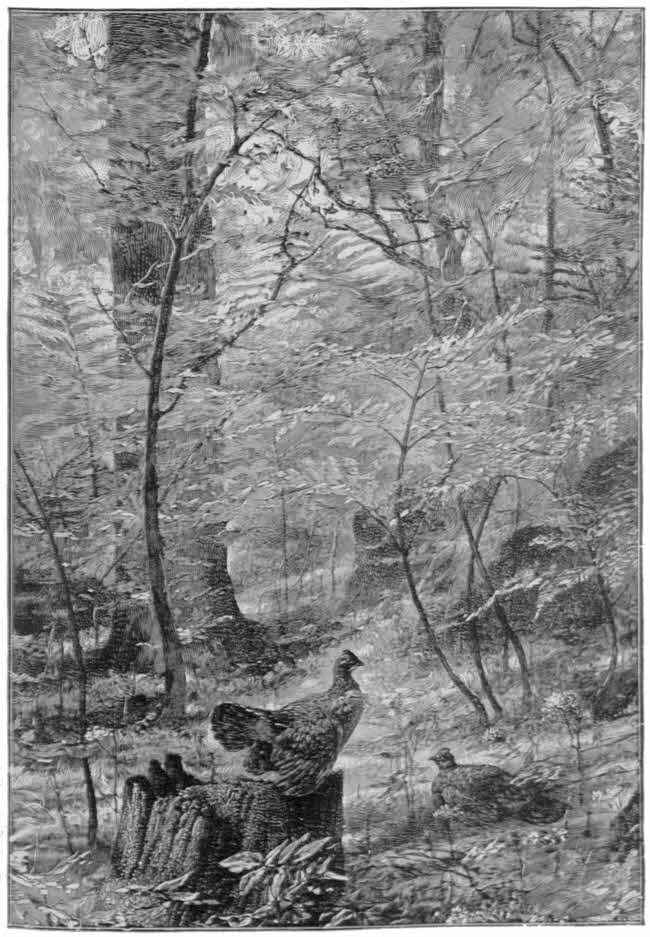
GROUSE DRUMMING ON A LOG
“Yes, that’s what we call it. He wins his
mate that way in the spring. Sometimes on
a nice day, like this, in the fall, he comes to a
warm, sunny spot in the woods and starts
drumming, just like it was spring again.”
“How does he do it?” inquired George, as
the hollow, booming roll came from the deep,
silent woods.
“Why, he stands on a log, or rock, and
beats the air with his wings.”
Ben knelt down and imitated the sound by
pounding the ground with his closed fist.
“When a grouse is drumming like that,
you can walk right up to him. All you need
do is to get his direction, and then hurry
toward him while he’s busy drumming. As
soon as he stops, or a little sooner, you must
remain perfectly still. Then, when he drums
again, move on, until you come in sight of
him.”
The boys made a note of this, and determined
to try the experiment at the first chance.
Arrived at the cabin, Ben busied himself in
preparing the sulphur torches. He took strips
of burlap and wound them tightly about the
ends of pine sticks. Between each roll of the
canvas he sprinkled a generous quantity of
powdered sulphur.
He explained that when the tree fell some
one must run forward and hold a lighted
torch at the cavity. The torch-bearer must
then blow the sulphur fumes down into the
trunk to disable the bees till the honey could
be “boxed out” and secured.
Toward late afternoon the boys were surprised
to hear the deep, musical baying of a
hound in the woods near at hand. Ben came
to the door at the sound, and peered expectantly
down the trail.
“I’ll bet it’s Bill Lang,” he declared, and
he uttered a loud helloa, which was instantly
answered. “Yep, that’s him, boys. Now
you’ll hear some real stories from a genuine
trapper.”
A lean, black and white hound, with long,
trailing ears, came out of the woods and
wiggled its way to Ben to be petted.
“Helloa, Moze,” cried the guide, stooping
to reach the dog; “where’s Bill, eh?”
Then a thick-set man about the age of Ben
came into view and waved his hand at the
group in the doorway.
“Helloa, Bill!”
“Howdy, Ben.” And the trapper turned
his keen eyes on the boys, who were endeavoring
to make friends with his dog.
“Boys, this is my friend, Bill Lang. Bill,
I’ve picked up a couple of ‘pards’ since you
were here. Shake hands with Ed Williams
and George Rand, young friends of mine from
the city. They’re here to learn something
about the woods.”
“That’s not the son of Doctor Williams,
who comes out here to hunt and fish, is it?”
inquired the trapper, looking at Ed searchingly.
“That’s just who he is,” responded the guide.
“Well, if he takes after the ‘old man’ he
ought to be all right,” declared the new-comer,
as he picked up the basin and retired outside
to wash.
“Prospecting for a trap line?” inquired Ben
of the trapper, when they were at supper.
“Yes, sort of looking the country over a
little bit,” he replied. “So you’re going to
cut a bee-tree, are you? Well, I said to myself,
to-day, that the bees ought to work
good. How far from here is it?”
“Not more than a scant mile,” Ben assured
him. “We got another line, too, but couldn’t
stop to bother with it. Better stay over and
take some of the honey; there’s likely to be
more than we’ll need.”
“Why, like as not I will,” agreed the trapper,
much to the delight of the boys.
As soon as it was dark they started off for
the tree. Ben went ahead with the lantern,
the torches, and an ax; George came next,
carrying a dish-pan and a large iron spoon;
then Ed followed with a pail; and the trapper
brought up the rear with his ax and another
pail.
Although the stars shone brightly overhead,
it was very dark in the woods. The boys,
unaccustomed to such travel, stumbled and
fell many times before they brought up at
the tree. The lantern was immediately concealed
behind a rock, so its glare would not
attract the bees. Then, cautioning Ed and
George to tie their handkerchiefs about their
faces, the guide and his friend prepared to
fell the tree.
The blows of their axes resounded through
the woods, and great chips flew through the
air as the cutting blades bit their way into
the heart of the oak. Occasionally the choppers
paused to gaze upward at its swaying
top, for it was important that the tree should
fall with the hole uppermost. Then, bending,
they again attacked it with powerful, swinging
blows, until it began to creak, and give, and
totter. Ben seized the boys and pushed
them aside, and the forest monarch crashed
to earth, the butt bounding back from the
stump high in the air.
Hardly had the great tree fallen before Bill
was at the hole with a sulphur torch. The
lads ran forward to see what he was doing,
and were choked by the fumes he was blowing
down into the trunk. They distinctly heard
the loud, angry buzzing of thousands of imprisoned
bees, and were thankful that the
trapper stood guard with his torch. A few
managed to escape him and forced the boys
to dodge and run by buzzing angrily about
their ears.
While Bill stood bravely by the entrance
and sent the stifling fumes of his torch
into the tree, Ben mounted the prostrate
trunk. He began cutting out a wide strip
directly above the place where he heard the
fierce buzzing, now grown weaker and less
threatening, thanks to the trapper and his
torch.
The others laughed heartily when Bill got
a whiff of his own medicine and doubled up
gasping and coughing, his lungs full of sulphur
fumes. Their joy was short-lived, however,
for at that very instant George was
stung on the back of the neck and the guide
behind the ear. Bill declared it served them
right for laughing at him.
Ben called for the lantern and the remaining
torch, which Ed quickly brought him.
He lifted out the slab he had chopped free,
and instantly thrust the torch into the long
opening. Then he asked for the pan, and
began to take great strips of dripping comb
from inside the tree. The cavity was about
four feet long, and was lined with layers of
clean, fragrant honey, over which crawled
thousands of stupefied bees.
Strip after strip was lifted from the tree
until the dish-pan and pails were full. All
through the woods was wafted the delicious
odor of new-made honey.
“That ought to draw a bear if there’s one
anywhere around,” declared the trapper,
sniffing the air, as they gathered up their
burdens and started for the cabin.
Ben had a lump behind his ear, and George
had developed a similar one on the back of
his neck. Coming to a spring-hole, they
plastered the bites with mud.
“Must be close to fifty pounds altogether,”
said Bill, when they reached the cabin.
“Yes, all of that, if not more,” agreed Ben,
scooping out some very sticky bees which
were leisurely crawling over the comb.
While they were going over the honey to
rid it of bark and bees, the boys heard a new
sound from the forest.
“Who-ah, to-who, to-who, to-who!”
It was a weird, dismal call, and they went
to the door to listen. Ben laughingly told
them it was only an owl.
Bill went outside, and, to the delight of the
lads, gave a perfect imitation of the hoot.
The bird answered and came nearer, and Bill
replied again and again, and at last decoyed
it into a tree directly over the cabin. There
it called and hooted for a long time, until
finally, uttering a blood-curdling screech, it
flew away in the darkness and called faintly
from the other side of the lake.
Later they heard the hound baying, and
the trapper declared it was running a coon.
The boys were anxious to start a search for
it, but Ben said they had done enough for
one day. He made Bill promise to remain
and take them on a hunt the following night.
“Isn’t it great, though?” exclaimed Ed,
when they were in their bunk.
“Each day gets better,” George replied.
The next day they spent in the woods with
the trapper searching for coon signs. The
first tracks were found in the mud about a
spring-hole. Bill showed them to the boys,
who were surprised at the resemblance to
baby footprints. He said the little gray-and-black
animals made trails very similar in
form, though, of course, much smaller, to
those of the bear, to whom they seemed distantly
related.
About the border of the lake they found
other tracks, and saw many empty mussel
shells lying about close by. Bill explained
that racoons were exceedingly fond of these
freshwater clams, and described how they
cracked the shells to get at the meat inside.
He said, judging by the many signs and
tracks about, they would have little trouble
“jumping” a coon when they started with
the hound that night.
It was barely twilight when the boys were
eager to be off. Bill told them that the best
coon hunting came long after dark, and declared
there was no need of starting so early.
The hound was fastened to the cabin by a
long leash, to prevent him straying off before
the hunt. Then for some time the impatient
young hunters sat waiting.
At last it was time to go, and the little
hunting party filed away into the black forest.
Following along one behind the other,
they came to the spring-hole where they had
seen the tracks. Bill, who was leading with
Moze, had trouble in holding the hound
back. It sniffed excitedly over the moist
ground, but seemed to find nothing especially
interesting, and they moved on.
“Little too early,” said Bill.
“We’ll find one before long,” Ben prophesied,
hopefully.
The boys moved slowly along behind the
trapper, who carried the lantern, and Ben
followed in the rear to prevent their straying
from the trail. The great black woods had
a peculiar charm about them at that time of
night, and as the boys peered about beneath
the massive trees they recalled the story of
a panther which the guide had told them.
They wondered if one of those savage animals
was lurking somewhere near them in the
darkness, and were thankful for two such
body-guards as Bill and Ben.
Suddenly the hound uttered a long, dismal
howl and jumped forward so quickly that it
almost pulled Bill headlong to the ground.
“He’s found one!” cried Ben.
“Yep, there’s been one here, sure,” declared
Bill, stooping and releasing Moze.
The hound instantly dashed away into the
night, uttering a series of short, excited
yelps.
The boys were for chasing after him, but
were laughingly restrained and told to remain
where they were until the coon was treed.
The hunters stood clustered expectantly about
the lantern, while every few moments the
voice of Moze echoed through the woods and
gave warning that he was hot on the trail.
Then farther away they heard his quick,
snappy bark, and Bill said the coon had been
treed. At a rapid pace he led the way down
a steep ravine, across a rock-strewn gully,
and up a rough hillside. Panting and excited,
the boys raced along behind him. They
seemed heedless of the sharp, stinging blows
from branches which snapped in their faces,
the scratching grasp of thorny bushes which
tore their hands, or the strong, entangling
grip of low, sprawling vines which wound
about their feet.
At last they came out into more open
country beneath a great grove of evergreens.
The dog’s impatient yelps sounded from a
short distance in advance of them. Shouting
encouragement, Bill hastened on toward where
they heard the hound. When they got there
Moze was jumping about and barking excitedly
at the foot of a giant, lightning-killed
pine whose trunk extended high up into the
blackness.
“It’s up there, all right,” said the trapper,
holding aloft the lantern and peering upward
into the night.
They were unable to see the coon, which
was evidently in the very top of the tree
and well shielded by the darkness. The
two veteran hunters decided to build a fire.
Soon there was a great roaring blaze, which
threw a shaft of light far aloft into the mass
of naked branches. On one of them, in near
the trunk, crouched their quarry. The tree
was too big to chop down, and after some discussion
Bill volunteered to climb it.
Having cut a long, crotched pole, the trapper
fastened it to his waist with a piece of
buckskin, and then he twined his legs about
the tree and began to “shinney” toward the
top. Ben and the boys armed themselves
with stout clubs and waited anxiously for
something to drop.
When he was within striking distance,
Bill loosened the pole from his waist and
pushed the coon from the limb on which it
crouched. It fell, but caught on a lower
branch, which ran to a fork, and again
settled down. Bill slid down to it, and this
time gave it a prod that sent it sailing through
space with outstretched legs. It fell heavily
to the ground in the midst of the little group
at the base of the tree.
No sooner had it struck than Moze was
upon it. Then began a fierce battle between
dog and coon. Snarling and coughing, they
rolled over and over in their struggle, Moze
on top one moment, and the coon, which
was putting up a valiant fight, uppermost the
next.
The battle was waged furiously, and the
animals appeared to be about evenly matched.
The hunters formed an interested circle about
the combatants, until the latter, in their
frenzy, rolled between Ed’s feet and brought
him down in a heap on top of them. For a
moment there was the wildest kind of excitement
as Ed frantically endeavored to roll
away from the snapping animals. He finally
managed to scramble to his feet, and ran
nimbly aside, as Ben struck and killed the
coon with his club.
Moze came up for inspection under the
lantern light. He wagged his tail in triumph,
but he looked much the worse for his encounter.
He was scratched and torn from
the sharp teeth and claws of his late antagonist,
but appeared not to mind his wounds.
Bill examined him carefully, and said that
the few scratches were nothing to what he
often got on such expeditions. As the hound
seemed willing and eager to continue the
hunt, the hunters moved on.
They walked several miles through the
black woods in the hope of finding another
coon, but Moze was unable to strike a second
trail. Bill led the way through two large
swamps, where in many places they sank to
their knees in water. Then he guided them
up a mountain-side, where the ground was
covered with fallen tree-trunks—the result of
a forest fire and tempest the year previous.
The boys found it hard work climbing over
these obstructions in the dark, and George
declared he felt like an ant clambering over a
pile of tooth-picks. At last they came to the
top of the ridge, which was crowned with a
forest of hardwoods, mostly oaks and chestnuts.
They sat down to rest and dry their
brows, for, though the night was cool, the brisk
walk and hard climb had made them perspire.
Moze had gone on ahead, and suddenly
they heard him baying furiously a short distance
away to the right. The boys jumped
to their feet instantly, but Ben cautioned
them to wait until the hound had treed its
quarry. They listened to the yelps and howls,
which now seemed to come from farther
away. Finally Bill rose and said they would
follow the dog.
“Sounds like he might have a bob-cat or a
lynx,” said Bill, as they hastened along to
where Moze evidently had something up a
tree.
“If that’s the case, we’re in for fun,”
laughed Ben.
The lads became much excited at the prospect
of an encounter with either of the savage
animals mentioned, and thought of the wild
screech they had heard the first night in
camp. Ben had told them it was made by
a lynx. As they hurried along Ed determined
to keep out of the way this time, for he had
no desire to tumble into a mix-up with such
a formidable antagonist.
“Will Moze tackle a lynx?” he asked,
breathlessly.
“He’ll pitch into anything from a bear
down,” Bill declared. “You’ll see fur fly in
a few minutes, I guess,” he added, as the savage
challenge of the hound sounded through
the night.
As they drew near, Moze went racing away
down the hillside, baying lustily. Whatever
animal he was pursuing had evidently jumped
from the tree when it heard the noisy approach
of the hunters.
“That’s a bob-cat trick,” said Bill.
“Yep,” said Ben, as he cautioned the boys
to be careful of their eyes while pushing
through the mass of unyielding branches
which swept stingingly across their faces.
Again Moze drove the unseen creature
up a tree, but not before he had come close
enough to make it spit and snarl wickedly.
Bill now assured them that they had a bob-cat
to deal with. He said there would be
the fiercest kind of fight. They hurried on to
where the dog was barking and growling at
the base of a low, scrubby oak. The hair on
his neck stood stiffly erect, and his whole
manner was more defiant and threatening
than when he had treed the coon. From
time to time he left off barking and raised
himself on his hind legs in an effort to leap
into the tree.
Gazing into the tree-top but a few feet
above their heads, the boys saw a pair of shining
green eyes peering down into their own.
They quickly withdrew from beneath the
limb, and called Ben and the trapper, who
had been staring into the twisted branches
from the opposite side.
“Yes, that’s a bob-cat, all right enough,
and a big one, too, I imagine,” cried Bill, excitedly.
“We should have brought a gun.
Might have known we’d run across one of
these fellows before we quit,” he said.
There was a rustling of dried leaves, and
before any one had time to move the bob-cat
landed with a thump in the midst of them.
Ed crashed into George in his frantic effort
to get out of the way, and both of them fell
in a heap. Ben made a vicious swing with
his ax; but the bob-cat evaded him and went
racing off with Moze in hot pursuit.
When the boys regained their feet, the
trapper was some distance away with the
lantern. Ben, who was crashing through some
bushes to their left, called to them to follow
the light. Not wishing to be lost in the inky
woods, they hurried, pell-mell, after Bill and
the sounds of fighting.
From the snarls and growls which they
heard, the lads knew that Moze had once more
brought the bob-cat to bay. Panting and excited,
they at last bumped into the trapper,
who was standing with the lantern held high
above his head, pointing at some rocks which
Ben was cautiously approaching, ax in hand.
There, among the rocks, the bob-cat faced
them, driven to bay. With ears flattened,
eyes glaring, and lips drawn back in an ugly
snarl, it crouched before the dog. It kept
up a constant low, rumbling growl, which was
defiantly answered by Moze. The old hound
knew too much to rush recklessly into close
quarters, and contented himself with circling
about the ugly cat and so holding its attention.
The bob-cat was indeed, as Bill had
judged, a large one. Neither Ed nor George
had ever seen such a ferocious-looking wild
animal before, and it seemed to grow in size
and ugliness while they stared at it, squatting
there in the glow of the lantern, its whole
body quivering with rage.
It drew back as though to spring when the
guide approached, and Bill called a warning.
Ben cautiously retreated a few paces, and the
bob-cat relaxed somewhat, growling so fiercely
that the boys involuntarily moved several
feet nearer Bill.
Moze rushed forward, but instantly jumped
back when the watchful creature struck a savage
blow at his head.
“Look out, old boy, you’ll get a clawing!”
laughed Bill, warningly, to the enraged hound,
which was jumping to and fro barely out of
range of the sharp claws, bared and ready to
repel his attack.
“I’ll stone him till he turns, and then you
send Moze in, and I’ll take a chance with
the ax,” Ben proposed.
“He’s big, and he’ll fight hard,” said Bill,
dubiously.
“I know it; but it’s the only chance we
have of getting him without a gun.” And
Ben stooped and picked up several stones.
“Now then, boys, look out for trouble!” he
warned, preparing to hurl one of the stones.
“Hold on till I get a club,” urged Bill,
searching about for a weapon. “Here, Ed,
you hold the lantern, and, mind you, keep
the light on him!”
Ben threw a stone, which struck the bob-cat
full in the side. With an enraged snarl
it turned to run, but Moze was upon it the
same instant. He fastened his teeth in one
of its rear legs. The cat whirled and struck
before the dog could jump aside, and its long,
sharp claws inflicted a nasty gash in the top
of his head. With a howl of mingled rage and
pain Moze bounded to one side, and Ben let
go another rock, but in his eagerness he missed
the mark entirely.
Then he shouted a warning, for the bob-cat
drew back as the second missile sped past its
head, and, gathering its powerful feet beneath
it, sprang directly at Ed and the
lantern. As the startled boy turned to run
it struck him in the middle of his back
and sent him pitching forward on his
face.
Instantly Moze rushed in, and Bill ran forward
yelling, club in hand. Then ensued
some terrific fighting in the dark, for the lantern
had been smashed against a rock when
Ed fell. Snarls, growls, yells, and blows resounded
from the blackness as Bill, Moze,
and the bob-cat fought over the prostrate
body of Ed, who prudently lay face downward,
afraid to move.
Luckily, Moze closed with the bob-cat before
it had a chance to inflict injury on the
lad. And then, seeing the danger the boy
was in, Bill rushed into the fray with his club,
and the cat was too hard pressed to turn its
attention to the boy underneath. But he was
in a risky place, for the combatants rolled
back and forth over his body, and several
times he felt sharp scratches on his neck and
shoulders as Moze and the bob-cat struck and
snapped at each other. Then he heard Bill’s
club descend with a loud whack, and at the
same time the trapper called to him to roll
out of the way, which he lost no time in
doing.
Moze had been getting the worst of the
fighting; but once Ed was out of the way,
Ben went to the aid of Bill, and with club
and ax they soon killed the bob-cat, but not
before the trapper had been severely clawed
on his legs and arms. Moze was bleeding
from a dozen wounds, and Ben told George
to gather sticks that they might build a fire
and nurse the injured.
Bill’s wounds were painful, but not deep,
and he made light of them when Ben offered
to help him. Ed had by some miracle escaped
with a slight gash in one shoulder and
a few minor claw-marks across his back.
The guide bound up his shoulder, and then
turned to poor Moze. The old dog was lying
down, quietly licking his injuries. There was
little they could do for him at the time, so
they all sat by the fire to rest before moving
toward the cabin.
Ben stretched out the body of the bob-cat;
it measured over four feet, and the guide
claimed it would weigh between thirty and
forty pounds. It bore the marks of Moze’s
mauling, and Ed went over and petted the
hound affectionately for having so gallantly
gone to his rescue.
“That’s a powerful big bob-cat,” said Bill,
gazing down at the mottled gray body
stretched out at his feet.
“’Most as big as a lynx, and just about as
ugly,” declared Ben.
They had a hard trip back to the cabin,
with no lantern to help them, but finally arrived
there tired and sore. Ben at once
heated some water, and Bill and Ed carefully
washed their wounds. Then they did
the same for Moze, and he wagged his tail in
appreciation. More than once the boys fairly
hugged him, for the faithful old hound had
gained a lasting place in their affections by
his bravery.
When they were finally in bed, George said:
“Well, Ed, you had your turn to-day, didn’t
you?”
“Yes, and it was almost as exciting as
your ride on the deer. I’m going to ask
for the skin of that bob-cat as a souvenir.”
“I wonder what we’ll run into next!”
mused George.
“Catamounts and bears, I guess. Good
night, I’m tired.”
IV A DEER HUNT
The boys awoke one morning to find Ben
hard at work oiling the rifles. Delighted
at the sight, they hurried into their clothes,
for they felt sure the oft talked of deer hunt
was about to take place. They fairly bolted
their breakfast, so eager were they to be off;
but Ben restrained them and reminded them
that many things must be attended to first.
When they had finished washing and stowing
away the dishes, which they did with all
possible speed, he taught them how to make
a suitable pack of their blankets and a few
camp necessities. Then he made them change
their heavy hunting-boots for lighter, softer
moccasins, explaining that these would enable
them to travel through the woods more
quietly.
Finally, after putting the cabin in order and
attending to a dozen other chores, which the
boys, in their eagerness to be away, thought
might have been dispensed with, he announced
that he was ready to go.
Armed with their rifles, and each with a
pack on his back, the three hunters left the
cabin and struck off through the woods. The
air was crisp and exhilarating, and their high
spirits prompted a rapid pace.
Ben kept his gaze on the ground ahead of
him, in the hope of finding deer signs. Noting
this, the boys quickly imitated his example.
They flushed many grouse, and one alighted
in a tree in plain sight of them, and stood conspicuously
exposed to their aim. They were
anxious to try a shot at so easy a mark, but
were reminded that they were after larger
game. Ben warned them that a needless
shot ringing through the woods would frighten
away any deer which might be lingering in the
vicinity. The hint was sufficient, and, casting
a longing look at the foolish bird, they followed
obediently on after the guide.
At last they climbed to the top of a dividing
ridge, and here Ben halted. He pointed
to a slight depression in the carpet of dead
leaves, and said it was a deer track. He explained
that deer in their journeyings traveled
along the summits of these low hills, which
were then termed “runways.” Ben said that
the ridge on which they stood was one.
Leading the way to a near-by boulder, he
bade one of the boys climb to the top to
watch the surrounding country for any sign
of a buck. He left it to them to decide which
one would remain there. Ed said he would
stay; and, after cautioning him not to shoot
until he saw the whole body and antlers of
the animal aimed at, Ben ordered him to
remain until he stopped for him on the way
home. He told him, if he succeeded in shooting
a deer, to fire two shots in rapid succession
and, after a minute’s pause, two more.
Ed climbed to the top of the big rock, and
sat down with his rifle across his knees. He
waved his hand to Ben and George when they
turned just before they disappeared from
sight among the trees.
George was placed at another “runway,”
about a mile farther on; and, after cautioning
him as he had Ed, Ben said he was going on
to try to scare out a deer. He said that anything
he might start would be sure to come
over one or the other of these “runways,”
and warned George to be on his guard. Then
with a wave of his arm he disappeared, and
the boys were left alone in the heart of the
wilderness.
Each boy remained at his post, expectantly
gazing through the aisles of the vast forest
which surrounded him. The noise of the
wind through the tops of the trees; the
squeaking of a leaning pine as it rubbed
chafingly against its neighbor; the snap of
a twig, or the sudden call of a jay, caused
them to start nervously.
Several times George half rose and cocked
his rifle when he thought he heard some animal
walking about near him. But after watching
with straining eyes and thumping heart and
seeing nothing, he relaxed and made up his
mind it must have been the wind, or a squirrel
scurrying about among the leaves.
Suddenly a shot sounded from the direction
in which he guessed Ed to be, and George
jumped to his feet. Another roared through
the woods a moment later, and echoed loudly
between the mountains. For a minute or
so all was still. Then two reports rang out
in rapid succession and, after a minute, two
more!
“Gee whiz! Something is up!” declared
George, aloud. He wished he might find Ed
and learn the cause of the shots, but he dared
not leave the place until Ben came for him.
He doubted if he would be able to find the
way to his friend; and, as the guide had forbidden
him to leave the spot, he sat down to
await developments.
Ed became hungry and brought out his
lunch. He was just about to bite into one
of the appetizing sandwiches when the sharp
crackling of twigs close by caused him to
drop it and seize his rifle.
Then a loud, frightened snort drew his
attention, and, looking in the direction from
whence it came, he beheld a big buck standing
broadside to him. Its head was turned to
look at him; the great ears were thrown forward
and moved nervously about; and the sensitive
muzzle twitched apprehensively as the
dreaded man-scent came to it on the breeze.
For a moment Ed was helpless, and stood
gazing with surprised, startled eyes at the
magnificent creature before him. Then he
managed to recover, and quickly brought up
his rifle. He aimed where Ben had told him
to, behind the shoulder, and with trembling
fingers pressed the trigger. At the report the
buck made a tremendous leap, fell to its knees,
recovered, and bounded away. He fired
again, this time at random, and the deer
crashed from sight into the heavy timber.
“Wouldn’t that make you sick?” cried Ed,
disgustedly, as he sat down and wiped the
beads of nervous perspiration from his brow.
“I must have hit him, or he wouldn’t have
tumbled down,” he assured himself.
Then he remembered the signal and rose
and fired the four shots, two at a time, which
would bring Ben and the proper advice.
After what seemed a very long time, he
heard another sound near at hand and cocked
his rifle. He uncocked the weapon a moment
later when he was hailed by Ben and George.
“I got a shot, and I think I hit him!” he
cried, as he ran to meet them.
“Where is he?” Ben asked, quietly, after
he had cautioned George, who had begun to
whoop.
“He went off that way,” explained Ed,
pointing in the proper direction.
A look of disappointment came over the face
of the guide, and George at once subsided into
gloomy silence.
“I hit him, I tell you,” Ed declared, emphatically.
“He fell and then jumped up
and ran off.”
“Where was he standing?” Ben asked, a bit
more hopefully.
Ed got his bearings from the rock on which
he had been sitting, and went over to about
where he thought the buck had been when
he had fired at it.
Ben stooped over and scanned the ground
closely in a wide circle. He was silent for
some minutes while thus engaged; then he
straightened, laughing, and pointed to a low
bush beside them.
“You hit him, sure, and hit him hard,” he
declared. “And we’ll get him—he’s shot
through the lungs!”
The boys looked at the bush and saw several
red splashes on its brown leaves. Following
close behind Ben, who was crouching along
near to the ground, they saw other darker
spots at their feet.
“He won’t run very far. I started him in
a swamp. Just got a glimpse of him as I
was crawling under a fallen tree-top, and
couldn’t shoot,” Ben explained.
“My, he’s big!” said Ed.
“Better not talk any more now,” the guide
cautioned them, looking keenly ahead.
They crossed a brook, and when they
reached the opposite side there was a rustling
of undergrowth. The lads cocked their rifles
and the buck jumped to its feet and stood
facing them.
“Shoot!” cried Ben.
The boys brought up their rifles at the same
instant, but George was the first to pull
trigger. His bullet went straight through the
heart, and the buck dropped dead.
Ben ran forward and cut its throat with
his hunting-knife. He complimented the lads
on their good shooting, and said they must
have been practising before they came to the
woods. Ed told him he had a rifle-range in
the cellar of his home, and said that George
and he had engaged in many contests.
The guide showed them how to cut a slit
in the flesh of the deer’s hind legs and insert
a stout stick from one leg to the other to
spread them apart. He called it a gambrel
and briefly explained its use. Then, with
their assistance, he raised the carcass by aid
of poles. The deer once swung up, Ben
quickly cut it open and removed its entrails.
He put aside the liver, which he promised to
cook for breakfast.
He would have skinned the buck, but twilight
was fast gathering, and they must choose
a suitable camp-site and build some sort of
a shelter for the night. Therefore he decided
to leave the deer hung up until daylight,
when he could remove the hide and quarter
the carcass.
They washed in the clear, cold water of a
little stream. Then Ben began his search
for a camping-place. At last he found a spot
to his liking on top of a pine-clad knoll. He
led the boys to it, and bade them slip their
packs.
Ben looked around until he found two trees
growing on a parallel line, about six feet
apart. He cut a pole about an inch wider
than the space between their trunks. After
cutting some notches in the pole’s upper side,
he placed it between the trees and drove it
down until it became securely wedged about
six feet from the ground. Next he cut and
trimmed two logs, each about eight feet long
and some five inches through. He placed
them on the ground, one extending back from
the base of each tree.
At his order the boys had cut some long
straight poles, about two inches in diameter.
They were placed against the notched ridge-pole
between the trees, the end of each pole
fitting nicely into the notch cut to hold it,
and the lower end resting on the ground some
eight or ten feet back.
They had the roof, sides, and door of the
lean-to completed, and were ready to go
on with the “shingling,” under Ben’s directions.
He bade them cut many armfuls of
balsam and hemlock branches. These he
dexterously wove between the roof-poles until
he had made a thick covering, or mat, over
their little shelter. Then he placed small
trees and branches against the sides.
When the boys returned, each with a back-load
of balsam tips for bed-making, they were
astonished to find a cozy bough-house ready
for them. The delicious aroma of fried bacon
rose from the pan which Ben was shaking
over a bed of glowing coals. Hastily throwing
their boughs inside the shelter, the two
hungry young hunters sat down to supper.
That night they made a big camp-fire, for
the autumn air was chill. As the flames
leaped and danced and threw a circle of
orange-colored light into the dark, somber
woods, the lads sat on a great log and listened
attentively to Ben, who told them tales of
the forest.
Finally the fire died low and the blackness
crept in upon the little group before the shelter.
Ben rose and declared it was time to turn in.
By the aid of the lantern they made their
beds of boughs, rolled themselves in their
blankets, put out the light, and soon drifted
off to sleep.
George was awakened by the hooting of an
owl in a tree close by, and lay for some time
listening to the mournful serenade. He heard
the deep, heavy breathing of the guide, and
knew he was slumbering soundly. Ed did
not stir, and he was sure that he, too, was far
away in the “land of nod.” The bird continued
its dismal hooting; and then, as the
fire flickered into new life for a moment, an
idea seized the waker.
George rose and slipped noiselessly from
his blankets. Then he felt around until he
had secured his rifle, and, once in possession
of it, he stole quietly out into the darkness.
The owl ceased calling, and the sleepy young
hunter strained his eyes in an effort to locate
it. Then again came the mocking call, and
it seemed to the eager youth as he stood there
peering aloft into the dark that the uncanny
bird was actually laughing at him.
The fire again flared up and sent its flickering
shafts of light high into the surrounding
tree-tops. This was the opportunity for
George to get his shot. Boldly outlined on
the limb sat the owl. George took quick but
accurate aim and pulled the trigger as the
owl started to vacate its illuminated perch.
The report of the rifle reverberated through
the silent woods like the crash of thunder.
Awakened by the noise, Ed and the guide sat
up just as the owl crashed through the
branches and sailed headlong into the lean-to.
Its heavy body struck Ed squarely in
the face and tumbled him over backward
with the force of the blow.
“What in tarnation has happened?” cried
Ben, leaping from his blankets and grabbing
the lantern.
“There’s something in here!” yelled Ed,
rushing from the shelter. “Where’s George?
He’s gone!” he cried, in alarm.
George was helpless with laughter at the
results of his shot. When Ben had lighted
the lantern and discovered the owl lying on
the blankets, the guilty marksman appeared,
grinning broadly.
“Well, say, young feller, you certainly
stirred things up considerable for this time
of the night,” said Ben, as he threw the dead
owl at the disturber of his dreams.
“Why didn’t you wake me?” protested Ed.
“Thought I did,” laughed George, unloading
his rifle and crawling beneath his blankets.
“Will you show me how to skin the owl, Ben?”
he asked, meekly.
“Sure I will,” promised the guide; and then
he extinguished the lantern and ordered the
boys to go to sleep.
V A FOREST FIRE
When the boys awakened it was daylight;
and, to their surprise, Ben was missing
from the camp. They looked for him outside,
but, not finding him, decided he had gone to
skin and quarter the deer. They busied themselves
with making a fire, that it might be
ready for the guide to cook breakfast over
when he returned.
“It looks foggy,” suggested Ed, gazing off
between the trees.
“That’s not fog, it’s smoke!” George declared,
sniffing the air suspiciously. “Don’t
you smell it?”
“Right you are, son,” said Ben, coming into
camp at that moment carrying the head, skin,
and fore quarters of the deer. “It’s smoke,
and I don’t like it a little bit. There’s a forest
fire not a great ways off, and we better mosey
toward the cabin. We’ll hustle through breakfast
and then travel on,” he declared, uneasily.
The boys helped get breakfast, and when
it was ready they ate rapidly and in silence.
From the way Ben consulted the sky they
knew he was anxious and worried. The sun
had risen, but was obscured by a purplish
haze which he told them was smoke. Then
they smelled it. The distinct odor of burning
pine was borne to them on the scant morning
breeze.
The dishes were hurriedly washed and
stowed away in the packs. Each of the boys
packed up as much of the deer meat as he
could stagger under; Ben added another
quarter to his load, and the remainder was
covered with boughs and hung high in a
tree, to be called for later. Then, eager and
anxious, Ben led them away through the
smoky woods, at a brisk pace, toward the
distant cabin.
As they hurried along, the air seemed to
grow heavier, and all through the forest there
drifted a hazy fog. The smell of smoke became
stronger with each mile they traveled,
until Ben, in his anxiety, set a pace that his
young companions found it hard to follow.
On the top of a small mountain, which they
were obliged to cross, the guide stopped a
moment and pointed out a heavy, black cloud
of smoke. It was curling up from behind
a distant ridge in a direct line with the
cabin.
Then, with great strides, he raced down
into the valley, the boys stumbling along
after him as best they could. Their faces and
hands were torn and scratched from thorns
and briers, and their feet and legs were bruised
from contact with sharp-pointed rocks. They
went on uncomplainingly, however, for they
feared that the cabin was in danger, and they
were anxious to help Ben in its defense against
the oncoming fire.
Thicker and more dense grew the smoke-clouds
in the woods, and the air became oppressive
and suffocating. Tears ran down
the boys’ cheeks, and they coughed violently
as the pungent smoke filled their lungs.
“Come on, you’ll get used to it soon,”
called Ben, encouragingly.
They got a glimpse of the cabin through
the smoke, and cried out with delight. In
the doorway stood Bill, the trapper, and down
the trail came old Moze. They were compelled
to laugh when every few feet the hound
was obliged to stop and sneeze.
“I’m glad you’re here,” said Ben, greeting
the trapper.
“Well, you see, there’s a nasty fire coming
this way, and I knew you’d be glad to have
help to save the shack before morning; so I
hustled over.”
“If the wind would only shift around, we’d
be all right,” said Ben, gloomily.
“There’s not much wind to shift,” the trapper
replied, shaking his head.
The boys sat listening while the two experienced
woodsmen consulted as to the best
way of keeping the fire off. They finally
agreed that the safest course would be to
back-fire the woods on all four sides of the
cabin. It would be dangerous, for the dry
forest, when once kindled, would burn like
tinder. The fighters would have to work
hard to prevent their fire from turning back
and consuming the cabin. To make matters
worse, the wind was momentarily strengthening,
so that on two sides at least they would
be obliged to drive their back-fire into the
face of it. But nothing was to be gained by
delay, and they began the fight at once.
Ed and George were sent to the lake for
pails of water, while Ben and the trapper
cut a supply of white-pine boughs for use
as beaters. When the boys returned they
were each given one of these pine branches
and told to wet them and beat out any encroaching
patch of flame. Ed was then detailed
to the roof to beat out any sparks that
might light there. George was ordered to
follow along the line of fire started by the
men, and told to keep it away from the dry
log walls.
FIGHTING A FOREST FIRE
By this time the smoke was so dense that
they could not see one another, and Ben cautioned
George against wandering away. Great
black cinders and bits of charred wood were
flying through the woods and dropping all
about them. Birds and animals, fleeing from
the fire, went by within easy reach. A deer,
in its wild panic, almost ran into the cabin,
and they heard the frightened creature jump
into the lake a few seconds later. Grouse
whizzed past close to their heads, and rabbits
and smaller things scurried by almost beneath
their feet.
Then they heard the roar of the fire, the
crackling of undergrowth, and the crash of
falling timber as the great wall of flame drew
nearer. Twilight fell early, on account of the
smoke, and it was soon quite dark. The
roar of the approaching flames sounded like
the noise of an express-train. The smoke
grew still thicker, and they gasped for breath,
as scorching heat-waves, like blasts from an
open furnace, swept over them.
They had started their back-fire, and George
and the woodsmen were compelled to work
like demons to keep it from blowing back toward
the cabin. The wind blew the smoke and
flames full into their faces as they pounded and
stamped to force the lengthening line of flame
on its windward course to grapple with the
onrushing flames of the forest fire.
Ed, too, was soon in the thick of the fight,
for in beating at the fire below, the fighters
on the ground sent aloft a constant shower
of sparks which found their way to the dry
log roof on which he crouched. Staggering
about through the choking smoke, he beat
out several patches of fire which had started
from the glowing cinders. Fiery embers
seemed to fill the air. They lit on his face
and hands, and burned their way into the
flesh before he could brush them off. He was
unable to see his comrades below, and so loud
had the roar of the fire become that he did
not even hear their voices. Several times he
found himself on the very edge of the roof,
and he barely escaped falling off, for, blinded
as he was by the smoke, he could not see
where he was.
Suddenly he felt a hand clutch his arm,
and turned abruptly to find George beside
him. His eyebrows were singed, and his
face streaked and sooty.
“I’ve been calling you till I’m hoarse,” he
gasped. “Thought you might have smothered
up here. Ben says the forest fire will be
over that hill in a few minutes. Say, isn’t
this an experience and a half?” he chuckled,
wiping his inflamed eyes.
“What about the cabin?” Ed inquired,
anxiously.
“Ben thinks it’s safe, except for the sparks
and embers which he says will be dropping
like hail when the real fire goes by. He and
Bill will watch the walls, and you and I are
to guard the roof. You see, our back-fire
has burned everything off around the cabin,
so the forest fire will have nothing to feed
on and must go round us. Ben thinks it will
travel around the lake. Say, it’s fierce work
holding that back-fire.”
Then the woods were lighted as vividly as
if thousands of great electric lights had been
suddenly turned on. The boys looked toward
the distant pine ridge in alarm, and saw a
great barrier of leaping, red-tongued flame
rushing toward the little cabin, whose sole
protection was the thin line of wavering fire
they had sent up the hill to meet and combat
the destroying furnace bearing down upon
them.
The roar of the flames through the trees
and the crackling of burning brush echoed
in their ears. Then the awful heat swept
over them and stifled their very breath as
they groped their way uncertainly about
through the yellow pall of smoke.
“Here she is—lie low!” yelled Ben, from
somewhere below them; but the rest of his
orders were drowned by the noise.
A host of burning embers came glowing
through the smoke and alighted on the cabin.
A jet of flame started up near the peak of the
roof, and the boys dashed water on the spot.
Birds struck against them, cinders lit in their
hair, and their heads reeled from the intense
heat and suffocating smoke.
“Look! Oh, look!” screamed George, hysterically,
as a solid sheet of flame flew from
the top of a pitch-pine and caught again in
a neighboring tree, which it consumed with a
sullen roar.
Smoke began to twist up over the edge of
the roof, and they realized that the cabin was
on fire. With blanched faces and set teeth
they crawled to the spot, but were driven
back by a tongue of flame which leaped in
their faces.
“She’s going, sure!” cried George, in dismay.
“Water, quick!” gasped Ed.
“The roof is on fire, too,” warned George,
as he made his way boldly toward the tiny
flame that showed redly through the smoke.
“Watch the top, boys; we’ve put the fire
out down here,” cried Ben.
The boys went to work with the energy of
desperation, and after much effort finally
subdued the flames on the roof.
Then the two fires met, and the forest fire
was checked, but in no wise conquered.
Since nothing was left to burn in front, the
fire ran around the blackened circle which
protected the cabin, and went roaring and
crackling through the woods. It burned
down to the water’s edge, and they could
hear it hissing with baffled rage at the shore
of the lake.
When it had passed, the sparks ceased; and
the boys, thoroughly exhausted, dropped on
the hot roof of the cabin, thankful for their
deliverance.
Ben crawled up and helped them down,
and they staggered feebly into the smoke-filled
room below. Neither could see, and
Bill and the guide brought fresh cold water
and put wet cloths over their aching eyes.
They could still hear the fire raging in the distance,
and weakly asked if it might come
back. Ben hastily assured them that this
was impossible. Gradually they were able to
open their eyes, and the woodsman led them
to the lake, where the air was somewhat clearer.
The ground felt hot to their feet, and on every
side were black, charred tree-trunks and glowing
stumps.
Ben and the trapper were also burned
and blistered, but made slight of their ills;
and, following their splendid example, the
boys soon declared that they, too, were all
right.
The fire burned fiercely around the shores
of the lake, and the weary group of fighters
sat in awesome silence and watched it vent
its wrath. The flames were reflected in the
water, and George declared it looked as if
the whole world was afire, water and all.
They saw great flame-wrapped trees topple
and fall hissing into the lake.
A deer, driven out by the approaching
flames, jumped into the lake from the opposite
shore and swam directly toward them.
The boys wondered if it was the same one
they had seen during the fire. The startled
creature emerged within a rod of them and
staggered away in the blackness.
They remained there until the fire, having
completely circled the lake, came together
at the lower end. Joining forces, it swept up
the side and over the top of an adjoining ridge.
“Nothing to stop it for a hundred miles,”
said Bill, sadly.
“Nothing,” added Ben, stooping to cool
his fevered face in the water at his feet.
They went solemnly back to the cabin,
where they found Moze sound asleep under
one of the bunks.
“Don’t seem to bother him much,” laughed
Bill.
The air was still densely laden with smoke,
but it began to clear when the wind freshened.
Ben said they had better go to bed. The boys
tossed about for a long time, unable to close
their eyes without causing severe pain. Ben
and Bill were equally restless, and only Moze
seemed able to slumber peacefully.
VI AN INTERESTING AFTERNOON
The boys slept late the next morning.
When they did finally open their smarting
eyes, the sunlight was streaming through
the cabin windows. They ate a tardy breakfast
which the guide had saved for them, and
then went outside to see the damage done by
the fire.
Everything was black—tree-trunks, stumps,
even the ground. Sticks and twigs lying
among the rocks the day before were now
rows of gray ashes. The rocks themselves
were seamed and cracked from the terrific
heat that had passed over them. The foliage
of the evergreens was seared and brown.
Altogether, it was a scene of desolation.
“Might have been worse,” Bill declared,
after he had carefully inspected many of the
scorched tree-trunks.
“Yes, I don’t believe it hurt the big timber
much,” replied Ben; “it went through too
fast.”
The boys thought that for this very reason
the fire should have been the more destructive.
Ben then carefully explained that the
slow-traveling fire, working its way tediously
against the wind, or along some sheltered
valley, invariably did the most damage. He
said that, on account of its very slowness, that
type of fire burned everything in its path.
On the other hand, the wind-swept flames
traveling through at railroad speed very often
only scorched the foliage, and were driven
on before they had a chance to eat their way
into the trees.
Toward noon a fresh breeze came down out
of the northwest and drove away most of
the smoke. A flock of ducks came with it
and alighted in the lake; but it was Sunday,
and the lads were not hunting.
At dinner the boys were much pleased
when Ben promised to take them on a canoe
trip the following day. He said they would
go to the beaver-dam, where they might see
some of those wonderful animals at work.
They listened eagerly while he told how
the beavers felled trees, which they cut into
proper lengths and floated to the spot chosen
for their dam. Ben also promised that they
might do some shooting on the way.
Later in the day the boys accompanied
Bill down to the shore of the lake. There
they saw the flock of ducks floating quietly
on the water in a sunny cove some little distance
away.
The trapper asked Ed if he would like to
try a snap-shot at them, and Ed ran to the
cabin for his camera.
While he was gone Bill and George began
to cut branches with which to trim and conceal
the canoe.
These branches were skilfully piled in bow
and stern, and draped over each side of the
little craft, until it resembled a floating tree-top,
or pile of brush. Once in their places,
the occupants would be cleverly hidden from
the wary birds.
By the time Ed returned, the job was completed,
and Bill bade him take a position in
the bow, where he could use the camera to
best advantage. George was placed amidships,
and the trapper knelt in the stern and paddled
them toward the ducks. He sent the
canoe gliding forward without once taking
his paddle from the water, and the boys
marveled at his skill.
As the mass of floating greens slowly approached
them, the ducks seemed to become
a bit uneasy. The stragglers at once swam
in to join the balance of the flock, and soon
the birds were compactly bunched. Gazing
at the approaching object suspiciously, the
leaders swam nervously about in contracted
circles. Then the entire flock moved slowly
away in advance of the canoe.
“Do you think they will fly?” whispered
George, turning his face cautiously toward Bill.
The trapper shook his head negatively, and
placed a finger across his lips as a warning
to be still.
The flock was far out of camera-shot, and
as they swam along, the drakes called querulously.
To the surprise and delight of his
companions, Bill immediately replied with a
perfect imitation of their calls.
Somewhat reassured by his answer, the ducks
halted and began to swim uncertainly to and
fro, as they endeavored to identify the mysterious
object which was bearing down upon
them.
After a time, as Bill ceased paddling and
allowed the canoe to drift toward them, urged
on by the slight breeze, the birds became less
apprehensive. They began plunging their
heads beneath the water and splashing it over
their backs. And from time to time, as their
suspicions became allayed, they lifted their
bodies from the water and flapped their wings
like a barnyard rooster about to crow.
As the canoe came closer and closer to the
unsuspecting flock the boys became impatient.
Peering between the branches which
shielded them, they could distinctly see the
sheen on the plumage of the nearer drakes.
With eager, trembling fingers Ed placed his
camera in readiness for quick focusing.
At last he could see the birds like tiny
specks in the finder, and he was relieved to
know that he was actually within focusing
range. He kept his gaze riveted on the little
square of frosted glass, determined to push
the lever and make the exposure, should the
ducks rise.
Bill approached still closer. One or two
stealthy paddle-strokes, and then he allowed
the canoe to drift. So slowly and cautiously
was his advance made that the ducks
seemed to have lost all fear. No doubt they
had mistaken the canoe for part of a floating
tree-top. At any rate, Bill soon came within
perfect focusing distance. Then, when Ed
saw the entire flock plainly outlined in the
center of the finder, he pressed the lever of
his camera, and the exposure was made.
The click of the shutter was slight, but it
had been sufficient to alarm the ducks.
With loud, frightened calls they rose from
the water, and Ed snapped an exposure of
them in flight. Then, on whistling wings,
they wheeled over the canoe and, towering
higher and higher as they circled the lake,
flew rapidly from sight over the distant tree-tops.
“Well, you got them without harming a
feather,” laughed Bill, well pleased with his
work.
“Yes, and I must thank you,” said Ed,
gratefully. “It was wonderful—the way you
worked up to them. I shall have some enlargements
made from that negative and will
send you one, if they’re good, Bill.”
“All right, my son, I’ll be glad to have it,”
declared Bill. “Guess we won’t need all this
browse around us any longer.” And he and
the boys began throwing the branches overboard.
“What kind of ducks were they?” inquired
George.
“Wood-ducks, the prettiest little ducks
that swim,” replied Bill. “Funny, too; they
usually build their nest in a hollow tree, and
when the ducklings are hatched, carry them
to the water in their bills.”
When the canoe was at last clear of branches
the trapper paddled slowly up the lake, his
keen eyes constantly alert for something interesting.
Suddenly he brought the canoe to a stop
and nodded toward the forest.
“Look half-way up that hemlock, over in
that open space,” he said, softly.
The boys heeded his warning, and saw a
small black animal on one of the limbs. It
seemed to be gnawing the bark, and was
evidently entirely unaware of their approach.
“What is it?” asked Ed.
“Porcupine,” explained Bill.
“Can’t we go over to it?” pleaded George.
“We’ll try; I’d like you to see one close
by,” and the trapper urged the canoe shoreward.
“‘What funny things you see when you
haven’t got a gun,’” quoted Ed, laughing.
“And usually on Sunday,” added George,
“when you couldn’t shoot if you had one.”
Bill handled the canoe carefully until he
got it in line with a large tree, which shielded
them from the sight of the porcupine. Then
he dug his paddle hard into the water and
sent the light craft toward the bank at top
speed.
As the boys were scrambling hastily ashore,
they heard a scratching of bark, followed by
a peculiar, complaining sort of grunt, which
apparently came from the direction of the
hemlock.
“He’s climbing down! Hurry after him,
he can’t run fast!” shouted Bill, as he jumped
from the canoe.
When they came in sight of the tree, the
boys saw the porcupine shuffling awkwardly
along some distance ahead of them. Instantly
they gave chase, with Bill close at
their heels. When they overtook their quarry
the lads suddenly halted and broke out into
peals of laughter at the antics of the stupid
creature before them. Finding itself unable
to escape by direct flight, the clumsy animal
had deliberately rolled itself into a sort of
ball. And, as it lay helpless in the very path
of its pursuers, there rose from its body a
mass of sharply pointed yellow-tipped quills,
or spines.
“Look out! Don’t touch it!” warned Bill.
“Why, what a strange-looking beast it is!”
cried Ed, instantly focusing his camera.
“Looks like it was stuck full of hat-pins,”
laughed George.
“It is, and you’ll be, too, if you touch it!”
declared the trapper.
Then he began to prod it gently with his
paddle. Quickly it straightened out and
made a vicious swing at the ashen blade
with its quill-filled tail.
“That’s the way he drives the darts into
you. See them fall out each time he strikes
the paddle?” said Bill.
The boys saw several quills fall to the ground
every time the porcupine struck the paddle-blade
with its tail.
Bill declared the creature a nuisance on
account of its habit of stripping trees of their
bark, which seemed to be its principal article
of diet. And with this he began to look for
a club; but the boys begged for mercy, and
the porcupine’s life was spared him.
They remained for some time watching the
queer creature, which turned its head slyly
in their direction and blinked at them with
little stupid eyes. Then, when they had withdrawn
a few yards, the porcupine rose to its
feet and resumed its laughable attempt at
flight. The boys at once ran to the spot
where it had been and gathered up the shed
quills, which, after carefully examining, they
fastened in their caps.
When they were again in the canoe, Bill
told them that the porcupine would often
come boldly into camp and destroy every
piece of hide or leather it could find, as well
as anything, even wood, on which there
chanced to be a bit of grease. He added
that few animals in the woods cared to attack
the porcupine, unless forced to do so by a
scarcity of food-supply and the pangs of
hunger.
“You see, the quills get into their mouths
and work down into their throats and stomachs.
I’ve found lynxes which had starved
to death on account of having their throats
full of porcupine quills,” explained the trapper.
“Served them right for attacking so peaceful
a citizen,” declared Ed, in defense of this
abused animal.
“Not so fast, son, not so fast!” laughed
Bill. “Now, just suppose you were on some
island where you were starving. Then, suppose
a miserable little mite of a fish came
close to shore and stranded before your
famished eyes. You’d be glad enough to
grab him and eat him raw. Well, suppose
after you’d swallowed him you found a hundred
burning, piercing needles in your throat
and tongue. Finally, suppose you staggered
around for days in agony, trying to get them
out, till you dropped and died in torture.
Think you’d have deserved such an end just
because you tried to keep the breath of life
in your body?”
The boys were silent and thoughtful as
Bill ceased speaking and paddled them slowly
toward the cabin. They had changed their
opinions of the starving lynxes.
When they landed at the little log dock,
the lads turned and gazed for a long time
out across the placid water at the beauty of
the sunset scene.
In the west hung a mass of pearl-colored
clouds whose ragged edges were tinged with
shining gold. The upper rim of the setting
sun was barely visible above a ridge of distant
pines. The hush of closing day had
fallen on the wilderness. Smooth and unruffled,
like a mirror, the lake caught and reflected
the changing tints of the evening sky.
Then a thin, steam-like mist began to rise
along its borders.
“Come on; time to go home,” called Bill.
That night the boys expressed a wish to
go with the trapper on one of his expeditions.
To their great joy Bill promptly agreed to
take them before spring. He said he would
show them how to set all kinds of traps and
how to cure pelts.
Ben reminded them that Sunday was the
proper day for letter-writing, and said it
would be a fine chance to send word home,
as Bill expected to start for town at daylight.
The boys wrote enthusiastic accounts of
their experiences since coming to the woods.
Then they gave the letters to the care of the
trapper, to be mailed at the far-off settlement.
They thought it a very long walk for Bill to
undertake, and told him so. He only laughed
and replied that such distances were nothing
“when your legs once get tuned to the trail.”
They turned in early, and, for the first time
since their arrival, the boys failed to hear
the flying squirrels scampering about above
them. They spoke to Ben about it, and he
said it had become too cold for the little night
prowlers.
VII A VISIT TO THE BEAVERS
The boys were up early; but Bill and
Moze had already gone. They ate breakfast
by lamplight, a new experience. The
guide explained that they had a long journey
to make.
Daylight was just dawning when they took
their places in the canoe and pushed from
shore. Ben paddled leisurely down the lake,
with Ed in the bow and George amidships.
Ed had his shotgun across his knees, and
George sat with his rifle by his side. They
were armed for any sort of game. Ben paddled
noiselessly. The young hunters sat quietly
in their places, their eyes riveted on the
shadowy shore-line, eager to see big game.
Once a flock of crows flew noisily overhead.
Again some squirrels barked far back in the
forest. Otherwise all was still.
By the time the sun had climbed over the
mountains, they had reached the end of the
lake. Here they were obliged to make a
portage to another body of water about a mile
distant. They landed, pulled the canoe up on
shore, and unloaded the guns and a few cooking
utensils. George also carried the camera
slung on a strap from his shoulder.
MAKING A PORTAGE (By courtesy of the Outing Publishing Co.)
To the surprise of the boys, Ben hoisted
the canoe on his shoulders and walked off
with it. They fell in behind him in single
file. Ed carried the two guns, and George
the cooking things in a bag on his back.
There was a well-marked trail extending
from the water, and Ben followed slowly
along its winding course. He pointed to little
square patches on the tree-trunks, from
which the bark had been peeled. He said
they were “blazes,” made to show the trail,
especially in winter when the snow was deep.
A grouse rose and thundered away through
the woods. Ben stopped and told Ed to
put down the rifle and go ahead with the
shotgun, for he believed other birds were hiding
close by. He cautioned him to aim well
in front if the birds flew crosswise, and several
inches over the middle of their bodies if they
went straight away.
Ed had barely taken five steps when another
grouse rose, and flew directly from
him. It was his first experience with these
difficult targets, and he was rattled. Although
he fired both barrels the bird went
safely on its way.
“That’s all right,” laughed the guide; “put
in two new shells quick.”
Ed slipped the shells into his gun and walked
a few steps farther on, determined to make a
better showing.
Whirr! A third grouse rose and chose the
same course as the first.
“Now!” cried Ben, when the bird was in
the proper alignment.
Bang! bang! went both shells, and Ed
whooped triumphantly, for the grouse turned
a somersault in the air and landed with a
thud in the center of the trail lifeless.
“That’s better,” said Ben, encouragingly.
“You’ll soon do as well with the gun as you
do with the rifle.”
The boys ran forward eagerly and picked
up the dead bird. They stroked its plumage
admiringly, and Ed put it in the large rear
pocket of his hunting-coat.
“Never mind, George, you’ll get a chance
later on,” the guide promised.
They started on, and before they had gone
far George evened the score by shooting a
rabbit. Then they came out on the shore
of a sparkling sheet of water which the boys
thought too large to be called a pond. It
spread out on either side to far-off wooded
shores, and in front apparently stretched
away for miles toward a range of purple
mountains. Ben said that distance judged
over water was very deceptive, and that it
was not nearly so far to the end of the lake
as it seemed. He added that he did not
intend going that far, for they would turn
aside to a brook which flowed through some
swampy meadows where there was a beaver
settlement.
They had hardly launched the canoe when
Ed spied a great, dark bird with a white head
and tail sitting on the naked limb of a dead
pine. Ben declared it a bald eagle, and then
he pointed overhead to another bird, somewhat
smaller, soaring about in wide, swinging
circles above the lake. He called it an
osprey or fish-hawk. He said, if they sat
motionless and watched closely, they might
see the eagle rob it of its dinner. For some
time they drifted quietly along while the
osprey sailed about on motionless wings.
Occasionally it uttered a shrill cry, which
the guide explained was its hunting-call.
The eagle sat gloomily on its lofty perch,
with feathers ruffled and head drawn down
between its shoulders. The boys thought it
showed little interest in the fish-hawk; but
Ben assured them it was watching every
move the latter made. He said it was just
pretending to be half asleep.
Then the osprey, with folded wings, dove
straight as an arrow to the water below, and
disappeared with a loud splash which sent
a cloud of spray into the air. A few seconds
elapsed before the tips of its wings reappeared,
and its body, wet and shining, came into view.
It flapped and struggled furiously to rise.
The guide thought it had fastened its claws
in a monster fish.
After much effort it finally rose heavily
from the lake, and they saw a large fish
twisting about in the merciless grip of its
talons. Slowly it mounted upward and flew
laboriously toward the distant shore.
“Look at ‘Old Sleepy Head’ now!” laughed
Ben, pointing at the eagle.
It had risen to its full height, stretched its
neck, and spread its wings. Then with a
wild scream it launched into space and flew
at the osprey. The latter immediately turned
and began to tower frantically skyward.
The eagle, screaming fiercely, was close behind
it. They circled higher and higher,
while the little party in the canoe looked on.
At length the eagle made a savage swoop
toward its victim, and the osprey dropped
its finny prize and darted out of harm’s way.
Like a thunderbolt from the sky the eagle
pitched headlong after the falling fish, which
it secured before it reached the water, and
bore it proudly away.
“What do you think of that?” asked Ben.
“I feel sorry for the poor fish-hawk; but
I wouldn’t have missed seeing the trick
turned for anything,” Ed replied.
Farther on the boys saw what they believed
to be a pair of ducks on the water. They
asked Ben to turn the canoe so they might
get a shot. He promptly did so, and Ed
handed the shotgun to George. He took
careful aim and pulled the trigger, and at
the same instant, as it seemed, the birds
vanished under water. Ben laughed heartily
while they watched for the “ducks” to
come up.
After some moments they reappeared, and
Ben worked the canoe carefully toward them,
that Ed might try a shot. He, too, took deliberate
aim; but again the uncanny birds
disappeared before the shot reached them.
The guide, unable to control himself, shrieked
with laughter.
The shooters, somewhat bewildered, asked
what was the matter. He said they had been
shooting at “hell-divers” or grebes, and declared
they might shoot all day without
hitting them. Ben told the boys that these
little birds had deceived the best of shots.
The young marksmen were surprised to
learn that grebes sometimes swim with only
the tip of the bill above water. Also, they
were told that the surest way to get one
was to paddle after it when it came to the
surface and force it to dive again. By repeatedly
doing this they might finally “wind”
the swimmer and get an easy shot. The
guide added that it was not worth the trouble,
as the flesh of the grebes was unfit to eat,
being strongly impregnated with fish, which
formed their sole diet. Consequently, the
boys went on their way and left the grebes
swimming serenely about in bold defiance of
their marksmanship.
Ben later offered to show them an otter-slide,
and turned the bow of the canoe toward
land. He paddled silently along the near
shore, which at this point rose to form a
steep, moss-grown bank. Finally he stopped
and pointed to a shallow gully, or chute,
which extended from the top of the bank to
the edge of the water. Close beside it, and
parallel to it, was a narrow, winding trail.
Ben explained that the larger depression was
an otter-slide, which the makers used like a
toboggan-run. The otters, lying on their
stomachs, slid head foremost down the chute
and into the water. The boys were told that
the path at the side had been made by otters
emerging from the lake and climbing the
bank for another “header.”
Ed and George decided to get out and investigate.
Ben beached the canoe and accompanied
them. While they were examining
the slide, he called, and they made their way
to him, a short distance back in the woods.
“There’s a bear track, and a big one,” he
said, pointing to a huge paw-mark in the soft
ground.
It looked as though some giant had walked
there barefooted.
“We’ll just keep tab on that fellow till he
dens up, and then we ought to be able to get
him,” said Ben, following the trail into the
woods.
“Do you think he is around now?” inquired
Ed, anxiously.
“Bless you, no; he’d have heard us long
ago and—” began the guide; but he did not
finish.
Just then there was a loud, startled “woof,”
and a great crashing of dried twigs, and to
their amazement a big black shape rose from
the thicket and lumbered away.
The guide doubled up with laughter, for
at sound and sight of the bear his companions
had bolted and fled for the canoe.
In their frantic haste to escape, the boys lost
their footing at the top of the bank and went
rolling down to the water’s edge. It was a
funny sight.
“The bear was ’most as frightened as you
were,” chuckled Ben. “Too bad you didn’t
have your rifle, Ed, you might have had a
nice shot.”
“I don’t believe I would have stayed to
shoot,” Ed confessed. “But we won’t run
next time—will we, George?”
“Not on your life!”
They paddled to the mouth of the brook,
which flowed sluggishly into the deep, silent
woods. Ben turned the canoe into it, and
they were soon skimming along between rows
of willows and birches which lined the shores.
The stream brought them to a wide marsh,
where the guide hoped to see a moose on their
return toward evening.
From beneath some bushes which overhung
the water a flock of ducks rose compactly
bunched. George, who was in the bow
with the shotgun across his knees, quickly
brought it to his shoulder and fired two shots
in rapid succession. Two plump ducks came
tumbling down to float lifeless on the water.
Another dropped slightly farther on; but it
was only wounded, and it at once began
flapping its way awkwardly toward shore.
“Quick, George; give him another charge,
or he’ll get away!” warned Ben, swinging the
canoe broadside of the stream.
Even while George hurriedly pushed the
shells into the breech of his gun the rifle
cracked, and Ed had severed the head of the
duck from its body.
Ed called it a good-luck shot, but his comrades
called it skill. They gathered the ducks
and started for the beaver lodges and dam,
which were still some distance away.
The brook widened and became deeper.
They saw a muskrat house, and one of the
small, brown inmates swimming close by.
Ben said that these little creatures were near
cousins to the beavers. He restrained the
lads from shooting, since the fur was not yet
prime, and promised that there would be
plenty of opportunity to hunt and trap the
“rats” later.
The stream at length led into what appeared
to be a mill-pond. In the center
they saw a large, dome-shaped mass of mud
and sticks raised above the water. This was
the beaver house or lodge. Ben pointed to
the long, curving dam across the head of the
pond. He explained how, when the current
of a brook was strong, the beavers curved
their dam upstream to withstand the surge
of the water.
BEAVER HOUSES
They paddled to the house, and the boys
were astonished to find it so large. Near it
was a pile of short, green logs and sticks, a
supply of winter food. They observed that
the smaller end of each stick was thrust into
the mud to prevent it from floating away.
They were puzzled at not finding any doorway
in the house; but Ben explained that the
entrance was under water, and he told them
how the beavers traveled about beneath the
ice. The muskrats, he added, built their
houses in much the same way, except that
instead of small logs and large sticks they
made use of grasses and weed-stalks.
Then he paddled to the shore, and they
alighted. Here they saw the round, blunt-pointed
stumps and tree-butts chiseled by
the beavers’ sharp teeth, and Ben explained
how they cut the trees. He said,
when beavers find a suitable tree they sit
up on their haunches and gnaw away the
bark, working slowly about the trunk in a
circle. Then they go around again and chisel
out pieces of the wood itself. This they continue
to do until they penetrate to the
heart of the tree, and presently it falls. Then
they gnaw off the smaller limbs and branches,
which are collected and floated to the dam or
lodge.
Ben added, some people claim that the
beavers always cut a tree so that it will
fall in any desired direction. But he said
he did not believe this, for he had seen hundreds
of trees which the beavers had felled
in the most inconvenient places, and others
that, through careless cutting, had lodged
against adjacent trunks and failed to come to
the ground at all.
Then the guide led the boys to the dam.
They walked along the top, where the sticks
were all pointed lengthwise of the stream.
There was more beaver talk from Ben, who
surprised the boys by telling them that the
beaver’s tail, properly prepared, made delicious
soup.
Anxious to get a glimpse of the clever creatures,
Ben decided to wait close to the dam.
However, he was not hopeful, for, he said,
the beavers usually worked after dark, or
between daylight and sunrise; but, he added,
they were occasionally seen abroad in the
daytime, and on the chance the boys were
eager to wait.
They returned to the canoe, and presently
there was a crackling fire, and appetizing
smells soon drifted off through the woods.
When they had finished eating they went
into hiding behind some willows at the edge
of the pond, and Ben told them that when
an old bachelor beaver became quarrelsome
the beavers drove him from the village and
compelled him to live alone; also, when the
beavers were obliged to go some distance into
the forest for the trees they required, they
sometimes dug regular little canals down
which they floated the sticks and logs to their
pond.
Suddenly a loud whack came from the
water, and, cautioning his companions to
keep still, the guide peeped between the
branches. Quietly he pointed toward the
lodge, and the boys saw a dark-brown animal
swimming leisurely along near the foot of
the dam. Ben whispered that the noise had
been made by the beaver striking the water
with its tail.
The animal soon reached the base of the
dam and crawled from the water. It walked
carefully along the whole length of the dam,
apparently on a tour of inspection. At one
place a stick had become dislodged, and the
beaver skilfully put it back.
Then it entered the pond and, to their
delight, started directly toward their place
of concealment. Ben warned them to remain
absolutely motionless, and Ed stealthily placed
his camera within reach, in the hope of getting
a snap-shot.
The beaver swam to a log within fifteen
feet of them, and there emerged and sat up
in plain view. Ed hastily focused the camera
and pressed the bulb, with an involuntary exclamation
of delight. At the sound the beaver
dove beneath the water.
“Well, my boy, you’re certainly in luck,”
laughed Ben, as Ed wound off the film. “I
guess he just came over to have his picture
taken.”
“That will make a fine enlargement!”
cried George.
“It’s better than shooting him,” Ben declared.
“Anybody can wait around and get
a pot-shot, but it’s not every one that can
get close enough to take a good picture. Of
course, he helped considerable by saving us
the trouble of sneaking up on him; but nobody
knows that,” he added, mischievously.
Ed took several pictures of the dam and the
gnawed stumps. Then they entered the canoe
and paddled upstream toward the lake. The
weather was becoming colder, and a raw,
piercing wind had come down out of the north.
Ben thought it might snow before many hours,
and the boys, eager for their first experience
with snowshoes, hoped it would.
When they turned from the stream the
shadows of early twilight had crept through
the woods, and were reaching over the water.
Ben paddled rapidly, and they were soon at
the end of the lake, where the dim trail led
away toward the little cabin.
Ben had lifted the canoe on his shoulders
and was starting along the trail when an
alarming sound came over the water from
the swamp.
The guide instantly set the canoe down and
straightened to listen, and the boys instinctively
moved closer to his side. As they stood
there the wild call was repeated. It echoed
weirdly over the water, and consisted of a
deep, cow-like bellow followed by several low,
rumbling grunts.
“That’s a bull moose calling,” declared Ben.
Then he lifted the canoe and continued into
the black woods.
The lads followed closely, unable to keep
from glancing over their shoulders apprehensively
each time the cry was repeated.
They asked Ben about the noise, and they
were quite excited to learn that with a roll
of birch-bark he could imitate the sound and
call a moose. He promised to do this for
them, and they determined to hold him to
his promise.
As they stumbled along in the wake of the
guide, Ed and George several times heard
animals running away through the dark.
They thought it wonderful that Ben was able
to find and follow the trail in such darkness,
and finally asked him how he did it. He
laughed and declared he just followed his feet.
It was late when they eventually reached
the cabin. Ben cooked a splendid supper,
and they ate with the appetite of the woods.
Then came the comfort of their blankets and
sound sleep.
VIII A BULL MOOSE AND A NARROW ESCAPE
Next morning the bushes about the edge
of the shore were silvered with frost, and
a thin, crinkling scum of ice covered the little
pools in the marsh. The air was sharp and
crisp, and it nipped viciously at the boys’
fingers and ears. Before it was light they
left the cabin and took their stand beside
Ben in the timber at the border of the swamp.
For some time they stood there shivering
from cold and excitement. Then, as the first
gray hint of approaching day came from the
east, Ben raised a cone-shaped roll of birch-bark
to his lips and blew the wild, sonorous
challenge of the bull moose. It rose and fell
on the frosty air until all the woods resounded,
and then died away in the distance.
Somewhere about, within hearing distance
he hoped, was the moose they had heard on
their return from the beaver-dam. Ben felt
sure it would eagerly accept this defiant
challenge. If it did, he knew it would soon
come crashing noisily toward them, and he
hoped to entice it out upon the open marsh.
Having given the call, the guide lowered
the birch-bark horn and sat down to wait,
while the boys stared eagerly across the marsh.
Time passed, but there was no response.
At last Ben rose and sent forth another
strange cry. This time he substituted the
call of the cow moose. Then he again sat
down to wait.
Daylight dawned, and a white, curling mist
rose and drifted away above the marsh.
Something snapped a twig at the border of
the woods. The boys looked expectantly at
Ben and shifted their rifles. He smiled and
shook his head, and their tense nerves relaxed.
Then the summons was answered, and Ben
glanced at them and winked encouragingly.
From far to the right came the challenging
reply, and the very sound of it set the hearts
of the young hunters to thumping, while they
thrilled with excitement. What they would
do when the moose really made its appearance
they did not know, except that they determined
to stand their ground manfully.
Ben once more placed the roll of bark to
his lips and sent forth another call—a repetition
of the first defiant challenge. A minute
or so passed, and then the reply came, clearer
and more distinct than before.
“We’ve got him coming, boys,” said Ben,
confidently. “When he gets close, and you
hear him crashing through the woods, you
fellows must keep as still as mice, or we’ll lose
him. If I can coax him into the center of
the marsh, cover him close behind the shoulder;
and when you hear me hiss, let him have it.”
“What will he do when he gets here?” asked
George.
“Look around for trouble, I guess,” Ben
answered.
“And he’ll find it, too!” said Ed.
Again the guide called, and an answer came
back immediately. Then, to their great surprise,
another call sounded from the opposite
side of the swamp. The boys stared at Ben
in wide-eyed astonishment.
“Well, I’ll be blamed!” he chuckled.
“We’ve got two of them coming; and, unless
I’m mistaken, we’re going to see something
mighty interesting. I wouldn’t wonder but
what there’s likely to be the liveliest kind of
a scrap around here before long.”
For some minutes they were kept in a high
state of excitement and suspense, as the calls
and challenges of the rival bulls sounded back
and forth across the marsh.
“There’s no use calling any more,” said
Ben, laying aside the birch roll. “They’ll call
each other, and meet right here in front of
us.”
At last they heard the moose which had answered
first crashing his way through the
undergrowth. At the same time they heard
the second one approaching from the opposite
side.
“Don’t shoot till I tell you,” whispered
Ben, as they crouched behind the bushes.
Both bulls had become suspicious, and they
were using every precaution before exposing
themselves. The boys could see the tops of
small trees shake as the moose lunged savagely
at them with their antlers. The enraged
beasts were evidently pawing and stamping,
for there was a constant snapping and crackling
of dried twigs. Then silence reigned
supreme while the animals stood listening
for a warning of danger.
At last, after what seemed a very long
time to the impatient watchers, one of the
great beasts, the one they had heard first,
left the timber and strode defiantly out upon
the marsh. The hair on his neck was raised
in anger as he stood with his massive antlers
held high, endeavoring to obtain some sign
or scent of his rival.
The boys raised their rifles and took accurate
aim. Their hearts thumped wildly,
and their breath came hard and fast. Much
to their disgust, however, Ben motioned for
them to lower the weapons. He pointed mysteriously
in the direction from whence he
expected the second bull. The one they had
so eagerly covered was not as large a specimen
as the guide had expected to see. He was
prudently holding the impatient lads in check,
in the hope that the second moose would
prove to be a finer animal.
Then there was a savage grunt, and with
lowered head the expected arrival charged
into the open and drove straight at its enemy.
The latter, although surprised by the suddenness
of the attack, instantly wheeled and
braced himself to withstand the charge.
There was a terrific crash as the two sets
of antlers met. Then began a battle the like of
which none of the spellbound onlookers would
probably ever see again. Head against head,
the two big brutes pushed and shoved each
other about the marsh. Great pieces of
mossy turf were torn loose and flung high in
air by their sharp hoofs; bushes were broken
and trampled down as the combatants struggled
through them; and the noise of hoarse
breathing, as the bulls strained and labored
against each other, could be distinctly
heard.
The last arrival was the larger and heavier
animal of the two. In spite of this, its younger
and smaller adversary was giving a splendid
account of himself. Twice he sent his larger
antagonist to its knees by the force of his
rushes, and he speedily won the sympathy of
his unseen audience by his courage. Several
times, when he had gained a temporary advantage,
the boys were on the point of cheering.
In their struggle the infuriated animals
approached close to the hiding-place of the
hunters, and the latter could see the fierce
eyes blazing with the light of battle.
Finally the strength of the heavier animal
began to assert itself, and the younger moose,
gashed and gored, began to give way. Slowly
it retreated before the furious onslaughts of
its aggressive antagonist. Then, finding itself
unable to stop them, it turned in panic
and fled with its conqueror in triumphant
pursuit.
As the bulls galloped across the marsh Ben
called to the boys to shoot. Nothing could
have tempted them to fire at the smaller
animal, which had so completely won their
hearts by its gallant conduct. They had no
such consideration for its rival, however, and
they quickly brought their rifles up and fired
at his retreating form.
When the shots rang out the rear moose
fell to its knees, but was up in an instant and
into the woods.
“Well, you hit him,” said Ben, as he rose
to his feet. “Why didn’t you each pick one
of them?”
“We couldn’t kill the smaller one after
seeing the fight he made,” declared Ed. “At
least, that was the way I felt about it.”
“Same here,” George seconded.
Ben laughed, but did not reply. He led
them over the marsh to where the moose
had fallen. They closely examined the small
bushes in the immediate vicinity. A few
splashes showed on some of the leaves, and
the guide declared the moose was only slightly
wounded.
“Of course, I may be wrong,” he added,
noting the look of disappointment on their
faces. “Anyhow, we’ll have to follow him
up. Nobody but a rank ‘tenderfoot’ or
a quitter would leave a wounded animal to
suffer and die in misery.”
They started at once to follow the moose.
“Will he be apt to go far?” Ed inquired.
“Judging by the sign, he’ll go a long ways,”
Ben prophesied, “unless he’s bleeding inside.”
The boys wished they had not shot, for
the idea of the wounded moose, perhaps in
mortal agony, fleeing before them caused
severe pangs of conscience. They determined,
therefore, to follow on the trail until
they found their victim and mercifully ended
his sufferings.
Headed by the guide, whose keen eyes never
for an instant lost the indistinct trail, they
toiled through the wilderness for several
hours. Twice they were obliged to ford
streams, and the icy water chilled their legs.
They flushed grouse, which, as usual at such
times, flew stupidly into trees and offered all
sorts of easy shots. But Ben, fully determined
to kill the moose, forbade them to use
the rifles on anything except the wounded
bull. They had an excellent chance at a
buck which leaped from cover beside them
and bounded up an exposed hillside. Even
then the lads dutifully obeyed instructions
and refrained from shooting.
While they were crossing a dangerous strip
of floating bog George lagged behind to lace
his moccasins. Then, in his eagerness to
overtake his companions, he started recklessly
across the treacherous swamp, stepped
upon a piece of floating bog, and disappeared
into a deep water-hole.
When his head reappeared above the surface,
George grasped desperately at the moss
and bushes fringing the edge of the pool. He
was dismayed to find that the bog all around
him was afloat. He called to his comrades
for help. But they, supposing he had followed
them, had disappeared into the timber.
The water was several feet over his depth,
and George was compelled to “tread,” a trick
he had learned in the school swimming-tank,
in order to keep his head above the surface.
He realized that he could not continue it very
long before he would become exhausted. Already
the icy water was cramping his legs
and sending sharp, stinging pains through his
body. Again and again he clutched at the
edge of the floating marsh and tried to drag
himself upon it. Each time it sank with his
weight and sent him diving beneath the water.
He clung valiantly to his rifle, and at last decided
to fire it in the hope of attracting the
attention of his companions. Then he thought
of the moose, and refrained.
Finally his legs stiffened and refused to
work, and, feeling himself sinking, George
clutched frantically at a bush and held to it
with a grip of despair. It was anchored to
a large piece of floating bog. Although the
insecure platform would not support him, it
kept the lad from sinking into the depths of
the pool.
For what seemed hours George hung suspended
in the water-hole. His calls brought
no response, and he determined to fire the
danger-signal.
He listened fearfully as the reports thundered
across the marsh, for he believed he had
spoiled all chance of getting the moose. But,
as the wind blew from the wrong direction
to carry the sound to his friends, George
doubted if either they or the moose had heard
his desperate appeal.
Then the alarming possibility that perhaps
Ben and Ed had also fallen into the bog presented
itself. The mere suggestion of such
a catastrophe sickened him. He realized that
unless help came soon it would be too late.
The water was benumbing his entire body,
and it was with the greatest difficulty that he
retained his death-like hold on the saving
bush. With all the power of his lungs he
gave a last despairing cry. Then he felt himself
slowly sinking into the icy water.
But suddenly there was an answering yell
from Ben, and, rousing himself, George saw
the guide leaping over the marsh with a long
pole on his shoulder. Behind him came Ed,
also carrying a pole.
When he arrived at the edge of the treacherous
bog, Ben reached forward with the extended
pole, while he held fast to the other
pole which Ed, his feet braced against a tree,
clung to with all his might. The end of the
sapling just came within reach, and George
grasped it with stiffened fingers and endeavored
to aid Ben, who was struggling
desperately to drag him from the water.
The guide put all of his strength into the
effort, and George rose slowly from the
hole and was dragged over, under, and
through the wet mass beneath him to firm
ground.
His rescuers at once set to work rubbing
and kneading his cramped muscles, until they
had partially restored circulation. Then they
led him rapidly over the marsh and into the
shelter of the woods. Ben quickly kindled a
fire, and compelled George to sit near it
until he was well dried and thoroughly
warmed.
When the lad had fully recovered, the guide
congratulated him on his narrow escape, and
commended him for his presence of mind in
keeping possession of his rifle.
George apologized for having fired the shots,
and said he supposed he had ruined all chances
of getting the moose.
Ben and Ed looked at each other, and
laughed heartily. Then they rose and asked
him to follow them into the woods. There
before him was the body of the moose. George,
delighted, looked from one to the other for
an explanation. Ben told him that both
bullets had taken deadly effect, and the bull
had succumbed to internal wounds.
The boys helped him skin the carcass and
cut out the choice parts of the meat. Then
they left the head and horns until later, made
convenient packs, and started for the canoe.
They were careful to go around the swamp
instead of crossing it again.
Once they had reached the canoe, they
started directly for the cabin. The first real
touch of winter was in the air, and as they
paddled along Ben told them if the wind went
down at dark they could expect to find ice in
the morning.
When they reached the cabin he prepared
a cup of hot ginger tea, which he made George
drink to offset any ill effects from his exposure
in the marsh. Then he cooked a delicious
stew from the game they had procured
in the past few days, and, as they
were all extremely hungry, they ate supper
early.
As Ben had prophesied, the wind died down
with the sun, and a keen, biting frost descended
over the wilderness. They made a
roaring fire in the little stove, and drew their
stools close up to it while Ben told several
stories before they climbed into their bunks.
IX FISHING THROUGH THE ICE
For a week the cold weather continued,
and the lakes and ponds became covered
with smooth, glistening sheets of ice. The
boys, who had brought their skates, enjoyed
great sport. Never before had they seen such
excellent skating, and Ben advised them to
make the most of it before the snow came and
spoiled their fun.
One day they spied a fox crossing the lake,
and they promptly skated after it. The fleet-footed
animal was unable to make speed on
the ice, and the boys gained rapidly. The
panic-stricken fox slid about and fell constantly
in its efforts to dodge its pursuers. Once
it ran directly in front of Ed, and sent him
sprawling—much to the delight of Ben and
George. The guide, who watched the sport
from shore, cautioned them against catching
the animal with their hands. Therefore they
were obliged to content themselves with chasing
it to the edge of the woods, where, finding
firm footing at last, it jumped into the bushes
and sped away in safety.
Several days later the sun came out bright
and warm, and Ben declared it a splendid day
to fish through the ice. He promised the
boys great sport, should the fish happen to
be hungry. He went to a near-by spring and
dipped some minnows from a supply stored
there. Then he took ten or twelve pieces of
lath from a shelf. Each piece was about three
feet long, and had a small, round hole bored
through its center, near one end. Fastened
to this end was a heavy braided fish-line, from
the end of which dangled a businesslike-looking
hook. Provided with these, the pail of
minnows, and two axes, Ben led the way over
the lake to a sheltered cove. There he halted
at some distance from the shore, for he explained
that with the coming of cold weather
the fish retired to deeper water.
While he chopped the first hole the guide
set the boys at work cutting a number of
sticks, about three feet long, small enough
to fit loosely through the holes in the pieces
of lath. By the time they had cut enough
Ben had chopped several holes. The lads
were anxious to help, and he surrendered the
ax and told them to begin.
They began by chipping small pieces of
ice, haphazard, from the center of a tiny
circle. The guide instantly stopped them and
declared such work would not do. He showed
how to cut a circular groove through the ice,
keeping all sides of the circle at an even depth
until they were on the point of reaching the
water; then a clean-cut disk of ice floated
free and was pushed back out of the
way.
“There’s a knack in everything, boys,”
laughed Ben, straightening after he had cut
the twelfth and last hole.
They unwound the fish-lines, placed a minnow
on each hook, and dropped it into the
water. At the same time Ben pushed a stick
through the lath and placed it across the
opening. Each end of the stick rested on
the ice. The lath had its longer half resting
on the ice, and its shorter end, from which
dangled the line and hook, directly over the
water.
Ben explained that when a fish jerked on
the line it would pull the short end of the lath
down and cause the other end to rise and give
warning of a strike. He said such an arrangement
was known as a “tip-up.” When the
last hole had been baited and set, the anglers
went ashore to wait. When one of the “tip-ups”
bobbed into the air they were all to rush
for it. The one who got there first and jerked
out the fish would win that “heat.”
Suddenly Ben shouted, “There goes number
three!” and off he started, with the boys
in hot pursuit.
It was no easy matter to keep their feet
while dashing at full speed over the glassy
surface of the lake. Ed fell flat and slid
along with his arms and legs outspread. By
the time George reached the hole he was
going so fast that he could not stop, and he
slid past, vainly endeavoring to turn without
falling. When Ed and George had recovered
themselves, Ben had reached the opening and
tossed a splendid pickerel on the ice.
“You fellows looked like spiders trying to
run over a window-pane,” he laughed, as the
boys came up puffing.
“Just wait until the next one!” George
panted.
“There she goes!” cried Ed; and he made
a wild dash for another hole.
George and Ben were right behind him,
yelling at the top of their voices. When near
the opening Ed thought the best way to stop
would be to sit down and slide the remainder
of the distance. He did so, but was unaware
that his comrades were close behind him; and
he was somewhat surprised when Ben went
sailing over his head and George landed
astride his back. There was a grand mix-up
of arms and legs, as all of them tried to scramble
to the hole. Finally Ed managed to crawl
to the opening, where he jerked another
pickerel from the water.
When they rose to their feet, they saw three
“tip-ups” on end, and this time each ran to
a different one. Much to the delight of the
boys, Ben slipped, and to save himself from
plunging into the hole jumped over it at top
speed. His feet hit the ice on the other side
and instantly shot out from under him, and
he slid along on his back, while his young
companions whooped.
“Another spider!” cried Ed.
Ben laughed good-naturedly, and, spying
another “tip-up” raised, started for it at
break-neck speed. Away went the boys at
the same instant. In vain they tried to head
him off from the side. Again a desperate
mix-up ensued, and this time it was George
who first got hold of the line. He gave a violent
tug. Then the others laughed boisterously,
for nothing but the bare hook shot
into the air.
After a while it began to cloud over and
grow cold and raw. Ben looked at the sky
and prophesied snow before dark. They
spent the remainder of the morning on the ice;
but with the disappearance of the sun and
the coming of the cold wind, the fish ceased
biting. They caught only one or two more
before they took up the “tip-ups” at noon
and returned to the cabin.
During the afternoon it continued to grow
colder. Several times little flurries of snow
passed, swirling out across the lake. Ben
busied himself in overhauling several pairs
of snowshoes, which he said they might soon
have need of.
All at once a most unearthly noise sounded
from the opposite side of the lake. Ben
dropped the snowshoe he was fixing, and
listened. It was a combination of howls,
whines, yelps, and barks mingled in one
great bedlam of sound that greeted their
ears.
The guide rushed from the cabin with his
rifle, and ran for the shore, the boys close
behind him. Whatever made the noise was
evidently headed for the lake, with the intention
of crossing on the ice.
“They’ve turned!” said Ben, disgustedly.
“What is it?” inquired Ed.
“Wild dogs,” said Ben. “They’re running
a deer—bad luck to them! If the deer had
only come out on the ice, as it intended, I’d
have dropped a few of the rascals before they
got out of range.”
“Wild dogs?” repeated the lads, incredulously.
“Yes, there’s been a pack of them down in
the country around Big Otter Pond for several
years. Now that they’ve driven most
of the game out of there, they’ve moved up
into this country. We’ll make it too all-fired
hot for them! Wait till Bill hears of it,
then you’ll smell gunpowder,” Ben declared,
angrily.
The babel from the outlaw pack grew gradually
fainter, till at last it ceased, for they had
chased their doomed victim out of ear-shot.
“Will they get the deer?” George asked.
“Yes, they’ll get it, all right,” replied Ben.
“Nothing escapes them when once they’re
hot on the trail. They’re as savage as wolves,
and a lot more cunning. That’s why nobody
can kill them off.”
When they reached the cabin the guide
began the story of the four-footed renegades.
“Some few years ago there was an old
half-breed trapper who came down into this
country from somewhere up in Canada.
With him he brought three dogs which he
used on bear. Two of them were great long-eared
hounds—mostly bloodhound stock, I
guess, savage as lions. The other was a three-quarter
Eskimo dog which looked for all the
world like a big gray timber-wolf.
“Jean Beaupoy—that was the name of the
old trapper—kept the dogs tied to stout posts
near his cabin. He could do anything he
pleased with them, but no one else dared go
near where they were. I’ve heard men who
chanced to pass say that the dogs would
growl and bark long before any one could get
near the place. Then old Jean would run
out, rifle in hand, and ask who was coming
and what they wanted. We sort of got suspicious
of the old fellow, and thought maybe
he’d run away from the law, and had brought
the three half-wild dogs to give him warning
and protection.
“Well, one day early in the spring the
queer old man was drowned. He had tried
to come down through ‘Crazy Man Riffs’ in
his canoe. We found the canoe turned bottom
side up in the pool at the end of the
rapids, but we never found old Jean.
“First we thought his dogs had been
drowned with him, ’cause we knew he had
them along. But several weeks later a trapper
saw them chase a buck deer into a pond.
He called them; but at the sound of his voice
they snarled like wolves and bounded away
before he thought of shooting.
“A year or so after this, reports began to
come in about them from all around the
county. They’d gathered up other stray dogs
by that time and made them cunning, blood-thirsty
outlaws like themselves. The big,
half-wolf Eskimo dog appeared to be their
leader, and some used to say he had found
two or three timber-wolves and got them to
join his band. But there aren’t any wolves
in Maine.
“Finally people began to hunt them; and
when they failed to get near enough to shoot,
they set poison traps. In that way they
managed to kill one or two, and then the pack
refused to touch any more of the poisoned
bait.
“One winter the trappers organized a hunt
to run them down on snowshoes. Although
the best men in the county took part, they
only succeeded in killing two out of the pack,
which by that time had increased considerably.
“Each year they grew bolder and killed
more game, till the county offered a reward
for killing them, and men went to work to
hunt them. But it was no use.
“Perhaps somebody kills one, or maybe
two, now and then, but they have increased
till there are probably twenty or thirty in
the pack. They’ve chased or killed off all
the game around Big Otter Pond way, and
now they’ve come yelping and raving up here
like a pack of devils.”
“Do they ever attack people?” asked Ed,
when the unusual story was finished.
Ben resumed work on the snowshoes, and
did not reply.
Ed repeated his query, and the guide was
forced into an answer.
“Oh, they’re not dangerous,” he laughed,
evading the direct question, and the boys
knew he was not so sure of it.
They spent the balance of the day skating
on the lake. Toward evening they thought
they heard the wild pack again, and they felt
that the cabin was the place for them.
Just as they were turning in for the night
it began to snow. It came down in little
round, stinging pellets, and Ben said this was
the sign of a big storm.
Later, when they were warmly blanketed
in the bunk, Ed turned to George and said:
“I believe we shall be mixed up with that
band of wild dogs before we leave here.”
“I’ve been thinking the same thing,” said
George.
X WINTER SETTLES DOWN
When the storm ceased two days later
the lads looked out on a new landscape.
The glistening white mantle of winter covered
the earth. The evergreens were decorated
with little puffs of snow, and the cabin
itself was half buried in a huge drift. Everything
was white and dazzling—lake, mountains,
trees, and cabin. It seemed to the
boys that they had stepped into fairyland.
They might have easily imagined themselves
in the Arctic.
THE WHITE MANTLE OF WINTER COVERED THE EARTH
Ben brought forth two pairs of snowshoes
and explained how to fasten them on. Then
he donned a pair himself and tramped slowly
back and forth, so the boys could see how
he used his feet and legs to manipulate the
awkward “webs.”
Ed and George started bravely out over
the deep snow; but, unused to the queer
shoes as they were, they quickly placed one
foot on top of the other and went head first
into the soft, powdery drifts. Ben shook with
laughter as they floundered about in their
efforts to rise. They soon learned to keep
their feet far apart, and before long they were
running over the snow like old-timers.
Later in the day they again put on the
snowshoes and made their way out on the
lake. Suddenly George called to Ed and
pointed excitedly to a tall pine that leaned
out from the shore. Looking up into the
branches, Ed saw a large white bird sitting
stationary on its perch.
Ed volunteered to go to the cabin for a
gun, and started for the shore at full speed.
In his excitement he forgot all about keeping
his feet apart, and before he had gone far he
overlapped the toes of his snowshoes and
took a “header.” But he quickly regained
his feet and continued.
The big bird in the top of the tree began
to twist its head uneasily, and George was
disgusted when it finally spread its wings and
sailed out over the lake and back toward the
woods again. He instantly gave chase, and
kept it in sight until it alighted in another
tree some distance farther on.
When Ed returned to the border of the
lake with the gun, he was surprised to find
George nowhere in sight. But he followed
the snowshoe trail around a projecting point
of land. There he found George hidden in
the bushes. Ed told him that Ben thought
the bird might be a snowy owl.
Delighted at the prospect of procuring so
rare a prize, they began a stealthy advance
through the woods. They found traveling
in the timber far more difficult than they had
imagined. The snowshoes caught under logs
and in bushes continually, and their progress
was slow. After much labor they finally arrived
at the base of the pine.
They looked for some time before they
were able to discover the owl high above them.
At last George pointed it out to Ed, who had
the gun. He took careful aim and pulled
the trigger. With the report, down came a
shower of snow that almost blinded them.
Then they saw the bird come flapping awkwardly
to earth, and land, as they supposed,
some distance away in the soft snow.
They at once hurried to the spot, but found
no trace of the owl. They hunted diligently,
and Ed, in disgust, declared the bird was no
doubt lying in plain sight, but could not be
seen against the white background of snow.
They searched carefully through a fallen tree-top,
beneath bushes, and behind rocks, but
all in vain.
“I wish I hadn’t shot it,” Ed said, remorsefully,
as he sat down to cool himself.
“We’ll find it about here somewhere,” replied
George, hopefully.
Just then another mass of loosened snow
came tumbling down on Ed, as the object of
their search flapped helplessly to the ground
from the forks of a small evergreen. With
one wing dragging, it tumbled along over the
snow and made away into the woods.
“Don’t shoot!” cried George, excitedly, as
Ed brought the gun to his shoulder. “We’ll
get him alive,” and he bounded off in pursuit
of the escaping bird.
They soon saw that it was only wounded
slightly, and could make excellent speed
through the tangled undergrowth. Indeed,
it was only by the greatest efforts that they
were able to keep it in sight. But it was
leaving a broad trail, and they knew they
would be able to track it to its hiding-place.
The bird finally sought refuge under a log.
The boys whooped delightedly, for they knew
it could not escape them. Being entirely unfamiliar
with the danger from the powerful
beak and talons of this bird, George stooped
down and reached recklessly beneath the log.
He instantly withdrew his hand and gave
utterance to a howl of pain as he hopped
about holding to one of his fingers, which was
bleeding freely.
“What happened?” asked Ed, in surprise.
“Gee whiz, the blamed thing has teeth!”
declared George. “He bit me!”
They put snow on the injured finger and
bound it with a handkerchief. Then they
sat down to determine how to get the strange
bird without risking more fingers. The boys
at last decided to poke it out with a stick;
but were at a loss to know how to capture it
when it came from beneath the log.
“I have it,” declared George. “When it
comes out, I’ll throw my coat over it, and we
can wrap it up and carry it home.”
For a long time, however, the bird refused
to leave its shelter, and bit and struck at the
stick with its powerful beak and great curved
claws. Noticing the way it attacked the pole,
Ed decided to try an experiment.
He fastened his handkerchief to the end
of the stick, and pushed it before the enraged
bird. Hissing angrily, the owl snapped viciously
at the lure. Before it could release its
hold, Ed gave a quick pull which brought the
bird from beneath the log.
Once in the open, it turned over on its back
and clawed at the air. The boys made many
attempts to throw the coat over it, but each
time it either kicked it off or scrambled from
beneath.
“Fights almost as hard as a bob-cat,”
laughed Ed.
“Worse,” declared George, shaking his
wounded finger as proof.
The lads eventually got the savage bird
wrapped in the garment, but not until Ed
had received a nasty scratch from its sharp
talons. Using the sleeves of the coat, they
managed to tie their struggling captive securely
in its folds. Slinging it from the end
of a small pole, they set off for the cabin in
high spirits.
When they arrived there, they made Ben
close the door, and with a shout of triumph
they released their prisoner in the center of
the room.
“Snowy owl, sure as you’re born,” said
Ben, when the bird stood before him.
At his near approach it backed away into
a corner, beneath a lower bunk, and he bade
them get it out to see if it was badly
wounded.
“Not as badly as we are,” laughed George,
as he unbound his throbbing finger.
Ed rolled up his sleeve and exhibited the
long, red scratch on his arm.
“Heigh!” cried Ben. “Got you, did he?”
And he ordered them to wash their wounds
with hot water from the kettle.
With the aid of a fish-net he finally got the
owl in his grasp, and tenderly examined its
wounded wing.
“Just one little shot-pellet tipped him on
the joint there,” he said. “He’ll be as good
as ever in a few days.”
“May we keep him?” pleaded the lads.
“Yes, I guess so; but you’ll have to be
careful or some one may get hurt.”
They promised to build a cage, and said they
would tame and make a pet of their captive.
They asked Ben what to feed it, and were
much relieved when told it would eat anything
in the way of meat.
“He’s a rascal, anyway, and a little term
in prison won’t hurt him,” laughed the guide.
Then he told them that this species of owl
murders and eats great numbers of rabbits,
grouse, and smaller birds and animals. He
declared that by jailing the individual in their
possession they would no doubt save the
lives of many little forest folks in the vicinity.
That afternoon, aided by Ben, they built
a large rustic crate, or cage, with a log perch
extending from end to end. They managed
to get the owl inside, and when they had supplied
him with some deer meat they pushed
the crate against the wall and left the surly
prisoner to his meditations.
Ben said they would undoubtedly see many
strange tracks recorded in the snow on the
following day. He explained how the various
animals had remained close in their shelter
during the fury of the storm; but, now it was
over, they would venture forth in search of
food.
After supper Ed and George dragged the
crate into the center of the room. They sat
down before it to study the fascinating white
bird, which sat stolidly on its perch and gazed
at them with its great, yellow eyes. They
were amused and surprised to learn that it
could turn its head almost in a complete circle
without moving its body. After watching
it do this for some time, Ed declared it must
surely twist its own neck if it continued.
They learned from their books and from
Ben that the snowy owl was an inhabitant of
the far-off Arctic regions, and that it came
down into this country in the winter, when it
was driven south by snow, cold, and lack of
food. Ben told them how it sailed through
the forest and pounced upon a sleeping grouse
or luckless rabbit before they were aware of
its presence.
Later in the evening the moon came up big
and bright and flooded the snow-covered
country with its light. The boys asked Ben
if they might take some meat down to the
edge of the lake for a bait to entice whatever
wild creatures might be abroad. They
explained that they wished to hide near-by,
to watch, in the hope of getting a shot. The
guide smilingly gave consent, with the understanding
that they would return promptly
when he called.
Armed with a lantern, the bait, and their
guns, the boys followed their own snowshoe
trail to the edge of the ice. They threw the
meat a short distance out from shore, and it
instantly sank from sight in the snow. They
recovered it, and moved farther along. Next
time the bait was placed carefully on a log.
Then they concealed themselves and waited
anxiously for some forest prowler to make
its appearance.
The moonlight shining on the snow made
the lake and surrounding wilderness weird
and ghostly. Not a sound disturbed the stillness
except the thumping of their own hearts.
Somehow the forest seemed bigger and wilder,
and they were glad to know that the cabin
was not far away. There was little wind
astir, but the still cold stung their noses and
fingers and forced its way through their
clothes and made them shiver. The lads
crouched side by side, with their guns held
in readiness and their eyes fixed intently on
the log, where the bait showed distinctly
against the snow.
Something was moving in the woods close
beside them. A twig snapped loudly in the
frosty air. The boys felt thrills of excitement.
“Suppose it’s a bear!” whispered George.
“We’ll both fire at once and then run for
the cabin,” replied Ed.
Although they listened for some minutes,
the alarming sounds were not repeated. A
bit relieved, they began swinging their arms
to warm themselves.
“I don’t believe anything will come around
while we’re standing here,” declared Ed, a
little later.
George was about to reply when they were
startled by some unknown beast, which began
growling fiercely within a few yards of their
hiding-place.
Almost at the same instant a big black
animal walked into the circle of moonlight!
Both of them fired at it. A terrifying roar
came in response to the shots, and the clumsy
creature lumbered away in the direction of
the cabin.
“Are you fellows all right?” called Ben.
“Yes, and we’ve shot a bear, I guess; he’s
gone up that way, somewhere!” Ed shouted,
excitedly.
“It’s a bear, all right enough,” Ben assured
them.
Then another roar, louder and more terrifying
than the first, echoed through the
forest. The young hunters began to wish
themselves up in the cabin with Ben.
“You stung him pretty hard, and he’s mad
clear through,” warned the guide. “Stay
where you are, and I’ll come down there. I
don’t believe he’ll travel far. We’ll hunt him
out with the light.”
The boys were relieved to know that Ben
was coming to reinforce them. From what
he and Bill had told them of bears, they believed
they had a dangerous customer to deal
with. However, neither of them was willing
to act the part of coward, and they decided,
if the wounded and enraged creature charged
them, to hold their ground and fire another
broadside.
For several minutes, which seemed hours
to the boys, all was quiet. Then a low, ugly
snarl sounded forth, and they heard Ben shoot.
“Look out, he’s headed your way!” cried
the guide.
“There he goes! Fire!” yelled Ed, as an
indistinct black form galloped awkwardly
across the open space in front of them.
Their guns roared in unison; but they were
several seconds too slow, and the bear, in
full flight, went crashing away through the
undergrowth.
Ben came running down, rifle in hand, and
quickly lighted the lantern, which they had
prudently extinguished when they took their
stand. Calling to them to follow, he dashed
off on the trail of the wounded bear.
“He’s hard hit; you must have been pretty
close,” he declared, when they had gone some
distance, and he stooped to examine the tracks.
“See how he’s dragging one leg?” And he
held the lantern so they could see the telltale
mark on the snow.
In spite of its injuries, the animal was
galloping along in a series of short jumps.
Should he hold to his pace it would be impossible
for the trailers to overtake him.
After they had tracked the bear some distance
and noted that he was continuing the
pace, Ben declared it useless to try to come
up with him before morning. He said they
would start at daylight and track the bear
to its den.
“He’s a big one; and unless he’s dead by
the time we come up with him, there’ll likely
be some fun,” he promised.
When they reached the cabin, the boys
told how the unwelcome visitor had almost
run into them. Ben laughed when they acknowledged
how startled they had been, and
said they had done well to shoot, but declared
that shotguns were not appropriate weapons
for such large game.
Once during the night the lads awakened
and thought they again heard the savage
roar of the wounded bear. They called to
Ben, who sat up in his bunk and listened
drowsily for some minutes. Finally he
laughed and said they must have been dreaming.
He advised them to go to sleep, so as
to be in good shape for the hunt on the
morrow.
XI AN ADVENTURE WITH A BEAR
Next morning the two eager young
hunters were awake and up long before
daylight. They carefully oiled and inspected
their rifles, while Ben cooked breakfast.
The boys were too excited to eat, but each
put a substantial lunch in the rear pocket of
his hunting-coat.
The air was keen and frosty, and the snow
crunched and squeaked under their snowshoes.
The lads had become so expert in
the use of the “webs” that they found little
difficulty in holding the stiff pace set by the
guide. They soon came to the place where
they had deserted the tracks the night before,
and, eager and impatient, they sped along
on the trail.
“Say, he can certainly go some,” said
George, looking at the great tracks in the
snow.
“I should say so,” added Ed.
“Yes, and remember he’s not traveling like
he could if he didn’t have that bad leg,” Ben
reminded them.
The trail led along the edge of the lake for
some distance, then it turned abruptly to the
right and crossed a ridge of heavy timber.
Still the bear had continued his pace, and the
boys marveled at his strength and agility.
After a time the tracks changed, and the
trailers saw that the bear had settled into a
walk. Ben pointed out the drag of the
damaged limb, which he thought was one of
the fore paws. Farther back on the trail he
had drawn their attention to marks which
showed that several times one of the animal’s
front legs had doubled under him.
“He certainly is giving us a run,” Ben declared,
when they had gone several miles.
The trail zigzagged down the side of an
almost perpendicular hill, and entered the confines
of a small swamp. Here they followed
it over a bit of partly frozen marsh which
vividly recalled to George his experience in
that other swamp. He was more careful this
time, though there was slight danger of a
repetition, for the bog was solid, and consequently
less dangerous to walk over. The
trail led them out on the opposite side and
up over a rough, rock-strewn grade to higher
ground. Noting this, Ben ordered a halt.
“He’s going to his den, boys, and we may
as well take it easy, for we’re not likely to
overtake him before he gets there.”
“Where do you suppose the den is?” asked
Ed.
“Haven’t the faintest idea. Over in the
next county, maybe; these fellows are powerful
travelers.”
“Well, we’ll keep on till we find him, if we
have to walk to the north pole,” laughed
George.
“You bet,” said Ed.
They scraped the snow from the top of a
flat rock and sat down to rest. While they
sat there a flock of blue-jays discovered them
and began scolding furiously. Ben explained
that these noisy birds invariably discover
woods travelers, either men or beasts, and by
their incessant calling give notice of all advances
through the wilderness. He warned
the boys to be on the watch for game of
some sort whenever they heard the blue-jays.
After a time the birds departed, and
the hunters rose and toiled laboriously up the
ascent.
They found, when they reached the crest,
that the trail turned to the left and continued
along the top of a low divide. They also
noticed that there were fewer blood spots beside
it, and Ben said the wounds were not
serious. Judging by the manner in which
the animal was covering ground, the boys
agreed with him. They had already followed
its trail a long distance, and the end of the
chase was apparently as far off as ever.
The drag of the snowshoes began to tire
the lads, but neither would confess it even
to himself. They were too anxious to win
the coveted trophy ahead of them.
At length, after several more miles had been
covered, the guide told the boys that he
guessed they would be obliged to make good
their boast regarding the north pole. He
saw nothing to indicate any ending place
this side of it. They laughed and asked him
to lead the way; and he smiled, well pleased
with their gameness.
By noon the trailers found themselves at
the base of a high, granite-capped mountain.
Ben decided to stop here for luncheon.
He declared that he believed they would
find the bear holed up among the ledges
which extended along the towering summit
above them. An icy stream tumbled noisily
down the mountain-side, and beside it they
kicked off their snowshoes and prepared to
eat their midday meal.
The boys’ legs were stiff and sore from the
unusual exercise, but the idea of being near
their quarry, at last, kept them from becoming
tired. When Ben had made a small fire and
prepared some steaming coffee, they did
ample justice to their luncheon.
The great gray ledges on the mountain top
had a peculiar fascination for the young
hunters. They were constantly looking at
them. Somewhere up among the gloomy
caverns was hidden the savage creature which
they pursued. Several times they imagined
they actually saw it moving clumsily about
among the rocks. They were anxious to begin
the long, slippery climb up the mountain.
Eager and impatient, they began to fasten
on their snowshoes before Ben had finished
his after-dinner pipe.
Finally they started slowly on the wearisome
climb. In many places the side of the
mountain was so steep that the climbers
were compelled to lift one snowshoe over the
other. At first Ed and George scrambled
along in front of Ben. But after several
tumbles and a few wild, toboggan-like slides
they were content to go more slowly, and they
remained behind the guide.
Up and up they climbed, until their hearts
pumped wildly, their temples throbbed, and
perspiration trickled down their faces. Often
they were forced to stop for breath. Then
they hurried nervously after Ben, fearful lest
he should arrive at the summit before them
and get first shot at the bear.
Here and there he showed them where the
heavy beast had lost its footing in the slippery
snow. It had slid for some distance down
the steep incline. Then it had recovered, and
in a few desperate bounds regained the lost
ground and proceeded on its way.
Finally they arrived at the foot of the big
ledges, and they faced more trouble. The
passes to the top were difficult and dangerous.
And as the boys were entirely inexperienced
in the sort of work before them,
Ben halted and spent some time studying
out a safe way to the summit.
He concluded that the bear itself had chosen
the best route. Ordering the lads to remove
their snowshoes and sling them over their
backs, he led the way cautiously up the face
of the cliff, along the narrow, uncertain trail
marked out by the bear.
At some spots the ledge on which they
walked was less than a foot wide. The
boys had many misgivings for their safety as
they worked their way gingerly along. They
tried to imagine what might happen should
they suddenly come face to face with the
wounded bear in so perilous a place. The
idea was far from pleasant, and they grasped
their rifles more tightly.
“There he is!” Ben cried, suddenly, pointing
indefinitely to the jumble of loose rock
above.
The lads started in spite of themselves, and
Ed, in his excitement, barely escaped a tumble
from the narrow trail.
“Where is he?” they inquired, their eyes
staring wildly at the rocks.
“Don’t you see where his trail turns here
and goes into the opening under that big
leaning rock?” inquired Ben.
The boys said they saw it; but they had
been expecting to see the animal itself.
“You’ll not see him till we poke him out,”
laughed Ben, “and then, maybe, you’ll see
too much of him. But come on, we may as
well begin the festivities.” And, followed by
the lads, he began a cautious advance toward
the den.
In front of the dark hole beneath the rocks
was a level platform several feet wide. The
snow all about was trampled down, and Ben
thought the animal had taken up its winter
quarters there. How to get it out was the
question, and he longed for the help of old Moze.
But wishing would do no good, and he
looked for something with which to poke out
the bear. Seeing a small sapling which had
fallen from the top of the ledge and lodged
among the rocks, he climbed nimbly up and
brought it down.
Suddenly one deep growl after another
echoed from the den. Ben dropped the pole
and stood back, with rifle cocked, watching
for the bear.
“Guess we won’t have to stir him up after
all, boys; like as not he’s heard us moseying
around out here, and he’s coming outside to
investigate. You want to shoot as soon as
you see him, and then watch out, ’cause he’s
liable to be a mite peevish.”
The boys were trembling with excitement.
There was no chance for a retreat. Gripping
their rifles and setting their teeth, they made
up their minds to give a good account of
themselves, whatever happened.
The growling continued, but the bear refused
to come out. After waiting some minutes
in keen suspense, Ben picked up a small
rock and hurled it into the den. An angry
snarl followed, and the sound of scuffling, as
though the brute had struck savagely at the
missile. They waited a few moments longer,
hoping that it would appear. Then Ben
tossed another stone.
This time a louder roar came from the den,
and with startled eyes the boys saw the
snarling face of the bear before them.
“Shoot!” yelled Ben.
Before they could obey, the wounded animal
rushed from the cave. Straight at them it
came, with flashing eyes and snapping jaws.
In an effort to stop its murderous charge,
the guide, with no time to bring his rifle to
shoulder, fired with the weapon held at his
hip.
At his warning cry the boys sprang aside.
Then, as it rushed past, the bear struck out
with one huge paw and sent George over backward
and off the narrow ledge. Struggling
for a hold with feet or hands, he went sliding
down the steep face of the icy cliff. Luckily,
he fell on his back, and the snowshoes strapped
to his shoulders served for a toboggan. Down
he went bumping along at railroad speed.
Rocks followed, bounding behind him, and
several narrowly missed his head. At last he
brought up with a shock against a projecting
boulder half-way down the long, steep
slope. Dazed and dizzy, the lad threw his
arms about it and held on for life.
THE BEAR STRUCK OUT WITH ONE HUGE PAW AND SENT GEORGE
OVER BACKWARD
High above him he heard two shots ring
out in rapid succession. He was taking some
consolation in the thought that Ben and Ed
had killed the bear when a great sliding of
rocks caused him to look up. Then his heart
almost ceased beating, for there was the enraged
brute coming down the slide directly
upon him. His rifle was at the den; and,
scared and helpless, he crouched there on the
snow-covered incline, entirely at the mercy
of the bear.
A hoarse shout sounded from above, and
a shot quickly followed. George instinctively
dodged behind a rock as he heard the bullet
sing past his head. Another report sounded
from the summit. The bear half turned, rose
unsteadily on its hind legs, clawed the air
wildly, and rolled down to within a few feet
of George.
After a few spasmodic twitches of its powerful
muscles, the great creature became motionless.
Then George noted that it bled from
three distinct wounds, and he wondered if
there had been a serious mix-up, and how
his friends had fared in the encounter. The
slope on which he found himself was very
steep, and offered few footholds. He dared
not move from his cramped position for fear
of plunging to destruction on the sharp rocks
far below. How he was to get out of this
he did not know, but he felt sure that Ben
would find a way.
Finally he saw the head and shoulders of
the guide leaning over the edge of the rock
platform. Then Ed appeared, and George
felt relieved to know that neither had been
seriously mauled by the bear.
Ben studied the angle of the slide for some
time, and realized that the position of his
young charge was a precarious one. The
unfortunate lad had lodged at about the
steepest place of the rocky descent. He was
in the middle of the long slope. The distance
to be traversed was equally long and hazardous,
whether he chose to climb up or slide
down, in his effort to escape. Ben pondered
the situation calmly. He finally decided that
it would be easier for the boy to make his
way carefully to the bottom than it would be
to risk a climb toward the rocky rim from
which he had fallen.
Under Ben’s guidance George worked his
way, an inch at a time, toward a mass of
small boulders to his left. It was slow, dangerous
work. Had it not been that the guide
constantly shouted encouragement, it is doubtful
if he could have accomplished the difficult
feat.
The cold perspiration came out on his
brow, and his knees grew weak when he foolishly
disobeyed instructions and glanced into
the depths below. One such look was sufficient,
and after that he kept his eyes fixed
on his goal. At last he reached the boulders
and sank down among them to rest.
“Fine! You’re all right,” Ben called down,
cheerfully. “Why, you’re a born mountaineer.
Now work down between those rocks, and
after you leave them keep in a line with that
small tree by the side of that big rock. If
you slip, flop over on your back and use your
feet for brakes. Remember, slow and easy,
and keep behind the tree. Now then, go
ahead!” he commanded.
Once more George moved along on his perilous
journey, slipping and sliding down from
one boulder to another. Finally he reached
the last and halted. He dreaded to venture
across the almost perpendicular face of slippery
rock which he must cross to gain the
shelter of the tree. For an instant George
hesitated, and regretted that he had come on
the trip at all. In another second he was
laughing at himself for being afraid; and, setting
his teeth, he started cautiously down the
incline.
“Look out! Look out!” warned Ben; but
it was too late. “Use your feet! Use your
feet!”
George had lost his footing! With a wild
yell he went speeding down the long, smooth
slope of rock. By clever work with his legs
and feet he managed to steer his body out of
the way of the rocks in his path. The shouts
from Ben and Ed grew fainter. He saw the
little tree flash past him, and reached forth
to grasp it. Then it seemed as though he
had thrust his face into a mammoth pincushion.
When he opened his eyes some time later,
he found himself in the top of a fallen spruce
at the bottom of the slide. His clothes were
almost torn from his body, and he was cut
and bruised about the face, arms, and limbs.
Freeing himself from the entangling branches,
George, though stiff and sore, felt quite happy
when he found that no bones had been
broken.
His alarmed companions watched him go
sliding down to what seemed certain injury
or possible death. They ran hurriedly back
over the trail they had toiled up a few hours
earlier, and by the time George had clambered
from the tree-top they were working
their way rapidly along the base of the
mountain in search of him.
“Do you think he’s badly hurt?” called Ed,
as they hurried along.
“Wouldn’t wonder,” replied Ben, grimly.
When they finally reached him, George was
calmly picking splinters from his hands and
arms.
“Are you badly done for?” cried Ed, making
his way to the side of his friend.
“No, indeed,” George assured him, and he
tried to coax a smile to his pallid face. “I’m
only scraped a little and pretty sore. But
say, I’m glad it’s all over!”
“Come over here and let me feel you,”
Ben commanded.
He proceeded to examine him carefully for
broken bones or dislocations, and, failing to
find evidences of either, the guide gave a
loud whoop of delight.
“You’re tough as nails, young fellow; I
wouldn’t care about taking that slide myself.”
“But look at the snowshoes!” said George,
sadly, as he exhibited the mass of dangling
thongs.
“We’ll patch them up all right,” Ben
promised.
“And where is my rifle?” asked the shaken
young hunter.
“Right here,” said Ed, handing it to him.
“And the bear-skin; what about that?”
inquired George, looking up the steep grade
down which he had so lately tumbled.
“Guess we’ll have to leave him there to
decorate the landscape,” answered Ben.
“That is, unless Ed wishes to climb up after
him.” And he winked at George. “But
I’m sorry to kill anything and not use it.”
“No, thank you. Anyhow, he doesn’t belong
to me. I didn’t shoot him.” Ed
laughed.
“Then you shot him, Ben,” said George,
extending his hand to the guide.
“Yes; you see, Ben wouldn’t allow me to
shoot because you were directly in line with
the bear,” Ed explained.
When he heard this George decided to say
nothing about the first bullet, which had
passed so near his head.
“Well, it was certainly great work, and
I’m very much obliged to you fellows for
saving me the trouble of killing the bear with
my fist,” he laughed.
Realizing that George was in poor shape for
the long journey to the cabin, Ben proposed
that they look around for a suitable camping-site,
build a lean-to, and remain where they
were until next day.
George promptly declared that he was perfectly
able to stand the trip, and said he would
much prefer returning to the cabin. He
accepted Ben’s snowshoes only after much
persuasion, and, with the guide ahead carrying
the broken ones, they started forth on the
exhausting journey to camp.
It was a party of tired hunters that stumbled
through the doorway of the little cabin
long after dark. Ben dropped his pack to the
floor and pulled the wet, snow-laden moccasins
from his tired feet. He had tramped the
entire distance through three or more feet
of half-frozen snow, and the steel-like muscles
of his sturdy legs were stiff and sore. The
boys were thoroughly exhausted and much
disappointed at losing the bear-skin.
XII LOST!
There had been a light snowfall, and
this fresh covering recorded the tracks
of the wild things of the woods. The old
snow beneath was frozen hard, and walking
was possible without snowshoes. The clear,
cold air was fragrant with the perfume of the
pines. It was a day for outdoor work, and
the boys determined to follow up some of the
freshly made tracks. Ben was busy about
the cabin, and they decided to start alone.
They felt confident they could find their way
back by simply returning on their own trail.
Provided with a lunch and armed with
rifle and shotgun, they made their way to
the lake and walked slowly along its border,
on the alert for the first fresh trail. Ben had
given them matches and a small camp ax,
and had cautioned them to choose a familiar
landmark and fix it in their minds, so they
would have no trouble in finding camp. Also
he told them to remember how many hills,
or ridges, they ascended and crossed, that
they might know how many to descend and
recross on the return journey; he bade them
note the position of the sun when starting,
and carefully explained the use and importance
of the compass, and compelled them
to take their exact bearings before they left.
Then, bidding the lads return before dark and
telling them to fire the distress signal if they
got into trouble, he said good-by.
“Here’s a track, and it’s a fresh one, too!
It goes right across the lake, I guess,” cried
Ed, after they had traveled quite a distance.
“What made it?” inquired George, stooping
to examine the clear-cut footprints.
“I’m not sure, but I’d say a fox,” replied
Ed, with the manner of an expert.
“Well, we can easily find out by following
it far enough,” declared George. “Let’s start
after it and see what we can learn.”
They followed the trail, which led them in
a straight line out across the middle of the
lake toward the opposite shore. At one
place they saw where the animal had dug
down through the thin coating of snow to
drink from a small air-hole beneath.
“How did he know it was there?” asked
Ed, in wonder.
“I’m sure I don’t know; smelled it, maybe.”
When the trail reached the other side, it
did not enter the timber, as the boys supposed
it would; it turned and continued
closely along the edge of the ice toward the
swamp at the head of the lake. They hurried
on eagerly, watching far ahead for a sign
of the animal itself. Several times it had
stopped to overturn small logs in its search
for prey. From what Ben had told them of
the fox, they felt they were on the trail of
that wily creature. When they reached the
swamp they became quite sure. They saw
that the tracks led up to, around, and over
each snow-covered muskrat house. They
knew that the fox hunted those little brown
animals during the winter. Then, after hovering
about the borders of the swamp, the trail
turned at a sharp angle and plunged into the
shadows of the morass beneath the giant
pines and hemlocks.
While on the lake the boys had not looked
at the compass. But now that the trail was
taking them from the familiar home ground,
Ed took their bearings. The tracks led off
almost due north, and, noting the fact, he replaced
the compass in his pocket and bade
George follow him into the gloomy swamp.
It was difficult trailing in there, and many
times they broke through the half-frozen
footing and sank into icy water up to their
knees. The trail doubled and circled and
wound in and out among the bushes and
small evergreens, till the compass was of little
use. They were changing their course
every few yards. Ed thought if they kept
the direction of the lake in their minds they
would have no trouble getting out.
At one spot a crimson place on the snow
and some small bits of rabbit fur told the
story of a woodland tragedy. The boys saw
where the fox had stolen upon an unsuspecting
rabbit which had been huddled at the
foot of a weed-stalk eating the dried seeds.
A sudden spring by the agile stalker, and the
doom of the rabbit had been sealed.
Then, after eating in haste, the sly red
hunter had left the scene of his crime. His
trail stretched away in a straight line till
the border of the swamp was crossed, and
then it continued up the side of a brier-covered
incline. Arriving at the top, the
trailers saw prints in the snow marking the
spot where the fox had rested on his haunches
to gain breath after the climb.
Again Ed read the compass, and noted that
they were headed east from the edge of the
swamp. They had entered an area of wild
and unfamiliar country, and they were careful
to take precautions against becoming
lost.
“This is the real thing!” George declared,
gazing about him in admiration.
“It certainly is; I—” began Ed.
“What’s that?” George interrupted, inclining
his head to listen.
From somewhere a long distance off to the
right sounded the yelps, howls, and whines of
a baying pack. Weird and unnatural, the
noise rang through the wilderness, and the
boys looked at each other in alarm.
“The wild dogs!” Ed gasped, inspecting
the breach of his rifle.
“Wonder if they’re coming this way?”
said George, uneasily.
For some seconds the lads sat listening to
the music of the outlaws, and they were
thankful when it finally grew faint and died
away.
“Maybe they’re after our fox,” laughed
George, as they started along the trail.
“More likely some poor deer,” replied Ed,
again consulting the compass, when the
tracks veered sharply in the direction of the
fierce baying.
“Wonder if that fool fox has gone over
there and stirred up trouble?” grumbled Ed.
“Well, if he has, we’re in for another experience,
and a real one, I’ll bet,” declared
George.
Presently the trail brought them to a
stretch of rocky ground from which most of
the snow had melted. Tracking became
more difficult, and they finally lost the trail.
They seated themselves on a boulder and
spoke in uncomplimentary terms of the animal
that had enticed them all that distance,
to leave them baffled on a desolate rock-strewn
hillside.
“There’s only one thing to do,” said Ed,
as he placed the compass on a flat rock.
“What?” demanded George.
“Why, go to the edge of this rocky strip
and work around it till we strike his tracks
in the snow along its border. He must have
gone out somewhere; and if he didn’t, we
know he’s hiding in here among some of these
rocks.”
“That’s a good idea; we’ll try it,” George
agreed.
“Look at the rabbit; there it goes!” cried
Ed, and he hurried toward a big rock, George
stumbling along behind him.
There were many scattered boulders, all
very similar in appearance. When the boys
reached the one where they thought the
rabbit was hiding they saw the little creature
jump from behind a rock farther on and
go leaping away into a wooded ravine.
“We’ll get him, just for luck,” cried George;
and, holding his shotgun ready, he led the
way down into the swale where the rabbit
had disappeared.
They ran upon a covey of grouse, and
George killed one on the first rise. Highly
elated, they followed the birds. The next
time they thundered into flight, Ed, who had
taken the shotgun, shot another.
“This beats tracking foxes and rabbits,”
declared George.
Urged on by their enthusiasm, the boys
rashly entered the confines of an unknown
swamp into which the covey had flown.
Another rise, and a miss. Then two of the
birds flew into a tree and perched with their
necks stretched, motionless as the limb on
which they stood. It was a chance for Ed
with his rifle, and he killed one by shooting
off its head. George got the other with the
shotgun as it flew from the branch.
Well satisfied with their luck, they continued
into the swamp; but, though they
hunted everywhere, they were unable to find
the balance of the covey. In their search
they twisted and turned in an uncertain
course, until they arrived in the very center
of a marshy strip where they had left no
trail.
“I never thought of taking the direction
when we came in here,” said Ed, suddenly
feeling in his pocket for the compass. He
stopped, and a look of alarm flashed into his
face.
“What’s the matter?” asked George.
“I’ve left the compass back on the rock.”
For a moment neither spoke, though each
was doing a large amount of thinking. The
seriousness of the situation dawned upon
them, and they realized that they must think
calmly, and not become frightened and confused.
“That’s all right,” laughed George; “we’ll
get out of here and go back and look for it.”
And he started splashing his way through
the marsh.
“Hold on!” commanded Ed. “Which side
did we come in at? You know we’ve done a
lot of turning and changing of direction, and
I’m a bit mixed.”
“I’m not. Come on, I’ll show you exactly
where we came in. It’s right over here a little
ways,” declared George, confidently.
Ed followed him with many misgivings.
They waded through cold, ice-coated pools,
stumbled over great fallen logs, tore their
way through thorny thickets, and with all
their exertions only seemed to get deeper
into the swamp.
“We’re wrong,” declared Ed, when they
had gone some distance in that uncertain
manner. “If we had been traveling in the
proper direction we’d have come to the base
of that rocky hillside long ago.”
“I guess you’re right; seems to me we’ve
walked a mile or more, and still there’s no
sign of our getting out.”
“Well, there’s no use rushing about this
way,” said Ed, glancing at his watch. “It’s
past noon now; here is a little spring; let’s
sit down beside it and eat our lunch and try
to figure where we are.”
They sat down and brought out the lunch.
Somehow the idea of their imprisonment in
this big, dimly lighted place affected their
appetites, and neither ate much. To make
matters worse, the sun disappeared behind a
mass of cold, gray clouds, and a chill wind
gave promise of snow.
“Come on, let’s get out of here; we can
eat when we get home,” urged George, springing
to his feet and starting off.
“Won’t you wait a second?” Ed called
after him, a bit impatiently. “There is only
one way to get out of here quickly, and that
is for us to try and think which side we came
in. We’ve been getting deeper into this mess,
and if we just rush around we’ll be lost more
than ever.”
“Right you are, Ed,” agreed George, for he
readily saw the wisdom of this. “We’ll sit down
again and try to remember how we got here.”
They sat for a long time endeavoring to
trace their journey back, step by step, to the
place where they had first entered the swamp.
At last they agreed on a general direction,
and, rising, they started off.
“We’ll keep walking until we come to
the edge of it, no matter which side we come
out on,” declared Ed, after they had toiled
along for some distance.
Then it began to snow, and with the falling
of the first flakes the spirits of the boys began
to sink. They realized that the new fall
would obliterate their back-track. With no
compass to guide them, and their old trail
gone, they felt that their chance of reaching
the cabin was slim indeed. As the snow came
down thicker and faster, they redoubled
their speed in response to a wild desire to
get out of the swamp before the full force
of the storm broke upon them.
“I guess we’re in for it,” cried Ed, as he
hurried on.
“Looks bad,” George confessed, grimly.
They soon found themselves blinded and
bewildered by the swirling flakes which beat
in their faces. Valiantly they staggered along
for some distance. Then Ed, who was leading,
called a halt.
“George, we’re only tiring ourselves completely
out and getting no nearer the edge
of the swamp than before. I believe we’re
traveling in a circle; you know they say all
people do that when they become lost. I
suggest that we chop down some small evergreens
and build what Ben calls a lean-to
for shelter until the storm blows over. We
can build a fire and cook these grouse, and
I’m sure that sooner or later Ben will find
us. Once it stops snowing we’ll travel around
and make a lot of tracks, and he’ll be pretty
sure to stumble across some of them and
come to us. We can’t be such a terrible distance
from the lake, and by firing a few shots
we may be heard at the cabin. What do
you say?”
“I guess it’s about all we can do, Ed; we
don’t seem to be getting any nearer home by
this crazy traveling. Let’s look around for a
dry place for our camp. Looks as if we’re in
for an all-night job.”
Slightly farther on they came to a stretch
of higher ground. And there in the shelter
of a hemlock grove they decided to make
camp. With the little ax they felled and
trimmed several small trees, and, recalling
what Ben had done, they began to fashion a
lean-to. They were surprised to see what
a good job they made of it; and, encouraged,
they went searching about for dry wood with
which to start a fire.
The lads found an old stump, and by
splitting it open, they secured plenty of dry
kindlings. These they carefully piled up before
the shelter, and after many attempts and
the loss of countless matches they finally
nursed them into a tiny flame. This strengthened
and grew, under their painstaking labors,
into a big, cheerful, crackling fire, and soon
its merry, leaping flames gave forth comfort
and cheer.
“This isn’t so bad,” laughed Ed, holding
his wet feet toward the blaze.
“It’s great!” replied George.
They plucked a grouse, and Ed opened and
cleaned it. When it had been thoroughly
washed he ran a sharpened stick through its
body, and placed it before the fire. The lads
had seen pictures of Indian hunters doing
this, and, as they possessed no cooking utensils,
they decided to try this primitive method.
Being amateurs, they never thought to turn
the bird, and it began to burn and crust on
the side nearest the coals. Then they quickly
exposed the other side to the fire, and
waited impatiently for it to brown. The delicious
odor instantly coaxed back the appetites
which had fled at sight of the noonday
meal. The grouse was no sooner done than
the boys took it from the spit and divided it
between them.
“How is it?” inquired Ed, between mouthfuls.
“Great!” was all George took time to reply;
he was too busy to waste any time in idle
words.
They still had three grouse left, besides the
remains of their lunch, and had little to fear
from starvation, even though the storm continued
for several days and prevented Ben
from finding them.
The one thing that troubled them was the
knowledge that the guide would worry. They
knew that with the closing of day and rising
of the storm his anxiety would increase.
They were fearful that their failure to appear
by the time darkness descended might cause
him to venture forth in search of them. If
he should, they realized full well the hardships
he would have to endure. It was still some
time to twilight, and they were a bit undecided
as to just what to do.
“He couldn’t reach us before dark, anyway,”
declared Ed.
“I know; but I think we ought to shoot,
just to let him know we are all right,” George
argued.
“But that signal really means that we are
all wrong, and it would make him come to us
as soon as possible. Besides, I don’t think
he could hear us in all this wind. We are
all right here till morning, and then, if we
can’t find our way out and the storm continues,
we’ll signal.”
“Well, all right,” said George, “only remember,
we have no blankets, and it’s going
to be mighty cold before daylight.” And he
rose to replenish the fire.
“We can take turns at sleeping. The one
on watch will have to keep up a big blaze, and
we can huddle close to it and pass the night
without freezing,” said Ed.
They sat in the protection of their lean-to
while the twilight stole slowly into the
swamp and the storm raged with unabated
fury. As it became darker the fire illuminated
and warmed the little shelter behind
it, and the boys began to understand why
Ben always spoke so affectionately of his
camp-fires. The fire was the one thing of
cheer and light and life in all that black desolation
of storm-rent wilderness. Sitting in
the grateful warmth of its presence, the isolated
young hunters came to look upon it as
a friend, an ally, and a guardian whose very
presence brought hope and cheer to their
downcast hearts. They got in a fresh supply
of wood, which was coated with snow. But
they placed it near the flames to dry out, so
that it would be ready for instant use any
time in the night.
At last blackness engulfed them, and the
boys huddled closer to the fire and conversed
in low, guarded tones. They believed that
outside in the open woods the snow must be
quite deep, for even in the swamp it had piled
up to a depth of many inches since the storm
began. They sat idly speculating as to the
proper direction to take them out of the
gloomy confines into which they had blundered.
George declared they could tell nothing
about it until they had traveled an equal
distance toward every point of the compass.
Then he bade Ed go to sleep while he kept
watch for two hours, when he promised to
wake him.
The first hour dragged slowly away, and
George caught himself nodding more than
once. Ed was slumbering soundly a few feet
from the fire. The storm had abated, and
George hoped it would soon die out. It was
lonely work sitting there by the fire with no
one to speak to, and the time passed tediously.
He consulted his watch constantly, and
was much surprised to find that what he supposed
to be a long half-hour was really only
ten minutes.
Suddenly he sat up straight as the same
wild baying they had heard earlier in the day
echoed through the woods. This time it
seemed nearer at hand, and George listened
anxiously for many minutes before he decided
to awaken Ed. At last, convinced that
the sound was actually coming closer, he
reached in and grasped the sleeper by the
foot.
“What is it?” inquired Ed, sitting up and
rubbing his eyes.
“Listen!” whispered George. “They’re
coming this way—don’t you hear them?”
“Who’s coming? Hear what?” began Ed.
“Great Scott! It’s the wild dogs!” he cried,
excitedly, springing to his feet and seizing
his rifle.
Nearer and nearer came the wolfish pack,
and louder and louder their baying rang
through the woods. As nearly as the boys
could judge, they were headed directly for
the lean-to.
“Quick! Pile wood on the fire!” shouted
Ed, throwing on several armfuls of dried
twigs.
“Let’s climb a tree,” George suggested,
when it seemed certain that the pack was
really coming for them.
They scrambled out of the lean-to, and
each sought shelter by the side of a near-by
tree, ready to swing themselves up into the
branches at the first sign of real danger.
“Hold to your gun and we’ll bowl a few of
them over!” said Ed.
Then they heard the crashing of brush, and
they pulled themselves aloft into the branches.
Hardly had the lads reached their places of
concealment before a large animal dashed
past just beyond the light of the fire. For
some moments afterward there was absolute
silence. Then the excited yelps of the pursuing
pack broke forth close at hand. They
heard the dogs tearing madly through the
undergrowth, but were unable to see them.
“They’re going by!” yelled George.
“Keep quiet!” Ed cautioned, in a lower
tone.
One of the brutes either heard or scented
them, for the boys saw a big, wolfish-looking
animal sneak forward into the firelight.
Before they could shoot, it vanished into the
blackness. The savage baying gradually
sounded fainter as the dogs sped away on
the trail of some unfortunate victim.
“Say, that was a close call!” said Ed,
soberly.
“I should say it was, and I’m not so sure
we’re rid of them. I have an idea that they
may come back this way,” replied George, a
bit nervously.
“Well, we’ll be ready for them if they do.”
They remained in the trees for some time,
and finally, when the fire began to die down,
the lads slid to the ground and hastily piled
on more brush. The storm had about ceased,
but a piercing cold wind had come up. It
moaned mournfully through the tops of the
trees. All about them was inky blackness.
The fire threw weird, fantastic shadows
against the neighboring tree-trunks. George
consulted his watch, and found the time to
be an hour past midnight. An owl hooted
dismally, and the boys drew near the flames.
“Isn’t this a ‘spooky’ place?” inquired
George.
“All big swamps are, I imagine,” laughed
Ed, trying to appear cheerful.
They remained close by the fire and talked
in subdued tones. Since the visit of the wild
dogs neither cared to sleep. The snow
stopped and the wind increased to a gale.
They heard the snap of breaking branches
and the crash of falling trees in various parts
of the swamp. Once they thought they heard
the cries of the returning pack; but after
listening intently they heard nothing more,
and decided they had been mistaken.
At last daylight came, much to their relief,
and the boys cleaned and cooked another
grouse for breakfast. Then, as they talked
over their experience of the night before,
they walked to the pathway of the dogs and
saw many large paw-marks in the snow.
“There must be a lot of them in that band,”
declared Ed.
“Too many to be around loose; we ought
to tell the dog-catchers,” laughed George.
“I’ve a hunch that we’ll have a fight with
them some day,” prophesied Ed.
“Well, I hope it will come off in daylight,”
said George, emphatically.
Then they sat down to plan a way out of
the swamp. It was finally agreed that they
would walk a certain distance, when, if they
did not find the border, they would return.
Then they would try the opposite direction
for a like distance; and so on until they had
tried every point of the compass. With the
rising of the sun they were enabled to get
the cardinal points of direction, and they
traced them on the snow in front of the
lean-to.
As George believed they had entered the
swamp from the north, they started on their
first trip in that direction. They found the
snowfall quite deep, and knew it must be
deeper in the woods outside. The lads were
anxious to make their own way from the
swamp if possible, and they determined not
to fire the distress-signal until they had spent
the morning in an effort to find themselves.
“I had no idea this swamp was so big,”
declared Ed, after they had traveled for some
time.
“Seems to stretch out in front of us as if it
was made of elastic,” laughed George.
They halted abruptly and listened when the
report of a gun broke the stillness. It was
far off in the opposite direction. A minute
passed, and then another shot was heard.
“Wonder if that is Ben signaling us?” said
Ed.
“I rather think so. Shall we reply?”
Once again they heard the welcome sound,
and, raising his rifle, Ed fired two shots in response.
The boys stood listening as the reports
thundered through the swamp. Then
they got an answer, and uttered a delighted
cheer at the prospect of early rescue.
The lads turned eagerly and hurried toward
the distant signals. They continued to shoot
in reply to the guiding shots. When they had
gone some distance in the new direction they
began to recall certain trees and marks which
they had made note of the day before.
“We’re on the right track now,” George
called out, cheerily, as he recognized the fallen
tree-trunk where he had killed the grouse.
The shots ahead became more distinct,
until they sounded loudly close before them.
George, who was leading, suddenly drew back
in alarm and hastily brought up his gun.
“Look out!” he warned, when a big, rangy
hound came bounding toward him. “Here
they are—the pack!”
Then he lowered his weapon and laughed
loudly, for he recognized the “wild dog” as
old Moze.
“Well, Moze, you old rascal, you certainly
gave me a scare. Where on earth did you
come from?” he inquired.
“You fellows are a fine lot!” sang out Bill,
the veteran trapper, a moment later.
“Helloa, Bill!” cried the boys, rushing forward
to grasp their friend by the hand.
They all sat down and exchanged experiences.
Bill told them he had stopped at the
cabin the day before to stay until the storm
passed, and Ben had told him they were lost.
When they failed to appear that night, the
two woodsmen became much worried, but decided
they could do nothing until daylight.
He and Ben had been out since the first
hint of dawn. Bill complimented the lads
for their good sense displayed in building the
lean-to and camping for the night.
The trapper signaled Ben, and finally got
an answer. Then they rose and set out for
the cabin. The snow was not so deep as
the boys expected to find it, and they had no
difficulty in traveling through it without
snowshoes.
They reached the cabin, to find Ben awaiting
them with a good hot meal already prepared.
The guide, like Bill, seemed much
pleased with the conduct of the boys in taking
care of themselves, and, much to their delight,
declared them full-fledged woodsmen.
Bill and Ben sat up until late that night
talking of the arrival of the wild dogs. The
lads were eager listeners, and when the two
old hunters declared they would run down
and destroy the outlaw pack, Ed and George
determined to be in the hunting party.
XIII ON THE TRAP LINE WITH BILL
Bill delighted the boys by inviting them
to his cabin to spend a few weeks on
the trap line. They promptly accepted.
They bade Ben farewell, and cautioned him
to take good care of the owl, which they had
christened “Old Snowball.” Then they fastened
on their snowshoes, shouldered their
packs, and started off with their rifles in quest
of new adventures.
They followed the trapper over several
miles of trail before he called a halt for the
noonday meal. He made a fire and boiled
some coffee, which accompanied crisp bacon
from the little frying-pan and home-made
biscuits.
Then they went on. It was not long before
Moze dashed away noisily on the trail
of a fox. The boys were for following him.
Bill laughed and told them to wait until they
reached his trapping-grounds, when they would
have many such chances to stretch their legs.
Toward the close of day the lads found
themselves in an entirely new country. Great
forests of pine, balsam, hemlock, and spruce
clothed the mountains and valleys. The
sullen roar of hidden waterfalls reached their
ears. The stand of timber was so high and
thick that perpetual twilight reigned beneath
it. The air was heavy with the resinous perfume
of the evergreens. The setting sun
gilded the western side of massive tree-trunks,
and in the golden glow they saw the
outlines of a tiny cabin.
“Here we are, boys; it’s not so powerful
much to brag about in the way of a building,
but it wasn’t put up for show. And when
you have to cut, peel, and tote the logs to
make it, single handed, you don’t care to lay
on more than you need,” said Bill.
“I think it’s great,” said Ed, as he slipped
off his pack before the door.
“So do I,” declared George.
“Well, come in and make yourselves right
to home,” the trapper invited, leading the
way into a cozy little room.
There were two bunks across the room,
against the rear wall, one small window with
a southern exposure, and the low door through
which they had entered. A round, home-made
pine table and several stools completed
the furniture. In a corner stood a small
cook-stove. On wooden pegs driven into the
logs hung the few simple cooking utensils.
Two large deer-skins covered one side of the
room. Over each bunk was thrown a great
bear-skin robe. Many smaller furs were
tacked against the log walls. In another
corner was a pile of rusty traps and chains.
The snug little abode was home-like and
scrupulously clean, and the boys were enthusiastic.
“Well, think you can stand it for a while?”
asked Bill, as he busied himself about the
stove.
“You bet!” they assured him. “It’s the
real thing.”
The trapper went outside to what he called
his “meat-house.” The boys followed, expecting
to see some sort of a building. Instead,
they saw him go to a near-by tree and
lower a heavy white sack. Opening it, he
showed them the haunch of a deer. When he
had cut sufficient meat for their immediate
needs, he hoisted the balance high into the
tree again, where it swung safe from animals.
Bill provided a great supper, for he declared
they must be hungry after their long trip.
First they had oatmeal and maple syrup;
next came fried deer steak with hot biscuit
and tea; and then their host won them
completely by cooking all the flapjacks they
could eat. Moze sat by and helped consume
several platefuls, which the lads slyly slipped
to him beneath the table. Finally Bill discovered
the trick and shut down on it. Moze
had work to do, and must not be overfed.
That night they sat near the stove, for it
was bitter-cold outside, while Bill entertained
them with yarns of hunting and trapping.
“Which is the hardest animal to catch?”
inquired Ed.
“The fox,” Bill declared.
Then he explained how the fox cleverly
overturned and sprang traps, helped himself
to the bait, and went on unharmed. Bill said
he had set a circle of traps around a bait,
only to find each of them sprung and the bait
gone when he visited the spot next morning.
He laughingly told of the time when he was
a boy, and how he and a young friend had
tried to bait and shoot a lynx. They took
some meat to the foot of a tall hemlock-tree,
near which neighbors said they had seen the
lynx. It was a bright moonlight night, and
the lads climbed into the tree to await their
victim. They sat on a stout limb, shivering
with excitement and jumping at every sound.
Suddenly clouds smothered the moon, and
the watchers found themselves aloft in inky
blackness. They had about decided to descend
and hurry home when the worst racket
they ever heard broke out below them.
Yowls, hisses, and snarls filled the air and
caused the hair of the frightened youngsters
in the tree to stand on end.
“Hey, Bill, there are two of them, and
they’re fighting!” cried his friend, in great
alarm.
At that moment they heard something
clawing its way frantically up the tree. A
minute later two shining green eyes were
peering into their own. It was too much for
the startled hunters. Bill slid down the
rough trunk and left the seat of his trousers
on a stub, and his friend dropped through the
branches.
Bruised and jarred, they scrambled to their
feet. They were on the point of dashing
home with a wild tale of adventure when
their own house cat brushed lovingly against
their shaking legs. Then a plaintive meow
sounded from the tree-top as the second
pussy hailed them.
The boys laughed at Bill’s story, and said
it made them think of the night they climbed
the tree in the swamp.
The trapper fixed the stove for the night,
and Moze stretched out behind it and was
soon snoring loudly. Bill said they would
have a hard trip on the morrow, and advised
them to go to bed. He promised to awaken
them at daylight.
True to his promise, Bill had them up and
out with the first ray of light. Much against
his wishes, Moze was left behind securely
locked in the cabin. The boys carried their
rifles, and Bill carried a stout hickory club.
They traveled through the fragrant evergreen
forest for about an hour. Then they
came to the head of the trap line in a shallow
ravine. Bill had two traps set there about a
spring-hole. He hoped to capture a mink
whose tracks he had seen in the mud earlier
in the season, and more recently in the first
fall of snow.
The traps were unsprung and the bait
undisturbed, and Bill thought the mink had
wandered off to other hunting-grounds for a
few days. He said it would probably return,
and left some fresh bait. Then he started
for his next trap.
Before they came to it, the trapper called
attention to the trail of a large lynx. Bill
explained the difference between its tracks
and those of the fox and the dog.
“The lynx’s tracks differ from both the
others’ by showing broader, more rounded
impressions in the snow. Its trail is wider
and indicates a shorter stride than that of
the fox, when both animals are walking. The
fox and the dog tracks are quite similar in
form, especially when the animals are of the
same size. But the tracks of both are more
pointed than those of the lynx. The dog
trail, more particularly when the animal is
walking, can always be distinguished by noting
the position of the paw-marks. At such
a time they are seen one behind the other in
an oblique line. Neither of the other trails
shows such an angle.”
Bill thought the lynx, whose trail crossed
their path, was hunting through a neighboring
swamp in search of the large hare, or
“snowshoe rabbit.” The boys were surprised
to learn that this hare could jump ten
or more feet when going at top speed, and
that while running before hounds it would
travel almost as fast and as far as a deer.
They learned, too, that, like the weasel, its
fur was brown in summer and white in winter.
The lads were anxious to get one of these
hares, and Bill promised some day to take
them into its haunts.
As they drew near the place where he
had his next trap, the boys saw some kind
of an animal plunging about among the
bushes.
“Hurrah! We’ve got something!” cried
Ed.
“What is it?” inquired George, running
ahead to obtain a better view.
“Fox,” said Bill.
The trapper walked forward, club in hand,
and leaned over and dealt the animal a blow
across the nose. Then he stooped and released
the jaws of the trap. Rising, he held
up the rich, glossy body of a red fox.
“Don’t you shoot them?” asked Ed, in
some surprise.
“No, indeed; that would injure the fur and
lose me many dollars,” replied the trapper.
“Of course, in the case of a bear, or extra
big lynx, I am obliged to put a rifle-ball between
the eyes.”
Bill wedged a stick between two adjacent
trees and hung the body of the fox from it.
Then he cut a slit down the inside of each hind
leg to the base of the tail. Next he inserted
the knife-blade beneath the cartilage of the tail
and severed it from the body. He peeled the
skin over the carcass toward the neck and
on over the head, first carefully pushing
through the bones of the front legs and
skinning them down to the paws, which he
cut off. Bill was very particular to cut
around the eyelids and nostrils. The boys
marveled at the skill displayed in removing
the pelt. The trapper said that method was
known as “boxing” a pelt, and was used in
skinning everything except racoons, beavers,
and bears. These, he explained, were cut
open down the front from chin to tail in what
was called the “open” style.
Having finished his task, Bill rolled the
pelt into a small bundle and placed it in his
pack. After disposing of the body and resetting
the trap, he carefully obliterated his
tracks by brushing snow over them. Then he
uncorked a small bottle and sprinkled a yellow
essence, which he called fox scent, over the
snow near the trap.
Again they resumed the trail and started
for the third set, which was not far from the
one they had tended. When they arrived
there they found the trap sprung and the
bait gone. All about were evidences of a
fierce struggle—pieces of broken sticks, patches
of gray fur, and the marks of a bloody footprint.
“Been a lynx in there,” declared Bill;
“but it just nipped him by the toe, and he
thrashed around till he tore loose.”
“Gracious, I’ll bet he was mad!” said
George, looking about at the bark-stripped
bushes on which the captive had vented its
wrath.
Bill carefully reset the trap but said that
particular lynx had probably grown wise by
its experience, and would no doubt avoid the
locality in the future.
They started for the next trap, and this
time the trail took them through the middle
of another large swamp, which recalled unpleasant
memories of the boys’ late experience,
and they half expected to hear the weird
baying of the wild dogs. Many grouse were
flushed, and Ed shot at one with the rifle,
but missed. But they soon passed through
the wild strip of soggy woodland and came
out into the sunshine.
On they went through a stretch of open
country, which ended at the border of a
woodland pond. Bill pointed out many snow-covered
muskrat houses, which had given to
the small sheet of water the name of Muskrat
Pond.
Bill had opened some of the houses and set
his traps inside, and he now visited them to
ascertain his luck. The boys were much interested
in examining the interiors. They
found them very similar to the abodes of the
beavers. There was the same comfortable
grass-lined living-chamber, the same underground
tunnels into deep water, and much
the same style of architecture and workmanship.
Some odd features of muskrat life were
made known to the boys. They found that,
when muskrats travel beneath the frozen
surface of the pond in winter, they frequently
rise and expel their breath against the ice.
Then, after this bubble of air has been purified,
the muskrat sucks it back into his lungs
and proceeds on its journey, until compelled
by shortness of breath to do the same thing
again.
They were told, also, that muskrats have a
very noticeable odor of musk about them, especially
in early spring, which may have given
them their name, although the Indian name
was musquash; and learned that muskrats
warn each other of danger by slapping the
water with their tails, like the beavers.
A round of the traps yielded eight prime
pelts. When Bill had finished with them,
the journey was continued. He said he might
easily trap many more muskrats than he did,
but he had no desire to exterminate them or
seriously decrease their numbers. He took
as many as he believed he was entitled to
each season, and no more.
The next leg of their circuit led them into
a dense hemlock forest, where they found
the trail of another lynx. Judged from the
size of the footprints, this animal was larger
than the one whose tracks they had crossed
a short time before. The boys noticed that
Bill was following the new trail with keen
interest.
“I believe that fellow is going to get mixed
up with one of our traps,” he prophesied.
“I guess we’ll have some fun, if he does,”
said Ed.
“Shouldn’t wonder,” replied Bill, leading
off into a group of small evergreens into which
the tracks disappeared.
Hardly had they worked their way into this
tangle of forest growth when a wild commotion
took place some little distance ahead
of them. The trapper turned toward them,
laughing.
“He’s here all right, and mad clear
through!”
Hurrying to his side, the boys saw a powerful
gray animal tugging violently at the trap-chain
and tumbling about over the ground.
Then it crouched, and they saw the ugly,
broad face with its long side-whiskers, and
the ears tipped with black-pointed tufts of
fur. Snarling and spitting, the lynx sprang
forward to the full extent of the steel chain
which connected the trap with a heavy log.
“I’ve an order to ship one of these fellows
to a menagerie down in Boston. What do
you say to taking this one alive?” asked Bill,
smiling mischievously at his young companions,
who stood aghast at the proposition.
“Gee whiz!” exclaimed Ed, looking at him
in amazement.
“How on earth can we do it?” asked George.
“It’s going to be something of a job, but
we’ll tackle it, anyway,” declared Bill, putting
down the club and removing his pack
and coat.
The lynx, as though endeavoring to frighten
them, was making frantic efforts to break its
bonds. Finding itself unable to do so, it
finally squatted down behind the log, growling
sullenly whenever they moved.
“Just let him tire himself out; it will make
our job all the easier,” said Bill.
He produced several pieces of buckskin
from the pockets of his corduroy coat, and
two lengths of stout rope, and as many light
chains from the pack. Then he took the
ax and cut and trimmed a long, straight
sapling. Joining the bits of buckskin, he
made a slip-noose and fastened it to the end
of the pole.
“We’ve got to get this over his head, and
then we’ll stretch him out and tie him up,”
he said, calmly.
Pole in hand, he made his way slowly toward
the lynx, and it immediately jumped at
him. When it struck the ground, scarcely
two feet away, Bill made an attempt to shoot
the noose over its head, but the agile creature
sprang aside. For some time these
manœuvers continued, and Bill was unable
to get the loop over the head of the lynx.
Once the encircling loop fell about its neck,
and he instantly pulled the circle taut and
snared one ear and half the face. Before he
could stretch out the powerful body, the lynx
tore the noose free with one of its paws.
“He’s sure foxy!” laughed the trapper,
pausing to rest a moment.
The lynx again crouched behind the log,
and peered over at them with savage eyes.
It seemed to be resting and holding in reserve
for the next attack.
“We’ll mix him up a little, now,” said Bill.
“You fellows get poles and begin to poke at
him in front, and I’ll sneak around behind
him and try to slip the noose over his head.”
Armed with long poles, the boys advanced
and took part in the fray. They made passes
at the lynx, which instantly struck aside the
saplings and sprang savagely at its tormentors.
Meanwhile Bill had worked his way up
behind the animal, and while it fought the
boys in front, he made several ineffectual
attempts to snare it. But the wily creature,
having felt the tickle of the buckskin noose,
knew that the trapper was the enemy to be
feared most, and it was on its guard.
At last it made a mistake, and, with a yell
of triumph, Bill shot the noose over its head
and drew it tight.
“We’ve got him now!” he cried.
The boys cheered enthusiastically as the
lynx, coughing and snarling, was pulled over
on its back and straightened out with its
free legs clawing the air. Bill ordered the
lads to hold the pole, and keep the lynx
prostrate until he inserted a gag between
its jaws and tied its feet. He warned them
against giving any slack, and said he might
be seriously clawed should they make the
slightest blunder.
Stretched out with one foot fast in the trap
and the choking circle of buckskin about its
neck, the lynx was prevented from rising by
the boys, who pulled vigorously on the pole.
All the while the lynx was thrashing about
madly in a useless struggle to free itself.
Working with lightning-like rapidity, Bill
soon had the thick, muscular legs tied and
drawn securely together. Then, having cut
a hardwood gag, two inches thick and four
or five inches long, he waited his chance, and
slipped it between the jaws of his snapping
captive. Next he took a piece of buckskin
and passed it about the gag and around the
head and jaws of the helpless lynx.
Having rendered the creature harmless,
Bill cut two long, heavy poles. These he
placed on the ground parallel to each other
and about three feet apart. Across them he
lashed shorter poles, close together, to form
a platform.
Releasing the trap from its leg, Bill and the
boys dragged their still defiant prisoner to
the rough stretcher, and soon had him securely
bound in place.
Then they shouldered the poles, and, carrying
the captive between them, they started
for the cabin. The lynx was heavy and the
country rough, and before they had gone far
the lads began to realize that they had a hard
job on their hands. But they stuck to it,
and finally, with aching shoulders, they arrived
before the door of the little shack and
set down their burden with a sigh of relief.
“We’ll have to build a good, stout crate to
ship him in, and, meantime, we’ll leave ‘his
royal highness’ tied up so he’ll do no harm,”
said Bill, opening the door.
Moze instantly rushed out and hurled himself
upon the prostrate lynx before any one
could stop him. The trapper seized him by
the neck and pulled him off, else he would
surely have killed the helpless animal, which
was entirely at his mercy.
“I’m afraid we’ll have our own troubles
before we get that gray villain off our hands,”
laughed Bill.
XIV A LYNX MAKES TROUBLE
A day was spent building a substantial
cage of heavy logs. With some difficulty
the lynx was placed inside it, to wait
until Bill could borrow a team and haul it
to the railroad.
Meantime a three-inch fall of snow had
made ideal tracking conditions. As the boys
were anxious to follow the fresh trails of the
various animals, they determined to take advantage
of it, and decided to remain at home
while Bill made the round of his traps. They
told him they would travel about in the
neighborhood of the cabin and see what they
could find. The trapper gave them permission
to do so, and carefully explained the
lay of the land near-by.
When he had gone the boys started out,
accompanied by Moze. They carried their
rifles, a supply of matches, and a substantial
lunch. Choosing a prominent landmark for
their goal, they trained their compass on it,
and entered the inviting confines of the great
white wilderness.
They had not gone far when they came to
three piles of grouse feathers beneath a
towering hemlock. They stooped down to
examine them in the hope of finding a clue
to the murderer. There were no footprints
near these mute evidences of crime; but
George discovered some faint, indistinct tracings
across the snow. He and Ed studied
them for some time, at a loss to know what
had made them.
“I have it!” cried Ed, straightening.
“Have what?” queried George, doubtfully.
“Why, those marks have been made by
wing-beats. The murderer is some pirate of
the air—a hawk, or near relative of ‘Old
Snowball,’ I’ll bet!”
“I believe you’re right,” agreed George,
looking up into the tree-tops, as though he
expected to see the bold marauder still about.
Just then they heard the noisy commotion
of a flock of jays, and they instantly made
their way in that direction. They recalled
the advice of Ben regarding these birds, and
stole noiselessly toward the calls, confident
of finding game at the end of their stalk.
The jays did not appear to be moving, for
their cries came continually from the same
place. Stealing cautiously along from tree
to tree, the lads at length came in sight of
them. Standing motionless, they saw the
jays flying angrily about some large, dark-colored
object in the top of a tree.
“Look! It has ears!” whispered Ed, excitedly,
as an erect tuft appeared on each side
of the broad, flat head.
“It’s an owl of some sort; and see—it’s
holding a grouse,” said George.
The jays made many vicious swoops; but
the owl always turned its head in time to
meet them, and the boys distinctly heard the
angry snap of its powerful beak.
“Well, here goes for the murderer!” declared
Ed, raising his rifle. “If he had taken
one grouse we might have let him off; but
three are too many for one meal. He’s a
‘tenderfoot’ and a ‘game-hog,’ and, according
to Ben, either charge is enough.”
But the owl evidently had other ideas.
Just as Ed pulled the trigger it flew, and his
bullet cut the branch directly behind where
it had perched. It sailed swiftly away among
the trees, with the jays in close pursuit.
“Shoot first and talk afterward,” cautioned
George, laughing at the discomfiture
of his friend.
Moze was baying somewhere off to the right
of them. They left the owl to the tender
mercies of the jays, and turned toward the
hound. They went down into a rocky ravine,
across a little brook, and up a hill. Then
they heard Moze coming up the other side.
Hiding themselves in some bushes, they waited
for the appearance of the hound and his
quarry, which he seemed to be driving directly
toward them. His voice rang out
clearly in the frosty air, and the blood of the
young hunters tingled. What he was running
they did not know, and they waited in suspense.
Suddenly a red streak flashed across the
opening in front of them and immediately
disappeared into the brush again. The boys
grinned sheepishly at each other.
Moze followed a minute later, and, glancing
at them from the corner of his eye, he raced
on in pursuit of the fox.
“Say, we’re getting pretty bad,” declared
Ed, lowering his rifle.
“That’s all right, I didn’t guarantee to hit
a streak of lightning,” replied George, looking
after the fox. “It’s no use waiting for
Moze; he’ll be on the other side of the world
by night if he keeps up that pace.”
They resumed their journey through the
woods, and near the border of a small swale
they jumped a “snowshoe rabbit.”
“There goes just the fellow we have been
looking for!” shouted Ed, as the nimble hare
bounded away.
“Let’s follow him up,” urged George.
“No, thanks; no more swamps for me!”
said Ed, shaking his head.
“Oh, come on; this is a tiny one—you can
almost see across it. We can’t possibly get
lost,” persisted George, eager to follow the
hare.
He finally won Ed’s consent, and together
they plunged into the swale. This time they
prudently chopped small squares from the
tree-trunks to serve as sign-posts when they
wished to return.
“We’ll never come up with him. Just look
at those leaps,” said Ed, hopelessly.
“He may get tired, and perhaps he’ll squat
down somewhere,” suggested George.
Much to their satisfaction, they quickly
crossed the narrow bit of marshy forest and
came out at a sunny slope along its border.
Here George spied the hare squatting under
a low bush. Taking careful aim, he killed
it with the first shot.
They were delighted with their trophy, and
George tucked it into the pocket of his coat
with much pride. They had no trouble retracing
their course, and, once out of the
swamp, sat down to enjoy their lunch. They
had seen or heard nothing of Moze, and
George laughingly declared he would soon be
around the earth on the same trail.
After lunch it began to grow cold, and they
decided to return to the cabin and await Bill
with his spoils from the traps. The lads followed
their back-trail, and were soon in sight
of the little log shelter.
They went at once to the cage containing
the lynx, and when they reached it, drew
back in alarm. The savage inmate had
chewed and clawed two bars of his prison
until they were all but in half. The merest
push or jump of the lynx would snap them
asunder and gain him his freedom.
“Great Scott! What shall we do?” cried
Ed.
“Don’t go in front of it,” advised George.
“If you do, he’ll jump; and then, out he
comes! We’ll sneak up from the side, throw
our coats over the front of the cage and run
into the cabin with it.”
“Hurry! He’s getting ready to spring!”
warned Ed.
Creeping up to it from the sides, the boys
each grabbed an end of the heavy crate.
Pulling and tugging with all their might, they
managed to drag it into the cabin.
Hardly were they over the threshold, with
the door securely fastened behind them, when
the lynx did the very thing they feared it
might do—it jumped against the front of the
cage! There was an ugly snarl, a snapping of
weakened logs, and the released captive bounded
into the center of the room and faced them.
The boys made record time out through
the doorway. Once outside, they slammed the
door shut and stood looking at each other
with troubled faces.
“The window, quick!” screamed Ed.
George immediately ran to it and hung his
coat over the outside, in the hope of preventing
the lynx from jumping through the
sash. Then he hastily rejoined his friend,
who stood braced against the door, anxiously
awaiting some sound from within.
“Well, this is a pretty mess!” he declared,
when George came up.
“Yes, but it’s lucky we got here when we
did,” said George.
“Maybe not so lucky as we imagine. I’ve
an idea there’s going to be considerable of a
‘rough-house’ before things become settled.
Besides, there are plenty of lynxes in the
woods, and perhaps it might have been better
to have killed this one when he jumped from
the crate.”
“But he doesn’t belong to us,” George reminded
him, “and you know the trouble Bill
took to capture him. I’m sure he wouldn’t
thank us for shooting it in his absence.”
So far the lynx had remained passive, and
the boys were at a loss to know just what it
was doing. At last curiosity got the better
of them, and Ed tiptoed to the window and
peered in. With a startled yell he jumped
away, stumbled, and fell in a heap. He had
gazed directly into the snarling face of the
lynx, which was crouched on the narrow
window-sill.
Luckily, the animal was as much surprised
and frightened as the boy, and instead of
crashing through the glass it sprang away
from it.
Then pandemonium broke loose, and by the
noise that came from inside the boys knew
the lynx was making sad havoc of the few
furnishings. Pans clattered and clanged to
the floor; the table went over with a bang;
and in dismay they heard various pieces of
crockery tumble from the shelves as the lynx
leaped wildly about the little room. At one
time he must have alighted on the hot stove,
and he gave evidence of the fact by a scream
of pain. Then he crashed against the door,
and the boys threw their combined weight
against it. Then he quieted down. Ed and
George were anxious to see the damage he
had done, but dared not peer through the
window, lest they invite an attack.
It grew bitterly cold, and they were obliged
to stamp their feet and swing their arms to
keep their blood circulating. Several long
hours dragged by, and the short winter day
came to a close. Still they kept vigil on the
outside of the cabin. Again and again the
lynx stirred things up, and once their hearts
almost stopped, when they heard him strike
against the window. It was evidently a
glancing blow, for it did not break the glass,
and the lads breathed a sigh of relief.
“I wish Bill would show up,” said Ed,
swinging his arms and blowing on his benumbed
finger-tips.
“Say, suppose he doesn’t come until to-morrow;
you know he said he sometimes
stayed overnight at a lean-to.”
“Gee whiz, I never thought of that!” cried
Ed, in alarm. “We can’t spend the night
out here without freezing, and we can’t go
inside without killing the lynx! We’re in a
bad fix anyway you look at it.”
As darkness gradually settled over the
silent white forest the hearts of the boys
became heavy. With the fading of daylight
the imprisoned lynx became more active, and
once more wild riot raged within the dark
room. The temperature dropped steadily,
and the shivering young guards were at a
loss to know what to do. Even if they decided
to take possession of the cabin by killing its
dangerous occupant, their chances of doing so
were now poor.
“We’ve got to do something—I’m actually
freezing to death; and, besides, it seems ridiculous
to be turned out of our own home by
a great big bully of a cat,” said Ed, through
chattering teeth.
“It is pretty tough; but what are we
going to do?” asked George. “We haven’t
even a lantern, and it’s no place in there to go
poking around with a flickering little match.”
Just then they heard the crunch of footsteps
on the dry snow, and a moment later
Bill stood beside them, a big bundle of furs
strapped to his back.
“What’s the matter?” he inquired, anxiously.
“I missed the light, and was afraid something
must be wrong. Thought maybe you
were lost again. Come in. What on earth
are you shivering out here for?” And he
started to open the door.
“Wait!” cried Ed, excitedly grasping him
by the arm.
“Hold on!” warned George, barring his way.
“What in blazes—” began the bewildered
trapper; but the boys interrupted him with
a hurried recital of facts.
A council of war was immediately held, and
Bill was forced to admit that things looked
bad. He said he had little hope of retaking
the lynx alive, and he seemed much cast
down at the idea of killing it.
Then he unslung his pack and drew a keen-bladed
ax from it. He made known his intention
of entering the cabin, and told the
boys, who were eager to accompany him, that
they would be in the way and might get hurt.
Bill eased their minds by promising to call
them if he got into serious trouble.
They opened the door just wide enough
for the trapper to squeeze through. When he
had entered, they slammed it shut and waited
nervously for sounds of the fierce battle they
felt sure would immediately begin. They
heard Bill strike a match, and for a second a
bright flicker of light showed through the
cracks in the door. Then it passed, and all
was dark. The lynx began growling fiercely
as Bill moved about the room in search of the
lantern. At last a steady, bright glare lighted
up the interior of the cabin, and they knew
he had found it.
Instantly the battle started, and, judging
by the noise of combat, the listeners believed
it was a deadly one. They heard the lynx
spring times without number, and each time
they heard Bill jump out of its way. He was
no doubt trying to stun it with the ax, so
that he could again take it alive.
Unable to restrain their impatient curiosity
longer, the lads made their way to the window.
Cautiously they rose on tiptoe and peeped
into the cabin. They saw Bill partly crouched,
with the ax in his hands. One sleeve of his
hunting-shirt was ripped and torn, where the
sharp claws of the lynx had fastened in it.
Following the fierce, steady gaze of the trapper,
the boys saw the lynx squatting behind an
overturned stool.
It had made a sad wreck of the place. All
about lay the results of its vengeance. Pots
and pans were scattered in wild disorder over
the floor, the table had been overturned on
top of its contents, and even the personal
belongings of the rightful occupants had been
ripped from their places and strewn about
promiscuously.
Bill slowly approached the crouching lynx,
and the boys heard it growl like a big,
angry cat. Cautiously the trapper advanced,
and they saw him turn the ax in his
hand, as though to strike with the blunt
end.
CAUTIOUSLY THE TRAPPER ADVANCED
Suddenly the lynx sprang at him, and he
stepped aside and swung his weapon, but
missed. Landing in the center of the room
with all four feet beneath it, the snarling
creature instantly rebounded, and Bill had
barely time to whirl and face the attack. He
knocked the determined animal from him
with a powerful blow of his ax. It slunk
back into a corner, apparently unhurt, and
again crouched, with fangs exposed and eyes
blazing.
Then something unexpected happened, as
a new combatant took a hand in the fray.
The door suddenly swung in, and Moze rushed
into the room and jumped for the throat of
the lynx. He had arrived home from his
long chase, and had heard the savage snarls
inside the cabin, and, entering, had bounded
joyously into the fight.
As the surprised trapper ran to close the
door the hound and its adversary came together;
Bill, unable to use his ax for fear of
killing Moze, hopped out of the way of the
fighters.
The boys, proud of the courage displayed
by Moze, cheered him on.
The two powerful animals were well
matched, and the battle was a hard one.
They fought all over the room, first one gaining
the advantage, then the other. Gouging,
snapping, clawing, and snarling, they kept on
mauling each other. Once the lynx got Moze
beneath it, and would no doubt have speedily
ended his career had not Bill aimed a savage
kick at its ribs. His action diverted the
animal’s attention for an instant and gave
the hound a chance to regain his feet. Both
combatants were torn and bleeding. Again
and again the trapper sought to deal the lynx
a fatal blow with the sharp edge of the ax,
but Moze was always directly in the way.
At last they drew apart for a moment, and
Bill seized the opportunity and rushed upon
the great snarling cat with his ax raised.
He was unwilling to see Moze further punished
in the terrific fighting, and he determined to
end it and save his faithful old hound.
When he came within a few feet of it, the
lynx jumped directly at his throat. This
time, however, Bill did not miss, and his
powerful blow buried the blade of the ax
deep in the brain of the savage cat, which
crashed to the floor in a lifeless heap.
Then the shaking, half-frozen boys rushed
in and ran to Moze as he stretched out close
to the stove to lick a score of painful wounds.
“Well, old boy, he came near doing you,”
said Bill, tenderly, as he knelt to examine
the injuries of the brave old fighter.
“Wouldn’t there have been fun if we had
gone in before you arrived,” laughed Ed, as
he huddled over the stove, trying to thaw out.
“Fun and scratches, likely,” laughed Bill.
“These big lynxes are just about as mean a
proposition as roams the woods—that is, when
you get them cornered for a fight.”
“It’s too bad you were obliged to kill him
after all the work of taking him alive,” said
Ed, as he stooped down and ran his fingers
through the long, soft fur.
“Well, it couldn’t be helped. You see,
there are many more lynxes to be had, but
there is only one Moze. One or the other had
to go, and I guess we know whose side to
fight on. Don’t we, ‘old spit-fire’?” and Bill
patted Moze affectionately.
By the thumping of his tail on the floor,
the boys knew the hound understood this
compliment to his valor, and was well content
with the way things had turned out.
XV BILL CAPTURES A PRIZE
The boys had been with Bill for some
weeks when George took out his diary.
He was obliged to count back to learn the
exact date; and when he had done so, he uttered
a long whistle of astonishment.
“What is the matter?” inquired Ed.
“Why, we are due at Ben’s the day after
to-morrow, and, by ginger, the day after that
will be Christmas!”
“Good gracious, how the time has flown!”
said Ed.
Bill was strangely silent, and the boys
watched him as he sat playfully tickling
Moze.
“Of course, if you can’t take us back then,
why, I guess we could stay here another day;
only we promised Ben,” explained Ed, thinking
that perhaps their sudden decision had
interfered with the plans of the old trapper.
“No; no, that’s all right. I’ve got to go
out with these furs, anyway. I’ll get around
to-morrow and spring my traps, and we can
pull out early the next morning,” he said.
“And you and Moze must spend Christmas
with us!” cried George, enthusiastically.
Again a strange silence came over the trapper,
and he walked slowly away toward the
door.
“Maybe you have other plans; and, of
course—” began Ed; but Bill interrupted
him.
“No, I’ve no plans, son; I never make
them any more, ’cause, you see—” he paused
and looked at them out of misty, troubled
eyes, and they instantly understood. “But
we’ll do it this time! Won’t we, Moze?” he
laughed, suddenly, and the hound rose and
wagged his tail.
The next day was to be a busy one, and
with the first gray streak of dawn they were
away on the trap line. About an inch of
snow had fallen during the night, and the
trapper pointed out many new tracks as he
hurried along.
“Do you see that trail there, the little footprints,
two by two?” he inquired.
The boys said they did.
“Well, that was made by a mink. See,
here he’s stepped into one of his front tracks,
and left only three footprints on the snow.
That’s a great trail of his, always looks like
he’d suddenly lost a leg.”
It was a glorious winter day, and Bill was
in high spirits. Nothing escaped his wonderful
eyes, and everything seemed to contain a
message, which he gladly read to the boys.
He showed them the delicate, lace-like trails
of the little wood-mice, and pointed to where
one had tunneled its way beneath the snow in
search of hidden seeds.
Then he drew their attention to what
looked like grains of pepper shaken over the
snow. The boys were astounded when told
that these minute black specks were tiny insects
which woodsmen called “snow-fleas.”
Bill said they lived in the moss, and could be
seen with the naked eye only when they
hopped about over a white background.
Farther along they came upon the tracks
of a moose which, Bill declared, had gone by
that very morning. George proposed that
they follow after it, but the trapper refused
for two reasons; first, because the law was
on, and secondly, because it was a cow moose.
The boys asked him how he knew it was a
cow, and he proceeded to explain the difference
between the track of the cow and that
of the bull. Bill said that, like the buck
deer, the bull moose usually left a larger, less
pointed track than his mate. And he explained
further that the “dew-claws” of the
bull were set wider apart, and so registered in
the snow.
The trapper declared that when the marks
showed close together, as they did in the present
instance, it was safe to presume that the
tracks were those of a cow. Not wishing to
break any game laws, the boys turned willingly
from the tracks and continued on the trail
to the traps.
They came at length to the spring-hole
where Bill had been trying for so long to
catch the mink. Once more he was doomed
to disappointment, and, springing the trap, he
hung it on a near-by sapling, until he might
return, and started on.
Several times they crossed fox trails, which
the lads had learned to distinguish at sight.
Then they came upon a track that was entirely
new to them. Bill laughed when they
asked him to name it, and said it had been
made by a skunk. The trail consisted of two
continuous rows of footprints, one beside the
other, and each print close up to the one
before it. The trapper explained that this
animal did not often venture forth in winter,
except on warm, balmy days.
At one of the sets Bill captured another
lynx; but, as it was not a particularly large
one, he despatched it with his hickory club.
While they were eating their midday lunch
a flock of sociable little chickadees gathered
in the branches above, and, cocking their
black-capped heads sideways, peered inquisitively
down at them. The diners threw some
crumbs and shreds of meat on the snow. Instantly
the fearless chickadees accepted the
invitation and dropped down to the feast.
After a time, as the birds became bolder, the
boys offered scraps of meat held between their
fingers. They thrilled with pleasure when
the confiding chickadees alighted trustfully
on the outstretched hands and pecked energetically
at the morsels offered them.
Having finished their meal, the three trappers
rose and continued the circuit of their
traps. Everywhere the forest shone forth
resplendent in its mantle of glistening white,
where, on the telltale surface, was scrawled
and dotted a complete record of woodland
happenings. Helped and encouraged by Bill,
the lads were soon able to read and decipher
these code-writings of nature. The tread of a
cautious paw, the sweep of a fluttering wing,
or the mark of the passing wind was instantly
noted and recognized.
Thus the day wore on, and, though their
toll of fur was not heavy, they had a goodly
number of pelts by the time the shadows
commenced to gather. There were still a
number of traps to be examined, and in one
of them Bill had hopes of finding the highest
prize in the trapper’s lottery—a silver fox!
He had seen one in the vicinity several
times during the summer, and again early in
the autumn before he set his traps. As the
fur of the beautiful creature was comparatively
valueless at such times, Bill had wisely
refrained from destroying it. With the coming
of cold weather and the trapping season,
however, he had set skilfully concealed traps
about the locality of its wanderings. Several
of them had been deftly sprung and robbed
of their bait. Bill, of course, blamed the silver
fox, and each time he reset them with greater
care, hopeful that he would eventually capture
the idol of his dreams.
Now, as they drew near the spot, the boys
noticed that the old trapper unconsciously
quickened his stride. He acknowledged that
the fur of this fox would bring him in “quite
a roll of money,” and the lads were most
anxious for his success.
“Wouldn’t it be fine if you got him for a
Christmas present?” laughed George, as they
hustled along.
Bill smiled, but made no reply. Then he
halted and, parting a fringe of bushes, stooped
over and sprung an empty trap.
“Number one, and nothing,” he said, a bit
disappointedly. “Well, I’ve four more set
for that black rascal, and we can’t tell what
we’ll find,” he added, hopefully.
“Black rascal? I thought you said it was
a silver fox?” said Ed, somewhat puzzled.
“So it is,” responded Bill; “but it’s black
just the same. You see, the fur is tipped
with silver-gray at the end of each guard
hair, though the pelt itself is rich, glossy
black. Looks like a black fox that has
been caught out in a heavy frost,” he explained.
Soon they came to the second trap, and
their hearts beat hard with excitement when
they heard some animal tumbling about in
the bushes.
Bill ran eagerly forward, club in hand, and
the boys saw him deliver the fatal blow. Then,
in response to their inquiry, he reached down,
and, when he straightened, held up a long,
reddish-brown body, somewhat smaller and
slimmer than that of a fox.
“What is it?” inquired the lads, though,
of course, they knew it was not the hoped-for
prize.
“Fisher,” replied Bill, a satisfied smile on his
face, “and a nice one.”
While he proceeded to skin it the trapper
explained the habits of the animal he had
just caught. He said it was a skilled hunter,
and that it was seemingly without fear,
having been known to find and kill bear cubs
larger and more powerful than itself. Bill
pronounced it a great destroyer of game
birds, rabbits, and small creatures in general.
“Looks almost like a cross between a fox
and a mink, don’t it?” he inquired, shaking
out the freshly skinned pelt.
The boys at once noted a certain resemblance
to each of the creatures mentioned.
“Yes, and he’s got both dispositions, too,”
he declared. “All the tricks of the fox, and
all the fight of the mink. I’ve known one of
these fellows to follow a line of traps all
season and destroy hundreds of dollars’ worth
of pelts, just out of pure cussedness.”
Then he told how the fisher would sometimes
follow the trail of the trapper, until it
had learned the round of his traps. Then it
would make the circuit daily and destroy
whatever it happened to find imprisoned in
them.
“Well, we have two more chances for that
Christmas present you were talking about,
George,” said Bill, as they came near the
third trap set for the silver fox.
“Yes, and I feel that you’ll get him,” replied
George.
Twilight had fallen, and it was growing
dark beneath the towering evergreens. Bill
had thoughtfully brought a lantern, but as
yet had not lighted it. Silently the three
comrades trudged along in the gathering
gloom. Each hoped with all his heart that
somewhere ahead of them waited the prize
which was to reward the veteran trapper for
his long, hard work on the trap line.
The boys almost held their breath when he
finally halted and then made his way, alone,
to the last trap but one. Several moments
went by while they waited anxiously for a
shout that would proclaim the capture of the
prize. None came, and their hearts sank.
“Nothing,” said Bill, at last, and he hung
the sprung trap in the crotch of a sapling.
There was one more chance to catch the
silver fox, and the trapper led them silently
away in the direction of his last trap.
“This one is set where he usually crossed,”
he observed, rather hopefully. “Don’t suppose
there’s much chance, though,” he added,
after a pause.
Not a word was spoken as they cautiously
approached the last chance. The afterglow
had long since faded from the western sky,
and it was now dark in the woods. Bill
stopped to light the lantern. Then he turned
abruptly down into a dry brook-bed at his
right.
“There’s something here!” he shouted.
The boys fairly trembled with excitement.
With all their souls they hoped the trapper
had won the prize he so justly deserved.
Eager and anxious, they hurried down to
him.
Suddenly they began to whoop like Indians,
for Bill held up the smooth, black body of his
silver fox.
“Got him at last,” he chuckled, delightedly,
“and he’s sure a beauty.”
By the aid of the lantern they stretched the
fox out to be admired. The lads stroked the
valuable fur, and congratulated Bill warmly
on his success.
“Guess we’ll carry him home as he is and
skin him where we have better light,” he said.
“We can’t afford to make a miss on this fellow.”
And he shouldered the fox and led
the way toward the cabin.
“How did you fool him?” inquired Ed,
later, when the costly pelt had been removed
and pulled on a stretching-board to dry.
“I fooled him with a mouse,” laughed the
trapper.
“A mouse?” queried George, incredulously.
“How?”
“Well, I smoked the trap over balsam
boughs for several days. You see, the nose
of a fox is powerful keen, and he can smell
iron rust or man-scent every time. Of
course, unless you can cover up such odors,
there’s not much use making a set. Once a
fox knows the trap is there, he’ll dig carefully
around it till it’s all exposed to view. Then,
like as not, he’ll put his paw underneath, turn
the trap over, spring it, and walk off with the
bait.
“There are several ways to fool him by destroying
the scent. The two most used are
smoking the trap thoroughly and setting it
an inch or so under water. That’s what we
call a ‘wet-set,’ and it usually fools the wisest
of them. To make it, we place the trap just
beneath the surface, at some still place of the
lake, or stream, and float a piece of moss, or
mass of leaves, directly over the pan, arranged
in such a way as to protrude slightly
out of water and give the impression of a dry
foothold. You see, a fox doesn’t like to wet
his feet if he can avoid it. Well, he comes to
the edge of the water, sees that he must cross
it to reach the bait, and, spying the dry footing
above the trap, steps on it and is caught.
“But to get back to the mouse. You’ll
remember that there was no water near where
this fellow crossed, so I was obliged to make a
‘dry-set.’ As I’ve said, I smoked the trap
thoroughly over balsam. Then I hunted
around until I found a wood-mouse. Next
I poured anise-seed oil over the soles of my
moccasins, and also on the gloves I intended
to wear. This destroyed the human scent
about the trap and set. I carefully concealed
the trap, sprinkled some weed seeds over the
center of it, and placed my mouse, all huddled
up in a heap, directly over the pan, as
though he had squatted there to eat the seeds.
“Now then, what happened? Why, the
fox came sneaking along on the scent of the
anise, which he likes, saw the mouse crouching
plumb before him, and, without waiting
to ask any questions, pounced on it with his
front paws and landed in the trap.”
XVI A VISITOR
The next day the boys started early on
the return trail to Ben, accompanied by
Bill and Moze. They had long since learned
to love the great silent forest, and as they
went on they constantly called attention to
some one of its manifold beauties.
Moze, now quite recovered from his honorable
wounds, dashed on ahead as usual. His
short, snappy bark echoed through the woods
as he sped away on each fresh trail that
crossed his path.
Realizing that they had a long trip before
them, and anxious to reach the cabin in daylight,
they paid no attention to his urgent
appeals, but kept steadily to their course.
Although quite deep in some places, the snow
was dry and powdery, and the walking was
easy.
Coming to an open spot in the woods where
the snow had been piled into drifts by the
wind, the boys saw something which greatly
surprised them. A covey of grouse were
flushed at the edge of the timber, and thundered
away into the clearing. Like a meteor
a feathered form dropped from the sky, and
the grouse dove beneath the soft snow. The
baffled hawk made a vicious sweep over the
spot where they had disappeared, and then,
rising, flew off above the tree-tops.
Bill led the lads to the place and pointed
out the individual dents in the snow, beneath
which the birds were buried. Stooping down,
he spread his hands apart and, plunging them
suddenly beneath the white surface, brought
up a fine, plump grouse. He released it immediately,
and said that none but a “pot-hunter”
would take so noble a bird in that
despicable manner. The boys had much
sport grabbing beneath the snow for the
balance of the covey, and refused to move on
until they had each caught and released several
of the struggling birds. Bill assured
them this is a trick of the grouse when pursued
by winged enemies where cover is scarce.
At another place they saw many moose
tracks, some old, others quite fresh. Numerous
young birch trees in the near vicinity were
bowed to earth, and a few were broken off at
greater or lesser distances from the ground.
All of them had been stripped of their smaller
branches and shoots. The boys were at a
loss to account for it, until Bill said that the
animals had been “riding down” the trees
to browse on the tender branches and tops.
He explained how a moose straddles such a
tree with his fore legs and then proceeds to
bend it earthward by walking along with the
supple trunk beneath his heavy body.
When the sun was directly overhead they
halted by the side of a woodland spring to
eat their lunch. It was a warm spot, sheltered
from the wind by tall trees. The sunlight
found its way down between the branches
and warmed a broad, flat rock on which they
sat and ate. The brisk walk in the sharp
air had put a keen edge to their appetites,
and Bill laughed at the way the luncheon
disappeared.
Moze came in panting and hot from an
exhausting chase. He was speedily provided
with his share of the food, which he gulped
down with little attention to table manners.
Then they “hit the trail” again. Moze,
evidently very tired, was content to follow
slowly along at their heels. Suddenly he
stopped, raised his head, and sniffed the air
suspiciously. The hair along the back of his
neck rose instantly, and he began to growl.
“He’s got wind of something,” declared
Bill, halting and searching the forest with his
eyes.
“What do you suppose it is?” asked Ed.
“Don’t know; I can’t see any tracks.
What’s the matter, Moze?” inquired the
trapper, addressing his hound.
For answer the dog uttered a long, dismal
howl and dashed away into the woods, his
nose held high against the wind. For some
time his excited yelps could be heard ringing
through the forest. Finally they died away
in the distance as he ran out of hearing.
“Well, there’s no use waiting for him,”
said Bill. “He’s gone the other way.”
Once more they resumed the journey,
though the boys would have lingered there
in the hope that Moze might drive something
to them. Farther on they came to the fresh
trail of what Bill declared was a large lynx.
They wondered if it was this animal that had
enticed Moze into a chase.
Just beyond, Bill was much surprised to find
fresh moccasin tracks headed in the direction
he and the boys were traveling. The unknown
footprints soon branched off to follow some
deer tracks, and the trapper wondered who
the mysterious hunter might be.
Suddenly they heard a rifle-shot, far to the
right, and a second one a moment afterward.
They halted at once, and the boys turned to
Bill for an explanation.
“Whoever that is has got his deer, I reckon,”
he said, when the echo of the reports had
subsided. “There’s nobody hunts this country
except Ben and me; not unless it’s Indian
Pete.”
“Indian Pete?” chorused the lads, thoroughly
interested by the possibilities of such
a name.
“Yes, he’s an old Indian trapper who wanders
down here from the north. Pretty good
old fellow, too. Did me a big favor once.”
“Are there Indians near here?” inquired
George.
“No; he’s the last of a tribe that lived
north of here a long time ago. Most of them
died off, or went to a reservation, which is
about the same thing; but Pete did some
jobs for the State and stayed here. When
he became too old to work he built himself
a little shack, and lives by hunting and
trapping. If it’s Pete, we’ll probably find
him at the cabin, ’cause he and Ben are great
friends.”
When the sun hung low and the early shadows
of a winter afternoon began to gather,
Bill halted and pointed to a spot far below
them, where lay the lake in front of the
cabin. The little log abode was not visible,
but a thin, wavering column of blue smoke
rose above the tops of the pines and showed
them where it was. They knew that the
guide was expecting them for supper.
“I can almost smell the biscuits,” laughed
Ed.
“And the bacon, and beans, and coffee,
and—” began George.
“Hold on there, son! You’ll get indigestion
smelling so fast,” Bill laughed, as they hurried
on down the mountain.
It was almost dark by the time they had
crossed the lake. Their loud helloas brought
Ben to meet them.
“Thought you fellows had deserted me,”
he laughed, when they drew near. “Helloa,
Bill, I’m powerful glad to see you; walk in.
Hey, Moze, you old black rascal!”
A tall, straight figure in buckskin rose and
greeted Bill. The boys gazed, fascinated, for
it was none other than Indian Pete.
“Pete, these are the fellows I’ve been telling
you about. Shake hands with Ed Williams
and George Rand,” commanded the guide.
The lads beamed with pleasure when the
long, bony hand of the Indian closed tightly
over their own. For a moment or two he
stood smiling down at them. Then he relaxed
his friendly grasp and resumed his
seat.
Bill learned that the tracks they had seen
had been made by Pete. The two shots had
sealed the doom of a noble five-prong buck,
which now hung outside the cabin. While
the Indian and the trapper conversed, Ben
busied himself with the preparation of the
evening meal.
The boys, left to themselves, noted Indian
Pete’s well-proportioned athletic figure; his
coarse, straight black hair, which fell below
the square shoulders; his wrinkled, copper-colored
face, with its prominent nose and
cheek bones, and most particularly his penetrating
black eyes, which looked directly into
those of the listener.
Although Bill had told them that Pete was
well over seventy years, they would not have
judged him to be more than fifty-five or
sixty. The lads looked on him admiringly
as a superb specimen of well-preserved manhood.
They were so much interested in the
old Indian that for the time being they forgot
all about “Snow Ball,” the captive owl.
They were soon reminded of his presence in
a most startling manner. Moze, in wandering
about the room, crawled inquisitively
under one of the bunks. Instantly there was
a terrific commotion, and the hound promptly
bounded out with “Snow Ball” holding fast
to his tail.
The poor dog raced twice around the room
before the great white bird lost its grip.
Then, finding himself free, Moze tried to retrieve
his reputation. He dashed bravely at
his new-found adversary. It instantly turned
over on its back and scratched his nose with
its sharp talons. The dog jumped away with
a yelp of pain, and seemed content, thereafter,
to stand out of harm’s way and express
his opinion in a series of savage barks.
Laughing heartily, Bill took hold of him,
and Ben caught up the owl and set it on a
perch which he had made for it. The bird
allowed itself to be freely handled by the
guide, who promptly fastened a small chain
about its leg and left it serenely preening its
ruffled plumage and glaring fiercely at Moze.
“Those two will be enemies for life, I reckon,”
prophesied Bill.
“How on earth did you ever make ‘Snow
Ball’ so tame?” Ed inquired.
“Just fed and treated him well; which will
bring ’most any wild creature around.”
They all gathered about the table to do full
honor to the supper which Ben had prepared.
He and Bill exchanged glances of amusement
when the boys chose their seats, one on either
side of Indian Pete.
“By gracious, to-morrow will be Christmas!”
cried George, later, as they were sitting
before the stove.
“Strange we’ve had no word from home,”
said Ed, in a disappointed tone.
“Don’t let it worry you, son,” drawled
Ben, rising and going to the book-shelf.
“There are several letters and books here for
you. Yes, and a big box, too, over beyond,
under that robe; but it’s not to be opened
until to-morrow.”
He handed the letters and magazines to
Ed and George, winking at Bill as he resumed
his seat.
“How did you get them?” asked Ed.
“Why, Tom Westbrook came over and
took me to town.”
The boys read the letters from home with
much enjoyment. When they had finished,
they went over to the box and began raising
the folds of the robe that hid it.
The guide playfully dragged them away.
Then they promised that they would not
open the box until the next morning if Indian
Pete would tell a story, and his tale of
a single-handed fight with a wolf closed the
evening.
XVII CHRISTMAS AT THE CABIN
“Merry Christmas, everybody!”
This from the boys as they slipped
quietly from their bunk.
“Merry Christmas!” replied Bill, turning
in his blankets.
“Merry Christmas, and many more of
them!” added Ben, sitting up drowsily.
“Merry Christmas, Pete!” shouted George,
determined that no one should be left out of
the cordial greetings.
“Chrismus!” returned the Indian, his dark
eyes twinkling kindly.
“Well, you fellows stole a march on us
this time,” laughed Ben, as he rose and
lighted the lamp—it was still dark outside.
“Now for the box!” cried Ed.
“Yes, let’s open it!” urged George.
They soon had the cover off, and were
busily engaged taking out the contents.
There was a deliciously roasted turkey with
dressing such as they relished at home; a
plum-pudding decorated with sprigs of holly;
two great cakes, one filled with raisins, the
other with nuts; besides many presents for
the boys, and boxes of cigars, warm gloves
and caps for Ben and the trapper. Then they
found some tobacco and a pipe, and immediately
presented them to Pete, who seemed
much pleased. Nor was Moze forgotten,
for lying in the very bottom of the box was
a handsome collar with his name engraved
on the metal plate.
When they had finished distributing the
presents, Ben brought several bags and bundles
from beneath his bunk. When he had
opened them, he gave each of the boys a pair
of moccasins and a serviceable bone-handle
hunting-knife. He also produced a box of
cigars for Bill, and a pair of fleece-lined
mittens for Pete.
Then Bill opened his pack of pelts and gave
George the lynx-skin and Ed a handsome fox-skin.
“This is the greatest Christmas ever!” declared
Ed.
“You bet!” agreed George.
Indian Pete had gone outside during the
presentation of gifts, and they were afraid
he felt badly because he had nothing to offer.
However, he soon returned with the deer on
his shoulder. With great dignity he dropped
it to the floor.
“Chrismus, all—everyone!” he said.
“Plenty eat, all.” And he laughed and made
them understand by gestures that they were
to accept of the deer as his offering.
“That’s the best of the lot, Pete!” declared
Ben, grasping the Indian by the hand.
“We’ll have a big feast.”
Ben and Pete were greatly interested in the
pelt of the silver fox, and they congratulated
Bill on his good-fortune.
“This sure is a prosperous Christmas for
you, Bill; that skin is worth a pile of money
back in the settlement. When I was in I
heard them telling that the price of fur had
gone ’way up. I’m powerful glad you got
it,” said the guide.
Bill made no reply, but looked much pleased
as he fingered the valuable prize admiringly.
He pulled his furs, flesh side out, on stretching-boards
which Ben offered for his use.
After breakfast the boys cut a small balsam,
which they set up in the cabin for a Christmas
tree. Ben decorated the branches with popcorn,
candies, and cakes which he had brought
from town, and the lads added some fancy
ornaments which had come in their gift-box.
“Snow Ball” was freed from his log cage
and placed on his perch. Immediately he
and Moze became eager to resume hostilities,
but they were promptly warned that it was
no day for ill feeling. Finally, to keep peace
in the family, the hound was banished out-of-doors.
Later on the boys proposed a shooting contest
in honor of the day. The others agreed,
and Ben drew a target on a piece of white
cardboard. He tacked it up on a near-by
tree, and the shooters went outside to compete
in the “championship” contest.
They drew to see who would shoot first.
It happened that Ed drew first shot, Bill
second, George third, Pete fourth, and Ben
last. It was agreed that they would shoot
three shots apiece at each of three different
targets. The first was to be the nearer and
larger, the second farther away and smaller,
and the third some difficult fancy shot.
Each contestant agreed to use his own rifle
and fire without a rest or brace.
Ed led off and gained applause by scoring
an outer “bull” and two inner circles. Bill
followed with two “bulls,” a center and an
outer, and an inner circle. The best George
could do was three inner circles, close to the
“bull.” Pete got three straight “bull’s-eyes”;
and Ben tied his score.
The second target was half as large as the
first, and twice as far away. Ed got two
outer rings and a miss. Bill got two more
“bulls” and an outer ring. George retrieved
himself by getting a center “bull” and two
ringers. Again Pete made three “bulls”;
and again Ben equaled the score.
Then they cut circular bits of pasteboard
the size of half-dollars, one for each shooter.
Ed clipped the edge with one shot and missed
with the others. Bill got a center and two
edges. George tied Ed’s tally. Pete put
three in the center of the little circle; and Ben
did likewise.
“Well, I guess you and Pete can fight it
out,” laughed Bill, turning to the guide.
“Yes, shoot it off!” urged the boys.
Ben fastened a card, edge toward him, in
a seam of the bark. Then he looked smilingly
at Pete. The latter at once signified
his willingness to shoot at the difficult mark,
and the contest began.
The guide’s first shot cut the card in two,
and the boys cheered wildly. A new target
was set in place, and he repeated the feat.
A third card had the corner torn by his last
bullet.
Then Pete stepped forward and drew careful
aim on the edge of the tiny target. His
first shot missed by the merest fraction, and
he turned toward his audience and smiled.
The second bullet cut the card squarely in
the middle, and he was roundly cheered by
the impartial company. His final shot
clipped the top. Pete laughed and shook
his head. Ben had bested him.
“Eyes too old, maybe,” he said, modestly,
as victor and vanquished clasped hands.
“Not a bit of it,” said the guide, gallantly.
“It just happened that I had a little better
luck. It might come out just the other way
another time.”
Ben then fastened one of the small bits of
cardboard on a tree, and, placing his rifle upside
down on top of his head, he sent a bullet
through the center.
“You’ll have to join a show, if you keep
that up,” Bill laughed.
The boys asked Pete to tell them more
about the Indians, but could not induce him
to talk. They finally appealed to Ben.
“Tell you what to do, Pete,” he said;
“show these fellows how to build a wigwam.”
The old Indian smiled at his friend, and,
taking up his ax strode from the cabin, followed
by Ed and George. Once outside, he
quickly selected and cut three straight saplings.
Trimming off the branches, he placed
the poles on the ground with their tops together.
Deftly twisting a strip of bark, he
made it into a rope and fastened the ends of
the poles one to the other. Then he raised
them. He stood other poles between, forcing
the tops beneath the bark rope, and soon had
the framework of the wigwam completed.
The foot of each pole was thrust into the
ground to prevent the abode from tumbling
down in a high wind. Pete left an open
space in front for a doorway. In place of the
birch-bark, which he explained was generally
used by his people for the same purpose, he
took a blanket and wrapped it about the bare
poles to make a shelter. At the top of the
wigwam he left an opening to let the smoke
out. He explained that a covering was always
provided for this opening, to keep out
rain or snow.
Indian Pete also showed them many simple
signs used by his people to communicate with
one another when traveling through the forest.
He showed how to turn a twig, or branch, so
that it would point in the direction taken by
the one who had left the signal. The Indian
also showed how, by breaking a stick into
long or short pieces, he could advise his followers
as to the length of journey he had
undertaken. He cut a piece of bark from a
tree-trunk and made many queer drawings
on it. These were carefully explained to the
boys, so that they could read the Indian
message it contained. They also had explained
to them the art of making bows and
arrows, the scraping and tanning of furs and
skins, and other bits of woodcraft, and half
the day was gone before they realized it.
Ben had meanwhile placed the turkey in
the oven to warm.
“Say, just smell that!” he cried, patting
himself. Then, with a quick glance at Pete,
he added: “We’ll have this bird for dinner,
and a big stew of Pete’s deer-meat to top it
off. My, I don’t believe I’ll be able to eat
again for a week after we get through with
this feast.”
Everybody seemed to be in high spirits
as they took their places for the Christmas
dinner. While they were eating it began to
snow, and soon big, broad flakes were coming
down in swirling thousands.
“This is a real Christmas,” declared Ed,
looking out at the storm.
“Looks like we might be in for a big snow,”
said Ben, pausing with a leg-bone of the turkey
between his fingers.
“Let her come, we’re here first!” laughed
Bill; and the boys were glad to see the trapper
so jolly, for they feared that the day held
gloomy memories for him.
When the meal was finally over, a large
plate of food was given to Moze, and he
promptly stretched out before the stove and
proceeded to enjoy it.
In the afternoon Pete and Bill decided to
go out in spite of the storm. Armed with
their rifles, they left the cabin and disappeared
in the woods.
This was what the boys had been waiting
for. As soon as the trapper and the Indian
had gone they asked Ben to tell them why
Bill acted so strangely about Christmas.
For a time the guide looked at them in
silence. Then he decided to tell the story.
“You see, several years ago Bill had a
trapping partner by the name of Tom Welsh,”
he began. “‘Big Tom,’ we called him, because
of his size and strength. He and Bill
trapped ’way up north of here, around what
was then called Bad Pond. It got its name
because it was usually rough and dangerous
for a canoe in summer and full of treacherous,
snow-covered air-holes in winter.
“One season Bill and ‘Big Tom’ built a
little cabin near this pond, and decided to
spend the winter trapping around the shores.
There was a lot of fur to be taken there, and
they figured on a great catch by the time
spring came.
“Christmas day they were crossing on the
ice, and they got to skylarking and fooling.
Then they began to wrestle, and Bill tripped
‘Big Tom,’ and he lost his footing and plunged
head first into an air-hole which neither of
them had seen.
“Seeing that his friend didn’t come up,
Bill lay down and peered into the opening,
shouting and reaching into the cold, black
water. You see, he knew ‘Big Tom’ had
bobbed up under the edge of the ice and was
probably swimming away from the opening.
“Well, poor Bill was near crazy, and in his
excitement he went into the hole himself.
He, too, came up under the ice, but near the
edge of the hole, and was clutched by the
collar and yanked out.
“When Bill blinked the water out of his
eyes he saw Indian Pete. The Indian had
been watching the trappers from shore. When
Tom went down he started toward them on
a run. Bill hadn’t noticed him coming over
the ice, on account of his mind being on the
fate of his friend. You see, if it hadn’t
been for Pete, both partners would have
drowned, ’cause Bill was dazed when he came
up. Like as not he’d have swum back under
the ice same as poor Tom did; but the Indian
was watching and nabbed him quick as he
appeared near the opening.” Ben finished
amid an impressive silence.
“Did they get ‘Big Tom’—after awhile?”
asked Ed, in a low tone.
“Yes,” replied Ben, soberly. “Listen!
That’s Moze, all right; he’s got something
started!” he cried, evidently glad at the opportunity
of changing the subject.
Then for some time they heard the voice
of the hound ringing through the forest.
The flakes came down thicker and faster
each succeeding hour, and a piercing northwest
wind tore through the woods and piled
the snow into huge drifts.
“Looks a little like the makings of a blizzard,”
said Ben, going to the door.
“I hope they get back all right.” And
George looked from the window a bit uneasily.
“Don’t you worry about them,” laughed
the guide.
As the storm increased steadily in volume
and the afternoon wore on, the boys went
to the door many times to listen. They remembered
what their own experience had
been in a storm not half so bad; and, though
they had implicit confidence in the ability
of Bill and Pete to take care of themselves,
they were anxious for them to return.
Hardly had they resumed their seats the
last time when the door opened and Pete
came into the room. He was covered with
snow, and began shaking himself vigorously.
“See anything special?” inquired Ben.
“Plenty dog tracks. Run moose all time
in big snow—bad!” said the Indian, shaking
his head.
“That’s the pack of wild ones, I’ll bet!”
declared Ben, straightening up with a show
of interest.
Pete nodded in the affirmative.
“Well, we’ve got to go after them, or there
won’t be any game left in this part of the
country,” and the guide scowled.
Again Pete nodded solemnly.
It was almost dark, and still Bill and Moze
did not make their appearance. Several times
the boys caught Ben listening and glancing
out of the window, they thought, a bit uneasily.
Then they heard Moze whining at the
door, and a moment later Bill opened it and
came in.
“Kind of dusty out,” he laughed, brushing
the flakes from his broad shoulders.
“What did you see?” asked Ed, eagerly.
“The pack of wild dogs!” replied Bill,
looking at Ben.
“Get a shot at them?” inquired the guide.
“No, they were too far away. I tell you,
there’s a bunch of them. Must be twenty-five
or thirty.”
“Tell us about them,” urged the boys.
“Wait till after supper; I’m hungry as a
bear.”
“Well, sit down, then; it’s ready,” announced
Ben.
Afterward Bill told how he had seen the
wild pack racing along a valley, on the hot
scent of some animal. He had worked his
way down the mountain on which he had
been hunting, and had followed the dog
tracks for quite a distance. The trapper had
learned that the wolf-like hunters were chasing
a deer—a doe. As the trail gave every
indication of a long chase, he left it and came
back to the cabin.
“This storm will cover up their trail, so
that I don’t suppose there’ll be any use looking
for them to-morrow. When I hear them
again, though, I’m going after them,” declared
Ben. “They’ve got to be driven out
of here, or they’ll kill everything in the
woods.”
The boys renewed their pleas to be taken
on the expedition, and were so persistent that
Ben finally agreed to take them.
The balance of the evening was passed
playing games and telling stories, till a glance
at the clock showed the lateness of the hour.
Rising, Ben went to the door and looked
out. Then he called for the others to join
him. Standing there, the snow blowing into
their faces, they heard the distant baying of
the wild dogs.
“They’re like wolves,” declared Bill.
“Worse,” agreed Ben; and he closed and
bolted the door.
XVIII AN ENCOUNTER WITH WILD DOGS
“Snowshoes for a while,” prophesied
Ben, looking out at the freshly whitened
landscape next morning.
“I’m glad I brought mine,” said Bill.
“You and Pete had better stay here with
us another day, and give the drifts a chance
to settle some,” Ben invited.
The boys were equally anxious to have
two such interesting characters remain, and
they urgently seconded the invitation. Pete
promptly declined it and made known his
intention of departing immediately after
breakfast. Bill said that he, too, would leave
then. He was anxious to reach the settlement
with his furs, and, as he had a long,
hard trip before him, was eager to be off.
The morning meal was hurried, that they
might make an early start. When it was finished,
Bill and Pete began tying on the broad,
round snowshoes. Each helped the other to
get his pack on his back. Then they bade
farewell to their host and the boys and departed
on different routes. The Indian turned
toward the north and his far-away cabin.
The trapper started east toward the distant
settlement, where he hoped to dispose of his
furs and bank the proceeds.
Ed and George stood in the doorway and
watched the two sturdy figures disappear.
They hoped to see the trapper again, for he
would stop on the return journey to his cabin.
But Indian Pete they would probably never
again meet, and it was with deep regret they
watched his straight form vanish from sight
among the trees. True to the custom of his
race, he refrained from looking back, even
though the lads called to him several times.
Moze returned for a final caress, and seemed
greatly to enjoy plowing his way through
the deep snow. Bill whistled to him, and
then turned and waved his hand to the little
group of friends in the doorway.
“Well, there’s one person glad they’re
gone,” said Ben, when he and the boys had
entered the cabin.
The lads looked at him in surprise and asked
who it might be.
“Old ‘Snow Ball,’” he replied, as he released
the owl from its cage.
It walked about the floor of the room, and
constantly turned its head, as though fearful
that Moze was still somewhere in the vicinity.
Ben finally picked it up and put it on the
perch, where it seemed more at ease.
“He’ll soon be able to fly, and then I’m
afraid it will be good-by to us.”
“Suppose we let him go. We can keep him
till spring, and then he’ll go north; so he
won’t do much damage to the game about
here. I just hate to think that he’s a prisoner.
Since I’ve been here with you, Ben, I feel differently
about all such things,” declared Ed.
“That’s exactly the way I feel,” added
George, “and I would like to see him freed.”
“Well, boys, that’s my idea, too; so the
jury will give old ‘Snow Ball’ a verdict in
his favor, and turn him loose with the understanding
that he’s to quit the country.”
The owl turned his big yellow eyes on them
and gave himself one or two vigorous shakes,
as though the matter was of little importance,
since he had found so good a home.
“I would like to get some pictures before
all the snow falls from the trees,” said Ed.
“All right, son; we’ll put on our webs”—Ben’s
name for snowshoes—“and go out for
a look around.”
“I wouldn’t wonder but what we might
find a moose or a deer mired in one of the
heavy drifts. If we do, you’ll get a picture
worth having,” declared Ben, when they were
traveling easily along on their snowshoes.
They saw few tracks, and the guide said
the forest creatures had “lain low” during
the storm, and would continue to do so until
the snow settled or crusted over. Deer and
moose, he explained, remained in their
“yards” at such times—places similar to the
one where the birches were stripped. In
such spots, Ben said, these animals trod down
and scraped away the snow to obtain the
scant food-supply buried beneath. He told
the boys that if the animals were driven from
these shelters before the snow was sufficiently
solid to support them, especially the moose,
they would soon become exhausted by the
heavy going and fall easy and helpless prey
to whatever foe cared to pursue them.
“That’s the way the timber wolves used
to kill off quantities of game. They would
hunt up a yard of deer or moose, and dash
in quickly and scatter them. Then it was
an easy task for them to run down the heavier
animals in the deep drifts. When they had
overtaken a moose helpless in snow above
its shoulders, they closed in and tore it to
pieces.”
“Listen!” cried George. “What’s that?”
“There they are!” declared Ben. “Just
what I expected. They’re doing exactly
what I’ve told you about. Wait till we see
which way they’re going.”
Standing beneath the snow-burdened evergreens,
they heard the ringing cry of the wild
hunting pack. It echoed through the woods,
now clear and distinct, and again faint and
far away, as the hounds topped a rise or descended
into an intervening valley.
“Isn’t that the direction Pete went?” inquired
Ed, rather uneasily.
“Yes; and if he hasn’t passed, they ought
to run right across his trail,” replied Ben,
listening intently.
Then the report of a rifle rang sharply
through the forest. Another shot quickly
followed, and then two more, with scarce a
pause between them.
“Come on!” cried Ben, making off at top
speed. “The fight’s on; Pete has run into
them, sure!”
As they hurried along they noticed that
the noise from the pack had subsided. Ben
led them toward the spot where they had last
heard the wild baying. Soon they came to
Pete’s trail, and the guide at once turned
into it.
Again the noise sounded forth, this time
to the left of the trail they were following.
Ben held to his course, however, believing it
would bring them to Pete and the pack sooner
than he could go by forsaking it.
Hot and panting in their rapid pace, they
finally came to the spot where the Indian
had his chance at the pack. The trailers saw
where he had jumped behind a small hemlock,
to hide, when he heard the outlaw band approaching.
About fifty yards farther along
the dogs had crossed, and two great black
hounds lay dead on the snow.
Ben and the boys stopped for a moment to
examine them, and were surprised at their
resemblance to wolves. There was no evidence
of a battle, and the guide thought Pete
had despatched the dogs from ambush.
Carefully examining the trail of the fleeing
pack, Ben learned they were in pursuit of a
bull moose, a small one, probably a yearling.
He found numerous red spots on the snow,
and believed that Pete had hit others than
the hounds whose bodies bore evidence of
his prowess.
“We’ll follow them a ways,” he said.
“Pete’s gone on their track, and maybe we’ll
get a chance at them.”
The snow was not particularly deep, and
the moose seemed well able to maintain a
safe lead. But sooner or later it was certain
to be forced into deeper going, and its doom
would then be sealed.
They reached a spot where Pete had turned
from the main tracks to follow a hound he had
wounded. Its blood-stained trail showed
plainly by the side of his snowshoe tracks.
They could hear the baying of the pack
directly ahead, in the bottom of a wooded
valley. Ben said they would follow on the
original trail in the hope of catching up with
the dogs, should the moose sink in the snow.
The boys’ legs commenced to ache, for they
were straining them to the utmost in their
endeavors to keep up with Ben. He seemed
determined to come in sight of the pack at
any cost, and hurried on at a heartbreaking
pace.
“Wonder what will happen when we corner
them?” inquired Ed, between gasps.
“Don’t know; but I’ll have to stay and
see, ’cause I’m too blamed tired to run,” replied
George.
“They’ve brought him to a stand!” yelled
Ben, excitedly, at the same time quickening
his gait. “Hear the way they’re howling
and snarling down there! Come on, boys,
let’s sail into them!” And the guide went
racing down the hillside.
The lads followed as best they could, and
took several “headers” in the course of their
uncertain journey. They arrived in the ravine
breathless and shaky. The snow was
very deep, and they saw where the moose
had floundered with difficulty through the
mound-like drifts. At one place the pack
had surrounded him, as could be seen by the
tracks; but he had freed himself and staggered
to the spot where they now appeared
to have him at their mercy.
Then the boys saw Ben raise his rifle. He
shot twice.
“Here they are!” he cried. “Look out!
They’re going to show fight.”
The lads made their way quickly to his
side, and before them saw the moose in snow
to its withers. In a circle about it, on top
of the light crust, sat twenty or more snapping,
wolf-like hounds.
They had turned from their victim, and
were boldly facing the hunters. Two of their
number lay dead. They had started toward
Ben, and met a swift and timely death at his
hands. Their fate seemed to restrain the
pack, for the moment at least, though the
defiant brutes showed no desire to be gone.
“Oh, wait till I get a picture!” begged Ed;
and he quickly unstrapped and focused his
camera. With the click of the shutter things
began to happen, and for the next few minutes
the boys experienced all the thrills of a
Siberian wolf-hunt.
The moose renewed its efforts to extricate
itself, and immediately several of the hounds
dashed forward to sink their fangs in its
throat. Instantly Ben opened fire, at the
same time calling on the lads to do likewise.
It was then that the savage, half-wild dogs
seemed to realize their danger. As several
of them writhed over the snow in their death-struggles
the remainder of the band, under
the leadership of a great gray animal, rushed
at the hunters.
“Watch out; here they come!” warned the
guide, firing as fast as he could work the lever
of his rifle. “Stand close beside me and fire
at the front ones!”
“WATCH OUT; HERE THEY COME!”
Snarling and snapping, the pack surrounded
Ben and the boys. It was no simple task to
kill the beasts, for they kept moving about
in a circle, and, as the ravine was heavily
timbered, the trees constantly interfered with
the aim of the shooters. Sneaking and
crouching, the dogs began to close in.
“Stand your ground if they try to rush us!”
commanded Ben, dropping one of the leaders
with a well-placed bullet.
Evidently the hounds had at last determined
the sort of enemy confronting them,
and, with lips drawn back and fangs exposed,
they charged in a body.
The hunters met them with a deadly volley
which stretched out several of their number.
The gray leader, a big, wolf-like Eskimo
dog, escaped the hail of lead and leaped
straight at the throat of Ben. The guide had
no chance to shoot, but quickly clubbed his
rifle and brought the stock down with terrific
force on the head of his assailant. The blow
felled the creature, and it rolled away behind
a massive tree-trunk and slunk off as three
hastily aimed bullets whistled harmlessly
past its head.
Suddenly Ed uttered a startled cry, and
Ben turned quickly in his direction. A powerful
hound had crept up behind him, and,
leaping, had fastened its fangs in the shoulder
of the lad’s heavy hunting-coat and borne
him to the ground.
Ben sent a bullet into its body before it
could release its grip to fasten a more deadly
one on the throat of the startled young
hunter.
“Jump up, quick!” yelled the guide.
Encouraged by the apparent success of
one of their number, the pack again came on.
Once more the fierce gray leader stole forward;
but this time a ball from George’s
rifle stretched him out dead, shot through his
heart.
“Good boy!” shouted Ben. “You’ve got
the prize.”
Then another rifle sounded close beside
them, and, turning, they saw Indian Pete
shooting into the hesitating, disorganized
pack of bewildered dogs.
“That’s right, give it to them, Pete; let’s
clean them all up at once!” cried Ben, savagely.
Lacking the encouragement of the gray
leader, the pack turned and began a slow,
sullen retreat. Pete and the guide instantly
followed, determined to kill as many of its
members as possible, now that they had the
longed-for opportunity. But the survivors
of the savage band, finding they were pursued,
instantly lost confidence and, panic-stricken,
dashed away, howling dismally.
When they had disappeared, the hunters
took account of the casualties. They found,
by adding the ones Pete had killed back on
the trail, that they had despatched fourteen
of the outlaws, including the leader. This
was the big, wolf-like creature Ben had told of,
and George was greatly elated at obtaining
the chance to kill it.
“Well, we destroyed more than half the
pack,” declared Ben, enthusiastically, “and
I guess the rest of them will hike for a safer
country.”
Meantime they had turned their attention
to the moose, and the boys obtained many
excellent photographs of it. Free from the
attacks of the hounds, it began to force its
way through the drift into which it had
plunged in its wild panic.
“Can’t we help him any?” asked George.
“No, sir! Stay away from him and keep
near me. He’s mad, and there’s no telling
what may happen when he frees himself,”
cautioned the guide.
When the moose finally emerged from the
drift, Pete was the nearer to it. Without
hesitating a moment, the excited animal lowered
its head and charged the astounded Indian.
He jumped nimbly from its path and
sought shelter behind the first convenient
tree.
Not satisfied to be off, the moose wheeled
and came straight at Ben and the boys, who
promptly scattered and ran, or tried to,
through the deep snow. It missed George
by a very narrow margin, and then turned
and stood facing them with bristling mane,
blazing eyes, and curled lip, ready for another
charge. The unusual performance had ceased
to be a joke, and, fearful that some one would
be hurt, Ben fired two shots over its head.
They had the effect of bringing the maddened
creature to its senses, and with a loud snort
it trotted heavily away, unharmed, for at
that season these great beasts were protected
by law.
“Say, we’ve had some little excitement,”
laughed Ben, looking about for a place to
sit down.
“I should say so,” agreed Ed, feeling the
tear in his coat.
George went over to Indian Pete, who was
examining the powerful, grizzled body of the
dead leader. The young hunter was much
pleased when Pete said he had done well to
kill it.
“How many do you think were in the
pack?” inquired Ben.
The Indian held up his ten fingers twice,
and then five.
“Count them, plenty times,” he said.
“Did you get the one you left the trail
for?” asked the guide.
Pete gave one of his customary nods in
the affirmative.
“I thought so,” said Ben to the boys. “An
Indian usually gets what he starts after.”
Pete soon left to resume the long journey
to his cabin. They watched him climb the
mountain, expecting that he might look back
when he reached the summit. He did not
turn, however, but went stolidly on, and disappeared
from sight over the top.
“He’s a queer old fellow, but I like him,”
said Ed.
“So do I,” declared George.
“He’s all right; a little peculiar, that’s
all,” Ben assured them.
George wished the pelt of the Eskimo dog
for a trophy, and when Ben started to skin
it he had the boys help him. He said it would
do them no harm to learn how. The job was
quickly accomplished, and the pelt was rolled
into a bundle and given to George. He
slung it proudly on his back. Then they set
out for the cabin, Ben in great spirits over
his success in practically wiping out this
band of outlaws.
That night they listened in vain for the
noise of distant baying. Once they thought
they heard it far to the south, but were
unable to make sure.
Before they fell asleep, Ed poked George
in the ribs and said: “I felt we were going
to have trouble with that pack, all along.
I’m glad it’s over now.”
“So am I,” replied George. “And to
think I’ve actually killed the leader; and in
a fight, too!” he added. “I believe they are
all more wolf than dog.”
“I’m sure the one that knocked me down
was,” said Ed.
XIX AN INDIAN CAVE AND ITS OCCUPANTS
By January the boys had learned much
about the woods and the wild creatures
inhabiting them. They had also mastered
most of the essential tricks of woodcraft, and
Ben said they were graduated from the
“tenderfoot” class with high honors. While
there was no chance for any “official” examination,
they were certainly qualified for
“Boy Scout” honors by an actual experience
in woodcraft, which few “scouts” can have.
They often made unaccompanied trips into
the wilderness, and it was while on one of
these journeys that they chanced to discover
what seemed to be a large cave partly overgrown
by bushes and completely blocked by
drifted snow. Their attention was drawn to
it by a tunnel-like hole through the drift.
Poking into this with a long pole, they were
surprised to find that the opening extended
back some distance. They immediately
scooped away the snow, and there, sure
enough, was a great black hole—seemingly
the entrance into the heart of the rocky cliff
which towered above them.
They had never heard Ben speak of the
place, and thought it strange, if a cave was
really there, that he had not discovered it.
Lighting a match—for Ben had long ago impressed
upon them the necessity of always
carrying several boxes when starting into the
woods—Ed held it before him and crawled
several feet into the opening. The match
went out, and he lighted another and held it
above his head, so that its light would not
blind him. Taking advantage of the short-lived
flame, he glanced quickly about. He
saw that he was in a low, narrow passageway
between two smooth walls of lichen-covered
rock. This passageway apparently continued
for some distance over a sort of loose shale-like
trail. The young explorer wriggled a
few feet farther in, but was at once urged to
return by his anxious companion outside.
“I tell you this is a great find!” he cried,
excitedly, when he had backed slowly out
into daylight again. “We’ll explore it. I
believe it runs ’way back into the mountain.”
“All right, only we must be careful,”
warned George; “it may drop away into a
pool or something. Say, suppose there’s a
wildcat or a bear up in there!”
“So much the better,” laughed Ed. “We’ve
met them both before, so they wouldn’t
frighten us any. Tell you what we’ll do.
When we go back we won’t say anything
about it to Ben; we’ll keep it a secret.
Then to-morrow we can bring a rope and some
candles. I’ll tie the rope around my waist and
crawl in. If I get stuck you can pull me out.”
“That’s a good idea; we’ll try it,” agreed
George.
When they reached the cabin they said
nothing about their find. They asked no
questions which might betray their secret.
When Ben said he might go over to see Tom
Westbrook the following day, the boys looked
at each other and winked. They politely
refused an invitation to accompany him, on
the plea that they had found something they
wished to visit again. Ben smiled, but asked
no questions.
Next morning, as soon as Ben had gone,
they took a long length of rope, several candles,
and a supply of matches, and started
for the scene of their discovery. They also
carried their rifles, for, as George had said,
there was no telling what they might find at
the end of the dark tunnel.
Eagerness gave speed to their feet, and
they were soon before the entrance into the
ledge. Ed shed his heavy hunting-coat, and
tied the rope securely about his waist. Then
he fastened one of the candles to the end of
a long pole. He cautioned George to keep
tight hold of the rope, and crawled boldly
into the black opening.
Lest his friend might plunge over the edge
of some hidden precipice and pull the rope
out of his hands, George prudently took a
turn of it around a near-by tree. Then, with
a warning to be careful, he began letting out
line, an inch at a time, as Ed wriggled into
the inky depths of the unknown interior.
The rope went steadily into the hole, and
George knew that his comrade was making
easy progress. Then it stopped, and he became
somewhat worried. Suppose it had
become untied and had slipped from Ed’s
waist!
George drew it gently toward him and,
when he had taken up the slack, felt the
weight of his friend at the other end. Then
he slackened it, but the coil lay there, and
the rope was motionless! Something was
wrong! He waited a minute longer, and was
about to pull with all his might in an effort
to extricate Ed from any difficulty he might
have got into, when again the rope began to
slip forward into the cave.
Ed had found, as he advanced, that the
passageway widened. He crawled slowly on,
pausing now and then to hold the candle
well out in front, so that he could see his
path and safeguard himself against accident.
The passage continued in a direct line; and,
as he was already some distance in, Ed
began to wonder if he would come to the
end of his rope before he reached the end of
the tunnel. If he did, he determined to cast
loose and go on, for, now he had started, the
lad made up his mind to find out where this
dark alleyway led and what was at the end
of it.
He was glad to find that the passage continued
to broaden, for this promised him safe
and easy return. Furthermore, should he
suddenly find himself confronted by a wild
beast, he would have room to use his rifle.
Also he was able to make swifter progress,
and he was anxious to reach the end of his
journey and learn what awaited him there.
The air began to grow close and stifling as
he got farther in, and several times he felt a
bit dizzy.
At last he came to the end of the rope, and
felt it tighten and hold him back. Pushing
the candle far in advance, he saw close at
hand a circular cavern. Evidently the passage
ended there. Ed determined to find out,
and, reaching his arms around behind him, he
untied the rope from his waist. Then, cautiously,
he crawled forward toward the mysterious
underground chamber.
When he finally crept into this large rock-bound
room, Ed was surprised to find that
he was able to stand erect. Even by raising
himself on his toes and stretching his
arms aloft he could not reach within several
inches of the rocky ceiling. The place seemed
to have no other occupant than himself; and,
assured on that point, the lad set about to
examine it carefully. Suddenly he exclaimed,
for, as he turned, the light of his candle
brought out some strange signs on the walls.
Chiseled, or nicked, into the solid rock were
strange figures and hieroglyphics, or picture-writings.
Ed began to trace them with the
tips of his fingers in an endeavor to make
them out. There were many drawings or
tracings of arrows. Again there were rude
sketches of hands and feet. Then there were
figures presumably intended to represent different
birds and animals. All these were
separated one from another by a series of
straight and wavy lines.
Most of the drawings were over to one side
of the cavern. From what he had read, Ed
believed them to be the work of long-departed
tribes of Indians. No doubt they had made
use of this cave, and to reach it had wormed
their way, as he had just done, through the
dark, narrow passageway. The thought of
it thrilled him, and he gave a half-startled,
involuntary glance about the dimly lighted
chamber, as though fearful that some of the
prehistoric picture-makers still lurked in its
shadows.
What he saw caused him to cry out in
horror. He staggered back against the wall,
his eyes fixed on the gruesome object before
him. There, on the ground and but a few
feet away, sat a whitened human skeleton,
its back against the rough wall.
For a moment the shock of his startling
discovery completely unnerved him. He
dropped the pole, and his candle went out.
Even in the inky blackness which followed, the
lad could see, all too vividly, a vision of that
awful thing against the wall.
Panic-stricken, Ed sank to his knees and
began to crawl frantically toward the passageway.
His breath came in quick gasps, and
the air of the place suddenly became suffocating.
If only he could find the entrance
to the tunnel and escape! That was his one
thought as he scrambled hurriedly along in
the darkness. It seemed as though he had
gone a much longer distance than necessary,
and he knew he must have passed by it.
Suppose he had branched off into some other
alcove of the cave and lost himself! The
possibility sickened him, and he halted irresolutely.
Then the lad recalled that in his wild, unreasoning
fright he had left his pole and
candle somewhere behind him. He remembered
the box of matches, and brought it from
his pocket with violently trembling fingers
and tried to light one. For some time he was
unable to do so, owing to his excitement.
At last one of the sulphur-tipped slivers
blazed up. Sheltering the tiny flame with
his quaking palms, Ed endeavored to peer
about by aid of its flickering glow. The
match dropped from his nerveless fingers,
and he uttered an agonized groan, for there,
within arm’s reach of him, lay another appalling
white specter!
For a minute or so he was unable to move,
and he sat nervously wiping the perspiration
from his brow. Then once more he made an
effort to escape from the tomb-like prison.
Lighting many matches, he at last found his
way to a side wall. Keeping within touching
distance, he began to follow it along, hopeful
in that way sooner or later to find the mouth
of the opening through which he had come.
After he had followed the smooth rock wall
for a long time without coming to the outlet,
Ed began to fear he had wandered from the
original chamber. If he had, he realized the
improbability of ever being able to find his
way back. He used up many precious matches
in a vain endeavor to locate himself. Then
he decided to hoard the balance of his supply
for use later on. Once his hand, stretched
forth in the darkness, came in contact with
something smooth and hard, and he drew
back with a shudder—it felt like a human
bone!
His knees and palms were scraped and
bruised from contact with the hard floor of
the cave, and several times he bumped his
head against sharp, projecting points of rock.
The air was dank and stuffy; but after his
first wild panic had passed, Ed found that he
could breathe with little real difficulty. This
caused him to believe that the passageway
fed a supply of air into the chamber. The
belief encouraged him to hope he had not
wandered far from it.
When the lad had first entered the cavern
and surveyed it by the light of his candle,
the place had not appeared so large. Now,
as he crawled around it in the darkness, it
seemed absolutely interminable.
Ed began to suspect that he had gone
around it many times, and in some way had
missed the outlet each time. He fastened
his handkerchief in a seam of the wall, so
that if he was doubling on his trail his hand
would find it on the next circuit.
Many times, as he crawled along, he blamed
himself for having dropped the pole. He felt
some satisfaction in the knowledge that, oddly
enough, he had retained possession of his
rifle. For a long time he was unaware that
he held it clutched in his hand; and when at
last he became conscious of it, it greatly increased
his confidence.
Suddenly he halted, listening intently.
From the opposite side of the chamber he
heard what sounded like a smothered ejaculation.
He remained motionless, and, though
he could not see a yard before his face,
he grasped the rifle, his finger on the trigger.
Straining his ears, he thought he detected
a peculiar scraping noise near the source of
the first sound. Then it ceased, and, except
for the noise of his own quick breathing and
the pounding of his heart, all was still, and
black, and gruesome.
After listening in vain for a repetition of
the noise, Ed started to crawl slowly forward
again. Instantly the indistinct, phantom-like
voice halted him. He shuddered and
sank back against the rocks. The sound
subsided, and was followed by the same
peculiar scraping.
He was wholly at a loss to account for it.
He was certain of one thing, however, and
that was that whatever made it must have
just entered the cavern. He felt positive that,
had there been any living thing in the cave
at the time he entered, he would have seen
it when his candle was lighted.
Again he reasoned that if something had
just come in it must have come through the
passageway, which must be, therefore, on the
opposite side from him. He determined to
crawl toward it and defend himself with his
rifle if necessary. Anything was preferable
to remaining imprisoned in this dungeon with
its silent white inhabitants.
The sound was repeated more distinctly,
and Ed started for it. All at once a weird,
reddish glow shone forth. Involuntarily he
drew back, for the light seemed ghostly and
unreal.
“Ed! Oh, Ed!” came the muffled call,
and he at once recognized the alarmed voice
of his friend.
He uttered a cry of joy that made the cavern
ring, and crawled rapidly toward the light,
which he knew came from George’s candle.
“What on earth are you doing in here, and
what sort of a place is it?” demanded George,
when he had finally emerged from the passage.
“Wait! Put your candle right in the entrance,”
urged Ed, anxiously. “I’ve been
searching for that place for several hours.
My, but I’m glad to see you! But say, let’s
get out of here.”
“Why, what’s the matter? Now that I’m
in I want to see what it’s like. Isn’t it a
queer—What’s that?” shouted George, in
an alarmed tone, when he spied one of the
white forms.
“It’s a skeleton; there are several of them
in here! Come on, let’s get out,” suggested
Ed, crawling hastily into the tunnel.
“Hold on!” urged George. “They can’t
hurt us.”
“I know it,” came back the stifled response
from some distance up the passageway. “I’ve
seen enough for me; you stay and look
around.”
George held the candle high overhead and
peered about the cave. He saw several bony
white objects lying prostrate on the floor.
“Gee whiz, this is too blamed ‘spooky’ for
me!” he cried, and quickly crawled into the
tunnel after his friend.
When the lads emerged into the open air
Ed told of his experience and what he had
seen. For a long time they sat in front of
the cave and speculated as to the fate of its
silent tenants. Then they decided to hurry
home and tell Ben about their discovery and
ask him to accompany them on a second trip
of exploration.
It was after dark when the guide returned
from his visit to Westbrook. The boys
showed by their manner that they had something
of unusual interest to tell him. They
waited impatiently while he drew off his
heavy moccasins and mackinaw coat, and
stood about restless and uneasy while he prepared
for supper.
“Well, what is it, boys?” he laughed. “I
know you have something to tell, so out
with it.”
“We found a cave with a lot of skeletons
in it!” George burst forth. “And Ed was
in it, too; he got lost.”
For a moment Ben stood looking at them
in silence. Then his eyes began to twinkle merrily,
as though he suspected some sort of joke.
They noted his look of doubt, and at once
hastened to reassure him.
“Honestly we did. It’s an awfully spooky
sort of place, and there are a lot of figures and
things carved in the rock.”
“And then those things on the floor,”
added Ed.
Convinced by their earnestness, the guide
frankly expressed his surprise at this unknown
cave, and he asked many questions. He gave
Ed a mild scolding for having ventured into
such a place alone, but finally promised to
go with them on the morrow.
Early next day they started for the cave.
When they arrived before the entrance, Ben
was puzzled to know how it could have existed
for so long without his finding it. He
said he had crossed over and by it many
times but had never happened to notice the
concealed opening.
Assured by his presence, the boys had left
the rope behind as entirely unnecessary.
Neither had Ben brought his rifle, for the lads
declared they had seen no evidence of anything
dangerous living there. The guide
lighted a candle and crawled forward into
the hole, closely followed by the boys.
When they reached the death-chamber,
they arose and stood upright. They held
aloft the lighted candles, and in the light from
them were able to make out four white skeletons
outlined against the gloom.
“Looks like there had been something going
on here,” said Ben, as he made his way to
the one propped against the wall. Ed and
George did not follow him at once, and he
stooped down and began examining the
bony structure. “Yep, this poor fellow was
plugged with three arrows,” he declared, holding
up something between his fingers. “Two
of them are in him, and here’s the other one
on the ground.” And the guide exhibited a
sharply pointed triangular-shaped piece of
flint.
They examined the other forms and found
evidences of wounds or arrows in each.
By the side of the last they found part of a
stone tomahawk, or battle-ax. Ben picked
many arrow-tips from the floor of the cave
and gave them to the boys for souvenirs.
The boys showed him the picture writings on
the wall, and he spent some time in studying
them.
“Too bad we haven’t got Pete with
us; he might be able to read them,” said
Ben.
They found the pole and candle which
George had dropped, and the guide laughed
at him for having been badly frightened.
Then they explored every nook and cranny.
To the keen satisfaction of Ed, they found
that there were no passages leading from the
main room or chamber. His fears on the
previous day had been groundless, had he
but known it.
At last they crawled out and started for
the cabin. On the way the boys plied Ben
with all sorts of questions regarding the
cave and the possible fate of its four occupants.
He declared that the picture-writings
showed that the place had been used as a
shelter by some unknown tribe of Indians
many years ago. Ben thought that the four
warriors whose skeletons rested in the cavern
had been members of a hostile tribe. Having
ventured within the borders of their enemies’
territory, they had no doubt been detected
and pursued. In their flight they had accidentally
come to the opening and crawled
into the cave. Here, from all appearances,
they had been followed and slain like rats in
a trap. At least, this was Ben’s supposition,
and the boys thought he was right.
The guide offered to report the find to the
local paper. He promised that Ed and
George should have full credit for their discovery,
and declared it would probably be
considered quite an important one by the
State authorities.
XX A FIGHT ON THE ICE
The boys were somewhat puzzled when, on
a morning late in February, they heard all
kinds of weird rumblings and groans coming
from the lake.
“Sounds like an earthquake,” declared Ed.
“What is it?” inquired George, turning to
Ben for some explanation.
“That’s the ice talking,” laughed the guide.
“The backbone of winter is broken.”
“The ice talking?” And the lads looked
at each other as though they suspected Ben
was making sport of them.
“Yes; you see, before it breaks up in the
spring air gets underneath and rumbles and
makes a big noise as it rushes along in bubbles
between the ice and the water. Then
the ice expands and contracts, as it thaws
during the day and freezes at night. That
makes it snap and crack. We say it’s talking,”
he explained.
The boys immediately went down to the
shore, where they heard the sounds more distinctly.
The winter had passed before they
realized it. Soon it would be spring. Even
now the sun was quite warm, and the snow
had almost disappeared from the southern
slopes of the mountains. They sat in the
bright sunlight, listening to the loud booming
of the ice—the guns of spring shattering
the icy fortress of winter.
Suddenly George touched Ed on the arm
and pointed to the center of the lake.
“Look!” he cried. “What’s that?”
Ed instantly turned his eyes in the direction
indicated and saw a dark-colored animal
with a low body about four feet long. It
was making its way leisurely across the frozen
surface of the lake, and it walked with a
peculiar, waddling sort of gait.
They immediately started in pursuit, and
the unknown creature broke into an awkward
gallop. The boys ran at top speed to overtake
it; but, since there were several inches
of soft, slushy snow on the ice, they were
unable to gain much. They were greatly
astounded when the animal threw itself flat
and apparently dove through the ice. On
reaching the spot, however, they saw that
it had disappeared into an air-hole.
“He’ll have to come out again,” declared
Ed. “You stay here, and I’ll see if I can
find any other opening where he might bob
up.”
Then they saw the head of their quarry
appear above the ice about two hundred feet
farther on. They waited until the wet,
glistening body emerged from the hole, when
they again started in pursuit.
“Head him off before he gets to shore!”
urged George, bounding recklessly along in
the uncertain footing.
The next instant he slid forward on his
face into the mushy, watery mass of melting
snow which covered the ice. Soaked through,
and almost blinded by the water in his eyes,
he rose and ran after Ed, who was gaining
somewhat on the animal in front.
Shorter and shorter grew the distance between
pursuers and pursued. The latter did
not seem fitted for fast work over the ice,
and Ed finally came up with it. It turned
on him threateningly and commenced to
growl fiercely. Being unarmed, he jumped
quickly to one side and called a timely warning
to George.
“Be careful; he’s ugly!” cried Ed.
“What a funny-looking thing it is!” said
George, suddenly halting.
Evidently satisfied that it had impressed
the boys by its bold stand, the animal once
more turned and started toward the shore.
Ed ran forward instantly to intercept it, and
this time it made a rush at him.
“Look out, there!” yelled George, running
up behind it.
“It’s an otter!” declared Ed. “I’ve seen pictures
of them, and I’ve read about them, too.
They’re mighty savage customers when they
get mad. Look out! He’s coming for you!”
Finding itself surrounded, the furious
animal charged first one, then the other of
its pursuers. The boys, with nothing to defend
themselves, were obliged to retreat before
each savage onslaught. When it had
driven them back a few feet, the otter, for
such it was, immediately turned and attempted
to resume its flight. But each time
it did so one of the lads invariably managed
to intercept it.
“Tell you what we’ll do,” said Ed; “you
stay here and prevent him from getting to
shore, and I’ll run up and get the camera.
We don’t wish to kill him, and if he should
escape from you it won’t matter much.”
“He can’t get away,” declared George,
confidently.
“All right; keep him here till I come back.”
And Ed went away at a run.
No sooner had he disappeared than the
otter started for the woods. George, yelling
wildly and waving his arms, endeavored to
head it off, but the determined creature refused
to swerve from its course. When he
jumped in its path it rushed angrily at his
legs and drove him out of the way. He was
fast losing his wind, and the otter was rapidly
nearing the protection of the bushes at the
edge of the ice. Once it gained them, George
knew it would be safe from pursuit. He had
boasted to Ed that the animal could not get
away from him, and he determined to make
good the promise at any cost.
Then an idea flashed into his mind, and,
reckless of all consequences, he proceeded to
act upon it. Holding his heavy cap in his
hand, George ran close up beside the fleeing
animal; and when it turned to charge, he
threw himself fearlessly upon it. The weight
of his body bore the otter flat to the ice.
Instantly it twisted its powerful body, and
the ugly seal-like head, with its open jaws
and sharp teeth, darted forward to seize its
adversary.
George muzzled it with his cap, and then
the desperate struggle began. The active,
sinewy creature twisted and turned about in
an effort to escape from the grip of the boy
on its back. George, however, had secured
a wrestling hold, and was not to be easily
shaken off. Now that he had the jaws of
the animal effectually muzzled, the lad entertained
little fear of severe injury.
The otter was using its peculiarly webbed
feet to claw and scratch him; but, as he had
on heavy hunting-clothes, it could do little
damage. It was no easy task to hold his
captive and at the same time keep the cap
drawn down over its head. George wished
Ed would hurry back, for he was becoming
tired. Besides, he was soaked through from
rolling around in the slush.
Then he heard his friend calling to him;
and, looking from the corner of his eye, he saw
Ed running madly across the ice. He soon
drew near and began shouting excitedly.
“Hang on, George; I wish to take a picture
of you!” he cried, hastily bringing forth the
camera. “Hold him! Hold him!” he urged,
as the otter began a desperate struggle to regain
its freedom.
“Say—what do you—think this is—a circus?”
panted George, indignantly, while he
battled valiantly with the animal beneath him.
Ed made several exposures, and then, having
brought a long pole with him, ran forward
to aid his friend.
“Let him go now,” he ordered.
“That’s easier said than done,” puffed
George. “If I do, he’ll turn and get me
before I can jump out of the way.”
“No, he won’t. When you let go, I’ll keep
him off with this pole.”
“Sounds—easy—but just look—what he’s—doing
now!” gasped George, as the otter
renewed its struggles. “Look out! He’s—getting—away—”
Ed rushed forward with the pole and made
several vicious jabs into the side of the otter.
It had gained its liberty, and turned savagely
on George, who was endeavoring to roll out
of its reach.
“Jump up!” screamed Ed, when he had
succeeded in drawing the animal’s attention
to himself. He might easily have killed it,
but he did not care to commit the wanton
murder. In fact, the boys were much impressed
by the gameness of the otter and the
splendid fight it had made against them.
Once George had gained his feet, they
halted the baffled creature, and Ed took more
snap-shots. Then they permitted it to travel,
unmolested, to the shore, and watched it disappear
into the bushes.
Ed turned to survey his friend, and immediately
broke into peals of laughter.
“George, you are certainly a sight! Do
hurry to the cabin and get some dry clothes
on,” he urged, anxiously. “Are you hurt?”
“Not a bit,” laughed George. “And say,
Ed, didn’t I tell you he wouldn’t get away
from me?”
“You did, and you certainly made good.
But let’s hurry—you must be shivering.”
While George was changing to dry clothes
Ed told Ben about the thrilling experience.
The guide listened quietly, a faint smile flitting
about the corners of his mouth.
Then, turning to George, he said: “I suppose
you fellows will keep on bumping into
trouble till something comes along and takes
a wallop out of you.”
After dinner they sat in the cabin talking,
and Ben suddenly asked:
“What about ‘Snow Ball’? I guess his
time is up.”
The boys looked at the big white owl sitting
motionless on his perch. They had become
quite fond of him, in spite of his unfriendly
ways. Several times his savage nature
had asserted itself. Once he had caught
Ed’s thumb in his powerful beak and pinched
it painfully. They held no enmity against
him for these offenses, however, and instantly
agreed to his release.
“Let’s take him outside so I can get his
picture before we allow him to go,” proposed
Ed.
“All right; but remember this is your party,
and I’m distinctly out of it,” warned George,
soberly.
Ben carried the owl outdoors and lifted it
to a low branch of an evergreen. Ed took
several pictures of the handsome bird, whose
white plumage showed to splendid advantage
against the dark background of the tree.
When sufficient exposures had been made
Ben removed the chain and gave “Snow
Ball” his freedom. Then they sat in the
doorway to see what the newly released
prisoner would do. For some time he remained
on his perch, slowly turning his head
and blinking his eyes. He appeared to be
pondering the unexpected situation in which
he found himself.
“I guess he feels sorry to leave,” said
George.
“He’ll go directly,” promised the guide.
“He’s just trying to remember the way
home.”
At last some jays discovered him and at
once began a furious uproar. They flew to
the branches near him, and scolded until
they attracted others of their kind. The owl
watched them with warlike eyes and snapped
its beak threateningly.
“Poor old ‘Snow Ball,’ I’m afraid your
troubles have commenced,” said Ed.
The jays began darting at him and flying
at his face. Finally, hissing angrily, “Snow
Ball” took wing and flapped silently away
into the forest.
“Good-by, old boy!” called Ed.
“And good luck!” added George.
Ben told them the owl would soon depart
to its summer home in the far north. But
by falling into their hands it had fared better
than it might had it been obliged to provide
for itself during the long, cold weeks of
winter.
A balmy south breeze set in late in the afternoon,
and that night it thawed. They heard
the drip of melting snow from the eaves of
the cabin as they lay in their bunk.
“I’m glad it didn’t come off cold after we
turned old ‘Snow Ball’ out,” said George.
“Although I don’t suppose it would have
bothered him any if it had.”
“No, I don’t believe so; but I’m glad it’s
warmer for his first night back in the woods.”
“Winter is killed,” declared Ben, next
morning. “Thawed all night, and it’s melting
like blazes now. Of course, we may have
some more cold weather, and snow, too, but
it won’t last.”
The boys found the snow soft and watery,
and where it had been well trodden down
before the door it had disappeared entirely
and left a square of muddy-brown earth, the
first they had seen for several months.
“Does spring come as early as this up
here?” asked Ed.
“Not often,” said Ben; “and don’t make
any mistake, son, we’re a long ways from it
yet. This is an early thaw, and means that
most of the ice and snow will go; but we’ll
have many cold days yet before you hear
the blue-birds warble.”
A white, cloud-like vapor drifted through
the woods and out over the lake. Seeing it,
the guide assured the boys that it was a real
thaw. By evening several of the big pines
in the little clearing about the cabin had bare
patches of ground at their feet.
“This will break up the ‘yards’ and send
the deer and moose out into the woods,” said
Ben.
Cold weather quickly came again, however,
and for several weeks they had winter in all
its glory. Although there were snow-storms—and
big ones, too—the snow did not
remain long on the ground. The days were
becoming longer and the sun higher, and at
noon there was often the suggestion of real
spring in the soft, pine-laden air.
The boys were quite content to see the snow
go, for they had learned well their lessons
written on it during the winter. Each mark
across its smooth, unruffled surface had been
deciphered. The scrape of a wind-blown
reed, the scratch of a tumbling leaf, the indistinct
tracing of a fluttering wing, the
careful tread of a stealthy foot, the wild
jump of a startled buck, all were noted and
recognized by the trained eyes of the young
woodsmen. They had learned, too, to discriminate
at a glance between a fresh and an
old trail.
Besides all this, they had mastered many
other things of great value to them. They
had been taught the use of a compass, and
also how to set a course by the sun, moon, or
stars. They had learned about traps and
trapping, and the methods of skinning and
preparing pelts. They had become thoroughly
versed in hunting and the habits of the
animals they hunted. They were entirely
familiar with the calls, noises, and sounds of
the wilderness, and knew the reason for each
of them. They knew the trees and the
shrubs. They were able to select a suitable
site and make a proper camp. All these
things, and more, they had learned during
the winter now almost gone. And, having
learned them, they were not sorry that it
should go, for there were still other things
to be learned with the coming of spring.
XXI SPRING AND ITS SPORTS
“How’s this for a morning?” was Ben’s
hearty greeting, some weeks later when
spring had finally arrived.
“Great!” shouted the boys, coming from
the cabin for a few whiffs of the balmy air.
It was indeed a glorious day, and they sat
with the door of the cabin wide open, that
they might drink in the fragrance of the
pines. The snow had long since disappeared,
and the lake, now free of its icy fetters, flashed
and glistened in the strengthening sunshine.
A smoky blue haze hovered over the woods,
and the trees showed signs of leafing. The
tops of the soft maples were ablaze with
masses of tiny red blossoms; the fuzzy, fur-like
buds of the “pussy-willows” were out;
and down in the damp places the purple
blades of the “skunk cabbage” were pushing
their way upward through the moist soil.
The notes of the returned birds came floating
in through the open door—the soft, pleasing
warble of the blue-birds, which Ben said
returned to him year after year; the rollicking
song of the robin, which usually built its
muddy nest over one of the windows; and the
calls of mating crows which flew noisily along
above the tree-tops.
“Guess we’ll tap the trees to-day,” said
Ben, when breakfast was over. “Sap ought
to run now. What do you say?”
“Yes, let’s try it,” urged the boys, eagerly,
anxious for a new experience.
“All right; we’ll put up a bite and be off,
for we have quite a distance to go.”
The lunch was soon supplied and neatly
packed. Provided with several pails, an ax,
and an auger, they set out for the distant
hardwood ridge, where, Ben said, they would
find a little grove of sugar-maples.
It was far easier walking through the woods
than it had been in the winter. The guide
was in jovial spirits, and constantly called the
attention of his companions to the many signs
of awakening life about them. At one sandy
place beneath the pines he stopped and sniffed
the air suggestively.
“What is it?” asked Ed; for he and George
detected a delicious sweet-scented perfume
mingled with that from the evergreens.
“Arbutus,” said Ben, dropping to his knee
and pointing to small clusters of delicate
pink-and-white flowers, which showed forth
from a mass of green, rubber-like leaves. He
pulled a few bunches of the blossoms and
handed them to the boys to smell.
“Um, that’s fine!” they declared, as they
buried their noses in the little bouquets and
inhaled long breaths of exquisite perfume.
“What do you call it?” again inquired Ed,
stooping and gathering more of the dainty
plant.
“Arbutus, or mayflower,” said Ben, placing
a tiny bunch of them in the band of his hat.
“They’re my favorites.”
The guide told how this hardy little plant
sometimes bloomed beneath a foot or more
of snow. He said all woodsmen were partial
to it, and eagerly looked for its flowers as the
real harbingers of spring.
On all sides they beheld evidences of nature
awakening from her long winter sleep. Ben
drew their attention to these things, and
explained just what was happening, and the
reason for it. He showed them other delicate
blossoms brought forth by the warm
sunshine, while the woods themselves were
bare; called to their notice the newly born
or early awakened insects buzzing about in
the sunny places, and made known the calls
and names of feathered songsters returned
from the South. They became so interested
that they were at the maple grove before they
knew it.
“Look over at that third tree to the right,
on the upper side of the first limb,” cautioned
the guide, quietly.
The lads looked where he told them to,
but for several seconds they could discern
nothing out of the ordinary. All that time
Ben stood watching them closely, the faintest
trace of a smile on his face.
“I see it!” cried Ed, finally. “It’s a red
squirrel, and he’s lying flat along the top of
the branch.”
“I see it, too,” said George, a moment
later. “I must have seen it all the time and
thought it was a knot.”
“That’s better,” laughed the guide, pleased
at the sharp eyesight of the boys. “When
you see him there it means that the sap is
running.”
They looked at him in astonishment. What
possible connection could the presence of a
lazy little red squirrel, sprawled indolently
along the limb, have to do with the rising of
the sap in the tree?
“What do you mean?” asked George.
“Why, that little ‘sweet-tooth’ over there
has gnawed a hole in the upper side of the
limb, and then stretched himself out to watch
it fill with sap. When it’s full he quickly
sucks it out and waits patiently till another
cupful is ready. It’s an old trick of his, and
you may be sure, when you find him at it,
that it’s time to tap the trees. Well, let’s
begin,” said the guide, as he pulled off his
coat.
Ben took the auger and bored a hole into
the trunk of a near-by tree. He explained
that he tapped the tree on the south side, as,
that being the warmer side, the sap would
run more freely there. Ben also explained
that one must not bore too deep. He said he
tapped a tree once in two years. The tree he
now tapped had not been touched the season
previous, and would not be again until the
second season following. Having bored the
hole to the proper depth, he whittled and inserted
a grooved, trough-like plug, which protruded
from the trunk far enough to hold the
pail, which was promptly hung upon it.
While Ben went to the next tree to repeat
the operation the boys stood before the one
he had just tapped. They watched the sap
ooze slowly forward from the wound and
trickle down the plug, to drip, drop by drop,
into the suspended bucket.
Ed, unable longer to resist the temptation,
dipped his finger in the sticky fluid and
touched it to his tongue.
“No wonder the red squirrel likes it,” he
laughed; whereupon George also sampled
some.
“Hey, you fellows, scat out of there!”
yelled Ben, with pretended fierceness.
At sound of his voice the squirrel abandoned
its perch, and, mounting to the top of
the tree, proceeded to scold the intruders.
“Guess he thought I meant him,” laughed
Ben, when the boys walked over to where he
had tapped another tree. “Well, how did
you like it?”
“Fine,” they declared.
“Wait till we get it boiled down; then
you’ll taste real maple-syrup. We’ll make
some sugar, too.”
When he had hung the last of his pails,
Ben proceeded to make several troughs from
logs cut and split for the purpose. He
placed them on the ground beneath the
spigots in the trees for which he had no
buckets. By the time he had finished tapping
all of the trees selected, it was past noon.
Seating themselves in a sunny spot, the
“sugarers” enjoyed their lunch.
The smell of escaping sap soon enticed bees
and early insects to the vicinity. But the
sticky sap clogged their wings, and the boys
had much sport freeing them from their predicament
with twigs, and watching while the confused
little honey-gatherers cleaned themselves.
They were also much interested in a pair
of big, black, pileated woodpeckers, with
large crests of scarlet feathers on top of their
heads. Ben said the woodsmen called them
“Cock of the Woods,” and declared they were
becoming very scarce. The birds alighted
against the trunk of a tree, from which, after
having carefully examined it, they began to
chisel great pieces with their powerful bills.
The guide said it was the way they excavated
a cavity in which to lay their eggs.
Late in the afternoon Ben gathered the
sap and, assisted by the boys, carried it home
to boil. It was placed in a big iron kettle
and boiled over a hardwood fire. Ed and
George were kept busy stirring and skimming,
and, as the “sugaring” was continued for
several days, their job became a steady one.
Ben taught them how to do the boiling, while
he tended the trees and brought in the sap.
When the job was finished they had a large
quantity of golden syrup and many tempting
cakes of appetizing brown sugar to reward
them for their labor.
GATHERING THE MAPLE-SUGAR SAP
Then they awoke one morning to find the
exact sort of a day they had been wishing
for. It was bright and warm, without the
slightest trace of a breeze to stir the placid,
mirror-like surface of the lake. If it continued
so until darkness, the boys knew they
would realize the anticipation of weeks. On
such a night Ben had promised to take them
on the lake to spear eels and suckers. He
had carefully stipulated that the night must
be calm, otherwise the expedition would be
useless. The slightest rippling of the water
would prevent them from seeing into it along
shore and discovering their finny prey.
“If it’s calm to-night, how about spearing?”
asked Ed, hopefully, when they were at
dinner.
“I’ve just been thinking about that,”
laughed Ben. “I guess we can go to-night,
from the way things look now. We’ll go out,
presently, and cut some pine knots. Then,
if we don’t go, we’ll have them on hand for
the next time.”
“Hurrah!” cried Ed. “Now for some fun.”
When the table had been cleared and things
tidied up after the meal, Ben stood on a chair
and reached aloft among the cross-logs near
the roof. He brought down two long poles,
each of them tapered at one end to fit into
an iron socket which had four sharply pointed
prongs, or spear-points.
He placed the poles against the outside of
the cabin, and, bidding the boys fetch two
sacks, strode away into the woods, ax in
hand. He searched until he found the kind
of log he wanted. This chanced to be a fallen
pitch-pine. Making his way to it, Ben began
chopping out the knots.
“I’m taking the fat off,” he laughed.
The lads were at a loss to understand,
until he explained that the oily pitch, or resin,
collected at the knots, and was known to
woodsmen as “fat.” He said it was highly
inflammable, and was used for torches and
brilliant fires. Ben showed them how to distinguish
a “fat” knot from a dry or “lean”
one, and pointed out the differences by which
they might know one variety of dead tree
from another.
Ed and George gathered the knots and
placed them in the bags. They staggered
gamely along under their loads, until Ben
declared they had sufficient knots for their
purpose. Then they returned to the cabin,
and dropped their burdens thankfully before
the door.
All day they anxiously scanned the sky,
the trees, and the surface of the water for
signs of the dreaded breeze. When the sun
finally set and twilight fell, while still the
bosom of the lake lay smooth and unruffled,
they began to feel easier.
At supper Ben gave them a dreadful fright
when he suddenly ceased eating and, with a
look of disgust on his face, cried, “Hear the
wind howl!”
The boys rose and darted to the door;
but, discovering the hoax, came back to find
the guide chuckling gleefully.
“It’s all right, you needn’t worry; there’ll
be no wind to-night,” he said; and, greatly
relieved by the prophecy, the lads finished
their meal in peace.
When they were ready to start, Ben produced
a large, open-work iron basket welded
to a long iron rod. He said it was to hold the
burning pine knots. The guide also carried
a small can of kerosene with which to start
the fire.
Eagerly the boys followed him to the edge
of the lake. To their surprise, he pointed to
a log raft on rollers a short distance from the
water. Ben declared it to be far safer than
the canoe for the work in hand. The boys
helped him drag it to the edge of the lake and
set it afloat.
Then he fitted the rod with the iron basket,
or cage, into a hole in the front end of one of
the logs. From the bushes he brought a
long push-pole shod on the end with a blunt
iron point or “shoe.”
“My, the birds are making an awful racket
to-night. I didn’t know they called much
after dark,” said Ed, when Ben was arranging
the pine knots.
“I’ve been listening to them, too. What
are they?” asked George.
Ben laughed softly to himself at the question.
Then he turned soberly to address his
questioners.
“They are ‘peepers’—birds without feathers.
“Birds without feathers!” they repeated,
incredulously.
“Yes, they live in the water most of the
time,” laughed Ben, enjoying the joke on the
boys.
The night fairly rang with the shrill, bird-like
peeps which seemed to come from the
borders of the lake. Ed and George listened,
unable to guess what made the piping
sounds.
“That noise is made by little frogs—‘peepers,’
we call them,” said Ben. “You’ll hear
them in the daytime, too, for the next few
weeks; and if you sneak up carefully you
can see them singing. They puff their throats
out into a round, white ball.”
“Do you really mean that?” asked Ed,
seriously.
“Give you my word,” replied Ben.
“Well, that is something worth learning,”
declared George. “Ed, we must take a picture
of one singing.”
“Wouldn’t it make a dandy?” cried Ed.
Ben had meantime arranged the pine knots
to his satisfaction. Dashing some kerosene
over them, he applied a match. Instantly
they flared up and began blazing fiercely.
“All aboard!” he cried. “And mind you,
don’t fall overboard.”
He had swung the head of the raft from
shore, and was standing at the stern end,
pole in hand, ready to push off.
The boys found places quickly, one on
either side of the iron rod which supported
the basket of blazing pine. The knots were
hissing, snapping, and sending forth a constant
star-like shower of sparks.
Ben pushed from shore and poled slowly
along in about three or four feet of water.
By aid of the glare from the flaming beacon
above them the young spearmen were enabled
to see down through the placid depths
to the muddy bottom. They crouched, spear
in hand, ready to impale the first victim that
showed itself.
When they were well under way Ben began
to issue instructions.
“See anything yet?” he inquired.
“Nothing but some sticks and stones,” replied
Ed.
“Wait a minute! There—goes—something!”
And George made a wild jab into
the water.
“Hold on there; that won’t do!” said Ben.
“You’ll break the pole or throw yourself overboard.
When you see something, lower the
point of your spear gradually till you get it
two or three inches over your fish. Then
give a short, quick jab and you’ll get him.”
“I see an eel!” cried Ed, lowering his spear
as Ben had directed. “I’ve got him!” he
declared, exultantly, and raised his spear and
displayed a three-foot eel wriggling on the
tines. He was about to drop his prize on
the raft when the guide interrupted.
“Here, take this,” he said, and pushed forward
the box on which he had been sitting.
“Put them in that; otherwise they’ll flop
overboard. Now take your knife and stick
him behind the head. In the future, spear
them there, and you’ll kill them at once.”
George made another jab and brought up
a good-sized sucker, which he was careful to
shake into the box. A few moments later he
speared an eel; but it was a large one, and
he was unable to bring it to the surface. Ed
instantly went to his assistance, and between
them they managed to secure the prize. It
was four feet or more in length and about
four inches in circumference.
“You fellows keep sharp watch ahead;
I’m traveling pretty close to shore. We don’t
want to get hung up on a rock,” Ben warned.
“What’s that?” cried Ed, as an animal
turned from the edge of the water and crashed
away through the woods.
“Deer,” said the guide, quietly.
Then the very thing he had warned them
against happened. The forward end of the
raft ran on a submerged rock and stuck fast.
The force of the impact threw Ed over backward
into the fish-box, and George within
an inch or two of the water. A veritable
hail of sparks descended upon them, and,
warned by a cry from the guide, George discovered
that the wool lining of his hunting-coat
was smoldering. Scrambling hastily to
his feet, he shed the garment in record time,
and soon extinguished the blaze.
It required much hard work to free the
raft, and the boys worked desperately, for
they felt guilty in having allowed the accident
to happen. When they finally floated free
and went ahead, they looked out more keenly,
determined to guard against a repetition of
the mishap.
They heard many strange sounds as they
floated quietly along, preceded by the small
circle of light from the roaring fire of snapping
pine knots. The deep, animal-like baying
of bullfrogs sounded from the center
of the marshy swamp. Ducks were calling
from the middle of the lake. Drowsy birds
fluttered uncertainly from the tree-tops along
the shore. Ben called their attention to the
distant yapping of a fox. They heard deer
or moose several times.
“Look!” cried George, pointing excitedly
toward the edge of the forest. “What is it?
Oh, see its eyes!”
“Quick, Ben, look at it—it’s moving!” said
Ed, having caught sight of the two shining
spots of bright green fire.
The guide laughed.
“That’s ‘fox-fire,’ or phosphorus. An old
decayed log, or stick, becomes coated with it,
and after a rain, or down where it’s damp,
glows like that. It scares ‘tenderfeet’ out of
their wits,” he laughed. “Some call it ‘will-o’-the-wisp,’
’cause they imagine it moves
along through the woods. Fact is, just like
now, you’re moving and watching it at the
same time, and, of course, you think it’s following
you.”
“My, it’s ‘spooky’ looking,” said Ed.
The boys became so skilled in the use of
their spears that they took all the fish they
could use in a very short time. Then Ben
made them stop, and allowed the pine knots
to die down, until the dull glow gave forth
only a feeble light.
In returning to the starting-point he wisely
sought deeper water, for he was fearful of
again running aground. He beached the raft,
and the boys carried the catch ashore, well
pleased with their sport.
It was late when they reached the cabin,
and Ben threw the fish into a pan of water
until the morning. As to the eels, the boys
learned that the strange creatures are born
in the sea, and after they are a year old
run up the freshwater rivers and streams
into the lakes, where they remain during the
summer. In the fall the eels leave these lakes
and retrace the journey to the sea, where they
finally die.
XXII TREED!
The boys heard a grouse drumming in the
woods back of the cabin one morning,
and decided to try the experiment of walking
up to it. Taking the camera, they waited
until they heard the beginning of its tattoo,
and then started off in its direction. When
it ceased they halted abruptly and waited for
a repetition. Then, as it again echoed through
the woods, they hurried on. These manœuvers
were repeated until the lads found
themselves close upon the unsuspecting drummer.
“Thud-thud-thud-thud-thud; thud, thud,
thud, thud-r-r-r-r,” the muffled sound rose
near at hand, reverberated in their ears, and
died away.
“I think he just hopped down from that
old log over there,” said George, in a low
whisper, as he and Ed lay behind a great
lichen-covered boulder.
Again the sound came to them, and, peering
at the log, they saw the drummer at
work. Hopping to the top of the fallen tree-trunk,
he stood for a moment, with crest
erect, looking about him. Then, spreading his
tail and dragging the tips of his wings along
the log, he strutted proudly to and fro.
Stopping suddenly, he spread his wings and
began lustily beating the air. Beginning
slowly, he moved his wings faster and faster,
raising himself on his toes in the effort, until
the beats became so rapid that the thud of
each stroke was blended with the one before,
and a dull, continuous rumble, as of distant
thunder, was the result. When he finished
he jumped down on the opposite side of the
log and disappeared from the sight of his
charmed audience.
“Wasn’t that great?” whispered George.
“We certainly walked him down, all right,
didn’t we?”
“Yes, but keep quiet; I’m going to try
to get a picture,” declared Ed, looking longingly
toward the shelter of a small evergreen
that stood within a few feet of the log on
which the grouse had drummed.
“You’ll never get there without his seeing
or hearing you,” warned George.
Further whisperings were cut short by the
second appearance of the bird on the log.
Again the boys lay fascinated, as he went
through his interesting performance. When
it was finished, they turned their heads and
looked at each other comprehendingly. From
close by had come a reply, a challenge to his
boastful call.
It was evident that he heard and understood
the answer of his rival. For a moment
he stood boldly erect, turning his head for
some sign of his enemy, his tail feathers
spread fan-like, and his wings half drooping.
From time to time he raised and lowered the
feathers on his crown, and the stiff, ruff-like
collar about his neck stood out with anger.
The boys fancied they could almost see the
flash of his eyes as he waited for the challenger
to appear. Once more he sent his call thundering
through the woods, and again the answer
came back, this time closer at hand.
An indistinct, shadowy something roared
past, and the watchers dodged involuntarily.
It landed with a thud among the dried leaves,
and they saw at once that it was a second
grouse come to do battle with the first.
“Oh, for a picture!” breathed Ed.
“Be still; we’re going to see something
worth watching in a few minutes,” cautioned
George, in a scarcely audible whisper.
Nor were they long left in doubt about it,
for the two feathered rivals, after a little warlike
strutting, attacked each other with beak
and spurs. Like barn-yard roosters, they
jumped at one another, striking and pecking,
in a fast and furious battle for supremacy.
The sympathy of the boys was entirely with
the one they had stalked. The other had
come looking for trouble. That he was getting
it in generous quantities seemed only
proper to the partial audience behind the
rock.
In their fighting, the determined little warriors
drew nearer the hiding-place of the boys.
Ed quietly brought forth the camera and
made it ready, resolved to have a picture if
they came within focusing range.
Suddenly something red flashed from a
group of little pines. Before the lads realized
what had happened, a big red fox was disappearing
with one of the recent combatants
in his jaws. The survivor thundered away
into the forest, chattering with fright. The
birds had afforded him easy prey, for, engaged
as they were with each other, they had not
detected his stealthy approach until the sly
red fellow was upon them.
“Well, what do you think of that?” asked
George, sitting up with a surprised look on
his face.
“Beats anything I ever heard of,” declared
Ed, folding the camera.
“Say, Ed, which one did he get?”
“The one that came looking for trouble,
I think.”
“That’s what I thought. I’m sorry he got
either, but I’m glad it was the other that
got away. He seemed so blamed happy and
contented drumming away on his old log
that I’d just hate to think of anything like
that happening to him.”
“So would I,” said Ed, rising from the ground.
The boys walked away solemnly in the direction
taken by the red marauder. They
stooped and picked up several mottled-brown
feathers, mute evidences of the tragedy just
witnessed. For some distance they made
their way in silence, their minds occupied
with the fate of the luckless grouse.
Then they heard the hoarse bark of a fox
and halted at once. They could hear him
trotting over the fallen leaves within a few
feet of them. Finally they saw him, and,
strange enough, he did not seem inclined to
take advantage of the available shelter, but
rather appeared to court their attention.
“George, I think he has his eye on you for
an extra course after the grouse,” laughed
Ed. “Let’s give him a chase, just for fun.”
“Hold on a moment,” cautioned George,
seriously, while he studied the unaccountable
actions of the fox. “Do you know what I
think is the matter?”
“No; what?”
“Well, I’m quite sure that old fellow’s den
is around here somewhere. Don’t you remember
what Ben told us about him? You
know he said if you suddenly came upon an
old fox near its den and young, it would act
exactly like this one is acting. Remember
how he said it would hover near and endeavor
to frighten you into leaving the vicinity, or
else would try to draw you into a chase, and
so lead you away from the spot?”
“By ginger! you’re right, George. Great
head! I had forgotten all about it,” confessed
Ed. “I believe that is just what
this old ‘sly-boots’ is trying to do. Let’s
look around a bit, and we may find the
den.”
Giving no thought to the fox, which was
becoming bolder each minute, they began
to search about, in the hope of discovering
his lair. Several times, in its concern and
excitement, the crafty creature ran almost
within reach of them.
“Wonder if he really would attack us?”
said George.
Finally the fox uttered a few impatient
yaps and trotted off. The boys stood looking
after it; but apparently the sly red fellow
had lost all interest in them. He disappeared
over a hill, as though their presence in the
vicinity caused him little anxiety.
“Well, what about that?” inquired Ed, disgustedly.
“I don’t believe we are within a
mile of his den. I guess he was just looking
us over to see if it was worth while carrying
one of us home for dinner,” he laughed.
“Don’t you fool yourself,” said George,
confidently. “That’s only part of his bluff.
His den is right here, and I’m going to find it.”
They began their search all over again,
carefully parting bushes, peering under shelving
ledges and into crevices between rocks—in
fact, any and every place where they
thought it might be located. For a long time
they were unsuccessful, and they had about
made up their minds to abandon the hunt
and return to the cabin.
Then George shouted; and, hurrying over
to him, Ed saw the entrance to the den. It
was in the side of a sandy bank beneath a
ridge of yellow pines. About it were tracks,
and near-by some signs. The searchers felt
sure this was the abode of the crafty animal
which had tried by every means in its power
to lead them astray.
While they stood there another fox, smaller
and paler than the first, rushed from the entrance
and dashed away into the woods.
“That’s the mate!” declared Ed, excitedly.
“Must be,” agreed George. “Now’s our
chance to get the young ones,” he added,
kneeling down and placing his ear to the
hole in the bank.
“Can you hear them?” Ed inquired,
eagerly.
“Not a sound. I shouldn’t be surprised if
the den is a long ways back from the opening.
Say, here are some grouse feathers.” And he
held up several which they believed had come
from the bird whose taking-off they had
witnessed.
The boys hardly knew what to do. They
did not wish to kill either the old or the young
foxes, although they recalled that Ben had
declared these animals destructive to game,
and therefore a nuisance in the woods. Still,
they did not care to murder the sly old fellow
and his timid mate, for at that season the
pelts were of little or no value, and the destruction
of the animals would seem entirely
unwarranted. However, they were anxious
to possess one or more of the baby foxes.
Ben had often told them what admirable pets
these little fellows grew to be if taken very
young.
At last they decided to dig out the den,
take what pups they desired, and leave the
rest for the old foxes to remove to a new home,
which, according to the guide, they would be
sure to do.
“You stay here to keep them from taking
the little fellows out, and I’ll go back to the
cabin and get something to dig with,” said
Ed, hurrying away.
George sat down beside the entrance of the
den. He expected one or both of the foxes
to return, and wondered what they would do
when they found him there. Then he began
to think; and the more he thought, the less
enthusiasm he had for the undertaking in
hand. Somehow it did not seem right to
destroy the home which represented so much
hard labor on the part of the old “red” and
his mate. If they could get one of the young
ones without demolishing the den and leaving
the others deserted and homeless, he
would have felt better about it. He believed
that Ed would feel much the same. George
thought that by watching the den they might
find one of the youngsters playing before the
entrance, when it might be a simple matter
to capture it.
Then his alert ears caught the sound of
snapping twigs. He looked toward the sound,
and his heart gave a great bound of joy. It
seemed that his noble resolutions were about
to be rewarded. There in plain sight, and
but a short way from the den, was a small,
brown-furred creature. In his eagerness
George instantly mistook it for one of the
young foxes.
He dashed forward; but it turned at sight
of him and ran into the bushes, squealing
lustily. George ran after it, but was unable
to overtake the little fugitive before it had
concealed itself in the dense cover. He
searched around in the low undergrowth, and
finally frightened his supposed fox from its
hiding-place and endeavored to seize it with
his hands.
Then there was a great crashing of brush
behind him, and the lad was almost startled
out of his senses by a savage roar. His
frightened glance showed him the head and
shoulders of a large black bear, which was
coming directly at him. In an instant the
truth flashed across his mind—it was one of
her cubs he had been chasing.
Wheeling in panic, George sprinted toward
a tree, and luckily gained it several yards
ahead of the bear. He lost little time “shinneying”
to a high branch, where, white and
shaky, he sat looking down at the infuriated
animal below.
Fortunately, the tree was of small circumference,
and after sniffing about the trunk,
the bear decided not to climb it. The lad
watched her anxiously as she gathered her
cubs—there were two of them. Then his
heart sank, for she evidently intended to remain
at the base of the tree until he came
down.
George sat on his dizzy perch and blamed
himself for his stupidity in mistaking a bear
cub for a baby fox. Now that he saw it
plainly, he was unable to note any resemblance.
The old bear rose several times and placed
her fore feet against the tree. Each time she
did this, poor George nervously meditated
the distance he would be obliged to drop to
reach the ground before the bear reached him.
When she finally walked off and sat down
some little distance away, he felt greatly relieved.
Then a new thought came to him. What
about Ed? He would soon return from the
cabin, and, unless warned, would walk right
into the ugly brute. As he saw the danger
his impulsiveness had placed his friend in,
George grew sick at heart. If he could only
hear him approaching, perhaps he might be
able to warn him before it was too late.
What worried him was the fear that Ed would
draw near unheard. Anxious and troubled,
he sat aloft straining his ears to catch some
sound that would proclaim the return of his
friend.
Suddenly the mother bear rose to her feet,
and, growling angrily, stood facing the direction
from which Ed would come. George
yelled as loudly as he could, for he felt sure
his friend was advancing to his doom. His
shout was immediately answered, and George
groaned.
“Hey, Ed, look out—go back—there’s a
bear waiting for you!” he screamed, at the
top of his voice.
Ed shouted something in reply, but George
could not understand what he said. He
realized that his warning had been useless.
Again he shouted, and kept on shouting; but
either Ed would not or could not understand.
He was quite close now, and George could
hear him forcing his way through the brush.
Then the savage roar echoed in George’s
ears, and he saw the bear charge.
“Run, Ed, run! She’s after you!” he cried.
For some moments a strange, uncanny silence
followed the noise of the bear crashing
through the bushes.
“Are you all right? Answer me, Ed!” he
implored.
“Yes—I’m—all right—so far,” came the
labored reply, as if Ed had been either badly
frightened or completely “winded.” “I’m
in—a tree—about half-way up. Say, it looks
like she is coming up after me!” he yelled
nervously.
“Go on up higher!” urged George.
“Can’t—I’m—stuck on this—blamed—stub!”
was the alarming reply. Then,
after a pause: “All right, I’m free. I don’t
believe she’ll come up, after all.”
Peering out in the direction of the voice,
George finally saw his friend in the top of a
tall tree. Ed saw him at the same instant,
and gingerly waved an arm. The trees were
near enough together to prevent either of
the boys from sliding down and making off to
the cabin without being seen and attacked by
the angry bear on guard between them.
“Watch out, she’s going back to you!”
warned Ed, after they had been treed for
some time.
Back came the bear to the tree George was
in, and, what was more, she started to climb
it. Beads of cold sweat came out on his forehead,
as the worried lad watched the great
ungainly beast struggling upward along the
slender trunk. The weight of her body and
the force of her exertions swayed the tree
so that George feared he would be shaken
from his perch.
There seemed but one thing to do when the
bear should finally reach him; and that was
to hang suspended by his arms and work his
way, hand over hand, to the end of the limb.
It would be a risky undertaking, for the limb
was none too strong. However, it was far
less risky than a drop to the ground, some
thirty-odd feet below.
But suddenly, when the bear was half-way
up, she halted, and then began to descend
to the ground, where her cubs were calling.
Once down, she drove her babies gently before
her and disappeared into the woods.
For some time the boys were afraid to
slide down for fear the bear might be hiding
and watching. At last they mustered up sufficient
courage to descend, and, gathering up
the spade and other implements which Ed
had brought, they hurriedly left the spot.
“I didn’t care about digging out that den,
anyway,” said Ed, when they were well on
their way. “It seemed like a nasty trick,
when I began to think it over.”
“That was exactly the way it struck me,”
replied George, “and I intended to speak to
you about it when you came back.”
Then he told Ed about his blunder, and they
laughed heartily.
That evening Ed explained the tear in his
trousers by saying he had been treed by a
bear. When asked for particulars, he said
George had attempted to capture one of her
cubs. He generously refrained from stating
that his friend had mistaken it for a young
fox.
“Well, I guess if I want to get you fellows
to the lumber camp alive, I’d better start
soon,” laughed the guide. “Maybe we’ll
go to-morrow; I’ve got some business to
attend to over there, anyhow.”
The boys were overjoyed, for this was the
trip they had been looking forward to for
months. They plied Ben with all sorts of
questions regarding the life of such a place.
He told them enough stories to raise their
anticipations, and then ordered them to pack
the things they wished to take, for, as usual,
they would be away by daybreak.
It seemed useless for the lads to close their
eyes that night. Sleep was impossible while
their minds were filled with the details of log-drives,
and jams, and birling contests, and
all the things incidental to life in a lumber
camp. Accordingly, restless and impatient,
they tossed about in their blankets, waiting
for daylight and the time to be off.
XXIII OFF TO THE LUMBER CAMP
To reach the river which would take them
thirty miles on its racing waters to the
lumber camp on its shore, the three voyagers
were obliged to traverse the length of the lake,
portage through the woods to the splendid
sheet of water from which they had gone to
the beaver-dam, and paddle the entire length
of this large lake, whence they must take to
land and carry to the river.
The morning was well advanced when Ben
set the canoe down on the river-bank and
wiped the moisture from his forehead.
“Very warm, isn’t it?” said Ed, slipping
his pack and dropping down to rest in the
shade.
“You bet!” declared George, as he did
likewise.
Ben stood with his back to them, and
seemed to be thinking about something. He
gazed intently at the yellow water gliding
swiftly along beneath him. He noted the
effect along shore of the “going out” of the
ice with the recent flood.
Great trees had been gashed and splintered
by the resistless rush of huge, grinding cakes
borne along and piled one upon the other by
the raging, snow-fed river. Others had been
uprooted and carried down with the flood,
or piled in a tangled jam along the shore. In
some places the steep banks themselves had
been undermined, until large portions had
crumbled and fallen into the water, taking
trees and rocks with them. It was the annual
toll of the river, exacted and collected by
its freshet-swollen waters each spring.
“She’s still quite high. Guess we’ll go
some when we hit the rapids,” he laughed.
“Are we really going through the rapids?”
inquired George, eagerly.
“Yes, we have two sets to run,” Ben replied.
The boys did a double shuffle in their delight.
They had read thrilling tales of shooting
rapids. Now they were to shoot rapids
themselves.
Ben carried the canoe some distance along
the bank and launched it in a quiet backwater.
The boys brought the packs, and the
guide stowed them skilfully away in the
canoe. He made sure that the light craft
would be evenly balanced. He shifted the
bags several times, until the canoe floated
on a proper keel.
Then he ordered the lads to take their
places. Seating himself in the stern, he
pushed from the shore, with a long, iron-shod
pike-pole, which he used in the rapids and
in pushing up-stream against the current.
Once in the stream, the canoe shot forward
with the current, and the eventful journey
was begun.
They were carried along so swiftly that
Ben needed to do little more than to steer.
In the rapids waves broke along the sides of
the fragile bark, and then swept on, hissing,
in a swirl of amber foam along the stern.
George declared it was like going to sea in
a peanut-shell. The canoe raced along, steady
as a rock, thanks to Ben’s care in loading it.
It was past noon when they entered a
quieter stretch of water and Ben turned the
bow of his craft toward shore. Beaching
the canoe, they pulled it up and took out
what they needed for luncheon.
Ben started a fire, and when it was crackling
merrily he told his young companions
to joint their fish-rods. When they had done
this, he searched carefully through their
stock of artificial flies and chose those he
thought would be most alluring. Then he
bade them follow up a little brook which
flowed down through the woods and emptied
into the river near-by. He told them to go
along this brook until they came to a large,
foam-covered pool at the base of a falls, and
to fish this pool thoroughly. Then, wishing
the lads luck, he dismissed them and promised
to have dinner ready when they returned.
Ed and George hastened eagerly upstream
toward the coveted pool. Heeding Ben’s instructions,
they kept well back from the bank
of the brook, to avoid frightening any trout
which might be lurking between the falls and
the river. They hoped to fish on the way
down.
After some rough traveling over prostrate
logs and through exasperating tangles of
deadwood they arrived within sound of the
falls. In their impatience to reach the scene
of action they hurried forward carelessly,
and were “hung up” many times by twigs
and bushes which caught their lines and
rods. But soon they were standing on huge,
moss-grown boulders near the foot of the
falls. The top was far above them. The
water formed a glittering curtain, which fell
into the rocky basin below with an echoing
roar. Drifting clouds of misty vapor arose
and blew into their faces. And there at their
feet was the pool: deep, black, and dotted
with patches of foam that circled slowly
about its edges.
“Isn’t this great?” shouted Ed, endeavoring
to make himself heard.
But George, who was only a few yards
away, shook his head to show that he could
not hear. Then he raised his rod and let
his fly drop gently on the water close to a
cake of foam.
Instantly there was a flash from beneath, a
swirl on the surface, and with a swift turn of
his wrist George struck and felt the hook go
home. The line tightened, the light rod bent,
and as the trout felt the barb and darted
away, the reel began to sing.
“Good boy, you’ve got him!” yelled Ed.
George was too busy to reply, if he heard
his friend at all. His fight was on. He was
pitting skill and light rod and delicate line
against the cunning and courage of the trout.
Twice it leaped from the water in its struggles,
and each time the glistening body shot
into the air it appeared larger in the eyes
of the excited boys. Then down it went into
the depths of the pool again, and the taut line
cut widening circles through the crust of
foam.
Ed was too absorbed in the battle to think
of wetting his own line. Rod in hand, he
stood idly by cheering on the efforts of his
friend. Several times, as the fortunes of war
shifted from one to the other of the combatants,
Ed almost slipped from the rock
upon which he had recklessly climbed.
George played his fish skilfully, and soon
began to work it, inch by inch, toward the
spot where he stood. It was not yet subdued,
however, and in one of its frantic rushes
it caught the young angler off his guard and
came near smashing his rod. After that he
was more careful, and at last the plucky fish,
weakened by the long struggle against the
spring of the rod, was drawn slowly in; and
presently George landed it on the bank, glistening
and beautiful in its brave dress of dark
back, vermilion spots, and ivory-lined fins.
They fished the pool for a time, and then
started down the stream, fishing it carefully
from either side. By the time they reached
Ben they had a splendid catch of trout to
show for their work.
“That’s a mighty good string of fish,” he
declared, stooping to examine the larger ones.
“Say, there’s a dandy; about three pounds.
Who got that fellow?”
The boys gave him the full details of the
battle, and he listened with interest. While
they were talking he opened and cleaned the
fish, which gave them a fine woodland feast.
When it was over they embarked and floated
rapidly down the river toward the lumber
camp, which Ben hoped to reach before dark.
The boys thought it strange that they did
not see more deer and moose. But it seemed
that at that particular season of the year
the cow moose and doe deer were hidden
deep away in the woods with their young.
There they would remain until the little ones
were able to follow them about, later in the
season.
At the same time the bull moose and the
buck deer were growing new horns, having
shed the old ones late in the winter. Until
these new antlers grew to respectable size
the bulls and the bucks remained out of sight
as much as possible, as though ashamed of
being seen without the formidable weapons
which would later adorn their brows.
The boys learned also that when the new
antlers begin to form they look like velvety
knobs or bumps. These are at first pulpy
and tender, and filled with blood. Then they
begin to grow into the shape of real horns,
and are covered with a moss-like protection,
known to woodsmen as “velvet.” Later in
the summer, when the new horns have attained
full length and hardened, they are
rubbed against trees and bushes to free them
of this outside covering, which then comes
off in long strips, leaving the antlers clean
and shiny.
“I’m glad to learn that,” said Ed. “Isn’t
it wonderful?”
“I should say so,” replied George, as he
thought of the strange wild life of the woods.
“Now then, sit close!” Ben warned, rising
in the stern of the canoe, pole in hand.
“We’re coming to the first rapids, and they’re
mad! Hear them?”
The boys heard a low, indistinct rumbling
ahead of them. They noted that the canoe
was moving faster, as the rumbling increased
to a loud, sullen roar. Before them they saw
a long, steep pitch of white-crested water.
Great curling waves seemed to beckon them
on. And, as if in reply to the challenge, Ben
swung his little craft into the middle of the
river and sent it boldly on into the clutches
of the raging torrent.
Crouching low, their hands grasping the
sides of the canoe, Ed and George gazed
straight ahead with startled eyes and serious
faces. The roar of the angry, white-topped
water, the shock from waves which hurled
themselves against the canoe and dashed
their spray into the faces of its occupants,
the danger from submerged boulders and
water-logged tree-trunks whose branches, like
arms, reached hungrily toward the frail sides
of the little craft, the fear of capsizing and
being swept to destruction by the swirling
waters—all this overwhelmed the lads and
kept them silent. A fragile barrier of cedar
and canvas, and the alert eye, clear brain,
and strong arm of Ben was all that stood
between them and destruction. He was equal
to the task, however, and with feet well
braced, body inclined slightly forward, and
the pole tightly clenched in his powerful
hands, he stood in the stern of the plunging
canoe and guided it safely through that
raging inferno into the safe water beyond.
“Well, we made that all right,” he said,
quietly, resuming his seat and substituting
the paddle for the pole. “Sort of scared you
a little, didn’t it?” he laughed.
“Say, that was an experience!” declared
Ed. “Did you stand all the way?”
“Had to,” said Ben.
“Talk about bare-back riders!” cried
George. “You’ve got them beaten a mile.”
They were now in smooth, swift-flowing
water, where they could regain their composure
before plunging into the next set of
rapids, which Ben said were some distance
ahead. Now that they had passed safely
through their first experience in “swift water,”
the boys caught the enthusiasm of it, and
were eager to reach the second stretch.
“Look!” whispered Ben, suddenly, with a
slight gesture, and as they turned they saw
a large bull moose staring at them from the
shore. For an instant they were too amazed
to think, but then, noting the small, fuzzy-looking
knobs, one over each eye, they had
the evidence of the shedding and growth of
horns verified by their own eyes. As the canoe
approached, the massive creature shook its
head impatiently, and, turning, entered the
forest and disappeared into the shadows as
noiselessly as a fox.
The day was a glorious one of sunshine and
fragrance and song. The full flush of spring
had come upon the wilderness and caused it
to bloom. The delicate tint of the newly
leafed trees; the flowering shad-bush, or
more stately dogwood, white and conspicuous
against a background of green; the sweet-scented
breath of the dark, somber pines and
hemlocks, mingled with that from myriads
of early woodland blossoms, and wafted to
them on the soft, balmy air; and, above all,
the songs of the birds, which filled their ears
with woodland music—all this thrilled them
with the joy of living. “‘When the Red Gods
call,’” whispered George, happily, as Kipling’s
poem came into his mind.
Then they heard again the low, warning
rumble of distant rapids, and once more their
hearts beat fast. Anxiously they peered
ahead for a sight of the long lane of “white
caps.” The noise became louder; and, rounding
a turn of the river, they saw the rapids
tossing in front of them.
This time they had no fear when the
canoe, with Ben standing in the stern, raced
down through the center of that wild course.
They had implicit confidence in the skill of
the guide, and they enjoyed each moment as
the little bark plunged and careened in its
uncertain passage among the waves. As before,
Ben brought them safely through, and
paddled on down the river.
It was late in the afternoon when two
sturdy figures emerged from the edge of the
woods and hailed the canoe. Ben replied,
and told the boys that they were lumbermen.
He said they would soon reach the great camp
itself, now but a short distance farther on.
“We’ve made a whole lot better time coming
down than we’ll be able to make going
back,” he said, when Ed expressed surprise
that they had finished the trip so soon.
“Fact is, we’ve ridden down on the back of
the flood; but we’ll return with what is left
of it pushing us in the face.”
On both sides of the river were many logs
lying along the bank close to the water. They
had been cut and dragged there during the
winter, and when the water subsided to the
desired level they would be rolled into it and
floated down to the mill, many miles below.
Other men now appeared along the shores
and waved their hands cheerfully at the
canoemen.
“They have their booms stretched,” said
Ben, pointing to a long line of floating logs
chained one to the other. “That means
they’re intending to send the logs down—probably
to-morrow.”
The boys found that the booms were used
to guide the logs in their course, and to hold
them back at certain stations until the stream
below was cleared for their passage or a jam
broken up. He told them that a jam was a
great tangled pile-up of logs, caused by one
or two logs grounding, or jamming, and obstructing
the progress of the hundreds afloat
behind them.
It appeared that patrols of lumbermen were
stationed along the river, while the logs were
“running,” to watch for just such emergencies.
These men would go fearlessly to work
to break a jam, a hard and dangerous task.
If unsuccessful, they would run to the nearest
of the telephone-boxes, which the company
had placed at intervals along the shore, and
summon aid. Sometimes a bad jam required
the work of several days to break it, and
dynamite was often used in such cases.
Twilight was gathering when they spied
a clearing some distance along on the right
bank of the river. As they approached they
saw that it contained several long, low, log
cabins.
“There’s the camp,” said Ben, and he
headed the bow of the canoe toward shore.
As he drew closer he shouted. Immediately
some men made their appearance in the doorway
of one cabin, and, seeing the canoe, came
outside. Two of them left the group and
started slowly toward the water. When they
had come near enough to recognize Ben, they
called to him and pointed to a suitable landing-place.
As soon as the bow of the canoe
touched bottom, they pulled it from the water,
and the three occupants stepped out.
“Howdy, Ben,” greeted the two lumbermen.
“Helloa, Ned! Helloa, Jim!” replied the
guide, shaking each of them by the hand.
Then he motioned to the boys. “These are
young friends of mine, Ed Williams and George
Rand; they’ve been spending the winter with
me. Boys, shake hands with Ned Crawford
and Jim Halliday. Crawford is foreman of
this crew, and Jim is the greatest log-rider
in the country.”
Ed and George unloaded their packs from
the canoe and, manfully refusing an offer of
assistance, shouldered the loads and followed
Ben toward the cabins. They saw Ned wink
at the guide and nod toward them approvingly,
and they were glad they had declined help
and “rustled” for themselves.
“The boys are at supper,” explained the
big foreman, indicating the cabin with the
smoking chimney. “I’ll take you fellows
over to the bunk-house, and you can leave
your ‘turkeys,’ and wash up a bit. Then
we’ll mosey over and have something to eat.”
The lads looked about them curiously when
they entered the great house with its rows
of bunks. Along the first half of each side
were long benches. In the center of the room
was a huge, round stove, and, although it contained
no fire—for the nights were not cold
enough to require one—many articles of clothing
were hung upon it to dry. A large kerosene-filled
lamp, suspended from overhead in
the middle of the room, furnished what light
there was.
“You can leave your ‘turkeys’ over there;
take those two bunks,” said Crawford, designating
the proper ones.
Ben promptly tossed his pack into one of
them and smiled broadly when the boys
looked at him in some confusion.
“Your pack, or ‘duffle,’ is your ‘turkey,’”
laughed the guide. “Put yours in that lower
bunk.”
“Yep, that’s what we call it,” the foreman
explained. “Now, you’ll find the basin and
a pail of water outside by the door, and here’s
a clean towel. When you’re all fixed up
handsome like, come over and join us in the
‘grub-shanty,’” he said, and left them.
When they had stowed away their belongings,
they went outside and washed at the
battered tin basin. While they were going
through this interesting and necessary ceremony
several lumbermen came up to shake
hands with Ben. Then they went to the
“grub-shanty,” or dining-cabin, where the
foreman was waiting to welcome them.
A long pine table, flanked on either side by
low, continuous benches, extended almost the
length of the room. At it sat the lumber
crew—deep-chested, quick-eyed men of the
wilderness. Ben readily called most of them
by name as he and the boys took seats.
Soon a big, swarthy-faced man, who wore a
soiled apron and had his sleeves rolled above
his elbows, came scuffling in and placed three
smoking bowls of oatmeal—“oats” he called
it—before the new-comers. Then he struck
the guide a resounding whack between the
shoulders, as proof of his delight at seeing
him.
“Helloa, Charley!” said Ben, when he had
recovered sufficient breath. “Why didn’t you
hit me with an ax?—it wouldn’t have hurt so
much.”
The cook roared his delight at the compliment
to his strength, and Ben introduced Ed
and George. “Remember to always keep
on the proper side of the cook, and you’ll
come out all right,” laughed the guide.
They watched Charley disappear into a
sort of out-shanty, where several other men
in aprons seemed to be fussing about with
pots and pans. Presently he reappeared and
supplied them with cups of tea, “sour-dough
bread,” and a plentiful portion of baked beans.
“Pile into it strong,” he urged. “You’ll
never get the gout from any fancy dishes of
mine.”
The boys did not delay. The trip and the
spring air had sharpened their appetites.
They instantly became popular with the cook
by their devotion to the substantial fare set
before them, and from time to time they cast
curious glances at the long rows of jolly,
brown-faced men with whom they sat.
They had heard and read so much about
the “lumber-jacks,” and they wanted to find
out what sort of fellows they were. They
were compelled to laugh outright at the
quaint expressions used by these men in asking
for the various things on the table.
“Hey, Joe, chase the cow down here, will
you?” And at once Joe understood and
passed the milk down the table toward several
of his friends, who were calling, “Co boss, co
boss.” “Roll along the spuds” meant to
pass the potatoes. “Say, Charley, I’m shy a
stabber,” was replied to by the gift of a fork.
A spoon was alluded to as a “dipper,” and so
on through the entire list. Ben laughingly
explained each phrase as it was employed,
and the boys memorized it with the purpose of
trying it on the family at home.
When the meal was finished, they accompanied
Ben to the canoe for the string of fish,
which he presented to Ned, with the compliments
of the young anglers.
“There’s sure one dandy fish in that
bunch, and that’s calling it something, ’cause
they’re all dandies,” declared the foreman,
holding the trout at arm’s length, so that all
might admire it.
Then they went into the bunk-house and
took places on “the mourners’ bench,” which
was what Ben said the lumbermen had christened
the seats along the sides of the cabin.
“When do you figure on running your
logs?” he asked, when Ned came in and
seated himself beside them.
“To-morrow, if things go as we expect.
Got all our booms stretched, and the water
ought to be right if she slides down a notch
or two before morning. Quite a gang of the
boys along the river now—boom gangs,” he
explained.
“Well, boys, we’re just in time to see the
fun, and I guess Ned won’t mind if we stay
around a day or two,” said Ben. “You see,
Ned, I’d like these fellows to see something of
a real log-drive before they go home.”
“The latch-string of this here camp is always
out for you and your friends, Ben;
and the longer your hat hangs on the peg,
the better we like it,” was the foreman’s
reply.
For some time the men talked together in
little groups ranged along the wall. The guide
seized the opportunity to make Ed and
George familiar with some famous characters
of the logging country. There was “Shorty”
Brundage, a square-shouldered, stockily built
young fellow, who bore the proud distinction
of having loosened more jams than any other
man in the crew. Several times he had escaped
death by the merest margin. Next to
him sat “Red” Thompson, who had achieved
fame by “riding” a log through the first set
of rapids. Slightly farther along, a dark-skinned
man was stooped over unlacing his
“larrigans.” Ben said that he was the renowned
Pierre La Valley, known throughout
the big woods wherever an ax was swung.
With a double-headed ax he could fell a tree
quicker than any two men. At each swing
he turned the blade so that every stroke was
made with an alternate edge. His fame as
an axman had traveled abroad over the entire
lumber country, and scores of good men
had been matched against him; but as yet
he was undefeated. At the far end of the
bench was “Jake” Grant, champion “birler”
of the crew. The boys asked what “birler”
meant, and were told they would learn before
they left the camp.
This roll-call of heroes was interrupted when
some one called for Tony and his fiddle. A
tall youth, with the features and hair of an
Indian, brought forth a violin and seated himself
at the head of “the mourners’ bench.”
“He’s a half-breed,” whispered Ben.
“Cut her loose, Tony!”
“Open her up wide!”
“Wat you fellows want?” asked the fiddler.
“‘Turkey in the Straw,’” cried some.
“‘Old Dan Tucker,’” urged others.
Tony favored those making the most noise,
and started the lively strains of “Turkey in
the Straw,” a jig dear to the heart of every
backwoodsman. The men kept time with
feet and hands, and before long the boys
joined in. “Lanky” Jack Stewart brought out
a mouth-organ, and added his efforts to those
of Tony. Then the foreman produced an
accordion, and the home-made orchestra was
complete. The music was loud and lively;
and, unable to restrain their buoyant spirits,
several of the “lumber-jacks” jumped to their
feet and began to dance a “shake-down.”
The lads soon found themselves yelling like
the rest, for the fun was contagious. Ben
looked at them and smiled across at the foreman,
who was rocking his body to the accompaniment
of the notes from his accordion.
The merrymaking finally wound up with
an impromptu Virginia Reel, in which the
three visitors were compelled to dance. It
was no gentle affair, that “going down the
line.” Resounding whacks stung the bodies
of the good-natured victims who gamely ran
the gantlet between lines of whooping dancers.
The boys, too, were soundly spanked before
they reached the end of it. They retaliated
enthusiastically on the couples that followed.
“Red Thompson and Miss Hank Davis
are going down the line!” shouted Crawford,
as the two “lumber-jacks,” one of whom
played “lady,” turned to make their rush.
And again: “Mr. and ‘Mrs.’ Ben Adams are
going down the line,” as Ben and his partner,
Jim Halliday, made their way to the end of
the column. The boys laughed heartily when
their turn came, and Ned called out, “A
pair of bantams are going down the line.”
At last the music ceased, and the foreman
said he guessed it was time to turn in. Pushing
and wrestling good-naturedly, the men
made their way to the bunks. Then Crawford
extinguished the lamp, and the cabin
became dark and quiet.
XXIV A DARING RESCUE
The boys were awakened before daylight
by the “turning out” of the crew. They
found Ben up and ready for breakfast, and,
hastening into their clothes, they joined the
line of jolly men waiting their turn at the tin
wash-basin. Having finally reached it, they
completed their toilet and followed Ben into
the “grub-shanty.”
The merry meal was soon over, and, with
an invitation to come and see them at work,
the lumbermen started for the woods and the
river. Ned, the foreman, was too busy to
give much attention to his guests, and telling
the guide where he might find him at work,
he quickly followed after his men.
Left alone, Ben and the boys, feeling thoroughly
at home, began a closer inspection of
the camp. Charley, the cook, came out and
joined them, and they found him a quaint
and interesting character. He told of his
experiences in the lumber woods, and, of
course, made a great impression on Ed and
George. When they had been sitting there
some little time, the guide rose and pointed
toward the river.
“They’re running; here comes the head of
the drive!” he cried.
Plowing their way swiftly down the current,
the boys saw an advance-guard of huge
logs. Close behind were others, and as the
boys hurried to the water’s edge, they saw
the river was dotted with logs as far up as
they could look. The majority drifted rapidly
past, well out in the middle of the stream.
Occasionally, however, one would swerve and
bang against the bank, or become temporarily
stranded on a sand-bar or pebbly beach.
Suddenly they saw Jim Halliday sweep into
view around a turn of the river. He was
standing erect on one of the drifting logs,
boldly “riding” it down the stream. The
boys watched him in wide-eyed amazement
as he came gliding along, balancing himself
with a long peavey-pole, which he held horizontally.
When he was opposite, the “lumber-jack”
waved his arm, and they cheered
him. Jim skilfully steered the log into a
quiet eddy beyond, and, jumping into the
water, sent his “wooden horse” down the
river and waded briskly ashore.
“That’s what they call log-riding,” explained
Ben.
“RIDING” A LOG DOWN THE STREAM
Halliday had been despatched back to
camp on an errand, and had taken advantage
of the opportunity for his first ride of the
season. When he was ready to return up-river,
he asked Ben and the boys to accompany
him, declaring that there was “a barrel
of fun” going on up there.
They followed Jim several miles along a
winding river trail, until they came to a
large clearing where the men were at work.
Here the crew were rolling logs down the
steep bank into the water. Strong-armed,
quick-footed fellows started a huge log, and
then jumped nimbly out of its way as it went
bumping down the incline to land in the river.
There other men, immersed to their waists,
tugged and pushed till they worked it into
the current and started it on its long, uncertain
course to the distant mill. The great
collection of logs extended well back into the
woods. As fast as the front ones were moved
more were dragged forward by the teams.
It was an absorbing scene of bustling activity.
As Jim had said, there was plenty of sport.
They saw several of the crew pushed from
the bank by their frolicsome comrades. The
victims always took their ducking good-humoredly,
and scrambled from the water
determined to retaliate.
Just before noon a long, high-prowed boat,
resembling a fisherman’s dory in its general
lines, was seen slowly approaching against
the current. This was the bateau. Two
broad-shouldered fellows were at the oars,
and in the bow was another, pole in hand,
prepared to fend off drifting logs. In the
stern sat no less a personage than Charley,
the cook.
At sight of the boat Ned called a halt in
the work, and then the real fun began. The
men seized each other in rough sport, until
almost the whole crew were wrestling about
on the ground.
“This way, Charley; bring it up here,”
ordered the foreman.
The cook and his three assistants struggled
up the bank with the supplies for a hot dinner.
Grouped in a circle on the ground, each
man was equipped with a tin plate, a knife,
a fork, and a spoon, and a large tin bowl
which was speedily filled with hot stew.
After that came heaping dishes of hot beans
and steaming cups of coffee. Like the others,
Ben and the boys ate the outdoor meal with
keen relish.
As neither Ed nor George had seen a birling
contest, and had no idea what it was like,
Ned arranged one for their benefit.
A large log was towed out into fairly deep
water in a near-by eddy of the river. Then
Jake Grant, the champion of this particular
sport, jumped from the bank and landed on
the log. He caught his balance and drove
the long, nail-like calks of his shoes deep into
the bark. His action was intended as a challenge,
or “defi,” to any one to jump on the
other end and enter the contest.
There was a cry of “Sandy,” and, amid
cheers from his comrades, “Sandy” Donaldson
accepted the challenge. Moving their
feet up and down together, the men whirled
the log over and over beneath them. From
time to time one or the other would jam his
spiked shoes down hard in an endeavor to
stop the log and throw his adversary into the
water. First one way, then the other, they
spun the log faster and faster. The excitement
on shore was intense, for each contestant
had his partisans. Once Grant lost his
balance for a second, and a wild yell went up.
It looked as though his long term of championship
was about to end. By wonderful agility
he saved himself, and another cheer broke forth.
“Bump him off, Sandy; you nearly caught
him that time!” yelled the partisans of
Donaldson.
Then the experience of the champion came
to his aid. He worked backward toward the
extreme end of the log, and started it spinning
as fast as his nimble feet could work. Donaldson
kept stride with him, and those on shore
waited in breathless suspense for the outcome
of what they believed a clever bit of stratagem.
Suddenly the champion jammed his spikes
down hard, and Donaldson tottered. Before
he could recover his balance Grant jumped
into the air. Instantly his end of the log
rose, and that on which his opponent swayed
sank—not much, but enough to do the trick—and
Donaldson went over backward into
the river. Jake was still champion, for he
landed squarely on top of the log and waved
his hand to the cheering crowd.
“I wouldn’t have missed that for anything,”
said Ed, when he had ceased cheering.
“Nor I,” declared George. “Say, we’ll
try that some time, Ed. What do you call
it, Ben?”
“Birling,” explained the guide.
The cook, who with his crew had waited
to see the outcome of the contest, approached
Ben and offered to take them back in the
boat. That was certainly better than “hiking,”
and presently they were gliding swiftly
down the river.
That night there was less frolicking in the
bunk-house. The first day’s river work had
tired the men, and they sat about quietly
smoking and telling yarns and singing a few
lumbermen’s songs before they turned in.
Next morning they paddled their canoe
some distance down-river to see a big restraining
boom. They were obliged to dodge floating
logs, which dotted the river as far as they
could see. A collision would have smashed
their light craft. However, Ben kept safely
out of the way, and, searching the water far
in advance, he chose open channels, down
which he piloted them in safety.
They saw many logs which had grounded
along the shore, but they learned that these
would be all found and set afloat by the
“reardrive” men, who followed the last of
the logs down the river for that purpose.
Occasionally they passed members of the river
patrol, who stood on the banks and waved
to them as they floated by. Ben pointed out
several bark shanties, or lean-tos, in which
these men sheltered themselves until the
drive was over.
Then, at a narrow place in the river, they
saw a great jagged pile of logs. Others were
constantly crashing into it and momentarily
adding to the tangle.
“There’s a jam, and a nasty one!” said
Ben, carefully working the canoe toward
shore. “Wonder if any one is about?”
“Yes, I see a man,” declared George.
“There he is, right under the big log that
sticks out. Gee whiz! Did you see that
one rise right up on end and sail past his
head?”
They landed and ran along the bank until
they drew near the spot. At the foot of the
towering pyramid a red-shirted man was
balancing on a slippery log and prying and
pulling with all his might in an effort to free
the log which was the key of the jam. Each
moment he stayed there he was risking death
from the grinding, crunching, splintering logs
which the river was raising on end and throwing
into the pile behind him. Calm and undismayed
by his peril, he turned a flushed,
perspiring face and called to Ben:
“Hey, run back up the trail a piece, till
you see a box nailed to a big white pine.
You’ll find a telephone inside. Tell ’em to
send some men down here, quick, an’ to stop
shovin’ in any more sticks till we git this
straightened out.”
Bidding the boys remain where they were,
Ben ran up the trail on his important errand.
Anxious to help the plucky lumberman, but
knowing themselves powerless, the boys, fearful
but fascinated, could only stand and watch
the reckless worker out there in that inferno
of flying logs.
A great black hulk rose from the foaming
water, shot into the air, and came straight
at him. An exclamation of horror came from
the white-faced spectators on shore. His
quick eye and alert brain proved equal to
the emergency, however, and he jumped
back and just escaped being crushed. A
cheer sounded from the lads on the bank,
and the “lumber-jack” turned and waved
his appreciation.
“It’s ‘Shorty’ Brundage, the champion
jam-breaker!” cried Ed.
They watched him in awed silence while
he went on with his hazardous task. Dodging
and climbing, he seemed to escape destruction
by simply the luck for which he was noted.
Above him towered the great mass of piled
logs. Should it give way, he would be buried
beneath an avalanche. On each side great
logs shot past within reach of his arm. Below,
the river caught and tugged at his legs in an
effort to sweep him to destruction. Still he
worked on, his one thought the breaking of
the jam and the clearing of the stream.
Suddenly he slipped, lost his balance, and
fell into the swirling, foam-tossed water.
They saw him reappear, a long, red streak
showing down the side of his pallid face. He
made a desperate effort to climb upon the
log from which he had fallen; but two floating
timbers caught him between them, and
with a despairing gesture “Shorty” collapsed.
Half in the water, half across one of the
logs, he was in peril of being crushed to a
pulp by the massive logs which reared themselves
from the water and crashed down on
all sides of him.
For a moment the boys stood paralyzed
with horror. Then they realized that they
were standing there without an effort to
save the unconscious man. There was one
startled glance at the towering log pile, the
raging, white-capped water, and the crashing
logs. Then their gaze settled on the helpless
red-shirted figure in deadly danger. Instantly
they made their choice. With white,
set faces the lads ran down the bank and along
the edge of the racing water toward the jam.
Out along the top of a slippery log they
crawled, one behind the other. They dared
not stand erect, for fear of falling into the
seething, log-studded pool beneath. The noise
was terrific. In some places the raging torrent
surged above their waists and threatened
to sweep them from the log.
“Hold on with your legs!” shouted Ed.
Then a long, spear-like splinter was thrust
at him like a lance. He dodged just in time,
and the splinter flew over his back. Again
and again the whirling logs nearly crushed
their legs. But at last only two feet of open
water intervened between them and the log
on which lay the victim of the jam.
As they were hesitating, the butt of another
log was driven into the space and for
the moment wedged fast. In an instant Ed
had thrown himself across it to the log that
supported Brundage. Quickly he crawled to
the prostrate figure, and, placing his hands
beneath the powerful shoulders, he tried to
pull the man from his perilous position. In
an instant George reached his side. After
much effort they managed, between them, to
lift “Shorty” from the water and drag him
some distance along the slippery log over
which they had come.
No sooner had they removed him than two
great logs were lifted by the water and sent
crashing down upon the very log across which
his unconscious form had lain.
Lifting, pulling, and tugging with all their
strength, Ed and George managed, somehow,
to crawl over the wet logs, dragging “Shorty”
with them. They had many narrow escapes,
but at last the bank was reached. Pulling
their man up beyond the reach of the angry
river, they dropped beside him, too exhausted
to move.
Then Ben, who, as he was returning, had
seen the whole daring rescue, rushed breathlessly
down the bank and hugged both boys
in his arms.
“You fellows are the real thing!” he cried
to the blushing boys. “You’ve got sand,
and you know when to use it. That was one
of the pluckiest pieces of work I ever saw
done.”
“What’s—the—matter?” asked Brundage,
feebly, opening his eyes and staring about
him in bewilderment.
“The matter is that the jam came powerful
near getting you, ‘Shorty.’ It would
have got you, too, only for these young fellows.
They got to you, somehow, and, what’s
more wonderful, they got back and brought
you with them! That splintered log out
there, the one with the three big ones lying
across it, is the log you were on,” said Ben.
The “lumber-jack” passed his hand weakly
across his forehead, blinked, and sat up.
He beckoned the boys to come close; and
when they had done so, he reached up and
grasped their hands.
“Much—obliged—pardners,” he said.
They thrilled at the last word. It was the
greatest compliment this big, brave man of
the woods could have paid them—he had
placed them on an equality of manhood with
himself.
“What about the jam?” he queried, in a
half-dazed manner. “Did you tell them to
stop the ‘sticks’?”
“Yes,” Ben assured him, “and Crawford
and a picked crew are on their way down.
Here they come now.”
Down the middle of the river came the
bateau filled with lumbermen. The big foreman
was in the bow. Spying the trouble
ahead, he bawled his orders to the stalwart
oarsmen, and the boat was quickly beached
beside the little canoe.
The crew at once leaped out and came
running to attack the huge pile of obstructing
logs. They were armed with peavey-poles,
axes, and steel bars. The boys could hardly
keep from cheering these heroes of the river
as they rushed forward to grapple with the
jam.
“What’s up? Did it get you, ‘Shorty’?”
inquired the foreman, bending anxiously over
the stricken river-man.
“Pretty nigh got me, Ned,” laughed
“Shorty,” feebly. “Guess I’d have gone if
it hadn’t been for these lads. They ran out
there and got me.”
The lumbermen had gathered about their
injured comrade, and as he spoke they turned
to the boys. They slapped them affectionately
on the back and praised them for their
bravery. Then they gave three mighty cheers
which roared and echoed up and down the
river for a mile.
“Well, let’s sail into it!” yelled Crawford.
His crew went to work with a will, and Ed
and George stood by, interested witnesses of
the determined onslaught. They saw daring
chances taken by reckless men, and several
miraculous escapes. The foreman himself
led in the perilous work. He it was who,
when the pile of logs began to creak and
give and totter, stood calmly below them
until the last of his crew had jumped to
safety. Then, as the jam crumbled and
broke, he, too, leaped from under the crash
and ran nimbly across the tops of plunging
logs to shore.
When the obstacle had been overcome,
Crawford despatched a man up the river to
the telephone-box, with orders for the crew
above to resume operations. It was important
that no time should be lost in getting
the logs through while the high water lasted.
Much against his wishes, “Shorty” was ordered
to camp, and a new man was left on
watch at the dangerous turn of the river.
Assisted by the boys, Ben paddled the
canoe upstream, following in the wake of
the bateau. The men in the latter struck
up a familiar river song, and the music came
drifting back over the water.
“I should think they would be too tired
to sing, after what they’ve just been through,”
said George.
“They’ve forgotten about it long ago; it’s
all part of the day’s work,” laughed Ben.
The boat soon drew away in advance of
the canoe. When the occupants of the latter
disembarked at the camp, the larger craft had
already landed “Shorty” and disappeared up
the river.
That night was a gala one in the bunk-house.
The whole crew of “lumber-jacks,”
having learned of the boys’ gallant rescue of
Brundage, came into camp to do them honor.
Men arrived from far down the river to have
a “look at the youngsters” who had made
good. The merrymaking was shared by all,
and there was a general thanksgiving because
“Shorty,” the best jam-breaker in the country,
had been spared to his crew. Nor was
Charley, the cook, to be outdone. When the
fun had reached its height, he marched solemnly
to the door of the bunk-house and, waving
his arm toward the “grub-shanty,” invited
them all over for a surprise party.
With loud cheers and whoops of approval,
the noisy gathering sat down at the long table
laden with good things which the cook and
his assistants had prepared for the occasion.
There were several rare treats; and when the
feast was over, three rousing cheers were
given for “the best cooks in the lumber
country.”
Big-hearted Ned Crawford and his hospitable
crew were for keeping their guests several
days longer, but Ben explained that they
must leave next day. Warmly seconded by
the boys, he thanked the lumbermen for their
hospitality and this glimpse of a new life.
Early next morning, when the canoe had
been loaded and the departing guests were
about to step into it, “Shorty” Brundage came
forward and addressed them.
“I’m not much on speeches,” he laughed,
nervously, as he grasped the hands of his
rescuers; “but I want you fellows to know
that I feel what you did for me. It sure was
a white thing to do, and any time I can do
anything for you, just call on me like a pardner.
I reckon Ben can tell you what that
means in this country.”
The lads thanked him, and tried to make
light of their exploit. Then they took their
places in the canoe, and Ben put away from
shore. Charley and his little crew waved
their aprons and beat a loud salute on tin
pans, and the foreman and some of his men
accompanied the departing guests in the
bateau as far as the log pile. Here more
rousing cheers were given the voyagers, until
they rounded a turn of the river and disappeared.
“Well, you fellows have made a hit with
that crowd. Your names will be known along
this river for a good many years to come,”
said Ben, proudly. “How did you enjoy it
all, anyway?”
“Ben, I’ve had the time of my life!” declared
Ed. “As for the ‘lumber-jacks,’ as
you call them, I think they are the manliest,
jolliest, best all-round lot of fellows I ever met.
As ‘Shorty’ would say, they sure treated us
white.”
“They did that,” chimed in George; “and
I want to say I have enjoyed it all immensely.”
“Well, I feel some better about having
taken you, now, than I did yesterday, when
I was running along the river-bank while you
were out there below the jam. I want to tell
you that you had a mighty close shave, boys,
and I’m powerful thankful it turned out as it
did,” he added, soberly.
XXV CALLED HOME
It was well toward the evening of the day
following when they reached Ben’s cabin.
The trip up the river had taken them the
best part of two days. The canoemen were
agreeably surprised to see Bill and Moze
awaiting them at the landing.
“Helloa, you fellows! Where have you
been?” asked the trapper, as they stepped
ashore and grasped him warmly by the hand.
“Down at the lumber camp; I promised
to take the boys there before they went
home,” explained Ben.
Ed and George at once started a good-natured
wrestling bout with old Moze, who
seemed delighted at seeing them. Barking
and whining, he jumped about, wagging his
tail, until George declared he would lose it.
“When did you get here, Bill?” inquired
the guide of his friend, after they had entered
the cabin.
“Same morning you left, I reckon. When
I saw you were away, I left a note and went
on into the settlement. Got back late last
night, and I figured I’d mosey around for a
day or two and see if you came home. I
brought out some mail for Westbrook and
you fellows. There’s yours over on the table
yonder. By the way, Ben, Westbrook said
to tell you he expected to go in with his team
and wagon the first part of next week. He
said he’d come by here on the old wood-road,
so if you wanted anything you could let him
know.”
The boys quickly found the letters from
home and began to read them. From their
manner Ben knew that they had received news
of some importance. When they had finished
the letters they held a low-toned conference,
and then turned toward the guide, who was
watching them keenly.
“Nothing wrong, I hope?” he said.
“Nothing, except that we are ordered
home,” answered Ed, endeavoring to force a
smile.
“The deuce you say!” cried Ben, in dismay.
“Yes, I guess our time is up,” declared
George, rather gloomily. “You see, our folks
are going away in about two weeks, and, as
we expect to enter college in the fall, they
won’t see much of us for a while. Consequently
they want us with them this summer.”
“Guess that’s only natural,” said Ben,
quietly. “Say, it’s going to be some lonesome
after you fellows pull out.”
For a time the little group of friends sat
about in silence. While they were anxious
and eager to see their parents, the boys
nevertheless felt badly about leaving Ben, and
Bill, and Moze, and the great peaceful forest
they had learned to love.
“Well, say, there’s no need of everybody
getting the ‘blues,’” laughed the guide. “I’ll
hustle around and cook some supper, and then
maybe we’ll all feel better.”
That night the boys sat up late, and Ben
told Bill of their plucky adventure at the log-jam.
It was decided that they should go
to the station with Tom Westbrook and his
team early the next week. Bill said he would
wait over at the cabin to see them off.
It rained all the next day, and the boys
busied themselves with packing their belongings.
Not the least important were several
trophies of the hunt, which they were
taking home in proof of their prowess.
The following days were spent in the woods
and on the lake with Ben and Bill. Rare
golden days they were, filled with flowers
and sunshine and song, for the long, dreamy
days of early summer had arrived. The
boys learned more of the songs and calls of
the birds, and the names and uses of the many
wild flowers which were constantly bursting
into bloom in the woods about the cabin.
They saw fishes guarding their gravelly nests
of spawn at the bottom of the lake. They
found the eggs of turtles at the end of long,
tunnel-like excavations in sandy banks. The
time sped rapidly, and at length the day for
their departure was but a night away.
“Well, this is our last snooze on balsam tips,”
said Ed, when they were finally in their bunk.
“Yes, and, do you know, sometimes it all
seems like a dream. We certainly have been
through a few experiences since we left the
city. And let me tell you, Ed, each of them
has done us good; I feel that we can take
care of ourselves anywhere now,” replied
George. “Say, we never found out who
‘The Old Man of the Woods’ is.”
“Well then, I’ll tell you now,” laughed Ben,
who had overheard their conversation. “You
met him right here the first night, when you
worried about the flying squirrels. He has
been with you ever since, until you know him
well enough to call him by his right name,
which is Experience.”
“And is that how you met him?” inquired
the boys.
“That is how we must all meet him, if we
expect to ever know him well. He’s a rough
old fellow, and he don’t make friends easily.
You’ve got to prove your worth before he
accepts you. If you’re game, he’ll take care
of you in great shape and tell you all he
knows. But if you’re a quitter, he’ll soon
drive you out of his country and make things
so unpleasant you’ll never wish to return.
Now you know him, and, furthermore, you
can consider him your friend, because you’ve
made good. Good night.”
“Thank you, Ben. Good night.” And
they went to sleep, happy over the well-earned
compliment.
They had just finished breakfast next
morning when the loud barking of Moze
announced the arrival of Westbrook with
his team. A moment later the big woodsman
stood in the doorway and greeted them.
“Have some breakfast,” urged Ben, hospitably.
“No, thanks; I had my breakfast before I
started. Thought I’d just stop a minute
to see if I could do anything for you in
town.”
“You can take the boys and myself and
this luggage, if you’re traveling in light,” said
Ben.
“I sure will; but, say, now, it’s too bad you
fellows have to pull up stakes so sudden like,”
he said, turning to the lads. “This is the
prettiest time of the year, too. Guess you’ve
had quite a time of it, though, haven’t you?”
“Yes, indeed,” replied Ed; “we’ve enjoyed
ourselves very much.”
After Ben had insisted, Westbrook drank
a cup of coffee. Then they proceeded to
load the baggage into the same wagon that
had conveyed it from the station almost eight
months before.
“Different-looking boys from those that
came out in the fall, eh, Ben?” laughed Westbrook,
when everything was in and they
were ready to climb aboard.
“Some browner,” said Ben.
Bill came forward to say good-by, and Ed
and George grasped his hand affectionately.
They thanked him for all the pleasure he had
given them, and said they hoped some day
to come out and see him again. Old Moze
came wriggling toward them, and they stooped
and petted him.
Then Westbrook spoke to his team, and
the wagon bumped away over the long road.
The boys waved their hats to Bill, who stood
in the doorway, holding Moze by an ear to
prevent him from following his departing
friends.
At noon they halted, and Ben cooked a
simple meal in the woods. This time the
boys built the fire, and the two woodsmen
declared it a proper one.
“Couldn’t have done that when you came
in,” laughed Ben.
“We couldn’t do much of anything then,”
replied Ed.
When they resumed their journey, the lads
recalled many familiar spots along the way.
They went safely over the very place where
they had mired to the hubs before, and saw
their own pile of rocks and the poles with
which they had freed the wagon. They
forded the stream which had come near capsizing
the load. This time they had no
trouble. They bounced and bumped over
the rough “corduroy” bridges which had so
excited their curiosity on the way to camp.
Several times they flushed grouse from close
beside the road, and as the birds rose with
a roar of wings Ben looked at the lads and
smiled, and George was reminded of his first
fright in the woods. They started a deer
from the edge of a swamp, and watched the
nimble-footed creature go bounding along the
road ahead of them. Thus the interesting
ride continued, until late in the afternoon
they drew up before the tiny log station.
The agent remembered them, and said
they were lucky to reach there at that time,
as an express was due to stop in thirty minutes.
Had they missed it they would have
been obliged to remain over until the next
day. The boys quickly checked their baggage,
and then came outside to await the
arrival of the train.
“Ben, I’m sure we can never thank you
half enough,” said Ed, with feeling.
“Don’t try,” laughed Ben; “I’ve enjoyed
it as much as you have. The worst of it all
is this breaking up of camp; a woodsman always
hates it.” And as he turned to look
up the track the boys thought they saw
moisture in his kindly eyes. “Well, it hasn’t
hurt you any,” he added, quickly recovering
himself.
“I should say not,” said George. “I feel
as if I could wrestle with a bear.”
“You almost did, once,” Ben chuckled.
“Here she comes. Stand back!” cried the
agent, as the great whistling engine made its
appearance around a curve.
The boys shook hands with Ben and Westbrook
and then stood on the rear platform
of the last car and waved their hats at the
two broad-shouldered men left behind when
the train pulled out for home.
Two days later they were met at the great
city terminal by their fathers. Both Dr.
Williams and Mr. Rand were surprised and
delighted at the improvement in the boys.
They took critical note of the firm, bronzed
skin, the broadened shoulders and deepened
chests, the direct, keen glance of the eyes,
and, above all, the erect, confident carriage
and free, swinging stride. The inspection
ended in approval—Ben had molded well
the raw material placed in his hands, and the
result was a credit to him.
The experiment was a success; the theory
was proven. The lads had returned with
interest on the investment. They had gained
not only in health and strength, but in much
besides. They had a finer, clearer, broader
view of life and the living. They had learned
peace and beauty and quietness from God’s
temple, the wilderness. They had gained
strength from the pine-scented air, courage
from exposure to hardship and peril, resourcefulness
from dependence upon themselves,
and a sound knowledge of sound
truths from honest old Ben.
“By Jove, Doctor, your plan has worked
out wonderfully,” declared Mr. Rand. “I
wouldn’t have believed it possible. Why,
look at George; he is fit for the freshman
crew.” And the proud father was delighted
at the prospect, for he, too, had worked from
freshman to ’varsity oarsman in his college
days.
“Well, you think it has done them as much
good as your tutoring trip through Europe,
do you?” laughed the Doctor.
“More!” declared Mr. Rand, enthusiastically.
“In fact, I’m inclined to agree to
that Western proposition of yours for next
summer, now that I’ve seen the results of
this trip.”
“What is that?” demanded the boys,
aroused at the idea of a future trip to the
wilds.
“Never mind,” laughed Dr. Williams, winking
slyly; “we’ll give you a surprise when the
time comes.”
Transcriber’s Note:
Illustrations have been moved to paragraph breaks near where they are
mentioned.
Punctuation has been made consistent.
Variations in spelling and hyphenation were retained as they appear in
the original publication, except that obvious typographical errors
have been corrected.
A change has been made as follows:
p. 306: Illustration caption added to agree with the Table of Illustrations.