Tom had miscalculated the weather, misled as every body is apt to be by
the calendar. As he had not at all anticipated, the softness of early
March presently gave way to a severe cold wave, which not only put an
end to the spring rains, but stopped the melting of the snow upon the
mountains and dried up those torrents that had alone blocked the way
down the mountain since the great snowdrift barriers had disappeared.
"I take it all back, fellows," he said, one night. "I didn't look for
such weather as this in March. But any how any fellow in the party can
go down the mountain now. Whether he ever gets back again or not is a
question not easily determined. A very little thaw would make that
impossible."
"My view," said the Doctor, "is that we'd better not risk it. This cold
weather simply cannot last long at this season of the year, and we can't
spare any boy from our company. We have two bags of meal in
camp—enough to last us three or four weeks—and of course Tom's gun
will provide us with meat. It seems to me it would be exceedingly unwise
to send any one of our number down the mountain and not only unwise but
wholly unnecessary. What do you think, boys?"
Every boy in the party shared the Doctor's opinion, and so it was
decided not to send one of the company down the mountain at this time,
although the weather conditions were especially favorable for the moment
at least. They proved also to be favorable to something else.
Just before daylight the next morning Jim, who was on guard, quitted his
post and came hurriedly into the house. He waked his comrades, saying:
"Get up quickly, boys, and get your guns. The moonshiners have
completely surrounded Camp Venture."
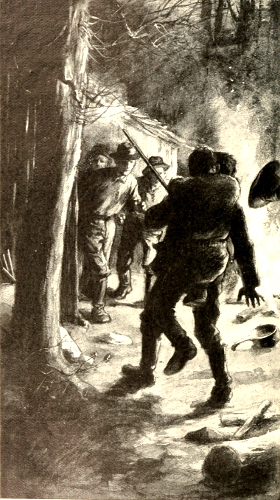
Ten seconds later all the boys were out on the platform, fully armed. It
was still too dark to see men even at a short distance, but low voices
could be heard in every direction round the camp. The boys themselves
consulted only in whispers.
Jack took command, of course.
"Don't shoot, boys, even if they shoot at us," he said. "They can do
little damage that way, as we have this wooden barrier to stop their
bullets. What we've got to look out for is a rush, and we must reserve
our fire to repel that with."
"Hadn't some of us better go to the rear of the house?" asked Harry.
"They may rush us from that direction."
"No," answered Jack. "There's no opening to the house on that side; and
we have no barrier there to fight behind. If they attack from that
direction we must fight from inside the house. Suppose you go in Harry
and knock out three or four pieces of chinking about breast high, so as
to give us a port hole to fire through. Keep a keen look out through the
crack, and if they advance from that direction call us at once. But
don't any of you shoot, front or rear, till they make a rush."
As he spoke, two or three shots came from the enemy in front, the
bullets burying themselves harmlessly in the wooden barrier well below
the feet of the boys, as they stood on the platform, for the barrier
could not be seen in the darkness, and the men shooting aimed at about
where they thought a man's breast would be if he stood upon the ground.
The temptation to return the fire was almost irresistible, particularly
to Tom, who had his magazine rifle in hand. But Jack resolutely
insisted upon reserving fire in order to be ready to repel a charge
whenever it should come.
The light was now growing stronger and here and there it was possible to
make out one of the enemy, crouching behind a rock or in some little
depression of the ground. Enough of them could be seen by this time to
show clearly that they outnumbered the garrison of Camp Venture more
than four or five to one. Somebody remarked upon this fact, whereupon
Jack replied, still speaking in a whisper:
"That's true! But if they make the rush that I'm expecting they won't
outnumber us much by the time they get here."
As the light grew still stronger, Tom set his gun down, ejaculating
"Well, well, well."
"What is it, Tom?" asked the Doctor.
"Why, those aren't moonshiners, but revenue officers and soldiers!"
A little further scrutiny convinced the boys that Tom's keen eyes had
seen aright. The bullets were still pattering now and then against the
wooden parapet, but evidently the enemy was not yet ready to make the
charge which alone could give him possession of the fortress.
Tom felt in his pocket, drew out a handkerchief and tied it to the end
of his gun. Then he descended the little ladder to the ground.
"What are you going to do Tom?" asked Jack.
"Why, I'm going out under a flag of truce to explain to those fellows
what a stupid blunder they've made. They've mistaken Camp Venture for an
illicit distillery, as if anybody would set up a still in such an open
place as this."
"But wait, Tom! It is still so dark that they may not see your flag of
truce. They may all fire at you at once. Wait till broad daylight
comes."
"Yes," answered Tom, "and in the meantime those fellows may make their
charge,—they're forming for it now,—and in that case we'll have to
shoot half of them. No, I'm going out with my flag of truce now, and
I'll simply have to take the chances of getting shot."
With that he passed around the end of the barrier and sallied forth,
holding his flag of truce above him and calling as he went "Truce!
Truce! A flag of truce! I bear a flag of truce! Don't shoot!"
Nevertheless several bullets from improved army rifles passed
uncomfortably close to him—one of them cutting a hole through the top
of one of his boots—before the officer in command of the assailing
party could be made to understand the nature of Tom's mission. At last
he understood it and calling to Tom to halt where he stood, which was
about midway between the two forces—the lieutenant who commanded the
troops, hoisted another white handkerchief and went out to meet the boy.
To him Tom explained the nature and purpose of Camp Venture and invited
him and his party to come in and inspect the place for themselves.
The lieutenant looked at him incredulously at first, and then laughed.
"That's a good one on us!" he said presently, "if what you say is true."
"I never tell lies!" said Tom, in resentment.
"I don't believe you do," said the officer. "You don't look it, anyhow.
But of course we mustn't take any risk of being caught in a trap. So
I'll send a squad of my men with you to inspect. Here, Sergeant Malby;
take a detail of four men and go with this young man to the camp yonder.
In the meantime, my boy, I'll detain that magazine rifle of yours, if
you please, till I satisfy myself."
Tom handed over his gun and led the sergeant and his squad into Camp
Venture. As daylight had now fully come, the soldiers had little trouble
in satisfying themselves that there was no still there, and that the
company consisted only of five boys and the Doctor. The sergeant so
reported to the lieutenant and that officer was disposed to be
satisfied. Not so the three revenue agents, however.
"It's a fishy story these fellows tell," said the chief of them, "and I
for one don't intend to be drawn into a trap. There may be no still and
only a small company of boys in that cabin, but who knows how many
stills there may be hidden around here, or how many moonshiners may be
hiding about us, ready to massacre us?"
"All right," said the lieutenant, in some disgust at the revenue
officer's timidity. "I'll settle all that. Stay here, men, and wait for
orders."
With that he strode off alone to the cabin and entered it. He there
explained the situation to the boys and said:
"I'm afraid I shall have to ask you fellows to go out there and stack
your arms, considering yourselves under arrest till our timid friends of
revenue officers can make a tour of inspection all about your camp under
the armed escort of my men. They were so sure that they had surprised a
still here that they can't get over the notion. So we must humor them."
The boys readily consented to the plan. They marched out to a point
designated by the lieutenant and there stacked their arms, over which
the lieutenant summoned two of his men to stand guard. Then he bade the
revenue officers come on, and under escort of his file of soldiers they
minutely scrutinized the entire camp. The felled trees not yet chopped
into shape for sending down the mountain; the large quantity of ties and
cordwood that were piled near the chute; the multitude of stumps from
which timber had been recently cut; the great piles of brush left over
from the chopping; and finally the chute itself, now nearly worn out
with use—all these attested the character of the camp and indicated an
industry on the part of its occupants, such as no company of moonshiners
ever displayed.
At last the Lieutenant said to the chief revenue officer, with some show
of impatience:
"Aren't you satisfied, yet? Why don't you look under these boys' finger
nails? How do you know they haven't some stills secreted there?"
"Yes, I'm satisfied with all but one thing," answered the agent of the
excise.
"What's that?" asked Jack. "Whatever it is, I'll try to satisfy you
concerning it."
"Why, I don't understand, if you aren't engaged in any crooked business,
what you built that fortification for. If you didn't feel the need of
resisting the government agents, what need had you for a barrier like
that to shoot behind?"
"We built that to protect ourselves against moonshiners," answered Jack.
"But why should moonshiners disturb you?" asked the still incredulous
revenue agent.
"Because they believed when we first came up here that we were spies of
the internal revenue and most of them still believe it. They began by
ordering us to quit the mountains and when we wouldn't they sent men to
shoot at us. One of our party is still suffering from a bullet wound
received at their hands. When we found that we must defend ourselves we
erected that barrier to help us. Now that you have come up here we'll
need it you may be sure."
"Why?" asked the revenue officer.
"Because they'll never believe now that we didn't send for you and bring
you here. They'll make ceaseless war on us now."
Meanwhile the Lieutenant was examining the fortification. Presently he
turned to Jack and said:
"Will you allow me to suggest an improvement in your defensive work?"
"Certainly," answered Jack. "We shall be very glad."
"Well the top of your parapet is level. Whenever you shoot over it you
must expose your head, neck and shoulders above it. Now if you raise it
by ten or twelve inches and then cut embrasures or notches in the top of
it to shoot through you can put up a fight with far less exposure of
your persons."
The suggestion was so obviously a good one that Jack determined on the
instant to adopt it.
"I'll do that, Lieutenant, as soon as you release us from arrest and let
us have our guns again."
"Oh, I forgot that," answered the Lieutenant. "Here sentinel," to the
man who had been posted outside, "tell Sergeant Malby to send those guns
back to the house, and to withdraw you from duty here. Young men, you
are released from arrest."
Then turning to the chief revenue officer, for whose timid lack of
sagacity he had obviously the profoundest contempt, he asked:
"What's your program now?"
"Well I'm going to clear this whole mountain of stills."
"How long do you reckon it will take?" asked the Lieutenant.
"Well a week or two weeks perhaps."
"And what provisions have you made for your commissariat for such a
length of time?"
"What do you mean?"
"Why, I have forty men here and I'm under your orders, to do whatever
you say, but every one of my forty men has a mouth to feed, and under
my orders I brought only three days' rations in the haversacks. If you
intend to keep us up here for a week or two, ought you not to have made
some provision for a food supply?"
"Why didn't you look after that?" asked the revenue officer.
"Because it was none of my business. I'm a soldier. I obey orders. My
orders were to take three days' cooked rations and march my men up here
to support the revenue officers in whatever they undertook."
"That's always the way," said the revenue man. "The troops always fail
us at the critical moment. That's why our efforts to break up
moonshining always come to nothing."
"Pardon me, sir," answered the officer rising in his wrath. "I'll
trouble you to take that back. The troops under my command have not
failed you and they will not. We have nothing to do with collecting the
revenue. That's your business. Ours is merely to fight anybody that
resists you. That duty we are ready to do just so long as you may
desire. We'll force a way for you to any part of these mountains that
you may desire to visit and we'll keep it up for a year if you wish. But
in the meantime somebody must provide my men with food!"
"If that's the way you look at the matter," said the revenue officer,
"we might as well go down the mountain at once."
"It isn't a question of how I look at the matter," answered the
lieutenant, impatiently. "I tell you I'm ready and my men are ready for
any service you may assign to us. But I tell you also that we must have
something to eat, and it is your duty to arrange it."
"But how can I?"
"Would it be impertinent in me to suggest," asked the lieutenant, "that
you ought to have thought of that before you began your raid? If you had
said to the commandant that your expedition was likely to occupy a week
or two he would have ordered the commissary to furnish me with two or
three weeks' provisions and the quarter-master to supply enough stout
pack mules to carry them. As it was, you represented this as a two days'
trip and he ordered me to carry three days' rations in the haversacks."
"Well, we'd better retreat at once," answered the revenue officer.
"But why? It isn't even yet too late to repair your blunder. Why can't
you send one of your men down the mountain at once to bring up a train
of pack mules loaded with provisions? He can be back here in less than
two days if he hurries."
"But I don't know—" began the man.
"I don't care what you know or don't know," answered the young West
Pointer. "I simply tell you that as soon as my men run out of rations
I'll march them down the hill again. It is my duty to see that they
don't starve."
"But if I send a man down the mountain," answered the revenue agent,
"some moonshiner might shoot him on the way."
"Very probably," answered the lieutenant. "That's a risk that men
engaged in the revenue service are bound to take, I suppose. But if you
request it, I will send a squad of four soldiers to guard your man on
the way down and to protect the pack train on its way back."
Manifestly the revenue officer was anxious to "git down out'n the
mountings," but he feared the report which in that case the angry and
disgusted lieutenant would probably make, even more than he feared the
moonshiners. Still he hesitated to detail one of his men to go down the
mountain under escort of a corporal and three men.
This matter being still unsettled, the lieutenant said:
"Now, what next?"
"How do you mean?"
"Why, what is your next move?"
"Well, I suppose we must remain here till the provisions come, if we
decide to send for them," answered the man.
The lieutenant shrugged his shoulders, and for the moment remained
silent. Presently he said:
"Of course that's for you to determine. But for myself I can't see why
you should deliberately waste two days giving the moonshiners time in
which to rip out their stills and bury them where even your sagacity
will never find them. I don't see why you shouldn't utilize the time of
waiting for supplies in finding and capturing stills. However that is
none of my business. Will you tell me where you wish to make your
headquarters, so that I may pitch my camp accordingly?"
At that moment bullets began pattering in the camp and the lieutenant
instantly leaped to his feet and hurried to the platform of the parapet.
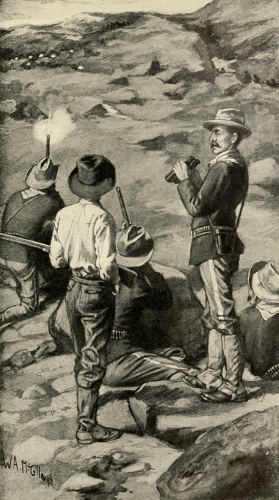
Using his field glass he presently located the points from which the
firing came. Then calmly but quickly he descended and called to Sergeant
Malby:
"Form the men in open order out there under the bluff."
Then he strode away hurriedly to the bluff and hastily examined it,
selecting the points at which it was easiest of ascent. With a few
quietly given orders, he mounted to the top of the rock, and in half a
minute more his men, crouching down to shield themselves from the fire,
were in line of battle by his side.
"I'm going to see that," said Tom, seizing his rifle and hurrying to the
line of troops. "It's better than a game of chess."
By this time, under the lieutenant's calmly uttered instructions—for
there seemed to be no suggestion of excitement in his voice or
manner—two small squads had been thrown forward from the right and left
of the line, and were rapidly creeping up the mountain, with the evident
purpose of getting to the rear of the moonshiners. Meantime the
lieutenant stood up with his glass to his eyes, minutely observing the
progress of his flanking parties. By his orders his men all lay down,
taking advantage of every rock and inequality of the ground for
protection, and delivering a steady fire all the time.
Presently the lieutenant lowered his glass and turning, saw little Tom
standing erect by his side.
"This will never do, my boy!" he exclaimed. "Lie down quick or one of
those mountaineers will pick you off with his rifle."
"I can stand up as long as you can, Lieutenant," answered Tom, "even if
I am not a soldier."
"But it is my duty to stand just now," said the lieutenant. "I must
direct this operation and strike from here the moment my flanking
parties reach proper positions."
"And it is my pleasure to stand," answered Tom, "to see how you do it."
The lieutenant again brought his glass to his eyes. Then he lowered it
and looked earnestly at Tom, who still stood erect by his side, paying
no heed to the rain of bullets about him.
"Why aren't you at West Point?" he asked. "You're the sort we want in
the army."
Then, without waiting for an answer, the lieutenant again looked through
his glass and seeing that his flanking parties had gained the positions
desired in rear of the mountaineers, he ordered the whole line to
advance as rapidly as possible. At the same time the flanking parties
closed in upon the rear of the mountaineers, and five minutes later the
action ended in the surrender of all the moonshiners.
Tom saw it all, but when it was over he discovered a pain in his left
ear, and, feeling, found that a small-bore bullet had passed through
what he called the flap of it, boring a hole as round as if it had been
punched with a railroad conductor's instrument.
The captured mountaineers were brought at once to Camp Venture. Two of
them were dead and three severely wounded. To these last and to two of
the lieutenant's men who had also received bullets in their bodies, the
Doctor ministered assiduously. The unwounded mountaineers were placed in
a hastily constructed "guard house," built just under the bluff.