- HOW TO MAKE ASH CAKE, PONE, CORN DODGERS, FLAPJACKS, JOHNNY-CAKE, BISCUITS AND DOUGHGOD
- MAKING DUTCH OVENS
- VENISON
- BANQUETS IN THE OPEN
- HOW TO COOK BEAVER TAIL, PORCUPINES AND MUSKRATS
- CAMP STEWS, BRUNSWICK STEWS AND BURGOOS
CHAPTER VI
CAMP FOOD
Parched Corn as Food
When America gave Indian corn to the world she gave
it a priceless gift full of condensed pep. Corn in its various
forms is a wonderful food power; with a long, narrow buckskin
bag of nocake, or rock-a-hominy, as parched cracked corn
was called, swung upon his back, an Indian or a white man
could traverse the continent independent of game and never
suffer hunger. George Washington, George Rodgers Clark,
Boone, Kenton, Crockett, and Carson all knew the sustaining
value of parched corn.
How to Dry Corn
The pioneer farmers in America and many of their
descendants up to the present time, dry their Indian corn by
the methods the early Americans learned from the Indians.
The corn drying season naturally begins with the harvesting
of the corn, but it often continues until the first snow falls.
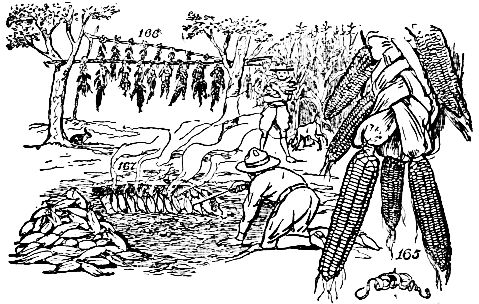
Selecting a number of ears of corn, the husks are pulled
back exposing the grain, and then the husks of the several
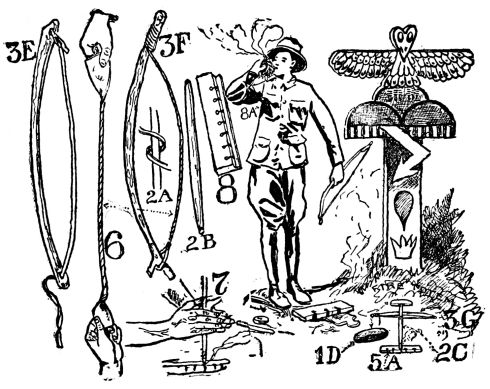
ears are braided together (Fig. 165). These bunches of corn
are hung over branches of trees or horizontal poles and left
for the winds to dry (Fig. 166).
On account of the danger from corn-eating birds and
beasts, these drying poles are usually placed near the kitchen
door of the farmhouse, and sometimes in the attic of the old
farmhouse, the woodshed or the barn.
Of course, the Indians owned no corn mills, but they used
bowl-shaped stones to hold the corn and stone pestles like
crudely made potato mashers with which to grind the corn.
The writer lately saw numbers of these stone corn-mills in
the collection of Doctor Baldwin, of Springfield, Mass.
How to Prepare Corn to Eat
In the southwest much grit from the stone used is unintentionally
mixed with the corn, and hence all the elderly
Indians' teeth are worn down as if they had been sandpapered.
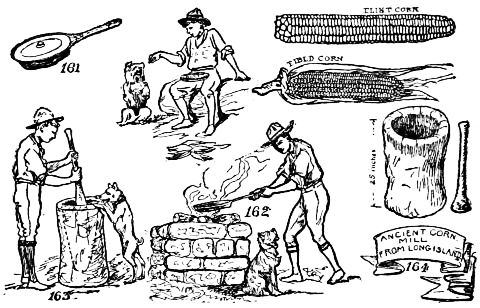
But the reader can use a wooden bowl and a potato masher
with a piece of tin or sheet iron nailed to its bottom with
which to crush the corn and make meal without grit. Or he
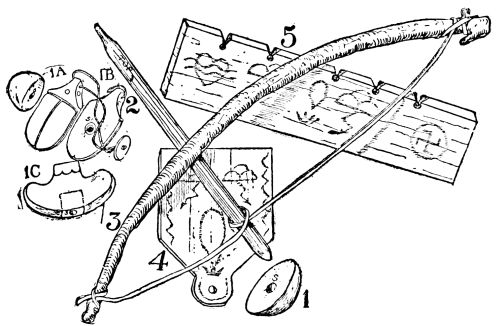
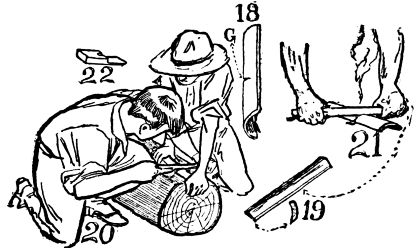
can make a pioneer mill like Figs. 163 or 164, from a log.
The pestle or masher in Fig. 164 is of iron.
Sweet Corn
There is a way to preserve corn which a few white people
still practice just as they learned it from the Indians. First
they dig long, shallow trenches in the ground, fill them with
dried roots and small twigs with which they make a hot fire
and thus cover the bottom of the ditch with glowing embers.
The outer husks of the fresh green corn are then removed
and the corn placed in rows side by side on the hot embers
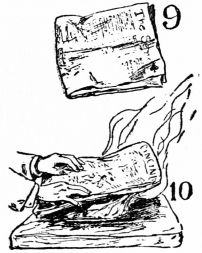
(Fig. 167). This practice gave the name of Roasting Ear
Season to July and August.
As the husks become scorched the ears are turned over,
and when browned on all sides they are deftly tossed out of
the ditch by means of a wand or stick used for that purpose.
The burnt husks are now removed and the grains of corn
are shelled from the cob with the help of a sharp-edged, fresh
water "clam" shell; these shells I have often found in the
old camping places of the Indians in the half caves of
Pennsylvania.
The corn is then spread out on a clean sheet or on pieces
of paper and allowed to dry in the sun. It is "mighty" good
food, as any Southern born person will tell you. One can
keep a supply of it all winter.
Parched Field Corn
When I was a little shaver in old Kentucky, the children
were very fond of the Southern field corn parched in a frying
pan (Fig. 161), and then buttered and salted while it was still
hot; we parched field corn, sugar corn and the regular pop
corn, but none of us had ever seen cracked corn or corn meal
parched and used as food, and I am inclined to think that the
old pioneers themselves parched the corn as did their direct
descendants in Kentucky, and that said corn was crushed or
ground after it had been parched. Be this as it may, we know
that our bordermen traveled and fought on a parched corn
diet and that Somoset, Massasoit, Pocahontas, Okekankano,
Powhatan, all ate corn cakes and that it was either them or
the squaws of their tribes who taught bold Captain Smith's
people on the southern coast, and the Pilgrims further north,
the value of corn as an article of diet. The knowledge of how
to make the various kinds of corn bread and the use of corn
generally from "roasting-ears" to corn puddings was gained
from the American Indians. It was from them we learned
how to make the
Ash Cakes
This ancient American food dates back to the fable times
which existed before history, when the sun came out of a
hole in the eastern sky, climbed up overhead and then dove
through a hole in the western sky and disappeared. The sun
no more plays such tricks, and although the humming-bird,
who once stole the sun, still carries the mark under his chin,
he is no longer a humming-birdman but only a little buzzing
bird; the ash cake, however, is still an ash cake and is made
in almost as primitive a manner now as it was then.
Mix half a teaspoonful of salt with a cup of corn meal, and
add to it boiling hot water until the swollen meal may be
worked by one's hand into a ball, bury the ball in a nice bed
of hot ashes (glowing embers) and leave it there to bake
like a potato. Equalling the ash cake in fame and simplicity is
Pone
Pone is made by mixing the meal as described for the
ash cake, but molding the mixture in the form of a cone and
baking it in an oven.
Johnny-cake
Is mixed in the same way as the pone or ash cake, but it is
not cooked the same, nor is it the same shape; it is more in
the form of a very thick pancake. Pat the Johnny-cake into
the form of a disk an inch thick and four inches in diameter.
Have the frying pan plentifully supplied with hot grease and
drop the Johnny-cake carefully in the sizzling grease. When
the cake is well browned on one side turn it and brown it on
the other side. If cooked properly it should be a rich dark
brown color and with a crisp crust. Before it is eaten it may
be cut open and buttered like a biscuit, or eaten with maple
syrup like a hot buckwheat cake. This is the Johnny-cake
of my youth, the famous Johnny-cake of Kentucky fifty
years ago. Up North I find that any old thing made of corn
meal is called a Johnny-cake and that they also call ash-cakes
"hoe-cakes," and corn bread "bannocks," at least they
call camp corn bread, a bannock. Now since bannocks were
known before corn was known, suppose we call it
Camp Corn Bread and Corn Dodgers
In the North they also call this camp corn bread "Johnny-cake,"
but whatever it is called it is wholesome and nourishing.
Take some corn meal and wheat flour and mix them
fifty-fifty; in other words, a half pint each; add a teaspoon
level full and a teaspoon heaping full of baking powder and
about half a teaspoonful of salt; mix these all together,
while dry, in your pan, then add the water gradually. If you
have any milk go fifty-fifty with the water and milk, make the
flour as thin as batter, pour it into a reflector pan, or frying
pan, prop it up in front of a quick fire; it will be heavy if
allowed to cook slowly at the start, but after your cake has
risen you may take more time with the cooking. This is a
fine corn bread to stick to the ribs. I have eaten it every
day for a month at a time and it certainly has the food
power in it. When made in form of biscuits it is called
"corn dodgers."
Camp Biscuit
Take two cups full of flour and one level teaspoonful and
one heaping teaspoonful of baking powder and half a teaspoonful
of salt, and mix them together thoroughly while dry.
To this you add milk and water, if not milk straight water,
mixing it as described for the flapjacks. Make a dough soft
but stiff enough to mold with well floured hands, make it
into biscuits about half an inch thick, put them into a
greased pan, bake them in any one of the ovens already
described, or by propping them up in front of the fire. If the
biscuits have been well mixed and well baked they will prove
to be good biscuits.
The Vreeland Bannock
Fred tells me that he makes this the same as he would
biscuits and bakes it in a frying pan. The frying pan is
heated and greased before the dough is dropped into it,
making a cake about a half inch thick. The frying pan is
then placed over the slow fire to give the bannock a chance
to rise and harden enough to hold its shape, then the frying
pan is propped up with a stick and the bannock browned by
reflected heat, it must be cooked slowly and have "a nice
brown crust." I have never made bannocks but I have
eaten some of Vreeland's, and they are fine.
Flapjacks
A fellow who cannot throw a flapjack is sadly lacking in
the skill one expects to find in a real woodcrafter. A heavy,
greasy flapjack is an abomination, but the real article is a
joy to make and a joy to eat.
Put a large tin cupful of flour in the pan, add half a
teaspoonful of salt, also one heaping teaspoonful and one level
teaspoonful of baking powder; mix the salt and baking powder
well with the flour while it is dry. Then build your little
mountain or volcano of flour with its miniature crater in the
middle, into which pour water little by little; making the
lava by mixing the dough as you go. Continue this process
until all the flour is batter; the batter should be thin enough
to spread out rapidly into the form of a pancake when it is
poured into the skillet or frying pan, but not watery.
Grease the frying pan with a greasy rag fastened to the
end of a stick or with a piece of bacon rind. Remember that
the frying pan only needs enough grease to prevent the cake
from sticking to the pan; when one fries potatoes the pan
should be plentifully supplied with very hot grease, but
flapjacks are not potatoes and too much grease makes the
cakes unfit to eat. Do not put too much batter in the pan,
either; I tried it once and when I flapped the flapjack the
hot batter splattered all over my face, and that batter was
even hotter than my remarks.
Pour enough batter into the pan to spread almost but
not quite over the bottom; when the bubbles come thickly
in the middle and the edges begin to smoke a bit, it is time
to flap the flapjack. Do so by loosening the edges with a knife
blade, then dip the far side of the pan downward and bring
it up quickly, sending the cake somersaulting in the air;
catch the cake as it falls batter side down and proceed to
cook that side.
The penalty of dropping a flapjack in the fire is to be
made to eat it without wiping off the ashes.
Doughgod
First fry some bacon or boil it until it is soft, then chop
up the bacon into small pieces quite fine, like hash. Save
the grease and set the bacon to one side; now take a pint of
flour and half a teaspoon of salt, a spoonful of brown sugar
and a heaping spoonful of baking powder and mix them all
while they are dry, after which stir in the water as already
described until it is in the form of batter; now add the chopped
bacon and then mix rapidly with a spoon; pour it into a
Dutch oven or a pan and bake; it should be done in thirty-five
or forty minutes, according to the condition of the fire.
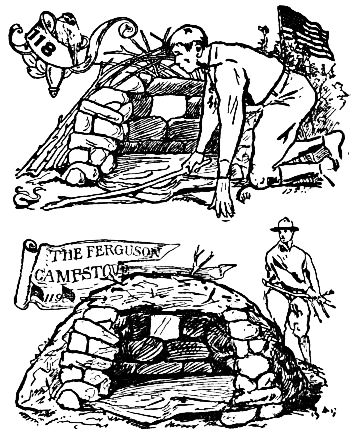
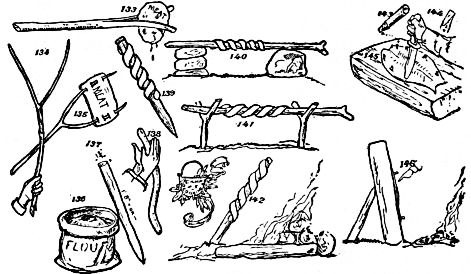
When your campfire is built upon a hearth made of stones,
if you brush the ashes away from the hot stone and place
your doughgod upon it, then cover it with a frying pan or
some similar vessel, and put the hot cinders on top of the
frying pan, you will find that it will bake very nicely and
satisfactorily on the hearthstone.
In the old-fashioned open fire-places where our grandparents
did their cooking, a Dutch oven was considered
essential. The Dutch oven is still used by the guides and cowboys
and is of practically the same form as that used by
Abraham Lincoln's folks; it consists of a more or less shallow
dish of metal, copper, brass or iron, with four metal legs
that may be set in the hot cinders. Over that is a metal top
which is made so as to cover the bottom dish, and the edges
of the cover are turned up all around like a hat with its brim
turned up. This is so made to hold the hot cinders which
are dumped on top of it, but a
Dutch Oven May be Improvised
From any combination of two metal dishes so made or selected
that the large one will fit over the top and snugly overlap
the smaller dish, so as not to admit dirt, dust or ashes to the
food inside. In this oven bread, biscuits, cakes, pies, stews,
bakes, meat, fish, fowl and vegetables may be cooked with
delightful results. In camp two frying pans are frequently
made to act as a Dutch oven. A Dutch oven is sometimes
used in a bean hole (
Fig. 106). First build a fire, using sufficient
small wood, chips and dry roots to make cinders enough with
which to fill your bean hole. While the fire is doing its work
let the cook prepare to cook
The Sourdough's Joy
Slice bacon as thin as possible and place a layer over the
bottom and around the sides of the Dutch oven like a pie-crust.
Slice venison, moose meat or bear steak, or plain beef,
medium thin and put in to the depth of 2½ inches, salting each
layer. Chop a large onion and sprinkle it over the top, cover
with another layer of bacon and one pint of water and put
on the lid. Fill the hole half full of hot embers, place the
Dutch oven in the center and fill the space surrounding the
oven full of embers. Cover all with about 6 inches of dirt,
then roll yourself up in your blanket and shut your eyes—your
breakfast will cook while you sleep and be piping hot
when you dig for it in the morning.
The bean hole is far from a modern invention and the
dried droppings of animals, like "buffalo chips," were used
for fuel away back in Bible times; in ancient Palestine they
stewed their meat in a pot set in a hole filled in with stones
over which burned a fire of "chips" gathered where the
flocks pastured.
When the wood is of such a nature that it is difficult to
obtain a bed of live coals for toasting, meat may, in a pinch,
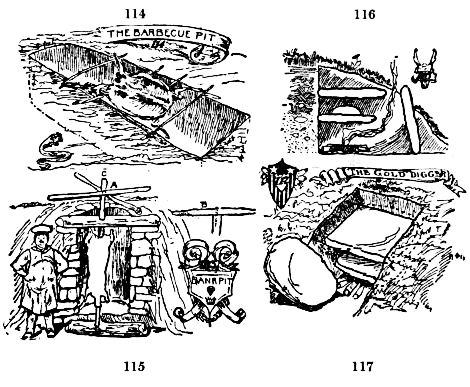
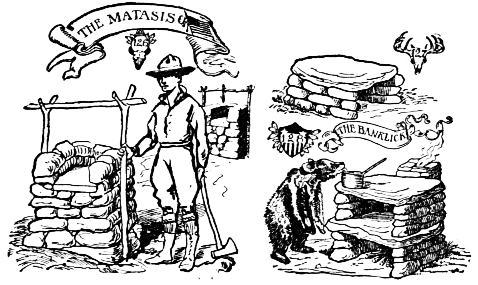
be cooked upon a clean flat stone (Figs. 116, 117, and 128).
Be certain that the stone is a dry one, otherwise the heat may
burst it. If satisfied that it is dry, heat it good and hot and
spread your thick slice of venison, moose, bear or sheep or
even beef upon the very hot stone; leave it there about twenty
minutes and allow it to singe, sizzle and burn on one side,
then turn it over and burn the other side until the charred
part is one-quarter or even a half inch deep. Now remove the
meat and with your hunting knife scrape away all the charred
meat, season it and toast some bacon or pork on a forked
stick and, after scoring the steak deeply and putting the
pork or bacon in the cuts, the meat is ready to serve to your
hungry self and camp mates.
How to Cook Venison
If you want to know how real wild meat tastes, drop a
sleek buck with a shot just over the shoulder—no good
sportsman will shoot a doe—dress the deer and let it hang
for several days; that is, if you wish tender meat. Cut a
steak two inches thick and fry some bacon, after which put
the steak in the frying pan with the bacon on top of it, and
a cover on the frying pan. When one side is cooked, turn the
meat over and again put the bacon on top, replace the cover
and let that side cook. Serve on a hot plate and give thanks
that you are in the open, have a good appetite and you are
privileged to partake of a dish too good for any old king.
The gravy, oh my word! the recollection of it makes me
hungry! I have eaten moose meat three times a day for
weeks at a time, when it was cooked as described, without
losing my desire for more.
Perdix au Choux
Is a great dish in Canada; the bird is cooked this way: Chop
cabbage fine and highly spice it, then stuff the bird with the
cabbage and nicely cover the partridge or grouse with many
thin slices of bacon, and put bacon also in the baking pan.
When this is well baked and well basted a more delicious
game dinner you will never eat. Try it; it is an old French
way of cooking the partridge or pheasant.
When you need a real warm fire for cooking, do not forget
that dry roots make an intensely hot fire with no smoke; look
for them in driftwood piles, as they are sure to be there; they
are light as a cork and porous as a sponge, and burn like coke.
No one with truth may say that he is a real woodcrafter
unless he is a good camp cook. At the same time it is an
error to think that the outdoor men live to eat like the
trencher men of old England, or the degenerate epicures of
ancient Rome. Neither are the outdoor men in sympathy
with the Spartans or Lacedemonians and none of them would
willingly partake of the historic and disgusting black broth of
Lacedemonia. Woodcrafters are really more in sympathy
with cultured Athenians who strove to make their banquets
attractive with interesting talk, inspiring and patriotic odes
and delightful recitations by poets and philosophers. As a
campfire man would say: "That's me all over, Mable" and
he might add that like all good things on this earth
Banquets
Originated in the open. The word itself is from the French
and Spanish and means a small bench, a little seat, and when
spelled banqueta, means a three-legged stool. It has reference
to sitting while eating instead of taking refreshments in
"stand up" fashion. The most enjoyable banquets in the
author's experience are those partaken in the wilderness, and
prominent among the wildwood dishes is the
Lumberman's Baked Beans
Wash the beans first, then half fill a pail with them, put
them over the fire and parboil them until their skins are ready
to come off; they are now ready for the pot. But before putting
them in there, peel an onion and slice it, placing the
slices in the bottom of the bean pot. Now pour half of the
beans over the onions and on top of them spread the slices
of another onion. Take some salt pork and cut it into square
pieces and place the hunks of pork over the onions, thus
making a layer of onions and pork on top of the beans. Over
this pour the remainder of the beans, cover the top of the
beans with molasses, on the top of the molasses put some more
hunks of pork, put in enough water to barely cover the beans.
Over the top of all of it spread a piece of birch bark, then
force the cover down good and tight.
Meanwhile a fire should have been built in the bean hole
(Fig. 105). When the fire of birch has been burnt to hot
cinders, the cinders must be shoveled out and the bean pot
put into the hole, after which pack the cinders around the
bean pot and cover the whole thing with the dead ashes, or
as the lumbermen call them, the black ashes.
If the beans are put into the bean hole late in the afternoon
and allowed to remain there all night, they will be done to a
turn for breakfast; the next morning they will be wholesome,
juicy and sweet, browned on top and delicious.
A bean hole is not absolutely necessary for a small pot of
beans. I have cooked them in the wilderness by placing the
pot on the ground in the middle of the place where the fire
had been burning, then heaping the hot ashes and cinders
over the bean pot until it made a little hill there, which I
covered with the black ashes and left until morning. I tried
the same experiment on the open hearth to my studio and
it was a wonderful success.
The Etiquette of the Woods
Requires that when a porcupine has been killed it be immediately
thrown into the fire, there to remain until all the quills
have been singed off of the aggressive hide, after which it
may be skinned with no danger to the workmen and with no
danger to the other campers from the wicked barbed quills,
which otherwise might be waiting for them just where they
wished to seat themselves.
This may sound funny, but I have experimented, unintentionally,
by seating myself upon a porcupine quill. I can
assure the reader that there is nothing humorous in the experience
to the victim, however funny it may appear to those
who look on.
After thoroughly singeing the porcupine you roll it in the
grass to make certain that the burnt quills are rubbed off its
skin, then with a sharp knife slit him up the middle of the
belly from the tail to the throat, pull the skin carefully back
and peel it off. When you come to the feet cut them off.
Broiled porcupine is the Thanksgiving turkey of the Alaskan
and British Columbia Indian, but unless it has been boiled
in two or three waters the taste does not suit white men.
Porcupine Wilderness Method
After it has been parboiled, suspend the porcupine by its
forelegs in front of a good roasting fire, or over a bed of hot
coals, and if well seasoned it will be as good meat as can be
found in the wilderness. The tail particularly is very meaty
and is most savory; like beef tongue it is filled with fine bits
of fat. Split the tail and take out the bone, then roast the
meaty part.
Porcupine stuffed with onions and roasted on a spit before
the fire is good, but to get the perfection of cooking it really
should be cooked in a Dutch oven, or a closed kettle or an
improvised airtight oven of some sort and baked in a bean
hole, or baked by being buried deep under a heap of cinders
and covered with ashes. Two iron pans that will fit together,
that is, one that is a trifle larger than the other so that the
smaller one may be pushed down into it to some extent, will
answer all the purposes of the Dutch oven. Also two frying
pans arranged in the same manner.
Always remember that after the porcupine is skinned,
dressed and cleaned, it should be put in a pot and parboiled,
changing the water once or twice, after which it may be
cooked in any way which appeals to the camper. The
North Method
Is to place it in the Dutch oven with a few hunks of fat pork;
let the porcupine itself rest upon some hard-tack, hard biscuit
or stale bread of any kind, which has been slightly softened
with water.
On top of the porcupine lay a nice slice or two of fat pork
and place another layer of soaked hard biscuit or hard-tack
on the pork, put it in a Dutch oven and place the Dutch oven
on the hot coals, put a cover on the Dutch oven and heap
the living coals over the top of it and the ashes atop of that;
let it bake slowly until the flesh parts from the bones. Thus
cooked it will taste something like veal with a suggestion of
sucking pig. The tail of the porcupine, like the
Tail of the Beaver
Is considered a special delicacy. Many of the old wilderness
men hang the flat trowel-like tails of the beaver for a day or
two in the chimney of their shack to allow the oily matter
to exude from it, and thus take away the otherwise strong
taste; others parboil it as advocated for porcupine meat,
after which the tail may be roasted or baked and the rough
skin removed before eating.
Beaver Tail Soup
Is made by stewing the tails with what other ingredients one
may have in camp; all such dishes should be allowed to simmer
for a long while in place of boiling rapidly.
A man who was hunting in North Michigan said, "Although
I am a Marylander, and an Eastern Shore one at that,
and consequently know what good things to eat are, I want
to tell you that I'll have to take off my hat to the lumber
camp cook as the discoverer, fabricator and dispenser of a
dish that knocks the Eastern Shore cuisine silly. And that
dish is beaver-tail soup. When the beaver was brought into
camp the camp cook went nearly wild, and so did the lumbermen
when they heard the news, and all because they were
pining for beaver-tail soup.
"The cook took that broad appendage of the beaver, mailed
like an armadillo, took from it the underlying bone and meat
and from it made such a soup as never came from any other
stock, at the beck of the most expert and scientific chef that
ever put a kettle on."
Muskrat
Is valuable also for his flesh. Its name and rat-like appearance
have created a prejudice against it as a food, but thousands
of persons eat it without compunction. For those to
whom the name is a stumbling-block the euphemism "marsh
rabbit" has been invented, and under this name the
muskrat is sold even in the Wilmington market and served
on the tables of white country folk. In Delaware, especially,
the muskrat is ranked as a delicacy, and personally
the author ranks this rodent with the rabbit as an article
of food.
At Dover the writer has had it served at the hotel under
its own name; the dish was "muskrats and toast." For the
benefit of those who revolt at the muskrat as food, it is well
to state that it is one of the cleanest of all creatures, that it
carefully washes all its own food and in every way conducts
itself so as to recommend its flesh even to the most fastidious.
As a matter of fact the flesh of the muskrat, though dark,
is tender and exceedingly sweet. Stewed like rabbit it looks
and tastes like rabbit, save that it lacks a certain gamy flavor
that some uneducated persons find an unpleasant characteristic
of the latter. But to the writer's way of thinking, while
the muskrat is good to eat, there are many things much
better; the point is, however, that everything which tastes
good and is not indigestible is good to eat no matter what
its name may be.
The Burgoo
Of all the camp stews and hunters' stews of various names
and flavors, the Kentucky burgoo heads the list; not only is
it distinguished for its intrinsic qualities, its food value and
delicious flavor, its romance and picturesque accompaniment,
but also because of the illustrious people whose names are
linked in Kentucky history with the burgoo. One such
feast, given some time between 1840 and 1850, was attended
by Governor Owlsley (old stone-hammer), Governor Metcalf,
Governor Bob Letcher, Governor Moorhead, General George
Crittenton, General John Crittenton, General Tom Crittenton,
James H. Beard, and other distinguished men.
All Kentuckians will vow they understand the true meaning
of the word "burgoo." But an article in the Insurance
Field says, "It is derived from the low Latin burgus, fortified
(as a town) and goo-goo, very good." Hence the word, "burgoo,"
something very good, fortified with other good things, as
will be found in "Carey's Dictionary of Double Derivations":
"Burgoo is literally a soup composed of many vegetables
and meats delectably fused together in an enormous caldron,
over which, at the exact moment, a rabbit's foot at the end of
a yarn string is properly waved by a colored preacher, whose
salary has been paid to date. These are the good omens by
which the burgoo is fortified."
How to Make the Burgoo
Anything from an ordinary pail to one or many big
caldrons, according to the number of guests expected at the
camp, will serve as vessels in which to serve the burgoo. The
excellence of the burgoo depends more upon the manner of
cooking and seasoning it than it does on the material used
in its decoction.
To-day the burgoo is composed of meat from domestic
beasts and barnyard fowls with vegetables from the garden,
but originally it was made from the wild things in the woods,
bear, buffalo, venison, wild turkey, quails, squirrels and all the
splendid game animals that once roamed through Kentucky.
As this book is for woodcrafters we will take it for granted
that we are in the woods, that we have some venison, moose,
bear meat, rocky mountain goat, big horn, rabbit, ruffed
grouse, or some good substitutes. It would be a rare occasion
indeed when we would really have these things. If, for instance,
we have a good string of grouse we will take their
legs and wings and necks for the burgoo and save their
breasts for a broil, and if we have not many grouse we will
put in a whole bird or two. We will treat the rabbits the
same way, saving the body with the tenderloin for broiling.
When cleaned and dressed the meat of a turtle or two adds
a delicious flavor to the burgoo; frogs legs are also good,
with the other meat.
Cut all the meat up into pieces which will correspond,
roughly speaking, to inch cubes; do not throw away the bones;
put them in also. Now then, if you were wise enough when
you were outfitting for the trip to secure some of the ill-smelling
but palatable dried vegetables, they will add immensely
to the flavor of your burgoo. Put all the material
in the kettle, that is, unless you are using beans and potatoes
as vegetables; if so, the meats had better be well cooked first,
because the beans and potatoes have a tendency to go to the
bottom, and by scorching spoil the broth.
Fill your kettle, caldron or pot half full of water and
hang it over the fire; while it is making ready to boil get busy
with your vegetables, preparing them for the stew. Peel the
dry outer skin off your onions and halve them, or quarter
them, according to their size; scrape your carrots and slice
them into little disks, each about the size of a quarter, peel
your potatoes and cut them up into pieces about the size
of the meat, and when the caldron is boiling dump in the
vegetables. The vegetables will temporarily cool the water,
which should not be allowed to again boil, but should be put
over a slow fire and where it will simmer. When the stew is
almost done add the salt and other seasonings. There should
always be enough water to cover the vegetables. Canned
tomatoes will add to the flavor of your broth. In a real
burgoo we put no thickening like meal, rice or other material
of similar nature, because the broth is strained and served
clear. Also no sweet vegetables like beets.
When the burgoo is done dip it out and drink it from tin
cups. Of course, if this is a picnic burgoo, you add olive
juice to the stew, while it is cooking, and then place a sliced
lemon and an olive in each cup and pour the hot strained
liquid into the cups.
The burgoo and the barbecue belong to that era when
food was plenty, feasts were generous and appetites good.
These historic feasts still exist in what is left of the open
country and rich farming districts, particularly in Kentucky
and Virginia. In Kentucky in the olden times the gentlemen
were wont to go out in the morning and do the hunting, while
the negroes were keeping the caldrons boiling with the pork
and other foundation material in them. After the gentlemen
returned and the game was put into the caldron, the guests
began to arrive and the stew was served late in the afternoon;
each guest was supposed to come supplied with a tin cup and
a spoon, the latter made of a fresh water mussel shell with a
split stick for a handle. Thus provided they all sat round and
partook of as many helps as their hunger demanded.
Since we have given Kentucky's celebrated dish, we will
add "Ole Virginny's" favorite dish, which has been named
after the county where it originated.
The Brunswick Stew
"Take two large squirrels, one quart of tomatoes, peeled
and sliced, if fresh; one pint of lima beans or butter beans,
two teaspoonfuls of white sugar, one minced onion, six potatoes,
six ears of corn scraped from the cob, or a can of sweet
corn, half a pound of butter, half a pound of salt pork, one
teaspoonful of salt, three level teaspoonfuls of pepper and a
gallon of water. Cut the squirrels up as for fricassee, add
salt and water and boil five minutes. Then put in the onion,
beans, corn, pork, potatoes and pepper, and when boiling
again add the squirrel.
"Cover closely and stew two hours, then add the tomato
mixed with the sugar and stew an hour longer. Ten minutes
before removing from the fire cut the butter into pieces the
size of English walnuts, roll in flour and add to the stew.
Boil up again, adding more salt and pepper if required."
The above is a receipt sent in to us, and I would give credit
for it if I knew from whence it came. I do know that it
sounds good, and from my experience with other similar
dishes, it will taste good.
I am not writing a cook book but only attempting to
start the novice on his way as a camp chef, and if he succeeds
in cooking in the open the dishes here described, he need not
fear to tackle any culinary problem which conditions may
make it necessary for him to solve.