Camped in a London flat, sick of the turmoil, rows
and worries of the big city, with its pushing,
hurrying and ill-mannered crowds, can it be
wondered at that I let my thoughts often wander
far away to the days of my early manhood, when
I passed over ten years in the dense and silent,
though beautiful, bush of New Zealand, or rode
across the wild, open and breezy plains of its
inland plateaus? During this time I had ample
opportunities for observing and studying the
natives, both in war and peace: in the former
especially, as I not only fought against them, but
I also fought side by side with the brothers,
cousins and quondam friends of the very men we
were engaged against.
Queer, very queer, people they were, and, to
describe them in a few words, I should pronounce
them to be bundles of contradictions, whose faults
made them hateful, but whose many good qualities
rendered them one of the most charming race of
people it has ever been my lot to meet. They
have been described by numerous writers far more
capable than myself, and whose pens are far more
graphic than my own, but yet perhaps a few traits
in their many-sided characters, that I have experienced
myself, may interest you.
To begin with, let me speak of their courage,
which was displayed in such a marked degree
during the long wars that lasted from 1860 to 1871,
for the whole of which period the Maoris were
hopelessly outnumbered and, as far as armament
went, were equally outclassed. Yet these brave
fellows fought on and on, and even when the end
came, and the shattered remnants of the so-called
rebels took refuge in the King Country, the New
Zealand Government, fearing to risk further war
with the powerful Waikato tribes, resorted to what
was called the blanket-and-sugar policy, rather than
follow Te Kooti or demand his extradition from
King Tawhiao, who at that time was just as independent
of English rule as France was.
The first fighting took place in 1860, and soon
General Sir Duncan Cameron had over 1000
Imperial troops under his command, as well as
an equal number of Colonial Militia and Irregulars,
and also a powerful Naval Brigade. He had also
a strong force of Artillery, and was well supplied
with ammunition and stores of all kinds. Yet
perhaps you will scarcely credit me when I tell you
that never at any single moment had he more than
2000 natives in arms against him, and that he was
never opposed in any single action by even 1000 men.
It must be borne in mind that Sir Duncan’s
force was one of the most powerful that England,
up to that time, without the assistance of allies,
had ever put into the field; that the men who composed
it were all of them good, seasoned men, many
of them being veterans of the Crimea and Mutiny;
that the Militia were highly trained, most of them
old soldiers, under the command of ex-Imperial
officers; that the Irregulars proved themselves to
be second to none in the field, and that the natives
only possessed old muskets and fowling-pieces.
Now these numbers are staggering, but absolutely
correct, as it is also that the above force made but
small headway against this handful of savages;
for although Sir Duncan forced his way into the
Waikato and held a chain of forts there, yet on the
west coast, especially in the districts of Taranaki
and Wanganui, the settlers had to abandon their
homesteads, the women and children being sent
for safety to the South Island, and no man’s life
was safe beyond rifle range of the forts. This was
the state of New Zealand in 1866, after six years
of incessant war, and it can only be accounted
for in the following way:—
To commence, the General and his officers were
hidebound with the old traditions and maxims
of the British army. They simply would not or
could not adapt themselves to the exigencies or
tactics of irregular warfare, nor could they be made
to understand or believe that a regiment that could
march in line like a brick wall might easily be
worsted by a mob of savages in a New Zealand
bush. Then again when attacking pahs: the
General considered that the correct way to do so
was, after a sharp bombardment, to rush the place
with the bayonet.
Who could imagine for a moment that natives
could hold their flimsy stockades against men
who had stormed the Redan and taken Delhi
at the point of the bayonet. Yet they did.
Rangiriri was assaulted three times, and on each
occasion, notwithstanding the splendid devotion
and courage of our gallant Tommies, they were
driven back with great loss. Yet on the following
day the 180 defenders marched out and laid down
their arms. Why? For three days they had been
without one drop of water. The General knew
they had no water, then why did he risk the lives
of his splendid men by ordering futile assaults?
Rangiriri took place in November 1863, and one
would have thought that the General might have
learned something, by its lesson, of the ways how
best to deal with a Maori pah; but he had neglected
to do so, for in April, the following year, he invested
Orakau Pah, the defenders of which exhibited
gallantry seldom equalled and never surpassed in
all the annals of human warfare. Let me try and
give you a brief account, as I heard it some years
afterwards from the mouth of one of its defenders:
“Listen, Te Parione, I will tell you how I
first saw white men and fought against them.
It was at Orakau, in the land of the Waikato tribes,
and the fight happened in this manner:
“We of the Taupo tribes must pay a visit of
ceremony to the chiefs and people of the Waikatos,
and at the same time the Uriwera people wished
to do the same. Our intention was to discuss
many things with the Waikatos, and to hold a big
runanga (deliberation) concerning the war. We
journeyed there, although we knew much war was
going on, and we were most anxious to hear about
and see something of this war, so that we could
judge for ourselves the might and fighting customs of
the white men. It was necessary for us to do this,
as at that time we knew but little of the white
man, or the war customs of the soldiers; and as
we might have to fight them later on, it was well
for us to know their manners in war. We travelled
together, in two parties, as our love is not great
for the Uriwera, and reached the land of the
Waikatos. These could give us but a short tangi
(reception ceremony), as the war was hot in the
land and the people much engaged in fighting; but
they gave us the Orakau Pah to dwell in, until
such time as the runanga could be held. Some
chiefs of the Waikatos also stayed with us in the
pah, as hosts, and food was sent us daily, our women,
some forty in number, having to fetch water from
a distance, as there was none close to the pah.
“We heard daily of the advance of the white men,
and we hoped to see them, but did not go near
them. It would not have been right to do so: we
were on a visit of ceremony, we had no anger
against them, and no cause to fight with them.
“One day we heard they were quite near, and
our hearts were glad, as perhaps we should get our
desire and gaze on them. Next day they came in
sight, long columns of them, each man in his place.
And it was good to look at them. They were in great
numbers. We had never seen so many men at one
time, and our hearts grew dark within us at their
might and order. Instead of passing on their way
as we expected, some of them turned to the right
and some moved to our left, until we were quite
surrounded; and when they were all placed they
stood still and remained quiet. We were surprised
and in great wonder; nor could we understand the
meaning of this, until there came to us, as herald,
the mouth (interpreter) of their war chief, who told
us, in the name of the Great White Queen, to give
up the pah, lay down our arms, and render ourselves
prisoners to the white men. Our head chief
told him that we could not do this, that we were
not there to fight against the white man, but that
we were Taupo and Uriwera Maoris, that we were
on a visit of ceremony to the Waikatos, and that
we had no anger or cause against the soldiers.
But the white chief was mad, and sent the mouth
again, saying we must give up the pah to him or
he would attack us.
“Our hearts were very dark with fear at the might
and number of the soldiers, and we discussed the
situation. How could we give up the pah? Had
not the Waikatos lent us their pah to live in? And
were we not responsible for the honour of it? How
could we give it up? No, we must guard the pah
with our lives, or our disgrace would resound
through the land and our shame live for ever. We
had no wish to fight the soldiers, but we must.
Now the white man is not ceremonious, for he
gave us no time to dress for war, dance the war-dance,
nor even to utter our war-cries; for as soon
as the herald returned to his chief we saw a taua
(war party) leave their army and come straight for
the outer fence, and we had to hasten, so as to get
into the trench and flanking angles.
“Very great is the courage of the soldiers, but
great is their folly; for this taua moved all in a
body, close together, with a young chief walking in
front of them with his sword in his hand. Soon
they came near, and the young chief raised his
sword and shouted. The taua at once rushed at
us, all of them shouting loud.
“Our hearts were dark with fear, for the anger
of the white man was very great. Rewi (a great
fighting chief of the Waikatos’) had told us before
to harden ourselves against the anger and shouts
of the white men, and had given us orders not to
fire until he gave the signal, then all to fire at one
time. When the taua was within six fathoms of us
he gave the signal, and our fire darted out from
under the fence. Many of the white men fell, but
the rest rushed on, some of them trying to pull
down the fence with their hands, others firing
through it with their guns, and some thrusting at
us with their bayonets. None of them seemed to
fear death, though they fell fast. We now fired our
second barrels, reloading as fast as we could, the
women helping us, the men in the flanking angles
also firing, so that the smoke rose in clouds, and
the sky resounded with the shouting of the white
men and our war-cries. All fear had fallen away
from us, and we now saw that the great white chief
was ceremonious, as he had only sent such a
number of men as we could cope with, all his other
men remaining where they had first stopped and
not interfering with us. But it was otherwise
with the men with whom we were fighting, as they
swore at us and called us many bad names. And
this was wrong, and filled us with wonder, as we
had done them no evil. But perhaps it is the custom
of the soldiers to do so.
“The fight had lasted but a short time. I had
loaded my tupara (double-barrelled gun) twice
when a bugle called out, and the soldiers, leaving
us, went back. No, they did not run away, they
went slowly, looking back at us as if sorry to leave
the fight and taking their wounded men with them.
“We were greatly elated that we had saved the
pah, and thought that now the white men, having
no cause of war against us, and having done all
that was necessary for both their own honour and
ours, would pass on their way, leaving us in peace.
“It was also near the time for our evening meal.
The Waikato women had not, according to their
custom, brought us any provisions that day, this
having been delayed, we thought, on account of
the fight. But as that was now over, there could
be no further cause for their not coming, and if our
women were to fetch water, it would be ready for
the food when it presently arrived.
“Our women left the pah for this purpose, and
had been gone but a short time when they returned
and told us that the soldiers would not
allow them to pass, and that, on their insisting on
doing so, telling the interpreter that there was no
water or food in the pah and that they must get
some, the mouth had told them that the big chief
had given orders that no food or water should be
carried into the pah and that if they passed through
the soldiers they would be prevented from coming
back. So they had returned.
“This news filled us with wonder. Surely the
white chief must be mad. Enough fighting had
been done for the honour of ourselves and the
soldiers. Even should he require more, how could
he expect our hearts to be strong and for us to be
able to fight well if he was to stop us obtaining
food and water? It was folly. No man can fight as
he should do when he is weak and famished. He
had very many men. There had not been 300
Maoris, including women, in the pah from the
beginning, and some of us had been killed and
wounded; so we felt bitter towards the white chief,
for our thirst with fighting, shouting and the
powder smoke, was great.
“Next morning we saw many more soldiers had
arrived, bringing with them several big guns, and
the herald again approached us. This time he
told us that if we would not render up the pah
the big guns would fire on us. He also said we
should have no food or water. To this Rewi made
answer: ‘We will not render up the pah and our
honour. Enough, we will fight right on for ever.’
And we all shouted, ‘Aké, aké, aké’ (For ever, for
ever, for ever).
“Then the white chief sent word: ‘Save your
women, let them come out, they shall pass in
safety and honour through the soldiers.’
“But the women refused, and Rewi answered:
‘The women will fight with us.’
“No sooner had the herald left us than the big
guns began to shoot, also some short, fat guns
(cohorns) that threw iron balls up into the air, so
that they dropped inside the pah. And these balls,
being filled with powder, burst, inside the pah, with
great noise, and pieces of iron flew all around,
while a great number of soldiers, drawing near,
began to fire at the pah, so that soon the whole
place was filled with dust and confusion, while the
air was torn with the shrieking of the pieces of iron
and the whistling of bullets. We were stricken
with fear, and were glad to take refuge in the
underground houses of the Waikatos. And now we
understood their reason for building these, and our
fear soon left us, when we discovered that all this
noise and trouble did us no harm. After this had
gone on some time, Rewi called to us that a taua
was getting ready to attack us, and ordered us to
make ready for it. And just then the fire from
the big guns ceased, so as to enable us to
do so.
“This was quite right, for, if they had continued to
fire, we could not have left the underground houses,
and then should not have had time to get into the
trenches to welcome the soldiers. This made us
think better of the white chief, who, we now saw,
was most ceremonious, as he again only sent as
many men against us as we could contend with on
equal terms. And in all things, except the matter
of food and water, he proved himself to be a great
and wise war chief.
“The hapu (tribe) of soldiers sent against us this
time was not the same tribe as that which had
attacked us previously, as they wore another number
on their head-dress. And this was as it should be,
for the chief had many different tribes in his army,
and each of these must be given a chance of honour.
But he must have been blind in his great folly, as
if he wished to send all his tribes, each in its turn,
against us, at the same time refusing us food and
water, how could he expect us to keep our hearts
strong, so as to be able to resist in a befitting
manner those whose turn came later on? Then
again our powder would fail. But this he had
provided against, as I will tell you shortly.
“Now this new taua acted just the same as the
other had done. They all moved in a body, and
when the chief, who walked in front, raised his
weapon they all ran forward to try and tear down
the outer fence. Some of them had also brought
with them large tomahawks with which to cut it
down, and Rewi called to us to use our second
shots on these men. Shouting loudly, the taua
charged at us, and when they reached within six
fathoms of us our fire rushed to meet them.
Many of them fell, and those who reached the
fence failed to break in, though they did all
that brave men could do. The men with the
tomahawks were soon shot down, and the fight
waxed very hot, although our war-cries were small,
our thirst being very great.
“Soon the bugle again called, and the white men
went back slowly and in great anger, some of them
shaking their hands at us and swearing loudly. But
this we did not heed greatly, as we had decided,
among ourselves, that this was their custom and
that they did so with no intent to insult us, who
had done them no wrong.
“Soon the big guns began to shoot again: this
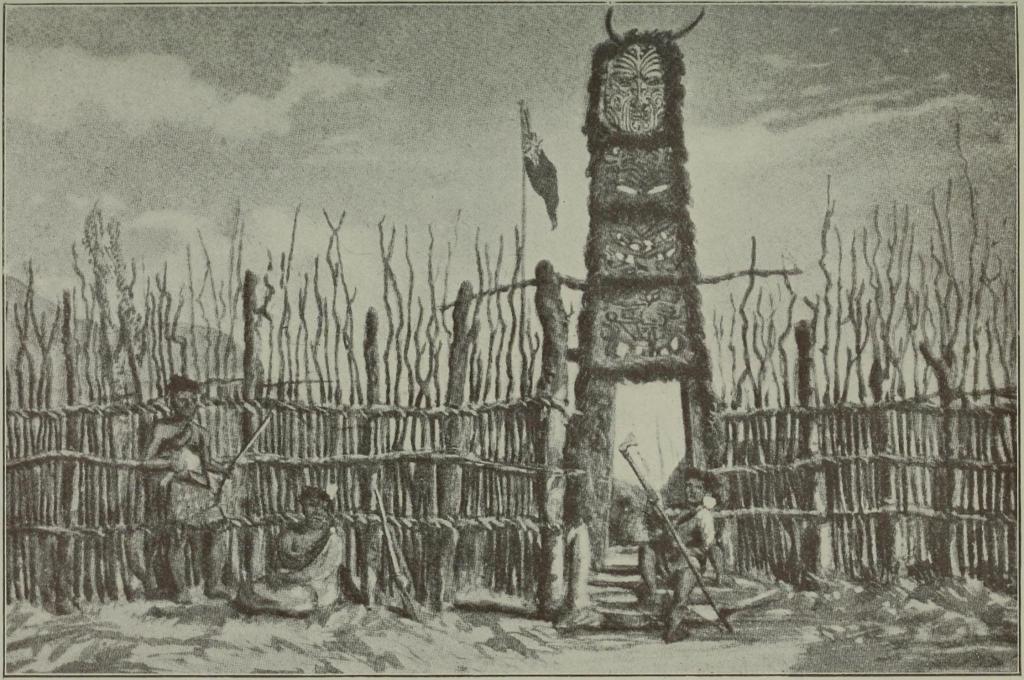
time at the pekaranga (outer fence), so as to try
and break it down. But the fence was made of very
many slender manuka poles, lashed firmly to many
cross-pieces, these being made fast to stout posts
set firmly in the ground, the lower part of the fence
being just clear of the ground, so that we could fire
under it from the trench that was just behind it.
And behind this trench, in which we stood, were
the earthworks and heavy palisading of the
pah.
“Now the outer fence being composed in this
way, the shot from the big guns only broke one
or at the most two sticks of the fence, and then
buried themselves in the earth. This did but little
harm to us, as the holes made in the fence could
be easily repaired and were not nearly large enough
for a soldier to pass through. The short, fat guns
also began to throw their balls into the pah. But
as long as we remained in the underground houses
these did us no harm. And it was by them the
white chief showed his wisdom, insomuch as he
employed these balls to furnish us with powder, so
as to enable us to continue fighting, as we quickly
discovered that very many of these balls did not
burst and from them we extracted very many
charges of powder. All these big guns fired with
great fury at us for some time, and then ceased, so
as to give us the opportunity of getting into the
trenches to receive another taua.
“This came in the same manner as the previous
ones, and went back as they did, not being able to
break through the fence, and losing many men.
“All the rest of that day the big guns continued
to shoot at us and the soldiers to fire into the pah,
while we suffered much from the want of food and
water.
“That evening the mouth came to us again with
word from the chief to render the pah and ourselves
to him.
“This we again refused to do. True, we had
fought enough to save the honour of the pah, and
we should have left it before, had we been able to
do so; but we were, on all sides, surrounded by
soldiers, so could not escape. And if we rendered
ourselves up as prisoners, we, who were, with but
few exceptions, all well-born rangitera (gentlemen),
would lose caste and become slaves. Therefore we
must fight for ever, even if we should have to die
from thirst. All that evening, and also at intervals
during the night, the big guns fired at us; and we
had to take the time between these to lick with
our tongues the dew that fell from the sky, so as to
try and cool our parched throats, as by now our
thirst was very great.
“We could get no rest that night, as the white
men frequently fired these powder-filled balls into
the pah. And we discovered another reason for
their use: one being to bring us powder, the other
to keep us awake, so as to be ready to resist an
attack should the chief desire one to be made.
We had thought, at first, they had been intended
to kill and injure us, but as they had hurt no one,
we now understood their proper use. And we again
wondered at a chief who, being so wise in some
matters, should be so foolish as to keep us without
food and water, as he still had many more tribes
to send to fight us.
“Next morning we saw that the white men had
dug, during the night, many rifle pits, and had
begun to dig trenches, so as to be able to approach
us closely, without our being able to fire at them.
Escape we had deemed impossible before, but
when the mouth came to call us to render ourselves
prisoners, we again cried, as loud as our thirst
allowed us: ‘We fight on; aké, aké, aké.’
“That day the big guns fired frequently, and
tauas attacked us twice, always in the same
manner as I have already told you; but the last
taua were very full of anger, and the bugle had
to call twice before they left us.
“The soldiers also kept on digging their trenches,
and kept on firing both from big guns and muskets.
“During the night we again tried to quench our
thirst with the dew, for we were getting weak and
suffering greatly; and Rewi with the rest of us
chiefs consulted as to what we should do, for we
saw that by the next evening the soldiers would
have dug their trenches up to the outer fence and
that the pah must fall. These were the words of
Rewi, and we all agreed with them:
“‘O ye chiefs of Taupo and Uriwera, we have
done all that brave men can do. We have saved
the honour of the pah, we must now look to
ourselves. The soldiers will enter the pah to-morrow,
and we, through the folly of the white
chief, will be too weak from famine and thirst to
resist them. It is unbecoming that we, who are
gentlemen, should render ourselves prisoners; therefore
only one thing remains for us to do. We must
charge the enemy and try to escape by breaking
through them. Perchance some of us will succeed,
the remainder must die as it befits warriors to die.’
“He then told us his plan. ‘At midday the
soldiers take their meal, leaving only guards in the
trenches. We will leave the pah quietly in a body
and rush those who are behind the bank—that is, in
front of the gate—and we will break through them
there. They will be eating. Perchance we may
find them unprepared.’ To this we all agreed,
each man determining to escape or die.
“Next morning we saw the trenches had approached
us closely, and so near were they that the
soldiers were able to throw great numbers of small
balls filled with powder into our trench and the
pah itself. These balls burst on reaching us, and
were thrown by the hands of the soldiers themselves,
not by the big guns, though these also kept firing
all the time, and we saw before night came again
the pah must fall.
“No taua attacked us this morning, as they
wished the big guns to break down our defences,
as much as possible, before they again assailed us.
The sun reached its height and the firing somewhat
ceased. Rewi said the time was come, and we
gathered together at the gate of the pah, all the
women being with us. Yes, it was certainly the
time for the soldiers’ meal, and we, who had neither
eaten nor drunk for more than three days, tried
to laugh when we thought how we were shortly to
disturb their eating it.
“Now, Parion, so that you may understand fully
how these matters took place, I must tell you that
about 100 fathoms from the gate of the pah was
a bank, behind which were one of the tribes of
soldiers, who bore the number 40 on their head-coverings.
This bank had not been dug by them
but was natural. It was not a high bank, and it
sloped towards us, but was steeper on the other
side and afforded the soldiers good protection from
such of us as possessed rifles. There had been
no trenches dug on this side of the pah, as the
ground was hard and rocky, so there was nothing
between us and this bank. When we were all
ready the gate of the pah was removed, and we
all rushed out, but without noise, and ran as fast as
we could for the bank; and we had crossed more
than half the distance before the soldiers seemed
to notice us, as the smoke and dust lay heavy on
the pah and around the spots from which the big
guns fired. Then we were seen, and immediately
many bugles gave their calls. There was much
shouting, and many soldiers in the trenches jumped
out and fired at us, many others running to take
their allotted places. There was much confusion.
We, however, ran steadily on, turning neither to
our right nor our left; nor did we return the fire.
We soon came to the bank, and as we ran up the
slope we could see the soldiers rising from the
ground, on which they were eating, and who, when
they saw us running towards them, ran to the bank,
fixing their bayonets on their guns. Only a few
had time to fire at us before we were on them, and
with our rush we jumped from the top of the bank
right over their heads. Some of them thrust
bayonets at us, but as they were in confusion we
broke through them, or jumped over them, without
trouble, only very few of us falling here, and continued
to run towards the hills that were not far
off. We should have reached these, and most
of us would have escaped, but all at once we
were cut off and attacked by other men, not
soldiers, some of them mounted (Colonial Irregulars).
These men do not have the fine appearance
of soldiers, but know more about war,
and are greatly to be feared; for they did not wait
to get each man into his right place, but attacked
us each man as he could, and being, moreover, good
fighting men, they killed many of us and delayed
us so much that the soldiers, having had time to
regulate themselves, reached the hill almost as soon
as we did. They were in great numbers and fired
heavily on us as we struggled up the hills, all of
us so weak that we could scarcely surmount them.
The big guns also fired at us, but the horses could
not follow us, and so 120 of us escaped, Rewi and
myself being among these, the remainder dying as
it became them. Very many of us, however, were
wounded; and I must not omit to tell you that thirty
of the others who did not escape, through being
wounded severely, were taken by the soldiers.
These the soldiers treated with honour; nor did
they make them slaves or kill them, but conveyed
them carefully to big tents, where their wounds were
made whole, and they were attended with much
care. The women, of whom some were taken, were
also treated with honour. But this was the custom
of the soldiers once the fighting was finished.
They bore no anger towards the Maori prisoners,
but brought them much tobacco and waipero (rum)
to show their good will and appreciation for the
trouble the Maoris had taken to fight them five
times. But on the medicine men learning of this
good will on the part of the soldiers, they were
angry, and drove them away; which I myself
consider to be wrong. But perchance it is the
custom of the medicine men.
“And now, Te Parione, I desire your explanation
on some matters; for my heart is darkened with indecision
as to the reasons the great white chief had in
carrying the war on against us in the manner he did.
You, who are a fighting man, belonging to the tribes
of soldiers, for I have been told your ancestors have
all been chiefs among these tribes, may be able to
clear my mind on these matters. I will place my
ideas before you, then you can make my mind light.
“First, why did the chief attack us? We were
on a visit of ceremony, not of war. Yet he, having
a big army, and the Waikatos at the time avoiding
him, must find war for his men. In so much he
was right, and that I understand. Again, he showed
great knowledge of war, by only sending small
bodies of men against us, he having so many that
we should have been crushed at once had he sent
them all at the same time. He also showed his
great wisdom by sending us powder in the iron
balls, which also kept us awake at night, so that
we might be ready in case he attacked us. But as
he did not attack us during the night, it was folly,
as a fighting man needs rest. That he did not
want to kill us we know, or he would not have
made whole the wounded men. Again, he could
not have wanted the pah itself, to dwell in, or he
would not have tried to destroy it with his big guns.
And he knew we had no food or water, so must all
perish from thirst, in a few days, when he could
gain the pah without losing any men at all. He
could not want our arms, as his men do not use
double-barrelled guns, and if he took them from
us we should have been unable to fight him, in
case he saw fit to come to Taupo from the Waikato,
seeking war. No, he must have wanted to let each
of his tribes enjoy the honour of fighting us in
their proper turn. But then why, O Te Parione,
did he forbid us food and water? How could he
expect us to render full justice to his men when
our great thirst even prevented us from crying our
war-cries, or fighting in such a manner as would
confer honour on his men whose turn came late.
As it was, we could only manage to hold out long
enough to fight five of his tribes: and he had many.
“And now, Te Parione, the night grows old, and I
have talked much. Thinking of Orakau excites my
thirst and the rum bottle is empty. At daylight you
go to shoot ducks, and it is needful to sleep. Think
over what I have asked you, and to-morrow night,
when we talk once again on war, you will be able
to set my mind at rest on these matters. War is
a great art, and we are never too old to acquire
wisdom. Perchance that white chief had reasons
that, if I understood, would exalt my name should
I practise them when we fight again. Till then,
my guest, rest in peace.”
The above yarn is greatly epitomised, as my old
host not only described most of the blows struck
during the fight, but also gave me the roll-call of
the Maoris, and most of their pedigrees. A Maori
considers it to be a waste of words not to describe
minutely every circumstance of an event, and by
doing so differs from our ideas of yarn-spinning, as
we consider brevity to be the soul of wit. Nor did
the brave old warrior lay claim to any special merit
that his band of 250 men, armed with old fowling-pieces
and muskets, should have resisted the attack
of over 5000 British troops, should have repulsed
five desperate assaults, and for three days have
braved the fire of a powerful train of artillery, while
at the same time undergoing the torture of thirst.
Surely their heroic answer to the General’s
summons to surrender, “Ka whawhai tonu, aké, aké,
aké” (We fight right on, for ever, for ever, for ever),
is worthy of a place among the mottoes of the
proudest regiments the world has ever contained.
As for their desperate and somewhat successful
attempt to escape: the fact that this handful of
famished men and women, in broad daylight, should
charge and break through the investing lines of
their enemies and, but for the intervention of the
Colonial Irregulars, would have nearly all got away,
is a wonderful instance of unconquerable courage.
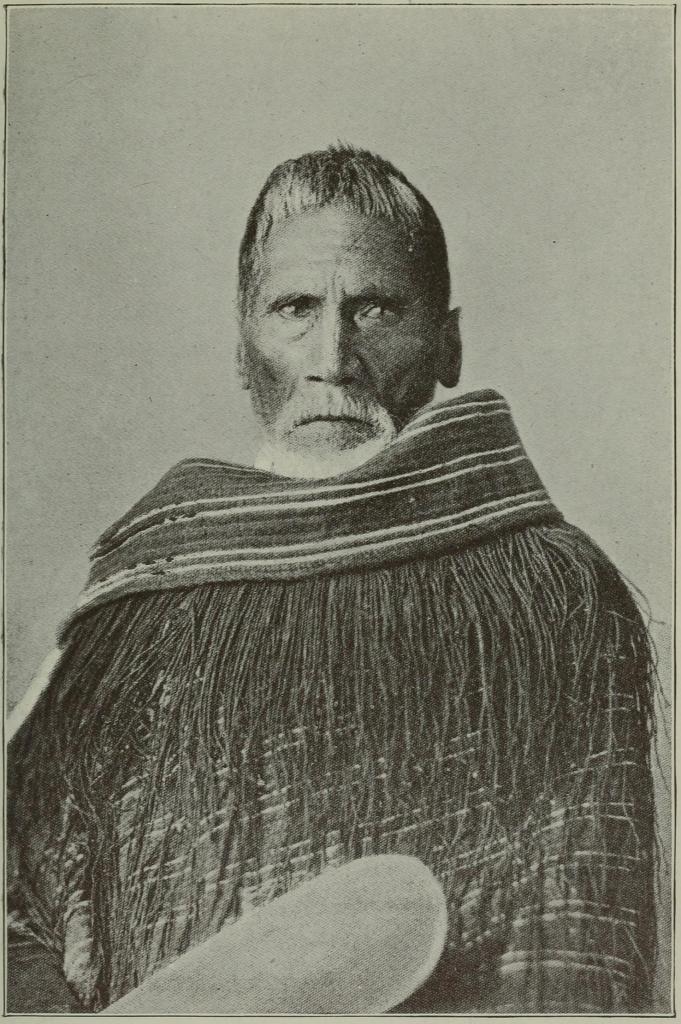 REWI.
REWI.
Perhaps I may be excused for recounting one or
two more instances of Maori chivalry.
During the negotiations that took place at the
end of the Waikato war, the General asked Wirimu
Thomihana, through his interpreter, how it was
that the Maoris had not attempted to cut off his
convoys at a place called the Hog’s Back?—the
said place having such natural difficulties as to
render its passage almost impossible, had it been
obstructed by a hostile force. Thomihana’s reply
was: “What a foolish question for a great war chief
to ask. If we had prevented you from obtaining
food, how could you have continued to fight?”
On another occasion two companies of soldiers,
while on the line of march, piled their arms, sat
down to rest and eat their dinners. Not far away a
body of Maoris were lying perdus. These crept up,
through the long fern, to the unsuspecting Tommies.
Then, jumping to their feet, rushed through them,
seizing en route all the rifles, belts and pouches,
they disappeared with them again into the fern.
The Maori chief presently informed the discomfited
and helpless troops that he would not
allow his men to injure them, as he considered that
both themselves and their officers were far too
ignorant of war to be treated as warriors, and that
they might therefore return in peace to their camp,
where he advised them to learn how to take care of
themselves before they again came out to fight.
The 65th Regiment had been stationed very
many years in New Zealand, it being supposed
that their existence had been forgotten by the War
Office, who had most probably lost their postal
address. Some of the officers and very many of
the men had married Maori women, so that the
regiment was on very friendly terms with the
natives. War broke out, and, naturally, the white
man and Maori were on opposite sides and fought
bravely against one another. This did not, however,
affect their mutual esteem, for when at sunset the
firing ceased numbers of Maoris used to leave
their rifle pits and stroll over to their opponents’
shelter trenches to exchange compliments, while
the Maori women brought over plentiful supplies
of pork and potatoes with which to regale their
husbands, who, during the day, had been trying their
best to pot their fathers and brothers. These
latter, with plenty of quiet chaff, would quietly
discuss the prominent events of the past day’s
fighting, and the possible occurrences of the coming
one, with no more animus than teams of cricketers
discuss together, at dinner, the events of that day’s
play. At guard-mounting these friendly enemies
would part, and at daylight next morning each
would do his level best to put out of action his
relative by marriage. This sporting relationship
was kept up for some time, until, reinforcements
pouring into the country, another regiment was sent
to strengthen the Haki-Hakis (the 65th), when the
Maoris, thinking that the new-comers might be
enemies to the 65th, promptly left their rifle pits
and, coming over to their opponents, proffered their
assistance to drive away the supposed undesirable
new-comers, and then continue their own fight.
I have frequently talked to Maori warriors of
their old-time wars, tribe against tribe, when they
have related accounts of the awful raids of Hongi,
Heki, Rauparaha and others. And these stories not
only teem with incidents of splendid courage, but
are also blackened by the recital of as many acts
of brutality, treachery and cold-blooded slaughter
sufficient to satisfy Moloch himself: and relate to
men who would on one occasion perform feats of
heroic chivalry worthy to stand beside those of
Bayard or Sir Walter Manny, while on the next
day they would commit acts that would have been
considered bad form in Hades even by Tilly and
Cromwell. Chivalry was to disappear entirely when
the natives adopted the extraordinary and debased
form of nonconformist Christianity called the Pai
Marire or Hau Hau faith: at which time, retaining
only their courage, they relinquished every other
good quality they may ever have possessed.
During the bitter and savage fighting of the later
sixties, splendid actions were done by these men
while attempting to carry off, from the field of battle,
their wounded or dead comrades; and their determined
resistance, offered up to the last, threw
a halo of glory round them that even their cold-blooded
murders and torturing atrocities could
scarcely obliterate.
Well I think I have said enough about their
courage; let me turn to the next greatest virtue
possessed by man—viz. hospitality.
The hospitality of the Maori was unbounded. The
best of everything he had was readily placed at the
disposal of his guest, and even should he be so circumstanced
as to have only a few potatoes between
himself and starvation, these would be cheerfully
surrendered for his visitor’s consumption; nor was
any payment expected, and if offered would have
been indignantly refused; notwithstanding the fact
that the recipient of the bounty might be a perfect
stranger.
In those good old days, when the inmates of
a pah or kainga saw a white man, of any rank
or position, approaching the place, all the women,
girls and children would seize mats, or anything
else that came handy, and, waving these, cry as
loud as they could the greetings of welcome:
“Hacre mai! Hacre mai!” (Come to us! Come to
us!). And these cries would continue, and be joined
in by all the inhabitants, until the stranger had
entered the village. On doing so, the visitor,
provided he were acquainted with strict Maori
etiquette, would pay no attention to anyone, but,
handing his horse over to the nearest boy, pass
through the screaming, gesticulating crowd, and
seat himself in front of the guest hut, usually the
best whare in the village. Here he would be
faced by all the principal men of the place, who
would squat down, in a semicircle, in front of him,
the women, boys, girls and men of low degree
standing in rear of them, when with one accord the
whole multitude would lift up their voices and
weep—and when I say weep it was weeping, real
weeping, and no make-believe about it. This
weeping, known as a tangi, was to me always
a matter of wonder, as I could never understand
how a Maori should be able to turn on the water-tap
of his emotions at any moment he might desire
to do so. I have frequently seen scores of grand
old kai tangatas (man-eaters) squat down and,
at will, cry and sob, with big tears hopping down
their tattooed cheeks, as bitterly as some tender-hearted
little girls would do if their favourite
cat had just murdered their pet canary; and these
grim old warriors, in less than a minute, would be
in more urgent need of a big bandana handkerchief
than a small boy with a bad attack of influenza.
Old men and women would crawl out of their huts,
stragglers would hurry up to join the throng, until
every man, woman and child belonging to the
tribe would be rocking and wailing as if their very
heart-strings had been wrung with woe by the most
personal disaster.
After these lamentations had lasted a few
minutes, one of the principal chiefs would rise to
his feet and make a short oration, somewhat in this
fashion: “You have come to us, O stranger,
welcome! welcome! welcome!” Then, turning to
his people, he would say: “What is the use of this
crying? Dry your tears. Our friend is with us,
make him welcome. He is hungry, prepare food
for him. He is fatigued, let him rest. Bring him
water, let him drink. Our friend is with us, cease
this foolish weeping. Our hearts grow light at
seeing him.” He would then advance to the
visitor and offer his hand, in the case of a white
man; but if the said stranger should be a native,
of rank or family, he would squat down in front
of him and rub noses. Then, placing their hands
each on the other’s shoulders, they would dissolve
once more into tears, mussle their noses together,
and for a minute or two mingle their weepings: this
process having to be gone through by the stranger
with every man in the village, whose rank entitled
him to approach the guest.
The salutations having been finished, the stranger
was left in peace, everyone retiring, with the
exception of a chief, or some particular friend, who
would remain to see to his comfort. And here at
once the innate good-breeding of the Maori came
to the front: insomuch as, no matter how
anxious the natives were to hear the news, or the
purport of the visit, the guest was never pestered
with questions, not even as from whence he came,
or whither he was going, and it remained entirely
to his own discretion as to whether he gave them
any information or not. In the meantime, girls
brought him water to drink and wash with, others
had swept out the whare, brought in fresh fern and
laid down new mats for his use. Presently the
sound of singing would be heard, and a group of
girls, carrying small open trays made from the
broad, glazed leaves of the flax plant, would, with
a dancing step and a little song, approach him and
place them in front of him. These trays contained
food, such as pork, eels, enunga (fresh-water whitebait),
kora (the delicious fresh-water crayfish),
potatoes, pigeons, and sweet potatoes, or any of
them the village contained. Anyhow, the guest
might be quite sure it was the very best his hosts
had to offer. On their arrival the man who had
been looking after him would take a morsel of
food from one dish and eat it; then, rising to his
feet, he would retire, at the same time wishing his
guest a good appetite. Everyone else would depart
with him, with the exception of one or, perhaps,
two girls, who would remain on their knees beside
him, to wait on him and tempt him to eat.
The evening meal being over, the chiefs would
gather round their guest, and, if he should happen
to be a man of any importance, long and deep
would be the conversation: the subjects ranging
from the health and doings of the Great White
Queen and her governor, to the most trivial topics
of the day. Each man in his turn would state his
ideas and reasons, and was listened to with attention;
while the guest’s words were carefully weighed, and
even, if his hearers disagreed with him, the arguments
adduced to refute his statements were
always expressed in a manner so polite, and in
words so carefully chosen, that it was impossible
for him to feel personally hurt in regard to his
amour propre. Of course if the visit had been
premeditated the stranger would have come amply
supplied with tobacco, which would be passed
round, and accepted with a bien aise that quite
disguised, or rather hid, their intense longing for
it, and would be enjoyed with many a hearty grunt
of satisfaction and approbation. Then the girls
would haka (dance with songs) in the moonlight,
some of them having placed glow-worms and fireflies
in their hair. And the sight of flashing eyes, gleaming
white teeth, flowing locks and lovely, swaying
figures was sufficient to have made old Saint
Anthony himself sit up; although the words of the
songs that accompanied the dances, and the
gestures that in part composed them, were of
a nature to shock a far less austere saint, and
would perhaps have even extracted a blush from
an habitué of the old-time Jardin Mabille.
Late night would put an end to the festivities,
and the stranger, all his comforts well seen to,
might retire to his fern bed in peace.
It was a point of honour among the Maoris to
protect their guest, as it was a point of honour, on
the part of the guest, to stand by his hosts. In the
yarn I spun about Orakau, I pointed out how the
Taupo and Uriwera tribes refused to render up
the pah lent to them to dwell in by the Waikatos,
and that sooner than do so they fought to the
bitter end. Again, in 1811, when Te Kooti, flying
from us, took refuge in the King Country, and
demanded the protection of the Waikatos, this was
readily granted him; and the Waikato tribes,
although they had no personal esteem for him,
much less love or even family ties, would have
gone to war with us rather than have surrendered
him, had the New Zealand Government demanded
him from them.
A Maori tribe considered it most unfortunate
should even an accident befall a guest while
dwelling in one of their villages; for if such an
occurrence should happen, they ran the risk of
being chaffed and held up to ridicule, by the
surrounding tribes, for their inability to take care
of a visitor.
Much more so was this the case during war-time.
Should a white officer be detailed for duty to
a native contingent, he would be looked after and
his safety guarded in ways almost ludicrous and
by no means congenial to himself.
This was done, because if that officer were killed
or wounded, it would reflect the deepest disgrace
on the tribe with whom he served; they would
never hear the last of it, not only from their friends,
but also from their enemies. And these would
continually rate them, and charge them with the
accusation that it was through their carelessness
or cowardice that the misfortune had happened
to the man who had been entrusted to them.
The Maori was very superstitious. He firmly
believed in dreams, visions, omens of all sorts and
the gift of prophecy, while the number of unlucky
acts he might involuntarily commit during one
day was quite sufficient to account for a whole
chapter of accidents on the morrow. He regarded
the tohungas (magicians) with great respect,
so long as their divinations and prophecies panned
out; but there are plenty of well-authenticated
cases where a warrior has wreaked his vengeance
on a tohunga through whose false prognostications
the tribe has got into a mess. Nor are
incidents lacking to show that prophets, who had
earned a reputation for themselves, would not
rather commit suicide than allow themselves to be
proved wrong in their divinations.
Let me spin you a couple of yarns to illustrate
what I have just written.
It was in March 1865 that the Hau Hau apostle
Kereopa, in the course of a few hours, converted
the swagger flock of red-hot Christians, who, under
the guidance of Bishop Williams, had earned a
mighty reputation for sanctity, to the new faith of
Pai Marire. The good bishop and his family,
barely escaping with their lives from his own
sheep, departed to Napier, leaving the Hau Haus
in possession of his residence at Waerengahika, at
which place they built a pah that was, in November
of the same year, attacked by the Colonial forces.
The Hau Haus were superior in numbers, but during
the first few days the Colonials gained some trivial
advantages, and on the fourth day began to sap
up to the works, which they had surrounded. This
day chanced to be a Saturday, and the working
party were surprised by an attack, in their rear,
from a body of the enemy’s reinforcements seeking
to enter the pah, which they succeeded in doing,
the working party having to beat a retreat, with
the loss of six men killed and five wounded. This
trivial success greatly elated the natives and so
bucked up one of the apostles that he at once
started in and prophesied nineteen to the dozen.
Now this Johnny possessed that small amount of
knowledge that is so dangerous to its owner. He
had been brought up at a mission station, and
accustomed to going to church, with great regularity,
every Sunday. He therefore thought that all
Christians acted in the same way, and that the
Colonial Irregulars would be just as methodical
in their religious observance as the goody-goody
hangers-on at the various mission stations he was
acquainted with.
Here of course he made a blooming error, for
what member of the Lost Legion ever allowed
preaching to interfere with fighting, or carried
devotional books about with him when he had to
hump his own swag.
Now this josser, thinking he knew all about the
customs of the white man, considered he was quite
safe in turning on his prophetic tap. So on the
evening after the small success already spoken
about he started in and informed his hearers that
he had received a revelation, directing the Hau
Haus that on the following day, which was Sunday,
they were to leave the pah an hour before noon
and advance on the white men’s shelter trenches,
which they would find empty, and that the majority
of the latter who had not been turned into stone
by the angel Gabriel would be surprised at their
devotions and fall a prey, without any resistance,
to the tender mercies of the Hau Haus, who, he
guaranteed, were to escape, scathless, from wounds
or death.
These promises seem absurd to white men, but
they were implicitly believed by the Maoris, who
next day acted on the strength of them.
The main position of the Colonials was in the rear
of three strong thorn hedges, two of which flanked
the third, and these had all been well trenched
and were, of course, held, day and night, by a
strong guard; in fact the men lived and slept in
them. Between the centre hedge and the pah, a
distance of less that 500 yards, stretched a smooth
meadow, without a particle of cover, and the
astonishment of our men was intense when, at
11 o’clock a.m., they saw some hundreds of the
Hau Haus quietly leave the pah and advance in
two wedge-shaped columns against the centre of
their position. At first they thought it was a
general surrender, but the war flags the enemy
carried rapidly dispersed that idea; and when the
two columns were well between the three hedges,
and not 100 yards from any of them, the bugle
sounded and a tremendous volley was poured
into the misguided Maoris, who fell in heaps of
dead and wounded men. Notwithstanding the
awful shock their nerves must have received from
this quite unexpected slaughter, these gallant
though fanatical warriors at once charged home
and tried to force their way through the strong
thorn fence, only to be swept away like flies. And
soon the survivors had to beat a hasty retreat back
to the pah, lashed the whole way by the heavy
fire of the white men, who did not go to church.
It was during the advance that the incident I
originally alluded to took place. The first volley
had smashed the Hau Haus’ leading column, the
advance of which the apostle led in person; for, to
give these prophets only their just due, they never
hung back from taking the post of the greatest
danger in any of the crazy enterprises that they
persuaded their disciples to undertake.
Well, the first volley knocked over the prophet,
who fell badly wounded, but succeeded in regaining
his feet, whereupon one of the chiefs, disengaging
himself from the mass of stricken and shaken men,
deliberately walked up to him, drew his tomahawk
and cleft his skull, then, springing forward, led his
surviving followers to almost certain death. This
might be called an instance of sharp and ready
reckoning, but it was by no means a singular case
of rough and rapid retribution; so that, taking into
consideration the number of apostles who were
knocked over, in a legitimate manner, fighting,
and those who were tomahawked by furious and
disappointed votaries, the trade could scarcely be
called a healthy one, and it must have required a
great amount of pluck on the man’s part who took
on himself the prophetic rôle. But, then, what will
not some men risk for notoriety?
Now, having finished with this Johnny, let me
tell you about another of a somewhat similar kidney.
The friendly tribes of the Wanganui sent a
contingent to the east coast, to assist us during
the Opotiki Expedition, and among them was a
first-class, up-to-date prophet named Pitau. The
Wanganui, at this time, were not strong in prophets,
so that this man was made much of by his tribe,
for although some of the young men had begun to
deride prophecy, yet the old warriors still implicitly
believed in the ancient cult, and regarded Pitau as
a valuable adjunct to the field force.
Now it was the usual custom of the various
tribes, when they went to war, to hold deep consultations
with their tribal prophets, who for a
consideration would advise and foretell what was
going to happen, and if the war was going to prove
successful or otherwise. It was so in this case.
Pitau was called on to lift the veil of futurity, and,
having gone through the necessary incantations,
the oracle spoke as follows:—“You will be successful
in all things, O Wanganui: only one man
will die, and that man will be Pitau.” Now this
was distinctly rough on Pitau, who must either die
or be declared an impostor. Anyhow, the oracle
had spoken, and the war party started. The
Wanganui reached Opotiki, did their duty well,
and on the completion of their service were to take
ship for home. Up to this time nearly everything
had panned out all right for the soothsayer, with
regard to his prophecy: the Wanganui had been
successful and had not lost a single man; but the
oracle had distinctly stated Pitau was to die himself,
yet here he was still alive. It certainly was
not his fault, for at the fight at the Kiori-kino, and
also in other skirmishes, he had done his best to
get killed, but seemed to bear a charmed life; yet if
he returned home alive, his name and reputation as
a high-toned prophet would be gone for ever. The
Fates, however, gave him one more chance, and he
grasped it. Canoes, heavily ladened, were pushing
off from the shore to the ship: he sprang into one
of these, and by his extra weight swamped the
canoe. The amphibious natives easily swam ashore,
but so did not Pitau, for, raising his arms above his
head, he allowed himself to sink down to his rest,
among the eels and crabs, rather than allow his
prophecy to be unfulfilled. Surely there are many
names on the scroll of martyrs who have laid down
their lives, to prove the truth of their convictions,
less worthy of fame than that of Pitau.
And now I think I may spin you a yarn about
a personal experience I had of the superstitious
fears of the Maoris, although by doing so I must
confess to a mauvaise plaisanterie I was guilty of
perpetrating, and of which I am thoroughly
ashamed, that created a greater emotion, among a
party of highly respectable old cannibals, than any
convulsion of nature would have caused.
It happened in this way: I was well aware of
the great superstitious dread the Maoris had
of the green lizard. These, although they exist
in New Zealand, are rare birds, and during the
years I was there I saw but few of them. The
Maoris, however, believe that at death one of
these lizards enters a man’s body, and consequently
look on them with horror and abhorrence. At the
period I am yarning about, I was located at
Ohinimutu, in the hot lake district, and had made
a short visit to the town of Napier.
During my stay there, while wandering about
the streets, I noticed that a speculative storekeeper
had added some children’s toys to his stock in trade,
perhaps the very first that had ever been imported
into the country, and as they attracted my
attention I stopped to examine them. We are
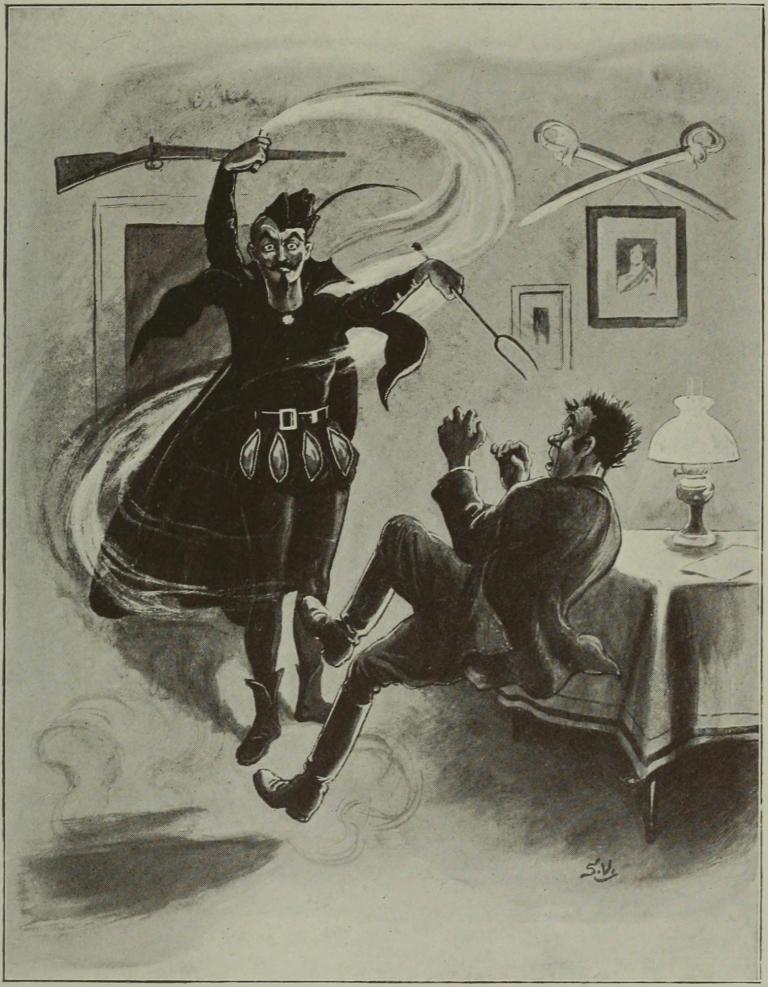
told that Old Nick is ever ready to prompt an idle
man, and he must have been mighty adjacent to
me that day, for on my spotting one of those old-fashioned,
wooden crocodiles, painted a vivid green
with bright-red spots on it, I immediately went
into the shop and purchased it. The thing was
constructed of small blocks of wood, sawn in such
a way, and connected together with string, that
when you held it in your hand it wriggled, and
looked alive, while it also possessed a gaping red
mouth and staring eyes. The confounded insect
would not have raised a squall out of a nervous
European babe of a year old; but, such as it was,
I put it into my kit and, on my return up country,
took it with me.
In due course of time I reached Ohinimutu,
where, after a swim in the hot water and a good
dinner, I retired to my private abode, a large hut
built Maori fashion, but with European door and
window, as I knew I should have to give audience to
some dozen chiefs of the Arawa tribe, who would call
on me to welcome my return and hear the news. It
did not take me long to prepare for their reception,
and getting the toy out of my kit, I slipped it up my
left sleeve, so that it was hidden. I then sat down
in a low camp-chair and awaited my victims, who
soon arrived, giving me their words of welcome as
they entered, and squatting down in a semicircle
in front of the fire, all of them as keen as mustard
to hear the news. They were a fine-looking lot of
old chaps, ten in number, and some of them almost
gigantic in size. Old Hori Haupapa must have
stood over seven foot high, when in his prime; and
the rest were all big men. Anxious as they were
to hear the news, still they were far too well-bred
to ask any questions, and, as I pretended to be in
very low spirits and sat speechless, heaving an
occasional deep sigh, they squatted there, conversing
in low whispers, with looks full of commiseration
for my unhappy state.
For a few minutes we sat quiet, then I made signs
to the girl who attended on us to hand round the
rum and tobacco: which she did. And after each
man had been served, letting go a dismal groan, I
said: “Friends, I thank you for your words of welcome.
My heart is very dark. I have dreamed a
dream.” Here I paused to let the poison work; for a
dream to a Maori audience is always a safe draw, and
the muttered grunts and ejaculations, passed round
with nudges, showed me they were quite ripe to believe
anything. So I continued: “Yes, friends, last
night I dreamed a dream, and the interpretation of
that dream is hidden from me.” Here I paused again,
and slipped the toy into my left hand, which rested on
my left knee, while I held their eyes with my own, so
that, in the firelit whare, none of them noticed my
sleight of hand. Then I continued: “I dreamed, O
chiefs of the Arawa, that we all sat, as we are doing
now, by this fire, when lo! out of my left hand crept
a ngaraka” (green lizard). Here again I paused,
but so did not my hearers, for old Taupua, glancing
nervously at my left hand, at once spotted what he
thought to be a dreaded lizard. The grim old
warrior let go a howl of consternation and promptly
turned a back somersault, thereby drawing the
attention of all the others to the noxious reptile;
and in one moment these dignified old savages,
who would have faced without flinching the fire of
a battery of artillery sooner than have committed
a gaucherie, were trying to push and struggle through
the door, with no more regard to manners or manhood
than the ordinary well-dressed Englishman
displays who pushes ladies on one side while boarding
a tram.
The first one to reach the door was an ancient,
who did not understand the mechanism of a white
man’s lock, so failed to open it; and in a moment
they were climbing over one another’s backs, in
their frantic endeavours to escape until the end
of the whare gave way, and the big chiefs of the
Arawa tribe precipitated themselves, door and all,
into outer darkness, where they formed a confused
heap of writhing, howling humanity. At last they
struggled free, and each man made for his own hut,
all fully convinced that something dreadful was
going to happen and that the whole community was
past praying for. Nor did the panic end here; for
in a moment the tribe was roused up and, the awful
news being promulgated, in two flirts of a cat’s tail,
every man, woman and child had cleared out of the
kainga. Yes, those who had canoes took to them, and
those who had none used their legs, and used them
to some advantage, for in less time than it takes me
to write it the whole of that congregation of peaceful
natives had abandoned their happy homes and fled.
Well, after my first burst of laughter was over, I
began to count up the cost of my stupid joke, and at
once saw I was likely to have to pay dearly for my
fun. To commence with, my hut would have to be
rebuilt; but that was a trifle. What I had to fear
was the censure of the Government, as the Defence
Minister was an old Scotsman, without a particle of
fun in his whole corpus, so was not likely to view
the scatterment of his most pampered tribe with
equanimity, and visions of reasons in writing and
prosecutions danced before my eyes. It was clear
that the first thing to be done was to get the natives
to come back to their kainga; but how? I knew full
well they would not suffer me to approach within a
mile of any of them, and although I had some sterling
friends among the fighting chiefs, yet, if I could not
get speech with them, so as to explain matters to
them, their good will would be of no use to me.
Fortunately, among the men dwelling at Ohinimutu
was a Ngapuhi native, and I engaged him
to act as messenger; but, although he was a red-hot
Christian, nothing would persuade him to come
near, much less touch, the wretched toy. I, however,
induced this man to go over to Mokoia Island,
see the principal tribal tohunga, and get him to
come across and interview me. Fitting him out
with a gallon of rum and plenty of tobacco, I
despatched my Mercury and awaited his return in
trepidation. On the morning of the second day
he reported himself, and informed me that the
tohunga awaited me, but that, as nothing would
induce the limb of Satan to land, I must go down
to the lake, and he would discourse with me from
his canoe. So I had to go to the lake and collogue
with the old sinner from the point of a jutting-out
cape. After I had tried to make him understand
the true state of affairs, I produced the toy; but
nothing I could say would induce him to believe
that it was composed of inanimate wood. No, he
could see it move, swore it was alive, and sternly
refused to touch it, or even come closer to me, so
that he could examine it. At last, happy thought,
I suggested I should burn it. To this he consented.
So, putting the unfortunate crocodile on the top of
a flat stone, I collected some dry sticks and, with
him watching every movement, constructed a
funeral pyre, and cremated the wretched toy to
ashes. Then he consented to land and came up
to my hut, where he went through many incantations
and gesticulations, although he avoided
touching or entering it. Presently he turned to
me and said: “This and all it contains must be
at once burned. Have you removed anything from
it?” I had not; though, expecting something of
this sort to happen, I had taken every care that my
servant should do so, and that absolutely nothing
of value remained within it; so, like a Radical
Minister, I only told half the truth. “Set it on
fire,” quoth he, and this I did with equanimity, as it
would only give the Maoris the trouble of building
me a better one, so that in a few minutes not a
vestige of my late mansion remained. As everything
that had been contaminated by the penny
toy was now supposed to be destroyed, the old
tohunga consented to discuss terms of peace,
which consisted as follows:—first, that I should
hand over, privately, to the tohunga himself, one
gallon of rum, three pounds of tobacco and twenty-five
pounds of flour, the said tohunga guaranteeing
to at once dream a dream directing the natives to
rebuild my house, with great rapidity. Secondly,
that at the general tangi, to be held next day, on
the return of the natives, I was to provide ten
gallons of rum, twenty pounds of tobacco and half-a-ton
of flour, all of which was to be consumed
thereat. And lastly, should I on any future occasion
go to Napier, and discover any more instruments
of white man’s devilry, I was to bring them to him,
when, with a little judicious management, we could
work many miracles to our mutual advantage.
All these terms having been agreed to, Satan’s
representative among the Arawa departed, and
the next morning all his congregation, accompanied
by many of their country friends, returned, when
a big tangi with much feasting and dancing took
place; but even my very best friends looked askance
at me for a long time, while for some weeks the
majority of the women, girls and children would
fly from me as if I had the plague.
You must not think for a moment that this
avoidance was caused by ill will, or that the old
chiefs bore me any malice for the shameful trick
I had played them, or that I was fined the rum,
flour, etc., for the evil I had done. Not a bit of it.
I was mulct for my misfortune, not for my fault.
In their eyes no fault had been committed. If
Moses himself had returned to tell them I had
played them a trick, they would not have believed
him. No; had they not seen the beast come out
of my hand at the very moment I was relating my
dream? Trick indeed, not much. They looked on
me as an awful example of misfortune, and therefore
as a fit and proper personage to be politely
robbed.
Yes, robbed. Had I been a Maori, not only myself
but all my family would have been robbed of every
single article we possessed in the world, in payment
for the affliction of bad luck that had fallen on me;
but as I was a white man this could not be done,
so I was fined. For is not this in accordance with
the ancient custom or law of Muru, which authorises
a man smitten by a sudden calamity to be plundered
of all he possesses? And what greater calamity was
possible to mortal man than to have an obscene
lizard grow out of his hand? Therefore I was fined.
As for trick, nonsense! What man dare make fun
of, or render ridiculous, the dignity and majesty of
the head chiefs of the Arawa tribe?
I think I may say a few more words on this
extraordinary law of muru—a law that Europeans
regarded with laughter and contempt; yet it worked
very well among the natives, and should any family
have met with misfortune and the law not have
been put in force against them, they would have
considered themselves not only slighted, but insulted.
It also, among others, contained one
salient good quality, as it caused all personal portable
property constantly to change hands, for the
family that was plundered one day would, in the
ordinary course of events, rob some other family
a few days afterwards, so that a canoe, blanket or
any household utensil might pass through many
hands and, if not worn out during its transits, might
at last return to its original possessor. Yet to a
white man it did seem funny that a party of natives
en route to visit another family, and whose canoe
should be capsized when landing, were not only
robbed of their canoe, but that the unlucky ones
would have considered themselves insulted had not
their friends immediately annexed it.
I remember well that once, while on a journey
to visit a pah, accompanied by a chief of some
importance, in fact he was a native assessor—i.e.
a sort of Maori J.P. appointed by Government—a
very queer illustration of the law of muru cropped
up.
We were to inquire into some trivial case, the
defendant being the son of the chief of the place,
and the utmost penalty not more than five shillings.
Just as we reached the pah my companion, who
was riding a fine, high-spirited horse, was bucked
off, and while in the act of rising received a severe
kick on the croup. He was picked up with much
solicitude, all the natives condoling with him. The
case was tried and settled, the defendant being
mulct two shillings and sixpence, and next day,
when about to depart, the horses being brought
to the gate of the pah, my companion’s horse was
not forthcoming. At once I demanded the reasons
why, and was informed it had been annexed as
muru, for throwing and kicking my unfortunate
friend, who at once acquiesced in the judgment
and thanked the chief of the pah for his courtesy
in paying him such an honour.
Again I was on a visit to a pah situated close
to the mouth of a river, on the other side of which
was another pah. One day my hosts started out
to shoot a huge seine net, and of course the whole
population turned out to assist or give advice.
The noise, as everyone yelled at the top of his
or her gamut, was deafening. However, two large
canoes eventually got away with the net on board,
and after taking a bold sweep returned to shore
and landed the sea end. Immediately all hands,
redoubling their yells, tailed on to the hauling
ropes and pulled and howled with all their might.
Just as the bag of the net came in view, a huge
shark, that had been encompassed in its toils, made
a bold dash, broke the net and escaped, letting out,
at the same time, many large fish. The excited
and disappointed natives were just dragging the
net and the still great remainder of the catch up
on to the sand, when their neighbours, apprised by
the yells that something unfortunate had occurred,
dashed across the river in their canoes, and after
a sham resistance of a few minutes swept up and
carried off all the remaining fish. They might
also have confiscated the net, but did not, an old
chief confiding to me that the other side of the
river was full of rocks, and not suitable for seine
netting; moreover, the net was broken and would
require repairing. Such was the law of muru.
Of course to yarn about New Zealand without
saying anything about the custom of Tapu would
be on all fours with yarning about Rome and not
mentioning the Pope. So here goes for a few
remarks about the ancient but very confusing
custom of tapu.
Anything animate or inanimate could be rendered
tapu by the will, or even touch, of a man who was
tapu himself. Tapu might also render a thing so
sacred, or might render it so unclean, that to touch
that thing would constitute an act of unpardonable
sacrilege, or cause the toucher to be looked upon
as so defiled as to be ostracised by the whole
community, although the act was done innocently
and in ignorance.
To break a tapu was looked upon, by the
superstitious natives, as a direct challenge to the
greatly dreaded spiritual powers, and was certain
to bring swift and awful punishment.
A big chief was tapu, and if he went to war the
essence of tapu became doubly distilled, so much
so that he could not feed himself, nor even touch
food with his hands. Nor could he even touch
a cup or utensil that did not actually belong to
himself, for if he did so, the article he used at once
became so tapu that no one else could use it;
consequently it became either his personal property,
or had to be destroyed. This in a country where
there were neither shops nor manufactories was
an impossibility, so that at meal-time a chief had
to eat apart, and be fed by either a girl or slave.
Truly the sublime approached the ridiculous, to see
a grim, tattooed old warrior squatting down, with
a small girl throwing morsels of food into his
mouth, or with his head thrown back, and his jaws
extended to their full width, receiving a stream of
water, poured down his throat, from the spout of
an ancient tea-kettle. Even an ordinary warrior,
not being a slave, lost his back when on the warpath—i.e.
his back became so tapu that he could
carry nothing, much less provisions, on it; and this
was also very inconvenient when having to march
through a rough, bushed country, without waggons
or pack-horses. Food could even become tapu,
especially that which remained from the portion
served out for the use of the chief, even though
no part of his body had touched it; and there is
a well-authenticated case, that on one occasion a
slave, being on the warpath, found some food and
ate it. No sooner had he done so than he was
informed it was the remains of the dinner of the
fighting chief. This news so horrified the poor
superstitious wretch that he was at once taken
ill with sharp internal pains, and died.
The Maoris always made their plantations in
the bush, frequently at a considerable distance from
their kaingas, and these, after the potatoes had
been planted, would only be occasionally visited by
their owners, who, to protect them, would get the
chief or tohunga to tapu the plantation; and this
being done, the produce would be quite safe from
the depredations of others.
About the year 1870 some six brace of pheasants
were turned loose in the Waikato district, and the
principal chief put his tapu on them for seven
years. These birds increased and throve in a
manner truly wonderful. Not a Maori dare touch
one, although long before the period of protection
had expired the birds had not only spread all over
the Waikato district, but also over all the adjoining
ones. And they carried their protection with them,
for notwithstanding the fact that they had become
somewhat of a nuisance to the Arawa tribe, who
were not in any way subordinate to the Waikato
chief, yet they respected his tapu, and would have
starved sooner than eaten them.
It was by making use of this tapu that the wonderful
head of game and fish at present in New Zealand
has been reared and acclimatised.
Should a chief die within his whare, that hut
and everything it contained at once became tapu
and was lost to use; for as soon as his body had
been removed, the door was at once blocked up,
and the hut with its contents allowed to moulder
away, no one daring to touch, much less remove,
one single article. Tapu, therefore, in a manner
of speaking, was the antipoise of the law of muru,
for if the enforcement of the latter rendered the
portable property of an individual or tribe precarious,
yet tapu made his title indissoluble; so the
two laws or customs got on very well together, and
may exist to the present day.
I cannot leave my friends the Maoris without
speaking about their awful cruelty in torturing and
killing their prisoners, and in the foul massacres of
helpless women and children.
Yet even in this there may be something said in
their favour, especially should you compare them,
savages as they were, with the human monsters
that every Christian European country has produced,
when they would be found no more cruel
or bloodthirsty.
Now I don’t want to draw parallels in history,
but it rather disgusts me to hear Alva, Tilly, Nana
Sahib, or even Te Kooti, run down, while such a
cold-blooded villain as Cromwell is extolled.
I was taught as a schoolboy to regard Tilly
and Alva as the incarnations of Satan; I suppose
because they made it sultry for Protestants; but
it was not pointed out to me that at the very same
time Alva and his Spanish troops were making
it hot for Lutherans in the Netherlands, the
English troops of Protestant Queen Bess were
perpetrating infinitely worse brutalities on the
helpless Irish, while the fiendish cruelties of Tilly’s
wild Croats and Pandours, at the sack of
Magdeburg, were equalled, if not surpassed, at
Drogheda, by Oliver Cromwell and his canting
hypocritical Puritans.
I am myself an Irishman, a Protestant, a Unionist
and an Imperialist, just as ready to fight for our
King and Flag as ever I was during the forty
years I passed on the Colonial frontiers, but I can
blame none of my countrymen for the hatred they
feel towards England, provided they fight like men
and eschew all cowardly, underhand, secret societies;
and I am convinced it will require many centuries
to roll past before the recollection of the Penal
Laws and the foul, savage treachery of past English
rule is obliterated, while the curse of Cromwell will
remain for ever. Nana Sahib and Te Kooti did
not, combined, kill as many helpless women and
children as either Alva, Tilly or Cromwell; yet,
as they killed all they could, they cannot be
blamed for that, and I have no doubt that on their
arrival in Hades they were assigned just as
honourable entertainment and particular attentions
as the aristocratic fiend, the priestly murderer or
the Puritan cut-throat.
It must also be remembered that the atrocities
committed by Te Kooti and his fanatical followers
might be blamed upon the fiendish faith they had
adopted and had never been practised by the
Maoris during the previous six years of the war,
also that they were more or less fighting in defence
of their country against invaders. Again, Te Kooti
had been the victim of gross injustice, at the hands
of the Colonial Government, insomuch as he had
been transported without trial, and that the
evidence against him was not only insufficient, but
was also of such a nature that the law officers of
the Crown could find no excuse even to bring him
to a trial, so that many of his brutalities were
prompted by a desire for utu, a custom universally
practised by the Maoris.
Please don’t think I have written the above for the
purpose of deifying England’s enemy, or to slander
my own countrymen like a Radical Little Englander,
for I would have, at any time, blown the roof off Te
Kooti’s head, or that of one of his followers, with as
little compunction as I have since shot a mangy
jackal; but I have written it simply to show that, if
savage New Zealand produced one fiend, in the
shape of Te Kooti, Christian England produced a
worse one in the shape of that sanctimonious
hypocrite, Oliver Cromwell, and that therefore we
should not endanger our own glass by throwing
stones.
I alluded just now to the custom of utu,
which means payment or revenge, and is very
similar to the law of the Jews, that laid down the
maxim of an eye for an eye and a tooth for a tooth—an
axiom which the Maoris believe in thoroughly.
It was the practice of this custom that led to
many of the sanguinary combats and massacres
that took place between the armed traders and the
natives during the first half of the past century.
These traders visited New Zealand and exchanged
muskets, powder, ironware, etc., for flax, whale
oil, curios and men’s heads. They were a hard-fisted,
lawless crowd, who, in their brigs or
schooners, well armed with musket, pike and
carronade, would anchor in one of the splendid
natural harbours and begin their traffic with the
haughty, warlike savages.
Business carried on between such men as these
often brought about a row, which a musket shot
or a slash from cutlass or tomahawk would not
improve, and the ship would then sail away, after
most likely the killing or wounding of some natives.
The remembrance of the blood spilt would be
treasured by the Maoris, and the next trader who
visited that place would have to pay for the evil
deeds of the previous visitor. Now the Maori
looked on all white men as belonging to the same
tribe, and the custom of utu allowed any man
injured by an individual to wreak his vengeance
upon any member of the said individual’s tribe,
provided his particular enemy were absent. In
this he was backed up by all the members of his
own tribe, especially if blood had been drawn;
for tribal blood must be paid for with blood,
and no Sicilian clan ever carried out a vendetta
more thoroughly than a Maori hapu. This being
so, the Maoris eagerly looked for the next vessel,
to take their blood payment for the blood spilt.
Knowing full well that their canoes and spears
were no match for the well-armed ship, they would
bide their time and have recourse to treachery.
The white men would be received with apparent
good will, and, if foolish enough, might be lulled
into a mistaken sense of security. This being
done, the majority of the crew would be enticed
ashore, where, taken off their guard, or separated,
they would be attacked, killed and eaten, while the
ship, weakened by the loss of so many men, was
sometimes boarded and captured, the natives
thereby obtaining utu for the original injury done
them.
Maoris were very punctilious about the honour
of their tribes and ancestors, this being carried
to an extent almost ludicrous. Par exemple, a
year or two before I left New Zealand an old
woman belonging to one tribe was planting
potatoes, and as she shoved each tuber into the
ground she called it by the name of one of the
principal living chiefs or dead heroes of an adjoining
tribe. This came to the ears of the said tribe,
who immediately prepared for war, despatching an
ultimatum that, unless the plantation and all the
spuds it contained were at once destroyed, they
would attack their insulting neighbours. The
casus belli must seem very absurd to a white man;
but it was different to the offended tribe, as when,
in the course of events, the murphies became ready
for the pot, the scandalous old dame would be
able to declare that she was not only devouring
their living chiefs, but that, vampire-like, she was
feeding upon their defunct ones.
I mentioned that the Maoris performed many
splendid acts of courage in getting away their
wounded and even their dead. This was done not
only for love or comradeship, but to prevent the
enemy from using their flesh in lieu of butcher’s
meat, and also to save their bones being turned
into useful and ornamental articles by their
opponents.
For instance, let us suppose that during some
ancient war, the Waikato tribe fighting against the
Taranaki, the former should have killed and
captured the body of a great war chief whom we
will call Te Rawa. The flesh of the dead man, in
the first place, would be eaten—a great indignity—but
that would not be the end of him, for the bones
would be preserved, and turned into fish-hooks,
flutes and ornaments, the teeth strung nicely on
flax, making a necklace; and it was not pleasant for
the victim’s descendants to hear that their revered
though unfortunate ancestor was still furnishing
food and bijouterie for the offspring of his slayer.
Now all the aforementioned useful articles were
called by the name of the man they had, in the
first place, belonged to—in this case Te Rawa.
The owner of the fish-hook could boast that he
was still eating Te Rawa, as he would call all the
fish caught by that special hook Te Rawa. Then,
pointing to the necklace, he might brag he was
wearing Te Rawa, and when inclined for music
he would tootle on his flute and proudly declare
he was playing Te Rawa; so that the unfortunate
descendants of the poor old defunct, whenever
they heard of this, would have to blush under their
tattooed skins at the very name of their much-deplored
ancestor.
It was therefore a most sacred duty to rescue
a dead or wounded comrade from the enemy, even
when fighting against the white men; for although
the natives well knew that we did not use their
defunct relatives for rations, nor turn them into
musical instruments, yet it had become so strong
a custom among themselves to guard against such
a possible catastrophe, that they still practised it
although unnecessarily.
I must revert once more to the custom of utu
so as to point out the fair-mindedness of the natives
should this law be used against themselves. Let
me give you just one instance.
The circumstance took place after the capture
of Ngatapa. Some 130 Hau Haus had been taken
prisoners, these being shot out of hand and their
bodies thrown over a precipice; but six or eight
of them remained alive, in our hands, as it was
not certain they had participated in the Poverty
Bay massacre. They were confined in a hut
awaiting trial and, as all the murdered people were
dead, it was a moot point whether these fellows
would not get off for want of evidence. One of
the men, however, whose relations had been
murdered, determined that they should not slip
through the clumsy fingers of the law, as alas so
many of the blood-stained villains had succeeded
in doing. He volunteered to act as one of the
guard round the hut and, borrowing another revolver
from a mate, he took the first opportunity to enter
the hut and deliberately blew out the brains of all
the inmates.
This act of summary justice was fully approved
of by the Maoris, as it bore out the custom of utu;
for if the defunct Hau Haus had not murdered
the man’s family themselves, yet their tribes had
done so; and they considered it a square deal, as
blood had been paid for by blood.
I could yarn on about these queer people for
hours and tell you of plenty of other quaint customs,
such as their wakes, marriages, etc., also about their
industry and other qualities, good and bad, for, faith!
they have them mixed like all other people. But if
you have followed and appreciated my first attempt
it will encourage me to write more of my humble
experiences on the frontiers of the Empire with the
old Lost Legion I love so well.
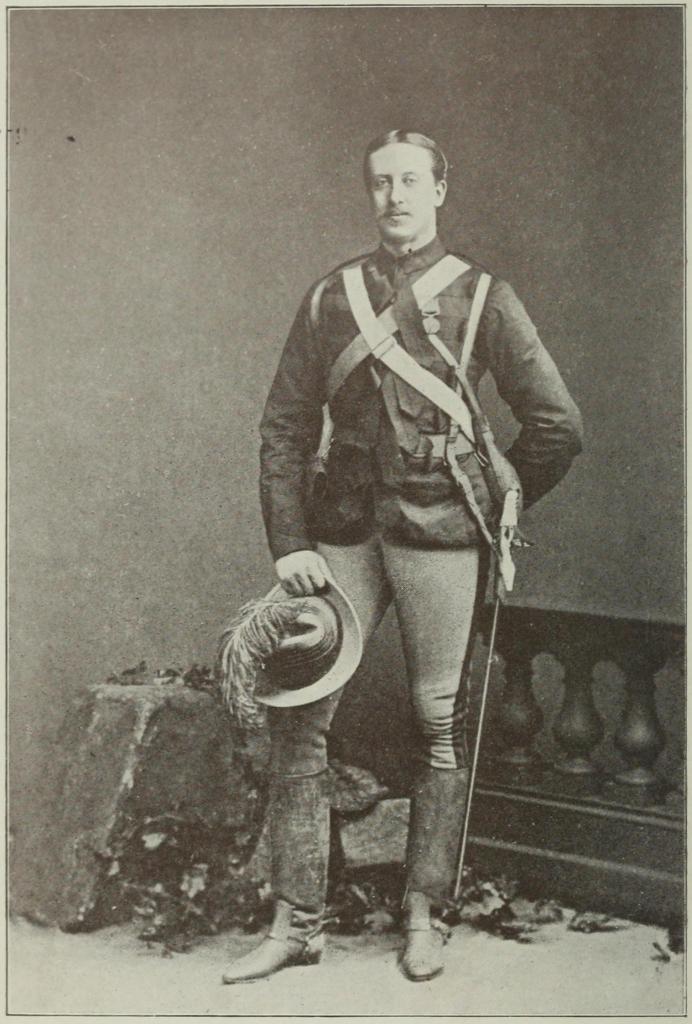 T. F. KYNNERSLEY, ESQ., OF LEIGHTON, SALOP, D.L., J.P.,
AND LATE CAPTAIN AND S.O. LONSDALE’S HORSE.
T. F. KYNNERSLEY, ESQ., OF LEIGHTON, SALOP, D.L., J.P.,
AND LATE CAPTAIN AND S.O. LONSDALE’S HORSE.