“I told you so, boys,” breathed the guide two hours later, with an
overwhelming sigh of regret, after he had given his most fetching calls in
vain. “I told you so. There ain’t anything bigger’n a
buck-rabbit travelling. That tormented row we made scared every moose within
hearing.”
Herb was standing on the ground, horn in hand, screened by the great shadows of
a clump of hemlocks; the three were perched upon branches high above him, a
safe post of observation if any moose had answered.
“You may as well light down now,” he continued, turning his face
up, though the boys were invisible; “I ain’t a-going to try any
more music to-night. I guess we’ll stretch ourselves for sleep early, to
get ready for a good day’s work to-morrow. An eight-mile tramp will bring
us to the first heavy growth about the foot of Katahdin, and I’ll promise
you a sight of a moose there.”
His companions dropped to earth; and the four sought the shelter of their tent,
which had been pitched a few hundred yards from the calling-place. Some dull
embers smouldered before it; for Herb, even while preparing supper, had kept
the camp-fire very low, lest any wandering clouds of smoke should interfere
with the success of his calling.
Now he heaped it high, throwing on without stint withered hemlock boughs and
massive logs, which were soon wrapped in a sheet of flame, making an isle of
light amid a surrounding sea of impenetrable darkness.
Many times during the night the watchful fellow arose to replenish this fire,
so that there might be no decrease in the flood of heat which entered the tent,
and kept his charges comfortable. Once, while he was so engaged, the placid
sleepers whom he had noiselessly quitted were aroused to terror—sudden,
bewildering night-terror—by a gasping cry from his lips, followed by the
leaping and rushing of some brute in flight, and by a screech which was one
defiant note of unutterable savagery.
“Good heavens! What’s that?” said Cyrus.
“Is it—can it—could it be a panther?” stammered Dol.
“Get out!” answered Neal contemptuously. “The panthers have
got out long ago, so every one says.”
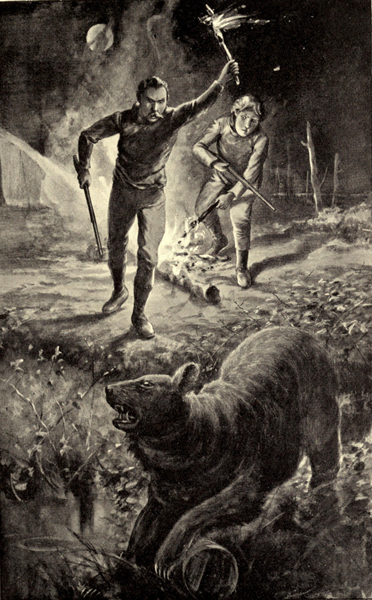
“A lynx! A Canada lynx, boys, as sure as death and taxes!” panted
Herb Heal, springing into the tent on the instant, with a burning brand in his
hand. “’Tain’t any use your tumbling out, for you won’t
see him. He’s away in the thick of the woods now.”
Cyrus gurgled inarticulate disappointment. At the first two words he had sprung
to his legs, having never encountered a lynx.
“The brute must have been prowling round our tent,” went on Herb,
his voice thick from excitement. “He leaped past me just as I was
stooping to fix the fire, and startled me so that I guess I hollered. He got
about half a dozen yards off, then turned and crouched as if he was going to
spring back. Luckily, the axe was lying by me, just where I had tossed it down
after chopping the last heap of logs. I caught it up, and flung it at him. It
struck him on the side, and curled him up. I thought he was badly hurt; but he
jumped the next moment, screeched, and made off. A pleasant scream he has;
sounds kind o’ cheerful at night, don’t it?”
No one answered this sarcasm; and Herb flung himself again upon his boughs,
pulling his worn blanket round him, determined not to relinquish his
night’s sleep because a lynx had visited his camp. The city fellows
sensibly tried to follow his example; but again and again one of them would
shake himself, and rise stealthily, convinced that he heard the blood-curdling
screech ringing through the silent night.
It was nearly morning before fatigue at last overmastered every sensation, and
the three fell into an unbroken sleep, which lasted until the sun was high in
the sky. When they awoke, their sense of smell was the first sense to be
tickled. Fragrant odors of boiling coffee were floating into the tent. One
after another they scrambled up, threw on their coats, and hurried out to find
their guide kneeling by the camp-fire on the very spot from which he had hurled
his axe at the lynx a few hours before. But now his right hand held a green
stick, on which he was toasting some slices of pork into crisp, appetizing
curls.
“’Morning, boys!” he said, as the trio appeared. “Hope
your early rising won’t opset ye! If you want to dip your faces in the
stream, do it quick, for these dodgers are cooked.”
The “dodgers” were the familiar flapjacks. Herb set down his stick
as he spoke to turn a batch of them, which were steaming on the frying-pan,
tossing them high in air as he did so, with a dexterous turn of his wrist.
The boys having performed hasty ablutions in the stream, devoted themselves to
their breakfast with a hearty will. There was little leisure for discussing the
midnight visit of the lynx, or for anything but the joys of satisfying hunger,
and taking in nutrition for the day’s tramp, as Herb was in a hurry to
break camp, and start on for Katahdin. The morning was very calm; there seemed
no chance of a wind springing up, so the evening would probably be a choice one
for moose-calling.
In half an hour the band was again on the march, the business of breaking camp
being a swift one. The tent was on Herb’s shoulders; and naught was left
to mark the visit of man to the humming stream but a bed of withering boughs on
which the lynx might sleep to-night, and a few dying embers which the guide had
thrashed out with his feet.
No halt was made until four o’clock in the afternoon. Then Herb Heal came
to a standstill on the edge of a wide bog. It lay between him and what he
called the “first heavy growth;” that is, the primeval forest,
unthinned by axe of man, which at certain points clothes the foot of Katahdin.
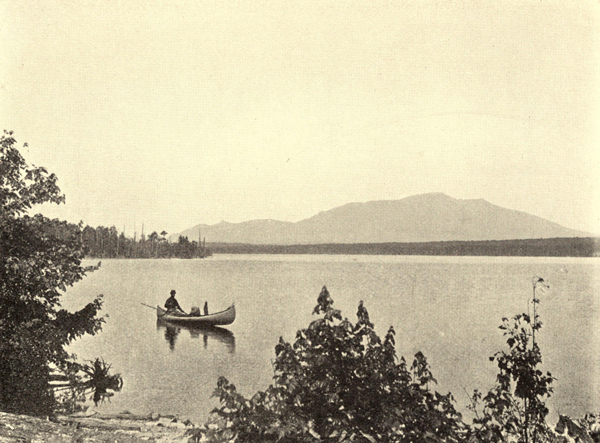
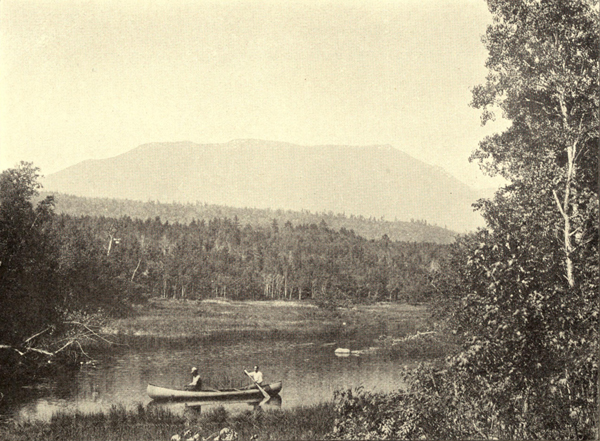
The great mountain, dwelling-place of Pamolah, cradle of the flying Thunder and
flashing Lightning, which according to one Indian legend are the swooping sons
of the Mountain Spirit, now towered before the travellers, its base only a mile
distant.
“I’ve a good mind to make camp right here,” said Herb,
surveying the bog and then the firm earth on which he stood. “We may
travel a longish ways farther, and not strike such a fair camping-ground,
unless we go on up the side of the mountain to that old home-camp I was telling
you about, which we built when we were trapping. I guess it’s standing
yet, and ’twould be a snug shelter; but we’d have a hard pull to
reach it this evening. What d’ye say, boys?”
“I vote for pitching the tent right here,” answered Cyrus.
The English boys were of the same mind, and the guide forthwith unstrapped his
heavy pack-basket. As he hauled forth its contents, and strewed them on the
ground, the first article which made its appearance was the moose-horn; it had
been carefully stowed in on top. Dol snatched it up as a dog might snatch a
bone, and touched it with longing in every finger-tip.
“There’s one bad thing about this place,” grumbled Herb
presently, surveying the landscape wherever his eye could travel, “there
isn’t a pint of drinking-water to be seen. There may be pools here and
there in that bog; but, unless we want to keel over before morning, we’d
better let ’em alone. Say! could a couple of you fellows take the
camp-kettle, and cruise about a bit in search of a spring?”
“I volunteer for the job!” cried Dol instantly, with the light of
some sudden idea shining like a sunburst in his face.
“You don’t budge a step, old man, unless I go with you,” said
Cyrus. “Not much! I don’t want to patrol the forests like a lunatic
for five mortal hours in search of you, and then find you roasting your shins
by some other fellow’s camp-fire. One little hide-and-seek game of that
kind was enough.”
“Well! the fact that I did bring up by Doc’s camp-fire shows that I
am able to take care of myself. If I get into scrapes, I can wriggle out of
them again,” maintained the kid of the camp, with a brazen look, while
his eyes showed flinty sparks, caused by the inspiring purpose hidden behind
them, which had little to do with water-carrying.
“Why can’t you both go without any more palaver?” suggested
Herb, as he started away towards a belt of young firs to cut stakes for the
tent. “Cruise straight across the bog, mark your track by the bushes as
you go ’long, don’t get into the woods at all, and ’twill be
plain sailing. I guess you’ll strike a spring before very long.”
Cyrus caught up the camp-kettle, and stepped out briskly over the springy,
spongy ground. Dol Farrar followed him. The two were half-way across the bog
before the elder noticed that the younger was carrying something. It was the
moose-horn.
“If we run across any moose-signs, I’m going to try a call,”
said Dol, his strike-a-light eyes fairly blazing while he disclosed
his purpose. “You may laugh, Cy, and call me a greenhorn; but I bet you
I’ll get an answer, at least if there’s a bull-moose within two
miles.”
“That’s pretty cheerful,” retorted the Boston man;
“especially as neither of us has brought a rifle. Mr. Moose may be at
home, and give you an answer; but there’s no telling what sort of temper
he’ll be in.”
“I left my Winchester leaning against a tree on the
camping-ground,” said the would-be caller regretfully. “But you
know you wouldn’t fire on him, Cy, unless he came near making mince-meat
of us. If he should charge, we could make a dash for the nearest trees.
Let’s risk it if we run across any tracks!”
“And in the meantime, Herb will be wondering where we are, vowing
vengeance on us, and waiting for the kettle while we’re waiting for the
moose,” argued Garst. “It won’t do, Chick. Give it up until
later on. We undertook the job of finding water, and we’re bound to
finish that business first.”
“If I wait until later on, I may wait forever,” was the boy’s
gloomy protest. “Tonight, when Herb is there, Neal and you will just sit
on me, and be afraid of my making a wrong sound, and spoiling the sport.
“And I know we’ll see moose-tracks before we get back to
camp!” wound up the young pleader passionately. “I’ve been
working up to it all day. I mean I’ve felt as if
something—something fine—was going to happen, which would make a
ripping story for the Manchester fellows when we go home. Do let me have one
chance, Cy,—one fair and honest chance!”
There was such a tremendous force of desire working through the English boy
that it set his blood boiling, and every bit of him in motion. His eyes were
afire, his eyelids shut and opened with their quick snap, his lips moved after
he had finished speaking, his fingers twitched upon the moose-horn.
He was a picture of heart-eagerness which Cyrus could not resist, though he
shook with laughter.
“I’ll take mighty good care that the next time I go to find water
for the camp-supper, I don’t take a crank with me, who has gone mad on
moose-calling,” he said. “See here! If we do come across
moose-signs, I’ll get under cover, and give you quarter of an hour to
call and listen for an answer—not a second longer. Now stop thinking
about this fad, and keep your eyes open for a spring.”
But, unfortunately, this seemed to be a thirsty and tantalizing land for
travellers. The soft sod under their feet oozed moisture; slimy, stagnant
bog-pools appeared, but not a drop of pure, gushing water, to which a parched
man dare touch his lips.
They crossed the wide extent of bog, Cyrus breaking off stunted bushes here and
there to mark his pilgrimage; they reached the dense timber-growth at the base
of the mountain, longing for the sight of a spring as eagerly as ever pilgrims
yearned to behold a healing well; but their search was unsuccessful.
Decidedly nonplussed, Dol all the time keeping one eye on the lookout for water
and the other for moose-signs, they took counsel together, and determined to
“cruise” to the right, skirting the foot of Katahdin, hoping to
find a gurgling, rumbling mountain-torrent splashing down. Having travelled
about half a mile in this new direction, with the giant woods which they dared
not enter rising like an emerald wall on the one hand, and the dreary bog-land
on the other, they at last, when patience was failing, came to a change in the
landscape.
The desired water was not in view yet; but the bog gave way to fairer, firmer
ground, covered with waving grasses, studded with rising knolls, and having no
timber growth, save stray clumps of birches and hemlocks, several hundred yards
apart.
“Now, this is jolly!” exclaimed Dol. “This looks a little bit
like an English lawn, only I’m afraid it’s not a likely place for
moose-tracks. But I’m glad to be out of that beastly bog.”
“Confusion to your moose-tracks,” ejaculated Cyrus, half
exasperated. “I wish we could find a well. That would be more to the
purpose. Listen, Dol, do you hear anything?”
“I hear—I hear—’pon my word! I do hear the
bubbling and tinkling of water somewhere! Where on earth is it? Oh! I know. It
comes from that knoll over there—the one with the bushes.”
Dol Farrar, as he finished his jerky sentences, pointed to an eminence which
was two or three hundred yards from where they stood, and a like distance from
the wall of forest.
“Well! It’s about time we struck something at last,” grumbled
Garst. “Catch me ever coming on a water pilgrimage again!
I’ll let Herb fill his own kettle in future. Now, I believe that fellow
could smell a spring.”
“Just as I smelt this one!” exclaimed Dol triumphantly. “I
told you ’twas on the side of the knoll. And here it is!”
“Bravo, Chick! You’ve got good ears, if you are crazy upon one
subject.”
And so speaking, Cyrus, with a chuckle of joy, unslung the tin drinking-cup
which hung at his belt, filled and refilled it, drinking long, inspiriting
draughts before he prepared to fill the camp-kettle.
“The best water I ever tasted, Dol!” he exclaimed, smacking his
lips. “It’s ice-cold. There’s not much of it, but it has
quality, if not quantity.”
The long-sought well was, in truth, a tiny one. It came bubbling up, clear and
pellucid, from the bowels of the earth, and showed its laughing face amid a
cluster of bushes—which all bent close to look at it
lovingly—half-way up the knoll. A wee stream trickled down from
it,—dribble—dribble—a rivulet that had once been twice its
present size, judging from the wide margin of spattered clay at each side.
Dol had been following his companion’s example, and drinking joyfully
before thinking of aught else. When the moment came for him to straighten his
back, and rise upon his legs, instead of this natural proceeding, he suddenly
crouched close to the ground, his breath coming in quick puffs, his eyes
dilating, a froth of excitement on his lips.
“What on earth are you staring at?” asked Cyrus. “You look
positively crazy.”
For answer, the English boy shot up from his lowly posture, seized his
companion by the arm, making him drop the camp-kettle, which he was just
filling, and forced him to scan the soft clay by the rivulet.
“Look there—and there!” gurgled Dol, his voice sounding as if
he was being choked by suppressed hilarity. “I told you we’d find
them, and you didn’t believe me! Aren’t those moose-tracks?
They’re not deer-tracks, anyhow; they’re too big. I may be a
greenhorn, but I know that much.”
“They are moose-tracks,” Cyrus answered slowly, almost
unbelievingly, though the evidence was before him. “They certainly are
moose-tracks,” he repeated, “and very recent ones too. A moose has
been drinking here, perhaps not half an hour ago. He can’t be far
away.”
Garst was now warming into excitement himself. His bass tones became guttural
and almost inarticulate, while he lowered them to prevent their travelling. On
the reddish clay at his feet were foot-marks very like the prints of a large
mastiff. He studied them one by one, even tracing the outline with his
forefinger.
“Then I’m going to call,” whispered Dol, his words tremulous
and stifled. “Lie low, Cy! You promised you’d give me a fair
chance; you’ll have to keep your word.”
“I’ll do it too,” was the answering whisper. “But
let’s get higher up on the knoll, behind those big bushes at the top. And
listen, Dol, if a moose makes a noise anywhere near, we must scoot for the
trees before he comes out from cover. I’ve got to answer to your father
for you.”
It was an intense moment in Dol Farrar’s life; sensation reached its
highest pitch, as he crouched low behind a prickly screen, put the birch-bark
horn to his mouth, and slowly breathed through it with the full power of his
young lungs, marvellously strengthened by the forest life of past weeks.
There was a minute’s interval while he removed it again, and drew in all
the air he could contain. Then a call rose upon the evening air, so touching,
so plaintive, with such a rising, quavering impatience as it surged out towards
the woods,—whither the boy-caller’s face was turned,—that
Cyrus could scarcely suppress a “Bravo!”
The summons died away in a piteous grunt. A second time the call rose and fell.
On the third repetition it broke off, as usual, in an abrupt roar, which seemed
to strike the tops of the giant trees, and boom among them.
A froth was on Dol Farrar’s lips, his eyes were reddened, he puffed hard
through spread nostrils, like a young horse which has been trying its mettle
for the first time, as he lowered that moose-horn, lifted his head, and cocked
his ears to listen.
Two soundless minutes passed. Dol, who, if he had mastered the hunter’s
call, had certainly not mastered his patience, put the bark-trumpet again to
his lips, determined to try the effect of a surpassingly expressive grunt.
But he never executed this false movement, which would have given away the
trick at once.
A bellow—a short, snorting, challenging bellow—burst the silence,
coming from the very edge of the woods. It brought Cyrus to his feet with a
jump. It so startled the ambitious moose-caller, that, in rising hurriedly from
his squatting position, he lost his balance, and rolled over and over to the
bottom of the knoll, smashing the horn into a hundred pieces.
He picked himself up unhurt, but with a sensation as if all the bells in
Christendom were doing a jumbled ringing in his head. And loud above this
inward din he heard the sound, so well remembered, as of an axe striking
repeatedly against a tree, the terrible chopping noises of a bull-moose, not
two hundred yards away.
No sooner had he scrambled to his legs, than Garst was at his side, gripping
his arm, and forcing him forward at a headlong run.
“You’ve done it this time with a vengeance!” bawled the
Bostonian. “He’s coming for us straight! And we without our rifles!
The trees! The trees! It’s our only chance!”
With the belling still in his head, and so bewildered by his terrible success
that he felt as if his senses were shooting off hither and thither like
rockets, leaving him mad, Dol nevertheless ran as he had never run before,
shoulder to shoulder with his comrade, dashing
wildly for a clump of hemlocks over a hundred yards distant. Yet, for the life
of him, he could not help glancing back once over his shoulder, to see the
creature which he had humbugged, luring it from its forest shelter, and which
now pursued him.
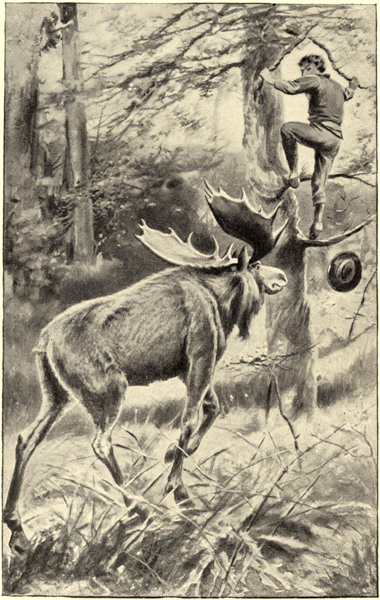
The moose was charging after them full tilt, gaining rapidly too, his long thin
legs, enormous antlers, broad, upreared nose, and the green glare in his
starting eyes, making him look like some strange animal of a former earth. Dol
at last trembled with actual fear. He gave a shuddering leap, and forced his
legs, which seemed threatened with paralysis, to wilder speed.
“Climb up that hemlock! Get as high as you can!” shrieked Cyrus,
stopping to give him an upward shove as they reached the first friendly trunk.
Dol obeyed. Gasping and wild-eyed, he dug his nails into the bark, clambering
up somehow until he reached a forked branch about eight feet from the ground.
Here strength failed. He could only cling dizzily, feeling that he hung between
life and death.
The moose was now snorting like a war-horse beneath. The brute stood off for a
minute, then charged the hemlock furiously, and butted it with his antlers till
it shook to its roots, the sharp prongs of those terrible horns coming within
half an inch of Dol’s feet.
With a gurgle of horror the boy tried to reach a higher limb, and succeeded;
for at the same moment a timely shout encouraged him. Cyrus was bawling at the
top of his voice from a tree ten feet distant:—
“Are you all right, Dol? Don’t be scared. Hold on like grim death,
and we can laugh at the old termagant now.”
“I’m—I’m all right,” sang out Dol, though his
voice shook, as did every twig of his hemlock, which the moose was assaulting
again. “But he’s frantic to get at me.”
“Never mind. He can’t do it, you know. Only don’t you go
turning dizzy or losing your balance. Ha! you old spindle-legged monster, stand
off from that tree. Take a turn at mine now, for a change. You can’t
shake me down, if you butt till midnight.”
Garst’s last sentences were hurled at the moose. The Bostonian, having
reached a safe height, thrust his face out from his screen of branches, waving
first an arm, and then a leg, at the besieging foe, hoping that the force of
those battering antlers would be directed against his hemlock, so that his
friend’s nerves might get a chance to recover.
The ruse succeeded. The moose, reminded that there was a second enemy, charged
the other tree; stood off for a minute to get breath, then charged it again,
snorting, bellowing, and knocking his jaws together with a crunching, chopping
noise.
“Ha! that’s how he makes the row like a man with an axe—by
hammering his jaws on each other. Well, well! but this is a regular picnic,
Dol,” sang out Cyrus jubilantly, caring nothing for the shocks, and
forgetting camp, water, peril, everything, in his joy at getting a chance to
leisurely study the creature he had come so far to visit.
“I owe you something for this, little man!” he carolled on in
triumph, as he watched every wild movement of the moose. “This is a show
we’ll only see once in our lives. It’s worth a hundred dollars a
performance. Butt and snort till you’re tired, you ‘Awful
Jabberwock!’”—this to the bull-moose. “We’ve come
hundreds of miles to see you, and the more you carry on the better we’ll
be pleased.”
Indeed, the wrathful king of forests seemed in no hurry to cut short his
pantomime. He ramped and raged, tearing from one tree to another, expending
paroxysms of force in vain attempts to overturn one or the other of them. The
ground seemed to shake under his thundering hoofs. His eyes were full of green
fire; his nostrils twitched; the black tassel or “bell” hanging
from his shaggy throat shook with every angry movement; his muffle, the big
overhanging upper lip, was spotted with foam.
As he gulped, grunted, snorted, and roared, his uncouth, guttural noises made
him seem more than ever like a curious creature of earth’s earliest ages.
“We came pretty near to being goners, Dol, I tell you!” carolled
Cyrus again from his high perch in the hemlock, carrying on a by-play with the
enemy between each sentence. “How in the name of wonder did you manage
such a call? It would have moved the heart-strings of any moose. I was lying
flat, you know, peeping through a little gap in the bushes, and you had
scarcely taken the horn from your mouth when I saw the old fellow come stamping
out of the woods. My! wasn’t he a sight? He stood for a minute looking
about for the fancied cow; then he bellowed, and started towards the knoll. I
knew we had better run for our lives. As soon as he saw us he gave
chase.”
“And ‘the fancied cow’ should go tumbling down the knoll like
a rolling jackass, and smash that grand horn to bits!” lamented Dol, who
now sat serenely on his bough, with a firm clasp of the hemlock trunk, and a
reckless enjoyment of the situation which far surpassed his companion’s.
Cyrus began to have an occasional twinge of uneasiness about the possible
length of the siege, after his first exuberance subsided; but the younger boy,
his short terror overcome, had no misgivings. He coquetted with the moose
through a thick screen of foliage, shook the branches at him, gibed and taunted
him, enjoying the extra fury he aroused.
But suddenly the old bull, having kept up his wild movements for nearly an
hour, resolved on a change of tactics. He stood stock-still and lowered his
head.
“Goodness! He has made up his mind to ‘stick us out!’”
gasped Cyrus.
“What’s that?” said Dol.
“Don’t you see? He’s going to lay siege in good
earnest—wait till we’re forced to come down. Here’s a state
of things! We can’t roost in these trees all night.”
The hemlocks were throwing ever-lengthening shadows on the grass. A slow
eclipse was stealing over everything. The motionless moose became an uncouth
black shape. Garst muttered uneasily. His fingers tingled for his rifle—a
very unusual thing with him. His eyes peered through the creeping darkness in
puzzled search for some suggestion, some possibility of escape.
“If it were only myself!” he whispered, as if talking to his
hemlock. “If it were only myself, I wouldn’t care a pin.
’Twould do me no great harm to perch here for hours. But an English
youngster, on his first camping-trip! Why, the chill of a forest night might
ruin him. He wouldn’t howl or make a fuss, for both those Farrar boys
have lots of grit, but he’d never get over it. Dol!” he wound up,
raising his voice to a sharp pitch. “Say, Dol, I’m going to try a
shout for help. Herb must be getting anxious about us by this time. If we could
once make him hear, he could try some trick to lure this old curmudgeon away,
or creep up and shoot him. Something must be done.”
Fetching a deep breath, Cyrus sent a distance-piercing “Coo-hoo!”
ringing through the night-air. He followed it with another.
But, so far as he could hear, the hails fetched no answer, save from the
moose-jailer. The brute was stirred into a fresh tantrum by the noise. He
charged the hemlocks once more, butted and shook them like a veritable demon.
When his paroxysm had subsided, and he stood off to get breath, Garst hailed
again.
Glad sound! An answer this time! First, a shrill, long “Coo-hoo!”
Next, Herb’s voice was heard pealing from far away in the bog:
“What’s up, boys? Where in the world are you?”
“Here in the trees—treed by a bull-moose!” yelled Cyrus.
“He’s the maddest old monster you ever saw. Could you coax him off,
or sneak up and shoot him? He means to keep us prisoners all night.”
There was no wordy answer. But presently the treed heroes heard an odd,
bird-like whistle. Dol thought it came from a feathered creature; his more
experienced companion guessed that the guide’s lips gave it as a signal
that he was coming, but that he didn’t want to draw the moose’s
attention in his direction just yet.
Such a quarter of an hour followed! With the fresh spurt of anger the
bull-moose became more savage than ever. He grunted, tramped, and hooked the
trees with his horns, so that the pair who were perched like night-birds on the
branches had to hold on for dear life, lest a surprising shock should dislodge
them. Whenever the creature stood off, to gather more fury, they could have
counted their heart-beats while they listened, breathlessly anxious to, know
what action the approaching woodsman would take.
Once Cyrus spoke.
“Dol Farrar,” he said, “I guess this caps all the adventures
that you or I have had up to date. No wonder you felt all day as if you were
working up to something. I’ll believe in presentiments in future.”
The words had scarcely passed his lips, when there was the sharp bang! bang! of
a rifle not twenty yards distant. A bright sputter of fire cut the darkness
beneath the hemlocks.
The moose’s blind rage threatened to be his own undoing. While he was
fighting an imaginary danger, ears and nostrils half-choked by fury, through
the calm night Herb Heal, Winchester in hand, had crept noiselessly on, till he
reached the very trees which sheltered his friends.
Once, twice, three times the rifle snapped. The first shot missed altogether.
At the second, the moose rose upon his hind-legs, with a sharp sound of fright
and pain, quite unlike his former noises. Then he gave a quick jump.
“Great Governor’s Ghost! he’s gone;” yelled Cyrus, who
had swung himself down a few feet, and was hanging by one arm, in his anxiety
to see the result of the firing. “You needn’t shoot again, Herb!
He’s off! Let him go!”
“I guess that second shot cut some hair from him, and drew blood
too,” answered Herb, his deep voice giving the pair a queer sensation as
they heard it right beneath. “It was too dark to see plain, but I think
he reared; and that’s a sign that he was hurt, little or much.
Don’t drop down for a minute, boys, till we see whether he has bolted for
good.”
![[Illustration]](https://openoldbooks.sgp1.digitaloceanspaces.com/books/camp-and-trail/images/fig01.jpg)
![[Illustration]](https://openoldbooks.sgp1.digitaloceanspaces.com/books/camp-and-trail/images/fig02.jpg)
![[Illustration]](https://openoldbooks.sgp1.digitaloceanspaces.com/books/camp-and-trail/images/fig03.jpg)
![[Illustration]](https://openoldbooks.sgp1.digitaloceanspaces.com/books/camp-and-trail/images/fig04.jpg)
![[Illustration]](https://openoldbooks.sgp1.digitaloceanspaces.com/books/camp-and-trail/images/fig05.jpg)
![[Illustration]](https://openoldbooks.sgp1.digitaloceanspaces.com/books/camp-and-trail/images/fig06.jpg)
![[Illustration]](https://openoldbooks.sgp1.digitaloceanspaces.com/books/camp-and-trail/images/fig07.jpg)
![[Illustration]](https://openoldbooks.sgp1.digitaloceanspaces.com/books/camp-and-trail/images/fig08.jpg)
![[Illustration]](https://openoldbooks.sgp1.digitaloceanspaces.com/books/camp-and-trail/images/fig09.jpg)
![[Illustration]](https://openoldbooks.sgp1.digitaloceanspaces.com/books/camp-and-trail/images/fig10.jpg)
![[Illustration]](https://openoldbooks.sgp1.digitaloceanspaces.com/books/camp-and-trail/images/fig11.jpg)
![[Illustration]](https://openoldbooks.sgp1.digitaloceanspaces.com/books/camp-and-trail/images/fig12.jpg)
![[Illustration]](https://openoldbooks.sgp1.digitaloceanspaces.com/books/camp-and-trail/images/fig13.jpg)
![[Illustration]](https://openoldbooks.sgp1.digitaloceanspaces.com/books/camp-and-trail/images/fig14.jpg)
![[Illustration]](https://openoldbooks.sgp1.digitaloceanspaces.com/books/camp-and-trail/images/fig15.jpg)
![[Illustration]](https://openoldbooks.sgp1.digitaloceanspaces.com/books/camp-and-trail/images/fig16.jpg)
![[Illustration]](https://openoldbooks.sgp1.digitaloceanspaces.com/books/camp-and-trail/images/fig17.jpg)
![[Illustration]](https://openoldbooks.sgp1.digitaloceanspaces.com/books/camp-and-trail/images/fig18.jpg)
![[Illustration]](https://openoldbooks.sgp1.digitaloceanspaces.com/books/camp-and-trail/images/fig19.jpg)
![[Illustration]](https://openoldbooks.sgp1.digitaloceanspaces.com/books/camp-and-trail/images/fig20.jpg)
![[Illustration]](https://openoldbooks.sgp1.digitaloceanspaces.com/books/camp-and-trail/images/fig21.jpg)
![[Illustration]](https://openoldbooks.sgp1.digitaloceanspaces.com/books/camp-and-trail/images/fig22.jpg)
![[Illustration]](https://openoldbooks.sgp1.digitaloceanspaces.com/books/camp-and-trail/images/fig23.jpg)
![[Illustration]](https://openoldbooks.sgp1.digitaloceanspaces.com/books/camp-and-trail/images/fig24.jpg)
![[Illustration]](https://openoldbooks.sgp1.digitaloceanspaces.com/books/camp-and-trail/images/fig25.jpg)
![[Illustration]](https://openoldbooks.sgp1.digitaloceanspaces.com/books/camp-and-trail/images/fig26.jpg)
![[Illustration]](https://openoldbooks.sgp1.digitaloceanspaces.com/books/camp-and-trail/images/fig27.jpg)