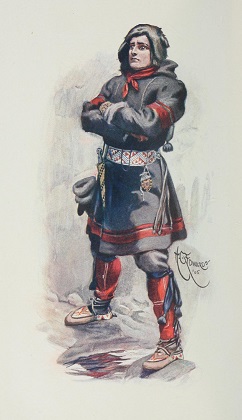
Ainsi passe sur la terre tout ce qui fut bon, vertueux, sensible!
Homme, tu n'es qu'un songe rapide, un rêve douloureux; tu n'existes que
par le malheur; tu n'es quelque chose que par la tristesse de ton âme et
l'eternelle mélancolie de ta pensée!—Chateaubriand.
After the departure of the guests the family fell
back into the sweet intimacy of former days. Jules,
whom his native air had restored to health, passed the
greater part of the day in hunting with Archie. The
abundance of game at that season made the pastime
very agreeable. They took supper at seven, they went
to bed at ten, and the evenings seemed all too short
even without the help of cards. Jules, who was ignorant
of what had passed between his sister and Archie,
could not but be struck with his friend's unusual sadness,
of which, however, he failed to guess the cause.
To all questions on the subject he received an evasive
answer. Finally, imagining that he had found the root
of the difficulty, one evening when they were alone together
he put the question directly.
"I have noticed, my brother," said he, "the sadness
which you endeavor to conceal from us. You are unjust
to us, Archie, you do yourself an injustice. You
should not brood over the past. In saving the lives
which would otherwise have been lost in the shipwreck
of the Auguste, you have done my family a service which
more than compensates for what took place before. It
is we now who owe you a debt of gratitude which can
never be repaid. It was very natural that, prejudiced
by report and for the moment forgetful of your noble
heart, even such friends as we, imbittered by our losses,
should lend an ear to calumnies against you; but you
know that a simple explanation was enough to re-cement
our old friendship. If my father bore his grudge for a
long time, you know his nature and must make allowance
for it. He feels now all his old affection for you.
Our losses have been in great part repaired, and we live
more tranquilly under the British Government than we
did under the rule of France. Our habitants have followed
the example of Cincinnatus, as Uncle Raoul
would say, and exchanged the musket for the plow-share.
They are opening up new land, and in a few
years this seigneurie will be in a most prosperous condition.
With the help of the little legacy which I lately
received, we shall soon be as rich as we were before the
conquest. Therefore, my dear Archie, drive away this
gloom which is making us all miserable and resume thy
former lightheartedness."
Lochiel was silent for some time, and only answered
after a painful effort.
"Impossible, my brother. The wound is more recent
than you imagine and will bleed all my life, for all
my hopes are destroyed. But let us leave the subject;
for I have already been wounded in my tenderest and
purest emotions, and an unsympathetic word from you
would finish me."
"An unsympathetic word from my lips, do you say,
Archie? What can you mean by that? The friend
whom I have sometimes vexed with my raillery knows
very well what my heart is toward him, and that I was
always ready to crave his pardon. You shake your
head sadly! Great heaven, what is the matter? What
is there that you can not confide to your brother, the
friend of your boyhood? Never have I had anything
to conceal from you. My thoughts were as open to you
as your own, and I had imagined that you were as
frank with me. A curse upon whatever has been able
to come between us!"
"Stop, Jules, stop," cried Archie. "However painful
my confidences may be to you, I must tell you all rather
than let you harbor such a cruel suspicion. I am going
to open my heart to you, but on the express condition
that you shall hear me uninterruptedly to the end, as an
impartial judge. Not till to-morrow will we return to
this sore subject. Meanwhile, promise to keep the
secret that I am going to confide to you."
"I give you my word," said Jules, grasping his hand.
Thereupon Lochiel recounted minutely the conversation
that he had had with Blanche. As soon as he
came to an end he lit a candle and withdrew to his own
room.
As for Jules, he stormed within himself all night.
Having studied women only in the salons of St. Germain,
his vigorous common sense could ill appreciate
the sublimity that there was in the sacrifice which his
sister was imposing upon herself. Such sentiments
appeared to him mere romantic and exaggerated nonsense,
or the product of an imagination rendered morbid
by calamity. With his heart set upon an alliance
which would gratify his dearest wishes, he resolved that,
with the consent of Archie, he would have a very serious
conversation with Blanche, from which he felt confident
he would come off victorious. "She loves him,"
thought he, "and therefore my cause is already gained."
Man, with all his apparent superiority, with all his
self-confident vanity, has never yet sounded the depths
of the feminine heart, that inexhaustible treasure-house
of love, devotion, and self-sacrifice. The poets have
sung in every key this being who came all beauty from
the hands of her Creator; but what is all this physical
beauty compared to the spiritual beauty of a noble and
high-souled woman? Indeed, who is more miserable
than man in the face of adversity, when, poor pygmy,
he leans on the fortitude of a woman, who bears the
burden uncomplainingly. It is not surprising then
that Jules, knowing woman only on the surface, expected
an easy triumph over his sister's scruples.
"Come, Blanche," said Jules to his sister, the next
day, after dinner, "there's our Scottish Nimrod setting
out with his gun to get some birds for our supper.
Let's you and I see if we can scale the bluff as nimbly
as we used to."
"With all my heart," answered Blanche. "You
shall see that my Canadian legs have lost none of their
agility."
The brother and sister, assisting themselves by the
projecting rocks, and by the shrubs which clung in the
crevices of the cliff, speedily scaled the difficult path
that led to the summit. After gazing in silence for a
time at the magnificent panorama unrolled before them,
Jules said to his sister:
"I had an object in bringing you here. I wanted
to talk to you on a subject of the greatest importance.
You love our friend Archie; you have loved him for a
long time; yet for reasons that I can not comprehend,
for over-exalted sentiments which warp your judgment,
you are imposing upon yourself an unnatural sacrifice
and preparing for yourself a future of wretchedness. As
for me, if I loved an English girl, and she returned my
affection, I would marry her just as readily as if she
were one of my own countrywomen."
Blanche's eyes filled with tears. Taking her brother's
hand affectionately, she answered:
"If you were to marry an English girl, my dear Jules,
I should take her to my heart as a sister; but that which
you could do without incurring any reproach, would be
cowardice on my part. Nobly have you paid your
debt to your country. Your voice has nerved your
soldiers through the most terrible conflicts. Twice has
your bleeding body been dragged from our battle-fields,
and three times have you been wounded in Old World
struggles. Yes, my beloved brother, you have fulfilled
all your duty to your country, and you can afford to indulge,
if you wish, the whim of taking a daughter of
England to wife. But I, a weak woman, what have I
done for this enslaved and now silent land, this land
which has rung so often of old with the triumphant
voices of my countrymen? Shall a daughter of the
D'Habervilles be the first to set the example of a double
yoke to the daughters of Canada? It is natural and
even desirable that the French and English in Canada,
having now one country and the same laws, should forget
their ancient hostility and enter into the most intimate
relationships; but I am not the one to set the example.
They would say, as I told Archie, that the
proud Briton, after having vanquished and ruined the
father, had purchased with his gold the poor Canadian
girl! Never, never shall it be said!" And the girl
wept bitterly on her brother's shoulder.
"No one will know of it," she continued, "and
you yourself will never realize the full extent of the
sacrifice I am making, but fear not, Jules, I have the
strength for it. Proud of the sentiments by which I have
been inspired, I shall pass my days serenely in the bosom
of my family. Of this be sure," she continued in a voice
that thrilled with exaltation, "that she who has loved
the noble Cameron of Lochiel will never soil her bosom
with another earthly love. You made a mistake in selecting
this spot, Jules, wherein to talk to me on such a
subject—this spot whence I have so often gazed proudly
on the mansion of my fathers, which is now replaced
by yonder poor dwelling. Let us go down now, and if
you love me never mention this painful subject again."
"Noble soul!" cried Jules, and he held her sobbing
in his arms.
Archie, having lost all hope of wedding Blanche
D'Haberville, set himself to repaying the debt of gratitude
which he owed Dumais. The refusal of Blanche
changed his first intentions and left him more latitude;
for he now resolved upon a life of celibacy. Archie,
whom misfortune had brought to an early maturity, had
studied men and things with great coolness of judgment;
and he had come to the wise conclusion that
marriage is rarely a success unless based on mutual love.
Unlike most young men, Lochiel was genuinely modest.
Though endowed with remarkable beauty, and with all
those qualities which go to captivate women, he nevertheless
remained always simple and unassuming in his
manner. He further believed, with Molière's Toinette,
that the pretense of love often bears a very close resemblance
to the reality. "When I was poor and in exile,"
thought he, "I was loved for my own sake; now that I
am rich, who knows that another woman would love in
me anything but my wealth and my rank, even supposing
that I should succeed in banishing from my heart
my first and only love." Archie decided then that he
would never marry.
The sun was disappearing behind the Laurentian
hills, when Lochiel arrived at the farm of Dumais. The
order and prosperity which reigned there gave him an
agreeable surprise. The good wife, busy in her dairy,
where a fat servant girl was helping her, came forward
to meet him without recognizing him, and invited him
to enter the house.
"This is the house of Sergeant Dumais, I believe,"
said Archie.
"Yes, sir, and I am his wife. My husband should
be back presently from the fields with a load of grain.
I will send one of the children to hurry him up."
"There is no hurry, madam. I have called to give
you news of a certain Mr. Archie de Lochiel, whom you
once knew. Perhaps you have forgotten him."
Madame Dumais came nearer. After studying his
face intently for some moments, she said:
"There is certainly a resemblance. Doubtless you
are one of his kinsfolk. Forget Mr. Archie! He could
never think us capable of such ingratitude. Do you
not know, then, that he faced almost certain death to
save my husband's life, and that we pray to God every
day that he will bless our benefactor? Forget Mr.
Archie! You grieve me, sir."
Lochiel was much moved. Lifting into his lap the
little seven-year-old Louise, Dumais's youngest child,
he said to her:
"And you, my little one, do you know Mr. Archie?"
"I have never seen him," said the child, "but we
pray for him every day."
"What do you pray?" asked Archie.
"O God, bless Mr. Archie, who saved papa's life, as
long as he lives; and, when he dies, take him to your
holy paradise."
Lochiel continued to chat with Madame Dumais till
the latter heard her husband's voice at the barn. She
ran to tell him that there was a stranger in the house
with news from Mr. Archie. Dumais was preparing to
pitch off his load, but he threw down the fork and
rushed into the house. It was by this time too dark for
him to make out the stranger's face.
"You are indeed welcome," said he, "coming with
news from one so dear to us."
"You are—Sergeant Dumais?" inquired Archie.
"You are Mr. Archie!" cried Dumais, clasping him
in his arms. "Do you think I could forget the voice
that cried to me 'Courage!' when I was hanging on the
brink of the abyss—the voice I heard so often in my
sickness?"
Toward the end of the evening Archie said:
"My dear Dumais, I am come to ask a great
favor."
"A favor!" exclaimed Dumais. "Could I, a poor
farmer, be so fortunate as to do you a favor? It would
be the happiest day of my life."
"Well, Dumais, it depends upon you to restore me
to health. Though I may not look it, I am sick, more
sick than you could imagine."
"Indeed," said Dumais, "you are pale, and sadder
than of old. Good heaven! What is the matter?"
"Have you ever heard of a malady to which the
English are very subject, and which they call the spleen,
or blue devils?"
"No," said Dumais. "I have known several of your
English who, if I may say it without offense, seemed to
have the devil in them; but I had imagined that these
devils were of a darker hue."
Archie began to laugh.
"What we, my dear Dumais, call the blue devils is
known among you Canadians as 'peine d'esprit.'"
"I understand now," said Dumais, "but what astonishes
me is that a man like you, with everything heart
could wish, should be amusing himself with blue devils."
"My dear Dumais," replied Archie, "I might answer
that every one in the world has his sorrows, however
fortunate he may seem; but it is enough now to say that
the malady is upon me, and that I count upon you to
help me to a cure."
"Command me, Mr. Archie; for I am at your service
day and night."
"I have tried everything," continued Archie. "I
have tried study, I have tried literary work. I am better
in the day-time, but my nights are usually sleepless,
and when I do sleep, I wake up as miserable as ever.
I have concluded that nothing but hard manual labor
can cure me. After toiling all day, I imagine that I shall
win such a slumber as has long been denied me."
"Very true," said Dumais. "When a man has labored
all day with his hands, I defy him to suffer from
sleeplessness at night. But how shall I have the pleasure
of helping you?"
"I expect you to cure me, my dear Dumais. But
listen while I explain my plans. I am now rich, and
since Providence has given me riches which I had never
expected, I should employ a portion of them in doing
good. In this parish and the neighborhood there is an
immense deal of land unoccupied, either for sale or to
be granted. My plan is to take up a large acreage of
such lands, and not only superintend the clearing, but
work at it myself. You know that I have good arms;
and I will do as much as any of the rest."
"I know it," said Dumais.
"There are many poor fellows," continued Archie,
"who will be glad enough to get work at such good
wages as I shall give. You understand, Dumais, that I
shall have to have some one to help me. Moreover,
what would I do in the evening and during bad weather,
without a friend to keep me company? It is then
that my melancholy would kill me."
"Let us set out to-morrow," cried Dumais, "and
visit the best lots, which, for that matter, I already
know pretty well."
"Thank you," said Archie, grasping his hand; "but
who will take care of your farm in your frequent
absences?"
"Don't be anxious on that score, sir. My wife
could manage very well alone, even without her brother,
an old bachelor, who lives with us. My farm has never
suffered much from my absence. I have always preferred
the musket to the plow. My wife scolds me
occasionally on this subject; but we are none the worse
friends for that."
"Do you know," said Archie, "that yonder by the
edge of the river, near that maple grove, is the most
charming situation for a house. Yours is old. We
will build one large enough for us all. I will build it,
on condition that I have the right to occupy half of it
during my life; and on my death all will belong to you.
I have resolved to remain a bachelor."
"Men like you," said Dumais, "are altogether too
scarce. It would be wrong to let the breed die out.
But I begin to understand that you are thinking less
about yourself than about me and my family, and that
you are seeking to make us rich."
"Let us speak frankly," answered Archie. "I have
no true friends in the world but the D'Haberville family
and yours."
"Thank you, sir," said Dumais, "for classing us poor
farmers with that illustrious family."
"I only consider the virtues and good qualities of
men," answered Lochiel. "To be sure, I love and respect
birth and breeding, which does not prevent me from loving
and respecting all men who are worthy of such sentiments.
I want to give you a fourth part of my fortune."
"Oh, sir!" cried Dumais.
"Listen a moment, my friend," continued Lochiel.
"When I told you that I was suffering from what you
call 'peine d'esprit,' I was telling the literal truth.
I have found the remedy for this trouble. It lies in
plenty of hard work and in helping my friends. I am
going to give you during my life-time a quarter of my
fortune. Look out for yourself, Dumais! I am obstinate,
like all Scotchmen. If you trifle with me, instead
of a quarter, I am as likely as not to give you a half.
But, to speak seriously, my dear Dumais, you would be
doing me a very ill turn, indeed, if you should refuse
me."
"If this is the case, sir," said Dumais, with tears in
his eyes, "I accept your gift."
Let us leave Lochiel busying himself in heaping
benefits on Dumais, and let us return to our other
friends.
"The good gentleman," now almost a hundred years
old, lived but a year after Jules's return. He died surrounded
by his friends, having been most lovingly
nursed by Blanche and Jules throughout the month of
his last illness. A little while before his death he begged
Jules to open his bed-room window, and, casting a feeble
glance toward the stream which rolled peacefully past
his door, he murmured:
"There it is, my friend; there's the walnut tree in
whose shadow I told you the story of my misfortunes;
it was there I counseled you from my own experience.
I die content, for I see that you have profited by my
words. When I am gone, take this little candlestick.
It will remind you of the vigils it has witnessed and of
the advice which I have given you.
"As for you, my dear and faithful André," exclaimed
M. d'Egmont, "it grieves me to leave you alone in this
world where you have shared my sorrows. You have
promised me to pass the rest of your days with the
D'Habervilles, who will care for your old age tenderly.
You know that after your death the poor are to be our
heirs."
"My dear master," said Francœur, sobbing, "the
poor will not have long to wait for their inheritance."
Having bid farewell to all his friends, "the good gentleman"
asked the priest to say the prayers for the dying.
Just at the words, "Partez âme Chrétienne, au nom du
Dieu tout-puissant qui vous a créé," he breathed his last.
Sterne would have said:
"The recording angel of the court of heaven shed a
tear upon the follies of his youth, and blotted them out
forever." The angels are more compassionate than
men, who neither forget nor forgive the faults of
others!
André Francœur was struck with paralysis on the
day of his master's burial, and survived him but three
weeks.
When Jules had said to his sister: "If I loved an
English girl and she would have me, I would marry her
as readily as one of my own countrywomen," Blanche
had been far from suspecting her brother's real intentions.
The truth was that Jules, on his voyage across
the Atlantic, had made the acquaintance of a young
English girl of great beauty. A second Saint-Preux,
Jules had given her lessons in something more than
French grammar during a passage that lasted two months.
He had shown excellent taste. The young girl, in addition
to her beauty, possessed the qualities to inspire a
true passion.
All obstacles being at length overcome, and the consent
of both families obtained, in the following year
Jules married the fair daughter of Albion, who soon won
the hearts of all about her.
Uncle Raoul, always bitter against the English on
account of the leg which he had lost in Acadia, but too
well bred to fail in the proprieties, used at first to shut
himself up whenever he wanted to swear comfortably at
the compatriots of his lovely niece; but by the end of a
month she had entirely captivated him, whereupon he
suddenly suppressed his oaths, to the great benefit of his
soul and of the pious ears which he had scandalized.
"That rascal of a Jules," said Uncle Raoul, "showed
very good taste in wedding this young English woman.
His Holiness the Pope of old was quite right when he
said that these young islanders would be angels if only
they were Christians; non angli, sed angeli fuissent, si
essent Christiani."
It was another thing when the dear uncle, trotting a
little nephew on one knee and a little niece on the other,
used to sing them the songs of the Canadian voyageurs.
How proud he was when their mother used to cry:
"For pity sake, come to my help, dear uncle, for the
little demons won't go to sleep without you."
Uncle Raoul had charged himself with the military
education of his nephew. Therefore, before he was four
years old, this pygmy warrior, armed with a little wooden
gun, might be seen making furious attacks against the
ample stomach of his instructor, who was obliged to defend
with his cane the part assaulted.
"The little scamp," said the chevalier recovering
himself, "is going to have the dashing courage of the
D'Habervilles, with the persistence and independence
of the proud islanders from whom he is descended
through his mother."
José had at first shown himself rather cool toward
his young mistress, but he ended by becoming warmly
attached to her. She had speedily found the weak point
in his armor of reserve. José, like his late father,
dearly loved his glass, which, however, produced very
little effect upon his hard head. It was as if one should
pour the liquor upon the head of the weather-cock, and
expect to confuse the judgment of that venerable but
volatile bird. His young mistress was forever offering
José a drop of brandy to warm him or a glass of wine to
refresh him; till José ended by declaring that if the
Englishmen were somewhat uncivil, their countrywomen
by no means resembled them in that regard.
With their minds at ease as to the future of their
children, M. and Madame D'Haberville lived happily to
extreme old age. The captain's last words to his son
were:
"Serve your new sovereign as faithfully as I have
served the King of France; and may God bless you,
my dear son, for the comfort that you have been to
me!"
Uncle Raoul, dying three years before his brother,
bid farewell to life with but one regret. He would have
liked to see his little nephew fairly launched on the
career of arms, the only career he considered quite
worthy of a D'Haberville. Having perceived, however,
that the child made great progress in his studies, he
comforted himself with the thought that, if not a soldier,
his nephew might turn out a savant like himself and
keep the torch of learning lighted in the family.
José, who had a constitution of iron and sinews of
steel, who had never had an hour of sickness, regarded
death as a sort of hypothetical event. One of his friends
said to him one day after his master's death:
"Do you know, José, you must be at least eighty
years old, and one would scarcely take you to be fifty."
José leaned upon his hip to show his steadiness,
blew through his pipe to expel a bit of ashes, fumbled
in his pocket with his one remaining hand till he found
his tobacco and his flint and steel, and at length replied
with great deliberation.
"As you know, I am the foster-brother of our late
captain; I was brought up in his house; I have followed
him in every campaign that he has made; I have trained
his two children; I have begun, do you see, upon a new
charge, the care of his grandchildren. Very well, then!
As long as a D'Haberville needs my services, I don't
propose to leave."
"Do you think, then, that you will live as long as the
late Maqueue-salé [Methuselah]?" asked the neighbor.
"Longer still, if need be," replied José.
Then, having taken from his pocket everything
which he needed, he filled his pipe, put a bit of lighted
tinder on the bowl, and applied himself to smoking while
he regarded his friend with the air of a man convinced
of the truth of everything which he has said.
José kept his word for a dozen years; but it was in
vain that he endeavored to strengthen himself against
old age by occupying himself with his usual tasks, despite
the remonstrances of his masters, and at last he
was forced to keep the house. All the family were anxious
about him.
"What is the matter, my dear José?" said Jules.
"Bah! only laziness," replied José, "or perhaps my
rheumatics."
But José had never had an attack of that malady.
This was only an excuse.
"Give the good old fellow, ma'am, his morning glass,
it will revive him," said Archie.
"I am going to bring you a little glass of excellent
brandy," said Madame Jules.
"Not just now," replied José, " I always have some
in my trunk, but this morning it doesn't appeal to
me."
They began to be seriously alarmed; this was a bad
symptom.
"Then I am going to make you a cup of tea," said
Madame Jules, "and you will feel better."
"My English wife," said Jules, "thinks tea a remedy
for all ills."
José drank the tea, and declared that it was a fine
medicine and that he felt better, but this did not prevent
the faithful servant from taking to his bed that very
evening never to leave it alive.
When the brave fellow knew that his end was drawing
near, he said to Jules, who watched with him through
the night:
"I have prayed the good God to prolong my life to
your childrens' next holidays, so that I might see them
once more before I die, but I shall not have that consolation."
"You shall see them to-morrow, my dear José."
An hour later Lochiel was on the way to Quebec,
and on the next evening all those who were the dearest
in the world to that faithful and affectionate servant
were gathered around his death-bed. After talking
with them for some time and bidding them a most tender
farewell, he summoned all his strength in order to
sit up in bed, and when Jules approached to support
him, a burning tear fell on his hand. After this last
effort of that strong nature, he who had shared the good
and the bad fortune of the D'Habervilles fell back and
ceased to breathe.
"Let us pray for the soul of one of the best men that
I have known," said Archie, closing his eyes.
Jules and Blanche, in spite of remonstrances, would
not resign to any one the task of watching beside their
old friend during the three days that his body remained
at the manor house.
"If one of our family had died," they said, "Jules
would not have left him to another's care."
One day when Archie, in the course of one of his
frequent visits to the D'Habervilles, was walking with
Jules in front of the manor house, he saw approaching
on foot an old man, decently clad, carrying a sealskin
bag on his shoulders.
"Who is that man?" he asked.
"Ah," said Jules, "that is our friend, M. D——, carrying
his office on his back."
"What! His office?" said Archie.
"Certainly. He is an itinerant notary. Every three
months he travels through certain districts, drawing up
new deeds and finishing up copies of the rough drafts
which he always carries with him in order that he may
not be taken unawares. He is an excellent and very
amiable man, French by birth, and very intelligent.
On coming to Canada he began with a small trade in
pictures which proved unprofitable, and then, remembering
that he had formerly studied for two years with
an advocate in France, he boldly presented himself before
the judges, and passed an examination, which, if
not brilliant, was at least satisfactory enough for his new
country, and then returned home in triumph with a
notary's commission in his pocket. I assure you that
every one gets on well with his deeds, which are drawn
with a most scrupulous honesty that supplies the place
of the diction, purer but often tarnished by bad faith, of
more learned notaries."
"Your nomadic notary," replied Archie, smiling,
"arrives opportunely. I have work for him."
In fact, Lochiel, who was already well advanced in
the task of clearing which he was so actively engaged
upon for the benefit of his friend Dumais, made over to
him in due form all his real estate, reserving only for
himself during his life-time the half of the new and
spacious house which he had built.
The visits of Archie to the manor house became
more frequent as he advanced in age, and he ended by
establishing himself there altogether. Blanche was no
longer in his eyes anything more than an adopted sister;
and the sweet name of brother, which Blanche had given
him, purified the remnant of passion which yet clung to
the heart of this noble woman.
The author has become so attached to the chief characters
in this veracious history that it costs him a pang
to banish them from the scene. He fears also to grieve
those of his readers who may share this attachment should
he kill them all off with one stroke of the pen. Time
will do the fatal work without the author's assistance.
It is eleven o'clock in the evening, toward the end
of October. The D'Haberville family are gathered in
a little parlor sufficiently illuminated, without the help
of the candles, by the flame from an armful of dry cedar
chips which are blazing in the great chimney. Lochiel,
now nearly sixty years of age, is playing a game of
draughts with Blanche. Jules, seated between his wife
and daughter, near the fire, is teasing them both without
altogether neglecting the players.
Young Archie D'Haberville, only son of Jules and
godson of Lochiel, is in a brown study. He is following
the fantastic figures which his imagination has created
in the flames now dying slowly on the hearth.
"What are you thinking about, my grave philosopher?"
said his father.
"I have been watching with intense interest," answered
the young man, "a little group of men, women,
and children who have been walking, dancing, rising,
falling, and who have at length all vanished."
The cedar fire had just died out.
"You are the true son of your mother, a godson
worthy of your godfather," said Jules D'Haberville, rising
to bid good-night.
Like the fantastic figures which young D'Haberville
was watching in the flames, my characters, dear reader,
have been moving for some time before your eyes, to
vanish suddenly, perhaps forever, with him who set them
in motion.
Farewell, then, dear reader, before my hand, growing
more cold than our Canadian winters, refuses any longer
to trace my thoughts.
THE END.
L. C. Page and Company's
Announcement List
of New Fiction
The Flight of Georgiana
A Romance of the Days of the Young Pretender. By
Robert Neilson Stephens, author of "The Bright Face of
Danger," "An Enemy to the King," "The Mystery of
Murray Davenport," etc.
Library 12mo, cloth decorative, illustrated $1.50
Mr. Stephens's novels all bear the hall-mark of success,
for his men are always live, his women are always worthy of
their cavaliers, and his adventures are of the sort to stir the
most sluggish blood without overstepping the bounds of good
taste.
The theme of the new novel is one which will give Mr.
Stephens splendid scope for all the powers at his command.
The career of "Bonnie Prince Charlie" was full of romance,
intrigue, and adventure; his life was a series of episodes to
delight the soul of a reader of fiction, and Mr. Stephens is
to be congratulated for his selection of such a promising
subject.
Mrs. Jim and Mrs. Jimmie
By Stephen Conrad, author of "The Second Mrs. Jim."
Library 12mo, cloth decorative, illustrated $1.50
This new book is in a sense a sequel to "The Second Mrs.
Jim," since it gives further glimpses of that delightful step-mother
and her philosophy. This time, however, she divides
the field with "Mrs. Jimmie," who is quite as attractive in
her different way. The book has more plot than the former
volume, a little less philosophy perhaps, but just as much
wholesome fun. In many ways it is a stronger book, and
will therefore take an even firmer hold on the public.
The Story of Red Fox
Told by Charles G. D. Roberts, author of "The Watchers
of the Trails," "The Kindred of the Wild," "Barbara
Ladd," etc.
Library 12mo, cloth decorative, with fifty illustrations and
cover design by Charles Livingston Bull
$2.00
Mr. Roberts's reputation as a scientifically accurate writer,
whose literary skill transforms his animal stories into masterpieces,
stands unrivalled in his particular field.
This is his first long animal story, and his romance of Red
Fox, from babyhood to patriarchal old age, makes reading
more fascinating than any work of fiction. In his hands Red
Fox becomes a personality so strong that one entirely forgets
he is an animal, and his haps and mishaps grip you as do
those of a person.
Mr. Bull, as usual, fits his pictures to the text as hand to
glove, and the ensemble becomes a book as near perfection
as it is possible to attain.
Return
A Story of the Sea Islands in 1739. By Alice MacGowan
and Grace MacGowan Cooke, authors of "The
Last Word," etc. With six illustrations by C. D. Williams.
Library 12mo, cloth
$1.50
A new romance, undoubtedly the best work yet done by
Miss MacGowan and Mrs. Cooke. The heroine of "Return,"
Diana Chaters, is the belle of the Colonial city of Charles
Town, S. C., in the early eighteenth century, and the hero
is a young Virginian of the historical family of Marshall.
The youth, beauty, and wealth of the fashionable world, which
first form the environment of the romance, are pictured in
sharp contrast to the rude and exciting life of the frontier
settlements in the Georgia Colony, and the authors have
missed no opportunities for telling characterizations. But
"Return" is, above all, a love-story.
We quote the opinion of Prof. Charles G. D. Roberts, who
has read the advance sheets: "It seems to me a story of
quite unusual strength and interest, full of vitality and
crowded with telling characters. I greatly like the authors'
firm, bold handling of their subject."
Lady Penelope
By Morley Roberts, author of "Rachel Marr," "The Promotion
of the Admiral," etc. With nine illustrations by
Arthur W. Brown.
Library 12mo, cloth $1.50
Mr. Roberts certainly has versatility, since this book has
not a single point of similarity with either "Rachel Marr"
or his well-known sea stories. Its setting is the English so-called
"upper crust" of the present day. Lady Penelope is
quite the most up-to-date young lady imaginable and equally
charming. As might be expected from such a heroine, her
automobiling plays an important part in the development
of the plot. Lady Penelope has a large number of suitors,
and her method of choosing her husband is original and provocative
of delightful situations and mirthful incidents.
The Winged Helmet
By Harold Steele MacKaye, author of "The Panchronicon,"
etc. With six illustrations by H. C. Edwards.
Library 12mo, cloth $1.50
When an author has an original theme on which to build
his story, ability in construction of unusual situations, skill
in novel characterization, and a good literary style, there can
be no doubt but that his work is worth reading. "The
Winged Helmet" is of this description.
The author gives in this novel a convincing picture of life
in the early sixteenth century, and the reader will be delighted
with its originality of treatment, freshness of plot,
and unexpected climaxes.
A Captain of Men
Library 12mo, cloth, illustrated $1.50
A tale of Tyre and those merchant princes whose discovery
of the value of tin brought untold riches into the country
and afforded adventures without number to those daring
seekers for the mines. Merodach, the Assyrian, Tanith, the
daughter of the richest merchant of Tyre, Miriam, her Hebrew
slave, and the dwarf Hiram, who was the greatest artist
of his day, are a quartette of characters hard to surpass in
individuality. It has been said that the powerful order of
Free Masons first had its origin in the meetings which were
held at Hiram's studio in Tyre, where gathered together the
greatest spirits of that age and place.
The Paradise of the Wild Apple
By Richard LeGallienne, author of "Old Love Stories
Retold," "The Quest of the Golden Girl," etc.
Library 12mo, cloth decorative $1.50
The theme of Mr. LeGallienne's new romance deals with
the instinct of wildness in human nature,—the wander spirit
and impatience of tame domesticity, the preference for wild
flowers and fruits, and the glee in summer storms and elemental
frolics. A wild apple-tree, high up in a rocky meadow,
is symbolic of all this, and Mr. LeGallienne works out in
a fashion at once imaginative and serious the romance of a
young man well placed from the view of worldly goods and
estate, who suddenly hungers for the "wild apples" of his
youth. The theme has limitless possibilities, and Mr. LeGallienne
is artist enough to make adequate use of them.
The Grapple
Library 12mo, cloth decorative $1.50
This story of a strike in the coal mines of Pennsylvania
gives both sides of the question,—the Union and its methods,
and the non-Union workers and their loyal adherents, with
a final typical clash at the end. The question is an absorbing
one, and it is handled fearlessly.
For the present at least "The Grapple" will be issued
anonymously.
Brothers of Peril
By Theodore Roberts, author of "Hemming the Adventurer."
Library 12mo, cloth decorative, illustrated $1.50
"Brothers of Peril" has an unusual plot, dealing with a
now extinct race, the Beothic Indians of the sixteenth century,
who were the original inhabitants of Newfoundland
when that island was merely a fishing-station for the cod-seeking
fleets of the old world.
The story tells of the adventures of a young English cavalier,
who, left behind by the fleet, finds another Englishman,
with his daughter and servants, who is hiding from
the law. A French adventurer and pirate, who is an unwelcome
suitor for the daughter, plays an important part. Encounters
between the Indians and the small colony of white
men on the shore, and perilous adventures at sea with a shipload
of pirates led by the French buccaneer, make a story of
breathless interest.
The Black Barque
By T. Jenkins Hains, author of "The Wind Jammers,"
"The Strife of the Sea," etc. With five illustrations by
W. Herbert Dunton.
Library 12mo, cloth $1.50
According to a high naval authority who has seen the advance
sheets, this is one of the best sea stories ever offered
to the public. "The Black Barque" is a story of slavery and
piracy upon the high seas about 1815, and is written with a
thorough knowledge of deep-water sailing. This, Captain
Hains's first long sea story, realistically pictures a series of
stirring scenes at the period of the destruction of the exciting
but nefarious traffic in slaves, in the form of a narrative
by a young American lieutenant, who, by force of circumstances,
finds himself the gunner of "The Black Barque."
Cameron of Lochiel
Translated from the French of Philippe Aubert de Gaspé
by Prof. Charles G. D. Roberts.
Library 12mo, cloth decorative $1.50
The publishers are gratified to announce a new edition of
a book by this famous author, who may be called the Walter
Scott of Canada. This interesting and valuable romance is
fortunate in having for its translator Professor Roberts, who
has caught perfectly the spirit of the original. The French
edition first appeared under the title of "Les Anciens Canadiens"
in 1862, and was later translated and appeared in an
American edition now out of print.
Patriotism, devotion to the French-Canadian nationality,
a just pride of race, and a loving memory for his people's
romantic and heroic past, are the dominant chords struck
by the author throughout the story.
Castel del Monte
By Nathan Gallizier. Illustrated by H. C. Edwards.
Library 12mo, cloth $1.50
A powerful romance of the fall of the Hohenstaufen dynasty
in Italy, and the overthrow of Manfred by Charles of
Anjou, the champion of Pope Clement IV. The Middle Ages
are noted for the weird mysticism and the deep fatalism
characteristic of a people believing in signs and portents
and the firm hand of fate. Mr. Gallizier has brought out
these characteristics in a marked degree.
Slaves of Success
By Elliot Flower, author of "The Spoilsmen," etc. With
twenty illustrations by different artists.
Library 12mo, cloth $1.50
Another striking book by Mr. Flower, whose work is already
so well known, both through his long stories and his
contributions to Collier's, the Saturday Evening Post, etc.
Like his first success, "The Spoilsmen," it deals with politics,
but in the broader field of state and national instead of
municipal. The book has recently appeared in condensed form
as a serial in Collier's Magazine, where it attracted wide-spread
attention, and the announcement of its appearance
in book form will be welcomed by Mr. Flower's rapidly increasing
audience. The successful delineation of characters
like John Wade, Ben Carroll, Azro Craig, and Allen Sidway
throws new strong lights on the inside workings of American
business and political "graft."
Silver Bells
By Col. Andrew C. P. Haggard, author of "Hannibal's
Daughter," "Louis XIV. in Court and Camp," etc. With
cover design and frontispiece by Charles Livingston Bull.
Library 12mo, cloth $1.50
Under the thin veneer of conventionality and custom lurks
in many hearts the primeval instinct to throw civilization
to the winds and hark back to the ways of the savages in the
wilderness, and it often requires but a mental crisis or an
emotional upheaval to break through the coating. Geoffrey
Digby was such an one, who left home and kindred to seek
happiness among the Indians of Canada, in the vast woods
which always hold an undefinable mystery and fascination.
He gained renown as a mighty hunter, and the tale of his
life there, and the romance which awaited him, will be heartily
enjoyed by all who like a good love-story with plenty of
action not of the "stock" order. "Silver Bells," the Indian
girl, is a perfect "child of nature."
Selections from
L. C. Page and Company's
List of Fiction
WORKS OF
ROBERT NEILSON STEPHENS
Captain Ravenshaw; Or, The Maid of
Cheapside. (40th thousand.) A romance of Elizabethan
London. Illustrations by Howard Pyle and other artists.
Library 12mo, cloth $1.50
Not since the absorbing adventures of D'Artagnan have we
had anything so good in the blended vein of romance and
comedy. The beggar student, the rich goldsmith, the roisterer
and the rake, the fop and the maid, are all here: foremost
among them Captain Ravenshaw himself, soldier of fortune
and adventurer, who, after escapades of binding interest,
finally wins a way to fame and to matrimony.
Philip Winwood. (70th thousand.) A Sketch of
the Domestic History of an American Captain in the War of
Independence, embracing events that occurred between and
during the years 1763 and 1785 in New York and London.
Written by his Enemy in War, Herbert Russell, Lieutenant
in the Loyalist Forces. Presented anew by Robert Neilson
Stephens. Illustrated by E. W. D. Hamilton.
Library 12mo, cloth $1.50
"One of the most stirring and remarkable romances that have
been published in a long while, and its episodes, incidents, and
actions are as interesting and agreeable as they are vivid and
dramatic."—Boston Times.
The Mystery of Murray Davenport. (30th
thousand.) By Robert Neilson Stephens, author of
"An Enemy to the King," "Philip Winwood," etc.
Library 12mo, cloth, with six full-page illustrations by H. C.
Edwards $1.50
"This is easily the best thing that Mr. Stephens has yet done.
Those familiar with his other novels can best judge the measure of
this praise, which is generous."—Buffalo News.
"Mr. Stephens won a host of friends through his earlier volumes,
but we think he will do still better work in his new field if the
present volume is a criterion."—N. Y. Com. Advertiser.
An Enemy to the King. (60th thousand.) From
the "Recently Discovered Memoirs of the Sieur de la
Tournoire." Illustrated by H. De M. Young.
Library 12mo, cloth $1.50
An historical romance of the sixteenth century, describing
the adventures of a young French nobleman at the Court of
Henry III., and on the field with Henry of Navarre.
"A stirring tale."—Detroit Free Press.
"A royally strong piece of fiction."—Boston Ideas.
"Interesting from the first to the last page."—Brooklyn Eagle.
"Brilliant as a play; it is equally brilliant as a romantic novel."—Philadelphia
Press.
The Continental Dragoon: A Romance of
Philipse Manor House in 1778. (43d thousand.) Illustrated
by H. C. Edwards.
Library 12mo, cloth $1.50
A stirring romance of the Revolution, the scene being laid
in and around the old Philipse Manor House, near Yonkers,
which at the time of the story was the central point of the so-called
"neutral territory" between the two armies.
The Road to Paris: A Story of Adventure.
(25th thousand.) Illustrated by H. C. Edwards.
Library 12mo, cloth $1.50
An historical romance of the 18th century, being an account
of the life of an American gentleman adventurer of Jacobite
ancestry, whose family early settled in the colony of Pennsylvania.
A Gentleman Player: His Adventures on a
Secret Mission for Queen Elizabeth. (38th thousand.)
Illustrated by Frank T. Merrill.
Library 12mo, cloth $1.50
"A Gentleman Player" is a romance of the Elizabethan
period. It relates the story of a young gentleman who, in the
reign of Elizabeth, falls so low in his fortune that he joins
Shakespeare's company of players, and becomes a friend and
protégé of the great poet.
WORKS OF CHARLES G. D. ROBERTS
Barbara Ladd. With four illustrations by Frank
Verbeck.
Library 12mo, gilt top $1.50
"From the opening chapter to the final page Mr. Roberts lures
us on by his rapt devotion to the changing aspects of Nature and
by his keen and sympathetic analysis of human character."—Boston
Transcript.
The Kindred of the Wild. A Book of Animal
Life. With fifty-one full-page plates and many decorations
from drawings by Charles Livingston Bull.
Small quarto, decorative cover $2.00
"Professor Roberts has caught wonderfully the elusive individualities
of which he writes. His animal stories are marvels of sympathetic
science and literary exactness. Bound with the superb
illustrations by Charles Livingston Bull, they make a volume which
charms, entertains, and informs."—New York World.
" ... Is in many ways the most brilliant collection of animal
stories that has appeared ... well named and well done."—John
Burroughs.
The Forge in the Forest. Being the Narrative of
the Acadian Ranger, Jean de Mer, Seigneur de Briart, and
how he crossed the Black Abbé, and of his Adventures in a
Strange Fellowship. Illustrated by Henry Sandham, R.C.A.
Library 12mo, cloth, gilt top $1.50
A romance of the convulsive period of the struggle between
the French and English for the possession of North America.
The story is one of pure love and heroic adventure, and
deals with that fiery fringe of conflict that waved between
Nova Scotia and New England. The Expulsion of the Acadians
is foreshadowed in these brilliant pages, and the part of
the "Black Abbé's" intrigues in precipitating that catastrophe
is shown.
The Heart of the Ancient Wood. With
six illustrations by James L. Weston.
Library 12mo, decorative cover $1.50
"One of the most fascinating novels of recent days."—Boston
Journal.
"A classic twentieth-century romance."—New York Commercial
Advertiser.
A Sister to Evangeline. Being the Story of
Yvonne de Lamourie, and how she went into Exile with the
Villagers of Grand Pré.
Library 12mo, cloth, gilt top, illustrated $1.50
This is a romance of the great expulsion of the Acadians,
which Longfellow first immortalized in "Evangeline." Swift
action, fresh atmosphere, wholesome purity, deep passion,
searching analysis, characterize this strong novel.
By the Marshes of Minas.
Library 12mo, cloth, gilt top, illustrated $1.50
This is a volume of romance, of love and adventure in that
picturesque period when Nova Scotia was passing from the
French to the English régime. Each tale is independent of
the others, but the scenes are similar, and in several of them the
evil "Black Abbé," well known from the author's previous
novels, again appears with his savages at his heels—but to
be thwarted always by woman's wit or soldier's courage.
Earth's Enigmas. A new edition, with the addition
of three new stories, and ten illustrations by Charles
Livingston Bull.
Library 12mo, cloth, uncut edges $1.50
"Throughout the volume runs that subtle questioning of the
cruel, predatory side of nature which suggests the general title of
the book. In certain cases it is the picture of savage nature ravening
for food—for death to preserve life; in others it is the secret
symbolism of woods and waters prophesying of evils and misadventures
to come. All this does not mean, however, that Mr. Roberts
is either pessimistic or morbid—it is nature in his books after all,
wholesome in her cruel moods as in her tender."—The New York
Independent.
WORKS OF LILIAN BELL
Hope Loring. Illustrated by Frank T. Merrill.
Library 12mo, cloth, decorative cover $1.50
"Lilian Bell's new novel, 'Hope Loring,' does for the American
girl in fiction what Gibson has done for her in art.
"Tall, slender, and athletic, fragile-looking, yet with nerves and
sinews of steel under the velvet flesh, frank as a boy and tender and
beautiful as a woman, free and independent, yet not bold—such is
'Hope Loring,' by long odds the subtlest study that has yet been
made of the American girl."—Dorothy Dix, in the New York
American.
Abroad with the Jimmies. With a portrait, in
duogravure, of the author.
Library 12mo, cloth, decorative cover $1.50
"A deliciously fresh, graphic book. The writer is so original and
unspoiled that her point of view has value."—Mary Hartwell
Catherwood.
"Full of ozone, of snap, of ginger, of swing and momentum."—Chicago
Evening Post.
" ... Is one of her best and cleverest novels ... filled to the
brim with amusing incidents and experiences. This vivacious narrative
needs no commendation to the readers of Miss Bell's well-known
earlier books."—N. Y. Press.
The Interference of Patricia. With a frontispiece
from drawing by Frank T. Merrill.
Small 12mo, cloth, decorative cover $1.00
"There is life and action and brilliancy and dash and cleverness
and a keen appreciation of business ways in this story."—Grand
Rapids Herald.
"A story full of keen and flashing satire."—Chicago Record-Herald.
A Book of Girls. With a frontispiece.
Small 12mo, cloth, decorative cover $1.00
"The stories are all eventful and have effective humor."—New
York Sun.
"Lilian Bell surely understands girls, for she depicts all the variations
of girl nature so charmingly."—Chicago Journal.
The above two volumes boxed in special holiday dress, per set, $2.50.
The Red Triangle. Being some further chronicles of
Martin Hewitt, investigator. By Arthur Morrison, author
of "The Hole in the Wall," "Tales of Mean Streets," etc.
Library 12mo, cloth decorative $1.50
This is a genuine, straightforward detective story of the
kind that keeps the reader on the qui vive. Martin Hewitt,
investigator, might well have studied his methods from Sherlock
Holmes, so searching and successful are they.
"Better than Sherlock Holmes."—New York Tribune.
"The reader who has a grain of fancy or imagination may be
defied to lay this book down, once he has begun it, until the last
word has been reached."—Philadelphia North American.
"If you like a good detective story you will enjoy this."—Brooklyn
Eagle.
"We have found 'The Red Triangle' a book of absorbing interest."—Rochester
Herald.
"Will be eagerly read by every one who likes a tale of mystery."—The
Scotsman, England.
Prince Hagen. By Upton Sinclair, author of "King
Midas," etc.
Library 12mo, cloth decorative $1.50
In this book Mr. Sinclair has written a satire of the first
order—one worthy to be compared with Swift's biting tirades
against the follies and abuses of mankind.
"A telling satire on politics and society in modern New York."—Philadelphia
Public Ledger.
"The book has a living vitality and is a strong depiction of
political New York."—Bookseller, Newsdealer, and Stationer.
The Silent Maid. By Frederic W. Pangborn.
Large 16mo, cloth decorative, with a frontispiece by Frank
T. Merrill $1.00
A dainty and delicate legend of the brave days of old, of
sprites and pixies, of trolls and gnomes, of ruthless barons and
noble knights. "The Silent Maid" herself, with her strange
bewitchment and wondrous song, is equalled only by Undine
in charm and mystery.
"Seldom does one find a short tale so idyllic in tone and so fanciful
in motive. The book shows great delicacy of imagination."—The
Criterion.
Transciber's Notes:
Punctuation errors repaired.
Uncommon and inconsistent hyphenation and spelling have been retained;
typographical errors have been corrected.
The remaining corrections made are indicated by dotted lines under the
corrections. Scroll the mouse over the word and the original text will appear.