Larger versions of most illustrations may be seen by right-clicking them
and selecting an option to view them separately, or by double-tapping and/or
stretching them.
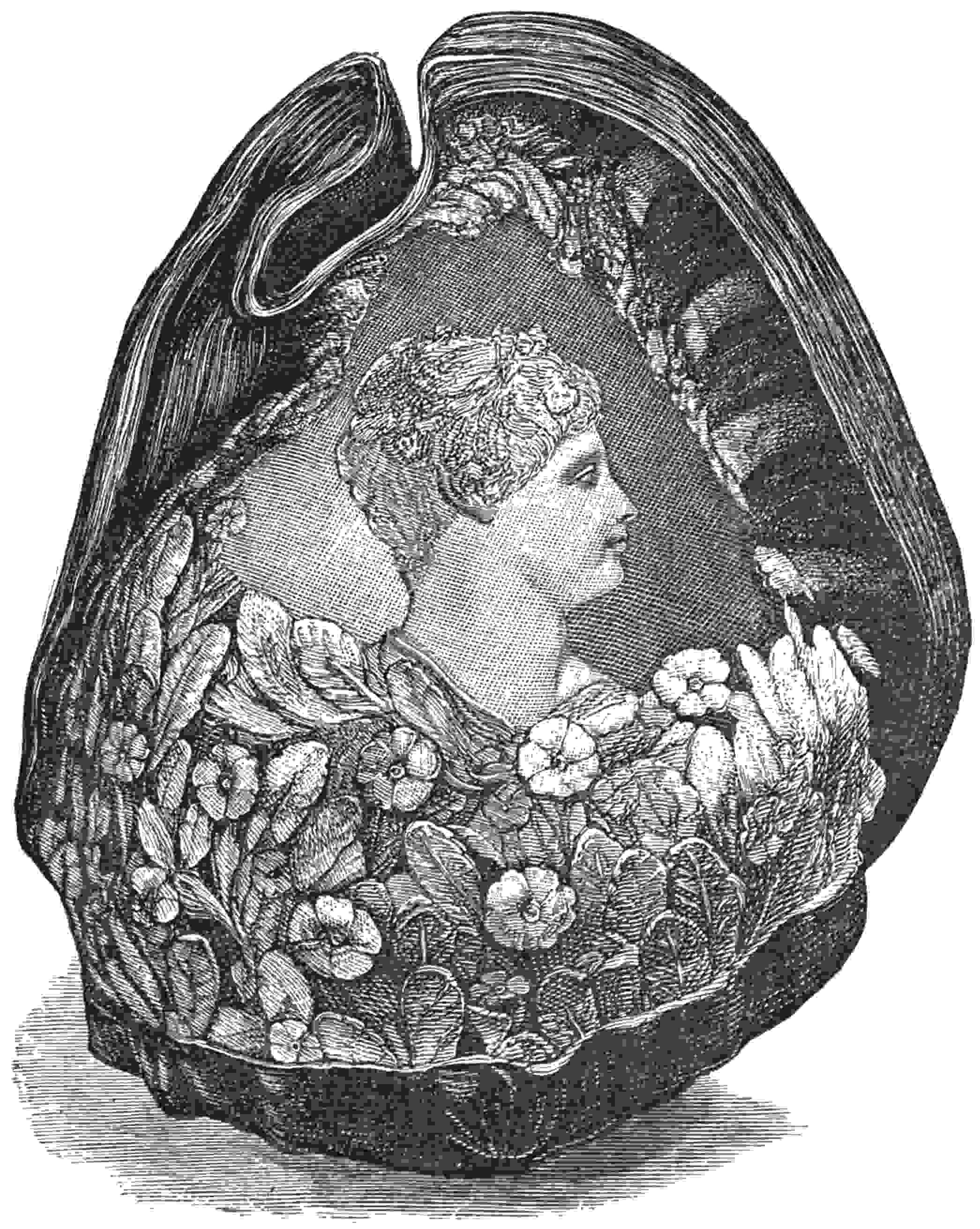
A Primrose Shell,
By Signor Giovanni.
DARTON’S MANUALS FOR HOME WORK.
BY
John B. Marsh (signature)
AUTHOR OF
“The Reference Shakespeare,”
“Venice and the Venetians,”
ETC.
LONDON:
WELLS GARDNER, DARTON, & CO. 2 PATERNOSTER BUILDINGS, E.C.
AND 44 VICTORIA STREET, WESTMINSTER, S.W.
1890
Dedicated [BY GRACIOUS PERMISSION]
TO
HER ROYAL HIGHNESS THE PRINCESS LOUISE,
MARCHIONESS OF LORNE,
WHOSE INTEREST IN TECHNICAL EDUCATION
IS
GRATEFULLY ACKNOWLEDGED.
INTRODUCTION.
The art of cutting Cameos in shell is of so very
recent birth, compared with that of working in
precious stones, that a claim to consideration in
setting forth the method and practice may justly
be preferred. Yet my little treatise, which is
based upon practical experience, has been found,
even in more limited form, a sufficient guide for
the practice of the art, by a large number of
amateurs in England, Wales, and Switzerland, to
produce good work; these were all of them skilled
in the use of the brush, the pencil, or the chisel.
To all similarly proficient in any department of
art, Cameo-cutting will be found a pleasant and
interesting employment.
The discovery of the adaptation of the Conch-shell
to the art of the Cameo engraver is traceable
no farther back than the beginning of the reign
of Her Gracious Majesty the Queen. The working
of Cameos in precious stones, however, goes
back beyond the earliest historical records; history
contains no reference to the beginning or progress
of the development. Tradition declares that the
art was of Asiatic origin, and that it was practised
by the Babylonians, from whom the Phœnicians
carried it into Egypt. Thence the progress
of the work is clearly traced to Greece and Italy,
and in our own time to France and England.
Those who have practised Cameo engraving in
England may be numbered on the fingers of one
hand. But it is not with the carving of precious
stones this handbook deals, but with the youngest
of all the processes discovered in connection with
the production of the Cameo, that of working the
beautiful Conch-shell.
The use of this shell for the purpose of Cameo-cutting
was first practised in Italy, about the
year 1820, and it was then believed to be of
Sicilian origin. For many years all the shells
used were exported from England, and the number
averaged about three hundred per annum; these
were valued at 30s. each. They soon became a favourite
medium in Rome with the workmen, and
the art was taken thence to Paris, where it flourished.
In 1847 the sale of shells was reported to
have reached 100,500, and their declared value was
£8900, while the Cameos which were produced
were estimated to be worth at least £40,000.
The prices of shells have since been very much
reduced owing to an increased importation, so
that shells of great beauty may now be purchased
for 10s.; while they may be had in quantities as
low as 1s. 6d. each. Choice black shells, however,
still command a higher price.
The colour of the ground in these shells varies
from pink and orange to an absolute black:
this is called the Black Helmet (Cassis Tuberosa),
and comes from the West Indian Seas. The shell
with a pink ground is called the Queen Conch
(Strombus Gigas), and is also brought from the
West Indies. A favourite variety is the Bull’s
Mouth (Cassis Rufa), found in the East Indian
Seas, which has a sard-like ground. Another
class is the Horned Helmet (Cassis Cornuta), which
is brought from Madagascar; in this the ground
is dark claret in colour. Occasionally shells are
made use of having three layers, the upper, always
dark-coloured, serving for the hair, or a wreath,
or for armour; the second layer, which is always
white, is used for carving the figure; and the
third layer is the ground.
Messrs. Francati & Santamaria,1 of Hatton
Garden, were the largest and almost the only
dealers in shells for Cameo work in the Metropolis,
and they cut them up to the exact size
required for engraving. I have seen in their
cellars many thousands of Conch-shells brought
from foreign seas for the purpose of being cut up
for export to Italy or Paris. Mr. Santamaria,
upon one occasion, showed me a magnificent
Black Helmet shell, which he said was the only
one that had been discovered out of about ten
thousand. A shell of ordinary size only produces,
on being cut up, three or four large workable
pieces, and these are worth from 3s. to 5s. each;
but the Bull Mouth, of small size, may be purchased
for a shilling. A face or figure engraved
upon a shell looks well, particularly when the
taste of the artist enables him to cover every
knob with figures, and form an appropriate border
of leaves round the whole; even the circles round
the apex of the shell lend themselves to ornamentation,
and shells carved all over are much
sought after. An experienced workman will
often employ his leisure in covering a large shell
with work in this way. In the centre he places
the principal design, always a classic figure or
group of figures, and around, such ornamentation
as his taste approves. One of these, cut in Hatton
Garden, was sold recently for a hundred guineas;
and another, almost entirely cut by Mr. W. King,
a young Englishman then in the employment of
Messrs. Francati & Santamaria, sold for £80.
The most celebrated Cameo engraver of modern
times was Benedetto Pistrucci, who designed the
“George and Dragon” of our coinage, which is
acknowledged to be the finest work that has ever
appeared in modern currency. Of himself he
says that he was in a manner born to the work he
took up from choice, and he mentions in proof of
this that he had square thumbs, and the palm
of his right hand was covered with horny skin.
This had been a characteristic with certain of the
males in the family for several generations. He
was the son of a judge, and was born at Rome in
May 1784. His eldest brother was a painter,
and every member of the family was endowed
with artistic tastes. Italy, in his youth, was
overrun by the French, which caused his parents
to make frequent changes of residence. At fourteen
years of age, being then proficient in drawing,
he was first put to a master, one Signor Mango,
who, perceiving his genius, employed him to make
designs for his Cameos. This provoked much
jealousy among the other workmen, one of whom
stabbed Benedetto with a dagger. During his
illness he amused himself by modelling the figures
he drew, and so perfected himself in the stages
necessary for becoming a thorough artist; less
than this in training will only make a workman.
Upon his recovery he was sent to two masters
in succession, the second of whom, noticing the
superiority of his designs, exclaimed, “With one
who has genius there is very little for a master to
teach.” At sixteen years of age he began work
on his own account; and, after a brief courtship,
at eighteen years of age, married a girl of sixteen,
of gentle family. There were born to them two
daughters, Victoria and Eliza, and one son, Vincenzio.
Eliza and her brother were endowed
with the paternal characteristic, a horny palm,
and became celebrated as workers in Cameo. At
twenty-four years of age Benedetto had succeeded
in establishing a reputation as an engraver of
precious stones, having taught himself the process,
and constructed with his own hands the
wheel with which he worked. For several years
he had sold Cameos worked in stones to one
Angelo Bonelli, a travelling dealer in gems; and
discovering one day that a specimen of his work
had been stained to represent an antique, and
sold for a high price, he resolved for the future to
place a secret mark upon those he sold. On one
of these, the head of Flora, he cut two Greek
letters in the hair. The condition of Italy at
that time induced him to consider the advantage
of proceeding to England; but before emigrating
he executed several orders for one of Napoleon’s
sisters, one portrait being cut in stone, much
smaller than a fly. Pistrucci brought to London
a letter of introduction to Mr. Konig, mineralogist
of the British Museum, and by Lord Fife he
was introduced to Sir Joseph Banks. The latter
afterwards introduced him to Mr. Payne Knight,
who produced at their interview what he called
the finest Greek Cameo in existence, a most choice
gem, a fragment of the head of Flora, for which
he had paid Bonelli 500 guineas. Pistrucci did
not even take the stone from the extended palm
of Mr. Knight; a glance disclosed the fact that it
was that head of Flora in whose hair he had cut
two Greek letters, and for which Bonelli had
paid him £5. An unpleasant scene resulted.
The letters were plainly visible; but Bonelli,
realising that his trade was at an end, boldly
denounced Pistrucci. He pointed to the wreath
of flowers about the head in proof of his conceit
that it was an antique, asserting that no such
flowers were then in existence; but Sir Joseph
Banks, examining them with a microscope, exclaimed,
“The flowers are roses, as I am a
botanist!” Pistrucci offered to carve another
Flora exactly similar without looking again at
the “antique.” This challenge was not accepted.
Then it was agreed that he should cut a head of
Flora in a different position, and this was accepted
as a test of the truth of his representations. The
story soon spread through London society; noblemen,
scientific men, ladies of rank, watched the
growth of the new Flora under the hands of
Pistrucci, and when it was completed the dispute
raged with increased bitterness, so that Payne
Knight’s antique Flora became the question of
the day. The controversy at length ended with
universal expressions of sympathy for Mr. Payne
Knight.2
This stone may be seen in the Gold Ornament
Room at the British Museum. It is placed in
the case of “Modern Engraved Gems,” upon
which stands the Alabaster vase engraved with
the name of Xerxes, and is in the bottom row
of the case. The face is exquisitely beautiful,
and the roses which are cut in the upper
coloured layer of the stone are perfect. An
attendant will point out this Flora to any one
who asks for it.
Pistrucci upon one occasion, while still residing
in Rome, had an antique pale-brown sard given
him to recut by Domenico Desalief. The subject
was a warrior crowned by a female, but so clumsily
executed as to be of little value. There was,
however, plenty of material to cut away. After
taking an impression in wax, he altered the whole;
then he cut away the knees of the figures, and
recut them higher up, and so remodelled the
design that not a trace was left of the original
forms. The dealer was delighted, and sold the
gem readily for the Imperial Russian Cabinet
of St. Petersburg, where it still remains, and is
regarded as of the highest value.
The dispute about the Flora indirectly brought
about Pistrucci’s appointment to the Mint as
chief engraver, and he designed and executed the
“George and Dragon” among other works. Afterwards
a considerable amount of jealousy was
created by his employment amongst the officers
of the Mint, and the members of the Royal
Academy were divided about his appointment,
one portion insisting that native talent should
be encouraged, the other division holding that he
was the best living engraver. To restore peace,
his appointment was subsequently styled that of
“chief medallist.” He cut two portraits of Her
Majesty in onyx, one as Princess, and the other
as Queen wearing a diadem. On retiring from
the Mint he took a cottage at Old Windsor,
where he died in his seventy-first year, in 1855,
only thirty-five years ago, and recently enough
for him to be well remembered by a few living
men. His connection with our own day, and the
distinction to which one of his pupils has risen,
justify the introduction of his name into this
book. His daughters, before their father’s death,
returned to Rome, where they practised Cameo-cutting
with great success.
Shell Cameos in the Museums.
There are in the collections shown in the
Mediæval Room of the British Museum several
fine specimens of shell Cameos which date from
mediæval times, but these shells were found in
the Mediterranean; and at South Kensington
there are a few specimens of shell Cameos worked
in Rome. The only illustrations of the art of
progressive working in the Conch-shell in any
museum in London are to be seen in the South
Court of South Kensington, where the portrait of
Millais is shown in the several stages of progress,
together with the shell from which the piece
worked was originally cut. These interesting
specimens were presented by Mr. James Ronca,
who was a pupil of Pistrucci’s brother. There
are, of course, many separate specimens of carved
Conch-shells, in whole and in pieces, at both the
British and South Kensington Museums.
Appearance of the Conch-shell.
The shell will be readily recognised without
an illustration. In form somewhat resembling
the human ear, the shell possesses properties
which can be found in no other specimen of the
order. For the purposes of the engraver, the
several parts are called by totally different names,
according as the workman came from Naples or
Rome; but without entering into a discussion of
the origin of these, I propose to give a few plain
names to the several parts, in order to enable a
worker to order the particular piece or portion
which is required. Thus, the several parts are
the back of the shell, the back of the Lip, the
Dome, and the Comb, the Mouth of the shell, the
Lip, and the Face or Body.
The piece in the upper portion of the Dome
is the most valuable, because in that there is no
variation of colour. Pieces cut from all other
portions of the shell vary slightly in depth of
colour, the colour deepening in tone as the mouth
is approached. A piece suitable for a brooch cut
out of a Black Helmet would be worth 5s.; but
with regard to other shells the prices vary as set
out in the following list. Other portions of the
Dome are used for brooches; but the choicest
piece is the one named. The Comb, having been
cut off, is cut up into separate knobs, and these
are worked into heads which are required to
stand out in bold relief. The back edge is rarely
worked, and may be regarded as waste. The Lip
is the next important portion, and this is suitable
for the carved handles of paper-knives, for
umbrella-handles, or for paper-weights. A full
length figure of classic form may be carved in the
Lip, with admirable results, so as to command a
high price. The Lip is perhaps more frequently
cut into pieces between the raised edges which
run at right angles to the course of the mouth,
and are used for carving fish or birds, or any form
requiring a portion in high relief. When the
Dome has been cut through, a second shell appears
immediately below, and this is remarkable for
having three distinct layers, brown or red forming
the surface, white the centre, and brown or red
the ground. Such a piece is necessary where the
design involves ornaments in the hair or a helmet
on the head of a warrior.
The shell is cut open by means of a tin wheel
revolving on a spindle in the ordinary way by
means of a treadle. Above the wheel is a sloping
dish coming to a point on which emery powder
lies, and above the tray is a small keg of water
regulated by a stop-cock, in such a way that
as the water trickles down the pan it carries
particles of the powder on to the wheel. The
workman first cuts off the Lip, then he cuts
across, above and below the Comb, and finally
cuts down from the point of the Dome to the
Comb again. This triangular piece is cut up into
as many portions as are required, care being taken
first of all to cut out the choicest piece from the
upper portion.
Adaptability of the Art.
The practice of the art of Cameo-cutting solves
to a certain extent one aspect of the great problem
now puzzling the most astute minds—how to
find remunerative work for skilled hands. Here
is a field at present quite unoccupied—an industry
admirably adapted to thousands already trained
in the requirements of art, and only needing the
suggestion to enable them to realise the fruit of
years of industrious and patient study. In this,
as in all other artistic occupations, there must be
a groundwork on which to ensure success. Any
one ignorant alike of the principles of drawing
or modelling or carving can never become proficient
in the art of Cameo-cutting, though by
patient labour success may be obtained as a
copyist, and the worker be able to cut geometric
patterns, flowers, and coats-of-arms, which would
command a ready market. For the higher successes
attainable by a Cameo engraver, the position
of a true artist, whose work would be
recognised by the form of a hand or the modelling
of an eye or an ear, there must be a previous
knowledge of drawing, with skill in modelling
and ability to carve.
Nothing less than a first place should content
the Cameo-worker. The age is one which is
eminently suitable for the growth of the profession.
Drawing has for many years been taught
in Schools of Art on scientific principles, and
pupils have proceeded from drawing to modelling,
to carving in wood, or to painting in water and
oils in these schools, until a point of excellence
has been reached thought impossible before they
were established. Even in the rate-sustained
Board Schools children of tender years are taught
to draw with surprising accuracy, and such of
them as take pleasure in their work might very
easily learn how to cut simple forms suitable for
buttons or bracelets. The only thing they would
have to acquire would be the use of the graver,
following upon the work of the pencil. Nor is
this an exaggeration, because two little girls of
eight and ten, from watching their father at
work, actually fashioned little vases and hearts in
pieces of shell by using fine files. From children
as inexperienced as these, and from such an
elementary knowledge of drawing as the School
Board imparts to the young, up to the most
experienced artist,—the gold medallist, the born
genius with pencil or chisel,—there is enough in
Cameo-work to supply scope for all—enough to
gratify the child’s wish, and the larger ambition;
and, beyond the choicest specimen of art in
existence, enough to leave still greater triumphs
to be realised by future workers. By the practice
of this art no industry at present in existence in
England would be injured; but, on the contrary,
many industries, such as those of the workers in
silver and gold, the wood-carver, and the cabinet-maker,
would receive fresh development. The
present generation has never been in a position to
consider this industry as one attainable by the
people until the present time; nor would the
Cameo supplant any artistic article at present
enjoying public favour. Cameos may be carved
small enough to adorn a lady’s ring, a gentleman’s
shirt-stud, or a pin. They may be mounted for
bracelets, or act as pendants, or brooches, or be
used for hairpins, for buttons to fasten back the
vest, or for jackets; as solitaires for the shirt, or
for sleeve-links. In the style of ladies’ dress now
worn there would be an unfailing demand. They
may be fixed in articles of ornament for the desk
and table, inlaid in vases, caskets, or dressing-cases;
framed in the carved overmantel, inserted
in the backs of chairs, inset in curtain bands; or
mounted on altar crosses, set around Communion-cups
or in alms-dishes, or worked into marble
memorials of the dead; or they might be inlet in
the bindings of books. From the variety of their
ground—ranging from pink, through every shade
of brown, to an imperial purple, and a magnificent
black—there is no marble, metal, or wood
with which the Cameo would not harmonise. In
the course of a conversation recently with one
of our Princesses, who is a patron of art,
this point was dwelt upon, and the suggestion
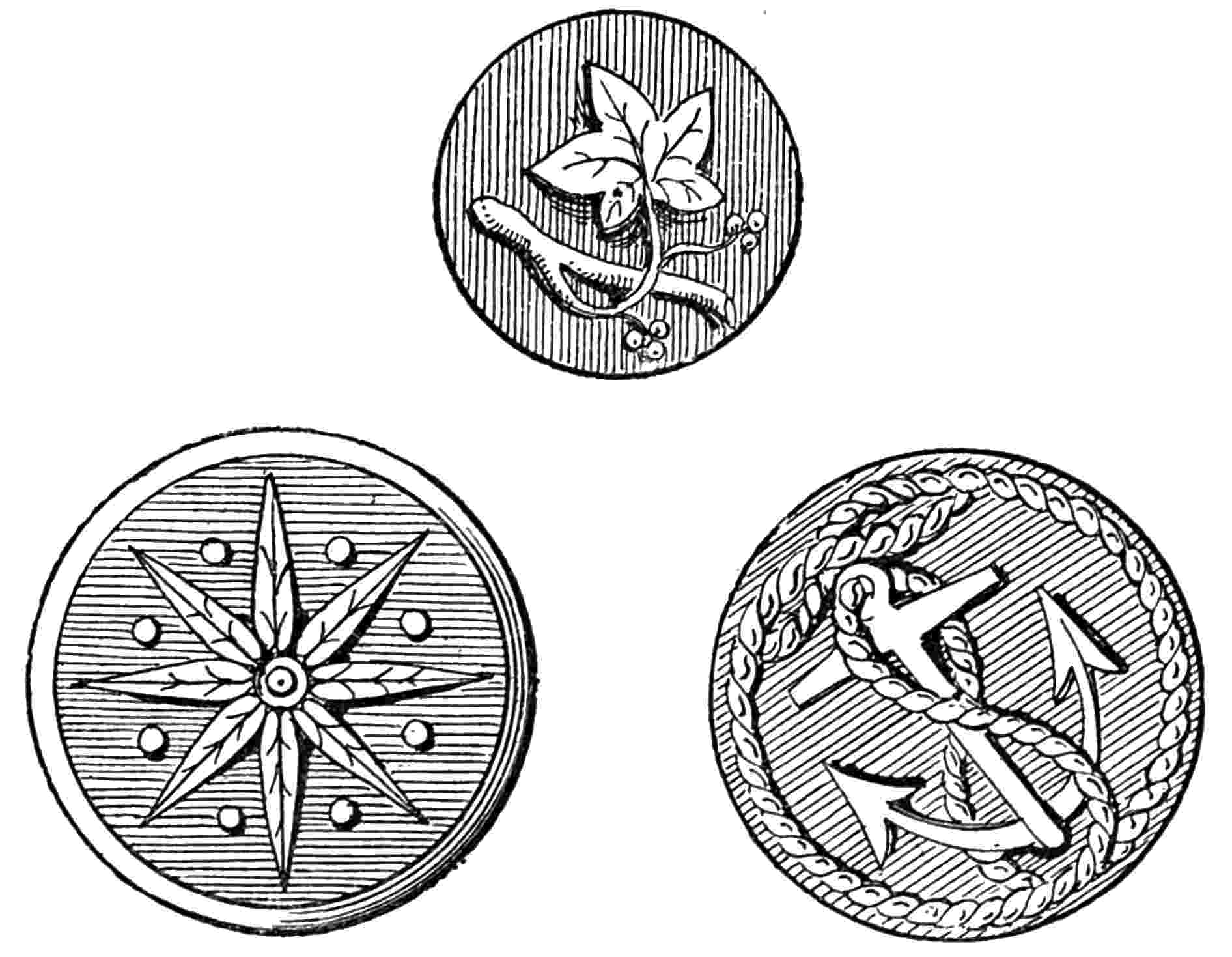
was made that an anchor carved in shell would
make an appropriate button for a lady’s yachting
costume.
Cost of Pieces of Shell.
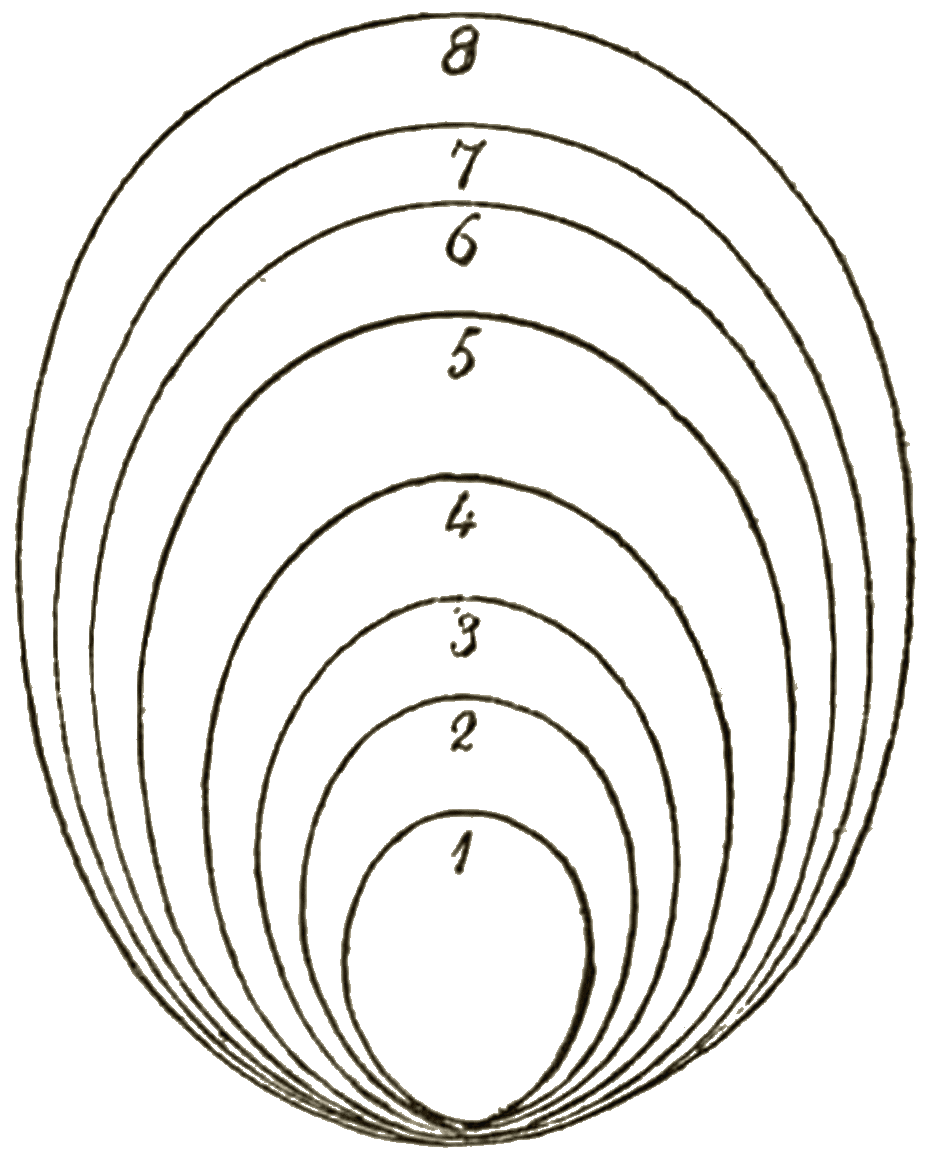
The cost of ordinary pieces of shell per dozen
may be ascertained by reference to the following
diagrams:—
Fig. 1.—Different Sizes of Pieces.
Nos. 1 and 2, suitable for small and large ear-rings,
3s. per dozen; No. 3, bracelet size, 4s.; No. 4,
larger bracelet or small brooch, 6s.; No. 5, large
brooch, 8s.; No. 6, 10s.; No. 7, 15s. to 18s.,
according to the colour; No. 8, 2s. 6d. to 3s. 6d.
each.
The importers of these shells would make up a
dozen of various sizes if required. Great care is
necessary in selecting pieces suitable for working
in order to avoid (1) the mark of a worm left in
the early growth of the shell; (2) patches of
decayed shell; (3) a tendency to chip, termed
“flaking.”
Carved Pumice-stone.
An experienced Cameo engraver recommends a
beginner to procure pieces of Pumice-stone, which
may be readily obtained, and begin by carving
in this substance. The stone is much softer than
the shell, and can be very easily shaped; and the
colour lends itself to very beautiful effects, but
the surface being very soft, the fine work soon
disappears. As an intermediate step to the
carving on the Conch-shell, the Pumice-stone
may be strongly recommended.
Mounting Pieces of Shell.
When it has been determined to carve a piece
of shell, the first thing to be done is to mount it
upon what is technically known as a Stick. Get
the handle of a broom, cut off five inches, and
cover each end with cement made of a mixture of
tar and resin. This may be procured at any oil-shop.
Ask for a cake of cement, and you get a
square for a 1d. which would suffice for twenty or
thirty pieces of shell, or you may buy a pound
for 6d. or 8d. Melt the cement as you would a
piece of sealing-wax, cover each end of the Stick
with the melted stuff, so as to form a bed; wet
the under part of the shell, and press it into the
cement. This will hold the piece firmly while it
is being worked. By mounting a piece of shell
on each end of the Stick, there is the advantage
of working upon two patterns at the same time,
or of cutting the same pattern twice, improving
upon one by the experience obtained in cutting
the other.
In selecting an oval piece for working, care
should be taken to get one without flaw. This
is a difficult matter, and requires a great deal of
experience. Beginners should select pieces tolerably
smooth; but practised workers prefer those
which are irregular in their surface, because they
furnish more scope for the exercise of their skill.
In cutting these, the design follows the convolution
of the shell. It is dangerous to lower any
one portion, because the white surface does not preserve
the same relative thickness all over the piece;
and unless care is taken the ground will show
through. This is not a disadvantage in the ear
or the neck, but would be serious if it was apparent
on the forehead or in the cheek. A skilful
Cameo-cutter will, however, so arrange his design
as to produce the blush of the ground in such
portions as to enhance the value of his work. In
drawing the face, avoid, if possible, the rough,
rotten-looking patches. These are signs of decay
which may only be superficial, and disappear at
the first cut; but, on the contrary, they are more
likely to penetrate deeply, and may necessitate
the lowering of the whole face before they can be
got rid of altogether.
Sometimes, when the face has been modelled,
and nothing remains but the finishing, a crooked
line appears, which Cameo-cutters believe is caused
by the presence of a worm in the early development
of the shell. This is very difficult to get
rid of; hence extreme care is necessary in selecting
the piece for working.
A third fault is “flaking,” when, by a single
cut, the whole of the forehead chips off, or half
the nose disappears. There is no remedy then;
the whole face must be cut in low relief, or the
piece be thrown aside altogether; the latter is
often the more preferable course. But all these
risks are minimised by experience. Having got
a satisfactory piece mounted, the Stick is held
in the left hand, and the face drawn upon it in
lead-pencil, a little larger than the size actually
required.
If a whole shell is to be carved, care must be
taken in the first instance to cleanse it. To do
this, get a small quantity of muriatic acid and
wash with a brush; this will bring away all the
dirt; then add to some fresh muriatic acid hot
water, immerse the shell for one or two minutes;
then rinse the shell in cold water.
Holtzaffpel, referring to the outlining of the
design, recommends that every portion be left
rather in excess, so that there may be ample room
for improving the outline in finishing off. Be
very careful not to injure the ground, as the
natural surface is superior to any that can be
given artificially.
Drawing the Design.
Beginners should draw the design or figure first
upon a piece of paper, or model it in clay or wax,
and then draw the pattern upon the shell.
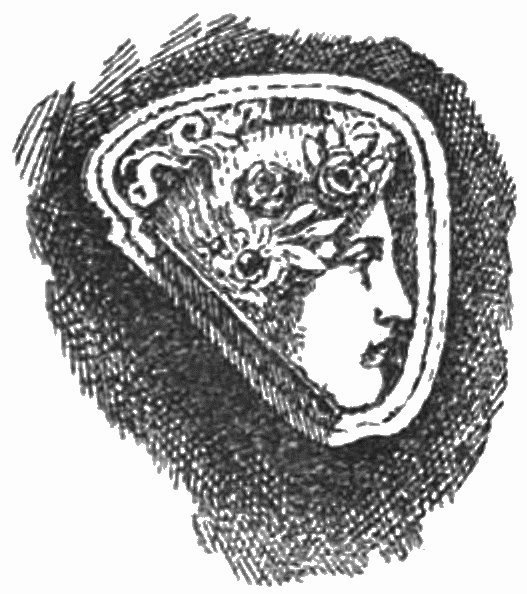
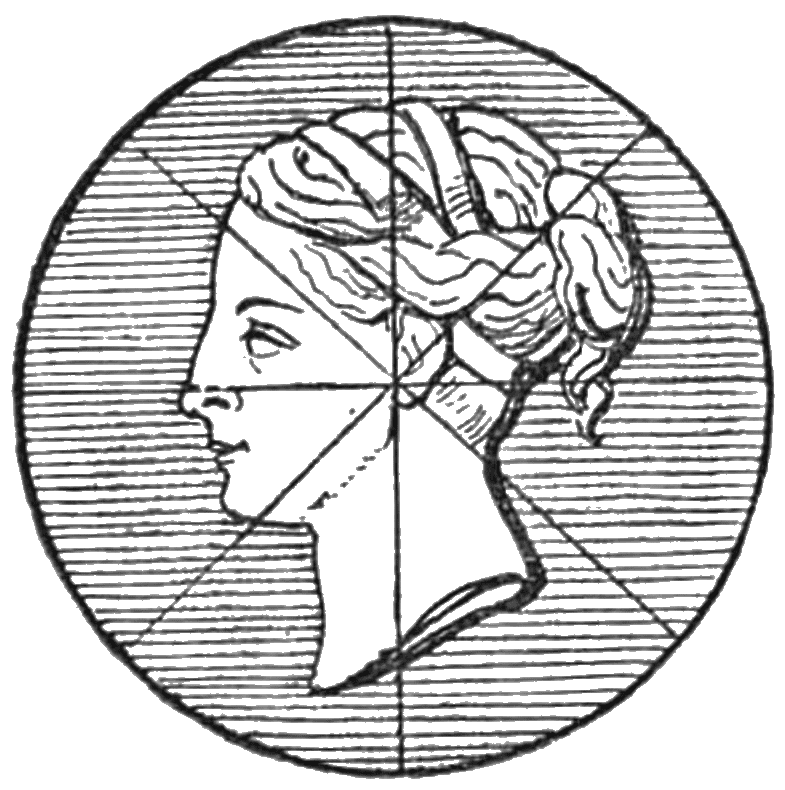
Fig. 2.—Transferring Head to Shell.
If the surface of the shell is irregular, do not
attempt to make it level, but follow the irregularities,
remembering that the white stratum is
of the same thickness all through the piece, and
that if the surface is filed down the ground will
show through, disfiguring the appearance of the
design, and preventing the pattern being modelled
in proper proportions. When the design is settled
upon, copy it on the shell with the help, if necessary,
of a star, as in the head (Fig. 2). Draw the
outline slightly larger than the design, so as to
allow of the proper proportions being secured on
cutting. Skilful Cameo engravers never use a
pencil, but sketch the desired outline with one or
other of the cutting-tools; and many of them
could not draw the figure on a piece of paper
which they readily cut with their tools.
The Tools.
There are at present none specially made for
the use of the Cameo engraver in England, but
all that are required may be selected from those
kept in stock for the use of engravers.
Mr. G. Buck, 242 Tottenham Court Road,
London, W., keeps the tools most suitable for
Cameo-work separate, and can supply them on
request. They are of two kinds, round and flat
Scawpers and Spit-stickers, and cost, handled,
3d. each. To these may be added a Fine File, and
the stock is complete, exhibiting in this respect
a striking contrast to the price of tools necessary
for practising many other useful arts. The Round
Scawpers are used for first cutting the figure and
developing the several parts, the Flat Scawpers
for smoothing the work, and the Spit-sticker for
putting in the finishing touches.
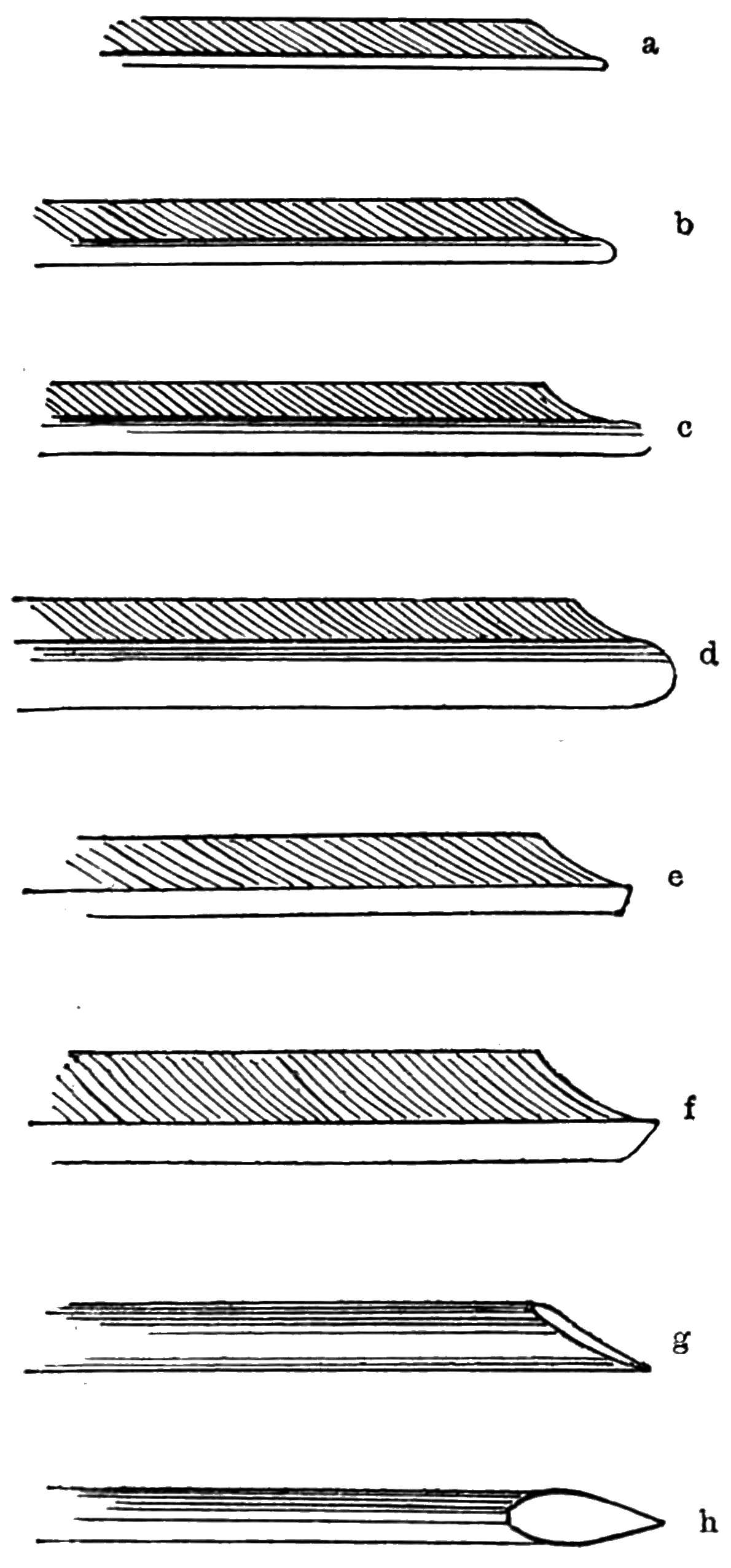
The following diagrams show the exact size of
the several tools:—
Figs. a to h, Tools for Cameo-work.
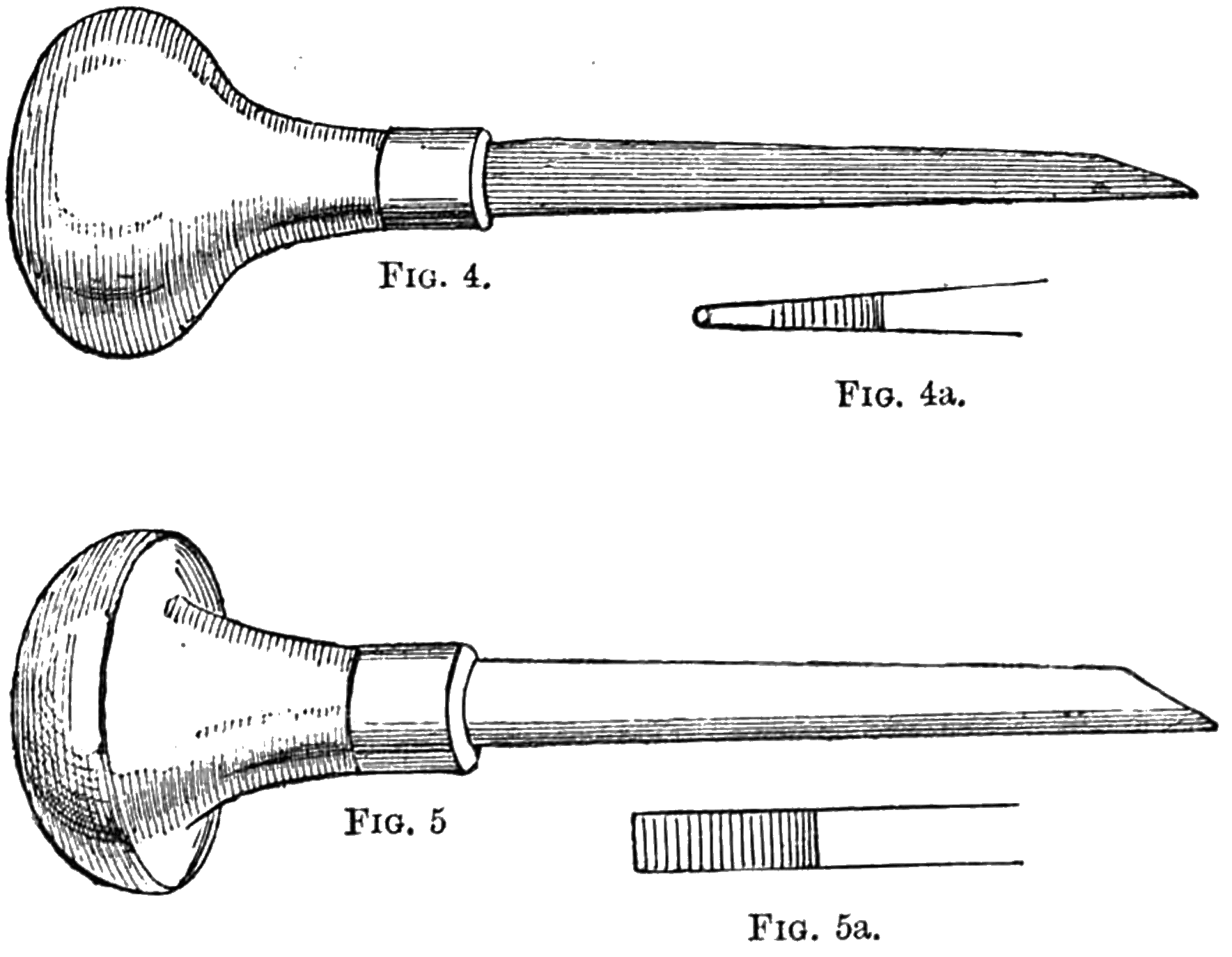
The following diagrams show the Flat and
Round Scawper, handled, and sections of each
(Figs. 4 and 4a, 5 and 5a).
Fig. 4.
Fig. 4a.
Fig. 5.
Fig. 5a.
Handled Tools and Sections of them.
The Use of the Holdfast.
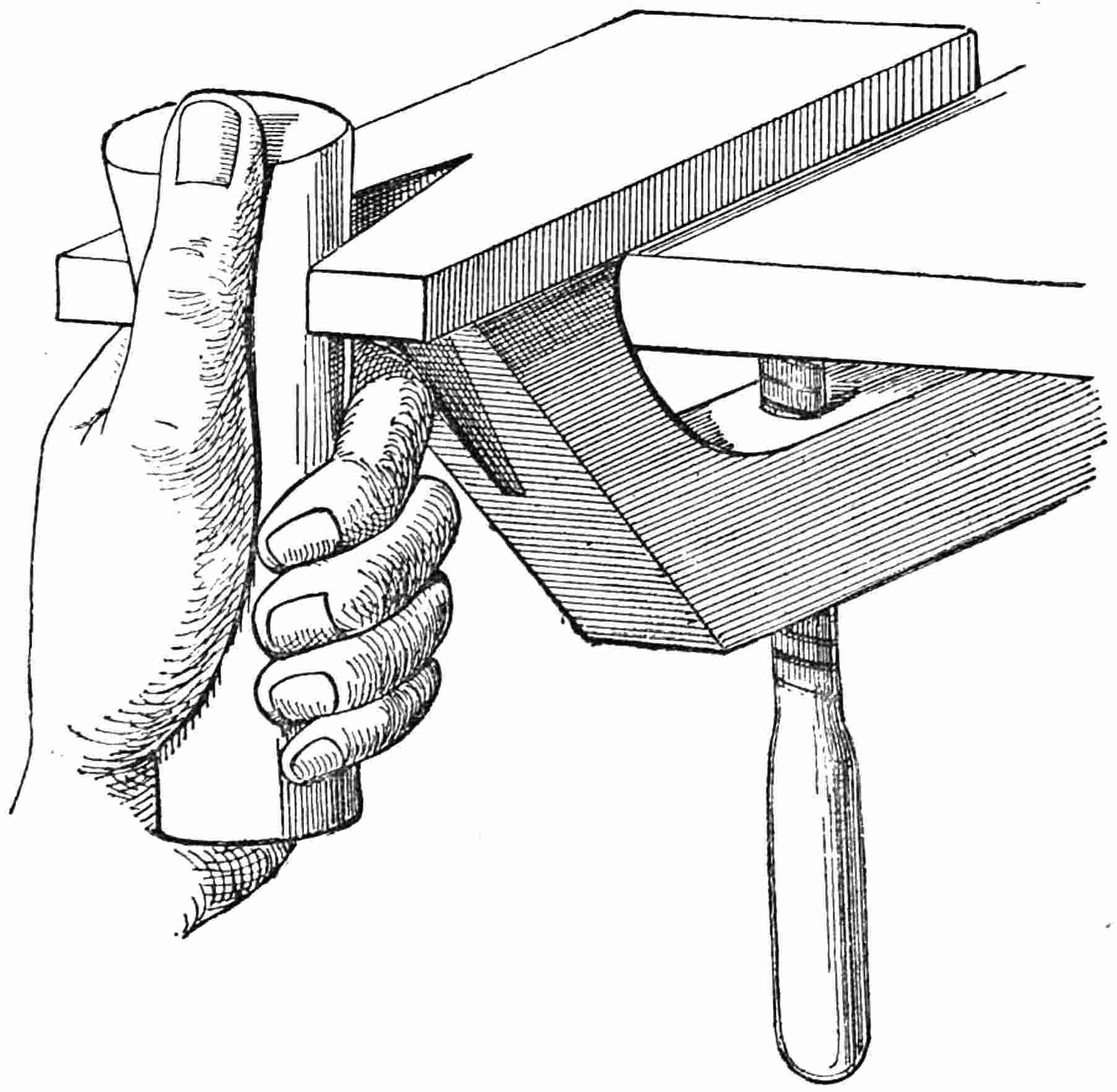
The piece of shell having been mounted on a
Stick, a grip is wanted in which to hold the Stick
with the left hand, while work is carried on with
the right hand. This may be obtained by using
a piece of wood, like that in the illustration (Fig. 6),
and screwing it to the top of a wooden table,
so that the notch is projected a couple of inches
in advance of the edge of the table; or, if no
special table is available, a Holdfast should be
purchased, such as is shown in Fig. 6. This is
screwed to the edge of a table from below, and
fits any kind of table, leaving no mark whatever.
The price of a Holdfast varies from 1s. to 2s. 6d.,
and the article may be purchased at any tool-shop.
A simpler form of Holdfast may be obtained
by purchasing an iron screw-clip, which
may be had from any ironmonger, and getting a
notched piece of wood, as shown in the above cut,
and this is considered preferable by many as furnishing
a steadier grip while work is going on.
Fig. 6.—Holdfast.
Process of Working.
Whatever may be the figure or pattern to be
cut, the process is the same with respect to the
handling of the tools. The wooden handle lies in
the palm of the right hand, and all the power is
imparted by the palm. As the material operated
upon is almost as hard as marble, power is required
to make a cut; but if the tools are well-tempered
and very sharp, a little experience will soon
teach the cutter how to work. The thumb of the
right hand should be protected by a finger-stall
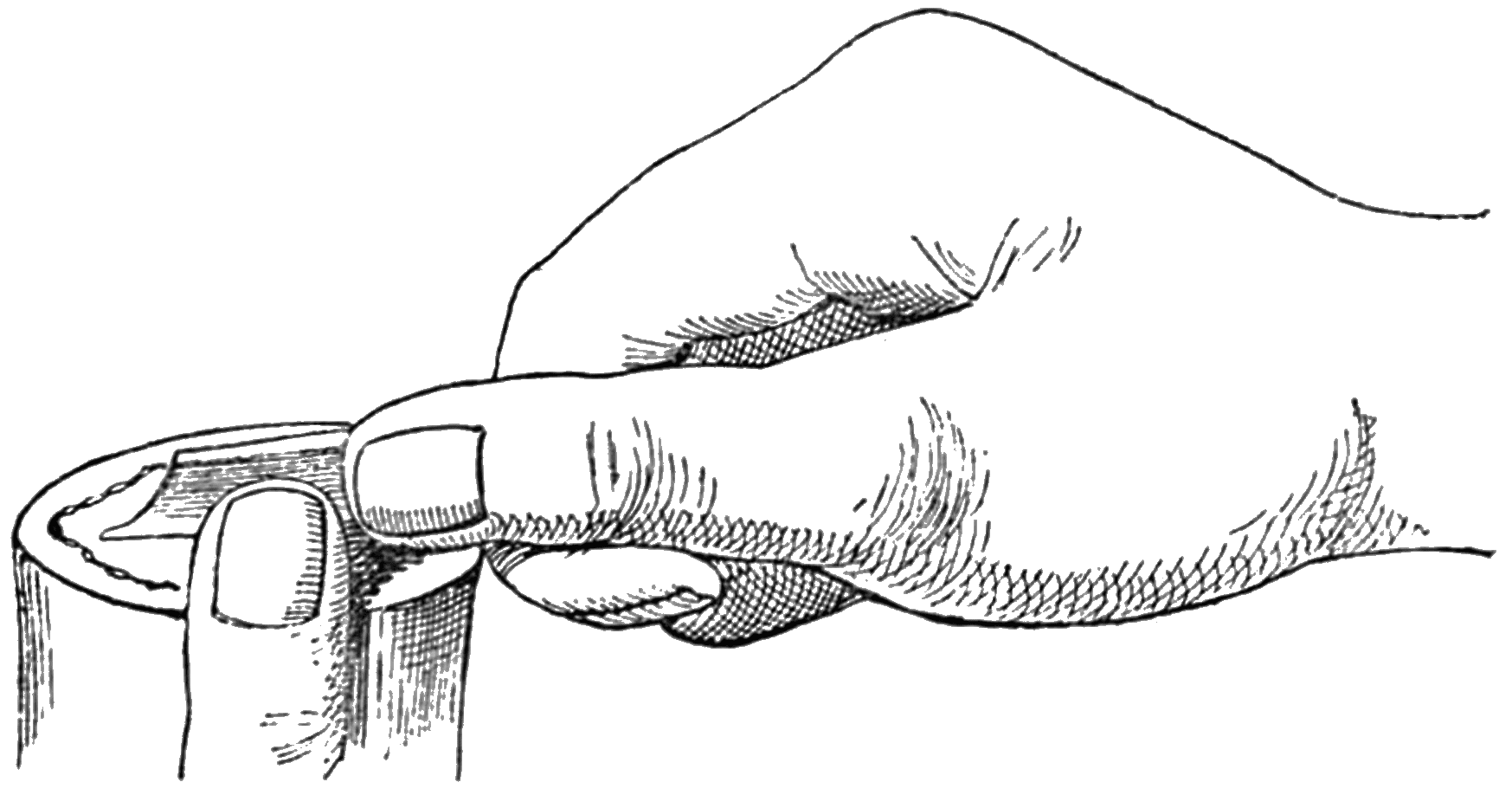
from injury by the edge of the tool. In the illustration
(Fig. 7) the method of holding the stick
is shown in conjunction with the method of holding
the tool. The thumb of the left hand rises
the height of the nail above the top of the Stick;
against this the thumb of the right hand is placed,
which furnishes the necessary resistance to the
power created by the palm of the right hand; the
finger and thumb then direct the cut which is to
be made by the Scawper.
Fig. 7.
Supposing the figure drawn to be a face, cut
outline with tool Fig. A; block out and model
features roughly with D; form ornaments on
head and outline hair with C; develop more
clearly with A and B. The face can next be prepared
with C, by one cut from brow to nose, and
another from nose to chin. With B separate the
hair from the forehead, outline the ear, divide the
mouth and nose from the cheek by an upward
cut to the eyebrow; from the corner of the nose
cut a triangle—this will form the eye. Make
two cuts for nostril and chin; midway between
these another cut will mark the mouth; sink the
neck, outline the collar and dress; the face is then
“roughed.” The eye, nostrils, and mouth are cut
with B, and further developed with A. The hair
is divided into masses with B, separated into
tresses with A, the whole sharply cut with the
Spit-sticker G, and finally smoothed with E and F.
When the whole face has been roughed, it is
interesting to watch a Cameo engraver at work.
With a Scawper in his hand, he makes cuts all
over the face, indents the cheek, smooths the ear,
fashions the nostrils, lowers the nose, works at
the mouth, forms the lips, cuts the chin, rounds
the little triangle which contains the eye, marks
the arrangement of the hair with a cut here and
there, trims the beard, and so passes over the
whole face again and again, bringing every portion
into harmony before finishing any one feature.
After the triangle has been duly rounded, and the
eyebrow formed, a single cut separates the two
lids of the eye, and lowers the eyeball at the
same moment. When the eye is open the likeness
is complete; a portrait becomes apparent
when the nose and mouth are cut, but the fashioning
of the eye is necessary to make it perfect.
The ear and hair play important parts in completing
the face. To fashion the hair requires a
great amount of skill, and the beginner is timid
in making cuts, but is aided in forming the curved
tresses by turning the Stick with the left hand to
meet the Scawper used in the right hand. A fine
Scawper is necessary to cut the whiskers and
beard, and the cuts should be short and curved.
When the whole face has been modelled to
the satisfaction of the worker, the third process
begins—that of Finishing. In this operation the
Spit-sticker plays a very important part. The
upper eyelid is under-cut, which adds very much
to the appearance of the eye; the hair is also
traversed by the Spit-sticker, as well as the beard,
and the tool smooths while it cuts. Finally, a
Flat Graver is used to smooth forehead, cheeks,
nose, and chin, taking out all marks of cuts, and
softening the appearance of the whole. The hand
soon becomes accustomed to the use of the tools,
and the timid cut of the learner is exchanged for
the graceful and vigorous stroke of the artist.
Holtzaffpel impresses upon all Cameo engravers
the importance of cutting all the edges of the
figure quite square from the ground, and not
gradually rounding them down to the surface.
This is effected by under-cutting the edge where
it rests upon the ground.
Fig. A.
Fig. B.Fig. C.
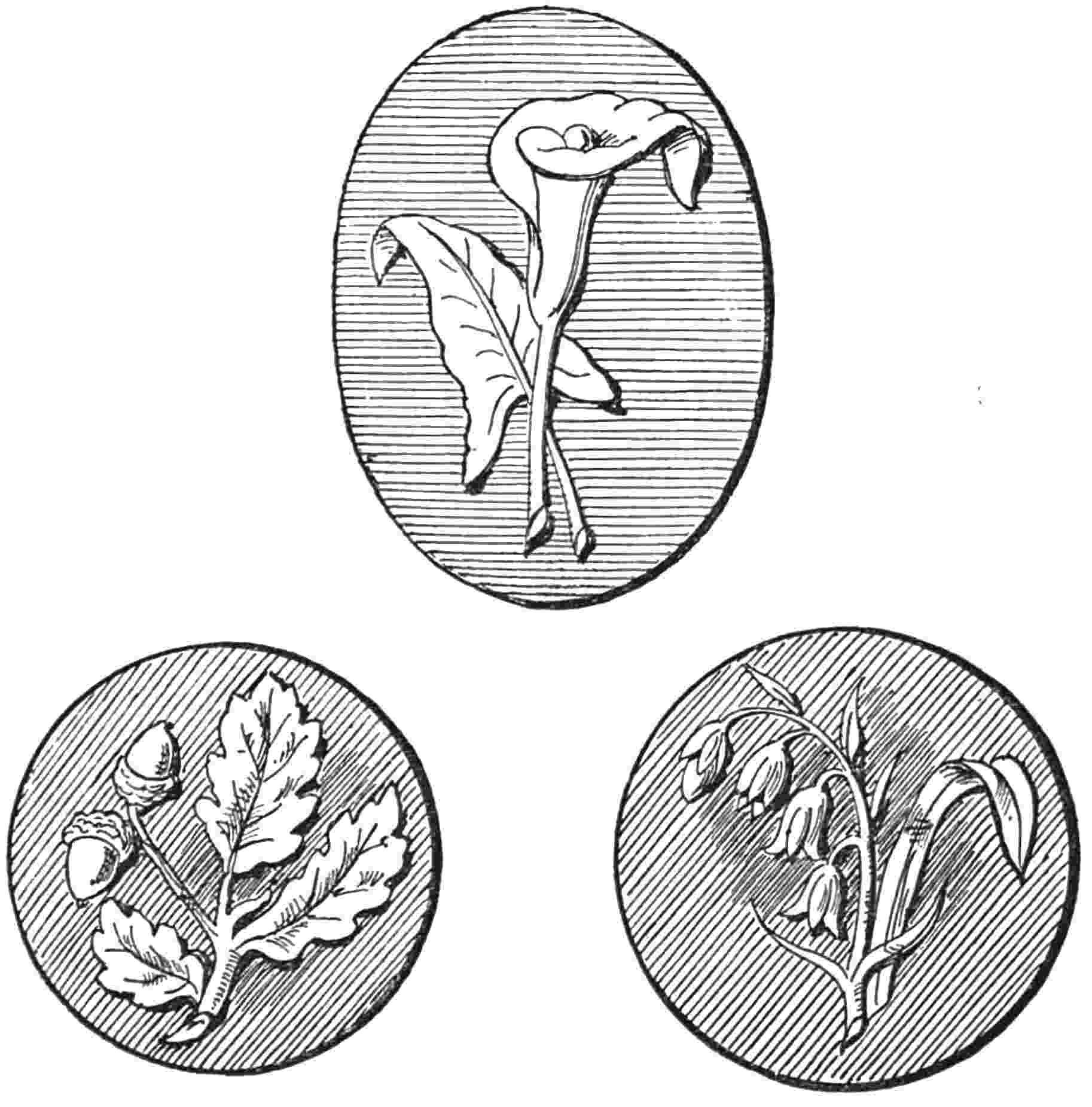
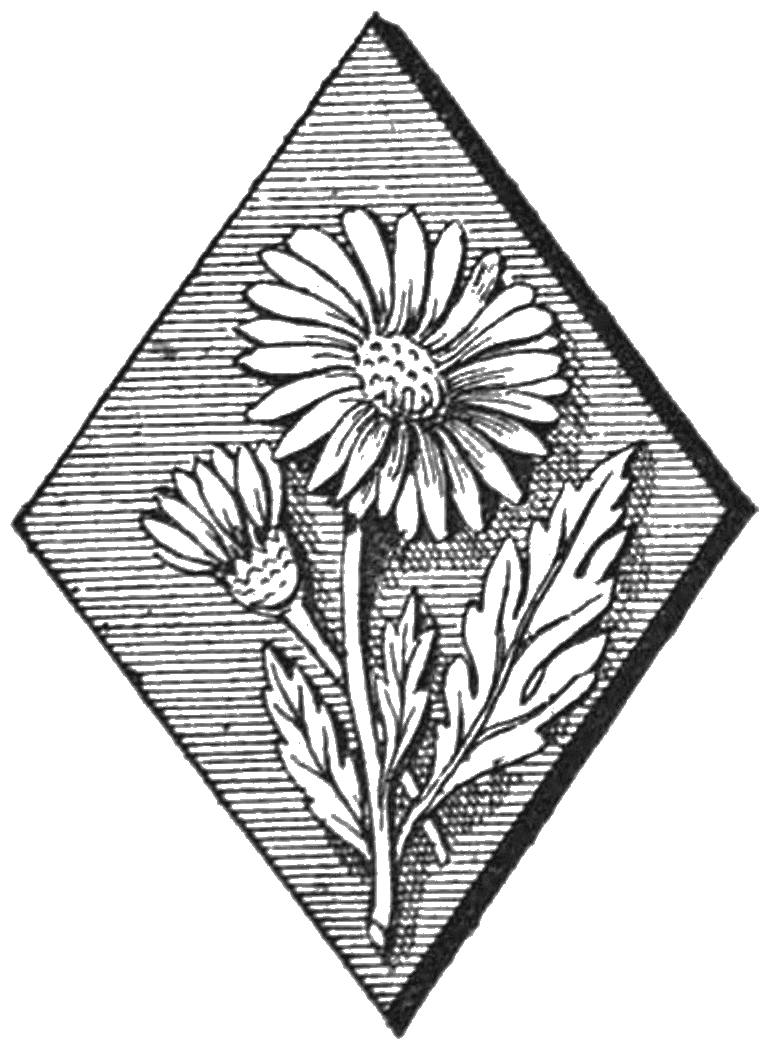
Let the beginner try a few floral outlines such
as shown in Figs. A, B, and C.
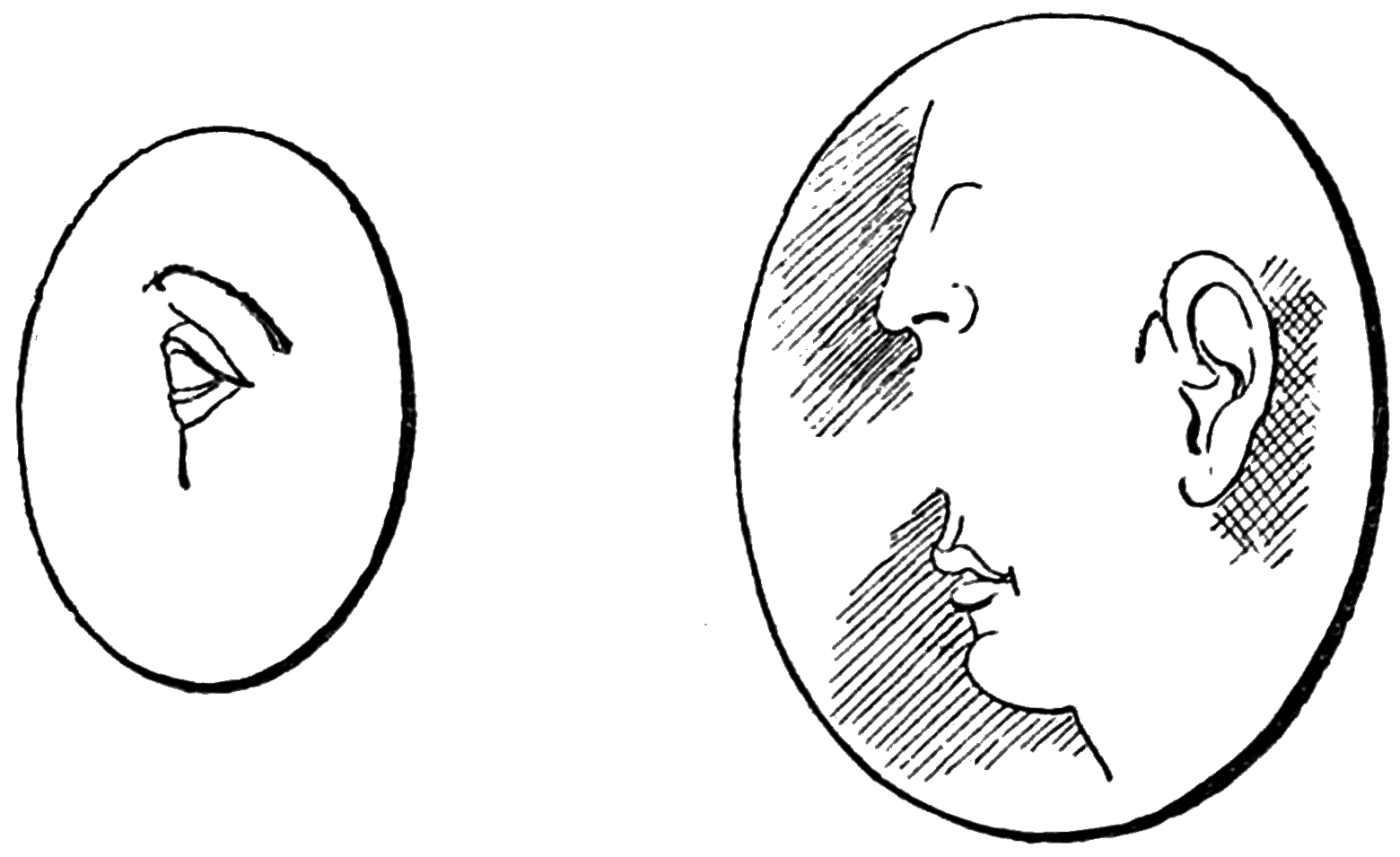
When sufficient progress has been made to
justify attempting to cut a face, the learner
should begin with separate features—the ear, the
mouth, the nose, or the eye, as in the following
sketches:—
Or the features alone, as below:—
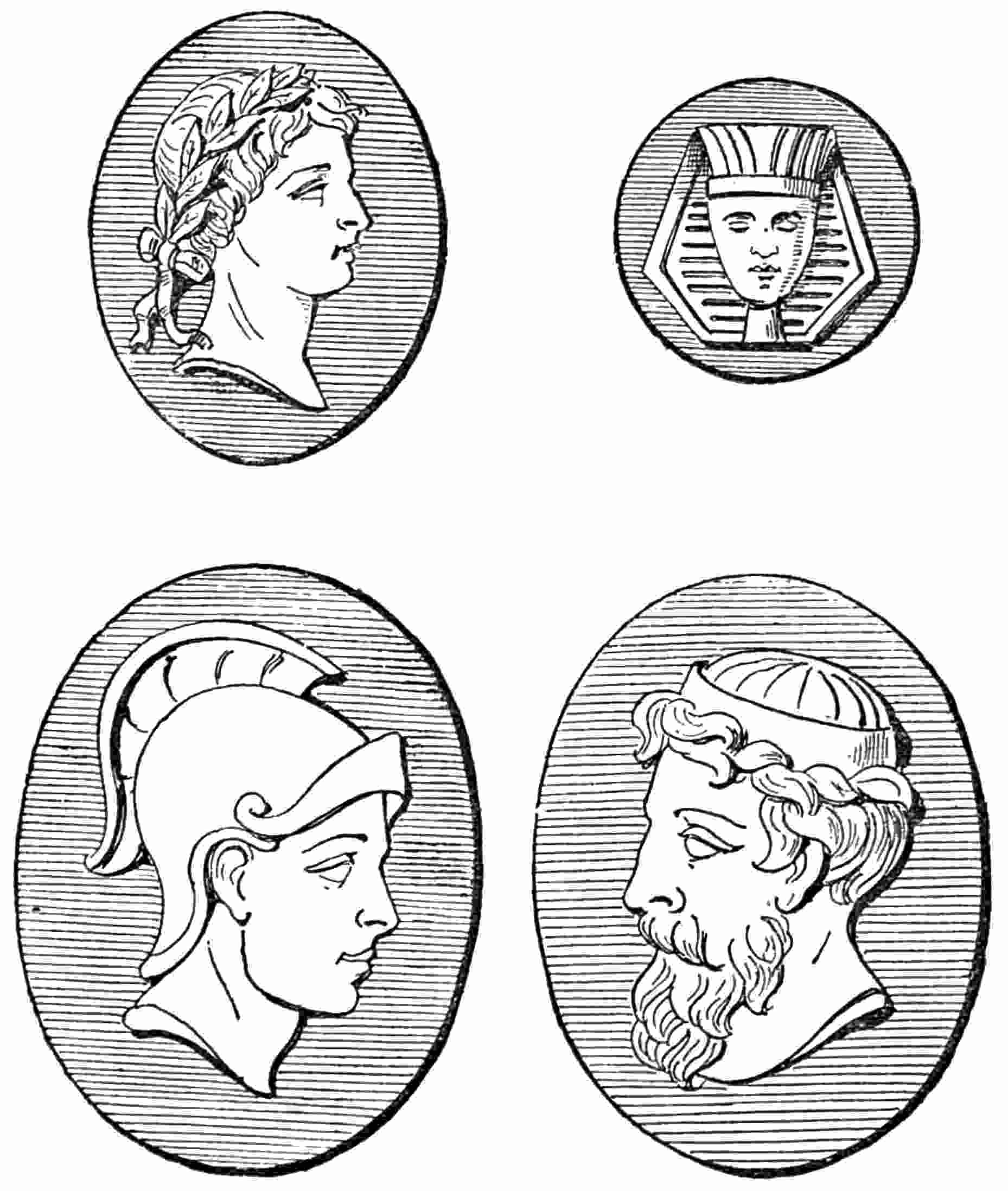
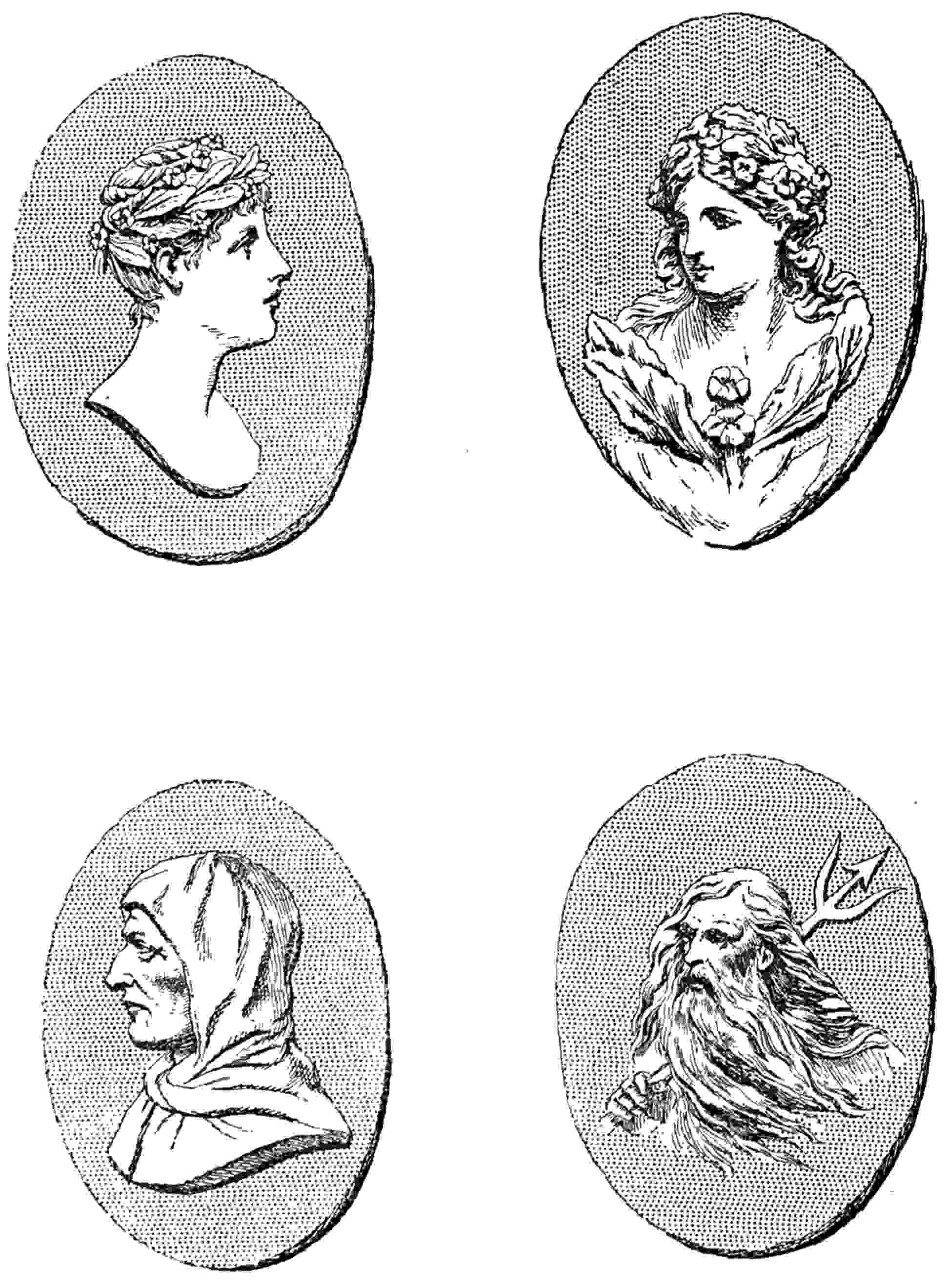
The next stage would be to form a head complete;
and the following would be suitable for
trial. The hair will require a considerable amount
of care at first, but by perseverance all difficulties
vanish; and when the features can be cut to the
satisfaction of the engraver, then a whole face
should be tried where no likeness is necessary.
Before attempting any portion of a face, one
who is learning should first cut a few simple
patterns, such as the following, which would serve
as buttons for the mantle which is worn. The
tools should be used in the order given for the
several processes already mentioned.
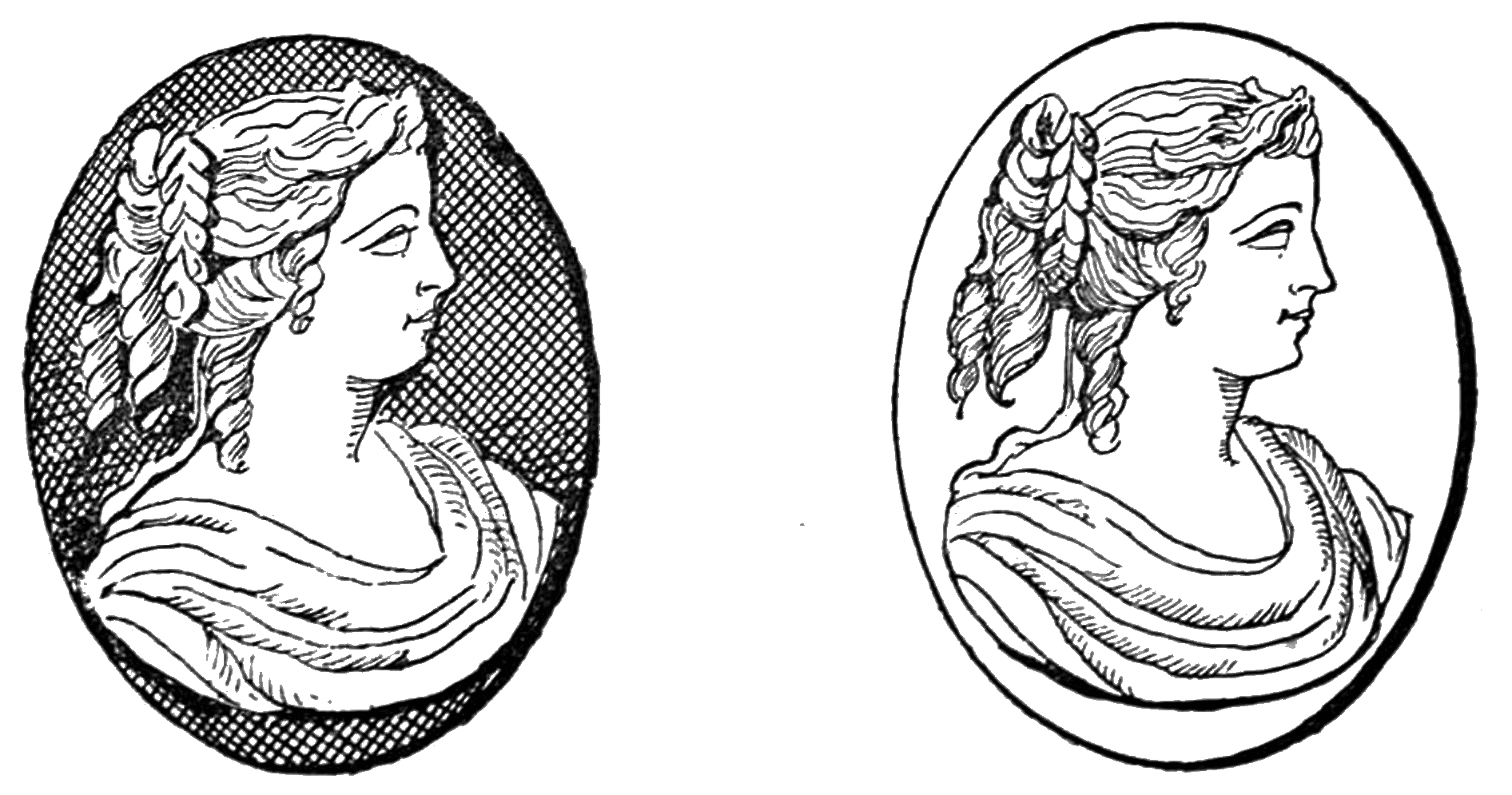
The faces below will give an idea of the effect
produced by the process of “roughing;” and the
same face when finished off.
Roughed.
Finished.
The depth of white upon a piece of shell is
insufficient to cut a face in relief, except for very
small heads, which would be quite beyond the
skill of a beginner. There is a beauty as well as
character in the profile completely lost in the full
face; yet photographers are greatly disinclined to
make a carte-de-visite of the profile.
Working by Night.
If the work is done at night, an Engraver’s
glass is requisite in order to concentrate the
light without glare upon the shell. There are two
kinds of these glasses; one is filled with water
in which sulphate of copper is dissolved, and
clarified with oil of vitriol; the other, which costs
10s., consists of a large green glass eye, which
moves up and down a brass rod, and is screwed to
the required height. This is the better glass to use,
as the oil of vitriol, however much diluted, would,
by the accidental breakage of the globe, cause the
destruction of any carpet over which the liquid
ran. But no glass is required during the day-time,
and no artificial light is equal to the
natural light of day; work should therefore be
confined to hours before dark.
Polishing.
When the face or figure has been finished, the
ground must be cleared for polishing. Great care
must be taken during the work not to cut down into
the natural ground, marks being very difficult to
efface. Use the Round Scawper to remove the
white, and then the Flat tool to remove all traces
of the white. Next cut up a bit of firewood into
small lengths, point each length, and rub the
surface of the Cameo with powdered pumice-stone
and water, then wash with warm water and soap,
with the aid of a nail-brush. With a fresh piece
of wood, rub the ground with pumice-powder and
oil until the surface is perfectly smooth and without
a trace of cut or mark of any kind; wash once
more, then apply the final polish. Take a fresh
bit of wood, and mix on a plate as much dust of
Rotten-Stone as will lie on a shilling, with a few
drops of Sulphuric Acid, forming a yellow paste.
Rub a small portion of the ground at a time, and
remove the paste while still wet; if the paste is
allowed to dry, it destroys the texture of the
ground. After the ground has been gone over,
rinse the Cameo in cold water. To remove the
shell from the Stick, cut away the cement from
the edge, then hold the Stick upright against the
edge of a table, and give it a smart rap with a
small hammer; the Cameo will slip off the top
unhurt.
Sharpening the Tools.
The Cameo-worker should always have a small
oilstone at hand, and a few rapid strokes will
restore the fine cutting edge of his tool, but the
tool must be held the reverse way of working
when applied to the oilstone. Hold the tool with
the cutting edge downwards on the oilstone, at
the same angle as a pen is held for writing, and
move rapidly to and fro five or six times; this
will restore the edge immediately.
Cost of Appliances.
Holdfast or Clip, from 6d. to 2s. 6d.; four
Rounded and two Flat Scawpers, 1s. 6d.; one Spit-sticker,
3d.; one File, 3d.; Cake of Cement, 1d.;
Broom-handle, 2d.; one dozen pieces of Shell,
various sizes, 5s.; Oilstone, 1s. to 2s.
If the cost of the tools is compared with the
expenditure necessary on many occupations to
which thousands devote their talents in spare
hours, it will be admitted that Cameo-cutting
carries the palm for cheapness. When it is
further considered that this may be resorted to
for an hour at any time, and does not involve
the use of any machinery for its pursuit, nor the
exclusive possession of any special table; while
it is absolutely free from any dirt or dust injurious
to furniture, to the carpet, or to the dress;
that it is not trying to the sight, and not attended
with risk to the hands, it must be apparent that
in Cameo-cutting an occupation is presented
which has undoubted claims to consideration.
All who engage in the art become fascinated
by the results which are obtained. Children of
tender years quickly become absorbed in the work,
which not only trains the eye and the hand, but
elevates and corrects the taste. To what more
pleasant use could a child put the knowledge it
has gained at school? But it is not principally
as an occupation for children that Cameo-cutting
should be considered. Between the simple forms
which a child may cut and the classic groups,
such as abound, there is scope for the exercise of
every degree of talent. There are artists in Cameo
now in Rome and Paris whose touches are readily
identified whatever they treat, in the same way
that the strokes of a famous sculptor are recognised.
Decline in the Fashion of Wearing Cameos.
There were two principal causes for the decline
of fashion in the wearing of Cameos in England.
The first arose from paucity of designs; and the
second from the bad workmanship engendered by
overwhelming orders being thrust upon a market
in which only a limited number of operatives
were engaged. With regard to the first cause,
modern Cameo-cutters found no other models
than those which had been handed down from
the times of the ancient workers in gems. The
cutters were copyists merely, not true artists, and
modern taste was not satisfied with the representation
of classic deities, however daintily wrought.
There was no variety in the pose of figure, and
the minutest detail was settled one or two
thousand years before. Thus Apollo, Diana,
Jupiter, Mercury, Sappho, and Venus were represented
in precisely the same manner they had
been a thousand times before, and the Cameo
worn by a noble lady only differed in the quality
of execution from that worn by a greengrocer’s
daughter.
How the sudden demand for Cameos arose it
is difficult to say, but orders were poured into
Paris houses, and the little colony of Italian and
French workers found themselves unexpectedly
flooded with wealth. They were men possessed
of most skilful hands, but very ignorant and
untutored economists, and they worked hard for
a portion of the week only, and too often shut
themselves up in low wine-houses, and with cards
and dominoes whiled away their time. Their
wages were soon exhausted by drink and gambling;
and when masters wanted workmen, they had first
to settle the scores they had run up, for
the payment of which the landlords detained
them. The natural result followed, the quality
of work deteriorated, and prices fell considerably;
then houses undersold each other, and Cameos
were cut at per dozen instead of per piece. When
the Franco-German war commenced the Cameo
trade was at its lowest point, and the outbreak
of hostilities dispersed the major number of the
workers.
Now that the Cameo is again coming into
favour, there has been produced an imitation in
some hard vitreous substance, which is constantly
palmed off as the genuine article to careless
purchasers. I bought two of these imitation
Cameos in a jeweller’s shop for a few pence one
day; they were both mounted and pinned for
brooches. One, which was an imitation stone
Cameo, bore Raphael’s angels—those lovely little
figures which appear at the foot of the “Madonna
and Infant Christ” now in Dresden. This measures
one by one and a half inches. The other
was an oval, measuring one and a half by one
and three-quarter inches, bearing the head of
Ceres, and was an imitation shell Cameo. In
this piece the ground was coloured yellow, and
in exact imitation of a real piece of shell, the
colour increased in depth of shading from the
face to the back of the head. The face only was
white, and the ornaments about the hair, three
ears of corn, five roses, five forget-me-nots, tress
on the neck, and necklet of pearls were in
exact imitation of the well-known face. I have
seen cards on which half-a-dozen “Real Roman
Cameos” were mounted exhibited in shop windows,
and the price asked was 2s. 6d. each. These
scandalous imitations of lovely ornaments will
only be superseded when English workers send
into the market the genuine articles.
Cameo-Cutting Highly Recommended.
The question of the pursuit of Cameo-cutting
as an industrial occupation for ladies was probably
first suggested by Mrs. Henry Mackarness,
the well-known authoress of “A Trap to Catch a
Sunbeam,” who strongly recommended the art of
Cameo-cutting in shell to the notice of ladies.
In an admirable work entitled “The Young
Lady’s Book,” published in 1876, she thus speaks
of the work:—
“It is sufficiently simple to be within the
scope of many who possess taste, patience, and
deft fingers.... It cannot be acquired without
some instruction, and considerable perseverance;
but the instruction is within reach, and
the perseverance will be amply repaid by the
results.” This Cameo-cutting will “give young
ladies a new and elegant pursuit.” It will “raise
their thoughts from knitting and netting, and
cultivate a taste for higher pursuits.... It
can be practised with half-a-dozen small tools
that take up scarcely any room; and, with a little
care and instruction, the art can be readily
acquired. Some knowledge of figure-drawing is
necessary, and a correct eye; and it is needless to
say that the more skilful the artist in this respect,
the better her Cameo-work is likely to be.” The
Queen was the first paper to devote a special
illustrated supplement to the question.
The Lady, the Jewish World, the Housewife,
the Manchester Courier, and other papers as widely
separated in their pursuits and politics, have
urged the consideration of this work upon public
attention.
“In the Society of Arts Journal, eighteen
months ago”—we quote from the Jewish World—“a
paper read by Mr. Marsh before that Society
was published at length, and copied into journals
far and near. Almost at once the work was tried
by ladies who had a knowledge of modelling and
of wood-carving, and the results obtained furnish
the highest possible expectation that in the near
future this fascinating art will find a home
amongst the ladies of England. There is no
machinery required; no dust or dirt is created; there
is no risk of soiling dress or carpet; and it
is not at all trying to the sight; while the prospects
of remuneration are of the brightest possible
character. There are an enormous number of
Cameos worn as pins, brooches, ear-rings, finger-rings;
and the uses to which the Cameo could
be put are infinite—as, for instance, for buttons,
or for insetting into book-covers, or for wall ornaments.
The old fashion was to wear vulgarly
large brooches, with heads of abnormal size, so as
to show as much ornamentation as possible; but
the new fashion is to make them small, and to cut
modern figures, rejecting those classic heads associated
at times with most questionable stories.
Why ever should ladies run after the face of
Venus or Juno? Is there not as much beauty
and infinitely more poetry to be got out of the
faces of Rebekah or Ruth? Why should men
wear Jupiter or Apollo in preference to Moses
or David? Surely all that art can ever impart
would fail to exhaust the tenderness or the grandeur
that could be embodied in one of these faces.”
Mrs. Macfarlane, writing in the Housewife,
September 1888, said:—“It is now suggested
that the industry be taken up in England, as a
remunerative employment for women whose artistic
knowledge already embraces some idea of
drawing and modelling, and who do not feel inclined
to enter the ranks of those who paint well
or indifferently, those little knicknackeries which
it is felt have almost had their day, at least as
far as substantial commercial value is concerned.
Cameo-cutting, in this country, bears the charm
of novelty, is easy to learn, is adaptable to many
uses, and in no way encroaches upon existing
national labour. Cameos representing scenes
from the classics have before now been introduced
into cabinets or boxes, to beautify and make them
more valuable; they may, moreover, be used in
embellishing books and albums. One exquisitely
carved Cameo was shown to me the other day which
represented the face of Christ, and was to be set in
the cover of a devotional book, where I am sure it
would look most beautiful. Then Cameos may be
set in frames to hold photographs on the table, or be
inserted in the backs of chairs, instead of
the painted scenes or sprays of flowers which
were so fashionable a year or two ago. Ladies’
and gentlemen’s trinkets and apparel open out a
wide field for Cameo-work; brooches, ear-rings,
breast-pins, studs, links, and finger-rings, are
very commonly carved in Italy, but are often
made too large for use. Executed finely on small
pieces of shell, they might be rendered more
acceptable and pretty. A special idea which has
been proposed is, that sets of buttons be made
of Cameos for coats, yachting, boating, or other
garments. Designers who could hit upon some
new idea, and carry it out for themselves, might
do a good deal in these and divers other ways
connected with dress. Cloak-clasps, umbrella and
sunshade knobs, fan handles, dressing-cases, hand-glasses,
brush-backs, glove and handkerchief
boxes can be made uncommon and beautiful by
its application.
“Another range in which the art would flourish
is church decoration, for which Cameos are peculiarly
appropriate. There is a purity and, at the
same time, a durability about them, which commends
their use in this direction. How beautiful,
for instance, a frieze of palm-leaves would look
upon a reredos, or a carved lily upon a memorial
stone, or how appropriately a pulpit might be
decorated in Cameo! As I write, ideas for church
adornment crowed into my mind, but as I have
not yet exhausted the resources of Cameo-cutting
in another direction, I must leave my readers to
imagine these for themselves.”
Derivation of the Word “Cameo.”
Much curious interest has been excited with
respect to the derivation of the word Cameo, and
the fact is curious that in that splendid repertory
of all things rare, curious, and of interest, “Notes
and Queries,” the only references to the Cameo
are two in number. One is a question propounded
in vol. viii., series iv., page 528, in which a
correspondent puts the query, which was never
answered, “What is the earliest known example
of a shell Cameo?” The second reference occurs
in vol. iii., series v., in which the derivation of
Cameos is inquired for, and the answer appears in
vol. iii., on page 31. Here Mr. F. Chance, Sydenham
Hall, after learnedly discussing derivations
from the Greek, Italian, Latin, German, and
Spanish, winds up by saying with Dundreary,
that Cameo is one of those words which “no fellow
can make out.”
“The meaning of the word Cameo,” says a
writer in the Housewife, “is literally a picture of
one colour. In an ancient dictionary of arts and
sciences, more than a hundred years old, which
I have before me, the word is thus spelt and
explained:—‘Camaieu or Camehuia, in Natural
History, the same with camæa.’ I look up
‘camæa,’ and find the word descanted upon as
follows:—‘In Natural History, a genus of the
semi-pellucid gems, approaching to the onyx
structure, being composed of zones, and formed on
a crystalline basis; but having their zones very
broad and thick, and laid alternately on one
another, with no common matter between; usually
less transparent and more debased with
earth than the onyxes.’ Species are then described
which I need not detail. Returning next
to the camaieu, I find:—‘This word is also used
to express a stone, on which are found various
figures and representations of “landskips,” &c.,
formed by a kind of lusus naturæ, so as to
exhibit pictures without painting. It is likewise
applied to any kind of gem on which figures are
engraven, either indentedly or in relievo.’”
The Queen newspaper referred also to the
derivation of the term, and added the following
bit of historical research:—
“The term Cameo, in the language of art, is
usually applied to gems or stones that are worked
in relievo, that is, in which the object represented
is raised above the plane of the ground, in contradistinction
to intaglio, in which the subject is
engraved or indented. The art of ornamenting
precious stones with heads and figures is of high
antiquity, but it was for the most part confined
to intaglio or indenting, an easier process than
relieving the work from a ground. Such stones
were used for signets or seals in very remote
ages by the Etruscans and the Greeks. One of
the first names of great note that occurs in this
branch of art is that of Pyrgoteles, who lived
in the time of Alexander the Great, and who
alone was permitted to engrave seal rings for the
King. Tryphon, who lived under the immediate
successors of Alexander, also deserves mention
here, being the author of a beautiful and well-known
Cameo in the Marlborough collection,
representing the marriage of Cupid and Psyche.
“In ancient Rome the age of Augustus was remarkable
for the excellence of the gem-engravers
who were then living, amongst them Dioscorides,
some of whose beautiful works have reached our
times. Engravers in gems, both in cameo and
intaglio, continued to flourish down to Marcus
Aurelius. With the decline of the Roman Empire,
gem-engraving was neglected, like the other arts,
and it was not till the fifteenth century that the
taste and munificence of the Medici caused a
revival in Italy, and tempted artists to devote
themselves to its practice. Cameos at that time
were in great request for personal ornaments,
and for inlaying or embossing vases and similar
articles. Cameo collecting became a passion in
Italy, and the gem-engravers of that period found
special historians in Vasari and Marietti. In the
succeeding century there was a considerable falling
off, but in the eighteenth century the art again
rose, and the names of some who exercised it
will bear comparison with those of almost any
age. The greater part of these were Italians;
but two of the most celebrated, John Pichler
and Laurence Natter, were natives of Germany,
and their works challenge competition with the
finest antiques. In England it was Josiah Wedgwood
who revived the taste for Cameo-work by
his admirable reproduction of the Barberini Vase,
his unsurpassed portrait medallions, and his classical
bas-reliefs on plaques, vases, and tea-sets,
placed in beautifully tinted jasper, basalt, and
other bodies. James Tassie of Glasgow, by his
paste imitations of antique gems, 15,000 in number,
also contributed to the popularity of Cameo-work;
while W. Brown and Nathanael Marchand were
famous as gem-engravers at the beginning of the
present century. Marchand died in 1812 as a
member of the Royal Academy, and principal gem-engraver
to the King. The practice of working
Cameo on shells is of comparatively modern introduction
in Italy, and is carried on particularly in
Rome.”
A Teacher at Work.
A very widespread interest arose in consequence
of the article published in the Journal of the
Society of Arts; correspondents in all parts of
the United Kingdom wrote asking questions, and
several came from far-distant parts to take a
lesson. In the neighbourhood of London, heads
of technical colleges took up the question in a
practical form, and at several teaching is now
imparted to such pupils as exhibit an aptitude
for drawing and modelling. The results already
achieved are highly satisfactory, and the work
done by pupils has been publicly exhibited on
several occasions. A few practical lessons are,
of course, of greater value than learning by correspondence
or from a book; yet, notwithstanding
the difficulty of beginning to cut without a teacher,
many are now producing admirable work, though
they have had no other instruction than that contained
in the Journal of the Society of Arts.
At first, and for a long time after my paper
was read at the Society of Arts, I was placed in
a great difficulty by correspondents writing for
tools, for shells, and for a teacher. Special tools
are now manufactured by Mr. Buck, and a teacher
was at length strongly recommended by Mr. John
Ford, himself an accomplished Cameo engraver,
of the firm of Ford & Wright, diamond polishers,
Clerkenwell Green. The gentleman in question
was Signor Giovanni,3 now of London, who obtained
great celebrity in Naples and Rome as an engraver
of Cameos, and who, while still at the head of his
profession, has laboured to restore the almost lost
art of engraving on glass. After the work of six
years, he completed the ornamentation of a drinking-cup
of pure flint crystal, the subject being
the training of young Bacchus. For his triumph
in this department of art King Humbert I. bestowed
upon him the dignity of a Cavaliere of the
Crown of Italy. His designs are full of grace
and originality; and the future Cameo engravers
of England will be greatly indebted to him for
the skill with which he has facilitated their
acquiring the art. In the course of interviews
with Signor Giovanni, I represented to him how
very difficult it was for any to perfect themselves
in the work without models, and at my entreaty
he was good enough to model, mould, and cast a
series of examples in plaster of Paris, with the
aid of which, though the teacher may not be near,
the chief difficulties a learner has to encounter
may be easily overcome. These models embrace
the anatomical head and neck, the eye, nose and
mouth, and chin; fancy heads, portraits, Cupids,
classic heads, plants, flowers, fish, and animals.
There are twenty-four in the whole series, and they
can be had in sets of six, the dozen, or the whole.
3 Signor Giovanni has taught with great success at the High
School, Cecile House, Crouch End, London; and the principal,
Miss E. Rowland, kindly permits references to her, by those
desirous of taking lessons, or obtaining materials for the work.
Signor Giovanni’s method of teaching is first of
all to get his pupils to carve an ornament upon a
piece of Lava. Selected pieces may be purchased
at 4d. per lb., and they make an admirable medium
for learning to carve. Then afterwards a piece
of shell is taken and the figure is cut in Cameo.
The only English workman who is at present
engaged in the work of Cameo engraving is Mr.
William King, who learned the art in his apprenticeship
to Messrs. Francati & Santamaria. He
is spoken of by the members of that firm as being
equal to any Roman workman.
Lessons by Correspondence.
If the distance from London is too great for a
pupil to come to town, the “roughed” Cameo can
be sent to Signor Giovanni by post. He then
makes a mould, and produces a cast; this he
corrects and returns, so that the pupil can alter
and improve the Cameo without the intervention
of a foreign hand.
In order to produce a Mould from which to
take casts, first lightly oil the surface of the
Cameo, place around a cardboard funnel, which
can be held in place by an indiarubber band.
The plaster of Paris used must be “extra fine;”
that most suitable is called “Scagliola,” and may
be purchased at any oil-shop at 6d. a bag containing
a few lbs. Mix a small quantity with
water, and pour upon the face of the Cameo.
When dry, paint the Mould with French polish
until a gloss appears upon the surface. When
the Mould is perfectly dry, apply oil to the
surface, then pour in plaster of Paris. As many
impressions may be taken in this way as are
desired without injury to the Mould.
Is there a Market?
I have been frequently asked, “Can I find a
market for my Cameos if I learn to cut them?”
No one ever put such a question to the drawing-master
or to the music-teacher when beginning
lessons. But of this new profession the answer
is undoubted. As soon as Cameos may be had of
better designs than those in the market, purchasers
will be found for them. If there is a
doubt in the mind of any one on this point, look
at the ornaments worn by those one meets in the
course of a brief walk through the principal streets
of London. I venture to say that difficulty would
be found in counting the ear-rings, brooches, pins,
and bracelets of Cameo which one sees; nor would
any one, if trained in art, approve, in the majority of
instances, of the size or design of the Cameos worn.
The taste was formerly to get the largest possible
piece of shell, and cut a head about three
times the normal size, in order to provide for the
greatest amount of ornamentation, with ears of
corn or bunches of grapes. A Greek face was often
conjoined with Roman or Egyptian ornaments.
What, to modern England, is the story of Venus
or Cupid, or the beauty of Cleopatra? Are there
not a thousand stories in the history of our own
land of reputable queens more worthy of illustration?
Are the faces of our poets, dramatists, and
men of science, letters, and art of less account
than the faces of Apollo, Bacchus, or Pericles?
Putting aside the historical gallery, are there not
amongst the circle of our relatives and friends,
faces dear beyond all comparison with those of
Hebe or of Neptune?
Take another field of labour, that of flowers.
We have all studied their language, and know
what is meant by the gift of a rose, a lily, or a
forget-me-not. But the flower fades all too quickly
for the expression of the feeling which love conveys;
how much more beautiful, then, is the gift
of a flower wrought by the hand of a loved one—a
flower that will never fade!
Fashion is ever introducing new adaptations of
ornament to dress. Note the two or three buttons
with which a lady’s loose jacket is now fastened
on the left. Why not carve these in Cameo, a
dainty design in white on a purple or red or
brown background, glowing like a precious stone?
These would look beautiful!
The uses to which the Cameo may be put are
innumerable, and in what I have said I have confined
myself to those of personal adornment only,
leaving out altogether the hundred and one purposes
of ornamentation about the house, the table,
or the drawing-room.
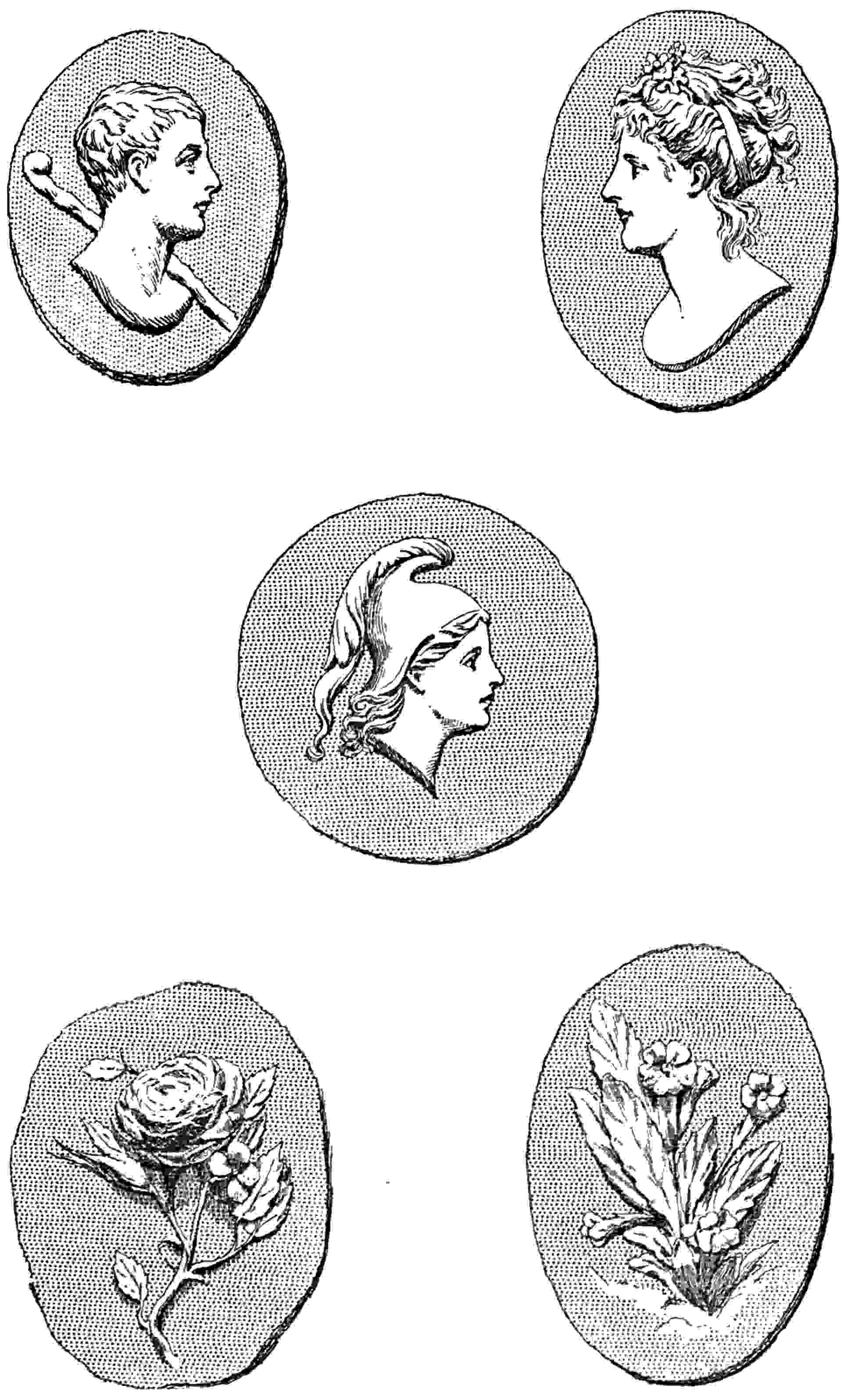
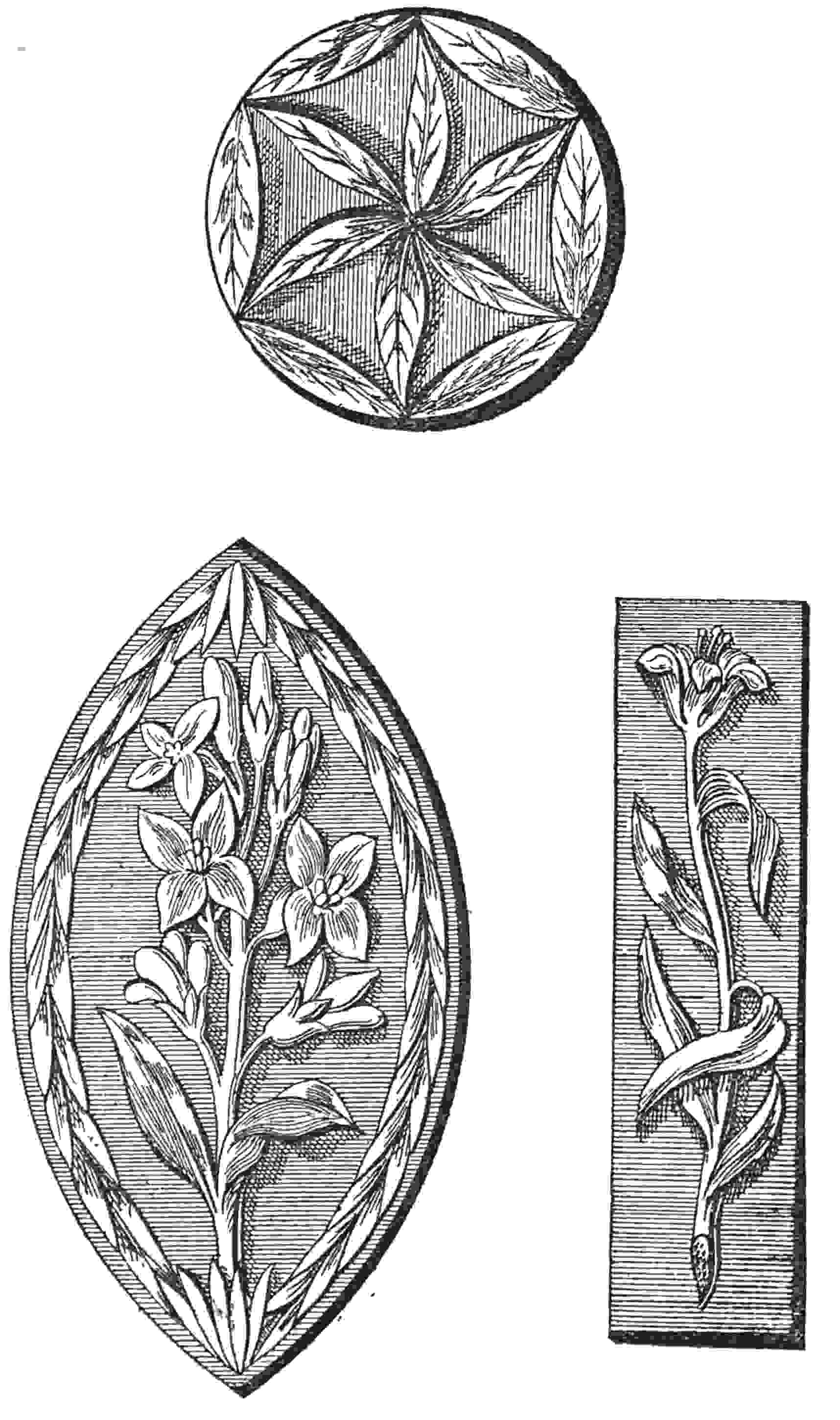
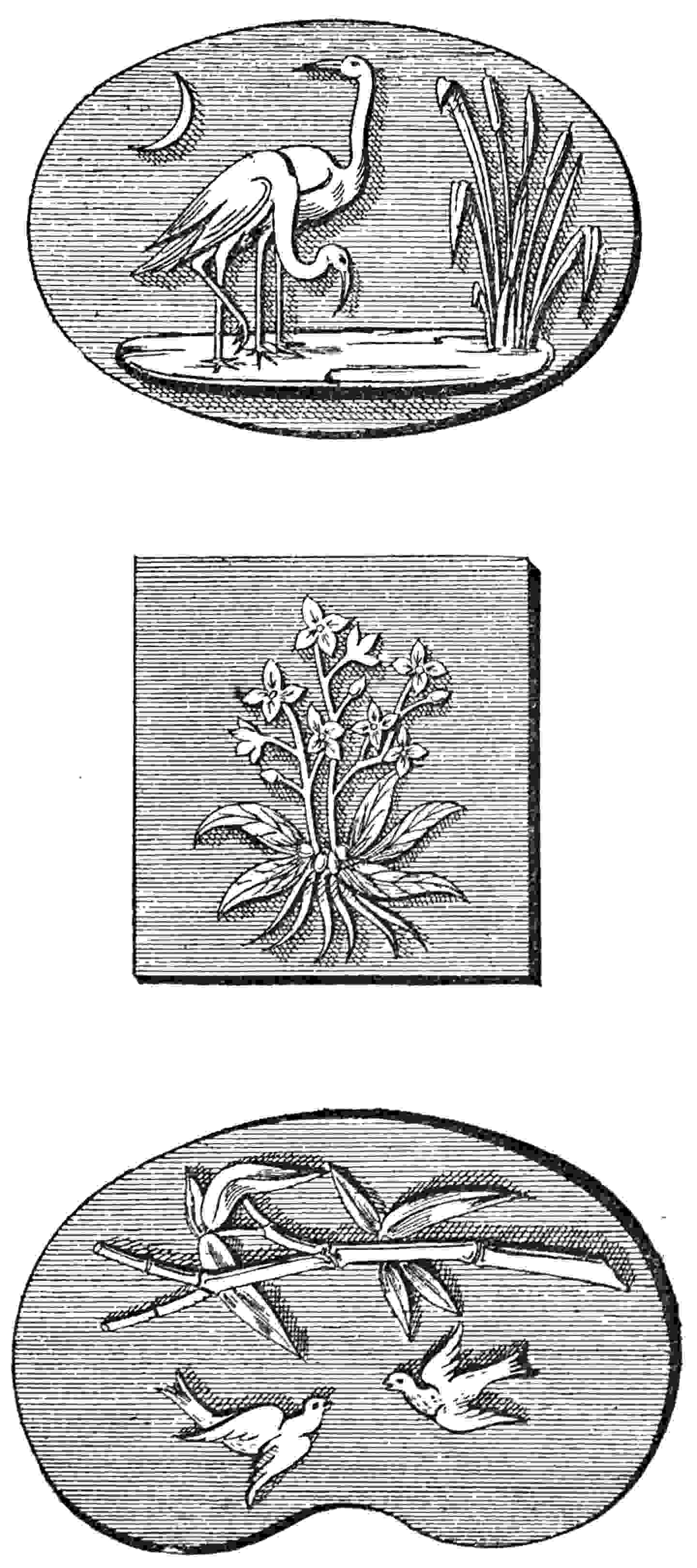
Designs.
The following pages contain a miscellaneous
collection of designs suitable for a great variety
of uses, more suggestive than exhaustive in their
character and scope. They will be found useful
for practice, but the artist will soon find subjects
better adapted to the degree of skill attained. A
large number are from the plaster casts modelled
by Signor Giovanni.
Transcriber’s Notes
Punctuation, hyphenation, and spelling were made
consistent when a predominant preference was found
in the original book; otherwise they were not changed.
Simple typographical errors were corrected.
Illustrations in this eBook have been positioned
between paragraphs and outside quotations.