The Great Court of Trinity represents the
earlier foundations of King’s Hall and
Michael House. Of these, the latter was the
older, and its buildings occupied a position nearly
corresponding to the south-western angle of the
present court. It may safely be supposed that,
up to the last half of the eighteenth century,
some remains of the original building were
allowed to exist, although Dr Nevile had
probably faced them in accordance with his
general design. In 1771, however, James Essex
made a radical alteration in this corner, and the
only part which was thought worthy of preservation
was the kitchen. This quaint room, entered
by a passage from the hall-screens, still survives,
and may be regarded as the nucleus of the
modern Trinity. The next relic of importance
is the King’s Tower, which now blocks up the
west end of the Chapel, and occupies the centre
of the north side of the court. It stood originally
a little south-east of its present site, and opened
at the junction of two lanes, one of which ran
diagonally from the old church of All Saints’
to the Cam, while the other, coming from the
present Trinity Lane, was bounded on the west
by the small court of Michael House. Now, of
course, the tower, removed and rebuilt, shows
very little trace of antiquity, and the oldest part
of it is the statue of Edward III., which stands
above the gateway, and bears the inscription
“Tertius Edwardus fama super aethera notus.”
This may be ascribed to the reign of Edward IV.
Later on, in the reign of Henry VII., the
foundation of the great gateway was laid, and a
chapel for the scholars of King’s Hall was built.
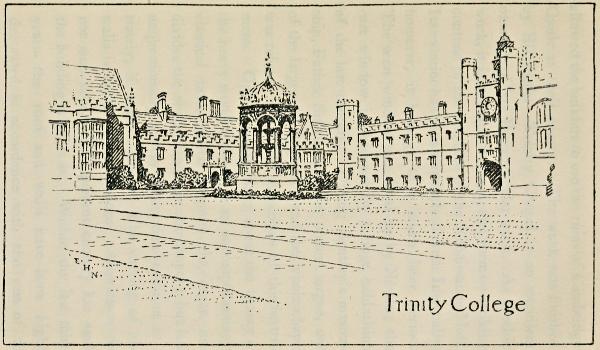
Trinity College
Not long after King’s Hall had received its
new eastern gateway, which implies a considerable
extension of the college, Henry VIII. dissolved
the lesser foundations and founded Trinity as we
know it. Henry’s chief wish was to provide
a sufficient chapel. It was not, however, until
Mary’s reign that any activity was shown in this
work. Mary furthered her father’s project, and
allowed the builders to use the ruins of Cambridge
Castle as their quarry. The work was finished
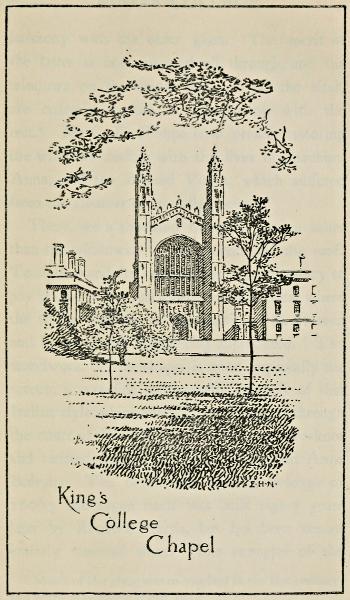
by Elizabeth. Trinity Chapel is an excellent
example of late Perpendicular work. As Gothic
work, it is stiff and debased, and forms a striking
contrast to the elegance of the Renaissance Hall.
Its exterior has been very little altered. Internally,
however, it belongs to a much later period.
The west window was filled up by Nevile; the
east window is obscured by a huge baldachino
of the last century. During Bentley’s mastership,
Father Smith built the present organ, one
of the largest in England; and the whole chapel
was refitted to suit the capacities of this instrument.
Opinions may differ about the beauty of
the heavy wooden screen in an uncompromisingly
classical taste which supports the organ and
divides the chapel from the antechapel; but it is
unquestionably a very appropriate addition to a
stately, if ugly, interior. The carving of the
stalls is by Grinling Gibbons. Alterations did
not stop here. The present century has made
the building what it is. Within the last thirty
years the roof and walls have been highly
decorated in accordance with the rest of the
chapel, and the result is very imposing. Mr
Henry Holiday’s stained glass, which represents
the saints and worthies of the Church from the
earliest period, is good, although its merits are
a little various. The western windows near the
organ, devoted to members of Trinity, are the
best. In the antechapel the glass is very bad
indeed. Otherwise, this part of the building is
not much altered, and its panelling of dark oak
makes it one of the most impressive sights in
either university. This is much increased by the
fine statues. Of these, that of Newton, by
Roubiliac, was given in 1755 by the master,
Dr Smith. The rest are more modern. Bacon’s
statue, by Weekes, was given by Dr Whewell;
Barrow’s by the late Lord Lansdowne. The
statues of Macaulay and Whewell are both by
Woolner.
These various buildings and others which
had grown about them were gathered together
in the reign of James I., and the result is the
Great Court, one of the largest and certainly
without exception the most beautiful of quadrangles
in the world. Trinity owes a great debt
to Thomas Nevile, who was master from 1593 to
1615. To bring his buildings into a systematic
form, he took down King Edward III.’s tower
and rebuilt it west of the chapel. He added
the upper storey to the great gateway, and placed
the statue of Henry VIII. in a niche outside,
while on the side towards the court he set up
in corresponding niches statues of James I.,
Prince Charles, and the Princess Elizabeth.
On the south side he built the Queen’s tower,
which contains the figure of Queen Mary, and is
exactly opposite King Edward’s tower. Finally,
to the west he built the Hall, north of the old
hall of Michael House, and, further north still,
the Master’s Lodge. His architect was that
admirable genius, Ralph Symons. Although the
Great Court has been partly faced with stucco
and, in certain places, refronted, its beauty is
indestructible. The sets of rooms which join
the towers and other buildings together, have
their height in very just proportion to the size
of the quadrangle. What the effect would
be, were they higher than they are, may be
seen by comparing the Jacobean buildings with
Essex’s classical addition near the kitchen, and
the modern Gothic buildings between the Chapel
and Lodge. The beauty of the court finds its
central point, perhaps, in Nevile’s exquisite
fountain, built in 1602, which has all the best
attributes of English Renaissance work. It
may be compared with the gateway just outside
the south-western corner of the court.
The Hall, with its light oriels and graceful
louvre, was finished in 1604. Its interior is,
perhaps, a little over-decorated, but possesses a
certain splendour which finds no parallel in
England. The western gallery, covered with
rich carving and highly gilded, may be compared
with the similar galleries at Audley End
and other contemporary houses. The portraits
are interesting, although of no great excellence
as a whole. Newton, Bacon, and Barrow
occupy the north end, and other celebrities,
such as Dryden, Cowley and Pearson, are to
be found on the side walls above the panelling.
Sir Joshua Reynolds’ charming portrait of the
little Duke of Gloucester hangs close to the
western oriel, and near it is Mr Watts’ portrait
of Tennyson. Other modern portraits are those
of Thackeray (Lockhart Bogle), Dr Thompson
(Herkomer), Dr Lightfoot (Richmond), and,
of living celebrities, Professor Michael Foster
(Herkomer) and Dr Henry Jackson (C. W.
Furse).
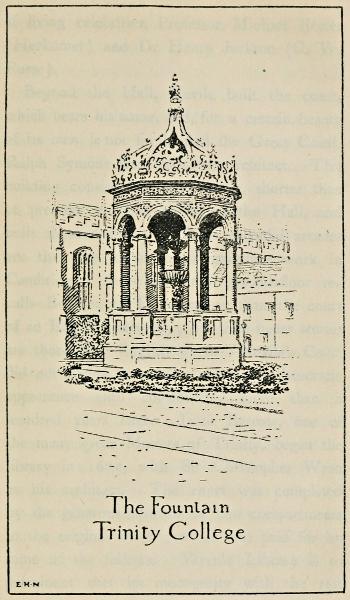
The Fountain
Trinity College
E·H·N
Beyond the Hall, Nevile built the court,
which bears his name, and, for a certain beauty
of its own, is not far behind the Great Court.
Ralph Symons was again his architect. This
building consisted of two wings, shorter than
at present, at right angles to the Hall, and
built above a cloister. These splendid arcades
are the very crown of Renaissance work in
Cambridge; their cloistered ground-floor recalls
Bologna or Padua rather than the court
of an English university; but their upper stories
are thoroughly English work. Nevile’s Court
did not assume its present secluded, aristocratic
appearance until considerably more than a
hundred years later. Isaac Barrow, one of
the many great Masters of Trinity, began the
library in 1675, with Sir Christopher Wren
as his architect. The court was completed
by the generous addition of two compartments
to the original arcades, which was paid for by
some of the fellows. Wren’s Library is so
prominent that its incongruity with the rest
of the court is not at once obvious, but there
can be no doubt that it is seen at its best on
the river side. Its front towards the court
is adorned with a bas-relief which represents
the dedication of the Septuagint to Ptolemy
Philadelphus. On the roof are four statues
of learned nymphs by Gabriel Cibber, which
are chiefly remarkable for the part they played
in one of Byron’s most senseless freaks. The
interior of the Library is matchless for its
magnificent simplicity. It is a pity that the
arbiters of taste in the last century should
have allowed Cipriani to design the window
at the south end, but this is the sole fault.
The numerous busts (some by Roubiliac), the
carvings on the bookcases (Grinling Gibbons)
and Thorwaldsen’s statue of Byron are remarkable.
Wren is also supposed to have harmonised
the side of the Hall which stands opposite,
with his Library. The present meaningless
alcoves and the balustrade which have superseded
Nevile’s work on this side, are probably
by Essex, who was brought in to prop up the
Hall and build the Combination Room and
Kitchen Offices in 1771. A little while
before Wren began working at Trinity, John
Hacket, Bishop of Lichfield and Coventry,
founded Bishop’s Hostel, the small building
south of the Great Court, and close to the
Trinity Lane entrance. These buildings
(1670) are now somewhat overlapped by
the modern buildings of Garret Hostel, which
are also of red brick. Garret Hostel is, however,
a much older component of Trinity, and
the modern buildings are simply a revival.
During the eighteenth century Bentley
effected his famous alterations in the Lodge
and Chapel, and Essex made the additional
changes to which I have referred. No actual
addition was made to the college until, in
1823, William Wilkins began his court in
the revived Gothic taste, adjoining Nevile’s
Court on the south. George IV. proved a
benefactor to the extent of £1000, and the
official name of the new building is for this
reason King’s Court. It was finished about
six years later. Cambridge, as we have seen,
has a long tale to tell of Georgian Gothic,
and the New Court of Trinity is a very typical
example of that period. It nevertheless is a
far more pleasant building than Wilkins’ court
at Corpus or Rickman’s at St John’s, although
there is not much to praise in it. To a much
better period of modern Gothic belong Mr
Beresford Hope’s improvements in the Lodge
and the Master’s Courts, usually known as
Whewell’s Court (and by more familiar names),
which are opposite the great gate of Trinity,
and are one of the thoroughfares between Trinity
Street and Sidney Street. Dr Whewell built
this court at his own expense, with Salvin as
his architect. Outside, it is gloomy but imposing.
The darkness of its interior was till quite
recently almost to be felt; but now (1898)
they are being refaced, and the depressing rooms
are being made into comfortable and picturesque
habitations.
The grounds of Trinity are spacious and
pleasant, and the famous lime-walk is one of
the wonders of Cambridge. When Dr Nevile
built his court, he filled up a branch of the
Cam which ran northwards from Garret Hostel
Bridge and rejoined the main stream at the
north-west corner of the present Library. The
bridge which connects the lime-walk with the
new court was built by Essex, and is his best
work in Cambridge, if that is any praise.
The royal foundation of Trinity College is,
as a matter of fact, one of the youngest
colleges in Cambridge. At the same time, it
is to Cambridge what Christ Church is to
Oxford, and, more than that, its name, to a
great number of people, is almost synonymous
with Cambridge. Henry VIII., the most
learned of our English sovereigns, was naturally
a great patron of learning. In 1546, the year
in which, with his characteristic want of scruple,
he took upon himself the credit of founding
Wolsey’s great college at Oxford, he also
founded Trinity at Cambridge. His material
was ready to hand, for the small colleges and
hostels which filled up the space between the
present Trinity Street and the river provided
scanty room for their members, and needed amalgamation.
Trinity, in fact, as it now exists, is
composed of a number of separate foundations,
the principal of which were Michael House,
founded in 1324, and King’s Hall, founded by
Edward III. in 1337. These two colleges had
gradually absorbed many of the smaller hostels.
The founder of Michael House was Hervé de
Staunton, treasurer to King Edward II. In
spite of its limited situation, it had a certain
amount of prestige, and one of its last masters
was John Fisher, afterwards President of Queens’
and Bishop of Rochester. It used the church
of St Michael as its chapel. King’s Hall, on
the other hand, had, by the time of Henry
VIII., extended its boundaries and built its
own chapel. It had grown out of a corporation
of scholars, which had found a patron in
Edward II., and had been presented by Edward
III., in 1336, with a piece of ground belonging
to one Robert of Crowland—which may point
to a connection between the foundation and
Crowland Abbey, the great centre of English
learning. A regular charter was granted in
1337. The accounts of the institution remain,
and point to a style of living which would not
be very highly accounted of now, but was
positively luxurious for medieval Cambridge.
The scholars attended chapel at St Mary’s by
the Market and All Saints’ in the Jewry, until,
in Edward IV.’s reign, they obtained leave to
found a chapel for themselves. King’s Hall
naturally became the nucleus of Henry’s college,
and the lesser buildings found their centre in its
court, enlarged and beautified. John Redman,
the last master of King’s Hall, became the first
master of Trinity College.
Under the charter of 1546, Henry VIII.
founded Trinity College for a master and sixty
fellows and scholars. The full title was
“Trinity College within the Town and University
of Cambridge of King Henry the
Eighth’s foundation.” Michael House, dedicated
primarily to St Michael the Archangel,
had been founded under the secondary invocations
of the Holy and Undivided Trinity, St
Mary, and All Saints; and it is probable that
the first of these suggested the name under
which the college has become so famous.
Trinity College is the most distinguished fruit
of that revived learning which paved the way
for and accompanied the Reformation: from the
very beginning its tendencies were liberal and
progressive; every genius which it nourished was
eminently constructive. The names of its three
greatest alumni, Newton, Bacon, and Barrow,
form, so to speak, the three fountain-heads of
organized philosophical thought in England; and
there are a hundred less monumental names
which are sufficient guarantee of the intellectual
supremacy of Trinity over her sisters. The
history of the college divides itself naturally
into periods. The first is a period of consolidation,
extending from 1546 to 1593. During
this time, the college suffered the ordinary
vicissitudes of the Reformation. Its chapel,
which had been projected by Henry VIII., was
begun by Mary and finished, probably out of a
sense of duty, by Elizabeth. In 1553, William
Bill, the second master, who had been appointed
under Edward VI., had to retire in favour of a
Catholic master, John Christopherson, but was
of course restored at the accession of Elizabeth.
He was succeeded in 1561 by Robert Beaumont,
who presented to the Master’s Lodge a portrait
of the founder by Lucas van Heere, one of the
most excellent portrait-painters of the sixteenth
century. Beaumont, in his turn, was succeeded
by John Whitgift, who was already well known
in Cambridge as Master of Peterhouse and
Pembroke, and Fellow of Queens’. Whitgift,
with Matthew Parker and Matthew Hutton, is
one of the three divines who may be taken as
typical of Elizabethan Cambridge—strongly anti-papal
in their sentiments, but keeping nevertheless
a cautious eye on the political balance. It is
hardly necessary to add that Whitgift’s long list
of Cambridge preferments eventually led to the
Archbishoprick of Canterbury. And it was
during his mastership that the greatest intellect
of the age was trained at his college. Under
the yoke of the Aristotelian system of philosophy,
Francis Bacon, while still at Cambridge, perceived
the fallacies of the stereotyped methods
of thought, and laid the foundation of inductive
science. Bacon’s life is connected more intimately
with affairs of state than with his University;
but Trinity regards him as one of the principal
saints in her kalendar, and his memory greets
the visitor at every turn. His portrait is one of
the three at the end of the Hall; there is another
in the Master’s Lodge; his bust, by Roubiliac,
is in the Library; and, in 1845, his statue was
placed, side by side with that of Newton, in the
antechapel.
Bacon is the great figure of this early period.
Nine years older than he, the Lord Chief
Justice Coke (* Whood: bust by Roubiliac) is
the first of the great lawyers connected with
Trinity. Another celebrated name is that of Dr
Donne, Dean of St Paul’s, divine and poet. Sir
Henry Spelman (* Whood), the antiquary and
translator of Xenophon, was a contemporary of
Bacon, and, some years after, Sir Robert Cotton
(* bust by Roubiliac) furnished Trinity with
another archæologist. Whitgift, after his translation
to Canterbury, was succeeded by John
Still, who became Bishop of Bath and Wells.
With Still’s successor, Dr Thomas Nevile,*
master from 1593 to 1615, the second period
opens. Nevile held the Deanery of Canterbury
with his mastership, but his life was spent
in Cambridge, and his architectural work in
Trinity, while it is the most important in the
University, stamps him as the chief benefactor
of the college. In that great age of building,
Nevile’s work has an honourable pre-eminence:
it is the sign of a monumental perseverance and
an artistic taste which, even in that fine era of
Renaissance culture, was never surpassed. We
may with justice echo the words of Fuller, who
says that Dr Nevile performed this work
“answering his anagram most heavenly, and
practising his own allusive motto ne vile velis.”
Higher praise could not be given. Nevile’s
buildings, if architecture may be considered to
reflect contemporary history, may be regarded as
a turning-point in Cambridge thought. When
we look at the reactionary tendency to the Gothic
taste in Jacobean Oxford, and compare it with
the distinct preference shown in Cambridge for
classical and Renaissance models, the radical
divergence of the two Universities is clear.
Nevile’s courts at Trinity were the beginning
of a long series of collegiate buildings which,
often very defective, took the place of Gothic
work and held it for the next two centuries.
The sole exception to this rule is Matthew
Wren’s chapel at Peterhouse. Besides his
building energy, Nevile acquired land for the
college, so that, when the Society enlarged its
buildings in after years, it found itself in possession
of the requisite site. The King’s Court
occupies part of this property. One can only
say that Nevile’s memory might be honoured
with a better building.
One of the first scholars of Trinity who saw
Nevile’s work in its complete state was George
Herbert. He was born in 1593, the first year
of Nevile’s mastership, and entered Trinity at
a very early age. Although it is more natural
to think of him as a parish priest and the
writer of the most beautiful devotional poetry
in English, his career at Cambridge was not
without distinction. His early Latinity was as
perfect as Milton’s, and he filled the office of
Public Orator of the University. He is unique
among Trinity men as the only important member
of the college who belonged to the most
illustrious school of English churchmen—the
school which, under Andrewes, Laud and Cosin,
placed the Church of England on a logical and
independent footing. The honours of this school
are shared rather unequally between the two
Universities, but Cambridge contributed a substantial
quota to the whole sum. There is no
portrait of Herbert in the college, but he is
commemorated in one of the chapel windows.
He died at the early age of forty, before the
troubles of the Great Rebellion. John Hacket,*
the Royalist Bishop of Lichfield and Coventry,
was probably at Trinity with Herbert. He is
remembered, not so much for his divinity as
for his gallant defence of his cathedral against
the Puritan destroyers. He was born in 1592
and did not die till 1670, ten years after the
Restoration. In his seventieth year, having
been mercifully preserved throughout the troubles,
he desired to bestow some mark of his affection
upon Trinity, “that Society,” as he said with
a noble pathos characteristic of the party to
which he had attached himself, “which is more
precious to me, next to the Church of Jesus
Christ, than any place upon earth.” The result
of his bequest was the present Bishop’s Hostel,
which occupied part of the site of the old
Garret’s or Gerrard’s Hostel.
The seventeenth century is fertile in great
men. During the century, however, none of
the masters of the college were very conspicuous
men, and the mastership, between 1615
and 1683, changed hands no less than twelve
times. It is also worthy of remark that three
successive masters ended their lives as Bishops
of Chester, thus uniting Henry VIII.’s collegiate
foundation with one of his bishopricks. These
were John Wilkins (* Whood), master in
1659, Henry Ferne, master in 1660, and
John Pearson (* Whood), master from 1662
to 1673. This last is the only exception to
the general insignificance of the masters at this
time. He was a distinguished scholar who
had been connected with several colleges, and
had held the mastership of Jesus. His work
on the Apostles’ Creed is still one of the
classics of English theology. About the
middle of the century, Dryden (* Hudson)
came to Trinity from Westminster School.
Both he and Abraham Cowley (* Slaughton)
were strongly attached to the Royalist side
during the Commonwealth disturbances, and
Cowley, who entered the college in 1637 and
proceeded to his master’s degree, was expelled
in 1643 on account of his too strongly expressed
loyalty. He found more congenial
soil at St John’s College, Oxford, the college
of Laud, Juxon, and others of the same party.
If to these poets we add the names of the
naturalists Ray (* Hudson: bust by Roubiliac)
and Willoughby (bust by Roubiliac) we shall
have enumerated the most illustrious Trinity
men of their time. Ray and Willoughby,
who studied natural history with special reference
to its religious character, were, in fact, the
founders of the modern science, just as Dryden
may be said to have struck the first note of
modern poetry.
Pearson became Bishop of Chester in 1672,
and removed there in 1673. Under his
successor, Isaac Barrow, began the golden age
of Trinity. Barrow is, in many ways, the
most extraordinary genius of whom Cambridge
can boast. He was one of that rare class
whose knowledge is practically universal. He
was born in 1630, a year before his great
contemporary, John Locke, who went up to
Oxford from Westminster about the time when
Barrow went up from Charterhouse to Cambridge.
Barrow was a man of surprising energy
and, at Cambridge, he appears to have read
deeply in every subject which was then studied.
He was classic, mathematician, scientist, theologian,
and orator; and in each of these branches
he excelled. He was appointed Regius Professor
of Greek in 1655, and, subsequently,
Lucasian Professor of Mathematics—a feat
which, to the scholars of to-day, would seem
next to impossible. Undoubtedly, however, his
promotion to the mastership of his college and
his subsequent celebrity were due to his fame
as a divine. His sermons bear the same relation
to his age that those of Jeremy Taylor
bear to the Stewart period. He was in high
favour as a preacher at court, and, on Pearson’s
retirement, his appointment was obvious. He
did not hold the mastership for more than four
years, as in 1677 he died at the age of forty-seven.
His portrait by Hudson hangs in the
college Hall; his bust, by Roubiliac, is in the
Library; and his statue, by Noble, was placed
in the antechapel during the mastership of his
worthy successor, Whewell.
At this time, the mathematical attainments
of the Society must have been overpowering.
Barrow’s fame in this department has perhaps
been obscured by that of Sir Isaac Newton;
but, if we are to believe Newton’s generous
compliment, the early death of Roger Cotes
robbed Trinity of an even greater prodigy.
The college may nevertheless be well content
with Newton, who was emphatically a Trinity
man, spending very little of his life away from
Cambridge. He was twelve years younger than
Barrow, and entered Trinity in the year of the
Restoration, when he was eighteen. Nine years
later, his studies proved so fruitful that Barrow
gave up the Lucasian professorship in his favour.
For more than half a century, he was the chief
ornament of the University. His discoveries
revolutionised the whole theory of mathematics,
and it was owing to his personality that the
subsequent energies of Cambridge were so
largely mathematical. He occupied rooms
between the Great Gateway and the Chapel.
Although he made Cambridge his home, he
had a large share in public business, sitting as
Member for the University and receiving the
mastership of the Mint. This office he probably
owed to another member of the college,
Charles Montague, Earl of Halifax (* Kneller),
whose recall of the specie is among the most
famous of English financial operations. In 1703,
Newton was elected President of the Royal
Society, which, it is interesting to note, had
been founded, forty years before, mainly through
the energy of Dr Wilkins, Master of Trinity
and one of the three Bishops of Chester
mentioned above. Newton was knighted by
Queen Anne in 1705, and died in 1727.
His scientific studies were not his exclusive
pursuits, for he was, to a certain extent, one
of the group of literary men who are the
glory of Anne’s reign, and was also much
occupied with the elucidation of prophecy,
which probably attracted him from its mathematical
side. Trinity has very justly regarded
him as her greatest son. His portrait, by
Ritz, occupies the place of honour in the Hall,
and every visitor to Cambridge knows—
The antechapel where the statue stood
Of Newton with his prism and silent face,
The marble index of a mind for ever
Voyaging through strange seas of Thought, alone.
The statue, which is by Roubiliac, and is that
master’s most famous work, bears the inscription
from Lucretius “Qui genus humanum ingenio
superavit.” There is a bust of him in the
Library, also by Roubiliac, and several portraits
are to be found throughout the college.
After Barrow’s death, the mastership was
filled successively by the Hon. John North*
and the Hon. John Montague,* whose rule was
calculated to foster a comfortable laziness rather
than industry. On the death of the second of
these, Dr Richard Bentley, fellow of St John’s,
was elected master. There was, in those days,
a strong feeling of rivalry between the two foundations—not
only academical, but also in political
and social matters. Bentley was a rare genius,
whose scholarship was just then acknowledged
as the finest in England, but he was utterly
devoid of good feeling and tact, and had a
peculiar faculty for exciting hatred. His fame,
for the most of us, is due to his high place in
the Dunciad. He arrived in Trinity with the
intention of managing the college on his own
lines. There was a party in the Society which
thoroughly enjoyed the comfort of a position it
did not adorn, and in this body Bentley found
his most devoted enemies. Instead of conciliating
them, he treated them with undisguised
contempt and arrogance; and his conduct was
so injudicious that he alienated all the better
members of the college from himself. Matters
came to a head when Bentley made radical
alterations in the Master’s Lodge, and presented
the fellows with a bill considerably larger than
the original estimate. Open war broke out; the
fellows refused to pay; and Bentley in consequence
applied methods of coercion, withholding
privileges which were in his gift. The fellows
found themselves obliged to give in after some
time, and Bentley followed up this victory by
altering the interior of the chapel to suit the new
organ. At this point, however, the Society
revolted for good. Bentley required a large
subscription of each fellow. The fellowship
dividends had been much reduced during the
previous years, and, with this additional burden,
poverty stared many of the dons in the face. In
this crisis, the fellows, who undoubtedly had
justice on their side, called in Serjeant Milne,
a London lawyer and one of their number, and,
under his guidance, addressed a gravamen against
the Master to the Bishop of Ely. Things
would have gone hardly for Bentley, had not
the Bishop died opportunely. This Bishop, by
the way, was John Moore, whose books George
I. gave to the University Library. However,
Bentley’s tyranny was not suffered to continue,
for, in 1718, the Senate passed a grace degrading
him from his high positions in the University.
After this, the quarrel was less prominent.
Bentley occupied the Lodge till 1742, but the
bad feeling which he had excited continued till
the end of his life. His judgment and taste may
be estimated from the reply which he is said to
have given to some congratulatory address after
his election. Referring to his original college of
St John’s, he said, “By the help of my God, I
have leaped over a wall.” His arrogance might
have been excusable in a young man whose promotion
was early, but Bentley, in 1700, was
past middle life. His scholarship was sound,
and there is no doubt that his arguments against
the Epistles of Phalaris crushed the position of
his adversary Boyle; but his lack of proper
feeling always put him in the wrong, and his
memory lives in the satire of Pope and Swift
rather than in his own work. Hudson’s portrait
of him is in the Hall, and his bust, by Roubiliac,
is in the Library.
The quarrels of Bentley’s mastership form a
period by themselves in the college history. At
the same time, it must be remembered that the
quarrel was confined to a section of the Society,
and that the better members kept aloof from it.
It had nevertheless a marked effect on the
college throughout the eighteenth century, with
the consequence that famous names are comparatively
scanty. Of Bentley’s opponents, the
most distinguished was Dr Conyers Middleton,
whose life of Cicero was good enough to merit
a century of abuse. Lesser scholars of the same
time were Roger Gale,* the antiquary, who is
often confounded with the learned Theophilus
Gale of Magdalen, Oxford, author of the once
famous Court of the Gentiles; and Beaupré Bell*
of Outwell, Norfolk, who was an enthusiastic
lover of church architecture, and left his valuable
manuscripts to the college library. Bentley’s
immediate successor, Dr Robert Smith,* master
from 1742 to 1768, bequeathed his name to the
Smith’s Prizes. He was succeeded by John
Hinchliffe, Bishop of Peterborough, a typical
prelate of the last century and a born pluralist.
Lord Orford, in his Tour of the Fens, describes
his entertainment at the Palace of Peterborough;
from which we may divine that Hinchliffe was
fond of a good dinner and liked the vicinity
of a nobleman. On one occasion, he put a man
with no voice into the Trinity choir, because he
happened to have a vote for Peterborough. A
fellow of the college, named Mansel, who was
more remarkable for his ponderous wit than his
piety, wrote the following epigram:—
A singing man, and yet not sing?
How justify your patron’s bounty?
Forgive me; you mistake the thing;
My voice is in another county.
This same Mansel* came, some years later,
to great dignity as Bishop of Bristol and Master
of Trinity. His mastership, from 1798 to
1820, closes the eighteenth century. The most
distinguished member of the college at this time
was the great Professor of Greek, Richard
Porson,* who died in 1808 at the age of forty-nine.
His beautiful Greek handwriting may be
seen in one of the cases in the college library.
Otherwise, the scholars of the last century are
few and far between. Trinity was, however,
the great nursing-place for noblemen; and
among the number of her sons may be mentioned
the famous Marquess of Granby (* Reynolds)
whose head serves as the sign for so many inns;
John Jefferies Pratt, Marquess Camden and
Chancellor of the University (* Lawrence),
George Henry Fitzroy, Duke of Grafton
(* Lawrence), and, of royal blood, William
Frederick, Duke of Gloucester (* Gainsborough,
Romney, Opie), Chancellor of the University,
and Frederick Augustus, Duke of Sussex
(* Lonsdale). A great statesman of the day
was Spencer Perceval,* who was assassinated in
the lobby of the Houses of Parliament. But, if
we turn to men of letters and poets, we merely
find such men as the parodist, Isaac Hawkins
Browne.*
Lord Byron received his education under
Mansel. His career at Cambridge would be
scarcely worth recording, were he not Byron;
for it is the record of a foolish series of silly
exploits and eccentricities bordering on madness.
The place of honour which is given to his
statue in the library always seems a little better
than his merits. He occupied rooms in Nevile’s
Court, and contrived, during his residence, to
irritate the college authorities. Mansel, as
master, had a very exalted idea of the virtues of
his position, and, from the anecdotes which are
told of him, must have made himself peculiarly
unpleasant. He was the last master of Trinity
who combined that office with episcopal dignity.
His successor, Christopher Wordsworth,*
master from 1820 to 1841, was brother to the
poet, and father of the late saintly Bishop of
Lincoln.
During Wordsworth’s time, the college was
full of great men. Adam Sedgwick* was
Professor of Geology. Another member of the
college was Thomas Babington Macaulay, who
was born with the century. As Fellow of
Trinity, the great historian was thoroughly
identified with the college, and, nine years after
his death, his statue, by Woolner, was placed
among the distinguished society of the antechapel.
Younger by nine years than Macaulay
was Alfred Tennyson (* Watts), who, in a few
exquisite verses, made himself peculiarly the
poet of Trinity. The chief event of his
Cambridge life was, of course, his friendship for
Arthur Henry Hallam, who lived, as is well
known, in the New Court. Tennyson himself
was otherwise not greatly attached to Cambridge.
He lived at some distance from Trinity, in
Corpus Buildings, and went down without
taking his degree. In this respect, Thackeray
(* Bogle), two years his junior, was very
different from him. Through all his life,
Thackeray, although he was so closely
identified with London, kept his love for
Cambridge, and was at heart a don. While still
in residence, he would walk reading along one
of the paths in the Great Court, and, in after
life, he constantly returned. His rooms were
close to Newton’s, north of the Great Gate.
Probably no one has handled University life
with more success—the subject is proverbially
difficult—than Thackeray in the early chapters
of Pendennis; and, in most of his novels, he
sent his heroes to colleges which, whether he
placed them in Oxford or Cambridge, have all
the features of his beloved Trinity.
With Thackeray we are hard on the heels
of our own age. The modern period of
Trinity’s history begins with the mastership
of William Whewell, whose name is inseparable
from his college. The twenty-five years
of his mastership, from 1841 to 1866, form
a very distinguished epoch. As scholar,
organiser, and benefactor to the foundation, he
was pre-eminent. The famous epigram which
said of him that “Science was his forte and
omniscience his foible” was in the main true,
but he carried to everything he attempted an
immense interest and a sound judgment. His
statue very worthily completes the group in
the antechapel. It was erected during the
mastership of his successor, William Hepworth
Thompson (* Herkomer) the Platonist, famous
for his erudition and his bons mots. Before his
elevation to the mastership, Dr Thompson had
been Regius Professor of Greek. The men
of his generation who belonged to the Society
were men of the highest eminence; the best
known are, perhaps, Joseph Barber Lightfoot
(* Richmond, Dickinson), the commentator on
St Paul’s Epistles and Bishop of Durham;
James Clerk Maxwell,* Professor of Experimental
Physics in the University; the late
Arthur Cayley (* Dickinson), the greatest
mathematician whom Trinity boasts since the
days of Newton; and the Public Orator, W.
G. Clark (bust by Woolner), Thompson’s life-long
friend. When Thompson died in 1886,
he was succeeded by the present master, Dr
Butler, who had been Head Master of Harrow
and Dean of Gloucester. Beneath these rulers,
and with the highest prestige in the world as
her tradition, Trinity fully justifies her distinction
as a royal foundation and a nursing-mother
of sound and religious learning. To select from
the present society is invidious; but the names
of Professor Henry Sidgwick, Professor Michael
Foster (* Herkomer), Dr Henry Jackson (* Furse),
and Professor Jebb, are of European repute, to say
nothing of the present vice-master, Mr Aldis
Wright, editor of Shakspeare, and Mr John
Willis Clark, the present Registrary, whose investigations
in Cambridge history and antiquities
are well known everywhere. In the Church
one may point to the theologian Dr Westcott,
Bishop of Durham, to Dr Farrar, Dean of
Canterbury, and to the late Charles Alan
Smythies, Bishop of Zanzibar; among politicians,
to Mr Arthur and Mr Gerald Balfour, and Sir
William Harcourt; while of doctors, lawyers and
men of letters the crowd cannot be numbered.