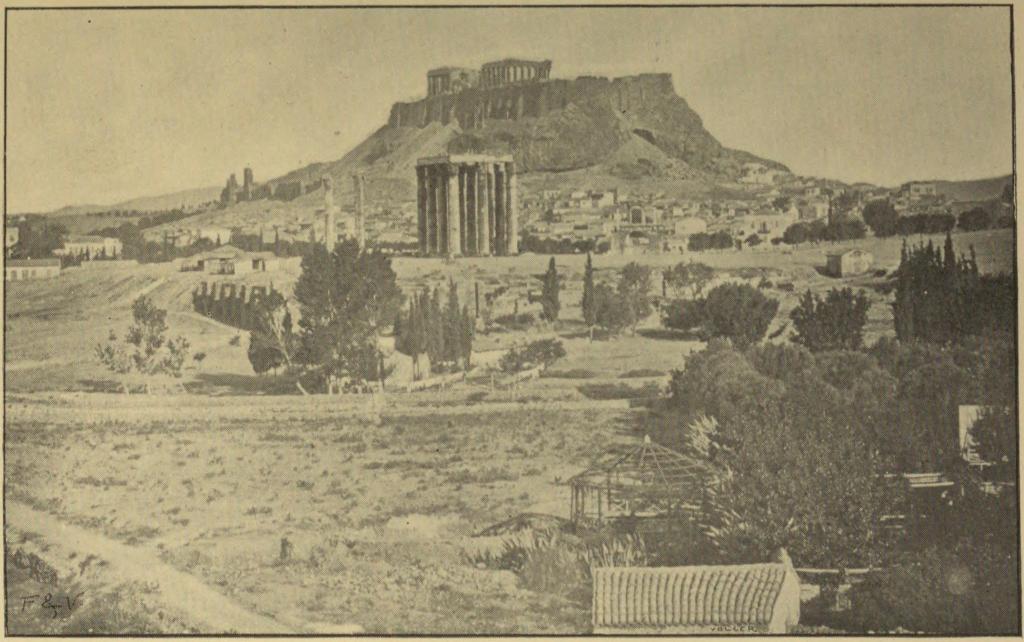
Callias, as may be supposed, did not fail to keep his appointment
with the utmost punctuality. He found at
Crito’s house very nearly the same company that had been
assembled the day before at Xenophon’s. After the
usual greetings had been interchanged, the host said,
“I propose, if it is agreeable to you all, to hold the
conversation which we are to have to-day at the house
of our friend Plato. He has written to invite us, not
because he can himself see us, for he is not sufficiently
recovered from his late illness, but because we shall
thus be able to talk with his friend Phaedo; for as all
know there is no more fitting person than Phaedo to tell
our young friend Callias the things that he desires to
hear. For though we were all present, Xenophon only excepted,
on that day when the Master left us, having given
us his last instructions, yet there is no one who so well remembers
and is so well able to describe all that was then
said or done. I propose, therefore, that we transfer ourselves
to his house.”
The proposition met with general assent and the party
set out.
Crito naturally took charge of Callias as being his special
guest. As the two were walking, the young man said,
“Tell me, Crito, if it is not unpleasing to you, whether
in the thirty days during which the Master was held in
prison, any efforts were made to save his life?”
“I am glad,” said Crito, “that you have asked me that
question privately and not before others, for, indeed, this is
a matter which has caused me no little amount of trouble
and shame. Some people blame me because, they say,
though a rich man I did not bribe the jailer of the prison in
which Socrates was confined, and thus enable him to escape.
I am blameable, indeed, but for an exactly opposite reason.
I did bribe the man—this of course is in absolute confidence
between you and me—and in this, as the Master showed me,
I was wrong. Indeed I never received from him so severe
a rebuke as I did concerning this matter. But let me tell
you what happened. I had arranged everything. The
jailer was to let him escape. There were people ready to
carry him out of the country. I went to him early in the
morning of the day when the ship was expected to return.
I told him what I had done. I made light of the money
that the affair was to cost. I could well afford it, I said,
and if I could not there were others ready to contribute.
And then I attacked him, it was an impudent thing to do,
but I felt as if I could do anything that we should not lose
him. I told him that it was wrong of him to do his best to
let his enemies get their way. I said to him, ‘Thus acting
you desert your children, whom you might bring up and
educate. But if you die you will leave them orphans and
friendless. Either you ought not to have children or you
ought to take some trouble about them. Surely this does
not become one who has made virtue his study throughout
his life. And remember what a disgrace will fall upon us,
for it will certainly be said that we did not do our best to save
your life.’
“Well, I cannot tell you now a tenth part of what he said.
I have it all written down at home, but I may say what you
will easily believe that I was as helpless in his hands as the
veriest pretender whom he has ever cross-examined. I
know that he ended by making me thoroughly ashamed of
myself. One of his chief arguments was this:
“‘Suppose, Crito, that as I was in the act of escaping, the
State itself were to say to me: Are you not seeking to
destroy by so acting the laws of the State itself? Is not
that State already dissolved wherein public sentences are set
aside by private persons? What should I answer to such
questions? And if the laws were to say, What complaint
have you got to make against us that you seek to destroy us?
Do you not owe your being to us, seeing that your father
and mother married according to our ordering? Have we
not given you nurture, education, all the good things that
you possess as being an Athenian? Have you not acknowledged
us by living in the city, by having children in it?
And if they were further to say, Verily, he who acts in this
way in which you are about to act is a corrupter of youth—what
could I answer?
“‘And tell me, Crito,’ he went on, ‘whither would you
have me betake myself? Not surely to any well-ordered city
seeing that I had shown myself the enemy of such order,
but rather to some abode of riot, which would indeed ill become
one who had professed to be a lover of virtue and
righteousness. And as for my children, how shall I benefit
them? By taking them elsewhere and bringing them up
not as citizens of Athens, but as citizens of some other State
which I myself here have judged inferior, seeing that all my
life long I have deliberately preferred Athens to it?’ Verily,
Callias, when he said this, I had no answer. But here we
are at Phaedo’s house.”
Callias was not a little surprised when he was introduced
to the man whom he had been brought to see. Phaedo was
a man much younger than himself; indeed he had scarcely
completed his eighteenth year. His appearance was singularly
attractive, and his manners had all the grace and ease
of a well-born and well-bred man. That he was not an
Athenian was evident from his speech, which was somewhat
tinged with a Doric accent. Altogether Callias was at
a loss to think who or what he could be, and how he came
to be regarded as the best interpreter of the Master’s last
words. An opportunity, however, arrived for enlightening
him. After a few minutes’ conversation, a slave appeared with
a message for the master of the house. Plato who had been
compelled to absent himself from the last interview with
Socrates, as has been said, was still so unwell that his
physician forbade the excitement of seeing visitors. He
now sent for Phaedo to entrust him with a message of
apology for his fellow disciples whom he was unable to
entertain, and partly to set him free to act the part of host
in his stead.
Crito seized the opportunity of his temporary absence
from the room to give some particulars about him. “He
comes of a very good family in Elis, and was taken prisoner
about this time last year when Athens and Sparta were
allies and acting against that country. He was sold in the
slave market here, and I cannot tell the cruelties that he
endured from the wretch who bought him. Somehow he
heard of Socrates, ran away from his owner and begged for the
Master’s protection. Of course, the only thing was to buy
him, and equally of course, Socrates was wholly unable to
do this. But the Master, if he had no wealth of his own,
happily had wealthy friends. He went to Plato and, by
great good luck, Plato had a very powerful hold over the
poor fellow’s owner; the man owed him a large sum of
money, the interest of which was overdue. He was purchased,
and at once set free. Plato found that he had been
remarkably well educated and that he showed an extraordinary
aptitude for philosophy. The lad’s devotion to
Socrates was unbounded. He never lost a chance of being
near him; he was present of course at the last day, and he
watched and listened with an intense earnestness that
seemed to engrave everything on his mind as one engraves
letters upon marble or bronze. But, see, he is coming back.
Now you will understand why I have brought you to see
him.”
The young man, at this moment, returned to the room.
“Tell me, Phaedo,” said Crito, “what you saw and heard
on the last day of the Master’s life. My friend Callias here,
who has just come back from campaigning against the Great
King, desires to hear it from you, and, indeed, though we
all were present on that day, you seem to remember it more
accurately than any.”
“I will do my best,” said the youth modestly. “I do not
know,” he went on, addressing himself especially to Callias,
“whether you will wholly understand me when I say that
I did not feel compassion as one might feel for one who was
dying—he was so calm and so happy. Neither, on the other
hand, did I feel the pleasure that commonly followed from
his discourses, for I knew that he would soon cease to be.”
“It was just so with all of us,” said Crito, “but go on.”
“We had been to visit Socrates daily through the time of
his imprisonment, assembling very early in the morning,
and waiting till the doors of the prison were opened, and so
we did on this day, only earlier than usual, because we
knew that the Sacred Ship had arrived the evening before.
The jailer came out. ‘You must wait, gentlemen,’ he said,
‘the Eleven[89] are with him. They are taking off his chains,
and are telling him that he must die to-day.’ After a little
while the man came out again, and said that we might go
in. When we went in, we found Socrates sitting on the
side of his bed, and his wife, Xanthippe, near him, holding
one of his children in her arms. As soon as she saw us, she
began to lament and say, ‘O Socrates, here are your friends
come to see you for the last time.’ Then Socrates, looking
at her, said to Crito, ‘Let some one take her home.’ So one
of Crito’s servants led her away. After a while, for of course
I must leave out many things, the Master said, ‘I have a
message for Evenus, who seeks to know, I am told, why I
have taken to writing verses in prison. Tell him that a god
appeared to me in a dream and told me to cultivate the
muses. Tell him also that if he is wise he will follow me as
speedily as possible, for it seems that the Athenians command
that I depart to-day.’
“‘But, Socrates,’ said Simmias, ‘this is a strange piece of
advice, and one which Evenus is not likely to take.’
“‘Why so,’ said Socrates, ‘is he not a philosopher? Surely
he should be ready to go the road which I am going. Only
he must not kill himself.’ ‘Why do you say this?’ said
Cebes.
“You will correct me,” said Phaedo, turning to the company,
“if I misrepresent anything that you said.”
“Speak on without fear,” said Simmias, “you seem to
have the memory of all the muses.”
Phaedo resumed, “Socrates said, ‘You ask me why a man
may not kill himself? Well, there is first this reason that
we are as sentinels set at a post, which we must not leave until
we are bidden; then again if men be servants of the gods, as
seems likely, how can they withdraw from this service
without leave? Would you not be angry if one of your
servants were to do it?’
“‘True,’ said Cebes, ‘but if we are the servants of the
gods, and therefore in the best guardianship, should we not
be sorry to quit it? If so, is it not for the foolish to desire
death and for the wise to regret it?’ ‘You are right,’ replied
the Master, ‘and if I did not expect when I depart
hence to go to the realms of the wise and good gods and to
the company of righteous men, I should indeed grieve at
death. And that I am right in so expecting let me now
seek to prove to you, for what better could I do on this the
last day of my life? But stay; Crito wishes to say something.
What is it?’ Crito said, ‘He who has to give the
poison says that you must talk as little as possible, for that
if a man so excites himself he has to drink sometimes two
potions or even three.’ ‘Let him take his course,’ said the
master, ‘and prepare what he thinks needful. And now to
the matter in hand. Death, then, is nothing but a separation
of the soul from the body. That you concede. And
you concede further that a philosopher should care little for
the things of the body, and that when he is most free from the
body, then he sees most clearly the highest and best things,
perceiving, for instance, right and justice and honor and
goodness, veritable things all of them, but such as cannot
be discerned with the eyes or handled with the hands.
For the body with its desires and wants hinders us, and
makes us waste our time on the things that it covets, so that
we have neither time nor temper for wisdom. If then we
are ever to reach absolute Truth we must get rid of the
hindrance. While we live we do this to the best of our ability,
and he is the wisest man and best philosopher who does it
most completely; but wholly we cannot do it, till the god
shall liberate us from the control of this companion—And
this is done by Death, which is the complete separation
of soul and body. Shall then the philosopher, who has
all his life been striving for such partial separation as may
be possible, complain when the gods send him this separation
that is complete? And this is my defence, my friends,
for holding it to be a good thing to die.’ ‘Yes,’ replied
Cebes, ‘but many fear that when the soul is thus parted
from the body, it may be nowhere, being dissipated like a
breath or a puff of smoke when the body with which it has
been united dies.’ ‘You desire, then,’ said Socrates, ‘that
I should prove to you that the soul does not perish when it
is thus separated from the body?’ ‘Yes,’ we all said, ‘that
is what we all wish.’ ‘First then,’ he went on, ‘is it not
true that every thing implies that which is opposite to it, as
Right implies Wrong, and Fair implies Foul, and to sleep is
the opposite of to wake? If so does not to die imply its opposite
to live again?
“‘Secondly, is it not true that the highest part of our
knowledge is a remembering again? For there are things
which we know not through our senses. How then do we
know them? Surely because we had this knowledge of
them at some previous time.’
“‘But,’ said Cebes, ‘may it not be true that the soul has
been made beforehand to enter the body; and having
entered it lives therein, and yet perishes when its dwelling
is dissolved?’
“‘Being of a frail nature, I suppose,’ said the Master, ‘it’s
all to be blown away by the wind, so that a man should be
especially afraid to die on a stormy day.’
“At this we all laughed, for we did laugh many times and
heartily that day, though now this may seem to others and
indeed to ourselves almost incredible, seeing what we were
about to lose.
“‘Well,’ the Master went on, ‘I will seek to relieve you of
this fear. Is it not true that things that are made up of
parts are liable to be separated? And is it not also true that
the soul is not made up of parts, but is simple and not compounded?
Also it is visible things that perish; but the
soul is not visible. Again the soul is the ruler, and the body
the servant. Is it not true that the divine and immortal
rule the human and mortal senses?’
“To this we all agreed.
“The Master began again, for he now, as I may say, had to
put before us the conclusion of the whole matter. ‘We
may think thus, then, may we not? If the soul depart
from the body in a state of purity, not taking with it any of
the uncleannesses of the body, from which indeed it has
kept itself free during life as far as was possible—for this is
true philosophy—then it departs into that invisible region
which is of its own nature, and being freed from all fears
and desires and other evils of mortality, spends the rest of
its existence with the gods and the spirits of the good that
are like unto itself. But if it depart, polluted and impure,
having served the body, and suffered itself to be bewitched
by its pleasures and desires, then it cannot attain to this
pure and heavenly region, but must abide in some place that
is more fitted for it.’
“Much else he said on this point to which we listened as
though it were another Orpheus that was singing to us.
And when he had ended and sat wrapt in thought, we were
silent, fearing to disturb him. And so we remained for no
little space of time in silence, he sitting on the bed, as if he
neither saw nor heeded any of the things that were about
him, and we regarded him most earnestly.
“After a while he woke up, as it were, from his reverie and
said, ‘You have agreed with me so far; yet it may be that
you have yet fears and doubts in your minds which I have
not yet dispersed. If so let me hear them, that I may, if it
be possible, rid you of them, for indeed I cannot, as I conceive,
leave behind me a greater gift for you than such a riddance.
Speak then, if there is anything that you would say.’
“Simmias said—I put, you will perceive, his argument in a
few words: ‘May it not be that the soul is in the body as a
harmony is in a harp? For the harmony is invisible and
beautiful and divine, and the harp is visible and material
and mortal. Yet when the harp perishes, then the harmony
also, of necessity, ceases to be.’
“When Simmias had ended, Cebes began: ‘I do indeed
believe that the soul is more durable than the body. Just
so; the wearer is more durable than the thing which he
wears. Yet at the last, one thing that he weaves proves to
be more durable than he. So may the soul outlast many
bodies, and yet perish finally, worn out, so to speak, by
having gone through so many births.’
“Have I put these things rightly, O Simmias and Cebes?”
said the young philosopher, addressing them, “though indeed
I have made them very brief.”
“You have put them rightly,” the two agreed.
“When we heard these things,” Phaedo went on, “we
were also greatly disturbed; for we desired to believe that
which the Master was seeking to prove, and seemed to have
attained certainly, and now we were thrown back again
into confusion and doubt.”
“And how did the Master take it, O Phaedo?” said Callias;
“for indeed I feel much as you describe yourselves as having
felt. Having reached a certain hope, not to say conviction,
I am now disturbed by fears.”
“Nothing could be more admirable than his behavior.
That he should be able to answer, was to be expected; but
that he should receive these objections so sweetly, so gently,
and perceiving our dismay, quickly encourage us, and, so to
speak, reform our broken ranks—this indeed was beyond all
praise.
“I myself was sitting on a low seat by the side of his
bed. He dropped his hand, and stroked my head and
the hair which lay upon my neck, I wore it long in those
days,[90] for he was often wont to play with my hair. Then
he said, ‘I suppose, Phaedo, that you intend to cut off these
beautiful locks to-morrow, as mourners are wont to do.’
“‘I suppose so,’ I said.
“‘But you must cut them off to-day and not to-morrow if
our doctrine be stricken to death, and we cannot bring it to
life again.’ Then he turned to Simmias and Cebes, and
said, ‘Hear now what I have to say, but while you hear,
think much of the truth but little of Socrates; and be on
your guard lest in my eagerness I deceive not myself only
but you also, and leave my sting behind me when I die
even as does a bee. You, Simmias, think that the soul may
be but as a harmony in the body. But do you not remember
what we said about all knowledge being a remembering, and
that what the soul knows it has before learnt? It existed
then before the body; but a harmony cannot exist before
the things are put together of which it proceeds. Then
again harmony may be more or less; but one soul cannot be
more a soul than another. And if, as the wise men say,
virtue is harmony and vice discord, we have a harmony of
a discord, which cannot be; finally one part of the soul
often opposes another, as reason opposes appetite; how then
is the soul a harmony? You, Cebes, hold, indeed, that the
soul is durable, but may not be immortal. Hear then my
answer. You believe that there are ideas or principles of
things, and that these ideas, being invisible, are the real
causes of things that are visible.’ Cebes acknowledged that
he did so believe. ‘Is not now the soul the principle of life,
and is not this principle the opposite of death? In its
essence, therefore, it is immortal; but that which is immortal
cannot be destroyed, no, even though there are things
which seem to threaten its existence.’
“In this we all agreed. After this Socrates discoursed in
many words about the abodes and dwelling-places of the
dead both good and bad, and of the manner in which they
are dealt with by the powers thereunto appointed. But of
this I will speak on some other occasion, if you will. At
present time is short, for I must not leave the sick man any
longer, only I will relate the very end of the Master’s discourse
and the things that happened after.
“‘To affirm positively about such matters,’ he said, ‘is not
the part of a wise man. Yet what I have said seems reasonable.
And anyhow he who has scorned the body and its
pleasures during life, and has adorned the soul with her
proper virtues, justice and courage and truth, may surely
await his passage to the other world with a good hope. But
now destiny calls me, and I must obey. But I will bathe before
I take the poison, that the women may not have the
trouble of washing my body.’
“Then Crito asked: ‘Have you any directions to give us?’
“‘Nothing now; if you rightly order your own lives, you
will do the best for me and my children; but if you do not,
then whatever you may promise, you will fail.’
“‘But,’ Crito asked, ‘how shall we bury you?’
“‘As you will,’ said he, ‘provided only you can catch me
and that I do not slip out of your hands.’ Then he smiled,
and said, ‘Crito here will not be persuaded that I am saying
the truth. He thinks that I am the dead body that he will
soon see here, and asks how he shall bury me. Assure him
then that when this dead body is laid in the grave or put
upon the pyre to be burnt it is not Socrates that he sees. For
to speak in this way, O Crito, is not only absurd but
harmful.’
“After this he bathed, remaining in the bath-chamber
for some time. This being ended, his children were brought
to him, and the women of his family also. With these he
talked awhile in the presence of Crito, and afterward commanded
that some one should take the women and children
away. And it was now near sunset. Hereupon the servant of
the Eleven came in, and said, ‘O Socrates, you will not be
angry with me and curse me when I tell you, as the
magistrates constrained me to do, that you must drink the
poison. I have always found you most gentle and generous,
the best by far of all that have come into this place. You
will be angry, not with me, for you know that I am blameless,
but with those whom you know to be in fault. And
now, for you know what I am come to tell you, bear what
must be borne as cheerfully as may be.’ And saying this
the man turned away his face and wept.
“‘Farewell!’ said Socrates, ‘I will do as you bid,’ and
looking to us he said, ‘How courteous he is! All the time
he has been so, sometimes talking to me, and showing himself
the best of fellows. And now see how generously he
weeps for me! But we must do what he says. Let some
one bring the poison, if it has been pounded; if not, let the
man pound it.’
“‘But,’ said Crito, ‘the sun is still upon the mountains.
I have known some who would prolong the day
eating and drinking till it was quite late before they drank.
Anyhow do not be in a hurry. There is still plenty of
time.’
“‘Ah!’ said Socrates, ‘these men were quite consistent.
They thought that they were gaining so much time. But I
too must be consistent. I believe that I shall gain nothing
by dying an hour or two later, except indeed the making of
myself a laughing stock by clinging to life when there is
really nothing left of it to cling to.’
“Then Crito made a sign to the slave that was standing
by; he went out, and after some time had passed brought
in the man whose duty it was to give the poison, and who
brought it in ready mixed in a cup. When Socrates caught
sight of him, he said:
“‘Well, my friend, you know all about these matters.
What must I do?’
“‘You will only have to walkabout after you have drunk
the poison, till you feel a sort of weight in your legs. Then
you should lie down, and the poison will do the rest.’
“So saying, he reached the cup to the Master, who took
it. His hand did not shake; there was not the least change
in his color or his look. Only he put his head forward in
the way he had, and said to the man:
“‘How about making a libation from the cup? May we
do it?’
“‘Socrates,’ said the man, ‘we pound just so much as we
think sufficient.’
“‘I understand,’ said the Master. ‘Still we may, nay we
must, pray to the gods that my removal hence to that place
may be fortunate. The gods grant this! Amen!’ And as
he said this he put the cup to his lips and drank it off in the
easiest, quietest way possible.
“Up to that time we had all been fairly well able to keep
from tears. But when we saw him drinking the poison,
when we knew that he had finished it, we could restrain
them no longer. As for myself I covered my face with my
mantle, and wept to myself. Not for him did I weep, but
for myself, thinking what a friend I had lost. And others
were still more overcome than I was. Only Socrates was
quite unmoved.
“‘Why all this,’ he said, ‘my dear friends? I sent the
women away for this very reason, that they might not vex
us in this fashion. I have heard it said that a man ought
to die with good words in his ears. Be quiet, I beseech, and
bear yourselves like men.’
“When we heard this we were not a little ashamed of
ourselves, and kept back our tears. He walked about till he
felt the weight in his legs, and then lay down on his back—this
was what the man bade him do. Then the man who
administered the poison squeezed his foot pretty strongly,
and asked him whether he felt anything. He said no.
Then the man showed us how the numbness was going
higher and higher.
“‘When it reaches his heart,’ he said, ‘he will die.’
“When the groin was cold the Master uncovered his face—for
he had covered it before—and said, ‘Crito, we owe a
cock to Æsculapius; pay it, do not forget.’
“These were the last words he said.
“‘I will,’ said Crito, ‘is there anything more?’
“But he made no answer. A little time after, we saw
him move. Then the man uncovered the face, and we saw
that his eyes were set. Then Crito closed his mouth and
his eyes.”
Phaedo left the room hastily when he had finished his
narrative. For some time there was silence. Then Apollodorus
spoke.
“You know, my friends,” he said, “that I am not very
wise nor at all learned; but he bore with me and my foolishness,
and you will also because you know I loved him. Let me
say then one thing. Much that Socrates said that day I did
not understand, nor do I understand it now when I hear it
again. Yet no one could be more fully persuaded than I
was that he spoke the truth. And what persuaded me was
the sight of the man. So brave was he, so cheerful, so
wholly convinced in his own mind, that no one could doubt
that he was indeed about to depart to a better place.”
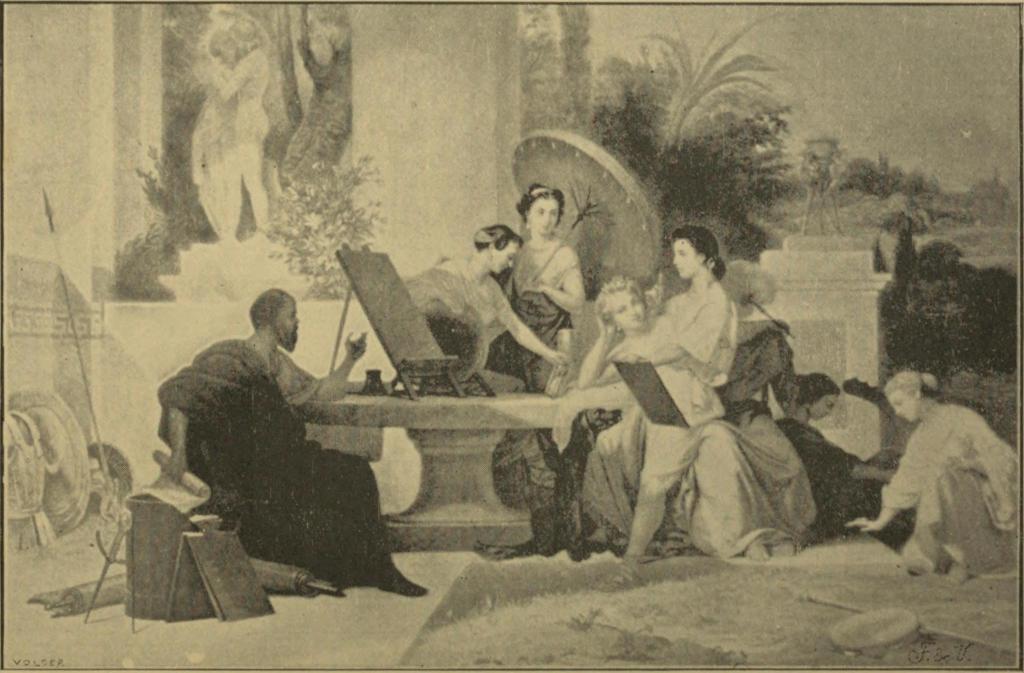 SOCRATES AND ALCIBIADES.