The proper vehicle for mountain study is not yet
available. A great mountain range is like a great
public character, there is much more to it than is
presented to the observation, and it is not open to
familiarity. But if one could fly high and wide
over its cloud-lifting summits, one might learn
something of its private relations.
From such a vantage it would instantly appear
how distinct are the Nevadas (nieve, snowy) among
the Sierras of California. A very Bonaparte of
mountains, new-born and lording it over the
ancient ranges, not content with its vast empery
but swinging north into the unpre-empted icy
regions. San Bernardino and San Jacinto are as
far from it as the Faubourg St. Germain from an
island in the sea. Sierra Madre is of the Coast
Range; Shasta a fire-hole, a revolutionist; the true
Sierra is the midriff of a continent. From its
northern extremity one sees the sun in a circle
and the Northern Lights; that portion of it we
know as Sierra Nevada swings into the state above
Honey Lake, and ends southward in a tumble of
blunt peaks below Kern River. This is quite
enough, however, for Californians to make free
with, and more than they can appreciate.
Geographically the range begins on the south
at Tehachapi, but at Walker's Pass, a day's
journey to the north, is the first appearance of
its most salient characteristic, the great Sierra
Fault. In its youth the range suffered incredible
cataclysms. For two hundred miles the great
eastern plain dropped; weighted as it was with
its withered aristocracy of hills—how weazened
and old you can see to this day—it tore sharply
downward, and the depth of that fall from the
heaven-affronting peak of Whitney to the desert
valley of Inyo is a matter of two miles of sheer
descent.
The whole Sierra along the line of faultage
has the contour of a wave about to break. It
swings up in long water-shaped lines from the
valley of the San Joaquin, and rears its jagged
crest above the abrupt desert shore. Seen from
close under, some of these two- and three-thousand-foot
precipices have the pitch of toppling waters.
As they rose new-riven from the earth their
proportions must have been more than terrifying.
Later the Ice Age bore downward from the
north, and through immeasurable years carved the
fractured granite into shapes of enduring beauty.
It rounded the great jutting fronts, it insured
them against the tooth of time with the keen
icy polish with which they shine still against the
morning. It gouged narrow wall-sided cañons,
cut the course of rivers, and sinking like a
graver's tool into the heart of the range, scooped
out deep wells of pleasantness. Afterward, when
the ice was old, it must have moved more slowly,
for the lines it left, retreating northward, are
more flowing, the hill-crowns rounder. And then
the mountain was besieged with trees. They
stormed it, scaled its free precipices; you can
see by the thick mould of the valleys what
ranks and ranks of them went down, and along
the snow-line how by the persistence of assault
they are bent and contorted.
This is the whole effect of the sombre swathes
of pine that mask the Sierra slopes. They march
along the water-courses, they climb up sheer
precipices in staggering files, trooping in the
passes; across the smooth meadow spaces they
lock arms, they await the word of command.
By a very little observation they are seen to
be ranged in orderly companies. Here a warm
current of air travelling steadily from the superheated
valleys carries the life zone higher, there
a defiant bony ridge drops it a few thousand
feet, but the relative arrangement of species does
not greatly vary. The broad oaks, like reverend
grandsires, from the foothills see the procession go
by, they follow as far as the gates of the mountain,
crutched and bowed. All the lower cañons are
full of a rabble of deciduous trees, chinquapins,
scrub oak, madroño, full of gay camp-followers,
lilac, dogwood, azaleas, strumpet penstemons,
flaunting lupins, monk's-hood, columbine.
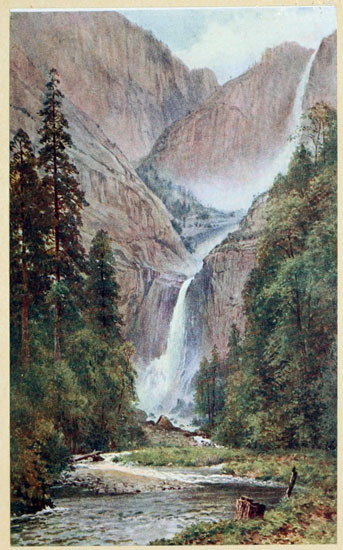
YOSEMITE FALLS
The grey nut pine, wide-branched, unwarlike
but serviceable, opens the ranks of conifers. Then
the long-leaved pines begin, ponderoso, Coulteri,
and the slender, arrowy, fire-resisting attenuata.
On the western slope, increasing as they go northward,
the redwood holds all the open country, but
it is no climber like monticola, the largest of all
true pines, the captain of the Sierra forests. The
firs usurp the water-borders and the low moraines;
clannish, incommunicable, they seem not to find
it worth while to grow unless they grow stately.
Above all these range the thin-barked pines, the
lodgepole, Douglas spruce, librocedrus, and hardy
junipers in windy passes. About the meadows
and lake-borders the quaking asps push like
children between the knees along the line; and
highest, most persistent, the creeping-limbed,
wind-depressed white-barked pine, under whose
matted boughs the wild sheep bed.
The trees have each their own voice—a degree
of flexibility or length of needles upon which the
wind harps to produce its characteristic note. The
traveller in the dark of mountain nights knows his
way among them as by the street cries of his own
city. The creaking of the firs, the sough of the
long-leaved pines, the whispering whistle of the
lodgepole pine, the delicate frou-frou of the redwoods
in a wind, these come out for him in the
darkness with the night scent of moth-haunted
flowers. But there is one tree that for the footer
of the mountain trails is voiceless; it speaks no
doubt, but it speaks only to the austere mountain-heads,
to the mindful winds and the watching stars.
It speaks as men speak to one another and are not
heard by the little ants crawling over their boots.
This is the "big tree," the sequoia. In something
less than a score of forest patches about the rim
of the Twin Valleys, the sequoia abides, out of
some possible preglacial period, out of some past
of which nothing is left to us but the fading
memory of the "giants in those days." The age
of individual big trees can be computed in terms
of human history. There are evidences written
in the rings of these that they endured the
drouth which made the famine in the days of
Ahab the king, against which Elijah prayed.
These are growing trees whose seeds are fertile.
One might make a very dramatic collocation of
the rise and fall of empires against the life period
of a single sequoia, and that would be easier than
to transcribe by mere phrases the impression of
one of these green towers of silence on the sense.
Single and deeply corrugated as a Corinthian
column, with only a lightly-branched crown for a
capital, they spire for five thousand years or so, and
then the leaf-crown becomes rounded to a dome
in which the winds breed. Warm days of Spring,
their young nestling zephyrs come fluttering
down the deep wells of shade to shake the saplings
of a hundred years. In Summer the fine-leafed
foliage catches the sun like spray, diffusing
vaporous blueness; but the majesty of their
gigantic trunks is incommunicable. After a while
the stifling sense of awe breaks before it, and
you go on with your small affairs as children will
go on playing even in the royal presence.
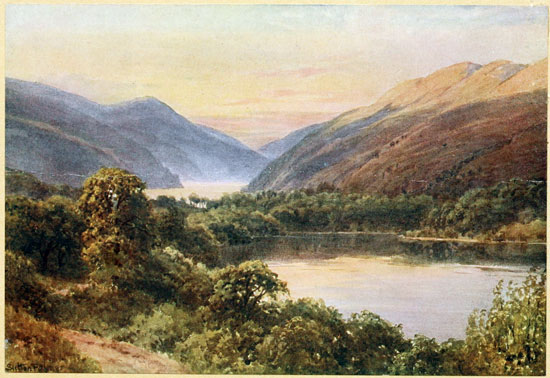
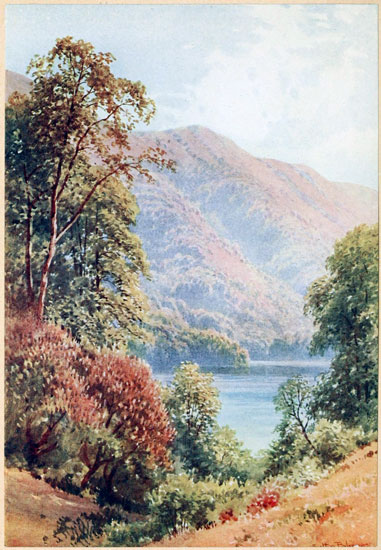
BLUE LAKE, LAKE COUNTY
The name Sequoia is one of the few cheering
notes among our habitual botanical stupidities—an
attempt to express quality as it is humanly
measured in a name. There was once an
American Cadmus, Sequoyah, a Cherokee who
invented an Indian alphabet and taught his tribe
to read. Seeing them outnumbered in their own
territory, he started west with the idea of founding
a great Indian empire. He was last seen trailing
north across the desert and was heard of no more.
Tradition has it that he reached the forest of the
upper Kern River and gave the trees his name.
At least no botanist with his nose in a book has
usurped it.
Forests are for cover. They mask not only the
naked rock, but the paths of deer and bear and
bighorn. Under the spire-pointed ranks of conifers
that look so black from above, verging to blueness,
a world of furtive folk goes on. A world of
birds is in its branches, squirrels nimble as
sparrows, but scarcely anything of this is visible
to the watcher on the heights. Rabbits playing
on your lawn would be more noticeable in
proportion than the seldom-seen bighorn leading
his light-footed young from ledge to rocky ledge.
The jealous trees cover the trails and obscure the
passes.
As you come up through them you observe
the flat, soddy spaces of old lake basins, green as
jewels, and the hanging meadows gay with cascades
of flowers, the stream tangles, the new-made
moraines bright with bindweed and sulphur-flower.
But from the heights all this lovely detail is
hidden by the overlapping tents of boughs. Here
and there a stream leaps forth at the falls like a
sword from a green scabbard, or higher up, may be
traced as the silver wire on which are strung
unrippled lakes as blue as cobalt. Great chains of
such lakes lead down from the snow-line to the
foothill borders, encroached upon by the silent
ranks of trees. As they go down they show
soddy borders, they tend to fill and to grow
meadows where presently deep-rooting trees
assume their stations. This is the strategic rule
for the taking of a granite mountain. First the
grinding ice and the disintegrating water; what the
streams wash down collects in the glacier-ploughed
basins. It makes lake borders by which the
grass comes in—the small grass that is mightier
than mountains, that eats them for its food.
Lakes at the lower levels become meadows, then
trees arrive; they overrun the soddy ground, the
snow-manured moraines. The trees themselves
take centuries to fruition. At a later stage men
dispossess the forest and build cities, but this has
not yet come to the Sierras. There is something
indomitable in the will of the trees to spread and
climb. In the floor of Yosemite and Hetch
Hetchy there are hundred-year-old oaks of full
form and generous growth, and on the slopes
above them the same oaks and of almost the same
age are so dwarfed by drouth and altitude that
they are not knee-high to a man, but they keep
the due proportions of their type. A white bark
pine will climb where the weight of the winter
drifts is so heavy that it is never able to lift its
decumbent trunk from the ground, clinging like
ivy to the wall in which it roots.
In the Spring the rich florescence of the conifers
sheds pollen in drifts that, carried down the melting
water, warn the sheep-herder and the orchardist
a hundred miles away of the advancing season.
A pine forest in flower is one of the things worth
seeing which is most seldom seen, for at its best
the high passes are still choked by snow, the lakes
ice-locked, the trails dangerous. And then the
blossoms, yellow and crimson tassels and rosy
spathes, are carried on the leafy crowns high over
the heads of the most adventurous foresters.
What one finds, as late as the end of June when
the trails are open, is a stain of pollen on the
lingering snow, and great clouds of it flying wherever
a bough is brushed by a light wing. In the
autumn the whole wood is full of the click and
glint of the winged seeds. Storms of them, like
clouds of locusts, are carried past on the wind, to
be dropped in the nearest clearing or to find a
chance lodging in a moss-lined crevice of the
weathered headlands.
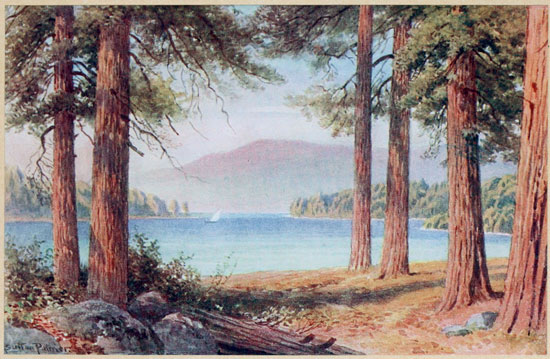
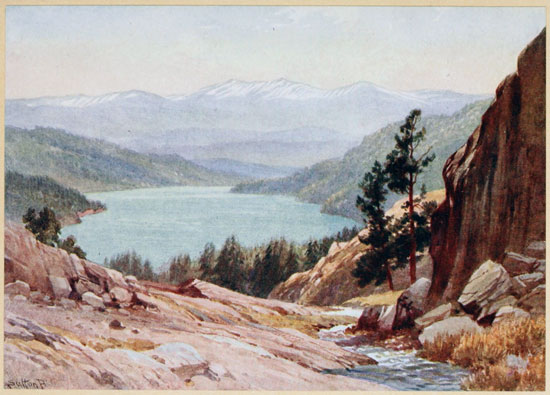
LAKE TAHOE, THE HIGH SIERRAS
But from the heights, all feeling for the process
of the forest is lost in the sense of its irresistible
march—it creeps and winds, it waits darkly for the
word. Above the tree-line no sound ascends but
a faint vibration, the body of sound making itself
felt in the silence. On windless days the forest
lies black like weed at the bottom of a lake of air
as clear as a vacuum. When the great wind
rivers pour about the peaks, it can be seen lashing
like weed in the currents, but still almost soundlessly—the
roar of it passes down the cañons, and
is heard in the cities of the plain. But if the peaks
cannot hear what the trees are plotting about, it is
not so with the voices of the water. These are
sharper, more definitive; they rise re-echoing from
the rocky walls and are recognisable each by its
distinctive note at incredible heights of the sheer,
glassy, granite frontlets.
In the glacial valleys, such as Yosemite, Tehipite,
and Hetch Hetchy, where young rivers drop
from the headlands in long streaming falls, the
noise of them contending with the wind makes
mimic thunder. Immense curtains of falling
water are tossed this way and that, they are
caught up and suspended in mid-air, and let fall
crashing to the lower levels. When the wind
blows straight up the cañon they will rear
against it, and leap out a shining arc, shattering
in mid-air like bursting bombs of spray. But
later in the season, when the streams are heavy
with the melting snows, the wind itself is
shattered by the weight of falling water—it
exhausts itself in obscuring clouds of silver dust.
When from Whitney or Williamson or King's
Mountain you can see half-a-hundred such young
rivers roaring to the morning, it is as beautiful
and as terrifying as the sight of youth to timorous
age. They go leaping with their shining shields,
and their shouting shakes the rocks. Neither you
nor they believe that the most and the best they
will come to is an irrigating canal between sober
rows of prunes and barley.
Higher than the forests, or the waters rising
out of them, is the Py-weack, the Land of Shining
Rocks. They shine with glacier polish; horses on
the high trails sniff suspiciously at their glittering
surfaces. Time can lay slight hold on them by
thunder, by frost, and the little grey moss; it has
not yet subdued the front of Oppapago. Here
between snowless ribs and buttresses are the
shrunken glaciers that feed the streams, little toy
models of the ancient rivers of ice. The snowfields
of the Sierras are not so inconsiderable as
they seem: they are dwarfed by the precipices
among which they hide. Inaccessible to ordinary
mountain travel, they make their best showing
from the surrounding plains, where, lifted in the
middle air, they glow with ethereal whiteness.
Close by they display a bewildering waste of
broken ice, boulders, and crevasses, made bleaker
by the cobalt shadows.
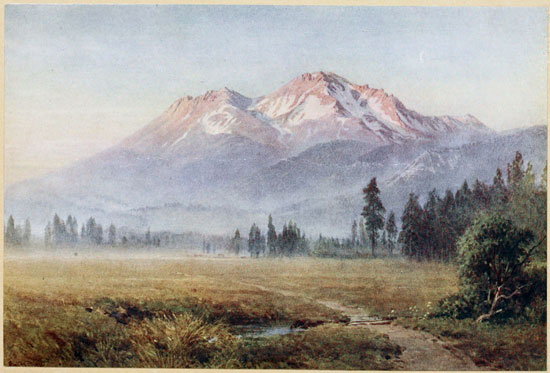
MOUNT SHASTA—SIERRA GLOW
North the line of peaks stretches, broken by the
passes that give access to the west. Between
them, above the source of streams, in the ice-gouged
hollows, lie unfathomable waters that take
all their life from the sky. Or perhaps they are
reservoirs from which the sky is made, fluid jade
and azulite and hyacinth and chrysoprase, as if
the skies of many days had run their colours in
those bleak bowls. For at this altitude the wave
contour of the range comes out most sharply; the
sky is strangely deep and darker, as if through its
translucence one glimpsed the void of space. One
sees the moon and the planets wandering there with
pale lamps held aloft.
No life of any sort is visible from here. Farther
down toward the coast, over the forested moraines,
the condor may be seen leaning against the wind at
sunrise. On the edge of the abysmal cañons eagles
make their nests and go dropping down the
shadowy depths to seek their food from God, but
they do not rise to these stark heights. Sometimes
a clanging horde of water-fowl, beating up
from the Gulf of California overland to the
Canadian marshes, will grow bewildered in the
face of the great wall-sided cliffs; circling they
attempt the forward flight, only to circle and
rise anew, until, wing-weary in that thin air, they
sink exhausted to the margin of a mountain lake,
satisfied at last to thread their way humbly along
the creek-beds to open country.
The live forces of the High Sierra are the
forces of wind and light. One feels the push
of tremendous currents flowing between the
peaks as among rocky islands. Day by day
they may be charted by the cloud fragments
floating on them, by the banners of dry snow
dust, streaming out like long grass from the
island shores. Thundering fleets of cumuli drift
up the wind rivers and assault the great domes
of Whitney and Oppapago. The light breaks
through all the varying cloud strata, and colours
them with splendour; the glow of the clouds
reflected on the snow is caught by the watchful
mountain-lover far down the valleys of Inyo and
San Joaquin. This painted hour of sunset is the
apotheosis of mountains, but for me it has less
of majesty than the morning after deep snows.
These come usually early in the season. The
air for days will be full of the formless stir, then
the range withdraws itself behind a veil which
closes from tented peak to peak, and includes
sometimes the parallel desert ranges which lie
along its eastern coast. Twenty feet will fall in
a single session of the white gods behind the veil.
Then comes a morning blue and sharp as a
spear-thrust. Every tree is like an arrow feathered
in green and white. Airy bridges built upon the
bending stems shut in the water-courses; the
moraines are smooth and soft as the backs of
huddled sheep. By night the range shows from
the valley as a procession of winged figures holding
the snows upon their bosoms. And that, after
all, is the business of mountains. The western
front of the Sierra Nevada, which receives the
full force of the Pacific storms, is rewarded
with the stateliest forests. Before those extended
snowy mountain arms lie the great Twin
Valleys; behind them stretches the illimitable sage-brush
country, the backyard of the Sierra.
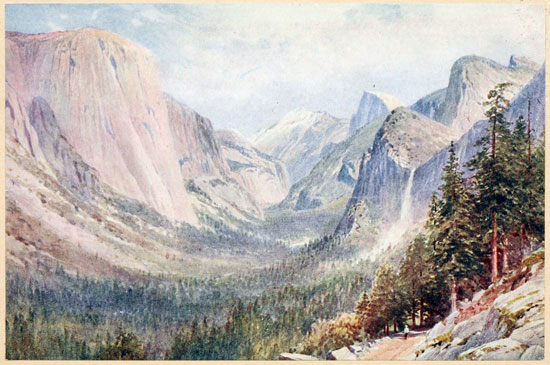
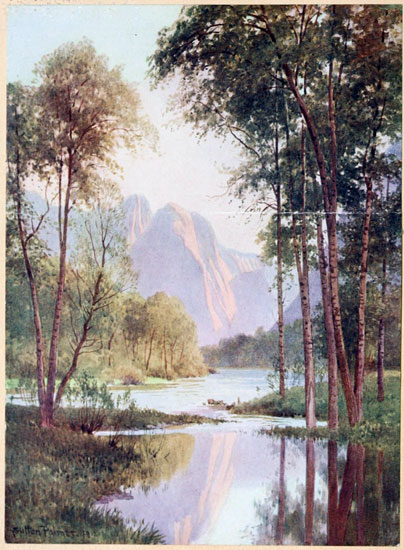
VALLEY OF THE YOSEMITE
"Sage-brush country" is one of those local
terms that stand for a type of landscape as
distinctive as the moors of England and the
campagna of Italy. It means first of all, open
country, great space of sky, what the inhabitants
of it call "eye-reach," treeless except for a few
cotton-woods and willows along the sink of intermittent
streams, and stippled with low shrubs of
artemesia. This is the true "sage-brush," though
it is no sage, the sacred bush of Diana, Artemisia
tridentata. It may grow in favoured districts
man-high, but ordinarily not more than two or
three feet in the arid regions which it haunts.
Other social shrubs will be found pre-empting
miles of the territory to which the artemesia
gives its name, coleogeny, pursia, dalia, "creosote,"
but none other gives it the distinctive feature, the
web of pale, silky sage-green against the sun-burned
sand.
Other items of the sage-brush landscape are so
constant that they are immediately suggested by it:
mountains hanging on the horizon in opalescent
haze, low flowing lines of hills overlaid by old
lava-flows, the "black rock" simulating cloud
shadows on the distant ranges, dry red cones of
ancient volcanic ash, and great flat table-topped
"buttes" of the painted desert.
White-crested ranges on the one hand and
buttes on the other mark the limits of the sage;
for where snow-caps are, there are trees, and where
the buttes begin the cactus and the palo verde
reign.
A sage-brush country is a cattle country
primarily; perhaps there may be mines; where
there is water to be stored for irrigation there will
be towns, but the virtue of the sage is that it
grows in lands that man, at least, has found no
other use for.
It can thrive on an allowance of water that will
support no larger thing than a chipmunk or a
lizard, and, growing, feeds the cattle on a thousand
hills. Therefore it is indispensable to any picture
of the sage-brush country that there should be
herds at large in it and vaqueros riding, or far
down the bleached valley the dust of a rodeo rising.
It is impossible to think of such a land and not
think of these things, free life, and air as clear and
vibrant with vitality as a bell. I can never think
of it myself without seeing, in addition, the
vultures making a merry-go-round over Panamint,
and up from Coso the creaking line of a twenty-mule
team.
The sage-brush country of California begins
properly at the foot of the Sierras where the state-line
sheers east by south from Lake Tahoe. It
covers the high valleys that divide the true Sierra
from the older, lesser ranges that keep it company
as far south as Olancha. Below Mono Lake, that
part of the gold region made immortal by Mark
Twain, it gives to the chrome- and ochre-tinted soil
its distinguishing characteristic. From the long
arm of Death Valley it begins to be encroached
upon by the mesquite, and at Indian Wells it is
driven close under the lee of the last Sierra. The
range of which San Bernardino and San Jacinto
are outposts carries the artemisia farther desertward,
almost to the Colorado River in fact, and
south again about the Salton Sea it holds its own
with sahuro and palo verde. Its eastern border,
like that of the wild tribes along the Mojave line,
is lost in pure desertness. Formerly much of that
country from San Bernardino to the sea was native
to the sage, and all the southern end of the San
Joaquin. But now all this is replaced with
orchards, for the artemisia proves nothing so much
of the soil on which it grows as that, given a due
allowance of water, it is as desirable for other
things.
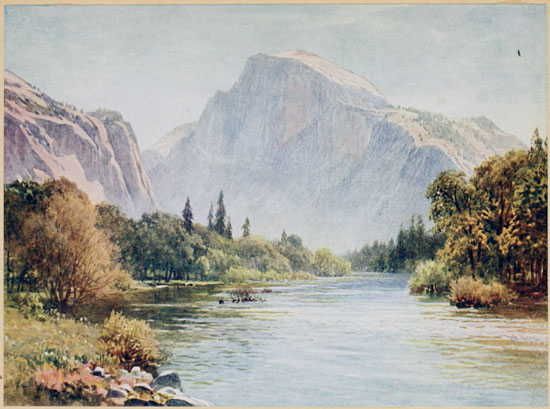
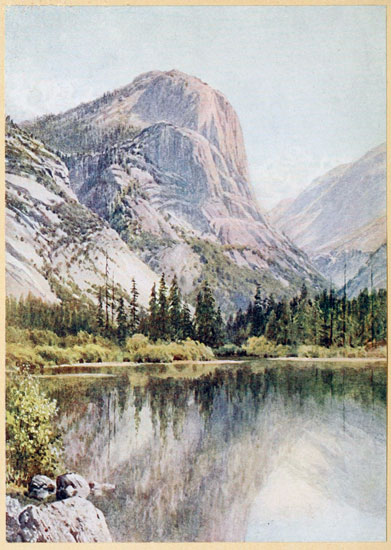
THE HALF DOME, YOSEMITE
All this country which I have described to you
has so recently been sea that the mark of its old
beach-line is plainly to be traced along the east
Sierra wall. Still the evaporating water leaves
vast deposits of salt and alkali, blinking white in
the sink of Death Valley. There are lakes there
still where the salt crusts over hard and clear like
ice, and deep thick puddles of bitter minerals, the
lees of that ancient inland ocean. From the top
of any of the denuded desert ranges it is possible
to trace the winding bays and estuaries, and, with
an eye for location, to choose the points at which
one may fairly expect to find potsherds, amulets,
fire-blackened hearthstones, and the middens of a
nameless people who built their primitive towns
along its beaches. It must have had much to
recommend it in those days before the sage-brush
took it, for this inland sea, rather than the more
mountainous Pacific shore, was the route taken by
the ancient migratory peoples who left their
undecipherable signs scored into the rocks from
the Aztec country to the Arctic. On isolated
igneous rocks near their old encampments, and high
on the walls of the box canons, such as might have
been tide-rifts, high above any mechanical contrivance
of the present-day Indians, the records
resist equally the shifts of sea and sand and the
efforts of modern science to read them.
Whether the ghosts of the departed peoples ever
revisit the ancient beaches, the ghosts of waters
haunt there daily. Morning and mid-afternoon the
rivers of mirage arise; they well out of the past
and are poured trembling on the plain; phantom
fogs blow across them, wraiths of trees grow up
and are reflected in false streams. Often in very
early light there are strange suggestions of——dunes
and boulders perhaps? Only no boulders
in that country are flat-topped like the houses
built in lands of the sun, and no dunes are wall-sided.
Mirage, we are told, is but a picture of
distant things, mirrored on atmospheric planes, but
then maybe a ghost is only a mirage deflected on
our atmosphere from worlds outside our ken, and
it is always easy in the desert to see things that
you cannot possibly believe. Whatever they are,
mirages are real to the eye. I mean that they are
not to be winked away nor dissipated by contact.
I have watched a vaquero ride into one of them
and drown to all appearances, or seem to be
swimming his horse across its billows, all of him
below its surface as completely hidden as by rivers
of water. Moreover, mirages tend always to occur
under given conditions and in the same places. I
recall one of the stations on the old Mojave stage
road, which, approached from the north about
an hour after sunrise, would instantly duplicate:
two houses, two lines of poplars, two high
corrals.
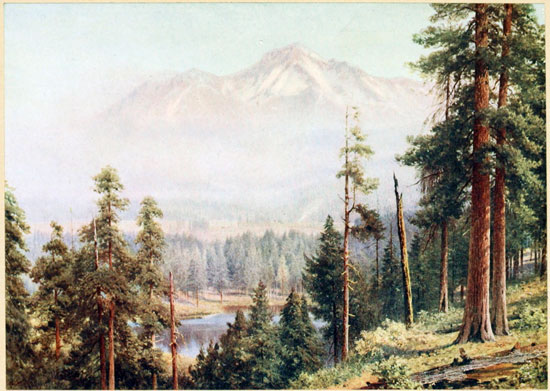
SHASTA—SNOW CLOUDS
Occasionally along the edge of the sage-brush
country one may see that surpassing wonder, the
moon mirage, poured like quicksilver along the
narrow valleys, as if the thirsty land had dreamed
of water.
It is odd how this suggestion of sea and river
clings to a country where there is nothing harder to
come by than good water to drink. For any other
purpose it is not to be thought of. After one of
those terrible wind storms, the only really incommoding
desert weather, it is possible to find great
spaces all rippled and lined in water-markings like
a sea that has suddenly undergone a magic transformation
into sand. The contours of the desert
ranges are billowy; they rise out of the plain like
the grey-backed breakers of open sea. The valleys
between are narrow and trough-like; the shores of
them are lined with crawling dunes that, under
the steady pressure of wind currents, are for ever
sliding up their own peaks and down the other side,
changing place without ever once losing the long
slope to windward and the abrupt landward fall of
waves.
Another item which adds to the suggestion of
the illimitable spread of sage-brush country, like
the sea, is the way the sparse forests of the
mountain-tops appear to be islanded by it. For
the sage-brush extends on across the Great Basin,
it stretches into Montana and south to Arizona
and New Mexico, it works about the lower end
of the Rocky Mountains and well into the great
central plain. The ranges lie thick in it as ocean
swells, as I have said, and stepping from crest to
crest has come the fox-tail pine, Pinus flexilis, all
the way from Humboldt Mountain to San Jacinto.
A sinewy, thinly-branched species, as straight-backed
as an Indian, it has little affinity for its
noble congeners of the Sierra forests, but keeps to
the dry and open ridges, nourished by clouds and
by infrequent shallow snows. With it, but at
lower levels to which the flexilis will never come,
is found frequently the one-leaved piñon pine, the
food-crop of the wild tribes. But the piñon is a
pushing sort, it establishes itself upon the slightest
invitation.
There is a story told in the desert of how this
grey, round-headed tree was once a very great
capitan, who, in order that his death might be as
beneficent to his people as his life had been, was
changed into the foodful pine. Whether the legend
is true or not, certain it is that if you sit down by
a piñon, wherever found, and stay long enough,
you will see Indians. They might come in the
Spring looking for taboose, or later for willows and
grasses for basketry, for seeds of sunflower and chia,
to shoot doves by the water-holes or to hunt chuckwallas.
A chuckwalla is a lizard, a kind of dragon in
miniature, barred black and white, and as offensive
to look at as he is harmless, in fact very good
eating and not too plentiful. Mojaves, Shoshones,
Paiutes, Pimas, all the tribes of the sage-brush
country, have this in common, that they live very
close to the earth; roots, seeds, reptiles, thick pads
of the cholla cactus, even the grass of the field,
serve them. They look, indeed, as though they
had been made of the earth on the very spot that
produced them, of the black rock, the brown sand,
and the dark water that collects in polished basins
of the wind-denuded ranges.
Very little rain gets past the heaven-raking
crest of the Sierra Nevada into the sage-brush
country; the most that falls is blown up from the
Gulf of California along the draw created by the
close, parallel desert ranges. It is precipitated
usually under atmospheric conditions that produce
violent drops and changes. All that the traveller
is likely to find of it is in these rock reservoirs
under the run-off of some bare granite cliff, or in
the rare, persistent "water-holes" hollowed out by
beasts or men, marked in the landscape by one
lone tree perhaps, or a clump of shrubby willows.
Often there will be no mark at all except the
frequency along the trail of skeleton cattle or wild
sheep, pointing all in one direction, as they died
on their way to the far-between drinking-places.
There are districts in this back-door country where
evaporation from the body is so rapid that death
overtakes the chance prospector even with water in
sight or in his canteen across his back. For years
a notorious outlaw protected himself in the Death
Valley region, by filling in all the springs in a circle
about the territory to which he had retreated.
Beyond that waterless rim even the law could not
penetrate.
And yet how the land repays the slightest
moisture! Years when the Kuro-Siwa swings
closer to our coast and the winds are friendly, I
have seen all that country, from Tehachapi, outside
the wall, to San Gorgiono, one sheet of blue and
gold. Seeds of a hundred tender annuals lie in the
loose sands for years between the shrubby sage,
their vitality unimpaired by the delayed resurrection
of a chance wet spring. Often I have sifted the
sand in my fingers looking for a sign of the life-giving
principle which bursts so suddenly into
beauty, without finding it. Yet after years in
which there is no alteration in the aspect of the
country, except the insensible change of the sage
tints from grey to green and grey again, the miracle
takes place, the blossomy wonder is upon the
world.
As a matter of fact, the sage-brush country is by
no means the desert that it looks to the casual eye.
Besides the social shrubs which have each their own
blossom and seed time, even the driest years will
afford a few blooms of crimson mallow, and in the
shelter of every considerable shrub some dwarfed
and delicate phacelia or nemophilia. Even out of
dunes which bury its hundred old trunks to the
new season's twigs, the mesquite will bear its sweet
foodful pods. If you know at what hours to look
for it, wild life is never absent, but it is not ordinarily
to be found by white men blundering about in
broad noon.
It is only when you meet, in the midst of great
open valleys wherein there is nothing growing
higher than the knees of your horse, and nothing
moving bigger than the little horned toad under
the cactus bush, bands of Indians well fed, cushiony
with fat of mesquite meal and chia, that you
understand how little you know of the land in
which you move.
There is a Paiute proverb to the effect that no
man should attempt the country east of the Sierras
until he has learned to sleep in the shade of his
arrows. This is a picturesque way of saying that
he must be able to reduce his wants to the limit of
necessity. Those who have been able to do so, and
have trusted the land to repay them, have discovered
that the measure is over-full.
A man may not find wealth there, nor too much
of food even, but he often finds himself, which is
much more important.