Garden CityNew York
DOUBLEDAY, PAGE & COMPANY 1916
ENDORSED BY THE DRAMA LEAGUE OF AMERICA
Copyright, 1916, by Percy MacKaye
All rights reserved, including that of
translation into foreign languages,
including the Scandinavian
All acting rights, and motion picture rights, are reserved
by the author in the United States, Great Britain and countries of the copyright Union
SPECIAL NOTICE
Regarding Public Performances and Readings
No performance of this Masque—professional or
amateur—and no public reading of it may be given without the
written permission of the author and the payment of royalty.
The author should be addressed in care of the publishers.
During the Shakespeare Tercentenary season of 1916, the
Masque—after its New York production at the City College
Stadium, May 23, 24, 25, 26, 27—will be available for production
elsewhere, on a modified scale of stage performance.
With proper organization and direction, amateur participants may
take part in performances with or without the Interludes.
For particulars concerning performances wholly amateur, address
Miss Clara Fitch, Secretary Shakespeare Tercentenary Committee, 736
Marquette Building, Chicago, Ill.
After June first, a professional company, which will coöperate
with local communities, will take the Masque on tour. For particulars
address Miss A. M. Houston, Drama League of America, 736 Marquette
Building, Chicago, Ill.
“Come unto these yellow sands,And then take hands!”The Tempest.
CALIBAN
BY THE YELLOW SANDS
A COMMUNITY MASQUE Of the Art of the Theatre
Devised and Written to Commemorate the
Tercentenary of the Death of SHAKESPEARE
Illustrations by
Joseph Urban & Robert Edmond Jones
TO · THE · ONLIE
BEGETTER · OF · THE · BEST
IN · THESE · INSUING
SCENES · MASTER · W · S
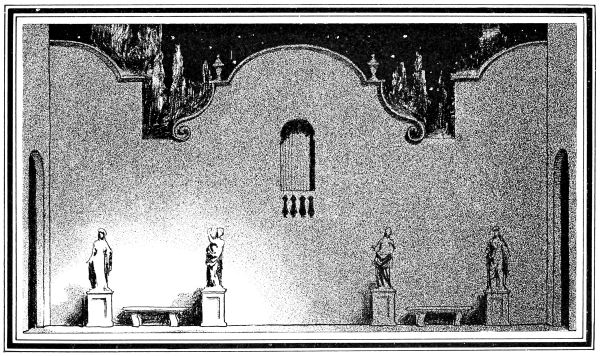
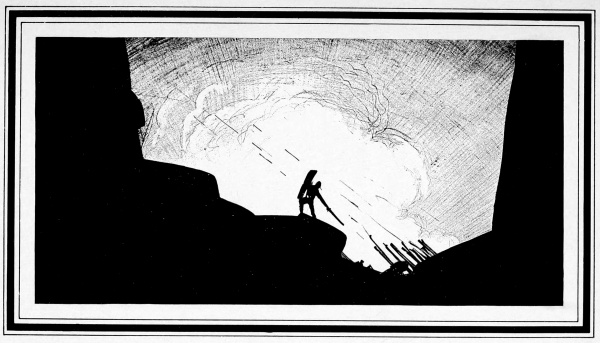
LIST OF ILLUSTRATIONS AND CHARTS
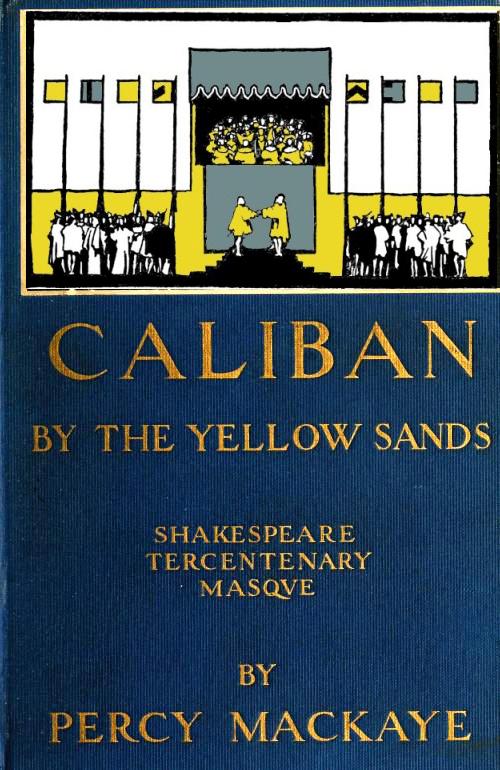
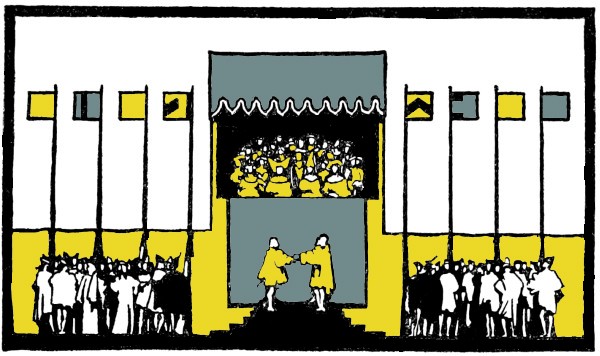
Cover Design: “When the kings of earth clasp hands”
(Act II, Second Inner Scene).
By Robert Edmond Jones.
Three hundred years alive on the 23rd of April, 1916, the memory of
Shakespeare calls creatively upon a self-destroying world to do him
honor by honoring that world-constructive art of which he is a master
architect.
Over seas, the choral hymns of cannon acclaim his death; in
battle-trenches artists are turned subtly ingenious to inter his art;
War, Lust, and Death are risen in power to restore the primeval reign
of Setebos.
Here in America, where the neighboring waters of his “vexed Bermoothes”
lie more calm than those about his own native isle, here only is given
some practical opportunity for his uninterable spirit to create new
splendid symbols for peace through harmonious international expression.
As one means of serving such expression, and so, if possible, of
paying tribute to that creative spirit in forms of his own art, I have
devised and written this Masque, at the invitation of the Shakespeare
Celebration Committee of New York City.
The dramatic-symbolic motive of the Masque I have taken from
Shakespeare’s own play “The Tempest,” Act I, Scene 2. There, speaking to Ariel, Prospero says:
“Hast thou forgotThe foul witch Sycorax, who with age and envyWas grown into a hoop? This damn’d witch Sycorax,For mischiefs manifold and sorceries terribleTo enter human hearing was hither brought with childAnd there was left by the sailors. Thou ...Wast then her servant;And, for thou wast a spirit too delicateTo act her earthly and abhorred commands,Refusing her grand hests, she did confine thee,By help of her most potent ministersAnd in her most unmitigable rage,Into a cloven pine, within which riftImprisoned thou didst painfully remain ...Then was this island—Save for the son that she did litter here,A freckled whelp hag-born—not honor’d withA human shape ... that CalibanWhom now I keep in service. Thou best know’stWhat torment I did find thee in, ... it was a tormentTo lay upon the damn’d.... It was mine art,When I arrived and heard thee, that made gapeThe pine and let thee out.”
“It was mine art”.... There—in Prospero’s words [and
Shakespeare’s]—is the text of this Masque.
The art of Prospero I have conceived as the art of Shakespeare in its
universal scope: that many-visioned art of the theatre which, age after
age, has come to liberate the imprisoned imagination of mankind from
the fetters of brute force and ignorance; that same art which, being
usurped or stifled by groping part-knowledge, prudery, or lust, has
been botched in its ideal aims and—like fire ill-handled or ill-hidden
by a passionate child—has wrought havoc, hypocrisy, and decadence.
Caliban, then, in this Masque, is that passionate child-curious part of
us all [whether as individuals or as races], grovelling close to his
aboriginal origins, yet groping up and staggering—with almost rhythmic
falls and back-slidings—toward that serener plane of pity and love,
reason and disciplined will, where Miranda and Prospero commune with
Ariel and his Spirits.
In deference to the master-originator of these characters and their
names, it is, I think, incumbent on me to point out that these four
characters, derived—but reimagined—from Shakespeare’s “The Tempest,”
become, for the purposes of my Masque, the presiding symbolic Dramatis
Personæ of a plot and conflict which are my own conception. They are
thus no longer Shakespeare’s characters of “The Tempest,” though born
of them and bearing their names.
Their words [save for a very few song-snatches and sentences] and their
actions are those which I have given them; the development of their
characters accords with the theme—not of Shakespeare’s play but of
this Masque, in which Caliban’s nature is developed to become the
protagonist of aspiring humanity, not simply its butt of shame and
ridicule.
My conception and treatment also of Setebos [whose name is but a
passing reference in Shakespeare’s play], the fanged idol [substituted
by me for the “cloven pine”]; of Sycorax, as Setebos’ mate [in form
a super-puppet, an earth-spirit rather than “witch”], from both
of whom Caliban has sprung; of the Shakespearian Inner Scenes, as
brief-flashing visions in the mind of Prospero; of the “Yellow Sands”
as his magic isle, the world; these are not liberties taken with text
or characters of Shakespeare; they are simply the means of dramatic
license whereby my Masque aims to accord its theme with the art and
spirit of Shakespeare.
Shakespeare’s own characters, that use his words[1]
in scenes of his plays, have then no part in my Masque, except in the Inner
Scenes,[2]
where they are conceived as being conjured by Prospero and enacted by
the Spirits of Ariel.
The theme of the Masque—Caliban seeking to learn the art of
Prospero—is, of course, the slow education of mankind through the
influences of coöperative art, that is, of the art of the theatre in
its full social scope. This theme of coöperation is expressed earliest
in the Masque through the lyric of Ariel’s Spirits taken from “The
Tempest”; it is sounded, with central stress, in the chorus of peace
when the kings clasp hands on the Field of the Cloth of Gold;[3]
and, with final emphasis, in the gathering together of the creative forces
of dramatic art in the Epilogue. Thus its motto is the one printed on
the title page, in Shakespeare’s words:
“Come unto these yellow sandsAnd then take hands.”
So much for my Masque in its relationship to Shakespeare’s work and his
art. Its contribution to the modern development of a form of dramatic
art unpractised by him requires some brief comment.
This work is not a pageant, in the sense that the festivals excellently
devised by Mr. Louis N. Parker in England, Mr. Lascelles in Canada, or
Mr. Thomas Wood Stevens in America have been called pageants. Though of
necessity it involves aspects of pageantry, its form is more closely
related to the forms of Greek drama and of opera. Yet it is neither of
these. It is a new form to meet new needs.
I have called this work a Masque, because—like other works so named
in the past—it is a dramatic work of symbolism involving, in its
structure, pageantry, poetry, and the dance. Yet I have by no means
sought to relate its structure to an historic form; I have simply
sought by its structure to solve a modern [and a future] problem of the
art of the theatre. That problem is the new one of creating a focussed
dramatic technique for the growing but groping movement vaguely called
“pageantry,” which is itself a vital sign of social evolution—the
half-desire of the people not merely to remain receptive to a popular
art created by specialists, but to take part themselves in creating
it; the desire, that is, of democracy consistently to seek expression
through a drama of and by the people, not merely for the people.
For some ten years that potential drama of democracy has interested
me as a fascinating goal for both dramatist and citizen, in seeking
solution for the vast problem of leisure.[4]
Two years ago at Saint Louis I had my first technical opportunity, on a large
scale, to
experiment in devising a dramatic structure for its many-sided
requirements. There, during five performances, witnessed by half a
million people, about seven thousand citizens of Saint Louis took part
in my Masque [in association with the Pageant by Thomas Wood Stevens].
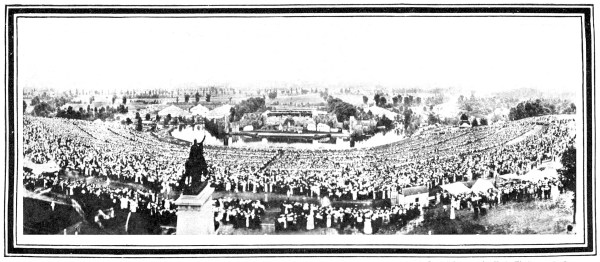
In the appendix of this volume a photograph gives a suggestion of one
of those audiences, gathered in their public park [in seats half of
which were free, half pay-seats] to witness the production.[5]
That production was truly a drama of, for, and by the people—a
true Community Masque; and it was largely with the thought of that
successful civic precedent that the Shakespeare Celebration first
looked to Central Park as the appropriate site to produce their
Community Festival, the present Masque, as the central popular
expression of some hundreds of supplementary Shakespearean celebrations.
In so doing, they conceived the function of a public park—as it is
conceived almost universally west of the Eastern States, and almost
everywhere in Europe—to be that of providing outdoor space for the
people’s expression in civic art-forms.
The sincere opposition of a portion of the community to this use of
Central Park would never, I think, have arisen, if New York could have
taken counsel with Saint Louis’s experience, and its wonderfully happy
civic and social reactions. The opposition, however, was strong and
conscientious; so that, on the same principle of community solidarity
which was the raison d’etre for their informal application to use
Central Park, the Shakespeare Celebration withdrew their wish to use
it. To split community feeling by acrimonious discussion was contrary
to the basic idea and function of the Celebration, which are to help
unite all classes and all beliefs in a great coöperative movement for
civic expression through dramatic art.
One very important public service, however, was performed by this
Central Park discussion; it served clearly to point out a colossal lack
in the democratic equipment of the largest and richest metropolis of
the western hemisphere: namely, the total lack of any public place of
meeting, where representative numbers of New York citizens can unite
in seeing, hearing, and taking part in a festival or civic communion
of their own. New York, a city of five million inhabitants, possesses
no public stadium or community theatre. Little Athens, a mere village
in comparison, had for its heart such a community theatre, which
became the heart of civilization. Without such an instrument, our own
democracy cannot hope to develop that coöperative art which is the
expression of true civilization in all ages.
Happily for the Shakespeare Celebration and its aims, a large measure
of solution has, at the date of this preface, been attained by the
gracious offer of the New York City College authorities, through
President Mezes, to permit the use of the Lewisohn Stadium and athletic
field, temporarily to be converted into a sort of miniature Yale Bowl,
for the production of the Shakespeare Masque on the night of May 23rd
and the following four nights.
By the brilliant conception and technical plans of Mr. Joseph Urban
for joining to the present concrete stadium of Mr. Arnold Brunner
its duplicate in wood, on the east side of the field, and so placing
the stage on its narrower width to the north, there will be created
a practical outdoor theatre, remarkable in acoustics, qualified to
accommodate in excellent seats about twenty thousand spectators, and
some two or three thousand participants in the festival.
If such a consummation shall eventually become permanent there, it
will complete the realization of a practicable dream already rendered
partly complete by Mr. Adolf Lewisohn’s public-spirited donation of
the present concrete structure. Referring to that practicable dream,
I wrote four years ago in my volume “The Civic Theatre”:[6]
“One day last spring, traversing with President John Finley the grounds
lately appropriated, through his fine efforts, by the City of New York
for a great stadium at the City College, I discussed
with him the splendid opportunity there presented for focussing the
popular enthusiasm toward athletic games in an art dramatic and nobly
spectacular.”
This new dramatic art-form, then—a technique of the theatre adapted to
democratic expression and dedicated to public service—I have called by
the name Community Masque, and have sought to exemplify it on a large
scale in two instances, at Saint Louis and at New York.
The occasion of this preface is not one to discuss the details of that
new technique further than to suggest to the public, and to those
critics who might be interested to make its implications clearer than
the author and director of a production has time or opportunity to
do, that the exacting time limits of presenting dramatically a theme
involving many dissociated ages, through many hundreds of symbolic
participants and leaders, are conditions which themselves impel the
imagination toward creating a technique as architectural as music, as
colorful as the pageant, as dramatic as the play, as plastic as the dance.
That my own work has attained to such a technique I am very far from
supposing. I have, however, clearly seen the need for attaining to it,
whatever the difficulties, if a great opportunity for democracy is not
to be lost. To see that much, at a time when the vagueness of amateurs,
however idealistic in desire, is obscuring the austere outlines of a
noble technical art looming just beyond us, may perhaps be of some service.
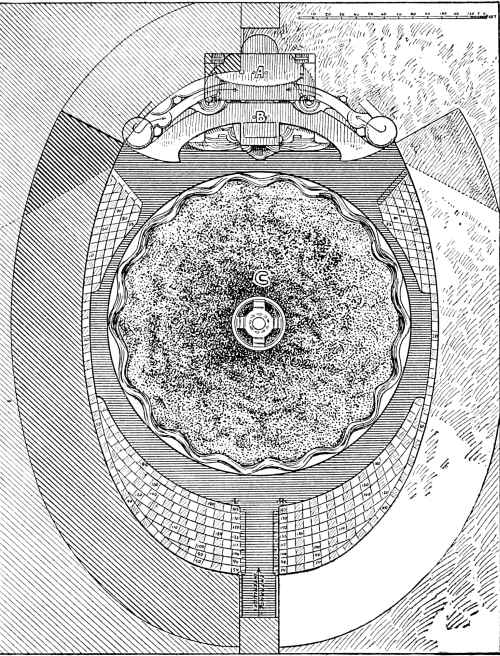
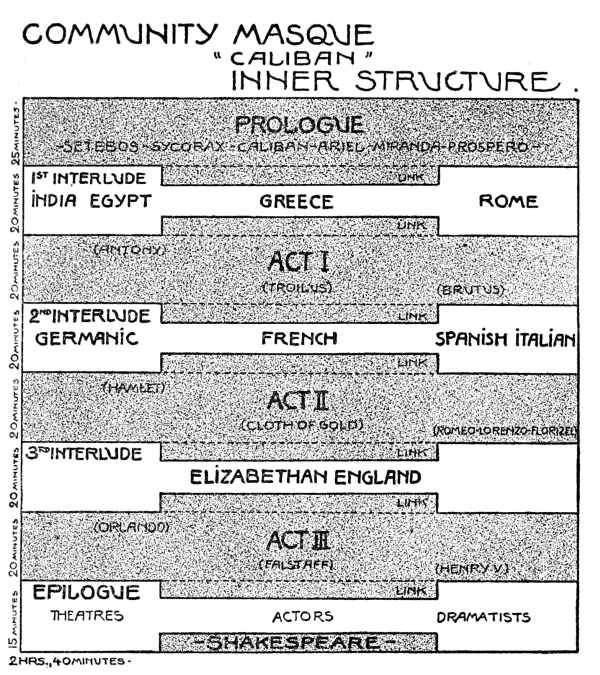
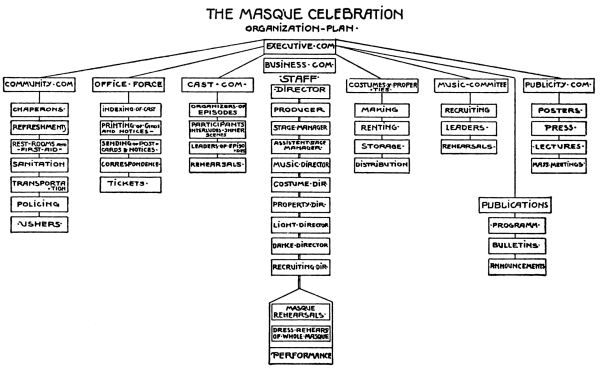
As visual hints to the structure (Inner and Outer) of the present
Masque, the charts here published may be suggestive to the reader.
To the reader as such it remains to point out one vital matter of
technique, namely, the relation of the dramatic dialogue to the
Masque’s production.
Even more than a play [if more be possible], a Masque is not a realized
work of art until it is adequately produced. To the casual reader, this
Masque, as visualized merely on these printed pages, may appear to be
a structure simply of written words: in reality it is a structure of
potential interrelated pantomime, music, dance, lighting, acting, song
[choral and lyric], scene values, stage management and spoken words.
Words spoken, then, constitute in this work but one of numerous
elements, all relatively important. If no word of the Masque be heard
by the audience, the plot, action, and symbolism will still remain
understandable and, if properly produced, dramatically interesting.
Synchronous with every speech occur, in production, effects of
pantomime, lighting, music, and movement with due proportion and
emphasis. Such, at least, is the nature of the technique sought,
whether or not this particular work attains to it.
A Masque must appeal as emphatically to the eye as a moving picture,
though with a different appeal to the imagination.
Because of this only relative value of the spoken word, there are many
producers [theoretical and practical] who believe that the spoken word
should be eliminated entirely from this special art of the theatre.
Artists as eminent and constructive in ideas as Gordon Craig, and many
whom his genius has inspired, advocate indeed this total elimination of
speech from the theatre’s art as a whole. For them that art ideally is
the compound of only light and music and movement. The reason for this,
I think, is because the sensibility of those artists is preëminently
visual. Moreover, they are relatively inexpert, as artists, in the
knowledge of the technique and values of the spoken word. Being
visually expert and creative, they have, by their practical genius,
established a world-wide school of independent visual art [assisted
only by mass sounds of music].
For them this art has well nigh become the art of the theatre. Yet
it is not so, I think, and can never be so, to that watching and
listening sensibility for which all dramatic art is created—the soul
of the audience. That soul, our soul, is a composite flowering of all
the senses, and the life-long record of the spoken word [reiterated
from childhood] is an integral, yes, the most intimate, element of our consciousness.
The association of ideas and emotions which only the spoken word can
evoke is, therefore, a dramatic value which the art of the theatre
cannot consistently ignore. It is chiefly because those artist-experts
in word values, the poets, who might contribute their special technique
to the theatre’s art, turn elsewhere creatively, that the field is left
unchallenged and open to the gifted school of the visualists. The true
dramatic art—which involves ideally a total coöperation—does not, and
cannot, exclude the poet-dramatist. Shakespeare and Sophocles lived
before electric light; if they had lived after, they would have set
a different pace for Bakst and Reinhardt, and established a creative
school more nobly poised in technique, more deeply human in appeal.
Now, therefore, when the poets are awaking to a new power and control
of expression, here especially in our own country, if they will both
learn and teach in this larger school, there rises before us the
promise of an art more sensuous, sane, and communal than the theatre
has ever known.
So, in the pioneering adventure of this Masque, which seeks by
experiment to relate the spoken word to its larger coöperation with the
visual arts, I have devised a structure in which the English language,
spoken by actors, is an essential dramatic value.
Why, then, take pains [as I have done] to make it relatively
non-essential in case it should not be heard?
For this reason: that now—at the present temporary and still
groping stage of development of community Masque organization and
production—there can be, in the nature of the case, no complete
assurance beforehand of adequate acoustics in setting, or of voices
trained to large-scale outdoor speech.
But, if this be so, would it not be the wiser part of creative valor to
adapt my structure wholly to these elementary conditions, risk nothing,
and devise simply pantomime?
No, for by that principle no forward step for the spoken word could
ever be taken. If we are to progress in this new art, we must seek to
make producing conditions conform to the spoken play, even more than
the play to those conditions.
And this can be done; it has been done.
At Saint Louis the vast amphitheatre for my Masque was at first
considered, by nearly all who saw it, to be utterly unsuited to the
spoken word; yet, after careful study, experiment and technical
provision for its use, the speech of actors was heard each night by at
least two-thirds of the hundred and fifty thousand listeners. Of the
seven thousand actors only about fifteen spoke, but these conveyed the
spoken symbolism and drama of the action.
In the present Masque I have focussed the spoken word on the raised
constructed stage of wood [A. and B. in the Chart], confined it to
the speech of eight principal acting parts, and about twenty other
subordinate parts, whose speaking lines [from Shakespeare’s plays] are
still further focussed at the narrower inner stage [A. in the Chart],
provided with special sounding boards.
On the other hand, for the ground-circle of the “Yellow Sands” [C.
in the Chart], where the thousands of participants in the Interludes
take part under an open sky, I have provided no spoken words, but only
pantomime, mass movements, dances and choruses.
To the reader, then, I would repeat, that the words of this printed
Masque are an essential, though not an exclusive, part of its structure,
and are meant primarily to be spoken, not primarily to be read.
As in the case of my Civic Ritual “The New Citizenship”[7]
this Masque can only have its completely adequate production on a large
and elaborate scale. Like the Civic Ritual, however, which—originally
designed for the New York stadium—is being performed on an adapted
scale in many parts of the country, in schools and elsewhere, this
Masque may perhaps serve some good purpose in being made available
for performance in a smaller, simpler manner, adapted to the purposes
of festivals during this year of Shakespeare’s Tercentenary. At the
invitation, therefore, of Mr. Percival Chubb, President of the Drama
League of America, who first suggested to me the writing of a Memorial
Masque to Shakespeare, the publishers have made arrangements with
officers of the Drama League for making known its availability as
stated in their announcement printed at the back of this volume.
The accompanying stage-designs are the work of Mr. Joseph Urban, the
eminent Viennese artist and producer [who has recently become an
American], and of Mr. Robert Edmond Jones, designer of the scenes and
costumes for Mr. Granville Barker’s production of “The Man Who Married
a Dumb Wife.”
At the date of this preface, Mr. Arthur Farwell has nearly completed
his compositions for the lyric choruses and incidental music of the
Masque. The choruses will shortly be made available, published by G.
Schirmer, New York.
With all three of these artists I am fortunate in being associated in
preparations for the Masque’s New York production next May.
These preparations have met with many complex difficulties of launching
and organization; the time remaining is very brief to accomplish the
many-sided community task for which the Masque is designed; only the
merest beginnings of so vast a movement can be attempted; but, with
coöperation and support from those who believe in that task, the
producers look forward hopefully to serving, in some pioneering degree,
the great cause of community expression through the art of the theatre.
Percy MacKaye.
New York, February 22, 1916.
MASQUE STRUCTURE — The Action — The Time — The Setting
The action takes place, symbolically, on three planes: (1) in the cave
of Setebos (before and after its transformation into the theatre of
Prospero); (2) in the mind of Prospero (behind the Cloudy Curtains of
the inner stage); and (3) on the ground-circle of “the Yellow Sands”
(the place of historic time).
The Masque Proper is concerned, symbolically, with no literal period of
time, but with the waxing and waning of the life of dramatic art (and
its concomitant, civilization) from primitive barbaric times to the
verge of the living present.
The Interludes are concerned with ritualistic glimpses of the art of
the theatre (in its widest, communal scope) during three historical
periods: (1) Antiquity, (2) the Middle Ages, and (3) Elizabethan England.
The Epilogue is concerned with the creative forces of dramatic art from
antiquity to the present, and—by suggestion—with the future of those forces.
The setting of the entire Masque is architectural and scenic, not
a background of natural landscape as in the case of most outdoor
pageants. Being constructed technically for performance, on a large
scale, by night only, its basic appeals are to the eye, through expert
illusions of light and darkness, architectural and plastic line, the
dance, color, and pageantry of group movements; to the ear, through
invisible choirs and orchestra, stage instrumental music and voices of
visible mass-choruses [in the Interludes only].
As indicated by the accompanying diagram [Time Chart][8]
of its Inner Structure, the Masque Proper is enacted by a comparatively
few [about thirty] professional actors, who use the spoken word to
motivate the large-scale pantomime of their action; the Interludes
[which use no spoken word, but only dance, pageantry, miming, and
choruses] are performed by community participants [to the number of
thousands]; the Epilogue utilizes both kinds of performers.
Corresponding to this Inner Structure, the Outer Structure consists
of three architectural planes or acting stages [all interdependent]:
a modified form of Elizabethan stage, [here called “the Middle
Stage—B”] consisting of a raised platform [to which steps lead up from
a ground-circle, eight feet below] provided with a smaller, curtained
Inner Stage [A—under a balcony, on which the upper visions appear, and
above which the concealed orchestra and choirs are located]. This Inner
Stage is two feet higher than the Middle Stage, from which ramps lead
up to it. Shutting it off from the other, its “Cloudy Curtains,” when
closed, meet at the centre; when they are open, the inner Shakespearean
scenes [visions in the mind of Prospero] are then revealed within.
Between the raised Middle Stage and the audience lies the
Ground-Circle—in form like the “orchestra” of a Greek theatre. Here
the community Interludes take place around a low central Altar, from
which rises a great hour-glass, flowing with luminous sands. This
ground-circle is the place of the Yellow Sands, the outer wave-lines
of which are bordered by the deep blue of the space beyond. The circle
itself, representing the magic isle of Prospero [the temporal place of
his art], is mottled with shadowy contours of the continents of the world.
Beneath the middle stage, and between the broad spaces of the steps
which lead up to it from the ground-circle, is situated, at centre, the
mouth of Caliban’s cell, which thus opens directly upon the Yellow Sands.
All of these features of the setting, however,
are invisible when the Masque begins, and are only revealed as the
lightings of the action disclose them.
Of these scenes eight are spoken scenes taken from plays of
Shakespeare; one (the sixth) is a pantomime devised from a descriptive
speech in “Henry the Eighth,” Act I, Scene I; one (the fourth) is a
tableau scene symbolic of the early Christian Church. Those taken from
Shakespeare are printed in black-faced type.
See Appendix: Pages 162, 166, 172, 184, 187, 190, 195.
Inventors, etc.: Creators of the art of the theatre]
Actors
Dramatists
Spirit Trumpeters [Announcers of the Groups]
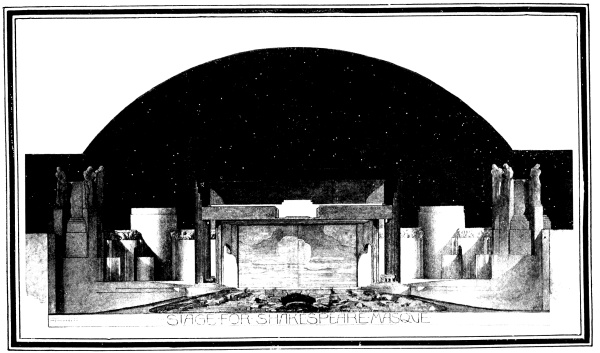
STAGE·FOR·SHAKESPEARE·MASQUE·
BEHIND THE CLOUDY CURTAINS IS STAGE A OF INNER SCENES (SEE GROUND PLAN)
IN FRONT OF THE CURTAINS IS STAGE B OF MASQUE PROPER (SEE GROUND PLAN)
AT CENTRE, CALIBAN’S CELL OPENS UPON STAGE C OF INTERLUDES (SEE GROUND PLAN)
PROLOGUE
CALIBAN
The action begins in semi-darkness, out of which sound invisible choirs.
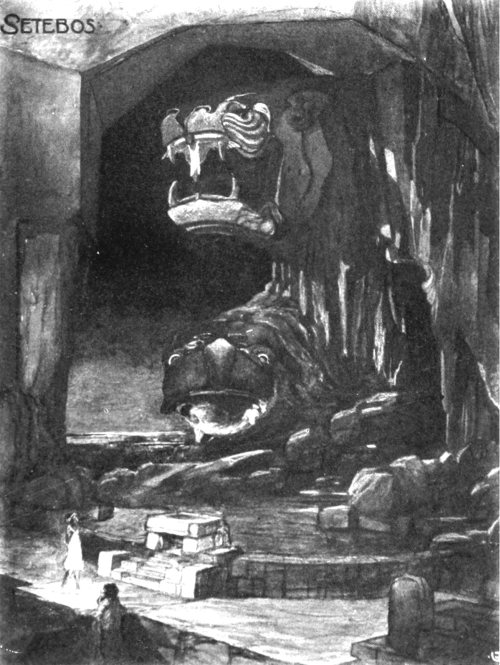
The scene is the cave of SETEBOS, whose stark-colored idol—half
tiger and half toad—colossal and primitive—rises at centre above a
stone altar.
On the right, the cave leads inward to the abode of SYCORAX; on the
left, it leads outward to the sea, a blue-green glimpse of which is
vaguely visible.
High in the tiger-jaws of the idol, ARIEL—a slim, winged figure,
half nude—is held fettered.
In the dimness, he listens to deep-bellowing choirs from below,
answered by a chorus of sweet shrill voices from within.
THE VOICES FROM BELOW[Sing.]Setebos! Setebos!
THE VOICES FROM WITHIN[Sing.]Ariel!
ARIEL[Calls aloud.]O, my brave spirits!
THE VOICES FROM BELOWSetebos! Setebos!Over us which art, and under:Fang of fireFrom mouth of thunder!Hungering goadFrom belly of mire!Tiger and toad—Setebos!Blood which art on the jungle bloom,Sloth and slumber and seed in the womb:Which art wondrousOver and under us,Setebos! Setebos! Thou art Setebos!
THE VOICES FROM WITHINSealèd in a starless cell,We are shut from dawn and sky.Ariel!—Ariel!Why?
ARIELSetebos knows, but his jawsFetter me fast: he is dumb—Answering never.
THE VOICES FROM WITHINWe, who parch for dew and star—Ariel!—Ariel!—Must we perish where we are?Tell!
ARIELSycorax knows, but she sitsThere in the cave with her son—Mocking us ever.
THE VOICES FROM WITHINAriel!
ARIELCall me no more,Lest they torment us. I hear themComing now.
THE VOICE OF SYCORAXCaliban!
ARIELHush!
[Gigantic, the twisted form of SYCORAX looms fromwithin the rock.]
SYCORAX[Calling toward the sea.]Come, fish-fowl! Leave thy flapping in the mudAnd keep thy father’s temple. Call his priests.Thy father Toad’s a god, hath double teethIn his two heads. The Tiger loins of himBegot thee in my belly for a cubTo lick his paws and purr, else he may pinch theeBehind an eye-tooth, like yon flitter mouseThat hangs there wriggling.
THE VOICE OF CALIBANSo, so Sycorax!—Coming!
SYCORAXAye, so so: crawling still!
[Malformed and hissing, CALIBAN enters on his bellyand arms.]
CALIBANSyc-Syco-Sycorax! See!
SYCORAXWhat hast thou got thee?
CALIBAN[Laughs, half rising, and holds up a wriggling creature.]GotA little god—a little Caliban.Ha!—make him out of mud. See: Squeezed it roundAnd slipped him through my fist-hole. Am a god:[Rising.]See Sycorax—her grandchild!
SYCORAX’Tis an eel-worm.Fling him to the white bat yonder.
[Her form vanishes in the rock.]
CALIBAN[Approaching the idol.]Ariel,Here’s food for thee: a wormling for thy beak.So, my trapped bird:—How sayst, ha?
ARIEL[Sings.]“Where the bee sucks there suck I.”
CALIBAN[Laughing.]Bee, sayst thou?Still buzzest of thy wings, and eatest—air!
ARIEL[Sings.]“In a cowslip’s bell I lie.”
CALIBANMy father’s gullet is no cowslip’s bell.Shalt lie in the belly of Setebos.[Tossing away the eel.]—What waitest for?
ARIELI am waiting for one who will come.
CALIBANAye? Who will come?
ARIELOne from the heart of the world; and he shall riseOn tempest of music and in thunder of song.
CALIBAN[Gaping.]Thunder and tempest—so!
ARIEL[With ecstasy.]I see him now.
CALIBAN[Crouching back.]See him! Where, now?
ARIELIn my dream:—He bearsA star-wrought staff and hooded cloak of blue,And on his right hand bums the sun, and onHis left, the moon; and these he makes his masksOf joy and sorrow.
CALIBANWhere? Mine eye seeth naught.
ARIELBefore him comes a maid—a child, all wonder—And leads, him to this blighted isle.
CALIBANWhat for, here?
ARIELTo set me free, and all my air-born spiritsWhom Setebos holds prisoned in this earth.
CALIBANFree? What’s that—free?
ARIELWhat thou canst never beWho never shalt dance with us by yellow sands.
SPIRITS OF ARIEL[Sing within.]“Come unto these yellow sands,And then take hands:Courtsied when you have and kiss’dThe wild waves whist.Foot it featly here and there”—
CALIBANHo, blast their noises! Stop thy spirits’ squealing.Their piping itcheth me like hornets’ stings.
SPIRITS OF ARIEL[Sing on, within.]“And, sweet sprites, the burthen bear”—
CALIBAN[Screaming.]Setebos! Squash ’em!
POWERS OF SETEBOS[Sing below with strident roarings, drowning the songof Ariel’s Spirits.]Setebos! Setebos! Thou art Setebos!
CALIBAN[Exulting grotesquely.]Who’ll dance by yellow sands?—Who’s free now, spirit?Ho, Caliban can squash their music. Free?Aren’t I a god, bitch-born, the son of SetebosCan howl all hell up? Worship me, thou wings!Praise my toad-father in his temple!
ARIELThe priestsOf Setebos are Lust and Death and War.Not Ariel—nor Ariel’s Spirits ever—Shall do them honor. One shall come hereafterWhom we now worship, waiting.
CALIBAN[Roaring.]Sycorax!
SYCORAX[Reappearing.]Swallow thy croakings, bullfrog. Call the priests,And fill this spirit’s nostrils with the reekOf Setebos, his blood-rites.
THE SPIRITS OF ARIEL[Cry out piercingly.]Ariel!
ARIELPeace, my brave hearts! Be dumb—but still be dreaming!
CALIBANPowers of Setebos!—Lust, Death, War,—ho, now!Hither, and do my father worship!
ARIEL[Stifling a cry.]Ah!
[Enter LUST, DEATH, and WAR, arrayed as priestsof Setebos.]
SYCORAX[To Caliban.]Come, toad-boy: watch with me, within.
CALIBAN[Going within the cave, as Sycorax disappears.]Free, saith?Will dance by yellow sands?—Now, Spirit, dance!
[As Caliban goes within, the powers of Setebos come forth.At the altar beneath Ariel, the three Priests leadthem in ceremonial rites of primeval pageantry anddance—the sacrificial worship of Setebos. Abovethem Ariel suffers, with closed eyes. In theirrites, Lust pours his libation, and lights thealtar fire, which—when War has made there hisliving sacrifice—Death extinguishes in darkness.Through the dark, which gradually changes to a glowingdusky Ariel speaks aloud.]
ARIELO Spirits, I have dreamed, but Death has closedMy sight in darkness. Spirits, I have begottenSweet Joy, but Lust hath drowned her in his wine.Yea, I have wove Love wings, but War hath robbed themAnd riven his lovely body all aliveTo feed the hungering flames of Setebos.My Spirits, I your master am unmastered.Speak to me! Comfort me! Is there no joy,No love, no dream, that shall survive this dark?Hath this our isle no king but Caliban?Are there no yellow sands where we shall danceTo greet the master of a timeless dawn?Or must there break no morning?—Ah, you are dumbStill to my doubtings. Yet the dark grows pale,And, paling, pulses now with rosier shadows;And now the shadows tremble, and draw backTheir trailing glories: hark! All little birdsWake in the gloaming: look! What young AuroraWalks in the dusk below, and like a childTurns her quick face to listen?—Ah!
[Below, against the light from the sea, has enteredthe dim Figure he descries.]
THE FIGUREWho calls?
ARIELSpirits, ’tis she! O, we have dreamed her trueAt last—Miranda!
SPIRITS OF ARIEL[Call, in echoing song.]Miranda!
MIRANDA[Searching with her eyes.]Earth and airEcho my name. Who calls me?
ARIELAriel.
SPIRITS OF ARIEL[As before.]Ariel!
MIRANDALight and dark spin webs around me.What art thou, voice—and where?
ARIELHere—and your servant.
MIRANDA[Beholding him.]O me!—poor Spirit!—What mouth so terribleUtters a voice so tender?
ARIELSetebos,God of this isle, holds me in ’s fangs.
MIRANDABut why?
ARIELI will not serve him.
MIRANDA[Naïvely, drawing nearer to the huge idol.]Setebos, be kind.Release this Spirit.
ARIELHe hath nor ears, nor eyes,Nor any sense to know thee by, but onlyThese tusks and claws and his toad-belly.
MIRANDADostThou suffer, so?
ARIELNot now.
MIRANDAAnd hath he held theeLong captive?
ARIELSince old ocean’s slime first spawnedUnder the moon, I have awaited theeAnd him thou bringest here.
MIRANDAYou mean my father,Prospero.
ARIEL[Exultingly.]Hail him, Spirits!
SPIRITS OF ARIEL[Sing.]Prospero!
MIRANDAYea, many a starry journey we have madeSearching this isle. At last to-day, at dawn,I saw its yellow sands, and heard thy voiceCalling for pity. Now my father is comeAnd shall release thee.
ARIELWhere? Where is he?
MIRANDAHere:His cloak is round us now: he holds us nowIn his great art, revealing each to eachThough he be all invisible.
[Reëntering, Caliban comes forward, sniffing andpeering at Miranda.]
CALIBANHath feetAnd hair: hath bright hair shineth like a fish’s tail;Hath mouth, and maketh small, sweet noises.
ARIEL[Crying out.]Beast,Go back!
MIRANDA[Staring, amazed.]What’s here?
CALIBANCa—Caliban; cometh hereTo smell what ’tis.[He sniffs nearer; then howls strangely.]Spring in the air: Oho!
MIRANDAAlas, poor creature! Who hath hurt thee?
CALIBANHurt?Who hurteth God? Am seed of Setebos:Am Caliban: the world is all mine isle:Kill what I please, and play with what I please;So, yonder, play with him: pull out his wingsAnd put ’em back to grow.—Where be thy wings,Spring-i’-the-air?
MIRANDAO Ariel, is this sightA true thing, and speaks truly?
ARIELWhat you hearAnd see—’tis my master.
MIRANDA’Tis so wonderfulI know not how to be sad.
CALIBAN[In puzzled fascination, staring at Miranda.]
The moon hath a faceAnd smileth on the lily pools, but hathNo lily body withal: thy body isAll lilies and the smell of lily buds,And thy round face a pool of moonbeams!
MIRANDA[With smile and laughter.]Nay,Then look not in, lest thou eclipse the moon.
CALIBANSyc—Sycorax hath no such laughing: soundethLike little leaves i’ the rain! Hath no such mouthBright-lipp’d with berries ripe to suck i’ the sun—Sycorax.
MIRANDAWho is Sycorax?
ARIELAh, pain!
CALIBANHo, she that hath calved Caliban to the bullSetebos, my blood-sire. [Pauses at a glowing thought,then cries with sudden exultance:] So shall us twainCaliban all this world!
[He crouches, then rolls over at her feet.]
—Laugh, Spring-i’-the-air!Lift so thy lily-pad foot and rub his earWhere the fur tickleth, and let thy CalibanTongue-lick its palm.
[He lies, dog-like, on his back, and laughs loud.]
MIRANDAThis wonder grows too wild.
ARIELGo, go! O flee away!
CALIBAN[Leaping up.]Away?—Aye, so![He approaches Miranda, who recoils, half fearful.]Wist where salt water lappeth warm i’ the noonAnd shore-fish breed i’ the shoals.—Wist where the sea-bullFlap-flappeth his fin and walloweth there his cowAnd snoreth the rainbow from his nostrils.
[He begins to dance grotesquely about her.]
Ho,Spring-i’-the-air! shalt leap, shalt roll in the sun,Shalt dance with lily-warm limbs, shalt race wi’ the gulls!Shalt laugh, and call—Come, Come!
MIRANDA[To Caliban.]Peace! Dance no more.Go hence, and leave me.
CALIBAN[Staring.]Hence? Aye, both—us twain.
MIRANDA[With simple command.]Nay, thou alone.
CALIBAN[With narrowing eyes, draws nearer.]Saith what?
MIRANDA[Unafraid.]Go from me.
CALIBAN[Stops, with a hissing growl.]Syc-Syc-Sycorax! Sycorax!
SYCORAX[Reappearing.]Mole in the mire, wilt squeakWhen thou art trod on?—Bite! Bite, Setebos’ son!Let the brave wonder breed of thee.
CALIBANAye, mother.[With rising passion—to Miranda.]A child! Shalt bear me such as thou, with headOf Caliban: no eel-worm, nay—a wonder,With lily feet, that walk. Ho, Setebos!
SYCORAXSetebos! Mate them at thine altar.
MIRANDA[Fleeing from Caliban, pauses in terror of Sycorax.]Save me!
POWERS OF SETEBOS[Sing within.]Setebos! Setebos!
CALIBAN[Rushing toward Miranda.]Mine!
MIRANDASave me, father!
ARIEL[Calling shrilly.]Prospero!
SPIRITS OF ARIEL[Sing within.]Prospero! Hail!
[A clap of thunder strikes, rolling, in sudden darkness.Lightnings burst from the idol of Setebos.From the flashing gloom, choruses of contendingspirits commingle the roar of their deep bass andhigh-pitched choirs.]
SPIRITS OF ARIELProspero! Prospero!Out of our earth-painRaise and array usIn splendor of order!Pour on our chaos—Prospero! Prospero!—Peace to our earth-pain!
POWERS OF SETEBOS
Setebos! Setebos!Lord of our earth-bane,Loose on his wrath wayThe beast of thy jungle!Pour on our pathway—Setebos! Setebos!Blood for thine earth-bane!
[Amid the tempestuous song, darkness, and thunder,appears on the left a glowing, winged throne. Onthe throne sits PROSPERO—in one hand, a scroll;in the other, a miraculous staff.]
PROSPERO[Raising his staff.]Darkness, be light!—Tempest, be calm!—Miranda![The scene grows light, and is still.]
MIRANDA[At the steps of the throne.]Father!
PROSPEROCome to me, child.[As she mounts to him gladly.]Sit here beside me.[She sits at his feet, nestling in the folds of his greatgarment.]My cloak and staff protect thee.
MIRANDA[Raising her eyes in dread.]But the wild thing?
PROSPEROMust be transformed.—Caliban!
CALIBAN[Crouching at the centre, howls terribly.]Setebos—sire!Sycorax—mother! Hast swallowed them. Lord Thunder,Strike us no more!
PROSPEROI strike no more till timeHath need of thunder. Rise now and be tamed,Howler at Heaven.
CALIBAN[Rising, bewildered.]Tamed, saith? What shall it be—That “tamed?”
PROSPEROThat shalt thou learn of Ariel.Now—Ariel!
[He looks toward Ariel, still held in the mouth of Setebos.Sycorax lies heaped and still by the altar.]
ARIEL[Joyously.]Master!
PROSPEROSycorax, lo, ’tis dead.
CALIBAN[With wailing cry.]Ah—yo!
PROSPEROThe will of Setebos is matched with mineTo rule our world. Time shall award the prize—Mine own Miranda—to his power or mine.His might is awful, but mine art is deepTo foil his power and exalt mine own.Ariel, thy spirits shall help me.
ARIELMaster, how?
PROSPEROThou, long time artless, now shalt learn mine artTo win my goal—Miranda’s freedom. NeverTill this immortal Caliban shall riseTo lordly reason, can Miranda holdHer maiden gladness undismayed. For thatI will release thee from those fangsOf Setebos.
ARIELFor that, dear master, I have waitedLong ages, dreaming.
PROSPEROSo, wilt give thy promiseTo learn of me, and teach this monster here?
ARIELO set me free to be thy servant ever.Master, I promise!
PROSPEROFly! Run free!—Unfang him,Setebos![Prospero raises his staff.Slowly the tiger-jaws of the Idol open their fangs.Ariel, with a joyous cry, slips into the air, and—ashe floats fluttering to the earth—his unseenchoir of Spirits sing with shrilly gladness:]
SPIRITS OF ARIELProspero! Prospero! Hail!
ARIEL[Dancing on the earth.]Free! Free!
MIRANDA[Eagerly.]O, now his fettered Spirits: Free them too!
PROSPEROWell urged, my own Miranda.—Setebos,Disgorge these long-embowelled choirs!—Spirits,Come forth!
[Again Prospero raises his staff.
Yawning enormous, the toad-mouth of the Idol, fittedwith green and blue light, widens to a lurid apertureout of which come forth—dancing—the star-brightSpirits of Ariel.
As they come, Ariel—springing toward Caliban—criesexultingly:]
ARIELNow, Caliban, we dance by yellow sands!
[Singing as they rush forth, the Spirits dart with Arielswiftly about the grovelling Caliban and chase him,dodging and whining, down the steps to the ground-circle,mottled with its shadowy continents of theworld, and rimmed with its long, yellow wave-lines.]
SPIRITS OF ARIEL“Come unto these yellow sands,And then take hands:Courtsied when you have and kiss’dThe wild waves whist.Foot it featly here and thereAnd, sweet sprites, the burthen bear:Hark, hark!Bow-wow!The watch-dogs bark:Bow-wow!Hark, hark! I hearThe strain of strutting chanticleerCry: cock-o-diddle-dow!”
[Encircling Caliban in their dance, and pelting him withbright handfuls of the yellow sands, they tease anddrive him howling into his cave cell, where his dark,monstrous shape silhouettes for a moment on theorange-red glow, then vanishes within.
As he disappears, to their last “Bow-wow!”and “"Cock-a-diddle-dow!”, they hasten back aboveto Ariel, who leads them before Prospero.]
ARIELThe beast is routed, Master. Was’t well done?
PROSPEROThe routed beast—returns. I charge thee, Spirit,Not to torment, but teach him—for which taskThou wilt require mine art. So by its powerWe will transform this cave of SetebosTo be a temple to Miranda. NowLet these thy Spirits lead her to her shrineYonder, where all her maiden Muses waitTo make her welcome.
[Prospero points to where, on the right, appears Miranda’sshrine. From its portals come forth the Nine Muses, bearinglutes and pipes. Prospero, turning to Miranda, rises andgives her into Ariel’s care.]
Child, go with them nowAnd tarry till I summon.
MIRANDASir, I will.I thank you and these Spirits, and may we allBe saved from Setebos.
ARIELSweet Mistress, follow!
[To a melodious tiding and piping played by the Muses,Ariel and his Spirits escort Miranda to the centre,where the Muses meet and conduct her into the shrine,while Ariel’s Spirits—at a gesture from him—dartthrough the centre of the Cloudy Curtains and disappear.]
PROSPERO[Calling.]Now hither, bird, and perch!
ARIEL[Running to him, on the throne.]Beside you, Master!
PROSPERO[Pointing to the ground-circle.]Seest yonder Yellow Sands? There sleep the shores,The cloudy capes and continents of time;There wane and wax eternal tides, that markThe ebb and flow of empires with their foam.There shalt thou see the million-colored skeinWhereof I weave mine art. Look well and learn!For this my art is of no only landOr age, but born of all—itself a worldSnatched from the womb of History, to surviveIts mortal mother in imagination.—Dost thou attend me?
ARIELWord and will, dear Master!
[At the mouth of Caliban’s cell are now visible Lust,Death, and War, who in pantomime indicate to Calibantheir conspiracy against Prospero and Ariel.]
PROSPERO’Tis well, for thou must prove my pupil. Look!Even now the priests of Setebos conspireWith Caliban against us. They will compassMy fall, Miranda’s ruin, and thy bondageUnless mine art can foil them. Therefore, nowThou shalt behold the pageant of mine artPace from antiquity. First, while yon glassLets flow its yellow sands, behold appearMy rites of ancient Egypt, Greece, and Rome,And, while they pass, I will instruct thee howTo use them.—Pageant, appear!
[A deep gong sounds.]Lo, Egypt comes!
FIRST INTERLUDE [13]
Now in succession through the great gates of the ground-circle, in
colorful incursions of costume and musky appear three main pageant
groups, that perform—with distinctive artistry of dance, pantomime,
mass movement, and choral song—three ritual episodes of the dramatic
art of antiquity. The nature of each, by a few brief sentences,
Prospero expounds to Ariel, and so to the audience. Concluding, each
group of the first two departs from the circle.
The first Action—a symbolic ritual of Egypt—enters in seven separate
processions, which converge at the centre in worship of the golden god
Osiris.
The second group—expressing the noble zenith of Greek dramatic
art—chants, with aspiring, athletic dance, the second chorus of the
Antigone of Sophocles, celebrating the splendor of man. This Action is
performed by the altar.
With the third enters a contrasted decadence of the theatre’s art with
the Roman Mimes, who enact a farcical Comedy in Masks, in presence of
the emperor Caligula and the Roman populace. Concluding, this Roman
group does not depart, but retiring into partial shadow on the right,
awaits there its later summons.
ACT I — FIRST INNER SCENE — SECOND INNER SCENE [15] — THIRD INNER SCENE
[As the Roman Interlude closes, the light passes from theground-circle to the middle stage, where Prospero—descendinghis throne with Ariel—moves toward the centre. While theyspeak together there, Caliban—coming from his cave—crawlspart way up the steps and lies flat, occasionally liftinghis head to listen.]
PROSPEROSo, Ariel, I have harvested for theeThese orchards of mine art, and let thee tasteTheir varied fruitages, some that have ripenedIn climes auspicious, some that are part decayed.Now from three vineyards—Egypt, Greece, and Rome—I will distill a varicolored wineFor Caliban to drink. So, steeped in spirit,Haply he also shall see visions. HastThou learned by heart all that I whispered to thee?
ARIELAll, Master.
PROSPEROTell me part.
ARIELYou will createOut of this world of art three scenes of vision.
PROSPEROAnd who shall act them—say!
ARIELMy Spirits shall;And I will be their Prologue.
PROSPEROFor what purpose?
ARIELTo tutor this beast.
PROSPEROAnd why?
ARIELThat he may growTo reverence Miranda, and forswear Setebos.
PROSPEROSo! and to dispel the PowersOf Setebos, I have transformed his caveTo be her temple and my theatre.—Look!
[Prospero raises his staff toward the darkness that concealsthe background. As he does so, increasing light reveals therude, irregular contours of the cave of Setebos transformedto the architectural lines of a splendid proscenium, in theoblong of which the Cloudy Curtains shut off the inner stage.The idol of Setebos has vanished.While this transformation is taking place, the Spirit Choirsof Ariel appear above the proscenium, singing.]
SPIRITS OF ARIELIn the same abode and cellWhere the Toad was wont to dwell,And the Tiger stretched his claw,We have built a shrine of Law:We have chosen the lair of hateTo love, imagine and create.
Out of blood and dross,Out of Setebos,We are risen to showThe art of Prospero:Here within his head and heartOur souls are servants of his art.
[Their appearances vanish above.]
ARIELMost noble Master! Show me now behindThose cloudy curtains: How have you transformedThe cave within?
PROSPEROCome; I will show thee how.
[Prospero and Ariel pass through the curtains at thecentre and disappear within.Meanwhile Caliban, peering above the top step, staresin dumb awe at the changed scene. There he is hailedfrom below by the priest of Setebos, Lust, who comesforth from his cell and calls:]
LUSTCaliban! Remember Setebos!
CALIBAN[Starting, backs down the steps in scared pantomime.]Aye, Setebos! But I hear their watch-dogs bark:Bow-wow! I feel their tongue-bites yet—their torments.
LUSTCaliban! Restore thy father’s temple.
CALIBANYea, but my father had no feet to dance.Curse on their yellow sands! They sting my eyesStill wi’ their blindings. Blast ’em!
[He springs part way up the steps again.]
LUSTCaliban!Restore the priests of Setebos!
CALIBANHis priests!Nay, what if the cock sang—their chanticleerHis Diddle-diddle-dow! Burneth my spineStill with that crowing.
[Reënter Prospero through the curtains.]
LUSTHush! he comes again.I await thy call. Cry on CaligulaAnd I will come.
[Lust goes in the cell.]
PROSPERO[Calling within the curtains.]Now, Ariel, where art thou?Ariel!
ARIEL[Stepping forth from behind the curtains, dressed inthe garb of Prologue, bows low.]
Here, great Master! I am nowPrologus, at your service.
PROSPERONay, not mineBut his. [Calling.]Come, Caliban: behold thy tutor.Behind these curtains he will show thee nowMore than thy nature dreams on. If thou obey himAnd learn mine art, thou shalt go free like him.If not, thou shalt be spitted on a toothMore sharp than Setebos. What sayest?
CALIBAN[Cringing.]Lord,Art Cock o’ the world, and Caliban thy worm;Yea, only beggeth thee crow no more, nor setThy dancing dogs to bark at him.
PROSPEROTush, fool:Wilt thou obey?
CALIBANObeyeth both of you.
PROSPEROThat’s well. Sit here and watch. Now, Ariel,Thy prologue: then reveal what lies behind.
[Prospero mounts his throne, on the steps of which Calibansquats below him, watching and listening with growingcuriosity. At the centre, before the Cloudy Curtains,Ariel speaks.]
ARIELFrom Egypt, by our Master’s art,Behold now, when these curtains part,A scene of fleeting pageantry:Behold where pale Mark AntonyHath fled his sore defeated shipsIn quest of Cleopatra’s lips,And turned the tides of war amissTo pawn a kingdom for a kiss.—So, by my Spirits’ acting, seeOf what strange stuff these humans be!
[Ariel retires within through the curtains, which then—tothe melodic dirge of flutes within—draw apart, disclosingthe inner stage, which depicts a scene of vivid Egyptiancoloring.]
Against a background of deep blue sky, the barge[14] of Cleopatra lies
moored at an ancient wharf:
From the left, along the wharf, enters Mark Antony, attended by
Soldiers and Populace in Roman and Egyptian garb.
ANTONYHark! the land bids me tread no more upon ’t;It is ashamed to bear me! Friends, come hither.I am so hated in the world, that IHave lost my way forever. I have a shipLaden with gold; take that, divide it; fly,And make your peace with Cæsar.
ALLFly! Not we.
ANTONYI have fled myself; and have instructed cowardsTo run and show their shoulders. Friends, be gone;I have myself resolv’d upon a courseWhich has no need of you; be gone....Nay, do so; for, indeed, I have lost command....
[His followers depart, and Antony throws himselfdown on a buttress of the wharf.Meantime from the barge, Cleopatra—who haslooked on and listened—is led down to the landingby Charmian and her Attendants, behind whom Eros[a friend of Antony] follows.They approach Antony, who—absorbed in hisgrief—does not see them.]
EROSNay, gentle madam, to him, comfort him....
CHARMIANDo! Why, what else?
CLEOPATRALet me sit down. O Juno!
[As Cleopatra sinks down near him, Antony—nowbeholding her—starts up with a cry of surprise andpassionate pain.]
ANTONYNo, no, no; no, no!
EROS[Pointing to Cleopatra’s piteous aspect.]See you here, sir?
ANTONY[Hiding his face.]O fie, fie, fie!
CHARMIAN[Bending over her.]Madam!
EROS[Appealing to Antony.]Sir, sir,—
ANTONYYes, my lord, yes; he at Philippi keptHis sword e’en like a dancer, while I struckThe lean and wrinkled Cassius; and ’twas IThat the mad Brutus ended ... yet now—No matter.
[He sinks down again.]
CLEOPATRA[Rising, to her Attendants.]Ah, stand by ... sustain me! O!
EROSMost noble sir, arise; the queen approaches.Her head’s declin’d, and death will seize her, butYour comfort makes the rescue.
ANTONY[Drawing still away, despairfully.]I have offended reputation,A most unnoble swerving.
EROSSir, the queen!
[Cleopatra and Antony face each other—gazinginto each other’s eyes.]
ANTONY[Suddenly crying out.]
O, whither hast thou led me, Egypt? See,How I convey my shame out of thine eyesBy looking back what I have left behind’Stroy’d in dishonor.
CLEOPATRAO my lord, my lord,Forgive my fearful sails! I little thoughtYou would have follow’d.
ANTONYEgypt, thou knew’st too wellMy heart was to thy rudder tied by the strings,And thou shouldst tow me after. O’er my spiritThy full supremacy thou knew’st, and thatThy beck might from the bidding of the godsCommand me.
CLEOPATRAO my pardon!
ANTONYNow I mustTo the young man send humble treaties, dodgeAnd palter in the shifts of lowness; whoWith half the bulk o’ the world play’d as I pleased,Making and marring fortunes. You did knowHow much you were my conqueror; and thatMy sword, made weak by my affection, wouldObey it on all cause.
CLEOPATRA[Touching his arm, clings to him.]Pardon, pardon!
ANTONY[Overcome at her touch.]Fall not a tear, I say; one of them ratesAll that is won and lost. Give me a kiss.Even this repays me.... Wine!Bring wine, within there: wine! For fortune knowsWe scorn her most when most she offers blows.[He embraces Cleopatra.From the right slaves enter, bearing chalices andwine-beakers. With them come flutists and harpers,making festal music.Snatching from them a golden cup, Antony raisesit aloft with an impassioned gesture, returning thetriumphant smile of the Egyptian queen.]
CLOSING, THE CLOUDY CURTAINSSHUT OFF THE SCENE.
[Meantime Caliban, who has risen absorbed and drawn slowlynearer in child-like fascination, stands for an instant,bewildered. Then, with a cry, he leaps forward in the dim-litspace and gropes along the curtains with arms wide.]
CALIBANHo, light! All’s smother: ’tis gone! Yo—yo, all gone—Cloud-swallowed, all! Ah, woman, snake-bright queen,Thou wonder-thing, come back! Ah, where—where—where?
PROSPEROSo, so! Canst thou, then, taste my vision, slave?[He descends the throne toward Caliban.]
CALIBAN[Staring about him.]O dazzle-blue, gold-shine, hot lotus smell!Blood-root in bloom, and scarlet water-weed!—O silver sight and tinkle-tickling sound!—Spurteth my body with joy—burst in my brainEnormous moons of wonder!—Float, still float,You purpling sails! Blaze, thou flame-woman! SpeakSparkles of kissing fire!
PROSPERO[Approaching him.]Nay, art thou touchedBeyond thy tiger cravings?
CALIBANHo, Lord Master,Lord Chanticleer, unswallow from thy gorgeThe world thou hast devoured!
PROSPERO[Pointing toward Ariel, who comes forth again asPrologus through the curtains.]
Ask of thy tutor;He hath revealed that world to thy brute ken.—Ariel, this lump of earth hath dreams within ’t,That now begin to sprout. Send it more sunAnd watering.
ARIELSir, your art is rain and sun:I am but air, to carry its wet or warmthWhereso you list.
PROSPEROSo let it fall on himTill he shall wax to a more worthy plantFor Miranda’s temple-garden.—Here is my Staff:This wields my power. Here keep it in thy chargeTill I return. So, use it as a rodTo instruct this bungling cub of Setebos.
ARIEL[As Prospero goes.]I will, sir.—Go you far?
PROSPERONo farther thanThe frontiers of mine art. Farewell a while!
[Prospero passes within through the curtains. Halfconfiding, half suspicious, Caliban comes near toAriel and questions him.]
CALIBANArt, saith! What’s that—his art?
ARIEL’Tis that which burnsNow in thy blood: the same which conjured hitherBright Egypt and the kiss of Antony.
CALIBANThe woman and the kiss! Nay, saidest now’Tis rain and sun!
ARIEL’Tis so.
CALIBANWhere falleth his rain?Where shineth his sun?
ARIELYonder on the Yellow Sands.
CALIBANNay, show me this art! Is ’t hidden in thy hand?Here, let me hold the staff.[Caliban reaches for the staff; Ariel raises it warningly.]
ARIELStay! Touch it notLest it shall scorch thy fingers and set fireTo the building world. The staff of ProsperoIs for his servants, not for slaves, to wield.
CALIBAN[Drawing back from it, in fear.]Scorcheth my fingers, ah?—So wield it, thou!Show me once more the snake-bright queen.
ARIELNay, EgyptNo more! But come with me to Prosper’s throneWhere I play master now. Here thou shalt sitAnd watch the battlements of eternal TroyWhere Troilus woos inconstant Cressida.
CALIBANShowest me once more—woman?
ARIELEven so;For many kinds of woman make mankind.
[Rising, Ariel points toward the inner stageand speaks chantingly.]Now, from out Time’s storied sphere,Homer’s Troy I summon here,On a dawn when Hector seeksBattle with the besieging Greeks:There, while heroes throng the gates,Cressida her lover ’waits,Casting from a height apartTangling hooks for Troilus’ heart.—Behold her now, by Prosper’s art![Ariel raises his staff.]
The Cloudy Curtains draw back, revealing the battlements of Troy.
Above, on a rampart, in the first rays of morning, CRESSIDA appears,
with a maiden Attendant.
Below, murmuring crowds are looking toward the outer gates. Among them
pass the aged Trojan Queen, and the Greek Helen, in her younger beauty.
CRESSIDA[Peering below.]Who were those went by?
ATTENDANTQueen Hecuba and Helen.
CRESSIDAAnd whither go they?
ATTENDANTUp to the eastern towerTo see the battle—Hector,Before the sun uprose, was harnessed lightAnd to the field goes he.[Enter behind them Pandarus.]
CRESSIDAHector’s a gallant man.—[Turning to greet him.]Good morrow, Uncle Pandarus.
PANDARUS[Smiling.]Good morrow, Cousin Cressid.[Trumpets are sounded, off left.]Hark! They are coming from the field. Shall westand up here and see them as they pass towardIlium?
CRESSIDAAt your pleasure.
[They move to a better vantage. At a gesturefrom Cressida the Attendant departs.]
PANDARUSHere, here’s an excellent place. I’ll tell you themall by their names, as they pass by; but markTroilus above the rest.
CRESSIDA[With a reproving laugh.]Speak not so loud.
[Below, from the left, Trojan warriors, in battlegear, begin to pass by, through the admiringpopulace who cheer them occasionally.Among themÆNEAS PASSES
PANDARUSThat’s Æneas: is not that a brave man? He’s oneof the flowers of Troy, I can tell you. But markTroilus; you shall see anon.ANTENOR PASSES
CRESSIDAWho’s that?
PANDARUSThat’s Antenor: he’s one o’ the soundest judgmentsin Troy. But when comes Troilus? I’ll showyou Troilus anon. If he sees me, you shall seehim nod at me.
CRESSIDA[Archly.]Will he give you the nod?
PANDARUSYou shall see.
CRESSIDAIf he do, the rich shall have more.HECTOR PASSES
PANDARUSThat’s Hector: that, that, look you, that; there’s a fellow!Go thy way, Hector! There’s a brave man, niece.
CRESSIDAO, a brave man!
PANDARUSSwords! anything, he cares not; an the devil comes tohim, it’s all one. Yonder comes Paris—Paris!PARIS PASSES
Who said he came hurt home to-day? He’s not hurt.Why, this will do Helen’s heart good now, ha! WouldI could see Troilus now! You shall see Troilus anon.HELENUS PASSES
CRESSIDAWho’s that?
PANDARUS[Searching with his eyes, grows impatiently expectant.]That’s Helenus.—I marvel where Troilus is.—That’sHelenus—I think he went not forth to-day.—That’sHelenus.
CRESSIDACan Helenus fight, uncle?
PANDARUSHelenus? no. Yes, he’ll fight indifferent well.—Imarvel where Troilus is. Hark! do you hear thepeople cry “Troilus?”TROILUS PASSES[As he approaches, the populace cheer him.His eyes, however, search about till they rest onthe battlement, where Cressida, returning his look,starts back, trembling.Noting both their actions, Pandarus continuesflauntingly to point out the young hero.]
’Tis Troilus! There’s a man, niece. Hem! Brave Troilus!
CRESSIDAPeace! For shame, peace!
PANDARUSMark him: note him. O brave Troilus! Look wellupon him, niece; look you how his sword is bloodied,and his helm more hacked than Hector’s.O admirable youth! Go thy way, Troilus, go thyway! Had I a sister were a grace, or a daughter agoddess, he should take his choice. O admirableman! Paris? Paris is dirt to him.
[While he is speaking, Cressida has taken from herhair a flower, knotted its stem to an arrow, anddropped the arrow beneath the rampart, where Troiluslifts it with a smile and happy gesture, bearing it awaywith him, right. As Pandarus now turns to her,Cressida looks away left and points to others below.]
CRESSIDAHere comes more.MORE FORCES PASS
PANDARUSAsses, fools, dolts! Chaff and bran! Porridge aftermeat! I could live and die i’ the eyes of Troilus.Ne’er look, ne’er look! the eagles are gone; crowsand daws, crows and daws! I had rather be sucha man as Troilus than Agamemnon and all Greece.
[Enter, above, Troilus’ Boy, who speaks to Pandarus.]
THE BOYSir, my lord Troilus would instantly speak with you.
PANDARUSWhere?
THE BOYAt your own house; there he unarms him.
PANDARUSGood boy, tell him I come. [Exit Boy.]Fare ye well, good niece.[He goes off, above.]
CRESSIDAAdieu, uncle!
[Below, the last of the soldiers and populace havepassed off, right, where Cressida gazes after them,speaking aloud to herself:]
O more in Troilus thousandfold I seeThan in the glass of Pandar’s praise may be;Yet hold I off. Women are angels, wooing.Things won are done; joy’s soul lies in the doing.
[Below, from the right, Troilus hastens back, alone.The arrow with the flower he has thrust through thelinks in his chain armor on his left side. Pointingto it, he calls up toward the battlement.]
TROILUSCressida!
CRESSIDA[With a glad cry.]Troilus!
[Unwinding her long wine-red scarf, she ties it tothe battlement, whence it flutters down to Troilus.Seizing it, he mounts by its aid toward the rampart,where the face of Cressida peers luringly above him.]
TROILUS[Calling upward as he mounts.]Cressida![Just as he is about to reach Cressida,
THE CLOUDY CURTAINS CLOSE.
[At the centre Caliban now leaps up in loud, excitedlaughter. Clapping his hands in the air, hestrides toward Ariel on the throne.]
CALIBANAha! Troy, Troy! Lips of Troyland and Egypt!Lovers in links of gold! Ho, wine of womanBubbling in vats of war!—drinketh you allCaliban, Caliban, son of Setebos.—Ariel,Learnest me Art? Lo, now: I am his Artist!Tell him, Lord Prospero, Caliban createthGlories more ’stounding still. Art? Ho, ’tis God’s play!But me? Am God i’ the mire: can make me TroyAnd purple Egypt out of the mud i’ my palm;Giveth me only that—his little play stick[Pointing to the staff in Ariel’s hand.]To stir in the mud withal.
ARIELNot yet!—This staffIs wrought to stir the spirits of the air,Not dabble i’ the slime.
CALIBANWhy so? From bog-slime bloomethThe lotus, and the sea-lark feedeth her youngAlong the salt flats.—[With childish wheedling.]Prithee—the staff?
ARIEL[Descending the throne.]’Twould burn thee.Touch not till thou art free. Yet patience, monster,For thou hast learned to answer well, and growestRarely in thought and speech.
CALIBAN[Tickled to laughter.]Yea, clever monsterSoon groweth monstrous clever. More art, fine Ariel!Let Caliban speak thy Prologue.
ARIELHush!—Miranda!
[From her shrine Miranda comes forth, with the Muses.Seeing the two, she pauses astonished.]
CALIBAN[With confiding assurance.]Liketh well thy father’s art,Spring-i’-the-air.
MIRANDAGod speed thy learning, monster!I am more fain to help thee in that taskThan all else in the world.
CALIBAN[Astonished and eager.]Wouldst help me—thou?
MIRANDAHow happy, if I could!
CALIBANYea, canst thou!—Hark:[Glancing from his garb to Ariel’s.]Let me wear glory, too! What booteth meTo be his Artist, if I wear no clothTo show my glory? He there talketh no PrologueWithout his toga. Tog me, too, in braveColors!
MIRANDAWell thought on.[To one of the Muses.]Quick, Euterpe: FetchBright vesture forth.
ARIELFor Caliban?
MIRANDAFor whomSo fit? The need of beauty liesMost near to them who lack it.
[Euterpe returns, bringing bright garments, which she andthe other Maidens help now to put upon Caliban.]
So, dear Muses:Lay on!
CALIBAN[Delightedly tries to survey himself.]
Ha, Sycorax, an thou wert here nowTo look on this thy son!
[He parades, with swelling pleasure, before the Muses.]
Gaze well, good Spirits!Now, Ariel, thy pupil soon shall teach theeWhat thing this Art is: yea, teach ProsperoA lesson in ’s own lore.
MIRANDA[To Ariel, who is about to protest.]Pray, let him tarryThis time with us. He is too full of dreamsTo act us harm. Speak on thy Prologue.
CALIBAN[Still parading.]Prologue!Aye, good: my Prologue shall come after.
ARIELMistress,Keep here, this staff for your protection.
[Accepting the staff from Ariel, Miranda takes seat onthe shrine, where the Muses range themselves about her.]
MIRANDASo!Be near us, Caliban.
CALIBAN[Moving to the shrine steps, speaks to Ariel.]What showest now?
ARIEL[At centre, before the curtains.]Now, in Time’s emblazoned tomeEgypt, Greece, turn page for Rome.
CALIBAN[Mutters aloud.]Rome, ha! I’ll show you Rome!
ARIELRocked by mighty Cæsar’s fallGlooms the world in battle pall,Where by midnight, worn and spent,Weary Brutus, in his tent,Watches ’mid the Roman host.There the pallid Cæsar’s ghostRises from his candle-flameAccusing.—Who shall bear that blame?Can Brutus wake a world from shame?
[Ariel disappears through the curtains.Miranda raises the staff.]
The Cloudy Curtains part, disclosing the tent of Brutus, by moonlight.
Brutus—his outer armor laid aside—sits on a couch: near him Lucius,
a boy, nods drowsily over a stringed instrument. After a brief pause,
Brutus—gazing at him—speaks wistfully:
BRUTUSBear with me, good boy:Canst thou hold up thy heavy eyes awhileAnd touch thy instrument a strain or two?
LUCIUSAye, my lord, an’t please you.
BRUTUSIt does, my boy:I should not urge thy duty past thy might;I know young bloods look for a time of rest.
LUCIUSI have slept, my lord, already.
BRUTUSIt was well done; and thou shalt sleep again;I will not hold thee long. If I do liveI will be good to thee.
LUCIUS[Tuning his instrument, sings dreamily:]
Fear no more the frown o’ the great;Thou art past the tyrant’s stroke.Care no more to clothe and eat;To thee the seed is as the oak.The sceptre, learning, physic, mustAll follow this and come to dust.
[Lucius falls asleep.]
BRUTUSThis is a sleepy tune. O murderous slumber,Lay’st thou thy leaden mace upon my boyThat plays thee music? Gentle knave, good-night;I will not do thee so much wrong to wake thee.—Let me see, let me see; is not the leaf turned downWhere I left reading? Here it is, I think.
[The Ghost of Cæsar appears.]
How ill this taper burns!—Ha! Who comes here?I think it is the weakness of mine eyesThat shapes this monstrous apparition.It comes upon me. Art thou anything?Art thou some god, some angel, or some devil,That makest my blood cold and my hair to stare?Speak to me what thou art.
[In the darkness, dark ghostly shapes, hardly visible,appear to urge forward the dead Cæsar, who aloneis luminous.]
THE GHOSTThy evil spirit, Brutus.
BRUTUSWhy comest thou?
THE GHOSTTo tell thee thou shalt see me at Philippi.
BRUTUSWell; then I shall see thee again?
THE GHOSTAye, at Philippi.
BRUTUSWhy, I will see thee at Philippi, then.
[The Ghost and the dim Shapes disappear.Brutus rises.]
Now I have taken heart, thou vanishest:Ill spirit, I would hold more talk with thee.—[Calling aloud.]Boy, Lucius! Romans, Romans! Awake—awake!
THE CLOUDY CURTAINS CLOSE
[Instantly, in the semi-darkness without, Caliban—witha great cry—springs among the Muses, snatchesfrom Miranda the staff, and rushes with it to thecentre of the middle stage, shouting aloud:]
CALIBANAwake, Romans, awake![Low thunders growl, and sharp flashes glimmer about him.]
MIRANDA[Cries out, appalled.]The staff! His staff!Touch not its power, lest thou lay waste the world!
CALIBAN[Grasping the staff, staggers and sways wildly with it,as though being shocked by an invisible force.]Rome! Now do I hold the roof-beam o’ the world.Now am I lord of lightnings: Lo, mine artShaketh the throne of Prospero.[He strides upon the throne, raising the staff.]Awake,Imperial Rome! Return, ye snake-bright womenOf Troy and Egypt! Stain these yellow sandsWine-red with spillings of your wreathèd bowls,And let the orgied priests of revel reign.—Caligula, be crowned by Setebos!Caligula! Caligula! Caligula!
[While he cries aloud, the Powers of Setebos
come forth from the cell beneath, clad as Roman men, women, and slaves
and, joined by the Roman Interlude Pageant on the ground-circle, raise
the Emperor on a palanquin upon their shoulders, and bear him up the
steps to the middle stage, shouting “Caligula!”
Here a scene of mingled riot and orgy follows:
Women dancers with golden bowls, slaves shackled
and driven with whips, rabble groups scrambling for bread loaves flung
them by heralds, armed soldiery, and gorgeous patrician lords: these
swarm in a sordid saturnalia, from the midst of which the masked form
of Caligula rises dominant in splendor. At his gesture, slaves tear the
Muses from their shrine, and give them over to the revellers.
High above all, clutching the staff, his huge
limbs rioting grotesque from his silken garments, Caliban dances on the
throne of Prospero.
Below, bass voices of invisible choirs chant
through the din:
“Setebos! Setebos! Thou art Setebos!”
Seized from the throne with the Muses,
Miranda—at the centre—is borne in faint dread to the reaching arms
of Caligula, who is about to place upon her his crown, when a sudden
pealing of silvery trumpets strikes silence over all. In awe the
revellers gaze upward, and turn toward the background, listening.
Above them there, from the darkness, appears a
colossal CROSS, burning with white fire.
Caligula drops his crown.
Shadow falls on the colorful pageantry, and all
sink slowly to their knees, as the Spirits of Ariel appear againabove—their luminous wings outspread like seraphim.
At either end one blows a slim tapering trumpet.
High and clear, then, their choirs chant in
Gregorian unison:
SPIRITS OF ARIELVexilla Regis pródeunt;Fulget Crucis mystérium,Quo carne carnis CónditorSuspénsus est patíbulo.
Quo vulneratis ínsuperMucróne diro lanceæ,Ut nos laváret crimine,Manavit unda et sánguine.
O Crux, ave, spes, unica:Hoc Passiónis témpore,Auge piis justítiamReisque dona veniam.
Te summa Deus Trínitas,Collaudet omnis spiritus:Quos per Crucis mystériumSalvas, rege per sæcula.
During this chant, the dim revellers beneathbow their bodies more low.
And now, to faint organ music, the Cloudy
Curtains, parting, reveal the INNER STAGE hung like an early
Christian shrine in a catacomb—with primitive tapestries of dusky blue
and gold. Against these in the glow of candles, an image of haloed
Saint Agnes holds a white lamb, which silent shepherds are adoring.
This group remains motionless as a tableau.
Then silently from either side two priests
come forth with swinging censers. Passing forward and down the steps
to the ground-circle, they are followed in the dim light by the Roman
revellers, who rise and pass off through the Interlude gates.
Last of all rises Caligula, who pauses hesitant,
looking back where Miranda still kneels, now grouped about by her
Muses.
As he stoops to lift his crown from the earth,
two Figures in the INNER SCENE—a Shepherd Boy, and a Shepherd wrapt
in a hide mantle—stir from the still picture and come forward in a
circle of light, while
THE CLOUDY CURTAINS CLOSE
behind them, and above the white cross vanishes.
Speaking from the place of light to the
Emperor’s form in shadow, the Shepherd calls to him:]
THE SHEPHERDCaligula!
THE EMPERORWho calls?
THE SHEPHERDReveal thyself—What thing thou art.
[Stepping slowly into the light, the EMPEROR bows himselfbefore the SHEPHERD, holding up his crownwhich the Shepherd takes and says with a gesture:]
Lay off thy mask.
[Rising, the Emperor puts of his mask, revealing himselfas thePriest of Setebos.]
Hail, Lust!
LUST[To the Shepherd.]Hail, Prospero!
PROSPERO[Putting of his sheepskin cloak, which the boytakes from him.]Return to Setebos.[To the Shepherd Boy.]Ariel, lead him below.
ARIELSo, Master![Ariel leads Lust away to the cell beneath.]
MIRANDA[Rising, goes to Prospero’s arms.]Father![From the outer dimness, Caliban—who, since the appearanceof the burning Cross, has lain flat on the throne steps—now grovels forward [trailing his silken garment by onesleeve] and flings the staff of Prospero into the light space.]
CALIBANNo more! Will never touch it more!
PROSPERO[Staring at the staff.]A thousand yearsTo build, and build for beauty, yet in one flareOf riot lust, a lubber idiotConfounds time and my toil.—Ah, daughter, daughter!How shall mine art reclaim this lapsing apeFrom his own bondage?
MIRANDASir, my heart is shaken;Yet the sweet sight of Agnes and her lambHath shown new comfort.
[Stooping, she lifts the staff and holds it toward him.]
Therefore, even as a Shepherd,Take up thy staff in patience, and urge still onwardThis poor sloughed sheep.
PROSPEROYea, patience! Sun, moon, stars,And all that waxes hath its waning-hour;But patience is the night behind the stars,Steadfast through all eclipse.
[With his staff, he touches Caliban where he lies cringed.]
Stir, thou thick clotOf clay and god-spittle! Let thine atoms thawTo mud, where Prosper may imprint once moreHis blurrèd seal.
CALIBAN[Hoarsely, half rising.]Mud: yea, methought to beHis Artist, and make dream-things of mine ownLike Ariel his spirits, yet now—am mud.
MIRANDA[Pitifully.]Nay, star-dust!
ARIEL[Returning.]Master, from those far frontiersYou visited, have you not brought us backMore pageants of your art?
PROSPEROYes, Ariel:Back from the dim bourns of the Middle AgeOf Germany, France, Spain, and Italy.And now, for this slave’s tutelage, I’ll show youTheir quaint moralities and mad-cap mirth.Come hither, and watch: Lo, olden Germany!Pageant of the north, appear.
SECOND INTERLUDE [16]
Once more, through the community gates of the ground-circle,
appear, in contrasted ritual, successive Folk-Groups, that perform
now episodic phases of the dramatic art of Europe in the Middle Ages.
Concluding, each group departs.
First comes the Germanic, in part grimly austere, in part naïvely
grotesque. On a portable, three-tiered stage this group enacts both
audience and players of a popular morality play: a pantomime scene
depicting—in heaven, earth, and hell—the tragic, romantic HISTORY OF
DOCTOR FAUSTUS.
This Action is followed by the contrasted splendor of a mediæval
French scene. Here, in presence of the Kings of France and England, on
THE FIELD OF THE CLOTH OF GOLD, is performed a colorful tournament on
horseback.
Last follows a fusion of the Spanish and Italian groups in the
Third Action: a light-hearted dramatic Scherzo, full of laughter,
knavery, and romantic love, performed—in the midst of a festa—by the
pied actors of the COMMEDIA DELL’ ARTE.
During this last Action, Prospero and Ariel [above] have withdrawn
through the Cloudy Curtains, leaving Caliban alone, staring spellbound
at the many-hued festival below him.
ACT II — FIFTH INNER SCENE. — SIXTH INNER SCENE — SEVENTH INNER SCENE
[Now, when the Italian Interlude is
concluded, the light—passing to the middle stage—illumines at centre
the lone figure of Caliban, where he squats above his cell. Gazing out
over the ground-circle, he calls aloud his yearning thoughts:]
CALIBANO Sands—Yellow Sands! Falleth on you his rain,Shineth his sun! Yea, there his breeding dewsQuicken your blind rock-seeds, till wondrous live thingsBurst ’em with flame-bright petals; and where his light fallsYou blossom with stars and flowers: But me—me saith,Am mud! Calleth me a bubble of black oozeCan breed but only mine own belly-kind—Bog-fish and moles.—Lieth![Rising with a great gesture.]He lieth! ’Tis lies!Sands!—You wild, yellow sands! I, too, I, too,Am born to dance by your eternal wavesAnd build brave temples there. I, too, shall bring youShoutings of life-song, like those Spirits.—Lo,I come to you—I come now!
[Running down the steps, he rushes out upon the ground-circle,where he stoops on bent knees and kisses the shining earth.Behind him, at the entrance of the cell, Death appears,holding a great gray cloak.He comes forward, speaking in a thin monotone.]
DEATHCaliban!
CALIBAN[Raising his head.]What calleth me there?
DEATHDeath: priest of Setebos.
CALIBANHis temple is fallen: will build no more like his.
DEATHThou shalt restore his temple, Caliban.
CALIBAN[Rising.]Nay, will not!
DEATHNone can say me Nay. I amThe will to not be which denies all wills.
[Through the Cloudy Curtains—slowly—Prospero enters,in troubled meditation.]
CALIBANAnd I am Caliban: [Pointing toward Prospero.]will be his servant.
DEATHCaliban, thou shalt fail. Thyself art failure,Setebos’ son.
CALIBANMyself am done with Setebos:Wear now Miranda’s cloth.
DEATHThou shalt wear mine.Behold!
CALIBAN[Looking at the gray cloak.]What’s that?
DEATHMy cloak, where thou shalt hideTo snare Miranda unto bondage. Hark!
[Far, cold, and thin a dirgeful choir sounds from thecell behind the figure of Death.]
THE DIRGEGray—gray—gray: Joy be unholy and hidden;Wan be the rainbow of wonder, frozen the tide!Blind—blind—blind: Passion be pale and forbidden;Dumb be the lips of the soul to Beauty denied!
PROSPERO[Speaks to Ariel, who comes running from behind theCloudy Curtains.]Blithe bird of mine, my heart is boding ill.Hast thou heard?
ARIELNay, Master, what?
PROSPEROHis dirges.
ARIELWhose?
PROSPEROSetebos’. Ha, ’tis not his lust I dread,Nay, nor his tiger tooth, nor belly on fire:’Tis when his fever cools: when the gray ashCovers the life-flame, and the boiling sensesSkim with thin ice, and the rank bloom wears hoar-frost:Not savage souls, ’tis dead souls that defeat us.Not red, but gray—gray.
[While Prospero and Ariel have spoken together above,Caliban, below, has been drawn half hypnotizedby Death toward the cell.]
DEATH[To Caliban.]Follow me.
CALIBANI follow!
DEATH[At the cell’s mouth, lifts the gray cloak to put uponCaliban.]Wear now my color.
CALIBAN[As Death touches him, springs back.]No, no; thy hand-touch freezeth.[Fearfully he leaps up the steps, crying aloud:]Prospero! I will serve thee.
DEATH[Disappearing within the cell.]Thou shalt fail.
CALIBAN[Bowing before Prospero.]Master, raise up thy servant.
PROSPERORaise thyself.
CALIBAN[Slowly rising.]So—while thou lookest on me, I can rise.
PROSPERONay, look once more on what I now createFor thee to rise by. ’Tis mine art, not me,Reigns as thy master. Master it, and go free.
[The Three move toward the throne, where they soongroup themselves on the steps.]
CALIBANWhat wilt thou show me now?
PROSPEROA mind distraught—Grasping at realms invisible—like thine,Poor groping dreamer. Ariel, from the scrollOf mine old Gothic meditations, bidThy spirits blazon now a glimpse of Hamlet.
[He hands to Ariel his scroll.]
ARIELYour will, great Master, we revere it.—Lo where, to meet his father’s spirit,Pale Hamlet watches now, beforeThe parapets of Elsinore!
[Ariel raises the scroll; then, unrolling it, bends his looksupon it, while the Cloudy Curtains part, revealing the
On a platform at Elsinore, by blazing starlight,
three Figures are seen pacing the cold.
HAMLETThe air bites shrewdly; it is very cold.
HORATIOIt is a nipping and an eager air.
HAMLETWhat hour now?
HORATIOI think it lacks of twelve.
MARCELLUSNo, it is struck.
HORATIOIndeed?I heard it not: then it draws near the seasonWherein the spirit held its wont to walk.
[A flourish of trumpets, and ordnance shot off within.]
What does this mean, my lord?
HAMLETThe King doth wake to-night and takes his rouse,Keeps wassail, and the swaggering up-start reels;And, as he drains his draughts of Rhenish down,The kettle-drum and trumpet thus bray outThe triumph of his pledge....
HORATIO[Pointing.]My lord, it comes!
[Enter Ghost.]
HAMLETAngels and ministers of grace defend us!—Be thou a spirit of health or goblin damn’d,Bring with thee airs from heaven or blasts from hell,Thou comest in such a questionable shapeThat I will speak to thee: I’ll call thee Hamlet,King, father, royal Dane: O answer me!...What may this mean,That thou, dead corse, again in complete steelRevisit’st thus the glimpses of the moon,Making night hideous, and we fools of natureSo horridly to shake our dispositionWith thoughts beyond the reaches of our souls?Say, why is this? Wherefore? What should we do?
[The Ghost beckons Hamlet.]
HORATIOIt beckons you to go away with it,As if it some impartment did desireTo you alone.
MARCELLUSLook with what courteous actionIt waves you to a more removed ground:But do not go with it.
HORATIONo; by no means.
HAMLETIt will not speak; then I will follow it.
HORATIODo not, my lord.
HAMLETWhy, what should be the fear?I do not set my life at a pin’s fee;And for my soul, what can it do to that,Being a thing immortal as itself?—It waves me forth again: I’ll follow it.
MARCELLUSYou shall not go, my lord.
HAMLETHold off your hands.
HORATIOBe ruled; you shall not go.
HAMLETMy fate cries out,And makes each petty artery in this bodyAs hardy as the Nemean lion’s nerve.Still am I call’d. Unhand me, gentlemen.By heaven, I’ll make a ghost of him that lets me!I say, away!—Go on; I’ll follow thee!
[As Hamlet, impetuous, makes after the departing ghost,
THE CLOUDY CURTAINS CLOSE
CALIBAN[Springing up.]No, no! Follow not! Let him not follow! ’TisA spirit lureth to Setebos and Death.He knoweth him not, what ’tis;—but, master, I know.Me, me too hath he beckoned with blind eyesAnd offered his gray cloth.
PROSPEROThee? Death hath beckonedAnd yet thou didst not follow?
CALIBANHither I fledTo serve thee, but he said that I should fail;Yet—yet, and thou wilt help, I will not fail!
PROSPEROAnd what wouldst have of me?
CALIBAN[Pointing to Ariel.]Thy wonder scroll:Nay, not thy staff again! Will never moreBotch with thy lightnings. Nay, but this littlerthingLend me, and let me bear it against DeathTo free my father’s spirit from his gray pall.Lettest Ariel: let now thy CalibanConspire to serve thee.
[He reaches for the scroll.]
PROSPEROWhy, thou wheedlest well,And I must hope in thy self-weening. YetBeware lest thou thyself shalt wear the drabThou takest from him: Gray hath arsenicMore keen than scarlet or the corroding bloodThat sered the flesh of Hercules.
CALIBAN[Eagerly.]Wilt lend meThe scroll?
PROSPERO[With a gesture to Ariel.]Here!
[Ariel hands the scroll, which Prospero then givesto Caliban.]
Use this token of mine artLess blindfold than the last.
[Caliban bounds away with the scroll.]
ARIEL[Half protesting.]Will trust him, Master?
PROSPEROYea, though he fail me yet again, for onlyTrust can create its object.
CALIBAN[Joyfully kissing the scroll and raising it.]Now, now, Setebos,Thy son shall wean thy Powers from Death, thy priest!
[Descending the steps, Caliban hastens to the mouth ofthe cell, where—as he is about to enter—Death reappearsand hails him.]
DEATHWelcome, Caliban!
[Death beckons within. Pausing momentarily, Calibanseems about to draw back, but recovering his purposecries out hoarsely:]
CALIBANGo on; I’ll follow thee.
[He follows within and disappears. Caliban and Death havehardly vanished, when Miranda comes from her shrine,followed by the Muses, who are accompanied by a troopof Fauns. The classic hides of these are partly concealedby gay mediæval garments [Florentine and French], andsome bear in their hands great vellum books andparchments, which they stack in a pile near the shrine.]
MIRANDA[Calling joyously.]Muses, sweet friends to mirth! Come forth againAnd fetch your little Fauns, that drowsed so longIn mildew’d vaults of antique vellum, through allThe winters of dark ages. Come, sad Clio,Unpucker your frown! You, pale Melpomene,Blush to a lovelier time. Yond yellow sands,That ran blood-red with orgies of old Rome,Shine golden now with young renascence. The agesRenew their summer. Joy hath its June once more,For once more Prosper reigns.
PROSPERO[As Miranda comes to him.]’Tis thy returningRestores my summer time. I see thou hastBeen rummaging old lockers.
MIRANDAAye, sir, and foundThese sharp-eared Fauns, hiding like wintered field-miceIn attic parchments. So I set ’em freeTo play, while Care the Cat’s away.—Come, now,Sicilian boys, caper your shag-hair shins,And thou, Terpsychore, lead on their danceTo please my father.
[At her command, Terpsychore and the Fauns—to instrumentsplayed by the Muses—perform a joyous dance beforeProspero. As they conclude, he greets them with a smile.]
PROSPEROThanks, you hearts upleaping!After long ominous hours, thanks for your festa!And you, dear child incorrigible for joy,Come now, I will requite you—not in gold,But golden fantasy, wrought all one glowOf shadowless shining.
MIRANDAAh, another vision?
PROSPEROAye, ’tis a vision, that myself beheldShine on the soil of France. I’ll show you Peace:The kings of earth at peace, after red battle;Two kings of men, each clasping brother’s handWarm with the golden passion of strong peace.
MIRANDAWhat kings were they, and where?
PROSPEROEngland and France:’They met in the vale of Andren, ’twixt Guynes and Arde;I was then present, saw them salute on horseback;Beheld them, when they lighted, how they clungIn their embracement, as they grew together.’—[17]But tell us, Ariel, what I told thee remember,How Peace was crowned on the Field of the Cloth of Gold.
MIRANDAHow brave a name! Would I had been there!
ARIEL[Bowing, as Prologue.]’You lostThe view of earthly glory: men might sayTill this time pomp was single, but now marriedTo one above itself. Each following dayBecame the next day’s master, till the lastMade former wonders its. To-day, the French,All clinquant, all in gold, like heathen gods,Shone down the English; and to-morrow, theyMade Britain India: every man that stoodShow’d like a mine. Their dwarfish pages wereAs cherubins, all gilt: the madams too,Not used to toil, did almost sweat to bearThe pride upon them, that their very laborWas to them as a painting: now this masqueWas cried incomparable, and the ensuing nightMade it a fool and beggar. The two Kings,Equal in lustre, were now best, now worst,As presence did present them.’[18]—Lo, now, seeHow first they met, and clasped their hands in peace!
[Lifting Prospero’s staff, Ariel makes a gesture towardthe Cloudy Curtains, which part, discovering the
Here, to an opening fanfare of golden trumpets,
takes place a PANTOMIME, all of gold, depicting to the eye, as in a
glowing fantasy, the meeting of the Kings and their Retinues: the
alighting of the Kings from horseback, their embracement and their
clasping of hands.
During this enactment of the pantomime, the
choirs of Ariel’s Spirits sing, unseen:]
SPIRITS OF ARIELGlory and serenity,Splendor of desire,Blend where golden lilies bloomMid St. George’s fire:Lilies of France!—beholdHow they glow on the Field of the Cloth of Gold,And the battle-captains curb their bandsWhere the kings of earth clasp hands.
Power and principalityRaise to Peace their choirWhere Lord Christ his lilies clingRound the Dragon’s ire:Lilies of Christ!—beholdHow they flame from the Field of the Cloth of Gold,Where the captains bow to their Lord’s commandsAnd the kings of men clasp hands.
[At the climax of the meeting of the Kings,
THE CLOUDY CURTAINS CLOSE
PROSPERO[Smiling, to Miranda.]This glowing taketh thee.
MIRANDAO, my good father!Methinks my soul is a flake o’ the sun, for whereThings golden shine, I spangle, too; yea, burnTo be Aurora, and trail cloth of goldAround the world.
PROSPEROUnless my will miscarry,Thou shalt be such a morning messengerAnd wake the world with beauty. Now my plansWait on a vast result, for CalibanHimself hath gone to deal with SetebosHis gray priest, Death.
MIRANDAWhat, Caliban! O gladHope for us all! Your art begins to triumph,And Ariel’s Spirits to conquer.
PROSPEROThat still waits:Meanwhile mine art drinks from this renaissanceDeep draughts against a dark to-morrow.—Hither,You Fauns! Come, bear my gold-emblazoned scrollsAnd silver-claspèd books before me!
[Lifting the scrolls and volumes from their pile by theshrine, the Fauns come forward with them to Prospero,who turns affectionately to Miranda.]
IWill leave you now, and pore awhile on theseFor further conjurings.
MIRANDA[Detaining him.]Yet conjure onceAgain before you go!
PROSPEROWhat wouldst thou, dear?
MIRANDAHardly I know: but something high, serene,And passionately fair: some vision’d glimpseOf fadeless youth, and lovers rich through love.
PROSPEROWhy, Ariel hath his orders still.—[To Ariel.] List, pupil:To glad thy mistress’ heart, when I am gone,Pour the warm moon-wine of Italian nightInto a dream-cup, where entrancèd loversSeal with charm’d lips their vows. Therein dissolveWhat visions rise, till they shall melt in oneGloaming of love and music.—So, Miranda,Rich dreams! Faun-boys, bear on my books before me!
[Accompanied by the bright-clothed Fauns, bearing thegreat books and scrolls in quaint procession, Prosperodeparts through the throne-entrance.Meantime, the Muses and Miranda gather at theshrine, where Ariel approaches Miranda.]
ARIELMistress—
MIRANDAHark, Muses! Ariel, speak on!
ARIELEar and eye, now, list and lo:Mirth of mad Mercutio,Juliet’s sigh for Romeo;Dim Lorenzo’s murmur’d “Ah!”For moon-dreaming Jessica;Dance of flower-soul’d PerditaWafted to her FlorizelLike a wave o’ the sea: List well;Lo, their night renews its spell!
[At Ariel’s last word and gesture, the Cloudy Curtainspart, disclosing the
In the glow and gloom of Italian
night, as high clouds intermittently obscure the moon, a palace
garden lies in deep shadow. Emerging only partly into view, where
soft light-floodings fall on moss-stained statue, marble bench, and
balcony, there is revealed at first [on the left] nothing but a glimpse
of garden wall, before which flash in the dimness two pied figures
[Benvolio and Mercutio]. Calling shrilly, their young voices rain
showers of fluting laughter.
PRELIMINARY SKETCH FOR SEVENTH INNER SCENE: JONES
BENVOLIORomeo! My cousin Romeo!...He ran this way, and leap’d this orchard wall:Call, good Mercutio.
MERCUTIONay, I’ll conjure, too:Romeo! humors! madman! passion! lover!—I conjure thee by thy true love’s bright eyes,By her high forehead and her scarlet lip,By her fine foot, straight leg, and quivering thighAnd the demesnes that there adjacent lie,That in thy likeness thou appear to us!—He heareth not, he stirreth not, he moveth not.
BENVOLIOCome, he hath hid himself among these trees,To be consorted with the humorous night:Blind is his love and best befits the dark.
MERCUTIOIf love be blind, love cannot hit the mark ...Romeo, good-night: I’ll to my truckle-bed;This field-bed is too cold for me to sleep:Come, shall we go?
[They disappear, swallowed up in black shadow. And nowthe shadow, shifting, leaves bare in mellowmoonshine a glimpse of the garden and the balcony,where Juliet, bending forward, calls mysteriouslyinto the dark below:]
JULIETHist! Romeo! hist! O for a falconer’s voice,To lure this tassel-gentle back again!Bondage is hoarse, and may not speak aloud;Else would I tear the cave where Echo lies,And make her airy tongue more hoarse than mineWith repetition of my Romeo’s name.
ROMEO[Emerging, below, from the shadow.]It is my soul that calls upon my name:How silver-sweet sound lovers’ tongues by night,Like softest music to attending ears!
JULIETRomeo!
ROMEOMy dear?
JULIETAt what o’clock to-morrowShall I send to thee?
ROMEOAt the hour of nine.
JULIETI will not fail: ’tis twenty years till then.I have forgot why I did call thee back.
ROMEOLet me stand here till thou remember it.
JULIETI shall forget, to have thee still stand there,Remembering how I love thy company.
ROMEOAnd I’ll still stay, to have thee still forget,Forgetting any other home but this.
JULIET’Tis almost morning; I would have thee gone:And yet no further than a wanton’s bird,Who lets it hop a little from her hand....Good-night, good-night! Parting is such sweet sorrowThat I shall say good-night till it be morrow!
[Once more deep shadow engulfs the scene; and now,out of the dark, harmonious music sounds instrains of passionate wistfulness. So, as themusic sounds, on the right, beams of the moonreveal a flowery bank, whereby Lorenzo and Jessicaare discovered.]
LORENZOHow sweet the moonlight sleeps upon this bank!Here will we sit and let the sounds of musicCreep in our ears: Soft stillness and the nightBecome the touches of sweet harmony.Sit, Jessica. Look how the floor of heavenIs thick inlaid with patines of bright gold:There’s not the smallest orb which thou behold’stBut in his motion like an angel sings,Still quiring to the young-eyed cherubins,Such harmony is in immortal souls;But whilst this muddy vesture of decayDoth grossly close it in, we cannot hear it.
[Swift shadow sweeps over them in darkness. Waning fromits visionary theme to a hint of the “muddy vestureof decay,” the music flows onward then into a dancemelody; moonlight touches the garden again [on the left]with its liquid glow, wherein—whirled into light from agroup of shadowy dancers outside—Florizel and Perditaare disclosed.]
FLORIZEL[As Perdita withdraws shyly her hand from his,speaks to her ardently.]What you doStill betters what is done. When you speak, sweet,I’d have you do it ever ... When you do dance, I wish youA wave o’ the sea, that you might ever doNothing but that; move still, still so,And own no other function: each your doingSo singular in each particular,Crowns what you are doing in the present deed,That all your acts are queens....
PERDITAO Doricles,Your praises are too large: but that your youth,And the true blood which peepeth fairly through ’t,Do plainly give you an unstained shepherd,With wisdom I might fear, my Doricles,You woo’d me the false way.
FLORIZELI think you haveAs little skill to fear as I have purposeTo put you to ’t. But come; our dance, I pray:Your hand, my Perdita!
PERDITA[Giving her hand confidingly.]My Florizel!
[Together they dance away into the dark and the luringmusic, as
THE CLOUDY CURTAINS CLOSE
[Still, after the curtains’ closing, the music continues,
but now more faint, changing the idyllic strains of
the dance rhythm to a minor sadness, which gradually
takes form as a drear, monotonous processional.
Through the faint music, Miranda speaks to Ariel.]
MIRANDAToo brief! too brief, sweet bird! O Ariel, beTime’s nightingale, and charm these lovers backTo yearn immortal youth. Methinks alreadyTheir absence leaves us age’d: Dost thou not feelA waning of high powers? Doth not a pallorCreep on the glowing world?
ARIELYea, so I have feltAfter the equinox—November coming on.
MIRANDA[Starting, as she gazes at one of the Muses.]Euterpe dear! What lock of gray is thisIn thy bright hair?—Quick, Ariel: fetch my father,For sudden my heart aches, and I wish him near.
ARIELStraight I will bring him, and my Spirits, too.Be merry, mistress: they shall soon restore us.
[Ariel hastens off, left. As he does so, the Muses, withdowncast looks, file off right into the shrine.]
MIRANDANay, darling Muses! do not leave me, too.What, must you all go hence? Still I must tarryTo greet my father. Friends, good-bye![They depart.]Ah me!What voices make their dirge within my heart?
[While she has spoken, the mouth of Caliban’s cell,emitting a ghastly glow, fills with dim Shapes, whichpour outward, and swarm slowly upward over the steps,covering the stage with a moving, huddled grayness,out of which two cloaked Figures rise distinct in thedusk. As they come forth and hover nearer to Miranda,a cold dirge issues with them from below.]
THE DIRGE[As before.]Gray—gray—gray: Joy be unholy and hidden;Wan be the rainbow of wonder, frozen the tide!Blind—blind—blind: Passion be pale and forbidden;Dumb be the lips of the soul to Beauty denied!
[Slowly the gray hosts surround Miranda, who stares atthem, only half believing their presence, till thedusk, growing lighter, reveals their long Puritancloaks and peaked hats, and the two muffled Ones inGray towering before her. Then faintly she speaksto them:]
MIRANDAWhat are you? Why are you come? Ah, you—’tis you:Priest of Setebos!—Caliban![She sways and falls.]
CALIBANHa, she swooneth.—O Death, unfasten thy spell!
DEATHNay, thou hast failed.
[Lifting the scroll of Prospero, which he has taken fromCaliban, Death makes a gesture to his followers.]
Bear her to Setebos!
[Then, laying his hand upon Caliban, he turns with himbackward, as a group of the gray-cloaked Shapes raisethe limp form of Miranda to a cloth-draped bier, andthus bear her downward toward the cell’s mouth. Indim processional, as they go, they raise again theirdirge:]
THE DIRGEGray—gray—gray: Love, be sin-born of Misgiving!Life, be a garment of dullness, drab from the loom!Bleak—bleak—bleak: Death, Death is lord of the living:Not in the clay but the heart of man lies the tomb.
[Disappearing in the cell below, their chant dies away.Above them, from the left, Ariel returns, alone.Searching in the dusk, half fearfully, he calls:]
ARIELMiranda—mistress: He hath vanished. NowhereCan I find trace of him. Yea, and my SpiritsThey, too—they, too, are gone, lost in the grayness:All have deserted us! Miranda—mistress!Where art thou? Gone, thyself?—and I alone!O gray, that hast engulfed a world of beauty,Where shall I find them ever more—my master,My star-bright mistress? Hear me, Yellow Sands!If you have beheld them, answer now my prayer![Outstretching his arms toward the Sands.]Prospero! Prospero!—Master!
[From far across the Sands bursts a mellow radiance,and the rich voice of Prospero calling in answer:]
PROSPEROAriel! Ariel!Ho, bird!
[Springing into light upon the farthest wave-lines of theYellow Sands, Prospero comes returning, surrounded bythe Spirits of Ariel, clad all in green and bearing intheir midst a garlanded May-pole.Marching joyously across the circle toward Ariel, all inradiant glow, they come shouting a choral song:]
THE SPIRITS OF ARIEL
“Sumer is icumen in,Lhude sing cuccu!Groweth sed, and bloweth med,And springth the wude nu.—Sing cuccu!
“Awe bleteth after lombLhouth after calve cu!Bulluc sterteth, bucke verteth,Murie sing cuccu!
“Cuccu, cuccu, well singes thu, cuccu:Ne swike thu naver nu;Sing cuccu, nu, sing cuccu,Sing cuccu, sing cuccu, nu!”
[Leaping up the steps, they plant the May-pole atthe centre, where Ariel greets them.]
ARIELDear Master! O blithe hearts: Have welcome home!
PROSPEROWelcome our May-pole back!—Where is thy mistress?
ARIEL[Startled.]Alas! You know not?
PROSPERO[Reassuringly.]Nay, I know. But cheerly,My birdlings! Now that ye are flocked once moreRound this enchanted tree, I’ll conjure youOut of mine art such joyous rites, that theyShall draw your Mistress even from the tombTo join our revels. Come now, gather roundAnd watch my antic rites of Merry England!
THIRD INTERLUDE [19]
Now through the Interlude gates, and from all sides, a jocund festival
pours into the illumined space of the ground-circle: the folk festival
of Elizabethan England.
Simultaneously, in different parts, as in a merry rural fair, various
popular arts and pastimes begin, and continue together: Morris dancers
and pipers, balladists and play-actors, folk dancers, fiddlers,
clowns, and Punch-and-Judy performers romp, rant, parade, and jingle
amongst flower-girls and gay-garbed jesters spangling by the bright
venders’ booths.
Central, at a point of vantage, above a gaping crowd of lumpkins and
children, Noah’s wife harangues the heavens from the old play.
So they pursue their merriment, till the low rumble and lowering of a
thunder-cloud disperses them with its passing shadow.
ACT III — THE EIGHTH INNER SCENE — THE NINTH INNER SCENE — THE TENTH INNER SCENE
[At the conclusion now of the
English Interlude, out of the shadow a roseate glow suffuses the
cell of Caliban, from which the green-clad Spirits of Ariel come
running forth, bringing in their midst Miranda. Leading her in daisy
chains, they mount with her the steps toward Prospero, singing in glad
chorus:]
THE SPIRITS OF ARIEL“Spring, the sweet Spring, is the year’s pleasant king;Then blooms each thing, then maids dance in a ring,Cold doth not sting, the pretty birds do sing,Cuckoo, jug-jug, pu-we, to-witta-woo!
“The palm and may make country houses gay,Lambs frisk and play, the shepherds pipe all day,And we hear aye birds tune this merry lay:Cuckoo, jug-jug, pu-we, to-witta-woo!
“The fields breathe sweet, the daisies kiss our feet,Young lovers meet, old wives a-sunning sit,In every street these tunes our ears do greet:Cuckoo, jug-jug, pu-we, to-witta-woo!Spring! the sweet Spring!”
PROSPERO[Greeting her.]Welcome, most dear!
MIRANDAOnce more you bring me home,And the gray world wears green!
THE VOICE OF CALIBAN[Calling, beneath.]Ho, Spring-i’-the-air!
MIRANDAHark!
[From his cell, bare-headed, with gray cloak unboundand flapping behind, Caliban bursts forth andhastens toward them.]
CALIBANSpring-i’-the-air! Ah, leave me not alone!Take me forth with thee, too! Not Death can hold meWhen thou goest forth from him.
MIRANDAIt was thyselfThat led’st me unto him.
CALIBANWith thee—with theeWould I lie even with Death. But when thou leavest,Thy life-song prickleth his sod, and maketh my sapTo leap, and lick the sun again.[Kneeling before her.]O, whitherThou goest, let Caliban go, and wear thy clothWhatso its colors be!
PROSPERO[Darkly.]Keep from her, slave!Touch not her hem. Her Muses garbed thee onceGay in her colors. Thou soiled’st them with shame.Next time thou worest drab, and lured’st thy MistressDeathward in gray. Now—now thou darest craveOnce more to wear her cloth?
CALIBANYea, do I! See:This cloak—so I forswear it!
[He puts off the gray cloak, tears it, and tramples uponit; then turns to Miranda.]
Give me nowThy green to wear!
PROSPEROInsolence infinite!Ariel, my staff!
MIRANDAStay!—What to do?
PROSPERO[About to raise the staff.]To teachThis unwhipt hound—to howl.
CALIBAN[Starting back.]Great Master!
MIRANDAGrace,Dear Father! Patience needs no quick compulsion.Thine art is wondrous patient, and this poorSlow climber needs thine art.
PROSPEROWhy, once againThou art my wiser self.[To Caliban.]Go, lick her hand,And feed from it.
CALIBAN[Laying his cheek on Miranda’s hand weeps,with great sobs.]Spring—Spring-i’-the-air, thy dewDabbleth my face. O wonder, what art thouThat fillest so mine eyes with rain-shine?
MIRANDAApril,Not I, can conjure spring i’ the air, and AprilPlies rarest art in England.—Ariel,Fetch us, from out my father’s dreamery,Nature’s spring-charm and echo of English song![To the Spirits of Ariel.]Our greenwood cloth! Come, busk him, merry men all:Aye, both of us!
CALIBAN[Rapturously.]This time I will not fail thee.
MIRANDA[To Prospero, indicating Caliban.]Have faith in this fellow-creature, and let these spiritsClothe him anew.
PROSPEROAs you like it, dear, be it so!
[The Spirits clothe Caliban and Miranda in green, while fromwithin the Cloudy Curtains an unseen chorus sings:]
THE CHORUS“Under the greenwood treeWho loves to lie with me,And tune his merry noteUnto the sweet bird’s throat,Come hither, come hither, come hither:Here shall he seeNo enemyBut winter and rough weather.”
ARIELSpirits within, ho![The Spirits run through the curtains, at centre,and disappear within.]Prosper’s hoodBroods now a dream of Arden wood,Where young Orlando, daring fightFor succor of old Adam’s plight,Defies the greenwood company—But meets there with no enemy.
CALIBAN[By the throne with Miranda and Prospero, murmurs aloud:]No enemy![As Ariel raises his staff, the Cloudy Curtains part,disclosing
A place of dappled shine and shadow in the
forest. No boughs or trees are visible, but only a luminous glade of
color, where falling sunlight filters a swaying glow and gloom from
high, wind-stirred branches above. On the edges of the scene, the
semi-obscurity half conceals forms of the forest company [Jacques,
the Duke, etc.] who, seated about their noon-time meal, sing their chorus:
THE CHORUSWho doth ambition shunAnd loves to live i’ the sun,Seeking the food he eatsAnd pleased with what he gets,Come hither, come hither, come hither:Here shall he seeNo enemyBut winter and rough weather.
[Enter Orlando, with his sword drawn.]
ORLANDO[Fiercely.]Forbear, and eat no more!
JACQUESWhy, I have eat none yet.
ORLANDONor shalt not, till necessity be served.
THE DUKEWhat would you have? Your gentleness shall forceMore than your force move us to gentleness.
ORLANDOI almost die for food; and let me have it.
THE DUKESit down and feed, and welcome to our table.
ORLANDOSpeak you so gently? Pardon me, I pray you:I thought that all things had been savage here;And therefore put I on the countenanceOf stern commandment. But whate’er you areThat in this desert inaccessibleUnder the shade of melancholy boughsLose and neglect the creeping hours of time;If ever you have looked on better days,If ever been where bells have knoll’d to church,If ever sat at any good man’s feast,If ever from your eyelids wiped a tearAnd known what ’tis to pity and be pitied,Let gentleness my strong enforcement be:In the which hope I blush, and hide my sword.
THE DUKETrue is it that we have seen better days,And have with holy bell been knoll’d to church,And sat at good men’s feasts, and wiped our eyesOf drops that sacred pity hath engender’d:And therefore sit you down in gentlenessAnd take upon command what help we haveThat to your wanting may be minister’d.
ORLANDOThen but forbear your food a little while,Whiles, like a doe, I go to find my fawnAnd give it food. There is an old poor man,Who after me hath many a weary stepLimp’d in pure love: till he be first suffic’dI will not touch a bit.
THE DUKEGo find him out,And we will nothing waste till you return.
ORLANDOI thank ye; and be blest for your good comfort![Exit Orlando.]
THE DUKEThou seest we are not all alone unhappy:This wide and universal theatrePresents more woeful pageants than the sceneWherein we play in.
JACQUESAll the world’s a stage,And all the men and women merely players!
[Re-enter Orlando with Adam, whom he helps to support.]
THE DUKEWelcome! Set down your venerable burdenAnd let him feed.
ORLANDOI thank you most for him.
ADAMSo had you need:I scarce can speak to thank you for myself.
THE DUKE
Welcome: fall to! Give us some music; sing!
[Once more, as the chorus resumes the song “Underthe Greenwood Tree,”
THE CLOUDY CURTAINS CLOSE
[The music dies away within.With a strange, dawning reverence, Caliban turns toMiranda and speaks:]
CALIBAN“I scarce can speak to thank you for myself.”—Like him there you have furnish’d me food of pityAnd a new world with no enemy!
MIRANDAYou have none,Save the blind storms of your own nature.
CALIBANThoseTempests are still now.
PROSPERO[Approaching.]So mine art hath powerOnce more to calm? Good: now the time is ripeMethinks to rest awhile, for I am happilyWeary, and will take rest from thought.—Miranda,Wilt come within? Unhood me for brief slumber,And smooth my couch?
MIRANDA[Rising.]Right gladly.
PROSPERO[To Ariel.]And thou, too,One moment: I’ve more for this tutelage.
[Prospero passes off, right, by the throne exit, accompaniedby Ariel. Miranda, about to follow,pauses at Caliban’s entreating voice.]
CALIBANStay! What your pity hath made me cries to you—Leave me not! Let me be yours!
MIRANDA[Wonderingly.]How mean you—mine?
CALIBANYour Caliban, your creature, your bond slaveTo fetch and bear for you.
MIRANDAI want no bonds’Twixt me and any friend. Nay, we are friendsAnd free to serve each other.
CALIBANYet I yearnFor more: I know not what.
MIRANDAWhat more could beMore happy?
CALIBANHere I crawled upon my bellyBrute-stuttering for you, where now I standAnd pray—with Prosper’s tongue. His art hath bredWithin my blood a kinship with your kindnessThat cries: “Miranda, thou and I are one!”—I know not how—I know not how.
MIRANDAYou love me.’Tis simple, then: I love you, Caliban.
CALIBAN[In a splendor of amazement.]Lovest me—thou? thou!—Wilt be mine?
MIRANDANay, trulyYou know not how. Love knows not mine and thine,But only ours; and all the world is oursTo serve Love in. I am not thine, good friend.[She goes within.]
CALIBANStay yet!—She loveth me! Yet Love, she saith,Love knows not mine and thine.
A VOICE FROM BENEATH[Calls deeply.]She shall be thine,Caliban!
CALIBAN[Starting.]Mine! Who saith that word?
THE VOICEShe shallBe thine!
CALIBANHow mine?—Say!
THE VOICEThou shalt fight for her.
CALIBAN[Pointing toward the Cloudy Curtains.]Shall fight? Nay, there—the youth put by his sword,For the other said: “Your gentleness shall forceMore than your force move us to gentleness.”
THE VOICEYet thou shalt fight!
CALIBAN[Springing forward above his cell.]What art thou?[From the mouth of the cell a flame-colored Figurestrides forth and replies:]
THE FIGUREWar: thy father’sPriest.—Caliban, remember Setebos!
CALIBANHa, Setebos! Com’st thou once more with priest-craftTo lure me back to him?—Begone!
WARYet notWithout me shalt thou win Miranda.
CALIBAN[Fiercely.]Go!
WAR[Returning within the cell, disappears as his voicedies away.]Remember War! Miranda shall be thine!
CALIBAN[Hoarsely.]Miranda—mine!
ARIEL[Comes running from the throne entrance.]Ho, pupil, now be merry!Great Prosper sleeps, and from his slumber sends theeA dream of fairy laughter.
CALIBAN[Darkly, amazed.]Laughter!
ARIELAye,An English make-believe of antic elvesAnd merry wives, to douse the lustful fireOf old John Falstaff, lured to Windsor Forest.—Our Master deems thou hast learned art enoughTo laugh at apings of it.
CALIBAN[Still amazed, but curious.]Laugh?
ARIELAye, list!
[Caliban stands on one side, with arms folded andlistens.]
To Windsor’s magic oak now turn:There—his fatty bulk in guiseOf the hornèd hunter Herne—Big Sir John in ambush liesWhere the counterfeited faysTroop along the forest ways:How his lust will cease to burnFor the Merry Wives—now gazeYonder by the oak, and learn!
[Ariel raises his staff. Parting, the Cloudy Curtainsdisclose
The gigantic trunk of an oak rises in
moonlight, surrounded by the glimmering purple of the obscure forest.
Trooping from the left, enter the
disguised Fairies, following their leader Sir Hugh Evans.]
EVANSTrib, trib, fairies; come; and remember your parts:be pold, I pray you; follow me into the pit; and whenI give the watch ’ords, do as I pid you: Come,come; trib, trib.[They conceal themselves.A distant chiming sounds as Falstaff enters, disguisedas Herne, wearing a stag’s head with great horns.]
FALSTAFFThe Windsor bell hath struck twelve; the minutedraws on. Now, the hot-blooded gods assist me!Remember, Jove, thou wast a bull for thy Europa;love set on thy horns. O powerful love! That, insome respects, makes a beast a man, in some othera man a beast.
CALIBAN[Listening intently near the edge of the scene.]A man a beast!
FALSTAFFThink on ’t, Jove: Where gods have hot backs, what shallpoor men do? For me, I am here a Windsor stag; andthe fattest, I think, i’ the forest. Send me a coolrut-time, Jove! Who comes here? My doe?
[Enter Mistress Ford and Mistress Page.]
MRS. FORDSir John! Art thou there, my deer? My male deer?
FALSTAFFMy doe with the black scut! Let the sky rain potatoes,let it thunder to the tune of green sleeves; I willshelter me here.
MRS. FORDMistress Page is come with me, sweetheart.
FALSTAFFDivide me like a bribe buck, each a haunch: Am I awoodman, ha? Speak I like Herne the hunter?As I am a true spirit, welcome!
[Noise within.]
MRS. PAGEAlas, what noise?
MRS. FORDHeaven forgive our sins!
FALSTAFFWhat should this be?
MRS. PAGE AND MRS. FORDAway! Away![They run off.]
FALSTAFFI think the devil will not have me damned, lest the oilthat’s in me should set hell on fire; he would neverelse cross me thus.
[Enter Sir Hugh Evans, disguised as before; Pistol,as Hobgoblin; Mistress Quickly, Anne Page, andothers as Fairies, with tapers.]
MRS. QUICKLYFairies, black, gray, green, and white,You moonshine revellers, and shades of night,You orphan heirs of fixed destiny,Attend your office and your quality.Crier Hobgoblin, make the fairy oyes.
PISTOLElves, list your names; silence, you airy toys!
FALSTAFFThey are fairies; he that speaks to them shall die:I’ll wink and couch: no man their works must eye.[He lies upon his face.]
EVANSWhere’s Bede? Go you, and where you find a maidThat, ere she sleeps, has thrice her prayers said,Raise up the organs of her fantasy;Sleep she as sound as careless infancy!But those as sleep and think not on their sinsPinch them, arms, legs, backs, shoulders, sides, and shins!
MRS. QUICKLYAway; disperse: but till ’tis one o’clock,Our dance of custom round about the oakOf Herne the hunter, let us not forget.
EVANSPray you, lock hand in hand; yourselves in order set;And twenty glow-worms shall our lanterns beTo guide our measure round about the tree.But, stay; I smell a man of middle-earth.
FALSTAFFHeaven defend me from that Welsh fairy, lest hetransform me to a piece of cheese!
PISTOLVile worm, thou wast o’erlook’d even in thy birth.
MRS. QUICKLYWith trial-fire touch me his finger-end:If he be chaste, the flame will back descendAnd turn him to no pain; but if he start,It is the flesh of a corrupted heart.
PISTOLA trial, come.
EVANSCome, will this wood take fire?[They burn him with their tapers.]
FALSTAFFOh! Oh! Oh!
CALIBAN[Crying out.]Ah, ah! They plague him, too!
MRS. QUICKLYCorrupt, corrupt, and tainted in desire!About him, Fairies; sing a scornful rhyme;And, as you trip, still pinch him to your time.
ALL[As they dance about him, pinch, burn him, and sing:]
Fie on sinful fantasy!Fie on lust and luxury!Lust is but a bloody fireKindled with unchaste desire,Fed in heart, whose flames aspireAs thoughts do blow them, higher and higher.Pinch him, Fairies, mutually;Pinch him for his villany;Pinch him, and burn him, and turn him about,Till candles and starlight and moonshine be out!
FALSTAFF[Rising and pulling off his buck’s head, cries out:]Oh! Oh! Oh![As he is about to flee, tormented by the dancing figures,
THE CLOUDY CURTAINS CLOSE
CALIBAN[Bursting into bitter laughter.]Ah-ha, ha!“Corrupt, corrupt, and tainted in desire!”Mocketh me, mocketh me, ah!—A man with hornsAnd heart of monster![Striding fiercely toward Ariel.]He mocketh me, thy lord!
ARIEL[Laughing silverly.]Why, ’tis but fairy sport for laughter.
CALIBAN[With choking passion.]Laughter!Ah-ha! Me, too—me, too, thy spirits plaguedAnd pinched, to piping jigs.[Seizing Ariel.]I tell thee, smilingSpirit, thy laughter scorcheth me with nettles,[Pointing toward the curtains.]And that hot bulk of lust hath made my loinsTo rage with boiling blood.
ARIEL[Struggling.]Unclutch thy hand!
CALIBANNot till I bleed that oil of laughter from theeWhich lappeth me in flame.
THE VOICE OF WAR[Calls deeply from below.]Hail, Caliban!
CALIBAN[Pausing, releases Ariel, and listens.]Callest me, War?
THE VOICEMiranda shall be thine!
CALIBANMine!—Yea, now I am mocked to know myselfWhat rutting stag I am! And her, the doeI mate, my horns shall battle for, and beMine own—mine, mine! Miranda!
MIRANDA[Coming from within, right, raises her hand in gentlewarning.]Hush thy tone;My father slumbers yet.[Showing Prospero’s hood, which she carries.]He hath put byThis hood, wherein he sends thee here anotherVisioning.
CALIBAN[Stares at her, breathing hard.]So: what now?
ARIEL[To Miranda.]He rages, Mistress.Beware! He babbleth of War.
MIRANDAWhy, then he conjuresThe dream my father sends: another picture,Painted in gules on England’s ancient shield:King Harry, by the high walls of Harfleur.[To Caliban.]So you may learn, good friend, how noblest naturesAre moved to tiger passions—by a paintingCalled Honor, dearer than their brothers’ lives.
CALIBANWhy will he show me this?
MIRANDAPerchance that you,Born of a tiger’s loins, seeing that picture,May recognize an image of yourselfAnd so recoil to reason and to love.
CALIBANSo, mocketh me once more?
MIRANDANay, never that.But let us look thereon, and learn together.
CALIBAN[Starts toward her, but curbs himself, trembling.]Together!
MIRANDA[To Ariel.]Hold his magic hood and conjure.
ARIEL[Taking the hood of Prospero.]
Image of Strife, may never moreYour like draw near!Pageant of long-forgotten War,Appear!Harry of England, lo, is here!
[As Ariel lifts Prospero’s hood on the staff, theCloudy Curtains party and discover
Before high mediæval walls, partly
shattered, to pealing of trumpets, appear in their armor, King Henry
the Fifth, and his nobles, surrounded by soldiers, with cross-bows and
scaling-ladders.
Standing above on a parapet, the King
is exhorting them with vehement ardor.
KING HENRYOnce more unto the breach, dear friends, once more,Or close the wall up with the English dead!In peace there’s nothing so becomes a manAs modest stillness and humility:But when the blast of war blows in our ears,Then imitate the action of the tiger;Stiffen the sinews, summon up the blood,Disguise fair nature with hard-favor’d rage;Then lend the eye a terrible aspect....Hold hard the breath and bend up every spiritTo his full height. On, on, you noble English,Whose blood is fet from fathers of War-proof!...Be copy now to men of grosser blood,And teach them how to war. And you, good yeomen,Whose limbs were made in England, show us hereThe mettle of your pasture; let us swearThat you are worth your breeding, which I doubt not....I see you stand like greyhounds in the slips,Straining upon the start. The game’s afoot.Follow your spirit, and upon this chargeCry, “God for Harry, England, and Saint George!”
THE SOLDIERS[With a great shout.]Ho, God for Harry, England, and Saint George!
[As they leap forward, to the blare of trumpets, andbegin to scale the ladders,
THE CLOUDY CURTAINS CLOSE
[Instantly Caliban, seizing from the staff the hood ofProspero, shakes it aloft and shouts:]
PRELIMINARY SKETCH FOR TENTH INNER SCENE: JONES
CALIBANHo, God for Caliban and Setebos!War, War for Prosper’s throne! Miranda’s shrine![A booming detonation resounds, and a roar of voicesfrom below.]
THE VOICES
Caliban, Caliban, hail!
[From the throne-entrance Prospero—unhooded—hastensin, surrounded by the Spirits of Ariel, bearinglong shining lances. Mounting swiftly the throneand joined by Ariel and Miranda, Prospero callsto Caliban, who—wearing his hood and lifting hisstaff—strides toward him.]
PROSPERO[His unhooded features revealing their likeness toShakespeare’s.]Who wakes my sleepWith these usurping thunders?
CALIBANWar and I!Now Setebos returns, and thou art fallen!
[A second detonation booms.Red glare bursts from Caliban’s cell, and War rushesforth with the Powers of Setebos, clad in his flaringhabiliments, followed by the groups of Lust and Death.Bearing lighted torches, amid the roaring of Seteboschoruses, flashing fireworks and bombs, they swarmupon the half-obscure stage.Led by War, the flame-colored hordes clash with theSpirits of Ariel, overcome them, and take captiveMiranda, Prospero, and Ariel.As War holds Miranda in his power, Prospero confrontsCaliban who—wearing his hood and raising hisstaff—exults before him:]
Hail, Prospero! Who now is master-artist!Who wieldeth now the world?
PROSPEROHail, Caliban!Slumb’ring, from me thou robb’st my hood and staffWhich wield my power; yet not mine art they wieldWithout my will: my will thou canst not robNor ravish.
CALIBAN[With eyes gleaming.]But Miranda!
PROSPERONay, nor her:For she is charmed against thy body’s rapeBy chastity of soul. Thy will and WarMay break, but cannot build the world: And One,Who bore us all within her womb, still livesTo stanch our wounds with her immortal healing.
CALIBANWhere?
PROSPERO[Pointing.]Yonder, on the Yellow Sands! She rises nowAnd calls across the tides of fleeting changeHer deathless artists of the plastic mind—My art that builds the beauty of the world.
EPILOGUE
Where Prospero points, the light passes from the pageant of War to
the centre of the Yellow Sands.
There, in mellow splendor, a serene female Figure, rising majestic
from the altar, calls to the thronging shadows.
THE SPIRIT OF TIMEChildren of men, my passionate children, hark!To-day and Yesterday I am To-morrow:Out of my primal darkYou dawn—my joy, my sorrow.
Lovers of life, you rapturous lovers, loThe lives you clutch are by my lightnings riven:Yea, on my flux and flow,Like sea-birds tempest-driven.
Yet from my founts of life, fecund, divine,Still dauntless lovers dare my dark tribunal,Building a common shrineTo hold their love communal.
So out of War up looms unconquered Art:Blind forces rage, but masters rise to mould them.Soldiers and kings depart;Time’s artists—still behold them!
As the Spirit of Time ceases to speak, the light passes to the
entrances of the Greek ground-circle, where now—from either
side—enters a Pageant of the great Theatres of the world—from the
ancient Theatre of Dionysus to the Comedie Francaise—in symbolic
groups, with their distinctive banners and insignia. The names of these
are blazoned on their group standards, and the groups themselves [like
those that follow] are announced from either end of the high balcony
above the inner stage by two spirit Trumpeters, the one beneath a
glowing disk of the sun, the other beneath a sickle moon.
While these, below, have ranged themselves on the ground-circle and
steps above—the groups of War, Lust, and Death have dwindled away in
the background darkness—leaving only Prospero, Miranda, and Ariel,
grouped in light at the centre.
Then on either wing of the stage, at right and left, appears luminous
a colossal mask—the one of Tragedy, the other of Comedy. Through the
mouths of these, now come forth, in national pageant groups,[20]the creators of the art of the theatre from antiquity to the verge of
the living present: the world-famed actors, dramatists, producers,
musicians, directors, and inventors of its art.
First come the great Actors, in the guise of their greatest
rôles—from Thespis and Roscius of old to Irving, Salvini, Coquelin,
Booth, of modern times, the comic actors tumbling forth from the Mask
of Comedy, the tragic from the Tragic Mask.
They are followed by national groups of the great Dramatists from
Æschylus to Ibsen, who pass in review before Prospero.
Among these, with the Elizabethan Dramatists, grouped with Marlowe,
Green, Jonson, Beaumont, and Fletcher, and others, appears the modest
figure of Shakespeare, at first unemphasized.
For one moment, however, as Shakespeare himself approaches
Prospero, he pauses, Prospero rises, and the two figures—strangely
counterparts to their beholders—look in each other’s eyes: a moment
only. For Prospero, slipping off his cloak, lays it on the shoulders
of Shakespeare, who sits in Prospero’s place, while Prospero moves
silently off with the group of Dramatists.
Finally, when these pageants of Time have passed, and the stately
Spirit of Time vanished in dark on the Yellow Sands, the only light
remains on the figure of Shakespeare—and the two with him: Ariel
tiptoe behind him, peering over his shoulder; Miranda beside him,
leaning forward, with lips parted to speak.
Then to these, out of the dimness, comes forth Caliban. Groping,
dazed, he reaches his arms toward the dark circle, where the stately
Spirit has vanished. In a voice hoarse with feeling, he speaks aloud.
CALIBANLady of the Yellow Sands! O Life! O Time!Thy tempest blindeth me: Thy beauty baffleth.—A little have I crawled, a little onlyOut of mine ancient cave. All that I buildI botch; all that I do destroyeth my dream.Yet—yet I yearn to build, to be thine ArtistAnd stablish this thine Earth among the stars—Beautiful![Turning to the light, where the Three are grouped.]—O bright Beings, help me still!More visions—visions, Master!
[With gesture of longing, he crouches at Shakespeare’sfeet, gazing up in his face, which looks on himwith tenderness. With Caliban, Miranda too appealsto the Cloaked Figure.]
MIRANDA[Wistfully.]—Master?[To her raised eyes, he returns a pensive smile.]
SHAKESPEARE
[As Prospero]“Child,Our revels now are ended. These our actors,As I foretold you, were all spirits andAre melted into air, into thin air:And, like the baseless fabric of this vision,The cloud-capp’d towers, the gorgeous palaces,The solemn temples, the great globe itself,Yea, all which it inherit, shall dissolve,And, like this unsubstantial pageant faded,Leave not a rack behind. We are such stuffAs dreams are made on, and our little lifeIs rounded with a sleep.”
[Then, while the light focusses and fades in darkness onthe pensive form of Shakespeare, the choirs ofAriel’s Spirits repeat, unseen, in song:]
THE SPIRITS OF ARIEL“We are such stuffAs dreams are made on, and our little lifeIs rounded with a sleep.”
FINIS
APPENDIX
CONTENTS OF APPENDIX
1.
Foreword
2.
Persons and Presences (of the Ten Inner Scenes)
3.
Interludes I, II, III
4.
Epilogue
5.
Announcements
FOREWORD
The actors of a Community Masque being members of the community, it
becomes the function of the Masque-director to reverse the traditional
order of theatrical procedure and—so far as possible—to take the
public, as participants, into the confidence of “behind the scenes”
beforehand.
If this were a play only [in the Broadway sense], I should gather
together my staff and company for a preliminary reading, assign parts,
devise plans of rehearsal, and get personally in touch with the
comparatively few persons involved in its production. Being, however, a
new kind of drama, involving some thousands of persons as actors, and
some scores of leaders as a projected staff, it becomes practically
necessary to print and publish, before production, not only the
foregoing spoken and sung Masque-Proper, but the sketched-in outlines
of the nonspeaking Interludes which follow.
In the nature of the case, these outlines are preliminary and
[though necessarily printed here] are still plastic and susceptible
to various modifications. Thus publication at the moment in New York is
essentially for the purpose of rendering each of the hundreds of
participants more intimately familiar with his or her special relationship
[as group participant or group principal] to the work as a whole.
To this is also added the need for making its text and stage-directions
available to communities outside of New York, which have already
expressed their desire to organize for its production after next May.
An interesting American phase of the New York production is the problem
of carrying its community meaning to the still polyglot population, so
that steps have been taken for the immediate translation of the Masque
into Italian, German, and Yiddish.
By referring to the chart inner structure,
the reader will see that it offers a technical solution for the
participation of about a dozen national and civic groups within the
time limits of the festival, without disintegrating the organic unity
of the plot and action of the drama, with which the actions of the
various groups are fused and synthesized. This form of technique
[the result of some years of thought and experiment in this field]
contributes a basis for the future development of the outdoor community
art of the theatre, on a scale adapted to modern cities.
The Masque thus becomes, so to speak, a Masque of Masques. For example,
the seven-minute Don Giovanni pantomime scene-plot of the Spanish and
Italian Action in Interlude II [of which Mr. Ernest Peixotto is the
community group-chairman] is being enlarged, under Mr. Peixotto’s
direction, into the spring festival of the MacDowell Club, performed
locally at its clubhouse, lasting an hour and a half, for the Prologue
of which the author has written the dialogue.
So each of the other Interlude Actions, necessarily brief in
time-limit, is itself a potential Masque or festival, capable of being
developed locally into larger proportions. And this is being done in
New York in the case of several other of the Interlude Actions.
At the present date, among those who are actively interested in the
production side of the Interludes, are the Misses Lewisohn, and
their associates of the Neighborhood Playhouse, for interpreting the
Egyptian; Mr. Franklin Sargent of the American Academy of Dramatic
Arts, in association with members of the Greek Colony, for the Greek;
Mr. Arturo Giovannitti [who, as poet, is also translating the Masque
into Italian] and members of the Italian colony, for the Roman; Mr.
Otto J. Merkel, and members of the German University League, for the
German; Mr. Charles A. Donner and members of the Alliance Francaise,
for the French; Mr. Rene Wildenstein, Mr. Peixotto, and members of
the Spanish-speaking community, for the Spanish-Italian; the New York
Branch of the English Folk-Dance Society, under direction of Mr. Cecil
Sharp, for the Interlude of Elizabethan England; the American Academy
and National Institute of Arts and Letters [Chairman, Mr. William Dean
Howells], for the Epilogue.
As indicated in the Inner Structure Chart, an Action of ancient
India[21]
was originally planned for the beginning of Interlude I. This was
chiefly devised, in conference with the author and director, by the
director of the community Interludes, Mr. Garnet Holme, who has brought
to this New York production his very valuable experience in directing
outdoor festivals in California and England. Owing, however, to brevity
of time and the pressure of organization details, this Action has been
omitted from the production in May.
SHADED: MASQUE PROPER:
SPEAKING ACTORS (ABOUT 30)
MUTE FIGURANTS (ABOUT 300)
INVISIBLE CHOIRS
ACTION ON STAGES A & B OF GROUND PLAN
WHITE: INTERLUDES & EPILOGUE:
NON-SPEAKING PARTICIPANTS (ABOUT 2,000)
VISIBLE CHORUSES
COMMUNITY DANCES
PANTOMIME ACTING
MASS MOVEMENTS
ACTION ON STAGE C OF GROUND PLAN
Of the other members of the producing staff of the Interludes, Mrs.
Robert Anderson contributes to her direction of the community dances
her admirable knowledge of the subject, and Mrs. John W. Alexander to
the Interlude costuming [in association with Mr. Urban and Mr. Jones]
the excellent insight and artistry which contributed so much [with
the work of her husband, the late President of the Academy] to the
impressiveness of the “Joan of Arc” stadium performance at Harvard, and
other productions of Maude Adams and Charles Frohman.
In the following descriptions of the Interlude Actions, the numbers
of community actors are based on an arbitrary computation [at this
date] of a total of 1,500, at least double which number will require
to be enlisted to make sure of sufficient persons for the five New
York performances. The numbers here printed, however, are purely
tentative and are subject to modification. Of the terms used for
community actors, the term Participants means those who take part in
the Interludes only; Figurants those who also take part in groups of
the Masque Proper; Specials those who take part only in the special
group, or groups, designated.
In the projected tour of the Masque outside of New York, a modified
performance of the Masque, on a smaller scale, when acted without the Interludes,
will require, in local community actors, only the Figurants.
It will be evident, I think, to the reader, that the organization of
a community for a Masque performance on so large a scale is a special
technique, only recently in process of development. As a contribution
to this technique, the appended Community Organization Chart has
been drawn up by my sister, Hazel MacKaye, who has brought to it her
experience, of several years, in organizing and directing community
pageants and masques, some of them of her own authorship.
Space and time do not permit of further comment in this Foreword on
many important social relationships and reactions involved in this new
community art. The accompanying photograph, however, of a Community
Masque audience—150,000 citizens of Saint Louis gathered in May,
1914, to witness the Pageant and Masque of Saint Louis, in which over
7,000 of their fellow-citizens took part—may be suggestive to the
imagination of the reader. On the background may be seen, at centre,
the thousand-foot stage, and, at left and right, the tents of the
community actors, men and women.
Space and time also do not permit of any adequate emphasis upon the
enormous importance, and contribution to this growing art-form,
of music in its community aspects. In this respect, the splendid
pioneering work of Mr. Harry H. Barnhart in creating community choruses
in Rochester and New York City is fundamentally significant. In the
creative field of composition, rich in its manifold promise, Mr. Arthur
Farwell, director of the New York Music School Settlement, and composer
of the music of this Masque, has devoted probably more attention than
any other American composer to this community type of musical art.
A COMMUNITY MASQUE AUDIENCE
Copyright, 1914. By E. O. Thalinger, St. Louis
150,000 SPECTATORS OF THE PAGEANT AND MASQUE OF SAINT LOUIS,
IN WHICH 7,500 CITIZENS TOOK PART, MAY, 1914
[IN BACKGROUND, CENTRE, THE STAGE; RIGHT AND LEFT, TENTS OF ACTORS]
To the Shakespeare Celebration of New York, since its origin last year
in activities of the Drama League, Miss Mary Porter Beegle, of Barnard
College, has contributed her unflagging zest and enthusiasm, Mr. Howard
Kyle his disinterested, manifold services, Miss Kate Oglebay her
remarkable thoroughness in organizing the Supplementary Celebrations.
In his original and deeply based work of experiment, through channels
of the People’s Institute and the School for Community Centre
Workers, Mr. John Collier has shown fundamental leadership in a field
all-important to the community purposes of this Masque: the modern
economics and organization of coöperative art.
As this Foreword goes to press, Prof. Richard Ordynski has joined Mr.
Urban in the work of the Masque’s New York production.
To Mr. Everard Thompson, producers and committees alike are indebted
for his unfailing, friendly resourcefulness.
As references to the reader curious to study the art of the theatre in
the eras touched upon in these Interludes, a lengthy Bibliography might
well be submitted. For this Foreword, it may suffice to refer to three
very useful works, in several volumes, viz: “The Drama,” Editor Alfred
Bates, Historical Publishing Company [a dozen volumes]; “The Art of
the Theatre,” Karl Manzius, Scribners, [5 volumes]; “The Theatre, Its
Development in France and England, and a History of Its Greek and Latin
Origins,” Charles Hastings, London, Duckworth, 1902 [and Lippincott].
The beneficial possibilities of community festival art and organization
are, of course, commensurate with the time and opportunity afforded
for their development. As mentioned in the Preface, the time for the
New York production has, by unavoidable circumstance, become far too
brief to accomplish, between the present date and the 23rd of May the
deep social reactions potential in this festival. A year, instead, for
the work of preparation would be none too much. It is hoped, however,
that the production of this Masque may at least help to establish the
festival movement in New York on a sound and perennial community basis.
Percy MacKaye.
New York, March 26, 1916.
PERSONS AND PRESENCES
OF THE TEN INNER SCENES
[Enacted by the Spirits of Ariel.]
FIRST INNER SCENE
SPEAKING PERSONS
Antony
Cleopatra
Charmian
Eros
PANTOMIME GROUPS
Roman Soldiers
Egyptian Populace
Flutists
Harpists
Wine Bearers
SECOND INNER SCENE
SPEAKING PERSONS
Cressida
Her Attendant
Pandarus
Boy
Troilus
MUTE PERSONS
Hecuba
Helen
Æneas
Antenor
Hector
Paris
Helenus
PANTOMIME GROUPS
Trojan Warriors
Trojan Populace
THIRD INNER SCENE
SPEAKING PERSONS
Brutus
Lucius, a boy
Ghost of Cæsar
MUTE PRESENCES
Shapes in the Darkness
FOURTH INNER SCENE
SPEAKING PERSONS
Saint Agnes [An Image]
A Shepherd [Impersonated by Prospero]
A Shepherd Boy [Impersonated by Ariel]
Other Shepherds
FIFTH INNER SCENE
SPEAKING PERSONS
Hamlet
Horatio
Marcellus
MUTE PERSONS
The Ghost of Hamlet’s Father
SIXTH INNER SCENE
[Derivative from Shakespeare]
PANTOMIME PERSONS AND GROUPS
King Henry the Eighth, of England
King Francis the First, of France
Their Soldiers and Followers
SEVENTH INNER SCENE
SPEAKING PERSONS
Benvolio
Mercutio
Romeo
Juliet
Lorenzo
Florizel
Perdita
MUTE PERSONS
Jessica
EIGHTH INNER SCENE
SPEAKING PERSONS
Orlando
Jacques
Duke
Adam
PANTOMIME GROUPS
Foresters of Arden
NINTH INNER SCENE
SPEAKING PERSONS
Sir Hugh Evans [as Fairy]
Sir John Falstaff
Mistress Ford
Mistress Page
Mistress Quickly [as Fairy]
Pistol [as Hobgoblin]
PANTOMIME GROUPS
Fairies [Counterfeited by Followers of Sir Hugh]
TENTH INNER SCENE
SPEAKING PERSONS AND GROUPS
King Henry the Fifth
His Soldiers and Followers
INTERLUDE I
FIRST ACTION: EGYPTIAN
COMMUNITY ACTORS [148]
Comprise
Participants [75]
Figurants [73]
Osiris, the god of summer and fecundity.
Worshippers of Osiris [Men and Women].
7
Groups, each group comprising
15
Dancers [Parts & Figs.]
5
Drum-players, Followers [Parts and Figs.]
1
Priest Leader [Participant]
Total
Dancers
105
”
Drum-players
35
140
”
Leaders
7
147
Osiris
1
148
THEME
Egyptian Worshippers of the god Osiris, B. C. 1000, celebrate his
resurrection from death by a dramatic ritual, symbolizing how the seven
portions of his rended body unite again at his rebirth.
ACTION
At the deep pealing of gongs, from each of the three entrances to
the ground-circle, two diverging Processions issue forth, a seventh
issuing from the cell of Caliban. All are dressed in robes and
concealing masks of black.
Slowly, to the rhythmic beat of Egyptian drums [borne by the last
five in each procession], by seven separate routes, they move out upon
the Yellow Sands, and so converge toward the altar at the centre.
Within about a rod of the altar they pause, while their seven
Priest-Leaders move forward—each bearing a fire urn—to the altar, on
which an immense circular disk lies. On the disk, a prone Shape lies
concealed beneath a black cloth.
Bowing before the altar, the seven Priests then rise and, mounting
the steps, extend their arms to touch the rim of the disk. Thus—their
black masks turned skyward—they raise their shrill voices in a
mournful Egyptian chant.
Moving then backward to the ground, they drop incense within their
seven urns, from which rise seven pillars of smoke, lighted by the glow
of fire beneath.
In this increasing glow, the black Shape on the disk stirs, slowly
rises beneath its dark cloth, and extends upward its hidden arms.
During this, the drums beat from a low muffled cadence increasingly to
a loud rolling rhythm, to which now—at a shrill choral cry from all
the worshippers—the black cloth on the central Shape sloughs to its
feet, revealing—in a burst of radiant splendor—the flame-bright form
of the god Osiris.
In tall shining mitre, he raises his ox-herd’s whip and shepherd’s
crook. With these, to the joyous cries of his Worshippers, he bestows
with archaic gesture a seven-fold sign of benediction.
Once more then mounting the altar steps, the Priests step forth from
their black robes and masks in their own garments of yellow gold. Thus,
touching again the rim of the disk, they begin to revolve it—at first
slowly.[22]
And now at its first motion, Osiris begins to dance.
In this dance he expresses the former beneficence of his life, the
sufferings of his death, the rending of his body into seven parts and
finally the joy of his resurrection.[23]
In rhythm to the primitive music, the Priests revolve the disk to the
dancing movement of the god.
In this revolving movement his Worshippers below join in a dance on
the ground (expressive of the blending of the seven parts of his
body), where one by one successively the seven Processions encircle
the altar and the dancing Osiris. As they do so, they slough off
their dark garments, weaving thus a whirling movement in which the
proportion of black ever diminishes while the golden yellow increases,
until finally—in a blaze only of gold-yellow radiance—the Priests
raise aloft on its pedestal the disk, still spinning, while the
flame-red god, still dancing, is borne away in procession by his joyous
Worshippers, shouting aloud their shrill cries of “Osiris!”
When all have disappeared through the south gate of the circle,
Prospero on his throne speaks to Ariel,[24]
announcing the Second Action of the Interlude—his art of the drama in Greece.
Sophocles rehearses the Second Chorus of his drama “Antigone” in the
Theatre of Dionysus, at Athens, B. C. 440.
ACTION
At the sounding of Interlude trumpets, the light passes to the great
gates of the ground-circle, from which simultaneously two main groups enter.
From the right enter Athenian Citizens, accompanying Pericles and
Aspasia. These move forward to the north portion of the Yellow Sands
[between the centre of stage B and the altar] and there form the
semicircle of an antique audience, which faces the altar and the modern
audience. Among these, two seats are placed for Aspasia and Pericles.
From the left gate, meanwhile, has entered the Choregus [producer of
the play], in conversation with Sophocles, followed closely by a group
of twenty friends, among whom are Socrates, Aristophanes, Anaxagoras,
Alcibiades, and Euripides. These move toward the centre. There
Sophocles summons the Chorodidaskalos [Chorus Master], and the
Orchestrodidaskalos [Dancing Master] to confer with him and the
Choregus. Returning part way toward the left gate, the Chorus Master
calls aloud “Antigone!”
Enter, then [left], the Actor of the part of Antigone, followed by a
group of Actors comprising the impersonators of Ismene, Creon, Haemon,
Eurydice, Teiresias, a Watchman, and two Messengers. With these, who
carry their classic masks in their hands, the Choregus confers in
pantomime, directs them to join Sophocles at the altar, and then calls
aloud: “Choreutai!”
Thereupon enter the Choreutai [Members of the Chorus], sixty in number,
in four bands, fifteen in each band. Preceded by the Choryphaios [Stage
Chorus Leader] and four Flute-players [one for each band], escorted
by two Parastatai [Assistant Leaders], the Chorus march in military
order first south [each band in three ranks of five men] till they are
opposite the altar, then east [each band in five files of three men],
till they halt near the altar.
Here, after Sophocles has greeted Pericles and Aspasia nearby in the
impromptu audience [which his group of friends have now joined], after
he has chatted with Socrates, and been chaffed by Aristophanes and
Alcibiades, he turns with the Choregus to conduct the rehearsal.
After giving directions to Antigone and Ismene, who rehearse in
pantomime a snatch of their first scene together, and after a few
instructions to Haemon, Euripides, and Teiresias, Sophocles now bids
the Choregus direct the last few passages between Creon and the
Messenger, just before the Second Chorus in the play.
They do so in pantomime; Creon, with final threatening gesture to the
Messenger, makes his exit, and the Messenger—thanking the gods for his
escape from Creon’s anger—also departs.
And now, by direction of Sophocles, the Chorus Master and the Master
of Dance make signal to the Chorus and the Flute-players; Sophocles
steps back near Pericles and his other friends: the Flutists begin
playing and, under leadership of the two masters of choral song and of
dance, the Chorus—with vigorous, rhythmic cadence of their athletic
bodies—perform an austere dance about the altar, raising to its
measure their choral song:
CHORUS
The words of this chorus are translated here by the author from the
Second Chorus of Sophocles’ play “Antigone.”
Many are the wonders of time, but the mightiest wonder is man;Man! for he maketh his path with the south wind, over the surgesDown where the storm-white billowsLoom to devour him: Yea,And Earth, the immortal, the oldest of gods,The untoilsome, he tameth with toiling horsesDark where his turning ploughsharePlougheth from age unto age.
Birds, O the wild-hearted birds, and the breeds of the savagewoodDeep in his woven nets he hath snared, and the broods of thebright seaLeadeth he likewise captive—Master of masters, Man!And high on the hills he hath tracked to her wildThe shaggy-maned horse and yoked her in harness;Tireless, too, hath his spiritTamed the wild mountain bull.
Words, and the wind of great thought, and the mood thatmouldeth a state,These hath he mastered, and knoweth to parry the whitefrost arrow’sPitiless barb, and the pouringArrows of purple rain.All, all hath he mastered, and all that may comeHe meeteth with cunning and power; but onlyDeath hath he failed to master:Death is the master of man.
As they conclude, a runner comes hastening from the right gate, calling
“Pericles!”
Pericles rises, receives in pantomime the message of the runner, and
indicates to Sophocles that he must return to the city.
He and Aspasia and their followers depart [right gate]. With a gesture,
then, to the Choregus, Sophocles dismisses the rehearsal; he and his
friends follow the others; the Chorus forms again in files and ranks,
moving off with the playing Flute-players to the right Interlude gate,
where all disappear.
INTERLUDE I
THIRD ACTION: ROMAN
COMMUNITY ACTORS [150]
Comprise
Participants and Specials
Individuals [2]
Caligula, Emperor of Rome
Naevoleia, a female Mime
Roman Patricians [21]
Roman Populace [80]
Musicians [10]
Two Players of Flutes
”” ” Citherns
”” ” Lyres
”” ” Scabillae [foot cymbals]
”” ” Shields and Cymbals
Pantomime Actors [7]
Pantimimus, announcing the Pantomime, “Hercules and the Sphinx.”
Two Boy Pantomimi
Hercules, the demigod
Silenus, the satyr
Servus, a slave
Omphale, a Nymph [afterward disguised as the Sphinx]
Mimes and Dancers [32]
16 Boy-Mimes, as Fauns
16 Girl-Mimes, as Nymphs
THEME
The Emperor Caligula witnesses a farcical comedy in pantomime, enacted
in a street of Rome, A. D. 40.
ACTION
As the last of the Greeks disappear right, the Interlude trumpets sound
at the left gate. There immediately resounds a great shout and clamor
of voices, crying aloud: “Caligula! Salve, Imperator!” The gate is
thrown open, and the Roman populace throng in, accompanying—in varied
groups of squalor and poverty—the gorgeous Patricians that escort the
Emperor Caligula, borne in a chariot, behind which follow a troupe
of Roman Pantomime Actors and Mimes who carry a light platform with
curtain, which they set up [centre, north], facing the altar.
The curtain is painted to represent the street exterior of a house,
in the Pompeian-Roman style. In the centre, set in a lintel frame, is
depicted a wide squat door, the stage platform forming its sill. Above
the door is a window casement. Both door and window are devised to
open and close practically. The top of the curtain is designed as an
over-jutting tiled roof.
With the Pantomimists come a group of Musicians, consisting of players
on flutes, shields and cymbals, citherns and lyres, and two who wear fastened
to their ankles pairs of scabilla, a kind of cymbal for the feet.
The Populace and Patricians meantime cross to right of centre [further
southwest].
In the chariot beside Caligula rides Naevoleia, a female Mime, whom
Caligula—with amorous playfulness—kisses and crowns with gold
laurel as she alights. Alighting with her, he himself helps to attire
her in the garments worn in her part of the nymph Omphale in the
stage pantomime to follow. Doing so, he thrusts aside—with a glance
and gesture of jealous anger—the Chief Actor, who [in the part of
Hercules] approaches to assist.
Caligula then escorts her to the improvised stage where she teasingly
parts with him to play her rôle in the Comedy. Caligula returns to his chariot.
And now the Comedy is announced by the appearance [through the curtain
door] of Pantomimus, a particolored figure, garbed antiquely as a
harlequin, wreathed and masked.[26]
Behind Pantomimus, enter [on either side of him] two little Pantomimi,
half his height, exactly resembling him in every particular. These,
as with skipping step and motion Pantomimus makes his introduction,
imitate his every movement of wand and gesture.
By his action, which is accompanied by flute, cymbal, and scabilla
players, Pantomimus describes very briefly the plot of the comedy which
is to follow, viz:
Hercules, lured by the nymph Omphale to live with her a woman’s way
of life, becomes terribly bored, rebels, and vows to a statue of
the Sphinx to resume his manly exploits. By the help of the satyr
Silenus, however, who makes Hercules drunk, Omphale—in guise of the
Sphinx—wins Hercules back and marries him.
ACTION
As Pantomimus concludes this dumb-show exposition, he signs to his two
Assistants, who run out and bring back two stage properties, which they
place on either side: the right-hand one represents a squat pillar,
on the top of which is the sitting figure of a bronze Sphinx; the
left-hand—a set-piece of foliage and shrubbery.
All three then make their exit.
Enter, then, on the ground plane, from behind the stage platform,
Servus, a house-slave, masked as such. He places on the platform
a low seat and, beside it, a heap of wool and spinning materials.
Then he prostrates himself toward the left ground entrance, as enter
there—dancing to cymbal music—a group of young girl-mimes [without
masks], dressed as Nymphs and carrying distaffs.
In the midst of these—preceded by most of them—enter Hercules, in
grotesque mask, which depicts a comic-dejected expression. He is wadded
after the manner of the comic histrionic vase-figures of antiquity, and
walks downcast. Instead of his legendary lion’s skin, there hangs from
his shoulder the wooly pelt of a sheep; in place of his knotted club, his
hand holds a huge distaff; and for the rest he is dressed like a Greek woman.
He is accompanied by Omphale, masked as a beautiful and amorous nymph.
Over her shoulders she wears his lion’s skin; in one hand she holds his
massive club; with the other she caresses him.
With coquetting wiles, the Nymphs in their dancing draw the two toward
the centre, where they sit beside the wool—Hercules, with heavy sighs,
beginning to spin, while Omphale, posing in the lion’s skin, approves
his labor. Here the Nymphs, reclined about them on the platform and the
ground, execute a rhythmic dance with their arms and distaffs, singing
to their movement:
Angustam amice pauperiem patirobustus acri militia puercondiscat et Parthos ferocesvexet eques metuendus hastavitamque sub divo et trepides agatin rebus ilium ex moenibus hosticismatrona bellanti tyranniprospiciens et adulta virgosuspiret, eheu, ne rudis agminumsponsus lacessat regius asperumtactu leonem, quem cruentaper medias rapit ira caedes.
At the culmination of this, Hercules, who has been repelling the
attentions of Omphale, at first with feeble ennui, but afterward
with increasing determination, now rises in grandiose disgust,
and—snatching from her his lion’s skin and club—repudiates her and
the Nymphs.
Flinging down the sheep’s pelt and setting his foot upon it, he breaks
his distaff in pieces and, threatening Omphale, drives the Nymphs off
the scene, left. [During this excitement, Servus—who has been standing
aside—seizes the heap of wool, and exit with it in flight.] Turning
then to the image of the Sphinx, Hercules expresses in dumb-show how,
lured by the riddle of the Sphinx, he aspires to fight and conquer the
world for her sake. Laying his club and lion’s skin devoutly at the
foot of the column, he kneels, embraces it, and raises then his arms in
supplication to the Sphinx.
Thus kneeling, he is watched furtively at a distance by Omphale, who,
at his outburst, has run to the edge of the foliage, right. Hercules,
rising, puts on his lion’s skin, and brandishing his club heroically
for the benefit of the immovable Sphinx, goes off, left.
Immediately Omphale seizes from amid the foliage a sylvan pipe,
and blows on it a brief, appealing ditty. At this, from behind the
foliage, run out boy-mimes, in the guise of Fauns; she gesticulates to
them beseechingly. They run back and presently return, advancing to
pipe-music, accompanying and leading a goat, astride of which sits
Silenus, an old grotesque Satyr, in mask.
Omphale greets him joyfully and helps him down from the goat. She
then describes to him in pantomime the late outburst of Hercules—his
breaking the spindle, his enamoration for the Sphinx, etc., and prays
his aid and advice.
Silenus pauses an instant in philosophical absorption, then gives a
leap and skip. Omphale, seeing that he has hit on some plan, expresses
her pleasure and inquires what his plan may be. Silenus bids her call
a slave. Omphale claps her hands toward the left entrance. Servus
enters. Silenus signs to him. Servus goes back and returns immediately,
rolling in a wine-cask, from which he fills an antique beaker. From
this Silenus sips and approves. He then points to the Sphinx and asks
if be that of which Hercules is enamored. Omphale assents. Silenus then
directs Servus to lift the Sphinx down from the pillar. Servus does
so, revealing its hollow interior as he carries it. Silenus, drawing
Omphale’s attention to this fact of its hollowness, opens the door in
the curtain, and commands Servus to bear the Sphinx within. Servus does
so. Silenus, then, pointing to the window above the door, whispers
in the ear of Omphale, who, delighted, enters the door after Servus.
Silenus closes the door as Hercules reënters, left.
The hero has discarded his woman’s garb, and comes forward now dressed
as a man, with lion’s skin and club—his mask changed to one of an
exultant and martial expression.
Silenus greets him with obsequious and cunning servility and offers
him wine. Hercules, with good-natured hauteur, condescends to accept
the cup which he offers. While he is drinking, the window above in the
curtain opens, and Omphale thrusts her head out, revealing [within]
beside her own, the Sphinx’s head. Silenus secretively motions her to
be cautious. Seeing his gesture, Hercules looks up, but not swiftly
enough to detect Omphale, who withdraws. Again looking forth, as he
turns to drink again, Omphale mocks Hercules below, dropping wisps
of wool on his head, the source of which, however, Hercules fails to
detect. Silenus explains that the wool is really feathers, which fell
from a bird flying overhead.
Hercules now, under the sly persuasions of the old Satyr, grows more
pleased with the wine, and becomes drunk—as he becomes so, expressing
to Silenus, with increasing familiarity and descriptive force, all
the mighty exploits he intends to accomplish in the service of the
incomparable Sphinx, whose living prototype he declares he will
immediately set forth in search of.
Starting now, humorously drunk, to depart [right] he is detained
by Silenus, who points upward to the window, where now the blank,
immovable face of the Sphinx looks forth at the sky. Hercules,
bewildered, asks Silenus if it is really the Sphinx herself and alive?
Silenus assents and proves his assertion by pointing to the deserted
pedestal. At this, Hercules addresses the Sphinx, with impassioned
gestures. The Sphinx remains immovable. Hercules becomes discouraged.
Silenus then puts a pipe in his hand, and tells him to play it. He does
so, and is rewarded by a slow, preternatural look from the Sphinx. At
this he plays more vociferously and, surrounded by the little piping
Fauns, performs a serenade beneath the casement, while Silenus, looking
on from a distance, rubs his hands with sly delight.
The serenade ends by Hercules, on his knees, imploring the Sphinx to
come down. The Sphinx at length consents and the casement closes.
Silenus calls his Fauns away to the edge of the foliage, and Hercules
goes to the door.
For a moment nothing happens and Hercules knocks on the steps
impatiently with his club. Then the door opens and enter the
Sphinx—dressed below in the Greek garments of Omphale, but from the
waist upward consisting of the sitting image of the Sphinx, beneath
whose closed wings the arms of Omphale are thrust through and have
place for motion.
The Sphinx, its tail swinging behind, descends the steps, reticent and
impassive, attended by Hercules, drunk and enamored.
Then at the foot of the steps, to the accompaniment from the foliage of
the piping Fauns, who play softly a variation of the serenade theme,
Hercules woos the Sphinx, who, at the proper moment, succumbs to his
entreaties. After embracing him amorously, she extends her hand to him.
He seizes it to kiss; she withdraws it and signifies that he must put
a ring on the ring-finger. Hercules hunts about him in vain for the ring.
Calling then to Silenus and the Fauns, he explains to them the situation.
Silenus, producing a ring, hands it to Hercules, who puts it on the
finger of the Sphinx.
Instantly a clash of cymbals is heard from the left, and a clapping of
palms from the right, and re-enter the dancing Nymphs, who encircle
the scene just as Servus removes from the bride the great mask of the
Sphinx, thereby revealing her to the astounded Hercules—as Omphale,
who embraces him, exulting in her ring.
Just as she is embracing and kissing him, the scene is interrupted
by a cry of jealous rage from Caligula who springs from his chariot,
calling: “Hercules!” At his gesture slaves run before him, seize
Hercules, and hale him toward Caligula, who bids them whip him.
Frightened, for an instant, Omphale [the Mime Naevoleia] then hastens
as if to intercede, but, seeing Caligula’s expression, taunts him with
toying bravado, and finally as he kisses her makes him burst with her
into laughter, as Hercules is dragged off through the hooting crowd,
flogged by Caligula’s slaves. [During the latter part of this Roman
Action, LUST has appeared at the mouth of Caliban’s cell and looked on.
His voice now joins the loud laughter of Caligula.]
Dispersing in confusion, the Pantomime Actors remove their curtain and
platform [right] into the darkness, which now envelops also Caligula
and the Roman populace.
END OF INTERLUDE I
INTERLUDE II
FIRST ACTION: GERMANIC
COMMUNITY ACTORS [150]
Comprise
Participants [150]
Individuals [2]
Forerunner [Einschreier]
Out-crier [Ausschreier]
Pantomime Actors [6]
Musicians [10]
Doctor Faustus
Ten Pipers
An Apprentice
Lucifer
Symbolic Group [22]
Two Devils
Doctors [8]
Helena
Priests [4]
Artists [9]
Melancholia [1]
Citizens of Nüremberg [110]
Men and Women [70]
Apprentices [40]
THEME
On a street of Nüremberg, in their Shrovetide festival, a band of
Apprentices enact, on a wheeled stage, a pantomime scene from an early
version of “Doctor Faustus.” Time: Sixteenth century.
ACTION
At Prospero’s final words in Act I, the playing of pipes is heard
at the right Interlude Gates, where enter a band of Apprentices,
accompanying a wheeled street-stage, drawn by donkeys with bells and
set with a three-fold scene of Earth, Heaven, and Hell. Some of the
Apprentices are masked, some disguised as fools. They enter, singing
an old German folk song, and march to the centre of the ground-circle
(between the altar and the south entrance), where the stage pauses.
Before them has hastened a forerunner (Einschreier), blowing a horn and
shouting: “Schauspieler! Doctor Faustus!”
Along with them, Pipers accompany their singing. Behind them follow
folk of Nüremberg, gaping peasants and merry-making young people.
From the left gate, meanwhile [in obscurer light], enters a graver
group, clad symbolically as Doctors of Learning, Priests, and Artists,
accompanying another wheeled vehicle, the stage of which is wholly
curtained from view.
These stop at some distance from the former group, and look on from a
place of shadow.
And now, where the first stage has paused in a place of brighter glow,
the Actors appear and begin their pantomime.
Doctor Faustus appears on the Middle Stage, Earth. There, amid his
astronomical instruments, he greets the gaping crowd and points a
telescope toward the place of Heaven. Suddenly a comet flashes above
the stage. An Apprentice inquires the reason. Doctor Faustus explains
it by revealing its two fathers—the Sun and the Moon, which now appear
shining simultaneously in Heaven.
At this sorcery, Lucifer comes from Hell, signifies to Faustus that his
hour has come, and that he must follow him. Faustus begs a last wish,
which Lucifer reluctantly grants. He begs to see once more his beloved
Helena of Troy.
Then in Heaven appears Helena, who comes to Faustus on Earth and
embraces him. But now Lucifer—summoning two tailed devils with
pitch-forks—bids them drag Faustus from the arms of Helena, who flees
back to Heaven, disappearing there, as Faustus is prodded and haled to
the up-bursting flames of Hell, amid the exultant laughter of Lucifer.
At this finale, the stage and its audience moves off through the
left gate, while the graver Symbolic Group—crossing right in deep
shadow—pauses at the centre.
There, for a moment, the curtains of their pageant stage are drawn,
revealing—in mystic light—a dim-glowing tableau of Albrecht Dürer’s
Melancholia.
As this pales into darkness, the Group with its curtained stage moves
vaguely off, and vanishes through the right gate of the Interlude.
To celebrate Peace between their nations, after long war, Francis I of
France and Henry VIII of England meet on the Field of the Cloth of Gold
[A. D. 1520], and hold a tournament.
ACTION
After the mystic tableau of the Melancholia has departed, a peal of
trumpets from the Interlude gates [right and left] ushers in a pageant
of contrasted splendor.
In the left gateway appear the Heralds of the French, in the right, of
the English.
Then [to music of the unseen orchestra, above, playing the instrumental
music only of the Chorus “Glory and Serenity,” which later is sung by
voices in Act II], enter, on horseback, the two Kings, Francis I and
Henry VIII, accompanied by their Nobles and Servants.
All are clad in golds and yellows.
On the banners of the English is depicted St. George and the Dragon; on
the banners of the French—the lilies of France.
The servants set up at centre [just south of Caliban’s cell] a gorgeous
canopy with two thrones, in which the two Kings, dismounting, take
their seats, the French followers grouped on the left, the English on
the right.
Then to the royal presence, a Herald summons, by trumpet call, two
Tourney-riders [French and English], who come riding in armor, from
the south gate, on horses caparisoned with their national colors and
symbols.
Taking their places, at signal again of the Herald, to shouts of
the spectators, they ride at each other with set lances, in a mock
battle—which comprises two actions.
In the first action, the French rider is unhorsed, in the second, the
English rider.
During both actions, the English cry “St. George for England!” the
French “Vive la France!”
Between the two actions, the French King rises and toasts the English
King, to acclamations of the French.
After the second action, King Henry compliments King Francis, to
acclamations of the English.
Then, as the two Kings clasp hands, both sides shout aloud: “God save
the King!” and “Vive le Roi!” raising aloft their banners and emblems.
At the climax of this demonstration, the invisible orchestra resumes
the march of “Glory and Serenity,” to which the Kings, remounting their
horses, ride off side by side, followed by their English and French
suites, now commingled, disappearing through the south gateway.
INTERLUDE II
THIRD ACTION: SPANISH-ITALIAN
COMMUNITY ACTORS [150]
Comprise
Participants [150]
[No Figurants]
Individuals [2]
Improvised Comedy
The Doge of Venice
Actors [6]
The Spanish Ambassador
Il Capitano
Arlecchino
Venetian Nobles [24]
Il Commandatore
Spanish Courtiers [24]
Pantalone
Brighella
Venetian Populace [94]
Columbina
THEME
On the plaza of St. Marks in Venice [A. D., about 1630], a troop of
Improvised Comedy Actors [of the Commedia dell’ Arte] enact before
the Doge and the Spanish Ambassador, amid the populace, during a
festa, a pantomime scene depicting an adventure of Don Giovanni.
ACTION
When the last of the gold-clad French and English have departed through
the South Gate, a chiming of church-bells from the gates of the north
[right and left] gives signal for the entrance there of an Italian Festa.
From the right, enters the Doge with his Venetian nobles, accompanied
by the Italian populace; from the left, the Spanish Ambassador and his
Suite, accompanied by a troop of Improvised Comedy Actors, who set up a
platform on wooden horses before the Doge and the Ambassador where they
meet and greet each other, at right of centre [north].
Here six Actors mount the platform, at the back of which is a curtain,
divided in the middle.
These are Il Capitano [the Captain], Arlecchino [Harlequin], Il
Commandatore [the Commander], Pantalone [Pantaloon], Brighella, and
Columbina [Columbine]. They all pass behind the curtain, through the
folds in the middle.
After a moment’s prelude of stringed instruments, then, the Pantomime begins.
First, in semi-darkness, Harlequin appears, carrying
a lighted lantern on the end of a sword. At a noise of laughter from behind the
curtain he stops and trembles. The laughter sounds again, deep and harsh; Harlequin
trembles so violently that the lantern falls and goes out.
In the dimness, enter Il Capitano in the part of Don Giovanni,
muffled in an immense cloak. Harlequin falls on his back, feigning
death, but keeping his sword pointing upward. Stumbling against him,
Don Giovanni draws his sword and strikes the sword of Harlequin, who
leaps up. They begin a duel, in the midst of which they suddenly
recognize each other as friends and embrace.
Enter now [bringing lanterns, which illumine the stage more brightly]
Pantaloon and Brighella.
Both are wrapped in cloaks.
Greeting Don Giovanni, who returns the greeting, Pantaloon explains
that he has a rendezvous with a beautiful young lady [the head of
Columbine having peered momentarily through the curtain]; that he will
make a certain sign to call her; that he must be cautious, as she has a
fierce and suspicious father. Don Giovanni becomes very interested, and
confides that he, too, must attend a rendezvous, for which he needs a
disguise. For this, he persuades Pantaloon to change cloaks with him.
They do so, their servants also exchanging cloaks.
Exeunt then Pantaloon and Brighella.
Don Giovanni now, approaching the curtain, makes the aforesaid sign
described by Pantaloon. At this, enter Columbine, who
mistakes him for Pantaloon and approaches him lovingly. He allows her to do so,
but soon—opening his cloak—he terrifies her by his wrong identity.
However, he is handsomer than Pantaloon, and quickly wins her for
himself. In this Harlequin delightedly assists him.
Finally, just as Columbine succumbs and goes to his arms, her father,
The Commander, enters. Seeing her in Don Giovanni’s
arms, he bursts into terrible anger, draws his sword, and attacks the lover.
Harlequin tries to prevent him but fails.
Putting the frightened Columbine behind him, Don Giovanni returns the
attack with his sword, fights and suddenly kills the Commander, who
falls motionless.
In terror, Columbine and Harlequin scream and run out [through
the curtain], leaving Don Giovanni standing with one foot and his
sword-point prodding the dead body.
To screams and shudderings also from the horrified onlookers of the
populace, darkness falls on the stage.
Then, as suddenly—in a burst of light—the Actors come trooping forth
all together in laughter, make faces and comic gestures at the people,
remove their curtain and stage, and run off [right], to merry twanging
of instruments, followed by the Doge, Ambassador, and populace.
END OF INTERLUDE II
INTERLUDE III
In the New York production in May, 1916, the
performance of this Interlude will be arranged by members of the New
York City Centre of the U. S. A. Branch of the English Folk Dance
Society, under the personal direction of Mr. Cecil J. Sharp, who has
devised the Action of this Interlude, and has worded the description of
it—in conference with the author—as here printed.
ELIZABETHAN ENGLAND
Action Continuous, in 8 Successive Episodes
COMMUNITY ACTORS [about 400]
Comprise
Participants and Figurants
Individuals
Tideswell Procession: [100]
Sun
May Tree Procession: [100]
Frost
Morris Dance Group: [25]
May Queen
Dancers: 16
Hobby Horse Dancer
Attendants: 9
Club-Man
Hobby Horse Group: [25]
Fool
Dancers: 15
Witch
Attendants: 10
King
Tumblers and Jugglers: [25]
Queen
Rustic Play-Actors: [25]
Noah
Winter Group: [50]
Noah’s Wife
Spring Group: [50]
THEME
Celebration of an Elizabethan May Day Festival on the outskirts of an
English town.
ACTION
1: CONTEST BETWEEN SPRING AND WINTER
A group of 25 young men, representing Winter, all dressed in
close-fitting black garments, enter from Caliban’s cell. They carry a
ball and, commanded by one of their number—Frost—advance slowly and
dejectedly and lie down near the centre of the ground guarding the
ball. A group of 25 young men, dressed in tight-fitting green garments,
representing Spring, enter through the right Interlude Gate. Headed
by one of their number—Sun—they come forward running and shouting.
Winter[29]
rise and stand in defence of the ball. A scuffle ensues and the ball
is released from the scrimmage. It is then kicked about by both sides,
Spring trying to force it toward the water,[30]
Winter repelling it therefrom. Sun and Frost encourage their
respective supporters but do not touch the ball. Groups of villagers
come in, by twos and threes [20 to 25 in number], and join the ranks
of Spring, who are thus enabled to overpower Winter. Eventually, one
of the Spring group secures the ball, holds it aloft and, surrounded
by his followers, runs toward the water. Winter follow, fatigued and
languid. As the Spring man approaches the water, maidens, 10 or 12 in
number, enter from various quarters and swell the group. The ball is
then raised and ceremonially thrown into the water; whereupon, the
girls join Spring in hunting Winter back again into their cave.
2: PROCESSIONAL DANCE THROUGH VILLAGE
While Winter is being driven off the arena, a procession of Villagers,
comprising 50 couples [i. e., partners], enter through South Interlude
Gate and dance the Tideswell Processional Morris. The dancers include
men, women, and children of all classes and are dressed in their
holiday clothes, plentifully bedecked with flowers and ribbons. Each
carries two handkerchiefs, one in each hand, or, if preferred, boughs
of May blossom. They dance round the arena in a spiral until the front
couple reach the centre; whereupon, all raise their arms and shout on
the last chord of the tune. Spring and all the actors already on the
ground join in the procession at the rear, or wherever they can squeeze in.
3: REVELS AND AMUSEMENTS
Upon the completion of the dance, the dancers disperse noisily all over
the ground. The children play Singing Games, e. g., “Oats and Beans,”
“Here We Come Gathering Nuts (i. e. Knots) in May,” “Old Sir Roger,”
etc., in different parts of the ground—not too close together. Booths
and stalls are brought in, a rustic stage[31]
is set up, tumblers and jugglers, surrounded by groups of spectators,
give their performances, and all unite in a scene of general merriment.
Couples, each consisting of a boy and a girl, carry May garlands, sing
May day songs, and solicit offerings. The young men chase the girls and
kiss them “under the green,” i. e., while raising the boughs of green
over their heads.
4: MAY POLE PROCESSION
The following procession enters from South Interlude Gate.
[1] Two Jack-O’-Greens
[2] Plough-boys with plough.
[3] Sowers.
[4] Reapers.
[5] Wagon, drawn by several yoke of oxen, carrying the tree.
[6] Milkmaids.
[7] Blacksmiths.
[8] Wheelwrights.
[9] Carpenters.
[10] Butchers.
[11] Shoemakers.
[1] Hidden in bushes of green, surmounted by a
May Garland.
[2] White smocks, patched with pictures, in red
and black cloth, representing farm-animals. Hats
covered with flowers, their plough smothered with
ribbons and flowers.
[3] Carrying baskets of grain, pretending to sow.
[4] With reaping hooks or sickles.
[5] Wagon and oxen decorated with greenery and
ribbons, the horns of the oxen with flowers. The
carters, who walk on either side of the wagon, wear
broad-brimmed hats, short smocks, breeches, all
covered with ribbons and flowers, and carry whips
or goads similarly decorated, with which they urge
on the oxen.
[6] Carrying pails and dishes; wearing short
dresses, and sun-hats or bonnets, all covered with
flowers and ribbons.
[7] With bare heads, leathern aprons, carrying
implements of trade—hammers, anvils, tongs.
[8] Carrying or rolling wheels.
[9] With saws, planes, tools, etc.
[10] Wearing blue blouses, carrying marrow bones
and cleavers, and clashing them as they march.
When the wagon reaches the May-pit, the procession halts. The tree is
ceremonially removed, ivy, laurels, and other greenery wound round it
spirally, a large bunch of flowers placed at the top, and then, in dead
silence, solemnly raised to position. Directly this is accomplished,
the spectators raise a great shout and repeat it three times: “The Pole is up.”
5: ELECTION OF MAY QUEEN, AND MAY POLE DANCE
The men disperse in groups and, after some discussion and altercation,
proceed in a body to the woman of their choice, present her with a
wreath of May blossom, with ribbon streamers and rosettes for her
dress, and escort her to a raised mound of grass where every one may
see her. She is kissed “under the green” by the men, amid much laughter
and merriment. The woman chosen is a regular “man’s girl,” jolly and of
a romping kind, quite different from the conventional May Queen.
A large group is formed round the May pole in a ring, alternately
men and women, and all take hands. The May pole dance is then
performed—“Sellenger’s Round” and “Gathering Peascods.”
6: HOBBY HORSE AND PADSTOW MAY SONG
The hobby horse is made in the following way: A wooden hoop, about
3 feet in diameter, is covered with black canvas with a hole in the
centre, about the size of a man’s head. The canvas is edged with
red and white ribbon round the circumference, and depends from the
edges about 4 feet like a curtain. The hoop is then placed on a man’s
shoulders, his head, hidden in a tall conical mask of many colors,
passing through a hole in the centre of the canvas, the curtain hiding
his body and legs. In the front of the hoop is a long, slender horse’s
head, made of wood, and at the back of the hoop is attached a curly
horse’s tail about 18 inches long. The horse is accompanied by the
“Club-man” who is dressed in black, covered with rosettes and bows
of colored ribbon, and wears a grotesque mask similar to that of the
hobby horse. Throughout the proceedings, he faces the Horse and dances
backward, holding in his right hand a stout, nobbed club, about 18 to
24 inches in length, colored like the mask.
The hobby horse enters from the left Interlude Gate, escorted by six or
eight couples of men, gaily dressed and decorated with flowers, singing
the May song, in which the assembled spectators join. As they make
their appearance, the crowd runs out, meets them, and surrounds them
in a ring, in the middle of which the horse and its attendant dance,
the former every now and again dashing out and trying to catch one of
the maidens, who, with much laughter, usually succeeds in avoiding his
clumsy embraces. When the tune has been sung a few times, a slight
pause is made, the horse sinks down with his head on the ground, the
club-man drops on one knee and places his club on the horse’s nose,
while the crowd sing very solemnly the dirge-like strain, “O Where is
St. George?” At the conclusion of this, a slight pause is made and then
the riotous May song is suddenly taken up and the dance resumed. This
may be repeated once or twice, when the proceedings are interrupted by
the entrance of the
7: MORRIS DANCERS
The dancers, all of them men, are 16 in number and are accompanied by
a King and Queen, Witch and Fool, and Hobby horses. The Witch and Fool
head the procession, the former with his broom, and the latter with his
stick, fox’s tail, and bladder clearing the way. The King and Queen
march at the head of the Morris dancers, the King beating time with
his sword. The Hobby horses prance round and aid the Witch and Fool
in clearing a passage. The dancers move forward, dancing the “Winster
Processional Dance.” When the procession has reached a good position in
the centre, the tune changes and without pause the dancers perform the
“Winster Morris Reel,” “The Old Woman Tossed up in a Blanket.”
For the dresses of the dancers see photographs in The Morris Book
[parts II and III]. The Witch is a man dressed in bedraggled woman’s
clothes, with face blackened, and carries a short besom. The Fool has a
pork-pie hat covered with flowers and feathers, tunic, to the hips, of
bright multi-colored stuff edged with silver fringe, buckskin breeches,
stockings of odd colors, and bells round the ankles. He carries a stick
with a fox’s tail at one end and a bladder at the other. Sometimes
he has a dinner-bell attached to the middle of his back. The King
and Queen are serious characters, the latter being represented by a
man dressed in woman’s clothes. The King carries a sword and should
be dressed in the military dress of the period: the Queen is grandly
dressed, with a touch of comic extravagance, in the garb of a court
lady of the period. The Hobby horses—say half a dozen in number—are
of the “tournament” variety, and carry sticks and bladders.
8: COUNTRY DANCES AND RECESSIONAL
When the Morris dance is finished, the company disperses and amuses
itself for a while until the pipe-and-taborers make their appearance.
This is a signal for every one to find a partner for a country dance.
Groups are formed all over the ground and “The Black Nag” is performed,
followed by a Longways dance, e. g., “Row well, ye mariners.” On the
conclusion of the latter, the dancers, who are already in processional
formation, dance off the ground to the “Helston Ferry Processional
Dance,” disappearing in different groups through the several exits.
EPILOGUE
ACTION: INTERNATIONAL AND SYMBOLIC
THEME
In three main, symbolic groups—Theatres, Actors, Dramatists—The
Spirit of Time summons the creative forces of the art of the theatre,
to defeat the destructive influences of War, Lust, and Death, and
prophetically to survive them.
First, from the two gates [right and left] of the ground-circle, the
Pageant of Theatres enters in two processions, which group themselves
[right and left of Caliban’s cell] on the flight of steps and ramps
leading to Stage B.
Secondly, through the mouth-entrances of the Masks of Comedy and of
Tragedy, the Comic Actors [through the former] and the Tragic Actors
[through the latter] enter upon stage B, cross before Prospero
and take their stations, with their respective Theatres, on the steps
and ramps.
Thirdly, the Dramatists, of Comedy and Tragedy, do likewise.
In this procession of the Dramatists, occurs the pantomime and stage
business of the meeting between Prospero and Shakespeare.
After the procession of Dramatists, all three main groups are enveloped
by darkness, in which—after the final choir of Ariel’s spirits—they
disperse, unseen.
From the following lists of Theatres, Actors, and
Dramatists, revised and modified, the final groups will be selected.
The lists, as here given, are merely preliminary, and have been
sketched in, during the printing of this Appendix, so as not to be
wholly omitted from the publication of this edition. As far as they
concern the New York production of the Masque, they are not to be
construed as anything more than suggestive material for the necessarily
impressionistic pageant-groups of the Epilogue.
THEATRES
ANCIENT GREECE
Theatre of Dionysus at Athens, Epidaurus, Ephesus, Sicyon.
ANCIENT ROME
Theatre of Pompey, Scarrus, Balbus Cornelius, Marcellus.
Provincial Theatres
Antioch, Lyons, Herculaneum, Orange.
CONSTANTINOPLE
Hippodrome, of Emperor Septimius Severus.
ITALY
Florence
della Pergola
Venice
Fenice
Genoa
Carlo Felice
Milan
La Scala
Vicenza
Olympian Theatre
PORTUGAL
Lisbon San Carlos
FRANCE
Hotel du Burgoyne, Comedie Francaise, Palais Royal, Odeon,
Porte St. Martin, Antoine.
[Actors] Domenico Biancolelli, Luigi Riccoboni, Nicola Barbieri,
Francesco Andreini, Fiorelli, Tommasino, Salvini, Madena, Rossi.
[Actresses] Sedowsky, Isabella Andreini, Ristori.
SPAIN
[Actors] Lope de Rueda, Navarro of Toledo, Alonso de Olmedo,
Sebastian de Prado, Isidoro Maiquez, José Valero, Julián Romea, Rafael
Calvo, Antonio Vico.
[Actresses] La Baltasara, La Calderona, La Pacheca,
La Tirana, Rita Luna, Matilde Diez.
[Actors] Ludwig
Phister, Christen N. Rosenkilde, Nicolai Nielsen, Emil Poulsen, Michael
Wieke, Michael Rosing.
[Actresses] Johanne Louise Heiberg, Anna Neilsen, Julie Södring.
SWEDEN
[Actors] Fredrik Deland, Ebba Hwasser, Pierre Deland, Karl Georg
Dahlquist.
NORWAY
[Actors] Johannes Brun, Henrik Klausen.
[Actresses] Laura Gundersen, Lucie Wolf, Sophie Pavelius.
RUSSIA
[Actors] V. Samoilov, N. Samoilov, Nikitin, Ershov, Lenski,
Karatygina (family), M. S. Shchepkin, Krapivnitzki.
[Actresses] Fedotava, Vyera Samortova, Savina, Karatygina
(family), Kommissaryhevskaya, E. P. Struyskaya.
AMERICA
[Actors] Junius Brutus Booth, Jas. Wallack, Edwin Forrest, Edwin
Booth, Lester Wallack, Wm. Warren, John McCulloch, Lawrence Barrett,
E. A. Sothern, Jos. Jefferson, Wm. Florence, James A. Hackett, John
Gilbert, Edward L. Davenport, Wm. B. Wood, T. A. Cooper, Wilson
Barrett, Rignold, Chas. Wheatley, MacKean, Buchanon, James Murdock, J.
B. Roberts, Williamson, Whiffin, Tony Pastor, Hart, Harrigan, Stuart
Robson, John T. Raymond, Denman Thompson, Maurice Barrymore, Richard
Mansfield.
[Actresses] Charlotte Cushman, Mrs. John Drew, Modjeska, Matilda
Heron, Mme. Ponisi, Laura Keene, Fannie Davenport, Ada Rehan.
GREAT BRITAIN
[Actors] Burbage, Betteron, Colley Cibber, Garrick, Macready, Edmund
Kean, Tyrone Power, Samuel Phelps, Buckstone, Charles Macklin, Samuel
Foote, Tate Wilkinson, Barry, Quinn, Henderson, John Philip Kemble,
Robert Wilks, Thomas Sheridan, Henry Mossop, John Liston, William
Betty, Henry Irving, Lawrence Irving.
[Actresses] Nance Oldfield, Mrs. Betterton, Mrs. Mountfort, Mrs.
Bracegirdle, Nell Gwynne, Mrs. Siddons, Peg Woffington, Fanny Kemble,
Hannah Pritchard, Mrs. Abington, Mrs. Jordan, George Anne Bellamy,
Helen Barry, Helen Faucit, Katherine Clive, Mrs. Farren.
Sumarokoff, Catherine II, Von Viezin, Krilov, Astrovski, Pushkin,
Gogol, Tolstoi, Tchekhof, Griboyedov.
AMERICA
Royal Tyler, John Howard Payne, Boker, Longfellow,
Wm. Young, N. P. Willis, Dion Boucicault, John Brougham, Augustin Daly,
Steele MacKaye, Bronson Howard, James A. Herne, Clyde Fitch, William
Vaughn Moody.
Information for Communities, Clubs, Societies, and Drama
League Centres throughout the Country about
Mr. PERCY MACKAYE’S
SHAKESPEARE TERCENTENARY MASQUE Entitled
“CALIBAN: BY THE YELLOW SANDS”
Doubleday, Page & Company have pleasure in announcing Mr. MacKaye’s
Masque, which in many respects has become the national tribute of the
New York Shakespeare Celebration, the Shakespeare National Memorial
Committee, and The Drama League of America for the anniversary of 1916.
The publication of the Masque has been hurried as much as possible
in order to give communities, societies, colleges, and Drama League
centres throughout the country an opportunity to read the text and thus
arrange their celebrations in harmony with the Masque.
The first performances of the Masque will be given by the New York
Shakespeare Celebration during the week of May 23d, when it will be
enacted out of doors, at night, in the City College Stadium adapted to
seat about 20,000 spectators. There several thousand citizens of New
York will take part in conjunction with a body of actors of national
repute. It will then be released for use by other communities or
societies on June 1st. Immediately after the close of the New York
performances, a professional company will take the Masque on the road
for presentation by them in conjunction with community and club groups
throughout the country. The professional company will fill the leading
parts and take with them a complete outfit of scenery and properties.
For full particulars, address the Chairman of the National Circuit
Committee, 736 Marquette Bldg., Chicago, Ill., or, Augustin Duncan, 50
West 12th St., New York City.
Amateur performances of the Masque may also be given after June
1st, without the aid of the professional company, by making proper
arrangements for securing permission. Full directions for amateur
performances, or for public readings where seats are sold, may be
had from Miss Alice Houston, National Headquarters, Drama League of
America, Chicago, Ill.
The Drama League of America strongly recommends to its centres the use
of the Masque as the special League reading for April. The text will be
available in two editions: Paper at 50 cents and Cloth at $1.25 or
thereabouts.
The Drama League hopes to establish in the near future a Pageant
Series, similar to the Play Series, of which “Caliban” by Mr.
MacKaye would be the first volume.
REMEMBER THESE POINTS
“CALIBAN: BY THE YELLOW SANDS”
By Percy MacKaye. A National tribute to
Shakespeare for 1916. Endorsed by the Drama League of America.
FIRST PERFORMANCE
New York, May 23d, by citizens and
notable group of professional actors.
RELEASED FOR GENERAL USE
June 1st. Acting rights may be secured
as indicated below:—
PERFORMANCES BY COMMUNITIES OR CLUBS WITH PROFESSIONAL COMPANY
Full particulars may be had by
addressing Miss Alice M. Houston, Chairman Circuit Committee, Drama
League of America, 1426 Forest Ave., Evanston, Ill.
ALL-AMATEUR PERFORMANCES
Full particulars may be had by
addressing Miss Clara Fitch, Chairman Shakespeare Tercentenary
Committee, 736 Marquette Bldg., Chicago, Ill.
PUBLIC READINGS WHERE SEATS ARE SOLD
For particulars address Miss Houston (as above).
THE PRINTED BOOK OF THE MASQUE
Paper edition 50 cents. Cloth edition
$1.25 net. For sale everywhere at book shops or by Doubleday, Page &
Company, Garden City, New York.
New York City
Shakespeare Tercentenary Celebration
CIVIC ORGANIZATION
MISS MARY PORTER BEEGLE, Chairman
MRS. AXEL O. IHLSENG, Executive Secretary 10 East 43d Street, New York City
Telephone, Murray Hill 9745
Supplementary Celebrations
Chairman of Finance
MISS KATE OGLEBAY, Chairman
MR. W. FORBES MORGAN, Jr.
MISS FERN CLAWSON, Vice-Chairman
Executive Chairman
MR. EVERARD THOMPSON
Advisory on Forms of Celebrations
Masque Committee Chairman
MISS JOSEPHINE BEIDERHASE
MRS. SIMEON FORD
MISS FRANCES E. CLARKE
Music
MR. ARTHUR FARWELL
MR. HARRY BIRNBAUM
MR. WM. CHAUNCY LANGDON
MISS AZUBAH LATHAM
Organizing Director of the Masque
MISS CONSTANCE MACKAY
Mr. GARNET HOLME
Telephone, Greeley 1137
Board of Directors
Prof. Allan Abbott
Dr. George F. Kunz
Miss Mary Porter Beegle
Howard Kyle
Dr. William E. Bohn
Miss Olivia Leventritt
Cranston Brenton
Mrs. Philip M. Lydig
John Collier
W. Forbes Morgan, Jr.
Miss Laura Sedgwick Collins
Mrs. M. Fairchild Osborn
Mrs. August Dreyer
Miss Florence Overton
Max Eastmab
Rev. Dr. Joseph Silverman
Mrs. William Einstein
Prof. Edmund Bronk Southwick
Mrs. Simeon Ford
Mr. M. J. Stroock
Mrs. Daniel Guggenheim
Mr. Everard Thompson
Mrs. J. Norman de R. Whitehouse
THE SHAKESPEARE CELEBRATION
will present
in the Lewisohn Stadium of the College of the City of New York
on the nights of May 23, 24, 25, 26, 27, 1916, at Eight O’clock
The Community Masque
CALIBAN By the Yellow Sands
PRODUCTION STAFF
Author and Director Percy MacKaye
Composer and Director of Music Arthur Farwell
Producers Joseph Urban Richard Ordynski
Designer of Inner Scenes Robert Edmond Jones
Director of Interludes Garnet Holme
Director of Costumes Mrs. John W. Alexander
Director of Dances Mrs. Robert Anderson
Staff Assistant Hazel MacKaye
Office of the Director: 529 Marbridge Bldg. (34th St. & 6th Ave.); telephone, Greeley 1137.
For particulars regarding Tickets, etc., communication should be made
with the office of the Shakespeare Celebration, 10 East 43d St.,
New York. Telephones, Murray Hill 9745 and 4158.
THE MAYOR’S HONORARY COMMITTEE
For the New York Shakespeare Celebration
OTTO H. KAHN, Chairman.
Herbert Adams
Rev. John Haynes Holmes
Dr. Felix Adler
Frederic C. Howe
Jacob P. Adler
Arthur Curtiss James
John G. Agar
Mrs. Paul Kennaday
Robert Aitken
Dr. J. J. Kindred
Winthrop Ames
Darwin P. Kingsley
Donn Barber
Lee Kohns
Joseph Barondess
Dr. George F. Kunz
Mrs. August Belmont
Thomas W. Lamont
Gutzon Borglum
Dr. Henry M. Leipsiger
Chancellor Elmer E. Brown
Adolph Lewisohn
Henry Bruere
M. J. Lavelle, V.G.
Arnold Brunner
Walter Lippmann
Pres. Nicholas Murray Butler
Philip Lydig
Abraham Cahan
Clarence H. Mackay
Mrs. William Astor Chandler
Miss Elizabeth Marbury
William M. Chase
Edwin Markham
Joseph H. Choate
Miss Helen Marot
Thomas W. Churchill
Dr. Brander Matthews
Paul D. Cravath
Rev. Howard Melish
John D. Crimmins
Dr. Appleton Morgan
George Cromwell
J. P. Morgan
R. Fulton Cutting
Dr. Henry Moskowitz
Walter Damrosch
Adolph S. Ochs
R. S. Davis
Ralph Pulitzer
Henry P. Davison
Percy R. Pyne, 2d
Robt. W. de Forest
W. C. Reick
Mrs. Camden C. Dike
Elihu Root
A. J. Dittenhoefer
Edward A. Rumely
Cleveland H. Dodge
Jacob M. Schiff
Caroline B. Dow
Mortimer L. Schiff
Frank L. Dowling
James Speyer
Mrs. H. Edward Dreier
Francis Lynde Stetson
Max Eastman
Frederic A. Stokes
Samuel H. Evins
J. G. Phelps Stokes
John H. Finley
Josef Stransky
Ned Arden Flood
Oscar S. Straus
Daniel C. French
Augustus Thomas
Charles Dana Gibson
Louis Untermeyer
Bertram C. Goodhue
Mrs. William K. Vanderbilt
Rt. Rev. David H. Greer
Oswald Garrison Villard
Jules Guerin
Miss Lillian D. Wald
Mrs. Daniel Guggenheim
Dr. James J. Walsh
Mrs. Benjamin Guiness
Cabot Ward
Norman Hapgood
J. Alden Weir
Mrs. J. Borden Harriman
Charles D. Wetmore
William Laurel Harris
Edward J. Wheeler
Col. George Harvey
F. W. Whitridge
Timothy Healy
Thomas W. Whittle
A. Barton Hepburn
George Wickersham
Morris Hillquit
William G. Willcox
James P. Holland
Dr. Stephen S. Wise
H. J. Wright
FOOTNOTES:
THE COUNTRY LIFE PRESS GARDEN CITY, N. Y.
[1]
The words of Shakespeare used in this Masque, are quoted from the
Tudor Edition of Shakespeare’s Works, edited by Neilson and Thorndike
(Macmillan). The stage directions and cuts, however, are not taken
from any edition, but have been made by me for purposes of the Inner Scenes.
[2]
In this book these Inner Scenes are printed in black-faced type.
[3]
This is the motive of Mr. Robert Edmond Jones’ cover design for this volume.
[4]
An outline of suggestions on this subject I published in a volume,
“The Civic Theatre, in Relation to the Redemption of Leisure” [1912].
Further ideas and their applications are contained in the prefaces and
dramatic texts of my Bird Masque “Sanctuary,” “Saint Louis: A Civic
Masque,” and “The New Citizenship,” a Civic Ritual.
[5]
The outgoing cost of the Saint Louis production was $122,000; the
income $139,000. The balance of $17,000 has been devoted to a fund for
civic art. The cost of producing a single play by Sophocles at Athens
was $500,000.
[6]
Page 71, on Constructive Leisure (Mitchell Kennerley, 1912).
“The barge she sat in, like a burnish’d throne,Burn’d on the water: the poop was beaten gold;Purple the sails, and so perfumed thatThe winds were love-sick with them. The oars were silver,Which to the tune of flutes kept stroke.... For her own person,It beggar’d all description: she did lieIn her pavilion—cloth-of-gold of tissue—O’er-picturing that Venus where we seeThe fancy out-work nature. On each side herStood pretty dimpled boys, like smiling Cupids,With diverse-color’d fans, whose wind did seemTo glow the delicate cheeks which they did cool....Her gentlewomen, like the Nereides,So many mermaids, tended her i’ the eyes,And made their bends adornings. At the helmA seeming mermaid steers; the silken tackleSwell with the touches of those flower-soft hands,That yarely frame the office. From the bargeA strange invisible perfume hits the senseOf the adjacent wharfs.”—[Antony and Cleopatra: II, 2. Shakespeare.]
The charm and splendor of this description applies here only to the
beauty of the barge and those it bears: otherwise Cleopatra and her
attendants are, in their appearance, distraught and fearful, and the
barge shows signs of recent perilous escape from the scene of Antony’s
sea-battle with Octavius Cæsar.
Being here conceived as a plastic vision in the mind of Prospero,
this Inner Scene—an excerpt from Act III, Scene XI, of Shakespeare’s
play—has, by dramatic license appropriate to this masque, been laid in
a scene suggested by the above description of the barge.
[15]
During this scene, Caliban—watching intently—slides from the steps
of the throne and crawls slowly forward on his stomach to the centre,
where he lies prone, with head lifted—his body pointed toward the
Inner stage—kicking at times his lower legs [from the knees] in the air.
[21]
The plan for this India episode is based on a ritual scene of the
ancient Hindu drama “Shakuntala,” by Kalidasa, translated by Garnet
Holme and Arthur W. Ryder, and recently produced by the authors in
California. The translation is published by University of California
Press, Berkeley, 1914. Those communities that may desire to include
this Action in their local festivals should communicate with Mr. Garnet
Holme, care of The Shakespeare Celebration, 10 East 43rd Street,
New York City.
[22]
The revolving of the disk, of course, is apparent only, not real.
Actually, the disk remains motionless; it appears to revolve because of
the motion of the Priests around it.
[23]
See “Kings and Gods of Egypt,” Alexandre Moret; pp. 69-108.
[24]
Similarly before each of the Actions of each Interlude, Prospero
makes a brief explanatory comment to Ariel (and thus to the audience).
[25]
The Choregus was the Producer, usually a man of great wealth.
[26]
In one hand Pantomimus carries a wand resembling a caduceus, but
differing from that of Mercury in that the heads of the twining snakes
are carved as little masks of comedy, and the tip of the wand, to which
the flying wings are affixed, is the shining disk of a mirror, into
which at times Pantomimus peers quaintly at his reflection.
[27]
The Pantomime is adapted from a Roman Interlude by the author in his
drama “Sappho and Phaon.”
[28]
This Theme inheres in an excerpt from Shakespeare’s “King Henry VIII,”
Act I, Scene I, quoted by Ariel as Prologue to the Sixth Inner Scene
of the Masque, for which the actual dialogue of no Shakespeare Scene
dealing with France appears so appropriate for the Masque’s uses as a
pantomime based on this excerpt from Henry VIII.
[29]
The words Winter and Spring refer to the respective Groups.
[30]
The water is represented by the blue ground, beyond the verge of the Yellow Sands.
[31]
Here the play-actors enact a scene from the old play of “Noah’s Flood.”
[32]
The Action here described, like that of all the preceding Interludes,
is simply a preliminary outline, subject to modification and
development at rehearsals.
[33]
With this number several hundred of the Interlude participants
and Masque figurants are to be correlated in the final ensemble.
Transcriber’s Notes:
The cover image is in the public domain.
Uncertain or antiquated spellings or ancient words were not corrected.
The illustrations have been moved so that they do not break up
paragraphs and so that they are next to the text they illustrate.
Typographical errors have been silently corrected but other variations
in spelling and punctuation remain unaltered.