(Facsimile Page of Manuscript from CALEB CONOVER, Railroader)
CALEB CONOVER,
RAILROADER
5
“The poor man!” sighed Mrs. Greer.
“He must think he’s a cemetery!”
The long line of carriages was passing solemnly
through a mighty white marble arch,
aglare with electric light, leading into the
“show place” of Pompton Avenue.
Athwart the arch’s pallid face, in raised
letters a full foot in length were the words:
“CALEB CONOVER, R.R., 1893.”
In the ghastly, garish illumination, above
the slow-moving procession of sombre vehicles,
the arch and its inscription gave gruesome
excuse for Mrs. Greer’s comment. She
herself thought the phrase rather apt, and
stored it away for repetition.
Her husband, a downy little man, curled up
6miserably in the other corner of the brougham,
read her thought, from long experience,
and twisted forward into what he liked to
think was a commanding attitude.
“Look here!” he protested. “You’ve got
to stop that. It’s bad enough to have to come
here at all, without your spoiling everything
with one of those Bernard Shawisms of
yours. Why, if it ever got back to Conover’s
ears——”
“He’d withdraw his support? And then
good-by to Congress for the unfortunate Talbot
Firth Greer?”
“Just that. He’ll stand all sorts of criticism
about his start in life. In fact, he revels
in talking of his rise to anyone who’ll listen.
But when it comes to guying anything in his
present exalted——”
“What does the ‘R. R.’ at the end of his
name over the gate stand for? I’ve seen the
inscription often enough, but——”
“‘Railroader.’ He uses it as a sort of title.
Life for him is one long railroad, and——”
“And now we’re to do him honor at the
terminus?”
“If you like to put it that way. Perhaps
‘junction’ would hit it closer. It was awfully
good of you, Grace, to come. I——”
“Of course it was. If I didn’t want a try
at Washington I’d never have dared it. It
7will be in all the papers to-morrow. He’ll
see to that. And then—I hate to think what
everyone will say. I suppose we’re the first
civilized people who ever passed under that
atrocious hanging mortuary chapel, aren’t
we?”
“Hardly as bad as that. If it’s any comfort
to you, there are plenty more in the same
box as ourselves, to-night.”
“But surely everybody in Granite can’t
want to run for Congress?”
“No. But enough people have axes of
their own to grind to make it worth their
while to visit the Conover whetstone. When
a man who can float companies at a word,
boom or smash a dozen different stocks,
swing the Legislature, make himself heard
from here to Washington, and carries practically
every newspaper in the Mountain State
in his vest pocket; when——”
“When such a man whistles, there are
some people who find it wise not to be deaf.
But what on earth does he want us for?”
“The world-old ambition that had its rise
when Cain and Abel began moving in separate
sets. The longing to ‘butt in,’ as Caleb
himself would probably call it. He has everything
money and political power can give.
And now he wants the only thing left—what
he terms ‘social recognition.’”
8“And we are to help——”
“No. We’re to let him think we help.
All the king’s horses and all the king’s men,
assisted by a score of Conover’s own freight
derricks, couldn’t hoist that cad into a decent
crowd. He’s been at it ever since he
got his first million and married poor little
Letty Standish. She was the fool of her
family, and a broken family at that. But
still it was a family. Yet it didn’t land
Caleb anywhere. Then, when that unlicked
cub of a son of his grew up, he made another
try. But you know how that turned out.
Now that his daughter’s captured a more or
less authentic prince, I suppose he thinks the
time has come. Hence to-night’s——”
“What a blow to his hopes it must have
been to have the girl marry in Paris instead
of here at Granite! But I suppose the honeymoon
in America and this evening’s reception
are the next best thing. Are we never
to get there?”
“Soon enough, I’m afraid. Conover boasts
that he’s laid out his grounds so that the driveway
is a measured half-mile. We’ll be there
in another minute or so.”
Mrs. Greer laughed a little nervously.
“It’ll be something to remember anyway,”
said she. “I suppose all sorts of horrible
people will be there. I read a half-page account
9of it this morning in the Star, and it
said that ‘while the proudest families of
Granite would delight to do Mr. Conover
honor, the humbler associates of political and
business life would also be present.’ Did you
ever hear anything more delicious? And in
the Star, too!”
“His own paper. Why not? I suppose
we’re the ‘proudest families’; and the ‘humbler
associates’ are some of the choice retinue
of heelers who do his dirty work. Lord!
what a notice of it there’ll be in to-morrow’s
papers! Washington will have to be very
much worth while to make up for this. If
only I——”
“Hush!” warned Mrs. Greer, as the carriage
lurched to a halt, in the pack before a
great porte-cochère. “We’re actually here at
last. See! There goes Clive Standish up the
steps with the Polissen girls and old Mr. Polissen.
There are a few real human beings
here, after all. Why do you suppose——?”
“H’m!” commented Greer, “Polissen’s
‘long’ on Interstate Canal, the route Conover’s
C. G. & X. Road is threatening to
put out of business. But why young Standish——”
“Why not? Letty Conover’s own nephew.
Though I did hear he and the Conovers were
scarcely on speaking terms. He——”
10“I fancy that’s because Standish’s ‘Mayflower’
back is too stiff to bend at the crack
of Caleb’s whip. He could have made a
mighty good thing of his law business if Conover
had backed him. But I understand he
refuses to ally himself with his great relative-in-law,
and prefers a good social position
and a small law practice——”
“Rather than go to Congress?” finished
his wife with such sweet innocence that Greer
could only glare at her with flabby helplessness.
Before he could think of an apt retort,
the brougham was at the foot of the endless
marble steps, and its late occupants were
passing up a wide strip of velvet between
rows of vividly liveried footmen.
Caleb Conover, Railroader, was standing
just within the wide doorway of a drawing-room
that seemed to stretch away into infinity.
Behind rose an equally infinite vista
of heads and shoulders. But the loudly
blended murmur of many voices that is the
first thing to strike the ear of arriving guests
at such functions was conspicuously absent.
The scarce-broken hush that spread through
the chain of rooms seemed to bear out still
further Mrs. Greer’s mortuary simile.
But the constraint in no way extended to
the host himself. The strong, alert face, with
11its shrewd light eyes and humorous mouth,
was wreathed in welcoming smiles that seemed
to ripple in a series of waves from the close-cut
reddish hair to the ponderous iron jaw.
The thickset form of the Railroader, massive
of shoulder and sturdily full of limb, was ever
plunging forward to grip some favored newcomer
by the hand, or darting to one side or
the other as he whispered instructions to servant
or relative.
“I congratulate you on your friend’s repose
of manner!” whispered Mrs. Greer, as
she and her husband awaited their turn.
“He has all the calm self-assurance of a
jumping jack.”
“But there are springs of chilled steel in
the jumping jack,” whispered Greer. “He’s
out of his element, and he knows it. But he
isn’t so badly confused for all that. If you
saw him at a convention or a board meeting,
you wouldn’t know him for the same——”
“And there’s his poor little wife, looking
as much like a rabbit as ever! She’s a cipher
here; and even her husband’s figure in front
of her doesn’t raise the cipher to the tenth
power. I suppose that is the daughter, to
Mrs. Conover’s left? The slender girl with
the rust-colored hair and the brown eyes?
She’s prettier and more of a thoroughbred in
looks than I should have——”
12“That’s not his daughter. That’s Miss
Lanier, Conover’s secretary. His daughter
is the——”
“His secretary? Why, is she receiving?”
“She is his secretary and everything else.
She came here three years ago as Blanche’s
governess. To give the poor girl a sort of
winding-up polish before Caleb sent her to
Europe. She made all sorts of a hit with Conover.
Principally because she’s the only person
on earth who isn’t afraid of him, so I
hear. And now she is secretary, and major
domo, and ‘right-hand man,’ and I don’t
know what not else. Mrs. Conover’s only a
‘cipher,’ as you say, and Miss Alice Lanier—not
Caleb—is the ‘figure’ in front of her.
That’s the new-made princess, to the right.
The tall one with the no-colored hair. I suppose
that’s the Prince d’Antri beside her.”
“He’s too handsome to be a very real
prince. What a face for a sculptor or——”
“Or a barber. A beard like that——”
A gorgeously apparelled couple just in
front of the Greers, in the line, moved forward
within the zone of Conover’s greeting.
Caleb nodded patronizingly to the man, and
more civilly to the woman.
“Mr. Conover,” the latter was murmuring
in an anguish of respectful embarrassment,
“’tis a great honor you do me and the
13man, askin’ us here to-night with all your
stylish friends, an’——”
“Oh, there’s more than your husband and
me, here, who’d get hungry by habit if they
heard a noon whistle blow,” laughed Conover,
as with a jerk of his red head and a
word of pleasant welcome, he passed them
on down the reception line. Then the Railroader’s
light, deep-set eyes fell on Greer,
and he stepped forward, both hands outstretched.
“Good evening, Greer!” he cried, and
there was a subcurrent of latent power in his
hearty voice. “Good evening! Pleased to
see you in my house. Mrs. Greer, I presume?
Most kind of you to come, ma’am.
Proud to make your acquaintance. Letty!”—summoning
with a jerk of the head an
overdressed, frightened-looking little woman
from the line behind him—“Letty, this is
my very good friend, Mr. Talbot Firth Greer—Mrs.
Conover—Mr. and Mrs. Greer. Mr.
Greer is the next Congressman from the
Eleventh District. (That’s a little prophecy,
Mr. Greer. You can gamble on its coming
true.) My daughter, Princess d’Antri—Mr.
and Mrs. Greer. Prince Amadeo d’Antri.
My secretary, Miss Anice Lanier—Mr. and
Mrs.——”
A new batch of guests swarmed down the
14hall toward the host, and the ordeal was over.
The Greers, swept on in the rush, did not hear
Conover’s next greeting. This was rather a
pity, since it differed materially from that
lavished upon themselves.
Its recipient was a big young man, with a
shock of light hair and quiet, dark eyes. He
wore his clothes well, and looked out of
place in his vulgar, garish surroundings.
Caleb Conover, Railroader, eyed the newcomer
all over with a cold, expressionless
glance. A glance that no seer on earth could
have read; the glance that had gained him
more than one victory when wits and concealment
of purpose were rife. Then he held out
a grudging hand.
“Well, Mr. Clive Standish,” he observed,
“it seems the lion and the lamb lie down together,
after all—a considerable distance this
side of the millennium. And the lamb inside,
at that. To think of a clubman and a cotillon
leader, and a first-families scion and a Civic
Leaguer and all that sort of thing condescending
to honor my poor shanty——”
“My aunt, Mrs. Conover, wrote, asking me
especially to come, as a favor to her,” replied
the younger man stiffly. “I thought——”
“And you were O. K. in thinking it. I
know Letty wrote, because I dictated the letter.
I wanted to count you in with the rest
15to-night, and I had a kind of bashful fear
that your love for me, personally, might not
be strong enough to fetch you. You’ve got
too much sense to think the invite will score
either way in our feelings to each other, or
that I’m going back on what I said to you
four years ago. Now that you’re here, chase
in and enjoy yourself. This place is like
heaven, to-night, in one way. You’ll see a
whole lot of people here you never expected
to, and you’ll miss more’n a few you thought
would sure belong. Good-by. Don’t let me
block your job of heavenly recognition.”
The wilful coarseness and brutality of the
man came as no surprise to Standish. He
had expected something of the sort, and had
braced himself for it. To please his aunt,
whom he sincerely pitied, he had entered the
Conover house to-night for the first time
since the Homeric quarrel, incident on his refusal
to avail himself of Caleb’s prestige in
his law work, and, incidentally to enroll himself
as one of the Railroader’s numberless
political vassals. That the roughness to
which Conover had just subjected him was
no more a part of the former’s real nature
than had been the nervous effusiveness of
his greeting to the Greers, Clive well knew.
It had been intended to cover any embarrassing
memories of a former and somewhat less
16strained acquaintanceship; and as such it—like
most of Conover’s moves—had served its
turn.
So, resisting his first impulse to depart as
he had come, Standish moved on. The formal
receiving phalanx was crumpling up. He
paused for a moment’s talk with little Mrs.
Conover, exchanged a civil word or two with
his cousin Blanche and her prince, and then
came to where Anice Lanier was trying to
make conversation for several awed-looking,
bediamonded persons who were evidently
horribly ill at ease in their surroundings.
At sight of the girl, the formal lines about
Clive’s mouth were broken by a smile of
very genuine pleasure. A smile that gave a
younger aspect to his grave face, and found
ready answer in the brown eyes that met his.
“Haven’t you toiled at a forlorn hope long
enough?” he asked, as the awed beings
drifted away into the uncomfortable crowd,
carrying their burden of jewels with them.
“A forlorn hope?” she queried, puzzled.
“You actually seemed to be trying to galvanize
at least a segment of this portentous
gathering into a semblance of life. Don’t do
it. In the first place you can’t. Saloonkeepers
and Pompton Avenue people won’t
blend. In the second place, it isn’t expected
of you. The papers to-morrow will record
17the right names just as jealously as if every
one had had a good time. Suppose you concentrate
all your efforts on me. Come! It
will be a real work of charity. For Mr. Conover
has just shown me how thoroughly I’m
the prodigal. And he didn’t even hint at the
whereabouts of a fatted calf. Please be merciful
and make me have a good time. It’s
months since I’ve seen you to talk to.”
“Then why don’t you come here oftener?”
she asked, as they made their way through the
press, and found an unoccupied alcove between
two of the great rooms. “I’m sure
Mrs. Conover——”
“My poor aunt? She’d be frightened to
death that Conover and I would quarrel.
No, no! To-night is an exception. The first
and the last. I persuaded myself I came because
of Aunt Letty’s note. But I really
came for a chat with you.”
She looked at him, doubting how to accept
this bald compliment. But his face was boyish
in its sincerity.
“You and I used to be such good friends,”
he went on, “and now we never see any more
of each other. Why don’t we?”
“I think you know as well as I. You no
longer come here—you have not come, I
think, since a year before I arrived. And I
go almost nowhere since——”
18“Since you gave up all your old world and
the people who cared for you and became a
drudge in the Conover household? If you
were to be found anywhere else, you would
see so much of me that I’d bore you to extinction.
But it would be even unpleasanter for
you than for me if I were to call on you here.
I miss our old-time talks more than I can
say.”
“I miss them, too. Do you remember how
we used to argue over politics, and how you
always ended by telling me that there were
two things no woman could understand, and
that politics was one and finance the other?”
“And you would always make the same
retort: That woman’s combined ignorance of
politics and finance were pure knowledge as
compared with the men’s ignorance of women.
It wasn’t especially logical repartee, but it
always served to shut me up.”
“I wish we had time for another political
spat. Some day we must. You see, I’ve
learned such a lot about politics—and finance,
too—practical politics and finance—since I
came here.”
“Decidedly ‘practical,’ I fancy, if Mr.
Conover was your teacher. He doesn’t go in
much for idealism.”
“And you?” asked Anice, ignoring the
slur. “Are you still as rabid as ever in your
19ideas of reform? But, of course, you are.
For I read only last week that you had been
elected President of the Civic League. I
want to congratulate you. It’s a splendid
movement, even though Mr. Conover declares
it’s hopeless.”
“Good citizenship is never quite hopeless,
even in a boss-ridden community like Granite,
and a boss-governed commonwealth like the
Mountain State. The people will wake up
some day.”
“Their snores sound very peaceful and
regular just now,” remarked Anice, with a
flippancy whereof she had the grace to be
ashamed.
“Perhaps,” he smiled, “the sounds you
and Conover mistake for snores may possibly
be groans.”
“How delightfully dramatic! That would
sound splendidly on the stump.”
“It may have a chance to.”
“What do you mean? Are you going
to——”
“No. I am going to run for governor this
fall.”
“WHAT?”
“Do you know,” observed Standish,
“when you open your eyes that way you
really look——”
20“Never mind how I look! Tell me
about——”
“My campaign? It is nothing yet. But
the Civic League is planning one more effort
to shake off Conover’s grip on the
throat of the Mountain State—another good
‘stump’ line, by the way. And I have been
asked to run for governor.”
“But——”
“Oh, yes, I know. Conover holds the Convention
in the hollow of his hand. He owns
the delegates and the newspapers and the
Legislature as well as the railroads. And no
sane man would dream of bucking such a
combination. But maybe I’m not quite sane.
For I’m going to try it. Now laugh all you
like.”
“Laugh? I feel more like crying. It’s—it’s
knightly and splendid of you, Clive!
And—perhaps it may prove less crazy than
you think.”
“You mean?”
“I mean nothing at all. I wish you luck,
though. All the luck in the world. Tell me
more.”
“There is no more. Besides, I’d rather
talk about you. Tell me of your life here.”
“There’s nothing to tell. It’s work.
Pleasant enough work, even though it’s hard.
Everyone is nice to me. I——”
21“That doesn’t explain your choosing such
a career out of all that were open to you.
Why did you take it?”
“I’ve often explained it to you, but you
never seem to understand. When father
died, he left me nothing. I had my living to
make, and——”
“But surely there were a thousand easier,
pleasanter ways of earning it than to kill
yourself socially by becoming an employee
in such a family as this. It can’t be congenial——”
The odd smile in her eyes checked him and
gave him a vague sense of uneasiness.
“It is congenial,” said the girl after a
pause. “I have my own suite of rooms, my
own hours, my own way. I have a natural
bent for finance, and business association
with Mr. Conover is a real education. The
salary is good. My word in all household
matters is law. Mr. Conover knows I understand
how things should be conducted, and he
has grown to rely on me. I am more mistress
here than most women in their own homes.
Mrs. Conover is ill so much—and Blanche
being away——”
“Anice,” he broke in, “I’ve known you
since you first went into long dresses. And
I know that the reasons you’ve just given are
none of them the sort that appeal to a girl
22like you. To some women they might. But
not to you. Why did you come here, and
why do you stay? There is some reason you
haven’t——”
“’Scuse me, Miss Lanier,” said a voice at
the entrance of the alcove, “the Boss sent
me to ask you would you come to the drorin’-room.
He says the supper-room’s open, an’
he’d like you to soop’rintend things. I’ve
been lookin’ everywhere for you. Gee, but
goin’ through a bunch of cops in a pool-room
raid is pie alongside of workin’ a way
through this push.”
The speaker was a squat, swarthy little
man on whom his ready-made evening clothes
sat with the grace and comfort of a set of
thumb screws. Clive recognized him with
difficulty as the usually self-assured “Billy”
Shevlin, Conover’s most trusted political
henchman.
“Very well,” replied Anice Lanier, rising
to obey the summons. She noted the dumb
misery in Billy’s face, and paused to ask:
“Aren’t you having a good time, Mr.
Shevlin?”
“A good time? Me? Oh, yes. Sure, I
am. I only hope no one’ll mistake me in
this open-face suit for a senator or a mattinay
idol. That’s all that’s botherin’ me.
I’ve been rubbin’ elbows with the Van Alstynes
23that own half of Pompton Av’no and
live in Yoorup, and with Slat Kerrigan’s
wife, who used to push coffee and sinkers at
Kerry’s beanery. Oh, I’m in sassiety all
right. An’ I feel like a pair of yeller shoes
at a fun’ral.”
“Never mind!” laughed Anice. “The
supper-room’s open, and you’ll enjoy that
part of the evening, at any rate.”
“I will, eh? Not me, Miss! The Boss’s
passed the word that the boys is to hold back,
and kind of make a noise like innercent bystanders
till the swell push is all fed. So it’s
me for the merry outskirts while they’re gettin’
their money’s wort’.”
Clive Standish watched them thread their
way through the crowd, until Anice’s dainty
little head with its crown of shimmering
bronze hair was lost to sight. Then he sat
looking moodily out on the heterogeneous, ill-assorted
company before him.
Now that he had talked with Anice he no
longer regretted the impulse that had led him
to accept Mrs. Conover’s invitation. The
girl had always exerted a subtle charm, a
nameless influence, over him. Years before,
when he was struggling, penniless, to make a
living in a city where his family name opened
every door to him, yet where it was more of
an impediment than otherwise in his task of
24bread winning; even then he had worked
with a vague, half-formed hope of Anice
Lanier sharing his final victory.
Then had come her own financial reverses,
her father’s death, and her withdrawal from
the world that had known them both. Since
that time circumstances had checked their
growing intimacy. It was pleasant to Standish
to feel that that intimacy and understanding
were now renewed almost just where
they had left off. His battle for livelihood
and success had beaten from him much of
the buoyancy that had once been his charm.
Anice seemed the one link connecting him
with Youth—the link whereby he might one
day win his way back to that dear lost country
of his boyish hopes and dreams. It would
be good to forget, with her, the dreary uphill
struggle that was so bitter and youth-sapping
when endured alone. Then he
laughed grimly at his own silly fantasy, and
came back to every-day self-control.
The rooms were clearing. Clive got to his
feet and followed the general drift toward
the enormous ball-room in the rear of the
mansion that had for the occasion been converted
into a banquet hall.
On the way he encountered a long, lean,
pasty-faced young man who hailed him with
a weary:
25“Hello, Standish! Didn’t expect to see
you here. Beastly bore, isn’t it? And the
governor dragged me all the way from New
York to show up at it.”
“You spend most of your time in New
York nowadays, don’t you, Jerry?” said
Clive.
“Say, old chap,” protested young Conover,
“cut out the ‘Jerry,’ can’t you? My
Christian name’s Gerald. ‘Jerry’ was all
right enough when I was a kid in this one-horse
provincial hole. But it would swamp
a man of my standing in New York.”
Clive had a fair idea of the “standing” in
question. A half-baked lad, turned out of
Harvard after two years of futile loafing,
sent on a trip around the world (that culminated
in a delightfully misspent year in
Paris), at last coming home with a well-grounded
contempt for his native city, and
turned loose at his own request on long-suffering
New York, with more money than belonged
to him and fewer brains than sufficed
to keep it. This in a nutshell was the history—so
far as the world at large knew—of
Caleb Conover’s only son.
From time to time newspaper accounts of
beaten cabmen, suppers that ended in police
stations, and similar feats of youthful gayety
and culture had floated to Granite. Yet
Caleb Conover, otherwise so rigid in the matter
26of appearances, read such accounts with
relish, and boasted loudly of the swath his
son was cutting in Gotham society. For, on
Gerald’s word, Conover was firmly assured
that this was the true career of a young man
of fashion. It represented all he had missed
in his own poverty-fighting early manhood,
and he rejoiced in his son’s good times.
Getting rid of Gerald as soon as he decently
might, Standish made his way to the supper-room.
At a hundred tables sat more or less
bored guests. Waiters swirled wildly to and
fro. In a balcony above blared an orchestra.
At the doors and in a fringe about the edges
of the room were grouped the Conover political
and business hangers on. The place was
hot to suffocation and heavy with the scent of
flowers.
Suddenly, through the volume of looser
sound, came a succession of sharp raps. The
orchestra stopped short. The guests ceased
speaking, and craned their necks.
At the far end of the room, under a gaudy
floral piece, a man had risen to his feet.
“Speech!” yelled Shevlin, enthusiastically,
from a doorway. Then, made aware of his
breach of etiquette by a swift but awful glance
from his chief, he wilted behind a palm.
But Shevlin had read the signs aright.
Caleb Conover, Railroader, was about to
make a speech.
CHAPTER II CALEB CONOVER MAKES A SPEECH
27
Conover had broken, that night, two rules
that had for years formed inviolate tenets
of his life creed. In the first place, he—whose
battles had for the most part been won
by the cold eye that told nothing, and by the
colder brain that dictated the words of his
every-day speech as calculatingly as a diplomat
dictates a letter of state—he had forced
himself to throw away his guard and to chatter
and make himself agreeable like any bargain
counter clerk. The effort had been irksome.
In the second, he had departed from his
fixed habit of total abstinence. The love of
strong drink ran high in his blood. Early
in life he had decided that such indulgence
would militate against success. So he had
avoided even the mildest potations from
thenceforward. To-night (his usually stolid
nerves tense with the excitement of the grand
cast he was making for “social recognition”)
he had felt, as never before in campaign
28or in business climax, the need for
stimulant to enable him to play his awkward
rôle. Moreover—he had his son, Gerald’s,
high authority for the statement—total abstinence
was no longer in vogue among the
elect.
As soon, therefore, as he had taken his
seat in the supper-room he had braced himself
by a glass of champagne. The unwonted
beverage sent a delicious glow through him.
His puzzled brain cleared, his last doubts of
the entertainment’s success began to fade.
An obsequious waiter at his elbow hastened
to refill the glass, and Conover, his eyes darting
hither and thither among the guests to
single out and dwell on the various faces he
had so long and so vainly yearned to see in
his house, absent-mindedly emptied it and
another after it. He was talking assiduously
to Mrs. Van Alstyne, whom at first he had
found somewhat frigid and difficult; but who,
he now discovered to his surprise, it was
growing momentarily easier to entertain.
He had had no idea of his own command of
language.
Supper was still in its early stages when a
fourth glass of heady vintage champagne followed
the other three. From doorways and
walls his political followers looked on with
amaze. To them the sight of the Boss drinking
29was the eighth wonder of the world.
They nudged each other and muttered awed
comments out of the corners of their mouths.
But Caleb heeded this not at all. He was
happy. Very happy. The party over which
he had suffered such secret qualms and to
secure the desired guests for which he had
strained every atom of his vast political and
business influence, was proving a marvellous
success. At last he was in society. And he
had thought the barriers of that Body so impassable!
He was in society. At last. And
talking with delightful, brilliant fluency with
one of its acknowledged leaders. He had conquered.
The waiter filled his glass for the fifth time.
After all, champagne had an effect whiskey
could never equal. The fifth draught (for he
allowed but one swallow to the goblet) seemed
to inspire him even more than had its predecessors.
Then it was that fifty generations of Irishmen
who, under the spell of liquor, acquired
a flow of language not their own, clamored
for voice in this their latest and greatest descendant.
Now that he was in so foreign,
brilliant a mood, what more apt than a graceful
little speech of greeting to those his fellow-townsmen
who had flocked thither to do him
honor? The idea was sublime. Conover rose
30to his feet and rapped for silence. He would
speak while the gift of eloquence was still
strong upon him.
“Ladies and gentlemen,” began Caleb,
clearing his voice and looking down the
great room across the concourse of wondering,
amused, or expectant faces that gently
swayed in a faint haze before his eyes, “I
guess you all know, without my telling you,
how glad I am to see you here to-night, and
I want you should enjoy every minute of your
evening. Some of you are old friends of mine.
There’s more’n a few here to-night that remembers
me when I was barefooted Cale Conover,
without a dollar to my name nor any
very hectic prospects of getting one.
“But there’s a lot more of you here that I
hadn’t the honor of knowing then, nor for that
matter of meeting at all till to-night. It’s to
these, mostly, that I’m talking now. For I
want ’em to know me better and like me better.
Maybe if they hear more about me they
will. That’s why I’m on my feet now.
“I b’lieve it isn’t customary to make a
speech any more at parties. But you’ll have
to forgive me. I’m not much onto the latest
frills and fashions. But give me a chance, and
I’ll learn as easy as a Chinaman. It came to
me all of a sudden to say what I’ve got to say,
right here and now, even if it’s at the expense
31of a little etiquette. I’ve asked you here to-night,
mainly, of course, for the pleasure of
entertaining you, and I hope you’re all having
a real good time. But I had another reason,
too.”
The men at the tables looked perplexed.
Was this the Caleb Conover they had met and
cringed to in the outer world, this garrulous,
rambling man with the flushed face?
“You see, I’ve come to be a kind of a feature
of this city of ours and of the State, too.
I’m here to stay. And I want that my towns-folks
and my fellow-residents of the Mountain
State should know me. Many of ’em
do. There’s a full half-million folks in this
city and State that know all about Caleb Conover.
They know he’s on the square, that
he’ll look after their interests, that he’s a
white man. They know he’s a man they can
trust in their public life and welcome in their
homes. And, as I said, there’s a lot of these
people here to-night.
“But there’s a lot of other folks here who
only know me by what slander and jokes
they’ve picked up around town or in the out-of-State
newspapers. It’s these latter folks
I’m talking to now. I want them to know
the real me; not the uneducated crook and
illiterate feller my p’litical enemies have
made me out. They can’t think I’m all bad,
32or they wouldn’t be my guests. Would they,
now? And a little frankness ought to do the
rest.
“Some people say I’ve risen from the gutter.
Well, I’ve risen from it, haven’t I? A
lot of men on Pompton Avenue and in the
big clubs are just where they started when
they were born. Not a step in advance of
where their fathers left ’em. Swell chance
they’d have had if their parents had started
’em in the gutter as mine did, wouldn’t they?
Where’d they be now?
“What does the start amount to? The finish
line’s where the score’s counted. Gutter
or palace.
“‘A man’s a man for a’ that,’ says a poet
by the name of R. Burns. And he was right,
even if he did waste his time on verse-stringing.
Only it always seemed a pity to me
those words wasn’t said by someone bigger’n
a measly poet. Someone whose name carried
weight, and whose words would be quoted
more. Because then more folks might hear
of it and believe it. I don’t suppose one person
in fifty’s ever heard of this R. Burns person.
(I never did, myself, till I bought a
Famous Quotation book to use in one of my
campaigns. That’s how I got familiar with
the writings of R. Burns and Ibid and Byron
and all those rhymer people.) Now, if some
33public character like Tom Platt, or Matt
Quay, or someone else that everybody’s heard
of, had said that quotation about a man being
a man——”
Caleb paused to gather up the loose threads
of his discourse. This caused him a moment
of dull bewilderment, for he was not accustomed
to digress, either in mind or talk, and
the phenomenon puzzled him. He rallied and
went on:
“But that isn’t the point. I was telling
you about myself. I started in the gutter,
just as the ‘knockers’ say I did. Or down
by the freight yards, and that’s about the
same thing. My mother took in washing—when
she could get it. My father went to
the penitentiary for freight-lifting when I
was ten—he was a stevedore—and he died
there. I was brought up on a street where
the feller—man or boy—who couldn’t fight
had to stay indoors. And indoors was one
place I never stayed. I began as coal boy in
the C. G. & X. elevators; then I got a job
firing on a fast freight, and from that I took
to braking on a local passenger run. Then I
was yardmaster, and then in the sup’rintendent’s
office, and then came the job of sup’rintendent
and after that general manager, and
I worked my way up till I ran the C. G. & X.
road single-handed. Meantime I was looking
34after your city’s interests. Three times as
Alderman and then once as Mayor, for the
boys knew they could bank on me. I got hold
of interests here and interests there. Cheap,
run-down interests they were, for the most
part, but I built ’em up. Take the C. G. &
X., for instance. Biggest road in the State
to-day. How’d it get so? I made it. It was
all run down, and on its last legs when I took
hold. I acquired it and——”
He paused once more, fighting back that
queer tendency to let slip his grasp on his subject.
“I remember that C. G. & X. deal,” whispered
Greer to his wife. “He juggled shares
and pulled wires and spread calamity rumors
till he was able to smash the stock down to a
dollar-ten per. He scared out all the other big
holders, gobbled their stock, reorganized, and
reaped a clean five million on the deal.”
“Hush!” retorted Mrs. Greer. “This is
too rich to miss. I must remember it all,
to——”
“—So, you see,” Caleb was continuing, “I
fought my way up. Every move was a fight,
and every fight was a win. That’s my motto.
Fight to win. An’ if you don’t win, let it be
your executor, not you, that knows you lost.
But the biggest fight of all was to come. I
controlled the city. I helped control the
35State. I had all the money any man needed,
and I was spending it right here in the town
where it was earned. I was a successful man.
But the man who’s satisfied with success
would be satisfied with failure. And I wasn’t
satisfied.
“There was still one thing I couldn’t get.
I couldn’t get one set of people to recognize
me when they met me in the street, to ask me
to their houses, to come to my house. Why?
I don’t know. Maybe they don’t know.
Maybe they didn’t want to know. There’s a
lot of things society folks don’t seem to want
to know. And one of those things was me.
I couldn’t win ’em over. I built this house.
Cost $200,000 more’n any other house in
town. If you doubt it, step down to the
Building Commissioner’s and look over the
specifications. Built it on the most fash’nable
avenue, too. But still society wouldn’t say:
‘Pleased to know you!’ ‘Maybe it’s my
lack of blue blood,’ thinks I. ‘Though my
pile’s been made a good deal cleaner than
many an aristocrat’s.’ I married a lady of
the first families here”—a ripple of unintelligible
surprise broke in on his ears, but
quickly died. “What was the result? She
was asked out and I wasn’t. But I kept on
fighting. And at last I’m in the winning
stride.
36“I’m not a college man myself. All my
education’s hand-made and since I was thirty.
But I was bound my son should be one. And
he is. He’s in society, too. The best New
York affords, I’m told. My girl’s had advantages,
too, and you see the result. Do
unto others what you can’t do for yourself.
That’s worth remembering sometimes. And
now at last I get my comeback for all my
outlay.
“To-night I guess I cover the final lap of
the race. For the bluest blood of Granite is—are—is
among my guests here, and I’m
meeting ’em on equal terms. All this talk,
maybe, isn’t what the etiquette books call
‘good form.’ But if you knew how many
years I’ve worked for what I’ve won to-night,
you’d sympathize with me for wanting
to crow just a little.”
“Heavens!” murmured Mrs. Greer, “does
the creature think anyone’s going to regard
this as his ‘début’? And the awful part of
it is, the whole speech will be in every paper
to-morrow. Oh, if only the reporters will
get our names wrong!”
“No fear of that,” answered Greer. “The
typewritten list is probably being put in print
even now. But what ails Conover?”
“So,” resumed Caleb, beaming about him,
“I wanted the chance to let you all know
37me as I really am. Not what my enemies
say about me. Is there any reason why I
shouldn’t be your friend and entertain you
often? None in the least, you’ll all say. It
seems a little thing, perhaps, to you who’ve
been in the game always. But it’s meant a lot
to me!”
He paused. There seemed nothing more to
say, yet he longed to end with a climax. A
glorious, dazzling inspiration came, and he
hurried on:
“And now, in honor of this little meeting
between friends, let me tell you all a secret.
It won’t be a secret to-morrow, but you can
always be able to say you were the first who
was told. I have at last yielded to the earnest
entreaties of my constituents and friends and
party in general, and have consented to accept
the nomination for Governor at the coming
convention.”
From the proletariat fringing the walls and
blocking the doorway arose an excited, exultant
hum. Only the wild efforts of certain
efficient, if unofficial, sergeants-at-arms prevented
a mighty yell of applause. At the
tables, however, the women looked bored or
puzzled; while the men glanced at each other
with the blank look of people who, out for a
day’s jolly hunting, find themselves caught
unexpectedly in a bear trap.
38“Good Lord!” grunted Greer, “I hope
our being here doesn’t commit any of us! To
think of Conover, of all men, as governor!
This’ll be a bombshell with a vengeance.”
“I have heretofore,” went on Caleb, after
allowing the impression of his words to sink
in, “refused all State offices. But now I feel
it a social as well as a political duty that I
owe. And I shall be grateful to you for your
honest support.”
He had rehearsed this last sentence many
times for campaign speeches. It seemed to
him to have the true oratorical ring, and to
be singularly appropriate. He prepared to
sit down, then checked himself.
“Some men,” he added, as an afterthought,
“are in politics for a ‘holy’ purpose. Some
for what’s in it for them. I find the result’s
usually pretty much the same in both cases.
As governor I shall do my best for Granite
and for the Mountain State. Thank you.”
Caleb bowed, reseated himself and swallowed
another glass of champagne at a gulp.
He was not ill pleased with himself. He had
risen merely to thank his guests for their
presence. Little by little he had drifted further
than he had at first intended. Yet, he
was glad he had yielded to this unprecedented,
unaccustomed yearning to expand;
to show himself at his best before these people
39with whom he now firmly believed himself
on a footing of friendly equality. Yes,
on the whole, he was convinced of his success.
He glanced about him. The buzz of talk
had recommenced; it seemed to him more
loudly, more interestedly, with less of constraint
than before. Dozens of eyes were
upon him, not with the bored coldness of the
earlier evening, but with curiosity and open
interest. He had put people at their ease.
They were accepting him as one of themselves,
and behaving as he had heard they did at other
functions.
Caleb was glad.
Then his complacent glance fell on his wife.
She was very red in the face, and was bending
over her plate, eating fast.
“Proud of the old man, poor little thing!”
mused Conover, a twinge of affection for his
scared, invertebrate spouse sending a softer
light into his strenuous, lean face. His gaze
next travelled to Blanche, his daughter. She,
too, was red of face, and was talking hard, as
if against time. Somehow Caleb was less assured
as to the cause of her flush. Perhaps
in Europe such speeches were not customary.
He could explain to her later.
Anice Lanier, alone, met his eye with the
frank, honest, unafraid look that was her
40birthright, and which made her the only living
person he instinctively felt he could not
bully. In her look he read, now, a mute question.
He could not fathom the expression.
Caleb left his place and made his way
among the tables to where she sat.
“How’d it go?” he asked. “It seemed to
take ’em.”
“I think it did,” she replied, noting the
flush on his cheek and the brightness of his
gaze, and wondering thereat.
“Wasn’t too long to hold their interest?”
“No. They seemed interested.”
“You think so? Good! Do you know, if
I’d had time to think, I’d rather have made
fifty campaign speeches than that one. I’d
have been rattled to death. But it was easier
than any speech I ever made. Good climax,
eh, that announcement?”
“How long ago did you make up your mind
to run for Governor?”
“Think it’s queer that, as my secretary,
you hadn’t heard of it? Well, I’ll tell you. I
decided it just about seven minutes ago. It
came to me like a flash, plumb in the middle
of my speech. I figgered out all at once that
if there was any flaw in my plans so far, the
governorship was dead sure to cinch me in
society. Folks’ll think twice before they turn
up their noses at a governor. It came as
41an inspiration. A genuine hunch. I never
have one of them but what it wins. Why,
when——”
“But can you get the nomination?”
“Can I get it? Can I get it? Say, Miss
Lanier, haven’t you learned yet that there
isn’t a thing in the city of Granite or in the
Mountain State that Caleb Conover, Railroader,
can’t get if he wants it bad enough?
To-night ought to have showed you that.
Why, with the legislature and every newspaper,
and the railroad system and every decent
State job right here safe between my
fingers, all I’ve got to do is to turn the wheel,
and the little ball will drop into the governor’s
chair all right, all right.”
The girl’s big brown eyes were vaguely
troubled. The reserve habitual to her when
in her employer’s society deepened. She
thought of Clive Standish and his aspirations.
What would become of the young lawyer’s
already desperate hope, now that the
Boss himself—and not some mere puppet of
the latter’s—was to be his opponent?
“Say,” sighed Caleb Conover in perfect
content, “this is the happiest night ever!
I’ve got everything there is in life for a man.
All the money I want, the running of the
State, a place in society at last, a daughter
that’s a princess, a boy that’s making his
mark in the biggest city in America, and now—the
42governorship. Lord! but I’m a lucky
man. And that speech—I didn’t think I had
it in me. Of course, I know those snobs from
the Pompton Avenue crowd were dragged here
by the ears. I had to drag pretty hard, too,
in most cases. But they’re here. And they
listened to me. They had to. And they can’t
ever look on me just as they did before.”
“No,” assented Anice, “they can’t.”
To her there was something impersonally
pathetic in the way this usually keen, stern
man had unbent and made himself ridiculous.
She was the only person living in whose
presence, as a rule, he expanded. She was
used to the semi-occasional talkative, boastful
moods of this Boss whom all the rest of
the world deemed as sharp, and concise as a
steel trap—and as deadly. Yet never had
even she seen him like this before.
It was sad, she mused, that Samson, shorn
of his locks of self-restraint and of his calculating
coolness, should thus have made
sport for the Philistines. That he had perhaps
done so for a purpose—even though for
once in his life it was a futile purpose—rendered
his folly no less humiliating.
“Yes,” reiterated Conover, as he prepared
to return to his own table. “It was an inspiration.
And an ounce of inspiration discounts
a half-ton of any other commodity
that ever passed over the counter.”
43 “What was it like?” rhapsodized Billy
Shevlin at 2 A.M., as he gazed loftily upon a
semicircle of humbler querists in the back
room of Kerrigan’s saloon. “It was like
the King of England an’ one of them Fashion
Joinals an’ a lake of $4-a-bottle suds, all
mixed; with a Letter Carriers’ Ball on the
side. And”—he added, in a glow of divine
memories—“I was ace-high with the biggest
of the push. If I hadn’t a’ been, would the
Van Alstyne dame a’ stood for it so civil
when I treads on the train of her Sunday
regalia and rips about ten yards of the fancy
tatting off’n it?”
“What was it like?” echoed Mrs. Greer
to a query of one of her daughters who had
sat up to await the parental home-coming.
“It was something clear outside the scriptural
prohibition of swearing. For it was
like nothing in ‘the heavens above, or the
earth beneath, or the waters under the
earth.’”
“What was it like?” thought Clive Standish
drowsily as he fell asleep. “A dozen
people are certain to ask me that to-morrow.
It—her—her eyes have that same old queer
way—of making me feel as if—I were in
church.”
CHAPTER III CALEB CONOVER REGRETS
44
Caleb Conover, Railroader, was in a humor
when all the household thought well to
tread softly.
It was the morning after his “début.” He
paced his study intermittently, stopping now
and again at a window to watch laborers at
work in the grounds below, dismantling the
strings of Chinese lanterns, and carting away
other litter of the festivities. A pile of newspapers
filled one of the study chairs. On the
front page of each local journal was blazoned
a garish account of the Conover reception.
Yet Caleb, eager as he had once been to read
every word concerning the fête, had not so
much as glanced at any of the papers. In
fact, he seemed, in his weary pacing to and
fro, to avoid the locality of the chair where
they lay.
For an hour—in fact, ever since he had
left his bedroom—he had paced thus. And
none had dared disturb him. For the evil
spirit was heavy upon Saul, and the javelin
45of wrath, at such times, was not prone to
tarry in its flight.
Caleb’s black mood this morning came
from within, not from objective causes. He
was travelling through that deepest, most
horrible of all the multi-graded Valleys of
Humiliation—the Vale of Remembered Folly.
Let a man recall a crime, and—especially if
he be troubled at the time with indigestion—remorse
of a smug if painful sort will be his
portion. Let him recall a misfortune, and a
wave of gentle, self-pitying grief will lave
his heart, soothing the throb of an old sting
into soft regret. But let him awake to the
fact that he has made himself sublimely ridiculous—and
that in the presence of the multitude—and
his self-torture can be lashed to a
pitch that shames the Inquisition’s most zealous
efforts. Therein lies the True Valley of
Humiliation, the ravine where no sunlight of
redeeming circumstances shines, where no
refreshing rill of excuse and palliation flows.
And it was in this unrelieved, arid gorge of
self-contempt that Caleb Conover now wallowed.
He had made a fool of himself. An arrant
fool. He had drunk until he was drunken.
And in that drunkenness he had spoken blatant
words of idiocy. He had made himself
ridiculous in the eyes of the very class he had
46sought to cultivate. His had not been the besottedness
that babbles, sleeps and forgets.
Even as his drink-inspired tongue had betrayed
no thickness nor hiatus during his
drivelling speech, so the steady brain had, on
waking, remorselessly told him of his every
word.
Thirty years before, in a drunken spree,
he had been seized with a fervor of patriotism
and had enlisted in the army. On coming
to himself it had cost him nearly every
dollar he possessed to get himself free. After
a similar revel, a year later, he had stampeded
a meeting of the local “machine” by
making a tearful speech in favor of reform
and purity in politics. The oration had cost
him his immediate chances of political preferment.
After that he had done away with
this single weakness in his iron nature and
had drunk no more. The sacrifice had been
light for so strong a man, once he forced himself
to make it.
Last night—secure in his impregnable self-trust—he
had broken his inviolable rule. As
a result he had become a laughing-stock for
the people whose favor he so unspeakably
desired to win. As to his own adherents, he
gave their possible opinions not one thought.
Whatever the Boss said “went” with them.
Had he declared himself a candidate for holy
orders, or blurted out the innermost secrets
of the “machine,” they would probably have
believed he was acting for the best. But those
others——!
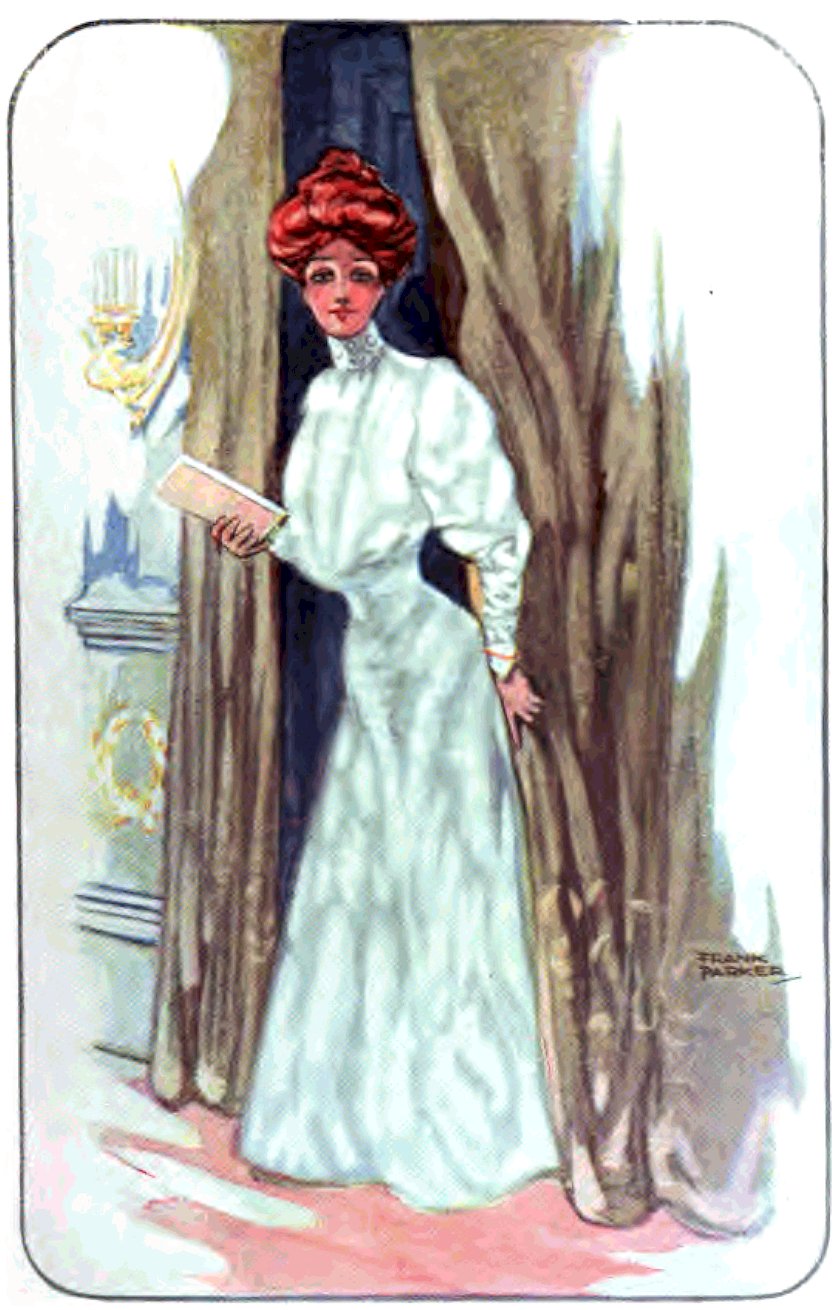
She was very pretty and dainty and young, in her simple white morning frock. Page 47.
47And, over and above all, his declaration of
candidacy for Governor——
A knock at the door of his study broke in
on the audible groan of self-contempt this
last and ever-recurrent thought wrung from
his tight lips. Caleb stopped midway down
the room, his short red hair bristling with
fury at the interruption.
“What do you want?” he snarled.
The door opened and Anice Lanier came in.
She was very pretty and dainty and young,
in her simple white morning frock. She carried
a set of tablets whereon it was her custom
to transcribe notes of Caleb’s morning
instructions for reference or for later amplification
by his two stenographers.
“Well!” roared Conover, glowering across
the room at her, “what in hell do you want?”
“To tender my resignation,” was the unruffled
reply.
“Your what?” he gasped, stupidly.
“My resignation,” in the same level, impersonal
tones. “To take effect at once.
Good morning.”
She was half-way out of the room before
48her employer could hurry after and detain
her.
“What’s—what’s the meaning of this?”
asked Caleb, the brutal belligerency trailing
out of his voice. Then, before she could answer,
he added: “Because I spoke like that
just now? Was that it? Because I said—And
you’d throw over a good job just because
of a few cranky words? Yes, I believe
you would. You’d do it. It isn’t a bluff.
Maybe that’s why you make such a hit with
me, Miss Lanier. You’re not scared every
time I open my mouth. And you stand up
for yourself.”
He eyed her in a quizzically admiring fashion,
as one might a beautiful but unclassified
natural history specimen. She made no reply,
but stood waiting in patience for him to
move from between her and the door.
Caleb grinned.
“Want me to apologize, I s’pose?” he
grumbled.
“A gentleman would not wait to ask.”
“Maybe you think a gentleman wouldn’t
of said what I did, in the first place, eh?”
“Yes, I do think so. Don’t you?”
“Well, I’m sorry. Let it go at that. Now
let’s get to work. Say”—as they moved
across to their wonted places at the big centre
table, “you oughtn’t to take offence at
49anything about me this morning. You must
know how sore I am.”
“What’s the matter?”
“As if you didn’t know! You saw how
many kinds of a wall-eyed fool I made of myself
last night. Isn’t that enough to make a
man sore? And to think of it being taken
down by those newspaper idiots and printed
all over the country!”
He gave the nearby chair a kick, avalanching
the morning papers to the floor.
“Have you read those?” queried Anice.
“No. Why should I rub it in? I know
what they——”
“Why not look at them before you lose
your temper?”
Caleb snatched up the Star, foremost journal
of Granite. He glanced down the last
column of the front page, and over to the
second.
“Here’s the story of the show just as we
dictated it beforehand,” he commented.
“List of guests—Where in thunder is that
measly speech? Have they given it a column
to itself? Oh—way down at the bottom. ‘In
a singularly happy little informal address at
the close of the evening Mr. Conover mentioned
his forthcoming candidacy for governor.’
Is that all any of them have got
about it?”
50“They have your pledge to run for Governor
blazoned over two columns of the front
page of nearly all the papers. But nothing
more about the speech itself.”
“But how——”
“I took the liberty of stopping the reporters
before they left the house, and telling
them it would be against your wish for
any of your other remarks to be quoted.”
“You did that? Miss Lanier, you’re fine!
You’ve saved me a guying in every out-of-State
paper in the East. I want to show my
appreciation——”
“If that means another offer to raise my
salary, I am very much obliged. But, as I’ve
told you several times before, I can’t accept
it. Thank you just the same.”
“But why not? I can afford——”
“But I can’t. Don’t let’s talk of it,
please.”
“And every other soul in my employ
spraining his brain to plan for a raise! The
man who understands women—if he’s ever
born—won’t need to read his Bible, for
there’ll be nothing that even the Almighty
can teach him.”
“Shan’t we begin work? About this
Fournier matter. He refuses to pay the
$30,000, and we can’t even get him to admit
he owes it. Shall I——”
51“Write and tell him unless he pays that
$41,596 within thirty days——”
“But it’s $30,000, not $41,000. He——”
“I know that. And he’ll write us so by return
mail. That’ll give us the acknowledgment
we want of the $30,000 debt. What
next?”
“The Curtis-Bayne people of Hadley are
falling behind on their contract with the C.
G. & X.”
“I guess they are,” chuckled Caleb.
“They’re beginning to see a great light,
just as I figured out. Well, let ’em squirm a
bit.”
“But the contract—you may remember
Mr. Curtis asked to look at our copy of it
when he was in Granite. He said he wanted
to verify a clause he couldn’t quite recollect.
You told me to send it to him, and I did.”
“Yes, I remember.”
“Well, he never returned it. And this
morning we get this letter from him: ‘In regard
to your favor of the 9th inst., in which
you speak of a contract, we beg to state you
must have confused us with some other of
your road’s customers. The Curtis-Bayne
Company has no contract with the C. G. & X.,
and can find no record of one. If you have
such a document kindly produce it.’”
“Well, well, well!” gurgled Caleb. “To
52think how that wicked old Curtis fox has imposed
on my trust in human nature! He’s
got us, eh?”
“It looks so, I’m afraid.”
“Looks so to him, too. It’ll keep on looking
so till I shove him into court and make
him swear on the witness stand that no contract
ever existed. Then it’ll be time enough
to produce the certified copy I had made just
after I got his request to send the original to
his hotel. Poor old Curtis! Please write
him a very blustering, scared, appealing kind
of letter. Next?”
“O’Flaherty’s sent another begging note,
about that claim of his against the road. It
begins: ‘Dear Mr. Conover: As you know,
I’ve seen better days’——”
“Tell him I can’t be held accountable for
the weather. And—say, Miss Lanier, let all
the rest of this routine go over for to-day.
I’ve a bigger game on, and I’ve got to hustle.
That Governorship business——”
“Yes?”
“That was the foolest thing I ever did. It
seemed to me at the minute a grand idea as a
wind-up for my crazy speech. But I guess
I’ll have to pay my way all right before I’m
done with last evening. The free list’s suspended
as far’s I’m concerned.”
“You mean there’s some doubt of your
53getting the nomination?” she asked, a sudden
hope making her big eyes lustrous.
“Doubt? Doubt? Say, I thought you
knew me better than that. Why, the nomination’s
right in front of me on a silver salver
and trimmed with blue ribbons. And the
election, too, for that matter.”
“Then”—the hope dying—“why do you
speak as you did just now?”
“It’s this way: I’ve held Granite and the
Mountain State by the nape of the neck for
ten years. I’m the Boss. And when I give
the word folks come to heel. But all this time
I’ve been standing in the background while I
pulled the strings. It was safer that way and
pleasanter. I’d a lot rather write the play
than be just a paid actor in it. But now I’ve
got to jump out of my corner in the wings
and take the centre of the stage. There’s a
lot more glory on the stage than in the wings,
but there’s lots more bad eggs and decayed
fruit drifting in that direction, too. If the
audience don’t like the actor they hiss him.
The man in the wings don’t get any of that.
All he has to do is to call off that actor and
put on another the crowd’ll like better, or
maybe a new play if it comes to the worst.
“But here I’m to take the stage and get
the limelight and the newspaper roasts—outside
the State—and not an actor can I shunt
54it off on. That’s why I’ve never took public
office since I was Mayor. And then it was
only a stepping-stone to the Leadership.
Now I’ve got to leave the background and
pose in the Capitol. There’s nothing in it for
me, except a better social position. That’s a
lot, I know. But I’m not so sure that even
such a raise is worth the price.”
“Then why not withdraw?”
“Not me! Withdraw, and be laughed at
by my own crowd as well as the society
click? It’d smash me forever. It’s human
nature to love a criminal and to hate a four-flusher.
And cold feet ain’t good for the circulation
of the body politic. It’s apt to end
by freezing its possessor out. No, sir! I’m in
it, and I got to swim strong. The nomination
and the election’s easy enough. But just a
‘won handily’ won’t fill the bill. I’ve got to
sweep the State with the all-firedest landslide
ever slidden since U. S. Grant ran around the
track twice before Horace Greeley got on
speaking terms with his own stride. It’s got
to be a case of ‘the all-popular Governor
Conover.’ I’ve got to go in on the shoulders
of that rampant steed they call ‘The Hoorah!’
That’ll settle forever any doubts of my fitness,
and it’ll stop all laughs at what I said
last night. When a man’s the people’s unanimous
choice, the few stray knocks that happen
55at intervals do him more good than harm.
But if it was just touch-and-go, everybody’d
be screeching about fraud and boss rule winning
over honest effort. These Civic Leaguers
are too noisy, as it is. I’ve got to start in
right away.”
“Any orders?”
“Yes. When you go down stairs, please
send for Shevlin and Bourke and Raynor
and the rest on this list, and telephone the
editors I’d like to see ’em this afternoon.
I’ll have the ball rolling by night. Say, Miss
Lanier, the campaign’ll mean extra work
for you. I want to make it worth your while.
Come now, don’t be silly. Let me make your
salary——”
“I beg you won’t speak of that any more.
I cannot accept a raise of salary from you.”
“But why not? You earn more and——”
“I earn all I get. And, as I’ve told you
before, my reasons for accepting no larger
stipend than you offered publicly for a governess
for Blanche three years ago, are my
own. I consider them good. I am glad to
get the money I do. I believe I more than
earn it. But I can accept no more, and I can
take no presents nor favors of any sort from
you. I can’t explain to you my reasons. But
I believe they are good.”
“But it’s so absurd! I——”
56“Have you ever found me shirking my
work or disloyal in any way to your interests,
on account of the smallness of my salary? I
have handled business and political secrets of
yours that would have involved millions in
loss to you if I had betrayed you. I have
been loyal to those interests. I have done
your work satisfactorily. I could have done
no more on three times my pay. There let
the matter rest, please.”
“Just as you like!” grumbled Conover.
“Lord! how the crowd’d stare if it heard
Caleb Conover teasing anyone to take more
of his money!”
“Money won’t buy everything.”
“No? Well, it gives a pretty big assortment
to choose from. And——”
The door was flung unceremoniously open,
and Gerald slouched in, his pasty face unwontedly
sallow from last night’s potations.
For, with a few of the mushroom crop of the
jeunesse dorée of Granite, he had prolonged
the supper-room revels after the departure
of the other guests.
“Hello, Dad!” he observed. “Thought
I’d find you alone.”
Caleb, his initial ill-temper softened by his
talk with Anice, greeted his favorite child
with a friendly nod.
“Sit down,” he said. “I’ll be at leisure
57in a few moments. And, say, throw that
measly blend of burnt paper and Egyptian
sweepings out of the window. Why a grown
man can’t smoke man’s-sized tobacco is
more’n I can see.”
The lad, with sulky obedience, tossed away
the cigarette and came back to the table.
“Hear the news?” he asked. “It seems
you’ve got a rival for the nomination.”
“Hey?”
“Grandin was telling me about it last
night. His father’s one of the big guns in
the Civic League, you know. It seems the
League’s planning to spring Clive Standish
on the convention.”
“Clive Standish? That kid? For governor?
Lord!”
“Good joke, isn’t it? I——”
“Joke? No!” shouted Caleb. “It’s just
the thing I wouldn’t have had happen for a
fortune. He’s poor, but he belongs to the
oldest family in the State, and his blood so
blue you could use it to starch clothes with.
Just the sort of a visionary young fool a lot
of cranks will gather around. He’ll yell so
loud about the ‘people’s sacred rights’ and
‘ring rule’ and all that rot, that they’ll hear
him clear over in the other States. And
when they do, the out-of-State papers will all
get to hammering me again. And the very
58crowd I’m trying to score with, by running
for Governor, will vote for him to a man.
He’s one of them.”
“So you think he has a chance of winning?”
asked Anice.
“Not a ghost of a chance. He’ll die in the
convention—if he ever reaches that far. But
it will stir up just the opposition I’ve been
telling you I was afraid of. Well, if it meant
work before, it means a twenty-five-hour-a-day
hustle now. I wish you’d telephone
Shevlin and the others, please, Miss Lanier.
Tell ’em to be here in an hour.”
As the girl left the room, Caleb swung
about to face his son. The glow of coming
battle was in his face.
“Now’s your chance, Jerry!” he began,
hot with an enthusiasm that failed to find the
faintest reflection in the sallow countenance
before him. “Now’s your chance to get back
at the old man for a few of the things he’s
done for you.”
“I—I don’t catch your meaning,” muttered
Gerald, uncomfortably.
“You’ve got a sort of pull with a certain
set of young addlepates here, because you
live in New York and get your name in the
papers, and because you’ve a dollar allowance
to every penny of theirs: I want you to
use that pull. I want you should jump right
59in and begin working for me. Why, you
ought to round up a hundred votes in the
Pompton Club alone, to say nothing of the
youngsters on the fringe outside, who’ll be
tickled to death at having a feller of your
means and position notice ’em. Yes, you can
be a whole lot of help to me this next few
weeks. Take off your coat and wade in!
And when we win——”
“Hold on a moment, Dad!” interrupted
Gerald, whose lengthening face had passed
unnoted by the excited elder man. “Hold on,
please. You mean you want me to work for
you in the campaign for Governor?”
“Jerry, you’ll get almost human one of
these days if you let your intelligence take
flights like that. Yes, I——”
“Because,” pursued Gerald, who was far
too accustomed to this form of sarcasm from
his father to allow it to ruffle him, “because
I can’t.”
“You—you—what?” grunted Caleb, incredulously.
“I can’t stay here in Granite all that time.
I—I must get back to New York this week.
I’ve important business there.”
“Well, I’ll be—” gasped Conover, finding
his voice at last, and with it the grim satire
he loved to lavish on this son, so unlike himself.
“Business, eh? ‘Important business!’
60Some restaurant waiter you’ve got
an appointment to thrash at 2.45 A.M. on
Tuesday, or a hotel window you’ve made a
date to drive through in a hansom? From
all I’ve read or heard of your life there, those
were the two most important pieces of business
you ever transacted in New York. And
it was my money paid the fines both times.
No, no, Sonny, your ‘important business’
will keep, I guess, till after November. Anyhow,
in the meantime you’ll stay right here
and help Papa. See? Otherwise you’ll go to
New York on foot, and have the pleasure of
living on what the three-ball specialists will
give you for your hardware. No work, no
pennies, Jerry. Understand that? Now go
and think it over. Papa’s too busy to play
with little boys to-day.”
To Caleb’s secret delight he saw he had at
last roused a spark of spirit in the lad.
“My business in New York,” retorted
Gerald hotly, “is not with waiters or hotels.
It is with my wife.”
Caleb sat down very hard.
“Your—your—” he sputtered apoplectically.
“My wife,” returned the youth, a sheepish
pride in look and words. “It was that I
came up here to speak to you about this morning.
You were so busy yesterday when I got
to town that——”
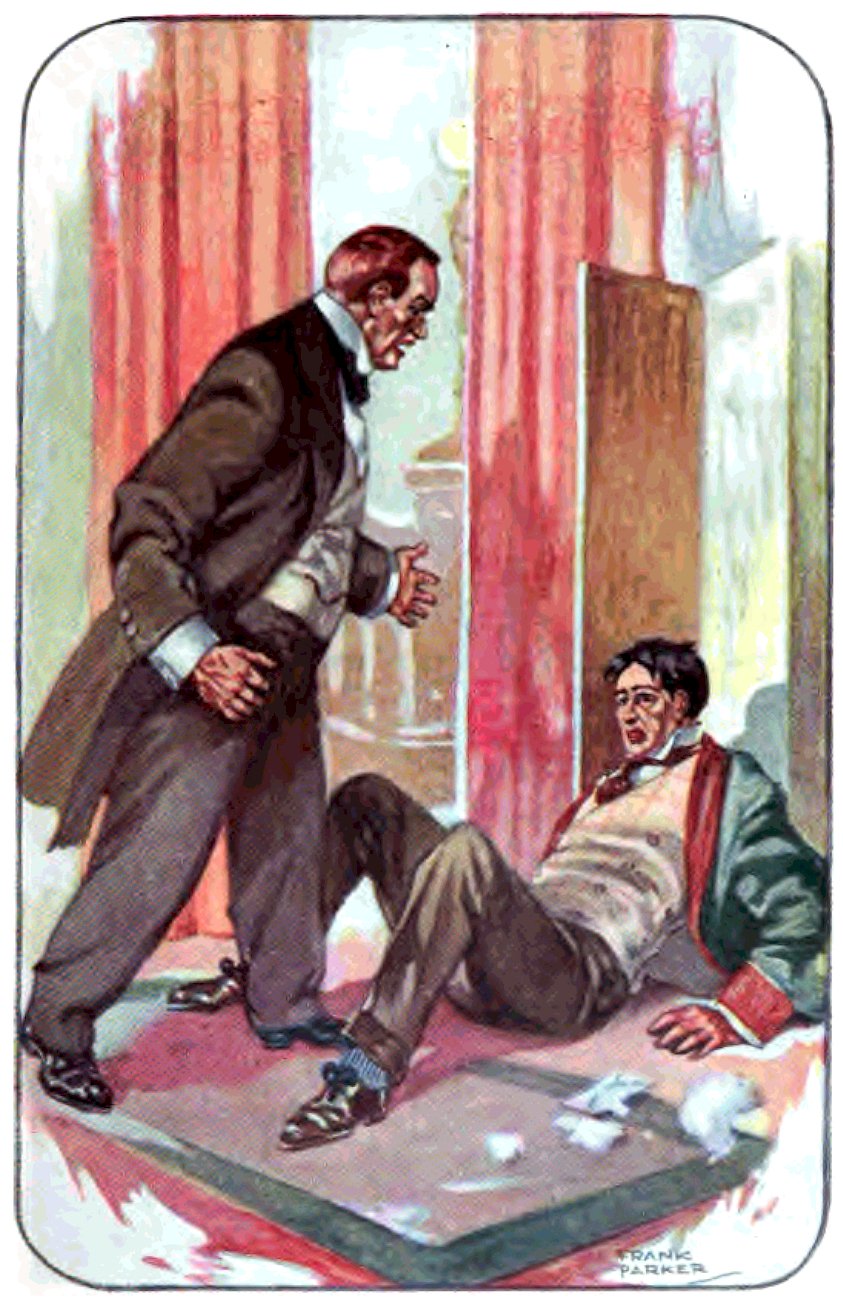
“Are you going to tell me about this thing, or have I got to shake it out of you?” Page 61.
61“Jerry, you ass! Are you crazy or only
drunk?”
“Father,” protested Gerald with a petulance
that only half hid his growing nervousness,
“I do wish you’d call me ‘Gerald,’ and
drop that wretched nickname. If——”
He got no further. Conover was upon him,
his tough, knotty hands gripping the youngster’s
shoulders and shaking him to and fro
with a force that set Gerald’s teeth clicking.
“Now then!” bellowed the Railroader,
mighty, masterful, terrible as he let the
breathless lad slide to the floor and towered
wrathful above him. “Are you going to tell
me about this thing, or have I got to shake
it out of you? Speak up!”
Gulping, panting, all the spirit momentarily
buffeted out of him, Gerald Conover
lay staring stupidly up at the angry man.
“I’m—I’m married!” he bleated. “I—I
meant to tell you when——”
“Who to?” demanded Caleb in an agony
of self-control.
“Miss Enid Montmorency. She——”
“Who is she?”
“She is—she’s my wife. Two months ago
we——”
“Who is she? Is she in society?”
“Her family were very famous before the
war. She——”
62“Is she in good New York society?”
“She—she had to earn her own living
and——”
“And what?”
“She—I met her at Rector’s first. Her
company——”
“Great Lord!”
The words came like a thunderclap. Caleb
Conover stepped back to the wall, his florid
face gray.
“You MARRIED a chorus girl?”
“She—her family before the war——”
Caleb had himself in hand.
“Get up!” he ordered. “You haven’t
money enough nor earning power enough to
buy those boards you’re sprawling on. Yet
you saddle yourself with a wife—a wife you
can’t support. A woman who will down all
your social hopes. And mine. You let a designing
doll with a painted face dupe you
into——”
“You shan’t speak that way of Enid!”
flared up the boy, tearfully. “She is as good
and pure as——”
“As you are. And with a damned sight
more sense. For she knows a legal way of
grabbing onto a livelihood; and you don’t.
Shut up! If you try any novel-hero airs on
me, you young skunk, I’ll break you over my
63knee. Now you’ll stand still and you’ll listen
to what I have to say.”
Gerald, cowed, but snarling under his
breath, obeyed.
“I won’t waste breath telling you all I’d
hoped for you,” began Conover, “or how I
tried to give you all I missed in my own boyhood.
You haven’t the brains to understand—or
care. What I’ve got to say is all about
money. And I never found you too stupid to
listen to that. You’ve cut your throat.
Nothing can mend that. We’ll talk about the
future at another time. It’s the present
we’ve got to ’tend to now. You’re going to
be of some use to me at last. The only use
you ever will be to anyone. Your allowance,
for a few months, is going on just the same
as before. But you’ve got to earn it. And
you’re going to earn it by staying right here
in Granite, and working like a dog for me in
this campaign. If you stir out of this town,
or if your—that woman comes here, or if
you don’t use your pull in my behalf with the
sap-heads you travel with at the Pompton
Club—if you don’t do all this, I say, till further
orders—then, for now and all time, you’ll
earn your own way. For you’ll not get another
nickel out of me. I guess you know me
well enough to understand I’ll go by what I
say. Take your choice. You’ve got an earning
64ability of about $4 a week. You’ve got
an allowance of $48,000 a year. Now, till
after election, which’ll it be?”
Father and son faced each other in silence
for a full minute. Then the latter’s eyes fell.
“I’ll stay!” he muttered.
“I thought so. Now chase! I’m busy.”
Gerald slouched to the door. On the
threshold he turned and shook his fist in impotent
fury at the broad back turned on him.
“I’ll stay!” he repeated, his voice scaling
an octave and breaking in a hysterical sob,
“I’ll stay! But, before God, I’ll find a way
to pay you off for this before the campaign
is over.”
Caleb did not turn at the threat nor at the
loud-slamming door. He was scribbling a telegram
to his New York lawyer.
“Gerald in scrape with chorus girl, Enid
Montmorency,” he wrote. “Find her and
buy her off. Go as high as $100,000.”
“Father Healy says, ‘The sins of the fathers
shall be visited on the children,’” he
quoted half-aloud as he finished; “but when
they are visited in the shape of blithering
idiocy, it seems ’most like a breach of contract.”
The Railroader was not fated to enjoy
even the scant privilege of solitude. He had
65hardly seated himself at his desk when the
sacred door was once more assailed by inquisitive
knuckles.
“The Boys haven’t wasted much time,” he
thought as he growled permission to enter.
The tall, exquisitely-groomed figure of his
new son-in-law, the Prince d’Antri, blocked
the threshold. With him was Blanche.
“Do we intrude?” asked d’Antri, blandly,
as he ushered his wife through the doorway
and placed a chair for her. Caleb watched
him without reply. The multifarious
branches of social usage always affected him
with contemptuous hopelessness. He saw no
sense in them; but neither, as he confessed
disgustedly to himself, could he, even if he
chose, possibly acquire them.
“We don’t intrude, I hope,” repeated the
prince, closing the door behind him, and sitting
down near the littered centre table.
“Keep on hoping!” vouchsafed Conover
gruffly. “What am I to do for you?”
He could never grow accustomed to this
foreign son-in-law whom he had known but
two days. Obedient, for once, to his wife,
and to his daughter’s written instructions,
he had yielded to the marriage, had consented
to its performance at the American
Embassy at Paris rather than at the white
marble Pompton Avenue “Mausoleum,” and
66had readily allowed himself to be convinced
that the union meant a social stride for the
entire family such as could never otherwise
have been attained.
His wife and daughter had returned from
Europe just before the reception (whose details
had, by his own command, been left
wholly to Caleb), bringing with them the
happy bridegroom. Caleb had never before
seen a prince. In his youth, fairy tales had
not been his portion; so he had not even the
average child’s conception of a mediæval
Being in gold-spangled doublet and hose, to
guide him. Hence his ideas had been more
than shadowy. What he had seen was a very
tall, very slender, very handsome personage,
whose costumes and manner a keener judge
of fashion would have decided were on a par
with the princely command of English: perfect,
but a trifle too carefully accentuated to
appeal to Yankee tastes.
Beyond the most casual intercourse and
table talk there had been hitherto no scope
for closer acquaintanceship between the two
men. The reception had taken up everyone’s
time and thoughts. Caleb had, however,
studied the prince from afar, and had sought
to apply to him some of the numberless classifications
in which he was so unerringly wont
to place his fellow-men. But none of the
67ready-made moulds seemed to fit the newcomer.
“What can I do for you?” repeated Conover,
looking at his watch. “In a few minutes
I’m expecting some——”
“We shall not detain you long. We have
come to speak to you on a—a rather delicate
theme.”
“Delicate?” muttered Caleb, glancing up
from the politely embarrassed prince to his
daughter. “Well, speak it out, then. The
best treatment for delicate things is a little
healthy exposure. What is it?”
“I ventured to interrupt your labors,”
said d’Antri, his face reflecting a gentle look
of pain at his host’s brusqueness, “to speak
to you in reference to your daughter’s dot.”
“Her which?” queried Caleb, looking at
the bride as though in search of symptoms of
some violent, unsuspected malady.
“Amadeo means my dowry,” explained
Blanche, with some impatience. “It is the
custom, you know, on the Continent.”
“Not on any part of the Continent I ever
struck. And I’ve been pretty much all over
it from ’Frisco to Quebec. It’s a new one on
me.”
“In Europe,” said Blanche, tapping her
foot, and gazing apologetically at her handsome
husband, “it is customary—as I
68thought everybody knew—for girls to bring
their husbands a marriage portion. How
much are you going to settle on me?”
“How much what? Money? You’ve always
had your $25,000 a year allowance, and
I’ve never kicked when you overdrew it.
But now you’re married, I suppose your husband——”
“But, Mr. Conover,” broke in the prince,
with more eagerness than Caleb had ever before
seen on his placid exterior, “I think you
fail to understand. I—we——”
“What are you driving at?” snapped
Conover. “Do you mean you can’t support
your wife?”
“Papa!” cried Blanche, in distress, “for
once in your life try not to be coarse. It isn’t
a question of support. It is the custom——”
“For a father to pay a man to marry his
girl? I can’t see it myself, though now you
speak about it, I seem to have read or heard
something of the sort. Well, if it’s a custom,
I suppose it goes. How much?”
The prince shivered, very gently, very
daintily.
“If it affects you that way,” growled Caleb,
“I wouldn’t ’a’ brought up the subject
if I was you. Say, Blanche, if you’re too
timid to make a suggestion, how’ll this strike
69you? I’ll double your present allowance—$50,000
a year, eh?”
“Impossible!” gasped d’Antri.
“Not on your life!” retorted Caleb. “I
could double that and never feel it. Don’t
you worry about me not being able——”
“But I cannot consent to——”
“Who’s asked you to? It’s to be her cash,
ain’t it? Not yours. I don’t think you come
on in this scene at all, Prince. It seems to be
up to me and Blanche. And——”
“Oh, you’ll never understand!” cried
Blanche in despair. “For the daughter of
a man of your means, and the social position
I am to occupy as Princess d’Antri, my dot
should be at least——”
“Hold on!” interposed Caleb. “I think
I begin to see. I——”
“You don’t see,” contradicted his daughter,
pettishly; “I’ll have to explain. It——”
“No, you won’t. If I couldn’t understand
things without waiting to have ’em explained,
I’d still be braking at $50 a month. As I take
it, this prince party meets you in Yurrup,
hears your father is the Caleb Conover—an
old fool of an American with a pretty daughter
to place on the nobility market—and you
make your bid. You marry him and he’s so
sure of his ground he don’t even hold out for
an ante-wedding bonus. He chases over here
70with you, and when he don’t find the dowry,
or whatever else you call it, waiting for him
at the dock, he makes bold to ring the cash
register.”
The prince was on his feet.
“I cannot consent, sir, to listen to
such——”
“Oh, yes, you can. I’ve heard of your
sort. But I somehow thought they were all
counts. I didn’t know exactly how a prince
stood; but I supposed the job carried an income
with it. It seems you’re just in the
count class, after all. The kind of man that
loafs about Yurrup living on the name of
some ancestor who got his title by acting as
hired man to his king or emperor or whoever
ruled his two-for-a-quarter country. The
sort of man that does nothing for a living
and don’t even do that well enough to keep
him in pocket money. Then some lookout
makes the high sign, ‘Heiress in sight!’
and——”
Blanche burst into tears. Her husband
threw his arm about her shoulders in assiduous,
theatrical fashion, while Caleb sat gnawing
his unlighted cigar and grimly eyeing the
couple.
“There, there, carissima mia!” soothed
d’Antri, “your father knows no better. In
71this barbarous country of his there are no
leisure classes. I——”
“You bet there are!” snorted Caleb.
“Only, here we call ’em tramps. And we give
’em thirty days instead of our daughters.
Here, stop that damned snivelling, Blanche!
You know how I hate it. I’m stung all right,
and it’s too late to squeal. The only time
there’s any use in crying over spilt milk is
when there’s a soft-hearted milkman cruising
around within hearing distance. And
from where I sit, I don’t see any such rushing
to my help. You’ll get your ‘dot’ all
right. Just as you knew you would before
you put up that whimper. We’ll fix up the
details when I’ve got more time on my hands.
“Only, I want you and me and this prince-feller
of yours to understand each other, clear.
I’m letting myself be bled for a certain sum,
because I’ve crowed so loud about your being
a princess that I can’t back down now without
raising a laugh, and without spoiling all
I’ve planned to get by this marriage. Besides,
I’m going to run for governor, and I
don’t want any scandal or ‘dramatic separation
for lack of cash’ coming from my own
family. I’m caught fair, and I’ll pay. But
I want us three to understand that it’s straight
blackmail, and that I pay it just as I’d pay to
have any other dirty story hushed up. That’ll
72be all to-day. If you want some reading matter,
Prince, here’s a paper with a list of the
liners that sail for Yurrup next week. Nothing
personal intended, you know. Good-by.”
“But, papa—” began Blanche, who, like
d’Antri, had listened to this exordium with
far less natural resentment than might have
been looked for.
“That’ll be all, I said,” repeated Conover.
“You win your point. Clear out! I’m busy.”
The princess knew Caleb too well to press
the victory further. She tearfully left the
room, d’Antri following in her wake. At the
door the latter paused, his long white fingers
toying with his silky beard.
“Sir,” he said, “you may be assured that
I shall never forget your generosity, even
though it is couched in such unusual language.
You shall never regret it. I understand
you have a wish to adorn the best society
and——”
“No,” grunted Conover, “not the Best,
only the Highest. And it’s no concern of
yours, either way. Good-by!”
As the titled couple withdrew, Anice Lanier
came in.
“Mr. Shevlin, Mr. Bourke and most of the
others you sent for have come,” she reported.
“Shall I send them up?”
“Yes,” said Conover dully, “send ’em
73along. It’ll be good to talk to real human
beings again. Say, Miss Lanier”—as the girl
started to obey his order—“did you ever
write out that measly interview of mine for
the Star, endorsing those new views of Roosevelt’s
on race-suicide, and saying something
about a childless home being a curse to——”
“Yes. I was just going to mail it.
Shall——?”
“Well, don’t! Tear it up. There’s no
sense in a man being funny at his own expense.”
CHAPTER IV IN TWO CAMPS
74
In the headquarters of the Civic League
sat Clive Standish. With him were the committee
chosen to conduct his campaign. Karl
Ansel, a lean, hard-headed New England
giant, their chairman, and incidentally, campaign
manager, was going laboriously over a
list of counties, towns and villages, corroborating
certain notes he made from time to
time, by referring to a big colored map of
the Mountain State.
“I’ve checked off the places that are directly
under the thumb of the C. G. & X.,”
Ansel was explaining as the rest of the group
leaned over to watch the course of his pencil
along the map. “I’m afraid they are as
hopelessly in Conover’s grip as Granite itself.
It’s in the rural districts, and in the
towns that aren’t dependent on the main
line, that we must find our strength. It’s an
uphill fight at best, with——”
“With a million-and-a-half people who
are paying enormous taxes for which they
75receive scant value, who have thrust on them
a legislature and other officials they are
forced to elect at the Boss’s order!” finished
Standish. “Surely, it’s an uphill fight
that’s well worth while, if we can wake men
to a sense of their own slavery and the frauds
they are forced to connive at. And that’s
what we’re going to do.”
The more experienced, if less enthusiastic,
Ansel scratched his chin doubtfully.
“The people, as a mass, are slow to wake,”
he observed. “Oftener they just open one
eye and growl at being bothered, and then
roll over and go happily to sleep again while
the Boss goes through their pockets. Don’t
start this campaign too optimistically, Mr.
Standish. And don’t get the idea the people
are begging to be waked. If you wake them
you’ve got to do it against their will. Not
with any help of theirs. Maybe you can.
Maybe you can’t. As you say, it’s perhaps
worth a try. Even if——”
“But they’ve been waked before,” insisted
Standish. “And when they do
awaken, there are no half-measures about
it. Look how Jerome, on an independent
fight, won out against the Machine in 1905.
Why should the Mountain State——”
“The people are sleepy by nature,” laughed
Ansel. “They wake up with a roar, chase
76the Boss out of their house, smash the Machine
and then go back to bed again with the
idea they’re heroes. As soon as their eyes
are shut, back strolls the Boss, mends his
Machine and reopens business at the old
stand. And that’s what you have to look forward
to. But we’ve been all over this sort
of thing before. I’ll have your ‘speech-route’
made out in an hour, and start a man
over it this afternoon to arrange about the
halls and the ‘papering’ and the press work.
Speaking of press work, I had your candidature
telegraphed to New York to the Associated
Press early this morning. There’ll be
a perfect cloud of reporters up here before
night. We must arrange to see them before
the Conover crowd can get hold of them.
Sympathy from out-of-State papers won’t do
us any harm. The country at large has a
pretty fair idea of the way Conover runs the
Mountain State. And the country likes to
watch a good fight against long odds. There’s
lots of sympathy for the under dog—as long
as the sympathizer has no money on the upper
one.”
“How about the sketch of the situation that
you were having Craig write out, telling about
the stolen franchises, the arbitrary tax-rate,
the machine-made candidates, the railroad
rule and all that? It ought to prove a good
77campaign document if he handles the subject
well.”
“Oh, he’s handled it all right. I’ve read
the rough draft. Takes Conover from the
very start. Tells of his boyhood in the yards
of the C. G. & X., and how he bullied and
schemed until he got into the management’s
offices, the string of saloons he ran along the
route and the drink-checks he made the men
on his section cash in for liquor at his saloons,
and all that. Then his career as Alderman,
when he found out beforehand where the new
reservoir lands and City Hall site were to be,
and his buying them up, on mortgage, and
clearing his first big pile. And that deal he
worked in ‘bearing’ the C. G. & X. stock to
$1.10, and scaring everyone out and scooping
the pot; that’s brought in, too. And he’s got
the story of Conover’s gradually working the
railroad against the State and the State
against the road, till he had a throat grip on
both, and——”
“Wait a moment!” interrupted Standish.
“Is all the sketch made up of that sort of
thing?”
“Most of it. Good, red-hot——”
“It must be done all over, then. We are
not digging up Conover’s personal past, but
his influence on the State and on the Democratic
Party. I’m not swinging the muckrake
78or flinging dirt at my opponent. That
sort of vituperation——”
“But it’s hot stuff, I tell you, that sort of
literature! It helps a lot. You can’t hope to
win if you wear kid gloves in a game like
this.”
“What’s the use of arguing?” said Standish
pleasantly. “If the League was rash
enough to choose me to represent it, then the
League must put up with my peculiarities.
And I don’t intend to rise to the Capitol on
any mud piles. If you can show me how Conover’s
early frauds and his general crookedness
affect the issues of the campaign, then
I’ll give you leave to publish his whole biography.
But till then let’s run clean, shan’t
we?”
“‘Clean?’” echoed Ansel aghast. “I’ve
been in this business a matter of twenty-five
years, and I never yet heard of a victory won
by drawing-room methods. But have your
own way. I suppose you know, though, that
they’ll rake up every lie and slur against you
they can get their hands on?”
“I suppose so. But that won’t affect the
general issue either. You don’t seem to
realize, Ansel, that this isn’t the ordinary
routine campaign. It’s an effort to throw off
Boss rule and to free a State. Politics and
personalities don’t enter into it at all. I’d as
79soon have run on the Republican as the
Democratic ticket if it weren’t that the Republican
Party in this State is virtually
dead. The Democratic nominee for governor
in the Mountain State is practically the governor-elect.
That is why I——”
“Excuse me, Mr. Standish,” said a clerk,
entering from the outer office, “Mr. Conover
would like a word with you.”
The committee stared at one another, unbelieving.
“H’m!” remarked Ansel, breaking the
silence of surprise, “I guess the campaign’s
on in earnest, all right. Shall you see him?”
“Yes. Show him in, please, Gardner.”
“He says, sir, he wants to speak with you
alone,” added the clerk.
“Tell him the League’s committee are in
session, and that he must say whatever he has
to say to me in their presence.”
The clerk retired and reappeared a few
moments later, ushering in—Gerald Conover.
A grunt of disappointment from Ansel
was the first sound that greeted the long
youth as he paused irresolute just inside the
committee-room door.
“Good morning, Gerald,” said Standish,
rising to greet the unexpected visitor; “we
thought it was your father who——”
“No. And he didn’t send me here, either,”
80blurted out Gerald. His pasty face was still
twitching, and his usually immaculate collar
awry from the recent paternal interview.
“I came here on my own account,” he
went on, with the peevish wrath of a child.
“I came here to tell you I swing over a hundred
votes. Maybe a hundred more. My father
says so himself. And I’ve come to join
your League.”
A gasp of amazement ran around the table.
Then, with a crow of delight, Ansel sprang
up.
“Great!” he shouted. “His son! It’s
good for more votes than you know, Standish!
Why, man, it’s a bonanza! When
even a man’s own son can’t——”
Standish cut him short.
“Are you drunk, Gerald?” he asked.
“No, I’m not!” vociferated the lad.
“I’m dead cold sober, and I’m doing this
with my eyes open. I want to join your
League, and I’ll work like a dog for your
election.”
“But why? You and I have never been
especially good friends. You’ve never shown
any interest in politics or ref——”
“Well, I will now, you bet! I’ll make the
old man wish he’d packed me off to New
York by the first train. He’ll sweat for the
way he treated me before he’s done. I suppose
81I’ve got to work secretly for you, so he
won’t suspect. But I’ll do none the less work
for that; and I can keep you posted on the
other side’s moves, too. If I’m to be tied to
this damned one-horse town by Father’s orders
till after election, I’ll make him sorry
he ever——”
“Good for you!” cried Ansel. “You’ve
got the spirit of a man, after all. Here’s a
bunch of our membership blanks. Fill this
one out, and give the rest to your club friends.
We—why, Standish!” he broke off, furious
and dumbfounded; for Clive had calmly
stepped between the two, taken the membership
blank from Gerald’s shaky hand and
torn it across.
“We don’t care for members of your sort,
Gerald,” he said, with a cold contempt that
was worse than a kick. “This League was
formed to help our City and State, not to
gratify private grudges; for white men, not
for curs who want to betray their own flesh
and blood. Get out of here!”
“Standish!” protested the horrified Ansel,
“you’re crazy! You’re throwing away
our best chance. You are——”
“If this apology for a human being is
‘our best chance,’ I’ll throw him out bodily,
unless he goes at once,” retorted Clive, advancing
on the cowering and utterly astonished
boy.
82“Why!” sputtered Gerald, as he backed
doorward, before the menacing approach of
the Leaguer, “I thought you’d want me— I— Oh,
I’ll go, then, if you’ve no more
sense than that! But I’ll find a way of downing
the old man in spite of you! Maybe you’ll
be glad enough to get my help when the time
comes! I——”
His heels hit against the threshold in
his retrograde march. Still declaiming, he
stepped over the sill into the outer office,
and Clive Standish slammed the door upon
him, breaking off his threats in the middle of
their fretful outpouring.
“There,” said Clive, returning to the gaping,
frowning committeemen, “that’s off our
hands. Now let’s get down to business.”
“Mr. Standish,” remarked Ansel, after a
moment’s battle with words he found hard to
check, “you’re the most Quixotic, impractical
idealist that ever got hold of the foolish
idea he had a ghost of a chance for success in
politics. And,” he added, after a pause,
“I’m blest if I don’t think I’d rather lose
with a leader like you than win with any
other man in the Mountain State.”
Meanwhile, at the head of the great study
table in his Pompton Avenue “Mausoleum”
sat Caleb Conover, Railroader. And about
83him, on either side of the board, like feudal
retainers of old, were grouped the pick of
his lieutenants and henchmen. A rare coterie
they were, these Knights of Graft.
Separated by ten thousand varying interests,
social strata and aspirations, they were as
one on the main issue—their blind adherence
to the Boss and to the lightest of his orders.
This impelling force was difficult of defining.
Love, fear, trust, desire for spoils?
Perhaps a little of all four; perhaps much;
perhaps an indefinable something apart from
these. For the power that draws and holds
men to a political leader who possesses
neither eloquence, charm nor the qualities of
popularity has never been—can never be—clearly
defined. Not one great Boss in ten
can boast these qualities.
Yet, whatever the reason of Caleb Conover’s
dominance, none could for a moment
doubt its presence. So ever-present was it
that it had long since choked down all opposition
from within his own ranks. Once,
years before—as the story is still related—when
he had first claimed, fought for and
won his party preëminence, certain district
leaders, eight in all, had plotted his downfall,
and had privately selected one of their number
to fill his shoes. News of the closed-door
meeting which was to ratify this deposition
84was brought to Caleb by faithful Shevlin.
The Railroader, without a word, had started
for the back room of the saloon where the
conference was in progress. Stalking in on
the conspirators, he had gained the centre of
their circle before they were well aware of
his presence. Hat on head, cigar in mouth,
he had swept the ring of faces with his light,
steely eyes, noting each man there in one instant-brief
glance as he did so. Then, twisting
the cigar into one corner of his mouth, he
had brought down his fist on the table and
demanded:
“How many of you people are with ME?”
Like a pack of eager schoolboys the entire
eight were upon their feet, clamoring their
fealty. Then, without another word or look,
the Master had stamped out of the room;
leaving the erstwhile malcontents, as one of
them afterward expressed it:
“Standin’ there like a bunch of boiled
sheepsheads without a thought but to shake
hands with ourselves for havin’ such a grand
Boss as Caleb Conover.”
At the Boss’s right in to-day’s conclave sat
Billy Shevlin, most trusted and adoring of
all his followers. At his left was Guy Bourke,
Alderman and the Boss’s jackal. Next to
Billy was Bonham, Mayor of Granite, and
next Giacomo Baltazzi, who held the whole
85Italian section force of the C. G. & X. and the
Sicilian quarter of Granite in the hollow of
his unwashed hand. Beyond was Nicholas
Caine, proprietor of the Star, and to his
right Beiser, the Democratic State Chairman.
Between a second newspaper editor
and the President of the Board of Aldermen
lounged Kerrigan, the Ghetto saloon-keeper.
A sprinkling of railroad men, heelers and
district leaders made up the remainder. Conover
was speaking:
“And that’s the layout,” said he. “And
that’s why I’m not content for this to be just
a plain ‘win.’ Two years ago I thought
Shearn would be our best man for governor.
So I gave the word, and Shearn got in with
a decent majority. But it’s got to be a landslide
this time, and not a trick’s to be overlooked
in the whole hand. Nick, you know
the line of editorial policy to start in to-morrow’s
Star. And be on the lookout for the
first break in any of the League’s speeches.
It’s easier to think of a fool thing than not
to say it, and those Reform jays are always
putting their feet in their mouths when they
try to preach politics. And, knowing nothing
about the game, they’re sure to talk a
heap. They never seem to realize that the
man who really practices politics hasn’t time
to preach it.”
86“I understand,” answered Caine. “Print,
as usual, a ‘spread’ on the windy, blundering
speeches, and forget to report the others.
Same as when——”
“Sure. And pass the ‘press-gag’ sign
up-State, too. Standish is certain to make a
tour. Beiser,” turning to the portly State
Chairman, “I want the county caucuses two
weeks from Saturday. I’ve an idea we can
work the same old ‘snap’ move in more’n
half of them. Pass it on to the county chairman
to treble last year’s floaters, and to
work the ‘back door’ the way we did in Bowden
County in ’97. They understand their
business pretty well, most of ’em. And I’ll
have Shevlin and Bourke jack up those that
don’t, and learn ’em their little lines. Two
weeks from Saturday, then. That’s understood?
It’ll give us all the time we need, if we
hustle. Never mind the other State or city
candidates or Congressmen. Those jobs’ll
take care of themselves. If the wrong men
get into the Assembly or Congress, they’ll get
licked into shape quick enough. We’re all
right there. I want the whole shove to be
made on the Governorship this year. Pass it
on! Baltazzi, I hear those dagoes of yours
are grouching again. What’s——”
“They say they don’t get nothin’. They
87say all the good jobs goes to the Irish or
Dutch or even Americans, and——”
“Promise ’em something, then.”
“I have. But——”
“Then promise ’em something more. Don’t
be stingy. If that don’t satisfy ’em, give me
the tip, and I’ll have a ten per cent. drop ordered
on the foreign section gangs’ pay, and
make Chief Geoghegan pass the word to his
cops to make things bad for the pushcart men
and organ grinders, and close up the dago saloons
an hour early. That’ll bring ’em in
a-running. How ’bout litterchoor, Abbott?”
“I’ll start the staff to work on songs to-night,”
said a long-haired little man, “and
get out a bunch of ‘Friend of the Plain People’
tracts and——”
“Won’t do! ‘Man-of-Experience-and-Benefactor-of-the-State
or Ignorant-Meddling-Boy-Reformer.
Which-Will-You-Vote-For?’
That’s the racket this time. Guy the
whole League crowd. ‘Silk Stockings vs.
Laboring Man.’ That’s the idea. Get the
cartoonists at work on pictures like Standish
making the police sprinkle the streets with
Florida water while thugs break into houses,
and that sort of thing. ‘What-We-May-Expect-from-Civic-League-Rule.’
Understand?
Say, Caine, detail one or two of your men, of
course, to look up Standish’s past performances
88in private life, too. Anything about
booze or the cards or any sort of scrape will
work up fine just now. The gag’s old, but
about a reformer it always makes a hit. Even
a bit of a stretch goes. I’ll stand a libel suit
or two if it comes to a show-down.”
“How about the out-of-town papers?”
queried Caine. “Our regular chain are all
right. But the rest——”
“The C. G. & X. owns the Mountain State,
don’t it? And it controls ninety per cent. of
the mileage of the other roads that run
through the State. And wherever there’s
towns big enough for a paper there’s a railroad
somewhere near. And wherever there’s
an editor he wants his passes, don’t he? And
a rebate on his freight? Well—don’t you lose
sleep over the ‘press-gag.’”
“How about floaters?” asked Bourke.
“Same rule and same price?”
“Yes. Subject to change if we’re pressed.
Aldermen all right, I s’pose?”
“Haven’t had a chance to sound ’em since
you declared yourself,” said the president of
that body, “but all except Fowler and Brayle
are your own crowd and——”
“Tell Fowler the C. G. & X. will give his
firm a tip on the price for the next ‘sealed-bid’
contract for railroad ties. Give Brayle
a hint about that indictment against his
89brother. It was pigeonholed, but if I tried
real hard, I might induce the District Attorney
to look for it. I tell you,” went on Conover,
raising his voice for the first time, and
glaring about the table, “every mother’s son,
from engine-oiler to Congressman, has got to
get down to the job and hustle as he never did
before. And I’ve got the means of finding
out who hustles and who shirks. And I’ve
got the means of paying both kinds. And I
guess there isn’t anyone that doubts I can do
it. Pass that on, too. Caleb Conover for
Governor, and to hell with reform!”
CHAPTER V A MEETING, AN INTERRUPTION AND A LETTER
90
The campaign was on in sober earnest.
Conover, who kept as well posted on his foe’s
movements as though the League itself sent
him hourly reports, grew vaguely annoyed
as, from day to day, he learned the headway
Standish was making in Granite. The better
classes, almost to a man, flocked to Clive’s
standard. By a series of fiery speeches he
succeeded in rousing a certain hitherto dormant
enthusiasm among the business men of
the town. They found to their surprise that
he was neither a visionary nor a mere agitator;
that he based his plans not on some Utopian
Altruria of high-souled commonweal,
but on a practical basis of clean government.
He pointed out to them how utterly the
Machine ran the Mountain State; how the
railroads and the vested interests of the
party clique sent their own representatives
to the Legislature, and then made them grant
fraudulent franchise after fraudulent franchise
to the men who sent them there. How
91the taxes were raised and so distributed that
the brunt fell upon the people who least
profited by the State expenditures and by
the legalized wholesale robberies. How, in
fact, the populace of Granite and of the
whole Mountain State were being ridden at
will by a handful of unscrupulous men.
That Caleb Conover was the head and front
of the clique referred to everyone was well
aware, yet Standish studiously avoided all
mention of his name, all personal vituperation.
Whereat Caleb Conover wondered
mightily. Stenographic reports of Clive’s
speeches and of the increasingly large and
enthusiastic meetings he addressed were carefully
conned by the Railroader. And the
tolerant grin with which he read the first of
these reports changed gradually to a scowl
as time went on.
He had made no effort to suppress or in
any way to molest these early meetings. He
wanted to try out his young opponent’s
strength, gauge his following and his methods.
But when, to his growing astonishment,
he found Clive was actually winning a respectful,
ever larger, hearing in his home
town, he decided it was high time to call a
halt. Accordingly he summoned Billy Shevlin.
“What’s doing?” he asked curtly, as he
92received his henchmen in the Mausoleum
study.
“To-night’s the big rally at Snyder’s Opera
House, you know,” replied Billy. “Standish’s
booked to make his star speech before
he starts on his State tour. He’s got a team
of Good Gov’ment geezers from Boston to do
a spiel, and he’s callin’ this the biggest scream
of the campaign so far. Say, that young feller’s
makin’ an awful lot of noise, Boss.
When are you goin’ to give us the office to
put the combination on his mouth? On the
level, he ain’t doin’ you no good. Them
speeches of his means votes. The Silk-Socks
is with him already, and he’s winner with
the business bunch in fam’ly groups.”
“Look here,” said Caleb, pointing out of
the study’s north window, which commanded
a view of exclusive Pompton Avenue and its
almost equally fashionable cross streets, “how
would you figure up the population of that
district?”
“The Silk-Sockers? You know’s well as
me. Thirty-eight hundred in round numbers.”
“And over there?” pointing east.
“Th’ business districk? An easy 12,000.”
“Say 16,000 in both. S’pose they are all
for the young Standish. Now look here.”
He crossed the long room and ran up the
93shade of one of the south windows. The great
marble house stood on the edge of a hill-crest,
overlooking a distant vista of mean, winding
streets, dirty, interminable rows of tenements,
factories and small shops. Through
the centre, like a huge snake, the tracks of
the C. G. & X. wound their way, and over all
a smeared pall of reek and coal smoke brooded
like some vast bird of prey. Coal yards,
docks, freight houses, elevators, shanties—and
once more that interminable sea of
dingy, squalid domiciles.
“What’s the population down there,
Billy?”
“Hundred’n ten thousand, six hundred
an’—” began Shevlin glibly. “An’ every
soul of them solid for you, Boss. Sixteen
thousand to hundred-’n’-ten-thous——”
“That’s right. So as long as the youngster’s
content to speak his little pieces here
in Granite, I’ve stood by and let him talk. It
would be time enough to put in a spoke when
he started across country. But this blowout
to-night is different. The stories of it will
get in the Boston and Philadelphia and New
York papers. So——”
“Well?”
“So there won’t be any meeting?”
“If you say so, it goes. Will I give the
boys the office to rough-house the joint?”
94“And have every out-of-State paper
screeching about ring rule and rowdyism?
Billy, you must have been born more ignorant
than most. You never could have picked
up all you don’t know, in the little time you’ve
lived.”
Shevlin looked duly abashed and awaited
further orders.
“I hear the gas main that serves Snyder’s
Opera House isn’t in very good order,” resumed
the Boss. “I shouldn’t wonder if all
the lights went out just as the meeting opens
to-night. That’ll mean a lot of confusion.
And my friend, Chief Geoghegan, being a
careful man, will disperse the crowd to prevent
a riot, and to keep pickpockets from
molesting those pure patriots. I want you to
see Geoghegan and the gas company about it,
right away. But look here, there mustn’t be
any rough-house or disorder. Tell the boys
to keep away. I’ll have work enough for
them to do when Standish takes the road.”
Billy Shevlin, a great light of joy in his
little beady eyes, departed on his mission,
while Caleb, summoning Anice Lanier, set
about his daily task of dictation. His always
large mail was still more voluminous during
the past week or so, and he had been forced
to double his staff of stenographers. He and
his secretary toiled steadily for three hours
95to-day, then laid aside the remaining work
until later on.
“How’ll you like being secretary to the
Governor, Miss Lanier?” asked Caleb, as he
lighted his cigar and stretched out his thick
legs under the table.
“Fully as much as you’ll like being Governor,
I fancy,” she answered.
“I guess you won’t have to be very much
wedded to the job at that,” sighed Conover.
“Do you know, I’d give a year’s income if
I’d never made that measly speech. But now
that I’m in for it, I’m going to make the fight
of my life. Everybody in the Mountain State
will sure know there’s been a big scrap, and
when it’s over, our young friend, Standish, is
going to be just a sweet, sad memory.”
“I hear he is making some strong
speeches.”
“And I hear you went to hear a couple of
them,” retorted Caleb, grinning.
“Do you mean,” she cried indignantly,
“that you’ve actually been spying on me?
You have dared to——?”
“Now, don’t get woozey, Miss Lanier.
What on earth would I spy on you for? Your
time, outside work hours, is your own. And
besides, I’ve got all sorts of proof that you’re
always loyal to my interests.”
“Then how——”
96“How’d I find it out? While I don’t keep
tabs on you, I do keep tabs on Nephew-in-law
Standish, and on his meetings and what sort
of people go there. And a couple of times
my men happened to mention that they saw
my pretty secretary in the audience. There,
now, don’t get red. What harm is there in
being found out? Only it kind of amused me
that you never spoke about it here.”
“Why should I? I——”
“No reason at all. A person’s got a right
to lock up what’s in their minds as well as
what’s in their pockets. I always have a lot
of respect for folks who keep their mouths
shut. If you keep your mouth shut about
your own affairs, you’ll keep it shut about
mine. That’s why I have a kind of sneaking
respect for liars, too. Folks who guard what’s
in their brains by making a false trail with
their mouths. The public’s got no more right
to the contents of a man’s brain than it has
to the contents of his safe. And the man who
ain’t ashamed to lock his safe needn’t be
ashamed to tell a lie.”
“Is that your own philosophy? It’s a
dangerous one.”
“Oh, I’m not speaking of the man who
lies for the fun of it. Telling a lie when you
don’t need to is tempting Providence.”
The girl laughed; so simple and so totally
97in earnest was he in expounding his pet
theory. It was only to her that the Railroader
was in the habit of talking on abstruse
themes. Despite her habitual reserve, he
read an underlying interest in his odd ideas
and experiences, and was accordingly lavish
in relating them. She served, unconsciously
to both, as an escape valve for the man’s habitual
dominating self-restraint.
“So you agree with Talleyrand,” she suggested,
“that words are given us to hide our
thoughts?”
“Talleyrand?” he asked, puzzled. “Oh,
one of those book characters you admire so
much, I s’pose. Yes, he was all right in that
proposition. But a lot of times the truth will
hide a man’s thoughts even better. It was by
telling the truth I got out of the worst hole I
ever was in. Ever tell you the mix-up I had
with the Mountain State Coal Company?”
“Coal Company? I didn’t know there was
any coal in the Mountain State.”
“No more there is. Only I didn’t know it
then. A chap came along and interested me
in the deal. He said he’d struck a rich coal
vein up in Jericho County. Showed me specimens.
Got ’em somewhere in Pennsylvania,
I s’pose. And got me to float a company.
Well, the stuff they took out of the measly
shaft was a sort of porous black slate or shale
98or something, and it wouldn’t burn if you put
it in a white-hot blast furnace. One look
showed me that. And there I was with a company
capitalized at $300,000—half of it my
own money—and suckers subscribing for the
stock and all that, and a gang of a couple of
hundred Ginneys and Svensks at work in the
pit. It wasn’t that I minded the cash loss so
much as I minded being played for a jay, and
the black eye it would give any companies I
might float in the future.
“I’ll tell you, I was pretty sore. I was
younger in those days, you see. I ran up to
Jericho to look over the wreck. Next day
was pay day for the hands, and I hadn’t
enough cash with me for half of ’em. I sat
in my hotel that night thinking of the row
and smashup there’d be next morning, and
just wishing I had a third foot to kick myself
with. The lamp got low, and I called for
the landlord to fill it. Some of the kerosene
leaked out while he was doing it and spilled
over a handful of the ore that was lying on
the table. That porous stuff soaked it up like
a sponge. The mess made me sick, and I
picked up the samples of near-coal and
slammed ’em into the fireplace. They blazed
like a Sheeney clothing store.”
“I thought you said it wouldn’t burn.”
“The pieces were soaked in kerosene, and
99of course they burned, just as a lamp would
if you threw it in the fire. But it gave me
the tip I wanted. I bolted out of that hotel
and hunted up a couple of my own crowd.
We had the busiest night on record. No use
bothering you with details. A shed, three
barrels of kerosene and a half a ton of ore.
Then early next morning I wandered into the
hotel office and did a despairful scream. I’d
seen to it that the editor of the local paper
was there, and I knew a bunch of the ‘big
guns’ of the place always congregated in the
office for an after-breakfast gossip. Well, I
groaned pretty loud and hectic about the way
I’d been stuck on the ore.
“‘What’s the matter with it?’ asked one
of my two pals. ‘Won’t the stuff burn?’
“‘Burn!’ I yells. ‘It won’t do a thing
but burn. It burns so hot, it’ll ruin any grate
it’s put in. Why, heat like that is worse than
none at all. It’ll burn out the best grate or
furnace in a week. Nobody’ll be fool enough
to buy such stuff. The company’s smashed!’
“They all stared at me as if I were looney.
Then I made out I was mad clear through.
“‘Don’t believe me, eh?’ says I. ‘Then
look at this.’
“I throws a pocketful of the ore into the
grate, and it blazes up like mad. The whole
office was torrid hot in five minutes. But the
100crowd was a blamed sight hotter. They went
plumb wild over the new, wonderful fuel I’d
discovered, and tried to explain to me that
it had the heating power of ten times its
weight of coal. But all the time I just shook
my head, and kept on whining that no one’d
buy it because it would burn out furnaces too
quick.
“Well, the upshot of it was that the news
travelled like a streak of lightning. By the
time I got over to the shaft, the gangs were
all on, and their padrones raked up a clause
in the contract that permitted ’em to take
their pay in stock, at par, if they chose to, instead
of cash. Just a piece of technical red
tape they used to stick in mining contracts.
Those padrones fairly squealed for stock, and
near mobbed me when I implored ’em to accept
money instead. So I compromised by
issuing ’em orders for stock at ten above.
But before I’d do even that, I told ’em over
and over that they were making fools of
themselves and the stock and ore were worthless.
They laughed at me, and thought I was
trying to grab all the stock for myself. So I
made ’em sign a paper saying that they took
it at their own request and risk, and against
my will and advice; and I gave ’em their stock
orders and came back to town with my pay
satchel still full.
101“By the time I struck the hotel the place
was jammed. Folks had flocked from all over
to see the wonderful fuel and watch it burn.
Rich farmers, capitalists from Granite and a
lot more. The stock had been at 28¼. Inside
of two days it was at 129, and still booming.
Then I sold. But as president of the
company I refused to let a single share be
distributed without the buyer signing a blank
that he took it at his own risk, and that I had
told him the ore was worthless. And I kept
on shouting that it was worthless, and that
the public was robbing itself by buying such
stuff. What was the result? The more I
told the truth, the harder the suckers bit.
Widows and ministers and such-like easy
marks most of all, I hear. I got out of the
company in disgust, and announced I’d have
no dealings with such an iniquitous, swindling
scheme. Folks thought I’d gone clean
silly, and they bought and bought and bought,
and then——”
“And then?” as Conover lighted a fresh
cigar.
“Oh, then they woke up and screamed
louder than ever.”
“What was done about it? Was there no
redress?”
“‘Redress’ nothing! What redress could
there be for a pack of get-rich-quick guys
102who had insisted on buying my stock after
I’d told them just how worthless it was?
Didn’t I have their own signed statements
that I——”
“And you call that transaction an instance
of truth-telling?”
“Oh, well, the real truth’s too precious to
squander foolishly where it won’t be appreciated.
It’s like whiskey: got to be weakened
to the popular taste. And speaking of liars,
have you kept your eye much on Jerry
lately?”
“No, why?”
“That young ass has got something on the
thing he calls his mind, and I’ve a good working
notion the ‘Something’ is a scheme to
get even with me. I just judge that from
what I know of him. He gets his morning
letter from that chorus missus of his, and
then he sits and rolls his eyes at me for half
an hour. He’s framing up something all
right, all right. What it is, I don’t know.
That’s the advantage a fool has over a wise
man! You can dope out some line of action
on a man of brains, but the Almighty himself
don’t know what a fool’ll do next. So I’m
kind of riding herd on Jerry from afar.”
“Perhaps if you tried a new tack—took
him into your confidence——”
“There wouldn’t be any confidence left.
103No man’s got enough for two. Sometimes
I’m shy on even the little I once had.”
“The campaign?”
“The campaign? That ain’t a question of
confidence any more than knowing the sun
will rise and Missouri will go Democratic. I
was thinking of the confidence I had of winning
the Pompton Avenue crowd by that
measly reception.”
“You haven’t succeeded?”
“Not so’s you’d notice it. A few of the
people who are so tangled up in my deals that
they are scared not to be civil, nod sort of
sheepish at me when I meet ’em. The rest
get near-sighted as soon as I come round the
corner. As for calling on us or inviting me
to any of their houses, why you’d think I was
the Voice of Conscience by the way they sidestep
me.”
“But the season hasn’t really opened. In
most cities, people aren’t even back from the
seaside or mountains yet. Perhaps, later
on——”
“Later on the present performance will
be encored by popular request. Say, Miss
Lanier, I was half jagged that night. But I
can remember telling you that I was happier
just then than I’d ever been before. I was in
society at last. My boy was a member of the
104smart set in New York. My girl was a princess.
I was going to be Governor.”
“Yes?”
“Well, look at me now. Jerry’s made a
lifelong mess of his future. Blanche is on
the way to Yurrup with a bargain counter
prince that I’d hate to compliment by calling
deuce-high. My deebut into society was
like the feller in the song, who ‘Walked Right
in and Turned Around and Walked Right out
Again.’ The Governorship’s the only thing
left; and I’m getting so I’m putting into that
all the hopes I squandered on the rest. And
when I’ve nailed it, I’ve a half mind to try
for President. That’d carry me clear through
society, and on out on the other side.”
Anice listened to him with a sort of wonderment,
which always possessed her when he
spoke of his social aspirations. That a man
of his indomitable strength and largeness of
nature should harp so eternally and yearn so
strenuously in that one petty strain, never
ceased to amaze her.
“The feet of clay on the image of iron,”
she told herself as she dismissed the thought.
“By the way,” asked Conover, as she rose
to leave the room, “were you thinking of
going to the Standish meeting to-night?”
“Yes,” she answered, meeting his quizzical
gaze fearlessly, “if you can spare me.”
105“I’m sorry,” he said, “but I’m afraid I
can’t. I’ve about a ream of campaign stuff
to go through, and I shall need your help.”
“Very well,” answered Anice, and he
could decipher neither disappointment nor
any other emotion in those childlike brown
eyes of hers.
“Lord!” he muttered to himself as she
went out, “what a politician that woman
would have made! The devil himself can’t
read her. If I had married a girl like that
instead—I wonder if that heart-trouble of
the wife’s is ever likely to carry her off sudden.”
An hour or so of sunlight remained.
Anice, tired from her all-day confinement
indoors, donned hat and jacket and sallied
forth for a walk. She turned her steps
northward toward the open country that lay
beyond Pompton Avenue. There was a sting
in the early fall air in that high latitude
which made walking a pleasure. Moreover,
after the atmosphere of work, tobacco, politics
and reminiscences that had been her portion
since early morning, it was a joy to be
alone with the cool and the sweetness of the
dying day. Besides, she wanted to think.
But the solitary stroll she had planned was
not to be her portion, for, as she rounded the
first corner, she came upon Clive Standish
106deep in talk with Ansel. Clive’s tired eyes
brightened at the sight of her. The look of
weariness that had crept into the candidate’s
face since she had last seen him went straight
to Anice’s heart. With a hurried word of
dismissal to his campaign manager, Standish
left his companion and fell into step at Miss
Lanier’s side.
“This is better than I expected,” said he.
“I always manage to include Pompton Avenue
in my tramps lately, but this is the first
time I’ve caught a glimpse of you.”
“You are looking badly,” she commented.
“You are working too hard.”
“One must, in a fight like mine. It’s
nothing to what I must do during my tour.
Everything depends on that. I start to-morrow.”
“So soon? I’m sorry.”
“Why?” he asked in some surprise.
“I’m afraid you’ll find Mr. Conover
stronger up-State than you think. I don’t
like to see you disappointed.”
“You care?”
“Of course I do. I hate to see anyone disappointed.”
“How delightfully impersonal!” grumbled
Clive, in disgust.
“I thought you were averse to personalities.
107You’ve said so in both the speeches I’ve
heard you make.”
“You came to hear me? I——”
“One likes to keep abreast of the times;
to hear both sides——”
“And having heard both——”
“One forms one’s own conclusions.”
“And yours are——”
“Quite formed.”
“Anice!” exclaimed Standish impatiently,
“nature never cut you out for a Sybil.
Can’t you be frank? If you only knew what
your approval—your good wishes—mean to
me, you would be kinder.”
“There are surely enough people who encourage
you and——”
“No, there are not. I want your encouragement,
your faith; just as I had it when
we were boy and girl together, you and I!”
“You forget, I am in the employ of Mr.
Conover. As long as I accept his wages,
would it be loyal of me to——”
“Then why accept them? If only——”
“One must make a living in some way. I
have other reasons, too.”
“That same wretched old mystery again!
As for making a living, that’s a different
thing, and it has changed too many lives.
Once, years ago, for instance, when I was
struggling to make a living—and a bare,
108scant one at that—I kept silent when my
heart clamored to speak. I kept silent because
I had no right to ask any woman to
share my hard luck. But now I’m on my
feet. I’ve made the ‘living’ you talk about.
And there’s enough of it for two. So I——”
“I congratulate you on your success,” said
the girl nervously. “Here is my corner. I
must hurry back. I’ve a long evening’s work
to——”
“Anice!”
“Good-by!”
“You must hear me. I——”
“Hello, Miss Lanier! Parleying with the
enemy, eh? Come, come, that isn’t playing
square. ’Evening, Standish!”
Caleb Conover, crossing the street from
the side entrance of his own grounds, had
confronted the two before they noted his approach.
Looking from one to the other, he
grinned amusedly.
“I’ve heard there was more’n one leak in
our camp,” he went on, “but I never s’posed
this was it.”
Trembling with confusion, perhaps with
some deeper emotion, Anice nevertheless answered
coolly:
“I hope my absence hasn’t delayed any
of your work? I was on my way back, when
you——”
109“Now look at that,” exclaimed Caleb
with genuine admiration. “Here’s my hated
enemy as red and rattled as if I’d caught him
stuffing ballot-boxes or cheering for Conover!
And the lady in the case is as cool as
cucumbers, and she don’t bat an eye. Standish,
she’s seven more kinds of a man than
you are, or ever will be, for all your big
shoulders and bigger line of talk. Well, we
won’t keep you any longer, son. No use
askin’ you in, I s’pose? No? Then maybe
I’ll drop around to your meeting this evening.
I’d ’a’ come before, but it always makes
me bashful to hear myself praised to the public.
Good night.”
It was late that evening when Clive reached
his rooms, for a few brief hours of rest before
setting forth on his tour of the State.
He was tired out, discouraged, miserable.
His much-heralded meeting had been the
dreariest sort of fiasco. Scarcely had the
opening address begun and the crowded house
warmed up to the occasion, when every light
in the building had been switched off.
Inquiry showed that a break had occurred
in the gas mains which could not be remedied
until morning. Candles and lamps were hurriedly
sent for. Meantime, though a certain
confusion followed the plunging of the place
110into darkness, the crowd had been, on the
whole, orderly. In spite of this, the chief of
police, with twenty reserves, coming on the
scene, had ordered Standish civilly enough
to dismiss the audience. Then the policemen
had filed up on the stage, illumining it by
their bull’s-eye lanterns, and clustered ominously
about the speakers.
In response to Clive’s angry protest, the
chief had simply reiterated his order, adding
that his department was responsible for the
city’s peace and quiet, and that the crowd
showed an inclination to riot. Nor could the
Arm of the Law be shaken from this stand.
The audience, during the colloquy between
Standish and the chief had grown impatient,
and an occasional catcall or shrill whistle had
risen from the darkened auditorium. At
each of these sounds the police had gripped
their nightsticks and glanced with a fine apprehension
at their leader for commands.
The upshot of the matter had been the
forced dismissal of the spectators. Standish
had scouted Ansel’s suggestion that the whole
catastrophe was a ruse of Conover’s, until,
as he walked down the dark aisle toward the
door, he heard a policeman whisper:
“I was waitin’ for the chief to give some
of us the tip to pinch him.”
“An’ let him make a noise like a martyr?”
111grunted a second voice easily recognized
as Billy Shevlin’s. “You must think
the Boss is as balmy in the belfry as you
blue lobsters. He’d ’a’ had Geoghegan broke
if he’d——”
The rest of the reply had been lost.
No other disengaged hall could be found
in the vicinity; and the meeting from which
Clive had expected so much had gone by the
board. He walked home in a daze of chagrin.
How could he hope to fight a man who
employed such weapons; who swayed such
power in every city department; who thus
early in the campaign showed plainly he
would stop at nothing in beating his opponent?
Then the young candidate’s teeth clenched
tight, and the sullen grit that for so many
centuries has carried the bulldog race of yellow-haired,
strong-jawed Anglo-Saxons to
victory against hopeless odds came to his aid.
He shook his big shoulders as if tossing off
some physical weight, entered his rooms and
switched on the electric light.
On his study table lay a special delivery
letter, neatly typewritten, as was the single
long sheet of foolscap it contained. Standish
glanced at the bottom of the page. There
was no signature. Then he read:
“The date for the various county conventions
112has not been formally set. It is unofficially
given as a week from Saturday. Instead,
the caucus will be held in three of the
eight counties next Saturday. The Machine’s
men know this. The League’s don’t. It will
be sprung as a surprise, with two days’ notice
instead of the customary seven. This
will keep many of the League’s people from
attending. At the Bowden and Jericho caucuses
telegrams will be received saying you
have withdrawn.
“At Matawan and Haldane the regular
delegates will be notified to meet at the town
halls. While they are waiting outside the
locked front doors, the county chairman and
his own crowd will step in the back way and
hold their caucus and elect their delegates.
Floaters will be brought into several counties.
In Wills County the chairman will fail
to hear the names of your delegates. Have
your manager arrange for the Wills men to
bolt at the right time. Force the State Committee
at once to declare the date for the
county conventions. Notify the League’s
men at Matawan and Haldane of the ‘back
door’ trick, and have the telegraph operators
at Jericho and Bowden warned not to
receive or transmit any fake message of your
withdrawal.
“On your State tour you will find newspapers
113closed to your speeches and advertisements,
and a number of the halls engaged
before you get to the town. Arrange for injunctions
restraining the papers from barring
your notices, and have someone go ahead
of you to secure halls. And arrange for
police protection to break up rowdyism at
your meetings.”
Clive Standish read and re-read this remarkable
epistle. That it had come from the
Conover camp he could not doubt. He had
heard, before Caleb’s hint of the previous
afternoon, that there was a certain discontent
and vague rumor of treachery, in more than
one of the multifarious branches of the Boss’s
business and political interests. For the unexpected
strength developed by the Civic
League and the eloquence of its candidate had
shaken divers of the enemy’s less resolute followers,
and more than one of these might
readily seek to curry future favor with the
winning side by casting just such an anchor
to windward.
In any case, there was the letter. Its author’s
identity, for the moment, was of no
great matter.
“Anonymous!” mused Standish, eyeing
the missive with strong distaste. “Is it a
trick of Conover’s or a bit of treachery on
the part of one of the men he trusts? In
114either case, there’s only one course a white
man can take with a thing of this kind.”
Picking up the letter, he crumpled it into
a ball and threw it into the fireplace.
“Better not say anything about it to Ansel,”
he decided as he watched the paper
twist open under the heat and break into a
blaze. “He’d only call me a visionary crank
again. And if it’s a trap, the precautions
he’d take would play straight into Conover’s
hand.”
Some blocks away, in his Pompton Avenue
Mausoleum, the Railroader was giving final
orders to the henchmen to whom he had intrusted
the details of watching Standish’s
forthcoming tour. And some of these same
details he had even intrusted to the unenthusiastic
Gerald.
CHAPTER VI CALEB WORKS AT LONG RANGE
115
Clive Standish opened his up-State tour
the following night in the small town of
Wayne. It was a farming centre, and the
hall was tolerably well filled with bearded
and tanned men who had an outdoor look.
Some of them had brought their wives; sallow,
dyspeptic, angular creatures with the
patient, dull faces of women who live close
to nature and are too busy to profit thereby.
The audience listened interestedly as Clive
outlined the Boss-ridden condition of the
Mountain State, the exorbitant cost of transporting
and handling agricultural products,
the unjust taxes that fell so heavily on the
farmer and wage-earner, the false system of
legislation and the betrayal of the people’s
rights by the men they were bamboozled into
electing to represent them and protect their
interests. He went on to tell how New York
and other States had from time to time risen
and shaken off a similar yoke of Bossism, and
to show how, both materially and in point of
116self-respect, the voters of the Mountain State
could profit by following such examples. In
closing he briefly described the nature, aims
and purposes of the Civic League and the
practical reforms to which he himself stood
pledged.
It did Clive’s heart good to see how readily
his audience responded in interest to his
pleas. He had not spoken ten minutes before
he felt he had his house with him. He
finished amid a salvo of applause. His hearers
flocked about him as he came down from
the platform, shaking his hand, asking him
questions, praising his discourse.
One big farmer slapped him on the back,
crying:
“You’re all right, Mr. Standish! If you
can carry out all you’ve promised, I guess
Wills County’ll stand by you, solid. But
why on earth didn’t you advertise you was
comin’ to Wayne to-night? If it hadn’t ’a’
been for your agent that passed through here
yesterday and told some of the boys at the
hotel and the post office, you wouldn’t ’a’ had
anyone to hear you. If we’d known what was
comin’, this hall’d ’a’ been packed.”
“But surely you read my advertisements
in your local papers?” exclaimed Clive,
“I——”
“We sure didn’t read anything of the
117kind,” retorted a dairyman. “I read everything
in the Wayne Clarion, from editorials
to soap ads., an’ there hasn’t been a line
printed about your meetin’.”
“I sent my agent ahead to place paid advertisements
with every paper along my
route,” said the puzzled Standish. “And
you say he was in town here yesterday. So
he couldn’t have skipped Wayne. I’ll drop
in on the editor of the Clarion on my way to
the station and ask him why the advertisement
was overlooked.”
Accordingly, a half hour later, en route for
the midnight train, Standish sought out the
Clarion office and demanded an interview
with its editor-in-chief.
“I guess that’s me,” observed a fat, shirt-sleeved
man, who looked up from his task of
tinkering with a linotype machine’s inner
mysteries. “I’m Mr. Gerrett, editor-in-chief,
managing editor, city editor, too. My
repertorial staff’s out to supper, this being
pay day and he being hungry. Were you
wanting to subscribe or—? Take a chair, anyhow,”
he broke off, sweeping a pile of proofs
off a three-legged stool. “Now, what can I
do for you?”
“My name is Standish,” began Clive,
“and I called to find out why——”
“Oh!”
118The staccato monosyllable served as clearing
house for all Gerrett’s geniality, for he
froze—as much as a stout and perspiring
man can—into editorial super-dignity. Aware
that the atmosphere had congealed, but without
understanding why, Clive continued:
“My agent called here, did he not? And
left an advertisement of——”
“Yes,” snapped Gerrett, “he did. I was
out. He left it with my foreman with the
cash for it. I mailed a check for the amount
this morning to your League headquarters at
Granite.”
“But why? The advert——”
“The ad.’s in my waste-basket. Now, as
this is my busy night, maybe you’ll clear out
and let——”
“Look here!” said Clive, sternly, and refusing
to notice the opened door, “what does
this mean?”
“It means we don’t want your ads. nor
your money.”
“Were you too crowded for space and had
to leave the advertisement out?”
“No, we weren’t. We don’t want any
dealings with you or the alleged ‘League’
you’re running. That’s all. Ain’t that plain
enough?”
“No,” answered Clive, trying to keep cool,
“I want a reason.”
119“You’ll keep on wanting it, then. I’m
boss of this office, and——”
“The real boss? I doubt it. If you were,
what reason would you have for turning
away paid advertisements? I may do you
an injustice, my friend, but I think you’re
acting under orders.”
“You’re off!” shouted Gerrett, reddening.
“I run this paper as I choose. And I
don’t take orders from any man. I——”
“Nor passes? Nor freight rebates on
paper rolls, and——”
“D’ye mean to insult me?” bellowed Gerrett,
wallowing forward, threatening as a
fat black thundercloud. “I’ll have you
know——”
“I don’t think,” replied Clive, calmly, and
receding not a step, “I don’t think you could
be insulted, Mr. Gerrett. You are making
rather a pitiable exhibition of yourself. Why
not own up to it that you are acting under orders
of the ‘Machine,’ whose tool you are?
The ‘Machine’ which is so afraid of the
truth that it takes pains to muzzle the press.
The ‘Machine’ that is so well aware of its
own rottenness, it dare not let the people
whom it is defrauding hear the other side of
the case. Why not admit you are bought?”
Gerrett was sputtering unintelligible wrath.
“Get out of my office!” he roared at last.
120“Certainly,” assented Standish, “I’ve
learned all I wanted to. You serve your
masters well. I hope they pay you as adequately.”
He turned to the door. Before he reached
it a thin youth with ink-smears on his fingers
swung in.
“Hard luck!” exclaimed the newcomer.
“That Standish meeting’s raised a lot of
interest downtown. Pity we can’t run anything
on it! It’d make a dandy first-page
spread.”
“Shut up!” bellowed Gerrett. “You
young——”
“Don’t scold him,” counselled Standish,
walking out. “He didn’t make any break.
We’re all three in the secret.”
The next few days witnessed practical repetitions
of the foregoing experiences. In almost
every town the local newspapers not only
refused to report a line of Standish’s speeches,
but would not accept his advertisements.
Nor, in most places, could he find a job office
willing to print handbills for him. His
agent had nearly everywhere been able to
engage a hall; but as no adequate preliminary
notice of the meeting had been published,
audiences were pitiably slim. In one
or two towns, where the papers did not belong
121to the “Machine,” it was discovered that
every hall, lodge-room or other available
meeting-place had been engaged in advance
by some mysterious competitor. Clive, at
such settlements, was forced to speak in open
air. Even then the police at one town dispersed
the gathering under excuse of fearing
a riot; at two others the mayor refused
a license to hold an outdoor meeting, and at
a fourth, a gang of toughs, at long range,
pelted the audience with stones and elderly
eggs, the police refusing to interfere.
At length Clive’s advance agent returned
to the candidate in abject despair.
“I’ve been doing this sort of work eight
years,” the man reported, “but this time I’m
clean stumped. I can’t make any headway.
The papers, the city authorities, the opera-house-and-hall-proprietors
and the police are
all under Conover’s thumb. It’s got so that
as soon as I reach a town I can find out right
away who is and who isn’t in the ‘Machine’s’
pay. Where the papers aren’t muzzled—and
there are precious few such places—the
halls are closed to us, and either the mayor or
the police will stop the meeting. Where the
papers are working for Conover, we can get
all the halls we want, because the Boss knows
the news of your speech can’t circulate except
by word of mouth.
122“Oh, they’ve got us whipsawed in grand
shape! I’m wondering what’ll happen at
Grafton Monday night. That’s the biggest
city next to Granite, and there’s always been
more or less of a kick there against Conover
rule. They’ve got a square man for mayor,
and one of their three newspapers is strong
for you. I was able to get the opera house,
too. It’s your big chance of the campaign,
and your last chance on this tour. The rest
of the towns on your route I can’t do anything
with. I’m waiting to see what dirty game
Conover will play at Grafton, now that he
can’t work his usual tricks there. He’ll be
sure to try something.”
Billy Shevlin, who had also acted (unsuspectedly
as unofficially) as advance agent
of Clive Standish’s tour, had in three respects
excelled the authorized agent: In the
first place, he had been as successful as the
other had been a failure. In the second, he
had not turned back. Third, and last, he was
not in the very least discouraged. Nor had
he need to be.
Yet even to him Grafton presented the first
serious problem. And to it he devoted much
of his time and more of his cleverness. At
last he formed a plan and saw that his plan
was good.
Clive reached Grafton at noon of the day
123he was scheduled to speak. This was the second
largest city in the Mountain State. Here,
next to Granite, must the chief battle of the
campaign be waged. On the effect of his
speech here hung a great percentage of Clive’s
hopes for the coming State convention. As
Grafton went, so would big Matawan County,
whose centre it was. And Grafton, wavering
in fealty to Conover, might yet be won to the
Standish ranks by the right sort of speech.
So with the glow of approaching struggle
upon him Clive awaited the night. All he
asked was a fair hearing. This, presumably,
was for once to be accorded him.
At the hotel on his arrival he found Karl
Ansel waiting. The big, lean New Englander
was in a state of white-hot wrath.
“You got my telegram and the notice of
the caucuses, I suppose!” he growled as Clive
met him.
“No. I ordered all mail forwarded here,
and telegrams, too. I broke away from my
route Saturday, when I found I couldn’t get
a hall at Smithfield. I cancelled my date
there and went over to Deene, leaving word
for everything to be sent on to Grafton. Then,
yesterday——”
“Never mind that. We’re done! Beat!
Tricked!”
“What do you mean?”
124“The county conventions—the caucuses!
In every—nearly every one of the eight counties
Conover worked some blackguardism. To
some he sent telegrams that you backed out.
In others his chairmen tried the ‘back door’
act. And I wrote you how they’d ‘snapped’
the dates and caught us unready. Then——”
Clive recalled the anonymous letter which
later events had driven from his memory. If
only he had been able to lower himself to his
opponent’s level and take advantage of it—of
the treachery in the Conover ranks! If——
But Ansel was still pouring out the flood of
his ill-temper.
“Whipsawed us, right and left,” he declared.
“Beat us at every point as easy as
taking candy from a baby. What are we
doing in politics? We’re a lot of silly amateurs
against——”
“We’re a lot of honest men against a gang
of crooks. And in the long run we’ll win.
We——”
“The long run, eh? Well, the run has begun,
and they’ve got us on it. We’re beat!”
“Poor old Ansel,” laughed Clive, “how
many times during the past fortnight have I
heard you say that? And every time you pick
yourself up again and go on with the fight.
Just as you’ll do now.”
“Not on your life! I—oh, well, I suppose
125I will, if it comes to that! But it’s a burning,
blazing shame.”
“If it wasn’t for just such ‘burning, blazing
shames,’ there’d be no need for our campaign.
It’s to crush such ‘shames’ that we’re
working. Cheer up! I’ve great hopes for to-night’s
meeting.”
Tersely he described his trip, the drawbacks
he had encountered, and the better chances
that seemed to attend the Grafton rally, Ansel
interspersing the tale with a volley of queries
and expletives.
“I’d heard of this press-muzzling,” said he
as Standish ended, “and I have one way of
blocking it. I’ve arranged for your speeches
and ‘ads.’ and advance notices to be printed
in the biggest paper in the next State, and
scattered all through the Mountain State as
campaign documents. I don’t think even Conover
can block that move.”
“Splendid!” cried Standish. “Old man,
you’re a genius!”
“No, I’m not,” contradicted Ansel, rather
ruefully, “but someone else is. I don’t know
who.”
“I don’t understand.”
“Why, the idea was sent to me three days
ago, anonymously. Typewritten on foolscap.
No signature. What d’you think of that?”
“Anonymously?”
126“Yes. I wonder why. The idea’s so good,
one would think the originator’d claim it.
Unless——”
“Unless it came from the Conover camp?”
“Just what occurred to me. Anyhow, I’ve
adopted the suggestion. I suppose you’d have
refused to accept anonymous help, eh?”
“Every man to his own folly. It’s done
now.”
“It sure is. And with a few more such tips,
Conover would be ‘done,’ too. He’s carried
matters high-handedly for years, but now
maybe someone he’s ridden rough-shod over
has turned on him.”
The great night had come. Clive and Ansel,
arriving at the Opera House, found that
gaudy, gayly-lighted auditorium full to the
doors. On the stage sat the mayor, the proprietor
of one of the papers, a half-dozen
clergymen and a score of civic dignitaries.
The boxes were filled with well-dressed
women. Evening suits blended with the less
conspicuous costumes of the spectators who
stretched from stage to entrance, from orchestra
to roof. A band below the stage
played popular and national airs.
The news of Clive’s eccentric pre-convention
tour, of his eloquence, his clean manliness
and the obstacles he had overcome, had
127drawn hundreds through sheer curiosity.
More had come because they were weary of
Conover’s rule and eagerly desired to learn
what his young antagonist had to offer them
in place of bossism.
Skilled, by experience, in reading the sentiment
of crowds, Clive, as he stepped onto the
stage, felt instinctively that the main body of
the house was kindly disposed toward him.
Not only was this proven by the spontaneous
applause that heralded his appearance, but
by a ripple—a rustle—of interest that rose
on every hand. The sound nerved him. He
considered once more how much hung on to-night’s
success or failure, and the advance
augury was as music to his ears.
The mayor, a little, nervous man with a
monstrous mustache and a cast in one eye,
opened the meeting with a brief speech, defining
the purpose of the evening, and ended
by introducing the candidate. Clive came
forward. A volley of applause such as he
had never before known hailed him. He
bowed and bowed again, waiting for it to subside.
But it did not. It continued from every
quarter of the house.
From pleasure Clive felt a growing uneasiness.
The majority of the audience seemed
to have relapsed into silence, and were staring
about them in wonder at the unduly continued
128ovation. The thumping of feet and
canes and the shouts of welcome increased
rather than diminished. It settled down into
a steady volume of sound, regular and rhythmic,
shaking the whole auditorium, losing
any hint at spontaneity and degenerating
into a deafening, organized babel.
The men on the platform glanced at each
other in angry bewilderment. For fully ten
minutes the tumult endured, rendering intelligible
words out of the question. The mayor,
as chairman, rapped for silence. But his
efforts were vain. The sound was drowned
in the vaster, reëchoing volume of rhythmic
sound. Clive held up his hand with a gesture
of authority. The applause doubled.
This was growing absurd. The quiet majority
of the audience waxed restive, and half-rose
in its seats to locate the disturbance. To
end the embarrassing delay Standish began
to speak, hoping the clamor would die down.
But his words did not reach the second row of
seats.
Ansel slipped forward to his side.
“This is a put-up job!” he exclaimed,
shouting to make himself heard above the uproar.
“They are pretending to applaud because
they think you dare not call them down
for that. They’ll keep it up all evening if
129they get a chance, and you won’t be able to
speak ten words.”
In a front orchestra seat a man stood up
waving a flag and bawling:
“Standish!Standish!We want STANDISH!”
The rest of Billy Shevlin’s carefully drilled
cohorts took up the cry, and it was chanted a
hundred times to the accompaniment of
resounding sticks and boot heels.
The mayor beckoned a deputy sheriff from
the wings. Pointing to the front-seat ringleader
he commanded:
“Put that fellow out.”
The deputy descended the steps to the orchestra,
grabbed the vociferating enthusiast
by the collar and started to propel him up the
aisle. In an instant, as though the action
were a signal, every sound ceased. The house
was as still as death. And through the silence
soared the shrill, penetrating protest of
the man who had just been collared.
“You leave me be!” he yelled. “I’ve got
as much right here as you have. An’ I’m
earnin’ my money.”
“What money!” shouted a trained querist
in the gallery.
“The cash Mr. Standish promised me for
leadin’ the applause, of course. He’s payin’
me an’ the rest of the boys good, an’ we’re
130goin’ to earn our dough. Standish!Standish!We want——”
Then pandemonium broke loose. Hundreds
of voices caught up the rhythmic refrain,
while hundreds more shrieked
“Fake!” and a counter rhythm arose of
“Fake!Fake!Fake!Fake! FAKE!”
Standish, abandoning all present hope of
making the audience understand that the
shrill-voiced man was a hireling of Conover’s,
and that the whole affair was a gigantic,
well-rehearsed trick, turned to face
the group on the platform. But there, at a
glance, he read in a dozen pairs of eyes suspicion,
contempt, disgust.
“I’m sorry, Mr. Standish,” sneered the
little mayor, “that your friends are over-zealous
in earning their——”
“Do you mean that you—that anybody—can
believe such an absurdity?” cried Standish.
“Can’t you see——?”
“I can only see,” said the mayor, rising,
“that I have evidently misunderstood the
purpose and nature of this meeting. Good
night.”
To Clive’s horror the little dignitary walked
off the stage, followed by two-thirds of those
who had sat there with him. The majority of
the boxes’ occupants followed suit. The few
who remained on the platform did so, to judge
131from their expression, more from interest in
the outcome of the riotous audience’s antics
than through any faith in Clive. For by this
time the erstwhile orderly place was in full
riot. Individual fights and tussles were waging
here and there. Men were shouting aimlessly.
Women were screaming. People
were hurrying in a jostling, confused mass
up the aisles toward the exits, while others
bellowed to them to sit still or move faster.
And through all (both factions of shouters
having united in a common slogan) rang to
an accompaniment of smashing chairs and
pounding feet that endless metrical refrain of
“Fake!Fake!Fake!Fake! FAKE!”
Standish, Ansel at his side, was once more
at the platform’s edge, striving in vain to
send his mighty voice through the cataract
of noise. One tough, in the pure joy of living
and rioting, had climbed over the rail of a
proscenium box—the only one still occupied—and,
throwing an arm about the neck of a
young girl, sitting there with an elderly man
and woman, tried to kiss her. The girl
screamed. Her elderly escort thrust the
rowdy backward, and the latter, his insecure
balance on the box rail destroyed, tumbled
down among the orchestra chairs. The scene
was greeted with a howl of delight from kindred
spirits.
132The youth scrambled to his feet and, joined
by a half dozen intimates, once more swarmed
up the side of the box. The girl shrank back,
and futilely tugged at the closed box door,
which had become jammed. The old man,
quivering with senile fury, leaned over the
box-front and grappled the foremost assailant.
He was brushed aside and, amid a hurricane
of laughter from the paid phalanx in
the gallery, the group of half-drunk, wholly-inspired
young brutes clustered across the
box rail. The whole incident had not occupied
five seconds. Yet it had served to draw
the multi-divided attention of the mob and
the rest of the escaping audience to that particular
and new point of interest And now,
dozens of the tougher element, seeing a prospect
of better sport than a mere campaign
row, elbowed their way to the spot.
The girl’s cry and that of the woman with
her had barely reached the stage when Clive
Standish, with one tremendous spring, had
cleared the six-foot distance between footlights
and box. There was a confused, whirling,
cursing mass of bodies and arms. Then
the whole group rolled outward over the rail.
Before they had fairly touched ground
Clive was on his feet, the centre of a surprised
but bellicose swirl of opponents who were
nothing loath to change their plan of baiting a
133well-dressed girl into the more thrilling pastime
of beating a well-dressed candidate.
As the score of toughs rushed him, Clive
had barely time to get his back into the shallow
angle between the bulging outer bases of the
two proscenium boxes. Then the rush was
upon him.
Hitting clean and straight, and with the
speed and unerring deadliness of the trained
heavyweight boxer, Clive for the moment held
his own. There was no question of guarding.
He relied rather for protection on the unusual
length of his arms.
Nor could a blow be planned beforehand.
It was hit, hit, and keep on hitting. Fully
twenty youths and men surged forward at
him, and at nearly every blow one went down
among the pushing throng. But for each
who fell there were always two more to take
his place. The impact and crash of blows
sounded above the yells and shuffle of feet.
This was not boxing. It was butchery.
Only his semi-sheltered position and the
self-confusing hurry and numbers of his assailants
kept Clive on his feet and allowed
him to hold his own.
Yet, as he dimly realized even through the
wild lust of battle that gripped and intoxicated
him, the fight was but a question of
moments. Soon someone, running in, must
134grapple or trip him, or a kick would reach
and disable him. And once down, in that bedlam
of stamping, kicking feet, his life would
not be worth a scrap of paper.
While it lasted, though, it was glorious.
The veneered shell of civilization had been
battered away. He was primitive man, gigantic,
furious, terrible; battling against
hopeless odds. Yet battling (as had those
ancestors from whom his yellow hair, great
shoulders and bulldog jaw were inherited)
all the more gladly and doughtily because of
those very odds.
He was aware of a man who, running along
the box rail from the stage, had dropped to
his side and stood swinging a gilded, blue-cushioned
box-chair about his head. This
apparition and the whizzing sweep of his odd
weapon caused the toughs to give back for an
instant.
“Good old Ansel!” panted Clive.
“Save your breath!” grunted Karl.
“You’ll need it.”
Then a yell from twenty throats and the
rush was on again. At first, anticipating the
easy triumph which their type so love, the
toughs had turned from the milder fun of
frightening a girl of the better class to the
momentary work of thrashing the solitary
135man who had interfered with that simple
amusement. Now, bleeding faces, swollen
eyes and more than one fractured jaw and
nose had transformed the earlier phase of
rough spirits into one of murderous rage.
The man who had so mercilessly punished
them must not be allowed to escape alive.
The tough never fights fair. When fists fail,
a gouge, bite or kick is considered quite allowable.
When, as in the present instance,
the intended victim is so protected as to
render these tactics difficult of success, pockets
are usually ransacked for more formidable
weapons.
Ansel’s arrival on the scene had but checked
the onrush. No two men, big and powerful as
both were, could subdue nor hold out against
that assault.
Clive struck, right, left, with the swiftness
of thought. And each blow crashed into
yielding, reeling flesh.
Down whirled Ansel’s chair on the bullet
head of one man, and down went the man beneath
the impact.
Up whirled the chair and again it descended
on another head—descended and shivered
into kindling wood.
Dropping the fragments, Karl ranged close
to Clive and together the two struck out, the
136one with the wild force and fury of a kicking
horse, the other with the colder but no less
terrific accuracy of the trained athlete.
A tough, ducking one of Ansel’s wild swings,
ran in and caught him about the waist. Doubling
his left leg under him, Karl caught the
man’s stomach with the point of his knee. The
assailant collapsed, gasping. But the momentary
lapse of the tall New Englander’s
fistic attack had opened a breach through
which two more men rushed and flung themselves
bodily on him.
Clive, unaware of his ally’s plight, yet felt
the increased impetus of the onslaught on
himself, and had to rally his every faculty
to withstand it. His breath was coming hard
from his heaving chest, and his head swam
with fatigue and excitement. More than one
heavy blow had reached his face and body.
Then——
“Clear the way there, youse!” howled an
insane, mumbling voice “Lemme at ’im!
I’ll pay ’im for this smashed jaw!”
The press immediately in front of Clive
Standish slackened and the crowd opened.
In its centre reeled a horrible figure—bloodstained,
torn of clothing, raging and distorted
of face, one hand nursing an unshaven
jaw, while the other flourished a revolver.
“Lemme at ’im!” mumbled the pain-maddened
137tough through a hedge of splintered
teeth. “Clear the way or I’ll shoot to clear!”
Then, finding himself directly in front of
Standish, the maniac halted and levelled his
weapon.
Something swished through the air from
behind Clive’s head. A big shapeless object
hurtled forward and smote the broken-jawed
tough full across the eyes on the very instant
he fired at point-blank range.
The ball went wild, and surprise at the odd
blow he had received (apparently from nowhere),
caused the man’s pistol to clatter to
the ground.
The girl in the box—innocent cause of the
whole battle—had paid her debt to the man
who had imperilled his life in her defence.
She had crouched, trembling, in the background
watching the progress of the fray.
But as the intended murderer’s trigger-finger
had tightened, she had hurled at his face,
with all her frail force, the huge bouquet she
carried. For once a woman’s aim was unerring,
and thereby a man’s life was saved.
Her act—melodramatic, amazing, unlooked-for,
eccentric in its poetic justice and theatric
effects—sent a roar of applause from the onlookers,
even as the pistol-shot momentarily
startled the group of ruffians into sanity.
Clive, without awaiting the result of the shot,
138had flung himself upon the little knot of
toughs who were locked in death-grip about
Ansel.
But even as he did so, a cry of warning
rang from a dozen parts of the big building:
“The cops! Lights out! The cops!”
The hastily-summoned cohort of blue-coated
reserves, pistols and nightsticks drawn,
charged down the centre aisle. And before
their onset the rabble melted like snow in
April.
The historic Grafton Opera House riot was
a thing of the past.
An hour later Clive Standish sat alone in
his hotel room. Ansel had just said good
night to him and left him to his own miserable
reflections.
Now that the excitement was over, he had
time to realize what a ghastly failure, from a
campaign standpoint, his Grafton meeting
had been. It was the climax of his long, unbroken
series of failures. He was beaten,
and he could no longer force himself to think
otherwise.
Heart and mind and pride were as sore as
the aching, bruised face and body from which
he had so recently washed the stains of battle.
At other towns he had scored nothing worse
than failure. Here at Grafton Conover had
139gained yet another point. The Railroader
had made the people look on his young opponent
as a cheap trickster. The very class
Clive was working to rescue from Boss misrule
would brand him as a charlatan.
Yes, he was beaten. How could a man hope
by clean methods to stand against such powers
as Caleb Conover possessed, and did not
scruple to use? The fight had been hard. And
now it was over. He had done his best. No
one could have done more. And he had failed.
The reaction from the violent physical and
mental strain of the riot was upon Standish.
Hope, vitality, even self-trust were at their
very ebb.
A knock sounded at the door.
“Come in,” he called wearily, supposing
Ansel was coming back for something he had
left.
“Thanks, I will,” replied Billy Shevlin,
sidling into the room and closing the door
behind him.
Clive stared in blank astonishment at his
unexpected visitor. The latter grinned pleasantly
and sat himself down, unasked, in a
chair near the door, tucking his derby hat between
his feet.
“Good evening, Mr. Standish,” said Billy.
“Pleased to see you again. ‘Same here,’
says you,” he added, after an embarrassed
140little pause which Clive made no move to
break.
“What do you want?” asked the candidate
at last.
“Just a little gabfest with you. That’s
all. I——”
“You come with a message from Mr. Conover?”
“Not me. I ain’t seen the Boss this ten
days.”
“I thought you were his special henchman,”
said Clive, amused in spite of himself
by the heeler’s ingratiating manner, and
puzzled as to the cause of this midnight call.
“The Boss’s what?” queried Billy.
“His ‘henchman,’ I said. Aren’t——”
“No, I ain’t. I don’t know just what a
hench-person is, but I ain’t one. This ain’t
the first time I’ve been called that. Some
day when I get time I’m goin’ to look it up
in the dicshunary. An’ if it means what I
think it does, I’m going to lick——”
“I wouldn’t bother if I were you. But
you haven’t told me why you’re here.”
“Well,” responded Shevlin, with an air of
casting all possible reserve to the winds, “I
wanted you to kind of get a line on what
you’re up against. Why not take your medicine
graceful and quit?”
“Is that any affair of yours?”
141“Sure, it’s my affair. Do you s’pose I’m
settin’ here just to hand out ree-fined conversation
with you this time of night? You’ve
put me to a whole lot of bother lately, Mr.
Standish. I’ve had all I could do sometimes
to block the game ahead of you on this tour.
An’ then, to-night——”
“So it was you——”
“I done my best,” assented Shevlin modestly.
“Hold on!” he continued, as Clive jumped
up. “Hold on, Mr. Standish! Don’t you get
wedded to the idee that ’twas me who kicked
up that row over the girl nor the scrap that
followed. That ain’t my line. The Boss’ll
skin me alive fer lettin’ you make such a pose
in the limelight as you did when you butted
in as the heero and copped off that rescue. All
I did was to organize the cheerin’ party, and
post that guy what to say when he was nabbed.
I’d ’a’ got away with it all without a break,
at that, only this Grafton gang ain’t got no
ree-finement. They has to go an’ make a toadpie
of the whole party.”
Clive sat down again. He realized that the
little heeler, for his own interest, was telling
the truth in disclaiming all share in the riot’s
later stages. He was curious, too, to learn
what else Shevlin had to say.
142“So it was a Pyrrhic victory for you after
all, you think?” suggested Standish.
“Pyrrhic?” mused Billy, thoughtfully.
“Must ’a’ run on some of the Western tracks.
No skate of that name ever won a vict’ry here
in the East. Someone’s been stringin’ you
about that, I guess, Mr. Standish.”
“Perhaps so. And you’ve come to suggest
that I withdraw? Why should I?”
“’Cause you ain’t got the chance a snowball
has on the south slopes of Satanville.
Come! Drop out an’ let’s have no hard
feelin’. Conover’s got ten times your strength
everywhere. An’ the strong man’s always
the man that’ll win. You can dope that
out——”
“Not always. There was David’s fight
with Goliath, for one, and——”
“David who?”
“A little chap who won out against a man
double his size,” smiled Clive. “Goliath was
what you’d call a heavyweight.”
“An’ what was David’s manager doin’,
puttin’ a bantam into the ring with a heavyweight?
He’d ’a’ had that David person
asleep in the first round. Say, Mr. Standish,
I seen to-night you’re a first-rate scrapper,
an’ you handle your hands fine for an amachoor.
But what you don’t know about prizefights
an’ racehorses’d fill a City Record.
143Someone’s sure been guying you good an’
plenty.”
“Well, all that has nothing to do with
what you came here about. You’ve got something
on your mind. Speak out, can’t you?”
“It’s just this,” replied Shevlin, edging
his chair nearer, and lowering his voice,
“you’re beat. An’ you’ve been to consid’ble
expense in the campaign, an’——”
“Yes?”
“An’ Mr. Conover’s set his heart on bein’
Gov’nor by a good majority. An’ when he
sets his heart on a thing he’s willin’ to pay
well for it.”
“Yes?”
“So,” continued Billy, emboldened by
Clive’s calmness, “what’s the matter with
you an’ him fixin’ this thing up peaceable?”
“How?”
“I’ve got a blank check here. It was give
me for expenses. Shows how the Boss trusts
me, eh? Well, I’m willin’ to fill this out for
$5,000 if you say, an——”
Then Clive Standish picked up his caller
very gently by the nape of the neck, carried
him tenderly to the door, opened it and deposited
him in the hall outside.
Returning, he shut the door, crossed over
to his bath-room and washed his hands.
“Beaten?” he murmured to himself, all
144his fatigue and discouragement forgotten.
“Not yet! When they find it worth while to
try to buy me off it shows they’re still afraid.
I’m in for another try at this uphill game.
But first of all I’ll see Caleb Conover face to
face and have it out with him. I wonder,”
he speculated less belligerently, “I wonder
if Anice will happen to be in when I go
there?”
CHAPTER VII CALEB UNDERGOES A “HOME EVENING”
145
“There’s no use glowering at me every
time you speak of poor Clive,” protested
Mrs. Conover with all the fierce courage of a
chased guinea-pig. “It isn’t my fault he’s
running against you, and it isn’t my fault
that he’s my nephew, either.”
“I guess both those failings would come
under the head of misfortunes, rather’n
faults,” retorted Caleb. “And they’re both
as hard on him as they are on you, Letty. I
wasn’t glowering at you, either. Don’t stir
up another spat.”
The idea that Mr. Conover was capable of
inciting any such disputation so flattered that
poor, spiritless little creature that she actually
bridled and looked about her to make sure
Anice and Gerald, the only other members of
the household present, had heard.
The quartette were seated in the Conover
library, whither they had gathered after dinner
for one of those brief intervals of family
intercourse which Caleb secretly loved, his
146wife as secretly dreaded and Gerald openly
loathed. The Railroader, at heart, was an
intensely home-loving man. He had never
known a home. Least of all since moving
into the Mausoleum. He had always, in increasingly
blundering fashion, sought to make
one.
The wife he bullied, the son he hectored,
the daughter with whom he had forever quarrelled,
the secretary who met his friendliness
with unbroken reserve; all these he had tried
to enroll as assistants in his various homemaking
plans. The results had not been so
successful as to warrant description.
Finally, Conover had centred his former
efforts on one daily plan. He had read in the
advice column of the Star about the joys of
“pleasant evening hour in the bosom of one’s
family” and the directions therefor. The
idea appealed to him. He ordained accordingly
that after the unfashionably early evening
meal the household should congregate in
the library, and there for at least one hour
indulge in carefree confidential chat. This,
Caleb mentally argued, was a capital opening
wedge in the inculcation of the true home-spirit
which had been his lifelong dream.
The household obeyed the order, even as all
Conover’s orders—at home and abroad—were
obeyed. The session usually began in laborious
147efforts at small talk. Then an unfortunate
remark of some sort from Mrs.
Conover, or an impertinence or sneer from
Gerald, and the storm would break. The
“pleasant evening hour” oftener than not
ended in a sea of weakly miserable tears from
Mrs. Conover, a cowed or sotto voce profane
exit on Gerald’s part, and in Caleb’s stamping
off to his study or else around to the Kerrigans’
for a blissful, shirt-sleeved, old-time
political argument in front of the saloon’s
back-room stove.
On this present evening Caleb had just received
Shevlin’s report of the Standish tour.
He was full of the theme and strove to interest
his three hearers in it. In Anice he
found, as ever, an eager listener. But Gerald
yawned in very apparent boredom, while Mrs.
Conover shed a few delightfully easy, but irritating
tears at the account of the opera house
fight. Caleb had silently resented these moist
signs of interest, and his glare had called
forth an unusual protest from his weak little
spouse.
“I’m sure,” she went on, nervously taking
advantage of the rare fit of courage that possessed
her, “I’m quite sure somebody else
must have put this Governorship idea into
poor Clive’s head. He’d never have thought
of such a rash thing by himself. I don’t believe
148that at heart he really wants to be Governor
at all. He——”
“If he don’t,” remarked Conover, “I guess
that makes it unanimous. I wish that idiot
Shevlin hadn’t given him the chance to play
to the gallery, though, in a fist fight. It’ll
mean votes for him. Folks have a sort of
liking for a man who can scrap. By the way,
Jerry, if you go around to Headquarters to-night,
tell Bourke I want him to run to Matawan
for me to-morrow on that floater business.
He——”
“I don’t believe they can spare Bourke at
Headquarters just now,” began Gerald, with
a faint show of interest. “You see——”
“If he was the sort of man they could spare,
he wouldn’t be the sort of man I’d want to
send on a ticklish job like this. Has Brayle
showed up at any of our rallies yet?”
“No. And I don’t believe he will. He’s
done with politics, Shevlin tells me. Got religion,
Billy says, and——”
“If Pete Brayle’s got religion, you can
gamble he’s got it in his wife’s name, like
every other asset of his. ‘Done with politics,’
eh? Well, politics ain’t done with him. I’ll
see Shevlin about it in the morning.”
“I thought Mr. Brayle was an atheist,”
put in Letty. “It’s an awful thing to be.
How do you suppose he ever became one?”
149“By thinking too hard with a mind that
was too small; same as most atheists do,”
suggested Caleb. “Say, Jerry,” he added,
“it won’t do you no harm to know I’m
rather tickled at the way you’ve took hold at
Headquarters this past week or so. You
won’t lose by it.”
“She wrote me to,” answered Gerald, flushing.
“You owe it to her. Not to me.”
“She?”
“Yes. My——”
“Ugh! I might ’a’ known it! Well, so
long as you do your work I don’t care where
the inspiration comes from. I ain’t too
finicky to hit a straight blow with a crooked
stick. Why’d she tell you to hustle?”
“She said she ‘hoped it would touch your
hard heart.’ Wait, and I’ll read you what
she——”
“No, you won’t. My hardness of heart
isn’t a patch on my hardness of hearing when
it comes to listening to that sort of pink paper
drivel. I——”
“Now, father,” whined Mrs. Conover, persuasively,
“why be so hard on the poor boy?
Perhaps——”
“Perhaps he’s wheedled you into thinking
a yeller-haired high-kicker would make the
ideel daughter-in-law for the next Governor
of the Mountain State. But his golden eloquence
150hasn’t caught me yet. So, as long as
there’s one sane member of the Conover
family——”
“Oh, Caleb, how can you treat your own
child——”
“Yes!” snorted Caleb, “my own children
have a right to expect a fine line of treatment
from me, haven’t they? Blanche and Jerry,
both. What is it Ibid says about ‘A serpent’s
tooth and a thankless——’”
“That was Shakespeare,” contradicted
Mrs. Conover, with the tact that was her
chief charm. “And you’ve got it all wrong.
There’s no such person as——”
“I tell you it was Ibid,” growled Caleb, always
tender on the subject of his learning.
“It says so in the ‘Famous Quotation’ book.
Maybe you can look down on my education.
But I guess I can stand pat all right on the
things I have learned. And——”
The butler entered with a card, which he
carried to Caleb. After one glance at the
pasteboard Caleb crushed it in his fingers and
threw it to the floor.
“Turn her out!” he ordered.
“Why, who is it?” squeaked his wife in
high excitement.
“It’s some woman for Jerry. Gaines
brought me the card by mis——”
151“For me?” cried Gerald, jumping up, his
face aflame. “Why, it—it can’t——”
“Yes, it can. And it is, or rather it was,
for I’ve sent her away. Maybe you forget I
made you promise——”
“Stand aside!” spake a dramatic contralto
voice from beyond the portières, “I
have a right here.”
The curtains were thrust apart, revealing
the protesting, discomfited butler; and, pushing
past him, a tall, slender young woman,
quietly but prettily dressed, pompadoured of
hair, and very, very determined of aspect.
“Good Lord!” grunted Caleb under his
breath, “she ain’t even a blonde. I thought
they all——”
But she was in the library itself, and facing
the amazed master of the house. Gerald, at
first sight of her, had sprung forward and
now grasped the newcomer ardently by both
hands and drew her to him.
“I was sure,” murmured the intruder in
that same throaty contralto, rich, yet insensibly
conveying a vague impression of latent
vulgarity, “I was sure your man was mistaken,
and that you couldn’t have meant to
turn me away without a word when I had
come so far to see my precious truant boy.
Did you? We women, Mrs. Conover,” she
went on, eyes and voice claiming alliance of
152the meek-faced little nonentity who shrank
behind Anice Lanier, “we women understand
how hard it is to keep away from the man who
has taught us to love him. Don’t we? Men
never can quite realize that. Not even my
Gerald, or he wouldn’t have stayed away so
long or made me stay away from him. Would
he?”
“It was Dad,” broke in Gerald. “I told
you that in my first letter, darling. He won’t
stand for our marriage, and——”
“Ah! that is because he doesn’t know,”
she laughed archly. “Mr. Conover, this big
splendid boy of mine is too much in love to
explain as he should. And he’s so high-spirited,
he can’t listen as patiently to advice
as he ought to. Can you, Gerald? So I came
myself, when I couldn’t stand it any longer
to be away from him. I knew I could make
you understand. Can’t I?”
“I can tell better when you’ve tried,” answered
Caleb, watching with a sort of awed
fascination the alternate plunges and rearings
of the vibrant black pompadour, which,
in deference to the prevailing style of the
moment—and of the chorus—was pendent
directly above the visitor’s right eye.
His curt rejoinder rather took the caller
aback. She looked about the group as if for
153inspiration. Anice Lanier had risen, and was
at the door. Caleb saw her.
“Please don’t go, Miss Lanier!” he called.
“I would much prefer to,” answered Anice,
“if you don’t object. This seems to be purely
a family affair and——”
“And at least one person with a decently-balanced
brain ought to be present. Our affairs
are your affairs as far as you’ll allow.
Please do me the favor of staying.”
The visitor had, by this diversion, regained
grasp on her plan of action.
“Mr. Conover,” she said, stretching out
her suède-gloved hands toward the Railroader
in a pretty gesture of helpless appeal as to an
all-powerful judge, “I am your son’s wife.
He loves me. I love him. Does that tell
you nothing?”
“Yes,” said Caleb judicially, “it tells me
you love each other; if that’s what you mean.
For the sake of argument we’ll take that for
granted, just for the present. Now get down
to facts.”
“I am your son’s wife,” repeated the
woman, somewhat less throatily, but still with
brave resolve. “He sought me out and
wooed me. He told me I should receive a
welcome in his home. He made me love him.
Didn’t you, Gerald? And I married him.
Ah, but we were happy, we two! Then, like
154a thunderbolt from the blue sky fell your
command that we part. He and I. For long—oh,
so long—I have tried to be patient, to
wait for time to soften your heart. But at
last I couldn’t bear it. I couldn’t bear it, so
I came here to meet you in person, to cast
myself at your feet if need be. To——”
She paused. The cold, inscrutable gaze of
the Railroader’s light eyes did not tend to
inspire her very creditable recitation. As a
matter of fact, Caleb was at the moment paying
very little attention to her words. He
was noting the hard dryness of her skin and
the only half-hidden lines about mouth, brow
and eye; and contrasting them with Anice
Lanier’s baby-smooth skin and the soft contour
of her neck and cheek.
Had the stranger been saying anything of
import Caleb would have missed no syllable.
But, through long years of experience with
the dreary windiness and empty pothouse
eloquence of politicians, the Railroader had
learned by instinct, and without waiting to
catch so much as the first word, whether anything
worth hearing was being said, or if the
case were, as he was wont to express it, “an
attack of rush-of-words-to-the-mouth.” He
had already placed his present caller’s oration
in the latter category. But her pause
brought him back to himself.
155“Well?” he demanded.
“So I am here to implore you to be just,
to be generous,” resumed the girl, slightly
raising the pitch of the scene as she approached
a climax. “I throw myself on
your mercy. I, Enid Conover——”
“Enid Conover!” snorted the Railroader.
“Why——”
“Yes. Enid Conover! How I have
learned to love that name!”
“Have, hey? Then take my advice, young
woman, and stifle that same wild adoration
for my poetic cognomen, for you aren’t going
to have the renting of it any longer’n I can
help.”
“Not——?”
“Oh, you’ll get over it easy! Just as you
got over your love for that high-sounding
title, Enid Montmorency. And just as, before
that, when you left your mother’s Germantown
boarding-house, you got over any
passion you may have had for your original
name, Emma Higgs. You see I know some
little about you. I took the trouble to have
you looked up. You and your family. You
told Gerald your family’s old. From all I
hear, I guess the main difference between you
and that same family is that one’s older’n
you make out and the other’s younger. Take
156your choice as to which is which. And
now——”
“You insult me!” declaimed the girl, her
eyes flashing, her figure drawn to the full
height of a really excellent pose, her pompadour
nestling protectingly above the arched
brow.
“No, I don’t. I couldn’t. (Jerry, you sit
down there and behave yourself or I’ll spank
you!) If you think I’m wrong, maybe you’d
like me to tell my son the way you first happened
to go on the stage. No? I guess I’ve
got this thing framed up pretty near straight.
It’s a grand-stand play, and Papa is It, eh? A
masterstroke of surprise for the old man, and
a final tableau of the bunch of us clustering
about you and Gerald in the centre of the
stage, while you fall on each other’s necks and
do a unison exclamation of ‘God-bless-the-dear-old-Dad!
How-much-will-he-leave-us?
And-how-soon?’ You waited in town awhile.
But Papa didn’t relent and send Hubby back
to his lonely wifie. Then you sick Gerald on
to acting like a human being, hoping to win
Papa over by being a good boy. No go. Then
as a last play you butt in here on a sudden
with all your lines learned down pat, and do
a grand appeal. Well, Mrs.-Miss-Emma-Higgs-Enid-Montmorency-Conover,
it doesn’t
work. That’s all. If you’ve got the sense I
157think, you’ll see the show’s a frost, and you’ll
start back for Broadway. Take my blessing,
if you want it, and take Jerry along for good
measure, if you like. It’s all you’ll ever get
from me, either of you.”
To Caleb Conover’s unbounded horror
and amaze, Enid, instead of spurning him
haughtily, burst into a crescendo, throaty
gurgle of contralto weeping, and flung herself
bodily upon him; her long-gloved arms
twining about his neck, her pompadoured
head snuggling into his bosom.
“Oh, Father! Father!” came a muffled,
yet artistic wail from somewhere in the region
of his upper waistcoat buttons. “How can
you? You’ve broken Gerald’s heart. And
now you’re breaking mine. Forgive us!”
“Miss Lanier!” thundered Caleb, struggling
wildly to escape the snake-like closeness
of the embrace, “for heaven’s sake won’t you
come and—and unwind this person? She’s
spoiling my shirt-front. Lord, how I do hate
to be pawed!”
“Do not touch me! Do not dare to,
menial!” commanded the bride, relinquishing
her hold, and glaring like a wounded tigress
at Anice, who had made no move whatever in
response to Caleb’s horrified plea. The visitor
drew back from Caleb as though contact with
him besmirched her.
158“Well!” she gasped, and now the throaty
contralto was merged into a guttural snarl,
ridiculously akin to an angry cat’s. “Well!
Of all the cheap tight-wads I ever struck!
Think you can backtrack me, do you? Well,
you lose! I’m married to him all right, and
I’m not giving him up in a hurry. You try
to butt in, and you’ll find yourself in a hundred
thousand alienation suit! Oh, I know
my rights, and no up-country Rube’s going
to skin me out of ’em. You old bunch of
grouchiness! And to think they let you boss
things in this jay town of yours! Why, in
New York you’d never get nearer Broadway
than Tenth Avenue, and you couldn’t even
boss a red light precinct. My Gawd! I’ll
have to keep it dark about my coming to a
hole like this or my friends’ll think I’ve been
playing a ten-twenty-thirt’ circuit. No civilized
person ever comes here, and now I know
why. They’re afraid they’ll be mistook for
a friend of yours, most likely. You redheaded
old geezer, you don’t even know a
lady when you see one. Keep your lantern-jawed,
pie-faced mutt of a son. I’m going
back to where there’s at least one perfect
gentleman who knows how to behave when a
lady honors him by——”
“Enid!” cried Gerald, who had sat in
dumb, nerveless confusion during the recent
159interchange of courtesies, “you don’t
mean—? You mustn’t go back to him! You
mustn’t! Has he met you again since I left?
Tell me! I said I’d kill him if he ever
spoke to you again, and, by God, I will! He
shan’t——”
A timid, falsetto screech, like that of a very
young leveret that is inadvertently trodden
beneath a farmer’s foot in long grass, broke
in on the boy’s ravings. Mrs. Caleb Conover
collapsed on the floor in a dead faint.
Anice ran to the unconscious woman’s aid.
Even Gerald, checked midway in his mad appeal,
stopped and stared down in stupid wonder
at his mother’s little huddled figure.
Caleb seized the moment to cross the room
quickly toward the furious chorus girl. He
caught her by the shoulder, and in his pale
eyes blazed a flare that few men and no woman
had ever seen there. The color, behind the
artistic paint on the visitor’s face, went white
at the look. She, who was accustomed to
brave the rages of drunken rounders, shrank
speechless, cowering before those light eyes.
One arm she raised awkwardly as if to avert
a blow. Yet Caleb’s touch on her shoulder
was gentle; and, when he spoke, his voice was
strangely dead and unemotional. So low was
it that his meaning rather than his exact
words reached the actress.
160“This is my city,” said he. “What I say
goes. There is a train to New York in thirty
minutes. If you are in Granite one minute
after it leaves, my police shall arrest you.
My witnesses shall make the charge something
that even you will hardly care to stand
for. My judge shall send you to prison for a
year. And every paper in New York shall
print the whole story as I choose to tell it.
Now go!”
The fear of death and worse than death
was in her eyes. She slunk out, shrunken in
aspect to the form of an old and bent woman.
Not even—most beloved trick of stage folk!—did
she turn at the portières for a parting
look. The patter of her scared, running feet
sounded irregularly on the marble outer hall.
Then the front door slammed, and she was
gone.
The final scene between Conover and his
son’s wife had endured less than twenty seconds.
It was over, and she had departed
before Gerald realized what had happened.
Then, with a cry, he was on his feet and hurrying
to the door. But his father stood in
front of it.
“If you’re not cured now,” said Conover,
“you never will be. Go back and ring for
your mother’s maid.”
The boy’s mouth was open for a wrathful
161retort. But embers of the blaze that had
transformed Caleb’s face as he had dismissed
the chorus girl still flickered there. And
under their scorching heat Gerald Conover
slunk back, beaten but still muttering defiant
incoherences under his breath.
Mrs. Conover, under Anice’s gentle ministration,
was coming to her senses. She opened
her eyes with a gasp of fear, then sat up and
looked apprehensively around.
“She is gone, dear,” whispered Anice,
divining her meaning, “and Gerald didn’t
mean what he said. He was excited, that was
all. He’s all right again now. Shall I help
you upstairs?”
But Mrs. Conover insisted on being assisted
to the nearby sofa, from which refuge
she feebly waved away her maid and vetoed
Anice’s further offices.
“I am all right,” she pleaded under her
breath. “Let me stay here. Caleb hates
to have me give way to these heart attacks.
I’ll stay till he has gone to his study.
Then——”
“All right again, old lady?” asked Caleb,
walking across to the sofa. “Like me to
send for the doctor?”
“No. Yes, I’m quite well again now,”
stammered his wife. “Thank you for asking.”
162It was not wholly indifference which had
kept Conover from the invalid’s side. So
great had been the unwonted fury that mastered
him, he had dared not speak to either
of the women until he was able to some extent
to curb it. His usually iron nerves were
still a-quiver, and his voice was unlike its
customary self.
“Until further notice,” he announced
dryly, looking from one to the other, “these
‘pleasant home hours’ are suspended. By
request. They’re too exciting for a quiet
man like me. I hope you’ll all try to smother
any disappointment you feel. And now,”
turning to the butler, who had come in answer
to his ring, “I’ll see if I can’t get the
taste of this farewell performance of the
pleasant hour series out of my mouth before
I start my evening’s work. Gaines, order
Dunderberg brought around in ten minutes.”
“Where are you going?” asked Mrs. Conover,
who had imperfectly caught the order.
“To get into my riding clothes,” answered
her husband from the doorway.
“But you spoke about Dunderberg. You’re
surely not going to ride Dunderberg when I’m
so shaken up. I shall worry so——”
“Why? You ain’t riding him.”
“But why not ride Sultan? He’s so gentle
and quiet and——”
163“Letty! do I look as if I was on a still
hunt for something gentle and quiet? I want
something that’ll give me a fight. Something
that’ll tire me out and take my mind off black,
floppy pompadours and stocking-leg gloves!
Jerry, you come along with me. I want a
talk with you.”
“Oh, if only that dreadful horse would
die!” sighed Mrs. Conover. “I never have
an instant’s peace while you’re riding him.”
“Rot!” growled Caleb, grinning reassurance
at the pathetic little figure on the sofa.
“There never yet was a horse I couldn’t
manage or that could harm me. Come along,
Jerry.”
He stamped upstairs to his dressing-room
followed by the reluctant, still muttering
Gerald.
This was by no means the first time Mrs.
Conover had plucked up courage to entreat
her lord not to ride his favorite horse, Dunderberg,
the most vicious, tricky brute in all
that horse-breeding State. And never yet
had the Railroader deigned to heed her request.
In fact, such opposition rather pleased
him than otherwise, inasmuch as it enhanced,
to all listeners, his own equestrian prowess.
Caleb Conover was a notoriously bad rider.
Horsemanship must be learned before the
age of twenty or never at all. And Conover
164was well past forty before he threw leg over
saddle. But he loved the exercise, and took
special joy in buying and mastering the most
unmanageable horses he could find.
How so wretched a horseman could avert
bad falls or even death was a mystery to all
who knew him. It was seemingly by his own
sheer will power and brutal strength of mind
and body that he remained triumphant over
the worst horse; was never thrown nor failed
to conquer his mount.
It was one of the sights of Granite to see
Caleb Conover careering down the main avenue
of the residence district, backing some
foaming, plunging hunter, whose wildest efforts
could never shake that stiff, indomitable
figure from its seat. With walloping
elbows and jerking shoulders, the Railroader
was wont to thunder his way at top speed
up and down suburban byways; inciting his
horse to its worst tricks, tempting it to buck,
kick, wheel or rear. And when the maddened
brute at length indulged in any or all
of these manœuvres, a joy of battle would
light the rider’s face as, with unbreakable
knee-grip and a self-possession that never
deserted him, he flogged the steed into subjection.
In telling Letty that there was no horse he
could not safely manage and control Conover
165had but repeated an oft-made boast—a boast
whose truth he had a score of times proven.
He was not a constant equestrian. He never
rode for the mere pleasure of it. In ordinary
moments he cared little for such recreation.
But when he was angered, or perplexed, or
desired to freshen jaded nerves or brain, his
first order was for his newest, worst-tempered
horse.
As he rode so semi-occasionally, and as the
horse he selected was usually one which even
his pluckiest grooms feared to exercise, the
brute in question was fairly certain to be in
a state of rampant, rank “freshness,” and
to require the best work of two men to lead
him from the stables to the porte-cochère.
As few steeds could long withstand such
training as Conover inflicted, he was forever
changing mounts. The horse of the hour
would wax so tame and docile as to preclude
further excitement, or would break a blood-vessel
or go dead lame in one of the fierce
conflicts with its master. Then a new mount
must be sought out.
It was barely a month earlier that Caleb
had discovered Dunderberg, and had bought
the great black stallion at an outrageously
high price. And thus far the purchase still
delighted him, for Dunderberg not only
showed no signs of cringing to the master’s
166fiery will, but daily grew fiercer and more
unmanageable.
So, while Mrs. Conover trembled, wept and
alternately prayed and watched the length
of driveway beyond her window, the Railroader
was wont to dash at breakneck speed
along the farther country roads, atop his
huge black horse, checking the mad pace only
for occasional battles-royal with the ever-fractious
beast.
To-night, coming atop the previous excitement
of the “pleasant home hour,” the strain
on Letty was too great. Clinging convulsively
to Anice, the poor woman wept with a hysterical
abandon that almost frightened the girl.
Tenderly, lovingly as a mother the girl soothed
the trembling old lady; comforting her as only
a woman of great heart and small hand can;
quieting at length the shuddering hysterics
into half-stifled sobs.
Had Caleb Conover (upstairs wrestling
with an overtight riding boot) chanced upon
the group, he would have been sore puzzled
to recognize in this all-tender, pitying maiden
the coldly reserved secretary on whose unruffled
composure and steady nerve he had
so utterly come to rely.
“Oh, it’s horrible—horrible!” panted Mrs.
Conover, finding voice as the sobs subsided.
167“Yes, yes, I know,” soothed Anice. “But
it——”
“You don’t know. You can’t know. It
isn’t only the horse. It’s everything! I sometimes
wonder how I stand it. Each time it
seems as if——”
“Don’t! Don’t, dear! You’re overwrought
and tired. Let me take you upstairs
and——”
“No. It does me good. There’s never been
anyone I could talk to. And sometimes I’ve
felt I’d give all this abominable money and
everything just for one hour’s friendship with
anyone who really cared.”
“But I care. Really, really I do. Let me
help you, won’t you, please? I want so much
to.”
“‘Help’ me?” echoed the weeping woman,
with as near an approach to bitterness as her
crushed spirit could muster. “Help me?
How can anyone help one of Caleb Conover’s
slaves? And I am the only one of them all
who has no hope of escape. The others can
leave him and find work somewhere else.
Even the horses he loves to fight have the
satisfaction of fighting back. But I haven’t
courage enough to do either of those things.
What can I do?”
It was the first time in their three years
of daily intercourse that Anice Lanier had
168seen or so much as suspected the existence
of this feeble spark of resentment in the older
woman’s cowed soul. It dumbfounded her,
and left her for the time without power of
consoling.
“Do you know, Miss Lanier,” went on
Letty, “at one time I hated you? Yes”—as
she noted the pained surprise in the girl’s
big, tear-swimming eyes—“actually hated
you. You were all I was not. You were not
afraid of him. He deferred to you. He never
deferred to me, or to anyone else but you since
he was born. He never cared for me. And
he did care for you. If I were to die——”
“Mrs. Conover!”
Anice had shaken off Mrs. Conover’s clinging
hands, and was on her feet, her eyes dry,
her cheeks blazing.
“Don’t be angry with me! Don’t!” whimpered
the invalid. “I didn’t mean any harm.
You said you wanted to help me. And oh, if
you only knew what a help it is to be able to
speak out for once in my life without fear of
that terrible will power of Caleb’s choking
me silent! I don’t hate you now. I didn’t as
soon as I saw you cared nothing for him. For
you don’t. I see more than people think.
And—I suppose it’s wicked of me to even
think such things—but when I die it will be
good to know Caleb will for once be balked
169in his wishes; for you’ll never marry him. I
know that.”
“I can’t listen to you!” exclaimed Anice.
“You are not yourself or you wouldn’t talk
so. Please——”
“May I come in?”
Both women, with the wondrous art which
their sex alone can master, had dropped into
conventional attitudes with their backs to
the light by the time the intruder’s first
word was spoken. As Clive Standish passed
through the portières into the library, he
saw only that its two occupants were seated,
one reading, the other crocheting, in polite
boredom, each evidently quite willing that
their prolonged session of dreary small talk
should be interrupted.
“Good evening, Aunt Letty,” said Clive,
as he stooped over the excited woman and
kissed her. “I called to see Mr. Conover on a
matter of some importance. The footman
was not sure whether he could—or would—see
me or not. So, while I was waiting for
him to find out, I thought I heard your voice
in here and ventured in. Good evening, Miss
Lanier. You’ll pardon my left hand?”
The right he held behind him, yet in one of
the mirrors Anice could see the knuckles were
swathed in plaster. The hand he offered, too,
was bruised, cut and discolored.
170“I—I had a slight accident,” he said hastily,
noting her glance. “Nothing of importance.
I——”
“Mr. Conover has told us of it,” answered
Anice. “It was splendid of you, Clive! You
risked your life to——”
“To get out of a fight that my own folly
had brought on. That was all. I’m afraid
my tour wasn’t exactly a success. In fact, I
fear it will go down in Mountain State annals
as the colossal failure of the century. So
I’m back.”
“You’ve given up?” she asked in quick
interest.
“Why? Do you want me to?”
“No.”
Her monosyllable told little. Her eyes,
which he alone could see, told more. Clive
was satisfied.
“I have not given up,” he said simply,
“and I am not going to.”
“Oh, but, Clive,” put in his aunt, finding
her voice at last after the shock of seeing
Standish walk thus boldly into the lion’s den.
“You’d really better give up the whole silly
business. I’m sure Mr. Conover would be so
pleased.”
“I don’t doubt it,” replied Standish, smiling
grimly at Anice over the old lady’s bobbing
head, “but I’m afraid it is a pleasure
171that’s at least deferred. The kind that Solomon
tells us ‘maketh the heart sick.’ I’m still
in the race. Very much in it.”
“But then, why—why have you come here,
Clive?” urged Letty nervously. “Mr. Conover
and you are such bad friends. I’m sure
there’ll be an awful scene, just as there was
that time four years ago. And I do so hate
scenes. After this evening’s——”
“I’m afraid there may be a ‘scene,’ as
you call it,” admitted Clive, “but it won’t
be at all on the order of the one four years
ago. And I hope it won’t be in your presence
either, Aunt.”
Again his eyes met Anice Lanier’s. She
nodded ever so slightly, and he knew that
when the time should come he could trust her
to remove the timid woman from the danger
zone.
“Why do you want to see Mr. Conover?”
asked Anice, “or is that an impertinent——?”
“Not in the least. I want to come to
an understanding with him. Affairs have
reached a point where that is necessary.”
“An understanding?”
“Yes. As long as he contented himself
with ordering his followers to lampoon and
vilify myself and the League I made no complaint.
It was dirty, but I suppose it was
politics. But when he muzzles the press, orders
172the police and the mayor of the cities
to refuse me fair play, and sets thugs to attack
me and illegally steals the State conventions,
it’s time to have it out with him face to
face. That is why I am here, and why I
shan’t leave until I have seen him. I hadn’t
meant to say all this to you,” he added,
ashamed of his own heat, “but——”
“Oh, I’m certain Mr. Conover won’t like
it!” moaned his aunt. “I’m quite certain he
won’t. Now, if you’d only speak tactfully
and pleasantly to him——”
“Well,” came the Railroader’s strident
tones from the hall outside, “where is he,
then?”
The portières were swished aside with a
jerk that set the curtain rings to jingling,
and Caleb Conover, in riding dress, hatted,
spurred and slashing his crop against one
booted leg, filled the narrow doorway.
Mrs. Conover gave a little gasp of fear.
Anice Lanier let fall over her bright face the
mask of quiet reserve it always wore in her
employer’s presence.
Clive rose and took a step toward his unwelcoming
host.
And so, for ten seconds, the rival candidates
faced each other in silence—a silence
heavy with promise of storm.
CHAPTER VIII CALEB CONOVER LISTENS AND ANSWERS
173
“Well,” began Conover, breaking the
short pause, “what do you want?”
“I want to speak to you—alone,” answered
Standish.
“Come up to my study. Gaines, tell the
groom to keep Dunderberg moving. I’ll be
down in ten minutes.”
In silence the Railroader led the way upstairs.
He passed into the study, leaving
Clive to follow. Nor, as he seated himself in
his big desk chair, did he request his visitor
to sit down. Ignoring these slights, Clive
took up his stand on the opposite side of the
desk.
“Now, then,” said Caleb, “get through
your business as quick as you can. What do
you want?”
“To speak to you in reference to this campaign.”
“Had enough, eh?”
“Altogether too much of the sort you’ve
inflicted on me.”
174“Good! You’ve got more sense than I
thought. There’s two kinds of fools: the
kind that put their heads in a hornet’s nest
once and then have sense enough to admit
they’ve been stung, and the kind that keeps
their heads there because they’re too daffy
to see the exit-signs or too pig-headed to confess
that hornet-stings ain’t the most diverting
form of massage. I’m glad to see you belong
to the first class. I’d placed you in the
second.”
“But I——”
“But you want to get out of this p’ticular
hornet’s nest, I s’pose, without giving too
life-like an imitation of a man shinning down
from a tree, eh? Well, I guess that can be
fixed. Sit down. We’ll——”
“You’re mistaken!” broke in Standish, resenting
the more civil tone of his host as he
had not resented his former rudeness, “I’m
in this fight to stay. I——”
“Want your cash losses made good! If
you——”
“Mr. Conover,” said Clive calmly, though
the knuckles that gripped the table-edge were
white with pressure, “when your lackey,
Shevlin, made that same proposition to me,
he thought he was making a perfectly straight
offer. And, judging by the standards you’ve
taught him, I suppose the suggestion was almost
175holy compared with the majority of his
tactics. So I didn’t thrash him. He knew no
better; for the same reason I don’t thrash
you.”
“That and maybe a few others,” laughed
Conover, in no wise offended. “I climbed
up from yard-boy to railroad president by
frequently jamming my fists in where they’d
do the most good. I guess you’d have a faint
s’spicion you’d been in a fight before you was
through. But I presume you didn’t come here
to-night to give an encore performance of
your grand-stand play at Grafton. It seems
I started on the wrong idea just now. You
don’t want to drop out gracefully or to sell
out, and you prefer the soothing attentions of
the hornets to——”
“Yes, if you put it that way, Mr. Conover——”
“Hold on a second.”
The Railroader crossed to a screen at the
farther end of the room. Thrusting it aside
he said to a stenographer who sat behind it,
pencil and pad in hand:
“We won’t need you any longer. This
ain’t going to be that kind of interview after
all. You can go now. Just a little precaution
of mine,” he added to Clive as he returned
to the table. “Now you can go on
talking.”
176“You were setting a spy to take down what
I said!” gasped Clive, incredulous.
“No. A stenographer to report our little
chat. We were a bit short on campaign litterchoor.
But I see it won’t be needed now.
Go ahead.”
“I’ve just returned from a tour of the
State,” commenced Standish, once more forcing
himself to keep down his temper.
Conover drew a typewritten bundle from a
drawer.
“If you were counting on telling me all
about it,” he observed, “I can save you the
trouble. Here’s the whole account.”
“Does your ‘account’ include the recital
of a mob incited to smash furniture, insult
women and attempt murder? Or of suborned
town officials, bought policemen and
muzzled editors? If not, it is incomplete. I
went on that tour prepared to meet all legitimate
obstacles. I met only fraud, violence
and the creatures of boss-bought conspiracy.
It is to call you to account for that and to ask
how far it was done by your personal sanction
that I have come to see you. Also to ask if
you intend to give me fair play in future.”
“Fair play?” echoed Conover in genuine
bewilderment. “Son, this is politics, not
ping pong.”
177“Everyone in God’s world is entitled to
fair play. And I’m here to demand it.”
“‘God’s’ world, eh? My friend, when
you’ve travelled about it as long as I have,
you’ll find out that the original owner sublet
the premises long ago.”
“It looks so, in the Mountain State, I
agree. But I’m trying to act as local dispossess
agent for the present tenant. All men
are born equal, and some of us are tired of
being owned by a political boss. We——”
“You’re a terribly original feller, Standish!
That remark, now, about all men being
‘born equal.’ It was made in the first place,
wasn’t it, by a white-wigged, short-panted
hero who owned more slaves than he could
count? ‘Born equal!’ Maybe all men are.
But by the time they’re out of swaddling-clothes
they’ve got bravely over it. That old
Jefferson proverb’s responsible for more anarchy
and scraps, and strikes and grumbling
and hard-luck stories, than all the whole
measly dictionary put together. Get down to
business, man. This ain’t a p’litical rally.
Cut out the fine talk, can’t you? My horse is
waiting.”
“I’ve told you already what I wish. I
want to know if you will fight like a man
for the rest of the campaign, and if the outrages
178I encountered on my tour were by your
order?”
“That won’t take an awful lot of eloquence
to answer. What was done to you up-State
was planned out by me, and it isn’t deuce-high
to what’ll drop on you if you’re still
alive when the State Convention——”
“You cur!”
“Meaning me?” queried Caleb blandly.
“You cur!” repeated Clive, his last remaining
shreds of temper thrown to the
winds. “I was told I’d meet this sort of reception,
but I couldn’t believe there was a
man alive who had the crass effrontery to
confess he was a wholesale crook, and that he
was going to continue one. You’ve sapped
the integrity, the honesty, the freedom of this
city and State. You’ve made us a byword
for every community in America. You’ve
trailed your iniquitous railroad across the
State, crushing every smaller and more honest
line, until you are czar of all our traffic.
You rob the people by sending to Legislature
your own henchmen, who help you steal franchises,
and who cut down your taxes and
throw the burden of assessment on the very
class of people you have already defrauded
to the top of your bent. Corruption of the
foulest sort has been smeared by you all over
the face of this commonwealth, till the people
179are stricken helpless and speechless under it.
Who can help them? Are there ten lawyers
in this State who don’t wear your collar, and
whose annual passes from your road aren’t
granted them on the written understanding
that such courtesies are really ‘retainers’?
Then, when I try to help the people you have
ground to the dirt—when I try to wipe the
filthy stain from the Mountain State’s shield—even
then you will not fight me fair, as man
to man. You stab in the back, like any other
common felon, and you feel so secure in your
own stolen position, that you actually boast
of it, and propose to continue your damnable
knifing tactics. Why, Caleb Conover, you
don’t even know how vile a thing you are!”
He paused, breathless, still furious. The
Railroader was leaning back in his big chair
eyeing the angry man with genuine amusement.
“You’ve got the hang of it!” murmured
Caleb, half to himself. “The regular reformer
shout. I wouldn’t have thought it of
you. Honestly, son, it’s hard to take you reformers
serious. You’re all so dead sure
you’re saying what’s never been said before,
and that you’re discovering what no one else
ever dreamed of. If only I could buy one of
you Civic Leaguers at my own estimate of
you, and sell you at your estimate of yourself,
180it’d be the biggest deal I ever made.
Now don’t get red and try to think up new
platitudes to beller at me. I’ve listened
pretty patient, but I think it’s my turn to
do a little shouting, too. I’ve heard you out.
Now, maybe it’ll do you no harm to make the
same return-play to me. Sit down. You
came here to reach an understanding, and
get a line on my course, eh? Well, you’ve
got a big load of fine words out of your system
in the last few minutes. I’ll answer
you as best I can, and then maybe in future
us two’ll understand each other the better.”
In spite of himself, Clive Standish listened.
This thickset, powerful man, whose blazing
temper was proverbial, had attended the
young candidate’s rather turgid arraignment
with every evidence of good-natured interest.
He had endured insulting epithet with almost
the air of one who hearkens to a compliment.
And, in answering, he had spoken so moderately,
so at variance with his usual mode of
address, that Standish was utterly puzzled,
and was half-ashamed of his own vehemence.
What one of the Boss’s myriad moods was
this, and what end had he in view? Clive
checked his own impulse to depart. After all,
there was something of justice in what Conover
had said about the courtesy due a man
who had listened to such a tirade as his.
181Standish remained standing at the table,
looking across with unwilling inquiry at his
host, who lounged at ease in his chair, watching
the younger man with a grim smile,
as though reading his every thought. Their
relative positions were ludicrously akin to
those of judge and prisoner. And the compelling
force that lay behind the amusement
in Caleb’s light eyes strengthened the resemblance.
“In the first place,” said the Railroader,
“I think you called me a ‘cur.’ Twice, I believe,
you said that. You most likely thought
I’d get mad. A cur does get mad when he’s
called bad names. But a grown man’s too
busy to kick the puppy that yelps at his heels.
A man of sense keeps his mouth shut, unless
he’s got something to say. If a cur hasn’t
anything else to yelp at, he goes out and
picks a scrap with the moon, or at something
else that’s too big or too high up to bother
to hit back when he barks at it. Me, for instance.
So we’ll let it go at that, and we won’t
bother to get up a puzzle picture of us both
and label it ‘Find the cur.’ Have a cigar?
No? They aren’t campaign smokes. You
needn’t ’a’ been afraid of ’em.”
He lighted a gaudily-banded perfecto,
puffed it a minute, and went on:
“I don’t know why I’m going to waste
182time talking to you. I’ve never took the
trouble, before, to defend myself or to try to
make other folks see my view of the case.
But you’re a well-meaning chap, for all
you’re such an ass. And maybe something’s
due you after the luck I put you up against
on that tour of yours. So I’m just going to
squander some words on you. And after that
I’ll ask you to trot off home, for I’ve some
riding to do.”
He shifted his cigar to an angle of his
mouth and resumed:
“In the first place, you give me the usual
rank old talk about the way I treat the people
of the Mountain State. Why do I boss
this City and the State? Because the people
want me to. Why do I run things to suit myself
in my railroads and my legislature? Because
the people want me to. Now you’re
getting ready to say that’s a lie. It isn’t.
Why don’t I grab the food off some man’s
dinner table? Because he don’t want me to.
He’d yell for the police or pull a gun on me
if I tried it. Why do I saddle that same man
with any taxes I choose? Why do I elect my
own crowd to office and work franchises and
everything else just as I like? Because he
does want me to. If he didn’t he wouldn’t
let me. He could stop me from stealing his
dinner. And he would. He could stop me
183from grabbing his State. And he doesn’t.
Do you s’pose for a second that I, or Tom
Platt, or Richard Croker, or Charley Murphy,
or Matt Quay or any other boss who ever
lived, could have made ten people in the whole
world do what those people didn’t want to?
You knew well enough they couldn’t. Then,
why did Platt and Quay and the rest boss the
Machine? Why do I boss the Machine? Because
the people want to be bossed. Because
they’d rather be led than to lead themselves.
Can you find a flaw in that? Facts is facts,
and history is history. Bosses is bosses, and
the people are sheep. Is a shepherd in the
herding business for his health and to amuse
and el’vate the sheep? Not he. He’s in the
game for the money he can get out of shearing
and occasional butchering. So am I. My
own pocket first, last and always. If it wasn’t
me it’d be another shepherd. And maybe one
that’d make the sheep sweat worse’n I do.”
Clive’s lips parted in protest, but Caleb
waved him to silence.
“You were going to say some wise thing
about the people’s inviolate rights, eh?
We’ve all got ‘inviolate rights.’ But if we
leave ’em laying around loose and don’t stand
up for ’em, we can’t expect much pity when
someone else cops ’em away from us. If I
try to turn you out of your house, you’ve got
184a right to prevent me. And you would. If
you sat by and let me do it, you’d deserve
what you got. If I try to turn the people out
of their rights in the Legislature and they
stand for it, who’s got a kick coming? Once
in a blue moon some man whose brains have
all run to lungs—nothing personal—gets up
and shouts to the people that they’re being
conned. Sometimes—not this time, mind you—they
believe it, and they throw over the
Machine and elect a bunch of wall-eyed reformers
that know as much about practical
politics as a corn-fed dodo bird knows about
theology. What happens? The city and the
State are run in a way that’d make a schoolboy
cry. At the end of one single administration
there’s a record of incompetence and
messed-up official affairs that takes a century
to straighten out. The police have been
made so pure they won’t let ice and milk be
sold for sick babies on Sundays, but they
haven’t time to keep folks from being sandbagged
in open daylight. The Building Department
Commissioners are so incorruptible
they don’t know a brick from a lump of putty.
And the contractors eat up chunks of overpay
for rotten work. And so in every branch of
government. The people get wise to all this,
and they decide it’s better to be bled by professionals
and to get at least part of their
185money’s worth in decent service than it is to
be bled just as heavy by a pack of measly amachoors
and get no service at all. So back they
come to the Boss, begging him to get on the
job again. Which he does, being a self-sacrificing
sort of a cuss, and glad to help the
‘plain pe-ople.’ Likewise himself.”
“The administration you describe is the result
of fanaticism, not real reform. It——”
“From where I sit, the difference between
the two ain’t so great as to show to the undressed
eye. You speak of lawyers and country
editors being bought by my passes. Is
there any law making ’em accept those passes
if they don’t want ’em? Could I buy ONE of
those men if he wasn’t for sale? There’s just
one thing more, and then your little lesson’ll
be over and you can run home. All through
this delightful little ree-union you’ve kind of
took the ‘holier-than-thou’ tone that’s such
a pleasing trait of you reformers when you’re
dealing with mere sane folks. Now, the best
thing you can do is to take that fool idea out
for a walk and lose it, for you not only ain’t
any better than me, but ain’t half the man,
and never will be half the man I am. You
were born with a gold spoon in your mouth.
The spoon was pulled out after you grew up,
but not till you had your education and your
profession. What did you do? You’d had
186the best advantages money could buy you.
And for all that, the most you could rise to
was a measly every-day law practice. That’s
all the dividends the tens of thousands of
dollars invested in your future were ever able
to declare, or ever will be able to. I started
life dead broke. No education, no pull, no
cash, no prospects. I don’t know just how
rich I am to-day, but no one’s going to call
you a liar if you put it at forty millions.
And I’m bossing bigger territory—and bossing
with more power—than half the so-called
high and mighty kings of Yurrup. Now,
s’pose you’d started where I did? Where’d
you be to-day? You’d be the ‘honest young
brakeman on the branch road,’ or at best
you’d be ‘our genial and rising young feller-townsman,’
the second deputy assistant passenger
agent of the C. G. & X. That’s where
you’d be. And you know it. Had you the
brains or the sand to get where I am? Not
you. Any more than one of those patent
leather ’ristocrats in France had the genius
to win out the Napoleon job. You’re where
you started. I’ve kept on rising. And I’ll
rise to the White House before I’m done.
Now I ask you, fair and square, which of us
two is the best man, and if you oughtn’t to be
looking up to Caleb Conover instead of——”
“I am the better man,” answered Clive
187quietly. “And so is any honest man. And I
can look down on you for the same reason any
square American can look down on a political
Boss. Because we are honest and you are
not.”
“Well,” vouchsafed Caleb, grudgingly,
“that’s an answer anyhow, and it comes
nearer being sense than anything you’ve said
so far. But you’re wrong for all that. You
talk about honesty. What’s honesty? The
pious Pilgrim Fathers came here and swindled
old Lo, the poor Indian, out of his country
in a blamed sight more raw fashion than
I’ve ever bamboozled the people of the Mountain
State. And the Mountain Staters were
willing, while the Indian wasn’t. Yet the old
settlers are called ‘nation builders’ and
‘martyrs,’ and a lot of other hot-air titles,
and they get statues put up to their memories.
How about the Uncle Sam’s buying a whole
nation of Filipinos and coolly telling ’em:
‘I’m bossing your islands now. Listen to me
while I soften your rebellious hearts with the
blessed gospel of the gatling gun.’ Yet Uncle
Sam’s all right. So’s John Bull, who done
the same trick, only worse, in India and
Egypt. No one’s going to call America or
England or the Pilgrim Fathers dishonest
and crooks, is there? Then why do you call
Caleb Conover dishonest for doing the same
188thing, only a lot more squarely and mercifully?
The crook of to-day is the hero of to-morrow.
And I’m no crook at that. Why,
Son, a hundred years from now there’s liable
to be a statue stuck up somewhere of ‘Caleb
Conover, Railroader, Champion of the People.’
Honesty, eh? What you call ‘honesty’
is just a sort of weak-kneed virtue
meaning lack of chance to be something else.
‘Honester than me’ means ‘less chance than
me.’ The honestest community on earth, according
to you reformers’ way of thinking, is
in the State Penitentiary. For not a crime
of any sort’s committed there from one year’s
end to the other.”
Conover chuckled softly to himself, then
continued:
“And there’s something else about me that
ought to make ’em sculp a halo onto that same
statue. What I’ve done to build up my pile
I’ve done open and with all the cards on the
table. I have called a spade a spade, and I
haven’t referred to it, vague-like, as an ‘industr’l
utensil.’ I haven’t took the Lord in
as a silent partner on my deals. What I’ve
took I’ve took, and I’ve said, ‘Whatcher
going to do about it?’ I’ve won out by
strength, and I ain’t ashamed of my way of
playing the game. I haven’t talked through
my nose about being one of the noble class
189picked out by Providence to watch over the
wealth that poor folks’d have had the good
of if I hadn’t grabbed it from ’em. And I
haven’t tried to square myself On High by
endowing colleges and heathens and libraries
and churches. I guess a sinner’s hush-money
don’t make so much of a hit with the Almighty
as these philanthropist geezers seem
to think it will. What I’ve given I’ve given
on the quiet and where it’d keep folks from
the poorhouse. When it comes to the final
show-down on Judgment Day, I’ve a sneaking
notion the out-and-out pirate—me, if you
like—will win out by about seven lengths
over the holy hypocrite. That’s another reason
why I tell you you’re wrong when you
say I ain’t honest. I don’t hope to convince
you by any of the words I’ve been wasting.
If you were the sort of man reason could
reach you wouldn’t be a reformer. I’ve
squandered enough time on you for one evening.
Save all the pat replies that I can see
you’re bursting with, and spring ’em at your
next meeting. I’ve no time to listen to ’em
now. Good night.”
Unceremoniously as he had entered the
room he quitted it, leaving Standish to go as
he would.
“I talked more’n I have since that fool
speech of mine at the reception,” muttered
190the Railroader as he clattered down the broad
staircase. “But I steered him off from the
chance to say what he really wanted to, and
I dodged any scene that would be of use to
him in his campaign. Too bad he’s a Reformer!
He’s got red blood in him, the young
idiot. Yes, and he’s not such an idiot either
if it comes to that.”
Clive Standish, descending the stairs a moment
later, puzzled, disappointed, vaguely
aware that he had somehow been tricked,
heard the shout of a groom and the thundering
beat of Dunderberg’s flying hoofs along
the gravel of the drive.
“If he was as much master of the situation,
and as content with himself as he tried to
make me think,” reflected Clive as he passed
out into the darkness, “he’d never ride like
that.”
Standish went to the League’s headquarters,
where for two hours he busied himself
with routine affairs, and tried to shut out
memory of the deep, taunting voice and masterful,
amused eyes that had held him captive,
and had turned him from the real purpose
of his visit. And in time the light,
sneering eyes deepened into liquid brown, and
the sonorous voice into Anice Lanier’s. For
whatever theme might form any particular
verse of the day’s song for Clive, he noticed
191of late that Anice was certain to be the ever-recurrent
refrain.
Wearied with his evening’s work, Standish
returned late to his own rooms. His man
said, as he helped the candidate off with his
light covert coat:
“A messenger boy brought a letter for you,
sir, about an hour ago. He said there was no
answer. I left it on your desk.”
Clive picked up the typewritten envelope
listlessly and tore it open. It contained a
note, also typewritten, and a thicker enclosure.
He read:
“Anonymous letters carry a stigma. Perhaps
that is why you did not profit by my last
one. I have good reasons for not signing my
name. And you have good reason to know by
now that what I write is the truth. Be wiser
this time. I enclose a list of the County
Chairmen who have sold out to Conover, the
name of the Chairman to be chosen for next
week’s State Convention, and a rough draft of
the plan to be used for your defeat. Next to
each detail you will find my suggestion for
blocking it. You owe it to yourself and to the
people to take advantage of what I send you.”
“He’s right, whoever he is!” exclaimed
Clive, half-aloud. “It’s the only way I can
fight Conover on equal terms. There’s no
192sense in my standing on a foolish scruple when
so much hangs on the result of the Convention.”
He snatched up the enclosure which had
slipped to the floor. Irresolute he held it for
almost a minute, his firm lips twitching, his
eyes cloudy with perplexity. Then, with a sigh
of self-contempt he slipped note and enclosure
in a long envelope, addressed it and rang for
his man.
“See that this is delivered to-night,” he
ordered.
The valet, as he left the room, glanced surreptitiously
at the envelope’s address. To his
infinite bewilderment he saw the superscription:
There was a terrible half hour in the Mausoleum
that night.
CHAPTER IX A CONVENTION AND A REVELATION
193
The day of the State Convention!
The Convention Hall at Granite was a big
barn-like building, frequently used for church
and school entertainments, and occasionally
giving a temporary home to some struggling
theatrical company. For the holding of the
convention which was to name the Governor
of the Mountain State a feeble attempt at
decorating the vast interior had been made
by Conover’s State chairman.
On the front of the dingy little stage were
a table and chairs for the officers, and a series
of desks for the reporters of the local and
New York newspapers. Across the back
hung a ragged drop curtain showing a garden
scene in poisonous greens and inflammatory
reds. Stuck askew on the proscenium
arch were crudely-drawn portraits of Jefferson
and Andrew Jackson. Between these
alleged likenesses of Democracy’s sponsors,
Billy Shevlin had, by inspiration and acclaim,
194caused a huge crayon picture of Caleb
Conover himself to be hung.
This monstrous trio of ill-assorted portrait
parodies were the first thing that struck the
eye as one entered the main door at the front
end of the hall. On seeing them, grim old
Karl Ansel had cast about him until he located
Shevlin and a group of the Railroader’s
other lieutenants.
“Say, Billy,” he drawled in tones that
penetrated the farthest corners of the auditorium,
“what did you want to show your
ignorance of the Scriptures for by hanging
Conover’s picture in the middle with Jackson
and Jefferson on the outside? You’ve got
things reversed. In the original it was the
Just Man who hung between two thieves.
You ought to have put your mug and Conover’s
up there with Clive Standish in the
centre, if you wanted to carry out the right
idea.”
And Shevlin, in no wise comprehending,
looked for the first time with somewhat less
pride on his artistic work, and waxed puzzled
at the roar of laughter that swept over the
massed delegates.
“Them pictures set the Boss back fifteen
dollars apiece,” he began, in self-justification,
“an’——”
“And like most of the crowd here,” finished
195Ansel, “they were sold to Conover before
the convention began.”
There was the usual noise and tramping of
feet and clamoring of brass bands, the customary
rabble of uniformed campaign clubs
with their gaudy banners and pompous drum-majors
about the hall and in it, for an hour
before the time that had been set for the calling
of the convention. Here, there and everywhere
circulated the busy lieutenants of Boss
Conover. Their master, with a little coterie
of chosen lieutenants moved early into his
headquarters in one of the rooms at the rear
of the stage, where he sat like some wise old
spider in the heart of his web, sending out
warnings, advice and admonitions to his under-strappers.
Although Conover was leaving no ravelled
ends loose in his marvellously perfect machine,
he took his wonted precautions more
through force of habit and for discipline’s
sake than through any necessity. He felt
calmly confident of the result. He had looked
upon his work and he had seen that it was
good. Even had Standish been the choice of
a majority of the people in all eight counties
of the State, it would have availed him little,
for through the routine tricks whereof the
Railroader was past master, his young opponent
196was at the last able to control the votes
of but two counties—Matawan and Wills.
Standish’s contesting delegates from the
other six counties sat sullen and grim in the
gallery. Fraudulent Conover delegates, who
had usurped the formers’ places by the various
ruses so successfully put into action at
the caucuses, held the credentials and occupied
the seats belonging by rights to the
Leaguers on the floor of the Convention Hall.
There the Machine delegates smilingly sat and
awaited the moment when they should name
their Boss as candidate for Governor.
From the seats of the usurpers there went
up a merry howl of derision as Standish’s two
little blocks of delegates from Matawan and
Wills marched in and took their places well
down in front, where they formed a pitifully
small oasis among the Conover delegates
from Bowden, Carney, Haldane, Jericho,
Sparta and Pompton counties.
There was no cheering by the Standish
delegates on the floor of the convention.
Nine out of ten knew that it was practically
a hopeless fight into which they were about
to plunge, and they knew, too, that not one
of them would have been given his rightful
place as a delegate, had it not been that even
Conover feared to outrage sentiment in those
ever-turbulent rural counties, as he had done
197in the larger and more “loyal” sections of
the State.
Karl Ansel, with an inscrutable grin on his
long, leathery face, might have sat for a picture
of a typical poker player, as he slipped
into his place at the head of the Wills County
delegation. If the shadow of defeat was in
his heart, it did not rest upon his lignum
vitæ features. What mattered it that his
every opponent was smugly aware that the
League’s cards were deuces? It was Karl’s
business to wear the look of a man secure behind
a pat flush. And he wore it. But at
heart he was sore distressed for the hopes of
the brave lad he had learned to like so well.
And, as he watched the swelling ranks of
Conover delegates, his sorrow hardened into
white-hot wrath.
Standish was nowhere in sight. Following
the ordinary laws of campaign etiquette, he
did not show himself before the delegates in
advance of the nomination; but, like Conover,
sat in temporary headquarters behind
the stage. About him were a little knot of
Civic Leaguers, some of them men who had
run the risk of personal violence in the campaign
in their fight to obtain a square deal
for the young reformer against the Juggernaut
onrush of the Machine. One and all
they were Job’s comforters, for they knew it
198would take a miracle now to snatch the nomination
from the Railroader’s grip.
Promptly at twelve o’clock Shevlin, in his
newly acquired capacity of State Chairman,
called the convention to order. He had
judiciously distributed bunches of his best
trained shouters where they would do the
most good. This claque, glad to earn their
money, kept an eye on their sub-captains and
cheered at the slightest provocation. They
cheered Shevlin as he brought the gavel down
sharply on the oak table in front of him, and
went through the customary rigmarole of announcing
the purposes of the convention.
They cheered when he named the secretaries
and assistant secretaries who would act until
the permanent organization had been effected.
And between times they cheered just for the
joy of cheering.
Through the din the little square of Standish
delegates from Wills and Matawan sat
grim and silent, while the contesting delegates
in the gallery above muttered to one
another under their breath their yearnings for
the opportunity to take personal payment on
the bodies of those who had ousted them from
their lawful places.
Both sides knew that the first and last test
of strength would come upon the selection of
the Committee on Credentials, since it was to
199this committee that the contests of the six
larger counties for the right to sit in the convention
would go for settlement. By an oversight
common to more than one State, there
was no clause in the party laws setting forth
the procedure to be followed in the selection
of the committee of a State convention. At
preceding conventions the chairman had invariably
(and justly) ruled that only delegates
whose seats were not contested should
be entitled to a hand in the selection of the
Committee on Credentials, for custom holds
that to permit delegates whose seats are contested
to have a hand in the selection of the
committee, would be like allowing men on
trial to sit as jurors.
On the observance of this unwritten rule
hinged Clive Standish’s last and greatest
hope. If this precedent were to be followed
now, it would, of course, as he had pointed
out to the doubting Ansel, result in the selection
of a committee by the Standish delegates
from Wills and Matawan counties, since in
those counties alone there were no contests.
This must mean a fair struggle. On it Clive
staked his all. Staked it, forgetting the endless
resource and foresight of his foe. For
Caleb Conover had no quixotic notion of
giving his rival any advantage whatever.
On the preceding night he had written out
200his decree. This command Shevlin now hastily
read over before acting on it:
“Announce that the chairman rules there
shall be three members of the Committee on
Credentials from each county, regardless of
that county’s voting strength, and that the
delegates holding the credentials from each
county shall be allowed to choose those committeemen.”
To the layman such an order may mean
little. To the convention it meant everything.
Six counties were, officially, for Conover.
Two for Standish. Thus eighteen of Caleb’s
adherents could, and would, vote to ratify the
seating of the Railroader’s delegates. The
opponents of this weird measure could muster
a numerical force of but six.
Meanwhile, the preliminary organization of
the convention had been effected without
much delay. The Standish delegates, knowing
the futility of making a fight at this time,
had raised merely a perfunctory opposition
to the nomination of Bourke as temporary
chairman. Through Bourke (by way of
Shevlin) Conover now proclaimed his plan
of choosing the all-important Committee on
Credentials.
Bourke, well drilled, repeated the decision
in a droning monotone. Instantly the convention
was in the maddest uproar. All semblance
201of order was lost. Bedlam broke loose.
In the gallery the contesting Standish delegates
writhed in impotent rage, leaning far
over the rail, shaking their fists and howling
down insult, curse and threat.
On the floor the delegates from Wills and
Matawan were already upon their feet, yelling
furious protests, shrieking “Fraud;”
“Robbery!” and kindred pleasantries, without
trying or hoping to secure recognition
from the chair.
Foreseeing the inevitable trend of affairs,
the Conover “heelers” and the fraudulent
delegates from the six larger counties had
been prepared for this. At a signal from
Billy Shevlin they burst into a deafening uproar
of applause.
The furtive-faced Bourke rapped on the
table, but the bang of his heavy gavel was unheard.
The Standish delegates would not be
quieted, and the Conover crowd did not want
to be.
A dozen fist-fights started simultaneously.
A ’longshoreman—Conover district captain
from one of the “railroad” wards of Granite—wittily
spat in the face of a vociferating
little farmer from Wills County, and then
stepped back with a bellow of laughter at his
own powers of repartee. But others understood
the gentle art of “retort courteous”
202almost as well as he. Losing for once his inherited
New England calm, Karl Ansel drove
his big gnarled fist flush into the grinning
face of the dock-rat, and sent him whirling
backward amid a splintering of broken seats.
As the ’longshoreman staggered to his feet,
wiping the blood from his face, the sergeant-at-arms
(foreman of a C. G. & X. section
gang), made a rush for Ansel, but prudently
held back as the gaunt old man fell on guard
and grimly awaited his new opponent’s onset.
Ansel, smarting and past all control,
ploughed his way down the main aisle, and
halting below the stage, shook his clenched
fist at Caleb’s crayon likeness.
“I’ve seen forty pictures of Judas Iscariot
in my time,” he thundered, apostrophizing
the portrait in a nasal voice that rose high
above the clamor, “and no two of them
looked alike. But by the Eternal, they all
were the living image of YOU!”
Then he went down under an avalanche of
Conover rowdies, giving and taking blows as
he was borne headlong to the floor. Through
the tumult, the pounding of Bourke’s gavel
upon the table was like the unheeded rat-tat
of a telegraph ticker in a tornado. It was
fifteen minutes before a semblance of order
had been restored. By that time there were
on every side a kaleidoscopic vista of bleeding
203noses, torn clothing, and battered, wrathful
faces.
Thus it was that, at the cost of a brief interim
of fruitless rioting, the Machine had
its way. Over the hopeless protests and bitter
denunciations of the tricked minority the
empty form of choosing the Committee on
Credentials was carried through. As a foreseen
result, Standish had but six members
on the committee, three from Wills and three
from Matawan, while from the Conover faction
eighteen were to sit in judgment upon
the merits of their own cause.
The contest was over. The Standish delegates
offered but a perfunctory opposition to
the work of choosing the Committees on Organization
and Platform. This much having
been done, the convention took the usual recess,
leaving the committees to go into session
in separate rooms back of the stage.
The delegates filed out, the men from Wills
and Matawan angry and silent in their
shamed defeat, those from the six victorious
counties crowing exuberant glee at their easy
triumph.
The adjournment announced, Clive slipped
out of the Convention Hall by a rear entrance,
and went across to his private office
at the League rooms. He wanted to be alone—away
204from even the staunchest friends—in
this black hour. Against all counsel and experience,
against hope itself, he had hoped to
the last. His bulldog pluck, his faith in his
mission, had upheld him above colder, saner
reason. Even the repeated warnings of Ansel
had left him unconvinced. Up to the very
moment Conover’s final successful move was
made Standish had hoped. And now hope
was dead.
He was beaten. Hopelessly, utterly, starkly
beaten. From the outset Conover had played
with him and his plans, as a giant might play
with a child. It had been no question of open
battle, with the weaker antagonist battered to
earth by the greater strength of his foe. Far
worse, the whole campaign had been a futile
struggle of an enmeshed captive to break
through a web too mighty for his puny efforts,
while his conqueror had sat calmly by,
awaiting a victory that was as sure as the rise
of the sun.
Standish knew that in a few minutes he
would be able to pull himself together and
face the world as a man should. In the interim,
with the hurt animal’s instinct, he
wanted to be alone.
Save for a clerk in the antechamber, the
League’s rooms were deserted. Everyone
was at the convention. The clerk rose at
205Clive’s entrance and would have spoken, but
the defeated candidate passed unheeding into
his own office, closing the door behind him.
Then, stopping short, his back to the closed
door, he stared, unbelieving, at someone who
rose at his entrance and hurried forward,
hands outstretched, to greet him.
“I knew you would come here!” said Anice
Lanier. “I felt you would, so I hurried over
as soon as they adjourned. Aren’t you glad
to see me?”
He still stared, speechless, dumbfounded.
She had caught his unresponsive hands, and
was looking up into his tired, hopeless eyes
with a wealth of pity and sympathy that broke
through the mask of blank misery on his face,
and softened the hard lines of mouth and jaw
into a shadow of a smile.
“It was good of you to come,” he said at
last. “I thought I couldn’t bear to see anyone
just now. But—it’s so different with you.
I——”
He ceased speaking. His overstrung nerves
were battling against a childish longing to
bury his hot face in those cool little white
hands whose lightest touch so thrilled him,
and to tell this gentle, infinitely tender girl
all about his sorrows, his broken hopes, his
crushed self-esteem. In spirit he could feel
her arms about his aching head, drawing it to
206her breast; could hear her whispered words of
soothing and encouragement.
Then, on the moment, the babyish impulse
passed and he was himself again, self-controlled,
outwardly stolid, realizing as never before
that the price of strength is loneliness.
“I am beaten,” he went on, “but I think,
we made as good a fight as we could. Perhaps
another time——”
She withdrew her hands from his. Into her
big eyes had crept something almost akin to
scorn.
“You are giving up?” she asked incredulously.
“You will make no further effort
to——”
“What more is to be done? The Committee
on Credentials——”
“I know. I was there. It’s all been a
wretched mistake from the very beginning.
Oh, why were you so foolish about those letters?”
“Letters? What letters?”
“The letters sent you with news of Mr. Conover’s
plans for——”
“Those anonymous letters I got? What
do you know——”
“I wrote them,” said Anice Lanier.
CHAPTER X ANICE INTERVENES
207
“You wrote them? You wrote them?”
muttered Standish, over and over, stupid,
dazed, refusing to believe, to understand.
“Yes,” she said, “I wrote them. And I
wrote one to Mr. Ansel. He was wiser than
you. He tried to profit by what I——”
“And I—I thought it might be Gerald Conover.”
“Gerald? He never knew any of the more
secret details of the campaign. His father
couldn’t trust him.”
“And he did trust you.”
Clive had not meant to say it. He was sorry
before the words had passed his lips. Yet it
was the first lucid thought that came to him
as his mind cleared from the first shock of
Anice’s revelation. He knew how fully Conover
believed in this pretty secretary of his;
how wholly the Railroader had, in her case,
departed from his life rule of universal suspicion.
That she should thus, coldbloodedly,
calculatingly, have betrayed the trust of even
208such an employer as Caleb was monstrous.
He could not reconcile it with anything in his
own long knowledge of her. The revelation
turned him sick.
“You despise me, don’t you?” she asked.
There was no shame, no faltering in her clear
young voice.
“I have no right to—to judge anyone,”
he stammered. “I——”
“You despise me.” And now it was a
statement, not a query.
“No,” he said, slowly, trying to gauge his
own tangled emotions, “I don’t. I don’t
know why I don’t, but I don’t. I should
think anyone else that did such a thing was
lower than the beasts. But you—why, you
are yourself. And the queen can do no
wrong. I’ve known you nearly all your life.
If it had been possible for you to harbor a
mean or dishonest impulse I’d have been the
first person on earth to guess it. Because no
one else would have cared as I did. As I do.
I don’t understand it at all. And just at first
it bowled me over, and a whole rush of disloyal
thoughts and doubts came over me.
But I know now it’s all right, somehow, for
it’s you.”
“You mean,” exclaimed the girl, wonderingly,
“that after what I’ve told you, you
trust me?”
209“Why, of course.”
“And you don’t even ask me to explain?”
“If there was anything I had a right to
know—that you wanted me to know—you’d
have explained of your own accord.”
She looked at him long, searchingly. Her
face was as inscrutable as the Sphinx’s, yet
when she spoke it was of a totally different
theme.
“What are you going to do?” she inquired.
“Do?” he repeated, perplexed.
“Yes, about the campaign.”
“There’s nothing to do. I am beaten.
When the convention meets, in half an hour,
Conover will be nominated. Only my two
little blocks of delegates will be left to oppose
him, against all that whole——”
“Yes; yes, I know that,” she interposed,
“but what then?”
“That is the end, I suppose. Perhaps by
the next gubernatorial campaign——”
“The next? This campaign hasn’t fairly
begun yet. Do you mean to say you are going
to sit by with folded hands and accept defeat?”
“What else is left?”
“Everything is left. You have tried to
fight an all-powerful machine, to fight it on
its own ground, along its own lines, yet refusing
210to use its own weapons or to guard
against them. And you have failed. The
real fight begins now.”
“What do you mean?”
“I mean you must call on the people at
large to help you. You have aroused them.
Already there is so much discontent against
Boss rule that Mr. Conover is troubled. You
have no right to abandon the Cause now that
you’ve interested others in it. Put yourself
in the people’s hands.”
“You mean, to——?”
“To declare yourself an independent candidate.”
“‘Bolt’ the Democratic ticket? It——”
“It is against custom, but good men have
done it. In this battle, as I understand it,
there is no question of party issues. It is
the people against the Machine. Can’t you
see?”
“Yes,” he replied, after a moment of hesitation,
“I see. And you are right. But it
means only the courting of further defeat.
What Conover has already done in muzzling
the press and using other crooked tactics, he
will continue to do. My speeches won’t be
allowed to circulate. My meetings will be
broken up. More Conover men will register
than can be found on the census list. And
on Election Day there will be the usual ballot
211frauds. All the voting machinery is in Conover’s
hands. Even if I won I would be
counted out at the polls. No——”
“Wait! If I can clear the way for you,
if I can insure you a fair chance, if I can prevent
any frauds and force Mr. Conover to
leave the issue honestly to the people of the
Mountain State—if I can do all this, then
will you declare yourself an independent candidate,
and——?”
“But how can you—a girl—do all this?”
“I’ll explain that to you afterwards. But
it won’t be in any unfair or underhand way.
You said just now you trusted me. Can’t
you trust me in this, too?”
“You know I can.”
“And you’ll do as I ask?”
“Yes.”
“Good!”
“It’s worth trial. I’ll do it.”
“Then I shall be the first to congratulate
the future Governor.”
“Anice!”—the old-time boyish impetuosity
she so well remembered flashing into
one of its rare recurrences—“if I win this
fight—if I am elected Governor—I shall have
something worth while at last to offer you.
If I come to you the day I am elected——”
“I shall congratulate you only as I would
any other friend.”
212His lips tightened as at a blow. For a moment
neither spoke. It was Clive who broke
the silence.
“I have said it awkwardly,” he began.
“If it had been less to me I might have
found more eloquence. I love you. I think
I have always loved you. You know that.
A woman always knows. I love you. I loved
you in the old days, when I was too poor to
have the right to speak. What little I am—what
little I may have achieved—is for you.
I have not made much of myself. But that
I’ve made anything at all is due to you. In
everything I have done, your eyes and your
smile have been before me. At heart, I’ve
laid every success at your feet. At heart I’ve
asked your faith and your pardon for each of
my failures. And, whether you care or not,
it will always be the same. That one dear
ambition will spur me on to make the very
best of myself. My victories shall be your
victories whether you wish it or not. Perhaps
that seems to you presumptuous or
foolish?”
“No.”
There was no perceptible emotion in the
half-whispered word. From it Clive could
glean nothing. Presently he went on:
“I think whenever you see a man trying
to make the most of all that is in him, and
213wearing out his very soul in this breakneck
American race for livelihood, you’ll find there
is some woman behind it all. It is for her,
not for his own selfish ambition, that he is
fighting. Sometimes she crowns his victory.
Sometimes he wins only the thorn-crown.
But the glory of the work and the winning
are hers. Not his. Now you know why I
entered this Governorship fight, and why I
am willing to keep it up. Oh, sweetheart, I
love you so. You must understand, now, why
I longed to come to you in my hour of triumph
and——”
“You would have come too late,” she said
in that same enigmatic undertone.
“Anice.”
There was a world of pain in his appeal,
yet she disregarded it; and, with face averted,
hurried on:
“Would you care for—for the love of a
girl who made you wait until you could buy
her with fame and an income? Do I care
for the love of a man who holds that love so
cheaply he must accompany its gift with a
Governorship title——?”
“And now,” she observed, some minutes
later, as she strove to rearrange her tumbled
crown of rust-colored hair before the tiny
patch of office mirror, “and now, if you can
214be sensible for just a little while, we’ll go
back to the convention. And I’ll explain to
you about those letters. The anonymous
ones.”
“It’s all right. I don’t have to be told.
I——”
“But I have to tell you. That’s the worst
of being a girl.”
The crowd had trooped back into the Convention
Hall. Gerald Conover had not been
at the earlier session, but now, his sallow face
flushed with liquor, he sat silent and dull-eyed
among a party of noisy young satellites,
in one of the dingy, chicken-coop boxes at
the side of the stage.
He had evidently been drinking hard. In
fact, since his wife’s visit to Granite, the previous
week, the youngster had seldom if ever
been wholly sober. Nor was his habitual
apathy all due to drink.
The Conover machine, having greased the
wheels and oiled the cogs, did not propose to
lose any time in running its Juggernaut over
the young reformer who had dared to brave
an entrenched and ruthless organization.
Amid a hullabaloo Bourke called the conference
to order, ending his formula with the
equally perfunctory request:
“All gents kindly r’frain from smokin’!”
215At the word a hundred matches were struck,
in scattered volley, from all corners of the
place. For nothing else so inflames the desire
to smoke as does its unenforceable prohibition.
Thus, amid clouds of malodorous campaign
tobacco smoke, was the sacrifice to the
Machine consummated.
The Committee on Resolutions offered a
perfunctory platform filled with the customary
hackneyed phrases, lauding the deeds of
Democracy and denouncing the Republican
party. As the Republicans had never won
a victory in the Mountain State since 1864,
these platitudes were provocative of vast
yawns and of shuffling of feet as the delegates
impatiently awaited the call to the
slaughter.
The six Standish men on the Platform
Committee had prepared a minority report,
but on the advice of Ansel they did not present
it.
The Committee on Organization, by a vote
of eighteen to six, offered a report nominating
Bourke, temporary chairman, to succeed
himself as permanent chairman.
Then, while the Conover claque hooted joyously
and the Standish men sat by in helpless
silence, the finishing stroke was delivered.
Two reports were offered from the Committee
on Credentials, one of the minority,
216signed by the six members from Wills and
Matawan, recommending the seating of the
contesting Standish delegates from the other
six counties; the other, signed by the eighteen
Conover members of the committee, recommending
that the delegates holding credentials
be allowed to retain their seats.
The majority report was jammed through,
while Shevlin’s noble army of brazen-lunged
shouters cheered, screeched and blew tin
horns.
In his den behind the stage Caleb Conover’s
mouth corners twisted in a grim smile of satisfaction
as the babel of noise reached him.
From some mysterious source Shevlin had
produced a half-dozen bottles of champagne,
and there, in the room of the successful candidate,
corks were drawn and success was
pledged to “the Mountain State’s next and
greatest Governor,” with Caleb’s time-honored
slogan, “To hell with reform!” as a
rider.
In another room, directly across the stage,
a very different scene was in action. Karl
Ansel had left his seat in the Wills County
delegation, turning over the floor leadership
of the forlorn Standish hope to Judge Shelp,
of Matawan; and had gone direct to Standish’s
quarters. The room had been empty
when he entered, but before he had waited
217thirty seconds, the door was flung open and
Clive hurried in.
Ansel looked sharply at him. Then in
astonished bewilderment. He had expected
to find the beaten man dejected, bereft of
even his customary strong calm. On the
contrary, Standish, his face alive with resolve
and with some other impulse that baffled
even Ansel’s shrewd observation, came
into the place like a whirlwind. Kicking
aside the litter of dusty stage properties and
dingy, discolored hangings that were piled
near the door, he made his way to Karl and
grasped his hand.
“How goes it?” he asked. “I’m sorry
to be late. I thought——”
“Well, Boy, it’s all up,” said Ansel.
“Some fool said once that virtue was its
own reward, and I guess it just naturally
has to be. It never gets any other. In half
an hour from now Caleb Conover will be
nominated for Governor, and we will be bowing
our necks for his collar, and pledging
ourselves to support him and his dirty gang,
just as we always have in the past and just
as we always will in the future, I presume.
We put up a good fight and an honest one,
but you see where it’s landed us. So far as
we are concerned, it’s all over but the shouting.”
218And the grim old New Englander dropped
his hand upon the shoulder of the defeated
candidate with an awkward gesture that was
half a caress.
“You’re mistaken,” retorted Clive, “the
shouting has just begun. Ansel, I have made
up my mind. A man owes more to his State
than he owes to his party. Political regularity
is one thing, and common decency is
another. I marched into this convention a
free man, with nobody’s collar on my neck,
and I’m going to march out in the same
way.”
“What?” almost shouted Ansel. “You’re
not going to bolt?”
“Yes, I am,” answered Standish. “And
I’m going to bolt right now before the nomination
is made.”
“But, man,” protested Ansel, “think of
it—the irregularity of it! You’ll be branded
as a bolter and a renegade, and a traitor and
a lot of other things. Why, man alive, it’ll
never do.”
“It will do,” responded Standish. “I
have it all planned. If we walk out of this
convention now, we are going to take some of
the delegates with us. I believe that the Independents
will indorse us, and I believe that
the Republicans will indorse us; if we take
this stand. I believe that there are thousands
219of Democrats who think more of the State
than they do of any one man or any one party.
They have followed Conover because there
was no one else to follow. Yes, I’m going to
bolt, and I’m going out there now and tell
these people why I do it.”
“But look here, Standish,” remonstrated
Ansel, “that’s mighty near as irregular as
the bolting itself, going out there and making
a speech. No candidate’s ever supposed to
show his face to the convention until after the
nomination is made. You know that, don’t
you? Then, after the nomination he comes
out either to accept it or to promise his support
to the winner. You’ll bust the party traditions
all to flinders.”
“Very well,” assented Clive, “if I can
smash the Machine, too, it’s all I ask. I tell
you my mind is made up. This convention
has been a mockery, a farce. You know how
many voters were with us, and you know the
deal our delegates got. The time’s come in
this State to draw up a new Declaration of
Independence. And, right now, I’m going to
be the man to start the ball rolling.”
“But, hold on!” began Ansel. Clive did
not hear. Brushing past the lank manager,
he walked out of the room and made his way
to the front of the platform. Karl, muttering
perplexedly, followed him.
220As the young candidate’s tall figure
emerged from the wings, a buzz of wonder
went up from the delegates on the floor below,
for, as Ansel had said, such an advent
at such a time was without precedent. But
there was neither hisses from the Conover
crowd nor cheers from the corner where the
survivors of the Standish hope sat. The
delegates were too astonished to make any
demonstration.
Straight across the stage Standish strode.
Shevlin, hurrying out from Conover’s room,
made as though to bar his way, but gave
place before the other’s greater bulk, and
fled to tell the Railroader what was afoot.
With Ansel still behind him, Standish kept
on until he reached the table beside which
the chairman sat. At his coming Bourke
jumped nervously to his feet.
“Hey! This ain’t regular,” he began, unconsciously
copying Ansel’s words. “The
nomination’s just goin’ to begin, and we——”
But he could get no further. Standish
pushed him aside, ignoring the chairman as
completely as if he were one of the battered
stage properties.
Dropping one hand upon the table, he faced
the crowd, his whole being alert with tense
nervous force. A low murmur, like a ground
swell, ran from row to row of seats, and found
221its echo in the galleries, where hundreds of
the townspeople had packed themselves to
hear the nominating speeches, and to witness,
with varying emotions, the crowning victory
of Caleb Conover.
In the midst of a silence in which the fall
of the proverbial pin would have sounded like
the early morning milk wagon, Clive Standish
began the most unusual speech that a
Mountain State convention had ever heard.
“My friends——”
From Shevlin’s rooters came a volley of
hisses and cat-calls, but the disturbance
and the disturbers were speedily squelched.
From the galleries and from the back of the
stage, where many prominent townsfolk sat,
there sprang up a roll of protest, so menacing
in its tone, that the half-drunken thugs’
cheer-leaders deemed it the better part of
valor to draw into their shells and remain
thereafter mute.
“My friends,” repeated Standish, his powerful
voice echoing from floor to roof, “Abraham
Lincoln freed the black men forty odd
years ago. It’s time that somebody freed
the white brother. For years this State has
groaned under the tribute of a relentless Machine,
under the rule of a railroad that was
all stomach and no conscience, all bowels and
no heart, all greed and no generosity. Our
222party—and with shame I say it—has been
turned into a vest-pocket asset of this vile
corporation. For months past, and more
especially to-day, you have seen what its
power is, as opposed to the power of the more
honest citizens of our party. It won to-day,
it won yesterday, and it won the day before.
It always has won. It rests with us here to-day,
now and in this hour, to decide whether
a new Proclamation of Emancipation is to
be issued or whether the great Democratic
party in the Mountain State shall continue
to be the chattel, the credulous, simple, weak-kneed,
backboneless, hopeless, helpless victim
of the greediest, most corrupt railroad
that ever trailed its steel shackles across the
face of the earth. Whether or not the Boss-guided
Machine shall beat us to earth and
hold us there forever. We have tried reforming
the party from the inside, and we have
failed. Has the time come to reform it from
the outside?”
He paused, and the answer came. From
the Conover hosts went up a shout of “No!
No!” mingled with hiss and groan. But instantly,
from a great scattered mass of the
audience, and from the Standish delegates on
the floor, there arose an outburst of cheering
that drowned the barking negatives of what
223had been but ten short minutes before a majority
of that convention.
The effect of this outburst was diverse on
its hearers. With Standish himself it acted
as a tonic, as an electric battery which gave
him added force and vigor for what he had
yet to say. Karl Ansel it seemed for the
moment to stupify and paralyze. Conover’s
lieutenants it threw into a state of consternation,
which approached frenzy, panic, demoralization.
They ran aimlessly to and
fro, conferring excitedly in hoarse whispers.
Conover, alone, from his den at the rear of
the stage, smiled to himself and gave no other
sign of interest.
Standish was speaking again, and now behind
him stood Karl Ansel recovering from
his amazement, and intent to catch his leader’s
every word.
“I tell you,” thundered Clive, beside himself
with excitement, “we have got to act—and
to act now. I tell you that the people of
this State, irrespective of party, are waiting
for half a chance to throw off the yoke of
the railroad—of the Machine. All over this
country of ours bosses are being overthrown.
They are going down to ruin in the wreckage
of their own Machines; and it is the PEOPLE
who are downing them. The day of Bossism
is passing—passing forever. We came into
224this convention as free men. Some of us did.
And I for one propose to walk out of it a
free man. If we go before the people of this
State on the issue of honest government as
opposed to dishonesty, I tell you that we will
win. It only needs a man with a match, and
the nerve to use that match, to start a conflagration
that will burn party ties to cinders
and leave a free, emancipated people.
“Let them call me bolter, if they will!
Let them call me traitor, ingrate, renegade!
I would rather be a bolter than a thief. I
would rather rip my party, dearly as I love
it, to rags and tatters, than to sacrifice my
own self-respect any longer! I would rather
see the Democratic party pass from existence
altogether than to see it continue the
tool and the creature of greed and dishonesty.
“Yes, they may call me bolter, and properly
so, for I am going to bolt this convention!
Is there a man who will follow me out
of doors? Out of the filthy atmosphere of
this Machine-ridden, Boss-owned convention,
into the pure sunshine of God’s own people?”
In the midst of an indescribable tumult, in
which hisses and cheers were madly intermingled,
Clive Standish leaped off the platform,
cleared the orchestra railing and strode
225up the middle aisle toward the open door at
the far end of the hall.
And then a strange thing occurred. Karl
Ansel, as a man wakened from a dream,
rubbed his eyes, and peered for a moment at
Clive’s retreating back. Then with a yell
that shook the rafters he, too, bounded over
the rail and hastened up the aisle behind his
leader.
The delegates from Wills and Matawan
counties arose as one man, forming in procession
behind Ansel and Standish.
Down the steps from the gallery came not
one, nor a dozen, but nine-tenths of those
who had heard the speech, including the very
cream of the representative business element
of Granite.
The remarkable scene was over in almost
less than it takes to tell of it. In a daze sat
the abandoned convention. Glancing about
them, even the Conover delegates on the floor
discovered here and there vacant chairs, gaps
in their own solid ranks, where some one,
weaker perhaps than the others—or perhaps
stronger—had been moved by the furious
oratory of Clive Standish to join that procession
which even now was rolling out of
the front door into the quiet, gaslit street
like a living avalanche.
Bourke managed to pull the remnants of
226the convention back into some sort of shape.
The delegates went through the form of nominating
Conover. A quantity of hand-made
enthusiasm burst forth; and then, without a
speech from the successful nominee, the great
occasion wound up in a roar of cheers, shouts
and blaring music.
“There wasn’t any stereopticon stunts
done while I was out of the room, was
there?” asked Billy Shevlin as, at the close
of the proceedings, he and Bourke repaired
to Conover’s den behind the stage.
“’Course not,” answered the chairman.
“Why?”
“Oh, nothin’,” said Billy, “only I heard
one of them N’ York reporters sayin’ something
about ‘handwritin’ on the wall.’ Maybe
it’s a new joke that ain’t reached Granite yet.”
“No,” remarked the Railroader, as he
joined his lieutenants, “it hasn’t reached
Granite, and what’s more it ain’t going to.
The only handwriting on these walls will
take the form of a double cross. And it’ll be
opposite Standish’s name.”
CHAPTER XI CALEB CONOVER MAKES TERMS
227
“Well,” remarked Caleb Conover, Railroader,
with a Gargantuan sigh of relief as
he flung himself into the great desk chair in
his study, and lighted one of his eternal black
cigars, “that’s over!”
“It sure is!” chuckled Billy Shevlin, who,
alone of the cheering throng that had escorted
the gubernatorial nominee home from the convention,
had been permitted to enter the sanctum.
“But, Boss, I wisht that Standish feller
hadn’t stampeded the herd like he did.
It’ll cut holes in your ‘landslide’ scheme.”
“What can the crank do?” grinned Caleb.
“Not a paper in Granite’ll report his speech.
And we’ll work the same game up-State we
did during his tour. If worst comes to worst,
there’s always a quiet, orderly way of losing
sight of him at the polls. No, son, Standish’s
yawps don’t bother me any more. I’ve got
him about where I want him, I guess. Here’s
the cash for the rooters. And here’s something
for the boys to-night, too. Whoop it
228up all you like, so long as you keep on the
other side of the railroad tracks. That’ll be
all. Come around by eight to-morrow. And
say, Billy!” he called after his departing
henchman, “see if you can find Miss Lanier
downstairs anywhere. I want to speak to
her.”
The Railroader leaned farther back in the
depths of the soft chair, drawing in great
draughts of strong tobacco-reek and expelling
it in duplex clouds through his thick
nostrils.
It was good to rest. As far as his iron
frame and cold nerves could feel such a weakness,
reaction from the long strain of the day
was upon him. In Conover’s case it took the
form of lazy comfort; of enjoyment in his
rank cigar, in the sensuous delight of relaxing
every tense muscle and of sprawling idly,
happily before his coal fire. The grim lines
of the mouth relaxed, the keen eyes took on a
pleasanter light.
He had fought. He had won. He would
continue to win. For him the joy of fighting
lay more in the battle itself than in the victory.
But in the pause between two conflicts
it was good to stretch one’s self out in a great,
comfortable chair, to smoke, to blink drowsily
into the red coals. The one thing remaining
to complete his sense of utter well-being was
229the presence of some congenial soul wherewith
to talk over his achievement. And——
Anice Lanier’s knock sounded at the door.
Caleb’s placid expression deepened into a
smile of real pleasure.
“Come in!” he called. “I was just hoping
you’d——”
He checked himself. Across the threshold
stepped Anice. She wore a hat and was
dressed for the street. Over her shoulder
Caleb caught sight of Clive Standish.
“Here’s all sorts of unexpected honors!”
exclaimed the Railroader. “I heard you’d
bolted, Standish, but I never thought you’d
bolt so far as this poor shanty of mine.
Come in and sit down. We’ll make a real
merry family party, us three.”
There was something peculiarly happy in
this advent of the defeated man to swell the
victor’s triumph. Caleb vaguely felt this.
He was glad Anice should see Clive and himself
together; should be able to observe his
own reserved strength as opposed to the
bombastic denunciation Standish had doubtless
come to deliver. It would amuse her to
note the contrast between the two; to see
her employer’s superiority in self-control
and repartee.
So, as Standish followed the girl into the
room, the host actually beamed on his intended
230victim. Then he noticed that neither
Anice nor her escort sat down. Also that
the latter remained near the door, while Miss
Lanier advanced toward the desk chair Caleb
had drawn so snugly into the hearth-angle.
But she ignored a second and even
softer chair he had arranged on the opposite
side of the fire. And all this dimly troubled
Caleb Conover.
“Anything the matter?” he asked, with
somewhat less assurance. “Come to propose
a compromise, Standish? Or maybe a campaign
partnership? Good idea, that! Only
I’m afraid it wouldn’t work this time. In
business partnership, you know, one man
puts up the money and the other the experience.
And by the end of sixty days they’ve
usually swapped. But in politics one man
always has both the experience and the
money. Or the means of getting ’em. Otherwise
he wouldn’t be there at all. So I’m
afraid I’ll have to refuse.”
He ended with a laugh that did not carry
conviction, even to himself. No one replied.
Neither of his guests’ faces showed sign of
having heard. Conover’s good temper wavered.
“What’s up?” he demanded of Clive.
“Speak out, can’t you?”
But it was Anice Lanier who replied.
231“Mr. Conover,” she said, “you recollect
the unsigned letter, enclosing some of your
campaign plans, that was sent back to you
by Mr. Standish last week?”
Caleb’s red hair bristled.
“Yes,” he answered, deep in his throat.
“Have you found out who sent it?”
“I have,” she returned, in the same level
voice. “Also the sender of two other letters
of the sort, earlier in the campaign. One of
these was to Mr. Standish. It contained a description
of your plan for the county caucuses
and of the measures you had framed
against his up-State tour. Mr. Standish destroyed
that letter and refused to act on its
suggestion.”
“More fool he. Who wrote it?”
“The second letter was to Mr. Ansel,”
went on Anice. “It gave him the idea for
scattering issues of an out-of-State paper
along the speech-route, with advertisements
and report of——”
“Who wrote it, I asked you?”
“The same person wrote all three.”
“Then who——”
“I did.”
“This isn’t a thing to joke about. There’s
a leak somewhere pretty high up, and I must
find——”
“I wrote them.”
232She spoke slowly, as though imparting a
lesson. The Railroader’s eyes searched her
face one instant. Then he dropped back,
heavy and inert, into the farthest recess of
his chair.
“Good Lord!” he whispered, staring at her
blankly.
“I wrote them,” reiterated Anice. “No
one knew, not even Mr. Standish, until to-day.
I brought him here this evening, because
something that is to be said must be
said in his hearing. I have his promise not
to interfere in this interview, but to let me
take my own course. It was I, too, at whose
advice he bolted the ticket at——”
“You’ve done all this?” blurted Caleb,
finding his shattered self-poise at last. “Are
you crazy, girl?”
“No; I am quite sane. From the start I
have helped Mr. Standish. By my help, I believe,
he will win the Governorship. I have
learned much from you, in practical politics,
Mr. Conover. I intend to put some of that
education into use. You see——”
“You’ve backtracked me? You, of all the
folks alive! Why, I’d ’a’ gambled my whole
pile on your whiteness, girl. This is a measly
joke of some kind. It’s——”
“It’s the truth, Mr. Conover.”
And Caleb, looking deep into her eyes,
233could at last doubt no longer. A dull red
crept into his face.
“Well, I’ll be damned!” he said, slow,
measured of voice, rigid of body. “Jockeyed
by the one person in the world I ever had
any trust in! Cleaned out like any drunken
sailor in a dance hall! Say,” he added in
puzzled querulousness, “what’d the Almighty
mean by putting eyes like yours in
the face of a——”
A sudden forward movement from Standish
checked him, and, incidentally, drove
from his brain the last mists of bewilderment.
The Railroader settled forward in his
chair, his teeth meeting in the stump of the
cigar he had so contentedly lighted but a few
minutes before. He was himself again; arrogant,
masterful, vibrant with quick resource.
A sardonic smile creased his wooden
face.
“You’re a noble work of God, Miss Lanier,
ain’t you?” he sneered. “In Bible days the
man who betrayed his Master was made the
star villain for all time. But when it’s a
woman that does the betraying, I guess even
the Bible would have to go shy on words
blazing enough to show her up. For three
years,” he went on, as Anice, by a quick
gesture, silenced Clive’s fierce interruption—“for
three years and more you’ve eaten
234my bread and lived on my money. For
three years I’ve treated you like you were a
queen. Whatever I’ve done or been to other
folks, to you I’ve been as white as any man
could be. You’ve had everything from me
and mine. And you pay me by playing the
petticoat-Judas. Look here, there’s something
behind all this! Tell me what it means.”
“It means,” answered Anice, who had
borne without wincing the hot lash of the
angry man’s scorn—“it means that I have
tried to pay a debt. Part I have paid. Part
I am paying.”
“A debt? What rot are you trying to
talk? I——”
“If you care to listen I’ll tell you. I will
make it as short as I can. Shall I go on?”
Conover nodded assent as a man in a
dream.
“My father,” began Anice, speaking dispassionately,
her rich voice flattened to a
quiet monotone—“my father was Foster
Lanier. You never knew him. You never
knew many of the men you have wrecked.
But he was chief stockholder in the Oakland-Rodney
Railroad. He was not a business
man. The stock was left him by his father.
It was all we had to live on. It was enough.
You owned the C. G. & X. Little by little
you bought up the other Mountain State
235roads. At last you came to the Oakland-Rodney.
Do you remember?”
“I remember my lawyer told me there was
some stiff-necked old fossil who owned the
majority stock and wouldn’t sell.”
“So you crushed him,” went on Anice,
unmoved, “as you have crushed others. You
cut off the road’s connecting points and severed
its communication with your own and
your allied lines. After isolating it you lowered
your own freight rates and mileage until
all the Oakland-Rodney patronage was gone.
The road collapsed, and you bought it in.
My father was a pauper. Other men have
been driven to the same straits by you—men
whose very names you did not take the trouble
to learn. My father knew little of business.
To save others who had bought Oakland-Rodney
stock at his advice, he sold what little
property he had and bought their worthless
stock back at par. He was ruined and above
his head in debt. My mother was an invalid.
The doctors said a trip to the Mediterranean
might save her life. We had not a dollar.
So she died. My father—he was out of his
mind from grief and from financial worry—my
father shot himself. It was hushed up by
our friends, and he was reported accidentally
killed while hunting. It was only one of the
countless victories you ‘financiers’ are so
236proud of. He and my mother were but two
of the numberless victims each of those victories
entails.”
She paused. Caleb made no reply. He sat
looking in front of him into the pulsing heart
of the fire. He had scarce heard her. His
mind was occupied to bursting by the shock
and acute pain of this rupturing of his last
intimate bond with humanity.
“I was left to make my own way,” continued
Anice, “and I came here. Out of one
hundred applicants you accepted me. It was
not mere coincidence. I believe it was something
more. Something higher. I entered
your service that I might some day pay the
debt I owed my father, who was not strong
enough to bear your ‘victory,’ and my mother,
whose life the money you wrested from us
might have saved. This is melodramatic, of
course. But I think most things in real life
are. I came here. I worked for you. I won
your confidence, your respect, your trust.
Perhaps you think it was a pleasant task I
had set myself? I am not trying to justify
it. If it was unworthy, I have paid. You
say I’ve ‘eaten your bread and lived on your
money.’ I have. And I have received your
confidence. But have I ever eaten a mouthful
or received one penny that I did not earn
three times over? You yourself have said
237again and again that I was worth to you ten
times what you paid me. You have begged
me to let you raise my salary, to accept presents
from you. Have I ever consented? If
there is a money balance between us, the debit
is all on your side. I owe you nothing for
what confidences you have lavished on me.
Have I ever asked for them or lured you into
bestowing them? Have not all such confidences
come unsought, even repelled, by me?
Have I ever spoken to you with more than
ordinary civility? Have I ever so much as
voluntarily shaken your hand? The Judas
parallel does not hold good, Mr. Conover.”
She waited again for a reply. But none
came. Conover merely shifted his heavy gaze
from the fire to her pale, drawn face.
“In all these years,” said Anice, “I have
waited my chance. I could not take your
life to atone for the two gentle lives you
crushed out. Nor would a life like yours
have paid one-hundredth of the debt. So I
have waited until your life-happiness, your
whole future, should be bound up in some one
great aspiration. Until you should stake all
on one card. When such a time should come
I resolved I would make you taste the bitter
shame and despair you have made others
groan under. Oh, it was long, weary waiting,
238but I think the end is coming. It has
come.”
“You talk fine, Miss Lanier,” observed
Caleb, all master of himself once more, “but
talking’s never quoted at par, except in a
poker game and a wedding ceremony. You’ve
been reading novels, and you’ve framed up
a dandy line of story book ree-venge. It’s
as good as any stage villainess could have
thought of. But, honest, it clean surprises
me how a woman with all your brains could
have took such a fool plan seriously. It’s
a grand stunt to grab the centre of the stage
and drive the wicked oppressor out into the
snow. Only it don’t happen to be snowing
to-night. Neither really nor fig’ratively.
No, no, Miss Lanier, your hand’s a four-flush,
and I hold a whole bunch of aces. Go ahead
with your little fireworks, if that’s your diversion.
It won’t bother anyone. Certainly
not me. The only regret I’ve got in the
whole business is finding you’ve so little horse
sense.”
“If I had so little,” answered Anice calmly,
“the affair would have to end here and now.
As it is——”
“Well?”
“It’s going on.”
“Oh, you’ve extra cards to turn that four-flush into a win, eh? Show ’em out. I call.”
239“If you put it that way. I’m told it only
needs one card to convert a ‘four-flush’ into
a good hand. Perhaps I can play that card
later. Perhaps you won’t oblige me to play
it at all. I hope you won’t.”
“Go ahead.”
“I have not been, unwillingly, in your confidence
all these years for nothing.”
Caleb whistled.
“I’m on!” said he curtly. “If I don’t
stand aside and let your little friend Standish
win the race, you’ll do some exposing? Sort
of like the girl who showed up John D. in a
magazine? Well, fire away. In the first
place, I’m not John D., and the American
public (outside the Mountain State) ain’t
laying awake nights to find out how Caleb
Conover got his. And if you mean to use
‘Confessions of a Secretary’ for a campaign
document this fall, you’re welcome to. I’ll
take my chance on getting a little more mud
than usual slung at me. It won’t affect the
election, and you know it won’t. And you
ought to know by this time how little I care
what folks think of my character. No, it
won’t do, Miss Lanier. If that’s the card
you’re counting on using to change your four-flush
into a winning hand——”
“You are mistaken. This time, Mr. Conover,
it is I who am surprised at your lack
240of perception. The ‘card’ I spoke of is the
Denzlow correspondence.”
“The Denzlow—? I burned that a year
ago—burned it in this very room. In this
fireplace. You were here and saw me. And
Denzlow died last May. I’m afraid your
‘card’ won’t help that poor, lonely four-flush
hand of yours after all. I’m sorry,
but——”
“You burned a package of letters wrapped
in a sheet indorsed ‘Denzlow,’” interposed
Anice, “but they happened to be a sheaf of
insurance circulars. With Mr. Denzlow’s
permission (and on my promise not to make
use of them while he was alive) I bought
those letters at the time you thought you
bought them back from him. He got extra
money, and the letters were supposed to be
transmitted to you through me. I kept the
originals. If you doubt it, here are certified
copies. You will see the notary’s signature
was dated last June. Does that convince
you?”
“Where’s the letters themselves?”
“With my brother. He is one of the subeditors
of the Ballston Herald. He is holding
them subject to my orders. When he receives
word from me he will either turn them
over to the Federal authorities (for it is a
United States Government matter, as you
241know, with a term of imprisonment involved,
and not a mere State offence that can be
settled with a few thousand dollars), or else
he will publish the whole correspondence in
his paper, and leave the Government to act
as it sees fit. Does the card improve my
hand?”
Conover made no immediate answer.
When he spoke there was no emotion in his
dry, business-like tones.
“Yes, it does,” he admitted, “and I’m
glad to see I was wrong about the condition
of those brains of yours. You’ve got me. I
could bluff anybody else, but I guess you
know my game too well. A bluff’s a blamed
good anchor in a financial storm. But after
the ship’s wrecked I never heard that the
cap’n got any special good out of the anchor.
So we’ll play straight, if you like. How much
do you want?”
“How much?” she repeated, doubtful of
his meaning.
“How much will you take for those Denzlow
letters? Come now, let’s cut out the
measly diplomacy and get to the point. The
man who gets ahead in my line of work is the
man who knows when to pay hush-money and
when not to. This is the time to pay. How
much? Make me a cash offer.”
“You don’t understand,” protested Anice,
242again with a pretty, imperious gesture restraining
Clive. “I am not one of the blackmailers
you spend so much of your time silencing.
I——”
“No? I never yet heard a scream that
was so loud a big enough check wouldn’t gag
it. This interview isn’t so allooring that I’m
stuck on stretching it out any longer. Make
your offer.”
“I’ve explained to you that I want none
of your money.”
“Then what—Oh!” broke off Conover,
clicking his teeth and narrowing his eyes to
gleaming slits, “I think I see. The Governorship,
eh?”
Anice inclined her head.
“So I’m to throw it to Standish? H’m!
And yet you say you’re not putting the hooks
in me! If that isn’t cold, straight, all-wool
blackmail, I don’t know what is. You think
you owe me something because I didn’t treat
your father just square. So you pay the
grudge off by blackmailing me. Maybe your
holy New England conscience is too near-sighted
to see it’s only in the devil’s ledger
that two wrongs make a right.”
“Do you speak from experience? Because
it doesn’t fit this case. I propose
nothing of the sort.”
“Then what in thunder do you want?”
243snarled Caleb, thoroughly mystified. “If it
ain’t cash or——”
“I want you to give Mr. Standish a fair
chance. That is all. I want you to remove
the embargo from his speeches and advertising;
to open the columns of every paper in
the Mountain State to him. To promise not
to molest him in any way, not to allow your
rowdies to break up his meetings nor to prevent
him from hiring halls. Not to stuff the
ballot-boxes, falsify the returns, employ
‘floaters’ or—in short, I want you to give
him an equal chance with yourself; to conduct
the campaign honestly, and to leave the
issue solely to the voters. Will you do this?”
“And if I beat him at that?”
“If you are elected by an honest majority,
that is no concern of ours. All I demand is
that you fight in the open and leave the result
to the people.”
Caleb thought in silence for a few moments.
“If I do this?” he asked at last.
“Then, on the afternoon of Election Day,
my brother shall turn over to you, or to your
representative, the entire Denzlow correspondence.”
“I have your word for that? Certified
copies and all?”
“Yes.”
244“You don’t lie. That’s about the one foolish
trait I’ve ever found in you. If I’ve got
your word, you’ll stand by it. Can’t say
quite the same of me, eh?”
“I don’t think that needs an answer.”
“Can’t turn over the letters to me now, on
my pledge to——?”
“I’m afraid not,” said Anice, almost
apologetically. “I must——”
“And you’re dead right. A promise is
such a sacred thing that it’s always wise to
keep your finger on the trigger till the real
money’s handed over. Just to keep the sacredness
from spoiling. As I understand it,
I’m to loosen up on Standish; and then if
I lick him fair, you and I are quits? I’ll
do it. Such a fight ought to prove pretty
amusing. It’ll be an experience anyhow, as
Sol Townsley said when Father Healy told
him he’d some day burn in hell. I’ll accept
those silly terms of yours for the same reason
so many men stay honest. They don’t
enjoy it, but it’s more fun than going to jail.
I’ll send out the orders first thing in the
morning. And on the afternoon of Election
Day I’ll get that Denzlow stuff?”
“Yes. And the certified copy the following
morning.”
“In case I should get absent-minded that
night when the votes are counted? You’re a
245clever girl, Miss Lanier. Pity you’re to be
wasted on Standish! Oh, that’s all right. I
don’t need to be told. A girl like you isn’t
acting the way you do just for the sake of a
measly principle. And now,” his bantering
tone changing to one of brusque command,
“if there’s nothing more, maybe you’ll both
get out. I’m tired, and——”
Clive and Anice withdrew. The latter,
looking back as she left the room, saw Caleb
sitting doubled over, motionless, in his chair,
his gaze again on the fire.
Perhaps it was the flicker from the coals
that made his face seem to her to have grown
in a moment infinitely old; his keen, light
eyes inexpressibly lonely and desolate. Undoubtedly
so, for when he glanced up and
saw she was not yet gone, there was no expression
save the shadow of a sardonic grin
stamped on his rugged features.
Long and late Caleb Conover sat there
alone in his big, silent study. The lamp on
the table flickered, guttered and went out.
The live coals died down to embers. The cold
of early autumn crept through the great
room, along with the encroaching darkness.
The clock on the wall chimed. Then again,
and a third time, but the Railroader sat motionless.
At length he gathered himself together with
an impatient grunt. He reached across to
246his table and drew from a drawer a gaudy
velvet case. As he opened it, the dying firelight
struck against a multi-pointed cluster
of tiny lights.
“She wouldn’t have took it from me,” Caleb
grumbled, half-aloud, as though explaining
to some invisible companion, “but I
would ’a’ made Letty give it to her. It’d ’a’
looked fine against that soft baby throat of
hers. Hell!”
There was a swirling little eddy of cinders
and sparks as the case crashed into the heart
of the dull red embers.
The Railroader had fallen back into his
former cramped, awkward attitude of reflection.
“First it was Jerry,” he whispered to
the imaginary auditor among the shadows.
“First Jerry. Then Blanche. And now—her.
That’s worse than both the others put
together. Not a one left.”
The study door behind him was timidly
opened. Caleb did not hear.
“Not a one left!” he murmured again.
“And——”
“Is anything the matter, dear?” nervously
queried his wife from the threshold.
“It’s nearly——”
“You don’t count!” shouted Caleb Conover,
with odd irrelevance. “Go to bed,
can’t you?”
CHAPTER XII CALEB CONOVER FIGHTS
247
The real campaign was at last under way,
and the Mountain State thrilled as never before
in the history of politics. At a composite
convention made up of the Republican
and lesser parties of the State, and held
almost directly after that of the Democrats,
faction lines were cast aside and Clive Standish
nominated by acclamation. Ansel had
presided, and scores of bolting Democrats
were in attendance.
Then, in Granite and throughout the State,
Clive began what is still recalled as his
“whirlwind campaign.” Often ten speeches
a day were delivered as he hurried from point
to point. The reports of his meetings were
sown broadcast, as was other legitimate campaign
literature. Because of the daring and
extraordinary course he had taken, as well
as for the sane, practical reforms he advocated,
he was everywhere listened to with
growing interest.
The Mountain State was at last awake—awake
248and hearkening eagerly to the voice
of the man who had roused it from its Rip
Van Winkle slumbers.
Horrified, wholly aghast, the Conover lieutenants
had heard their master’s decree that
the press gag was to be removed, and other
customary tactics of the sort abandoned.
None dared to protest. And, after the first
shock, the majority, in their sublime faith,
read in the mandate some mysterious new
manœuvre of the Railroader’s which time
would triumphantly justify.
Meantime, Conover was working as never
before. The very difficulty of the task in
hand evoked all his fighting blood. He would
have preferred to win without so much labor.
But since his ordinary moves were barred,
his soul secretly rejoiced in the prospect of
fair and furious battle. That he would conquer,
as always before, he did not at first
doubt. When he had made his bargain with
Anice Lanier, he had done so confident in his
power to sweep all opposition from his path;
and he had secretly despised the girl for allowing
herself to be duped.
He, on his part, knew he must forego the
“landslide” he had once so confidently hoped
for. But in the stress of later crises, this ambition
had grown quite subservient to his
greater and ever-augmentive longing for election
249at any terms and on any majority. The
strengthening intensity of this ambition surprised
Conover himself. At first mere pride
had urged him to the office he sought. But
as time went on and new obstacles arose between
him and his goal, that goal waxed daily
more desirable, until at last it filled the whole
vista of his future.
His fingers ever on the pulse of the State,
Caleb therefore noted with annoyance, then
with something akin to dread, the swelling
onrush of Clive’s popularity. To offset it
the Railroader threw himself bodily into the
fight, personally directing and executing
where of old he had only transmitted orders;
toiling like any ward politician; devising
each day new and brilliant tactics for use
against the enemy.
He stuck to the letter of his pledge to Anice.
Its spirit he had never regarded. He was
everywhere and at all hours; now spending
his money like water in the exact quarter
where it would do most good; now propping
up some doubtful corner of the political edifice
he had reared, and again lending the fierce
impetus of his individuality at points where
his followers seemed inclined to lag.
Little as he spared himself, Caleb spared
his henchmen still less. With deadly literalness
he saw to the carrying out of his earlier
250order that everyone, from Congressman too
bootblack, must put his shoulder to the wheel.
The ward heelers, the privileged lieutenants,
the rural agents and the high officials in the
Machine, alike, were driven as never before.
No stone was left unturned, no chance ignored.
Nor was this all. Forth went the
call to all the hundreds, rich and poor, whom
Conover at various times had privately aided.
The capitalist whose doubtful bill he had
shoved through the Assembly; the coal-heaver
whose wife’s funeral expenses he had paid;
the Italian peddler whose family he had saved
from eviction; the countless poor whom his
secretly-donated coal, clothes and food had
tided over hard winters; the struggling farmer
whose mortgage he had paid; the bartender
he had saved from a murderer’s fate: all
these beneficiaries and more were commanded,
in this hour of stress, to remember
the Boss’s generosity, and to pay the debt by
working for his election.
Checks of vast proportions (drawn ostensibly
for railroad expenses) were cashed by
Shevlin, Bourke and the rest, and the proceeds
hurled into every crevice or vulnerable
spot in the voting phalanx. The pick of the
Atlantic seaboard’s orators were summoned
at their own price, and commissioned to sway
the people to the Machine’s cause. Conover
251even had wild thoughts of winning favor
with his home-city’s cultured classes by
beautifying Granite’s public gardens with
the erecting of a heroic marble statue of
Ibid (who, he declared, was his favorite poet,
and had more sense than all the rest of the
“Famous Quotation” authors put together).
When at length he was reluctantly convinced
as to “Ibid’s” real meaning, the Railroader
ordered the papers to suppress the proposed
announcement and to substitute one to the
effect that he intended to donate a colossal
figure of Blind Justice for the summit of the
City Hall.
On waged the fight. Disinterested outsiders
beyond the scope of the Machine’s attraction
were daily drawn, by hundreds, into
the Standish camp. In the country districts
his strength grew steadily and rapidly. The
people at large were aroused, not to the usual
pitch of illogical hysteria incident on a movement
of the sort, but to a calm, resolute jealousy
of their own public rights. Which latter
state every politician knows to be immeasurably
the more dangerous of the two.
Conover’s efforts, on the other hand were
already bearing fruit. His tireless energy,
backed by his genius and the perfection of
his system, were hourly enlarging his following.
The “railroad wards” and slums of
252Granite and of other towns were with him
to a man, prepared on Election Day to hurl
mighty cohorts of the Unwashed to the polls
in their idol’s behalf. Loyalty, self-interest,
party allegiance, and more material forms of
pressure were binding throngs of others besides
these underworld denizens to the Conover
standard. Not even the shrewdest non-partisan
dared forecast the result of the
contest.
Caleb, colder, harder, less human than ever,
gave no outward sign of the silent warfare
that had torn him during that study-fire vigil
on the night of Anice Lanier’s defection. Beyond
curtly stating that the secretary had
left his service of her own accord, he gave no
information concerning her. He had heard
she was living with an aunt in another part
of town; and twice, with stony face and unrecognizing
eye, he had passed her on the
street, walking with Clive. He had also received
from her a brief, business-like note
telling him that her brother had instructions
to deliver to Conover’s representative, any
time after noon on Election Day, the Denzlow
letters.
It was on the eve of election. The campaign
work was done. One way or another,
the story was now told. The last instructions
253for the next day’s duties had been given. Conover,
returning home from his headquarters,
felt as though the weight of weeks had rolled
off his shoulders. Now that he had done all
mortal man could, he was not, like a weaker
soul, troubled about the morrow. That could
take care of itself. His worrying or not worrying
could not affect the result. Hence, he
did not worry.
As he turned into Pompton Avenue and
started up the long slope crowned by the
garish white marble Mausoleum, his step was
as strong and untired as an athlete’s. On his
frame of steel and inscrutable face the untold
strain of past weeks had left no visible mark.
A few steps in advance of him, and going
in the same direction, slouched a lank, enervated
figure.
The Railroader, by the gleam of a street
lamp, recognized Gerald, and moved faster
to catch up with him. At such rare intervals
as he had time to think of domestic affairs,
Caleb was more than a little concerned of late
over the behavior of this only son of his.
Since the visit of his wife to Granite, Gerald’s
demeanor had undergone a change that
had puzzled even his father’s acute mind.
He had waxed listless, taciturn and unnaturally
docile. No command seemed too distasteful
for him to execute uncomplainingly. No
254outbreak of rough sarcasm or wrath from
Caleb could draw from him a retort, nor so
much as a show of interest. Conover knew
the lad had taken to drinking heavily and
frequently, but also that Gerald’s deepest potations
apparently had no other outward effect
than to increase his listless apathy.
Partly from malice, partly to rouse the
youth, Conover had thrown upon him many
details of campaign work. To the older man’s
wonderment Gerald had accomplished every
task with a quiet, wholly uninterested competence
that was so unlike his old self as to seem
the labor of another man. More and more,
since Anice’s departure, Conover had come to
lean on Gerald’s help. And now it no longer
astonished him to find such help capably given.
Yet the father was not satisfied.
“It ain’t natural,” he said to himself, as he
now overhauled his son. “Ain’t like Jerry.
Something’s the matter with him. He’s getting
to be some use in the world. But he’ll go
crazy, too, if he keeps up those moony ways of
his. He needs a shaking up.”
He instituted the shaking-up process in literal
form by a resounding slap between Gerald’s
narrow shoulders. But even this most
maddening of all possible salutations evoked
nothing but a listless “Hello, father,” from
its victim.
255“Start Weaver off for Grafton?” queried
Caleb, falling into step with his son.
“Yes.”
“Make out any of that padrone list I told
you to frame up for me?”
“I’ve just finished it. Here it is.”
“Why, for a chap like you that list’s a
day’s work by itself! Good boy!”
No reply. Caleb glanced obliquely at the
taciturn lad. The sallow, lean face, with its
dark-hollowed eyes, was expressionless, dull,
apathetic.
“Say!” demanded Conover, “what’s the
matter with you, anyhow?”
“Nothing.”
“Ain’t sick, or anything?”
“No.”
“Still grouching over that girl?”
“My wife? Yes.”
“Ain’t got over it yet? I’ve told you
you’re well out of it. If she’d cared anything
for you she’d never have settled with
my New York lawyer for $60,000 and withdrawn
that fool alienation suit she was starting
against me, or signed that general release.
You’re well out of it. I’ll send you
up to South Dakota after the campaign’s all
over and let you get a divorce on the quiet.
No one around here’ll ever know you was
married, and in the long run the experience
256won’t hurt you. You’ve acted pretty decent
lately, Jerry, and I’m not half sorry I
changed my mind on that ‘heavy-father’
stunt and didn’t kick you out. After all, one
marriage more or less is more of an accident
than a failing, so long as folks don’t let it
get to be a habit. You acted like an idiot.
But bygones are bygones, so cut out the sulks.
Cheap chorus girls weren’t made for grown
men to marry.”
“I’ll thank you to say nothing against
her,” intervened Gerald stiffly, with the first
faint show of interest his father had observed
in him for weeks.
“Just as you like,” assented Caleb, in high,
good humor, glad to have broken even so
slightly into the other’s armor of apathy.
“In her case, maybe, least said the better.
So you’re still home-sicking for her—and for
New York, eh?”
“Yes.”
“Still feel your own city ain’t good enough
for you?”
“What place is for a man who has lived
in New York?”
“Rot! ‘What place is?’ About ten thousand
places! And some seventy million
Americans living in those places are as good
and as happy and stand pretty near as good
a chance of the pearly gates as if they had
257the heaven-sent blessing of living between the
North and East rivers.”
“Yes?”
There was no interest and only absent-minded
query in Gerald’s monosyllable. Listlessness
had again settled over him. Word
and mental attitude jarred on the Railroader.
“New York!” reiterated Conover. “I’ve
took some slight pains to learn a few things
about that place these last couple of months.
Before that I took your word for it that
it was a hectic, electric-lit whirlpool where
nothing ever was quiet or sane, and where a
young cub who could get arrested for smashing
up a hotel lobby was looked up to as
a pillar of gilded society. Since then I’ve
bothered to find out on my own account.
New York’s a city with about two millions
of people living on Manhattan Island alone.
We out-of-town jays are told these two millions
are a gay, abandoned, fashionable lot
that spend their days in the congenial stunt
of piling up fortunes and their nights in
every sort of high jinks that can cost money
and keep ’em up till dawn. ‘All-night fun,
all-day fortune-grabbing. Great place! Come
see it!’ Well, I have seen it. Along around
five or six P.M. about ninety-eight per cent.
of those two million people stop work.
They’ve been fortune-grabbing all right,
258since early morning. Only, they’ve been
grabbing it usually for some one else. They
pile onto the subway or the elevated or the big
bridge and—and where do they go? To a
merry old all-night revel on the Great
White Way? To an orgy of ‘On-with-the-dance,
let-joy-be-unrefined,’ hey? Not them.
It’s home they go, quiet and without exhibiting
to the neighbors any season passes for
all-night dissipation. They are as respectable,
decent, orderly, early-to-bed a crowd as
if they lived on a farm. ’Tain’t their fault
if ‘home’s’ usually built on the folding-bed
plan and more condensed than a can of patent
milk. Apart from that, they live just as
everybody else in this country lives—no better,
no worse, no gayer, no quieter. There’s
not a penny’s difference between that decent
ninety-eight per cent. and the business and
working folks right here in Granite.”
Gerald did not answer. He had not heard.
“That’s the ‘typical New Yorker,’” went
on Caleb. “The ‘typical New Yorker’—ninety-eight
per cent. of him—is the typical
every-day man or woman of any city. He
does his work, supports his family, and goes
to bed before eleven. Those are the folks I
guess you didn’t see much of when you was
there. Nor of the real society push or even
the climbers. The society headliners are too
259few anyhow to count in the general percentage.
Besides, they’re out of town half the
year. You was mostly engaged in playing
‘Easy Mark’ for the other two per cent.
The crowd you went with is the sort that
calls themselves ‘typical New Yorkers,’ and
stays out all-night ’cause they haven’t the
brains to find any other place to go. Just a
dirty little fringe of humanity, hanging about
all-night restaurants or drinking adulterated
booze in some thirst emporium, or spending
some one else’s money in a green-table joint.
They yawn and look sick of life, and they tell
everyone who’ll listen that they’re ‘typical
New Yorkers.’
“Lord! you might as well say our two
per cent. Chinese population is typical Americans.
First time I ever was in New York
overnight I walked from Ninetieth Street
down to Fourteenth, at about one in the
morning, taking in a few side streets on the
way. I didn’t meet on an average of two
people to the block, and every light was out
in nineteen houses out of twenty. Down
along part of Broadway I saw a few tired,
frowsy-looking folks in big restaurants, and
a few drunks and a girl or two, and some
half a dozen cabs prowling about. That was
‘gay New York by night. Hilarious and
reeskay attractions furnished by typical
260New Yorkers!’ Whenever I hear that
chestnut about ‘typical New Yorkers,’ I
think of old Baldy Durling up in Campgaw,
who was sixty years old when he went to his
first circus. He stood half an hour in front
of the dromedary’s stall, taking in all its queer
bumps and funny curves, and then he looks
around, kind of defiant at the crowd, and
yells out: ‘Hell! There ain’t no such animal!’”
A polite smile from the dry lips, which Gerald
of late was forever moistening, was the
only reply to this harangue. Caleb gave up
trying to draw the youth into an argument,
and adopted a more business-like tone.
“I want you should run down to Ballston
for me soon’s you’ve voted to-morrow, Jerry.
Better take the 7.15 train. I want you to go
to the office of the Ballston Herald, and give
a note from me to Bruce Lanier, one of the
editors. He’ll hand you a package. Nothing
that amounts to much, but I’ve paid a big
price for it, so I don’t want it lost. Take good
care of it, and bring it back on the two o’clock
train. Get all the sleep you can to-night.
You’re liable to have a wakeful day.”
“All right.”
“The package Lanier’s to give you is just
a bunch of letters about a railroad deal.
Nothing you’d understand. They’re to be
261ready for me any time after noon to-morrow.”
“I thought you wanted me to work at the
polls for you.”
“Anybody that knows how to lie can work
at the polls. There’s nobody but you I can
send for those letters. All the other men I
can trust can’t be spared to-morrow.”
“Bruce Lanier,” repeated Gerald idly.
“Any relation to Miss——”
“Only a relation by marriage. He’s her
brother.”
“Nice sort of girl, always seemed to me.
What’d she leave you for?”
“She left of her own accord.”
“So you told me. But why?”
“Because she got a crazy idea that I was
the original Unpardonable Sinner. And having
made up her mind to it, she natcher’lly
didn’t want her opinions shaken by any remarks
for the defence. So she left.”
Gerald did not pursue the subject. He seldom,
indeed, dwelt so long, nowadays, on any
one theme of talk. He moistened his dry lips
once more, sucked at his cigarette and slouched
along in silence. His father asked several
questions that bore on the impending election,
and was answered in monosyllables. The
cigarette burned down to its cork tip, and
262Gerald lighted another at its smouldering
stump.
“Have a cigar?” suggested Caleb, viewing
this operation with manifest disgust.
“No, thanks.”
“It’s better’n one of those measly connecting
links between fire and a fool,” grunted
Caleb. Gerald puffed on without answering.
“I said,” repeated Caleb, a little louder,
“the rankest Flor de Garbage campaign
cigar, with a red-and-yaller surcingle around
its waist, is a blamed sight better’n any Cairo,
Illinois, Egyptian cig’rette. Is there five
minutes a day when you’re not smoking one?”
“No.”
“’Tain’t good for any man, smoking so
much as that, ’spesh’ly a man with a boy’s
size chest like yours. Stunts the growth, too,
I hear, and——”
“I’ve got my growth.”
“You sure have,” agreed Caleb, looking
up and down his son’s weedy length, “and
you’d ’a’ had still more if so much of you
hadn’t been turned up for feet. Well, smoke
away and drink away, too, if you like. I’m
not responsible for you. Only you’ll smash
up or turn queer one of these days if you don’t
look out. Is it the booze or the near-tobacco
that makes your lips all dry like that? Neither
of ’em usually has that effect. Your hands
263are wet and cold all the time, too. Better see
a doctor, hadn’t you?”
“Oh, I’m all right,” said the lad wearily.
Caleb looked in doubt at his listless companion,
seemed inclined to say more on the
subject, then changed his mind.
“Be ready for the 7.15 to-morrow morning,”
he ordered as they mounted the broad
marble steps of the Mausoleum. “Turn in
early and get a good rest. Lord! I hope this
drizzle will turn into rain before morning.
Nothing like a rainy election day to drown
reform. The honest heeler would turn out
in a blizzard to earn his two dollars by voting,
but a sprinkle will scare a Silk Socker
from the polls easier’n a——”
The great door was swung open. Outlined
against the lighted hall behind it was Mrs.
Conover. She had seen their approach, and
had hastened out into the veranda to meet
them.
“Hello!” exclaimed the Railroader.
“This is like old times! Must be twenty
years since you came out to——”
“Oh, Caleb!” sobbed the little woman, and
as the light for the first time fell athwart her
face, they saw she was red-eyed and blotched
of cheek from much weeping. “Oh, Caleb,
how long you’ve been! I telephoned the
264Democratic Club an hour ago, and they said
you’d just——”
“What’s the row?” broke in her bewildered
husband. “Afraid I’d been ate by
your big nephew, or——”
“Then come into the library and tell us
about it quiet,” interrupted Caleb, “unless
maybe you’re aiming to call in the servants
later for advice.”
The footman behind Mrs. Conover, at the
door, tried to look as though he had heard
nothing, and bitterly regretted he had not
been allowed to hear more. But Letty was
silenced as she always was when the Railroader
adopted his present tone. She obediently
scuttled down the hall toward the library,
an open letter fluttering in her hand.
Caleb followed; and, at a word from his father,
Gerald accompanied his parents.
As soon as the library door closed behind
the trio, Mrs. Conover’s grief again rose from
subdued sniffling to unchecked tears.
“Oh, talk out, can’t you!” growled Conover.
“What’s up? That letter there?
Is——?”
“Yes,” gurgled poor Letty, torn between
the luxury of weeping and the fear of offending
Caleb, “it’s—it’s from Blanche at Lake
265Como, and—and—Oh, she isn’t married at
all—and——!”
“WHAT?” roared Conover. Even Gerald
dropped his cigarette.
Conover snatched the letter and glanced
over it. Then with a snort he thrust it back
into his wife’s hand.
“French!” he sniffed, in withering contempt.
“Why in hell can’t the girl write her
own language, so folks can understand what
she’s——?”
“She’s always written her letters to me in
French ever since she was at school in Passy.
They told her it——”
“Never mind what they told her. What’s
the letter say? Ain’t married? Why——!”
“She was married. But she isn’t.
And——”
“You talk like a man in a cave. Is d’Antri
dead, or——”
Her husband’s frenzied impatience, as
usual, served to drive the cowed little rabbit-like
woman into worse agonies of incoherence.
But by degrees, and through dint of
much questioning, the whole sordid petty
tragedy related in the Como postmarked letter
was at length extracted from her.
266Blanche, thanks to her heavy dower and
her prince’s family connections, had cut more
or less of a swath in certain strata of continental
society during these early days of
her stay in d’Antri’s world. Her husband’s
ancestral rock with its tumble-down castle
had been bought back, and the edifice itself
put into course of repair. A bijou little house
on the Parc Monceau and a palazzo at Florence
had been added to the Conover fortune’s
purchases, and at each of these latter abodes
a gaudy fête had been planned, to introduce
the American princess and her dollars to the
class of people who proposed henceforth to
endure the one for the sake of the other.
Then, according to the letter, a château
on the north shore of Como had been rented
for the autumn months. Here the bride and
groom had dwelt in Claude Melnotte fashion
for barely a week when another woman appeared.
The newcomer was a singer formerly employed
at the Scala, but now just returned
from a prolonged South American tour. Her
voice had given out, and, faced by poverty,
she had prudently unearthed certain proofs to
the effect that, twelve years earlier, she had
secretly married Prince Amadeo d’Antri,
then a youth of twenty-two.
Thus equipped, she had descended on the
267happy pair, and a most painful scene had
ensued. D’Antri, confronted with the documents,
had made no denial, but had tearfully
assured Blanche that he had supposed the
woman dead. Be this as it might, the first
wife had been so adamantine as to refuse
with scorn the rich allowance d’Antri offered
her, and had carried the matter to the Italian
courts.
There it was promptly decided that, as
Amadeo’s princely title was chiefly honorary,
and carried no royal prerogatives of morganatic
unions, the first marriage held.
“So I am without a home and without a
name,” laboriously translated Letty, punctuating
her daughter’s written sentences
with snuffle and moan. “What am I to
do? Poor Amadeo is disconsolate. It would
break your heart to witness his grief. But
he cannot help me. Most of our ready money
has gone into the houses we have bought and
other necessaries. The bulk of my dot is, of
course, deeded to Amadeo, according to continental
custom, and it seems the poor fellow’s
ignorance of finance has led him to invest
it in such a way that for the present it
is all tied up. I am without money, without
friends. Helas! I——”
“In other words,” interpolated Caleb,
“he’s got her cash nailed down, and now he’s
268kicking her out dead broke, while he and the
other woman——”
“I start to-morrow for Paris,” continued
the letter. “I have just about money enough
to get me there, and I shall stay with the Pages
until you can send for me. Oh, Mother, please
make it all right with Father if you can.
Don’t let him blame poor Amadeo. You know
how Father always——”
“Well, go on!” commanded the Railroader
grimly.
“That’s about all,” faltered Letty. “The
rest is just——”
“A eulogy on the old man, eh? Let it go
at that. Now——”
“Oh, what are we to do?” drivelled the
poor woman, sopping her eyes. “And all
the——”
“All the splurge we made, and the way
our dutiful girl was going to boost us into the
Four Hundred?” finished Caleb. “Thank
the Lord, it comes too late for a campaign
document! But I guess it about wrecks my
last sneaking hope of landing on the social
hay-pile. Never mind that part of it now.
We’ll have all the rest of our lives to kick ourselves
over the way we’ve been sold. And I’ll
give myself the treat, as soon as I can get
away, of running over to Yurrup and having
Friend d’Antri sent to jail for bigamy and
269treated real gentle and loving while he’s there,
if a million-dollar tip to the right politicians
in Italy will do it. And I guess it will. But I
can’t get away till after this election business
is all cleared up. And Blanche’s got to be
brought home right off. Jerry!”
His son’s momentary interest in the family
crisis had already lapsed. He was sitting,
stupid, glazed of eye, staring at the floor. At
his father’s call he glanced up.
“You’ll have to go to Paris for her,” went
on Conover, “and bring her back. Take the
next steamer. There’s boats sailing on most
of the lines Wednesdays. Let’s see, this is
Monday. Go to Ballston, as you were going
to, to-morrow morning. Get that package
from Lanier, and send it to me from there by
registered mail. Be sure to have it registered.
Then catch the afternoon train to
New York. That ought to get you in by five-thirty
or six. I’ll telegraph Wendell to-night
to find out what’s the fastest steamer
sailing next morning, and tell him to take
passage for you. Hunt him up as soon as
you reach town. And sleep on board the
boat. That’ll cut out any chance of your
missing it. Bring Blanche back here to us
by the earliest steamer from France or England
that you can get. And while you’re in
Paris, if you can hire some one on the quiet
270to drop over into Italy and put d’Antri into
the accident ward of some dago hospital for
a month or two, I don’t mind paying five
thousand for the job. Come up to my study,
and I’ll fix you up financially for the trip,
and give you that note to Bruce Lanier.”
Gerald heard and nodded assent to the
rapped-out series of directions with as little
emotion as though commanded to transmit
some campaign message to Billy Shevlin.
His father, noting the quiet attention and response,
was pleased therewith. And the latent
fondness and trust which were slowly
placing his recent contempt for his only and
once adored son, perceptibly increased.
As the two men left the room, Mrs. Conover
looked lovingly after Gerald through
her tears.
“Poor dear boy!” she soliloquized.
“He’s getting to be quite his old bright self
again. When Caleb mentioned his going to
New York his eyes lighted up just the way
they used to when he was little.”
All unaware that she had detected something
which even the Railroader’s vigilance
had overlooked, the good woman once more
abandoned herself to the joys of a new and
delightfully unrestrained fit of weeping.
When at last she and her husband were together,
alone, that night, Mrs. Conover had
271some thought of commenting upon that fleeting
expression she had caught on Gerald’s
face. But Caleb was so immersed in his own
unpleasant thoughts she lacked the courage
to intrude upon his reflections.
Which is rather a pity, for had she done so,
the inefficient little woman might have changed
the history of the Mountain State.
CHAPTER XIII THE FOURTH MESSENGER OF JOB
272
The rain Caleb Conover had so eagerly desired
as a check on fair weather reformers’
Election Day zeal began soon after midnight,
and with it a gale that is still remembered as
the “Big November Wind.”
The wind-whips lashed the many-windowed
Mausoleum, and the roar and swirl of
dashing water echoed from roof and veranda-cover.
The autumn gale-blasts set the naked
trees to creaking and groaning like sentient
things. Here and there a huge branch was
ripped from its trunk and ploughed a gash
in the lawn’s withered turf. More than one
maple and ash on the Conover grounds crashed
to earth with a rending din that was drowned
in the howl of the storm.
A belated equinoctial was sweeping the
Mountain State, driven on the breath of a tornado
such as not one year in twenty can record,
east of the Mississippi. Its screaming
onset unroofed houses, tore up forest giants,
wrecked telegraph lines, buffeted fragile
273dwellings to their fall and dissolved hayricks
into miles of flying wisps.
Yet none of the three members of the Conover
family, sheltered within the Mausoleum,
were awakened by the bellow of the cyclone,
for none were asleep. Letty, alone in her
great, hideous bedroom, lay alternately praying
and weeping in maudlin comfortlessness
over her absent daughter; and at sound of the
hubbub outside wept the more and prayed
with an added terror.
Gerald, despite the early start he must
make in the morning, was still dressed, and
was slouching back and forth in his suite of
apartments, muttering occasionally to himself,
and at other times pausing to gaze lifelessly
ahead of him. As the ever-louder voice of the
storm broke in on his thoughts, he stopped
short in his aimless march, his dry lips twitching
and on his face the nervous terror of a
suddenly awakened child. He shambled into
an inner chamber, unlocked and opened a
drawer in his chiffonier, fumbled for a moment
or two with something he took therefrom,
then closed and locked the drawer and
returned to the light. In a few moments the
nervousness had died out of his face and
bearing, and with a return of his habitual
listless air he had resumed his walk.
Caleb Conover, stretched on a camp-bed in
274the corner of his study, smiled contentedly as
the rain beat in torrents on the panes. But
when the gale waxed fiercer and the rain at
last ceased, he frowned.
“Going to blow off clear and cold after
all!” he grumbled, turning over. “And the
Weather Bureau’s the only one that can’t be
‘fixed.’”
But even the shriek of the storm could not
long hold his attention. The Railroader was
vaguely troubled as to himself. Heretofore,
like Napoleon’s, his steel will had been able
to dictate to Nature as imperiously as to his
fellow-man. When he had commanded the
presence of Sleep, the drowsy god had hastened
on the moment to do his bidding. He
had slumbered or awakened at wish. On the
eve of his greatest crisis he had been unable
to sleep like a baby. Yet for the past few
weeks he had been aware of a subtle change.
Sleep had deserted him, even as had so much
else that he had loftily regarded as his to
command.
He had acquired an unpleasant habit of
lying awake for hours in that big lonely
study of his, of seeking in vain to recover his
old-time power of perfect self-mastery.
Thought, Memory, Unrest—a trio that never
could unduly assail him in saner hours—now
had a way of rushing in upon the insomniac
275with the extinguishing of the last light. To-night
these unwelcomed guests were lingering
still longer than usual, and all the Conover’s
dominating will power failed to banish
them.
At length he gave over the struggle and let
his vagrant fancies have their will. Was he
growing old, he wondered, that his forces—mental,
physical and political—thus wavered?
Worry? He had heard others complain of
it, and he had laughed at them. Nerves?
Those were for women. Not for a man with
an eighteen-inch neck. Then what ailed
him? He had been this way ever since—ever
since—Yes, it was the night Anice Lanier
left that he had first lain awake.
Anice Lanier! He had never analyzed his
feelings toward her. He had been dully satisfied
to know that in her presence he ever had
an unwonted feeling of content, of sure knowledge
that she would understand; that she was
as unlike his general idea of women as he
himself differed from his equally contemptuous
estimate of other men; that he was at his
best with her. Had he been less practical
and more given to hackneyed phrases of
thought, he would have said she inspired him.
But now? The Railroader could not yet
force himself to dwell on the jarring end of
all that. He tried to think of something else.
276Blanche? Yes, there was a nice sort of complication,
wasn’t it? Another international
marriage and the usual ending thereof.
“These foreigners can give us poor Yankee
jays cards and spades at the bunco game!”
he mused, half-admiringly. “They beat
our ‘con’ men hands down, for they don’t
even need to pay out cash in manufacturing
green goods and gold bricks, and they don’t
get jugged when they’re found out. When’ll
American girls get sense? When their parents
do, I presume.”
And this unwelcome answer to his own
question brought him back to the memory of
his joy at hearing of Blanche’s proposed
marriage to d’Antri. It had seemed to him
to set the capstone of fulfilment to his social
yearnings. As father of a princess, he had
in fancy seen himself at last exalted amid the
close-serried ranks of that class to whom only
his wealth had heretofore entitled him to ingress.
And money—even his money—had
failed to act as open sesame. But surely as
father-in-law to a prince——
Even the very patent fiasco attendant on
his one effort to use this relationship as a
master key to the portals of society had not
wholly discouraged him. Later, when, practically
by acclamation, he should have won
the Governorship, and when the Princess
277d’Antri’s European triumphs should be
noised abroad in Granite, surely then——
But now there was no question of acclamation.
If he should win it would be by bare
margin. He knew that. And, as for Blanche—well,
if he could keep the worst of the scandal
out of the American papers and make
people think his daughter had come home
merely because her husband abused her, or
because she was tired of her surroundings—if
he could achieve this much it would be the
best he could expect.
Gerald, too; he had hoped so much from
the boy’s glittering New York connections.
Now that illusion was forever gone. Though
his son’s more recent behavior had in a slight
measure softened the hurt to paternal pride
and hope, yet the hurt itself, Caleb knew,
must always remain. And that particular
pride and hope were forever dead.
The Railroader was not in any sense a religious
devotee. For appearance sake, however,
and to add still further force to his
liberal gifts to the Catholic clergy, he semi-occasionally
attended mass at the Cathedral.
He also, for other reasons, occupied now and
then, with Letty, his higher-priced pew in
the Episcopal church of St. Simeon Stylites,
religious rendezvous of Granite’s smart set.
At one of these two places of worship—he
278could not now remember which—and, after
all, it didn’t matter—he had heard, some
time recently, a Scripture reading that had
held his attention more closely than did most
passages of the sort. It was a story of some
man—he could not remember whom—the recital
of whose continued and unmerited ill-luck
had stamped itself on the hearer’s mind.
The man had been rich, prosperous, happy.
Then one day four messengers had come to
him in swift succession, with tales of disaster
to goods and family, each narration telling
of worse misfortunes than had its predecessor.
And the fourth had left its recipient
stripped of wealth and family.
In a quaint twist of thought Conover, as
he lay staring up into the dark and listening
to the noisy rage of the storm, fell to fitting
the biblical story to his own case.
“The first message I got,” he reflected, becoming
grimly entertained in his own analogy,
“knocked over my plans for Jerry.
Then the second stole from me the only square
woman I ever knew and all my chances of a
campaign walkover. The third smashed my
idees for Blanche, and for making a hit in
society. The fourth—well, I guess the fourth
ain’t showed up yet. Will it clean me out
when it does come, I wonder, like it did the
feller in the Bible? Let’s see, he had a whiny
279fool for a wife, too, if I remember it straight.
Yes, there’s a whole lot of points in common
between me and him. I wonder if he ever
run for any office. How was it all those messages
of his wound up? ‘And—and I only
am escaped alone to tell thee.’ That was it.
“I wonder was he the same chap that had
all those devils cast out of him. I don’t just
remember, but whoever it was that had ’em
cast out, I’d like to ’a’ known him, for he
was a man. Most folks’ natures ain’t big
enough to hold a single half-size devil, let
alone a whole crowd of ’em. If that Bible
chap had all those it showed he was a man
enough to hold ’em. And if only one of ’em
had been cast out it’d ’a’ been a bigger thing
he did than it would be for a dozen ordinary
men to turn into saints. Maybe I’m a little
bit like that feller, too.”
After which plunge into the theological exegesis—the
first and last whereof he ever was
guilty—Caleb Conover turned his thoughts
to the morrow’s election, and thus communed
with himself till dawn caught him open-eyed
and unsleepy, his splendid strength and
energy in nowise diminished by forty-eight
hours of wakefulness.
It was a tattered, desolate world that met
the Railroader’s eyes as he gazed down from
his window across the broad grounds and over
280the city that lay at their foot. The wind had
fallen, and a pink-gray light was filling the
clean-swept sky. Nature seemed ashamed to
look on the results of her own violence, for
the dawnlight crept timidly over the sleeping
houses.
Everywhere were strewn signs of the hurricane.
Tree branches, toppled chimneys, unroofed
shanties, swaths of telegraph and telephone
wires, overturned fences; these and a
thousand other proofs of the gale’s brief
power lay broadcast throughout Granite’s
streets.
And, with the first glimmers in the east, the
people of city and State were afoot, for history
was to be made. Election Day had begun.
Midnight had again come around. The
election was long since over, yet the city did
not ring with the uproar incident on such affairs.
For the result was not yet known. The
storm of the previous night had cut off
telegraph and telephone communication in
twenty parts of the Mountain State. Granite
itself was isolated. Hundreds of mechanics
were at work repairing the various
lines of broken wire and replacing overthrown
poles. But the work had not yet sufficiently
progressed to allow the full transmission of
281election returns from the up-State counties.
Train service remained unimpaired, save
for an occasional broken trestle on one or
two of the minor branches of the C. G. & X.
And since nightfall some of the returns had
been brought to Granite by rail, but these
merely proved the closeness of the conflict,
and gave no true hint as to the actual outcome.
The Granite vote was all in, hours ago.
From the slums and the dark places of the
city’s underworld the long-trained servants
of the Machine had swarmed to the polls,
overwhelming all opposition from the smaller
and more respectable element, and had carried
Granite tumultuously for Conover.
The Railroader, with a dozen or more men—district
leaders, ward captains and picked
adherents of his own—sat about the big centre
table of his study, an Arthur, somewhat
changed in the modernizing and surrounded
by equally altered Paladins. A telegraph
operator sat at an instrument in a far corner
of the room, jotting down and carrying
to the table such few despatches as were at
last beginning to trickle in. At Conover’s
left a ticker purred forth infrequent lengths
of message-laden tape.
The table was littered with papers, yellow
sheets of “flimsy,” bottles, glasses and open
cigar boxes. The henchmen lounged about,
282drinking and smoking in nervous suspense,
fighting over again the day’s battle, and hazarding
innumerable diverse opinions on the
bearing each new despatch would have on the
general result. All were in a greater or less
state of tension, and relieved it by frequent
resource to the battalion of bottles that dotted
the board.
Conover, alone of them all, touched no liquor.
Before him was a big cup of black coffee,
which a noiseless-treading footman entered
the room every few minutes to renew.
“Ain’t that li’ble to keep you awake to-night,
Boss?” asked Shevlin, as he watched
the fourth cupful vanish at a swallow.
“It don’t bother me any more,” returned
Caleb, “I’m too used to it. But I can remember
when a single cup of it at Sunday
morning breakfast would make me so I
couldn’t sleep a wink all church time. I’d
toss from one end of my pew to the other the
whole morning. I couldn’t seem to drowse no
matter how long Father Healy’s sermon was.
’Nother county heard from?” as the operator
laid a message before him. “Read it,
Billy.”
“Delayed in transmission,” spelled Shevlin.
“Jericho County, with two precincts
missing, gives Conover 7,239, Standish 4,895.”
283A yell went around the table. Bourke
scribbled hurriedly on a pad, then announced:
“That offsets the Standish lead in Haldane
by 780. Two to one you’ve got Bowden,
too.”
A purr from the ticker, and Caleb caught
up the tape.
“This machine don’t agree with you,” he
reported. “Bowden complete gives me 5,861
and Standish 6,312. That cuts us down a
bit.”
“Did you ever see such a rag-time ’lection!”
growled Shevlin. “It’s like a seesaw
board. One minute it’s you, and the next
minute it ain’t. What’s the hay-eaters up-State
thinkin’ about, anyhow? A year ago
they’d no more ’a’ dared to——”
“A year’s a long time, son, in a country
that makes a hero to order one day and puts
him into the discard the next.”
“Oh, if you’d ’a’ only just let us work like
we always have before! We’d ’a’ sent this
Standish person screechin’ up a tree. He’d
’a’ thought a whale had bit him! But with all
this amachoor line of drorin’-room stunts
at the polls an’ givin’ him the chance to——”
“That’s my business,” replied Caleb.
“Cut it out.”
And Billy relapsed into grumbling incoherence.
Nor did any of the rest dare voice
284their equally strong opinions on the subject
of Conover’s recent mystifying campaign tactics.
Had a less powerful Boss dictated and
carried out such a senselessly honest plan of
battle, his leadership would have ended with
the issuance of his first order. Impregnable
as had been Conover’s position in the machine,
he himself well knew he had strained
his power and influence well-nigh to the breaking
point. Should he, in spite of his self-confidence
and the wondrous skill he had employed
along this new line of warfare, lose
the day——
“Coming in better now,” remarked the
operator after a fusillade of clicks had held
his attention to the instrument for a minute
or two. “They’ve got the lines patched up
enough to allow you straight service. The
stuff’ll all be here in a rush pretty soon.”
“Here comes some more ticker reports!”
cried Staatz, leader of the Third District, and
strongest man, next to Conover himself, in all
the Machine. “Why can’t it hurry up?
Here—‘Pompton County complete gives
Conover 28,042, Standish 6,723.’”
Another and louder yell from the tableful,
and a battering of bottles and glasses on the
board. Conover alone sat calm through the
din. Bourke again did rapid figuring.
“Hooray!” he yelled. “That brings it
285up all right. Pompton County and the city
of Granite together give you enough plurality
to stall all the jay counties except——”
“It hangs on the one city of Grafton now,”
interposed Caleb, who had as usual gripped
the whole situation before his lieutenant had
jotted down the first line of figures. “We’ve
got enough reports to bring it up to that.
We know where we stand everywhere else,
except in a few places too small to count. As
Grafton goes, the State will go. That’s a
cinch.”
“That’s right,” admitted Bourke after another
spasm of ciphering. “But how’d you
get onto us when the rest of us——?”
“If I didn’t get onto things before the
rest of you did, one of you would be sitting at
the head of this table instead of me.”
The Railroader glanced, as by accident, toward
Staatz, who coughed raucously and
plunged at once into talk.
“Pete Brayle tried to backtrack us on the
sly in Pompton County, I hear,” said the
latter. “Thought it’d get him a soft place
in the reform gang in case they won. A lot of
good it did him.”
“Brayle’s always looking for soft places,”
observed Caleb dryly. “And he ain’t the
only one. Such fellers gen’rally end up in a
286soft place, all right. Only it’s apt to be a
swamp, and that’s——”
“Jericho County complete returns,” translated
the operator aloud, as his machine began
again to click out its news, “Conover
7,910, Standish 5,495.”
“Why don’t we hear from Grafton?”
asked Staatz.
“They’re patching up the connection now,”
answered the operator. “It’s farthest city
on the line. You’ve got all the rest of the returns
from its county.”
“That place is a regular nest of reformers,
from the mayor down,” commented Bourke.
“And besides, Standish won a lot of votes by
his grand-stand scrap in the op’ra house
there last month. It looks bad.”
“Most reform places do after they’ve tried
a dose of their own medicine for awhile,” answered
Caleb. “But we’ve spent enough
good dough there to square the whole noble
army of martyrs. I guess Grafton’s O. K.”
“Boss,” said Billy Shevlin, “you’re the
only man in this whole shootin’ match what
ain’t all hectic over this fight. An’ you’re the
one man who’s It or out in th’ woolly white
snow accordin’ to th’ way that genial beast of
prey th’ free an’ independent an’ otherwise
bought-up voters jumps. Ain’t you worried
none?”
287“What good’d that do? No use paying
twice, if there’s anything to worry about.
And if there ain’t, what’s the use of wasting
a lot of good anxiety? Start my phonograph
going.”
“Phonograph?” hotly protested Staatz.
“At a time like this, when everything hangs
on the next half hour and——”
“Well,” drawled Caleb, and if his words
were light, his steady eyes fixed the district
leader’s vexed gaze as a wasp might pierce
an angry, blundering bumblebee, “I don’t
believe the voters of the Mountain State’ll
rise in arms to any extent and demand a new
election and a new Boss just because they
hear I wanted a little music. I like the
phonograph. It’s the only musical instrument
I ever had time to learn to play. And
it’s the only one that’ll play over the pieces
I like as often as I want to hear ’em, and
won’t make me listen to a lot of opera war-whoops
in Dutch and Dago. But, say, Staatz,
I’m not forcing other folks to listen to it. If
you’re not stuck on the way I amuse myself,
there ain’t nobody exactly imploring you to
stay on here.”
Staatz, his red face redder than its wont,
and his great gray mustache abristle at the
Railroader’s tone and look, nevertheless
mumbled some apology. But Caleb did not
288hear him out. He broke in on the words with
a curt nod, then said to Shevlin:
“Start it up, Billy. Any old tune’ll do.
There’s none there but the kind I like. Might
try——”
Again the footman came in. This time not
with coffee, but with a card.
“I thought I told Gaines I wasn’t to be
broke in on this evening,” began Conover,
glowering at the intruder. “Say I can’t see
anyone. I’m busy, and——”
He had taken the card as he spoke. Now,
as he read it, his order trailed off into perplexed
silence, even as Billy Shevlin, his
face one big grin at Staatz’s discomfiture,
started the phonograph on the classic strains
of “Everybody Works but Father.”
“Turn off that measly racket!” roared
Caleb. “Ain’t you got any better sense than
to go fooling with toys a time like this? I’ll
be back in a few minutes, boys. My New
York lawyer wants me for something.”
He left the study and hurried downstairs
to where, in the hall, a man stood awaiting
him.
“Come in here, Wendell,” directed the
Railroader, shaking hands with his new
guest, and leading the way to the library.
“What’re you doing in this part of the country?
Glad to see you.”
289“I bring you bad news—very bad news, I
am afraid,” began the lawyer as Conover
closed the library door behind them.
“I know that,” snapped Caleb. “I knew
it as soon as I saw your face, but I didn’t
want you shouting it out in the hall where
my butler could hear you. That’s why I—well,
what is it? Tell me, can’t you?”
“Your son——”
“Yes, Jerry, of course. I knew that, too.
But what’s he done this time?”
“This is, as I said, a very serious——”
“Good Lord, man! I didn’t s’pose you’d
took a four-hour train ride from New York
a night like this to tell me he’d won a ping
pong prize or joined the Y. M. C. A. The
chap that’s got to have news broke to him
has a head too thick for truth to be let into
it any other way. Don’t stand there like a
lump of putty. What’s up?”
The lawyer, flushing at the coarse invective,
spared the father no longer. He spoke,
and to the point.
“Your son,” he said, “is in the West
Thirtieth Street police station on a charge of
murder.”
Conover looked at him without a start,
without visible emotion. For a full half
minute he made no reply, no comment. Nor
did his light, keen eyes flicker or turn aside.
290Then—and Wendell feared from his words
that the tidings had turned Caleb’s brain—the
Railroader muttered, half to himself:
“‘And I only am escaped alone to tell
thee.’”
CHAPTER XIV CALEB CONOVER LOSES AND WINS
291
“I don’t quite understand,” ventured the
puzzled lawyer.
“Neither do I,” said Caleb. “Tell me your
story as brief as you can.”
“Your son reached town a little after six
o’clock this evening,” answered Wendell.
“It seems he went directly to a restaurant in
the theatre district of Broadway, a place frequented
by men of a certain class and by the
women they take there. It was early, but on
account of the election night fun to come later
many people were already dining. Gerald
afterward told me he went there in the hope
of catching a glimpse of his former wife. He
saw her there. With her was a man she had
known before she met your son, a bookmaker
named Stange, whom Gerald—or Gerald’s
money—had originally won her from, and for
whom he always, it appears, retained some
jealousy. Gerald walked straight up to the
table where they sat, drew a revolver and
fired four times point-blank in Stange’s face.
292Any one of the shots by itself would have been
fatal. Then he tossed the revolver to a waiter
and spent the time until the police arrived in
trying to console this Montmorency woman
and to quiet her hysterics. They took him
to the Tenderloin station and he got the police
to telephone for me. I found him in a state of
semi-collapse. A police surgeon was working
over him. Heart failure brought on by excitement.
His heart was already in a depressed,
weakened state, the surgeon said,
from an overdose of morphine. The poor
boy apparently was in the habit of taking it,
for they found a case with a hypodermic
syringe and tablets in his pocket. And one
of his arms——”
“So that was the ‘third thing’ beside
booze and cigarettes?”
It was Caleb’s first interruption. During
the recital of his son’s crime he had stood motionless,
expressionless. Not until this trivial
detail was reached had he spoken. And even
now his voice was as emotionless as was his
face. The inscrutable Spartan quiet that
had so often left his business and political
opponents in the dark was now upon him.
Wendell saw and wondered. Mistaking the
other’s mental attitude for the first daze of
horror, he resumed:
“He came around in a few minutes. I did
293what I could for him. Then I tried to reach
you by long-distance telephone. But the
wires were down all through this State. I
had no better fortune in telegraphing. So I
caught the eight-ten train and came straight
here. I thought you ought to be told at once,
so that——”
“Quite so. Thank you. It was very white.
I’m sorry I was so brisk with you awhile ago.”
The lawyer stared. Conover was talking
as though a mere financial matter were involved.
Still supposing his client suffering
from shock that dulled his sensibilities, Wendell
continued:
“Morphine and jealousy combining to
cause temporary insanity. That must be our
line of defence. You agree with me of
course?”
“Suit yourself. I’ll stand by whatever
you suggest.”
The lawyer drew out his watch.
“Twelve forty-five,” he said. “The New
York express passes through Granite at one
twenty. We’ll have plenty of time to catch
it. If you will get ready at once, we’ll start.
We can discuss details during the trip.”
“‘We’?” echoed Caleb. “What d’ye
mean? I’m not going to New York with
you.”
“Mr. Conover!” exclaimed Wendell, shaking
294his inert host by the shoulder to rouse
him from his apparent stupor, “you don’t
realize! Gerald is in a cell on a murder
charge. To-morrow he will be sent to the
Tombs—our city prison—to remain until his
case comes up. Then he will be tried for his
life and——”
“I know all about the course of such
things. You don’t need to tell me.”
“But this is a life-and-death matter!”
“Well, if I can keep cool over it, I presume
you can, can’t you? It’s very kind of
you to explain all this to me, but it ain’t
necessary. I understand everything you’ve
told me, and I understand a lot you’ve overlooked.
For instance, the pictures that’ll be
in all to-morrow’s evening papers of my boy
on his way to the Tombs, handcuffed to a
plain-clothes man, and pictures of that chorus
woman of his in all sorts of poses, and pictures
of the ‘stricken father’—that’s me—and
Letty figuring as the ‘aged mother, heart-broke
at her son’s crime.’ And my daughter
and her—the Prince d’Antri. And my house
and a diagram of the restaurant where the
shooting was done. And there’ll be interviews
with the Montmorency thing and accounts
of her being brave and visiting Jerry in the
Tombs. And a maynoo of what he’ll have for
Thanksgiving dinner in his cell. And——”
295“I’ll do what I can to prevent publicity.
I——”
“You’ll do nothing of the sort. What happens
in public the public has a right to read
about. If Jerry’s dragged us into the limelight,
can we kick if the papers let folks see
us there?”
“But surely——”
“That’s the easiest part of it. I’ve got to
face my wife with this story. Not to-night,
but to-morrow anyhow. Sweet job, eh? A
white man don’t enjoy squashing the life out
of even a guinea-pig in cold blood, let alone
a boy’s mother. And reporters’ll begin coming
here by sunrise for interviews, and
folks’ll be staring at us in the street and
offering their measly sympathy and then running
off to tell the neighbors how we took it.
And every paper we pick up will be full of
the ‘latest d’vel’pments’ and all that. And
those of us who know Jerry will get into the
pleasing habit of remembering what a cute,
friendly kid he used to be when he was little,
and the great things we used to dream he’d
do when he grew up, and how we hustled so’s
he’d have as good a chance in life as any
young feller on earth. And then we’ll remember
he’s waiting in jail to be tried for
murdering a chorus slattern’s lover, and all
the black, filthy shame he’s put on decent
296folks that was fools enough to love him, and
the way he’s fulfilled them silly hopes of
ours. Oh, yes, Wendell, I guess I ‘realize,’
all right, all right. I don’t need no ‘wakening
sense.’ But maybe I’ve made it clear to
you now why it is I don’t go cavorting off by
the next train to console and cheer up the boy
who’s brought this on us. I don’t just
hanker——”
“Don’t take that tone, I beg, sir!”
pleaded the lawyer, deeply pained by what
underlay the father’s half-scoffing, ironical
tirade. “He may live it down. He is only
twenty-four. The jury will surely be lenient.
After all, there’s the ‘unwritten law’
and——”
“And of all the slimy rot ever thought up
by a paretic’s brain, that same ‘unwritten
law’ is about the rankest specimen,” snarled
Caleb. “By the time a man’s learned to live
up to all the written laws, I guess he won’t
have a hell of a lot of leisure left to go moseying
around among the unwritten ones. Whenever
a coward takes a pot-shot at some one
within half a mile of a petticoat, up goes the
‘unwritten law’ scream. Use it if you like
in the trial, but for God’s sake cut out such
hypocritical bosh when you’re talking to me.
‘Unwritten law!’ Why don’t the Legislature
take a day off and write it?”
297“Then you won’t come with me to town?”
asked the lawyer, with another covert glance
at his watch.
“Come with you and tell Jerry how sorry I
am for him, and how I sympathize with him
for killing his mother—for that’s what it’ll
come to—and for wrecking a name I’ve spent
all my life building up for him, and for making
me the shame of all my friends? No,
Wendell, I guess I’ll have to deprive him of
that treat. I’ll think up later what’s best
to do about him. In the meantime get him
acquitted.”
“Acquitted? That is not so easy. But——”
“Not so easy? Why ain’t it? Didn’t I tell
you to draw on me for all you wanted? I’ve
got somewhere between forty and fifty millions
all told. The jury don’t live this side of
the own-your-own-cloud suburbs of heaven
that hasn’t at least one man on it that $100,000
will buy. If not that, then $1,000,000. I’ll
leave the details to you. Buy enough jurors
to ‘hang’ every verdict till they get tired of
trying Jerry and turn him loose to save the
State further expense. If a murderer ain’t
convicted on his first trial, it’s a cinch he’s
never going to be on his second or third.
Now, it’s up to you to buy that drawn verdict
for the first trial, and then for the others
till they acquit him or parole him in your custody.
298It’s been done before, and it’ll be done
again. This ain’t a ‘life-and-death matter’
as you called it. It’s a question of dollars
and cents. And as long as I’ve got enough of
those same dollars and cents, no boy of mine’s
going to the death-chair or to life imprisonment
either. You’ll have to hustle for that
train. If you miss it, come back and I’ll put
you up for the night.”
Tense excitement, as was lately his way,
had made the formerly taciturn Railroader
voluble. He now, as frequently since the
night of his speech at the reception, noted this,
himself, with a vague surprise.
“If Jerry wants any ready money, just
now——” he began, as he escorted the lawyer
to the door.
“He seems to have plenty for any immediate
needs,” returned Wendell. “I saw the
contents of his pockets that the police had
taken charge of. Besides the morphine case
and a few cards and a packet of letters in a
sealed wrapper, there were large-denomination
bills to the amount of——”
“Packet of letters—sealed?” croaked
Conover, catching the other’s arm in a grasp
that bit to the point of agony. “Letters?”
he repeated, his throat dry and contracted.
“Oh, I meant to speak to you about them.
Gerald asked me to bring them along. He
299said he got them for you from a man in Ballston
to-day, and was to have sent them to you
by registered mail. But in the hurry of
catching the New York train and the excitement
over the prospects of seeing——”
“Where are they? Did you bring them?”
“I couldn’t,” answered Wendell, marveling
at the lightning change in his client’s
voice and face. “The police, of course, took
charge of them. They will have to be examined
by the district attorney’s office before——”
“You must hurry or you’ll miss your train.
Good night.”
Conover slammed the door on his astonished
guest and walked back into the library.
In the middle of the room where he had so
vainly sought to inculcate into his family the
“pleasant home hour” habit, the Railroader
now stood alone, silent, without motion, his
shrewd face an empty, expressionless mask
of gray, his eyes alone burning like live coals,
showing that the brain within in no way
shared the outer shell’s inertia.
“I’ve got to work this out later, when I’ve
more time,” he muttered.
And with the resolve came the impulse so
common to him when troubled or excited.
“Gaines!” he called to the butler, who, late
though the hour was, had not received permission
300on this great night to retire,
“Gaines! order Dunderberg saddled and
brought around in fifteen minutes, and have
Giles ride with me to-night.”
Caleb went up to his dressing-room and
hastily changed into his riding clothes.
As he strapped on the second of his spurs
a confused babel of sound arose just beyond
his dressing-room. This apartment served
as a sort of antechamber to the study. The
noise, therefore, must have come, he knew,
from the bevy of men he had left there. This
patent fact dawned on Conover as a surprise.
He had forgotten his followers’ existence,
forgotten the undecided election, the impending
Grafton returns on which its result would
hang. He had even, since Wendell’s departure,
forgotten Jerry’s plight and his own
rage and mortification thereat. All life—all
the future—now concentrated, for him, about
the Denzlow packet, whose contents must by
this time, or by morning at latest, be known
to the authorities. This last and greatest
blow had filled all his emotions, driving out
lesser thoughts, fears, hopes and griefs, as a
cyclone might rip to thin air the dawn mists
over a lake.
Now, at the clamor in the study, he pulled
himself together. The iron will still held.
He strode to the connecting door and opened
301it. The tumult had died down, and Staatz
alone was now speaking. So intent were the
speaker and his hearers that none noted the
Boss’s advent from so unexpected a quarter.
On the threshold stood Caleb, surveying the
scene with quiet contempt.
“And that’s how it is!” Staatz was declaiming.
“We’re licked. Licked! Pretty
sort of news for Democrats this is!” picking
up a newly-broken length of ticker tape
around which the other men had been clustering.
“‘City of Grafton, complete: Conover
5,100, Standish 12,351.’ Is it a wonder you
all went nutty when you got it? In Grafton,
too, stronghold of Democracy. This means
the State for Standish by an easy 4,000, maybe
more. And who’s to blame? Are you? Am
I? Not us! We’ve had—the whole party’s
had—our hands tied behind us. And we were
sent in to fight like that. Could we use the
good old moves? Not us! It must be kid-glove,
silk-sock, amachoor politics, meeting
Standish on his own ground. No wonder he
licked us! A Prohibitionist could have licked
men that were hampered like we were. And
who was it tied our hands? Who got the
party beat and the Machine smashed? Who
did it? Caleb Conover!”
He paused panting and sweating with
wrath. Then, encouraged by a murmur of
302assent that ran around the ring of listeners,
he bellowed:
“We ain’t in politics for our health, are
we? It’s our bread and butter. That bread
and butter’s been snatched away from us.
Who by? Caleb Conover! Are you going to
be led by the nose any longer by a man who
betrays you like that? For my part I’m tired
of wearing his collar.”
A growl of approbation greeted his query.
His bellow changed to a lower tone of persuasion.
“I ain’t saying,” he resumed, “but what
Conover’s done work for the Machine. In
his day he was a great man, but his day’s
past. He’s breaking up. Don’t this campaign
prove he is? Makes us throw our
chances out of the winder for Standish to
pick up. And when we’re waiting news from
the deciding city he plays a phonograph, and
then wanders off and most likely forgets
we’re here. There’s another thing: How
did Richard Croker and Charlie Murphy and
Matt Quay and N. Bonaparte and all the
rest of the big bosses hold their power? By
keeping their mouths shut. When Croker
once began to talk, what happened? Down
tumbled all his power. Same with Quay.
Same with N’poleon. Same with all of ’em.
Talking was the first sign of losing hold.
303Look at Conover’s case. We can all remember
when words was as hard to get out of
him as dollars. How about him now? Talks
to any one. I tell you he’s breaking up. Unless
we want the Machine to break up for good
and all, too, we got to get a new Leader.”
“If the new Leader’s you, Adolphe Staatz,”
cut in a rasping snarl, like a dog’s, from the
group of politicians, as Billy Shevlin shouldered
his way forward and thrust his unshaven
face close to the district leader’s
bristling gray mustache, “if you’re the new
Leader you’re rootin’ for, let me put you
wise to somethin’: You’ll go to the primaries
straight from the hospital, an’ with your
shyster mug in a sling. Fer, if I hear another
peep out of you, roastin’ the Boss, I’ll knock
you from under your hat, and push your ugly
face in till your back teeth bend. You take
the Boss’s job? Chee! It’s to ha-ha! Go
chase yourself, ’fore I chase you so far you’ll
d’scover a new street. You’d backtrack Mister
Conover, would you’se? Why, if you go
’round Granite spreadin’ idees of that kind
in your own pin-head brain, I’ll sure be c’mpelled
to do all sorts of things to you. An’
when I’m finished with you the Staatz family’ll
be able to indulge in that alloorin’ pastime
called ‘Put Papa Together!’ You fer
304Leader, eh? Say! I’m flatterin’ you a whole
heap when I call you——”
“Let him alone, Billy,” intervened Bourke,
as the startled Staatz backed toward the wall,
ever followed by that belligerent, blue-jawed
little face so close to his own—“let him alone.
He’s talking straight. I for one——”
“You for one,” sounded a sneering voice
from the dressing-room doorway behind
them, “you for one, friend Bourke, were
starving on the street when I took you in and
fed you and got your kids out of the Protectory
and gave you a job.”
At the first word the mumbled assent to
Staatz’s and Bourke’s opinion, that had
welled up in a dozen throats, died into sacred
silence.
“You for another, ’Dolphe Staatz,” went
on Caleb, still standing on the threshold and
viewing the group of malcontents with a cold
disgust. “You were on the road to the ‘pen’
for knowing too much about that ‘queer
paper’ joint on Willow Street, when I got
the indictment quashed and squared things
with the district attorney and put you on your
feet.
“Caine,” turning to the Star’s editor, “I
think I heard you agreeing among the rest,
didn’t I, hey? Diff’r’t sound from the kind
you made when you come to me twelve years
305ago and cried and said the Star was all in,
and would I save you from going bankrupt
by taking it over? And there’s plenty more
of you here with the same sort of story to
tell.”
He strode forward and was among them,
forcing one after another to meet his eye,
dominating by his very presence the men who
had sought to dethrone him. In his hour of
stress all the old power, the splendid rulership
of men, surged back upon the Railroader.
He stood a king amid awestruck serfs, a stern
schoolmaster among a naughty band of scared
children.
“Some one spoke about being tired of wearing
my collar,” he said. “Is there a man here
who put on that collar against his will, or a
man who didn’t beg for it? Is there a man
who hasn’t profited by it? A man who hasn’t
risen as I have risen and benefited when I
benefited? Don’t stand there, mumchance,
like a lot of dago section-hands! You were
ready enough to speak before I came in.
Why aren’t you, now? Is it because you’re
so sorry for this poor, broken old man, who
talks too much and ain’t fit to run the Machine
any longer, eh? Spit it out, Staatz!
If you’re qualifying for my shoes you got to
learn to look less like a whipped puppy when
you’re spoke to. Stand up and state your
306grievance like a man, you Dutch crook that
I lifted out of jail! You, too, Bourke!
Where’s your tongue? And all the rest of
you that was on the point of choosing a new
Leader.”
No one answered. The Boss’s instinct
power rather than his mere words held them
sulky and dumb. Over each was creeping the
old subservience to the peerless will that had
so long shaped the Mountain State’s destinies
and theirs.
“I talk too much, eh?” mocked Conover.
“Well, to prove that’s so, I’m going to give
you curs a little Sunday-school talk right
now. You say I cut out the old methods, this
campaign. I did. And why did I do it? Because
if these reformers had thought they
were licked unfair there’s so many of ’em
they’d ’a’ carried the case to every court in
the land, and ’a’ drawed the whole country’s
op’ra-glasses onto this p’ticular Machine, and
started another such wave as swamped Dick
Croker and Tammany in ’94. And then
where’d the Machine and you fellers have
been? There’s got to be reform in a State
just so often, just like there’s got to be croup
in a nursery. Every other State’s had it. And
each time they’ve fished up something queer
about their local Machine, and that same Machine’s
never been so strong again. Well,
307the Mountain State’s turn for reform was
overdue. It had to come. And this was the
time. I thought maybe I could beat ’em on
their own ground. If I had, that’d ’a’ ended
reform here, forever and amen. Even if I
was beat I knew the people would get so sick
of one term of reform, they’d come screeching
to us to take ’em back. And then’s the time
my kid-glove stunts of this campaign would
shine out fine against a rotten reform administration.
The Machine would escape any
investigation of the kind that follers a crooked
campaign, and we’d simply be begged to take
everything in sight for the rest of our lives.
Maybe you think a chance of one term out of
office was too much to pay for such a future
cinch?”
The speech—reasons and all—was improvised
as he spoke. And again it was the
Boss’s manner and his brutal magnetism
rather than his words that carried conviction.
“Because I didn’t print this all out in big
letters and simple words that you dolts could
understand,” resumed Caleb, “you forget
the holes I’ve got you and the party out of in
the past, and go grouching about my ‘breaking
up.’ Maybe my brain is softening a bit,
just to keep company with the ninnies I
travel with. But it’s still a brain. And
that’s more’n anyone else here can boast of
308having. Now, I’ve showed you how the land
lays. Which of you would ’a’ carried the
Machine over it any safer, and how would
he’d ’a’ done it? You, for instance, Staatz?”
The big German sheepishly grumbled something
unintelligible under his breath.
“Sounds about as clear and sensible as
most of your ideas, ’Dolphe,” commented
Caleb. “You’ll have to learn more words’n
that before you’re Boss. Now, then,” he resumed,
throwing aside his stolid bearing and
hammering imperiously on the table with his
riding crop, “we’ll proceed to choose a new
Leader. It’s irregular, but there’s easy a
quorum of district leaders here. Who’ll it
be that steps into Caleb Conover’s shoes?
Who’ll say he’s strong enough to hold the
reins he thinks I’m too weak to handle?
Who’ll it be? I lifted the party and every
man here from the dirt to a higher, stronger
place than anyone dreamed they could be
lifted. Who’ll hold ’em there now that I stand
aside? Speak up! Choose your leader!”
“CONOVER!” yelled Billy Shevlin ecstatically.
“Shut up, you mangy little tough!”
fiercely ordered Caleb; but a half-score of
eager voices had caught up the cry. About
the Railroader pressed the district leaders,
smiting him on the back, striving to grab his
309hands, over and over again vociferating his
name; crying out on him to stand by them,
to lead them, to forgive their ingratitude and
folly.
And in the centre of the exultant babel
stood Caleb Conover, unmoved save for a
sneering smile that twisted one corner of his
hard mouth, the only man present who was
not carried away by that crazy wave of reactive
enthusiasm.
“Staatz,” observed the Railroader, as the
hubbub at length died down, “I’m afraid
you’ll have to wait a wee peckle longer for
that leadership. But cheer up. Everything
comes to the man who waits—till no one else
wants it. I’ve got one thing more to say,
and then my ‘talking’ will be done for good,
as far as you men are concerned. I had a
kennel of dogs once, on my place here. A
whole lot of pedigreed, high-priced whelps
that it cost me a fortune to buy. I thought
maybe I’d enjoy their society. It was so
much sensibler’n politicians’. But somehow
after a while I got tired of ’em. For they
didn’t take to me, not from the first. Animals
don’t, as a rule. Every now and then when
I’d go to their enclosure they’d forget to
mind me, and once or twice they combined
and tried to get me down and throttle me.
Of course I could lash ’em into minding, and
310I could lash all the fight out of ’em when they
started for my throat. And I did. But by
and by I got tired of having to lick the brutes
every few days in order to make ’em treat
me decent. They weren’t worth the trouble.
So I got rid of them. Just as I’m going to get
rid of you fellers, and for the same good reason.
I resign. I’m out of politics for good.
As far as I’m concerned the Machine is
smashed for all time. Now clear out of here,
the whole kennelful of you. Be on your
way!”
Stilling the furious volley of protest that
had arisen on all sides at his announcement,
Caleb flung open the outer door of his study.
Several of the dazed politicians essayed to
speak, but the quick gleam in their self-deposed
Leader’s eye halted the words ere they
were spoken. Obedient, cowed to the last,
the Machine’s officers and henchmen finally
yielded to that look and to the peremptory
gesture of the Railroader’s arm. One by one
they filed out, Staatz in the van, Bourke with
averted gaze slinking along in the rear.
With a grunt of ultimate dismissal Conover
closed the door.
Glancing over the scene of the late conflict
before departing for his ride, his glance
fell on a solitary, ill-dressed figure seated
at one corner of the deserted table.
311“Billy!” exclaimed Conover, exasperated,
“why didn’t you get out with the rest!”
“’Cause I don’t belong with that cheapskate
push. I belong here with you, Boss.”
“But I’m out of it, you idiot. Out of the
game for good and all. I’m leaving Granite.”
“When do we start?”
Conover looked at his little henchman in
annoyance that merged into a vexed laugh.
“I tell you,” he repeated, “I’m out of politics
for good.”
“So’m I, then,” cheerfully responded Billy.
“D’ye know, Boss, I’m kind o’ glad. Sometimes
I’ve suspicioned politics wasn’t—well,
wasn’t quite square. Maybe it’s best that two
pious men like us is out of it. Now, say, Mister
Conover,” he hurried on more seriously,
“I know what you mean. You want to shake
the whole bunch. You’re sore on ’em all.
You’re goin’ to cut out Granite, too, after the
lemon you’ve been handed. But whatever
your game is an’ wherever you spiel it, it
won’t do you no harm to have Billy Shevlin
along with you as a ‘also-ran.’ Now, will it?
Why, Boss, I’ve worked for you ever since I
was no bigger’n—no bigger’n Staatz’s chances
of becomin’ a white man. An’ I ain’t goin’
to cut out the old job at this time of day. If
it ain’t Caleb Conover, Governor, I work for,
then it’ll be Caleb Conover, Something-or-other.
312An’ that’s good enough for W. Shevlin.
So let’s let it go at that. I won’t bother
you no more to-night, ’cause I see you’re on
edge. But I’m comin’ around in the mornin’.
An’ when I come I’m comin’ for keeps. Just
like I’ve always done. So long, Boss.”
“Poor old Billy!” muttered Conover as the
Shevlin slipped out too hurriedly to permit of
his Leader’s framing any reply to what was
quite the longest speech the henchman had
ever made. “He’ll never make a hit in politics
till he gets rid of some of that loyalty.
Next to gratitood there ain’t another vice
that hampers a man so bad.”
Then, dismissing the recent events from his
mind, the Railroader ran downstairs, lightly
as a boy, and to the outer entrance, where
Dunderberg was plunging and pivoting in
the grip of two grooms. A third groom,
mounted on a quieter steed, sat well beyond
range of the stallion’s lashing heels.
Late as it was, Mrs. Conover was still up.
Caleb brushed past her in the hall, cutting
short the feeble remonstrances with which
she always prefaced one of his wild rides.
“Oh, Caleb!” she pleaded as she followed
him out on the broad veranda. “Not to-night,
dear! Just give it up this once, to
please ME! He’s—he’s such a terrible horse.
I never saw him so wild as he is now. The
men can scarcely hold him. Oh, please——”
“All right!” shouted Conover, in glorious excitement. “All right! Let him go! Never mind the hat.” Page 313.
313But the Railroader was already preparing
to mount.
“Don’t you worry, old girl,” he called back
over his shoulder; “he’s none too wild for my
taste. There never was a horse yet could get
the best of me.”
The wind was rising again. It whistled
across the grounds, ruffling the puddles and
stirring the dead leaves. A whiff of it caught
Conover’s hat as he fought his way to the
plunging stallion’s back. The exultance of
coming battle was already upon both rider
and horse.
“Your hat, sir!” called one of the grooms,
as another sprang forward to catch the falling
headgear. But Caleb had no mind to
wait for trifles. The night wind was in his
face, the furious horse whirling and rearing
between his vice-like knee-grip.
“All right!” shouted Conover in glorious
excitement, signalling to the struggling
groom to release the bit. “All right! Let
him go! Never mind the hat. Come on,
Giles.”
Dunderberg, his head freed, leaped forward
as from a catapult. Master and man thundered
away down the drive, and were swallowed
in the blackness. The double roar of
flying hoofs grew fainter, then was lost in the
solemn hush of the autumn night.
CHAPTER XV DUNDERBERG SOLVES THE DIFFICULTY
314
Clive Standish had spent the evening at
the Civic League headquarters, awaiting reports
of the day’s battle. The rooms were
full of the League’s minor candidates and
officials, with a fair sprinkling of women.
Anice Lanier, chaperoned by her aunt, with
whom she now lived, was there, her high color
and the light in her big eyes alone betraying
the fearful suspense under which she labored.
The belated returns, which should have
been telegraphed at once to the League headquarters,
were still further delayed by the
fact that the one wire now running into town
had been preëmpted by Conover. Hence, it
was not until well after one o’clock that Clive
received definite news of his own election.
Throngs of friends and supporters had, on
receipt of the final figures, flocked about him
with congratulations and good wishes. To all
he had given seeming heed, yet among the
crush he saw but one face, read in one pair
315of brown eyes the praise and infinite gladness
he sought.
And as soon as he could he departed with
Anice and her aunt for the latter’s home,
where a little souper à trois was to celebrate
the victory.
They formed a jolly trio about the dainty
supper table. Late as it was, all were far too
excited to feel sleepy or wish to curtail by one
minute the little feast of triumph.
“To the next Governor of the Mountain
State!” proclaimed Anice solemnly, as she
lifted her glass. “To be drunk standing,
and with—No, no, Clive,” she reproved as
the Governor-elect also rose. “You mustn’t
drink it. It’s——”
“I’m not going to,” retorted Standish indignantly.
“I’m getting up to look for a
dictionary.”
“But what on earth——”
“I want to find the feminine for Governor.
And——”
A whirr of the telephone bell broke in on
his explanation.
“Some stupid political message for you,”
hazarded Anice, taking down the receiver.
“Yes, this is 318 R. Yes. Yes, this is Miss
La—Oh!” with a changed intonation,
“Mrs. Conover?”
A longer pause. Then Anice gave a little
316exclamation of sympathy, listened a moment
and said:
“Yes, we will come at once. But I hope
you’ll find it’s not as bad as you think. Don’t
break down. I’m sure it will be all right.”
“What is it?” asked Clive and her aunt
in a breath.
“I’m not quite sure,” answered the girl.
“She was so upset I could hardly understand
her. Besides, the wires are still in bad
condition. But it seems some accident or injury
has happened to her husband. Gerald
is away, and there is no one the poor woman
can turn to, so she telephoned for me. And,
Clive, she wants to know if you won’t come,
too. Please, do. You’re the only relative
she has. And she’s so unhappy.”
“Just as you wish,” acceded Standish,
with no great willingness, “but I’ll be sorry
to have to-night’s happiness marred by another
row with Conover.”
“I gather from what she says he is in no
condition for a ‘row’ with anyone. I told
her we’d come at once. Please hurry, dear.
I hate to think of that frightened little woman
trying to meet any sort of a crisis alone.”
In the great, comfortless drawing-room of
the Mausoleum, on a couch hastily pushed
into the centre of the room under the chandelier,
317lay Caleb Conover, Railroader. Two
doctors, who had been working over him, had
now drawn back a few paces and were conferring
in grave undertones. At the foot of
the couch, clad only in nightgown and slippers,
as she had been aroused from bed, her
sparse hair tight-clumped in a semicircle of
kid curlers, Mrs. Conover crouched in a
moaning, rocking heap. Scared, whispering
groups of servants blocked the doorways or
peered curiously in from behind curtains.
The air was thick with the pungent smell of
antiseptics.
The Railroader, lying motionless beneath
the unshaded glare of a half-dozen gas jets,
was swathed of head and bandaged of arm.
He was coatless, and his shirt and waistcoat
were thrown open disclosing his mighty chest.
Across the couch-end his feet, still booted and
spurred, protruded stiffly as a manikin’s.
It was upon this scene that Anice and Clive
entered. At sight of the girl, Mrs. Conover
scrambled to her feet, and with a wild outburst
of scared sobs, scuttled forward to meet
her, the bedside slippers shuffling and sliding
grotesquely along the polished floor. Anice
took the panic-stricken, weeping creature into
her arms and whispered what words of comfort
and encouragement she could.
Meanwhile Clive, not desiring to break in
318on the doctors’ conference, turned to the doorway
again and asked a question of one of the
servants. For reply the groom, Giles, was
thrust forward and obliged to repeat, with
dolorous unction, for the tenth time within an
hour, the story of the accident.
“You see, sir,” he said, lowering his voice
as though in the room with a corpse, “Mr.
Conover sent word for me to ride with him.
We started off at a dead run, and my horse
couldn’t noways keep up with Dunderberg, so
I follows along behind as fast as I could, but
I couldn’t keep up to the right distance between
us, to save me. Mr. Conover turns out
of the drive, up Pompton Av’noo, sir, and on
past the Humason place, me a-followin’ as
fast as I could. All of a sudden I catches up.
It’s in that dark, woody patch of road just this
side the quarries. The way I happens to catch
up is because Dunderberg was havin’ one of
them tantrums of his an’ Mr. Conover was
givin’ it to him for all he was worth, crop an’
spur, an’ Dunderberg a-whirlin’ around and
passagin’ an’ tryin’ his best to rear. An’
every time that horse’s forelegs goes up in
the air Mr. Conover’d bring his fist down between
his ears an’ down’d come Dunderberg
on all-fours again. They was takin’ up all
the road, wide as it is, an’ Dunderberg was
lashin’ an’ plungin’ like he was crazy, an’
319Mr. Conover stickin’ on like he was glued
there an’ sendin’ in the spurs and the whacks
of the crop till you’d ’a’ thought he’d kill the
brute. Then, Dunderberg makes a dive ahead
an’ gets out alongside the quarry-pit an’ tries
to rear again. Right on the edge of the pit.”
“Yes,” said Clive excitedly, as the groom
paused, “and then?”
“Why, sir, I can’t rightly tell, the light
was so bad. If it’d been anyone else but Mr.
Conover, I’d say he lost his nerve, an’ when
Dunderberg reared up he forget to bring him
down like he’d done those other times, or
maybe he did hit the horse between the ears
again an’ didn’t hit hard enough. Anyhow,
over goes Dunderberg backward—clean fifteen
feet drop—into the quarry. An’ Mr.
Conover under him. An’ then——”
But Clive had moved away. The doctors
had finished their consultation, and one of
them—Dr. Hawes, the Conover family physician—had
again approached that silent figure
on the couch.
At sight of Standish the second doctor came
forward to meet the young man.
“No,” he whispered, reading the unspoken
question in Clive’s face, “no possible hope.
He can’t last over an hour longer at most.
Another man, crushed as he was, would have
been killed at once. As it is, he probably won’t
320recover consciousness. Nothing but his tremendous
vitality holds the shreds of life in
him so long as this.”
“Does his wife know——?”
“She is not in a state to be told. I wish we
could persuade her to leave the room. Perhaps
Miss Lanier——”
A gesture from Dr. Hawes drew them toward
the couch.
“He is coming to his senses,” said the
family physician, adding under his breath, so
that only his colleague and Clive could hear;
“it is the final rally. Not one man in a thousand——”
But Clive had caught Anice’s eye and beckoned
her to lead Mrs. Conover to the side of
the couch.
The Railroader’s face, set like carven granite,
began to twitch. The rigid mouth relaxed
its set whiteness and the eyelids flickered.
Mrs. Conover, at these signs of life, prepared
for a fresh attack of hysteria, but a gentle,
firm pressure of Anice’s hand in hers forestalled
the outburst. With an aggrieved look
at the girl, Letty again turned her scared attention
to her husband.
Dr. Hawes was bending once more over the
prostrate man, seeking to employ a restorative.
Now he rose, and as he did so, Caleb’s
eyes opened.
321There was no bewilderment, no surprise nor
pain in the calm glance that swept his garish
surroundings.
“Is he suffering?” whispered Anice.
“Or——?”
“Horribly,” returned Dr. Hawes in the
same tone. “He——”
The shrewd, pale eyes that scorned to show
trace of physical or mental anguish, slowly
took in the group beside the couch, resting first
on the two physicians, then on Anice Lanier.
As he saw and recognized Anice the first
change came over the dying man’s hard-set
features. A look of perplexity that merged
into glad surprise lighted his whole face,
smoothing from it with magic touch every line
of care, thought or time; transfiguring it into
the countenance of a happy boy. Long he
sought and held her sympathetic glance, that
look of youth and gladness growing and deepening
on his face, while all around stood silent
and marvelling.
It was Mrs. Conover who broke the spell.
“Oh, Caleb!” she wailed querulously,
“you said no horse could get the better of
you. And now——”
At her words the beatific light was gone
from Conover’s eyes. In its stead came a
gleam of grim, ironical amusement. Then,
his gaze travelling past Anice to Clive Standish,
322his brows contracted in a frown of displeasure.
But this, too, faded. The swathed
head settled lower among the cushions, the
powerful body seemed to shrink and flatten.
The eyes closed, and Conover lay very still.
His wife, divining for the first time the
actual state of affairs, flung herself forward
on her knees beside the silent figure, her sobs
scaling to a crescendo cry of terror.
Slowly Caleb Conover opened his eyes. Reluctantly,
as though drawn back by sheer force
from the very threshold of the wide portals
of Rest, his spirit paused for an instant longer
in its earthly abode—paused and flared up, as
a dying spark, in the Railroader’s stiffening
face.
For a moment his eyes—already wide with
the awful mystery of the Beyond—strayed
over his kneeling wife; over the sparse locks
bunched up in that halo of kid curlers; over
the pudgy shape so mercilessly outlined by the
sheer nightgown; over the tear-swollen red
eyes, the blotched cheeks, the quivering,
pursed-up mouth.
“Letty,” he panted, in tired disgust, “you
look—more like a measly rabbit—every day!”
THE END
TRANSCRIBER’S NOTES
P. 262, changed “its waist, it a blamed” to “its waist, is a blamed”.
Silently corrected obvious typographical errors and variations in spelling.
Retained archaic, non-standard, and uncertain spellings as printed.