WITH THE AUTHOR ON THE SPOT AND
THE READER IN HIS HOME, BASED
ON THREE HUNDRED THOUSAND
MILES OF TRAVEL
OVER THE GLOBE
CAIRO TO KISUMU EGYPT—THE SUDAN—KENYA COLONY
ON THE GREAT ASWAN DAM
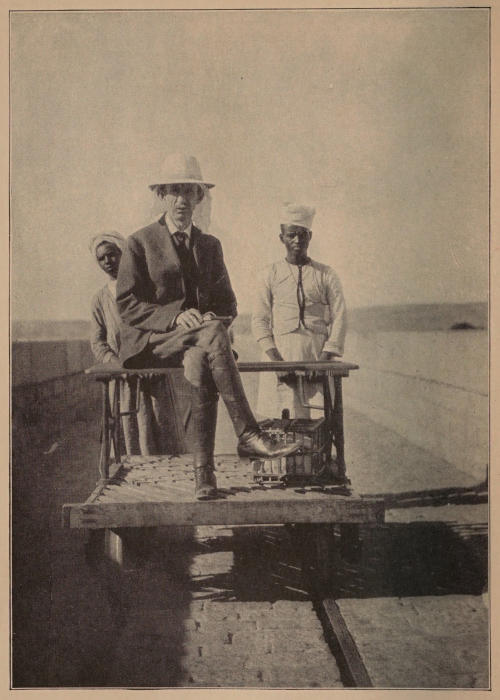
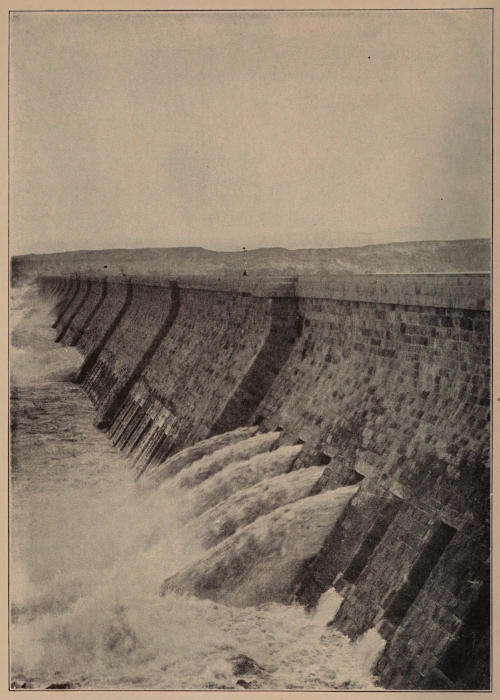
“The dam serves also as a bridge over the Nile. I crossed on a car, my
motive power being two Arab boys who trotted behind.”
CARPENTER’S WORLD TRAVELS
CAIRO TO KISUMU Egypt—The Sudan—Kenya
Colony
BY
FRANK G. CARPENTER LITT.D., F.R.G.S.
WITH 115 ILLUSTRATIONS
FROM ORIGINAL PHOTOGRAPHS
AND TWO MAPS IN COLOUR
GARDEN CITY NEW YORK
DOUBLEDAY, PAGE & COMPANY
1923
COPYRIGHT, 1923, BY FRANK G. CARPENTER
ALL RIGHTS RESERVED, INCLUDING THAT OF TRANSLATION
INTO FOREIGN LANGUAGES, INCLUDING THE SCANDINAVIAN
PRINTED IN THE UNITED STATES
AT
THE COUNTRY LIFE PRESS, GARDEN CITY, N. Y.
First Edition
ACKNOWLEDGMENTS
In the publication of this book on Egypt, the Sudan,
and Kenya Colony, I wish to thank the Secretary of
State for letters which have given me the assistance
of the official representatives of our government in
the countries visited. I thank also our Secretary of
Agriculture and our Secretary of Labour for appointing
me an Honorary Commissioner of their Departments in
foreign lands. Their credentials have been of the greatest
value, making available sources of information seldom
open to the ordinary traveller. To the British authorities
in the regions covered by these travels I desire to express
my thanks for exceptional courtesies which have greatly
aided my investigations.
I would also thank Mr. Dudley Harmon, my editor, and
Miss Ellen McBryde Brown and Miss Josephine Lehmann
for their assistance and coöperation in the revision of the
notes dictated or penned by me on the ground.
While most of the illustrations are from my own negatives,
these have been supplemented by photographs
from the Publishers’ Photo Service and the American
Geographic Society.
This volume on Egypt, Nubia, the Sudan, and
Kenya Colony is based upon notes made during
my several trips to this part of the world. At
times the notes are published just as they came
hot from my pen, taking you back, as it were, to the occasion
on which they were written. Again they are modified
somewhat to accord with present conditions.
For instance, I made my first visit to Egypt as a boy,
when Arabi Pasha was fomenting the rebellion that resulted
in that country’s being taken over by the British.
I narrowly escaped being in the bombardment of Alexandria
and having a part in the wars of the Mahdi, which
came a short time thereafter. Again, I was in Egypt when
the British had brought order out of chaos, and put Tewfik
Pasha on the throne as Khedive. I had then the talk
with Tewfik, which I give from the notes I made when I
returned from the palace, and I follow it with a description
of my audience with his son and successor, Abbas Hilmi,
sixteen years later. Now the British have given Egypt a
nominal independence, and the Khedive has the title of
King.
In the Sudan I learned much of the Mahdi through
my interview with Sir Francis Reginald Wingate, then
the Governor General of the Sudan and Sirdar of the
British army at Khartum, and later gained an insight
into the relations of the British and the natives from Earl
Cromer, whom I met at Cairo. These talks enable one
to understand the Nationalist problems of the present
and to appreciate some of the changes now going on.
In Kenya Colony, which was known as British East
Africa until after the World War, I was given especial
favours by the English officials, and many of the plans
that have since come to pass were spread out before me. I
then tramped over the ground where Theodore Roosevelt
made his hunting trips through the wilds, and went on
into Uganda and to the source of the Nile.
These travels have been made under all sorts of conditions,
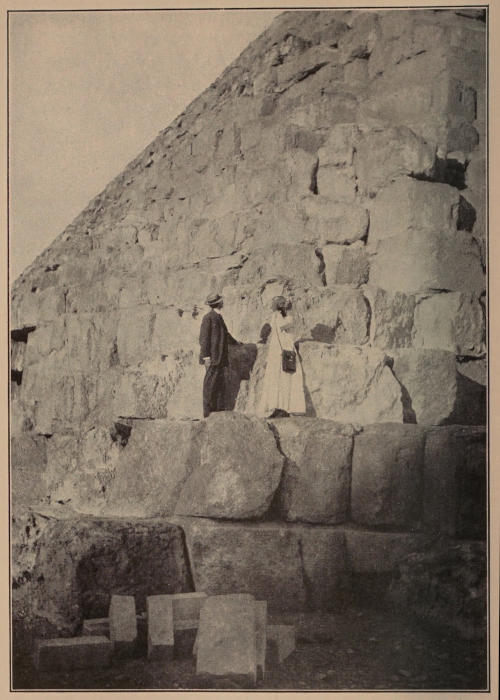
but with pen and camera hourly in hand. The
talks about the Pyramids were written on the top and at
the foot of old Cheops, those about the Nile in harness on
the great Aswan Dam, and those on the Suez Canal either
on that great waterway or on the Red Sea immediately
thereafter. The matter thus partakes of the old and the
new, and of the new based upon what I have seen of the
old. If it be too personal in character and at times seems
egotistic, I can only beg pardon by saying—the story is
mine, and as such the speaker must hold his place in the
front of the stage.
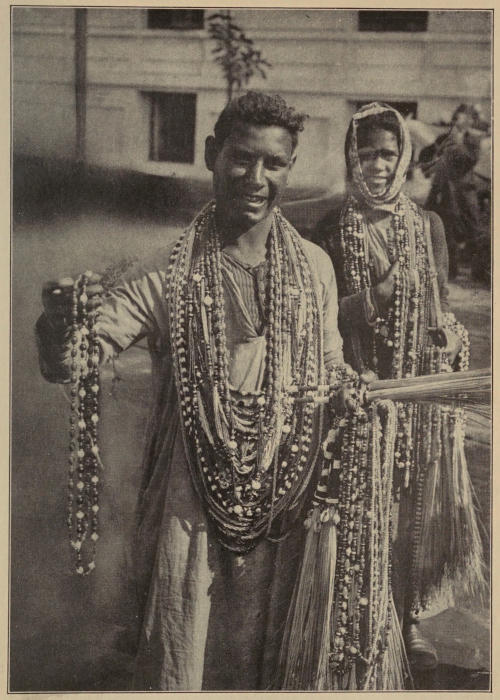
Beggars and street sellers alike believe that every foreigner visiting
Egypt is not only as rich as Crœsus but also a little touched in the head
where spending is concerned, and therefore fair game for their extravagant
demands.
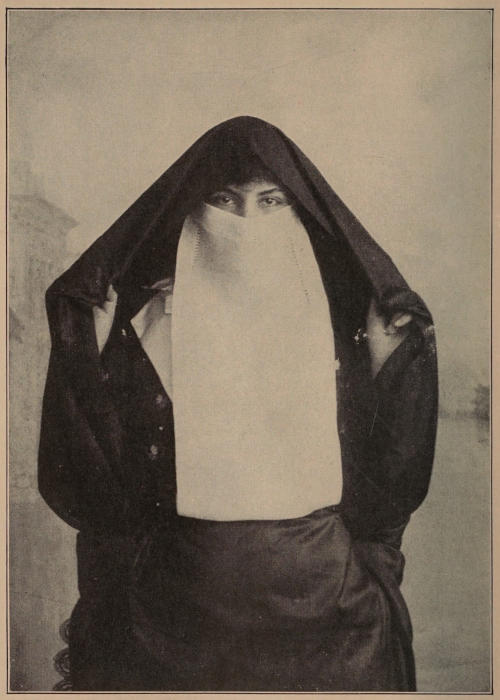
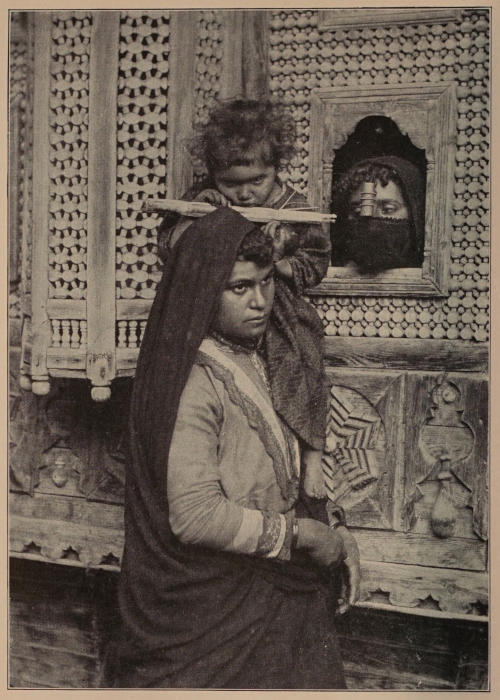
Among the upper classes an ever-lighter face covering is being adopted.
This is indicative of the advance of the Egyptian woman toward greater
freedom.
CHAPTER II THE GATEWAY TO EGYPT
I am again in Alexandria, the great sea-port of the
valley of the Nile. My first visit to it was just before
Arabi Pasha started the rebellion which threw
Egypt into the hands of the British. I saw it again
seven years later on my way around the world. I find now
a new city, which has risen up and swallowed the Alexandria
of the past.
The Alexandria of to-day stands upon the site of the
greatest of the commercial centres of antiquity, but its
present buildings are as young as those of New York,
Chicago, or Boston. It is one of the boom towns of the
Old World, and has all grown up within a century.
When George Washington was president it was little more
than a village; it has now approximately a half million inhabitants.
This is a city with all modern improvements. It has
wide streets as well paved as those of Washington, public
squares that compare favourably with many in Europe,
and buildings that would be an ornament to any metropolis
on our continent. It is now a city of street cars and automobiles.
Its citizens walk or ride to its theatres by the
light of electricity, and its rich men gamble by reading the
ticker in its stock exchange. It is a town of big hotels,
gay cafés, and palaces galore. In addition to its several
hundred thousand Mohammedans, it has a large population
of Greeks, Italians, and other Europeans, among
them some of the sharpest business men of the Mediterranean
lands. Alexandria has become commercial, money
making, and fortune hunting. The rise and fall of stocks,
the boom in real estate, and the modern methods of getting
something for nothing are its chief subjects of conversation,
and the whole population is after the elusive piastre
and the Egyptian pound as earnestly as the American is
chasing the nickel and the dollar.
The city grows because it is at the sea-gate to Egypt and
the Sudan. It waxes fat on the trade of the Nile valley
and takes toll of every cent’s worth of goods that comes
in and goes out. More than four thousand vessels enter
the port every year and in the harbour there are steamers
from every part of the world. I came to Egypt from
Tripoli via Malta, where I took passage on a steamer
bound for India and Australia, and any week I can get
a ship which within fifteen days will carry me back to
New York.
One of the things to which Alexandria owes its greatness
is the canal that Mehemet Ali, founder of the present
ruling dynasty of Egypt, had dug from this place to the
Nile. This remarkable man was born the son of a poor
Albanian farmer and lived for a number of years in his
little native port as a petty official and tobacco trader.
He first came into prominence when he led a band of
volunteers against Napoleon in Egypt. Later still he
joined the Sultan of Turkey in fighting the Mamelukes for
the control of the country. The massacre of the Mamelukes
in 1811 left the shrewd Albanian supreme in the
land, and, after stirring up an Egyptian question that set
the Powers of Europe more or less by the ears with each
other and with the Sultan of Turkey, he was made Viceroy
of Egypt, with nominal allegiance to the Turkish ruler.
When he selected Alexandria as his capital, it was a village
having no connection with the Nile. He dug a canal
fifty miles long to that great waterway, through which a
stream of vessels is now ever passing, carrying goods to
the towns of the valley and bringing out cotton, sugar,
grain, and other products, for export to Europe. The
canal was constructed by forced labour. The peasants,
or fellaheen, to the number of a quarter of a million,
scooped the sand out with their hands and carried it away
in baskets on their backs. It took them a year to dig that
fifty-mile ditch, and they were so overworked that thirty
thousand of them died on the job.
Ismail Pasha, grandson of Mehemet Ali, made other improvements
on the canal and harbour, and after the
British took control of Egypt they bettered Alexandria
in every possible way.
It has now one of the best of modern harbours. The
port is protected by a breakwater two miles in length, and
the biggest ocean steamers come to the quays. There are
twenty-five hundred acres of safe anchorage inside its
haven, while the arrangements for coaling and for handling
goods are unsurpassed.
These conditions are typical of the New Egypt. Old
Mother Nile, with her great dams and new irrigation
works, has renewed her youth and is growing in wealth like
a jimson weed in an asparagus bed. When I first saw the
Nile, its valley was a country of the dead, with obelisks
and pyramids as its chief landmarks. Then its most
interesting characters were the mummified kings of more
than twenty centuries ago and the principal visitors were
antiquity hunters and one-lunged tourists seeking a warm
winter climate. These same characters are here to-day,
but in addition have come the ardent dollar chaser, the
capitalist, and the syndicate. Egypt is now a land of
banks and stock exchanges. It is thronged with civil
engineers, irrigation experts, and men interested in the
development of the country by electricity and steam.
The delta, or the great fan of land which begins at Cairo
and stretches out to the Mediterranean, is gridironed with
steel tracks and railroad trains, continuing almost to the
heart of central Africa.
I find Egypt changing in character. The Mohammedans
are being corrupted by the Christians, and the simple
living taught by the Koran, which commands the believer
to abstain from strong drink and other vices, has become
infected with the gay and giddy pleasures of the French.
In many cases the system of the harem is being exchanged
for something worse. The average Moslem now has but
one wife, but in many cases he has a sweetheart in a house
around the corner, “and the last state of that man is
worse than the first.”
The ghouls of modern science are robbing the graves of
those who made the Pyramids. A telephone line has been
stretched out of Cairo almost to the ear of the Sphinx, and
there is a hotel at the base of the Pyramid of Cheops
where English men and women drink brandy and soda
between games of tennis and golf.
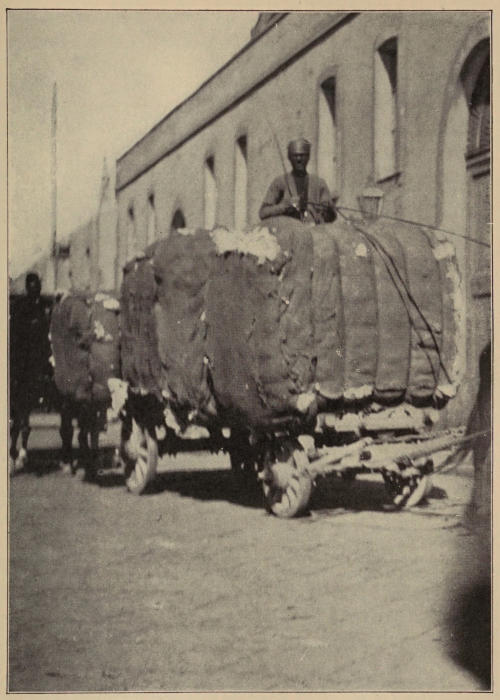
Cotton warehouses and docks extend for a mile along the Mahmudiyeh
Canal connecting the port of Alexandria with the Nile River, and the prosperity
of the city rises and falls with the price of cotton in the world’s
markets.
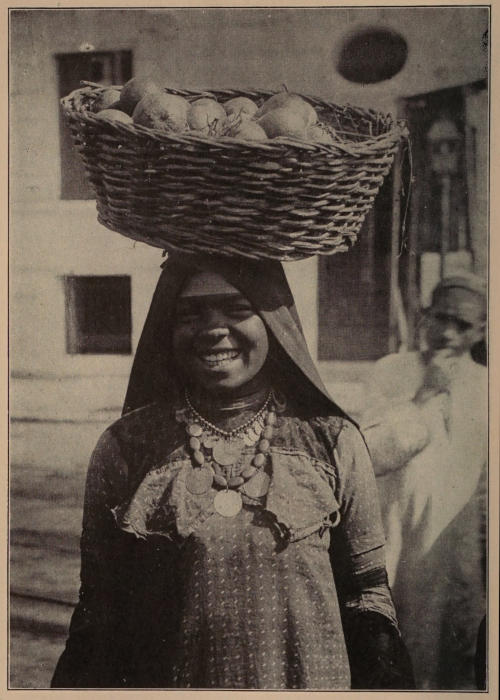
Nubian women sell fruit and flowers on the streets of Alexandria to-day,
but once their kings ruled all Egypt and defeated the armies of Rome.
They became early converts to Christianity but later adopted Mohammedanism.
The Egypt of to-day is a land of mighty hotels and
multitudinous tourists. For years it has been estimated
that Americans alone spend several million dollars here
every winter, and the English, French, and other tourists
almost as much. It is said that in the average season ten
thousand Americans visit the Nile valley and that it costs
each one of them at least ten dollars for every day of his
stay.
When I first visited this country the donkey was the chief
means of transport, and men, women, and children went
about on long-eared beasts, with Arab boys in blue gowns
following behind and urging the animals along by poking
sharp sticks into patches of bare flesh, as big as a dollar,
which had been denuded of skin for the purpose. The
donkey and the donkey boy are here still, but I can get a
street car in Alexandria that will take me to any part of
the town, and I frequently have to jump to get out of the
way of an automobile. There are cabs everywhere, both
Alexandria and Cairo having them by thousands.
The new hotels are extravagant beyond description.
In the one where I am now writing the rates are from
eighty to one hundred piastres per day. Inside its walls
I am as far from Old Egypt as I would be in the Waldorf
Astoria in New York. The servants are French-speaking
Swiss in “swallow-tails”, with palms itching for fees just
as do those of their class in any modern city. In my bedroom
there is an electric bell, and I can talk over the telephone
to our Consul General at Cairo. On the register
of the hotel, which is packed with guests, I see names of
counts by the score and lords by the dozen. The men
come to dinner in steel-pen coats and the women in low-cut
evening frocks of silk and satin. There is a babel of
English, French, and German in the lounge while the
guests drink coffee after dinner, and the only evidences
one perceives of a land of North Africa and the Moslems
are the tall minarets which here and there reach above the
other buildings of the city, and the voices of the muezzins
as they stand beneath them and call the Mohammedans
to prayer.
The financial changes that I have mentioned are by no
means confined to the Christians. The natives have been
growing rich, and the Mohammedans for the first time in
the history of Egypt have been piling up money. Since
banking and money lending are contrary to the Koran,
the Moslems invest their surplus in real estate, a practice
which has done much to swell all land values.
Egypt is still a country of the Egyptians, notwithstanding
the overlordship of the British and the influx of foreigners.
It has now more than ten million people. Of these,
three out of every four are either Arabs or Copts. Most
of them are Mohammedans, although there are, all told,
something like eight hundred and sixty thousand Copts,
descendants of the ancient Egyptians, who have a rude
kind of Christianity, and are, as a body, better educated
and wealthier than the Mussulmans.
The greater part of the foreign population of Egypt
is to be found in Alexandria and Cairo, and in the other
towns of the Nile valley, as well as in Suez and Port Said.
There are more of the Greeks than of any other nation.
For more than two thousand years they have been exploiting
the Egyptians and the Nile valley and are to-day the
sharpest, shrewdest, and most unscrupulous business men
in it. They do much of the banking and money lending and
until the government established banks of its own and
brought down the interest rate they demanded enormous
usury from the Egyptian peasants. It is said that
they loaned money on lands and crops at an average
charge of one hundred and fifty per cent. per annum.
This was changed, however, by the establishment of
the Agricultural Bank. The government, which controls
that bank, lends money to the farmers at eight per cent. to
within half of the value of their farms. To-day, since the
peasants all over Egypt can get money at this rate, the
Greeks have had to reduce theirs.
The Italians number about forty thousand and the
French twenty thousand. There are many Italian shops
here in Alexandria, while there are hundreds of Italians
doing business in Cairo. They also furnish some of the
best mechanics. Many of them are masons and the
greater part of the Aswan Dam and similar works were
constructed by them.
There are also Germans, Austrians, and Russians, together
with a few Americans and Belgians. The British
community numbers a little over twenty thousand.
Among the other foreigners are some Maltese and a few
hundred British East Indians.
Sitting here at Alexandria in a modern hotel surrounded
by the luxuries of Paris or New York, I find it hard to realize
that I am in one of the very oldest cities of history.
Yesterday I started out to look up relics of the past, going
by mile after mile of modern buildings, though I was travelling
over the site of the metropolis that flourished here
long before Christ was born. From the antiquarian’s
point of view, the only object of note still left is Pompey’s
Pillar and that is new in comparison with the earliest
history of Old Egypt, as it was put up only sixteen hundred
years ago, when Alexandria was already one of the greatest
cities of the world. The monument was supposed to
stand over the grave of Pompey, but it was really erected
by an Egyptian prefect in honour of the Roman emperor,
Diocletian. It was at one time a landmark for sailors,
for there was always upon its top a burning fire which was
visible for miles over the Mediterranean Sea. The pillar
is a massive Corinthian column of beautifully polished red
granite as big around as the boiler of a railroad locomotive
and as high as a ten-story apartment house. It consists of
one solid block of stone, standing straight up on a pedestal.
It was dug out of the quarries far up the Nile valley,
brought down the river on rafts and in some way lifted to
its present position. In their excavations about the pedestal,
the archæologists learned of its comparatively modern
origin and, digging down into the earth far below its foundation,
discovered several massive stone sphinxes. These
date back to old Alexandria and were chiselled several hundreds
of years before Joseph and Mary brought the baby
Jesus on an ass, across the desert, into the valley of the
Nile that he might not be killed by Herod the King.
This city was founded by Alexander the Great three
hundred and thirty-two years before Christ was born. It
probably had then more people than it has to-day, for it
was not only a great commercial port, but also a centre of
learning, religion, and art. It is said to have had the
grandest library of antiquity. The manuscripts numbered
nine hundred thousand and artists and students came from
all parts to study here. At the time of the Cæsars it was
as big as Boston, and when it was taken by the Arabs,
along about 641 A.D., it had four thousand palaces, four
hundred public baths, four hundred places of amusement,
and twelve thousand gardens. When Alexander the Great
founded it he brought in a colony of Jews, and at the time
the Mohammedans came the Jewish quarter numbered
forty thousand.
At Alexandria St. Mark first preached Christianity to
the Egyptians, and subsequently the city became one of
the Christian centres of the world. Here Hypatia lived,
and here, as she was about to enter a heathen temple to
worship, the Christian monks, led by Peter the Reader,
tore her from her chariot and massacred her. They
scraped her live flesh from her bones with oyster shells,
and then tore her body limb from limb.
Here, too, Cleopatra corrupted Cæsar and later brought
Marc Antony to a suicidal grave. There are carvings of
the enchantress of the Nile still to be seen on some of the
Egyptian temples far up the river valley. I have a photograph
of one which is in good preservation in the Temple of
Denderah. Its features are Greek rather than Egyptian,
for she was more of a Greek than a Simon-pure daughter of
the Nile. She was not noted for beauty, but she had such
wonderful charm of manner, sweetness of voice, and brilliancy
of intellect, that she was able to allure and captivate
the greatest men of her time.
Cleopatra’s first Roman lover was Julius Cæsar, who
came to Alexandria to settle the claims of herself and her
brother to the throne of Egypt. Her father, who was one
of the Ptolemies, had at his death left his throne to her
younger brother and herself, and according to the custom
the two were to marry and reign together. One of the
brother’s guardians, however, had dethroned and banished
Cleopatra. She was not in Egypt when Cæsar
came. It is not known whether it was at Cæsar’s request
or not, but the story goes that she secretly made her
way back to Alexandria, and was carried inside a roll of
rich Syrian rugs on the back of a servant to Cæsar’s
apartments. Thus she was presented to the mighty
Roman and so delighted him that he restored her to the
throne. When he left for Rome some time later he took
her with him and kept her there for a year or two. After
the murder of Cæsar, Cleopatra, who had returned to
Egypt, made a conquest of Marc Antony and remained
his sweetheart to the day when he committed suicide upon
the report that she had killed herself. Antony had then
been conquered by Octavianus, his brother-in-law, and it
is said that Cleopatra tried to capture the heart of Octavianus
before she took her own life by putting the poisonous
asp to her breast.
CHAPTER III KING COTTON ON THE NILE
The whole of to-day has been spent wandering
about the cotton wharves of Alexandria. They extend
for a mile or so up and down the Mahmudiyeh
Canal, which joins the city to the Nile, and are
flanked on the other side by railroads filled with cotton
trains from every part of Egypt. These wharves lie under
the shadow of Pompey’s Pillar and line the canal almost to
the harbour. Upon them are great warehouses filled with
bales and bags. Near by are cotton presses, while in the
city itself is a great cotton exchange where the people buy
and sell, as they do at Liverpool, from the samples of lint
which show the quality of the bales brought in from the
plantations.
Indeed, cotton is as big a factor here as it is in New
Orleans, and the banks of this canal make one think of that
city’s great cotton market. The warehouses are of vast
extent, and the road between them and the waterway is
covered with bales of lint and great bags of cotton seed.
Skullcapped blue-gowned Egyptians sit high up on the
bales on long-bedded wagons hauled by mules. Other
Egyptians unload the bales from the cars and the boats
and others carry them to the warehouses. They bear the
bales and the bags on their backs, while now and then a
man may be seen carrying upon his head a bag of loose
cotton weighing a couple of hundred pounds. The
cotton seed is taken from the boats in the same way, seed
to the amount of three hundred pounds often making one
man’s load.
Late in the afternoon I went down to the harbour to see
the cotton steamers. They were taking on cargoes for
Great Britain, Russia, France, Germany, and the United
States. This staple forms three fourths of the exports of
Egypt. Millions of pounds of it are annually shipped to
the United States, notwithstanding the fact that we raise
more than two thirds of all the cotton of the world. Because
of its long fibre, there is always a great demand for
Egyptian cotton, which is worth more on the average than
that of any other country.
For hundreds of years before the reign of that wily old
tyrant, Mehemet Ali, whose rule ended with the middle of
the nineteenth century, Egypt had gone along with the
vast majority of her people poor, working for a wage of
ten cents or so a day, and barely out of reach of starvation
all the time. Mehemet Ali saw that what she needed to
become truly prosperous and raise the standard of living
was some crop in which she might be the leader. It was
he who introduced long-staple cotton, a product worth
three times as much as the common sort, and showed what
it could do for his country. Since then King Cotton has
been the money maker of the Nile valley, the great White
Pharaoh whom the modern Egyptians worship. He has
the majority of the Nile farmers in his employ and pays
them royally. He has rolled up a wave of prosperity that
has engulfed the Nile valley from the Mediterranean to
the cataracts and the prospects are that he will continue
to make the country richer from year to year. The yield
is steadily increasing and with the improved irrigation
methods it will soon be greater than ever. From 1895
to 1900 its average annual value was only forty-five
million dollars; but after the Aswan Dam was completed
it jumped to double that sum.
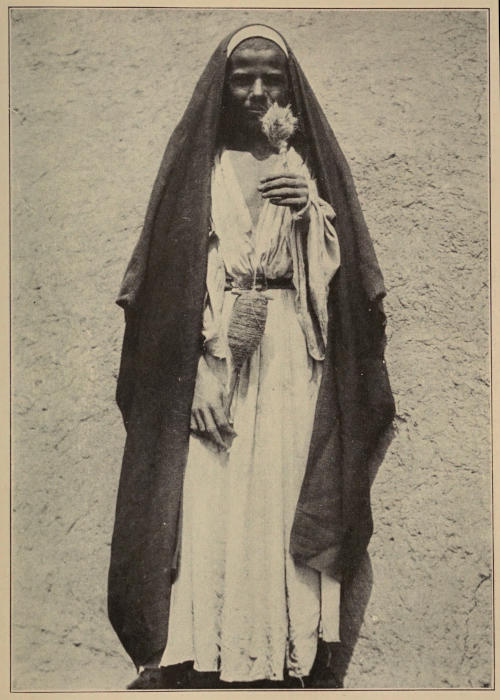
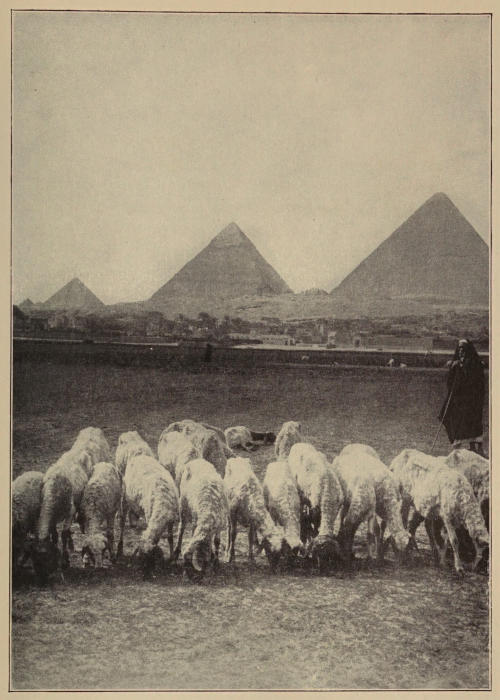
Though cotton is the big cash crop of Egypt, small flocks of sheep are
kept on many of the farms and the women spin the wool for the use of the
family.
Sugar is Egypt’s crop of second importance. Heavy investments of
French and British capital in the Egyptian industry were first made when
political troubles curtailed Cuba’s production.
The greater part of Upper and Lower Egypt can be made
to grow cotton, and cotton plantations may eventually
cover over five million five hundred thousand acres. If
only fifty per cent. of this area is annually put into cotton
it will produce upward of two million bales per annum,
or more than one sixth as much as the present cotton crop
of the world. In addition to this, there might be a further
increase by putting water into some of the oases that lie
in the valley of the Nile outside the river bottom, and also
by draining the great lakes about Alexandria and in other
parts of the lower delta.
Egypt has already risen to a high place among the
world’s cotton countries. The United States stands first,
British India second, and Egypt third. Yet Egypt grows
more of this staple for its size and the area planted than
any other country on the globe. Its average yield is
around four hundred and fifty pounds per acre, which is
far in excess of ours. Our Department of Agriculture
says that our average is only one hundred and ninety
pounds per acre, although we have, of course, many acres
which produce five hundred pounds and more.
It is, however, because of its quality rather than its
quantity that Egyptian cotton holds such a commanding
position in the world’s markets. Cotton-manufacturing
countries must depend on Egypt for their chief supply of
long-staple fibre. There are some kinds that sell for
double the amount our product brings. It is, in fact, the
best cotton grown with the exception of the Sea Island
raised on the islands off the coasts of Georgia and South
Carolina. The Sea Island cotton has a rather longer fibre
than the Egyptian. The latter is usually brown in colour
and is noted for its silkiness, which makes it valuable for
manufacturing mercerized goods. We import an enormous
quantity of it to mix with our cotton, and we have
used the Egyptian seed to develop a species known as
American-Egyptian, which possesses the virtues of both
kinds.
There is a great difference in the varieties raised, according
to the part of the Nile valley from which each
kind comes. The best cotton grows in the delta, which
produces more than four fifths of the output.
A trip through the Nile cotton fields is an interesting
one. The scenes there are not in the least like those of
our Southern states. Much of the crop is raised on small
farms and every field is marked out with little canals into
which the water is introduced from time to time. There
are no great farm houses in the landscape and no barns.
The people live in mud villages from which they go out to
work in the fields. They use odd animals for ploughing
and harrowing and the crop is handled in a different way
from ours.
Let me give you a few of the pictures I have seen while
travelling through the country. Take a look over the
delta. It is a wide expanse of green, spotted here and
there with white patches. The green consists of alfalfa,
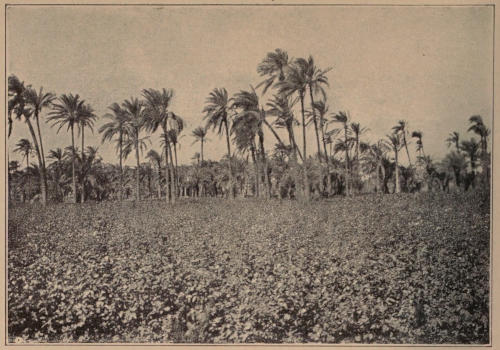
Indian corn, or beans. The white is cotton, stretching
out before me as far as my eye can follow it.
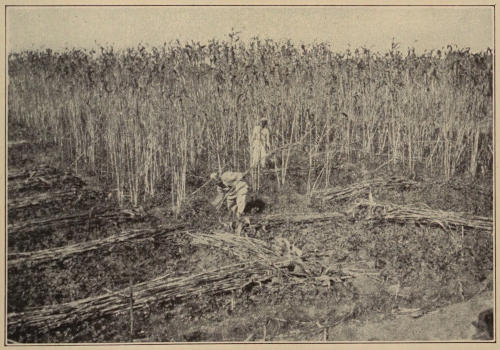
Here is a field where the lint has been gathered. The
earth is black, with windrows of dry stalks running across
it. Every stalk has been pulled out by the roots and piled
up. Farther on we see another field in which the stalks
have been tied into bundles. They will be sold as fuel and
will produce a full ton of dry wood to the acre. There
are no forests in Egypt, where all sorts of fuel are scarce.
The stalks from one acre will sell for two dollars or more.
They are used for cooking, for the farm engines on the
larger plantations, and even for running the machinery of
the ginning establishments. In that village over there
one may see great bundles of them stored away on the flat
roofs of the houses. Corn fodder is piled up beside them,
the leaves having been torn off for stock feed. A queer
country this, where the people keep their wood piles on
their roofs!
In that field over there they are picking cotton. There
are scores of little Egyptian boys and girls bending their
dark brown faces above the white bolls. The boys for the
most part wear blue gowns and dirty white skullcaps,
though some are almost naked. The little girls have cloths
over their heads. All are barefooted. They are picking
the fibre in baskets and are paid so much per hundred
pounds. A boy will gather thirty or forty pounds in a day
and does well if he earns as much as ten cents.
The first picking begins in September. After that the
land is watered, and a second picking takes place in October.
There is a third in November, the soil being irrigated
between times. The first and second pickings, which
yield the best fibre, are kept apart from the third and sold
separately.
After the cotton is picked it is put into great bags and
loaded upon camels. They are loading four in that field
at the side of the road. The camels lie flat on the ground,
with their long necks stretched out. Two bags, which together
weigh about six hundred pounds, make a load for
each beast. Every bag is as long and wide as the mattress
of a single bed and about four feet thick. Listen to
the groans of the camels as the freight is piled on. There
is one actually weeping. We can see the tears run down
his cheeks.
Now watch the awkward beasts get up. Each rises
back end first, the bags swaying to and fro as he does so.
How angry he is! He goes off with his lower lip hanging
down, grumbling and groaning like a spoiled child. The
camels make queer figures as they travel. The bags on
each side their backs reach almost to the ground, so that
the lumbering creatures seem to be walking on six legs
apiece.
Looking down the road, we see long caravans of camels
loaded with bales, while on the other side of that little
canal is a small drove of donkeys bringing in cotton.
Each donkey is hidden by a bag that completely covers its
back and hides all but its little legs.
In these ways the crop is brought to the railroad stations
and to the boats on the canals. The boats go from one
little waterway to another until they come into the Mahmudiyeh
Canal, and thence to Alexandria. During the
harvesting season the railroads are filled with cotton
trains. Some of the cotton has been ginned and baled
upon the plantations, and the rest is in the seed to be
ginned at Alexandria. There are ginning establishments
also at the larger cotton markets of the interior. Many
of them are run by steam and have as up-to-date machinery
as we have. At these gins the seed is carefully saved
and shipped to Alexandria by rail or by boat.
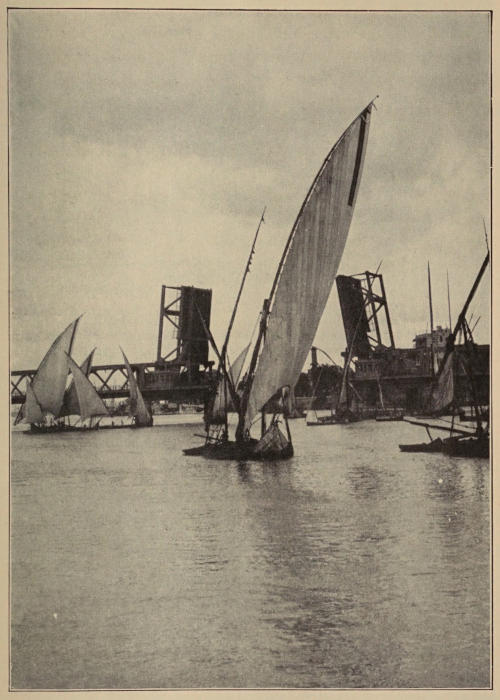
The Nile bridge swings back to let through the native boats sailing down
to Alexandria with cargoes of cotton and sugar grown on the irrigated
lands farther upstream.
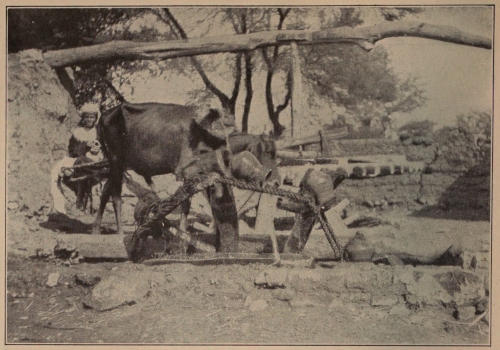
A rainless country, Egypt must dip up most of its water from the Nile,
usually by the crude methods of thousands of years ago. Here an ox is
turning the creaking sakieh, a wheel with jars fastened to its rim.
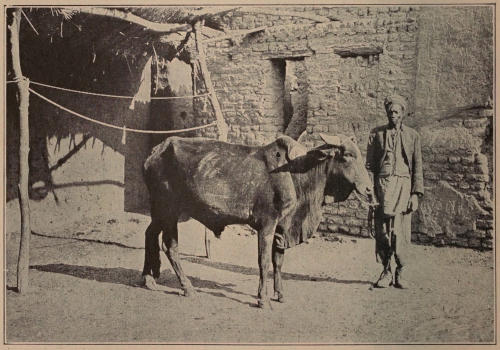
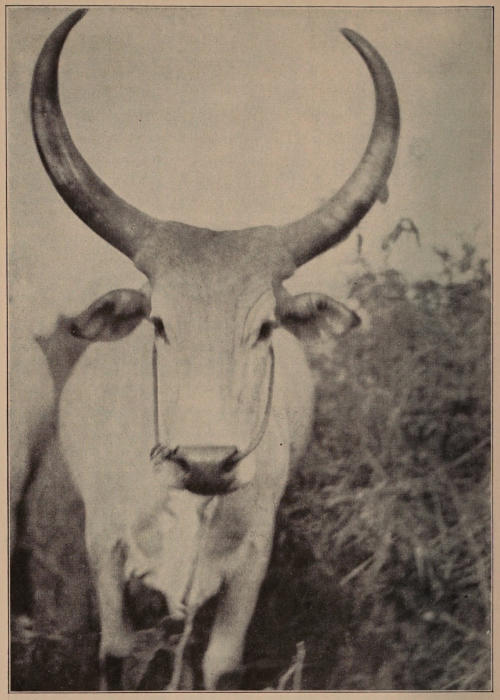
Egypt is a land that resists change, where even the native ox, despite
the frequent importation of foreign breeds, has the same features as are
found in the picture writings of ancient times. He is a cousin of the zebu.
The Egyptians put more work on their crop than our
Southern farmers do. In the first place, the land has to
be ploughed with camels or buffaloes and prepared for the
planting. It must be divided into basins, each walled
around so that it will hold water, and inside each basin
little canals are so arranged that the water will run in and
out through every row. The whole field is cut up into
these beds, ranging in size from twenty-four to seventy-five
feet square.
The cotton plants are from fourteen to twenty inches
apart and set in rows thirty-five inches from each other.
It takes a little more than a bushel of seed to the acre.
The seeds are soaked in water before planting, any which
rise to the surface being thrown away. The planting is
done by men and boys at a cost of something like a dollar
an acre. The seeds soon sprout and the plants appear in
ten or twelve days. They are thinned by hand and water
is let in upon them, the farmers taking care not to give
them too much. The plants are frequently hoed and
have water every week or so, almost to the time of picking.
The planting is usually done in the month of March, and,
as I have said, the first picking begins along in September.
I have been told that cotton, as it is grown here, exhausts
the soil and that the people injure the staple and reduce
the yield by overcropping. It was formerly planted on
the same ground only every third year, the ground being
used in the interval for other crops or allowed to lie fallow.
At present some of the cotton fields are worked every
year and others two years out of three. On most of the
farms cotton is planted every other year, whereas the
authorities say that in order to have a good yield not
more than forty per cent. of a man’s farm should be kept
to this crop from year to year. Just as in our Southern
states, a year of high cotton prices is likely to lead to overcropping
and reduced profits, and vice versa. Another
trouble in Egypt, and one which it would seem impossible
to get around, is the fact that cotton is practically the
only farm crop. This puts the fellaheen more or less at
the mercy of fluctuating prices and changing business conditions;
so that, like our cotton farmers of the South,
they have their lean years and their fat years.
Egypt also has had a lot of trouble with the pink boll
weevil. This pestiferous cotton worm, which is to be
found all along the valley of the Nile, has also done great
damage on the plantations of the Sudan, a thousand miles
south of Alexandria. It is said that in one year it destroyed
more than ten million dollars’ worth of cotton
and that hundreds of the smaller farmers were ruined.
The government has been doing all it can to wipe out
the plague, but is working under great disadvantages.
The Egyptian Mohammedans are fatalists, looking upon
such things as the boll weevil as a judgment of God and
believing they can do nothing to avert the evil. Consequently,
the government had to inaugurate a system of
forced labour. It made the boys and men of the cotton
region turn out by the thousands to kill the worms under
the superintendence of officials. The results were excellent,
and as those who were forced into the work were well
paid the farmers are beginning to appreciate what has
been done for them.
The government helps the cotton planters in other ways.
Its agricultural department sends out selected seed for
planting a few thousand acres to cotton, contracting with
each man who takes it that the government will buy his
seed at a price above that of the market. The seed coming
in from that venture is enough to plant many more
thousands of acres, and this is distributed at cost to such
of the farmers as want it. More than one quarter of all
seed used has latterly been supplied in this way.
The government has also induced the planters to use
artificial fertilizers. It began this some years ago, when
it was able to distribute thirty thousand dollars’ worth
of chemical fertilizer, and the demand so increased that
within a few years more than ten times as much was distributed
annually.
CHAPTER IV THROUGH OLD EGYPT TO CAIRO
On my way to Cairo I have taken a run through
the delta, crossing Lower Egypt to the Suez
Canal and returning through the Land of
Goshen.
The soil is as rich and the grass is as green now as it was
when Joseph picked out this land as the best in Egypt for
his famine-stricken father Jacob. Fat cattle by the hundreds
grazed upon the fields, camels with loads of hay
weighing about a ton upon their backs staggered along
the black roads. Turbaned Egyptians rode donkeys
through the fields, and the veiled women of this Moslem
land crowded about the train at the villages. On one
side a great waste of dazzling yellow sand came close to the
edge of the green fields, and we passed grove after grove of
date-palm trees holding their heads proudly in the air,
and shaking their fan-like leaves to every passing breeze.
They seemed to whisper a requiem over the dead past of
this oldest of the old lands of the world.
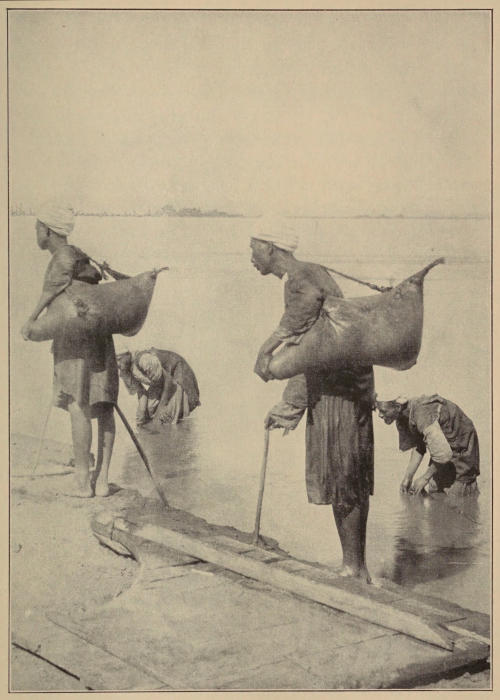
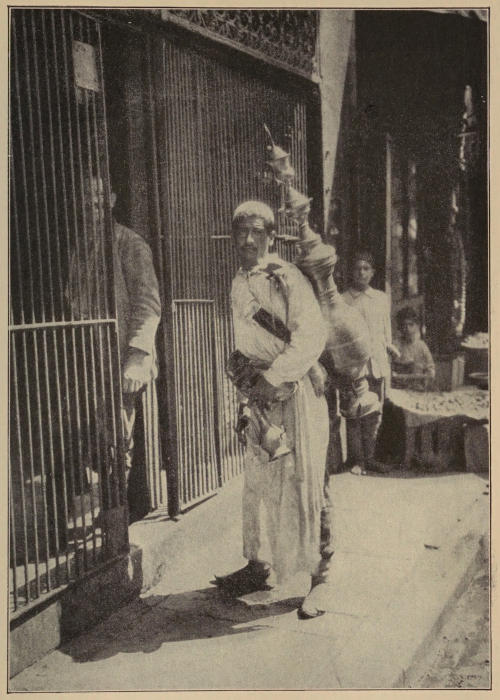
The sakka, or water carrier, fills his pigskin bag at the river, and then
peddles it out, with the cry: “O! may God recompense me,” announcing
his passage through the streets of village or town.
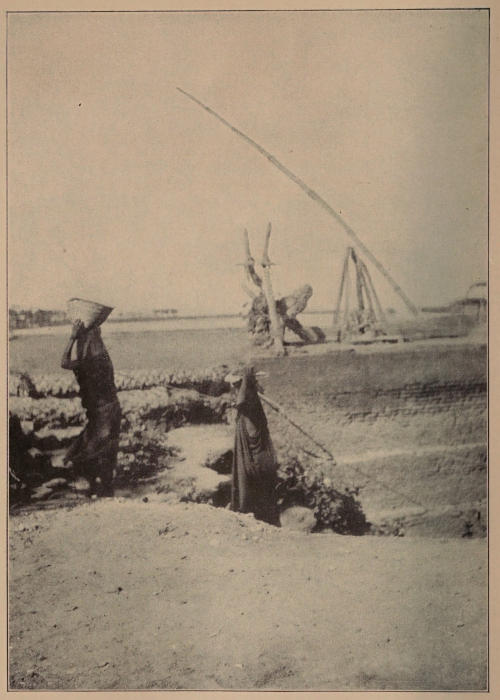
Up and down the slippery banks of the Nile goes the centuries-long procession
of fellah women bearing head burdens—water-jars or baskets of
earth from excavations.
As we neared Cairo and skirted the edge of the desert,
away off to the right against the hazy horizon rose three
ghost-like cones of gray out of the golden sand. These
were the Pyramids, and the steam engine of the twentieth
century whistled out a terrible shriek as we came in sight
of them. To the left were the Mokattam Hills, with the
citadel which Saladin built upon them, while to the right
flowed the great broad-bosomed Nile, the mother of the
land of Egypt, whose earth-laden waters have been
creating soil throughout the ages, and which to-day are
still its source of life.
Egypt, in the words of Herodotus, is the gift of the Nile.
This whole rainless country was once a bed of sterile sand
so bleak and bare that not a blade of grass nor a shrub
of cactus would grow upon it. This mighty river, rising
in the heights of Africa and cutting its way through rocks
and hills, has brought down enough sediment to form the
tillable area of Egypt. South of Cairo, for nearly a thousand
miles along its banks, there extends a strip of rich
black earth which is only from three to nine miles wide.
Below the city the land spreads out in a delta shaped
somewhat like the segment of a circle, the radii of which
jut out from Cairo, while the blue waters of the Mediterranean
edge its arc. This narrow strip and fan form the
arable land of Egypt. The soil is nowhere more than
thirty-five feet deep. It rests on a bed of sand. On each
side of it are vast wastes of sand and rock, with not a spot
of green to relieve the ceaseless glare of the sun. The
green goes close to the edge of the desert, where it stops as
abruptly as though it were cut off by a gardener. Nearly
everywhere up the Nile from Cairo the strip is so narrow
that you can stand at one side of the valley and see clear
across it.
Thus, in one sense, Egypt is the leanest country in the
world, but it is the fattest in the quality of the food that
nature gives it. Through the ages it has had one big meal
every year. At the inundation of the Nile, for several
months the waters spread over the land and were allowed
to stand there until they dropped the rich, black fertilizing
sediment brought down from the African mountains.
This sediment has produced from two to three crops a
year for Egypt through the centuries and for a long time
was the sole manure that the land had. The hundreds
of thousands of cattle, donkeys, camels, and sheep that
feed off the soil give nothing back to it, for their droppings
are gathered up by the peasant women and girls, patted
into shape, and dried for use as fuel. Until late years the
only manure that was used in any part of the country was
that of pigeons and chickens, or the crumbled ruins of
ancient towns, which, lying through thousands of years,
have become rubbish full of fertilizing properties. Recently,
as I have said, the use of artificial fertilizers has
been encouraged with excellent results.
The irrigation of Egypt is now conducted on scientific
lines. The water is not allowed to spread over the country
as it was years ago, but the arable area is cut up by
canals, and there are immense irrigating works in the
delta, to manage which during the inundation hundreds of
thousands of men are required. Just at the point of the
delta, about twelve miles above Cairo, is a great dam, or
barrage, that raises the waters of the Nile into a vast canal
from which they flow over the fan-like territory of Lower
Egypt. All through Egypt one sees men scooping the
water up in baskets from one level to another, and everywhere
he finds the buffalo, the camel, or donkey turning
the wheels that operate the crude apparatus for getting
the water out of the river and onto the land.
But let me put into a nutshell the kernel of information
we need to understand this wonderful country. We all
know how Egypt lies on the map of northeastern Africa,
extending a thousand miles or more southward from the
Mediterranean Sea. The total area, including the Nubian
Desert, the region between the Nile and the Red Sea, and
the Sinai Peninsula, is more than seven times as large as
the State of New York, but the real Egypt, that is, the
cultivated and settled portion comprising the Nile valley
and delta, lacks just four square miles of being as large
as our State of Maryland. Of this portion, fully one third
is taken up in swamps, lakes, and the surface of the Nile,
as well as in canals, roads, and plantations of dates, so that
the Egypt of farms that actually supports the people is
only about as big as Massachusetts. Though this contains
little more than eight thousand square miles, nevertheless
its population is nearly one eighth of ours. Crowd
every man, woman, and child who lives in the United
States into four states the size of Maryland, and you have
some idea of the density of the population here. Belgium,
that hive of industry, with its mines of iron and coal and
its myriad factories, has only about six hundred people
per square mile; and China, the leviathan of Asia, has
less than two hundred and fifty. Little Egypt is supporting
something like one thousand per square mile of its
arable area; and nearly all of them are crowded down
near the Mediterranean.
Of these people, about nine tenths are Mohammedans,
one twelfth Christians, Copts, and others; and less than
one half of one per cent. Jews. Among the Christians
are many Greeks of the Orthodox Church and Italian
Roman Catholics from the countries on the Mediterranean
Sea.
Nature has much to do with forming the character and
physique of the men who live close to her, and in Egypt
the unvarying soil, desert, sky, and river, make the people
who have settled in the country become, in the course
of a few generations, just like the Egyptians themselves.
Scientists say that the Egyptian peasantry of to-day is
the same as in the past, and that this is true even
of the cattle. Different breeds have been imported from
time to time only to change into the Egyptian type, and
the cow to-day is the same as that pictured in the hieroglyphics
of the tombs made thousands of years ago. The
Egyptian cow is like the Jersey in shape and form save
that its neck is not quite so delicate and its horns are a
trifle shorter. Its colour is a rich red. Its milk is full of
oil, and its butter is yellow. It has been asserted that the
Jersey cow originally came from Egypt, and was taken to
the Island of Jersey by the Phœnicians in some of their
voyages ages ago.
But to return to the Nile, the source of existence of this
great population. Next to the Mississippi, with the Missouri,
it is the longest river of the world. The geographers
put its length at from thirty-seven hundred to four thousand
miles. It is a hundred miles or so longer than the
Amazon, and during the last seventeen hundred miles of its
course not a single branch comes in to add to its volume.
For most of the way it flows through a desert of rock and
sand as dry as the Sahara. In the summer many of the
winds that sweep over Cairo are like the blast from a
furnace, and in Upper Egypt a dead dog thrown into the
fields will turn to dust without an offensive odour. The
dry air sucks the moisture out of the carcass so that there
is no corruption.
Nearly all of the cultivated lands lie along the Nile banks
and depend for their supply of water on the rise of the river,
caused by the rains in the region around its sources. When
the Nile is in flood the waters are coloured dark brown
by the silt brought down from the high lands of Abyssinia.
When it is low, as in June, they are green, because of the
growth of water plants in the upper parts of the river.
At flood time the water is higher than the land and the
fields are protected by banks or dikes along the river. If
these banks break, the fields are flooded and the crops destroyed.
We are accustomed to look upon Egypt as a very hot
country. This is not so. The greater part of it lies just
outside the tropics, so that it has a warm climate and a
sub-tropical plant life. The hottest month is June
and the coldest is January. Ice sometimes forms on
shallow pools in the delta, but there is no snow, although
hail storms occur occasionally, with very large stones.
There is no rain except near the coast and a little near
Cairo. Fogs are common in January and February and
it is frequently damp in the cultivated tracts.
For centuries Egypt has been in the hands of other
nations. The Mohammedan Arabs and the Ottoman
Turks have been bleeding her since their conquest.
Greece once fed off her. Rome ate up her substance in the
days of the Cæsars and she has had to stake the wildest
extravagancies of the khedives of the past. It must be
remembered that Egypt is almost altogether agricultural,
and that all of the money spent in and by it must come
from what the people can raise on the land. The khedives
and officials have piped, and Egypt’s farmers have had to
pay.
It was not long before my second visit to Egypt that
the wastefulness and misrule of her officials had practically
put her in the hands of a receiver. She had gone into
debt for half a billion dollars to European creditors—English,
French, German, and Spanish—and England and
France had arranged between them to pull her out. Later
France withdrew from the agreement and Great Britain
undertook the job alone.
At that time the people were ground down to the earth
and had barely enough for mere existence. Taxes were
frightfully high and wages pitifully low. The proceeds
from the crops went mostly to Turkey and to the bankers
of Europe who had obtained the bonds given by the
government to foreigners living in Egypt. In fact, they
had as hard lives as in the days of the most tyrannical of
the Pharaohs.
But since that time the British have had a chance to
show what they could do, irrigation projects and railroad
schemes have been put through, cotton has come into
its own, and I see to-day a far more prosperous land and
people than I did at the end of the last century.
CHAPTER V FELLAHEEN ON THEIR FARMS
For the last month I have been travelling through
the farms of the Nile valley. I have visited
many parts of the delta, a region where the tourist
seldom stops, and have followed the narrow
strip that borders the river for several hundred miles above
Cairo.
The delta is the heart of Egypt. It has the bulk of the
population, most of the arable land, the richest soil, and
the biggest crops. While it is one of the most thickly
settled parts of the world, it yields more to the acre than
any other region on earth, and its farm lands are the most
valuable. I am told that the average agricultural yield
for all Europe nets a profit of thirty-five dollars per acre,
but that of Lower Egypt amounts to a great deal more.
Some lands produce so much that they are renting for
fifty dollars an acre, and there are instances where one
hundred dollars is paid.
I saw in to-day’s newspapers an advertisement of an
Egyptian land company, announcing an issue of two and
one half million dollars’ worth of stock. The syndicate
says in its prospectus that it expects to buy five thousand
acres of land at “the low rate of two hundred dollars per
acre,” and that by spending one hundred and fifty thousand
dollars it can make that land worth four hundred
dollars per acre within three years. Some of this land
would now bring from two hundred and fifty to three
hundred dollars per acre, and is renting for twenty dollars
per acre per annum. The tract lies fifty miles north of
Cairo and is planted in cotton, wheat, and barley.
Such estates as the above do not often come into the
market, however. Most of Egypt is in small farms, and
little of it is owned by foreigners. Six sevenths of the
farms belong to the Egyptians, and there are more than
a million native land owners. Over one million acres are
in tracts of from five to twenty acres each. Many are
even less than an acre in size. The number of proprietors is
increasing every year and the fellaheen, or fellahs, are eager
to possess land of their own. It used to be that the Khedive
had enormous estates, but when the British Government
took possession some of the khedivial acres came to
it. These large holdings have been divided and have been
sold to the fellaheen on long-time and easy payments.
Many who then bought these lands have paid for them
out of their crops and are now rich. As it is to-day there
are but a few thousand foreigners who own real estate in
the valley of the Nile.
The farmers who live here in the delta have one of the
garden spots of the globe to cultivate. The Nile is building
up more rich soil every year, and the land, if carefully
handled, needs but little fertilization. It is yielding
two or three crops every twelve months and is seldom
idle. Under the old system of basin irrigation the fields
lay fallow during the hot months of the summer, but
the canals and dams that have now been constructed
enable much of the country to have water all the year
round, so that as soon as one crop is harvested another is
planted.
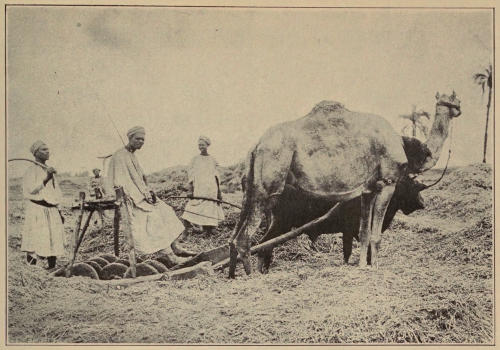
The primitive norag is still seen in Egypt threshing the grain and cutting
up the straw for fodder. It moves on small iron wheels or thin circular
plates and is drawn in a circle over the wheat or barley.
The Egyptian agricultural year has three seasons. Cereal crops are
sown in November and harvested in May; the summer crops are cotton,
sugar, and rice; the fall crops, sown in July, are corn, millet, and vegetables.
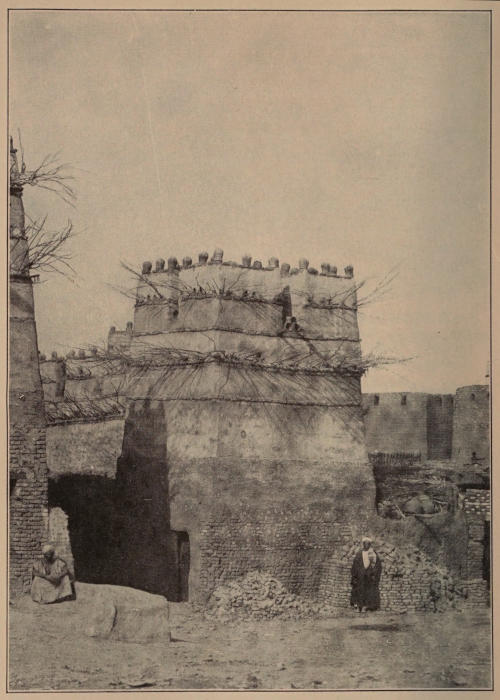
The mud of the annual inundations is no longer sufficient fertilizer for
the Nile farm. The fellaheen often use pigeon manure on their lands and
there are hundreds of pigeon towers above the peasants’ mud huts.
The whole of the delta is one big farm dotted with
farm villages and little farm cities. There are mud
towns everywhere, and there are half-a-dozen big agricultural
centres outside the cities of Alexandria and Cairo.
Take, for instance, Tanta, where I am at this writing. It
is a good-sized city and is supported by the farmers. It
is a cotton market and it has a great fair, now and then,
to which the people come from all over Egypt to buy and
sell. A little to the east of it is Zagazig, which is nearly
as large, while farther north, upon the east branch of the
Nile, is Mansura, another cotton market, with a rich farming
district about it. Damietta and Rosetta, at the two
mouths of the Nile, and Damanhur, which lies west of the
Rosetta branch of the Nile, not far from Lake Edku, are
also big places. There are a number of towns ranging in
population from five to ten thousand.
The farms are nothing like those of the United States.
We should have to change the look of our landscape to
imitate them. There are no fences, no barns, and no haystacks.
The country is as bare of such things as an undeveloped
prairie. The only boundaries of the estates are
little mud walls; and the fields are divided into patches
some of which are no bigger than a tablecloth. Each
patch has furrows so made that the water from the canals
can irrigate every inch.
The whole country is cut up by canals. There are
large waterways running along the branches of the Nile,
and smaller ones connecting with them, to such an extent
that the face of the land is covered with a lacework
veil of little streams from which the water can be let
in and out. The draining of the farms is quite as important
as watering, and the system of irrigation is perfect,
inasmuch as it brings the Nile to every part of the country
without letting it flood and swamp the lands.
Few people have any idea of the work the Egyptians
have to do in irrigating and taking care of their farms.
The task of keeping these basins in order is herculean. As
the Nile rushes in, the embankments are watched as the
Dutch watch the dikes of Holland. They are patrolled
by the village headmen and the least break is filled with
stalks of millet and earth. The town officials have the
right to call out the people to help, and no one refuses.
If the Nile gets too high it sometimes overflows into the
settlements and the mud huts crumble. During the flood
the people go out in boats from village to village. The
donkeys, buffaloes, and bullocks live on the dikes, as do
also the goats, sheep, and camels.
The people sow their crops as soon as the floods subside.
Harvest comes on within a few months, and unless
they have some means of irrigation, in addition to the Nile
floods, they must wait until the following year before
they can plant again. With a dam like the one at Aswan,
the water supply can be so regulated that they can grow
crops all the year round. This is already the condition in
a great part of the delta, and it is planned to make the
same true of the farms of Upper Egypt.
As for methods of raising the water from the river and
canals and from one level to another, they vary from the
most modern of steam pumps and windmills to the clumsy
sakieh and shadoof, which are as old as Egypt itself. All
the large land owners are now using steam pumps. There
are many estates, owned by syndicates, which are irrigated
by this means, and there are men who are buying portable
engines and pumps and hiring them out to the smaller
farmers in much the same way that threshing machines
are rented in the United States and Canada. Quite a
number of American windmills are already installed. Indeed,
it seems to me almost the whole pumping of the Nile
valley might be done by the wind. The breezes from the
desert as strong as those from the sea sweep across the
valley with such regularity that wind pumps could be relied
upon to do efficient work.
At present, however, water is raised in Egypt mostly
by its cheap man power or by animals. Millions of
gallons are lifted by the shadoof. This is a long pole balanced
on a support. From one end of the pole hangs a
bucket, and from the other a heavy weight of clay or stone,
about equal to the weight of the bucket when it is full of
water. A man pulls the bucket down into the water, and
by the help of the weight on the other end, raises it and
empties it into a canal higher up. He does this all day long
for a few cents, and it is estimated that he can in ten days
lift enough water to irrigate an acre of corn or cotton.
At this rate there is no doubt it could be done much cheaper
by pumps.
Another rude irrigation machine found throughout the
Nile valley from Alexandria to Khartum is the sakieh,
which is operated by a blindfolded bullock, buffalo,
donkey, or camel. It consists of a vertical wheel with
a string of buckets attached to its rim. As the wheel turns
round in the water the buckets dip and fill, and as it comes
up they discharge their contents into a canal. This
vertical wheel is moved by another wheel set horizontally,
the two running in cogs, and the latter being turned by
some beast of burden. There is usually a boy, a girl, or an
old man, who sits on the shaft and drives the animal round.
The screech of these sakiehs is loud in the land and
almost breaks the ear drums of the tourists who come near
them. I remember a remark that one of the Justices of
our Supreme Court made while we were stopping together
at a hotel at Aswan with one of these water-wheels in plain
sight and hearing. He declared he should like to give an
appropriation to Egypt large enough to enable the people
to oil every sakieh up and down the Nile valley. I doubt,
however, whether the fellaheen would use the oil, if they
had it, for they say that the blindfolded cattle will not
turn the wheel when the noise stops.
I also saw half-naked men scooping up the water in
baskets and pouring it into the little ditches, into which
the fields are cut up. Sometimes men will spend not only
days, but months on end in this most primitive method of
irrigation.
The American farmer would sneer at the old-fashioned
way in which these Egyptians cultivate the soil. He
would tell them that they were two thousand years behind
the time, and, still, if he were allowed to take their
places he would probably ruin the country and himself.
Most of the Egyptian farming methods are the result of
long experience. In ploughing, the land is only scratched.
This is because the Nile mud is full of salts, and the silt
from Abyssinia is of such a nature that the people have
to be careful not to plough so deep that the salts are raised
from below and the crop thereby ruined. In many cases
there is no ploughing at all. The seed is sown on the soft
mud after the water is taken off, and pressed into it with
a wooden roller or trodden in by oxen or buffaloes.
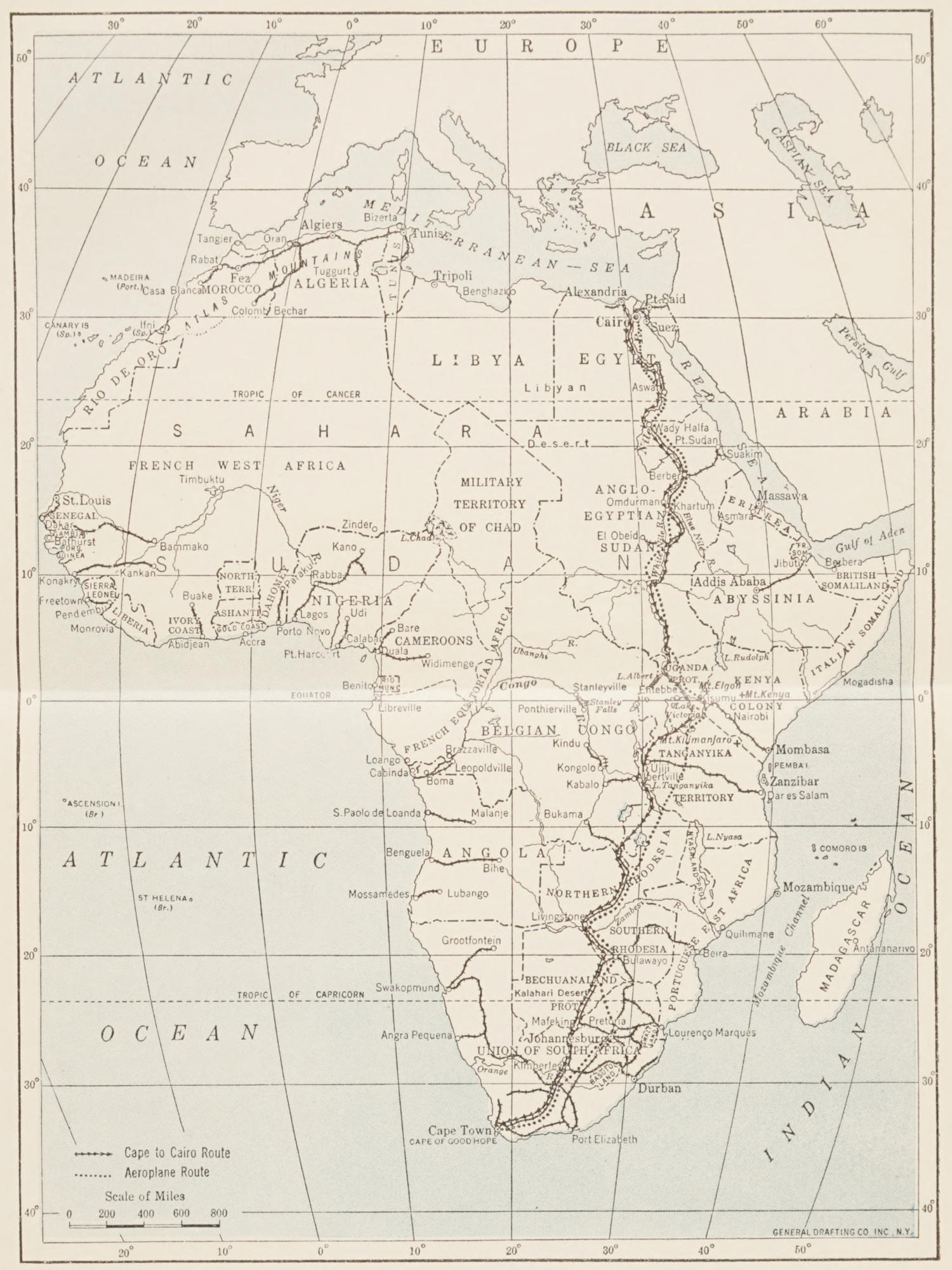
AFRICA
Last of the continents to be conquered by the explorers, and last to be divided up
among the land-hungry powers, is now slowly yielding to the white man’s civilization.
Where ploughs are used they are just the same as those
of five thousand years ago. I have seen carvings on the
tombs of the ancient Egyptians representing the farm tools
used then, and they are about the same as those I see in use
to-day. The average plough consists of a pole about six
feet long fastened to a piece of wood bent inward at an
acute angle. The end piece, which is shod with iron,
does the ploughing. The pole is hitched to a buffalo or ox
by means of a yoke, and the farmer walks along behind the
plough holding its single handle, which is merely a stick set
almost upright into the pole. The harrow of Egypt is a
roller provided with iron spikes. Much of the land is
dug over with a mattock-like hoe.
Most of the grain here is cut with sickles or pulled out
by the roots. Wheat and barley are threshed by laying
them inside a ring of well-pounded ground and driving over
them a sledge that rests on a roller with sharp semicircular
pieces of iron set into it. It is drawn by oxen,
buffaloes, or camels. Sometimes the grain is trodden out
by the feet of the animals without the use of the rollers,
and sometimes there are wheels of stone between the sled-runners
which aid in hulling the grain. Peas and beans
are also threshed in this way. The grain is winnowed by
the wind. The ears are spread out on the threshing floor
and the grains pounded off with clubs or shelled by hand.
Much of the corn is cut and laid on the banks of the canal
until the people have time to husk and shell it.
The chief means of carrying farm produce from one
place to another is on bullocks and camels. The camel is
taken out into the corn field while the harvesting is going
on. As the men cut the corn they tie it up into great
bundles and hang one bundle on each side of his hump.
The average camel can carry about one fifth as much as
one horse hitched to a wagon or one tenth as much as a
two-horse team. Hay, straw, and green clover are often
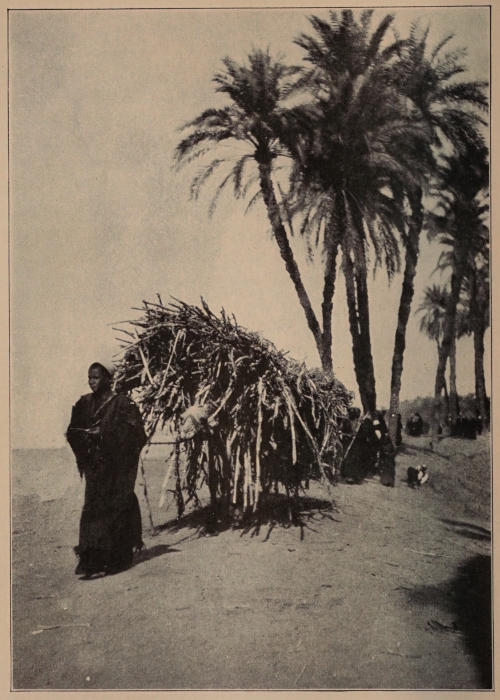
taken from the fields to the markets on camels. Such
crops are put up in a baglike network that fits over the
beast’s hump and makes him look like a hay or straw-stack
walking off upon legs. Some of the poorer farmers use
donkeys for such purposes, and these little animals may
often be seen going along the narrow roads with bags of
grain balanced upon their backs.
I have always looked upon Egypt as devoted mostly to
sugar and cotton. I find it a land of wheat and barley
as well. It has also a big yield of clover and corn. The
delta raises almost all of the cotton and some of the sugar.
Central and Upper Egypt are grain countries, and in the
central part Indian and Kaffir corn are the chief summer
crops. Kaffir corn is, to a large extent, the food of the
poorer fellaheen, and is also eaten by the Bedouins who
live in the desert along the edges of the Nile valley. Besides
a great deal of hay, Egypt produces some of the
very best clover, which is known as bersine. It has such
rich feeding qualities that a small bundle of it is enough
to satisfy a camel.
This is also a great stock country. The Nile valley is
peppered with camels, donkeys, buffaloes, and sheep,
either watched by herders or tied to stakes, grazing on
clover and other grasses. No animal is allowed to run at
large, for there are no fences and the cattle thief is everywhere
in evidence. The fellaheen are as shrewd as any
people the world over, so a strayed animal would be difficult
to recover. Much of the stock is watched by children.
I have seen buffaloes feeding in the green fields with
naked brown boys sitting on their backs and whipping
them this way and that if they attempt to get into the
crops adjoining. The sheep and the goats are often watched
by the children or by men who are too old to do hard
work. The donkeys, camels, and cows are usually tied to
stakes and can feed only as far as their ropes will reach.
The sheep of Egypt are fine. Many of them are of the
fat-tailed variety, some brown and some white. The
goats and sheep feed together, there being some goats in
almost every flock of sheep.
The donkey is the chief riding animal. It is used by
men, women, and children, and a common sight is the
veiled wife of one of these Mohammedan farmers seated
astride one of the little fellows with her feet high up on its
sides in the short stirrups. But few camels are used for
riding except by the Bedouins out in the desert, and it is
only in the cities that many wheeled vehicles are to be seen.
Suppose we go into one of the villages and see how these
Egyptian farmers live. The towns are collections of mud
huts with holes in the walls for windows. They are scattered
along narrow roadways at the mercy of thick clouds
of dust. The average hut is so low that one can look
over its roof when seated on a camel. It seldom contains
more than one or two rooms, and usually has a little yard
outside where the children and the chickens roll about in
the dust and where the donkey is sometimes tied.
Above some of the houses are towers of mud with holes
around their sides. These towers are devoted to pigeons,
which are kept by the hundreds and which are sold in the
markets as we sell chickens. The pigeons furnish a large
part of the manure of Egypt both for gardens and fields.
The manure is mixed with earth and scattered over the soil.
Almost every village has its mosque, or church, and often,
in addition, the tomb of some saint or holy man who lived
there in the past. The people worship at such tombs,
believing that prayers made there avail more than those
made out in the fields or in their own huts.
There are no water works in the ordinary country village.
If the locality is close to the Nile the drinking and washing
water is brought from there to the huts by the women,
and if not it comes from the village well. It is not difficult
to get water by digging down a few feet anywhere
in the Nile valley; and every town has its well, which is
usually shaded by palm trees. It is there that the men
gather about and gossip at night, and there the women
come to draw water and carry it home upon their heads.
The farmers’ houses have no gardens about them, and
no flowers or other ornamental decoration. The surroundings
of the towns are squalid and mean, for the peasants
have no comforts in our sense of the word. They have
but little furniture inside their houses. Many of them
sleep on the ground or on mats, and many wear the same
clothing at night that they wear in the daytime. Out in
the country shoes, stockings, and underclothes are comparatively
unknown. Only upon dress-up occasions does a
man or woman put on slippers.
The cooking and housekeeping are done entirely by the
women. The chief food is a coarse bread made of corn
or millet baked in thick cakes. This is broken up and
dipped into a kind of a bean stew seasoned with salt, pepper,
and onions. The ordinary peasant seldom has meat,
for it is only the rich who can afford mutton or beef. At
a big feast on the occasion of a wedding, a farming nabob
sometimes brings in a sheep which has been cooked whole.
It is eaten without forks, and is torn limb from limb, pieces
being cut out by the guests with their knives.
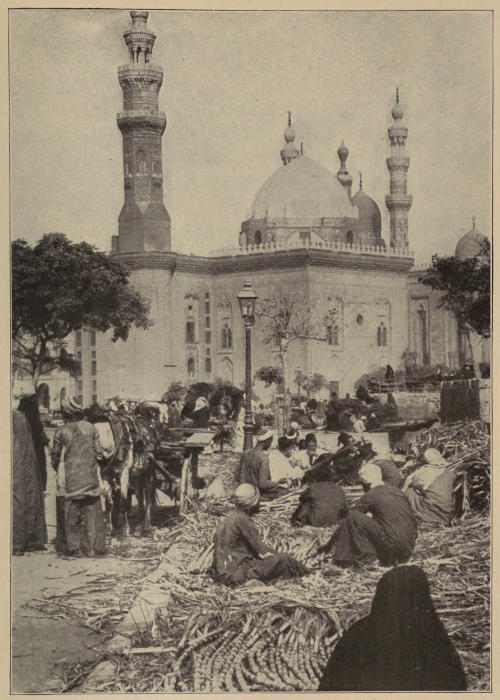
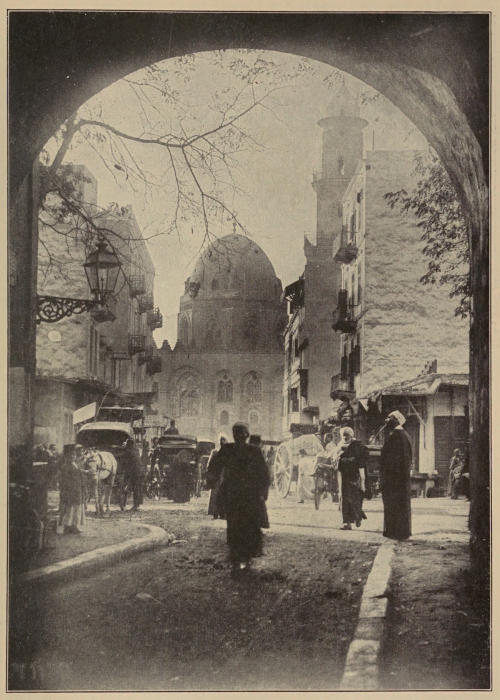
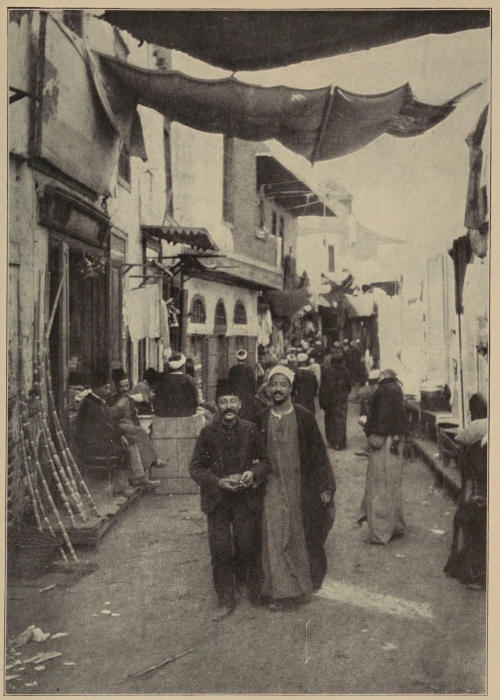
Next to the market where sugar cane is sold is the “Superb Mosque,”
built by Sultan Hassan nearly 600 years ago. Besides being a centre for
religious activities, it is also a gathering place for popular demonstrations
and political agitation.
Cairo is the largest city on the African continent, and one of the capitals
of the Mohammedan world. Its flat-roofed buildings are a yellowish-white,
with the towers and domes of hundreds of mosques rising above
them.
Of late Egypt has begun to raise vegetables for Europe.
The fast boats from Alexandria to Italy carry green
stuff, especially onions, of which the Nile valley is
now exporting several million dollars’ worth per annum.
Some of these are sent to England, and others to Austria
and Germany.
As for tobacco, Egypt is both an exporter and importer.
“Egyptian” cigarettes are sold all over the world, but
Egypt does not raise the tobacco of which they are made.
Its cultivation has been forbidden for many years, and
all that is used is imported from Turkey, Greece, and
Bosnia. About four fifths of it comes from Turkey.
Everyone in Egypt who can afford it smokes. The men
have pipes of various kinds, and of late many cigarettes
have been coming into use. A favourite smoke is with a
water pipe, the vapour from the burning tobacco being
drawn by means of a long tube through a bowl of water
upon which the pipe sits, so that it comes cool into the
mouth.
The chicken industry of Egypt is worth investigation
by our Department of Agriculture. Since the youth of the
Pyramids, these people have been famous egg merchants
and the helpful hen is still an important part of their
stock. She brings in hundreds of thousands of dollars a
year, for her eggs form one of the items of national export.
During the last twelve months enough Egyptian eggs have
been shipped across the Mediterranean to England and
other parts of Europe to have given one to every man,
woman, and child in the United States. Most of them
went to Great Britain.
The Egyptians, moreover, had incubators long before
artificial egg hatching was known to the rest of the world.
There is a hatchery near the Pyramids where the farmers
trade fresh eggs for young chicks at two eggs per chick,
and there is another, farther down the Nile valley, which
produces a half million little chickens every season. It is
estimated that the oven crop of chickens amounts to
thirty or forty millions a year, that number of little fowls
being sold by the incubator owners when the baby chicks
are about able to walk.
Most of our incubators are of metal and many are kept
warm by oil lamps. Those used here are one-story buildings
made of sun-dried bricks. They contain ovens which
are fired during the hatching seasons. The eggs are laid
upon cut straw in racks near the oven, and the firing is so
carefully done that the temperature is kept just right from
week to week. The heat is not gauged by the thermometer,
but by the judgment and experience of the man
who runs the establishment. A fire is started eight or ten
days before the eggs are put in, and from that time on it is
not allowed to go out until the hatching season is over.
The eggs are turned four times a day while hatching.
Such establishments are cheaply built, and so arranged
that it costs almost nothing to run them. One that will
hatch two hundred thousand chickens a year can be built
for less than fifty dollars, while for about a dollar and a
half per day an experienced man can be hired to tend the
fires, turn the eggs, and sell the chickens.
CHAPTER VI THE PROPHET’S BIRTHDAY
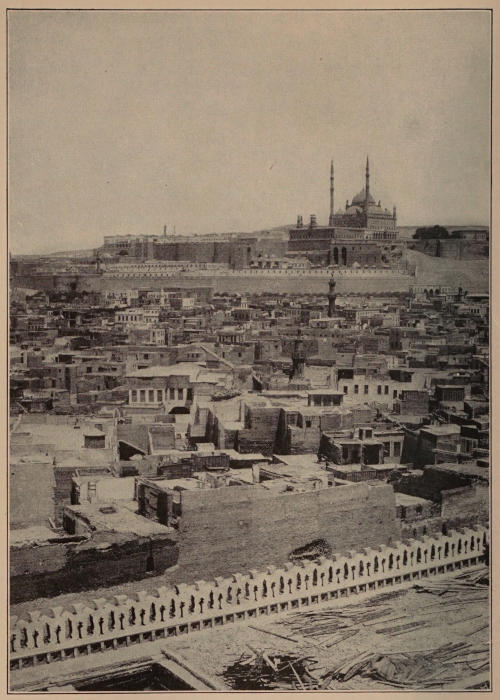
Stand with me on the Hill of the Citadel and take
a look over Cairo. We are away up over the river
Nile, and far above the minarets of the mosques
that rise out of the vast plain of houses below.
We are at a height as great as the tops of the Pyramids,
which stand out upon the yellow desert off to the left.
The sun is blazing and there is a smoky haze over the Nile
valley, but it is not dense enough to hide Cairo. The city
lying beneath us is the largest on the African continent and
one of the mightiest of the world. It now contains about
eight hundred thousand inhabitants; and in size is rapidly
approximating Heliopolis and Memphis in the height of
their ancient glory.
Of all the Mohammedan cities of the globe, Cairo is
growing the fastest. It is more than three times as big
as Damascus and twenty times the size of Medina, where
the Prophet Mohammed died. The town covers an area
equal to fifty quarter-section farms; and its buildings are
so close together that they form an almost continuous
structure. The only trees to be seen are those in the
French quarter, which lies on the outskirts.
The larger part of the city is of Arabian architecture.
It is made up of flat-roofed, yellowish-white buildings so
crowded along narrow streets that they can hardly be
seen at this distance. Here and there, out of the field
of white, rise tall, round stone towers with galleries
about them. They dominate the whole city, and under
each is a mosque, or Mohammedan church. There are
hundreds of them in Cairo. Every one has its worshippers,
and from every tower, five times a day, a shrill-voiced
priest calls the people to prayers. There is a
man now calling from the Mosque of Sultan Hasan, just
under us. The mosque itself covers more than two acres,
and the minaret is about half as high as the Washington
Monument. So delighted was Hasan with the loveliness
of this structure that when it was finished he cut off the
right hand of the architect so that it would be impossible for
him to design another and perhaps more beautiful building.
Next it is another mosque, and all about us we can see
evidences that Mohammedanism is by no means dead,
and that these people worship God with their pockets as
well as with their tongues.
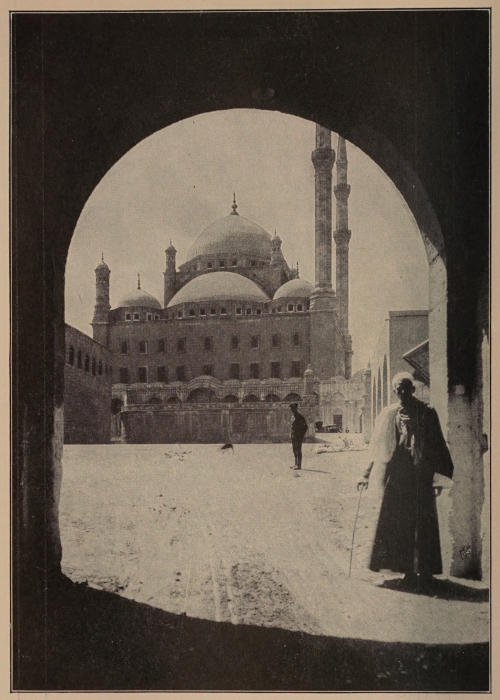
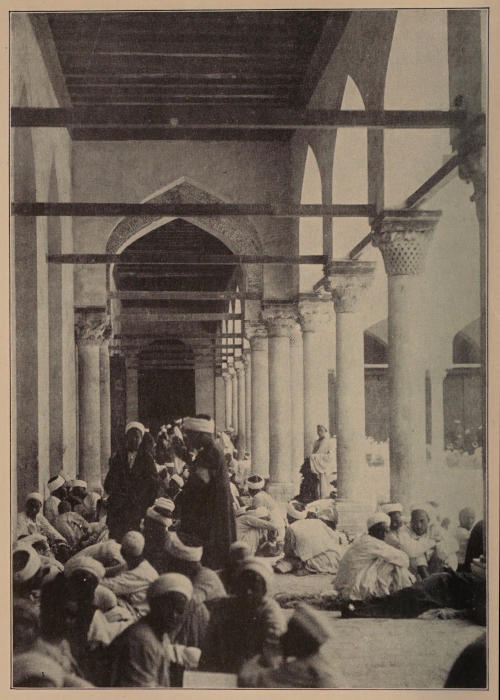
In the Alabaster Mosque, which stands at my back,
fifty men are now praying, while in the courtyard a score
of others are washing themselves before they go in to make
their vows of repentance to God and the Prophet. Not
far below me I can see the Mosque El-Azhar, which has
been a Moslem university for more than a thousand years,
and where something like ten thousand students are now
learning the Koran and Koranic law.
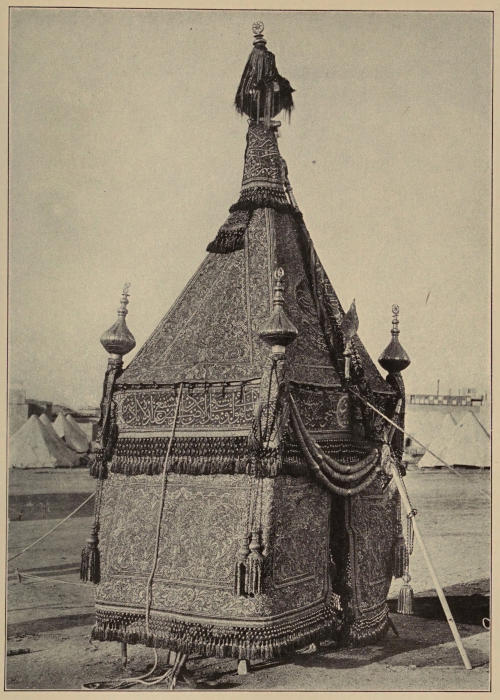
Here at Cairo I have seen the people preparing to take
their pilgrimage to Mecca, rich and poor starting out on
that long journey into the Arabian desert. Many go
part of the way by water. The ships leaving Alexandria
and Suez are crowded with pilgrims and there is a regular
exodus from Port Sudan and other places on this side of
the Red Sea. They go across to Jidda and there lay
off their costly clothing before they make their way inland,
each clad only in an apron with a piece of cloth over the
left shoulder. Rich and poor dress alike. Many of the
former carry gifts and other offerings for the sacred city.
Such presents cost the Egyptian government alone a quarter
of a million dollars a year; for not only the Khedive
but the Mohammedan rulers of the Sudan send donations.
The railroad running from far up the Nile to the Red Sea
makes special rates to pilgrimage parties.
Yet I wonder whether this Mohammedanism is not a
religion of the lips rather than of the heart. These people
are so accustomed to uttering prayers that they forget
the sense. The word God is heard everywhere in the
bazaars. The water carrier, who goes about with a pigskin
upon his back, jingling his brass cups to announce his
business, cries out: “May God recompense me!” and his
customer replies, as he drinks, by giving him a copper
in the name of the Lord. The lemonade peddler, who
carries a glass bottle as big as a four-gallon crock, does the
same, and I venture to say that the name of the Deity
is uttered here more frequently than in any other part of
the world. It is through this custom of empty religious
formulas that I am able to free myself of the beggars of the
city. I have learned two Arab words: “Allah yatik,”
which mean: “May God give thee enough and to spare.”
When a beggar pesters me I say these words gently.
He looks upon me in astonishment, then touches his forehead
in a polite Mohammedan salute and goes away.
On my second visit to Egypt I was fortunate in being in
Cairo on the birthday of the Prophet. It was a feast
day among the Mohammedans, and at night there was a
grand religious celebration at the Alabaster Mosque which
Mehemet Ali, that Napoleon of Egypt, built on the Citadel
above Cairo. Its minarets, overlooking the Nile
valley, the great deserts and the vast city of Cairo,
blazed with light, and from them the cry of the muezzins
sounded shrill on the dusky air: “Allah is great! There
is no God but Allah, and Mohammed is the Prophet
of Allah! Come to worship! Allah is great! There is no
God but Allah!”
As this call reverberated through the city, Mohammedans
of all classes started for the Citadel. Some came
in magnificent turnouts, bare-legged, gaudily dressed
syces with wands in their hands running in front of them
to clear the way. Some came upon donkeys. Some
moved along in groups of three or four on foot. The
Khedive came with the rest, soldiers with drawn swords
going in front of his carriage and a retinue of cavalry
following behind.
The Alabaster Mosque covers many acres. It has a
paved marble court, as big as a good-sized field, around
which are cloisters. This is roofed with the sky, and in
the midst of it is a great marble fountain where the
worshippers bathe their feet and hands before they go in to
pray. The mosque is at the back of this court, facing
Mecca. Its many domes rise to a great height and its
minarets seem to pierce the sky. It is built of alabaster,
but its exterior has become worn and pitted by the sands
of the desert, which have been blown against its walls
until it has nothing of the grandeur which it must have
shown when its founder worshipped within it.
The interior, however, was wonderfully beautiful that
night, when its gorgeous decorations were shown off by the
thousands of lights of this great service. Under the gaslight
and lamplight the tinsel which during the day shocks
the taste was softened and beautified. The alabaster of the
walls became as pure as Mexican onyx, and the rare Persian
rugs that lay upon the floor took on a more velvety
tint.
See it all again with me. In the eye of your mind cover
an acre field with the richest of oriental rugs; erect
about it walls of pure white alabaster with veins as
delicate as those of the moss agate; let these walls run up
for hundreds of feet; build galleries around them and roof
the whole with great domes in which are windows of
stained glass; hang lamps by the thousands from the ceiling,
place here and there an alabaster column. Now
you have some idea of this mosque as it looked on the
night of Mohammed’s birthday.
You must, however, add the worshippers to the picture.
Thousands of oriental costumes; turbans of white, black,
and green; rich gowns and sober, long-bearded, dark faces,
shine out under the lights in every part of the building.
Add likewise the mass of Egyptian soldiers in gold lace
and modern uniforms, with red fezzes on their heads, and
the hundreds of noble Egyptians in European clothes.
There are no shoes in the assemblage, and the crowd moves
about on the rugs in bare feet or stockings.
What a babel of sounds goes up from the different parts
of the building, and how strange are the sights! Here a
dozen old men squat on their haunches, facing each other,
and rock back and forth as they recite passages of the
Koran. Here is a man worshipping all alone; there is a
crowd of long-haired, wild-eyed ascetics with faces of all
shades of black, yellow, and white. They are so dirty
and emaciated they make one think of the hermits of
fiction. They stand in a ring and go through the queerest
of antics to the weird music of three great tambourines and
two drums played by worshippers quite as wild looking
as themselves. It is a religious gymnastic show, the
horrible nature of which cannot be described upon paper.
When I first entered the mosque, these Howling Dervishes
were squatted on the floor, moving their bodies up
and down in unison, and grunting and gasping as though
the whole band had been attacked with the colic. A
moment later they arose and began to bob their heads
from one side to the other until I thought their necks
would be dislocated by the jerks they gave them. They
swung their ears nearly down to their shoulders. The
leader stood in the centre, setting the time to the music.
Now he bent over so that his head was almost level with
his knees, then snapped his body back to an erect position.
The whole band did likewise, keeping up this back-breaking
motion for fifteen minutes. All the time they howled
out “Allah, Allah!” Their motions increased in wildness.
With every stoop the music grew louder and faster. They
threw off their turbans, and their long hair, half matted,
now brushed the floor as they bent down in front, now cut
the air like whips as they threw themselves back. Their
eyes began to protrude, one man frothed at the mouth.
At last they reached such a state of fanatical ecstasy that
not for several minutes after the leader ordered them to
stop, were they able to do so. The Howling Dervishes
used to cut themselves in their rites and often they fall
down in fits in their frenzy. They believe that such
actions are passports to heaven.
A great occasion in Cairo is the sending of a new gold-embroidered carpet
to the sanctuary in Mecca, there to absorb holiness at the shrine of the
Prophet. The old carpet is brought back each year, and its shreds are
distributed among the Faithful.
The mosque of the Citadel in Cairo was built of alabaster by Mehemet
Ali, the “Napoleon of Egypt.” When Mohammed’s birthday is celebrated,
its halls and courts are choked with thousands of Moslem worshippers
and are the scene of fanatical religious exercises.
In another part of the room was a band of Whirling
Dervishes, who, dressed in high sugar-loaf hats and long
white gowns, whirled about in a ring, with their arms
outstretched, going faster and faster, until their skirts
stood out from their waists like those of a circus performer
mounted on a bareback steed, as she dances over the
banners and through the hoops.
There were Mohammedans of all sects in the mosque,
each going through his own pious performances without
paying any attention to the crowds that surrounded him.
In his religious life the Mussulman is a much braver man
than the Christian. At the hours for prayer he will flop
down on his knees and touch his head on the ground in the
direction of Mecca, no matter who are his companions or
what his surroundings. He must take off his shoes before
praying, and I saw yesterday in the bazaars of Cairo a
man clad in European clothes who was praying in his little
box-like shop with his stocking feet turned out toward
the street, which was just then full of people. In the heel
of each stocking there was a hole as big as a dollar, and
the bare skin looked out at the crowds.
The Moslems of Egypt, like those elsewhere, have their
fast days, during which, from sunrise to sunset, they do
not allow a bit of food nor a drop of water to touch their
lips. Some of them carry the fast to such an extent that
they will not even swallow their saliva, and in this dry
climate their thirst must be terrible. The moment the
cannon booms out the hour of sunset, however, they dash
for water and food, and often gorge themselves half the
night. You may see a man with a cigarette in his hand
waiting until the sun goes down in order that he may light
it, or another holding a cup of water ready while he listens
for the sound of the cannon. This fasting is very severe
upon the poor people of Egypt, who have to work all day
without eating. The rich often stay up for the whole night
preceding a fast day, and by going to bed toward morning
they are able to sleep the day through and get up in time
for a big meal after sunset.
The poor are the best Mohammedans, and many of the
more faithful are much alarmed at the laxity in religious
duty that comes through contact with Europeans. A missionary
friend told me of a Moslem sheik who was offered
a glass of cognac by a brother believer on a fast day.
Shortly after this he met my friend and spoke of the incident,
saying: “I don’t know what we are coming to.
Good Mohammedans think they can drink without sinning,
and this man laughed when I told him it was fast day
and said that fasts were for common people, and that religion
was not of much account, anyhow. We have many
infidels among us, and it seems to me that the world is in
a very bad way.”
The Moslems have many doctrines worthy of admiration
and the morals of the towns of Egypt which have not
been affected by European civilization are, I am told, far
better than those of Cairo or Alexandria. A traveller to a
town on the Red Sea, which is purely Mohammedan, says
that the place has had no litigation for years, and there is
no drunkenness or disorder. The people move on in a
quiet, simple way, with their sheik settling all their troubles.
Mohammedan Cairo is quite as orderly as the part
in which the nobility and the Europeans live. It contains
the bazaars and the old buildings of the Arabian part of the
city, and is by all odds the most interesting section.
CHAPTER VII IN THE BAZAARS OF CAIRO
Cairo is the biggest city in Africa. It is larger
than St. Louis and one of the most cosmopolitan
cities in the Orient. The Christians and
the Mohammedans here come together, and
the civilizations of the East and the West touch each other.
The modern part of Cairo has put on the airs of European
capitals. It has as wide streets as Paris, and a park, full of
beautiful flowers and all varieties of shrubs and trees, lies in
its very centre. Here every night the military bands
play European and American airs, and veiled Mohammedan
women walk about with white-faced French or Italian
babies, of which they are the nurses. People from every
part of the world listen to the music. The American
jostles the Englishman while the German and the Frenchman
scowl at each other; the Greek and the Italian move
along side by side, as they did in the days when this country
was ruled by Rome, and now and then you see an old
Turk in his turban and gown, or a Bedouin Arab, or a
white-robed, fair-faced heathen from Tunis.
The European section of Cairo now has magnificent
hotels. It is many a year since the foreign traveller in
Egypt has had to eat with his fingers, or has seen a whole
sheep served up to him by his Egyptian host as used to be
the case. To-day the food is the same as that you get in
Paris, and is served in the same way. One can buy anything
he wants in European Cairo, from a gas-range to a
glove-buttoner, and from a set of diamond earrings to a
pair of shoestrings. Yesterday I had a suit of clothes made
by an English tailor, and I drive about every day in an
American motor car. There are, perhaps, fifty thousand
Europeans living in the city, and many American visitors
have learned the way to this great winter resort. The
bulk of the Europeans are French and Italian, and the
Mouski, one of the main business streets, is lined for a
mile with French and Italian shops. There are thousands
of Greeks, and hundreds of Jews from Palestine, the
states of southern Europe, and Asia Minor. One sees
every type of Caucasian moving about under dark red
fezzes and dressed in black clothes with coats buttoned
to the chin.
The foreign part of Cairo is one of great wealth. There
are mansions and palaces here that would be called handsome
in the suburbs of New York, and property has greatly
risen in value. Many of the finest houses are owned by
Greeks, whose shrewd brains are working now as in the
classic days. The Greeks look not unlike us and most of
them talk both English and French. They constitute
the money aristocracy of Alexandria, and many of the rich
Greek merchants of that city have palatial winter homes
here. As I have said, they are famed as bankers and are
the note-shavers of Egypt. They lend money at high
rates of interest, and I am told that perhaps one fifth of the
lands of the country belong to them. They have bought
them in under mortgages to save their notes. The lower
classes of the Greeks are the most turbulent of Egypt’s
population.
FROM CAIRO TO KISUMU
Embraces the right shoulder of Africa which for centuries withstood the attempts
of rulers and traders to establish their dominion over the continent
The tourist who passes through Cairo and stays at one of
the big hotels is apt to think that the city is rapidly becoming
a Christian one. As he drives over asphalt streets lined
with the fine buildings of the European quarter, it seems
altogether English and French. If he is acquainted with
many foreigners he finds them living in beautiful villas,
or in apartment houses like those of our own cities. He
does his shopping in modern stores and comes to the conclusion
that the Arab element is passing away.
This is not so. Cairo is a city of the Egyptians. Not
one tenth of its inhabitants are Christians and it is the
hundreds of thousands of natives who make up the life
blood of this metropolis. They are people of a different
world from ours, as we can see if we go down for a stroll
through their quarters. They do business in different
ways and trade much as they have been trading for generations.
Their stores are crowded along narrow streets that
wind this way and that until one may lose himself in them.
Nearly every store is a factory, and most of the goods
offered are made in the shop where they are sold.
Although the foreigner and his innovations are in
evidence, native Cairo is much the same now in characters,
customs, and dress as it was in the days of Haroun Al Raschid.
Here the visionary Alnaschar squats in his narrow,
cell-like store, with his basket of glass before him. He
holds the tube of a long water pipe in his mouth and is
musing on the profits he will make from peddling his
glass, growing richer and richer, until his sovereign will be
glad to offer him his daughter in marriage and he will
spurn her as she kneels before him. We almost expect
to see the glass turned over as it is in the story, and his
castles in the air shattered with his kick. Next to him is
a turbaned Mohammedan who reminds us of Sinbad the
Sailor, and a little farther on is a Barmecide washing his
hands with invisible soap in invisible water, and apparently
inviting his friends to come and have a great feast
with him. Here two long-gowned, gray-bearded men are
sitting on a bench drinking coffee together; and there a
straight, tall maiden, robed in a gown which falls from
her head to her feet, with a long black veil covering all
of her face but her eyes, looks over the wares of a handsome
young Syrian, reminding us of how the houris
shopped in the days of the “Thousand and One Nights.”
Oriental Cairo is a city of donkeys and camels. In the
French quarter you may have a ride on an electric street
car for a few cents, or you may hire an automobile to
carry you over the asphalt. The streets of the native city
are too narrow for such things, and again and again
we are crowded to the wall for fear that the spongy feet
of the great camels may tread upon us. We are grazed
by loaded donkeys, carrying grain, bricks, or bags on
their backs, and the donkey boy trotting behind an animal
ridden by some rich Egyptian or his wife calls upon
us to get out of the way.
The donkeys of Egypt are small, rugged animals. One
sees them everywhere with all sorts of odd figures mounted
on them. Here is an Egyptian woman sitting astride of
one, her legs bent up like a spring and her black feet sticking
out in the stirrups. She is dressed in black, in a gown
which makes her look like a balloon. There is a long veil
over her face with a slit at the eyes, where a brass spool
separates it from the head-dress and you see nothing but
strips of bare skin an inch wide above and below. Here is
a sheik with a great turban and a long gown; his legs, ending
in big yellow slippers, reach almost to the ground on
each side of his donkey. He has no bridle, but guides the
beast with a stick. A donkey-boy in bare feet, whose sole
clothing consists of a blue cotton nightgown and a brown
skullcap, runs behind poking up the donkey with a stick.
Now he gives it a cut, and the donkey jerks its hinder part
from one side to the other as it scallops the road in attempting
to get out of the way of the rod. Here is a drove of
donkeys laden with bags for the market. They are not
harnessed, and the bags are balanced upon their backs
without ropes or saddles.
The ordinary donkey of Egypt is very cheap indeed, but
the country has some of the finest asses and mules I have
ever seen, and there are royal white jackasses ridden by
wealthy Mohammedans which are worth from five hundred
to a thousand dollars per beast. The best of these come
from Mecca. They are pacers, fourteen hands high, and
very swift. The pedigrees of some of them are nearly as
long as those of Arabian horses. It is said that the Arabs
who raise them will never sell a female of this breed.
But to return to the characters of the bazaar. They
are of the oddest, and one must have an educated eye to
know who they are. Take that man in a green turban,
who is looked up to by his fellows. The dragoman tells
us that he has a sure passport to Heaven, and that the green
turban is a sign that he has made the pilgrimage to Mecca
and thus earned the right to the colours of the Prophet.
Behind him comes a fine-featured, yellow-faced man in a
blue gown wearing a turban of blue. We ask our guide
who he may be and are told, with a sneer, that he is a
Copt. He is one of the Christians of modern Egypt,
descended from the fanatical band described by Charles
Kingsley in his novel “Hypatia.” Like all his class he is
intelligent, and like most of them well dressed. The Copts
are among the shrewdest of the business Egyptians, and
with prosperity they have grown in wealth. They are
money lenders and land speculators. Many of them have
offices under the government, and not a few have amassed
fortunes. Some of them are very religious and some can
recite the Bible by heart. They differ from their neighbours
in that they believe in having only one wife.
The crowd in these streets is by no means all men,
however. There are women scattered through it, and
such women! We look at them, and as their large soulful
eyes, fringed with dark lashes, smile back at us, we wish
that the veils would drop from their faces. The complexions
which can be seen in the slit in the veils are of all
colours from black to brunette, and from brown to the
creamy white of the fairest Circassian. We are not particularly
pleased with their costume, but our dragoman
tells us that they dress better at home. The better classes
wear black bombazine garments made so full that they
hide every outline of the figure. Some of them have
their cloaks tied in at the waist so that they look like black
bed ticks on legs. Here, as one raises her skirt, we see that
she wears bloomers falling to her ankles, which make us
think of the fourteen-yard breeches worn by the girls of
Algiers. The poorer women wear gowns of blue cotton,
a single garment and the veil making up a whole costume.
Astride their shoulders or their hips some of them carry babies,
many of whom are as naked as when they were born.
The streets of old Cairo resound with the cries of vendors of sweetmeats
and drinks. Lemonade is dispensed from a great brass bottle on the back
of the seller, while around his waist is a tin tray of glasses or cups.
Over many warehouses, shops, and even stables of old Cairo are
homes of the well-to-do with marble floors covered with fine rugs. The
supporting arch is much used because long timbers are not available.
Here is a lady with a eunuch, who, as black as your hat
and as sombre as the Sphinx, guards the high-born dame
lest she should flirt with that handsome young man from
Tunis sitting cross-legged in the midst of his bottles of
attar of roses. He offers a bottle to the lady while he
talks of its merits in the most flowery terms. Here is a
barefooted girl, who, strange to say, has no veil over her
face, but whose comely features might be considered by a
jealous lover to warrant such protection. Her chin is
tattooed and the nails of her fingers and toes are stained
deep orange with henna. She has a great tray on her head
and is calling out her wares in the strangest language:
“Buy my oranges! They are sweet as honey, and I know
that God will make my basket light.”
This is in Arabic, and one hears the same extravagant
sort of talk all about him. Here two Turks meet and salute
each other. They almost fight in their struggle each to
humble himself first by kissing the hand of the other.
After they have done so a third passes and they all say:
“Naharak sayed”—“May thy day be happy and blessed.”
There are no more polite people on earth than these Mohammedans,
whose everyday talk is poetry.
I can always amuse myself for days in watching the
trading in the bazaars. I saw an Egyptian woman buying
some meat to-day. The butcher’s whole stock consisted
of a couple of sheep, one of which hung from a nail on the
wall. The woman drew her finger nail along the piece she
wished to take home, and the butcher sawed it off with
a clasp knife. He weighed it on a pair of rude scales, and
the woman objected, saying that he had given her too
much. He then took one end of the strip of meat in his
hand, and putting the other end in his mouth, severed
it by drawing the knife quickly across it. He handed
the piece he had held in his mouth to the woman, who
took it and paid for it, evidently seeing nothing out of the
way in his methods.
In the bazaars the merchants sit in little booths no bigger
than the packing-box of a piano. A ledge about two feet
high, and of about the same width, runs along the front
of the store, on which the customers sit. A purchaser is
usually offered coffee, and asked to take a smoke out of the
long-stemmed water pipe of the proprietor. It takes a
great time to make a deal, for the Mohammedan always
asks three times what he expects to get, and never comes
down without bargaining. The better merchants all
keep book accounts, which they foot up in Arabic characters,
taking the ink out of a brass inkstand with a handle
a foot long which is so made that it will contain the pen as
well as the ink. This inkwell is thrust into the belt of the
gown when the proprietor leaves his shop.
If one is not satisfied at one place he can go to another.
In the Cinnamon Bazaar there are dozens of stores that
sell nothing but spices, and in the Shoemakers’ Bazaar
are the gorgeously embroidered slippers and red-leather
shoes, turned up at the toes, worn by all good Mohammedans.
In the Silver Bazaar the jewellers are at work.
They use no tools of modern invention. Their bellows is
a bag of goatskin with a piece of gun-barrel for the mouth
and two sticks like those used for the ordinary fire bellows
at the end. One’s only guarantee of getting a good article
is to buy the silver, have it tested by the government
assayer, and let the jeweller make it up under his own eyes.
Poor jewellery is often sold, and I remember buying a silver
bracelet for a friend during a visit to Cairo which looked
very pretty and very barbaric, but six months after its
presentation it began to change colour, and proved to be
brass washed with silver.
I see many watches displayed, for there is now a craze
among the peasants of Egypt to own watches. They
want a cheap article, and in many cases buy a fresh
watch every year. As a result the Swiss and Germans
have been flooding the country with poor movements, put
up in fancy German silver, nickel, and gun-metal cases,
and are selling them at two dollars and upward apiece.
They are not equal to our timepieces which sell at one
dollar. Some of these watches are advertised as of American
make, and sell the quicker on that account. I doubt
not that a good American watch would sell well and displace
the poor stuff now sent in by the Swiss. In one
bazaar only brass articles are shown, while in another
nothing but rugs are sold. The Persian Bazaar and the
Turkish Bazaar are managed by men of these nations.
In fact, wandering through the business parts of Cairo,
one can see types of every oriental people on the globe.
CHAPTER VIII INTIMATE TALKS WITH TWO KHEDIVES
To-day Egypt is governed by a king. Her last
sovereign had the title of sultan, and for fifty years
before that she was ruled by khedives. There
were four khedives in that time, and with two of
them I had face-to-face chats. The first was with Tewfik
Pasha, whom I met in the Abdin Palace during my second
visit to Cairo. The other was with Abbas Hilmi, the son
and successor of Tewfik, with whom I talked sixteen years
later. Abbas Hilmi’s pro-German intrigues finally led
to his being deposed by the British and to the establishment
of the Protectorate, which ended in the nationalization
of Egypt under a ruler with the title of king.
I give you here the stories of the two interviews, reproducing
the notes I made at the time.
I have just returned from a long audience with the Khedive
of Egypt. Khedive is a Persian-Arabic word, meaning
“king,” and Mohammed Tewfik occupies much the
same position now as the Pharaohs did in the days of
Moses. It is true that he is in a measure the vassal of the
Sultan of Turkey to whom he pays a tribute of about three
and three quarter million dollars a year, and that he has
also several European advisers who keep sharp watch over
the revenues of his kingdom to see that a great part of them
go to the interest on the debts that he and his predecessors
have contracted with the bankers of Europe. But he is,
nevertheless, the king of Egypt, and as kings go to-day, he
has more power than many other monarchs. His residence
in Cairo is a grand palace with hundreds of rooms
filled with magnificent furniture. He drives about the
city with soldiers carrying swords, riding prancing horses
in front of his carriage, and with a score of cavalry following
behind. He has five hundred thousand dollars a
year for his personal expenses, and he has several palaces
besides the one he occupies in Cairo.
It was at the Abdin Palace that I met His Highness to-day.
The interview had been arranged by the American
consul general. We left his office together in the
consular carriage. The dragoman of the legation, a
bright-eyed Syrian in the most gorgeous of Turkish
clothes of brown covered with gold embroidery and with
a great sword shaped like a scimitar clanking at his
side, opened the carriage door for us and took his seat
by the coachman. The Arabian Jehu cracked his whip
and away we went through the narrow streets. We
drove by the modern European mansions of the rich
Greeks, past the palaces of Egyptian princes from which
came the sweet smell of orange flowers and over which
whispered broad spreading palms. We then went through
a business street amid droves of donkeys, through a
caravan of camels, by veiled women clad in black, past the
palace in which Ismail Pasha had his harem when he was
khedive, and on into a great square of many acres. On
the right of this square were vast barracks filled with Arab
troops in blue uniforms and fezzes. A regiment of Egyptian
troops was going through a gymnastic drill, performing
the motions as well to-day as they did at the time when
our American General Stone was their commander and
when General Grant reviewed them and said that they
seemed to be good soldiers for everything except fighting.
The Abdin Palace, built in the form of a great horseshoe,
is at the end of this square. It is a vast building of two
stories, of brown stucco, with many windows and a grand
entrance way in the centre. At the left there is a door
leading to the harem, and as our carriage drove up we were
passed by a closed coach drawn by two magnificent Arabian
horses. On the box beside the liveried coachman sat
a scowling eunuch whose black skin and dark clothes were
all the more sombre by contrast with his bright red skullcap.
In front of the carriage ran two fleet syces with
wands or staffs held up in the air in front of them, warning
plebeians to get out of the way. I was told that the
carriage was that of a princess who was about to make a
call upon the Khedivieh, or queen. These runners, who
are a part of every nobleman’s turnout, are among the
most picturesque sights of Egypt.
At the door of the palace stood two pompous soldiers
with great swords in their hands. They were in Turkish
costumes with embroidered jackets of blue and gold and
full zouave trousers of blue broadcloth. Upon their heads
were turbans, and their faces made me think of the fierce
troops that conquered this land in the days of the Prophet.
Passing up the massive steps we came to the palace door
which was opened by an Arab clad in European clothes
and wearing the red fez, which the Egyptian never takes
off in the house or out of it. We were ushered into a grand
entrance hall, floored with marble mosaic, the walls of
which were finished in cream and gold. In front of us a
staircase so wide that two wagonloads of hay could be
drawn up it without touching led by easy flights to the
second floor, while at the right and the left were the
reception rooms for visitors and halls leading to the
apartments reserved for the chamberlains, masters
of ceremonies, and other officers of the royal household.
After chatting a moment with one or two of the cabinet
ministers, who were just passing out after a council
with His Highness, we moved on up the stairs. In one
of the drawing rooms on the second floor we were met
by another Egyptian official in black clothes and red
fez who conducted us to a reception room, the door of
which stood open, and motioned us to enter.
In the centre of this room, which was not larger than a
good-sized American parlour, there stood all alone a man
of about thirty-six years of age. He was dressed in a black
broadcloth coat buttoning close up at the neck like that of
a preacher. Lavender pantaloons showed below this, fitting
well down over a pair of gaiter-like pumps. On the
top of his rather handsome head was a fez of dark red with
a black silk tassel. This man was the Khedive of Egypt.
He is, I judge, about five feet six inches in height and while
rather thick-set, does not weigh more than one hundred
and fifty pounds. His frame is well rounded, his head is
large, and his features are clean cut. He has a nose
slightly inclined to the Roman. His forehead is high, and
the dark brown eyes that shine from under it change from
the grave to the smiling during his conversation. The
Khedive extended his hand and said he was glad to see me
and that he liked to have Americans come to Cairo. Seating
himself on a divan, with one leg doubled up under him,
he motioned me to join him. There was an absence of
pomp or snobbishness in his manner, and though dignified
he did not put on half the airs of the average backwoods
member of our House of Representatives. As he seated
himself, his black coat opened so that I had a chance to
note the contrast between his costume and that of the
gorgeous rajahs whom I have met in India. His only
jewellery consisted of a set of pearl studs the size of the
smallest of peas and a watch chain of thin links of gold.
He wore a cheap black bow tie in his white turnover collar,
and his cuffs, though scrupulously clean, had not the polish
of the American laundry.
Besides being a good French scholar, Tewfik Pasha
speaks English, and that was the language used in our
conversation. In speaking of his life as Khedive, he said:
“I am told that many people envy me my position.
They say that I am a young man whose lot must be a
pleasant one. They do not understand the troubles that
surround me. Many a time I would have been glad to
lay down all the honours I have for rest and peace. The
ten years of my reign have been equal to forty years of
work and of worry. If life were a matter of pleasure I
would be a fool to remain on the throne. I believe, however,
that God put man on the world for a purpose.
Duty, not pleasure, is the chief end of man. I do the best
I can for my country and my people, and I feel happiest
when I do the most work and when my work is the
hardest.”
“In the famous Abdin Palace I interviewed Tewfik Pasha, when he was
Khedive of Egypt, and later, in the same audience room, talked with
Abbas Hilmi, his son and successor.”
The gorgeous kavass is essential to the official dignity of the representative
of foreign governments in Cairo. Besides attending on the person
of minister or consul general on state occasions, he also serves as major
domo and general “fixer.”
As the Khedive said these words I thought of the thorns
which have filled the pillow of his reign. I thought of
how, upon his entering manhood, his father Ismail was deposed
and he was put upon the throne. I thought of how
he boxed the ears of the messenger who came to tell him
he had succeeded to that uncomfortable seat. I thought
of his trouble under foreign dictation. I thought
of the plots and nearly successful rebellion of Arabi
Pasha, of the revolution of the Mahdi, of the creditors who
to-day are grinding Egypt between their upper and nether
millstones, of the danger of assassination, and of the other
perils that are ever present about the throne of an oriental
monarch. Recalling all these things, I could appreciate
why his mouth hardened and his eyes grew sad when he
spoke thus to me.
The talk then turned upon the condition of Egypt and
its future, but as to these matters Tewfik was reticent.
He spoke proudly of the reforms which he had inaugurated
in government and of the fact that now, though the taxes
were heavy, every peasant knew just what he would have
to pay and that the taxes were honestly collected. He
spoke of the improvement of the courts and said that the
pasha and the fellah were equal before the law. “When
I came to the throne,” said he, “the people were surprised
that I put the prince on the same footing as
other people. Now, there is no difference in justice. The
prince and the peasant are the same in our courts, and the
former may be punished like the latter.”
At this point, coffee and cigarettes were brought in by
the servants of the palace. The coffee was à la Turque.
It was served in little china cups shaped like egg cups, in
holders of gold filigree, each holding about three tablespoonfuls
of rich black coffee as thick as chocolate and as
sweet as molasses. There were neither saucers nor spoons.
Trying to follow the Khedive’s example I gulped down
half the contents of the cup at a swallow. It was as hot
as liquid fire. I could feel the top of my mouth rising in
a blister, the tears came into my eyes, and my stomach
felt as though it had taken an internal Turkish bath.
Tewfik Pasha took the boiling mixture without winking
and went on talking as though his throat were used to
scalding fluids. Surprised to see him refuse a cigarette, I
asked him if he did not smoke. He replied:
“No! I neither smoke nor drink. I do not drink for
two reasons. I believe a man is better off without it, and,
what is of more moment to me, it is against the laws of life
as laid down in the Koran. We do not believe it right to
drink anything intoxicating and good Moslems drink
neither wine nor liquor. I believe that every man should
be faithful to the religion which he professes. My faith is
that of Islam and I try to follow it as well as I can. I am
not illiberal in it, however, for I tolerate all religions and
all sects in my kingdom. We have Copts, Jews, and
Christians, and your missionaries are at work in the land.
They make very few converts, if any, among the people of
my faith, but they have schools in Upper Egypt that are
doing much in the way of education.”
The consul general here spoke of the Khedive’s knowledge
of the Koran, mentioning the fact that His Majesty
knows the whole book by heart. There is no doubt that
Tewfik has as much faith in his religion as we have in ours.
He spoke with some pride of the Mohammedan conversions
in Africa and the fact that there are more than one
hundred millions of people in the world who believe the
same as he does. We talked of the band of one hundred
American Catholics, who are stopping in Egypt on their
way to the Holy Land, and the Khedive said he was
interested in these pilgrims who are following the footsteps
of Joseph and Mary. He spoke of the immense
sums brought into Egypt by tourists and said that it
bettered the business of his country.
Throughout our whole conversation the talk was of the
most cordial and unceremonious character and I left the
palace with the impression that the Khedive of Egypt is a
man of great sense and of more than ordinary ability. He
stands well with his people. Indeed, the leading men in
Cairo tell me he would do much for Egypt if he were not
hampered by foreign intervention. He gave up a number
of his palaces a year or so ago and he is, for a king, most
economical. Had other rulers of the past been equally
careful, Egypt would be a rich country to-day instead of
being ridden with debts. He is a man of domestic tastes,
and though a Mohammedan and an oriental king, he is
the husband of but one wife to whom he is as true as the
most chaste American. A friend of Tewfik Pasha reported
to me a talk he recently had with him upon this subject in
which the Khedive expressed himself strongly in favour of
monogamy: “I saw,” said he, “in my father’s harem the
disadvantages of a plurality of wives and of having
children by different wives, so I decided before I came to
manhood that I would marry but one woman and would
be true to her. I have done so, and I have had no reason
to regret it.”
From what I can learn the ruler’s family life is a happy
one. He is much in love with his wife, who is said to be
one of the cleverest women of Egypt. A woman friend
of hers, who visits often at the royal harem, tells me that
this queen of Egypt is both beautiful and accomplished.
She keeps up a big establishment separate from that of the
Khedive, and when she sits down to dinner or breakfast
it is not with her husband, but with her own ladies. The
Khedive eats with his officers, according to Mohammedan
etiquette, and his apartments, or the salumlik, are separate
from hers. Both she and her husband have done much
to break down the rigidity of Mohammedan social customs.
Tewfik Pasha takes the Khedivieh with him wherever
he goes, though she usually travels in a separate
train or car. She has stuck to the Khedive through the
stormiest days of his reign. During the last war she refused
to take refuge on the English gunboats when invited
to do so.
Both the Khedive and the Khedivieh are wrapped up
in their four children. They have two boys and two girls.
The boys are Abbas Hilmi, who will be fifteen years old
in July, and Mehemet Ali, who is two years younger.
These boys are now at school in Berlin. They speak
French, English, German, and Arabic, and they are, I am
told, very clever. The girls are rather pretty, cream-complexioned
maidens of eight and ten, who are as much
like American girls as they can be considering their surroundings.
They wear European clothes and may be
seen along the sea shore at Alexandria, walking together
and swinging their hats in their hands like other little girls
at our summer resorts. They have European governesses
and talk French quite well.
In Cairo sixteen years later I found on the throne Abbas
Hilmi who was a boy at school when I had my interview
with his father. Again through the courtesy of our consul
general an audience with the Khedive was arranged for
me, and together we went to the palace to pay our respects.
Here is the story of my visit:
In the very room where I met Tewfik Pasha I was received
in the same cordial and informal manner by his
son, the present Khedive. He does not look much like his
father. He is a trifle taller and seems to have more dignity,
perhaps because in place of his father’s simple garb
Abbas Hilmi wears the more formal frock coat and striped
trousers of modern officialdom.
Though stripped of most of their political powers, the khedives surrounded
themselves with all the trappings of rulership, and made the most
of the magnificence of the Abdin Palace in Cairo, where they granted audiences
and gave grand balls.
One of the most famous hotels in the world is Shepheard’s, at Cairo,
through which for many years leading characters of all nations have passed
on their way to the East or to the West. Its site was once part of the
garden of Princess Kiamil, daughter of Mehemet Ali.
A school among the Moslems is a simple matter, consisting usually of
young men sitting at the feet of a teacher whose sole textbook and equipment
are the Koran, lengthy passages of which are learned by rote.
My conversation with His Highness covered a wide
range. It dealt with the present prosperity of Egypt, and
I could see that he understands both his country and its
people. He thinks that the Nile valley has by no means
reached the maximum of its development, and says that
by increasing the dams and drainage facilities Egypt
might yield much greater crops than she does now. I
spoke to him about having met his father, mentioning the
great interest that Tewfik Pasha showed in Egypt and its
future. The Khedive expressed a similar desire to do all
he could for the Egyptians, but practically the only matters
in which he has full sway are those regarding his own
estates, his management of which shows great business
capacity. He has an allowance of five hundred thousand
dollars a year out of the public treasury, but in addition
he owns thousands of acres of valuable lands, so his private
property must be worth many millions of dollars. He
handles this in such a way that it pays well, his experiments
and improvements being the talk of farmers and
business men throughout the Nile valley.
I have heard a great deal of these khedivial farms since
I have been in Egypt. Abbas Hilmi inherited much land
from his father, but he has other large tracts, which he
himself has redeemed from the desert, and yet others which
he has made good by draining. Not far from Cairo he
owns twenty-five hundred acres which a few years ago
were covered with swamps, quagmires, and hillocks. He
bought this cheap and then began to improve it. He cut
down the hills, drained the swamps, and put water on the
land. At present that estate is paying over sixty thousand
dollars a year, bringing His Highness thirty per cent.
and upward on his investment.
He has another great farm not far from Alexandria
which was all desert not long ago. The Khedive has
irrigated it and thus turned four thousand waste acres into
cultivated fields. Farm villages have grown up about
them and His Highness has so laid out the estate with
trees and flowers that it is said to be like an earthly paradise.
In one place he has a plantation of fifteen thousand
mulberry bushes, the leaves of which furnish food
for his silkworms. This estate is at Montzah, a few miles
out of Alexandria, on a beautiful bay of the Mediterranean
Sea. Abbas Hilmi has built a palace there, or rather two
palaces, a little one for himself and a larger one for his
family. In other parts of the estate he is carrying on all
sorts of breeding experiments. He has chicken houses and
rabbit hutches as well as a tower containing thousands
of pigeons.
The Khedive is interested in fine stock and is doing
much to improve that of Egypt. On his various farms he
has high-bred horses, cattle, and sheep. He has a large
number of Arabian thoroughbred horses, and some Jersey,
Swiss, and other fine breeds of cows. His water buffaloes,
known here as gamoushes, are far better than any others of
the Nile valley. He is also breeding cattle for oxen and
mules for draft animals. He has a school on his estate near
Cairo where two hundred boys are being educated to take
places on his various properties. This school is run at his
own expense, the boys being taught farming and surveying
as well as reading, writing, and arithmetic. The
course of study lasts for five years, at the end of which
the graduate is pretty sure of a good position as a steward
or overseer on one of the khedivial farms.
Abbas Hilmi has made a great deal of money within the
last three or four years. He is investing largely in Cairo
and is building apartment houses with elevators, telephones,
electric lights, bathrooms, and all other modern
improvements. He has a brick factory on one of his
estates near here, and his profits from cotton and other
crops must be very large.
Abbas Hilmi’s wife is the Princess Ikbal Hanem, whom
he married when he was about twenty. She is said to be
both accomplished and beautiful, but like all Mohammedan
ladies, she leads a secluded life, and does not appear
at the great functions at the palace. She is not seen at the
Khedive’s grand ball, given to his officials and the foreigners
about once a year, to which something like fifteen
hundred guests are invited. She is present, all the same,
however, for she has a screened chamber looking down
upon the ballroom, with the curtains so arranged that she
can watch the dancing and flirting while she herself is
unseen. Her Majesty has gorgeous apartments in each
of the palaces and a little court of her own of which the
noble ladies of Egypt are a part.
CHAPTER IX EL-AZHAR AND ITS TEN THOUSAND MOSLEM STUDENTS
The biggest university of the Mohammedan world
is situated in Cairo. It has, all told, over ten
thousand students, and its professors number
more than four hundred. Its students come from
every country where Mohammedanism flourishes. There
are hundreds here from India, and some from Malaya and
Java. There are large numbers from Morocco, as well as
from Algeria, Tunisia, and Tripoli. There are black Nubians,
yellow-skinned Syrians and Turks, and boys from
southeastern Europe with faces as fair as our own. There
are long-gowned, turbaned Persians, fierce-eyed Afghans,
and brown-skinned men from the Sudan and from about
Kuka, Bornu, and Timbuktu. The students are of all ages
from fifteen to seventy-five, and some have spent their
lives in the college.
This university has been in existence for almost a thousand
years. It was founded A.D. 972, and from that time
to this it has been educating the followers of the Prophet.
It is to-day perhaps the strongest force among these people
in Egypt. Ninety-two per cent. of the inhabitants of the
Nile valley are Mohammedans and most of the native
officials have been educated here. There are at least
thirty thousand men in the public service among its
graduates, while the judges of the villages, the teachers in
the mosque schools, and the imams, or priests, who serve
throughout Egypt are connected with it. They hold the
university in such high regard that an order from its professors
would be as much respected as one from the government,
if not more.
A fifteen-minutes drive from the hotel quarter through the bazaars of
the Mouski and the narrow “Street of the Booksellers” brings one to the
university of El-Azhar, for 900 years the educational centre of the Moslem
world.
The various nationalities are segregated in the courtyard porticos of El-Azhar.
Instruction is free and almost entirely in the Koran. If a student
doesn’t like one professor, he moves on to another.
The university education is almost altogether Mohammedan.
Its curriculum is about the same as it was a
thousand years ago, the chief studies being the Koran and
the Koranic law, together with the sacred traditions of the
religion and perhaps a little grammar, prosody, and rhetoric.
A number of the professors also teach in the schools
connected with the mosques of the Egyptian villages,
which are inspected, but not managed, by the government.
Even there the Koran takes up half the time, and religion
is considered far more important than science.
Indeed, it is wonderful how much time these Egyptians
spend on their bible. The Koran is their primer, their
first and second reader, and their college text book. As
soon as a baby is born, the call to prayer is shouted in its
ear, and when it begins to speak, its father first teaches it
to say the creed of Islam, which runs somewhat as follows:
“There is no God but God; Mohammed is the Apostle
of God,” and also “Wherefore exalted be God, the King,
the Truth! There is no God but Him! The Lord of the
glorious Throne.”
When the boy reaches five or six he goes to the mosque
school, where he squats down, cross-legged, and sways to
and fro as he yells aloud passages from the Koran. He
studies the alphabet by writing texts with a black brush
on a slate of wood or tin. Year after year he pounds
away, committing the Koran to memory. There are
more than two hundred and fifty thousand pupils in the
Egyptian schools, of whom a majority are under thirteen
years of age. It was brought out by a school census some
years ago that over fifty thousand of these boys could recite
a good part of the Mohammedan bible, and that
forty-five hundred had memorized the whole from beginning
to end. Another forty-five hundred were able to
recite one half of it from memory, while thirty-eight hundred
could correctly give three fourths of it. When it is
remembered that the Koran contains one hundred and
fourteen divisions and in the neighbourhood of eighty
thousand words, it will be seen what this means. I’m
willing to bet that there are not four thousand children in
the United States who can reel off the New Testament
without looking at the book, and that with our vast population
we have not fifty thousand boys who can recite even
one book of our Bible from memory and not mispronounce
a word.
The Mohammedans reverence their bible quite as much
as we do ours. While it is being read they will not allow
it to lie upon the floor, and no one may read or touch it
without first washing himself. It is written in Arabic and
the Moslems consider its style a model. They believe
that it was revealed by God to Mohammed, and that it is
eternal. It was not written at first, but was entirely committed
to memory, and it is to a large extent in that way
that it is still taught. The better classes of Mohammedans
have beautiful copies of this book. They have some
bound in gold with the texts illuminated, and the university
has a collection of fine editions which is looked upon
as one of its greatest treasures.
This famous Mohammedan university is situated in the
heart of business Cairo. When I rode to it to-day (on my
donkey) I passed through a mile or more of covered bazaars,
thronged with turbaned men and veiled women and
walled with shops in which Egyptians were selling goods
and plying their trades. Known as the Mosque of El-Azhar,
or “The Resplendent,” it is one of the oldest
mosques of Cairo. It covers several acres, and the streets
about it are taken up largely with industries connected
with the college. One of the bazaars is devoted to bookselling
and bookbinding and another to head dressing.
Since every Mohammedan has his head shaved several
times a week, there are in this institution ten thousand
bald-headed students. The men wear turbans of white,
black, or green, and there is not a hair under them except
on the top of the crown, where a little tuft may be left
that the owner may be the more easily pulled into heaven.
My way was through this street of the barbers, where I
saw students kneeling down while being shaved. One or
two were lying with their heads in the laps of the barbers at
work on their faces. The barbers used no paper, wiping
the shavings on the faces of their victims instead. At the
end they gave the head, face, and ears a good washing.
As I approached the entrance of the university I saw
many young men standing about, with their books under
their arms, and some carrying manuscripts in and out.
Each student has his shoes in his hand when he enters the
gates, and before I went in I was made to put on a pair
of slippers over my boots. The slippers were of yellow
sheepskin and a turbaned servant tied them on with red
strings.
Entering the gate, I came into a great stone-flagged
court upon which the study halls face. The court was
surrounded by arcades upheld by marble pillars, and in
the arcades and in the immense rooms beyond were thousands
upon thousands of seekers after Koranic learning.
They sat in groups on the floor, listening to the professors,
who were lecturing on various subjects, swaying back and
forth as they chanted their words of wisdom. Some of
the groups were studying aloud, until the confusion was
as great as that at the Tower of Babel when the tongues
of the builders were multiplied. There were at least five
thousand men all talking at once, and all, as it seemed to
me, were shouting at the tops of their voices. As I made
my way through the mass, I had many unfriendly looks
and narrowly escaped being mobbed when I took snapshots
of the professors and students at work under the bright
sun which beat down upon the court. The inmates of
this school are among the most fanatical of the Mohammedans,
and I have since learned that the Christian who
ventures among them may be in danger of personal violence.
I spent some time going from hall to hall and making
notes. In one section I found a class of blind boys who
were learning the Koran, and I am told that they are more
fanatical than any of the others. In another place I saw
forty Persians listening to a professor. They were sitting
on the ground, and the professor himself sat flat on the
floor with his bare feet doubled up under him. I could
see his yellow toes sticking out of his black gown. He
was lecturing on theology and the students were attentive.
Another class near by was taking down the notes of a
lecture. Each had a sheet of tin, which looked as though
it might have been cut from an oil can, and he wrote upon
this in ink with a reed stylus. The letters were in Arabic
so I could not tell what they meant.
I looked about in vain for school furniture such as we
have at home. There was not a chair or a table in the
halls; there were no maps or diagrams and no scientific
instruments. There were no libraries visible; the books
used were mostly pamphlets.
There is no charge for tuition and the poor and the rich
are on much the same level. Many of the undergraduates
are partially supported by the university; it is no disgrace
to be without money. Some of the students and professors
live in the university. They sleep in the schoolrooms
where they study or teach, lying down upon
mats and covering themselves with their blankets. They
eat there, peddlers bringing in food and selling it to them.
Their diet is plain, a bowl of bean soup and a cake of
pounded grain, together with some garlic or dates, forming
the most common meal. These things cost little, but to
those who are unable to buy, the university gives food.
Nine hundred loaves of bread are supplied without charge
to needy students every day.
As I passed through the halls I saw some of the boys
mending their clothes and others spreading their wash out
in the sun to dry. They did not seem ashamed of their
poverty and I saw much to admire in their attitude.
The professors serve for nothing, supporting themselves
by teaching in private houses or by reading the prayers at
the mosques. It is considered such a great honour to be a
professor here that the most learned men of the Mohammedan
world are glad to lecture in the El-Azhar without reward.
In fact, the only man about the institution who
receives a salary is the president, who has ten thousand
piastres a year. This seems much until one knows that
the piastre is only five cents, and that it takes ten thousand
of them to make five hundred dollars.
I asked about the government of the university, and was
told that it had a principal and assistant professors. All
students are under the direct control of the university, so
if they misbehave outside its walls, the police hand them
over to the collegiate authorities for punishment. The
students are exempt from military service, and it is said
that many enter the institution for that reason alone.
There seem to be no limitations as to age or as to the time
one may spend at the college. I saw boys between six and
eight studying the Koran in one corner of the building,
and gray-bearded men sitting around a professor in another.
Most of the scholars, however, are from sixteen
to twenty-two or of about the same age as our college boys
at home.
This university has little to do with the great movement
of modern education now going on in Egypt. It is
religious rather than academic, and the live, active educational
forces outside it are two. One of these is the United
Presbyterian Church and its mission school at Asyut,
about three hundred miles farther up the Nile valley,
and the other is the government. There are besides about
one thousand schools supported by the Copts, the most
intelligent of the native population.
When the British took over the administration Egypt
was very illiterate, and even now not more than six per
cent. of the natives can read and write. But the desire
for learning is increasing and the system of common
schools which has been inaugurated is being developed.
There are now about four thousand five hundred schools
in the country, with over three hundred thousand pupils.
There are a number of private schools, several normal
schools, and schools devoted to special training. A system
of technical education has been started and the government
has model workshops at Bulak and Asyut. At Cairo
it has a school of agriculture, a school of engineering, and
schools of law and medicine.
An important movement has been the introduction of
modern studies into the village schools belonging to the
Mohammedans. These were formerly, and are to some
extent now, under the university of El-Azhar. They were
connected with the mosques and taught by Mohammedan
priests. They were supported by the people themselves
and also by a Mohammedan religious organization known
as the Wakf, which has an enormous endowment. There
were something like ten thousand of these schools scattered
over the lower part of the Nile valley, with an attendance
of nearly two hundred thousand. They taught little more
than the Arabic language, the Koran, and reading, writing,
and arithmetic. Lord Cromer wanted to bring these
schools under the ministry of public instruction and introduce
our modern studies. When the teachers refused
to accept supervision, he offered to give every mosque
school that would come in an appropriation of fifty cents
for every boy and seventy-five cents for every girl. This
brought good results. At present only half of each school
day is set apart for the study of the Koran and the precepts
of Islam, and I am told that such of the Mohammedan
pupils as do well are more likely to get appointments
under the government than if they were Christians or
Copts.
The girls of Egypt are beginning to get an education.
For a long time it was hard to persuade their parents to
send them either to the government or the private schools,
but of late some of the native educated women have taken
places as teachers and many girls are now preparing themselves
for school work. Other parents send their daughters
to school to give them a good general education, because
the educated boys want educated women for wives. There
are at present something like two hundred girls’ schools,
with an attendance of nearly fifty thousand pupils. An
effort is being made to establish village schools for girls,
and the time will come when there will be girls’ schools all
over Egypt and the Mohammedan women may become
educated.
We are apt to think that the only kind of charity is
Christian charity. I find that there is a great deal of
Mohammedan charity as well, and that many of the
richer Moslems give money toward education and other
public welfare work. The endowment of the El-Azhar
university is almost entirely of this nature. Some of the
village schools are aided by native charity as are also some
high schools. A Mohammedan benevolent society at
Alexandria raised fifty thousand dollars for an industrial
school there. That school accommodates over five hundred
pupils, and has an endowment of about four thousand dollars
per year. In the industrial school at Abu Tig, founded
and liberally endowed by Mahmoud Suleiman, weaving,
carpentry, blacksmithing, and turning are taught free of
charge. Towns of the Faiyum and Beni-Suef have raised
money for industrial schools and the government gives
assistance to twenty-two such institutions. There is also
talk of a national university along modern lines, to be
supported by the government. This university will be
absolutely scientific and literary and its doors will be
wide open to all desirous of learning, irrespective of their
origin or religion.
A house thirty feet square might rest on the flattened apex of the Great
Pyramid, but originally it was much higher and came to a sharp point.
All the pyramids have been robbed of their stones by house builders in
Cairo.
“If you will climb upon your dining room table 250 times you will have
an idea of my ascent of the stepping-stone sides of the Great Pyramid.
At the base the huge blocks are waist-high.”
CHAPTER X CLIMBING THE GREAT PYRAMID
On my second trip to Egypt I followed a telephone
line in going from Cairo to the Pyramids
and as I waded through the sands
from the edge of the Nile valley up the
plateau where old Cheops stands, I could see a party of
foreigners playing lawn-tennis in the court of the hotel
which has been built near its base. The next improvement
in modernizing Egypt will probably be cable roads
running to the top of these great piles of stone. Already
a flagstaff has been planted on the very apex of the biggest
of them.
In driving to the Pyramids I passed along an avenue of
acacia trees, the intertwining branches of which formed
a grand arbour extending to the desert seven miles away.
This splendid road was made in a few weeks by order of
the extravagant Khedive Ismail Pasha at the time of the
opening of the Suez Canal. He had it constructed so that
his distinguished visitor, the Empress Eugénie, might drive
comfortably to the Pyramids! It is built ten feet above
the fields of the Nile valley and on each side the green
stretches away to the north and south until it is lost in the
horizon. One sees groves of palm trees, camels and donkeys,
farmers ploughing and women carrying water,
together with the other strange scenes that make up the
oriental setting of this land of the Arabian Nights.
Leaving Cairo, I crossed the fine iron bridge which
spans the Nile and is guarded by great bronze lions
at each end. I passed the tax office; I saw farmers
bringing chickens, pigeons, and grass or vegetables into
Cairo and stopping to pay a tax upon them before
they could offer them for sale. On I went past a branch
of the Nile, where naked men stood in the water and slapped
clothes up and down on stones in washing them; by
wells where women were filling great jars with water and
bearing them away upon their heads, as they did in the
days of Rachel when Jacob gave her that kiss and made the
scene which the Italian artists love to paint; and on out into
the country, through this greenest of the green valley
of Egypt. I went by caravans of camels ridden by Bedouins
who were carrying merchandise into Cairo to sell.
The air was as fresh as America in springtime, and the
sweet scent of the grass and the clover was blown into my
face by the bracing wind from the desert.
I saw the Pyramids when I left the city. They increased
rapidly in size as I came nearer to them, and at the edge
of the desert they looked at first like huge heaps of stone.
Disappointment came over me. I felt that the travellers
of all ages had lied.
Half a mile farther and I was at their base. Now I
changed my opinion. The Pyramids are more wonderful
than they have ever been painted, and their immensity
grows upon one more and more as he looks. As I stood
in the middle of one of the sides of the Great Pyramid, it
seemed as though the whole sky were walled with stone.
The top towered above my head, almost kissing the
white clouds which sometimes float in this clear Egyptian
sky.
The Great Pyramid has a base covering thirteen acres,
and if Herodotus told the truth, it was during his lifetime
about half as high again as the Washington Monument.
The stones in it to-day would make eight hundred and
fifty such monuments, yet fully one half of it, I should
judge, has been carted away for buildings in Cairo. To-day
it is over three hundred feet lower than Herodotus
described it, and its sides do not measure more than seven
hundred and fifty feet. It is an almost solid mass of stone,
cut in mighty blocks, which are piled up in the shape of
steps, growing smaller in size as they reach the top, and
terminating in a flat platform large enough to build upon it
a house thirty feet square. Such a house would be four
hundred and eighty-two feet above the desert. It would
command a view of the Nile valley for miles, and its back
windows would look out upon the great, billowy plains of
golden sand. This pyramid is built right in the desert,
as are, indeed, all of the sixty pyramids of greater or less
size found in different parts of Egypt. The south windows
of the house would have a good view of the Pyramids of
Sakkarah, which stand out in geometrical figures of blue
upon the site of old Memphis, while on the front porch
you could have as an ornament in your great yard below,
the old stony-eyed Sphinx who sat with her paws
stretched out before her in this same position when these
mighty monuments were built, and who is one of the
few females in the world who grows old without losing her
beauty.
The Pyramids themselves are by no means young.
The king who built the Great Pyramid for his tomb lived
some three thousand odd years before Christ. Now,
five thousand years later, we Americans climb to the top
of the huge pile of stones he put up to contain his royal
bones and go into the chambers in its interior, which he
thought would outlast the ages. With magnesium lights we
explore the recesses of the rooms in which he expected to
be secluded for eternity, and take photographs in the
heart of this old ruler’s tomb.
Mr. Carpenter and his son are standing on the nape of the neck of the
Sphinx. She has seen more years than the Pyramids and has been
mutilated by successive conquerors and vandals and worn away by the
sand blasts of the desert.
Helouan and its sulphur springs, once the resort of the Pharaohs, is again
fashionable, and a princess’ palace now serves as hotel. The porch canopy
is of what is called tentwork, made of coloured pieces applied in elaborate
designs.
The corpse of the king was taken out long ago and history
does not record what became of it. All we know of
him comes from Herodotus, who says he was a vicious, bad
man, and that during the fifty years he ruled the Egyptians
he oppressed the people terribly. He built the
Pyramid by forced labour, keeping a gang of more than one
hundred thousand workmen at it for over twenty years.
The stones forming the outside, which have now been
taken away, were even larger than those still standing, but
many of those that are left are as high as a table and many
feet in length. The sides of this Pyramid are in the form
of immense stairs, which narrow as they go upward. There
are two hundred and fifty of these high steps. If one will
go to his dining room and climb upon the table two hundred
and fifty-two times he will experience something
of the work I had in climbing up the Pyramid. His
exertion will be harder, however, for he will not have the
help of three half-naked Arabs who were given to me by the
Sheik of the Pyramids, and who almost worried the life out
of me in their demands for backsheesh all the way up. My
wife happened to call me by my given name and during
the remainder of that trip I was “Mr. Frank” to these
heathen. While they jerked my arms nearly off in pulling
me from one ledge to another, they howled out in a barbaric
sing-song a gibberish of English, interspersing it with
Cherokee whoops, something like this:
“All right! Very good!!
Hard work. Good boys!!
Mr. Frank satisfied!!
On top pay money.”
This was a continual reminder of my indebtedness to
them, and they enforced their song with more numerous
jerks the higher we rose. They were surprised when I
refused to give them any backsheesh until we got to the
bottom, and lifted me down about as jerkily as they had
pulled me up.
I went inside the Pyramid to examine the great chambers,
which are quite as wonderful as the outside construction.
They are built of granite blocks so closely joined
that one cannot put a pin between the crevices. The
Queen’s Chamber is seventeen feet wide by eighteen feet
long, and its ceiling is twenty feet high. It is as dark as the
night which the Lord spread over Egypt when He wanted
to soften the heart of Pharaoh, but the night was turned
into day by the burning of magnesium, and we could see the
wonderful polish on the walls. The King’s Chamber is
lined entirely with granite and is as big as a country church.
It would take one hundred and twenty-five yards of carpet
to cover its floor. Its ceiling, which is nineteen feet high,
is roofed with nine enormous slabs of granite, each of which
is eighteen feet long. The only thing within the chamber
is a great sarcophagus about three feet wide and three
feet deep, and just long enough to contain the body of a
man. There are also other chambers in this Pyramid.
When one considers the machinery of the times, its structure
is a marvel. Its cost can hardly be estimated in the
money of to-day. Before it was mutilated, there was on
it a record of the radishes, onions, and garlic which had
been distributed among the workmen. These alone cost
one million seven hundred and fifty thousand dollars, so
the monument itself must have cost many millions more.
Yet, after all, it is nothing but the tomb of a king.
In coming down from the top of the Pyramid my Bedouin
guides landed me at the opposite corner from whence
I started, and here was a camel ready to take me to the
Sphinx. It is only about a quarter of a mile from one to
the other, but few ever think of walking through the sand,
especially after the Pyramid exercise.
The Sphinx seems bigger, more sombre, and more wonderful
than ever. Her face is that of a remarkably good-looking
Negro girl, though it is said that her complexion
was originally of a beautiful pink. All of this pink has
now been worn away by the sands of the desert, which
have for more than six thousand years been showering
their amorous kisses upon it, until all that is left is a little
red paint just under the left eye. That figure with the
head and bust of a woman upon the body of a lion, carved
out of the ages-old rock which stood here upon the desert,
has been noted among the peoples of the world as far back
as history extends, and those stony eyes have seen civilization
after civilization rise and fall.
It would take a good-sized city lot to hold the Sphinx.
The body is one hundred and forty feet long, and the paws
each measure fifty feet. Her head alone is so big that a
vault fourteen feet square and the height of a three-story
house would be just large enough to contain it. Though
you measure six feet in your stockings and have arms as
long as those of Abraham Lincoln, if you stood on the tip
of this old lady’s ear you could hardly touch the crown of
her head. The ear by actual measurement has a length
of over four feet, and if that mouth would open it could
swallow an ox. The nose is five feet seven inches long,
and originally partook of an Ethiopian character. Now,
however, it is sadly mutilated, for it has formed a target
both for the conquering Mohammedans of the past and
the vandal Bedouins of a later day. Tradition says, too,
that Napoleon cut off the nose to spite Egypt when he was
forced to retreat from the country. In front of the Sphinx
lies a temple, in the ruins of which one moves about under
ground through a series of dark chambers where some
wonderful statues and mummies were found. Among
the halls there is one room seventy-nine feet long and
twenty-three feet wide.
From Cairo I drove out five miles to the site of Heliopolis,
the ancient City of the Sun, where stands the oldest
obelisk in the world. This monument was very old when
Abraham came down into Egypt, and under its shadow
Joseph, when he was manager of Pharaoh’s estates, came
to court Asenath, the daughter of a priest in the great
temple to which the obelisk belonged. Near it Mary
rested with the child Jesus during the flight from the wrath
of Herod the King. Heliopolis, first set up for the worship
of the sun-god Ra, the ancestor of all the Pharaohs, later
became the Boston of Egypt where two thousand years
ago the wise men studied logic, and it was in the Temple
of Heliopolis that Plato taught philosophy and Herodotus
studied history. We learn from some of the hieroglyphics
of Egypt that the temple had more than twelve thousand
employees connected with it. The road to it leads through
a long avenue of acacia trees past the royal summer
palace, and the city stood in one of the most fertile
portions of the valley of the Nile. Not a vestige of
its ruins now remains save this obelisk, which stands sixty
feet above the ground in the midst of green crops. Not
far from it two buffaloes, with cloths over their faces, went
round and round pulling the bar which turns the great
water-wheel of a squeaking sakieh. I found a few beggars
asking for backsheesh and saw half-a-dozen Mohammedans
sitting gossiping by the roadside; but there was nothing
else except the green of the fields, with a bleak and bare
desert stretching away beyond them and the shadowy
ghosts of the Pyramids looming large on the distant horizon.
The obelisk is almost the twin of the one in Central
Park, New York, save that the hieroglyphics on its sides
are more deeply cut and the bees have made their nests
in many of the figures. Bees very like our honey bees
swarm over the monuments of Egypt. I saw one colony
living on the side of the Sphinx, and the whole of one surface
of this obelisk is covered with their cells.
Seen from a distance, the Pyramids are like gray cones rising above the
horizon and are frequently disappointing in their first impression. It is
only on closer view that their enormous size and the miracle of their ever
being built are realized.
Gangs of brown-skinned fellaheen dig day after day, uncovering the
tombs and the history of centuries ago. Contractors say that the Egyptian
peasant prefers a basket to a wheelbarrow for dirt carrying, solely because
his grandfather used a basket.
CHAPTER XI THE PYRAMIDS REVISITED
This is the third time that I have made lengthy
visits to the Pyramids of Egypt. On my first
trip I rode to them on a donkey. The next time
I came out from Cairo in a comfortable carriage,
and to-day I passed over the same route on an electric
trolley, paying seven and a half cents for the trip. The
street cars to the Pyramids start at the end of the bridge,
opposite Cairo, and pass along the side of the wide avenue
shaded by acacia trees. The cars are open so that one can
look out over the Nile valley as he goes. We whizzed by
caravans of donkeys, loaded with all sorts of farm products,
and by camels, ridden by gowned men, bobbing up
and down in the saddles as they went. There were
men, women, and children on foot, and veiled women on
donkeys.
The cars were filled with Egyptians. Two dark-faced
men in black gowns and white turbans sat on the
seat beside me. In front was a yellow-skinned Arab
dandy in a red fez and long gown, while just behind me sat
a woman with a black veil fastened to her head-dress
by a brass spool. As we neared the Pyramids we stopped
at a café where American drinks were sold, and a little
farther on was a great modern hotel with telephones
and electric lights.
When I previously visited Egypt, the sands about the
Pyramids were almost as smooth as those of the seashore.
I galloped on my donkey over them and had no idea that I
was tramping down innumerable graves.
But now—what changes the excavators and archæologists
have made! I n walking over the same ground to-day
I had to pick my way in and out through a vast network of
half-broken-down tombs, from which the sands had been
shovelled, and climb across piles of sun-dried brick which
were made by the Egyptians at the time old King Cheops
reigned. In one place I saw a gang of half-naked, brown-skinned
fellaheen shovelling the earth into the cars in which
it is carried far out in the desert. When the work is in
full play an endless chain of cars of sand moves across
this cemetery. There is a double track with turntables at
the ends, and the arrangements are such that the sand
can be taken out at the rate of half a ton per minute.
For a long time seventy-two men were employed, and the
result is that some most interesting historical material has
been collected.
Some of the most important archæological work now going
on in Egypt is in the hands of the Americans. Our scientists
are making explorations in Nubia, away up the Nile,
and are opening up temples and tombs in the desert near
Luxor. They have already discovered the burial places of
several kings who reigned over four thousand years ago,
and unearthed the tomb of Queen Hatshepsut, whose
sarcophagus is now on view in the museum at Cairo.
Right here two American institutions have a large force
of natives at work and have uncovered a cemetery under
the shadow of the Pyramids of the time when the greatest
of them was built. This cemetery includes the tombs not
only of the rich, but also of the poor, and the relics, statues,
and other things found in it enable one to reconstruct the
lives of those who were buried here forty centuries ago.
The excavations which are being made near the Great
Pyramid are in the interest of Harvard College and the
Boston Museum. They furnish the money and Dr.
George Reisner, one of the most efficient archæologists
of the day, has charge of the work. Dr. Reisner came to
Egypt as the head of the Hearst Expedition. He worked
for it several years, making valuable explorations far up
the Nile. He discovered there the flint-working camps of
the people of the prehistoric period, and he explored the
quarries which date back to the time of the Ptolemies. He
also unearthed the site of a large town which was in existence
fifteen hundred years before Christ and excavated a
mass of valuable material therefrom. He then came nearer
Cairo and uncovered cemeteries of ancient times, which
give us a new view of Egyptian civilization.
It was in connection with the Boston Museum that he
began his work at the Pyramids. As it is now carried on,
of the share which falls to the United States the museum
gets the art discoveries, while Harvard receives everything
found bearing upon history and ethnology. One
half of all that is unearthed goes to the Egyptian government
and the other half to the United States.
The story of the allotment of the archæological territory
about the Pyramids is interesting. The Egyptian government
was anxious to have the country excavated, and
there were three nations ready to do the work. The three
were Germany, Italy, and the United States. Archæologists
came here as representatives from each of these
countries and the whole of the Gizeh Pyramid field was
turned over to them with the understanding that Egypt
was to have half of the discoveries. Then the question
came up as to how the site should be divided. As it was
then, it was a great area of sand not far from the banks of
the Nile with the big Pyramid of Cheops and the smaller
ones of Khefren and Mycerinus rising out of it, each being
quite a distance apart from the others. Each nation
wished to do independent work; so the archæologists
finally agreed to divide the territory into three sections
and cast lots for them. I am told that Mrs. Reisner
held the straws. In the drawing, the United States got
the tract just north of the Great Pyramid and Germany
and Italy the tracts to the south of it. Our area was
thought to be the best of all and Uncle Sam’s luck has been
nowhere better evidenced than right here. We are making
more finds than both the other nations put together
and are bringing new life to the pages of history.
I went out to the Pyramids to-day and called upon the
chief of the American excavation works. I find he has
built himself a home under the shadow of old Cheops. He
is beyond the greatest of the Pyramids, with the sands
reaching out for miles away on the north, south, and
west of him. His house is built of stones which probably
came from these ancient monuments. It is a long, one-story
structure, not over twelve feet in height, but large
enough to contain a laboratory, a photographic establishment,
and the necessary equipment of an archæologist.
One part of it is the living quarters of Dr. Reisner and
his family. He has his wife and baby with him, and as we
chatted together his little daughter, a bright-eyed infant
not more than a year or so old, played about our feet. The
baby was born here on the edge of the Libyan Desert, and
her youth and the age of old Cheops, that great tomb of
more than four thousand years ago, were striking in their
contrast. As I looked at the little one I thought of the
tombs of the babies which her father is now excavating.
During my stay we examined some photographs of
the recent discoveries. One represented three statues
of a well-to-do couple who lived here in those bygone ages.
They were Teti and his wife. The faces were life-like and
I doubt not that Mr. and Mrs. Teti sat for them.
There were other photographs of objects found in the
cemetery of the rich, as well as of some found in the
cemetery of the poor. The higher classes of that time were
buried nearer the Pyramids, while beyond them, farther up
the desert, were the burial places of the poor. Each poor
person had a little coffin-like hole in the ground built
round with stones. These holes were close together, making
a great series of stone boxes that remind one of the
compartments of an egg crate.
I took a donkey for my ride to the Great Pyramid of
Cheops, and went clear around the huge mass, climbing
again up the stones. As I sat on the top I could see the
work going on in the sands below me, and I repeopled them
with the men now being dug up under the superintendence
of our Americans. In my mind’s eye I could see them as
they toiled. I could see them dragging the great blocks
over the road of polished stone, which had been made for
the purpose, and observe the sweat rolling down their
dusty faces in this blazing sun of Egypt as, under the
lashes of their taskmasters, the great pile grew.
Most of the great stone blocks of which the Pyramid
was built weigh at least two tons, while some of the larger
ones which cover the King’s Chamber inside the structure
weigh sixty tons. It is estimated that the Great Pyramid
contains nearly ninety million cubic feet of limestone.
This is so much that if it could be split into flags four
inches thick, it would furnish enough to make a pavement
two feet wide reaching over sea and land clear around the
globe.
When Cheops completed this great structure he faced
the exterior with limestone and granite slabs. The sides
were as smooth as glass and met in a point at the top.
The length of each side was eighteen feet greater than it is
now. Indeed, as the bright sun played upon its polished
surface the Pyramid must have formed a magnificent
sight.
As it is to-day, when one views it from afar, the Great
Pyramid still looks like one smooth block of stone. It is
only when he comes closer that he sees it is made of many
blocks. The Pyramid is built of yellow limestone and
conglomerate. The stones are piled one on the other in
regular layers. There is no cement between them, but
they are chinked with a rough mortar which has withstood
the weather for all these ages. I dug at some of this
mortar with my knife, but could not loosen it, and went
from block to block along the great structure on the side
facing the western desert, finding the mortar everywhere
solid.
And this huge pile was built over forty centuries ago.
It seems a long time, but when you figure out how many
lives it means it is not so old after all. Every one of us
knows one hundred men who have reached forty years.
Their aggregate lives, if patched together, would go back
to the beginning of this monument. In other words, if
a man at forty should have a child and that child should
live to be forty and then have a child, and the programme
of life should so continue, it would take only one hundred
such generations to reach to the days when the breath
from the garlic and onions eaten by those one hundred
thousand men polluted this desert air.
Indeed, the world is not old, and it is not hard to realize
that those people of the past had the same troubles, the
same worries, and the same tastes as we have. I can take
you through tombs not far from Cairo upon the walls of
which are portrayed the life work of the men of ancient
Egypt. You may see them using the same farm tools that
the fellaheen use now. They plough, they reap, and thresh.
They drink wine and gorge themselves with food. In one
of the tombs I saw the picture of a woman milking a cow
while her daughter held the calf back by the knees to
prevent it from sucking. In another painting I saw the
method of cooking, and in another observed those old
Egyptians stuffing live geese with food to enlarge their
livers. They were making pâté de foie gras, just as the
Germans stuff geese for the same purpose to-day.
Leaving the Pyramid of Cheops, I crossed over to take
a look at the other two which form the rest of the great
trio of Gizeh, and I have since been up to the site of old
Memphis, where are the Pyramids of Sakkarah, eleven in
number. Along this plateau, running up the Nile, are to
be found the remains of a large number of Pyramids.
There are also some in the Faiyum, and others far up the
river in ancient Ethiopia. The latter are taller in proportion
to their bases than the Egyptian Pyramids, and
they generally have a hall with sculptures facing the east
to commemorate the dead.
Most of the stones of the Pyramids here came from the
plateau upon which they stand or from the Mokattam
hills about twelve miles away on the other side of the Nile.
There was an inclined plane leading to the river, on which
are still to be seen the ruts in the stone road cut out by the
runners of the sledges carrying these great blocks. There
are pictures on some of the monuments which show how
the stones were drawn on sledges by oxen and men. In
one of the pictures a man is pouring oil on the roadbed.
On the Island of Madeira, where the natives drag sleds
by hand up and down the hills, they grease their sled
runners, but the ancient Egyptians greased not only the
runners but the roads as well.
I was much interested in the interior of the Great
Pyramid. The mighty structure is supposed to be solid,
with the exception of three chambers, connected with the
outside by passageways and ventilated by air-shafts.
These chambers undoubtedly once contained great treasures
of gold and silver, but they were robbed in the first
instance over three thousand years ago and it is known that
the Persians, the Romans, and the Arabs all tried to dig
into them to find the valuables they were supposed to hold.
It was with three half-naked Bedouins that I climbed up
to the entrance which leads into old Cheops. There is a
hole about forty-five feet above the desert on the north
side. Going in here, we came into a narrow stone passage
so low that I had to crawl on my hands and knees. The
passage first sloped downward and then up, and finally,
pushed and pulled by my dark guides, I got into a great
narrow hall. After passing through this, I entered again
the room where old Cheops, the king, rested undisturbed
for a thousand years or so before the looters came.
The Alabaster Sphinx is one of the evidences of splendour of the ancient
city of Memphis, seat of kings, with streets so long that to walk from end
to end was said to be half a day’s journey.
Inside the great museum at Cairo are the mummies of Egyptian royalty,
which, with countless relics and records and the new discoveries of the
archæologists, reveal in intimate detail the life of these people of thousands
of years ago.
By going back through the hall one reaches another
passageway which slopes downward to the Queen’s
Chamber. Below this, reached by another passage connecting
with that I first entered, there is a subterranean
chamber far under the base of the Pyramid itself. The
whole structure is intensely interesting, and if it could be
explored by diamond drills or in some other way, other
chambers might possibly be found in the parts now looked
upon as solid.
CHAPTER XII FACE TO FACE WITH THE PHARAOHS
How would you like to own an Egyptian mummy
princess, perhaps two thousand years old?
On my second visit to Egypt I was offered
one at the museum. The price was just one
hundred dollars in cash, and accompanying it was a certificate
showing that it had not been made in Germany.
The excavations going on in the valley of the Nile had
unearthed so many relics that the museum at Cairo had
mummies and other antiques to sell. Hundreds of the
ancient dead were being shipped to all parts of the world,
and the ghoul-like officials added to their revenues by disposing
of the surplus bodies of nobles who lived and
ruled ages ago. The lady who was offered to me, with the
usual accompaniment of a certificate of age, lay in the
clothes in which she was buried. She was wrapped
around with linen as yellow as saffron and her black face
appeared to smile as I looked at her. She had been put
up in spices, and I could almost smell the perfumes with
which she was embalmed.
There is no place like this Museum of Cairo in which to
study the Egypt of the past. Room after room is walled
with the coffins of monarchs who reigned thousands of
years ago, and in other caskets the bodies embalmed are
exposed to view. I looked a long time upon the face of
King Rameses who is supposed to have gone to school
with Moses. The king who built Thebes, Karnak, and
other great cities, was the man who oppressed the
Israelites, although not the one whom the Lord afflicted
with plagues thereby causing the Exodus. He was the
Alexander of Egypt, the Napoleon of the Nile valley
three thousand odd years ago. He conquered the countries
about him and was rolling in wealth. “... now
lies he there, And none so poor to do him reverence.”
Rameses is remarkably well preserved. His iron jaw is
as firm as when he uttered commands in his capital, the
hundred-gated city of Thebes. His enormous nose is
still prominent. The face, though black, is wonderfully
life-like and the teeth shine out as white as when he
brushed them after his morning tub, something like four
thousand years ago. I noted the silky, fuzzy hair over
his black ears and longed for a lock of it for my collection
of relics.
Then I looked up and saw a great curled wig of black
hair which the records state was made for King Rameses,
and wondered why the spiced old gentleman below did not
match his wig to his natural flaxen hair.
Near this casket is one containing Seti I, the Pharaoh
who preceded Rameses, another great warrior and conqueror,
who is said to have made a canal from the Nile to
the Red Sea. Not so far away is the mummy of Meneptah,
the tyrant who hardened his heart against the Israelites
and would not let them go. Seti lies in his coffin with his
black arms crossed and his black head cushioned on yellow
grave clothes. His features are as peaceful as perhaps they
seldom were in life and he appears to sleep well.
The dead past became marvellously real when I looked
at another box in which lay a mummied princess with the
body of her tiny baby, not many days old, in the coffin
beside her, and when I saw gold bracelets of the same
patterns that our belles wear to-day and earrings quite as
beautiful as those made by Tiffany, I felt that human
nature was the same six thousand years ago as it is now,
and that these people of the past had the loves and hates,
the cares and the vanities of the world of to-day. I
wondered what Rameses took for the colic and whether
Queen Akhotupu, who lived before Moses, and who now
lies here, had hysterics. I noted the flowers which were
put in another mummy case beside a king and I could not
reconcile the beautiful teeth and the fine intellectual face
of King Seti, whose daughter is supposed to have found
Moses in the bulrushes, with the fat, bloated fingers,
showing that he had the gout. There was as good living in
the days of the Israelites as there is in Egypt to-day, but
then as now, only the rich had fancy cooks and the poor
ate scraps. In the tomb of Ti near Memphis I saw in
chambers of granite down under the sands of the desert,
wall after wall covered with painted pictures of the life of
the time when the tomb was made thousands of years
before Christ.
I saw the body of a princess standing upright against
the side of the wall. Her face was plated with gold, and
the mummy cloths which wrapped her round and round
were embroidered. One might make a similar bundle of
any modern girl. Another of these ladies had hair which
appeared to have been done up in curl papers, and its
colour was as red as my own.
Many of the mummy caskets are splendid. They are
made of fine woods, painted inside and out with pictures
describing the life of the occupants. Some are covered
with carvings and some with heads which may have been
likenesses of those who lay within.
It costs much to die now. It must have cost more then.
The expense of making a first-class mummy was twelve
hundred dollars, and the money of that day was worth
ten times what it is now. The caskets, which were more
expensive than any of the coffins we have to-day, were
incased in great sarcophagi of stone or wood, a single one
of which must have cost a fortune.
I have asked the archæologists why the Egyptians made
their mummies. Their reply is that the desire for mummification
came from the religion of the ancient Egyptians,
who believed in the transmigration of souls. They thought
that the spirit wandered about for several thousand years
after death and then came back to the home it had upon
earth. For this reason it was desirable to keep the body
intact, for every one looked to his mummihood as his only
chance of re-creation hereafter.
When the art of embalming began no one knows, but it
certainly dates back to the building of the Pyramids. We
know that when Jacob died in Egypt, his son Joseph had
him embalmed and the Bible says it took forty days to do
the job properly. It also relates that when Joseph died
the Egyptians embalmed him and put him away in a
coffin. Herodotus, who was one of the best travel writers
of all times, describes how embalming was done and tells
the details of mummy-making. He says the art was carried
on by a special guild, whose members were appointed
by the government and who had to work at fixed prices.
The bodies were mummified in three different ways. By
the first and most costly method, the brains were extracted
through the nose by means of an iron probe, and the
intestines were taken out through an incision made in the
side. The intestines were cleaned and washed in palm
wine, covered with aromatic gum, and set aside in jars.
The cavity of the body was next filled with spices, including
myrrh, cassia, and other fragrant substances, and it
was then sewn up. After this it was soaked in a solution of
natron, a kind of carbonate of soda, being allowed to lie
in it for a couple of months or more. When it had been
taken out and wrapped in fine linen so smeared over with
gum that it stuck to the skin, the mummy was ready for
burial.
The second process, though cheaper, took about the
same time. In this the brains were not extracted and the
body was so treated in a solution that everything except
the skin and bones was dissolved. There was a third
process which consisted of cleaning the corpse and laying
it down in salt for seventy days. The first process cost
about twelve hundred dollars; the second, one hundred
dollars; and the third, considerably less.
Other authorities describe different methods of mummification.
Most of the mummies discovered, however, have
been preserved by means of gums of some kind and by
pitch and carbonate of soda. The mummies prepared
with gums are usually green in colour with skins which
look as though they were tanned. They often break when
they are unrolled. The bodies preserved with pitch are
black and hard, but the features are intact, and it is said
that such mummies will last forever. In those treated
with soda the skin is hard and rather loose, and the hair
falls off when it is touched. The pitch mummy ordinarily
keeps its hair and teeth.
There are mummies of children in this Egyptian
museum. There are some also in London, but I know
of none anywhere else. The children were embalmed
for the same reason as the grown-ups, the parents believing
that they could have no union with their little ones
unless they met them in their original bodies after the resurrection.
The faces on some of these are gilded, while
the pictures on the bandages represent the children offering
sacrifices to the gods. Above the feet is sometimes
seen the funeral boat, showing the little child lying upon its
bier, and upon other parts of the coffin are tiny people
who seem to be engaged in propelling the boat. This
probably represents the ferry of the dead to their tombs
in the mountains on the banks of the Nile. In other cases
the caskets of the children are beautifully decorated and
some are even plated with gold.
I mused long over two statues as old as any in the world.
These are life-size sitting figures, representing Prince Ra-Hotep
and his wife, the Princess Nefert, who lived something
like four thousand years before Christ, and whose
statues are as perfect now as when they were made, before
the Pyramids were built. The Prince has African features,
and his light attire reminds one of the inhabitants of the
valley of the Congo. The Princess is dressed in a sheet,
and looks as though she were just out of her bath. Her
husband evidently cut her hair, and it takes considerable
imagination to believe that she can be so old and still look
so young. There is no doubt of her age, however, for the
scientists say that she has seen over six thousand years,
and the scientists know.
One of the most important records of the customs and
beliefs of the Pharaohs concerning the dead has been taken
away from Egypt. This is a papyrus manuscript which
is now in the British Museum. It is known as the Book
of the Dead and contains two hundred chapters. It is
written in hieroglyphics, but many of the passages have
been translated. It sets forth that every man was believed
to consist of seven different parts of which the actual
body was only one and the other parts related to the soul
and its transmigration. Upon the preservation of the body
depended the bringing together of these seven parts in
the after life. On this account corpses were mummified,
and for the same reason they were hidden away in tombs
under the desert and in the great Pyramids, which their
owners believed would be inaccessible to the men of the
future.
This Book of the Dead contains, also, some of the Egyptian
ideals of right living, reminding one of the Psalm
which, in Rouse’s version, begins:
That man hath perfect blessedness
Who walketh not astray
In counsel of ungodly men,
Nor stands in sinner’s way.
Nor sitteth in the scorner’s chair,
But placeth his delight
Upon God’s law, and meditates
On that law day and night.
The Book of the Dead reads:
I am not a plunderer; nor a niggard; nor the cause of others’ tears.
I am not unchaste; nor hot in speech. I am not fraudulent. I do not
take away the cakes of a child, or profane the gods of my locality.
Some of the boys at the Asyut college bring enough bread baked in big,
hard cakes to last several months. When they go in to their meals they
take this bread along with them, softening it in buckets of water furnished
for the purpose.
The American College founded at Asyut by the Presbyterians has become
an important training school for young Egypt. Many of its graduates
go into government service as well as business and professional life.
Boys from all parts and classes of Egypt, Moslems and Christian Copts,
come by the hundreds to the American College, most of them paying for
their tuition, some in cash and some in work.
There is no doubt that the Egyptians believed in the
immortality of the soul. They thought man would live
again, and gave the soul the name of Bai, representing it
in the form of a human-headed hawk. They had their
own ideas of heaven which one of their pictures of the
future state represents as follows:
In heaven the dead eat bread which never grows stale and drink wine
which is never musty. They wear white apparel and sit upon thrones
among the gods, who cluster around the tree of life near the lake in the
field of peace. They wear the crowns which the gods give them, and no
evil being or thing has any power to harm them in their new abode,
where they will live with God forever.
According to one opinion, the Egyptian heaven was
situated above the sky. It was separated from the earth
by a great iron plate, to which lamps were fastened, these
lamps being the stars. According to another theory,
the heaven was in the delta, or in one of the oases. The
sky was thought to be a cow, Hathor, whose four feet
stood firm upon the soil; or else a vast face, in which the
right eye was the sun and the left eye the moon. Some
thought that the sky was the goddess Nut, whom the god
of the atmosphere, Show, held aloof from her husband Keb,
the earth, on whose back grew the plants and trees.
The ancient Egyptian idea of creation was that it began
with the rising of the sun, which was brought about by a
god, and men and women came from the tears which dropped
from the eyes of that god. This is somewhat better
than the old Chinese tradition of the world’s making.
According to the latter, the god Pwanku chiselled out the
universe, putting eighteen thousand years on the job.
At the end of that time he died, and his head turned into
mountains, his breath became the wind, and his voice the
thunder. From his flesh came the fields, from his beard
the stars, and from his skin and hair the trees. All minerals
originated from his teeth and bones. The rain is his
sweat, and, lastly, man was created from the insects that
stuck to his body!
In examining these gods of the ancient Egyptians as
shown in the relics from the tombs, it is easy to see where
the Israelites got their ideas of the golden calf. The oppressors
from whom they were fleeing revered certain
animals. They looked upon hawks as emblems of the
sun, moon, and stars, and at their death often turned
them to mummies. The cat was sacred to one of their
gods. They had also statues of cows, the cow being considered
emblematic of Hathor, the goddess of beauty,
love, and joy. You may see her statues scattered up and
down the Nile valley. Sometimes she is depicted as a cow
and at others as a woman wearing cow horns with the sun
hung between them. There is a carving of Queen Cleopatra
decked out in that way.
But the jewels of which the Israelites made that calf!
If you will look up the Bible record in Exodus you will see
that Moses advised the Israelites that every man should
borrow of his Egyptian neighbour jewels of silver and
jewels of gold. A little farther on it is stated that they
did so, the paragraph concluding as follows:
And the Lord gave the people favour in the sight of the Egyptians,
so that they lent unto them. And they spoiled the Egyptians.
In the museums here in Cairo you may see pints and
quarts of jewellery such as the Israelites borrowed and took
with them into the wilderness to melt down to make that
golden calf. The place is filled with great cases containing
ornaments of gold and silver taken from the tombs. Some
date back almost to the early days of the Pyramids, and
many were in use before the Israelites left Egypt. Some
are golden snakes with spring coils so that they will fit any
arm; others are solid rings of massive gold. I saw armlets
to be worn above the elbow, golden girdles for the
waist, and a chain of gold with a goose head at each end.
Among the finest of these ornaments are those owned by
a queen who lived 600 B.C. and whose mummy came from
a tomb not far from Thebes.
CHAPTER XIII THE AMERICAN COLLEGE AT ASYUT
At Asyut up the Nile valley about as far south of
the Mediterranean as Washington is south of
Buffalo, the United Presbyterians of the United
States have established a training college for
young Egyptians which is doing a wonderful work. I came
from Cairo to see it, winding my way in and out along the
great river. The valley is narrow above Cairo, being only
from three to nine miles in width, so that from the railroad
I could see the yellow sand on both sides of the green,
watered strip. We were sometimes far out in the desert,
and sometimes moving in and out of the irrigated
lands. We passed mud villages which border the river
and the larger canals. The date trees hanging over
them were loaded with honey-coloured fruit. Upper Egypt
has vast numbers of dates. There are in the whole country
something like eight million of these palms, which, at
a rough estimate, bring in one dollar annually for every
tree.
Asyut is the largest city in Egypt south of Cairo. It is
the capital of this part of the Nile valley and the chief
centre of its commerce and trade. Before the railroad was
built, caravans from the Sudan brought great quantities of
merchandise from Central Africa to Asyut and transferred
it to other camel trains bound for Tripoli, Cairo, or Suez.
The railroad now carries this trade, and the iron tracks
have been extended southward beyond the city of Khartum.
The gap in the railroad between Shellal and Wady
Halfa is filled by steamers on the river.
Asyut itself has many good buildings. Not far from
the railroad station are brick houses of two and three
stories which would be considered fine anywhere. They
are owned by Copts, who started life poor and have become
millionaires. Most of the houses of the city are
Egyptian in character, flat-roofed buildings of one, two,
and three stories, facing the street. Many of them are new
and substantially built. The bazaars are far better than
when first I visited Asyut, and the town, which has now
over fifty thousand people, is double the size it was
then.
The Asyut Training College is a missionary institution,
but it gives a good general education. It is run upon broad
lines and has among its students Mohammedans, Copts,
and other Christians. This is about the only one of our
Protestant denominations that is working here, the other
sects having apparently given up Egypt to it. This
Church has mission stations scattered throughout the Nile
valley, and schools not only in Lower and Upper Egypt
but also in the Sudan, and even on the borders of Abyssinia.
There are more than fifteen thousand boys now
being taught in its various institutions. It is surprising
that a large part of the money that the mission is spending
upon education comes from the natives themselves. In
one year over one hundred thousand dollars was spent, of
which almost eighty thousand was subscribed by the
Egyptians. Of the fifteen thousand in the schools, more
than thirteen thousand are paying for tuition, so that
the institutions are largely self-supporting. The Egyptians
of to-day have learned the value of modern school
training and are anxious to have their sons go to college.
They want them taught English and are willing
to pay something in order that they may get a good education.
I went through the college with its president, John
Alexander, D.D., who has been in charge for almost a
generation. To him it is largely due that it is the most
successful institution of its kind in northern Africa. Dr.
Alexander is by birth an Ohioan. He was educated at
Wooster University and shortly after he left there he came
to Egypt. He has lived here ever since and he knows the
people and their wants as well as any man. He says that
the natives are thoroughly alive to the advantages of
modern education and that they could use more schools
and better facilities than either the government or the
mission can supply. He tells me that he has to refuse
many applications for entrance to the training school for
lack of room and that the college stands ready to erect
new buildings as soon as it can raise the money. It has
already bought twenty acres of land at the junction of
the Nile and the great irrigating canal which runs from
here to the Faiyum, and it now needs only an appropriation
for additional buildings. My examination shows me
that the institution is ably and economically managed,
and I know of no place where any one of our rich men can
better invest his surplus and have it pay big dividends in
a charitable way than right here.
This college is conducted on the dormitory plan. The
majority of its students live in the buildings and are continually
under the eyes of their professors. The training
partakes somewhat of a military character. The boys
not only go to classrooms, but they have to attend chapel,
weekly prayer meeting, and Sunday-school. They are
also compelled to take part in college athletics. Twice a
week they must engage in football and tennis and every
effort is made to develop them as our boys are being developed.
They study well and do good work on track and
football field.
I should like to show you these Egyptian boys as I saw
them to-day. There were seven hundred and thirty of
them in the campus when I went through—bright-eyed,
dark-faced young fellows, ranging in age from ten to
twenty years and coming from every class of Egyptian
life. Some were Mohammedans, the fatalistic, sober
followers of the Prophet; others were Copts, having the
bronze faces, the high cheekbones, and the black eyes
which mark them as the descendants of those who oppressed
the Israelites when Pharaoh ruled. All the students
wear red fezzes that extend about eight inches above
their heads and are kept on both in classroom and
chapel. They wear long gowns, often belted in at the
waist, and look more dignified than the college boy of
America.
The students are of all classes and conditions. Many
are working their way through school. There are three
scales of expense, graduated according to the tables at
which the boys eat. One class has a table where all
have knives and forks and the food furnished is as
good and as varied as can be found anywhere. This
is for the rich, who can pay as much as one hundred
dollars a year for room and board. The second table is
filled by students who can afford to pay only fifty dollars
a year, and the third by those who cannot spare more than
thirty-five dollars a year. Of the students of the first
class only two or three live in one room, and of the second
from four to eight, while those of the third are lodged in
large rooms accommodating twenty or thirty, each of
whom has his own bed, which he furnishes himself.
The boys of the second class have simpler food than
those of the first and eat with their fingers in native style.
Those of the third class have still cheaper food, but in all
cases it is as good as or better than the boys get at home,
for here they have wheat bread and meat at least once
a week.
A pupil must pay a minimum fee of one dollar a session
in money, but as far as is possible he may work out the
rest of his expenses. The average tuition is only ten
dollars a year.
This big American college is doing so much good for
Egypt that it is commended by the government and by
every tourist who learns anything of Egyptian affairs.
It was founded in 1865 and its first work was done in a
donkey stable with five students. Dr. Hogg, a Scotch
missionary, then constituted the entire faculty. It has
now seven large buildings, which cover two acres, built
around a campus shaded by date palms, and among its
professors are graduates from the best of our colleges, including
men from Princeton and Yale. It has not far
from one thousand students, who come from all parts
of Egypt and even from the Sudan and the other
countries of northern Africa. These youths represent
more than one hundred towns throughout the Nile valley
and the graduates are scattered all over Egypt. Many of
them are influential business men; some are lawyers,
doctors, and teachers, and others are government officials.
The graduates of the school are anxiously sought by the
government as clerks. Their training is considered better
than that of the Mohammedan colleges, where little
except the Koranic law is taught, and they are found to be
trustworthy and of high moral character.
From Asyut come the famous metal shawls of silver or gold on black or
white. The bazaar is over a mile long, and before the days of railroads
was the trading place of caravan merchants from the south and buyers
from the north.
The Egyptian complained that under British rule not enough of his tax
money was spent on native schools. Only twelve per cent of the men and
less than two per cent of the women can read and write.
CHAPTER XIV THE CHRISTIAN COPTS
Many of the students of the Asyut Training
College are Copts. They belong to that class
of natives who are said to be the only
direct descendants of the ancient Egyptians.
The Copts are more intelligent than the Mohammedans.
They take naturally to education, and about
four Copts go to school to every one Moslem. They are
also shrewd clerks and, many of them being educated men,
they have a large number of the minor government appointments.
The British, however, tried to be partial to
the Mohammedans because they form the great majority
of the population, and to give them offices in preference
to the Copts. During Lord Cromer’s administration, a
committee of Copts objected to his crowding out these
native Christians and giving their places to the followers
of the Prophet. Applicants for any government posts or
for training schools have to give their names, and the
Copts can thus be easily distinguished from the Mohammedans.
The Christian boys get their names from the
characters of the Bible, while the names of the Mohammedan
boys come from the Koran. When the examination
papers were turned in, the judges were said to have
been instructed to mark down all those bearing such names
as Moses and Jacob, Peter and Paul, and to recommend
for appointment the Mohammeds, the Alis, and the Hassans.
The British governing class considered that the
Copt and the Mussulman, being alike natives, were generally
not capable of holding any responsible position.
And now it is said also that it would be bad policy to put
the Christian Egyptian over the Moslem.
The Copts are the sharpest business men of Egypt.
It is a common saying here that no Jew can compete with
them and they have driven the Jews out of the upper part
of the Nile valley. In Asyut there are a number of rich
Copts who have become Protestant Christians, and some
of these men are very charitable. One, for instance,
built a Protestant native church, after a visit to England,
where he was much impressed by Westminster Abbey.
Upon his return he said he was going to build a church for
Asyut on the plan of Westminster. The missionaries advised
him to make his building rectangular instead. But
no! it must be Westminster Abbey or nothing; and the result
is a great T-shaped structure of wood with a long hall
in the centre and wings at the end. The church cost
about twenty thousand dollars and will seat one thousand
five hundred people. I attended it last Sunday and found
the main hall filled with dark-faced men in gowns and
fezzes. The wings were shut off by curtains, but I was
seated in front and so near one side that I could look
through the cracks. Each wing was filled with women
clad in black balloon-like garments and veiled so as to
conceal all but their eyes. Yet a few women wore European
clothes and French hats, showing how the new
civilization is coming in.
Another rich Copt established two large primary
schools at Asyut, one for boys and the other for girls. In
the boys’ school there are five hundred and fifty pupils,
and in that for the girls more than two hundred. These
schools are taught by native Protestants, and not one cent
of American money is spent upon them.
I am much interested in the Copts. There are about
eight hundred and fifty thousand of them in the country.
They look very much like the Egyptians and dress in about
the same fashion. The women veil their faces, both in
public and private, and until about a generation ago the
unmarried women wore white veils.
These people believe in the ancient form of Christianity.
They are indeed the same Christians that Egypt had in
Roman times. They claim St. Mark as their first patriarch
and say that he preached the Gospel at Alexandria
and started the sect there. They have a patriarch to-day,
with twelve bishops and a large number of priests and
deacons under him. They have their monks and nuns,
who lead rigorous lives; they fast and pray, wear shirts of
rough wool, and live upon vegetables.
The Copts believe in God the Father, and in the Lord
Jesus Christ as his Son. They believe in prayer, and like
the Mohammedans, pray five or six times a day. They
begin their devotions at daybreak and are supposed to
make five separate petitions before dark and to close with
a final prayer at midnight. As they pray they recite a
Psalm or chapter from the Gospel, and some have rosaries
of beads on which they count forty-one times, saying the
words:
“Oh! my Lord, have mercy.”
After this they end with a short petition. They wash
before praying, and worship with their faces turned toward
the east. They believe in baptism and think that an unbaptized
child will be blind in the next life. They have
fixed times for baptism, a boy baby being baptized at
forty days and a girl baby at eighty days after birth.
There are Coptic churches all over Egypt, and I find
several here at Asyut. The church usually consists of
four or five buildings surrounding a court, and includes a
chapel, a hall of worship, the residence of the bishop, and
other rooms. The sanctuary proper contains an altar
separated from the rest of the rooms by a screen, covered
by a curtain with a cross worked upon it. Before this
curtain stand the priest, the choir, and the more influential
members of the congregation. Beyond them is a lattice
work, on the other side of which are the less important
men, with the women in the rear. Everyone is expected
to take off his shoes when he comes in, and in many of the
halls of worship, as there are no seats, the people lean upon
sticks while the sermon is preached. The service begins
at daybreak and often lasts four or five hours, so that it is
no wonder that some of the members of the congregation
fall to chatting during the preaching, and discuss business
and social matters.
I am told that the Copts do not trust their wives any
too much. Each has but one, but he does not make her his
confidante, never tells her his business secrets, and pays
her much less respect than the native Protestant Christians
show their wives. He seldom sees his wife until he is
married and is forbidden by his religion to marry any one
but a Copt. As among the Mohammedans, marriages
are usually a matter of business, with a dowry bargained
for beforehand. The favourite wedding time is Saturday
night, and the marriage feasts last through the following
week. When the marriage contract is made all the parties
to it say the Lord’s Prayer three times. Before the
ceremonies are completed the bride and the bridegroom
go separately to church where the Eucharist is administered
to them. Just before her marriage, the bride is
given a steam bath, and her finger nails and toe nails are
stained red with henna. Immediately before the ceremony
she sends the groom a suit of clothing, and a woman
from her house goes to him to see that it is delivered properly
and that he is taken to the bath. This provision
ensures that both start the married life comparatively
clean.
CHAPTER XV OLD THEBES AND THE VALLEY OF THE KINGS
All day long I have been wandering about through
the tombs of the kings who ruled Egypt three or
four thousand years ago. I have gone into the
subterranean chambers which the Pharaohs dug
out of the solid rocks for their burial vaults, and I have
visited the tombs of kings older than they. The last
resting places of more than fifty of these monarchs of early
Egypt have been discovered, and the work is still going on.
Some of the best work of excavation all along the Nile
valley is being done by Americans. While at Cairo I
found the money of Harvard College and the Boston Museum
uncovering the cemeteries of the nabobs and paupers
who were buried at the time of King Cheops under the
shadow of the Great Pyramid of Gizeh. The Egyptian
Exploration Fund, which is supported by Great Britain,
Canada, and the United States, has a small army of workmen
operating near Luxor, the University of Pennsylvania
has made important discoveries, and a large part of the
uncovering of the valley in which these royal tombs lie
has been done by the Americans.
The Egyptologists of the Metropolitan Museum in
New York and Lord Carnarvon of England are responsible
for some of the most remarkable finds of this generation.
During my trip of to-day I met a young archæologist, in
charge of the American operations, who showed me through
the tombs of the kings and explained the symbols and pictures
on the walls. I went to that part of the valley
where the excavation is now going on and took pictures
of a gang of one hundred and fifty Egyptian men and
boys who are working there.
Let me describe the place that the ancient Egyptian
monarchs selected for their burials, the Valley of the
Kings. They wanted to hide their remains so that posterity
could never find them, and to cover them so that
future generations would have no idea that they and their
treasures lay beneath. Our cemeteries are chosen for the
beauty of their surroundings. We like to turn up our
toes to the daisies and to have leafy trees whisper a requiem
over our heads. The old Egyptian kings wanted
to lie under the sterile desert waste and chose a region
about as far up the Nile valley as Cleveland is inland from
the Atlantic, and fully six miles back from the fertile strip
on which their people lived. I can imagine no place more
dreary. At this point the Nile is walled on the west by
limestone mountains. As far as the moisture reaches, the
valley is the greenest of green, but beyond lies a desert as
brown as any part of the Sahara. There is not a blade of
grass, nor a sprig of vegetation of any kind. There is
nothing but sand and arid mountains, the latter almost as
ragged in outline as the wildest parts of the Rockies.
Some of their stony sides are built up in great precipices
while in other places there are fort-like bluffs and similar
convulsions of nature.
Rameses II, the greatest egoist of Egyptian history, covered his dominions
with his monuments and inscriptions. Standing against the
colossal leg of this statue is the figure of his sister, Nefertari, who was
also his favourite wife.
Hatshepsut, the Queen Elizabeth of Egypt, reserved for herself the
best space in the splendid temple-tomb at Deir-el-Bahari, tucking away
in small quarters the bodies of her male relatives. A brother later retaliated
by removing her name from the inscriptions.
Every great temple in ancient Egypt had its sacred lake, where the worshippers
performed their ablutions and the religious processions of boats
took place. The banks of this lake at Karnak were originally lined with
smooth-cut stone.
To visit this valley one first comes to Luxor, which is
very nearly on the site of Old Thebes, the capital of Egypt
in the days of its most brilliant past. The ancient city
lay on both sides of the Nile, but Luxor is on the east bank.
Crossing the river in a ferry boat, I rode for an hour or
more through the desert before I came into the Valley of
the Kings. My donkey boy was a good one and his donkeys
were young. His name was Joseph, and the brute
I bestrode was called “Gingerbread.”
We traversed green fields, winding in and out along the
canals, until we came to the desert and entered a gorge
walled with rocks of yellow limestone and a conglomerate
mixture of flint and limestone of curious formation. The
gorge shows evidences of having been cut out by some
mighty stream of the past. There are masses of débris
along the sides, and the way is rough except on the road
which has been made by the explorers.
Looking at the valley from the Nile one would not suppose
it to be anything other than a desert ravine, so I did
not at first realize that it was a cemetery. There are neither
gravestones nor monuments, for the kings obliterated
every sign that might indicate their burial places. They
dug out great chambers under the bed of this dried-up
river and built cisterns for their proper drainage, but when
they had finished they did all they could to make the spot
look as it was in nature. For this reason their tombs remained
for ages untouched and unknown.
From time to time, however, one or another was discovered.
Strabo, the Greek geographer, who was alive
when Christ was born, speaks of forty of them as being
worthy of a visit, and others are mentioned by subsequent
writers. Later they were again lost, and not until in our
generation when some Arabs began to sell curious antiquities
was it learned that the tombs had been rediscovered
and were being rifled by these vandals. The archæologists
then went to work on their explorations which resulted
in the opening up of tomb after tomb, until we now have
what might almost be called a subterranean city of the
dead in the heart of the desert.
The tombs are nothing like our burial vaults. They
are large rooms cut out of the solid rock, with walls straight
and smooth. They are reached by many steps, going
down inclined planes until they bring one far below the
surface of the valley and deep under the mountains.
Each king had his own tomb, which he decorated with
sketches and paintings representing the life of his time
and the achievements of his reign. The ceilings are
beautiful. From some of them the figures of gods and
goddesses look down upon us. Others are decorated with
geometric designs in beautiful colours. In some, men and
women are carved in bas-relief out of the solid rock and
then coloured. Many of the scenes are religious, so that
from them the Egyptologist is able to learn what the
people of that day believed. The carvings show, too,
how they lived when our remotest ancestors were savages
in the wilds of Europe and Asia.
The Americans have had remarkably good luck in their
finds. One of them was the tomb of the parents of Queen
Tiy in which all the objects were in as good condition as
if they had been in a house just closed for the summer.
There were armchairs beautifully carved and decorated
with gold. The cushion on one of them was stuffed with
down and covered with linen perfectly preserved. In
another part of the chamber were two beds decorated
with gold, while a light chariot stood in a corner. But
most wonderful of all was the discovery in this tomb of a
jar of honey, still liquid and still fragrant after thirty-three
hundred years.
In some of the tombs I saw the massive stone boxes in
which lay the mummies of the dead kings. I measured
one ten feet long, six feet wide, and eight feet high. It
was hollowed out of a block of granite, and would weigh
many tons. That mighty burial casket was cut out of
the quarries of Aswan far above here, on the banks of the
Nile. It must have been brought down the river on a
barge and carried to this place. When it was finally on
the ground it had to be lowered into the vault. All these
feats were done without modern machinery. As I went
through the tombs I saw several such caskets, and the
archæologist who guided me showed me the holes in the
stone walls of the entrance ways where beams had been
put across in order that ropes might be used to prevent
these stone masses from sliding too far when let down. It
is a difficult job for us to handle safes. One of these stone
boxes would weigh as much as several safes, yet the old
Egyptians moved them about as they pleased.
Indeed, I venture to say that the civil engineers of the
Pharaohs could teach us much. All through this region
there are enormous monuments which it would puzzle
the engineers of to-day to handle. For instance, there are
the Colossi of Memnon, the two mammoth stone statues
that sit upon pedestals in the Nile valley within a few
miles of where I am writing. Each is as high as a six-story
building, and the stone pedestals rise thirteen feet above
the ground. As I rode by them on my way home from
the Valley of the Kings I climbed up and ran a tape measure
over their legs. Each leg is nineteen feet from sole to
knee. The feet are each over three yards in length, so long
that one would fill the box of a farm wagon from end to
end, and so wide that it could hardly be fitted within it.
Each arm from finger tips to elbow measures five yards,
and the middle finger of each hand is a yard and a half
long. As I stood beside the pedestal, with my feet on
Gingerbread’s saddle, I could not reach the top.
These two colossal figures sit side by side on the edge of
the Nile valley with the desert mountains at their backs.
They were set up in honour of an Egyptian king who lived
more than thirty-five centuries ago. The temple he constructed
behind them has now entirely disappeared. The
statues overlook green fields, and as I gazed at the giant
shapes I thought how they had watched the people sowing
and reaping through all these centuries.
Not far from these monuments are the ruins of the
temple of Rameses II, according to some authorities the
Pharaoh who “would not let the people go.” Among them
I saw the remains of a statue of that old king, once part of a
structure at least sixty feet high. There is no granite nearer
here than in the quarries of Aswan, so this mighty monument
must have been cut there and brought down the Nile
to Thebes, a distance of one hundred and thirty-five miles.
Consider the obelisks which the Egyptians made at
those quarries and carried down the Nile to Thebes, to
Cairo, and to Alexandria. There are two of them still at
this place. You may see them in the great Temple of
Karnak, which is not more than a twenty-minute walk
from Luxor. They weigh something like four hundred
tons each, and if they were broken up and loaded upon
wagons it would take one thousand six hundred horses to
haul them. Each is a single block of granite, and each
was carried in that shape to this place. There are inscriptions
on the Deir-el-Bahari Temple here which show
that these two shafts were dug out of the quarries, covered
with hieroglyphic carvings, brought here, and put up all
in the space of seven months. I doubt whether our engineers
could do such a job as quickly or as well.
We thought it a wonderful work to bring the Alexandria
obelisk from Egypt to New York in the hold of a steamer.
To load it a hole had to be cut in the bow of the vessel and
the pillar dragged through. The Egyptian obelisk at
Paris was carried across the Mediterranean on a barge,
while that which now stands in London was taken there
in an iron watertight cylinder which was shipped to
Alexandria in pieces and built around the column as it
lay upon the shore. When the great stone was thoroughly
encased, the whole was rolled into the sea and thus towed
to London. After the huge monoliths were landed, the
modern engineers had great trouble to get them where they
wanted them. The New York obelisk was rolled along upon
iron balls running in iron grooves laid down for the purpose,
while that of London was hauled over greased ways to
the place where it now stands on the banks of the Thames.
The oldest temple of Egypt by five hundred years was
unearthed here by the agents of the Egyptian Exploration
Fund. This lies near the famous temple of Deir-el-Bahari,
and in a valley which is a branch of that of
the tombs of the kings. When I visited it to-day
the excavators were at work, and the men in charge
told me they had great hopes of making valuable discoveries.
It was with the American representative of
the Exploration Fund, that I went over the temple. I
met him at the little one-story house which forms the
laboratory and home of the foreign explorers, and had a
chat with the other members as to the progress of the
work. A number of specialists from Canada, England,
and the United States, supported by the fund, are superintending
the Egyptians, who do the hard labour. They
have quite an army of men at work and have been
successful. Of what they find one half goes to the
museum at Cairo and the rest to the countries which subscribe
to the fund in proportion to the amount of their
subscriptions. The chief money from America has come
from Boston, New York, Baltimore, and Washington, so
that our share of what is now being unearthed will go to
the museums of those cities.
More famous than this ancient temple itself is its
shrine of the cow goddess, Hathor, from which the
noted statue was excavated by the Egyptian Exploration
Fund and taken to Cairo. I saw the place whence it came
and talked to the men who dug it out of the earth. The
statue, which is life-sized, is a perfect likeness of a beautiful
cow carved out of stone. It is reddish-brown in colour,
with spots shaped like a four-leaved clover. Traces still
remain of the gold that once covered the head, neck, and
horns. The head is crowned with lotus flowers and lotus
stalks hang down each side the neck almost to the ground.
Beneath the head stands the dead king whom Hathor protects,
while the living king, whom she nourishes, kneels
beneath her form. That image was probably worshipped
at the time the Israelites were working in the valley of the
Nile, and it may have been after one like her that they
modelled their calf of gold.
Near the site of this oldest temple are the ruins of the
great temple of Hatshepsut, the Queen Elizabeth of
Egypt, who ruled fifteen hundred years before Christ was
born. Her epitaph says that “Egypt was made to labour
with bowed head for her.” The temple is really a tomb-chapel
in memory of the royalties buried there—her
father, her two brothers, and herself. Hatshepsut took
most of the space, however, and put the bodies of her male
relatives into as small quarters as she could. She called
her temple “most splendid of all” and covered its walls
with engravings and paintings showing her principal acts.
Hers is a long record of kingly deeds. She discarded the
dress of a woman, wore the crown, attached an artificial
beard to her chin, and let it be known that she liked to be
addressed as His Majesty by her courtiers and subjects.
The New Woman is apparently as old as civilization itself!
It was the work of Americans, again, that unearthed
here the tomb of the first great pacifist, Pharaoh Akhnaton,
who reigned from 1375 to 1358 B.C. When he came to the
throne Egypt, in the height of her power, was mistress of
the chief parts of the civilized world. But the country
was then ridden by the priesthood of Amon with its hosts
of gods and its degraded worship. According to the inscriptions
which have been deciphered young Akhnaton defied
the priests of Amon and declared his belief in one God,
a “tender and merciful Father and Mother of all that He
had made,” the “Lord of Love,” the “Comforter of them
that weep.” It is thought that he was the Pharaoh in
Egypt when the Children of Israel came into the land and
that the One Hundred and Fourth Psalm in our Bible was
written by him. He did not believe that warfare or
military conquests were consistent with his creed and when
revolts broke out in his Syrian provinces he refused to
fight, though his soldiers tried desperately hard to hold
the different people of his empire faithful to their king.
Breaking entirely with the priests, Akhnaton left Thebes
and set up his capital at Aton, one hundred and sixty
miles south of Cairo on the eastern bank of the Nile. He
died at the age of twenty-eight, leaving only daughters to
succeed him. They reëstablished the court at Thebes,
the city of Aton was abandoned, and its temples and palaces
were left to crumble and decay.
I had thought of the Pharaoh who forced the Israelites
to make bricks without straw as living at Memphis, near
where Cairo now stands. The truth is, he had a great city
there, but his capital and favourite home was at Thebes,
over four hundred and fifty miles farther up the Nile
valley. Thebes was one of the greatest cities of antiquity.
It covered almost as much ground as Paris does now and
is said to have had more than a million people. The
metropolis had walls so thick that chariots drawn by half-a-dozen
horses abreast could easily pass as they galloped
along them. It had one hundred gates, and temples and
residences which were the wonder of the world. Some of
the houses were five stories high, the skyscrapers of those
days. The riches of Thebes were increased by the successful
wars which the kings waged with other nations. The
monarchs of that day had mighty armies of infantry and
cavalry. Some of the kings had twenty thousand war
chariots, and ancient writers say that there were scattered
along the Nile from here to Memphis one hundred stone
stables, each large enough to accommodate two hundred
horses.
Avenues of sphinxes guarded the approach to the ancient Egyptian
temple. Between the paws of each of the ram-headed sphinxes at the
great temple at Karnak, Rameses II placed a statue of one of his predecessors.
The Aswan Dam is a huge granite barrier a mile and a quarter long
which now controls the waters of the Nile after centuries of alternate flood
and drought, saves Egypt from famine, and adds millions of acres to her
irrigable lands.
It brings one close to the days of the Scriptures when
he can put his hand on the very same things that
were touched by old Pharaoh; and can visit the temples
in which he worshipped, or sit on the monuments erected in
his honour, and look at the tomb in which his royal bones
were laid away. One feels closer still when he can look
at the royal mummy itself and actually see the hardhearted
old heathen almost as he was when alive, as I did
at the museum the other day.
This Pharaoh, Rameses II, was one of the greatest
kings of ancient Egypt. His temples are scattered
throughout the Nile valley and his statues are the largest
ever discovered. One was found in the Nile delta which
measures forty-two feet in height, and there are others
sixty-six feet high at Abu Simbel in Nubia, about as far
up the Nile as Chicago is distant from the mouth of the
Hudson. They are seated on thrones and are hewn from
the solid rocks. These figures stand in front of the temple,
also cut out of rock. This building is said to have been
erected by him in honour of his favourite wife, Nefertari,
and there are statues of his children about it. These show
that he was very much of a family man, for inscriptions on
the various monuments mention one hundred and sixty-two
of his children by name.
CHAPTER XVI THE NILE IN HARNESS
Within a mile or so of the red granite
quarries, out of which Pompey’s Pillar
and the obelisks were taken by the ancient
Egyptians, just below the island of
Philæ, with its stone temples built ages ago to the
Goddess Isis, far up the Nile valley, on the edge of
Lower Nubia, I write these notes for my American
readers. I am in the heart of the desert, seven hundred
miles south of the Mediterranean Sea, at the point where
the great river drops down over the first cataract. I
have come here to describe the Aswan Dam, which the
British built to harness the Nile and thereby save Egypt
from famine.
We all look upon this as the oldest of rivers, but the
Nile god of to-day has many new aspects. For ages he
has been ramping and charging at his own sweet will, but
he is now being harnessed and will have to work in the
traces like an old plough mule. In the past he has been
feeding his daughter Egypt or not, as he pleased. He has
sometimes stuffed her to repletion, and at others has held
back his supplies of water and mud, causing a famine.
This was the case during the seven hungry years of
Joseph’s time, and the fat years of that day were undoubtedly
produced by high Niles. Such ups and downs
have occurred in Egypt from time to time since the dawn
of her history, and it is only in comparatively recent years
that man has attempted to control the old river and
by a system of dams hold back the waters and let them out
over the farms as needed. To master the Nile has cost
many millions of dollars which have gone into building the
great barrages in the lower river, and more important than
all, the mighty dam away up here at Aswan.
Egypt is almost rainless and the Nile gives both land and
people their food and drink. I have already described
some of the wonders of the stream and what it does for
Egypt. It rises in Lake Victoria, in Central Africa, and
drops a distance greater than the altitude of the highest
of the Alleghanies before it flows into the Mediterranean
Sea. In the upper part of its course it is known as the
White Nile, and this should be called the main stream of
the river. At Khartum, thirteen hundred and fifty miles
from the Mediterranean, the Blue Nile, which rises in the
Abyssinian Mountains, comes in, while about one hundred
and forty miles farther north the Atbara, or Black Nile,
which is also from Abyssinia, joins the main stream. From
the mouth of the Atbara to the sea there is not a tributary
of any kind connected with the river. It ploughs its way
through the desert valley, in which it has built up Egypt,
narrowing and widening, until a few miles below Cairo,
where it divides into two great branches and flows off
into the sea.
The volume of the Nile is enormous. At flood times, a
billion tons of water go by at Aswan every day. The river
then rises twenty-five feet at Cairo, thirty-eight feet at
Old Thebes, and almost fifty feet at the first cataract,
where I now am. There is so much water that no dam
could hold it, hence all of these great works had to be
made so that the water can be let in and out and allowed
to pass through at will.
It is at flood time that the Nile valley gets its rich feed
of Abyssinian mud. This is brought down in part by the
Blue Nile, but more abundantly by the Atbara, or Black
Nile. It is carried by the inundation all over Egypt and
by means of irrigation conducted to nearly every farm.
After the floods subside the muddy waters grow clear
again. The Blue Nile and the Black Nile become almost
dry, and the white water of the main, or Victoria Nile, is
about all that Egypt has. It is this white water that is
stored up by the Aswan Dam, and it feeds the country in
much the same way as our irrigation canals do, with water
only and not with a thick mixture of water and mud as in
the times of the overflow.
For thousands of years these rivers have been pouring
down through this Nile valley; but whenever the rains
have been scanty in the highlands of Abyssinia and in
Central Africa the main stream has not been high enough
to reach the whole country. Most of the lands could be
inundated only once a year, and if the Nile was especially
low some could have no water at all. By the present
system Egypt has water all the year round, and enough to
make it produce two or three crops every twelve months.
I have been much interested in the irrigation works of
the past. The whole of the Nile valley above Cairo is
cut up into a series of basins. For six hundred or seven
hundred miles north of this point the valley slopes very
gradually and, in order to save the water, dikes have been
made across it and embankments run parallel with the
river, turning the whole country into a series of basin-like
terraces, each containing from five thousand to fifteen
thousand acres. These basins, which are often subdivided,
are so connected that the water flows from one to the other
until it finally passes out of the lower basin back into the
Nile. When the floods come, the lowest basins are filled
first and then those higher up, until at last all have become
great ponds and Egypt is one vast inland sea cut up by
the embankments and islands upon which the villages
stand.
There are many such systems of basins in Upper Egypt,
some large and some small. There are also basins higher
up and closer to the river which are filled with sakiebs or
shadoofs. When I tell you that the fall of this valley from
here to Cairo is only seven inches to the mile you will see
how carefully these basins must be graduated in order to
take advantage of the flow of the river. They have to be
so constructed that the water can be drained off as rapidly
as it is let on. As I have already said, the Abyssinian mud
contains a great quantity of salts, and it is just as bad to
have too much of it as too little. If the land is over-watered
the salts dissolve from the soil, the over-soaked
land becomes wormy, and the crops are often sown too late.
The red water, or that containing the silt, is allowed to
stand just about forty days. During this time it drops
a great deal of sediment and furnishes enough moisture
for the crops.
But the Aswan Dam has so regulated the river flow that
the Egyptian farmer is far less at the mercy of low Niles
or high Niles than in the past. The dam is one of the
wonders of modern Egypt. It is in full sight of me as I
sit here on the left bank of the Nile, with the desert at my
back. It looks like a great stone viaduct crossing the
rocky bed of the river, joining the stony hills which wall
the Nile on both sides, and holding back a portion of its
mighty waters. It is a huge granite barrier a mile and a
quarter long. There is now a roadway guarded by walls
on its top, and there is a miniature railway, the cars of
which are pushed by men from one end to the other. The
dam serves as a bridge as well, and donkeys, camels, and
men are allowed to pass over it from bank to bank. I
crossed on the car at a cost of twenty-five cents, my motive
power being two Arab boys who trotted behind.
As I came over, I stopped from time to time to examine
the construction. The dam is made of big blocks of red
granite as fine as that of any tombstone in the United
States. They are beautifully cut, and fitted as closely as
the walls of a palace. On the upper side or south face the
wall is perpendicular, forming a straight up-and-down barrier
against the waters of the Nile. I climbed down a
ladder on that side at one place almost to the river, and
could see that the blocks are fitted so closely that the cement
does not show. The masonry seems almost one
solid stone throughout, with the exception of where the
great sluices are cut, to allow the river to flow through at
the times of the flood, and as the floods subside to shut
back the waters to form the reservoir for the dry season.
There are one hundred and eighty of these sluice gates
in the dam, each of which has steel doors that can be
raised or lowered to allow the whole river to flow through
or to hold back as much or as little as the engineers will.
The dam is thus a great stone wall pierced by these gates.
The Nile never flows over the top of the dam, but always
through the gates and the canal at one side. When
the gates are closed during the dry season, enough water
is held back by this structure of steel and granite to form a
lake over one hundred miles long, and this is let out as
needed to supplement the ordinary flow of the river and
give the crops plenty of water all summer through.
There is water enough in the reservoir to give all the families
of the United States all they could use for four or five
months, and enough to supply Great Britain and Ireland
the entire year.
The weight of this water is stupendous and its force inconceivable.
Nevertheless, during the floods fully as
much runs through the dam every day as the whole supply
kept back during the dry season; and the structure
had to be made so that it would retain this huge lake and
at flood time let a lake equal to it pass through.
Talk about the Pyramids! The Aswan Dam is far more
wonderful than they are. The Pyramid of Cheops required
one hundred thousand men and over twenty years
in its building. The Aswan Dam was constructed by
about eleven thousand men in four years. The Pyramid
of Cheops was made by forced labour and impoverished
the people. The Aswan Dam cost about twelve million
dollars and the men who worked upon it were better paid
than any others who had ever laboured in the valley of
the Nile. Moreover, the dam has meant prosperity for
Egypt. It has added to it more than one million five
hundred thousand acres of tillable land and has increased
the value of its crops by over thirteen million dollars per
annum. It has more than paid for its cost every year.
Since it has been built the yearly tax revenues have gained
by two million dollars, and the lands owned by the government
have become worth five million dollars more.
The dam is also more wonderful than the Pyramids in
its construction. Old Cheops is built on the edge of the
desert on a solid stone platform, and is little more than the
piling of one stone upon another. For the Aswan Dam a
trench a hundred feet wide and a hundred feet deep had
to be excavated in the granite rock. This was bedded with
concreted rubble to form the substructure upon which the
masonry was raised. The dam itself contains more than
a million tons of granite and about fifteen thousand tons
of steel, and the calculations of the engineers are so exact
that they know just how much every ounce of stone and
steel will hold back.
I have had some talks here with the engineer-in-chief of
the dam, and am surprised at the wonderful intelligence
bureau that has been created in connection with the
control of the Nile. Its officials know the exact weight of
the river at every hour of the day. They have telegraphic
reports on what the Nile is doing in Abyssinia, in Central
Africa, and in the Sudan. They have dispatches as to
every great rain, and they know to a ton just how fast
Lower Egypt is using the water, so they can tell how much
or how little to let out for the farms. They even estimate
the force of the sun on the water and know how much it
drinks up every day. When the reservoir is full Old Sol
takes a million and a half tons from it every twenty-four
hours. They know what the evaporation is, not only at
Aswan, but all along the great stream and throughout its
swamps to its source in Lake Victoria.
The gift of the Nile is not had without work. Fellaheen too poor to own
camels or bullocks lift the river water from level to level and pour it into
the irrigation ditches.
The fellaheen live in villages and go out to work on the farms. The
average mud hut seldom contains more than one or two rooms and is at
the mercy of thick clouds of dust from the road.
I am also amazed at the strength and delicacy of the
machinery of this remarkable structure. The great sluice
gates are each as high as a two-story house, and so wide
that you could drive a hay wagon through them without
touching the walls. They are cut right through the granite
dam and are closed or opened by steel doors, which
slide up and down inside the wall on rollers. Upon the top
of the dam there are machines for moving these gates, so
made that a child could operate them. They are equipped
to be operated by electricity, but they are now worked by
hand, and this mighty force, so tremendous that two billion
horses would be required to move it, is now controlled at
will by the muscular power of a single man.
This thought was impressive as I sat below the dam,
where the eight central sluices pressed by the millions of
tons of water lying behind them poured forth their mighty
flood. I had climbed down the steps at the north side of
the centre of the dam to make a photograph of the streams
flowing through. They come forth with a rush like that
of Niagara and go foaming over the rocks with a force that
might generate thousands of horsepower. The noise is
like thunder and the torrents fairly shake the earth. Each
is about fifteen feet in height and yellow with mud.
There were eight such streams of golden foam at my right,
and farther over I could see the spray from others all dashing
through the dam until they met in a yellow frothing
mass several hundred feet below me and rolled onward
down the rocks to Egypt. They flow out with such a
force that they tear up the rocky bed of the Nile, lifting
stones weighing many tons and carrying them some distance
down the river. They have done so much damage of
this nature that a cement foundation has now been made
below the dam itself in order to prevent the gouging out of
the bed which would mean the undermining of the main
structure.
But the thirsty land and its teeming millions forever
clamour for more water. Even this great Aswan Dam has
not nearly solved the irrigation problem of Egypt. There
are always too many would-be farmers for the watered
area. At the present rate of growth, it is estimated, the
population will have increased by the middle of the century
to twenty millions of people, practically all of them dependent
on agriculture, and so on this one river system.
The government has yet more ambitious schemes for
hoarding and meting out its precious waters.
At Wady Halfa, about two hundred miles up the river
from Aswan, begins the Sudan, which extends for thousands
of miles southward. In controlling this vast territory,
Great Britain has hold also of the upper reaches of
the Nile from the south boundary of Egypt proper into the
Great Lakes of Central Africa where the river has its
source. The irrigation works, new dams, and reservoirs
planned or building on the Upper Nile are intended to increase
the arable lands not only in the Sudan but in Egypt
as well. The projects which the British have for the improvement
of the Nile will rank as the most daring of the
engineering plans of the century. To carry them out will
cost as much as the Suez Canal, but they will build up
fifteen hundred or two thousand miles south of the Mediterranean
Sea, several other Egypts twice or thrice as rich
as the lower Nile valley, each supporting its millions of
people.
The projects include schemes for the regulation of the
Great Lakes on the highlands of Central Africa, to make
them serve as reservoirs for the Nile. They include, also,
plans for the embankment of the tributaries of the White
Nile flowing through the great swamps on the northern
slope of the Congo watershed, and the digging of over two
hundred miles of new channel, whereby the main stream
of the White Nile will be greatly shortened and its bed
fitted to carrying the enormous volume of its waters down
to Khartum. Another scheme contemplates the erection
of a dam at Lake Tsana, on the highlands of Abyssinia,
which will make that lake a reservoir for the Blue Nile
and enable it to water the fertile plain which lies between
the Blue and White Niles, ending at Khartum.
The great trouble now is that a large part of the waters
of the Nile go to waste, particularly in the swamps of the
Sudd region. These mighty swamps lie on the northern
slope of the Congo watershed and are fed by the branches
of the White Nile known as the Bahr el Jebel, the Bahr el
Ghazal, and the Bahr el Zaraf. They begin where the
River Sobat flows into the Nile and form an irregular
triangle, the base running from that point two hundred
miles westward, with the southern apex at Bor, which is
two or three hundred miles farther south. They lie on the
bed of what in prehistoric times was a great lake, and are
composed of masses of reeds, papyrus, and other swamp
grasses, so interlaced that they soak up the water like a
huge sponge. Imagine a sponge as big as the State of
Indiana, from two to six feet in thickness, and so situated
that it is always filled by the waters of the Nile and you
will have some idea of this region. This sponge is near the
Equator where the tropical sun beats down upon it, so
that steam is always rising. It sucks up the waters of
the Nile and gives them out into the air. The evaporation
in the Sudd and along the courses of the Nile is so great
that an amount equal to half the capacity of the Aswan
reservoir is lost every day. In the summer fully fifty per cent.
of the water supplied by the Great Lakes never gets
into the main stream of the Nile. The water of this
swamp is nowhere much above a man’s head, and in most
places, except where the main stream flows through, it is
only waist-deep. The evaporation increases at the time
of the flood, when more land is covered, so that no matter
how much water flows into the swamp, only about the
same amount flows out.
The vast masses of floating weeds break up and burst
into the channels, and when an obstruction is encountered
they pile up on one another just as ice does. In the hot,
dry season, when the stems of the papyrus are ten or fifteen
feet high, the natives start fires which sweep the region
from end to end, destroying all other vegetation. The
ashes and burnt stems add to the floating mass, which
after a time becomes five or six feet in thickness and almost
like peat.
In clearing this Sudd and reopening the channels, the
first step is to cut down the vegetation. The sponge-like
mass is then cut with long saws into blocks, much as ice is
harvested on our ponds. The blocks are pulled out into
the current by steel cables attached to the engines on the
steamers and float down the stream. An immense deal of
this kind of work is going on all along the Upper Nile, for
it is only in this way that navigation is kept open.
I have met some of the surveyors who are breaking a
way through the Sudd. They describe it as a vast sheet
of brilliant green made up of papyrus, feathery reeds, and
sword grass. These rise from five to fifteen feet above the
water and are broken here and there by patches of ambatch
trees and by channels, pools, and lagoons. The
greater part of the region has no human inhabitants,
especially that along the Bahr el Ghazal.
Big game is to be seen only to the south of the swamp
area. There the land is a little higher, and elephants,
giraffes, and buffaloes inhabit the edges of the swamps.
In the heart of it, in fact, in all parts of it, there are vast
numbers of hippopotami, and there are all sorts of swamp
birds everywhere. From the reeds and the mud banks
clouds of wild cranes, geese, storks, herons, pelicans, and
ducks of every description rise up as the boats approach,
and there are insects by millions—mosquitoes, moths,
spiders, and flies. There are other insects that carry
fevers, and the tsetse fly, which causes the sleeping sickness.
When all the Upper Nile plans and projects have been
put through, the whole river will indeed be a magically
powerful, yet tamed and harnessed, domestic animal at the
command of the farmers of a greater Egypt and a greater
Sudan.
CHAPTER XVII STEAMING THROUGH THE LAND OF CUSH
For the last two days I have been steaming through
one of the oldest lands of the globe. I have been
travelling up the Nile through the country which
belonged to Noah’s grandson, Cush, who was
Ham’s eldest son, and which was known to the Greeks
and Romans in later days as Ethiopia. The Egyptians
called it Nubia, from their word noub, which means gold,
and it is known that a large part of the gold of ancient
time came from it.
Ancient Nubia had a considerable population, and was
noted for its riches and power. It was already a flourishing
country about the time of the Pyramid builders, while
in the most prosperous days of Old Egypt it had large towns
and magnificent temples dedicated to the worship of the
Egyptian gods. On my way here I passed Abu Simbel,
a great temple on the bank of the Nile, which was cut out
of the rocks by Rameses II, the Pharaoh of the Bible.
Farther down the river lies the Temple of the Lions, where
that same old king was himself worshipped as a god.
Until 1100 B.C. this country was a dependency of the
Pharaohs. It then became independent, and later its
armies overran and conquered Egypt. As other nations
came into this part of the Nile valley they sent their armies
against the Nubians, but were driven back, and at the time
the Romans came the country was ruled by a succession of
queens named Candace, one of whom made war upon the
Romans. The Nubian people very early adopted Christianity,
but later, when the Mohammedans took possession
of Egypt and the Upper Nile valley, they were converted
to Islam. They are still followers of the Prophet, and
were among the boldest soldiers of the fanatical Mahdi in
his fights against the troops of Egypt and Great Britain.
A land with such a history ought to be a rich one. The
Nubia of to-day is about as barren as any country on
earth. With the exception of a narrow band along the Nile,
it is altogether desert. Beginning in the sands of Libya,
it extends several hundred miles eastward to the Red Sea,
but only in a few places has the soil enough moisture
to furnish even a scanty pasturage for camels and sheep.
The bulk of the desert population is made up of Bisharin
Bedouins, living in tents made of matting and moving
about from place to place with their flocks. Each tribe
has a certain number of wells, and water is the principal
part of its visible wealth. The British officials of the Sudan
have surveyed these wells and investigated their depth
and the quality of the flow of the water. The government
has also sunk some new wells and found water at a depth
of about one hundred feet.
Nubia is now a part of the Upper Nile valley, a cultivated
strip, in places only a quarter of a mile wide, winding
its way like a snake from north to south as far as from
New York City to Detroit, and extending on both sides of
the river. It is of irregular width, for in some places the
desert comes close to the river, while in others the stream
winds through black rocky hills which rise straight above
it a thousand feet. Farther on, one sees yellow sand,
spotted with black rocks, which show signs of volcanic
origin, and then at a low bend in the river the water may
be conducted out over the sands and create a cultivated
patch three miles in width.
The Nile is so walled in by hills that its waters have to be
lifted in order to flow over any level place. This is done
chiefly by the sakiehs, of which there are something like
four thousand on the Nubian Nile. The great wheels,
moving in cogs, can be seen high up on the banks, with
their strings of buckets hanging to them. As the buckets
descend, each dips into the water and carries to the top a
few quarts at a time. In some places men raise the water
in baskets or buckets, and in others, the river slopes at such
an angle that they carry it up by hand and water little
patches twenty or thirty feet wide. Every low place
along the river is farmed, and when the Nile falls, the sand
banks and islands are planted to crops.
Wherever there is a stretch of cultivated land, a village
of mud and stone huts has grown up, and such villages spot
the banks for hundreds of miles. At times there is no
green except between village and river, and one wonders
how men can be born and live and die there. Nevertheless,
there are more than one hundred thousand people to
whom this region is the centre of the world.
Though much of this Nile border is too narrow for
profitable cultivation, it is very fertile and raises excellent
cotton. At present the other chief crops are wheat,
barley, and millet, and the chief fruit is dates, which are
sweeter and larger than those grown farther down the
Nile valley. Indeed, the date trees that one sees almost
everywhere along the banks are a source of revenue for the
government, which taxes them at the rate of ten cents per
tree.
“On the Ibis we make about six miles an hour as our dusky Nubian pilot
corkscrews up the Nile. Fortunately we are almost free from the myriad
flies, the modern plague of Egypt.”
Though the Aswan Dam has been of inestimable benefit to Egypt, the
whole world shares regret that when the sluice gates are closed the water
backs up and submerges Pharaoh’s Bed and other ancient ruins on the
Island of Philæ.
The steamer Ibis, on which I have been travelling, is
one of the little vessels of the Sudan government which
go twice a week from Shellal, just above the Aswan Dam,
to Wady Halfa, where the railroad across the desert begins.
The ship is a sternwheeler, much like those on some of our
rivers. It is about twenty feet wide, one hundred and
fifty feet long, and draws only six inches. We make about
six miles per hour, and our pilot, a dark-faced, short-bearded
Nubian in turban and gown, corkscrews his
course from one side of the river to the other as we wind
our way up the stream.
We fly the Egyptian and Sudanese flags, but the steamer
belongs to the government of the Sudan which means it is
British. The captain, however, is a German, and the
rest of the crew are Nubians, most of whom are as black
as your shoes. The captain speaks German, French,
English, and Arabic. He attends to everything connected
with the steamer, even to the meals and the proper table
service. Our waiters are black-faced Nubians in long
white gowns and sashes of bright red. They wear white
turbans, and their feet are either bare or shod in red
slippers.
I find the steamer comfortable and the company agreeable.
The boat has two decks. On the lower one are
thirty cabins and the dining room, where our meals are
served table d’hôte. Over the upper deck an awning is
stretched, so that we can sit and watch the scenery as
we go up the river.
Our party consists of several commercial travellers,
bound for the Sudan and Central Africa; two missionaries
who are going up the Sobat River; a capitalist, largely
interested in land development enterprises about Khartum,
and several people who are on their way to the Blue Nile to
hunt big game. Although we are far away in the wilds
of Nubia, with nothing but desert on each side, most of
us appear in evening clothes at dinner. Our meals
are served in courses with half-a-dozen changes of plates,
knives, and forks.
Here is our bill of fare for one day. At seven this morning,
while I was yet in bed, my black boy appeared and
handed me a cup of hot tea, with two sweet crackers on
each side of the saucer. At eight o’clock the bell rang
for breakfast in the dining room. The meal consisted of
fried fish fresh from the Nile, bacon and eggs, bread and
butter and jam, with tea or coffee. At one o’clock came
luncheon, a bountiful meal of rice, giblets, chicken, mutton
chops, and fruit, with bread and butter and cheese.
Coffee, of course. At eight o’clock we had dinner, and the
menu was as follows: An excellent soup, then a boiled
fish just out of the Nile, followed by a salmi of pigeons,
roast lamb and mint sauce, with potatoes and string beans.
Then there was a course of tomato salad, and after that a
pudding and fruit.
I do not find travel in Africa at all cheap. If one travels
along the Nile he must expect to spend about fifteen dollars
a day, the cost increasing as he goes up the river. My
trip from Shellal to Khartum and back by rail and steamer,
a distance not very much greater than from New York to
Chicago, will be one hundred and fifteen dollars, or about
six cents per mile, and I shall pay at Khartum a hotel rate
of at least five dollars per day.
If one attempts to travel economically he must expect
many discomforts. On this boat first-class passengers
only are carried. We have some second- and third-class
passengers, but they stay on a low barge which we tow
alongside. This barge has a flat deck of rough boards
covered by a roof. The people carry their own bedding
and lay it down on the boards. They must supply
their own food, and as the servants of the first-class passengers,
and natives, who are far from clean, travel in that
way, the company is not desirable. Besides, it is very
cold at night, and those who sleep on the decks have
the desert breezes blowing over them all night long. It is
cooler here than in Egypt, although we are nearer the
Equator. I have a woollen blanket on my bed, with a
heavy travelling rug on top of that, but still I am none
too warm. In the early morning I wear an overcoat on
deck, although at noon it is so hot out of the breeze that
I would fain take off my flesh and sit in my bones.
Sailing up the Nubian Nile we are almost free from the
flies such as are found by millions in Egypt, but Nubia has
a little fly of its own which is almost unbearable. This is
known as the nimetta, a small midge, which appears in
myriads during the winter season. Its bite causes a slight
fever, and the natives sometimes wear bunches of
smouldering grass twisted about their heads to keep
it away.
The flies of Egypt are probably the descendants of those
which the Lord sent to afflict Pharaoh when he would not
let the Children of Israel go. They look not unlike the
common fly of our country, but they are bolder and
hungrier. Their feet stick to one as though they were
glued and they will not move until forcibly brushed off,
but the Egyptian peasants have become so used to them
that they let them stick at will. Their favourite feeding
place seems to be on one’s eyes. This is especially true of
the children, and it is a common sight to see a child with
its eyes so fringed with flies that it seems to have double
eyelashes. The flies cover the meat in the markets, they
roost on the buffaloes, camels, and donkeys, and attack the
tourist to such an extent that the selling of fly brushes
has become an Egyptian industry. The brushes are tassel-like
affairs with long strings similar to the hairs of a
horse’s tail.
Everyone knows that flies carry disease and many of
the troubles of the Egyptians are due to them. Ophthalmia
is especially prevalent. There are blind people everywhere,
while one-eyed men and women are common.
Diseases of the eye are so universal that one of the charities
of Lower Egypt is a company of travelling eye doctors,
who are supported by a rich Englishman. The doctors
go from village to village, carrying their tents with them.
As they enter a town, word goes out that the poor will be
treated without charge, and crowds come to their tents to
have their eyes examined and cured. They remain in
one town for a month or so, serving the poor without
money and without price. The institution does great
good.
The port of Shellal, where I took the steamer for Wady
Halfa, lies opposite the island of Philæ, and during my
stay there I made several trips to the island to take photographs
of the ruined temples, which have already been
more or less affected by the backing up of the water of the
Aswan Dam. When the Aswan Dam was first proposed
a great outcry came from the savants and archæologists
of the world on account of the injury that it would do to
Philæ, but the material results have been so valuable to
Egypt that the dam went ahead, regardless of the preservation
of these ancient ruins. Something like one hundred
thousand dollars was spent in fortifying the structure
during the building of the dam, and it is probable
that twice this amount would have sufficed to take up the
temples and carry them to the mainland, or even transport
them to Cairo, where all the world might see them.
The island of Philæ, which is on the edge of lower Nubia
in the centre of the Nile just above the first cataract, is
reached by ferry boat from Shellal or from Aswan and the
dam. It is about fifteen hundred feet long and five
hundred feet wide, and almost covered with temples built
by the Ptolemies and others two or three centuries before
Christ.
The chief deity of Philæ was the goddess Isis, though
Osiris, Hathor, and the gods of the cataracts were also
worshipped there. Under the Roman emperors the temples
were enlarged, but when Egypt was converted to
Christianity, the hermits and other fanatics made their
way into Nubia and took possession of it. They turned
some of the temples into Christian churches and their
mutilations of the splendid carvings made in honour of
the gods of Old Egypt can be plainly seen at low water.
The ruins are well worth a visit. Some of the structures
have a forest of columns about them. The Kiosk, which
is known as Pharaoh’s Bed, is one of the most beautiful of
the Egyptian temples. The stones are all of great size.
They probably came from the Aswan quarries, or it may be
from the granite rocks that abound in the desert. That
region is almost all granite. I rode over it for thirty
miles on donkey back, making my way through the desert
around and about granite boulders worn smooth by the
sandstorms of thousands of years. The rocks are of all
shapes and are piled, one upon another, as if by the hands
of a race of Titans. Here one stands high over those surrounding
it, as though on a pedestal; there others are
massed like fortifications; in another spot they rise in
towers.
I visited the Aswan quarries, the great stone yards from
which the obelisks were taken, and from which came the
mighty statues of Rameses and the massive blocks of the
greatest of the Theban temples. The quarries to-day
are much the same as they were when the Egyptians
left them two or three thousand years ago. One can see
the marks of their wedges on the rocks and the markings
of the old stone-cutters are plain. In one place there is
an obelisk half finished, lying on its side, just as the masons
of the Pharaohs left it ages ago. When the granite was
taken out for the Aswan Dam, the Italian workmen used
many of the blocks that the ancient Egyptian mechanics
had begun to cut; indeed, that great granite structure
was made in partnership by two sets of mechanics born
thousands of years apart.
CHAPTER XVIII FROM THE MEDITERRANEAN TO THE SUDAN
I am in the Sudan on the northern section of the Cape-to-Cairo
railroad. I am in the upper end of Nubia at
the railroad station of Halfaya, just opposite Khartum,
and as far south of Alexandria as the distance from
New York to Denver.
In imagination come with me on the trip from the
Mediterranean to Khartum. We shall need four days
to go from the sea to the junction of the White and Blue
Niles, where I now am, but the journey will for the most
part be comfortable and there are interesting sights for
at least part of the way. We start at Alexandria, the
chief sea-port of the whole valley, and in three hours our
train carries us across through the delta to Cairo, for there
is frequent and rapid train service between these two chief
cities of Egypt.
As we go first class, we must pay three cents a mile.
The second-class fare is only half as much as the first, and
the third is still cheaper. Every train has first-, second-,
and third-class cars. Those of the first, which are divided
into compartments, are patronized by tourists and officials.
The second-class car is much like the coach of our American
train, having an aisle through the centre. These
cars are used by merchants, commercial travellers, and
well-to-do natives. The third-class cars are cheaply made
and their seats are wooden benches. They are always
filled with the common Egyptians, and foreigners seldom
travel in them. Our tickets are little blue cards with the
price printed upon them in English and Arabic. We
have to show them to the guard as we enter the train, and
they are not examined again until they are taken up at the
gates of the station as we go out.
We have some trouble with our baggage, for as usual
with Americans, we are loaded with trunks. Only fifty-five
pounds can be checked without extra charge, and
my trunks often cost me more than my fare. We notice
that the English and Egyptian passengers put most of
their belongings into bundles and bags, which they can
bring into the cars with them. Many a single passenger
is carrying four or five valises, each holding as much as
a small steamer trunk, and the compartments are half
filled with such luggage. Every first-class car has a guard,
or porter, who helps us off and on, and there are always
fellaheen at the depot ready to carry our effects for five
cents apiece.
Most of the Egyptian trains have a small car next to the
engine, an express car back of that, and also cars for
animals. Our train carries one in which are two blanketed
horses, with Egyptian grooms to take care of them.
They probably belong to some rich nabob of Cairo, and
are going south by express.
The postal cars are carefully watched. The bags of
mail are carried to them on red trucks made for the
purpose. The trucks are pushed by the Arabs and mail
is handled by them; but a dark-faced soldier with rifle
and sword marches along to see the bags taken in and out.
When a truck is loaded, the soldier goes with it to the post-office
wagons. There is always a guard on such Nile
steamers as carry mail, and the letters are never left
without some armed official to watch over them.
The Bisharin are desert folk, whose chief possessions are their wells and
flocks. They pity city dwellers and scorn those who till the soil. This
aged warrior has his short spear and rawhide shield.
Villages of mud huts spot the banks of the Upper Nile for hundreds of
miles. The dates grown along here are sweeter and larger than those
from farther down the river.
The Bisharin inhabit the desert beyond the narrow green strip along the
Nile. Their matting tents are easily moved from place to place in their
search for pasturage.
The railroads of Egypt and the Sudan are under the
government, and I find both systems pay. Those of
Egypt earn about six per cent. on their capital stock and
their working expenses are only about seventy-three per
cent. of the gross receipts. The business is rapidly increasing.
They carry some twenty-six million passengers
a year and some five million tons of freight. Egypt now
has something like fifteen hundred miles of railroads which
belong to the government, and in addition more than
seven hundred miles of agricultural roads managed by
private parties. The earnings of the latter are increasing,
for they carry more freight and passengers from year to
year.
The main lines are managed by Egyptian and European
officials. The superintendents of departments, who receive
three thousand dollars and upward a year each, are
mainly Europeans, while the inspectors and sub-inspectors,
who get from eighty dollars to two hundred and forty
dollars a month, are in the main foreigners. Under these
men are the native guards, track workers, and mechanics
of various kinds, who receive smaller wages. They are
almost all Egyptians, there being some twenty-four hundred
of them to about one hundred and fifty Europeans.
The Sudan roads go through a thinly populated country,
but the receipts are already considerably more than
their working expenses and are rapidly increasing.
The Alexandria-Cairo division of the Cape-to-Cairo
road taps one of the richest countries on earth. I mean the
delta of Egypt, which is more thickly populated than most
other parts of the globe. The distance from Alexandria
to Cairo is one hundred and thirty-three miles, and all the
way is through rich farm lands. There is no desert in
sight until you reach Cairo. Cotton is piled up at every
depot, there are vast loads of it on the canals which the
track crosses, and at the stations cars of cotton bales fill
the side tracks.
The next division above Cairo goes to Asyut, which is
two or three hundred miles farther south. Then comes
the road from Asyut to Luxor, ending with the narrow-gauge
line from Luxor to Aswan. These divisions are
through the narrow part of the Nile valley, with the desert
in sight all the time. The river winds this way and that,
but the railroad is comparatively straight, and is often far
off from the river amid the sand and rocks. Such parts
of the line are uncomfortable going. At times the sands
are blinding, the dust fills the cars, and our eyes smart.
These discomforts are somewhat less in the first-class
cars. All of them have shutters and double windows
to keep out the dust, and the inner window panes are of
smoked glass to lessen the glare. With the shutters up it is
almost dark and when both windows are down the interior
has the appearance of twilight. When clear glass alone
is used the rays are blinding and the sun comes through
with such strength that it is not safe to have it strike the
back of one’s neck. In addition to the double windows and
shutters there are wooden hoods over the car windows, so
that the direct rays of the sun may not shine in. The
cars have also double roofs, and the doors have windows
of smoked glass. There is so much dust that it comes in
when everything is shut tight, and the porter has to sweep
up every hour.
I found the conditions even worse in the Nubian Desert,
which I crossed on the railroad from Wady Haifa, where I
left the steamer Ibis, to Berber. That region is about the
dreariest and most desolate on earth. It is all sand and
rocks, with here and there a low barren mountain. The
Nubians themselves call it “the stone belly,” and the name
is well chosen.
The road through Nubia is a part of the Sudan military
railway that extends from Wady Halfa to Khartum. It
is one of the iron gateways to the Sudan, the other being
the railway which the British have built from Atbara to
Port Sudan and Suakim on the Red Sea. The military
line is almost as long as from New York to Detroit and the
Port Sudan line from the Red Sea to Atbara, where it
connects with the military line, is less than half that
length.
The Port Sudan road vies with the military railways in
being one of the dirtiest railroads ever constructed. Its
whole route is across the Nubian Desert. There is no vegetation
at all between Atbara and the Red Sea until within
about nine miles of the coast, and then only a scanty
growth of thorn bush and scrub that feeds small flocks of
camels and sheep.
This Red Sea road was opened about 1905. Since then
it has been carrying a large part of the trade of the Sudan.
Mohammedan pilgrims from Central Africa and the Lower
Nile valley use it on their way to and from Mecca, and
occasionally tourists come to Khartum via the Suez Canal,
the Red Sea, and this railroad.
The military line from Wady Halfa is the one built
by General Kitchener during the war with the Mahdi.
Constructed in less than eighteen months by the British
engineers and soldiers, it is one of the most remarkable
examples of railroad building on record. A large part of
it was laid in the hottest time of the year and at the rate of
one and a quarter miles per day, and once, more than three
miles were laid in one day. Yet the work was so well done
that heavy trains could travel safely over it even when
making twenty-five miles an hour. It was built through
a waterless desert which had never been mapped until
the railroad surveyors went over it. During its construction
the survey camp was kept about six miles in
advance of the rail head. The road was built through a
hostile country where there was constant danger of
attack by the Dervishes.
To-day the cars move as smoothly over those tracks as
they do over those of Egypt, and give that country regular
connection with the Sudan. There is now a train de luxe
connecting Khartum with Wady Halfa equipped with
sleeping and dining cars.
The sleepers are divided into compartments about seven
feet square with two berths to each. There is an aisle
along the side of the car from which the compartments
are entered, and each of the latter is large enough
to enable one to have a wicker chair in it in addition
to the berths. Every little room has an electric fan and is
lighted by electricity.
The dining-car service is good and comparatively cheap.
The meals consist of a cup of tea and some crackers
brought in by a Nubian porter at daybreak; a breakfast in
the dining car at eight o’clock; a table d’hôte luncheon at
one, and a dinner in the evening.
In riding over the Sudan military road we stopped for
a time at Atbara, where the Black Nile from Abyssinia
flows into the main stream. Here is the famous bridge
built by Americans upon orders given by General Kitchener.
The contract was first offered to the English, but
they were not able to build the bridge in the time required,
so the Americans took the job and finished it. Atbara
is now an important division point where the road across
the desert to the Red Sea branches off. As we stopped
at the station our engine struck me as looking familiar.
I walked to the front of the train and examined it. Sure
enough, it was a Baldwin, with the name “Philadelphia”
standing out in the full blaze of the Nubian sun.
Later on, when I crossed the Black Nile over the steel
bridge put up by our builders, I felt that I was not out of
touch with home, after all. I was being hauled by an
American engine over an American bridge, though I was
in the heart of the Nubian Desert more than a thousand
miles up the Nile. The thought makes one proud of our
American enterprise and mechanical genius.
At Atbara I learned a great deal about the road,
which starts here on its three hundred and thirty mile
journey through the Nubian Desert to the Red Sea. This
little town might be called one of the railway centres of the
Sudan. Lying at the junction of the two chief railways,
it has the principal railroad offices and shops and is the
home of the director, with whom I had a long talk about
his line to the Red Sea. He had a part in building the
road and is now its manager. We first visited the shops,
which cover two or three acres of sandy waste. They are
great sheds with walls of galvanized iron and roofs of
iron and plate glass. I saw many locomotives, cars and
steel ties, and telegraph poles outside. Going in, I found
all sorts of railway repair and construction work under
way. The machinists were a mixture of whites, blacks,
and yellows, representing a half-dozen different nations
and tribes. There were British overseers, Greek and
Italian mechanics, some Nubian blacksmiths, and many
Nubian boys taking a sort of manual-training course in
order that they may serve as locomotive engineers, under
machinists and trackmen. The machinery is of modern
make and the shops are well equipped.
As we walked among the lathes and planing machines
the director pointed out to me some of the peculiarities
of the wear and tear of the desert upon railway materials.
“Here,” said he, as he pointed to the wheel of an American
locomotive, in which was cut a groove so deep and
wide that I could lay my three fingers in it, “is an example
of how the sands ruin our car wheels. The flint-like
grains from the desert blow over the rails, and as the cars
move they grind out the steel as though they were emery
powder. Consequently, the life of a wheel is short, and we
have to cut down its tire every few months. Moreover,
the sand gets into the bearings, and there is a continual
wearing which necessitates almost constant repair.”
“How about your sandstorms? Are they serious
obstacles to traffic?”
“At times, yes. They come with such violence that
they cover the tracks; they cloud the sun so that when
you are in one you cannot see your hand before your face.
They often spring up afar off, so that you can watch them
coming. At such times the sand gets into everything and
cuts its way through all parts of the machinery.
“Another thing we have to contend with,” continued the
railway manager, “is the extraordinary dryness of the air,
which shrinks our rolling stock so that it has to be tightened
up again and again. One of our passenger cars will
shrink as much as eighteen inches in one wall alone, and
we have to put in extra boards to fill up the gaps. The
same is true of all sorts of woodwork.
“Another trouble is the white ant. That little termite
eats anything wooden. It chews up the insides of our cars
and even attacks the furniture. Where there is the least
moisture the ants will go for the railroad ties, and they will
chew out the insides of the wooden telegraph poles. They
always work under cover, leaving a thin shell of wood outside.
The result is that a tie or pole may look sound then
all at once it will crumble to pieces. We have to inspect
the road very carefully at regular intervals and watch out
for weak points. We now use hollow steel tubes as ties.
They do not make so smooth a road as the wooden ties,
but the ants cannot eat them. We also have steel telegraph
poles.”
“I noticed my train was pulled by an American locomotive.
How do they compare with those from Great
Britain?” I inquired.
“Not well,” replied the railroad director. “We have
some of your engines which we bought seven years ago.
We are still using them, but most of them have been repaired
and made over. You people make locomotives,
expecting to run them to their full capacity for four or
five years and then throw them on the scrap heap. This
is not advisable out here in the desert, where freight costs
so much and the trouble of getting our rolling stock is so
great. We want machinery that will stand all sorts of
trials, including the climate. We want it rustproof and
rotproof and heavily made all around. We have here not
only the dry air and the sand to contend with, but also in
the neighbourhood of the Red Sea the salt air and the alkali
water.”
“I suppose the lack of water is one of your chief difficulties,
is it not?” I asked.
“Yes. This railroad is over three hundred miles long
and the track is laid through the sand. For about one
third of the distance inland from the Red Sea the country
is mountainous, but the rest of it is flat. There are no
streams, so we have to rely on artesian wells for our water
supply. We have bored a number, but we find that the
water in many places is salt. We struck one well which
had three per cent. of salt in it, and another in which the
water was one per cent. salt. Of course such water is
useless for our locomotives.
“We are having trouble also in getting a good water
supply at Port Sudan. We sunk one well to a depth of
eight hundred feet and struck a good flow of fresh water.
We had hardly completed, it, however, before the salt
water began to seep in, and we are now drilling again.
There are some stretches along the route where there is no
water whatever. In such places we have to carry our
supply with us. For this we have tanks of galvanized iron,
each of which will hold about fifteen hundred gallons.”
From Atbara I took a later train to continue my journey
on toward Khartum. About one hundred miles south
of Atbara we stopped at Shendi, where the Queen of Sheba
is said to have lived. This is a station on the east bank
of the Nile five hours or more from Khartum. It is a
considerable town with railroad shops. I saw great piles
of steel ties such as Captain Midwinter mentioned.
The mud towers outside some Egyptian huts are used by whole families
as cool sleeping places out of reach of scorpions. Sometimes mothers
leave their babies in them while they are working in the fields.
The child so contentedly sucking sugar cane is, like four out of every
hundred children in Egypt, blind in one eye. This is due chiefly to the
superstition and ignorance of their parents.
Shendi consists of an old and a new town. The latter
has been laid out by the British and has a park in the
centre watered by the Nile. In ancient times there was a
great city here, for it was the capital of the country and the
supposed residence of the Queen of Sheba, who went from
here down the Nile and crossed to Palestine. There she
had her famous flirtation with King Solomon. The Abyssinians
say that she went back by the Red Sea and stopped
in their country; and that while there she bore a son whose
father was Solomon and who became the head of the line of
kings which rule Abyssinia to-day. The Mohammedans,
on the other hand, say that the Queen of Sheba did not live
here at all. They claim that her residence was in Yemen,
Arabia, and that Solomon went there to visit her. The
queen’s name was Balkis. As witty as she was beautiful,
she gave the wise Solomon many a riddle which he was
puzzled to answer.
CHAPTER XIX ACROSS AFRICA BY AIR AND RAIL
The airplane has completed the conquest of the
Dark Continent. A two-months’ journey from
Cairo to the Cape of Good Hope has been reduced
to a possible fifty-two hours of flying, each
hour representing one hundred miles through the skies.
Cecil Rhodes died hoping that one day his countrymen
would finish the greatest of his African projects, an all-British
route traversing the continent. His dreams were
based upon steam, and compassed a route of rail and water
transport taking advantage of the Nile and the Great
Lakes. Those dreams are becoming realities, and to-day
only a few gaps remain unfilled on the long way from
the north to the south. In the meantime, aircraft has
sprung almost full fledged into the skies, and the gasoline
engine and the airplane have beaten the steam locomotive
and its steel track through the wilds.
The first flight from Cairo to the Cape was made by two
officers of the South African Air Force, Colonel P. Van
Ryneveld and Lieutenant C. J. Q. Brand. Of four competitors
who started from Cairo, they were the only ones
to land at Cape Town. They had several accidents and
wrecked two machines on the way. Leaving Cairo on
February 10, 1920, they took twenty-eight days to reach
Cape Town, although their actual flying time was counted
in hours. Their nearest competitor covered only half the
distance, while the two others did not succeed in getting
across the desert wastes of the Sudan.
In the airplane of our imagination, let us take the trip
they made. We may be sure of excitement, for even under
favourable conditions we are starting out on one of the
most dangerous air journeys known to the world. But
let us first look at a map and pick out our route. It is a
jagged line, extending from north to south, the length of
the continent. It is marked with dots and triangles,
each showing a place where we may land. As we look at
the map it seems quite simple and easy, but actual experience
proves its great difficulties.
We shall leave Cairo at dawn and follow the Nile to
Khartum. This is a flight of one thousand miles, but
landing places have been prepared along the entire route
at intervals of two hundred miles. We shall stop at one
of these long before noon and spend several hours to avoid
the heat of the day, when gusts of hot air, rising from the
sun-baked desert, make it dangerous to fly at low altitudes.
At the start of our flight we shall rise a mile or more to
avoid these treacherous currents, which frequently take
the form of “air spouts,” often visible on account of the
dust and sand they have sucked up with them. Such currents
have force enough to toss our plane about like a leaf
in the wind. With these great gusts of hot air spouting
upward are cold currents rushing downward. These are
even more dangerous, as they are always invisible. Consequently,
we shall fly high, to avoid a “bumpy” passage,
as our pilot calls it, and in landing must be careful lest we
get caught in an air pocket.
From Khartum we start on the second, longest, and
most dangerous leg of the journey. This covers a distance
of twenty-six hundred miles, extending to Livingstone
near Victoria Falls in northern Rhodesia. We shall follow,
in a general way, the Blue Nile to Ehri, and then go almost
due south to Uganda and Lake Victoria, the second largest
lake of the world. We shall skirt the eastern edge of the
Sudd, in which there is hardly a single safe landing place.
Except in the main channels, masses of papyrus completely
hide the water, and if we should come down in that
treacherous region we could hardly hope to get out
alive. We should be unable to walk, swim, or float in the
dense tangle.
This second leg of our journey takes us into the heart
of Africa. The country is wooded and mountainous.
It is very hot, for we are nearing the Equator, which cuts
across the upper edge of Lake Victoria. In fact, our pilot
will not fly after nine in the morning nor earlier than four
o’clock in the afternoon. The air is more “bumpy,” and
often terrific thunderstorms seem to fill the sky with
sheets of water. In dodging these storms, we must be
careful not to fly so far off our course as to be forced to
land in the wilds. The country here is a mile or more
above sea level, and if we should fly too high in order to
avoid the heat gusts, we may have trouble with our engines
in the rarefied air. Below us are dense forests and rocky
hillsides, and natural landing places hardly exist. As we
go down the eastern shore of Lake Victoria we see new
sights. These are the water-spouts, great spiral columns
whirled up from the lake into the air by the eddying
winds.
Swamps, huge anthills, scrub bush, outcroppings of rock; and stretches
of tall, rank elephant grass combine to make natural landing places exceedingly
rare on the second stage of the airplane journey, which is most
difficult and dangerous.
The flight from Cairo to the Cape takes the aviator over clusters of native
huts, dwarfed to the size of anthills, through which run the signs of
civilization—ribbons of well-constructed road.
Fuad I, who became the first king when Egypt was declared a sovereign
nation, came of the same family as the khedives of the last hundred years.
He gave Egypt its flag, three white crescents and stars on a red field.
Our route from Kisumu, on Lake Victoria, is to the
southwest, and we land at Mwanza, on the south shore.
This is one of the outposts of the white man’s civilization
in “darkest Africa,” From Mwanza we continue southwest
across Tanganyika Territory to Abercorn at the lower
end of Lake Tanganyika, and then fly on to Broken Hill in
northern Rhodesia, where once more we see a railroad.
Preparing landing places in this part of Africa was a big
job in itself. Not only were thousands of trees cut down
to make clear spaces, but they were dug up by the roots to
prevent them from sprouting again. Many of the native
chieftains take great interest in keeping clear these airdromes,
which would soon be gobbled up by the jungles if
left to themselves. They have also broken up and carried
away from these spaces the giant ant hills that cover the
land of Central Africa like freckles on a boy’s face. These
hills, which are often twenty-five or thirty feet high, and
forty or fifty feet thick, are the home of the white ant.
To make one airdrome in northern Rhodesia a force
of seven hundred natives worked five months taking out
twenty-five thousand tons of the heavy, rock-like clay
with which the ants, grain by grain, had built their
African apartment houses. Were our airplane to strike an
ant hill in landing, it would surely be wrecked.
From northern Rhodesia down into Cape Colony our
flight is not quite so difficult. The country is lower, and
there are more open spaces. At Livingstone we begin the
third stage of the journey, and there cross the Zambesi,
looking down upon its wonderful falls, larger than Niagara.
From Bulawayo, the next important stop, we bear to the
east as we go south, passing over the Transvaal, with its
diamonds and gold mines. We stop at Johannesburg and
then fly to the westward on down to Bloemfontein. Our
last flight takes us to Table Mountain, with Cape Town
and the Atlantic Ocean at its foot. We are at the end of
the continent, and have completed our fifty-two hundred
miles through the air.
Those who know best the conditions in Africa believe
that the establishment of a regular air service along the
Cape-to-Cairo route will be difficult. During the rainy
season dense fogs are common, making flying uncertain
and dangerous, while at times the smoke from forest fires
causes great trouble. On account of the rapid evaporation,
the storage of gasoline in the tropical belt is extremely
difficult. Sudden changes in atmospheric conditions form
another serious danger; but with the development of wireless
stations along the route, and the use of the radio telephone,
aviators can be warned while in flight of the
weather conditions ahead and shape their courses accordingly.
Meantime, that all-British line that Cecil Rhodes planned
comes nearer to completion each year.
In thinking of the famous Cape-to-Cairo route most
people consider it as a continuous railway trip, or as an
iron track spanning Africa from south to north. This it
will perhaps never be. We shall go by steam from Cairo
to the Cape of Good Hope, but almost one third of the
way will be over navigable rivers and lakes. This was
Rhodes’s idea, and it is also that of every practical engineer
who has examined the country and its traffic possibilities.
The journey from Cairo to the Cape is now made by
rail, boat, and ground transport. These overland gaps
are the ones which will one day be filled with railways,
but the water sections will remain as a part of the completed
route.
The railroad from Cairo has been extended two hundred
and forty miles south from Khartum to Sennar, on the
Blue Nile, where a great new dam, which is to furnish
more water for irrigating Egypt and the Sudan, is now under
construction. The British have also built a railway
from Sennar west to El Obeid, in Khordofan. This line
crosses the Blue Nile at Kosti. From Sennar, the fourteen
hundred miles to Lake Albert is covered by Nile steamers
and by ground transport, which may be automobile,
horseback, or bullock wagon. From the southern shore
of Lake Albert is another gap which must be covered with
ground transport to gain the shores of Lake Victoria,
and after Victoria is crossed by steamer, Lake Tanganyika
must be reached overland. From Lake Tanganyika to
Broken Hill is a gap of four hundred and fifty miles which
will soon be bridged by railroad construction. From
Broken Hill we have the railway to Cape Town. A railroad
extends northward from Broken Hill to Bukama in
the Congo copper-mining district of Katanga, but it does
not fit into the scheme of an all-British steam route to
Cairo.
Another important railway development, also the work of
the British, resulted from the World War. The Turks had
organized an army to capture control of the Suez Canal,
and to meet this attack the British pushed a great expeditionary
force into Palestine. They did this by building
a swinging railroad bridge across the canal at Kantara
and laying a railroad two hundred and fifty-six miles
through the Sinai and Palestine deserts to Haifa. During
these operations, Kantara, normally a small garrisoned
railroad town, mostly sand and cinders, became the greatest
military base in all history. Besides the soldiers,
brought from all corners of the British Empire, the British
organized the Egyptian Labour Corps, for which more
than twelve hundred thousand Egyptian natives were recruited.
This vast army of workers built the railway, and
kept the stream of men and supplies moving on to meet
the attack of the Turks. The Egyptians did not like this
service much better than the Children of Israel liked toiling
without wages for the Pharaohs nearly four thousand years
ago.
These operations resulted in the defeat of the Turks
and saved the canal. Moreover, they linked Africa and
Asia by rail and one may now go on comfortable cars all
the way from Cairo to Constantinople, and on to Paris.
In reality, three continents have been joined together by
the Kantara bridge and the Palestine Military Railway.
This new link in the chain of the world’s railway systems
was part of the Kaiser’s dream of empire. But he had no
part in making it come true, and it now adds to the glory
and strength of the very nations he hoped to conquer.
The mails are carefully guarded on all trains, a soldier with rifle and
sword always being present when the sacks are loaded or unloaded.
Armed guards also travel with the mail on the Nile steamers.
Far up in the Sudan American engines are found pulling British trains,
while the famous bridge at Atbara, which Kitchener said he must have in
less time than the English could manufacture it, was made in the United
States.
While the British have established first-class railroad service from Cairo
and lower Egypt up into the Sudan, there also remain in this region some
of the light military railways built during the wars with the Mahdi.
CHAPTER XX KHARTUM
After the intensely hot and dust-filled six-hundred-mile
journey across the desert from Wady Halfa
it is good to be here amid the palm gardens and
the lime trees of Khartum. I am in the flourishing
capital of the Sudan, once, and not so long ago at that,
the centre of an exceedingly prosperous slave trade and later
the scene of the massacre of General Gordon and of Kitchener’s
fierce fights with the Mohammedan fanatics.
Khartum lies at the junction of two of the chief rivers
of North Africa, giving it navigable highways to Abyssinia
and to the rich lands along the watershed of the Belgian
Congo. It has railroads connecting it with the Mediterranean,
and with the exception of one stretch of less than
six hundred miles, where the cataracts are, it has the main
stream of the Nile to give it cheap freight rates to Europe.
It has opened a railroad to Suakim, on the Red Sea, and in
time it will undoubtedly be one of the great stations on
the principal route by steamer and rail from Cairo to the
Cape.
I called upon the Governor of Khartum this afternoon
and asked him to tell me the story of the city. Said he:
“The buildings which you see here are all new, but the
town is older than some of the mushroom cities of the
United States. It was born before Chicago, being founded
by Mehemet Ali a century ago. It grew remarkably
fast, so that at ten years of age it was made the seat
of the government of the Sudan and became an important
commercial centre. It was here that Gordon made
his effort to break up the slave trade and here that he was
killed. He was butchered on the steps of a building on the
site of the present Governor-General’s palace. Then the
Mahdist leader declared that Khartum should be wiped
out. He destroyed all the houses and made the inhabitants
come to his new capital, Omdurman, which he had
laid out on the other side of the White Nile about five
miles to the south. When the people left they tore
off the roofs and pulled out the doors of their houses
and carried them along to use in their new houses at
Omdurman.
“After that, for years, and until Kitchener came,
Khartum was nothing but a brick pile and a dust heap.
Omdurman had swallowed up not only its whole population,
but that of a great part of the Sudan; for the Khalifa
forced the tribes to come there to live, in order that he
might have their men ready for his army in times of war.
The result was that Omdurman had more than a half
million inhabitants while Khartum had none.
“Then we had the war with the Khalifa, whom we
finally conquered,” the Governor continued. “After we
had reduced the greater part of Omdurman to ruins, we
began planning the building of a great city. The idea at
first was to force the people to move from Omdurman to
Khartum, but it was finally decided that it would be far
better to have a native city there, and to make this place
the government and foreign centre, with a manufacturing
and commercial town at Halfaya, or Khartum, North, on
the northern bank of the Blue Nile.
“The Khartum of to-day was laid out after somewhat
the same plan as your capital at Washington; at least the
reasons that determined the plans were the same. As I
recall it, Washington was plotted at about the time of the
French Revolution by a French engineer. Major L’Enfant
laid out the city so that it could be easily defended in
case of a rebellion and at the same time be beautiful.
For that reason the streets were made to cut one another
at right angles with avenues running diagonally through
them, forming squares and circles, where one cannon
could command many streets. Lord Kitchener had the
same idea as to Khartum. He directed his architects to
make the streets wide, with several large squares, and to
have the whole so arranged that guns placed at the chief
crossings could command the whole city. The result
is Khartum as you now see it.
“The town is laid out in three great sections, and all
building plans must be submitted to the government
architects before permits of construction can be issued.
The section along the Nile is devoted to the government
buildings and the residences of the officials and others
who can afford good houses. Back of that there are
streets where less pretentious houses may be built, while
farther back still and more to the south is a third section
of houses for natives. The town is so planned that it can
grow along these lines, and we believe it will some day be
one of the largest and most beautiful of the cities of interior
Africa.”
I have now been in Khartum over a week and find it
most interesting. In coming to it, I rode for hours and
hours through the sands and rocks of Nubia, and it was
not until I was within a few miles of Halfaya that I saw
signs of vegetation. The train then entered a region of
thorn bushes ten or fifteen feet high; farther on patches of
grass bleached by the sun were to be seen, and closer still
other evidences of cultivation. The Arabs were digging
out the thorn bushes on the edge of the desert and stacking
them up in piles for fuel. There were a few animals
grazing on the scanty grass.
Out of such dull and cheerless desert surroundings rises
a city of green. All along the river, for a distance of more
than two miles, runs a wide avenue shaded by trees and
backed by buildings and private houses in beautiful
gardens. From one end of it to the other this avenue is
a succession of parks. It begins with the botanical and
zoölogical gardens, where all the trees of the tropical and
sub-tropical regions grow luxuriantly and where one may
see the soap tree, the monkey-bread tree, and other curious
examples of Sudanese flora. There are several lions
and tigers in the garden, and there is also a mighty
giraffe which I photographed this afternoon as he was
taking a bite out of a branch at the height of a two-story
house.
Next to the zoölogical garden is the Grand Hotel, a long,
bungalow-shaped structure shaded by date palms, while
beyond are the two-story homes of many officials, all well
shaded. The first public building on this avenue is the
post and telegraph office. Beyond it are the offices of the
Military Bureaus with public gardens behind them. Directly
on the river and in front of a wonderful garden is
the great white palace in which the Governor-General of
the Sudan lives and has his offices. Farther along the
avenue are the Sudan Club and the hospital. Away at
the south rise the large buildings of the Gordon Memorial
College, with the British barracks at the end of the street.
On the edge of the river are the inevitable sakiehs raising
the water to the tune of their monotonous creakings.
They start at seven o’clock every morning. Their wheels
are never greased and as they move they screech and groan
and sigh. There is one in front of the Grand Hotel
which serves as my alarm clock, for sleep is murdered at
the moment it begins.
In Khedive Avenue, which runs parallel with the embankment,
is a statue by E. Onslow Ford, of General
Gordon on an Indian camel. So far as I know this is the
world’s only camelestrian statue. It is a work of fine art
and full of the spirit of the famous hero it represents.
The business parts of Khartum are on the streets back
from the river. There is one great square devoted to the
markets. This must cover ten or more acres, and the
Abbas Square, a little farther west, in which the mosque
stands, is fully twice as large. The business section has
two banks and a large number of stores managed chiefly
by Greeks. There are more Greeks here than any other
foreigners, and next to them come the Italians, some of
whom have important establishments. One of the biggest
of all is the house of Angelo Capato, a man who might
be called the Marshall Field of the Sudan, for he has a
large business here, with branches all over the country and
desert stores far up the Nile. The stores have covered
porches in front of them or they face arcades which keep
off the sun.
The mosque of Khartum is one of the most beautiful
buildings in Africa. It is a great two-story structure of
white stone with minarets rising high above it. The
galleries of the minarets have a lacework of stone around
them and the towers are covered with Arabic carvings.
The building is named after Khedive Abbas Hilmi who,
I am told, furnished much of the money for its erection.
Khartum has also a big Coptic church as well as
one built by the Church of England and the schools
and chapels of the United Presbyterian Mission of our
country. So, you see, notwithstanding its position on this
far-away part of the globe, it has abundant religious
facilities.
I have been interested in watching the women doing
construction work here in Khartum. Wherever new
houses and business blocks are going up, the masons and
mechanics have their women helpers. The labourers come
from all parts of the Sudan, so that the women of a half-dozen
tribes may be working on the same building. The
wages are far beyond those of the past, and, although they
are still but a few cents a day, here in Central Africa they
mean riches.
These women labourers are strapping black girls,
straight and plump, and so lightly dressed that one can see
all the outlines of their forms. Some have but a thin sheet
of blue cotton wrapped loosely around the shoulders with
another wound about the waist so that it falls to the feet.
The upper garment is off half the time, leaving the girl bare
to the waist. Her plump bust shows out in the bright
sun as she raises her arms high to steady the load on her
head. These African natives, both men and women, pull
out all the hair on their bodies, going over them once a
month for this purpose. This custom is common in many
parts of the world. It is done among some of the Indians
of the Amazon, among the Jewesses of Tunis, who are
shaved from head to foot just before marriage, and among
the Moros of our Philippine Islands, who carry along
little tweezers to jerk out the hairs.
The wages these women receive are pitifully low. Ten
or fifteen cents a day is big money for a woman, while even
a man can be hired for twenty cents or less. For such
sums the women unload the stone boats on the Nile,
wading out into the river and coming back up the banks
with two or three great rocks piled high on their heads.
They carry sand in baskets, and spread it over the stones
on the highways, and sit down on the roadsides and break
stones for macadamizing. They carry the mortar up the
scaffolding to the masons, and quite an army of them is
employed in bringing water in five-gallon kerosene oil cans
from the Nile. Some of the streets are sprinkled with
this water, and many of the gardens of Khartum are kept
moist in this way. At the Grand Hotel we have a half-dozen
women who carry water all day long to irrigate the
garden. Some of the girls are tall. To-day I had a photograph
taken of myself standing beside one who overtopped
me some inches. She objected to my having her picture,
and as she was a husky young negress it was for a time undecided
whether I should succeed.
I have asked some questions here as to labour. The
builders tell me it is almost impossible to get what they
want, and that the more wages they pay the greater the
danger of a labour famine. The trouble is that the natives
will not work if they have money, and when wages are
high they work so much the less. All they need is their
food, and a family can live on five cents and less per day.
The food consists chiefly of boiled dura or sorghum meal
and the drink is a native beer which costs almost nothing.
A man can get a suit of clothes for a dollar, while a woman
can be outfitted for less. When food is cheap, the prices
of labour rise, and when it is dear, they fall. The native
reasons that he ought to be paid more for his work when
the food prices are low, for in such a case he can easily get
food ahead, and why should he work at the ordinary wage
when he has all he wants? When the food goes up the
labourers need the work to pay for it and their competition
brings wages down.
The British believe Khartum will some day be one of the largest and
most beautiful cities of Africa. They have made along the river front a
boulevard and park, in which are the government offices and the residences
of officials and others.
From Khartum, where the Blue and the White Nile come together,
navigable waterways extend into Abyssinia and the rich lands of the watershed
of the Belgian Congo, while to the north flows the main stream of the
Nile.
Founded only one hundred years ago, Khartum rapidly became a slave-trade
centre but was utterly wiped out by the Mahdists who killed Gordon.
Not until Kitchener came was the city built anew on modern plans.
CHAPTER XXI EMPIRE BUILDING IN THE SUDAN
I am just back from the palace at Khartum where I
have had a long talk with Sir Francis Reginald Wingate,
the Sirdar of the Egyptian army and the
Governor-General of the Sudan. He is the ruler of a
land one fourth as large as all Europe and four times the
size of any country in it excepting Russia. He has great
power and can do almost anything he likes with this
country and people. One of the chief officers in the wars
with the Mahdi and the Khalifa, he won decoration
after decoration for his bravery and military services, and
was in command of the operations which finally resulted
in the death of the Khalifa. It was in that year that he
became Sirdar, and since then he has been bringing order
out of the chaos of this part of Africa. He has pacified
the warring tribes, has turned their lances and guns into
ploughshares and shepherds’ crooks, and is now creating
civilized conditions where before have been barbarism,
injustice, slavery, and war. An explorer of note before he
became Governor-General, he has his prospectors travelling
through every part of this vast region, and is laying out
and starting the railroad, canal, irrigation, and other projects
which will open it up to trade and progressive development.
The Sirdar is now in his prime. He has seen perhaps
fifty years of hard-working life, but he does not look over
forty-five, and were it not that his hair and moustache are
mixed with silver, one would think him much younger.
His face is free from wrinkles and his complexion rosy,
his eyes are full of light, and his whole appearance indicates
health and strength. A great part of his career has been
spent in the saddle. He has not only travelled over most
of Egypt and the Sudan, but has gone on diplomatic
missions to Abyssinia. He spends a portion of every year
travelling by boat or on camels through his far-away provinces,
and has just recently returned from a long trip to
Kordofan. He talks freely about his country, which he
knows so well that what he says is of special interest.
During my conversations with His Excellency I asked
him about the possibilities of the Sudan, reminding him
that most people looked upon it as nothing more than a
vast desert. He replied:[1]
“That idea comes largely from the desolate sands
through which the railroad takes travellers on their way to
Khartum. They have also read of the immense swamps
of the Upper Nile, and, putting the two together, they look
upon the country as only swamp and desert. The truth
is the Sudan is an undeveloped empire so far as its natural
resources are concerned. It is a land of many climates and
of all sorts of soils. The desert stops not far from Khartum,
beyond which is a region where the rainfall is sufficient
for regular crops. Still farther south the country has
more rain than is needed. In the west are great areas
fitted for stock raising.
“Take, for instance, the country along the Abyssinian
border and that which lies between the White and Blue
Niles. Those regions have been built up in the same manner
as Egypt, and they contain all the rich fertilizing
materials which have made the Lower Nile valley one of
the great grain lands of the world. The only difference is
that the Egyptian soil, by the cultivation and the watering
of thousands of years, has been leached of its best fertilizing
elements; while the soil of the Gezirah, as the region I
have referred to is called, has hardly been touched. Indeed,
the plain between the White and Blue Niles is so
rich that, if water is put upon it, it will produce four or five
crops every year, and that for many years in succession.
We have millions of acres of such soil awaiting only the
hand of man to bring them into the world’s markets as
live commercial factors.”
“What kind of crops can be raised in that country,
your Excellency?” I asked.
“Almost anything that is now produced in Egypt,”
was the reply. “The Gezirah is already growing a great
deal of dura, or millet. It produces an excellent wheat and
also maize. In fact, that plain is now the chief granary of
this part of the world. It raises so much that, when the
season is good, the crops are more than the people consume,
so the grain is stored away in great pits. I have
seen dura pits forty feet deep and about fifty feet in diameter.
They are to be found about almost every village.
At ordinary times they are kept full of grain for fear of
a famine, but while the Mahdi reigned, his soldiers used to
rob them. The result was that whole communities were
wiped out by starvation.”
“But if the bad years eat up the good ones, where is
the Sudan to get its grain for export?” I inquired.
“That will come by irrigation and better transportation.
Until the Upper Nile irrigation projects can be put through
the people must rely, as they do now, upon the rainfall,
which is uncertain. When those plans have been carried
out the country can be irrigated by the two Niles without
diminishing the supply of water required for Egypt.
Then the land will have water all the year round. Improved
methods of cultivation will enormously increase
the crops. At present the native merely walks over the
ground after a rain and stirs it up with a stick while his
wife or children follow behind dropping the seeds and covering
them with their feet. Nothing more is done until
two months later, when the crop is ready for reaping.”
“How about cotton?”
“I see no reason why the Sudan should not eventually
be one of the big cotton countries of the globe. We are
experimenting with it in all the provinces and are meeting
with success. The land between the White and Blue
Niles might be made one great cotton plantation, and the
quality of the crop would be excellent. We are now raising
fine cotton on the Red Sea near Suakim, and the crop
is a profitable one. Plantations are also being set out by
foreigners near Khartum. The cotton raised is fully equal
to the best Egyptian.”
“But how about your labour, your Excellency; have
you the workmen necessary to cultivate such crops?”
“That is a problem which only the future can solve,”
replied the Sirdar. “We have all kinds of natives here,
representing the different stages of savagery and semi-civilization.
While there are a great many tribes whose
people can be taught to work, others will need many years
of training before they can be made into such farmers as
we have in Egypt and India. We have some who will
work only long enough to get food and supplies for their
immediate needs and who, when a little ahead, will spend
their time in dancing and drinking the native beer until
they become poor again. We have also a large admixture
of Arabs and other races who are of a far higher character
and of whom we expect much.”
There is at least one white Negro in Africa. The man in the centre,
who said both his parents were as black as the women beside him, is pure
Sudanese, yet he has a fair skin, rosy cheeks, and flaxen hair.
Services at the Coptic Church at Khartum sometimes last five hours,
while the worshippers stand barefooted on the cold floors. The Copts,
direct descendants of the ancient Egyptians, have been Christians since
St. Mark preached at Alexandria.
“Do you see many changes in the condition of the
natives since the British occupation?”
“Yes. They are doing far better than in the past.
They wear more clothing, they have more wants, and are
working to supply them. Formerly many went naked,
and as there was no security of property and few wants,
they had no incentives to save. When we came here the
taxes were levied at the will of the rulers, so the rich native
was sure to be persecuted. Now since the taxes are fairly
levied, the people are learning that their savings will be respected.
They are coming to have faith in us. Our first
business was to make them realize that we intended to
treat them fairly and honestly, and I believe we have succeeded.
We had also to organize the country, so that it
might be able to pay the expenses of its government. We
are fast reaching that stage.”
“Is your native population increasing?”
“Very rapidly,” replied Sir Reginald. “I am surprised
at the large number of children that have been born since
we took possession of the Sudan. The provinces fairly
swarm with little ones. During a recent trip through
Kordofan I carried a lot of small coin with me to give to
the children. The news of this travelled ahead, so as soon
as we approached a village we would be met by the babies
in force. Nearly every peasant woman came forward
with a half dozen or more little naked blacks and browns
hanging about her, and the children ran out of the tents as
we passed on the way. The Sudanese are naturally fond
of children, especially so when times are good and conditions
settled as they are now. They want as many
children and grandchildren as the Lord will give them,
and as most of the men have two or three wives, it is not an
uncommon thing for a father to have several additions to
his family per year.”
“Your Excellency has been travelling on camel back
through Kordofan. Is that country likely to be valuable
in the future?”
“I do not see why it should not be,” replied the
Governor-General. “It is one of the stock-raising regions
of this part of the world, producing a great number of
cattle and camels. Much of the meat now used in Khartum
comes from Kordofan, and camels are bred there for
use throughout the Libyan and Nubian deserts. The southern
half of the country, which is devoted to cattle, is inhabited
by stock-raising people. Every tribe has its herds,
and many tribes are nomadic, driving their stock from pasture
to pasture. North of latitude thirteen, where the
camel country begins, one finds camels by the thousands.
That section seems to be especially adapted to them.”
“What is the nature of the land west of Kordofan?”
“I suppose you mean Darfur. That country is a hilly
land traversed by a mountain range furnishing numerous
streams. It is well populated, and was for a long time a
centre of the slave trade. The natives there are comparatively
quiet at present, although every now and then a war
breaks out between some of the tribes. This is true, too,
in Kordofan. The people are brave and proud, and they
have frequent vendettas.”
[1] Since this interview with Sir Reginald occurred he has retired from office at
the end of a lifetime spent in the Sudan. He will always be considered one of the best
authorities on that vast and comparatively unknown region, and his views, especially
when expressed, as here, in the height of his activities, are of perennial value.
CHAPTER XXII WHY GENERAL GORDON HAD NO FEAR
One of my talks with Sir Francis Reginald
Wingate was of a more personal nature dealing
with some of the events in which he was
an historic figure. I had asked His Excellency
if he would not some day write a new book on the
Sudan. He wrote “Mahdism and the Egyptian Sudan”
some years ago; and a few years later published a work entitled
“Ten Years’ Captivity in the Mahdi’s Camp.” He
also translated and edited Slatin Pasha’s “Fire and Sword
in the Sudan” and for years his life has been a part of
the history of the country and his experiences such that
no man living can tell about it better than he. The Sirdar
replied:
“I may write another book some day. I have kept
notes of things which I have observed and which have
occurred from time to time, and putting them together
may give me occupation when I retire. At present my
chief interest is in the development of the country, and
I am too much occupied with that and with my duties
here to find any time for literary work.”
Afterward our conversation turned to the conditions
which prevailed here while the Mahdi was waging war
against the English. Sir Reginald, then General Wingate,
was one of the officers in command of the British troops and
is full of vivid stories of those terrible times. As we talked
we were standing on the portico jutting out from the
second story of the government palace. We were looking
down the Nile and in plain view of the little island of Tuti
over the way. General Wingate went on to tell a story of
General Gordon’s bravery and absolute lack of fear:
“It was on this site that Gordon had his headquarters
during a siege of the Mahdi. He lived in a rough building
with windows opening toward that island, upon which
the enemy had an encampment. It was his custom of
an evening to sit in his room facing the river and write
in his diary. The Mahdists saw his light and shot at it
again and again but, notwithstanding this, General Gordon
did not change his place for writing. His friends remonstrated
and the citizens of Khartum sent in a petition
to him either to write in the back of the house or to hide
his light behind a screen. This petition was brought in by
a delegation from the town, which had assembled in front
of the headquarters awaiting an answer. As they stood
there, lights were put in every front window and they saw
General Gordon go from window to window making himself,
as they thought, a fair mark for the Dervishes on the
island. At last he came out and standing in the full blaze
of the light said:
“‘Gentlemen, there is an old story that when the Lord
made mankind He did so with two great piles of material
before Him. One of the piles was composed of the clay
of which man is made and the other of the fear that often
makes one less than a man. As the Lord worked, He
took up a handful of clay, shaped it into a human form,
and then sprinkled it over with a handful from the pile of
fear. And so He went on making man after man until at
last He took up the stuff of which He made me. There was
plenty of clay for my body but when He looked about for
fear with which to sprinkle it, He found that the pile of fear
had all been used up, so the result is I do not know what
fear is.’”
In the dry Upper Nile valley piled-up grain awaits unprotected the boats
which will distribute it along the river. The provinces of Darfur and
Kordofan alone can produce enough dura to feed the entire Sudan.
No matter how far up the Nile or how deep in the desert they live,
“backsheesh” is the cry of the children of Egypt and the Sudan. Young
and old alike have learned the trick of asking a fee for posing.
British experiments in cotton culture in the Sudan have been most successful
and the quality of the product compares favourably with Egyptian
varieties. Irrigation projects under construction will shortly add 100,000
acres to the cotton-growing area.
The chief public building in Khartum is the Sirdar’s palace, built by
Kitchener on the site of Gordon’s murder. Over it float British and
Egyptian flags and two sentries guard its door, one British, one Sudanese.
General Gordon’s bravery was far beyond that of other
world heroes. He fought here until the last. When
the Arabs finally overcame his troops and entered his
palace, he sternly demanded of them where their master
was. They replied by plunging their spears into his body.
As he fell, they dragged him down the steps and cut off his
head to be sent to the Mahdi. His body was left to the
mercy of the fanatics, who rushed forward by thousands
to dip their swords and spears in his blood. They fairly
cut it to pieces, and the blood, which had stained the
steps and walls of the palace, remained there until the
Khalifa decided to make that place a dwelling for his
harem and had it washed away.
The British have done all they could to carry out
Gordon’s mission in the Sudan; that is, to break up slavery.
This region was once one of the chief slave markets of the
continent. The poor wretches were brought by the
thousands from Central Africa to Khartum and Omdurman,
and taken thence down to Egypt. Before the
British rule there were military stations in different parts
of the country, which became centres of the trade, and the
White Nile was a famous slave route. Later on the Arabs
raided the natives of Central Africa and sent up their
captives to Khartum. The trade was somewhat checked
while Gordon ruled, but it broke out again under the
Mahdi. When the British took hold, Omdurman was one
of the chief markets, slaves being brought in in droves
from all parts of the country. Since then the buying and
selling of the blacks has been stopped, as far as possible,
but it is still carried on in some of the provinces, and it will
be a long time before it can be absolutely eradicated.
Sixty-seven slave dealers were captured and tried not so
long ago. Fifty-eight were convicted, more than fifty receiving
sentences of from one to seven years each.
While I was at Asyut, Dr. Alexander, president of the
Training College there, told me how a poor Swiss boy
broke up the slave trade of Upper Egypt. Said he: “This
incident occurred just before the British occupation. The
boy, whose name was Roth, got the idea that it was his
mission to aid in abolishing slavery, and that his field lay
in the Sudan. He had no money, but he worked his way
to Alexandria and thence up the Nile to Asyut, landing
here without a cent. He applied for work at the mission
schools, telling us his plans, and we finally arranged for
him to teach French. While doing so he studied Arabic
and went out through the country to learn all he could
about slavery. He spent his vacations living with the
people, travelling about and visiting the villages. It was
then contrary to law to sell slaves in Egypt, but Roth
learned that the trade was going on, and that caravans
were bringing them from the Sudan into Upper Egypt.
They were sent from here to Tunis and Tripoli and thence
to Constantinople. One day he came into the mission
and said that a big slave caravan was encamped outside
Asyut, and that the men hid their prisoners in caves during
the day and sold them at night. He begged me to go
with him to the governor and demand that they be
punished. I did go, but was not able to do anything.
“After this,” continued Dr. Alexander, “Roth despaired
somewhat, but said he intended to go to Cairo to get the
English consul-general to help him. He did so and convinced
the consul-general that his story was true. The
two demanded of Riaz Pasha, then foreign minister, that
the sale of slaves be stopped. Since Roth had the English
Government behind him, the Egyptian government had
to respect him. Giving him a company of two hundred
soldiers, they told him to go back to Asyut and capture the
caravan. It was probably their intention to notify the
slave dealers in time, so they could get away. But Roth
defeated this move. He stopped his special train outside
the town, divided his company into two bands, surrounded
the caravan and took the traders and the sixty-seven slaves
they had with them. He brought the poor creatures here
to the mission school saying he wanted me to hold them
as the Egyptians would not dare to take them from under
the American flag.
“Shortly after this there came a message from the
governor of the province ordering that the slaves be given
up. The messengers were backed by soldiers, but nevertheless
I refused, declaring it was impossible on account of
the absence of Dr. Hogg, the superintendent of the
mission. The next day, when Dr. Hogg arrived, the
governor sent for him and abused him for not giving up the
slaves. Thereupon Dr. Hogg charged him with wanting
to evade the law, and told him that if Asyut had any respect
for the law or had a governor who was anything of a
man, the caravan would have been arrested sooner and
the owners punished. He demanded that this be done,
and as a result the slave dealers and slaves were taken to
Cairo to be tried there. The government of Egypt, not
daring to whitewash the transaction, was forced to dismiss
the governor and punish the slave dealers. Roth was
afterward appointed an agent of the Egyptian government
to keep down the slave trade. He came to the
Sudan and carried on his work there in connection with
Gordon and Slatin Pasha. Slatin speaks of him in his
book entitled Fire and Sword in the Sudan. He died
while fighting the trade there.”
CHAPTER XXIII OMDURMAN, STRONGHOLD OF THE MAHDI
One of the queerest cities I have ever visited is
Omdurman, once the capital of the Mahdi and
to-day the great native commercial centre of
the Sudan. Omdurman stretches for more
than six miles along the Nile at the point where the Blue
Nile flows in from the distant Abyssinian hills. Opposite
the city is Tuti Island, while beyond the island on the farther
bank of the White Nile is Khartum. Founded by the
Mahdi, or the Mohammedan Messiah, and the scene of the
most atrocious cruelties and extravagances of the Khalifa
who succeeded him, Omdurman once contained about one
million of African Sudanese. It was then a great military
camp, composed of one hundred thousand mud houses and
inhabited by tribes from all parts of the million square
miles embraced in the realm of that savage ruler. The
Khalifa forced the people to come here to live that he
might have their services in time of war, allowing them
to go home only to cultivate and harvest their crops, which
they were obliged to bring back for sale. He made Omdurman
his seat of government, and he had his own residence
here inside a great wall of sun-dried brick which enclosed
about sixty acres, and in which was an open-air mosque
of ten acres or more. Here he had his palace and here
he kept his four hundred wives. Just outside the city he
fought the great battle which ended in his downfall and
the destruction of his capital.
According to Mohammedan tradition, the Prophet said
that there would arise among the Faithful a sort of
Messiah, or Mahdi, which means in Arabic “he who is
guided aright.” Mohammed Ahmed, later known as
the Mahdi, claimed to be such a leader, and so he founded
the empire which lasted until the Battle of Omdurman.
He got the people to believe he had been appointed
Mahdi by God, and that he had been taken
by the Prophet himself into the presence of the apostles
and saints, and by them commanded to cleanse and purify
the Mohammedan religion.
He did anything, however, but practise what he preached.
By the Koran, smoking and drinking are strictly prohibited,
and extravagance is frowned upon, but in the
height of his power the Mahdi and his chiefs lived lives of
the most horrible drunkenness, extravagance, and vice.
Mohammed Ahmed is described by Slatin Pasha, who
was for years a prisoner of the Mahdists in Omdurman,
as a tall, broad-shouldered, powerfully built man, with a
black beard and the usual three scars on each cheek.
He had the V-shaped gap between his two front teeth
which the Sudanese consider a sign of good luck and
which is said to have been the cause of his popularity
among women. Their name for him was Abu Falja, “the
man with the separated teeth.” His beautifully washed
woollen garments were always scented with a mixture of
musk, sandalwood, and attar of roses. This perfume,
which was known as the “odour of the Mahdi,” was supposed
to equal, if not surpass, that of the dwellers of
Paradise.
After the siege and capture of Khartum the people who
had held out against the Mahdists were put to the most
unspeakable tortures, all of them, that is, except the young
women and girls. These were reserved for the Mahdi’s
harem. For weeks after the battle there went on in his
camp at Omdurman the business of choosing from the
fairest for his own establishment, while the ones he
rejected were turned over to his chief favourites and advisers.
After Mohammed Ahmed’s death, which occurred
close on the heels of his victory, the Khalifa had the
Mahdi’s widows and all the women of his harem imprisoned
in a high-walled compound guarded by eunuchs. None
was allowed to marry or go out into the world again.
The Omdurman of the present, which is laid on practically
the same lines as that of the past, covers almost the
same ground, although it has much fewer people. During
my trip of to-day I climbed to the top of the old palace
of the Khalifa, and took a look over the city.
The houses stretch along the Nile for seven or eight
miles, and the water front is fringed with a thicket of
boats. Some of the town is on the main stream, and
reaches out from the river in all directions. It is a
city of mud in every sense of the word. Of its many
thousand houses there are not a score which are of more
than one story, and you can count on your fingers the houses
made of burnt brick. When I first rode through it I
asked my guide if the holes in the walls had been made by
cannon-balls at the time of the fighting. “Why, man,”
he replied, “those are the windows.” Most of the houses
are flat roofed, with drain pipes extending out over the
street so that when it rains the water pours down on the
necks of the passers-by. The one-story mud houses have
mud walls about them, and the mud stores face streets
paved only with mud. The walls of the vast inclosure of
the Khalifa are made of mud bricks, while the houses inside,
which now form the quarters of the Anglo-Egyptian
soldiers and officers, are of sun-baked dirt.
The Khalifa was so afraid of being assassinated that he
had all the houses near his palace torn down, shut himself
up in his walled inclosure, and kept at his side a great
bodyguard, to which he was forever adding more soldiers.
His special apartments in the palace were considered the
last word in luxury. They had beautiful curtains and
carpets of silk and actually boasted big brass beds with
mosquito nets, spoils from the European houses at Khartum.
Standing on the Khalifa’s palace, one can follow many
of the streets with one’s eye. Some of them are of great
width, but the majority are narrow and winding. The
whole city, in fact, is a labyrinth cut up by new avenues
laid out by the British, with the holy buildings and the
Khalifa’s old government structures in the middle. But
the British are improving conditions in Omdurman, and
have elaborate plans for its development, including a fine
park in the centre of the city.
Each of the towns of the Sudan has a British official
to rule it; but under each such governor is a sub-governor
who must be a native Egyptian. This man is called
the mamour and is the real executive as far as carrying out
the orders of the government is concerned. He represents
the natives, and understands all about them and their
ways. The mamour at Omdurman is an ex-cavalry
officer of the army of the Khedive who fought with the
British in their wars against the Khalifa. He speaks
English well, and as he understands both Turkish and
Arabic, he was able to tell me all about the city as we went
through.
Being followers of the Prophet, the Bisharin consider a difference of
fifty years in ages no bar to matrimony. This girl wife probably spent a
whole day in straightening out her kinky hair with a mixture of grease and
clay, and adorning it with beads.
Omdurman, which once had a population of a million, is a strange city
of mud. The houses and stores are one-story flat-roofed buildings with
drain pipes extending out over the street that drip on the passers-by when it
rains.
Within sight of the British and their civilization, the Sudanese blacks
live miserably, crowded into their burrow-like mud huts, possessing only a
few pots and bowls and the sheets of calico in which many of the women
wrap themselves.
I came down the Blue Nile from Khartum in a skiff.
The distance is about five miles, but we had to tack back
and forth all the way, so that the trip took over two
hours. The mamour met me on landing. He had a good
donkey for me, and we spent the whole day in going
through the city, making notes, and taking the photographs
which now lie before me.
The people are stranger than any I have ever seen so far
in my African travels. They come from all parts of the
Sudan and represent forty or fifty-odd tribes. Some of the
faces are black, some are dark brown, and others are a rich
cream colour. One of the queerest men I met during my
journey was an African with a complexion as rosy as that
of a tow-headed American baby and hair quite as white.
He was a water carrier, dressed in a red cap and long
gown. He had two great cans on the ends of a pole
which rested on his shoulder, and was trotting through the
streets carrying water from one of the wells to his Sudanese
customers. His feet and hands, which were bare, were as
white as my own. Stopping him, I made him lift his red
fez to see whether his hair was white from age. It was
flaxen, however, rather than silver, and he told me that
his years numbered only twenty-five. The mamour,
talking with him in Arabic, learned that he was a pure
Sudanese, coming from one of the provinces near the
watershed of the Congo. He said that his parents were
jet-black but that many men of his colour lived in the
region from whence he came. I stood him up against the
mud wall in the street with two Sudanese women, each
blacker than the ink with which this paper is printed,
and made their photographs. The man did not like this
at first, but when at the close I gave him a coin worth about
twenty-five cents he salaamed to the ground and went
away happy.
I am surprised to see how many of these Sudanese have
scars on their faces and bodies. Nearly every other man I
meet has the marks of great gashes on his cheeks, forehead,
or breast, and some of the women are scarred so as to give
the idea that terrible brutalities have been perpetrated
upon them. As a rule, however, these scars have been
self-inflicted. They are to show the tribe and family
to which their owners belong. The mamour tells me that
every tribe has its own special cut, and that he can tell
just where a man comes from by such marks. The scars
are of all shapes. Sometimes a cheek will have three
parallel gashes, at another time you will notice that
the cuts are crossed, while at others they look like a
Chinese puzzle.
The dress of the people is strange. Those of the better
classes wear long gowns, being clad not unlike the Egyptians.
Many of the poor are almost naked, and the boys
and girls often go about with only a belt of strings around
the waist. The strings, which are like tassels, fall to the
middle of the thigh. Very small children wear nothing
whatever.
A number of the women wear no clothing above the
waist, yet they do not seem to feel that they are immodest.
I saw one near the ferry as I landed this morning. She
was a good-looking girl about eighteen, as black as oiled
ebony, as straight as an arrow, and as plump as a partridge.
She was standing outside a mud hut shaking a sieve containing
sesame seed. She held the sieve with both hands
high up over her head so that the wind might blow away
the chaff as the seed fell to the ground. She was naked to
the waist, and her pose was almost exactly that of the
famed “Vestal Virgin” in the Corcoran Art Gallery at
Washington.
Omdurman is the business centre of the Sudan. Goods
are sent from here to all parts of the country, and grain,
gum arabic, ostrich feathers, ivory, and native cotton are
brought in for sale. The town has one hundred restaurants,
twenty coffee houses, and three hundred wells. It
has markets of various kinds, and there are long streets
of bazaars or stores in which each trade has its own section,
many of the articles sold being made on the spot.
One of the most interesting places is the woman’s market.
This consists of a vast number of mat tents or shelters
under each of which a woman sits with her wares piled
about her. She may have vegetables, grain, or fowls, or
articles of native cloth and other things made by the
people. The women have the monopoly of the sales here.
Men may come and buy, but they cannot peddle anything
within the women’s precincts nor can they open stands
there. I understand that the women are shrewd traders.
Their markets cover several acres and were thronged with
black and brown natives as the mamour and I went
through.
Not far from the market I came into the great ten-acre
square upon which centre the streets of the stores. There
are a number of restaurants facing it. In one corner
there is a cattle market where donkeys, camels, and
horses are sold. The sales are under the government,
to the extent that an animal must be sold there if a good
title is to go with it. If the transfer is made elsewhere
the terms of the bargain may be questioned, so the traders
come to the square to do their buying and selling.
It is strange to have shops that sell money. I do not
mean stock exchanges or banks, but real stores with money
on the counters, stacked up in bundles, or laid away in
piles on the shelves. That is what they have in Omdurman.
There are caravans going out from here to all parts
of north central Africa, and before one starts away it
must have the right currency for the journey. In financial
matters these people are not far from the Dark Ages.
Many of the tribes do not know what coinage means; they
use neither copper, silver, nor gold, and one of our dollars
would be worth nothing to them. Among many of the
people brass wire and beads are the only currency.
Strange to say, every locality has its own style of beads,
and its favourite wire. If blue beads are popular you can
buy nothing with red ones, while if the people want beads
of metal it is useless to offer them glass.
In some sections cloth is used as money; in others salt is
the medium of exchange. The salt is moulded or cut out
of the rocks in sticks, and so many sticks will buy a cow or
a camel. The owner of one of the largest money stores of
the Sudan is a Syrian, whose shop is not far from the great
market. He told me that he would be glad to outfit me
if I went into the wilds. I priced some of his beads.
Those made of amber were especially costly. He had one
string of amber lumps, five in number. Each bead was the
size of a black walnut, and he asked for the string the
equivalent of about fifteen American dollars. The
string will be worn around some woman’s bare waist, and
may form the whole wardrobe of the maiden who gets it.
Not far from this bead money establishment the
mamour and I entered the street of the silversmiths. This
contains many shops in which black men and boys are busy
making the barbaric ornaments of the Sudan. Jewellery is
the savings bank of this region, and many of the articles
are of pure silver and pure gold. Some are very heavy.
I priced rings of silver worth five dollars apiece and handled
a pair of gold earrings which the jeweller said were worth
sixty dollars. The earrings were each as big around as a
coffee cup, and about as thick as a lead pencil at the place
where they are fastened into the ear. The man who had
them for sale was barefooted, and wore a long white gown
and a cap of white cotton. His whole dress could not have
cost more than ten dollars. He was a black, and he had
half-a-dozen black boys and men working away in his shop.
Each smith sat on the ground before a little anvil about
eight inches high and six inches wide, and pounded at the
silver or gold object he was making.
In another shop I saw them making silver anklets as
thick as my thumb, while in another they were turning out
silver filigree work as fine as any from Genoa or Bangkok.
The mamour asked two of the jewellers to bring their anvils
out in the sun in order that I might photograph them and
they kindly complied.
A little farther on we entered the shoe bazaar, where
scores of merchants were selling red leather slippers turned
up at the toes, and in a court not far away we found merchants
selling hides and leather fresh from the tanneries.
They were salting the hides in the square, and laying them
out in the sun to dry.
During my stay in this section I bought some ostrich
feathers of a merchant who sold nothing else. He had a
large stock and his prices were fixed. My feathers cost me
about two dollars apiece, but they are the long white
plumes of the wild ostrich, which are far finer than any of
those from South Africa, where the birds are reared upon
farms.
In the Manchester bazaar I found them selling cottons
of many kinds and calicoes of gay patterns. There were
but few American goods among them, the chief importations
being from England and Germany. I saw some
American sewing machines in the bazaar of the tailors, and
I understand that they are generally used throughout the
Nile valley.
A good deal of cotton is being grown throughout the
Sudan nowadays and there is a whole street in Omdurman
devoted to the manufacture and sale of the native product.
This market at Omdurman serves a large district beyond
the city, and consists of many little sheds covered with mats
facing a dirt road. It is situated not far from the centre
of the city, and there are several thousand acres of mud
huts reaching out on all sides of it. Both the sheds and
the streets are filled with cotton. It is brought in in bags
of matting, and sold just as it is when picked from the
plants. The samples are displayed in flat, round baskets,
each of which holds perhaps a bushel; and when carried
away it is put up in bags and not in bales. A great part
of it goes to the native weavers, who turn it into cloth,
using the smallest factories one can imagine.
Not far from the street where the cotton is sold I found
one of these tiny factories. The establishment consisted of
a half-dozen mud huts, shut off from the street by a mud
wall, which, with the huts, formed a court. In the court a
dozen black-skinned women were sitting on mats on the
ground, ginning and spinning, while the weaving went on
in the huts at the back. The gin was somewhat like a
clothes wringer save that the rolls were about as big
around as the ordinary candle, and the whole machine was
so small that it could have fitted into a peck measure.
One woman turned the machine while another put in the
cotton and picked out the seeds as they failed to go
through. Near the gin sat two women who were snapping
the lint with bowstrings to separate the fibres, and farther
over there were a half-dozen others, sitting cross-legged,
and spinning the lint into yarn by hand.
I went to the mud huts at the back to look in at the
weavers. They were black boys and men, who sat before
rude looms on the edge of holes in the ground. The looms
were so made that they could be worked with the feet, the
shuttles being thrown back and forth by hand. The
latter moved through the cloth with a whistling noise,
which was about the only sound to be heard. The cloth
turned out is very good. It is well woven and soft, and
brings good prices. Its wearing qualities are better than
those of the Manchester and American cottons. I asked
what wages the boy weavers received, and was told ten
cents a day.
A large part of the grain of the Upper Sudan comes down
the Blue and White Niles to Omdurman. The grain
markets are close to the river and since there is no rain
here at this time of the year, there is no need for warehouses
or sheds. The grain is poured out on the hard
ground in great piles and left there until sold. If you
will imagine several hundred little mountains of white or
red sand with wooden measures of various sizes lying at
their feet or stuck into their sloping sides, you may have
some idea of this Central African grain market. You
must add the tents of canvas or the mat shelters in which
the native merchants stay while waiting for their customers,
as well as a crowd of black-skinned, white-gowned
men and women moving about sampling the wares and
buying or selling.
The merchants watch the grain all day, and if they are
forced to go away at nightfall they smooth the hills out
and make cabalistic marks upon them so that they can
easily tell if their property has been disturbed during their
absence. The most common grains sold here are wheat,
barley, and dura. The last named is ground to a flour
either in hand mills or between stones moved about by
bullocks or camels, and is eaten in the shape of round
loaves of about the circumference of a tea plate and
perhaps two inches thick. The wheat is of the macaroni
variety, which grows well in these dry regions wherever
irrigation is possible.
Speaking of the flour of the Sudan, I visited one of the
largest milling establishments of the country during my
stay in Omdurman. The owner is among the richest and
most influential of the Sudanese. He is an emir, and as
such is a leading citizen of the town. His mills were in
a great mud-walled compound, which contained also his
garden and home. The garden was irrigated by a well,
and upon entering it I saw two black slave girls turning the
wheels which furnished the water supply.
The mills were three in number. Each was in a mud
stable-like one-story building just large enough to hold
the millstones and the track for the animals which turned
them. The stones were similar to the old-fashioned
grinding machines of our own country. They rested one
upon the other and were so made that the grain flowed
from a hopper on to the top stone. The motive power for
each mill was a blindfolded camel, who moved around in a
circle, turning the top stone. The camels were driven
by black boys, who sat on the bars of the mills and rode
there as they whipped them along. The flour so ground
was fine. Picking up a handful, I tasted it and found it
quite good.
The Shilouks are among the most powerful Sudanese tribes. The men
are usually over six feet tall and well formed. They stiffen their hair with
grease and clay and then cut it into fantastic shapes much as a privet hedge
is trimmed.
When the Khalifa ruled he feared education and had all the books in his
dominions destroyed. Hence not one Sudanese in a hundred can read and
write. But the natives respect learning and those at Gordon College are
good students.
CHAPTER XXIV GORDON COLLEGE AND THE WELLCOME LABORATORIES
Away up the Nile valley, so far from the Mediterranean
that it took me four days by steamship
and railroad to reach it, almost within a stone’s
throw of where whole tribes are going naked,
and near the site of what was one of the slave centres of
Africa, the English have built up a school that is turning
out native teachers and judges, government clerks and
bookkeepers, mechanics of all sorts, and within certain
limits, civil engineers. It has already several acres of college
buildings, including large dormitories, well equipped
classrooms, a library, a museum, and one of the most
remarkable research laboratories of the world.
I refer to Gordon College, which was founded just after
the Battle of Omdurman and named in honour of the great
general who was killed in sight of where it now stands.
The idea was suggested by Lord Kitchener, and the money
was contributed by the people of England. The amount
raised was seven hundred thousand dollars, to which has
been added the munificent gift of Mr. Henry S. Wellcome,
an American, who has established the famous Wellcome
Laboratory as a part of this institution.
It was through a note of introduction from Sir Reginald
Wingate to Dr. James Currie, the president of the college,
that I was taken through it and given an insight into its
workings and possibilities. The institution stands on the
bank of the Blue Nile at the southern end of Khartum,
between the British barracks and the palace of the Sirdar.
It is a handsome structure of dark red brick of Moorish
architecture, built around three sides of a square, with
the front facing the river. At the back are beautiful
gardens and an experiment plantation where Dr. Currie
is testing whether tea and certain other shrubs can be
successfully grown.
The college building is of two stories with a tower over
the centre. About the inside run wide corridors, or galleries,
separated from the gardens by great columns forming
cloisters where the students walk between their hours
of recitation and study. In the wing at the left of the entrance
are the laboratories, museum, and libraries, while
in the front and in the wing at the right are the many
classrooms which, during my stay, were filled with students.
After I had chatted for a time with Dr. Currie about
the college we took a walk through it, visiting the various
rooms. I found the college has something like three
hundred students, ranging in age from ten to eighteen
years and over. The students come from every part of
the Sudan. They are of all colours, some having faces as
white as our own, while others are the deepest and shiniest
of stove-black. Many of them bear gashes and scars,
denoting the tribe to which they belong, so that could we
read the “trade-marks” we should find that their homes
are located in all parts of the regions tapped by the Blue
and White Niles. I saw some who came from the province
of the Bahr el Ghazal, far up on the edge of the Belgian
Congo. Others were from villages in Fashoda, near the
River Sobat, while yet others came from the borders of
Abyssinia and from the regions along the Red Sea. Quite
a number were the sons of the richer chiefs of Kordofan
and Darfur, and not a few came from Dongola and
Berber. Some of the boys were dressed in the fezzes and
gowns of Egypt, others wore the white turbans and long
robes of the people of Central Africa. Among them were
Coptic and Mohammedan Egyptians, some few Bedouins,
and here and there a Negro.
Many of the students have features like ours. Their
noses are straight, their lips are thin, and their hair is not
kinky, although they are black. Such boys are not
Negroes, but the descendants of people from Arabia.
Their ancestors had reached a high degree of civilization
during the Middle Ages when the Arabic schools and
universities were noted over the world.
The college is divided into three departments. The
first, which is for the sons of sheiks, is devoted to the
training of teachers for the Mohammedan schools and of
judges and other officials for the Mohammedan courts.
Following their usual colonial policy, the British are governing
the Sudan as far as possible through the natives.
They respect the native religions and the native language,
therefore the instruction in this part of the college is
altogether in Arabic. The students write all their exercises
in Arabic and take their dictation in that tongue.
Along with other subjects the students are taught the
Koran and the Koranic law—and they are well grounded
in the Mohammedan religion, especially as it bears upon
the government of the people. The students of this department
are fine-looking fellows, dressed almost uniformly
in turbans and gowns, and have the aristocratic
bearing which shows them to be the sons of chiefs.
The second department of the college is filled by those
who hope to get minor appointments under the government
or who want a general education to fit themselves
for business and citizenship. In this department both
English and Arabic are taught. Many of the boys are
young. In one classroom I found a score of brown- and
black-faced pupils, none of them over twelve years of age,
learning to write English. They stood up as I entered in
company with the president of the college, and rose to
their feet again as we left. In this college surveying is
taught. I was shown some excellent mechanical drawings,
and some plans worked up from field notes. These were,
of course, in the higher classes. The education is thorough
and a boy can get a training that will fit him for almost any
branch of life and for any profession which can be followed
in the Sudan.
I was especially interested in the manual-training school,
which is well equipped, with blacksmith and carpenter
shops. I found a score or so of young Arabs making various
things of wrought iron. They were turning out fences
and ornamental iron gates. In the carpenter shops they
were making library cases and other furniture and learning
about house building and finishing. There are also
machine shops where the students work at lathes. Every
workshop is under the charge of an English professor who
is a practical mechanic, and the boys are given such instruction
that as soon as they are graduated they can
find places on the plantations of the Sudan. Indeed, the
demand for such workers is far in excess of the supply.
The natives of the Sudan are illiterate. The Mahdi and
the Khalifa discouraged learning of all kinds, because they
knew that the educated people would repudiate the doctrines
upon which their government was founded. During
his rule over the Sudan the Khalifa ordered that all
books should be destroyed. He had no schools worthy
of the name, and as a result not one Sudanese in a hundred
can read and write. The officials say it is useless to post
up government proclamations unless they station a man
beside each one to read it out to the passers-by. At the
same time the natives respect learning. They think that
anything written must be true, so that swindlers sometimes
go about and extort money by showing documents which
they claim are orders to pay issued by the government.
The British are doing all they can to change these
conditions. They are trying to educate the people, and
are gradually establishing higher primary schools. Most
of the schools are connected with the mosques and teach
little more than reading and writing. The others give
the rudiments of an education along western lines, while
the higher primary schools teach English, mathematics,
drawing, and other branches as well.
I went through a higher primary school with the Egyptian
governor of Omdurman. It consisted of many one-story
structures built around a walled inclosure. Each
building is a schoolroom. The boys study at desks just
like those used by our schoolboys at home, and have the
same kind of modern classroom equipment. The students
are of all ages, from boys of six learning to read
to young men of eighteen or twenty ready to graduate.
I heard some of the latter recite in English, and
they seemed to me quite as bright as our boys at home.
In one room I heard the recitation of the scene from
“William Tell,” in which Gessler makes the Swiss
hero shoot the apple from his boy’s head. Four black
boys took part in the dialogue. They declaimed in
English, and although they had an Arabic accent they
recited with wonderful feeling and with a full appreciation
of the sentiment of the story. In another building I met
some of the sons of the sheiks and photographed them out
in the open. The pupils of all the schools are polite, and
their natural ability is much above that of the African
natives who live farther south.
But to return to the Wellcome Laboratory. Mr.
Henry S. Wellcome is a rich Philadelphian, a member of
the famous firm of Burroughs & Wellcome, manufacturing
chemists and druggists of London. This firm makes a
special study of tropical diseases and tropical medicines.
A part of its business is outfitting missionaries
and exploring parties. It furnished to Henry
M. Stanley and others their medical supplies for
travel throughout the world. It was probably through
the study of such matters that Mr. Wellcome became
interested in the Sudan and was induced to furnish,
equip, and sustain this great laboratory. The objects of
the institution are to promote the study of tropical disorders,
especially those of man and beast peculiar to the
Sudan, as well as to render assistance to the health officers
and the civil and military hospitals. The laboratory experts
are carrying on investigations regarding the poisons
used by the natives and the chemical and bacteriological
condition of the waters. They are also making studies
of foodstuffs and sanitary improvements. They are
testing and assaying the various minerals and are looking
up all matters relating to the industrial development of
the country.
The main offices of the laboratory are in the college, but
its explorers are sent out in every direction to make all
sorts of researches. They are studying the mosquitoes
of the country and are investigating the tsetse fly and
other pests. Among other evils they are fighting the
sleeping sickness, that horrible disease communicated by
the tsetse fly which has killed its thousands throughout
Central Africa. They are trying to rout the boll weevil
and other insects which ruin the crops, and they are aiding
the Cancer Research Fund and the Carnegie Institute
in their inquiries. I have met a number of the scientists
connected with this institution and I find them able men.
They tell me that the Sudan has almost every noxious
insect and pest known to man. It has worms and weevils
which affect the cotton crop, and it has mosquitoes
which carry malaria and which would carry yellow-fever
if they were once inoculated by feeding upon a yellow-fever
patient. Indeed, the stegomyia, or yellow-fever
mosquito, swarms here, and if one of them should be impregnated
with these disease germs it might start an endless
chain of the scourge which could hardly be broken.
The chemists here tell me that one of the principal
money crops of this part of the world is gum arabic. We
know this gum chiefly in connection with mucilage, but
it is also widely used in the arts. It is employed for making
water colours and certain kinds of inks as well as in
dyeing and finishing silks and other fabrics. Some of the
better grades are used in confectionery, and the pearly
teeth of many an American girl have done their work in
the chewing of this exudation of the trees of the Sudan.
The gum, which comes from the acacia tree, is said to be
due to a microbe which feeds upon the sap and causes the
gum to ooze out on the bark in the form of tears when
the bark is cut or partially stripped. It is collected by the
native women and packed up and shipped to Omdurman
for sale and export. During my visit to the markets of
that city I saw great piles of it which had been brought
in to be sent down the Nile or over the railroad to the
Red Sea. There were hundreds of tons of it lying out in
the open, and I was told that within a few weeks it would
all be on its way to Europe or the United States.
In each of the workshops an English teacher who is a practical mechanic
gives the boys such instruction that on graduation they immediately find
places on the plantations where the demand for them is in excess of the
supply.
Immediately after the death of Gordon, generous contributions were
collected by Kitchener for the Gordon Memorial College at Khartum.
Here Egyptians, Arabs, Syrians, and Sudanese are taught the three R’s and
the useful arts.
From one year’s end to another the harbour of Port Said, at the north
end of the Suez Canal is filled with the world’s shipping and travellers of
all nations crowd its docks.
In closing this chapter I should like to add my tribute to
the many well-deserved eulogies accorded Mr. Henry S.
Wellcome. The value of the work already done is so
great that it cannot be estimated, and every American
should be proud of the fact that the founder of this institution
was born in the United States, and that, although
the greater part of his time is spent in connection with his
great factories in London, he has remained an American
citizen.
CHAPTER XXV THROUGH THE SUEZ CANAL
Bring your steamer chair to the rail and look out
from the deck of our ship over the Red Sea as we
sail southward along the coast of East Africa.
The sun is hot but we have an awning above us,
and the salt breeze cools our cheeks. We have returned
by rail and by river from Khartum to Cairo, have gone
over the Nile delta to Port Said, have passed through the
Suez Canal, and have sailed south into the Red Sea. We
are now off the coast of Arabia, on our way into the Indian
Ocean, bound for the port of Mombasa, whence we shall go
across a mighty plateau to the great African lakes. Mombasa
is within a rifle shot of the Equator and only a few
miles north of Zanzibar. It is at the southeastern end of
Kenya Colony and is the terminus of the Uganda Railway
which crosses that country to Kisumu, the chief port of
Lake Victoria.
My original intention was to have reached Lake Victoria
by taking the mail steamer at Khartum to Gondokoro, and
following the Nile by boat and on foot to its source where it
pours out of the lake, but owing to the run-down condition
of my son Jack, caused by the dengue fever which he
caught in Egypt, I have not dared to risk the dangers of
the malaria, black-water fever, and sleeping sickness so
common in the wilds of the upper Sudan, and therefore
have changed my route to the Suez Canal, Red Sea, and
Indian Ocean.
All travel in East Africa was reorganized when the
Suez Canal was built. About three thousand years ago,
when the Phœnicians had settled on the north coast,
founding Carthage, they had pushed their way into Egypt
and even into Abyssinia, and a little later had come down
along the east coast of the Indian Ocean, forming settlements
probably as far south as Mozambique. After
Carthage was conquered by the Romans, these East
African settlements were seized by the Arabs, who colonized
the coast of the Indian Ocean as far south as Sofala.
Later still, under the Ptolemies, Greek traders visited many
of these Arab settlements, and in the twelfth century
Zanzibar first appeared on European maps of the world as
one of the Mohammedan colonies. Then Columbus
discovered America and Vasco da Gama, who was the
first to round the Cape of Good Hope, anchored at Mombasa
in 1498. Until the Suez Canal was constructed, the
only sea route from Europe to the ports of the Indian
Ocean was by the Cape of Good Hope. There are ships
still making the voyage that way, but for the most part
they end their trips at one of the eastern ports of South
America.
The ships that formerly went to China and India had to
go around Africa, the trip to Bombay from London being
over eleven thousand miles. By the Suez Canal it is just
about seven thousand miles, making a saving of four
thousand miles, or a thousand miles more than the distance
from New York to Liverpool.
I have before me the figures giving the traffic of the
Suez Canal in a typical year. Four thousand vessels and
five hundred thousand travellers passed through. Supposing
that each made a saving of four thousand miles only,
the total gain for the year would have been sixteen million
miles or enough to reach six hundred and forty times
around the world at the Equator.
The gain is even greater at the Panama Canal. It is
hard to estimate how much time and distance have been
saved for the world by these two great waterways.
My investigations at Port Said and Suez show that not
only will the Panama Canal pay, but that Uncle Sam will
some day find it his most profitable investment.
Our trip from the Mediterranean to the Gulf of Suez
took just eighteen hours, and it cost the ship a toll of four
hundred dollars per hour. For the privilege of passing
through it had to pay seventy-five hundred dollars, and,
in addition, two dollars for every man, woman, and child
on board. All the canal company did in this case was to
reach out its hand and take in the money. The ship had
to furnish its own coal and steam its way through, the
toll being merely for the right of passage.
But this ship is comparatively small. Its tonnage is
only five thousand, and many of the vessels now using the
canal are much larger. Nearly every day steamers pay
ten thousand dollars each for their passage, and tolls of
fifteen and twenty thousand dollars are not uncommon.
When an army transport goes through, the men on board
are charged two dollars a head, and this adds enormously
to the canal receipts. Indeed, a war, which knocks so
many other stocks flat, sends those of the Suez Canal sky-high.
Beside the Suez Canal runs a fresh-water canal built to supply the workmen
digging the big ditch. The trees lining its banks are striking
proof that the desert needs only moisture to make it bloom.
The traffic and earnings of the Suez Canal have far exceeded the hopes
of even De Lesseps, whose statue now stands at the entrance of the great
ditch through the desert which changed the shipping routes of the world.
The Suez Canal is controlled by the British. It was
planned out by a Frenchman, financed by French bankers,
and engineered by French brains, but the bulk of the profits
go to John Bull. When Ferdinand de Lesseps proposed
to build it, the English sneered at the suggestion.
When he got a concession from the Khedive, Said Pasha,
they actually opposed its construction, doing everything
they could to clog the work. The French received no
help from other European nations, but they went on.
They began digging in 1859, and just about ten years
later the waters of the Mediterranean were allowed to
flow into the Red Sea.
The opening of the Suez Canal cost Ismail Pasha more
than twenty millions of dollars. Among the notables who
were present was the Empress Eugénie, for whose entertainment
a grand palace was fitted out at Cairo. My old
dragoman told me that he had seen Eugénie during her
visit to Egypt and that she had climbed the Pyramids,
taken the fatiguing trip to the interior of the greatest of
them, and had ridden on a camel to the Sphinx.
In the year following its opening some five hundred
thousand tons of shipping went through the canal. In
less than five years this had increased to more than two
million tons and the gross income to almost five million
dollars per annum. The British, then seeing that it was
a good thing, cast about to find some method of control.
They succeeded through Ismail Pasha, who was on the
throne of Egypt. Old Ismail was one of the most extravagant
tyrants who has ever squeezed money out of an
oppressed people. He had aided the French in building
the canal. In the allotment of shares, one hundred and
seventy-six thousand out of the four hundred thousand
had gone to the Egyptian government, so when the Khedive
got hard up he concluded to put them on the market.
The English cabinet got wind of the matter, and at the
same time the French minister at Cairo telegraphed Paris
that “unless France buys the Egyptian shares to-morrow,
they will be purchased by England.”
At that time Parliament was not in session, but Lord
Beaconsfield and one or two others took the responsibility
of making the trade. Borrowing twenty million dollars
from the Rothschilds, they had the whole of Ismail’s
stock in the British treasury and John Bull had the control
before the world outside had any idea that the bargain
was even pending. He had not, it is true, fifty-one per
cent. of the entire capital stock, but the other holdings were
so scattered that the seven sixteenths which he owned gave
him the whip hand, and that he has held ever since.
Now, no large block of common stock appears to be held
by any individual, corporation, or other government.
Indeed, at a meeting some years ago the largest shareholder
outside of Great Britain was a Frenchman, who had a
little more than fifteen hundred shares.
That twenty million dollars was one of the best investments
John Bull has ever made, his holdings to-day being
worth many times what he paid for them. He has already
received from it many millions of dollars in dividends,
and by his control of the canal has enormously increased
his power and prestige among the nations of the world.
His money gain, however, is not quite as great as that of
the original stockholders. They paid only about one
hundred dollars per share while he paid a little more
than one hundred and thirteen dollars.
I know the Panama Canal well. I visited it when
it was in the hands of the French, and I have spent
several weeks there during American control. I went over
it from end to end with our engineers; watched the steam
shovels gouging the earth out of the Culebra Cut, and
travelled in a canoe down that part of it which was once
the Chagres River. I have also gone through the Suez
Canal at three different times and have made many notes
of its construction.
The two undertakings are vitally different. The Suez
Canal is little more than a great ditch through the desert,
and although it is just about twice as big as Panama it
does not compare with the latter in the engineering difficulties
of its construction. The ground here is comparatively
level. That of the Panama Canal route is up
hill and down, going right across the backbone of the Andes.
The amount excavated here was one hundred million cubic
yards, or just about one hundred million tons of dead
weight. On one of my visits to Panama I figured that the
excavation of Culebra would just equal a ditch three feet
wide and three feet deep and long enough to go two times
around this twenty-five-thousand-mile globe with ten
thousand miles of ditch to spare.
Twenty thousand and more of the Egyptian fellahs
were employed upon the Suez Canal at a time, and they
scooped up much of the dirt in their hands and carried it
away in baskets. At the start men were paid from ten
to fifteen cents a day and boys under twelve only five
cents. After a time they were not paid at all. The
Khedive agreed to furnish all the labourers, and they
worked for the French under the lash just as the Hebrews
did for the Egyptians in the days of Pharaoh ages ago.
With up-to-date canal-dredging machinery and steam
shovels the work of digging the canal at Suez could
perhaps be reproduced at one half its original cost.
The actual cost was probably quadrupled through the
money spent in graft, extravagance, and high interest
rates by the French and Egyptians in connection with
it. When Ismail Pasha was forced from the throne he
left Egypt in debt to the amount of five hundred
million dollars, most of which was directly or indirectly
caused by canal expenditures.
One would think that Egypt ought to receive a big
revenue for the right of way through her country and for
the canal which her money and her people practically
built. By the original concession with Said Pasha she
was to receive fifteen percent of the net profits for the
entire term of the concession, which was ninety-nine years.
But after Ismail Pasha was deposed, the Egyptian government,
finding itself without money or credit, sold this
claim on the canal profits to the Crédit Foncier of
France for a little more than four million dollars, and the
only interest it now has in the canal is in the trade which
the ships passing through bring to the country. Had
Egypt retained that fifteen per cent. it would have been
receiving millions of dollars a year from the tolls, and
within a short time it could have recouped itself for all
Ismail Pasha’s extravagances. During the term of the
concession it could easily have repaid its debt to Turkey,
and could have made itself one of the richest countries of
the world. As it is, the canal, with all its property, becomes
the possession of Egypt in 1968, when the receipts
at the present ratio of increase will be so enormous as to
make it, in proportion to its population, a Crœsus among
the nations of the world.
I spent all of last night on the Suez Canal. It was
afternoon when our ship left Port Said, and as the darkness
came on we were in the heart of the Arabian Desert. The
air was clear, and the scenes were weird but beautiful.
The stars of the tropics, brighter by far than our stars at
home, made the heavens resplendent, while a great round
moon of burning copper turned the famous waterway into
a stream of molten silver. As we ploughed our way
through, we could look out over the silent desert of Arabia,
and now and then see a caravan of long-legged camels
with their ghost-like riders bobbing up and down under
the moon. Our own pathway was made brighter by electric
lights. We had one blazing globe at our masthead,
fed by a dynamo on deck, and another at our prow. The
latter threw its rays this way and that across the channel in
front of the steamer, making the waters an opalescent
blue like that of the Blue Grotto of Capri. We passed
many ships. In the distance they appeared only as two
blazing eyes—the reflectors which all vessels are required
to keep lighted as they pass through. As the ships came
nearer they rose up like spectres from the water, the masses
of hulls and rigging back of the fiery eyes making one think
of demons about to attack.
The trip through the canal is slow, for the ships are allowed
to go only five or six miles an hour. Now and then
they have to tie up to posts, which have been set along
both sides of the canal all the way from Port Said to Suez.
The canal rules require that when two ships meet one
must stop and hug the bank until the other has passed by.
Parts of the banks are walled with stones to prevent the
sand from falling in and filling up the canal, but notwithstanding
this the dredges have to be kept at work all the
year round. Not far from Port Said I saw great steam
pumps sucking the sand from the bottom of the channel
and carrying it through pipes far out over the desert, and
I am told that the process of cleaning and deepening the
waterway is always going on.
There are stations, or guard houses, at intervals along
the course of the waterway and a few small towns have
grown up here and there. While the boat was stopping
at one of these, a dirty Arab brought alongside a leg of raw
mutton. He offered to sell it to the passengers but found
no buyer. Outside of these towns and the guard houses
we see few signs of life. Here a camel caravan trots along
over the desert. There a flock of long-necked cranes springs
from the water into the air. When the sun is right, away
across the hot desert at the side of the ship there looms up
out of the sands a strange ship on other waters, apparently
as real as those through which we are moving. That is
the wonderful mirage of the desert, which so often deceives
the thirsty traveller passing through it on camels. As we
approach it, it soon fades and disappears like a veritable
castle of the air.
The Suez Canal of to-day is far different from that which
was opened in 1869. As originally planned, the channel
was less than twenty-five feet deep and so narrow that
it could not have accommodated the shipping which goes
through it nowadays. It has since been widened so that its
average width at the surface is about three hundred feet,
and the curves in it have been straightened so as to shorten
the time of transit and enable ships to pass the more
easily. The shipping facilities have been greatly improved
both at Port Tewfik and at Port Said. At Port Said the
coaling arrangements have been so improved that the
largest steamers can load thousands of tons in a very few
hours.
The chief towns on the canal are Port Said, Ismailia,
and Suez. Port Said is at the northern end of the canal
where we took the steamer. This city, long said to be the
wickedest and most dissipated station on the way from
London to the Far East, was made and lives by the canal,
the harbour being full of shipping from one year’s end to
another.
Ismailia, midway of the canal, is still scarcely more than
a small town. It is now said to be a healthful place,
although at one time it was malarial. The Arabs call it
the “cleansed tomb.” This town is at the end of the fresh-water
canal which was made during the building of the
Suez Canal to supply the workmen with water, and is not
far from Zagazig and the old Land of Goshen.
Suez, which is a small-sized city with several thousand
Europeans, is connected by train with Port Said, and also
with Cairo and other parts of Egypt. The city is about
thirteen hundred miles from Aden, Arabia, and just
twenty-nine hundred and nineteen miles from Mombasa,
where we are to enter the Colony of Kenya and make
our way by rail across country to the Great Lakes.
CHAPTER XXVI DOWN THE RED SEA
The Red Sea is red hot! I have steamed many
miles along the Equator, but this salt-water corridor
leading to the Indian Ocean is much hotter.
As deserts shut in the Red Sea on both sides, there
are no fresh streams to cool it, and the tropical sun beats
down upon the waters and sands from January to December.
As a result, the temperature of the water at the
surface is often one hundred degrees above zero, and it
steams the air like a vast hot-water plant. The sun’s
rays are bottled up by the deserts, which then act as
enormous radiators. Consequently, the atmosphere is
suffocating, and there seems to be only a trembling sheet of
blue steel between us and the lower regions. Indeed,
were it not for the electric fan in my cabin I should be
unable to write. Outside upon deck we have double roofs
of canvas to protect us from the sun, and many of the
passengers sleep up there to escape the heat of the rooms
below. Last night, in addition to the heat, we had to contend
with a sandstorm, which covered our ship with red
dust so fine that it got through the portholes and even
into our beds. That storm came from Arabia, and may
have swallowed some of the thousands of Mohammedan
pilgrims on their way to Mecca.
As our ship went through this mighty cauldron we passed
Jidda, in Arabia, where, according to the Mohammedans,
Eve lies buried. With the ship’s glass we could almost see
the place where lies the greatest grandmother of all mankind.
She rests outside the city wall in a tomb four
hundred feet long and a mosque rises over her dust. The
Mohammedan story has it that when Adam and Eve were
banished from the Garden of Eden a strong west wind
wafted the fairy form of Eve to Arabia, while Adam, with
his heavier weight, fell down in Ceylon. There is a string
of coral keys running from Ceylon to Hindustan, still
known as Adam’s Bridge, over which he started out on
his long hunt for Eve. It took him two hundred years
to find her, and the meeting was somewhere near Mecca.
What became of Adam’s bones the story does not
say.
On the map, the Red Sea looks like a slit between Asia
and Africa, but this slit is actually two hundred miles
wide in some places and twelve hundred miles long, or
nearly half the distance from Suez to Mombasa, my
destination on the east coast of Africa. Much of it is so
deep that if the Blue Ridge Mountains were set in it only
their higher peaks would show. It is so long that if it
began at Ireland and extended westward across the
Atlantic, it would reach halfway to Canada. If it could
be lifted up and laid down upon the United States with
Suez at Philadelphia, Bab-el-Mandeb would be a hundred
miles or so beyond Omaha, Nebraska, and all the way
between would be a canal as wide as from New York to
Washington, or wide enough to accommodate all the
navies of the world abreast, and leave a hundred miles or
more to spare.
This great waterway narrows almost to a point at each
end. At Bab-el-Mandeb, where it leaves the Indian
Ocean, it is no wider than the English Channel at Dover;
at the north it is lost at the Suez Canal. Starting at
Bab-el-Mandeb, the coasts broaden out and then run
almost straight to the upper end, where they fork into two
gulfs inclosing the lower part of the Sinai Peninsula. These
two gulfs are those of Suez and Akabah. The Gulf of
Suez is one hundred and seventy miles long, and has been
joined to the Mediterranean by the Suez Canal. The
Gulf of Akabah is one hundred and ten miles long, and
for a time there was talk of making a canal from it to the
Mediterranean.
The air on the Red Sea is so salty that one can almost eat
eggs without seasoning. If one hundred pounds of its
waters are boiled down, four pounds of salt will be found
in the bottom of the kettle. The evaporation is so great
that were it not for the inflow of the Indian Ocean the
sea would, within less than a century, vanish in the air and
leave in its place one immense block of salt.
I had expected to find the Red Sea coasts more thickly
populated. There are no cities of any size and very few
villages. Suez has large docks, but its trade is small, and
it has nothing like the growth which men thought would
come with the use of the canal.
Have you ever heard of the town of Kosseir? It is a
Red Sea port on the west coast some distance south of
Suez which at one time had a great trade. It was formerly
the end of a caravan route from the Nile, and the
Children of Israel crossed over that way and took boats
for the Sinai Peninsula to reach the mountains where
Moses received the Commandments.
To-day Kosseir is a stopping place for Egyptian pilgrims
on their way to Jidda. It used to be much more important
in that respect than now. It had many inns and
hotel tents outside, and was well supplied with dancing
girls and the other side-show features of a true pilgrimage
centre. Then the Suez Canal came and killed it. Its
big houses fallen to ruins, the port has become a village
of one-story huts. There are emerald mines near it,
however, and the desert about shows evidences of having
been once worked for gold.
I regret that I was not able to stop at Jidda, the port of
Mecca, to which I have already referred. It is one of the
most interesting places on the Red Sea, for one hundred
thousand or more pilgrims pass through it every year.
While at Omdurman, in the Sudan, I saw something like
fourteen hundred Mohammedans on their way by railroad
across the Nubian Desert to Port Sudan where they
expected to get a ship for Jidda. Some of them had been
ten years on the way, yet their religious enthusiasm had
not waned. They had started out upon camels from the
borders of Timbuktu and had been forced to sell their
mounts to buy food. After that they had walked from
oasis to oasis earning enough money to carry them onward.
There were so many in the party that the British government
officials had to divide them up into batches and send
on a trainload or so at a time.
In the centuries since the worship of Mohammed began
millions of pilgrims have walked over the sixty-five miles
of hot sand from Jidda to Mecca. Worshippers go thither
from all parts of North Africa and from the eastern coast
of the Mediterranean as well as from India and southern
Arabia. Jidda takes her toll from each of them. The
people live by fleecing the devotees. The town, though
full of hotels, is noted for its discomforts. It has a poor
water supply and after each big rain there is an epidemic
of fever.
The projected railroad from Jidda to Mecca will probably
pay well, for the travel is enormous. Twenty-five
years ago more than sixty thousand Mohammedans came
annually by sea to make their way over the sands to
Mecca and Medina. There are perhaps half again as
many more to-day, and the railroad will so reduce the cost
of the trip that the number of worshippers will be greatly
increased. Indeed, the day may come when some Mohammedan
tourist agent will be selling to pilgrims from
all parts of the Moslem world round-trip tickets to the
birthplace of the Prophet, including admission to the
Kaaba.
With Mecca accessible by railroad there may be a
chance for Christians to visit the holy city of Islam. All
who have been there in the past have had to go in disguise,
and the man who would attempt it to-day takes his life
in his hand. The railroad will be officered by Mohammedans,
and it is doubtful whether they will take Christians
as passengers. They will have to cater to the pilgrims,
as it is from them that their traffic must come.
Meantime, without wishing to act as did the fox who
called the grapes sour, I do not believe there is much to
see in Mecca, after all. The town lies in a hot, arid valley
watered for most of the year by a few brackish wells and
some cisterns. The best water, which comes in from Arafat
through a little aqueduct, is sold at high prices by a
water trust at the head of which is the governor of the
city.
Mecca, I am told, has only about fifty thousand inhabitants.
It fills the valley and runs up the sides of the
hills. The houses are of dark stone, built in one, two, and
three stories overhanging close to the streets. There are
no pavements; it is often dusty, and one would have to
feel all the holiness of the surroundings to make life agreeable
for him in such an unattractive spot.
The most important place in Mecca is the sacred mosque
and the most important thing in the mosque is the Kaaba,
a cube-shaped stone building which stands in its centre.
In the southeast corner of this building, at about five feet
from the ground, is the black meteorite that the Mohammedans
say was once a part of the Gates of Paradise.
When Adam was cast out, this stone fell with him, dropping
down near Mecca. At that time, they say, it was a
beautiful white colour, but it is now turned to jet, having
been blackened by the kisses of sinners. Every pilgrim
who comes to Mecca presses his lips to it again and again,
imagining that as he does so his sins go out of him into the
stone, and his soul becomes as pure as it was when he was
a baby. There are several hundred thousand pilgrims who
perform this act every season, so that the holy stone of the
Kaaba gets its millions of kisses each year. What a load
of sin it must carry!
CHAPTER XXVII ALONG THE AFRICAN COAST
The two chief ports on the African coast of the
Red Sea are Port Sudan and Suakim. They were
nothing until the completion of the Red Sea road.
The original plan was to use Suakim as the terminus
of the Sudan railway. The English surveyors,
however, finding a much better harbour at Port Sudan,
extended the railroad to that point. The town which
was a mere village a few years ago has now several
thousand people, and grows like one of the mushroom
settlements of the Canadian west.
Going on southward we passed the Italian possessions
on the west coast of the Red Sea, where they have a colony
known as Eritrea. This colony begins about one hundred
and fifty miles south of Suakim and runs down almost to
the Strait of Bab-el-Mandeb. It is not wide, extending
back from the coast only to where the Abyssinian hills
begin. The Italians tried to add to Eritrea a large part of
Abyssinia but failed, owing to the resistance of King
Menelik. The land they have now is of small value.
There are only a few tracts that can be irrigated,
and the exports are unimportant. The strip is inhabited
by nomads, who raise camels, oxen, sheep, and goats.
As the pasturage is scanty, the shepherds have to move
about from place to place with their stock. Some of the
tribes live in tents. Their wants are simple to an extreme.
The chief Italian port is Massawa, a little town situated
on a coral island joined to the mainland by a causeway.
Its two short railways, which connect it with the Abyssinian
hills, comprise about forty-eight miles of track.
One road is to be continued to the town of Asmara, near
which some gold mines have been opened.
The Italians have built a telegraph line from their port
to Addis Abbaba, the capital of Abyssinia, and they are
trying to increase their trade with that country. They
are shipping considerable salt, which, strange to say, is
so relished by the Abyssinians that it brings more than
sugar and takes much the same place among them as
candy and tobacco with us. The average Abyssinian
carries a stick of rock salt with him and takes a suck of it
between whiles. If he meets a friend, he asks him to have
a taste of his salt stick and his friend brings out his
individual stick and they take lick about. It is just as it
was with snuff in the days of our forefathers, when everyone
offered his friends a pinch of his choice macaboy.
Besides Eritrea Italy owns another and larger strip of
East Africa. This is Italian Somaliland, which begins
at the mouth of the Gulf of Aden and runs down to the
border of the British coast possessions. We shall pass it
on our way to Mombasa. Italian Somaliland, though
about three times as large as Ohio, has a population only
two thirds that of the city of Cleveland, and is of little
value. The people, who are largely nomadic, are engaged
in cattle raising and agriculture.
If you will look on the map, you will see that the Gulf of
Aden seems to rest on a shelf-like projection jutting out
from the African continent. This projection reaches into
the Indian Ocean for a distance of seven hundred and
eighty miles, and is sometimes called the “Great Horn of
Africa.” It ends in Cape Guardafui, of which we shall
have a good view from our steamer as it leaves the gulf
and starts south.
The cape is a mighty bluff rising almost straight up
from the blue waters of the Indian Ocean. Its sides are
of black rock, ragged and rugged, and its top is covered
with sand. There is sand at its foot and lodged in the
crevices, making yellow streaks against the black background.
Beyond the cape extend sandy hills which swell
over one another until they are lost in the distance. The
country all about is desert. Neither trees, bushes, habitations,
nor animals are to be seen. The clouds hang low
over the cape, and out at sea the air is as moist as that of
Virginia in April. Seen from the ocean, the bluff assumes
the outlines of a sleeping lion with its tail in the sand.
Still farther out it looks like a fortification towering over
the sea. One hundred and thirty miles to the eastward,
on the direct route to India, is Sokotra Island, owned by
the British.
We went on southward, passing British Somaliland, a
country a little larger than the State of Missouri, with a
population of several thousand Mohammedan nomads
who roam about from pasture to pasture with their cattle
and camels. The colony came into the hands of the British
after the war with the Mahdi, having belonged before that
to Egypt. It was first administered by the government
of India, but it is now managed directly from London.
Fifty years ago Suez, where canal and Red Sea meet and “East of Suez”
begins, was a miserable Arab village. Now it is a city where several thousand
Europeans share the general dreariness of this hot and desolate spot.
When two ships meet, one usually stops close to the bank and lets
the other pass. In places the sides are lined with stones to prevent slides,
and dredges are at work all the time keeping the channel clear.
Back of the European colonies that fringe the coast lies
Abyssinia, one of the most interesting countries of the
Black Continent. With the exception of Liberia, it is
the only one that is independent of Europe. Recognized
by the Powers as a self-governing state, it has been able
to preserve its native monarchy. Everyone in America
has heard of the famous King Menelik II, founder of the
present government, and the name is still one to conjure
with in that country. It is said that an Abyssinian can
stop another from whatever he happens to be doing by
calling out to him: “Ba Menelik,” or “In the name of
Menelik.” There are penalties for using this formula
frivolously, and the one so doing may be called upon to
justify his action before a judge.
The empire of Abyssinia consists of a mighty plateau
ten times as large as the State of Ohio, from which rise
many high mountains. The country might be called the
roof of the continent, and has so much beautiful scenery
that it has been dubbed the African Switzerland. The
plateau consists of great tablelands rising one above the
other and cut up by great gorges and mighty canyons
somewhat like those of the Rockies. In the centre of the
plateau is Lake Tsana, and down its sides flow great rivers,
some of which are lost in the sands while others, such as
the Atbara and the Blue Nile, give food and water to
Egypt. The Blue Nile has its source in Lake Tsana.
Abyssinia has some of the best soil of Africa. It is, in
fact, a fertile island in the midst of a sea of deserts and
swamps. It will grow almost anything, including sugar
and cotton in the lowlands, coffee higher up, and still
higher the hardy grains of the temperate zone.
This country is said to be the first home of the coffee
plant. It has a province called Kaffa, whence the first
coffee beans were carried to Arabia. The word “coffee”
comes from the name of that province. In Kaffa, coffee
trees grow so large that they are used for timber. In
some places they grow wild. In others the coffee is cultivated.
At present Abyssinia is almost unexplored, but its
opening and development are assured, and it may become
one of the tourist and hunting resorts of the future. The
land is especially interesting to us in that most of the
Abyssinians are Christians, their religion being about the
same as that of the Copts of Egypt.
CHAPTER XXVIII ADEN
Leaving the Red Sea at the Strait of Bab-el-Mandeb,
we came to Aden, Arabia, and thence went on
down along the coast of the Indian Ocean to
Mombasa. The very best of our Mocha coffee
is shipped from Aden to the United States. It comes here
on camels from the province of Yemen, where it is raised
by the natives, each family having a few bushes about
its hut and producing only enough for home use and a
little for trading.
There are no big plantations and no coffee factories.
When ripe the berries are gathered and dried in the sun.
After this they are put up in bales, and carried on camelback
over the hills to this place. They are then hulled
between millstones turned by hand, and winnowed and
sorted for shipment. The latter work is done by the
women, who look over each grain carefully, taking out
the bad ones. Labour is cheap, but the coffee has to go
through many hands. It has to pay toll to the chiefs
of the tribes who own the country through which it is
carried, so it must be sold at high prices. For this reason
we have imitations of Mocha coffee from all parts of the
world.
For many years this port of Aden has belonged to John
Bull, who took possession of it in 1839, and later got hold
of the island of Perim in the Strait of Bab-el-Mandeb also.
That island is about a hundred miles from Aden and the
two places practically control the entrance to the Red
Sea and the Suez Canal. As for Aden, it is the Gibraltar
of this part of the world, as well as one of the greatest of
the British coaling stations. The harbour is excellent,
and the outer entrance is more than three miles wide.
The inner waters have been dredged so that steamers of
twenty-six feet draft can go everywhere, and there is room
enough for all the vessels that pass through the canal to
anchor here at one time.
Aden is strongly fortified. The town, which stands on
a volcanic isthmus, is guarded by a broad ditch cut out of
the solid rock. It has a garrison of several thousand soldiers,
guns of the latest pattern, and no one knows how
many submarine mines and other defences against attack.
But no matter what its military importance, Aden is
the sorriest city I have ever seen. There is nothing like
it except Iquique on the nitrate coast of South America,
and Iquique is a paradise compared with Aden. Imagine
a great harbour of sea-green water, the shores of which
rise almost abruptly into ragged mountains of brown rock
and white sand. There is not a blade of grass to be seen,
there are no trees, and even the cactus and sage brush of
our American desert are absent. The town is without
vegetation. It is as bare as the bones of the dead camels
in the sandy waste behind it, and its tropical sun beats
down out of a cloudless African sky. Everything is gray
or a dazzling white. The houses on the sides of the hills
are white, the rocks throw back the rays of the sun, and
the huts upon their sides are of the same gray colour as
themselves.
Each year thousands of Moslems from North and East Africa make the
pilgrimage to this city of Mecca. They worship at the shrines sacred
to Islam, chief among which is the Kaaba, containing the Holy Rock.
Aden is in the land of the camel, and processions of them come into the
city every day, bringing coffee and gums. Eighteen miles is a day’s journey
for the average freight animal, but those used for riding go much farther.
The city looks thirsty and dry. It is dry. There is
only a well or so in the place, and these, I am told, the
English bought of their owners for something like one
million dollars. Almost all of the water used is condensed
from the sea, and fresh water always brings a big price.
There are no streams anywhere for miles around. The
town is situated in the crater of an extinct volcano, and
there is one great depression near by in which some famous
stone tanks were made a thousand or so years ago. These
tanks are so big that if they were cleaned out they might
hold thirty million gallons of water. The water is caught
when it rains, and is sometimes auctioned off to the highest
bidder. The receipts go to the British Government, to
which a good rain may bring in fifteen or twenty thousand
dollars or more.
This is my second visit to Aden. My first was sixteen
years ago when I stopped here on my way around the
world. I do not see that the town has changed and I
doubt whether it has any more people than it had then.
The population is made up of all the nations and tribes
common to the Indian Ocean. It contains Arabs, Africans,
Jews, Portuguese, and East Indians. There are
about four thousand Europeans, including merchants,
officials, and soldiers. The majority of the people are
Arabs and the prevailing colour is black. There are tall,
lean, skinny black Bedouins from interior Arabia, who believe
in the Prophet, and go through their prayers five
times a day. There are black Mohammedans from Somaliland
and black Christians from Abyssinia. In addition
there are Parsees, Hindus, and East Indian Mohammedans
of various shades of yellow and brown. A few of
the Africans are woolly-headed, but more of them have
wavy hair. The hair of the women hangs down in corkscrew
curls on both sides of their faces. Of these people
neither sex wears much clothing. The men have rags
around the waist, while the women’s sole garments are
skirts which reach to the feet.
The East Indians, who are everywhere, do most of the
retail business and trading. They are found peddling on
every street corner. They dress according to their caste
and religion. The Parsees, who are fire-worshippers,
wear black preacher-like coats and tall hats of the style of
an inverted coal scuttle. The East Indian Mohammedans
wear turbans and the Hindus wrap themselves up in
great sheets of white cotton. There are besides many
Greeks and Italians, and not a few Persians. The English
dress in white and wear big helmets to keep off the
sun.
This is the land of the camel. Caravans are coming in
and going out of the city every day bringing in bags of
Mocha coffee and gums and taking out European goods
and other supplies to the various oases. There is a considerable
trade with Yemen as well as with the tribes of
southeastern Arabia. There are always camels lying in
the market places, and one sees them blubbering and crying
as they are loaded and unloaded. They are the most
discontented beasts upon earth, and are as mean as they
look. One bit at me this afternoon as I passed it, and I
am told that they never become reconciled to their masters.
Nevertheless, they are the freight animals of this
part of the world, and the desert could not get along without
them. They furnish the greater part of the milk for
the various Arab settlements, and the people make their
tents of camel’s hair. They are, in fact, the cows of
the desert. They are of many different breeds, varying
as much in character as horses. There are some breeds
that correspond to the Percheron, and the best among
them can carry half a ton at a load. There are others
fitted solely for riding and passenger travel. The ordinary
freight camel makes only about three miles an hour and
eighteen miles is a good day’s work. The best racing
camels will travel twenty hours at a stretch, and will cover
one hundred miles in a day. Seventy-five miles in ten
hours is not an uncommon journey for an Arabian racer,
and much better speed has been made. As to prices, an
ordinary freight camel brings about thirty dollars, but a
good riding camel costs one hundred dollars and upward.
Have you ever heard how the camel was created? Here
is the story of its origin as told by the Arabs. They say
that God first formed the horse by taking up a handful of
the swift south wind and blowing upon it. The horse,
however, was not satisfied with his making. He complained
to God that his neck was too short for easy grazing
and that his hoofs were so hard that they sank in the sand.
Moreover, he said there was no hump on his back to steady
the saddle. Thereupon, to satisfy the horse, God created
the camel, making him according to the equine’s suggestions.
And when the horse saw his ideal in flesh and blood
he was frightened at its ugliness and galloped away.
Since then there is no horse that is not scared when it first
sees a camel.
This story makes me think of the Arab tradition as to
how God first made the water buffalo, which, as you know,
is about the ugliest beast that ever wore horns, hair, and
skin. God’s first creation was the beautiful cow. When
He had finished it the devil happened that way, and as he
saw it he laughed at the job, and sneered out that he
could make a better beast with his eyes shut. Thereupon
the Lord gave him some material such as He had put
into the cow and told him to go to work. The devil
wrought all day and all night, and the result was the
water buffalo.
I have made inquiries here and elsewhere as to the
Arabian horse. He is a comparatively scarce animal and
he does not run wild in the desert, as some people suppose.
Indeed, comparatively few of the Arabian tribes have
horses, and the best are kept on the plateau of Najd, in
the centre of the peninsula. They belong to the Anazah
tribe, which is one of the oldest of all, and which claims to
date back to the Flood. It is a wealthy tribe, and it has
been breeding horses for many generations. The best
stock has pedigrees going back to the time of Mohammed,
and the very choicest come from five mares which were
owned by the Prophet and blessed by him. These horses
seldom go out of Arabia. They are owned by the chiefs,
and are not sold, except in times of the direst necessity.
Now and then a few get into Egypt and other parts of
North Africa, and the Sultan of Turkey has usually had
some for his stables.
It is only occasionally that a pure-bred Arabian goes to
Europe or the United States. Two of the best stallions
we ever imported were those which General Grant brought
from Constantinople. This was, I think, during his tour
around the world. While in Turkey he and the Sultan
visited the royal stables together. As they looked over
the horses the Sultan told Grant to pick out the one he
liked best, and he designated a dapple gray called the
Leopard. “It is yours,” said the Sultan, “and this also,”
pointing to a four-year-old colt called Linden Tree. In
due time these two horses arrived in the United States
and were put on General Ed Beale’s farm near Washington.
They were used for breeding, and they produced
about fifty fine colts.
CHAPTER XXIX IN MOMBASA
Mombasa is the terminus of the Uganda Railway
as it comes down from Lake Victoria. It is
the port of entry for all the sea-borne trade of
the seven provinces of British East Africa,
or Kenya Colony, as it is now called, Uganda, and
adjacent territory. It is on an island halfway down
the coast of East Africa and just below the Equator,
where old Mother Earth is widest and thickest. If
I should stick a peg down under the chair in which
I am writing into the old lady’s waist, and then travel
westward in a straight line I would soon reach the upper
end of Lake Tanganyika, and a little later come out on the
Atlantic Ocean just above the mouth of the Congo.
Crossing that great sea, I should make my next landing in
South America, at the mouth of the Amazon, and, going
up the Amazon valley, I should pass Quito, in Ecuador,
and then drop down to the Pacific. From there on the
trip to the peg stuck in at Mombasa would comprise sixteen
or more thousand miles of water travel. I should
cross the Pacific and Indian oceans, and the only solid
ground on the way would be the islands of New Guinea,
Borneo, and Sumatra.
Three thousand miles from Port Said and more than
six thousand miles from London, Mombasa is far below
the latitude of the Philippines. It is just about a day by
ship north of Zanzibar and thirty days’ sailing from New
York.
So far, most of my travels in Africa have been in the
sands, with only a patch of green now and then. I was
close to the Sahara in Morocco, and I travelled many
hundreds of miles over it while in Algeria and Tunisia.
In Tripoli my eyes were made sore by the glare of the
Libyan wastes and their dust blew across the Nile valley
during my stay in Egypt and the British Sudan. The
Arabian desert was on both sides of us as we came down
the Red Sea and its sands several times covered the ship.
We had the rockiest of all deserts in southern Arabia
while that of Italian Somaliland was not any better.
Here at Mombasa we are in the luxuriant tropics where
the surroundings remind me of Solomon’s song. All
nature seems joyful. The rain has conquered the sun
and there are mosses, vines, and trees everywhere, The
shores of the mainland are bordered with coconuts, we
have mighty baobab trees loaded with green scattered
over the island, and even its cliffs are moss grown.
A jungle of green on a foundation of coral, Mombasa
is only a mile or so wide and three miles in length, but it
rises well up out of the sea and is so close to the continent
that one can almost hear the wind blow through the coconut
groves over the way. On the island itself the jungle
has been cut up into wide roads. There is a lively town
with a polyglot population at one end of it, and the hills are
spotted with the homes of the British officials. The island
has two good harbours, a little one and a big one.
The little one, which is in the main part of the town, is frequented
by small craft. The big one could hold all the
ships that sail the East Coast, and the people here say it
is to be the great port of this side of the continent. The
larger harbour is called Kilindini, a word that means
“the deep place,” It has only a few warehouse sheds and
a pier above it, the main settlements being across the island
four miles away.
It was in Kilindini that I landed, and that under difficulties.
Our ship was anchored far out and our baggage
was taken ashore in native boats. Finding the main
quay was crowded, I had my boatman go direct to the
custom house and let us out on the beach. The custom
house is a little shed about big enough for one cow situated
so high up above the water that our trunks had to be carried
out upon the heads of the Negroes. The water came
up to their middles, but nevertheless they waded through
it and brought both us and our baggage to the land. The
customs examination was lenient. The officers looked
through our trunks for guns and ammunition and warned
us that we could not hunt elephants and hippopotami
without a two-hundred-and-fifty-dollar license. A little
later the natives again took our trunks and lugged them
about a quarter of a mile to the top of a hill, where we got
the cars for Mombasa.
The word “cars” savours of electricity or steam. The
cars I took were run by men. Here in East Africa human
muscle forms the cheapest power. The wages of the
natives run from five cents a day upward, while in the interior
there are many who will work eight or nine hours
for three cents. The result is that the trolley cars are propelled
by men. Each car consists of a platform about as
big as a kitchen table, with wheels underneath and an awning
overhead. In the middle of the platform there is a
bench accommodating two to four persons. The wheels
run on a track about two feet in width, and each car is
pushed from behind by one or more bare-legged and bare-headed
men who run as they shove it up hill and down.
There are such car tracks all over the island, with switches
to the homes of the various officials. There are private
cars as well as public ones, and everyone who is anybody
has his own private car with his coolies to push him to and
from work. At the beginning and closing of his office
hours, which here are from eight until twelve and from two
until four, the tracks are filled with these little cars, each
having one or more officials riding in state to or from the
government buildings.
Kilindini harbour, or “the deep place”, is connected with the town of
Mombasa by a mile-long tramway, the cars of which are pushed by native
runners. Mombasa is the chief port of Kenya Colony.
In this African village there are 25,000 natives, representing perhaps a
hundred tribes, each with its own dress and customs. All, however, are
eager buyers of the gaudy print cloths in the bazaars of the Hindu merchants.
In Kenya Colony the East Indians complicate matters for the British
government. They practically control the retail trade and, having grown
rich and prosperous, have begun to raise embarrassing political issues.
I wish I could show you this old town of Mombasa. It
began before Columbus discovered America, and the citizens
can show you the very spot where Vasco da Gama
landed when he came here from India shortly after he
discovered the new route to Asia by the Cape of Good
Hope. He landed here in 1498 at just about the time that
Columbus was making his third voyage to America.
Even then Mombasa was a city and Da Gama describes it.
A little later it became the property of the Portuguese.
The most prominent building in the town is the great red
Fort of Jesus, built by the Portuguese in 1593, when the
city was made the capital of their East African possessions.
It was later the scene of massacres and bloody fights between
Portuguese and Arabs. To-day the red flag of the
Sultan of Zanzibar flies over the old fort, now used as a
prison, admission to which is forbidden.
After the Portuguese were driven out the Arabs held
Mombasa for many years, and it was an Arab ruler, the
Sultan of Zanzibar, who owned it when the British came
in. It still belongs to him in a nominal way. He has
leased it to the British for so much a year, but his flag
floats above John Bull’s ensign everywhere on the island.
Most of the population of Mombasa is African. Of the
twenty-six thousand inhabitants, only about three hundred
and fifty are white. There are people here from all
parts of the interior, some of them as black as jet, and a
scattering few who are chocolate brown or yellow. These
natives live in huts off by themselves in a large village adjoining
the European and Asiatic quarters. Their houses
are of mud plastered upon a framework of poles and
thatched with straw. The poles are put together without
nails. There is not a piece of metal in any of them, except
on the roof, where here and there a hole has been patched
up with a rusty Standard Oil can. Very few of the huts
are more than eight feet high, while some are so low that
one has to stoop to enter them. They are so small that
the beds are usually left outside the house during the daytime,
and the majority of each family sleep on the floor.
I find this African village the most interesting part of
Mombasa. Its inhabitants number over twenty-five
thousand and comprise natives of perhaps one hundred
tribes, each of which has its own dress and its own customs.
Most of the women are bare-headed and bare-legged; and
some of the men are clad in little more than breech cloths.
Now and then one sees a girl bare to the waist, and the
little ones wear only jewellery. On the mainland all go
more or less naked.
It is amazing how these people mutilate themselves
so as to be what they consider beautiful. The ears of
many of the women are punched like sieves, in order that
they may hold rings of various kinds. At one place I
saw a girl with a ring of corks, each about as big around as
my little finger, put through holes in the rims of her ears.
She had a great cork in each lobe and three above that in
each ear. There was a man beside her who had two long
sticks in his ears; and in another place I saw one who had
so stretched the lobe holes that a good-sized tumbler could
have been passed through them. Indeed, I have a photograph
of a man carrying a jam pot in his ear.
The most numerous of the natives here in Mombasa are
the Swahilis. These are of a mixed breed found all along
the central coast of East Africa. They are said to have
some Arab blood and for this reason, perhaps, are brighter
and more businesslike than the ordinary native. The
Swahilis are found everywhere. They have little settlements
in the interior in the midst of other tribes, and the
Swahili language will carry one through the greater part
of Central and East Africa. The British officials are required
to learn it, and one can buy Swahili dictionaries and
phrase books. During most of my journey I shall take
a Swahili guide with me, or rather a black Swahili boy,
who will act as a servant as well as guide.
Let me give you a picture of the Swahili women as I see
them here. Their skins are of a rich chocolate brown and
shine as though oiled. They have woolly hair, but they
comb it in a most extraordinary way, using a razor to
shave out partings between the rows of plaited locks so
that when the hair is properly dressed the woman seems
to have on a hood of black wool. I took a snapshot of
two girls who were undergoing the process of hairdressing
yesterday, fearing the while that their calico gowns, which
were fastened by a single twist under the armpits, might
slip. A little farther on Jack took a photograph of another
giddy maiden clad in two strips of bright-coloured calico
and numerous earrings, while I gave her a few coppers to
pose for the picture. At the same time on the opposite
side of the street stood a black girl gorgeous with jewellery.
In her nose she had a brass ring as big around as the
bottom of a dinner bucket, and her ears had holes in their
lobes so big that a hen’s egg could be put through them
without trouble. Not only the lobes, but the rims also
were punctured, each ear having around the edges five
little holes of about the size of my little finger. These
holes were filled with rolls of bright-coloured paper cut off
so smoothly that they seemed almost a part of the ear.
The paper was of red, green, and blue and looked very
quaint.
The coast Negroes of East Africa are often Swahilis, descendants of
Arab traders and their native wives. They have a dialect of their own and
pride themselves on being more intelligent than the pure-bred Africans.
The Uganda Railroad plunges the traveller into the blackest of the Black
Continent, where the natives seem people of another world. The few
clothes they wear are a recent acquisition from the white men.
CHAPTER XXX THE UGANDA RAILWAY
Travelling by railway through the wilds of
East Africa! Steaming for hundreds of miles
among zebras, gnus, ostriches, and giraffes! Rolling
along through jungles which are the haunts
of the rhinoceros and where the lion and the leopard
wait for their prey! These were some of my experiences
during my trip over the Uganda Railway from Mombasa
to Nairobi.
Only a few years ago it took a month to cover the distance
between these two points. To-day I made it in less
than twenty-four hours, and that in a comfortable car. The
railroad fare, travelling first-class, was fifty-eight rupees,
which at normal exchange would total about thirty dollars,
and I had good meals on the way. The distance is over
three hundred miles, just about half the length of the railroad.
Wood-burning locomotives of the American type are
largely used. The maximum scheduled speed is twenty-five
miles an hour. Trains leave Mombasa daily for
Nairobi and three times a week for Kisumu on Lake Victoria,
which is five hundred and eighty-four miles from
Mombasa.
Leaving Mombasa, our train carried us across a great
steel bridge to the mainland, and we climbed through a
jungle up to the plateau. We passed baobab trees, with
trunks like hogsheads, bursting out at the top into
branches. They made me think of the frog who tried to
blow himself to the size of a bull and exploded in the
attempt. We went through coconut groves, by mango
trees loaded with fruit, and across plantations of bananas,
whose long green leaves quivered in the breeze made by
the train as it passed. Now we saw a gingerbread palm,
and now strange flowers and plants, the names of which we
did not know. As we went upward we could see the strait
that separates Mombasa from the mainland, and higher
still caught a view of the broad expanse of the Indian
Ocean. For the first one hundred miles the climb is almost
steady, and we were about one third of a mile above
the sea when we reached the station at Voi. Here the
country is more open, and far off in the distance one can
see a patch of snow floating like a cloud. That patch is
the mountain of Kilimanjaro, the top of which is more
than nineteen thousand feet above the sea. It is the
loftiest mountain on the continent yet is not much higher
than Mt. Kenya, that other giant of British East Africa,
which rises out of the plateau some distance north of
Nairobi.
After the jungle of the coast line, the country becomes
comparatively open and soon begins to look like parts of
America where the woods have been cut away and the
brush allowed to grow up in the fields. Here the land is
carpeted with grass about a foot or so high. Thousands
of square miles of such grass are going to waste. I saw
no stock to speak of, and at that place but little wild game.
Without knowing anything about the tsetse fly and other
cattle pests, I should say that the pastures just back of
the coast might feed many thousands of cattle and hogs.
The soil seems rich. It is a fat clay, the colour of well-burnt
brick, which turns everything red. The dust filled
our car; it coated our faces, and crept through our clothes.
When we attempted to wash, the water soon became a
bright vermilion, and the towels upon which we dried
were brick-red. My pillow, after I had travelled all
night through such dust, had changed from white to terracotta,
and there was a Venetian red spot where my head
had lain. The wisest travellers cleansed eyes and nostrils
several times a day with an antiseptic solution.
It is a strange thing to go to sleep in the woods and then
awake to find one’s self rolling over a high, treeless country
with game by the thousand gambolling along the car
tracks. We awoke on the Kapiti plains, which are about
a mile above the sea and two hundred and sixty-eight
miles from Mombasa. These plains are of a black sandy
loam and covered with a thick grass. They look much as
Iowa, Kansas, or Nebraska did when the railroads were
first built through them and the buffaloes galloped along
with the cars. The same conditions prevail here save
that the game is of a half-dozen big kinds, and most of it
is such as one can see only in our zoölogical gardens at
home. According to law no shooting may be done for a
mile on each side of the track, so that the road has become
a great game preserve two miles in width and about six
hundred miles long. The animals seem to know that they
are safe when they are near the railroad, for most of them
are as quiet as our domestic beasts when in the fields.
Let me give you some notes which I made with these
wild animals on all sides of me. I copy: “These Kapiti
plains are flat and I am riding through vast herds of antelopes
and zebras. Some of them are within pistol shot of
the cars. There are fifty-odd zebras feeding on the grass
not one hundred feet away. Their black and white stripes
shine in the sunlight. Their bodies are round, plump,
and beautiful. They raise their heads as the train goes
by and then continue their grazing. Farther on we see antelopes,
some as big as two-year-old calves and others the
size of goats. The little ones have horns almost as long
as their bodies. There is one variety which has a white
patch on its rump. This antelope looks as though it had
a baby’s bib tied to its stubby tail or had been splashed
with a whitewash brush. Many of the antelopes are
yellow or fawn coloured, and some of the smaller ones are
beautifully striped.
“Among the most curious animals to be seen are the
gnus, which are sometimes called wilde-beeste. As I
write this there are some galloping along with the train.
They are great beasts as big as a moose, with the horns of
a cow and the mane and tail of a horse. Hunting them is
good sport.
“But look, there are some ostriches! The flock contains
a dozen or more birds, which stand like interrogation
points away off there on the plain. They turn toward the
cars as we approach, then spread their wings and skim
away at great speed. Giraffes are frequently seen.
They are more timid than the antelope, and by no means
so brave as the zebras.”
All the steel in the bridges on the Uganda Railway was made in the
United States and put in place under American direction, because the
British bidders wanted three times as long and double the price for
the job.
Built primarily to break up the slave-trade in East Africa, the Uganda
Railroad has also proved that the natives, under proper direction, can
become useful workers. Thousands of them have been employed in the
construction and maintenance of the line.
The natives rob the railroad of quantities of wire, which to them is like
jewellery. Both men and women load themselves down with pounds of it
coiled around their arms, legs, and necks, and even through their ears.
The Uganda Railway begins at the Indian Ocean and
climbs over some of the roughest parts of the African continent
before it ends at Lake Victoria, one of the two
greatest fresh-water lakes of the world. Leaving the seacoast,
the rise is almost continuous until it reaches the
high plains of Kenya Colony. Here at Nairobi, where
this chapter is written, I am more than a mile above the
sea, and, about fifteen miles farther on at the station of
Kikuyu, the road reaches an altitude seven hundred feet
above the top of Mt. Washington. From there the
ascent is steady to a point a mile and a half above the sea.
Then there is a great drop into a wide, ditch-like valley
two thousand feet deep. Crossing this valley, the railway
again rises until it is far higher than any mountain in the
United States east of the Rockies. It attains an elevation
of eighty-three hundred feet, and then falls down to Lake
Victoria, which is just about as high as the highest of the
Alleghanies. The line was built by the British Government
in less than five years and has cost altogether some
thirty-five million dollars. It has a gauge of forty inches,
rails which weigh fifty pounds to the yard, and tracks
which are well laid and well ballasted. In an average
year almost two hundred and fifty thousand tons of goods
and five hundred thousand passengers are carried over it,
and its earnings are more than its operating expenses.
It does not yet pay any interest on the capital invested,
but it is of enormous value in the way of opening up,
developing, and protecting the country. It was not constructed
as a commercial project but to combat the slave
trade which flourished beyond the reach of the British
warships. To-day the Uganda line is the dominant influence
of Kenya Colony.
Among the most interesting features are the American
bridges, which cross all the great ravines between Nairobi
and Lake Victoria. Every bit of steel and every bolt and
rivet in them was made by American workmen in American
factories, and taken out here and put up under the
superintendence of Americans. This was because of John
Bull’s desire to have the work done quickly and cheaply
and at the same time substantially. While he had been
laying the tracks from here to the sea our bridge companies
had surprised the English by putting up the steel
viaduct across the Atbara River in the Sudan within a
much shorter time and far more cheaply than the best
British builders could possibly do. Therefore, when the
British Government asked for bids for these Uganda
bridges, they sent the plans and specifications to the
English and to some of our American firms as well. The
best British bids provided that the shops should have two
or three years to make the steel work, and longer still to
erect it in Africa. The American Bridge Company offered
to complete the whole job within seven months after the
foundations were laid, and that at a charge of ninety
dollars per ton, to be paid when all was in place and in
working order. This price was about half that of the
British estimates and the time was less than one third
that in which the eight bridges already constructed had
been built, so the American company got the contract.
It carried it out to the letter, and had the government
done its part, the work would have been completed in the
time specified. Owing to delays of one kind and another,
it really consumed five months longer, but it was all done
within the space of one year, which was just about half
the time that the British contractors asked to get their
goods ready for shipment.
The English were surprised at how easily and quickly the
Americans carried out their contract and how little they
seemed to make of it. A. B. Lueder, the civil engineer who
was sent out to take charge of the construction, was little
more than a boy and had graduated at Cornell University
only a year or so before. There were about twenty bridge
builders and foremen from different parts of the United
States, and a Pennsylvania man named Jarrett who acted
as superintendent of construction. Arriving at Mombasa
in December, 1900, these men had completed their work
before the following Christmas. They acted merely as
superintendents and fancy workmen. All the rough
labour was done by East Indians and native Africans,
furnished by the British. When the road was started,
the government planned to use only Africans, but finding
this impossible, they imported twenty thousand coolies
from India. The coolies came on contracts of from two to
five years, at wages of from four to fifteen dollars a month
and rations. The native labourers were paid about ten
cents a day.
Before the workmen from the United States arrived
here a large part of the bridge material was already in
Mombasa. The Americans left one man there to see that
additional materials were forwarded promptly, and came
at once to the scene of action. They put up the bridges
at the rate of something like one a week, and constructed
the longest viaduct in sixty-nine and one half working
hours.
What they did forms one of the wonders of civil and
mechanical engineering. The bridge material was so
made that its pieces fitted together like clockwork, notwithstanding
the fact that it was put into shape away off
here, thousands of miles from the place of construction
and in one of the most uncivilized parts of the world. The
materials in the viaducts included about half a million
feet of southern pine lumber and over thirteen million
pounds of steel. The steel was in more than one hundred
thousand pieces and the heaviest piece weighed five tons.
The average weight was about one hundred pounds.
The greatest care had to be taken to keep the parts together
and in their own places. Every piece was numbered
and those of different bridges were painted in different
colours. At that, it was hard to keep all the parts together,
for, since most of the natives here look upon steel as so
much jewellery, it was all but impossible to keep them
from filching some of the smaller pieces for ear bobs and
telegraph wire to make into bracelets.
Besides all the other tremendous difficulties in building
this road, there were the wild beasts. There are a hundred
places along it where one might get off and start up a lion.
Rhinoceroses have butted the freight cars along the track,
and infest much of the country through which it goes. I
was shown a station yesterday where twenty-nine Hindus
were carried off by two man-eating lions. Night after
night the man-eaters came, taking away each time one
or two of the workmen from the construction camp.
They were finally killed by an English overseer, who sat
up with his gun and watched for them.
It was not far from this station of Nairobi that a man
was taken out of a special car while it stopped overnight
on the side track. The windows and doors of the car
had been left open for air, and the three men who were its
only inmates had gone to sleep. Two were in the berths
while the other, who had sat up to watch, was on the floor
with his gun on his knees. As the night went on he fell
asleep, and woke to find himself under the belly of a lion.
The beast had slipped in through the door, and, jumping
over him, seized the man in the lower berth and leaped out
of the window, carrying him along. The other two men
followed, but they failed to discover the lion that night.
The bones of the man, picked clean, were found the next
day.
An interesting “by-product” of the construction of the
Uganda road has been the development of the native
labourer. Twenty years ago the saying was: “Native
labour is of little value, no dependence can be placed upon
it, and even famine fails to force the tribesmen to seek
work.” To-day that opinion has yielded to the belief
that, if he is properly trained and educated to it, the native
can supply labour, skilled and unskilled, for all manufacturing
and industrial enterprises of Kenya Colony. Remarkable
progress in industrial education is shown by the
nine thousand African workers on the Uganda line.
CHAPTER XXXI THE CAPITAL OF KENYA COLONY
Nairobi is the capital and administrative centre
of Kenya Colony, one of the most interesting
and prosperous of Great Britain’s African possessions.
It lies three hundred and twenty-seven
miles from the sea in the very heart of British East
Africa, about halfway between the Indian Ocean and Lake
Victoria. It is situated on a plateau at an altitude higher
than Denver, with mountains in sight far above any we
have in Colorado.
When the sun is just right at Nairobi, I can get a glimpse
here of Mt. Kilimanjaro and I can plainly see the peak of
Mt. Kenya. Kilimanjaro is about a hundred and fifty
miles distant and Kenya, as the crow flies, not more than
one hundred miles. It is from Mt. Kenya that Kenya
Colony is named. Mt. Kenya is one of the giants of the
African continent, and is only three thousand feet lower
than our own Mt. McKinley. It is a dead volcano and
is supposed to have once been three thousand feet higher
than it is now. The great peak, seamed with no less than
fifteen glaciers, is a mass of rocks covered with snow, but
the lower slopes are heavily wooded with forests of cedar,
camphor, and bamboo. Above the woods are pastures
fit for sheep, while in and below them are all sorts of wild
game, including lions and elephants, and even rhinoceroses
and hippopotami.
In some respects Nairobi reminds one of our frontier
towns of the West. The high plain upon which it is
situated has a climate in which white men can live and
work the year around, and farms are springing up almost
everywhere.
The city is comparatively new. Fifteen or more years
ago it had hardly a house. To-day streets have been laid
out over an area ten miles in circumference and hundreds
of buildings of tin, wood, and stone have been erected.
The chief building material is galvanized iron, which is so
prevalent that Nairobi has been nicknamed the “tin city.”
There are no saw mills or planing mills worth mentioning,
as the forests have not been exploited, and about the only
lumber available is that brought from the United States
and Norway and landed at Mombasa. The ocean freight
rates are heavy, and in addition there is the cost of
bringing the lumber to Nairobi by railroad. Hence the
galvanized iron, which comes here in sheets from England
and Belgium. Almost all the buildings are of iron, put
up just as it comes from the factory, giving the whole town
a silver-gray colour. The post office is of iron, the depot
has an iron roof, and the same is true of the governor’s
offices. Many of the houses have iron ceilings and iron
walls, and the chief retail business section is a collection
of one-story iron booths, open at the front, in which
Hindus stand or sit surrounded by their goods. My
hotel is half iron. The government treasury near by, a
shed not over fifteen feet square, is of tin and has a tin
roof. I could chop it to pieces with a butcher knife; and
the only sign of policing about it is the Negro who, gun
in hand, stands outside guarding the door. The office
of the land surveyor is of tin, and so are the police headquarters
and the house where the supreme court is held.
The more fancy dwellings are now being painted, and some
stone and brick buildings are rising.
The Nairobi of to-day is largely cow pastures. It is a
city of magnificent distances. All the places of importance
seem to be several miles from each other and the patches
between are often grazing ground. The houses are of
one and two stories, and are scattered along wide streets
which run for an indefinite distance out into the prairie.
The chief ways of getting about are on foot, on horseback,
or in jinrikishas, the last being by far the most
popular. The jinrikishas are much like those used in
Japan, save that they are larger and wider. I am
told they are made in America. They are pushed
and pulled by black Africans, two to each vehicle. One
man goes in the shafts and the other pushes behind. They
are each clad in a single cotton cloth which flaps back and
forth as they run, exposing their nakedness. The streets
are unpaved and frequently masses of dust. Along many
of them eucalyptus trees have been planted and have
grown so rapidly that most of the roads are now shaded by
this mournfully drooping foliage.
The population of Nairobi is about twenty thousand, of
which only a tenth are Europeans. Of the remainder,
about a third are Asiatics from Hindustan, and the others
are the queerest Africans one can imagine. I speak of
them first, because they are everywhere; one stumbles over
them on the street; they wait upon him in the hotels; they
carry burdens for him and clog his footsteps when he goes
outside the town. Many of them wear dirty, greasy
cloths not more than a yard wide and two yards long.
They hang them about their shoulders and let them fall
down on each side, so that they flap this way and that in
the breeze. Some wear breech cloths, and not a few are
bare to the waist. In the early morning, when the air is
still sharp, many of these people, clad in red flannel blankets,
go stalking along with their legs uncovered to the
thighs. I have already spoken of the ear plugs. Some
have the holes in the lobes of their ears so stretched that I
can put my fist through them. The loops are so long that
when a man takes out his ear plug he hangs the loop of
skin over the top of his ear to prevent its catching on
something and tearing. The loop looks just like a leather
strap about as wide as one’s little finger nail. I have
handled many of them, twisting them this way and that
to be sure they were genuine.
Nairobi, on a plateau higher than Denver, is the administrative centre of
Kenya Colony and a healthful place for white men. Farms are springing
up about it, and there are already 2,000 Europeans in this African outpost.
“My room at the Norfolk looks out on a stable yard where a baby lion as
big as a Newfoundland dog is tied up. He is much too playful to suit me
and, besides, he roars at night.”
In Nairobi the popular way to travel is in jinrikishas much like those of
Japan but sometimes made in America. Two good-natured Negroes man
each one and sing a monotonous song as they trot uphill and down.
The African smell is everywhere. It burdens the air of
the market places, and I verily think it might be chopped
up into blocks and sold as a new kind of phosphate. The
natives cover themselves with hair oil and body grease,
and the combination of this when it turns rancid with the
natural effluvia which exhales from their persons is indescribable.
Some of the blacks smear their faces with a
mixture of grease and red clay, and cover their hair with
the same material, so that they look more like copper
Indians than Africans.
These Africans do all the hard work of Nairobi. They
are hewers of wood and drawers of water. I see scores of
them, carrying baskets of dirt on their heads and bundles
of wood on their backs and pushing and pulling carts and
wagons through the streets. Most of my trips from one
place to another are made in two-wheeled carts hauled by
wire-bedecked natives.
The retail business is done by East Indians, as is also
the case at Mombasa. I am told this is so in every
settlement on this part of the continent. The Hindus
have made their way along all the travelled routes, until
their little stores may be found in every large African
village. They have trading stations upon Lakes Victoria
and Tanganyika. They are very enterprising, and as
they live upon almost nothing they can undersell the
whites. They sell cotton of bright colours and of the
most gorgeous patterns, wire for jewellery, and all sorts of
knickknacks that the African wants. They deal also in
European goods, and one can buy of them almost anything
from a needle to a sewing machine. Here at Nairobi
there is an Indian bazaar covering nine acres which is
quite as interesting as any similar institution in Tunis,
Cairo, Bombay, or Calcutta. The stores are all open at
the front, and the men squat in them with their gay goods
piled about them. These Hindus dress in a quaint costume
not unlike that of the English clergyman who wears
a long black coat buttoned up to the throat. The only
difference is that the Hindu’s trousers may be of bright-coloured
calico, cut very tight, and his head may be covered
with a flat skullcap of velvet embroidered in gold.
Moreover, his feet are usually bare.
But Nairobi is a British city, notwithstanding its African
and Asiatic inhabitants; the English form the ruling class.
They are divided into castes, almost as much as are the
East Indians. At the head are the government officials,
the swells of the town. They dress well and spend a great
deal of time out of office hours playing tennis and golf,
which have already been introduced into this part of the
black continent. They also ride about on horseback and
in carriages, and manage to make a good show upon very
low salaries. Allied to them are the sportsmen and the
noble visitors from abroad. A scattering element of
dukes, lords, and second sons of noble families has come
out to invest, or to hunt big game. They are usually men
of means, for the prices of large tracts of land are high and
it also costs considerable money to fit out a game-shooting
expedition. In addition, there are land speculators, who
are chiefly young men from England or South Africa.
Dressed in riding clothes, big helmet hats, and top boots,
they dash about the country on ponies, and are especially
in evidence around the bars of the hotels. There are but
few white women here. Some of the government officials
have their wives with them, and now and then a
titled lady comes out to hunt with her friends. I met
three women who had themselves shot lions.
Nairobi has English doctors, dentists, and lawyers. It
has one photographer and two firms which advertise
themselves as safari outfitters. These men supply sportsmen
with tents, provisions, and other things for shooting
trips, as well as porters to carry their stuff and chase the
lions out of the jungles so that the hunters may get a shot
at them.
It seems strange to have newspapers under the shadow
of Mt. Kenya, and within a half day’s ride on horseback
to lion and rhinoceros hunting. Nevertheless,
Nairobi has three dailies, which also issue weekly editions.
They are all banking on the future of the town and all
claim to be prosperous. They are good-sized journals,
selling for from two to three annas, or from four to six
cents each. They have regular cable dispatches giving
them the big news of the world, and they furnish full reports
of the local cricket, polo, tennis, and golf matches.
As for the advertisements, most of them come from the
local merchants and some are odd to an extreme. One of
to-day’s papers carries an advertisement signed by a well-known
American circus company which wants to buy a
white rhinoceros, a giant hog, some wild dogs, a wild-tailed
mongoose, and a bongo. Another advertisement, one
made along farming lines, is that of the Homestead Dairy,
and others state that certain merchants will outfit hunters
for shooting. There are many land sales advertised,
as well as machinery, American wagons, and all sorts of
agricultural implements.
Nairobi has several hotels, the accommodations in which
are comfortable. I am stopping at the Norfolk at the
upper end of the town. It is a low one-story building
with a wide porch in front, separated from the dirt street
by a picket fence, and shaded by eucalyptus trees through
which the wind seems to be ever sighing and moaning.
The charges are three dollars and thirty-three cents a day,
including meals, but I have to have my own servant to
make my bed and run my errands. I have a room at the
back with a fine view of the stable. A German sportsman
next door has a little cub lion, about as big as
a Newfoundland dog, tied in a box outside his window.
During a part of the day he lets the baby lion out,
and ties him by a rope to one of the pillars of the porch.
The animal seems harmless, but its teeth are sharp, and
it is entirely too playful to suit me. Besides, it roars at
night.
To be a Swahili, a professing Mohammedan, and boy to a white man
give three strong claims to distinction in African society. This chap is
proud of his white men’s clothes and will steal soap to wash them.
Many Europeans have taken up farms in the vicinity of Naivasha, where
the flat, grassy land is suitable for sheep. Though almost on the Equator,
the altitude of more than 6,000 feet makes the climate tolerable for
white men.
John Bull designs his public buildings in Africa with a view to making
an impression on the native. His Majesty’s High Court of Kenya Colony,
sitting at Mombasa, administers both British and Koranic laws.
The horses are fairly good here, but the charges for
them are steep. When I ride out on horseback it costs
me a dollar and sixty-five cents an hour, and the carriage
rates are still higher. The best way to get about
is in the jinrikishas, using the natives as beasts of burden,
but for a long ride over the plains horses are necessary.
The heavy hauling of this part of East Africa is done
mostly by the sacred cattle of India. I mean the clean-cut
animals with great humps on their backs. They are
fine-looking and are apparently well-bred. Some of these
beasts are hitched to American wagons brought out here
from Wisconsin. I saw such a team hauling a Kentucky
plough through the streets of Nairobi yesterday.
Indeed, I find that American goods are slowly making
their way into these wilds. American axes and sewing
machines, and American sowers and planters are sold by
the East Indians. The drug stores carry our patent
medicines and every market has more or less American
cottons. The wood cutters are using American axes, but
they complain of the flat or oval holes made for the handles.
They say that a round hole would be better, as the
natives who do the wood cutting are very clumsy and the
handles snap off at the axe. If round holes were used,
heavier handles could be put in and the Negroes could
make them themselves.
Nairobi promises to become one of the railroad centres
of this part of the world. It is the chief station between
the Indian Ocean and Lake Victoria, and a road is now proposed
from here to Mt. Kenya. The Uganda Railway
goes through some of the poorest country in the colony,
and the Mt. Kenya road will open up a rich agricultural
region which is thickly populated by tribes more than
ordinarily industrious. The railroad shops are here, and
the employees have a large collection of tin cottages for
their homes. The headquarters of the railroad, where
the chief officers stay, are one-story tin buildings. The
telegraphic offices are connected with them.
Both railroad and telegraph are run by the government.
The telegraphic rates are comparatively low.
Far off here in the jungles of Africa one can send messages
much more cheaply than in the United States. A message
of eight words from here to Uganda costs thirty-three
cents, and one can telegraph to London about as cheaply
as from New York to San Francisco. This is so notwithstanding
the difficulty which the linemen have to keep up
the wires, which the jewellery-loving natives steal. During
the Nandi rebellion, forty-odd miles of it were carried
away and never recovered, and in one of the provinces
adjoining Uganda, above Lake Victoria, the natives are so
crazy after the copper wire there used that it is almost
impossible to keep the lines in shape.
Another serious danger to the telegraph is the big
game. The giraffes reach up and play with the brackets
and pull the wire this way and that. At Naivasha the
hippopotami have once or twice butted down the poles,
and I hear they have been doing considerable damage
to the lines along the coast near the Tana River. In the
heart of Uganda the monkeys have a way of swinging on
the wires and twisting them together, which stops the
transmission of messages, so that the way of the lineman
is indeed hard.
CHAPTER XXXII JOHN BULL IN EAST AFRICA
I have just had a long talk with Mr. Frederick J.
Jackson, the acting governor and commander-in-chief
of this big territory which John Bull owns in the
heart of East Africa. Mr. Jackson came out here
to hunt big game years ago, and he has been on the ground
from that time to this. He has long been employed by the
British Government in the administration of Uganda and
of the protectorate of East Africa, and he is now lieutenant-governor
in the absence of Colonel Sadler, the acting
governor of the country.
Let me give you some idea of this vast region which the
British are opening up in the midst of the black continent.
This country altogether is larger than the combined
states of Ohio, Indiana, Illinois, and Wisconsin. It
has a population of four million natives, most of whom
not so long ago were warring with one another. Some of
the tribes made their living by preying upon their neighbours.
Slavery was everywhere common, and one of the
great slave routes to the coast was not far from the line
where the Uganda railway now runs. To-day all these
evils have been done away with. The warlike tribes
have been conquered, and are turning their attention
to stock raising and farming. Slavery has been
practically abolished, and peace prevails everywhere.
The whole country is now kept in good order by only
about eighteen hundred police and less than two thousand
English and East Indian soldiers. A large part of the
region along the line of the railroad has been divided
into ranches and farms. Small towns are springing up
here and there, and in time the greater part of the plateau
will be settled.
There is no doubt that white men can live here. The
children I see are rosy with health, and the farmers claim
that, with care, they are as well as they were when back
home in England. There are some Europeans here who
have had their homes on the highlands for over twelve
years, and they report that the climate is healthful and
invigorating. They are able to work out of doors from
six until ten o’clock in the morning and from three to
six o’clock in the afternoon, and during a part of the
year all the day through. As a rule, however, the sun is
so hot at midday that one should not go out unless his
head is well protected. The heat here is dry. The
nights are usually so cool that a blanket is needed. Notwithstanding
the fact that we are almost on the Equator,
at any altitude above eight thousand feet ice may be
found in the early morning. Nearer the coast the
land drops and the climate is tropical. For two hundred
miles back from the Indian Ocean there are practically
no white settlers, except at Mombasa, for it is only on this
high plateau that they are as yet attempting to live.
But let me continue my description in the words of the
man who governs the country. My conversation took
place in a long, blue, iron-roofed building known as the
Commissioner’s office, situated on the hill above Nairobi.
I had asked as to the colony’s future. Mr. Jackson replied:
“It is all problematical. We have an enormous territory
and millions of people. We have not yet prospected
the country, nor have we dealt long enough with the
natives to know what we can do with the people. We
have really no idea as yet as to just what our resources are,
or the labour we can secure to exploit them.”
Not long ago the great plateau of Kenya Colony was inaccessible and
unknown and its four million blacks were in continual war with one
another. Now, besides the railway, it is being opened up with roads permitting
the use of motor transport.
Each group of huts is usually surrounded by a thatched wall, making an
inclosure into which cattle, sheep, and goats are driven at night. Some of
the tribes are practically vegetarians, living mostly on corn, beans, sweet
potatoes, millet, and milk.
“How many inhabitants have you?”
“We do not know. We can get some idea from the
taxes, for most of the provinces have to pay so much per
hut. In other places the natives have hardly been subdued,
and of no province have we an accurate census. The
number has been estimated at from two to four millions,
but I believe it is nearer five millions, and possibly more.”
“How about your white settlers? Will this country
ever be inhabited by Caucasians?”
“That, again, is difficult to say,” replied the conservative
governor. “We have a few European settlers already,
but whether we can make this colony a second South
Africa remains to be seen. I have lived here for over
twenty years, and I am not sure as to how much hard
manual labour any white man can do in this latitude. It
is true we are more than a mile above the sea, but nevertheless
we are on the Equator, and the climate on the
Equator is not suited to the white man. The only
Europeans who will succeed here will be those who bring
some money with them, and who will use the native labour
in their work. I don’t think any settler should come to
East Africa without as much as three thousand dollars,
reckoning the amount in your money. He should have
enough to buy his land, stock it, build his house, and then
have something to go on. He should not start out with a
very small tract. Much of the grazing land is now being
divided up into tracts of five thousand acres. If a man
takes the first thousand and pays for it, the other four
thousand are held for him subject to certain improvements
and developments upon the first thousand. After these
are completed he may buy the remaining tract at the
price of the first thousand acres.”
“I understand much of your land is being taken up in
large holdings.”
“That is so to a certain extent,” replied Mr. Jackson,
“but we are now discouraging such allotments, and would
rather have the land apportioned in tracts of from six
hundred and forty acres to about five thousand acres each.
If the land is for grazing the larger area is desirable. If it
is for grain farming or dairying, it is better that it should
be small. As to our large landholders, the British East
African Company owns about five hundred square miles,
Lord Delamere has about one hundred thousand acres, and
Lord Hindlip a little less. There are a number of settlers
who have twenty thousand acres or more.”
“How about your ranching possibilities? I understand
that your stock growers expect to found a great meat
industry here which will crowd our Chicago packers out of
the markets of England.”
“I do not think there is room for alarm about that
matter as yet,” replied the official. “This country is
just in the making, and we know practically nothing about
it. We realize that we have some of the richest grasses
of the world—grasses which have supported vast herds
of game, and upon which cattle, sheep, goats, and hogs
will thrive. But we do not know whether we can conquer
the diseases and insect pests which attack all the animals
we have so far imported. We seem to have every disease
to which cows, horses, or sheep are subject in other parts
of the world, and I believe we have some peculiarly our
own. We have ticks by the millions and flies by the
myriads. So far, however, our experiments with cattle are
turning out well, and we know that we can produce excellent
beef and good butter. We hope to find our first
market for our meats and dairy products in South Africa,
and later on to ship such things to Europe. The creation
of an industry of that kind, though, is a matter of gradual
development. We shall have to arrange about proper
transportation, which means cold-storage cars and cold-storage
ships. We have not gone far enough as yet to be
able to predict what we can do.”
“What other possibilities have you?” I asked.
“I think we may eventually be able to raise coffee, and
we are already exploiting certain fibres which grow well
between here and the coast. The plant which produces
the Sansivera fibre is indigenous to this country and is
being exploited by Americans who are working not far
from the station of Voi, about one hundred miles from
the Indian Ocean. I have no doubt we can raise sisal
hemp, and know that we can grow ramie without cultivation.
“As to minerals, a great deal of prospecting has already
been done, but the results have not been satisfactory.
We know that we have gold, silver, and copper, but the
deposits so far discovered have not been valuable enough
to pay for their mining. This whole country is volcanic.
We lie here in a basin surrounded by volcanoes. We have
Mt. Kenya on the north, Kilimanjaro on the south,
and Mt. Elgon away off to the northwest. The
eruptions of these mountains have been so comparatively
recent that some believe that they have buried the
precious metals so deep down in the earth that we shall
never get at them.”
“How about your timber?”
“We have fine forests, containing both hard and soft
woods, among them a great deal of cedar such as is
used for making cigar boxes and lead pencils. Most of
such wood, however, is inland and at long distance from
streams upon which it could be floated down to the sea.
At present, our timber resources are practically inaccessible
by railroad.”
Speaking of the possibilities of this East African colony,
it may be one of the coffee lands of the future. Several
plantations which have been set out not far from here are
doing well. There is one coffee estate within five miles of
Nairobi which belongs to the Catholic Mission of the Holy
Ghost. Yesterday I rode out on horseback over the prairie
to have a look at it. The way to the estate is through
fenced fields, which are spotted here and there with the
sheet-iron cottages of English settlers. As I rode on I saw
many humped cattle grazing in the pastures. The grass
is everywhere tall and thick, and the red soil, although not
much cultivated as yet, seems rich.
Arriving at the plantation, I was met by Father Tom
Burke and walked with him through his coffee plantation.
It covers something like fifteen acres, and has now more
than eight thousand trees in full bearing. The yield is so
good that the plantation is supplying not only the town of
Nairobi with all the coffee it needs, but is shipping several
tons every year to Europe. Father Burke tells me that
the coffee trees begin to bear at a year and a half, and that
they are in full bearing within about four years. As the
ripening season is long, the berries have to be picked many
times. I saw blossoms and green and ripe berries on the
same tree. In one place the natives were picking, at another
they were hoeing the plants, while in a third place
they were pulping the berries in a pulper turned by
hand. The trees seem thrifty. Father Burke says that
the young plants grow easily, and that where the birds
carry the berries away and drop the seeds the plants
will sprout up of themselves. There is a plantation near
by of thirty thousand trees, and I am told that there
is a fair prospect of a considerable coffee industry springing
up.
Contact with the white man’s institutions of work, wages, and money
usually leads to an interest in clothing. The demand from East Africa
will some day add millions of yards of cotton cloth to the output of
American mills.
The Kikuyus are highlanders and number more than a million. The
men coat their bodies and fill their hair with rancid fat and coloured clay,
giving themselves a weird appearance and a worse smell.
Cattle are the wealth of such tribes as the Masai, who own great numbers
of them. The young men especially covet them, for cattle buy them brides.
Sometimes the horns measure fifty-four inches from tip to tip.
I saw many Negroes at work in the fields. They were
Kikuyus, and were really fine-looking fellows. They were
clearing up new ground, chopping down the weeds with
mattocks, and digging up the soil and turning it over.
The sweat stood in beads upon their brows and backs
and ran down their bare legs. I asked the priest what
wages they got, and was told that they each received the
equivalent of about five cents for a day of ten hours. I
suggested to the reverend father that the pay was small,
but he said that the natives could not earn more than
that sum and even at those wages it was difficult to keep
them at work.
I hear this same statement made everywhere. The
English people here think that the native Africans are
well enough paid at the rate of a half cent per hour or of a
rupee per month. If you protest they will say that that
sum is sufficient to supply all the wants of a black man
and ask why he should be paid more. Think of it, ye
American toilers who belong to our labour unions. Think
of five cents a day for carrying bricks or stone, for chopping
up ground under the eyes of a taskmaster, or for trotting
along through the grass, hour after hour, with a load of
sixty pounds on your head! Think of it, and you may get
an idea of how the English white man here is carrying the
black man’s burden! Indeed, as the Frenchman says, “it
is to laugh!”
CHAPTER XXXIII WITH THE BIG-GAME HUNTERS
Kenya Colony is in the land of big game, and
Nairobi is the chief place where parties are
fitted out for hunting. As I write this chapter
several large parties are here preparing to go
out “on safari,” as such hunts are called. The Norfolk
Hotel is filled with hunters and behind it are scores of black,
half-naked porters and tent boys, packing sporting goods
into boxes, laying in provisions and arranging things for
the march. There are headmen rounding up the porters
and giving each his load. There are gunbearers seeing to
the arms and ammunition, and there are the sportsmen
themselves, some clad all in khaki, some wearing riding
breeches and leggings, and all in thick helmets.
First in the normal personnel of a safari comes the headman,
who is supposed to be in full charge, except for the
gunbearers and tent boy, who are personal servants and
under the immediate direction of their masters. The
askaris are armed soldiers to guard the camp at night and
look after the porters on the route. There is one askari
to every ten or twenty porters. The cook has a staff of
assistants. Each sportsman’s tent boy must look after
his tent and clothing and serve him at meals. The syces,
or pony boys, look after the horses and equipment.
In the big yard upon which my hotel rooms look I can
see piles of tusks, heads, horns, and skins brought in by
parties which have just returned, and in one corner is the
baby lion whose roars have pestered my sleep. Among
the hunters are several eminent and titled English men and
women, some of the latter having come out to try a
shot at a lion or so. During this last year two women have
shot lions here, and one of the biggest man-eaters ever
killed in East Africa came down through a bullet from a
gun in the hands of an American girl.
There is so much game that almost any one who goes
out can bring back something. Last year’s bag, numbering
many thousand head, was shot by sportsmen from
England, France, Germany, Austria, Italy, India, Australia,
North America, and New Zealand. We have all read
the stories of Theodore Roosevelt who shot lions and elephants
here and in Uganda, and we know that British East
Africa has supplied the Chicago Museum and the National
Museum at Washington with some of their finest zoölogical
specimens.
The hunting laws here are rigid. No one can shoot
without a license, and the man who kills young elephants,
cow elephants, or baby giraffes will pay a big fine and
spend a long term in jail. Shooting big game is regulated
by license.
The sportsman’s license, with certain restrictions, gives
the right to shoot or capture two bull buffaloes, four lions,
one rhinoceros, two hippopotami, ten Colobi monkeys,
four marabout, and a limited and specified number of
other game, such as antelope, bongos, reedbucks, and cheetahs.
A special license costing a hundred and fifty rupees,
about fifty dollars, is required for one elephant, while the
privilege of killing two elephants costs three times as
much. Only two elephants are allowed every year.
It costs fifty dollars to get a permit to kill or capture a
giraffe and the hunter is allowed only one a year. A
traveller’s license, available for a month, costs five dollars
and gives the right to kill or capture four zebra and not
over five antelopes out of eight named varieties. Animals
killed on private land on either the traveller’s or sportsman’s
license do not count in the total authorized. A
register must be kept of all kills or captures under license.
As for leopards and crocodiles, no permit is required to
shoot them.
“Some of the zebras are within pistol shot of my train. Their black and
white stripes shine in the sunlight. They raise their heads as the train
passes, then continue their grazing.”
While game is abundant it is also protected by rigid laws. Every hunter
must have a license and none may shoot more than four lions. A special
license is required to kill the maximum of two elephants a year.
Sportsmen of a dozen different nationalities come here every year to hunt
the giraffes and all sorts of other big game, which is so plentiful that almost
any one can get something. Women are often included in the hunting parties.
There is such a great variety of game that there is no
need of chasing over the swamps or tramping about over
the plains for days before one gets a shot. One sees a
dozen different kinds of beasts on the plains at the same
time, and can change his sport from day to day. The
sportsman will find antelopes almost everywhere and
will not infrequently be in sight of an ostrich or so. These
birds are big game and are hunted largely on ponies. They
are very speedy, and, however it may be elsewhere, here
they do not poke their heads down in the sand and wait
for the hunter to come. On the other hand, they spread
out their wings and go off on the trot, swimming, as it
were, over the ground. They can run faster than a horse,
but they actually run in large circles and the hunters catch
them by cutting across the arcs of the circles or running
around in smaller circles inside. It is a great thing here
to shoot a cock ostrich in order that you may give your
sweetheart or wife the beautiful white feathers from his
wings.
And then there is the zebra! His black and white stripes
shine out so plainly in the brilliant sun that he is to be seen
by the thousand on the Athi plains, and not far from the
railroad all the way from Voi to Uganda—a distance greater
than from New York to Pittsburgh. Had it not been
against the law, I could have picked off some with my
revolver as I rode through on the cars. The zebra is
rather shyer when found far from the railroad, but on the
whole he is easy to kill. Away from the game reservations
on the railroad he will run like a deer, and as zebras
usually go in droves the excitement of following them over
the plain is intense. Zebra skins tanned with the hair on
are fine trophies, and I am told that zebra steak is excellent
eating. The flesh tastes like beef with a gamier
flavour. The animals are so beautiful, however, and so
much like horses, that only a brute would kill them for
sport.
In hunting elephants many a sportsman makes enough
to pay a good share of his African expenses. He can
shoot only two bull elephants, but if he gets good ones their
four tusks may bring him fifteen hundred or two thousand
dollars. The African elephants have the largest
tusks of their kind. I have seen some which weighed one
hundred and fifty pounds each, and tusks have been
taken which weigh up to two hundred pounds. African
ivory is the best and fetches the highest prices. It is
difficult to get the tusks out. The porters may be half a
day chopping away the meat, and it will take about four
men to carry a tusk of the size I have mentioned. There
are men here who hunt elephants for their ivory, but most
of the licenses are issued to sportsmen, who care more
for the honour of having made a good shot than anything
else.
One of the best places to shoot an elephant is through
the eye or halfway between the ear and the eye. Another
good shot is just back of the flap of the ear, and a third is
in a place on one side of the tail so that the ball will run
along the spine and enter the lungs. Large bullets and
heavy guns are used. When the animal is close it is
exceedingly dangerous to shoot and not kill. When
injured the elephant is very revengeful. He will throw
his trunk into the air, scream, hiss, and snort and rush
after the hunter, knocking him down with a blow of his
trunk and charging upon him with his great tusks. If
the man falls, the huge beast is liable to kneel upon him
and mash him to a jelly.
One of the difficulties of hunting elephants is the fact
that it is not easy to distinguish them in the woods, as
they are of much the same colour as the trees. A traveller
here tells me that he once almost walked into a big
elephant while going through the forest. He was stooping
down and looking straight before him when he saw the
beast’s legs and took them for tree trunks.
The average elephants of this region can easily make
six miles an hour while on the march. They usually
travel in herds, young and old moving along together.
Notwithstanding their enormous weight, the animals can
swim well, and can cross the largest rivers without any
trouble.
Most of those which used to overrun these plains have
been driven away and must now be hunted in the woods;
but there are plenty in the forests between here and
Uganda, and about the slopes of Mt. Kenya and Mt.
Kilimanjaro. There are also many in the south near the
Zambezi, and west of Lake Tanganyika, in the forests
along the Congo. Some years ago they were being killed
off at such a rapid rate, and the ivory output was decreasing
so fast, that strict rules for their preservation
were inaugurated and are being enforced.
As for hippos and rhinos, there are plenty of them still
left along the streams and about the great lakes of the
tropical parts of the continent. There are rhinoceroses
almost everywhere in the woods between Nairobi and
Uganda. I have seen a number of hippos, and were I a
hunter, which I am not, I could, I venture to say, bag
enough of their hides to make riding whips for all the
hunt clubs of Virginia. The settlers tell me the animals
come in and root up their gardens, and that it is almost
impossible to fence against them.
Both rhinos and hippos are hard to kill. Each has a
skin about half an inch thick, and there are only a few
places upon them where a ball will go through. Hippos
can be hunted in boats on the lakes, but they swim rapidly
and dive deep, remaining under the surface a long time.
They move along through the water, showing only their
ears and nose. They are so wary that it is difficult to get
a shot at just the right place. One of the best points at
which to aim is under the eye or back of the head between
the ears. These animals are sometimes harpooned, but
such hunting is dangerous, as they are liable to crush one’s
boat.
The rhinos also have to be approached very carefully.
They have a keen sense of smell, although they cannot see
to any great distance and their hearing is not good. They
are usually hunted on foot, and one must be careful to get
on the windward side of them. A rhinoceros does not hesitate
to charge an enemy. He uses the great horn on his
nose, which is a terrible weapon, and enables him to kill a
horse at one blow. Most of these beasts are black, but
now and then a white one is found. I met a man the
other day who claimed to have killed a white rhinoceros.
Since I have been in Africa I have received a number of
letters from American sportsmen asking the cost of shooting
big game in this part of the world. The question is
hard to answer. It depends on the man and to some extent
on the bargains he makes. There are business firms in
Nairobi and in Mombasa which specialize in outfitting
hunting parties, making all arrangements for guides, food,
and porters somewhat as Cook does for tourists. The
prices, in such cases, depend upon the length and character
of the tour and the size of the party. There is a young
American here now whose mother calls him “Dodo,” who
paid five hundred dollars for a three days’ hunt after leopards,
and this did not necessitate a permit, as they are
on the free list. The young man tramped about with his
porters through the tall grass, and was given a shot or so at
two leopards, both of which he missed. Had he tried
for big game it would have cost him at the least two
hundred and fifty dollars more.
On a long hunt the expenses of all kinds can be considerably
reduced, and I should think that forty dollars a
day for each sportsman in the party would be a fair
estimate. I am told that a man can be fitted out with
porters, gunbearers and personal servants for two hundred
and fifty dollars a month. One can get a good cook
for from five to eight dollars a month, a gunbearer for
about ten dollars, and a personal servant for from eight
to ten dollars.
The question of provisions for the trip depends much
upon the tastes of the individual sportsman. There are
native villages almost everywhere at which some fresh
food can be bought at cheap rates. Chickens are plentiful
at eight cents a pound and meats cost the same.
In the streams and lakes there are fish; the guns of the
party ought to supply plenty of game; and one need never
suffer for the want of antelope or zebra steak.
Other food should be packed up in boxes of sixty pounds
each; and in case the outfit is prepared at Nairobi, each
box will have sufficient for one man’s requirements for one
week. Most of the stuff is in tins, and usually includes
plenty of Chicago canned beef, Canadian bacon, and
London biscuits, jams, and marmalades. Such boxes are
labelled with numbers, No. 1 containing the first week’s
supply, No. 2 the second week’s, and so on. Each box
weighs just sixty pounds, as no more than that can be
carried on the head of one porter.
I would advise the American sportsman who intends
coming out here to shoot, to stop off on the way in England
for most of his supplies. Several London firms make a
specialty of outfitting for African travel and for hunting
expeditions. One should have double-roofed tents, the
square tents being the best. It will be well to bring a
mackintosh or rubber blanket, one foot wider all around
than the floor of the tent, for many of the camps may be
soggy and marshy. One should also have a folding bedstead,
a cork bed, and warm blankets. A folding chair
and table will not be found amiss.
CHAPTER XXXIV AMONG THE KIKUYUS AND THE NANDI
Shortly after leaving Nairobi by train for Lake
Victoria I came into the land of the Kikuyus, where
I stopped off for a while. Over a million of these
native people live in the country about two thousand
feet above Nairobi. We could see their farms and
villages everywhere as we rode by on the railway. In
clearing the land they first burn off the trees and other
vegetation, then work the ground until it is barren. After
that they clear more land, letting the first tracts lie
fallow until Nature revives them. Some of the Kikuyu
farms are no bigger than a bed quilt; others cover a
quarter of an acre, and some twice as much. The fields
are not fenced, and now and then a rhino or hippo gets
in and wallows, while near the woodlands the monkeys
pull up the crops. The chief thing raised is Indian corn.
The dress of the Kikuyus consists mostly of grease, clay,
and telegraph wire. The grease makes their brown skins
shine, the red clay gives it a copper hue, and the telegraph
wire loads their arms, necks, and ankles. The grease is
usually mutton fat and the clay is the red earth found
everywhere. The more rancid the fat the better they
seem to like it. The average man or woman so smells to
heaven that one can distinguish a native’s existence long
before he sees him. They soak their hair with this tallow
until under the tropical sun you can almost hear the stuff
sizzle. They stiffen their hair with clay so that it can
be put up in all sorts of shapes. I examined one man’s
head the other day. It was a pale brick-rust colour and
covered with something like ten thousand individual
curls which stood out over his pate like the snakes of the
Medusa. Each curl was an inch long and had been twisted
by a professional hairdresser.
This man had six long pipe stems in his ears. Each was
as big around as a lead pencil and about the same length,
and was fastened through a hole made in the rim of the
ear by a kind of brass button. These stems standing out
at the sides of his head looked almost like horns, save
that they projected from the ears. He had beads in the
lobes. One of the men with him had the lobe of his ear
so stretched that it held a plug as big as an apple. I
bought the plug of him for three cents, and the man then
took the two lobes of his ears and joined them together
under his chin, tying them there with a bit of fibre in
order that they might not catch on a branch as he went
through the forest.
The Kikuyus live in small villages that look like collections
of haycocks until one comes close to them. When
one gets inside he finds they contain as many animals
as men. The houses are thatched huts built about six
feet apart in circles around an inclosure in which the cattle,
sheep, and goats are kept at night. The sheep and goats
often get inside the huts. Each circle of houses usually
belongs to one family, a chief and his relatives thus living
together. The huts have wooden walls about four feet
high with conical roofs. The boards, which are about
eighteen inches or two feet wide, are chopped out of the
trees with the native axes. A native and his wives will
require about ten days to build a shelter. The wood used
is soft, and the kind is regulated by the government, which
charges sixty-six cents for enough lumber to build one
shack.
From the Uganda and Kenya jungles thousands of pounds of ivory go
down to Mombasa. The best tusks come from the uplands of British East
Africa, and the ivory from one bull elephant may pay a hunter’s expenses.
The Kikuyu woman, as in most African tribes, is privileged to do all of
the work. When going to the fields she often carries her baby in a sort of
pouch, or sling, suspended from her shoulders.
Besides its huts, each family has two or three granaries
for its supply of Indian corn. These are made with
thatched roofs, wicker walls and wicker floors, and are
raised a foot or eighteen inches off the ground. They are
usually about as big around as a hogshead and six feet
high.
The Kikuyus are practically vegetarians. They live
on corn, beans, sweet potatoes, and a kind of millet.
They have a few cattle and some sheep, but they consider
them too valuable to be slaughtered and only eat them
when the cattle are sick or become injured in some way
and have to be killed. They have no chickens, and eat
neither fowls nor eggs. This is because, in the past, the
crowing of cocks would give away the locality of a village,
thereby bringing down its enemies and the slave traders
upon it.
These people have many dishes like ours. They eat
roasting ears off the cob, and they boil beans and corn
together to make a kind of succotash. They have also a
gruel made of millet and milk, and if one of the family
becomes sick he is sometimes given mutton broth. In
their cooking they use clay jars which they rest upon
stones above fires built on the ground. They use gourds
for carrying milk and water, and bags of woven bark ranging
in size from a pint to four bushels are used for all sorts
of purposes. The larger ones serve for the transportation
of their grain to the markets.
The Kikuyu looks upon the females of his family as so
much available capital. If a man has fifteen or twenty
wives, he is supposed to be rich beyond the dreams
of avarice. I hear that many of the chiefs have a
dozen or more, and that since the British have begun to
exploit the forests, the more industrious of the native
men have been rapidly increasing their families. A good
girl, large and healthy, will bring as much as fifty sheep.
A maiden is supposed to be ready for sale at twelve years,
and twenty dollars in cattle or sheep is an average price.
For this sum the woman should be large, well formed, and
fairly good looking. Homely or lean girls go cheap and
often remain single, in which case they have to work for
their parents. A man may pay down ten sheep and agree
to bring in the balance from month to month as he and his
wives earn the money for them. He goes into the woods
and cuts down trees, being paid so much per stick. If
he works hard, he may make three or four dollars a month,
and if, in addition, he has several women to help him, his
income may be doubled or trebled.
In such work the men cut the wood and the women
carry it on their backs to the market. They are loaded
up by their husbands, a piece of goat skin separating the
rough sticks from the woman’s bare skin, and the burden
being tied on by a rope of vines which rests on the forehead.
In addition to this goat skin on her back, the woman
usually has an apron or skirt of skin tied about the
waist and reaching to the knees and sometimes below
them. A strong, lusty girl can carry as much as two hundred
pounds of wood in this way, and her husband does
not scruple to pile on all she can take.
In coming from the plains over the mountains into the
Great Rift Valley I rode for miles through the woods and
had a chance to see what the British Government is doing
to save the forests.
The wooded area of Kenya extends over three thousand
two hundred square miles, of which the tropical forest
covers about a hundred and eighty-three square miles, the
remainder being upland or highland, containing valuable
trees. Transportation facilities are so limited, however,
and much of the country is so little known that the British
have only made a good beginning in exploiting the timber
resources and in scientific forestry work.
Lumber is high. Leaving the Kikuyu hills, one finds
that there are woods all the way to the ridge known as the
Escarpment and they extend for some distance down the
sides of the Rift Valley. Here in the valley itself the
country is mostly pasture and there is no timber of any
account. In the forest region above referred to the
woods are thin, and in many places the original growth
has been cleared by the Kikuyus. The government is
now prohibiting their practice of burning the wood, and
doing all it can to save the trees remaining and to build up
new wood lands. I met at Naivasha an Australian, one of
the heads of the forestry department, who told me that
the government had nurseries at Mombasa, Nairobi,
Escarpment, and Landaivi. Near Mombasa they are
setting out teak trees, while at Nairobi they have planted
a large number of acacia and eucalyptus trees, imported
from Australia. The eucalyptus grows well at Nairobi.
I saw trees there seventy-five feet high although they were
only five years old.
The forest manager told me he was labouring under the
greatest of disadvantages in his efforts to raise new trees.
He said he had to fight not only the natives, but also the
monkeys, baboons, and other wild animals. The woods
are full of monkeys, among them a dog-faced baboon
which grows as big as a ten-year-old boy. This creature
barks like a dog and acts like a devil. It watches the
planting, then sneaks in at night and digs up the trees.
If seeds are put in, it digs them up and bites them in two,
and if the trees should sprout it pulls the sprouts out of the
ground and breaks them up and throws them away.
As a result, the nurseries have to be watched all the time
by men with guns in their hands. If the men have no
guns the baboons will jump for the nearest tree and grin
from the branches, only to return to their devastating work
as soon as the watchmen go away. If guns are brought
out, the animals realize their danger and run for their
lives. These monkeys also dig up the Indian corn planted
by the Kikuyus, and are said to be far worse than crows
and blackbirds combined.
At one of the stations between Naivasha and the
Escarpment I saw a half-dozen Nandi, including two
women. The men were almost naked, save that they
wore cloaks of monkey skins with the fur on and strips of
cowskin about the waist. The women had on waist cloths
and blankets of cowhides tanned with the hair on. These
blankets were fastened over one shoulder, leaving the arms
and half of the breasts bare. The Nandi were walking
along the railroad track, and were closely watched by the
station agents, for they are great thieves, and the British
have had trouble with them because they steal the bolts and
rivets which hold the rails to the ties, and even climb the
telegraph poles after the wire. The native men are crazy
for iron. They can use the bolts and rivets for slingshots
to brain their enemies. All the iron they have had in the
past has come from digging up the ore and smelting it, so
you can imagine how delightful it is to a Nandi warrior
to pick up a fine, death-dealing iron bolt all ready for
his sling. The Nandi live northwest of Naivasha, on a
plateau which contains iron deposits, and they make a
business of mining and smelting. Since the railroad has
been built, they have come down from time to time and
raided the tracks, and the British have had several little
fights with them to drive them off.
These Nandi are among the bravest of the African
natives. They are much like the Masai, delighting in
warfare, and ready to fight at the least provocation. They
are more civilized than the Kikuyus, and do considerable
work in iron and leather. They have cattle, sheep, and
goats, while a few do some farming. Like the Masai,
they bleed their cattle and drink the blood hot, sometimes
mixing it with their porridge. After bleeding, they close
the wounds so that the cattle grow well again. They
are good hunters and have large dogs with which they
run down the game, so that it can be killed with spears.
They also trap game by digging wedge-shaped pits and
covering them over with grass. They have donkeys to
carry the iron ore from the mines to their furnaces, where
they turn it into pig metal.
I understand that the Nandi live about the same as the
other natives about here. They have circular huts of
boards roofed with thatch. Each hut has a fireplace in
the centre on each side of which is a little bed consisting
of a platform of mud built along the wall of the hut. The
people sleep on the mud, using round blocks of wood for
pillows. The children sleep with their parents until they
are six years of age, when they are shoved off into a smaller
hut outside built especially for them. The Nandi believe
in witches and medicine men, and have a sky god to
whom they pray every morning and to whom they sacrifice
when times are hard.
Nearly all of these Africans believe in witch doctors.
The Wakamba, whose country I passed through on my
way to Nairobi, not infrequently kill the women of their
tribe when they are charged with witchcraft, and there is
a record of something like forty having been murdered
this way within the last few years.
I saw these Wakamba on the Athi plains and in and
about Nairobi. They are tall and fine looking, with
woolly hair, rather thick lips, and almost straight noses.
CHAPTER XXXV THE GREAT RIFT VALLEY AND THE MASAI
In the heart of the East African highlands, as far
south of the Mediterranean Sea as New York is
distant from Denver, and as far west of the Indian
Ocean as Pittsburgh is west of the Atlantic, I am
writing this chapter. Lake Naivasha, which is spread
out before me, is in the Great Rift Valley, a mighty trough
that runs almost north and south through this part of the
continent. This great rift begins, it is now believed, south
of the Zambezi and embraces Lake Rudolf on the north.
Traces of it are to be found even in Palestine. It is supposed
to have been formed by the earth’s folding up after
a stupendous volcanic eruption, which left the craters of
Kilimanjaro, Kenya, and Elgon touching the clouds at
altitudes of from fourteen thousand to nearly twenty
thousand feet.
The valley was named by Professor J. W. Gregory, the
famous British geologist, who came out to East Africa
in order to explore its system of valleys and to discover
their origin. For many months he disappeared. There
were rumours that he had been killed and cut to pieces by
the Masai. But one day he turned up, looking ill and
worn but triumphant. The results of his trip were published
in a book now historical, “The Great Rift Valley,”
from which this huge trough got its name. To-day one
sees everywhere in this part of the country notices of
“Rift Valley” farms or “Rift Valley” hotels. It is still
an objective of scientific explorations and the subject of
scientific discussions.
This mighty valley narrows and widens, it rises and
falls, and it has many big lakes. Broadly speaking, all
the great lakes of East Africa are in it or in its spurs.
North of here are Lakes Baringo and Rudolf, and still
farther north in Abyssinia is Lake Tsana, the source of the
Blue Nile. As I write I am looking out on Lake Naivasha,
a beautiful sheet of blue water over which white cranes are
flying. I can see zebras and buck feeding not far from the
water, and with my glass can watch the ugly black heads
of three hippopotami bobbing up and down like giant
fishing corks upon the surface. The swampy shores are
lined with masses of reeds. Just back of them the
ground rises into rich pastures which are protected from
sportsmen by the reservations allotted to the Uganda Railway
and which fairly swarm with big game.
The weather here is delightful. We are so near the
Equator that we can almost straddle it, but the altitude is
such that blankets are needed at night and it is never
excessively hot during the day. Naivasha is a little higher
up in the air than the top of Mt. Washington. Indeed,
the climate of the whole Rift Valley is said to be suited
to white men. This matter is being tested by settlers, for
large tracts of land have been taken up in different places
not far from the railroad, and there are many Englishmen
who are going into stock raising. Near the lake, at
Morendat, the government of Kenya Colony has started
an experiment farm and there are big ranches in the
immediate vicinity. There are no tsetse flies here, for
even in the tropics the tsetse is seldom found at an altitude
over four thousand feet. The zebras, which one sees
by the hundreds in almost any ride over the valley, are
evidences that horses will thrive. There are also many
ostriches, and in time we may have ostrich farming here as
in South Africa. The average elevation of the lake valley
is something like six thousand feet, and the grass is said
to be luxuriant everywhere.
Mr. Carpenter, who is five feet eight inches tall, cannot reach more
than half way up the tall stalk of the elephant grass. It has been introduced
from Africa into some of our Southern States and makes a coarse
forage crop.
The Nandi are among the most warlike of the tribes, and before they
were overcome by the British were the terror of more peaceful neighbours.
Like the Masai, they bleed their cattle and drink the blood hot.
This is one of the strongholds of the Masai race, who
have always been noted as warriors and stock raisers. I
see them about Naivasha, and not a few still carry spears
and shields. They have many little towns near by, and
their settlements are scattered throughout the Rift Valley.
They live in huts about four feet high, six feet wide, and
nine feet long. The huts, which look like great bake
ovens, are made of branches woven together and plastered
with mud. Sometimes they are smeared over with cow
dung, which material often forms the floors. When it
rains, skins are laid over the roofs to protect them. The
houses are usually built in a circle about an inclosure, in
which the cattle are kept at night. The sheep and goats
are allowed to run in and out of the huts. Some of the
towns have fences of thorns around them to keep out the
wild beasts.
These Masai are a fierce-looking people. The men are
tall and straight, and walk as though they owned the
earth. When they have their war paint on, they use a
decoration of ostrich feathers which surrounds their
faces, and is supposed to carry terror to the souls of their
enemies.
These natives are by no means pure Negroes, but belong
to the Hamitic-negroid or non-Bantu group. Their skins
are dark brown, their noses are often straight, and their
lips not very thick. I can’t tell you whether their hair
is woolly or not, for the women shave it close to the scalp,
using razors of iron or glass, and polish their heads with
grease so that they fairly shine in the sun. I understand
they pull out the hair from all parts of their bodies and
that even the babies are shaved. Many of the men carry
about tweezers of iron to pull the hairs from their chins,
cheeks, and nostrils, and they keep themselves shaved until
they are old enough to be warriors. This comes along
about the time they reach manhood. They then let the
hair of their heads grow and plait it into pigtails, which
they frequently wear down over the forehead. The head,
along with the rest of the body, is often anointed with oil
and red clay. The warrior sometimes wears a lion’s
head and mane in addition to the circle of ostrich feathers
about the face. His arms are a sword and a club. He
has a spear with a very long blade and an oval shield
bearing figures which indicate his clan.
Like the Kikuyus and Nandi, these people buy their
wives. Marriage, however, is not supposed to take place
until the Masai becomes an elder—that is, until he reaches
the age of about twenty-seven or thirty. This is after his
fighting days are over and he is ready to settle down, as
it were. The warriors and the young girls of the tribe
live together up to that time in a separate establishment
apart from the rest of the people.
In order to marry, a warrior has to ask permission of the
elders of the tribe. If this is given, he straightway buys
his wife. If she is a good-looking girl she will cost him
two cows, two bullocks, two sheep, and some goatskins.
This money goes to the nearest relative of the woman he
has selected, who may lower the price if he will. Divorces
may be had for laziness and bad temper on the part of the
wife; and in such cases a part of the marriage fee is sometimes
returned. A widow cannot marry again. If her
husband dies, the relict goes back to her mother, or to her
brother if her mother be dead.
As far as I can learn these Masai girls have a soft snap.
They are required to do nothing until they are married.
Before that they play with the warriors, spending their
time in dancing and singing and loafing about. The unmarried
girl often does not do her own cooking. This
condition continues for a long time after marriage and up
until all the babies of the family are fairly well grown.
As soon as that is accomplished, however, the hard-working
period begins. Almost all the hard labour of the tribe
is done by the older women, who collect the firewood,
build the mud houses, and gather the cow manure with
which their walls are smeared. When the villages are
moved from place to place, these withered dames take the
parts of donkeys and bullocks in carrying the burdens,
and then erect the new huts.
These Masai are a nation of stock raisers and own herds
of cattle, sheep, and goats, which they drive about from
pasture to pasture in the Southern Reservation where the
British Government has put them. The cattle are of the
humped variety like the sacred cows of India, many of
them being fat, sleek, and fine looking. Some of the
animals are branded, and not a few have rude bells of
iron so they may be traced if they stray. Most of the
cattle are watched by half-naked boys, who drive them
about with sticks. Morning and evening the cows are
brought into the villages to be milked, and nearly
every town of mud huts has its cow houses. The women
do the milking. This is contrary to the custom in some
parts of Africa, where it is thought the cows will go dry
if any female touches them. The milk is caught in gourds
which are afterward cleaned with handfuls of burnt grass.
The people always drink their milk fresh, but their method
of cleaning the gourds gives it a smoky flavour. If a calf
dies, it is skinned and stuffed with straw and then placed
under the cow’s nose at milking time, for the natives say
the cow will not “let down” her milk unless the calf is
alongside.
The Masai are blood drinkers. Their country has
practically no salt, and I am told that they make up for
this lack and keep healthy by blood drinking.
The people eat but few vegetables and, strangely
enough, do not kill or eat game. They do no farming
whatever. Their cooking is usually done in pots of burnt
clay varying from eight to twenty inches in height. The
larger pots are not placed over the fire, but at the side of
it, and are turned around, now and then, in order that
they may be evenly heated.
Much of my information about the Masai comes from
Captain Sidney L. Hinde, who has had a long experience in
Africa as an official, explorer, and lion hunter. He has
written some books upon the Congo and other African
countries, and knows much concerning this part of the
world. My talk with Captain Hinde was at Mombasa, in
a beautiful cottage overlooking the Indian Ocean. Upon
the floors were skins of lions and leopards killed by Captain
or Mrs. Hinde, and on the walls were the heads of giraffes,
antelope, and gnus shot by her.
The Kavirondo wear little in town and less in the country. The tassel
hanging from the waist at the back is the tribal mark of a married woman,
while anklets of telephone wire are the style for both men and women.
By putting larger and larger objects in the lobes of their ears the natives
stretch them into great loops of flesh, sometimes so long as to be tied
under the chin to keep them from catching in going through the bush.
The evolution of a British colony and how John Bull
assumes the white man’s burden can be read between the
lines of my conversation with these people. Said Captain
Hinde:
“When Mrs. Hinde and I first came into the province
the country was in the same condition it had been in for
ages. We found that it contained about a million people,
who lived in little villages, each containing about ten
huts or so. There were no great chiefs. Each village was
independent and almost constantly at war with the neighbouring
villages. The citizens of one settlement knew
nothing of those of the other settlements about. A man
dared not venture more than ten miles from his home,
and he had little knowledge of the country outside that
radius. There were no roads whatever excepting trails
which wound this way and that over the land. The only
meeting places were at the markets, which were held at
fixed points on certain days of the week or month. It is
a rule throughout Africa that warfare and fighting must
be suspended on market days, and no one dares bring
arms to a market or fight there. If he should engage in
fighting and be killed, his relatives cannot claim blood
money.
“When we took possession of the Kenya province we
had to fight our way in. As soon as we had subdued the
people, we made them work at making roads as a penalty
for their insurrection. We connected all the villages by
roadways and gave each town so much to take care of.
As a result we now have in that province alone several hundred
miles of good wagon roads each ten feet wide. We
have also made it the law that all roads shall be treated in
one respect like a market place. This means that no
native can assault another while walking upon them and
that all feuds must be buried when travelling over the
highways. Many of these roads connect villages which
were formerly at war with each other, and the result of
the law is that they have become peaceful and the citizens
can now pass safely from one town to another. They are
really changing their natures and are going through a
process of travel-education. As I have already said, five
years ago they never left home. Now thousands of them
go over our thoroughfares down to the seacoast, and we
have something like eighteen hundred natives of Kenya
here at Mombasa.”
The British have found the Masai such good cattlemen
that they believe they can train them into good grooms
for horses. Another feature of British dealings with the
natives is the establishment of trading posts in the native
reserves. Here the Africans are encouraged to set up
little stores of their own. It is hoped that this will
develop wants and help civilize the more backward
groups, like the Masai, until they become as enterprising
as the Bagandas and Kavirondos.
CHAPTER XXXVI WHERE THE MEN GO NAKED AND THE WOMEN WEAR TAILS
Unfurl your fans and take out your kerchiefs
to hide your blushes. We are about to have a
stroll among the Kavirondo, who inhabit the
eastern shores of Lake Victoria on the western
edge of Kenya Colony. These people are all more or
less naked, and some of the sights we dare not describe.
We have our cameras with us, but our Postmaster General
would not allow some of our films to go through the mails,
and no newspaper would publish certain pictures we take.
We are in the heart of the continent, on the wide Gulf
of Kavirondo on the eastern shore of the second greatest
fresh-water lake of the world. That island-studded
sea in front of us is Lake Victoria; and over there at the
northwest, less than a week’s march on foot and less than
two days by the small steamers which ply on the lake, is
Napoleon Gulf, out of which flows that great river, the
Nile. With the glass one may see the hippopotami swimming
near the shores of Kavirondo Bay, while behind us are
plains covered with pastures and spotted with droves of
cattle, antelope, and gnu, grazing not far from the queerly
thatched huts of the stark-naked natives.
The plains have a sparse growth of tropical trees, and
looking over them we can catch sight of the hills which
steadily rise to the Mau Escarpment of the Great Rift
Valley. Still farther east are the level highlands of Kenya
Colony, the whole extending on and on to Mombasa and
the Indian Ocean, as far distant from Kisumu as Cleveland
is from New York. I have been travelling for days in
coming the five hundred and eighty-four miles which lie
between us and the ocean.
Kisumu, formerly known as Port Florence, is the terminus
of the Uganda Railway, the principal port of Lake
Victoria, and quite a commercial centre. Steamers sail
from Kisumu weekly to Uganda ports and back, and fortnightly
round the lake by alternate routes, i.e., north and
south. The trade is greatly increasing, and ivory, hides,
grain, and rubber from Tanganyika Territory, the Upper
Congo, and the lands to the north of the lake are shipped
through here to the coast. The cars come right down to a
wooden wharf which extends well out into the Kavirondo
Gulf. On the lake are several small steamers, brought up
here in pieces and put together, which are now bringing in
freight from all parts of this big inland sea.
At the custom house inside an enclosure close to the
wharf the travellers had to pay a fee of fifty cents a
package on all parcels except personal luggage. I was
glad we got in before six-thirty, the closing hour for all
custom houses in Uganda ports, for after that if I were
carrying a parcel I should have to slip five rupees to the
official in charge.
Kisumu is just a little tin town in the African wilds, yet
there is a hotel where one can stay quite comfortably until
he takes the steamer for the lake trip. There is an Indian
bazaar near the station, but the post office, the few government
buildings, and most of the residences are built on
the hill to get the breeze from the lake. The Victoria
Road and the Connaught Promenade are well laid out.
Near the station there is a cotton ginnery where considerable
quantities of cotton from Uganda are ginned and
baled for export. A trail leads across country from
Kisumu to Mumias, forty-eight miles away, and to Jinja,
the source of the Nile.
The European population consists of some soldiers belonging
to the King’s African Rifles, of the government
officials, and of some employees of the railroad. The officials
put on great airs. Among the passengers who came
in with me yesterday was a judge who will settle the disputes
among the natives. He was met at the cars by
some soldiers and a gang of convicts in chains. The latter
had come to carry his baggage and other belongings to
his galvanized iron house on the hill and each was dressed
in a heavy iron collar with iron chains extending from it
to his wrists and ankles. Nevertheless, they were able
to aid in lifting the boxes and in pushing them off on
trucks, prodded to their work all the while by the guns of
the soldiers on guard.
But let us “take our feet in our hands,” as Uncle Remus
says, and tramp about. Later on we may march off into
the country through which I travelled for about fifty miles
on my way here. In the town itself we may now and
then see a man with a blanket wrapped around him, and
the men frequently wear waist cloths behind or in front.
Outside of the town they are stark naked. All have skins
of a dark chocolate brown. They have rather intelligent
faces, woolly hair, and lips and noses like those of
a Negro. They belong to the Bantu family and are
among the best formed of the peoples of Africa. Some
one has said that travelling through their country is like
walking through miles of living statuary.
Take these Kavirondo men who have gathered about
me just now as I write. Some of them look as though
they might have been cut from black marble by a sculptor.
Look at those three brown bucks at my left. They are as
straight as Michelangelo’s famed statue of David and
about as well formed. See how firmly they stand on their
black feet. Their heads are thrown back and two have
burst out laughing as I turn my camera toward them.
With my eye I can follow the play of all their muscles as
they slip beneath those smooth ebony skins. The Kavirondo
seem the perfection of physical manhood. That
nude fellow next me has a coil of wire about his biceps and
a pound of wire on his right wrist. He is smoking a pipe,
but it just hangs between his teeth, which shine out,
flashing white as he smiles.
The man next him has two brass rings on each of his
black thumbs, bands of telegraph wire around his wrists,
and two wide coils of wire above and below the biceps of
his left arm. He has five wire bands about his neck,
circles of wire under each knee, and great anklets of twisted
wire on each of his feet. As I look I can see the calloused
places where the wire has worn into his instep. There are
worse ones on that third man whose ankles are loaded with
twisted wire. The latter must have several pounds on
each leg, and the wire on the right leg extends from the
foot to the middle of the calf.
Now look at their heads. The first man has short wool
which hugs the scalp, and the other two have twisted their
hair so that it hangs down about the head like Medusa’s
locks.
Stopping for a moment, I ask the men to turn around so
I may get a view from the rear. They are not quite so
naked as I had supposed, for each has an apron of deerskin
as big as a lady’s pocket handkerchief fastened to his
waistband behind. The aprons, tanned with the fur on,
are tied to the belts with deerskin straps. As far as
decency goes, they are of no value at all, and they seem to
be used more for ornament than anything else.
Let us train our cameras now on the women. They are
by no means so fine looking as the men, being shorter and
not so well formed. The younger girls are clad in bead
waist belts, while the older ones have each a tassel of fibre
tied to a girdle about the waist. This tassel is fastened
just at the small of the back and hangs down behind. At
a short distance it looks like a cow’s tail. I am told that
it is an indispensable article of dress for every married
woman, and that it is improper for a stranger to touch it.
Sir Harry Johnston, who once governed these people, says
that even a husband dares not touch this caudal appendage
worn by his wife, and if, by mistake, it is touched, a
goat must be sacrificed or the woman will die from the
insult.
Some of the native women here in Kisumu wear little
aprons of fibre, about six inches long, extending down at
the front. I can see dozens of them so clad all about me,
and for a penny or so can get any of them to pose for my
camera. The young girls have no clothes at all. This is
the custom throughout the country. Indeed, farther back
in the interior the fringe aprons are removed, and both
sexes are clad chiefly in wire jewellery of various kinds.
The strangest thing about the nudity of these savages is
that they are absolutely unconscious of any strangeness
in it. Such of them as have not met Europeans do not
know they are naked; and a married woman with her tail
of palm fibre feels fully dressed. A traveller tells how he
tried to introduce clothing to a gang of naked young
women whom he met out in the country. He cut up some
American sheeting and gave each girl a piece. They
looked at the cloths with interest, but evidently did not
know what to do with them. Thereupon the white man
took a strip and tied it about the waist of one of the party.
Upon this the other girls wrapped their pieces about their
waists, but a moment later took them off, saying: “These
are foreign customs and we do not want them.”
During my stay in the Kavirondo country I have gone
out among the villages and have seen the natives in their
homes and at work. The land is thickly populated. The
people are good natured, enterprising, and quiet. One can
go anywhere without danger, and there is no difficulty in
getting photographs of whatever one wants.
I am surprised at the great number of married women.
One knows their status from those sacred tails. The
Kavirondo girls marry very early. They are often betrothed
at the age of six years; but in such case the girl
stays with her parents for five or six years afterward.
The parents sell their girls for a price, a good wife being
purchasable for forty hoes, twenty goats, and a cow. In
the case of an early betrothal the suitor pays down part
of the fixed sum and the rest in installments until all is
paid. If the father refuses to give up the girl when the
time comes for marriage, the payments having been made,
the suitor organizes a band of his friends, captures her, and
carries her home. A man usually takes his wife from a
different village from that in which he lives. When he
comes with his band to the bride’s village, her gentlemen
friends often resist the invasion and fight the suitor’s
party with sticks. At such times the girl screams, but I
understand that she usually allows herself to be captured.
The witch doctor’s life is safe only so long as the people believe he has
power to break up spells cast upon men or cattle by evil spirits. Most of
them come to their end by violence.
The British provide for the men who uphold the banner of empire in East
Africa homes that are not only clean but attractive. They have succeeded
far beyond any other nationality as administrators over the millions of
primitive blacks.
The Masai, long noted as warriors and cattlemen, live in huts made of
branches woven together and plastered with mud, so that their homes look
from a distance like so many bake-ovens.
I hear that old maids are not popular and that the
average Kavirondo girl is just as anxious to be married as
are our maidens at home. Indeed, she is usually so uneasy
that, if she does not get a bid in the ordinary way, she will
pick out a man and arrange to have herself offered to him
at a reduced rate. There are plenty of plump Kavirondo
maidens now on the bargain counter.
Another queer marriage custom here affects a man’s
sister-in-law. The man who gets the eldest girl in a family
is supposed to have the refusal of all the younger ones as
they come to marriageable age. The polygamous Kavirondo
may thus have several sisters among his wives.
One would suppose that these girls might be rather loose
in their morals. On the contrary, I am told that they
rank much better in this regard than the maidens of
Uganda in the province adjoining, nearly all of whom
wear clothing. Virtue stands high here, and infractions
of its laws are always punished, though less severely now
than in the past. Divorces are not common, but a man
can get rid of his wives if he will. One curious custom
decrees that if a husband and wife have a quarrel, and
she leaves the hut and he shuts the door after her, that
action alone is equivalent to a divorce and the woman goes
back to her own people at once.
But let us go out into the country and look at some of
the Kavirondo villages. I have visited many and have
had no trouble whatever in going into the houses. There
are numerous little settlements scattered over the plains
between here and the hills, with footpaths running from
village to village. Most of them are small, a dozen huts
or so forming a good-sized settlement.
The roof usually projects beyond the walls of the hut,
covering a sort of veranda, a part of which is inclosed.
There are poles outside supporting the roof of the veranda.
The huts are usually built around an open space and are
joined by fences of rough limbs and roots, so that each
collection of huts forms a stockade in which the animals
belonging to the village can be kept at night. Sometimes
a village may be made of a number of such circles, each
collection of huts belonging to one family. One of the
shacks is for the polygamous husband and one for each of
his wives.
Let us go inside one of the houses. We stoop low as we
enter. The floor is of mud, with a few skins scattered
over it. The skins are the sleeping places. Notice that
little pen at the back, littered with dirt. That is where
the goats sleep. The chickens are put in that tall basket
over there in the corner and are covered up until morning.
Except for a few pots, there is practically no furniture.
The cooking is done in clay vessels over that fire in the
centre of the hut, and the food is served in small baskets,
the men eating first and the women taking what is left.
Outside each house, under the veranda, is the mill of the
family, which consists of a great stone with a hole chipped
out of the centre. The women grind Indian corn or sorghum
seed in such mills, pounding or rubbing the grain
with a second stone just a little smaller than the hole. In
the grinding, bits of the stone come off and are mixed with
the meal, often causing chronic indigestion.
Some of the older Kavirondo villages are nothing but
cemeteries. The people are superstitious and want to be
buried in the places in which they have lived. When a
chief dies, his body is interred in the centre of his hut.
He is placed in the grave in a sitting posture, just deep
enough to allow his head and neck to be above ground.
The head is then covered with an earthen pot, which is
left there until the ants get in and clean off the skull.
After this the skull is buried close to the hut or within it
and the skeleton is taken out and reburied on some hilltop
or other sacred place.
Ordinary people are buried in their own huts lying on
their right sides with their legs doubled up under their
chins. The hut is then left and forms a monument to the
dear departed. Where there have been epidemic diseases
one may sometimes find a whole village of such houses
occupied only by the dead. The huts are left until they
fall to pieces.
The Kavirondos are a stock-raising people. I see their
little flocks of sheep and goats everywhere, and frequently
pass droves of humped cattle. Fat cows graze over the
plains, usually in droves watched by cowherds. Every
drove has a flock of white birds about it. Some of the
birds are on the ground, and some are perched on the backs
of the cattle, eating the insects and vermin they find there.
They are probably the rhinoceros birds, which feed on the
flies and other insects preying on those great beasts and
which, by their flying, warn them of the approach of
danger. The cattle are driven into the villages at night
or into small inclosures outside. The women do the milking,
but are not allowed to drink the milk, although they
may mix it with flour into a soup.
This Kavirondo country is very rich. All over the
plains from here to the mountains the trees have been cut
off, but the ground is covered with luxuriant grass. Near
the villages are little cultivated patches in which the natives
raise peanuts, Indian corn, and a millet-like sorghum.
I see them everywhere digging up the black soil. Their
naked bodies are almost as dark as the dirt they are hoeing.
The British are developing the Kavirondos as general
farm workers. Their wages range from three to five
rupees a month.
Around Lake Victoria and all along the Uganda Railway
large tracts of land have been taken up by Europeans,
and some of this is being ditched and drained. I gather
that it is the intention to turn the whole into one great
cotton plantation, and see no reason why that should not
be done.
THE END
SEE THE WORLD with Frank G. Carpenter
You can go round the world under your own living-room
lamp by reading the travels of Frank G. Carpenter.
Millions of Americans have already found him their
ideal fellow traveller, and have enjoyed visiting with him
all the corners of the globe. He tells his readers what they
want to know, shows them what they want to see, and
makes them feel that they are there.
Doubleday, Page & Company, in response to the demand
from Carpenter readers, are now publishing, for
the first time, the complete story of Carpenter’s World
Travels, of which this book is the fifth in the series.
Those now available are:
1. “The Holy Land and Syria”
2. “From Tangier to Tripoli” Morocco, Algeria, Tunisia, and Tripoli.
3. “Alaska, Our Northern Wonderland”
4. “The Tail of the Hemisphere” Chile and Argentina.
5. “From Cairo to Kisumu” Egypt, The Sudan, and Kenya Colony.
The sixth book is about Java, which Mr. Carpenter
found to be “the most beautiful land in all the world.”
It is now on the press and will be followed in rapid succession
by additional volumes until the series is finished.
Carpenter’s World Travels is the only work of its
kind. These books are familiar talks about the countries
and peoples of the earth, with the author on the spot and
the reader in his home. No other man has visited all
parts of the globe and written on the ground, in plain and
simple language, the story of what he has found. Carpenter’s
World Travels are not the casual record of
incidents of the journey, but the painstaking study of a
trained observer, devoting his life to the task of international
reporting. Each book is complete in itself; together
they form the most vivid, interesting, and understandable
picture of our modern world yet published.
They are the fruit of more than thirty years of unparalleled
success in writing for the American people. They are
the capstone of distinguished services to the teaching of
geography in our public schools, which have used some
four million copies of the Carpenter Geographical Readers.
In the present state of affairs, a knowledge of nations
and peoples is essential to an understanding of what is
going on, of how all that is happening affects us, and why.
Carpenter takes his readers to the lands of the news, and
makes more real the daily flashes by cable and radio.
A word to your bookseller will enable you to get the
books of Carpenter’s World Travels already published
and to learn how you may arrange to secure the entire
set.
BIBLIOGRAPHY — EGYPT AND THE SUDAN — ABYSSINIA — ERITREA — KENYA COLONY
During recent years there has been an extensive
official literature concerning Egypt and the Sudan, as
well as an enormous number of private publications,
descriptive, scientific, and archæological. All the makers
of guidebooks publish handbooks of the country:
Baedeker, Cook, Macmillan, and Murray, and the French
“Guides Joanne.”
Artin, Y. P. “England in the Sudan.” London, 1911.
Balls, William L. “Egypt of the Egyptians.” London, 1915.
Briggs, M. S. “Through Egypt in War-Time.” London, 1919.
Budge, Sir E. A. W. “By Nile and Tigris.” London, 1920.
“Egyptian Sudan; Its History and Monuments.” 2 vols.
London, 1907.
Butler, Lady Elizabeth S. “From Sketch-book and Diary.” London,
1909.
Chirol, Valentine. “The Egyptian Problem.” New York, 1920.
Clarke. “Trading with Egypt.” Canadian Trade Commissioner’s
official report. Department of Trade and Commerce, Ottawa,
1921.
Colvin, Sir A. “Making of Modern Egypt.” London, 1906.
Fothergill, E. “Five Years in the Sudan.” London, 1910.
Great Britain. Reports of His Majesty’s Commissioner on the
finances, administration, and condition of Egypt. 1914-1919.
London, 1920.
War Office. “Handbook of the Sudan.”
Hichens, Robert. “Egypt and Its Monuments.” Illustrated by
Jules Guérin. New York, 1908.
Horsley, Capt. A. B. “Round About Egypt.” London, 1920.
Leeder, S. H. “Modern Sons of the Pharaohs.” London, 1919.
Loti, Pierre (pseudonym of Viaud, Julien). “Egypt.” London,
1909.
Low, Sidney. “Egypt in Transition.” London, 1914.
MacDonald, Sir M. “Nile Control Works.” Cairo, 1919.
Martin, P. F. “Sudan in Evolution.” London, 1921.
Maspero, Sir Gaston (Elizabeth Lee, trans.) “Egypt; Ancient Sites
and Modern Scenes.” London, 1910.
Mosley, S. A. “With Kitchener in Cairo.” London, 1917.
Reynolds-Balls, E. “Cairo of To-day.” London, 1913.
Sladen, Douglas. “Egypt and the English.” London, 1908.
“Oriental Cairo, the City of the Arabian Nights.” London,
1911.
Slatin Pasha. “Fire and Sword in the Sudan.” N. Y., 1896.
Travers-Symons, M. “The Riddle of Egypt.” London, 1914.
Tyndale, Walter. “Below the Cataracts.” Philadelphia, 1907.
Willcocks, Sir W. “Nile Projects.” Cairo, 1919.
Willcocks, Sir W. and Craig, J. I. “Egyptian Irrigation.” 2 vols.
N. Y., 1913.
Athill, L. F. I. “Through South West Abyssinia to the Nile.” In
Geographical Journal, November, 1920.
Castro, Lincoln de. “Nella terra del Negus.” Milan, 1915.
Great Britain. “Foreign Office Reports.” London.
Hallé, Clifford. “To Menelik in a Motor Car.” London, 1913.
Hayes, A. J. “Sources of the Blue Nile.” London, 1905.
Hodson, Arnold. “Southern Abyssinia.” In Geographical Journal,
February, 1919.
Montaudon, G. “Au Pays Ghimirra: voyage à travers le Massif
ethiopien.” Neufchatel, 1913.
Skinner, R. P. “Abyssinia of To-day.” London, 1906.
Stigand, Capt. “To Abyssinia through an Unknown Land.” London,
1910.
The Italian Government has published frequent reports
and accounts of Eritrea covering its geography, resources,
characteristics, and customs, and the annual reports are
quite full.
Cufino, Luigi. “Nel mar Rosso.” Naples, 1914.
Melli, B. “L’Eritrea dalle sue origine a tutto l’anno 1901.” Milan,
1902.
Southard, Addison E. U. S. Bureau of Foreign & Domestic Commerce.
“Eritrea, Red Sea Italian Colony, of increasing interest
to Americans.” Washington, 1920.
Annual Reports Administration of East Africa. London.
Arbell-Hardwick, A. “An Ivory Trader in North Kenia.” London,
1903.
Cranworth (Lord). “Profit and Sport in British East Africa.”
London, 1919.
Dracopoli, I. N. “Through Jubaland to the Lorian Swamp.”
London, 1914.
Eliot, Sir C. N. “The East African Protectorate.” London, 1905.
“Handbook of Kenya Colony and Protectorate.” London, 1920.
“Kenya Annual and Directory.” London, 1921.
Playne, Somerset. “East Africa (British).” London, 1910.
In books on Uganda there are usually several chapters
devoted to Kenya Colony as the approach to Uganda.