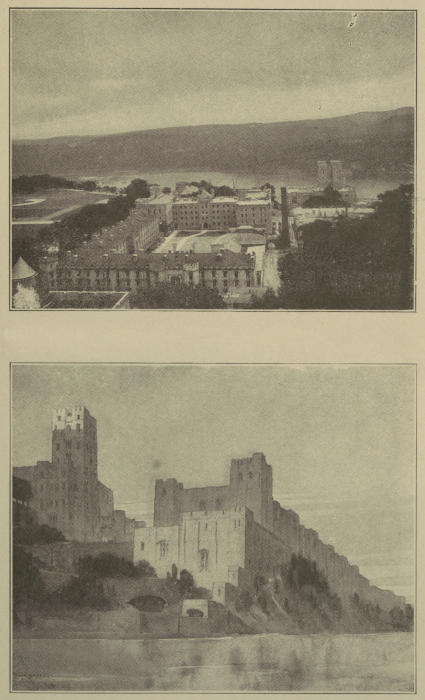
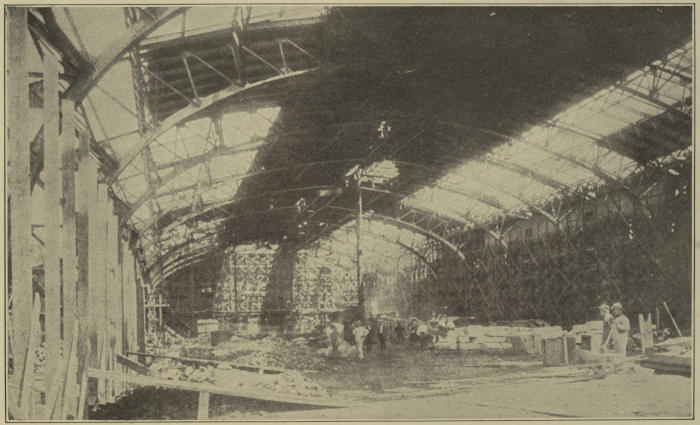
I have delayed sending back the proof sheets of the third
edition of your “Cadet Life at West Point” because I wanted
to read them. This I have finally found time to accomplish, but
I really have not the time to write out my views on the book as
I would like to do for you can appreciate my situation when I
tell you that we leave here on the 17th inst. and the house is
completely torn up.
I think, however, that in addition to having written a very
interesting book you have given the public one full of valuable
information, particularly useful to young men who contemplate
entering this academy. The book recalls many pleasant incidents
of our own cadet life and conditions now are very little changed
from our day, especially as we are to return to the four-year
course with entrance for the new class back to June again.
With best wishes for the New Year,
Sincerely,
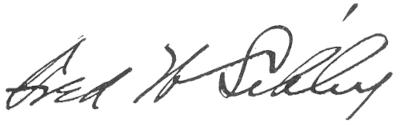
Fred H Sibley
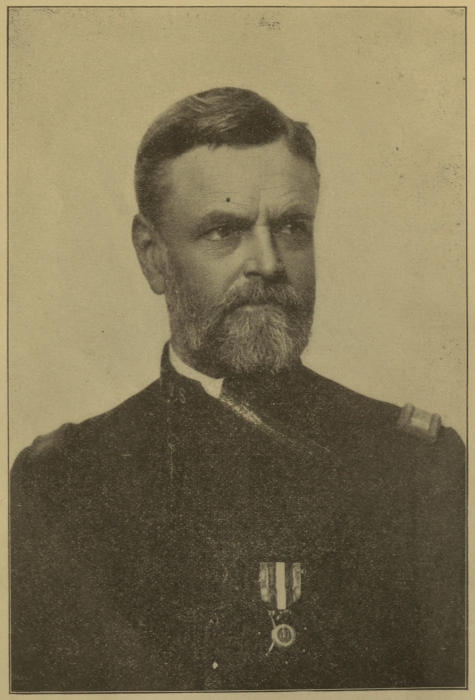
Colonel Sibley was the Commandant of Cadets from February 1,
1909, to January 17, 1911.
PRESS COMMENTS ON CADET LIFE AT WEST POINT
Dedicated to the dear girls who adore the military.
“Entertaining personal reminiscences.”—Cleveland
Plain Dealer.
“Especially entertaining to lads with military aspirations.”—(Boston)
Waverly Magazine.
“Parents and sisters too come under its spell.”—(Chicago)
Quarterly Book Review.
“The various troubles cadets have are clearly described.”—Cincinnati
Commercial Tribune.
“The reader soon becomes interested.”—Richmond
(Ind.) Palladium.
“Complete description of the life of a cadet.”—The
(Chicago) Medical Standard.
“Through the trying days of plebedom.”—Indianapolis
Journal.
“Until he finally doffs the cadet gray and dons the
army blue.”—Chicago Tribune.
“The story is told in a very interesting way.”—(New
York) American Stationer.
“Whether you’re young or old, girl or boy,
Reed’s ‘Cadet Life’ is a book to enjoy;
It is full of facts, mixed with fun,
That gives great pleasure to everyone.”
“A very spirited and interesting book.”—(New York)
Scientific American.
“Stories, poems and accounts of graduation hops and
other amusements.”—The (New York) Publishers’ Weekly.
“Also contains statistics which are of sufficient value
alone to warrant publication.”—Chicago Journal.
“Charming in its personality.”—Army and Navy Journal.
“Answers many questions one would like to ask.”—Chicago
Inter-Ocean.
“In such a happy vein as to charm American readers
of all ages.”—Army and Navy Register.
“A pleasing style.”—(New York) Review of Reviews.
“The best description of cadet life and also of the
workings of the academy.”—Wm. Ward, clerk in charge
(for the last 60 years) of Cadet Records at West Point.
“Nothing quite like it in this country.”—(London,
Eng.) Army and Navy Gazette.
“A complete book.”—(Orchard Lake, Mich.) Adjutant.
“Interesting reading.”—Chicago Times-Herald.
“About West Point, how to get there, etc.”—Indianapolis
News.
“Just the thing.”—(Atlanta, Ga.) Southern Star.
“Of value to guardsmen.”—The (Columbus, O.) National
Guardsman.
“Interesting reading even for laymen.”—(New York)
Godey’s Magazine.
“Should be in both normal school and village libraries.”—Cortland
(New York) Evening Standard.
BY Col. Hugh T. Reed, Lieut. U. S. Army, Late Inspector General of Indiana. AUTHOR OF Military Science and Tactics, Etc.
ILLUSTRATED
THIRD EDITION.
RICHMOND, INDIANA:
IRVIN REED & SON.
ALL RIGHTS RESERVED.
COPYRIGHT, 1896 AND 1911, BY HUGH T. REED.
Dedicated TO THE DEAR GIRLS WHO ADORE THE MILITARY, ONE OF
WHOM HAVING PAID THE PENALTY OF HER ADMIRATION,
IS NOW MY SUPERIOR OFFICER.
PREFACE
I believe it to be well established that the mental
habits are fully as strong as the physical habits
of man. That is, thought moves in grooves
day after day and day after day as walks in life
do. The habit of retrospectant thought fastened
itself upon me several years ago, and the habit
confined itself largely and almost irresistibly to
my life at West Point. My reflections became
almost realisms; I was to all intents and purposes
oblivious of the intervening years; oblivious of
accumulated griefs and sorrows, of successes and
of contemporaneous ambitions—I was indeed a
boy again, and at West Point, living over and over
and over again all the scenes leading up to and
creating my life at the Nation’s Military School.
In one of these moods, it occurred to me, entirely
for my own gratification, and possibly to dispossess
myself of the habit of thinking upon the
subject, to write a little sketch of those days. I
became interested in the work, and the pages grew
in number as memory served me with inspiration
for my narrative, until I had at last completed
what might be called a volume of reminiscences.
As an amusement for him, I read chapter after
chapter, as it was written, to a favorite nephew,
and when the manuscript was written and in a
temporary binding, I loaned it to this young relative,
who, in turn, with my consent, loaned it to
friends of his, and it was read by these youngsters
and passed from hand to hand. I could not help
but realize the interest that was taken by these
young readers in what I had so carelessly and indifferently
written, but at the same time, I should
never have undertaken the publication of my notes
if my nephew had not attended a military school
and bombarded me with appeals to send him the
old manuscript, so that his comrades might read
about life at West Point.
The old manuscript wouldn’t do, so I edited what
I had written, re-wrote some of the pages, added
a few lines here and there, and finally concluded
to publish it without the least expectation that
it will interest very many persons, or bring me any
material reward.
I have tried to write it naturally and without
any attempt at literary excellence, and beg most
respectfully to offer it to the public as a grateful
tribute of my happiest years.
For valuable data I am indebted to Colonel
Charles W. Larned, Lieutenant Colonel F. W. Sibley,
Commandant of Cadets, Captains W. E.
Wilder, F. W. Coe and O. J. Charles, Adjutants,
Lieut. M. B. Stewart, Tactical Officer, Dr. E. S.
Holden, Librarian, and Mr. William Ward, in
charge of Cadet Records from 1851 to 1911, all of
the Military Academy, and to Lieutenant Charles
Braden, editor of Cullum’s Biographical Register
of West Point Graduates.
I was not more than eight years old when I
first heard about West Point, and then I was
told that it was Uncle Sam’s Military School;
that the young men there were called cadets; that
they were soldiers, and that they wore pretty uniforms
with brass buttons on them. The impression
made upon me at the time was such that I
never tired talking and asking questions about
West Point. I soon learned to indicate the site
on the map, and I longed to go there, that I might
be a cadet and wear brass buttons. I talked about
it so much that my good mother made me a coat
generous with brass buttons. I called it my cadet
coat, and wore it constantly. Ah! for the day I
should be a big boy and be a real cadet. With a
wooden gun I played soldier, and when the war
broke out and the soldiers camped in our old fair
grounds, I was in their camp at every opportunity.
The camp was about half-way between our
home farm and father’s store in town, and many
is the time I have been scolded for being so much
at the camp. My only regret at that time was
that I was not old enough to enlist, for I loved to
watch the drills and linger around the camp-fires,
listening to stories of the war.
I learned a good deal from the soldiers about
West Point. They told me that I could not go
there until I was seventeen years old, and not
then unless I was appointed as a cadet by my
congressman. They also told me that I must be
a good boy at school and study hard, for the reason
that after securing the appointment I would
have to pass a rigid examination at West Point
before admission. This was bad news to me, because
we farm boys never attended school longer
than four or five months in a year. Fortunately,
however, the family moved to “town” when I was
fourteen years old. I was then assured that I
would have my wish, and I never missed a day at
school. I was so anxious to learn rapidly that I
overtaxed my eyes, and was in a dark room for
nearly a year. Still I did not give up hope, and
when my eyesight permitted I returned to school
again.
I found out that there could be only one cadet
at a time at West Point from the same congressional
district, and also that there was then a
young man there from my district; still I had
hopes of getting there myself before I got too old,
that is, over twenty-one.[1] Then there was no
book published about West Point, and magazines
and newspapers never described it.
“MIGHT BE A CADET.”
One day I saw by the paper that the Hon.
G. W. Julian was at home on a short visit, and
I knew that he was my congressman; hence I
wanted to go at once to see him. I confided in
my mother and obtained her permission to be
absent from school that afternoon. So I saddled
old John, my favorite horse, and rode six miles
to Mr. Julian’s house. He was at home, and
was very kind to me. He asked my father’s
name, and also my name and age, and he made
a note of my address, saying that he might write
to me from Washington. He also said that there
would be a vacancy at West Point, from his district,
the next year in June, and that he would
make the appointment soon; that I was the first
young man to apply for the place, but if any one
who had served in the war applied for the cadetship
within the next few weeks he would appoint
him—that such a person could be just under
twenty-four years of age. Nevertheless, if no old
soldier applied, he would appoint me, as he knew
my father well. He then said that if he did appoint
me I must be a good student the next year,
and prepare for the examination at West Point.
Upon my return home I did not talk about West
Point any more, nor did I speak to any one except
my mother about having seen Mr. Julian, and I
had five brothers and a sister, too!
About two months after my visit to Mr. Julian,
I received a letter from him, taking it myself from
the postoffice, but alas! the writing was such that
I could not read it, although there were but eight
words in it, so I hastened with it to my mother,
but she could not read it, either. Then as I must
confide in another person, I decided to speak to
my father, and ask him to read the letter, under
promise that he would not talk about West Point
with any one except my mother and myself. He
read the letter at once, and said that the writing
was all right, but that the letter did not mean anything,
as Mr. Julian had probably written the
same to other boys. I did not believe this, and
was surer than ever of obtaining the appointment.
Many years have passed since then, but the words
of that letter are still fresh in my memory. They
are:
“Please inform me in reply your exact age.”
I wanted my father to write Mr. Julian in my
behalf, but he declined to do so, saying that he did
not want me to go to West Point. I then got him
to promise not to write “that” to Mr. Julian, and
I myself answered the letter by return mail.
About ten days after this I received another letter
from the congressman, a great large one, in a
long envelope, and all I could read of that was “I
have recommended you”; but that was enough,
as the appointment itself was enclosed, and I could
read it, and I was a happy boy. I ran home to
show the appointment to my mother, and then to
the store to show it to my father, and also to get
him to read the letter to me, which was as follows:
“I have recommended you, and enclose herewith your conditional
appointment as a cadet to West Point, together with certain
other papers from the War Department. I shall now expect
you to prepare yourself for the examination next June, and I
hope you will graduate with high honors, and that afterwards you
will be loyal and useful to your country.”
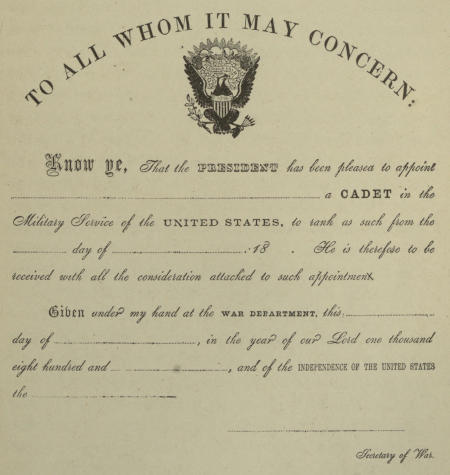
Sir: You are hereby informed, that the President has conditionally
selected you for appointment as Cadet of the United
States Military Academy, at West Point, New York.
Should you desire the appointment, you will report in person
to the Superintendent of the Academy on the ____ day of
________, 1869, for examination. If it be found that you possess
the qualifications required by law and set forth in the circular[3]
herewith, you will be admitted, with pay from date of admission,
and your warrant of appointment will be delivered to you.
Should you be found deficient in studies at the semi-annual or
annual examinations, or should your conduct reports be unfavorable,
you will be discharged from the military service, unless otherwise
recommended for special reasons by the Academic Board, but
will receive an allowance for traveling expenses to your home.
Your attention is particularly directed to the accompanying
circular, and it is to be distinctly understood that this notification
confers upon you no right to enter the Military Academy unless
your qualifications agree fully with its requirements, and unless
you report for examination at the time specified.
You are requested to immediately inform the Department of
your acceptance or declination of the contemplated appointment
upon the above conditions.
Very respectfully,
____________
Secretary of War.
To ____________
____________, 1868.
To the Honorable Secretary of War,[4] Washington, D. C.
Sir: I hereby respectfully acknowledge the receipt of your
notification of my contemplated appointment as a Cadet of the
United States Military Academy, with the appended circular, and
inform you of my acceptance of the same upon the conditions
named.
I certify, on honor, that I was born at ________,
in the County of ________, State of ________,
on the ____ day of ________, 18__, and that I have
been an actual resident of the Congressional District of
________ for __ years and __ months.
(Signature of appointee) ____________
I hereby assent to the acceptance by my ________ of his
conditional appointment as Cadet in the military service, and he
has my full permission to sign articles binding himself to serve
the United States eight years, unless sooner discharged.
I also certify, on honor, that the above statements are true and
correct in every particular.
(Signature of parent or guardian) ____________
CHAPTER II. THE PREPARATION.
After examining the papers received from
the War Department, I found one that required
my father’s signature before I myself
could accept the appointment. My parents
both objected to my leaving home, and therefore
did not wish me to go to West Point. I argued
that I wanted to go to college somewhere, and
why not let me go where Uncle Sam paid the bills.
At last I won my mother on my side, and then my
father, seeing that my heart was so fixed, signed
the paper requiring his signature, and mailed it
to the Honorable Secretary of War, Washington,
D. C. This done, I let the secret out, and all of
my boy friends wanted to know how I had gotten
the appointment. I told part, but I did not tell
just how I did get it.
After seeing the kind of examination[5] I would
have to pass at West Point the next year, my
father decided to send me to the High School at
Ann Arbor, Mich., and to send my brother Charley
there with me to prepare him for the University
of Michigan. We entered the High School
early in September. About two weeks afterward
the University of Michigan (also at Ann Arbor)
opened, and we observed that many of the candidates
for the freshman class seemed no farther
advanced than we thought ourselves, so we applied,
were examined, and admitted to the University.
I thought that if I failed at West Point
I could return and graduate at the University in
three instead of four years.
There was a tall young man from Tennessee,
who entered the High School with us, and afterward
entered the University, too. He, like myself,
had an appointment to West Point, and was
going there the next June, so we became friends
at once, and he and I agreed to study after Christmas
for the West Point examination. After the
sophomores quit hazing, all went well with us, and
the year soon passed. I left Ann Arbor on the
last day of April to return home via Lakes Huron
and Michigan, and went to Detroit to take the
first steamer of the season around the lakes to
Chicago. Upon arriving in Detroit, I heard that
there was to be a muster and inspection of a regiment
of United States troops out at Fort Wayne,
a short ride from Detroit, and as I was to be a
soldier, I went to see the sight. As I looked at
the troops (the First U. S. Infantry), I thought
that I would like to be an officer of that regiment
when I graduated from West Point, and singularly
enough my wish was gratified. I remained
so long at Fort Wayne that the boat had departed
when I returned to Detroit, so I took train and
overtook the boat at Port Huron. While there I
went to see Fort Gratiot, and strange to say, that
was subsequently my first army station. When
the steamer stopped at Mackinaw I visited the
fort that was there at that time.
After my return home I reviewed the studies I
was to be examined on in a few weeks, and then
started east. I promised my father if I failed to
pass the examination that I would return home at
once. Arriving in the great city of New York, I
took passage on the day steamer “Mary Powell,”
and was charmed with the scenery along the Hudson.
The first stop was at the south landing at
West Point. I was on the upper deck at the time,
and after seeing my trunk put ashore, I walked
leisurely downstairs to disembark and to my great
surprise the boat was fifty feet or more from shore
when I got down. I thought that all steamers
made long stops, for the only other boat that I
had ever been on stopped for many hours every
time she landed. The captain would not let me
off, and said that I could get off at Cornwall and
take a down boat the same evening. I was satisfied
and went on the upper deck again and saw the
passengers who had landed get into the West
Point Hotel ’bus. All the trunks except mine were
put on the top of the ’bus, and it was then driven
up the hill, leaving my trunk all alone on the
dock.
When the steamer stopped at Cornwall I this
time promptly stepped ashore. It was about sunset.
There were not more than half a dozen buildings
in sight, and not a soul at the dock, and I
was the only passenger landing at that point. I
went to one of the houses and inquired the location
of the hotel, and I was informed that it was
not open, as it was too early for summer visitors.
I then asked what time the down boat was due,
and was informed that it would be along soon,
but that it would not stop. The West Shore Railroad
was not built at that time, and as there was
no stage line over the mountains nor ferry on the
river, I began to fear that I could not get away by
the tenth of June, the last day for me to report.
This bothered me more than the hotel accommodations,
but I soon found obliging people and arranged
for my lodging and breakfast, and also to
be rowed to my destination the next day.
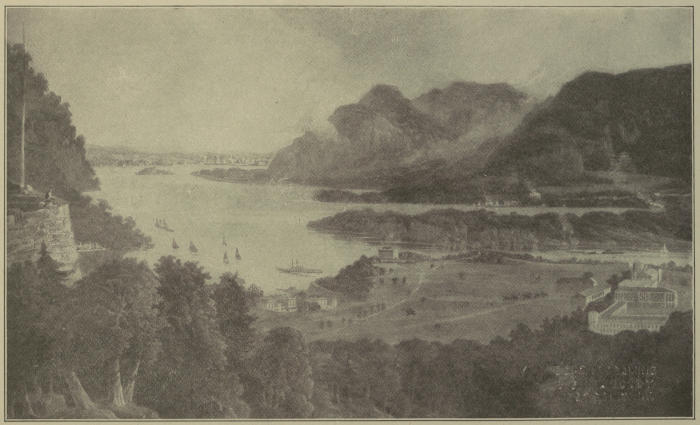
Transcriber’s Note: Image is clickable for a larger version.
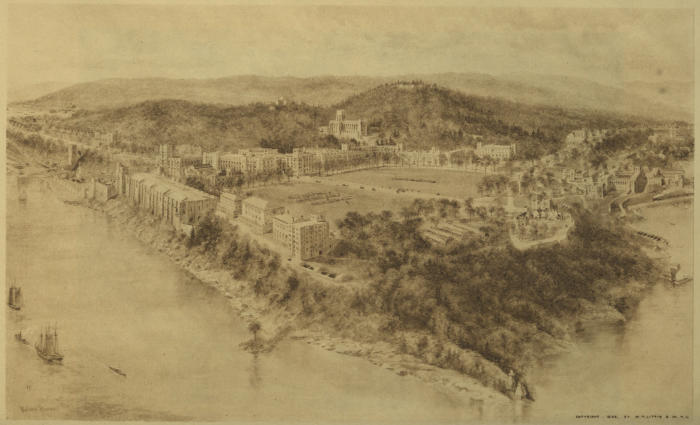
Topographical Sketch of WEST POINT
CHAPTER III. THE CANDIDATE.
“As the twig is bent, the tree is inclined.”
It was about ten o’clock in the morning of
June 8, 1869, when I stepped from a rowboat
on the dock near the Sea Coast Battery at
West Point. The weather was perfect, and my
heart was light and free. As there was neither
any person nor conveyance at the dock, I followed
the road winding up the hill to the plain. I
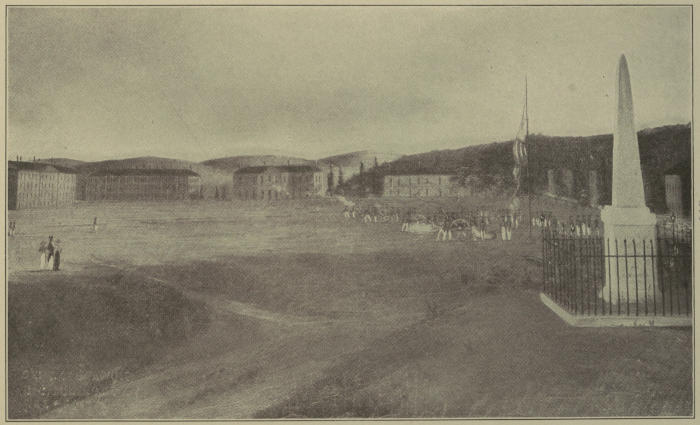
stopped to admire the scenery. In front I beheld
a level green plain of one hundred acres or more
with massive buildings peeping through the large
elm trees that fringe two sides of the plain; on
either side were high hills; in my rear rolled the
majestic Hudson between the Highlands, with
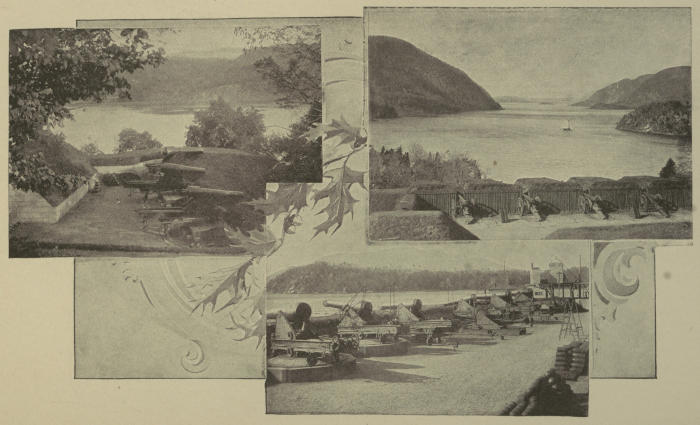
Siege Battery at my feet. As I gazed around it
was to me then, as it is to me now, the most beautiful
of places.
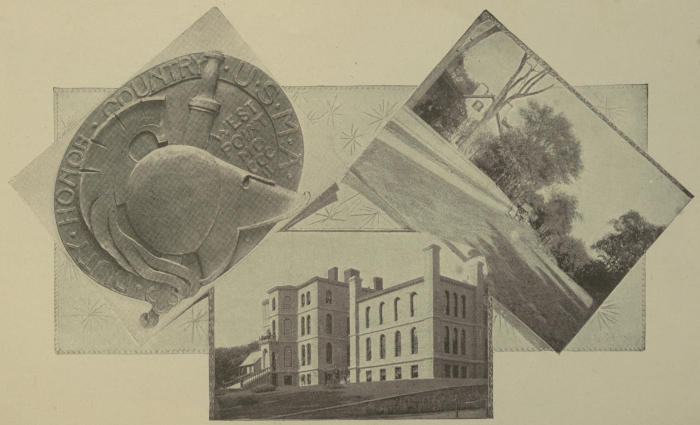
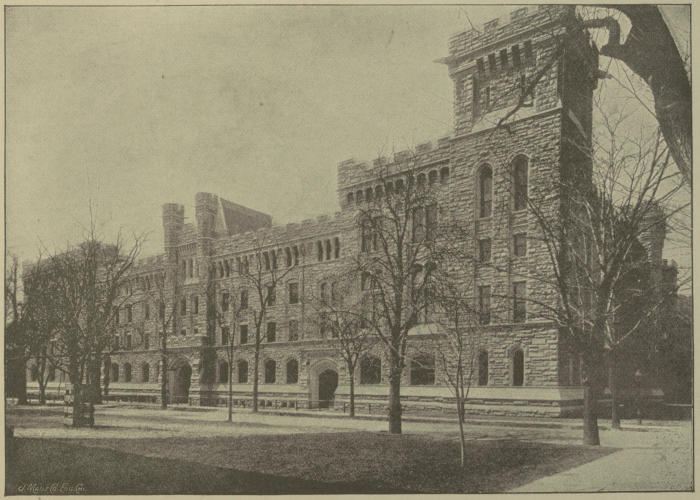
I found my way to the Adjutant’s office in the
Administration Building[6] and reported. I was
courteously received and handed the “Instructions
to Candidates” to read. I stated the fact
of my trunk having been put ashore on the south
dock and of the Mary Powell carrying me to Cornwall
the previous evening, and I was told that my
trunk had undoubtedly been taken to the hotel,
as there was then (and now is) but one hotel at
the Point. And I was also informed that my trunk
would be sent to the Cadet Barracks. After I had
complied with the instructions, an orderly, at the
sound of a bell, entered and was directed to escort
me to the barracks. In going through the area we
passed some cadets and I overheard such remarks
as “He’ll learn to button his coat.” At the orderly’s
suggestion I buttoned my coat. He took
me into a hall, said “This is the door,” laid down
my valise, and left me. The door was the first
one on the right of the eighth division—how well
I remember it! I knocked on the door, and heard
a commanding voice say “Come in!”[7] With valise
and umbrella in one hand and cap in the other,
I entered. There were two cadets in the room,
seated near a table, and before I had a chance to
speak, I was greeted about as follows: “Leave
your things in the hall. Don’t you know better
than to bring them in here?” I stepped into the
hall, left the door open, and while looking for a
suitable place to put my things (for there was
neither a hook nor a table), one of these two cadets
cried out: “Lay them on the floor and come in,
and don’t be all day about it, either. Move lively,
I say. Shut the door. Stand there. Come to attention.
Put your heels together, turn out your
toes, put your hands by your side, palms to the
front, fingers closed, little fingers on the seams of
the trousers, head up, chin in, shoulders thrown
back, chest out, draw in your belly, and keep your
eyes on this tack.” While one cadet was giving
commands with great rapidity, the other one fixed
my feet, hands, head and shoulders. “What’s
your name? Put a Mr. before it. How do you
spell it? What’s your first name? Spell it.
What’s your middle name? Have none? What
state are you from? What part? Put a sir on
every answer. Where’s your trunk? Don’t know?
Didn’t you bring one? Put on a sir; how often
do you want me to speak about it?” I explained
how my trunk and I had arrived at different times.
“You’re too slow. You’ll never get along here.
Keep your eyes on that tack; turn the palms of
your hands squarely to the front. Did you bring
all of the articles marked ‘thus’? You don’t know
what they are? Put on a sir, I tell you. Didn’t
you get a circular telling what articles you should
bring? Didn’t you read it? Now answer me; did
you bring the articles marked ‘thus’? Well, why
didn’t you say so at first? Keep your eyes on that
tack.” A wagon drove up and put a trunk on the
porch near the window. “About face! Turn
around the other way. Don’t you know anything?
Is that your trunk? It is, is it? Now, let’s see
you ‘about face’ properly. Steady. At the word
‘about’ turn on the left heel, turning the left toe
to the front, carrying the right foot to the rear,
the hollow opposite to and three inches from the
left heel, the feet perpendicular to each other.
Don’t look at your feet. Head up. Stand at ‘attention’
till I give the command. Now, ‘about’
(one of the cadets fixed my feet); at the word
‘face,’ turn on both heels, raise the toe a little,
face to the rear, when the face is nearly completed,
raise the right foot and replace it by the left.
Now, ‘face.’ Ah! turn on both heels. Fix your
eyes on that tack again. Draw in your belly.
Throw back your shoulders and stand up like a
man. Now, ‘left, face.’ Don’t you know your
left hand from your right? Face that door; open
it. Ah! why don’t you step off with the left foot
first? Pick up your things, follow me, and move
lively.” My back was nearly broken, and I was
glad to get out of that room. After going a few
steps on the broad porch on the area side of barracks,
a young man in civilian clothes came out of
the next hallway carrying the palms of his hands
to the front. “Come here, Mr. Howard, and help
your room-mate carry his trunk upstairs; step
lively, now.” With that introduction Mr. Howard
and I took hold of the trunk. Just then the tall
young Tennesseean, whom I knew at Ann Arbor,
passed, carrying the palms of his hands to the
front. We exchanged knowing winks, but did not
venture to speak. “What’s the matter with you?
Don’t be all day carrying that trunk upstairs.”
Howard and I tugged away and finally got the
trunk upstairs and into the room designated.
Candidates Howard and Knapp had already been
assigned to the same room. “Stand attention,
Mr. Knapp. Don’t you know enough to stand attention
when I enter the room? Palms to the
front. Put the trunk over there. Mr. R⸺d,
open your trunk and valise and take out everything
and make a list of all you have. Stand attention,
Mr. Howard. Take out your things first
and make a list afterward. Put the small articles
on this part of the clothes-press, hang your clothes
on those pegs and put your bedding over there.
Study the regulations. Fold your things properly,
put them in their places, and the next time
I come in I want to see everything in place. What
did you bring that umbrella for? You will never
need it here. Mr. R⸺d, post your name over
there on the ‘alcove,’ put it on the ‘Orderly Board’
under Mr. Knapp’s name, and put it there on the
clothes-press. Whenever you hear the command,
‘Candidates, turn out,’ button your coats, hasten
downstairs and ‘fall in’ in the Area.” Cadet
Hood left the room then, and we sat down,
prostrated. Then we proceeded to get acquainted
with one another, and on comparing notes we
found that each one of us had had about the same
reception. As Howard and Knapp had reported
the day before, they gave me many pointers, which
I appreciated.
The room was good-sized, with two alcoves at
the end opposite the window; but, oh! how uninviting
it seemed. No bed, no carpet, no curtains,
and not even shades. The furniture that was in
the room consisted of a clothes-press, that is,
shelving arranged for two cadets, but to be used
by three or four candidates, two small iron tables,
a wash stand, an iron mantel and a steam coil with
a marble slab on it. H⸺rd and K⸺p had already
carried from the Commissary certain articles
for use by all occupants of the room, as follows:
A looking-glass, a wash basin, a water
bucket, a cocoanut dipper, a slop bucket and a
broom. They had also obtained such other articles
as were required for their personal use, such
as a chair and a pillow.
The following extract from the “Blue Book”
shows the arrangement of rooms, etc.
White Helmet.—On the clothes-press.
Dress Hat.—On the gun-rack shelf.
Cartridge Box and Bayonet or Sword.—On pegs
near gun-rack.
Caps and Sabres.—On pegs near gun-rack.
Rifle.—In gun-rack.
Spurs.—On peg with sabre.
Bedstead.—In alcove against side wall of room,
head against rear wall.
Bedding.—Mattress, folded once; blankets, comforter
and sheets, folded separately, so that the
folds shall be the width of the pillow, and all piled
against the head of the bedstead, thus: mattress,
sheets, pillow, blankets and comforter; the end
of the pile next to the alcove partition to be in
line with the side of the bedstead; this end and
the front of the pile to be vertical.
Clothes-Press.—Books on top against the wall,
backs to the front; hair and clothes brushes,
combs, shaving materials, such small boxes as are
allowed, vials for medicines, etc., on top shelf;
belts, collars, gloves, handkerchiefs, socks, etc.,
on second shelf from the top; sheets, pillow cases,
shirts, drawers, pants, etc., on the other shelves.
Text-Books.—Those in daily use may be upon
the tables, except during Sunday morning inspection.
Arrangement.—All articles of the same kind to
be neatly placed in one pile, folded edges to the
front and even with front edge of the shelves.
Nothing to be between these piles and the back of
the press, unless want of room renders it necessary.
Soiled Clothes.—In clothes bag.
Shoes.—To be kept clean, dusted and arranged
in line, toes to the front, along the side near the
foot of the bed. Shoe brush in the fireplace.
Woolen Clothing, Dressing Gown and Clothes
Bag.—On pegs in alcove, arranged as follows:
Overcoat, dressing gown, uniform coats, jackets,
gray pants, clothes bag and night clothes.
Broom.—Behind the door.
Candle Box.—In fireplace.
Tables.—Against the wall under gas jet or near
the window when the room is dark.
Chairs.—From 8 a. m. to 10 p. m. against the
tables when not in use.
Mirror.—At center of mantel.
Wash Stand.—In front of and against alcove
partition.
Wash Basin.—Inverted on top of wash stand.
Water Bucket.—Near to and on side of wash
stand opposite the door.
Dipper.—In water bucket.
Slop Bucket.—Near to and on side of wash
stand nearest the door.
Curtains.—Regulation only allowed.
Calendar.—A small, plain one may be placed on
the wall over the gas fixture.
Clock.—A small plain one may be kept on the
mantel.
Bath Towel.—May be hung in the alcove.
Trunks, Pictures, Splashers, Writing Desks,
Etc.—Prohibited. There is a storeroom for
trunks.
Floor.—To be kept clean and free from grease
spots or stains.
Heating Apparatus.—To be kept clean and free
from scratches.
Windows.—Cadets are forbidden to sit at the
windows with feet on the woodwork, or to appear
before windows improperly dressed, or to communicate
through windows, or to raise the
lower sash more than four inches during “call to
quarters.”
Names.—Uniformly printed to be posted over
gun-rack pegs, alcove, clothes-press and on orderly
board over wash stand.
Hours of Recitation.—To be on the mantel on
either side of the mirror.
Academic Regulations, Articles of War and the
Blue Book.—To be kept on the mantel.
Laundry.—All clothes sent to the wash to be
plainly marked with owner’s name.
Room Orderly.—Is responsible for the cleanliness
and ventilation of the room, and that articles
for joint use are in place.
After having folded and arranged my possessions
according to the Blue Book, as I understood
from a hasty perusal of it, I looked out of the
window down into the Area of Barracks, where I
saw old cadets passing to and fro. They carried
themselves so very erect that we could not help
but admire them and wish that we too were as
straight and walked as well as they. We observed
what small waists they had, and we wondered
if they laced. Another thing we observed
was that the cadets looked so much alike. I had
unbuttoned my coat while arranging my effects,
and forgot to button it again, when I heard a
quick walk in the hall and then a sharp, firm,
single rap on the door. We all sprang promptly
to attention, palms to the front. Cadet Hood
entered and began: “Button your coat, Mr.
R⸺d.” He moved several piles on the clothes-press
and disarranged my bedding, too, saying,
“Not folded properly. Why don’t you study the
Blue Book? Mr. Howard, fill your water bucket
the first thing every morning. Get the water from
one of the hydrants[8] in the Area. The floor is
very dirty; sweep it properly, invert your wash
bowl, and don’t let me have occasion to speak
about these things again.”
The first call for dinner sounded and then we
heard, “Candidates, turn out promptly.” We
hastened downstairs. The old cadets were gathering
in four different groups, while the candidates
were being put into another one. Cadets
Hood, Allen and Macfarlan were on the watch
for candidates, and they began thus:
“Button that coat. Get down here lively. ‘Fall
in.’ Fall in in the rear; don’t you know better
than to get in front of anybody? Palms to the
front. Fix your eyes on the seam of the coat collar
of the man in front of you, and at the second
call, face to the left.” Some of the candidates
faced one way and some another, but we were
soon straightened out, and then, “Eyes to the
front! What do you mean gazing about in ranks?
Each candidate, as his name is called, will answer
‘Here’ in a clear and audible tone of voice.”
The roll of the candidates was then called. “Why
don’t you answer, Mr. H⸺? Well, then, speak
up so that you can be heard. Mr. ⸺, don’t
shout,” and so on till the last name was called.
We were told how to “count fours,” and after
the command came something like this: “Stop
counting. Try it over. Count fours. Steady,
Mr. ⸺; wait till the man on your right counts.
Eyes to the front. Why don’t you count, Mr. ⸺!
Speak out. Eyes to the front,” and so on.
We were now told how to “wheel by fours,” and
at the command, “March,” to step off with the
left foot first. There was a great time after the
command, “Fours right, march,” was given. The
cadets on duty over us were kept busy shouting
at and pulling in place, first one candidate and
then another, but after a fashion we got started
and followed the cadets to the Mess Hall, and
those on duty over us were kept busy all the way
correcting mistakes made by the candidates.
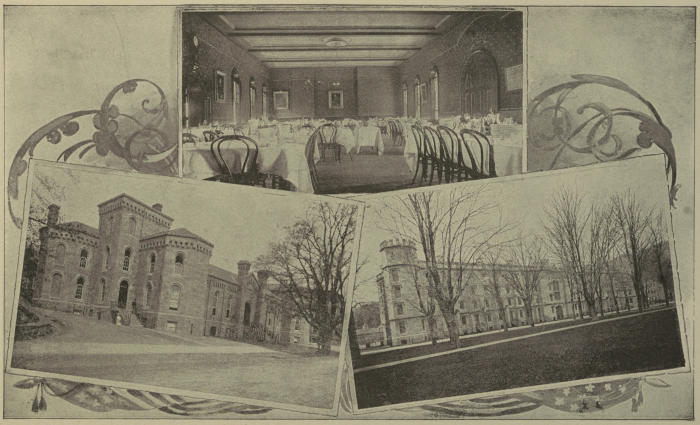
While en route to dinner we were directed to
remove our caps just before entering the Mess
Hall and to put them on again just after leaving
it. Of course we made blunders, and were
gently (?) corrected for them. Upon entering the
hall we were directed to certain tables, but told
not to sit down until the command, “Candidates,
take seats,” was given. When each one found a
place behind an iron stool (that in my day resembled
an hour glass in shape), the command, “A
Company, take seats,” was given, and then the
members of A Company all sat down promptly;
then came “B Company, take seats,” “C Company,
take seats,” “D Company, take seats,” and
then “Candidates, take seats.” Immediately
after the last command something like this came:
“Sit down promptly. Do you want to be all day
about it? Eat your dinner, and don’t leave the
table until the command, ‘Candidates, rise.’”
Dinner was on the table, and there were a good
many tables in the big hall. Each table had seats
for twenty-two persons, ten on a side and one at
either end. There were tablecloths, but no napkins,
and one waiter for every two long tables;
the waiters did not pass anything, but brought
water, bread, etc., when needed. The cadets (and
candidates) at the ends of the tables did the carving,
while those at the center of the long tables
poured the water. At supper and breakfast there
were no tablecloths. Tablecloths and napkins are
now furnished for all meals, and there are cane
seat chairs instead of the old iron stools. The
tables of the cadets were divided crosswise in the
center by an imaginary line into two parts, and
each part was called a table. The cadets had seats
according to rank, and they always sat in the
same seats. First classmen sat near the end
called the head of the table, second classmen next,
third classmen (except the corporals) next, and
then fourth classmen, the latter being at the center
of the long tables. The corporals at the ends
of the tables were the carvers, and the fourth
classmen poured the water.[9]
After dinner we were marched back to barracks,
and before being dismissed the candidates
were informed that they could do as they pleased
until the bugle sounded “Call to quarters” at 2
o’clock, and then they must repair promptly to
quarters, that is, to their own rooms in the barracks.
All the time that we were in ranks the
usual volleys were fired at us, such as: “Eyes to
the front. Head erect and chin in.” After we
were dismissed we were constantly reminded to
“carry palms of the hands to the front,” notwithstanding
the fact that we had been told to
go where we pleased for a whole half hour. Some
of the candidates went to the sink (i. e., water
closet),[10] and some of the old cadets went there,
too. A number of them surrounded a poor candidate,
called him a plebe or an animal, and fired
dozens of questions at him at once. The madder
the plebe got the more fun it was for the old
cadets. As the candidates were not acquainted
with one another, and as they dreaded to meet the
old cadets, they naturally drifted to their quarters,
thinking that the safest place to be, but,
alas! some of the old cadets called upon them
there. While they did not mention their names,
something like this generally occurred: “‘Shun,
squad. Come to attention, plebes. Palms to the
front. What’s your name? Spell it; spell it
backwards. What state are you from? Who’s
your predecessor?’ Say ‘Mr. ⸺.’ Do you think
you can pass the ‘prelim’? Where is Newburg?
Don’t know? How do you expect to get in here
if you don’t know where Newburg is? Climb up
on that mantel and be lively about it, too. Now
move your arms and say ‘Caw, caw.’ Stop that
laughing. Eyes to the front.” And so on, till
the old cadets would slip out in time to go to their
rooms for “Call to quarters.”
At two o’clock came the call, “Candidates, turn
out promptly,” and every candidate turned out
and “fell in.” A number were sent back for
towels, and upon returning to the Area were sent
to the bathrooms, then in the basement of D Company
quarters. After bathing, some were sent to
the Cadet Hospital for physical examination, and
were there told to strip to the skin, then called
one at a time before three Army Surgeons, in full
uniform, who examined the lungs, eyes, ears,
teeth and feet, made the candidates hop first on
one foot, then on the other, raise their hands high
above the head, cough, bend over forward, etc.
When my turn came I did not mention anything
about ever having been troubled with my eyes.
Upon returning to the barracks we were sent
to the Commissary, where each candidate was
given the articles necessary for his own immediate
use. As near as I now remember, I got a
chair, a pillow, a piece of soap, an arithmetic, a
slate, a copybook, a quire of “uniform” paper, a
history, a grammar and a geography. Other candidates
who, like myself, had brought the articles
marked “Thus*” received the same as I, while
those who had not brought them got two blankets
in addition to what the rest of us got. The books
mentioned above are not now issued to candidates.
Cadet H⸺d saw to it that candidates rooming
together were provided with a wash bowl, a mirror,
two buckets, etc. When all were fitted out we
took up our loads and returned with them to Barracks,
carrying them in our hands or on our shoulders,
as was most convenient. This trip from the
Commissary store across the grassy plain to
Barracks has been described thus:
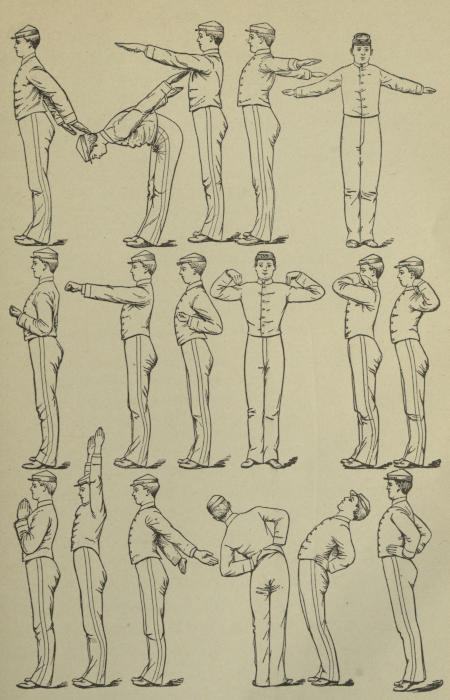
SETTING UP EXERCISES.
The setting up exercises are now taught by the Instructor of
Military Gymnastics and Physical Culture.
“Examinations being completed,
The ‘found’ having fled evermore,
Then with fear and a sigh
And blood in the eye,
Candidates hasten to the store.
“‘Give me my things,’ in joy a plebe exclaims,
Then the storekeeper puts on a smile,
But dispels the illusion
And causes confusion
By throwing his goods in a pile.
“Slowly he carries them across the plain,
With buckets and broom in the rear;
But hard is the task,
He has reason to ask
If his future abode is quite clear.
“The looking-glass breaks, the pails rattle loud,
And the sound echoes from afar;
Plebe cries in disgust,
‘Let me get up and dust,
I want to go home to my ma.’”
Upon returning to Barracks we were ordered to
our rooms, and then to the shoeblacks, at that time
in the basement of B Company quarters, to have
our shoes cleaned and polished, and told to go
there, at certain hours, as often as necessary to
keep our shoes in proper order. Candidates whose
hair was considered too long by Cadet H⸺d
were sent to the barber’s, at that time in the basement
of C Company quarters. Candidates who
had to shave were directed to shave themselves,
as the barber was not permitted to do anything
but cut hair.
At 4:15 p. m. we were turned out for “Squad
Drill.” We “fell in” promptly and were corrected
in the manner indicated when we fell in for dinner.
Even now I seem to hear Cadets A⸺n,
H⸺d and M⸺n shouting themselves hoarse
at us poor, stupid candidates. There were about
twenty “yearlings,” classmates of Cadets A⸺n
and H⸺d, standing around our line, waiting to
get a chance at the candidates, so as to compete
with them and with one another for “Corporal’s
chevrons.” We were separated into squads of four
or five to the squad, and a cadet instructor assigned
to drill each squad. Cadet H⸺d had the
squad I was in. After all details were adjusted,
the command, “March off your Squads” was given,
and then Babylon was let loose; the candidates
could hear the commands of all of the instructors,
and they did not know the voice of their own,
hence there was much confusion. Some of the
instructors acted as if they wanted to terrorize
the candidates in their squads, and shouted: “Eyes
to the front. Pay attention to me. What do you
mean by listening to others? Palms to the front,”
and so on, for ten or fifteen minutes, and then we
were given a brief “rest.”
Then we were taught how to march and the instructor
began thus: “At the word ‘forward’ throw
the weight of the body upon the right leg, the left
knee straight. At the word ‘march’ move the left
leg smartly, without jerk, carry the left foot forward
thirty inches from the right, the sole near
the ground, the toe a little depressed, knee straight
and slightly turned out. At the same time throw
the weight of the body forward (eyes to the front),
and plant the foot without shock, weight of the
body resting upon it; next, in like manner, advance
the right foot and plant it as above. Continue
to advance without crossing the legs or striking
one against the other, keeping the face direct
to the front. Now, ‘forward, common time, march.’
Depress the toe, so that it strikes the ground at
the same time as the heel. (Palms of the hands
squarely to the front. Head up.) When I count
‘one,’ plant the left foot, ‘two,’ plant the right,
‘three,’ plant the left again, ‘four,’ plant the right
again, and so on. Now, ‘One,’ ‘two,’ ‘three,’ ‘four,’”
etc. “Bring your feet down together. Depress your
toes,” and so on.
We were taught many things, such as the facings,
the exercises, rests, etc. “In place, rest,” was
the most acceptable, but half the pleasure of that
was taken away from the candidates by being
often told to “keep one heel in place.” That first
hour at squad drill is not soon forgotten. My every
muscle was sore and I ached all over. Just before
we were dismissed we were informed that we could
go anywhere we pleased on Cadet Limits, so long
as we were back a little before sunset, in time for
dress parade. This seemed a great privilege, but
wherever candidates went some old cadets were already
there, and greeted them with “Depress your
toes, plebes. Palms to the front. Are you going
to be all summer learning how to march? Squad
halt. Right hand salute. What’s your name?
Can you sing, dance or play on the piano? Come
here ‘Dad,’ and see this ‘animal.’” And a thousand
and one other equally pleasant sayings.
Dress parade came and went, but the candidates
did not participate in the ceremony out on
the grassy plain. They were kept in the Area, and
their positions alternated between “Attention” and
“Parade, Rest.” When the “Retreat Gun” was fired
many of them jumped half out of ranks, and then
were gently (?) informed that they were a fine lot
of soldiers. “What do you mean by leaving ranks
before you are dismissed?” When we had half a
chance we enjoyed the music of the band, but it
was very hard to hear it and our instructor’s commands
at the same time. Soon after parade we
fell in again and marched to supper. On the way
to and from the Mess Hall we were constantly entertained
by our cadet instructors by such commands
as, “Eyes to the front,” “Depress your toes,”
and “Palms to the front.” Before being dismissed
after supper we were informed that we had half
an hour before “Call to quarters,” and that during
that half hour we could do as we pleased. But
that half hour passed just as the other half hours
had passed, that is, by the candidates furnishing
amusement for the old cadets.
Upon going to our rooms at the signal of “Call
to quarters,” Cadet H⸺d called to say that if
we expected to pass our preliminary examination
we had better “bone up” for it; he also informed
us that we could not retire until after “Tattoo.” A
cadet’s bed is “made down,” when it is ready to
get into, and it is “made up” when it is piled according
to regulations and not ready for use. We
were too tired to talk. At 9:30 we were turned out
to Tattoo. After Tattoo I folded each blanket
lengthwise and laid it on the floor, then spread the
sheets and comforter on the blankets, undressed
and got in bed, leaving H⸺rd, the room orderly,
to turn out the gas. Our bones did not fit the hard
floor very well, but we soon fell asleep. “Taps”
sounded at 10 p. m., and, oh, how sweet and soothing
it was. In a few moments more our room door
was opened (for they are never locked), a dark lantern
flashed in our faces and the door closed again.
The same thing was repeated once more during
the night, but this time by an officer of the army,
called by the cadets a “Tactical Officer.” These inspections
were made to make sure that our lights
were out and that we were in bed. We slept in
the alcoves, heads near the wall farthest from
the door. H⸺rd, K⸺p and I, when fast
asleep, were suddenly awakened. We had been
“yanked,” that is, some old cadets had come into
our room, seized our blankets, and with a quick
jerk carried us some distance from the wall, and
then ran out of the room. We fell asleep
once more and slept soundly until we were awakened
by the “Reveille Gun” that is fired at sunrise
and followed by the beating off of “Reveille.” This
music was very pretty, too, but we could not half
appreciate it, as we had to get up at once, fall in
and begin another day. After reveille we made up
our beds. H⸺rd swept out and brought a
bucket of fresh water. Cadet H⸺d inspected
our quarters twenty minutes after reveille, and
said, “Mr. H⸺rd, your wash bowl is not inverted,
and your floor not half swept. Attend to them at
once.”
We had another hour’s drill before breakfast
(omitted now), which made us very hungry. Sick
call sounded soon after this drill, but while the
candidates were all half sick, it was not medicine
they wanted, so none of them went to the hospital.
Breakfast was at seven o’clock, and after it the
candidates furnished the cadets with the customary
half-hour’s entertainment before call to quarters
sounded. Cadet H⸺d again cautioned us
to “bone up” when he inspected quarters about
nine o’clock, and said: “The mantel is dusty, and
the floor very dirty.” Captain H⸺t, a Tactical
Officer of the Army, also inspected us before
noon, but he did not say anything. While I had
then been only a day at West Point, so much had
happened that it seemed an age.
About a week passed with much the same
routine as for the first day, except that we
had Saturday afternoon, after inspection, to ourselves,
that is, such part of it as we were not
busy entertaining old cadets, and on Sunday morning
we had inspection of quarters, and after this
inspection we were all marched to church. On
Sunday afternoon we were permitted to make
down and air, or use, our beds, and to enjoy lying
on the soft side of the boards again. The candidates
were all marched to the Episcopal Church,
“the” church there at that day. In due time the
Catholics and Methodists attended their own
churches, but all cadets, except Jewish ones, had
to attend some church once a week. After inspection
of quarters on Sunday morning, K⸺p became
room orderly for the next week. It was then
his duty to sweep and dust the room and to
carry the water needed for himself, H⸺rd and
me. The dirt was swept into the hall to one side
of the door, and left there. A policeman, that is,
the janitor, swept the halls, carried out the waste
water and scrubbed room and hall floors, when
necessary. It is wonderful how soon we learned
many things, such as to button our coats and
spring to attention, palms to the front, at the
sound of footsteps in our hall. At first we made
mistakes, but we soon learned to distinguish the
footsteps of our instructors from those of our fellow-candidates.
There was a story in my day of a gentleman
who went with his son when the latter reported as
a candidate, and that while Cadets H⸺d and
A⸺n were putting the son through his first lesson
in the office, the father turned his palms to the
front, put his heels together, and otherwise assumed
the position of the soldier.
At the first opportunity I wrote home, but I was
very careful not to mention the hardships I endured,
for the reason that I had gone to West Point
contrary to my parents’ wishes, and consequently
I was determined to get through if I could. This
reminds me, there were young men in my class
whose parents had sent them there against the
wishes of the candidates themselves, and many of
these young men did not want to stay. Competitive
examinations required by some Congressmen
for appointments were not as common in my day
as they are now. Some of my classmates purposely
failed on the preliminary examination and
West Point is no place for a young man unless the
young man himself wants to go there.
One day Mr. B⸺dy, my predecessor, sent for
me to go to his quarters. I did not know what new
trials were in store for me, as I had never been in
any old cadet’s quarters. Mr. B⸺dy invited me
to sit down, which I did for the first time in an old
cadet’s presence. We talked for a few moments
about people we both knew at our native places.
He then gave me his “white pants” (about twenty
pairs), and said he hoped I would pass the “prelim”
so as to be able to wear them, and that I
would graduate higher than he would.
The “graduating ball” that year was on the
night of June 14th, but as candidates were not expected
to attend it, none were present. The next
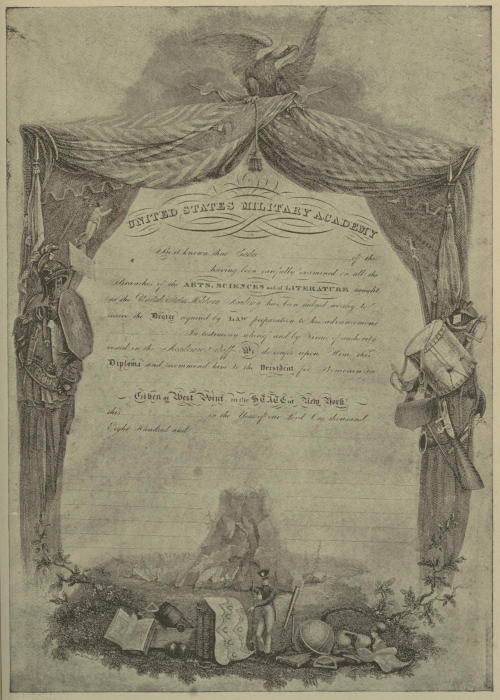
day the graduating class received their diplomas,
discarded cadet gray, put on “Cit” clothes, said
good-byes and left the Point, to return no more as
cadets. We did not know much of the graduating
class, but I now remember the names of more men
in that class than in any other at the Academy, excepting
my own. This I account for from the fact
that I was then so much impressed with the importance
of a graduate of West Point. In my eyes
he seemed to be a greater man than the Superintendent,
in fact there was no comparison.
There was a change made on graduating day
among the cadet officers. At the next drill Cadet
H⸺d appeared with pretty gold lace chevrons
on his coat. He wore them on the sleeves of his
dress coat, below the elbow, and he was proud to
have everybody know that he was a “Corporal”
now. I promptly congratulated him, and he said,
“Thank you, Mr. R⸺d,” instead of reprimanding
me for speaking without having been first spoken
to. In a few days more the new second class men
put on “Cit” clothes, and left on furlough. It
seemed strange to me that these cadets seemed
just as anxious to take off the cadet gray as the
candidates were to put it on.
Before the departure of the graduates and furloughmen
the candidates learned that there were
four trunk rooms[11] in the angle of Barracks, one
for the cadets of each company. They learned this
by carrying trunks from there to the rooms of the
graduates and furloughmen. I soon learned that
I got along the easiest by saying as little as possible
and doing about as I was told. The candidates
who talked much or who bragged on what they
knew, especially about military matters, had the
hardest time. These poor fellows were called “too
fresh,” or “rapid,” and, as the cadets expressed it,
they had to be “taken down.”
It was a common thing for old cadets to enjoy
a call upon candidates after supper and on Saturday
afternoons. And it was difficult at first for
candidates to become acquainted with one another,
as so much of their leisure (?) time was taken
up answering questions, standing on chairs, tables
and mantels, reading press notices about themselves,
singing, and in fact doing almost everything
old cadets told them to do. I have heard
many cadets when they were “plebes” or “animals,”
declare that they would not do so and so,
but they always did as they were told, and they
were quick about it, too. It is strange what control
old cadets have over “plebes.” They never laid
hands on candidates except when they yanked
them.
We soon discovered that the cadets who found
especial delight in being in the society of plebes
were generally “yearlings,” that is, those who had
themselves been plebes only the year before. But
“yearling” instructors[12] seldom deviled plebes in
their own squads.
Mail arrived every day, and was sorted over,
that for the cadets and plebes in each division was
dropped on the floor in the halls near the entrances
and the word mail called out in a loud tone of
voice. Every one expecting mail buttoned up his
coat and hastened to get such as might be for him.
Now the policemen deliver mail to the cadets in
their rooms.[13]
In a few days more the candidates were sent in
sections of about a dozen to the section for their
preliminary or entrance examination. The section
I was in was sent to a room having tables, chairs
and writing materials, and we were here examined
in writing and spelling. There was but one
officer present, and after a certain time we put our
names on and handed our papers to him whether
we had finished them or not. We were next sent
to another room, where there were about a half a
dozen members of the Academic Board, and as
many other army officers.[14] Each candidate, as his
name was called, was assigned a subject and then
sent to a blackboard. The first one called was
numbered one, the second numbered two, and so
on, until five or six candidates were sent to different
blackboards. Each was directed to write his
name and number at the upper right hand corner
of the board, to put such data or work on the board
as he wished, and when ready to recite to pick up a
pointer in his right hand and face about. While
those sent to the blackboard were getting ready
to recite, another candidate was sent to the center
of the room, facing the examiners, and then questioned
by one of them. After finishing with the
candidate on questions, No. 1 was called upon to
recite, and after he was through, another candidate
was assigned a subject and sent to the board,
and so on. Some of the candidates were self-possessed,
and made good recitations and ready answers
to questions, while others trembled all over
and lost control over themselves, their hearts got
up into their throats or went down into their boots.
The examination here was in grammar, history,
and geography. We were then sent to another
room before as many other Professors and Army
Officers for examination in arithmetic and reading.
I was satisfied with my examination up to this
time. After the assignments to the blackboards
I was called upon to read. I began to tremble,
and had much difficulty in turning to the page
designated. I read very poorly, because I could
not hold the book steady, and the words on the
page danced so that it was hard for me to catch
them. I was then told to put down the book and
was questioned in arithmetic. Professor C⸺h
asked me a number of questions, the answers to
which I knew perfectly well, yet all the answer I
could make was “I don’t know, sir.” Professor
C⸺h then talked kindly and said how important
it was to me, that I answer the questions, because
if I did not answer properly that I would be
found deficient and sent home. I then said that
the old cadets had told me he would “find” me,
and I believed he would. After having said this
I got courage to ask to be sent to the blackboard.
My request was granted, and I had no trouble in
writing answers to every question, or to solve any
problem given me, but for the life of me I could
not turn my back to the board and tell what I had
put on it; but fortunately I could point to anything
called for. The preliminary examinations
the next year were written, and they have been
written ever since, which is decidedly the best, as
some of my class were so badly frightened that
they did not know what they said, and some who
failed were graduates of good schools, or had
passed splendid competitive examinations for
their appointments. In a few days the result of
the examination was announced, and I was happy
to write home that I was one of the lucky ones to
enter West Point, and be a “new Cadet” instead of
a “Candidate.” Those of us who were fortunate
enough to pass were sent to the Commissary[15] for
“plebe-skins,” that is, rubber overcoats, caps and
white gloves, and we were measured for uniform,
clothes and shoes, and for fear perhaps that we
might get lazy another hour’s drill, from 11 a. m. to
12 m., was given us. From now on we wore caps
and white gloves at all infantry drills.
The new cadet whose name comes first in alphabetical
order is the “class-marcher” whenever the
class is called out by itself, and it is his duty to
call the roll of the class and to report absentees.
After our preliminary examination Baily became
the class-marcher, and he marched us over
to the Library, where we took the oath of allegiance.[16]
We were now assigned to Companies, the
tallest were put in A and D and the rest in
B and C Companies, but the new cadets were
still drilled by themselves in small squads, then in
larger ones, and later on all in one squad as a
company.
W⸺r of my class wore a plug hat when he reported,
and he was sorry for it many times. He
was the left file of Mr. H⸺d’s squad. One day
we were drilling on the Cavalry plain,[17] and there
were many ladies and gentlemen watching the
drill. We were marching in line at double time,
and Mr. H⸺d gave the command, “By the right
flank, march.” Three of us marched to the right,
but Mr. W⸺r went off to the left all by himself.
Everybody near laughed, even Mr. H⸺d suppressed
a grin, and then scolded the new cadets
for laughing in ranks. Mr. W⸺r chewed tobacco,
and this, too, caused him many unhappy
moments, but after having been repeatedly reprimanded
for chewing tobacco and told to spit it out
he quit the practice in ranks.
There was a young man who could not keep step,
yet he tried hard to do so. When in front he threw
everybody behind him out of step and at other
times he would walk all over the heels of the man
in front of him. I do not remember whether he
was found deficient physically or mentally, but he
was not there long. This reminds me of the
“Awkward Squad.” It was composed of those
who were particularly slow in doing what they
were told to do. Tired and sore as they were from
the frequent drills, I have seen members of the
Awkward Squad practice alone, determined to get
out of it, which, of course, they eventually did.
We studied the Blue Book, but the most of the
regulations were learned by having them beaten
into our heads by the old cadets. We did not
then have a copy of the Drill Regulations to study,
but we learned them in the same way that we
learned most of the Regulations in the Blue Book.
We were now instructed in many things besides
Squad Drill. For instance, we were informed that
we would be reported for all delinquencies, that
is, for all offenses committed against the Regulations,
that the reports would be read out daily
after parade, and be posted the next day in a certain
place; that we must go there every day to see
the list; that when there were reports against us
we must copy the exact wording of each report
and then write an explanation for it; that we must
write as many explanations as there were reports
against us, and further, that for all official communications
we must use “Uniform Paper” (i. e.,
paper of a certain size) and no other.
New cadets are taught to use as few words as
possible in their explanations. One evening at
Dress Parade, a plebe raised his hand and of course
he was reported for it, and the reason he gave in
his explanation for raising his hand in ranks was,
“Bug in ear.”
The following illustrates the character of the
reports posted against cadets, to-wit:
REPORTS.
Floor not properly swept at A. M. inspection.
Bedding not properly folded at police inspection.
Late at dinner formation.
Calling for articles of food in an unnecessarily
loud tone of voice at supper.
Gloves in clothes-press not neatly arranged at
morning inspection.
Appearing in Mathematical Section Room with
shoes not properly polished.
Inattention in Mathematical Section Room.
Shoulder belt too short at inspection.
Dust in chamber of rifle at inspection.
In dressing gown at A. M. inspection.
Shoes at side of bed not dusted at A. M. inspection.
Hair too long at weekly inspection.
Absent from formation for gymnasium at 12 M.
Orderly light in quarters after taps.
Late at reveille.
Absent from quarters 9 A. M.
Wheeling improperly by fours at drill.
Not seeing to it that a cadet who was late at
breakfast was reported.
Coat not buttoned throughout at reveille.
Cap visor dusty at guard-mounting.
The discipline is very strict, more so by far than
in the Army, but the enforcement of penalties for
reports is inflexible rather than severe. The reports
are made by Army Officers, and by certain
cadets themselves, such as file-closers and section-marchers,
and the cadets make by far the greatest
number of reports against one another, but no
cadet ever reports another except when it is his
duty to do so. If he fails to report a breach of discipline
he himself is reported for the neglect. Cadets
may write explanations for all reports against
them, but they must write an explanation for absence
from any duty or from quarters; for communicating
at blackboard in section room; for
neglect of study or duty; for disobedience of orders;
for failure to register for a bath, and for failure
to report departure or return on permit where
such report is required.
When the Commandant accepts an explanation
as satisfactory he crosses off the report, and four
days after the date of reports, for which either no
explanations or unsatisfactory ones have been received,
he forwards them to the Superintendent,
and he causes a certain number of demerits to be
entered against a cadet for each report in a book
kept for that purpose, and which the cadets may
see once a week. Any cadet receiving more than
one hundred demerits[18] in six months is dismissed
from the Academy for deficiency in discipline. The
result is that cadets invariably write explanations,
and the form now used is as follows:
West Point, N. Y., ____ __, 19__.
Sir:
With reference to the report, “Absent from
9:20 A. M. class formation,” I have the honor to
state that I did not hear the call for this formation.
I was in my room at the time. The offense was
unintentional.
Very respectfully,
John Jones,
Cadet prt. Co. “B,” 4th class.
For the first few weeks demerits are not counted
against new cadets, but to teach them how to
write them, explanations must be submitted for
all reports. Whenever a cadet is reported absent,
and he is on Cadet Limits, he is sure to write an
explanation stating this fact and anything more
he may have to say, because if he fails to do so he
is tried by Court-Martial.[19]
A “permit” is a document that grants certain
privileges to the cadet named in it. A map of
“Cadet Limits” is posted where all may see it, and
when a cadet desires to visit friends at the hotel
or at an Officer’s quarters, or go to the Dutch
Woman’s, i. e., the confectioner’s, or to the dentist’s,
he must write an official letter to the Commandant
of Cadets (or to the Adjutant of the Military
Academy, as the case may be), setting forth
what duty, if any, he wishes to be excused from,
and the exact time he wishes. This letter will be
returned with an endorsement granting all, a part
or none of his request, and the cadet must govern
himself accordingly.
From now on we had to make out a list of such
articles as we wanted or were instructed to get
from the Commissary. An account is kept by the
Treasurer with each cadet, who is credited with
his deposit, and also with his pay,[20] and he is
charged for everything furnished him, such as
board, washing, wearing apparel, bedding, books,
gas, policing barracks, polishing shoes, etc. At
his option a cadet is also charged for boats, hops,
etc., and when out of debt with such luxuries as
new clothes, hop gloves, hop shoes, or $2.00
per month for confectioneries at the “Dutch
Woman’s.”
As time wore away we felt less fatigue from
drill, and found more pleasure in life, and letters
borne were quite cheerful.
Note 1. At present the new 5th classman is received by cadet
officers under the immediate supervision of an officer of the Tactical
Department and his reception is strictly in accordance with
the requirements of military discipline and courtesy. The discipline
is, of course, of the strictest and is rigidly enforced, but
the life of the newcomer is so hedged about by orders and is so
carefully guarded by those who have him in charge, that it is
doubtful if a young man entering any school or college in the
country would be subjected to less annoyance or embarrassment
than would fall to his lot at the Military Academy.
Note 2. At present each table seats 10 cadets, and the cadets
are about equally divided among the different classes. One first
classman sits at the head of each table; he is officially designated
“The Commandant of Table,” and is responsible for order at his
table.
Note 3. The mail is now received and distributed by company
in the Cadet Guard House, and at a signal on the trumpet a cadet
private from each division of barracks, detailed for a week at a
time, reports at the Guard House, gets the mail for his division,
and distributes it to the proper rooms.
Note 4. In addition to demerits cadets receive other punishments
for certain classes of offenses; these consist of confinement
to room during release from quarters for a certain number of
days, or, of walking (equipped as a sentinel) for a certain number
of hours on certain days in the area of barracks.
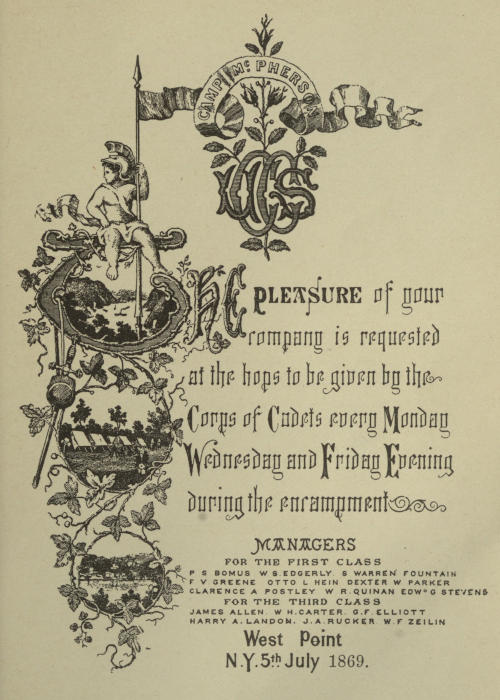
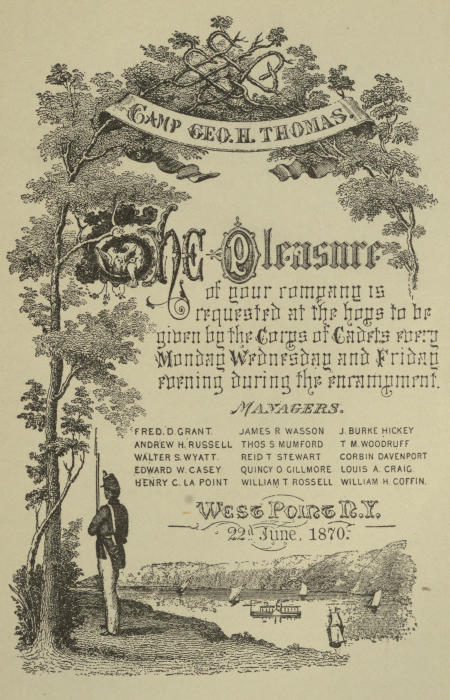
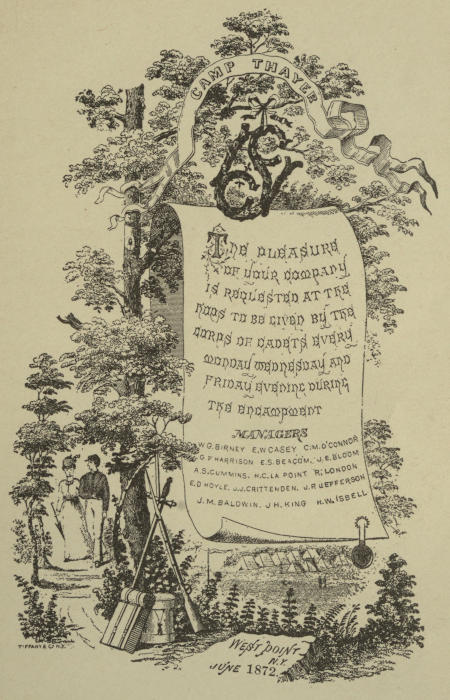
CAMP McPHERSON
The Pleasure of your
company is requested
at the hops to be given by the
Corps of Cadets every Monday
Wednesday and Friday Evening
during the encampment
MANAGERS
FOR THE FIRST CLASS
P. S. BOMUS. W. S. EDGERLY. S. WARREN FOUNTAIN.
F. V. GREENE. OTTO L. HEIN. DEXTER W. PARKER.
CLARENCE A. POSTLEY. W. R. QUINAN. EDWD G. STEVENS.
FOR THE THIRD CLASS
JAMES ALLEN. W H. CARTER. G. F. ELLIOTT.
HARRY A. LANDON. J. A. RUCKER. W. F. ZEILIN.
West Point
N.Y. 5th July 1869.
CHAPTER IV. THE PLEBE IN CAMP.
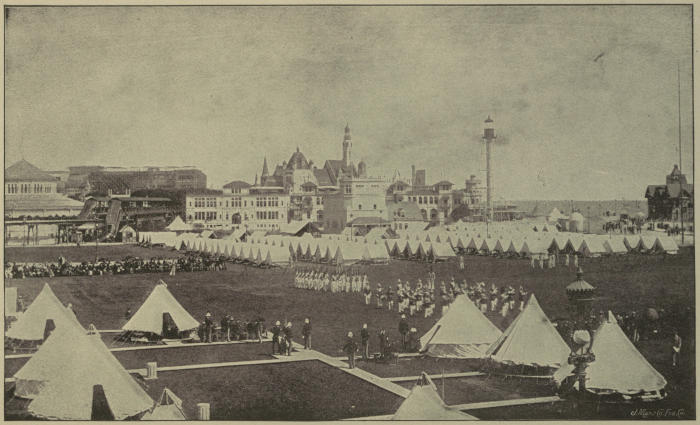
About two weeks after I reported we were directed
to prepare to go to Camp McPherson,
a half mile or so from Barracks, out beyond
the Cavalry plain, near old Fort Clinton. We
were told just what articles to take for use
in camp, and that we must put the balance
of our effects in our trunks and carry them
to the trunk rooms in the angle. We sorted
out our camp articles, and each cadet
made a bundle of his small things, and used a comforter
or a blanket to hold them. D⸺n, M⸺s,
and I, having arranged to tent together, we helped
one another store away our trunks. When the
call sounded to “fall in” we fell in with our bundles,
brooms and buckets, and marched over to
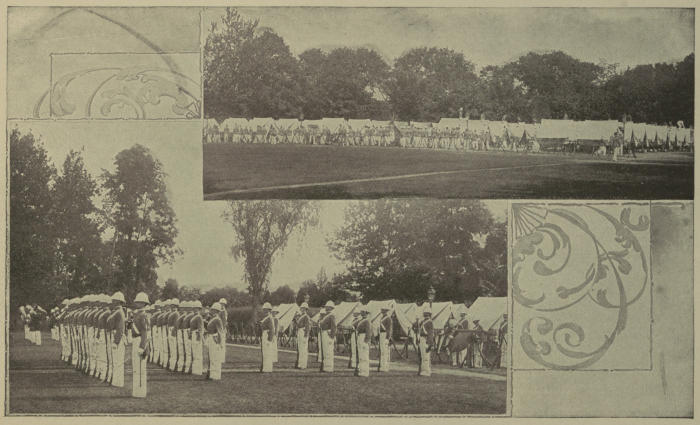
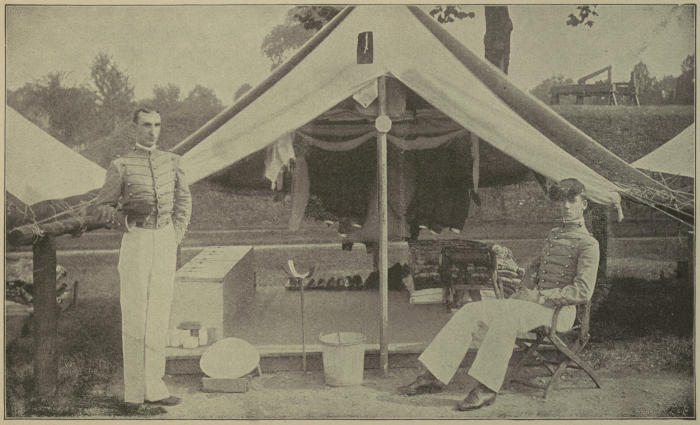
the camp. There were trees all around the camp
site, with quite a grove at the guard tents. The
tents were all pitched and they looked very pretty
through the trees, with the trees and green parapet
of Fort Clinton as a background, which could
be seen over the tops of the white tents as we approached
the camp. The tent cords were not fastened
to pegs in the ground, but to pegs in cross-pieces
supported upon posts about four feet
high, which brought the Company tents only
four or five feet apart. All of the tents
for cadets were wall tents, and each had
a “fly” on it. There was a wooden floor,
a gun rack, and a keyless locker (that is, a
four-compartment long box), and a swinging pole
hung about eighteen inches below the ridge pole of
the tent, and nothing else in it. After the assignment,
which, of course, was made according to
rank, we proceeded to our respective tents, that
were to be our homes till the 29th of August, the
day to return to Barracks.
The “Yearlings” and first classmen, too, began
to take a greater interest in the plebes than ever.
They were anxious to teach them how to fix up
their tents, and this is the way they did: “Come
here, Plebe, and I’ll show you how to fix up your
tent. Untie those bundles, fold the blankets once
one way then once the other way; that’s it. Now
pile them in the rear corner over there, farthest
from the locker; put the folded edges to the front
and inside; that’s not right, turn them the other
way; now that’s right. Lay the pillows on the
blankets, closed ends toward the locker; that’s it;
now fold the comforters just like you folded the
blankets, and pile them the same way on top of the
pillows; that’s it. Why, you’re an old soldier,
ain’t you? Straighten the pile a little, so that the
edges are vertical; that’s it. Now hang the mirror
up there on the front pole; that’s it. Put the
washbowl out there against the platform, bottom
outward; that’s it. Put the candle-box behind the
rear tent pole. Put the white pants, underclothes,
etc., in the locker. Throw the overcoats, gray
pants, etc., on the pole. There, that’ll do. Say,
wait a minute. When you go after water, why I
want some; just set the bucket down there by the
washbowl when you come back.” After having
been given several lessons the plebes were permitted
to fix up their own tents, and in a very
short time every tent was ship-shape. The yearlings
kindly showed the plebes how to clean rifles,
too, and this is the way they did it: “Come here,
Plebe, you’ll soon be getting your guns, so I’ll
teach you how to clean yours; just get that gun
over there in my rack; that’s the one; get the
cleaning materials in the candle-box, take out a
rag, put oil on it; that’s it. Lay the gun in your
lap, muzzle to the left, half-cock the piece, open
the chamber. Why, you’re doing well. See the
rust in the breech block? Well, get a small stick
out of the candle-box, put a bit of the rag over it,
pour a little oil on the rag, now be quick, rub it on
the rusty place, rub hard, elbow grease is what
counts most, so don’t be afraid to use plenty of it,”
and so on, till the yearling’s gun showed an improvement.
“I’ll call you again soon to give you
another lesson; that’ll do now.” Strange as it may
appear, even the first classmen condescended to
teach us some things, and even the cadet officers
showed us how to clean their breast plates. The
old cadets never told us, in so many words, to do
anything of a menial character, but their broad
hints and insinuating ways were very persuasive.
Every day the plebes were called to the tents of the
Army Officers in charge of cadet companies, and
asked if they had any complaints to make against
upper classmen, and the plebes invariably answered
“No, sir.”
We continued to take our meals in the Mess
Hall, and we marched to and fro as usual, but as
the distance was a half mile or more we were now
cheered en route (notwithstanding the plebes still
carried palms to the front) by the inspiring music
of fifes and drums; and we now sat at tables with
the old cadets, and had the pleasure of pouring
water for them before helping ourselves, no matter
how thirsty we might be, but such is the life of a
plebe, and it is a necessary part of his training.
The first day in camp we were initiated in police
duty; the other classmen turned out with us, and,
as usual, they did the talking and we did the work.
The detail from each company had a wheelbarrow,
a shovel, and a broom. The grounds, to us
plebes, seemed clean when we began, but we got
half a wheelbarrow load of dirt all the same, which
we dumped into “police hollow,”[21] near camp and
just west of Fort Clinton. We gathered up burnt
matches, cigar stumps, tobacco quids, bits of
paper, etc. Whenever there was a sign of rain we
turned out and loosened tent cords, and after a
rain we turned out and tightened them—always
by command, of course. We dreaded the nights
in camp, but we were not yanked often, unless we
got too fresh or rapid, and then, of course, we had
to be taken down.[22]
The parade ground was changed during camp
from the grassy plain in front of Professor’s Row
to the space between the guard tents and the west
line of company tents. In fair weather the battalion
stacked arms on the camp parade ground,
and the colors were furled and laid on the center
stack. The arms and colors, that is, the United
States flag, were left there from after guard mount
till 4 p. m., and a sentinel posted to require everybody
crossing his post, which is known as the
“Color Line,” to salute the colors by lifting the cap.
We plebes were very anxious to get guns, but
after we did get them we wished we did not have
them, for we were again put into small squads and
drilled three times a day, notwithstanding the fact
that our right arms were very sore, and each rifle
seemed to weigh a ton, and, again, we had to spend
several hours a day, for weeks, cleaning the guns
before they would pass inspection. Each cadet
knows his own gun by the number on it. The
upper classmen had already taught us how to
clean their guns, so we knew something about
cleaning our own, and they now were considerate
enough to allow us more time to ourselves, and
some of the plebes finished cleaning their guns in
less than an hour’s time. But, alas! at the first
drill with arms the cadet instructors told them
that their guns, cartridge boxes, and waist plates
were very dirty. After drill we set to work on
them again, but still they were said to be dirty.
In the course of time we were told that our guns
were passable, and later on that they were in fair
condition. We soon learned to attend to them
immediately after a rain, as it was easier to clean
them then than after they had stood awhile.
We were kept busy at first complying with requests
(?) of upper classmen, but they were very
considerate and dispensed with our services long
enough to let us attend drills three times a day,
police service twice a day, and to other military
duties. We were still required, both in and out of
ranks, to carry palms of the hands to the front, but
nothing more was said about depressing the toes.
Cadets are encouraged to be patriotic, and they
always celebrate Fourth of July. This year, as
the Fourth fell on Sunday, the exercises were held
on the next day.
Note 1. At my time hazing, or deviling, consisted of little
more than harmless badgering, which had the effect of reducing
a possibly conceited or bumptuous youth to a frame of mind more
consistent with the requirements of military discipline. In time,
however, it developed into practices which it was deemed advisable
to discontinue, and hazing has entirely disappeared from
the Academy.
UNITED STATES MILITARY ACADEMY.
July 5th, 1869.
President,
Cadet E. E. Wood
Pennsylvania
Marshal of the Day,
Cadet J. Rockwell
New York
PROGRAMME.
Overture.
Prayer.
Music.
Reading of the Declaration of Independence,
Cadet E. M. Cobb
California
Music.
Oration,
Cadet E. S. Chapin
Iowa
Music.
Benediction.
Music.
Plebe life was very trying, especially on H⸺e
of my class, and he, being something of a poet, reduced
his thoughts to writing, which he showed
to his classmates. They said that he had expressed
the situation very well, indeed. Some of
the yearlings heard of H⸺e’s poetry, so he was
persuaded (?) to read it to them, and then to sing
it. His poetry was so well received by the yearlings
that the first classmen wanted to hear it, too,
so at their invitation (?) H⸺e both read and
sang it for them. And, at the request of a number
of upper classmen, he made copies of his songs
for them. Other plebes were requested (?) to make
copies of the copies, and the following are copies
of H⸺e’s copies that were made for me by a
plebe in my yearling camp, viz.:
THE BIG MENAGERIE.
Attention, all ye forlorn Plebes,
While the story I relate,
Of how I came to fall into
My present lost estate.
A moment only dry your tears
And listen unto me,
And I’ll describe my experience
In this big menagerie.
The first day that I reported
My heart was full of joy,
And to all intents and purposes,
I was a bully boy.
A stunner in my native town,
I thought I’d easily
Upon my muscle go right through
This big menagerie.
But, ah! full soon that fatal day
My crest began to fall,
And my spirits came down mighty fast
When I got to the Mess Hall.
My folly and my sauciness,
They soon took out of me,
And made me sing a different tune,
In this big menagerie.
They put me up in the window,
Attention made me stand.
And I had to dance and sing and speak
At everyone’s command.
I tried to run, but soon found out
That my rapidity
Was not the kind of game to play,
In this big menagerie.
The first time that I went on guard,
The night was dark as pitch,
They took my gun and then yanked me
Right in Fort Clinton’s ditch.
The Corporal I called aloud,
But not a step came he,
And then I learned another dodge
In this big menagerie.
But after all I’d been through,
They said I was not tame,
And that they would complete the cure,
By giving me another name.
They called me for some gay old cuss,
Who’d been dead a century,
And now I’m known as De la Rive,
In this big menagerie.
All day I police, scrub and drill,
Till my troubles make me weep,
And when the day, is over,
I’m denied the boon of sleep,
But all the night lie trembling,
From Taps to Reveille,
For fear I really will be yanked
In this big menagerie.
My frolics, joys and amusements,
Are all knocked into smash,
And pleasures all concentrated are
In eating Mess Hall hash.
And should I meet a lady fair,
I dare not speak to she,
That would be too fast for a Plebe,
In this big menagerie.
They call me beast and vile reptile,
And goodness only knows,
I’d rather be a kangaroo,
In one of those circus shows,
For all the real animals
Are happier far than we,
For they don’t have any squad drill
In their menagerie.
The lions, tigers, bears and wolves
Can never feel our woes,
For whoever heard of an elephant
Depressing his great toes.
And even the little monkeys
Are happy, gay and free,
And carry their hands just as they please
In their menagerie.
But soon this camp will end, and then
My troubles will be o’er,
I’ll drop the beast from off my name,
And sing this song no more.
But where’er I roam in years to come,
On land or on the sea,
I’ll ne’er forget my sufferings
In this big menagerie.
A PLEBE’S LAMENTATION.
Oh, Lord, will I never get done
A rubbing on this rusty gun.
Chorus—
I wish I was at home,
I wish I was there, too.
It makes me sigh, it makes me fret,
To clean this rusty bayonet.
Chorus—
And all day long, in rain or shine,
We’ve got these darned old tents to line.
Chorus—
There were a good many more verses to this
song, and songs written by others of my class, but
I have forgotten them.
Uniforms were issued to the plebes as fast as
they were made, and in a few weeks all were uniformed.
The only pocket in the whole suit was a
watch pocket in the pants. We were permitted to
carry a watch, but not a chain. Our handkerchiefs
were tucked in the breasts of our coats.
After getting uniforms we were sent to the trunk
rooms to put away our cit clothes, as we were
not allowed to keep them in either our tent or barrack
room. In a few weeks the plebes were admitted
to the battalion, at first to march to and
from meals, and then for parades, but they still
had to carry disengaged hands, palms to the front.
After supper we were permitted to bathe in the
Hudson at Gee’s Point, and many of us availed
ourselves of the privilege. As I have said, soon
after reporting, I wondered if the old cadets laced.
Well, now, when bathing, I discovered they did
not lace. Still, I wondered why old cadets’ waists
were so much smaller than plebes’ waists.
Every day, especially during guard-mount, parades,
and band practice, there used to be many
ladies and other visitors under the trees near the
guard tents. The upper classmen seemed to enjoy
being with them, but the plebes were seldom
wanted there. The plebes used to hear that there
were hops three times a week during camp, but
that is about all they knew of hops. However,
they went to the old fencing room in the Academic
Building and took dancing lessons, and as no
ladies were admitted they danced with one another.
At last the time arrived for us to go on guard,
for there was a chain of cadet sentinels all around
the camp. We dreaded our first night on post,
but each plebe had to experience it. Our guns
were not loaded, and we had no cartridges; the
rifle with the bayonet on is all we had to protect
ourselves with. It was amusing afterwards to
compare notes of our experiences. Some who had
boasted most fared the worst. Some had had
their rifles taken away, some had been tied to a
tree, some rolled down into Fort Clinton ditch[23]
alongside of Posts No. 2 and No. 3. Others had
been frightened by ghosts, or confused by numerous
parties approaching at the same time from
different directions. Some replies to the challenge
being a band of Indians, a body of armed
troops, and the Prince of Wales. Of course, the
plebe would call for the corporal of the guard, but
this official never got around in time to see anyone,
except the sentinel. The poor plebe was then taken
to task for allowing himself to be disarmed, or for
not detaining parties till the corporal arrived.
When questioned as to who the parties were the
answer invariably was “I could not recognize any
of them.” When the old guard marched off the
next morning each member fired three shots at a
target.[24] When it came M⸺s’ time to fire he was
badly frightened because he had never fired a gun.
And when asked why he did not close his left eye
when aiming he said that no one had told him to
close it.
On the 12th of August we again visited the
trunk rooms, and this time to put away our
dress coats, white pants, dress hats, etc., as we
were to go on a campaign. A knapsack and a half
of a shelter tent were issued to each cadet. After
packing our knapsacks and getting everything, except
our wall tents, in readiness, we fell in at the
sound of the drum. Our wall tents were left
standing with the walls fastened down and the
flaps tied in front. To the time of “The Girl I Left
Behind Me” we marched in a drenching rain about
a dozen miles westward up into the mountains;
halted, stacked arms, unslung knapsacks, and unloaded
the big six-mule wagons that had followed
us. We then pitched the “A” tents that were provided
for our use now; we then dug a trench
around each tent, and so as not to lie in the mud
we cut boughs to sleep on. We then got our rifles
and knapsacks, and were soon at home again, but
this time in more contracted quarters. We were
now taught to live at Camp Lookout in regular
army style, and as there is no delinquency book in
the army we had none in this camp. We ate army
rations and slept on the ground. We built camp
fires, sang songs, and otherwise enjoyed our freedom,
for no one said anything about palms to the
front out there in the mountains. The camp was
in the woods, between Long Pond and Round
Pond. We obtained drinking water from one, and
utilized the other to wash and to bathe in. We
remained out there about ten days, and each cadet
learned to do guard duty in the woods. Members
of the guard had to cut poles for their shelter tents,
and button two or more pieces together for use at
night, and they were needed, too, as it rained more
than half the time we were in the mountains. Between
rains, when not on duty, we roamed through
the woods and over the hills. There were many
laurel bushes all about us, and one day a first
classman said that he wanted a nice root to make
a pipe, and that I could get it with a hatchet and
spade. I took the hint and dug about half a dozen
good roots. I put the two best ones in the breast
of my gray jacket and gave the others to the first
classmen. I afterwards made myself two fine pipes,
and I have one of them now. Years afterwards
that first classman and I met, and the first thing
I did was to show him my pet pipe and thank him
for it. He admired the pipe and my cheek, too,
for having kept the best root.
As soon as we returned to Camp McPherson
palms of the hands were turned to the front again
and the usual routine there resumed.
Some of the yearlings said that certain of the
plebes had become “too fresh” out in the mountains,
and as the ordinary methods would not tame
them down a few fights in Fort Clinton were
necessary. Seconds were chosen, and soon nearly
every cadet in camp knew that there would be a
fight in Fort Clinton on a certain day during the
supper hour. Fort Clinton is just across Posts
Nos. 2 and 3. Those who desired to witness a
fight assembled at the ice water tank, near which
the Posts of Nos. 2 and 3 meet. Then when the
two sentinels on these posts were far apart and
their backs toward one another (which is against
the rule) across the posts would dash the Fort
Clinton party, and strange to say neither sentinel
would see any unauthorized person or persons
cross his post. When the referee calls time the
principals and seconds are in place and the fight
begins. Fists only are used in these fights, and as
soon as either side calls enough, or either principal
fails to come to time, the fight is over. All return to
camp, the bruises are bathed, and if necessary one
or both principals go to the hospital, and the sick
report the next morning shows one or two names
with “contusions” as the cause of the disability.
Unless the army officers on duty at the Point have
“official knowledge” of a cadet fight no notice is
taken of it. When a dispute arises that only a
fight will settle and the parties to the dispute are
unevenly matched the result may be one or two
fights. The offending cadet must fight, and a
classmate of the other cadet about his size and
strength is selected to do battle with him. Sometimes
the offended cadet must fight a man of his
size, and then there are two fights.
I. O. C. B.
The pleasure of your company is respectfully solicited at
a Hop Extraordinary, to be given on the evening of July 29th,
under the auspices of the “Confirmed Bachelors” of the Class
of 18—.
F. G. SCHWATKA,
JAS. E. SHORTELLE,
U. G. WHITE,
Managers.
West Point, July 28, 1869.
We plebes were sent to the river a number of
times to assist the first classmen to build pontoon
bridges, and we rendered very valuable assistance,
too, by carrying all heavy timbers used and helping
to get the boats in place for the timbers to be
laid upon them.
Note 1. Fort Clinton ditch, then along the north side of the
camp ground, was filled up and that part of the parapet removed
long ago, the major part of this fort being now used for an
extension of the camp.
RETURN OF THE FURLOUGH CLASS.
There’s a stir in Camp, as all observers may see,
’Tis a moment of interest, a moment of glee.
The “Furloughs” are coming, and now must be near;
There is dust, there is shouting, the “Furloughs” are here.
We welcome you back to the Camp and the plain,
There your favorite “Tac” will drill you again.
The 28th of August is a day every graduate remembers,
for it is then the furloughmen return.
I can see them now rushing[25] into camp. That
evening there was a great time out on the color
line; we plebes were turned out for the last time
to amuse upper classmen. H⸺e and others
sang their songs. Some of them had been sung so
often that everybody knew them and joined in.
The evening was a perfect one, and there were
many ladies under the trees near the guard tents,
who heaved a sigh to think that all gayeties were
over at West Point until the next June. The following
are some of the songs that were so often
sung during my cadet days, to-wit:
Old Black Joe,
Dixie,
Marching Through Georgia,
Tramp, Tramp, Tramp,
Hail Columbia,
Star Spangled Banner,
My Country,
Annie Laurie,
Red, White and Blue,
Home, Sweet Home,
Suanee River,
Auld Lang Syne.
ARMY BLUE.
We’ve not much longer here to stay,
For in a year or two
We’ll bid farewell to “Cadet Gray,”
And don the “Army Blue.”
Chorus—
Army Blue, Army Blue,
We’ll don the Army Blue,
We’ll bid farewell to Cadet Gray,
And don the Army Blue.
To the ladies who come up in June,
We’ll bid a fond adieu,
And hoping they’ll be married soon,
We’ll don the Army Blue.
Chorus—
Now here’s to the man who wins “the cup,”
May he be kind and true,
And may he bring “our godson” up
To don the Army Blue.
Chorus—
BENNY HAVENS, OH!
Come, fill your glasses, fellows, and stand up in a row,
To singing sentimentally, we’re going for to go;
In the Army there’s sobriety, promotion’s very slow,
So we’ll sing our reminiscences of Benny Havens, Oh!
Oh! Benny Havens, Oh! Oh! Benny Havens, Oh!
So we’ll sing our reminiscences of Benny Havens, Oh!
Let us remember, comrades, when to our posts we go,
The ties that must be cut in twain, as o’er life’s sea we row,
Hearts that now throb in unison must moulder down below,
So let us take a parting cup at Benny Havens, Oh!
Oh! Benny Havens, Oh! etc.
To our kind old Alma Mater, our rock-bound Highland home,
We’ll cast back many a fond regret, as o’er life’s sea we roam,
Until our last battle-field the lights of heaven shall glow,
We’ll never fail to drink to her and Benny Havens, Oh!
Oh! Benny Havens, Oh! etc.
May the army be augmented, promotion be less slow,
May our Country, in her hour of need, be ready for the foe,
May we find a soldier’s resting-place beneath a soldier’s blow,
With space enough beside our graves for Benny Havens, Oh!
Oh! Benny Havens, Oh! etc.
Come, fill up to our Generals, God bless the brave heroes,
They’re an honor to their country, and a terror to her foes;
May they long rest on their laurels and trouble never know,
But live to see a thousand years, at Benny Havens, Oh!
Oh! Benny Havens, Oh! etc.
When you and I and Benny, and all the others, too,
Are called before the final board our course of life to view,
May we never “fess” on any point, but coldly “max” it through,
And join the Army of the blest, at Benny Havens, Oh!
Oh! Benny Havens, Oh! etc.
Note.—The following verses are from the 1909 Howitzer:
Then here’s to you, old glory team, that downs the strongest foes.
Your Benny Haven’s strongest sons, in you our hopes repose,
On the mountains by old Hudson’s shore, your deeds have been our theme;
But, victors or defeated men, you’re still the army team.
The brave old army team, the loyal army team,
The army’s hearts, the army’s hopes, are with the army team.
When you meet the rovers of the sea, and struggle hand to hand,
Remember, in that hour supreme we all behind you stand—
Let black recall our past defeats, the present struggle gray,
But victory is brightest gold, that you shall win that day.
The black, and gray, and gold, the black, and gold, and gray,
Yea! Victory shall be the prize, the black, and gold, and gray.
On the world’s rough-trampled gridiron, the battle-field of life,
Your spirit brave, old rock-bound home, shall nerve us in the strife.
Before us gleams the future, with manly parts to play,
While from the dim past stretches the unbroken line of gray.
Oh! the dear old gray battalion, the loyal line of gray,
Friend close to friend, firm to the end, shall stand the line of gray.
CHAPTER V. THE PLEBE IN BARRACKS.
The next morning we took our bundles, buckets,
and brooms to barracks, and upon returning
to camp we unfastened the tent
cords and held up the canvas by the poles, and, at
the tap of the drum at 12 o’clock, every tent was
lowered to the ground, and “Camp McPherson”
was no more. We then “fell in,” and to the tune
of “The Girl I Left Behind Me” marched to barracks,
leaving the summer visitors standing under
the trees near where the guard tents had been.
There were rooms enough so that every two
cadets could have one together. Roommates having
been chosen and rooms selected (according to
rank, of course,) each cadet went to his own room,
and there he found two single iron bedsteads and
a double clothes-press. The old cadets got the
balance of their effects (such as cadets are permitted
to have in their rooms) from the trunk
rooms, while the plebes got the articles they had
there, and the balance, such as mattresses and
tables, they went to the Commissary for, and carried
them across the plain. Every one obtained
at the Commissary the text-books he needed before
Christmas, and by night all rooms were in order.
The return to barracks is a great day for
plebes, for then they quit carrying palms to the
front.
The “Seps” arrived about this time, and those
who were admitted were assigned to rooms, and
they at once became a part of the fourth class.
“Seps” are candidates, who, for some good reason,
did not report in June. (See appendix.) They
began recitations with the rest of the plebes, but
for weeks they attended drill in squads by themselves.
Notwithstanding the fact that Seps escape
the many trials and tribulations of plebe camp, in
escaping it, they miss one of the most valuable
parts of cadet life, as it is an experience which
most old graduates look back upon with pleasure.
After having been through the course of deviling,[26]
or hazing, as practiced in my day, I am a
believer in the system, because I believe it makes
young men manly and self-reliant. I never saw
bodily injury inflicted upon a plebe, but I do not
call bodily injury deviling. I call that cruelty, and
cruelty should be severely punished. But times
have changed at the Academy since I left it. Now
after candidates have reported at the Adjutant’s
office they are sent to the Army Officer in charge
of new cadets. And it is his duty to personally
instruct them respecting their rights and duties
in their relations to old cadets and to the cadets
on duty over them. He causes to be read to them
the present regulations pertaining to new cadets
and explains to them what is meant by “Cadet
Limits.” Candidates are also informed that they
must not submit to hazing, and that they must
promptly report to the Commandant or to the
Army Officer over them any attempt at hazing on
the part of old cadets. But they must be respectful
to all and perfectly subordinate and obedient
to the cadets on duty over them.
No more shall Plebes be deviled,
And yearlings can’t be seen,
For there’s now a law against
Hazing the Plebes so green.
The penalties for hazing are very severe, and
several cadets have been dismissed from the Academy
for engaging in it. A recent act of Congress
says: “Any cadet dismissed for hazing shall not
be eligible to reappointment.”
White pants were very pretty for camp, but now
that the hops were over and the visitors gone the
cadets had to work, so on the first of September
they appeared in their gray working clothes.
The daily routine from September 1st to about
June 20th is as follows: Reveille at 5:45 A. M.
(on Sunday at 6:30); roll call; police call five minutes
after reveille; sick call fifteen minutes after
reveille; then clean arms or study or take physical
exercise; breakfast at 6:15; recreation except
for the guard,[27] which is mounted, at 7:15; then
study and recitations from 8:00 A. M. to 1:00 P. M.;
dinner at 1:00; recreation; then study and recitations
from 2:00 to 4:00; then generally military
exercises for about an hour; then about half hour
recreation, followed by retreat parade at about
6:00; supper; recreation; then study from about
7:30 to 9:30; taps at 10:00; then lights out till
reveille the next morning. Rooms are inspected at
police call; between 8 and 11 a. m.; 11 a. m. and
1 p. m.; 2 and 4; four times between 7:30 and
9:30; again at taps, and once more between taps
and reveille. In September and May there are
Infantry drills; in October and April there are
Artillery drills; in every month from September
first to June first there are Cavalry drills; from
December first to April first there is exercise in
the gymnasium or in dancing. Saturday afternoon
is for recreation except between 2 and 2:30 during
the weekly inspection of the battalion. On
Wednesday after 4 p. m. there are no drills, the
time being given for recreation. On Sundays there
are no recitations and no military duties, except
guard and inspection of quarters at 9:45 a. m.,
and the time for recreation is a little longer than
usual; the cadets march to and from church; all
wear white gloves, white belts and those entitled
to do so swords, which (swords excepted) are not
removed during service, some of the cadets are
members of the choir. Visiting between cadets
is allowed only during recreation hours.
The gymnasium is open to cadets daily, except
Sundays, from 1:30 to 2 p. m.; 4:00 to supper mess
parade, and on Saturdays afternoons and evenings
until tattoo.
We were arranged into sections of from eight
to ten cadets to the section, the arrangement of
upper classmen being made according to class
standing,[28] as determined at the last examination,
while the arrangement of the plebes was alphabetical.
The first cadet in each section was the
section-marcher, that is, he marched the section to
and from the section room. The section-marchers
were notified what the first lessons would be, and
the hours for recitations, and they then notified
the members of their sections. The studies[29] for
the fourth class were Mathematics and French, and
in addition to these we had instruction in Fencing,[30]
and for this the sections were larger than
as stated above. One half the class attended recitations
or fencing at a time, and the other half
had to be in their rooms during Call to Quarters.
To let the Inspectors know when cadets are at
recitations the following form is used:
HOURS OF RECITATION.
Cadet __________________________ 4th Class.
Mathematics
From
8
A. M.
to
9:30
A. M.
Use of the sword, etc.
From
12
M.
to
1
P. M.
Modern Languages
From
3
P. M.
to
4
P. M.
Each cadet obtained a blank form (and there is
a special form for each class), put his name on it in
block letters, filled in his hours of recitation and put
it on the mantel, and he also put his name in block
letters over his alcove, on the orderly board, on
his clothes-press, and on his gun-rack. Every
cadet not in his room at inspection, and not at
recitation at the time, was reported absent, unless
his room-mate was in and could properly account
for the absence. We at first thought that our
studies, being so few, would be easy, but when we
saw the great long lessons and had experienced
the thoroughness required at recitations, we
changed our opinions, and decided that much hard
study was necessary.
Promptly at eight o’clock on the morning of
September first, the bugle was sounded for sections
to form. One half of each class “fell in.” The
Cadet Officer of the Day commanded—“Front, Call
your rolls.” Line was formed in the area of barracks,
first classmen were nearest the Academic
Building, next to them were sections of the second
class, next third classmen and then the plebes.
Each section-marcher facing his section, called his
roll and faced to the front, then beginning with
the ranking section of the first class, the section-marchers
reported. The Officer of the Day
then commanded “March off your sections.” If
there were any absentees not excused, he hunted
them up and sent them to their section rooms. The
sections marched to the Academic Building, and
each went to the room previously assigned, the
members of each section hung their caps in the
hall on hooks near the door and then filed into the
room. The section-marcher took post near the
center of the room, facing the instructor, who
was seated on the platform opposite to the door.
The members of the section went one half to the
right, and the other half to the left, in front of
two benches. The section-marcher saluted and reported,
“All are present, Sir,” or, “Mr. ⸺ is
absent, sir,” the instructor returned the salute and
then the cadets sat down, the section-marcher
taking seat on the right of the first half of his
section. On a blackboard behind the instructor,
was written the lesson for the next day, and each
cadet noted it. The instructor then called Mr.
⸺, who took post in the center of the room
facing the instructor. The instructor assigned to
him a topic in the lesson, care being required on
the part of the cadet to understand the topic which
is called his “enunciation.” When he understood
it, he went to a certain blackboard, and in the
upper right hand corner wrote his name and number
thus—Brown 1. The instructor called up another
cadet who, after understanding his enunciation,
went to the next board, and wrote his name
and number, thus—Smith 2, and so on. Topics
in the lesson of the day were assigned to the first
four, and topics in the lesson of the day before were
assigned to three or four others. Then one was
called who took post in the center of the room,
and the instructor questioned him for ten minutes
or more upon such parts of either lesson that he
elected, and when through said “That’ll do,” when
this cadet returned to his seat. The cadets at the
boards wrote on them such work as they wished
pertaining to their own subjects and when ready
to recite, each took a pointer in his right hand and
stood at ease facing the instructor. Beginning
with the cadet who was ready and had the smallest
number, when he was called upon to recite
the cadet, said: “I am required to” and then gave
his enunciation, after which he proceeded in his
own words. If the instructor was satisfied with
the recitation, he said, “that’ll do” and the cadet
faced about, laid down his pointer, cleaned his
board, and took his seat; but if the instructor
was not satisfied with the recitation, he asked
such questions as he deemed proper to draw out, if
possible, further information on the subject, and
when through, said, “That’ll do.” This drawing
out process is necessary with plebes, until they
learn what is required of them in the way of recitations.
No communication between cadets is
allowed in the section room. When the time expired
the instructor said, “That’ll do, gentlemen;
section’s dismissed.” If the bugle was sounded
before all had recited, those at the board who
were ready to recite and had all necessary work
on the board, were marked the same as if they
had recited. The cadets filed out of the room, got
their caps and “fell in,” then marched to the area
where the line was formed and there the section
was dismissed. The mark for a perfect recitation
is a 3, 2.5 is a good mark, 2 is fair, 1.5 is medium,
1 poor, .5 very poor, and a zero a complete failure.
Recitations go on every day except Saturday afternoons
and Sundays. On Monday the marks of the
previous week were posted so that the cadets could
see them. The instructor never told the cadets
what marks he gave them, and he could not excuse
a cadet from recitation. A cadet who was
sick enough to require it was taken into the hospital,
or by the surgeon excused from reciting, but a
cadet excused from reciting had to go to and remain
in the section room, and there report to the
instructor that he was excused. Nothing is gained
by not reciting, because every cadet must make
satisfactory recitations and pass the examinations[31]
in January and June or be found deficient.
At the end of the fifth or sixth week, and at times
after that, transfers from one section to another
were made, and some cadets were sent up and
others down to other sections. By Christmas,
the plebe class was pretty well dissipated by
transfers.
Days, weeks and months passed with a firm,
steady grind. In my day up at 5, but now 5:45
a. m., and nothing but study, recitations and drill
till 9:30 p. m., except during the short half hour
for recreation after each meal, the welcome half
holiday on Saturdays and the change of routine on
Sundays. No visitors at the Point, no hops, no
nothing but hard study and drill to look forward
to until the next June. It is true that Thanksgiving,
Christmas and New Year’s are always acceptable
days to a cadet, but he generally eats so much
turkey then, that he receives a poor mark at recitations
the next day.
Not long before examination the instructor selects
as many topics as there are cadets in his
section and writes each topic on a separate piece
of paper, turns them face down, mixes them, and
then numbers them; number one being for the first
cadet in the section, number two for the second,
and so on, or otherwise mixes them so that no partiality
be shown on examination.
Of course we could not study all of the time set
apart for study, so we often devised ways and
means to lighten our burdens.
All of our coats buttoned up to the chin and the
white collars of my day were made so that we had
to fold them lengthwise and pin them on the
coat. As white shirts were not used to fasten the
collar to we quit wearing them, and pinned our
cuffs to the inside of the coat sleeves. We got the
knack of dressing down to a fine point, no cadet
wore suspenders then, so all we had to do for
reveille or tattoo, was to jump into our pants,
stick our feet into our oldest shoes, from which
the strings had been removed, and called “reveilles,”
put on the coat and cap to be worn and hustle,
buttoning up just before going out of the hall-door.
Two minutes gave us ample time to get from our
rooms to the line in the area. Now the cadets are
required to wear white shirts and the style of the
white collar[32] having been changed it requires a
white shirt to fasten it to.
A cadet generally carries his lead pencil stuck
into his coat near the throat, but I made a little
pocket on the underside of the tail of my dress-coat,
just big enough for a little pen knife and a
pencil an inch and a half long, and I never got
“skinned” for it either. In my day, the last section
was called “the Immortals” but I am told that the
“Goats” have captured the name I once knew so
well.
For many years, “Old Bentz” blew the bugle
calls for recitations and mid rain or snow, he
never missed a call, he blew it first on the north
side of the Barracks, near the “Sally Port,” and
then in the area. Many a cadet has stood at the
blackboard, not ready to recite, praying for old
Bentz to blow; once in a while he would succeed in
“bugling it,” that is, avoid a recitation, but as the
instructors have all been cadets themselves, the
poor fellow was generally called upon to recite
and got 1.5 or less for his pains.
A day or two after returning to barracks I was
on post one evening in the hall of the old “sixth
div.” when D⸺m, of my class, who lived in that
“div.” passed through the hall with his coat unbuttoned.
Of course I reported him for it. The
next day the report was on the list of delinquencies
read out to the battalion by the cadet adjutant.
After supper that evening another classmate called
on me and asked what I had against D⸺m, I
said I had nothing against him and I wanted to
know why he asked. He replied that D⸺m was
very angry with me for having reported him for
“coat unbuttoned in hall of barracks.” I was surprised
and said that I had to report him or tell a
lie to the officer or corporal of the guard. Up to
that time D⸺m had not been on guard in barracks
and he did not know the orders, so he consulted
an upper classman about the report and
learned that I had done my duty. Then he came
to me and said, “I sent a friend to challenge you
but find that you are right and I wrong, so I want
to beg your pardon.” Had I not have reported
D⸺m I would have gotten into serious trouble,
because the cadets themselves have no use for a
liar or a thief. As I have said the rooms of barracks
are never locked, hence any cadet will
promptly report another for stealing and the thief[33]
is summarily dealt with by the authorities.
In barracks a sentinel is posted in each hall,
and he walks post only during meal hours, evening
call to quarters, and Sunday[34] call to quarters.
When a relief is to be taken off post and no new
sentinels are to be posted, such as after meals
and at tattoo, the corporal of the relief on post, beginning
at the first division hall, calls, “No. 1 Off,”
marches him to the second division and calls, “No.
2 Off,” and so on until the eight sentinels are off,
the relief is then marched to the guard house, and
there dismissed. The spirit of deviltry used to
crop out in the average fourth classman, as soon
as his plebe camp was over, and he often laid
awake at night devising ways and means for sweet
revenge upon the next class or even upon the
“Seps” of his own class, before they became acquainted
with one another. One night a June
plebe discovered that the sentinels on Posts 1, 2
and 3, were Seps of his own class, and that they
were on guard for their first time. A happy
thought came to this June plebe. He put on his
overcoat, turned the collar up to hide his face,
got his rifle, and just before time for the Corporal
to take off his Relief at tattoo, this plebe took off
the Relief himself. The first three sentinels being
green Seps “fell in” without a suspicion of anything
wrong, and the older cadets of the Relief
knowing that it was about time to be relieved,
also fell in. Just as the June plebe was approaching
the guard house with the Relief, Lieutenant
K⸺g saw the Corporal of this Relief in the
guard house watching the clock, hence he knew
that some devilment was up. The plebe saw that
the Lieutenant saw him, so he fled to his room,
with the Lieutenant after him and the members of
the Relief ran back to their posts. The plebe was
caught and he walked “extras” for many a Saturday
afternoon for his fun; and the Corporal was reduced
to the ranks for allowing his Relief to be
improperly relieved.
Cadets do not salute one another except on occasions
of ceremony prescribed by the regulations.
Plebes address one another as Jones or Smith,
but they say[35] Mr. Jones and Mr. Smith in speaking
of them to an officer, or to an upper classman. In
speaking to or of an officer, they use his title, but
in speaking to or of an upper classman, they say[35]
Mr. White or Mr. Black. Upper classmen address
one another as White and Black, but they say Mr.
White or Mr. Black in speaking of them to an
officer or to a plebe. In speaking to or of an officer
they use his title, but in speaking to or of a plebe,
they say Mr. Jones or Mr. Smith. Officers in speaking
to or of a cadet say Mr. Jones or Mr. White.
Cadet titles are used only by the cadets having
them, and then only in their permits and explanations,
thus—Cadet Corporal, Cadet Sergeant, etc.
Except officially, officers and cadets rarely speak
to one another. At first it seemed very strange
to recite to an officer for months, and to pass him
on the plain without a friendly word being exchanged,
the military salute being the only recognition.
It is best that it is that way, as it avoids
intimacy and favoritism.
When the first snow fell, I was greatly amused
to see one of my classmates who had never seen it
snow. He ran out into the area bare-headed (and
was reported for being in the area without cap).
He held out his hands and then opened his mouth
to catch the flakes; it was a soft fine snow and
melted as soon as it touched anything, so he could
not catch any of the flakes, yet he could see them
in the air and he appeared dumbfounded.
Now that we did not have to carry palms of the
hands to the front we used to walk more about the
post. I say walk, because we were not allowed to
ride. We found our way occasionally to the Dutchwoman’s,[36]
near the postoffice[37] (as no permits
were needed to go there in my day), where cadets
having a little change, or who, being out of debt,
could get ice cream, cakes, pies, etc. On Saturday
afternoons we went down “Flirtation Walk,” a
beautiful stroll along the Hudson, or up to Cro’
Nest, the highest peak for miles around, or to old
Fort Putnam, on a hill west of the Barracks, and
once in a while to Kinsley’s orchard.[38] The only
reason I can think of having gone to Kinsley’s is,
that it was then “off limits,” and the Regulations
said cadets caught off limits should be dismissed,
or otherwise less severely punished. Christmas
season had much in store for us. We received
boxes of sweetmeats from home, we had a theatrical
performance in the Mess Hall, and some of
us, and I was one, had a three days’ “leave” from
the Point. This leave was granted to cadets having
not over six demerits for the past six months.
But few cadets obtained leaves, and those who did
were envied by the less fortunate fellows. Everybody
enjoyed the boxes from home, because cadets
are proverbially generous, and divide their good
things with those who do not receive boxes. Many
were “skinned” and given demerits for grease upon
their floors after the boxes came. The cadets are
not now permitted to receive Christmas boxes. An
entertainment was given on New Year’s Eve, in
the Mess Hall. A temporary stage was erected,
and all of the actors, “actresses” and members of
the orchestra were cadets.
A PARODY ON HOHENLINDEN.
At West Point, when the sun was low,
All spotless lay the untrodden snow,
And dark as winter was the flow
Of Hudson rolling rapidly.
But West Point saw another sight.
Loud groans were heard at dead of night,
And plebeians howled with wild affright,
Whilst dreaming of Geometry.
’Twas morn, but on that luckless day
The morning brought no cheering ray,
To pierce the mist of Algebra,
Or clear it of perplexity.
In glittering armor, bright arrayed,
Each teacher drew his battle blade,
And furious each plebeian made,
To witness such pomposity.
Then shook the hills with thunder river,
As each plebe to the blackboard driven
Despairing of all hopes of Heaven,
In view of his deficiency
And fainter still his hopes did grow,
When he received a big zero;
His throbbing bosom rent with woe,
The tears came railing rapidly.
“Immortals” falter! On! ye brave!
Who rush to glory or the grave,
Wave! plebeians; All thy banners wave!
And charge that Trigonometry.
The lesson o’er—the hovering cloud
Hath burst in torrents, wild and loud,
And buried in one common shroud
The essence of stupidity.
The “found” shall part, no more to meet,
For Math has been their winding sheet,
And every “hash” they now shall eat
Brings curses to the memory.
Programme
OF THE
Entertainment Given by the
U. S. Corps of Cadets,
NEW YEAR’S EVE., 1869
WEST POINT.
Overture
Orchestra
PART I.
PADDY MILES, THE LIMERICK BOY.
(A drama of Corinthian lightness.)
DRAMATIS PERSONAE.
Paddy Miles
Cadet Shortelle
(The Greek.)
Dr. Coates
Cadet Wood
(Spooney and Fidgety.)
Henry, his son
Cadet Cobb
(No joke here.)
Job, a gardener
Cadet Guard
(Biles with rage.)
Reuben
Cadet Hall
(Randy—O! High.)
Mrs. Fidget
Cadet Paddock
(See joke on Dr. Coates.)
Jane
Cadet Fornance
(The Girl of the period.)
Guitar Duet
Cadets Evans and Harrington
Music
Orchestra
PART II.
DARK TRAGEDY OF OTHELLO, THE MOOR OF VENICE.
Othello
Cadet Davis
(Ye Swarthy Moor.)
Desdemona
Cadet McDonald
(As was gone back on.)
Brabantio
Cadet McGinniss
Duke
Cadet “Doylle”
Senators, Assassins, Collectors of Internal Revenue, etc., by the Company.
Music
Orchestra
PART III.
THE LIGHTSOME FARCE OF GRIMSHAW, BAGSHAW AND BRADSHAW.
Those unable to secure seats will be permitted to visit the
Guard-house, where they will find amusement during the entire
entertainment in the perusal of the delinquences posted there.
In consideration of the almost perfect disguise which may
be effected through the magic agency of burnt cork, by which
even the dignified features of our Professors can be effectually
concealed, we would enjoin upon the audience a respect for
gravity during the minstrel performance; and the managers
would take this opportunity of thanking the “Heads of Departments”
for the very affable manner in which they have
consented to contribute, by their Terpsichorean and Ethiopian
efforts to the evening’s amusement.
Owing to the probability of the hall being inspected by the
“Officer in charge,” after the Battalion has returned to Barracks,
the managers earnestly solicit the destruction of all
vestiges of this “Feast of reason,” as it is not mentioned on the
“Cadets’ Bill of Fare” for this date. First classmen are recommended
to preserve the “Flow of soul” for use to-morrow,
in case the Superintendents may not be pleased to release
them from “pledge.”
The managers respectfully call attention to their endeavors
to produce that long desired “mean” equally removed from
“Corinthian lightness, and Egyptian massiveness.”
Should the performers attempt to “consume time,” or the
enthusiasm of the audience be kindled to such an extent as to
create apprehension for the safety of the building, the services
of the Fire Department, under the able management of its
efficient “Chief Engineer,” will be called into requisition—(provided
the nozzle can be found.)
MANAGERS:
S. W. FOUNTAIN,
R. A. WILLIAMS,
E. M. COBB,
A. H. RUSSELL,
A. E. WOOD.
The semi-annual examination commenced right
after New Years and when the class standing[39]
was announced, about thirty cadets were found
deficient, and discharged. At least half the deficient
ones were in my class, and the balance in the
other three classes. Those near the foot of my class,
who passed, but about whom doubts had been
entertained as to their ability to get through, were
now furnished with warm cloth overcoats of the
regulation cadet gray. The sections were rearranged
according to the standing determined by
the examinations, text books for the next five
months were drawn, lessons assigned and studies
resumed. Shortly after our class standing had
been published, the class was sent to the Library,
where we again took the oath of allegiance, and
in due time afterwards each fourth classman received
his “cadet warrant.”
The plebes now began to make the best show
they could both about their rooms and in their
personal appearance. Those who could do so procured
curtains[40] for the windows, alcoves and
clothes presses, all turkey red, of course, as that
was the regulation color. When they got new
clothes, they were particular about the fit, especially
of the dress coats, as their waists had grown
more shapely, caused by wearing close fitting
clothes and belts, which required the chest and
not the abdomen to be used for breathing. They
had their old dress coats made smaller in the
waist, too.
Cadets having a taste for music were permitted
to have such musical instruments as banjos, guitars
and flutes, and during “release from quarters”
they could practice. Musical spirits were soon
brought together, and after the players became
proficient they attracted attention. Aside from
those who played upon instruments, there were
some who had very good voices. When pleasant
spring evenings came, the musicians would often
assemble on one of the front steps of the Barracks
and their sweet music and songs attracted all other
cadets. Often would the officers, their ladies and
the few visitors at the Point at that season of the
year, stroll near the cadet Barracks to hear music
and songs, and even Old Bentz would look at his
watch a dozen times and wait till the last second
to sound “Call to Quarters.” One evening, Christine
Nilsson, the famous “Swedish singer,” who
was visiting the Point, was so attracted by the
singing of the cadets that she consented to sing
for the whole corps on condition that the cadet
quartette would sing for her. Her proposition was
accepted and the Mess Hall was used for the purpose.
Of course we were charmed by her sweet
voice and she complimented the quartette, too,
and Cadet W⸺r in particular. Miss Nilsson told
him that he ought to cultivate his voice and that
if he would resign she herself would pay for his
musical education in Europe. Cadet W⸺r
thanked her for her generous offer, but declined
to accept it. Miss Nilsson then said that
the cadets must pay for her singing, and
that she would make the collection at once.
She was promptly informed that cadets were
not allowed to have money, and that they
did not even have pockets in their clothes.
She replied every cadet had with him that which
she wanted, namely a bell-button, and she was
particular about the one too, and said, “I want
the spooney button, the one from over the heart.”
She produced a string and we filed past her and
each cadet gladly paid her price. The officers present
on this occasion neglected their duty for not
reporting every cadet, for “a button off dress coat
in Mess Hall.” About once a month on Saturday
evenings during the winter the band gave orchestra
concerts at which cadets could be present.
TO ALL WHOM IT MAY CONCERN:
Know ye, That the PRESIDENT has been pleased to appoint
________________ a CADET in the
Military Service of the UNITED STATES, to rank as such from the
__ day of ________ 18__. He is therefore to be
received with all the consideration attached to such appointment.
Given under my hand at the WAR DEPARTMENT, this __
day of ________, in the year of our Lord one thousand
eight hundred and ____, and of the INDEPENDENCE OF THE UNITED STATES
the ________.
____________ Secretary of War.
One day, S⸺s, one of my classmates, took sick
with typhoid fever, and was confined to bed in the
hospital for weeks. We took turns sitting up at
night with him. When he became dangerously ill,
his parents were notified, and they came at once
and were with him some days before he died. An
order was published announcing his death, and
the loss of a valuable member of the corps, and
directed as a mark of respect to his memory, that
all cadets should wear the usual badge of mourning;
that is, a four-inch band of black crape around
the left arm, above the elbow, for a period of thirty
days, and that the flag should be at half-staff on
the day of the funeral. The pallbearers were
chosen from his class and the funeral services held
in the little chapel. The coffin was carried from
the chapel, arms were presented, the band played
an appropriate air, and then the coffin was laid
upon an artillery caisson draped with the stars
and stripes. We marched to solemn music, with
“arms reversed,” to the beautiful little cadet cemetery
just outside of the north gate overlooking the
Hudson at the foot of the highest peak of the Highlands.
Upon reaching the grave, line was formed
facing it, and the coffin placed over it; arms were
again presented and the band played another
solemn air; the body was then lowered to its last
resting place. We stood with bowed heads at
rest on arms, while the Chaplain conducted the
services at the grave. We then fired three rounds
of blank cartridges and returned to barracks.
After leaving the cemetery, we came to “right
shoulder” arms, and marched to a quick step. During
my day the corps of cadets attended a great
many funerals, and among them were those of
three of our professors, two or more cadets, and
a number of old graduates of the Academy.
We fourth classmen now began to talk of June
first, the day on which we would become yearlings
and be admitted to the corps on equality with
the other classmen; of the dropping of the Mr., of
the shedding of our “plebe-skins” and how that
great event should be celebrated; of how we would
treat the next class, of which of us would be made
corporals, of the hops, of the ladies who come up
in June, and of other topics of vital interest to
fourth classmen. At a class meeting we selected
six hop managers, six being our share for the summer
hops, and we selected them by ballot. There
were no nominations, it having been decided that
the six receiving the greatest number of votes
should be elected, and I was not one of the six.
About the twenty-fifth of May D Company vacated
its quarters and they were put in order for
the candidates, who reported in my day between
the first and tenth of June; then they reported
later in June, after the cadets had gone into camp.
Now new cadets report March 1st.
The academic year practically closed on the
31st of May, and on the next day the battalion was
to again appear in its summer clothes; that is, in
white pants and gray coats. White pants are the
forerunners of the many changes to soon occur at
the Point; a class to be graduated, another to go
on furlough, and the other two, with a new class
added to the corps, to go into camp; the members
of the Board of Visitors[41] and hundreds of other
people to arrive, some to witness the graduating
exercises, old graduates to attend their alumni
meeting, others to see relatives in the corps, and
still others to attend the summer hops. But with
all these and other pleasures in store for the cadets
about a dozen of the plebes were not satisfied.
They knew that on the morrow candidates would
begin to report, and that then they themselves
would shed their plebe-skins, drop the Mr. and be
full-fledged “yearlings.” In order to mark this
great event in the life of a cadet at West Point we
had months before decided upon doing something
that no other yearlings had done. Away back in
April, while at light battery drill, we “hived” some
powder, by taking a little from a dozen or more
cartridges, and we also “hived” some friction-primers.
The night of May 31st was cloudy and
hazy, which just suited us, and the tactical officers
favored us by inspecting every room before midnight.
At about half-past eleven we tied
the handle of the angle door to an upright
of the porch and fastened a rope to the
posts at the head of the angle porch stairs,
and then went one at a time out to the
“reveille gun” that stood near execution hollow
away out on the plain. We loaded that gun and
then put in it all of our old socks and rammed the
charge well. Some of our trusty party got cannon
balls at Trophy Point and joined the others at
the gun. We then wheeled the gun near the
gravel walk in front of the barracks, and one of
our party went on the grass to the right and another
to the left. These two then made noises that
attracted the attention of the two engineer sentinels
posted at night on the gravel walk, and signaled
that our coast was clear. We then rushed
across the walk through the Sally Port and fired
that gun in the area. At the same time the cannon
balls were rolled along the porches in rear of
barracks, then we hastened to our rooms, undressed
and went to bed to await developments.
Oh, what a dandy report that gun made; it shook
the barracks and other buildings, too, and shattered
windows all around. The cannon balls were
also a great success, for they made a horrible rumbling
sound. We awoke everybody. Lieutenant
M⸺l was “officer in charge,” and we soon heard
him tugging away at the angle door and then
stumble against the clothesline that we had so
thoughtfully put up for his special benefit. He
called the “drummer orderly,” who slept in the
guard-house and had long roll sounded. He questioned
the cadet officers, but, of course, they knew
nothing; then, as he himself had been a cadet, he
made the new-born yearlings fall in and told them
that the outrage had been committed by some of
them, and that the guilty ones should be punished.
He then said that all who had not taken part in
the disgraceful affair could fall out and go to their
quarters; the guilty ones trembled in their shoes,
but soon recovered, for not a man fell out. The
night was raw and chilly, but there the Lieutenant
made us stand, first at attention, then at parade
rest and then at attention again. The innocent
were once more told to fall out, but not a man
moved. We were then put into the guard-house
and several of us obtained permission to go to our
rooms for overcoats. Line was re-formed and
B⸺ly directed to call the roll. I was in my
own room at this time and could see and hear
what was going on in the area. I knew that
B⸺ly had not called the class roll for months,
so I staid in my room and listened to the roll-call,
and when I discovered that I was not reported absent
I went to bed. Lieutenant M⸺l then
marched the yearlings out on the cavalry plain
and drilled them at double time for several hours.
He stood still some times and marched the class
around him, and as he was not always near enough
to distinguish one yearling from another in the
dark there were many blunders purposely made
in ranks, and this made him furious. After awhile
Colonel B⸺k, the Commandant, put in his appearance,
and then the class behaved all right, but
it was kept at drill till near breakfast time. Before
being dismissed Colonel B⸺k told the innocent
ones to fall out, but not a man left the
ranks. The class was then dismissed, and in a
few minutes the battalion was formed for breakfast,
and, of course, I fell in then. Before marching
to the Mess Hall an order was published confining
all members of the fourth class, except one
who was in the hospital, to the area of the barracks
until further orders. Some of the class had
relatives and friends at the Point, and the confinement
was hard on them, because cadets in confinement
cannot see their friends for longer than half
an hour, and then only in the visitors’ room in the
guard-house.
A salute of seventeen guns was fired by a detail
of cadets in honor of the arrival of the Board of
Visitors. There was much of interest now at the
Point for the Board and others to see. Beginning
with guard-mount now after parade, then oral examinations
from 9 to 4 followed infantry, artillery
or cavalry drill, and the day closing with dress
parade at sunset. The rear view of the cadets
marching at double time, to or from dress parade,
out on the grassy plain is a beautiful sight, especially
when white pants are worn, for then the
wavy motion of the handsome uniforms with the
black shoes alternating against the white pants
and the green grass once seen is a sight never forgotten.
In the evening the cadets, except those in
confinement, and their friends could be together
for an hour or two at the hotel or at some of the
officers’ quarters, provided, of course, that the cadets
had “permits.” Not to speak of a handsome
display of fireworks on one evening and the
graduating hop on another. During all these festivities,
which lasted about three weeks, the cadets
and candidates were undergoing rigid examinations,[42]
and at which many failed. Lists of the successful
ones were announced, the graduates and
furloughmen left and the others went into camp.
Some of the “found” were turned back to join the
next class, while the others were discharged.
On the morning after we had fired the gun in the
area Colonel Black sent for me, showed me one
of my own slippers and told me that it had been
picked up that morning on the walk in front of
the barracks, and as it had my name in it he
wanted me to explain how the slipper got out of
my room. I told him that I didn’t know, as the
last time I had worn or seen it was on the previous
evening before taps. He did not ask me if I
had taken part in the “disgraceful” affair. All of
his questioning could get nothing more out of me,
because I told the truth. I afterwards learned
how the slipper did get out on the walk. When D
Company vacated its quarters for the new class
C⸺y came over to room with L⸺t and me,
and unbeknown to me he had worn my slippers,
and as he was one of the two cadets chased by the
engineer sentinels he lost it, and then for fear that
he and I might both be caught he did not mention
the fact to me until after my return from the Commandant’s
office.
Three of my class were turned out over new cadets,
and others of the class detailed to help drill
them, and when the new list of corporals was published
I had the pleasure of writing home that I
was one of the few yearlings to wear chevrons.
After the publication of the new lists of class
standing I called upon one of the unfortunates to
express regret that he had not passed. He seemed
to be very indifferent about having been found,
and said that, after a long search on his “family
tree,” he had on that day made the fortunate discovery
that he was the nineteenth cousin of Queen
Victoria!
While in confinement Casey wrote a song commemorating
the firing of the gun in the area, and
the song was very popular in my day. The following
is my version of it:
WHO FIRED THAT GUN IN THE AREA?
In eighteen hundred and ⸺ ⸺ ⸺
Some plebes went out on the plain so free,
Played the mischief generally,
And fired the gun in the area.
They locked them up in the old guard-house,
And bade them be as still as a mouse;
They whooped and yelled and kicked about,
And fired the gun in the area.
They made them at the attention stand,
With rifles held all tight in the hand,
But no one “peached” on any man
Who fired the gun in the area.
Then Gussie M. said: “Oh, don’t you see
There’s no use of your fooling with me?
I’ll make you stand till ‘Reveille’
For firing gun in the area.
“And if you rascals don’t all be still,
Of punishment you shall have your fill—
I’ll take you on the plain to drill
For firing gun in the area.”
He marched them round at the double time—
Egad! that drill it was very fine;
From everything they took the shine,
And fired the gun in the area.
This man he got into such a state
That ev’ry plebe he wanted to ate,
And said they were insubord’nate,
And fired the gun in the area.
Then Harry B. just raves and hollers,
“Leave them alone, the bad young bothers;
Confine them till further orders,
For firing gun in the area.”
Yearlings the plebes all became that day,
And paid the price for being so gay
After midnight the last of May,
For firing gun in the area.
Note 1. Now only those cadets are examined whose average
marks fall below a certain figure, which may be different for
different subjects. For changes and improvements see Chapter
IX, the articles by Colonels Tillman and Larned.
Note 2. A change has been made since the text was written
so that the white collar is not buttoned to the shirt, but is fastened
to the inside of the collar of the coat by means of three metal
clasps.
Note 3. Such a thing as stealing is rare among the cadets.
Note 4. Sentinels are now posted from shortly after the
return of the battalion from supper until 9:30 p. m. only.
Note 5. The Dutch woman left the post in 1875, and the
confectionery or store is now in a brick building about 200 yards
north of the brick cottage she occupied.
CAMP GEO. H. THOMAS.
The Pleasure
of your company is
requested at the hops to be
given by the Corps of Cadets every
Monday Wednesday and Friday
evening during the encampment.
Managers.
FRED D. GRANT
ANDREW H. RUSSELL
WALTER S. WYATT
EDWARD W. CASEY
HENRY C. LA POINT
JAMES R. WASSON
THOS S. MUMFORD
REID T. STEWART
QUINCY O. GILLMORE
WILLIAM T. RUSSELL
J. BURKE HICKEY
T. M. WOODRUFF
CORBIN DAVENPORT
LOUIS A. CRAIG
WILLIAM H. COFFIN
West Point N. Y.
22d June, 1870.
CHAPTER VI. THE YEARLING.
When we marched into camp again at the
old site, which was this year named
“Camp Geo. H. Thomas,” the yearlings
were perfectly happy. We enjoyed the society
of the plebes for awhile, but soon tired of
that. We had been under such a strain during
the previous year that we needed a rest,
and we had it, too, as there was not much required
of us for the first month. We seemed to
need sleep, and we slept in the morning, again in
the afternoon and all night, too. After we were
rested we loitered under the trees near the guard
tents during guard-mounts and band practice and
mingled among the numerous summer visitors at
the Point; to get acquainted was not difficult, as
some of the visitors had relatives or friends in the
corps, and, moreover, people get acquainted easier
at a resort or a dance than almost anywhere else.
Some of the yearlings never missed a hop, and
there were three of them a week, from 8 to 11 p. m.
Others of us who were not proficient in the art took
dancing lessons occasionally, but generally found
our pleasure in boating and in being with the
ladies, or with one another, listening to the music;
in promenading on “Flirtation Walk,” or calling
at the hotel. We idled away the whole summer,
and it did us good, for, when we returned to barracks,
we were ready for study again. I don’t
want to be understood that we had nothing to do
during camp, because many hours were spent at
drill, at inspections and on guard, just enough to
keep us active and healthy.
On pleasant days when not on duty we often
strolled on “Flirtation Walk,” that beautiful path
winding through the trees and rocks between the
camp site and the river to watch passing steamers
or to see the objects of interest along this walk.
There are some links of a huge chain on “Trophy
Point” between Professor’s Row and the hotel
that was floated on logs across the Hudson during
the Revolutionary War from Gee’s Point at the big
bend of the river to Constitution Island[43] near the
village of Cold Springs on the east side of the Hudson.
We used to examine the place near the lighthouse
on Gee’s Point, where one end of this chain
was fastened and wonder what effect such an obstruction
would be to the gunboats of to-day. At
other times we would linger about Kosciuszco’s
Monument, a little south of Gee’s Point, and
quench our thirst at the same spring that this
noble Pole drank from more than a century ago
when he built Fort Clinton—that is, nearby on the
plain—while at the same time General Putnam
constructed the numerous other fortifications on
the neighboring hills. Then we would visit Battery
Knox, near Kosciuszco’s garden, to see the
beautiful view down the Hudson that this work
commands, or go to see still another handsome
view up the Hudson from Trophy Point or Siege
Battery at the north, or rather the west end of
Flirtation Walk. Battery Knox, and Seacoast,
Siege and Mortar batteries are of comparative
recent origin and were built by the cadets. There
are many monuments, aside from those in the little
cemetery, that have been erected at salient
points about the grounds to heroes who freely sacrificed
their lives in the cause of freedom. Some
of those brave men shed their blood to give birth
to our republic, others to wrest territory from the
Indians or from Mexico, and still others that our
Union might live. Then there are cannon and
other relics of war on Trophy Point and in the
“museum” that are silent teachers for all who see
them. The very air about this historic spot
teaches love of country, and the cadets absorb
much valuable information that is not taught in
the section room.
Cadets who were popular with the ladies often
used to pin the “spooney buttons” on their coats,
and when a cadet gave his spooney button to a
young lady this act was equivalent to saying that
she was the favored one.
“The ladies—may Heaven bless their faces!
They come here in summer sweet,
Each being loaded with graces,
And all have cadets at their feet.”
Lieutenant K⸺g was a popular tactical officer
and quite a ladies’ man. He liked music, and
at band practice he often requested the leader to
play “Shoo Fly,” and so often that the cadets noticed
it, and called him “Shoo Fly,” not to his face,
of course, but among ourselves. Clara G⸺e, a
little six-year-old girl, was a frequent visitor at
camp, and she was a great admirer of Cadet
W⸺e. One day he was officer of the guard and
I was corporal of the guard. During dress parade
my post was near the first guard tent facing the
battalion, and it was my duty to see that visitors
kept back of a certain line. Little Clara was out
to see the dress parade, and, as Cadet W⸺e was
at the guard tents, she was near him. W⸺e
called me, and then told little Clara just when and
where to go and what to say. There were many
visitors present that evening. I took my post, and
in a few minutes Lieutenant K⸺g stepped a
dozen or so yards in front of me and of the line of
visitors preparatory to taking post as officer in
charge of the parade. Just then little Clara ran
out in front of the visitors’ line, and in a loud voice
called: “Lieutenant K⸺g! Oh, Lieutenant
K⸺g!” which, of course, attracted everybody’s
attention, and then she said, “What do they all
call you ‘Shoo Fly’ for?”
One day four young ladies came to camp, and
four of us yearlings met them under the trees at
the guard tents. The ladies wanted us to take
them out boating, and as they knew cadets had no
way of providing refreshments, they themselves
had brought baskets of cake and fruit. Knowing
that our quartette could be absent from camp for
several hours we picked up the baskets and
started. Attached to our boathouse[44] there was an
inclined and also a floating dock, all fastened together,
so that the two docks would rise and fall
with the water in the river. The floating dock had
been covered with water so often that it was quite
slippery, and we cautioned the young ladies about
it. While we were carrying our boat from its
place in the boathouse one of the young ladies ran
down the inclined dock, and the moment she
stepped upon the floating dock she slipped and sat
down in a half inch of water. Her sister (for there
were two sisters in the party) ran to her rescue,
and she, too, sat down in the water. We knew
nothing of the mishaps until the sisters were just
getting upon their feet; then we suggested another
day for the trip, but they said no, as everything
was ready now we must go. All got in the boat
and off we went. We rowed across the river under
the bridge and landed (off limits) in the woods
on the east side of the Hudson. The ladies said
that they would prepare lunch, so the yearlings
left them to themselves for a while. Upon our return
a dainty lunch was spread upon the grass,
and we all fell to with a relish, and then started
upon our return to the camp. We observed that
the ladies insisted upon carrying the baskets and
to hold on to them while in the boat; this, of
course, excited our suspicions, and we found out
that the baskets contained the sisters’ laundry.
It was the rule for a corporal to march the sick
of his company to the hospital at sick-call at 6:30
a. m., and as there were not many sick the custom
sprang up in the corps for one corporal to take the
sick-report books of all four companies to the hospital
when there were no sick. So one morning
near the close of Yearling Camp, when there were
no sick in my company to go to the hospital, a corporal
of another company took my sick-report
book, and as luck would have it I was reported for
“Neglect of duty, not taking sick-report book to
the hospital,” and for this I was reduced to ranks,
but soon afterwards I was appointed a “marker”
for battalion drill, a very pleasant duty. The
summer soon passed, the furlough class returned,
we struck tents and our yearling camp was over.
Back to barracks we went, donned our gray
pants, drew text books,[45] posted our hours of recitation
and began the school work for another year.
Cavalry drill is a part of the course in each of
the last three years, and the yearlings always
hailed the day when they could begin cavalry drill,
and at last the time came for us. The class was
divided into two platoons, and a platoon at a
time sent to the Riding Hall.[46] When my platoon
marched into the hall we were all disappointed,
for, instead of finding our horses ready saddled,
they were not saddled at all. We were marched
in front of the line of horses, which were being
held by cavalry soldiers, the yearling on the right
of the line was instructed to take the first horse,
the next yearling to take the next horse, and so on
to the left. The horses were bridled and had
blankets on them, held in place by surcingles.
Captain B⸺s explained to us how to mount, and
then ordered us to mount. Some of us had no
trouble in mounting, but it was very amusing to
see others who had never been on a horse; it took
them a long time to get on, notwithstanding the
drill we had had in the gymnasium.[47] It was found
that a real horse was different from a wooden
horse. After all were mounted the position of the
soldier, mounted, was explained to us, and our
faults corrected. We were then dismounted, then
mounted again. So much time was taken up in
explaining details and in mounting and dismounting
and correcting errors that the whole hour
passed in that way. The next day we did get to
ride, but for only a few minutes, and at a walk
then. As the days came we rode longer each
time, but always at a walk for weeks. Then came
the slow trot, and it was fun to see some of the
yearlings fall off, but as we had been so well
drilled in mounting they were soon on again.
That first day at the slow trot we all got very sore.
Many of the horses were hard trotters, and many
a yearling had chafed legs. I remember seeing
several of my class who suffered a great deal, so
much that for a time the blood ran down on their
shoes. We were taught to saddle and unsaddle,
to fold the saddle blanket, to bridle and unbridle,
to ride with saddles, first at a walk, then a trot
and then at a gallop. We were then taught to
ride with a sabre and then given sabre exercises,
and then the use of the pistol, then without saddles
to mount and dismount, first at a walk, then at a
trot, then at a gallop and then at the full speed of
the horse; then to jump hurdles, then to jump a
hurdle, dismount, mount and jump another hurdle,
the horse going at full speed; then to use the
sabre, cutting at leather balls, called heads, one on
a post, one on the ground and another on a post;
then to jump a hurdle and with the sabre to catch
a ring at the same time from a string suspended
near the hurdle, then to cut a head on the ground,
then one on a post and then to jump another hurdle,
catch another ring and take another head.
We were also taught the various platoon movements,
and occasionally on pleasant days we were
taken out for long rides into the country.
Visitors at the Point often wanted to see how
the cadets lived, and when they went about it
right, i. e., made the acquaintance of certain tactical
officers, their requests were sometimes granted.
Lieutenant K⸺g came to my room one morning
after he had made his regular inspection and said
that he had wanted to bring some visiting ladies
and gentlemen over to see my room, but from the
looks of things he thought it inadvisable. I replied
that all would be in order in a few minutes,
and when ready I’d go to the hall door, where he
could see me. To this he assented. My room at
that particular time was in bad order. O’C⸺r
and I had our guns apart and cleaning materials
and rags scattered about the floor, and worse, two
of our classmates who lived across the hall from us
brought their chairs to our room, and we four were
playing whist, but Lieutenant K⸺g was good
enough not to notice our visitors or cards, and
he did not report us. In a few minutes
all was in order, and I went to the hall
door as a signal. In a few minutes more Lieutenant
K⸺g arrived with, the visitors; they
wanted to see our guns, but fearing criticism he
made an excuse that they were all alike. O’C⸺r
and I at once got our rifles and the Lieutenant was
amazed to see them in fine condition. Afterwards
he told us that he did not know how we put things
in shape in such a short time.
One pleasant Saturday afternoon a party of
young ladies arrived with baskets of refreshments
to meet a party of yearlings for a trip to “Cro’
Nest.” As I was the only one of the yearlings not
“on punishment” or “in confinement” I met the
young ladies, explained the situation and said that
the trip would have to be postponed. They replied
that as two of the young ladies were to leave for
New York on Monday next they were determined
to go to Cro’ Nest at once, and that if I would not
go that the ladies would go alone. Seeing that
they were determined to go I went with them. We
climbed to the top of the mountain and had a good
view, as Cro’ Nest is near the top of the highest
peak around. The mountain is covered with timber,
and after leaving the top it was hard to tell
just where we would find our way down. Unfortunately,
we reached the foot of the mountain at a
point on the Hudson where the bank was about
vertical, and so high that we had to climb more
than half way up again to get down on the other
side of that ridge. This consumed so much time
that when we reached the Dutchwoman’s it was
after 10 o’clock at night. Alfred, the Dutchwoman’s
son, was there, and we sent him for
Lieutenant K⸺g to take the young ladies to
Cold Springs, where some of them lived and the
others were visiting. Cold Springs was off cadet
limits, hence I could not risk going there, when I
knew I had been reported absent from dress parade
and from quarters, so I bade the young ladies
adieu and reported with as little delay as possible
to the cadet officer of the day, who had made
search for me and was about to send a detail to
hunt for me. Immediately after breakfast the
next morning I went to the Dutchwoman’s, saw
Alfred and learned that he had found Lieutenant
K⸺g in ample time to catch the last ferryboat
at 11 p. m., but that the Lieutenant waited to finish
a game of billiards he was playing at the officers’
mess,[48] and he arrived with the ladies at the
North Landing just in time to see the last ferryboat
beyond call. The party then went to the
Engineer Barracks, a half mile or more distant,
got a large engineer boat, and Lieutenant K⸺g
himself rowed the young ladies across the Hudson
to Cold Springs, and did not return until after
reveille the following Sunday morning. I hastened
back to my quarters and worked hard on my
gun in preparing my room for inspection (for I was
room orderly that week), for I felt that the Lieutenant
would be especially careful with me at inspection,
and so he was, but he could find nothing
to report me for. After inspecting my room he
said, “Mr. R⸺d, you had quite an adventure yesterday?”
I replied, “Yes, sir.” He then asked:
“Did the young ladies get home safely?” and I answered,
“You ought to know more about that than
I do, sir.” He left the room, banged the door and
accepted my explanation for my absence the day
before.
Before we could realize it Thanksgiving came
and went, Christmas and the boxes of sweetmeats
arrived, and as no Christmas leaves were granted
this year we took a greater interest than usual in
an entertainment that came off in the Mess Hall
on New Year’s Eve.
The January examinations came again, and as is
always the case there were many failures, among
them being my tall young friend from Tennessee.
After changing our hours of recitation the steady
grind went on as usual.
About 1 o’clock in the morning of the 5th of
February “long roll” sounded, and, of course, this
meant for everybody to turn out promptly. In a
few minutes after the call sounded the cadet companies
formed in the area, and in a few minutes
more those in the fire department had our little
hand engine out and at work, for the cadet barracks
were on fire. Tony R⸺r held the nozzle
and directed the stream on the roof of the “Fourth
Division,” where the flames were the thickest. The
bucket brigade was also soon at work. Some of
the plebes in the cock-loft of the Fourth Division
did not awake until after their rooms were filled
with smoke, and when roll was called they were
discovered absent, and formed lines taking
hold of hands and went into their rooms that were
filled with smoke and brought them out. We
worked until after daylight the next morning. Engineer
and cavalry soldiers soon arrived to help
us, but much damage was done before the fire was
put out. Most of the roof was destroyed and
great damage done to the “Dialectic Society Room”
over the Sally Port and to the cock-loft rooms of
the Fourth Division. No one was injured, but
some of the cadets lost everything except their
nightclothes, which they had escaped in. The unfortunate
ones found accommodations by doubling-up
with their classmates. Recitations begun at
8 a. m. that day as though nothing had happened,
and in a few weeks the damage to the building
was repaired, and a little later Congress, which
was then in session, made good all losses.
Programme
OF THE
Entertainment Given by the
U. S. Corps of Cadets,
NEW YEAR’S EVE., 1870
WEST POINT.
Overture
Orchestra
PART I.
Handy Andy.
(Ye Gladsome Farce.)
Handy Andy
Cadet Shortelle
Squire Egan
Cadet A. E. Wood
Dick Dawson
Cadet Rogers
Mr. Murphy
Cadet Casey
Squire O’Grady
Cadet Goddard
Mr. Furlong
Cadet Mumford
Edward O’Conner
Cadet Hickey
Simon
Cadet Guard
First Ruffian
Cadet “Doyle”
Second Ruffian
Cadet “McGinnis”
Oonah Rooney
Cadet Birney
Mad Nance
Cadet Townsend
Fanny Dawson
Cadet Rowell
Peasants, Strangers, Citizens, Etc., by the Company.
Music
Orchestra
PART II.
Ye Soul-Stirring Tragedy of Macbeth.
Macbeth—Ye vengeful slayer of his King; who is knawed by grim remorse.
Macduff—Ye valiant general; ye loyal nobleman.
Duncan—King of Scotland.
Lady Macbeth—Who nightly walketh in her sleep.
Seyton—Ye officer of Horse Marines, attendant upon Macbeth.
Guitar Duet
Cadets Evans and Harrington
“Camille.”
A Tragedy.
Camille
Cadet Casey
(Tries to wheeden it.)
Armand Duvall
Cadet Goddard
(The histrionic vender of peanuts.)
Music
Orchestra
PART III.
Dion Bourcicault’s “Speelshakes” Unparalleled Combination
Overstrung Electro-Plated Tragedy of
Les Immortelles de la Classe Von-Bonaute.
As exhibited on the European plan by the world-renowned
Pere Hyacinthe Troupe at Covent Garden, New Jersey, for over
one consecutive night, during the rainy season, to an overflowing
house, and afterwards successfully brought out by the
Sheriff and Posse Troupe at the Tombs, New York, to a well-secured
audience.
CHARACTERS.
(Don’t cut this part off.)
Cadet Shrimp, Plan and Section Marcher.
Cadet McDoyle
Vesskoldt
Cadet Ginness
Narywacks U. C.
Cadet Bewkellit
Wheet, N. R.
Cadet Cutit
Tanbark
Cadet Merritt, D.
Recites at No. 1.5 Cockloft, Cavalry Stables, or in the area of
Barracks on Saturday, alternating daily as the Professor may
feel like it, with Courts-Martial from 2 P. M. until Police Inspection.
Music
Orchestra
PART IV.
Minstrels, by the Cadet Band.
1.
Overture (Ernani)
Cadet Band
Beautiful Bells
Solo and Chorus
Polka (La tarde del Sabado)
Cadet Band
Kaiser, Don’t You Want to Buy a Dog?
Company
Riding Hall Galop
Cadet Band
Mary Aileen
Solo and Chorus
Music
Orchestra
2.
Maltese Boat Song
Quartette
Galop (Dgagdfnp)
Cadet Band
Now I Lay Me Down to Sleep
Solo and Chorus
Flirtation Waltz
Cadet Band
Die Wacht am Rhein
Company
Jim Jam Chorus
Company
ARTICLES OF WAR.
ARTICLE I.—The managers wish it to be distinctly understood
that they have original jurisdiction over all cases of
loud and unseemly noise, shouting and crying out “Supe,”
“Boots,” “Carry him out” and the like; and appellate jurisdiction
over all violations of these Articles of Confederation, including
the use of peanuts, taffy, pop-corn or other raging
strong drink.
ART. II.—In case of fire, to prevent unnecessary disturbance,
the audience will be formed in two ranks endwise, the
right wing resting on the Chapel steps, the left on the Declaration
of Independence, bayonets fixed and trimmings to be worn
on the outside of the mess hall. Should the danger be imminent
a small detail, made by the Superintendent on recommendation
of the academic board, will be allowed to visit the
trunk rooms for the purpose of obtaining their white pants.
AMENDMENT XIV.—Should any one of the audience feel
hungry during the performance he will make out a statement
of the fact, showing the color of his eyes and hair, when and
where he was born, when and where enlisted, how long since
he ate anything, and why he did not then eat enough to last.
He will submit it to the Commandant of Cadets, who will, if
convenient, forward it to the Superintendent. He will forward
it to the Secretary of War, who will refer it to the Third
Auditor of the Treasury to ascertain how much of the necessary
appropriation remains unexpended. It will then be exposed
to Brand’s sulphate of soda test to ascertain the effect
of frost, after which it will be covered with several layers of
beton, well rammed. At the end of ten hundred years, if it
still yields to the pressure of the finger and remains soluble
in hot rum toddy, the application will be disapproved. The
applicant will meanwhile receive napkins, cane-bottomed
chairs and plated castors to whet his appetite.
PREAMBLE.—Should any member of the academic staff be
so overcome by the refining nature of the performance as to
feel a desire to sign the temperance pledge, he will find one in
the cupboard of a little room in rear of the dining room of the
officers’ mess.
When a cadet expected to “cut a meal,” that is,
not go to the Mess Hall for it, or when he wanted a
lunch between meals, he would butter a breakfast
roll or two pieces of bread, fold the lunch in
his handkerchief and put it in the breast of his
coat, and then throw his shoulders forward to hide
it, so as not to be reported for carrying food from
the Mess Hall. In winter I often carried a roll to
my room and put it on the steam coil under the
marble slab. The heat melted the butter and
made a luscious evening lunch. Whenever a cadet
had not provided a lunch for himself and he
wished to attend a “fight” at Fort Clinton a classmate
would bring him something from the Mess
Hall.
Once in a while some of the cadets would try
their hands at cooking; they would get such articles
of food from the Mess Hall as they could conceal
about their clothes and other articles from
the Dutch Woman’s, and after taps put a blanket
up to cover the window, attach one end of a rubber
tube to the gas jet and the other to a burner
under a pot or pan, using candles for light. About
the time the dainty dish, called “hash,” was ready
the invited guests would arrive, and then such a
feast. Once in a while an unexpected visitor in
the form of a tactical officer would happen
around, and then such scampering; the unlucky
ones always paying dearly for the fun by walking
“extras” on Saturday afternoons. There were two
of my classmates who lived together, and one of
them was a famous cook, but they were both
“found” in January, and the one who was not the
cook told me that he himself would not have been
found had he not had a cook for a room-mate.
The paraphrase, by T⸺n of the class of 18—,
gives a good account of “a cadet hash” and the results
following it:
A CADET HASH—(With Apologies to “The Raven.”)
Once upon a morning dreary,
Whilst I pondered sad and weary,
Over the remains of cooking
And the grease upon the floor,
Suddenly there came a tapping,
As of Kent or Piper rapping,
Rapping at my chamber door;
Only this and nothing more.
What I said I will not mention
When I heard the “stand attention”
Coming from my chamber door.
Up I jumped nor word did utter,
As with many a snuff and splutter,
Came the giant form of Henry
Gazing at my greasy floor;
Only this and nothing more.
And behind him came a creature,
Human as to form and feature,
Whom I recognized as Jakey,
Gazing, too, upon my floor.
When I heard this creature vicious
Putting on a smile malicious,
Mutter, “You’ve been having cooking,
That is what has greased your floor.”
Only this and nothing more.
“Yes,” said Henry, “I can smell it,
’Tis so plain that one can tell it,
Tell the odor of the cooking,
And the grease upon the floor.”
Thus his spirit burned within him,
And he said to Jacob, “Skin him,
Skin him for the smell of cooking
And for grease upon the floor.”
“Yes,” said Jakey, and something more.
Then he said, with look aggressive,
And with twist of head expressive,
“Put him on as orderly.
Orderly for one week more!”
“Yes,” said Jacob, “I will do it;
This young man shall surely rue it,
Rue the night that he had cooking,
Rue the time he greased his floor,
He shall serve for one week more.”
Then they left me in my sadness,
Musing o’er the deed of madness,
Thinking of the smell of cooking
And of grease upon my floor.
All that night was turned to mourning,
Visions stern of “extras” dawning,
On my tearful, blinded vision,
Caused me pain evermore.
This is all—there’s nothing more.
Among the plebes reporting last June there was
a colored youth, and he was the first colored appointee.
He passed the preliminary examinations
and was duly admitted. Without any concert of
action we each and every one let the colored plebe
alone. We never spoke to him except officially.
He had a tent or a room all by himself, and he
never had cause to complain of being deviled.
However, one day he did complain, and said he
had been tied and had had his ears cut; a great cry
was raised against the hazing at West Point. The
case was investigated, but he had no charges to
make against any particular person, and as his
injuries were of a certain kind the cadets were of
the opinion that he had inflicted them upon himself.
The army surgeons gave it as their opinion
that any one could tie and injure himself as this
colored youth had been tied and injured. This lad
was neither black nor was he a mulatto; his face
and hands were light, with dark spots on them,
and these spots were darker on some occasions
than others, which caused us to watch him closely.
We discovered that just before a rain the spots in
his cheeks were darker than at any other time, so
we spoke of him as the “Walking Barometer.” Like
many a better man, he was found deficient in a
year or two and discharged. Had he been a white
man I do not believe that he would ever have been
admitted to West Point, because, as cadets, we
thought him very dull and stupid.
There were some young ladies living at Cold
Springs, who often visited the Point, and they repeatedly
invited certain of the cadets to call on
them some evening after “Taps.” Upon promise
of a good supper and music some of us agreed to
“run it” over there on the next Saturday night,
provided, of course, that the tactical officers made
their night inspections in time for us to catch the
last ferryboat at 11 p. m. It so happened that the
tactical officers all made early inspections on a
particular Saturday night, and soon after they had
gone we went to the rooms of certain candidates,
who had not gotten their uniforms and whose
suits of civilian clothes we decided to wear, unbeknown
to them, of course. We found them asleep,
took off our cadet gray and donned the candidates’
citizen clothes. By “hustling” we were just in
time for the ferry, but as we were going down hill
past the Seacoast Battery we met Professor
C⸺h and some other officers, who had just arrived
on the ferry, and as luck went L⸺n, from
force of habit, saluted the officers. Our courage
almost failed us then, but on we went. After
reaching the boat landing we hesitated about
crossing the Hudson for fear that, after having
been seen, another inspection of quarters would be
made that night, and if it were made we were sure
of being reported absent, and this meant, as we
could not make explanation that we were on cadet
limits at the time, that we would have to stand
“trial by court-martial,” and if any witnesses were
found to prove us off limits we were certain to be
dismissed. Notwithstanding all this, we went, and
reached the house where all the young ladies had
agreed to be at about midnight. We were not expected,
but the young ladies were up and said that
they did not dream of our taking the chances we
did of being dismissed. As we were not expected,
there was no supper for us. One of the ladies
played the piano for a little while, and then quit
because it was Sunday morning. Seeing that our
trip was a disappointment we left the house and
started on our return to barracks. The boatman
was not where he told us to call for him, and we
did not find him till about 4 a. m. In the meantime
we became thoroughly chilled, and we ran
across several men who might become witnesses,
thus increasing our chances of being caught.
Again it was fast approaching reveille, we would
be absent from roll call, and what would the candidates
whose clothes we had on do? Then there
were our clothes with our names in them in the
candidates’ rooms to be used as evidence against
us. Oh, what a pleasant time we had that night!
At last we landed at the same dock that I had first
landed at, but I was not then in a humor to appreciate
the scenery. We agreed after we
changed clothes again with the candidates and had
gone to our own rooms to see whether or not we
had been “hived absent” to meet at the sink. It
was not long till we met there and found that we
had not been caught absent, and that the candidates
never knew we wore their clothes.
We now began to talk of furlough, and as the
time drew near we became the more anxious to
see home folks again. Tailors visited the Point
with samples of summer suitings, and the Commissary
tailor also had samples to show. At last
each yearling ordered the clothes he wanted to
wear when he went on furlough as a swell second
classman, and when the citizen suits were ready
those who ordered at the Commissary could try
them on, while the others had to wait for theirs until
after the 1st of June. During the spring
months we held several class meetings to decide
upon a furlough cane, and at last we agreed upon
one. It was a small malaca stick with an L-shaped
ivory head, having the last two figures of
the year we expected to graduate in cut into the
free end of the L. Our folks when they saw us
with the little canes called us dudes, and they
were about right, too, but that was many years
ago, when we were young and charming.
The Pleasure
of your company
is requested at the hops
to be given by the
Corps of Cadets every
Monday Wednesday and
Friday evening during
the encampment
MANAGERS.
STANHOPE E BLUNT
THOMAS C WOODBURY
J W WILKINSON
J LEW WILSON
ALFRED REYNOLDS
GEO T T PATTERSON
ADDIS M HENRY
HARRY C WYCANT
CHARLES W ROWELL
EDMUND K WEBSTER
HENRY R LEMLY
HARRY H LANDON
LEVEN C ALLEN
C E SCOTT WOOD
WM L GEARY
West Point
21st June 1871.
CHAPTER VII. THE FURLOUGHMAN. — THE WEST POINT HYMN. — BUTTON. — BADGE.
Another June rolled around, the Board of
Visitors arrived, the customary salute was
fired and the alumni meeting held. The
examinations were completed, another class was
graduated and a new one admitted to the
corps. As usual, at the annual examinations
some of the “found” were turned back to
join the next class, while the other unfortunates
left the Point to return no more as
cadets. The fortunate graduates and the happy
furloughmen, after drawing the “balances due”
from the Treasurer of the Academy, donned their
“cit” clothes and went on furlough; the graduates
to assume the duties of Second Lieutenants in the
army at the expiration of their “graduating leave”
on the 30th of the following September, and the
second classmen to return to the Point at the expiration
of their “furlough” on the 28th of August.
The amounts due varied according to the economy
practiced by the cadets. Some had nothing due,
while others received as much as two hundred dollars
in addition to the “equipment fund.” Four
dollars per month is retained from the pay of each
cadet as his “equipment fund,” and it is given to
him when he graduates or leaves the Academy
never to return as a cadet.
Mine was the furlough class this year, and when
I reached home my mother made me open my
trunk in the back yard, and she herself was present
to see that I shook and aired everything I had,
for the reason, she said, that, as there were no
women to keep things clean about our barracks,
she was sure that we had bedbugs there.
I had not been at home long when an old Quaker
called on me and said: “H⸺, I have been waiting
for thee to come home. During the war I noticed
that soldiers always stepped off with the left
foot first, and now that thee has been to the Government’s
Military School for two years, thee probably
knows why.” I had to confess my ignorance
on the subject then, and I must confess it now.
One day I received an invitation to visit a battalion
of State Militia in camp, and I was requested
to take my uniform. I accepted the invitation,
and wore it in camp. I was able to and did give
instruction in many points of the tactics, which
at that time were new to the militia, and at the
same time I learned much at this camp that was
new and useful to me. At the request of the commanding
officer of the camp I acted as Adjutant
at parades and guard-mounts. I got along all
right after the first dress parade, where I took
post on the wrong side of the commanding officer
after having presented arms to him. However,
the militia of my state was not then as well
posted on tactics[50] as it is to-day; my blunder was
not discovered.
During furlough some of my classmates visited
me, and I visited some of them, and we had a jolly
good time of course, for all college men enjoy their
vacations. While students of other colleges usually
have several months’ vacation every year, West
Point cadets have but one vacation in their four
years. With many pleasures and not a care the
summer soon passed, and as usual most of the
furloughmen met in New York to return together
from there.
A warm welcome awaited us in “Camp Belknap,”
that being the name of the camp at the
Point this year. Mustaches and side whiskers that
we had grown during the summer all had to come
off before we reported our return to the Adjutant.
We soon shaved, visited the trunk rooms,
donned our uniforms and reported for duty. After
a gay time on the “color line” that evening we
turned in with the first classmen, who had long
been our friends, although they were once the
yearlings who had deviled us in our plebe camp;
so quickly is the deviling forgiven and yet never
forgotten. The next day we “broke camp” and
returned to barracks, this time to begin on the
hardest studies[51] of the four years. It did not take
us long to get down to hard study and drill again
and to become interested once more in the few
things that afford pleasure to cadets during the
Academic year.
After arriving at the Point and before reporting
the return from furlough, it has long been a custom
to have a class picture taken upon the chapel
steps, and when sitting for this picture furloughmen
generally look as “tough” as possible, as may
be seen from the picture of the group of furloughmen.
When marching to and from meals, long before
I myself became a second classman, I observed
four members of the then second class who
did not march with the battalion, but who strolled
leisurely to and from the Mess Hall. My first
thought was that they had been excused by the
Post Surgeon from marching to and from meals,
but upon inquiry I learned that these four were
“Company Clerks,” and that they were detailed on
special duty upon the recommendations of the first
sergeants. Hence I promptly secured the promise
of D⸺t that if he obtained the first sergeancy
of C Company I should be the company clerk. He
was made the first sergeant and kept his promise
to me, and for more than a year I made out the
muster rolls and guard details of C Company.
From that day I have not walked post as a sentinel;
the first year because I was company clerk,
and the next year because first classmen do not
do guard duty after the plebes begin to go on
guard. Neither did I march to and from meals
any more; the first year because I was company
clerk and the next because I was one of twelve
first classmen who, at that time, took their meals
at a private house in Professor’s Row.
Professor K⸺k was an old bachelor, but he
kept open house on Saturday afternoons, and it
was a great pleasure to him to welcome cadet callers.
He always treated them to waffles and
maple syrup or to something else equally as delicious
and not found on the Mess Hall bill of fare.
In my day the gas tips in cadet rooms did not
give a very good light, so some of the cadets bought
better tips and when caught using them they were
of course reported for tampering with public property.
G⸺r, of my class, had an “Argand burner,”
and at first he was very careful to take it off
for inspection of quarters, but one evening he was
caught unawares and reported. For this serious
offense he was confined to “light prison” for several
months. Light prisons at that time were
rooms in the angle of barracks, and they were off
limits for cadets not there in confinement. The
cadet officer of the day carried the prison keys,
and at certain hours, such as for recitations and
drills, he would let out the prisoners. G⸺r got
so tired of being alone that he removed a panel
of his prison door and then often went visiting
after taps. But he got out through the panel once
too often, for he was caught and then his prison
door was barred and his stay in prison lengthened
many weeks.
One day when Captain B⸺s had my cavalry
platoon out for a long ride in the country, just
before passing an orchard filled with luscious ripe
apples, the Captain rode from the head to the rear
of the column and said to the rear guide: “Mr.
H⸺s, don’t let anyone go into that orchard,”
and then returned to the head of the column.
H⸺s saw to it that none of us “fell out” of ranks,
but he himself treated to apples from that orchard.
Cadets are taught the use of the pencil, pen and
brush, the latter in water colors only. In this
work we painted from models of landscapes, figures,
ships, etc., and, as may be expected, some
cadets were more skillful than others. Those near
the foot of the class in drawing had hard work to
keep from being found deficient in it. To get better
results in water color work the professor occasionally
directed a cadet to wash out a part of his
drawing and begin that part over again. In looking
at Cadet G⸺e’s work one day, Professor
W⸺r directed him to wash out the “hull” of the
ship he was at work on. After a while the professor
returned and began to scold, when G⸺e
“innocently” said: “Why, professor, you told me
to wash out the ‘whole’ of it.” The topographical
sketch of the most interesting part of West Point
given on another page is a reproduction of a specimen
of cadet pen and ink work.
We were kept so busy during this year that the
time passed rapidly, notwithstanding many privileges
that we had enjoyed were taken away from
us. For instance, this year we were not allowed
to go on Christmas leave, nor to receive Christmas
boxes, nor to give an entertainment on New Year’s
Eve. The fact is a new superintendent had taken
charge of affairs and it did not take us long to find
it out. Still we soon became accustomed to the
new order of things and all went well.
As I have said, cadets wore old shoes to reveille,
and the accompanying verses express the kindly
feelings they have for them:
MY OLD REVEILLES.
You may talk of your gaiters as much as you please,
Their beauty, their elegance, comfort and ease;
But of all the shoes that e’er shoemaker made,
Not a word that is better of them can be said
Than Cadets will say and they’ll not say it to please,
But for pure, honest love of their old Reveilles.
Long ages ago, they have seen their best day;
Tho’ rusty and holey, I’ll not throw them away,
But fondly will cherish tho’ the uppers wear out,
And the soles are all ready to sail up the spout,
For there’s no shoes in the world possess so much ease
For my poor tired feet as my old Reveilles.
The worldly may scoff and at sight of them sneer,
But I’ll cling to them yet for old memories dear;
They covered my feet when a Plebe in distress,
And into my Yearling year helped me to press;
As long as winds whistle and waves roll o’er the seas
Will I look with kind glance on my old Reveilles.
At last when the policeman shall come in some day,
And gather the “rimnants” that I’ve thrown away,
And bears the old rubbish to the heap down below,
Along with the rest in the dust and the snow,
You’ll see them there lying, producers of ease
Sad, lonely, neglected, my old Reveilles.
Others and newer may take their old place,
And with plenteous blacking shine smiles in my face,
My feet will look smaller and better perhaps,
But in the sweet slumbers that come after Taps,
Foremost and fairest of all visions that please,
Will be happy remembrances of my old Reveilles.
Let them go while a tear drop in memory flows
Gently down from my eye-lid and rests on my nose,
But little they’ll reck of my sorrow or pain,
Nor of my longing to get them again.
While over their resting-place cold winds scatter leaves
Where they peacefully sleep—Farewell, Reveilles!
Artillery drills come in each year of the four.
The first year the drill is on foot at the light battery;
the next year with horses at the light battery;
the third year on foot at the siege, mortar
and sea-coast batteries, and the last year first
classmen act as assistants to the instructors.
Light battery drill with horses is one that all
cadets thoroughly enjoy. There are six pieces
(each with its caisson) in the battery, and there is
great rivalry between the cadets and drivers at
each piece, especially in executing some maneuver
that ends with firing.
In my day the target for mortar drill was a barrel
on a post, placed at the foot of Cro’ Nest, 1,000
yards or more from the mortar battery, near
“Trophy Point.” One day I was “gunner” of a
piece and was fortunate enough to knock the barrel
from its post, a feat rarely accomplished, as
it is very difficult to strike a small object with a
mortar.
One of the guns of the sea-coast battery was a
very large one, the diameter of the bore being
twenty inches. One day at drill at this battery,
while at “rest,” one of the cadets, who was a little
fellow, crawled into the bore of this big gun. After
getting in a certain distance the more he tried to
get out the farther in he went, hence he had to
be pulled out by the heels. The instructor, appreciating
the situation, threatened to report him
for being off limits.
Cadets are taught photography, and on pleasant
May days second classmen can often be seen with
cameras taking views of the different buildings
and of the many pretty sights about the Point.
One pleasant afternoon in May a classmate and
I were walking along Professor’s Row, near the
north gate, and we saw three pretty young ladies,
daughters of Professor W⸺r, sitting on their
porch, so we stopped for a chat. The ladies said
that they would play the piano and sing for us if
we would go in the house. My friend declined the
invitation, because he was too near found on demerits
to risk being caught off cadet limits, and
we did not have a permit. Up to that time I had
had but few demerits and had been lucky in never
having been caught off limits, so I decided to accept
the invitation. When there was no officer in
sight I went in, and passed a merry hour with the
young ladies. But when I came out an officer saw
me, and reported me for being off cadet limits. I
wrote an explanation, stating where I was at the
time, and that was all. “Off Limits” is a serious
offense, especially in an old cadet, and besides receiving
five or six demerits, I was given six “extras”
officially designated as “Saturday afternoon punishments.”
This I did not relish at all, especially
as I had never had any before, but I learned to my
sorrow what an extra meant, and I had ample time
to ponder over the gravity of my offense as I paced
to and fro, across the area of barracks, carrying
my rifle “just so,” from 2 p. m. till ten minutes before
dress parade at sunset. I never till then fully
realized the length of the days in May and June.
When it came time to go to camp again I had
walked only four of the six extras, and as there
are no “extras” in camp, for the remaining two
I was given two weeks “confinement,” i. e., I had
to be in my tent all the time for the first two weeks
in my first class camp, except, of course, when absent
from it on duty or by special permission.
Just before this Academic year closed my class
selected its quota of managers for the coming
summer hops, and also all of the managers for the
hop that my class gave to the graduating class.
The invitations and programs for these dances
were sent to friends, and they began to arrive with
the Board of Visitors and old graduates who came
to attend the Alumni meeting and dinner in the
bachelor officers’ part of the Mess Hall.
Cullum Memorial Hall is now used for all hops
and the alumni meetings are usually held in it,
and luncheon is served afterwards from the
Officers’ Mess, next door.
TO CLASS OF ’72 FROM ’73.
THE PLEASURE OF YOUR
COMPANY IS REQUESTED AT
A HOP TO BE GIVEN TO THE
Graduating Class
on June 14th.
Managers
G. F. HARRISON.
E. W. CASEY.
E. S. BEACOM.
J. E. BLOOM.
West Point, N.Y.
The new buildings now completed or far enough
along to be used are the bachelor officers’ quarters,
across the road east and a little south of old
Fort Clinton; Cullum Memorial Hall, a gift accepted
by Congress, a little further south; the
officers’ mess, still further south; the Administration
Building, across the road east of and
facing the cadet mess hall; the power plant, a
little further east; the cadet hospital, a little
north of the old one that is now used for married
officers’ quarters; the Academic, on the site
of, but much larger than the old one; the North
Cadet Barracks, in Professors’ Bow, and a little
north of the old, now called the South Cadet Barracks,
to which some years ago two divisions were
added to the east end of its west wing; a second
guard house, in rear, i. e., west of the North Cadet
Barracks; a Catholic church, built, with permission
of Congress, by Catholics, on high
ground some distance west of the old north gate
that was removed years ago; many married officers’
quarters, some northwesterly of the old
north gate and some south of the old south gate,
that was also removed years ago—these quarters
are built facing the river in two tiers; the artillery
and cavalry barracks and stables are upon
two sides of a new artillery and cavalry plain
that adjoins the village of Highland Falls; the
Observatory, on the Hill, now called Observatory
Hill, near old Fort Putnam; lastly, the Cadet
Chapel, a beautiful cathedral-like building on
Observatory Hill, crowns the group of handsome
buildings. The reservoir on the west slope of
Observatory Hill has been enlarged and a filter
plant added to it.
The new gymnasium and riding hall are now
well under way. The gymnasium is west and a
little north of the west wing of the north cadet
barracks; the roof of the old (and but a few
years ago the new) gymnasium has been taken
to cover the swimming pool part of this large
new building. The riding hall nearly fills the
space between the officers’ mess on the north and
the power plant on the south; in fact, the riding
hall and power plant will join, and on the south-east
corner of this building there will be a tower
to correspond with that of the Administration
Building.
The following buildings will soon be razed to
the ground, to-wit: the old Cadet Chapel (to be
rebuilt in the cadet cemetery); the old, and but
a few years ago the new Administration Building,
from a little south of the old chapel; the old power
plant, from the area of the old cadet barracks;
the old, and but a few years ago the new, cadet
sink or water closet building, from the area of the
old cadet barracks; the old gymnasium, from a
little west of the angle of the South Cadet Barracks;
the old riding hall, that is now nearly surrounded
by the walls of the new one; and the officers’
quarters in front of the new gymnasium,
as the latter stands well back of but fronts east on
Professors’ Row.
While the Military Academy was the first educational
institution in this country to recognize
(in 1817) the value of a uniform system of physical
training it was not till 1890 that the Academic
Board allowed cadet teams to play against
teams of other institutions. The first contest being
a baseball game with an Annapolis midshipmen
team, then came other contests with teams
from other colleges. Now contests are held annually—and
since 1908 under official control—with
outside teams in baseball, football, fencing, basketball
and hockey. The present system of indoor
gymnastics dates from 1882 and track work, tennis,
golf, polo and wrestling are indulged in.
Most of the contests are held at West Point—many
of them being played on the beautiful green
infantry parade ground—and seats arranged in
tiers like the bleechers at professional ball games
are put up in sections on the plain to accommodate
the thousands of spectators that now witness
these contests. There being no admission fee
the seats are assigned by tickets to the cadets and
their friends, and to officers and friends of the
Academy who voluntarily contribute to the financial
support of cadet athletics.
Certain cadets who excel in athletics, i. e., those
who have actually played on an Academy (first)
team for a year are entitled to wear a large A,
(the initial of Army) on the sweater, jersey, jacket,
cap or other article of athletic uniform, subject
to the following:
1st. In football they must play in two-thirds of
all games played with outside teams or in a Navy
game.
2d. In baseball they must play in two-thirds of
all games played with outside teams or in a Navy
game.
3d. In fencing they must participate in three-fifths
of all contests fenced with outside teams, or
in the Intercollegiate contest.
4th. Any cadet who at an Outdoor Meet breaks
an Academy record.
To keep pace with other colleges cadets now
have “colors” and “yells.”
For the Class of 1909 the color is gold, and the
yell is—
SISS! BOOM! AH!
U. S. M. A.! RAH! RAH! U. S. M. A.! RAH! RAH!
HOO RAH! HOO RAH!
NAUGHTY-NINE!
RAH!
For the Class of 1910 the color is royal purple,
and the yell is—
R-A-Y! RAH! RAH!
R-A-Y! RAH! RAH!
U. S. M. A.
NINETEEN TEN!
For the Class of 1911 the color is Maroon, and
the yell is—
HOO-RAH-RAH! HOO-RAH-RAH!
HOO-RAH! HOO-RAY! U. S. M. A.
1911! 1911! 1911!
For the Class of 1912 the color is royal-blue,
and the yell is—
U. S. M. A.!
U. S. M. A.!
U. S. M. A.!
1912! RAY!
While the Corps colors are gray, black and gold,
and the Corps yell is—
Rah, Rah, Ray,
Rah, Rah, Ray,
West Point
West Point
AR-MAY!
Rah, Rah, Ray.
Rah, Rah, Rah, Rah, Rah, Rah, Rah!
West Point,
West Point,
West Point!
Each class elects one or more “Cheer Leaders,”
but a first class Cheer Leader leads the Corps in
Corps yells.
In contests with outside teams the West Point
team is called the “Army Team” and the Annapolis
team is called the “Navy Team.”
Imagine the feelings of one who graduated at
the Academy prior to 1890 listening to cadet yells
and to such songs (copied from the 1909 Howitzer)
as the following that are now sung by the
Corps in the presence of the Academic Board
and other officers, to wit:
Air: “Tipperary.”
When you see that old veteran Army Team
Come bounding over the ropes,
And settle right down to a winning game
That breaks the Navy’s hopes,
It makes every genuine soldier’s heart
Fill up with joy and pride.
That he’s of the metal that makes the team,
And that he roots on the Army side.
Throughout this country far and wide,
And islands far away,
Each heart in blue beats hard and beats true
For the Army.
Chorus.
Army, Army, you’re a wonder;
You will snow the Middies under.
Win this game without a blunder, for
You’ve got to win, you’ve got to win,
And down that Navy, down that Navy;
It’s for the honor of the Army.
Air: “Women.”
For this season, the old Army Mule
Has adopted the same sporting rule,
Which he holds as inherited right;
And that rule is “fight, fight, fight.”
So the Tiger of Princeton must fall,
And the Yale Bulldog taste bitter gall;
While the beaten Navy Goat
Must leave land and board a boat,
To be safe on his sea of tears.
Air: “O’Reilly.”
The Army, The Army,
The Army’s a team that’s sure stormy,
So beat it, you sailor lads, run ’fore the wind,
When our men first blew in here
Your team was skinned.
Poor Navy, dear Navy,
Not even your anchors can save ye,
Your flukes have all stuck, but your line gave way
In this terrible cyclone, the Army.
“FIGHT! FIGHT! FIGHT!”
At the Army-Navy football game, in November, 1908, on
Franklin Field, Philadelphia, Pa., during a moment of suspense
between cheers, some one started the refrain—Fight! Fight! Fight!
Spreading instantaneously through the (West Point) Corps, it
was promptly adopted as the Army’s watchword, and throughout
the remainder of the game the stands throbbed with the stirring
slogan:
Tense is the strain in the stands to-day,—
Six to four, and the army leads!
And, charging in vain ’gainst the line of gray,
The shattered Navy attack recedes.—
For the thought that nerves every Army’s son
Is not the renown of an athlete’s might,
But the call of the Corps, that swells in one
Reverberant chorus, Fight! Fight! Fight!
The bed of the thicket is stained with red,
So fierce was the Moro ambuscade:
Half the men down, and the captain dead,
And each tree shelters a rebel blade.
But the boy, with never a blush of fear,
Forms the shattered ranks, drives the foe in flight.
For the Corps from afar still speaks to him clear,
And the word that he hears is Fight! Fight! Fight!
This is the message that evermore,
While endlessly stretches the firm gray line,
Each son hears whispered anew by the Corps,
“Your life no longer is wholly thine.
Your utmost strength and your fullest meed
Of service is pledged as the Nation’s right
And all through life’s battle, this be your creed
And watchword forever—Fight! Fight! Fight!”
While most of the contests in which a cadet
(i. e., the army) team takes part are played at
West Point, some of them are played on other
grounds—notably the annual football game with
the Annapolis (i. e., the Navy) team—it is played
on Franklin Field at Philadelphia, Penn., and it
is an event of the year for Washington officials
and society folks from near and from far.
[Written by the Reverend Herbert Shipman, a former chaplain
at West Point, and sung by the cadets at the dedication of their
new chapel, June 12, 1910.]
THE CORPS! THE CORPS! THE CORPS!
The Corps! bare-headed, salute it,
With eyes up, thanking our God—
That we of the Corps are treading
Where they of the Corps have trod.
They are here in ghostly assemblage,
The men of the Corps long dead,
And our hearts are standing attention
While we wait for their passing tread.
We sons of to-day, we salute you,
You, sons of an earlier day,
We follow, close order, behind you,
Where you have pointed the way;
The long gray line of us stretches
Thro’ the years of a century told,
And the last man feels to his marrow
The grip of your far-off hold.
Grip hands with us now though we see not,
Grip hands with us, strengthen our hearts—
As the long line stiffens and straightens
With the thrill that your presence imparts.
Grip hands, tho’ it be from the shadows,
While we swear, as you did of yore,
Or living, or dying to honor
The Corps, and the Corps, and the Corps.
A few years ago the first class was given permission
to have a club and the First Classmen’s
Club was duly organized. At first the club had
a room on the ground floor in the Academic Building,
but now it has fine quarters on the second
floor in the new North Cadet Barracks where,
when it does not interfere with duty, members
may go at any time between 7:15 a. m. and 9:30
p. m. and until recall from the hop on cadet hop
nights. The club provides, at its own expense,
such periodicals, newspapers, chess, checkers,
etc., as may be approved by the superintendent.
Refreshments of all kinds, gambling, cigarette
smoking, and deliberations or discussions having
the object of conveying praise or censure or any
mark of approbation or disapprobation toward
any one in the military service, are prohibited.
On the week-day immediately preceding the graduation
exercises, the club gives a reception to the
members of the second class to introduce them
to the privileges they may soon enjoy.
The transformation that of late has been
wrought in the architectural setting of West
Point, the changes made in the method of teaching
and in the disciplinary ideals, and the greater
privileges granted to cadets all tend to bring the
Military Academy closer to other educational institutions
of the country.
As a school year closes there is much interest
taken in the changes soon to be announced in
orders.
Cadet rank is indicated by chevrons,[52] as follows:
Commissions are
not given to the
cadet officers, i. e.,
the captains and
lieutenants, and
warrants are not
given to cadet non-commissioned
officers,
i. e., the sergeants
and corporals.
Two of the
sergeants are designated
as color
sergeants, the one
carries a United
States flag called
the colors, the
other marching on
his left carries the Corps banner.
Cadet Captain’s Chevron
(Rear.) (Front.)
Cadets now wear gilt service straps on their
coat sleeves as follows, to wit: Third classmen,
one stripe; second classmen, two stripes; first
classmen, three stripes.
In June, 1893, the Association of Graduates
adopted a miniature bell button to be worn by
members in the upper buttonhole of civilian coats;
the part nearest an observer is a gold plate with
the year of graduation on it, next is a gray stone,
then a gold band with the class motto on it, then
a dark blue stone; the date plate being fastened by a shank to
a circular metal base on the under side of which are the owner’s
name and the letters U. S. M. A. In June, 1904, this button was
substituted by another showing the West Point colors, gray,
black and gold. In June, 1910, the bell button was re-adopted.
Badge of the “Association of Graduates
of the United States Military
Academy[56],” adopted June 9, 1902.
Composed of the Coat of Arms of the
United States Military Academy and a
bar pin made of bronze gilt, silver gilt
or gold pierced by the Corps colors, a
gray, black and gold ribbon. The date
of graduation is put on the bar. Worn
only by members of the association at
graduate re-unions, graduate dinners,
class dinners, etc.
CAMP THAYER
THE PLEASURE
OF YOUR COMPANY
IS REQUESTED AT THE
HOPS TO GIVEN BY THE
CORPS OF CADETS EVERY
MONDAY WEDNESDAY AND
FRIDAY EVENING DURING
THE ENCAMPMENT
MANAGERS
W. G. BIRNEY
G. F. HARRISON
A. S. CUMMINS
E. D. HOYLE
J. M. BALDWIN
E. W. CASEY
E. S. BEACOM
H. C. LA POINT
J. J. CRITTENDEN
J. H. KING
C. M. O’CONNOR
J. E. BLOOM
R. LONDON
J. R. JEFFERSON
H. W. ISBELL
West Point N.Y.
June 1872.
CHAPTER VIII. THE GRADUATE.
After the June examinations were over we
went into camp again at the usual place.
This year it was named “Camp Thayer” in
honor of a former superintendent of the Academy,
and as first classmen have precedence over all
other cadets, it was “our camp.” Among the young
lady visitors were many who had been to the Point
for several summers. They seemed like old friends
and the pleasure of meeting again was mutual.
The first thing of importance for us to do was to
arrange for the celebration of the Fourth of July
and for a special hop that evening. We elected
officers to conduct the holiday exercises and to
have charge of the special hop. It was not obligatory
upon any one to attend those festivities, but as
the weather was perfect and as there were no
other inviting places to go, everybody who could
be present attended the exercises held in the morning
in the pretty little chapel,[57] and in the evening
some witnessed the handsome pyrotechnic display,
while others attended the hop, and as usual the
Mess Hall was beautifully decorated and used for
the special hop.[58]
In my day, by special dispensation, twelve
cadets of the first class were permitted to take
meals at the Misses Thompson, who lived in General
Washington’s old log Headquarter House,
in Professor’s Row. These ladies were quite old
when I knew them; the oldest of the three sisters
died of old age shortly before I went there to board.
It was not easy to get a seat at the Misses Thompson’s
table, and when a cadet secured one without
any conditions imposed he generally “willed it to
his plebe.” And this is the way I obtained mine.
My predecessor had a seat there and he willed it
to me, but as I could not go there until I became a
first classman certain members of the three classes
ahead of me had the seat on condition that it
should come to me when I became eligible. But
this was not all, as may be seen from the following
(old form) permit:
West Point, New York, June 19, 1872.
Cadet R⸺d, Private 2nd Class “C” Co., has permission to
take his meals at the Misses Thompson (to have the seat last
occupied by Cadet R⸺p), his name having been proposed
and accepted.
J. F. S⸺h,
Com’d’g Co. “C.”
E. U⸺n,
Comdt. Cadets.
Approved:
T. H. R⸺r,
Superintendent.
JULY 4 1872
ANNIVERSARY
OF THE
Independence of the United States
CELEBRATION AND HOP BY
THE CORPS OF CADETS
TO WHICH
The pleasure of your Company is respectfully requested.
Ceremonies in the Chapel to commence at
Ten A. M.
Marshall, CADET COFFIN.
Orator, CADET TOTTEN.
Reader, CADET EATON.
President, CADET HOYLE.
Hop Commencing at Eight P. M.
Floor Managers:
CADET BIRNEY, CADET O’CONNOR, CADET LA POINT.
Pyrotechnic Display on the Cavalry Plain.
The father of these old ladies rendered most
valuable services to General Washington during
the Revolutionary War, and as his family was left
in humble circumstances they were permitted to
live at the Point and board twelve cadets. We
used to think that Miss Amelia was about ninety
years old and that Miss Kate was seventy-five.
Miss Kate for months talked of making a trip to
New York, but finally Miss Amelia said: “Catharine
could not go, as she was too young and giddy.”
There was an old saying at the Point in my day
that “extras breed extras,” and I found it so in
my case. While I was serving the two weeks confinement
that were given me, in lieu of the last
two of the six extras for “Off Limits,” an old boy
friend from home visited the Point, and I got permission
to be with him in rear of the guard tents
for half an hour. We could not talk about everything
we wanted to in half an hour, so I told him
just how to run the gauntlet, that is, how to cross
the sentinel’s post and get to my tent, which he did.
At that particular time of day nearly all of my
classmates were out of camp; some on permit
visiting friends at the hotel, some boating and
others anywhere fancy took them. I had the walls
of my tent down, so that my friend could not be
seen, for it was a violation of the regulations to
have a citizen in the body of the camp. He and I
were having a good time talking over boyhood
days. R⸺s, a classmate, was officer of the day,
and thinking that I was lonesome he came around
to cheer me up, saying that my two weeks was
nearly over, but, alas, he had no sooner opened my
tent than he saw my friend, and as the officer of
the day is “on honor” to report all violations of
the regulations that he sees, he had to report me
for “Citizen in tent,” and to send my friend at once
out of camp. I have never seen that friend since
to tell him that I was given two weeks’ confinement
for that violation of the regulations.
C⸺s was a Cadet Captain, and one day when
walking with a lady between the camp and the
hotel, the lady raised her parasol, and C⸺s, to be
polite, carried it for her. An officer saw him with
the parasol and reported him. For this serious offense
he was reduced to the ranks. It was not
long afterward that the young lady saw him carrying
a rifle and pacing to and fro on Post No. 2, but
as he did not wish further punishment he did not
speak to her as she crossed his post; he waited until
he was relieved and then told her why.
We spent some time out in Fort Clinton digging
trenches and making fascines, gabions and a sap
roller, thus imitating methods used in the attack
and defense of a fortified place. We also spent
some time in the laboratory making rockets, bombs
and other articles used at times by the military
in time of war. With the assistance of the plebes
we constructed pontoon bridges some distance out
into the Hudson.
In my day we played base ball occasionally, but
it was not a very popular game at the Point, not
like football has been of recent years. Boating
was allowed then, and the first, second and third
classes each owned a number of row boats, and
during camp and in barracks on Saturday afternoons
the boats were always in demand. But
since 1875 boating has not been allowed.
One evening, when I was officer of the guard, not
long after taps, the sentinel on No. 1 challenged:
“Who comes there?” and as I was awake and in
the first guard tent, I heard the reply: “Friend
with lemons,” and also the sentinel’s call, “Halt!
Friend with lemons, Corporal of the Guard, Post
No. 1.” As the reply was an unusual one I went
out, and seeing a man in civilian dress, standing
alone, I directed the Corporal to advance the friend
with lemons. The man advanced and began to
deliver lemons. He had lemons in every pocket,
and he had a good many pockets, too. There were
more lemons than the Corporal and I could carry
(for there are no pockets in cadet uniforms), so I
called other members of the guard to help us carry
lemons. The gentleman proved to be an old army
officer who had entered the army from private life
and earned a Brigadier’s star during the war. He
said he thought he would treat the guard that
night, and that while I sent to the tank for a
bucket of ice water he would go back to the hotel
(not far from camp) for sugar. About the time
two members of the guard returned with ice water
No. 1 challenged again, and the answer this time
was “Friend with sugar.” It did not take long to
advance the friend with sugar and to disarm him,
not only of sugar, but of a package of cakes, too.
We were soon feasting, and it seemed to please the
General to see us enjoying his treat. He knew
that we violated the regulations by admitting him
to camp, but he promised not to report us. He
then treated us to cigars, and he and I sat under
the trees for an hour or two discussing topics of
interest to cadets. In speaking of the hops I told
the General how B⸺y, C⸺s and I had taken
many lessons in dancing, and that we were too
timid to venture on the floor at a hop, but that we
had agreed with one another to attend our next
hop, and to waltz or treat at the Dutch woman’s.
The next evening was the time for the three to
dance, and just as I was ready to start for the hall[59]
the General called for me, and we went to the
hop together. As we approached the Academic
Building we observed that the hop room was well
filled. We went to a corner of the room, and the
General surprised me by presenting me to his wife,
for he had talked as though he was alone at the
Point. His good wife said that she had come to
the hop in the hotel ’bus with other ladies. The
music ceased and a classmate brought a very
pretty young lady over near us, thanked her and
said that she was the best dancer in the room.
The General again surprised me by saying: “Mr.
R⸺d, this is my daughter.” At that moment the
orchestra struck up a waltz and the young lady
said: “Come, Mr. R⸺d, this is our dance.” I
protested that I did not waltz, but she put my
arm around her waist, saying: “Papa has told
me of your agreement to waltz to-night or to treat
at the Dutch woman’s, so come on;” and I have
waltzed ever since then. After I got started to
waltz I found the hops very attractive places to
be, and I was more than sorry that I had not met
Miss S⸺r long before I did. It was a long way
from the hotel to the hop-room, too far for young
ladies who danced much to walk, so they generally
rode, but the cadets could not ride with them, as
it was “Off Limits” to get into a vehicle. There were
always plenty of young ladies at the hops, and
some of them traveled several miles to attend;
some came from Highland Falls, some from Cold
Springs and others from Garrison’s, besides those
from the West Point Hotel. They may come from
greater distances now that there is the West Shore
Railroad to travel on.
At one of the hops I met a New York lady. She
was a good dancer and a good talker, too, but she
was not very well posted on the history of our
country. She asked me what state I was from, and
when I replied “Indiana,” she said: “From way
out there! You have plenty of buffalo and other
wild animals there, don’t you?”
There is something strange about the partiality
young ladies manifest for the cadets. I have seen
many an instance where a young lady would use
all her power to be with a certain cadet, and at
his graduating hop and afterward she would bestow
her favors on some member of the next class;
a cadet and an officer, although one and the same
man, were different persons in her eyes. But the
young lady, to succeed, had to be very careful of
her conduct toward the cadets in the next class
that she wished to be friendly with after the first
class graduated, because if she had ever been rude
to them they would have nothing to do with her.
Our summer hops began at 8 and closed at 11
p. m., but we could stay later at the Fourth of July
hop, the last summer one, and at the graduating
hop in June. The following were the popular
dances in my day:
Waltz, Galop, Deux Temps, Trois Temps, Lanciers,
Redowa, Polka, Polka-Redowa, Quadrille,
Schottische and Medley.
AT THE HOP.
“Yes, I’m here, I suppose you’re delighted,
You’d heard I was not coming down?
Why I’ve been here a week—rather early—
I know, but it’s horrid in town.
At Boston? Most certainly, thank you,
This music is perfectly sweet;
Of course I like dancing in summer,
It’s warm but I don’t mind the heat.
The clumsy thing! Oh! how he hurt me!
I really can’t dance any more—
Let’s walk—see they’re forming a Lanciers;
These square dances are such a bore,
My cloak, oh! I really don’t need it,
Well carry it—so, in the folds,
I hate it, but Ma made me bring it,
She’s frightened to death about colds.
This is rather cooler than dancing,
They’re lovely piazzas up here;
Those lanterns look sweet in the bushes,
It’s lucky the night is so clear.
I am rather tired of this corner—
Very well, if you like, I don’t care—
But you’ll have to sit on the railing—
You see there is only one chair.
So long since you’ve seen me!—Oh! ages—
Let’s see, why it’s ten days ago.
Seems years—Oh! of course—don’t look spooney,
It isn’t becoming you know.
How bright the stars seem to-night, don’t they?
What was it you said about eyes?
How sweet!—Why you must be a poet—
One never can tell till he tries.
Why can’t you be sensible, Harry?
I don’t like men’s arms on my chair,
Be still, if you don’t stop that nonsense
I’ll get up and leave you, so there!
Oh! please don’t—I don’t want to hear it—
A boy like you, talking of love.
My answer—Well, Sir, you shall have it—
Just wait till I get off my glove.
See that? Well you needn’t look tragic,
Its only a solitaire ring—
Of course, I am proud of it, very—
It’s rather an elegant thing.
Engaged!—yes—why, didn’t you know it?
I thought the news must have reached here,
Why, the wedding will be in October,
The happy man? Charley LeClear.
Why don’t blame me—I tried to stop you,
But you would go on like a goose.
I’m sorry it happened—forget it—
Don’t think of it—don’t—What’s the use?
There’s somebody coming—don’t look so—
Get up on the railing again—
Can’t you seem as if nothing had happened?
I never saw such geese as men.
Ah! Charley, you’ve found me! a galop?
The ‘Bahn frei’? Yes, take my bouquet,
And my fan if you will, now I’m ready—
You’ll excuse me, of course, Mr. Gray.”
One day I received a letter from home, saying
that my father, mother and sister were coming
east and would pay me a visit. I wrote at once
and said that I would be delighted to see them
any time after the fifteenth of July, but not before
then, as I would be too busy to see much of
them. The fact was I would not get out of confinement
before the fifteenth of July, but I did not
tell them. They came the latter part of July, and
we were delighted to be together several hours
every day during the visit. They were charmed
with the beauty of the place, and my mother said
when I returned home next year that I need not
take my trunk in the back yard again to open it,
for now that she had seen what a sweet and clean
place West Point was she was satisfied there were
no bedbugs there.
There is a good deal of cactus, of the prickly
pear variety, growing on the hills about the Point,
and one day when B⸺m’s father and mother were
there from Cincinnati they wanted some to take
home with them, and Mr. B⸺m kindly offered
to send some to my father, if I wished him to. Of
course I wished it. I expected the folks at home
to speak about receiving the cactus, hence I did not
refer to it for a long time, and when I did my
mother told me not to speak of it to my father, as
he was very angry about the cactus. It appeared
that Mr. B⸺m put it in a box and sent it prepaid
to my father, and as he supposed that I had
written about it, he did not write. My father
opened the box and not knowing anything about
cactus, he took it cautiously in his hands, with
the natural painful results. He dropped the cactus,
and, as luck went, he rubbed his hands on his
face and neck, and they too became filled with the
stickers.
Just across the south line of cadet limits in my
day was Kinsley’s apple orchard, and many a cadet
run it there for apples. One day Mr. Kinsley, himself
an old graduate of the Academy, caught several
cadets in his orchard, so he hitched up at once
and drove to the superintendent’s office to report
the case. The superintendent said that if Mr.
Kinsley could identify the cadets they should be
punished; he said he could identify them. So
when the battalion was formed Mr. Kinsley passed
down the line, but failed to identify them, for the
reason, he said, that all cadets looked alike.
One Saturday afternoon four of us first classmen
stuffed pillow cases in the breasts of our coats and
deliberately went to Kinsley’s for apples, and we
proposed to help ourselves, too. Kinsley’s house was
in one corner of the orchard and there were stone
fences around and through the center of the orchard.
We went to different trees and found all
the apples we wanted on the ground, so we set to
work filling our pillow cases. B⸺y filled his, set
it by a stone fence on the far side from the house,
and then boldly climbed the fence and ventured to
trees nearer to the house. His approach made the
chickens cackle and the ducks quack, thus attracting
a lady’s attention. She came out of the house
and spoke to B⸺y, who had three or four apples
in his hands. We heard their voices and then
emptied most of our apples on the ground and
ran away, as there was no use of any more of us
getting caught than necessary. After we had been
back in barracks awhile we went over to see how
B⸺y had gotten away. He said that Mrs. Kinsley
told him that she did not object to any one taking
two or three apples as he had done, but that
she did not want the cadets to carry them off by
the bag full. She then asked him who we were,
and he told her we might be plebes, as older cadets
knew better than to do such a thing. We asked
him what he did with his pillow case of apples,
and he said: “You don’t suppose I had the cheek,
after my narrow escape, to bring away a bag full,
do you?” Notwithstanding this statement, and
the fact that B⸺y was the first Captain of the
Corps, we put our hands up into his chimney,
moved a stick and down fell his pillow case of
apples.
Along in December, when we felt confident of
graduating the next June, we began to discuss
what we would adopt as our “Class Ring.” Jewelers
in New York, Philadelphia and other cities,
knowing that it was customary for each class at
the Point to adopt a certain handsome ring as its
class ring, submitted samples to us. Upon receiving
about twenty samples we held class meetings,
and after much discussion part of the class wanted
to adopt one of the designs while the rest wanted
to adopt another one. Finally we agreed to
abide by a majority vote, but when the ballots
were counted there was a tie. Then we agreed to
take two pieces of paper of the same size, and to
write the maker’s name of one of the two rings on
one paper, and the maker’s name of the other ring
on the other paper, to put the two papers in a
cap, shake them up, hold the cap above the head,
and to let T⸺r draw one paper which should decide
the case. This was done and ratified; the ring
adopted was a gold ring with a large setting; there
were thirteen stars around the setting, and on one
side under the stars there was an eagle with one
wing spread; on the other side under the stars
was a helmet on crossed rifles with the last two
figures of the year of our graduation in the lower
angle of the cross, and from here around to the
eagle was a chain. It was agreed that each member
of the class could select his own setting, and
some selected amethyst, some topaz and others
blood-stone or onyx. It was also agreed that each
member could use his pleasure about having the
“Class Motto” cut into the setting. A Latin motto
was suggested, but many of us opposed it, because
the Academic Board had not made Latin a part
of the course of study at West Point, but after
much deliberation, my class, by a close vote, decided
to add Latin to our course, and that “Omnia
pro Patria” should embody the entire course of
Latin for our class, and for fear that we might forget
it we adopted it as the motto of our class. We
then agreed that the motto, when cut in the setting
of the class ring, should be put on a ribbon,
partially enclosing the last two figures of our graduating
year. I now remember my Latin course
better than any other course of study, for I have
never forgotten that “Omnia pro Patria” means
“All for Country.” About this time we also selected
the photographer that should make our Class
Albums,[60] but left it to each member to make his
own selection of pictures for it. There is an official
photographer now. As each cadet had to pay for
his own ring and album, it was agreed that he
could buy them at his pleasure, but early in January
nearly every one in the class was wearing his
class ring and in May the albums began to arrive.
One day a misunderstanding arose between a
yearling and a plebe that nothing but a fight could
settle. Seconds and a referee were chosen, and
they and others wishing to see the fight repaired
to old Fort Clinton. The fight was begun and several
rounds fought, when one of those present
heard footsteps, and peeping through the brush
he saw a blue uniform and gave the alarm. A
stampede followed, and in a moment the whole
party scaled the parapet, and almost tumbled over
one another in their mad haste down toward Flirtation
Walk, where trees and bushes covered their
retreat. The referee declared the fight off. The
principals respected one another’s fighting qualities
and afterward became warm friends. The
only one in the party that the officer recognized
was B⸺p, the referee and a captain of my class,
and for being present at the fight he was reduced
to the ranks.
A PERMIT (OLD FORM).
West Point, March __, 1873.
Cadet ________, Private 1st Class “B” Co., has permission to
get a drawing table from the Engineering Drawing Room and
keep it in his quarters until he finishes his drawing of Noizet’s
Front, having been in the hospital and excused from attending
recitations for over a week, he was not able to complete the
drawing in the Academy.
_____________,
Com’d’g Co “B.”
Respectfully referred to the Professor of Engineering,
By command of
Col. _____________
_____________,
Adjutant.
Respectfully returned app’d,
_____________,
Prof. of Eng.
Approved:
_____________,
Superintendent.
In January, after the examinations were over,
the daily papers informed us that the Secretary of
War had written to the Superintendent saying
that it was his intention to require the presence
of the Corps of Cadets in Washington on March
4th next, on the occasion of the inauguration of
the President-elect, a graduate of the Academy.
The secretary did this because he was gratified
by the conduct and marked improvement and bearing
of the young gentlemen at the Academy, and
he believed the duties which a trip of this kind
would require them to perform would be a relaxation
from the close confinement to which they were
subjected at the Academy. Furthermore, he desired
to show the people gathered at the Capitol
from all parts of the country a body of young military
men which he believed in discipline, drill and
orderly appearance and the qualities that make a
military cadet could not be surpassed.
In due time the necessary orders were issued,
and with knapsacks on our backs we arrived in
Washington on the 3d of March. We were quartered
at the Ebbitt House, and in the afternoon
gave a drill and dress parade before a large audience
in front of the Arlington. In the evening we
were given the freedom of the city, the Delinquency
Book having been left at the Academy.
On the 4th we joined the procession and took the
post of honor at the head of the long column. We
were without overcoats, and it was fearfully cold,
too. Some of us wore double suits of underclothing,
and as many pairs of white gloves as we could
and hold on to our guns. Bands playing (ours at
the head, too), banners and flags waving, bright
eyes beaming upon us, and delicate hands applauding
us as we marched on Pennsylvania avenue,
made us forget all about overcoats. We stood in
front of General Grant while the oath as President
of the United States was administered to him. We
then marched at the head of the procession along
Pennsylvania avenue and passed General Grant
on a reviewing stand in the White House grounds,
where we fell out of the column and saw the balance
of the procession pass. Next to the cadets
came some battalions of U. S. Artillery, then the
midshipmen from Annapolis, a battalion of U. S.
Marines, then regiment after regiment of militia,
then ex-Presidents and Vice-Presidents, the U. S.
Supreme Court, U. S. Court of Claims, the Supreme
Court of the District of Columbia, the U. S. Senators
and Representatives, Foreign Ministers, Presidential
Electors and tens of thousands more. Of
all the military I was especially pleased to see the
Second Connecticut, a magnificent body of well-drilled
men, whose lines were perfect as they
passed us, and extended from curb to curb.
A Concert
BY THE
ORCHESTRAL BAND
WILL BE GIVEN IN
THE LIBRARY,
THURSDAY, MARCH 27, 1873
COMMENCING AT 7:30 O’CLOCK, P. M.
PROGRAMME.
(No. 7.)
No.
1.
March, Tannhauser
Wagner
2.
Ouverture, Rui Blas
Mendelssohn
3.
Reminiscences of Weber
Godfrey
4.
Reveille Galop
Rehm
5.
Selection, Moses in Egypt
Rossini
6.
Potpourri, Musical Tour Through Europe
Conradi
8.
Potpourri, A Musical Joke
Sass
Transcriber’s Note: Image is clickable for a larger version.
You are respectfully invited to attend the
Inauguration Ball
on the evening of March 4th 1873
Managers
Roscoe Conkling
H. Hamlin
A. G. Thurman
W. T. Hamilton
Simon Cameron
Z. Chandler
J. W. Stevenson
J. P. Stockton
O. P. Morton
F. A. Sawyer
Eugene Casserly
M. W. Ransom
Jno. A. Logan
H. B. Anthony
T. F. Bayard
H. G. Davis
M. H. Carpenter
J. S. Morrill
J. W. Patterson
J. G. Blaine
H. H. Starkweather
J. A. Garfield
L. P. Poland
Fernando Wood
S. S. Marshall
H. L. Dawes
J. H. Platt Jr.
D. C. Giddings
C. A. Eldridge
A. R. Cotton
A. A. Sargent
Thos. Swann
J. B. Chaffee
O. D. Conger
G. A. Halsey
D. W. Voorhees
B. F. Butler
H. Maynard
H. W. Barry
Jas. B. Beck
P. M. B. Young
L. A. Sheldon
Gens. W. T. Sherman & E. D. Townsend
Gen. W. S. Hancock
Gen. M. C. Meigs
A. B. Dyer
R. B. Marcy
J. K. Barnes
A. A. Humphreys
A. B. Eaton
B. Alvard
J. H. Wilson
J. G. Parke
Admirals D. D. Porter & L. M. Goldsborough
Adm. B. F. Sands
J. Zeilin
Dr. J. C. Palmer
E. T. Dunn U.S.N.
Com. C. R. P. Rodgers
Ch. Justice Chase
Justices Field, Miller, Bradley & Strong
Ch. Justice Carter
Justices Wylie & McArthur
Alex. R. Sheppard
H. D. Cooke
J. W. Thompson
Col. Amos Webster
Wm. Dickson
John O. Evans
Thos. L. Hume
John B. Blake
A. M. Clapp
B. Perley Poore
G. S. Gideon
H. Kilbourn
W. F. Mattingly
J. H. Brooks
S. R. Bond
A. B. Mullett
S. H. Kauffmann
W. R. Collins
Joshua Riley
A. Cluss
Enoch Totten
N. Wilson
J. F. Olmstead
W. J. Murtagh
B. L. Blackford
Richard Wallach
D. S. Evans
J. W. Boteler
J. G. Berret
Samuel Cross
C. J. Hillyer
H. M. Hutchinson
L. A. Bartlett
Wm. Tindall
John A. Baker
R. T. Auchmuty
E. L. Stanton
W. D. Colt
After the review was over we returned to the
Ebbitt House, nearly frozen, but we “thawed out”
in time to attend the inaugural ball in the evening,
and here we had to dance or freeze, as it was bitter
cold there. The decorations were beautiful. There
were mottos and coats of arms of the United
States, and of all the States and Territories in the
Union, shining among the festoons of the many
flags of red, white and blue; then there were flags
and coats of arms of many foreign nations. Everybody
at this grand ball had to present a ticket of
admission, except the cadets and midshipmen,
whose uniforms admitted them.
Upon our return we were met at the Battery in
New York by the famous Seventh (New York)
Regiment and escorted to its armory for refreshments.
The march up Broadway was amid a continuous
line of spectators, who applauded us all
the way. We saw the regiment as it passed us to
take post as our escort, and we were charmed with
their faultless alignments and movements, and
were friends at once. The reception was highly
appreciated as a distinguishing feature of our trip.
We reached West Point at 5 p. m. on the 6th of
March, and as we marched to the barracks the
band played “When Johnnie Comes Marching
Home Again.” The regular routine was at once
resumed.
In speaking of our drill in Washington one paper
said: “The drill of the West Point Cadets on Pennsylvania
avenue was certainly splendid. The
whole battalion went through their various and
intricate maneuvers with such precision that they
even surprised some of the military officers who,
in company with the Secretary of War, reviewed
them. The sight was grand, almost beyond description.
Thousands of persons viewed their
drills from the streets and indoors, and all were of
the opinion expressed above. If there are any better
drilled organizations let them come along.”
After the January examinations were over first
classmen and furloughmen began to count the days
until the first of June, and to hold meetings of rejoicing
on the hundredth, fiftieth and twenty-fifth
nights. On the hundredth night there was a special
program, and the following was sung on that
night:
THE HUNDREDTH NIGHT.
Come, fellows, listen to my song,
A pleasant tale and not too long,
Of scenes familiar to each one.
Some have passed and some will come.
The hundredth night has come at last,
And first-class course will soon be past,
Of Cadet gray they’ll take their leave
And give their white pants to their plebe.
It really makes the “immortals” laugh,
To think that they’ll get in the staff.
When asked where they are going to go,
In four years Engineers, you know.
When one more week has had its run,
The Corps will start for Washington.
Clean candle-boxes will be worn.
On us, militia will look with scorn.
To drink will be the greatest crime,
The corps will drill by band clock-time.
Old Emory will march in grand state
And Murray behind will get a late.
Now, second classmen, don’t be glum,
First-class camp quite soon will come.
And then you bet you’ll cut a swell,
And spooney “femmes” at the hotel.
Oh! furlough is a very good thing,
You wear Cit clothes and have your fling.
The Cit you stuff with famous lies,
And if he doubts, you punch his eyes.
Plebeistic youth, lift up your head,
Your yearling path you soon will tread,
Corporal chevrons will grace your arm,
Which fills the beasts with much alarm.
And now we’ve done our level best,
I’ve sung this song by request.
If you don’t like it ’tis not a sin,
To say you think it rather thin.
Note 1. The Howitzer, started by the late Colonel Arthur L.
Wagner, Class of ’75, as a small paper, read on the hundredth
night, has grown into a large beautifully illustrated book, published
annually, that now takes the place of Class Albums.
’73 FROM ’74.
The pleasure of your company is
requested at the FAREWELL HOP
given to the GRADUATING CLASS
by the class of ’74.
FLOOR MANAGERS
J HANSELL FRENCH
LUTHER R. HARE
WILLIS WITTICH.
Committee.
J. HANSELL FRENCH
Wm. H. WHEELER
LOUIS A CRAIG
C. E. SCOTT WOOD
EDGAR B. ROBERTSON
LOTUS NILES
WILLIS WITTICH.
JAS. L. WILSON.
LUTHER R. HARE.
WEST POINT
As our days to wear cadet gray could now be
counted by two figures, for the second and last
time at the Academy, we selected clothes for “Cit”
suits, and as we had all decided to enter the
army as “Second Lieutenants,” we also selected
uniforms and accoutrements for ourselves as officers
of that high rank. Military goods dealers and
tailors were frequent visitors at the Point on Saturday
afternoons, each claiming to give the most
for the least money. We had great trouble about
the stripes on the pants, the color of the cloth in
the shoulder knots and straps, the head gear, etc.,
because all did not know for certain what arm of
service they would be assigned to, and those things
are different for each arm. The result was that
some gave conditional orders, while others guessed
at it and ordered all or a part of their outfits. On
the first of June our new clothes began to arrive,
and we were permitted to have trunks in our rooms
and from that day we began to feel that our cadet
days were gone. And it was practically so, too,
for even the ladies who came up in June began to
show preferences for the coming first classmen,
except, of course, where friendships were strong.
Occasionally cadets were invited to dine at some
of the professor’s quarters, but even then we were
required to get a permit before we could accept
invitations. General U⸺n, the Commandant,
made it a rule to invite all of the members of the
first class (a few at a time) to dine at his quarters,
as may be seen from the following invitation, to-wit:
“The Comd’t of Cadets will be pleased to see Cadets London,
O’Connor, Paddock and Reed, H. T., at tea this evening after
parade till 8:30 p. m.
“June—, 18—.”
As every cadet who graduates at the Military
Academy may at his option enter the army as a
Second Lieutenant, he can choose his corps or arm
of the service in accordance with his class standing,
and after the first of June he makes application
substantially as follows:
“United States Military Academy, West Point, N. Y.
June —, 1873.
The Adjutant General,
U. S. Army,
Washington, D. C.
Sir:—I have the honor to apply for a commission as 2nd
Lieutenant in the U. S. Army in the Arm and Regiments as
follows: _______________________________. My address for
the ensuing month will be ____________________.
Very respectfully, your obedient servant,
___________________________
Graduated Cadet, U. S. M. A.”
The “diploma” given to graduates is reproduced
on another page, and the following is the wording
on it, to-wit:
“UNITED STATES MILITARY ACADEMY.
Be it known that Cadet ________ of the State of ________,
having been carefully examined on all of the branches of the
Arts, Science and of Literature taught at the United States
Military Academy, has been judged worthy to receive the
degree required by law, preparatory to his advancement in the
U. S. Army.
In testimony whereof, and by virtue of authority vested in
the Academic Staff, we do confer upon him this Diploma, and
recommend him to the President for promotion in ____.
Given at West Point in the State of New York, this __ day
of ____, in the year of our Lord one thousand eight hundred
and ____.”
It is signed by the members of the Academic
Board in the order of their rank, and entered in
the “Register of Graduates” that is kept at the
Academy.
On the first of June the President of the United
States, the Board of Visitors and others arrived,
especially to witness the examinations of the graduating
class. The usual salute, review, drills, fireworks
and hop were on the program. All the
members of my class, after having spent four years
at the Academy, fully expected to graduate, but
one of the number was found deficient and discharged
on the last day. The weather on graduating
day was perfect, and at the appointed hour
my class was escorted by the Corps of Cadets to the
grove in front of the Library, where a stand had
been erected for the President, Secretary of War,
Board of Visitors and invited guests.
While we were under the big elm trees, surrounded
by our schoolmates, professors, instructors
and the many others, listening to the Chaplain’s
prayer, to the sweet music of the band we
loved so well, and to the address of the Secretary
of War, and receiving diplomas from the President’s
hand, many thoughts flashed through my
mind. It seemed like a dream. I thought of home,
of my life since leaving it, and of the future, wondering
what it had in store for me. My cadet life
had been all and more than I had anticipated it to
be, not a care and no one but self to think of for
four years, with good food and clothing in plenty,
kind friends and just teachers, cheerful surroundings
and the most beautiful spot on earth, I was
loath to say good-bye to my Cadet Home.
My heart is in the Highlands, shades
Of night are on my brow;
Ye pleasant haunts and quiet glades,
My soul is with you now.
BIRD’S EYE VIEW OF WEST POINT AS IT MAY BE IN 1912. (FROM A DRAWING)
DIPLOMA.
BIRD’S EYE VIEW OF WEST POINT IN 1902.
WEST POINT IN 1848.
WEST POINT IN 1825.
GUARD MOUNTING IN CAMP.
COLOR LINE.
SEAL OF UNITED STATES MILITARY ACADEMY. ADOPTED IN 1898.
CADET HOSPITAL.
SUPERINTENDENT’S QUARTERS.
BATTERY KNOX.
SEA COAST BATTERY.
SIEGE BATTERY.
THE ACADEMIC.
MESS HALL.
DINING ROOM.
SOUTH CADET BARRACKS.
CAVALRY DRILL.
BATTALION MARCHING FROM CAMP TO BARRACKS.
CADET TENT.
FIRST CLASSMEN.
FURLOUGHMEN.
THE OLD CHAPEL.
CADET ROOM.
PROFESSORS’ ROW.
FLIRTATION WALK.
KOSCIUSZCO’S GARDEN.
THE OLD RIDING HALL.
BATTLE MONUMENT.
PONTON BRIDGE.
CADETS AT THE WORLD’S FAIR AT CHICAGO, 1893.
OFFICERS QUARTERS ABOVE THE OLD NORTH GATE IN 1910.
OFFICERS QUARTERS BELOW THE OLD SOUTH GATE IN 1910.
BACHELOR OFFICERS QUARTERS IN 1910.
THE CADET CHAPEL IN 1910.
NORTH CADET BARRACKS IN 1910.
THE OLD WASHINGTON HEADQUARTERS.
THE OFFICERS MESS IN 1910.
THE CULLUM MEMORIAL HALL.
COAT OF ARMS OF THE UNITED STATES MILITARY ACADEMY.
ADOPTED IN 1898.
LIBRARY.
SIEGE BATTERY DRILL IN 1910.
ARTILLERY AND CAVALRY GROUP IN 1910.
THE NEW GYMNASIUM IN 1910.
PROPOSED STAFF QUARTERS ON THE SITE OF THE PRESENT
HOTEL. (FROM A DRAWING.)
HEADQUARTERS BUILDING IN 1910.
INSPECTION IN CAMP.
LIGHT ARTILLERY DRILL.
SEDGWICK MONUMENT.
CADET MONUMENT.
PROFESSORS’ ROW.
LOOKING EAST FROM THE NEW CADET CHAPEL IN 1910.
PERSPECTIVE VIEW FROM THE RIVER ON THE EAST. (FROM A DRAWING.)
CHAPTER IX. UNITED STATES MILITARY ACADEMY. — TABLE SHOWING DISPOSITION OF CANDIDATES. — SUPERINTENDENTS OF THE UNITED STATES MILITARY ACADEMY — COMMANDANTS OF CADETS AT THE UNITED STATES MILITARY ACADEMY
“Where proud and free the Hudson flows,
Above the Highlands grand,
And in its placid bosom shows
The charms of Nature’s hand”
West Point, the seat of the United States
Military Academy, is the property of the
United States and situated in the State
of New York in the Highlands on the west bank of
the Hudson River, about fifty miles north of New
York City. The grounds comprise 2,550 acres, of
which about 200 acres are a plain, some one hundred
and sixty feet above the river, the balance
being mountainous.
In May, 1776, Brigadier General Henry Knox,
Chief of Artillery, proposed plans for a military
school for the new government, Colonel Alexander
Hamilton seconded them and on October 1, 1776,
upon the recommendation of General George
Washington, the Continental Congress passed a
resolution appointing a committee to prepare a
plan for “a Military Academy at the Army”
which was followed by the law of June 20, 1777,
that provided for a “Corps of Invalids” to
serve as a military school for young gentlemen
previous to their appointment to marching regiments.
This corps was organized the next month
in Philadelphia, Penn.
The occupation of West Point as a military post
took place January 20, 1778, and has been continuous
since then.
On March 30, 1779, the Board of War adopted
regulations for the Corps of Engineers and for
the Sappers and Miners: these were promulgated
in Orders, July 30, 1779, by General Washington
and provided for a plan of instruction to be carried
into effect after approval by the Board and
by the General-in-Chief. The plan contemplated
lectures by engineer officers, on fortifications,
mining, reconnaissance, encampments and the like,
and as early as February, 1780, practical experiments
in gunnery were conducted at West Point,
and in 1781, at the request of Washington, the
Corps of Invalids was marched from Philadelphia
to West Point, where an engineer school, a laboratory,
and a library had already been established
in three separate buildings.
At Newburgh, N. Y., in 1783, Washington discussed
with his officers the necessity of the government
maintaining a military academy as a part of
the regular army and as the first President of the
United States he again referred to it in his message
of December 3, 1793, which resulted in the
law of May 9, 1794, authorizing the organization
of a “Corps of Artillerists and Engineers” with
two cadets to each company, thereby creating the
new grade of “cadet” in our regular army. The
artillerists and engineers were stationed at West
Point that year and a school for the cadets was
opened at once and continued until 1796 when the
school buildings were destroyed by fire.
In his last message to Congress, Washington
said: “The institution of a military academy is
also recommended by cogent reasons. However
pacific the general policy of a nation may be, it
ought never to be without an adequate stock of military
knowledge for emergencies. The first would
impair the energy of its character, and both would
hazard its safety, or expose it to greater evils
when war could not be avoided. Besides that,
war might not often depend upon its own choice.
In proportion as the observance of pacific maxims
might exempt a nation from the necessity of
practicing rules of military art, ought to be its
care in preserving and transmitting, by proper
establishments, the knowledge of that art. Whatever
argument may be drawn from particular
examples superficially viewed, a thorough examination
of the subject will evince that the art of
war is at once comprehensive and complicated;
that it demands much previous study; and that
the possession of it in its most approved and
perfect state is always of great moment to the
security of a nation. This, therefore, ought to
be a serious care of every Government; and for
this purpose, an academy, where a regular course
of instruction is given, is an obvious expedient,
which different nations have successfully employed.”
In a letter to Colonel Hamilton, Ex-President
Washington said: “The establishment of an Institution
of this kind, upon a respectable and extensive
Basis, has ever been considered by me as
an object of primary importance to this Country;
and while I was in the Chair of Government, I
omitted no proper opportunity of recommending
it, in my public speeches and other ways, to the
attention of the Legislature.... I sincerely
hope that the subject will meet with due attention,
and that the reasons for its establishment which
you have so clearly pointed out in your letter to
the Secretary, will prevail upon the Legislature
to place it upon a permanent and respectable
footing.”
New buildings were put up at West Point and
on July 20, 1801, the Secretary of War ordered
all cadets of the corps of artillerists to proceed
there, and on September 1st of that year the school
was reopened with four army officers and one
civilian as instructors.
An act of Congress approved March 16, 1802,
authorized the President to organize a corps of
engineers to consist of five officers and ten cadets,
at West Point, to constitute a military academy,
which he did and with the quota present the
United States Military Academy was formally
opened on the Fourth of July of that year.
But Congress did not appropriate any money
for the Academy until March 3, 1803, and then
in the Army Bill it gave only $2,000.00 for both
the Academy and for War Department books and
apparatus. The Army Bill of 1804 contained
$1,000.00 for the Academy, and that of 1805 gave
it $500.00. Then Congress ignored this institution
until the war with England, when in the
Army Bill of 1812 it gave the Academy $25,000.00
and authorized the erection of a library and other
buildings, and the reorganization of the academic
staff.
An Act of Congress in 1808 authorized 40 cadets
from the artillery, 16 from the dragoons, 20 from
the riflemen, and 100 from the infantry, but as no
provision was made for them at West Point only
a few of these were appointed. In 1810 the Military
Academy was deprived of nearly all means of
instruction and both officers and cadets experienced
difficulty in getting their pay. During most
of the year 1811, although war was then imminent,
academic instruction was practically abandoned
and in March, 1812, it was abandoned when the
last instructor was ordered to duty elsewhere. Up
to this time 88 cadets had graduated and they had
been admitted to the academy without mental or
physical examinations, at all ages, from twelve to
thirty-four and at any time of the year.
By an Act of Congress approved April 29, 1812,
the Military Academy was reorganized, and the
provisions of this Act furnished the general principles
upon which the Academy has since been conducted
and controlled; a more adequate corps of
professors was authorized, a maximum of 250
cadets was fixed, and age and mental requisites for
admission of candidates were prescribed, and in
1817 under the able superintendency of Major Sylvanus
Thayer, a graduate of the West Point class
of 1808, the present era in the Academy’s history
began, because he made it a school for the practical
and theoretical training of cadets for the
military service. Since then the requisites for
admission have been increased from time to time
by Congress and with its permission by the Secretary
of War.
In 1834 an appropriation (of $139,881.45) for
the Military Academy was for the first time made
in a separate bill, called the Military Academy
bill.
In 1838 many records and other property were
destroyed by fire.
Prior to 1843 a prescribed residence was not a
legal qualification for appointment but the selection
of one cadet from each congressional district
became a custom, and in this year Congress prescribed
that the corps of cadets should consist of
one cadet (recommended by the member) from
each congressional district, one (recommended by
the delegate) from each Territory, one from the
District of Columbia and ten from the United
States at large, to be appointed by the President;
the number of cadets varying as the number of congressmen
and delegates increased or diminished.
The Academic Board now comprises the following,
to-wit:
Superintendent.
Commandant of Cadets—Instructor of Tactics.
Professor of Civil and Military Engineering.
Professor of Natural and Experimental Philosophy.
Professor of Mathematics.
Professor of Chemistry, Mineralogy and Geology.
Professor of Drawing.
Professor of Modern Languages.
Professor of Law and History.
Professor of Practical Military Engineering,
Military Signaling and Telegraphy.
Professor of Ordnance and Gunnery.
Professor of Military Hygiene.
Professor of English and History.
Without regard to his rank the Superintendent
is the head of the institution, while the other members
of the Board take precedence according to
rank.
These officers have as many assistants detailed
from the army as the Secretary of War deems necessary
for the proper instruction of the cadets, and
the senior assistant in each department of instruction
is a member of the Academic Board or of a
committee of it, for the purpose of examining
cadets, arranging them in order of merit, and determining
their proficiency or deficiency in every
branch of study in that department; and the instructor
of any section under examination or consideration
is a member of a department committee
of the Academic Board for the purpose of examining
the section and arranging it in order of
merit.
All deliberations of the Academic Board and of
its committees, and expressions of opinions and
votes, individual or collective, of members thereof
are confidential. The decisions of the Board are
published in orders.
Since 1812 the Course of Study has been four
years, except that for the classes entering in
1854, ’55 and ’56 it was five years, and for
classes entering in 1908, ’09 and ’10 it was four
years and three months, as new cadets were then
admitted March 1.
Cadets of the Fourth Class found deficient at
the January examinations are invariably discharged
or permitted to resign, while some of the
unfortunates at the June examination are turned
back to the next class.
By virtue of Section 1331, Revised Statutes of
the United States, the supervision and charge of
the Academy are in the War Department under
such officer or officers as the Secretary of War
may assign to that duty.[61]
The Act of Congress approved June 23, 1879,
provided “That each member of the graduating
classes of the Military Academy of 1879 and
1880, after graduation, may elect, with the assent
of the Secretary of War, to receive the gross sum
of seven hundred and fifty dollars and mileage to
his place of residence[62]; and the acceptance of this
gross sum shall render him ineligible to appointment
in the army, except in the event of war, until
two years after his graduation.” And Congress
did this when the Military Academy never graduated
enough cadets to keep the army supplied
with second lieutenants.[63]
The Act of Congress approved May 17, 1886,
provided “That when any Cadet of the United
States Military Academy has gone through all its
classes and received a regular diploma from the
Academic Staff, he may be promoted and commissioned
as a second lieutenant in any arm or
corps of the Army in which there may be a vacancy
and the duties of which he may have been
judged competent to perform; and in case there
shall not at the time be a vacancy in such arm or
corps, he may, at the discretion of the President,
be promoted and commissioned in it as an additional
second lieutenant, with the usual pay and
allowances of a second lieutenant, until a vacancy
shall happen.”
The Act of Congress approved November 4,
1889, provided that “Any cadet dismissed for
hazing shall not be reappointed.”
By Acts of Congress approved June 6, 1900,
March 2, 1901, June 28, 1902 (this act alone appropriated
$5,500,000.00 for the improvement of
a then fine plant), March 3, 1903, and May 28,
1908, the corps of cadets was made to consist of
one cadet (recommended by the member) from
each congressional district, two (one recommended
by each senator) from each State at
large, one (recommended by the delegate) from
each Territory, one (recommended by the Commissioners)
from the District of Columbia, one
(recommended by the Resident Commissioner)
from Porto Rico, and forty (appointed by the
President) from the United States at large and,
with the exception of the forty from the United
States at large, to be actual residents of the Congressional
District, State, Territory, District of
Columbia or Porto Rico, respectively, from which
appointed.
Four Filipinos, one for each class, are authorized
to receive instruction as cadets, to be eligible
on graduation only to commissions in the Philippine
Scouts.
Under these Acts when in June a cadet finishes
three years of his course at the academy, or
sooner if his name is dropped from its rolls before
then, a principal and two alternates may be
appointed and the successful one admitted to the
academy (formerly in the following June or September
and now) on the next March 1st. But
from July 1, 1910, to July 1, 1916, under the Act
of April 19, 1910, when in June a cadet finishes
two years of his course at the academy, or sooner
if his name is dropped from its rolls before then,
a principal and two alternates may be appointed
and the successful one admitted to the academy
on the next March 1st.
According to the twelfth census, the maximum
number of cadets was fixed at 533.[64]
It is suggested to all candidates (principals and
alternates[65]) that before leaving their homes for
the place designated (either West Point or their
nearest military post) for their official examination,
they should cause themselves to be thoroughly
examined by a competent physician, and
by a teacher or instructor in good standing. By
such an examination any serious disqualification
or deficiency in mental preparation would be revealed,
and the candidate probably spared the expense
and trouble of a useless journey and the
mortification of rejection.
It should be understood that the informal examination
herein recommended is solely for the
convenience and benefit of the candidate himself,
and can in no manner affect the decision of the
official Examining Boards.
There being no provision whatever for the payment
of the traveling expenses of either accepted
or rejected candidates for admission, no candidate should
fail to provide himself in advance with
the means of returning to his home, in case of his
rejection before either of the Examining Boards,
as he may otherwise be put to considerable trouble,
inconvenience, and even suffering on account of
his destitute condition. If admitted, the money
brought by him to meet such a contingency can be
deposited with the treasurer on account of his
equipment as a cadet, or returned to his friends.
When the official examination is at a military
post the questions[66] for the candidates and surgeons
to answer are sent from West Point to the
Board of Officers that conducts the examination.
Each candidate is given a number which he signs
to his examination papers and to a letter containing
his autograph; the two are put in separate
envelopes and sent to West Point.
The Act of Congress approved March 2, 1901,
provided that “Appointees shall be examined
under regulations to be framed by the Secretary
of War before they shall be admitted to the Academy
and shall be well versed in such subjects as
he may from time to time prescribe.”
Special Acts of Congress are sometimes
passed that authorize the education at the Academy
of young men from foreign countries. These
young men are not commissioned in the Army and
the acts always provide that all of their expenses
shall be defrayed by the countries to which they
belong.
The Cadets are arranged in four distinct classes,
corresponding with the four years of study.
The cadets employed on the first year’s course
constitute the fourth class; those on the second
year’s course the third class; those on the third
year’s course the second class; and those on the
fourth year’s course the first class.
There was in 1908, ’09 and ’10 a preliminary
course from about March 11 to June 10 for new
cadets then admitted March 1, and they constituted
the class of new cadets.
The academic year commences on the 1st of
July. On, or before, that date the result of the
examination held in the preceding month is announced
and Cadets are advanced from one class
to another. At no other time is a Cadet advanced
from one class to another, unless prevented by
sickness, or authorized absence, from attending
the aforesaid examination; in such a case a special
examination is granted; but in no case is a Cadet
advanced from one class to another without having
satisfied the Academic Board of his proficiency
in each branch of study pursued by his
class.
“No cadet who is reported as deficient in either
conduct or studies and recommended to be discharged
from the Academy, shall, unless upon
recommendation of the Academic Board, be returned
or reappointed or be appointed to any
place in the Army before his class shall have
left the Academy and received their commissions.”
(Section 1325, Revised Statutes of the United States.)
Class Rank
Names
Arranged in Order of General Merit
MERIT IN
Mathematics
English
French
Spanish
Natural and Experimental Philosophy
Chemistry, Chemical Physics, Mineralogy and Geology
Drill Regulations: Cavalry, Artillery and Infantry
Military Efficiency
Drawing
Civil and Military Engineering
Law
Ordnance and Science of Gunnery
Practical Military Engineering
Soldierly Deportment and Discipline
Military Hygiene
Final Conduct
General Merit
Maximum in each branch
400.00
75.00
150.00
125.00
300.00
225.00
115.00
130.00
125.00
300.00
150.00
150.00
45.00
20.00
25.00
125.00
2460.00
The count for conduct, based upon the number
of demerits received by a cadet each year, is
Class of New Cadets
40
Fourth class year
50
Third class year
75
Second class year
100
First class year
125
The final count in conduct for the graduating
merit roll is 125. It is obtained by adding together
the respective proportional parts for each
of the four years and the preliminary course for
New Cadets, and then reducing the sums thus
found to equivalent values with a maximum of 125.
Upon completing the prescribed course of study
the graduates are eligible for promotion to the
grade of Second Lieutenant in any corps or arm
of the army, the duties of which the Academic
Board may judge them competent to perform.
For instruction in infantry drill regulations
and in military police and discipline, the Corps
of Cadets is organized into two battalions, under
the Commandant of Cadets, assisted by two battalion
commanders (army officers), each company
being commanded by an army officer. The cadet
officers and non-commissioned officers are selected
from those who have been most studious, soldier-like
in the performance of their duties, and most
exemplary in their general deportment. In general,
the cadet officers are taken from the first
class, the sergeants from the second, and the corporals
from the third.
In an article in the July-August, 1904, number
of The Journal of the Military Service Institution,
Professor Samuel E. Tillman, of the United
States Military Academy said:
“Any one returning to the Academy now after
an absence of fifteen years will observe many
striking changes, the most important of which are:
The disappearance in large part of the annual
and semi-annual examinations; the introduction
of the intermediate examinations, that is examinations
during the academic term, at the completion
of some part of the term-course; the large increase
in written recitations with corresponding decrease
in oral; a great increase in practical and semipractical
work in connection with the descriptive
courses; the greater amount of time permitted for
recreation exercises. These changes have greatly
modified methods deemed of much importance for
sixty years prior to 1890, yet it can be confidently
asserted that the changes have enabled cadets to
acquire a greater amount of information with less
effort upon their part.... Cadet schools
should always be training, developing and character-forming
schools, as they control the students
at the best formative period.”
Since 1840 the following changes have been
made in the subjects taught, to-wit:
In 1853 Practical Military Engineering was
added.
In 1857 Spanish was added.
In 1873 Ethics and Logic were dropped.
In 1882 General History was added and Physical
Training was made a distinct course.
In 1909 Military Hygiene was added.
Text books have been changed or revised from
time to time since the Academy was founded.
Colonel Charles W. Larned, Professor of Drawing
at the Academy, in a recent article in Munsey’s
Magazine, said:
“The improvements now in progress at the
Military Academy ... include not only an
architectural renewal, but a revision of the entire
curriculum, both of which are undertakings of
transcendant importance to the institution....
“It has been a difficult task to harmonize the
various discordant buildings of other styles,
which cannot be sacrificed, with the prevailing
Tudor style; more especially as the topography
of the site restricts the plan within confined
limits. The architects have succeeded, however,
in evolving a scheme which, when completed, will
have both unity and coherence, and a picturesqueness
unequaled on the continent. The rugged,
climbing masses of semi-medieval Gothic structures
that scale the granite cliffs and rise in towering
succession to their crowning feature, the
cathedral-like Chapel on Observatory Hill, will
form a group of buildings in harmony both with
their use and their environment, and worthy of
the great institution they house.”
And in speaking of what graduates have done,
he said: “At the end of that tremendous struggle
(the Civil War), all the armies in the field on both
sides were commanded by graduates of West
Point; nearly all the army corps, and most of the
divisions. Out of sixty of the greatest battles
... in fifty-six the commanders on both sides
were graduates; in the other four a graduate commanded
on one side, and three of the four were
won by graduates....
“As explorers, as early as 1820, Long’s expedition
containing Bell, Graham and Swift, explored
as far as Pike’s Peak, and first ascended it; Allen,
in 1832, first traced the source of the Mississippi;
and Bonneville’s great exploration, in 1832-1834,
penetrated Wyoming, Utah, California, and the
Columbia and Yellowstone regions, and supplied
the first hydrographic maps of the country.
“For half a century West Point was the principal
and almost the only school of science and
technology in America. Its graduates not only
furnished presidents and teachers of scientific institutions
as they appeared, but were the pioneer
engineers who laid out the trans-continental
routes of the great western railways, besides surveying
and developing as engineers and presidents
other systems in the East.... More
than one hundred and seventy-five thousand miles
of routes, lines and marches.” And graduates
have had charge of “the Lake surveys; the Coast
and Geodetic survey, reorganized and for twenty-four
years superintended by a graduate; the surveys
west of the one hundredth meridian; the
river and harbor improvements of the United
States; the control and building of the Panama
Canal; the superintendency and construction of
public buildings in Washington, including the
wings and dome of the Capitol, and the Congressional
Library; the rectification and completion
of the Washington Monument; the construction of
lighthouses, including the remarkable one of
Minot’s Ledge; besides many other works of survey
and construction, of which the Chicago
(drainage) Canal is one of the most important.
The disbursements of public funds for river and
harbor work alone approximate six hundred million
dollars and if other civil and military works
are included, the grand total will be not far from
one thousand millions.... Our officers
... have been: Governors of provinces,
mayors of cities, collectors of customs, school
commissioners, sanitary engineers, civil engineers,
police commissioners, judges of courts, architects,
superintendents of railroads, heads of departments
of state, and even commanders of
vessels....
“Half of the (4,121) graduates in the first century
of the academy’s existence entered civil life,
and in the civil career alone their record shows
nineteen per cent of distinguished success—far in
excess of that of any other institution in the
land....”
In an article that appeared in 1904 in the New
York Sun he gave the following data for—
West Point Graduates Who Have Attained Distinguished
Success.
1 President of the United States.
1 President of the Confederate States.
3 Presidential candidates.
1 Vice-Presidential candidate.
4 Members of the Cabinet of the United States.
1 Ambassador.
14 Ministers from the United States to foreign
courts.
2 Chargés d’Affaires from the United States to
foreign courts.
12 United States Consuls-General and Consuls.
24 Members of the United States Senate and
House of Representatives.
171 United States civil officers of various kinds.
8 Presidential electors.
2 Governors of States and Territories.
77 Members of State Legislatures.
2 Lieutenant-Governors of States.
8 Presiding officers of State Senates and
Houses of Representatives.
13 Members of conventions to form State constitutions.
81 State officers of various grades.
29 Adjutants, Inspectors, and Quartermasters-General
and Chief Engineers of States and
Territories.
158 Officers of State militia.
17 Mayors of cities.
57 City officers.
46 Presidents of universities, colleges, etc.
32 Principals of academies and schools.
14 Regents and chancellors of educational institutions.
136 Professors and teachers.
1 Superintendent of Coast Survey.
11 Surveyors-General of States and Territories.
14 Chief Engineers of States.
87 Presidents of railroads and other corporations.
63 Chief engineers of railroads and other public
works.
62 Superintendents of railroads and other public
works.
24 Treasurers and receivers of railroads and
other corporations.
228 Civil engineers.
5 Electrical engineers.
14 Judges.
200 Attorneys and counsellors at law.
1 Bishop.
1 Superior-General of clerical order.
20 Clergymen.
14 Physicians.
122 Merchants.
77 Manufacturers.
3 Artists.
7 Architects.
230 Farmers and planters.
18 Bankers.
8 Bank presidents.
23 Bank officers.
30 Editors.
179 Authors.
In accordance with sections 1327, 1328 and 1329
of the Revised Statutes of the United States a
Board of Visitors, composed of twelve persons,
seven appointed by the President, two by the presiding
officer of the Senate, and three by the
Speaker of the House of Representatives, was for
years annually appointed to visit the Military Academy
to “inquire into the actual state of discipline,
instruction, police administration, fiscal affairs,
and other concerns of the institution, and
reported the same to the Secretary of War for the
information of Congress.” Each member of the
Board received not exceeding eight cents per mile
traveled, by the most direct route, from his residence
to West Point and return, and in addition,
five dollars per day for expenses during each day
of his service at West Point. This Board visited
and inspected the Academy during the first two
weeks of June.
The Act of Congress approved March 4, 1909,
among other things says:
“That hereafter the Board of Visitors to the
Military Academy shall consist of five members
of the Committee on Military Affairs of the Senate
and seven members of the Committee on Military
Affairs of the House of Representatives, to be
appointed by the respective chairman thereof, who
shall annually visit the Military Academy on such
date or dates as may be fixed by the chairman of
the said committees; and the Superintendent of
the academy and the members of the Board of
Visitors shall be notified of such date by the chairman
of the said committees, acting jointly, at least
fifteen days before the meeting. The expenses of
the members of the board shall be their actual expenses
while engaged upon their duties as members
of said board, and their actual expenses for
travel by the shortest mail routes: Provided
further, That so much of sections 1327, 1328 and
1329, Revised Statutes of the United States, as
is inconsistent with the provisions of this Act is
hereby repealed.”
The Military Academy, upon which millions of
dollars have been expended on grounds and buildings
alone, is maintained by the Government
solely for the practical and theoretical training of
young men for commissions in the army, and that
the investment is appreciated by the country is
voiced by its public men, a few quotations being
given here.
From his experience in the War of 1812 and
service on Indian campaigns, General Andrew
Jackson while President of the United States in
a message to Congress said:
“I recommend to your fostering care, as one of
our safest means of national defense, the Military
Academy. This institution has already exercised
the happiest influence upon the moral and intellectual
character of our Army; and such of the
graduates from various causes may not pursue
the profession of arms will be scarcely less useful
as citizens. Their knowledge of the military art
will be advantageously employed in the militia
service, and in a measure secure to that class of
troops the advantages which in this respect belongs
to standing armies.”
After the close of the Mexican war Lieutenant-General
Winfield Scott in a report to the Secretary
of War said:
“I give it as my fixed opinion that, but for our
graduated cadets, the war between the United
States and Mexico might, and probably would,
have lasted some four or five years, with, in its
first half, more defeats than victories falling to
our share; whereas, in less than two campaigns,
we conquered a great country and a peace, without
the loss of a single battle or skirmish.”
Some two score of years later, in speaking of
the graduates of the Military Academy, the Honorable
Charles S. Fairchild, of New York, in an
address said: “That roll, which, when told over,
excites patriotic enthusiasm, and calls forth high
emotion beyond that of the roll of any like institution
in the world.”
And General William Tecumseh Sherman said:
“The education and manly training imparted
to young men at West Point has repaid the United
States a thousand times its cost, and more than
verified the predictions of General Washington.
Every cadet at West Point is an appointee of a
member of Congress, every member having a cadet
of his own nomination there, with only ten appointed
by the President at large. The corps of
cadets is therefore a youthful counterpart of our
national House of Representatives. The same
laws, the same regulations, the same instruction,
books, clothing, and food are common to all, and
a more democratic body never existed on earth
than is the corps of cadets.”
In June, 1902, some five hundred graduates and
President Roosevelt, Secretary of War Root, Lieutenant-General
Miles, Adjutant-General Corbin,
and scores of other non-graduates, assembled together
at West Point, many with and a few without
their wives, and celebrated in a royal manner
the first centennial of the founding of the Military
Academy. The cadets went into camp that year
earlier than usual and their barracks were used by
such of the visiting graduates as were not cared
for at the hotel, in Cullum Hall, or by the families
on duty at the post, while the wives and daughters
of those of us who slept in barracks were cared for
at Cozzen’s Hotel, now a part of the post.
Colonel Theodore Roosevelt, then President of
the United States, in an address said:
“This institution has completed its first hundred
years of life. During that century no other
educational institution in the land has contributed
as many names as West Point has contributed to
the honor roll of the nation’s greatest citizens.”
The Hon. Elihu Root, the Secretary of War,
said:
“The foregoing considerations naturally bring
to mind the Military Academy at West Point. I
believe that the great service which it has rendered
the country was never more conspicuous than it
has been during the past two years. The faithful
and efficient service of its graduates since the
declaration of war with Spain have more than repaid
the cost of the institution since its foundation.
They have been too few in number and most
heavily burdened.”
And in his address to the graduating class of
1903 the Honorable David B. Henderson, of Iowa,
a former Speaker of the National House of Representatives,
and then the President of the West
Point Board of Visitors, said: “The Board (of
Visitors) have all been here and have devoted such
time as was possible to studying the conditions of
West Point. I can speak for the Board that they
have been delighted with what they have seen, and
are unanimously of the opinion, which the world
holds, I may say, that this is the greatest military
educational school on earth.”
Many foreign princes and others interested in
the education of young men for civil as well as for
military pursuits visit West Point. Among the
guests at the Academy’s Centennial were two German
army officers sent by the Emperor as his
personal representative.
After a careful inspection of the leading educational
institutions of the world Major-General
Sir Thomas Frazer of the British Army in a
letter referring to West Point said: “I think the
institution is better than any I have seen.”
And Field Marshal Lord Wolseley in writing
about West Point said: “I have very often had
the advantage of meeting men who have qualified
at that best of all military schools and invariably
found them interesting companions, with a thorough
knowledge of their profession.”
Colonel Bridges, C. M. G., recently said:
“After an exhaustive course of inquiries into
the training of the young idea in military matters,
I have returned to Australia imbued with
the idea that the American methods in vogue
at their celebrated institution at West Point are
the best, with, of course, certain modifications
for Australia.... It is an extremely efficient
institution for the purpose for which it is
intended.”
Year Reported
Appointed
Reported
Alternates Passed for Whom no Vacancies Existed.
Admitted as Cadets
Cadets at Academy
GRADUATED CADETS.
In One Year
In Two Years
In Three Years
In Four Years
In Five Years
In Six Years
In Seven Years
In from One to Seven Years
In Each Class
Year or Date of Class
1800
Records lost by fire in 1838.
Records lost by fire in 1838.
Alternates first appointed in 1878.
2
—
—
1
—
—
—
1
—
2
—
—
1
7
—
1
2
1
—
1
—
—
5
—
—
2
2
—
1
—
1
—
—
—
—
2
2
1802
3
8
—
1
1
3
—
1
—
—
6
3
3
4
9
—
1
6
—
—
—
—
—
7
2
4
5
10
—
4
2
1
—
—
1
—
8
3
5
6
9
—
3
4
—
—
2
—
—
9
15
6
7
17
—
9
—
—
1
2
—
—
12
5
7
8
41
—
7
—
12
11
—
—
—
30
15
8
9
10
—
—
3
3
—
—
—
—
6
7
9
1810
2
—
—
2
—
—
—
—
—
2
0
1810
1
0
—
—
—
—
—
—
—
—
0
19
1
2
10
—
1
7
—
—
2
—
—
10
18
2
3
87
—
23
31
—
3
2
3
—
62
1
3
4
148
—
9
—
13
16
15
11
2
66
30
4
5
58
—
—
1
4
7
8
1
—
21
40
5
6
34
—
—
1
2
9
—
—
—
12
0
6
7
55
—
—
2
2
18
8
—
—
30
19
7
8
115
—
—
—
3
32
9
—
—
44
23
8
9
86
—
—
—
—
26
6
1
—
33
29
9
1820
67
—
—
—
—
25
7
—
—
32
30
1820
1
77
—
—
—
—
29
5
—
—
34
24
1
2
108
—
—
—
—
36
7
—
—
43
40
2
3
103
—
—
—
—
31
9
—
—
40
35
3
4
79
—
—
—
—
24
4
—
—
28
31
4
5
105
—
—
—
—
42
8
—
—
50
37
5
6
91
—
—
—
—
34
3
—
—
37
41
6
7
97
—
—
—
—
30
10
—
—
40
38
7
8
106
—
—
—
—
35
8
—
—
43
33
8
9
113
—
—
—
—
35
12
—
—
47
46
9
1830
102
—
—
—
—
24
13
—
—
37
42
1830
1
94
—
—
—
—
43
5
—
—
48
33
1
2
102
—
—
—
—
44
6
—
—
50
45
2
3
112
—
—
—
—
44
9
—
—
53
43
3
4
65
—
—
—
—
36
—
—
—
36
36
4
5
72
—
—
—
—
31
6
—
—
37
56
5
6
97
—
—
—
—
36
6
—
—
42
49
6
7
118
—
—
—
—
46
2
—
—
48
50
7
8
132
114
111
—
—
—
—
54
5
—
—
59
45
8
9
91
79
76
—
—
—
—
34
3
1
—
38
31
9
1840
106
94
84
—
—
—
—
22
6
—
—
28
42
1840
1
131
122
114
—
—
—
—
34
12
—
—
46
52
1
2
144
135
109
—
—
—
—
47
9
—
—
56
56
2
3
77
74
60
—
—
—
—
29
4
—
—
33
39
3
4
96
90
75
—
—
—
—
34
3
—
—
37
25
4
5
98
91
81
—
—
—
—
40
3
1
—
44
41
5
6
121
109
103
—
—
—
—
41
6
—
—
47
59
6
7
84
78
74
—
—
—
—
35
5
—
—
40
38
7
8
84
83
81
—
—
—
—
38
10
—
—
48
38
8
9
95
90
88
—
—
—
—
42
6
—
—
48
43
9
1850
98
95
90
—
—
—
—
40
3
—
—
43
44
1850
1
81
74
71
—
—
—
—
31
4
2
—
37
42
1
2
102
100
90
—
—
—
—
45
1
—
—
46
43
2
3
97
90
83
—
—
—
—
35
7
—
—
42
52
3
4
120
111
103
—
—
—
—
20
22
4
—
46
46
4
5
99
94
80
—
—
—
—
—
37
1
—
38
34
5
6
101
93
73
—
—
—
—
—
44
2
—
46
49
6
7
132
117
82
—
—
—
—
34
4
—
—
38
38
7
8
108
98
75
—
—
—
—
24
5
—
—
29
27
8
9
91
86
60
—
—
—
—
20
—
—
—
20
22
9
1860
84
84
72
—
—
—
—
27
5
—
—
32
41
1860
1
148
123
108
—
—
—
—
63
2
—
—
65
79
1
2
96
92
81
—
—
—
—
39
5
—
—
44
28
2
3
126
111
99
—
—
—
—
58
8
—
1
67
25
3
4
101
88
73
—
—
—
—
46
3
—
—
49
27
4
5
101
94
74
—
—
—
—
36
13
—
—
49
68
5
6
95
88
70
—
—
—
—
44
7
—
—
51
41
6
7
84
75
55
—
—
—
—
34
4
—
—
38
63
7
8
127
113
76
—
—
—
—
53
1
—
—
54
54
8
9
112
101
70
—
—
—
—
40
4
—
—
44
39
9
1870
163
142
65
—
—
—
—
37
9
—
—
46
58
1870
1
131
119
76
—
—
—
—
34
3
—
—
37
41
1
2
165
150
95
—
—
—
—
45
3
—
—
48
57
2
3
230
205
118
—
—
—
—
73
5
—
—
78
41
3
4
175
159
89
—
—
—
—
38
3
1
—
42
41
4
5
206
195
121
—
—
—
—
64
4
—
—
68
43
5
6
167
154
98
—
—
—
—
47
8
—
—
55
48
6
7
200
186
96
—
—
—
—
45
11
—
—
56
76
7
8
174
152
3
102
—
—
—
—
26
13
—
—
39
43
8
9
146
122
4
88
—
—
—
—
39
3
—
—
42
67
9
1880
139
115
6
73
—
—
—
—
34
3
—
—
37
52
1880
1
200
152
3
85
—
—
—
—
36
7
—
—
43
53
1
2
216
192
8
129
—
—
—
—
70
5
—
—
75
37
2
3
235
209
9
141
—
—
—
—
59
8
—
—
67
52
3
4
178
155
4
100
—
—
—
—
36
6
—
—
42
37
4
5
171
143
6
95
—
—
—
—
43
3
—
—
46
39
5
6
215
190
10
128
—
—
—
—
51
11
—
—
62
77
6
7
256
210
9
127
—
—
—
—
54
11
—
—
65
64
7
8
210
181
6
101
—
—
—
—
51
6
—
—
57
44
8
9
231
196
7
96
—
—
—
—
45
11
1
—
57
49
9
1890
198
175
11
81
—
—
—
—
43
8
—
—
51
54
1890
1
209
161
9
97
—
—
—
—
43
12
—
—
55
65
1
2
302
258
15
114
—
—
—
—
61
6
—
—
67
62
2
3
326
268
10
108
—
—
—
—
61
4
2
—
67
51
3
4
303
258
12
101
—
—
—
—
55
9
—
—
64
54
4
5
327
282
17
105
—
—
—
—
61
3
2
—
66
52
5
6
308
248
18
110
—
—
—
—
51
8
—
—
59
73
6
7
315
285
23
129
—
—
—
—
64
8
2
—
74
67
7
8
311
273
15
101
—
—
—
—
46
12
—
—
58
59
8
9
321
257
21
145
—
—
—
—
79
14
3
1
97
72
9
1900
379
317
36
170
—
—
—
—
110
14
1
—
125
54
1900
1
374
311
47
160
—
—
—
—
97
10
—
—
107
74
1
2
269
211
26
114
—
—
—
—
66
9
1
—
76
54
2
3
425
324
28
163
—
—
—
—
102
9
—
—
111
93
3
4
353
279
42
153
—
—
—
—
98
6
—
—
104
124
4
5
368
289
41
145
1
—
—
—
97
12
—
—
109
114
5
6
315
228
30
123
8
—
—
—
70
—
—
—
70
78
6
7
387
308
34
143
92
—
—
—
—
—
—
—
—
111
7
8
461
351
7
132
88
—
—
—
—
—
—
—
—
108
8
9
482
366
4
128
118
—
—
—
—
—
—
—
—
103
9
1910
505
391
5
148
111
—
—
—
—
—
—
—
—
82
1910
Total
—
—
526
9,742
418
60
63
45
4,008
714
40
4
4,934
4,934
Total
In 1817 the Course of Study was fixed at four years.
One-half of the cadets admitted in 1854 formed the class of 1858, and,
as the Course of Study was then changed to five years, the other half
constituted the class of 1859.
Two classes—those admitted in 1856 and 1857—were graduated in 1861—the
former in May and the latter in June—when the Course of Study was again
fixed at four years.
Revised to June 30, 1910.
No.
Name.
Army Rank when Appointed.
From
To
Remarks.
1
Jonathan Williams
Major Corps of Engineers
April 15, 1802.
† June 20, 1803.
Resigned.
2
Jonathan Williams
Lieut. Col. Corps of Engineers
† April 19, 1805.
July 31, 1812.
Resigned.
3
Joseph G. Swift
Colonel Corps of Engineers
July 31, 1812.
March 24, 1814.
Relieved.
4
Alden Partridge
Captain Corps of Engineers
Jan’y 3, 1815.
July 28, 1817.
Relieved.
5
Sylvanus Thayer
Captain Corps of Engineers
July 28, 1817.
July 1, 1833.
Relieved.
6
Rene E. DeRussy
Major Corps of Engineers
July 1, 1833.
Sept. 1, 1838.
Relieved.
7
Richard Delafield
Major Corps of Engineers
Sept. 1, 1838.
Aug. 15, 1845.
Relieved.
8
Henry Brewerton
Captain Corps of Engineers
Aug. 15, 1845.
Sept. 1, 1852.
Relieved.
9
Robert E. Lee
Captain Corps of Engineers
Sept. 1, 1852.
March 31, 1855.
Relieved.
10
John G. Garnard
Captain Corps of Engineers
March 31, 1855.
Sept. 8, 1856.
Relieved.
11
Richard Delafield
Major Corps of Engineers
Sept. 8, 1856.
§ Jan’y 23, 1861.
Relieved.
12
Peter G. T. Beauregard
Captain Corps of Engineers
§ Jan’y 23, 1861.
Jan’y 28, 1868.
Relieved.
13
Richard Delafield
Major Corps of Engineers
Jan’y 28, 1861.
March 1, 1861.
Relieved.
14
Alexander H. Bowman
Major Corps of Engineers
March 1, 1861.
July 8, 1864.
Relieved.
15
Zealous B. Tower
Major Corps of Engineers
July 8, 1864.
Sept. 3, 1864.
Relieved.
16
George W. Cullum
Lieut. Colonel Corps of Engineers
Sept. 8, 1864.
Aug. 28, 1866.
Relieved.
17
Thomas G. Pitcher
Colonel 44th Infantry
Aug. 28, 1866.
Sept. 1, 1871.
Relieved.
18
Thomas H. Ruger
Colonel 18th Infantry
Sept. 1, 1871.
Sept. 1, 1876.
Relieved.
19
John M. Schofield
Major General, U. S. A
Sept. 1, 1876.
Jan’y 21, 1881.
Relieved.
20
Oliver O. Howard
Brigadier General, U. S. A
Jan’y 21, 1881.
Sept. 1, 1882.
Relieved.
21
Wesley Merritt
Colonel 5th Cavalry
Sept. 1, 1882.
July 1, 1887.
Relieved.
22
John G. Parke
Colonel Corps of Engineers
Aug. 28, 1887.
June 24, 1889.
Relieved.
23
John M. Wilson
Lieut. Colonel Corps of Engineers
Aug. 26, 1889.
March 31, 1893.
Relieved.
24
Oswald H. Ernst
Major Corps of Engineers
March 31, 1893.
Aug. 21, 1898.
Relieved.
25
Albert L. Mills
1st Lieutenant 1st Cavalry
Aug. 22, 1898.
Aug. 31, 1906.
Relieved.
26
Hugh L. Scott
Major 14th Cavalry
Aug. 31, 1906.
Aug. 31, 1910.
Relieved.
27
Thomas H. Barry
Major General U. S. A
Aug. 31, 1910
Note.—The selection of the Superintendents of the Military Academy
was confined to the Corps of Engineers from the establishment of the
Institution, March 16, 1802, till the passage of the law of July 13,
1866, which opened it to the entire Army. By the Act of June 12, 1858,
the local rank of Colonel was conferred upon the Superintendent.
† Major Williams resigned June 20, 1803, on a point of command, and
pending its settlement until April 19, 1805, when he again returned to
service as Chief Engineer, no permanent Superintendent of the Military
Academy was appointed, the command devolving upon the senior officer of
the Corps of Engineers present for duty.
§ Bvt. Major P. G. T. Beauregard, Corps of Engineers, by order of John B.
Floyd, Secretary of War, relieved Colonel Delafield, Jan. 23, 1861, from
the superintendency of the Military Academy, but was himself displaced
five days later, Jan. 28, 1861, by direction of the Succeeding Secretary
of War, Joseph Holt, the command again devolving upon Colonel Delafield.
No.
Name.
Army Rank when Appointed.
From
To
Remarks.
1
George W. Gardiner
2d Lieut. Corps of Artillery
Sept. 15, 1817
April 2, 1818
Relieved.
2
John Bliss Captain
6th Infantry
April 2, 1818
Jan. 11, 1819
Relieved.
3
John R. Bell
Captain Light Artillery
Feb. 8, 1819
March 17, 1820
Relieved.
4
William J. Worth
Captain 2d Infantry
March 17, 1820
Dec. 2, 1828
Relieved.
5
Ethan A. Hitchcock
Captain 1st Infantry
March 13, 1829
June 24, 1833
Relieved.
6
John Fowle
Major 3d Infantry
July 10, 1833
March 31, 1838
Relieved.
7
Charles F. Smith
1st Lieut. 2d Artillery
April 1, 1838
Sept. 1, 1842
Relieved.
8
J. Addison Thomas
1st Lieut. 3d Artillery
Sept. 1, 1842
Dec. 14, 1845
Relieved.
9
Bradford R. Alden
Captain 4th Infantry
Dec. 14, 1845
Nov. 1, 1852
Relieved.
10
Robert S. Garnett
Captain 7th Infantry
Nov. 1, 1852
July 31, 1854
Relieved.
11
William H. T. Walker
Captain 6th Infantry
July 31, 1854
May 27, 1856
Relieved.
12
William J. Hardee
Major 2d Cavalry
July 22, 1856
Sept. 8, 1860
Relieved.
13
John F. Reynolds
Captain 3d Artillery
Sept. 8, 1860
June 25, 1861
Relieved.
14
Christopher C. Anger
Major 13th Infantry
August 20, 1861
Dec. 5, 1861
Relieved.
15
Kenner Garrard
Captain 5th Cavalry
Dec. 5, 1861
Sept. 25, 1862
Relieved.
16
Henry B. Clitz
Major 12th Infantry
Oct. 23, 1862
July 4, 1864
Relieved.
17
John C. Tidball
Captain 2d Artillery
July 10, 1864
Sept. 22, 1864
Relieved.
18
Henry M. Black
Major 7th Infantry
Sept. 22, 1864
July 1, 1870
Relieved.
19
Emory Upton
Lieut. Col. 1st Artillery
July 1, 1870
June 3, 1875
Relieved.
20
Thomas H. Neill
Lieut. Col. 8th Cavalry
July 1, 1875
June 30, 1879
Relieved.
21
Henry M. Lazelle
Lieut. Col. 23d Infantry
July 1, 1879
Aug. 4, 1882
Relieved.
22
Henry C. Hasbrouck
Captain 4th Artillery
August 22, 1882
Sept. 1, 1892
Relieved.
23
Hamilton S. Hawkins
Lieut. Col. 23d Infantry
Feb. 1, 1888
Feb. 1, 1888
Relieved.
24
Samuel M. Mills
Captain 5th Artillery
Sept. 1, 1892
June 15, 1897
Relieved.
25
Otto L. Hein
Captain 1st Cavalry
June 15, 1897
June 15, 1901
Relieved.
26
Charles G. Treat
Captain Artillery Corps
June 15, 1901
June 15, 1905
Relieved.
27
Robert L. Howze
Captain 6th Cavalry
June 15, 1905
Feb. 1, 1909
Relieved.
28
Frederick W. Sibley
Lieut. Col. 4th Cavalry
Feb. 1, 1909
Jan. 17, 1911
Relieved.
29
Fred W. Sladen
Capt. 14th Infantry
Feb. 1, 1911
Notes.—From April 15, 1802, to September 15, 1817, the Superintendent performed the duties of Commandant of
Cadets in addition to his own.
The Commandant of Cadets has the rank and pay of Lieutenant Colonel, under Sections 1310 and 1334, Revised
Statutes of the United States.
When the Superintendent is absent from West Point the Commandant of Cadets is the Acting Superintendent.
CHAPTER X. APPENDIX. — APPOINTMENTS. — EXAMINATION AND ADMISSION OF CANDIDATES. [68] — CHARACTER OF EXAMINATIONS. — PHYSICAL EXAMINATION. — MENTAL EXAMINATION. — ACADEMIC DUTIES. — PHYSICAL EXAMINATION. — VACATIONS AND LEAVES OF ABSENCE. — PAY OF CADETS. — DEPOSIT PRIOR TO ADMISSION. — PROMOTION AFTER GRADUATION. — RECITATION SCHEDULE. — DEPARTMENT OF TACTICS. — ALL CLASSES. — TEXT BOOKS. — BOOKS OF REFERENCE. — ISSUED TO FIRST CLASS BEFORE GRADUATION. — DEPARTMENT OF CIVIL AND MILITARY ENGINEERING. — FIRST CLASS. — RECITATION SCHEDULE — TEXT BOOKS. — BOOKS OF REFERENCE. — DEPARTMENT OF NATURAL AND EXPERIMENTAL PHILOSOPHY. — THIRD AND SECOND CLASSES. — TEXT-BOOKS. — DEPARTMENT OF MATHEMATICS. — NEW CADETS, FOURTH AND THIRD CLASSES. — TEXT BOOKS. — DEPARTMENT OF CHEMISTRY, MINERALOGY AND GEOLOGY. — THIRD AND SECOND CLASSES. — TEXT BOOKS. — DEPARTMENT OF DRAWING. — THIRD AND SECOND CLASSES. — DEPARTMENT OF MODERN LANGUAGES. — FOURTH, THIRD, SECOND, AND FIRST CLASSES. — THE FRENCH LANGUAGE. — THE SPANISH LANGUAGE. — The present text-books are: — BOOKS OF REFERENCE. — DEPARTMENT OF LAW. — FIRST CLASS. — TEXT BOOKS. — BOOKS OF REFERENCE. — DEPARTMENT OF PRACTICAL MILITARY ENGINEERING. — FOURTH, THIRD, SECOND AND FIRST CLASSES. — TEXT BOOK. — BOOKS OF REFERENCE. — DEPARTMENT OF ORDNANCE AND GUNNERY. — FIRST CLASS. — TEXT BOOKS. — BOOKS OF REFERENCE. — DEPARTMENT OF MILITARY HYGIENE. — SECOND CLASS. — TEXT BOOKS. — REFERENCE BOOKS. — DEPARTMENT OF ENGLISH AND HISTORY. — NEW CADETS AND FOURTH CLASS. — TEXT BOOKS—ENGLISH. — TEXT-BOOKS—HISTORY. — THE LIBRARY.
WAR DEPARTMENT.
INFORMATION RELATIVE TO THE APPOINTMENT AND ADMISSION
OF CADETS TO THE UNITED STATES
MILITARY ACADEMY.
[Communications relating to matters connected with the Military-Academy
should be addressed to The Adjutant-General of the Army,
Washington, D. C.]
HOW MADE.—Each Congressional District and Territory—the
District of Columbia and also Porto Rico—is entitled to have one
cadet at the Academy. Each State is also entitled to have two
cadets from the State at large, and forty are allowed from the United
States at large. The law, however, provides that for six years from
July 1, 1910, whenever any cadet shall have finished three years of
his course at the Academy his successor may be admitted. The
appointment from a Congressional District is made upon the recommendation
of the Representative in Congress from that District,
and those from a State at large upon the recommendations of the
Senators of the State. Similarly the appointment from a Territory
is made upon the recommendation of the Delegate in Congress. The
appointment from the District of Columbia is made on the recommendation
of the Commissioners of the District. Each person
appointed must be an actual resident of the State, District or Territory
from which the appointment is made.
The appointments from the United States at large are made by the
President of the United States upon his own selection. The cadet
from Porto Rico, who must be a native of that island, is appointed
by the President on the recommendation of the Resident Commissioner.
The Secretary of War is authorized to permit not exceeding four
Filipinos, to be designated, one for each class, by the Philippine
Commission, to receive instruction at the United States Military
Academy at West Point: Provided, That the Filipinos undergoing
instruction shall receive the same pay, allowances, and emoluments
as are authorized by law for cadets at the Military Academy
appointed from the United States, to be paid out of the same
appropriations: And provided further, That said Filipinos undergoing
instruction on graduation shall be eligible only to commissions in
the Philippine Scouts. And the provisions of section 1321, Revised
Statutes, are modified in the case of the Filipinos undergoing instruction,
so as to require them to engage to serve for eight years, unless
sooner discharged, in the Philippine Scouts.
DATE OF APPOINTMENTS.—Appointments are required by law
to be made one year in advance of the date of admission, except in
cases where, by reason of death or other cause, a vacancy occurs
which cannot be provided for by such appointment in advance.
These vacancies are filled in time for the next examination.
ALTERNATES.—For each candidate appointed there should be
nominated two alternates. The principal and each alternate will
receive from the War Department a letter of appointment, and must
appear for examination at the time and place therein designated.[67]
The fitness for admission to the Academy of the principal and alternates
will be determined as prescribed in paragraphs 19 and 20,
Regulations U. S. Military Academy. If the principal fails to
qualify, either mentally or physically, then the qualifications of the
alternates will be considered and if only one has met the requirements
he will be admitted; if both alternates have met the requirements
the better qualified will be admitted. The alternates,
like the principal, should be designated one year in advance of the
date of admission.
The following are extracts from the Regulations of the Military
Academy relating to the examination of candidates for admission
and will be strictly adhered to:
19. On the second Tuesday in January of each year candidates
selected for appointment (except the Filipino candidates) shall
appear for mental and physical examination before boards of Army
officers to be convened at such places as the War Department may
designate. The Filipino candidates selected for appointment, unless
otherwise notified by the War Department, shall appear for mental
and physical examination on the second Tuesday in October of each
year before a board of Army officers to be convened at such place
in the Philippine Islands as the Commanding General of the Philippine
Division may designate. Candidates who pass will be admitted
to the Academy without further examination upon reporting in
person to the Superintendent before 12 o’clock noon, on the 1st day
of March following the examination.
20. Each candidate before admission to the academy must show
by examination as prescribed in paragraph 19, that he is well versed
in algebra, to include quadratic equations and progressions, plane
geometry, English grammar, composition and literature, descriptive
and physical geography, and general and United States history, as
explained in the circulars of notification. No rejected candidate
shall be re-examined, except upon recommendation of the Academic
Board.
22. Immediately after reporting to the Superintendent for admission,
and before receiving his warrant of appointment, the candidate
is required to sign an engagement for service in the following form,
and in the presence of the Superintendent, or of some officer deputed
by him:
“I, ________, of the State (or Territory) of ____, aged
____ years ____ months, do hereby engage (with the consent
of my parent or guardian) that, from the date of my admission as a
Cadet of the United States Military Academy, I will serve in the
Army of the United States for eight years, unless sooner discharged
by competent authority.”
In the presence of ________.
The candidate is then required to take and subscribe an oath
or affirmation in the following form:
“I, ________, do solemnly swear that I will support the
Constitution of the United States, and bear true allegiance to the
National Government: that I will maintain and defend the sovereignty
of the United States, paramount to any and all allegiance,
sovereignty, or fealty I may owe to any State or country whatsoever;
and that I will at all times obey the legal orders of my superior
officers, and the rules and articles governing the armies of the
United States.”
Sworn and subscribed, at ____, this ____ day of ____,
nineteen hundred and ____ before me. ________
QUALIFICATIONS.—No candidate shall be admitted who is under
seventeen, or over twenty-two years of age, or less than five feet
four inches in height at the age of seventeen, or five feet five inches
in height at the age of eighteen and upward, or who is deformed,
or afflicted with any disease or infirmity which would render him
unfit for the military service, or who has, at the time of presenting
himself, any disorder of an infectious or immoral character. Candidates
must be unmarried.
Each candidate must on reporting at West Point present a certificate
showing successful vaccination within one year; or a certificate
of two vaccinations, made at least a month apart, within three
months.
Note.—Candidates are eligible for admission from the day they
are seventeen until the day they become twenty-two years of age,
on which latter day they are not eligible.
It is suggested to all candidates for admission to the Military
Academy that, before leaving their places of residence for the place
of examination, they should cause themselves to be thoroughly examined
by a competent physician, and by a teacher or instructor in
good standing. By such examinations any serious physical disqualification
or deficiency in mental preparation would be revealed.
It should be understood that the informal examination herein
recommended is solely for the convenience and benefit of the candidate
himself, and can in no manner affect the decision of the
Academic and Medical Examining Boards.
Upon the completion of the mental examination all candidates
will be thoroughly examined physically by the medical officers of the
board, under the following instructions prepared by the Surgeon
General of the Army:
Hearing must be normal in both ears.
Vision, as determined by the official test types, must not fall
below 20/40 in either eye, and not below 20/20 unless the defect
is a simple refractive error not hyperopia, is not due to ocular
disease, and is entirely corrected by proper glasses.
In the record of all examinations the acuity of vision without
glasses, and also with glasses when the acuity is less than 20/20,
will be given for each eye separately; in the latter case the correction
will also be noted.
Hyperopia requiring any spherical correction, anisometropia,
squint, or muscular insufficiency, if marked, are causes for rejection.
Color blindness, red, green, or violet, is cause for rejection.
The following are causes of disqualification if found to exist to
such a degree as would immediately or at no very distant period
impair the efficiency of the candidate:
1.—Feeble constitution; unsound health from whatever cause; indications
of former disease, glandular swellings, or other
symptoms of scrofula.
2.—Chronic cutaneous affections, especially of the scalp.
3.—Severe injuries of the bones of the head; convulsions.
4.—Impaired vision, from whatever cause; inflammatory affections
of the eyelids; immobility or irregularity of the iris; fistula
lachrymalis, &c., &c.
5.—Deafness; copious discharge from the ears.
6.—loss of many teeth, or the teeth generally unsound.
7.—Impediment of speech.
8.—Want of due capacity of the chest, and any other indication of
a liability to a pulmonic disease.
9.—Impaired or inadequate efficiency of one or both of the superior
extremities on account of fractures, especially of the clavicle,
contraction of a joint, deformity, &c.
10.—An unusual excurvature or incurvature of the spine.
11.—Hernia.
12.—A varicose state of the veins of the scrotum or spermatic cord
(when large), hydrocele, hemorrhoids, fistulas.
13.—Impaired or inadequate efficiency of one or both of the inferior
extremities on account of varicose veins, fractures, malformation
(flat feet, &c.), lameness, contraction, unequal length,
bunions, overlying or supernumerary toes, &c., &c.
14.—Ulcers, or unsound cicatrices of ulcers likely to break out afresh.
The requirements of the following tables of physical proportions
are minimum for growing youths and are for the guidance of medical
officers in connection with the other data of the examination, a consideration
of all of which should determine the candidate’s physical
eligibility. Mere fulfillment of the requirements of the standard
tables does not determine eligibility, while on the other hand no
departure below the standard should be allowed unless upon the
unanimous recommendation of the medical examining board for
excellent reasons clearly stated in each case.
The physical requirements should be those of the age at the
birthday nearest the time of the examination. Fractions greater
than ½ inch will be considered as an additional inch of height, but
candidates 17 years old must be at least 64 inches, and those 18
years and upward at least 65 inches in height.
Table of physical proportion for height, weight, and chest measurement.
Age.
Height, inches.
Weight, pounds.
Chest measurement—expiration, inches.
Chest mobility, inches.
17 yrs.
64
110
29
2
65
112
29¼
2
66
114
29½
2
67
116
29¾
2
68
119
30
2½
69
122
30¼
2½
70
125
30½
2½
71
128
30¾
2½
18 yrs.
65
117
30¼
2
66
119
30½
2
67
121
30¾
2
68
124
31
2½
69
127
31¼
2½
70
130
31½
2½
71
133
31¾
2½
72
136
32
3
19 yrs.
65
121
30¾
2
66
123
31
2
67
125
31¼
2
68
129
31½
2½
69
133
31¼
2½
70
137
32
2½
71
141
32¼
2½
72
145
32½
3
73
149
32¾
3
20 yrs.
65
122
31
2
66
124
31¼
2
67
126
31½
2
68
130
31¾
2½
69
134
32
2½
70
138
32¼
2½
71
142
32½
2½
72
146
32¾
3
73
150
33
3
74
154
33¼
3½
21 yrs.
65
123
31½
2
66
125
31½
2
67
127
31¾
2
68
132
32
2½
69
137
32¼
2½
70
142
32½
2½
71
147
32¾
2½
72
152
33
3
73
157
33¼
3
74
162
33½
3½
75
167
33¾
3½
22 yrs.
65
125
31½
2
66
127
31¾
2
67
129
32
2
68
134
32¼
2½
69
139
32½
2½
70
144
32¾
2½
71
149
33
2½
72
154
33¼
3
73
159
33½
3
74
164
33¾
3½
75
169
34
3½
76
174
34¼
4
ALGEBRA.—Candidates will be required to pass a satisfactory
examination in that portion of algebra which includes the following
range of subjects: definitions and notation; the fundamental laws;
the fundamental operations, viz.: addition, subtraction, multiplication
and division; factoring; highest common factor; lowest common
multiple; fractions, simple and complex; simple, or linear, equations
with one unknown quantity; simultaneous simple, or linear, equations
with two or more unknown quantities; involution, including the
formation of the squares and cubes of polynomials; binomial theorem
with positive integral exponents; evolution, including the extraction
of the square and cube roots of polynomials and of numbers: theory
of exponents; radicals, including reduction and fundamental operations,
rationalization, equations involving radicals, operations with
imaginary numbers, quadratic equations; equations of quadratic form;
simultaneous quadratic equations; ratio and proportion; arithmetical
and geometrical progressions. Candidates will be required to solve
problems involving any of the principles or methods contained in the
foregoing subjects.
The following questions were used at a recent examination:
Substitute y + 3 for x in x⁴-x³ + 2x²-3 and arrange the result
in descending powers of y.
On the eve of a battle one army had 5 men to every 6 men in the
other. The first army lost 14,000 men and the second 6,000 men.
The first army then had 2 men to every 3 men in the other. How
many men were there originally in each army?
Solve 1.2x - (.18x - .05)/.5 = .4w + 8.9
Find the lowest common multiple of 1-x, x²-1, x-2, and x²-4.
Solve √x + 9 = 2 √x - 3.
Solve (2x - 3)² = 8x.
Expand (m-3/4-m(4/3))⁴ by the Binominal Theorem.
Find all the values of a for which the roots of ax² + 2(a + 3)x +
16 = 0 are equal.
A certain article of consumption is subject to a duty of $1.50 per
cwt. In consequence of a reduction in duty the consumption increases
one half, but the revenue falls off one third. Find the duty per cwt.
after the reduction.
A and B run a mile. First A gives B a start of 44 yards and beats
him by 51 seconds; at the second heat A gives B a start of 1 minute
and 15 seconds and is beaten by 88 yards. Find the time in which
A and B can run a mile separately.
Sum to infinity the progression 3 + 2 + 4/3....
A servant agrees for certain wages the first month, on the understanding
that they are to be raised a dollar every subsequent month
until they reach $60 a month. At the end of the first of the months
for which he receives $60 he finds that his wages during his time of
service have averaged $48 per month. How long has he served?
PLANE GEOMETRY.—Candidates will be required to give accurate
definitions of the terms used in plane geometry, to demonstrate
any proposition of plane geometry as given in the ordinary text-books
and to solve simple geometrical problems either by a construction or
by an application of algebra.
The following questions were used at a recent examination:
Define the following:
1°. Rhombus. 2°. A mean proportional. 3°. Similar triangles.
4°. A segment of a circle. 5°. The apothem of a regular polygon.
Theorem: The perpendicular is the shortest line between a point
and a straight line.
Theorem: In the same circle or equal circles, the less of two
chords is at the greater distance from the centre; conversely, the
chord at the greater distance from the centre is the less.
Construction: Divide a given straight line internally in extreme
and mean ratio.
Theorem: The areas of two triangles which have an angle of one
equal to the angle of the other are to each other as the products of
the sides including those angles.
Problem: Given a circle of unit diameter and the side of a regular
inscribed polygon, find the side of a regular inscribed polygon of
double the number of sides.
Theorem: The four bisectors of the four angles of a quadrilateral
form a second quadrilateral, the opposite angles of which are supplementary.
Theorem: If on the diameter of a circle two points be taken equally
distant from the centre, the sum of the squares of the distances of
any point of the circumference from these two points is constant.
Problem: Find the locus of the point of intersection of the three
altitudes of a triangle, given a fixed base, and constant angle at the
vertex.
ENGLISH GRAMMAR.—Candidates must have a good knowledge
of English grammar; they must be able to define the terms used therein;
to define the parts of speech; to give inflections, including declension,
conjugation and comparison; to give the corresponding masculine
and feminine gender nouns; to give and apply the ordinary
rules of syntax.
They must be able to parse correctly any ordinary sentence; giving
the subject of each verb, the governing word of each objective case,
the word for which each pronoun stands or to which it refers, the
words between which each preposition shows the relation, precisely
what each conjunction and each relative pronoun connects, what each
adjective and adverb qualifies or limits, the construction of each infinitive,
and generally to show a good knowledge of the function of
each word in the sentence.
They must be able to correct in sentences or extracts any ordinary
grammatical errors.
It is not required that any particular text-book shall be followed:
but the definitions, parsing, and corrections must be in accordance
with good usage and common sense.
The examinations may include questions similar to the following:
1. Define and give examples of: a. infinitive; b. indirect object; c.
simple sentence.
2. Give the principal parts of: a. choose; b. crow; c. freeze; d. fly;
e. burst.
3. (i). Give the plurals of: a. motto: b. fairy; c. money: d. belief;
e. axis. (ii). Indicate which of the following words are singular,
which are plural, and which may be either: a. cherubim; b.
mathematic; c. species; d. basis; e. news.
4. (i). Give the feminine of: a. hero; b. gander; c. duke; d. priest;
e. Englishman. (ii). Indicate the gender of: a. songster;
b. spinster; c. goose; d. mouse; e. book.
5. (i). Give the possessive case singular of: a. it; b. princes; c. Kings
of Italy; d. Henry the Fourth; e. man-of-war. (ii). Give the
possessive case plural of: a. brother-in-law; b. Jones; c. I;
d. who; e. Musselman.
6. Give the comparison of: a. mournful; b. little; c. great; d. old;
e. angry.
7. Parse the italicized words in the following sentence: Other things
being equal, it is obvious that the writer who has most words to
choose from is most likely to find in his assortment just the word
which he needs at a given moment.
8. Correct all words in the following sentences. Of words in brackets
{} draw a line through the incorrect word or words:
{
your
}
1. Have either of you brought
{
their
}
umbrellas?
{
his
}
2. The river had overflown its banks.
3. John thinks he
{
will
}
be able to come and that James
{
shall
}
come also.
{
shall
}
{
will
}
4. Men are in the plural number because they mean more than one.
5. That is neither a squirrel or rabbit’s track.
6. I believe he dont know its here.
7. Him dying at this time led to the attempt being given up.
ENGLISH COMPOSITION AND ENGLISH LITERATURE.—Candidates
will be required:
1. By the writing of short themes on subjects chosen by themselves
within limits set by the examination paper, to prove (a) their
ability to spell, capitalize, and punctuate, and (b) their mastery of
the elementary principles of composition, including paragraphing and
sentence-structure.
2. To give evidence of intelligent acquaintance with three plays
of Shakespeare: one comedy, one history, and one tragedy,—The Merchant
of Venice, Henry V., and Macbeth being especially recommended.
3. To exhibit a fair knowledge of the names of the most prominent
English and American authors, and of the names of their principal
works.
The general character and scope of the examination are indicated
by the following specimen:
A. Write a composition of about two hundred and fifty words, on
each of four subjects selected from the following list. (Of two or
more subjects in brackets choose but one.)
1.
The Story of the Three Caskets in The Merchant of Venice.
A Character-Sketch of Antonio.
2.
The Influences that Caused Macbeth’s Moral Downfall.
The Story of Macduff.
3.
{ The English Army at Agincourt (in Henry V.)
{ A Brief Narrative of the Historical Events of Henry V. Previous to Agincourt.
4.
{ A Description of a Building.
{ A Character-Sketch of a Dog.
{ A Narrative of an Interesting Journey.
{ Reasons for Liking a Favorite Book.
{ How to Make a Squirrel-Trap (or a Kite, or an Ice-Boat, etc.)
B. 1. What author wrote The Ancient Mariner? Comus? The Marble
Faun? Rasselas? Barbara Frietchie?
2. Name two works of each of the following authors: Goldsmith,
Emerson, Burke, Macaulay.
3. Give the names of two principal works of a great American
novelist; a great English Puritan poet of the seventeenth century;
an English woman novelist of the last century; a living
American novelist.
GEOGRAPHY.—Candidates will be required to pass a satisfactory
examination in descriptive geography and the elements of physical
geography. A preponderance of weight is attached to a knowledge
of the geography of the United States.
In descriptive geography of the United States, candidates should
be thoroughly informed as to its general features and boundaries;
adjacent oceans, seas, bays, gulfs, sounds, straits, and islands; lakes,
the location and extent of mountain ranges; the sources, directions,
and terminations of the important rivers, the names of their principal
tributaries, and at what points, if any, these rivers break through
highlands on their way to the ocean; the water routes of communication
from one part of the country to another; the location and termination
of important railroad lines; the boundaries of the several states
and territories and their order along the coasts, frontiers and principal
rivers; the locations and boundaries of the island possessions;
and the names and locations of the capitals and other important cities
of the several states, territories and island possessions.
In short, the knowledge should be so complete that a clear mental
picture of the whole of the United States is impressed on the mind
of the candidate.
In descriptive geography of other countries, candidates should be
familiar with the continental areas and grand divisions of water;
the earth’s surface; the large bodies of water which in part or wholly
surround the grand divisions of the land; the capes, from what parts
they project and into what waters, the principal peninsulas, location,
and by what waters embraced; the parts connected by an isthmus;
the principal islands, location and surrounding waters; the seas,
gulfs, and bays, the coasts they indent, and the waters to which
they are subordinate; the straits, the lands they separate, and the
waters they connect; the location of the principal lakes: the locations,
boundaries, capitals and principal cities of the political divisions
of the world.
In physical geography, candidates should be familiar with the
relief of the earth’s surface; the principal mountain systems, the
river systems and watersheds; the coastal and lake plains, and the
influence of climate, soil, mineral deposits and other physical features
on the resources, industries, commercial relations and development
of a country and its people, especially of the United States.
The following questions were used at a recent examination:
1. Name the bodies of water surrounding Europe.
2. Where is 1. Cape St. Vincent, 2. Cape Corrientes, 3. Cape Matapan,
4. Cape Lopez, 5. Cape Comorin, 6. Cape York.
3. Name in order the political divisions of South America which
border on the Pacific Ocean and the capital of each.
4. Locate definitely the following islands: 1. Mauritius, 2. Tasmania,
3. Formosa, 4. New Zealand, 5. Madeira, 6. Falkland;
to what country does each belong?
5. Where are the gulfs of 1. Bothnia, 2. Guinea, 3. Paria, 4. Salonica,
5. Pechili?
6. What lands are separated and what waters connected by 1. Torres
Strait, 2. Hudson Strait, 3. Strait of Malacca?
7. Bound Italy; name its capital, largest river and principal mountain
range.
9. Name in order the waters traversed in sailing from Liverpool,
England, to Hong Kong, China.
10. A considerable portion of the boundary line of the United States
is along what parallel?
11. Locate definitely the following: 1. Flathead Lake, 2. Sabine
Pass, 3. Black Hills, 4. Sebago Lake, 5. Cape Lookout, 6. Montauk
Point, 7. Wichita Mountains, 8. Lingayen Bay.
12. The meridian of Minneapolis passes through what states?
13. Name the principal rivers that drain Pennsylvania; where do
they rise, at what points do they leave the state and at what
points, if any, do they break through highlands?
14. Name all the waters traversed in going by the two commercial
water routes from Duluth to the Atlantic Ocean.
15. Name the principal ranges of mountains crossed in going by rail
from New York to San Francisco; state the rail route assumed
to be traveled.
16. Bound precisely the following states and territories: 1. Montana,
2. Arizona, 3. Arkansas, 4. Wisconsin, 5. Pennsylvania,
6. Georgia. (In bounding, all contiguous states must be
mentioned as well as rivers, mountain ranges, etc.)
17. Name the states west of the Mississippi River, drained wholly or
in part by it or its tributaries, and give the capital of each.
19. Going by water from New Orleans, La., to Pittsburgh, Pa., what
states would you pass on the left?
20. How many large islands are there in the Hawaiian group? Which
is the largest? Which is the most important?
21. Going westward on the 35th parallel of north latitude, from
near Newberne, N. C., what states and large rivers would be
crossed?
22. Describe the chief mountain system of the eastern hemisphere,
and state what island chains of Asia abound in volcanoes.
23. What are the great river systems of South America? Where are
the principal coastal plains?
24. What are the qualifications of a good harbor? Name three of the
best harbors on the Atlantic coast; one on the Pacific coast.
25. What has made the Middle Atlantic states the principal commercial
section of the United States?
HISTORY.—Candidates must be thoroughly familiar with so much
of the History of the United States, and of Ancient Greece and Rome
as is contained in good high school text-books on these subjects, and
must have a good knowledge of the important facts in General Ancient
History and in the History of Medieval Europe to the end of the
fifteenth century.
In History of the United States, the examination will include
questions concerning early discoveries and settlements; the forms of
government in the colonies; the causes, leading events, and results
of wars; important events in the political and economic history of
the nation since its foundation; and the elementary principles of
civil government, with special reference to the federal congress,
executive and judiciary.
In Ancient History, the examination will include questions on
important persons and events in the legendary and authentic history
of Greece and Rome, and on general important facts in the history
of other ancient peoples, taking some account also of Greek art, of
Greek and Roman literature, and especially of Roman government.
In History of Medieval Europe, the greater emphasis will be laid
on the period from Charlemagne to the end of the Middle Ages, particularly
on events connected with the political and social development
of England.
Questions similar to the following in character and scope are
likely to be asked:
1. What explorations or discoveries did each of the following named
persons make? Give the date in each case. a. Narvaez. b. Coronado.
c. Marquette. d. La Salle.
2. Name three colonies that were founded for religious reasons and
give the sect or denomination by which each was colonized.
3. Who were the Pilgrims? Explain the difference between “Pilgrim”
and “Puritan.”
4. When, and under what circumstances was Delaware separated
from Pennsylvania?
5. Give an account of Bacon’s Rebellion?
6. When and where did each of the following events occur? a. Meeting
of the first Colonial Congress. b. Burgoyne’s surrender.
c. Arnold’s treason.
7. Name some important results of each of the following battles of
the Revolutionary War: a. Long Island. b. Trenton. c. Brandywine.
8. Name four additions to the territory of the United States since
the Revolutionary War, and give the way each has been acquired.
9. Bound the territory of the United States at the close of the
Revolutionary War.
10. What was the “Massacre of Wyoming”?
11. When, where, and for what purpose, did the Constitutional Convention
meet? What resulted from its deliberations?
12. What was the “Whiskey Insurrection”?
13. What were the “Alien and Sedition” laws? What was their effect?
14. When and where was the last battle of the War of 1812 fought?
Name the commanders on each side.
15. What were the two principal political parties in 1860? Their
candidates for the Presidency? Their leading doctrines on the
slavery question? Parties. Candidates, Principles.
16. With what foreign nations had the United States unfriendly relations
during and at the close of the Civil War? Give the
cause in each case.
17. Name, with date, three important military events of 1865.
18. What Vice-Presidents have become President? Name the predecessor
in each case.
19. Give an account of the “Virginius affair.”
20. In what war were the following battles fought? What were the
opposing forces? Which side won? a. Ticonderoga. b. Monterey.
c. Saratoga. d. Stony Point. e. Spottsylvania. f. Lundy’s
Lane.
21. By what authority could Lincoln proclaim the emancipation of
the slaves? What states were immediately affected by the
Emancipation Proclamation? How was emancipation legally
completed later?
22. How may the Constitution of the United States be amended?
Name two important constitutional amendments.
23. Name three offices in the cabinet of the President of the United
States, and state the chief duties that belong to each.
24. Explain as briefly as possible how a minority of actual votes
might defeat a majority at a presidential election.
1. Into what general periods is the history of Egypt divided? What
did Egypt contribute to Greek civilization?
2. Name one of the great kings of Assyria. Mention two important
facts concerning the city of Nineveh.
3. Mention the principal events of the reign of Darius I., and the
most noteworthy feature of his government. Of what nation was
he ruler?
4. Mention three important facts in connection with the Phœnicians
as traders and colonizers in the West.
5. Who were: Agamemnon? Achilles? Hercules? Homer?
6. Mention two ways in which the physical geography of Greece influenced
the national life and character.
7. What was the nature of the government of Athens after the expulsion
of the Tyrants?
8. Name four great battles of the Græco-Persian War, and give the
date of any two of them.
9. What states were leaders in the great war between the states of
Greece? What caused the war? What were its chief results?
10. Outline the career of conquest of Alexander the Great. About
when did he die? How would his undertaking have been
more difficult if he had turned west instead of east?
11. In Greek History what is the significance of the following names
and phrases: Aristides? The Olympian Games? Solon? The Confederacy
of Delos? Delphi? Sophocles? Praxiteles?
12. Give the main points in the Greek colonial system. How did the
Roman colonial system differ most conspicuously from the
Greek?
13. Give the titles of the principal officers of the Roman Republic
and describe their functions.
14. What were the Punic Wars? How many in number? Name two
great generals on each side.
15. Mention four causes that led to the fall of the Roman Republic.
Discuss briefly the operation of two of them toward this result.
16. Why did the Emperors persecute the Christians? State the attitude
of Diocletian and Constantine respectively toward the
Christians.
17. For what is each of the following emperors most famous: Marcus
Aurelius? Justinian? Nero?
18. In Roman History what is the significance of: The Gracchi?
Horace? The Comitia Curiata? Verres? The Battle of Chalons?
A Pyrrhian Victory? Æneas? Alaric?
19. What do the following dates mean to you: 800? 1066? 1215? 1453?
20. What do you know of Joan of Arc?
21. How did the Feudal System originate? Define Suzerain, Vassal,
Serf.
22. What was The Renaissance? By what inventions and discoveries
was it quickened? Through what channel was ancient science
transmitted to modern times?
23. Who was Simon de Montfort?
24. What changes took place in the condition of the English peasantry
in the fourteenth century? Due to what causes?
25. Toward the close of the fifteenth century in England was the power
of Parliament becoming greater or less than it had been previously?
By what right was Henry IV. King of England?
What was the earliest form of parliamentary assembly in
English history?
The academic duties of new cadets commence on the 11th day of
March. The academic duties and exercises of the other cadets commence
on the 1st day of September and continue until about the 5th
of June. Examinations of the several classes are held in December
and June. At the December examination cadets, who are found to
be proficient in their studies, are arranged according to merit in each
subject. At the June examination they are similarly arranged and
they are also assigned general standing in the class as determined
by their standings in the various subjects. When a subject of
study is completed during a term an examination concluding the work
in that subject is sometimes held. Cadets deficient in studies at any
examination are discharged from the Academy unless for special
reasons the Academic Board recommends otherwise. Cadets exceeding
at any time the maximum number of demerits allowed for six
months are immediately reported to the Academic Board as deficient
in conduct and are discharged.
All cadets are examined physically in June of each year, and
those found physically disqualified to continue with the course or, in
case of the first class, for commission in the Army, are discharged.
Academic duties are suspended from the completion of the June
examinations until the end of August. During this period cadets live
in camp and are engaged in military duties and exercises and in receiving
practical instruction in military and other subjects. Academic
duties are also suspended from the close of the semi-annual examinations,
about December 23rd, until January 2nd, and on the Friday
and Saturday preceding the last Sunday in March. All duties and
exercises, as far as practicable, are suspended on New Year’s Day,
February 22nd, May 30th, July 4th, Thanksgiving Day and Christmas
Day.
Cadets of the first, second and third classes are allowed short
leaves of from four to six days at Christmas, if their conduct during
the preceding six months has been satisfactory. Cadets of the first
class, having satisfactory conduct records, are allowed leaves, not to
exceed 75 hours, at the beginning of the summer encampment and
leaves not to exceed 27 hours at Thanksgiving. Excepting these short
leaves for good conduct, cadets are allowed but one leave of absence
during the four years’ course. As a rule this leave is granted at the
end of the first two years and extends from the middle of June to
the 28th of August.
The pay of a cadet is $600 per year and one ration per day, or commutation
therefor, at thirty cents per day. The total is $709.50, to
commence with his admission to the Academy. The actual and necessary
traveling expenses of candidates from their homes to the Military
Academy are credited to their accounts after their admission as cadets.
No cadet is permitted to receive money, or any other supplies, from
his parents, or from any person whomsoever, without the sanction of
the Superintendent. A most rigid observance of this regulation is
urged upon all parents and guardians, as its violations would make distinctions
between cadets which it is the especial desire to avoid; the
pay of a cadet is sufficient, with proper economy, for his support.
Each cadet must keep himself supplied with the following mentioned
articles, viz.:
Eight white shirts; two gray shirts; *eight summer undershirts;
*six winter undershirts; *four night shirts; twelve white linen collars;
twelve pairs of white linen cuffs; *eight pairs of summer drawers;
*six pairs of winter drawers; *eight pairs of socks; *twelve pocket
handkerchiefs; one black tie; *twelve towels; two clothes bags, made
of ticking; two pairs of uniform shoes; six pairs of uniform white
gloves; two sets of white belts; *one clothes brush; *one hair-brush;
*one tooth-brush; *one comb; one mattress; one pillow; four pillowcases;
six sheets; two blankets; one quilted bed cover; one chair;
one tumbler; *one trunk; one account book; one wash basin.
Candidates are authorized to bring with them the articles marked *.
Cadets are required to wear the prescribed uniform. All articles
of their uniform are of a designated pattern, and are sold to
cadets at West Point at regulated prices.
Immediately after admission candidates must be provided with an
outfit of uniform, etc., the cost of which is about $160. This sum,
or at least $100 thereof, must be deposited with the treasurer of the
Academy before the candidate is admitted. It is best for the candidate
to take with him no more money than he needs for traveling
expenses and for his parents to send the required deposit by draft,
payable to the Treasurer, U. S. Military Academy. The deposit is
credited at once to the cadet’s account. Upon graduation a cadet who
has exercised proper economy will have sufficient money to his credit
with the Treasurer of the Academy to purchase his uniform and equipment
as an officer.
The attention of applicants and candidates is called to the provisions
of an Act of Congress approved May 17, 1886, given in the
chapter entitled United States Military Academy.
On another page is shown the recitation schedule adopted by the
Academic Board, June 23, 1907, and approved by the War Department,
August 10, 1907.
This schedule was put in effect with the class entering March 1,
1908. The other classes in the academy on that date continue the old
schedule, with some modifications adopted to facilitate administration
of the departments during the period of transition from the old course
of studies to the new.
The preliminary term is March 11 to June 10. New cadets are
advanced to the 4th class after passing the June examinations.
The first term of the regular academic year is September 1 to December
18, inclusive.
The second term of the regular academic year is January 2 to June
4, inclusive.
New cadets, upon reporting for duty, are given infantry recruit
instruction, with gymnastic and calisthenic exercises, until they join
the battalion.
Practical instruction is given during the summer encampment, and
from September 1st to November 1st, and from March 15th to June
1st, in cavalry, artillery and infantry drill regulations, in target
practice with the rifle, revolver, mountain gun and field gun, and in
Military Engineering.
During the summer encampment, cadets of the third and fourth
classes are also taught swimming and dancing, and those of the first
class, the service of sea-coast artillery and submarine defense at Fort
Wright, N. Y.; all classes participate in exercises in minor tactics,
practice marches, problems and practical field work, in which the
employment of all arms is exemplified.
Practical instruction in fencing and gymnastic exercises and in
boxing and wrestling is given to the fourth class from October 1st
to June 1st, and to the other classes from November 1st to March 15th.
Instruction in riding is given to the first class during the encampment
and from September 1st to June 1st, excepting the month of
February; to the second class, from November 1st to March 31st, and
to the third class from November 1st to March 15th and during the
summer encampment. Instruction with English pad saddles is given
to the first class, and in polo to the first and second classes.
During the winter months map problems for the purpose of instruction
in writing orders, selecting positions from the map, both offensive
and defensive, making dispositions of small forces, selecting best route
for advance and retreat, and for practice of map reading in general;
also lectures upon the methods pursued in company, post and staff
administration as required by Army Regulations, upon uniforms and
equipments, and upon etiquette and customs of the service are given
cadets of the first class.
Light Artillery Drill Regulations. U. S.
Cavalry Drill Regulations. U. S.
Infantry Drill Regulations. U. S.
Coast Artillery Drill Regulations. U. S.
A Military Primer of the Service of Security and Information. Marshall and Simonds.
Manual of Instruction in Mountain Guns, etc. U. S. M. A.
Manual of Guard Duty. U. S.
Manual of Pack Transportation. U. S. M. A.
Regulations. U. S. M. A.
Blue Book. U. S.M. A.
Manual of Gymnastic Exercises. Koehler.
Field Service Regulations. U. S.
Horses, Saddles and Bridles. Carter.
Army Regulations. U. S.
Manual of the Subsistence Department. U. S.
Manual of Quartermaster’s Department. U. S.
Paymaster’s Manual. U. S.
Regulations for the Post Exchange.
Manual of Medical Department. U. S.
Drill Regulations of the Hospital Corps. U. S.
Manual of Courts-Martial. U. S.
Army Register. U. S.
General Orders, No. 169, War Department, series of 1907.
(Uniform Order) with all amendments.
The course in civil and military engineering and the art of war
is confined to the first class year.
The course in civil engineering begins September 1st and is completed
during the first term, which closes with the Christmas holidays.
It comprises brief treatises on the mechanics of civil engineering,
framed and masonry structures, the materials of engineering, water
supply and sewerage.
Class.
Term.
Periods of Recitat’n
Department.
Subjects and Remarks.
New Cadets
Preliminary
A.M.
*80
†3 to 6
‡39
Mathematics
Algebra.
A.M.
80
3 to 6
37
English and History
Geometry.
P.M.
60
3
38
” ” ”
English.—(Saturdays A. M.)
P.M.
60
3
38
” ” ”
History.—(Saturdays A. M.)
Fourth
First
A.M.
80
3 to 6
45
Mathematics
Algebra.
”
A.M.
80
3 to 6
31
”
Trigonometry.
”
A.M.
80
3 to 6
17
”
Conic Sections.
”
P.M.
60
2 to 3
38
English and History
English.
”
P.M.
60
2 to 3
38
” ” ”
History.
”
A.M.
60
1
13
Tactics
Infantry and Artillery Drill regulations.—(Saturdays.)
Second
A.M.
80
3 to 6
39
Mathematics
Conic Sections.
”
A.M.
80
3 to 6
22
”
Solid Analytical Geometry.
”
A.M.
80
3 to 6
62
”
Descriptive Geometry.
”
P.M.
60
2 to 3
11
English and History
English.—(January only.)
”
P.M.
60
2 to 3
11
” ” ”
History.—(January only.)
”
P.M.
60
5
20
Practical Military Eng.
Surveying.—(February only.)
”
P.M.
60
5
76
Modern Languages
French.—(March 1-June 4, inclusive.)
”
A.M.
60
1
15
Tactics
Security and Information.—(February 1-May 15. Saturdays.)
Third
First
A.M.
80
3 to 6
71
Mathematics
Calculus.—(Has 6 per week in Sept. and Oct., and 3 per week in Nov. and Dec.)
”
P.M.
120
2 to 3
21
Philosophy
Mechanics.—(The periods of 120 minutes in Mechanics are laboratory periods, September and October.)
”
A.M.
80
3
20
”
Mechanics.—(November and December.)
”
A.M.
60
6
91
Modern Languages
French.
”
P.M.
120
2 to 3
38
Drawing
Freehand; Plane Geometrical.
Second
A.M.
80
3
24
Mathematics
Calculus.
”
A.M.
80
3
63
Philosophy
Mechanics.
”
A.M.
60
6
49
Modern Languages
French.—(January 2-February 28, inclusive.)
”
A.M.
80
1 to 2
20
””
French.—(March 1-June 4, inclusive.)
”
A.M.
70
6
76
Chemistry
Chemistry; Heat.—(March 1-June 4, inclusive.)
”
P.M.
120
2, 3, 5
81
Drawing
Descriptive Geometry; Topography; Field Work.—(5 per week after March 15.)
”
A.M.
80
1 to 2
20
”
Descriptive Geometry; Topography; Field Work.—(5 per week after March 15.)
Second
First
A.M.
80
3
45
Philosophy
Sound; Light.
”
A.M.
70
6
91
Chemistry
Heat; Mineralogy; Geology; Electricity.
”
A.M.
60
2 to 3
45
Ordnance and Gunnery
Ordnance and Gunnery.
”
P.M.
120
2 to 3
38
Drawing
Field Sketching; Building Construction; Projective Geometry.
Second
A.M.
80
3
63
Philosophy
Light; Astronomy.
”
A.M.
70
6
49
Chemistry
Electricity.—(January 2-February 28, inclusive.)
”
A.M.
60
3
49
Ordnance and Gunnery
Ordnance and Gunnery.—(To May 4.)
”
A.M.
60
3
38
Modern Languages
Spanish.—(March 1-June 4, inclusive.)
”
P.M.
60
3
13
Hygiene
Principles of Hygiene.—(Also 6 lectures, P. M.)
”
A.M.
60
3
38
Tactics
Cavalry, Artillery, and Infantry Drill Regulations.—(March 1-June 4, inclusive.)
”
P.M.
120
2 to 3
50
Drawing
Building Construction; Mechanical and Engineering Drawing.
First
First
A.M.
80
6
91
Engineering
Civil and Military.
”
60
2 to 3
45
Law
Elementary; Constitutional.—(39 in A. M. & 2 P. M.’s per week for 6 weeks for half class.)
”
P.M.
60
5
70
Modern Languages
Spanish.—(5 per week, except half class 2 P. M.’s per week for 6 weeks.)
Second
A.M.
80
6
126
Engineering
Military Engineering; Art of War.
”
60
2 to 3
73
Law
International; Military.—(58 in A. M. & 2 P. M.’s per week for 15 weeks for half class.)
”
P.M.
60
3 to 4
75
Modern Languages
Spanish.
”
A.M.
60
3
12
Tactics
Hippology.—(February.)
”
P.M.
120
1
15
Tactics
Lectures and Tactical Map Problems.
* Length in minutes. † Number per week. ‡ Total number.
The course in military engineering and the art of war begins on
January 2nd and closes on the 3rd of June. Military engineering
embraces the study of field and permanent fortifications and siege
works. The art of war embraces the study of the organization of
armies, employment of the different arms in combination, logistics
and strategy. To familiarize the students with its principles, lectures
are delivered on military subjects and the principal operations of
about twenty selected campaigns are studied. During this course the
students are taken to the battle-field of Gettysburg to familiarize
them with the effects of topography on the employment of troops in
the field.
Civil Engineering. Fiebeger.
Field Fortifications. Fiebeger.
Permanent Fortifications. Fiebeger.
Elements of Strategy. Fiebeger.
Siege Works. Mercur.
Organization and Tactics. Wagner.
Field Service Regulations. U. S.
Campaign of Gettysburg. Fiebeger.
Campaigns and Battles. Department.
Story of Civil War. Ropes. Cambria Steel.
The department has a well-selected reference library on civil
engineering, military engineering and the art of war.
The course in natural and experimental philosophy begins with
the third academic year. Mechanics is studied during this year, the
class alternating daily by halves. The text used is Gordon’s “Mechanics.”
Many of the principles are illustrated by apparatus in the
lecture and section rooms, and the students are required to repeat and
explain these experiments. The course aims to be as complete as
possible with the limitation that it can be properly covered in a
term of about 100 days by students having a proficient knowledge
of the calculus; the treatment is sufficiently mathematical to furnish
a confident basis for advanced work in the technical staff corps
after graduation.
During the second class year about 100 lessons are allotted to
this department. The first half of this time is devoted to the subjects
of sound and light. The authorized text-book is Gordon’s
“Sound and Light.”
Astronomy is studied in the remainder of the second class year.
The texts used are Young’s “General Astronomy” and Michie and
Harlow’s “Practical Astronomy.” The principal aim of this course,
in addition to its important value in educational development, is to
furnish an ample basis for the establishment of stations in explorations
and surveys.
The class alternates daily by halves throughout the year.
Sound and Light. Gordon.
Mechanics. Gordon.
General Astronomy. Young.
Practical Astronomy. Michie and Harlow.
Numerous standard works on the general subjects covered by the
course are available for reference.
The course in mathematics begins with the new cadet class upon
entrance in March, and extends through two years.
In the new cadet class year algebra and geometry are taken on
alternate days for three months. In both these subjects the matter
covered by the entrance examination is reviewed rapidly and, in the
case of plane geometry, very briefly before proceeding with the
regular course. An examination is held in June upon which the
class is graded according to mathematical capacity.
In the fourth-class year algebra is completed in alternation with
trigonometry. Plane and solid analytical geometry and descriptive
geometry follow.
In the third-class year a course in the differential and integral
calculus is taken, alternating during the latter portion with the
subject of mechanics in the department of philosophy. The most
advanced students take also a brief course in the theory of errors
and method of least squares.
The course in algebra covers the entire subject as generally taught
in colleges, but the student is expected to have already mastered
elementary algebra to include the progressions and the solution of the
quadratic equation. The course in elementary geometry includes the
books that relate to the plane and those that relate to space, but the
student is expected to have mastered the former. Plane and spherical
trigonometry includes the complete solution of the plane and spherical
triangles. The course in analytical geometry includes the discussion
of the general equation of the second degree in the plane and in space.
Descriptive geometry includes, in orthographic projections, the right
line, the plane, ruled surfaces and surfaces of revolution, tangent
planes and intersections of surfaces. It also covers shades and
shadows, perspective, isometric projections and, for the upper part
of the class, spherical projections.
The course in differential and integral calculus covers the ground
of the usual college text-book, including briefly the subject of ordinary
differential equations.
NEW CADET CLASS.
Advanced Course in Algebra. Wells.
Elements of Geometry. Phillips and Fisher.
FOURTH CLASS.
Advanced Course in Algebra. Wells.
Quadratics and Beyond. Fisher and Schwatt.
Elements of Plane and Spherical Trigonometry. Crockett.
Logarithmic Tables. Newcomb.
Conic Sections. C. Smith.
Elements of Analytical Geometry (Solid). Smith and Gale.
Descriptive Geometry. Church.
THIRD CLASS.
Differential and Integral Calculus. Granville.
Integral Calculus. D. A. Murray.
Method of Least Squares. Johnson.
This department embraces two branches of physics not included in
its title, namely, heat and electricity.
The course begins March 1 of the second academic year and extends
to March 1 of the third academic year; exercises, recitations,
laboratory work or lectures take place on all week-days.
Commencing March 1, the subjects of heat and general chemistry
alternate daily until the completion of the first six chapters of heat,
about March 20, after which the chemistry exercises are held daily
until the close of the term, June 1.
During this term all members of the class whose progress, as
shown by their recitations, warrants it, are given laboratory practice
in chemistry. This practice begins with chemical manipulations and
proceeds in the usual general order of elementary laboratory work.
The laboratory exercises are one hour and fifty minutes long. It is
generally possible to give all parts of the class some laboratory
experience: the amount of this work, however, varies with the aptitude
of the student from a few hours to fifty-five or sixty hours.
This term closes with an examination upon the essential parts of
the entire course, which all cadets who have not shown a prescribed
proficiency in daily work must take.
In chemistry the course is a descriptive general one, based upon
a concise statement of the more essential principles of chemistry, and
includes that class of information deemed most important to nonspecialists,
together with an accurate and logical treatment of many
useful applications of chemistry.
Beginning September 1, the daily exercises alternate between heat
and mineralogy until these subjects are completed, then the daily
exercises alternate between geology and electricity, the geology being
completed by the close of the term, December 23. This term also
closes with an examination, covering the essential parts of the subjects
studied during the term, which all cadets who have not shown a
prescribed proficiency in daily work are required to take.
Beginning January 1, the remainder of the course in electricity
is completed by the end of February. This mid-winter term involves
an examination, if necessary, as prescribed for the terms ending June
1 and December 23.
The course in heat is short, but it is a comprehensive elementary
course intended to embrace what is most applicable to subsequent work
at the Academy and what is most useful in general education.
The course in geology is a brief but scientific presentation of the
essential elements of this branch of science.
The mineralogy is an eminently practical course consisting of the
descriptive study and the practical determination of the important
minerals. The lithological and palæontological part of geology is
accompanied in study by the continued practical examination of the
objects described.
The course in electricity is a brief exposition of the leading
electrical phenomena and their relations to each other. It includes
a study of the general principles of the subject and of the typical
machines, generators, motors and transformers, together with the
more important uses of electricity. The laboratory exercises give
experience with a number of the machines and in the use of a great
variety of apparatus employed in the numerous forms of electric
measurements. In this term the laboratory work is a part of the
electrical course and all cadets enter the laboratory. All laboratory
work is performed under the immediate supervision of an instructor.
Elementary Lessons in Heat. Tillman.
Descriptive General Chemistry. Tillman.
Practical Chemistry. (Laboratory Guide.) Clowes.
Elements of Geology. Le Conte.
Important Minerals and Rocks. Tillman.
Elementary Lessons in Electricity and Magnetism. S. P. Thompson.
During all terms standard works on the respective subjects are
available for reference both to cadets and instructors.
The course in drawing is carried on through the third class and
second class years.
It begins in the first year course with elementary freehand work
from blocks and objects for the training of the eye and hand, and is
followed by instruction in the nature and use of drawing instruments,
papers and material, construction of practical problems in plane
geometry used in constructive and mechanical drawing. This is followed
by the construction of problems in descriptive geometry covering
the theoretical course in mathematics; the lower part of the
class being confined to the practical problems most useful in mechanical
and building construction drawing. A short course of lettering
and handling of flat washes precedes the general study of topography
and map making in which theoretical instruction is coupled with the
execution of conventional signs, platting, the construction and lettering
of a finished map, and practice in the field in the various
elements of military topographical field sketching. This completes
the first year’s course.
Text-book pamphlets:
Drawing Instruments and Papers.
The Use of Drawing Instruments, and Geometrical Problems.
Elementary Exercises in Water-color Washes.
Military Topography—Map Reading and Map Making.
Book of Letters and Lettering.
Descriptive Geometry Problems.
The work of the second year begins with freehand military landscape
sketching in the field; and is followed by memory drawing for
the training of the formal memory, and freehand mechanical and
projective drawing. Practical projective geometry, including axonometric
projection, is then resumed preparatory of the plan, section, and
elevation drawing of a building construction project. In this the
student learns the structural elements of a house and of building
construction methods and design, and the ability to read working
drawings. Following this a mechanical drawing of the plan, section,
and elevation of a portion of a steam engine is constructed, in connection
with instruction in the structure and function of the parts
of a steam engine. Finally the class is separated into groups corresponding
to the corps in the Army in which the standing of cadets
indicates that they will graduate, and subjects of engineering, ordnance,
and service building construction drawing are assigned in
accordance therewith. The course concludes with a short series of
lectures on the art and architecture of the world, and a trip to the
Metropolitan Museum of Art in New York City, upon which a thesis
is written by each member of the class.
Text-book pamphlets:
Framing.
The Steam Engine.
Notes on Building Construction.
The course in modern languages comprises instruction in the
French and Spanish languages.
FOURTH AND THIRD CLASSES.
The requirements of this course are as follows:
Construction of the language; reading and writing French; dictation:
military terms; translation (written and oral) of English into
French and French into English; conversation; themes.
Instruction in the French language begins March 1 of the fourth-class
year and is completed June 4 of the third-class year. Examinations
thereon will be held at the June examination, fourth-class
year, and at the December and June examinations of the third-class
year. The course comprises about two hundred and twenty-one lessons.
SECOND AND FIRST CLASSES.
The requirements of this course are as follows:
Construction of the language; reading and writing Spanish; dictation;
translation (written and oral) of English into Spanish and
Spanish into English; oral recitations and conversation; themes.
Instruction in the Spanish language begins March 1 of the second-class
year and is completed June 4 of the first-class year. Examinations
thereon will be held at the June examination, second-class year,
and at the December and June examinations of the first-class year.
The course comprises about one hundred and eighty-three lessons.
FOURTH CLASS.
French:
French Pronunciation. De Peiffer.
Treatise on the Conjugation of French Verbs. Castarède.
Elementary French. Aldrich and Foster.
La Langue Française. Première Partie. Bercy.
Le Petit Parisien. Kron.
THIRD CLASS.
French:
Martin’s French Verbs.
Elementary French. Aldrich and Foster.
Introductory French Composition, Francois. Guerlac’s Standard French Authors.
Advanced French Prose Composition, Francois. Potter’s Dix Contes Modernes.
French Verbs and Prepositions, Idioms, Letters. Cameron’s Tales of France.
Marchand’s French Idioms. Revue Militaire des Armées Étrangères.
Labiche and Martin’s Voyage de M. Perrichon. Courrier des Etats-Unis (Sunday edition).
Le Petit Parisien. Kron.
SECOND AND FIRST CLASSES.
Spanish:
Spanish Verb and Spanish Pronunciation. Traub.
Spanish Grammar. Monsanto and Languellier.
Spanish Grammar. Garner.
El Castellano Actual. Román y Salamero.
Las Novedades.
First Spanish Book. Worman.
Elementary Spanish Reader. Ramsey.
French:
French Pronouncing Dictionary. Spiers and Surenne.
Military Technical Dictionary. Willcox.
Spanish:
New Spanish-English and English-Spanish Dictionary, by Cuyás. Appleton.
The course in law covers the following subjects:
1. The elements of law.
2. Constitutional law.
3. International law.
4. Military law.
To illustrate principles in the text-books cadets are required to
recite on numerous cases from reports. Lectures are also given upon
the subjects taught, so far as the limits of time allotted to this course
permit.
The Elements of Law. Davis, G. B.
Constitutional Law. Davis, E. G.
International Law. Davis, G. B.
Military Law. Dudley.
There is a reference library in the department of about 2,500
volumes, accessible to the cadets.
Cadets of the fourth class receive an elementary course in
theoretical surveying during the month of February.
During the summer encampment, cadets of the third class receive
practical instruction in the use and adjustment of surveying instruments
and in surveying methods. In this course they apply in the
field what has been taught them in their theoretical course of the
preceding spring. The course includes tie line surveys, made by
use of the tape or chain alone, surveys made with the compass and
with the transit, and running differential level circuits.
Cadets of the second class receive, during the fall drill season,
instruction in visual signaling, using the flag and the heliograph for
sending and receiving messages. They are also taught to set up and
adjust the heliograph and the acetylene lantern. During the spring
period, this class is instructed in the field methods of electrical communication,
and is given practice in establishing and using buzzer
lines under, as nearly as possible, service conditions. The course
also comprises setting up and operating field wireless telegraph outfits.
During the summer encampment, cadets of the first class are instructed
in building pile, trestle, and pontoon bridges, in improvising
methods of crossing streams, in making road sketches, both mounted
and dismounted, and in combined position sketching. During the
fall course, this class is given instruction in the construction and
operation of appliances used in field engineering, in the erection of
spar and trestle bridges, and in the use of explosives in military
demolitions. The spring course is devoted to field fortification work,
including the construction of trenches, revetments, obstacles, bomb
proofs, and gun pits; posting and distribution of working parties
in the construction of saps, trenches, parallels, and approaches; and
tracing and profiling siege works.
Theory and Practice of Surveying. Johnson.
The Engineer Field Manual.
Survey Manual. Pence and Ketchum.
The subject of ordnance and gunnery is studied by the cadets of
the first class throughout the academic year.
The course of instruction covers the principles involved in the
construction and use of war material. It is broadly divided into
three parts: the theoretical, the descriptive, and the practical. The
theoretical part includes the study of the action of explosives, the
study of interior and exterior ballistics, the theories of gun and carriage
construction, and the principles of gunnery. The theoretical
part of the course is not the same for all cadets, those showing the
necessary proficiency taking a special course of 21 lessons in the
time devoted by the remainder of the class to review work.
The descriptive part of the course covers the processes of manufacture
of powders, guns, projectiles and armor; and describes the
small arms, cannon, machine and rapid-fire guns in use in the United
States service, with the carriages, ammunition and accessory appliances
required for their service. The department is well supplied
with models, which are used in conjunction with the text.
The practical part of the course covers work with ballistic instruments,
and the operation of machines and appliances used in the
fabrication of modern ordnance, the latter work being in effect a
short but valuable course in manual training.
In connection with the course, visits are made to Watervliet Arsenal,
where the processes of gun construction are observed, and to
the Ordnance Proving Ground at Sandy Hook, where actual firings
from the several classes of guns are observed, including usually one
or more shots against armor, and where the latest developments in
war material are seen.
Ordnance and Gunnery. Lissak.
Exterior Ballistics. O’Hern.
Stresses in Wire-Wrapped Guns and in Gun Carriages. Ruggles.
Ballistic Tables. Ingalls.
Mathematical Tables. Newcomb.
Publications of Ordnance Department. U. S. Army.
The course in military hygiene for the second class begins on or
about the 15th of April and continues into June. It consists of 6
lectures and 13 recitations for each half of the class, given on alternate
days and ending by a written examination on the subjects treated.
The course covers the essential points in military hygiene, particular
attention being paid to the following:
Personal hygiene with special reference to the soldier and his
environment: the hygiene and sanitation of military commands in
garrison and in the field; and the causes and prevention of infectious
diseases and control of epidemics. Also the nature of alcoholic
drinks and narcotics, and special instruction as to their effects upon
the human system.
During the summer camp, 5 lectures with exercises are given to
the first class on the use of the first aid packet and the treatment
of medical and surgical emergencies. While on the practice march,
at the end of each day, the medical officer on duty with the corps
discusses the advantages and disadvantages of the camp site from the
view point of the military sanitarian and also camp cooking, the
water supply, and various other matters pertaining to camp hygiene
and sanitation.
The Elements of Military Hygiene. Ashburn.
Anatomy, Physiology and Hygiene. Tracy.
Military Hygiene. Harvard.
Theory and Practice of Military Hygiene. Munson.
Notes on Military Hygiene. Woodhull.
Practical Hygiene. Harrington.
English: Essential principles of rhetoric; frequent practice in
various forms of written and oral composition, including personal
and official correspondence and official forms; study of selected literary
masterpieces, and of essentials in the history of English literature and
language.
History: Political, social and economic history from the end of
the Middle Ages to the present day; study of typical forms of modern
national and municipal governments; fundamental principles of civil
government, historically considered, with special reference to the
United States.
English Composition. Henry S. Canby and others.
Golden Treasury, Everyman’s Library Edition. Palgrave.
Shakespeare’s Works.
Tennyson’s Idylls of the King.
Selections from Addison, selections from Macaulay, selections from Stevenson, and Carlyle’s Heroes and Hero-Worship.
A Political History of Modern Europe. F. Schwill.
The Development of Modern Europe. J. H. Robinson and C. A. Beard.
Readings in Modern European History, Vol. II. Robinson and Beard.
The Development of the State. Dealey.
Cadets and officers have free access to the library, which comprises
some 80,000 books, maps and manuscripts. The collection contains
substantially all standard books on the subjects taught in the
Academy and is especially complete in military subjects. Its card
catalogues (about 272,000 cards) are arranged with the special object
of saving the time of the cadets. The library is open on week-days
from 8 A. M. to 9:30 P. M.; on Sundays and holidays from 2 to
6 P. M.
[6] Then the west end of the present Library Building. A
fine stone Administration Building was later built just south of the
old Chapel, but it is to be torn down and a very fine and large new
Administration Building has been put up still further south.
[30] Then taught in the north ground floor room of the old
Academic Building. This room was also used to practice dancing in and for
band concerts on winter evenings.
[56] A life membership costs only ten dollars. Address Secretary
of the Association of Graduates, West Point, N. Y.
[57] The new Chapel and Chaplain’s quarters on the hill near old
Fort Putnam are now in one large beautiful building that was dedicated in
June, 1910. Graduates have contributed for a handsome memorial window and
Professor Weir’s grand painting, now in the old Chapel, will be put over
this window in the new Chapel.
[61] In conformity with the provisions of this section, the
Chief of Staff is now, by direction of the Secretary, charged with the
supervision of matters in the War Department pertaining to the Academy.
[62] Four of the class of 1880 accepted this offer, and, as
there were not then vacancies enough for the balance, some were first
appointed brevet second lieutenants, and as vacancies occurred they were
commissioned second lieutenants.
[63] The army is supplied with second lieutenants from four
sources, viz.: First, the Military Academy; second, graduates from other
military schools; third, from meritorious enlisted men, and fourth, from
civil life.
[64] The Act of 1910 increased this number 25% for six years.
The total number of graduates from 1802 to August 31, 1910, is 4,935.
[67] The Board before which a candidate is directed to appear
will be, without exception, the one convened at the nearest or most
convenient to his home, or to the school at which he is in regular
attendance at the time of appointment.
[68] On December 8, 1910, the Adjutant General of the Army wrote
to the author saying “that while it has been decided to admit the next
class of cadets into the Military Academy on the 14th day of June instead
of on the 1st day of March, no change has been made in the date and
places of examination of cadet candidates.”