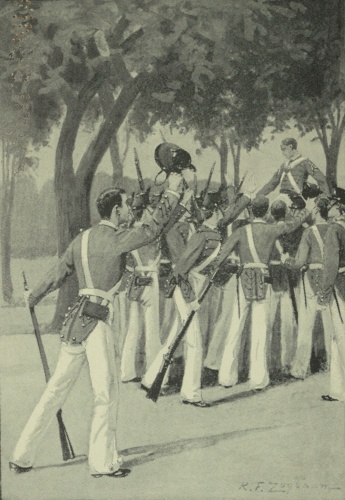
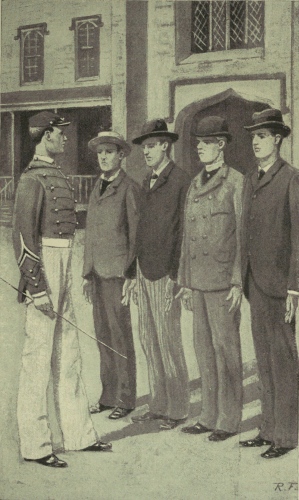
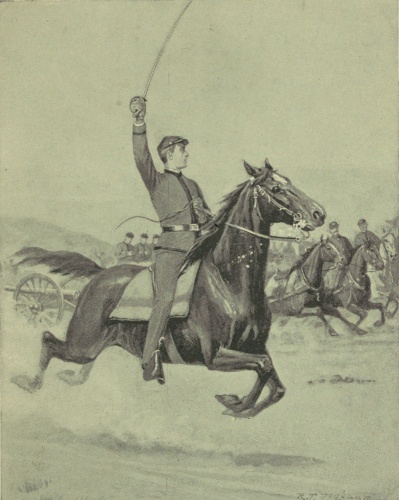
"HE IS LIFTED ON THEIR SHOULDERS AND BORNE DOWN THE ROAD"
A Story of West Point
BY
CAPTAIN CHARLES KING, U.S.A.
AUTHOR OF
"A WAR-TIME WOOING" "BETWEEN THE LINES"
"CAMPAIGNING WITH CROOK" ETC.
ILLUSTRATED
NEW YORK
HARPER & BROTHERS PUBLISHERS
By CAPTAIN CHARLES KING.
A WAR-TIME WOOING. Illustrated. Post 8vo, Cloth, $1.00.
BETWEEN THE LINES. Illustrated. Post 8vo, Cloth, $1.25.
CAMPAIGNING WITH CROOK. Illustrated. Post 8vo, Cloth, $1.25.
CADET DAYS. Illustrated. Post 8vo, Cloth.
☞ For sale by all booksellers, or will be sent by the
publishers, postage prepaid, to any part of the United
States, Canada, or Mexico, on receipt of the price.
Copyright, 1894, by Harper & Brothers.
All rights reserved.
TO
A MOTHER
WHO GAVE HER ONLY SON TO OUR ARMY, WHO LIVED FOR HIM
THROUGH TRIAL TO FINAL TRIUMPH, AND WHO EVEN IN
HER SADDEST DAYS, BROUGHT HOPE TO OTHER
HEARTS AND SUNSHINE TO OTHER HOMES
THIS STORY OF CADET LIFE
Is Inscribed
"HE IS LIFTED ON THEIR SHOULDERS AND BORNE DOWN THE ROAD"
"Pops, there's no use talking; we've simply got
to send you to the Point."
"I'm sure I wish you could, Colonel. Father's
tried every way he could think of, but cadetships
don't go a-begging—out here, at least. The
President has only one or two 'at large' appointments
this year, and there were over a
thousand applications for them."
"Well, have you tried Mr. Pierce, the Congressman
for this district?"
"Oh, yes, sir, tried him long ago. He was
very polite—Congressmen always are. He asked
me to go round and get all the signatures to my
application I possibly could, and kept me running
for six weeks or so. Then he gave it to Mr.
Breifogle's son."
Colonel Belknap smiled. "Yes, I remember
hearing," said he, reflectively, tapping his spurred
boot-heel with his riding-switch and critically
eying the sturdy young fellow who stood respectfully
before him. George Graham, the post
surgeon's eldest son, was just seventeen, of medium
height, wiry and athletic in build, with
deep chest and broad shoulders, with close-curling
brown hair, with big, frank, steady blue
eyes, and a complexion that was probably fair
enough in his baby days, but now was so tanned
by sun and wind that the down just sprouting
on his cheeks and upper lip seemed almost
white by contrast. A picture of boyish health,
strength, and activity was "Geordie," as his
mother ever called him in vain protest against
the familiar "Pops" by which he was generally
hailed—a pet name given him by the officers
when he was but a "four-year-old," far out in
Arizona—a boy who had been reared in the West,
whose first playmate was a wild little Apache,
whose earliest friends were the rough troopers
at an isolated station; a boy who had been taught
to hunt and trail and shoot the Indian arrow before
he was nine; who had ridden "pony-back"
across the continent from Arizona to Kansas with
a cavalry column before he was ten; who had
stalked an antelope along the Smoky Hill before
he was twelve; who had shot a black bear in the
Yellowstone Mountains when he was only fifteen;
and raced a buffalo bull into the fords of
Milk River within sight of the British possessions
across latitude 49 within the following year. He
had met and mingled with Indians of many a
tribe. He had picked up something of the
Apache tongue from his playmate Dick; had visited
the Navajo Reservation, near old Fort Defiance,
in New Mexico, and brought away as his
very own one of their wonderful woven blankets.
He had learned not a little of the sign-language,
and so was able to communicate and make himself
understood among even the Cheyenne urchins
around Fort Supply. After that his father
had been stationed just long enough at Niobrara
to enable Geordie to feel quite at home among
the Ogallala and Brulé Sioux, whose reservations
were just across the Dakota line, and whose visits
to the post were frequent. Then the doctor
was ordered far up to Fort Assiniboine, where
Pops expected to freeze, but found the summer
days as hot as they were in Arizona, and the mosquitoes
worse than they were at Supply. There
he studied the Northern Indians, and came to
the conclusion that the Blackfeet and Gros-Ventres
could not be compared favorably with the
lithe and sinewy and marvellously active Indians
of Arizona. Geordie swore by the Apaches.
There were no trailers like the Tontos; no bowmen
or ball-players like the Hualpais. The Sioux
and Cheyennes could ride, perhaps, but all the
Sioux in Dakota could not whip Eskeldetsee's
band "if you put 'em in the mountains"—which
was probably true. And so by the time he was
seventeen Geordie had ridden, marched, or travelled
by ambulance, stage, or rail through most
of the great Western States and Territories; but
from the time he was four years old he had never
been east of Omaha, or set foot in the streets of
a bigger town than Cheyenne.
Nor had he ever regularly attended any school.
There were no schools to speak of near any of
the garrisons at which his father was stationed;
but Dr. Graham was a man of scholarly tastes,
a graduate of a famous university in Scotland,
and one who by faithful study kept abreast of
the leading minds in his profession. People generally
led a very healthful open-air life on the
broad Western frontier, and Dr. Graham had few
patients to claim his time. He planned, therefore,
all the studies for his two boys, he himself
hearing them recite in history, geography, and
arithmetic, while their devoted mother, at whose
knee they had successively learned their A B C's,
and whose fragile white hand had guided their
chubby fists in the tracing of their first pot-hooks,
was their instructor in the other rudiments.
Regularly, five mornings a week, the little fellows
were set at their books right after guard-mounting,
and, with brief intermission, worked
until the bugles sounded "orderly call," or the
drums and fifes merrily played "Roast Beef of
Old England" at noon. No wonder they learned
to welcome that call. Then they had their frugal
luncheon. The doctor was a stanch Scotchman,
who believed that boyish brawn and brain
throve better on "parritch" and milk than on
any other pabulum. Think of boys who never
knew the taste of candy until after they were
twelve—to whom hot biscuit was forbidden, and
tea and coffee tabooed! They grew up ruddy-cheeked,
freckle-faced, clear-eyed, sturdy-limbed,
burly young "Hielanders," with marvellous capacity
for solid food, sound sleep, and active
sports. They were better taught than most
of the other children around the garrisons, for
what they knew they knew well. The three
years' difference in their ages gave "Pops," of
course, too much advantage in their boyish tiffs
and scuffles; for boys will romp and wrestle, just
as puppies play and kittens frolic, and these, starting
in fun, close sometimes in fury; but they forget
the feud as quickly as it was begun. Pops
learned at an early age the lesson of self-restraint,
the law of forbearance towards the younger and
weaker brother. It was not learned intuitively,
perhaps, but rather the reverse. The doctor was
of a famous old Scotch Presbyterian clan, with
a wholesome faith in Calvin and the doctrine of
original sin. His gentle wife had thought to
convert her eldest hope by appeals to his finer
nature, but the doctor held that there was just
so much of the "thrawn deevil" in every boy
that had to be trounced out of him. It was all
very well for Pops to tussle with his Apache
playmate, and come home covered with dirt and
bumps and glory, and explosive with tremendous
tales of his personal valor—Pops would brag
when he was young, and many another boy
would have done the same under like conditions—but
he was too big and strong for "Buddie;"
and so when Bud came roaring in one day to tell
how "Pops fwowed me down and hit me," Pops
owned up that it was true. Bud would meddle
with what he and Dick were trying to make,
and he "just pushed him away." Mamma gravely
admonished; but papa gave warning. It happened
again before very long, and this time the
doctor took Pops into his den, and presently poor
Mrs. Graham ran to the dining-room and covered
her ears, and Buddie howled in sudden revulsion
of feeling. The doctor seldom punished, but what
his right hand found to do he did with all his
might.
"I want you to remember this, George," said
he, half an hour later, "a manly boy must be
merciful. It isn't enough that you should make
allowances for Buddie's blunders, you must be
lenient to his faults. When he is older he will
be wiser. Meantime, the blows you strike must
be for, not against him."
He needn't have said that. Pops was far
readier to fight for his younger brother than he
was to worry him in the least, and he took his
flogging sorely to heart. He was only ten at
the time. Bud had tried him severely. He had
begged the little fellow to desist, and finally,
losing all patience, had violated orders and
thumped him—not very hard, perhaps, but still
hard enough to warrant half at least of the pitiful
tale the smaller boy ran to tell at once and
at home. Geordie felt very much aggrieved at
Bud when sent forth finally to go to his room
and meditate on his sins and nurse his many sore
spots; but when he saw the misery in the little
fellow's face, when Bud, with fresh outburst of
tears, threw himself into his brother's arms, clung
to him sobbing, and could not say for the very
violence of his grief how he hated himself for
telling, the reconciliation was complete, and the
three—mother and boys—stole away up-stairs
and had a hug and cry together all by themselves,
and came down again an hour later much happier
after all, and quite ready to make it up with
papa. But the doctor wasn't there. He had
slipped out, despite the fact of its being his
study hour, and was found at tea-time miserably
promenading the bank of the stream half a mile
from the post, and quite unconscious that the
evening gun had fired. He never whipped
Pops again; indeed, the boy gave him no cause
to; and he never thrashed Buddie, even when
that unrepentant little sinner well deserved it.
He even declined to reprimand Pops at the
excited appeal of Mrs. Captain Vaughan, whose
twelve-year-old son came home from the swimming-pool,
five days after, with a battered countenance,
and a complaint that he had been beaten
without cause by Pops Graham. Investigation
of the case resulted in the fact that young
Vaughan was trying to duck Buddie, when the
latter's big brother happened upon the scene.
Between the doctor and his boys there grew up
a sort of tacit understanding, a firmly grounded
trust and affection, that seldom found vent in
caress of any kind, and was rarely apparent in
word. George shot up from sturdy boyhood
into athletic youth with thorough faith in his
father, who, he believed, was the best friend he
had or could expect to have. With all his heart
he honored him, and with all his soul he loved
his mother.
And now they were stationed at Fort Reynolds,
with a thriving Western mining metropolis
just six miles away to the east, with hunting and
fishing in the lofty mountains to the west, and a
great tumbling sea of grassy prairie stretching
away to the east and south. Geordie's pony had
been turned over to Bud long months ago, for
the bigger boy could back and ride and control
the liveliest bucker among all the bronchos in
the cavalry stables. Officers and troopers alike
declared that Pops was cut out for the cavalry.
He loved a horse. He had broken and trained
his last possession, a "cayuse" colt from the herd
of old Two Moons, chief of the northern Cheyennes.
He had ridden and hunted by himself,
or with a single trooper for a companion, all
through the mountains that frowned across the
western sky, rarely coming home without an
abundant supply of venison or bear meat, and
still faithfully kept up his studies, hoping that
by some good-fortune he might succeed in getting
an appointment to the great Military Academy
of the nation—hoping almost against hope,
yet never desponding. At last it came, and this
was the way of it.
Just as the wintry winds began to blow,
and the soldiers, turning out for roll-call at
the break of day, began to note how the mountains
seemed to be wearing their fleecy nightcaps
farther down about their ears until the
bald peaks were covered with a glistening, spotless
helmet, and the dark fringes of pine and fir
down among the gorges and foot-hills looked all
the blacker by contrast, there came a fresh battalion
of cavalry marching into the post to relieve
the ——th just ordered away, and Pops had
sadly bidden adieu to the departing troops, little
dreaming what warm friends he was destined to
find among the new. First to arrive, with a
single orderly in attendance, was the regimental
quartermaster, Lieutenant Ralph McCrea, and to
him said the quartermaster whom McCrea was
to relieve:
"Mac, this young gentleman is Dr. Graham's
son George, our candidate for West Point. He
knows plainscraft, woodcraft, and mountain scouting
as well as you do mathematics. He can ride
as well as any man in my troop. Give him a
lift in algebra and 'math.,' and he'll teach you
all there is worth knowing about this part of
the country."
The kindly young West-Pointer seemed to
take at once to the surgeon's blushing boy. In
the wintry weather that speedily set in there
was little opportunity for hunting or exploration
in the mountains; but in the long evenings
McCrea became a frequent visitor at Dr. Graham's
fireside, and finding that Pops had a sound analytical
sort of brain in his curly pate, the quartermaster
took delight in giving him stiff problems
to work out, and taught him the West
Point system of deducing rules instead of blindly
following without knowing why or wherefore;
and the friendship between them waxed and
multiplied, and McCrea became warmly enlisted
in the effort to secure a vacant cadetship for his
boy friend. But knowing there was no chance
"at large," as the President had already named
his two candidates, the boy had done his best
with the local Congressman, who, as Pops had
said, had been most gracious and encouraging,
but had bestowed the plum upon the son of his
rich and influential constituent, Mr. Breifogle,
whose brewery gave employment to over fifty
voters. As alternate he had named the son of
Counsellor Murphy, a lively local politician, and
Pop's hopes were dashed.
Not so McCrea's. As quartermaster his duties
called him frequently into town, where the First
National Bank was the depository, and where he
kept the large fund appropriated for rebuilding
stables and quarters that had been destroyed by
fire the previous year. "Neither of those young
fellows," said he to Dr. Graham, "can pass the
preliminary examination. It is by long odds
too stiff for Breifogle mentally and for Murphy
physically. Keep this to ourselves, and get Mr.
Pierce to promise that George shall have the
next vacancy. If we can get the Colonel to ask
it, Pierce will say yes, perhaps; first because they
served together in Virginia during the war, and
second because he won't think he's promising
anything at all. It's his first term, and he doesn't
dream how hard that examination is, or how certain
Breifogle is to fail. Now, if there were only
some way we could 'get a pull' on him."
The way came sooner than was looked or hoped
for. One December afternoon, just as the lights
were peeping out here and there in the bustling
shops of the busy Western town, and a thick,
heavy cloud of snow was settling noiselessly upon
roof and roadway, and all the foot-hills to the
west were robed in white, and all the mountain
passes deep in drifts, and the managers of the
First National were congratulating themselves
that their collections in the swarming mining
settlements across the range were complete, and
the thousands in coin and greenbacks safely
hoarded in their vaults, and brewer Breifogle
and two other opulent directors were seated
with the president in the bank parlor, rubbing
their hands over the neat balance exhibited, and
discussing the propriety of a congratulatory despatch
to Congressman Pierce, now at his post of
duty at Washington, and the paying-teller had
just completed the summing up of his cash account,
and the bookkeeper was stowing away his
huge volumes, and a clerk was lugging sacks of
coin and stacks of Treasury notes into the open
door of the vault, under the vigilant eye of the
cashier, and the janitor had pulled down the
shades and barred the iron shutters, and everything
spoke eloquently of business security
and prosperity—in stepped a squad of velvet-footed,
soft-voiced, slouch-hatted strangers, and
in the twinkling of an eye cashier and clerk,
tellers, book-keeper, and janitor were as completely
covered by six-shooters as the new-comers
were with snow. It was a clear case of
"hands up, everybody." Two of the party sidled
into the parlor and stood guard over the magnates,
three or four held the outer officials in
statuesque discomfort, while two deft-handed individuals
loaded up with bills and bags of gold,
and vanished softly as they came. Their comrades
gave them a start of sixty seconds, and
then slowly and calmly backed out into the
street, revolvers levelled to the last, and in less
than four minutes from the moment of their
entrance not one of the gang was in sight.
Timing their arrival exactly, they had ridden
into town from the northwest just at dusk, left
their strong, spirited horses, held by accomplices
in a side street not fifty yards away; were in and
out, up and away again, in less time than it takes
to tell it, and with them ninety thousand dollars
in cash.
Vain the rush of clerks and tellers and directors
into the snow-covered street. Vain the yells
of "Murder!" "Robbers!" "Road-agents!" A
crowd collected in a few minutes, but all were
afoot and powerless to follow. It would be an
hour before the sheriff could muster a mounted
party strong enough to pursue; but he had his
wits about him.
"It's the old Hatton gang, sure!" he cried.
"They dare not go to the mines. They'll make
for Marcy's Pass, and scatter when they get to
the cove beyond. There's only one hope." And
like a deer the active frontiersman ran to the
telegraph office.
"Rush this out to the fort!" he cried, as he
pencilled a despatch.
"First National just robbed by Hatton gang.
Ten men. Ninety thousand gone. Government
funds mostly. ["That'll make him act," he
muttered.] They're making for Marcy's Pass.
You can head 'em off by Squaw Cañon if you
send cavalry at once. We follow trail. Answer.
"Brent, Sheriff."
Colonel Belknap, with a knot of officers, was
in the club-room just after stables when the despatch
was handed to him by the breathless operator.
He was an old campaigner, who had served
almost a lifetime in the West.
"Mount your troop instantly, Lane!" he called
to one of his most trusted captains. "Never
mind their supper; they can have that later.
Listen to this." And he read the despatch aloud.
The entrance to Marcy's Pass lay about nine
miles nearly due west from town. Hatch's Cove
was a lovely nook in the summer-time, but almost
inaccessible in winter, lying across the range,
and approached from the east by the old road
through the Pass. Lance Creek, a clear and
beautiful stream, rose in the cove and made its
way through the range by means of a tortuous
and wellnigh impassable gorge known as Squaw
Cañon, which opened into the foot-hills not more
than two miles and a half away to the westward
of Fort Reynolds. All this was promptly discussed
even as the sergeants' voices could be
heard ringing out the order in the barrack corridors
across the parade.
"Turn out, 'E' troop, lively; carbines and revolvers,
fur coats and gloves. Jump now, men!"
Down went knife and fork, cup and spoon.
Up sprang the laughing, chaffing, boisterous
crowd of the moment before. Away they tore
to their bunk-room, and grabbed their great-coats
and furs; away to the arm-racks for carbine and
six-shooter. Quickly they buckled the broad
woven cartridge-belts, and then went bounding
down the barrack stairs, forming ranks in the
softly falling snow. Double time they trotted
down to the long, dimly lighted stables, and in
among their astonished and snorting horses. In
ten minutes they were trotting away to the westward
through wellnigh impenetrable darkness,
through a muffling snowfall, over an unseen
and unknown trail, yet hesitating not a minute;
trotting buoyantly, confidently ahead, following
a guide who knew every inch of the way to and
through the cañon and miles and miles beyond.
"Who can lead them? What scouts have you
on your roll who know the hills?" was the Colonel's
anxious query of his quartermaster, while
the troop was saddling.
"No scouts left, sir, now; but we don't need
them. Here's Geordie Graham."
Yes, Pops, and the doctor too, both in saddle
and ready; so was McCrea, and so it happened
that less than an hour later Luke and Jim Hatton,
leaders of the band, bearers of most of the
spoil, a hundred yards ahead of their fellows as
they issued from the westward end of Marcy's
Pass, deeming themselves perfectly secure from
any capture except from the rear, ten safe miles
away from town, rode slap in among a whole
troop of cavalry, and were knocked on the head,
disarmed, dismounted, and relieved of their plunder
before they could fire a shot or utter a cry
of warning.
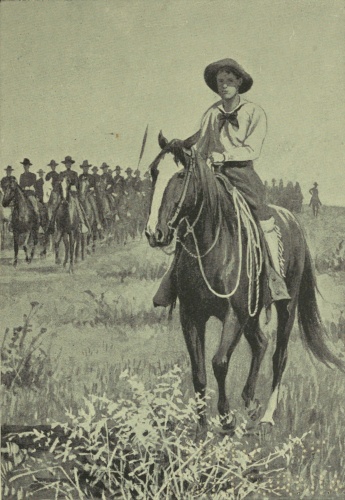
"FOLLOWING A GUIDE WHO KNEW EVERY INCH OF THE WAY"
"We never could have got them in all the
world, sir," said both Lane and McCrea, "but
for Pops here. He knew the way, even in the
dark, and we headed them off in the nick of
time."
It was this service that called forth Colonel
Belknap's remarks at the head of this chapter.
It was this that prompted him to say to the
officers of the First National next day that the
least they could do was to telegraph the Honorable
Mr. Pierce, M.C., urging him to promise
that the next vacancy at West Point should be
filled by George Montrose Graham. It was the
despatch signed by these officials and a dozen
leading citizens—for McCrea struck while the
iron was hot, and took the paper around himself—that
caused Mr. Pierce to wire his pledge in reply.
And one day in February there came a
note to Dr. Graham's, saying that Counsellor
Murphy had been convinced by the leading
medical practitioner in town that his boy could
never pass the physical examination at the Point,
and would better be turning his talents to some
other channel, and then Colonel Belknap reminded
Mr. Pierce of his promise, and Pierce
was caught. On Valentine's Day in 188—, to
Geordie Graham's speechless joy and Buddie's
enthusiastic delight, a big official envelope of
the War Department was placed in the former's
hand. He knew what it meant. He went over
and threw his arms around his mother's neck
and bent and kissed her, for her loving eyes
were swimming in tears.
CHAPTER II
Among the formal official documents in the
envelope which brought such delight to the
Graham family was one giving in detail the
qualifications necessary to secure the admission
of a candidate to West Point. He was subjected
soon after his arrival, so said the papers,
to a rigid physical examination by a board of
experienced surgeons. Glancing over the array
of causes of disqualification, it was apparent to
the doctor that an absolutely perfect physique
was necessary, but on all these points he felt
well assured. As to other qualifications, the age
for admission of cadets to the Academy was
stated to be between seventeen and twenty-two
years. Candidates must be unmarried, at least
five feet in height, free from any infectious or
immoral disorder, and generally from any deformity,
disease, or infirmity which might in the
faintest degree render them unfit for military
service. They must be well versed in reading,
in writing, including orthography, in arithmetic,
and have a knowledge of the elements of English
grammar, of descriptive geography, particularly
of our own country, and of the history of
the United States. That seemed simple enough.
On all these points Geordie, as well as his father,
had no doubt whatever. "Sound as a dollar"
was the universal verdict, and the wisdom of his
father's rigid system of training was all the more
apparent. But when they came to look over
the formidable list of specimens of the problems
and questions which the candidates were required
to solve and answer, the boy's heart failed him
a little. Even McCrea shook his head over some
of them.
"It is ten years since I went up for my examination,
just as you are to go, Pops—an army
boy who had had precious little schooling; but
I don't remember any problems as hard as this
one." And the Quartermaster wrinkled his brows
over a complicated example, while Captain Lane,
poring over a big atlas, was hunting for a chain
of mountains he could not remember ever before
having heard of.
"It seems a queer confession," said the latter,
"but I don't believe I could begin to pass the entrance
examination to the Academy, from which
I was graduated so many years ago. I certainly
couldn't without months of preparation."
The Colonel suggested that perhaps these hard
nuts were ladled out in order to stimulate the
candidate to closer study. The questions really
propounded would not be so difficult. But the
doctor and McCrea were determined to take no
chances.
"There are only three months left for preparation,"
said Graham; "the question is how to
employ the time to best advantage. George is
willing to study hard, and you and I to teach,
but what I'm thinking is that we may be wasting
time on immaterial points and neglecting
some that are essential. Would it not be best to
send him on and have him study under some one
who knows just exactly what is needed?"
And McCrea said, "Yes," and wrote forthwith
to an old friend, an officer whom severe wounds
had incapacitated for active service, and who
had opened a school of preparation at the Point
adapted to the needs of candidates for admission.
And so it resulted that early in April, for the
first time in his life, Geordie Graham was to
leave father, mother, and Bud, and, for the first
time since he was a mere baby-boy, to set foot
across the Missouri.
Over that farewell we need not linger. How
many big, salty tears were dropped into the
depths of the trunk no one on earth but the loving
mother who packed it could ever tell. Yet
even now, face to face with the inevitable separation,
not one word would she say that might
cast a shadow over the hopes of her big boy, as
she spoke of Geordie as a means of distinguishing
him from Bud, her "little Benjamin." Fondly
had she hoped that as he grew older Geordie's
tastes would turn to some other profession, but
she hoped in vain. First, last, and all the time,
ever since the troopers at Verde decorated him
with his Corporal's chevrons when he was a mite
of a four-year-old, the longing of his heart was
to be a soldier. For boys with that ambition
there is no school like West Point; for boys without
it, any other school would be better.
"There isn't a man in all 'E' troop that isn't
sorry to have you leave the fort, Geordie," said
old Sergeant Nolan, as the boy went the rounds
at afternoon stables, bidding his friends good-bye,
and taking a farewell look at his favorite
horses; "but what's more, sir," he added, with a
respectful touch of the cap visor as Captain Lane
appeared, "there isn't a man but that's glad he's
going to West Point, and that wouldn't like to
see him with us again as our Lieutenant."
"But I'm not in yet, Sergeant," laughed Geordie.
"There is Mr. Breifogle to be considered.
If he passes, there'll be no room for me; and if
he fails, why, I may too. In that event, I'll have
to come back and 'list just as soon as I'm eighteen."
And yet Geordie felt no such misgiving as
he sat silently in the dark corner of the ambulance,
choking down some troublesome lumps
that had risen in his throat, and made his eyes
blind as his mother's arms were unclasped about
his neck. The principal of the school which young
Breifogle had been attending for two years had
told Mr. McCrea that the boy was neither apt nor
studious, that he had twice failed in his examinations
for promotion to higher grade, and that
only after infinite pains and much help had he
been able to answer the sample questions enclosed
with his letter of appointment. When
asked why old Mr. Breifogle did not withdraw
his son from a race in which he had no chance,
the master laughed.
"Breifogle is like a great many of our people
who have become suddenly rich," said he. "He
thinks money and a political pull will do anything.
He refuses to believe that West Point is
governed by rules that even the President cannot
violate. He is confident that all that is necessary
is for him to go on with Fritz in June, and
the examiners will not dare reject him, especially
if Congressman Pierce is there, too."
Now this was no exaggeration. Mr. Breifogle
really thought it a very unjustifiable thing in an
army officer, supporting a family on so small a
salary, to undergo the expense of sending George
all the way to West Point and back, for back he
felt sure he would have to come. It was still
worse to send him ahead of time and pay board
and school bills. He and Fritz would not go until
June.
"I'm really sorry for the old fellow," said
McCrea; "he's so thoroughly earnest and honest
in his convictions. It isn't his fault, either. It
is part of the stock in trade of many politicians
to make their constituents believe that for the
benefit of their special friends they have it in
their power to set aside laws, rules, or regulations.
I haven't a doubt that Pierce has made the old
man believe he 'stands' in with the Secretary of
War and the Superintendent of the Academy, and
that Fritz will go through West Point with flying
colors. It will cost Breifogle nearly a thousand
dollars to find out his mistake."
This was several years ago, it must be remembered,
in the days when all candidates were required
to present themselves for examination at
the Point instead of appearing before boards of
army officers at convenient garrisons throughout
the country, as is the case to-day.
"No, Geordie, my boy," said McCrea, in conclusion,
"I don't like to take comfort in another
man's misfortunes, but there is no chance whatever
for young Breifogle and every chance for
you. All you have to do is study and you'll
win. I have said as much to the old man, for he
stopped me at the bank the other day and asked
what I thought of the case, and I told him
frankly. For a moment he looked downcast;
then he brightened up all of a sudden, laid his
finger alongside his nose, and winked at me
profoundly. 'Vell, you yust vait a leetle,' he
said, and turned away. I've no doubt he thinks
I'm only trying to bluff him out in your interest."
Two days more, and George, standing on the
rear platform of the Pullman, looking down with
no little awe upon the swollen, turbid, ice-whirling
waters of the Missouri, far beneath the
splendid spans of the great railway bridge. Another
day, and his train seemed to be rolling
through miles of city streets and squares before
it was finally brought to a stand under the grimy
roof of the station at Chicago. Here from the
windows of the rattling omnibus that bore him
across the town to the depot of the Michigan
Central he gazed in wonderment at the height
of the buildings on every side. Early the next
morning he was up and dressed, and just before
sunrise stepped out on the wooden staging at
Falls View, listening to the voice and seeing for
the first time the beauty and grandeur of Niagara.
A few minutes later, looking from the car
window, he seemed to be sailing in mid-air over
some tremendous gorge, in whose depths a broad
torrent of deep green water, flecked with foam
and tossing huge crunching masses of ice, went
roaring away beneath him. Such a letter as he
wrote to mother that morning, as hour after
hour he sped along eastward over bands of glistening
steel, flying like the wind, yet so smoothly
that his pen hardly shook. Think what a revelation
it must have been to that frontier-bred
boy, whose whole life had been spent among the
mountains or prairies of the Far West, to ride all
the morning long through one great city after
another, through the heart of Buffalo, Rochester,
Syracuse, Utica, and Albany. The Mohawk Valley
seemed one long village to him, so unaccustomed
were his eyes to country thickly settled.
The Hudson, still fettered with ice above the railway
bridge and just opening below, set his heart
to beating, for now West Point lay but a hundred
miles away. How the train seemed to whiz
along those bold, beautiful shores, undulating at
first, but soon becoming precipitous and rocky!
Many people gazed from the westward windows
at the snow-covered Catskills as the afternoon
began to wane; but Geordie had seen mountains
beside which these were but hillocks. The clustering
towns, the frequent rush of engines and
cars, the ever-increasing bustle, however, impressed
him greatly. Every now and then his
train fairly shot past stations where crowds of
people stood waiting.
"Didn't they want to get on?" he asked the
Pullman porter.
"Oh yes, sir, wanted to bad 'nough; but, Lord
bless you, dis train don't stop for them: they has
to wait for the locals. We runs a hundred trains
a day along here. Dis train don't even stop
where you gets off, sir; that's why you have to
change at Poughkeepsie, the only place we stop
between Albany and New York."
Surely enough, they rolled in presently under
lofty bluffs under a bridge so high in the air
that its trusses looked like a spider-web, and then
stopped at a station thronged with people; and
Pops, feeling not a little bewildered, found himself
standing with his hand luggage, looking
blankly after the car that had borne him so comfortably
all the way from Chicago, and now disappeared
in the black depths of the stone-faced
tunnel to the south, seeming to contract like a
leaking balloon as it sped away. Hardly was it
out of sight when another train slid in to replace
it, and everybody began tumbling aboard.
"This for Garrisons?" he asked a bearded official
in blue and brass buttons.
A nod was the answer. Railway men are too
busy to speak; and Pops followed the crowd,
and took a seat on the river-side. The sun was
well down to the westward now; the Hudson
grew broader, blacker, and deeper at every turn;
the opposite shores cast longer shadows; the electric
lights were beginning to twinkle across the
wide reach at Newburg; then a rocky islet stood
sentinel half-way across to a huge rounded rock-ribbed
height. The train rushed madly into another
black tunnel, and came tearing forth at the
southern end, and Pops's heart fairly bounded in
his breast. Lo! there across the deep narrow
channel towered Crow's Nest and Storm King.
This was the heart of the Highlands. Never
before had he seen them, yet knew them at a
glance. What hours had he not spent over
the photograph albums of the young graduates?
Another rush through rocky cuts, and then a
smooth, swift spin around a long, gradual curve,
lapped by the waters of the Hudson, and there,
right before his eyes, still streaked with snow,
was West Point, the flag just fluttering from its
lofty staff at the summons of the sunset gun.
Ten minutes later and the ferry-boat was paddling
him across the river, almost the only passenger.
The hush of twilight had fallen. The
Highlands looked bare and brown and cheerless
in their wintry guise. Far away to the south
the crags of Dunderberg were reverberating with
the roar of the train as it shot through Anthony's
Nose. The stars were just beginning to peep
out here and there in the eastern sky, and a pallid
crescent moon hung over against them in the
west. All else was dark and bleak. The spell
of the saddest hour of the day seemed to chill
the boy's brave heart, and for the first time a
homesick longing crept over him. This was the
cheery hour at the army fireside, far out among
the Rockies—the hour when they gathered about
the open hearth and heaped on the logs, and
mother played soft, sweet melodies at the piano,
often the songs of Scotland, so dear to them all.
Pops couldn't help it; he was beginning to feel
a little blue and cold and hungry. One or two
passengers scurried ashore and clambered into
the yellow omnibus, waiting there at the dock as
the boat was made fast in her slip.
"Where do you go?" asked the driver of the
boy.
"Send my trunk up to the hotel," said Geordie,
briefly. "I'm going to walk."
They had figured it all out together before he
started from home, he and Mr. McCrea. "The
battalion will be coming in from parade as you
reach the Point, Geordie, if your train's on time."
And the boy had determined to test his knowledge
of topography as learned from the maps he
had so faithfully studied. Slinging his bag into
the 'bus, he strode briskly away, crossed the
tracks of the West Shore Road, turned abruptly
to his right, and breasted the long ascent, the
stage toiling behind him. A few minutes' uphill
walk, and the road turned to the left near the
top of the bluff. Before him, on the north, was
the long gray massive façade of the riding-hall;
before him, westward, another climb, where, quitting
the road, he followed a foot-path up the
steep and smoothly rounded terrace, and found
himself suddenly within stone's-throw of the very
buildings he sought. At the crest of the gentle
slope to the north, the library with its triple
towers; to its left, the solid little chapel; close
at hand to his right front, the fine headquarters'
building; beyond that, dim and indistinct, the
huge bulk of the old academic building; and directly
ahead of him, its great windows brilliantly
lighted, a handsome gray stone edifice, with its
arched doorway and broad flight of steps in the
centre—the cadet mess-hall, as it used to be
termed, the Grant Hall of to-day. His pulses
throbbed as he stepped across the road and stood
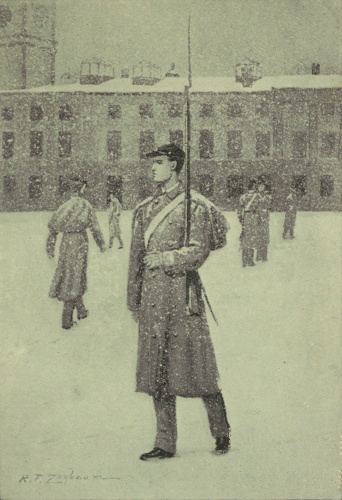
on the flag-stones beneath the trees. A sentry
sauntering along the walk glanced at him keenly,
but passed him by without a word.
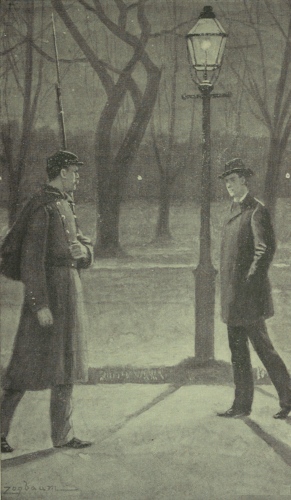
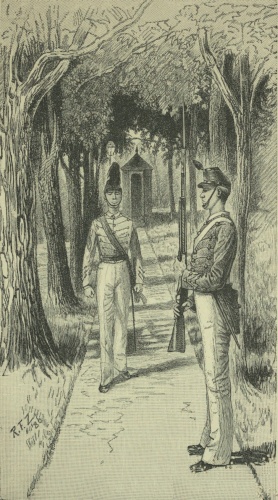
"A SENTRY GLANCED AT HIM KEENLY"
Suddenly there rose on the still evening air
the tramp of coming soldiery, quick and alert,
louder and louder, swifter than the bounding of
his heart and far more regular. Suddenly through
the broad space between the academic and the
north end of the mess-hall, straight as a ruler,
came the foremost subdivision, the first platoon
of Company A, and instantly in response to the
ringing order, "Column right," from some deep
manly voice farther towards the rear, the young
cadet officer in front whirled about and ordered
"Right wheel." Another second and around
swept the perfect line in the heavy gray overcoats,
the little blue forage-caps pulled well down
over the smooth-shaved, grave, yet youthful faces
dimly seen under the gaslight. Then on they
swept, platoon after platoon, in strong double
rank, each in succession wheeling again steadily
to the right as it reached the broad flight of steps,
then breaking and bounding lightly to the top,
every man for himself, until, one after the other,
each of the eight subdivisions was swallowed up
in the great hall, echoing for a moment with chat
and laughter, the rattle of chairs, the clatter of
knife and fork and spoon, and then the big doors
swung to, and Pops, for the first time in his life,
had seen the famous battalion which it was his
most ardent wish to join. For a moment he stood
there silent, his heart still beating high, then with
one long sigh of mingled envy and gratification
he turned away.
That same evening, wasting no time after he
had eaten a hearty supper at Craney's, Geordie
sought and found Lieutenant B——. Everything
had been arranged by letter; his coming was expected,
and in a few moments the boy and his instructor
were seated in a quiet room, and Pops's
preliminary examination was really begun. In
less than an hour Mr. B—— had decided pretty
thoroughly where his instruction was already satisfactory
and where it was incomplete.
"There's no question as to your physique, Mr.
Graham," said the Lieutenant, smiling to see the
blush of shy delight with which the boy welcomed
the first use of the "handle" to his name.
Hitherto he had been Geordie or Pops to everybody.
"I fancy it won't take long to make you
more at home in mathematics. To-morrow we'll
move you into your temporary quarters down at
the Falls, and next day begin studies. There are
several candidates on the ground already."
And so within the week our young plainsman
was practically in harness, and with a dozen
other aspirants trudging twice a day over the
mile of road connecting the Point and the village
below; studying hard, writing home regularly,
hearing a great deal of information as to the antecedents
and expectations of most of his new
associates, but partly from native reticence and
partly from due regard of McCrea's cautions, saying
little as to his past experiences, and nothing
at all as to his hopes for the future. "No matter
what you do know of actual service, Pops—and
you have had more experience of army
life than ninety-nine per cent. of the corps—it is
best not to 'let on' that you know anything until
you are an old cadet, even among your class-mates."
Some of his new associates Pops found congenial,
some antagonistic; but the one thing he kept
in mind was that all were merely conditional.
Not until after the June examination would they
really know who were and who were not to be
of "the elect." "Those who are most volubly
confident to-day," wrote McCrea, "are the ones
who will be most apt to fail. Keep your own
counsel, 'give every man thine ear and few thy
voice'—and that's all."
George had some novel experiences in those
days of preparation, and met some odd characters
among the boys, but as few of these had any
bearing on his subsequent history they need not
be dwelt upon. With only one did he strike up
anything approximating an intimacy, and that
was after the first of May and was unavoidable,
because the young fellow became his room-mate,
for one thing, and was so jolly, cheery, confident,
and enthusiastic, for another, that Graham simply
couldn't help it.
Along in May his letters had a good deal to
say about Mr. Frazier, and by June the Falls began
to fill up with young fellows from all over
the country. By this time the daily sight of the
battalion at its drills and parades was perfectly
familiar to those on the ground, and yet the gulf
between cadets and candidates seemed utterly
unbridgable. Dr. Graham had thought it a
good thing for Geordie to go with letters of introduction
from Colonel Fellows, of Fort Union,
to his son, a Second Class man, or from Major
Freeland, of Bridger, whose boy was in the Third,
but McCrea said: "No; there is just one way
to win the respect and good-will of the corps of
cadets," he declared, "and all the letters and all
the fathers and uncles and even pretty sisters
combined can't win it any other way. The boy
must earn it himself, and it isn't to be earned in
a month, either. Every tub stands on its own
bottom there, doctor. The higher a fellow's connections,
the more he has to be taken down.
Leastwise, it was so in my time, and West Point
is deteriorating if it is any different now."
Strange, therefore, as it may seem, though he
knew many a cadet by sight and name, not one
had George Graham become acquainted with until
the momentous 15th of June, when, with a
number of other young civilians, he reported
himself in a room in the eighth division of barracks
to Cadet Lieutenant Merrick; was turned
over to Cadet Corporal Stone to be taken to the
hospital for physical examination, and in one of
the surgeons recognized an old friend of his father's
whom he knew in Arizona, but who apparently
didn't know Geordie from Adam. One
hundred and forty-seven young fellows entered
the hospital hopefully that day, and among these
over twenty-five were rejected. Among those
who passed was Breifogle. The old gentleman
himself was on hand in front of the mess-hall,
when next morning those who had passed the
scrutiny of the surgeons were marshalled thither
to undergo the written examination in arithmetic.
Promptly, under the eye of the Professor of
Mathematics, a number of young officers assigned
the candidates to seats and set them at their
tasks. Geordie felt that his face was very white,
but he strove to think of nothing but the work
in hand. Slowly he read over the twelve problems
on the printed page, then, carefully and
methodically, began their solution. Long, long
before he was through he saw Frazier rise and,
with confident, almost careless mien, hand his
complete work to the secretary, and saunter out
into the sunshine. Long before he had finished
he saw many another go, less jauntily, perhaps,
but with quiet confidence.
One by one most of Mr. B——'s pupils finished
inside the allotted two hours and a half; but
Geordie, with the thoroughness of his race, again
and again went over his work before he was satisfied
he, at least, could not improve it. Then
he arose, and trembling a bit despite himself,
handed his paper to the silent officer. A number,
fully twenty, were still seated, some of them
helplessly biting their pencils and looking furtively
and hopelessly about them. One of these
was Fritz Breifogle, for whom the old gentleman
was still waiting on the walk outside. Some
officers, noticing the father's anxiety, had kindly
invited him into the mess-parlor, and had striven
to comfort him with cooling drink and a cigar.
He was grateful, but unhappy. Already it had
begun to dawn upon him that what he had been
told of West Point was actually true: neither
money nor influence could avail, and Fritz was
still at his fruitless task when "the hammer fell."
Another day and the suspense was over. A
score more of the young fellows, who were still
faintly hopeful at dinner-time, were missing at
the next muster of the candidates at retreat.
Breifogle was gone without a word to his alternate.
The way was clear at last, and, more madly
than ever, Pops's heart bounded in his breast as
in stern official tone Cadet Corporal Loring read
rapidly the alphabetical list of the successful candidates—George
Montrose Graham among them.
CHAPTER III
And now, with examinations over, and no remaining
doubts or fears, there was probably no
happier boy in all the "menagerie" than Geordie
Graham. As for the hundred young fellows in
civilian dress, "herded" three and four in each
room, and wrestling with their first experiences
of cadet life, it is safe to say most of the number
were either homesick or in some way forlorn.
Nothing so utterly destroys the glamour that
hovers over one's ideas of West Point as the realities
of the first fortnight. Of his three room-mates
pro tempore, Bennie Frazier had already
announced time and again that if a beneficent
Creator would forgive him the blunder of coming
here at all, he'd square accounts by quitting as
quick as he possibly could. Winn, a tall Kentuckian,
wanted to resign, but was too plucky.
Connell, a bulky young Badger, had written two
terrific screeds to his uncle, the member from
Pecatonica, denouncing the cadet officials as
brutes, bullies, and tyrants, which documents
were duly forwarded with appropriate complaint
to the War Department, and formed the text for
a furious leader in the Pecatonica Pilot, clamoring
for the abolition of West Point. The letters
were duly referred to the Superintendent United
States Military Academy for remark, and by him
to the commandant of cadets, by which time Mr.
Connell was a duly accredited high private in
the rear rank of Company B, and had almost
forgotten the woes of early barrack days, and
was not a little abashed and dismayed when
summoned before the grave, dignified Colonel
to make good his allegations. It took him just
ten seconds to transfer any lingering resentment
for the cadet corporals to the avuncular M. C.,
whom with boyish inconsistency he now berated
for being such a fool as to make a fuss
about a little thing like that. Among the new
cadets were a very few who, as sons of army officers,
knew perfectly well what they had to expect.
These and a number of young fellows who,
like Graham, had come on months or weeks beforehand
and placed themselves under tuition,
were well prepared for the ordeal of the entrance
examinations as well as for other ordeals which
followed.
Even among them, however, were many who
looked upon life with eyes of gloom. The ceaseless
routine of drill, drill, of sharp reprimand, of
stern, unbending discipline, wofully preyed upon
their spirits. Their hearts were as sore as their
unaccustomed muscles. But with Pops all was
different. He had reached at last the goal of his
ambition. He had won his way through many
a discouragement to the prize of a cadetship.
Now he was ready, even eager, to be tried and
tested in every way, to show his grit, and to prove
his fitness for the four years' race for the highest
prize of all, the diploma and commission. The
drill that made his comrades' muscles ache was a
bagatelle to him. From earliest boyhood he had
watched the recruits at setting-up, and not only
learned and practised all, but with Bud and Dick
for his squad would often convulse the officers
at Verde and Supply by his imitation of Sergeant
Feeny's savage Hibernian manner. The cadet
yearling who was drill-master of the four to
which Pops was assigned saw at once that he
had a "plebe corporal"—a young fellow who
had been pretty well drilled—and all the more
did he rasp him when anything went amiss.
Many of the new-comers had been through squad-drill
at military schools or in cadet companies,
but never under such rigid, relentless discipline
as this. Every cadet drill-master carried the
steel rammer of his rifle as a drill-stick, and was
just about as unbending as his rod of office. Poor
Frazier was in hot-water all the time—as well as
in the sulks.
"I belonged to the high-school cadets for two
years, and everybody that ever saw us drill said
we could lay over anything in the whole country,"
he protested, "and now here's this measly little
stuck-up prig, that probably never knew anything
about drill until he entered here last year, correcting
and finding fault with everything I do. I
ain't going to stand it, by thunder! I've written
to my father to come on again, and just have
this thing attended to right off." And Frazier's
handsome boyish face was flushed with wrath,
and clouded with a sense of wrong and indignity.
"It seems to me if I were in your place
I wouldn't stand being abused either, Graham.
I heard Mr. Flint snapping at you again this
morning."
Pops was busily engaged dusting for the tenth
time the iron mantel-shelf and the little looking-glass.
He half turned. "Wa-e-l," he said, while
a grin of amusement hovered about the corners of
his mouth, "Flint was all right, I guess. Your
squad was just in front of us, and when I saw
Connell stumble over your heels and try to climb
up your back, I laughed out loud. He caught me
chuckling."
"Yes, and abused you like a pick-pocket, by
jingo! If my father were an officer in the regular
army, as yours is, it wouldn't happen twice
to me."
"No, nor to me either," chimed in Connell.
"I'll bet you he'd sing a mighty different tune if
he knew you were the son of a Major."
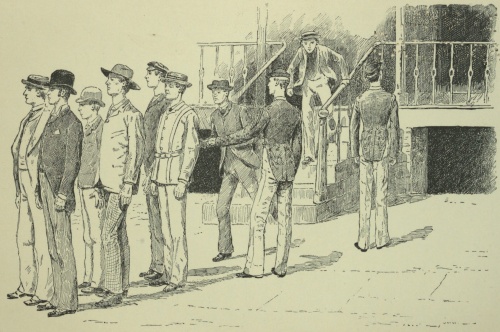
THE AWKWARD SQUAD
"Well, there's just where you're 'way off," answered
Geordie, after the manner of the frontier.
"Of all places in creation this is the one where
one's dad cuts no figure whatever. I've often
heard old officers say that the boys who got
plagued and tormented most in their time were
the fellows whose fathers were generals or cabinet
ministers. Fred Grant wouldn't have had
half as hard a time if his father hadn't been
President. Frazier's whole trouble comes from
letting on that he knew all about drill before
he got here; that's the truth of it. I get along
smoothly by pretending never to have known
anything."
"Oh, a lot you have! If that snob Loring
ever speaks to me as he spoke to you this morning
about laughing in the ranks, I'll—I'll just let
him have my fist between the eyes, and he'll see
more stars than he ever saw before, if he is a
color corporal. What'll your father say when
he hears that he threatened to put you in a cell
just for laughing when that Pike County fellow
knocked his hat off trying to salute?"
"Well, he didn't say cell, in the first place, and
father wouldn't hear it from me, at least, if he
had. It's an understood thing at home that
they're to ask no questions, and I'm to tell no
tales until plebe camp is over and done with.
Plebes don't begin to have the hard times now
that they had thirty years ago, and if they could
stand it then, I can now. All you've got to do is
simply make up your mind to grin and bear it;
do just as you're told, and say nothing about it.
If this thing worries you now, when only our drill-masters
and instructors get at us, what are you
going to do, Frazier, when you're marched over
there into camp next week and turned over to
the tender mercies of the whole corps?"
"I'm going to fight the first man that offers
me an indignity of any kind, by thunder!"
Geordie burst into one of his merry laughs, just
as a light foot came bounding up the iron stairway.
Bang! A single knock at the door. Up
sprang the four boys, heels and knees together,
heads up, eyes straight to the front, arms and
hands braced against the sides, the palms of the
latter turned outward as far as the youngsters
could force them and thereby work their shoulders
back, each young fellow facing the centre of the
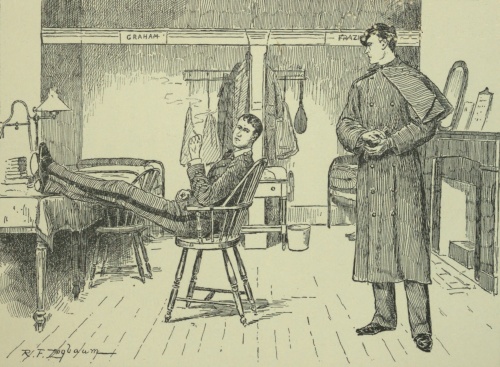
bare and cheerless room. Enter Cadet Corporal
Loring, his jaunty gray coat fitting like wax, not
a crease nor a wrinkle anywhere, every one of
his three rows of bell buttons glistening, his gold
chevrons gleaming, his white collar, cuffs, gloves,
and trousers simply immaculate, everything so
trig and military, all in such wondrous contrast to
the sombre garb of the four plebes. His clear-cut
face is stern and dignified.
"What is the meaning of all this noise?" he
asks. "Who was laughing as I came in?"
"I was, sir," promptly answers Graham.
"You again, Mr. Graham? This is the third
time since reveille I've had to reprimand you for
chuckling like a school-boy—twice in ranks, and
now again at inspection. What were you laughing
at this time, sir?" inquired Mr. Loring, majestically.
"At something Frazier said, sir."
"Mr. Frazier, sir. Never omit the handle to
a gentleman's name on duty or in official intercourse.
Only among yourselves and off duty can
you indulge in familiarity; never, sir, in conversation
with superior officers." (Oh, the immensity
of distance between the plebe and the yearling
corporal!) "And you are room orderly,
too, Mr. Graham, and responsible for the appearance
of things. Where should the broom
be, sir?"
"Behind the door, sir."
"Then where is it, sir?"
And for the first time poor Pops sees that in
the heat of argument, Frazier, dusting off his
shoes with that implement, had left it across the
room in the alcove. Still, it was his own business
to see that it was in place, so he had nothing
to say beyond, "I didn't notice it until just
now, sir."
"Exactly, Mr. Graham; if you had been attending
to your duty instead of giggling over
Mr. Frazier's witticisms you would have escaped
punishment. Report at my office immediately
after supper this evening, sir." And then, after
finding perhaps a pin-head of dust behind the
looking-glass, and further rebuking Mr. Graham
for unmilitary carelessness, the young gentleman
proceeds to carry dismay into the next room.
And that evening, after supper, as ordered,
Pops tapped at the awful door, was bidden to
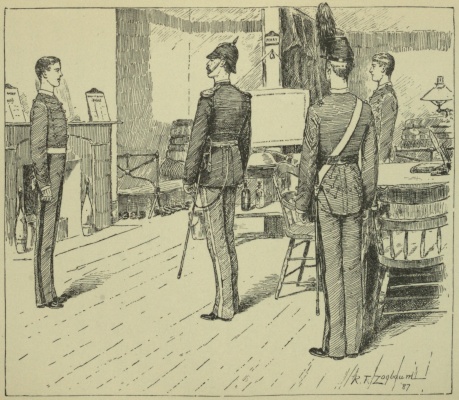
enter and listen to his doom. Cadet Lieutenant
Merrick sat in judgment. For levity in ranks,
dust on mantel, broom out of place at inspection,
new Cadet Graham was directed to walk post in
the hall until drum-beat at tattoo.
Outside the door, standing meekly in the hallway,
awaiting summons to enter, were half a
dozen of his comrades, about to be sentenced to
similar punishment for blunders of greater or
less magnitude. Some looked woe-begone, some
foolish, some were laughing, but all assumed the
required expression of gravity as Mr. Loring
came forth with his victim. In two minutes
our Geordie found himself slowly pacing the
hallway on the second floor, with strict orders to
keep his little fingers on the seams of his trousers,
the palms of his hands to the front, and to
hold conversation with nobody except in the line
of duty. For a moment he could not but feel a
little wrathful and disheartened, but again McCrea's
words came to his aid: "Remember that
the first thing that will be sorely tested is your
sense of subordination—your readiness to obey
without question. No soldier is considered fit
to command others until he can command himself.
They purposely put a fellow through all
manner of predicament just to test his grit. Don't
let anything ruffle your temper, and they will soon
find you need no lessons." And so, like a sentry,
he patiently tramped his post, listening to the
music of the band at an evening concert out on
the Plain, and keeping watchful eye for the coming
of cadet officials. Along towards nine o'clock
up came Cadet Lieutenant Merrick, commanding
the plebes; and "Pops," as he had been taught,
halted, faced him, and stood attention.
"Why are you on punishment to-night, sir?"
was the question.
Pops colored, but answered promptly, "Laughing
in ranks, broom out of place, and some other
things, sir."
"Yes, I remember. Go to your quarters now,
and keep your face straight on duty hereafter."
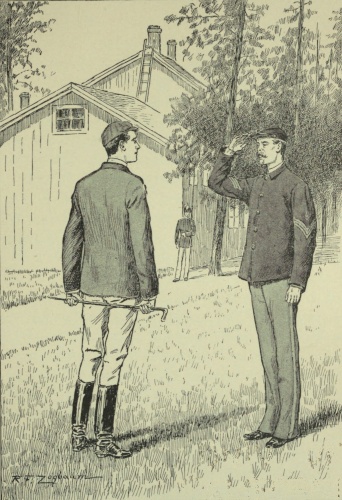
Involuntarily Geordie raised his hand in salute,
as for years he had seen the soldiers do after
receiving orders from an officer, then turned
to go.
"One moment, Mr. Graham. Whose squad
are you in?"
"Mr. Flint's, sir."
"Did he teach you that salute?"
"No, sir," stammered Geordie.
"Where did you learn it?"
"Among the soldiers, sir, in the garrison."
"Ah, yes, I've heard of your case. That'll do,
sir."
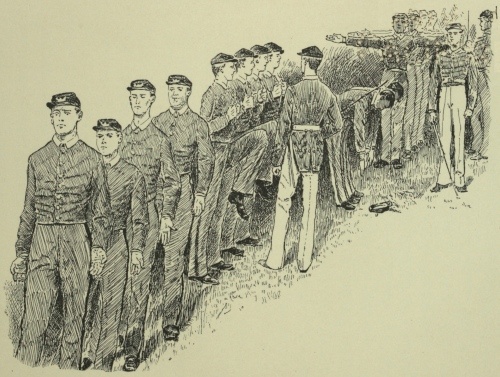
PLEBE DRILL
Back in his room Pops found his three comrades
in excited discussion. Something tremendous
had happened. While Geordie, obedient to
his orders, had gone to report to the cadet officer,
Frazier, exulting in his knowledge of the
Point, had persuaded Connell to trust himself to
his guidance and go out for a walk. For half an
hour after returning from supper the new cadets
were allowed release from quarters, and permitted
to visit each other and stroll about the grounds
as they might see fit, but were cautioned not to
venture over towards camp. The Graduating
Class had now been gone, with the happy furlough
men, an entire week. The rest of the corps,
the new First and Third Classes, had marched into
their summer quarters over across the cavalry
plain, among the beautiful trees south of old Fort
Clinton. The new cadets, still in the garb of
civil life, were "herded together," as the old cadets
expressed it, at the barracks, and thither the
older cadets now were forbidden to go. Except
in the mess-hall, three times a day, they were seen,
therefore, only by their barrack instructors and
their squad drill-masters. As a result of this
plan the wholesale system of hazing, plaguing,
and tormenting that prevailed at the Point some
thirty years ago was wellnigh prevented. Not
so, however, the impulse. Just so long as human
nature remains as it is and has been since creation,
"boys will be boys," and rare indeed are
the boy-natures which know not the longing to
play tricks upon new-comers, especially at school
or college. Even among mature men the impulse
lingers. Added, therefore, to the line of demarcation
mentioned in the interest of discipline between
the plebe and the upper-class man there
ever exists the temptation to have sport at the expense
of the new-comers, and only by most stringent
measures has the spirit been controlled to
the extent that it is.
So long as Geordie and his comrades kept to
the neighborhood of the barracks, however, they
were safe. A few of their number had been run
up into the rooms of the yearlings the day before
camp, where they were instantly surrounded
by a frantic mob of young fellows mad with exultation
at being at last released from plebehood,
and eager to try on the new boys the experiments
lavished on them a twelvemonth previous.
The officer in charge caught sound of the affair,
however, and made instant descent upon the division,
only, of course, to find the suspected room
deserted, and all the others crowded by old cadets,
and the only faces that looked in the faintest
degree conscious of guilt or wrong were those
of the luckless plebes themselves, who, cautioned
against entering the barracks of the elders, were
nevertheless caught in the act, and could never
explain any more than they could help their
presence on dangerous and forbidden ground.
Benny Frazier was loud in his ridicule of Winn,
who was one of the party entrapped. No yearling
and no squad or party of yearlings could
get him where he didn't mean or wish to go, he
frequently said; and for no other reason than
that he had been officially warned to keep away
from camp had Benny become possessed with
the longing to cruise thither. Old cadets couldn't
cross sentry posts and nab them, he argued.
"We'll just aggravate them by coming so near,
and yet keeping aloof." Poor, crestfallen, indignant
Benny! He and Connell had sallied
forth, had gone strolling over the plain and
along the south side of camp, between the field
battery and the tents, had smilingly declined
the eager invitation of the yearlings, who crowded
down along the post of the sentry on Number
Five, urging them to enter and make themselves
at home. In the consciousness of his superior
wisdom Benny had even ventured upon an expressive
gesture with his thumb at the tip of his
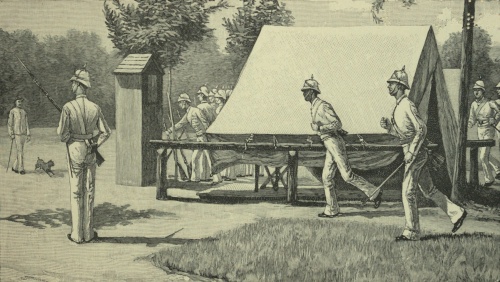
nose, his fingers wiggling in air. Poor boy!
There were instant and stentorian shouts for the
corporal of the guard. Down at a run from the
guard-tent came a patrol. Eager hands pointed
the way; eager voices clamored for their arrest.
Benny and Connell were surrounded in an instant.
Glistening bayonets were levelled at their
throbbing hearts. "March!" was the order, and
amid the jeers and rejoicing of a hundred young
scamps in gray and white the two poor plebes
were sternly marshalled to the guard-tents, and
into the awful presence of the cadet officer of
the day, charged with having disobeyed the sentinel's
order not to pass between the guns, and,
far worse, of having made insulting gestures to
a sentry in the solemn discharge of his duty. It
was an impressive moment. There stood the
stern young cadet captain in his tall plume and
crimson sash and gold-laced sleeves, astounded
at the effrontery of these young yet hardened
reprobates.
"Is this possible?" he demanded, slowly, impressively.
"Who and what are you who have
dared to insult the sacred office of the sentinel,
the soldier to whose lightest word even the commander-in-chief
must show respect? Who and
what are you?"
"We didn't mean any harm," whimpered Benny.
"We're only new cadets."
"What!"
And here every one in the surrounding group—officer
of the day, officer of the guard, corporals
and privates, awed spectators—all fell back
into attitudes expressive of horror and dismay.
"What!" exclaimed the cadet captain. "Are
you mad? Mad!" he continued. "Is it credible
that you, chosen by the deluded Representatives
of your States to represent a proud community
in an honorable profession—you dared to signalize
your admission here by one of the most flagrant
offences known to military law? Send at
once for the Superintendent, Officer of the Guard.
This is beyond my powers. Into the guard-tent
with them! Batten down the walls. Station
sentries at each side, Mr. Green. Put two of
your most reliable men at the door, with orders
to shoot them dead if they stir a muscle. Orderly,
go at once for the commandant, and warn the
officers that mutiny has broken out among the
new cadets."
And so in another instant the luckless boys
were bundled into the guard-tent, with bristling
bayonets at every opening, with sentries on every
side discussing in awe-inspiring tones the probable
fate of the mutineers. And here might they
have been held in limbo for hours had not Cadet
Corporal Loring found them absent at inspection,
and learned from Mr. Winn, sole representative
of the quartet, that Frazier had invited Connell
to take a walk, and shrewdly suspecting that they
had been trapped over at camp, had reported
matters to Mr. Merrick, his immediate superior,
and was sent over to the rescue. Of course, on
hearing the nature of their crime, he too was
properly shocked, and could find no words to express
his consternation. All the same, he got
them out of the guard-tent and over to barracks
before the army officer on duty as commandant
of new cadets happened in, and had barely time
to get them to their room before that gentleman
came to inquire if their charges were all safe
for the night. Pops found Connell grievously
alarmed, but Frazier was only loudly indignant.
"All I'm afraid of is that now I won't get in
the first squad to have muskets," he said. "We
were going to have 'em in the morning."
But when morning came it was Geordie, not
Frazier, who was put in the first squad, and Benny
couldn't understand it. He who had been the
best soldier of the high-school cadets was left
behind.
CHAPTER IV
Drill, drill, drill! Up with the dawn, rain
or shine; hurrying through their soldier toilets;
rushing down the iron stairways and springing
into rigid attention in the forming ranks; sharply
answering to the rapidly called roll; scattering
to their rooms to "spruce up" for inspection;
sure of reprimand if anything went amiss,
sure of silence only if all were well. Sweeping
and dusting; folding, arranging, and rearranging
each item of their few belongings; stumbling
over one another's heels at first, yet with each
succeeding day marching to meals with less constraint
and greater appetite; spending long hours
of toil and brief minutes of respite; twisting,
turning, wrenching, extending, developing every
muscle, most of them hitherto unsuspected and
unknown; bending double, springing erect, roosting
on tiptoe, swaying forward, backward, sideways,
every ways; aching in every bone and
joint, sore in every limb, yet expected to stick to
it through thick and thin, until as days wore on
and pains wore off, and all that was sore, stiff,
and awkward grew little by little to be supple,
easy, and alert. Wondrous indeed is the transformation
wrought in two weeks of such drill
under such drill-masters. The 1st of July arrived;
George Graham and his fivescore plebe
comrades had now spent a fortnight under surveillance
and discipline strict and unrelenting
as that of the days of grim old Frederick the
Great, except that it tolerated no touch of the
corporal's cane, no act of abuse. Sharp, stern,
fiercely critical were the young cadet instructors,
but after the first few days of soreness the native
elasticity returned to both body and soul,
the boys began to take heart again, and a spirit
of rivalry to develop between the drill squads.
To Geordie the hours of soreness of spirit had
been few as those of physical suffering. His
years of life among the soldiers had prepared
him for much that he had to encounter, and
pride and pluck sustained him when wearied by
the drills or annoyed by the sharp language of
his instructors. But with poor Benny Frazier all
was different. A pet at home, and the brightest
scholar of the high-school of his native city; moreover,
the boy officer of the high-school battalion,
of whom it was confidently predicted that "He
would need no drilling at all at West Point";
"He'd show those cadet fellows a thing or two
they never dreamed of"—it was gall and wormwood
to his soul to find himself the object of no
more consideration at the Point than the greenest
"country jake" from Indiana or Dakota; and
to Benny's metropolitan mind anything from
either Western commonwealth could be nothing
but green. What made matters worse for Frazier
was the fact that his father and mother had
accompanied him to the Point on his arrival, and
with pardonable pride, but mistaken zeal, had
sought to impress upon the minds of such officers,
cadets, and relatives of other plebes as they
chanced to meet the story of Benny's manifold
excellences as soldier and scholar—oft-told tales
of how General This or Professor That had declared
him the most accomplished young captain
they had ever seen. Then poor Mrs. Frazier,
who had pictured for her beloved boy a
reception at the hands of the authorities in
which gratification, cordiality, and respect should
be intermingled, was simply aghast to find that
he must take his stand with his fellows at the
bottom of the ladder. Luckily for Benny, his
parents' stay was limited to three days. Unluckily
for Benny, they remained long enough to
see him at his first squad drill, side by side with
two unmistakably awkward boys, and faring but
little better. Such was her grief and indignation
that the good lady declared to acquaintances
at the hotel that her boy should be drilling
that horrid little martinet instead of being drilled
by him—and such speeches are sure of repetition.
Before Benny was a week older he was known
throughout the battalion as "the plebe who had
come to drill the corps of cadets," and nothing
could have started him worse. One can only
conjecture what the fond but unwise mother
would have said could she have seen, a fortnight
later, that boys who had never drilled at all—had
never handled a musket—were grouped in the
first squad, and making rapid and soldierly progress,
while Benny was still fretting and fuming
in the lower one. Yet what was so inexplicable
and inexcusable in her eyes was perfectly plain
and simple to those acquainted with the facts.
All over the Union now are military schools
and National Guard organizations in which the
drill regulations of the regular army are well
taught and understood; but, on the other hand,
there are many schools and communities in
which the strictly business system of instruction
insisted upon among all progressive soldiers has
been neglected in favor of something showy,
catchy, pretty to look at, and utterly useless and
unserviceable except for spectacular purposes;
and as ill-luck would have it, Benny had been
taught all manner of "fancy drill" movements
utterly at variance with those he was now to
learn; and so, poor boy, the nerves and muscles
long schooled in one way of doing things were
perpetually tripping him in his efforts to master
another—he had to unlearn so much before he
could learn even a little. The green boys, on
whom he looked with such pity at the start,
knowing no wrong methods, were speedily far
ahead of him in acquiring the right.
And so the boy who had entered with the
highest hopes and expectations was now low on
the soldier list and lowest in his mind. But for
his father's hard common-sense, Benny Frazier
would have been only too glad to resign and get
out of it all and go home, as other disappointed
boys have done, and declare West Point a hotbed
of narrow prejudice, of outrageous partiality,
and unbridled injustice; and Benny's mother
would have honestly believed every word of
it. Connell, too, was ready to sympathize with
Frazier, and confidentially to agree with him that
Pops, the youngest of the four room-mates, owed
his rise to the first squad entirely to the fact that
his father was an officer; but when four more
boys were added to the first squad, and Connell
was one of them, he changed his views, and decided
that only merit governed those matters,
after all. He began to pluck up heart, too, for
he and Graham were among the first to be
marched over to the commissary's to try on the
new gray fatigue uniforms, and Mr. Loring's
squad all appeared in shell jackets and trousers
before Winn and Frazier had cast off their civilian
garb.
By July 1st, however, all were in fatigue dress,
and consolidated in half a dozen squads for drill
purposes. By this time, too, they could march
to and from the mess-hall in stiff but soldierly
fashion; and still, hour after hour, the relentless
drills went on. Only on Saturday afternoons
and on the long, beautiful, peaceful Sundays was
there really time and opportunity for rest; and
still the new cadets were kept carefully secluded
from the old, seeing little or nothing of the battalion,
except as, with its quick elastic step and
its glistening white uniform, with the brave
young faces looking browner every day under
their snowy helmets, with drums and fifes playing
their lively quicksteps, the little column
came marching down the shaded road, and the
plebes were drawn up in solid ranks until their
future comrades should pass by, and, springing
up the mess-hall steps, give room for them to
follow.
Pops wrote his first long letter home the second
Sunday after passing the entrance examination,
and this is something of what he said:
"We have lived together now just fourteen
days, Frazier and Connell, Winn and I, and are
getting along pretty well. Of course we may
be scattered as soon as we get in camp, for Winn
is tall, and will be put in A or D company.
Connell wants to live with his statesman, Mr.
Foster, in B. If Frazier and I get into the
same company we will tent together, most likely.
He asked me to, and said he could fix it. We
got our fatigue uniforms Thursday, Connell and
I, and were almost the first, too, because of being
in Mr. Loring's squad for drill. He is very sharp
and severe, and some of our class don't like him
a bit; but thus far we get along all right. I'm
so pleased to be in the first squad to get rifles
I don't mind his manner. Of course it helped
a good deal knowing the manual of arms, but
they're a heap stricter here. [Pops would drop
into frontierisms at times.] If a thumb or finger
is a bit out of place, the corporal makes more row
about it than Sergeant Feeny would over a recruit's
coming out for guard with a dirty kit.
"I guess Frazier wishes he hadn't been so fresh
[more slang, Pops] at first. He was captain in
the high-school cadets and head of his class, and
rather held over our boys about the drill at first;
said he knew it all, and showed his school medals
for best-drilled soldier, etc.; but Mr. Loring
gave him fits, and put him under Mr. Flint, who
drilled me the first few days, and is as ugly and
stern as he can be. Frazier tried to make us believe
the cadets were drilling him wrong; but
when he showed us how they did it where he
came from I knew it was he who was wrong;
and he's had a lot of trouble, and wanted to resign
and quit, but his father wouldn't let him.
He's getting on a little better now, and says he'll
be all right as soon as we are at our studies in
the fall. I guess he will, for he's been clear
through algebra and geometry and trigonometry,
has been in France two years, and speaks
French perfectly, and we all think he's sure to
be head of the class, if he doesn't get disgusted;
but he does that pretty easy. Connell is slower,
but has been well taught in the public schools.
Winn is a big, tall fellow from 'Kentuck,' as he
calls it—good-natured and jolly. He's been to
college, and is nearly twenty; so is Connell; and
Frazier is eighteen, but a regular boy. He was
awfully disgusted at a trick the old cadets played
on him last week; and they got hold of some
story about his thinking he ought to be drilling
them instead of their drilling him, and I expect
he'll have a tough lesson when we go into camp,
where they can get at us and have fun. Don't
expect any long letters like this, mother dear,
when once we are there, for there won't be any
undisturbed hours, as there are here in barracks
this lovely Sunday afternoon. I've been thinking
of all you said to-day, and tried to fix my
thoughts on the service and the sermon in church;
but they would go with my eyes along the row
of cadet officers, who always sit in the centre
aisle and at the end of the pews, and I found
myself wondering what each one was like, and
whether the time would really ever come when
I, too, would wear the handsome chevrons and
sash. I could see just where Mr. McCrea must
have sat when he was cadet captain of Company
C. It must have seemed such a 'come
down' to go out into the world and be nothing
but a Second Lieutenant, whom anybody could
rank out of quarters and everybody order around.
And yet that's what I hope to do after four years—four
long, long years of hard work; and there
isn't a happier, hopefuler boy in creation than
this particular plebe. But you just ought to see
how blue most of them are!
"You asked me not to use tobacco, and I won't.
It is forbidden in the corps, but lots of them do
it. Frazier has a hard time. He has been smoking
cigarettes two years, he says, though his
mother doesn't know it, and he had a lot in his
trunk when he came, but had to turn them all
over to the old cadets. Winn chews. He says
they all did at his home. But Mr. Merrick made
him surrender his tobacco—all he had; but it's
easy enough to get more at the Falls. Frazier
says all you've got to do is to pay some
servant or drummer-boy. He has money in
plenty, for his mother supplied him. They are
rich, I believe, and Frazier says his father deposited
two hundred dollars with the treasurer
to start with, instead of the one hundred required.
Some boys haven't that, and couldn't get it.
Connell said he worked after hours for six
months to raise enough to bring him here, and
had fifty dollars to hand the treasurer. It hurts
me to think how you and father must have
pinched and denied yourselves to raise the money
to send me all the way, and to pay all these expenses
and the one hundred dollars deposit. I
know now why father couldn't afford the new
uniform he so much needed this year, and I don't
know what you must have given up; but I love
you, and don't mean to let myself think how I
envy Buddie this minute, that he is there where
he can hear your voice and see your face and
touch and kiss you."
But here Pops's eyes began to fill, and the
letter had to be put aside. He was glad of the
loud, ringing summons on the ground-floor,
"New cadets, turn out promptly!" and just
dashing his hand across his eyes, went bounding
down the stairs to take his station in the
ranks.
And then came the momentous day of their
move into camp. All were now in complete
fatigue uniform, many thoroughly drilled, all
passably so, and all eager to get into the battalion,
and figure, in their own eyes at least, as old
cadets. Right after reveille roll-call on the
morning of the 2d of July they were bidden to
stow the last of their civilian clothing in their
trunks, carry the trunks to the store-rooms, roll
their bedding into convenient bundles, and be
ready to move the moment breakfast was over.
By half-past six the cavalry plain, as the turfless
eastern half of the broad open plateau is termed,
was covered with a long straggling procession of
plebes, bearing their burdens over to the lively
and excited camp. They had been sized the
night before, the taller half of the class being
assigned, as was then the custom, to the flank
companies of the battalion, while Pops and Connell
were told off into Company B, the right
centre or color company. Frazier, always luckless,
as he said, was one of the plebes assigned to
C Company, and for a time it looked as though
Pops were to lose his prospective tent-mate. But
Mr. Merrick, in brief official tones, announced
that exchanges would be permitted except from
flank to centre companies, and Frazier presently
found a meek little fellow named Willis who
said it made no difference to him which company
he went to, so he crossed over and took Frazier's
place in the C squad, and thus it happened that
when they trudged across the sentry post at
Number Six, and were directed to deposit their
bundles in Company B's bustling street, Pops
and Frazier were once more together. Already
Geordie was beginning to doubt the wisdom of
the arrangement, but he had given his promise
to tent with Benny, and would keep it. All along
among the tents the yearlings could be seen indulging
in pantomime, expressive of the liveliest
delight at these accessions to the ranks. Pops
could see them pointing out Frazier, and hear
exclamations: "There's the plebe that ought to
be drilling the corps," "Major-General Frazier,"
etc., and low laughter and chuckles. But all
this was done covertly; for Lieutenant Allen,
the army officer commanding the company, was
standing close at hand with Cadet Captain Leonard,
supervising the assignment of tents. Mr.
Merrick had handed the cadet captain a list of
names of those assigned to his company, twenty-eight
in all, and that young soldier was now
keenly looking over his new men. Pops, saying
nothing to anybody, was standing quietly by his
bundle of bedding waiting for orders; but Frazier,
who had more "cheek," as Connell expressed
it, and less discretion, did not hesitate to step up
to Lieutenant Allen, and say, "Mr. Graham and
I would like to tent together, sir."
The officer turned. "Which is Mr. Graham?"
he asked. "Call him here."
And so in another moment Pops found himself
standing attention to his company commander
and instructor.
"I am told you wish to tent with Mr. Frazier.
Is that the case?"
Geordie colored. The question was so pat
and what soldiers call point-blank. He could
not truthfully say that he really wished to share
Frazier's fortunes as a tent-mate. In the pursuance
of the policy he had mapped out for himself
he would rather have lived with some one
less likely to be the recipient of much attention
from the old cadets—some one less apt to be
perpetually saying or doing something to invite
their especial efforts. Mr. Allen saw his hesitancy,
and spoke kindly.
"If you think of any one else you would
rather tent with, I presume that it can be arranged."
"No, sir," answered Geordie, finding voice at
last. "I had thought of no one else. I promised
Mr. Frazier."
"Very well, sir. Mr. Leonard, put this young
gentleman and Mr. Frazier in the same tent—two
more with them. Have you any choice,
Mr. Graham?"
"No, sir."
And then again appeared Frazier, eager to
speak. "Connell and Foster, sir, would like to
tent with us."
The cadet officer looked interrogatively at his
superior. Mr. Allen briefly nodded.
"Take that one, then," said Mr. Leonard, shortly,
indicating a vacant tent on the south side of
the company street, at about the middle of the
row.
"Come on, boys," said Frazier, eagerly, assuming
the leadership of his squad as though by
vested right, and then was brought up standing
by the voice of his young captain.
"Mr. Frazier," said he, "the first lesson you
have to learn is that very new cadets should
only be seen, not heard; and when you are
heard, sir, don't again allude to members of the
corps of cadets of the United States Army as
boys. You are here to be men, if it's in you. If
it isn't, you're apt to get out of it, sir."
And with this withering welcome to his company,
poor Frazier was permitted to go.
"That's another young snob, that fellow Leonard!"
he confided to his comrades, in low tone,
as they were depositing their few goods and
chattels in their eight-by-ten domain. "I'll pay
him off for that yet, see if I don't." Whereat
Pops and Connell exchanged glances and grins.
"'TAKE THAT ONE, THEN,' SAID MR. LEONARD"
It took little time to arrange their canvas
home in the prescribed military order. Pops was
a veteran campaigner, and had slept in many a
tent or bivouac in the Far West, so the quarters
that struck his comrades as crowded were almost
palatial to him. When they placed their
loads in front of it at six forty-five, all they saw
was a trimly-pitched wall-tent, the walls themselves
neatly looped up so as to allow the air
to circulate freely, the tent and its "overcoat,"
or fly, both stretched taut and smooth, without
crease or wrinkle, a square, smooth, six-inch-high
platform or floor covering the ground from front
tent pole almost to the one in rear. An elongated
wooden box painted dark green, divided into
four compartments, with lids opening at the top,
extended almost from front to rear of the platform
on the west side of the tent. This was to
be their chest of drawers. A wooden rod hung
about eighteen inches under the ridge-pole; this
was to be their wardrobe, and of other furniture
there was none. Under the brief instruction of
a cadet corporal they began with the rudiments
of their military house-keeping. First, their four
big double blankets were folded in a square very
nearly four feet across, and with the folded edges
to the front and inside, accurately piled one upon
the other. Then the four pillows in their white
cases were evenly laid upon the blankets. Then
the four comforters or quilts, folded like the
blankets, were evenly laid on top, edges vertical,
and that was the way in which the beds were
made up every morning after reveille. The pile
thus formed occupied the corner of the floor opposite
the locker or chest of drawers at the back
of the tent. The locker was the name given the
dark green chest, and the "locker" had neither
lock nor key. Under the supervision of the
cadet corporal the plebe quartet contributed
the items necessary to their summer house-keeping.
A looking-glass, sixteen by twelve, in a
plain wooden frame, was hung on the front tent
pole, tilted a trifle forward at the top. A water-bucket
was deposited at the front edge of the
platform close to the locker. A washbowl, bottom
outward, was leaned against the front edge
of the platform close to the bucket. A soap-dish
was on the platform behind the basin. Candlestick,
candles, cleaning materials, etc., were deposited
in a cylindrical tin box that stood at the
foot of the rear tent pole behind the base of the
arm-rack.
The four rifles, barrels to the front, were stood
erect, the butt of each in its wooden socket at
the back of the floor, the muzzle poked through
a hole in the wooden shelf fastened about four
feet from the ground on the rear tent pole.
The white webbing belts, supporting the cartridge-box
and bayonet-scabbard, were hung on
pegs projecting from the wooden shelf. Shoes,
"neatly blacked and dusted at all times," were
aligned at the back of the floor, toes to the front.
Such books as were allowed were piled on the
floor at the back end of the locker. All woollen
uniforms, overcoats, rubber coats, etc., were to
be hung on the hanging-pole. All white trousers,
sheets, underclothing, collars, cuffs, gloves,
etc., to be stored, each man's in his own locker.
Brushes, combs, shaving utensils were stuck in
loops tacked on the inside of each lid. The black
full-dress shakos were, when procured, to be
neatly placed on the shelf of the rear pole, ornaments
to the front, and forage-caps hung on
the owners' pegs. There was a place, howsoever
small, for everything, and everything was to be
kept in its place.
By the time the first drum was beating for troop
parade everything was in spick-span order. The
officers had gone about their duties, and a group
of yearlings, looking as though each and every
one had just stepped from a bandbox, so far as
his dress and equipments were concerned, quickly
formed in the company ground in front of the
newly occupied "plebe hotels," the very imp of
mischief grinning in the sun-tanned faces of the
younger and more boyish members, but one and
all full of the liveliest interest in the appearance
of the new-comers and their household affairs.
Comment and criticism, advice and suggestions,
more or less valuable, were showered on every
plebe; but even while silently and good-humoredly
submitting to his fire of remarks, Pops
could plainly see that no tent was so surrounded
as their own. It really seemed as though every
Third Class man and many a senior in Company
B, reinforced by strong detachments from other
companies, had come to claim the acquaintance
of Major-General Frazier, and furthermore that
the luckless Benny, instead of maintaining good-humored
reticence, and speaking only when he
had to, was rapidly adding to the array of charges
laid at his door by trying to be smart in reply.
The sudden batter of the second drum transferred
the laughing, chaffing crowd into two
silent, statuesque ranks, and for the rest of that
momentous hour, while doing his best to give his
whole thought to drill and duty, Geordie Graham
found himself thinking, "Just won't we catch it
to-night!"
CHAPTER V
The dusk of evening had fallen on the Point
when the battalion broke ranks, returning from
supper. A few minutes later, a hundred strong,
came the column of plebes, marching by fours,
looking even more than usually sombre now in
their suits of gray, contrasting with the white
trousers and natty bell-buttoned coatees of the
corps, and feeling, doubtless, more than usually
solemn in anticipation of the possible experiences
ahead of them. First night of plebe camp is a
thing not soon to be forgotten, even in these
days when pitchy darkness no longer shrouds
the pranks of the yearlings, and official vigilance
and protection have replaced what really seemed
tacit encouragement and consent of over thirty
years ago. Then it was no uncommon thing for
the new cadet to be dragged out ("yanked," was
the expression in vogue) and slid around camp
on his dust-covered blanket twenty times a night,
dumped into Fort Clinton ditch, tossed in a tent-fly,
half smothered in the folds of his canvas
home, tumbled by his tormentors about his ears,
ridden on a tent pole or in a rickety wheelbarrow,
smoked out by some vile, slow-burning pyrotechnic
compound, robbed of rest and sleep,
at the very least, after he had been alternately
drilled and worked all the livelong day. Verily,
the hardening process of the early sixties was a
thing that might well be frowned down upon
and stamped out, but it took stringent measures
to effect it. In great measure the deviling system
was, so far as its most harmful features were
concerned, but the ghost of its old self when
Ralph McCrea entered the Academy just after
the Centennial year. Then little by little means
were taken to make the process still more difficult
to the perpetrators, until twenty years after
the War of the Rebellion hazing became indeed
hazardous. Officers were kept on duty and on
the alert in camp at all hours. Gas-lamps were
placed along the sentry post. In every way the
authorities could foresee the plebe was protected
from the more active torment of the old days.
But so long as boys will be boys some modification
must exist; and as for the year of probation
which the new-comer must pass—the year in
which he is taught in every conceivable way that
he is a creature far apart from the rest of the
corps, a being to be drilled, trained, disciplined,
badgered, even at times bullied—it is really a
year of most valuable experiences, perhaps the
most valuable of the four. It is this that teaches
him that no matter what may be the wealth or
social standing of his relatives, he is no better
than the humblest clodhopper of his class. It is
this year that teaches him to look to his own class-mates
and no others for comrades and chums. It
is this that teaches him silence, patience, and fortitude.
Nine out of ten of the plebes and their
relatives pronounce it inhuman and barbarous so
long as it applies to them or theirs. Ninety-nine
out of a hundred, however, uphold it so soon as
their plebehood is done.
All this George Graham fully understood, and
was ready to bear his part in without a murmur.
Not so his friend Benny. That young
gentleman had been too long the prize boy at
school and the spoiled boy at home to "come
down gracefully." Nothing could convince him
that the cadet officers had not shown outrageous
partiality to Graham and abominable malice
towards himself in the matter of advancement
in the school of the soldier. It was worse still
when Connell stepped up into the first squad.
But now, argued Frazier, we're all starting fresh
again. We're all on a level to-day as B Company
plebes, but the moment we are completely
uniformed and relieved from squad drill under
such brutes as Loring and Flint, and with our
own company officers, I'll soon show them I
know a trick or two far beyond them. But the
golden gift of silence was something beyond
Benny Frazier, and he couldn't keep his hopeful
predictions or his boyish boasts to himself. He
had attracted at the outset the attention of the
whole class of yearlings, and, just as Graham
expected, their house-warming was all too well
attended.
Two minutes after their return from supper
this particular "plebe hotel" was surrounded.
The yearlings in force had come to call on Major-General
Frazier. No noise was made. Nothing,
on their part, at least, occurred to attract the
attention of the army officers in charge or the
cadet officers of the guard. Indeed, the latter are
most apt to be particularly deaf at such times.
The darkness gathered no more quickly, no more
noiselessly, than did the crowd. And doffing
their natty forage-caps, bowing with exaggerated
politeness, cadets Cramer, Cresswell, Daggett,
Driggs, Elton, etc.—one might go alphabetically
through the list of the Third Class and hardly
miss a name—begged the honor of an interview.
Benny, standing well back within the tent, his
hand on his heart, bowed, smiled, and protested
that nothing would give him greater delight than
to meet the entire class; expressed his sense of the
high honor paid him, regretted that his quarters
were so contracted that he could not invite them
in, and was thereupon invited out, but begged to
be excused. Connell was lighting the candle, and
Graham, seated on the locker, was whimsically
wondering what form the mischief would take,
when the broom came up from behind the locker
in most mysterious fashion. Match and candle
both went out, and an instant later so did Benny,
projected by some mysterious force from behind.
Pops and Connell were conscious of the sudden
arrival from under the tent wall of three or four
shadowy forms, and of smothered laughter as
Benny shot forward into the company street, to
be instantly ingulfed in a swarm of active young
fellows in gray and white, through whom it was
impossible to break away. In an instant he was
standing attention, heels clamped together, knees
straight, and with anything but stiffness, for they
were trembling violently, shoulders and elbows
forced back, little fingers on the seam of the
trousers, head high, and eyes straight to the
front—the attitude of the soldier in the presence
of his superior officers as interpreted by his natural
enemies, the old cadets. And then began
the mad confusion of question, comment, and criticism;
dozens talking eagerly at once, and all demanding
reply, still making very little noise. The
suppressed tones could hardly be heard beyond
the company streets.
Benny's personal history from babyhood to
date of admission at the Point was matter of
the liveliest interest. No detail escaped inquiry.
His military experiences as captain of the high-school
cadets was a theme on which it was no
longer possible for him to remain silent. With
the recollection of his capture and incarceration
in the guard-tent, and Graham's friendly
counsel to say nothing more than he had to,
and that in the simplest way, Frazier's propensity
for putting his foot in it followed him even
here.
In the innocence of their parental hearts, Benny's
father and mother had brought to the Point
certain newspaper clippings that had given
them huge delight at the date of their appearance
and of Benny's appointment. For several
weeks he was the envied of all the boys in
Beanton, the proud possessor of a cadetship, the
future general, the present conquering hero; but
if Mr. Frazier senior could have imagined what
woe those clippings were destined to bring to
Benny's door, he would gladly have consigned
them, their compounders, and compositors, to the
plains. In her maternal pride poor Mrs. Frazier
had given copies to the mothers of other cadets
less favored of Providence, little dreaming to
what base uses they would come. One of these,
a florid description of the review and drill of the
high-school cadets on the 10th of May, and the
presentation of medals to the most distinguished
of the cadet officers, concluded with a glowing
tribute to the "Wonderful soldierly ability of
Captain Benjamin Franklin Frazier, the only
son of the Honorable T. J. Frazier, of this city,
who was pronounced by the judges and many
veterans present the most remarkable drill-master
and battalion commander they had ever seen.
His promptness, presence of mind, and fine military
bearing, as well as his accurate knowledge
of the tactics, were all astonishing in one so
young.
"The writer, who has frequently visited West
Point, is free to say that cadets of that famous
school are not to be compared with the high-school
cadets in the precision and beauty of their
drill, and The Examiner confidently predicts a
brilliant career for the appointee from the Sixth
Congressional District, who will doubtless step
at once on donning the West Point uniform into
the command of one of the cadet companies of
the national school."
The group of yearlings had constituted itself
an examining board, and was propounding most
intricate and surprising problems to test Benny's
knowledge of military tactics. Suddenly a
tall fellow came elbowing his way through the
throng.
"Mr. Frazier," said he, in tones at which every
other voice was stilled, "you represent the Sixth
Congressional District of the Pilgrim State, I
understand."
"I do, sir," answered Benny, eyes still to the
front, and wondering what was coming next.
"Were you a member of the cadet corps of
the Beanton High-school?"
"I was, sir."
"Then it can be no one but yourself to whom
this article refers. Gentlemen, fall back! Hold
a candle here, somebody. Mr. Frazier, we will
now permit you to give an exhibition of your
ability to read aloud in the open air so as to
be distinctly understood by your troops. Your
services as adjutant-general may be needed at
any moment. Read this carefully, now." And
on a foot square of card-board poor Benny saw
before his startled eyes the very paragraph of
all others Graham had warned him against letting
any old cadet get hold of. It was pasted
on the board. He could not tear it. Oh, what
would he not have given to burn every word and
line! "Read, sir," ordered the cadet in authority,
evidently a First Class man.
"Read, sir," in solemn unison chorussed some
fifty yearlings. In vain he protested, in vain he
begged off. The audience was inexorable.
In low tone at first, but elevating his voice in
response to imperative "Louder!" from every side,
he tried to slur and scurry through, but "Slower,
sir." "Enunciate carefully, sir," were the next
orders, and he had to obey. Now the only interruption
was a faint groan of dismay from some
apparently scandalized cadet. At last he finished,
and dropped the board and his eyes both in confusion.
Dead silence for a moment. Then the
circle widened. The cadets, as though awe-stricken,
fell slowly back. The solemn voice was heard.
"And to think that this paragon has been mistaken
for an ordinary plebe! It is incomprehensible!
Mr. Frazier—Captain Frazier—will you
have the goodness to read that just once more?"
Frazier would have refused, but some lingering
grain of sense told him the better course was now
to obey. Once more he began, his progress this
time being punctuated by occasional muttered
exclamations—"Astonishing!" "Prodigious!"
"I knew there was extraordinary power in that
face the first time I set eyes on it!" "Merciful
heavens! to think that we were on the point of
asking a man so distinguished to sing for us!"
This was too much for Connell. From the dark
interior of the tent came a gurgle of suppressed
laughter. Instantly two or three yearlings heard
him, heaved him up on his feet, and hustled him
forth into the company ground. Unparalleled
audacity!—a plebe laughing at the recital of the
deeds of Major-General Frazier! The circle gave
way to right and left, and Connell was shouldered
into the midst, and made to stand facing his luckless
tent-mate until the second reading was finished.
Then, even as poor Benny was hoping
that Connell's coming was to distract in a measure
their attention from himself, the same deep
voice was heard declaring that this was too important
matter to be kept from the rest of the
corps. "March over to A Company!" was the
word. Benny never knew how it was done. In
the twinkling of an eye in silence the mass began
to move, Benny and Connell borne helplessly
along. Resistance was useless. Not a hand was
laid upon them, but not a gap was seen through
which they could escape. In another moment
all B Company, except its plebe contingent, reinforced
by detachments of Third Class men
from all over camp, was crowded into A Company's
street, and gravely presenting Major-General
Frazier to the officials of the right flank company,
and demanding the third reading of The
Examiner's clipping. Poor Benny! Not until the
tattoo drums began to beat far over across the
Plain was he released from limbo. During that
time he had been exhibited in every street in
camp, had favored all four companies with extracts
from his biography, and was bidden to be
able to recite it verbatim et literatim on the morrow
on pain of having to read it ten times over
for every slip.
Meantime, thanks to the overwhelming interest
attaching to the arrival in camp of their comrade,
the general, Geordie and the bulk of the
plebe class were having a comparatively easy
time. They sat or stood guard over their few
belongings in the darkness of their tents much
of the evening until turned out for roll-call. Occasionally
some old cadets would suggest that
they "turn out the guard," form ranks, and render
the honors of war when Major-General Frazier
and his escort marched through the company
street. A young gentleman with corporal's chevrons
on his sleeves called Mr. Graham's attention
to the fact that most of the water-buckets of the
old cadets' tents needed replenishing; and Pops
said nothing, but took them two at a time to the
tank down by the sentry post of Number Three,
filled and replaced them. This done, he was invited
to Mr. Proctor's tent to see how cadet beds
were made for the night, and, under Mr. Proctor's
tutelage, spread the blankets, etc., on the
wooden floor, and was informed that at the
sounding of police-call after reveille in the morning
he would receive further instruction in the
correct methods of cleaning up and putting in
order everything in and around the tents, on reporting
in person to Mr. Proctor. In all this Mr.
Proctor's manner was grave and dignified. He
gave no orders, made no demands; could not be
said to have exacted of a new cadet the performance
of any menial or degrading task, the penalty
for which, as well as for hazing, improperly molesting
or interfering with or annoying new cadets,
was court-martial and dismissal. Pops accepted
his lesson without a word, and when tattoo
sounded and the plebes were assembled for the
last time that evening, forming on the general
parade, as the open space between the right and
left wings of camp was termed, he felt that he
had got off very easily.
"Now go to your tents; make down your bedding
just as you were taught in barracks; do not
remove your shirts or drawers or socks; hang
up your uniforms where each man can get his
own in an instant; put your shoes and caps
where you can get them in the dark, if need be;
turn in and blow your candle out before the drum
strikes 'taps,' at ten. After that, not a sound!
Get to sleep as soon as you can, and be ready to
form here at reveille." So spake Cadet Corporal
Loring, adding, "Break ranks. March!" as required
by the drill regulations of the day. And
at last poor Benny, ruffled and exhausted, was
allowed to go to his tent.
"Oh, I'll get square with that gang! Just
wait until I'm on guard some night next week,"
whispered he to Pops. "You caught it nicely
for laughing, Connell. Next time perhaps you
won't be so ready to chuckle when they're making
fun of a fellow's relatives."
In his general disgust Frazier was ready to
growl at anybody who had suffered less than he
had. "Misery loves company" the world over.
Little time was wasted getting into their blankets
for the night, little more in getting to sleep.
The last thing heard before the signal for "lights
out" was Benny's repetition of the vague threat,
"Just wait until I get on guard, then I'll show
'em."
And now followed three or four days of ceaseless
drill and duty. The plebes still "herded
together," as the old cadets expressed it—formed
by themselves for roll-call, drill, and marching
to meals. They were granted a half-holiday after
the chapel exercises on the glorious Fourth, and
Geordie spent the lovely afternoon with Connell
and others in a climb to the top of Crow's Nest,
and in the enjoyment of one of the most glorious
views on the face of the earth. On the 5th their
drills in the school of the soldier were reduced to
two, in big consolidated squads, and the whole
class began instruction at the field battery south
of camp at nine each morning, and then were
marched to the academic building at half-past
ten, to be put through their paces at the hands of
the dancing-master.
Immediately after the return of the corps from
dinner on the 5th, Cadet Corporal Loring read
from the list in his hand some twenty names,
Graham's among them, and followed it with the
brief order to those named to fall in at two
o'clock. Comparing notes, it was found that
most of them were members of what had been
called the first squad. No one knew what it
meant until just before police-call at four o'clock,
when the party came marching back to camp,
each man burdened with clothing. Frazier's face
was a study when Pops and Connell returned
to the tent, hung their glistening new uniform
coats on the rack, folded their ten pairs of white
trousers in the lockers, and tried the effect of the
natty dress hats in the little looking-glass. Like
many another boy, Benny was learning that there
was a wide difference between the official and
the family estimate of his military aptitude.
The idea that twenty of his class-mates could be
put in full uniform and readiness for guard duty
and he not one of them was something that had
not occurred to him as a possibility.
"Mr. Graham, get ready to march on guard
to-morrow morning," said Loring to Pops that
evening just before retreat roll-call. "You, too,
Mr. Connell."
And that evening the plebes of B Company
congregated for an hour about the tent to see
the preparations of their first representatives. In
some way the word had gone around that Graham
was "getting a shine on his gun" the like
of which no one had seen before. Frazier, with
others of his class, luckless fellows who by unguarded
use of their tongues had made themselves
conspicuous, were, as usual, entertaining a
circle of old cadets, who demanded songs, recitations,
dissertations, anything to keep them busy
and miserable, and so it was tattoo before Frazier
came back to the tent. Almost the last thing
given to Geordie by his old friends of the cavalry
before he came away from Fort Reynolds
was a complete kit for cleaning and polishing
arms and accoutrements. Many an hour of his
boyhood had been spent watching the men at
work on their arms, pouches, boxes, sling-belts,
etc., and learning how to put the handsomest
polish on either brown steel or black walnut.
Buff board, heel ball, beeswax, linseed oil—all
their stock in trade he had long since found the
use of, and already his rifle and accoutrements
had been touched up as new cadets never saw
them; but not until this evening had he unboxed
his trooper kit; and with a dozen class-mates
eagerly looking on, Geordie squatted on his pile
of blankets and worked away by candle-light.
Ten of the plebe class had been warned for
guard, and notified to appear in full uniform
so that they might undergo preliminary inspection.
Nearly ninety eager boys, still in Quaker
gray, swarmed about these distinguished and
envied pioneers as they successively arrived.
But the greatest interest centred in the B Company
contingent. Graham purposely kept to
his tent until the moment before the assembly
sounded, but even among the yearlings there
were nods of approbation and comments of
"Well done, plebe," as he came forth, catching
the pompon of his shako in the tent-flap as he
did so, and blushing not a little in consequence.
Connell, too, had patterned by his friend's experience.
Their cartridge-boxes had of course
been varnished, just as were those of the rest
of the corps, but the bronzed bayonet scabbards
and their leather attachments wore a gloss and
polish new even to the eyes of the old cadets.
Luckily for the two the voice of Mr. Loring
was heard ordering them to "Step out lively,"
and they escaped for the moment the scrutiny
and question of the yearlings. But the whole
plebe class heard a few minutes later Mr. Merrick's
"Very well indeed, Mr. Graham," at sight
of the sturdy young fellow's glistening equipments
and snowy belts. Then he took the rifle
which Geordie had tossed up to the "inspection
arms" of the old tactics, and with evident
surprise in his tone, as well as satisfaction, exclaimed:
"Where did you learn to clean a rifle like this,
sir?"
"Out West among the soldiers," was the brief
reply.
The commandant, with Lieutenant Allen, came
along at the moment to take a look at the first
representatives of the new class for guard. As
luck would have it, Graham and Connell were
about the last of the ten, and were at the left of
the squad. All looked neat and trim, and Mr.
Merrick had made his selection with care; but
the expert eye rarely fails to find something
about one's initial appearance in uniform that
betrays the plebe. The Colonel made no comment
until he reached Connell. Then he turned
to Mr. Allen.
"Very neat and soldierly, especially here on
the left," he said.
Cadet Merrick, without a word, held up Graham's
rifle. The Colonel took it, glanced quickly
along the polished weapon, and then at Geordie,
standing steadily at attention, with his blue eyes
straight to the front.
"You must have seen service, sir," he said,
with a smile. "That's a very handsome rifle,"
and handed it back.
"Who is that young gentleman?" asked he of
Lieutenant Allen, as they turned away.
"THE COLONEL GLANCED QUICKLY ALONG THE POLISHED WEAPON"
And then—alas for all McCrea's kindly advice!
alas for all his own precautions!—our Geordie
heard Mr. Allen's reply. It was meant to be
for the Colonel alone. It reached, however, the
strained and attentive ears of half the plebe contingent.
His days of modest retirement were
at an end; his time for plague, pestilence, and
torment was come.
"That's Mr. Graham, Ralph McCrea's protégé.
You've heard of him before, Colonel; that's 'Corporal
Pops.'"
The instant the order "Break ranks!" was
given, Benny Frazier rushed upon Geordie with
delight almost too eager, and loudly hailed him
as Corporal Pops. The pet name of his boy days
had followed him to the Point.
CHAPTER VI
It takes but little time for a boy to win a
nickname in the corps of cadets, though a lifetime
may not rid him of it. Physical peculiarities
are turned to prompt account, and no account
is taken of personal feelings. Certain fixed rules
obtain as to the eldest and youngest of each class.
They are respectively "Dad" and "Babe." Otherwise
a young fellow becomes "Fatty" or "Skinny,"
"Whity" or "Cuffy," "Beauty" (if ugly),
"Curly," or "Pinky," "Shanks" or "Legs,"
"Bones," etc., if in any way remarkable from an
anatomical point of view; "Sissy," "Fanny,"
"Carrie," if rosy-cheeked and clear-skinned,
whether otherwise effeminate or not. All these,
more or less, depended upon physical charms
or faults, and these are apt to be settled at the
start. So, too, such titles as "Parson," "Deacon,"
"Squire." Others come in as lasting mementos
of some unfortunate break in recitation or blunder
in drill.
But no term or title is so calculated to convey
with it so much of exasperation in the case of the
plebe, strange as it may seem, as one which is exclusively
military. Just why this should be so it
is difficult to explain. The end and aim of West
Point existence is the winning of a commission
that opens the way to a series, perhaps, of military
titles; yet let a plebe be saddled with some
such appendage to his name, and all the explanations
in the world cannot save him from misconception
and annoyance.
From the time a new cadet is fairly in uniform
and a member of the battalion, he has perhaps no
higher ambition than that of being made a corporal
at the end of his year of probation. It is
indeed a case where "many are called but few
chosen." Four out of five are doomed to disappointment,
but the head of the class in scholarship
stands not so high in cadet esteem as he who heads
the list of officers. To be made senior corporal at
the end of the first year, and, as such, acting sergeant-major,
or first sergeant throughout camp,
in the absence of the Second Class or furlough
men, is to be the envied of almost every other
yearling; but to have conferred upon one in his
plebe camp by common consent the title of "Corporal"
carries with it a weight of annoyance little
appreciated outside of the gray battalion; and
it was Geordie Graham's luck to begin his very
first tour of guard duty with this luckless handle—that,
too, coupled with the diminutive of
"Pops."
Even as he paced up and down the shaded path
of Number Three, he could hear the mischievous
delight with which the old cadets pointed him
out as the new corporal, and could not but hear
the somewhat malicious allusions made by his
own classmates, some of whom (for there is a
heap of human nature in every plebe class that
has to be hammered out of it in course of time)
were not very sorry to see a cloud of worry gathering
over the first of their number to win praise
for soldierly excellence, and none were more
ready—hard as it may be to say so—than his
tent-mate Frazier.
Geordie swallowed it all in silence, vigilantly
walking the post assigned him, paying strict attention
to the instructions given him every few
moments by the officers of the guard. Time and
again, as a boy, he had played at walking post in
front of the doctor's quarters, punctiliously saluting
officers in the daytime, and sternly challenging
after dark before being hustled off to bed.
All this stood him in good stead now. He had
studied the cool, professional way of the regulars
on sentry duty, and looked far more at home
on post this bright July day than any of his class-mates.
Both Lieutenant Allen, who was officer
in charge, and Cadet Captain Leonard, who was
officer of the day, said, "Very well indeed, sir!"
as he repeated the long list of his instructions.
It galled him to think that when gentlemen of
their standing should treat him with such respect,
and when the general regulations of the army
provided that all persons of whatsoever rank in
the service should observe respect towards sentries,
so many old cadets, lolling in the shade of
their tent-flies in Company A, so many class-mates
skipping along inside his post on the path
leading to the shoeblack's or the water-tank,
should make audible comments about the "corporal
on post."
His life had been spent on the frontier, where
the safety of the camp depended on the vigilance
of the sentry, and where no man, high or low, behaved
towards a soldier on such duty except with
the utmost respect. He remembered what McCrea
had told him, that even as a sentry on post—indeed,
more so at such times than at any other,
so long as he was green and unaccustomed to the
duty—it was the habit of the old cadets in the
old days to "devil" and torment the plebe in
every conceivable way. But Geordie argued that
he was not green. He knew the main points of
sentry duty as well as any cadet, though nowhere
are the finer points, the more intricate tests, so
taught as they are at the Military Academy.
It was actually his misfortune that he knew
so much. Geordie Graham might have been
spared many an hour of trouble and injustice
and misrepresentation had he not been imbued
with the soldier idea of the sacred character of
the sentinel. It was one thing to submit to
the unwritten laws and customs of the corps of
cadets, so long as they were applied to him in
his personal capacity. It was a very different
matter, however, in his judgment, to be interfered
with or molested as a member of the guard.
His first "two hours on" in the morning passed
without material annoyance, for most of the
corps were out of camp at drill. At dinner-time,
after marching down with the guard, he found
his class-mates at the B Company table, to
which he had been assigned, awaiting his coming
with no little eagerness; but as the yearlings
began their quizzing the instant he took his seat
and unfolded his napkin, Frazier and Burns were
forced to be silent. Connell had remained with
the relief posted at camp during the absence of
the battalion, so Pops had his fire to undergo
all alone. The Third Class men hailed him, of
course, by his recently discovered title.
ON GUARD DUTY
"Ah! the cavalry corporal of Camp Coyote!"
exclaimed Mr. Riggs, the nearest of his tormentors.
"Corporal, suppose that you found your
post suddenly invaded at night, sir, by the simultaneous
appearance of the general-in-chief and
staff on the east, the commandant and corporal
of the guard on the west, the superintendent and
a brass-band on the north, Moses and the ten
commandments on the south, and the ghost of
Horace Greeley on the other side, which would
you first advance with the countersign?"
Mr. Woods, another young gentleman whose
years at the Academy had conferred upon him
the right to catechise, wished to be informed what
Corporal Graham's—er—excuse me—Corporal
Pops's—course would be in the event of a night
attack of Sioux squaws upon his post. A third
young gentleman demanded to be informed if he
had ever been regularly posted as a sentry before,
and to this question Pops truthfully answered
"No, sir," and went on eating his dinner as placidly
as he could, keeping up a good-natured grin
the while, and striving not to be ruffled.
But Frazier, smarting under his own worriments,
jealous, too, of the comments that he had
overheard from the lips of fair-minded cadets,
who could not but notice Graham's easy mastery
of sentry duty, was only waiting for a chance to
give Pops a dig on his own account. At last the
chance seemed to come, and Benny, eager to show
old cadets and new comrades both how much
more a Beanton High-school cadet knew of sentry
duty than a frontier plebe, lucklessly broke forth:
"Nice blunder you made this morning, Graham,
turning your back on the officer of the
day, instead of facing him and saluting!" And
Benny looked triumphantly about him. The other
plebes within hearing pricked up their ears, as
a matter of course.
"Is that so?" asked Pops. "When was it?"
"Oh, you needn't pretend you didn't see him!
I saw you; so did Green here. Didn't I, Green?
I spoke of it at the time. You looked right at
him as he came around from A Company street
past the adjutant's tent, and instead of stopping
and presenting arms you deliberately turned
your back on him, and stood facing Fort Clinton
while he passed along behind you."
Alas, poor Benny! Even yet he had not begun
to learn how dangerous a thing was a little
learning. Graham's reply was perfectly quiet
and placid.
"I was taught this morning that when an officer
passed along in rear of the post without attempting
to cross it, simply to stand at a carry,
facing outwards. I never heard of its being done
any other way."
"Ho, ho!" laughed Benny. "Why, the very
first thing a soldier's taught is to look towards
the officer he salutes, and never to turn his back.
Ain't it so, Mr. Cross?" he asked, confidently and
appealingly of the corporal of the guard, who
had arisen, listening with a grin on his face while
pulling on his gloves.
"You have a heap to learn yet, young man,"
was the withering reply. "A sentry always faces
outward in camp when an officer passes by, even
if he passes behind his post, in which case he
doesn't even salute. I gave Mr. Graham those
orders myself, sir."
Pops was wise enough to hold his peace, and
never admit that he knew it all before; nor
did he join in the burst of laughter at Benny's
expense. Frazier, indignant, discomfited,
shamed again before them all, glared wrathfully
at his tent-mate, as though it were all his
fault.
But it would never do to let a plebe come off
with such flying colors, argued Mr. Woods, of
the yearlings. One after another, insistently, he
pressed Geordie with all manner of points in
sentry duty, and all that were not broad burlesque
were answered correctly, though it was
evident that Pops was getting annoyed. At last,
just before the order to rise was given, the yearling
leaned half-way across the table.
"Now, suppose I was to come, sir, in the dead
of night to your sentry post, and demand, as your
superior officer, that you give me up your gun,
what would you do?"
There was strained silence among the plebes
for a moment. Geordie's blue eyes, blazing a little,
were looking straight into the frowning face
of his tormentor.
"Do you mean without the countersign? Without
being an officer of the guard?"
"Exactly, sir. Simply as your superior officer—as
an old cadet to a plebe, sir."
The answer came in low tone, but without a
quaver, and every man at the table heard it.
"I'd let you have it, butt foremost, between
the eyes."
The sudden order for Company B to rise, in
the voice of the first captain, put instant end to
this exciting colloquy. Foster gave his leg a
loud slap of delight. Even Benny rejoiced in the
display of what he called "Graham's grit." Mr.
Woods made a spring as though to come around
to Graham's side of the table, but Cadet Captain
Leonard, officer of the day, was standing not
forty feet away, and his attention was evidently
attracted. A class-mate seized Woods by the
arm.
"Not here, not now, Jimmy," he cautioned.
"We'll 'tend to that plebe later."
Before the guard broke ranks on its return to
camp the battalion had scattered, and the yearlings
of Company B were in excited consultation.
A plebe had threatened to strike Woods, was the
explanation, and in the unwritten code that has
obtained at the Point from time immemorial that
meant fight.
"Nothing can be done till he marches off guard
to-morrow, Woods," said the First Class man to
whom the matter was referred. "That'll be
time enough to settle it."
But meantime Geordie was destined to undergo
further experiences.
That morning at guard-mounting the junior
officer of the guard inspecting the rear rank had
very rigidly scrutinized every item of Graham's
dress and equipment, handing back his rifle with
a look of disappointment, as though he really
wanted to find something he could condemn.
Even a junior cadet lieutenant seems to consider
it a mistake to be compelled to approve of anything
a plebe can do.
But presently along came the adjutant, to
whom, as was customary, those old cadets of
the guard who desired to "try for colors" tossed
up a second time their rifles, inviting his inspection.
Trying for colors used to be quite a ceremony
in itself. The color-line in camp at West
Point extends along the front of what is called
the body of camp and parallel with its western
side. It is the line along which the battalion
holds morning and evening parade, and along
which all four companies stack their arms immediately
after "troop." The color-bearer furls
the flag, and lays it upon the centre stacks;
a sentry is immediately posted, and there the
colors and the stacks remain until 4 P.M., unless
it should rain. All persons going in or out of
camp must pass around the flanks of the line,
and in so doing raise the cap or helmet in salute
to the flag. It is the duty of the sentry on colors
to see that this is done. Even civilians who may
be invited into camp by officers are expected to
show the same deference.
Now an ordinary member of the guard has to
walk post eight hours during his tour of twenty-four,
two hours on and four off, but the color
sentries had only the time from about 8.45 A.M.
to 4 P.M. to cover—less than two and a half hours
apiece—and at night they were permitted to go
to their own tents and sleep, while their comrades
of the guard were walking post in the dew
and darkness or storm and rain; for never for an
instant, day or night, are the sentry posts around
cadet camp vacated, by authority at least, from
the hour of the corps' marching in late in June
until the fall of the snowy tents the 28th of August.
It was a "big thing," therefore, to win one
of the colors at guard-mounting.
Twenty-one cadet privates marched on every
day, eighteen to man the ordinary posts and three
the color-line, these three being selected by the
adjutant from those whose rifle, equipment, uniform,
etc., were in the handsomest condition.
Keen was the rivalry, and simply immaculate at
times the appearance of the contestants. The
adjutant would not infrequently force a dainty
white handkerchief into all manner of crevices
about the rifle, or corners of the cartridge-box,
wherever dust or rust might collect, and a speck
would ruin a fellow's chances.
On this particular morning, however, Mr.
Glenn, the adjutant, was not thoroughly satisfied
with his color-men. He found some fault
with two of those whose rifles were tossed up,
and there were only four all told. And so it
happened he had made the circuit of the front
rank without finding a satisfactory third man,
nor had he better success on the right of the
rear rank. Coming to Graham, and looking him
keenly over from the tip of his pompon down
to the toe of his shoes, the adjutant's soldierly
face lighted up with interest.
"What is your name, sir?" he asked.
"Graham."
"Toss up your rifle."
Geordie obeyed, conscious that his knees and
lips were trembling a little. Glenn took the
beautifully-polished weapon, the interest on his
face deepening.
"Did you clean this gun yourself, sir?"
"Yes, sir."
"If this were not your first tour of guard
duty, Mr. Graham, and you had not to learn sentry
duty, I would put you on colors." And all
the rear rank and file closers and most of the
front rank heard him say it.
Now while a plebe must be berated for every
blunder he makes, and is perpetually being ordered
to do better next time, the idea of his
doing so well the first time as to excel the performance
of even the "lowest-down yearling"
is still more unforgivable in old cadet eyes. It
was not until dinner-time, however, that Mr.
Glenn's commendation of Corporal Pops began
to be noised abroad. The adjutant, in his
dissatisfaction with the yearling candidates for
colors, had virtually instituted comparison between
them and a plebe marching on for the
very first time, and comparisons of that nature
were indeed odious. And so it resulted that
through no soldierly fault, but rather from too
much soldierly appreciation of his duties, Geordie
Graham had fallen under the ban of yearling
censure, and was marked for vengeance.
This is not a pleasant thing for an old cadet—a
very old cadet—to write. There were plenty of
Third Class men who, had they heard the adjutant's
remarks as made, and the conversation
between Mr. Woods and Graham as it occurred,
would have taken no exceptions; but such affairs
are invariably colored in the telling, and gain in
exaggeration with every repetition. There was
no one to tell Geordie's side of the story. There
were few yearlings who cared to question the
adjutant as to the exact nature of his remarks.
Without any formal action at all, but as the result
of their own experience the year before and
the loose discussion held in group after group,
by a sort of common consent it was settled that
that plebe must be "taken down." Not only
must he be called upon to apologize to Mr.
Woods on marching off guard on the morrow,
or else give full satisfaction, cadet fashion, in
fair fight with nature's own weapons, but he
must be taught at once that he had too big
an idea of his importance as a sentry. That
might be all very well a year hence, but not
now.
At the risk of court-martial and dismissal, if
discovered, two members of the Third Class who
had just scraped through the June examination,
and by reason of profusion of demerit and paucity
of brains were reasonably certain of being
discharged the service by January next, "shook
hands on it" with one or two cadets more daring—because
they had more to lose—that they would
dump Mr. Graham in Fort Clinton ditch that
very night; and as Fort Clinton ditch lay right
along the post of Number Three for a distance
of some sixty yards, that would probably be no
difficult thing to do. "Only it's got to be a surprise.
That young Indian fighter will use either
butt or bayonet, or both," was the caution administered
by an older head.
"Keep your eye peeled, Graham," whispered
Connell to him just after supper. "Some of those
yearlings are going to try and get square with
you to-night."
Pops nodded, but said nothing. He had noticed
that during supper neither Mr. Woods nor
any of the Third Class men at the table looked
at or exchanged a word with him. Frazier, all
excitement, had overheard Cadet Jennings, one
of the famous boxers of the corps, inquire which
was "that plebe Graham," and had seen him
speak in a low tone to Geordie.
"I have a message for you from Mr. Woods,
Mr. Graham," was all that Jennings had said,
"and will see you after you march off guard."
Pops well knew what that meant. From many
a graduate, and especially from Mr. McCrea, he
had heard full account of the West Point method
of settling such matters. It differed very little
from that described by that manliest of
Christians, Mr. Thomas Hughes, in his incomparable
boy-story, Tom Brown's School-Days
at Rugby, and Pops had never a doubt as to
what his course would have to be. It was one
point he could not and would not discuss with
his mother, and one which his father never mentioned.
Pops had said just what he meant to Mr.
Woods, and he meant to stand by what he had
said.
But meantime other yearlings proposed to
make it lively for him on post that night, did
they? Well, Geordie clinched his teeth, and set
his square, sunburned jaws, and gripped his rifle
firmly as the relief went tramping away down
the long vista under the trees. The full moon
was high in the heavens, and camp was wellnigh
as light as day. A nice time they would
have stealing upon him unawares, said he to
himself; but his heart kept thumping hard. It
was very late—long after one. Only at the
guard-tents was there a lamp or candle burning.
It was very still. Only the long, regular breathing
of some sleepers close at hand in the tents
of Company A, the distant rumble of freight
trains winding through the Highlands, or the
soft churning of the waters by some powerful
tow-boat, south bound with its fleet of barges,
broke upon the night.
Mr. Allen, officer in charge, had visited the
guard just before their relief was on, and, going
back to his tent, had extinguished his lamp, and
presumably turned in. It was very warm, and
many of the corps had raised their tent walls;
so, too, had Lieutenant Webster, the army officer
commanding Company A, and Pops could see the
lieutenant himself lying on his camp-cot sleeping
the sleep of the just. His post—Number
Three—extended from the north end of the
color-line, on which Numbers Two and Six
were now pacing, closed in around camp for
the night, down along the north side, skirting
the long row of tents of Company A; then, with
the black, deep ditch of Fort Clinton on the left
hand, the gravelled pathway ran straight eastward
under the great spreading trees, past the
wall tent of the cadet first captain; beyond that
the double tent of the adjutant; then near at
hand was the water-tank; and farther east, close
to the path, the three tents of the bootblacks and
varnishers.
The four big double tents occupied by the four
army officers commanding cadet companies were
aligned opposite their company streets, and some
twenty yards away from them. The big "marquee"
of the commandant stood still farther back,
close to the shaded post of Number Four—and all
so white and still and ghostly. The corporal of
the relief came round in ten minutes to test the
sentries' knowledge of the night orders. Pops
challenged sharply: "Who comes there?" and
went through his military catechism with no
serious error. Half an hour later the clink of
sword was heard, and the cadet officer of the
guard made the rounds, and still there came
no sign of trouble. Twice had the call of the
half-hour passed around camp. "Half-past two
o'clock, and a-l-l's well," went echoing away
among the moonlit mountains, and still no sight
or sound of coming foe.
"'WHO COMES THERE?'"
"They won't dare, it's so bright a night," said
Pops to himself. "Only an Apache could creep
up on me here. They have to come from the side
of camp if they come at all. They can't get out
across any sentry post."
Pacing slowly eastward, his rifle on his shoulder,
turning vigilantly behind him every moment
or two, he had reached the tank where the overhanging
shade was heaviest and the darkness thick.
Opposite the shoeblack's tent he turned about
and started westward again, where all at the
upper end of his post lay bright and clear. He
could see the white trousers and belts of Number
Two glinting in the moonlight as he sauntered
along the northern end of his post. Then of a
sudden everything was dark, his rifle pitched forward
into space; something hot, soft, stifling enveloped
his head and arms, and wound round and
round about him—all in the twinkling of an eye.
Cry out he could not. Brawny arms embraced
him in a bear-hug. Sightless, he was rushed forward,
tripped up, and the next instant half slid,
half rolled, into the dewy, grassy depths of Clinton
ditch. Unhurt, yet raging, when at last, unrolling
himself from the folds of a drum-boy's
blanket, and shouting for the corporal of the
guard, he clambered back to his post. Then not
a trace could be seen of his assailants, not a sign
of his beautiful gun.
CHAPTER VII
There was excitement in camp next morning.
Beyond rapid-running foot-falls and certain
sounds of smothered laughter among the tents,
nothing had been heard by any sentry, plebe or
yearling, of the assailants of Number Three, yet
they must have been three or four in number.
Geordie was sure of that; sure also that they
must have concealed themselves in the shoeblack's
tent or behind the trees at the east end
of his post. Once clear of his muffling, his loud
yell for the corporal of the guard had brought
that young soldier down from the guard-tents
full tilt. (It transpired long afterwards that he
was expecting the summons.) It also brought
Lieutenant Webster out of bed and into his trousers
in one jump. "Deviling sentries" was something
that had not been dared the previous summer,
and was hardly expected now. The officer
of the guard, too, thought it expedient to hurry
to the scene, and those two cadet officials were
upbraiding Mr. Graham for the loss of his equipment
and equilibrium when Mr. Webster interposed.
Cadet Fulton, of the Third Class, was on the
neighboring post, Number Four, and declared
that he had seen neither cadets nor anybody else
approaching Mr. Graham's post, nor had a sound
of the scuffle reached him. He must have been
at the south end of his post at the time (as indeed
he was, as it also turned out long after),
otherwise he could have seen the marauders had
he so desired. Mr. Webster got his bull's-eye
lantern and made an immediate inspection of
camp, finding every old cadet in his appropriate
place, and unusually sound asleep. Meantime it
was discovered that Mr. Graham's shoulder-belt
had been sliced in two, and that his cartridge-box
and bayonet-scabbard were also gone. The gun
and equipments, therefore, on which he had bestowed
so much care and labor, and the adjutant
such commendation, were partially the objects
of assault. The officer of the guard sent for a
lantern, and bade Geordie search along the ditch
for them. So down again, ankle deep in the
long dew-sodden grass, did our young plainsman
go, painfully searching, but to no effect. Lieutenant
Allen, officer in charge, who had in the
meantime dressed and girt himself with sword-belt,
came presently to the scene and ordered
him up again.
"One might as well search for a needle in a
hay-stack, as you probably knew when you sent
him there, Mr. Bland," said he, not over-placidly.
He was angry to think of such daring defiance of
law and order occurring almost under his very
nose. "Go to the first sergeant of Company B
and tell him to credit Mr. Graham with a full
tour of guard duty, and order the supernumerary
to report at once at the guard-house. Mr. Jay"—this
to the corporal of the guard—"you remain
here in charge of this post until relieved.
Now go to your tent, Mr. Graham, and get to
bed. You've done very well, sir. This matter
will be investigated in the morning."
But Pops was mad, as he afterwards expressed
it, "clean through." "I'll go if you order me to,
sir, but I'd rather borrow a gun and serve my
tour out, and let them try it again." And Mr.
Allen, after a moment's reflection, said: "Very
well; do so if you choose."
Whereupon Geordie went to his tent, finding
Benny awake and eager for particulars. Taking
Foster's gun and "trimmings," as they used
to call cadet equipments in the old days, he hurried
back. Mr. Allen was still there.
"Did you recognize no one—did you hear no
voice—see nothing by which you could identify
any one?" he asked.
"No, sir; it was all done quick as a flash. I
didn't hear a thing."
"Have you had any difficulty with anybody?
Had you any inkling that this was to
happen?"
Graham hesitated. He knew the cadet rule:
"The truth and nothing but the truth." Indeed,
he had never known any other. He knew also
that were he to mention Mr. Woods's name in
this connection, it meant court-martial, in all
probability, for Woods. What he did not know
was that that young gentleman was perfectly
well aware of the fact, and for two reasons had
had nothing whatsoever to do with the attack:
one was that in the event of investigation he
would be the first suspected; the other that,
having taken exceptions to Mr. Graham's retort
to the extent of demanding "satisfaction,"
he was now debarred by cadet etiquette from
molesting him—except in one way.
"I'm waiting for your answer, Mr. Graham,"
said the lieutenant.
"Well, sir, I suppose every new cadet has
difficulty with the old ones. This was nothing
that I care to speak about."
"With whom had you any trouble, sir? Who
threatened you in any way?"
Geordie hesitated, then respectfully but firmly
said:
"I decline to say."
"You may have to say, Mr. Graham, should
a court of inquiry be ordered."
But Pops knew enough of army life to understand
that courts of inquiry were rare and
extraordinary means of investigation. He stood
respectfully before his inquisitor, but stood in
silence, as, indeed, Mr. Allen rather expected he
would do.
"Very well. You can post Mr. Graham again,"
said he, finally; "and you will be held responsible,
Mr. Officer of the Guard, in the event of
further annoyance to him to-night."
But there was none. At half-past three the
relief came around, and Geordie turned over his
post to Connell. There was some chuckling and
laughter and covert glances on the part of old
cadets when they went to breakfast, and Benny
Frazier was full of eager inquiry as to what had
become of his rifle and equipments. But Geordie
was still very sore over his discomfiture, and
would say nothing at all. No sooner had the
detail broken ranks, after being marched into
Company B's street on the dismissal of the
old guard, than the drum-boy orderly appeared
and told Geordie the commandant wished to see
him.
The Colonel was seated in his big tent, and the
new officer of the day, Cadet Captain Vincent,
of C Company, was standing attention before
him.
"There must be no repetition of last night's
performance on your guard, sir," Pops heard him
say, as he stood on the gravel path outside awaiting
his turn, and wondering why Mr. Bend, the
acting first sergeant of his company, should be
there too. Any one who happened to be on the
lookout at this moment could not fail to see
that a number of cadets had gathered at the
east end of each company street, and, though
busied apparently in animated chat with one another,
they were keeping at the same time a
close watch on the commandant's tent. Mr. Vincent
saluted, faced about, and gravely marched
away, holding his plumed head very high, and
looking straight before him. It wouldn't do to
grin until he had passed the line of tactical
tents (as the four domiciles of the company
commandants were sometimes called). Yet he
felt like grinning. No one man could suppress
the impulse of mischief rampant in the yearling
class, and Vincent knew it. And then Pops
was summoned. The colonel looked him keenly
over.
"You are sure you recognized none of your
assailants last night?"
"Perfectly sure, sir. I had no opportunity."
"Have you heard anything as yet of your
rifle and equipments?"
"No, sir; nothing at all."
"Mr. Bend," said the colonel, "issue Mr.
Graham a brand-new rifle—one that has never
been used; also new equipments. His were
taken because they were the best cleaned in the
class. We'll save him as much trouble as possible
in the future—until those are found."
And so, instead of the "veteran outfit" that
would doubtless have been issued to replace
those lost, Geordie found himself in possession of
a handsome new cadet rifle, bayonet, cartridge-box,
and bayonet-scabbard. Mr. Bend, as instructed,
carefully registered the arsenal number
on his note-book. The first and second classes,
breaking ranks after their morning duties, came
thronging back to their company street to get
ready for dinner. The yearlings promptly clustered
around Bend.
"The colonel tried to get him to tell," said he,
in answer to eager questions, "but he wouldn't.
You're safe enough, Woods, if you don't push
matters any further."
"But I've got to," said Woods, in a low tone.
"Jennings has seen him already, and Ross says
it's got to be one thing or the other."
Mr. Ross, the authority thus quoted, was the
cadet first lieutenant of Company B. There are
generally certain magnates of the senior class
to whom mooted questions are referred, just as
in foreign services the differences among officers
are examined by the regimental court of honor,
and it may be said of Mr. Ross right here that
he never refused his services as referee, and rarely
prescribed any course but battle. There
were still some fifteen minutes before the dinner
drums would beat; and when Mr. Jennings came
over from Company A and took Woods aside,
the eyes of the entire street were on them. A
prospective fight is a matter of absorbing interest
from highest to lowest.
"One moment, Jennings," said Bend, joining
the two; "before you go any further in this matter,
I want you to know that when many a plebe
might have been excused for giving the whole
thing dead away to the commandant this morning,
Mr. Graham stood up like a man and wouldn't
tell."
"Of course he wouldn't!" answered Jennings,
shortly. "Mr. Graham's a gentleman. All the
more reason why Woods can't swallow his language."
"Well, see here; I think Woods brought the
whole thing on himself," said Bend, sturdily.
"This is no personal row, and that young fellow
has been taught all his life that a sentinel is entitled
to respect, in the first place, and is expected
to do his whole duty, in the second. I'm not
'going back on a class-mate,' as you seem to
think, but I want you, and I want Woods here,
to put yourselves in that plebe's place a moment,
and say whether you'd have answered
differently."
"We can't back out now," answered Woods,
gruffly. "The whole corps knows just what he
said, and it will be totally misjudged if we don't
demand apology. He's got to apologize," he
went on, hotly, "or else fight; and it's not your
place to be interfering, Bend, and you know it."
"I wouldn't interfere if it were a simple matter
of a personal row between the two; but this
is a matter in which—and I say it plainly, Jennings—this
young fellow is being set upon simply
because he's been raised as a soldier, and knows
more what's expected of a soldier than any man
in his class, and—by Jupiter! since you will have
it—than a good many of ours, you and Woods
in particular." And now the cadet corporal's
eyes were flashing. "What's more, Jennings, I
believe Woods's better judgment would prompt
him to see this thing as I do, but that you're
forcing a fight."
By this time ears as well as eyes of half of B
Company—First Class, yearlings, and plebes—were
intent. Bend, indignant and full of vim,
had raised his voice so that his words were plainly
heard by a dozen at least. Fearful of a fracas
on the spot, Cadet Lieutenant Ross sprang forward.
"Not another word, Bend! Be quiet, Jennings!
You two can settle this later. I'm witness
to what has been said; so are a dozen more.
Go about your other affair, Jennings."
Jennings was boiling over with wrath. In
cadet circles almost as much opprobrium is attached
to the bully who is over-anxious to fight
as to the shirk who won't fight at all—not quite
so much, perhaps—but Jennings turned away.
"You'll hear from me later on this score,
Bend," he growled. "I'm at Woods's service
for the moment, and I decline any officious meddling
on your part." With that he strode up
the company street, his face hot and frowning.
Geordie was pinning a collar on his plebe jacket
at the moment, and had resumed the gray dress
of his class-mates in order to march with them to
dinner. So had Connell. Foster and Frazier, all
excitement, had been watching the scene down
in front of the first sergeant's tent.
"Here comes Mr. Jennings, Graham," said
Benny, excitedly, and the next instant the burly
figure of the A Company corporal—Woods's
friend—appeared at the tent door. It wasn't the
first time he had been accused of a bullying tone
in conveying such a message. A First Class man,
splashing his close-cropped head and sun-browned
face in front of the next tent, emerged from behind
his towel, and, still dripping, came forward
as Jennings began to speak.
"WOODS'S FRIEND APPEARED AT THE TENT DOOR"
"Mr. Graham, my friend Mr. Woods considers
himself insulted by your language at the dinner-table
yesterday, and he demands an apology."
Geordie's face was a little white, but the blue
eyes didn't flinch a particle.
"I've none to make," was the brief answer.
"Then I suppose you will refer me to some
friend at once. You know the consequences, I
presume," said Jennings, magnificently.
"Just as soon as I can find some one," answered
Geordie. "I'll look around after dinner."
"Well, you want to step out about it," was
the curt reply. "There's been too much shilly-shally
about this matter already."
"That's no fault of mine!" answered Pops,
firing up at the instant. "Connell, you'll stand
by me, won't you? Mr. Jennings, you can have
all the satisfaction you want; and, what's more,
just you say that if I can find out who stole my
gun last night there'll be no time fooled away
asking for any apologies."
"Bully!" gasped Benny, with eager delight;
and Foster smote his thigh with ecstasy.
"All right, my young fighting-cock!" sneered
Jennings. "We'll accommodate you—and begin
to-night during supper. See that you and Mr.
Connell here are ready."
"Oh, one moment, Mr. Jennings," interposed
the First Class neighbor. "Mr. Graham is possibly
ignorant of the fact that as a challenged
party it's his right and not yours to name the
time. Fair play, if you please, now; fair play."
"Oh, he'll get fair play enough," said Jennings,
impatiently.
But here the clamor of fife and drum, thundering
away at "The Roast Beef of Old England,"
put an end to the preliminaries. All
through dinner nothing was talked of at the table
of Company B but the coming mill between
Woods and Graham, the first of the inevitable
series of fisticuffs between yearling and plebe.
Of course, too, by this time Graham's virtual
challenge to his assailants to come out and own
up was being passed from lip to lip. Of course,
it was always the understood thing that if a
plebe objected to his treatment and demanded
satisfaction, the offender must fight. Only, by
the unwritten code of the corps, there were certain
things which it was held a plebe should take
as a matter of course, and not look upon in the
light of personal affront; and being hazed on post
was one of them. Mr. Otis, their next-door neighbor,
took the trouble to explain this to Pops later
in the afternoon, and Geordie listened respectfully,
but without being moved. He had been
taught all his life just the reverse, he said. A
sentry was a sentry all the world over, and
whether Life-guardsman in London, soldier in
the Sioux country, or plebe at the Point, it
didn't make a particle of difference to him. "I
may be wrong, Mr. Otis, but it's all the fault of
my bringing up."
"Confound the pig-headed young sawney!" said
Otis, afterwards. "He's as obstinate as a mule,
and, what makes it worse, he's perfectly right;
only the yearlings can't see it, and he'll have no
end of fight and trouble, especially if he licks
Woods to-night."
Now here was a question. Woods had all the
advantage of the year's splendid gymnastic training,
under as fine a master as the nation could
provide. Every muscle and sinew was evenly
and carefully developed. He was lithe, quick,
active, skilled with foil, bayonet, and broadsword,
and fairly well taught with the gloves.
He had borne himself well in the two or three
"scrimmages" of his plebe year, and the Third
Class were wellnigh unanimous in their prediction
that he'd "make a chopping-block of that
plebe." Geordie was bulkier than his foeman, a
splendid specimen of lusty health, strength, and
endurance; but he lacked as yet the special training
and systematic development of the yearling.
"Take 'em a year from now," said Mr. Ross,
"and there's no question but that Woods'll be
outclassed; but to-day it makes one think of Fitz-James
and Roderick Dhu."
And so the afternoon wore away, and the excitement
increased. Jennings was in his glory.
"It'll be a beauty," was the way he expressed
himself. "That plebe's a plucky one. I may
have to give him a lesson myself yet." And he
bared his magnificent arm, and complacently regarded
the bulging biceps.
"If it's two years from now when he tries it
on," remarked Mr. Otis, when Jennings's remarks
were repeated to him, "may I be there to see!
It's my belief Mr. Jennings will get a lesson he
richly deserves."
Despite every effort to keep the details secret,
nine-tenths of the corps knew that the fight was
to come off in Fort Clinton during supper-time,
and such was the eagerness to see the affair that,
despite the urgings of Mr. Ross, the referee, and
Mr. Jennings, no less than thirty or forty old cadets
fell out after parade, as they were then allowed
to do in case they did not care to go to the mess-hall.
It was a hot night, too, and so short was the
time between evening-gun fire and the opening
waltz that many of the corps were in the habit
of "cutting supper." The thinned ranks of the
battalion, therefore, conveyed no meaning to the
officer in charge. Jauntily the gray and white
column went striding away across the Plain,
drums and fifes playing merrily. Pops never
hears the jolly notes of "Kingdom Coming" now
without feeling again the throbbing of his heart
as he quickly doffed his gray trousers and donned
a pair of white, so as to be in uniform with the
older cadets, Connell doing the same. Benny
and Foster, though mad with excitement, had
been ordered to go to supper. The absence of
so many from one table would have aroused suspicion.
One or two plebes in C and D Companies
determined to be on hand to see Graham
through, though rare indeed are there cases of
unfair play. They had borrowed old dress-coats
and white trousers. Mr. Ross had duly seen to it
that at a certain moment the sentries on Three
and Four should be at the distant end of their
respective posts and facing away from Fort Clinton,
and as the battalion disappeared down the
leafy avenue by the "Old Academic," Mr. Otis
came to Graham's tent.
"Now's your time, lad, and I've only one piece
of advice—clinch and throw him as quick as you
can."
Two minutes later, all on a sudden, some thirty
or forty nimble young fellows appeared at the
northeast corner of the camp, darted across the
north end of Number Four's post while that sentry
was absorbed fifty yards away in a 'bus-load
of ladies going back to Cranston's after parade,
and in less time than it takes to write it they
were over the grass-grown ramparts of the old
fort, and grouped about the shaded nook near
the Kosciusko monument, the scene of hundreds
of storied battles. Only two styles of combat
were recognized at the Point in Geordie's day—only
honest fighting could be tolerated at any
time, but it was the right of the challenged cadet
to say whether it should be fought to a finish
from the word, without time or rounds of any
kind, taking no account of falls or throws—the
old-fashioned "rough-and-tumble," in fact—or
else by the later method of the Marquis of
Queensbury rules. The slow and cumbrous system
of the old London prize-ring had long since
been abandoned.
Acting on Mr. Otis's advice, Connell had decided
on the first-named, as giving less chance
for Woods's science and more for Geordie's
strength. And now, while in silence the eager
spectators ranged themselves about the spot, the
two young fellows threw aside coats and caps,
and with bared chests and arms stepped forward
into the open space among the trees, where stood
Mr. Ross awaiting them. Each was attended by
his second. Jennings eyed Geordie, and in a
gruff, semi-professional style, ordered: "Show
your foot there! No spikes allowed." Graham
flushed, but held up, one after the other, the
soles of his shoes to show that they were smooth.
"It seems to me that your man has no business
wearing tennis-shoes," said Connell. "Rubber
soles give him an advantage on this turf. I protest!"
Ross shook his head, but suddenly another
voice was heard, and a new figure joined the
group. A light shot into Graham's face. He
recognized Mr. Glenn, the cadet adjutant who
had so commended him at guard-mounting.
"Of course it's unfair, Ross. What's more, the
plebe's shoes are new and stiff, and the soles are
slippery. This thing can't go on until that's settled."
Mr. Ross frowned. Time was precious, but
down in his heart he knew the adjutant was
right. More than that, he felt somehow that
Mr. Glenn was there in the interests of fairer
play than he himself considered necessary, but
there was no running counter to Glenn's dictum.
A yearling was despatched for Woods's uniform
shoes, and it was some minutes before he got
back. Then the exchange was quickly made,
and a second time the foemen faced each other,
the yearling's skin as white and firm as satin-wood,
Geordie's face and neck brown as autumn
acorns, his broad chest and shoulders pink and
hard.
"Are you ready?" asked Ross. "Fall back,
Mr. Jennings."
Woods instantly dropped into an easy, natural
pose, his guard well advanced, his right hand
low and close to the body.
"Watch that right, Graham," muttered Connell,
as he backed away; and Geordie took a
similar stand—clumsier, perhaps, but well meant.
And then the simple word, "Go!"
It would have baffled an expert reporter to describe
what followed. Something like a white
flash shot from Woods's shoulder to start with,
and then for just twenty seconds there was a
confused intermingling of white and brown. All
over that springy sward, up and down, over
and across, bounding, dancing, darting, dodging,
Woods active and wary, Graham charging and
forcing the fight, despite heavy blows planted
thick and fast.
"Isn't he a young mountain-lion?" muttered
Glenn, below his breath.
"He'll be worse than a grizzly if he gets Woods
in a hug," was the reply. "Look! he's grappled!"
Reckless of punishment as was ever stalwart
Roderick, Geordie had backed his lighter foe up
the slope, then
"Locked his arms the foeman round."
A moment of straining and heaving, then down,
down they came upon the turf, the plainsman
atop. And then went up a sudden shout of
warning. The next thing Graham knew he was
jerked to his feet.
"Run for your life, plebe!" was the cry, as he
dimly saw the crowd scattering in every direction,
and, led by Connell, rushed he knew not
whither.
CHAPTER VIII
"Who whipped? How did it end?" asked a
swarm of old cadets of Mr. Ross, on breaking
ranks after supper.
"It didn't end," was the gloomy answer. "Allen
jumped the fight and nabbed the plebe. He
recognized me, too, I reckon, though the rest of
us got away."
And so while the Fourth Class men made a
rush to find their champion, the elders clustered
about the referee for particulars. Geordie was
found at his tent, looking very solemn, but quite
cool and collected. He had changed back to
plebe dress again, and had bathed the bumps
and bruises on his brown face, Connell busily
aiding him. His hand was swollen and sore
from a sprain, but otherwise he was sound as
ever.
"We had Woods licked," said Connell, emphatically.
"Graham had him down when the
rush came. Everybody seemed to know which
way to go except ourselves. We ran slap into
Lieutenant Allen, and he had to stop and take
my name instead of gobbling the others. Yes;
we've got to go to the guard-tent, they say.
There's no helping that."
This was hard news indeed. Fights are so
seldom interrupted, and the system is looked
upon so eminently as a matter of course, that
nothing but the most outrageous luck could
have led to this catastrophe; and then to think
of Graham's being the victim—Graham and his
second—while the real aggressors had escaped
scot-free!
"Not scot-free, either," said one lucky plebe,
who had seen the battle and yet escaped capture—"not
scot-free, by a long chalk. Mr. Woods got
one Scotch lick he won't forget in a week."
Whereat some of the group took heart and
laughed; and then who should appear but the
adjutant, Mr. Glenn.
"How is it, plebe—any damages?"
Geordie looked up through a fast-closing eye
as he buttoned his jacket. "Hit pretty often, I
guess, but I didn't notice it much at the time.
What troubles me is that it's got Mr. Connell
into the guard-house."
"Well, that's just what I've come to see you
about," said Glenn. "Don't worry a particle.
No one's more sorry you were caught than Mr.
Allen himself, I'll bet. You've got to go to the
guard-tent, but that's only for a few days.
There's no dodging regulations, of course; but
there you'll be let alone, and there'll be nobody
to bother you. You've won the sympathy of
the whole corps, and you did well, plebe." And
here the adjutant put his hand on Geordie's
shoulder. "That throw was tip-top!"
And then the assembled plebes would have
been only too glad to give three cheers for the
adjutant; but so big a gathering of the "animals"
attracted the instant attention of their
natural enemies, the yearlings, who swooped
down to disperse the crowd, and the patrol came
from the guard-tent, and with much show of severity
the corporal directed Pops and Connell
to fetch their blankets and come along.
And so, solemnly, the two culprits were marched
away amid the subdued remarks of sympathy on
every hand—even the group of elders about Ross—and
in much better frame of mind than that
magnate, for the orderly came at the moment to
summon Mr. Glenn to the commandant's tent.
That meant the colonel wanted his adjutant;
and that probably meant that those cadets whom
Allen had seen and recognized as participants
in the forbidden fight were now to be placed in
arrest.
Captures on the spot he had made but two—Geordie,
breathless, bewildered, and half blind,
and his second, Connell, who stood by his friend
through thick and thin. All the others had scattered
the instant the warning cry of the scouts
was heard; First Class men and yearlings, veterans
of such occasions, darting over the parapet
and across the road and down the rocky,
thickly-wooded steep towards the chain-battery
walk, better known as "Flirtation;" while Mr.
Allen, too dignified to run in pursuit, stumbled,
as ill-luck would have it, on the men he least
desired to come upon, if, indeed, he desired to
capture any.
But he recognized both Ross and Jennings as
they darted away, and saw them prominent in
the ring. This meant jeopardy for two pairs of
chevrons. Ross, slipping back to camp at the first
opportunity, eagerly questioned Pops and Connell,
who had been escorted thither by the officer.
Had Mr. Allen asked them to name the others
interested? He had; but, as became cadets,
they declined to give their names. Glenn and
Otis, the other two First Class men on the ground,
had quietly retired among the trees in rear of
them on hearing the alarm, and then made their
way out of the gate as the Lieutenant took his
helpless prisoners down the wooden stairway at
the southeast angle. They had not been seen.
As for Allen's coming, it was accidental.
Strolling with a friend from the hotel around
the road that skirts the edge of the heights, he
heard sounds from across the grassy parapet no
graduate could mistake. A fight, of course! and
having heard it, it was his duty to interfere. The
next minute he was through the north gate and
bearing down on the battle, when the outermost
yearlings caught sight of his coming and gave
the alarm.
Ross and Jennings did not attend the hop that
night. Before they had had time to array themselves
in fresh white trousers and their best uniform
coats, Mr. Glenn, the adjutant, had returned
from the commandant's tent and gone straight to
his own. Presently he emerged, girt with sash
and sword-belt, and that meant business. No use
for any one to run and hide; that merely deferred
matters.
"Mr. Ross, you are hereby placed in close arrest,
and confined to your tent. Charge—promoting
a fight. By order of Lieutenant-Colonel
Hazzard," was the pithy address he delivered to
his class-mate, with precisely the same amount
of emotion which he might have displayed had
he informed him he was detailed for guard duty
on the morrow. And yet seconders or promoters
of cadet fights were by regulations regarded
as challengers, and, as such, subject to
court-martial and dismissal. Then he went in
search of Jennings, and though that worthy did
for a moment contemplate the possibility of hiding
somewhere, he was too slow about it. Those
who heard Mr. Glenn this time declare he threw
a little more emphasis into the curt order.
"'MR. ROSS, YOU ARE HEREBY PLACED IN CLOSE ARREST'"
And so, when tattoo sounded that night, Cadet
Lieutenant Ross and Cadet Corporal Jennings
were grumbling at their fate in close arrest at
their respective tents, for, being chevron-wearers,
they were exempt from confinement with the
common herd at the guard-tents, where by this
time were Pops and Connell, by long odds the
two most popular and important members of the
plebe class.
And there for one mortal week the boys remained,
having a very comfortable time of it,
barring the nuisance of being turned out with
the guard every time it was inspected at night.
They were exempt from all the annoyance of
their comrades down in the body of camp. They
attended all drills, and lost neither instruction
nor exercise. They had the unspeakable delight
of being allowed, every warm evening, to raise
their tent walls after taps, and sit and watch
class-mate after class-mate taking his first lessons
in sentry duty out on the posts of Two and Six.
Especially Benny, when at last it came his
turn; and that self-sufficient young soldier, in
just about one hour's active deviling, had perhaps
the liveliest experience of a lifetime. The
officers in charge—for some reason that has
never yet been explained—seemed particularly
deaf that night. The commandant and others
were not disturbed by the racket, and Benny's
instruction, coaching, and testing—above
all, the testing—were left entirely to the cadet
officers and non-commissioned officers of the
guard, and, at odd times, to certain volunteers
from the tents of Companies C and D, whose
costumes were so confusing that their own comrades
couldn't know them, much less could
Benny.
And so the crack captain of the Beanton Battalion
was kept hurrying from one end to the
other of his post, challenging an array of mock
generals and colonels, armed parties, patrols,
grand rounds, reliefs, friends with the countersign
or enemies without it, that would have been
simply incredible anywhere but on a plebe's post
at West Point. In less than twenty minutes
poor confident Benny, who had guard duty at
his tongue's end and wasn't going to be fooled
with, had made every blunder a sentry could
possibly make, had lost every item of arms and
equipments, nerve and temper, and had been
bawling for the corporal of the guard, Post
Number Six, in accordance with the methods of
the Beanton camp, and in defiance of the laws
and customs of the regular service, all to the
mischievous delight of the entire corps, until
finally he could bawl no longer. He had sneered
at Pops for being ducked in the ditch and overwhelmed
in the darkness, yet he, occupying
an open post, had been so utterly bewildered, so
completely overcome, that the poor fellow would
have been thankful for a ditch wherein to hide
his diminished head.
They had been sent for, both Pops and Connell,
and questioned at the colonel's tent as to
the other participants in the interrupted fight,
but respectfully declined to say anything on that
score; and finally, just as it was noised about
camp that the plebes were to be put in the battalion,
and they were fearing their punishment
might keep them back, they heard with beating
hearts the order of the superintendent read in
Glenn's clear and ringing tones at dress parade.
Even to them, in the ranks of the guard, with a
crowd of hundreds of gayly-dressed spectators
interposing between them and the silent battalion,
every word seemed distinct.
For "inciting, promoting, or otherwise participating
in a fight, Cadet Lieutenant Ross and
Cadet Corporal Jennings were hereby reduced to
the ranks and confined to the body of camp east
of the color-line until the 15th of August." New
Cadets Connell and Graham, for taking part in
the same, were ordered confined to camp for
the same period. All were released from arrest
and restored to duty; and Pops and Connell,
shouldering their bedding, went back to their
tent in Company B, and reporting to Cadet Lieutenant
Merrick, in charge of the plebes, were welcomed
with acclamations by their class-mates.
That night, for the last time, the new-comers
marched to the mess-hall as a body. That night
at tattoo, for the first time, they answered to
their names with their companies. Geordie and
Connell, rejoicing in having got off so easily (for
their punishment practically amounted to nothing
but forfeiture of the privilege of roaming
over public lands on a Saturday afternoon or the
mornings they marched off guard), and comforted
by friendly words let drop by occasional First
Class men, set themselves busily to work to put
their rifles and equipments in order again. During
his week in the guard-tent Pops had caused
his new box and scabbard to be put in his locker,
well covered by clothing. The weather had
been hot and dry, so that the handsome new rifle
had not suffered materially.
Two days later both Graham and Connell were
on the detail again; the First Class privates had
been relieved from guard duty as such, and their
names placed on a roster to serve as junior officers
of the guard. The twenty-one sentries were
therefore taken from the Third and Fourth classes,
and on this particular occasion there marched
on eight yearlings and thirteen plebes. As before,
Geordie had done his best to have his uniform
and equipments perfect. As before, Mr.
Glenn seemed dissatisfied with the condition in
which he found two of the aspirants for colors
among the Third Class men. Going back to the
front rank, he indicated two young gentlemen
with a gesture of his white-gloved hand, saying,
briefly, "First colors, Murray; second colors,
Wren," passed deliberately by four other yearlings,
Cadet Private Jennings among them,
stopped squarely in front of Pops in the centre
of the rear rank, and said, "Third colors, Mr.
Graham."
And our frontier boy felt the blood surging
and tingling up to the tips of his ears. How his
heart danced in response to the sweet melodies
of Strauss, as in waltz-time the band beat off
down the line. How proud and happy he was
in response to the ringing order: "Pass in review!
Forward, guide right!" The natty little
column marched blithely away, wheeling at
the angles, passing the statuesque officer of the
day with perfect alignment and easy swinging
step. Prompt and silent he stepped from the
ranks at the order, "Colors, fall out!" knowing
that every eye would be on him as he passed
in front of the guard. Then came the order,
"Rest!" and then, instantly, in Jennings's angry
voice, "By thunder! that's the first time I ever
heard of colors being given to a plebe when
there were old cadets in line." And every yearling
in the detail probably sympathized with
him.
But it was not the adjutant with whom Mr.
Jennings purposed squaring accounts for the alleged
indignity, but the plebe whose sole offence
was that he had obeyed orders too well.
"Keep clear of that brute Jennings all you
can to-day," whispered Connell to his tent-mate.
"He means mischief."
And Geordie nodded. Instinctively he felt
that that burly yearling was his determined enemy,
and that more trouble was coming. From
Woods he had had not a word beyond the intimation
sent by Mr. Curtis, a quiet, gentlemanly
fellow, that as soon as the excitement had blown
over he should expect Mr. Graham to meet him
again and finish the fight. Referring this to
their First Class mentor, Mr. Otis, they were told
that it was customary, though not necessary. So
Pops simply replied, "All right."
TURNING OUT OF THE GUARD
But Mr. Jennings behaved with rare diplomacy.
All day long he held aloof from Graham,
never so much as looking at him after the
first angry outbreak. That evening, when relieved
from guard and told he might return to
his tent, Geordie really didn't know what to
do with himself. He would much rather have
been subject to sentry duty all night. However,
he carefully placed his prized rifle in the
gun-rack; and that evening a lot of plebes were
singing and sparring for the amusement of their
elders over in D Company, so Geordie went
thither to look on and laugh. When the drums
came beating tattoo across the Plain he returned
to his tent, which was dark and deserted. Not
until after roll-call did Foster strike a light.
Then Graham noticed that four or five Third
Class men were standing and watching him
rather closely, though keeping across the street.
He stepped inside, intending to make down his
bed for the night; and then, there stood Foster,
candle in hand, looking blankly at the three
muskets.
"Why, Graham," said he, slowly, "what's
happened to your gun?"
Turning instantly, Geordie saw by the light
of the candle, in place of the flawless, glistening
weapon he had left there an hour earlier, a rifle
coated red with rust and dirt. Amazed, he seized
and drew it forth, mechanically forcing open the
breech-lock and glancing in. There could be no
mistake; from butt plate to front sight, barrel,
bands, hammer, lock and guard, breech-block and
all, it was one mass of rust. Dazed and dismayed,
he looked for the number, and then all doubt was
gone. It was his own old rifle, the one that had
been taken away his first night on post. His
beautiful new gun was gone.
One moment he stood irresolute, then sprang
forth into the company street.
"Mr. Bend," he cried, in wrath and excitement,
"look, sir, they've taken away my new rifle and
left this, my old one, in its place!"
"Who has done it?" snapped Bend, flaring
up with indignation, as he saw the abominable
plight of the restored weapon. "Have you any
idea? Any suspicion?"
"No, sir, I can't accuse any one. It's too
mean a trick."
A dozen yearlings were gathered by this time,
saying very little, however, and some of them
exchanging significant glances, but Bend turned
impatiently away, ordering Pops to follow.
"Oh, Leonard, look at this!" he cried, as they
reached the captain's tent, and a long whistle
of amazement and indignation was all the First
Class man would at first venture in reply.
"That gun has been lying in damp grass ever
since the night you lost it," said he, finally.
"The man who took your new one knew where
to find this, and was one of the party that downed
you. Have you still no suspicion?"
"No, sir," said Geordie, with a gulp. "I suppose
they did it out of revenge for my taking
colors this morning."
"Glenn! oh, Glenn!" called Mr. Leonard from
his tent door.
"Hello!" came the answer back through the
darkness.
"Come here, will you? lively—I want you."
The drums and fifes by this time were halted
on the color-line, and the last part of tattoo
was sounding. Bend turned away to superintend
the formation of his company, but the captain
directed Graham to remain. Presently the soldierly
form of the adjutant appeared.
"Look at that!" said Leonard, handing him
Graham's rifle.
"Hello, where did you find it, plebe?"
"In my gun-rack, sir, just now, in place of the
new one you saw at guard-mounting this morning."
"Do you mean that's gone?"
"Yes, sir."
"That'll do, then. Join your company. Leonard,"
said he, as Geordie turned away, "the man
that did this dirty trick shall be kicked out of
the corps inside of six months, if I have to drop
everything else to find him."
CHAPTER IX
Events crowded thick and fast into plebe life
during the next few days. In the first place
both the adjutant and Cadet Captain Leonard
came to Geordie's tent a little after taps the
night of the discovery of the exchange of rifles.
Pops and Foster were still awake, chatting in
whispers about the matter. Benny, who had
been full of excitement and interest at first,
seemed to be overcome by drowsiness and dropped
off to sleep. The boys were advised by the
First Class men to say as little as possible on
the subject. Leonard would report it to the
commandant, as in duty bound, but ask that no
official investigation be made. He had strong
suspicions, he said, and if the perpetrators were
not put upon their guard something might be effected.
Then, next morning, when Mr. Jennings
marched off guard he surprised his class-mates by
denouncing the whole business as a low-lived
trick. Of course the plebe ought to be "taken
down," but not by any such means as that. He
came over to B Company street as his class was
dismissed after battery drill and talked at Bend,
who paid no attention to him. He went so far
as to say that he believed no Third Class man
had anything to do with the business; it was the
work of plebes who were jealous of the partiality
shown Graham by the adjutant. There was
the man who should be given to understand by
the whole class what they thought of him and
his conduct! Other yearlings chimed in with
one view or another, but Bend, working away
over some company papers in his tent, held his
peace. Jennings, who had already an unsettled
score with Bend, was galled by this cool, almost
contemptuous manner, and the next thing anybody
knew hot words were exchanged—hot at
least on the part of Jennings, for Bend kept control
of his tongue and temper—and that evening
occurred one of the most famous fights Fort Clinton
ever saw, and Bend, game to the last, though
outmatched from the start, was finally whipped.
For three days B Company was deprived of the
services of their plucky senior corporal, and little
Hastings had to act as first sergeant while his
senior stayed in hospital until his many bruises
were reduced. Bend was not the only cadet
whose name appeared on the morning sick report,
submitted to the commandant, with "contusions"
given as the reason of his disability, and everybody
in authority knew perfectly well that "contusions"
meant another fight; but so long as no
one was caught in the act, no punishment followed.
The difference between the cadet duels
and those of the French fencers or German students
appears to be that, though only nature's
weapons are allowed, somebody has to be hurt.
But though declared victor, as anybody could
have predicted he would be, Jennings was anything
but a happy man. He had lost his chevrons.
He had lost much of the popularity that
had attended him since the plebe camp of the
previous year, when his class-mates hailed him as
one of their champions. He saw that now the
better men looked upon him as verging close
upon bullyhood, holding that he had forced the
fight between Woods and Graham and then
forced another between himself and Bend, a man
whom he clearly outclassed. This in itself was
enough to hurt him seriously, but there were
graver matters afoot. Glenn had never yet
dropped the "Mister" in speaking to him, and,
by the unwritten laws of the corps of cadets,
that meant "keep your distance." The invariable
custom of the old cadets, First Class officers
and all, was to "Mister" everybody in the Fourth
Class from the date of their entrance until the
coming of the following June—nearly twelve
long months—but then to drop the formal title,
and welcome the new yearling to the comradeship
of the corps. Then every yearling in good
standing expected to be hailed by his surname or
the jovial nickname, and in return to be accorded
the proud privilege of addressing even the first
captain and adjutant as friends and comrades—as
"Rand" and "Glenn," as the case might be.
West Point recognizes no secret societies, no oath-bound
fraternities. There is one general brotherhood,
initiation to which occupies fully ten weeks,
probation nearly ten months, but membership is
for life or good behavior. Now Glenn plainly
said by his manner that he neither liked nor
trusted Jennings, and Mr. Rand, the big first
captain, who was at first so friendly to him, now
began to hold aloof. It was anything but as a
conquering hero he returned from the battle with
Bend. He had expected no such display of cool,
nervy, determined courage against such odds. He
was sore without and within, though he had received,
of course, no such heavy punishment as
had sent Bend to the hospital. He sat with his
silent second in his tent, applying wet sponges to
his bruises and noting how few were the congratulations,
how indifferent the inquiries as to
his own condition. Later he was lying on his
blankets revolving matters in his mind, wondering
what he could do to restore his waning popularity,
when he heard some plebes chatting eagerly
in the B Company tent just back of his own.
"Graham's got his gun again all right," was what
they were saying, and before he could arrive at
further particulars who should appear at the tent
door but the adjutant and Cadet Captain Leonard.
They bade him lie still, but they had a
question or two to ask.
"You were on post on Number Three last
evening, Mr. Jennings," said Glenn, "and for full
an hour before tattoo, when Mr. Graham's new
rifle was exchanged for an old rusty one. The
new rifle was found in the weeds near the dump
hollow close to your post. Did no one cross your
post?"
"Not a soul that I saw," promptly answered
Jennings, "and unless it was found in the
south ditch of Fort Clinton, it must have been
hidden nearer Number Two's day post than
mine."
"We have questioned Number Two," said
Glenn, briefly. "He denies all knowledge of it.
He says, what's more, that nobody could have
got away without his seeing him. It was Mr.
Douglas, of the Fourth Class, as you know, and
this was his third tour."
"Oh, I can't pretend to say no one got across
my post. No one can be at all parts of that long
beat at the same time. It was cloudy, too, and
pitch dark. Anybody could have crossed up
there at the west end while I was down by your
tent. If the gun was found there, it is more than
likely some one did cross. It would have gone
hard with him if I'd caught him."
"Then you're sure you saw no one—had no
conversation with anybody?"
"I saw no one cross. I held conversation with
half a dozen—class-mates and plebes both—when
I happened to be down by the tank. There were
Cresswell and Drake, and Curry early in the
evening; they were condoling with me about
being 'broke.' Then there were plebes coming
down there frequently; I had more or less chaff
with them, and Major-General Frazier among
them. I heard him spouting about his exploits.
Where was the rifle found?" continued
Jennings.
"Oh, out near the east end of the old dump
hollow, hidden among the weeds and rubbish,"
said Leonard. "But never mind that just now.
It was brought to my tent, and you are reported
to have said you thought it was the work of some
plebe. Why?"
"Well, lots of 'em are jealous of Mr. Graham
for getting colors so easily for one thing. They
think the commandant shows him partiality.
They say it's because Graham's father is an army
officer. That's why I think they might have put
up the job among themselves."
"Yes? And how did they know where the
old gun was hidden—the one that was taken from
him the night he was dumped into the ditch off
Number Three? You think plebes did that?"
But that was something Jennings could not
answer. He stopped short, and was evidently
confused.
There was indeed something queer about the
case. Very little the worse for its night in the
weeds, thanks to there having been no dew, for
the night skies were overcast by heavy clouds,
the rifle was brought in by a drum-boy orderly,
who said he stumbled upon it accidentally. Glenn
had cross-questioned sharply, but the boy persisted
in his story. It was the same youngster
whom Benny had employed to buy him cigarettes
at the Falls. Pops was overjoyed to get his
beautiful rifle again, and, personally, well content
to drop any effort to find the perpetrator.
Indeed, it seemed for a time as though nothing
was being done. Bend came back to duty with
discolored face, cool and steady as ever, and Jennings
kept away from the B Company street,
where he now had few friends. Geordie began
to wonder when the yearlings would decide to
summon him to Fort Clinton to settle the score
still hung up between Woods and himself. It
was awkward sitting at table with a man to
whom he couldn't speak.
"THE RIFLE WAS BROUGHT IN BY A DRUM-BOY ORDERLY"
Meantime every day and hour made him more
at home in his duties and in the new life. Of
course it wasn't pleasant to be everywhere hailed
as "Corporal" Graham, and to be compelled,
whether in ranks or out, wherever he moved, to
stalk along with his shoulders braced back, his
little fingers on the seams of his trousers and the
palms of his hands turned square to the front, his
elbows in consequence being spitted to his side
like the wings of a trussed chicken; but this was
the method resorted to with one and all the new-comers,
whether naturally erect or not, to square
the shoulders, flatten the back, and counteract
the ridiculous carriage of so many—at least, of the
Eastern city boys. Anglomania in exaggerated
form was epidemic on the Atlantic seaboard just
then, and to insure recognition in polite society
it seemed to be necessary to cultivate a bow-legged,
knee-sprung style of walk, with shoulders
hunched forward, chest flat, elbows bent at right
angles, and carried straight out from the side;
these, with a vacuous expression of countenance
being considered "good form"; and strenuous
measures were resorted to at the Point to
knock it out of such college-bred youngsters as
sought to set the fashion in the corps.
But what appetites they had! How dreamless
were their hours of sleep! How vigorous and
healthful the days of martial exercise! Squad
drills were all finished now. Fully uniformed
and equipped, the whole plebe class was in the
battalion. A "live" superintendent was watching
every detail of their doings. The system of
responsibility among the officers, both graduates
and cadets, was such that no disturbance of any
account occurred by night, no hazing of a harmful
nature by day. The roar of the morning gun
and the rattle and bang of the drums brought
Pops from his blanket with a bound. He was
always one of the first to appear in front of his
tent, sousing head and chest and arms in cool
water, then rubbing the hard skin red before
dressing for roll-call. Benny, on the other hand,
self-indulgent and procrastinating, copying after
the old cadets, thought it more professional to
lie abed three minutes longer, and then come
flying out at the last minute, frequently to be
reported late at reveille, and demerited accordingly.
So, too, in many another matter. Howsoever
excellent he may have appeared on parade
in command of the High-school Cadets, Benny
was no model on drill as a high private. His
wits, too, had a way of going wool-gathering,
and while young men like Geordie and Connell
paid strict attention to business and rarely received
reports of any kind, the "Major-General"
was in perpetual hot-water, and ever ready to
lay the blame on somebody else. One thing he
could do to perfection—that was make explanations.
He wrote a beautiful hand. He was
plausible, pleading, and successful. He was as
full of excuse as an Irish laundress.
"He's got more reports on the delinquency books
than any one in the class," said Pops, reproachfully.
"Yes," said Connell, whimsically, "and more
of 'em off."
And thereby hangs a tale.
No cadet can expect to get along without ever
receiving reports. Any boy who so desires can
readily obtain reports aggregating one hundred
demerit in a single day; yet if he receive that
many in six months, out he goes into the world
again, discharged for failure in discipline. The
breaches of regulation in the power of a boy to
commit are simply myriad. Only by determination
to conform to rules in the first place and
eternal vigilance in the second can he live without
demerit. Even then the faintest slip—a
loose button, shoestring, drawer-string, a speck
of dust, a tarnished belt-plate, an instant's mooning
on drill or parade—renders him liable. To
utterly avoid report one has to be all eyes, ears,
and attention.
Now, while it is hardly possible to get along
without ever receiving a report, it is equally impossible
to be perpetually receiving them without
being more or less to blame. Here was
Benny's weakness. He blamed everybody but
himself, and, so believing, sought to convince
the commandant. Before camp was over it was
said of him that he got off many a report he
richly deserved—a most unfortunate reputation
at West Point—for there the first lesson taught
and the last insisted on was "the truth in everything,
and nothing but the truth."
As read out by the adjutant each day after
parade, and posted at the tent of the sergeant-major,
the delinquency list of the corps was a
long one. Every cadet reported for an offence
from "absence from reveille" to "dusty shoes"
had forty-eight hours within which to render a
written explanation, something after this form:
Camp Reynolds, West Point, N. Y., August 1, 18—.
Offence.—Absent from reveille.
Explanation.—It was raining. The tent walls
were battened down. I did not
hear the drums until some one
called me. I was in my tent all
the time.
Respectfully submitted, A. B. Smith,
Cadet Private, Fourth Class, Company B.
A cadet reported absent from any duty had
to explain and say that he was on limits at the
time or else be court-martialled. Except for absences
he need offer no explanation unless he so
desired. If satisfactory explanation were tendered,
the commandant crossed off the report;
if unsatisfactory, he so indorsed the paper and
sent it forward to the superintendent four days
later. The cadet had still the right to appeal to
the superintendent, but if no appeal were made
it was posted in the big record books at headquarters,
and stands there yet in black and
white. It is odd to read what little blunders
our biggest generals made in their cadet days.
Now Geordie got few reports, and wrote fewer
explanations. Benny spent half his time submitting
excuses.
One evening there was a crowd of visitors at
parade. The band had just begun its march
down the front of the motionless gray-and-white
line. The commanding officer, Lieutenant Webster,
in lonely dignity, stood with folded arms
facing the colors out in front of the centre, the
most conspicuous figure on the field. Twenty
paces behind him was the long, deep rank of
visitors seated on camp-chairs, chatting and
laughing in subdued tones, and watching the
gray battalion on the color-line. Suddenly a
little mite of a boy, who had broken away from
some gossiping nurse, came toddling gravely
forth upon the sacred ground, and, with all
the innocence and curiosity of childhood, moved
slowly yet confidently on until close to the blue-and-red-and-gold
statue, and there halted with
much wonderment in the baby face, and began
a careful study of the strange, fascinating object
before him. The spectators shook with merriment.
The laughter could not be controlled,
and in a moment the epidemic had reached the
battalion. "The whole front rank shook and
snickered," as Geordie afterwards wrote home.
Mr. Webster's face grew redder than his trailing
plume, and he bit savagely at his lip in his effort
to control his sense of the ludicrous. But when
a French bonne burst through the line of visitors
and charged jabbering down on the little innocent,
only to drive him full tilt in between the
battalion and its now convulsed commander,
to capture him midway, and to be pounded, pommelled,
and stormed at in baby vernacular as
she bore him away, "Why, I just bust my chin-strap
trying to keep from laughing," said Connell,
"and almost every plebe in the line was
'skinned' for highly unmilitary conduct, laughing
in ranks at parade." Plebes always catch it on
such occasions. Geordie had controlled himself to
the extent of suppressing any sound, but Benny
had gurgled and chuckled and exclaimed aloud.
And yet when the reports were read out the
next evening, and the plebes were holding an
impromptu indignation meeting, big Harry Winn
stopped and asked Graham what explanation he
was going to write.
"None at all," said Pops. "I suppose I did
laugh—I couldn't help it."
But Benny Frazier, who had not only laughed
aloud, but uttered some expression of boyish delight,
said, "Well, you bet I don't mean to swallow
any two or three demerit if an explanation
will get it off." And Geordie looked at him
without saying a word.
Two days later the colonel sent for Pops.
"Mr. Graham," he said, "you have offered no
explanation for laughing in ranks at parade;
most of those reported have done so; why didn't
you?"
Geordie colored, as he always did when embarrassed.
Finally he said: "The report was
true, sir. I couldn't help it exactly, but—I had
no excuse."
"Well, in a case like this, where something
comical really appeared, I do not care to see a
cadet punished, provided he comes forward and
explains the matter. Your tent-mate, for instance,
explains it very well, and says he couldn't
help smiling a little, so I took his report off as a
matter of course. It seems to me you have allowed
several reports to stand against you that
were removed in his case. I shall remove this
one. That is all, sir." And Geordie saluted,
and walked thoughtfully away.
How could Frazier truthfully say he had only
smiled; or worse, how could he imply that he
did nothing else, without so saying, when Graham
and others well knew he both laughed and
muttered audibly? Geordie began to understand
why it was that Frazier seldom showed his explanations.
Yet, when Benny eagerly asked him what the
colonel said, Pops knew not how to tell him
what was uppermost in his mind. And he had
promised to be Frazier's room-mate.
That evening Mr. Glenn, the adjutant, called
him aside.
"Mr. Graham, your confinement in camp will
expire next week, and I understand Mr. Jennings
is saying that as soon as you are released you
will have to meet either Mr. Woods or himself.
I have seen Mr. Woods, and told him that you
have done all that is necessary; that he was
wrong in the first place. Now should Mr. Jennings
make any demands, I wish you to refuse,
and refer him to me."
Two days later Benny Frazier, with white,
scared look in his face, said: "Pops, do you
know anything about it? Jennings has just been
put in arrest—conduct unbecoming a cadet and
a gentleman—and they say it's about your rifle."
CHAPTER X
Yearling faces in camp were looking very
solemn one hot August morning. Cadet Jennings,
in arrest, had sought permission to speak
to the commandant; had been granted an interview,
and had come back with very little of his
old confident, even swaggering, manner. He
had been in close arrest six days, the object of
much sympathy among certain of his class-mates,
because it was given out that he was to be made
an example of, all on account of suspected participation
in the trick that had deprived a plebe,
temporarily at least, of his new rifle; which, according
to yearling views, he had no business
with, anyhow. Several things happened, however,
which wiser heads in the corps could not account
for at all. First, Jennings had sent for
and held some confidential talk with Frazier.
Frazier was seen that night in conversation with
a drummer-boy in rear of the orderly's tent—"Asking
him to get me some cigarettes," explained
Benny. Two days later the Honorable
Mr. Frazier arrived at the Point, and spent a
long afternoon with his son; and saw him again
in the visitors' tent that evening. This time Mr.
Frazier senior did not favor the officers with
accounts of Benny's prowess at the high-school;
he even avoided them, especially the superintendent
and commandant, both of whom he referred
to subsequently as men with very narrow
views of life. He spent a day at the Falls below,
and took a West Shore train and hurried
away.
The last week of August came. The days
were hot; the nights so chilly that the guard
wore overcoats from the posting of the first relief
after tattoo. In the distinguished quartet
of occupants of plebe hotel No. 2 of Company
B three at least had been marvellously benefited
by their experience in camp—"Corporal" Graham,
Connell, and Foster. Their clear eyes and
brown skin told of the perfection of health and
condition; but "Major-General" Frazier looked
far from well. He was evidently troubled in
mind and body, and utterly out of sorts.
Camp was to be broken on the 29th, and
the tents struck, in accordance with the old
fashion, at the tap of the drum. The furlough
men would return at noon on the 28th. Once
more the ranks would be full, and the halls and
barracks echoing to the shouts of glad young
voices; but meantime a solemn function was
going on—a court-martial for the trial of certain
members of the corps. Messrs. Ferguson
and Folliott of the Third Class had been
"hived" absent at inspection after taps. Lieutenant
Cross, commander of Company D, who
was making a bull's-eye count about 11.30
one moonlit August evening, found these two
lambs of his flock astray, and directed Cadet
Lieutenant Fish, officer of the day, to inspect
for them every half-hour. It was 2 A.M. before
they turned up—young idiots—in civil garb and
false mustaches. Each had already an overwhelming
array of demerit. Each had barely
escaped deficiency at the June examination.
Each felt confident his cadet days were numbered,
and so, courting a little cheap notoriety,
they determined to make a name for what used
to be termed "recklessness," and "ran it" down
to Cranston's Hotel in disguise. Their fate was
assured—dismissal—and their trial occupied no
time at all. No one recognized them while away
from the Point. It was sufficient that they were
absent from their tents more than half an hour.
And then Cadet Jennings was called, and, as
was the custom in those days, Cadet Jennings
had asked a First Class man to act as his counsel,
and Cadet Ross was introduced as amicus curiæ.
The court sat in a big vacant room in the old
Academic that summer, an object of much interest
to swarms of visitors impressed by the
sight of a dozen officers solemnly assembled at a
long table, clad in the full uniform of their rank.
It was also a matter of no little wonderment to
certain civil lawyers enjoying a vacation, who
looked upon the slow, cumbrous proceedings with
sentiments of mingled mirth and derision.
Our good Uncle Sam, when first starting his
army a century ago, copied the pompous methods
of the soldiers of King George as set forth in
the Mutiny Act, and there had been hardly any
change in all these years. Lieutenant Breeze, a
lively young officer, was judge-advocate of the
court, and appeared to be the only man who had
a word to say in the premises. Counsel, unlike
those in civil courts, rarely opened their mouths.
Questions they desired to ask were reduced to
writing and propounded by the judge-advocate.
Answers were similarly taken down. The court
had been in session only an hour over the yearlings'
cases when they sent for Mr. Jennings.
Presently Graham and others, returning to camp
from dancing-lesson, were hailed by the officer of
the guard.
"You are wanted at once at the court-room;
so is that Major-General tent-mate of yours. Get
ready as quick as you can, Mr. Graham. Full
dress, with side arms."
"'YOU ARE WANTED AT ONCE AT THE COURT-ROOM'"
Hastening to his tent, Graham found Benny
already there, and in ten minutes they were on
their way. Benny was very white and scared,
Geordie silent. Lieutenant Breeze must have
been waiting for them. Graham was summoned
in at once. Many a time he had seen courts-martial
out on the frontier, and so went promptly
to the witness seat and pulled off his right-hand
glove. Breeze wasted no time in preliminaries.
He knew his man.
"You swear the evidence you shall give in the
case now in hearing shall be the truth, the whole
truth, and nothing but the truth, so help you
God," he said; and Geordie, standing erect and
looking him in the eye, his own hand uplifted,
answered,
"I do."
"He'd tell it anyhow," whispered a New York
lawyer to a friend. "That boy couldn't lie if he
tried."
While the judge-advocate was pencilling a few
loose slips of paper, Geordie glanced around him.
The sides of the room were well filled with spectators,
ladies and gentlemen visiting the neighborhood,
and curious to see a military court in
session. Major Rawlins, of the Engineers, was
president, while two captains and eight lieutenants
made up the court. To the left of the judge-advocate,
at a little table, sat Mr. Jennings with
his counsel. Geordie took the chair to Breeze's
right, pulled on his glove again, adjusted his bayonet-scabbard,
and sat erect. The first two questions
were as to his name, and whether he knew
the accused. Then he was told to give, in his own
words, the facts connected with the disappearance
of his rifle. Few boys could have told the story
more tersely.
"What was the number of the new rifle?"
asked the judge-advocate, and Geordie gave it.
Had he recognized, by voice or in any way, any
of his assailants? Not one. Had he been able
to ascertain how the rifle was taken, or by whom?
He had not. Was there no one of his tent-mates
left at the tent the evening the exchange was
made? None that he knew of. Where was
Cadet Frazier that evening? Geordie didn't
know; he did not see him until bedtime. Mr.
Jennings was asked if he desired to question the
witness, and wisely refrained.
Certain members of the court looked as though
they might elicit something; but when the judge-advocate
said, in response to a whispered query,
"I have all that from another witness; this one
knows nothing about it," the court subsided and
concluded to wait.
Even as Geordie was wondering if Mr. Breeze
meant Frazier, and what Frazier could possibly
know, the brief evidence he had given was read
over to him, and he was told he could return to
camp. The judge-advocate accompanied him
to the door, and Geordie heard him say to the
orderly:
"I want that drummer Doyle at once. Why
is he not here?"
"We can't find him, sir, anywhere," was the
answer.
"Well, go again, and tell the drum-major to
have him hunted up. He had no business to let
him away from barracks."
As Geordie started out into the open air, he
caught sight of Benny's woe-begone face. What
could have happened to him?
"Detained as a witness before the court-martial,"
said the officer of the day to whom Frazier
was reported absent at dinner roll-call; but Pops
found him lying on his bedding when they got
back to camp. He didn't want to talk, he said; his
head was aching. He was all upset about something,
that was evident. No, he didn't want any
dinner. Jennings and his counsel had joined the
battalion at the mess-hall with unimpaired appetites
and confident mien. The plebe it was who
seemed all gone to pieces. By parade-time a
strange story had come into the camp by way of
the visitors' tent. Court had adjourned until the
witness Doyle could be found, and Mr. Frazier,
whose testimony it was supposed would materially
harm the accused, had not harmed his
case at all. In brief, Frazier, acting under instructions
evidently, tremblingly admitted that
he was aware of some joke being played on his
tent-mate that night, but refused to answer
questions on the ground that answers might incriminate
himself. The sensation among the
plebes was tremendous. Everybody jumped to
one conclusion—Frazier must have taken part
in "the robbery," as they now began to call it.
But Mr. Ross came to the rescue. "Wait until
you hear the whole story," he said. "It
can't be told now, but will be when the excitement
has died away and it is safe to tell it."
And so the youngsters had to wait. Connell
and Foster seemed to shrink from their class-mate
instinctively. It was Graham who simply
would not believe that ill of him.
"I can't tell as yet. I've given my word to
Ross and Jennings," said Benny, with a wail in
his voice. "Don't go back on me, Graham, and
you'll never regret it." And, taking the side of
"the under dog in the fight," Geordie held out
his hand.
The 28th came, and still no tidings of the missing
witness. Doyle, the drummer, had vanished,
and no one knew whither. The furlough-men
came back at mid-day, looking probably for the
same tumultuous greeting that had been accorded
their predecessors for years back—a charge
of the First and Third Classes from camp, and a
smashing of Derby hats—but they were marshalled
direct to barracks instead, and, completely
uniformed and equipped, marched over to join
the battalion in style most matter of fact. The
plebes spent the last evening in camp listening
to the distant music of the hop, and singing, reciting,
and dancing for the benefit of the returned
Second Class men. Certain celebrities of
their number were, with appropriate ceremonies,
presented to such Second Class men as preferred
"devilment" to dancing, among them "Corporal
Pops, the coyote-killer of the Colorado,
famous as bear-hunter, scalp-taker, and sign-talker,"
and for the last time Geordie was on
duty entertaining old cadets until the tattoo
drums, but no one turned out Benny Frazier. A
yearling will not even have fun at the expense
of a plebe whose conduct is considered shady,
and the belief in the Third Class was general that
Frazier, through motives of jealousy, had connived
at the "hiving" of his tent-mate's rifle.
And yet when Connell said to Graham, "I was
going to room with Foster, but I'd far rather
live with you. Do you think we can fix it now?
Foster is willing to live with Clawson," he could
hardly believe it when Geordie answered:
"I've promised to live with Frazier, and though
I'd rather live with you than any man I know, I
won't go back on my promise."
Geordie did not tell what he might have told,
that on the evening of the 27th, after a long
talk with his father, who came at noon and left
before parade, Frazier had almost pleadingly said
to him: "They're all down on me now, Graham,
and if you turn from me I won't have a friend
left in the class. If you and I room together,
they'll know you don't believe me mean enough
to take your gun. Appearances are all against
me simply because I can't tell without involving
some poor fellows whom dismissal would ruin
for life just because they'd taken part in what
they meant to be only a joke." And Graham
answered that he meant to stand by Frazier until
the thing was all cleared up.
There were plebes who came to Geordie and
told him he was making a mistake. So did Mr.
Otis, but the latter went away all the more convinced
that "Corporal Pops" was too pig-headed
even for a Scot. It was almost pitiful to see the
way Frazier clung to his companion now. It
looked to everybody as though the boy were
jealously afraid of seeing his friend and protector,
so called, talking with anybody else. Time
and time again he reminded Pops of the agreement,
until at last, annoyed, Geordie turned suddenly
upon him and said:
"Look here, Frazier, does nobody keep promises
where you come from?"
Then Benny concluded it was time to hold his
peace.
In the presence of a thousand spectators on a
glorious August day, every tent in camp went
down at the tap of the drum, and what an instant
before had been a white-roofed city turned into a
bustling hive of gray coats, folding, rolling, and
cording up the snowy canvas. All baggage had
been moved to barracks earlier in the day, and
now in full ranks, all four classes present, the companies
fell in, and the corporals, who had served
all summer long as sergeants, stepped back into
the ranks, and the plebes gazed in silent awe upon
the grave, dignified young soldier in the white
cross-belts and crimson sash who so keenly looked
them over before reporting "All present, sir," to
Mr. Leonard. The returned furlough-men took
their places, as became members of the Second
Class, in the front rank. Certain yearlings, much
to their disgust, had to fall back to the rear, and
as far as faces could be seen at all any one could
distinguish which was which. The boys who had
spent the summer in camp were brown as autumn
berries; they who had spent their summer at
home were pallid by contrast.
For the last time in camp adjutant's call sounded
on the color-line, and the band had to take
station beyond the sentry on Number Two, in order
to leave room for the re-enforced battalion.
"Guides posts!" rang out the adjutant's command.
"Keep your eyes to the front, plebe," ordered
the red-sashed first sergeant, returning to his
station through the gap on the right, when he
found two Fourth Class men gazing obliquely at
him in mingled awe and admiration.
Clash! went the rifles into the gloved left
hands as the battalion presented arms to Colonel
Hazzard.
"Take your post, sir," was that eminent soldier's
response to Glenn's superb salute. Back
to his station on the right fluttered the adjutant's
plumes as the companies wheeled into column,
tossed the light rifles to the shoulder, and then,
to the merriest, blithest of music, strode buoyantly
away in the wake of the band, the drum-major
boring with his tasselled baton a hole through
the heart of the crowd.
Geordie's pulses beat high with every stride.
Welcome hard work, hard study, even the long
gloomy wintry weeks and months, for plebe
camp and palms-of-the-hands-to-the-front were
now things of the past.
That night Glenn read the list of sections to
which the classes were assigned. Great was the importance
of certain Fourth Class men designated
in orders as section marchers, and by no means
inconsiderable was the jealousy among their class-mates
inspired by this purely accidental and temporary
gift of authority. The Fourth Class for
instruction in mathematics was divided in alphabetical
order into eight sections, Cadet Abbott
being detailed as marcher of the first, Dillon of
the second, Griggs of the third, Kenney of the
fourth, and so on down the list. Frazier, who
had been very meek for several days, asked Graham
if he didn't think it extraordinary that
they should be ordered around by a fellow like
Dillon?
"Why, I don't believe I've ever heard him
speak ten words. What makes them put such
galoots in command of sections when there's
others, like you, for instance, that know how to
handle 'em?"
Pops grinned. He understood what Benny
was thinking of.
"It's all part and parcel of the system of teaching
fellows like me, as you put it, that obedience
is the first thing we have to learn," said he,
good-naturedly, and then went busily on with
the work of getting the room in the prescribed
order.
As plebes they had enjoyed only what is
termed "Hobson's choice." They could have
either the top or bottom floor on the north front
of barracks—the cold, sunless front—and so they
found themselves in the third division, or, as it
was technically termed, the "Third Div. Cock-loft";
that meant on the top floor of the third
division from the east. It took little time to arrange
their household affairs. Each cadet had
his own alcove or bedroom, separated one from
the other by a wooden partition. On the side
nearest the wall was a light iron bedstead; on
this a single mattress, folded back during the
day, and made down only after tattoo. Piled in
order on the mattress, folded edges to the front,
and vertical, were first the sheets, then pillows,
then blankets and "comfortable." On iron hooks
in the partition, each in his own alcove, and in
the following order from front to rear, the boys
hung their overcoats, rubber coats (once called
the "plebeskins"), the uniform coats, gray jackets,
gray trousers, "such underclothing as may
be allowed," and at the rearmost end the clothes-bag
for soiled clothing. Against the front post
of the partition was the little wooden wash-stand,
a bucket of water, with cocoa-nut dipper, on the
bottom shelf the white washbowl, inverted, with
soap-dish, etc., on top; a slop-bucket on the side
opposite the hall; a little mirror in the middle of
the mantel-shelf; rifles in the rack near window;
dress hats on the shelf thereof; accoutrements and
forage-caps hung on the pegs to the right and
left of the rack; candle-box in the fireplace (which
was neatly whitewashed); nothing on the steam
coil or heater; all other clothing in the open-faced
set of shelves termed the clothes-press; brushes,
combs, shaving materials, collars, cuffs, handkerchiefs,
belts, and gloves, each folded or stacked in
separate piles on the upper shelf; shirts, etc., on
the next below; white trousers, underclothing,
etc., on the lowermost, and nothing under it; text-books
on the top of the press against the wall,
upright, and backs to the front; broom behind the
door; chairs, when not in use, against the table;
table against the wall opposite the fireplace; shoes
aligned at the foot of the bed, toes to the front,
and always to be kept neatly dusted; "clocks,
pictures, statuettes, etc., not allowed."
Everything was kept in spick-span order, and
the orderly board, giving the name of the cadet
responsible for the general appearance of things
during the week, hung on the pillar of the alcove
partition. Each cadet posted his own name in
plain block letters over the alcove, over his half
of the clothes-press, over his equipments, etc., and
on the back of the door his "hours of recitations,"
to account for his absence from the room at any
inspection. For half an hour after breakfast, dinner,
or supper, and on Saturday afternoons, cadets
could visit in barracks, or go from room to
room. At any other time and during call to
quarters, day or night, visiting, even to the extent
of opening and looking in one's next door
neighbor's door, was punishable by demerit and
confinement.
When little Dillon came around to give out the
first lesson in algebra, as received from their section
instructor, Lieutenant Barnes, Pops was all
attention, and carefully noted it in his new algebra.
Benny wanted to chaff Mr. Dillon by asking
him if he supposed he could march a squad
as far as the Academic, and was suddenly reminded
of his uncertain status by being curtly
told to mind his own business. In ten minutes
Pops was deep in his work, but Frazier, giving
a sniff of contempt on glancing over the pages,
tossed his text-book on the table, went to the
window and, strumming on the glass, gazed long
and wearily out upon the starlit sky. This being
a West Point cadet wasn't what it was represented
to be by a good deal.
CHAPTER XI
Mid-September came, and with it certain
changes. The court-martial which had been in
session during the latter part of camp stood adjourned,
awaiting the call of its president. It
was understood that, owing to the unaccountable
disappearance of a material witness, the case of
Cadet Jennings could not be pressed. Musician
Doyle had totally vanished, no man could tell
whither. He had left his "kit" and his few belongings
at the barracks down in Camptown,
and had taken with him only the clothes he had
on, said the drum-major. Some people thought
he was drowned, but most believed that he had
deserted. He was last seen at the Falls the
night before the convening of the court. In the
meantime, Mr. Jennings remained in arrest with
extended limits, which meant that he had the
privilege of exercising in the gymnasium and
walking the area, but could enter no division in
barracks other than his own. The two yearlings
tried at the same time with him were quietly
summoned to the office of the commandant one
day and told to pack their trunks. They were
out of uniform and off the Point before the order
of the War Department was read that evening
at parade dismissing them from the service.
Benny Frazier was recovering his self-confident
manner, and rapidly losing the meekness of spirit
displayed during his troublous days the last week
in camp, and Pops was losing something of his
splendid brown color, and not a few hours of sleep.
In very truth Geordie's hard times were at
hand. He was not a natural mathematician, and
the lessons in algebra, so carelessly conned and
tossed aside by his gifted room-mate, were proving
long and hard to our young trooper. Barrack
life differed very materially from that of
camp. Reveille came at the same hour, the gun
and the drums letting drive together at the first
stroke of 5; the drummers came marching in
across the Plain and through the resounding
sally-port, then rattled and banged a moment,
one in each hallway, then reunited in the area,
and by 5.10 the whole corps would be jumped
into ranks at the brisk assembly, about one-fourth
of their number rushing out only at the
last instant. Then came the rapid roll-call, the
few moments of sweeping and dusting before police
inspection, the brief soldier toilet, the march
to breakfast, etc. There was time for study before
the first recitation for all those studiously disposed—which
most of the corps had to be—and
then at 7.55 the bugle summoned one-half the entire
battalion to recitation—the First Class to engineering,
the Second to mechanics, the Third to
analytical geometry, and the Fourth to algebra;
the highest sections in each reciting, as a rule,
first hour, and the first hour at West Point meant
just half an hour longer than it does anywhere
else. The sections began recitation by 8.5, and
were recalled by the bugle at 9.30, at which time
the other half of the battalion was formed and
marched, each section by its own marcher, to the
rooms vacated by the upper half of the class.
One word now about West Point recitations.
The section-rooms were severity itself in their
furniture, which consisted only of blackboards
or slates on three sides of each room, two long
benches, one on each side, a wooden desk and
chair on a little wooden dais between the windows
for the instructor. There used to be a
stove in the centre, in case of mishap to the
steam supply, and that was all, unless chalk,
pointers, and erasers were counted. In soldierly
silence the section marched to the door, hung
their caps on pegs outside, went to their places,
stood attention, facing inwards, while the marcher
reported, "All are present, sir," then took
their seats. On the slate back of the instructor
were written the page and paragraph to which
next day's lesson extended, and it was each cadet's
business to note it. No time was lost. The
instructor, a lieutenant especially distinguished
for scholarship while a cadet, called up his pupils
one after another, giving to the first four
demonstrations to work out on the front boards
from the lesson of the day. The next four were
sent to the side boards with problems on leading
points in the lesson of the previous day,
and the ninth man "jumped" to the floor and
was put through a cross-examination in some
subject under discussion that was intended to
thoroughly sound the depth of his knowledge.
Each cadet on being called stepped to the centre
of the floor, "stood attention," facing the instructor,
received his enunciation, faced about,
went to the board, wrote his name and the order
in which he was called up (that is, first, second,
or third) in the upper right-hand corner, then
went to work. No communication of any kind
was allowed. As soon as his work was finished
the cadet faced about, stood at ease until called
upon to recite, then, pointer in hand, he began:
"I am required to discuss the Problem of the
Lights," or "I am required to deduce a rule for
such and such a purpose," or, generally, whatsoever
his task might be. Then he proceeded in
his own words to do it.
All this time the instructor sat quietly listening
and mentally criticising. The whole idea of
the West Point system is that the reciting cadet
becomes for the time being the instructor, endeavoring
to explain the subject to somebody
who knows nothing at all of the matter. Then
comes the instructor's turn. If the recitation
has been full, every point fairly, squarely met
and covered, not a jot or tittle requiring further
elucidation, the instructor generally says, "Very
well, sir, that'll do," and the young gentleman
goes to his seat sure of a "max.," or "3," on the
weekly list. If the instructor has to ask a question
or two in order to establish the pupil's thorough
knowledge, 2.9 or 2.8 may result; 2.5 is
really a good mark; 2 is fair; 1.5 what would be
called "fair to middling" on 'Change; 1 is only
tolerable, and zero a flat and utter failure, or its
equivalent, a statement that the cadet doesn't
"know enough about it to attempt a recitation."
Many a cadet has taken zero and a report
for neglect of studies rather than make a
bungling performance, but the instructors are
ordinarily men of such mould that they soon get
to gauge their pupils thoroughly, and instead of
letting a young fellow doom himself to failure,
they patiently question, "draw him out," and
there demonstrate that he knows not a little of
the subject, and mark him accordingly. Recitations
go on every morning in the week, Sundays
alone excepted.
The West-Pointer has only one half-holiday,
and that Saturday afternoon, and then only
those whose conduct has been up to the mark
can enjoy it—confinement to quarters, or "walking
punishment tour," being the fate of many
a boy regularly as the day comes round. And
so by Saturday the cadet has recited five, or
possibly six, times in the morning recitations,
and on Monday the class reports are published,
showing the exact standing in every study of
every man in the corps. It is comical sometimes
at the start to see how the plebes attempt
to work off the time-honored excuses of the
school-boy. They are worthless at the Point.
Even if he were really so ill he could not study,
the cadet cannot be excused by the instructor.
The young gentleman has to go to his first sergeant
at reveille, ask to have his name put on
the sick-book; then when sick-call sounds he is
marched down to the hospital and states his
case to the doctor, who can order him into hospital
if the matter be at all serious, or prescribe
some remedy, and mark him excused from first
recitation, from drill, or whatever may be necessary.
Now anywhere else that would mean
"excused from attending recitation," but not at
West Point. Unless actually in hospital and
under medical care the cadet must go to the
recitation-room with his class, there report to
the instructor, "I am excused from reciting, sir."
The fact is noted on the record for the day, and,
taking his seat, the cadet follows his comrades'
work as best he may.
While one-half the corps is at recitation, the
other half, each cadet in his own room, is required
to be at study; no visiting is allowed.
At 11 the heavier recitations are over for the
day. From this hour on the time given to each
is only about fifty-five minutes in the section-room.
At 12.55 the first drum beats for dinner.
All sections are then dismissed; books
are hurriedly returned to rooms, and by 1.5, in
solid ranks, the battalion is marching down to
Grant Hall. From the time they get back to
barracks—about 1.35—until the bugle again
sounds at 2, is release from quarters. At 2,
recitations begin again. Law, languages, drawing,
drill regulations, or something of that character,
take up the afternoon until 4, then all
are marched (and it is march, march all the
time) to barracks, where they have five minutes
in which to get ready for afternoon drill. In
September the school of the battalion is the prescribed
exercise, followed by parade at sunset,
these giving way in October, as the days become
shorter, to artillery drills at the various batteries.
Supper comes after parade, and evening
"call to quarters;" study hour, thirty minutes
after the return of the battalion from supper.
Study goes on until tattoo, which, when Pops
was at the Point, was sounded at 9.30, followed
by taps at 10. Each cadet was expected to
make down his bedding for the night at tattoo,
and to be in bed, undressed, and with his
light extinguished when the drum sounded at 10
o'clock. Officers of the First Class and cadet
staff and first sergeants of the Second Class were
the exceptions. These were permitted lights until
11, the cadet officers being assigned to duty
all over barracks as inspectors of sub-divisions,
each one having two floors, or eight rooms, under
his control, and these he was to inspect at
morning police call and at taps.
What with turning out at 5 A.M. and studying,
reciting, exercising in the gymnasium or on
drill, the plebes, at least, were ready to go to bed
at 9.30; some found it impossible to keep awake
until then.
Such being the general programme, let us see
how it applied to Geordie and Frazier. The former
was fidelity itself in his desire to observe
regulations and perform his duty. Benny, eager
and enthusiastic at first, was rapidly developing
traits that proved him to be just the reverse.
Week and week about each became responsible
for the condition of the room, his name being
posted as orderly. They were in the subdivision
of Cadet Lieutenant Webb, the first officer to inspect
their room each day. Later came the inspections
made by the cadet officer of the day,
and, almost invariably, morning and evening, a
visit from Lieutenant Allen, the commandant
of Company B (or "the B Company tack," as
termed in the corps). If at any one of these inspections
anything was found amiss—chairs or
broom, caps or accoutrements, washbowl or
buckets or books out of place, dust on mantel or
dirt on floor—the inspector never stopped to ask
who was at fault; he simply glanced at the orderly-board
to see who was responsible, and
down went that gentleman on the delinquency
book, and that meant—unless the report were
removed—so many demerit and so much light
punishment.
Pops found no trouble in keeping himself and
his room in order, but he couldn't keep Benny.
Before the 25th of September, "Graham, orderly,"
had been reported four times for things he
really could not help, and all due to Benny's
careless habits. Once it was washbowl not inverted,
another time broom out of place, and
twice chairs out of place. Benny, the last one
to use these items during his room-mate's absence,
had left them as found by the inspector.
Pops remonstrated, gently at first, but afterwards
sternly, and Frazier either sulked or else
swore he left everything all right; "somebody
must have come in and upset them."
This was bad enough, but worse was to follow.
Before the end of the month, every Saturday
evening at parade, the adjutant was busily reading
"transfer orders," principally in the Fourth
Class. Fluent in recitation. Benny Frazier had
made a brilliant start. This part of mathematics
he had been over time and again, and he was
transferred to the first section at the first order.
At the second order, along about the 20th, poor
Geordie heard with heavy heart his own name
read out for transfer, not up, but down. "Cadet
Graham to the fourth section." He had
worked hard, very hard. He studied faithfully
every possible moment, while Benny was listlessly
yawning, dozing, or scribbling. A few
minutes conning over the familiar pages put
him at his ease as to the lesson of the morrow,
while Graham worked on with reddening eyelids.
Sometimes the latter would appeal to Frazier
to explain points that were perplexing to
him, and Benny at first seemed rather pleased
to do so, but he was no patient instructor, and
not especially gifted in the method of proving
why this or that was thus and so. He thought
Geordie ought to see it all at a glance.
What with going up to the first section at a
bound and believing himself on the high-road
to the head of the class, coupled with the fact
that now there was so very little time given to
anything but recitation and study, Benny began
to look upon himself as out of the shadow and
into the sunshine of prosperity once more. Then
came an order releasing Mr. Jennings from arrest.
No case had been established. The court
simply had to acquit him. The rifle affair was
being forgotten in the press of other matters.
"Nothing succeeds like success." Class-mates
could not but admire Frazier's fluency in recitation,
and Graham, silent, reserved, studying
day and night, was not the prominent figure
in his class-mates' eyes he had been in camp.
Presently Benny's manner, from having been
meek and appealing, began to be patronizing
and superior. Then as pride and confidence reasserted
themselves he began to chafe at any
authority over him. The third week in barracks
Frazier got four reports as room orderly;
the fourth week Pops's name was hoisted to the
top of the orderly-board, and he gravely told
Benny he hoped he'd be careful.
"'I WANT YOU TO COME AND WALK WITH ME,' CONNELL SAID"
That very evening after supper Connell took
Geordie's arm and led him out on the Plain.
"I want you to come and walk with me, old
man," he said. "You were going to your room
to 'bone,' and I know it. Pops, don't do that.
What time we have to spend in the open air
you need to take for no other purpose. You'll
go to your work with a clearer head."
Geordie protested, but he knew Connell was
right. Moreover, letters had come that very day
from McCrea and the doctor, both bidding him
feel no discouragement because he was making
only an average of less than 2.5, "even if you
do go down two or three sections," wrote the
lieutenant; "and I was scared badly because they
sent me from the fifth down to the sixth, but I
came out all right." The doctor, too, urged that
his boy take heart, and bade him neglect no regular
out-door exercise. A great believer in fresh
air and sunshine was the doctor. Still, Pops
was blue. Connell, a Western lad, with only the
drilling of the public schools, had managed to
cling to his place in the first section, and with
every day was becoming more and more at home
in the methods of the section-room.
"Doesn't Frazier help you?" he asked.
"Not much. He's generally busy reading,
writing, or dozing, and he's impatient of my
stupidity, I suppose. Everything seems so easy
to him," answered Pops.
"Yes, I never heard such finished recitations.
'Old Scad' just sits there and nods approval, and
seldom asks a question." ("Old Scad" was the
irreverent title given to a gray-headed lieutenant
of artillery by a previous class, and plebes
rarely fail to adopt such nicknames.) "Benny's
'maxing' right along just now," continued Connell.
"Do you think he'll be head of the class?"
asked Pops.
Connell pondered a moment before replying.
"He might, because he's just as fluent in French;
but I'll bet my hopes of graduation against the
corporal chevrons you're bound to wear next June
that if he's head in January he'll never get there
again."
"Why, Con? What do you mean?"
"Simply this: Frazier is a sort of fireworks
fellow. He's going up with a flash and a roar,
but he'll burn out by the time we get into analytical.
He isn't a stayer. Mr. Otis was telling
me last night that there were cases where
fellows who stood head in the plebe January
dropped out of sight by the end of the third
year. As for Frazier, he'll get found on demerit
if he isn't careful. He's smoking cigarettes
again. Don't let him light one in the room."
"Oh, he doesn't so long as I am there. Of
course if I get reported as orderly for tobacco
smoke in quarters he'll be man enough to take it
off my shoulders."
Connell was silent a moment, then he spoke:
"I don't want to wrong Frazier, but I'm inclined
to think that the less you build on his
doing the manly thing at his own expense the
safer you'll be."
And that evening, as Geordie returned to his
room, all in a glow from the brisk walk, he found
a party of plebes just breaking up and scattering
to their quarters. Benny had been "entertaining,"
and the air was full of cigarette smoke.
Vigorous fanning with the door and with towels
swept much of the smoke out through the
open window, but the aroma of the heavy, drug-scented
cloud hovered over the occupants' heads.
"You knew what would happen. How could
you be so reckless of other fellows' rights?" said
Graham, angrily.
Benny flared up at once. He wasn't going to
forbid gentlemen smoking when they came to
see him! There was no danger, anyhow! They'd
fan out the room before Allen could come, and
by hard work they did. Mr. Allen looked queer,
but said nothing. "Didn't I tell you!" cried
Benny.
"All the same," answered Pops, "there must
be no more of it when I'm orderly."
"I'd like to know how you'll stop it," said
Frazier, defiantly. "You won't be so mean as
to 'skin' a room-mate, and get 'cut' by the whole
class for doing it, will you?"
"ENFORCED TRAMP IN THE AREA ON SATURDAY AFTERNOONS"
Alas for Geordie! Frazier's penitence had been
too short-lived, his escape from the toils in the
rifle case too easy, his triumph in French and
mathematics too much for his selfish and shallow
nature. On his own account, Graham had
not received a report for three weeks; on Frazier's
he had received five, and these necessitated
his writing explanations and wasting time, even
though the reports were removed. But one evening,
coming in just before call to quarters, he
found half a dozen of his class-mates sitting with
Frazier and sharing his cigarettes and applauding
his stories. Even after the bugle blew, they loitered
about going. Under the strict construction
of the regulations of the academy it was his duty
to order the smoking stopped at once, and to report
every cadet engaged in it, but only the cadet
officer of the day is "on honor" to report every
breach of regulations coming under his notice.
That night, in the midst of his frantic efforts to
fan out the smoke, in came Lieutenant Allen.
The next evening the report was read out, "Graham,
orderly, tobacco smoke in quarters 7, 7.30
P.M." "I've simply got to take the punishment,"
said Geordie, "because I did not stop it the instant
I got in." And when Connell and others
took it upon themselves to tell Frazier he ought
to go to the commandant and assume the responsibility,
that young gentleman replied, "You must
be sick! I was only one of the lot; 'tisn't as
though I did it all alone."
But Foster was one of the party, and Duncan
another. These two boys marched up to Colonel
Hazzard two days later and declared themselves
the smokers, and begged that Graham be relieved;
but Graham, as ill-luck would have it,
had already been sent for and asked what he
had to say.
"Nothing, sir," was his answer.
"If it occurred in your absence, Mr. Graham,"
said the colonel, kindly, "and you did not see
the smokers, or if you put a stop to it the moment
you did—"
But Geordie shook his head. And so for six
consecutive Saturday afternoons, armed and
equipped as a sentry, and thinking unutterable
things as he did so, Geordie Graham tramped up
and down the area of cadet barracks as punishment
for having permitted smoking in quarters.
It carried him, in punishment, almost up to
Christmas; but there was no lack of company.
Some afternoons the area was crowded.
CHAPTER XII
October came and went. The Highlands were
all aflame with the gorgeous hue of the autumn
foliage. The mountain air was crisp and keen,
full of exhilaration and life. Regular hours,
regulated exercise, sound sleep were all combining
to bring about among the plebes the very
"pink of condition." Letters from the far frontier,
coming regularly, gave Geordie comfort and
encouragement. Both his father and Mr. McCrea
bade him be of good cheer, and all would
come well. He used to steal away to a quiet
nook near Kosciusko's Garden to read his mother's
loving missives in those days, for there was
little peace for him at home. Benny was developing
a new trait with an old name—"boning
popularity," it used to be called. The episode
of the cigarettes had caused among all thinking
members of the Fourth Class much unfavorable
comment at Frazier's expense, and he was quick
to note the coldness and aversion.
"See here, Pops," said he, "if you think I
ought to go and tell the commandant I was
smoking, I'll do it; but it isn't going to help
you, that I can see. It's all the fault of these
brutal regulations, making you responsible because
you were too much of a gentleman to come
in and order that smoking stopped in your room
right off. If my confessing my part in it would
remove your punishment, I'd do it quick as a cat
can jump—but it couldn't, so what's the use?"
Graham shook his head, and Frazier magnified
that into proportions which enabled him to say
to many a class-mate, "I offered to go and assume
the whole responsibility provided I didn't
have to name the others, but Graham begged
me not to do it."
And now, by way of retaining his hold on the
class, Benny became a lavish entertainer. Many
an evening he would invite certain of his cronies
to come up after supper and "bring the
crowd," as he expressed it. It meant that another
instalment of luxuries had been received.
It was an easy matter for his fond parents to
send box after box of fruit, confectionery, or
goodies of some kind to "Mr. Peter Peterson,"
at Highland Falls, and for "Mr. Peterson" to
fetch them up the back road west of the observatory,
and down the hill behind the barracks,
where, under cover of darkness, Benny
and his chums could meet him and run the "contraband"
up to the room. Cadets were permitted
to receive an occasional box from home, but not
in such frequency, or without inspection by the
officer in charge. And so while Pops and Connell
and Ames, and other solid men of the class,
were taking their evening stroll before study
hour, Benny and his set were feasting and smoking
in barracks, but smoking no more when
Graham was orderly.
"I don't mean to make any trouble about this
case," Pops had said, very quietly, "but I give
fair warning I will take no more demerit and
punishment on other men's account."
Benny confided to his fellows that Graham
was a close-fisted, selfish Scotchy, as he ought
to have had sense enough to know he would be.
He was sorry he had chosen him as a tent and
room mate, but he couldn't leave him now, when
Graham so needed his help in mathematics, and
there were not a few who accepted his statement
as both plausible and probable. Up in the
first section, however, the keener minds were
"getting on to Frazier," as Connell expressed
it, and along about the middle of November a
thing occurred that set them all to thinking.
By this time the class was hard at work in a
more difficult and intricate part of the text, and
the ground was not so familiar to the prize scholar
of Beanton. Frazier had to study, and he
didn't like it. Up to this point his easy flow
of language and his confident mien, coupled with
the thorough mathematical drilling he had had
at home, had stood him in excellent stead. He
was leading the class at an easy gait, and winning
the highest mark without much effort. "He
can't help being head in French, too," said his
friends, "but if he land anywhere in the 5's,
he's sure of the head of the class." But about
this time Ames and Wheeler began to crowd
him. They were "maxing through," while Benny
showed an occasional 2.9, 2.8, and once "Old
Scad" had actually had to cut off three-tenths
from his mark. An admirable and patient instructor,
he had one or two defects, as have most
men. He was a trifle deaf, and decidedly unsuspicious.
An honorable gentleman himself,
he was unprepared for the faintest deception in
others. Twice had the section noted that when
up on questions Frazier was taking advantage of
this, for when asked in a tone which clearly indicated
that the answer as heard or understood
was an error, Benny had, in repeating the answer,
changed his words accordingly. Connell,
naming no names, asked Mr. Otis and Mr. Glenn
if this were considered fair. "No, sir; emphatically
no, sir," was the reply.
"'I'LL TAKE NO MORE DEMERIT ON OTHER MEN'S ACCOUNT'"
One Friday night, with a lesson for the morrow
that was unusually intricate, Frazier sat chuckling
over an amusing book he had smuggled into
barracks, while Pops was painfully laboring at
his slate. Next morning at breakfast some one
asked Benny how he "worked out the rule" in
a certain case, and Benny laughingly answered:
"I haven't even looked at it yet."
"Well, then, you'd better be doing it," was the
reply.
Frazier had counted on the fact that for
three days past he had been up at the front
board on the lesson of the day, and that there
was no possibility of its happening this Saturday
morning. If called up at all it would be on
the work of the previous day. At any rate, after
breakfast would be time enough. But so difficult
was the demonstration, that when he fell in
with his section he had not been able to finish
it. That day was signalized by many a "cold
fess" in the lower sections; but they were forgotten
in view of what happened in the first.
Connell and Harris in succession had faced about
with "clean boards."
"I can do anything else in the lesson, sir, but
not that," said the latter.
But "Scad," was not appeased. "This ought
not to occur in the first section," he said.
"That'll do." Then looking around, as though
searching for some one to do justice to the subject,
his eye fell on Benny. "Mr. Frazier, take
that demonstration."
And with a cold chill darting up his legs Benny
went to the board. It was barely 8.30; there
was no hope of stringing out his work so as to
have it unfinished and unmarked when the bugle
sounded. That might do in the fifth section,
but not in the first. Keeping up his bold, confident
manner, he chalked briskly away, but
trusting—praying—something might happen to
help him through. Ames, at the next board,
was deep in his own problem—a long, intricate
matter. Nine o'clock boomed from the old
tower, and still these two leaders faced their
boards and figured away. At last Benny could
see that Ames had skilfully and perfectly solved
his problem, and that in the natural order of
things he would be called on to recite as soon as
Benton finished. Then would come his turn,
and for the life of him he could not remember
an important equation, on which everything depended—he,
Frazier, the cadet so confidently
booked for the head of the class! Then Benton
began to stumble, and "Old Scad" went over to
the board to explain. Ames finished his work,
laid aside his chalk, dusted his fingers, gave a
downward pull to his coat and an upward hitch
to his trousers, picked up the pointer, and was
about turning, when Frazier's hand touched his
sleeve. On the board before him Benny had
chalked as much of the needed equation as he
remembered, followed by an interrogation mark.
An appealing glance told what was wanted.
Ames glanced anxiously about him, hesitated,
colored, then impatiently took up the chalk, and
while Scad's broad blue back was turned, rapidly
wrote the missing links. Frazier copied, nodded
gratefully, and went on. The claimant for the
head of the class had sought and obtained and
availed himself of the assistance of a rival. Scad
neither saw nor suspected. The entrance of the
professor of mathematics, making the rounds of
his class, led to an exhaustive explanation of
some difficult points in the day's lesson. Then
Ames began reciting on his problem, and before
he finished the bugle recall came ringing through
the corridors.
"That'll do, Mr. Ames; that'll do, Mr. Frazier.
Section's dismissed!" said Scad; and Benny
was saved.
"It may do in the fifth section, by gum! but
never in the first," said Wheeler and others that
evening. "If Frazier comes out head, it's fraud,
and nothing less."
But Benny held that as he didn't recite it
made no difference. Yet when Monday came it
was found that he had been marked 3 for the
work which, had he been cross-examined, he
could have explained only partially, on which
but for Ames's aid he would have failed disastrously.
Frazier's mark for the week was higher
than that of the class-mate at whose expense
and personal risk Benny was saved.
"I'd rather be the foot of the class with your
reputation, Pops, than head of the corps with
Frazier's," said Connell, hotly, for Geordie was
low in his mind. He had been given a hard
demonstration that very morning, had failed,
and now was fearful of going down another
section.
And now, except weekly inspection and occasional
guard duty, there were no formations
under arms. Drills were discontinued. Study
hours were longer. So were the lessons. The
snow-flurries became frequent. The dark, dreary
winter days were upon them. Geordie took
his regular exercise, and was beginning to be
looked upon as one of the likeliest athletes in
the class. The gymnasium of those days was
a primitive affair, but the instructor knew his
business, and taught it. All the plebes began to
look forward with eagerness or apprehension to
the midwinter turning-point—the January examination.
Once more, finding himself losing
ground with his class, Benny was devoting himself
to Pops. There is nothing more ephemeral
than popularity, and no place were it counts for
so little as West Point. Plebe leaders and idols
sometimes hold their sway beyond the winter
solstice, but rarely last till June. Then, little
by little, men who were hardly noticed at the
start begin to come forging to the front with
the backing of solid respect, and these are the
"stayers." When December came many a plebe
had far more jovial greeting for Benny than for
his grave, reticent room-mate. But the "solid
men" of the class—fellows like Ames and Connell,
Benton and Ladd and Wheeler—sought the
latter more and more with each succeeding day.
INSPECTION
At last came the January examination. Geordie
had been holding his own at moderate average
marks for nearly a month, and knew that he
was reasonably safe. Still, a bungling performance
would be sure to throw him far down in the
class, even though it did not throw him entirely
out. He had been faithful, steadfast, systematic,
and his honest work was beginning to tell. There
was mad excitement in the class over the publication
of the rolls. The result as to the head of
the class was a foregone conclusion. Warned
by his narrow escape in November, Frazier had
"turned to" and really studied for several weeks,
during which time his performance was brilliant,
and even those of his class-mates who neither
trusted nor respected him were forced to admit
that, so long as he chose to work and leave nothing
to chance, he could take the lead and keep
it. "But wait till next year, and he's beyond
his depth in calculus," said upper class men.
One clear, cold evening in January Mr. Glenn's
voice was taxed to the utmost. For nearly forty
minutes, with the long line of motionless gray
overcoats for an audience, he read through sheet
after sheet, page after page, of class standing in
all manner of subjects. Our interests are only
with the plebes. Despite lapses in discipline,
Cadet Frazier led the Fourth Class in general
standing. Some eighteen young fellows at the
opposite end were declared deficient and discharged,
and Geordie Graham found himself No.
38 out of 79 examined and passed. It was really
better than he had hoped.
Then began the long pull for June. Each day
the sun rose earlier and stayed up longer. Geordie
plodded on at his books steadily as ever, cheered
by the glad letters from home, and taking comfort
in the growing friendship of such fellows as
Connell and Ames. Benny, elated with easy victory,
had relapsed into his careless, defiant ways.
Reports were frequent; explanations ditto. Rumors
of allegations against reporting officers and
assertions of innocence on Frazier's part "more
ingenious than ingenuous" were again afloat. By
the time March was ushered in his array of demerit,
despite his explanations, was such that
Geordie felt concerned, and gravely remonstrated.
Frazier, ever intolerant of advice from anybody,
resented Pops's interference. "It's all the
fault of such outrageous rules and spying officers,"
said he. Already the plebes were eagerly
canvassing the prospects for chevrons in June.
Rumors of all kinds were afloat. The faintest
hint dropped from the lips of such magnates as
the cadet captains or adjutant went from mouth
to mouth like wildfire, growing as they flew.
"Connell, Forbes, Ames, and Pops were sure of
chevrons," said the boys. Indeed, Pops was getting
rid of that part of his name now, and being
jocularly hailed on all sides as "corporal"; but
the finest officer of the Beanton Battalion was
not so much as mentioned in cadet prophecies.
Of course, they might have to make the head of
the class something, but he had a good many
demerit, and, what was more, was by no means
certain of the head of the class again. He made
beautiful figures in geometry and trigonometry
and beautiful translations in French. He was
"way up" in conversation, but he slipped occasionally
in conjugation and grammar. The most
fluent and easy speaker of the French tongue,
Benny's mark was already lower than those of
two young gentlemen who had never been abroad
at all.
Then came another matter that showed the
drift of public sentiment. A time-honored custom
was the election of hop managers for the
coming summer. There were to be nine from
the new First Class and six from theirs, and canvassing
was already lively. Benny renewed his
hospitalities, and sought to extend the circle of
his guests, for of the former lot no less than six
had been among the victims discharged. He began
showing attention to many a class-mate hitherto
unnoticed. He had a confidential, caressing
way of twining his arm around the boy he desired
to win over as they walked off together,
and all his arts were put in play.
The election was scheduled for the 15th of
March, and despite the wintry and blustering
weather the Hon. Mr. Frazier and his accomplished
wife came from Beanton, bringing with
them two very pretty cousins of Benny's, really
charming girls, and Benny marshalled his class-mates
up to the hotel to see them on Saturday
and Sunday, Pops blushing like a rose when Mrs.
Frazier took his hand and said how glad she was
to know the soldierly room-mate of whom her
dear boy had told her so much. Doubtless the
fond mother thought how very fortunate Geordie
was in being Benny's friend.
Altogether the little visit was a big success.
Despite the open refusal of many to vote for Frazier,
it was held that a young man with his social
advantages could not fail to reflect credit upon
the class. Enough ballots, therefore, were cast to
barely squeeze him through, the lowest of the six.
"I'm sorry they didn't name you as one of
them, corporal," he said; "but I suppose you fellows
from the frontier don't go much on society."
And, as usual, Pops quietly grinned without
making any reply, and, election over, Benny soon
fell back into his old ways.
We must jump now to June. All through
May Benny had been "bracing up for corporal-ship,"
for he could not but note how utterly his
claims were ignored by his own class-mates, while
Pops kept on in the same steadfast line of duty,
always prompt and alert, but silent; so reticent,
in fact, and so halting at times in recitations, that
he was looked upon by his instructors as slow.
Delightedly the whole corps doffed the sombre
gray and donned the white trousers on the 1st
of June. Review and reception of the Board of
Visitors went off in the usual finished style. The
examinations of the graduating and furlough
classes were rushed swiftly yet searchingly to
their close, the Fourth Class sections being taken
up rapidly, and disposed of in the same cold-blooded,
business-like style, and then, one glorious
June morning, the whole corps marched as escort
to the graduates to the front of the library, where
the diplomas were presented with much ceremony
and congratulation. Then back to the
front of barracks they tramped and re-formed
line, and Glenn's voice rang out the last order
he was destined to read as adjutant of the corps
of cadets. All appointments hitherto existing
in the battalion were annulled, and the following
announced in their stead: To be captains, cadets
so and so (Pops's first sergeant among them). To
be adjutant, Cadet Blank. Then a list of lieutenants,
another of sergeants, and then, to the thrilling
interest of Geordie and his class-mates, now
become full-fledged yearlings, the list of corporals.
Cadets Benton, Wright, Ames, and Connell,
the first four; Harry Winn, eighth, Graham somewhere
below the middle; Benny Frazier nowhere.
The January head of the class was unplaced on
the soldier list, and three days later was officially
announced to have fallen from first to fourth in
general standing.
CHAPTER XIII
Yearling camp at last! The battalion was reorganized
in order to equalize the four companies.
The graduates and furlough-men—the latter their
tormentors of the previous year—were gone, and
Pops wrote to his father and McCrea that the
hardest thing he had had yet to do was to say
farewell to Glenn and Rand and his own captain,
Leonard—the three First Class officers whom
he and the plebes generally so greatly admired.
Otis, too, was another with whom he found it
hard to part. He didn't know how good a friend
he had in him until after he was gone. Then an
odd thing happened.
The furlough-men's turn came next, and hilariously
they were rushing about the area, shaking
hands right and left with the objects of their
annoying attentions of the year before. Benny
Frazier was loudly and conspicuously fraternizing
with every older cadet, including a number whom
he was wont to declare nothing on earth would
ever induce him to speak to. Pops and Connell,
shyly conscious of the glisten and glory of their
new chevrons, were standing a little apart at the
steps of the third division, waiting for the dinner-drum
to beat, when Connell, for the first time, as
senior non-commissioned officer present for duty,
was to form the company, Pops assisting as a file-closer.
The two fast friends had been designated
as acting first and third sergeants respectively.
Suddenly Woods, with two of his class-mates, in
their "spick-and-span" civilian garb, came bustling
by. The others stopped short to congratulate
the pair on their chevrons and to add a friendly
word or two, and then, to Geordie's surprise,
Woods looked him straight in the eye: "Graham,
I want to say before I go that I am heartily
sorry for my part in our quarrel of last summer,
and that you behaved perfectly right. Won't
you shake hands?" And in an instant there was
cordial hand-clasp, and with a dozen yearlings
and furlough-men intermingled about them, there
was a general "shake" all round, and patting of
one another on the back, and Woods went off
happier for the consciousness that at last he had
done the manly and chivalrous thing he should
have done long before. Otis and Leonard had
told him as much, and down in the bottom of
his heart he knew they were right. Only it's so
hard a thing to do. Not that a gentleman, boy
or man, will shrink from begging the forgiveness
of one whom he has injured, but because there
are always so many, boys and men both, who are
not gentlemen, to sneer at what they term the
"back-down."
"'WON'T YOU SHAKE HANDS?'"
And so there were here. Mr. Jennings, cadet
private, Company A, of the furlough class, but
kept back a few days on account of an accumulation
of demerit, and said to be in danger of deficiency
in mathematics, was very loud in his condemnation
of the proceedings, now that Woods
and most of the class were gone, and there was
no Glenn to overawe him. The new First Class
officers did not like Jennings, but did not know
him as thoroughly as did their predecessors.
Frazier, however, was the only member of the
new yearling class who was at all sarcastic about
the reconciliation; but Benny was in bitter mood
just now. Few of the departing cadets, graduates
or leave men, had troubled themselves to
say a cordial word to him. Few of his class-mates
had expressed regret at his having fallen
from the head of the class, and fewer still at his
failure to win chevrons. No boy at the Point
marched into camp that lovely June morning
with such a jealous demon of disappointment
gnawing at his heart as did Benny Frazier. It
boded ill for himself, for his friends, and for any
new cadets who fell into his clutches; for the
boy who so loudly and persistently announced
the year before that nothing on earth could induce
him to say or do a thing to worry a Fourth
Class man was become the very terror of the
plebes.
For two weeks, of course, the opportunities
were few. The new First and Third classes were
sent into camp as the new-comers arrived and
were brought before their examiners. The evening
the order was given to pack up and store in
the trunk-rooms everything not to be taken to
camp Pops was busily at work, while Benny, being
room orderly, and solely responsible, was
smoking cigarette after cigarette, and "chaffing
the corporal," as he called it. There came a
sudden knock at the door; Benny hurled the
stump into a corner, and sprang to the middle of
the floor aghast. Such a thing as inspection the
last night in barracks had not occurred to him
as a possibility, and this time he, not Pops,
would have to bear the punishment. He was
trembling with excitement and fear, when a
drum-boy orderly poked in his head and said
Mr. Graham was wanted at the commandant's
office at once. Instantly Benny broke forth in
angry abuse of the drummer, whom he accused
of purposely imitating an officer's knock, and
threatened him with all manner of vengeance.
The drum-boy, instead of being abashed, looked
Mr. Frazier straight in the face, and replied:
"You will kick me down-stairs, will you?
You try it if you want to get kicked out of the
corps of cadets. I'm not to be abused by the
likes of you."
And Pops, amazed at such language from a
drummer to a cadet, even though Frazier had
provoked it, was still more amazed at the sudden
change that shot over his room-mate's quivering
face. Geordie took the drum-boy by the
shoulder and put him promptly out into the
hall.
"You know better than to speak to a cadet in
that way," he said, quietly, but sternly. "Go
back to the guard-house." But the boy replied
he had another message to deliver.
"I don't speak that way to any other gentleman
in the corps," said he, "but I can't stand
that fellow, neither can any of us, and you
couldn't either if you knew what we know."
But here Geordie ordered silence, and telling
the boy to go about his business and keep away
from Frazier, he hurried down-stairs. At the
office were the commandant and Lieutenant
Allen, also the new cadet captain of Company
B, their first sergeant of the previous year.
Presently Winn and Crandal—Graham's class-mates—arrived,
and the four cadets were called
in. It was fifteen minutes thereafter when Geordie
returned to his room, his heart beating high
with pride and happiness. He had forgotten
for the moment the episode of the drummer-boy.
He went bounding up to the top flight,
four steps to the jump, burst in at the door just
as the orderly came backing out, stowing something
in his pocket. Frazier, still pale and with
a deep line between his gloomy eyes, nervously
thrust some money between the leaves of a
book. Geordie plainly saw it. "I told you not
to return here," said he, sternly, to the boy.
"I called him in, Graham," interposed Frazier.
"He—he had to apologize for his words,
or—get into trouble."
But the look on the drummer's face was not
that of dejection as he vanished, and Graham,
without a word, began unpacking. Frazier lighted
a cigarette and retired to his alcove. For fifteen
minutes not a word was exchanged, then,
as Graham opened the door, and loaded up with
a bundle of bedding and clothing, Frazier spoke:
"Where are you going with that truck now?
You've got to take it over to camp in the morning."
"I'm not going to camp," said Geordie, slowly—"at
least, not now. And, Frazier," continued
he, laying down his bundle, "I've not yet said
one word to anybody but yourself about this.
I've told you twice that our ways were so different
that we did not get along as we should as
tent or room mates, so if you want to take anybody
else, do so. It'll be some time before I
come into camp, and then I shall slip into any
vacancy that there may be. To be perfectly
frank, I cannot afford the demerit it costs me
to live with you, and—I don't like cigarette
smoke."
"Any more than you do me, I suppose," drawled
Frazier, interrupting. "Now that you've got
your chevrons, and passed to the Third Class,
you've no further use for the fellow that helped
you to both."
Graham colored. It was so utterly false and
unjust.
"I've no word to say against you, Frazier, and
you know it. I am obliged to you for what help
you gave me, but I don't think I owe either my
chevrons or my gain in standing to you."
"Oh, you've had this thing all cut and dried
for weeks," said Benny, sneering. "You're simply
moving over into Connell's room as a preliminary
to moving into camp with him, leaving me
to find a tent-mate at the last moment."
"I am not going to Connell's. I am not going
to camp. I told you so," said Geordie, gulping
down his wrath, and speaking—as he had seen
McCrea, when he was very angry—slowly and
deliberately.
"Where, then? Where are you going to?
Surely"—and here a sudden light dawned on
Benny—"surely you've not been turned out
over plebes. You are? You? Well, may I
be blessed! Listen to this, fellows," he cried,
rushing across the hall, raging within himself
with envy, baffled hope and ambition, bitter jealousy
and remorse, all intermingled—"listen to
this: Corporal Pops turned out over plebes!"
"Well, why not?" answered the yearling addressed;
while his room-mate coolly demanded:
"What is there that seems ridiculous to you in
that, Frazier?" And he, too, went in to congratulate
Graham, while Benny dashed miserably
down-stairs in search of some one to sympathize
with him, and some one to whom to tell
the story of Graham's treachery.
"Upbraided Pops for going back on him about
the tent, did he?" said Benton after tattoo that
night. "Well, the moment it was known, five
days ago, that I was to act as sergeant-major
this summer, Frazier came to ask me to choose
him for a tent-mate and battalion clerk. He can
make out a prettier set of papers than any man in
the class, but I'd rather do all the work myself,
and any fellow can tell him so that likes to."
And so for two weeks after the battalion went
into camp Pops remained on duty at the menagerie,
proud and happy in the trust reposed in
him. He was the junior of the corporals detailed
for this important and onerous duty.
Under the supervision of Lieutenant Allen and
the command of Cadet Captain Rice, these
young corporals, who but a year ago were
undergoing their own initiation, were become
the instructors and disciplinarians of the new-comers,
as well as their defenders against yearling
depredations.
ON SPECIAL DUTY OVER PLEBES
To Pops the duty meant ceaseless vigilance in
two ways—against his class-mates on the one
hand, against himself on the other. He was a believer
in the better results to be obtained from
a firm, sustained, and dignified system of instruction,
as opposed to the more snappy and emphatic
methods that had long been the accepted thing
among yearling drill-masters. The latter might
be more efficacious where drills were few and the
squads careless or slouchy; but when drilling
three times a day, and drilling boys eager to
learn and trying to do their best, Pops had views
of his own. At first their duties were to assist
and supervise their class-mates detailed as squad
instructors, but time and again Geordie found
that a few quiet words from him, accompanied
by an illustration of the soldierly execution of
the required motion, had far more effect than
the scolding of his comrades. Presently the
squads were consolidated. Then came the eventful
day of their march to camp and distribution
to companies. The night before this happened
Lieutenant Allen took occasion to compliment
the cadet captain on his vigilance and management.
"And what's more, sir, you were right
about Mr. Graham. Both the colonel and I
thought him slow and perhaps lacking in force,
but he has done admirably."
"Yes, sir," answered Mr. Rice, "and I believe
he will be just as efficient in the battalion."
Once in camp, of course, the yearlings not
on duty over plebes took every opportunity to
play the customary tricks and enforce the usual
"taking down" process. Balked in their earlier
efforts, a gang led by Frazier became conspicuous
in every scheme to humiliate and annoy. The
boy who was most petulant and persistent in his
complaints of the brutality of yearling language
the year before was loudest and most annoying
now, as well as the most relentless taskmaster.
He was occupying a "yearling den," the second
tent from the color-line, with two equally reckless
fellows as mates, while Connell, occupying
the first sergeant's tent at the east end of the
company street, had saved a place for Geordie,
who, though continued on special duty over
plebes, now slept in his own company. Frazier
had made some scoffing salutation as Pops came
wheeling in his barrow-load of bedding, but
Graham paid no heed. The relations of the previous
year were practically at an end.
For the first three or four nights such was the
vigilance of the officers that little active disturbance
of the plebes occurred; but at all hours
of the day and evening, when the boys were not
in ranks or on duty, hazing in some form or
other was going on. The hops had begun. The
post was filling up with visitors. Many of the
corps had friends and relatives at the hotels or
among the families on the post. Benny, a beautiful
dancer, and bright, chatty fellow, was basking
in the sunshine of his social triumphs outside
of camp and revelling in mischief within.
By the 8th of July Graham had a squad of thirty
plebes to drill and perfect in the manual, and
keen was the rivalry between his boys and Crandal's.
Geordie had won the respect and was
rapidly winning the enthusiastic regard of his
recruits. Crandal, far sharper in his manner, was
"much more military," as most of the yearlings
said, but the officers held different views. Both
Winn and Crandal ranked Geordie, as has been
stated; yet the Kentuckian, after watching Pops's
methods while his own squad was resting, did
not hesitate to say, "He holds right over us;
we're not in it with him as a drill-master"—a
statement which Crandal, however, could not for
a moment indorse.
On the 10th of July every man of Geordie's
squad was in the battalion, yet forty remained
who were declared not yet proficient. Some were
Winn's, some Crandal's, some were the backsliders
from smaller squads, but Winn was relieved,
and sent back to the battalion to act as
color-bearer, and only Crandal and Pops were
left. Four days later Mr. Crandal was returned
to his company. "Made too much noise," said
Lieutenant Allen, in explaining it afterwards,
and Pops was left in sole charge of the backward
plebes. Within the week Colonel Hazzard,
after critical watching for a day or two, said to
Geordie, in the hearing of the sentry on Number
Five: "That is excellent work, Mr. Graham.
You deserve great credit, sir." And the sentry
on Number Five was Benny Frazier, who listened
with jealous and angry heart.
Two days later, all plebes being now regularly
in the battalion, Geordie was returned to duty
with Company B, and the next day marched on
guard as junior corporal. He had heard of the
arrival of Mr. and Mrs. Frazier with their girl
friends the previous evening; and just before parade,
among the throng of arriving guests, as
Geordie was returning from the post of the sentry
on Number Two, he came suddenly upon the
party close to the visitors' tent. Throwing his
rifle into the other hand, Geordie lifted his shako
in courteous salutation. Mr. Frazier senior, walking
with Cadet Warren, made a flourishing bow,
and in stately dignity said:
"Good-evening, Mr. Graham: I hope you are
well, sir," but passed quickly on. Mrs. Frazier's
bow and the bows of the younger ladies were
cold and formal. A lump rose in Geordie's
throat. He hated to be misjudged.
"It's all Benny boy's doings," said Connell,
angrily, when he learned of the occurrence that
night. "That young prodigy is a well-bred,
sweet-mannered cad."
It seems, too, that the Honorable Mr. Frazier
adopted the same magnificent manner to the senior
officers whom he chanced to meet. To them,
to whom he could not say too much of Benny's
gifts a year gone by, he now spoke only in the
most formal and ceremonious way. To certain
of the younger graduates, however, he confided
his sense of the affront put upon him personally
by the omission of the name of his son and heir
("The finest soldier of the lot, sir, as any competent
and unprejudiced officer will tell you")
from the list of corporals.
But if the disappointed old gentleman would
no longer recognize the superintendent and commandant
as men worthy his esteem, he was showing
odd interest in the humbler grades. Lieutenant
Allen, trotting in one evening from a ride
through the mountains, came suddenly upon two
dim figures just outside the north gate. One, a
drummer-boy, darted down the hill towards the
engineer barracks; the other, tall and portly,
turned his back and walked with much dignity
away.
"What's old man Frazier hobnobbing with
drum-boys for?" said he to Lieutenant Breeze at
the mess that evening, at which query the bright
eyes of Lieutenant Breeze blazed with added interest.
"I wish I could find out," said he.
CHAPTER XIV
August came, and the Fraziers went, promising:
to return for the 28th. Once more all the
influences that a mother's love can devise had
been brought to bear on those members of Benny's
class whose friendship he either claimed or
desired. Connell had been besieged with smiles,
and would have been overwhelmed with attentions
but for his sturdy determination "not to
be bought." Then came open rupture. As first
sergeant he had rebuked Frazier for falling in
with belts disarranged at parade, and attempting
to adjust them in ranks. Benny was piling up
demerit, and yet taking every possible liberty,
and doing a good deal of angry talking behind
Connell's back when reported. This time Connell
left his place in front of the centre and
walked down opposite his class-mate.
"Fall out, Frazier. You know perfectly well
you have no business in ranks in that shape. Fall
out, and fix your belts." And Frazier, scowling
and muttering sulkily, obeyed. Connell overheard
something that sounded very like "putting
on too many airs; boning military at a
class-mate's expense," as he started back to his
post, and whirled about, quick as a cat.
"Class-mate or no class-mate, you cannot appear
in ranks of this company in that shape, and
I want no words about it," he said. Then as
Benny, hanging his head and refusing to meet
his eyes, bunglingly fastened his belt, Connell
went on to the right of the company. They
were standing at ease by this time, and as soon
as Connell was well out of hearing, Frazier again
began:
"You're taking advantage of your size,
that's what you're doing, Mr. Connell; and
you wouldn't dare to speak to me in that tone
if you weren't altogether too big for me to
tackle."
Geordie heard this. He could not help hearing
it, but before he could warn Benny to say
no more of that, the cadet captain called the
company to attention, and began his inspection.
That night, after tattoo, Connell said to Geordie:
"I hear that Frazier declared I was taking
advantage of my size. Did you hear it?" And
Pops refused to answer.
"I don't mean to see any more trouble between
you and Benny if I can help it, Con,"
said he. "He's making an ass of himself, but
there sha'n't be any row if I can prevent it."
"THE CADET CAPTAIN BEGAN HIS INSPECTION"
But Pops couldn't prevent it. Connell went
wrathfully in search of Benny, charged him with
what had been said, and demanded that he either
affirm or deny it, and Benny could not deny;
there were altogether too many witnesses.
"I am too heavy to take advantage of you in
any way," said Connell, as soon as he could control
his temper sufficiently, "but in the whole
class or the whole corps I challenge you to find
one man who will say I have imposed in the
faintest degree upon you. If you can, I'll beg your
pardon; if not, by Jupiter, you must beg mine!"
So far from finding any one to agree with
him, for even his tent-mates had to admit they
thought he deserved all he got, and was lucky in
not being reported for muttering when spoken
to on duty—a report which carried heavy punishment—Benny
ran foul of a Tartar. Little
Brooks, who was slighter and shorter than himself,
fired up when Frazier appealed to him, and
said: "Connell was perfectly right, and you were
utterly wrong. You've been wrong all along
ever since we came in camp. You've imposed
on him in every way you dared, and simply
forced him to 'skin' you, or else stand convicted
of showing you partiality. That's my opinion,
since you ask it; and if I were in Connell's place
you'd eat your words or fight—one of the two."
This was a stunner, as Winn put it. Benny
now had no recourse but to challenge Brooks,
as, indeed, Benny himself well knew. It was
either that or a case of being "sent to Coventry."
"My parents are here, as you very probably
considered when you made your remarks, Mr.
Brooks," said he, magnificently. "I do not wish
to fight while they're here. They go on Saturday,
and then we can settle this."
"Any time you please, only don't wait too
long," was Brooks's reply.
But they didn't go Saturday. They stayed
several days longer. Meantime Frazier accused
Geordie of having reported his language to Connell.
He also told his mother of this new act of
meanness on Graham's part. Mrs. Frazier could
not understand such base ingratitude. If that
was the result of being brought up in the army,
she hoped her boy would quit the service as soon
as possible after graduation. Frazier apologized
to Connell with very bad grace. But while that
ended hostilities, so far as they were concerned,
Connell told him in plain words that he owed
still another apology. "You have given your
relations to understand," he said, "that it was
Graham who reported your language to me. It
was Graham who refused to do it." All the
same, Benny did not take the trouble to undo
the wrong he had done, and set Geordie right
with his mother and friends.
The Fraziers were gone by the first week in
August, however, and then Benny had a disordered
stomach of some kind, and Dr. Brett excused
him two days, but sent him about his
business on the third, saying there was nothing
on earth the matter with him but eating too
much pastry and smoking cigarettes. Then Benny
had several confinements to serve, and sent
word to Mr. Brooks, who was waxing impatient,
that there'd be time enough after he got out of
confinement and could go to Fort Clinton. Brooks
replied that if it would be any accommodation
he'd cut supper that evening, and they could
"have it out" in the company street when camp
was deserted, but Frazier declined. By the second
week in August the boy found he was considered
a shirk, and in order to prove his willingness
to fight he carried his bullying of a shy,
silent, lanky plebe to a point the poor fellow
couldn't stand. He was taller than Frazier, but
had not the advantage of the year's gymnastic
training, and Benny won an easy victory, but
only over the plebe. It was evident his class-mates
were still shy of him.
Then he came to Geordie and asked him to
be his second, and carry his challenge to Brooks.
He wanted the indorsement that such seconding
would carry, but Geordie refused.
"Why not?" asked Benny, hotly.
"For two reasons. First, because I agree with
Brooks; and second, because you have no right
whatever to ask me to second you."
Benny went off, aflame with indignation, to report
Graham's monstrous conduct. Some of the
class said Geordie was entirely right; others replied
that there were plenty to second him even
if Pops wouldn't, and at last poor Benny found
there was no help for it. He had to meet that
fierce little C Company bantam, and he did; but
the fight wasn't worth telling about. Benny
couldn't be coaxed to get up after the second
knock-down. He was scientifically hammered
for about thirty seconds, and that was quite
enough. He was so meek for a few days thereafter
that even the plebes laughed.
And now the foolish boy decided it due to his
dignity to "cut Graham cold," which means to
refuse to speak to or recognize a fellow-cadet at
all—a matter that hardly helped him in his class,
and this was the state of affairs between them
until the end of camp.
Geordie really felt it more than he showed.
He hated to be misjudged, yet was too proud to
require any further words. Between him and
Connell, Ames, Winn, Benton, Rogers, and men
of that stamp in the class the bonds of friendship
were constantly strengthening. B Company
kept up a good name for discipline during camp,
thanks to Connell's thoroughly soldierly work as
first sergeant, and the cadet captain's even-tempered
methods. Geordie, as third sergeant, had
few occasions to assert his authority or come in
unpleasant contact with upper-class men serving
as privates. He was content, hopeful, happy. He
spent one or two evenings looking on at the hops,
but the more he looked the more boyish his class-mates
appeared as contrasted with the cavaliers
he had been accustomed to watch at Fort Reynolds;
so he and Connell preferred listening to
the music from a distance. On Saturdays they
clambered over the glorious heights that surrounded
them, made long explorations among the
mountains, and had many a splendid swim in the
Hudson. They kept up their dancing-lessons "for
First Class camp," as they said, and to that they
were already looking forward.
At last came the rush of visitors for the closing
week in camp, the return of the pallid-faced
furlough-men, the surrender of their offices to
the bona fide sergeants, and Geordie and Connell
found themselves shoulder to shoulder in the
front rank on the right of Company B. Three
days later, and with the September sunshine
pouring in their window on the south side of
barracks, the two corporals were room-mates at
last. Connell being already hailed among his
class-mates as "Badger," in honor of his State,
the next thing Geordie knew some fellow suggested
that there was no use calling him "corporal"
when he really was a corporal and would
be a sergeant in less than a year, and so, Connell
being "Badger," why not find a characteristic
name for Pops. "Call him Kiote," suggested
Fowler, who came from far Nebraska, and gave
the frontiersman's pronunciation to the Spanish
coyote—the prairie wolf. And so it happened
that the two Western chums started their house-keeping
for the Third Class year under the firm
name of "Badger & Coyote."
Meantime Benny Frazier, staggering under a
heavy weight of demerit and the ill-concealed
distrust of a number of his class, had moved into
the room across the hall. Connell and Geordie
had hoped they would not find themselves in the
same division, but the matter seemed unavoidable.
Benny's chum was a college-bred young
fellow of some twenty years of age, with a love
for slang, cigarettes, and fast society. His name
was Cullen. No steadiness could be expected
there. Extremes met in the two cadet households
at the south end of the third division "cock-loft"
that beautiful autumn, and, except as extremes,
they hardly met at all. There was little
intercourse between the rooms. Cullen sometimes
came into borrow matches, soap, postage-stamps,
or something or other of that ilk; Benny never.
Studies began at once as they did the previous
year, and Geordie started about the middle of the
fourth section in mathematics and in the fifth in
French. In determining his general standing
this year he would have no English study to aid
him. He must do his best with analytical and
calculus, with French and drawing, and for drawing
he had little or no taste. It was with gloomy
foreboding, therefore, that the boy began his
work, for there was every prospect of his standing
lower in January than at the beginning of
the term. Frankly he wrote home his fears, and
his eyes filled when he read the loving, confident
replies. Both father and mother were well content
with his record, and bade him borrow no
trouble. Even if French and drawing should
pull him down a few files, what mattered it?
Buddie was enthusiastically happy, however,
for when the revision of the cadet appointments
was announced very few changes were made except
among the corporals. Benton held his place
as first, Connell rose from fourth to third, Ames,
more studious than military, dropped a few files,
and Geordie made the biggest rise of anybody.
From fourteenth he climbed to eighth, jumping
among others Crandal, and this in Buddie's eyes
was better than standing high in scholarship.
With all his earnest nature Geordie threw himself
into the work before him. Connell, with his
clear, logical head and steady application, speedily
proved of the utmost service to his less brilliant
chum, for, so far from resenting request for
explanation, he was perpetually inquiring if Geordie
saw through this, that, and the other thing,
and resenting, if anything, the reluctance of his
room-mate to ask for aid instead of wasting time
groping in the dark.
"Well," said Pops, "I don't want to give up
until certain I can't do it myself, and it takes
time."
This in itself was a far better condition of
things than existed the previous year. Then
there was another. Connell was every bit as
orderly and careful as Pops. He held that it
was unsoldierly to be indifferent to regulations.
From first to last of September neither received
a single demerit, and Connell was winning high
and Graham good marks in every academic duty.
"THE SKIRMISH DRILLS WERE FULL OF SPIRIT AND INTEREST"
The autumn weather was gorgeous. The afternoon
battalion and skirmish drills were full of spirit
and interest. Then came early October, early
frosts, gorgeous foliage all over the heights, and,
above all, their first lessons in the riding-hall.
The year of gymnastic training had measurably
prepared them, and Frazier had ridden, so he informed
his cronies, ever since he was big enough
to straddle a Shetland; he therefore was all impatience
to show the class how perfectly he was
at home à cheval. But like many and many
another youth, poor Benny found there was a vast
difference between sitting a natty English pigskin
on a bridlewise and gaited steed, and riding
a rough, hard-mouthed cavalry "plug," whose
jaws and temper had been wrenched by his abnormal
employment as a draught-horse at battery
drill. Three days' chafing sent Frazier to hospital,
while Pops rode higher into popular favor.
"Coyote may be no mathematician," said Winn,
who, as a Kentuckian, was authority on horse
matters, "but he can outride any man in this
class, by jinks! and give points to many a fellow
in the others."
When December came Geordie's patient, steadfast
work had begun to tell. Drawing proved
no such stumbling-block as he expected. He
found himself clumsy at first in topographical
work, yet gradually becoming interested and
skilful. His score was the exact reverse of Frazier's.
Starting with his usual easy dash and
confidence, Benny's performances the first few
weeks won high marks, while Geordie's "goose-tracks"
were rewarded with nothing above 2.
As weeks wore on the steadfast workers began
to challenge Frazier for place. One after another
Benton, Ames, and certain lesser lights climbed
above him. Then he grew reckless, and the week
before the Christmas holidays Graham's mark
was better than that of the quondam head of the
class. So, too, in French. Geordie never could
succeed in reading or speaking the language in
which Frazier was idiomatic fluency itself, but
he knew more about its grammatical structure,
and his translations were accurate, and even at
times scholarly. The January examination, to
which Graham had looked forward with such
dread, because he believed he must go down,
passed off with very different results. He had
gained two files in mathematics, ten in languages,
and twelve in drawing. As for discipline, he and
Connell stood among the very leaders.
"Stick to it, Geordie boy," wrote Lieutenant
McCrea, "we're proud of you. I have bet Lane
you will be one of the four first sergeants in June
and up among the twenties in class rank." As
for his mother's letter, Geordie read it with eyes
that grew so wet the loving words began to swim
and dance, and soon were blotted out entirely.
Then came the long uphill pull to furlough
June—that blessed, blissful, half-way resting-place
so eagerly looked forward to. If it meant
joy to fourscore stalwart young fellows, who for
two years had been living a life of absolute routine
and discipline, what did it not promise to
fond, yearning mother hearts at home—to mother
eyes pining for the sight of the brave boy
faces so long denied them? To Pops and Connell
the days sped swiftly by, because they wasted
no hours in idle dreaming. With them the watchword
was ever, "Act, act in the living present."
April artillery drills, the dash and whirl and
thunder of light battery work, were upon them
before they realized it, and away before they
thought it possible. But there was drag and
trouble and tribulation in the room across the
hall.
Narrowly escaping discharge on account of
demerit in January, both Frazier and his room-mate
began the new year with a whole volume of
punishments and confinements. "Extras breed
extras" used to be the saying in the corps.
There was a time during Christmas holidays
when Benny's room was a sort of "open day
and night" restaurant, where all the reckless
spirits in the battalion were assembled, where
demerit seemed to live in the air and be carried
like microbes of disease all over the barracks. On
May 1st it was known that Frazier had hardly
three demerit to run on until the 1st of June, and
that calculus had tripped and thrown him as
predicted. Down to the second section went the
proud head of the year before, and then in the
midst of trials at the Point came tidings of tribulation
at home. Mr. Frazier senior had been
taken strangely and suddenly ill; had suffered
from a partial stroke of paralysis. Benny applied
for leave for two days. The superintendent
telegraphed for particulars, and on reply refused
the application. There was no immediate
danger, said the physician. There had been
business worries and losses, but the stroke was
not fatal.
Then Pops and Connell noticed that Mr. Jennings,
who still hung on near the foot of his
class, was paying frequent visits to Frazier when
the latter, being in confinement, could not get
out. Twice they heard high words, but in all
the excitement of the coming of June and the
examinations, the delirious joy of trying on the
civilian dress they were now as eager to appear
in as they were to get out of it and into "cadets"
two years before, Benny's affairs attracted little
attention.
At last came graduating day of the First Class,
the announcements of the new officers in the
battalion, and Pops and Connell, whose chevrons
as corporals rubbed one against the other for the
last time in the ranks of the color guard that
morning, shook hands the instant "rest" was
ordered, the centre of a fire of chaff and congratulation.
"The firm of 'Badger & Coyote' is dissolved,"
laughed Harry Winn, for Connell was
promoted first sergeant of Company D, and Geordie,
who called the roll of old K Troop in Arizona
when he was but a four-year-old, was destined
for a year to do similar service as cadet
first sergeant of Company B; "and I'd rather
have you than any man I know," said his new
captain, Bend, the first sergeant of their company
in their plebe camp, that very night.
And then came the result of the examination.
Rising to thirty-first in mathematics, thirtieth in
French, and twenty-second in drawing, standing
among the first in discipline, Geordie was out of
the thirties and into the twenties at last; and
two days later he and Connell—the happiest
boys in all America—were speeding westward
together. "First sergeants and furlough-men,
Pops," said Con; "who'd 'a' thought it two years
ago? Certainly not Frazier."
Alas, poor Benny! Loaded down with demerit,
he was held at the Point when his class-mates
scattered for home.
CHAPTER XV
If there is a happier time in a young fellow's
life than cadet furlough, I do not know where to
find it. Geordie's home-coming was something
there is little room to tell of in our brief story of
his cadet days. Fort Reynolds had improved
but slightly in the two years of his absence;
even the quartermaster had to admit that, and
lay the blame on Congress; but Pops had improved
very much—very much indeed, as even
his erstwhile rival, young Breifogle, now a valued
book-keeper in the First National Bank,
could not but admit. Mrs. Graham's pride in
her stalwart boy, Buddie's glory in his big
brother, and the doctor's stubborn Scotch effort
not to show his satisfaction were all matters of
kindly comment in the garrison. After a few
days, during which he was seldom out of his
mother's sight or hearing, she kissed him fondly,
and bade him get to his mountaineering again,
for she knew the boy longed for his gun and the
heart of the Rockies. He could have had half of
Lane's troop as escort and companions had the
wishes of the men been consulted, but on the
three or four expeditions Buddie, at least, was
ever with him; and after the long day's ride or
tramp the boys would spread their blankets
under the whispering trees, and, feet to the fire,
Bud's chin in his hands, and adoring Pops with
all his eyes, there for an hour or more he would
coax his cadet brother for story after story of
the Point. In August Connell came out and
spent ten delicious days with them—the first
time he had ever set foot in any garrison; and
it was lovely to see how Mrs. Graham rejoiced
in her big boy's faithful friend and chum; how
Bud admired, yet could not quite understand
how or why, either as scholar or sergeant, Connell
could or should stand higher than Pops. He
pestered both by the hour with questions about
their companies, the other sergeants, corporals,
etc. He hung to them by day, and bitterly resented
having to be separated from them by
night. He could not be made to see why he
should not go everywhere they went, do everything
they did.
Connell, it must be owned, found Bud a good
deal of a nuisance at times, and even brother
Geordie's patience was sometimes tried. Bud
was too big and aggressive now to command
sympathy, otherwise there would have been
something actually pathetic in his grievance at
not being allowed to accompany the two cadets
when they attended certain "grown-up" parties
to which they were invited in town. The officers
and ladies at the post made much of the
young fellows; McCrea could not do enough for
them; and as for the troopers, the best horses
and the hounds were ever at their service, and
old Sergeant Feeny delighted their hearts by
always insisting on "standing attention" and
touching his cap to the two young gentlemen.
This he was not at all required to do, as they
were only half-way to their commissions, as
Geordie blushingly pointed out to him.
"But it's proud I am to salute ye, sir," said
the veteran; "and then don't the regulations say
a cadet ranks any sergeant in the army? Sure
you and Mr. Connell are my supariors in law if
ye are my juniors in years and chiverones."
"'BUT IT'S PROUD I AM TO SALUTE YE, SIR,' SAID THE VETERAN"
The officers gave a dance one evening, and
Pops and Connell, as was perfectly proper, attired
themselves in their newest gray coats, with
the gleaming chevrons and lozenge of first sergeants,
and immaculate white trousers set off by
the sash of crimson silk net. The ladies, young
and old, declared the cadet uniform far more
effective than the army blue; and some of the
young matrons who had first seen their future
husbands when wearing the cadet gray were quite
sentimentally affected at sight of it again. Then
there were three or four very pretty girls at the
fort, visiting their army home for vacation, and
others in town, and all attended the hops; and
both Geordie and Connell were thankful they
had been so well drilled in dancing. Altogether,
they had ten days of bliss they never will forget;
and when Connell had to go, everybody at
Reynolds saw that Miss Kitty Willet, the major's
bonny blue-eyed daughter, was wearing on her
bangle bracelet a new bell button that must have
come from right over Jim Connell's heart.
And then, all too soon for the loving mother,
it was time for Pops to hasten back to the banks
of the Hudson, and gird up his loins for the great
race of the third year.
"Pops," said McCrea, "you are going back to
what I hold to be the hardest of the four years,
and going withal to duties which, more than any
others in the cadet battalion, call for all the grit
there is in a man. A young fellow who does his
whole duty as first sergeant must make enemies
among the careless, the slouchy, and the stubborn
in his company. I hold that no position
in the battalion is so calculated to develop all
that is soldierly and manly in a cadet as that of
first sergeant. There are always upper class men
who expect to be treated with consideration, even
when they set bad examples; then there are yearlings
always trying to be 'reekless' just to excite
the envy of the plebes. You'll find it the toughest
place you ever had to fill; but go at it with
the sole idea of being square and soldierly, and in
spite of all they may say or do you'll win the enduring
respect of the very men who may buck
against you and abuse you in every way. As for
popularity, throw all idea of it to the winds; it
isn't worth having. Teach them to respect you,
and their esteem and affection will certainly follow."
Again and again, on the long way back to the
Point, Geordie pondered over what his friend had
said, and made up his mind to act accordingly.
"Sergeant-major may sound bigger," said Connell,
as the two comrades, reunited on the journey,
were having their last night's chat together
in the sleeper, "but in point of importance in the
corps of cadets it simply isn't in it alongside that
of first sergeant. My father can't break himself
of the old fashions of the war days. He was 'orderly'
sergeant, as they called it in '61, and he
takes more stock in my being 'orderly' than my
being in the 5's."
One day later and they were again in uniform
and on duty, and Pops found himself calmly looking
over his company, just seventy strong. The
very first names he saw gave him a twinge of premonition—Frazier
and Jennings. The latter,
found deficient in one of his studies and accorded
a re-examination in June, had been turned
back to join the new Second Class; and he and
Frazier had decided to live together in Company
B, taking a third-floor area room in the fourth
division, while Geordie, with Ames for his mate,
moved in opposite Cadet Captain Bend, who occupied
the tower room on the second floor. Everybody
was surprised at Jennings's transfer from
Company A, where he had served three years, to
B, with whose captain and first sergeant both he
had had difficulty in the past. Moreover, there
was no little comment on his living with Frazier,
for the few who are known as "turnbacks" in
the corps are usually most tenacious about living
with some member of their original class. But
Randal, the new first captain, was glad to get so
turbulent a spirit as Jennings out of his ranks,
and Jennings was of such a height as to enable
him to fit in very well, as the battalion was sized
in those days on the left of A or the right
of B.
Frazier's class rank was now only 17. A story
was in circulation that he had written to no less
than five of the class, begging them to room with
him, and promising to "brace up" this year; but
this was confidential matter, and the cadets whose
names were given could neither affirm nor deny.
One thing was certain: Frazier had not been benefited
by his furlough. He was looking sallow
and out of condition. His father's health showed
no improvement, so he told his chums; neither
did his father's affairs, but this he told nobody.
Like a number of other deluded people, Benny
believed wealth essential to high repute.
For the first week no friction was apparent.
Pops had speedily memorized his roster, and
mapped out his plans for the daily routine. He
had to attend guard-mounting every morning
now, which took away something like forty minutes
from possible study-time, and perhaps twenty
minutes to half an hour were needed in making
out the morning reports and other papers.
On the other hand, he had the benefit of more
exercise by day, and a light after taps until eleven
o'clock. All through the Fourth Class year cadets
are compelled to attend daily gymnastic exercise
under a most skilful teacher; after that it is
optional, and, as all get a fair amount of out-door
work except during the winter months, very many
cadets fail to keep up the training of the plebe
year. Not so Pops and Connell. Regularly every
day these young athletes put in half an hour
with the Indian clubs, determined that when the
drills were discontinued they would keep up systematic
training in the "gym." But within the
first fortnight after their return to barracks, Connell,
coming over to compare notes as usual, quietly
said they might as well add sparring to the list.
"We may need that more than we think, Pops.
That fellow Jennings is stirring up trouble, unless
I am mistaken."
Now there are all manner of little points against
which a cadet first sergeant has constantly to be
warring, or his company will become lax and unsoldierly.
Unless promptly and firmly met, there
are always a number of old cadets who want to
saunter to their places at drum-beat, who will be,
if allowed, always just a little slow, whose coats
are not buttoned throughout or collars not adjusted
when they fall in, who are unsteady in
ranks, who answer to their names either boisterously
or ludicrously, who slouch through the
manual when not actually on parade, holding it
to be undignified in an old cadet to observe the
motions like a plebe, who are never closed up to
the proper distance at the final tap of the drum—in
fine, in a dozen little ways, unless the first sergeant
is fearless and vigilant, and demands equal
vigilance of his assistants, the morale of the company
is bound to go down. First Class men and
yearlings are generally the men at fault; plebes,
as a rule, do the best they know how, for otherwise
no mercy is shown them.
Very much in this way did the "custom"
strike Connell and Pops. What with roll-calls,
recitations, riding, and the brisk evening drills
and parade, Geordie had no time to think of anything
beyond his duties. But Connell said that
Jennings had been over talking to some of his
former class-mates, who were old stagers in Company
D, and who were doing a good deal of talking
now among themselves about the impropriety
of appointing as their first sergeant a fellow from
the right wing of the battalion who was not imbued
with the time-honored tenets and traditions
of the left-flank company. First Class men, said
they, had always enjoyed certain privileges, as became
gentlemen of their high standing, who were
to become officers in less than a year, and one day
it was decided they should sound Connell as to
what his views might be, and the result was not
at all to their liking. Connell couldn't be made
to see that, because they were speedily to don the
army blue, they should meantime be allowed to
discredit the cadet gray.
"There's no reason that I can see," said Connell,
"why First Class men shouldn't be just as
soldierly in ranks as other cadets, and every reason
why they should."
Then a B Company committee of two informally
dropped in on Pops with a similar query,
and got almost the same answer. Whereupon
the committee said that the class had taken
counsel together on the subject. They courted
no trouble whatever, but simply gave Graham to
understand that it wasn't "customary" to hold a
First Class man in the ranks to the same rigid
performance of the manual and the same precise
carriage that would be exacted of a plebe. Neither
could they be held to strict account in such
trivial affairs as falling in for roll-call with coats
unbuttoned or collars awry or belts twisted, or for
other little matters of the kind, and any reports
given them for such would be "regarded as personal."
Whereupon they took their leave, and
Geordie met Con with a broad Scotch grin on
his face.
"Jennings is at the bottom of it all," said
Connell. "He wants them, however, to start
the move over in D Company, because he can't
initiate anything of the kind under Bend. You
understand."
"Well, to my thinking, and according to the
way I was brought up," said Geordie, "such
specimens should be court-martialled and dismissed
the service. Men who have no higher
idea of duty than that are not fit to be officers
in the army."
"We-el," said philosopher Con, "they are boys
only a little older than plebes, so far as knowledge
of the world is concerned. The more I
look at it the more I see just how comically juvenile
we are in a way. When we were plebes,
dozens of our class were never going to speak to
those fellows of the yearlings, and never, never
going to devil plebes. Within a year most of
us were hobnobbing with the class above and
lording it over the class below. As yearlings,
lots of our fellows hated the first sergeants, who
made us stand round, and we weren't going to
have anything to do with them. Now we who
are sergeants not only mean to make the yearlings
toe the mark, but the First Class men as
well, and they are going to force a fight on us
for doing the very thing that in three or four
years from now any one of their number who
happens to be on duty here as an instructor will
report a first sergeant for not doing. The whole
corps says that when 'it' comes back here as
an officer it won't forget it ever was a cadet, as
every officer seems to do the moment he gets
here, and you can bet your sash and chevrons it
will do just exactly as the officers seem to do to-day.
Now these fellows have an overweening
idea of their importance because they are so soon
to be graduates. That seems something very
big from our point of view, and yet about the
first thing a second lieutenant has to learn when
he gets to his regiment is that he doesn't amount
to a hill of beans. He's nothing but a plebe all
over again. There's Jim Forester; when he was
cadet officer of the day and we were plebes,
didn't we think him just a little tin god on
wheels? Recollect what a bully voice he had,
and how he used to swing old D Company? But
what did he amount to at Fort Reynolds last
summer? Nothing but a low-down second lieutenant
going on as officer of the guard, drilling
squads, and—do you remember how the colonel
jumped him that morning for some error in the
guard list? Why, Geordie, you and I were of
much more account at the fort than he was. And
now here are these fellows kicking against the
pricks. They don't want to be soldierly, because
it's too plebelike in view of their coming shoulder-straps.
We-el, they've just got to, that's all
there is about it. Where are the gloves?"
And with that the two Westerners doffed their
coats, donned the "mittens," and hammered away
at each other as they were in daily habit of doing,
and had been doing more or less for many
a month of their Third Class year, Sayers and
other experts coaching and occasionally taking
hold for a brisk round or two on their own account.
It was well understood that both Badger
and Coyote were in tip-top trim and training.
Meanwhile no trouble occurred in Connell's company
worth speaking of, and little of consequence
in B, but it was brewing. Three or four seniors
had been deservedly reported for minor
offences exactly as Geordie said they should be,
but they were gentlemen who took it without
audible comment and as a matter of course.
Then came an experiment. Mr. Curry, a First
Class man of rather slender build and reputation,
one of the Jennings set, backed deliberately into
ranks one morning at reveille, and stood there
leisurely buttoning his coat, glancing at Graham
out of the corner of his eye. Geordie had just
about reached the B's in his roll, and stopped
short.
"Curry, fall out and button that coat."
Curry reddened, but did not budge.
Pops budged, but did not redden. If anything
he was a trifle paler as he stepped quickly over
opposite the left of the company. His voice was
low and firm:
"Curry, fall out at once and button that
coat."
Only two buttons were by this time left unfastened.
It took but a second to snap them
into place. And then—
"My coat is buttoned," said Curry.
"It was unbuttoned throughout when you fell
in ranks, and you know it. You also heard my
order to fall out, and disobeyed it," was Graham's
answer. Then back to his post he went, finished
roll-call, reported "All present, sir," to Cadet
Captain Bend, who had silently watched the affair,
very possibly thinking it just as well to let
Graham settle it for himself. And the next
night after parade the following reports were
read out in the clear tones of the cadet adjutant:
"Curry—Buttoning coat in ranks at reveille.
"Same—Continuing same after being ordered
to fall out.
"Same—Replying to first sergeant from ranks
at same."
Before Graham had thrown off his belts Mr.
Jennings appeared, and with much majesty of
mien proceeded to say:
"Mr. Graham, you have taken advantage of
Mr. Curry's size, and in his name and in that
of the First Class I am here to demand satisfaction."
"Go for Connell," said Geordie, with a quiet
nod to Ames.
Next morning Mr. Jennings did not appear
at reveille at all. It seems that the demand was
honored at sight. Cadet Captain Bend cut supper
and risked his chevrons to see that fight.
Connell's heart was up in his mouth just about
half the time as he seconded his sergeant comrade.
It was a long-fought, longer remembered
battle, and ended only within five minutes of
call to quarters—Jennings at last, as had been
predicted two years before, utterly used up, and
Geordie, though bruised and battered, still in the
ring.
CHAPTER XVI
Time flies at the Point, even in the hardest
year of the four, as McCrea had called that of
the Second Class. What with mechanics and
chemistry, "tactics" and drawing, riding and
drills, winter was upon them before our boys
fairly realized it. Every day seemed to make
Graham feel more assured in his position, and to
strengthen the esteem in which he was held.
The cabal of the few First Class men had reacted
upon the originators like a boomerang.
Jennings was in hospital a full week, and Curry
walked punishment tours until January. Now,
while Jennings was probably not the best man,
pugilistically speaking, whom they could put up
against the first sergeants, the better men were
as sound morally and mentally as they were
physically. Some of them expressed regret that
Graham felt it his duty to make such serious reports
against their class-mate, but it was conceded
by every soldier and gentleman that Curry
had brought it all on himself. As for Jennings,
he richly deserved the thrashing that he had received,
and a more humiliated and astonished
fellow there was not in the corps. There was no
more trouble in Company B. Geordie ruled it
with a hand that never shook, yet without the
faintest bluster or show of triumph. The First
Class men, as a rule, were a very pleasant set,
with a pride in their company, a pride in the
corps, and a readiness to sustain Graham; and
so he and his fellow-sergeants were spared further
complication of that description. "In time
of peace prepare for war, however," laughed Connell.
"There's no surer way of keeping the peace
than being ready for anything that may turn up."
Almost before they knew it the short days and
the long, long evenings were upon them again.
Mechanics and chemistry seemed to grow harder,
but Graham had gained confidence and his instructors
wisdom. They found that by digging
under the surface there was much more to Geordie's
knowledge of a subject than was at first
apparent, and his mind as well worth cultivating
as many a quicker soil. As for the corps, it is
remarkable how many there were who knew all
along that Jennings was a vastly overrated, over-confident
fellow, whose fame was based on victories
over lighter weights, and whose condition
had been running down as steadily as Coyote's
had been building up. In his own class Geordie
was now the object of an almost enthusiastic
regard, while the plebes looked upon him with
hero-worship most extravagant. He had his
enemies, as strong and dutiful men must ever
have, but they were of such a class as Curry and
Frazier and Jennings. "And what decent man in
the corps cares for the ill-will of such as they?"
asked Ames. "It's proof of a fellow's superiority."
Midwinter came, and one day Frazier was
"wired" for suddenly. "Bad news from home,"
said Jennings, in explanation, when the battalion
was gathering between the first and second
drums for dinner. This time the superintendent
did not deny a leave, but extended it a few days
to enable the boy to remain for his father's funeral.
Benny came back looking years older,
sallow, and unhealthy. The broad, deep mourning
band on his left arm was explanation of his
non-appearance at the Thanksgiving hop. Geordie,
Ames, and Connell went over to look on and
hear the music.
"GEORDIE, AMES, AND CONNELL WENT OVER TO LOOK ON AND HEAR THE MUSIC"
"We'll have to be doing this sort of thing
next year, Pops," said Connell, "so we may as
well go and pick up pointers." There were not
many girl visitors—at least, not enough for the
cavaliers of the senior class, so that many of the
corps did not dance at all. About ten o'clock
Graham decided he had seen enough and would
go home to study a while. The wind was blowing
hard from the east. There was a mild, pallid
moon vainly striving to peep through a swift-sailing
fleet of scud, and throwing a faint, ghostly
light over the barracks and guard-house. Out
from the shadows of the stone-wall back of the
mess building suddenly appeared a figure in the
cadet overcoat with the cape thrown over his
head. Catching sight of Graham, and recognizing
apparently his step and form, the figure
slipped back again whence it came, but not so
quickly that Pops did not know it was Benny
Frazier. Half a minute later, as he sprang up
the steps of the fourth division, he came upon
two cadets standing just within the doorway—plebes.
"Oh, Mr. Graham," said one, "the officer of
the day is inspecting for men in confinement,
and Mr. Jennings and Mr. Frazier are both out."
Not an instant was to be lost. Pops could
hear the clink of the cadet sword and the slam
of doors in the second division. In two minutes
the officer would be over in the fourth, and
"Benny and Jenny," as the pair were occasionally
termed, would be "hived" absent. Arrest
and heavy punishment must surely follow. Pops
never stopped to follow the chain of thought.
Back he sped on the wings of the wind. Five
seconds and he reached the corner. Not a sign
of the recent prowler, yet Geordie felt sure
he had seen Frazier dart back behind that wall
barely half a minute before—engaged in some
clandestine bargaining with one of his messengers
from the Falls, probably—and Jennings with
him. Not a sign of the party down the dark,
narrow lane behind the wall, not a sign of them
up the grassy slope to the west back of the area
retaining wall.
"Frazier! Jennings! Quick!" he called, loud
enough to attract their attention if they were
near at hand.
No answer.
It was off limits if he ventured either way,
west or south, from the corner where he stood,
and "off chevrons" if caught. Why risk his
prospects for First Class year to save men who
had ever been his enemies, and never would have
lifted a hand to save him? Only the swaying of
the branches and the sweep of the wind answered
his excited hail. Not an instant to lose! Bounding
up the westward path he ran until beyond
the guard-house, and there came suddenly upon
a shadowy group of four.
"Back to your room, Frazier! Inspection!"
he gasped, halting short.
Two cadets rushed at the word. The two
other forms slunk away, as though seeking to
hide themselves among the trees up the hill-side.
One was a civilian, a stranger to him; the other
the drummer with whom Frazier had had the
altercation more than a year previous. What
were they doing now? Graham never stopped
to have a word with them. Quickly he retraced
his steps, and succeeded in regaining the area
unnoticed. The officer of the day was just coming
out of the fourth division as Geordie went
in.
"Hello, Coyote! Tired of the light fantastic?
or didn't you hop to-night?" he jovially asked.
"Had to come back to bone," was the reply.
It was evident from the cheery manner that
nothing had been found amiss. The pair had
managed to reach their den in safety, then; yet
only in the nick of time. Geordie went to his
room and to work, yet the thought of that unseemly
stolen interview between Frazier and
Jennings, the drummer and the stranger, kept
intruding itself upon his mind. Presently a
stealthy step came down the stair and to his
door. Enter Frazier, still pale, still nervous and
palpitating.
"Graham, you did me a great service—me and
Jennings—to-night. I—I know—we haven't
got along as well as we should, and I suppose I
am partially to blame; but I don't want you to
think I can't appreciate the risk you ran to save
us, though either of us, of course, would have
done as much for you—any time. You know
that, I hope. We had some business out there,
and d-did you see the others—so as to know
them?"
"I knew the drummer well enough," said
Graham, his blue eyes full on Benny's nervous
face.
"Well, the other one's a cit. who's doing something
for us. Say, one good turn deserves another.
Don't tell anybody about where you
saw us, or who were with us, will you? I
wouldn't like it to get out on Jennings's account.
He's got to work like a dog to graduate, as it is."
And before Graham could answer, in came
Ames, astonished at sight of Frazier, and to him
Benny began a hurried explanation of how Pops
had heard of the inspection, and had rushed down
to warn him. Then saying "Remember what I
asked you" to Graham, he awkwardly let himself
out.
"How are the mighty fallen!" soliloquized
Ames, as Benny disappeared. "They say he's
going 'way down in both Phil. and Chem. in
January. He has no French to help him now.
Benton thinks he'll tumble into the low thirties.
What did he want of you?"
"Nothing to speak of," answered Pops, with
that quiet grin of his. "He-e—said he came to
thank me for giving that warning."
"Oh, thanks be blowed! He never came to
thank you, Pops. That was only a pretext. He
came to ask you to do or not to do something
on his account, and I know it."
So did Geordie, by this time, but could not
say so.
Four days after this episode leave of absence
from 9.30 A.M. until 11 P.M. was granted Cadet
Frazier on urgent personal business. A letter
from an executor of the Frazier estate was the
means of getting the order. It was known in
the corps that, being now twenty-one, Benny was
master of some little property, though nowhere
near what he had expected would be his own.
Making all allowances for the sadness and depression
naturally following the loss of a loved
parent, it was remarked that every day seemed
to add to the trouble and dejection in Frazier's
sallow face. He took little exercise, except the
enforced tramp in the area on Saturday afternoons.
He smoked incessantly. He seemed
petulant and miserable in Jennings's society, yet
Jennings was his inseparable companion. Wherever
he went, there was Jennings. "What in the
world is the tie that binds those two?" was the
question often asked. They were utterly unlike.
Their antecedents were widely opposed. Frazier
had been reared in luxury and refinement; Jennings
in nobody knew just what. He was the
representative of one of the "toughest" congressional
districts, originally known as the Sanguinary
Second, in a crowded metropolis. He
was smart in a certain way that spoke of long
association with the street Arab and saloon
sports. He was useful in plebe days when his
class was standing up for what few rights a
plebe is conceded to have, but lost caste as rapidly
as his comrades gained wisdom. Only among
the few weaklings of the Curry stamp had he a
vestige of influence left before the long-expected
fight with Graham, and after that and his utter
and unlooked-for defeat his name seemed held
only in derision. Yet he lorded it over Frazier.
"You can hear them snapping and snarling at
one another at any hour of the day or night,"
said their near neighbors. "If Frazier hates
him so, why on earth doesn't he 'shake' him?
They're getting enough demerit between them
to swamp half a dozen men." These comments
were almost universal.
By this time Frazier's downward course had
brought him, both in philosophy and chemistry,
into Geordie's sections. Once in a while he
would rouse himself and make a brilliant recitation,
but as a rule he seemed apathetic, even
reckless. Time and again the young fellow's
dark-rimmed eyes were fixed upon his old plebe
room-mate's face with such a hungry, wistful,
woful look that it haunted Geordie for days.
Every time the latter surprised him in the act,
however, Benny would turn quickly and dejectedly
away. But more than once Graham almost
made up his mind to go and beg the boy to say
what was his trouble, and let him help him out.
At last the opportunity came. It was just before
the January examination. Going one night
to Frazier's room to notify him of a change in
the guard detail, he found Benny alone at the
table, his head buried in his arms, his attitude one
of hopelessness and despair. He sprang up the
instant he heard Geordie's voice.
"I—I—thought it was Jennings," he stammered,
all confusion. "What's wanted?"
"I came to tell you Ewen would go on sick
report, and you'd have to march on guard in his
place."
This was said at the door. Then, impulsively
stepping forward, Graham laid a hand on his
shoulder.
"But, Frazier, I hate to see you looking so
miserable. If you're in trouble, can't you let us
help you out? There are plenty of fellows left
to be your friends. It doesn't become me to say
anything against your room-mate, but lots of us
think you would do well to cut loose from him."
"Cut loose—from him?" wailed Benny, wringing
his hands, and turning to Geordie with a
look in his dark eyes Pops can never forget.
"Oh, if I only—" But there he stopped abruptly,
and turned quickly away. Jennings came
frowning in, his angry eyes full of suspicion as
they glowered at Pops.
"To what circumstance do we owe the honor
of this visit?" asked he, in attempted imitation
of the theatrical heroes of his acquaintance.
Geordie calmly looked him over a moment,
but never deigned reply. Then turned to Benny.
"Frazier," said he, as he moved quietly to
the door, "any time you feel like dropping in
on Ames and me, come, and be sure of a welcome."
Then, with another cool glance at Jennings,
but without speaking one word to him, he
left the room.
That night—a bitter cold December night it
was—Pops had just finished telling Ames of the
strange state of things as he found them on his
visit to Frazier; the tattoo drums were hammering
through the area and drowning other sounds;
the inspector of the upper subdivision had come
down into Bend's room to have a chat with his
fellow-officer, when the drums stopped with one
abrupt and unanimous slam, and as they did so
Graham's eyes dilated, and he sprang to his
feet.
A gasping, half-articulate cry and the sound
of scuffling feet came from the third floor.
Geordie could have sworn he heard his name.
Out he went, up the iron stairs he flew, and into
utter darkness. The hall light was doused as
his foot spurned the lowermost step. Whirling
at the head of the stairs, he sped to Frazier's
door, other cadets rushing at his heels. There
was Benny, with livid face, struggling in the
grasp of his burly room-mate, whose muscular
hands were choking, strangling at poor Frazier's
throat. One blow from Graham's fist sent the
big bully reeling across the room; while Benny,
suddenly released, fell all of a heap on the
floor.
"You brute! How dare you grapple a little
fellow like that?" was all Pops had time to say
before Bend and his lieutenant came bounding
in behind him.
"Back, Jennings! Down with him!" ordered
Bend, as the maddened "tough" sprang to the
arm-rack and seized his rifle. Half a dozen
hands collared him before he could draw the
bayonet. He backed into a corner, his young
captain facing him.
"Stand where you are, sir," was the stern order.
"What does all this mean? What has he
done to you, Frazier?"
Geordie and Ames were raising Benny by
this time. He was faint, bleeding at the mouth
and ears, speechless, and out of breath.
"Give him some water and lay him down on
the bed. Don't crowd around him. He needs
air. Get out, all of you!" and Bend turned on
the rapidly increasing crowd. "Back to your
quarters!" And then the rattle of cadet swords
could be heard against the iron stairway—the
sergeant of the guard racing to the scene, followed
by the officer of the day.
"He insulted and defied me," growled Jennings,
glowering about on the circle of hostile
faces. "He insulted my people, my kith and
kin. I dare him to deny it, or to tell what led
to this. Take your hands off of me, you fellows;
I'm no criminal. If you're laying for a
thief, there's your game yonder," he said, indicating
his prostrate room-mate.
"Cowardly, is it? You'll rue those words, my
fine fellow. I thrashed you well once, and I've
just been praying for another chance, and now
I've got it. Cowardly, is it? By Heaven, you'll
smart for that!"
And then, calm and dignified, appeared the officer
in charge, Lieutenant Allen. A glance at
Benny, still livid and gasping, was sufficient.
"Go for Dr. Brett," he said to Ames. Then he
turned on Jennings, still backed into the corner,
and confronted there by his cool young
captain. "There seems to be no reasonable
doubt that you are your room-mate's assailant,
Mr. Jennings. You are placed in close arrest,
sir."
Another night, hours later, the wires flashed
a message to the widowed mother, bidding her
come to the bedside of her only son.
CHAPTER XVII
January examinations passed by without material
change in the standing of those in whom we
are most interested, except in the case of Benny
Frazier—too ill to appear before the Board. For
weeks he had been "running down," and the
assault at the hands of Jennings proved but the
climax that brought on a violent and dangerous
siege of fever. For days the devoted mother,
aided by skilled nurses, was ever at the side of
her stricken boy. Volunteers from his class, too,
were always in readiness as night-watchers; but
almost from the first the one for whom he called
and of whom he moaned in his delirium was
Geordie Graham. No one saw the meeting between
the heart-sick, almost hopeless woman and
her son's earliest friend and room-mate, but that
she had been deeply agitated was plain. From
their interview she came forth clinging to his
arm, leaning on his strength, and from that time
she was never content to have him far away.
Each day, between retreat parade and evening
call to quarters, there were hours he could spend
at Frazier's bedside, and they were the only
hours in all the twenty-four that the feeble,
childlike patient looked forward to with anything
but apathy. For days his life hung in the
balance; but when at last the crisis came and
went and left him pitiably weak in body and
spirit, the one thing he seemed to cling to in life
was Graham's brown and muscular hand.
"I wonder I am not jealous," said Mrs. Frazier
to the doctor's kindly wife; "but I thank God
my poor boy has such a friend left to him, after
all his trouble—all the misery into which that—that
awful person has led and held him."
And the awful person was Jennings, who,
shunned like a pariah by the corps, was again
awaiting trial by court-martial as soon as Frazier
should be able to testify. For days it looked
as though Benny never could appear before an
earthly court, and that this case, like the other,
must go by default. So long as it appeared that
the fever would prove fatal, Jennings kept up
his air of bravado and confidence. The evidence
of Graham and Ames, the first to reach the
scene of the assault, would be sufficient to convict
him of that offence, but even they could
prove nothing beyond a personal row, said he.
It was fully understood, however, that back of
all this trouble was the old case of Benny's plebe
camp, and that the assault on Graham when a
sentry, the stealing of Graham's rifle, and the desertion
of Musician Doyle were all matters in
which Jennings was a prime mover; and though
now "outlawed by the statute"—more than two
years having passed since the occurrence of these
offences, during which time the alleged offender
had in no wise sought to secrete himself from
military justice, and therefore a case no longer
triable by court-martial—there is no two-year
limit to the contempt of the corps of cadets.
They could send him to Coventry at any time,
and even though he were graduated it might be
impossible to obtain a commission.
But when it was noised about the battalion
that Benny was on the mend, and that, day after
day, he looked forward to nothing as he did to
Geordie's visit, it became known that he had
made a full and frank confession, and that Jennings
was deeply implicated. Interviewed on
this subject, Graham refused to say a word; but
Mrs. Frazier had been less cautious. It seemed
as though she could not do enough to undo her
coldness and injustice to Geordie in the past, or
to express her affection and regard for him now.
In the overflow of her gratitude and joy, when
at last her son was declared out of danger, she
told the story to sympathetic lady friends, wives
of officers stationed at the post, almost as it had
been told to her by Benny, and it was not long
in leaking through to the corps. The pent-up
wrath of the battalion is not a thing to see and
forget. The story flew from lip to lip. "Tar-and-feather
him!" "Kick him out!" "Turn
him loose and let him run the gantlet!" were
some of the mad suggestions, but Bend and
cooler counsels prevailed. Realizing his peril,
Jennings implored the protection of the commandant,
and was given a room in the officers'
angle. Then the commandant and adjutant
went with Dr. Brett to the convalescent's bedside,
and Benny's statement was reduced to
writing.
A few days later the police of Jersey City laid
hands on a precious pair. One of them bore the
name of Peter Peterson, the other was Doyle,
ex-drummer, both wanted for blackmail and
other offences, and Doyle for desertion. The
news of this capture reached the corps late in
the afternoon, and was the talk of the whole
mess-hall at supper. Next morning at breakfast
came sensation still bigger:
Jennings had fled.
Some time during the night he had packed up
such things as he could carry and stolen quietly
away. A sentry said he saw a young man in
civilian dress, with a bag in his hand, going down
towards the south dock about 11 o'clock. He
boarded a night train at Cranston's Station, and
that was all. It proved the easiest settlement of
a vexed case. The court-martial turned its attention
to Doyle, the deserter, and Doyle pleaded
guilty, for his was a case that was still triable
because he had absented himself ever since the
desertion occurred. Throwing himself upon the
mercy of the court, the boy made his statement.
He said that one evening in camp, three summers
back, Mr. Jennings was sentry on Number Three,
and told him he wanted him, Doyle, to do an
errand. Cadets often employed him, and paid
him money to carry notes, or to buy cigars, or
the like. It was arranged that he was to be
there, back of Company A, about ten minutes
before tattoo, and, going there, he found a rifle
leaning against a tree, and this Mr. Jennings
bade him carry out to a point near the east edge
of the dump hollow, and look there in the weeds,
where he would find, half hidden, another one.
The drummers were allowed to cross the post
of Number Three without question. He had no
difficulty in finding and fetching in the rusty
rifle, and left the new rifle in its place, as he had
been told, supposing that it was only some trick
they were playing. Mr. Frazier was there, inside
the sentry's post, on his return, and received
from him the rusty gun. That night, later, when
he heard the adjutant and the cadet captains
talking, he saw the matter was serious and got
scared, and went out next day and "found," as
he expressed it, what he had left there, and carried
it to the adjutant. He was closely questioned,
got more frightened, and wanted to tell
all he knew; but Jennings swore he would be
tried and sent to jail as a thief, and warned him
the only safety lay in secrecy. Mr. Frazier gave
him ten dollars then to buy his silence, and promised
him more; but when Jennings was put in
arrest and court was ordered to convene, both
Jennings and Frazier were badly scared, and told
him there was no hope for him at all if it came
to trial, as they'd have to testify to his part in
the thing, and that meant penitentiary. Then
old Mr. Frazier came and had a talk with him
down at the Falls: told him he must get away
to save himself, gave him fifty dollars, and promised
him employment and immunity from arrest
if he would go at once. Doyle told Reilly, another
of the boys, of his trouble, and Reilly said he'd
better go. He got away all right, but the place
Mr. Frazier gave him in Pennsylvania among
the miners was too hard work; he couldn't stand
it, and asked for more money, and until Frazier
died he paid him. Then there was no way but
to turn to the cadet, through Reilly, saying he
was starving, and would have to come and give
himself up and tell all about how the old man
had bribed him to desert. Then all of a sudden
he was nabbed, and that ended it. No! Cadet
Frazier had never suggested desertion. It was
all Mr. Jennings and the father.
And Benny's story corroborated much of poor
Doyle's. Jennings had halted him down by the
water-tank that wretched night in camp, pointed
out how Pops was being shown too much favoritism
and getting the "big head." Jennings put
him up to getting Graham's rifle—a matter that
was easily accomplished in the darkness and the
deserted street of Company B; but he never
meant it for anything more than a joke, though
he was jealous of Graham's success, and did think
that he was having too much partiality shown
him. Then when Jennings told him to take the
rusty rifle to the tent in place of the new one,
he wanted to back out; but it was too late.
Jennings bullied and threatened him with exposure
and dismissal for stealing, etc.—threatened
even then to call the corporal of the guard and
have him taken to the guard-house, caught in the
act. He was bewildered and terrified, and ended
by doing exactly as he was told. Then came
that dreadful day of investigation, followed later
by Jennings's arrest; and then Jennings told him
of their desperate plight, and bade him wire for
his father to come at once. Jennings told him
what to say to his father, and wrote a letter, setting
forth what would happen if the drum-boy
could not be "fixed," and suggesting how to fix
him. His father was utterly dismayed at the
scrape that Benny was in, and accepted all Jennings's
statements. He did not, of course, consult
any of the officers, but carried out everything
proposed to the letter. For the time being the
boys were saved, but within another year Benny
learned from the other drum-boy, Reilly, the
one with whom he had had the trouble, that
Doyle had let the cat out of the bag. Then he
had to bribe Reilly. Then Jennings, too, levied
on him, and his father later on, while on furlough;
and after his father's death poor Benny's
life was one succession of torments. Doyle,
Reilly, and Jennings, too, "bled" and threatened
him time and again, until in his desperation he
sought to make a clean breast of it all to Graham.
That night Jennings suspected his object,
overtook him in the hall, seized and choked and
carried him back, and nearly finished him by
strangulation before rescue came. Benny was
ready to stand trial—suffer any punishment; but
by this time the poor fellow's prostration and
penitence, his mother's tears and anxiety, and
the fact that he had been throughout the entire
history of the affair only a cat's-paw, coupled
with the reports of the surgeons that he was in
no condition to face a trial, all prevailed. It was
late in February before he was sufficiently recovered
to be moved about, and then sick leave
of absence was granted, and he with his devoted
mother left for Nassau. He had parted company
with the old class for good and all, and was ordered
to report in June and join the class below.
March, spring drills, spring rides, and the election
of hop managers for First Class camp, all
were upon them again before Benny and his
strange and unhappy experiences had ceased to
be the universal topic of conversation. Geordie
had wonderful letters to write that month, and
there had been an interchange of missives between
two grateful, prayerful women, one letter
leading to another, until now Mrs. Graham's
weekly budget to her big boy was full of Mrs.
Frazier and the sweet, womanly, motherly letters
she wrote. April came, and, despite his
modest declination of such an honor, Geordie
found himself chosen among the foremost of the
nine hop managers for the coming camp. More
than that, while study had become so habitual to
him that he had risen slowly but steadily even
in the most difficult portions of applied mathematics,
his progress in chemistry and kindred
topics had been still more marked. But, better
than all, he was now in the midst of a course
wherein no one in all the class was more thoroughly
at home. From boyhood, drill and drill
regulations, as they are called in this day—"tactics,"
as they were in his—were matters of everyday
acquaintance. He knew cavalry drill "from
a to izzard," and the infantry tactics through the
school of the battalion thoroughly and well. But
all the same he left no stone unturned, no paragraph
unstudied, before each day's recitation.
Here, at least, were subjects in which he could
"face the music" week after week and fairly
triumph. And to the delight of Connell, Winn,
Ames, Ross, and the first section men generally,
it was seen that Geordie was "maxing" steadily
through, never losing a single tenth in infantry.
"Go it, Coyote, go it!" said Connell. "By jimminy!
there isn't a man in the class that would
begrudge you the first place if you can get it."
It was even queried whether Ames, to whom
maxing in anything now came as easy as failure
to some boys, had not deliberately "slouched off"
a couple of points so as to secure to Graham first
mark in infantry; though, just to make sure of
his own place in general standing, he stuck to a
solid line of 3's in artillery, Pops following close
behind. So far as marks were concerned, therefore,
Geordie was certain of high rank in the
general subject, for he was as thorough in cavalry
as in infantry. Battery books alone presented
any novelty to him, and it was conceded
that the June examination could not change his
prospects.
Meantime, too, as the spring wore on, the members
of the Graduating Class seemed to feel that
it was due to themselves to behave towards Graham
with marked cordiality and regard. Anybody
failing in this respect might render himself
liable to suspicion of being in some way connected
with the old Jennings clique; and no
greater shame attached to any member of the
corps now than that he had at any time been an
associate of that fellow, or even guided by his
opinion. On the other hand, to be pointed out
as the one man in the corps who had "knocked
out" that redoubtable middle-weight was honor
that overtopped the chevrons of half the senior
class. No one doubted that there were other
fellows who could have "bested" the representative
of the "Sanguinary Second," but he had
wisely refrained from giving them opportunity.
Feeling sure of Pops, he ventured once too often,
and down went the star of his glory.
May, with its sunshine and showers and long
languorous days—"the days of spring fever and
spring fights," as the cadets used to say—found
the relations between Geordie and his company
more and more cordial. All through the year,
with absolute impartiality and quiet force, he had
done his duty to the best of his ability, and Connell,
with all his pride in "old D," was the last
to claim for it a superiority over the color company.
Bend declared he never had to bother his
head about it at all. He marched it out to parade
or inspection, but his first sergeant looked
to the discipline. Among the officers of the tactical
department, too, there was no lack of appreciation
of the way in which "McCrea's plebe"
had won his way up the ladder of promotion,
and the relative position of the cadet officers for
the coming summer was already a problem over
which the corps was indulging in much speculation
and the commandant in no little thought.
The two finest positions, as has been said, are
those of first captain and adjutant. The former
commands the battalion in the mess-hall and on
its way to and from the same, while the latter
has the most conspicuous part to play at parade,
guard-mounting, and the like. The first captain
is assigned to the right flank, Company A, and
his responsibilities are great. He requires dignity
and strength of character beyond the other
officers. The adjutant should be a model in
bearing, carriage, voice, command, but his duties
are more picturesque than formidable. As a
rule, these high offices—the captaincies, adjutancy,
etc.—are given to cadets whose scholarship
and class standing are also high; for in the
greater number of cases soldierly ability and
character are there to be found. Yet it often
happens that the head of the First Class is only
a private in the ranks, and the senior captain or
the adjutant comes from the other end of the
line. When graduation is close at hand, however,
the commandant makes out a list of the
recommendations for the coming year, and this
he submits to the superintendent. His wishes
generally carry all possible weight.
It rarely happens that the first captain is selected
from outside the first sergeants of the previous
year, and in four cases out of five the office
goes to the first sergeant of Company A. The
sergeant-major in the same degree is looked upon
as a sort of legitimate heir to the adjutancy.
He has served as senior non-commissioned officer
for a year, and yet has had no opportunity of
command other than the few seconds required
in forming the guard. He may never have given
the command "Forward, march!" He may turn
out to have little or no voice, and voice is something
an adjutant must have. The first sergeants,
on the contrary, have constant use for
their lungs and larynx and faculties of command;
and it used to happen quite frequently that, to
one of these, instead of the sergeant-major, the
prize of the adjutancy was given.
But there was no room for doubt in Benton's
case, said the corps. He was soldier in every
word and action; stood one of the five—sure;
had a rich resonant voice, that was good to hear
in the cadet choir and a delight at the entertainment
given the fag-end of February—"one
hundred days to June." No doubt, the plume
and chevrons and sword-knot of the adjutancy
would be his; "and no one," said Badger and
Coyote, "would better grace or deserve it." On
the score of the first captaincy they had less to
say, but the battalion said a good deal. No one
quite understood why, when Ames was dropped
from third to sixth corporal, Wright had not
been dropped from second to eighth or even below.
He was a fine, tall, dignified fellow, massive
of voice and slow of movement, and a very
hard student. He was "dad" of the class, but
no longer stood in the 5's. He was a fine-looking
corporal and would have made an admirable
color-bearer, but his impressive dignity was what
lifted him so high at the start; and, acting as
first sergeant of Company A in their yearling
camp under a famous captain, he made no serious
failure, but could not compare with either Graham
or Connell or Winn as a drill-master. He
was made first sergeant of Company A, however,
at the outset; and as he was methodical
and massive, things looked all right; but it soon
became apparent that all manner of "breaks"
could happen before his eyes and Wright never
see them. More than that, roll-call with him
was a very perfunctory affair. Time and again
he faced about and reported, "All present, sir!"
when one, two, and even, as once happened, six
of his company had slept through reveille. Discipline
couldn't help running down in Company
A; and when recitations in tactics were about
half over, it became evident that Wright was
nowhere, compared with Graham and Benton,
Ames and Connell, and a dozen more of the
class.
"If Wright's made first captain, he'll go to
sleep some day, and the corps will march right
away from him," said his own cadet captain,
who was a frequent sufferer from his sergeant's
lapses. "Still, he has the prestige of being first
in Company A right along, and nobody can say
what Colonel Hazzard or the Supe may do."
But it was decided soon enough.
Back from the beautiful grove, one exquisite
June morning, marched the jaunty battalion,
each graduate bearing in his white-gloved hand
the diploma he had just received in the presence
of the revered old general-in-chief, who for the
last time addressed the eager audience in cadet
gray. Once more the line reformed in the shade
of the massive elms in front of barracks. Gray-and-white
and motionless, it faced the tall plumed
figure of the cadet adjutant, unfolding the last
order. Eagerly, impetuously a throng of visitors—men
and women, girls and boys—came scurrying
after and grouping breathlessly among the
trees, all eyes on one form, all ears on one voice.
Though he win the highest honors in the highest
corps in the army of the United States, not
for many a year will that young gentleman be
again the centre of such absorbed and universal
regard. Quickly he rattles through the orders
for the dispersal of the Graduating Class. Who
cares for that? They all know that beforehand,
anyway. They'll be out of cadet uniform and
into cit's in ten minutes from the word "Break
ranks!" Here's what all ears are striving to
hear. Listen:
Headquarters United States Military Academy, West Point, N. Y., June 11, 18—.
Orders.
No....
1. All appointments hitherto existing in the
battalion of cadets are hereby annulled, and the
following substituted in their stead:
To be captains:
Cadets Graham, Connell, Ross, and Winn.
To be adjutant:
Cadet Denton.
To be quartermaster:
Cadet Ames.
And now Pops is conscious that the trees are
swimming and he is getting dizzy. First captain!
first captain! He? What will not mother
say? What will not Bud say? It is almost incredible.
But he gathers himself as the adjutant
runs down the list. He sees the smile in Bend's
kind face as his loved friend and captain faces
about, and for the last time says, "Dismiss the
company!" Mechanically his hand snaps in to
the shoulder in salute, as for the last time he
jumps the old rifle up to the carry, then steps
to the front and faces to his left, and finds a
frog in his throat as he gives the order, for the
last time, to the company he has so well handled
throughout the year, "Carry arms!" "Arms
port!" "Break ranks, March!" and then is
swallowed up in the cheering, hand-shaking,
uproarious rush of the whole battalion; is lifted
on the shoulders of a squad of stalwart fellows,
faithful Connell among them, and borne triumphantly
down along the road, and a lane is made
through the gang of tossing shakoes, and suddenly
a lithe little dark-eyed fellow, in natty
suit of summery cits, sends a white top-hat spinning
up into the overhanging elms, and clasps
Geordie's right in both his dainty kid-gloved
hands. "Pops, dear old boy, nobody's gladder
than I am!"
And indeed Frazier looks it.
CHAPTER XVIII — Transcriber's Notes
What a wonderful summer was that of Geordie's
First Class camp! To begin with, even the
graduates had helped shoulder him through the
sally-port after the announcement of the new appointments,
and then turned out in their civilian
dress, with canes and silk umbrellas and all manner
of unaccustomed, unmilitary "truck," and
cheered him, as for the first time he swung the
battalion into column and marched it away to
the mess-hall; and the new yearlings sliced up
the white belts he wore that day and divided
them among their number "for luck," and many
an appeal came for the old first-sergeant chevrons;
but Pops shook his head at that. They went off
by mail far out across the rolling prairies to
Fort Reynolds, where, in his letter to mother, a
few modest words told of the high honor conferred
upon him, and that he "thought it should
go to Con." Buddie never waited to hear the
end of that letter. He bolted, hatless, out of the
house and down the line of officers' quarters to
tell McCrea, shouting the tidings to everybody
he saw as he ran. And McCrea came over to the
doctor's forthwith, and Captain Lane and his
charming wife dropped in before the family
were half through tea; and the colonel came in
later to congratulate Mrs. Graham, and so did
many another wife and mother during the evening,
and it was a season of joy and gladness not
soon to be forgotten, and who shall say what
volume of praise and thanksgiving and gratitude
went up with the loving woman's prayer when
at last she could kneel and pour out her heart
all alone. Indeed, it seemed, especially to Buddie,
an event of much greater moment to the
friends on the frontier than it did to Geordie.
His first concern was for Connell. Wright, of
course—big, ponderous fellow, moving slowly, as
big bodies always do—could not be expected to
come at once to congratulate the comrades who
had stepped over his head. He was "let down
easily," however, and made first lieutenant of the
company instead of captain; but he came over to
shake hands with Graham and tell him it was
"all right," and found that Connell had never
left his chum from the moment the battalion
was dismissed. Brushing his way through the
crowd, the loyal fellow had almost fought a passage
to Geordie's side. He could not bear the
idea that Graham's triumph should be clouded
by fear of Connell's disappointment.
"Why, Pops, honest Injun, I'd hate to leave
old D, now that I've got to know them all so well;
and I tell you candidly if I expect to land in the
Engineers next June I want nothing to interfere
with my studies meantime, and first captaincy
is a powerful tax on a man's time and thought.
But even outside of that, old man, I believe you
deserve it more and will honor it more than any
fellow in the class."
And with such friends at his back, what young
soldier would not feel pride and hope and confidence?
Then came the close of the examination,
the announcement of class standing; and Geordie
had clambered out of the twenties and well up
into the teens, standing second in drill regulations
(as they are called to-day), third in discipline,
well up in drawing, though still in middle sections
in the philosophical and chemical courses.
Ames was easily head, Benton third, Ross fourth,
and Connell fifth. And then came the order to
move into camp, and our Geordie found himself,
with his second lieutenant for mate, occupying
the north end tent of the company officers' row—the
tent which, three years before, bucket laden,
and with shoulders braced and head erect, he had
passed and repassed so many times, never dreaming
he should become so thoroughly and easily
at home within the white walls, into whose depth
it was then profanation to gaze.
Meantime, what of our old acquaintance Benny?
All through the months of his sojourn in
lovely Nassau the boy had written regularly to
the friend of his plebe days, and some of those
letters were very characteristic—so much so that
Geordie sought to read them to certain of his
chums by way of preparing them for Benny's return;
but he found all but a very few members of
the class utterly intolerant of Frazier. He had
"behaved like a cad and a coward," said many
of their number, taking their cue from Connell.
It was all very well to write and prate about its
being the turning-point of his life—starting all
wrong—needing all this discipline and distress
to set him in the right road. When he had returned
and shown by his conduct that there was
grit and manliness in him, all right; but the
corps never did and never will accept a fellow at
his own valuation. He must prove his worth.
Benny Frazier might come it over tender-hearted
women like Mrs. Doctor Brett and Mrs. Hazzard
and Mrs. Other Officials and such dear old dames
as Pops himself, but he must "hoe his own row
in the corps" was the general saying.
And so even Benny's rush to congratulate
Geordie and the impulsive sacrifice of that immaculate
tile had softened few hearts. Donning
the cadet uniform and silently resuming his place
in the ranks of Company B, Frazier strove to
ask no favors and resent no coldness. He was
not tall enough to join the grenadiers of Company
A. There was something pathetic in the
big dark eyes as he, a First Class man in years,
but a no class man in law, stood irresolute in the
company street the day they marched into camp.
Yearlings and all had their tents chosen. There
was no welcome for him. It was just as well
that Mrs. Frazier obeyed her boy's injunctions
and kept away until late that summer. For a
fortnight or so, until the plebes came into camp,
Benny lived all alone. Then, assigned to a tent
with Murray and Reed, two cadet privates of
the class with whom he had never had dealings
and by whom he was treated with cold civility,
he made no complaint, nor did he seem to seek
their better graces. But Pops never failed to
hunt him up if a day went by without Benny's
coming to the first captain's tent for a chat. He
got Ross to give Frazier a seat at his table in
Grant Hall, and would have interceded in other
ways, but Frazier himself said no. "I have head
enough left to see that I have got to work out
my own salvation, Geordie, and you can't make
them like me."
And so the humbled fellow kept his own counsel,
hearing some pretty hard things occasionally,
but saying nothing. The former terror of
the plebes in nowise meddled with them now.
Mourning for his father was sufficient reason for
not attending the hops which, despite his managership,
Pops himself very frequently failed to
visit. It was lonely work going on guard as the
sole representative of an absent class, but Frazier
made no remonstrance. There were little
points in which he could not overcome the slothful
tendencies of his earlier days. He was sometimes
late or unprepared, but he took his reports
without a murmur and walked post like a man.
The summer wore on. Up with the dawn,
out in the sun and the breeze from morn till
night, hastening from one brisk martial exercise
to another, sometimes in saddle commanding a
platoon in the roar and dash of battery drill,
sometimes a division in the school of the battalion,
sometimes at the great guns of the sea-coast
battery, waking the echoes of the Highlands with
the thunder of their report and the shriek of the
shells towards Target Point, sometimes on the
firing-line of the skirmishers, Geordie seemed to
broaden with every day, and as first captain he
was vigilance itself. "Even in Rand's day you
never saw better order or discipline in the hall
or in the ranks," said Connell, "and the best of
it is, the battalion wants to do as he wishes."
"Coyote & Badger's a close corporation" was
yet the saying in the corps, and it was fun to the
First Class to hail their senior captains by these
Far Western titles. One thing that neither of
them would stand, however, was, that any under
classman should refer to Geordie as "Pops."
That pet name was reserved for the family and
very intimate friends.
Connell, to be sure, was one of the gallants of
the corps all the summer through, and to Geordie's
keen delight his Badger chum seemed to be
universally popular in society, and though their
tents were at opposite flanks, as were their posts
in line of battle, they were seldom far apart when
off duty. The two, with Benton, formed what
Ames sometimes referred to as the Cadet Triumvirate.
Benton made a capital adjutant, and the
parades attracted crowds of visitors that, as August
evenings grew longer, could hardly be accommodated.
Benny stopped one evening in front of the
tent to say that his mother would be up on the
morrow. "I have been calling at Dr. Brett's this
afternoon, and they expect their relief next week.
They've been here four years, you know."
It set Geordie to thinking. Medical officers of
the army are seldom if ever kept more than four
years at any one station, and his father had now
been at Fort Reynolds fully five. Nearly all his
professional life had been spent in the Far West.
Three or four years he had been shifted about
so rapidly and continuously that it was in partial
recompense he had been retained so long at
this big and pleasant post. "It must be about
time for him to be shifted again," thought Geordie,
"and now it's bound to be somewhere in the
Division of the Atlantic." Odd! not for a whole
month had the subject been mentioned in any of
his home letters. His father rarely wrote more
than a brief note; his mother never less than
eight pages; and Bud's productions, curious compositions,
were ever a delight to his big brother.
But none of these had of late made any reference
to change of station. How Geordie wished they
might come East and visit the Academy now!
One week later, and the 28th of August was at
hand. Camp was crowded, for the noisy furlough-men
returned at noon, and were bustling
about, making absurd pretence at having forgotten
how to get into their "trimmings," and
calling for some generous Fourth-hearted Class
man to come and aid them. Visitors were swarming
all over the post. Hosts of pretty girls had
come for the closing hop, and the hotels were
crowded to suffocation.
"Your mother promised to 'sit out' three
dances with me, Benny," said Pops, as he wound
himself into his sash, cadet fashion, as the first
drum beat for parade. "Tell her I shall come
early to claim them." How he envied the boy
his mother's presence! Frazier nodded as he
sped away to get into his belts, but with a light
in his eyes and a laugh in his heart—very little
like the Benny of the year gone by.
"Does Graham make as fine a first captain as
we thought he would?" asked a returned furlough
sergeant of one of the seniors, as they
stood watching him quietly chatting with Benton
before the beat of the second drum.
"Tip-top! I don't think there ever was a better
one. But from the instant he draws sword
in command of that battalion he doesn't know
anybody."
Again the long line stretched beyond the
flank sentry posts, and last parade in camp went
off with the usual snap and spirit in face of
hundreds of interested lookers-on. For the last
time on that familiar sward the plumed cadet
officers of Geordie's class marched to the front
and saluted the commander, then scattered to
their companies, while the visitors hastened to
the waiting vehicles on the surrounding roads.
No time could be lost this evening. It was that
of the final hop. Ten minutes later, rifles, shakoes,
and equipments laid aside, the battalion
reformed on the color-line, the officers sprang
to their posts, the field-music, still in full parade-dress
and white trousers, took station at the left
of the long gray line. Geordie whipped the light
cadet sword from its scabbard, and his voice,
deep and powerful, rang out the commands.
"Continue the march. Companies left wheel,
march!"
Drums and fifes burst instantly into the liveliest
quickstep. Eight beautiful fronts, each pivoting
on its left, accurate and steady as sections
of some perfect machine, came swinging around
into column. "Forward, march! Guide right!"
and then, "Column half right!" as the leading
subdivision completed the wheel. And now away
they go over the level Plain, heading for the leaf-embowered
gap between the chapel and the old
Academic, each subdivision led by its lieutenant
commanding, Connell, Ross, and Winn marching
as field officers on the guiding flank, Geordie
commanding all. Group after group of the gayly-dressed
visitors opened out to let them through.
The sword arms of the young captains brush
close to dainty girlish forms those very arms
have encircled in the dance, and pretty faces are
smiling into the eyes of those swarthy, sunburned
young warriors in whom it would be "unmilitary"
to show sign of recognition now. The head
of the column reaches the cross-road at the foot
of the Plain, and, "Column half left!" Geordie's
voice rings out across the level and comes echoing
back from the gray walls beyond, and the
groups of spectators fall farther back—all but
one which, escorted by Colonel Hazzard and Dr.
Brett, stands at the edge of the road at the pathway
just under the beautiful elms. A lady with
soft blue eyes is clinging to the colonel's arm
and trembling, despite her every effort. Close
beside her stands a grizzled, weather-beaten, soldierly-looking
man in tweeds, one hand on the
shoulder of a ruddy-faced young fellow who is
evidently in high excitement. Just back of them
Mrs. Frazier, her dark eyes brimming, is resting
on the arm of Dr. Brett. Company after company
comes up to the wheeling-point and changes
direction almost in front of them, and then, his
eyes fixed on his leading guide to see that each
sergeant in succession gets his trace the instant
the wheel is completed, here comes the brawny,
blue-eyed first captain. These returning furlough-men
are apt to be a trifle careless in marching,
and he means to bring them into shape without
an instant's delay. He seems to see nothing outside
his command, but when within a dozen yards
suddenly he catches sight of the uniforms and of
his colonel. Instantly, as soldierly etiquette demands,
the blue eyes are fixed on the commanding
officer; up comes the gleaming blade in the
first motion of the salute, and then—-then—what
wondrous light is that that all on a sudden flames—transfigures
the brave, sun-tanned face? What
wild amaze, doubt, certainty, delight, all in a single
second, flash into his eyes! What pride and
joy! what love and longing! For there, so close
that he can almost hear the whisper of his name
and feel the spray of the joy-tears that brim in
her eyes, stands mother; there stands Buddie,
fairly quivering with eagerness; and there stands
his father, sturdily striving not to look proud.
With every mad longing tugging at his heart and
tearing him from his duty to her arms, he as suddenly
regains his self-control, lowers his sword in
salute, as soldier should, and only quits his grasp
upon the hilt and leaps to her side at the colonel's
smiling order:
"Fall out, sir; Mr. Connell takes command."
"If that wasn't a low-down trick to play on
Coyote, I never heard of one," said Harry Winn
that night at supper. "Old Scad never evolved
a harder test. Think of parading a fellow's
mother at the saluting point when he hadn't seen
her for a whole year, just to prove that he's such
a soldier he couldn't forget himself even then."
There were lots of boys in gray who believed
the whole thing was a "put-up job" to settle a
bet among the officers, but they couldn't prove it.
Over the details of that meeting we need not
linger. Ordered to assume the duties of surgeon
at West Point, Dr. Graham was urged by McCrea
and others to give Geordie no warning, but keep
it all as a delightful surprise. Neither he nor his
gentle wife, however, ever dreamed of its being
carried to the point it was. That night when
Grant Hall was crowded, and pretty girls in the
daintiest of gowns were dancing with cavaliers in
gray and white, in blue and gold, or conventional
black, when music and merry laughter and glad
voices all conspired to banish care, there was one
couple in whose faces—one so sweet, so tender,
so full of pride in the stalwart son on whose arm
she leaned—there shone a radiance that challenged
and then was reflected in every eye.
"She makes me think of Ailie in 'Rab and his
Friends,'" said Lieutenant Allen, as he and a
group of his fellows stood watching them slowly
circling the room.
Man after man of Geordie's class came up to
be presented by her big boy, whose cup seemed
fairly overflowing. While Bud, painfully conscious
of the rapidly liquefying state of his first
pair of kids, followed his brother with adoration
in his eyes, and Mrs. Frazier, still in deep mourning,
could not deny herself the delight of peeping
in from the arched entrance, where she and Benny
stood for half an hour, "just to see how happy
Mrs. Graham looked."
Bless the mother heart! How much joy there
was for her after the long exile of the frontier
and the three years' separation from her first-born.
Speedily they were settled in their new
home overlooking the bright blue ribbon of the
Hudson, winding down between its bold and
beautiful shores. From her windows she could
see the front of the gray mess-hall, and day after
day hear the tramp of the battalion as it came
marching down and Geordie's deep voice ringing
out the words of command. She used to drop
her needle-work and bustle Buddie, all too willing,
from his lessons, and trip away to the Cavalry
Plain to watch the evolutions at squadron drill
and see her boy—no finer horseman among them
all—swinging his sabre at the head of the first
platoon, or in the wintry days that speedily set
in, slashing at the heads in the riding-hall, and
with his nimble fellows wrestling, vaulting, leaping
high hurdles, and easily accomplishing feats,
bare-back or in saddle, that made her often shudder
and turn her eyes away. She loved to stroll
out under the arching elms to meet him for a few
brief minutes between evening drill and parade,
and then watch him and Connell putting their
splendidly-drilled companies through all manner
of evolutions, as they marched them out to the
spirited music of the band. She soon learned the
ways of the corps, and loved to have a whole
squad of the seniors down to tea each Saturday
evening, and was sure to secure the presence of
such young damsels as lingered about the Point,
so as to make it interesting and joyous for his
comrades. Perhaps she would have been less
venturesome had she been less sure of Pops, but
the class declared, "Coyote is spooney over his
mother and nobody else." She had dreaded the
day that was to take him from her arms to the
Point. Now it seemed as though all too soon the
day was coming that would take him from the
Point, and from her, back to the far frontier
he loved so well. The winter fairly flew away.
The spring-tide came, and she almost wept the
day the ice-gorge went whirling down the Hudson
and the whole corps cheered it from the
banks above. And the thunder of the guns at
the April drills, the volleying of the skirmish-lines
in May, were sounds that brought distress to her
fond heart, for they told of still another week or
month passed by, and only a little space reserved
in which, every blessed sun, she could have her
big boy at her side.
"AND SEE HER BOY AT THE HEAD OF THE FIRST PLATOON"
She went with many another to hear the June
examinations. She would not confess it for the
world, but if there were only a subject in which
Geordie could be declared deficient and turned
back to go over the whole year, she would have
heard the order without a tear. He had done
so well, however, that her friends assured her
Geordie would be recommended for the artillery,
into which he had no desire, however, to go.
She had Mrs. Frazier with her now, and at last
Benny seemed to be coming into favor again.
He had asked no clemency. He had gone on
just as Geordie suggested, and, winning his rank
in the 5's of the Second Class, he won what was
worth far more—a gradual restoration to confidence
in the corps of cadets.
And then McCrea came East on his first long
leave, and, mind you, he, an old cadet captain,
never lost one point of Geordie's work as commander
of Company A. One exquisite evening
the long line formed for last parade. Many and
many a tear-dimmed eye could be seen among
the ladies looking on. The strains of "Auld Lang
Syne" were too much for Mrs. Graham; but she
hung a little back, and by the time the brave,
bright rank of sixty young soldiers came striding
to the front to salute the commandant and receive
his brief word of congratulation to them as
the Graduating Class, she was ready to smile up
into Geordie's face as he hastened to seek her
first of all, and then, with his comrades, stand
uncovered to receive the salute to them as graduates,
tendered by the marching companies on
their way to barracks. She sat well back among
the throng of visitors and dignitaries on the
flag-draped platform when, one after another,
the class came forward from the throng of gray-coats
to receive the long-coveted, hard-earned
diploma. She saw Ames, "as head of the school,"
greeted with ringing applause by the whole battalion
as he faced about to rejoin them. She
saw gallant Connell, third in rank, and sure, as he
hoped, of the Engineers, turn again to his fellows,
for the last time, to be followed to his seat by a
storm of hand-clapping that told of the faith and
honor in which they held him. And then man
after man received his diploma, none lacking
kind and cordial greeting from the corps, but
arousing no such clamor as that evoked by Connell.
Numbers twelve and thirteen and fourteen
went back, each with his ribboned prize, and
then her heart beat hard in the pause that preceded
the next name. She knew just where it
would come; but how could she dream what
would follow? "Graham!" called the secretary,
and, plumed hat in hand, her Geordie rose, and
with him, as one man, up rose the corps—class-mates
and comrades, furlough-men, yearlings,
and all. She never heard—I doubt if Geordie
could hear—the brief soldierly words of the superintendent
in all the tumult that followed.
Pops bit his lip and strove to control himself, as
he turned at the top step to "face the music"
and to meet the eye of every member of his
year's command and such a whirlwind of cheers
as he had never heard before. Springing down,
he strove to regain his old place in their midst;
but there was Connell, shouting with the rest, and
Benny, stamping and clapping and pounding,
and somebody grabbed him on one side and
somebody else on the other, and away went his
plume, and he threw up his hand waving silence,
only to be cheered the louder, for up on the platform
were bald-headed members of the Board of
Visitors, magnates of the staff, and McCrea and
his friends, all applauding, too. For once and at
last the corps defied their old first captain, and
would not down. Buddie fairly cried with excitement,
and the tears, unfettered now, rained
down the mother's cheeks. The doctor slipped
away from the rear of the platform, and he was
found pacing up and down behind the library
just as they found him on the river-bank long
years before, the evening of the last whipping
he had ever given Pops. Geordie looked for
him in vain when, a little later, the ceremonies
over, he placed his diploma in his mother's hand,
and bent and kissed her cheek. "Keep it for
me while I go to change my dress," he whispered.
"You are the last to say good-bye to the gray.
Come close to the first division, so that you may
be the first to greet me in cits. And, mother,
don't you dare—don't you dare call me lieutenant."
And so, leaving her with McCrea, laughing
with a world of gladness, he broke away, his
heart too full for further words, his eyes brimming
at the thought of all the love and pride
and blessing in her face, and up the steps he
sprang, halting one instant to wave his hand to
her; then into the cool depths of the hall he
darted, and we have had our last peep at the
gray-clad form of Corporal Pops.
THE END
By ELIZABETH B. CUSTER.
FOLLOWING THE GUIDON. Illustrated. Post 8vo,
Cloth, Ornamental, $1 50.
The story is a thrillingly interesting one, charmingly told....
Mrs. Custer gives sketches photographic in their fidelity
to fact, and touches them with the brush of the true artist just
enough to give them coloring. It is a charming volume.—Boston
Traveller.
Mrs. Custer has the faculty of making her reader see and
feel with her.... The whole country is indebted to Mrs. Custer
for so faithfully depicting phases of a kind of army life now
almost passed away.—Boston Advertiser.
The book is crowded with the amusing and exciting details
of a life strange indeed to those who have spent their time sitting
tranquilly at home. Her observation is so quick, her
descriptive powers so picturesque, that the camp and the skirmish
seem to live before the reader.—Springfield Republican.
BOOTS AND SADDLES; Or, Life in Dakota with General
Custer. With Portrait of General Custer. 12mo,
Cloth, Ornamental, $1 50.
A book of adventure is interesting reading, especially when
it is all true, as is the case with "Boots and Saddles." ...
Mrs. Custer does not obtrude the fact that sunshine and solace
went with her to tent and fort, but it inheres in her narrative
none the less, and as a consequence "these simple annals of
our daily life," as she calls them, are never dull nor uninteresting.—Evangelist,
N. Y.
We have no hesitation is saying that no better or more satisfactory
life of General Custer could have been written. Indeed,
we may as well speak the thought that is in us, and say plainly
that we know of no biographical work anywhere which we
count better than this.... It is enriched in every chapter
with illustrative anecdotes and incidents, and here and there a
little life story of pathetic interest is told as an episode.—N. Y.
Commercial Advertiser.
Published by HARPER & BROTHERS, New York.
☞ The above works are for sale by all booksellers, or will be sent by
mail, postage prepaid, to any part of the United States, Canada, or
Mexico, on receipt of the price.
R. D. BLACKMORE'S NOVELS.
Perlycross. A Novel. 12mo, Cloth, Ornamental, $1 75.
Told with delicate and delightful art. Its pictures of rural
English scenes and characters will woo and solace the reader....
It is charming company in charming surroundings. Its
pathos, its humor, and its array of natural incidents are all
satisfying. One must feel thankful for so finished and exquisite
a story.... Not often do we find a more impressive
piece of work.—N. Y. Sun.
His tales, all of them, are pre-eminently meritorious.
They are remarkable for their careful elaboration, the conscientious
finish of their workmanship, their affluence of
striking dramatic and narrative incident, their close observation
and general interpretation of nature, their profusion of
picturesque description, and their quiet and sustained humor.—Christian
Intelligencer, N. Y.
Published by HARPER & BROTHERS, New York.
☞ The above works are for sale by all booksellers, or will be
sent by the publishers, postage prepaid, to any part of the United
States, Canada, or Mexico, on receipt of the price.