If a piece of land is planted with seed grown from two heads of cabbage
the product will bear a striking resemblance to the two parent cabbages,
with a third variety which will combine the characteristics of these
two, yet the resemblance will be somewhat modified at times by a little
more manure, a little higher culture, a little better location, and the
addition of an individuality that particular vegetables occasionally
take upon themselves which we designate by the word "sport." The
"sports" when they occur are fixed and perpetuated with remarkable
readiness in the cabbage family, as is proved by a great number of
varieties in cultivation, which are the numerous progeny of one
ancestor. The catalogues of the English and French seedsmen contain long
lists of varieties, many of which (and this is especially true of the
early kinds) are either the same variety under a different name or are
different "strains" of the same variety produced by the careful
selections of prominent market gardeners through a series of years.
Every season I experiment with foreign and American varieties of cabbage
to learn the characteristics of the different kinds, their comparative
earliness, size, shape, and hardness of head, length of stump, and such
other facts as would prove of value to market gardeners. There is one
fact that every careful experimenter soon learns, that one season will
not teach all that can be known relative to a variety, and that a number
of specimens of each kind must be raised to enable one to make a fair
comparison. It is amusing to read the dicta which appear in the
agricultural press from those who have made but a single experiment with
some vegetable; they proclaim more after a single trial than a cautious
experimenter would dare to declare after years spent in careful
observation. The year 1869 I raised over sixty varieties of cabbage,
importing nearly complete suites of those advertised by the leading
English and French seed houses, and collecting the principal kinds
raised in this country. In the year 1888, I grew eighty-five different
varieties and strains of cabbages and cauliflowers. I do not propose
describing all these in this treatise or their comparative merits; of
some of them I have yet something to learn, but I will endeavor to
introduce with my description such notes as I think will prove of value
to my fellow farmers and market gardeners.
I will here say in general of the class of early cabbages, that most of
them have elongated heads between ovoid and conical in form. They appear
to lack in this country the sweetness and tenderness that characterize
some varieties of our drumhead, and, consequently, in the North when the
drumhead enters the market there is but a limited call for them.
It may be well here to note a fundamental distinction between the
drumhead cabbage of England and those of this country. In England the
drumhead class are almost wholly raised to feed to stock. I venture the
conjecture that owing in part, or principally, to the fact European
gardeners have never had the motive, and, consequently, have never
developed the full capacity of the drumhead as exampled by the fine
varieties raised in this country. The securing of sorts reliable for
heading being with them a matter of secondary consideration, seed is
raised from stumps or any refuse heads that may be standing when spring
comes round. For this reason English drumhead cabbage seed is better
suited to raise a mass of leaves than heads, and always disappoints our
American farmers who buy it because it is cheap with the expectation of
raising cabbage for market. English-grown drumhead cabbage seed is
utterly worthless for use in this country except to raise greens or
collards.
The following are foreign varieties that are accepted in this country as
standards, and for years have been more or less extensively cultivated:
Early York, Early Oxheart, Early Winnigstadt,
Red Dutch, Red Drumhead. In my experience as a seed
dealer, the Sugar Loaf and Oxheart are losing ground in the farming
community, the Early Jersey Wakefield having, to a large extent,
replaced them.
Early York. Heads nearly ovoid, rather soft, with few waste leaves
surrounding them, which are of a bright green color. Reliable for
heading. Stump rather short. Plant two feet by eighteen inches. This
cabbage has been cultivated in England over a hundred years. Little
Pixie with me is earlier than Early York, as reliable for heading,
heads much harder, and is of better flavor; the heads do not grow quite
as large.
Early Oxheart. Heads nearly egg-shaped, small, hard, few waste leaves,
stumps short. A little later than Early York. Have the rows two feet
apart, and the plants eighteen inches apart in the row.
Early Winnigstadt. (A German cabbage.) Heads nearly conical in shape,
having usually a twist of leaf at the top; larger than Oxheart, are
harder than any of the early oblong heading cabbages; stumps middling
short. Matures about ten days later than Early York. The Winnigstadt is
remarkably reliable for heading, being not excelled in this respect when
the seed has been raised with care, by any cabbage grown. It is a
capital sort for early market outside our large cities, where the very
early kinds are not so eagerly craved. It is so reliable for heading,
that it will often make fine heads where other sorts fail; and I would
advise all who have not succeeded in their efforts to grow cabbage, to
try this before giving up their attempts. It is raised by some for
winter use, and where the drumheads are not so successfully raised, I
would advise my farmer friends to try the Winnigstadt, as the heads are
so hard that they keep without much waste. Have rows two feet apart, and
plant twenty inches to two feet apart in the rows.
Red Dutch. Heads nearly conical, medium sized, hard, of a very deep
red; outer leaves numerous, and not so red as the head, being somewhat
mixed with green; stump rather long. This cabbage is usually planted too
late; it requires nearly the whole season to mature. It is used for
pickling, or cut up fine as a salad, served with vinegar and pepper.
This is a very tender cabbage, and, were it not for its color, would be
an excellent sort to boil; to those who have a mind to eat it with their
eyes shut, this objection will not apply.
Red Drumhead. Like the preceding, with the exception that the heads
grow round, or nearly so, are harder, and of double the size. It is very
difficult to raise seed from this cabbage in this country. I am
acquainted with five trials, made in as many different years, two of
which I made myself, and all were nearly utter failures, the yield, when
the hardest heads were selected, being at about the rate of two great
spoonfuls of seed from every twenty cabbages. French seed-growers are
more successful, otherwise this seed would have to sell at a far higher
figure in the market than any other sort.
The Little Pixie has much to recommend it, in earliness, quality,
reliability for heading, and hardness of the head; earlier than Early
York, though somewhat smaller.
Among those that deserve to be heartily welcomed and grow in favor, are
the Early Ulm Savoy (for engraving and description of which see
under head of Savoy), and the St. Dennis Drumhead, a late,
short-stumped sort, setting a large, round, very solid head, as large,
but harder, than Premium Flat Dutch. The leaves are of a bluish-green,
and thicker than those of most varieties of drumhead. Our brethren in
Canada think highly of this cabbage, and if we want to try a new
drumhead, I will speak a good word for this one.
Early Schweinfurt, or Schweinfurt Quintal, is an excellent early
drumhead for family use; the heads range in size from ten to eighteen
inches in diameter, varying with the conditions of cultivation more than
any other cabbage I am acquainted with. They are flattish round, weigh
from three to nine pounds when well grown, are very symmetrical in
shape, standing apart from the surrounding leaves. They are not solid,
though they have the finished appearance that solidity gives; they are
remarkably tender, as though blanched, and of very fine flavor. It is
among the earliest of drumheads, maturing at about the same time as the
Early Winnigstadt. As an early drumhead for the family garden, it has no
superior; and where the market is near, and does not insist that a
cabbage head must be hard to be good, it has proved a very profitable
market sort.
The following are either already standard American varieties of cabbage,
or such as are likely soon to become so; very possibly there are two or
three other varieties or strains that deserve to be included in the
list. I give all that have proved to be first class in my locality:
Early Wakefield, Early Wyman, Early Summer,
All Seasons, Hard Heading, Succession,
Warren, Vandergaw, Peerless, Newark,
Flat Dutch, Premium Flat Dutch, Stone Mason,
Large Late Drumhead, Marblehead Mammoth Drumhead,
American Green Glazed, Fottler's Drumhead, Bergen
Drumhead, Drumhead Savoy, and American Green Globe
Savoy. All of these varieties, as I have previously stated, are but
improvements of foreign kinds; but they are so far improved through
years of careful selection and cultivation, that, as a rule, they appear
quite distinct from the originals when grown side by side with them, and
this distinction is more or less recognized, in both English and
American catalogues, by the adjective "American" or "English" being
added after varieties bearing the same name.
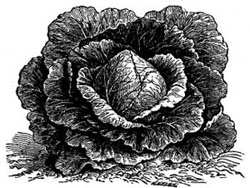
Early Wakefield, sometimes called Early Jersey Wakefield. Heads
mostly nearly conical in shape but sometimes nearly round, of good size
for early, very reliable for heading; stumps short. A very popular early
cabbage in the markets of Boston and New York. Plant two and a half feet
by two feet. There are two strains of this cabbage, one a little later
and larger than the other.
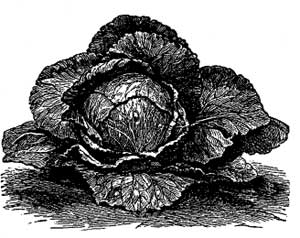
Early Wyman. This cabbage is named after Capt. Wyman, of Cambridge,
the originator. Like Early Wakefield the heads are usually somewhat
conical, but sometimes nearly round; in structure they are compact. In
earliness it ranks about with the Early Wakefield, and making heads of
double the size, it has a high value as an early cabbage. Capt. Wyman
had entire control of this cabbage until within the past few years, and,
consequently, has held Boston Market in his own hands, to the chagrin of
his fellow market gardeners, raising some seasons as many as thirty
thousand heads. Have the rows from two to two and a half feet apart, and
the plants from twenty to twenty-four inches apart in the row. Crane's
Early is a cross between the Wyman and Wakefield, intermediate in size
and earliness.
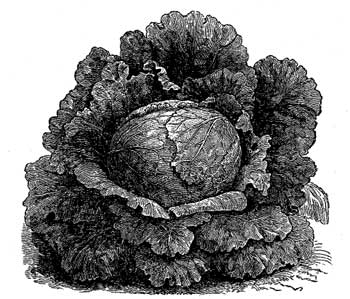
Premium Flat Dutch. Large, late variety; heads either round or flat,
on the top (varying with different strains); rather hard; color bluish
green; leaves around heads rather numerous; towards the close of the
season, the edge of some of the exterior leaves and the top of the heads
assume a purple cast. The edges of the exterior leaves, and of the two
or three that make the outside of the head, are quite ruffled, so that
when grown side by side with Stone Mason, this distinction between the
habit of growth of the two varieties is noticeable at quite a distance.
Stumps short; reliable for heading. Have the rows three feet apart, and
the plants from two and a half to three feet apart in the rows. This
cabbage is very widely cultivated, and, in many respects, is an
excellent sort to raise for late marketing. There are several strains of
it catalogued by different seedsmen under various names, such as Sure
Head, &c.
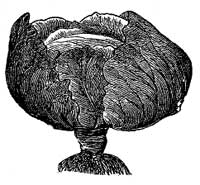
Stone Mason. An improvement on the Mason, which cabbage was selected
by Mr. John Mason of Marblehead, from a number of varieties of cabbage
that came from a lot of seed purchased and planted as Savoys. Mr. John
Stone afterwards improved upon the Mason cabbage, by increasing the size
of the heads. Different growers differ in their standard of a Stone
Mason cabbage, in earliness and lateness, and in the size, form, and
hardness of the head. But all these varieties agree in the
characteristics of being very reliable for heading, in having heads
which are large, very hard, very tender, rich and sweet; short stumps,
and few waste leaves. The color of the leaves varies from a bluish green
to a pea-green, and the structure from nearly smooth to much blistered.
In their color and blistering some specimens have almost a Savoy cast.
The heads of the best varieties of Stone Mason range in weight from six
to twenty-five pounds, the difference turning mostly on soil, manure,
and cultivation.
The Stone Mason is an earlier cabbage than Premium Flat Dutch, has fewer
waste leaves, and side by side, under high cultivation, grows to an
equal or larger size, while it makes heads that are decidedly harder and
sweeter. These cabbages are equally reliable for heading. I am inclined
to the opinion that under poor cultivation the Premium Flat Dutch will
do somewhat better than the Stone Mason.
Until the introduction of Fottler's Drumhead it was the standard
drumhead cabbage in the markets of Boston and other large cities of the
North. Have the rows three feet apart, and the plants from two to three
feet apart in the row.
Large Late Drumhead. Heads large, round, sometimes flattened at the
top, close and firm; loose leaves numerous; stems short; reliable for
heading, hardy, and a good keeper. The name "Large Late Drumhead"
includes varieties raised by several seedsmen in this country, all of
which resemble each other in the above characteristics, and differ in
but minor points. Have rows three feet apart, and plants from two and a
half to three feet apart in the row.
Marblehead Mammoth Drumhead. This is the largest of the cabbage
family, having sometimes been grown to weigh over ninety pounds to the
plant. It originated in Marblehead, Mass., being produced by Mr. Alley,
probably from the Mason, by years of high cultivation and careful
selection of seed stock. I introduced this cabbage and the Stone Mason
to the general public many years ago, and it has been pretty thoroughly
disseminated throughout the United States. Heads varying in shape
between hemispherical and spherical, with but few waste leaves
surrounding them; size very large, varying from fifteen to twenty inches
in diameter, and, in some specimens, they have grown to the
extraordinary dimensions of twenty-four inches. In good soil, and with
the highest culture, this variety has attained an average weight of
thirty pounds by the acre. Quality, when well grown, remarkably sweet
and tender, as would be inferred from the rapidity of its growth.
Cultivate in rows four feet apart, and allow four feet between the
plants in the rows. Sixty tons of this variety have been raised from a
single acre.
American Green Glazed. Heads loose, though rather large, with a great
body of waste leaves surrounding them; quality poor; late; stump long.
This cabbage was readily distinguished among all the varieties in my
experimental plot by the deep, rich green of the leaves, with their
bright lustre as though varnished. It is grown somewhat extensively in
the South, as it is believed not to be so liable to injury from insects
as other varieties. Plant two and a half feet apart each way. I would
advise my Southern friends to try the merits of other kinds before
adopting this poor affair. I know, through my correspondence, that the
Mammoth has done well as far South as Louisiana and Cuba, and the
Fottler, in many sections of the South, has given great satisfaction.
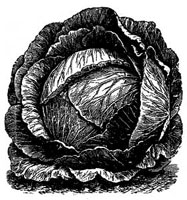
Fottler's Early Drumhead. Several years ago a Boston seedsman imported
a lot of cabbage seed from Europe, under the name of Early Brunswick
Short Stemmed. It proved to be a large heading and very early Drumhead.
The heads were from eight to eighteen inches in diameter nearly flat,
hard, sweet, and tender in quality; few waste leaves; stump short. In
earliness it was about a fortnight ahead of the Stone Mason. It was so
much liked by the market gardeners that the next season he ordered a
larger quantity; but the second importation, though ordered and sent
under the same name, proved to be a different and inferior kind, and the
same result followed one or two other importations. The two gardeners
who received seed of the first importation brought to market a fine,
large Drumhead, ten days or a fortnight ahead of their fellows. The seed
of the true stock was eagerly bought up by the Boston market gardeners,
most of it at five dollars an ounce. After an extensive trial on a
large scale by the market farmers around Boston, and by farmers in
various parts of the United States, Fottler's Cabbage has given great
satisfaction, and become a universal favorite, and when once known it,
and especially the improved strain of it, known as Deep Head, is fast
replacing some of the old varieties of Drumhead. Very reliable for
heading.
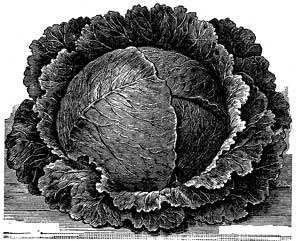
Vandergaw Cabbage. This new Long Island Cabbage must be classed as A
No. 1 for the midsummer and late market. It is as sure to head as the
Succession, and has some excellent characteristics in common.
It makes large, green heads, hard, tender, and crisp. This is an
acquisition.
The Warren Cabbage. This first-class cabbage is closely allied to, but
an improvement on, the old Mason Cabbage of twenty-five years ago. It
makes a head deep, round, and very hard, the outer leaves wrapping it
over very handsomely. In reliability for heading no cabbage surpasses
it; a field of them when in their prime is as pretty a sight as a
cabbage man would wish to see. It comes in as early as some strains of
Fottler, and a little earlier than others. A capital sort to succeed the
Early Summer. The heads being very thick through, and nearly round, make
it an excellent sort to carry through the winter, as it "peels" well, as
cabbage-growers say. Ten inches in diameter, in size it is just about
right for profitable marketing. A capital sort, exceedingly popular
among market-man in this vicinity.
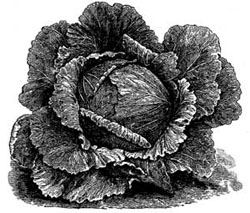
Early Bleichfeld Cabbage. I find the Bleichfeld to be among the
earliest of the large, hard-heading Drumheads, maturing earlier than the
Fottler's Brunswick. The heads are large, very solid, tender when
cooked, and of excellent flavor. The color is a lighter green than most
varieties and it is as reliable for heading as any cabbage I have ever
grown. The above engraving I have had made from a photograph of a
specimen grown on my grounds.
Danish Drumhead Cabbage. In 1879, Mr. Edward Abelgoord wrote me from
Canada, that he raised a large Drumhead Cabbage, the seed of which was
brought from Denmark, which was the best kind of cabbage that he had
seen in that latitude (46°), being very valuable for the extreme North.
It was earlier than Fottler's Drumhead, and made large, flat heads, of
excellent flavor, and was so reliable for heading. I raised a field of
this new cabbage, and it proved a large, flat, early Drumhead, very
reliable for heading.
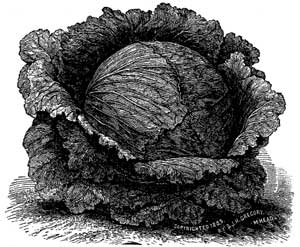
The Reynolds Early Cabbage. In the year 1875, Mr. Franklin Reynolds,
of this town, crossed the Cannon-Ball Cabbage on the Schweinfurt
Quintal, by carefully transferring the pollen of the former on the
latter, the stamens having first been removed, and immediately tying
muslin around the impregnated blossoms to keep away all insects. The
results were a few ripe seeds. These were carefully saved and planted
the next season, when the product showed the characteristics of the two
parents. The best heads were selected from the lot, and, from these,
seeds were raised. Several selections were made of the choicest heads
from year to year; and I now have the pleasure of introducing the
results, a new cabbage which combines the good qualities of both its
parents.
The flavor of this new cabbage is rich, tender, and sweet, being
superior to the general Drumhead class, making it a very superior
variety for family use, and also for marketing when there is not a long
transportation. None of the scores of varieties I have ever grown has a
shorter stump than this; the heads appear to rest directly on the
ground, and no one is surer to head.
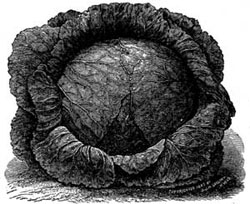
All-Seasons Cabbage. This new cabbage is the result of a cross made by
a Long Island gardener between the Flat Dutch and a variety of Drumhead.
The result is a remarkably large, early Drumhead, that matures close in
time with the Early Summer, while it is from one third to one half
larger. It is an excellent variety either as an early or late sort; the
roundness of the head, leaving a thick, solid cabbage, should it become
necessary, as is often the case with those marketed in the spring, to
peel off the outer layer of leaves. Heads large in size, solid and
tender, and rich flavored when cooked. It has already, in three years,
verified the prophecy I made when sending it out, and become a standard
variety in some localities.
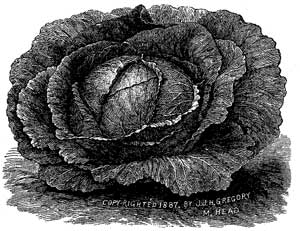
Gregory's Hard-Heading Cabbage. I am not acquainted with any variety
of cabbage (I believe I have raised about all the native and foreign
varieties that have been catalogued) that makes so hard a head as does
the "Hard-heading" when fully matured. Neither am I acquainted with any
variety that is so late a keeper as is this; the German gardener, from
whom I obtained it, said that it gave him, and his friends who had it,
complete control of the Chicago market for about a fortnight after all
other varieties had "played out." My own experience with it tends to
confirm this statement, for under the same conditions it kept decidedly
later than all my other varieties, was greener in color, and when
planted out they were so late to push seed-shoots that I almost
despaired of getting a crop of seed. I find, also, that they are much
less inclined to burst than any of the hard-heading varieties. Heads
grow to a good market size, are more globular than Flat Dutch; and, as
might be presumed, of great weight in proportion to their size. The
color is a peculiar green, rather more of an olive than most kinds of
cabbage. About a fortnight later than Flat Dutch. For late fall, winter,
and spring sales plant 3 by 3 the first of June.
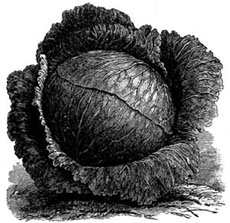
Early Deep-Head Cabbage. This is a valuable improvement on the Fottler
made by years of careful selection and high cultivation by Mr. Alley of
Marblehead, a famous cabbage grower, who, as the name indicates, has
produced a deeper, rounder heading variety than the original Fottler,
thus making what that was not, an excellent sort for winter and spring
marketing. It has all the excellent traits of its parent in reliability
for making large, handsome heads.
Bergen Drumhead. Heads round, rather flat on the top, solid; leaves
stout, thick, and rather numerous; stump short. With me, under same
cultivation, it is later than Stone Mason. It is tender and of good
flavor. A popular sort in many sections, particularly in the markets of
New York City. Have the plants three feet apart each way.