ROD, SMILER, AND THE TRAMP.
“Help! Murder! Take off your dog!” yelled the young tramp, throwing up his
arm to protect his face from Smiler’s attack, and springing backward. In
so doing he tripped and fell heavily to the floor, with the dog on top of
him, growling savagely, and tearing at the ragged coat-sleeve in which his
teeth were fastened. Fearful lest the dog might inflict some serious
injury upon the fellow, Rodman rushed to his assistance. He had just
seized hold of Smiler, when a kick from the struggling tramp sent his feet
flying from under him, and he too pitched headlong. There ensued a scene
which would have been comical enough to a spectator, but which was
anything but funny to those who took part in it. Over and over they
rolled, striking, biting, kicking, and struggling. The tramp was the first
to regain his feet; but almost at the same instant Smiler escaped from
Rod’s embrace, and again flew at him. They had rolled over the caboose
floor until they were close to its rear door; and now, with a yell of
terror, the tramp darted through it, sprang from the moving train, and
disappeared in the darkness, leaving a large piece of his trousers in the
dog’s mouth. Just then the forward door was opened, and two men with
lanterns on their arms, entered the car.
They were Conductor Tobin, and rear-brakeman Joe, his right-hand man,
who had just finished switching their train back on the main track, and
getting it again started on its way toward New York. At the sight of Rod,
who was of course a perfect stranger to them, sitting on the floor,
hatless, covered with dust, his clothing bearing many signs of the recent
fray, and ruefully feeling of a lump on his forehead that was rapidly
increasing in size, and of Smiler whose head was bloody, and who was still
worrying the last fragment of clothing that the tramp’s rags had yielded
him, they stood for a moment in silent bewilderment.
“Well, I’ll be blowed!” said Conductor Tobin at length.
“Me too,” said Brakeman Joe,
who believed in following the lead of his superior officer.
“May I inquire,” asked Conductor Tobin, seating himself on a locker close
to where Rod still sat on the floor, “May I inquire who you are? and where
you came from? and how you got here? and what’s happened to Smiler? and
what’s came of the fellow we left sleeping here a few minutes ago? and
what’s the meaning of all this business, anyway?”
“Yes, we’d like to know,” said the Brakeman, taking a seat on the opposite
locker, and regarding the boy with a curiosity that was not unmixed with
suspicion. Owing to extensive dealings with tramps, Brakeman Joe was very
apt to be suspicious of all persons who were dirty, and ragged, and had
bumps on their foreheads.
“The trouble is,” replied Rod, looking first at Conductor Tobin and then
at Brakeman Joe, “that I don’t know all about it myself. Nobody does
except the fellow who just left here in such a hurry, and Smiler, who
can’t tell.”
Here the dog, hearing his name mentioned, dragged himself rather stiffly
to the boy’s side; for now that the excitement was over, his hurts
began to be painful again, and licked his face.
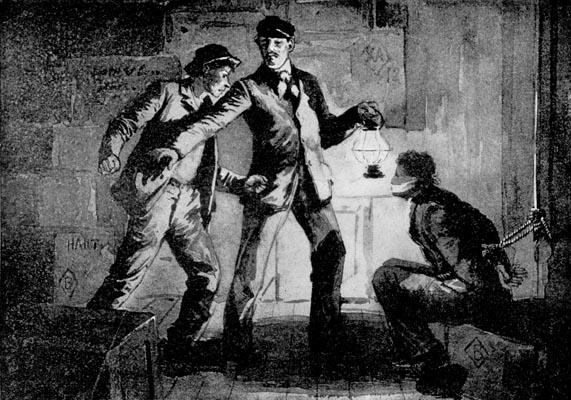
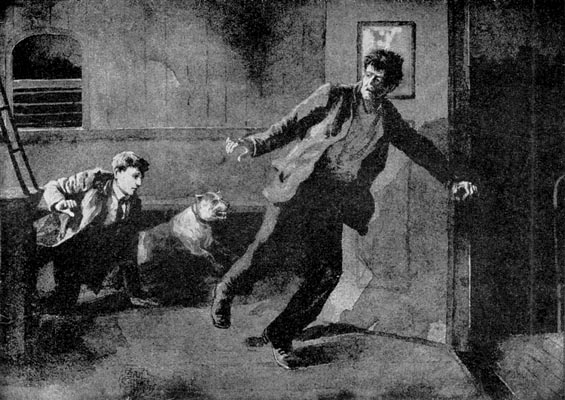 smiler drives off the tramp.—(page 41.)
“Well, you must be one of the right sort, at any rate,” said Conductor
Tobin, noting this movement, “for Smiler is a dog that doesn’t make
friends except with them as are.”
“He knows what’s what, and who’s who,” added Brakeman Joe, nodding his
head. “Don’t you, Smiler, old dog?”
“My name,” continued the boy, “is R. R. Blake.”
“Railroad Blake?” interrupted Conductor Tobin inquiringly.
“Or ‘Runaway Blake’?” asked Brakeman Joe who, still somewhat suspicious,
was studying the boy’s face and the M. I. P. bag attached to his
shoulders.
“Both,” answered Rod, with a smile. “The boys where I live, or rather
where I did live, often call me ‘Railroad Blake,’ and I am a runaway. That
is, I was turned away first, and ran away afterwards.”
Then, as briefly as possible, he gave them the whole history of his
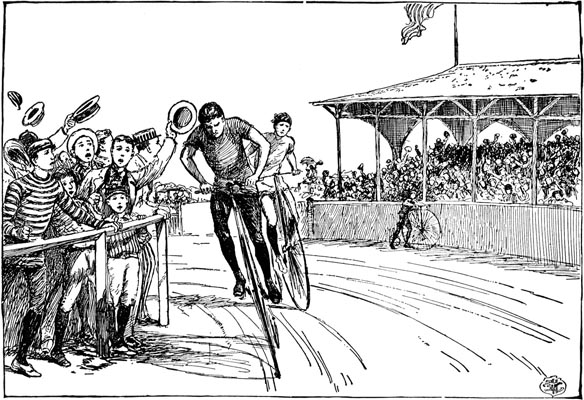
adventures, beginning with the bicycle race, and ending with the
disappearance of the young tramp through the rear door of the
caboose in
which they sat. Both men listened with the deepest attention, and without
interrupting him save by occasional ejaculations, expressive of wonder and
sympathy.
“Well, I’ll be blowed!” exclaimed Conductor Tobin, when he had finished;
while Brakeman Joe, without a word, went to the rear door and examined the
platform, with the hope, as he afterwards explained, of finding there the
fellow who had kicked Smiler off the train, and of having a chance to
serve him in the same way. Coming back with a disappointed air, he
proceeded to light a fire in the little round caboose stove, and prepare a
pot of coffee for supper, leaving Rodman’s case to be managed by Conductor
Tobin as he thought best.
The latter told the boy that the young tramp, as they called him, was
billed through to New York, to look after some cattle that were on the
train; but that he was a worthless, ugly fellow, who had not paid the
slightest attention to them, and whose only object in accepting the job
was evidently to obtain a free ride in the caboose. Smiler, whom he had
been delighted to find on the train when it was turned over to him, had
taken a great dislike to the fellow
from the first. He had growled and
shown his teeth whenever the tramp moved about the car, and several times
the latter had threatened to teach him better manners. When he and
Brakeman Joe went to the forward end of the train, to make ready for
side-tracking it, they left the dog sitting on the rear platform of the
caboose, and the tramp apparently asleep, as Rod had found him, on one of
the lockers. He must have taken advantage of their absence to deal the dog
the cruel kick that cut his ear, and landed him, stunned and bruised, on
the track where he had been discovered.
“I’m glad he’s gone,” concluded Conductor Tobin, “for if he hadn’t left,
we would have fired him for what he did to Smiler. We won’t have that dog
hurt on this road, not if we know it. It won’t hurt him to have to walk
to New York, and I don’t care if he never gets there. What worries me,
though, is who’ll look after those cattle, and go down to the stock-yard
with them, now that he’s gone.”
“Why couldn’t I do it?” asked Rod eagerly. “I’d be glad to.”
“You!” said Conductor Tobin incredulously.
“Why, you look like too much
of a gentleman to be handling cattle.”
“I hope I am a gentleman,” answered the boy with a smile; “but I am a very
poverty-stricken one just at present, and if I can earn a ride to the
city, just by looking after some cattle, I don’t know why I shouldn’t do
that as well as anything else. What I would like to do though, most of all
things, is to live up to my nickname, and become a railroad man.”
“You would, would you?” said Conductor Tobin. Then, as though he were
propounding a conundrum, he asked: “Do you know the difference between
a railroad man and a chap who wants to be one?”
“I don’t know that I do,” answered the boy.
“Well, the difference is, that the latter gets what he deserves, and the
former deserves what he gets. What I mean is, that almost anybody who is
willing to take whatever job is offered him can get a position on a
railroad; but before he gets promoted he will have to deserve it several
times over. In other words, it takes more honesty, steadiness,
faithfulness, hard work, and brains to work your way up in railroad life
than in any other business that I know of. However, at present, you are
only going along with me as stockman,
in which position I am glad to have
you, so we won’t stop now to discuss railroading. Let’s see what Joe has
got for supper, for I’m hungry and I shouldn’t be surprised if you were.”
Indeed Rod was hungry, and just at that moment the word supper was the
most welcome of the whole English language. First, though, he went to the
wash-basin that he noticed at the forward end of the car. There he bathed
his face and hands, brushed his hair, restored his clothing to something
like order, and altogether made himself so presentable, that Conductor
Tobin laughed when he saw him, and declared that he looked less like a
stockman than ever.
How good that supper, taken from the mammoth lunch pails of the train
crew, tasted, and what delicious coffee came steaming out of the
smoke-blackened pot that Brakeman Joe lifted so carefully from the stove!
To be sure it had to be taken without milk, but there was plenty of sugar,
and when Rod passed his tin cup for a second helping, the coffee maker’s
face fairly beamed with gratified pride.
After these three and Smiler had finished their
supper, Conductor Tobin
lighted his pipe, and, climbing up into the cupola of the caboose,
stretched himself comfortably on the cushioned seat arranged there for his
especial accommodation. From here, through the windows ahead, behind, and
on both sides of the cupola, he had an unobstructed view out into the
night. Brakeman Joe went out over the tops of the cars to call in the
other two brakeman of the train, and keep watch for them, while they went
into the caboose and ate their supper. They looked curiously at Rod as
they entered the car; but were too well used to seeing strangers riding
there to ask any questions. They both spoke to Smiler though, and he
wagged his tail as though recognizing old friends.
The dog could not go to them and jump up to be petted because Rod was
attending to his wounds. He carefully bathed the cut under the left ear,
from which considerable blood had flowed, and drew its edges together with
some sticking plaster, of which he always carried a small quantity in his
M. I. P. bag. Then, finding one of the dog’s fore shoulders strained and
swollen, he soaked it for some time in water as hot as the animal could
bear. After arranging a comfortable
bed in one corner of the car, he
finally persuaded Smiler to lie there quietly, though not until he had
submitted to a grateful licking of his face and hands.
Next the boy turned his attention to the supper dishes, and had them very
nearly washed and wiped when Brakeman Joe returned, greatly to that
stalwart fellow’s surprise and delight; for Joe hated to wash dishes.
By this time Rod had been nearly two hours on the train, and was so
thoroughly tired that he concluded to lie down and rest until he should be
wanted for something else. He did not mean to even close his eyes, but
within three minutes he was fast asleep. All through the night he slept,
while the long freight train, stopping only now and then for water, or to
allow some faster train to pass it, rumbled heavily along toward the great
city.
He could not at first realize where he was, when, in the gray of the next
morning, a hand was laid on his shoulder, and Conductor Tobin’s voice
said: “Come, my young stockman, here we are at the end of our run, and it
is time for you to be looking after your cattle.” A quick dash of cold
water on his head and face
cleared the boy’s faculties in an instant.
Then Conductor Tobin pointed out the two stock cars full of cattle that
were being uncoupled from the rest of the train, and bade him go with them
to the stock-yard. There he was to see that the cattle were well watered
and safely secured in the pen that would be assigned to them. Rod was also
told that he might leave his bag in the caboose and come back, after he
was through with his work, for a bit of breakfast with Brakeman Joe, who
lived at the other end of the division, and always made the car his home
when at this end. As for himself, Conductor Tobin said he must bid the boy
good-by, as he lived a short distance out on the road, and must hurry to
catch the train that would take him home. He would be back, ready to start
out again with the through freight, that evening, and hoped Rod would come
and tell him what luck he had in obtaining a position. Then rough but
kind-hearted Conductor Tobin left the boy, never for a moment imagining
that he was absolutely penniless and without friends in that part of the
country, or in the great city across the river.
For the next two hours Rod worked hard and
faithfully with the cattle
committed to his charge, and then, anticipating with a keen appetite a
share of Brakeman Joe’s breakfast, he returned to where he had left the
caboose. It was not there, nor could he find a trace of it. He saw plenty
of other cabooses looking just like it, but none of them was the one he
wanted.
He inquired of a busy switch-tender where it could be found, and the man
asked him its number. He had not noticed. What was the number of the train
with which it came in? Rod had no idea. The number of the locomotive that
drew it then? The boy did not know that either.
“Well,” said the man impatiently, “you don’t seem to know much of
anything, and I’d advise you to learn what it is you want to find out
before you bother busy folks with questions.”
So the poor fellow was left standing alone and bewildered in the great,
busy freight-yard, friendless and hungry. He had lost even the few
treasures contained in his M. I. P. bag, and never had life seemed darker
or more hopeless. For some moments he could not think what to do, or which
way to turn.
 Chief Scout Executive.
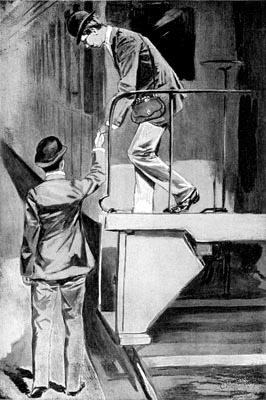
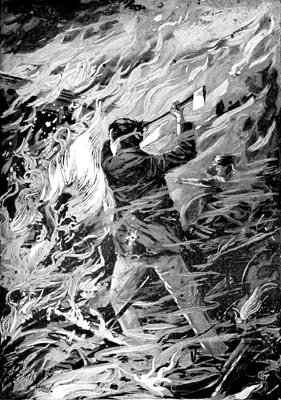
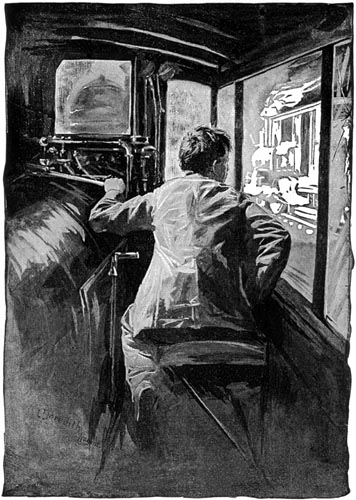 the pursuit of the train robber.—(page 156.)
Frontispiece.
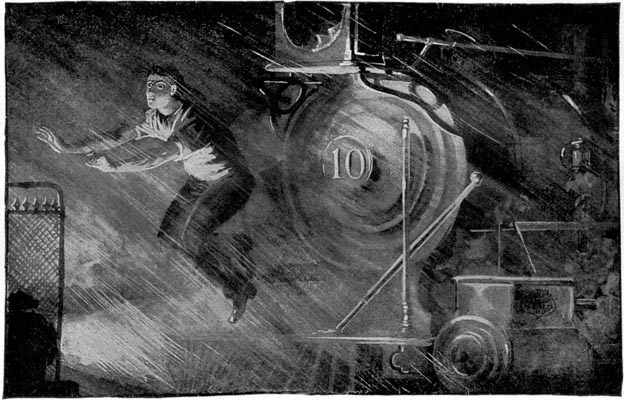
the pursuit of the train robber.—(page 156.)
Frontispiece.