Footnote 1: Ý "The binding of
this volume is considerably too valuable for the contents.
Nothing but the consideration of its being the property of
another, prevents me from consigning this miserable record of
misplaced anger and indiscriminate acrimony to the flames."--B.,
1816.
return to footnote mark |
Footnote a:Ý
Truth be my theme, and Censure guide my
song.
[MS M.]
return |
Footnote 2: ÝImitation:
"Semper ego auditor tantum? nunquamne reponam,
Vexatus toties, rauci Theseide Codri?"
Juvenal, Satire I.l. 1.
return |
Footnote b:Ý
But thou, at least, mine own especial quill
Dipt in the dew drops from Parnassus' hill,
Shalt ever honoured and regarded be,
By more beside no doubt, yet still by me....
[MS M.]
return |
Footnote 3: Ý "Hoarse
Fitzgerald.--"Right enough; but why notice such a
mountebank?"--B., 1816.
Mr. Fitzgerald, facetiously termed by Cobbett the "Small Beer
Poet," inflicts his annual tribute of verse on the Literary Fund:
not content with writing, he spouts in person, after the company
have imbibed a reasonable quantity of bad port, to enable them to
sustain the operation.
[William Thomas Fitzgerald (circ. 1759-1829) played the part of
unofficial poet laureate. His loyal recitations were reported by
the newspapers. He published, inter alia, Nelson's
Triumph (1798), Tears of Hibernia, dispelled by the
Union (1802), and Nelson's Tomb (1806). He owes his
fame to the first line of English Bards, and the famous
parody in Rejected Addresses. The following jeux
d'esprits were transcribed by R. C. Dallas on a blank leaf of
a copy of the Fifth Edition:--
"Written on a copy of English Bards at the 'Alfred' by W.
T. Fitzgerald, Esq.--
I find Lord Byron scorns my Muse, Our Fates are ill
agreed; The Verse is safe, I can't abuse Those lines, I never
read.
Signed W. T. F."
Answer written on the same page by Lord Byron--
"What's writ on me," cries Fitz, "I never read"!
What's writ by thee, dear Fitz, none will, indeed. The case
stands simply thus, then, honest Fitz, Thou and thine enemies are
fairly quits; Or rather would be, if for time to come, They
luckily were deaf, or thou wert dumb; But to their pens while scribblers add their tongues.
The Waiter only can escape their lungs A.
Sub-Footnote
A Compare Hints from Horace, l.
808 (click c12 to return), note
1.
return to main footnote mark
cross-reference: return to Footnote 77 of
Hints from Horace |
Footnote c:Ý
And men through life her willing slaves
obey...
[MS. Second, Third, and Fourth Editions.]
return |
Footnote 4: Ý Cid Hamet Benengeli
promises repose to his pen, in the last chapter of Don
Quixote. Oh! that our voluminous gentry would follow the
example of Cid Hamet Benengeli!
return |
Footnote d: Ý
Unfolds her motley store to suit the
time...
[MS. Second, Third, and Fourth Editions.]
return |
Footnote 5: Ý"This must have been
written in the spirit of prophecy." (B., 1816.)
return |
Footnote e: Ý
When Justice halts and Right begins to
fail...
[MS. Second, Third, and Fourth Editions.
return |
Footnote 6: Ý "He's a very good
fellow; and, except his mother and sister, the best of the set,
to my mind."--B., 1816. [William (1779-1848) and George
(1784-1834) Lamb, sons of Sir Peniston Lamb (Viscount Melbourne,
1828), by Elizabeth, only daughter of Sir Ralph Milbanke, were
Lady Byron's first cousins. William married, in 1805, Lady
Caroline Ponsonby, the writer of Glenarvon. George, who
was one of the early contributors to the Edinburgh Review,
married in 1809 Caroline Rosalie Adelaide St. Jules. At the time
of the separation, Lady Caroline Lamb and Mrs. George Lamb warmly
espoused Lady Byron's cause, Lady Melbourne and her daughter Lady
Cowper (afterwards Lady Palmerston) were rather against than for
Lady Byron. William Lamb was discreetly silent, and George Lamb
declaimed against Lady Byron, calling her a d----d fool. Hence
Lord Byron's praises of George. Cf. line 517 of English
Bards.
return |
Footnote f: Ý
A mortal weapon...
[MS M.]
return |
Footnote 7: ÝThis ingenuous youth is
mentioned more particularly, with his production, in another
place. (Vide post, l. 516.)
"Spurious Brat" [see Footnote g], that is the
farce; the ingenuous youth who begat it is mentioned more
particularly with his offspring in another place. [Note. MS.
M.]
[The farce Whistle for It was performed two or three times
at Covent Garden Theatre in 1807.
return |
Footnote g: Ý
Yet Titles sounding lineage cannot save
Or scrawl or scribbler from an equal grave,
Lamb had his farce but that Patrician name
Failed to preserve the spurious brat from
shame....
[MS.]
return to poem
cross-reference: return to Footnote 7 of this
poem |
Footnote 8: Ý In the Edinburgh
Review.
return |
Footnote h: Ý
a lucky hit....
[Second, Third, and Fourth Editions]
return |
Footnote 9: Ý The proverbial "Joe"
Miller, an actor by profession (1684-1738), was a man of no
education, and is said to have been unable to read. His
reputation rests mainly on the book of jests compiled after his
death, and attributed to him by John Mottley. (First Edition. T.
Read. 1739.)
return |
Footnote i: Ý
No dearth of rhyme...
[British Bards]
return |
Footnote 10: Ý Messrs. Jeffrey and
Lamb are the alpha and omega, the first and last of the
Edinburgh Review; the others are mentioned hereafter.
[The MS. Note is as follows:--
"Of the young gentlemen who write in the E.R.,
I have now named the alpha and omega, the first and the last, the
best and the worst. The intermediate members are designated with
due honour hereafter."]
"This was not just. Neither the heart nor the head of these
gentlemen are at all what they are here represented. At the time
this was written, I was personally unacquainted with
either."--B., 1816.
[Francis Jeffrey (1773-1850) founded the Edinburgh Review
in conjunction with Sydney Smith, Brougham, and Francis Horner,
in 1802. In 1803 he succeeded Smith as editor, and conducted the
Review till 1829. Independence of publishers and high pay
to contributors ("Ten guineas a sheet," writes Southey to Scott,
June, 1807, "instead of seven pounds for the Annual," Life and
Corr., iii. 125) distinguished the new journal from the
first. Jeffrey was called to the Scottish bar in 1794, and as an
advocate was especially successful with juries. He was constantly
employed, and won fame and fortune. In 1829 he was elected Dean
of the Faculty of Advocates, and the following year, when the
Whigs came into office, he became Lord Advocate. He sat as M.P.
twice for Malton (1830-1832), and, afterwards, for Edinburgh. In
1834 he was appointed a Judge of the Court of Sessions, when he
took the title of Lord Jeffrey. Byron had attacked Jeffrey in
British Bards before his Hours of Idleness had been cut up
by the Edinburgh, and when the article appeared (Jan.
1808), under the mistaken impression that he was the author,
denounced him at large (ll. 460-528) in the first edition of
English Bards, and Scotch Reviewers. None the less, the
great critic did not fail to do ample justice to the poet's
mature work, and won from him repeated acknowledgments of his
kindness and generosity. (See Edinburgh Review, vol. xxii.
p. 416, and Byron's comment in his Diary for March
20,1814; Life, p. 232. See, too, Hints from Horace,
ll. 589-626; and Don Juan, canto x. st. 11-16, and canto
xii. st. 16. See also Bagehot's Literary Studies, vol. i.
article I.)]
return |
Footnote j: Ý
The Press oppressed...
[British Bards]
return |
Footnote 11: Ý Imitation:
"Stulta est dementia, cum tot ubique
----occurras perituræ parcere chartæ."
Juvenal, Sat. I. ll. 17, 18.
return |
Footnote k: Ý
While Southey's Epics load....
[British Bards]
return |
Footnote 12: Ý Imitation.
"Cur tamen hoc potius libeat decurrere campo,
Per quem magnus equos Auruncæ flexit alumnus,
Si vacat, et placidi rationem admittitis, edam."
Juvenal, Sat. I. ll. 19-21.
return |
Footnote m: Ý
O'er taste awhile these Infidels
prevail...
[MS.]
return |
Footnote 13: Ý William Gifford
(1756-1826), a self-taught scholar, first a ploughboy, then boy
on board a Brixham coaster, afterwards shoemaker's apprentice,
was sent by friends to Exeter College, Oxford (1779-81). In the
Baviad (1794) and the Maeviad (1795) he attacked
many of the smaller writers of the day, who were either silly,
like the Della Cruscan School, or discreditable, like Williams,
who wrote as "Anthony Pasquin." In his Epistle to Peter
Pindar (1800) he laboured to expose the true character of
John Wolcot. As editor of the Anti-Jacobin, or Weekly
Examiner (November, 1797, to July, 1798), he supported the
political views of Canning and his friends. As editor of the
Quarterly Review, from its foundation (February, 1809) to
his resignation in September, 1824, he soon rose to literary
eminence by his sound sense and adherence to the best models,
though his judgments were sometimes narrow-minded and warped by
political prejudice. His editions of Massinger (1805),
which superseded that of Monck Mason and Davies (1765), of Ben
Jonson (1816), of Ford (1827), are valuable. To his
translation of Juvenal (1802) is prefixed his
autobiography. His translation of Persius appeared in
1821. To Gifford, Byron usually paid the utmost deference.
"Any suggestion of yours, even if it were conveyed,"
he writes to him, in 1813, "in the less tender text of the
Baviad, or a Monck Mason note to Massinger, would be
obeyed."
See also his letter (September 20, 1821, Life, p.531):
"I know no praise which would compensate me in my own
mind for his censure."
Byron was attracted to Gifford, partly by his devotion to the
classical models of literature, partly by the outspoken frankness
of his literary criticism, partly also, perhaps, by his physical
deformity.
return |
Footnote n: Ý
Erect and hail an idol of their
own....
[MS.]
return |
Footnote 14: Ý Henry James Pye
(1745-1813), M.P. for Berkshire, and afterwards Police Magistrate
for Westminster, held the office of poet laureate from 1790 till
his death in 1813, succeeding Thomas Warton, and succeeded by
Southey. He published Farringdon Hill in 1774, The
Progress of Refinement in 1783, and a translation of
Burger's Lenore in 1795. His name recurs in the Vision
of Judgment, stanza xcii. Lines 97-102 were inserted in the
Fifth Edition.
return |
Footnote o: Ý
Not quite a footpad...
[British Bards]
return |
Footnote 15: Ý The first edition of
the Satire opened with this line; and Byron's original intention
was to prefix the following argument, first published in
Recollections, by R. C. Dallas (1824):--
"Argument.
"The poet considereth times past, and their poesy--makes a
sudden transition to times present--is incensed against
book-makers--revileth Walter Scott for cupidity and
ballad-mongering, with notable remarks on Master
Southey--complaineth that Master Southey had inflicted three
poems, epic and otherwise, on the public--inveigheth against
William Wordsworth, but laudeth Mister Coleridge and his elegy on
a young ass--is disposed to vituperate Mr. Lewis--and greatly
rebuketh Thomas Little (the late) and Lord
Strangford--recommendeth Mr. Hayley to turn his attention to
prose--and exhorteth the Moravians to glorify Mr.
Grahame--sympathiseth with the Rev. [William Bowles]--and
deploreth the melancholy fate of James Montgomery--breaketh out
into invective against the Edinburgh Reviewers--calleth them hard
names, harpies and the like--apostrophiseth Jeffrey, and
prophesieth.--Episode of Jeffrey and Moore, their jeopardy and
deliverance; portents on the morn of the combat; the Tweed,
Tolbooth, Firth of Forth [and Arthur's Seat], severally shocked;
descent of a goddess to save Jeffrey; incorporation of the
bullets with his sinciput and occiput.--Edinburgh Reviews en
masse.--Lord Aberdeen, Herbert, Scott, Hallam, Pillans,
Lambe, Sydney Smith, Brougham, etc.--Lord Holland applauded for
dinners and translations.--The Drama; Skeffington, Hook,
Reynolds, Kenney, Cherry, etc.--Sheridan, Colman, and Cumberland
called upon [requested, MS.] to write.--Return to
poesy--scribblers of all sorts--lords sometimes rhyme; much
better not--Hafiz, Rosa Matilda, and X.Y.Z.--Rogers, Campbell,
Gifford, etc. true poets--Translators of the Greek
Anthology--Crabbe--Darwin's style--Cambridge--Seatonian
Prize--Smythe--Hodgson--Oxford--Richards--Poeta
loquitur--Conclusion."
return |
Footnote p: Ý
Low may they sink to merited
contempt...
[British Bards]
And Scorn reimmerate the mean
attempt!
[MS. First to Fourth Editions]
return |
Footnote 16: Ý Lines 115, 116, were
a MS. addition to the printed text of British Bards. An
alternative version has been pencilled on the margin:--
"Otway and Congreve mimic scenes had wove
And Waller tuned his Lyre to mighty Love."
return |
Footnote q: Ý
though lesser bards content...
[British Bards]
return |
Footnote 17: Ý Thomas Little was the
name under which Moore's early poems were published, The
Poetical Works of the late Thomas Little, Esq. (1801).
"Twelves" refers to the "duodecimo." Sheets, after printing, are
pressed between cold or hot rollers, to impart smoothness of
"surface." Hot rolling is the more expensive process.
return |
Footnote r: Ý
How well the subject...
[MS. First to Fourth Editions]
return |
Footnote 18: Ý Eccles. chapter i.
verse 9.
return |
Footnote s: Ý
A fellow feeling makes us wondrous
kind...
[British Bards, First to Fourth Editions.]
return |
Footnote 19: Ý At first sight Byron
appears to refer to the lighting of streets by gas, especially as
the first shop lighted with it was that of Lardner & Co., at
the corner of the Albany (June, 1805), and as lamps were on view
at the premises of the Gas Light and Coke Company in Pall Mall
from 1808 onwards. But it is almost certain that he alludes to
the "sublimating gas" of Dr. Beddoes, which his assistant, Davy,
mentions in his Researches (1800) as nitrous oxide, and
which was used by Southey and Coleridge. The same four "wonders"
of medical science are depicted in Gillray's caricatures,
November, 1801, and May and June, 1802, and are satirized in
Christopher Caustic's Terrible Tractoration! A Poetical
Petition against Galvanising Trumpery and the Perkinistit
Institution (in 4 cantos, 1803).
Against vaccination, or cow-pox, a brisk war was still being
carried on. Gillray has a likeness of Jenner vaccinating
patients.
Metallic "Tractors" were a remedy much advertised at the
beginning of the century by an American quack, Benjamin Charles
Perkins, founder of the Perkinean Institution in London, as a
"cure for all Disorders, Red Noses, Gouty Toes, Windy Bowels,
Broken Legs, Hump Backs."
In Galvanism several experiments, conducted by Professor Aldini,
nephew of Galvani, are described in the Morning Post for
Jan. 6th, Feb. 6th, and Jan. 22nd, 1803. The latter were made on
the body of Forster the murderer.
For the allusion to Gas, compare Terrible Tractoration,
canto 1--
"Beddoes (bless the good doctor) has
Sent me a bag full of his gas,
Which snuff'd the nose up, makes wit brighter,
And eke a dunce an airy writer."
return |
Footnote t: Ý
Who fain would'st...
[British Bards, First to Fifth Editions]
return |
Footnote 20: Ý Stott, better known
in the Morning Post by the name of Hafiz. This personage
is at present the most profound explorer of the bathos. I
remember, when the reigning family left Portugal, a special Ode
of Master Stott's, beginning thus:--(Stott loquitur quoad
Hibernia)--
"Princely offspring of Braganza,
Erin greets thee with a stanza," etc.
Also a Sonnet to Rats, well worthy of the subject, and a most
thundering Ode, commencing as follows:--
"Oh! for a Lay! loud as the surge That lashes
Lapland's sounding shore."
Lord have mercy on us! the "Lay of the Last Minstrel" was nothing
to this.
[The lines "Princely Offspring," headed "Extemporaneous Verse on
the expulsion of the Prince Regent from Portugal by Gallic
Tyranny," were published in the Morning Post, Dec. 30,
1807. (See post, l. 708, and note.)]
return |
Footnote u: Ý
Mend thy life, and sin no more...
[MS.]
return |
Footnote 21: ÝSee p. 317, note 1
return. |
Footnote v: Ý
And o'er harmonious nonsense...
[MS. First Edition]
return |
Footnote 22: Ý See the "Lay of the
Last Minstrel," passim. Never was any plan so incongruous
and absurd as the groundwork of this production. The entrance of
Thunder and Lightning prologuising to Bayes' tragedy [(vide
The Rehearsal), British Bards], unfortunately takes
away the merit of originality from the dialogue between Messieurs
the Spirits of Flood and Fell in the first canto. Then we have
the amiable William of Deloraine, "a stark moss-trooper,"
videlicet, a happy compound of poacher, sheep-stealer, and
highwayman. The propriety of his magical lady's injunction not to
read can only be equalled by his candid acknowledgment of his
independence of the trammels of spelling, although, to use his
own elegant phrase, "'twas his neckverse at Harribee," i.
e. the gallows.
The biography of Gilpin Horner, and the marvellous pedestrian
page, who travelled twice as fast as his master's horse, without
the aid of seven-leagued boots, are chefs d'oeuvre in the
improvement of taste. For incident we have the invisible, but by
no means sparing box on the ear bestowed on the page, and the
entrance of a Knight and Charger into the castle, under the very
natural disguise of a wain of hay. Marmion, the hero of the
latter romance, is exactly what William of Deloraine would have
been, had he been able to read and write. The poem was
manufactured for Messrs. Constable, Murray, and
Miller, worshipful Booksellers, in consideration of the
receipt of a sum of money; and truly, considering the
inspiration, it is a very creditable production. If Mr.
Scott will write for hire, let him do his best for his
paymasters, but not disgrace his genius, which is undoubtedly
great, by a repetition of Black-Letter Ballad imitations.
[Constable paid Scott a thousand pounds for Marmion, and
"offered one fourth of the copyright to Mr. Miller of
Albemarle Street, and one fourth to Mr. Murray of Fleet Street
(see line 173). Both publishers eagerly accepted the
proposal."
...
"A severe and unjust review of Marmion by Jeffrey appeared
in [the Edinburgh Review for April] 1808, accusing Scott
of a mercenary spirit in writing for money.
...
Scott was much nettled by these observations"
(Memoirs of John Murray, i. 76, 95). In his diary of 1813
Byron wrote of Scott,
"He is undoubtedly the Monarch of Parnassus, and the
most English of Bards."
--Life, p. 206.]
return |
Footnote w: Ý
In many marble-covered volumes view
Hayley, in vain attempting something new,
Whether he spin his comedies in rhyme,
Or scrawls as Wood and BarclayA walk, 'gainst
Time....
[MS Newstead]
Sub-Footnote
A: nbsp; Captain Robert Barclay (1779-1854) of Ury,
agriculturalist and pedestrian, came of a family noted for
physical strength and endurance. Byron saw him win his walk
against Wood at Newmarket. (See Angelo's Reminiscences
(1837), vol. ii. pp. 37-44.) In July, 1809, Barclay completed his
task of walking a thousand miles in a thousand hours, at the rate
of one mile in each and every hour. (See, too, for an account of
Barclay, The Eccentric Review (1812), i. 133-150.)
return to poem |
Footnote 23: Ý It was the suggestion
of the Countess of Dalkeith, that Scott should write a ballad on
the old border legend of Gilpin Horner, which first gave
shape to the poet's ideas, and led to the Lay of the Last
Minstrel.
return |
Footnote x: Ý
Breaks into mawkish lines each holy
Book...
[MS. First Edition.]
return |
Footnote 24: Ý In his strictures on
Scott and Southey, Byron takes his lead from Lady Anne Hamilton's
(1766-1846, daughter of Archibald, ninth Duke of Hamilton, and
Lady-in-waiting to Caroline of Brunswick) Epics of the Ton
(1807), a work which has not shared the dubious celebrity of her
Secret Memories of the Court, etc. (1832). Compare the
following lines (p. 9):--
"Then still might Southey sing his crazy Joan,
Or feign a Welshman o'er the Atlantic flown,
Or tell of Thalaba the wondrous matter,
Or with clown Wordsworth, chatter, chatter, chatter.
...
Good-natured Scott rehearse, in well-paid lays,
The marv'lous chiefs and elves of other days."
(For Scott's reference to "my share of flagellation among my
betters," and an explicit statement that he had remonstrated with
Jeffrey against the "offensive criticism" of Hours of
Idleness, because he thought it treated with undue severity,
see Introduction to Marmion, 1830.)
return |
Footnote y: Ý
Thy "Sympathy" that...
[British Bards]
return |
Footnote 25: ÝLines 179, 180, in the
Fifth Edition, were substituted for variant i. p. 3l2.--Leigh
Hunt's annotated Copy of the Fourth Edition.
return |
Footnote z: Ý
And shows dissolved in sympathetic tears.
----in thine own melting tears...
[MS. First to Fourth Editions.]
return |
Footnote 26: Ý "Good night to
Marmion"--the pathetic and also prophetic exclamation of Henry
Blount, Esquire, on the death of honest Marmion.
return |
Footnote A: Ý
Whether in sighing winds them seek'st relief
Or Consolation in a yellow leaf...
[MS. first to Fourth Editions]
return |
Footnote 27: ÝAs the Odyssey
is so closely connected with the story of the Iliad, they
may almost be classed as one grand historical poem. In alluding
to Milton and Tasso, we consider the Paradise Lost and
Gerusalemme Liberata as their standard efforts; since
neither the Jerusalem Conquered of the Italian, nor the
Paradise Regained of the English bard, obtained a
proportionate celebrity to their former poems. Query: Which of
Mr. Southey's will survive?
return |
Footnote B: Ý
What pretty sounds...
[British Bards]
return |
Footnote 28: Ý Thalaba, Mr.
Southey's second poem, is written in defiance of precedent and
poetry. Mr. S. wished to produce something novel, and succeeded
to a miracle. Joan of Arc was marvellous enough, but
Thalaba was one of those poems "which," in the word of
Porson,
"will be read when Homer and Virgil are forgotten,
but--not till then."
["Of Thalaba the wild and wondrous song"--Proem to
Madoc, Southey's Poetical Works (1838), vol. v.
Joan of Arc was published in 1796, Thalaba the
Destroyer in 1801, and Madoc in 1805.]
return |
Footnote C: Ý
Thou fain woulds't----
[British Bards]
return |
Footnote 29: ÝThe hero of Fielding's
farce, The Tragedy of Tragedies, or the Life and Death
of Tom Thumb the Great, first played in 1730 at the
Haymarket.
return |
Footnote D: Ý
But to soft themes...
[British Bards, First Edition]
return |
Footnote 30: ÝSouthey's Madoc
is divided into two parts--Part I., "Madoc in Wales;" Part II.,
"Madoc in Aztlan." The word "cacique" ("Cacique or cazique... a
native chief or 'prince' of the aborigines in the West Indies:"
New Engl. Dict., Art. "Cacique") occurs in the
translations of Spanish writers quoted by Southey in his notes,
but not in the text of the poem.
return |
Footnote E: Ý
The Bard has wove...
[British Bards]
return |
Footnote 31: Ý We beg Mr. Southey's
pardon: "Madoc disdains the degraded title of Epic." See his
Preface. ["It assumes not the degraded title of Epic."--Preface
to Madoc (1805), Southey's Poetical Works (1838),
vol. v. p. xxi.] Why is Epic degraded? and by whom? Certainly the
late Romaunts of Masters Cottle, Laureat Pye, Ogilvy, HoleA, and gentle Mistress
Cowley, have not exalted the Epic Muse; but, as Mr.
Southey's poem "disdains the appellation," allow us to
ask--has he substituted anything better in its stead? or must he
be content to rival Sir Richard Blackmore in the quantity
as well as quality of his verse?
Sub-Footnote
A: nbsp; For "Hole," the MS. and British
Bards read "Sir J. B. Burgess; Cumberland."
return to poem |
Footnote F: Ý
If Pope, since mortal, not untaught to err
Again demand a dull biographer...
[MS.]
return |
Footnote 32: Ý See The Old Woman
of Berkeley, a ballad by Mr. Southey, wherein an aged
gentlewoman is carried away by Beelzebub, on a "high trotting
horse."
return |
Footnote G: Ý
Too much in Turtle Bristol's sons delight
Too much in Bowls of Rack prolong the night....
[MS. Second to Fourth Editions.]
Too much o'er Bowls...
[Second and Third Editions.]
return |
Footnote 33: Ý The last line, "God
help thee," is an evident plagiarism from the Anti-Jacobin
to Mr. Southey, on his Dactylics:--
"God help thee, silly one!"
Poetry of the Anti-Jacobin, p. 23.
return |
Footnote H: Ý
And yet why...
[British Bards]
return |
Footnote 34: Ý In the annotated copy
of the Fourth Edition Byron has drawn a line down the margin of
the passage on Wordsworth, lines 236-248, and adds the word
"Unjust." The first four lines on Coleridge (lines 255-258) are
also marked "Unjust." The recantation is, no doubt, intended to
apply to both passages from beginning to end.
"Unjust."--B., 1816. (See also Byron's letter to S. T.
Coleridge, March 31, 1815.)
return |
Footnote J: Ý
Or old or young...
[British Bards.]
return |
Footnote 35: ÝLyrical
Ballads, p. 4.--"The Tables Turned," Stanza 1.
"Up, up, my friend, and clear your looks,
Why all this toil and trouble?
Up, up, my friend, and quit your books,
Or surely you'll grow double."
return |
Footnote K: Ý
yes, I'm sure all may...
[Quarto Proof Sheet]
return |
Footnote: 36 ÝMr. W. in his preface
labours hard to prove, that prose and verse are much the same;
and certainly his precepts and practice are strictly
conformable:--
"And thus to Betty's questions he
Made answer, like a traveller bold.
'The cock did crow, to-whoo, to-whoo,
And the sun did shine so cold.'"
Lyrical Ballads, p. 179.
[Compare The Simpliciad, II. 295-305, and note.
return |
Footnote M: Ý
While Cloacina's holy pontiff LambeA
As he himself was damned shall try to damn...
[MS Newstead]
Sub-Footnote
A: nbsp; We have heard of persons who "when the
Bagpipe sings in the nose cannot contain their urine for
affection," but Mr. L. carries it a step further than
Shakespeare's diuretic amateurs, being notorious at school and
college for his inability to contain--anything. We do not know to
what "Pipe" to attribute this additional effect, but the fact is
uncontrovertible.--[Note to Quarto Proof bound up with
British Bards.
return to poem |
Footnote: 37 Ý "He has not published
for some years."--British Bards. (A marginal note in
pencil.)
[Coleridge's Poems (3rd edit.) appeared in 1803; the first
number of The Friend on June 1, 1809.]
return |
Footnote N: Ý
Lo! long beneath_...
[British Bards]
return |
Footnote 38: Ý Coleridge's
Poems, p. 11, "Songs of the Pixies," i. e.
Devonshire Fairies; p. 42, we have "Lines to a Young Lady;" and,
p. 52, "Lines to a Young Ass."
[Compare The Simpliciad, ll. 211, 213--
"Then in despite of scornful Folly's pother,
Ask him to live with you and hail him brother."
return |
Footnote P: Ý
And grateful to the founder of the feast
Declare his landlord can translate at least...
[MS. British Bards. First to Fourth Editions.]
return |
Footnote 39: Ý Matthew Gregory Lewis
(1775-1818), known as "Monk" Lewis, was the son of a rich Jamaica
planter. During a six months' visit to Weimar (1792-3), when he
was introduced to Goethe, he applied himself to the study of
German literature, especially novels and the drama. In 1794 he
was appointed attaché to the Embassy at the Hague,
and in the course of ten weeks wrote Ambrosio, or The
Monk, which was published in 1795. In 1798 he made the
acquaintance of Scott, and procured his promise of co-operation
in his contemplated Tales of Terror. In the same year he
published the Castle Spectre (first played at Drury Lane,
Dec. 14, 1797), in which, to quote the postscript "To the
Reader," he meant (but Sheridan interposed) "to have exhibited a
whole regiment of Ghosts." Tales of Terror were printed at
Weybridge in 1801, and two or three editions of Tales of
Wonder, to which Byron refers, came out in the same year.
Lewis borrowed so freely from all sources that the collection was
called "Tales of Plunder." In the first edition (two vols.,
printed by W. Bulmer for the author, 1801) the first eighteen
poems, with the exception of The Fire King (xii.) by
Walter Scott, are by Lewis, either original or translated. Scott
also contributed Glenfinlas, The Eve of St. John, Frederick
and Alice, The Wild Huntsmen (Der Wilde Jäger). Southey
contributed six poems, including The Old Woman of Berkeley
(xxiv.). The Little Grey Man (xix.) is by H. Bunbury. The
second volume is made up from Burns, Gray, Parnell, Glover,
Percy's Reliques, and other sources.
A second edition, published in 1801, which consists of thirty-two
ballads (Southey's are not included), advertises "Tales of
Terror printed uniform with this edition of Tales of
Wonder." Romantic Tales, in four volumes, appeared in
1808. Of his other works, The Captive, A Monodrama, was
played in 1803; the Bravo of Venice, A Translation from the
German, in 1804; and Timour the Tartar in 1811. His
Journal of a West Indian Proprietor was not published till
1834. He sat as M.P. for Hindon (1796-1802).
He had been a favourite in society before Byron appeared on the
scene, but there is no record of any intimacy or acquaintance
before 1813. When Byron was living at Geneva, Lewis visited the
Maison Diodati in August, 1816, on which occasion he "translated
to him Goethe's Faust by word of mouth," and drew up a
codicil to his will, witnessed by Byron, Shelley, and Polidori,
which contained certain humane provisions for the well-being of
the negroes on his Jamaica estates. He also visited him at La
Mira in August, 1817. Byron wrote of him after his death:
"He was a good man, and a clever one, but he was a
bore, a damned bore--one may say. But I liked him."
To judge from his letters to his mother and other evidence
(Scott's testimony, for instance), he was a kindly,
well-intentioned man, but lacking in humour. When his father
condemned the indecency of the Monk, he assured him "that
he had not the slightest idea that what he was then writing could
injure the principles of any human being." "He was," said Byron,
"too great a bore to lie," and the plea is evidently offered in
good faith. As a writer, he is memorable chiefly for his
sponsorship of German literature. Scott said of him that he had
the finest ear for rhythm he ever met with--finer than Byron's;
and Coleridge, in a letter to Wordsworth, Jan., 1798 (Letters
of S. T. C. (1895), i. 237), and again in Table Talk
for March 20, 1834, commends his verses. Certainly his ballad of
"Crazy Jane," once so famous that ladies took to wearing "Crazy
Jane" hats, is of the nature of poetry. (See Life, 349,
362, 491, etc.; Life and Correspondence of M. G. Lewis
(1839), i. 158, etc.; Life of Scott, by J. G. Lockhart
(1842), pp. 80-83, 94.)
return
cross-reference: return to Footnote 21 of this
poem
cross-reference: return to Footnote 22 of
Hints from Horace |
Footnote Q: Ý
--are fed because they write...
[British Bards.]
return |
Footnote 40: Ý "For every one knows
little Matt's an M.P."--See a poem to Mr. Lewis, in The
Statesman, supposed to be written by Mr. Jekyll.
[Joseph Jekyll (d. 1837) was celebrated for his witticisms and
metrical jeux d'esprit which he contributed to the
Morning Chronicle and the Evening Statesman. His
election as M.P. for Calne in 1787, at the nomination of Lord
Lansdowne, gave rise to Jekyll, A Political Eclogue (see
The Rottiad (1799), pp. 219-224). He was a favourite with
the Prince Regent, at whose instance he was appointed a Master in
Chancery in 1815.]
return |
Footnote R: Ý
Princes in Barrels, Counts in arbours
pent...
[British Bards.]
return |
Footnote 41: Ý The reader, who may
wish for an explanation of this, may refer to "Strangford's
Camoëns," p. 127, note to p. 56, or to the last page of the
Edinburgh Review of Strangford's Camoëns.
[Percy Clinton Sydney Smythe, sixth Viscount Strangford
(1780-1855), published Translations from the Portuguese by
Luis de Camoens in 1803. The note to which Byron refers is on
the canzonet Naö sei quem assella, "Thou hast an eye
of tender blue." It runs thus:
"Locks of auburn and eyes of blue have ever been dear
to the sons of song.... Sterne even considers them as indicative
of qualities the most amiable.... The Translator does not wish to
deem ... this unfounded. He is, however, aware of the danger to
which such a confession exposes him--but he flies for protection
to the temple of Aurea Venus."
It may be added that Byron's own locks were auburn, and his eyes
a greyish-blue.]
return |
Footnote S: Ý
His "damme, poohs."...
[MS. First Edition]
return |
Footnote 42: Ý It is also to be
remarked, that the things given to the public as poems of
Camoëns are no more to be found in the original Portuguese,
than in the Song of Solomon.
return |
Footnote T: Ý
While Kenny's World just suffered to proceed
Proclaims the audience very kind indeed...
[MS. British Bards. First to Fourth Editions]
return |
Footnote 43: Ý See his various
Biographies of defunct Painters, etc. [William Hayley (1745-1820)
published The Triumphs of Temper in 1781, and The
Triumph of Music in 1804. His biography of Milton appeared in
1796, of Cowper in 1803-4, of Romney in 1809. He had produced,
among other plays, The Happy Prescription and The Two
Connoisseurs in 1784. In 1808 he would be regarded as out of
date, "hobbling on" behind younger rivals in the race (see E.B.,
I. 923). For his life and works, see Southey's article in the
Quarterly Review (vol. xxxi. p. 263). The appeal to
"tarts" to "spare the text," is possibly an echo of The
Dunciad, i. 155, 156--
"Of these twelve volumes, twelve of amplest size,
Redeemed from topers and defrauded pies."
The meaning of the appeal is fixed by such a passage as this from
The Blues, where the company discuss Wordsworth's
appointment to a Collectorship of Stamps--
"Inkle. I shall think of him oft when I buy a
new hat;
There his works will appear.
Lady Bluemount. Sir, they reach to the Ganges.
Inkle. I sha'n't go so far. I can have them at
Grange's."
Grange's was a well-known pastry-cook's in Piccadilly. In Pierce
Egan's Life in London (ed. 1821), p. 70, note 1,
the author writes,
"As I sincerely hope that this work will shrink from
the touch of a pastry-cook, and also avoid the foul uses of a
trunk-maker,... I feel induced now to describe, for the benefit
of posterity, the pedigree of a Dandy in 1820."
return |
|
Footnote 44: Ý Hayley's two most
notorious verse productions are Triumphs of Temper and
The Triumph of Music. He has also written much Comedy in
rhyme, Epistles, etc., etc. As he is rather an elegant writer of
notes and biography, let us recommend Pope's advice to
Wycherley to Mr. H.'s consideration, viz., "to convert
poetry into prose," which may be easily done by taking away the
final syllable of each couplet.
return |
Footnote V: Ý
Resume her throne again...
[MS. British Bards. First to Fourth Editions.]
return |
Footnote 45: Ý Lines 319-326 do not
form part of the original MS. A slip of paper which
contains a fair copy of the lines in Byron's handwriting has
been, with other fragments, bound up with Dallas's copy of
British Bards. In the MS. this place is taken by a
passage and its pendant note, which Byron omitted at the request
of Dallas, who was a friend of Pratt's:--
"In verse most stale, unprofitable, flat--
Come, let us change the scene, and 'glean' with
Pratt;
In him an author's luckless lot behold,
Condemned to make the books which once he sold:
Degraded man! again resume thy trade--
The votaries of the Muse are ill repaid,
Though daily puffs once more invite to buy
A new edition of thy 'Sympathy.'"
"Mr. Pratt, once a Bath bookseller, now a London author, has
written as much, to as little purpose, as any of his scribbling
contemporaries. Mr. P.'s Sympathy is in rhyme; but his
prose productions are the most voluminous."
Samuel Jackson Pratt (1749-1814), actor, itinerant lecturer, poet
of the Cruscan school, tragedian, and novelist, published a large
number of volumes. His Gleanings in England, Holland,
Wales, and Westphalia attained some reputation. His Sympathy;
a Poem (1788) passed through several editions. His pseudonym
was Courtney Melmoth. He was a patron of the cobbler-poet,
Blacket
return |
Footnote W: Ý
and Kemble lives to tread
[British Bards. First to Fourth Editions]
return to poem |
Footnote 46: Ý Mr. Grahame has
poured forth two volumes of Cant, under the name of Sabbath
Walks and Biblical Pictures.
[James Grahame (1765-1811), a lawyer, who subsequently took Holy
Orders. The Sabbath, a poem, was published anonymously in
1804; and to a second edition were added Sabbath Walks.
Biblical Pictures appeared in 1807.]
return |
Footnote X: Ý
St. GeorgeA and Goody Goose divide
the prize...
[MS. alternative in British Bards.]
Sub-Footnote
A: nbsp; We need not inform the reader that we do not
allude to the Champion of England who slew the Dragon. Our St.
George is content to draw status with a very different kind of
animal.--[Pencil note to British Bards.]
return |
Footnote 47: Ý The Rev. W. Lisle
Bowles (1768-1850). His edition of Pope's Works, in ten
vols., which stirred Byron's gall, appeared in 1807. The Fall
of Empires, Tyre, Carthage, etc., is the subject of part of
the third book of The Spirit of Discovery by Sea (1805).
Lines "To a Withered Leaf," are, perhaps, of later date; but the
"sear tresses" and "shivering leaves" of "Autumn's gradual gloom"
are familiar images in his earlier poems. Byron's senior by
twenty years, he was destined to outlive him by more than a
quarter of a century; but when English Bards, etc., was in
progress, he was little more than middle-aged, and the "three
score years" must have been written in the spirit of prophecy. As
it chanced, the last word rested with him, and it was a generous
one. Addressing Moore, in 1824, he says (Childe Harold's Last
Pilgrimage)--
"So Harold ends, in Greece, his pilgrimage!
There fitly ending--in that land renown'd,
Whose mighty Genius lives in Glory's page,--
He on the Muses' consecrated ground,
Sinking to rest, while his young brows are bound
With their unfading wreath!"
Among his poems are a "Sonnet to Oxford," and "Stanzas on hearing
the Bells of Ostend."
return |
Footnote Y: Ý
Its humble flight to splendid
Pantomimes...
[British Bards. MS]
return |
Footnote 48: Ý "Awake a louder,"
etc., is the first line in Bowles's Spirit of
Discovery: a very spirited and pretty dwarf Epic. Among other
exquisite lines we have the following:--
----"A kiss
Stole on the list'ning silence, never yet
Here heard; they trembled even as if the power," etc.,
etc.
That is, the woods of Madeira trembled to a kiss; very much
astonished, as well they might be, at such a phenomenon.
"Mis-quoted and misunderstood by me; but not
intentionally. It was not the 'woods,' but the people in them who
trembled--why, Heaven only knows--unless they were overheard
making this prodigious smack."
(B., 1816.)
return |
Footnote Z: Ý
Behold the new Petronius of the times
The skilful Arbiter of modern crimes....
[MS.]
return |
Footnote 49: Ý The episode above
alluded to is the story of "Robert à Machin" and "Anna
d'Arfet," a pair of constant lovers, who performed the kiss above
mentioned, that startled the woods of Madeira.
[See Byron's letter to Murray, Feb. 7, 1821, "On Bowies'
Strictures," Life, p. 688.]
return |
Footnote Aa: Ý
a Paget for your wife...
[MS. First to Fourth Editions.]
return |
Footnote 50: ÝCurll is one of
the Heroes of the Dunciad, and was a bookseller. Lord
Fanny is the poetical name of Lord Hervey, author of
Lines to the Imitator of Horace.
return |
Footnote Bb: Ý
From Grosvenor Place or Square...
[MS. British Bards]
return |
Footnote 51: Ý Lord
Bolingbroke hired Mallet to traduce Pope
after his decease, because the poet had retained some copies of a
work by Lord Bolingbroke--the "Patriot King,"--which that
splendid, but malignant genius had ordered to be destroyed.
return |
Footnote Cc: Ý
On one alone Apollo deigns to smile
And crowns a new Roscommon in Carlisle....
[MS. Addition to British Bards]
return |
Footnote 52: Ý Dennis the critic,
and Ralph the rhymester:--
"Silence, ye Wolves! while Ralph to Cynthia
howls,
Making Night hideous: answer him, ye owls!"
Dunciad.
[Book III. II. 165, 166, Pope wrote, "And makes night," etc.]
return |
Footnote Dd: Ý
Yet at their fiat----
Yet at their nausea----...
[MS Newstead]
return |
Footnote 53: Ý See Bowles's late
edition of Pope's works, for which he received three hundred
pounds. [Twelve hundred guineas.--British Bards.] Thus Mr.
B. has experienced how much easier it is to profit by the
reputation of another, than to elevate his own.
["Too savage all this on Bowles," wrote Byron, in 1816, but he
afterwards returned to his original sentiments. "Although," he
says (Feb. 7, 1821), "I regret having published English Bards,
and Scotch Reviewers, the part which I regret the least is
that which regards Mr. Bowles, with reference to Pope. Whilst I
was writing that publication, in 1807 and 1808, Mr. Hobhouse was
desirous that I should express our mutual opinion of Pope, and of
Mr. Bowles's edition of his works. As I had completed my outline,
and felt lazy, I requested that he would do so. He did it.
His fourteen lines on Bowles's Pope are in the first edition of
English Bards, and are quite as severe, and much more
poetical, than my own, in the second. On reprinting the work, as
I put my name to it, I omitted Mr. Hobhouse's lines, by which the
work gained less than Mr. Bowles.... I am grieved to say that, in
reading over those lines, I repent of their having so far fallen
short of what I meant to express upon the subject of his edition
of Pope's works" (Life, pp. 688, 689). The lines supplied
by Hobhouse are here subjoined:--
"Stick to thy sonnets, man!--at least they sell.
Or take the only path that open lies
For modern worthies who would hope to rise:
Fix on some well-known name, and, bit by bit,
Pare off the merits of his worth and wit:
On each alike employ the critic's knife,
And when a comment fails, prefix a life;
Hint certain failings, faults before unknown,
Review forgotten lies, and add your own;
Let no disease, let no misfortune 'scape,
And print, if luckily deformed, his shape:
Thus shall the world, quite undeceived at last,
Cleave to their present wits, and quit their past;
Bards once revered no more with favour view,
But give their modern sonneteers their due;
Thus with the dead may living merit cope,
Thus Bowles may triumph o'er the shade of Pope."
return |
Footnote Ee: Ý
Such sneering fame....
[British Bards]
return |
Footnote 54: Ý
"'Helicon' is a mountain, and not a fish-pond. It
should have been 'Hippocrene.'"--B., 1816.
[The correction was made in the Fifth Edition.]
return |
Footnote Ff: Ý
Though Bell has lost his nightingales and
owls,
Matilda snivels still and Hafiz howls,
And Crusca's spirit rising from the dead
Revives in Laura, Quiz, and X. Y. Z.<...
[British Bards. First to Third Editions, 1810]
return |
Footnote 55: Ý Mr. Cottle, Amos,
Joseph, I don't know which, but one or both, once sellers of
books they did not write, and now writers of books they do not
sell, have published a pair of Epics--Alfred (poor Alfred!
Pye has been at him too!)--Alfred and the Fall of
Cambria.
"All right. I saw some letters of this fellow (Jh.
Cottle) to an unfortunate poetess, whose productions, which the
poor woman by no means thought vainly of, he attacked so roughly
and bitterly, that I could hardly regret assailing him, even were
it unjust, which it is not--for verily he is an ass."--B.,
1816.
[Compare Poetry of the Anti-Jacobin--
"And Cottle, not he whom that Alfred made famous,
But Joseph of Bristol, the brother of Amos."
The identity of the brothers Cottle appears to have been a matter
beneath the notice both of the authors of the Anti-Jacobin
and of Byron. Amos Cottle, who died in 1800 (see Lamb's Letter to
Coleridge of Oct. 9, 1800; Letters of C. Lamb, 1888, i.
140), was the author of a Translation of the Edda of
Soemund, published in 1797. Joseph Cottle, inter alia,
published Alfred in 1801, and The Fall of Cambria,
1807. An Expostulatory Epistle, in which Joseph avenges
Amos and solemnly castigates the author of Don Juan, was
issued in 1819 (see Lamb's Letter to Cottle, Nov. 5, 1819), and
was reprinted in the Memoir of Amos Cottle, inserted in his
brother's Early Recollections of Coleridge (London, 1837,
i. 119). The "unfortunate poetess" was, probably, Ann Yearsley,
the Bristol milk-woman. Wordsworth, too (see Recollections of
the Table-Talk of S. Rogers, 1856, p. 235), dissuaded her
from publishing her poems. Roughness and bitterness were not
among Cottle's faults or foibles, and it is possible that Byron
misconceived the purport of the correspondence.]
return |
Footnote Gg: Ý
None since the past have claimed the tribute
due...
[British Bards. MS]
return |
Footnote 56: Ý Mr. Maurice hath
manufactured the component parts of a ponderous quarto, upon the
beauties of "Richmond Hill," and the like:--it also takes in a
charming view of Turnham Green, Hammersmith, Brentford, Old and
New, and the parts adjacent. [The Rev. Thomas Maurice (1754-1824)
had this at least in common with Byron--that his History of
Ancient and Modern Hindostan was severely attacked in the
Edinburgh Review. He published a vindication of his work
in 1805. He must have confined his dulness to his poems
(Richmond Hill (1807), etc.), for his Memoirs
(1819) are amusing, and, though otherwise blameless, he left
behind him the reputation of an "indiscriminate enjoyment" of
literary and other society. Lady Anne Hamilton alludes to him in
Epics of the Ton (1807), p. 165--
"Or warmed like Maurice by Museum fire,
From Ganges dragged a hurdy-gurdy lyre."
He was assistant keeper of MSS. at the British Museum from 1799
till his death.
return |
Footnote Hh: Ý
From Albion's cliffs to Caledonia's coast.
Some few who know to write as well as feel...
[MS.]
return |
Footnote 57: Ý Poor
Montgomery, though praised by every English Review, has
been bitterly reviled by the Edinburgh. After all, the
Bard of Sheffield is a man of considerable genius. His
Wanderer of Switzerland is worth a thousand Lyrical
Ballads, and at least fifty Degraded Epics.
[James Montgomery (1771-1854) was born in Ayrshire, but settled
at Sheffield, where he edited a newspaper, the Iris, a
radical print, which brought him into conflict with the
authorities. His early poems were held up to ridicule in the
Edinburgh Review by Jeffrey, in Jan. 1807. It was probably
the following passage which provoked Byron's note:
"When every day is bringing forth some new work from
the pen of Scott, Campbell,... Wordsworth, and Southey, it is
natural to feel some disgust at the undistinguishing voracity
which can swallow down these... verses to a pillow."
The Wanderer of Switzerland, which Byron said he preferred
to the Lyrical Ballads, was published in 1806. The
allusion in line 419 is to the first stanza of The Lyre--
"Where the roving rill meand'red
Down the green, retiring vale,
Poor, forlorn Alcæus wandered,
Pale with thoughts--serenely pale."
He is remembered chiefly as the writer of some admirable
hymns.
(Vide ante, p. 107, Answer to a
Beautiful Poem, and note.)]
return |
Footnote Jj: Ý
The spoiler came; and all thy promise fair
Has sought the grave, to sleep for ever
there....
[First to Fourth Editions]
return |
Footnote 58: Ý Arthur's Seat; the
hill which overhangs Edinburgh.
return |
Footnote Kk: Ý
On him may meritorious honours tend
While doubly mingling,...
[MS. erased]
return |
Footnote 59: Ý Lines 439-527 are not
in the MS. The first draft of the passage on Jeffrey,
which appears to have found a place in British Bards and
to have been afterwards cut out, runs as follows:--
"Who has not heard in this enlightened age,
When all can criticise the historic page,
Who has not heard in James's Bigot Reign
Of Jefferies! monarch of the scourge, and chain,
Jefferies the wretch whose pestilential breath,
Like the dread Simoom, winged the shaft of Death;
The old, the young to Fate remorseless gave
Nor spared one victim from the common grave?
"Such was the Judge of James's iron time,
When Law was Murder, Mercy was a crime,
Till from his throne by weary millions hurled
The Despot roamed in Exile through the world.
"Years have rolled on;--in all the lists of Shame,
Who now can parallel a Jefferies' name?
With hand less mighty, but with heart as black
With voice as willing to decree the Rack,
With tongue envenomed, with intentions foul
The same in name and character and soul."
The first four lines of the above, which have been erased, are to
be found on p. 16 of British Bards. Pages 17, 18, are
wanting, and quarto proofs of lines 438-527 have been inserted.
Lines 528-539 appear for the first time in the Fifth Edition.
return |
Footnote Mm: Ý
And you united Bards...
[MS. Addition to British Bards]
And you ye nameless...
[MS. erased.]
return |
Footnote 60: Ý "Too ferocious--this
is mere insanity."--B., 1816. [The comment applies to lines
432-453.]
return |
Footnote Nn: Ý
Translation's servile work at length disown
And quit Achaia's Muse to court your own...
[MS. Addition to British Bards]
return |
Footnote 61: Ý "All this is bad,
because personal."--B., 1816.
return |
Footnote Pp: Ý
Let these arise and anxious of
applause...
[British Bards. MS]
return |
Footnote 62: Ý In 1806, Messrs.
Jeffrey and Moore met at Chalk Farm. The duel was prevented by
the interference of the Magistracy; and on examination, the balls
of the pistols were found to have evaporated. This incident gave
occasion to much waggery in the daily prints. [The first four
editions read, "the balls of the pistols, like the courage of the
combatants."]
[The following disclaimer to the foregoing note appears in the
MS. in Leigh Hunt's copy of the Fourth Edition, 1811. It was
first printed in the Fifth Edition:--]
"I am informed that Mr. Moore published at the time a
disavowal of the statements in the newspapers, as far as regarded
himself; and, in justice to him, I mention this circumstance. As
I never heard of it before, I cannot state the particulars, and
was only made acquainted with the fact very lately. November 4,
1811."
[As a matter of fact, it was Jeffrey's pistol that was found to
be leadless.]
return
cross-reference: return to footnote of lines "To
the Earl of Clare |
Footnote Qq: Ý
But not in heavy...
[British Bards. MS]
return |
Footnote 63: Ý The Tweed here
behaved with proper decorum; it would have been highly
reprehensible in the English half of the river to have shown the
smallest symptom of apprehension.
return |
Footnote Rr: Ý
Let prurient Southey cease...
[MS. British Bards]
return |
Footnote 64: Ý This display of
sympathy on the part of the Tolbooth (the principal prison in
Edinburgh), which truly seems to have been most affected on this
occasion, is much to be commended. It was to be apprehended, that
the many unhappy criminals executed in the front might have
rendered the Edifice more callous. She is said to be of the
softer sex, because her delicacy of feeling on this day was truly
feminine, though, like most feminine impulses, perhaps a little
selfish.
return |
Footnote Ss: Ý
still the babe at nurse...
[MS.]
Let Lewis jilt our nurseries with alarm
With tales that oft disgust and never charm
return |
Footnote 65: ÝLine 508. For "oat-fed
phalanx," the Quarto Proof and Editions 1-4 read "ranks
illustrious." The correction is made in MS. in the
Annotated Edition. It was suggested that the motto of the
Edinburgh Review should have been, "Musam tenui meditamur
avenâ."
return |
Footnote Tt: Ý
But thou with powers...
[MS. British Bards]
return |
Footnote 66: Ý His Lordship has been
much abroad, is a member of the Athenian Society, and reviewer of
Gell's Topography of Troy. [George Gordon, fourth Earl of
Aberdeen (1784-1860), published in 1822 An Inquiry into the
Principles of Beauty in Grecian Architecture. His grandfather
purchased Gight, the property which Mrs. Byron had sold to pay
her husband's debts. This may have been an additional reason for
the introduction of his name.]
return |
Footnote Uu: Ý
Let Moore be lewd; let Strangford
steal from Moore...
[MS. First to Fourth Editions]
return |
Footnote 67: Ý Mr. Herbert is a
translator of Icelandic and other poetry. One of the principal
pieces is a Song on the Recovery of Thor's Hammer: the
translation is a pleasant chant in the vulgar tongue, and endeth
thus:--
"Instead of money and rings, I wot,
The hammer's bruises were her lot.
Thus Odin's son his hammer got."
[William Herbert (1778-1847), son of the first Earl of Carnarvon,
edited Musæ Etonenses in 1795, whilst he was still
at school. He was one of the earliest contributors to the
Edinburgh Review. At the time when Byron was writing his
satire, he was M.P. for Hampshire, but in 1814 he took Orders. He
was appointed Dean of Manchester in 1840, and republished his
poetical works, and among them his Icelandic Translations or
Horæ Scandicæ (Miscellaneous Works, 2 vols.),
in 1842.]
return |
Footnote Vv: Ý
For outlawed Sherwood's tales...
[MS. Brit. Bards. Eds. 1-4]
return |
Footnote 68: Ý The Rev. Sydney
Smith, the reputed Author of Peter Plymley's Letters,
and sundry criticisms. [Sydney Smith (1771-1845), the "witty
Canon of St. Paul's," was one of the founders, and for a short
time (1802) the editor, of the Edinburgh Review. His
Letters on the Catholicks, from Peter Plymley to his brother
Abraham, appeared in 1807-8.]
return |
Footnote Ww: Ý
And even spurns the great Seatonian
prize...
[MS. First to Fourth Editions (a correction in the
Annotated Copy).]
return |
Footnote 69: Ý Mr. Hallam
reviewed Payne Knight's "Taste," and was exceedingly
severe on some Greek verses therein. It was not discovered that
the lines were Pindar's till the press rendered it impossible to
cancel the critique, which still stands an everlasting monument
of Hallam's ingenuity.-- [Note added to Second Edition:
Hallam is incensed because he is falsely accused,
seeing that he never dineth at Holland House. If this be true, I
am sorry--not for having said so, but on his account, as I
understand his Lordship's feasts are preferable to his
compositions. If he did not review Lord Holland's
performance, I am glad; because it must have been painful to
read, and irksome to praise it. If Mr. Hallam will tell me
who did review it, the real name shall find a place in the text;
provided, nevertheless, the said name be of two orthodox musical
syllables, and will come into the verse: till then, Hallam
must stand for want of a better.]
[Henry Hallam (1777-1859), author of Europe during the Middle
Ages, 1808, etc.
"This," said Byron, "is the style in which history
ought to be written, if it is wished to impress it on the
memory"
(Lady Blessington's Conversations with Lord Byron, 1834,
p. 213). The article in question was written by Dr. John Allen,
Lord Holland's domestic physician, and Byron was misled by the
similarity of sound in the two names (see H. C. Robinson's
Diary, i. 277), or repeated what Hodgson had told him (see
Introduction, and Letter 102, note i).
For a disproof that Hallam wrote the article, see Gent.
Mag., 1830, pt. i. p. 389; and for an allusion to the mistake
in the review, compare All the Talents, p. 96, and
note.
"Spare me not Chronicles and Sunday
News,
Spare me not Pamphleteers and Scotch
Reviews"
"The best literary joke I recollect is its [the Edin.
Rev.] attempting to prove some of the Grecian Pindar rank non
sense, supposing it to have been written by Mr. P. Knight."]
return
go to Footnote 78 |
Footnote Xx: Ý
With odes by SmythA and epic songs by
Hoyle,
Hoyle whose learn'd page, if still upheld by whist
Required no sacred theme to bid us list...
[MS. British Bards]
Sub-Footnote
A: nbsp; William Smyth (1766-1849). Professor of
Modern History at Cambridge, published his English Lyrics
(in 1806), and several other works.
return to poem |
Footnote 70: Ý Pillans is a
[private, MS.] tutor at Eton.
[James Pillans (1778-1864), Rector of the High School, and
Professor of Humanity in the University, Edinburgh. Byron
probably assumed that the review of Hodgson's Translation of
Juvenal, in the Edinburgh Review, April, 1808, was by
him.]
return |
Footnote Yy: Ý
Yet hold--as when by Heaven's supreme behest,
If found, ten righteous had preserved the Rest
In Sodom's fated town--for Granta's name
Let Hodgson's Genius plead and save her fame
But where fair Isis, etc....
[MS. and British Bards]
return |
Footnote 71: ÝThe Honourable G.
Lambe reviewed "Beresford's Miseries," and is moreover
Author of a farce enacted with much applause at the Priory,
Stanmore; and damned with great expedition at the late theatre,
Covent Garden. It was entitled Whistle for It. [See note,
supra, on line 57.] His review of James Beresford's
Miseries of Human Life; or the Last Groans of Timothy Testy
and Samuel Sensitive, appeared in the Edinburgh Review
for Oct. 1806.
return |
Footnote Zz: Ý
See Clarke still striving piteously to please
Forgets that Doggrel leads not to degrees...
[MS. Fragment bound up with British Bards]
return |
Footnote 72: Ý Mr. Brougham, in No.
XXV. of the Edinburgh Review, throughout the article
concerning Don Pedro de Cevallos, has displayed more politics
than policy; many of the worthy burgesses of Edinburgh being so
incensed at the infamous principles it evinces, as to have
withdrawn their subscriptions.
[Here followed, in the First Edition:
"The name of this personage is pronounced Broom in
the south, but the truly northern and musical
pronunciation is Brough-am, in two
syllables;"
but for this, Byron substituted in the Second Edition:
"It seems that Mr. Brougham is not a Pict, as I
supposed, but a Borderer, and his name is pronounced Broom, from
Trent to Tay:--so be it."
The title of the work was "Exposition of the Practices and
Machinations which led to the usurpation of the Crown of Spain,
and the means adopted by the Emperor of the French to carry it
into execution," by Don Pedro Cevallos. The article, which
appeared in Oct. 1808, was the joint composition of Jeffrey and
Brougham, and proved a turning-point in the political development
of the Review.]
return |
Footnote aA: Ý
So sunk in dullness and so lost in shame
That Smythe and Hodgson scarce redeem thy
fame...
[MS. Addition to British Bards. First to Fourth
Editions]
return |
Footnote 73: Ý: I ought to apologise
to the worthy Deities for introducing a new Goddess with short
petticoats to their notice: but, alas! what was to be done? I
could not say Caledonia's Genius, it being well known there is no
genius to be found from Clackmannan to Caithness; yet without
supernatural agency, how was Jeffrey to be saved? The national
"Kelpies" are too unpoetical, and the "Brownies" and "gude
neighbours" (spirits of a good disposition) refused to extricate
him. A Goddess, therefore, has been called for the purpose; and
great ought to be the gratitude of Jeffrey, seeing it is the only
communication he ever held, or is likely to hold, with anything
heavenly.
return |
Footnote bB: Ý
is wove...
[MS. British Bards and First to Fourth
Editions]
return |
Footnote 74: Ý Lines 528-539
appeared for the first time in the Fifth Edition.
return |
Footnote cC: Ý
And modern Britons justly praise their
sires...
[MS. British Bards and First to Fourth
Editions]
return |
Footnote 75: Ý See the colour of the
back binding of the Edinburgh Review.
return |
Footnote dD: Ý
--what her sons must know too
well...
[British Bards]
return |
Footnote 76: Ý "Bad enough, and on
mistaken grounds too."--B., 1816.
[The comment applies to the whole passage on Lord Holland.]
[Henry Richard Vassall, third Lord Holland (1773-1840), to whom
Byron dedicated the Bride of Abydos (1813). His Life of
Lope de Vega (see note 4) was published in 1806, and Three
Comedies from the Spanish, in 1807.]
return |
Footnote eE: Ý
Zeal for her honour no malignant Rage,
Has bade me spurn the follies of the age....
[MS. British Bards. First Edition]
return |
Footnote 77: ÝHenry Petty
(1780-1863) succeeded his brother as third Marquis of Lansdowne
in 1809. He was a regular attendant at the social and political
gatherings of his relative, Lord Holland; and as Holland House
was regarded as one of the main rallying-points of the Whig party
and of the Edinburgh Reviewers, the words, "whipper-in and
hunts-man," probably refer to their exertions in this
respect.
return |
Footnote fF: Ý
--Ocean's lonely Queen...
[British Bards]
--Ocean's mighty Queen...
[First to Fourth Editions]
return |
Footnote 78: Ý See note 1, p. 337.
return |
Footnote gG: Ý
Like these thy cliffs may sink in ruin hurled
The last white ramparts of a falling world...
[British Bards MS.]
return |
Footnote 79: Ý Lord Holland has
translated some specimens of Lope de Vega, inserted in his life
of the author. Both are bepraised by his disinterested
guests.
return |
Footnote hH: Ý
But should I back return, no lettered rage
Shall drag my common-place book on the
stage:
Let vain ValentiaA rival luckless
Carr,
And equal him whose work he sought to mar...
[Second to Fourth Editions]
Sub-Footnote
A: nbsp;. Lord Valentia (whose tremendous travels are
forthcoming with due decorations, graphical, topographical,
typographical) deposed, on Sir John Carr's unlucky suit, that Mr.
Dubois's satire prevented his purchase of The Stranger in
Ireland.--Oh, fie, my lord! has your lordship no more feeling for
a fellow-tourist?--but "two of a trade," they say, etc.
[George Annesley, Viscount Valentia (1769-1844), published, in
1809, Voyages and Travels to India, Ceylon, the Red Sea,
Abyssinia, and Egypt in the Years 1802-6. Byron calls him
"vain" Valentia, because his "accounts of ceremonies attending
his lordship's interviews with several of the petty princes"
suggest the thought "that his principal errand to India was to
measure certain rank in the British peerage against the
gradations of Asiatic royalty."--Eclectic Review, August,
1809. In August, 1808, Sir John Carr, author of numerous
Travels, brought an unsuccessful action for damages
against Messrs. Hood and Sharpe, the publishers of the parody of
his works by Edward Dubois,--My Pocket Book: or Hints for a
Ryghte Merrie and Conceitede Tour, in 4to, to be called "The
Stranger in Ireland in 1805," By a Knight Errant, and
dedicated to the papermakers. (See Letter to Hodgson, August 6,
1809, and suppressed stanza (stanza Ixxxvii.) of the first canto
of Childe Harold.)]
return to Footnote hH
return to poem |
Footnote 80: Ý Certain it is, her
ladyship is suspected of having displayed her matchless wit in
the Edinburgh Review. However that may be, we know from
good authority, that the manuscripts are submitted to her
perusal--no doubt, for correction.
return |
Footnote jJ: Ý
To stun mankind, with Poesy or
Prose
[Second to Fourth Editions.]
return |
Footnote 81: Ý In the melo-drama of
Tekeli, that heroic prince is clapt into a barrel on the
stage; a new asylum for distressed heroes.
[In the MS. and British Bards the note stands thus:
"In the melodrama of Tekeli, that heroic
prince is clapt into a barrel on the stage, and Count Everard in
the fortress hides himself in a green-house built expressly for
the occasion. 'Tis a pity that Theodore Hook, who is really a man
of talent, should confine his genius to such paltry productions
as The Fortress, Music Mad, etc. etc."
Theodore Hook (1788-1841) produced Tekeli in 1806.
Fortress and Music Mad were played in 1807. He had
written some eight or ten popular plays before he was
twenty-one.]
return |
Footnote kK: Ý
Thus much I've dared to do, how far my
lay
. [First to Fourth Editions.]
return |
Footnote 82: Ý Vide post, 1.
591, note 3.
return |
|
Footnote 83: Ý William Henry West
Betty (1791-1874) ("the Young Roscius") made his first appearance
on the London stage as Selim, disguised as Achmet, in
Barbarossa, Dec. 1, 1804, and his last, as a boy actor, in
Tancred, and Captain Flash in Miss in her Teens,
Mar. 17, 1806, but acted in the provinces till 1808. So great was
the excitement on the occasion of his début, that
the military were held in readiness to assist in keeping order.
Having made a large fortune, he finally retired from the stage in
1824, and passed the last fifty years of his life in retirement,
surviving his fame by more than half a century.
return |
|
Footnote 84: Ý All these are
favourite expressions of Mr. Reynolds, and prominent in his
comedies, living and defunct. [Frederick Reynolds (1764-1841)
produced nearly one hundred plays, one of the most successful of
which was The Caravan, or the Driver and his Dog. The text
alludes to his endeavour to introduce the language of ordinary
life on the stage. Compare The Children of Apollo, p. 9--
"But in his diction Reynolds grossly errs;
For whether the love hero smiles or mourns,
'Tis oh! and ah! and ah! and oh! by turns."
return |
|
Footnote 85: Ý James Kenney
(1780-1849). Among his very numerous plays, the most successful
were Raising the Wind (1803), and Sweethearts and
Wives (1823). The World was brought out at Covent
Garden, March 30, 1808, and had a considerable run. He was
intimate with Charles and Mary Lamb (see Letters of Charles
Lamb, ii. 16, 44).
return |
|
Footnote 85a: Ý Mr. T. Sheridan, the
new Manager of Drury Lane theatre, stripped the Tragedy of
Bonduca [Caratach in the original MS.] of
the dialogue, and exhibited the scenes as the spectacle of
Caractacus. Was this worthy of his sire? or of
himself?
[Thomas Sheridan (1775-1817), most famous as the son of Richard
Brinsley Sheridan, and father of Lady Dufferin, Mrs. Norton, and
the Duchess of Somerset, was author of several plays. His
Bonduca was played at Covent Garden, May 3, 1808. The
following answer to a real or fictitious correspondent, in the
European Magazine for May, 1808, is an indication of
contemporary opinion: "The Fishwoman's letter to the author of
Caractacus on the art of gutting is inadmissible." For
anecdotes of Thomas Sheridan, see Angelo's Reminiscences,
1828, ii. 170-175. See, too, Epics of the Ton, p. 264.
return |
|
Footnote 86: Ý George Colman, the
younger (1762-1836), wrote numerous dramas, several of which,
e.g. The Iron Chest (1796), John Bull (1803),
The Heir-at-Law (1808), have been popular with more than
one generation of playgoers. An amusing companion, and a
favourite at Court, he was appointed Lieutenant of the Yeomen of
the Guard, and examiner of plays by Royal favour, but his
reckless mode of life kept him always in difficulties. John
Bull is referred to in Hints from Horace, line
166.
return |
|
Footnote 87: Ý Richard Cumberland
(1732-1811), the original of Sir Fretful Plagiary in The
Critic, a man of varied abilities, wrote poetry, plays,
novels, classical translations, and works of religious
controversy. He was successively Fellow of Trinity College,
Cambridge, secretary to the Lord Lieutenant of Ireland, and
secretary to the Board of Trade. His best known plays are The
West Indian, The Wheels of Fortune, and The Jew. He
published his Memoirs in 1806-7.
return |
|
Footnote 88: Ý Sheridan's
translation of Pizarro, by Kotzebue, was first played at
Drury Lane, 1799. Southey wrote of it, "It is impossible to sink
below Pizarro. Kotzebue's play might have passed for the
worst possible if Sheridan had not proved the possibility of
making it worse" (Southey's Letters, i. 87). Gifford
alludes to it in a note to The Mæviad as "the
translation so maliciously attributed to Sheridan."
return |
|
Footnote 89: Ý In all editions,
previous to the fifth, it was, "Kemble lives to tread." Byron
used to say, that, of actors,
"Cooke was the most natural, Kemble the most
supernatural, Kean the medium between the two; but that Mrs.
Siddons was worth them all put together."
Such effect, however, had Kean's acting on his mind, that once,
on seeing him play Sir Giles Overreach, he was seized with a
fit.
return |
|
Footnote 90: Ý See supra, line 562. (click c4 to return)
return |
|
Footnote 91: Ý Andrew Cherry
(1762-1812) acted many parts in Ireland and in the provinces, and
for a few years appeared at Drury Lane. He was popular in Dublin,
where he was known as "Little Cherry." He was painted as
Lazarillo in Jephson's Two Strings to Your Bow. He wrote
The Travellers (1806), Peter the Great (1807), and
other plays.
return |
|
Footnote 92: Ý Mr. [now Sir Lumley]
Skeffington is the illustrious author of The Sleeping
Beauty; and some comedies, particularly Maids and
Bachelors: Baccalaurii baculo magis quam lauro digni.
[Lumley St. George (afterwards Sir Lumley) Skeffington
(1768-1850). Besides the plays mentioned in the note, he wrote
The Maid of Honour (1803) and The Mysterious Bride
(1808). Amatory Verses, by Tom Shuffleton of the Middle
Temple (1815), are attributed to his pen. They are prefaced
by a dedicatory letter to Byron, which includes a coarse but
clever skit in the style of English Bards. "Great
Skeffington" was a great dandy. According to Capt. Gronow
(Reminiscences, i. 63), "he used to paint his face so that
he looked like a French toy; he dressed à la
Robespierre, and practised all the follies;... was remarkable
for his politeness and courtly manners... You always knew of his
approach by an avant courier of sweet smell." His play
The Sleeping Beauty had a considerable vogue.]
return |
|
Footnote 93: Ý Thomas John Dibdin
(1771-1841), natural son of Charles Dibdin the elder, made his
first appearance on the stage at the age of four, playing Cupid
to Mrs. Siddons' Venus at the Shakespearian Jubilee in 1775. One
of his best known pieces is The Jew and the Doctor (1798).
His pantomime, Mother Goose, in which Grimaldi took a
part, was played at Covent Garden in 1807, and is said to have
brought the management £20,000.
return
cross-reference: return to Footnote 82 of this
poem |
|
Footnote 94: Ý Mr. Greenwood is, we
believe, scene-painter to Drury Lane theatre--as such, Mr.
Skeffington is much indebted to him.
return |
|
Footnote 95: Ý Naldi and Catalani
require little notice; for the visage of the one, and the salary
of the other, will enable us long to recollect these amusing
vagabonds. Besides, we are still black and blue from the squeeze
on the first night of the Lady's appearance in trousers.
[Guiseppe Naldi (1770-1820) made his début on the
London stage at the King's Theatre in April, 1806. In conjunction
with Catalani and Braham, he gave concerts at Willis' Rooms.
Angelica Catalani (circ. 1785-1849), a famous soprano, Italian by
birth and training, made her début at Venice in
1795. She remained in England for eight years (1806-14). Her
first appearance in England was at the King's Theatre, in
Portogallo's Semiramide, in 1806. Her large salary was one
of the causes which provoked the O. P. (Old Prices) Riots in
December, 1809, at Covent Garden. Praed says of his Ball Room
Belle--
"She warbled Handel: it was grand; She made the
Catalani jealous."
return |
|
Footnote 96: Ý Moore says that the
following twenty lines were struck off one night after Lord
Byron's return from the Opera, and sent the next morning to the
printer. The date of the letter to Dallas, with which the lines
were enclosed, suggests that the representation which provoked
the outburst was that of I Villegiatori Rezzani, at the
King's Theatre, February 21, 1809. The first piece, in which
Naldi and Catalani were the principal singers, was followed by
d'Egville's musical extravaganza, Don Quichotte, on les Noces
de Gamache. In the corps de ballet were Deshayes, for
many years master of the ballet at the King's Theatre;
Miss Gayton, who had played a Sylph at Drury Lane as early as
1806 (she was married, March 18, 1809, to the Rev. William
Murray, brother of Sir James Pulteney, Bart.--Morning
Chronicle, December 30, 1810), and Mademoiselle Angiolini,
"elegant of figure, petite, but finely formed, with the
manner of Vestris." Mademoiselle Presle does not seem to have
taken part in Don Quichotte; but she was well known as
première danseuse in La Belle Laitière,
La Fête Chinoise, and other ballets.
return |
|
Footnote 97: ÝFor "whet" Editions
1-5 read "raise." Lines 632-637 are marked "good" in the
Annotated Fourth Edition.
return |
|
Footnote 98: Ý To prevent any
blunder, such as mistaking a street for a man, I beg leave to
state, that it is the institution, and not the Duke of that name,
which is here alluded to.
A gentleman, with whom I am slightly
acquainted, lost in the Argyle Rooms several thousand pounds at
BackgammonA. It is but justice to
the manager in this instance to say, that some degree of
disapprobation was manifested: but why are the implements of
gaming allowed in a place devoted to the society of both sexes? A
pleasant thing for the wives and daughters of those who are
blessed or cursed with such connections, to hear the
Billiard-Balls rattling in one room, and the dice in another!
That this is the case I myself can testify, as a late unworthy
member of an Institution which materially affects the morals of
the higher orders, while the lower may not even move to the sound
of a tabor and fiddle, without a chance of indictment for riotous
behaviour.
[The Argyle Institution, founded by Colonel Greville, flourished
many years before the Argyll Rooms were built by Nash in 1818.
This mention of Greville's name caused him to demand an
explanation from Byron, but the matter was amicably settled by
Moore and G. F. Leckie, who acted on behalf of the disputants
(see Life, pp. 160, 161).]
Sub-Footnote
A: nbsp; "True. It was Billy Way who lost the money. I
knew him, and was a subscriber to the Argyle at the time of this
event."--B., 1816.
return to Footnote 98
return to poem |
|
Footnote 99: Ý Petronius, "Arbiter
elegantiarum" to Nero, "and a very pretty fellow in his day," as
Mr. Congreve's "Old Bachelor" saith of Hannibal.
return |
|
Footnote 100: Ý "We are authorised
to state that Mr. Greville, who has a small party at his private
assembly rooms at the Argyle, will receive from 10 to 12 [p.m.]
masks who have Mrs. Chichester's Institution tickets.--Morning
Post, June 7, 1809.
return |
|
Footnote 101: Ý See note on line 686 (click c5 to
return), infra.
return |
|
Footnote 102: Ý
Clodius--"Mutato nomine de te Fabula
narratur."--[MS] [The allusion is to the well-known
incidents of his intrigue with Pompeia, Cæsar's wife, and
his sacrilegious intrusion into the mysteries of the Bona Dea.
The Romans had a proverb, "Clodius accuset Moechos?" (Juv.,
Sat. ii. 27). That "Steenie" should lecture on the
"turpitude of incontinence!" (The Fortunes of Nigel, cap.
xxxii.)]
return |
|
Footnote 103: Ý I knew the late Lord
Falkland well. On Sunday night I beheld him presiding at his own
table, in all the honest pride of hospitality; on Wednesday
morning, at three o'clock, I saw stretched before me all that
remained of courage, feeling, and a host of passions. He was a
gallant and successful officer: his faults were the faults of a
sailor--as such, Britons will forgive them. ["His behaviour on
the field was worthy of a better fate, and his conduct on the bed
of death evinced all the firmness of a man without the farce of
repentance--I say the farce of repentance, for death-bed
repentance is a farce, and as little serviceable to the soul at
such a moment as the surgeon to the body, though both may be
useful if taken in time. Some hireling in the papers forged a
tale about an agonized voice, etc. On mentioning the circumstance
to Mr. Heaviside, he exclaimed, 'Good God! what absurdity to talk
in this manner of one who died like a lion!'--he did
more."--[MS] He died like a brave man in a better cause;
for had he fallen in like manner on the deck of the frigate to
which he was just appointed, his last moments would have been
held up by his countrymen as an example to succeeding heroes.
[Charles John Carey, ninth Viscount Falkland, died from a wound
received in a duel with Mr. A. Powell on Feb. 28, 1809. (See
Byron's letter to his mother, March 6, 1809.) The story of "the
agonized voice" may be traced to a paragraph in the Morning
Post, March 2, 1809: "Lord Falkland, after hearing the
surgeon's opinion, said with a faltering voice and as
intelligibly as the agonized state of his body and mind
permitted, "I acquit Mr. Powell of all blame; in this transaction
I alone am culpable.'"]
return
cross-reference: return to Footnote 101
cross-reference: return to Footnote 55 of
Hints from Horace |
|
Footnote 104: Ý "Yes: and a precious
chase they led me."--B., 1816.
return |
|
Footnote 105: Ý "Fool enough,
certainly, then, and no wiser since."--B., 1816.
return |
|
Footnote 106: ÝWhat would be the
sentiments of the Persian Anacreon, Hafiz, could he rise
from his splendid sepulchre at Sheeraz (where he reposes with
Ferdousi and Sadi, the Oriental Homer and
Catullus), and behold his name assumed by one Stott of
Dromore, the most impudent and execrable of literary poachers
for the Daily Prints?
return |
|
Footnote 107: Ý Miles Peter Andrews
(d. 1824) was the owner of large powder-mills at Dartford. He was
M.P. for Bewdley. He held a good social position, but his
intimate friends were actors and playwrights. His Better Late
than Never (which Reynolds and Topham helped him to write)
was played for the first time at Drury Lane, October 17, 1790,
with Kemble as Saville, and Mrs. Jordan as Augusta. He is
mentioned in The Baviad, l. 10; and in a note Gifford
satirizes his prologue to Lorenzo, and describes him as an
"industrious paragraph-monger."
return |
|
Footnote 108: Ý In a manuscript
fragment, bound in the same volume as British Bards, we
find these lines:--
"In these, our times, with daily wonders big,
A Lettered peer is like a lettered pig;
Both know their Alphabet, but who, from thence,
Infers that peers or pigs have manly sense?
Still less that such should woo the graceful nine;
Parnassus was not made for lords and swine."
return |
|
Footnote 109: Ý Wentworth Dillon,
4th Earl of Roscommon (1634-1685), author of many translations
and minor poems, endeavoured (circ. 1663) to found an English
literary academy.
return |
|
Footnote 110: Ý John Sheffield, Earl
of Mulgrave (1658), Marquis of Normanby (1694), Duke of
Buckingham (1703) (1649-1721), wrote an Essay upon Poetry,
and several other works.
return |
|
Footnote 111: Ý Lines 727-740 were
added after British Bards had been printed, and are
included in the First Edition, but the appearance in British
Bards of lines 723-726 and 741-746, which have been cut out
from Mr. Murray's MS., forms one of many proofs as to the
identity of the text of the MS. and the printed
Quarto.
return |
|
Footnote 112: Ý Frederick Howard,
5th Earl of Carlisle, K.G. (1748-1825), Viceroy of Ireland,
1780-1782, and Privy Seal, etc., published Tragedies and
Poems, 1801. He was Byron's first cousin once removed, and
his guardian. Poems Original and Translated, were
dedicated to Lord Carlisle, and, as an erased MS. addition to
British Bards testifies, he was to have been excepted from
the roll of titled poetasters--
"Ah, who would take their titles from their
rhymes?
On one alone Apollo deigns to smile,
And crowns a new Roscommon in Carlisle."
Before, however, the revised Satire was sent to the press,
Carlisle ignored his cousin's request to introduce him on taking
his seat in the House of Lords, and, to avenge the slight,
eighteen lines of castigation supplanted the flattering couplet.
Lord Carlisle suffered from a nervous disorder, and Byron was
informed that some readers had scented an allusion in the words
"paralytic puling." "I thank Heaven," he exclaimed, "I did not
know it; and would not, could not, if I had. I must naturally be
the last person to be pointed on defects or maladies."
In 1814 he consulted Rogers on the chance of conciliating
Carlisle, and in Childe Harold, iii. 29, he laments the
loss of the "young and gallant Howard" (Carlisle's youngest son)
at Waterloo, and admits that "he did his sire some wrong." But,
according to Medwin (Conversations, 1824, p. 362), who
prints an excellent parody on Carlisle's lines addressed to Lady
Holland in 1822, in which he urges her to decline the legacy of
Napoleon's snuff-box, Byron made fun of his "noble relative" to
the end of the chapter (vide post, p. 370, note
2).
return |
|
Footnote 113: ÝThe Earl of Carlisle
has lately published an eighteen-penny pamphlet on the state of
the Stage, and offers his plan for building a new theatre. It is
to be hoped his Lordship will be permitted to bring forward
anything for the Stage--except his own tragedies. [This pamphlet
was entitled Thoughts upon the present condition of the stage,
and upon the construction of a new Theatre, anon. 1808.]
Line 732. None of the earlier editions, including the fifth and
Murray, 1831, insert "and" between "petit-maître" and
"pamphleteer." No doubt Byron sounded the final syllable of
"maître," anglicé "mailer."
return |
|
Footnote 114: Ý
"Doff that lion's hide,
And hang a calf-skin on those recreant limbs."
Shakespeare, King John.
Lord Carlisle's works, most resplendently bound, form a
conspicuous ornament to his book-shelves:--
"The rest is all but [only, MS.] leather and
prunella."
"Wrong also--the provocation was not sufficient to justify such
acerbity."--B., 1816.
return |
|
Footnote 115: Ý All the Blocks,
or an Antidote to "All the Talents" by Flagellum (W. H.
Ireland), London, 1807:
The Groan of the Talents, or Private Sentiments on Public
Occasions, 1807;
"Gr--vile Agonistes, A Dramatic Poem, 1807, etc.,
etc."
return |
|
Footnote 116: Ý "Melville's
Mantle," a parody on Elijah's Mantle, a poem. [Elijah's
Mantle, being verses occasioned by the death of that illustrious
statesman, the Right Hon. W. Pitt. Dedicated to the Right
Rev. the Lord Bishop of Lincoln (1807), was written by James
Sayer. Melville's Mantle, being a Parody on the poem entitled
"Elijah's Mantle" was published by Budd, 1807. A Monody on
the death of the R. H. C. J. Fox, by Richard Payne Knight,
was printed for J. Payne, 1806-7. Another "Monody," Lines
written on returning from the Funeral of the R. H. C. J. Fox,
Friday Oct. 10, 1806, addressed to Lord Holland, was by M. G.
Lewis, and there were others.]
return |
|
Footnote 117: Ý This lovely little
Jessica, the daughter of the noted Jew King, seems to be a
follower of the Della Crusca school, and has published two
volumes of very respectable absurdities in rhyme, as times go;
besides sundry novels in the style of the first edition of The
Monk.
"She since married the Morning Post--an exceeding good
match; and is now dead--which is better."--B., 1816. [The last
seven words are in pencil, and, possibly, by another hand. The
novelist "Rosa," the daughter of "Jew King," the lordly
money-lender who lived in Clarges Street, and drove a yellow
chariot, may possibly be confounded with "Rosa Matilda," Mrs.
Byrne (Gronow, Rem. (1889), i. 132-136). (See note 1, p.
358.)]
return |
|
Footnote 118: ÝLines 759, 760 were
added for the first time in the Fourth Edition.
return |
|
Footnote 119: Ý Lines 756-764, with
variant ii., refer to the Della Cruscan school, attacked by
Gifford in The Baviad and The Mæviad. Robert
Merry (1755-1798), together with Mrs. Piozzi, Bertie Greatheed,
William Parsons, and some Italian friends, formed a literary
society called the Oziosi at Florence, where they
published The Arno Miscellany (1784) and The Florence
Miscellany (1785), consisting of verses in which the authors
"say kind things of each other" (Preface to The Florence
Miscellany, by Mrs. Piozzi). In 1787 Merry, who had become a
member of the Della Cruscan Academy at Florence, returned to
London, and wrote in the World (then edited by Captain
Topham) a sonnet on "Love," under the signature of "Della
Crusca." He was answered by Mrs. Hannah Cowley, née
Parkhouse (1743-1809), famous as the authoress of The Belle's
Stratagem (acted at Covent Garden in 1782), in a sonnet
called "The Pen," signed "Anna Matilda." The poetical
correspondence which followed was published in The British
Album (1789, 2 vols.) by John Bell. Other writers connected
with the Della Cruscan school were "Perdita" Robinson,
née Darby (1758-1800), who published The
Mistletoe (1800) under the pseudonym "Laura Maria," and to
whom Merry addressed a poem quoted by Gifford in The
Baviad (note to line 284); Charlotte Dacre, who
married Byrne, Robinson's successor as editor of the Morning
Post, wrote under the pseudonym of "Rosa Matilda," and
published poems (Hours of Solitude, 1805) and numerous
novels (Confessions of the Nun of St. Omer's, 1805;
Zofloya; The Libertine, etc.); and "Hafiz" (Robert
Stott, of the Morning Post). Of these writers, "Della
Crusca" Merry, and "Laura Maria" Robinson, were dead; "Anna
Matilda" Cowley, "Hafiz" Stott, and "Rosa Matilda" Dacre were
still living. John Bell (1745-1831), the publisher of The
British Album, was also one of the proprietors of the
Morning Post, the Oracle, and the World, in
all of which the Della Cruscans wrote. His "Owls and
Nightingales" are explained by a reference to The Baviad
(l. 284), where Gifford pretends to mistake the nightingale, to
which Merry ("Arno") addressed some lines, for an owl. "On
looking again, I find the owl to be a
nightingale!--N'importe."]
return |
|
Footnote 120: Ý These are the
signatures of various worthies who figure in the poetical
departments of the newspapers.
return |
|
Footnote 121: Ý "This was meant for
poor Blackett, who was then patronised by A. I. B." (Lady Byron);
"but that I did not know, or this would not have been
written, at least I think not."--B., 1816.
[Joseph Blacket (1786-1810), said by Southey (Letters, i.
172) to possess "force and rapidity," and to be endowed with
"more powers than Robert Bloomfield, and an intellect of higher
pitch," was the son of a labourer, and by trade a cobbler. He was
brought into notice by S. J. Pratt (who published Blacket's
Remains in 1811), and was befriended by the Milbanke
family. Miss Milbanke, afterwards Lady Byron, wrote (Sept. 2,
1809), "Seaham is at present the residence of a poet, by name
Joseph Blacket, one of the Burns-like and Dermody kind, whose
genius is his sole possession. I was yesterday in his company for
the first time, and was much pleased with his manners and
conversation. He is extremely diffident, his deportment is mild,
and his countenance animated melancholy and of a satirical turn.
His poems certainly display a superior genius and an enlarged
mind...." Blacket died on the Seaham estate in Sept., 1810, at
the age of twenty-three. (See Byron's letter to Dallas, June 28,
1811; his Epitaph for Joseph Blackett; and Hints from
Horace, l. 734. (click c8 to
return))]
return
cross-reference: return to Footnote 70 of
Hints from Horace |
|
Footnote 122: Ý Capel Lofft, Esq.,
the Mæcenas of shoemakers, and Preface-writer-General to
distressed versemen; a kind of gratis Accoucheur to those who
wish to be delivered of rhyme, but do not know how to bring it
forth.
[Capel Lofft (1751-1824), jurist, poet, critic, and
horticulturist, honoured himself by his kindly patronage of
Robert Bloomfield (1766-1823), who was born at Honington, near
Lofft's estate of Throston, Suffolk. Robert Bloomfield was
brought up by his elder brothers--Nathaniel a tailor, and George
a shoemaker. It was in the latter's workshop that he composed
The Farmer's Boy, which was published (1798) with the help
of Lofft. He also wrote Rural Tales (1802), Good
Tidings; or News from the Farm (1804), The Banks of the
Wye (1811), etc. (See Hints from Horace, line 734 (cllck c9 to return), notes 1 and 2.)]
return to poem |
|
Footnote 123: Ý See Nathaniel
Bloomfield's ode, elegy, or whatever he or any one else chooses
to call it, on the enclosures of "Honington Green." [Nathaniel
Bloomfield, as a matter of fact, called it a
ballad.--Poems (1803).]
return |
|
Footnote 124: Ý Vide
Recollections of a Weaver in the Moorlands of Staffordshire.
[The exact title is The Moorland Bard; or Poetical
Recollections of a Weaver, etc. 2 vols., 1807. The author was
T. Bakewell, who also wrote A Domestic Guide to Insanity,
1805.]
return |
|
Footnote 125: Ý It would be
superfluous to recall to the mind of the reader the authors of
The Pleasures of Memory and The Pleasures of Hope,
the most beautiful didactic poems in our language, if we except
Pope's Essay on Man: but so many poetasters have started
up, that even the names of Campbell and Rogers are become
strange.--[Beneath this note Byron scribbled, in 1816,--
"Pretty Miss Jaqueline
Had a nose aquiline,
And would assert rude
Things of Miss Gertrude,
While Mr. Marmion
Led a great army on,
Making Kehama look
Like a fierce Mameluke."
"I have been reading," he says, in 1813, Memory again, and
Hope together, and retain all my preference of the former.
His elegance is really wonderful--there is no such a thing as a
vulgar line in his book." In the annotations of 1816, Byron
remarks, "Rogers has not fulfilled the promise of his first
poems, but has still very great merit."
return |
|
Footnote 126: Ý Gifford,
author of the Baviad and Mæviad, the first
satires of the day, and translator of Juvenal, [and one (though
not the best) of the translators of Juvenal.--British
Bards.
return |
|
Footnote 127: Ý Sotheby,
translator of Wieland's Oberon and Virgil's
Georgics, and author of Saul, an epic poem.
[William Sotheby (1757-1833) began life as a cavalry officer, but
being a man of fortune, sold out of the army and devoted himself
to literature, and to the patronage of men of letters. His
translation of the Oberon appeared in 1798, and of the
Georgics in 1800. Saul was published in 1807. When
Byron was in Venice, he conceived a dislike to Sotheby, in the
belief that he had made an anonymous attack on some of his works;
but, later, his verdict was, "a good man, rhymes well (if not
wisely); but is a bore" (Diary, 1821; Works, p.
509, note). He is "the solemn antique man of rhyme"
(Beppo, st. lxiii.), and the "Botherby" of The
Blues; and in Don Juan, Canto I. st. cxvi., we read--
"Thou shalt not covet Mr. Sotheby's house
His Pegasus nor anything that's his."
return |
|
Footnote 128: Ý Macneil,
whose poems are deservedly popular, particularly
"Scotland's Scaith," and the "Waes of War," of which ten
thousand copies were sold in one month.
[Hector Macneil (1746-1816) wrote in defence of slavery in
Jamaica, and was the author of several poems: Scotland's
Skaith, or the History of Will and Jean (1795), The Waes
of War, or the Upshot of the History of Will and Jean (1796),
etc., etc.]
return |
|
Footnote 129: Ý Mr. Gifford
promised publicly that the Baviad and Mæviad
should not be his last original works: let him remember, "Mox in
reluctantes dracones." [Cf. New Morality, lines
29-42.]
return |
|
Footnote 130: Ý Henry Kirke White
died at Cambridge, in October 1806, in consequence of too much
exertion in the pursuit of studies that would have matured a mind
which disease and poverty could not impair, and which Death
itself destroyed rather than subdued. His poems abound in such
beauties as must impress the reader with the liveliest regret
that so short a period was allotted to talents, which would have
dignified even the sacred functions he was destined to
assume.
[H. K. White (1785-1806) published Clifton Grove and other
poems in 1803. Two volumes of his Remains, consisting of
poems, letters, etc., with a life by Southey, were issued in
1808. His tendency to epilepsy was increased by over-work at
Cambridge. He once remarked to a friend that "were he to paint a
picture of Fame, crowning a distinguished undergraduate after the
Senate house examination, he would represent her as concealing a
Death's head under a mask of Beauty" (Life of H. K. W., by
Southey, i. 45). By "the soaring lyre, which else had sounded an
immortal lay," Byron, perhaps, refers to the unfinished
Christiad, which, says Southey, "Henry had most at
heart."]
return |
|
Footnote 131: Ý Lines 832-834, as
they stand in the text, were inserted in MS. in both the
Annotated Copies of the Fourth Edition.
return |
|
Footnote 132: Ý "I consider Crabbe
and Coleridge as the first of these times, in point of power and
genius."--B., 1816.
return |
|
Footnote 133: Ý Mr. Shee, author of
Rhymes on Art and Elements of Art.
[Sir Martin Archer Shee (1770-1850) was President of the Royal
Academy (1830-45). His Rhymes on Art (1805) and
Elements of Art (1809), a poem in six cantos, will hardly
be regarded as worthy of Byron's praise, which was probably quite
genuine. He also wrote a novel, Harry Calverley, and other
works.]
return |
|
Footnote 134: Ý Mr. Wright, late
Consul-General for the Seven Islands, is author of a very
beautiful poem, just published: it is entitled Horæ
Ionicæ, and is descriptive of the isles and the
adjacent coast of Greece.
[Walter Rodwell Wright was afterwards President of the Court of
Appeal in Malta, where he died in 1826. Horæ
Ionicæ, a Poem descriptive of the Ionian Islands, and Part
of the Adjacent Coast of Greece, was published in 1809. He is
mentioned in one of Byron's long notes to Childe Harold,
canto ii., dated Franciscan Convent, Mar. 17, 1811.]
return |
|
Footnote 135: Ý The translators of
the Anthology have since published separate poems, which evince
genius that only requires opportunity to attain eminence.
[The Rev. Robert Bland (1779-1825) published, in 1806,
Translations chiefly from the Greek Anthology, with Tales and
Miscellaneous Poems. In these he was assisted (see Life of
the Rev. Francis Hodgson, vol. i. pp. 226-260) by Denman
(afterwards Chief Justice), by Hodgson himself, and, above all,
by John Herman Merivale (1779-1844), who subsequently, in 1813,
was joint editor with him of Collections from the Greek
Anthology, etc.]
return |
|
Footnote 136: Ý Erasmus Darwin
(1731-1802), the grandfather of Charles Robert Darwin. Coleridge
describes his poetry as "nothing but a succession of landscapes
or paintings. It arrests the attention too often, and so prevents
the rapidity necessary to pathos."--Anima Poetæ,
1895, p. 5. His chief works are The Botanic Garden
(1789-92) and The Temple of Nature (1803). Byron's censure
of The Botanic Garden is inconsistent with his principles,
for Darwin's verse was strictly modelled on the lines of Pope and
his followers. But the Loves of the Triangles had laughed
away the Loves of the Plants.
return |
|
Footnote 137: Ý The neglect of
The Botanic Garden is some proof of returning taste. The
scenery is its sole recommendation.
return |
|
Footnote 138: Ý This was not Byron's
mature opinion, nor had he so expressed himself in the review of
Wordsworth's Poems which he contributed to Crosby's
Magazine in 1807 (Life, p. 669). His scorn was, in
part, provoked by indignities offered to Pope and Dryden, and, in
part, assumed because one Lake poet called up the rest; and it
was good sport to flout and jibe at the "Fraternity." That the
day would come when the message of Wordsworth would reach his
ears and awaken his enthusiasm, he could not, of course, foresee
(see Childe Harold, canto iii. stanzas 72, et
seqq.).
return |
|
Footnote 139: Ý Messrs. Lamb and
Lloyd, the most ignoble followers of Southey and Co.
[Charles Lloyd (1775-1839) resided for some months under
Coleridge's roof, first in Bristol, and afterwards at Nether
Stowey (1796-1797). He published, in 1796, a folio edition of his
Poems on the Death of Priscilla Farmer, in which a sonnet
by Coleridge and a poem of Lamb's were included. Lamb and Lloyd
contributed several pieces to the second edition of Coleridge's
Poems, published in 1797; and in 1798 they brought out a
joint volume of their own composition, named Poems in Blank
Verse. Edmund Oliver, a novel, appeared also in 1798.
An estrangement between Coleridge and Lloyd resulted in a quarrel
with Lamb, and a drawing together of Lamb, Lloyd, and Southey.
But Byron probably had in his mind nothing more than the lines in
the Anti-Jacobin, where Lamb and Lloyd are classed with
Coleridge and Southey as advocates of French socialism:--
"Coleridge and Southey, Lloyd and Lamb and Co.,
Tune all your mystic harps to praise Lepaux."
In later life Byron expressed a very different opinion of Lamb's
literary merits. (See the preface to Werner, now first
published.)]
return |
|
Footnote 140: Ý By the bye, I hope
that in Mr. Scott's next poem, his hero or heroine will be less
addicted to "Gramarye," and more to Grammar, than the Lady of the
Lay and her Bravo, William of Deloraine.
return |
|
Footnote 141: Ý"Unjust."--B.,
1816.
[In Frost at Midnight, first published in 1798, Coleridge
twice mentions his "Cradled infant."]
return |
|
Footnote 142: Ý The Rev. W. L.
Bowles (vide ante, p. 323, note 2), published, in 1789,
Fourteen Sonnets written chiefly on Picturesque Spots during a
Journey.
return |
|
Footnote 143: Ý It may be asked, why
I have censured the Earl of Carlisle, my guardian and
relative, to whom I dedicated a volume of puerile poems a few
years ago?--The guardianship was nominal, at least as far as I
have been able to discover; the relationship I cannot help, and
am very sorry for it; but as his Lordship seemed to forget it on
a very essential occasion to me, I shall not burden my memory
with the recollection. I do not think that personal differences
sanction the unjust condemnation of a brother scribbler; but I
see no reason why they should act as a preventive, when the
author, noble or ignoble, has, for a series of years, beguiled a
"discerning public" (as the advertisements have it) with divers
reams of most orthodox, imperial nonsense. Besides, I do not step
aside to vituperate the earl: no--his works come fairly in review
with those of other Patrician Literati. If, before I escaped from
my teens, I said anything in favour of his Lordship's paper
books, it was in the way of dutiful dedication, and more from the
advice of others than my own judgment, and I seize the first
opportunity of pronouncing my sincere recantation. I have heard
that some persons conceive me to be under obligations to Lord
Carlisle: if so, I shall be most particularly happy to
learn what they are, and when conferred, that they may be duly
appreciated and publicly acknowledged. What I have humbly
advanced as an opinion on his printed things, I am prepared to
support, if necessary, by quotations from Elegies, Eulogies,
Odes, Episodes, and certain facetious and dainty tragedies
bearing his name and mark:--
"What can ennoble knaves, or fools, or
cowards?
Alas! not all the blood of all the Howards."
So says Pope. Amen!
"Much too savage, whatever the foundation might be."--B.,
1816.
return |
|
Footnote 144: Ý Line 952.
Note--
"Tollere humo, victorque virum volitare per
ora."
(Virgil.)
return |
|
Footnote 145: Ý
"The devil take that 'Phoenix'! How came it
there?"
(B., 1816.)
return |
|
Footnote 146: ÝThe Rev. Charles
James Hoare (1781-1865), a close friend of the leaders of the
Evangelical party, gained the Seatonian Prize at Cambridge in
1807 with his poem on the Shipwreck of St. Paul.
return |
|
Footnote 147: Ý Edmund Hoyle, the
father of the modern game of whist, lived from 1672 to 1769. The
Rev. Charles Hoyle, his "poetical namesake," was, like Hoare, a
Seatonian prizeman, and wrote an epic in thirteen books on the
Exodus.
return |
|
Footnote 148: Ý The Games of
Hoyle, well known to the votaries of Whist, Chess, etc., are
not to be superseded by the vagaries of his poetical namesake
["illustrious Synonime" in MS. and British Bards,
whose poem comprised, as expressly stated in the advertisement,
all the "Plagues of Egypt."
return |
|
Footnote 149: Ý Here, as in line
391, "Fresh fish from Helicon," etc., Byron confounds Helicon and
Hippocrene.
return |
|
Footnote 150: Ý This person, who has
lately betrayed the most rabid symptoms of confirmed authorship,
is writer of a poem denominated The Art of Pleasing, as
"Lucus a non lucendo," containing little pleasantry, and less
poetry. He also acts as ["lies as" in MS.] monthly
stipendiary and collector of calumnies for the Satirist.
If this unfortunate young man would exchange the magazines for
the mathematics, and endeavour to take a decent degree in his
university, it might eventually prove more serviceable than his
present salary.
[Note.--An unfortunate young person of Emanuel College,
Cambridge, ycleped Hewson Clarke, has lately manifested the most
rabid symptoms of confirmed Authorship. His Disorder commenced
some years ago, and the Newcastle Herald teemed with his
precocious essays, to the great edification of the Burgesses of
Newcastle, Morpeth, and the parts adjacent even unto Berwick upon
Tweed. These have since been abundantly scurrilous upon the
[town] of Newcastle, his native spot, Mr. Mathias and Anacreon
Moore. What these men had done to offend Mr. Hewson Clarke is not
known, but surely the town in whose markets he had sold meat, and
in whose weekly journal he had written prose deserved better
treatment. Mr. H.C. should recollect the proverb "'tis a
villainous bird that defiles his own nest." He now writes in the
Satirist. We recommend the young man to abandon the
magazines for mathematics, and to believe that a high degree at
Cambridge will be more advantageous, as well as profitable in the
end, than his present precarious gleanings.]
[Hewson Clarke (1787-circ. 1832) was entered at Emmanuel Coll.
Camb. circ. 1806 (see Postscript). He had to leave the
University without taking a degree, and migrated to London, where
he devoted his not inconsiderable talents to contributions to the
Satirist, the Scourge, etc. He also wrote: An
Impartial History of the Naval, etc., Events of Europe ... from
the French Revolution ... to the Conclusion of a General
Peace (1815); and a continuation of Hume's History of
England, 2 vols. (1832).
The Satirist, a monthly magazine illustrated with coloured
cartoons, was issued 1808-1814. Hours of Idleness was
reviewed Jan. 1808 (i. 77-81). "The Diary of a Cantab" (June,
1808, ii. 368) contains some verses of "Lord B----n to his Bear.
To the tune of Lachin y gair." The last verse runs thus:-
"But when with the ardour of Love I am burning,
I feel for thy torments, I feel for thy care;
And weep for thy bondage, so truly discerning
What's felt by a Lord, may be felt by a
Bear."
In August, 1808 (iii. 78-86), there is a critique on Poems
Original and Translated, in which the bear plays many parts.
The writer "is without his bear and is himself muzzled," etc.
Towards the close of the article a solemn sentence is passed on
the author for his disregard of the advice of parents, tutors,
friends; "but," adds the reviewer, "in the paltry volume before
us we think we observe some proof that the still small voice of
conscience will be heard in the cool of the day. Even now the
gay, the gallant, the accomplished bear-leader is not happy,"
etc. Hence the castigation of "the sizar of Emmanuel
College."
return to poem
cross-reference: return to Footnote 19 of
Hints from Horace |
|
Footnote 151: Ý
"Right enough: this was well deserved, and well laid
on."
(B., 1816.)
return |
|
Footnote 152: Ý
"Into Cambridgeshire the Emperor Probus transported a
considerable body of Vandals."
(Gibbon's Decline and Fall, ii. 83.) There is no reason to
doubt the truth of this assertion; the breed is still in high
perfection.
We see no reason to doubt the truth of this statement, as a large
stock of the same breed are to be found there at this
day.--British Bards.
[Lines 981-984 do not occur in the MS. Lines 981, 982, are
inserted in MS. in British Bards.]
return |
|
Footnote 153: ÝThis gentleman's name
requires no praise: the man who [has surpassed Dryden and Gifford
as a Translator.--MS. British Bards] in translation
displays unquestionable genius may be well expected to excel in
original composition, of which, it is to be hoped, we shall soon
see a splendid specimen.
[Francis Hodgson (1781-1852) was Byron's lifelong friend. His
Juvenal appeared in 1807; Lady Jane Grey and other
Poems, in 1809; Sir Edgar, a Tale, in 1810. For other
works and details, see Life of the Rev. Francis Hodgson,
by the Rev. James T. Hodgson (1878).]
return |
|
Footnote 154: Ý Hewson Clarke,
Esq., as it is written.
return |
|
Footnote 155: Ý The Aboriginal
Britons, an excellent ["most excellent" in MS.] poem,
by Richards.
[The Rev. George Richards, D.D. (1769-1835), a Fellow of Oriel,
and afterwards Rector of St. Martin's-in-the-Fields. The
Aboriginal Britons, a prize poem, was published in 1792, and
was followed by The Songs of the Aboriginal Bards of
Britain (1792), and various other prose and poetical
works.]
return |
|
Footnote 156: Ý With this verse the
satire originally ended.
return |
|
Footnote 157: ÝA friend of mine
being asked, why his Grace of Portland was likened to an old
woman? replied, "he supposed it was because he was past bearing."
(Even Homer was a punster--a solitary pun.)--[MS.] His
Grace is now gathered to his grandmothers, where he sleeps as
sound as ever; but even his sleep was better than his colleagues'
waking. 1811.
[William Henry Cavendish, third Duke of Portland (1738-1809),
Prime Minister in 1807, on the downfall of the Ministry of "All
the Talents," till his death in 1809, was, as the wits said, "a
convenient block to hang Whigs on," but was not, even in his
vigour, a man of much intellectual capacity. When Byron meditated
a tour to India in 1808, Portland declined to write on his behalf
to the Directors of the East India Company, and couched his
refusal in terms which Byron fancied to be offensive.]
return |
|
Footnote 158: Ý "Saw it August,
1809."--B., 1816.
[The following notes were omitted from the Fifth Edition:--
"Calpe is the ancient name of Gibraltar. Saw it
August, 1809.--B., 1816.
"Stamboul is the Turkish word for Constantinople. Was there the
summer 1810."
To "Mount Caucasus," he adds, "Saw the distant ridge of,--1810,
1811"]
return |
|
Footnote 159: Ý Georgia.
return |
|
Footnote 160: Ý Mount Caucasus.
return |
|
Footnote 161: Ý Lord Elgin would
fain persuade us that all the figures, with and without noses, in
his stoneshop, are the work of Phidias! "Credat
Judæus!"
[R. Payne Knight, in his introduction to Specimens of Ancient
Sculpture, published 1809, by the Dilettanti Society, throws
a doubt on the Phidian workmanship of the "Elgin" marbles. See
the Introduction to The Curse of
Minerva.]
return |
|
Footnote 162: Ý Sir William Gell
(1777-1836) published the Topography of Troy (1804), the
Geography and Antiquities of Ithaca (1807), and the
Itinerary of Greece (1808). Byron reviewed the two last
works in the Monthly Review (August, 1811), (Life,
pp. 670, 676). Fresh from the scenes, he speaks with authority.
"With Homer in his pocket and Gell on his
sumpter-mule, the Odysseus tourist may now make a very classical
and delightful excursion."
The epithet in the original MS. was "coxcomb," but becoming
acquainted with Gell while the satire was in the press, Byron
changed it to "classic." In the fifth edition he altered it to
"rapid," and appended this note:--
"'Rapid,' indeed! He topographised and typographised
King Priam's dominions in three days! I called him 'classic'
before I saw the Troad, but since have learned better than to
tack to his name what don't belong to it."
return |
|
Footnote 163: Ý Mr. Gell's
Topography of Troy and Ithaca cannot fail to ensure the
approbation of every man possessed of classical taste, as well
for the information Mr. Gell conveys to the mind of the reader,
as for the ability and research the respective works display.
"'Troy and Ithaca.' Visited both in 1810, 18ll."--B.,
1816.
"'Ithaca' passed first in 1809."--B., 1816.
"Since seeing the plain of Troy, my opinions are somewhat
changed as to the above note. Cell's survey was hasty and
superficial."--B., 1816.
return |
|
Footnote 164: Ý
"Singular enough, and din enough, God
knows."
(B., 1816).
return |
|
Footnote 165: Ý
"The greater part of this satire I most sincerely
wish had never been written-not only on account of the injustice
of much of the critical, and some of the personal part of it--but
the tone and temper are such as I cannot approve."
Byron. July 14, 1816. Diodati, Geneva.
return |
|
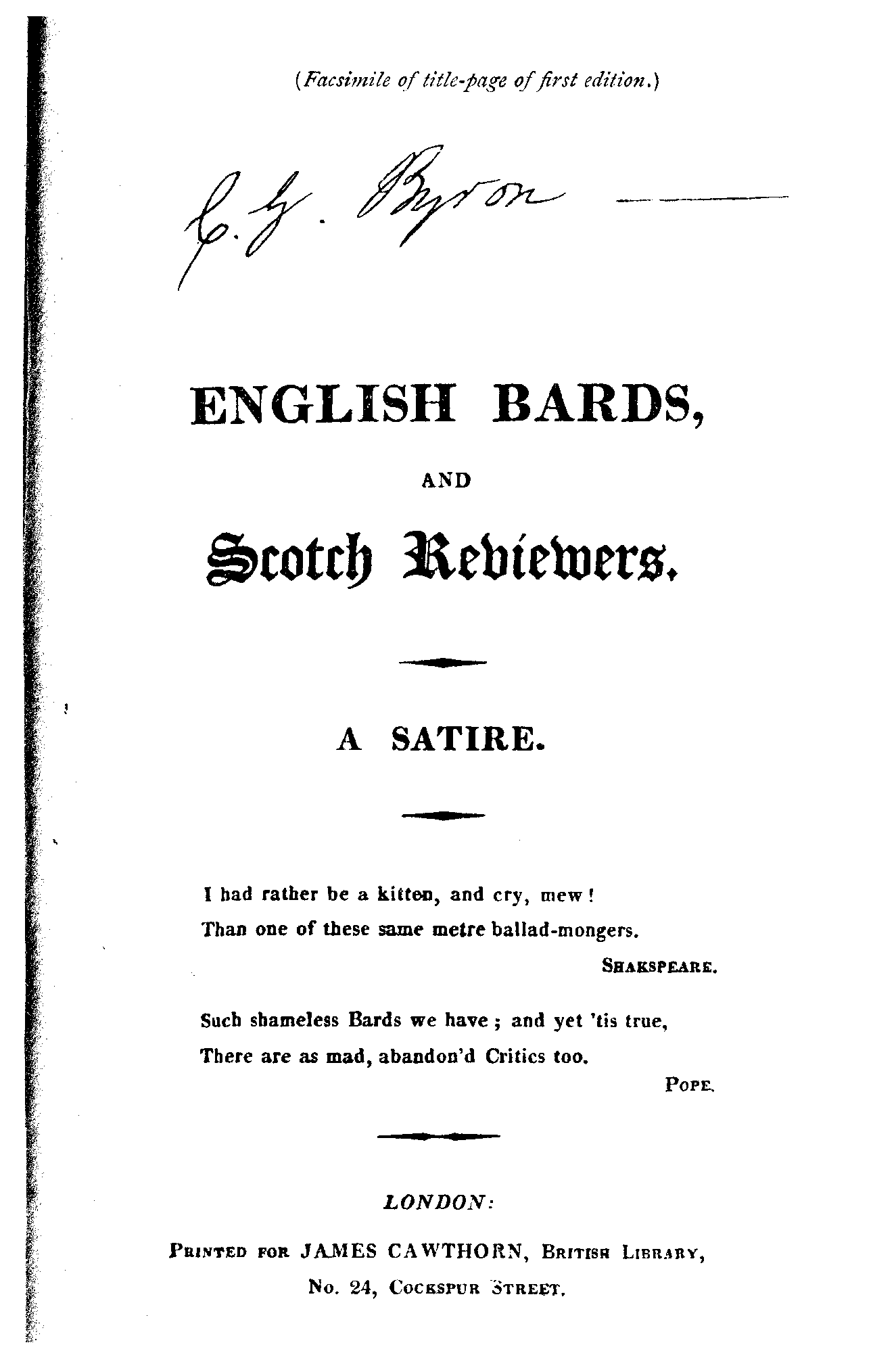



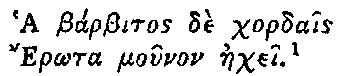
 [Pseud.] Anacreon,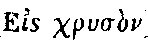



 literally "disclosing the bright key of the mind."