Some fourteen or fifteen centuries ago what
is now Bishopsgate Street Within was a
fashionable suburb of the Roman Londinium, the
Belgravia or South Kensington of the period,
where the aristocracy and wealth of the City
located itself and built magnificent mansions after
the fashion of Rome, with columns, frescoes, and
tesselated pavements, such as we see in the
disinterred city of Pompeii. In the streets
might then be seen charioteers driving rapidly
along to contend in the chariot race; fair ladies
going to witness the gladiatorial displays in the
amphitheatre; bronzed soldiers from many a
distant province of the empire; slaves groaning
beneath heavy burdens or employed in laborious
occupations—all mixed up with the ordinary
traffic of a considerable city. Northward,
stretching eastward and westward, ran the City
wall, a portion of which may still be seen in the
street call London Wall, adorned with stately
towers and bastions, one of the latter having
been exposed to public view by the opening of a
pathway through St. Giles's Churchyard. There
was, however, no gateway in this part of the
wall, as beyond lay an untraversable morass, and
beyond that a forest extending to and up the
heights of Highgate, Muswell Hill, etc., those
who wished to go northward from the city having
to go eastward to Aldgate or westward to
Aldersgate. This probably was the reason why
the rich selected this portion of the environs of
the City for their residence, as being more
retired and quiet than in the vicinity of a
thoroughfare leading to a City outlet.
Of these mansions of the patricians of
Londinium several vestiges have been found.
On the site of St. Helen's, the foundations of
large edifices have been laid bare. In 1707, at
the corner of Camomile Street, a fine tesselated
pavement was found; in 1752 another at the side
of St. Helen's Gateway; in 1761 another in
Camomile Street; and in 1836 a splendid
specimen, in red, white, and grey, at the
north-west angle of Crosby Square, besides
fragments elsewhere.
This, however, was only in the later period of
the Roman rule. When they had subdued the
Trinobantes, they found the capital of the
country, although a place of commercial
importance, merely a scattered collection of round
huts with trackways in the midst, extending from
Tower Hill to the Fleet River and from the
Thames to Cheapside and Cornhill, defended on
the north by earthworks, felled trees, and a
ditch; and in midst of these huts they erected
more substantial houses, with towers at the
eastern and western extremities, and probably a
temple to Diana, where St. Paul's Cathedral now
stands. The northern outskirts, now Bishopsgate
Street Within was appropriated as a burial-place,
as they never buried their dead in the midst of
the living; but in process of time the exigencies
of the increasing population demanded an
extension of the City boundaries, and they built
over the old grave-yard, making a new cemetery
on the site of the modern Bishopsgate Street
Without, Shoreditch, and the fenlands lying
eastward and westward of these. In 1576, when
digging for clay near where Christ Church,
Spitalfields, now stands, a great number of
cinerary urns were found, containing burnt
human remains, and in each a piece of coin,
wherewith to pay Charon for ferrying the defunct
across the Styx; also, as Stow says, "divers vials
and other old-fashioned glasses most cunningly
wrought, such as I have not seen the like of, all
which had water in them, differing from spring
water" (lachrymatories), "cups and dishes of red
earthenware and three or four images of white
earth, about a span long, one of Pallas." Under
the Camomile tesselated pavement, found in
1706, lay two feet of rubbish, and beneath that
several funeral urns. Stone and timber coffins
have also been found, or rather the nails of the
latter, a quarter of a yard long, the wood having
perished, and a Roman vault in St Botolph's
Churchyard, all these, with skeletons or decayed
bones in them, indicating burial after Christianity
had become the religion of the empire, when the
custom of burning the dead was abandoned.
The Saxons despised the effeminacy of
decorated architecture and luxurious appliances
in the way of household furniture, hence when
they came into possession of London they
allowed the sumptuous dwellings of the Romans
to fall into decay and crumble to dust, preferring
their own rough and uncomely habitations built
of wood, but afterwards built their churches,
monasteries, and public buildings generally of
stone, and thus Roman London passed
away.
The Saxons found it necessary to have another
exit from the city northward between Aldgate
and Aldersgate Street, and pierced the wall at the
end of the street running from the river, whatever
it may then have been called, and erected
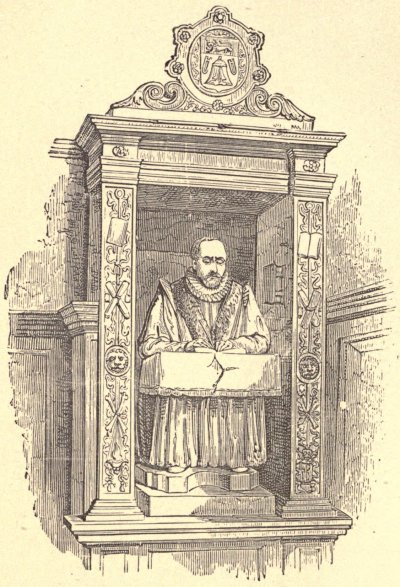
there a new gate. Erkenwald, Bishop of
London, 679-97, has been credited with the work,
but as this is only based upon the discovery,
near by, of the statue of a mitred bishop, which
it was presumed represented St. Erkenwald, the
tradition may be doubted, but it was
unquestionably this supposition which gave it the
name of Bishops' Gate.
There are four churches in London dedicated
to St. Botolph "the Briton," all situated by
gates, Aldgate, Aldersgate, Billingsgate, and
Bishopsgate. The latter lays claim to having
been founded by the ancient British Christians,
but, more probably, was built by the Saxons and
dedicated to the British monk St. Botolph. It
has been rebuilt no doubt several times since
then. It escaped the ravages of the fire of 1666,
but having become very much dilapidated, an Act
of Parliament was obtained at the beginning of the
last century for rebuilding it, by means of a rate
of two shillings in the pound upon all household
property in the parish, payable by the landlords,
but this proving insufficient a parish rate was
laid to supply the deficiency. It was commenced
in 1725, and re-opened in 1728, having cost (there
is nothing like precision) £10,444 1s. 8½d.
Tradition says that it was the burial-place of
a brother of King Lud. The present building
contains the tombs of Sir Paul Pinder; Edward
Alleyn, the founder of Dulwich College;
William, Earl of Devonshire, from whom
Devonshire Square takes its name; and in the
churchyard lies Hodges Shoughshware, "the
chiefest servant of the King of Persia, who came
from the King of Persia and died in his service,
1626, and Maghmote, his wife." The epitaph is
in Persian, and entreats that all Persians who
may read it will pray for their souls.
The Rev. Stephen Gorson, author of The
School of Abuse, was rector of St. Botolph.
The venerable church of St. Helen is situated
on the eastern side of the street, standing back
and approached by an archway. Popular
tradition ascribes its origin to the Emperor
Constantine in honour of his mother, which is
doubtless an error, but it unquestionably dates
from the Saxon age, as in 1010 the relics of King
Edmund the Martyr were temporarily deposited
within its walls, when brought from East Anglia,
to prevent their desecration at the hands of the
Danes. In the twelfth century the advowson
appears to have been held by one Ranulph, as in
the reign of Henry II., circa 1180, he and his
son, Robert Fitz-Ranulph, made a grant of it to
the Dean and Chapter of St. Paul's Cathedral.
About half a century later, circa 1212, William
Fitz-William, a London goldsmith, and ancestor
of the extant Earls Fitzwilliam, founded in
connection with it a priory for nuns of the order of
St. Benedict, which was dedicated to the Holy
Cross and St. Helen, the prioress on her election
to swear fealty to the Dean and Chapter, who
transferred to the priory the advowson of the
church.
The church seems originally to have had
simply a chancel and nave, without transepts or
aisles, but when the priory was attached, it was
duplicated by building another nave, and thus
presented the appearance of a double-aisled
church without an intermediate nave. A wall of
division ran along the middle, one of the aisles
being appropriated to the parishioners and the
other to the nuns. It is to be feared that the
fair inmates of the nunnery were not always very
strict in their devotional exercises and seclusion
from the outer world, and were even sometimes
so naughty as to be subjected to punishments,
one of which was being shut up in the crypt,
which still exists, with the gratings, through
which they could hear the service of the church
without being present. Reginald Kentwode,
dean of St. Paul's, in his periodical visitations,
found so many "defautes and excesses" that he
felt constrained to draw up a fresh code of rules
for the regulation of the house, the original of
which is amongst the Cotton MSS. in the
British Museum.
Willyam Basynge, Sheriff of London, 1309,
added considerably to the buildings, and came
to be regarded as the second founder.
The seal of the priory was an oval, representing
the Empress Helena standing by the cross (which
she found in the Holy Land and brought to
Europe) with the nails in her hand, and on the
opposite side worshippers in the act of adoration.
An impression of it is pendant from a deed in the
possession of the Leathersellers' Company, and
an engraving of it is given in Malcolm's London
Rediv., vol. iii., p. 548.
At the dissolution of the priory the site was
given to Richard Williams, one of the visitors of
the monasteries, in exchange for certain lands in
Huntingdonshire. He assumed the name of
Cromwell, being a kinsman of Cromwell, Earl of
Essex, and was ancestor of the Protector, Oliver
Cromwell. The dividing wall in the church was
taken down and the whole of the space
appropriated to the use of the parishioners. The
Leathersellers purchased the nuns' hall, and
made it the hall of their company. The priory
buildings remained, but in a ruined state, until
1799, when they were cleared away, and St.
Helen's Place built on the site. A view of the
ruins is given in Wilkinson's Londina Illustrata,
and a picturesque view of the church and the
Leathersellers' Hall in Malcolm's London Rediv.,
1803.
The church contained more "altar" tombs
with recumbent and kneeling effigies than any
other church in the City, but they suffered
terrible mutilation from the iconoclastic zeal of
the Puritans, many of them having been
altogether destroyed. Sir Thomas Gresham had
promised to build a tower, which unhappily he was
prevented doing by death, and it was not until
1699, that it was furnished with a steeple. The
church has undergone many repairs and restorations,
notably by Inigo Jones, 1623-4, and
frequently in the plaster and whitewash style of
decoration. The last and most judicious restoration
was carried out in 1867-8, and the venerable
old church may now be seen, after weathering so
many storms, with its graceful Gothic arches, its
groupings of tombs and monuments, the nuns'
grating in the crypt, its grotesque heads, and over
one of the doors the black figure of St. Helena,
for which hundreds of pounds have been offered
by foreign Catholics, and refused; with many of
the same features that were looked at by the
Greshams, the Crosbys, and other old parishioners
of the Norman, Plantagenet, and Tudor ages,
with the addition of some modern stained
windows and an organ built in 1742, and rebuilt
in 1868. The rectory was sold by Queen
Elizabeth to Michael and Edward Stanhope, with
the proviso of paying a stipend of £20 per annum
to a vicar. Amongst the tombs are those of Sir
Thomas Gresham, a splendid monument; Sir
John Crosby, in full armour, and his wife, one of
the oldest remaining; Sir John Lawrence, the
noble Lord Mayor of the Plague year; Sir John
Spencer, "Rich Spencer," whose daughter and
heiress eloped with her lover, Compton, in a
baker's basket.
St. Ethelburga is a small and very ancient
church, squeezed almost out of sight by
intervening parasitic shops; when or by whom
founded not known, but most probably in the
Saxon age. In an old print it is represented
with a spire similar to that in Langham Place.
It escaped the fire of 1666, was repaired and
"beautified" in 1694, and again in 1701. St.
Ethelburga was the daughter of Ethelbert, the
first Christian king of Kent, and patron of St.
Augustine; she married Eadwine, King of
Northumbria, the convert of St Paulinus, after
whose death, in battle at the hands of Penda, the
Pagan king of Mercia, she fled with her children
and Paulinus to her brother, who had succeeded
to the kingdom of Kent, and who nominated
Paulinus to the see of Rochester.
Walter Brune, citizen, and Rosia, his wife, in
1235, founded a priory of canons and hospital for
the sick and needy, dedicated to our blessed
Mary, called St. Mary Spital Without, Bishopsgate.
It was suppressed in 1539, at which time
it made up 180 beds, and supplied the sick
occupants with all necessaries at a cost of £478
per annum. Outside was the pulpit where the
famous Spital sermons were preached at Easter
before the Mayor and Corporation, and sometimes
royal personages, by the most eminent City
divines. After the dissolution they were
preached at St. Paul's, then in St. Bride's
Church, and now in Christ Church, Newgate
Street. The pulpit stood on a site that now forms
the north-east corner of Spital Square. There
existed for 120 years in the precincts of Bishopsgate,
near Camomile Street, a curious fraternity
called The Papey, a religious house of St. John
and St. Charity, sometimes called St. Augustine's
Papey, consisting of threescore priests, governed
by a master and two wardens. Its objects were
to supply the necessities of the poorer clergy by
providing them with lodgings, coals, bread, and
ale. Near by stood the church of St. Augustine-in-the-Wall,
the patronage of which was vested
in the rich Priory of the Holy Trinity, who
presented to the living four rectors from 1321 to
1375, but after that no one could be found to
accept the incumbency in consequence of the
stinginess of the Priory—the stipend not being
sufficient to live upon—who therefore in 1430
gave the church to the Papey guild. The
fraternity was not rich in funds, and in order to
improve their exchequer they practised the
singing of dirges and attended funerals as
professional mourners and dirge singers. The
house was suppressed 2 Edwd. VI.
From the thirteenth to the seventeenth
century a conspicuous feature in the line of
road leading northward from Bishopsgate was
the Priory of Bethlehem, with its square-towered
church, its gabled houses for the brethren and
sisters' habitations, and its gardens, situated at
the eastern edge of the moorland of Fensbury, a
little beyond St. Botolph's Church, and facing
what are now New Street and Devonshire Place.
It was then built quite in the country, with the
fens behind, fields in front, and no houses beyond
it. The roadway in front was nothing more than
a beaten trackway, almost impassable in winter,
which when houses came to be built along it, and
it assumed the semblance of a street, was called
Bedlam Gate. There is no view extant of the
priory, excepting the bird's-eye view in Aggas'
Map, temp. Elizabeth, where there is a continuous
line of houses along Bedlam Gate and onward to
St. Leonard's Church, Shoreditch, where the
road apparently terminated; eastward is the
Spittel Fyeld, with archers and cattle; and
westward, Finsburie Fyeld, with windmills,
bowmen practising at the butts, and women
spreading out linen to dry.
The priory was founded in 1246 by Simon
Fitz-Marie, sheriff of London in the same year,
for brethren and sisters, canons of the Order of
the Star of Bethlehem, subject to the Bishop of
Bethlehem, to whom they had to pay one mark
yearly at Easter. Their habit was a black gown
with a star embroidered on the breast. When it
became a hospital for lunatics is not known, but
there are records of sick persons being nursed
there in 1330, and of insane patients in 1403,
when six of the latter and three of the former
were maintained in the house. Weaver tells us
that at one time there was "a house for
distraught and lunaticke people" at Charing
Cross, and that some king, he did not know who,
not liking to have an establishment of people of
that class so near his palace, packed them off to
Bethlem Priory, which was probably the
beginning of its career as a hospital for the insane.
The Hospital-Priory does not appear to have
been very amply provided with funds, as in 1403
some of the houses were alienated, for the
purpose seemingly of raising money, and the
brethren had to go abroad collecting alms for the
sustenance of the inmates. In 1523, one Stephen
Gunnings, a merchant tailor, left £40 in trust to
the Corporation for purchasing the house, to be
continued as a receptacle for lunatics, and the
Mayor took some steps for that purpose; but
before they were carried out it was granted to
the Corporation, after the Dissolution, by King
Henry VIII., who placed it in charge of the
governors of Christ's Hospital in 1556, and the
following year transferred it to the governors of
Bridewell. In 1555 the income, arising chiefly
out of rents, amounted to £43 4s. 8d. per annum,
and by 1632 they were valued at £470, which,
not being all forthcoming, was inadequate for the
support of the house, and the Spital preachers
were directed to appeal to their hearers on its
behalf, there being then forty-four lunatics within
the walls, the revenues paying only two-thirds of
the cost of their maintenance. Besides, there
were so many pressing cases for admission, that
it became necessary to discharge many of the
half-cured and less violent patients, to whom
were granted licences for begging, and they went
abroad, dressed fantastically, singing "mad
songs," and imploring food or money. They
went by the name of "Tom o' Bedlams," and are
alluded to by Shakespeare in King Lear, where
he says —
"With a sigh like Tom o' Bedlam."
In the reign of Elizabeth the church and
chapel were taken down, and houses built on the
site; and in the following century, the buildings
having become ruinous and much too small for
the constantly increasing patients, it was resolved
to build a new and larger hospital. The
Corporation made a grant of land on the southern
margin of Finsbury Moors, where the Liverpool
Street railway stations now stand, and the public
contributed £17,000 towards its erection. It
was commenced in 1644, and completed in 1676;
and in 1732 two wings were added, which made
the entire length of the building 540 feet, with a
depth of forty feet. The style adopted was that
of the Tuileries in Paris, which so offended Louis
XIV. that he caused some out-offices of a more
useful and less dignified character to be built in the
style of St. James's Palace, London. It was
adorned with figures of raving and melancholy
madness from the chisel of Caius Cibber, which
are now in the hall of the present hospital.
The estates belonging to the hospital afterwards
rapidly increased in value, and at the
beginning of the present century the governors
found themselves in a position to build a larger
and better-planned building, and purchased a
large plot of land in St. George's Fields, which
with the new hospital cost £100,000. The total
income is now about £20,000 per annum.
Until towards the end of the last century the
insane were treated in a most barbarous way.
Nakedness, chains, scourgings, and solitary
confinement were their lot, calculated rather to
intensify than alleviate their aberration of
intellect, without any of the modern appliances of
modern asylums—music, flowers, prints, books,
amusements, cheerful society, and comparative
liberty—which are now found to be essential
towards their recovery. A good idea of the old
style of madhouse may be obtained from the
eighth plate of Hogarth's series of "The Rake's
Progress," which represents a scene in the
Moorfields Bedlam.
A few years ago a skeleton of a dwarf with
fetters on the legs was dug up near Bishopsgate,
supposed to be that of a patient of Bedlam. The
road in front of the second hospital was formerly
called "Old Bethlem" and was changed to
Liverpool Street in honour of Lord Liverpool,
Prime Minister 1812-27.
The Hon. Artillery Company, which originated
here, removed to the present Artillery Ground in
City Road in 1622, and has numbered amongst
its officers Charles II., when Prince of Wales;
James II., when Duke of York, after the
Restoration; and George IV., when Prince of
Wales, as Captain in Command. The old Artillery
Ground in Bishopsgate Street has left
reminiscences of its existence in the names of
Artillery Lane, Artillery Passage, Gun Street,
and Fort Street.
From a very remote period has the company
of Leathersellers been connected with Bishopsgate
Street and its vicinity. In the Norman age
the tanners, curriers, and leather dressers
clustered about Cripplegate and further eastward,
where the stream of Walbrook entered the City,
that locality being the Bermondsey of the period.
The Company is supposed to have been formed
in the Saxon times, but little or nothing is
known of it until 1372, when the wardens and
seniors presented a petition to the Corporation
praying that stringent measures might be put in
force against fraudulent craftsmen who used
inferior dyes for staining their skins. They were
incorporated in 1397-8, and were re-incorporated
by Henry VI. in 1444, with power to elect four
wardens and fifteen members of the court, and to
use a seal with arms. The charter is a
magnificent specimen of penmanship, and
beautifully illuminated. There is a picture
extant of the king presenting the charter to the
four kneeling wardens in livery dresses of red and
blue, furred at the edges, descending to the knees,
and fastened at the waist with a girdle garnished
with white metal. By this charter they were
empowered to regulate the mystery in London,
which powers were enlarged by Henry VII., who
extended their supervision of the trade throughout
the kingdom. In 1604 James I. granted them a
new charter, which, like that of Henry VI., is a
wonderfully fine specimen of art, with an
emblazonry of the company's arms and an
illumination of eight liverymen in their robes of
office—black gowns trimmed with "foins," hoods
of scarlet, and black flat caps.
The first hall of the company was built in
1445, in the parish of All Saints' by the Wall,
south of the present Finsbury Circus, where now
stand Leathersellers Buildings. A century after
it became too small, and a portion of the site and
buildings of the dissolved priory of St. Helen was
purchased in 1543, and the nuns' hall converted
into that of the company, which, with alterations
and embellishments, came to be for a long time
the finest livery hall in London. The ceiling was
enriched with beautiful pendants, and at the end
was a splendid Elizabethan screen, elaborately
decorated. In the courtyard was a pump with
the figure of a mermaid, from whose breast issued
wine on gala occasions. It was the work of
Cibber, who gave it in 1679, in payment of
his admission fee to the membership of the
company.
In 1799 the hall was sold along with other of the
priory buildings, to clear the site for the building
of St. Helen's Place. A new hall was built on
the same site, but with new fittings, all the
antique decorations of the old hall having been
disposed of. This, the third hall, was destroyed
by fire in 1819, the valuable collection of records
being fortunately saved, and the present hall,
occupying the north-east corner of St. Helen's
Place, was built 1820-22.
The first record book of the company
commences November 12th, 1472, with the
following as the earliest entry: —
"Wyllyam J. Curtes gave to us this boke,
For to regystre every wardenn's tyme in;
Pray for hym when ye doe loke,
That God will reward hym. Amen."
There are almshouses of the company in
Clarke's Court, St. Helen's; White's Alley,
Coleman Street; and Hart Street, Cripplegate.
Excepting the Borough High Street, perhaps no
street in London had so many famous old inns,
with galleried court-yards, cross-timbered walls,
quaint gables, and latticed windows, as Bishopsgate
Street, established for the accommodation of
carriers and travellers from the north-eastern
towns. Amongst them were the White Hart;
formerly the Magpie, which stood by the gateway
of Bethlem Priory, supposed to have been
originally the hostelry of the priory, afterwards
an inn for travellers who arrived after the gate
was shut for the night. It seems, from a date on
the wall, to have been rebuilt in 1480, and was
standing in 1810, when a view was taken
representing it with a double range of bay
windows. It was again rebuilt in 1829, and stood
at the corner of Liverpool Street. The Bull,
where Burbage and his companions obtained a
patent from Queen Elizabeth for the performance
of theatricals in the quadrangle, the spectators
occupying the surrounding galleries. This was
the inn to which old Hobson, the Cambridge
carrier, resorted, from whom came the saying of
"Hobson's choice"—that or none. On a wall of
the inn was his effigy, in fresco, clutching a money
bag, with an inscription—"The fruitful mother
of a hundred more."
The Green Dragon, an old Tudor house. The
Catherine Wheel still a carriers' house. The
King's Head, at the corner of Spital Square.
The Wrestlers, a large inn, and the Angel, were
in existence temp. Henry VI. The City of
London Tavern, with pillared facade, famous in
modern times for its public dinners, was converted,
in 1839, into the Wesleyan Centenary Hall,
established in commemoration of the centennial
year of the formation of the Society of
Methodists.
On the eastern side of the street, within and
near to the gate, were certain tenements belonging
to a fraternity of St. Nicholas, which were given
(27 Henry VI.) to the Company of Parish Clerks
for the maintenance of two chaplains in the
Chapel of St. Mary Magdalene, near the
Guildhall, and behind these stood the hall of the
Parish Clerks, and seven almshouses for the poor,
to one of whom was given sixteenpence and the
other six ninepence per week.
The Post-office, which had been in Cloak Lane,
Dowgate, was removed after the fire of 1666, to
the Black Swan, in Bishopsgate Street, whence it
was removed to Lombard Street, and subsequently
to St. Martin-le-Grand.
We have noticed the palatial character of the
Bishopsgate quarter of Roman Londinum,
vestiges of its splendour having been frequently
disinterred in recent times, in attestation of the
fact. A thousand years afterwards it again
became a district of sumptuous mansions—palaces,
not of the Roman patricians, but of the merchant
princes of the modern metropolis of the world.
Most fortunately, the ravages of the great fire of
'66 only extended to the borders of the ward, and
thus have been preserved to us those precious
architectural relics of Crosby House; and the
churches of St. Helen and St. Ethelburga. The
quaint old house of Sir Paul Pindar, has just
been taken down.
Sir John Crosby was born circa 1420, and died
in 1475; he was a grocer (a wholesale merchant)
and woolman, and at one time Mayor of the
Staple at Calais. He was elected an alderman in
1465; served the office of sheriff in 1471, in
which year he was knighted by Edward IV., and
represented the City in Parliament in the year
1461. He was a zealous Yorkist, in high favour
with Edward IV., particularly distinguished
himself in the defence of the City against the
Lancastrian admiral, the Bastard of Fauconbridge,
and is introduced by Heywood, in his
drama of King Edward IV. In 1466 he took on
lease from the Prioress of St. Helen's certain
tenements for a period of ninety-nine years, at a
rent of £11 6s. 8d. per annum, which he demolished,
and built on the site "ye highest and fairest house
in ye citie," which he did not enjoy long, as it was
only completed four years before his death. Of
its grandeur we may form some conception from
what remains of it after the fire of 1674,
especially the great hall, fifty-four feet long,
twenty-seven and a half feet broad, and forty feet
high, with its oriel windows eleven feet in
breadth, and extending from the floor to the
ceiling, and its timbered roof of surpassing
beauty. Around this old mansion many most
interesting historical associations have clustered.
Richard, Duke of Gloucester, inhabited it for some
time, and it figures in Shakespeare's pages as the
place where he concocted his plot for the murder
of his nephews, his marriage with his niece, which
he could not accomplish, and the usurpation of
the throne. From 1516 to 1523, it was the
abode of Sir Thomas More, where it is supposed
he wrote his Utopia.
It has been occupied by several aldermen, some
of whom held their mayoralty there, amongst
others, Alderman Bond, who added a turret to
the building; Sir John Spencer, who built a
large warehouse behind it; Sir Bartholomew
Read, Lord Mayor, who entertained Catherine of
Arragon for two or three days within its walls,
previous to her marriage with Prince Arthur.
The Emperor Maximilian lodged there when in
London in 1502; Queen Elizabeth came there in
1594 to witness a masque by some law students,
and the famous Countess of Pembroke made it
her residence for some time, where it is probable
Shakespeare visited her. During the Civil War
it was made a prison for captured Royalists, after
which the great hall was converted into a
Presbyterian chapel. In 1678 the drawing-room
and throne room were used as warehouses by the
East India Company, and afterwards as a packer's
workrooms, when they sustained a great deal of
mutilation. In 1831, it was advertised to be sold
for demolition, but some spirited persons came
forward and rescued it from that fate, besides
restoring and repairing it. From 1842 to 1860
it was a literary institute, and is now a restaurant,
the proprietor having with great good taste preserved
all the old features, and in the necessary
additional buildings has adhered to the same style.
It is supposed to have consisted originally of two
quadrangles, separated by the great hall, and that
it had a facade of 100 feet in length to Bishopsgate
Street.
Sir John gave 500 marks towards the restoration
of St. Helen's Church, and his arms were
placed on the walls and in the windows. He was
thrice married, and had an only son, who died
without issue, the line thus becoming extinct.
Sir Paul Pindar was a notable merchant and
diplomatist, minister of James I. in Turkey, who
was born about the end of the sixteenth or
beginning of the seventeenth century, and died in
1650. On his return from Turkey he brought
with him a diamond valued at £30,000, which the
king wished to purchase "on tick," but the
cautious merchant, not having sufficient confidence
in his credit, declined to let him have it on those
terms. However, he agreed to lend it to him
to flash it in the eyes of his subjects on State
occasions. He afterwards sold it to Charles I.,
but most probably was never paid for it. He
was reputed to have been worth a quarter of a
million sterling at one time, an enormous sum for
that period. He gave £18,000 towards the
repairs of St. Paul's Cathedral, and expended
other sums on charitable and philanthropic
objects, but although so wealthy he lost so much
money in bad debts, arising out of loans to Kings
James I. and Charles I. that he fell into comparative
poverty, and died in debt himself.
He erected for his residence a magnificent
house on the western side of the street, without
the gate, a portion of whose picturesque frontal
remaining in 1890, attracted the notice and
admiration of every passer-by. It was a fine
specimen of Elizabethan architecture, and richly
decorated both without and within. There were
rooms with wainscoted walls, sculptured chimney-pieces,
and ceilings profusely ornamented, but
most of them terribly mutilated; one splendid
ceiling represented the sacrifice of Isaac, with a
radiation of beautiful ornamentation. Behind
the house was a park, with mulberry trees, some
of which were only cut down within the present
century; and near by, in Halfmoon Alley, stood
a house, with sculptural details, which is supposed
to have been the gatekeeper's lodge. A small
portion with a narrow frontage was converted
into a tavern, with the sign of the Sir Paul
Pindar, which has just been taken down by the
Great Eastern Railway.
Devonshire House.—Built by one Jasper
Fisher, around which he laid out extensive
pleasure grounds. It was held by the Cavendishes
until 1670, but in the interval, during the
ascendency of the Puritans, had been taken
possession of by them, and made use of as a
chapel. Butler, in his Hudibras, describes the
Rump Parliament as like —
"No part of the nation
But Fisher's folly congregation."
After this it was opened as a "Bank of
Credit," a sort of pawnshop, which did not last
long, as by 1708, Devonshire Square was built,
described by Hatton as "a pretty, though very
small square, inhabited by gentry and other
merchants."
Sir Thomas Gresham, the wealthy and
munificent founder of the Royal Exchange, was
born circa 1519; died, 1579; was knighted,
1559; married Anne, daughter of William
Fernley, and relict of William Read, and had
issue an only son, Richard, who died v.p. and s.p.
1564.
He was a parishioner of St. Helen's, and in
that parish he built his house, which Stow
describes as "the most spacious thereabouts,
builded of brick and timber," and that is about all
he could say in eulogy of it, for it appears, from
engravings of it, to have been more remarkable
for size than for architectural grandeur. It was
built in the Flemish style, chiefly by Flemish
workmen, and extended from the west side of
Bishopsgate Street to Broad Street. It consisted
of a quadrangle of two galleried stories, with
gabled attics; a piazza and rows of trees running
round, giving it a quiet, collegiate air, and a
picturesque aspect, and was surrounded by
gardens and pleasure grounds, with trees. It was
commenced about the year 1559, and was finished
in 1562. Within its walls Sir Thomas entertained
Queen Elizabeth, and had the custody of
the Lady Mary Grey.
At his death he left it to his widow for life,
and at her decease in trust to the Corporation of
London and the Mercers' Company, to be
converted into a College of Professors, with
salaries of £50 per annum, to lecture weekly on
divinity, astronomy, music, law, geometry,
medicine, and rhetoric, for the gratuitous
instruction of the young citizens of London,
which were commenced in 1597. Amongst the
professors were several eminent men, one of
whom was Sir Christopher Wren, who, in
conjunction with others, there laid the foundation
of the Royal Society. The trustees allotted two
rooms to the Society, one for their meetings, the
other for their books and philosophical instruments.
Pepys tells of King Charles making
merry over the people of Gresham House, and
Boyle in particular, amusing themselves with the
child's play of weighing air. The society met at
Gresham House until 1710, when they removed
to Crane Court.
After the Great Fire of 1666, when nearly all
the public buildings were destroyed, Gresham
House became the Mansion House and residence
of the Lord Mayor, the Law Courts, and the
Exchange, the merchants assembling in the
quadrangle, where they remained until their
establishments were rebuilt.
The collegiate lectures were not properly
appreciated, and became almost sinecures to the
professors, until in 1768-70 the Government,
wanting an excise office in the City, agreed with
the trustees to take a perpetual lease of the site,
at the absurdly low rental of £500 per annum,
the trustees to take down the buildings, to do
which cost them £1,800. The lectures were then
removed to a dull, upper room in the Exchange,
where they were delivered until the destruction
of the Exchange by fire, in 1838, when they were
given in the City of London School, until the
opening of the New Gresham Lecture Hall, in
Basinghall Street, in 1843.
Dashwood House stood westward of St.
Botolph's Churchyard, and was the City mansion
of the Dashwood family; afterwards it is
supposed to have been the residence of Lady
Jane Grey. It was subsequently converted into
the Ottoman Bank, and Consular and Mercantile
Offices; has recently been taken down, and a
colossal block constructed for suites of offices.
There are many other fine old houses in the
ward, dating from before the Fire, whose fronts
have been modernised by building up the space
beneath the overhanging upper floors and
removing the gables, but which retain many of
their olden time features at their backs, and are
still adorned in their interiors with fine
balustraded staircases, carved chimney pieces, and
timber-work ceilings.
Another house of a somewhat different but
very useful character stood in Bishopsgate Street.
In 1649 the Corporation of London founded a
house called the London Workhouse, "for the
entertainment of the greatest objects of commiseration,
but likewise to receive a great number
of the miserable and unhappy vagrant orphans
known by the infamous name of 'blackguard,' the
pest and shame of the City, pilfering and begging
about the streets by day, and lying therein,
almost naked, in all seasons of the year by night."
In 1662 a charter of incorporation was granted,
under the name of "The President (always the
Lord Mayor) and Governors of the Poor of the
City of London." In 1700 a large house was
built for the reception of these objects of charity,
and in 1704 it is recorded that "368 children
were fed, clothed, and taught to work and the
principles of religion;" besides whom there were
"maintained and employed 653 vagabonds, sturdy
beggars, and other idle and disorderly persons."
It was taken down early in the present century,
the Poor law administration rendering it superfluous.
In the Parish of St. Helen's there lived and
died a man of eccentric opinions and evil
reputation, very different in character from his
neighbours, the merchant princes of Bishopsgate.
His name was Francis Bancroft, and his vocation
that of a summoning officer in the Lord Mayor's
Court, in which capacity he made a large fortune
by issuing false summonses, "not only pillaging
the poor, but likewise many of the rich, who,
rather than lose time in appearing before the said
magistrate, gave money to get rid of this
common pest of the citizens." He was so much
detested that at his funeral the populace nearly
jostled his coffin off the shoulders of the bearers,
and they set the bells ringing "for joy at his
unlamented death."
He entertained an eccentric notion that in a
certain number of years after his death he should
return to life and occupy his original position in
the City, and in accordance with this idea had a
vault, with folding doors and glass in the panels,
constructed in St. Helen's Church, and a coffin
with hinges only, not screwed down, so that
when he came to life he would have nothing to
do but to step out of his coffin, open the
doors of the vault, and walk out. His
name is remembered by his having bequeathed
£27,000 for the foundation of almshouses
for twenty-four poor almsmen, a chapel, a school
for one hundred poor boys, and houses for two
masters. The money was left in trust to the
Drapers' Company, who erected the buildings at
Mile-end in 1735. There was a proviso in the
will that the trustees should visit his tomb and
look upon his body, in May every year for ever,
failing which the money to be diverted to other
purposes. They have long discontinued the
custom, but still hold the trust, and although the
testator has now lain 150 years in his unfastened
coffin, he has not come forth yet to rectify this
direliction of duty on the part of the Drapers.
From a very early period has Bishopsgate
Street and Ward been a centre of Nonconformity.
Maitland, writing 1725-36, refers to three
Presbyterian, two Independents, and one Quaker's
meeting houses in the parishes of St. Botolph and
St. Helen. The Devonshire Square Baptist
church was, excepting one in Kent, the oldest in
England, and in its early years suffered much
from persecution. It migrated hither from
Wapping in 1638, and occupied a part of
Devonshire House, or, as it was popularly called,
Fisher's Folly. The chapel was built in 1653,
which was taken possession of by the Episcopalians
after the fire, and used for Church of
England services until the churches of London
were rebuilt. It continued to flourish until, the
Metropolitan Railway requiring the site, it was
taken down and a new Gothic chapel, with spire,
built at Stoke Newington out of the proceeds of
the sale, at a cost of £11,000. It has had several
notable ministers, the most remarkable being
William Kaffin, who made an eminent figure
among the Antipœdo-Baptists of the 17th
century.
Crosby Hall Independent Church. The Rev.
Thos. Watson, whose chief work was "A body of
Divinity," consisting of 176 sermons, fol., 1792,
posth. Stephen Charnock, B.D. Benjamin
Grosvenor, D.D., a very eminent man, who held
the pastorate from 1704 to 1749, one of the most
popular preachers in London; and was also lecturer
in the Old Jewry, at the Weigh House, and at
Salters' Hall. Portrait in Dr. Williams' library.
Edmund Calamy, B.D., son of Dr. Edm.
Calamy, author of the "Nonconformist Memorial."
On the expiration of the lease in 1799, the
congregation was dispersed, and the chapel was
rented by James Relly, a rough and uncultured
Welshman, but a powerful preacher, who established
a church of Rellyanists or Rellyan
Universalists, who held a species of anti-nomian
doctrine. He was author of some controversial
works, now altogether forgotten.
A Presbyterian meeting-house was erected in
Little St. Helen's in 1672, under the Indulgence,
which became a place of importance in the annals
of Nonconformity. Within its walls the first
public ordination of Nonconformist ministers took
place, and the Coward Lecture preached there from
1721, till the demolition of the chapel. There
was also a seven o'clock morning lecture, preached
every Sunday in the summer months, to
commemorate the accession of the House of
Hanover. The first minister, he who took out
the licence and collected the congregation, was
the learned and pious Samuel Annesley, LL.D.,
the ejected of St. Giles's Cripplegate, formerly
rector of Cliffe, Kent, and of St. Matthew's,
Friday Street, London, lecturer at St. Paul's, and
one of the preachers at Whitehall during the
Protectorate. He was first cousin to Arthur
Annesley, Earl of Anglesey; was a popular
preacher, and author of some published sermons
and other works. He continued in the pastorate
until his death in 1694. Anne, his daughter, a
very superior woman in every respect, in piety,
intelligence, and sound discretion, was married to
the Rev. Samuel Wesley, vicar of Epworth, and
bore him nineteen children, amongst whom were
John and Charles Wesley, the founders of
Methodism.
Benj. Robinson occupied the pulpit from 1701
to 1724, a Derbyshire man, of great reputation, and
Merchant Lecturer at Salters' Hall. After him
the church gradually dwindled down until 1790,
when Mr. Brown preached there for two years,
and removed with his congregation to Shoreditch;
after whom Christian Frederick Trieber, with a
Lutheran congregation, occupied it for two years,
and on the expiration of the lease removed to
Cheapside. Some other ministers of various
denominations preached in the chapel for short
periods until 1799, when it was taken down and
houses built on the site.
In Hand Alley, on the western side of
Bishopsgate Without, stood a large Presbyterian
meeting-house. On the site had been a plague
pit, and when it was proposed to be built upon it,
the bodies, some not entirely decomposed, 2,000
in number, were carted away and buried in
another pit, over which is a passage to Rose
Alley. The chapel was built soon after
Bartholomew Day for Thomas Vincent, famous
for his labours amongst the poor during the
plague of 1665, who held the pastorate until his
death in 1678. After the fire of 1666, his chapel
was seized by the clergyman of a City parish, who
performed service there until his church was
rebuilt. After him came a succession of popular
ministers, until the beginning of the 18th
century, when the congregation, a wealthy body,
removed with their minister, Dr. John Evans,
author of "A Discourse on Temper," to a new
chapel, which they built in 1727, in New Broad
Street, when the old chapel was pulled down.
A Particular Baptist Church, in Great St.
Helens, existed during the time of the civil war,
when the famous Hansard Knollys was the
pastor. He was a Lincolnshire man of great
oratorical talent, and gathered about him a
congregation of a thousand hearers. His
doctrines, however, were deemed irregular and
unsound by the Presbyterians, and he was
summoned before the Westminster assembly of
divines, who prohibited him from preaching.
This prohibition appears, however, to have been
withdrawn afterwards, as from 1645 to 1691, he
preached the doctrines in Curriers' Hall. He
was author of "The Smoke of the Temple," "An
Exposition of the Book of Revelations," and
some other works, including an autobiography
written in 1672. His death occurred in 1691, at
the age of 93, when he was buried in Bunhill
Fields. Portrait in Wilson's "History of the
Dissenting Church."
The Society of Friends have a large meeting-house
in Bishopsgate Street, which is the
head quarters of the society, where the annual
meetings are held, when Friends from all parts of
England assemble here, giving quite a picturesque
aspect to the street, when it is thronged by them
in their somewhat grotesque costume. Their
first meeting-house was in Bull and Mouth
Street, Aldersgate, which was destroyed by the
fire of '66, rebuilt and occupied till 1744, when
they removed to White Hart Court, Gracechurch
Street. Many of the members of this meeting
were the originators of some of the most eminent
banking firms of Lombard Street, such as the
Gurneys, the Barclays, the Hoares, the
Hanburys, the Lloyds, the Mastermans, the
Jansons, the Osgoods, the Dimsdales, and others;
and it was from there that the remains of George
Fox were carried to Bunhill Fields for burial,
followed by 3,000 Friends. This chapel becoming
too small for the congregation, a new one, that
now existing, was erected in Bishopsgate Street
on the site of the Dolphin Inn.
In 1838 a Jews' synagogue was built in Great
St. Helens. It is the largest in London in the
Italian style, with a splendid interior.
The Wesleyan Centenary Hall stands in a
commanding position opposite the end of
Threadneedle Street, with a fine pedimented
range of columns.
We have, in our historical retrospect, seen
Bishopsgate under various aspects. In the
Roman era, when it was a suburb of aristocratic
residences, with all the appliances of Roman
civilisation, and all the beauties of Roman art; in
the Saxon and Norman periods, with its mean
habitations and monastic establishments, with
cowled monks, and bare-footed friars, conspicuous
amongst the wayfarers as they passed along the
thoroughfare ankle deep in mud, or blinded by
the clouds of dust from the unpaved roads; in
the days of the Tudors and Stuarts, when it was
lined with picturesque gabled houses, with
overhanging upper floors, cross timberings, and
latticed windows; with quaint old hostelries and
their galleried courtyards, frequently occupied by
fashionable crowds of spectators, witnessing the
performances of the actors of the Elizabethan
drama; and with the noble mansions of the City
magnates and merchant princes. In addition to
these, there was the City gate and a conduit at
each end of the street, one to the north, just
within the gate, erected by Lord Mayor
Knesworth in 1505; the other at the south end,
at its junction with the streets of Cornhill,
Leadenhall, and Gracious Church. The street
was rendered more passable for pedestrians and
vehicles by being paved in 1543, and the sloughs
of despond, previously so characteristic of
London thoroughfares, and so impedimental to
locomotion, got rid of. After this followed the
Georgian or dark age of architecture, when the
quaint old houses of the past were replaced by
the hideous abortions of the last and beginning of
the present century.
Now for the third time we see Bishopsgate
Street again gradually assuming an aspect of
architectural grandeur, which will make it in
another fifty years one of the finest streets in
London or any other city. Within the last few
years there have been erected several blocks of
buildings of a palatial character, and this process
of transformation is still going on with great
rapidity. Among the more notable we may
mention the National and Provincial Bank of
England, one of the finest buildings of Modern
London; the Royal Bank Buildings, the London
and Lancashire Life Office, the Capital and
Counties Bank, the South Sea Chambers, the
Palmerston Buildings, the Devonshire Chambers,
the Royal Bank of Scotland, and the block of
offices at the rear of St. Botolph's Church.