We were a dozen Englishmen, including three clergymen, undertaking the
above journey accompanied by the large train of servants, interpreters, and
muleteers usually required for travelling in the East. And it was on
Wednesday, the 9th day of May 1855, that we started. This was
considered almost late in the season for such an enterprise. The
weather was hot, chiefly produced by a strong shirocco wind at the time;
and, in crossing over the shoulder of the Mount of Olives, we found the
country people beginning their harvest at Bethany.
We were of course escorted by a party of Arab guides, partly villagers
of either Abu Dis or Selwan, (Siloam,) and partly of those
Ghawârineh Arabs not deserving the appellation of Bedaween, who live
around and about Jericho. These people, of both classes, form a
partnership for convoy of travellers to the Jordan under arrangements made
at the consulate. Without them it would be impossible either to find
the way to Jericho and the river, or to pass along the deserted road, for
there are always out-lookers about the tops of the hills to give notice
that you are without an escort, and you would consequently still find that
travellers may “fall among thieves” between Jerusalem and
Jericho; besides that, on descending to the plain of Jericho you would
certainly become the prey of other Arabs of real tribes, ever passing about
there—including most probably the ’Adwân, to whose
hospitality, however, we were now about to commit ourselves. To all
this must be added, that no other Arabs dare undertake to convoy travellers
upon that road; the Taámra to the south have long felt their
exclusion from it to be a great grievance, as the gains derived from the
employment of escorting Europeans are very alluring.
We had with us a deputed commissioner from the ’Adwân,
namely, Shaikh Fendi, a brother of Shaikh ’Abdu’l
’Azeez. He was delighted with the refreshment of eating a
cucumber, when we rested by the wayside to eat oranges—the delicious
produce of Jaffa.
Passing the Fountain of the Apostles, (so called,) we jogged
along a plain road till we reached a booth for selling cups of coffee, at
the divergence of the road Nebi Moosa, (the reputed sepulchre of the prophet
Moses, according to the Mohammedans,) then up an ascent still named
Tela’at ed Dum, which is certainly the ancient [3] Adummim,
(Joshua xv. 7)—probably so called from broad bands of red
among the strata of the rocks. Here there are also curious wavy lines
of brown flint, undulating on a large scale among the limestone
cliffs. This phenomenon is principally to be seen near the ruined and
deserted Khan, or eastern lodging-place, situated at about half the
distance of our journey. The name is Khatroon.
As we proceeded, our escort, mostly on foot, went on singing merrily,
and occasionally bringing us tufts of scented wild plants found in crevices
by the roadside. Then we came to long remains of an ancient water
conduit, leading to ruins of a small convent. In a few minutes after
the latter, we found ourselves looking down a fearfully deep precipice of
rocks on our left hand, with a stream flowing at the bottom, apparently
very narrow indeed, and the sound of it scarcely audible. This is the
brook Kelt, by some supposed to be the Cherith of
Elijah’s history. Suddenly we were on the brow of a deep
descent, with the Ghôr, or Jericho plain, and the Dead Sea spread out
below. In going down, we had upon our left hand considerable
fragments of ancient masonry, containing lines of Roman reticulated
brickwork.
It
was now evening; a breeze, but not a cool one, blowing; and we left aside
for this time the pretty camping station of Elisha’s Fountain,
because we had business to transact at the village of Er-Rihha, (or
Jericho.) There accordingly our tents were pitched; and in a circle
at our doors were attentive listeners to a narration of the events of
Lieut. Molyneux’s Expedition on the Jordan and Dead Sea in 1847.
Thermometer after sunset, inside the tent, at 89° Fahrenheit.
Sleep very much disturbed by small black sandflies and ants.
Thursday, 10th.—Thermometer at 76° before
sunrise. The scene around us was animated and diversified; but
several of us had been accustomed to Oriental affairs—some for a good
many years; and some were even familiar with the particular localities and
customs of this district. Others were young in age, and fresh to the
country; expressing their wonderment at finding themselves so near to
scenes read of from infancy—scarcely believing that they had at
length approached near to
“That bituminous lake
Where Sodom stood,”
and filled with joyous expectation at the visit so soon to be made to
the Jordan, and beyond it. Some were quoting Scripture; some quoting
poetry; and others taking particular notice of the wild Arabs, who were by
this time increasing in number about us,—their spears, their mares, their
guttural language, and not less the barren desert scene before us, being
objects of romantic interest.
At length all the tents and luggage were loaded on the mules, and ten
men of the village were hired for helping to convey our property across the
river; and we went forward over the strange plain which is neither desert
sand, as in Africa, nor wilderness of creeping plants and flowers, as on
the way to Petra, but a puzzling, though monotonous succession of low
eminences,—of a nature something like rotten chalk ground, if there
be such a thing in existence,—between which eminences we had to wind
our way, until we reached the border of tamarisk-trees, large reeds,
willow, aspen, etc., that fringes the river; invisible till one reaches
close upon it.
At the bathing (or baptism) place of the Greeks, northwards from that of
the Latins, to which English travellers are usually conducted, we had to
cross, by swimming as we could. [5] King David, on his return
from exile, had a ferry-boat to carry over his household, but we had
none. Probably, on his escaping from Absalom, he crossed as we
did.
The middle part of the river was still too deep for mere fording.
Horses and men had to swim; so the gentlemen sat still on their saddles,
with their feet put up on the necks of their horses, which were led by
naked swimming Arabs in the water holding the bridles, one on each
side.
Baggage was carried over mostly on the animals; but had to be previously
adjusted and tightened, so as to be least liable to get wetted. Small
parcels were carried over on the heads of the swimmers. These all
carried their own clothes in that manner. One of the luggage mules
fell with his load in the middle of the stream. It was altogether a
lively scene. Our Arabs were much darker over the whole body than I
had expected to find them; and the ’Adwân have long plaits of
hair hanging on the shoulders when the kefieh, or coloured
head-dress, is removed. The horses and beasts of burden were often
restive in mid-current, and provoked a good deal of merriment. Some
of the neighbouring camps having herds of cattle, sent them to drink and to
cool themselves in the river, as the heat of the day increased. Their
drivers urged them in, and then enjoyed the fun of keeping them there by
swimming round and round them. One cow was very nearly lost, however,
being carried away rapidly and helplessly in the direction of the Dead Sea,
but she was recovered. The Jericho people returned home, several of
them charged with parting letters addressed to friends in Jerusalem; and we
were left reposing, literally reposing, on the eastern bank,—the
English chatting happily; the Arabs smoking or sleeping under shade of
trees; pigeons cooing among the thick covert, and a Jordan nightingale
soothing us occasionally, with sometimes a hawk or an eagle darting along
the sky; while the world-renowned river rolled before our eyes.
“Labitur et labetur in omne volubilis ævum.”
The novelty of the scenes, and the brilliancy of the atmosphere, as well
the vivacity of the recent transactions in “passing over
Jordan,” had their duly buoyant effect upon youthful
persons,—who were, however, not forgetful of past events in these
places belonging to sacred history.
The baggage went on; but, as the appointed halting-place was only about
two hours distant, we remained enjoying ourselves as we were during most of
the day.
Among our novel friends is an Arab hero named Gublân, as
they pronounce it here, (but it is really the Turkish word
Kaplân, meaning Tiger,) and his uncle, old
’Abdu’l ’Azeez. About three years before,
Gublân had been attacked by Government soldiers at Jericho. He
made a feigned retreat, and, leading them into the thickets of Neb’k
trees, suddenly wheeled round and killed six of them. The humbled
Government force retired, and the dead were buried, by having a mound of
earth piled over them. Of course, such an incident was never reported
to the Sublime Invincible Porte at Constantinople; but it was a curious
coincidence, that this very morning, amid our circle before
the tents, after breakfast and close to that mound, we had Gublân,
’Abdu’l ’Azeez, and the Turkish Aga of the present time,
all peaceably smoking pipes together in our company.
Among our gentlemen we had a man of fortune and literary attainments,
who had been in Algiers, and now amused himself with dispensing with
servants or interpreters—speaking some Arabic. He brought but
very light luggage. This he placed upon a donkey, and drove it
himself—wearing Algerine town costume. The Bedaween, however,
as I need scarcely say, did not mistake him for an Oriental.
Moving forward in the afternoon, we were passing over the Plains of
Moab, “on this [east] side Jordan by Jericho”—where
Balaam, son of Beor, saw, from the heights above, all Israel encamped, and
cried out, “How goodly are thy tents, O Jacob! and thy tabernacles, O
Israel! As the valleys are they spread forth, as gardens by the
river’s side, as the trees of lign-aloes which the Lord hath planted,
and as cedar-trees beside the waters. . . . Blessed is he that
blesseth thee, and cursed is he that curseth thee,” (Num. xxii. I,
and xxiv. 5, 6, 9.) This territory is also called the Land of
Moab, where the second covenant was made with the people by the
ministry of Moses—the one “beside the covenant which he made
with them in Horeb.”
Our ride was a gradual ascent; and after some time we were met by young
’Ali, the favourite son of the principal Shaikh Dëâb,
(Wolf,) with a small but chosen escort, sent on by his father to welcome
us. We saw a good deal of corn land, and people reaping their
harvest. This belongs to two or three scattered villages about there,
under the immediate protection of the Dëâb
’Adwân. The Arabs, however, in this part of the world, do
condescend to countenance and even to profit by agriculture, for they buy
slaves to sow and reap for them.
In two hours and a half from the Jordan we came to our halting-place, at
a spot called Cuferain, (“two villages”)—the
Kiriathaim of Jer. xlviii. 23—at the foot of the mountain, with a
strong stream of water rushing past us. No sign, however, of
habitations: only, at a little distance to the south, were ruins of a
village called Er Ram, (a very common name in Palestine; but this is
not Ramoth-Gilead;) and at half an hour to the north was an inhabited
village called Nimrin, from which the stream flowed to us.—See
Jer. xlviii. 34: “The waters of Nimrin shall be desolate.”
We had a refreshing breeze from the north which is justly counted a
luxury in summer time. The shaikhs came and had coffee with me.
They said that on the high summits we shall have cooler temperature than in
Jerusalem, which is very probable.
After dinner I sat at my tent-door, by the rivulet side, looking
southwards over the Dead Sea, and to the west over the line of the promised land
of Canaan, which I had never before had an opportunity of seeing in that
manner, although the well-known verse had been often repeated in
England—
“Oh could I stand where Moses stood,
And view the landscape o’er,
Not Death’s cold stream nor Jordan’s flood
Should fright me from the shore.”
I then read over to myself in Arabic, the Psalms for the evening
service—namely, liii., liv., and lv.
About sunset there was an alarm that a lad who had accompanied us as a
servant from Jerusalem was missing ever since we left the Jordan.
Horse-men were sent in every direction in search of him. It was
afterwards discovered that he had returned to Jericho.
At about a hundred yards south of us was a valley called
Se’eer, (its brook, however, comes down from the
north)—abounding in fine rosy oleander shrubs.
During the night the water near us seemed alive with croaking
frogs. Last night we had the sand-flies to keep us awake.
Friday, 11th.—Thermometer 66° before
sunrise. My earliest looks were towards Canaan, “that goodly
land”—“the hills, from which cometh my help.”
How keen must have been the feeling of his state of exile when David was
driven to this side the river!
Before breakfast I bathed in the Se’eer, among bushes of
oleander and the strong-scented ghar—a purple-spiked flower
always found adjoining to or in water-beds. Then read my Arabic
Psalms as usual.
Before starting, young ’Ali and his party asked us all for
presents, and got none. We gave answer unanimously that we meant to
give presents to his father when we should see him. Strange how
depraved the Arab mind becomes on this matter of asking for gifts wherever
European travellers are found!—so different from the customs of
ancient times, and it is not found in districts off the common tracks of
resort.
Our road lay up the hills, constantly growing more steep and
precipitous, and occasionally winding between large rocks, which were often
overgrown with honeysuckle in full luxuriance. The Arabs scrambled
like wild animals over the rocks, and brought down very long streamers of
honeysuckle, Luwâyeh, as they call it, which they wound round and
round the necks of our horses, and generally got piastres for doing
so. About two-thirds of the distance up the ascent we rested, in
order to relieve the animals, or to sketch views, or enjoy the glorious
scenery that lay extended below us—comprising the Dead Sea, the line
of the river trees, Jericho, the woods of Elisha’s Fountain, and the
hills towards Jerusalem. The Bedaween have eyes like eagles; and some
avouched that they could see the Mount of Olives, and the minaret
upon its summit. They indicated to us the positions of Es-Salt and of
Heshbân.
We had now almost attained a botanical region resembling that of the
Jerusalem elevation, instead of the Indian vegetation upon the Jordan
plain; only there was ret’m (the juniper of 1 Kings xix. 4) to
be found, with pods in seed at that season; but we had also our long
accustomed terebinth and arbutus, with honeysuckle and pink
ground-convolvulus. The rocks were variegated with streaks of pink,
purple, orange, and yellow, as at Khatroon, on the Jerusalem road.
Partridges were clucking among the bushes; and the bells on the necks of
our mules lulled us with their sweet chime, as the animals strolled
browsing around in the gay sunshine.
When we moved forward once more, it was along paths of short zigzags
between cliffs, so that our procession was constantly broken into small
pieces. At length we lost sight of the Ghôr and the Dead Sea;
and after some time traversing miles of red and white cistus, red
everlasting, and fragrant thyme and sage, with occasional terebinth-trees
festooned with honeysuckle, we came upon a district covered with millions,
or billions, or probably trillions, of locusts, not fully grown, and only
taking short flights; but they greatly annoyed our horses. My choice
Arab, being at that time ridden by my servant, fairly bolted
away with fright for a considerable distance.
At length we halted at a small spring oozing from the soil of the
field. The place was called Hheker Zaboot—a pretty
place, and cuckoos on the trees around us; only the locusts were
troublesome.
’Abdu’l ’Azeez proposed that instead of going at once
to Ammon, we should make a detour by Heshbon and Elealeh, on the way to his
encampment. To this we all assented.
During the ride forward the old shaikh kept close to me, narrating
incidents of his life,—such as his last year’s losses by the
Beni Sukh’r, who plundered him of all his flocks and herds, horses,
tents, and even most of his clothing,—then described the march of
Ibrahim Pasha’s army in their disastrous attempt upon Kerak: also
some of the valiant achievements of his kinsman Gublân; and then
proceeding to witticism, gave me his etymological origin of the name of
Hhesbân—namely, that, on the subsiding of the great deluge, the
first object that Noah perceived was that castle, perched as it is upon a
lofty peak; whereupon he exclaimed, Hhus’n
bân—“a castle appears!” I wish I could
recollect more of his tales.
After passing through romantic scenery of rocks and evergreen trees, at
a sudden turn of the road we came to large flocks and herds drinking, or
couched beside a copious stream of water gushing from near the foot of a
rocky hill. This they called ’Ain Hhesbân; and
told us that the Egyptian army above alluded to, twenty thousand in number,
passed the night there before arriving at Kerak. To many of them it
was their last night on earth.
There were remains of large masonry lying about, and the scene was truly
beautiful—to which the bells of the goats and cows added a charming
musical effect.
I asked an Arab, who was bathing in a pool, where he had come from, and
he sulkily answered, “From t’other end of the
world!” And I suppose he was right in saying so, for what
meaning could he attach to the designation, the world. He must
have meant the world of his own experience, or that of his tribe, or his
parents—probably extending to the end of the Dead Sea in one
direction, to the Lake of Tiberias in another; to the Mediterranean in the
west, and in the east to the wilds unknown beyond the road of the
Hhâj pilgrimage. “From the other end of the world,”
quoth he, the companion of a shepherd boy with his flute, at a mountain
spring, pitching pebbles at the sheep of his flock to keep them from
wandering away over their extent of “the world.”
As we proceeded, there were several other streams issuing from the
hills, some of them falling in pretty cascades into thickets of oleander
below. All these meeting together, formed a line of river flowing
between grassy banks—near which we saw considerable remains of
water-mills, not of great antiquity.
Next we reached two small forts: the one upon our side the stream they
called Shuneh, (the usual name used for that kind of building;) the
other was across the water, and they called it Shefa
’Amer. I should wonder if our guides knew the existence of
the town called Shefa ’Amer, near Caiffa. They told us
that both these forts had been erected by Dëâb’s
grandfather, but this is incredible.
Near the Shuneh I observed a very large sarcophagus, cut in the solid
rock, but not so far finished as to allow of its being removed. In
the court-yard there was nothing remarkable. There were, however,
some ancient rabbeted stones lying near. Here I may remark, with
respect to the sarcophagus, that such things are rare on the east of the
Jordan, or anywhere else so far to the south. There are two lids of
such lying on the plain of Sharon, alongside the Jaffa road from Jerusalem;
and the next southernmost one that I know of (excepting those at Jerusalem)
is an ornamented lid, near Sebustieh, the ancient Samaria; but they abound
in Phœnicia.
Forward again we went, higher and higher, with wild flowers in
profusion, and birds carolling all around. Then literally climbing up
a mountain side, we came to a cleft in a precipice, which they called El
Buaib, (the little gate,) with unmistakable marks of
ancient cuttings about there. Traversing a fine plain of wheat, we at
length reached the ancient city of Heshbon, with its acropolis of temple
and castle.
That plain would be fine exercise-ground for the cavalry of Sihon, king
of the Amorites. Fresh, and almost chilly, was the mountain air; but
the sky rather cloudy.
How magnificent was the prospect over to Canaan! We were all
persuaded that the Mount of Olives would be visible thence on a fine day;
and I have no doubt whatever that the site on which we were standing is
that peak—the only peak breaking the regular outline of the Moab
mountains which is seen from Jerusalem.
We scattered ourselves about in several groups among pavements and
columns of temples, (the most perfect of which are in the Acropolis,)
sepulchres, cisterns, and quarries, picking up fragments of pottery, with
some pattern work (not highly ornamental, however) upon them, and
tesseræ or the cubes of tesselated pavement, such as may be found all
over Palestine. The Bedaween call them muzzateem or
muzzameet indifferently. There were some good Corinthian
capitals, fragments of cornices, and portions of semicircular arches, and
pieces of walls that had been repaired at different periods. I
entered one rock-hewn sepulchre which contained seven small chambers; six
of these had been evidently broken into by main force, the seventh
was still closed. This was S.W. of the Acropolis.
All the works or ornamentations above ground were of Greek or Roman
construction, but we found no inscriptions or coins. Heshbon must
have been at all periods a strong place for defence, but with an unduly
large proportion of ornamentation to the small size of the city according
to modern ideas. Before leaving this site, far inferior to
’Ammân, as we found afterwards, I got the Arabs around me upon
a rising ground, and, with a compass in hand, wrote down from their
dictation the names of sites visible to their sharp eyesight:—
|
To
|
|
To
|
|
|
S.S.W.
|
Umm Sheggar.
|
S.E.S.
|
Kustul.
|
|
“
|
Neba (Nebo?).
|
S.E.
|
Umm el ’Aamed.
|
|
“
|
Main.
|
“
|
Khan em Meshettah.
|
|
S.
|
Medeba.
|
“
|
Jâwah.
|
|
S.E.S.
|
Ekfairat (Kephiroth?).
|
“
|
Kuriet es Sook.
|
|
“
|
Jelool.
|
E.
|
Samek.
|
|
“
|
Umm er Rumâneh.
|
E.E.N.
|
Ela’âl.
|
|
“
|
Zubairah.
|
N.
|
Es-Salt.
|
|
“
|
Manjah.
|
(The town
|
not visible.)
|
These must have been the places that “stood under the shadow of
Heshbon,” (Jer. xlviii. 45.) One of them at least appears in
Joshua xiii. 17, etc., among “the cities that are in the plain of
Heshbon.” [17]
In
half an hour we came to Ela’âl, (Elealeh,) (Isa. xv. 4
and xvi. 9, and Jer. xlviii. 34.) Large stones were lying about, and
one column standing upright, but without a capital. Fine corn-plains
in every direction around. Our tents pitched at Na’oor
were visible to the E.N.E. through an opening between two hills. Cool
cloudy day; all of us enjoying the ride through wheat-fields, and over
large unoccupied plains—my old friend ’Abdu’l
’Azeez still adhering to me as his willing auditor.
On coming up to his camp at Na’oor, we found that Shaikh
Dëâb had already arrived.
And now I may pause in the narrative to describe the status of
(1.) ourselves; (2.) the Arabs.
(1.) Although apparently forming one company of English
travellers, we were really a combination of several small sets, of two or
three persons each—every set having its own cook, muleteer, and
dragoman; but all the sets on terms of pleasant intercourse, and smoking or
taking tea with each other.
We calculated that our horses and mules amounted to above a hundred in
number.
(2.) The whole territory from Kerak to Jerash is that of our
’Adwan tribe, but divided into three sections—the middle
portion being that of the supreme chief Dëâb, the northern third
that of ’Abdu’l ’Azeez, and the southern that of a third
named Altchai in the south towards Kerak; but they all combine when
necessary for a general object.
The ’Adwân sow corn by the labour of their purchased
slaves. Gublân at Cuferain, Dëâb and his son
’Ali at Nimrin, and a portion of the tribe called “the children
of Eyoob” cultivate in the same manner a tract near the Dead Sea
called the Mezraa’. These latter attach themselves
sometimes to the Dëâb section, called the Dar ’Ali,
and sometimes to the Gublân section, called the Dar
Nim’r.
Their district is but a comparatively narrow strip at present, as they
are pressed upon by the Beni Sukh’r on the east, who are again
pressed upon by the ’Anezeh farther eastward; these last are
allies of our people.
The Ghôr or Jordan plain is open ground for all Arabs; and a few
low fellows called Abbâd Kattaleen, hold a slip of ground downwards
between Es-Salt and the Jordan. Es-Salt is a populous and thriving
town, the only one in all that country. Kerak, to the south, may be
as large, and contain more remnants of mediæval strength, but its
affairs are not so prosperous.
This station of Na’oor [19] is upon a long, low, green
plain, lying between two lines of high ground; and on a map, it would be
nearly central between the northern and southern extremities of the
’Adwân country, or Belka. [20]
Strange and wild was the scene of the Bedawi encampment—the black
tents of goats’ hair, the dark and ragged population sauntering
about, the flocks and the horses, the ragged or naked children; and then
the women in their blue, only article of dress, long-sleeved, their
uncombed hair, and lips dyed blue, all walking with dignity of step, most
of them employed in hanging up washed fleeces of wool to dry. One in
particular I remarked for her stately appearance, with the blue dress
trailing long behind, and the sleeves covering her hands; she was giving
commands to others.
As soon as we were well settled, and the first confusion over in making
our several arrangements with servants, etc., Shaikh Dëâb sent a
messenger asking permission for him to pay us a visit of welcome; and a
serious ceremonial visit took place accordingly. The great man was
arrayed in green silk, and carried a silver-handled sword and dagger; a few
chosen men of the tribe formed his train; coffee, pipes, and long
compliments followed. We all remarked his keen eyes, ardent like
those of a hawk in pursuit of prey. On taking leave he announced his
intention of presenting each gentleman with a sheep for our evening
meal.
As
soon as the indispensable solemnity of his visit was over, the camp became
more animated; the sheep were slaughtered; various parties being formed for
the feast, which was finished by the Arabs; and I invited all to my tent
for tea at night, when the weather became so piercing cold that I found it
necessary to have some hot brandy and water to drink.
In this place I wish to say how excellent is animal food dressed
immediately after killing. The practice is found, all through the
Bible histories, from Abraham entertaining the angels at Mamre, to the
father of the prodigal son killing the fatted calf for his reception.
At that stage the meat is exceedingly tender and delicate; whereas, if
left, as the European practice is, for some time after killing, it has to
go through another and less wholesome process in order to become tender
again. There are numerous medical opinions in favour of the Oriental
method of cooking the food immediately.
Another observation will not be out of place, on the almost universal
eating of mutton throughout Asia. I do not mean the anti-beef-eating
Brahmins of India, but in all countries of Asia, by eating of meat is
understood the eating of mutton, and horned cattle are reserved for
agricultural labour. In case of exceptions being met with, they are
only such few exceptions as help to prove the rule. This may perhaps
be attributed to the general insecurity of animal property in
the East; but that I do not think a sufficient reason to account for
it. It seems, however, that the ancient Israelites were not so much
limited to eating from the small cattle.
Saturday, 12th.—Thermometer 37° just before
sunrise, nearly thirty degrees lower than under the same circumstances two
days before. The night had been cold and damp; the grass was found
wet in the places sheltered from the current of wind, which had elsewhere
formed hoarfrost over the field. This reminded us of the elevation we
had reached to; and we all exclaimed as to the reasonableness of
Jacob’s expostulation with Laban, when he asserted that “in the
day the drought [or heat] consumed him, and the frost by night,”
(Gen. xxxi. 40.) We were upon frozen ground in the month of May,
after passing through a flight of locusts on the preceding day.
A lively scene was the packing up. ’Abdu’l
’Azeez was happy at seeing us all happy, and laying hold of a couple
of dirty, ragged urchins, he shook them well, and lifted them up from the
ground, and offered them to me, saying, “Here, take these little imps
of mine, and do what you like with them; send them to England if you will,
for they are growing up like beasts here, and what can I do?”
All I could do was to speak cheerfully to them, and make them some little
presents. At the door of Dëâb’s tent was his bay
mare of high race, and his spear planted beside her. He accompanied
us as far as his own encampment, two or three hours over wide plains and
grassy pastures. Soon after leaving Na’oor he took us up a
small hill, which was called Setcher, (probably Setker in
town pronunciation,) where there were some ruins of no considerable amount,
but the stones of cyclopean size. Query—Were these remains of
the primeval Zamzummim? (Deut. ii. 20.)
At Dahair el Hhumâr (Asses’ Hill) we alighted in
Dëâb’s own camp, not large in extent or number of people,
probably only a small detachment from the main body brought with him for
the occasion, but not such, or so placed, as to interfere with the camp of
’Abdul ’Azeez. However, the well-known emblems of the
Shaikh’s presence were observed—namely, his tent being placed
at the west end of the line, and his spear at its entrance. Here took
place the formality of returning his visit to us yesterday; and here, after
coffee and pipes, our presents were produced and given. The
travellers were collected in a very long black tent, together with
Dëâb, his son and friends. A screen at one end divided us
from the women’s apartment, i.e., what would be the
Hhareem in houses of towns; behind this curtain the women were
peeping, chattering, and laughing; of course we might expect this to be
about the extraordinary-looking strangers. It has been conjectured
that such a separation of the tent is implied in Gen. xviii. 6 and 10,
when “Sarah heard it in the tent-door which was behind him;”
but this has no foundation in the plain narrative of Scripture, only in the
Arabic translation the words seem to imply that understanding.
The presentation of offerings was a grave and solemn affair. Each
donor produced his tribute with an apology for the insignificance of the
gift, which was then exhibited in silence by an attendant to the populace
of the tribe crowding outside.
The ceremony was concluded by shouts of welcome, and a huge meal of
pilaff (rice and mutton upon a great tray of tinned copper) and
léban, (curdled milk,) with more smoking. Here we took leave
of the chief, who sent on a detachment of his tribe to escort us for the
rest of our expedition.
Remounted, and proceeded N.E. by N.; hitherto we had come due north from
Heshbon. Passed a hill called Jehâarah, and in a short
time reached the source of the river of Ammon, rising out of the ground,
with a large pavement of masonry near it. A numerous flock of sheep
and goats were being watered at the spring, it being near the time of
As’r—i.e., mid-afternoon.
Here the antiquities of Ammân commenced; and remains of
considerable buildings continually solicited our attention, as we passed on
for quarter of an hour more to our tents, which we found already pitched and
waiting for us among a crowd of ancient temples and baths and
porticoes,—in a forum between a line of eight large Corinthian
columns and the small river; in front too of a Roman theatre in good
condition. Some of the party, who were familiar with the ruins of
Rome and Athens, exclaimed aloud, “What would the modern Romans give
to have so much to show as this, within a similar space!”
This was Saturday afternoon; and we had already resolved to spend our
Sabbath in this wonderful and agreeable place, so remarkable in Scripture
history, and so seldom visited by Europeans.
I climbed up the seats of the theatre, and rested near the top, enjoying
the grand spectacle of luxurious architecture around; then descended, and
walked along its proscenium; but neither reciting passages of Euripides nor
of Terence, as some enthusiasts might indulge themselves in doing, before
an imagined audience of tetrarchs, centurions, or legionaries, or other
“Romanos rerum dominos, gentemque togatam.”
Close to this theatre was a covered and sumptuous building, which I
could not but suppose to be a naumachia, from its having rising rows of
seats around the central space, with a channel leading into this from the
river. As the shadows of evening lengthened, the heat of the day was
moderated, and I sauntered along the bank of the stream till I came to a
large headless statue of a female figure lying in the water. Some men
lifted it upon the green bank for me; but it was far too heavy to be
transported to Jerusalem for the Literary Society’s Museum.
The swift-flowing rivulet abounded in fish, some of which the Arabs
killed for us, either by throwing stones or shooting them with bullets,
having no other means of getting at them; but the latter of these methods
was too costly to be often adopted. However, we had some fish for
dinner in “Rabbah, the city of waters.” This stream is
the commencement of the Zerka, which we were to meet afterwards, after its
course hence N.E. and then N.W.
I feasted a dozen Arabs at my tent-door. Shaikh ’Abdul
’Azeez laughed when I remarked that this place was better worth
seeing than Heshbon, and said, “This is a king’s city. It
was the city of King Ghedayûs; and Jerash, which is still more
splendid, was built by Sheddâd, of the primitive race of the
Beni ’Ad.” Beyond this, of course, it was
impossible for him to imagine anything in matters of antiquity.
In my evening’s Scripture reading, I was much struck with the
opening of the 65th Psalm: “Praise waiteth for Thee, O God, in
Zion,”—which passes over all the examples of human achievement
elsewhere, in order to celebrate the peculiar and undying honours
of Jerusalem. So now the Grecian and the Roman colonies, who erected
the marvels of architecture around me, are gone; while the Jewish people,
the Hebrew language, the city of Jerusalem, and the Bible revelations of
mercy from God to man, continue for ever. But most particularly does
this psalm, taken with the circumstances there before our eyes, point out
the difference made between Ammon and Israel, and the reason for it, as
predicted in Ezek. xxv., 1-7:—“The word of the Lord came again
unto me, saying, Son of man, set thy face against the Ammonites, and
prophesy against them; and say unto the Ammonites, Hear the word of the
Lord God: Thus saith the Lord God; Because thou saidst, Aha, against my
sanctuary, when it was profaned; and against the land of Israel, when it
was desolate; and against the house of Judah, when they went into
captivity; behold, therefore I will deliver thee to the men of the east for
a possession, and they shall set their palaces in thee, and make their
dwellings in thee: they shall eat thy fruit, and they shall drink thy
milk. And I will make Rabbah a stable for camels, and the Ammonites a
couching-place for flocks; and ye shall know that I am the Lord. For
thus saith the Lord God; Because thou hast clapped thine hands, and stamped
with the feet, and rejoiced in heart with all thy despite against
the land of Israel; behold, therefore I will stretch out mine hand upon
thee, and will deliver thee for a spoil to the heathen; and I will cut thee
off from the people, and I will cause thee to perish out of the countries:
I will destroy thee; and thou shalt know that I am the Lord.”
Sunday, 13th.—Dew on the grass; but it was the
morning dew, which, like human goodness, was soon exhaled.
After meditating on the chapters in Numbers and Deuteronomy which refer
to the conduct and destinies of Ammon and Moab, and reading Jer. xlviii.
and xlix. within “the flowing valley” of the 4th verse of the
latter, I was summoned to divine service in a tent fitted up for the
purpose,—carpets on the floor “honoris causâ;” a
table covered with simple white, and a serious congregation of Englishmen
before it, each with his own Bible and prayer-book. Thank God that to
carry such books about in the wildest deserts is a characteristic of my
countrymen!
This city of ’Ammân is “the city in the midst
of the river” of Joshua xiii. 9; and “Rabbah of the children of
Ammon”—the royal city—“the city of waters” of
2 Sam. xii. 26, 27:—to the siege of which Joab invited King David,
“lest he should take it, and it should be called after his
name.” Here was also deposited the huge iron bedstead of Og,
king of Bashan.
Under the Ptolemy dynasty—successors of Alexander—it
was rebuilt, with the name of Philadelphia. Several of the best
edifices here, now partially ruined, belong to that period.
Under the Crusaders it was a flourishing city and district, retaining
the Grecian name.
I could not but reflect on the infinite prescience that dictated the
prophecies of the Bible—no tongue could speak more plainly to us than
the scene around us did, the fulfilment of the denunciations that these
cities of Moab and Ammon should remain as cities “without
inhabitants”—“not a man to dwell therein”—and
“driven out every man, right forth, and none shall gather up him that
wandereth”—“desolate” and “most
desolate.”
In the afternoon we walked about to inspect the antiquities, and found
several remains of Christian churches with bell-towers attached to
them—certainly not originally minarets. These edifices had been
afterwards, in Mohammedan times, converted into mosques, as evidenced by
the niche made in the south wall of each, pointing to Mecca; and there are
watch-towers for signals on all the summits of hills around. The city
lies nestled in a valley between these hills.
The first building I examined was among those of the citadel placed upon
a lofty eminence commanding the city, the ground-plan of which
building is here shown—
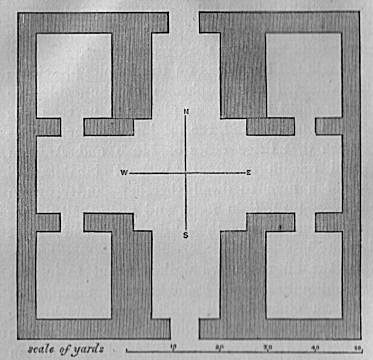
The interior of the walls was so profusely embellished with festoons of
roses and vine-grapes—both sculptured in stone and wrought in stucco,
and of very large size—that there was no room left for pictures or
images. The roof of this building is almost all fallen in. I
imagined this to have been a Christian church, of very remote antiquity, on
account of the vine and the roses, which are peculiarly Christian
symbols—alluding to the texts, “I am the true Vine,” and
“I am the Rose of Sharon;” but the chambers in each corner are
difficult to account for. The east and west ends have no doors.
Near this is a square mass of masonry, upon which are standing six
columns, of magnificent dimensions, which no doubt originally supported a
roof. Their capitals, of chaste and correct Corinthian style, with
portions of ornamental entablature, are lying near. Perhaps belonging
to this, but at some distance, lies a ponderous piece of architrave, on
which, between lines of moulding, is an inscription in
Greek—illegible except the three
letters—ΝΩΘ. These letters were nine inches in
length.
Nigh to this, again, was a square building of rabbeted stones, equal to
almost the largest in the walls of Jerusalem.
All down the hill, descending to our camp, were fragments of columns and
of decorated friezes of temples, that had evidently been rolled or had
slidden down from their places.
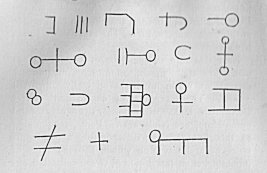
Upon various walls of dilapidated edifices I observed the curious marks,
slightly scratched, which almost resemble alphabetical characters, but are
not; and which have, wherever met with and wherever noticed, which is but
seldom, puzzled travellers, however learned, to decipher.
I copied the following:—
And from the shaft of a column still erect, half way down the hill, I
copied the following:—
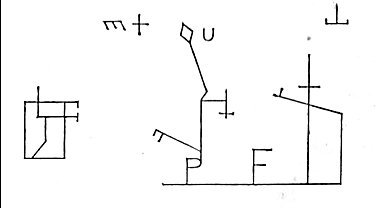
I have since learned that they are the tokens of the Bedaween Arabs, by
which one tribe is distinguished from another. In common
parlance they are called the Ausam (plural of Wasam) of the several
tribes. [33]
In a valley to the north of us, leading westwards from the main valley,
we found a beautiful mausoleum tomb,—a building, not an excavation in
rock,—containing six sarcophagi, or ornamented stone coffins, ranged
upon ledges of masonry, along three sides of the chamber. These were
very large, and all of the same pattern—the lids remaining upon some
of them, but shifted aside. Beautiful sculptured embellishments were
upon the inside walls and over the portal outside, but no inscriptions to
indicate the period or persons to whom they belonged. Inside,
however, were rudely scratched the modern Arab tribe-signs, showing that
persons of such tribes had visited there; so that Europeans are not the
only travellers who help to disfigure ancient monuments by
scribbling. Along this western valley were several other such
mausoleums. Thence we mounted on a different side to the summit of
that hill from which I have here begun my description of
edifices—upon a gentle sloping road, evidently of artificial cutting,
quite feasible for ascent of chariots.
Near the square (possible) church before mentioned, (though I should say
that our party were not all convinced of its being a church,) is a
prodigiously large cistern, of good masonry. From the top of the
strong walls of the building—while some Arab boys below me
were reaching birds’ nests—I got from our guide the following
list of sites in the neighbourhood. They were of course unable to
discriminate between ancient and modern names; and I do not find one Bible
name among them all:—
From north to west—
|
Thuggeret el Baider.
|
Esh-Shemesâni.
|
|
Kassar Waijees.
|
Esh-Shwaifiyeh.
|
|
Es-Salt.
|
Umm Malfoof.
|
From west to east—
|
’Abdoon.
|
Mesdar ’Aishah.
|
|
Umm es Swaiweeneh.
|
El Mergab.
|
Towards the east—
|
Merj Merka.
|
’Ain Ghazâl.
|
|
Ursaifah (in a valley with a river).
|
|
|
El Muntar el Kassar, between two artificial hills.
|
|
The people informed me of a place, a little nearer than Kerak, called
Rabbah. This latter may be a Rabbath-Moab.
I have no further notes to transcribe respecting the architectural
remains; but they are so numerous and so important that a week would not
suffice for their thorough investigation. All our party were highly
gratified at having visited this Rabbath-Ammon—alias
Philadelphia—alias, at present, ’Ammân. We
were not, however, so fortunate as Lord Lindsay in finding a fulfilment of
the prophecy (Ezek. xxv. 5) with respect to camels, either alive or
dead. Probably, when he was there, it was soon after an
Egyptian military expedition to Kerak. The prodigious number of dead
camels that he saw there would seem to indicate that a great Arab battle
had been fought at that place shortly before. It is only in this way
that we could account for a cannonball (about a six-pounder) which one of
the boys carried about, in following us, all the afternoon, wishing us to
buy it of him as a curiosity.
On returning to the tents, I found an old Jerusalem acquaintance—a
Moslem named ’Abderrahhman Bek el ’Asali—and with him
several people from Es-Salt; among these a Christian named Abbâs.
From conversation with them I got some fresh information on Arab
affairs. These people took the opportunity of glorifying their native
town; related how they are frequently at war, and that successfully, with
the ’Adwân; and when acting in concert with the Abbâd, or
much more so when in alliance with the Beni Sukh’r, can always repel
them; only it happens that sometimes the ’Adwân get help from
the more distant ’Anezeh; and this is much more than enough to turn
the balance again. But even now the ’Adwân cannot come
near the town; neither can they quite forget that the Saltiyeh people,
during a former war, killed both the father and grandfather of
Dëâb, and sent the head of the former to the tribe in a dish,
with a pilaff of rice.
All the strength of the ’Adwân now lies in Shaikh
Dëâb, with his son ’Ali, (who came to welcome us near the
Jordan,) and Gublân the nephew. Old ’Abdu’l
’Azeez is considered childish, and unfit to lead them.
For us travellers, however, the ’Adwân are sufficient.
The territory is theirs over which we are passing, and they do all they can
to please us; only, of course, like all Arab guides, they take every
opportunity of insinuating themselves into being fed by us, which is a
condition “not in the bond.”
Then came a visit of three men with good-natured countenances.
These were Bedawi minstrels from Tadmor, (Palmyra,) who wander about from
tribe to tribe, singing heroic poems to the accompaniment of their
rebâbeh, (a very primitive sort of fiddle.) No warfare
interferes with the immunity of their persons or property. They are
never injured or insulted, but are always and everywhere welcome, and
liberally rewarded. Of course it is for their interest to gratify the
pride of their auditors by fervid appeals to their ancestral renown, or to
individual prowess and generosity.
The Arabic of their chants is unintelligible to towns-people; it is the
high classic language of Antar.
I had made acquaintance with these same men before at Tibneen Castle,
near the Lebanon, during a season of Bairam. Being Sunday, we
requested them to visit our tents in the morning. Our Arabs, however,
and the dragomans kept them singing till a late hour round the fires
lighted among the tents. It was a cheerful scene, in the clear
starlight, and the lustrous planet Venus reflected in the running
stream.
Monday, 14th.—After breakfast, and an entertainment
of music from our troubadours, and the bestowing of our guerdon, these left
us on their way to the other camp at Na’oor; and our packing up
commenced.
Strange medley of costumes and languages among the grand
colonnades. Our Arabs left us, having the luggage in charge, and
indicating to us the camping-ground where we were to meet again at
night—thus leaving us in care of the Saltîyeh friends of ours,
who were to escort us to their town and its neighbourhood, as the
’Adwân might not go there themselves.
Both the Christian and Moslem shaikhs of the town came to meet us on the
way. The former was a very old man; and he could with difficulty be
persuaded to mount his donkey in presence of a train so majestic, in his
eyes, coming from the holy city of Jerusalem.
We passed an encampment of Beni Hhasan. These people are
few in number, and exist under the shadow of the ’Adwân.
There were plenty of locusts about the country; but we soon came to a
vast space of land covered with storks, so numerous as completely to hide
the
face of the earth, all of them busily employed in feeding—of course
devouring the locusts. So great is the blessing derived from the
visits of storks, that the natives of these countries regard it as a sin to
destroy the birds. On our riding among them they rose in the air,
entirely obscuring he sky and the sun from our view. One of our party
attempted to fire among them with his revolver, but, by some heedlessness
or accident, the bunch of barrels, being not well screwed down flew off the
stock and was lost for a time; it took more than half an hour’s
search by all of us to find it again, and the Arabs considered this a just
punishment for wishing to kill such useful creatures.
We traversed a meadow where Shaikh Faisel, with a detachment of the
’Anezeh, had encamped for pasture, and only left it thirty-five days
before. His flocks and herds were described to us as impossible to be
counted; but our friends were unanimous in stating that his camels were
1500 in number.
Came to Khirbet es Sar, (Jazer?) whence the Dead Sea was
again visible. Our Arabs declared that they could distinguish the
Frank mountain, and see into the streets of Bethlehem. Here there is
a mere heap of ruin, with cisterns, and fragments of arches, large columns,
and capitals; also a very rough cyclopean square building of brown striped
flint in huge masses.
This site is three hours due north of Na’oor, in a straight line, not
turning aside to Dëâb’s camp or ’Ammân.
Northwards hence are the well-wooded hills of ’Ajloon.
To my inquiries for any site with a name resembling Nebo, I was referred to
the Neba, half an hour south of Heshbon, which is given in the list
taken down by me at Heshbon.
Proceeding northwards, we had the hills of Jebel Mâhas
parallel on our right hand; and to our left, in a deep glen below, was the
source of the stream Se’eer, which had flowed past us at
Cuferain, our first encampment after crossing the Jordan.
Arrived at the ruined town (modern in appearance) of Dabook, from
whence they say the Dabookeh grapes at Hebron [39] had
their origin; but there are none to be seen here now (see Jer. xlviii. 32,
33)—“O vine of Sibmah, I will weep for thee with the weeping of
Jazer: thy plants are gone over the sea, they reach even to the sea of
Jazer: the spoiler is fallen upon thy summer fruits and upon thy
vintage. And joy and gladness is taken from the plentiful field, and
from the land of Moab; and I have caused wine to fail from the
wine-presses,” etc.: with nearly the same words in Isa. xvi.
8-10.
At a short distance upon our right was a ruined village called
Khuldah. This was at the entrance of woods of the evergreen
oak, with hawthorn, many trees of each kind twined round with
honeysuckle. There Shaikh Yusuf, (the Moslem of Es-Salt,) who is a
fine singer, entertained us with his performances, often
bursting into extemporaneous verses suitable to the occasion and
company.
On reaching an exceedingly stony and desolate place, he related the
original story of Lokman the miser, connected with
it:—“Formerly this was a fertile and lovely spot, abounding in
gardens of fruit; and as the Apostle Mohammed (peace and blessings be upon
him!) was passing by, he asked for some of the delicious produce for his
refreshment on the weary way, but the churlish owner Lokman denied him the
proper hospitality, and even used insulting language to the unknown
traveller, (far be it from us!) Whereupon the latter, who was aware
beforehand of the man’s character, and knew that he was hopelessly
beyond the reach of exhortation and of wise instruction, invoked upon him,
by the spirit of prophecy, the curse of God, (the almighty and
glorious.) And so his gardens were converted into these barren rocks
before us, and the fruit into mere stones.”
Such was the tale. But similar miraculous punishments for
inhospitality are told at Mount Carmel, as inflicted by the Prophet Elijah;
and near Bethlehem by the Virgin Mary.
From a distance we caught a distant view of the Beka’ el
Basha, or Pasha’s meadow, where we were to encamp at night, but
turned aside westwards in order to visit the town of Es-Salt. Upon a
wide level tract we came to a small patch of ground enclosed by a low wall,
to which a space was left for entrance, with a lintel thrown
across it, but still not above four feet from ground. On this were
bits of glass and beads and pebbles deposited, as votive offerings, or
tokens of remembrance or respect. The place is called the Weli, or
tomb, of a Persian Moslem saint named Sardoni. But it should
be recollected that in Arabic the name ’Ajam, or Persia, is
often used to signify any unknown distant country to the east.
At ’Ain el Jadoor we found water springing out of the
rocks, among vineyards and fig and walnut trees, olives also, and
pomegranates—a beautiful oasis, redeemed from the devastation of
Bedaween by the strong hand of the town population. Near this the
Christian Shaikh Abbâs, being in our company, was met by his
venerable mother and his son Bakhi.
In every direction the town of Es-Salt is environed by fruitful gardens,
the produce of which finds a market in Nabloos and Jerusalem. The
scenery reminded me of the Lebanon in its green aspect of industry and
wealth.
Entering the town we dismounted at the house of Shaikh Yusuf, and took
our refreshment on the open terrace, on the shady side of a wall.
Some of us walked about and visited the two Christian churches: they are
both named “St George,” and are very poor in furniture.
Of course they have over the door the universal picture in these countries
of St George on his prancing gray horse. This obtains for them some
respect from the Mohammedans, who also revere that martial and
religious hero. Inside the churches we found some pictures with
Russian writing upon the frames; the people informed us that these were
presents from the Emperor Nicholas, which is worthy of notice.
The ignorance of the priests here is proverbial all over
Palestine. I have heard it told of them as a common practice, that
they recite the Lord’s Prayer and the Fathhah, or opening
chapter of the Koran, alternately, on the ground that these are both very
sublime and beautiful; and it is said that they baptize in the name of the
Father, Son, and Holy Ghost, and the Virgin Mary. There is reason to
believe them very grossly ignorant; but it may be that some of these
reports about them emanate from the Roman Catholic authorities in
Jerusalem, who never hesitate at propagating slanders to the detriment of
non-Romanists.
In a church porch I found a school of dirty ragged children reading the
Psalms from the small English printed edition; not, however, learning to
read by means of the alphabet or spelling, but learning to know the forms
of words by rote; boys and girls together, all very slightly dressed, and
one of the boys stark naked.
People came to me to be cured of ophthalmia. I got out of my
portmanteau for them some sugar of lead; but it is inconceivable the
difficulty I had to get a vessel for making it into a lotion—bottles
or phials were totally unknown, not even cups were to be procured. At
one time I thought of a gourd-shell, but there was not one dried in
the town; so they told me. I might have lent them my drinking-cup,
but then I wanted to prepare a large quantity to be left behind and to be
used occasionally. I forget now what was the expedient adopted, but I
think it was the last named-one, but of course only making sufficient for
immediate use. I left a quantity behind me in powder, with directions
to dilute it considerably whenever any vessel could be found; warning the
people, however, of its poisonous nature if taken by mouth.
One man came imploring me to cure him of deafness, but I could not
undertake his case. In any of those countries a medical missionary
would be of incalculable benefit to the people.
There are ancient remains about the town, but not considerable in any
respect. It is often taken for granted that this is the Ramoth-Gilead
of Scripture, but I believe without any other reason than that, from the
copious springs of water, there must always have been an important city
there. The old name, however, would rather lead us north-eastwards to
the hills of Jela’ad, where there are also springs and
ruins.
On leaving the town we experienced a good deal of annoyance from the
Moslem population, one of whom stole a gun from a gentleman of the party,
and when detected, for a long time refused to give it up. Of course,
in the end it was returned; but I was told afterwards that the people had a
notion that we ought to pay them something for visiting their town, just as
we pay the wild Arabs for visiting Jerash. What a difference from the
time of the strong Egyptian Government when Lord Lindsay was there!
At a distance of perhaps half or three-quarters of an hour there is a
Weli called Nebi Osha; that is to say, a sepulchre, or
commemorative station of the Prophet Joshua, celebrated all over the
country for the exceeding magnificence of the prospect it commands in every
direction. In order to reach this, we had to pass over hills and
plains newly taken into cultivation for vineyards, mile after mile, in
order to supply a recent call for the peculiar grapes of the district at
Jerusalem to be sent to London as raisins.
Arrived at the Weli, we found no language sufficient to express the
astonishment elicited by the view before us; and here it will be safest
only to indicate the salient points of the extensive landscape, without
indulging in the use of epithets vainly striving to portray our
feelings. We were looking over the Ghôr, with the Jordan
sparkling in the sunshine upon its winding course below. In direct
front was Nabloos, lying between Ebal and Gerizim; while at the same
time we could distinguish Neby Samwil near Jerusalem, the Mount Tabor,
Mount Carmel, and part of the Lebanon all at once! On our own side of
Jordan we saw the extensive remains of Kala’at
Rubbâd, and ruins of a town called Maisĕra. On
such a spot what could we do but lie in the shade of the whitewashed Weli,
under gigantic oak-trees, and gaze and ponder and wish in
silence,—ay, and pray and praise too,—looking back through the
vista of thirty-three centuries to the time of the longing of Moses, the
“man of God,” expressed in these words “O Lord God, Thou
hast begun to show Thy servant Thy greatness and Thy mighty hand: . .
. I pray Thee let me go over and see the good land that is beyond
Jordan, that goodly mountain, and Lebanon.” The honoured leader
of His people—the long-tried man “through good report and evil
report,” who, during his second forty years which he spent as a
shepherd in Midian, had been accustomed to the abstemious habits and keen
eyesight of the desert; and, at the end of another forty years as the ruler
of a whole nation, living in the desert, “his eye was not
dim,”—added to which natural advantage, we are told that
“the Lord showed him all the land,” highly cultivated as it was
then by seven nations greater and mightier than Israel,—Moses must
have beheld a spectacle from Pisgah and Nebo, surpassing even the glories
of this landscape viewed by us from Nebi Osha.
Turning eastwards to our evening home, we passed a ruined site called
Berga’an, where we had one more view of the Dead Sea, and
traversed large plains of ripe corn, belonging, of course, to the people of
Es-Salt. The people requested me to pray to God that the
locusts might not come there, since all that harvest was destined for
Jerusalem.
We met some of the ’Abbâd Kattaleen Arabs, but we
were safe under the escort of the Saltîyeh instead of the
’Adwân. These ’Abbâd are the people who
assaulted and plundered some seamen of H.M.S. “Spartan” in
1847, on the Jordan; for which offence they have never yet been chastised,
notwithstanding the urgent applications made to the Turkish Pashas of
Jerusalem, Bayroot, and Damascus. We did not arrive at the encampment
till long after dark, and there was no moonlight.
The site is on a plain encircled by hills, with plenty of water
intersecting the ground; the small streams are bordered by reeds and long
grass. A khan, now in ruin, is situated in the midst—a locality
certainly deserving its name, Beka’ el Bashà, and is
said to have been a favourite camping-station for the Pashas of Damascus in
former times.
Much to our vexation, the Arabs and the muleteers had pitched our tents
in a slovenly manner among the winding water-courses, so that we had wet
reeds, thistles, and long grass, beetles and grasshoppers inside the tents,
which again were wetted outside with heavy dew. They had done this in
order to keep the cattle immediately close to us, and therefore as free
from forayers as possible during the night. Such was the reason
assigned, and we were all too hungry and tired to argue the matter
further.
My people complained to me of the insolence of the Saltîyeh
guides that were with us; so I sent for the two shaikhs and scolded
them. They persisted in it that they did not deserve the rebuke, that
the complaints ought to be laid against a certain farrier who had come over
from Jerusalem, etc., etc. My servant ended the affair by shouting at
them, “Take my last word with you and feed upon it—‘God
send you a strong government.’” This at least they
deserved, for they are often in arms against the Turkish government: and
although so prosperous in trade and agriculture, are many years in arrear
with their taxes.
Tuesday, 15th.—Early in the morning there were
Saltîyeh people reaping harvest near us, chiefly in the Christian
fields; for here the case is not as in Palestine, where Christians
generally sow and reap in partnership with Moslems, for their own safety;
but the Moslems have their fields, and the Christians have theirs apart,
which shows that their influence is more considerable here; indeed, the
Christians carry arms, and go out to war against the Bedaween, quite like
the Moslems.
Before we left, the day was becoming exceedingly hot, and we had six
hours’ march before us to Jerash.
The hills abound with springs of water. We passed one called
Umm el ’Egher, another called Safoot, also Abu
Mus-hhaf, and Tâbakra, and ’Ain Umm ed
Dumaneer, with a ruin named Khirbet Saleekhi.
The ’Adwân Arabs were now again our guides, the
Saltîyeh having returned home; but for some distance the guides were
few and without firearms, only armed with spears, and the common peasant
sword called khanjar; perhaps this was by compact with the
Saltîyeh, as in about an hour’s time we were joined by a
reinforcement with a few matchlock guns. On we went through
corn-fields, which are sown in joint partnership with the Arabs and the
Moslems of the town; then doubled round a long and high hill with a ruin on
it, called Jela’ad. This I have since suspected to be
Ramoth-Gilead. We descended a hill called Tallooz; forward
again between hills and rocks, and neglected evergreen woods, upon narrow
paths. A numerous caravan we were, with a hundred animals of burden,
bright costumes, and cheerful conversation, till we reached a large
terebinth-tree under a hill called Shebail; the site is called
Thuggeret el Moghâfer, signifying a “look-out
station” between two tribes. There we rested a while, till the
above-mentioned reinforcement joined us. From this spot we could just
discern Jerash, on the summit of a huge hill before us.
We now had one long and continued descent to the river Zerka.
Passed through a defile, on issuing from which we observed a little stream
with oleander, in pink blossom, thirty feet high, and in great
abundance. Halted again at a pretty spring, called
Rumân, where the water was upon nearly a dead level, and
therefore scarcely moving; then another small spring, called Bursa, and
also ’Ain el Merubb’a’.
Evergreen oak in all directions, but with broader leaf than in
Palestine; also some terebinth-trees and wild holly-oaks. All the
scenery now expanded before us in width and height and depth.
We took notice of several high hills with groves of evergreen oak on
their summits; detached hills, which we could not but consider as remains
of the ancient high places for idolatrous worship.
Still descended, till on a sudden turn of the road came the rushing of
the Zerka, or Jabbok, water upon our ears, with a breeze sighing
among juniper-bushes, and enormous and gorgeous oleanders, together with
the soft zephyr feeling from the stream upon our heated faces—oh, so
inexpressibly delicious! I was the first to get across, and on
reaching the opposite bank we all dismounted, to drink freely from the
river—a name which it deserves as at that place it is about
two-thirds of the width of the Jordan at the usual visiting-place for
travellers.
Some of the party went bathing. We all had our several luncheons,
some smoked, all got into shady nooks by the water-side; and I, with my
heart full, lay meditating on the journey we had hitherto made.
At length I had been permitted by God’s good providence to
traverse the territory of Moses and the chosen people antecedent to the
writing of the Pentateuch, when they were warring upon Ammon and Moab. How
solemn are the sensations derived from pondering upon periods of such very
hoar antiquity—a time when the deliverance at the Red Sea, the
thunders of Sinai, the rebellion of Korah and Dathan, the erection of the
tabernacle, and the death of Aaron, were still fresh in the memories of
living witnesses; and the manna was still their food from heaven,
notwithstanding the supplies from the cultivated country they were passing
through, (Josh. v. 12.) Elisha did well in after times on the banks
of Jordan, when he cried out, “Where is the Lord God of
Elijah?” And we may exclaim, in contemplation of these
marvellous events of the still more remote ages, “Where is the Lord
God of Moses, who with a mighty hand and stretched-out
arm”—“redeemed His people from their enemies; for His
mercy endureth for ever!” Nations and generations may rise and
pass away; phases of dominion and civilisation may vary under Assyrian,
Egyptian, Hellenic, and Roman forms, or under our modern modifications; yet
all this is transitory. The God of creation, providence, and grace,
He lives and abides for ever. His power is still great as in the days
of old, His wisdom unsearchable, and His goodness infinite. Ay, and
this dispenser of kingdoms is also the guide of the humble in heart, and He
cares for the smallest concerns of individual persons who rest upon
Him.
Strengthened by these and similar reflections, with ardent
aspirations for the future, I rose up and pursued my journey, as
Bunyan’s pilgrim might have done, under the heartfelt assurance that
“happy is he that hath the God of Jacob for his
help.”
We were now leaving behind us much of the Old Testament
country—not exclusively that of the Mosaic era, but the land which
had been trodden by the patriarchs Abraham and Israel on their several
removals from Padan-aram to Canaan. But, while looking back upon the
grand landscape outline with an intense degree of interest, it may be well
to remark that, among all our company, there was a feeling of uncertainty
as to the geographical boundaries of the lands possessed by the old people
of Ammon, Moab, and Bashan. Probably there had been some fluctuations
of their towns and confines between the time of the exodus and the
prophecies of Isaiah and Jeremiah.
One thing is certain—that we all, with one heart, were confident
that God spake by Moses and the prophets; and that, with the incidents, the
people and the local names we had lately passed among, we might as soon
believe in the non-existence of the sun and stars, as that the books called
“The Law of Moses” are not in every word a record of infallible
truth.
We had now a different journey, and a different set of scenes before
us, entering into the half tribe of Manasseh.
Ascending the steep mountain-sides with two of the guides, I preceded
the rest of the party, and even the baggage mules. In perhaps half an
hour, (it may be more,) I came to a triumphal arch, the commencement of
Jerash. One of the guides told me that they call this the Ammân
Gate of the old city; for that, in ancient times, there were two brothers, one
named Ammân, and the other Jerash. Each of them built a city,
and gave it his own name; but called the gate nearest to his
brother’s city, by the name of that brother.
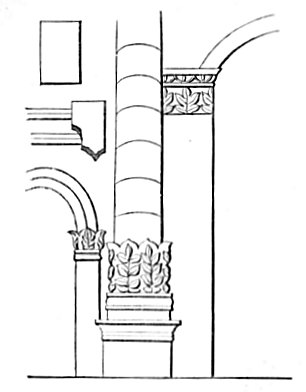
At this gateway I observed the anomaly of the columns on each side of
the principal opening, having their capitals at the bottom of the shafts,
and resting on the pediments, though in an upright position. It was
very ridiculous. When could this have been done—at the original
erection of the gate, or at a later rebuilding, after an earthquake had
shaken the pillars? It would seem to me to be the former, as they are
posted against the wall, and this is not disturbed or altered. The
columns and the curve of the portal are gone, so that it cannot be seen
whether originally they had capitals on the heads also of the
columns. It is most probable that those remaining are not the true
capitals, inasmuch as they have no volutes.
Passing by inferior monuments of antiquity,—such as a sepulchre, a
single column, a sarcophagus, and then a square elevated pavement in good
condition, upon which are several sarcophagi, some of them broken, and all
with the lids displaced,—I came to a large circus of Ionic columns,
almost all standing, and joined to each other at the top by
architraves. Thence holding on the same direction forwards due north,
our way was between a double row of grand Corinthian columns with their
capitals, and occasional temples to the right and left. At
the termination of this, but without continuing the same line, between
columns of another Grecian order, I turned aside, at a vast Roman bath, to
a spring of water, the commencement of a running stream, in a small meadow
of tall grass and thorns, intending to pitch my tent there; but soon
changed my mind, and got myself established within a wing of the Roman
bath, which stood on higher ground, and had a good roof upon it.
The other gentlemen on coming up, adopted the choice of their dragomans
and muleteers, near the water, after having the thorns and thistles cleared
away. A fresh afternoon breeze that sprang up was peculiarly grateful
to men and cattle.
After some rest, I proceeded to stroll about,—first of all to the
great Temple of the Sun, on a rising ground to the west of the great
colonnade, which, besides the columns along all the sides of the edifice,
has a conspicuous portico in front, consisting of twelve magnificent
Corinthian columns, a few of which are fallen. Thence I walked to the
Naumachia, near the southern extremity of the city, (that by which we had
arrived,) and found this in good condition, with the seats remaining, and
the channel well defined which conveyed water for the exhibitions from the
above-mentioned spring. The form is a long oval, flattened at one
end.
In passing once more between the double line of Corinthian columns, I
counted fifty-five of them standing, besides fragments and capitals of the
missing ones lying on the ground.
From this I diverged at right angles, through a street of small public
buildings, towards the bridge over the stream, (and this I called Bridge
Street—part of the pavement still remains, consisting of long slabs
laid across the whole width from house to house;) then upon the bridge, as
far as its broken condition would allow, and returned to my
home—everywhere among scattered fragments of entablature; numerous
altars entire, and sculptured with garlands; also broken buildings, with
niches embellished inside with sculptured ornament. In all my
exploration, however, I found no statues or fragments of statues—the
Mohammedan iconoclasts had long ago destroyed all these; but there were
some remains of inscriptions, much defaced or worn away by the work of
time.
The natural agencies by which the edifices have come to ruin seem to
be—first, earthquakes; then the growth of weeds, thorns, and even
trees, between the courses of stone, after the population ceased; or rain
and snow detaching small pieces, which were followed by larger; also
sometimes a sinking of the ground; and besides these common causes of
decay, there comes the great destroyer—man.
Yet nature is always picturesque, even after the demolition of the works
of human art or genius; and it is pleasing to see the tendrils, leaves, and
scarlet berries of the nightshade playfully twining among the sculptured
friezes which are scattered about in every position but straight lines; or
other plants between the volutes, rivalling the acanthus foliage of the
classic capitals.
Sunset: a beautiful landscape all around; and a pretty view of the
travellers’ tents, the Arabs, and the cattle below me.
After dinner I walked by starlight along the Ionic colonnade, which is a
further continuation northwards of the Corinthian, and found nearly the
whole length, with the intermediate pavement, remaining, consisting of
squares about two feet in length, laid down in diamond pattern.
At night there were flickering lights and varieties of human voices
below; the frogs croaking loud near the rivulet; and the rooks, whom I had
dislodged from their home within the Roman bath, had taken refuge on the
trees about us, unable to get to rest, being disturbed by our unusual
sights and sounds.
Wednesday, 16th.—A visitor came early—namely,
Shaikh Yusuf—with two of his people from Soof. The old
man exhibited numerous certificates given by former travellers—all
English—whom he had accompanied as guide either to Beisân or
Damascus. He offered his services to take us even, if we pleased, as
far as Bozrah.
Then came Shaikh Barakât el Fraikh with a large train. He is
ruler over all the Jebel ’Ajloon, and has been residing lately
on the summit of a high hill rising before us to the east, where
there is a weli or tomb of a Moslem saint, the Nebi Hhood, who works
miraculous cures. Barakât is in delicate health, and has twenty
wives. His metropolis, when he condescends to live in a house, is at
a village called Cuf’r Enji; but his district comprises
fifteen inhabited villages, with above three hundred in ruins,—so it
is said.
As for the saint himself, he has a very respectable name for antiquity,
too ancient for regular chronology to meddle with—it is only known
that he preached righteousness to an impious race of men previous to their
sudden destruction. The circumstance of his tomb being on the summit
of a high hill is perfectly consonant with the sentiments of great heroes
and chiefs, as frequently expressed in poems of the old Arabs. The
restoration of health which he is supposed to bestow, must be that effected
by means of the fine mountain air at his place. At
’Ammân, old ’Abdu’l ’Azeez had said that
Jerash was built by the Beni ’Ad, a primitive race mentioned in the
Korân.
A ridiculous figure appeared of a Turkish subaltern officer, who has
come into this wild desert to ask the people for tribute to the
Porte. A Turkish kawwâs in attendance on him, I observed to
shrug up his shoulders when he heard nothing but Arabic being spoken among
us. They arrived here in the company of Shaikh Yusuf, whose son is
nominally a Turkish military officer, commanding three hundred imaginary
Bashi-Bozuk, or irregular cavalry. By means of such titles they
tickle the vanity of the Arab leaders, and claim an annual tribute
of 218 purses, (about £1000,) and are thus enabled to swell out the
published army list, and account of revenue printed in Constantinople. [58]
So that next to nothing is in reality derived from these few sparse
villages; and from the tent Arabs less than nothing, for the Turks have to
bribe these to abstain from plundering the regular soldiers belonging to
Damascus.
The ’Anezi Shaikh Faisel was encamped at only fourteen
hours’ distance from us.
Common Arab visitors arrived—from no one knew where: some on
horseback, to see what could be picked up among us; even women and
children. They must have travelled during the night. A
handsomely-dressed and well-armed youth on horseback, from Soof, accosted
me during one of my walks.
I bought two sheep for a feast to the Arabs that came about my tent; but
they asked to have the money value instead of the feast. Alas for the
degradation! What would their forefathers have said to them had they
been possibly present?
Afternoon: a fine breeze sprang up, as is usual in elevated
districts. I strolled again with an attendant—first
outside the ancient wall on the east side of the rivulet, where it is not
much dilapidated; it is all built of rabbeted stones, though not of very
large size; then crossed over to the western wall, and traced out the whole
periphery of the city by the eye.
In the great Corinthian colonnade, one of our party called me to him,
and showed me some inscriptions about the public edifices along that line,
and at the Temple of the Sun. There was one inscription in Latin, on
a square pedestal; a similar one near it, broken across, had a Greek
inscription. The rest were all in Greek, but so defaced or injured
that seldom could a whole word be made out. However, we found, in a
small temple beyond the city wall to the north, in a ploughed field, an
inscription more perfect, containing the work Nemesis in the first
line. There also I saw several mausoleums, with sarcophagi handsomely
ornamented, and fragments of highly-polished red Egyptian granite columns,
to our great surprise as to how they had arrived there, considering not
only the distance from which they had been brought, and the variety of
people through whose hands they had passed since being cut out roughly from
the quarries of upper Egypt; but, moreover, the difficulty to be surmounted
in bringing them to this elevation, across the deep Jordan valley, even
since their disembarkation from the Mediterranean either at Jaffa or
Caiffa.
The inscriptions that I had been able to collect were as
follows:—
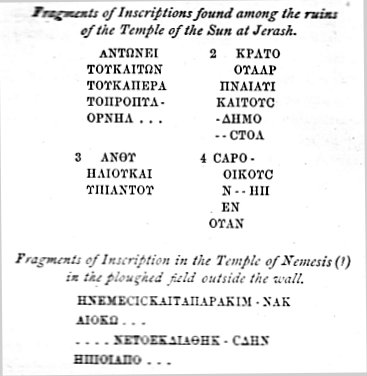
Among all the hundreds of fragments of fine capitals and friezes lying
about Jerash, there was not one that was not too heavy for us to carry
away. I found no ornamented pottery, although we had found some even
at Heshbon; neither coins, nor even bits of statues. And remarkable
enough in our European ideas, so little space appeared for private common
habitations—as usual among ruined cities of remote antiquity—it
seemed as if almost the whole enclosure was occupied by temples or
other public institutions.
Yet there must have habitations for a numerous population. And,
again, such a city implies the existence of minor towns and of numerous
villages around, and a complete immunity from incursions of wild Arab
tribes. These latter were unknown to a population who could build
such temples, naumachia, and colonnades, and who were protected farther
eastwards by the numerous cities with high roads, still discoverable in
ruins beyond this—Belka and ’Ajloon. But of how different
a character must have been the daily necessities of these old populations
from the requirements of modern European existence. We should
not be satisfied with the mere indulgence of gazing upon the æsthetic
beauty of temples and colonnades. Climate, however, has much to do in
this matter.
At night we had a general conference at the encampment respecting the
future march, as we had now finished with the ’Adwân Arabs. [61]
The resolution was taken to proceed on the morrow to Umm
Kais, under the guidance of Shaikh Yusuf of Soof, and proceed thence to
Tiberias. He, however, would not ensure but that we might be met and
mulcted by the Beni Sukh’r for leave to traverse their
territory. He was to receive 500 piastres, (nearly £5,) besides
50 piastres for baksheesh; but whatever we might have to pay the Beni
Sukh’r was to be deducted from the above stipulation.
Thursday, 17th.—Great noise of jackdaws under my
vaulted roof at break of day, they having mustered up courage to return to
their nests there during the night.
During the packing up of the luggage, I took a final and lonely walk
along the colonnades to the Naumachia, and outside the wall S.W. of the
Ammân gate, where I observed some columns, or portions of such, of
twisted pattern; returned by the bridge. The thrush, the cuckoo, and
the partridge were heard at no great distance, near the stream.
We left upon the meadow a parliamentary debate of Arabs gathered around
the chief’s spear, all the men ranting and screaming as only such
people can, and they only at the beginning or end of a bargain.
Slowly we defiled in a long line over rising ground, higher and higher,
upon a good highway, bordered on each side by numerous sarcophagi; as along
the Roman Appian Way; passed the well of Shaikh el Bakkar, and a
sarcophagus with a long inscription in Greek, which I regretted not having
discovered yesterday, so as to allow of copying it. From an eminence
we took the last view of the pompous colonnades of Jerash.
Away through the green woods of broad-leaved oak, among which were to be
found fine and numerous pine-trees, the air fragrant with honeysuckle, and
the whole scene enlivened by sweet song of the birds, there were hills in
sight all covered with pine.
Around Soof we found none of the druidical-looking remains mentioned by
Irby and Mangles, but some romantic landscape and vineyards all over the
hills.
Ten minutes beyond Soof we had a Roman milestone lying at our
feet. Some of us set to work in clearing earth away from it,
searching for an inscription, but could not spare sufficient time to do it
properly. We found, however, the letters PIVS · PONTI . .
.—indicating the period of the Antonines.
Next there met us a large party of gipsies—known, among other
tokens, by the women’s black hair being combed, which that of the
Bedawi women would not be. What a motley meeting we formed—of
Moslems, Greek-Church dragomans, Protestants, and Fire-worshippers, as the
gipsies are always believed in Asia to be.
Among the oaks of gigantic size and enormously large arbutus, the effect
of our party winding—appearing and disappearing, in varied costumes
and brilliant colours—was very pleasing.
After a time we reached some fine meadow land, on which were large
flocks of sheep belonging to the Beni Hhassan, whose tents we saw not far
distant. The black and the white sheep were kept separate from each
other.
And then appeared, in succession to the right and left, several of the
rude erections, resembling the Celtic cromlechs, or cist-vaens,
above alluded to, from Irby and Mangles.
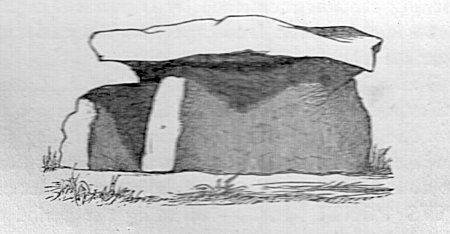
Our guides told us that they abound all over the hills. All that
we saw were constructed each of four huge slabs of brown flinty-looking
stone, forming a chamber—two for sides, one at the back, and a cover
over all, which measured eleven feet by six. Their date must be long
anterior to the Roman period. They are manifestly not Jewish, and
consequently are of pagan origin. Are they altars? or are they of a
sepulchral character, raised over the graves of valiant warriors, whose
very names and nationality are lost? or do they indeed partake of both
designs—one leading easily to the other among a superstitious people,
who had no light of revelation?
My persuasion is that they were altars, as they seldom reach above four
feet from the ground; and if so, they would serve to show, as well as the
uprights forming a square temple by the sea-side, between Tyre and Sidon,
that not in every place did the Israelites sufficiently regard the
injunction of Deut. xii. 3, to demolish the idolatrous places of worship.
[65]
Our road gradually ascended for a considerable time, till we attained
the brow of an eminence, where our woody, close scenery suddenly expanded
into a glorious extent of landscape. Straight before our eyes,
apparently up in the sky, was old Hermon, capped with snow. About his
base was a hazy belt; below this was the Lake of Gennesaroth; and nearer
still was an extent of meadow and woodland.
The commanding object, however, was the grand mountain,
“That lifts its awful form,
Swells from the vale, and midway leaves the storm.
Though round its breast the rolling clouds be spread,
Eternal sunshine settles on its head.”
At this place we rested for a time.
All the day afterwards we kept upon high grounds, to avoid meeting any
of the Beni Sukh’r—thus greatly increasing the length of the
day’s march, and having to scramble over rocky hills without visible
paths. All this had been brought upon us by over-cleverness in
bargaining with Shaikh Yusuf, our guide. We had stipulated that, in
case of meeting with Bedaween Arabs, whatever should be demanded as
ghufur, or toll for crossing their ground, should be deducted from
his 500 piastres. He had informed us that the toll would be but a
trifle; but after the burden of it had been once thrown upon him, he
avoided the best and direct road, and we had hours of needless fatigue in
consequence.
As a peasant himself, the Arabs allow him and his people to pass free,
as no doubt they exact enough from the village in other forms; but they
consider themselves entitled to levy tribute on European travellers.
The latter, however, are always disposed to grumble at it.
We plunged again into thick green woods,—the oaks of
Bashan,—with merry birds carolling all around. Oh, how
cheering was the scene, after that devastated land across the river, where
there is so little of forest land left in proportion to this! A
friend once remarked to me, that were the two territories in the same
relative conditions at the time of Joshua taking possession of Canaan, it
would require double amount of faith in God’s promises, as they
ascended from Jericho to Ai, to believe that they had not left the promised
land behind them. Now, this might be met by several satisfactory
replies; but the plainest answer for the moment is, that the countries were
not then in the same conditions relatively as they now are.
We passed a rock-hewn sepulchre on the side of a hill, in good
condition,—just such as may be frequently seen in Palestine
proper,—then found a large herd of camels browsing; and passing
through a verdant glen, which issued upon cultivated fields, we came to the
village of Mezer, and soon after to Tuleh, where we got a
view of Tabor, Gilboa, and Hermon, [67] all at the same time.
Were the day clear, there could be no doubt but we should have seen also
the village of Zer’een (Jezreel) and the convent on Mount Carmel.
The weather was hot, and our people suffering from thirst, as Ramadan
had that day commenced.
Had a distant view of a Beni Sukh’r encampment to our
right. After a steep descent, and consequent rise again, we were upon
a plain; and therefore the guide counselled us to keep close together, as a
precaution against marauders. Our tedious deviation to-day had been
far to the east: we now turned westwards, as if marching right up to Tabor,
over corn-fields, with the village of Tibni at our left, and
Dair at our right hand.
Arrived at Tayibeh, and encamped there for the night. Among
the first people who came up to us was an Algerine Jew, who held my horse
as I dismounted. He was an itinerant working silversmith, gaining a
livelihood by going from Tiberias among Arab villages and the Bedaween,
repairing women’s ornaments, etc.
There are plenty of wells about this place, but none with good
water. Wrangling and high words among the muleteers, and fighting of
the animals for approach to the water-troughs. The day had been very
fatiguing; and our Moslem attendants, as they had been involuntarily
deprived of water during this the first day of Ramadan, deemed it not worth
while at that hour to break the fast, as evening was rapidly coming
on. Upon a journey, if it be a real journey on business, they are
allowed to break the fast, on condition of making up for the number of days
at some time before the year expires.
Evening: beautiful colours on the western hills, and the new moon
appearing—a thin silver streak in the roseate glow which remains in
the heavens after sunset. The night very hot, and no air moving.
Friday, 18th.—After a night of mosquito-plague, we
rose at the first daybreak, with a glorious spectacle of Mount Hermon and
its snowy summit to the north. Such evenings and mornings as
travellers and residents enjoy in Asian climes are beyond all estimation,
and can never be forgotten.
We learned that there are Christians in this village of Tayibeh,
as indeed there are some thinly scattered throughout the villages of
Jebel ’Ajloon, i.e. from Jerash to near Tiberias; and
in the corresponding villages on the western side of Jordan, as far as
Nabloos.
I always feel deeply concerned for those “sheep without a
shepherd,” dispersed among an overwhelming population of
Mohammedans. They are indeed ignorant,—how can they be
otherwise, while deprived of Christian fellowship, or opportunities of
public worship, excepting when they carry their infants a long journey for
baptism, or when the men repair occasionally to the towns of Nabloos or
Nazareth for trading business; or, it may be, when rarely an itinerant
priest pays them a visit?—still they are living representatives of
the Gentile Church of the country in primitive days, down through
continuous ages,—their families enduring martyrdom, and to this day
persecution and oppression, for the name of Christ, in spite of every
worldly inducement to renounce it. While we Europeans are reciting
the Nicene Creed in our churches, they are suffering for it. They are
living witnesses for the “Light of light, and very God of very
God;” and although with this they mingle sundry superstitions, they
are a people who salute each other at Easter with the words, “Christ
is risen,” and the invariable response, “He is risen
indeed;” also in daily practice, when pronouncing the name of Jesus,
they add the words, “Glory to His name.”
Besides all the above, they are in many things Protestants against Papal
corruption. They have no Vicar of Christ, no transubstantiation, no
immaculate conception, no involuntary confession, and no hindrance to a
free use of the Bible among the laity. For my part, I feel happy in
sympathising much with such a people, and cannot but believe that the
Divine Head of the Church regards with some proportion of love even the
humblest believer in Him, who touches but the hem of His garment.
In our conversation, before resuming the journey, I mentioned the
numerous villages that were to be found about that neighbourhood, utterly
broken up, but where the gardens of fig, vine, and olive trees still are
growing around the ruins. The people pointed out to me the direction
of other such, that were out of sight from our tents; and the Jew quoted a
familiar proverb of the country relating to that subject; also the Moslem
shaikh, with his son, joined also in reciting it:—
“The children of Israel built up;
The Christians kept up;
The Moslems have destroyed.”
In saying this, however, by the second line they refer to the crusading
period; and by the last line they denote the bad government of the Turks,
under which the wild Bedaween are encroaching upon civilisation, and
devastating the recompense of honest industry from the fertile soil.
We—starting upon our last day’s journey
together—passed over wide fields of wheat-stubble. On coming
near the village of Samma, the old shaikh came out to welcome us,
and inquire if his place is written in the books of the Europeans. On
examining our maps, one of our party found it in his; and the rest promised
the friendly old man that his village should be written down.
Proceeding through a green and rocky glen, between high hills, with a
running stream, the weather was exceedingly hot. Here our party
divided,—ourselves advancing towards Umm Kais; while the
baggage and servants turned to the left, so as to cross the Jordan by the
bridge El Mejâma’a for Tiberias. The principal
intention of this was for the property to avoid the chance of falling into
the hands of the Beni Sukh’r. Shaikh Yusuf now showed the
relief from his mind by beginning to sing. This was
all very well for him, who had nothing to lose; because, as it was said
long ago—
“Cantabit vacuus coram latrone viator.”
After wandering round and around, we descended into Wadi Zahari,
“the flowering valley,” where, by the water-side, were reeds
and oleanders forty or fifty feet high; and near them we observed a
pear-tree and a fig-tree, all alone and deserted, the remains of former
cultivation. This and other previous instances attest the risk that
attends rural labour in that district, being in the immediate vicinity of
the Bedaween, and the utter mockery of nominal Turkish rule. Here we
filled our leathern water-bottles, (called zumzumîa in the
Desert, and máttara by towns-people,) and climbed up a stony
hill, the heat of the day increasing. No path among the rocks, and
all of us angry at Shaikh Yusuf for saving himself the few piastres by
conducting us among such difficulties.
Then, after some time we perceived ourselves to be near Umm Kais, by the
sarcophagi, the sepulchres, and ruts of chariot-wheels upon the
rocks. We rushed up to a large tree for refreshing shelter, and near
it found numerous sepulchres, highly ornamented, and some of them with the
stone doors remaining on the hinges, which we swung about to test the
reality of their remaining so perfect, (figs. 1, 2, 3.)
Among these was the one remarked by Lord Lindsay in his Travels,
bearing a Hebrew name inscribed in Greek letters, but which he has not
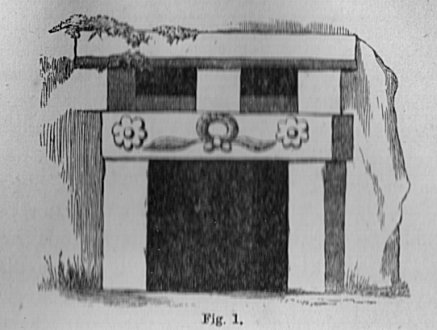
given quite correctly. It should be Gaanuiph instead of
Gaaniph. This sepulchre is cut in black
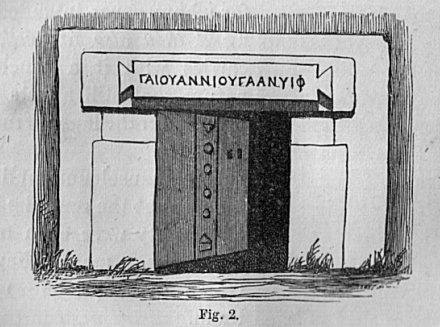
basaltic rock, and has some broken sarcophagi remaining inside. On
a round fragment of a column, near this side, is the inscription given below,
(fig. 4.) The upper part is the farewell of surviving relatives
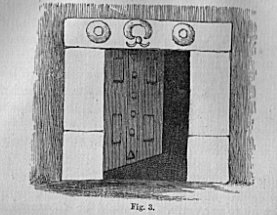
to the daughter of SEMLACHUS. The lower part, for whomsoever
intended,—“and thou also farewell,”—carries
with it a touch of nature that still affects the heart, after the lapse of
many centuries.
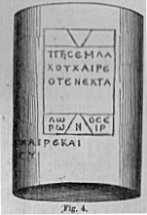
The mausoleums and sepulchres at the opposite end of the city were even
more numerous, many having Greek inscriptions upon them.
But the theatre is the most remarkable of all the objects of
antiquity,—so perfect, with its rows of seats complete,
surrounded by numerous public edifices and lines of columns; and then
commanding from those seats a large view of the beautiful Lake of Tiberias,
and of the grand mountains which enclose it, as a frame to the picture.
Here I stayed behind the rest of the party for a considerable time,
charmed with the spectacle of nature, and revolving over the incidents of
Herodian history, so vividly portrayed by Josephus.
Then rejoined my friends, by galloping along a Roman road, paved with
blocks of dark basalt.
But before leaving this place, I must express my surprise at any person
that has been there imagining for a moment that it can be the Gadara of
Scripture.
The distance from the lake is so great as to be utterly incompatible
with the recorded transactions in the Gospels—having valleys and high
hills intervening; and even supposing the miracle of relieving the demoniac
to refer not to the city but to a territory named Gadara, it is
inconceivable that the territory belonging to this city (Umm Kais) could
extend beyond the deep natural crevasse of the river Yarmuk, and
then rise up a high mountain, to descend again into a plain, all before
reaching the lake.
Our descent to the Yarmuk was long and steep; and upon the plain which
it intersects, the heat exceeded any that I had ever encountered
anywhere. The air was like fire. Such a day I shall
never forget.
The Yarmuk is so considerable a river that the Arabs call it
Sheree’a, as they do the Jordan—only qualifying the
latter as the larger one. It is called the Sheree’a el
Menâdhĕrah, from a party of Bedaween occupying its banks in
the interior.
The crevasse through which it issues is wild and romantic in the
extreme. High cliffs of basalt are the confines of the water.
This, on reaching the plain, is parted with several streams, (to compare
great things with small,) in the fashion of the Nile or the Ganges; which
the Jordan is not, either at its entrance into this lake or its entrance
into the Dead Sea.
All the streams are fringed with oleander; and, in the extreme heat of
the day, the horses enjoyed not only their drinking, but their wading
through the rolling water.
This was the boundary between Bashan and Gilead, through the latter of
which we had hitherto been travelling, and gave name to the great battle
A.D. 637, where the victory obtained by the fierce Khalid and the
mild Abu Obeidah decided the fate of Palestine, and opened the way
of the Moslems to Jerusalem.
Over an extent of four or five miles, before reaching the Jordan, a rich
harvest of wheat was being reaped upon the plain. We first attempted
to cross at Samakh, but finding it impossible at that season, had to
turn back to the ford at the broken bridge, which the natives call the
‘mother of arches,’ (Umm el Kanâter;) and even
there the water was still deep.
Corn-fields and flocks of sheep in every direction; but all the
shepherds carrying firearms. We most of us lay down on our breasts to
drink greedily once more from the dear old river; and then we crossed the
Jordan into the land of Canaan, going on to Tiberias, and passing on the
way some Franciscan monks. What a change of associations from those
of the country we had traversed exclusively for the last nine days!
How absurd the sudden and unexpected contrast from old
’Abdu’l ’Azeez and the brilliant young ’Ali
Dëâb in the freedom of the desert, to the cowl and the convent
of the monks—from the grand savage language of the Ishmaelite to the
mellifluous Italian.
At the hot baths of the lake we found our tents already pitched, and my
old friend the missionary,—Thomson, from Bayroot,—who had been
travelling on the eastern side of the lake, (a territory so little known,)
and, as he and I believed, had discovered the true Gadara. We
compared notes about affairs of the Arabs at the time.
Several of the juvenile travellers set themselves to swimming before
dinner at sunset, the huge hills at the back casting long shadows across
the lake.
We all had tea together, as we were to separate to our several
destinations in the morning; and on my retiring to sleep,
the thermometer was at 99° Fahrenheit inside the open tent.
Saturday, 19th.—Bathing before the sun rose.
Our travellers engaged the boat from Tiberias for the day, and it came
up from the town to our camp with the sail spread. Large flights of
aquatic birds as usual flitting and diving about the lake, and the fish
abundant, rising and splashing at the surface.
For an hour or two before starting on my way southwards, I lay on the
beach contemplating the lovely scenery, and collecting my thoughts, both as
to the past and for the future. The principal object of meditation
was of course the placid lake itself—
“Dear with the thoughts of Him we love so well.”
Then the noble old mountain of Hermon, crowned with snow, now called
Jebel esh Shaikh; which the Sidonians called Sirion; and the
Amorites called Shenir, (Deut. iii. 9.)
Next the ever-celebrated Jordan, with its typical resemblance to the
limit dividing this life from the purchased possession of
heaven,—recalling so much of bright images of Christian poetry
employed to cheer the weary pilgrim, in anticipation of the time when
“We’ll range the sweet fields on the banks of the river,
And sing of salvation for ever and ever!”
Gratefully acknowledging the providence which had brought us happily so
far, the present writer then girded up his mental loins, and returned to
Jerusalem; but on the way occasionally glancing towards the
eastward range of mountains,—the land of Gilead,—now called
Belka and ’Ajloon, lately traversed; and with a feeling unknown since
the verses were first echoed in childhood, the words involuntarily issue
from the lips:
“Sihon, king of the Amorites,
For His mercy endureth for ever,
And Og the king of Bashan,
For His mercy endureth for ever!”
Having learned that ’Akeeli Aga el Hhâsi was encamped on the
Jordan side, at no great distance, I resolved to visit this personage, who
has since then become much more famous as a French protégé,
being an Arab of Algeria, but at this time only noted as having been the
guide of the United States Expedition to the Dead Sea in 1848, and as being
at the moment commissioned by the Turks as a Kaimakam of the district,
seeing that they could not hold even nominal rule there without him.
At my starting there came up from his post a messenger, Hhasan Aga, the
Bosniac officer of Bashi Bozuk, to conduct me to the tents. The Aga
was dressed in a crimson silk long coat, over which was a scarlet jacket
embroidered in gold, and on his legs the Albanian full kilt, or fustinella,
of white calico; his saddle cloth was of pea-green silk with a white
border, and yellow worsted network protected the horse’s belly from
flies, also a rich cloth with tassels lay over the horse’s loins.
Proceeded southwards, and passed the broken bridge before
mentioned. Harvest everywhere in progress, and the produce being
carried home on asses to the village of ’Abadîyeh,
adjoining to the houses of which were square and flat tents made of
palm-leaf matting as residences of the Ghawârineh Arabs.
Came to the ruins of a wretched little village called
Belhhamîyeh, formerly under the patronage of the
’Adwân; and thence appeared in full view upon the hill above
the great castle of the Crusaders called Belvoir, but now named
Cocab, or Cocab el Hawa. Upon the plain by the river
side was the encampment scattered about, and several European tents among
the others denoted the presence of Turkish soldiers.
We could see the Jis’r el Mejâma’a, the bridge leading
across to the land of Gilead.
Rode up to ’Akeeli’s tent, and found with him the formidable
Shaikh Fendi el Faiz of the Beni Sukh’r, and a musician with his
rebâbeh. A slave was making coffee on a fire of dried
camel’s dung, although it was in the fast of Ramadân. We
conversed guardedly about Dëâb and the rest of the
’Adwân, and the camp at Dahair el Hhumâr.
’Akeeli then had brought in for his amusement a wild beast called a
fahh’d, differing from a panther in being larger and in having
black stripes down the face; it seemed wild enough, but was confined by a
rope, the pulling of which, and alternately patting the creature
was the amusement or occupation of the Aga. They brought me some
coffee and water to drink, whereupon ’Akeeli called for some too, and
said to me—“These fools of Mohammedans are keeping
Ramadân, but I am a Frenchman,” he then drank off the
water. This man, whom Lynch, the American commander, styles a
“magnificent savage,” was savage enough in manners, and dirty,
and half-naked. He has since, however, made his influence felt, and
may perhaps do so again.
Altogether, my reception was not one in accordance with my notions of
Arab hospitality. Perhaps he did not wish me to espy what was going
on about him in company with Shaikh Fendi el Faiz, so I took my leave,
riding towards Cocab. At an Arab encampment we got some Leben
Sheneeni, (soured fresh milk, most delicious in hot weather,) and drank
almost a pailful of it between myself, the kawwâs, and the
muleteer. The heat was prodigious. In the camp were only women
and children at home: the former employed in weaving and dyeing woollen
trappings for horses,—serving to keep off the plague of
flies,—of which articles we bought two.
’Akeeli had sent an escort to accompany us as far us the
castle. One of the men was a care-worn old fellow from the far north,
wearing a very heavy sheepskin coat with wide sleeves, to keep out the
scorching heat of the sun, and his face covered with a mandeel
or cotton handkerchief, to protect him from reflection from the ground; his
venerable musket terminated in a rusty bayonet.
We went southwards until opposite the bridge, then turned westward to
the hills, and forded the water of Wadi Berreh. The ascent was
difficult and long, during which our escort carried on a conversation in
the Arnaout language.
At the summit I sent on the servants and baggage to Jeneen, there to
pitch the tents for us—the sheepskin man, the kawwâs, and I
turned aside to survey the old castle at Cocab el Hawa. It has been a
large and noble erection in a strong natural position; the trench and
sloping walls are pretty perfect, the stone-work being still sharp-edged;
the portion of the defences looking towards the Jordan consists of large
stones rabbeted, equal to any work in Jerusalem or elsewhere, which must be
an indication of a fortress long before the time of the
Crusaders—though the stones are not of dimensions equal to those of
the Jerusalem Temple wall.
All the masonry, except the rabbeted work, is constructed from the dark
basalt which abounds in that district. All the space within walls,
not remaining entire, and part of the trench, is occupied by miserable
hovels, forming a sort of village, with patches of tobacco cultivation
attached to the dwellings.
But what can one say in description of the glorious prospect from
that eminence? It seemed to me to exceed the wonders of Nebi Osha:
the principal objects in view being the Lake of Tiberias, the river Jordan,
Tabor, Duhy, Beisân, Carmel, Hermon, a stretch of the Hauran, and the
cleft of the Yarmuk. One thing surprised me, which was to see how far
South Cocab is from Tabor, it had never appeared so before from the
direction of Jeneen or of Nazareth. It was due east from Duhy;
the best way of getting at it from Nabloos is across the plain of
Jezreel. It is distinguishable from a great distance by means of a
white-washed tower standing in the midst of the castle.
Forwards we went through a village called Kifereh. As usual
the ride over the plain is very tedious and tiring to the limbs—a
hilly country in moderation is much more comfortable. We reached
Shutta, then the tents of the Shiûkh Arabs close under hills,
and beneath a hill called Nooris, and at a mill called
Jalood, we were overtaken by rain late in the year, being the 19th
of May.
The sun set a good while before our arriving at Zer’een (Jezreel);
the road was not straight, for a détour was necessary in
order to ensure firm ground among the marshes; stagnated water abounds,
that has been poured down from the hills of Gilboa. We passed the
natural cavern from which the Jalood water issues on the side of a
hill. A large cistern is formed at the place. The
inhabitants—such as we saw occasionally—were very unhealthy in
appearance.
Night came on, and dew with it, to which we had been long
unaccustomed. The storm cleared off, and we travelled several hours
by moonlight. Then we saw abundance of fire-flies flitting across our
way.
Overtaking our luggage, we all jogged on slowly together, very tired and
silent, till a horseman appeared, who galloped off on our inquiry,
“Who goes there?”
At length we heard the welcome sounds of frogs croaking, then dogs
barking, then saw the lights of Jeneen, and being Ramadân the minaret
there was illuminated with festoons of lamps.
Then we reached the appointed well-known grove of olive trees.
Our day had been very long and fatiguing—the cattle
exhausted. It was Saturday night, and the week ended with the
intelligence that Shaikh Barakât el Fraikh had declared war against
the Beni Sukh’r, so that we had just passed through the Over-Jordan
country in time to be able to do so. At Jerash I had met
Barakât, and at ’Akeeli’s camp had met his adversary
Fendi el Faiz.


