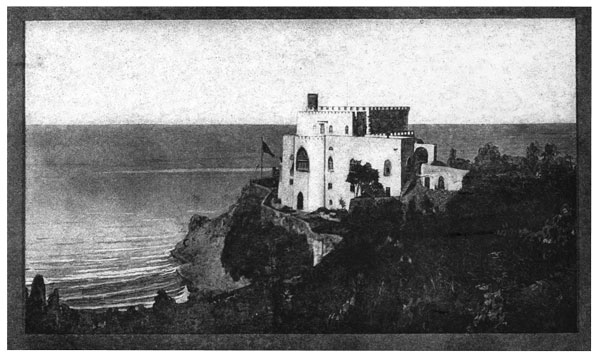
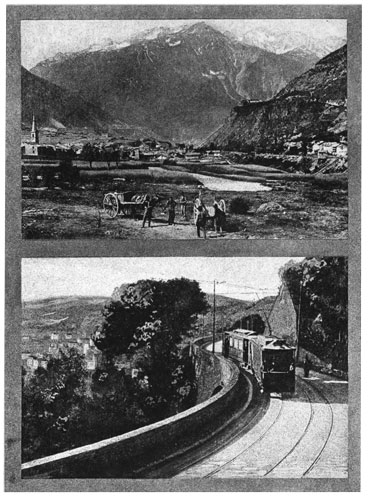
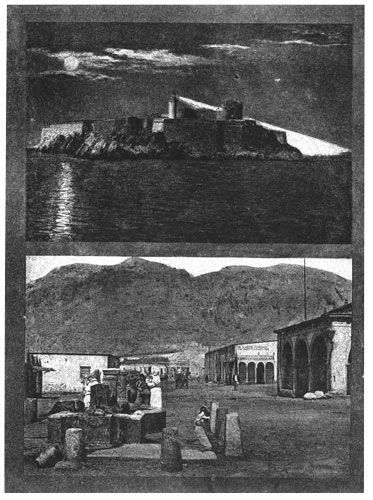
For Italy, my Italy, mere words are faint!
No writer's pencil can convey thy heaven's blue,
Thy languorous bay.
Thou art thine own interpreter.
I dream and wake and find no words for her—
For Italy's soft-storied charms
I throw the English words away.
Her gondolas drip through the night—
I stretch my arms toward Napoli,
And "Monte Bella" softly say.
Harriet Axtell Johnstone.
How splendid it seems to be free again!
And yet I do believe it does one
good—having been out of the habit of
studying—to take a few months every
year or so and to give close application to
some subject.
I was glad when the time came to end
traveling and to begin study; and now I
am glad that I can cease my studies and
again begin sight-seeing.
Ruth, as you know, found it necessary
to return to America before rejoining me.
She sailed from New York the 18th and
I met her at Ponta Delgada. Ponta Delgada
is the chief city of the island of San
Miguel, which, in turn, is the principal
island of the Azores, and it is prominent
for having the most beautiful gardens in
the world.
Among the passengers who boarded the
ship with me at Ponta Delgada was a delightful
Portuguese family—the mother,
son and his wife—who came with us to
Italy. They are cultured people, and speak
English perfectly, though the mother and
wife had never before been off the island.
We left the Azores on the 27th of
April, passing Gibraltar on May Day.
Gibraltar is not so frowning as I had imagined,
for the graceful rock smiled down
on us as if in greeting.
All that has been written about the blue
Mediterranean is true. It is blue as nothing
else is. The sky, those days, was
greenish pink, and you know what a delight
to the eye is the blending of these
colors. But the one bright memory that
stands out clearest when I think of the
Mediterranean is the sunset. I remember
one night in particular. The good captain
told me to hasten from dinner. I drew my
chair close to the rail, and out beyond
the horizon I saw a city of fire. The beautiful
mansions, and cathedrals, and castles,
with turrets and towers, were all ablaze.
Through the streets people in fiery red
draperies were flying from the flames.
Sometimes an old man with flowing beard
appeared in the midst of them, and with
outstretched hands, would seem to call
aloud. The flames turned to a greenish
gold, the smoke rolled away, and far beyond
appeared a Moorish village, the
temples carved of alabaster. Suddenly,
through the lace-like pillars, came the
faintest tint of pink, growing dimmer and
dimmer, until only the outlines could be
discerned. A great billowy sea of foam
rolled over the village, and divided on
either side of a world of golden fire, and,
as I gazed, it dropped into the black water.
A voice said, "Come, dear, the captain
wants you to see the moon come up out
of the sea." It was my blessed Ruth.
"Did you see that burning city and
Moorish village?" I asked, as soon as I had
returned to earth. "Yes, dear," she replied,
and there were tears in her eyes, too.
This morning we were called at five
o'clock to see the sun rise over Vesuvius.
The same ball of golden fire which went
down into the sea that night crowned for
a brief moment the wonderful Mount.
The Bay of Naples is unlike anything
else on earth. On one side are the castles,
or villas, or pleasure resorts, whichever it
be that comes to your gaze as you glide
past; on the other, the turquoise-blue
water; and far in the distance, like a camel
with two humps, rising out of the sea, is
Capri. The air is filled with music, and
the scene is one of the wildest confusion.
Every sort of craft that sails the seas, every
sort of flag, every sort of sound, causes you
to wonder if you will ever get through
that throng. The ship is stopped, the
steps are let down the side, and the doctor
and the purser with the mail come on
board.
While we were busy with our letters
from home, one of the party with whom
we were to go through the Blue Grotto
had bargained with a boatman to take us
to the ship that goes to Capri.
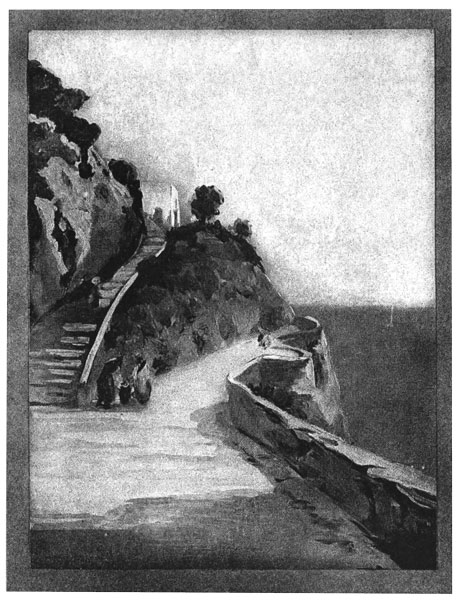
OLD STEPS AND SEA WALL, CAPRI
The mode of going ashore here at
Naples is different from that of any other
port where I have landed. Hundreds of
stout row-boats come from the various
hotels, just as the omnibuses meet the
trains in the smaller cities at home.
The Blue Grotto must be visited on a
clear, calm day, and some old travelers
advised us, if the day was fine, to go directly
from the ship before landing. The captain
allowed us to leave our luggage on board,
as the ship will stay in Naples for several
days to unload freight. There were six
of us, then, transferred to the German
Lloyd S. S. Nixe.
As we sailed away, Vesuvius and Sorrento
were to the left, the city of Naples
behind us, and the outlines of Capri ahead.
We went directly to the Grotto, or rather
as near as the large boat goes. Here, again,
we took to the row-boats, two in each.
The Grotto itself is a cavern in the side
of the huge rocks of Capri. It is necessary
to lie flat in the boat to get through the
tiny opening. I could readily see why the
authorities do not permit visitors on stormy
days, for the sea was rough even on this
quiet morning. The interior of the cave
is high, and the effect of the reflection of
the sun on the blue waters is indescribable.
Everything under water takes on a silvery
hue, and the echo is weird.
On board the ship once more, we sailed
away from this real fairies' abode to the
town of Capri, arriving at high noon, and
as the town is on the side of a mountain,
we climbed up a good part of its side to
get a lunch. It was my first Italian meal,
and it was delicious. Of course there
was macaroni in the Italian style, with
beef-stock and tomatoes, and fried fresh
sardines.
The dessert was a fruit, something like
our California plum, which I tasted for
the first time at the Azores,—the nespera.
After the repast we hired a carriage for
Anacapri. The road, hewn out of solid
rock, lies along the mountainside, giving
us a magnificent view of the bay, with
Vesuvius always in sight.
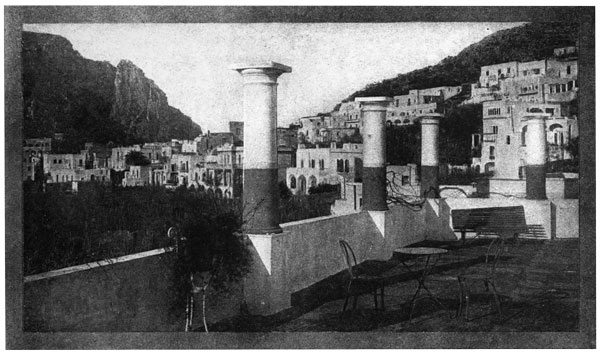
ISOLA DI
CAPRI
We caught the Nixe on her return trip
to Sorrento. Here, again, the little boats
meet us, each bearing the name of its hotel
on a silken banner. The boatman shouts
out the name of the one he represents
until a passenger calls, in turn, his choice.
We were going to the Cocumella, and I
wish you might have heard the boatman
call, in his soft, musical voice, "Co—ceh—m-e-l-l-a!
Co—ceh—m-e-l-l-a!" The
steward helped us into the boat, and we
were rowed to an opening in the cliff. The
town lies on the top of perpendicular rocks,
and we struggled up five hundred steps
cut in a tunnel through the mountain,
coming out at the top into the lovely
garden of this hotel.
The Cocumella was once a monastery,
and its situation is ideal. Here is a place
where I should be willing to spend the
remainder of my days.
Ruth is such a brick! She is not afraid
of her shadow, and she likes to be
alone some time each day. That remark
was called forth by the number of tourists
one meets who are worn to the bone by
companions who are afraid to room alone
or to look out of the window alone—to
eat, sleep, walk, talk, or pray alone—and
who must have some one close by them
every moment of the time.
Last night, on our walk about Sorrento,
we called at the house of Mr. Marion
Crawford.
This morning in two carriages, for there
were eight of us, we went for the drive
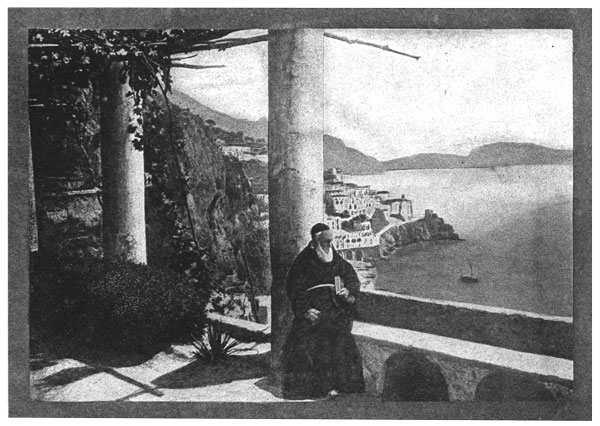
from Sorrento to Amalfi. The road, cut
out of the rock, with a balustrade of stone
to protect the traveler from the precipice,
is regarded as one of the finest pieces of
engineering in existence. Sometimes a
viaduct, perhaps five hundred feet high,
will span a chasm. The road winds up
and around the mountain, and the view,
with the Bay of Naples at its feet, is
sublimely picturesque. The almost perpendicular
sides of the mountain, on the
different levels, are terraced and planted
with olive, lemon, or other fruit trees.
The drive was ended at Vietri about
five, and we returned to Naples by train,
having our first glimpse of Pompeii and
our first ride on an Italian railway.
It rained in torrents all day, but, nothing
daunted, we started for the Customs. That
sounds very commonplace and innocent,
but it spells a mad, wild sort of a time.
In the first place, we had to beg, borrow,
and finally to steal a facchino (porter), and
induce him to get a boatman to fetch our
luggage from the ship, fully a mile out in
the bay. We paid him first to show there
were no hard feelings, again to get a tarpaulin
to cover the luggage, and again and
again for—I know not what.
AMALFI
Then we sat down and waited—stood
up and waited—purchased all the postcards
in the little café and wrote to every
one we knew—waited some more, and,
finally—yes, they came. There was another
transferring of coins—always from
my hand into that of the facchino—then
the Customs with its fees, and the cabman
with his, and all the time I had to take
their word for the change, for I had not
mastered the lira.
Before leaving Naples we visited Pompeii.
I was disappointed at first with these
wonderful ruins. There is much that one
must imagine. One must take the word
of the guides for everything, and they have
a little way of "space-filling" which has
lost its charm for me. But Pompeii grew
on me each moment of my stay. We were
taken in a sedan chair carried on the
shoulders of two strong peasants. The
general appearance is that of a town which
has been swept by a tornado, unroofing
the houses and leaving only the walls
standing. It is on these walls that one
finds the exquisite bits of coloring which
has given us the Pompeian tints.
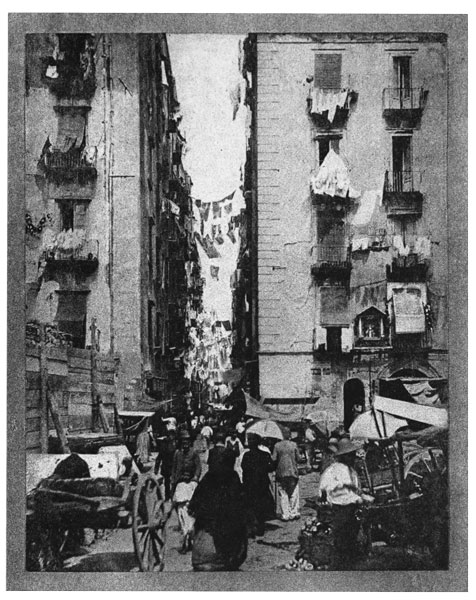
The charm of Naples lies in the wonderful
scenery surrounding it, and in its
street scenes, with the noise and clatter of
its street vendors. Life in the poorer
quarters is like that in no other city, being
free and open to public gaze. All the
duties of the household are performed in
the street.
The first thing to learn in Rome is the
pronunciation of the name of the street
and the number of your pension, in order
that you may be able to get home. Our
pronunciation is set-tahn-tah dew-ey vee-ah
sis-teen-ah, and the manner with which we
hop into a cab and say it to the cocchiere
stamps us as old Italians.
Our home here is at the top of the Scala
di Spagna (Spanish steps), right in the
heart of the new town. We walk down
the steps every morning as we start out
to the American Express office to get our
letters, but we come up the "lift"—for
ten centimes.
STREET SCENE, NAPLES
It is absolutely necessary to be driven
about Rome accompanied by a guide,
whether one's stay is to be of long or
short duration. In no other manner can
one comprehensively grasp this vast array
of ancient and modern art, nor the colossal
expanse of architecture, both standing and
in ruins. After having been shown the
important places, it is well to return alone,
and at leisure ponder over those things
which most appeal to the heart as well as
to the senses.
I have had a careful explanation of the
significance of that much-used word—"basilica."
Originally it was a portico
separated from some public building, not
unlike the peristyle at our Columbian Exposition,
save that it need not, of necessity,
be near any body of water; in fact, it rarely
was in the old Roman days. The basilicas
of the old forums were really walks under
cover. In later days these porticos were
inclosed and made into churches. The
name "basilica" still clung to them, and
now the oblong space forming the main
body between the pillars in any church
edifice, without regard to the style of
architecture, is so called.
I have read somewhere, in the reveries
of a bachelor (not Ik Marvel's), that
"style is born IN a woman and ON a
man." I wonder how he knew—perhaps
he had been in Rome.
The style of the greater number of
foreign tourists of the female persuasion
must be "in," as there is little visible to
the naked eye. But the style of these
Italian soldiers is "on," indeed, and they
are on dress parade the livelong day. I
have used all my superlatives, but really
in no city on earth does one see such gloriously,
exquisitely dressed little men as are
the soldiers of Italy, and especially of
Rome. The Bersaglieri form the élite
corps, and wear a large round hat, with a
multitude of cock's plumes, tipped far on
one side of the head. This tribute to the
swagger appearance of the soldiers is also
applicable to the young priests, monks
and students, and even to the butlers and
footmen.
On a fête day we went to St. Peter's,
and were repaid by meeting our Portuguese
friends, who took us to drive through
the beautiful parks and grounds of the
Villa Borghese, returning to luncheon with
us at our pension. This home of ours is a
very attractive place, but it tries my patience
to be forced to go through a ten-course
dinner each night, when I am anxious to
get out. The words "change" and "haste"
are unknown here, and it is only endurable
because the dinner is so exquisitely prepared
and served.
We have some interesting and clever
people at our table—a family from Boston,
two girls from Washington, a brother
and sister from Philadelphia, who have
lived here for years, and a beautiful Canadian.
The last named sits next me, and
our sotto voce conversations have brought
out the fact that her heart is full of love
for all things. She is Canadian only by
birth, and among the array of smartly
dressed Americans in the pension, she leads.
I do not wish to be put on record as
one who judges a woman solely by her
clothes; but oh, the American woman
here is incomparable. I agree with Lilian
Bell, that the women of no other race can
compare with her in dress, or taste, or
carriage. She is bewitching! She is a type!
I believe I once told you that we had no
type. I take it back. We have, and so
glorious a one that I am proud to claim
kinship with her.
You will be shocked, I am sure, when
I tell you that I do not agree with Mr.
Howells, nor yet with my beloved Hawthorne,
for I love modern Rome. To be
sure, Hawthorne wrote of Rome in 1858,
and Mr. Howells in 1864, and it may be
the shops were not so altogether enticing
in those early days, or it may be because
they were not women that the shops had
no charm for them; but if they had known
Castellani, the goldsmith on the Piazzi di
Trevi, who executes designs from the old
Grecian, Etruscan and Byzantine models,
or Roccheggiani's exquisite mosaics and
cameo carvings, it is probable their opinions
would be modified.
Michelangelo's "Moses" is not in the
big St. Peter's of the Vatican, but in
St. Peter's of Vincoli. This was a surprise
to me, for I had supposed to the contrary.
I had asked many times, to no avail, why
Michelangelo put horns on his "Moses,"
until a learnèd monk told me that, in an
early translation of the Scriptures, the
word "horns" was incorrectly given for
"skin." Notwithstanding the disproportion
of its outlines, the gigantic statue is,
to me, the most wonderful thing ever cut
from a block of marble.
We have an ascensor in our pension.
The big concierge puts me in, locks the
door, unlocks the catch, and lets it go.
When it gets to my floor it is supposed
to stop, and in the same breath to have its
door unfastened, and all I have to do is
to walk out. Sometimes, however, it stops
midway between floors, and then I wish I
had walked up. I find Roman and Spanish
steps just as fatiguing to climb as any
others, and patronize the ascensors with
vigor.
We went by appointment one day to
the Rospigliosi Palazzo to return the visit
of our Portuguese friends, Signor and
Signora A., and were taken into another
part of the palace to see Guido Reni's
"Aurora." The picture is painted on the
ceiling, and there is an arrangement of
mirrors by which one can view it without
having to tire the neck with looking up so
constantly. It is the greatest painting that
has been done in the last two hundred
years. In the evening we all went to hear
"Gioconda" at the Teâtro Adriano. The
Italian audience seemed, by the uproarious
applause that greeted each aria, to appreciate
the music, but talked continually
through it all.
We have revisited many of the places
which most interested us during our three
days' drive with the cicerone, and have
whiled away many delightful mornings in
the shops. We rest a little in the early
part of each afternoon, and then, almost
invariably, we drive on the Corso and to
the Pincian Gardens, where the band plays
from five until an hour after Ave Maria.
Here one sees the smart Romans, and in
fact people of nearly every race on earth,
in their best attire, on pleasure bent.
It is needless to tell you that we take a
carriage sans numero, for the private parks
of the best palazzos allow only carriages
without numbers to enter.
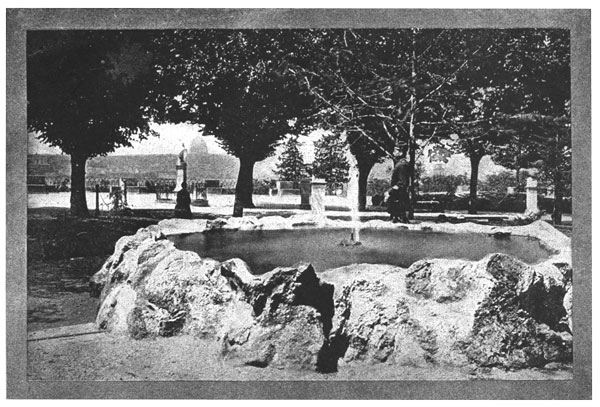
The scene on the Pincio is just what it
was in Hawthorne's day. Read his description
of it in the "Italian Note Book,"
and you will see it more clearly than I can
make you understand. It is a continual
fête champêtre.
One day, while we were obliged to stop
on account of a jam in the ring of carriages
that move slowly round and round the
circle where the band plays, Ruth stepped
from the vehicle to get nearer the beautiful
fountain of Moses to make a little sketch
of it. I sat alone listening to the glorious
Italian band. And while my thoughts were
thousands of miles away, and very near
the one to whom this message goes first,
some one spoke to me in French, and
asked if I would have the goodness to go
to his madame. It was the serving-man
of our fellow-voyager, she of the same
initials as my own. I looked in the direction
he indicated, and there, not ten carriages
back, she was, so hemmed in that
it was impossible to drive alongside.
As I left my seat and walked over to
her, she met me with the radiant face and
smiling greeting of an old friend. She is
beautiful, with that inimitable something
about her that attracts one, and I wondered
if I should ever know what her
given name is. I knew for a certainty that
I should never ask. She is not old, but
gives one the impression that she has lived
long enough to have "gathered the fruits
of experience where once blossomed the
flowers of youthful enthusiasm."
The bells for Ave Maria had rung. The
musicians were picking up their music.
The Pincian Hill was deserted. Ruth sat
alone in her carriage as this woman's hand
grasped mine in reluctant parting.
"Good night," I said.
"Good night!"
You recall my telling you of Mrs. F.
on the ship—she whom I met on the
Pincian Hill—and her invalid son? Well,
he was not her son. He is her—husband.
It will be no breach of confidence to tell
you the story, for I have her permission—withholding
her name, of course.
It seems that the husband, in his youth,
was rather "rapid"; and, in a most idiotic
will, the father left him a large fortune,
provided that before his twenty-fifth year
he had been married to a woman at least ten
years his senior. It was stipulated that the
woman was not to know the conditions of
the will until after the marriage, so that
she might be some one of worth and character,
capable of caring for the money.
No wonder it sobered the poor young
man. He swore that he would never
marry, and that those who were ready to
grasp the fortune, should he fail to "keep
the bond," might have it, and be—happy.
THE PINCIAN
HILL, ROME
One vacation time found him at the
home of a classmate in one of the eastern
college towns, where he met and fell in love
with this woman whom I have described
to you. He had no idea she was older
than himself until he had made her a proposal
of marriage. She, of course, refused
what she conceived to be a foolish boy's
fancy. He sent for his mother, and together
they set themselves to win the lady
of his choice, after the mother had "looked
her up"—and down—as mothers of precious
boys are wont to do.
In the meantime the young man was
taken very ill, in his delirium calling for
his love, who finally, at the physician's
urgent request, went to him, and, with his
mother, cared for him.
It was the day before his twenty-fifth
birthday. The mother was frantic at the
thought that her son was to lose his fortune.
He cared little for the money, save
that it would enable him to shower favors
upon this love of his. He begged her to
marry him that night to save him from
some great trouble—if she ever regretted
it for one moment she should be free—that
he could not in honor tell her why it
was so necessary that the marriage be solemnized
at once. She had grown fond of
him, yet naturally hesitated to do either
him or herself injustice. Finally his helplessness
and his mother's agony proved
too much for her, and just before the midnight
they were married at his bedside.
Who can account for the vagaries of a
woman's fancy? The foolish conditions
which she made a part of this contract
were: that they should live abroad where
they were not known, and that she should
be known as his mother.
His own mother, otherwise a strong,
sensible woman, agreed to everything, so
great was her anxiety about her son.
In another week they had started for
Europe, and I have accounted to you the
strange manner in which their names appeared
on the ship's register. It served as
a safeguard against inquisitive people, and
every one took it for granted that they
were mother and son—and she a widow.
Immediately they landed they met an
old friend of hers, and thus began a series
of explanations, for her friend knew she
had no son.
Fortunately this woman was a brave,
true friend, and her advice was so heroic
that the bride was speechless before such
fearlessness.
She said to her: "You must stop all this
foolishness at once. There is absolutely
no excuse for such deceit. One falsehood
paves the way for hundreds of others. It
has already cost you the loss of your peace
of mind and it is the cause of your husband's
continued illness. How can you
expect him to be strong, while living a
lie?"
This last statement was pretty hard to
accept, but it proved that her liking for
her young husband had grown into love,
for her one desire was to see him well and
strong.
Her pride, however, stood in her way
and she must have advice. Everything
else the friend said was true, for already
her day had become a hideous nightmare
with this constant fear of meeting some
one whom she knew. And this is why she
sent her footman for me the day of the
concert in the Pincian Gardens.
She explained that she had heard Ruth
and me discussing points in ontology on
the ship, and wanted to ask me if what
her friend said was true. She told me the
story just as I have told it to you, not
naming herself. I divined at once it was
her own, but did not let her feel that I
had perceived it, and for answer I said:
"How I should love to meet that friend!
Most assuredly she is right. Falsehood
and deceit bring nothing but suffering.
Send word to that poor foolish woman at
once that you too are opposed to her
living a lie any longer."
It was listening to this tale that made
me forget the crowd, the perfume of the
flowers, and even the exquisite music of
the King's band.
How glad I am that I saw dear old
England first, for it seems very young
when compared to Rome. Everything here
is twenty centuries or more old, therefore
you may imagine that, by comparison,
things only a few hundred years old are
yet in their infancy.
Apropos of age, while at Oxford a student
told us, with much solemnity, that
Magdalen College "was built in 1490, before
you were discovered." The doctor
said, "Well, what of it?" I was shocked
at the good doctor, and was much impressed
by the great age; but I understand
the doctor's sarcasm now, for he had recently
returned from Rome.
The "oldest church in Rome," however,
reminds one of "the favorite pupil
of Liszt." I am meeting with them still.
The most magnificent place in Rome,
after the Vatican, is the Villa Borghese
(bor-gay-zay), not only on account of the
beautiful park which contains numerous
ornamental structures, little temples, ruins,
fountains and statues, but also on account
of the collection of antiques in its casino,
or gallery. It is here that Canova's marble
statue of Pauline Borghese is exhibited—to
me the most beautiful marble in Rome.
Here, too, is Titian's first great work,
"Sacred and Profane Love." I fancy that
Titian saw life from many view-points.
Imagine one going from the sublime to
the ridiculous—from the gorgeous Borghese
Villa to a Rag Fair. A Rag Fair is
an open-air sale of everything that can be
thought of, from a garter clasp to a diadem.
We went for old brass candlesticks of the
seven-pronged, sacred variety, afterwards
continuing on to St. Peter's, where we
were repaid for mounting an incline of
1,332 feet up through the dome by the
view of all Rome, the Vatican gardens
and the tops of the "seven hills."
Mrs. F. joins us often now. She went
with us again Thursday to the church
San Paola alle Tre Fontane (St. Paul of
the Three Fountains). It is kept by Trappist
monks, a silent order. They never
speak to each other, but make up for
it when visitors come. We had a dear
"brother" show us the objects of interest,
and he presented each with a wee drinking
glass to measure out the Eucalyptus wine
which they make there.
The three fountains are flowing clear as
crystal, and whether or not the head of
St. Paul jumped three times on these
spots, as tradition has it, it matters little;
but the simple faith of the sweet-faced
sisters who knelt and drank from each
spring and arose freed from some claim
was touching, and far from provoking the
mirth that some people feel toward these
devout pilgrims.
En route home we stopped at the English
cemetery and plucked a flower from
the grave of Keats and of Shelley and of
Constance Fenimore Woolson.
STANZA
DELLA
SEGNATURA,
VATICAN
PALACE,
ROME
We saw Hilda's Tower, too, that day.
I had occasion to thank Hawthorne for
"The Marble Faun" and "Italian Note
Book," otherwise I should not have been
able to relate the story of Hilda and her
tower. In truth, all Italy would have remained
as a closed book to me had it not
been for my three "H's," as Ruth calls
them—Hawthorne, Howells and Hutton.
The latter says, in his "Literary Landmarks
of Rome," that the "Italian Note
Book" is still the best guide to Rome that
has ever been written, and that one should
read it before coming, again while here,
and yet once more after returning home.
I shall say the same about the Landmarks,
for without them much of the
charm I have found here would have been
lost.
Yesterday we bade St. Peter's good-bye
on our way to Sant'Onofrio. Here, again,
a bright young frère showed us over the
church made most interesting from its
association with Tasso. There are some
excellent paintings in the lunettes under
the colonnade of the cloisters.
It is a great pleasure to show Mrs. F.
anything, as her appreciation is keen. She
knew little of the literary landmarks which
she passed each day, and I pointed out to
her the house where Keats lived, on the
left as one goes down the Spanish steps,
the house of Shelley on the right, with
the lodgings occupied by Byron almost
directly opposite.
On our return from Sant'Onofrio, she
inquired of the coachman if the horses were
fit, and upon his answering that they were
good for several hours, she turned and in
a low voice asked me to remain with her
as long as possible. I understood. From
a list of streets and numbers which I had
with me, we selected such as we wished to
visit.
On the Via di Bocca di Leona we found
the home of the Brownings; close by, the
house that sheltered Thackeray in Rome;
and not far away, the place where Adelaide
Sartoris lived. In rapid succession, then,
we made "little journeys" to the Italian
homes of Louisa Alcott, Helen Hunt
Jackson, George Eliot, and the house
where Mrs. Jameson held Sunday soirées
in a wee two-by-four room. Mr. Hutton
and I did good work, for after all other
sights had failed to interest, our (?) literary
landmarks succeeded in saving the day.
After the rather strenuous day, the account
of which closed my last letter,
we settled up our affairs in Rome, heard
for the last time the Pope's angel choir,
sent off our luggage, purchased our tickets,
with innumerable stop-overs, and, hardest
of all, bade good-bye to our friends.
Just before we were leaving, Mrs. F.'s
footman brought to the door of our compartment
in the traveling-carriage an armful
of roses and a letter. The flowers
brightened all the hot dusty day, but the
letter—oh, that letter will brighten all the
years that may come to me, and I have
tucked the precious words away in the
warmest corner of my heart, to be taken
out on the rainy days of life, and fondled
like some of childhood's memories.
I did not see her again after she left
me at the door that evening, nor had she
spoken one word to indicate that she
knew that I knew. She paid me the highest
tribute of friendship—silence.
Among other things in the letter, she
said:
"The Catholic Church has not a monopoly
of 'ears that hear yet hear not,
eyes that see and are blind,' for I find in
you one who is built fine-grained enough
not to mistake silence for stupidity, nor to
consider the absence of an interrogation
mark as lack of sympathy. The very evident
fact that your beautiful companion
knows nothing of my sorrow stamps you
as a splendid friend, and I want you for
such.... Your going has taken away
my strongest staff. You have been bravely
permitting me to lean on you, too hard I
fear, these last days, but you understand,
and, understanding, forget.
"I should come to you in person to bid
you good-speed, but I should break down
and perhaps not be able to let you go, so
I am sending instead this message. I have
determined to be brave, to end this deceit,
to go away from Rome; to begin aright
in some other place; to live the truth."
I left the eternal city with a light and
happy heart, for my new heart's sister
(new if we count by that false estimate—time)
is free. I still do not know what
her given name is, as all her notes have
been signed with her initials, and her surname
does not resemble mine in the least.
No wonder Mrs. Ward sent her weakest
heroine here to hide. If you ever lose
me, and suspect that I am in hiding, hunt
for me in Orvieto. I had heard nothing
of the place until I read "Eleanor," but
now, if I were a guide-book, I'd put five
asterisks before it and six in front of its
cathedral. You will understand how I feel
about it when I tell you that most of
the guide-books never use more than two
stars to indicate the superlative. Loomis,
in his wildest flights, sometimes uses three,
so I think five would about fit my estimation
of the Orvieto of today.
The town is on the top of a mountain,
up the almost perpendicular sides of which
it is reached by a funicolare.
I wish I might live here, on this street
and in this pension, and have it all on
my visiting-cards, and write it in my best
style at the top of my letters. If it were
engraved on my visiting-cards, and you
should wish to come to see me, you would
simply have to say to the cabman, "See-nyee-o-rah—Al-vee-nyee-ah—Sah-chah-ro—Pe'n-see-yo'—Tog-natz-zee—Vee-ah—Sal-lut-chio—Bahn-dee-nee—Dee-chee-ah-no-vay,"
but the entire address doesn't
include the beautiful cloisters into which
my windows open, for the place is an old
monastery.
The first I ever knew of Siena was from
one of Lilian Whiting's books. She spoke
of Symonds' history and Mrs. Butler's
"Biography of Katherine of Siena," and
straightway I devoured them both. How
little I thought then that I should walk
the same streets and kneel at the same
altar at which that saint knelt. I like her
the best of all the saints "I have met,"
for she loved to be alone and build castles.
Siena is a rival of Rome and Florence
in mediæval art and architecture. The
churches are wonderfully beautiful, and
filled with the choicest works of ancient
and modern artists. The marble pavement
and the carved white marble pulpit
in the cathedral cannot be equaled.
Three weeks in the art center of the
world and not one letter written! The
note-book, however, is getting so fat that
it begs to be put on paper and sent away
to you. My bank account is correspondingly
lean, made so partly by the purchase
of pretty carte-postales which carry the
telegraphic messages across the sea, just to
show that I'm thinking and that a letter
is coming some fine day.
If my porte-monnaie were not so très maigre,
I'd buy many copies of Howell's "Tuscan
Cities," Hutton's "Literary Landmarks
of Florence," Ruskin's "Mornings
in Florence," Mrs. Oliphant's "Makers
of Florence," and Mrs. Browning's "The
Casa Guidi Windows," and send to each
of you with this inscription: "These are
my sentiments."
It was with a sense of lazy delight that
we wandered about Siena, watching the
peasant women in their picturesque head
coverings, inhaling the atmosphere of mediæval
art and the restfulness that comes
with it. In the same leisurely manner,
armed with numerous Leghorn straws, we
turned our faces northward, and found
pleasant rooms awaiting us here.
Our windows look out on the Arno,
and to the right I see the Ponte Vecchio;
to the left, a bella vista which ends at
Fiesole.
The new Florence is broad and white
and glistening; the old is narrow, dark and
massively rich.
The Arno, like the Tiber, is a yellowish
green. Its eight bridges are unique, ancient
and historic.
The Lungarno, down which we walk
each morning, is odd and fascinating. It
has on the Arno side a marble balustrade;
on the other, little shops displaying jewels
and precious stones which would tempt
the soul of a female angel Gabriel. The
display of turquoise, of which stone Florence
is the home, is ravishing, yet sometimes—once,
I think—we really went by
without entering. The day we did not go
in, however, we went by appointment to
one of the shops on the Tornabuoni, where
were arrayed some gorgeous ancient chains
and rings of scarabs, the cartouch of which
proved them to belong to some Egyptian
potentate.
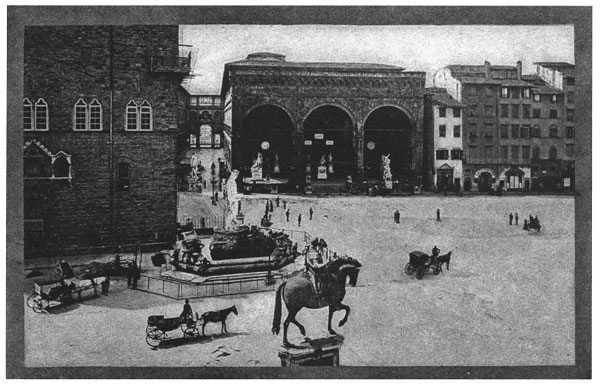
The Piazza della Signoria forms the
center of Florence. It is surrounded by
the Palazzo Vecchio, the Uffizi, and the
Loggia dei Lanzi. In the center is the
fountain of Neptune. It was in this piazza
that Savonarola was burned.
In the buildings just named, each a masterpiece
of architectural beauty, are found
many of the chefs-d'œuvre of the world.
Florence overflows with so much that is
ornate, it was difficult to make selections.
Like poor Helen—
"Were the whole world mine, Florence being bated,
I'd give it all to be to her translated."
PIAZZA
DELLA
SIGNORIA,
FLORENCE
Sometimes I think if I could have but
one of these gems of architecture, I'd
choose the Duomo, with its graceful façade
and its campanile; but when I cross the
street to the Baptistery of San Giovanni,
and gaze at its bronze doors, I change my
mind, and give it first place.
Now it is Santa Croce, with its wondrous
wealth of marbles, where Ruskin—and
I—spent many happy hours; but soon
Santa Maria Novella has outshone them
all, until the loveliness of the Medicean
Chapel wins my heart anew.
Alas, so weak am I, that all the cathedrals
sink into obscurity when the Uffizi
Palazzo, with its Tribune, is seen. It holds
the one perfect woman—the Uffizi Venus.
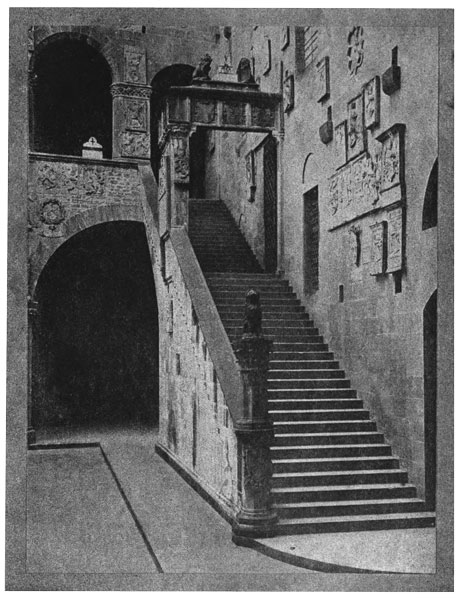
The Pitti Palace and the Boboli Gardens;
the Bargello, with its unique staircase and
court; the Riccardi—in truth, all the
wealth of incomparable grandeur of artistic
Florence have their places in my affections.
The wealth, beauty and royalty of Florence
are seen on the fashionable driveway.
The Cascine is to Florence what the Pincio
is to Rome. There, in the late afternoon,
society drives back and forth along the
bank of the Arno, listening to the music
of a military band.
It is of little consequence how the artist
gives expression to his dream—whether
by pencil, pen, brush, chisel or voice, in
marble, painting, song or story—Florence
is the home of them all.
And Fiesole, ah, Fiesole by moonlight!
I have walked up the Fiesolian Hill, and
taken the little electric tram, but last night
I took you with me in a carriage. The
others did not know you were there, so
you and I "cuddled down" on the back
seat. You held my hand and said never a
word, but by that same blessed silence I
knew you were drinking in the beauty of
it all.
STAIRWAY BARGELLO PALACE, FLORENCE
As the strong horses pulled up the
mountainside, you and I looked back at
Florence. She lay off in the distant shadows,
with the Arno at her feet—the Arno,
no longer a yellow, muddy stream, but a
glistening, silvery ribbon, with the moonbeams
dancing merrily on its phantom-like
bridges. The towers and turrets were
transformed into marble lace; the statues to
golden cupids; the chimney-tops formed
bas-reliefs; and the whole, a misty shadow-picture.
Even Florence was improved by
the witchery of "that old man in the
moon." The silvery unrealness of it cast
a spell over us, making—
... The longing heart yearn for
Some one to love, and to be
Beloved of some one.
That's why I took you with me.
When the top was reached we looked
only at the fairyland in the distance. It is
difficult to idealize an ordinary little village,
even if it be Tuscan, and this one
has nothing to recommend it but a cathedral
and some picturesque beggars.
Returning another way, we passed Boccaccio's
villa, and in fancy saw his merry
party of lords and ladies seated in the
arbors looking out toward Belle Firenze
over the now golden River Arno.
Thus it was I left you in Florence. I
could not find you when Ruth called out,
"Are you going back with the cab, honey?"
If Florence was left behind in a memory
of purple mist, the highroad between
it and Bologna would awaken the most
poetic. The word "highroad" is a little
creation of my own in this connection, but
I feel sure you will believe it to be "high"
when I tell you that Florence lies at the
foot of the Apennines and Bologna at the
summit; and that the railway is, by some
miracle of engineering, built up through
and around these mountains. We threaded
forty-five tunnels, swung around numberless
viaducts, crawled over heart-stilling
trestleworks connecting one peak with another,
and finally came out on top, much
dirty and more tired.
We arrived in Venice at 12 o'clock,
midnight, at the full of the moon. It cannot
be compared with my Florentine
dream, for while they are both exquisitely
lovely, they are different. There is nothing
on earth quite like Venice by moonlight.
All things lose perspective at close range,
or in the glare of the sun's rays, and Venice
shares this disenchantment. It matters
little what or how much one has read of
Venice—to realize its charm, its color
scheme and its uniqueness it must be experienced.
For Venice is not a thing, it is
an experience.
We owned a gondola,—for a week. We
lived in it, and I, sometimes, slept in it
while we were being wafted from one place
to another.
THE GRAND
CANAL,
VENICE
There is the usual—oh, no! there is
nothing usual in Venice—cathedral, as in
all cities, but St. Mark's stands out first
and forever as The Church of all churches.
My first glimpse of this pile of precious
stones was unexpected and most dramatic
to me.
There were no letters that morning, and
I was just walking—I did not care where
or on what. What's beauty and loveliness
compared to One letter? An arcade blocked
the way, and not knowing—not caring—where
it led, I passed in and through it.
Chancing to look up, I found myself in
the light of day, and straight before me,
ablaze with the sunlight full on its façade,
was a structure of lavish Oriental magnificence.
"What is that?" I cried aloud.
"San Marco!" answered a number of
soft, musical voices in unison; and there
stood by my side a little crowd of Italians,
their dark eyes sparkling and white teeth
showing, evidently pleased at my adoration.
"San M-ahr-co, San M-ahr-co!" they
drawled in delight. For once their pleasure
was real; they did not break the spell
upon me by holding out the hand for a
pourboire.
St. Mark's is Moorish in design, and
has a coloring both gorgeous and subdued.
The richness of jewels and costly stones
does not seem out of place here as in many
Roman churches. Nothing could be too
precious, too sumptuous, too rare, for this
temple magnificent.
The piazza of St. Mark's is a square
paved with trachyte and marble. It has
the church on one side, and on the other
sides, old white marble palaces, in the
arcades of which are now found shops of
world-wide renown. The piazzetta leads
one, between the Doge's palace and Libreria
Vecchia, to the Grand Canal.
Every evening a military band plays in
the square, and it is like a vast, open-air
drawing-room with a huge masquerade
ball in full tilt.
We climbed the Campanile and saw, besides
a beautiful sunset, the Alps, the
Adriatic, and in the dim distance the Istrian
Mountain rising out of the sea.
With but a day to give to Venice, or
with a year at your disposal, there is only
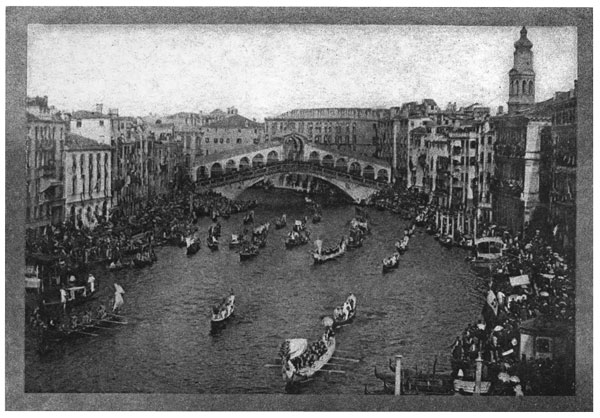
one thing to do—dream! Whether you
rest in a gondola on the Lagune, drifting
past the Bridge of Sighs, the Rialto, the
Ghetto, or the Lido, listening to the gondolier
calling out the names of the palaces
as the boat glides by, or whether you stroll
idly through the miles of churches and
galleries containing the paintings, or sit in
wondering awe before the vast area of
mosaics in St. Mark's—it matters little—dream!
In truth, one cannot well avoid it, amid
the "subtle, variable, inexpressible coloring
of transparent alabaster, of polished
Oriental marbles and of lusterless gold,"
as Ruskin puts it.
Heavens! Just think of me writing
"Como" at the top of my letters! I
have pinched myself to see if I am really
here. The unreality of it all recalls what
Mr. Howells said after reading Ruskin:
"Just after reading his description of St.
Mark's, I, who had seen it every day for
three years, began to doubt its existence."
So I am beginning to doubt my own
existence.
The morning we left Venice I was
nearly arrested by a man in a cocked hat,
all on account of two other men in sailor
hats. In short, I overstepped the etiquette
of the gondolier most woefully. Our train
left at the fetching hour of six, so I made
an appointment with our trustworthy Pietro
to come for us in time. I think I have
told you that the word "haste" is an unknown
quantity here, and when Pietro
was not at the door ten minutes before the
time to start, I had the clerk call another
gondola. As we were about to step into
the boat, Pietro was seen drifting idly
toward our hotel.
He wasn't very indolent when he saw
what was going on, and those two "sunsets"
(I think that is my own, for in a
sunset, do you not see the day-go?) danced
several kinds of jigs up and down and
sidewise before me. Several others came
to their assistance, among them the aforesaid
cocked-hatted individual.
I told the clerk to tell them that I
wished to conform to the rules, and to
settle it their way. A summer breeze could
not have been calmer than all became in
the twinkling of an eye, but the cause of
the calm was apparent when I settled the
bill. Their understanding of "settling it
their own way" was to pay each of them,
including the cocked-hat, but that was
better than languishing in a dungeon for
ever so little a time, n'est-ce-pas, mon cher?
Since then Milan has been visited—Milan,
with its mammoth marble cathedral,
done in Irish-point pattern and with
a papier-mâché interior—but beautiful
withal. Several days were spent at Menaggio
on this lovely lake; another at
Villa Carlotta, where Canova's original and
divinely beautiful marble, "Cupid and
Psyche," stands in all its purity; many
more, sailing up and down these enchanting
waters, made green by the reflection of
the forest on the mountains surrounding,
and by the grounds of the wealthy Milanese,
whose summer villas line its banks.
Vineyards are scattered along the mountainside
in terraces, and the brilliant green
of the chestnut and walnut trees is blended
with the dull grayish green of the olive
and laurel.
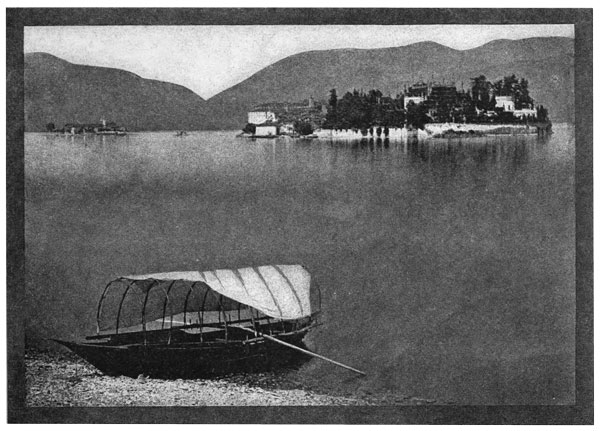
Lake Lugano and Lake Maggiore are
beautiful sheets of water, but they lack the
romantic atmosphere of Como. I can recall
no other description so pleasing to the
heart as well as to the fancy as the eulogy
to these lakes in Mrs. Ward's "Lady
Rose's Daughter."
Rural Italy, to be appreciated, must be
seen by tram, by boat, by steam, by
old-fashioned diligence, and on foot. Its
lakes and mountains, its valleys and vineyards,
have been a source of continual surprise
to me, and it is with a feeling of
keenest regret that our last place in Italy
is reached. I feel with Browning as I say
farewell to—
"Italy, my Italy!
*
*
*
*
*
Open my heart and you will see
Graven inside of it, 'Italy'."
LAKE
MAGGIORE,
ISOLA BELLA,
ITALY