On a cold January night in the first year of the nineteenth
century, a state ball, given by command of the
fair young queen, Louisa, was held in the Royal Palace
at Berlin.
Of those who attended this fête, many, chiefly of the
masculine sex, were indifferent to polonaise or waltz,
finding their entertainment in the galleries where, somewhat
after the fashion of a modern restaurant, stood
little tables, at which parties of two or more, while
glancing at the dancers, could at the same time regale
themselves with a supper and converse upon the topics
of the day. This was a feature recently introduced by
the Russian Count Wengersky, and though Court fossils
stood aghast at the innovation, it had met with the approval
of Queen Louisa and had brought immense popularity
to the Count.
In one of these balconies sat round a table some
officers, who, though of youthful aspect, were more
interested in politics than in the charms of the ladies.
Their talk, which was extremely animated, turned
chiefly upon the question whether their sovereign lord,
Frederick William III., would permit himself to be
drawn into the confederacy formed by the four Powers,
France, Russia, Sweden, and Denmark—a confederacy
whose object was to resist by armed force the right
claimed by Great Britain of searching on the high seas
all vessels suspected of carrying contraband of war.
As these fire-eaters talked, they cast cautious glances
in the direction of Viscount Courtenay, an Englishman,
who sat alone at a table sipping his wine. A member
of a famous historic house and patriotic to the backbone,
the quick-spirited viscount was not the man to allow any
disparagement of his country to pass unchallenged, and
as his reputation for swordsmanship was such as not to
be disputed even by “Fighting Fitzgerald,” then in the
height of his glory, the Prussian officers took good care
that any remark uncomplimentary to his native land
should be spoken in a low tone.
Wilfrid Courtenay’s life should have been cast in the
Middle Ages. He was a romantic freelance, whose ideas
were more akin to the age of chivalry than to the nineteenth
century. The spirit that finds a zest in danger,
the spirit that made the vikings the terror of all coasts
from the North Cape to Sicily, the spirit that sent the
Crusaders forth to do battle with the Paynim beneath
the blazing sun of Syria, the spirit that has caused Englishmen
to plant colonies in the very teeth of hostile
savages—that spirit still ran strong in the blood of the
Courtenays. Accordingly, on the attainment of his
majority, Wilfrid, leaving to his widowed mother the
care of his patrimonial acres, had set out like a knight-errant
to wander over Europe in search of adventure,
in which quest he had fleshed his sword in more than
one campaign, earning thereby from no less a personage
than the Count d’Artois, himself a pattern of chivalry,
the proud title of Le Bayard de l’Angleterre.
To this taste for fighting was added another, in singular
contrast with it. Just as Frederick the Great, in the
intervals of campaigning, found a strange pleasure in
writing what his admirers called poetry, so Wilfrid was
wont to devote some of his leisure to the study of painting,
but whereas Frederick in his art never rose above
mediocrity, Wilfrid, in his, succeeded in attaining a high
degree of excellence.
For the rest he was tall, with fair hair, blue eyes, and
that indefinable air that is always the accompaniment
of aristocratic birth: shapely and muscular in limb; a
giant in strength; a stranger to fear; chivalrous in
his dealings. Among his faults was that of acting upon
impulse rather than upon the cooler dictates of reason.
But where would be the great deeds of history if their
authors had always paused to weigh consequences?
Now as Viscount Courtenay sat alone toying with his
wine glass, a familiar voice suddenly broke in upon his
reverie.
“Wilfrid, that our respective countries, or shall we
say our stupid cabinets, are at war with each other, is
surely no ground for breaking off our personal friendship?”
“Prince Ouvaroff! You in Berlin!” exclaimed Wilfrid,
his face brightening; and, somewhat apprehensive
lest the other should salute him, continental-fashion,
with a hearty kiss, he quickly extended his hand, and
was relieved to find Ouvaroff content with the English
mode of greeting.
“‘Prince’ do you say?” returned Ouvaroff in a tone
of quasi-reproach. “It was ‘Serge’ in the old days.”
“Then let it be Serge still. I am glad to see a familiar
face.”
The new-comer was of Russian nationality, with a
countenance decidedly unhandsome, a genuine Kalmuck
physiognomy, though its ugliness was redeemed by the
mild expression of the dark eyes. But however unprepossessing
in face, his figure was tall and well proportioned,
and arrayed in the blue uniform of the Preobrejanski
Guards, who formed, in 1801 at least, the corps
d’élite of the Czar’s army.
During his term of service as attaché to the Russian
Embassy in London, the Prince had become well-known
in West End salons, where he had met Wilfrid, who,
in spite of an unreasoning prejudice against Muscovites,
made an exception in favour of Prince Ouvaroff, appreciating
his sterling qualities. The two had, therefore,
become fast friends.
There was a mystery attending Ouvaroff. He had
been brought up by a boyar of high rank, who would
never, even on his deathbed, reveal to his adopted son
the secret of his parentage.
“Your father lives and knows of your existence.
’Tis for him to speak—not me,” were almost the last
words of his guardian.
The matter troubled Ouvaroff a good deal. He had
often talked it over with his English friend, and now,
their first greetings over, that friend reverted to the old
theme.
“Any nearer to—to the discovery?”
The Prince’s face assumed a somewhat sombre look.
“No nearer, and, truth to tell, I hope I may never
be any nearer than I am at present.”
Wilfrid lifted his eyebrows in genuine surprise.
“Do you remember,” continued the Prince, “that old
gipsy fortune-teller, whom you and I once met near
your place in Surrey? She predicted that my father
would become known to me in the very moment of my
killing him.”
“My dear Serge, surely you don’t attach any importance
to her words?”
“I do, and—fear. Her prophecies were three—first,
that on my return to Russia I should be created a
prince; second, that I should become aide-de-camp to
the Czarovitch Alexander. Both these have come to
pass. Why should I refuse to believe the third?”
“Why? Because the old sibyl assured me that within
a year I should save the life of the fairest princess in
Europe, gaining her love by that act. Eight years have
passed since then, and so far I haven’t saved the life of
any woman, whether princess or peasant. Since she
can prophesy falsely as well as truthfully, dismiss your
gloomy forebodings.”
Ouvaroff changed the conversation.
“What’s this I hear you’ve been doing at Paris?” he
observed. “I am told that a picture of yours exhibited
there last Christmas almost created a riot.”
“A riot? Nonsense!”
“I see you do not like to—what do you say in England?—blow
your own trumpet. But for once lay
aside your modesty, and let me have this story.”
“Well, since you insist on being bored. You are
referring, I suppose, to my picture, ‘The Last Moments
of Marie Antoinette?’ Despite what French newspapers
may say, I had no political motive. The work was done
merely to please my own fancy. When finished my
poor old drawing master saw it, and begged for the loan
of it, to place it among a small exhibition of his own
pictures. I consented. The result was marvellous.
Thousands came to view the picture. Republicans who
had once yelled for the head of ‘The Austrian,’ and
had gleefully seen her perish on the scaffold, now melted
to tears at sight of her image on the canvas. Bonaparte
got wind of the affair, and, on the ground that it was
creating a sentiment in favour of Royalism, ordered the
picture to be destroyed. The gendarmerie were stoutly
opposed. Shouts of A bas Napoleon were raised, a
struggle ensued, and the gallery had to be cleared with
fixed bayonets.”
“And is it true that you challenged Napoleon to a
duel?”
“I demanded compensation for the loss of my picture
or—satisfaction at the sword’s point.”
Ouvaroff could not help smiling at his friend’s colossal
audacity.
“And General Bonaparte’s answer——?”
“Was a police order to cross the frontier within forty-eight
hours.”
“You went?”
“I stayed. You see, the First Consul’s sister, the
dark-eyed Pauline, with whom I had had some love passages—platonic,
of course—had invited me to a ball
a fortnight later. My dear Serge, how could I refuse?
On the evening of the dance I presented myself, greatly
to the dismay of my friends, who were aware that the
First Consul was expected. I had purposely arranged
to take my departure at the moment of his arrival.”
“He saw you?”
“Certainly. Figure his rage as he saw me raising
Pauline’s hand to my lips as I took my leave! The
music, the dancing, the conversation—all stopped. The
stillness was painful. ‘Did you not receive an order to
quit France a fortnight ago?’ he thundered. ‘Why
have you not gone?’ ‘And did you not receive a
challenge to fight a fortnight ago?’ I answered. ‘Why
have you not fought?’
“He couldn’t speak for passion.
“‘As to quitting France, Citoyen Bonaparte,’ I continued,
‘in such matters as coming and going, we Courtenays
are accustomed to please ourselves. I had fixed
upon to-night as the time of my departure, and, as you
now perceive, I—er—depart. Adieu, citoyen.’
“With that I passed, by preconcerted arrangement,
through a circle of friends, and before he had time to
order my arrest I had reached a private gateway, where
a carriage was awaiting me. As I had taken the precaution
to have relays of horses in readiness, I succeeded
in crossing the Eastern frontier a few hundred yards
ahead of the pursuing carabineers.”
“And so General Bonaparte declined to measure
swords with you?”
“Bonaparte is a Corsican—that is to say an Italian
bravo, who prefers darker methods. Listen to the
sequel. A few days later, as I was sitting at the card
table in the kursaal at Homburg, a man suddenly rose,
accused me of cheating, and ended his remarks by flinging
the contents of his wine glass in my face. Of course,
a meeting was inevitable. It was to be a duel to the
death. Later that night my second came to me in great
distress, advising me to cry off. He had discovered that
my adversary was a secret agent of the First Consul—none
other, in fact, than the famous, or infamous, Abbé
Spada.”
“I have heard of him. The first swordsman of
France?”
“So-called. Well, we met, and considering the many
men whom Spada has killed in his day, I felt justified
in giving him his passport to Gehenna.”
“You killed him!”
“Within three minutes.”
Ouvaroff regarded the speaker with admiration.
“That’s Bonaparte’s way of dealing with the objects
of his displeasure,” concluded Wilfrid. “But I’ll be
even yet with the Little Corsican for destroying my
picture.”
Now, as Wilfrid gazed down upon the dancers swaying
rhythmically to the sound of the music, his eye was
caught by a lofty figure standing, solitary and contemplative,
within an arched entrance that opened upon the
ballroom. It was a middle-aged man with silvering
hair, whose cold, handsome face wore a somewhat sombre
expression. He was clad in Court costume, carried
his hat under his arm, and sparkled all over with diamonds
from his powdered queue to his shoe buckles. It
was the diamonds that attracted Wilfrid’s attention; he
did not like to see a man so bedizened.
“Do you know that gentleman, Serge?” asked Wilfrid,
indicating the magnate in question. “His face
seems familiar to me.”
“Count Arcadius Baranoff, one of the Czar’s ministers.
You must have seen him in London, for he was
formerly ambassador at the Court of St. James’s. As
rich as Crœsus. One of the men,” the Prince went on
in tones of contempt, “who in the last reign climbed to
power through the bedroom of the Empress Catharine.
He is a proof of the power of the personal equation in
international politics.”
“How so?”
“He is a rank barbarian, whose polish is but skin
deep. When he was in London his brusquerie offended
the men, his coarseness the women, and he left England
burning with a desire to do her hurt, and now the time
has come, he thinks.”
“Thinks!”
“You are aware that, after fighting each other for a
year or more, the Czar Paul and Consul Bonaparte are
now fast friends. This is mainly due to the diplomacy
of Count Baranoff, who was sent to Paris as the Czar’s
envoy: it was his hand that signed the Franco-Russian
treaty. While in the French capital he tickled the Parisian
fancy with a pamphlet, ‘Is it possible for an Englishman
to possess sense?’”
“Oh, indeed!” muttered Wilfrid, with a glance at
the distant pamphleteer.
“And now, on his way back to St. Petersburg, he tarries
at Berlin in the hope of persuading the Prussian
King to join the league against England.”
“Humph! Is he likely to succeed?”
“There’s no telling. He has had two interviews with
the King. Frederick William is an amiable, weak-minded
man. Were it not that Queen Louisa insists
upon being present at these interviews, Baranoff might
have carried his point. He is to have a final interview
on the fourth day from this, and—mark this significant
point—the Queen knows nothing of this intended meeting.”
“And Prince Ouvaroff as a Muscovite patriot,” smiled
Wilfrid, “hopes that Baranoff will gain his ends?”
“By no means,” responded the other quickly. “Personally,
I am opposed to the war, and—but let this be
kept secret—so is the Czarovitch. Why should we give
an opportunity to your Nelson to earn fresh laurels at
Russia’s expense? But a truce to politics—I shall be
letting out more than I ought,” he continued with a
laugh, and then, by way of changing the subject, he
added—
“You are not married yet?”
“No, nor likely to be. Waiting for the promised
princess,” said Wilfrid mockingly. “But you—?
What of the lady you loved five years ago?”
“I love her still,” replied the Prince moodily.
“She remains unwed?”
“So far. But she is ice to me.”
“Take heart. The Neva is not always frozen. That
she does not marry should encourage you to continue
your suit.”
“Give me your face and figure and I might succeed.
Is it likely that she, confessedly the most beautiful
woman in Moscow, will marry an ugly fellow like me?”
“What have looks to do with love? What says your
own Russian proverb: ‘I do not love thee because thou
art pretty, but thou art pretty because I love thee.’”
These words failed to arouse Ouvaroff.
“I have discovered of late that I have a rival, and a
successful one. There is peril in aspiring to her hand.”
Before Wilfrid had time to ask the meaning of these
mysterious words a liveried attendant approached, carrying
a silver salver, upon which lay a sealed envelope.
This with a bow he presented to the Prince, who, upon
opening it, found therein a card inscribed with the
words:—
“He who now speaks with you is the man.
Arcadius Baranoff.”
CHAPTER II BARANOFF’S PROPOSAL
For a moment Ouvaroff fastened his gaze upon the card
which he so held as to be seen by none but himself; then,
raising his eyes, he looked at Wilfrid. There was a
sudden coldness in the Prince’s demeanour, and Wilfrid
intuitively felt that the writing on the card had something
to do with it.
“The next dance is a Hungarian waltz, I perceive,”
said Ouvaroff in a changed voice. “I am reminded
by this card that a lady is waiting for me. Excuse my
absence for a few minutes. I am so ugly, you see,” he
added with an uneasy smile, “that when I do obtain
the favour of a dance I cannot afford to miss it.”
As honest a fellow as ever lived was Ouvaroff, but
the words he had just spoken were a “white lie,” as
Wilfrid quickly proved; for, upon looking down during
the whole course of the waltz, he did not see the Prince
among the dancers.
While Wilfrid was puzzling himself to account for
Ouvaroff’s conduct, he saw Count Baranoff coming along
the gallery, smilingly exchanging a word here and there
with those to whom he was known.
Wilfrid watched him and took the measure of the
man. His eyes, more oval in shape than those seen in
Western Europe, had the deceitful, furtive glance of the
Asiatic.
“Were I a Czar, that is not the sort of man I should
choose for my minister,” was Wilfrid’s comment.
“Do I address Viscount Courtenay?” said the Count
with a bow as he drew near to Wilfrid.
Yes, he did address Viscount Courtenay. This somewhat
bluntly. Wilfrid had not asked for the diplomatist’s
acquaintance, nor was he disposed to be over polite
to an enemy of England.
But the envoy was not to be rebuffed by Wilfrid’s
frigid manner. He sat down in the chair lately occupied
by Ouvaroff. The little group of Prussian officers stared
at the pair, wondering what there could be in common
between the Czar’s representative and the eccentric
young Englishman.
As Baranoff seated himself a diamond dropped from
his coat. Wilfrid picked it up and presented it to its
owner, who gracefully waved it off.
“It is beneath the dignity of a Baranoff to resume
what he has once let fall.”
“And beneath that of a Courtenay to accept it,”
replied Wilfrid, placing the gem in the exact spot where
it had fallen.
This diamond-dropping was an old trick of Baranoff’s
whenever he wished to gain the good graces of a
stranger. He had always found the method very successful—with
Russians. It didn’t seem to answer with
an Englishman.
The Count called for a bottle of Chartreuse and helped
himself to a glass, first pouring in from a phial that he
produced a few drops of a liquid that Wilfrid knew to
be “diavolino,” one of those Italian nostrums much in
vogue a century ago, as warranted to keep in tone the
constitutions of those given to dissipation.
Wilfrid’s dislike of the man increased.
“You have business with me, sir?”
“Ah, how delightfully English! You come to the
point at once. Business? Yes, we may call it that.
At any rate I have an offer—a magnificent offer to
make.”
He eyed Wilfrid curiously, dubious as to how his
words would be received. And indeed it was on Wilfrid’s
tongue to tell the envoy to take himself and his
offer to Samarcand, or further, but he refrained for the
moment, thinking that he might as well hear what the
offer was.
“I wish,” continued the Count, “to give you the
opportunity of earning three hundred thousand roubles.
Such is the price I am willing to pay for a service to be
done by you.”
Three hundred thousand roubles, or, roughly speaking,
£50,000 in English money, would be a welcome gift to
Wilfrid, whose family estate had a heavy mortgage upon
it. But, mindful of the character of the speaker, he
determined to learn first whether the proposal could be
honourably entertained by an English gentleman and
a patriot.
“Three hundred thousand roubles! It must be a very
substantial service to be worth so much.”
“You speak truth. It is a substantial service.”
“There are thousands of suitable men in Europe.
Why select me for the purpose?”
“Thousands of men—true. But only one Courtenay.”
Wilfrid did not controvert a remark so obviously just.
“The work,” continued the Count, “is one requiring
a spirit that will dare great things.”
“Then, who more qualified for the task than Count
Baranoff?”
“You are very good,” smiled the envoy. “But I was
not at Saxony in the summer of 1792—you were.”
“So, too, were many other men in the year you
mention.”
“True, but you were the central figure in a certain
affair, forgotten by you, perhaps, but remembered by
others. I will explain anon.”
The summer of 1792 was about eight and a half years
back. Wilfrid hurriedly reviewing his brief sojourn in
the kingdom of Saxony, could recall nothing to explain
Baranoff’s words.
“What I require for my three hundred thousand
roubles is that you shall make love—successful love,
mark you—to a certain lady.”
Wilfrid gave a scornful laugh.
“I thought the enterprise was one demanding a high
degree of courage!”
“And so it does. There’s great danger in it.”
“That makes it interesting. Where is this Lady
Perilous to be found?”
“In the city of St. Petersburg.”
“Is the lady young or old?”
“She is in her twenty-third year.”
“Seven years my junior. Ill-favoured, perhaps, and
therefore unable to obtain a suitor?”
“She has the loveliest face in St. Petersburg.”
“Not ill-favoured? The daughter of a vulgar merchant,
or of some wealthy serf desirous of obtaining a
nobleman for his son-in-law?”
“On the contrary, her father is a prince.”
Wilfrid started. He thought of the gipsy’s prophecy.
“Is the lady of fallen fortunes?”
“She can command millions of roubles.”
“A prisoner immured within a fortress from which
you would have me rescue her?”
“Nothing of the sort.”
“A cloistered nun, repentant of her vows?”
“Not at all. She moves freely in Court circles.”
“Demented, or that way inclined?”
“As sane as women in general.”
“Subject to some hereditary taint? Epileptic or the
like?”
“As sound in physique as yourself.”
“Then by all that’s holy!” cried Wilfrid, in a paroxysm
of perplexity, “explain why a lady of princely birth,
beautiful, and rich, can lack suitors among her own
nation? Why must a foreigner from distant England
play the lover?”
“Because there is no one in St. Petersburg bold
enough to take upon himself that rôle, since discovery
means certain death to the lover, death perhaps to her.”
“Death!” queried Wilfrid, somewhat startled at the
word.
“At the hands of the State.”
“Ah!” said Wilfrid, beginning to receive a glimmer
of light. “She is a lady important politically?”
“Very much so,” replied the diplomatist with a look
that confirmed his statement.
“What prospect have I of winning this lady’s affections?”
“I have discovered, no matter how, that you are the
only man in Europe who can succeed.”
“Really! That’s very flattering to my vanity,”
laughed Wilfrid. “The lady did not send you on this
mission, I trust?”
“She is modesty itself, and would die rather than
commission any one on such an errand.”
“I ask her pardon for wronging her in thought.
Have you got her portrait?”
The Count hesitated for a moment, and then drew
forth an ivory miniature.
“Painted three months ago. It scarcely does her
justice.”
As Wilfrid’s eyes fell on the miniature he fairly held
his breath. It was a face more beautiful than any he
had ever seen. The soft violet eyes and the lovely
delicate features, with their sweet grave expression that
spoke of a nature, pensive and spirituelle, might well
inspire love in the heart even of the coldest; much more
then in that of a romantic character like Wilfrid.
“Well, what do you think of it?” asked Baranoff.
“It is the face of an angel,” replied Wilfrid as he
returned the miniature. “What is her name?” he
added.
“You do not recognise her?”
“No.”
“I thought perhaps you might have recognised the
face. Her name? Pardon me, I will give it if you are
prepared to undertake the rôle of lover—if not, ’twere
best, in the lady’s interests, to keep it secret.”
Wilfrid reflected. A lady of political consequence,
Baranoff had called her, threatened by the State with
death if she listened to love-vows! Wilfrid was sufficiently
versed in Russian history to know that the reigning
dynasty was a younger branch of the House of
Romanoff, and that a return to the rights of primogeniture
would deprive the present Czar of his crown. Was
the lady with the angel-face a descendant of the elder
line, and thus so nearly related to the throne that, in the
Court of the gloomy and suspicious Paul the First, it
would be perilous for any man, even the highest among
Russia’s nobility, to aspire to her hand? Imbued with
this idea Wilfrid began to weave a whole political romance
around the person of the beautiful unknown.
Was she, though nominally at liberty, a virtual prisoner
at the Czar’s Court, watched by a hundred suspicious
eyes—pining for affection, yet forbidden to marry?
To try to set her free from such gloomy environment
was no more than his duty.
And Wilfrid, if Baranoff had spoken truly, was certain
of gaining her love! To woo and carry off a fair
princess from the power of a jealous Czar was just the
sort of enterprise that appealed to his knightly and
romantic character. He could no longer hesitate.
“Do you assent?”
“Assent!” echoed Wilfrid. “Is it possible to dissent?
You say that provided I succeed in marrying this
lady you will add to the pleasure by paying me the sum
of three hundred thousand roubles! Really, your proposal
is so extraordinary, so captivating, that I am almost
inclined to think that you are trifling with me.
And,” he added in a graver tone, “it is not wise, sir,
to trifle with a Courtenay.”
“No trifling is intended. But, pardon me, I have not,
it seems, made my meaning quite clear. You are labouring
under a slight misapprehension. I spoke of love: I
did not speak of marriage.”
Wilfrid stared hard at the speaker, upon whose lips
there now appeared a sinister smile. Then, vivid as
fire upon a dark night, the full meaning of the proposal
flashed upon him. He was deliberately to set to work
to corrupt a woman’s innocence! The lady in question
had given some offence to the powerful diplomatist, who
chose this diabolical method of revenge. The fall from
purity, the shame that is worse than death, would destroy
whatever influence she possessed in Court circles, and
probably at the same time remove a political obstacle
from Baranoff’s path.
Now whatever sins might be imputed to Wilfrid, he
had not yet played the rake. In an age when gallantry
was considered one of the marks of a gentleman, and
even the clergy were not conspicuous for purity of
morals, he had kept his name stainless, thanks to the
influence of a good mother, who had bidden him see in
every woman a saint.
His anger, then, can be imagined. He blamed himself
for holding converse with so cold-blooded a barbarian.
“I deserve this insult,” he muttered. “What else
could I expect? Can one meddle with pitch and not be
defiled?”
“You must not talk of marriage,” resumed Baranoff.
“What I require is that the lady shall be induced to
compromise herself.”
“So that all the world shall hear of her fall?” said
Wilfrid, smiling dangerously.
“Why, truth to tell, ’twill not avail me much if the
amour remain secret.”
The candour with which Baranoff spoke showed that
he was quite convinced that Wilfrid had consented to his
scheme.
“But you have said,” commented Wilfrid, “that the
affair, if discovered, may bring upon her the penalty of
death.”
“So it may, if it be discovered while she is on Russian
ground. But I will so arrange matters that both you
and she shall have every facility for escape. Once over
the frontier you are safe. As I have said, the danger
is great. But so, too, is the reward. Think! Three
hundred thousand roubles!”
“Your Excellency,” said Wilfrid with the air of one
who has formed an irrevocable decision, “I will at once
depart for St. Petersburg.”
“Good!”
“I will seek out the lady.”
“Excellent!”
“And I will warn her of your damnable designs.”
“Ha!” muttered Baranoff, looking thunderstruck.
As he caught the angry sparkle of Wilfrid’s eye, it
suddenly dawned upon him that he had mistaken his
man. Reared in the atmosphere of Catharine’s Court, in
its day the most licentious in Europe, Baranoff had become
dead to all sense of honour, and failed to understand
how a man could resist the twin temptation of a
pleasant amour and a rich bribe.
“Do I take it that you refuse my offer?”
“To the devil with your offer!”
Baranoff elevated his eyebrows and affected the extreme
of amazement.
“I hold out to you the prospect of an amour with a
beautiful and charming woman, to be followed by a
free gift of three hundred thousand roubles, and you
refuse!”
“Repeat your infamous offer, and I’ll—yes, by
heaven! I’ll fling you over the rails of this balcony!”
Unconsciously Baranoff backed a little from the table,
for Wilfrid looked quite capable of putting his threat
into execution.
There was a brief silence. Then Baranoff spoke.
“So you will visit St. Petersburg and put the lady on
her guard,” sneered he, mightily pleased that he had
withheld her name. “I fear that if you seek to enter
Russia at this present juncture you will be taken for a
spy of Pitt’s. As minister of the Czar it would be my
duty to order your arrest.”
“Oh, indeed! Do you really entertain the hope of
returning to Russia?”
“What is to prevent me?”
“Myself.”
“You!” exclaimed Baranoff disdainfully.
Wilfrid laughed pleasantly.
“I shall certainly do my best to provide you with a
grave in Brandenburg’s sand. In seeking to make me
the agent of an infamous deed you have offered an insult
not to be passed over by an English gentleman. You
will have to defend your conduct with the sword.”
There was a very palpable start on the part of Baranoff,
and his face paled. Though well versed in the
art of fencing he durst not measure swords with the man
who, inside of three minutes, had transfixed the Abbé
Spada, the champion duellist of France.
He sought to shield himself behind the privileges of
his high offices.
“It would be contrary to etiquette,” he remarked
loftily, “for a chargé d’affaires to accept a challenge.
My imperial master would never forgive me for putting
my life to the hazard of a duel while engaged in conducting
a diplomatic mission, otherwise——”
“Now you are talking nonsense,” interrupted Wilfrid,
bluntly. “The Czar loves a duel, for only a few weeks
ago he invited all the sovereigns of Europe to his Court
to settle their international disputes by single combat.”
And Baranoff, well knowing that the eccentric Czar
had so acted, felt himself deprived of his argument.
“Fight me you must! I will force you.”
“Force me? indeed!” said the Count. “In what
way?”
“By publicly branding you as a coward; by putting
affronts upon you in every assembly you frequent. For
example, if you are among men I shall walk up to you
with a pair of scissors, and after asking, ‘Why do these
Muscovites wear their beards so long?’ I shall proceed
to clip yours. If you are sitting with ladies I shall relate
in their hearing and in yours the story of how you propose
to deal with one of their sex. It may be that
through fear of me you will keep within your hotel, in
which case I shall have to affix a notice at the chief entrance,
stating the reason of your enforced seclusion!
In short, sir, I shall make your life at Berlin so abominably
unpleasant that for very shame you will have to
fight. There must be a meeting unless you wish to see
the name of Baranoff turned into a byword for a
coward.”
The Count listened with secret consternation, feeling
certain that this obstinate pig of an Englishman would
keep his word. A man who had not shrunk from defying
the First Consul to his face was not likely to pay
much respect to the status of a diplomatic envoy.
And to whom could he look for protection? Not to
Frederick William. So long as Queen Louisa was by
his side that monarch would avow, rightly or wrongly,
that he was powerless to control the actions of one who
was not a native-born subject. Not to the British Ambassador
at Berlin. That magnate, in view of the hostile
relations between Great Britain and Russia, would be
highly amused at the mortification of the Muscovite
envoy.
While he was thinking of all this Wilfrid, too, was
thinking, and it suddenly occurred to him that there was
another and better way of punishing Baranoff—one
that would likewise strike a blow at Bonaparte.
“As your Excellency seems to have no liking for the
duel, I give you the alternative of quitting Berlin within
twenty-four hours.”
An instant feeling of relief swept over Baranoff. Here
was a way of escape. Then he began to reflect that if he
should depart within the time prescribed he must sacrifice
the promised interview with King Frederick, and go
back to St. Petersburg without gaining the adhesion of
Prussia to the Northern Confederacy—a sad blow to
his hopes!
Disposed to take a favourable view of matters, he had
that very day sent off a despatch to the Czar stating that
King Frederick seemed slowly coming over to Russian
views. He must now return to report the failure of his
mission, and, if he should speak the whole truth, to
confess that he had been frightened from Berlin by a
single Englishman! The neutrality of Prussia meant
the loss of so many war vessels to the Confederacy, and
was practically equivalent to a bloodless naval victory
on the part of Wilfrid.
Some such thought as this caused Wilfrid to smile.
Baranoff, quick to read his thoughts, was consumed with
secret rage.
No, he would not withdraw from Berlin at Wilfrid’s
bidding, and he said as much.
“Go you shall,” retorted Wilfrid. “As General Bonaparte,
your dear ally, banished me from France, so I in
turn do banish you from Prussia. ‘Tit for tat,’ as our
English children say.”
Baranoff gave a scowl of baffled hatred.
“How much has Louisa paid you for this business?”
he sneered.
With disdain on his face Wilfrid rose.
“When next you take to pamphleteering let the theme
be, ‘Is it possible for a Russian to be a gentleman?’ My
present address is the Hôtel du Nord. If by to-morrow
evening at six of the clock you have neither left Berlin
nor sent me your second, you may prepare for humiliation.
I take my leave. Adieu, or Au revoir, whichever
you please.”
And so saying Wilfrid withdrew to the quietude of his
room in the hotel to think over matters.
It was a fascinating thought that during a brief stay
in Saxony he had been seen by a girlish and beautiful
princess, upon whose imagination he had made an impression
so powerful that after the lapse of eight years
she still retained him in mind. True, Baranoff was a
person upon whose statements little reliance could be
placed, but in the present instance Wilfrid was convinced
that he had not spoken falsely.
“The lady has a real existence,” he muttered. “Now
how ought I to act in this affair?”
It was hard that a princess who cherished his memory
with affection should meet with no return. Yet, on the
other hand, it would be embarrassing for both if he
should be unable to requite her love.
If he went it was doubtful whether he would find her,
so slight were the clues he held.
Would his friend Ouvaroff be able to identify her?
The thought had no sooner entered Wilfrid’s mind than
he recalled the Prince’s strange saying in connection
with his own love suit. “There is deadly peril in aspiring
to her hand.” This could scarcely be a coincidence—Ouvaroff’s
lady must be Baranoff’s princess.
“Humph! if Serge were first in the field,” thought
Wilfrid, “it seems unfair to cut him out. But, if the
princess won’t have him——”
Early on the following morning he called at Ouvaroff’s
quarters. To his extreme disappointment he found that
the Prince had taken his departure, leaving a note to the
effect that he had been hastily summoned to St. Petersburg
by command of the Czarovitch. “Pardon my running
off without a farewell,” he wrote, “but Alexander’s
service brooks no delay.”
Ouvaroff was not the only Muscovite to leave Berlin
that day, for in the evening the political circles were
surprised, and probably relieved, by the news that Count
Baranoff had suddenly departed for St. Petersburg, thus
relinquishing his attempt to make Prussia a member of
the Armed Neutrality.
And now was Wilfrid continually haunted by the
lovely face in the miniature. It filled his mind by day;
by night it mingled with his dreams. Sometimes he
saw the face, its lips curved into a witching smile as if
inviting a kiss; sometimes the eyes would assume a sad,
wistful look, as if appealing to him for aid.
To visit St. Petersburg, or not to visit it? was the
question to which for a long time he could discover no
answer. Still in doubt he looked one night from his
hotel window, and saw the face of the sky as one dark
cloud. But while he gazed, there presently came a rift,
and through the rift one planet sparkling bright.
Hesperus, the star of Love!
It seemed like an answer to his thoughts. Love in the
shape of a fair princess was beckoning to him. His mind
was made up—he would go to her!
CHAPTER III THE INN OF THE SILVER BIRCH
A winter night, frosty and still. The northern stars, set
in a sky of steely blue, twinkled over a plain of frozen
snow—a plain so vast that its visible border touched the
horizon. In all the wide landscape no town, no hamlet,
not even a solitary dwelling was to be seen; the view, a
monotonous blank, relieved here and there by clumps of
dark firs, the darker by contrast with the surrounding
white.
Lofty posts, painted with alternate bands of black and
white, and situated a verst distant from one another,
indicated the ordinary line of route over the wintry
waste, and along this route a hooded sledge was moving
with all the speed that three gallant mares could supply,
the bells upon the duga, or wooden arch, ringing out
musically over the crisp snow.
Two persons occupied this sledge, one, the yamchik or
driver, Izak by name, an active little Russian, who sat
partly upon the shaft, in order when necessary to steady
the vehicle by thrusting out a leg upon the snow; the
other, Wilfrid Courtenay, who, voluminous in fur wrappings,
sat, or rather reclined at the rear under cover of
the hood.
It was over Russian ground that the car was speeding,
its goal being St. Petersburg, distant now about one
hundred miles.
Wilfrid had met with considerable difficulty in entering
the Czar’s dominions. Twenty days had he been
detained at the frontier-town of Kowno for no reason
whatever as far as he could see, save the caprice of petty
officials, whose insolence and greed had so galled the
spirit of the Englishman that several times he was on
the point of turning back. However, he thought better
of it, and when at last leave was granted him to go forward,
forward he went. Having learned by experience
that travelling in one’s own equipage is more convenient,
and, in the end more economical, than the ordinary
method of posting, Wilfrid had purchased at Kowno
a covered car, together with three steeds to draw it,
accepting at the same time the proffered services of a
yamchik, who boasted that he knew every verst of the
way from Kowno to St. Petersburg.
And here he was speeding along at the rate of twelve
miles an hour. The keen cold air, combined with the
rapid swaying of the car, caused him to fall into a semi-slumber,
from which he was roused by the voice of Izak.
“If the little father will condescend to look, he will
see the village of Gora,” he cried, pointing with his whip
to a light shining far off like a star.
Welcome news to the cold and hungry Wilfrid. Gora
should be his stopping-place for the night.
Fifteen minutes more and they reached the silent,
sleeping village, which, like most of its kind in Russia,
consisted merely of a line of wooden cabins on each side
of the post-road with a row of trees in front.
At one end of the village stood its only house of entertainment,
the Inn of the Silver Birch—an inn very different
externally from the generality of its class. As a
matter of fact, it had originally been the seat of a rich
boyar, the lord of the village and of the surrounding
land. It was a large and handsome structure of timber,
pillared and balconied, and with much carving about its
eaves and gables. On three sides grew lofty birch trees
with silvery bark; the fourth side lay open to the gaze
of the travellers.
“This is the twentieth inn I’ve seen painted red,”
remarked Wilfrid.
“’Tis the will of the Czar,” answered the yamchik.
“Some weeks ago he gave a ball, and to it came a lady
wearing a red dress. ‘What a pretty colour!’ said Paul.
And lo! at once a law that all post-houses and bridges
shall be painted red. Great is the word of the Czar! He
wills, and—pouf! ’tis done.”
“A pity he doesn’t will a spell of warm weather,
then,” growled Wilfrid, as he set his half-frozen feet
upon the hard ground.
As was the village, so was the inn, still and silent as
the tomb. Wilfrid’s summons, however, soon brought to
the door the landlord, a somewhat melancholy-looking
man. He was accompanied by a tall and pretty girl of
about eighteen, sufficiently like him to be recognizable
as his daughter.
Though wrapped in sheepskins they shivered as the
keen, icy air from without, chilling the warmer air
within, produced an instant fall of sleet, a phenomenon
which, familiar enough to the four, was witnessed without
surprise.
Now as the girl caught sight of Wilfrid there came
into her eyes a sudden light. It was not the light of
recognition, for she could never previously have seen
Wilfrid, but it was a look that seemed to say she had
been expecting him, and was glad he had come. Such
at least was the impression that Wilfrid derived from
her odd manner.
Turning from her to the landlord Wilfrid requested
accommodation for the night, but at this the landlord put
on a lugubrious look of refusal, explaining that it was
neither for lack of room nor of victuals that he was
compelled to turn the little father away, but the fact was
the whole inn had been hired for the night by a small
party, now fast asleep, whose grandeur was such that
they had insisted that no other traveller should be received,
lest the noise, however light, which must necessarily
accompany his presence, should disturb their
slumbers.
“Did they look under their pillow for a rose-leaf?”
asked Wilfrid.
But this classical allusion was lost upon the landlord.
It grieved him, he continued, to refuse a traveller at so
late an hour of the night, but what could he do? He had
given his word. There was another inn some twenty
versts farther on; would not his Excellency——?
No, his Excellency wouldn’t, especially when he noticed
on the face of the pretty girl a look of disappointment,
evidently occasioned by her father’s words.
“Your name?” asked Wilfrid, addressing the landlord.
“Boris, son of Peter.”
“Good Boris, your guests’ command applies only to
noisy and drunken roysterers, not to a gentleman so
orderly and quiet as myself. Lead on—I’ll not disturb
their slumbers.”
Boris hesitated, but a whisper from the girl seemed to
decide him.
“His Excellency may enter,” said he.
The girl’s eyes danced; she could not have looked
more glad had she herself, and not Wilfrid, been the
traveller. While Boris conducted the yamchik with the
car and horses across a courtyard to the stables, Wilfrid
followed the girl—whose name she told him was Nadia—to
a large room on the ground floor, a room not
warmed by the ugly-looking closed-up stove, the usual
accompaniment of a Russian room, but by a fire of pine-logs
blazing upon the stone hearth, the ruddy glow forming
a cheerful contrast to the snowy prospect without,
which could be dimly discerned through the panes of the
double lattice.
In one corner of the apartment hung a small painting
of the Madonna, before which a taper was burning.
Wilfrid was passing this negligently by when Nadia
gave a little scream.
“Ah! you are a heretic!” she cried. “Come, you
must bow before the picture—so.” She showed him
how to do it, and, to please her, Wilfrid bowed. “Now
you make the sign of the cross, with your fingers bent
thus.” Wilfrid imitated her action. “That’s right.
Now you are a member of the True Church.”
She smiled so prettily that Wilfrid could not help
smiling too.
Throwing a huge bearskin over the back and seat of
a chair, Nadia drew it to the fire, and bidding her guest
be seated, she began to bustle about, saying that all the
servants were asleep and that it would be a pity to
awaken them, so she herself would prepare his supper.
As Wilfrid seated himself, the innkeeper entered from
the kitchen, where he had left the yamchik, who, when
his meal was over, would curl himself up and sleep,
peasant-fashion, upon the stove.
“Your Excellency has travelled far to-day?” asked
Boris. His manner was in striking contrast with Nadia’s
free and lively style. He stood in humble fashion, as if
not liking, even in his own house, to sit down in the
presence of his guest; but, invited by Wilfrid to a seat
near the fire, he sat down, mentally contrasting the Englishman’s
affability with the hauteur of the Russian
grandees sleeping above.
“You have come far to-day?” he repeated.
“From,” replied Wilfrid, as he set to work with knife
and fork, “from a place called—let me think—Via—Via—”
“Viaznika?” interjected Nadia.
“Ah! that’s the name—Viaznika.”
“You set off late in the day?” pursued the innkeeper.
“About noon.”
Boris looked as if Wilfrid had made a very puzzling
statement.
“Your horses seem fleet enough,” he murmured.
“Have you any reason to doubt their fleetness?”
smiled Wilfrid.
“Why, see here, gospodin. It is now midnight, and
since you say you set off at noon, you have taken twelve
hours to come thirty-six versts.”
Reckon a verst at about two-thirds of the English mile,
and it will thus be seen that Wilfrid had been travelling
at the magnificent rate of about two miles an hour! But
how could this be when the horses had been kept going
at a fair trot the whole of the time? Nadia sat silent,
her eyes fixed upon the ground. Odd, but Wilfrid
somehow derived the impression that the talk had taken
a turn distasteful to her. Why should this be?
“Have you mistaken the distance between Viaznika
and here?” said Wilfrid to the innkeeper.
Now whatever faults English travellers may have to
find with Russia and her ways, all will bear witness to
the excellence of her posting-maps. One of these, placed
before Wilfrid, quickly convinced him that Boris was
right. The distance by the post-road between Viaznika
and Gora was a little more than twenty-four miles. The
three-horse car had occupied twelve hours over a journey
that a pedestrian could have performed in half the time.
It was clear that the yamchik had not followed the ordinary
route; in fact, Wilfrid had known thus much at
the time, for on pretext of taking a short cut, Izak had
frequently deviated, now to the right and now to the left.
Wilfrid’s suspicions being thus aroused he began to study
the map, and found that the preceding day’s journey
could have been accomplished in a considerably less
space of time than that actually taken by the yamchik.
That worthy’s conduct was certainly puzzling. His motive
could hardly be a pecuniary one since Wilfrid, alive
to the disadvantages of paying by the day, had by mutual
arrangement fixed upon a definite sum for the whole
journey, so that manifestly it was to Izak’s interest not
to retard, but to accelerate, Wilfrid’s progress.
“Where did you pick up the man?” asked Boris.
“At Kowno. He came to me of his own accord, saying
that as he had heard I was about to make the journey
to St. Petersburg would I accept his services? According
to his own account he has performed the journey from
Kowno to St Petersburg more than a hundred times
during the past ten years.”
“His face is strange to me. He has never stopped at
the Silver Birch.”
“Nay, father,” interposed Nadia. “I remember him
on two or three occasions.”
She caught Wilfrid’s eye as she spoke, and coloured.
Wilfrid wondered why.
“Let’s have the fellow in here, and we’ll question
him,” said he.
“He’ll be asleep by this time,” said Nadia gently.
“’Twill be a pity to disturb him.”
Thus advised, Wilfrid put off his cross-examination
of the yamchik till the morning, and the conversation
flowed into other channels.
“Are you a vitch or an off?” asked Nadia, suddenly.
“I am not quite sure that I understand.”
“Why, look you, my father being the son of one Peter,
is Boris Petroff. Now if he were a boyar he would be
Boris Petrovitch.”
“I see. Well, I suppose I must put myself down
among the vitches, for I am a nobleman in my own
country.”
Nadia’s face fell when she heard this. In a voice that
seemed to savour of resentment, she asked:—
“How many souls have you?”
“We in England are limited to one. Is it different in
Russia?”
“One!” echoed Nadia. “Some of our great boyars
have ten thousand souls.”
“They must take an unconscionable time in dying!
And how many has Nadia?”
“None,” replied the girl with a flash of her eyes as if
detecting some hidden insult in the question. “We are
souls ourselves, my father and I.”
“It is the fashion of our boyars,” explained Boris, “to
call their serfs ‘souls.’”
“A good name,” added Nadia in a bitter tone, “for
they have us, body as well as soul.”
“And there are twenty million like us,” said Boris.
It came upon Wilfrid as a painful shock to learn that
this dignified innkeeper and his pretty daughter were
serfs. That serfage existed in Russia was, of course,
no news to him, but it had existed as something remote,
and therefore as shadowy as the helotry of ancient
Sparta. It was a very different thing to be brought
vividly face to face with the system, to know that Boris,
head man of the village, the lessee of a government post-house,
and therefore himself a master of servants and the
owner of many roubles, was of no account in the eye of
the law. He and Nadia could be summoned back at any
time to their lord’s estate, clothed in peasant attire, put
to degrading tasks, and, like domestic animals, could be
whipped or sold at the pleasure of their owner.
No wonder, with such fears as these always present to
their mind, that Boris should wear an habitual look of
melancholy, and that Nadia’s flashes of liveliness should
alternate with moods of gloom!
Now if Wilfrid had been some blockhead of a Russian
boyar he would have disdained all further conversation
with the innkeeper and his daughter, but being an English
gentleman it never occurred to him that he was losing
caste by conversing with a serf, and so he continued
to talk on, and under his sympathetic words Nadia
seemed to brighten again.
“Do you know,” she remarked, looking up with a
half-smile, “that you have been talking treason? You
have used the word ‘free’ several times. It’s a prohibited
word.”
“Prohibited?”
“I do not jest, gospodin. The Czar Paul would regulate
the language of his people, so he has issued a ukase
forbidding the utterance of certain words. Among such
come ‘freedom’ and ‘liberty.’”
“The devil!” muttered Wilfrid.
“You may say that. That’s not a prohibited word.”
“’Twere well, Nadia, to give me a list of these forbidden
vocables.”
“I don’t know them all. However, you mustn’t use
the word ‘revolution.’”
Wilfrid began now to understand why the officials of
Kowno had confiscated from his small travelling library
a book bearing the title of “The Revolution of the
Heavenly Bodies.” Evidently it was regarded as a dangerous
political work!
“Anything more?”
“Well, ‘snub’ is forbidden.”
“Heavens! what treason lurks in that simple word?”
“It will be taken as a reflection on the Czar, whose
nose has a skyward tendency.”
“Anything more?”
“Beware of the word ‘bald.’”
“Ah!”
“Because if the Czar were to swear by the hair of his
head the oath would not be binding. Do you know he
once had a soldier knouted to death for speaking of him
as the ‘baldhead?’”
To the truth of Nadia’s remarks history can bear witness.
The last of them was not very encouraging to
Wilfrid, for if the Czar could put a man to death far an
offence so slight, he would surely do the like with one
who had defeated his envoy at Berlin. And Wilfrid’s
coming to St Petersburg would quickly become known
to Baranoff’s underlings, since it was required of every
stranger that he should report himself at the Police
Bureau. Was it likely, then, that Count Baranoff would
neglect the opportunity of exposing him to the vengeance
of the Czar? But though Wilfrid began to realize more
vividly than before the dangerous character of his enterprise,
he was still resolute to go on with it, trusting that
as he had emerged triumphantly from previous perils,
so, too, he would from this.
He sought to turn the conversation from politics by
making inquiries as to the other guests in the house.
The innkeeper, with a shake of his head, gave it as his
opinion that there was something mysterious about them,
since one and all had declined to disclose their names,
a statement that did but serve to stimulate Wilfrid’s
curiosity.
“To-day about noon,” said Boris, proceeding to tell
all he knew, “there drove up to the inn door a troika
containing four persons, two equerries attired in blue
and silver livery, and two women, who——”
“Who,” interposed Nadia, “from their dress might
have been taken for grand-duchesses, but who proved in
the end to be only ladies’ maids.”
“The four had been sent on to prepare for the coming
of their mistress, a boyarine, so they said, of the highest
rank. They wished to engage the whole inn for the
night. They insisted that the time of their lady’s sleep
must be free from the slightest noise, to ensure which
they stipulated that I must exclude all other visitors, and
to this I agreed, as they promised to pay well. They
then went the round of the inn, selecting such rooms
as they deemed suitable.”
“And the airs and graces of the maids!” said Nadia.
“They strutted about with their noses held high. Nothing
was good enough for them.”
“They selected the Tapestried Chamber as the bedroom
of their lady,” continued Boris.
“Yes, and grumbled because there was no room
communicating directly with it. They wished to be near
their lady, and actually wanted us to connect the
Tapestried Chamber with the adjoining room by there
and then cutting a doorway through the wall.”
“And when I refused,” pursued Boris, “on the ground
that I could not make any alteration in government
property without the consent of the government, I
thought they would never cease laughing, though for my
part I could see nothing to laugh at. In the evening
about seven of the clock the boyarine and her party
arrived.”
“And how sweet and gracious she was!” commented
Nadia. “Different altogether from her retinue. Do you
mind that ugly haughty man in uniform, with the long
spurs and the fierce moustaches. He’s a fire-eater, if you
like! He spent an hour after dinner in fencing with
another officer, as lordly as himself. One of the maids
so far condescended to me as to say that he practised
this sword-play every day in order to be able to kill a
certain Englishman.”
“He must take care that the Englishman doesn’t kill
him,” smiled Wilfrid.—“They have all gone to bed,
I suppose?”
“All,” replied Boris. “The boyarine in the Tapestried
Chamber; in the room on her right the two maids, in
that on the left the—the——”
“The Ugly One,” interjected Nadia.
“And the rest here and there in different rooms.”
“And they are staying for the night only?” asked
Wilfrid.
“For the night only. They set off at ten in the morning
for St Petersburg.”
“You didn’t hear the boyarine’s name?”
“We didn’t hear the names of any of them. They wish
to remain unknown. ‘The name,’ said the officer with
the spurs, who seems to be the boyarine’s right-hand
man, ‘the name by which we choose to be known is
Pay-well. Ask questions and it shall be Pay-not.’”
“It is the fashion,” remarked Nadia, “with some of
our noble ladies to spend a week or two of religious
seclusion in some convent. From a few words let fall by
one of the party I believe the boyarine is returning from
some such a visit.”
“It may be,” responded Wilfrid. “Is she young or
old?”
“Not much past twenty,” replied Nadia.
“And her appearance?”
“Her appearance!” repeated Nadia with enthusiastic
warmth. “Her appearance! Ah! gospodin, how can
one describe what is indescribable? I am told that there
lives a German duchess so beautiful that once, when
passing through a certain village of Italy, the simple-minded
peasants knelt, believing her to be the Madonna.
I think our boyarine must be that duchess, so sweet and
beautiful is she.”
“Dark or fair?”
“As fair as the day, with golden hair and blue eyes.”
“Then she resembles you.”
Nadia gave a scornful little laugh.
“My eyes are light blue; hers are of a lovely, dark
azure and shine like stars. At a distance our hair may
seem alike, but look closer. Mine is straw-coloured tow;
hers woven sunbeams and as soft as silk. But the way
she arranges it! She must be very much afraid of the
Czar.”
“Why so?”
“Her coiffure shows it.”
“What! has that old autocrat been dictating in what
way ladies shall wear their hair?”
“That is so, gospodin.” And here Nadia, twisting her
long hair into a number of thick plaits, disposed them in
ludicrous fashion around her head, saying with a smile,
“This is Paul’s ideal coiffure, and this is how ladies must
appear at Court. But we, who do not go to Court, may
wear it as we please.” And with that she let her hair
fall around her like a shower of golden threads, and
pushing some aside, looked smilingly at Wilfrid.
CHAPTER IV IN THE PRINCESS’S BED-CHAMBER
A few more words passed and then Wilfrid, with a
glance at his watch, opined that it was high time for
him to go to bed.
“Will you show the gospodin to his room, Nadia?”
said the innkeeper.
“He had better pull off those heavy boots first,” suggested
the girl.
And Wilfrid, knowing her reason, good-humouredly
complied.
“And you’ll not get up till after ten?” pleaded Boris.
“The boyarine must not know that I have broken my
word. And I must keep your yamchik out of the way till
she has taken her departure.”
“Very good. To please you I’ll prolong my slumbers,”
assented Wilfrid, “though I confess I should like
to have a peep at the fair boyarine.” And bidding the
innkeeper “good-night,” Wilfrid followed Nadia, who
led the way with lighted lamp.
“Tread softly,” she said with a subdued laugh. “Don’t
disturb the repose of the Ugly One, whatever you do. So
savage-looking is he that he’ll think nothing of running
you through the body with his long sword if he should
be waked before his time.”
Mindful more of the boyarine than of the Ugly One,
Wilfrid stepped with noiseless tread.
“Your room,” said Nadia, as they ascended a staircase,
“is exactly over the boyarine’s bed-chamber, so you
must move about as silently as a ghost.”
Conversing thus in whispers she turned down the
corridor that led from the second landing.
“This is your room,” she said, pausing before a closed
door.
Wilfrid, taking the lamp from her hand, wished her
“good night.”
“The last Englishman parted from me very differently.”
There was no mistaking the saucy invitation of
her eye and lip. Pretty faces were made to be kissed,
and Wilfrid did what any other sensible fellow would
have done similarly situated, in which pleasing business
the lamp became accidentally extinguished.
“There now! You yourself must re-light it,” she
said, thrusting a tinder-box into his hand. “I cannot
stay longer,” and pushing him into the room, she closed
the door upon him and hurried away.
Wilfrid’s first act on finding himself alone was to lock
the door, his practice always at a strange inn; his next,
the room being in total darkness, was to obtain a light, a
somewhat difficult feat, owing to the dampness of the rag
in the tinder-box. Not till after the lapse of ten minutes
did he succeed in producing a flame sufficient for the
rekindling of the lamp.
While kneeling on the floor at this task he more than
once fancied that he caught a sound like a sigh, and at
the moment of obtaining the light he became convinced
of the reality of the sounds.
A regular succession of light breathings gave audible
proof that he was not the only person in the room.
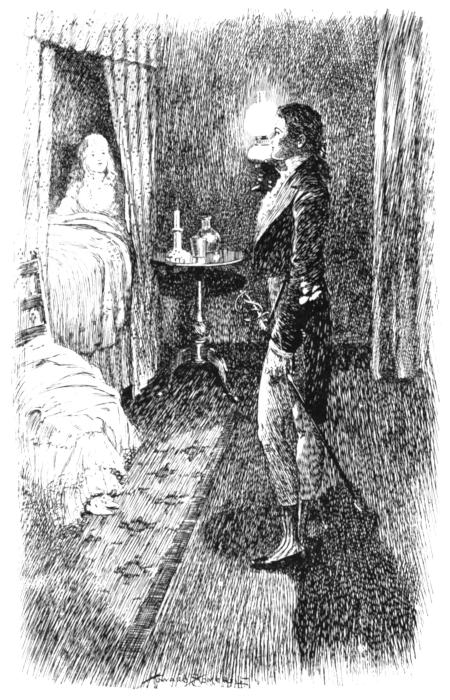
Rising to his feet and holding the lamp on high, Wilfrid
looked about him, and discovered that the breathings
came from a bed a little distance off. Curtains hanging
around the bed prevented him from seeing the sleeper.
It was clear that through some strange blunder Nadia
had shown him to the wrong room.
Then——
“By Jove!” muttered Wilfrid.
His eyes had fallen upon a startling sight—startling,
that is, in the sense of being unexpected.
There, orderly disposed upon a chair by the dressing-table
was a pile of fair undergarments, while beneath the
same chair there peeped forth a pair of satin shoes
formed only for the smallest of feet.
RISING TO HIS FEET AND HOLDING THE LAMP ON HIGH, WILFRID
LOOKED ABOUT HIM.
Fortunately Wilfrid’s movements had been so noiseless
as not to disturb the occupant. His obvious course,
then, was immediate retirement.
He was on the point of stealing off when his eye was
caught by sparkles of light coming from a jewel-case that
lay upon the dressing-table. It did not require the
knowledge of a lapidary to pronounce that the rich gems
and the wrought gold represented a very large amount
of money. The owner was, obviously a lady of wealth,
and—Shrine of Venus!—there could not be a doubt
about it; he was standing in the very bed-chamber of the
fair boyarine!
Nadia, paying too much attention, perhaps, to Wilfrid’s
talking, had not noticed that instead of ascending to the
third landing and taking the corridor that led from that,
she had mistakenly stopped and turned when upon the
second landing, with the result that Wilfrid, instead of
being in the room immediately above that of the boyarine,
was in the boyarine’s room itself!
“What would the Ugly One with the spurs and moustaches
think,” muttered Wilfrid grimly, “if he knew of
my presence here?”
The sooner he withdrew the better. He had already
been in the room more than ten minutes. If Nadia
should recall her error, and should come flying back with
clamour, the issue might be awkward, both for the lady
and himself.
Just as he was about to make for the door his ear
detected a movement in the bed.
His heart almost leaped to his throat. Some instinct
told him that the movement was not an unconscious
stirring in slumber; the lady was wide awake, and
remembering that she had gone to sleep in the dark, was
doubtless puzzling herself to account for the light now
shining through her bed-curtains.
His first impulse, to extinguish the light, was checked
by the thought that the fear occasioned by the sudden
darkness might elicit a scream from her. Better to stand
still and be openly seen than to glide, a terrifying black
shape, from the room.
A glance toward the bed showed him a hand coming
forth from between the curtains—a hand as white as the
sleeve of the nightdress that clothed the arm of the
wearer.
The drapery parted, revealing a beautiful face and
figure—the living original of the miniature!
Overwhelmed with surprise Wilfrid stood, as breathless
and as still as if he had suddenly fallen under a spell
of enchantment.
He had loved her from the first moment of setting eyes
upon her portrait, but now the actual sight of the living
princess increased that love tenfold. Could it be true
that he, and he only, held a place in her heart, and that
for a space of more than eight years? If eight years
previously in Saxony he had exercised so powerful an
impression upon her girlish imagination, she should
surely know him again? But though he hoped and
looked for it, she betrayed no sign of recognition. Indeed,
the only emotion expressed in her widening eyes
was wonder.
“What are you doing here?” she asked.
Her voice—and one more soft and musical had never
fallen upon Wilfrid’s ear—seemed to have the effect of
breaking the spell that had held him.
He bowed with all the grace he was capable of.
“I am an English traveller, a midnight arrival, who
has been erroneously led to believe that this was his bedroom.
I cannot sufficiently express my regret at having
disturbed you in this unceremonious fashion.”
There was about Wilfrid that air of good breeding that
marked him as a gentleman, and gave to his words the
stamp of truth.
Her suspicions, if she had had any, were gone in a
moment.
“Then, sir, please to withdraw,” she said, in a tone of
gentle dignity.
“At once,” replied Wilfrid, turning to the door,
“trusting I may be permitted to pay my respects to you
in the morning, and to apologise more at length.”
Just the faintest shade of fear passed over her face.
“No, no, you must not do that! As you love your
life keep this meeting a secret! I speak with good reason.
Go! But stay—one moment. Your name?”
“Wilfrid, Lord Courtenay.”
A faint cry escaped the Princess as Wilfrid so held the
lamp that its light fell clearly upon his face.
She knew at least his name, if she did not recognise
him; that much was certain. Equally certain was it that
his name or his presence filled her with some deep
emotion. She caught her breath; her colour came and
went. If these symptoms were due to love it was a love
mingled with dismay, and the dismay seemed to predominate.
Though prudence told Wilfrid that it was high time to
go, he could not resist the temptation of lingering to ask,
“Have we met before?”
“Once,” answered the Princess in a softened voice,
“and once only, when you saved me from death!”
It must have been in his sleep, then, for he had no
recollection of it! Adventures he had known in plenty,
but to save the life of either woman or girl was a pleasure
that had never yet fallen to his lot, and he said so.
The Princess gave a half-smile.
“It was an event so strange that I do not wonder at
your failing to connect me with it.”
A more puzzling statement, this, since the very
strangeness of the affair should surely be an additional
reason for stamping it upon his memory.
As Wilfrid looked intently at her in the vain attempt
to discover her meaning, he saw an awful change pass
over her face. Dilated eyes, lips drawn apart, and cheeks
perfectly bloodless—all showed her to be seized by a
sudden sense of fear.
A moment more and Wilfrid, too, felt fear, not on his
own account, but on hers.
A murmuring of voices and the sound of footsteps
were audible on the other side of the bedroom door. A
little crowd was congregating in the corridor without.
What was the cause of the gathering? His striking of
the flint had been accompanied by very little noise. The
voices of both the Princess and himself had been scarcely
loud enough to penetrate beyond the room. Why, then,
was attention becoming drawn to the Princess’s bed-chamber?
Had Nadia become aware of her error? Was
she outside, testifying to others that she had mistakenly
conducted an English traveller to this chamber? Had
the Princess’s retinue gone to the bedroom intended as
his and found it empty? Had they then decided to search
the Princess’s bed-chamber? The discovery of a man at
the dead of night in the bedroom of a lady, who had let
fifteen minutes elapse without raising an alarm, would
certainly place her in a compromising situation.
The confused murmur outside ceased. Then came a
gentle tapping upon the panels of the door.
Now if Wilfrid had followed his own impulse he
would at once have opened the door, and explained the
matter precisely as it had happened, being of opinion
that the truthful way is always the best way, but on
glancing at the Princess he saw her with her finger upon
her lips, which action he took as a sign that he was not
to speak.
In the silence of that trying moment he could almost
hear the beating of her heart.
The knocking was renewed, being followed this time
by a turning of the handle and a pressure against the
door, which did not yield since, as previously stated,
Wilfrid upon entering had locked it.
“What is it?” cried the Princess, striving to subdue
the tremors of her voice.
“Did not your highness call us?” was the reply, delivered
in a deep bass voice, which Wilfrid immediately
recognised to be that of Prince Ouvaroff, or, as Nadia
had impolitely called him, the Ugly One.
The voice came both as a surprise and a pleasure to
Wilfrid—a pleasure, because his present position would
now admit an explanation, certain to be received by the
Prince, who would not be likely to impute dishonourable
motives to his old friend. Indeed, Wilfrid was almost
on the point of answering, but thought it more prudent
to await the pleasure of the Princess.
“I did not call, Prince. I would have rung had I
wanted anything.”
Wilfrid groaned in spirit. The deed was done. If the
Princess were not compromised before she certainly was
now, and by her own action. Her words were tantamount
to saying that nothing unusual was occurring—in
effect, a tacit denial of his presence.
“But had you rung we could not have come to you,”
said a feminine voice, belonging evidently to one of the
Princess’s maids, “since your Highness has locked the
door against us.”
“A wise precaution in a strange house. I did not call,
nor do I want anything. Return to bed, silly ones. You—you
are interrupting my rest.”
There was a brief whispering, followed by the sound
of receding footsteps, and though all became silent in
the corridor again, Wilfrid was troubled with the horrible
suspicion that the speakers had merely moved off to
some distant place of observation, there to wait for his
appearing. If so, how was it possible for him to escape
discovery?
The only other exit from the room lay through the
window, but Wilfrid was well aware that Russian windows
are, at the beginning of winter, so firmly secured
against the cold without as to be opened with extreme
difficulty. Moreover, if he should succeed in crawling
through the lattice and in dropping to the ground
below—honourable doings for a Courtenay!—his footprints in
the snow would betray him. And how was he to re-enter
the inn without attracting notice? It was impossible for
him to remain all night in the bed-chamber, even if the
Princess, yielding to necessity, should permit it, for in the
morning discovery must ensue upon the entering of the
maids. He could leave only by the door, but again came
the disquieting thought that there might be watchers in
the corridor without, determined to see the end of the
matter, even though they should have to wait all night.
If this last were the case, then each moment of his stay
would but deepen—nay, confirm—suspicion.
He was still standing in the place where he had first
stood after lighting the lamp, hesitating to stir lest the
moving of the light or the sound of his feet should lead
to his betrayal. But now the Princess beckoned him to
approach. She wished to speak, and for obvious reasons
to speak in a whisper. Wilfrid moved forward in silence.
The Princess pointed to a chair by the bedside, and
Wilfrid, sitting down, placed the lamp upon the dressing-table,
and bent his head to listen.
What the Princess said was almost inaudible to Wilfrid:
it was more by the motion of her lips than by the
actual sound proceeding from them that he understood
her to say:—
“I said what I did”—alluding to her implied denial
of his presence, surely a pardonable evasion considering
the circumstances—“to save you from being cut to
pieces before my eyes—your fate if found here. Do
not go—till—till they have had time to fall asleep
again.”
With that she sank back upon her pillow.
To be sitting by the bedside of a fair and youthful
princess was a very charming situation, but it had its
drawbacks. Should discovery ensue, then, unless the
Princess had the nature of an angel, how could she ever
forgive the man who had made her innocence appear as
guilt? From her, whose love he was so anxious to win,
what could he now look for but resentment? The endearing
impression made on her mind by his saving of
her life, though confessedly he had no recollection of the
event, would now be completely effaced by this unfortunate
blundering into the wrong room at night.
As Baranoff’s face, with its sneering smile, rose vividly
before him, Wilfrid turned cold at the thought that he
had done the very thing the minister had wanted him
to do! Should this affair come to his ears how he would
triumph in the Princess’s shame! How quick he would
be to reveal it to the world! Wilfrid recalled his words:
“Death at the hands of the State for the Princess as well
as for her lover.” That there was truth in this utterance
seemed evidenced by the words of the Princess herself;
that he would be slain before her eyes if found in her
bed-chamber. Such a fear spoke but too plainly of her
position, for if she were powerless to prevent her retinue
from butchering him, it was clear that she was not really
their mistress. She was, in fact, a sort of honourable
prisoner of State, free to travel if she chose, but attended
by an escort, told off to watch for any suspicious
act. In forecasting his probable doom she had not
touched upon her own. Was it possible that he was
really bringing upon her a like fate?
He ventured to steal a glance at her face. How
beautiful it was, with its soft violet eyes shaded by long
dark lashes? Whatever may have been the arrangement
of her hair earlier in the evening, it now lay upon
the pillow like a bright aureole around her face, one
golden tress twining about her white throat like a vine
tendril clasping a marble column.
If ever woman had cause to be angry with Wilfrid
that woman was this princess, and yet her face betrayed
not the faintest sign of resentment; on the contrary,
there was something in her look assuring him that, come
what might, she would be the last person in the world
to reproach him for an act unwittingly committed, a
forgiving tenderness of spirit on her part that, while it
endeared her the more to Wilfrid, at the same time enhanced,
rather than lessened, his despair.
Half an hour passed without a word spoken on either
side. Then the Princess bent forward till her golden
hair was so close to his own that he could feel her warm
breath on his cheek.
“Lord Courtenay,” she said in the faintest of whispers,
“before you go, a few words. You have heard me
called ‘Highness.’ Do you know my name and rank?”
“I regret to answer no,” replied Wilfrid, speaking in a
tone similarly subdued.
As she did not seek to enlighten him it was clear that
she preferred to remain unknown.
“You will keep this meeting a secret?”
Wilfrid bowed assent.
“When you have found the right room let me entreat
you to remain there till after ten in the morning.”
Ten o’clock, he remembered, was the time arranged
for the resumption of her journey.
“My meaning is that if a certain one among my suite
should learn that you have passed a night at this inn,
the consequences to me may be,” she hesitated as to the
choice of a word, finally selecting “hurtful.”
Wilfrid had no doubt that the person she meant was
Ouvaroff, and for the moment he felt that he would like
to do for Ouvaroff what he had done for the Abbé Spada.
“Your Highness, say no more. I stir not from my
room till after the hour named.”
“What other persons besides myself know that you
are here?”
“The innkeeper and his daughter, but for their own
sake they will not speak of me to your suite. There is
my yamchik, too, but they will take good care to keep
him out of the way.”
Though the Princess had hinted that it was time for
him to go, she did not seek to hasten his departure.
“Why do you, an Englishman, travel in Russia at a
time so perilous as the present?” An embarrassing
question, but before he had time to consider what answer
he should give, the Princess spoke again.
“Lord Courtenay,” she said in a grave earnest tone,
“I am glad in one sense to have met you, for I can give
you a warning. It has become known to me that your
life is not safe in Russia. Leave the country with all
speed. Take another name; assume a disguise; forge
a fresh passport; go anywhere rather than to St. Petersburg,
where you have an enemy who will not spare you.”
“You allude to Count Baranoff?”
“To one greater than Baranoff.”
But when Wilfrid asked for the name of this person,
the Princess shrank back with a strange and troubled
look, so that Wilfrid refrained from repeating the question,
for he could very well guess who was meant,
though why she should hesitate at naming him was a
mystery.
One greater than Baranoff? Who but the Czar could
be greater than the Czar’s minister? And the cause of
the Czar’s enmity was doubtless to be found in the defeat
at Berlin of his policy, a defeat due to Wilfrid alone.
And yet it seemed improbable that Baranoff would have
the courage to tell the story of his own cowardice and
flight. It might be, however, that he had related the
matter in such a way as to exculpate himself, representing
that his triumph would have been certain but for a
secret emissary of Pitt’s, Lord Courtenay by name, who,
insinuating himself into the confidences of Frederick
William, had induced that monarch to side with Great
Britain.
The warning given by the Princess more than ever
convinced Wilfrid that his journey to St. Petersburg was
likely to end in his arrest. Yet turn back he would not,
now that he had once met with the Princess, whose
whole manner showed that she moved in an environment
of suspicion and peril, from which, if possible, he
would deliver her.
“You will not go to St. Petersburg?” she said in a
soft pleading tone that vibrated to his heart.
Wilfrid felt that to say he was bent on going would
but increase the look of sadness on her fair face. He
therefore temporised.
“I will think over the matter.”
“I have warned you. If you will not take my warning
you are lost. I have no more to say,” she added—words
that Wilfrid interpreted as a hint to go.
“Your Highness,” he said, rising, “you know my
name. Will you not favour me with yours ere I go?”
She shook her bright flowing hair in tantalising
fashion.
“What good will it do you?” she said with a sad
smile. “Let me remain unknown. Now go, and Heaven
watch over you!”
“And over you, too, Princess!”
Wilfrid bowed, took up the lamp, and walked to the
door. Arrived there, he cast one last lingering glance at
the Princess. She was sitting up in bed watching him,
her hand pressed to her side as if to repress the accelerated
beating of her heart. Was its quickening due to
fear, or to love, or to a mingling of both?
He extinguished his lamp, conscious that even in the
darkness the Princess’s eyes were upon him.
He cautiously turned the key of the door, the steel
tongue of the lock moved back almost silently. Wilfrid
paused a few moments, fearing lest the sound, faint
though it was, should have attracted attention.
Finding that all remained still, he ventured to open
the door and to look forth. By aid of a faint light shed
by a lamp hung from the ceiling, he saw that the corridor
was empty. His trained hearing caught neither
the hasty movement of feet nor the sound of closing
doors; nothing whatever occurred to suggest that any of
the Princess’s retinue had been on the watch.
Thus assured, he stepped out into the passage, quietly
closing the door behind him.
It was a new thing for Wilfrid to be stealing along a
corridor at night like a thief, fearful of being seen or
heard—an altogether humiliating experience, made endurable
only by the thought that it was necessary for
the honour, the safety, perhaps even the life, of the Princess.
Twenty paces—he had a reason for taking accurate
measurement—brought him to a landing, whence
a short staircase led to the floor above, where was a corridor,
similar in all respects to the one he had just left.
Moving forward twenty paces along this, Wilfrid
paused before a certain door.
“Directly above the Princess’s room, Nadia said. Then
this should be it. Now, pray Heaven, I am not disturbing
some other person’s sleep.”
He cautiously opened the door, and quietly exploring
his way through the darkness, reached the bed. It was
empty. Re-lighting the lamp he found himself in a room
whose appointments seemed to show that it was intended
for the use of a male visitor.
Whether or not it was the room that Nadia had meant
for him mattered little; he was not going to look for any
other; so locking the door he went to bed, and was soon
sound asleep.
CHAPTER V DISCOVERED, OR NOT DISCOVERED?
“It is past ten o’clock, gospodin.”
The words came from Nadia, who, having tried for
some time to arouse Wilfrid by knocking at his bedroom
door, had at last succeeded.
“Past ten o’clock!” echoed Wilfrid, realising what
these words meant. “Then the Prin—I mean the
boyarine and her party have gone?”
“Half an hour ago.”
It was with considerable mortification that Wilfrid
heard this news. It had been his intention to secrete
himself at some loophole of observation in order to
watch the departure of the Princess and her train. Prolonged
slumber, however, had debarred him from this
pleasure.
On coming down to breakfast his mortification soon
yielded to a new feeling, namely, curiosity as to whether
Nadia was aware of the blunder she had made. Had she
discovered her error shortly afterwards, but, overcome
with confusion and fear, had left him to extricate himself
from the difficulty as he best might?
If she were not aware of her mistake it would be better
to let her continue in ignorance of it—so much the safer
would be the Princess’s secret. But in what way was he
to question Nadia without revealing what he wanted to
hide? A lawyer might be equal to the task, but Wilfrid
wasn’t a lawyer, for he was too impulsive in speech,
which is a fault, and too transparent in motive, which is
a virtue.
As he sat down to breakfast he eyed Nadia keenly,
who coloured on observing his gaze as any maiden might,
whose last parting from a man had been marked by a
kiss, so that her sudden blush told him nothing of what
he wished to know. She was the sole attendant at table,
her father at that moment being engaged in superintending
the delivery of a wagon-load of fagots.
“The gospodin slept well?” she asked.
“Excellently. Five minutes after leaving you,” said
Wilfrid, fixing his eyes intently upon her face, “five
minutes after leaving you I was fast asleep.”
If she had been among the little gathering outside the
Princess’s bedroom she must have known that he was
not keeping to the truth. If she knew it she did not betray
her knowledge by any change in her manner.
“There is nothing like a long drive in the frosty air
for making one sleep,” was her quiet remark.
“By the way,” added Wilfrid with a careless air,
“just as I was dropping off I fancied I heard a disturbance
on the floor beneath me—a talking, or a moving of
feet—muffled sounds of some sort. Was I dreaming?”
“The floor directly beneath yours would be the boyarine’s
room,” said Nadia, opening her eyes wide with
surprise. “Do you say the noise came from there?”
“There or near it, so at least it seemed to me. Did
you hear the noise?”
“I! I was down in the kitchen getting ready some
nice things for the boyarine’s breakfast.”
“Did any of the boyarine’s party complain of a noise
during the night?”
“None.”
“Ah! Then I must have been dreaming.”
During this brief dialogue Wilfrid had kept his eyes
on Nadia’s face, and became convinced by her natural
and artless manner that she was unconscious of her
blunder of the previous night.
That she was looking somewhat pale was nothing to
the point, seeing that she had been up all night preparing
with her own hand dainty dishes for the boyarine and
her party.
At this point, having finished with his timber, Boris
entered to see what services he could render. Naturally
enough Wilfrid was desirous of learning all he could
about the Princess.
“You waited on the boyarine at breakfast, I presume?”
he said, addressing the pair. “How was she
looking?”
“Rather pale and anxious,” replied Boris. “She
scarcely spoke. In fact, her lively manner of last night
was altogether gone.”
“And Ouva—I mean him whom Nadia calls the
Ugly One? He breakfasted too, I suppose?”
“Sitting opposite to the boyarine,” replied Boris, who
seemed to have kept a keen eye on his visitors. “He,
too, looked rather grave. I caught him more than once
watching her curiously. Her eyes would droop when
she became conscious of it.”
“In short,” said Wilfrid with a mirthless laugh, “she
might have been taken for a child that has done wrong,
and he for a parent that had been scolding her.”
The innkeeper with some surprise murmured that
Wilfrid’s words exactly hit off the situation.
For appearance’s sake Wilfrid went on eating, but his
appetite had gone. He was possessed by a horrible
sinking of heart; he suspected, nay, he felt sure, that
his long stay in the Princess’s bed-chamber had become
known, and that Prince Ouvaroff was disposed to put
the worst construction upon the event.
The picture of the fair and innocent Princess, sitting
mute and wretched amid her escort, exposed to coldness
and suspicion, and unable to vindicate herself, filled Wilfrid
with almost intolerable anguish.
Upon the woman whose love it was the one desire of
his life to gain he had brought cruel reproach. Already
in imagination Wilfrid heard the mocking laugh and
ribald jest directed against the Princess by the immoral
circle at the Court of the Czar. “She is only like the
rest of us.”
Second thoughts, however, induced Wilfrid to believe
that perhaps after all he was disquieting himself without
reason.
The apparent lack of cheerfulness on the part both of
the Princess and of Ouvaroff might be due to an entirely
different cause. It came suddenly upon Wilfrid that the
Princess was none other than the lady to whom Ouvaroff
himself had once aspired, till a State warning had bidden
him put a check upon his presumption. Perhaps, regardless
of the State’s inderdict, Ouvaroff had once more ventured—it
might even have been on the previous night—to
renew his suit with the same result as heretofore.
Hence the meeting between her and him this very morning
would necessarily be quiet and somewhat embarrassing.
There could be no doubt that the Englishman who had
so roused the deadly ire of Ouvaroff was none other
than Wilfrid himself, though it was somewhat difficult
to see how the Prince could have learned that his former
friend had become his rival, since if the Princess really
cherished a secret affection for Wilfrid, she would be
the last person in the world to divulge it.
There was one circumstance which disposed Wilfrid
to think that his interview with the Princess had escaped
observation, and that was the peculiar forbearance of
Ouvaroff. Surely, if the Prince had suspected anything
he would have sought Wilfrid out and have demanded an
explanation of the nocturnal incident. But the Prince
had done nothing of the kind; on the contrary, he had
set off next morning apparently ignorant that his old
friend was beneath the roof of the Silver Birch.
But no sooner did this favourable view present itself
than it vanished. Ouvaroff, aware of Wilfrid’s destination,
was perhaps leaving him to the vengeance of the
authorities at St. Petersburg.
The breakfast over, Boris, who took considerable pride
in his hostelry, made the suggestion that perhaps his
Excellency would like to be shown over the building; if
so, Nadia would be pleased to take him round.
Wilfrid readily fell in with this offer, moved solely by
the wish to see again the chamber in which the Princess
had passed the night. He accordingly accompanied
Nadia through the various rooms, listening, it must be
confessed, with very little interest to her remarks, till at
last they reached the Tapestried Chamber. And a daintily
furnished little chamber it was; but now, void of its
fair occupant, how desolate it seemed!
Wilfrid’s eyes roved reminiscently and mournfully
around. Here was the dressing-table upon which he
had set his lamp, and there the chair over which her fair
attire had been cast; here, the seat in which he had sat
by her bedside, and there the pillow still retaining the
hollow made by the nestling of her golden head.
The faint perfume that Wilfrid had noticed on the
previous night still hovered around the pillow. Moved
by a sudden impulse, he lifted it, and with surprise and
delight saw beneath a folded handkerchief.
On the principle of “Findings, keepings,” as children
say, Wilfrid took possession of the article, which was of
the finest cambric, delicately perfumed, and edged with
beautiful lace.
Now, although the title of princess is sometimes borne—in
Russia, at least—by persons of doubtful station,
Wilfrid had felt that this was not the case with his princess;
and on unfolding the handkerchief he received a
startling proof of the correctness of his opinion, for the
centre of the cambric exhibited the figure of a double-headed
eagle wrought in gold thread.
“The Imperial Arms!” muttered Wilfrid.
His look of blank surprise was as nothing compared
with that of Nadia’s. She, indeed, seemed not only
amazed, but quite frightened by the discovery.
“The Czar’s Arms!” she gasped. “Is she a member
of the Imperial house—A Grand Duchess?”
It seemed so, if the handkerchief were to be taken as
proof, but how near to the throne there was no means of
telling. She might be a very distant relative of the Czar;
on the other hand, she might be a niece, or even a
daughter! Wilfrid’s head swam at the thought. No
wonder he ran the risk of being slaughtered by her
suite if found in her bedroom!
That eagle in gold thread was not only a startling
sight, but an unwelcome one to Wilfrid; it seemed to
put a sudden stop to his love-dream. For him to think
of mating with a princess of the Imperial house of
Romanoff would indeed be the height of audacity; and
yet, if the lady herself were willing—and the tender
glance of her dark-blue eyes had given him a lover’s
hope—he was quite ready to brave all risks on her behalf.
If she were a Romanoff, was he not a Courtenay,
with imperial blood in his veins, descended from the
Byzantine emperors and permitted by the Garter king-at-arms
to bear the proud title of Æquus Cæsaribus—equal
to Cæsars?
But soon his thoughts took a lower flight.
“We have jumped to conclusions too hastily,” he said
to Nadia. “The possession of the handkerchief doesn’t
necessarily prove that she is a Grand Duchess. It may
have been a gift of the Czar.”
This way of looking at the matter seemed to relieve
Nadia’s mind somewhat, though why she should look so
troubled over the discovery was a puzzle to Wilfrid.
“Besides,” he continued, “if she were an Imperial
Duchess, her suite would select, as her stopping-place
for the night, the castle of some grand boyar, rather
than a wayside hostelry.”
But Nadia opined there was no force in this argument,
seeing that the great Catharine herself had on one occasion
stopped at the Silver Birch, and had slept in that
very chamber. And Wilfrid was forced to admit to
himself that it was an argument in favour of the Imperial
theory that the chief of her escort was no less a
personage than the Czarovitch’s own aide-de-camp,
namely, Prince Ouvaroff. If she were not a Grand
Duchess she must at least be some one of distinguished
rank.
Folding the handkerchief, now the most precious of
all his belongings, he placed it carefully within his
breast, and descended again to the breakfast-room.
“And now,” said he, “send me my yamchik, and I’ll
ask the scoundrel what he means by taking twelve hours
to drive twenty-four miles.”
Nadia departed, and presently returned, leading in the
yamchik, who stood, cap in hand, smiling and fawning.
Yes, shame to him, he had taken a long time in coming
from Viaznika to Gora. Ah! why did he ever deviate
from the post-road, thinking to take a shorter cut? He
didn’t like to tell the gospodin so at the time, but he
knew he had lost his way, and he had wandered, and
wandered—oh! how he had wandered!
“Just as you are doing now,” interrupted Wilfrid.
“And yet you say you have performed this same journey
a hundred times?”
Yes, that was the most wonderful part of it—that
he, who had travelled this route one hundred times,
should go wrong at the one hundred and first. But
there, man must make a certain number of mistakes in
his life-time; even the mighty Czar sometimes made mistakes,
much more, then, a poor yamchik.
But when it was pointed out by means of the map that
he had similarly lengthened the stages on other days, the
yamchik, while venturing to deny the impeachment, became
less glib of tongue; professed that, being unable
to read, he could not understand the condemnatory map,
and finally grew so dense that Wilfrid, despairing of
getting any clear ideas into the fellow’s thick skull, bade
him go and harness the horses for the next stage.
Was the fellow a fool or a knave?
Wilfrid was disposed to rank him among the latter
class, having a suspicion that all these manœuvrings on
the part of the yamchik had been prompted by some
interested motive, a motive, however, that Wilfrid was
utterly unable to fathom.
It was hardly worth while now to dismiss the fellow,
when only three or four days’ journey from St. Petersburg;
but, while retaining him, Wilfrid determined not
to leave these final stages to his judgment. So, after a
brief study of the map, he selected both the route and
the stages; and since, from motives of prudence, he did
not wish either to overtake the Princess or to appear as
if following immediately upon her track, he chose a
somewhat circuitous road to the capital in lieu of the
direct one.
And now, from without, came a jingle of bells and
neighing of steeds to tell him that his car was in waiting.
Wilfrid rose, called for his bill, and paid it with a
liberal overplus. Boris and his daughter accompanied
him to the inn door, where a little crowd of servants
had assembled to watch the departure of the rich Englishman.
Wilfrid turned to say “Good-bye” to Nadia. Her
manner plainly showed that she was sorry to part with
her guest, who, moved by a generous impulse, drew the
pretty serf-maiden to one side.
“Nadia,” he whispered, “take heart. How long I
shall be in St. Petersburg, I know not; but when I return
again this way I will redeem you and your father
from serfdom—yes, if it cost me fifty thousand roubles.”
He had thought to see her cheek colour with delight,
her eyes to sparkle, and her lips to quiver with thankfulness;
it was all the reward he wanted.
But, to his surprise, her emotion took a very different
shape. She shrank back, staring at him, her cheek as
white as the dead; in her eyes a look of wild, haunting
horror.
“Isn’t that promise worth a kiss?” smiled Wilfrid.
She did not give him one; instead, she presented her
cheek, and on touching it with his lips he found it as
cold as marble.
Somewhat mortified by this strange reception of his
offer, an offer made in all good faith, Wilfrid waved his
hand to Boris, sprang into the sledge, and the next
moment was speeding off along the frozen highway.
Nadia staggered, rather than walked, to her own little
sitting room.
“What did the Anglisky say to you?” asked Boris,
somewhat suspiciously.
“Say?” gasped Nadia, who seemed scarcely able to
speak for emotion—“words that he meant to be words
of hope, but to me they are words of despair. I would
rather he had stabbed me. And he looked at me, oh! so
pityingly. My God! if he only knew the truth!”
A shudder shook her from head to foot.
Her wondering father repeated his question.
“He promised to buy us our freedom, yours and
mine.”
“Glory to God!” cried Boris, clasping his hands fervently
together. “Glory to God who has put this
thought into the heart of the Englishman! My prayer
for you, Nadia, my prayer day and night for years, is
answered at last. He’ll keep his word, this Englishman.
An Englishman always does. And he shall not lose by
his goodness. I will work, work night and day, till I
have paid him our ransom twice, yea, three times over.
But, Nadia, Nadia, why do you grieve? Is this a thing
to grieve about?”
“The offer comes a day too late, my father.”
“A day too late?”
“We are already free,” she replied, with a laugh
dreadful in its want of mirth. “Free by the grace of
the nether fiend, who is now mocking me with a deed
that need not have been done.”
CHAPTER VI HEIRESS TO THE THRONE!
On the fifth morning after leaving Gora, Wilfrid and his
yamchik were speeding over a landscape that presented
to the eye little more than a vast expanse of virgin white,
sparkling beneath the rays of a pale, northern sun, that
gave light, but not warmth.
“St. Petersburg!” cried the yamchik suddenly, pointing
with his whip to the far-off northern horizon, which,
presenting hitherto a smooth line, began now to have its
continuity broken by a series of irregularities.
As the horses raced onwards, higher and ever higher
out of the illimitable sea of white, there rose to view a
curious and, to an occidental eye, fantastic mingling of
palaces and minarets, of cupolas and crosses, each gradually
becoming more clearly defined against the pale lilac
of the Arctic sky.
Now, more than ever, did Wilfrid realise the madness
of his enterprise.
He was hastening to a city that held two at least of
his enemies, namely, Count Baranoff and the recently
alienated Ouvaroff; to whom must probably be added
a third, in the shape of the Czar Paul—which was tantamount
to saying that he had a whole empire against him.
Now with the aid of friends, a man has often succeeded,
despite police and spies, in eluding the vigilance
of the Government; but no such hope sustained Wilfrid,
seeing that in all the wide city there was not one man
to whom he could look for refuge.
“I am entering St. Petersburg,” he mused. “Shall I
ever leave it? ’Tis doubtful. I feel, for all the world,
like a prisoner riding to the guillotine. No matter!
Honour forbids me to go back. That my princess is to
be found here is a sufficient reason for going forward.
If her life is threatened, let them take mine as well.”
And he consoled himself with that aphorism of the
desperate, “What is to be, will be.”
They were now leaving the silence and monotony of
the steppe. Wooden cabins, with blue smoke rising
from them, began to appear by the roadside, few at first,
but by-and-by increasing in number, till they formed a
continuous line. Soon the appearance of stone houses
and handsome shops, of vehicles and pedestrians, told
Wilfrid that he had entered upon the suburbs of the city.
“Hôtel d’Angleterre,” was his reply to the yamchik’s
question as to whither the gospodin would be driven.
The hotel in question, a palatial structure, was kept
by an Englishman, who bore the homely name of John
Smith, a rosy-cheeked, rotund little personage, but having
at this time a most lugubrious air, due to the bad
state of business. His hotel, he remarked to Wilfrid, was
mainly patronised by English visitors, all of whom had
taken to flight on the declaration of war, leaving the vast
building almost empty.
It was doubtless a very fine thing for patriotic Britons
at home to read of their victories by sea and land, but the
war fell hard on the English resident in St. Petersburg.
All this, and much more, was detailed by John Smith,
whose gloomy prospects Wilfrid tried to brighten with
the assurance that it was simply a game of bluff on the
part of Paul, who, as soon as he should learn that the tall
sails of Nelson’s fleet were coming up the Gulf of Finland,
would quickly make peace.
Having paid and dismissed the yamchik, Wilfrid asked
for a file of daily newspapers that should cover the period
of the previous three weeks. He had found it impossible
to procure a newspaper at any of the post-inns on the
way; and hence he was in a state of ignorance as to
how the world had wagged.
Going out, the landlord soon returned with a file of
Russian journals, and, looking cautiously around, said:
“If your lordship cares for news fourteen days old, I
have here a file of the English Times, and that’s what
you won’t find in any other hotel in St. Petersburg. I
get them from the English Club, who contrive to have
them introduced into Russia without their being seen
and ‘blacked’ by the censor. Say nothing about this, or
I shall be having a domiciliary visit from the police.”
Taking the papers, Wilfrid sat down and began with
the file of the Times, skimming the contents with a quick
eye, in the course of which operation he came across a
paragraph that caused him for the space of a full minute
to sit dumbfounded with surprise.
The paragraph which the Russian censor would certainly
have “blacked” out, had the journal in question
fallen into his hands, purported to come from the Times
correspondent in St. Petersburg, and was worded as
follows:—
“A strange story, to be received with some caution, is
being whispered among political circles here, to the effect
that the unfortunate Czar, Ivan VI., whose life, it will
be remembered, was spent wholly in a dungeon, contracted
a secret marriage with his gaoler’s daughter, a
girl of exquisite beauty.
“The sole descendant of this union is a grand-daughter,
now in her twenty-third year, and said to be of surpassing
grace and loveliness. Till lately she has been living
at Moscow, carefully concealing the secret of her romantic
origin; but, through no act of her own, the story, by
some means or other, has transpired.
“The Czar Paul is said to be convinced by documentary
evidence of her legitimacy and Imperial lineage, a
matter to him of grave import, since, as there is no
Salic law in Russia, if the rule of primogeniture be followed,
this grand-daughter of Ivan VI., as the eldest surviving
representative of the House of Romanoff, should
now be wearing the diadem of the Czars.
“With a view of keeping a watch over her, Paul some
months ago removed her from Moscow to his Court at
St. Petersburg, conferring upon her the title of Grand
Duchess, and placing her among the ladies in immediate
attendance upon the Czarina. Assuming that this story
is true, he would be a bold prophet who, in view of the
gloomy and suspicious nature of Paul, would venture to
predict length of days to a lady so dangerous politically
to him and his heirs.”
The paper fluttered from Wilfrid’s hands. He had no
desire to read anything more that day. The political and
military affairs of the Continent sank into insignificance
beside this startling paragraph. The English readers of
The Times might regard the story as a romantic fabrication;
Wilfrid had reasons for believing otherwise.
The newspaper paragraph had closed with a sinister
prediction, a prediction that had sent a thrill of fear to
his mind. The only way of preventing its fulfilment was
the removal of the duchess from Russia; but how could
he, single-handed, effect the escape of a lady watched
day and night as she undoubtedly must be?
“Matters are growing interesting,” he muttered. “A
grand-daughter of a Czar! Lineal heiress to the throne!
So that is why the lady must have no suitors; she must
be prevented from transmitting her rights. And Ouvaroff
and I, and all would-be lovers are to be ‘warned
off.’ Well, for my part, I decline to take the warning.
Having more than a liking for the lady, I intend to carry
on my suit; for, if her eyes said anything the other
night, they said love.”
A few questions to his host elicited the fact that the
Czarina Mary, the Czarovna Elizavetta, the Grand
Duchesses, and the ladies of the Imperial Household,
were accustomed to take a drive every afternoon at two
o’clock along the Nevski Prospekt.
Thinking that his grand duchess—the Times correspondent
had, unfortunately, forgotten to name her—might
form one of this party, Wilfrid resolved to take
his stand near the entrance of the Michaelhof, in the
hope of obtaining a fleeting glimpse of her.
Aware that in St. Petersburg a man in civilian attire
is deemed of little account, Wilfrid resolved to don the
uniform of a certain Austrian regiment in which he held
the honorary rank of colonel, a reward conferred upon
him by the Viennese Court for his bravery at the battle
of the Devil’s Bridge, where he had fought side by side
with Russians, as well as with Austrians.
The picturesque uniform of dark blue, rich with gold
braiding, was admirably adapted to set off his graceful
figure to advantage, and when, after assuming his cloak
and a jewel-hilted sabre, he took a glance in the mirror,
he was satisfied that he had made the best of himself.
Thus attired, he set off on foot to view the Michaelovski
Palace, the new residence of the Czar Paul.
The building, when seen, proved quite a revelation to
Wilfrid, whose very brief acquaintance with the city
had hitherto shown him but two main styles of architecture,
the barbaric, semi-oriental style, seen chiefly in its
churches, and the façades copied from the boulevards of
Paris, seen chiefly in its hotels and mansions.
But the Michaelhof differed from both styles. Here,
in the very heart of St. Petersburg, was a feudal castle,
with donjon and towers, battlements and loopholes, portcullises
and drawbridges; and, finally, a surrounding
moat, which, however, just then availed little for defensive
purposes, inasmuch as it was frozen over.
Wilfrid had seen numerous fantastic castles in his
time, but none to compare with this bizarre-looking pile.
One might have fancied that a mediæval architect, given
to wine, had fallen asleep and dreamed; and that this
palace was the petrifaction of his dream-fortress, although
the bristling cannon and sentinels with their
bayoneted rifles comported somewhat incongruously with
this relic of a bygone age.
The building had for Wilfrid a fascination due not so
much to its strange character as to the fact of its being
the residence of his princess. Which of those gloomy
towers did she inhabit? Over which drawbridge would
the Czarina and her ladies come forth?
“An Englishman, I perceive,” said a voice close to
Wilfrid’s ear. He turned and saw beside him a cloaked
and sworded figure, wearing the uniform of a general in
the Preobrejanski Guards; a man tall and strong, broad
and burly, with somewhat vulgar-looking features, and
with a rich, florid complexion, evidently due to a liking
for ardent spirits; as a matter of fact, his breath exhaled
an aroma at that very moment. He had eyes of a light
blue, a snub nose, and a truculent tawny moustache, and
he carried himself with a kind of bluff swagger, probably
mistaken by him for ease.
Wilfrid might well wonder how so commonplace a
man should be wearing a general’s uniform; yet the
man was to be a history-maker; in the time to come he
was to surprise Europe, and perhaps himself, by the
brilliancy of his campaigns against the invading French.
“An Englishman, I perceive,” he repeated smilingly.
“What is the evidence?” asked Wilfrid.
“You go on foot. A Russian gentleman never walks
when he can ride.”
“By the same rule you are not a Russian—ah—gentleman.”
“You are right. I am a Hanoverian—General
Benningsen. At your service, sir,” replied the other,
raising his hand in military salute.
The name might well strike Wilfrid with surprise, for
Benningsen was a man great in his family connections,
if in nothing else. As a youth, he had wandered forth
from Hanover to seek his fortune, and entering the
Russian military service, had the good fortune to attract
the notice of the great Catharine, ultimately marrying a
natural daughter of that Empress.
But though a sort of brother-in-law to the Czar, Benningsen
was not in favour at Court. As a matter of
fact, he had been exiled for a time, and though recalled
and restored to his rank as general, he was excluded
from the Council of the Empire, the membership of
which his Imperial family connections might naturally
entitle him to expect. It was openly whispered that this
exclusion, together with his banishment, had made Benningsen
disposed to favour a change of Government, no
matter what, so long as it was a change. Indeed, it
was even asserted that he had been heard to say he
would have his revenge on the “little orang-outang,”
his name for the Czar Paul.
“As an Englishman and a soldier, you are my
brother,” exclaimed the Hanoverian theatrically.
The Czar being at variance with England, it pleased
Benningsen to patronise everything and everybody coming
from that country.
On learning the name of his new “brother,” Benningsen
was loud in his admiration and delight at meeting
with one who had shown the Russian troops how to pass
the Devil’s Bridge by scaling the rocks above it, leading
the way in the very fire of the enemy.
“Your gallant feat of arms,” he assured Wilfrid, “is
remembered with gratitude and admiration by every
officer in St. Petersburg.”
It was characteristic of Wilfrid that he thought, not
of the effect that his deed might have upon the Czar, but
upon—some one else. If his feat of arms had given
pleasure to the Princess, it mattered little to him how
Paul and others viewed it.
Benningsen, with a sweep of his arm, directed Wilfrid’s
attention to the Michaelhof.
“‘In my father’s house are many mansions,’” he
remarked. “And that’s the style of them,” he continued
pointing to the palace. “Truly the angels have curious
ideas respecting architecture.”
As Wilfrid’s face showed that he was quite in the
dark as to the other’s meaning, the General proceeded
to explain.
“Evidently you are not aware that my august brother-in-law
received a visit one night from the Archangel
Michael, who, showing him the plans and elevation of a
palace, bade him build one like it. Fact! At least,” he
added with a side glance at Wilfrid, “it’s a fact that
Paul says so, and it is never prudent to doubt the word
of a Czar.”
“You speak freely.”
“Why, one may speak freely with an Englishman.
With a Grand Duke ’twere otherwise. To return to
Paul. As soon as he had received the Archangel’s commission
he was in a devil of a hurry to carry it out.
Five thousand men were at work daily. To dry the
walls more quickly red-hot plates were affixed to them.
All to no purpose. The place is so damp that the dear
Czar, the Empress, and the Grand Duchesses, are in a
continual state of coughing. And the price of all this?—Eighteen
million roubles!”
Wilfrid let him rattle on without interruption, perceiving
that he was one of those men who are never better
pleased than when hearing the sound of their own voice.
“You see that window facing us on the third story,”
continued Benningsen, pointing it out. “What sort of
room do you suppose lies behind it?”
“A prison, if one must judge by its numerous crossbars.”
“Wrong. Paul’s bedroom. Difficult to enter from
the outside, eh?”
“Are you contemplating the feat?” smiled Wilfrid,
for Benningsen really looked as if he had some such
idea in his head.
“The window barred,” murmured the General, as if
following out some train of thought rather than addressing
Wilfrid, “and the bedroom-door difficult of access,
since to reach it one must traverse a network of corridors
so like a maze that to find one’s way requires the thread
of Ariadne.”
“Are such precautions necessary?”
“The dear Czar thinks so.”
On learning for what purpose Wilfrid had come to the
Michaelovski Square, Benningsen made the disappointing
announcement that a distressing cough on the part
of the Empress—“due to the damned palace”—prevented
her and the Imperial ladies from driving forth
that afternoon.
Benningsen, who was a member of the English Club
situated on the Minerva Prospekt, suggested that Wilfrid
should accompany him thither, to which proposal Wilfrid
assented, moved more by the hope of there getting rid
of the General than by any other reason. So the two
set off, on foot, because, as Benningsen remarked, it was
“so English.”
The Minerva Prospekt, when reached, turned out to
be a wide and noble boulevard, alive with pedestrians of
the lower orders and with the sleighs of the wealthier
classes. The barbaric, yet handsome, costume of the
boyars, the gay dresses and rich furs of the ladies, with
their bright eyes and laughing voices, the furious galloping
of steeds and the jingling of silver bells made a
scene of colour, movement, and sound, that offered a
striking contrast to the stillness, the emptiness, the
monotony of the Michaelovski Square.
Then, in a moment, all was changed!
“Gossudar zdes! Gossudar zdes!”
Such was the cry—“The Czar is coming!”—that
flew from mouth to mouth along the Prospekt.
Pedestrians stopped short in their walk; vehicles
were hastily reined in, and dismay appeared on the faces
of all, as with a crash of military music there suddenly
debouched upon the Minerva Prospekt a regiment of
footguards, in front of whom, and keeping time to the
music with the waving of his cane, strutted an odd little
figure, who was evidently taking a huge delight in the
soldiers, in the marching, in the music.
CHAPTER VII WILFRID DEFIES THE CZAR
“The orang-outang, confound him!” muttered Benningsen
savagely, catching sight of the odd little figure.
“Run, before he sees us. Quick! This way!”
“Why should I run?” demanded Wilfrid haughtily.
He received no answer. Benningsen, holding his cloak
over his face as if to prevent recognition, was running
down a side street as fast as his legs could carry him.
Wilfrid watched him in amazement.
“Afraid to face the Czar, his brother-in-law! Is the
fellow an impostor, assuming the name of Benningsen
for the purpose of fooling me?”
But as Wilfrid turned again he saw in a moment why
Benningsen with some few others had vanished down the
side streets; saw, too, why the square in front of the
Michaelovski Palace had been deserted by all but the
sentinels and those officials whose duty took them there.
For the truth was that even loyal Muscovites had
come to regard a meeting with the Czar as little short
of a calamity, since it was required by him that whenever
he passed through a street all traffic must be suspended,
pedestrians must cease their promenading, the
occupants of vehicles must dismount, and everybody,
from the serf to the boyar, must kneel bareheaded, be
the wind never so cutting or the snow never so deep, till
the “Little Father”—the expression is not meant to be
ironic—had passed by. This practice, an old usage belonging
to the barbarous days of the Empire, had been
abolished by the good sense of Peter the Great; but Paul,
on his accession, had revived the custom in all its rigour,
so that Wilfrid, glancing along the Prospekt, saw two
lines of kneeling people, some of whom even, with a
servility truly Oriental, were touching the slush with
their foreheads.
Close to Wilfrid was a landau from which there had
alighted two ladies, the one aged and feeble, the other
young and delicate, both obviously of noble blood since
the panels of their carriage bore an armorial device; yet
there they were, side by side with their coachmen and
footmen, kneeling in the roadway upon a horrible mixture
of snow and mud that chilled their limbs and stained
their fur cloaks.
And woe to them and to any other person who should
rise too quickly after the Czar had gone by! If detected
by a backward glance of the Imperial eye it was well for
the offenders if they escaped the knout or Siberia.
As Wilfrid beheld the obvious discomfort of these two
ladies, a fierce anger flamed in his breast against the
sovereign who required such humiliating obeisance.
During all this time the regiment, marching twelve
abreast, was drawing nearer to the place where Wilfrid
stood.
Some of the kneeling throng, conjecturing from his
attitude that he was a foreigner, ventured to give him
good-natured advice.
“Kneel to the Czar, little father!” they cried. “Kneel
if you would escape the knout. See! his eye is upon
you.”
That fact made no difference in Wilfrid’s attitude.
Determined to assert his English manhood he stood
erect as a palm.
Other Englishmen besides Wilfrid had declined to bow
the knee, but they had been strong in the knowledge that
they could obtain the protection of Lord Whitworth, the
British Ambassador. Wilfrid had no such hope to sustain
him, since the withdrawal of that minister, on the
outbreak of the war, had left Paul free to do as he liked
with those obstinate Englishmen who refused to acknowledge
his divinity.
“Halt!” yelled the little figure, who, for his size,
possessed marvellous lung power. “Halt! Stop that
music!”
The regiment ceased its marching, the band its playing.
There was a terrible silence as the Czar, with a glare in
his eye, marched straight up to Wilfrid. A shiver of
expectancy ran through the throng. Some wriggled
forward upon their knees with a view of getting into a
better position for watching the sequel.
Wilfrid, who had seen not a few kings in his day,
thought that the being now advancing towards him was
the sorriest specimen of sovereignty he had ever met
with—a very Caliban of royalty. He could scarcely
bring himself to believe that the grotesque creature to
whom all were kneeling as to a god could really be the
crowned head of a vast empire.
He beheld a man, short of stature, bald and wrinkled,
with a leaden complexion and large, glaring, dark eyes.
The countenance was of the true Kalmuck type, so
frightfully ugly that, if history speak truly, its owner
shrank from looking into a mirror. (His wife, it is said,
fainted at the first sight of him.) Certain it is that,
differing from his predecessors, he forbade his likeness to
be stamped on the coinage, with the result that since his
time the Czar’s head has not figured on the Russian
currency.
As if he were some character in a comic opera, whose
part it was to burlesque royalty, he wore a shabby old
military surtout reaching down to his heels, jack-boots
with immense spurs, and an enormous cocked hat carried
beneath his arm. No matter how many degrees of
frost the thermometer might register, that hat was never
seen upon his head. It seemed as if he had set himself
to contradict the current opinion that St. Petersburg is
the coldest capital in Europe. Cold? when a man can
walk about in the open air without furs and without a
hat! Pooh, don’t talk such stuff as that, sir!
Thus arrayed he was accustomed to play at soldiering
by parading through the streets at the head of a regiment
of footguards, flourishing a baton, marching on
tip-toe with mincing air, and looking so like a little bantam
that if he had flapped his arms and cried, “Cock-a-doodle-doo!”
one would have felt little surprise.
The regiment that accompanied him was the famous
Paulovski Guards, a creation of his own and worthy of
him. The face of every soldier, like that of his Imperial
master, carried the ornament of a snub, upturned nose;
and, as if to render the face still more grotesque, the
moustaches were brushed upwards to the ears.
Not only did Wilfrid’s erect attitude give displeasure,
but his six feet of handsome and athletic manhood was
likewise an affront to a ruler, who, on account of his
diminutive and ugly appearance, had been so sneered at
by his mother’s tall and shapely courtiers that he had
come at last to hate the sight of a well-favoured person,
and was jealous even of his own son’s stature and beauty.
Directing a terrible glance at Wilfrid, the Czar spoke,
and by that act, Wilfrid, did he but know it, had become
a very illustrious character. “There are but two great
men in Russia,” Paul had once said, “myself, and he to
whom I happen to be speaking at the moment.”
“Why,” demanded the Czar—and though Wilfrid
had never before seen or heard him, there seemed something
oddly familiar, both in his face and voice—“why
do you refuse to us the homage of the knee?”
“Because, Sire,” replied Wilfrid, bringing his hand
up to the salute, “I revere the memory of the great
Peter, who was wont to employ his stick upon the bodies
of those who knelt to him!”
This was hitting Paul full in the teeth, for if there was
one thing upon which he prided himself it was the imitating
of his great-grandfather.
“We follow,” frowned the Czar, “a custom more ancient
than the reign of Peter.” And then, confident that
Wilfrid’s boldness could spring from but one nationality,
he added, “You are an Englishman?”
“A man cannot choose his own parents, Sire.”
“Your name?” cried Paul, growing more angry.
“Wilfrid, Lord Courtenay.”
The Czar closed his eyes in thought. He seemed as
if trying to recollect something. Wilfrid wondered
whether the Emperor was connecting his name with
that of the Princess. Suddenly opening his eyes again
sharply, Paul said—“We have heard of you from
Baranoff. You are the artist who tried by a picture to
create an outbreak against established order?”
“I painted a picture portraying the murder of that
royal lady, whose daughter till lately was under your
protection, Sire.”
Paul winced, recalling first with what state he had
welcomed the daughter of Marie Antoinette, and then,
how he had sent her packing at a moment’s notice,
merely to please his new ally Napoleon.
“We have heard of you,” he repeated. “A spy of
Pitt’s, with whose gold you bribed Frederick William to
hold aloof from the Russian alliance.”
The charge of being a spy came with a good grace,
Wilfrid thought, from the very head and front of the
spy system.
“No Courtenay was ever a spy. Question your own
officers, Sire, and they will tell you that I have shed my
blood in the service of Russia.”
“The more effectually to disguise your calling. A spy
of Pitt’s. Silence! Do you brave the Czar to his face?
On your knees, rascal, or——”
And up went the stick that had been often applied to
the bodies of his subjects.
Wilfrid, his face somewhat pale, stepped back and half
unsheathed his sword, and thus the two stood looking at
each other. There was in Wilfrid’s eye a gleam which
seemed to say that, if struck, he would strike back, and
strike hard. As if realising this the miserable little man
slowly lowered his stick, and just as slowly Wilfrid’s
blade went down into its scabbard again, finishing its
descent with a little clang.
During this episode no man moved, whether among
soldiers or civilians—not a hand was put forth to defend
the Czar. The significance of this fact, which did
not escape Paul’s notice, served only to increase his fury.
“You would see your Czar murdered?” he cried,
turning upon his regiment. “Lieutenant Voronetz,
arrest this man.”
A young officer, motioning four men to follow him,
approached Wilfrid.
“You are my prisoner,” he said, with a look that
entreated the captive to give as little trouble as possible.
For one moment Wilfrid hesitated. The wild blood of
his viking ancestors danced in his veins, urging him to
defy his enemies. He was convinced now that in any
case death would be his lot; then why not die heroically,
with his trenchant blade whirling round his head?
“Give me his sword,” cried Paul, who had taken a
fancy to the weapon. He was a collector of swords, and
kept a little store of them in his bedroom.
“This sword,” said Wilfrid, drawing forth the blade,
“the gift of the Prussian Queen, shall never be handled
by a Muscovite barbarian.”
And ere his guards could stop him, Wilfrid snapped
the blade in half, and flung the two fragments upon the
snow.
“An honourable way of treating a Queen’s gift,”
sneered Paul; and then, addressing the officer, he added,
“To the Citadel with him. To be brought to the Red
Square at the first parade to-morrow. Your life for his,
if he escapes. Forward,” he cried, addressing the regiment
and waving his cane.
The band struck up a march, and the grotesque Paulovski
Guards, with the Czar at their head, moved onward
again; and as they passed the wearied Petersburgers
rose and straightened their stiffened limbs.
They took care to keep at a respectful distance from
Wilfrid, and to maintain silence. It was dangerous to
express sympathy.
At a signal from Voronetz, the four soldiers fell into
position, two before Wilfrid and two behind, the lieutenant
taking his place at the prisoner’s right hand.
“Draw sabres. March.”
Four swords flashed simultaneously from their scabbards;
and, as the guard moved forward, Wilfrid mechanically
moved forward with them, scarcely able to
realise that he was a prisoner, so quickly had the event
happened.
“Gospodin,” said Voronetz, “when the monkey plays
the flute you should dance. You have acted foolishly.”
“Wisely; for I have maintained the dignity of an
Englishman.”
“And put yourself into prison.”
“No more in prison than yourself, good Voronetz.
Russia is a prison.”
“’Tis a pretty large one, then. Gospodin, if one is not
prepared to obey the laws of Russia, one should keep out
of Russia.”
“There’s something in that argument,” laughed Wilfrid.
“Whither are you taking me?” he asked presently.
“To the Petropaulovski Fortress.”
“The Pet—? ’Tis a melodious name.”
“’Tis called the Citadel for shortness.”
“Where situated?”
“On the other side of the Neva.”
“Far or near?”
“Three versts away. If the gospodin likes, he may
hire a vehicle to take us thither.”
“Thanks; but I’m in no particular hurry to reach
your polysyllabic fortress. Who is the governor of it?”
“Count Arcadius Baranoff.”
“The devil!”
“I believe he is, or a near relative. The post was
given him as a sort of reward for his successful mission
to France. There’s a fine salary attached to it.”
The thought that he was to be put into the power of
his enemy, Baranoff, was a somewhat disquieting one to
Wilfrid. A dark cell and irons was the least merciful
punishment he could expect from the malignant governor.
Wilfrid’s position seemed to weigh little with the
chatty lieutenant; for, as they marched along, he took
upon himself to point out to his prisoner various buildings
of note, thinking, perhaps, that as Wilfrid was not
long for this world, it would be a pity for him to pass
out of it without taking with him some knowledge of so
fine a city. “See Petersburg, and then die,” was evidently
his motto. And as it is better to be cheerful than
gloomy, Wilfrid tried to take an interest in the proffered
remarks.
“And what place is this?” he asked, as they passed
by a wide, open space.
“This is known as the Red Square.”
“And that hillock in the centre——?”
“Is where the condemned criminal stands.”
“And the wooden pillar——?”
“The post to which he is tied while receiving the
knout.”
“The knout. What is that?” asked Wilfrid with
assumed innocence.
“Now you jest, gospodin. ’Tis a whip.”
“Does it—ah!—hurt?”
“You’ll soon be in a position to judge.”
“How so?”
“You heard the Czar say that you are to be brought
to the Red Square at the first parade in the morning.”
“You mean that I am to be knouted?”
“As surely as the sun will rise to-morrow. If the
gospodin has any money or jewelry upon him, he had
better entrust them to me.”
“For what purpose?”
“To bribe the executioner, so that he may accommodate
you according to your taste.”
“I fail somewhat to grasp your meaning.”
“Why, look you, knouted you must be in some way
or other, for the Czar will be present to see his orders
carried out. Now, there are three ways of swinging the
lash.”
“Really? You interest me.”
“First, there is the merciful way. The strokes are
made to descend upon the back only; in which case one
has a chance of surviving the lash, even though gunpowder
be rubbed into the wounds and set on fire.”
“Is that one of the features of the merciful way?”
“The people sometimes demand it; it pleases them,
and need not hurt you.”
“How is the pain to be avoided?”
“A bribe to the knouter, and he will, before beginning
business, administer to you unseen a stupefying drug.”
“Good! And the second way——?”
“Ah, that is terrible, gospodin, terrible! The executioner
causes the lash to coil entirely round the body,
cutting the flesh as with the edge of a razor, laying the
very bones and bowels bare. No one can survive this
method, which is the one he’ll adopt, unless bribed to
act otherwise.”
“And the third way?”
“Is the happy despatch; he kills at the very first
stroke by breaking the spine. You have but to say which
method you prefer and Vladimir will oblige. You’ll
always find the friends of the condemned at Vladimir’s
door on the eve of a knouting.”
Wilfrid had no fear of death, as such, provided it
should come in swift and painless guise. But death by
knouting! To stand half-naked, on a grey, wintry morning
in sight of a gaping crowd, his flesh hanging in strips
from ribs and spine, was an end so dreadful that it might
well have shaken the iron nerves of Zeno himself.
Just as he was preparing to make a dash for liberty at
some side street, gateway, or any other convenient opening,
and was looking keenly ahead of him with a view to
this contingency, he noticed, not far off, and on his side
of the road, a man wearing the livery of some nobleman;
a man who commanded attention by reason of his stature,
for he was fully seven feet high and proportionately
broad. He stood smoking a cigar, and lounging at the
foot of a flight of steps that led up to the door of a
stately mansion. Though attentive, apparently, to nothing
but his cheroot, this man was in reality keeping a
watchful eye upon the advancing escort, whose lieutenant
was walking on the side remote from the steps.
Though struck somehow by the man’s manner, Wilfrid
was not prepared for his action.
As the little party came up and was in the act of
passing, the hitherto listless giant displayed a sudden and
remarkable activity. Putting forth his mighty hands, he
grasped the two near guards, namely, the one who
marched before Wilfrid, and the one who marched behind,
and hurled them, each against his neighbour, with
such force that all four went sprawling to the ground,
their sabres flying with them. At the same moment,
Wilfrid found his wrist clasped by the hand of a young
lady, clad in a handsome set of sables.
“Quick,” she said, her eyes dancing with excitement.
“Up these steps, and you are safe. Quick!”
Wilfrid required no second bidding. Pulled by the
lady upon one side, and by the giant upon the other, he
was swung up the steps towards the door; it opened at
a touch, and the three disappeared before the very eyes
of the astonished escort. The rapidity of the feat was
the most astonishing part of it: the affair had not taken
more than six seconds.
Recovering from his surprise, Voronetz called upon
his men to follow him, and flourishing his sabre he
sprang up the steps, bent on forcing his way into the
mansion, when he suddenly stopped short at sight of
some letters upon the glass lamp above the door.
“We cannot enter here,” he said, his sword-arm dropping
limply to his side; and then, realising the consequences
of Wilfrid’s escape, he muttered, “Holy St.
Nicholas! I shall lose my head for this.”
While Voronetz stood there, irresolute and despairing,
Wilfrid, having passed the double doors of the mansion,
found himself in a stately entrance-hall with a gilt gallery
supported on marble pillars. The tapestries and
mirrors, the statues and pictures, rivalled the splendour
of Versailles.
Four lackeys in gold-laced liveries, stationed at different
points, gave an additional touch of grandeur to
the scene. Two well-dressed gentlemen, conjectured by
Wilfrid to be secretaries, passing through the hall at this
moment, glanced curiously in his direction.
The lady who had rescued Wilfrid was about twenty-five
years of age, with dark hair and dark eyes. Wilfrid,
who, it must not be forgotten, was an artist, contemplated
her tall and graceful person with secret pleasure.
He had seen only one face more beautiful; and it was
quite possible that if his princess and this stranger were
to stand side by side, an impartial judge might have
awarded the palm for beauty to the latter.
She laughed with all the gaiety of a schoolgirl at the
feat she had just performed.
“I was a witness of your arrest,” she said, “and hurried
on before you. I knew your guards would take the
Nevski Prospekt, because it is the direct route to the
Citadel; and I knew, too, they would take this side of
the Prospekt, as being the sunnier. So I stationed François
at the foot of the steps with orders to snatch you
from their hands. And we have succeeded. You are
safe here. The Czar and all his armies dare not enter.”
“What place is this, then?”
“Monsieur le vicomte,” she said, with a graceful little
curtsey, “welcome to the French Embassy.”
Wilfrid’s face clouded at these words.
“I thank you, mademoiselle,” said he, folding his
cloak around him, and taking a step towards the entrance,
“but I must wish you adieu. An enemy to
France, I cannot in honour accept this asylum.”
“Stay a moment,” she replied, raising her forefinger
with a pretty air. “There is a twofold France, royalist
and republican. For which are you?”
“For royalist France, undoubtedly.”
“You hate Bonaparte?”
“I do not love him.”
“Let me whisper a secret. I hate Bonaparte; yes,
that is the word—hate. Is not this a dreadful confession
to come from the daughter of the Ambassador that
represents him? Mon père is a republican, a servant
of the Consulate; but as for me—‘Vive le roi’ is
my motto. Now, if I, a foe of the Republic, do not
scruple to reside under the roof of the French Embassy,
why should you not accept its hospitality, at least for a
day or two?”
“Will you let me see Monsieur l’Ambassadeur?”
“At present he is out. He will return shortly.”
“It is generous of you to offer me an asylum, but—your
father may object. My presence here is certain to
bring trouble upon him. The Czar will demand my surrender,
and——”
The young lady drew herself up proudly.
“You are my guest, for I invite you here. Mon père
is a gentleman, and will not hand his daughter’s guest
over to death merely because he has had the manliness
not to kneel to a tyrant.”
Wilfrid began to waver. Why should he not accept
her invitation? Not only would he be escaping a terrible
fate, but there would be in this new situation a piquant
charm that appealed to his love of mischief. He pictured
the First Consul’s rage on learning that the Englishman
who had defied him to his face, slain his fencing-master,
and defeated his policy at Berlin, had now put
the finishing touch to his audacity by taking refuge for a
few days under the very roof of the French Embassy!
“It will turn his hair grey,” thought Wilfrid.
“Come, you must not go from here. Will you deprive
me of your society, when I have been expecting it these
many days?”
“The deuce you have,” thought Wilfrid.
The young lady here drew forth a letter, and directed
Wilfrid’s attention to the signature, “Louisa R.”
“Do you know this handwriting?” she asked.
“I think I recognise the autograph signature of my
friend, the Queen of Prussia.”
“As children we were friends together,” said the Ambassador’s
daughter, “and though our lives now lie far
apart, we still correspond with each other. In this letter
she bids me exercise surveillance over a favourite knight
of hers, Lord Courtenay, now on his way to Russia;
for, to quote her very words, ‘If I have rightly gauged
his character, he will not be twenty-four hours in St.
Petersburg without coming into collision with the authorities.’
See how excellently she has judged you,”
smiled the young lady, as she folded up the letter and
put it away. “You haven’t been a day in the capital, and
yet you have already got, as you English say, into hot
water. The good queen having charged me to watch
over you, it is my intention to fulfil the trust.”
Her smile was so arch and her manner altogether so
charming that Wilfrid could no longer resist. He would
accept her hospitality, conditional, of course, on its being
sanctioned by her father, the Ambassador.
“That is well,” said the young lady on hearing his
decision.
She now informally introduced herself as Pauline de
Vaucluse, daughter of Henrion, the Marquis de Vaucluse.
“But you mustn’t give him his title,” she added. “He
is a çi-devant, that is, an ex-noble, a Republican. He has
dropped the ‘de,’ and must be addressed as Citoyen
Henrion.”
“And you are the Citoyenne Pauline,” smiled Wilfrid.
“My faith, no!” replied the young lady, with a flash
of energy. “I am the Baroness de Runö in my own
right; and claim the title due to my rank.” Then, turning
to Wilfrid’s rescuer, who, during this dialogue, had
been standing near by, but out of earshot, she said,
“François, conduct Viscount Courtenay to the Porphyry
Suite. My lord,” she added, with a graceful inclination
of her head, “I hope to see you again within half an
hour.”
“Truly, my lines have fallen in pleasant places,”
thought Wilfrid, as he followed François to the apartments
assigned him.
CHAPTER VIII A CHARMING TÊTE-À-TÊTE
As Pauline was about to leave the entrance-hall, the
double doors leading from the street suddenly opened,
and in walked her father, the Citoyen Henrion, Ambassador
of the Republic.
He was a man close upon his sixtieth year, with silver
hair and a dignified presence. His countenance expressed
mildness and amiability, rather than force of
character or diplomatic subtlety; in truth, his appointment
was due more to his polished manners than to anything
else. The parvenu ambassadors of the Republic
had often, from lack of dignity and ignorance of etiquette,
excited the sneers and laughter of foreign courts.
The Marquis de Vaucluse was sent to St. Petersburg to
show that the race of gentlemen was not extinct in
France, and that the new government could count among
its sons men distinguished both by birth and manners.
He conscientiously strove to do his duty to the Republic,
and when reproached for relinquishing the traditions of
his order, he was wont to say, “I serve France, not Napoleon:
a nation, and not a government.”
There was at this moment a cloud on his brow, and
Pauline perceived its cause in the shape of Lieutenant
Voronetz, who, with a very lugubrious face, followed
hard upon the heels of the Ambassador.
“This may be fun to you, Baroness,” he remarked,
“but it means death to me.”
“And, naturally, you don’t want to die,” answered
Pauline. “But, then, neither does Lord Courtenay.”
“So the story this lieutenant tells me is true?” said
the Ambassador, looking in perplexity from one to the
other.
“Quite true, mon père.”
“Where is the man?” said the Marquis, casting a
look around.
“Probably at this moment admiring the Gobelins in
the Porphyry Suite, where he must abide till this storm
be blown over.”
“You have lodged him in the suite kept only for our
illustrious visitors!”
“Well, he’s an illustrious visitor. Comes of one of
the oldest families in Europe. Counts the Greek emperors
among his ancestors. Can Napoleon say as
much?”
“He must be surrendered to Lieutenant Voronetz.”
“He shall not be surrendered,” said Pauline firmly.
The Marquis grew uneasy. When his daughter assumed
that look and that tone, he knew full well that
she would have her way in spite of him. Has he been
the only man to be ruled by his daughter?
“Why did you do this thing?” he asked, smiting his
gloves together in a helpless fashion.
“To teach a tyrant that liberty is not yet dead in
St. Petersburg.”
The Marquis gave her a glance intended as a caution
not to speak too freely in the presence of the Czar’s
lieutenant. Then, after a moment’s pause, he drew her
aside out of the hearing of Voronetz.
“Of course, matiushka,” he said, using the endearing
term which the foreigner in Russia soon learns to apply
indiscriminately to all women, “of course, little mother,
we know, between ourselves, that this kneeling to the
Czar is a degrading piece of servility, and I can quite
sympathise with Lord Courtenay in his attitude. But
your action, Pauline, has put us all in the wrong. If you
desired him to be set free it should have been done in
proper form. A joint note from the ambassadors would
have procured his release. As matters now stand, Paul
will be justified in demanding Lord Courtenay’s surrender.
The meekest ruler in the world cannot submit to
have his authority flouted as you have flouted it. Nom
de Dieu! Pauline, what were you thinking of?”
“Not of the niceties of diplomatic observance, you
may be sure. But do not look so troubled, mon père.
The Czarovitch shall get us out of our difficulty. Go and
lay the matter before him. Ask him to persuade his
father to pardon the Englishman. He is sure to succeed.
You know how Paul—it’s his only good point—respects
the judgment of Alexander. ‘I must consult the
Grand Duke,’ he says, when in a state of doubt. ‘He
has a fine sense of justice.’ Go at once, before Paul has
had time to learn that his prisoner has been rescued.
The work of persuading him will be easier then.”
“Alexander certainly could effect this for us,” said the
Marquis musingly. “The question is, will he?”
“He will, if you say that it is the wish of Pauline.”
The Ambassador gave her a sharp, penetrating look,
as if he would fain learn the reason for this belief of
hers.
“Was he not present at our ball here last week?”
remarked Pauline, answering her father’s unspoken
question. “He danced with me four times, and was
extremely gracious; nay, did he not say if ever I should
have a grievance that he could set right, I was not to
hesitate to apply to him? Mon père, we’ll make him
redeem that promise. Tell him that Pauline de Vaucluse
is a prisoner in her father’s Embassy, unable to stir out,
because she has made herself amenable to arrest by
thwarting the Czar’s will. He’ll soon set matters right,
and you’ll return with a free pardon both for Lord
Courtenay and your mischievous daughter. But first
you’ll see our visitor?”
Her father assented, and bidding the lackeys supply
Voronetz with wine he requested the lieutenant to await
his return.
Then, with old-fashioned courtesy, he offered his arm
and conducted his daughter to the daintily-furnished
chamber that served as her boudoir.
“Now, remember,” cautioned Pauline, “that Lord
Courtenay will require delicate handling, for he is
patriotically proud and quick to take fire. If he should
come to believe that his presence here, though personally
agreeable to us, is from a political point of view embarrassing,
he’ll make his congé at once. As soon as he
learned that this was the French Embassy, he was for
walking out again, his honour forbidding him to take
refuge here. He required some persuading to remain.
So, mon père, be careful.”
“Now, Heaven forbid,” said the Marquis, “that I
should say aught to embarrass him.”
And the Ambassador was as good as his word, for
upon Wilfrid’s entering, he greeted him in a manner so
courteous and affable that Wilfrid was at once placed at
his ease. Pauline looked at her visitor with a smile that
plainly said, “Did I not say my father would take your
part?”
“Monsieur l’Ambassadeur,” said Wilfrid, “our respective
countries being at war, my position beneath the
roof of the French Embassy is certainly a singular
one.”
“And for me a happy one,” replied the Marquis, with
a bow. “Still, whatever the situation, it is not of your
creating, but of Pauline’s. You are her guest and mine;
and here you must remain till we have persuaded the
Czar to see matters in another light.”
After a few more words of gracious import, De
Vaucluse, taking Voronetz with him, went off on his
conciliatory errand, leaving his daughter to entertain
the stranger.
And a charming entertainer she made, quite fascinating
Wilfrid with the vivacity and intelligence of her conversational
powers. Part of the time was spent in
showing her guest the various objects of interest contained
in her boudoir, among them being a piece of silk
embroidery wrought by her own hand and set as a picture
in a silver frame. It represented a castle, quaint,
yet pretty.
“Castle Runö,” explained Pauline. “Built upon one
of the islands of the Neva by Peter the Great, to satisfy
a fancy of his wife, Catharine. I hope to have the honour
of entertaining you there some day, for castle and island
are both mine, my very own, inherited from my Russian
mother. Its possession carries with it a title that makes
me a baroness in my own right.”
“Then you are half a Russian?” smiled Wilfrid.
Though by her own showing this must be so, the
Baroness nevertheless seemed to resent the idea.
“No, indeed, I am wholly French, as I can soon prove.
Vera, come here a moment,” she said, addressing her
maid.
The girl came forward, and at her mistress’s request
knelt upon the hearth.
“Vera is a pure Muscovite,” said the Baroness.
“Now, look at her ear,” she continued, touching it caressingly.
“You see it? Look at mine, and tell me the
difference.”
“Her ear has no lobe,” remarked Wilfrid, in some
surprise.
“True. Have you not noticed the like before?”
asked Pauline. “No? O, unobservant man! Well,
after this take due note, and you will find that every
true-born Russ is without a lobe to his ear.”
Wilfrid wondered whether his grand duchess was distinguished
by this peculiarity. He hoped not, for Pauline’s
pearly little shell of an ear was prettier than
Vera’s.
“I suppose,” he observed, “that all the members of
the Imperial Family bear this Muscovite mark?”
“Not so, for the dynasty has scarcely a drop of true
Russian blood, and is rather proud of the fact. ‘I am a
German, not a Russian,’ said the Czar Ivan; and so
have all his descendants said.”
Pauline hitherto had been bright and lively, but all her
brightness and liveliness went in a moment when she saw
Wilfrid open a small album that lay upon the table.
“You may look,” she said, with a heavy sigh, for
Wilfrid, on seeing the nature of its contents, had closed
the book.
“Indeed, I would rather that you read it.”
Wilfrid opened the album again, and found it to contain
melancholy souvenirs of the Reign of Terror in the
shape of private letters written by some of Pauline’s
friends, who had fallen victims to the guillotine; written,
many of them, on the very eve of execution. Their style,
direct from the heart, as was natural with persons at
the point of death, gave to these letters a pathos that
would have touched the heart of the least emotional.
“Those letters are dear to me,” said Pauline. “They
are the fuel that keeps the fire of my patriotism burning.
Every day I read them, in order to prevent me from ever
loving the Republic, that Republic that put my friends to
death.”
With somewhat melancholy feelings, Wilfrid closed
the album, admiring, as he did so, the creamy white of
the binding.
“Is this the famous Torjek leather,” he asked, passing
his forefinger over its smooth surface.
Pauline’s answer took a singular shape. She bent forward,
and laying hold of Wilfrid’s hand lifted it and
drew the finger that had touched the book slowly down
her cheek, accompanying her action with a weird smile.
“Is not the touch the same?” she asked; and, without
giving him time to answer, she continued, “You
have heard of the Princess Lamballe?”
“Good heavens! Do you mean that——?”
“Did you ever see her at the Tuileries in the days of
the old régime?”
“No, but——”
“Well, from to-day you can say that you have had
the honour of touching her skin!”
Knowing that among the eccentricities of horror produced
by the French Revolution human tanneries had
a place, Wilfrid had no need to ask more with that binding,
white and lustrous, staring him in the face.
“There is all that is left of the Princess Lamballe,”
said Pauline, her eyes set with a stony grief, a grief too
deep for tears. “We were brought up from girlhood
together. She was my dearest friend. She was young;
she was beautiful; she was good. And you know her
end? Taken to the prison of La Force, her only crime
being that she was a friend of the Queen’s, she was flung
forth from the prison-gate into the hands of a howling
mob. And then.... My God! it will not bear
thinking of.... Pieces of the body put on the
end of pikes were paraded through the streets....
Some found their way to the tanyard....”
Overcome by the recollection, she was silent for a few
moments, and when she spoke again it was in a mood
fierce and dark.
“Do you wonder now why I hate the Republic? Let
my father serve it, if he will. For my part, I work for
its downfall.”
It was clear to Wilfrid from this, as well as from
previous remarks made by her, that the one passionate
aim of Pauline’s life was the subversion of the Republic
and the restoration of the Bourbons, an aim laudable
enough in itself, were she any other than she was, but
scarcely compatible with her position as the daughter of
the Ambassador of the French Republic.
“To work for its downfall,” she repeated. “And I
shall succeed,” she continued, with a smile as of coming
triumph. “Mark me,” she added, “smile, doubt, call it
vaunting, if you will, but when the secret history of to-day
comes to be written, it will be found that I, Pauline
de Vaucluse, Baroness of Runö, have been the chief cause
of Bonaparte’s downfall.”
But when Wilfrid asked in what way she intended to
accomplish this, he was met by a tantalising shake of
her head.
However strange her words, there was in her manner
something which led him to believe that they were no
mere boast. Still, great as was his desire to witness the
fulfilment of them, he did not like to see a daughter
working in opposition to her father, especially if—he
trusted he was not wronging her by the supposition—she
should be availing herself of the political secrets
acquired by her residence in the Embassy.
However, being as yet not sufficiently advanced in her
friendship, he refrained from taking upon himself the
office of Mentor.
At a sign from the Baroness, her maid, Vera, withdrew,
returning with a bright samovar or tea-urn.
“Do you take sugar?” asked Pauline, who seemed
to have recovered from the gloom occasioned by her reminiscences.
“Yes? I fear I can offer you none but
Barth’s.”
“And who is Barth?”
“A man who is making his fortune out of beetroot.
We have to rely upon him ever since Paul forbade the
import of your colonial sugar.”
“It seems to me,” grumbled Wilfrid, “that this Paul
lays his despotic finger upon every department of life.”
“Too true. And he treats his own family no more
indulgently than he treats the public. He has kept his
daughters under restraint for a week upon a diet of bread
and water merely for yawning at church. And in the
Greek Church, you must know, one has to stand, and
not sit; and the service usually lasts three hours.”
“Who would be a grand duchess?” smiled Wilfrid.
“Times will be different when little Sasha comes to
the throne.”
“And who is little Sasha?” asked Wilfrid absently.
“The Czarovitch, to be sure—Alexander.”
“Of course—called little because he is like his father
in stature?”
This remark drew a laugh from the Baroness and a
smile from her maid.
“‘Little’ is a term of endearment. He stands six
feet two inches high in his boots.”
“My height exactly,” remarked Wilfrid.
Pauline paused with her cup half-way to her lips, and
looked doubtfully at Wilfrid.
“I don’t think that you are quite as tall as Alexander.”
“Six feet two in my boots,” asseverated Wilfrid.
Pauline drank her tea thoughtfully. Presently she
said:—
“You’ll think me silly, but I am quite curious to know
which is the taller, you or Alexander.”
“How shall we settle this weighty matter?”
“Easily enough. Alexander’s exact height is to be
seen on the panel behind that curtain. He called at the
Embassy last week, and, mon père being out, it fell to
me to entertain his Imperial Highness. He had tea
here, just as you and I are having it now, and, if you’ll
believe it, the conversation took a similar turn to ours—that
is to say, we talked of his stature. I was actually
so daring as to doubt the word of a Czarovitch, so just
to convince me, he laughingly stood against yonder wall,
like a recruit about to be measured, while I, with a piece
of black crayon, marked his height upon a panel, and
found it to be, as I have said, six feet two inches. See!”
Walking to the place indicated, Pauline drew aside the
tapestry, revealing upon the white panel behind a short
black horizontal line, and something more as well that
she had not mentioned, for the line rested upon the life-size
silhouette of a human profile, drawn with black
crayon, presumably the profile of Alexander.
“Now, if you want to measure yourself with little
Sasha—?” said Pauline.
So, to please her, Wilfrid stood with his back against
the panel, and Pauline saw that the crown of his head
was on a level with the charcoal line, showing that his
stature differed little, if at all, from that of the Czarovitch.
“And this, I presume, is his profile,” said Wilfrid,
falling back to obtain a better view. “Drawn by—?”
“Your humble servant. As Alexander stood there, he
said, ‘I wonder you don’t draw my profile also!’
‘Why, so I will,’ was my reply, and placing a lamp on
this column here, I made him stand in such a position
that his side-face was silhouetted upon the panel, and—there
you have it! Now, Lord Courtenay, you are an
artist, that is to say, one who has, or ought to have, a
keen eye for beauty. Don’t you think that Alexander’s
profile is perfect?”
Wilfrid ventured to dissent, though with some diffidence,
because it was clear that his fair hostess regarded
it as an ideal head.
“Well, Sir Critic, what are the faulty points?”
“To meet the requirements of my ideal of beauty—and
mine, of course, may be a wrong ideal—the line of
the forehead should be brought slightly nearer to the
perpendicular. The nose would be perfect but for this
slight depression near the bridge, and the chin, in my
opinion, recedes a little more than it ought.”
“And your opinion of his character, so far as it can be
deduced from this silhouette?”
“An amiable and intellectual youth, disposed to do
good, but likely to fail for want of a strong will. Of
course,” laughed Wilfrid, “this opinion of mine is open
to correction. One should see the whole face with its
expression, before passing judgment.”
Pauline’s pout showed that she was not altogether
pleased with Wilfrid’s views.
“Shall I criticise the critic?” she said, and calling
upon Vera to place the lamp exactly where it had been
during her sketching of Alexander, she adjusted Wilfrid’s
position, little by little, till at last his profile—brow,
nose, lip, chin—became coincident as far as was
possible, with Alexander’s.
“That’s it; now don’t move,” she said. “Let us see
how much difference there is, and whom the difference
favours.”
Taking up a piece of black crayon, she outlined Wilfrid’s
profile upon that of Alexander’s, with a result as
surprising to Wilfrid as to herself.
The defects, or assumed defects, that he had pointed
out in Alexander’s profile were remedied in his own.
The line of the forehead had become vertical, imparting
a more intellectual character to the face; the depression
of the nose had vanished, and the chin had taken a firmer
touch.
Though Wilfrid tried not to be conceited, his own
judgment told him that the second profile was preferable
to the first, and so thought Pauline.
“H’m, an improvement, certainly,” she said, holding
her head upon one side and surveying her handiwork.
“So I am to read your character thus,” she added
quizzically. “Amiable and intellectual, herein running
parallel with Alexander, but differing from Alexander in
having a strong will. I trust that in Alexander’s case
you are in error, for ’twill be a pity if weakness of will
should prevent him from carrying out the good reforms
he has in mind.”
They returned to their chairs and to their tea.
“Since you know the Czarovitch so well,” said Wilfrid,
“I presume you know also his aide-de-camp, Prince
Ouvaroff?”
“Do you know him?” she asked.
“Serge and I are friends of several years’ standing,”
replied Wilfrid, very much doubting, however, whether
the term “friends” was any longer applicable to the
relationship between himself and Ouvaroff.
Pauline’s face assumed a somewhat whimsical expression.
“Poor Ouvaroff!”
“Why that sigh?” smiled Wilfrid.
“Lovers may come, and lovers may go, but Ouvaroff
remains faithful for ever.”
This to Wilfrid was a most surprising piece of news.
“When last we met the Prince spoke of a nameless
lady who for some years past had been saying him nay.
Can it be that——”
“He will not take my ‘No.’”
Her words showed Wilfrid that he had been holding a
wrong opinion. Pauline, and not the nameless duchess,
was Ouvaroff’s inamorata. So far, good! There was
no rivalry in love between them. But why, then, was
the Prince daily practising swordsmanship? Was the
object of his resentment some other Englishman, and not
Wilfrid at all? And what had he meant by saying he
had recently discovered that it was death to court the
lady of his choice, language identical with that used by
Baranoff when speaking of the “Princess”? Were
there, then, at St. Petersburg two ladies whom it was
death to court? Now, though it might very well be that
peril would befall the unauthorised suitor who should
venture to make love to the grand-daughter of Ivan VI.,
yet why an aide-de-camp of the Czarovitch should not
pay his addresses to an ambassador’s daughter without
having the fear of death before his eyes was a question
that set Wilfrid thinking.
It may seem strange that Wilfrid, being now tête-à-tête
with one who knew Ouvaroff intimately, did not ask
whether she was acquainted with the lady to whom the
Prince had acted as escort, but the truth was, Pauline
had so fascinating and seductive a manner that Wilfrid
hesitated to touch upon this theme lest she should draw
from him an account of the nocturnal incident at the inn
of the Silver Birch, a disclosure which would have been
a breaking of his word to the Princess. Upon that
matter, therefore, he determined to keep a silent tongue.
“Another cup of tea, Lord Courtenay?” said Pauline,
breaking in upon his reverie. “No? You really have
finished? Well then——”
Taking the porcelain cup used by Wilfrid, she held it
for a moment above the tiled hearth, and then let it fall.
It was shivered to pieces.
Wilfrid wondered in what light he was to take this
action.
“It means,” said Pauline, responsive to his thoughts,
“that no one else shall ever drink from that cup. ’Tis
a Muscovite way of honouring a guest. You see, I am
half a Russian, after all. With our grand boyars it is
often the practice after a feast to cast all the plate out
at the windows upon the heads of the expectant crowd
below, it being thought undignified to make use of the
same dishes a second time. Paul has done his best by
ukase to abolish this custom, chiefly with a view to the
saving of his own plate.”
Wilfrid acknowledged the high honour conferred upon
him, adding—
“This must be a somewhat expensive habit on your
part?”
“Not so, my lord,” replied Pauline with a charming
curtsey. “It is not every guest I treat in this way.”
CHAPTER IX A DOCUMENT MISSING
While Wilfrid was thinking that if Pauline’s ways with
Ouvaroff were as fascinating as her ways with him, it
was no wonder that the poor Prince’s head was turned,
the maid Vera, who had gone off on some errand for her
mistress, now re-entered, bearing a salver, upon which
lay two name-cards.
“Visitors, my lady.”
Just the trace of a frown appeared upon Pauline’s face
as she took the cards in her hand. Wilfrid’s society was
much more interesting than that of Count Baranoff and
General Benningsen. She was on the point of feigning
some excuse for not receiving them when Vera remarked,
“They say they have startling news.”
“In that case I’d better see them.”
And bidding Wilfrid excuse her absence for a short
time she descended to that same entrance-hall in which
she had held her first interview with him.
Baranoff and Benningsen had met by chance upon the
steps of the Embassy, each bringing the same piece of
news, the Count intending to communicate it to the
Ambassador, the General to Pauline.
Though apprised of Wilfrid’s arrival, Baranoff knew
nothing whatever of his arrest and escape, and it was
only in the interval of waiting that he heard the story
from Benningsen. The news filled the Count with secret
rage. Hitherto hating Pauline a little, he now began to
hate her more. To think that but for her he might this
night have had Wilfrid a prisoner in the Citadel, subjecting
him to insult and degradation! Instead of which
Wilfrid had now found powerful champions in the Ambassador
and his daughter!
Mingled with Baranoff’s ire was a high degree of fear.
Self-interest had prompted him to withhold from Paul
the reason of his failure at Berlin, and in thus hoodwinking
the Czar he had committed a kind of treason.
Now should Wilfrid have given Pauline the correct version
of that affair, it would perhaps go the round of St.
Petersburg society, bringing upon him ridicule and mortification,
to say nothing of dismissal from office—or
worse, should the matter reach the ears of the Czar.
Had he not sent in his card to the Ambassador’s
daughter, he would now have retreated. A coward at
heart, he glanced apprehensively at the door by which
Pauline would enter. Supposing she should appear in
company with Wilfrid, and he with taunting tongue
should renew the challenge! Outside the Embassy
Baranoff was a great man, a man to be feared, a man
who, with a few strokes of his pen, could send an opponent
to Siberia; but his power stopped at the door of
the Embassy; inside it he was helpless, and no match for
the mocking Baroness and the devil-may-care Englishman.
It was a relief to him when Pauline entered alone.
Pauline had no great liking for the coarse burly
Benningsen, but was compelled by parity of political
interests to keep on friendly terms with him.
Far different was the case with Baranoff: him she
loathed, as every pure woman was bound to loathe the
ex-lover of the dissolute Catharine. It always cost
Pauline an effort to treat him with ordinary civility.
“Aha, Baroness!” cried Benningsen. “What is this
you’ve been doing? Rescuing in broad daylight a prisoner
of the Czar, and whisking him into the Embassy.
By Heaven, you’re a bold one!”
“And you’re not,” replied Pauline, whose habit it was
to speak her mind freely to the General, who was accustomed
to speak freely to her. “I marked you, running
from the face of Paul, putting life before honour.”
“Faith, my dear!” said he with a grin, and not a
whit abashed by her reproach, “honour, when lost, may
be recovered; one’s life, never.”
“You come with news, I understand?”
“Unpleasant news,” returned Baranoff, affecting a
mournful air, in reality secretly delighted, as knowing
that the tidings would alarm her. “Unpleasant news
I regret to——”
“Hold! the Baroness must pay toll for our tidings.
Toll,” added Benningsen, significantly. “You know
what I want.”
“I do, but unfortunately the knout is not here, but
at the Citadel. The Count will be but too pleased to
accommodate you.”
The jest was a true one. Nothing would have pleased
Baranoff more than to see Benningsen tied up to the
knouting-post. Baranoff gloried in the fact that it was
he, and he alone, that had persuaded Paul to make war
with England. Benningsen was sneeringly confident
that the Count would be the first to sign a peace as soon
as ever the British fleet appeared in Finland waters.
“Toll!” repeated Benningsen. “A bottle of—what
shall it be? Who was it that said, ‘Port for boys, claret
for men, brandy for heroes’?”
“Louis, a bottle of port for the General,” said Pauline
sweetly.
“Ach! but you’re down on me to-night,” grinned
Benningsen.
However, the bottle when brought, was labelled
cognac.
“A corkscrew? No,” said Benningsen, staying the
hand of the servitor. And drawing his sabre, with one
stroke he cut clean through the neck of the bottle, sending
the glass fragments flying to the other end of the
salon.
“That’s the way we do it in camp.”
The liqueur being poured out and watered to taste,
Baranoff ventured to drink to the fair Pauline.
“You are guilty of treason,” said she. “You know
that Little Paul claims the first toast.”
“O, damn Little Paul!” cried Benningsen savagely,
and speaking with a recklessness that led Pauline to
wonder whether he had not been taking brandy at other
places besides the Embassy. “Little! Humph, that’s
true, but what there is of him is quite enough! Damn
the powers that be! Here’s to the powers that will be,
eh?” he added, raising his glass with a significant wink
at Pauline, who tried by a warning frown to check the
license of his tongue.
“Your tidings?” she asked.
“The English consols are going up, and the Russian
are going down,” answered the General.
“’Tis very like, thanks to the Count,” said Pauline,
“but you didn’t come here merely to tell me that.”
“No. What think you is Little Paul’s latest craze?
You’ll never guess, so I’ll tell you. This afternoon he
put the Czarovitch under arrest!”
“Our little Sasha!” faltered Pauline, with concern
in her looks.
“Ay, our little Sasha!” repeated Benningsen. “And
Constantine also. Both brothers are prisoners, each in
his own apartment. To-morrow they are to be sent to a
fortress.”
“And mon père has just gone to the Michaelhof to
have an interview with Alexander.”
“Faith, then, he’ll return without it!”
Alas for Pauline’s hope of obtaining pardon for Wilfrid
and herself through the mediation of Alexander!
Her father’s errand to the palace was like to end in
failure.
Matters began to wear a serious look. Having done a
deed certain to incense the Czar, she durst not leave the
Embassy for fear of arrest. And what would happen to
her father if he should defy the Czar’s command to surrender
Lord Courtenay?
“What have the two youths done, or rather what does
Paul say they have done?”
“No one knows his reason,” said Benningsen. “But
this is what he said on giving orders for their arrest,
‘Before many days be past men will be astonished to see
heads fall that once were very dear to me.’ It’s my
belief he’ll keep his word,” continued the General. “He
has a craze for imitating his great-grandfather, Peter.
And Peter put his son to death, you know.”
Pauline’s look of concern deepened.
“Let the Russians reproach Paris for its Reign of
Terror,” she said. “It was but a brief season. But at
St. Petersburg life has now become one long reign of
terror. One rises from bed of a morning with no certainty
of returning to it at night. Our lives are made
miserable by a series of vexatious edicts. Our commerce
is destroyed; the national credit sinking; the treasury
empty. Wars on all sides; Cossacks assembling at
Astrakhan for an overland march to India; troops
massing upon the Prussian frontier to compel King
Frederick to join the Armed Neutrality. And ere long
we shall have a foe in the Baltic, for I presume,” she
added, turning to Baranoff, “the report is true that
Nelson’s fleet has set sail.”
The Count, with a sour look, opined that it was correct.
“Then with the breaking-up of the ice will come the
bombardment of Cronstadt.”
“Thousand devils!” cried Benningsen, “and I’ve
just bought a villa at Oranienbaum. Right in the line of
fire. Thirty thousand roubles clean thrown away!
Count, this war is of your creation. Undo your work.
Persuade Paul to make peace. This morning’s text
ought to dispose him to it.”
“Text?” said Pauline inquiringly.
“Text!” repeated Benningsen. “His latest craze is
to turn the Bible into a book of holy divination. Each
morning he opens the Scriptures, and the first verse his
eye lights upon is taken as a direct message from Heaven.
To-day’s text was, ‘Thou shalt bruise his heel.’ Not
quite seeing its application to himself straight he goes
with the verse to Archbishop Plato. ‘The passage, Sire,
is to be taken in connection with the preceding clause,
“It shall bruise thy head.” The head is a vital part;
not so the heel. The meaning, therefore, is that your
enemies, the English, will do you more hurt than you
will do them.’”
“Trust Plato for making the Scriptures speak his own
views,” said Baranoff with a sneer.
“The text,” continued Benningsen, ignoring the
Count’s remark, “has made our little Czar thoughtful.
All day long he has been saying at intervals, ‘Thou shalt
bruise his heel,’ so that—but here comes Monsieur
l’Ambassadeur,” he said, breaking off in the middle of
a sentence. “Now, perhaps,” he whispered in Pauline’s
ear, “I shall be able to have a word with you on—start
not—on a matter touching our personal safety.”
The Marquis de Vaucluse had entered the reception-hall
wearing a perturbed look, due to the discovery that
the Czarovitch was a close prisoner in his own apartments,
and forbidden to hold any communication with
the outside world.
For a few moments the four discussed in common
this latest phase of Imperial politics, and then Baranoff,
desirous of conversing privately with De Vaucluse, drew
him on one side, leaving Benningsen free to talk with
Pauline.
“How long, think you,” said Baranoff to the Marquis,
“shall we be able to keep the Czar alive?”
De Vaucluse, not understanding the other’s meaning,
regarded him with a startled look.
“I am alluding, dear citoyen, to the privately-expressed
opinion of Paul’s chief physician, Wylie.”
The Ambassador’s brow cleared. He had thought the
other was about to announce the existence of a conspiracy
for the assassination of the Czar.
“Physicians’ forecasts are not always right. What
has the Scotsman been saying?”
“Paul has had of late several strokes of apoplexy,
each one more serious than the last. In Wylie’s opinion
the next is likely to prove fatal. Now, neither you nor I
can afford to see Paul go, for Alexander’s accession will
mean the end of the Franco-Russian Alliance.”
This was a fact as well-known to the Marquis as it
was to Baranoff.
“Any undue excitement,” continued the Count, “any
undue rage will carry him off.”
“The remedy is obvious,” smiled De Vaucluse. “His
immediate entourage must take every precaution to prevent
him from exciting himself.”
“That is very good counsel of yours,” said Baranoff
in a dry tone, “but, unfortunately, your charming but
too generously-impulsive daughter has this day done a
deed likely to raise the Czar’s wrath to a dangerous
point.”
“And, therefore,” said the Marquis, “he must be kept
in ignorance of Pauline’s act.”
“But when he demands his prisoner in the morning—what then?”
“Why, then, it will be advisable for you, the Governor
of the Citadel, to take upon yourself to affirm that the
prisoner died during the night.”
De Vaucluse, being a diplomat, had no more scruple
in suggesting a lie to Baranoff than Baranoff, in other
circumstances, would have had in adopting it.
“It seems to me, Monsieur l’Ambassadeur,” said the
Count loftily, “that you are neglecting the safest way
out of the difficulty.”
“And that is——?”
“To surrender the person of Lord Courtenay to be
taken to the Petropaulovski Fortress in accordance with
the Czar’s wish.”
“I should be most happy to meet your suggestion,
dear Count, were it not for one little circumstance.”
“Ah!”
“I have pledged my word of honour to Lord Courtenay
that I would not surrender him.”
The Ambassador’s manner plainly showed that he
meant what he said, and that further arguments directed
against his decision would be so much wasted breath.
“Of course Monsieur l’Ambassadeur would not talk
thus unless he were sure that his action will have the
approval of the First Consul?” Baranoff’s smile was
not that of a friend. It was a sudden revelation to the
Marquis, showing how sinister the Count could be when
crossed in his purpose. “You will mention this matter
in your next despatch to him, eh?”
“This man means mischief,” thought De Vaucluse.
“He will take care that General Bonaparte hears of this
matter. And then——?”
The Ambassador did not like to think of the “then.”
Never before in his diplomatic career had he been in
such a strait as the present, and all due to that wayward
Pauline! He glanced somewhat darkly at his daughter,
little thinking that at that moment she had far greater
grounds for uneasiness than he had.
“General, you are drunk!” had been her frank utterance
to Benningsen as soon as she had found opportunity
to converse with him privately.
“Heigh-ho! I wish I were,” replied the warrior.
“You must be, or you would never, in the presence of
Baranoff, have drunk to the powers that will be.”
“Pooh! what matters?”
“Much. He’ll be guessing our secret. He’s mean
enough to report your words to Paul. Do you want to
be sent into exile a second time?”
“It’s a case of exile for all patriots, I’m thinking. I
leave the city to-night. By the waters of Finland I’ll
sit down and weep when I remember thee, O Petropolis,
for I shall have to leave all behind me, including my villa
at Oranienbaum. I’m glad it isn’t paid for.”
“Speak more clearly, General,” said Pauline looking
startled.
“Humph, haven’t I spoken clearly enough? Cannot
you guess why little Sasha has been put under arrest?”
She understood clearly now, and drew a deep breath,
born of fear.
“Paul has discovered——?”
“I fear so.”
There followed a significant silence, during which both
sat looking at each other.
“Who has betrayed us?” she said at last.
“No one. It was an accident. You know—you have
reason for knowing—that there is in existence a
weighty document containing the autograph signatures
of those who have pledged themselves to——”
She interrupted him with a gesture of impatience.
“Why tell me what I know already?”
“Our dear friend, Count Pahlen,” continued Benningsen,
naming the Foreign Minister, next to the Czar the
most powerful man in the Empire, “was the person to
whom we all agreed to entrust our common document,
a document so precious that he durst not keep it at his
bureau, locked in an escritoire, lest it should be detected
by some prying secretary. He therefore carried it about
on his person.”
“An unwise thing to do.”
“So it has proved, for he has lost our great charter.”
“Lost it!” said Pauline in dismay.
“It was on his person at one o’clock; at two it was
gone. Either he dropped it, or it was stolen from him.
The question for us is—Into whose hands has it fallen?
It may have been picked up by some mujik, who, too
ignorant to read and therefore unable to appreciate its
value, may use it to light his pipe. Some one, not over
friendly to Paul’s rule, may have found it, in which case
he may hand over the document to one of the signatories
occurring therein, or, at the least, he may keep a silent
tongue on the matter. But I sadly fear that the document
has been found, if not by an enemy, by one at any
rate who, seeing in the discovery the prospect of a reward,
has hurried with it to Paul. At all events three
hours after Pahlen’s discovery of his loss little Sasha
was put under arrest.”
“That proves nothing. Is he the only one? Why
are not all the others arrested?”
“Who knows what may be happening at this very
moment? I have come to warn you. You will do well
this night to set off with me for Finland, lest in the
morning Little Paul should be found demanding your
head.”
“Fly! And leave Alexander to his fate! No, I’ll not
do that. Having drawn him into a conspiracy, I’ll stand
by him to the last, and, if need be, share his doom.”
There was a brief interval of silence.
“If Paul would but die!” murmured Benningsen.
“Oh, if he would only die to-night, our necks would be
safe! But then, men never will die when they are
wanted to. Look at my rich uncle now, that——”
“Hasn’t Count Pahlen determined upon any plan of
action?”
“Within an hour from now he holds a meeting at his house
to consider the state of affairs. But, mark my
words, nothing will be done. All their resolutions will
end in smoke. Fear will fall upon them when they hear
that the incriminating document is in the hands of the
enemy. Every man will look to his own safety. There
will be a general flight. Nay, some, thinking to save
their own necks, will voluntarily come forward to betray
their fellows. And then, what will Monsieur l’Ambassadeur
think, when he learns that his trusted daughter
is a member of a conspiracy to dethrone the Czar, and
more—has made use of the Embassy as a meeting-place
for the conspirators?”
CHAPTER X THE DOCUMENT FOUND
Of the two visitors to the Embassy, Count Baranoff
was the first to take his departure.
“To the Citadel,” he said on stepping into his carriage,
and the next moment he was being whirled along the
Prospekt in the direction of the Neva.
The handsome stone bridges that now span that broad
river were non-existent in the early years of the nineteenth
century, the present Troitzkoi Bridge being then
represented by a chain of pontoons, which, overlaid with
smooth planks, afforded a level road from one bank to
the other.
So long as the water continued frozen, and again after
the current had resumed its free flow, one could rely
upon finding the bridge in position, but the case was very
different in early spring (and it was now the twenty-third
of March), when the breaking up of the ice and
the drifting of the bergs would cause the bridge to be
taken to pieces and put together again two or three times
in the course of a day.
The bridge was in position when Baranoff’s carriage
came up, and he was driven rapidly over the shaking
timbers to its northern end, where rose the Fortress of
Peter and Paul, a building as familiar to the Petersburgers
as the Tower to Londoners, with this difference,
however, that whereas the latter is a memorial of the
dead past the former is, to the Petersburgers, an object
of present fear.
The edifice, a work of Peter the Great, was built
originally to defend his new capital, but has become
useless for such purpose, being now in the very heart of
the city. In reality a brick fabric, it is faced externally
with granite, and with its five bastions rising from the
water’s edge has a somewhat majestic appearance.
Entering by the Ivanskaia Gate, whose sentinels presented
arms as he passed, the minister made his way to
his official study, where, somewhat to his surprise, he
found awaiting him a visitor in the person of his brother
Loris, his junior by two years.
A medium-sized man was Loris Baranoff, with a cold,
hatchet-shaped face and grey eyes that in their keenness
seemed capable of reading one’s thoughts. His appearing
in any assembly—and all assemblies in St. Petersburg
were open to him—was sufficient to send a thrill
of uneasiness to the heart of any man or woman who in
talking had been so rash as to touch, however remotely,
upon State affairs. For Loris Baranoff was Chief of the
Secret Police. “Let a man speak but three words,”
said Richelieu, “and I will undertake to find treason in
them.” Loris Baranoff would find treason if a man did
not speak at all!
He was reclining at his ease in an arm-chair by a
bright fireside, his legs stretched out before him at full
length, his hands clasped at the back of his head. Usually
impassive in his bearing, he had at this time a light
in his eyes that told of some inward excitement; at least,
so the elder brother judged.
“You have news, Loris?” said he, taking a seat that
stood opposite. “Good news?”
“News!” echoed the other with a sort of fierce exultation.
“News! Ay! Dame Fortune is smiling on us
at last.”
“Time she did. She has dealt us some reverses of late.
What happy discovery have you made?”
“Let us dispose first of little matters before we come
to the big,” said Loris, taking out a pocket-book and
referring to some notes therein, written in a shorthand
of his own. “First, my spy Izak the yamchik arrived
this morning with your Englishman, Lord Courtenay.”
“I am already aware of that.”
“This afternoon Lord Courtenay happening to meet
the Czar——”
“I know the whole story; his refusal to kneel, his
arrest, and his rescue by that marplot, Pauline de Vaucluse.”
“Oh, so you know! Well, what’s to be done? for so
long as he keeps where he is, the Czar himself cannot lay
finger upon him.”
“Let him abide. His arrest is but a question of time.
You have the place under observation?”
“Trust me for that! He can’t sneeze without my
knowing it. Let him but take six steps outside the Embassy
and he is a prisoner.—To return to our useful
friend Izak. He timed his journey admirably, arriving
at the Silver Birch on the very night and at the very
hour appointed by you, without creating any suspicion
apparently in the mind of Lord Courtenay.”
“That, too, I know. Lord Courtenay has graciously
obliged me by doing for nothing what I was willing to
pay him three hundred thousand roubles for. So much
the better for my pocket! Everything fell out precisely
as I planned it. Thanks to Nadia the affair seems to
have moved as smoothly as a piece of clockwork. Now,
Grand Duchess Marie, proud and virtuous beauty, we
will see how you look when you hear that your reputation
is gone.”
As Loris caught the vindictive sparkle of his brother’s
eye he said—
“You have never yet told me why you hate her so.”
Arcadius hesitated, then said with a sneer—
“The wisest man commits at the least one big error
in his life-time. I committed mine when I made love to
her.”
No man was better able to control his emotion than
Loris Baranoff. On the present occasion, however, he
sat perfectly aghast.
“You—made—love—to—her!”
“Why not?”
“An Imperial Duchess!”
“Pouf! A condescension on my part! Hasn’t an
empress welcomed me to her arms?”
“Bah! don’t compare the damnable old hag Catharine
with the young and beautiful duchess. So—you made
love to her! And her answer?”
As if he would give it!—give it, that is, word for
word. No, not even to his brother. He would have
braved the rigours of Siberia first. His cheek, seldom
touched by the colour of shame, coloured now as he recalled
the Duchess’s flaming words of scorn.
“She took my offer of love as a deadly affront.”
Loris did not wonder at it, though regard for his
brother kept him from saying so.
“That day,” continued Arcadius, “I made an enemy,
and a dangerous one. It is her aim to expel me from
office, and to see that I do not return to it. Either I
must destroy her, or she will destroy me. Now you see
my reason for throwing this Englishman in her way.
Why do you smile?”
“At the amount of unnecessary trouble you have been
taking.”
“Unnecessary?”
“Entirely so. Now we stand too high in Paul’s regard
for her to prejudice him against us?”
“Granted.”
“It is through the medium of Alexander that she
hopes to do us hurt?”
“Through none other.”
“Ah, well; if her power is dependent only upon
Alexander, you will see, after hearing my news, that
you need no longer fear either him or her.”
“Let me hear the news,” said Arcadius, doubtfully,
as he settled himself in his chair to listen, “and I shall
be the better able to judge.”
Loris put up his pocket-book and began his story with
commendable directness.
“This morning as I was at the Michaelhof on business
the Czar chanced to see me, called me to his side, and
began a conversation, while walking, in that restless
fashion of his, from room to room, I keeping pace with
him. Entering a certain cabinet we came suddenly upon
Pahlen standing by a window engaged in the study of
some document. Before the Count was aware of our
presence, Paul, with that brusquerie so characteristic of
him, had snatched the document from his hand, demanding
to know what it was. The sudden fall in Pahlen’s
countenance told me that it was a paper whose contents
he would fain hide; as a matter of fact, though I did not
know it at the time, his life was hanging upon a thread,
for if Paul had once begun the reading of that paper it
would have been all over with the mighty Chancellor of
the Empire. However, as you know, it takes a good
deal to disconcert Pahlen. He was equal to the occasion.
“‘One moment, Sire,’ said he, venturing to take the
paper from the Czar’s hand, ‘the document is odorous
of tobacco, whose scent I know you dislike. Permit me.’
And taking out a perfume-bottle he began to besprinkle
the document, and while casually directing the Czar’s
attention to something happening outside the palace-window
he——”
“Substituted another and more innocent document.”
“Just so. ’Twas neatly done, but it didn’t escape me.
Convinced that the document must be one of great
moment I determined to become the possessor of it.
Knowing that Pahlen was about to proceed to the Mint
to receive a deputation of merchants, I made some excuse
for accompanying him, first, however, secretly sending
a note to the Police Bureau.”
“What did the note contain?”
“These words—‘Send Godovin to me at once. I am
at the Mint.’”
“And who in the devil’s name is Godovin?”
“Once the most expert pick-pocket in St. Petersburg,
now an honest—ahem!—police officer!”
“I see your design.”
“Towards the close of the meeting, just as Pahlen
was ending his speech to the merchants, my man entered.
‘Godovin,’ I whispered, ‘within Pahlen’s breast-pocket
is a paper that I must have. Can you take
it without his knowledge?’ The fellow smiled and
nodded.”
“And he succeeded?”
“Godovin never fails. I’ve employed him before.
Just as Pahlen was passing out Godovin simply brushed
by him, and the next moment he was pushing beneath
my cloak the document I wanted.”
“A useful knave! And the contents of this document?”
“Are eminently adapted to make us rejoice.”
“Why so?”
“Because the document—hold your breath—relates
to a plot for the deposing of the Czar; it contains the
autograph signatures of the conspirators; and, as many
of them happen to be obstacles in the way to our future
advancement, we have but to denounce them to Paul,
and Siberia or death will be their doom.”
Arcadius slapped his thigh savagely.
“I knew it,” he cried. “I guessed there was something
of the sort afoot when Benningsen took to damning
the Czar in my presence, and drinking to the powers
that will be! Of course that German pig is one of the
conspirators! At last I have him in my power! You
have brought the document with you?”
For answer Loris drew forth a roll of vellum, which
he proceeded to unfold.
“Read it.”
“The devil! You don’t ask me to read all this, do
you?” protested Loris, exhibiting the document to his
brother’s gaze. “It’s infernally long and prosy, but it’s
unimpeachable in its treason, and that’s all we want.
It starts with a statement drawn up by a body styling
Itself ‘The Committee for the Public Weal.’”
“What’s the gist of it?”
“The Committee begin by affirming that they are
neither revolutionaries nor republicans, and proceed to
enumerate the advantages of a hereditary monarchy.
At the same time, they admit that occasions may arise to
justify the setting aside of the legitimate occupant of the
throne; as, for example, when a ruler shows signs of
madness. Such a crisis is now occurring in Russian
affairs, and the Committee proceed to point out the
strange words, ukases, and acts of Paul, all which, it is
alleged, sufficiently prove that the Czar has lost his
reason.”
This was what all men in St. Petersburg had been
thinking for a long time, but none had durst say so
openly.
“In these melancholy circumstances it becomes the
duty of all good patriots to unite for the peaceful deposing
of Paul, who shall be maintained in honourable captivity
till such time as he shall recover his reason; failing
its recovery, he shall remain a captive till the day of
his demise.”
“Speciously put, but the conspirators know that they
are signing Paul’s death-warrant.”
“How so?”
“What sovereign ever lived long after his dethronement?”
“The probity of Alexander is a sure guarantee for his
father’s safety.”
“Circumstances will prove too strong for Alexander.
The conspirators will take good care that Paul shall not
live long to trouble the new reign. One morning he will
be found dead in bed, and people will say, ‘Alas! for the
Little Father! He has died of apoplexy. His physicians
always said he would.’ Dr. Wylie is already preparing
the public mind for the event.—Well, we’ll defeat their
plans. In the morning this document shall be put into
Paul’s hands. But you spoke of autograph signatures.
Of course, the Czarovitch’s name figures there?”
“What makes you think that?”
“Men would not plot to put Alexander upon the
throne unless they had first gained his consent; they
would require his signature as a guarantee for their
future safety.”
“You’re right. Alexander’s name heads the list.”
“’Tis his death-warrant; and let him die! We want
no reforming Czars. And, as a man’s foes are those of
his own household, I warrant that the second signature
is that of the Grand Duke Constantine.”
“Correct. He follows his brother. Here is his name
in Greek characters.”
“Grandmother Catharine hoped that he would one
day be King of Greece,” said Arcadius. “That day will
never come now. Whose is the next signature?”
“Count Pahlen’s.”
A savage joy mantled the face of Arcadius.
“Good! A powerful rival swept from my path. I
may yet live to be Dictator of Russia. And the next?”
“Is the autograph of that venerable father of the
church, Archbishop Plato. Did his conscience trouble
him? ’Tis a somewhat shaky signature.”
“I warrant the conspirators moved heaven and earth
to obtain it. Who henceforth would stand aloof from
an enterprise hallowed by the Church? He is an Anglophile;
let him perish!”
“Next comes Prince Ouvaroff. After him the Czar’s
ministers.”
“All of them?” said Arcadius, with an emphasis on
the first word.
“You are the sole exception.”
Arcadius smiled bitterly.
“Their act in keeping from me all knowledge of the
plot is a clear proof that I am to have no place in the
new Ministry. They hate me as the author of the
Franco-Russian Alliance. Let them talk as they will of
Paul’s madness; their real aim in dethroning him is to
conciliate England.”
“Here’s a name that you love—General Benningsen!”
“Bragging ass! Drunken wassailer! A Hanoverian,
almost an Englishman! Paul did ill not to follow my
counsel. He would recall him from exile. Here’s his
gratitude!”
“Next comes a name almost illegible, but I have a
strong suspicion it’s meant for James Wylie.”
“Paul’s own physician in the plot?”
“It seems so,” said Loris, scanning the name. “It’s
a vile scrawl.”
“His Scottish cunning. If the plot miscarry, he’ll be
in a position to deny his signature.”
“Likely enough,” assented Loris. “Would it surprise
you to learn that there are women in this affair?”
“Not at all. And the leading spirit among them is
Pauline de Vaucluse.”
“Right. There’s no hesitation about her signature.
Here it is, large, firm, bold, and differing from the others
as being written in red ink.”
“Ink?” said Arcadius, examining the signature. “It’s
my belief it’s written with her own blood. I doubt
not that it was she who started the plot. She hates
Paul; she hates me; she hates the war with England.
Conspirators can meet safely beneath her roof, since
spies are unable to get a footing there. Besides, who
would ever suspect a Foreign Embassy of hatching
treason against the Czar. She would act as an excellent
decoy, too, seeing that half the young men in St. Petersburg
are in love with her. Hence the many balls given
of late at the Embassy.”
“By the by, why wait till morning before showing this
document to Paul? Why not take it to-night?”
“Need we be so precipitate?”
“Yes, in view of Pahlen’s desperate strait. When he
discovers—and he must have discovered it ere this—that
his treasonable document is missing, what will he
do? Aware that the plot has become known to others,
he and his fellow-conspirators will see the necessity of
striking the blow before Paul has time to learn of their
treason. It behoves them to act, and to act at once.
Delay will be fatal to them.”
This conclusion, so startling, yet so palpably obvious,
filled Arcadius with sudden dismay.
“A thousand devils!” he muttered. “What may not
be happening now at the Michaelovski Palace? We
must—ah! what the devil’s that?”
Hitherto quiet had prevailed outside the Citadel, but
now in a moment the air became filled with a series of
sounds, eerie enough and loud enough to startle the
boldest. As if subjected to a well-directed fusilade of
heavy artillery the fortress trembled to its very foundations,
amid a confused shouting of voices, a grinding of
timber, and a crashing of ice, intermingled with the dull
plunge of heavy bodies into deep water.
“By heaven! the bridge is down!” cried Loris.
The bridge! Their only way to the Michaelovski
Palace! The two brothers rushed to the nearest window.
Finding it difficult to open, Loris shattered the
glass with his sword-hilt.
Dark and starless as was the night, they could nevertheless
see that not a single pontoon remained in the
place where the bridge had lately been. Nature had
played havoc with man’s work. Between the Citadel
and the opposite bank intervened a broad expanse of
black water, upon whose rapid current ghostly bergs
tumbled and crashed, danced and whirled, as if in glee at
the destruction wrought. Here and there, in mid-stream
and clinging to fragments of timber, human forms could
be heard uttering cries for help.
The brothers looked at each other with pale faces, and
eyes full of baffled rage.
The catastrophe had put an end to the proposed visit
to the Michaelhof. No boat could live on such a tide.
For hours, and it might be days, the pair would be cut off
from the Imperial quarter as effectually as if they were
in far-off Siberia.
“No crossing to-night,” said Loris. “Now, Pahlen,
do as you list. There is none to stay your hand.”
CHAPTER XI “THOU SHALT BRUISE HIS HEEL”
Upon the departure of General Benningsen from the
Embassy, Pauline de Vaucluse was left, a victim to
troubling thoughts.
Dear to her father’s heart was the Franco-Russian
Alliance, and yet she, his daughter and confidante, had
been secretly working to bring it to nought; and all to
no purpose, so it seemed.
To be a successful traitress is bad enough, but to be
an unsuccessful one——!
In too melancholy a mood to seek Wilfrid’s society
again, she left her father to entertain him; and, on the
plea of a headache, retired to her own room, wondering
what the morrow would bring forth. Apart from the
uneasiness arising from the loss of the incriminatory
document, she was troubled with a feeling of self-reproach,
due to an indefinable something in Wilfrid’s
manner. It had not taken her long to discover that he
was one to whom deception of any kind was distasteful,
his character in this respect affording a striking contrast
with her own. If any one had reproached her with
duplicity, she would have asked with a smile how it was
possible to succeed in this world without lying; but now,
as she recalled the grave air with which Wilfrid had
received the hints that she was secretly working in opposition
to her father, she grew first uneasy and then
angry; though why she should let Wilfrid’s opinion
trouble her was a question that found no answer in her
mind. There the fact was: her attitude towards her
father, now, for the first time, appeared in an unfilial
and hateful light, and it was mainly Wilfrid that had
made it look so.
Another circumstance, though in itself absurdly trifling,
added to her annoyance. Hitherto, she had been
accustomed to regard the Czarovitch as her ideal of a
hero, handsome and brave, courteous and charming;
and lo, here was an Englishman handsomer and braver—had
he not, even at the risk of his life, refused to
bow to a tyrant?—more courteous and more charming,
and, above all, truth-speaking, the last epithet being not
always applicable to Alexander, as history can testify.
She grew vexed with Wilfrid, as if it were a fault in
him to be better than Alexander!
This odd frame of mind prevented her from obtaining
her usual amount of sleep; and when she arose in
the morning she started at sight of the wan face and
heavy eyes reflected in the mirror.
Summoning her maid, Pauline proceeded to make her
toilet, selecting her prettiest and daintiest attire; and
never did Vera find her mistress more hard to please
than on this particular morning. She was positively
more critical of herself than on the day of her receiving
the Czarovitch!
On her way down stairs she chanced to meet one of
her father’s oldest secretaries, who had been out for an
early drive, and she stopped for a moment’s chat with
him. They might have been in England; they talked
of the weather!
“A most remarkable thaw, this,” observed the secretary.
“The oldest inhabitant of St. Petersburg cannot
remember one so rapid.”
“When did the change begin?” asked Pauline.
“The thermometer began to go up a little before
midnight, and has been going steadily up ever since.
The Troitzkoi Bridge has been carried off by the moving
ice.”
“Then Count Baranoff, if he’s in his Citadel, will not
be able to do any mischief this side of the Neva for
some days to come.”
“His isolation will not last long,” smiled the secretary.
“In the opinion of experts, the river, before the
lapse of many hours, will be passable for boats.”
“Then we shall be having the ceremony of the Golden
Goblet,” said Pauline to herself, as she continued her
way down. “A quaint custom, which I would like Lord
Courtenay to see; but here we are, debarred from going
out.”
Pauline moved onward and was passing through the
entrance hall when she stopped short in surprise upon
seeing Benningsen suddenly enter. He wore a somewhat
haggard look, having, in fact, the jaded appearance of a
man who has spent the night out of bed; and Pauline
was quick to notice that, though his step had been
steady enough on the previous evening, he now walked
with a slight limp.
“What! General,” she cried. “Not gone to Finland
after all?”
“Pahlen persuaded me to stay,” said Benningsen,
with a smile that set Pauline’s heart bounding; for it
was a smile that augured good things. “He and I, with
a great many of the ministers, went to the Michaelhof
last night to have that long-meditated interview with
Paul.”
“To get him to abdicate?” she said breathlessly.
“Just so.”
“How did he take the proposal?”
“’Tis a world of surprises,” said the General. “We
might have spared ourselves the visit. Paul had already
abdicated.”
“You are jesting,” she said, angrily.
“Fact!” smiled the General. “Abdicated in favour
of Alexander.”
“Why this graceful act on his part?”
“Well, to be plainer——”
Here Benningsen bent his head and whispered a short
sentence. Pauline received it with a keen, cold, steady
look that seemed somewhat to disconcert him.
“A fortunate ending for us,” she remarked drily,
“seeing the strait we were in. It matters little now
who has found our lost document.”
“The finder will be well advised to burn it,” said
Benningsen. “Alexander won’t thank him for making
it public.”
“When is the event to be proclaimed?”
“Within an hour from now. Alexander himself is to
make the announcement from the balcony of the Winter
Palace. The people are already gathering in the
square.”
“How? They know?” she asked, in some surprise.
“They know nothing except that Alexander with his
own lips is going to make public some great event.
Hence, there is great excitement in the streets. The
Foreign Ambassadors are already assembling at the
Winter Palace. Where is Monsieur le Marquis? I
must tell him the news. He must not be absent while
others are tendering their congratulations to the new
ruler.”
“My faith! no,” returned Pauline. “Mon père will
be found in his study at this moment, inspecting his
morning’s correspondence. Louis shall take you to
him,” she added; and addressing a lackey she bade him
conduct Benningsen to the Ambassador’s study. “But
stay, General,” she continued, with a laugh that was
not all a laugh, “what dreadful boots yours are, dropping
mud and wet! Respect our carpets. You must
leave those great Hessians behind you.”
Benningsen stared oddly at her, hesitated for a moment,
and then, perceiving that she was in earnest, he
laughed, slipped out of his boots, and followed in the
wake of the lackey.
“He did not limp like that last night, though wearing
the same boots,” thought Pauline, as she watched the
General ascending the staircase. “It is the right foot
that seems to be hurt.”
As soon as Benningsen was out of sight, Pauline,
much to the surprise of her maid, lifted one of the long
boots and, for better inspection, held it up to the light.
Her next act was more surprising still. Drawing forth
her handkerchief, she carefully wiped from the heel its
caking of mud and snow. And there, in the leather just
above the heel, was a double row of perforations, obviously
caused by something sharp that had penetrated
the leather from without.
“Vera,” said Pauline, with a strange look, “tell me
what you think was the cause of these marks?”
The maid regarded them attentively for a moment, and
then said, “They seem to me very like teeth-bites, my
lady. See!” So saying, Vera slipped off her pretty
little shoe, and by giving the heel a hearty bite, produced
in the red leather a double row of marks, very
similar in appearance to those in Benningsen’s Hessians.
“He had strong teeth who bit this boot,” she added.
“My God!” murmured Pauline. “What has happened?”
And the boot dropped from her trembling
hand.
“My lady, you are ill.”
She had reason for her remark in Pauline’s sudden
pallor. But the Baroness made no answer. She stood,
silent and motionless, deep in thought; and when, after
an interval of five minutes, Benningsen reappeared, she
regarded him with a look so strange and repelling that
he intuitively felt that his secret had become known to
her.
“Now can one keep a thing from a woman?” he
thought, as he drew on his Hessians.
“General, what Bible-verse did Paul hit upon yesterday?”
she asked in a careless manner; and the General,
off his guard for the moment, replied—
“‘Thou shalt bruise his heel.’”
“There has been a quick fulfilment of that text.”
“True,” said Benningsen with a side-glance at the
maid, who stood by, wondering what it all meant, “and
the less said about it before others, the better.”
There was in his manner something approaching to
the nature of a threat, that caused Pauline’s eyes to
blaze angrily.
“You have brought dishonour upon a noble enterprise,”
she said. “Henceforth, we are no longer friends.
Pay no more visits to the Embassy, or I’ll have you
whipped forth.”
“L’Ambassade, c’est moi!” said Benningsen, with
something between a laugh and a sneer; and striking a
Louis Quatorze attitude as he spoke. “But if the Marquis
chooses to receive me——”
“I’ll have you whipped,” she repeated, making the
last word sound like the lashing of a thong, “like the
savage that you are. As for mon père—have you told
him the whole story? No! you dare not. You have
lied to him, as you have lied to me. Mon père is a gentleman,
and when he hears the truth, he, too, will forbid
your presence here. Go, coward!” she added, with a
stamp of her foot, and pointing to the door.
Benningsen’s great face reddened as he saw that two
clerks of the Embassy, passing through the hall to their
daily duties, had stopped to listen to this piquant dialogue
between a brother-in-law of the Czar and their
chief’s daughter.
“Coward?” said Benningsen, repeating the word.
“But bah! one is a fool to bandy words with a woman.
If only you were a man——!” he added, turning away.
“Stay a moment, General,” she said, sweetly, “I’ll
bring you a man.”
He knew that she meant Wilfrid, whose sword he
durst not meet; and without more ado he stalked off.
Almost at the same moment the Marquis de Vaucluse
was seen descending the stairs in a state of perturbation
very unusual with him.
“Has Benningsen told you?” he began. “Do you
know that——”
“He has told me, mon père,” replied Pauline. “I
know—more than you think,” she added to herself.
The Ambassador was too much excited to notice how
dejected his daughter was looking.
“Horses to the door!” he cried; and while the order
was being executed he walked to and fro, muttering,
“This event, I fear, will bring no good to the First
Consul.”
And it was with a very rueful look that he drove to the
Winter Palace. If the Ambassador were gloomy, so, too,
was his daughter. Wrapped in moody thought, she remained
standing where her father had left her, till Wilfrid’s
voice put an end to her reverie. And very curious
it was to notice how quickly Pauline’s face brightened
as soon as she became aware of his presence.
“Dare you venture abroad with me this morning?”
was her first question; in the circumstances, a surprising
one to Wilfrid.
“Is not this a somewhat rash act on your part?” he
objected. “In rescuing a prisoner of the Czar, you made
yourself amenable to arrest.”
“The Czar,” replied Pauline, without naming what
Czar, “is about to issue an amnesty to all political
prisoners.”
“And we come under that term?”
“I believe so. At any rate, we may go forth without
fear of arrest. I have received this assurance from—from
an authoritative source.”
“Good. The Czar is not such a bad fellow, after all.”
“No, indeed he is not,” said Pauline, with a laugh,
perplexing in its merriment; “though you spoke somewhat
hardly of him yesterday.”
In his own opinion, Wilfrid had not spoken half so
hardly as had Pauline.
“What has caused this sudden change in him?”
“Come with me, and you shall learn,” said Pauline,
with a charming air of mystery. “I could tell you now,
but I prefer to be dramatic with you. The Czar himself
shall proclaim what the Czar will do.”
And Pauline, having ordered her carriage, retired to
put on her hat and mantle, while Wilfrid, attracted by an
unusual hubbub outside the Embassy, went to the door.
The Nevski Prospekt was alive with a throng of men
and women, all moving in one direction, all animated by
the same impulse.
The crowd was composed mainly of the lower orders,
but now and again there appeared the stately equipage
of some lordly boyar.
At times there would trot past little bands of Cossacks,
who, carrying immensely long lances and mounted on
shaggy ponies, sought to quicken the pace of the people
by crying, “To the Winter Palace! To the Winter
Palace!”
“Now, I wonder what all this excitement is about?”
said Wilfrid, re-entering the Embassy.
“You do? Well, then, let us go to the Winter Palace,
and discover the reason,” answered Pauline, who had returned,
looking more charming than ever in her handsome
furs.
As for Wilfrid, having no choice in the matter of attire,
he was wearing the same Austrian uniform as on
the previous day. Pauline, studiously critical, noticed
that he was without the ornament of a sword, and thinking
it a pity that he should go forth without his full
equipment, procured a handsome weapon from her
father’s collection, and even went so far as to help him
in girding it on.
Having assisted Pauline into the carriage, Wilfrid was
about to take his place by her side, when she cried, with
a little gesture of impatience—
“There! I have left my vinaigrette in the hall.”
While Wilfrid went back to fetch it a troop of guards
came riding by. At their head was Prince Ouvaroff,
looking, so Pauline thought, pale, ill, and melancholy.
“Now what is troubling him?” she murmured.
No sooner did Ouvaroff catch sight of Pauline than
his melancholy seemed to vanish. There came upon his
face a smile, never seen there except when she was in
view.
He halted his troop, drew near to Pauline, and, saluting
her with his sword as though she were the Czarina
herself, said:—
“Like the rest of us, you are bound for the Winter
Palace, I presume?” And on learning that such was
the case he continued, “You must permit me to be your
escort. Place your carriage amid my gallant band and
we’ll clear the way for you through the crowd.”
“I thank you, Prince, but my escort is already chosen,”
replied Pauline, pointing to Wilfrid, who at that moment
was descending the steps of the Embassy.
Wilfrid cast a smile at his old friend, the very man he
wanted to see. There was much that Ouvaroff could
tell him about the mysterious Grand Duchess.
“You and Lord Courtenay are friends, I understand,”
said Pauline.
“We used to be.”
The Prince’s air was so cutting and contemptuous that
Wilfrid, whose high spirit could ill brook an affront,
compressed his lips ominously. The cause of Ouvaroff’s
disdain was plain enough to him. That Prince must
have seen him stealing from the Duchess’s bed-chamber.
Wilfrid’s face darkened, and his hand sought the hilt of
his sword, but recognising the unwisdom of entering into
explanations he turned his back upon the Prince and
waited till Pauline should have finished her talk with
him. In troubled surprise she glanced from one to the
other, wondering what Wilfrid had done to alienate his
old friend.
“Do you know, Prince, that when you frown so you
remind me—yes, of Paul.”
This remark, spoken with no ulterior motive, produced
a very strange effect upon Prince Ouvaroff. As
if detecting a hidden meaning in her words he started
sharply, as a man may start who is unexpectedly confronted
with his guilt, glared at her for a moment with a
wild eye that made him look more like Paul than ever,
and then, putting spurs to his steed, he suddenly set off
at a gallop, leaving his astonished troop to follow or not
as they chose. Pauline watched him with a troubled
face. She knew something now unknown to her a
moment ago.
CHAPTER XII A GRIM BEGINNING OF A REIGN
“What are we to do now?” asked Pauline of Wilfrid,
when, as their carriage drew near to the Imperial Square,
they found approach to the Winter Palace impossible by
reason of the dense crowd. “We can’t expect these good
people to open a way for us to the front, and yet, as we
are, we shall see nothing!”
Her situation at that moment contrasted singularly
with that of her father. While he was within the stately
palace and occupying a high place among the Imperial
entourage, she was outside in the open square upon the
skirts of a tumultuous swaying crowd.
Her glance, wandering around, rested upon the façade
of the Hôtel de l’Etat Major, the seat of various governmental
departments. Situated upon the south side of the
Imperial Square, its front, nearly two furlongs in length,
sweeps round in a magnificent arc, and faces the south
side of the Winter Palace. The windows and balconies
of this vast edifice were occupied by groups of well-dressed
men and women, whose elevated position gave
them a good view of all that was going on.
“That’s where we’ll go,” said Pauline, glancing up at
one of these windows.
She drove up to the chief entrance of the hotel, and,
being well known to those in authority there, soon obtained
for herself and Wilfrid a place among a little
group upon one of the upper balconies.
As Wilfrid gazed downwards it seemed to him that all
the city’s five hundred thousand inhabitants must be
gathered together in the space fronting the Winter
Palace. They were prevented from getting too near the
Imperial edifice by serried ranks of cavalry and infantry,
whose numbers were being increased minute by
minute.
Wilfrid, with his semi-military tastes, took pleasure in
watching the advent of the various regiments that from
different points kept continually debouching into the
square. Ever and anon from some new quarter the
rolling of drums and the wild strains of martial music
heralded the approach of some fresh band, till it seemed
that not only must all the civilian population of St.
Petersburg be there, but the whole of the Czar’s vast
army as well.
And the variety and oddity of the uniforms!
Circassians were there, whose burnished helmets with
steel veil falling upon the shoulder, shirts of linked mail,
and long lances, seemed to recall the days of mediæval
chivalry; Polish heydukes, whose upper lips were
adorned by triple moustaches, the first twisted upwards,
the second quite straight, and the third twisted downwards;
Zaporogian Cossacks, whose trousers were
smeared with tar to show the wearer’s contempt for the
costly scarlet cloth of which they were composed.
“A soldier’s pride should be in his arms, not in his
dress,” remarked Pauline in reference to these last-named
warriors, adding that this strange practice was permitted
by the government.
The marchings, wheelings, and evolutions of these
troops were all directed towards the formation of three
main bodies, the first extending along the entire front of
the Palace; at each end a shorter division was thrown
forward at right angles to the main body, so that the
arrangement formed three sides of a rectangle.
The fourth side of the rectangle was formed by the
front ranks of the people, who were kept from pressing
into the interior space by mounted Cossacks, who, whenever
the crowd was pushed forward by the pressure from
behind, did not hesitate to ply their whips with merciless
vigour.
Upon the open ground thus kept clear by the lash of
the Cossacks were numerous mounted officers, who rode
leisurely to and fro, now conversing with one another,
now issuing some order.
Conspicuous among these was General Benningsen on
his famous black steed Pluto; and there, too, was Prince
Ouvaroff in command of the Preobrejanski Guards.
These two, being the only officers known to Wilfrid,
came in for a good deal of his attention, and watching
them for some time by the aid of a lorgnette, he observed
that though Benningsen seemed to have a word for
nearly every one among his equals and subalterns, he
paid no attention whatever to Ouvaroff, who, on his part,
seemed to ignore the General. It was evident that there
was some estrangement between the two men, who, till
the previous day, had been on good terms; and Wilfrid
could not help wondering to what it was due.
Of the three divisions, that on the right hand, which
stood, as previously said, at right angles with the main
body, consisted of infantry, whose snub noses and upturned
moustaches proclaimed them to be the Paulovski
Regiment.
“I don’t see my friend Voronetz among them,” muttered
Wilfrid. “I trust he has not been cashiered.”
Surveying these troops through his lorgnette, he observed
that the face of each, without exception, was
marked by a sullen expression, a fact to which Benningsen
was keenly alive, for he eyed them from time to time
as if apprehending some disturbance on their part.
“The Paulovski Guards seem dissatisfied this morning?”
remarked Wilfrid to Pauline.
“Naturally, seeing that they are about to be disbanded.”
“Paul’s favourite regiment to be disbanded! Why?”
“Because they are too faithful to his interests.”
Wilfrid elevated his eyebrows.
“Fidelity is an extraordinary reason for disbanding a
regiment.”
“Nevertheless it is the true reason,” replied Pauline.
Though somewhat annoyed at this mystification on
her part Wilfrid curbed his curiosity.
From the crowd his gaze wandered to the rear of the
Winter Palace where flowed the Neva, a broad winding
stream of vivid blue. On its surface floated miniature
icebergs, varying in tint from white to rose colour. Carried
along by the current, and assuming every conceivable
shape, they crashed, and dived, and mounted one
upon another as if they were trying each to be first in
the race to the sea.
The sounds produced by the collision were like the
sharp rattle of artillery, and could be heard above the
hubbub of the crowd.
On the other side of the river, and grimly grey in the
morning sunlight, rose the Petropaulovski Fortress, an
object of interest to Wilfrid as being the place in which
he would at that moment have been a prisoner but for
Pauline’s bold rescue.
On the waters of the river before the principal gate of
the Citadel floated a sort of state barge, rich with gilding,
and gay with coloured flags. This Bucentaur was being
rapidly filled with officials from the Citadel, conspicuous
among them being the Governor, Count Baranoff.
As soon as he had taken his place in the barge a puff
of white smoke issued from the ramparts, accompanied
by salvos of artillery, that were repeated at regular intervals.
“That gun is a signal that the river is becoming passable
for boats,” said Pauline. “We are about to witness
an interesting ceremony.”
“Of what nature?”
“On reaching this side of the river the Governor will
proceed to the Winter Palace, taking with him a goblet
containing water from the Neva. No matter upon what
business the Czar may be engaged, custom enjoins that
he shall come forth and drink from the goblet in sight of
all the people. He then returns the cup filled with gold
pieces. The ceremony is a kind of homage paid to the
Neva, an acknowledgment of the advantages to be derived
from the free course of commerce.”
“Petersburgers think a good deal of the Neva, then?”
“So much so that I have seen a youth welcomed home
from his travels, not with champagne or the like, but
with a goblet of Neva water.”
Wilfrid watched the progress of the Bucentaur.
While its rowers plied their oars, men stationed at the
prow and provided with poles kept the passage clear
from the floating ice. In the wake of the state barge
followed a long train of boats, filled with merchants and
citizens clad in gala attire.
Count Baranoff, in his seat of honour, was in a jubilant
mood that morning, as became a man who saw the elements
conspiring to favour his interests. A break-up
of the ice in a single night was a phenomenon almost
without parallel in the history of the Neva.
He carried with him a secret, the disclosure of which
would remove all enemies from his path, and open a way
for him to the highest offices in the State. Fondly refusing
to believe that any ill could have happened to
Paul—though his brother who sat in the boat with him,
was troubled with doubts—he purposed after the Czar
should have performed the customary ceremony in the
matter of the goblet, to ask for a private interview, in
the course of which he would put the treasonable document
into Paul’s hands with the words, “Read that,
Sire.”
Eager for the coming of this moment, Baranoff urged
the rowers to greater speed, and as soon as the barge
grated against the steps of the granite quay he sprang
hastily ashore, and taking his place among the detachment
of military sent to escort him, he moved onward
to the Imperial Square.
His coming drew a satirical smile from Pauline.
“There are surprises for you, Sir Count,” she murmured.
He had now arrived at the principal entrance of the
Winter Palace, an entrance lofty and arched, and surmounted
by a spacious balcony, upon which Paul, whenever
the humour took him, was accustomed to show himself
to his people. Against this archway there had been
set a staircase, covered with scarlet cloth, leading to the
balcony above it.
Assuming an air of dignity suitable to the occasion,
Baranoff ascended the staircase, bearing in both hands
the historic golden goblet filled with water taken from
the Neva.
As he slowly mounted aloft he became the mark of all
eyes in and around the square. His appearance was
greeted with a loud “Hourra!” from the crowd. Their
long waiting was over. Usage prescribed that the Czar
must come forth without delay to drink from that notable
cup.
In truth, before Baranoff had gained the top stair the
troops were presenting arms, and a military band, stationed
beneath the balcony, broke forth into the soul-stirring
music of Russia’s national anthem.
A tall window giving access to the balcony was flung
wide, and there stepped forth a lofty and majestic figure,
arrayed in a rich uniform. Behind him came a train
of magnates, civil, military, and ecclesiastical; among
this last and bearing in his hands a tall golden cross was
the Archbishop Plato, conspicuous by his long snowy
hair and beard, his stately person and majestic flowing
robes.
The train paused while the figure in the rich uniform
advanced to the edge of the balcony, and bowed to the
populace, who greeted the action with thunders of applause.
But though the figure was far distant Wilfrid, without
having recourse to the lorgnette, could tell that it was
not Little Paul. Who was it that thus assumed to himself
all the honours of Czardom?
Wilfrid’s feeling was one of surprise merely; that of
Baranoff’s was absolute, overwhelming dismay.
First on the list of conspirators to be denounced by
him came the hateful name of the imprisoned Alexander,
and lo! it was Alexander himself that faced him and
put forth his hand for the goblet!
“None but the Czar can drink from this cup,” said
Baranoff huskily, drawing back a pace or two.
“True, and the Czar is before you,” returned the
other.
“Yesterday it was Paul.”
“And to-day it is Alexander. To-morrow it may be—who
can tell? Is Fortune ever constant?”
Mechanically Baranoff surrendered the goblet to
Alexander, who, turning to the now silent people, cried
with a loud voice—
“To the health of the Russian nation!”
He drank, and returned the goblet to Baranoff, first
calling upon one in attendance to fill it with gold coins
in conformity with ancient usage.
The populace looked on in silent wonderment. What
mood had come over Paul that he should depute this
duty to the Czarovitch? Was any explanation to be
given? Yes, there was. Hush! little Sasha is speaking.
“People of St. Petersburg, my father Paul——”
His voice shook with emotion. He stopped, and turned
to a minister in his rear, as if desiring him to act as
speaker. Count Pahlen, for he it was, proceeded to make
the momentous announcement.
“People of St. Petersburg, it is my melancholy duty
to state that last night our little father Paul was seized
with apoplexy, and died at a quarter to twelve.” He
made a pause, and then added, “The Czar is dead”—and,
pointing to Alexander—“Long live the Czar!”
For a moment the people were dumb with surprise.
The news seemed too good to be true. Then a mighty
shout rent the air.
“Long live little Sasha!”
The cavalry spontaneously waved their sabres in an
ecstasy of loyalty; among the infantry helmets danced
aloft upon the points of bayonets; a remark, however,
not applicable to the Paulovski Guards, who, in spite of
the addresses of their officers, could not be made to show
the least token of enthusiasm.
The civilian crowd, however, were wild with delight;
it seemed as if their cheering would never cease. There
could be no doubt as to the popularity of Alexander with
the great mass of the people, and the ministers upon the
balcony, who, for reasons best known to themselves, had
feared that the news of Paul’s death might provoke a
very different feeling, began to be relieved, a relief somewhat
discounted when they noticed the demeanour of the
Paulovski Guards, many of whom, having grounded
their rifles, were leaning upon them with a sullen and
moody air.
Their action was, of course, unseen by the greater part
of the people, who, after the fashion of crowds, began to
make comments upon what they had just heard.
“The great Catharine was right. She said that Paul
would not long outlive her.”
“True. He hasn’t reigned five years.”
“A terrible blow this—to the Empress Mary.”
“A blow! Say rather a piece of good luck! But
yesterday, so ’tis said, Paul threatened to put her into
a convent for life.”
“Lucky, too, for Alexander. To think that he was a
prisoner yesterday, threatened with death, and to-day
the Czar!”
There was no disputing the fact that Paul’s departure
from this world had been very opportunely timed for
Alexander by that particular angel who has the arrangement
of such matters; very opportunely indeed—so opportunely
that, perhaps, it may not have been an angel
at all, but——
There was less cheering now. Men began to stare
suspiciously at one another. But what each thought he
kept to himself, mindful of the Muscovite saying, “If
three persons be seen conversing, one of them is a spy.”
How many spies must there be, then, in a crowd so vast!
In Russia the wise man is the silent man.
Wilfrid’s remote situation had prevented him from
hearing the announcement made by Count Pahlen, but
he quickly became apprised of it by the thunderous
shouts of “Hourra, Alexander! Hourra, the new
Czar!”
“Paul dead!” he exclaimed, turning to the Baroness.
“So this is the secret you have been keeping from me?
When did he die?”
“Late last night, suddenly of apoplexy, so Benningsen
says. We shall see a full account of it in to-day’s
Journal de Petersbourg.”
Wilfrid, aided by the lorgnette, took a long and critical
survey of the new Emperor.
He beheld a man as different in appearance from his
father Paul as the day is from the night. Alexander
exhibited in his person all the beauty of the Romanoff
family. His figure, over six feet in height, was well
proportioned and graceful in movement; his hair, light
brown in colour, with a tendency to curl. His face was
singularly handsome; he had eyes of a dark blue, a profile
purely Grecian, and a complexion as clear and almost
as colourless as marble. In short, it was no wonder that
all the ladies in St. Petersburg were in love with him,
for, externally, he was just the sort of man to captivate
a woman’s imagination. To add to his attractiveness
the graces of his mind were, according to Pauline, far
superior to those of his person. His conversation was
lively and charming. In scholarship he far surpassed
his equals in age; indeed, his grandmother Catharine
had kept him to his studies so closely as somewhat to
impair his eyesight.
Wilfrid listened with some indifference as Pauline ran
over the list of the Czar’s accomplishments. Truth to
tell, Wilfrid felt a latent spirit of antagonism to the new
ruler, finding—somewhat absurdly it must be confessed—a
ground of complaint in the very fact that he should
owe his recovered freedom to the action of this Czar, for
the power to set free implies likewise the power to imprison.
That the liberty of an Englishman and a Courtenay
should depend upon the irresponsible will of an
autocrat of twenty-three was galling to his high spirit.
That young man, without consulting either judge or
jury, could banish Wilfrid from his dominions, and, if
he chose, could order Pauline to receive the knout.
There was nothing in Russia to stop him. The wealth,
the liberty, the lives of sixty millions were at his absolute
disposal.
When Pauline went on to speak of Alexander’s
swordsmanship, and of how, in that art, he excelled
every officer in his army, Wilfrid became more than ever
critical and depreciatory. Empire might belong to the
Romanoffs, but when it came to a question of swordsmanship,
let them not presume too much.
“Can beat every officer in his army, can he?” muttered
Wilfrid. “Humph! I shall never be happy till
I have crossed swords with his Czarship.”
Alexander did not retire immediately upon his proclamation
as Emperor, but remained upon the balcony
for the space of two or three minutes, possibly with the
object of giving the people time to take a good look at
their new ruler.
And then came a grim and significant incident, never
forgotten by those who witnessed it.
Just as the Archimandrite Plato was preparing to
pronounce a benediction upon the people, and with this
view had raised his hand, an action which produced a
solemn hush over the vast assembly, there came a sound
like the shivering of glass. The panes of a window in
the lower part of the palace were falling outward by
reason of blows dealt from within, and through the
opening thus caused there leaped forth a wild figure.
Alighting upon all fours in the rear of a squadron of
horse, he sprang to his feet immediately, and though
hands, and even sabres, were put forth to stay his
progress, he contrived, by adroitly turning and twisting
beneath the horses’ bellies, to elude capture and to gain
the open space fronting the palace, thus becoming visible
to the Czar and his staff upon the balcony. The incident
was not lost upon Wilfrid, who turned his lorgnette upon
this sudden apparition.
Some twenty hours previously Wilfrid had seen the
man’s face, but now, disfigured all over with medical
plasters, it was barely recognisable.
“My God! it’s Lieutenant Voronetz!” said a lady
sitting next to Pauline.
“And who’s Lieutenant Voronetz?” asked her companion.
“The officer whose duty it is to guard Paul’s bedroom
at night.”
Lieutenant Voronetz it was, and a more ghastly figure
was never seen.
Moved by some overpowering impulse he had evidently
escaped from the bed in which he had been put by
the kindly, or perfunctory, care of the physician. He
wore no clothing except swathings and bandages, which,
criss-crossed all over trunk and limbs, suggested the
idea that he had been hacked and slashed by sharp
weapons from head to foot. The exertion of moving
had caused his wounds to open afresh; his linen swathings
had lost all their whiteness—from neck to ankle he
was one red hue!
There was death in his face, death within a very short
time; why then, instead of remaining peacefully on his
bed, had he chosen to come forth in this startling fashion?
Voronetz, casting a wild glance around, had no sooner
caught sight of the group upon the balcony than he
raised his right arm and fiercely shook it at Alexander.
With a thrill of horror Wilfrid perceived that the arm
thus raised was without a hand—it had been severed at
the wrist!
Those who at that moment happened to be looking at
the Czar whispered afterwards that he trembled and
turned pale. The benediction that the Archimandrite
was about to pronounce died upon his lips.
Turning from the balcony the grim red figure ran, or,
to put it more correctly, reeled forward in the direction
of the Paulovski Guards. Trotting quietly in his rear,
as if to keep an eye upon him, came Benningsen upon his
black horse Pluto.
“Men of the Paulovski Guards,” gasped Voronetz in
a hollow voice, “do not ... shout for ... Alexander!
Listen! I have a tale ... to ... tell....”
“Tell it, then, in hell!” growled Benningsen, as he
whirled his sabre on high.
Men talked for days afterwards of that mighty stroke.
When Benningsen lifted his sabre again Voronetz lay
on the ground, cloven from skull to breast!
Angry cries broke from the Paulovski Guards. Many
of them levelled their rifles at Benningsen, who, to do
him justice, did not flinch at this critical moment.
“Eyes right!” he yelled.
So well had these troops been drilled that in a moment
their eyes, in spite of their will, turned to the right.
There was no need for Benningsen to say more. The
Guards saw what he wanted them to see.
A body of infantry near by had suddenly receded
some six paces or more, revealing the startling fact that
they had been posted as a sort of screen to mask a
battery of twenty cannon, whose gleaming nozzles,
obliquely turned, were trained full upon the whole line
of the Paulovski Guards. Beside each piece stood a
gunner ready with lighted match. If that battery should
be discharged it was certain that, though many civilians
in the rear would at the same time fall, the Paulovski
Guards themselves would be blown out of existence,
and with the recognition of that fact vanished, for that
day at least, all hope of revolt.
“Pile arms, ye snub-noses!—Paulovski Guards that
were!” said Benningsen with an insulting smile.
Slowly and sullenly the discomfited regiment proceeded
to obey, and defiled from the square, escorted on each
side by mounted Cossacks, who grinned rejoicingly that
an end had come to the favoured regiment with its high
privileges and high pay.
The young Emperor turned away, his face already
shadowed by that melancholy that was never to leave it.
“What a beginning to a reign!” he murmured.
“Sire, its future glory shall make men forget its beginning,”
said Count Pahlen.
CHAPTER XIII THE TRIUMPH OF BARANOFF
From the balcony the Czar withdrew to a stately hall to
receive in audience his late father’s ministers.
As they advanced, one by one, Alexander with gracious
air bade each continue in the exercise of his office.
When, however, Baranoff approached, the Czar’s countenance
underwent a change, and the Count recognised
that his dismissal was at hand. The Franco-Russian
Alliance had been mainly due to him, and it was no
secret that Alexander had viewed it with disapproval.
“Count,” the Emperor began, “your policy in the
past——”
But at this point Baranoff, though it be contrary to
all Court etiquette to stop a sovereign in the middle of a
remark, boldly made interruption, recognising that if his
dismissal were once pronounced Alexander could not,
without loss of dignity, revoke it.
“My policy, Sire,” said he, emphasising the first word.
“Your Majesty errs in ascribing to me a policy of any
character soever, other than this, ‘The King’s will is
the highest law.’ He surely is the best minister who
obeys his sovereign without questioning.”
Alexander wavered. There could be no doubt that
the war with England had been the policy of his father.
Baranoff took courage from Alexander’s hesitancy.
“Let me retire from office. I stipulate only that you
shall write across my congé, ‘Dismissed for being faithful
to a Czar.’”
“Fidelity to a sovereign may be carried too far,” said
Alexander, who had not forgotten the lessons of his
Republican tutor, La Harpe.
“True, Sire,” replied Baranoff, who knew how to
trim his sails to meet the changing breeze. “And, therefore,
when fidelity ceased to be a virtue I withdrew my
allegiance.”
“Since when did you withdraw your allegiance from
Paul?” sneered Benningsen.
“Since yesterday at three in the afternoon,” retorted
Baranoff. “Sire, in dismissing me you dismiss the man
to whom you owe both life and throne.”
“Why, this is the language of treason,” said Benningsen,
fingering the hilt of his sabre and much regretting
that he could not deal with Baranoff as he had dealt with
Voronetz.
“Speak on,” said Alexander, mentally contrasting the
Count’s deference with the General’s brusquerie.
Benningsen and Pahlen were both disposed to play the
master; it might be well, then, to have in the ministry
a counterforce in the person of Baranoff.
“Seeing that your father Paul,” continued Baranoff,
addressing the Czar, “imprisoned you and the Grand
Duke Constantine for a trifling breach of military etiquette,
to what point would his anger have risen had he
known that you were at the head of a conspiracy formed
to deprive him of his crown?”
The ministers interchanged significant glances.
“I repeat it, Sire, that you and all here present owe
your lives to my forbearance.”
“Explain.”
Baranoff drew forth the document containing the signatures
of the conspirators, and laid it upon the table
before the Czar.
“This paper came into my hands yesterday at three
in the afternoon.”
As a matter of fact he had not seen it till eight hours
afterwards, but he wanted to make the best of his case.
“Had I shown this to the Czar Paul, what would have
been the result?”
“Why did you suppress it if you were so faithful to
him?” asked Alexander, toying with the paper.
“Consider, Sire!” returned Baranoff with an air of
lofty disinterestedness. “Had I so acted, your life as
well as the lives of the other signatories, would have
been forfeited. I shrank from filling the city with the
noblest blood of the State. And yet, to throw in my lot
with your party would have been ingratitude to my Imperial
master. Hence I took the only course consistent
with honour. I remained neutral.”
“Among the Athenians,” remarked Pahlen, “he who
remained neutral received punishment.”
“The usage of an ancient heathen city is no precedent
for a modern Christian state,” was the reply, a reply that
drew a secret curse from Pahlen, who saw that the Czar
was being won over by Baranoff’s tongue.
“Yes, Sire, the triumph of either side being distasteful
to me, I held aloof from both. Happily, the course of
nature has prevented you from lifting an unfilial hand
against your sire. Who is so dull as not to see the hand
of Providence in this sudden demise of his Majesty?”
While speaking, Baranoff cast at the ministers a covert
smile, that caused Pahlen to murmur in Benningsen’s
ear:—
“This fellow suspects.”
“What matters, so long as the Czar condones.”
Baranoff was an accomplished hypocrite. None who
saw his bearing in the presence of Alexander would have
suspected that only two hours before he had set off from
the Citadel, intent on destroying the very Prince whose
favour he was now so anxious to win.
Entirely deceived by Baranoff’s air of sincerity, Alexander
was more than half disposed to retain him among
his ministers, though well aware how displeasing this
would be to the rest.
Baranoff, growing more elated as he beheld the disconcerted
looks of the ministers, now ventured upon a very
bold stroke indeed.
“How faithfully I have watched over, not only Paul’s
interests, but your own, I can clearly show, if your
Majesty will permit me to speak with you only.”
A murmur of protest arose from the Ministry.
“Let what you have to say be said openly,” remarked
Pahlen.
“The matter is for the Czar’s ear only,” retorted
Baranoff, with an air of dignity. “It is for his Majesty
to disclose it afterwards if he pleases. I trust your
Majesty will grant me this favour, the last perhaps that
I may ask.”
There was in Baranoff’s manner something that convinced
the Czar that he had an important matter to communicate,
that were better heard secretly, too.
“We will humour you,” said Alexander, who proceeded
to make good his word by calling upon the rest
of the Ministry to retire to the ante-chamber.
“What tale hath that knave to tell?” muttered
Pahlen. “His subtle tongue will be our undoing. He’ll
keep his place, and we shall see a continuance of the
war.”
In which forecast the chancellor was destined to prove
a true prophet.
“Now, Count,” said Alexander, as soon as the door
had closed, “we are alone. What is it you would say?”
“The matter is one that concerns your honour, Sire.
Hence my reason for this secrecy.”
“Be brief.”
“It is with pain and regret, your Majesty, that I bring
an accusation against one of the Imperial house.”
For a moment the Czar looked as if he doubted his
own hearing.
“Accusation?” he exclaimed haughtily. “Of what
nature?”
“Ah! Sire, I fear to say, knowing what a blow it will
be.”
“Tush! Am I a child? The weakling king who desires
to hear nothing but what is pleasant will never hear
the truth. What is this accusation?”
“It concerns the honour of a lady, who—how shall I
say it?”
“Go on,” said Alexander sharply, as Baranoff paused
again.
“Your Majesty will surely understand me when I say
that she whom the Czar loves should keep herself sacred
to the Czar.”
His Majesty didn’t seem to understand, to judge by
his perplexed looks.
“What would you imply?”
“Knowing, Sire, how great is your love for the Grand
Duchess Marie—your pardon, I ought to call her——”
“Is this a time for titles? You would accuse her?
Of what? Speak out, and speak the truth; for, as there
is a God above us, you receive a stroke of the knout for
every false word.” He spoke in real anger, but beneath
it all it was easy to see there lurked a fear that what
Baranoff would say might prove true. “Of what would
you accuse her?”
“Of letting her love wander from the Czar.”
“To whom?”
“To an Englishman.”
“His name.”
“Lord Courtenay.”
It seemed as if the name were familiar to the Czar; at
any rate he asked no question as to who Lord Courtenay
might be.
“Your proofs?” he asked, affecting a disdain that did
not deceive Baranoff.
“She wears at her heart a locket containing his portrait.”
“Natural that she should preserve some souvenir of
a man who once saved her life.”
“Sire, a fortnight ago she obtained Paul’s sanction to
leave St. Petersburg for a few days. Why?”
“For prayer and meditation in the Convent of the
Ascension.”
Baranoff smiled satirically.
“In returning she stopped at a wayside hamlet, named
Gora, and stayed for the night at an inn called the Silver
Birch.”
“You are telling me what I already know.”
“Do you know this, Sire, that Lord Courtenay was at
this inn on that self-same night?”
No, the Czar did not know that, if one must judge by
his startled look.
“Did they see each other?”
“Sire, in the dead of the night he was seen stealing
from her bed-chamber.”
“A lie as black as hell!” cried Alexander in a sudden
blaze of wrath, the more striking from his previous enforced
calmness. Unable longer to control himself he
sprang to his feet, at the same time half-unsheathing his
sword, as if with the intention of striking the other dead.
Then, as reason asserted itself, the weapon slid from his
relaxed fingers down into its scabbard again, and the
Emperor resumed his seat, glancing at the door as if
fearing lest his voice should have reached the ears of
his ministers in the ante-chamber.
“If it be a lie, ascribe it not to me, but to Prince
Ouvaroff, from whom I receive the story.”
“I will hear Ouvaroff. I will examine him—by torture
if necessary. If you and he are found to be liars,
you die. If you speak truth——But I’ll not think
that, yet. Where is this Lord Courtenay at the present
time?”
“In St. Petersburg, Sire, at the French Embassy.”
“The French Embassy! How comes he to be there?”
Baranoff explained the circumstances.
“What was the Baroness’ motive for this act?”
The Count shrugged his shoulders.
“Mischief, pure mischief! Pauline de Vaucluse is
sometimes a woman, and sometimes a girl. As a girl she
delights in offering defiance to established authority.
’Twas unwise of the Marquis to countenance his daughter’s
action, for whatever secret this Englishman happens
to pick up at the Embassy will soon be transmitted to his
own government.”
“How? You think him to be a spy?”
“I know him to be such,” replied Baranoff, who, always
able to lie like truth, was on this particular morning
quite surpassing himself. “This Lord Courtenay,
who wanders about Europe, ostensibly in search of adventure,
whose rank procures him admission to the highest
circles, is in reality a secret agent of the British Government.
Young, handsome, accomplished, and of noble
birth, he is the very person to take a woman’s fancy. By
some means he has got to know of the Duchess Marie’s
infatuation for him, and he comes to St. Petersburg with
the subtle view of using her as a medium for acquiring
State secrets. Be sure, Sire, that whatever matters you
communicate to her will soon become his, to be transmitted
to his master, Pitt.”
“That same Pitt,” said the Czar, darkly, “with whom
Pahlen bids me make peace!”
“Bids, or—advises?”
The Czar compressed his lips significantly. Baranoff
smiled to himself. It was clear to him that Pahlen was
disposed to play the master over the youthful sovereign,
and that the youthful sovereign did not like the yoke.
“I have shown you, Sire, the infamous methods to
which an English premier resorts. And yet you will
make peace with him, merely because Pahlen urges you?—An
ill precedent to set at the beginning of a reign!
The ministers of a Czar are his servants, not his counsellors.
The sovereign who accepts advice is not the
ruler, but the ruled.”
And then, in defiance of his own words, Baranoff proceeded
to give advice.
“Will you reverse your father’s policy all in a moment?
despatch a courier to the First Consul to break
off the alliance, even before your royal sire is laid in his
grave? Will this be decent?”
Much more to the same point flowed from his lips.
His specious pleading, but especially his lies concerning
Wilfrid, began to tell upon Alexander, causing his young
and plastic mind to waver from its friendly attitude
towards Britain. Why not let the war continue—for
a time at least, if only to teach his peace-advising ministers
that the Czar’s will must be supreme?
Wilfrid’s love-affair was a matter unknown to the
European chancelleries of that day. It would have surprised
them—it certainly would have surprised Wilfrid—to
know that it was a potent factor in shaping the
foreign policy of the Czar. Another proof that great
events spring from trifling causes. Did not all the wars
of the Grand Monarch originate in a dispute about a
window?
At this juncture there came a knock at the folding-doors
followed by the entrance of two chamberlains,
who, bowing low, announced that the new Czarina desired
to speak with the Czar, whom she had not seen
since his accession.
Alexander received this message with a frown.
“I am occupied on matters of State, and cannot see
her now.”
In the ante-chamber, arrayed in deep mourning that
enhanced, rather than detracted from her beauty, stood
Alexander’s wife, the youthful Elizavetta, receiving with
a gracious air the congratulations of the ministers on her
accession to Imperial rank.
Upon this little circle the Emperor’s cold and curt
message fell like a bolt from the blue.
Too proud to venture into Alexander’s presence after
such a rebuff, the Empress turned away, affecting an air
of unconcern, though in her eyes could be seen the glitter
of tears.
“The devil!” growled Benningsen. “Baranoff has
the laugh on us. He has become of more moment than
the Czarina herself!”
CHAPTER XIV IN THE DEAD OF NIGHT
On the second night after the death of the Czar Paul, it
happened that Wilfrid was sitting over a newspaper in
his private room at the Hôtel d’Angleterre, when a
sound caused him to look up.
There, a few paces off, stood a young man, wrapped
in a long cloak that glistened with the moisture deposited,
apparently, by a heavy fog. He was perhaps not
more than twenty years of age, singularly mild and
placid of countenance, and with light blue eyes marked
by a somewhat odd expression; they appeared to be
looking straight at Wilfrid without seeing him.
“Do I address Lord Courtenay?”
His voice was like his looks. He had a subdued air
altogether.
“Voronetz, Voronetz,” repeated Wilfrid thoughtfully.
“Any relative of a certain lieutenant of that name?”
“His brother.”
“That cannot be.”
“Why not?”
“I understand that the man who killed him still lives.”
“I am blind,” answered the stranger with a sigh.
“Your pardon, good Alexis. I was not aware of that.”
Wilfrid guided the stranger to a chair, and offered
him wine. “And what does the brother of Lieutenant
Voronetz want with me?” he asked, when the other had
set down his glass.
“My errand is a strange one. I am sent by a certain
person, whose will is that I should escort you to a place,
not far hence, where your coming is awaited.”
“What place?”
“I am forbidden to reveal its name. You will learn, if
you come.”
“Without doubt,” smiled Wilfrid. “But why should
I go to this person? If he wish to see me, here I am,
easily accessible.”
“It is impossible for——” he hesitated for a word—“for
the person to visit you.”
“Why not? Is he on a sick bed? Dying? In prison?
Who is he?”
“I am on oath not to reveal the name of my principal.
You are suspicious, I see; and your suspicions
are, perhaps, natural; but in the name of God”—and
here the speaker lifted his hand—“no hurt is intended
you.”
Wilfrid knew that when a Muscovite swears by the
name of God, he may usually be trusted. Still——
“I don’t doubt your word, good Alexis, but I strongly
suspect the motives of a principal who clothes himself
with such secrecy. It is now close upon twelve o’clock.
Why may I not go with you to-morrow, and in daylight?”
“To-morrow will be too late.”
“Too late for what?”
“That is the answer I was told to give. It must be
to-night or never.”
“You do not know, then, for what purpose I am
wanted?”
Alexis signified that he did not.
Wilfrid mused. Was it safe to pay a visit at midnight
to a strange house for the purpose of meeting a man who
declined to state beforehand either his name or business?
It was certain he had in the city one enemy, Baranoff, if
not more; and this errand of Alexis might be the initial
step for putting him into that enemy’s hand. A little reflection,
however, caused Wilfrid to dismiss this theory.
Why should Baranoff employ all this secrecy? If he
wanted to remove an enemy he had simply to sign an
order for that enemy’s deportation to Siberia, and the
thing was done.
Then there occurred to him an idea that set his blood
tingling with a pleasurable excitement.
“So,” said he to Alexis, “you will not give me the
name of the lady that has sent you?”
It was a chance statement, but it found verification in
Alexis’ sudden look of surprise.
“I have not said that my principal is a lady.”
True, but he had shown a scrupulous avoidance of
the masculine pronoun, and hence Wilfrid’s conclusion.
Who was this lady, if not the mysterious duchess?
The atmosphere of peril in which she moved had
doubtless left her no other way of seeing him except at
midnight and in secrecy.
She wanted him, and that at once: to-morrow would
be too late! Was it to give warning of some danger
that threatened him, or her, or, possibly, both?
“Had the lady any reason for selecting you as her
messenger?”
“My brother’s death was mentioned, and I was told
to be earnest in persuading you to accompany me, for it
might lead to the punishment of his murderer.”
As Alexis spoke he set his sightless eyes appealingly
upon Wilfrid. There was something pathetic in the
picture of this youth, whose infirmity rendered him unable
to avenge himself. The brutal slaughter of Lieutenant
Voronetz had filled Wilfrid with disgust, a feeling
that, in a degree scarcely less strong, included the
Czar likewise, when that ruler, instead of punishing the
savage, gave him a place in the Ministry. Wilfrid hesitated
no longer when he heard that his going with Alexis
might bring about the downfall of Benningsen, against
whom Pauline had whispered certain dark hints. In
what way this was to be brought about, Wilfrid did not
stop to inquire. Arming himself with a sword and a
brace of pistols, he declared himself ready for the journey.
Sallying forth from the hotel, Wilfrid found the city
wrapped in a fog so thick as to prevent him from seeing
anything distant more than an arm’s length.
No voices: no footsteps: no wheels: not the faintest
sound anywhere. There was something weird in the
silence that hung over all. Petersburg was like a city of
the dead.
Wilfrid soon began to see that he was with a guide of
peculiar excellence; the real reason, perhaps, why he
had been selected for the trust. On a foggy night blindness
is better than sight.
In walking down the staircase of the hotel Wilfrid
had guided Alexis; in the street it became the turn of
Alexis to guide Wilfrid. Linking Wilfrid’s arm within
his own he walked forward with no more hesitation than
an ordinary man would have shown in traversing the
street in broad daylight. It was marvellous to mark the
ease with which he steered his course, now to right, and
now to left. To him darkness was no darkness at all.
Twenty minutes of silent walking, and then the two
were brought to a sudden standstill by a startling challenge.
“Who goes there? Halt!”
Barely discernible, there loomed up out of the fog a
figure clad in a long grey coat with cross-belt, and armed
with a bayoneted rifle.
Alexis whispered something that Wilfrid did not
catch, and the soldier, apparently satisfied, melted into
the fog again.
“A sentinel, and a watchword,” thought Wilfrid.
“Either a Government building or an Imperial palace.
I incline to the palace.”
The two went forward, treading upon a wooden flooring
that gave forth a hollow sound. Moved by curiosity,
Wilfrid drew forth a coin and flung it sideways in air.
Its descent, as he had expected, was accompanied by a
slight splash.
“A bridge and water,” he thought. “The Fontanka
Canal, or the moat round the Michaelhof? The moat,
I fancy.”
At the end of the supposed bridge they were challenged
by a second sentinel. Alexis whispered, and, as before,
the two were permitted to pass on, walking now over a
pavement of flagstones.
“The courtyard of the Michaelhof,” murmured Wilfrid.
Presently Alexis stopped and put forth his hand; so
did Wilfrid, who found his fingers touching damp stone,
doubtless the actual wall of the palace itself. Turning
to the right Alexis began to follow the course of this
wall, stopping at last before what seemed to be a small
arched entrance, and producing a key he applied it to the
lock of an iron-studded door. Unlocking this, Alexis
passed within, followed by Wilfrid. The place was as
black as night.
“Make as little noise as possible,” said Alexis in a
low tone.
He moved forward through the darkness, and Wilfrid
followed in silence, his hand and foot telling him that he
was traversing a passage whose walls and floor were of
stone.
In a few moments they had come to a wide staircase
of oak, dimly visible in the faint light proceeding from
some unseen point above.
This staircase gave access to a long and broad gallery,
decorated with tapestry and paintings. A few lamps,
ranged at regular intervals along the wall, did little
more than make the darkness visible.
With the belief, right or wrong, that every corridor
in a Czar’s palace is tenanted by an armed sentinel, Wilfrid
wondered to see this gallery left unwatched, till it
struck him that perhaps this absence of a guard was due
to some secret manœuvring on the part of those employing
Alexis. Half-way down this gallery Alexis paused,
and, opening a door, said:—
“My orders are that you wait here.”
The “here” was a lofty apartment, very richly furnished,
its recesses piled high with books, showing that
it served the purpose of a library. A handsome reading
lamp of bronze with a very bright flame stood upon
the central table.
But why it should be ordained that night must for ever
rest upon this apartment was a mystery to Wilfrid; yet
such was the case. Windows there were none, the spaces
that had once let in daylight being now closed with
masonry, a walling-up that, judged by appearances, had
taken place but recently. Alexis offered no explanation
of this singularity; perhaps, being blind, he was not
aware of it. Wilfrid could not help noticing how odd
was his manner at this moment; he seemed to be under
a spell of nervousness, if not of actual fear, his eyes being
riveted upon a certain door at the far end of the
apartment, as if, blind though he was, he could see something
that the other could not see. Turning away, he
said:—
“I must leave you for a time. I go to announce your
arrival.”
With this he stepped from the apartment, closing the
door behind him.
Too much excited to spend the interval in sitting down,
Wilfrid paced to and fro for a few minutes.
Suddenly, he stopped short in his walk, and, without
knowing why, shot a suspicious glance at the distant
door. What lay on the other side of it he did not know,
but he felt a sense of satisfaction in having come equipped
with sword and pistols.
He resumed his pacing, though more slowly now, and
even when his back was turned to the door, he moved, as
a Spaniard would say, with his beard upon his shoulder.
That door haunted him!
It was in vain that he tried to divert his mind from it
by examining the objects of art contained in the room:
a rectangle of wood, seven feet by three, proved a greater
attraction than oriental alabaster or porphyry vases.
Many minutes had now passed, yet Wilfrid still remained
the only person in the apartment.
Growing impatient at this long delay he went to the
door by which he had entered, and peeped out into the
gallery.
He could not see anybody, nor could he hear the sound
of coming footsteps. No sound at all, far or near.
“Truly, they are quiet people in the Michaelhof,” muttered
Wilfrid, as he closed the door again.
The midnight hour and the deadly silence, the mysterious
character of this chamber, with its windows
sealed against the light of day, but above all, the strange
door, began to tell upon Wilfrid’s nerves.
Was it fancy merely, or did he catch a glimpse of it in
the act of closing, just as he was withdrawing his gaze
from the gallery?
The more he dwelt upon Alexis’ oddity of manner, the
stronger became his suspicion that the door gave access
to something strange, something that was a matter of
fear to Alexis.
If the mystery were one to be solved merely by opening
the door, then Wilfrid would solve it; if the door
were locked, his curiosity would, of course, be baffled;
even his boldness would hardly proceed to the length of
breaking the lock of a door belonging to the Czar’s
palace.
Lifting the lamp, the only one in the apartment, from
the table, Wilfrid, albeit somewhat slowly, went forward,
fancying as he did so that he saw the door vibrate, an
illusion due, perhaps, to the oscillating lamp.
Reaching the door he stood there for a time, hesitating,
for all his boldness. He held his ear close to the panels,
but failed to detect either sound or movement; he applied
his eye to the keyhole; darkness was upon the other
side.
He drew his sword as a precaution against he knew
not what. As it is somewhat difficult for a man holding
an object in each hand to turn the knob of a door, Wilfrid
resolved to place the lamp on the floor in such a position
that its rays would illumine the room beyond as soon
as he should have swung the door open.
As he stooped to lower the lamp, his eye was caught
by some dark stains, varying in shape and size. He
raised the lamp again, and looked round about. The
stains were nowhere else, only there, just around the
door, and along one side of the wall at the foot of the
arras.
Something had happened there, and it was the knowledge
of that event that had put fear upon the mind of
Alexis.
Setting the lamp upon the floor, Wilfrid rose to his
full height, and placing his fingers upon the knob turned
it, and at the same time with a push of his foot he sent
the door flying wide.
The next moment a cry of vexation broke from him,
as he realised when too late his want of foresight.
The sudden opening of the door had produced an in-draught
of air sufficiently strong to extinguish the flame
of the lamp before he could catch even the briefest
glimpse of the chamber. Being without flint and steel he
was unable to rekindle the flame.
As a precaution against being transfixed by hostile
blades Wilfrid, on opening the door, had recoiled a few
steps, and he now stood with his sword on guard, half-expecting
to be attacked, or at the least to be addressed,
by some unseen foe. There was neither movement nor
speech; the chamber was soundless, its darkness seeming
to be not the ordinary darkness of night, but something
far blacker, an effect due, Wilfrid intuitively felt,
to the fact that the windows of this place, too, were
walled up.
Now, while he was hesitating whether to go forward
a few paces, just to ascertain whether this supposed
chamber might not be a corridor, his ear was startled by
the sound of something coming through the doorway,
something moving low down, a slow, gliding rustle along
the floor at the foot of the wall. Wilfrid did not doubt
that some one was stealing into the chamber with some
deadly design against him, else why this secret and voiceless
action?
Wilfrid put no question; he gave no warning.
Swift as the electric flash his sword descended edgewise
upon the quarter whence came the sound, and he
had the grim satisfaction of knowing that he had not
struck in vain. His sense of feeling told him that the
edge of the blade had not only cut the tapestry, but had
also passed through some fleshy obstacle, severing it in
twain.
But the strangeness of the thing!—the victim had
uttered no cry!
A sensation, such as he had never before known, passed
over Wilfrid. For a moment he hesitated; then, impelled
almost against his will, he stooped, not neglecting,
however, to keep on guard against a possible attack, and,
feeling with his left hand in the place where his blade
had struck, he grasped something that he immediately
relinquished on realising what it was.
A human hand!
And the man thus maimed had endured the pain without
a groan! an apathy so utterly opposed to human
nature that Wilfrid recoiled with an eerie thrill.
And there he stood, staring at the place where he knew
the hand to be, fancying he could see it looking ghastly
white through the darkness. If that, outlined beside it,
were really a human shape, and not merely a figure
woven upon the tapestry, there could be but one solution
of the mystery. The victim must be a dumb man, belonging
perhaps to the class of those tongueless eunuchs
often to be found in the seraglios of the East, though
seldom, if ever, in the palace of a Czar.
Was he writhing in silent agony?
Wilfrid listened for any sound indicative of human
presence. But there was no movement; there was not
even a breath audible in the place where the handless
man should be.
Recovering from his spell of fear, Wilfrid came slowly
forward and passed the point of his sword along the foot
of the wainscotting without lighting upon the owner of
the hand. What had become of him? It was impossible
to believe that the man, on receiving the sword-stroke,
had risen to his feet and glided off without a sound.
Where, then——?
Once more Wilfrid stooped, and, repressing the
natural repugnance engendered by such a task, he began
to search for the severed hand, which he was not long in
finding. His gloved fingers could not tell whether the
hand were warm or cold, but a touch of the mutilated
member against his cheek told him that it was icy-cold.
When held to his nostrils, it emitted a decaying odour,
thus proving that some hours, if not some days, must
have elapsed since its severance from the parent limb.
It had been lying near the door at the foot of the
wall, hidden, perhaps, by the fringe of tapestry, and
Wilfrid, when aiming the downward stroke of his imaginary
foe, had, by a singular chance, lighted upon this
dead hand, the keen edge of his blade slicing a part of the
wrist. The sound mistaken by him for a stealthy
human movement had perhaps been nothing more than
the return of a hungry rat towards a meal that had been
disturbed by the entrance of himself and Alexis.
Resisting the temptation to fling the ghastly relic from
him, Wilfrid laid it upon the table, with the words:—
“This may have been the hand of a brave man.”
He had just closed the door of the supposed inner
chamber and restored the lamp to its place, when his
ear caught the sound of footsteps in the gallery.
“Friends or foes?” he muttered, keeping the table
between himself and the door, and laying his hand upon
his sword. His eyes, so long in darkness, blinked with
a sudden radiance, as the door opened.
“In the dark!” said a sweet voice in a tone expressive
of reproachful surprise. “Did you leave Lord Courtenay
here without a light?”
“Your Highness, no,” replied Alexis.
The voice of the first speaker sent a thrill to Wilfrid’s
heart, for it was the voice of the lady he was longing to
meet.
Graceful in figure, and stately in bearing, she moved
forward with all the dignity of an Imperial princess. In
Wilfrid’s eyes she seemed more beautiful than ever,
attired as she was in a clinging robe of the richest silk,
her face and hair framed in a dainty lace wrap. Radiant
and youthful, what did she want in a chamber so
grim with suggestions of tragedy? He was glad to note
that at that moment the dead hand lay in shadow.
Beside the Duchess on her right walked Alexis, as
faithful a servitor as his blindness would permit; in the
rear, and carrying a small silver lamp that shed a soft
glow around, came a third person, whom Wilfrid took to
be a lady-in-waiting.
“Remain here,” said the Duchess, addressing her two
attendants, and with that she moved forward towards
Wilfrid. Her reason for keeping her attendants in the
room was obvious. When a youthful duchess holds an
interview with a man in the dead of night it is well to
have a witness by to prove that such meeting is all that
it should be.
The Duchess’s first question was personal, and to the
point.
“Lord Courtenay, have you learned yet who I am?”
“Am I wrong in concluding that you are a Grand
Duchess?”
She hesitated, an odd smile on her lips.
“I was—once.”
“Once? Yet your attendant has called you Highness!”
“Alexis forgets that——” And then she stopped.
“No matter. Call me by that title. ’Twill do as well
as any other.”
A duchess no longer! What did she mean? Had the
jealous Alexander deprived her of the title conferred by
Paul? That he could do, but he could not take away
her Imperial descent, nor the regal beauty that accompanied
it. It was clear that, so far as Wilfrid was
concerned, she wished still to remain incognita.
“Were you,” said the Duchess—to call her still by
that name—“were you expecting to see me to-night,
when you accompanied Alexis?”
“Presumptuous of me, perhaps,” smiled Wilfrid, “but
I was not without hope that the summons might have
come from you.”
It was with a certain touch of hauteur in her manner
that the Duchess replied:—
“Learn, then, that it was not I who called you to
this meeting.”—Wilfrid’s hopes fell.—“Not till an
hour ago was it told me that you had been sent for.”
Wilfrid’s hopes rose. Her coming to see him immediately
on hearing of his arrival was proof that she took
some interest in his fate. “Is it likely,” she continued
gravely, and speaking more as if to herself than to him,
“that I should invite you to a meeting like this, when
death would be your lot should you be seen here by my
enemies?”
Her enemies? Wilfrid wished he could have them
all in line and fight with them, one by one, from sunrise
to sunset, with due intervals for rest and refreshment.
He’d have left none alive!
“Then, since you did not send for me, will your
Highness condescend to tell me who did?”
“The Empress.”
“Elizavetta?” asked Wilfrid, naming the youthful
wife of Alexander.
“No, Paul’s widow. The Dowager Empress, I should
have said. She was desirous of seeing you in person,
but circumstances preventing her, I act as her ambassadress.”
Wilfrid breathed a silent benison on the head of the
ex-Czarina for her choice of ambassadress.
“And what is the will of the Empress with me?”
“To do a work that—but your question will best be
answered in that room,” replied the Duchess, pointing
to the door of the mysterious chamber. “Countess,
bring the light.”
CHAPTER XV HOW PAUL DIED
The lady addressed as countess came forward with the
lamp, and the little party moved towards the ante-chamber—for
such it was—Wilfrid himself opening
the door.
The Duchess, as if claiming precedence, was the first
to enter, and Wilfrid noticed that as she passed the
threshold she looked downwards, seemingly careful as
to where she stepped.
Wilfrid followed. The Countess and Alexis stood by
the door, and as before, beyond earshot.
The chamber was one that had no exit save the door
by which they had entered. As in the other apartment
every window had been walled up. A plain camp bed
in the middle showed that the place had been used as a
sleeping-chamber. The rest of the furniture was of the
simplest kind, quite in keeping with the bed.
“You are treading,” said the Duchess, solemnly,
“where, after to-morrow, the foot of man will never
tread again.”
“Then this is——?”
“The death-chamber of the Czar Paul.”
Then did Wilfrid remember that it is a usage in the
Russian Court on the death of a Czar to wall in the
windows and to seal the doors of his private apartments,
a process which, if repeatedly carried on, must in course
of time expel the living Czar from the palace of his
ancestors.
“To-morrow will be too late,” had been Alexis’
argument for inducing Wilfrid to accompany him. A
true remark, if applied to the seeing of this chamber,
but wherein lay the necessity for his seeing it?
“Yes, Paul died here,” said the Duchess. “But why
do I say ‘died?’ That is not the word. Died! They
do well to shut the light from this room! Let there be
perpetual darkness; it will be a fitting symbol of—of
the work done here. If these walls could speak!”
She was silent for a moment, and then turning to
Wilfrid with eyes that spoke of an inward horror, she
said,
“Do you know how Paul died?”
“Your words lead me to suspect the official account
that he died of apoplexy?”
“It is false—false!” she cried with a vehemence
that surprised Wilfrid. “Paul was murdered in this
very chamber—cruelly and barbarously murdered. And
they that did the deed still live. Live, do I say? They
are the Czar’s ministers, highest in the State, honoured
of all men! And Paul’s physicians are not ashamed to
sign lying proclamations that he died of apoplexy; they
are posted all over the city. And editors print the story,
and people believe it—all save a few, and these dare
not open their mouths, for it is a crime against the
State to speak the truth. It is only in Russia that such
things can be.”
Overcome by emotion she sank down upon a chair
by the bedside. Wilfrid thought she was going to faint,
and made a sign for the Countess to come forward.
Her help, however, was not required.
“Whence did you learn this?” asked Wilfrid.
“From one who, till his dying day, will be haunted
by the memory of the deed—from Prince Ouvaroff.”
“Will not your Highness tell me the story?”
“It is the will of the Empress that you should be
told it.”
Wilfrid could not help wondering why Paul’s widow
should honour him, of all persons in the world, with this
confidence, seeing that, only two days before, he had
given dire offence to her husband. Doubtless he would
receive an explanation ere long of a circumstance that
at present was altogether inexplicable.
Pausing for a time before she began her narrative,
and often pausing after she had begun, the Duchess proceeded
to describe Paul’s death, one of the grimmest
stories in the annals of Czardom.
Two nights before—to tell the tale more connectedly
than it was told by the Duchess—upon the stroke of
eleven, twenty cloaked men presented themselves at one
of the gates of the palace. They were the ministers,
relatives, and friends of the Czar, among them being
Count Pahlen, the chief of the conspiracy; General
Benningsen, a savage when roused to anger; and
Prince Ouvaroff, a patriot actuated by the best and
purest of motives.
The soldier on guard permitted them to pass, never
suspecting that treason lurked beneath those brilliant
uniforms and the decorations that attested rank and
dignity. Once within the palace they silently ascended
to the Emperor’s apartments.
On guard before the bedroom door stood Lieutenant
Voronetz. Guessing their errand, he shouted “Treason!”
and, faithful to his trust, he drew his sabre,
though well knowing that resistance meant death.
“We have no quarrel with you,” said Benningsen.
“Stand aside from that door! You will not? Well,
then, if you prefer to die——”
A dozen blades were stabbing and slashing at Voronetz;
his hand was hewn off; mutilated and moaning
he fell.
The door was fastened on the inside; a violent kick
burst it open, and in rushed the conspirators.
The Czar was not to be seen.
“He cannot have fled far,” said Benningsen. “His
bed is still warm. Ah! Yon screen!”
From behind the screen there stepped a little figure
clad only in a dressing-gown.
The conspirators, about to rush forward, checked
themselves. There was in the figure a certain air of
dignity that awed them in spite of their resolve. However
insignificant in person, he was nevertheless the
Czar, descendant of a long line of Czars, only son of
the great Catharine, and nearest in blood to the mighty
Peter himself. His picture hung in a million homes;
tyrant though he were, ten million persons would weep
if hurt befell the Little Father; ten million voices would
demand vengeance upon the slayers!
Appalled at the magnitude of their intended deed
some of the conspirators shrank back, and with averted
faces stole towards the door.
But the master-spirit of the scene, Benningsen, intercepted
them with drawn sabre.
“No weakness, or I slay you.”
The figure spoke.
“By whose authority do you come here thus?”
“By the authority of the Czar Alexander.”
Paul’s eye flashed.
“Alexander is not Czar.”
“He will be when—you have signed this,” said
Benningsen, holding forth a paper. “’Tis your act of
abdication.”
“I will never abdicate!”
“Sign!” said Benningsen, menacing the Czar with his
sabre.
Paul defied them. As often as they repeated their
demand so often did he refuse. At last he seemed to
yield.
“Give me the paper.”
The document was handed to him. He rent it to fragments
and tossed them at their feet.
The smile of triumph accompanying the act provoked
Benningsen to fury; in a moment of forgetfulness he
smote Paul upon the face. Too late he realised what
he had done.
“I have struck the Czar! We are all lost—if he
does not die!”
The conspirators shuddered; there was now no retreat.
Flinging himself upon the Czar, Benningsen brought
him to the floor. Emboldened by his example the others
crowded around. There was a flash of steel.
“Hold!” cried Benningsen. “No bloodshed. No
disfiguring mark on the body. A sash, some one!”
Paul, not realising till that moment that resistance
might end in death, suddenly lost courage. His words
were no longer threatening, but supplicatory.
“Spare—me—I will—abdicate—!”
He could get out the words in gasps only. Benningsen’s
great hand was pressing upon his windpipe.
“Too late! Will no one lend a hand?” said Benningsen,
for the Czar was making desperate efforts to
fling his adversary off. “Must I do the work alone?”
Several knelt and pinned the struggling Paul to the
floor. Benningsen rose, and directed their movements.
A sash was slipped loosely round the Czar’s throat, but
in his deadly agony he succeeded in getting his left
hand through the noose, and drew it across his chin.
“Give me time—for God’s sake—a minute only—to
say a prayer!”
His misty glance, wandering around in search of pity,
suddenly fell upon Prince Ouvaroff, who, with a troubled
look on his face, had come forward, bent, even at
the cost of his life, on making an attempt to stay the
deed.
“Ouvaroff—my own son!—among these men!—will
you see your father—murdered?”
The Prince, his mind absolutely frozen with horror
at this sudden and unlooked for revelation—a revelation
that he felt to be true—stared with ghastly look
at the Czar. The assassins, in the surprise of the moment,
stopped in their work. Then the Prince, with
a wild laugh like that of a man who has suddenly
become insane, swayed feebly forward and fell senseless.
“I didn’t know we had a woman among us,” laughed
Benningsen. “Good Lord!” he continued, apostrophising
the struggling Czar, “did ever man yell so?”
He set the sole of his great boot upon the mouth of
the victim; the heel slipped between the jaws of the
Czar, who bit with such fury that the teeth penetrated
the leather and entered the flesh. With a snarl of pain
Benningsen withdrew his foot. Till his dying day he
carried on his heel the mark left by the Czar.
They got the noose around his neck at last, and
two men, one on each side, tugged at the loose ends.
The work was hard and long; fully ten minutes passed
before they rose from their knees.
And now that the deed was over their courage fell
again, and they stared at one another in a sort of
stupor. There would be a tribunal to face, namely, the
nation, and what would it say to this deed of darkness?
Benningsen still maintained his hardihood, at least
outwardly.
“Who’d have thought the little ape had so much
life in him?” he sneered, looking down upon the body.
“We have damaged him a little. But some paint and
the doctor’s art will soon make him presentable to the
public. You are all witnesses that he died of apoplexy.”
As they stole from the dimly-lighted chamber leaving
Ouvaroff to awaken beside the body of his murdered
Sire, they caught the faint moaning of the prostrate
Voronetz.
“A lad of brave spirit!” commented Benningsen.
“’Tis a pity he should die. We’ll send Dr. Wylie to
him to see whether he can be mended. But he’ll have
to hold his peace.”
Making their way to another quarter of the now
alarmed palace the ministers sought the chamber where
the two Grand Dukes, Alexander and Constantine, were
confined—under sentence of death, so it was believed—and
setting the two brothers free gave them an account
of their father’s execution, seeking to pacify their grief
and indignation by the argument, doubtless a true one,
that since Paul would not sign the abdication, no alternative
was left but killing. For let them but retire from
his bed-chamber, and Paul would at once have called
upon his guard to slaughter them; and, having now
learned that his two sons were parties to the conspiracy,
he would doubtless have included them in the slaughter.
It was Alexander’s death or Paul’s, and they chose it
should be Paul’s.
“And thus,” said the Duchess, concluding her story,
“thus did Paul die. His body lies in state in St. George’s
Hall. A solemn mass is chanted twice a day—and
twice a day the murderers bend in prayer beside the bier!
The mockery of it! Does God sleep that such things
can be?”
The Duchess’s narration, correct in the main, as the
historian can testify, set Wilfrid’s nerves a-quivering
with a variety of emotions. Horror was followed by indignation,
and indignation by loathing. The deed itself
was black enough in all conscience, but blacker still were
the cowardice, the hypocrisy, the lying employed to conceal
it.
“In England,” he remarked, “these assassins would
be swinging. In Russia they are ministers. Truly,
Alexander the Amiable merits his name. He is amiable—very—towards
his fathers’ murderers!”
The Duchess seemed to resent this disparagement of
Alexander.
“Consider his position,” she answered. “Is he to
begin his reign by degrading the men who have put him
on the throne? They who slew one Czar may slay another.”
“And can a man die better than in the attempt to
avenge his father’s murder? If fear of the assassin’s
dagger keeps Alexander from doing an act of justice
then have the Russians a Czar, but scarcely a hero.”
“You are bold, sir, in the absence of Alexander.”
“Nay, I would say the same in his presence.”
And the Duchess did not doubt it when she remembered
how Wilfrid had faced the fiery Paul—nay, had
half-drawn his sword upon him.
Wilfrid ventured at this point to remind the Duchess
of an earlier remark of hers.
“You said, I think, that the Empress had a work for
me to do?”
“True. The Empress, well knowing your character,
appeals to you to do what the boldest in St. Petersburg
would shrink from doing, namely, to make known to the
world the truth respecting Paul’s death.”
“I am indeed honoured, but in doing her will I shall
be trenching on the Czar’s ground. It is his duty, not
mine.”
“The Czar remains silent from a mistaken sense of
honour. Looking upon Paul’s death as a regrettable
accident, Alexander would deem it a breach of faith on
his part were he to denounce those with whom he was
equally a conspirator. He had pledged his written word
that the ministers should retain office. That word he
will not break. But he must be made to break it. And
the Empress sees but one way. There is something
greater than even the power of a Czar, and that is, the
will of a united people. Why do the ministers conceal
their crime? Because they fear the people. Let the
millions of Russia learn how Paul came by his end, and
there will arise a flood of indignation strong enough to
sweep the ministers from power. But that day will not
come till a man be found bold enough to proclaim the
truth.”
“And does the Empress invite me to be the avenger of
that Czar who, for no fault at all, would have had me
knouted to death?”
“Yes, for she judges that Lord Courtenay is too noble
to refuse an act of justice to a fallen foe.”
“Humph!” said Wilfrid, immensely flattered; “is
Alexander a party to this scheme?”
“No. It is of the Empress’s own devising.”
“She leaves it to an Englishman to teach her son his
duty?”
The Duchess winced.
“How hard you are on Alexander!”
He was, and that because he wished to disillusion her
of her idea that Alexander was a hero. “Women are all
alike,” he thought; by “women” meaning the Duchess
and Pauline. “A crown dazzles them. A king can do
no wrong.”
“Has her majesty,” he continued aloud, “any plan for
me, or am I left to follow my own devices?”
“In view of the peril attendant upon the enterprise—for
those who slew a Czar may not hesitate to slay the
man who publishes their crime—the Empress has
thought of a plan that can be carried out with secrecy,
and yet with effect. What you did once, the Empress
bids you do again.”
The Duchess proceeded to make clear her meaning by
words spoken in a subdued key. The communication,
whatever its nature, caused Wilfrid’s eyes to brighten
and his lips to take a smile as of coming triumph. He
accepted the office, not so much because justice required
it or the Empress wished it, as because he saw that success
would give pleasure to the Duchess.
“You understand, now,” continued she, “why the
Empress has summoned you to this death-chamber. It
is needful that you should see it with your own eyes, and
to-morrow would have been too late.”
“Not a feature of it has escaped me,” said Wilfrid.
And, indeed, he was confident that if he should live for
a century the aspect of the little bedroom would never
fade from his mind.
“Besides the ministers,” she continued, “there are
others to be made a mark for public hatred.”
“Among them being——?”
“Pauline de Vaucluse.”
Wilfrid turned upon her a look of wonder.
“The Baroness was not with the assassins.”
“In spirit she was. She was the very soul of the plot.
The conspirators, aiming as they thought for a better
Government, were in reality dupes, ministering to her
selfish and wicked ends.”
Wilfrid frowned. Selfish and wicked? He did not
like to hear such terms in connection with Pauline, whose
character he thought he understood much better than
did the Duchess.
“I fail to see what she has personally gained by Paul’s
death.”
“Her reward, so she hopes, is yet to come.”
The Duchess, as she spoke, compressed her lips with
an air which plainly said that the reward, whatever it
might be, would not come if she could prevent it.
“I greatly fear,” said Wilfrid, taking a decisive stand,
“that even were I persuaded that Pauline de Vaucluse
was the wickedest of all the conspirators, I could not
treat her in the way you suggest.”
“Why, you must love her!”
Her tone implied pitying scorn for any one who could
be captivated by a Pauline de Vaucluse.
“My sentiment toward the Baroness is not love, but
friendship. Caring nothing for Paul’s anger she rescued
me from the hands of his soldiers. Shall I then requite
her good deed by holding her up to the people’s hate?
No, I cannot do that, your Highness.”
“She ran no risk. It suited her to play the heroine,
knowing that Paul was to die that same night. But I
speak to deaf ears, I see.” And then abruptly changing
the subject, she added:—
“Lord Courtenay, the Empress bids you ask a reward
for your coming service.”
It somewhat piqued Wilfrid to think that the Empress
should hold him as one incapable of doing a just and
generous deed without hope of payment. She was forgetting
that he was an Englishman, and a Courtenay.
“Ah, yes! my reward,” he murmured, wondering
what answer to make. Then, all in a moment, a romantic
and daring idea suggested itself.
“The reward I claim—nay, insist upon—is one that
the Empress cannot give. It must come from you.”
“From me?” she said, in a tone that somehow thrilled
Wilfrid to the heart.
“It is that if I succeed in deposing the Ministry, you
will give me——”
“What?” as he hesitated.
“A kiss.”
Strange that it cost Wilfrid a greater effort to say
these two little words than it did to face the fiery Paul.
But the Duchess!
First she drew a sharp breath; then she started back,
in her eyes a look of anger so deep that it made Wilfrid
almost regret his bold request.
“Do you think because Catharine has reigned that
there is no modesty left in Russia?”
“How can I think that, your Highness, when I look
upon you?”
“Ask, instead, for fifty thousand roubles; you shall
have them.”
“I prefer something more precious.”
“You—prefer—a—kiss—to—fifty—thousand—roubles!”
she said, pausing in surprise between each
word.
“If the kiss come from you.”
“It shall never come,” she said breathlessly.
“Your highness, ’tis yours to refuse; ’tis mine also.”
“You mean that you will decline the Empress’s wish.”
Wilfrid’s grim smile implied that he would; and at
this the Duchess’s face assumed a look of dismay, for she
knew Wilfrid to be the only man qualified for the task
required of him.
“Why do you ask this—this silly thing?” she faltered.
“That I may return home with the knowledge that I
have kissed the fairest lady in Russia.”
There was silence for a brief interval, during which
the Duchess seemed to become reconciled to the enormity
of being kissed.
“And nothing but a kiss will content you?”
“I will add a second condition; you must at the same
time tell me your name, your rank, your history, and
how it happened that I could save your life, as you say
I did, and yet retain no remembrance of the event.”
“To gain my ends I must consent to your humour.
Thus then do I pledge my word. Rid the Czar of his
wicked Ministry, and”—her eyes drooped, and a beautiful
colour stole over her cheek—“and ... you ...
shall ... take ... a ... kiss ... from ... me.”
“Pardon me. There must be no taking on my part.
The kiss must be freely given by you.”
“You are a hard taskmaster,” she smiled. “Well, it
shall be as you wish.”
CHAPTER XVI THE FALL OF THE REGICIDES
It was a usage of the Russian Ministry, in 1801 at least,
for each member to present himself at the Winter Palace
once a week on a stated day for the purpose of reporting
on the affairs of his office.
Count Pahlen’s hour for meeting the Czar coincided
with that of General Benningsen, and hence, on the forenoon
of a certain day in early summer, seated in a three-horse
car, they were making their way towards St.
Petersburg after a night spent at Strelna.
Upon entering the suburbs the two ministers were
immediately struck by the unusual number of people
abroad. Like other cities St. Petersburg has its artisan
class that rises early and works till late. On this particular
morning, however, the toilers had apparently taken
leave of work, and were standing in knots about the
streets and squares.
As the day was not marked in the calendar as a feast,
some affair of great moment must have caused them to
suspend their labours. They looked, by their grave air
and subdued voices, as men look when hearing of the
death of a king.
As the Petersburgers caught sight of the carriage,
their whisperings ceased, and they eyed the ministers
with an air that sent misgiving to the heart of the timid
Pahlen; for, if ever hatred was seen in the eyes of men,
it was seen in the eyes of the Petersburgers that morning.
On the previous day their appearance in public had
elicited cheers and other tokens of good-will. Now all
was changed; in one night they seemed to have toppled
from the height of their popularity.
Interpreting this in his own way, Pahlen concluded
that in his absence some ill news must have reached the
city; that devil of a Nelson—he was known to be in
the Baltic—had perhaps been bombarding Revel.
When Pahlen turned into the Nevski Prospekt, he met
with a fresh shock. As high minister of the Czar, he
might surely look for recognition and respect from the
fashionable and wealthy crowd, whose daily habit it was
to drive to and fro along that grand thoroughfare. But
no!
A boyar of princely rank, seated in a splendid equipage,
drew near. He was well known to Pahlen, who
waved his hand in greeting. Looking straight before
him, the boyar drove past, altogether ignoring the presence
of the chancellor and the general.
This disdainful indifference towards men with whom
lay the power of banishment to Siberia, kindled the anger
of the two ministers, anger that increased as they continued
their way.
They smiled at this fair lady; they saluted that
grandee, but met with no recognition whatever. It was
clear that the élite of St. Petersburg had made up its
mind to ignore them. Why?
Fallen ministers have no friends—in Russia. Was
it possible that the Czar had made up his mind to dismiss
them, and that his determination had somehow become
known to the people?
Glancing ahead Benningsen saw coming along the
Prospekt a mounted colonel of his own regiment.
“Muscovitz,” muttered he, fingering his sabre. “Let
the fellow fail to salute, and I’ll run him through.”
However, Colonel Muscovitz in passing brought a
hand up to his helmet, though in a somewhat perfunctory
manner.
“Halt!” yelled Benningsen; and the colonel, with a
somewhat queer look, reined in his steed.
“Are we still ministers of the Czar?”
“I have heard of nothing to the contrary, General.”
“Then will you tell me what has happened during the
past twenty-four hours to cause everybody in St. Petersburg
to look as black as the devil?”
“Pardon, General; I carry a message from the Czar,
and may not tarry in his service. The answer to your
question is to be seen at the Orphan Asylum.”
So saying, Muscovitz saluted with the same indifferent
air as before and rode off quickly, much as if it were a
disgrace to be seen talking with the two ministers.
The Orphan Asylum? The two looked inquiringly at
each other. The edifice in question was a foundation of
the ex-Empress Mary, and the ex-Empress Mary, as both
well knew, had good reason for hating the existing Ministry.
“Now, what devilry has that old bedlam been up to?”
said Benningsen. “Drive to the Orphan Asylum,” he
cried, turning to the coachman.
“Better not,” murmured Pahlen. “A crowd may be
there, and I like not the people’s looks this morning.
They would do us mischief if they dared. Besides, the
Czar awaits us.”
But Benningsen scoffed at the other’s fears, and swore
he would go there though the place should contain ten
thousand devils.
Arrived within sight of the building, they found the
space fronting it filled with a vast throng, drawn mainly
from the lower orders, a throng jostling, excited, garrulous.
Women and children were there, as well as men,
all animated apparently with the one object of pushing
their way to the fore, in order to obtain a glimpse of
something exposed to view behind the railings that
guarded the façade of the Orphan Asylum. Everybody
in the crowd was talking at once, making it impossible
for the ministers to gather anything intelligible. The
hubbub was loudest in front where those in full enjoyment
of the view clung to the railings, refusing to give
place to their fellows in the rear.
“A nice disorderly mob!” growled Benningsen, standing
up in the carriage and surveying the crowd as it
swayed to and fro like waves of the sea. “Where is the
Governor of the city or the Chief of the Police?
Asleep?”
“If the object behind those railings be to our hurt,
Baranoff and his brother will not be over-eager to disperse
the throng.”
Pahlen’s suspicion was well founded. The Governor
of the city and the Chief of the Police, having a fore-knowledge
of what was to take place, had arranged that
the people were not to be interfered with.
At this point a man on the outskirts of the crowd suddenly
caught sight of the two ministers.
“See, see!—Pahlen and Benningsen,” he cried excitedly,
extending his forefinger towards them.
Those beside the speaker turned, and, observing at
whom he pointed, took up the cry—
“Pahlen and Benningsen!”
There was a wild rush of feet over the pavement, and
before the terrified driver could set his steeds in motion
the carriage was surrounded by a crowd of fierce-eyed
men. Pahlen, his cheeks blanched, shrank back. Benningsen,
familiar with the rush of bayonets on the battle-field,
lost nothing of his presence of mind.
Whipping out a brace of pistols, he pointed them, the
one to the right, the other to the left.
“I’ll make a dead man of the first that comes within
a yard of the car.”
Those advancing with a fell purpose instantly stopped
short, and strove to stem the pressure in their rear. They
knew that, happen to him what might, Benningsen would
keep his word. Had he not cut down a soldier in the
very teeth of a hostile regiment?
Benningsen took advantage of the momentary lull to
single out with his eye a young man whose dress showed
him to be a student of the university, a youth distinguished
likewise from the rest of the crowd by his bold,
not to say defiant, bearing.
“Hearken, sirrah, your name?”
“Nikon, son of Andreas.”
“Well, Nikon son of Andreas, you seem a more sensible
sort of fellow than those around you. Just tell us
in a few words to what all this excitement is due?”
“To the picture.”
“What picture?”
“The picture placed at dawn before the Orphan
Asylum by command of the Empress Mary. Does that
picture tell the truth?” he added with a threatening
look.
“How the devil should I know when I haven’t seen
it.”
“Come and see it then,” said the student.
This was deemed a good idea by the crowd, who
seemed to have taken fresh courage from the student’s
bold attitude.
“Yes, yes!” they cried. “Bring them face to face
with it. Show them their wickedness.”
The student gave the ministers no alternative. Forgetting
or ignoring Benningsen’s threat to shoot, he
took hold of the horses by the bridle, turned their heads
in the direction of the asylum, and motioned the bystanders
aside with his hand, crying, “Way there for
Pahlen and Benningsen.”
The voice and gesture of the student caused the crowd
to open a path, and thus the ministers passed slowly
through a lane of people, who received them with a running
fire of threats.
“Down with the regicides!”
“Death to the murderers of the Czar!”
“The liars who told us that Paul died of apoplexy!”
“Pull Benningsen from the car!”
“Stamp on his mouth, as he stamped on Paul’s!”
And but for the dissuasive words of the student the
crowd would have made good their threats.
The student, having arrived at the railings that
guarded the front of the Orphan Asylum, halted and
cried—
“Behold your work!”
Pahlen gave a strange gasp. Benningsen looked on
with an air of scornful indifference.
If the Ministry had hoped their crime would never be
revealed to the public, that hope was now gone. For
there, exposed to view behind the railings, was an expanse
of canvas, twenty feet by ten, painted with a
tableau, vivid and grim in its realism. It represented
the interior of a dimly-lit bed-chamber with furnishings
of the simplest. Within this chamber were human figures,
drawn to life-size, their faces limned with a fidelity
that made them instantly recognisable. Benningsen, gazing,
saw himself standing with the heel of his boot
planted upon the mouth of a struggling figure held down
by four grim-faced men, two of whom were drawing the
fatal noose around the throat of their victim.
The artist had dealt fairly with Prince Ouvaroff, who
was making an attempt to stay the deed. Count Pahlen,
more scrupulous, or more craven, than his agents, was
represented as standing outside the chamber listening at
the partly-opened door, at his feet the wounded body of
the faithful Voronetz.
The helplessness of the victim, and the brutal strength
of the assassins, formed a contrast that would have
moved the least emotional to a sense of horror, pity, and
indignation; and, as if to drive home the moral of the
picture, there was written at its foot, in Russian, what
were erroneously supposed by the crowd to be Paul’s
last words, words well adapted to quicken the blood of
the coldest Muscovite—
“I LOOK TO MY PEOPLE TO AVENGE ME!”
Whatever weakening of the sentiment may take place
in the twentieth century, certain it is that in the early
part of the nineteenth the feeling towards the Czar was
a sort of religion with the Muscovites of the lower
classes. Rule he never so ill, still a Czar was a Czar and
his murder the greatest of crimes. So at least the crowd
seemed to think, if their looks and words meant anything.
“This is true,” said the student, pointing to the picture,
“for the good Empress would never put forth a
lie. Ye are murderers! And what saith Holy Writ of
such? ‘Whoso sheddeth man’s blood, by man shall his
blood be shed.’”
“It seems, then, that this is a court of justice,” said
Benningsen.
He could afford to sneer, for he saw at that moment
what the other apparently did not see.
“It is an assembly of the people, who adjudge you
both to be worthy of death. You shall be hanged from
these railings.”
“Lying prophet!” said Benningsen with a sardonic
grin. “Look there!”
“The soldiers! the soldiers!” was the cry that suddenly
rose from all sides.
And the student, looking in the direction indicated by
Benningsen, saw glinting over the heads of the people
the plumed helmets of a posse of cavalry, who, laying
about them with the flat of their sabres, were endeavouring
to open a way to the spot where the ministers were.
There was a moment of irresolution on the part of the
crowd, and then, with a howl, they rushed at the carriage.
Well was it for Benningsen that disguised police existed,
otherwise he would have made a tragic ending then
and there.
It so happened, however, that a number of these secret
agents of the Government had been slowly edging their
way to the front, with the result that the crowd suddenly
found the carriage girt by a ring of men, armed with
batons and pistols, who, in the quickness of their appearing,
seemed to have sprung from the ground. Their
resolute attitude cowed the mob as if by magic, and as
the trampling of horse-hoofs and the waving of sabres
were now close at hand, to be far from the ministers and
not near them, now became the object of the crowd.
Benningsen made no attempt at taking reprisals. At
a word from him the cavalry closed in order round the
carriage, and, escorted thus, the two ministers made
their way to the Winter Palace.
Here, in the ante-chamber where it was their custom
to await the pleasure of the Emperor, they found the rest
of the ministers assembled, Count Baranoff alone excepted,
a very significant exception. They had all received
a special summons to attend the Imperial presence,
and were looking somewhat downcast, an aspect
due to the belief that the coming interview would end
in their dismissal.
From the vast crowd that had gathered in front of the
palace there came with regular iteration, the cry of
“Down with the Ministry!”—a cry plainly heard by
those within the ante-chamber.
“Alexander will throw us to the wolves to save himself,”
said Plato Zuboff, an old lover of Catharine’s, and
one of the two actual assassins that had drawn the fatal
sash around the throat of her son Paul.
“Think you that he will listen to the cry of the
canaille?” said Pahlen. “That were to show himself a
weakling—to set a premium upon future disorder.”
“But the intellectuals, too, are clamouring for our
downfall,” answered Zuboff. “What! have you not
seen to-day’s issue of the Journal de Petersbourg? Read
that.”
And producing a copy of the newspaper he directed
Pahlen’s attention to a column containing an article to
the effect that the continuance in office of the regicidal
ministry was a public scandal, certain to alienate the
sympathies of the European chancelleries. In any other
country but Russia, concluded the writer, with a boldness
rarely found in the Muscovite press, the ministers
would now be on their trial for murder.
“What was the censor doing,” frowned Pahlen, “to
let language like this go forth to the world?”
“Doing! The will of the Empress Mary,” replied
Zuboff, in a lower tone, glancing, as he spoke, at the door
of the presence chamber, where, as he knew, the ex-Czarina
was sitting in conference with her son Alexander.
“Her one aim is to send us to the gibbet. Since
Paul’s death she has never ceased intriguing against us.
The picture is her latest weapon. Before daybreak this
morning her hirelings were traversing the city with the
cry, ‘Go, see the picture at the Orphan Asylum.’ And
when the Black People had seen, and were cursing us,
then her agents raised the further cry, ‘To the Winter
Palace, and shout for the downfall of the Ministry.’ You
hear them singing her tune.”
“And when you remember,” chimed in another minister,
“who the Governor of the city is, and who is the
Chief of the Police, you can understand why the people
have been allowed to march at will through the streets.”
“Then the hand of Baranoff is in all this,” said
Pahlen, biting his nails.
“Without doubt,” returned the other. “The picture-idea
emanated from him, and was eagerly adopted by
the Empress. We should have made him a partner in
the abdication-plot. We thought to exclude him from
the Ministry; it is he who is excluding us. To-day
Baranoff triumphs all along the line. We go; he remains.”
As the speaker ended, the chamberlain appeared to
summon them to the Czar’s presence.
Entering the chamber the ministers stood in a respectful
semi-circle at a little distance from Alexander, who
was seated at a table. Beside him was his mother, the
ex-Empress Mary, whose presence was a new feature at
ministerial meetings. She scarcely deserved the disrespectful
term “beldam,” applied to her by Benningsen,
for she had not yet reached her forty-second year, and
still retained much of the magnificent beauty of her
youthful days.
Alexander’s face wore a troubled look; it was evident
that he and his mother had been divided upon some question,
and her barely suppressed smile of triumph showed
in whose favour the dispute had ended.
For a few moments the Emperor did not speak. His
head was turned to a large window that commanded a
view of the vast crowd outside, whose voices had all
joined in singing the national anthem.
The Czar’s eyes kindled as he listened. His people
were with him—whom, then, should he fear?
“’Tis a loyal crowd,” said the Empress-mother.
“Loyalty to the Czar,” broke in Pahlen, “should also
include loyalty to the ministers appointed by him. I
make request, Sire, that a certain picture be withdrawn
from the front of the Orphan Asylum.”
“For what reason?” said the Empress. “Does it
not tell the truth?”
“It has made us ministers odious in the eyes of the
people. They have attempted our life.”
“Terrible!” said the Empress. “One may kill a
Czar, but when it comes to killing a minister——”
She paused, as if unable to express in words the
enormity of such a deed.
“But,” continued she, “this is a matter over which
the Czar hath no jurisdiction. The Orphan Asylum is
my own private property, and if I choose to decorate its
exterior with a historic picture, who shall say me nay?”
“My mother speaks truly,” said Alexander. “If you
would have the picture withdrawn, it is to her you must
address your persuasions.”
“You will choose, Sire,” said Pahlen, “between the
removal of the picture or the resignation of your chancellor.”
The Empress laughed contemptuously.
“Chancellors are cheap enough!”
The singing of the national anthem, having now come
to an end, was superseded by various cries, the most frequent
being, “Down with the Ministry!”
“The voice of the people is the voice of God,” said
the Empress. “Go forth! Show yourself! Give them
the answer they desire. Tell them that Czar and justice
are the same word.”
Her authority over the Emperor was great, and she
seemed pleased that the ministers should see it.
He rose, walked to a window and, opening it, stepped
out upon the balcony. No sooner was he seen than the
air rang with cries of greeting.
The lifting of the Czar’s hand was like the lifting of a
magic wand. An instant hush fell upon the crowd.
“Good-day, my children.”
Like a roar of thunder came the answer—
“Good-day, Little Father!”
“What is your will with me?”
Almost before the words had left the Czar’s lips a
man, evidently desirous of shaping the people’s answer,
cried—
“Justice on the regicides!”
The cry was immediately taken up; it rolled from
mouth to mouth through the length and breadth of the
crowd, and was repeated again and again—
“Justice on the regicides!”
Then, as if surprised by their own boldness, the crowd
became quiet again, waiting for the Czar’s answer.
Would he grant the request thus irregularly made?
Alexander hesitated for a moment, as if reflecting,
and then replied:—
“Depart quietly to your homes. The Czar will do
justice.”
With simple and touching faith the crowd accepted
this assurance of the Imperial tribune.
“The Little Father will punish the murderers!
Hourra! Hourra! Now let us go. He will not let his
word fall to the ground.”
Alexander, believing that his own withdrawal would
accelerate the departure of the crowd, turned and entered
the council-chamber.
He seemed to have derived fresh courage from this
brief interview with his people. His air of restraint had
vanished; he spoke with authority and dignity.
“Messieurs les Ministres, it must ever be the aim of
a ruler to hold by the good-will of his subjects. You see
for yourselves that I shall forfeit that good-will by retaining
you in office. It behoves me, therefore, for the
sake of public peace, to dispense with your services.
Perhaps,” he continued, as if desirous of softening the
humiliation of this dismissal, “perhaps, at some future
day—it may be—that——”
Here he paused, not willing to make a rash promise.
“In thus dismissing us,” said Pahlen, “you break
your written pledge.”
“Not so. My pledge to retain you in office was made
dependent upon my father’s deposition. But you took
from him not his crown only, but his life. As you have
broken faith with me, I count it no wrong to break faith
with you. Gentlemen, you will retire from the city to
your country seats.”
“No greater punishment than that?” said the Empress.
“And there await my further pleasure,” Alexander
added.
The discomfited ministers withdrew.
“The slave of his mother,” sneered Benningsen.
“Our power is over. Dismissal to-day; to-morrow
Siberia, if that old hag has her way.”
The ministers gone, Alexander turned a gratified face
upon the Empress.
“Mother, you have done well,” he said, stooping to
kiss her. “Thanks to a picture I enjoy a sense of freedom
unknown before. Who is the artist that has done
us such good service?”
“The Englishman, Lord Courtenay.”
The Czar’s face fell. His new-found pleasure vanished
as he heard that name.[1]
[1] It may interest those readers, unversed in Russian history,
to know that the murder of Paul took place in a manner differing
little from that described in Chap. XV., and that the fact, concealed
at first from the public, was made known by means of a picture
painted by the command of the Empress Mary. The downfall of
the Pahlen Ministry immediately followed.
CHAPTER XVII A VOW TO SLAY!
On the day following the dismissal of the Pahlen Ministry
Wilfrid received a visit at his hotel from Pauline;
a welcome visit, for he was not so foolishly enamoured
of the Grand Duchess as to be altogether insensible to
the charms of other fair ladies, and Pauline with her
bright smile looked very charming indeed at that moment.
“I have been on a two days’ visit to Peterhof,” said
she, “and returned only this morning to find all the city
talking about you and your pictorial feat. I offer you my
congratulations. You are a maker of history,” she continued
admiringly. “Ma foi! if some of the ladies of
St. Petersburg could only see me now! How they would
envy me my friendship with le brav’ Anglais!”
Wilfrid’s mind turned to the one lady. Would she
feel envy, he wondered, could she have seen Pauline at
this moment in confidential chat with him?
“Now, at last,” continued Pauline, “I have learned
why for three months you have lived an unsocial life,
working mysteriously in an attic at the top of the hotel,
any why, whenever I have called, you have looked cross
at my coming, and glad of my going; and——”
“I assure you, Baroness,” began Wilfrid, laughing,
“that——”
“Hush!” said Pauline, raising her forefinger playfully.
“Don’t say it wasn’t so. I am not blaming you.
You were engaged on a noble work.”
Naturally Pauline was all curiosity to know whence
he had learned the true account of Paul’s death. Wilfrid
enlightened her; but, desirous of keeping his love-story
a secret, he referred to the Empress’s intermediary as
“a lady whose name I do not know, because she declined
to give it”—herein stating nothing but what was true.
“The Empress Mary,” he explained, “was very desirous
that I should repeat the feat done by me at Paris.
There, though my paint-brush failed in upsetting a government,
it might succeed here in upsetting a ministry;
and, you see, it has done so.”
“But how came you to hit off the likenesses so well,
for I am told the faces are perfect portraits?”
“That’s easily explained. You know that for the
space of a fortnight Paul’s body lay in state in St.
George’s Hall. Twice a day the Court and the ministers
heard mass beside the bier. By favour of the Empress
I was provided with a coign of vantage where, unobserved,
I could take surreptitious sketches of the ministers,
to be reproduced on canvas. When the picture was
finished, I placed, by preconcerted arrangement, a blue
lamp in my attic window, and that same night the picture
was fetched away by two men. Now you know the
whole story,” he said in conclusion. “My patroness, the
Empress, I have never seen; and, as for her fair intermediary,
I have seen her but once only, namely on that
strange night in the Michaelhof.”
“But,” objected Pauline, “if you attended the masses
held in St. George’s Hall, you must have seen the Empress
Mary every day.”
“Doubtless, and the young Czarina as well, and the
Imperial Duchesses. But I don’t call it seeing a woman
when her face is covered with a mourning veil.”
In truth, Wilfrid, from his secret place of espial, had
breathed anything but a blessing upon the heavy veils
worn by the Court ladies on the occasion in question,
since the wearing of them prevented him from identifying
the mysterious Duchess who, he doubted not, formed
one of the group.
“And Ouvaroff, you say, is Paul’s son?” remarked
Pauline. “A natural son, of course? It was long suspected—the
likeness between the two was so remarkable—but
Ouvaroff himself appears to have been almost the
last to learn it, and that at a dreadful moment. Poor
Ouvaroff! No wonder he looked so ghastly and wild
next morning! Do you know he has not been seen since
that day?”
“A pity that, for there was a matter I would fain discuss
with him,” said Wilfrid, thinking of the night at
the Silver Birch.
“No one knows where he is. Some say that in penitence
he has turned monk.” And then, coming back to
the subject of the picture again, she continued, “And
you didn’t fear to set your name to the picture?”
“Fear! Do you take me for Alexander?”
Pauline thought it prudent to ignore this reflection
upon her hero. She could not help inwardly acknowledging
that while Alexander had walked in darkness,
assenting to a course of deceit in the matter of his
father’s death, Wilfrid, though well aware that grim
fortresses and Siberian mines awaited those who should
give umbrage to ministers, had not shrunk from proclaiming
the truth in the light of day.
“Three months’ toil!” she said, her eyes round with
wonder. “Did you do all this without hope of reward?
from a mere abstract love of justice?”
“No—o! not exactly. I am to receive a sort of—of
douceur,” said Wilfrid. “Very much douce,” he added,
with a smile. “It’s nature? Your pardon, Baroness.
You shall know, but not yet. After it has been received.”
Pauline thought Wilfrid was becoming very mysterious
all at once. It was hard for her to put a curb upon
her curiosity. After a short pause she murmured with
a glad light in her eyes:—
“Well, thanks to you, Benningsen and Pahlen have
had to go.”
“True,” grumbled Wilfrid, “but it’s rather mortifying
to find that one result of my work is to confirm in
office the very man whose confusion both you and I desire
to see. Count Baranoff, having had no part in
Paul’s murder, is not included in the list of disgraced
ministers, and still retains his post.”
“But not for long,” replied Pauline. “His power is on
the wane. His counsels are already being ignored by
the Czar.”
“In what way?”
“As regards the war with England. What! you do
not know? Ah! I am forgetting. The story is not in
the newspapers, since our editors must publish only
what is pleasing. Of course, living at an Embassy, I
often learn matters unknown to the outside public. Well,
here’s a secret for you. Our Russian admiral, knowing
himself to be no match for the hero of the Nile, has declined
an engagement, and is coming fast to Cronstadt.
’Tis the old story; leaky ships, cracked cannon, and an
unpaid crew, sullen to the verge of mutiny. The result
of this flight is to place all the towns on the Finland
Gulf at the mercy of the English guns. Nay, the very
gate of the city, Cronstadt itself, is liable to bombardment.
Hence, let Baranoff protest as he may, the Czar
is bent on making peace. So magnificently sure were
your Government that victory would crown their arms,
that along with their fleet they sent an envoy with plenipotentiary
power to arrange the terms of a treaty. That
envoy will arrive at St. Petersburg in the course of a
few days. Should peace be established, and there is
little doubt that it will be, the envoy remains here in the
character of British Ambassador.”
“Who is this envoy?”
“Lord St. Helens. What! you know him?” asked
Pauline, observing Wilfrid’s peculiar smile.
“My uncle.”
“Your uncle?” she repeated, incredulously.
“My mother’s brother. Baroness, you are indeed the
bearer of good news.”
The uncle in question was one who held, among other
views, that the only business worthy of an English peer
is the study of diplomacy; and hence he had often
growled at his nephew’s taste for painting and swordsmanship.
It would be pleasant now to show the old gentleman
that his nephew’s swordsmanship had defeated the
policy of Baranoff at Berlin, while a painting had largely
contributed to the downfall of a Russian Ministry. And
both these events within the space of six months! Could
the most accomplished diplomatist have done more in
the time?
“With the coming peace,” said Pauline, “the first
half of my work is accomplished: Czar and Consul fight
side by side no more. I call it my work, because it is
mine. If you have wrecked the Czar’s Ministry, I have
had the chief hand in shaping his war-policy. How?
Ah! that is my secret,” she continued, with a peculiar
smile. “The second and more difficult part of my task
now remains—namely, to set the Czar in arms against
Napoleon.”
Wilfrid longed to give her a severe lecture, but refrained,
convinced of its uselessness. It was clear from
her words that she was still pursuing her course of
working in secret against her father’s policy, an undaughterly
action on her part, and one with which
Wilfrid could not sympathise.
“But a truce to politics!” exclaimed Pauline. “Have
you received your ticket yet from Prince Sumaroff?”
“I have yet to learn who that grandee is.”
“Here’s ignorance, forsooth, from a three months’
resident in St. Petersburg! Why, Prince Sumaroff’s
palace and gardens by the Nevka are one of the sights
of St. Petersburg. A fortnight from to-day he gives
a fancy dress ball, to which you are certain to be invited,
by reason of your rank.”
“How so?”
“The Prince’s aim is to gather to the ball every titled
personage in St. Petersburg, whether native or foreign,
ranking from baron upwards. ‘I am perhaps prejudiced,’
he is credited with saying, ‘but for me, mankind
begins with the rank of baron.’ So, you see, the ball is
to consist of the crême de la crême of Society. To add
to its splendour, Alexander himself and the young
Czarina have consented to be present.”
“And the Court ladies?”
Pauline replied in the affirmative, wondering at the
quickness with which Wilfrid put the question. Then
divining the cause, she added with a smile—
“So, possibly, you may meet your fair incognita
there.”
This was the hope that had just entered Wilfrid’s
mind. Since the Duchess was one of the Court ladies,
what more likely than that she would be present at this
fête in company with the Czarina? What woman, especially
a Russian woman, can resist the attraction of a
dance? Now that the Pahlen Ministry had fallen, it
would be a matter of honour with her to redeem her
word by bestowing upon him the promised kiss; and
since every guest must be masked, such disguise would
enable him to approach the Duchess without attracting
attention or creating suspicion.
To this fête, then, it behoved him to go, and next day
he received a ticket of invitation.
At nightfall there came something still more agreeable,
in the shape of a visit from the blind Alexis Voronetz,
who brought with him a pretty blue scarf embroidered
with silver.
“Wear this at the masquerade.”
And without any more words he withdrew, ignoring
Wilfrid’s request for an explanation, though, in truth,
one was scarcely required. From whom did this favour
come, if not from the Duchess? It was a proof that she
intended to be present at the approaching fête, and was
desirous of fixing some token upon Wilfrid to enable
her to distinguish him from among the crowd of masked
dancers.
Thirteen days yet before he would meet her! How
was he to live through them all?
The first four, measured by Wilfrid’s feelings, seemed
more like four months: on the fifth, however, came a
welcome diversion in the arrival of Lord St. Helens, the
British plenipotentiary, sent to consider the peace proposals
of the Czar.
There was assigned to him and his suite a stately mansion
on the Nevski Prospekt, at the point where it is
crossed by the Fontanka Canal.
Wilfrid lost no time in calling upon the old gentleman,
who was delighted to see his nephew, and proud likewise
of his late achievements in the political arena.
“Ah! my boy,” said he, “since you can do great
things in an unofficial capacity, what would you do as a
diplomatist?”
“Much less,” replied Wilfrid drily.
Lord St. Helens had frequent interviews with Count
Panine, the new chancellor of the Empire, and from each
interview he returned more hopeful. He condescended
now and again to favour Wilfrid, under the seal of
secrecy, with the course taken by the negotiations.
“Peace is agreed to,” he remarked, upon the seventh
day after his arrival. “Nelson will be disappointed at
having to take his ships home again. The Russians
think so much of Cronstadt that naturally our admiral
is burning to show that their much-vaunted fortress is
not impregnable. Its capture would be the crowning-piece
of his life.”
But a man in love has no sense of historic perspective.
Living in a pleasant day-dream Wilfrid paid little attention
to his uncle’s political remarks. A single golden
hair from the head of the Duchess had more interest for
him than the departure of the British fleet from Revel.
It was often in his mind to tell his uncle the story of the
Duchess, but yet somehow he forbore. Supposing, in
spite of the diplomatic caution upon which he prided
himself, Lord St. Helens should, through some inadvertence,
let fall a remark concerning her in the presence of
any of the Czar’s ministers, she might receive from
Court circles a supervision not at all agreeable to her.
Her going to the masquerade, for example, might be
stopped.
“Two days more,” he thought, “and from her own
lips I shall hear her name and story. I shall know then
whether the case warrants the taking of my uncle into
confidence.”
On the morning of the day fixed for the masquerade
Wilfrid, calling upon his uncle, found the latter looking
so grave that he thought at first the peace-proposals must
have fallen through. He soon found that the envoy’s
gravity was due to a very different cause.
“Is your swordsmanship as good as ever?”
“I shall be happy to meet the man that questions it,”
replied Wilfrid.
“You are likely to do so. Have you seen Prince
Ouvaroff since you came to St. Petersburg?”
“Once, and that for a moment only, on the morning of
Alexander’s accession. The Prince has not been seen
since that day. Taken to a monastic life, some say.”
“Nothing of the sort. He has been living quietly at
his country seat in company with two or three of the best
fencing-masters in Europe. During the past three months
he has spent the greater part of every day in nothing
but sword-practice. Yesterday he returned to St.
Petersburg.”
“With what object?”
“To kill you.”
Wilfrid’s smile implied that the Prince was welcome
to try.
“He evidently imagines he has some grievance against
you. I don’t ask for confidences, but I suppose some
woman is the cause of it all?”
“It’s probable. He thinks that—but no matter what
he thinks,” muttered Wilfrid, with a dark frown, as he
recalled the night at the Silver Birch. If Ouvaroff
could believe that of the Duchess, there would be a
pleasure in slaying him.
“Well,” continued Lord St. Helens, “Ouvaroff now
considers himself sufficiently skilled in his art, and it’s
his intention to be present at this masquerade with the
object of forcing a quarrel upon you.”
“You seem pretty well versed in his movements.”
“I have learned all this from a friendly minister,
whose name I am not at liberty to disclose. He was
not aware that you are my nephew, and referred to you
as that eccentric Englishman, Lord Courtenay. He
seems to have a kindly feeling towards you, for he suggested
to me that to avoid a possible scandal, it might
be as well if I were to exert my influence in persuading
you to leave St. Petersburg secretly.”
“’Twas very kind of him! And your answer?”
“Can you not guess it?—‘Our house does not breed
cowards, Monsieur le Comte. It is not our fashion to
run away from any man. My nephew has no quarrel
with Ouvaroff, but if Ouvaroff be bent upon forcing a
quarrel with him, he’ll find he has the devil to deal
with.’”
“Precisely my sentiments,” commented Wilfrid.
CHAPTER XVIII THE MASQUERADE
The night, long-looked for, had come, and Wilfrid,
throwing a cloak over his fancy costume, was driven off
in a covered carriage to the French Embassy, in fulfilment
of a promise to escort Pauline to the masquerade.
While waiting for her in the entrance hall he was
somewhat struck by the oddity of the situation that he,
the nephew of Great Britain’s representative, should be
awaiting the daughter of one who stood for a power
hostile to Great Britain, a thought quickly cut short by
the entering of Pauline, fresh from the hands of her
maid.
Naturally the first thing each did was to look at the
dress of the other.
Pauline showed over Wilfrid’s costume the simple
delight of a schoolgirl. And in truth he presented a
majestic figure, equipped, as he was, in a lofty silver
helmet with silver wings, a corselet of silver mail, a rich
baldric, a horn, a sword, and all the accompaniments of
a Norse warrior; his look and bearing gave proof of his
descent: he was the very ideal of a Viking chief.
Pauline was moved with a thrill of pride at having
for her escort one so handsome in person and dress as
Wilfrid, while he in turn felt a similar pleasure as he
viewed Pauline’s graceful and stately figure. She was
dressed to represent Night, in a dainty robe of darkest
blue glittering with stars, a silver crescent gleaming in
her raven hair.
Conscious of Wilfrid’s look of admiration Pauline
coloured with secret pleasure, becoming somewhat pale
again as she noticed his eyes resting upon the figure of
an Imperial crown embroidered upon her sleeve.
“A secret token by which you are to be known to
some favoured one?”
Her smiling assent gave Wilfrid a momentary pang of
jealousy, a feeling strange and illogical; for, seeing that
he had his own lady to meet, what did Pauline’s doings
matter to him?
“I am as you are,” said she, touching the scarf upon
his left arm. “That is not worn without a purpose?”
Offering his arm Wilfrid escorted her to the carriage,
and they drove off to the masquerade.
On the northern side of that river-arm known as the
Great Nevka, and fronting the Aptekarski Island, there
now stands a long line of Government buildings, whose
site in the opening years of the nineteenth century was
occupied by the Sumaroff Palace and its beautiful gardens,
gardens ample enough to furnish a camping ground
for all the Czar’s armies.
On this particular night, a warm lovely night in July,
the halls and gardens of the palace were gay with a
throng of picturesquely-clad masqueraders, drawn from
the noblest blood in the land.
Some good people had affected to be scandalised at
the holding of such a fête, with Paul but four months
dead. Their criticisms vanished, however, when it became
known that Prince Sumaroff had not only obtained
Alexander’s sanction for the fête, but a promise also that
the Imperial family itself would be present.
“There is a time to mourn and a time to dance,” had
been the Emperor’s remark—so it was said—and the
time for mourning might be considered as fairly past.
On arriving at the palace Wilfrid and Pauline, both
closely masked, entered the reception room, where their
cards were scrutinised by liveried officials, after which
the two were free to go whither they would. Their steps
were immediately directed to the famous ballroom, known
as the Hall of Mirrors, the glory of the Sumaroff Palace.
Crystal columns sustained the roof of this hall, a
hall that seemed far more spacious than its actual size,
due to the fact that its walls consisted of mirrors, whose
multiplying reflections created the illusion of endless
vistas of twinkling lights and swaying dancers. Rare
flowers glowing from porphyry vases perfumed the air
with their fragrance. Here and there were fountains
that diffused a refreshing coolness around. The tall
windows, ranged along a colonnaded wall, were left open
to the night, revealing the moonlit gardens, fair with
marble terraces and statuary, gleaming white amid the
dark foliage.
Wilfrid, familiar as he was with the various capitals
of Europe, had seen nothing to rival the splendour of
this ballroom, which, filled as it was with a crowd of
masqueraders, all dressed in fanciful costumes, made a
picture full of colour, brilliance, and movement.
The gigantic bronze chandelier, hanging from the
middle of the ceiling was a superb work of art, radiant
as a sun, a mass of flowers and foliage, and—what?
Wilfrid turned his ear to listen more attentively: yes,
from it came the orchestral music that regulated the
steps of the dancers. The chandelier was large enough
both to hold and to hide the musicians!
“Big as it is,” said Pauline, “the one in the Hermitage
is bigger.”
The dance—it was the first of the night—had come
to an end, and while a few couples had seated themselves,
the greater number were slowly promenading around the
ballroom. As they passed by in gay talk Wilfrid scanned
the shape of each fair masker, and tried to catch the
sound of her voice in the hope that he might hear the
Duchess speaking; nor did he neglect to hold his arm in
such a position that his lady’s favour might be clearly
seen.
Now, during this promenading, Wilfrid’s attention was
struck by a tall gentleman—he was more than six feet
high—clad in the glittering dress of a Crusader. This
individual, while going by, fixed a keen glance both upon
Pauline and Wilfrid. Through the holes of his mask a
pair of steely blue eyes seemed to flash anger; the next
moment their owner had passed by.
“Prince Ouvaroff, or my name isn’t Courtenay,” murmured
Wilfrid.
“Which is Ouvaroff?” asked Pauline.
“He in the dress of a Crusader,” replied Wilfrid, indicating
the receding figure.
“Yes, that is Ouvaroff.”
She spoke with a sort of hesitancy that gave Wilfrid
the impression that while she herself did not really believe
that it was Ouvaroff, she was desirous that Wilfrid
should! An odd impression, certainly, but there it was.
The music, suspended after the first dance, now started
again. Eager as Wilfrid was to begin his search for the
Duchess, he nevertheless realised that it would be unmannerly
to escort Pauline to the ball without offering to
tread one measure at least with her.
“The second dance is beginning. It is a waltz. Shall
we——”
Pauline’s manner was odd, not to say perplexing.
She hesitated; nay, Wilfrid fancied he could detect a
look of fear in her eyes; then she gave a grateful smile,
and the next moment to the sound of sweetest melody she
was floating around in the dreamy mazes of a waltz, the
very dance in which Wilfrid had no superior.
The waltz is the most voluptuous of dances, and Pauline
drank fully of its charms. She had no need to look
where she was going. Wilfrid’s touch, strong yet tender,
steered her gracefully and lightly through the moving
throng. The ballroom, the lights, the dancers—all
seemed to vanish. She and Wilfrid were the sole
beings in a Paradise of their own. With her lips parted
into an unconscious smile she yielded herself to the delicious
spell of intoxication; her eyes half-closed, she
rested on his arm, swaying to and fro on a billowy sea
of pleasure. Could her wish at that moment have had its
fulfilment this dance would have lasted for ever.
Wilfrid, to his shame be it said, felt little of this fascination;
his pulse beat, perhaps, two or three above the
normal; no more. His attention to Pauline was more
apparent than real; his mind was dwelling on the Duchess,
and whenever any lady, golden-haired and blue-eyed,
floated past, she was sure to receive from him a scrutinising
glance.
Then came a sudden surprise.
“Baroness!”
The word, though but faintly whispered, was nevertheless
heard not only by the person for whose ear it was
intended, but also by Wilfrid. The voice was a man’s,
and it was marked, so Wilfrid thought, by an intonation
expressive of reproach at her evident pleasure in the
waltz.
Wilfrid looked around, curious to discover who had
been the speaker. Among the masked forms circling
about them was that very Crusader whom he half-suspected
to be Ouvaroff. Doubtless it was he who had
spoken; at any rate, the voice was not unlike that of the
Prince.
He glanced at his partner, but Pauline, though conscious
that Wilfrid had heard the name, made no remark,
and Wilfrid, responsive to her mood, refrained from
comment. It seemed, however, a safe conclusion to
draw that the speaker, whether Ouvaroff or not, was the
man in whom Pauline was interested, and that he had
recognised her by the sign upon her sleeve.
The name had roused Pauline from her dreamy state;
she continued dancing, but its pleasure was gone. The
little hand within his own was trembling very much.
The waltz over, he led her to a seat.
“I will release you now; it is time you looked for—for
her!” said Pauline, indicating the scarf upon his
arm. “Please, go,” she added, as he hesitated.
There was something odd in her manner, a sort of
defying and scorning of herself, and yet withal a touch
of sadness in her voice, as though, in spite of her command,
she was reluctant to part from him.
“Farewell, Baroness—for a time,” said Wilfrid, and
with a bow he turned away, leaving her seated upon a
lounge.
He did not at once quit the ballroom, but, making his
way to one of the open windows that gave egress to the
gardens, stood there in a somewhat conspicuous position,
his embroidered favour clearly showing, to the end that
if the Duchess should be in the ballroom, it might certify
her of his presence.
While standing there he could not help wondering
what had caused Pauline to take so strange an interest
in Ouvaroff—that is, supposing the Crusader to be
Ouvaroff. What was implied by his whispered word,
“Baroness!” so meaningly emphasised? Reproach that
she should be found dancing with one so dishonourable
as Wilfrid? Had he seen Pauline recently and given
her his version of the affair at the Silver Birch, openly
avowing that he would take vengeance upon Wilfrid?
Was Pauline going to use her influence over Ouvaroff
with the object of getting him to desist from the attempt?
If so, she had chosen a strange time and a strange place
for endeavours that, however well-meant on her part,
would not be very acceptable to Wilfrid, who much preferred
to punish with a little blood-letting the presumed
traducer of the fair and innocent Duchess.
From time to time he turned his eyes in the direction
of Pauline, who, seated where he had left her, seemed
intent only on watching him.
Then it suddenly struck him that, so long as he stood
there, Pauline would not be approached by Ouvaroff.
Not wishing, therefore, to deprive her of the desired
interview, Wilfrid walked slowly out upon the terrace,
thinking that, if the Duchess were really in the ballroom,
and had seen the embroidered scarf, she would perhaps,
after a reasonable time, follow in his wake.
From the terrace a flight of steps descended to the
palace gardens, now in all the glory of their summer
foliage. Voices and laughter from near and far showed
that many of the masqueraders preferred the purer air
of night to the atmosphere of the ballroom. And then,
too, the gardens with their shady walks, winding here
and there beside silver lakes, formed an ideal place for
love-making.
As he did not appear to be followed by the Duchess,
Wilfrid resolved to make a tour of these gardens in the
hope of meeting her.
Rapidly traversing this or that path, as chance directed,
he came in the course of his search upon a
terrace over-hanging the Neva. A little group was
looking down upon the smooth-flowing water.
“There goes my fan!” said a fair masker, lamenting
the loss of that article, accidentally dropped by her into
the river. “A hundred roubles floating away.”
“Ask the Baroness Runö to restore it you to-morrow,”
said a gentleman beside her.
This chance mention of Pauline’s name caused Wilfrid
to listen for a moment.
“I don’t understand——” began the lady.
“Why, look you,” replied her companion, “she goes
to-morrow to her summer residence, the castle on her
little island of Runö, some three miles down the river.”
“You mean that——”
“The current of the river strikes directly upon the
eastern side of Runö, upon the shore called the Silver
Strand. Things carried down by the river are always——”
“Always?”
“Well, say usually, cast ashore upon this same strand.
There’s a romantic story that a former Prince Sumaroff,
being in love with a daughter of a former Baron Runö,
used to communicate with her by putting a letter into the
cleft of a stick and throwing it into the river. An hour
afterwards the lady would be reading the message. So,
perhaps, your fan——”
An interesting anecdote, but as it had nothing to do
with the whereabouts of the Duchess, Wilfrid passed on,
coming finally to a lonely and quiet spot, a spot as far as
he could judge, the most remote from the palace. Just
as he was on the point of turning back, his ear was suddenly
caught by the sound of voices coming from the
other side of some shrubbery against which he was
standing.
“The Neva’s waters are deep!”
It was not the oddity of the speaker’s remark so much
as his voice that attracted Wilfrid. That voice he could
have sworn to out of ten thousand. The speaker was
none other than Izak, the driver, the companion of his
long wintry journey from Kowno to St. Petersburg.
What was he doing in these gardens upon a night when
entrance was denied to all save persons of rank? Perhaps
he had left off his profession of driver to become
one of the many servitors of Prince Sumaroff.
Peering warily through the shrubbery Wilfrid caught
a glimpse of four men, three sitting upon a rustic seat
and a fourth, Izak, standing in the attitude of addressing
them. All were masked, and all clad in the chocolate-coloured
velvet and gold lace that marked the livery of
Prince Sumaroff. But something told Wilfrid that, in
spite of this attire, Izak was no lackey; the dress was
assumed for that night only. The man no longer carried
himself with an obsequious and servile air. He spoke
with authority, and even with dignity, leading Wilfrid
to suspect that he was a spy of the Government, and one
occupying as high a post as is bestowed upon these
agents. Desirous as Wilfrid was of finding the Duchess,
there was something in the talk of these men that fixed
him to the spot.
“The Neva’s waters are deep!” repeated Izak.
“Hush, speak low,” said one of the men.
“We are safe enough here,” returned Izak. “No one
will wander so far as this from the palace. That is why
I have chosen this nook for our little meeting. Now,
what would you say if I were to talk of a thousand
roubles to each?”
“That you are lying!”
“I guessed you would say so. You see what I am
lifting with my hands?”
“Earth!”
“Earth it is, our common mother. I place it upon
my head, and what does that signify?”
“That you are on oath.”
“So; the most solemn oath known among us. By
this, then, know that I am speaking the truth when I say
that, if we do it, a thousand roubles to each will be our
reward.”
An interval of silence followed this promise.
“How did he find out that she was here?” asked one
of the men presently.
“Her mask accidentally slipped off.”
“But if it’s now on her face again how are we to
recognise her?”
“By her dress. There are five hundred ladies here
to-night, so I’m told, but only one with her costume.
She wears a grey domino——”
“So do many other ladies.”
“Let me finish. There are many grey dominoes here—true,
but look well at them, and you will see that their
material is velvet, silk, or something equally costly,
whereas hers is modest serge trimmed with silver cord,
the simplest costume of the whole ball. Her mask, too,
is of grey silk.”
“What made her venture here to-night.”
“She wishes to see the Czarina.”
“And she may be having her wish at this moment.”
“Hardly. She must wait till the supper-hour comes.”
“Why so?”
“O silly! Aren’t all the ladies masked? No one
knows who’s who till the general unmasking at supper-time.”
“And when she sees the Czarina—what then?”
“She’s bent on giving her a letter. It’s our business
to see that it be not given, and the sooner we set about
our work the better.”
Thus advised, the three men rose and moved off, Izak
leading the way, bent, as his words showed, on preventing
some girl or woman from giving a letter to the
Empress; but how was it possible to stop its presentation
without the employment of questionable methods?
Wilfrid by chance had evidently lighted upon some
sinister plot. Ever ready to oppose knavery, he put aside
the Duchess for a time, determined to follow the men,
and to defend, at the sword’s point if necessary, the
woman against whom this plot was directed.
Now, had the men’s way lain parallel with the course
of the shrubbery, it would have been an easy matter for
Wilfrid to shadow them; but it so happened that they
turned off in a line almost at right angles to this thicket,
which was too densely set to permit the passage of a
human body. Wilfrid ran, now to the right and now to
the left, and when at last he did come upon a gap the
men were out of sight.
With no clear idea as to the direction taken by them,
Wilfrid, nevertheless, hurried forward, but his attempt
to discover them proved a failure.
His good fortune took him again to the terrace fronting
the river and there, a few paces off, with one hand
lightly resting upon the marble balustrade, stood a graceful
figure, dressed in a simple grey domino, with silver
cording. Silent and motionless she stood, as if absorbed
in the beauty of the night.
Wilfrid’s mind felt a sudden relief. Thank heaven,
the knaves had failed, so far, in their purpose; the lady,
whoever she might be, was still safe, and would continue
to be so, as long as his trenchant blade swung by his side.
At Wilfrid’s approach the lady turned her head, and,
as her eyes fell upon the blue scarf, she gave a start as
of recognition.
That start raised a sudden hope in his mind, a hope
confirmed as he received through the holes of her grey
mask the attentive glance of a pair of dark blue eyes.
Wilfrid thrilled, first with pleasure, and then with
amazement, as he recognised that the lady, sought for
by Izak and his confederates, was none other than his
own duchess!
CHAPTER XIX THE PRINCESS’S KISS
“Fair lady,” said Wilfrid, bowing as he spoke, “you are
alone, though it be the unwritten law of a masquerade
that every one must have a companion.”
“Then are you breaking that law,” replied the lady;
“for you, too, seem alone.”
“A Courtenay is ambitious, you see; he will have for
his companion none but the fairest.”
“And have you not found her in Pauline de Vaucluse?”
Her tone was slightly satirical. Had she seen him in
the ballroom, he wondered, and recognised with whom
he was dancing?
“Your highness, it was not for Pauline de Vaucluse
that I wrought for three months in a solitary attic.”
“No; it was for a wronged and widowed empress,”
replied the Duchess, feigning not to see his meaning.
“Lord Courtenay, the Empress is unspeakably grateful
for your good work. The one desire of her heart was to
see the fall of the wicked Ministry, and, thanks to you,
she has been enabled to see it. You wanted no reward,
but the Empress prays you to name one.”
“Why, I thought I had named one.”
“Foolish Englishman,” she murmured, averting her
head, “have you not forgotten that?”
And then, as if wishful to divert his thoughts from
herself, she said, with her eyes set upon the river:—
“Have you any scene like this in England?”
Patriotic as he was, Wilfrid was fain to confess that
his own land could never at any time show a scene so
fairy-like as that presented by St. Petersburg on a midsummer
night.
It was now on the stroke of twelve, and though the
glow of the setting sun had scarcely faded from the
western sky, yet the eastern horizon was already becoming
shot with golden streaks. This intermingling of
dusk and dawn illumined by the glory of a full moon,
produced a light soft and clear, poetic and dreamlike.
The river flowed, silent and majestic, breaking here
and there into silver ripples. Its long line of quays and
palaces, fading away in dim perspective, seemed like the
fabrics of a vision too lovely to be real.
Enchanting as was the scene, it was made still more
so to Wilfrid by the presence of the young Duchess,
attractive both by her beauty and by the romantic air
of mystery surrounding her.
It filled him with pleasure to learn that while he had
been seeking her, she had been seeking him.
“I saw you leave the ballroom,” she observed, “and
as soon as I could conveniently do so, I stole away. Not
finding you in——”
She paused. They were no longer alone. Merely a
gallant and his inamorata in close conversation, and
apparently so enwrapped in each other, as to be oblivious
of everybody else. Nevertheless, the Duchess turned her
face riverward again; and, evidently fearing lest her
voice, if overheard, should lead to her recognition, she
refrained from speaking till the two had fairly passed by.
“I fear a spy in every one I see to-night,” she murmured.
“Is our meeting, then, a crime?”
“My enemies would endeavour to make it such.”
“Let me know who these enemies are, that I may
make them mine, too.”
“Shall I take you at your word?” she said gravely.
“Yes? Then mark. The one whose enmity I have most
cause to dread is the woman with whom you have danced
to-night.”
“Pauline de Vaucluse.”
“None other.”
“That is a hard saying.”
“But a true one.”
“That Pauline de Vaucluse would use this meeting to
your hurt, and to mine? Nay, I cannot so think of the
Baroness. I would that I could bring your highness face
to face with her for a few minutes. I feel certain that
such interview would end in your becoming the best of
friends.”
“Having full proof of her guilt, I have no desire for
such an interview,” she answered coldly.
It seemed clear from this that the Duchess must be
known to Pauline. What act had Pauline committed
against the Duchess that it should be called by the strong
term “guilt”?
“That your Highness has enemies,” he said, after an
interval of silence, “is, alas! but too true. They, or
rather their agents, are here to-night.”
“How do you know this?”
“Concealed behind some shrubbery I overheard four
men talking.”
“Of me? But not knowing my name how could you
tell I was the person meant?”
“Because they spoke of a lady wearing a grey mask
and a grey serge domino trimmed with silver cord, such
as I see yours to be. One question will show whether
you are the lady meant by them. Tell me, are you not
seeking to present a letter to the Czarina?”
The Duchess looked a little oddly at Wilfrid, as if surprised
at this knowledge on his part.
“It is true. I have upon me a letter addressed to the
Czarina,” she murmured, speaking with a certain hesitancy.
“At this very moment these four men are looking for
you, determined to prevent you, by means fair or otherwise,
from giving that letter to the Czarina.”
“Lord Courtenay, you must not leave me till I am
safe in the ballroom again. This letter must not be taken
from us.”—The “us” thrilled Wilfrid.—“I say us,”
she continued, with a smile, as pleasant as it was mysterious,
“because the letter is of vital consequence to you
as well as to me.”
“Your Highness is safe with me; have no fear. But
since you seem to live in an atmosphere of peril, why not
seek to escape from it?”
“How?”
“There is a way open to you,” said Wilfrid, with a
sudden and bold inspiration. “The British Embassy is
about to be re-established at St. Petersburg. Let that be
your asylum. Come with me this night. Tell the Ambassador
your secret history. Make him the guardian of
your person. Under the protection of England you will
be safe.”
“Lord Courtenay,” she said decisively, “yours is an
impossible remedy.”
“I will believe so only when you have proved it to be
such.”
“Were I to take refuge there, the Czar would demand
my surrender.”
“Very likely; and my good uncle, the Ambassador,
would meet the demand with a refusal.”
“I think not. Let the refusal be given, however; that
would not prevent the Czar from entering with his
troops.”
“Not so. Such an act were an outrage upon the law
of nations. The Czar would have to face an immediate
renewal of the war with England.”
“And he would be ready to face it, were I to act as
you suggest.”
Was she really a person so great in the political world
that her detention at the British Embassy would be a
sufficient cause for war between two empires? It was
an amazing statement, and yet her air, quiet and grave,
somehow carried conviction with it.
“Your Highness,” said Wilfrid, with a sort of reproachful
despair, “have you not mystified me long
enough? May I not know who you are? You promised
at our last meeting to reveal to me your name and history.”
“Let me redeem my word, then.”
She sat down within a hemicycle that formed part of
the parapet of the terrace, and motioned Wilfrid to a
place beside her.
At their back flowed the shining river; before them,
and bordering the whole length of the terrace, rose a
grove of dark pines whose leaves rippled to the night-breeze.
From the far-off ballroom came the faint sound
of the orchestral music.
Though attentive to every word spoken by the Duchess,
Wilfrid, mindful of the four men in the chocolate-coloured
liveries, kept a watchful eye upon all sides,
though he doubted very much whether the quartette
would show themselves so long as he was with her.
Now and again groups of laughing masqueraders
would make their appearance; and, at their approach,
the Duchess either suspended her talk or continued in a
whisper till the revellers had gone by.
“I am at your service, Lord Courtenay. Question
me.”
“First, then, explain the puzzling mystery of how I
came to save your life without retaining any remembrance
of that event.”
“That is easily answered. More than eight years ago—I
was then a girl of fourteen—my sister and I were
staying at the Castle of Silverstein in Saxony. One
evening, among other diversions, there happened to be a
series of tableaux vivants, in one of which my sister and
I took part, each clad in the garb of a forester; and,”
added the Duchess, with a touch of vanity, “if all that
was said of us be true, we made a pair of handsome lads.—The
next morning, before breakfast, my sister, always
full of mischief, proposed an especial piece of daring.
‘Let us put on the dress we wore in the tableau vivant,
and take a walk outside the castle grounds.’ I laughingly
consented; and, escaping the eyes of our elders,
we two girls sallied forth in male garb. The keeper of
the lodge, past whom we boldly marched, failed to penetrate
our disguise, and doubtless wondered why we
laughed so, when at a safe distance from the gate. It
was a sunny morning, and we turned our steps to the
forest that lay eastward of the castle. Forgetful of time,
we wandered onward till at last it began to dawn upon
us that we were a long way from home, and were, perhaps,
doing a foolish thing, for we now suddenly remembered
that a bear had recently been seen in this
wood.
“Scarcely had the thought seized us when we actually
came upon two little black cubs rolling over each other
at the foot of a hollow tree. The sight turned our blood
cold, for one glance showed that this hollow trunk was
a bear’s den, and we did not doubt that its savage tenant
was not far off. Then came a heavy pattering upon the
fallen leaves, and a moment afterwards the mother bear
appeared, growling and making directly for us. Too
terrified to move, my sister and I clung to each other,
uttering wild screams.”
Wilfrid himself could now have related the sequel, but
preferred to hear it from her lips. It was a pleasure to
listen to her voice. The Duchess saw his smile, and
smiled in turn.
“Need I tell you what happened? The report of a
musket rang out, and the bear rolled over dead. The
shot had been fired by a young man who came forward
with a smile in which I fancied there lurked a trace of
contempt. Of course, Lord Courtenay, you took us for
what we seemed to be, namely, two youths, and as such,
we doubtless looked very silly, screaming and making
no attempt to save ourselves; and yet, perhaps, if you
had been without a musket, you might not have looked
so brave as you did just then.”
“Quite true, your Highness.”
“Naturally, we did not like to say that we were girls,
and so, after thanking you, we hastened off and reached
Silverstein without our escapade having become known.
“Now, in our confusion we had forgotten to ask the
name of our deliverer.
“‘We must try to find out who he is,’ said my sister,
‘and show our gratitude by something more than words.’
“So, later in the day, and this time dressed in a manner
suitable to good girls, we drove forth in our carriage
accompanied by our duenna.
“Fortune favoured us, for as we were proceeding
along the high road that skirts one side of the forest, my
sister pressed my arm with the words, ‘There he is.’
“Sure enough it was our rescuer coming out of the
Kronprinz, a pretty little hostelry by the roadside. He
mounted a phaeton that had been standing at the inn
door, and drove off. The innkeeper was known to us,
and from him we learned that the stranger was an English
nobleman, Viscount Courtenay by name, who had
been staying in the neighbourhood during the previous
fortnight. He had received the Prince’s permission to
shoot upon the castle lands and to fish in its waters.
“We hesitated to put further questions, lest our duenna
should ask us the reason for our interest in this
stranger; but as soon as we returned to the Schloss we
got from the library a book on the British Peerage, and
learned what little we could concerning Lord Courtenay,
his family, and his ancestry.
“We went on the following day to take a look at the
bear’s den; this time armed foresters accompanied us.
While I was walking round the spot, my eye was caught
by a sparkle amid the fallen leaves. I stooped, and
picked up a golden locket. We knew at once by whom
it had been lost when we found within a miniature of
yourself.”
Wilfrid had often wondered what had become of that
locket, a locket he had ordered to be wrought after a
special design, intending it as a gift to his mother.
“‘The restoring of this locket,’ said my sister, ‘will
give us an opportunity of speaking with Lord Courtenay.
We will take it to the “Kronprinz,” and tell him that we
are the two youths whom he saved from the bear.’ But
on coming to the inn we found you had that very day
left for England; so the locket remained with me.”
“And you have kept it ever since?”
For answer, she pointed to her throat, and Wilfrid
saw the long lost locket hanging from a slender gold
chain.
“Is it necessary at this late day to restore it?” she
asked, making as if to detach the locket from its chain.
But Wilfrid gently restrained her.
“It could not be in a fairer place.”
The Duchess’s story cast light upon some matters
hitherto dark; it explained, for example, her recognition
of him at the inn of the Silver Birch.
And she had kept his miniature for more than eight
years, ever since she was a girl of fourteen! It was
upon her breast now! Was that its usual place? If so,
and if the fact had become known to Baranoff, it would
explain why that minister had concluded that the Duchess
must be in love with Wilfrid; if love, a seemingly
hopeless case, since it was not probable that she would
ever meet again the man that had saved her life. Did
she often look at the portrait within the locket? he wondered.
And now that the original was beside her, with
what sentiments did she regard him? Gratitude for saving
her life? gratitude deep and sincere, but nothing
more? Wilfrid made up his mind that he would find
out that very night.
“Question one having been answered in full,” he
smiled, “there comes question two—your name?”
“I should like first to hear whom you think me to be?
You must have formed some notion.”
“Am I right in supposing that you are a grand-daughter
of the Czar, Ivan VI.?”
The Duchess received this question with a merry
laugh, the first Wilfrid had heard from her, a laugh so
rippling and sweet that he was sorry when it had ceased.
“What gave you that idea?” she asked.
“A paragraph in the English Times,” replied Wilfrid,
repeating the passage; for, under the belief that it referred
to the Duchess, it had been no task, but a pleasure,
to learn it by heart.
“And you took me to be the lady meant? She never
had any existence. If you had seen the Times just a
week later you would have found that same correspondent
withdrawing the story as an idle rumour, and
apologising to his English readers for having led them
astray. A grand-daughter of Ivan! I have not a drop
of Muscovite blood in my veins. I am as you are—a
foreigner in Russia.”
Somehow Wilfrid was pleased to think that she was of
a nationality other than Russ, although her statement
increased his perplexity since, as she was not connected
by blood with the Imperial house of Romanoff, how
came she to be politically so great, as she undoubtedly
was, according to the account both of herself and of
Baranoff? Was she a member of some other royal house
of Europe, and being, for some reason or other, viewed
with jealousy by the reigning head, had she been sent
into a sort of quasi-banishment to the Russian Court,
whose orders were to exercise a strict surveillance over
her conduct, and, above all, to see that she did not fall
in love? Why would she not explain, and end all this
mystery?
“I was born Princess Marie,” she continued, “and
Princess Marie is the name I love, and the name my
friends still call me by.”
“Then you shall be Princess Marie to me, and——”
He paused. The clock-tower of the Sumaroff Palace
chimed the hour.
“One o’clock!” said Princess Marie—to use the
name favoured by her—speaking with a sort of dismay
in her voice. “I have stayed too long. I must return,
Lord Courtenay, will you escort me to the ballroom, and
there—there we must part.”
“Part! We have but just met. If we part, when are
we to meet again?”
“Never, I fear.”
“Never is a hard word.”
“Do you think it is not hard for me to say it?” murmured
the Princess, as she rose to her feet, evidently
bent on going.
“Stay, Princess. You have not yet redeemed all your
promise. There is your present name, and—the—the
kiss.”
“You will not let me off?”
“I kept my word, Princess. Will you not keep
yours?”
As Wilfrid rose to his feet she receded a pace or two,
with hands put forward as if to keep him off.
“What pleasure will you have in a kiss given on compulsion?”
“Shall you give the kiss, then, from no other feeling
than to get rid of the duty?”
“In what other spirit should I give it?”
“If the Princess can give only a reluctant kiss, let her
give none at all.”
Princess Marie hesitated for a moment.
“I ... I will keep my promise,” she said. “But not
... not here ... on the open terrace. There ... in
the shadows. It is death if ... if we are seen!”
Wilfrid took her little hand—how it trembled!—within
his own, led her across the terrace, and stood
beside her under the gloom of the pine trees.
“It was not stipulated that you should wear a mask,”
said he.
She withdrew her vizard, revealing her beautiful face,
made more beautiful by the sweet colour that mantled it.
She looked round on all sides to make sure that no
one was within sight. Satisfied that they were alone she
turned to Wilfrid. Never had he so trembled as at this
moment when the Princess set her hands lightly upon his
shoulders and looked him full in the face with eyes that,
striving to be bold, were yet full of timidity.
Her lovely face drew near to his; he caught the
fragrance of her breath; their lips met in a kiss, given
on her part with a warmth that could spring from but
one feeling. The tender glance of her dark-blue eyes
told him, as plainly as words, what place he held in her
heart. Moved by an uncontrollable impulse he clasped
her in his arms. She did not resent the action; on the
contrary she clung to him in that wild, sweet, thrilling
embrace that comes but once in a life-time.
“Princess!” he whispered in a voice trembling with
emotion, “you love me—is it not so? I will not let you
go back to your old life. You must come with me—”
“Oh no, no!” she gasped, seeking to unwind his arms.
“My God! what am I doing? Lord Courtenay ... let
me go.... Do not tempt me.... This ... this cannot
be!”
“Why not?”
She gave a wild laugh.
“You would not ask, if you knew me. I am the—”
The words suddenly froze on her lips. Wilfrid, gazing
upon her face, saw its loveliness distorted by a terrible
change. With blanched cheek and open mouth she
was staring at something or somebody behind him. Her
strange set expression almost suggested the wild fancy
that there had risen from out the foliage the head of
Medusa, whose chilling stare could turn the beholder to
stone. Something of her feeling communicated itself to
Wilfrid; for a few seconds he stood, still holding the
Princess in his arms, scarcely daring to turn lest he
should see at his elbow some awful apparition.
CHAPTER XX WILFRID RECEIVES A CHALLENGE
When at last Wilfrid did turn his head he beheld a tall
masked figure, motionless, silent, watchful; the very
Crusader who had glanced angrily at him in the ballroom.
Now when one gentleman comes upon another in the
act of kissing a lady, politeness suggests immediate
retirement on the part of the first. But this was a
course the intruder did not take; instead, he kept his
ground as if he had come there for no other purpose
than to watch the pair, manifestly indifferent as to
whether his presence caused embarrassment or not.
Wilfrid could have slain him without the least compunction.
Here was a lovely princess, clinging to his embrace,
listening to his love-avowal, and lo! the charming situation
must come to an end—for a time at least—by
reason of the new-comer’s clownishness!
As he withdrew one arm from the Princess she made
a movement as if to flee.
“Stay, Princess,” he whispered. “Do not go. You
are safe with me. Do you know this man? Who is
he?”
She seemed too frightened to make reply; she glanced,
now to the right and now to the left, along the moonlit
terrace, apparently deliberating which way to flee;
finally, with a strength born of despair, she suddenly
broke away, and before the surprised Wilfrid could stop
her, Princess Marie was lost to view among the darkness
of the pines. For a moment he hesitated whether to
follow or not, but as running off might look like
cowardice, he chose to remain, and turned upon the
Crusader, with whom he was now doubly angry.
The new-comer moved forward from the shadow of
the trees, and, with an air of dignity, now stood in the
clear moonlight, looking at the other as if requiring from
him an explanation of his recent conduct.
“Qualifying for the spy service, sir?” Wilfrid asked.
“I am told ’tis a remunerative profession.”
“In dealing with dishonourable persons,” was the
reply, “nice rules of courtesy must be laid aside.”
Wilfrid was convinced that the speaker was Ouvaroff,
and that, for some reason or other, the Prince was seeking
to disguise his voice.
It was not so much the voice, however, to which he
gave heed as the words. Dishonourable? As Wilfrid
recalled the Princess’s sweet face and innocent eyes, still
greater grew his anger against the man who thus ventured
to charge her with wrong-doing.
“Dishonourable, my eavesdropper?” he repeated with
a dangerous gleam in his eye.
“I said the word, sir.”
“To whom do you apply it—to me or to the lady?”
“To both.”
“’Tis a word you shall withdraw, or justify.”
“The lady’s last action justifies it. If innocent, why
flee? She knows me, and knowing, dares not face me.”
“In knowing you she has the advantage of me. Let
me declare myself. I am an Englishman, Viscount
Courtenay; my face you may see,” and as he spoke
Wilfrid removed his mask. “May I ask for a similar
return on your part?”
For though Wilfrid had little doubt that the other
was Ouvaroff, still the lifting of the mask would bring
certainty.
“Is it possible that you do not recognise me?”
“Can your eyes see through a silk mask?”
The Crusader hesitated for a moment.
“You do not know me? It is well!” He seemed to
derive satisfaction from Wilfrid’s failure to identify him.
“To-morrow morning you shall see my face and learn
my name.”
“And why not to-night, my Crusader?”
“It is my pleasure for the present to reserve my
identity.”
“But how if it be mine to know it now? How if I do
not choose to wait till the morning? How if I take off
your mask, and compel you at the sword’s point to
reveal your name?”
“You are welcome to try,” responded the other,
moving backward a pace or two to prevent Wilfrid
from snatching off his mask.
“Good! got the right sort of stuff in him,” thought
Wilfrid as he saw the other grasp his sword-hilt and
prepare to defend himself.
“In the morning,” continued the stranger, “when you
shall have learned my name you will readily acknowledge
that I have valid reasons for preserving to-night my
incognito.”
“Egad, you are very mysterious, my one-time friend,”
thought Wilfrid.
“Nothing would give me greater pleasure,” continued
the other, “than to cross swords with you here and now,
but that in so doing we should be abusing the hospitality
of our princely host, Sumaroff. Moreover, the clash of
our steel is certain to draw around us a crowd who
would seek to stop our fighting; and,” added he, with a
grim and deadly earnestness, “when we have once begun
there must be no stopping till we make an end.”
In Wilfrid’s opinion Ouvaroff must have attained considerable
proficiency in swordsmanship to hold language
such as this. Always having a respect for the man
willing to fight, he replied with a bow—
“Be it so; since you wish it, retain your mask and your
incognito, which,” added he to himself, “is no incognito.”
Aloud he continued, “Your desire to cross
swords with me meets with a ready response. May I
point out, however, that it is somewhat unusual to invite
a man to a duel without assigning due cause. You have
not yet justified your reflection on my honour.”
“Honour!” sneered the other in a voice quivering
with suppressed passion. “Honour! Are clandestine
meetings consistent with the honour of an English
gentleman? You meet—” He looked cautiously round
as he spoke—“Let her be nameless, for who knows
what ears may be within hearing? You meet her
secretly at midnight in the Michaelovski Palace; you
meet her with kisses and embraces at this masquerade;
you are seen leaving her bed-chamber in the inn at Gora.
You, who have brought shame upon her—do you talk
of honour?”
Through the holes of his mask the man’s eyes glowed
like fire; a great rage seemed to hold him. He fingered
his sword-hilt, as if longing to hurl himself upon Wilfrid
and end his life there and then, without troubling to wait
for the morning.
As for Wilfrid, the words of the other fell upon him
with the shock of a thunderbolt, filling him with a
dreadful dismay, not so much on his own account as on
Marie’s. What had hitherto been a haunting suspicion
was now converted to a black truth; the bed-chamber
incident was known to Ouvaroff, might be known to
others! All innocent as the Princess was, the finger of
scorn would now be pointed to her as one fallen from
maidenly purity. And the bitterest thought of all was
there seemed no way of refuting the slander. Vain
would it be for him or for her to deny. The mocking
nobility, reared in the tainted atmosphere of Catharine’s
Court, and accustomed to measure others by their own
standard, would accept as true neither his word nor that
of the Princess. She was branded with the mark of
shame, and the cause of it all was himself—Wilfrid
Courtenay!
Well, he could have one satisfaction at least, the satisfaction
of seeing the original traducer fall dead at his
feet, for he would give him no quarter in the morning.
“The fight cannot come too soon,” he said, between
his set teeth. “You have cast a black slander on an
innocent lady, and by Heaven! you die for it.”
“Innocent! Am I to take the kisses and embraces of
to-night as proofs of innocence?”
“Why should not the lady kiss me if she choose?”
The other drew a breath as of amazement, and for a
few moments stared, as if he doubted whether there were
not something wrong with Wilfrid’s mental calibre.
“You speak thus, knowing who the lady is?”
“Your pardon, I do not know who the lady is. I am
under no obligation to offer explanations to you, sir, but
thus much may be tendered, that I know the lady only
by the name of Princess Marie—a name that conveys
no meaning to me.”
Wilfrid did not ask the other to enlighten him in any
way respecting the Princess; in his present haughty
mood he would take no favours from him.
The Crusader looked at Wilfrid as if doubting his
statement.
“Can this be true?” he muttered.
“It might not be, were I a Russian prince.”
As if confronted with some new and startling problem,
the man turned aside and took a few steps to and
fro before he spoke again.
“Your statement sounds so improbable that I may
well hesitate to accept it. If the lady has not told you
her name, if you have been acting in ignorance of her
rank, then is the guilt hers, and not yours. Nay,” he
added in a milder tone, “I am ready to withdraw my
reflections upon your honour.”
“You are very good. But if I am honourable how
can the lady be dishonourable?”
“That will be seen in the morning.”
“Before the duel, I trust?”
“Why, truly,” said the other with a significant smile,
“you will hardly be in a condition to apprehend an
explanation after the duel.”
“That’s to be seen. But methinks you are somewhat
inconsistent, for, surely in admitting—as you have
admitted—that my honour is stainless, you have, from
your point of view, removed all cause for the duel?”
“So one might think,” returned the other, who
seemed to be growing more calm, “but it is not so.
Matters are in a fairer state than I had thought them.
This scandal may yet be kept quiet; it need not become
the talk of Europe. None the less, Lord Courtenay, you
must pay the penalty of your daring. You have done—unwittingly
it is true—that which can be atoned for
only by death.”
“Where shall the place of our meeting be?” asked
Wilfrid with some impatience, for he was eager to
hasten after the Princess.
“You know the Viborg Road running northwards
from the city? Good! A little way beyond the eight
verst-post on the right-hand side of the road is a path
leading to a small glade. At eight o’clock—seven hours
from now—I shall be there, attended by a friend. And
you?”
“Will not be a laggard in seeking the spot. And our
weapons?”
“The choice belongs to you as the challenged.”
Wilfrid, mindful of Ouvaroff’s recent devotion to
swordsmanship, and willing to accommodate him in the
matter, made the reply:—
“What say you to swords of three feet?”
“Accepted,” said the other with evident satisfaction
in his tone. “My second shall bring the weapons with
him. A doctor,” he added significantly, “we shall not
require.”
“If you will put that last remark in the singular,” said
Wilfrid, “I will have no fault to find with it. Why,
then, matters being thus arranged, we need not prolong
this interview. The rendezvous, a glade near the eighth
verst-post on the Viborg Road; the time, eight o’clock.
Till then, farewell.”
With that Wilfrid turned away, in an agony of suspense
as to what might have happened to the Princess
should she have come within view of the four liveried
hirelings. And now for the first time he began to
realise what a tool he had been in the hands of Count
Baranoff. He had done the very thing that Baranoff
wanted. His coming into Russia with the chivalrous
purpose of defending a lady from the wicked intrigues
of that minister had ended in compromising her name
and imperilling her safety! She had given him the kiss
of love in spite of her belief, “It is death if we are
seen!”
And they had been seen, and that by an enemy!
Death might perhaps have been Wilfrid’s lot a few
days earlier, but the re-establishment of the British
Embassy put a different complexion upon matters. The
Czar, the Court-party, the ministers, or whoever Marie’s
mysterious enemies might be, could not very well arrest
the nephew of Great Britain’s representative for a fault
which, at its worst, was merely an irregular amour; still,
bent on compassing his end, they sought to dispose of
him in a manner speciously fair and open, by getting
Prince Ouvaroff, the newly-expert swordsman, to challenge
him to a duel to the death.
Well, that part of the plot should fail; the combat had
no terrors for Wilfrid.
But what of Marie, the Princess of the sorrowful
eyes, who in the presence of a witness had given unequivocal
proof of her love for an Englishman? She was not
a British subject; her liberty and life were at the mercy
of the Russian authorities.
Would the royal house to which she belonged, pleased
rather than otherwise, enjoin that the penalty for her
fault must be seclusion for life in a fortress or a
nunnery?
Wilfrid’s immediate object was to find the Princess
again, and he determined, when he should have found
her, not to leave her side till he had seen her to a place
of safety; and the safest place he could think of just
then was the British Embassy. True, she had already
refused that asylum, but fear, occasioned by the recent
incident, might cause a change in her resolve.
Not more than fifteen minutes had passed since she had
fled from the terrace, but in fifteen minutes one may do
much in the matter of hiding one’s self; and the Princess
had hidden herself so effectually that Wilfrid could not
find her, though he several times traversed the gardens
as well as the ballroom.
Although tormented by the fear that she might have
fallen into the hands of the four hirelings, Wilfrid
adopted the more probable conclusion that the Princess
had retired altogether from the masquerade. Was it
likely that she would remain to run the chance of another
meeting with Prince Ouvaroff, of whom she evidently
stood in fear? But no sooner had Wilfrid formed this
opinion than he dismissed it. The Princess had with
her a letter meant for the Czarina. Did she still adhere
to her intention of presenting it? Then, unless she knew
the secret of the Czarina’s costume, she would have to
wait till the Empress had publicly disclosed herself at the
general unmasking, which was timed to take place at two
o’clock.
And here again Wilfrid was met by a perplexing
thought. Why should the Princess, presumably a
member of the Court circle, choose the occasion of a
public masquerade for presenting a letter which, one
would think, might have been more suitably presented in
private? And that letter, so she had averred, contained
something of vital interest, not only to her own welfare,
but also to Wilfrid’s. It was strange—passing strange—but
then so was everything else happening that night.
Wilfrid had never known a more mystifying time.
When the hand of the clock was upon the stroke of
two he repaired to the Hall of Mirrors, and, ascending
a gallery, looked down upon the crowd of masked revellers.
He hoped in a minute or two more to obtain a
view of the Czar, and what was of more interest to him,
of the Czarina, in case the Princess should be by to
present her letter.
But at the general unmasking, when everybody was
looking expectantly around for the imperial pair, Prince
Sumaroff mounted the dais and gave out that the
pressure of State affairs had prevented the Czar from
honouring the masquerade with his presence; a slight
touch of illness had likewise kept the Czarina from
attending. Wilfrid was, perhaps, the only one present
that did not hear this disappointing announcement, his
attention at that moment being absorbed by a fact of no
importance whatever to the thousand and one guests,
but constituting for him a startling discovery.
A moment before the unmasking he had caught sight
of Pauline, recognisable, of course, by her costume. She
was leaning upon the arm of a tall and majestic figure
clad in the glittering mail of a Byzantine warrior. Earlier
in the evening when first entering the ballroom
Wilfrid had noticed the man, and had called Pauline’s
attention to his splendid and striking costume.
The lifting of his mask gave Wilfrid a sort of shock.
The Byzantine warrior was none other than Prince
Ouvaroff!
Clearly, then, unless Ouvaroff had changed his costume—a
most unlikely event—he could not have been
the Crusading knight whom Wilfrid had met upon the
terrace.
What man was it, then, with whom he had to fight
at eight in the morning?
CHAPTER XXI “YOUR OPPONENT IS AN EMPEROR”
The unmasking of the guests was followed by a simultaneous
movement toward the supper-tables, set forth
in an adjoining room, a room scarcely inferior in size
and grandeur to the Hall of Mirrors.
Tormented by the thought of the Princess, Wilfrid
was in no trim for eating, even when the far-famed
Sumaroff cuisine offered its temptations.
Having satisfied himself that neither Marie nor the
Crusading knight was among the guests, he withdrew
from the palace, having first sent to Pauline a servant
with a brief note, in which, without stating the cause, he
expressed regret at finding it impossible to escort her
home.
It was now past two o’clock. He had by eight of the
clock to be at a spot distant six miles from the city, and
in the interval he must find a second, and try to snatch
a short repose. He had no time to waste.
Making his way to the entrance of the Sumaroff
Palace he procured a car and drove to his hotel, where
he changed his antique garb for one more modern, and
this done, he went off at once to the British Embassy,
with a view of getting one of his uncle’s secretaries to
act as his second.
“Unless indeed the old boy himself will volunteer,
which isn’t very likely,” thought Wilfrid. “He’d be
compromising his diplomatic office.”
On reaching the Embassy Wilfrid learned that, late as
the hour was, the “old boy” had not yet gone to bed,
but was sitting alone in his study.
Making his way thither Wilfrid found the Ambassador
seated at a table, upon which, in addition to cigars and
wine, was a very large parchment with seals attached
thereto, and bearing every appearance of being an important
State document.
“Pouf! windows closed and curtains drawn this hot
July night?” said Wilfrid, glancing at the heavily-draped
casements.
“Put your head out of the window, and you’ll soon
scent the reason. Fontanka Canal below. What do the
Russian Government mean by putting me in this malodorous
hole? Damme! they’ll have to find me fresh quarters.
See my new Diana over there? Winkelman!
Bought it yesterday. Cost seven hundred roubles—think
it’s worth it?” And then, seeing Wilfrid’s eyes
attracted by the document upon the table, he continued,
“Ah! the editor of the Journal de St. Petersbourg would
give much for a copy of this.”
“It is, I presume——?”
“A duplicate of the secret Anglo-Russian Treaty of
Peace. I am studying it for the twentieth time. Must
leave no loophole for the enemy to creep through.”
“The Czar hasn’t signed it yet?”
“He signs to-morrow night, or rather, as it’s long past
midnight, to-day. And yet,” continued the Ambassador,
a queer look coming over his face, “and yet—who
knows?—he may never sign it.”
“His autocratic Majesty is so changeable?”
“No, but life is. The Czar may be dead by
to-morrow.”
“For the matter of that so may I,” remarked Wilfrid,
thinking of the coming duel. “So may you; so may all
of us.”
“Ah! but in the Czar’s case there is special cause for
fear. But there! I’m talking too fast. I mustn’t betray
State secrets.”
This assumption of reticence was a mere preliminary
to disclosure, as Wilfrid very well knew. The Ambassador
had a tale to unfold, and was burning to unfold it,
and, anxious as Wilfrid was to get to the subject of the
coming duel, he was not unwilling to be a listener, impressed
by his uncle’s air of subdued excitement.
“It was told to me in confidence,” continued Lord St.
Helens, “but I see no reason why I should not tell you.
The story is certain to be made public property within
four and twenty hours. Well, here it is then. Like the
rest of the diplomatic body, I received an invitation to
this Sumaroff fête, and looked in for a short time just
before supper; and am not sorry at having gone, for
there, in spite of his mask, I recognised my old friend
Panine. He was in a state of great agitation, caused by
something he had just heard from Alexander.”
“Alexander was at the fête, then?”
“Of course he was.”
“Prince Sumaroff publicly announced that he wasn’t.”
“Never believe public announcements—in Russia.
He was there, but retired before supper-time. As you
will see he had very good reason for wishing to be alone
with his thoughts. Talking of Alexander, I suppose you
know that he was married when only sixteen years old—that
is, at an age scarcely capable of forming a just
judgment. As a matter of fact he had no voice in the
choosing of his wife; she was chosen for him by his
grandmother Catharine, and our poor Alexander had no
alternative but to obey.
“It is obvious that a marriage of this sort, contracted
for political reasons merely, cannot yield that happiness
arising from a union based on mutual affection. Far be
it from me to speak one word adverse to the young
Czarina Elizavetta; she is beautiful, she is charming,
she is good; but still, you know the remark of the old
Roman to the persons who were praising his wife: ‘This
to you may seem an excellent sandal,’ he said, taking it
off. ‘I alone know where it pinches.’ So of the Czarina.
To us she may seem an ideal consort; Alexander alone
knows where the sandal pinches.”
“It is easy to see to what all this is preliminary.”
“Just so. The usual result when kings are forced to
mate from policy. Our Alexander looks round to find a
companion more to his taste.”
“And the lady’s name?”
“Is a secret unknown to Panine, and therefore to me.”
“Has the intrigue reached a guilty stage?—but no,
it cannot have.”
Lord St. Helens wondered at the husky voice and at
the strange look with which his nephew put this question.
“Panine thinks not. In fact, judging from what
happened to-night at the masquerade, it must be inferred
that the love is on the Czar’s side only.”
“Why, what did happen?”
“A masquerade, as you know, affords excellent facilities
for an intrigue. The Czar, aware that his inamorata
would be at this fête, determined himself to be present
He came without state, masked, and costumed, and
sought eagerly, as we may suppose, for his lady-love,
and at last found her.”
“Alone?”
“Hardly. She was with another man, and—one can
scarcely refrain from smiling—the pair were in the act
of kissing each other as the Czar came upon them.”
“How did you learn this?”
“It was witnessed by Panine.”
“By Panine!” repeated Wilfrid.
“He was meditatively walking amid a grove of trees
when he happened to see the lady bestow a kiss upon a
gentleman, no unusual occurrence at a masquerade, but
this affair began to assume a serious aspect when there
stepped forth into the moonlight a figure whom Panine
recognised to be that of the Emperor. At sight of him
the lady instantly fled as if in fear, leaving the Emperor
and the man together.
“An animated conversation followed, inaudible to
Panine, who, out of respect, kept his distance, nor did he
venture forward till the man had left the Czar’s presence.
“‘Count,’ began Alexander—I repeat Panine’s words
to me as nearly as I can remember them—‘Count, you
know that in the abstract I am opposed to duelling; but
occasionally it may happen that a gentleman has no other
way of defending his honour. Now there is a certain
man who wishes to fight a duel to-morrow. As his cause
is just, will you do him the favour of acting as his
second?’
“Panine, naturally concluding that the Czar’s recent
interlocutor was the man referred to, made reply:—
“‘Your Majesty’s command is my pleasure.’
“‘You promise to be this man’s second?’
“‘Most certainly, Sire.’
“‘Look to it, then, that you keep your word,’ said
Alexander with a face sterner than Panine had ever
before seen it, ‘for I am the duellist. Honour leaves
me no alternative but to fight. Stop! no words, I pray
you. I know beforehand what you would say; that, if
any one offends me, it is within my power to banish, to
imprison, to execute the offender. Granted: but that
were an ignoble vengeance. None hereafter shall say
that Alexander took advantage of his position in order
to slay a rival. The man must die, and his death shall
come by my hand in fair and open fight. I waive my
imperial prerogative, and meet him as one gentleman,
when affronted, should meet another. My opponent’s
name?—let it remain a secret. The rendezvous? Well,
that you’ll learn when we set out. Be at the palace at
seven this morning ready to attend me. And, as you
value your life, not a word of this to any one.’ And with
that the Emperor strode away.”
“Did Panine tell his tale to any besides you?”
“When I left him he was in doubt whether or not to
communicate it to his fellow ministers.”
“And he doesn’t know who the Czar’s opponent is?”
“Hasn’t the least notion. The man was masked, you
see.”
“But his costume should serve to identify him.”
“It would, if Panine could remember what the fellow
wore. I should very much like to know the name of the
man. To cut the Czar out in love, and then to stand up
to him in a duel! Gad! the fellow must have the audacity
of the devil!”
“Audacity, my dear uncle, was always the mark of
a Courtenay.”
For a moment the Ambassador stared blankly at Wilfrid;
then the truth burst upon him.
“Good God!” he gasped! “You don’t mean that—that——!”
“The Czar’s opponent is distant from you by no more
than the length of a table.”
It would not be true to say that Lord St. Helens’s hair
rose on end, but it very nearly accomplished that feat.
“I accepted the challenge to-night,” continued Wilfrid,
“from a masked stranger, whose anger apparently had
been kindled at seeing me receive a kiss from a certain
lady. The fellow refused his name, but from his voice
I took him to be Prince Ouvaroff. It seems now that
I was wrong, and that my opponent is a much more
august character.”
Overwhelmed by the startling news the Ambassador
could do nothing for a few moments but gaze in a sort
of speechless terror at his nephew. Finding his voice
at last he said: “This is a devilishly awkward affair.
Let me know how it all happened?”
Wilfrid related the whole story from his first meeting
with Baranoff in Berlin down to that night’s scene at the
masquerade, adding:—
“How was I to know it was the Czar? He talked
exactly like an ordinary mortal. You told me yesterday
that it was Ouvaroff’s intention to pick a quarrel with
me, and as the stranger had a voice very like Ouvaroff’s
I naturally concluded——”
“Alexander and Ouvaroff are half-brothers, as you
know. Their voices are very similar. Now, what’s to
be done in this matter?” continued the Ambassador with
a thoughtful regard for his nephew’s safety.
“My first care must be to communicate with Panine.
It will relieve him to know that the duel will not come
off.”
“But why shouldn’t it come off?”
“Your opponent is an emperor.”
“And are not we Courtenays the descendants of emperors?
‘Equal to Cæsars,’ is not that our motto?”
“Come! this is mere bravado. You cannot really be
serious in saying you will fight the Czar.”
“The Archangel Gabriel himself, if he came between
me and the woman I love. It is easy to see how matters
stand with the Princess. She hates the Czar’s addresses,
but does not know how to repel them. And diplomatists
like you would bid me stand aside and let him work his
libertine will with the sweet lady who loves me, because,
forsooth, he is a Czar, between whom and me an awful
gulf is fixed! Czar me no Czar! On this condition only
will I withdraw, that he hands the Princess over to me;
if not, he fights.”
Lord St. Helens became full of dismay, as he realised
that Wilfrid was perfectly serious in his utterance. If
Alexander were equally determined there was no power
on earth to stay the duel; and since Wilfrid had no peer
in swordsmanship, what but ill would befall the Czar in
a mortal combat? In cooler moments Wilfrid might not
wish to kill the Emperor, but in the hot excitement of
the duel, when he saw before him the man who was
persecuting the Princess with unwelcome attentions,
there was no knowing what might happen, especially if
Wilfrid’s anger should be aggravated by the smarting of
a wound.
“And pray, sir,” said the Ambassador after vainly
expostulating with his nephew, “pray, sir, who is to be
your second in this infamous business?”
“I am going to ask you to officiate in that capacity.”
The Ambassador felt as if he were choking.
“Go to Gehenna!” he yelled.
“You won’t? What will the family think when they
hear that you have refused to stand by me in an affair of
honour. Who’s to conduct my funeral if I fall?”
“I’d be most infernally happy to conduct your funeral
at this present moment. Cease this foolery, and talk
sense—if you can. Should this freak end in the wounding
or it may be, the killing of the Czar—which heaven
forbid!—to whom do you intend to look for safety?”
“To you, of course.”
“To me?”
“Most certainly. Doesn’t the nation pay you £10,000
a year to look after British subjects in Russia, of whom
I am one?”
“I to protect you?”
“If you don’t the British public will want to know the
reason! Remember that the duel is not of my seeking;
he challenged me, not I him. In an autocratic realm what
can a man do when its ruler insists on fighting him? It’s
useless to go against the will of a fellow who can send you
to Siberia for disobedience. And if he fall, whose is the
blame?” “Well, I must be off,” continued Wilfrid,
glancing at his watch; “but before going I should like—of
course, with your permission—to see young
Mulgrave,” naming his uncle’s chief secretary. “He is
a man of spirit, and will stand by me in this affair.”
“Do you think——?” began the Ambassador angrily,
and then broke off as if hit by some sudden thought.
“Well, I’ll send for him, and you’ll hear what he thinks.
Perhaps you’ll listen to him, if not to me.”
He pencilled a few words upon a card and touched a
hand-bell, whose chime immediately brought in a servitor
in livery. Handing him the card, and pointing to the
name upon it, the Ambassador said with a meaning look,
“Tell him to come at once.”
The man had no sooner set eyes upon the card than he
gave a slight start, glanced oddly at Wilfrid, and withdrew
without a word.
“Oho, my uncle,” thought Wilfrid, who had observed
this little by-play, “why did you give a written message,
when an oral one would have sufficed? There is something
on that card you do not wish me to see. Very
good! Forewarned is forearmed.”
After a brief interval there came a tapping at the door.
“Wait a moment, Williams,” cried Lord St. Helens.
“Stay outside till I call.”
“Williams? Why, I thought it was Mulgrave you
sent for?” said Wilfrid in mock surprise.
Ignoring this question, the Ambassador said with a
stern air:—
“I am to take it, then, that you have quite made up
your mind to fight this duel?”
“Certainly.”
“Well, I have made up my mind that you shall not.”
“And how do you propose to stop me?”
“You are not in Russia now, remember. This
Embassy is Great Britain, or rather, a part of Great
Britain in Russia. As the representative of His Majesty
King George, I am, so long as you are in this house, your
sovereign, and you are my subject. In the exercise of my
lawful authority——”
“You’ll put me under arrest,” said Wilfrid, smiling
amiably. “Yes, I thought that was the idea when you
sent out that little note.”
Somewhat disconcerted at Wilfrid’s guessing his intention,
and uneasy, too, at his air of unconcern, the
Ambassador called out: “Come in.”
At the summons there trooped in five athletic men,
lackeys apparently. Their attire, consisting of shirt and
breeches only, showed that they had been hastily roused
from sleep. They advanced a little way into the room,
and then stood still, awaiting orders. Wondering what
the trouble was about, they glanced alternately from the
flushed uncle to the cool nephew.
“This madman,” said Lord St. Helens, indicating
Wilfrid, who bowed sarcastically, “my nephew, I regret
to say, is an enemy to Great Britain. In the name of the
King, I call upon you to arrest him and to take him to
the Green Chamber, where he must remain till he has
renounced his treasonable designs. Sorry, Wilfrid, my
boy,” he added, in a side whisper; “but I’ve no other
course. Go quietly, like a sensible fellow,” he added, as
he saw the fighting spirit gleam from Wilfrid’s eye.
“You can’t contend against five men.”
But Wilfrid, having formed his plan, proceeded to act.
The only light in the room came from the six tapers in
the chandelier above his head. As the five men moved
slowly forward, Wilfrid, with one swift bound, sprang
aloft and hung his whole weight upon the chandelier.
Down it came in an instant, and almost before it reached
the floor he had extinguished the six lights by the easy
process of flinging the table-cloth over them.
By this action, the work of not more than four seconds,
the room was plunged into sudden darkness.
“Look to the door,” screamed the Ambassador.
Tumbling over each other in their haste the five raced
back, and ranged themselves in fighting order before the
door, the only exit from the room.
In the dead silence that followed, the Ambassador and
his satellites strained eye and ear, endeavouring to discover
by sight or sound what Wilfrid’s next movement
would be.
They had not long to wait.
From the far end of the apartment there suddenly
darted intermittent rays of light, apparently caused by
the wavering of a heavy curtain that draped one of the
windows overlooking the canal. Simultaneously all were
seized with the same idea. Wilfrid was going to—
Crash!
The sound was like that of a sheet of glass shivered to
atoms by the impact of a heavy body, and was instantly
followed by the splash of water.
“Good God! He’s leaped into the Fontanka, through
glass and all,” cried the Ambassador.
Men falling into that shallow canal have been known
never to rise again from its deep deposit of mud!
The Ambassador ran to the window, thrusting the
heavy curtain on one side. Moved by a common impulse,
the five men ran too.
The Ambassador unfastened the catch, flung open the
window, and, with his body half out, looked down upon
the water, whose surface had upon it a rippling ring that
grew wider and wider each moment, a ring obviously
caused by the fall of a body.
The watchers kept their eyes fixed upon the centre of
this ring, waiting for Wilfrid’s head to appear. The
circle spread outward farther and farther, till it became
imperceptible to the sense of sight. The surface of the
water grew smooth again; one minute passed, two,
three, and still Wilfrid was not to be seen, nor any trace
of him.
“By God! he’s gone! Caught in the mud at the
bottom,” said the Ambassador in awe-struck tones.
“Still alive, dear uncle!” said a voice, coming from
the direction of the door.
So deep was the amazement of the Ambassador and his
lackeys at hearing the voice of one whom they had just
taken for dead that for the moment they were powerless
to do anything except to stare, vacant-eyed and open-mouthed,
at Wilfrid’s smiling face, which in the dim
light could be seen peeping in at them from the other
side of the half-open door.
“I knew that crash would fetch ’em from the door.
Your attempt to imprison me, dear uncle, has cost you
seven hundred roubles, for your marble Diana is lying at
the bottom of the Fontanka. Well, good-bye! I’m off
to that meeting!”
Recovering from their stupor, the five men, mortified
at being thus fooled, rushed forward, too late, however,
to repair their blunder.
During their three minutes’ watch at the window,
Wilfrid had quietly removed the key from the inner side
of the room to the outer, and before his foes had time to
reach him, he shut the door, locked it, put the key in his
pocket, walked downstairs, and escaped safely to the
street.
CHAPTER XXII “THIS DUEL MUST NOT BE”
Wilfrid’s statement that he would face the Czar in duel
was no boast, but who should be his second?
Having no very high opinion of the Czar’s honour,
Wilfrid considered it advisable to have a friendly witness
to see fair play. But who would care to be his companion
in a venture so perilous? He rapidly ran over in
his mind the limited circle of friends, or rather of
acquaintances, he had made in St. Petersburg, and knew
full well there was not one upon whose spirit he could
rely. Second the Czar’s adversary! The very idea
would take away their breath.
Without knowing it he had stopped short before the
French Embassy, a fact of which he was made aware by
observing a covered carriage whose panels bore the
armorial device of the Marquis de Vaucluse.
A moment afterwards the French Ambassador appeared,
descending the steps of his mansion.
“Ah!” murmured Wilfrid, an idea striking him.
“Perhaps M. de Vaucluse can recommend a man bold
enough to act as my second.”
The Marquis, about to step into his carriage, stopped
on seeing Wilfrid, and advanced with outstretched hand.
“I must apologise,” said Wilfrid, “for returning from
the masquerade without the Baroness, but a grave event
has called me away. Can you favour me with a word in
private?”
De Vaucluse led the way into the entrance hall, and
thence into a small cabinet.
“To be brief, Monsieur, I have been challenged to a
duel. It is to take place within four hours, and at some
distance from St. Petersburg. At so short a notice I
have a difficulty in finding a second, especially as I have
but few friends in this city. Can you recommend a
gentleman, one of resolute courage, inasmuch as my
adversary is a high political personage?”
“Supposing that I cannot name one?”
“In that case I must proceed alone.”
“That shall not be. It shall never be said that a
seigneur of old France was lacking in chivalry. Permit
me to have the honour.”
“The honour is mine; but will you not be compromising
your own character as ambassador?”
“Hasn’t Pauline told you what has happened? No?
France has at the present moment no representative in
St. Petersburg. Two weeks ago I forwarded my resignation
to the Consulate. It was accepted, and my
successor will arrive within a few days. My resignation,”
he continued in answer to Wilfrid’s look of inquiry, “has
no connection with politics. It has been made on purely
personal grounds. I desire Pauline to leave Russia, and
I see no other way of accomplishing my end than by
leaving it myself.”
While speaking he glanced keenly at Wilfrid, as if to
mark the effect of his words, and seemed to derive satisfaction
from Wilfrid’s blank look; for, the Princess
excepted, there was no one in St. Petersburg whom
Wilfrid liked better than Pauline, and therefore he heard
the news with deep regret.
“Your offer to be my second is extremely generous,
but you will do well to refrain till you shall have heard
the name of my adversary.”
“A seigneur of France knows not fear. I am your
second whoever be your adversary. A high political
personage? Humph! One of the Czar’s ministers, I
suppose?”
“Higher than a minister.”
“Ciel! Surely not a Grand Duke?”
“Higher than a Grand Duke.”
The Marquis looked hard at Wilfrid.
“There is no one higher than a Grand Duke except
the Czar.”
“Incredible as it may appear, my adversary is the
Czar!”
The Marquis showed surprise, yet that surprise was
not so great as Wilfrid had expected. There was about
him an air of satisfaction, as if he were pleased at the
situation.
“With what weapons do you fight?”
“With swords.”
“And you are deadly with the sword, I understand,”
said the Marquis. “As most duels are caused by a lady,”
he went on, “I presume yours is no exception to the
rule?”
“No exception.”
He begged for a little light on the matter, and Wilfrid
accordingly gave a hurried account of the events that
had brought him into connection with the Princess Marie,
making no mention, however, of the compromising
adventure at the Silver Birch. The Marquis was deeply
interested, and—a puzzling point to Wilfrid—even
pleased. He seemed to brighten more and more as the
story reached its climax.
“I thought I was well acquainted with all the personalities
of the Russian court,” he remarked at the
close of Wilfrid’s narration, “but I must confess that
this Princess Marie is to me an unknown person. And
the duel is to be to the death?”
“So said the Czar.”
“Then I hope you will kill him!”
“Monsieur!” said Wilfrid, surprised at the vehemence
of the other’s utterance.
“I hope,” repeated the Marquis, slowly emphasising
each word, “that—you—will—kill—him!”
“You have suffered a wrong at his hand?”
“Not yet, but it is certain to come if his life continue.
It were better for—for some of us that he were dead.
Therefore, as I have said, I hope you will kill him.”
“He mayn’t give me the opportunity,” smiled Wilfrid.
“Should I find myself his superior, I shall just show him
what I could do with his life if I chose; but as to killing
him, what would Paul—the Baroness say if I were to
slay the Czar? Is he not her hero? But, monsieur, on
reflection I will ask you to withdraw from this affair.
Though Alexander may pardon my wounding him his
ministers may not prove so chivalrous. Should the Czar
be brought home injured there will be a hue and cry for
his assailants. Why should I imperil your life as well
as my own?”
“In asking me to be your second you have conferred a
high honour upon me. This affair is certain to be
famous. We shall live in history—you and I. You see,”
he went on with a smile, “that vanity has something to
do with my motives. Now, as your second, let me urge
you to leave St. Petersburg at once, lest your uncle or
Panine should communicate this matter to the police.
The Czar they dare not meddle with, but they would
not hesitate to seize his opponent. Did you tell your
uncle the place of the rendezvous? You did not? And
Panine does not know it? Good! Set off this minute.
Take my carriage; it is drawn by my two fleetest horses.
A little beyond the eighth verst-post you say? Ah! that
is very fortunate, since near that same verst-post, but
on this side of it, lives Ruric, the charcoal burner. He
is one of Pauline’s freed serfs. You have but to mention
her name, and there is nothing he will not do to serve
you.”
“I do not understand.”
“To meet the Czar you must be near the rendezvous,
but not too near.”
“Why so?”
“Supposing the secret of the rendezvous has become
known, what more likely than that a band of Cossacks
will be despatched to the spot to carry you off before the
Czar arrives? Now this Ruric resides a little way past
the seventh verst-post in a hut not visible from the road,
which at this point is bordered on both sides by dense
forest. He dwells on the left side of the road; the
appointed glade, you say, is on the right. While you
remained concealed within his hut, he can reconnoitre for
you without exciting suspicion. Should he report the
presence of police or soldiers, you will know that you
have been betrayed, in which case you will do well not
to show yourself. As for me, I will join you later, not
leaving the city till the last moment to mark if anything
suspicious takes place. When you are passing the
seventh verst-post Ivor will drive the carriage close to the
trees, and when opposite the path spring out without
stopping the carriage, and by following the path you’ll
come to the hut. Meanwhile, the carriage will drive on,
returning to the city by a circuitous route, so that should
any mounted spies be following, they’ll be thrown off the
scent. For the present, farewell, and good fortune attend
you.”
With that the Marquis wrung Wilfrid’s hand and
accompanied him to the door, and having first taken a
precautionary glance along the street he pushed Wilfrid
into the carriage.
“I am unarmed, monsieur,” observed Wilfrid. “A
sword would be——”
“No, no! Don’t play into the enemy’s hand. They’ll
do no hurt to a nephew of the British Ambassador if you
yield quietly. But offer resistance, and that’ll be a convenient
excuse for putting a bullet through your head.
Your single sword will be no match for a dozen carbines.”
He whispered a few words of instruction in the driver’s
ear, and Ivor set off at the furious gallop common to all
Muscovite coachmen.
“So he intends merely to wound him,” murmured De
Vaucluse as he walked slowly back to the cabinet. “Ah,
but accidents may happen! It were better for Pauline
that he were dead. It is the only way to save her
from——”
The sound of light footsteps came tripping along outside
the cabinet, and the next moment his daughter
appeared.
On seeing her father Pauline sprang forward to kiss
him. Full of a pleasurable excitement, she did not notice
that he gave her but a cold reception.
“Ah! mon père, why were you not at the masquerade
to-night to witness my triumph? See, I bring home the
tiara given as the prize for the daintiest costume. Do I
not look beautiful?” she added, placing the ornament
upon her dark hair and glancing with pardonable pride
at her image in the mirror.
“’Twere better if you were less beautiful!”
There was in his words an intonation that caused
Pauline to look hard at him as if she were trying to read
his thoughts. He returned her look, and for a few
moments they stood gazing at each other.
Pauline did not, however, seem at all disconcerted.
“Mon père, how grave you are! I will show you by
and by that you have reason for joy.”
“Pauline, my mind is made up. Within a few hours
we set out for Lovisa.”
“Lovisa! In Finland?”
“And thence to Sweden. You and I are leaving St.
Petersburg for ever.”
“For ever! That is a long time, mon père, especially
when I have the best reason in the world for remaining
in Russia.”
“Your reason—I know it well—for remaining is the
very reason that induces me to remove you.”
A smile of triumph appeared on her lips.
“I fear that you misapprehend the situation. Nay, I
am sure you do. When you hear all I have to say you
will change your mind.”
“Nothing that you can say will induce me to change
my mind. You will set out first; I will follow later.
Lord Courtenay will perhaps accompany us: at least, I
will do my best to persuade him. It will not be safe for
him to remain any longer in Russia.”
“Why, what new piece of mischief has that knight-errant
been doing?”
“This morning at eight o’clock he commits the most
daring deed of his life.”
Pauline elevated her pretty eyebrows in surprise.
“A daring deed! He did not tell me of it to-night.
You are more in his confidence than I am. You have a
story to tell, is it not so? Eh, bien, tell it me. See, I
am listening. I am, as the English say, all ears.”
“Had you returned two minutes earlier you would
have met Lord Courtenay.”
“What! has he been here?”
“He was in this room with a story that should interest
you—you, perhaps, more than any other person,” said
her father drily. “At the masquerade Lord Courtenay
chanced to meet a certain lady.”
“I was hoping that he would.”
“A lady whose true name he has never been able to
learn.”
“Her reticence on that point is a high tribute to his
sense of virtue. She knows very well that on his hearing
it he would have no more to do with her.”
“What! you know this lady?”
“My enemy. Siberia would now be my home could
she have her way.”
“Who is she?”
“That’s a surprise I’ll keep in reserve. You shall
learn by and by. Continue your story, mon père.”
“Do you know that this lady is loved by Alexander?”
“You should put that remark in the past tense,” said
Pauline with an odd smile.
“This favourite of the Czar was so gracious as to
bestow a kiss upon Lord Courtenay, and, unfortunately
for her, the Czar himself witnessed the act.”
Pauline laughed softly.
“The very result desired by me,” she said.
“You are pleased. Yes, I can quite comprehend your
motive in wishing that this lady should forfeit the Czar’s
regard. You will not find the sequel so pleasing. The
Czar and Lord Courtenay came to words.”
“Over the lady! Strange, when matters were taking
a course acceptable to all three! And I suppose that
Lord Courtenay, so bold before Paul, was equally bold
with Paul’s son?”
“He did not know at the time that he was speaking
to Paul’s son, since Alexander would neither remove his
mask nor disclose his identity. But Lord Courtenay
has learned his name since.”
“And what was the end of the affair?”
“The end comes this morning at eight, when the Czar
and Lord Courtenay cross swords!”
In a moment Pauline’s airy manner was gone. She
rose from her seat, trembling in every limb, but sank
down again apparently powerless.
“A duel!” she gasped.
“To the death! Such is Alexander’s determination.”
“A duel!” she repeated in hollow tones. “Between
those two! Oh, it can’t be! You say this to frighten
me. Emperors don’t fight duels.”
“Alexander acted, perhaps, on the spur of the moment
in giving a challenge to the finest swordsman of the day,
but having given it he will keep his word.”
“Lord Courtenay must be persuaded to withdraw.”
“Pshaw! As well bid the sun not shine! That his
opponent is the Czar lends added zest to the fight.”
Pauline shuddered.
“He dare not kill the Czar.”
“Not purposely, perhaps, but in the hot excitement
of——”
“Speak the truth, mon père,” interrupted Pauline with
an indignant flash of her eyes. “Say that you are hoping
to see the Czar killed!”
“That is my hope.”
“Why?”
“Can you ask why?” returned the Marquis. “To
preserve the honour of Pauline de Vaucluse. And that
is the reason why I, her father, am acting as Lord
Courtenay’s second. Can he have a more suitable one?”
“Your daughter’s honour was never at hazard,” said
Pauline haughtily, rising to her full stature and facing
her father. “Do you think that I would ever consent
to become the Czar’s mistress? You doubt my word, I
see.”
Taking from her bosom a small scroll of parchment,
she unfolded it, and held it before the eyes of the
Marquis.
“Perhaps this will convince you. Here you have the
reason why I have consorted so much with Alexander.”
The Marquis took the scroll in both hands, which
trembled with suppressed agitation. Though there was
not much writing on the scroll he had to read it several
times before he could grasp its meaning. And when at
last its meaning was grasped, his face wore a ghastly
smile, the half-believing, half-sceptical smile of the
pauper, when suddenly told that he is heir to stores of
gold.
“You see what a traitress I have been to your diplomatic
policy? But you forgive me, mon père; is it not
so? You give up Bonaparte from this day henceforth.
The Bourbons must be your friends now as they once
were.”
“Can this be true?” murmured the Marquis hoarsely,
lifting his eyes from the document to his daughter’s face.
“There is the signature. You have seen it many a
time, and should know whether it is genuine.”
Bewildered, the Marquis sank upon a sofa. A new
feeling stole over him as he contemplated his beautiful
daughter—a feeling of admiration bordering upon awe.
“Then,” said he, “who on earth is the lady whom
Lord Courtenay met at the masquerade?”
“Did you say that Lord Courtenay has been here?”
“Yes.”
“In this room?”
“Nowhere else.”
“And didn’t notice that?” said Pauline, pointing to
a lady’s portrait hanging upon the wall.
“My God!” gasped the Marquis, more startled than
ever. “Is that the lady?”
“None other. Now you see why this duel must not
be.”
CHAPTER XXIII WILFRID’S ABDUCTION
It was past five o’clock when Wilfrid sprang from the
coach on the Viborg Road and disappeared down the
narrow path that wound through a forest of pines, while
the vehicle continued on its way northwards.
After a few hundred paces the path opened out into a
little clearing, in the middle of which stood a rough log
cabin, such as the Russian peasant raises with his own
hand. Ornamental carving marked the eaves and doorposts,
and on the straw thatch rested heavy stones,
placed there to prevent the cottage from being unroofed
by tempest.
The tenant was already at work preparing a pile of
timber for charcoal burning. Wilfrid liked the look of
the man, and felt that any trust placed in him would not
be betrayed.
First hailing the fellow with a cheery “Good-morning,”
Wilfrid went on to speak of the Baroness Runö, at
the mention of whose name the peasant’s eyes glistened
with a grateful light. It was clear that if he could do
anything to serve her or her friends he would do it. So
Wilfrid in a few words explained the object of his visit,
without, however, mentioning the name of his august
opponent.
“Now, good Ruric, you understand my position. The
Baroness’s father, who is my second, advised me to leave
the city before him lest the authorities should stop the
duel by arresting me.”
“Surely, surely,” nodded the man. “’Twas wise.”
“To keep a clear head and eye I must have two hours’
sleep. But while I sleep what is to prevent my enemies
from coming upon me?”
“Little father, they shall not do that. I will keep
watch for you.”
“Good! Well, then, while I rest in your hut, do you
from the shelter of the trees keep an eye upon the road
near the eighth verst-post, and should anything suspicious
occur come at once and rouse me. You shall have
roubles for your trouble.”
“It is enough reward for me,” returned Ruric, “to
know that I am serving a friend of the Lady Pauline.”
He led the way into his hut, which consisted of one
room only, with furniture of a primitive type. Ruric
lived all alone, it seemed, having neither wife nor child.
Left to himself Wilfrid sat down upon a wooden bench
and soon dropped off into unconsciousness.
He was roused from sleep by the touch of a hand upon
his shoulder. Lifting his head he was startled to see,
standing around him, nine men. Their flat features and
peculiar dress seemed to bespeak a Finnish origin, a
remark not applicable to the one who acted as chief, for
he was a man of handsome and aristocratic appearance,
middle-aged, and wearing a costume that might have
belonged to a French gentleman of the old régime.
“You are Lord Courtenay, I presume?” said this
gentleman, bowing politely and speaking in French.
“That is a name I never deny.”
“I am Dr. Beauvais, physician at one time to his late
majesty Louis XVI.”
“And why this visit? ‘They that be whole need not
a physician—’ You know the rest.”
“Pardon me, monsieur, it is my humble wish that you
accompany me to a carriage that stands hard by.”
“And how if I decline to come?”
Dr. Beauvais shrugged his shoulders.
“Monsieur will surely not oblige us to use force?”
Force? Oh, why had De Vaucluse refused him a
sword? With that in his hand he would have faced the
nine. But without a weapon he was entirely in their
power. Good-bye now to his hopes of a duel with the
Czar! He saw that some one, friendly to Alexander, had
got to know of the coming fight, and, with a view of
preventing it, had sent these men to carry him off.
“Use force,” he said, repeating the other’s words.
“That may bring trouble upon you. I am here to meet
the Czar by his special desire. Remove me, and you
make a mock of his majesty.”
“It is because we know the nature of this intended
meeting that we are here to prevent it.”
“You are prepared to face the Czar’s displeasure?”
“We are prepared to do the bidding of the person that
sent us. Time presses; I must ask you to accompany
me.”
Vain would it be for Wilfrid to threaten Beauvais with
the name of his uncle, Lord St. Helens. If the doctor
cared little for an emperor, he was likely to care still less
for an ambassador. Physical resistance was certain to
end in his humiliation, at least in the hut; but outside
in the free air it might be possible to break through the
ring of his captors and escape by fleetness of foot.
But the doctor had read his thoughts.
“You must pledge your word of honour as an English
gentleman that you will not seek to escape; that when in
the coach you will raise no cry for help, make no sign to
passers-by; nay, that you will not venture even to peer
through the blinds. Of course, if monsieur, instead of
travelling pleasantly and comfortably, prefers to be
corded and gagged——”
Wilfrid gave the required pledge, adding, with a hard
smile:—
“Lead on. At present you are master of the situation;
ere long I may be; in which case, Dr. Beauvais, a mere
apology will not content me.”
The little procession moved out of the hut into the open
sunshine, traversed the winding path, and came to the
high road, where stood a covered carriage with drawn
blinds. Wilfrid stepped into the vehicle, followed by the
doctor only, who closed the door after him. It seemed
that the eight men were not accompanying them, a fact
that showed Beauvais’ faith in Wilfrid’s word of honour.
The horses’ heads were set in the direction of St. Petersburg,
and since the carriage moved off without turning
round, Wilfrid concluded that he was being taken back to
the city. After half an hour’s riding the sound of other
vehicles blending with the hum of human voices convinced
him that he had now reached the outskirts of the
capital. Noting the slant of the sun’s rays as they came
through the carriage windows he was of the opinion that
the vehicle was going due west. If it continued in this
direction long he would soon be out of the city again
and in the district known as “The Islands,” or delta of
the Neva, a region of groves and waters, adorned here
and there with bungalows. These islands, left in winter
to snow and wolves, become, in summer, flowering and
leafy paradises, the favourite resort of the fashionable
world of St. Petersburg.
The coach stopped at last without having deviated
much from its westerly course. Beauvais alighted, and
Wilfrid following suit, found himself in a quiet spot upon
the northern shore of the Neva, close to the water’s
edge.
Westwards, as far as the horizon, stretched an expanse
of blue sea, the bay conducting to the island-fortress of
Cronstadt, distant about eighteen miles. Southwards,
and separated from them by a channel not more than a
furlong wide, was a small isle consisting of green lawns
and pine woods; and, rising prettily above them, a castle,
built in true Gothic style.
Wilfrid recognised the edifice in a moment as being the
original of the needlework picture that hung in Pauline’s
boudoir. He was casting eyes for the first time upon her
island and Castle of Runö, the insular demesne that
furnished her with the title of baroness.
A real old feudal castle, with Pauline for its queen,
would have been welcomed at any other time; but, as
matters were then, Wilfrid was possessed by a feeling of
bitterness towards its fair owner, for it scarcely admitted
a doubt that he had been carried off by her orders. On
her return from the masquerade she had learned from
her father of the intended duel, and had planned this
abduction for the purpose of preventing it.
On the river bank, waiting for Beauvais and his companion,
were two sturdy Finlanders in charge of a small
rowing-boat. It would have been easy for Wilfrid to take
to his heels; but, honouring his plighted word, he stepped
with the doctor into the boat, was rowed across the channel,
and was soon treading the green turf of Runö.
Entering the castle, Wilfrid was led through several
corridors and apartments, till his conductor stopped at
last before a certain door, at which he tapped thrice.
“Come in,” said a sweet and familiar voice.
Beauvais drew aside, and Wilfrid entered the room
alone.
Of the size, character, and furnishings of this apartment,
he took no note; his eye rested on one object alone,
the figure of Pauline, the sole occupant of the room. She
had risen to receive him, and stood looking somewhat
paler than usual. Her half-smile of greeting died away
as she beheld his stern glance.
“So it is to you, then, that I owe this abduction?”
“Am I not acting for the best?” she said, in a faint
voice.
“I compliment you upon your new greatness,” he
continued sarcastically.
“My new greatness?” she faltered.
“Yes. If the Czar may not fight a duel when he is so
disposed, then it is not the Czar that rules, but the
Baroness Runö.”
She looked at him with a sort of fear in her eyes, as if
detecting some hidden meaning in his words.
“Do you know that you have made me lose my
honour?” he continued.
“In what way?”
“You have caused me to break my word to be at a
certain spot by eight this morning. My absence will be
attributed to fear.”
At this point Pauline’s pent up excitement bubbled
over in a quick agitated flow of words.
“You have no right,” she cried, “to undertake this
duel. A chance slip of your blade, and all might be over
with Alexander. And how would you save yourself from
death? Whither would you flee? To the British
Embassy? Do you think that the people of St. Petersburg,
roused to fury by the death of the Czar, would care
anything for the law of nations? You, and the uncle that
gave you protection, and all the English within the building,
would be dragged forth into the streets and massacred.
Think of others, if you will not think of yourself.
The Czar, in condescending to waive his rank and to
meet you in duel, is acting like a gentleman, but you are
not acting as such in taking advantage of his condescension.
Indifferent as to whether you kill Alexander,
indifferent as to whether the Peace Treaty be signed,
indifferent as to whether you plunge an empire into
mourning, or cover European politics with inextricable
confusion, you wish for the duel merely to boast of being
the only man in history to cross swords with a Czar,
merely to be talked about. Not honour, or truth, or
justice, calls you to this duel, but sheer vanity, and vanity
alone.”
She paused, completely out of breath, with her rapid
speaking. Never had Wilfrid seen her looking so angry;
and he was fain to confess that her lifted hand, the
unstudied grace of her figure, the sparkling of her eye,
and the colour that burned on her cheek, gave a new
aspect to her beauty.
“I want to be talked about?” said he, taking up her
words with a feeling that he had been somewhat hard hit
by them. “Well, and what if I do? Call it vanity, if
you like. The poet will style it fame; the soldier glory;
the statesman ambition. As to this idol of yours, this
unclean thing called a Czar, the craven who shrank from
punishing his father’s assassins, who let a printed lie go
forth to the world, who continued his father’s war, and
then made peace as soon as he heard the British fleet was
coming—whether he be worthy of your fiery defence
is a question I shall leave to the judgment of history.”
At the word “unclean,” the scarlet glow of anger on
Pauline’s face gave way to a deathly white. Wilfrid
could see that her teeth were set, and that she breathed
hard. Her look of anguish was so keen that he almost
regretted his use of the word. And yet, was it not
applicable?
She was silent for a few moments, and when she spoke
it was in a humbler key.
“The one desire of my life, as you know, is to see the
Bourbons restored to the throne of France. Alexander
has advanced a step in this direction by breaking with
the First Consul, Napoleon; his next will be to declare
war against him. If, then, Alexander should fall by
your hand, and such accident might happen, that barbarian
Constantine would be Czar, and then, good-bye
to my bright hopes, for he favours Bonaparte. No, Lord
Courtenay, you shall not imperil my plans. For this
seizure of your person I have the sanction of the British
Government——”
“What?” cried Wilfrid incredulously.
“That is, if Lord St. Helens be the representative of
the British Government, as I suppose he is. I had a ten-minutes’
interview with him early this morning, and he
approved this plan of mine.”
“He did, did he?” muttered Wilfrid, a little confounded
to find that Pauline was acting with a sort of
quasi-legality. “And pray, how long do you propose to
detain me here?”
She hesitated; and then, adopting a gentler tone, she
said, with a persuasive look:—
“Promise me—promise that you will give up all
thoughts of this duel, and you are free now.”
“Such promise I will never give.”
“Then here you will remain,” she said firmly, “till
you be of a better mind.”
“That answer cancels all friendship between us. Baroness,
I have said my last word to you.”
With a look that cut her to the heart, he turned his
back upon her; and then, seized with the sudden hope
of being able to force his way from the castle, he made
quickly for the door by which he had entered, only to find
that it had been locked on the outside by Beauvais. He
turned back just in time to see Pauline disappear through
the only remaining door. Ere he could cross the room
she had closed this door and turned the key in the lock.
Foiled in his attempt Wilfrid looked angrily round
upon the place appointed for his detention. It was an
apartment dainty with pictures and tapestry, with velvet
carpeting and costly furniture. The bookcase contained
the works of those English authors for whom he had once
expressed a preference in Pauline’s hearing. Upon a
table was an epergne crowned with fruit of different
kinds. Various sorts of wines glowed in decanters, and
Wilfrid, reading the silver labels, saw in them another
tribute to Pauline’s memory. A box of fragrant
Havanas was likewise to be seen. It was evidently the
aim of the Baroness to make his captivity as pleasant
as possible.
To avail himself of these luxuries would, to a certain
extent, placate Pauline; for this very reason he resolved
to abstain from them.
After a long and careful scrutiny of the apartment,
with its barred windows, locked doors, solid walls, and
flooring of oak, Wilfrid sat down to think out some plan
of escape; but whatever shape the attempt might take,
its execution must be deferred till nightfall. The
numerous servants, moving in and around the castle,
would make his flight in the face of day difficult, if
not impossible.
His natural longing for freedom was intensified by the
wish to see the Princess again, the desired of the Czar!
As he contemplated his position, nameless terrors for
her safety seized him. He was tormented with a mixed
sensation of love and jealousy, fear and despair; in this
mood he sprang to his feet again, and paced the apartment,
inwardly raging against the Czar, Lord St. Helens,
Beauvais, and above all, against Pauline, the originator
of his present misfortune.
The grating of a key caused him to sink quietly with
folded arms into a chair that faced one of the open
windows, through which came a pleasant breeze.
He did not even turn his head to notice who was entering,
but the rustle of silken skirts showed that the new-comer
was a woman, and he supposed that it was Pauline.
He would abide by his word, and treat her with silence.
Pauline—for it was she—suddenly stopped. The
fruit and the wine had been arranged by her own hand;
she saw that neither had been touched. She turned her
eyes to the bookcase; not one volume had been lifted
from its shelf. With a strange sinking of heart she realised
that he would take no favour at her hands.
Though well aware that Pauline was standing by his
chair, Wilfrid took not the least notice of her, but continued
to gaze fixedly through the window over the
Cronstadt Bay, whose waters glittered in the rays of the
afternoon sun.
“Lord Courtenay,” she said, with an air of humility,
very rare in her, “I regret that this—this state of affairs
should have arisen between us. Promise that you will
not seek to renew this duel, and I will let you go.”
The colour of shame tinged her cheek as she spoke.
What right had she to detain him a prisoner against his
will? Even the sanction of that great potentate, Lord St.
Helens, was proving but a sorry salve to her conscience.
Her cheek paled again when she found that Wilfrid
remained indifferent both to her presence and to her
words.
“Give me your parole not to attempt escape, and you
are free to wander at will through the castle and the
isle.”
There was no reply. With a fresh sinking of heart
she recalled Wilfrid’s utterance that he had spoken his
last word to her.
“You are angry, I see; but I, too, have cause for
anger in your resolve to do hurt to the Czar. Give me
credit for good intentions. I am acting for the best interests
of both parties. Why should two good men seek to
slay each other?”
Still Wilfrid sat staring stonily at the sea.
Observing in what direction his eyes were set she drew
near to the window, ostensibly to arrange a curtain, in
reality to come within the sphere of his vision. It would
be a pleasure if only she could attract his look. His
glance fell on her form, apparently without noticing it;
his eyes seemed to look through and beyond her.
Humiliated beyond measure Pauline turned away, and
with a quick step quitted the apartment.
The moment she had gone Wilfrid allowed his hitherto
grim face to relax into a smile.
“You are not so hard in grain as I thought, Mistress
Pauline. You are beginning to feel remorse, and that
remorse, if I err not, will work for my good.”
Time flowed quietly on. The sunlight stole from point
to point along the tapestried wall, till finally it took its
leave of the room altogether, and still Wilfrid sat in
silent meditation.
Again the grating of the key and an opening of the
door; and again Wilfrid showed his indifference by not
turning his head.
This time it was two prettily attired maids who
entered, each bearing a tray laden with hot dishes, which
they proceeded to arrange upon the table.
“Will the little father be pleased to dine?”
The little father paid no attention, though being mightily
hungry he had secretly to confess that the savour
arising from the dishes was very appetising.
The maids repeated their words. Receiving no reply
they glanced in surprise at each other, whispered together
for a moment, and then withdrew.
“They will tell their mistress that the Englishman
refuses to eat. She will come here again.”
Nor was he wrong. Ere the lapse of an hour Pauline
was again in the room, and saw that the repast was cold
and untouched.
“You cannot live on air.”
Wilfrid sat, the same impassive figure as before; to
her eye it looked as if he had not moved a muscle since
her previous visit.
She contemplated him with secret terror. This grim
silence, the silence of one who seemed to have taken a
vow upon him; this abstention from food, served vividly
to bring to her mind an anecdote he had once told her of
a certain Viking ancestor of his, who, enraged at some
insult, went home, sat by his fireside, refused to take
food, and so died! Was Wilfrid going to do the like?
Though secretly piqued, grieved, angered—there is
no one word to describe properly her strange feeling—by
Wilfrid’s manner, she could not refrain from addressing
additional remarks to him, remarks whose tenor
showed an interest, and even a tenderness, in his welfare.
She might as well have talked to a statue. Animated
by a spirit of despair she at last put the question point
blank:—
“Lord Courtenay, will you not speak?”
No! he would not; and to hide her vexation and tears,
she flung herself from the room.
“The woman is yielding,” was his thought. “Her
next coming will be to set me free.”
An opinion that proved correct. From the moment
when she had first locked the door upon Wilfrid, Pauline
had been miserable. She could not see him mortified
without being mortified herself. What her head bade her
do, her heart bade her not do. All day long this struggle
had been going on in her mind, and when night came
the struggle was too great to be borne any longer.
The key turned in the lock, the door swung wide, and
Pauline entered. With timid steps she drew near to
Wilfrid.
“Lord Courtenay,” she said humbly, “forgive me for
carrying matters with so high a hand. It has been done
with good intent, to avert bloodshed; but it—it pains
me to keep you a prisoner. See! the door is open. My
Finland henchmen are withdrawn. You are free.”
Then, overcoming a sort of shame that had hitherto
kept her from the act, she knelt before him.
“Say that you forgive me, for I—I have been most
wretched all the day.”
Hard indeed would have been the mortal who could
have resisted the wistful light of her dark eyes when
added to the pleading tone of her voice.
Moved by a sudden and natural impulse, Wilfrid took
her hands within his own and carried them to his lips;
and by that act Pauline knew that she was forgiven.
CHAPTER XXIV THE FIGURE IN THE GREY DOMINO
“I have tasted nothing all the day,” said Pauline, “I
could not eat while you were fasting; but now, if you will
give me your arm, Lord Courtenay, you shall conduct
me to a chamber below, where there is a dinner set forth
for us.”
Wilfrid, who received this news with a good deal of
pleasure, for he happened to be terribly hungry, escorted
Pauline to the room in question.
The two maids who were preparing to station themselves
at the table, were dismissed by their impulsive
mistress.
“Let me be your serving maid,” she whispered to
Wilfrid.
There was about her an odd yet pretty air of penitence,
an air that gave place at times to soft laughter
when some jest fell from Wilfrid; then, as if conscious
that gaiety did not become her so soon after her ill-treatment
of him, she would become grave again; and
so, what with her obvious desire to please him, and what
with her winning glances, the last trace of resentment
faded from Wilfrid’s mind.
He could not help thinking it strange that Pauline, who
had evidently learned from her father all about the proposed
duel, should betray no curiosity as to the lady that
had caused it, but so it was; and, since she was silent on
the matter, he himself maintained a similar reserve.
“Can you tell me,” he asked, “if the Czar attended
the rendezvous?”
“Not if he believed in the lie of Lord St. Helens.”
“What was that?”
“A lie to which—what will you think of me?—I
gave my sanction. At six this morning your uncle was to
repair to the Czar with the news that Lord Courtenay,
having discovered his opponent’s identity, had not only
retired from the combat, but was travelling post haste
to Narva, intending to take ship for his own country. In
fact, it is your uncle’s plan that you be kept here under
my care while he arranges to have you shipped and
carried off to England. And in so doing he thinks he is
consulting your best interests. My part of the plan,”
added Pauline, with a mock-mournful air, “has broken
down. Now that you are free how do you intend to
act?” she added, a little nervously.
“The Czar must learn that I have not played the coward.
I shall go to St. Petersburg and somehow let him
know that I am still in his capital, ready to meet him in
duel, if he be so disposed.”
Pauline sighed over Wilfrid’s romantic obstinacy.
“The Czar will learn,” said she, with a rueful little
smile, “that you were spirited away by Pauline de Vaucluse.”
“No, Baroness, no. I will suppress your name. You
shall remain hidden under the title of a—a—ahem! a
misguided patriot.”
“You are not going to set off for St. Petersburg
to-night, I presume, seeing that it is now past ten
o’clock?”
“No, I’ll defer my journey till the morning.”
Pauline sat in silence for a few moments, and then an
odd light came into her eyes, and she smote her forehead
with a pretty little gesture.
“Ciel! how stupid of me!” she exclaimed. “Strange,
is it not, that ideas the most obvious never seem to strike
one at the time they should.”
“And what,” smiled Wilfrid, “is the obvious idea that
you have overlooked?”
“That I need not have taken the trouble to imprison
you when a sentence, one short sentence, would extinguish
in you all desire for this duel.”
She spoke with a confidence such as half-disposed
Wilfrid to believe her statement true. But though
pressed as to her meaning, she refused just then to
satisfy his curiosity.
“I will explain in the morning. You have had gloom
enough for one day. Let me not act the part of a kill-joy
to-night.”
The dinner being over, Pauline sent for Dr. Beauvais,—her
steward, as well as physician—who, on entering,
seemed surprised at beholding the two on friendly terms
again.
“Now mind, sir,” said Pauline to Wilfrid, with an air
of mock command, “no duelling with Dr. Beauvais, for
I hear that you threatened him with one this morning.”
“Dr. Beauvais, as a loyal servant of the Baroness, is a
man for whom I have the highest respect.”
“Then, in that case,” she smiled, “I can leave you
safely with him. You will pardon my retiring, but I
have not closed my eyes since the masquerade.”
Upon her withdrawal Beauvais proposed a cigar, and
the pair sallied forth from a portcullised archway.
“I did not expect to see a feudal-looking castle in this
part of Europe,” remarked Wilfrid.
“An architectural whim of the first Catharine,” returned
Beauvais. “Built in imitation of one in Livonia,
that she had often admired when a peasant girl.”
Before them in that faint, lovely twilight, which is
the only night St. Petersburg has in the month of July,
lay a smooth, verdant lawn, fringed by a dark pine-wood,
whose vistas terminated in a distant shimmer of blue
water.
“If you are hesitating which way to go,” observed
Wilfrid, “let us turn to the Silver Strand.”
“Ah! Good! The view from that point is particularly
fine.”
It was not the view that Wilfrid was thinking of, but
the remark overheard at the masquerade that the lady’s
fan that had dropped into the river would be carried by
the current to this strand; and an unaccountable impulse
came upon him to verify the statement.
Smoking and conversing, the two men strolled
leisurely onward through a woodland path that finally
opened upon a beach of glistening grey sand.
The view from it, as the doctor had said, was very
fine, so fine that Wilfrid forgot all about the fan.
Pauline’s island of Runö was situated near the entrance
of one of the deltoid arms of the Neva. Standing upon
the Silver Strand and looking eastwards Wilfrid had
before him a long perspective of broad water, its shores
on each side dark with woods of birch and pine. Amid
this night of groves gleamed many a white villa, whose
twinkling lights were mirrored in the water. The beauty
of the night had drawn the dwellers forth; gondolas
glided to and fro; the laughter of men and women,
mingling with the sweet strains of the guitar, came,
mellowed by the distance, over the smooth, blue water.
“A midsummer night’s dream,” murmured Wilfrid.
Turning to his companion he found that his eyes were
set, not upon the river-view, but upon a part of the Silver
Strand itself, and following the direction of the doctor’s
gaze, Wilfrid saw, some distance away, and a few feet
from the water’s edge, a recumbent figure bearing resemblance
to that of a woman.
She was lying at full length upon her left side, her face
being turned from them, lying in a somewhat singular
attitude, Wilfrid thought; for both arms were extended
behind her back in such fashion as almost to suggest
that they were tied at the wrists; distance and the
twilight prevented him from seeing clearly whether such
were the case.
“One of the Baroness’s girls asleep?” said Beauvais,
taking the cigar from his teeth. “Parbleu! she chooses
an odd hour and an odd place for sleeping.”
Thinking to rouse her, he gave utterance to a shout,
loud enough, one would have thought, to awaken the
soundest sleeper.
The woman did not stir.
The doctor looked at Wilfrid; Wilfrid looked at the
doctor. There was something weird in the sight of this
lonely figure as it lay there, silent and motionless, in the
ghostly starlight, with the river plashing faintly at its
feet, above its head the night-wind sighing through the
pines.
Strange that both men hesitated to take the few paces
necessary to solve their doubts!
The doctor perhaps would have been puzzled to give
his reason. Far different was it with Wilfrid; he hung
back from facing the truth. All the fear he had ever
known, gathered up and sublimated into one tense, overwhelming
sensation, would have failed to equal the dread
that fell upon him at this moment as he discerned that
the figure had fair, sunny hair and a costume whose silvery
grey colour was scarcely distinguishable from the
sand it touched!
What if it should be——?
Suddenly the doctor, throwing away his cigar, set off
at a brisk run in the direction of the figure, an action
that caused Wilfrid to run likewise.
He was the first to reach the silent woman, and saw
that her ankles and wrists were bound with cords. The
face was hidden by a mask of grey silk that had lost its
crispness, apparently by saturation in water, for it adhered
to her features like a second skin. It had slipped
downwards a little, so that the eyes and mouth were
hidden.
Wilfrid stooped and lifted the mask.
And it was the Princess, cold and dead!
CHAPTER XXV THE DOCTOR’S PLOT
When Wilfrid saw the Princess manifesting every sign
of death, there came over him that strange feeling that
often follows a fall from a great height, a numbing of the
limbs and a dulling of the senses.
He could hear the melancholy lap-lap of the water upon
the sands and the distant strains of music, without understanding
the origin of the sounds; he knew that he was
supporting the head of the Princess, not because his arm
felt the weight of what he was holding, but because he
could see the arm performing the task; he knew that he
was looking down upon a face, beautiful and still, but
could not for the moment tell why the sight of this face
should cause him to feel a gnawing pain at his heart.
As for Beauvais, he, too, looked quite confounded
when the mask was lifted; indeed, his expression of fear
at the sight of the dead countenance seemed somewhat
out of place in a physician, especially in one who, having
lived through the September Massacres and the Reign of
Terror, should have grown familiar with death in whatever
shape it came.
Wilfrid, wrapped in stupor, saw nothing of this strange
perturbation on the part of Beauvais.
The latter, becoming suddenly conscious of his professional
duty, drew forth a penknife, severed the cord
that bound Marie’s wrists, and applied his trained
fingers to the pulse, while Wilfrid, dimly comprehending
what the other was about, waited in a state of suspense
more dreadful than any he had ever known.
“She is past my art,” said Beauvais, in an awe-struck
tone. He rose to his feet, and eyed Wilfrid curiously, as
if wondering what effect the statement would have upon
him. One might have thought that he knew something
of the relationship previously existing between Wilfrid
and the Princess.
As Wilfrid realised the fell meaning of Beauvais’
words, there broke from him a cry of anguish; his arm
relaxed its hold, and the Princess’s golden head slid
gradually down on his arm to the sands again.
Brought by the swift-flowing river to the Silver Strand,
she must have reached it alive, for the body was too high
upon the beach to have been cast there by the current.
“Syncope!” murmured Beauvais. “The joy of having
escaped from the waters proved too much for her,
and she dropped dead upon the sands.”
Wilfrid, who had never once removed his eyes from
the Princess’s face, suddenly thrilled with a new sensation.
For the first time in his life he found it a struggle
to speak. He could get his words out only in husky,
staccato tones.
“Doctor ... she’s ... not ... dead ... I ... saw
... this eyelid ... quiver.”
Beauvais dropped like a stone upon his knees, lifted
the lid, and scrutinised the eye while holding her pulse
again.
“The rigor mortis, and yet not dead? Catalepsy, by
heaven!” he cried. “She’s just rousing from it. There’s
life in her. But—but, it may ebb. Brandy, hot water,
chafing—without delay.”
“Will it do hurt to carry her thus?” asked Wilfrid,
tenderly lifting the still form.
“Not at all.”
“Then in heaven’s name run on first to the castle, and
rouse the women-folk.”
Beauvais required no second bidding; he set off with
fleet feet, while Wilfrid, bearing the Princess in his arms,
followed as fast as he was able.
At the castle-entrance he was met by a wondering-eyed
maid, who, apprised of his coming, asked no questions
but at once led the way to a bed-chamber that
was being rapidly prepared for the reception of the
patient. Two other maids were there under the doctor’s
directions, getting ready the necessary restoratives.
“Now, girls, to work!” said he cheerfully. “It’s a
struggle betwixt life and death, and we’re not going to
let death be the winner.”
Leaving the still comatose Princess to their ministrations
Wilfrid withdrew to the corridor, and there met
Vera, Pauline’s chief maid, and, it may be added,
confidante.
“My lady is in a sleep so sweet that it would be a pity
to awake her,” she observed. “Still, if you think—”
“Let her sleep on. Why should we disturb her? She
can do no more good than is being done. Besides——”
But Wilfrid thought it best to let his next thought
remain unspoken. He recalled the Princess’s expressed
aversion for Pauline, and though he doubted whether
that aversion had any real justification, still it might tend
to retard her recovery if, upon opening her eyes, the first
person seen by her should be the one whom she
regarded as her deadliest enemy.
So Pauline was permitted to continue her sleep in
ignorance of what was happening.
While the doctor was busied in his work, Wilfrid,
sitting in the corridor without, tried to picture the circumstances
that had brought the Princess to the shores
of Runö.
Though her clothing had felt quite dry to his touch,
it bore the appearance of having been saturated, proof
that the body of the Princess had been carried to the
Silver Strand by the current of the Nevka.
That her plight was due neither to accident nor to
attempted suicide was shown by the fact that her hands
had been fixed behind her back in such a fashion as to
preclude the possibility of their being self-tied. As she
was still wearing her mask and domino, it scarcely
admitted a doubt that, falling into the hands of the four
hirelings, she had been flung into the river from the
terrace of the Sumaroff gardens before the bal masque
had come to an end.
Her white satin shoes, he had noticed, were deep
stained with black ooze, matter not to be found on any
part of the Silver Strand; hence her feet must have
touched the bed of the river, once at least. As the Nevka
is remarkably deep, it followed, in Wilfrid’s opinion,
that her feet could not have descended so far, unless they
had been attached to some heavy weight; this must have
somehow slipped from its fastenings, with the result that
the body of the Princess rose immediately to the surface.
She was evidently versed, to a greater or less extent, in
the art of swimming, for though bound hand and foot,
and weighted by heavy clothing, she had contrived to
maintain her breathing during a course of three miles.
Swimming or floating as she best could, her head now
above water and now below it, blinded by her mask that
had slipped down over her eyes, battling desperately for
life, she was borne along on the broad bosom of the
rushing river till, by happy chance, she found her feet
touching ground, and making her way through the
lessening depth of water, ended her course by crawling
up the shelving shore.
The sudden revulsion of joy at this escape from death
proved too much for her; catalepsy supervened.
So, by a singular destiny, during the whole term of
Wilfrid’s captivity, and for some time before and after it,
the Princess had been on this island, separated from
him by a distance of less than a quarter of a mile!
While he had been anxiously wondering what had
become of her, there, upon the warm sandy shore, the
Princess had lain all day long, nature alone attentive to
her. The sunlight had dried her clothing, the breeze had
played with the tangles of her golden hair, but till nightfall
no denizen of the isle had drawn near. As for
passing boats, their occupants, unless they had come very
near the shore indeed, would have been unable to distinguish
the silver grey of her costume from the silver grey
of the hollow in which she lay.
Such was the train of thought pursued by Wilfrid
during the suspense of waiting.
By means of Vera he was kept informed as to the state
of the patient. After a lapse of two hours a turn for the
better was announced; each succeeding report became
more and more favourable, till at last, his work apparently
over, Beauvais himself made his appearance, his
face expressive of pleasure at having come off victor in
his wrestle with death.
“A tough struggle,” he said, “but we’ve won it.
Talk? No, she didn’t talk much. Wanted to, but I
enjoined silence. She’s sleeping peacefully now, a natural,
healthful sleep. She’ll wake up as bright as a new
silver rouble.”
This was all Wilfrid wanted to know. With a sense
of relief he bade the doctor good-night, and, under the
guidance of one of the maids, repaired to the room
appointed him.
Upon Wilfrid’s departure Beauvais went back to the
Princess’s bed-chamber and dismissed the second maid,
by which act Vera was left the sole attendant. Standing
at some distance from the bed the doctor beckoned her
to approach. She came forward on tip-toe. Keeping a
watchful eye upon the sleeper, Beauvais said in a
whisper:—
“I saw that you recognised her, and cannot sufficiently
commend your prudence in keeping a silent tongue.
Those who attempted her life may attempt it again,
should they find that their plan miscarried. Hence we
must exercise caution, and keep her name and whereabouts
a secret. So far you and I are the only two to
recognise her. The Baroness will make a third, and
perhaps we shall have to admit Lord Courtenay into our
confidence, but that’s my business; yours is to be mute
and to know nothing. It may be that our patient herself
for reasons of her own will wish to keep her identity a
secret, even from Lord Courtenay. In such case not
a word to him. You may be quite sure that I should not
give you this advice were it not for the good of the
Baroness. Now show me where you have put our
patient’s clothing.”
Vera indicated the place, and the doctor, walking
thither, proceeded to examine the Princess’s garments.
Discovering a pocket within the domino, he placed his
hand within and drew forth a sealed envelope, crumpled
and discoloured. Its exterior was a blank.
“Now what does this envelope contain?” muttered
Beauvais pressing it between his fingers. “I must know
its contents. Perhaps it’s the key to the mystery. It
may—or may not—explain how she came to be in the
river. Vera, should our patient or Lord Courtenay
question you on this point, you will be pleased to say
that you searched the clothing and found—nothing.”
He moved towards the door as he spoke. “I will send
you a companion, and as soon as our patient awakens let
me know, for I must have a talk with her before the
Baroness or Lord Courtenay sees her.”
Having summoned another maid Beauvais betook
himself to his own room.
“In the Baroness’s service,” he remarked, “everything
is lawful.”
And without the least hesitation he broke the seal of
the envelope, and read the letter it contained.
“A very useful document,” he observed with a smile
of wonder and delight. “The one thing wanting to
round off my plan and make its success sure.”
He laid the missive aside. Its contents had set him
thinking, and so absorbed was he that he let the hours
pass without taking any rest.
A message coming from Vera caused him to repair
once more to the Princess’s bed-chamber, from which,
after the lapse of half an hour, he emerged with a
triumphant smile.
“Better and better!” he murmured. “Who’d have
thought it? Why, there’s little need to plot. Matters
are taking of themselves the very course I want.”
An hour later, when Pauline issued from her dressing-room,
beautiful for the day, she was surprised to see
Beauvais waiting for her in the corridor.
“A story for you, Baroness,” said he. “One that you
must hear without delay.”
His air brooked no refusal, and so with a little shrug
of her shoulders she took a seat within an embrasured
window.
Her look of indifference vanished with his first sentence,
and as he proceeded her interest finally passed into
vivid horror.
“Consider who she is,” concluded the doctor, “and
then picture her lying alone on that shore for nearly
twenty hours, and a whole castleful of people close by.”
“Tied hand and foot, and flung into the Neva!”
Pauline gasped. “My God! This must be Alexander’s
work!”
“Not so, Baroness.”
“But I say yes. Who would dare lay a finger on
her except by his order?”
“Be calm, dear Baroness. Alexander is guiltless.
The truth is, the assassins made a terrible mistake. Did
you not tell me that she went to this masquerade in gold-brocaded
silk? Just so! Well, when discovered by us
she was wearing a grey domino of common serge, which
is a clear proof that she must have exchanged her
costume with some other woman, her aim probably being
to conceal more effectually her interview with Lord
Courtenay, and I strongly suspect that this other woman
was one Nadia Borovna, of the Inn of the Silver Birch.
It is easy to see how one woman might meet the fate
intended for the other. In fact, the ruffians appear to
have made so sure of their victim that they did not even
remove her mask. This letter, written by the said Nadia
and found upon the dress of the victim, will partly help
to prove my theory.”
Pauline took the missive and read it slowly.
“It must have been Baranoff’s doings,” she remarked,
looking up from the letter, intensely relieved to find her
suspicions against Alexander groundless.
“Seemingly. At any rate he is the one most interested
in seeing that both the letter and its writer are destroyed.
When he learns what a mistake his hirelings have made
he’ll be ready to cut his throat. The Czar will show
him no mercy.”
“I never believed in Lord Courtenay’s guilt at the Inn
of the Silver Birch,” said Pauline, glancing over the
missive again, “and this letter vindicates my opinion.”
“True, but you’ll be unwise to show it to him.”
“Why?”
“Because if that event is allowed to receive an innocent
interpretation, it will be still easier to explain away
the kiss given by her at the masquerade. It was simply
a reward for service done to the State. No, no,
Baroness; it must be our duty to see that her return to
Alexander is made an impossibility, and as matters are
at present the way is still open for a reconciliation
between them.”
“What, then, do you advise?”
“Why, this. Let her remain here for a time in concealment.
She’ll not object. She is evidently in love
with Lord Courtenay; he with her. Let matters, then,
take their natural course. Isn’t it to your interest to
promote this love affair?”
“Didn’t you tell Lord Courtenay last night who she
was?”
“I kept it a secret for—for reasons.”
“Lord Courtenay is a man of honour. When he
learns the truth his love will cease.”
“Just so, and therefore we must not let him know the
truth, till—till it be too late.”
“You talk foolishly. How can he be kept any longer
in ignorance?”
Beauvais smiled mysteriously and triumphantly.
“My dear Baroness, everything is working beautifully
for our ends, so beautifully that I am tempted almost to
think that Providence——”
“Providence!” she repeated significantly.
“I’ll say fate, to please you. Fate must have had a hand
in bringing her and Lord Courtenay under this roof.”
“You are not answering my question. How can we
keep him from learning her name, if she chooses to
reveal it?”
“There’s the point, the very point in our favour. She
can’t reveal it.”
“In heaven’s name, why not?”
“Because, though her intellect be otherwise as clear
and as bright as your own—and that’s saying a good
deal, Baroness—it is accompanied by one defect. The
awful shock occasioned by her sudden plunge into the
waters of the Neva has had the effect of depriving her,
not of her whole memory, but of a part of it—that part
relating to her personal identity. She cannot recall her
own name. You don’t believe it, I see,” smiled the
doctor, noting her look of scepticism, “but you can soon
test my words. Go and see your rival. She won’t
know you!”
CHAPTER XXVI WITHOUT A MEMORY!
While Pauline repaired to the Princess’s chamber, the
doctor went off to Wilfrid’s room to acquaint him with
the strange news.
Being new to mental phenomena of this sort, Wilfrid
received the announcement with every token of unbelief.
“Do you mean to say,” he asked in amazement, “that
she cannot tell how she came to be in the Neva?”
“Has no recollection whatever of the event. Her
mind is a complete blank as to her past: cannot recall
the name of a friend or the name of any place where
she has dwelt.”
“In what mood is she. Sad?”
“Not at all. Smiles at her own perplexity—in fact,
her loss of memory seems rather to amuse her.”
“And how long is this state likely to last?”
Beauvais shrugged his shoulders.
“One cannot say. A week: a month: a year. Perhaps
for the rest of her life.”
“And you have no idea who she is?”
“Not in the least; nor has the Baroness. Am I justified
in supposing from your agitation last night that she
is the lady that set you and the Czar at feud?”
Wilfrid replied that such was the case.
“Ah! Then of course you give up all thoughts of this
duel?”
“Honour calls me to it.”
“But the lady’s safety calls you from it. Now that,
thanks to your uncle, the name of the Czar’s opponent is
known to Count Panine, your appearance in St. Petersburg
will be instantly followed by your arrest and deportation
to the frontier. In such case what help can
you give the lady, should her enemies discover that she
is still alive? Her state calls for a protector, and your
past relations with her entitle you to assume that rôle.”
This way of putting the case modified Wilfrid’s views,
and—“Postponed indefinitely,” became his decision on
the question of the duel.
The Princess’s loss of memory filled Wilfrid with
extreme disquietude. When he last saw her she had
been in a vein bordering upon love; this new state of
mind on her part would now cause her to be ignorant of
his very existence. He would have to begin his love-making
all over again, and might—fail!
He breakfasted with the doctor, who, the meal ended,
paid another visit to his patient, returning almost immediately
with the good news that she was strong enough
to be up and dressed.
So, as soon as word came that the Princess’s toilet
was completed, Wilfrid sought her presence.
Attired in a dainty sarafan of soft muslin, supplied
from Pauline’s wardrobe, she was reclining in a deep
fauteuil with the Baroness by her side.
Although she had occupied so large a space in his mind
Wilfrid had seen her but four times, and, by a singular
coincidence, at night only. Her beauty underwent no
diminution by day; on the contrary it seemed to be
enhanced by the soft morning light. Her delicate pallor
was the only evidence of her recent grapple with
death.
It was the same Marie, and yet different. The pensive
melancholy hitherto marking her aspect had vanished;
a new and happier light glanced from her eyes;
the passing of her memory seemed to have brought with
it the passing of sorrow.
As Wilfrid recalled the bitter language which the
Princess had applied to Pauline, it was with a somewhat
odd feeling that he now beheld the two conversing with
the familiarity of old friends. It was difficult to believe
that the sudden return of the Princess’s memory would
be accompanied by hostility to Pauline again.
A slight movement on his part caused the Princess to
lift her head and look at him.
It was with a sense of disappointment that Wilfrid met
her calm, quiet gaze. He had been fondly hoping that
whomsoever else she might have forgotten she could
not have forgotten him. But alas! her dark blue eyes
betrayed no sign of recognition; their expression was
simply one of curiosity to know who he was. Her manner
differed in nothing from that of a woman meeting
with a stranger, a manner that Wilfrid felt to be genuine
on her part, and not assumed.
“This is the Lord Courtenay of whom I have been
speaking,” said Pauline.
Wilfrid bowed gravely. That he should need an
introduction to her!
“I am sorry,” smiled the Princess, “at having to meet
you in the present circumstances. You must think me
a very stupid person not to be able to recall my name
and history; yet so it is. Try as I will I cannot carry
my memory farther back than this morning. That I
awoke a few hours ago in a certain bedroom of this
castle is all I know of myself. Unless I have dropped
ready-made from the skies I must have lived for twenty
years and more, and yet of this long time I can remember
nothing! Is it not absurd?”
So absurd that she broke out into a laugh; and one
more sweet and silvery never rippled from woman’s
lips, at least in Wilfrid’s opinion.
“The Baroness has been telling me that you can perhaps
help to revive my memory, as you have seen me
amid other surroundings.”
“You have been known to me as the Princess Marie.”
“Yes, but on looking into the Court Register,” she
answered, pointing to a book at her feet, “we cannot
discover that there is a Princess Marie.”
“Whose suggestion was the Court Register?” asked
Beauvais, who had accompanied Wilfrid to the presence
of the Princess.
“Mine!” answered Marie.
The doctor tapped his forehead significantly at Wilfrid
to intimate that, however defective her power of remembering
might be, that of reasoning remained intact.
Indeed, but for her own confession no one would ever
have supposed that any faculty of her mind lay dormant.
Princess Marie was now all eagerness to know on
what occasions she and Wilfrid had met, a request that
put him in a somewhat embarrassing situation. Was
she to be told, for example, that he had once spent an
hour in her bedroom?—that she had kissed him at their
last meeting? and that she had always expressed enmity
towards Pauline?
He looked at Pauline for guidance, who in turn looked
at the doctor, while the Princess herself looked from one
to another, wondering why there should be such hesitation
in telling her a plain story.
“It will be as well,” said Beauvais, addressing Wilfrid,
“to tell all you know, while the Princess follows you in
mind, striving to recall the situations in which your story
places her. Such effort will perhaps stimulate her memory.”
So spoke the hypocrite, hoping that her efforts would
do nothing of the sort.
After a moment’s reflection Wilfrid proceeded to
relate not all, but as much as he thought needful, for
the Princess to know; and it was with a strange sensation
of pleasure that he found her eyes fastened on
him with a wistful attention, that never once wavered
during his recital. Leaving out Baranoff and his
infamous proposal Wilfrid began with the bedroom
incident; then went on to tell how he had been
requested by her to paint his now historic picture,
saying nothing, however, as to the reward he had
demanded; and coming finally to the masquerade, he
led Marie to suppose that the meeting was merely a
formal one on her part to thank him for his services.
As for the Czar and his presumed aim towards her,
Wilfrid suppressed this part of the story altogether.
“How long ago is it since this fête in the Sumaroff
Gardens?” she asked.
“Only two nights ago.”
“Only two nights ago!” she repeated with breathless
incredulity. “And I have no recollection whatever of
it!”
She closed her eyes, knitted her brows thoughtfully,
pressed her forefinger hard upon her forehead, evidently
making a strong effort to recall the past, but could not
succeed.
She was silent for a few minutes, pondering her mental
state, which was not only inexplicable to her, but also
to Beauvais, the student of psychology. For, observe
the contradictory nature of the case: her struggle in
the water had formed a dividing-line in her history;
over this dividing-line she was able to bring into her new
life all, or most, of the knowledge acquired in the old,
and yet she was unable to bring with it the knowledge of
her own personality. Why her mind, able to retain so
much of the past, should become an absolute blank upon
one point—there was the mystery that humbled, nay,
frightened her. Better for her to lose, say, her knowledge
of languages or of music, than to lose the knowledge
of herself. A gulf seemed to separate her from
her three companions; they could carry their minds
back to childhood’s days; for her life began with that
morning only. Her previous history lay hidden behind
a black curtain. A native from the planet Mars, new-dropped
upon the earth, could not have felt less at home
than did Princess Marie at that moment.
“What is this that has come upon me?” she murmured
with fear in her voice. “If I lose my memory,
what is to prevent me from losing my reason?”
“Now you are distressing yourself unnecessarily,”
said the doctor, cheerily. “Why did I ply you this
morning with so many questions upon this, that and
the other topic, but to ascertain whether there is any
ground for what you fear. And the result? My dear
lady, if all the heads in the Czar’s cabinet were half as
sound as yours, Russia would be well governed. Your
mind is perfectly sane, have no fear upon that point. As
to your loss of memory—humph! I’ll call it a misfortune,
to please you. But there are many persons,
Prince Ouvaroff for example, who would be glad to
obtain an oblivion as complete as yours. Patience, my
good lady, patience. Time will restore your memory.”
These optimistic remarks, and many more of the same
sort from Beauvais, combined with Pauline’s caresses,
gradually brought the distressed Princess to a calmer
state.
“I am justly punished,” she said with a sad smile,
addressing Wilfrid. “I have so long kept my name a
secret from you that it is now a secret from myself.
And you say I was found last night lying insensible
upon the shores of this island? How did I come there?”
Pauline and the doctor could both have answered this
question more fully than Wilfrid, but for reasons of
their own they chose to be silent, leaving him to tell
as much as he knew of the matter. To his story Marie
listened with a troubled air.
“Have I enemies so malignant that they seek to
murder me?”
“It would seem so,” replied Wilfrid, adding for her
consolation, “but since they must now look upon you
as dead they will molest you no more.”
“It is not for me,” said Pauline, “to dictate your
course of action, but in view of the recent attempt upon
your life, you will do well to remain in hiding here, for
a few days at least, until we learn what is best to be
done. In the meantime you must look upon the castle
and the isle as your own.”
A proposal that found a warm seconder in Wilfrid,
who foresaw the facilities it would afford him for pushing
his suit with the Princess.
So it was settled that she should stay at Runö.
Now, although Marie’s companions were three in
number, it was to Wilfrid principally that her remarks
were addressed, and Pauline and the doctor, well pleased
to have it so, presently withdrew to another part of the
room, and had a little tête-à-tête on their own account.
“Our plan promises to work smoothly,” said Beauvais.
“She favours him as much in the new state as in the
old.”
“Yes, but how long can we keep her here in concealment?
She has now been absent from the palace for
more than a day. By this time the Czar’s agents must
be swarming everywhere on the look-out for her. Not
a spot, not a house, in and around St. Petersburg will
remain unvisited.”
“We must keep them from visiting Runö,” said
Beauvais.
“How can it be done?”
“Very easily. Will not Count Baranoff and his
brother Loris, Chief of the Secret Police, have the
direction of this affair? And have we not in our possession
a letter containing matter enough to hang them
ten times over? We must go at once to St. Petersburg
and make this compact with them, that unless they are
prepared to do our bidding we shall reveal their guilt
to the Czar. And our bidding is that they instruct their
subordinates to let this island alone. We need not
shrink from stating the reason. Has it not been Baranoff’s
aim to make yonder pair fall in love with each
other? What are we doing but pursuing the same plan,
though for a different reason? Freed from the intrusion
of police agents Runö thus becomes a sacred asylum,
an enchanted garden, in which our two wards may make
love to their hearts’ content without the knowledge of
the Court.”
“And the end of it all?”
“When her love is sufficiently strong she will be willing
to fly with him from Russia. Cronstadt harbour is
distant by water but eighteen miles. A swift boat and
a dark night, and they are on board a vessel bound for
England.”
“But should we in the meantime be detected in our
plot by Alexander——”
“What then? Will he be very much vexed when we
are supplying him with the pretext he wants?”
Pauline sighed.
“Ah me! If only I had told Lord Courtenay yesterday
who his inamorata is, it would have prevented me
from beginning this course of deception. Not till nightfall
did it suddenly occur to me that knowledge of this
fact would have been the best way of making him cease
from the duel; and then from very pity I refrained
from the telling, knowing what pain the revelation
would bring him, and now—now it is too late! What
will he think when he learns—as learn he must—how
basely I am deceiving him?”
“Pooh! what matters what he thinks?”
“Much—to me,” she answered moodily.
At this point the pair found themselves appealed to
by Wilfrid.
“Was there not a letter in the Princess’s dress-pocket?”
he asked, giving his reason for the question.
“I can of myself testify that there was not,” said the
unabashed doctor, “for I examined her clothing in the
hope of finding some clue to her identity. If it were the
object of the four ruffians to get hold of a compromising
letter we can scarcely expect them to leave it upon her
person.”
A specious argument that answered the purpose
intended.
The Princess here put to Wilfrid a very sensible
suggestion.
“This Prince Ouvaroff, who as you say acted as my
escort from some unknown place to St. Petersburg, must
surely know who I am. Is it not possible to communicate
with him?”
“You echo my thoughts,” said Pauline. “Dr. Beauvais
and I will go to St. Petersburg this very day for the
purpose of seeing the Prince upon this matter.”
This proposal on the part of Pauline was more acceptable
to the Princess than it was to Wilfrid.
“Supposing,” he whispered to Pauline, “that Ouvaroff
suspects the motive of your questioning, and springs
to the conclusion that Princess Marie must be at Runö?”
“Why, in that case,” whispered Pauline in turn, “she
would be restored to her old surroundings. But have no
fear. I’ll approach the matter so cautiously that he shall
suspect nothing. I must not delay, however, lest I be
too late, for he told me at the masquerade that the Czar
was about to send him on a diplomatic mission to Berlin.”
So, accompanied by Beauvais, Pauline went the same
day to St. Petersburg, but made no attempt to see
Prince Ouvaroff.
While the doctor was transacting some private business,
Pauline visited first the British Ambassador, and
had an interview with him, which terminated with these
words on her part: “Never mind how he was persuaded
to give up the duel; you have my word for it that St.
Petersburg and the Czar will see him no more. That
surely ought to content you.”
And it did, the Ambassador breathing a sigh of relief
that the awkward business was over.
The bureau of Loris Baranoff, Chief of the Secret
Police, was the next place to receive a call from her,
and to judge by her smile as she quitted his office the
result of her mission was a complete success.
CHAPTER XXVII THE CZAR’S PORTRAIT
While Pauline was absent on her mission to St. Petersburg
Wilfrid was spending a pleasant time with the
Princess, who, avowing herself to be quite well again,
refused in defiance of the orders left by Dr. Beauvais,
to remain any longer confined to her chamber, but went
forth, under Wilfrid’s escort, for a ramble around Pauline’s
insular demesne.
It was a still summer day, and the island with its pine-groves
and green lawns lay like a lovely garden upon the
bosom of the Neva, whose waters were tinted with the
delicate sapphire of the sky.
Wilfrid was certainly a fortunate fellow. Resident at
the fairest season of the year in a picturesque old castle
upon an island lovely by day, more lovely perhaps by
night, with a beautiful young Princess for his companion—what
more could he desire?
The pair had reached in their rambling a blue tarn, so
smooth and beautiful as to have received from Pauline
the pretty name of the Fairies’ Mirror. By the water’s
edge was a rustic seat, and here the two sat down.
“Lord Courtenay,” said the Princess, turning her deep
serious eyes upon him, “let me hear again the story you
told this morning. I am naturally curious to learn all I
can about myself.”
Compliant with her wish Wilfrid repeated his narrative,
finding a pleasure in the telling of it, partly because
he loved to dwell upon everything connected with Marie,
partly because it was pleasant to have so fair and interested
a listener.
“You seem to have remembered my words very well,”
she murmured, noting that he had repeated her utterances
with little or no variation.
“I trust you do not impute that to me as a fault?”
“And have you told me all? Have you kept nothing
back?”
Just a trace of embarrassment appeared upon Wilfrid’s
face, but, faint as it was, it did not escape her quick
glance.
“I can see it! No, do not equivocate. You are hiding
something from me.”
Wilfrid’s manner confirmed the Princess in her
opinion. What was he to do? Tell her that she was
suspected of being the Czar’s favourite? No, much as
he hated deceit he would rather tell a downright lie
than let a thought such as that rankle in her mind!
“Why do you hesitate to tell me all?” she asked.
“In telling all, I must tell of my own folly.”
“Folly in which we were both participants? Yes?
Then I must know it. It is not fair to hide my past
doings from me. What was this folly?”
“Well, since you will have it. In asking me to paint
The Death of Paul, you made offer of fifty thousand
roubles, which I declined in favour of a sweeter guerdon.”
“And that was——?”
“Perhaps you will show as great anger now as you did
when you first heard the proposal.”
“Tell me, and you can judge.”
“I declined to paint the picture except on promise
of—a kiss from you.”
“And what was my answer?”
“You gave the promise.”
The colour stole over Marie’s cheek. Was ever woman
so unfortunately circumstanced as she—compelled to
accept whatever this Englishman said about her? If he
should go farther yet and say that she had promised to
marry him, how could she refute his statement?
“Did I redeem my promise?”
Wilfrid assented.
The Princess’s colour deepened. She longed to deny
the action attributed to her, and yet—and yet—the
story brought with it a certain relief to her perplexed
mind. With drooping eyes, and speaking in a low tone,
she said:—
“I am glad you have told me this. It seems to settle a—a
certain question. Seeing that I must be twenty-three
or twenty-four years old, Pauline has—we have both—been
wondering whether—you must not smile—whether
... I ... am ... married. And now I think
I know. Were I a wife, a true wife, I could not have
acted as you say I did.”
Wilfrid thought this reasoning just, and was very glad
to think it such.
“You speak,” he smiled, “as if a husband would be a
calamity.”
“He might be—in present circumstances. You forget
there are two Maries, the old and the new. The new,
through no fault of her own, may turn her face from
what the old one liked. Would it not be dreadful to be
claimed as wife by a man whose appearance, in my present
state of mind, might fill me with aversion? And I
... I ... kissed ... you? We were alone, I trust?”
“Humph! I regret to say that in the very act we
were surprised by no less a dignitary than the Czar, who,
for reasons best known to himself, appears to have been
playing the spy.”
Here Wilfrid proceeded to relate how he had been
challenged by the Czar, and how the duel had been
averted by Pauline’s action; and to every part of the
story Marie listened in wonder mingled with regret that
she should have been the cause, however unwitting, of
such trouble to Wilfrid.
Vainly did she try to force her mind to recall the incident
in the Sumaroff Gardens, and as Wilfrid saw her
knitted brow and pained look, and guessed their cause,
he urged her to cease troubling herself over the loss of
her memory, but to leave its recovery to Time’s remedial
hand.
He himself tried his best to divert her thoughts, and
by resorting to a string of pleasantries, he succeeded
after a time in moving her to smiles, and once or twice
to laughter, laughter so soft and sweet as quite to captivate
Wilfrid, and to make him wish—for he never for
a moment forgot the person of his great rival—that the
Czar had been present to hear it.
On betaking themselves to the castle again they found
Pauline and Beauvais just returned from their visit to
St. Petersburg. Great was Marie’s disappointment to
learn that Prince Ouvaroff had, on the previous day,
left for Berlin, being sent thither on some diplomatic
business by Alexander.
“So Princess Marie,” smiled Pauline, addressing her
guest, “must remain a mystery to us for some time
longer. It is unfortunate, but patience: Time reveals
all things.”
As the two guests had not yet seen all that the castle
contained, Pauline proposed to spend an hour in sauntering
through its apartments, a proposal to which both
readily assented, and so, with Beauvais accompanying
them, they set out on the round; and as the doctor kept
close to Pauline’s side, it of course fell to Wilfrid’s lot to
escort the Princess.
As became a place that had once been the residence of
an empress, and that had seen little change in its furnishings
since her death, Castle Runö contained much to
interest the new-comers.
With dramatic reserve Pauline kept to the last her
fairest surprise, namely, the Hall of the Czars, a gallery
so called because its walls were decorated with all the
procurable portraits of the Russian emperors. To
Catharine’s original collection additions had been made
by the castle’s successive tenants, including Pauline
herself, whose contribution was represented by two
pictures, one being the likeness of the late Paul, and
the other that of his son Alexander.
Of the many portraits the last-named was naturally
the one to attract most attention. Very keen was the
look bestowed both by Pauline and the doctor upon
Marie as she gazed at the face of the reigning Czar.
To judge from their manner one might almost have
thought them imbued with the belief that the sight of
this portrait would effect the instant restoration of
Marie’s memory, and they felt a sense of relief on finding
themselves wrong. Certainly the Princess stayed
longer before this portrait than any other, but her lingering
was due to the story told her by Wilfrid. This
was the Czar who had challenged him to a duel for a
fault—if fault it were—that was hers and not Wilfrid’s.
Thinking of this, she felt more than ever
drawn towards the daring young Englishman who
had gone forth to vindicate her honour with his sword.
She contrasted Wilfrid’s countenance with the Czar’s
as portrayed on the canvas before her, and unhesitatingly
gave the preference to Wilfrid’s. If the character
of a man is to be learned from his personal exterior,
then in her opinion Wilfrid’s disposition was frank and
open, Alexander’s secretive and ambiguous. A similar
conclusion forced itself upon Pauline, for she, too,
had been making a mental comparison between the two
men. Her sigh, noticed only by Beauvais, drew from
him the whispered comment:—
“You are repenting?”
“Never!” she exclaimed emphatically.
“For the sake of la belle France,” murmured Beauvais
encouragingly.
“What,” said Pauline, addressing Marie, “what is
your opinion of Alexander’s face?”
“It is a handsome one, but—but there is something
about it I do not like,” she replied, speaking in a somewhat
lower tone as if afraid that the portrait, overhearing
the remark, might do something to show its
resentment. “See how cold the eyes are! It—seems
to be frowning at me,” she continued timorously. “What
do you think of it, Lord Courtenay?” she added, turning
to Wilfrid.
“Our hostess,” he replied, bowing towards Pauline,
“has so high an opinion of Alexander that in her presence
I hesitate to say anything derogatory even of his
portrait.”
To this Pauline did not reply, but continuing to
address Marie, she said with an odd smile:—
“Then I may take it that you would not like to be
his wife?”
“His wife!” echoed Marie, opening her eyes wide,
as if it had been seriously proposed to marry her to
Alexander. “What a strange question!”—To judge
by his quiet chuckle it was one in which the doctor
seemed to find some amusement.—“After what I have
said of his portrait you can guess my answer. Besides,
has he not a wife already?”
“A wife whom he is ceasing to love,” remarked
Pauline quietly.
“Why?”
“A childless empress is always a disappointment
both to her husband and to his people. Hence the
reason, according to this morning’s newspapers, of her
visit this week to the Convent of the Holy Madonna,
not the first of such pilgrimages. There, prone upon
the cold stone pavement, before the picture of Our
Lady, she will spend nights of devotion, praying that
her husband’s desire, her own, her people’s, may be
answered. If Heaven will not take pity on her tears,
then will the Czar grow colder and colder.”
Marie shivered all over with sudden fear. If the
Czar’s alienation from the Czarina should reach a point
such as to cause him to obtain a divorce, he would be
free to set his love upon any woman he pleased. What
if he had already made her his choice? What if his
anger at the masquerade was prompted by a jealousy
that saw in Wilfrid a successful rival? How could
she, one weak woman, offer resistance to the will of
the mighty Czar? She glanced again at his likeness,
deriving from it a more distasteful impression than
before. During her course round the hall she had surveyed
more than twenty portraits, but none of them
had exercised so strange a fascination over her as this
one. It seemed to defy her to remove her gaze from
it. Whether she stepped to the right or whether she
stepped to the left, its eyes, like those of a living being,
would follow her movements with the stare as of a
person reproaching her for some wrong suffered at
her hands; and the longer she gazed, the more this
fancy grew upon her.
“Perhaps,” said Wilfrid, in answer to Pauline’s remarks,
“it is as well that Alexander should have no
children.”
“Why?” asked Pauline, with an intonation so
sharp as to show Wilfrid that he had said something
to offend her, and he wondered wherein lay his offence.
“There must be a touch of madness in his blood,”
replied he.
“Why must there be?” asked Pauline, looking almost
as much concerned as if it were her own mental state
that was in question.
“If the father Paul were mad is it reasonable to
believe that the son Alexander can be altogether sane?”
“And so you think that if Alexander should have a
son——?”
“That son might develop the madness that may be
dormant only, not extinguished, in Alexander. Such
a fear would ever be present to the Empress. Picture
her, in the long, slow course of months and years,
hanging over her child, studying every look and every
word of his, every mood and every act, watching and
waiting for the fatal sign——”
“That might never come,” interrupted Pauline, in
her voice a touch of contempt, very unusual with her,
at least when speaking to Wilfrid.
“Quite so, but to a mother’s heart this suspense
would be almost killing, and the Empress Elizavetta
would do well to consider this point.”
These words seemed to put Pauline in a state of
uneasiness.
“M. Beauvais,” said she, “there is a portrait, in
feature and in expression faithful to the original. Can
you, as a physician and disciple of Lavater, read
insanity in that face?”
“One cannot judge of a man’s sanity merely from
seeing his portrait,” replied the doctor. “Let it suffice
that Alexander, now in his twenty-fifth year, has so
far shown not the faintest sign of a disordered intellect.”
Marie was disposed to regard the Czar’s quixotic
challenge to Wilfrid as a sign pointing in this direction,
but perceiving the theme to be a distasteful one
to Pauline she refrained from expressing her opinion.
As they had now seen everything contained in the
Hall of the Czars they withdrew. Marie could not
resist the temptation of casting a backward glance at
Alexander’s portrait, and observed that it seemed still
to be following her with eyes of reproach; in fact, so
strange an impression did this picture make upon her
mind that she resolved for the future to keep out of
the Hall of the Czars.
CHAPTER XXVIII PAULINE REPENTS
A month passed, during which Runö remained untroubled
by visits from police or soldiery, nor did anything
occur to create a suspicion that the isle was
under espionage.
This month had been a time of the purest happiness
both to Marie and to Wilfrid. Their intercourse was
not confined to the walls of the castle; they went out
daily, keeping, for safety’s sake, to the woods and
never venturing within sight of the shore. These walks
were necessarily circumscribed, but, as Pauline remarked,
they suffered far less hardship in that respect
than the voyagers on the deck of an East Indiaman.
The loss of her memory had ceased to trouble the
Princess: nay, she was now apprehensive lest the
revelation consequent upon its recovery should cause
a return to her former life. With very little knowledge
of that former life she had, nevertheless, a profound
belief that it fell far short of her present happy state.
At any rate it had been a life apart from Wilfrid, and
Wilfrid was now the chief, if not the sole, object of
her thoughts. It was no secret to her that she was
loved by him, for though he had not said it, his homage
showed his feelings as plainly as if he had spoken.
It was sweet to have such power over him; a source
of pride to her that she should be preferred to all
others. It was wonderful, for example, that he had
not fallen in love with the beautiful Pauline, but it was
certain that he had not. In his eyes Pauline was a
friend—the dearest, staunchest friend, it might be—but
still no more than that. At least, that is what
Marie usually thought, but, once or twice, when she
was sitting close to Wilfrid, Pauline had drawn near,
in her eyes a wistful look, as if yearning for the affection
that was being bestowed upon another.
One day when Wilfrid was in the armoury teaching
Beauvais some secrets in swordsmanship, Marie ventured
to question the Baroness on this matter. And
she came to the point without any skirmishing.
“Pauline, do you love Lord Courtenay?”
The Baroness gave a start.
“Have I ever shown that I do?”
“No,” answered Marie, not altogether truthfully.
“Then why should you ask?”
“Because,” said Marie evasively, “Lord Courtenay
is so brave, so handsome, so—so winning—that’s the
word—that—that——”
“It is difficult for woman to avoid falling in love
with him. Is that what you would say?” smiled Pauline.
“Well, you see, it would be foolish to love one
that does not love me.”
“Ah, but you are not answering my question!”
“Would it please you if my answer were, ‘I do love
him?’”
Marie coloured and was silent.
“Ah! you are not answering my question,” smiled
Pauline. And then after a pause she continued:—
“Lord Courtenay is never likely to ask me to be
his wife, but if he were to ask, my answer would be,
‘No.’”
She spoke in a tone that carried instant conviction
to Marie’s heart.
“Why?” she asked simply.
“Because I have promised myself to another.”
This was indeed a surprise to Marie—a welcome
one, as her looks testified. Pauline was not her rival,
then.
“I am willing,” said Pauline, “to tell you his name,
on one condition.”
“And that is——?”
“That you will keep it a secret, especially from Lord
Courtenay.”
Marie thought it hard that Wilfrid must not be permitted
to share this new knowledge with her.
“I should not tell the name, even to you,” continued
Pauline, “but that it will prove beyond a doubt that
I am not aiming at the affections of Lord Courtenay.”
This remark decided Marie; she consented to observe
secrecy as to the name.
“Learn, then, that I am pledged to marry the Czar
Alexander!”
If Pauline had said that she was pledged to marry
the Archangel Gabriel, Marie could not have been more
startled. Her bewilderment was at first too great for
words. The fact that Pauline was not of royal blood
did not make her statement doubtful, for had not the
great Peter mated with a peasant girl? But—but——
“How can that be, when the Czar is already married?”
“An emperor can always find an archbishop willing
to pronounce sentence of divorce.”
Marie, unconsciously perhaps, drew away from the
speaker.
“You are trying to steal a husband from his wife!
You would put an innocent woman away in order to
gratify your ambition! Oh, Pauline!”
There was on Marie’s face a look that went directly
to Pauline’s heart.
“Listen, Marie, and see whether there be not some
justification for me. It is some months ago since I first
guessed Alexander’s feelings towards me. Knowing the
love of a wedded Czar to be dishonour I avoided all
places where I was likely to meet him. But one night,
quite by accident, we met at a masquerade. No, not the
Sumaroff fête; this was one that took place a few days
before Paul’s death.—Before I had seen Lord Courtenay,”
she murmured to herself.—“He came upon me
when I was alone; he held my hands in his, and asked
why I had of late avoided him. Then all in a moment he
uttered a flow of wild passionate words that—that—well,
I will not deny it, they were sweet to me. But,
remembering from whom they came, I strove to put them
aside. ‘Your love must be given to Elizavetta,’ I murmured,
‘and to her only.’ Ah! if you could have seen
his look of sorrow. ‘Elizavetta,’ he answered, ‘has
already taken to herself a lover.’ If this be true, if the
Czarina be faithless to her husband, is he justified in
retaining her as his wife?”
“You are dealing in ‘ifs,’” replied Marie. “Have
you any proof that the Czarina is false?”
“The Empress has been under espionage for some
time; her conduct is very equivocal. When she has
given clear proof of guilt her divorce will come.”
“In other words you and Alexander are waiting for
her to take the irrevocable step?”
“Something of the sort.”
“And will she?”
“I think so.”
“And you will be pleased when it is taken?”
Pauline was silent.
“She is gliding on towards wrong, and you are letting
her! You can stop her by a word of warning, and yet
will not! Pauline!”
Marie could not have spoken with more touching
earnestness had she been pleading her own cause.
Involuntarily Pauline turned from the look of disapproval
in those grave, innocent eyes.
“If the Czarina,” said Pauline—and none knew better
than she the sophistical character of the self-justification
she was now attempting, “if the Czarina knew that a
hundred eyes were secretly on the watch for her fall, she
would of necessity be virtuous. But why should she,
more than other women exposed to similar temptation,
be put on her guard? Respect for her fair name, the
memory of her altar-vows, the imperial diadem itself,
should each be a sermon to her. To warn her would be
to put her into a state of enforced virtue. Why should
Alexander retain a wife willing to go wrong but kept in
the right only by the fear of discovery? No! let her
be tried by the fire of temptation. She must fulfil her
destiny, as I must fulfil mine.”
The Princess was silent, not knowing very well how
to refute what she felt to be sophistry. No wonder
Pauline was anxious to keep the matter a secret from
Wilfrid! The knowledge of it might lead him, with his
sense of honour, to decline any longer the hospitality of
a hostess so questionable in her ways.
“You may gain a crown, but you will not gain a
hero,” said Marie with a touch of scorn. “A man who
sets spies to watch his wife, and, before his suspicions
are verified, promises to wed another woman, cannot be
a very honourable character.”
In her haste Marie forgot that the same charge was
equally applicable to her hostess. Pauline felt the point
of the rebuke.
“I cannot imagine Lord Courtenay acting so,” continued
Marie proudly.
Nor could Pauline. Wilfrid was a man of very different
stamp from Alexander.
“How can you trust one that acts so dishonourably?”
continued Marie. “What guarantee have you that
Alexander will fulfil his promise?”
“I have here his written pledge,” said Pauline, taking
from her bosom that same scroll of parchment whose
contents had evoked such emotion on the part of her
father.
This secret document would certainly have sent a
thrill of amazement throughout the various European
chancelleries, for it was nothing less than a statement to
the effect that, in certain circumstances, the Empress
Elizavetta should be divorced in favour of Pauline de
Vaucluse! The document was signed, “Alexander
Paulovitch, Czar and Autocrat.”
That her friend Pauline might one day wear the diadem
did not appear to afford much gratification to Marie.
“You aspire to a crown,” she said. “Remember the
fate of the Hungarian King Bela; his throne one day
broke beneath him and its pieces crushed him in their
fall—an apt illustration of the dangers attending a
throne. It will bring you more sorrow than joy,
especially if gained by the means you contemplate.
Pauline, will you let me destroy this?” she continued,
seeming as if about to tear the document in two.
The Baroness hastily recovered the scroll.
“Why,” asked Marie, “did you not destroy it on
first receiving it?”
“Why should I have done so?”
“To show your trust in Alexander. What sort of love
is it that needs a written guarantee? Pauline, you dare
not burn it, and that very fact shows you have no real
faith in him.”
It was true, poignantly true. Though it had not
appeared to her in this light before, Pauline began now
to realise that the satisfaction arising from the possession
of this document and the care with which she
guarded it, were but so many proofs of distrust in
Alexander. Nor could she help reflecting, at the moment,
that she could have implicitly trusted Wilfrid’s spoken
word.
As Pauline contrasted the English peer and the
Muscovite Czar, a pang of jealousy seized her that
Marie should be the chosen of Wilfrid, while she herself,
though the chosen of an emperor, could find little
joy in the fact. The diadem that had looked so splendid,
when viewed from afar, seemed a bauble now that
it was well-nigh within her grasp.
“What have you been saying to Marie?” said
Wilfrid later in the day, on finding himself alone with
Pauline. “She is quite grave and pensive.”
“She is wondering, perhaps, whether Lord Courtenay’s
attentions to her are to be interpreted merely in the
light of friendship. Are all Englishmen so cold and tardy
in their wooing? You love, and yet you hesitate to say
so to her, who would be but too willing to listen.”
“It is precisely because I do love her that I hesitate
to say it. Her present state of mind is not normal.
Supposing that with the recovery of her memory there
should come a reversal of her sentiments towards me?”
“You are over-scrupulous,” answered Pauline. “A
return to her former state should not be so very unfavourable,
if she voluntarily kissed you in the Sumaroff
Gardens. The fairest woman in Russia is waiting for
your love, and by your hesitancy you are adding to her
suspense. See, yonder is your Princess taking her way
to the woods. Go with her, and on your return let me
hear that you have said the words that will gladden her
heart.”
Wilfrid went off, bent on following this advice, and
Pauline, knowing this, watched him, at her heart a pain
such as she had never before known.
Turning, she saw Dr. Beauvais by her side.
“There was a time,” she said to him, “when I hated
her, or thought I did; you know for what reason. And
now——”
“And now?” repeated Beauvais as she paused in her
utterance.
“And now, during the past month, she has won her
way to my heart and this makes my task difficult. I
have been telling her of my ambition, and she has been
pleading prettily with me to save the Empress Elizavetta
from dishonour, little thinking that she was pleading for
herself! What a shock when she learns how I have
deceived her! when she realises the guilt from which a
word of mine could have saved her!”
“Her own fault. If blame is to be apportioned, she
must take the initial share; for, to her encouragement
of Lord Courtenay is due our present imbroglio. We
are but helping her onward in the path she entered of
her own accord.”
“True,” assented Pauline, glad to snatch at any argument
in justification of her wrong-doing. “And to-day
the goal is in sight, for to-day she entrusts herself and
her future to his keeping.”
“That’s good,” murmured the doctor. “I have all
but completed the arrangements for their departure, and
her flight will prevent the Empress Elizavetta from ever
returning to her husband.”
“The sooner they go the better,” observed Pauline,
“or I shall be repenting my share in the plot.”
She turned from him and, entering the castle, proceeded
to a little oratory which, originally Byzantine in
character, had been altered by Pauline to a style more
in harmony with Latin art.
The sunlight, coloured as it passed through stained
glass, slanted upon an altar surmounted by an ivory
crucifix, a symbol forbidden by the Greek Church.
To this place came Pauline in a devotional spirit. For,
as Italian bandits put up prayers to the saints for a
successful haul, and as Cornish wreckers of old went
straight from church to kindle beacons on the cliffs, so
did Pauline attend daily to pray to the Virgin for the
furtherance of a scheme that required for its success a
continuous course of deception.
She was about to light a candle in honour of the
Madonna, when a voice seemed to whisper, “Hypocrite!”
The taper dropped from her hand and she sank
trembling upon a seat, her gaze wandering slowly around
as if expecting to encounter some speaker.
For the first time she became conscious of the incongruity
of her devotions. There broke in upon her mind
a light that revealed her past doings in their true character.
She was at the parting of the ways. If she must
pray let her cease deceiving; if she must deceive, let
her cease praying.
Her eyes, moving slowly round as if in the hope of
receiving guidance from some object in the oratory,
rested finally upon the western oriel, whose stained glass
showed a divine face, lit up by the setting sun. She had
seen this face many a time, but never before had it exercised
so potent an attraction. The eyes seemed to be
looking at her with infinite pity. Pauline thrilled.
Her intrigue for the diadem of empire was receiving
a silent rebuke from a crown of thorns!
Vera, her face white and her eyes full of fear, came
flying along the corridor that led to the oratory.
She tapped at the door once—twice—thrice.
Receiving no answer she entered and found her mistress
in a swoon on the marble floor. Vera stopped
short, her hands partly raised.
“She must have seen! But no! She could not from
these windows.”
She flew to Pauline, dropped at her side, and, happening
by good fortune to have her vinaigrette with her,
employed it with such effect that before long Pauline
opened her eyes and smiled faintly.
“Dear Baroness, what has happened? You are looking
like the dead.”
“It is nothing,” replied Pauline as she rose with the
help of her maid. “Only a swoon.”
Vera could see that for herself; she wanted to know
its cause.
“Your coming has been so timely,” observed Pauline,
“that I must not scold you for disobedience. Tell me
why you are here when I have said that I am not to be
disturbed at my devotions?”
This question reminded Vera of her mission.
“My lady, if I tell my news you will swoon again.”
Pauline’s face became transfigured with a smile, such
as Vera had never before seen, a smile that perplexed
and awed her.
“Speak on, Vera,” she said gently. “Nothing that
you may say can alarm me now.”
Vera hesitated, and then, taking courage from her
mistress’s manner, said:—
“My lady, the Czar is in the castle!”
To Vera’s surprise the Baroness did not faint. True,
she gave a great start, but grew calm again in a moment.
“Is this an answer to my prayer?” she murmured to
herself. “An invitation from heaven to speak the truth
and fear not?” Aloud she said, “What brings him
here? Does he suspect that——?”
“I think not, my lady. He is taking a quiet sail on
the Neva in his gondola with his equerries, Princes
Ouvaroff and Volkonski, and has pulled up off Runö for
the purpose of paying his devoir to the Baroness. He
is in the entrance hall awaiting my lady.”
“Where is Lord Courtenay—and—and—?”
It was with a ghastly smile that Vera replied—
“Lord Courtenay is by the lake making love to the
Czarina!”
CHAPTER XXIX WOOING A CZARINA
Wilfrid and his Princess occupied their favourite seat by
the Fairies’ Mirror. Marie was musing upon her kinsfolk—she
supposed she had such—and, with a mind dominated
by her love for Wilfrid, had come to the conclusion
that should they now appear with intent to restore her
to her former life she would be disposed to resist their
action. Her life at Runö had been so happy that she felt
that any change must be for the worse.
“You saw me in my old life,” she remarked. “Tell
me, did I seem very happy in it?”
“Truth compels me to say you did not.”
“How did I appear?”
“You looked like—like—well, like the moonlight,
beautiful, but sad.”
“And now——?”
“Now I may liken you to—to the sunshine.”
“Radiant and happy?” smiled she. “Yes, I feel so.
The difference must be due to changed conditions,” she
continued, “and I am resolved not to return to the old
state. What I lose by this resolve, I do not know; therefore,
I do not grieve. I—heaven forgive me, if my act
be a wrong one!—but I am bent on separating myself
entirely from the past.”
Prompted by a sudden thought, she rose to her feet.
“Which way does St. Petersburg lie?”
Wilfrid pointed to the east.
“St. Petersburg! city that was once my home, you
are my home no more.”
And she flung out her arms as if casting something
from her.
“Friends and relatives, if such there be to me, you
are discarded.”
She repeated her action.
“My old life, farewell! I turn my back upon you.”
Suiting the action to the word, she turned upon her
heel and stood facing the west. Wilfrid being an artist
could not help admiring the curves of her graceful
figure. Her hat had fallen off and some golden rays
glancing obliquely through her hair seemed to illumine
it as with an aureole. Wilfrid saw in this last attitude
a happy augury for his hopes; she was facing the west,
and the west was the direction of his home.
Though her words and gestures were not in any way
meant to influence Wilfrid, being entirely spontaneous
on her part, they none the less appealed to his sense of
chivalry. Her new state required that she should have
a protector; and who should that protector be, if not
Wilfrid?
“If you are really bent on severing all connection with
your former life,” said Wilfrid, as Marie again sat beside
him, “we must not leave this spot without settling what
your future course must be. For, to remain at Runö is
to run the risk of being drawn back again into those old
surroundings that you seem to dread. Now, I am going
to suggest a plan that I trust will be for your welfare.”
He certainly had a plan, a delightful one; the difficulty
was to find courage enough to put it into words.
A delicious sensation of expectancy stole over Marie.
Her eyes dared not meet his.
“Well, what is this plan?” she murmured, after waiting
for a while.
“I am beginning to think that you might not accept
it.”
“How can I say till I hear it?”
“Cannot you guess its nature?”
“I might guess wrongly. Please tell me,” she said,
stealing a witching glance at him from beneath her dark
eyelashes, and encouraging him with a smile that showed
a dazzling set of teeth.
Wilfrid still fenced with the question, making it a
matter of wonder to Marie that he, who had never been
lacking in courage, should show such hesitation with her.
How sweet to have such power over him! but how much
sweeter it would be if he would only say the words she
was longing to hear!
“You said just now,” he remarked, “that you have
been happy here. What has made you so?”
“Many things. The malicious joy of being alive,
when my enemies think me dead; the beautiful summer
air; the waving woods of Runö; the quaint old castle,
with its books and antiquities; the sweet doing-nothing
all day long; the sense of freedom and irresponsibility;
above all, Pauline’s kindness.”
“Nothing more?”
“Your—your friendship.”
“You put that last, I see.”
“No, Lord Courtenay, I put that first,” she said softly.
And then——!
Who made the first movement towards the other
neither ever knew. Certain it is that Marie suddenly
found herself returning Wilfrid’s passionate kiss and
clinging to his embrace as if she meant never to part
from it.
In the stillness that followed, she could hear the wild
beating of her heart above the ripple of the forest leaves.
“And do you really love me?” asked Marie, breaking
the long spell of silence.
“Do you doubt it?”
“No, but you have not yet said it. It will be sweet
to hear it.”
So Wilfrid said it, not once, but many times.
“And is this,” she asked, with a significant pressure
of her arms, “is this the plan you were speaking of?”
“Yes; that you will entrust your future to my keeping:
that you will come with me to England and be the
Countess Courtenay.”
The sound of this name gave her a sweeter sensation
of pleasure than any she had yet felt.
“And you will marry me, knowing so little of me?”
“I see you to be beautiful, and I know you to have a
sweet, lovable nature—what more can I desire?”
He turned her happy glowing face upward to his own,
kissed it again, and softly stroked her hair. She thrilled
at his caresses, finding it the most natural thing in the
world to nestle in his arms.
“I never realised till now,” he said, gazing downwards
upon her face, “the full force of the poet’s words—
‘When I lie tangled in her hair,
And fettered to her eye.’
“What a pretty hand yours is!” he continued, taking
it in his own. “Snow, thou art not so white, after all.
Will you hold it up for me?”
And Marie the next instant found her finger encircled
with a ring.
For a moment she was dumb with a new pleasure, all
her soul sparkling from her eyes.
“Now I am linked to you,” she said, kissing the gift.
“For ever. The ring was my mother’s. The stones
are amethysts. See how they mock the violet lustre of
your eyes!”
Marie laughed softly.
“Am I the first woman you have ever loved,
Wilfrid?”
“The first and the last. Why do you ask?”
“Because you seem to speak so well for a novice.”
She accompanied her words with a smile, but the smile
soon gave place to a pensive expression.
“Dearest, why that sorrowful look?”
“You have made me so happy,” she said, “and yet,
amid my happiness there comes a thought that fills me
with fear. I am not mistress of my true mind. Supposing
I should recover my memory and forget my present
self, I—I——”
Wilfrid finished the sentence for her.
“You might not regard me in the same light as now?
Is not that what you would say? Well, I am willing to
take the risk. But ease your mind, dearest, on that
point. I do not think that in your former state you
viewed me with indifference. Is not your kiss at the
masquerade a proof?”
Though Marie took courage from this last incident,
she was still troubled with doubts of another sort.
“I have cast aside all former ties. I want to be yours,
and yours only.” She clung to him as if he were her
life itself. “But supposing a father or a guardian should
appear, forbidding our union?”
“They may forbid: they won’t prevent!”
“Or one saying that I had betrothed myself to him?”
“He must resign you.”
“You will not hand me over to any one who shall
claim me?”
“Not even to the Czar himself if he should want
you.”
“Remember this promise,” she said, raising her forefinger
with a pretty air. “You do not know how soon
you may be put to the test.”
And so in happy talk they sat, drawing bright pictures
of the future, till the coming-on of twilight reminded
them of the passing of time.
“Shall we return to the castle?” said Wilfrid. “I
am eager to present Countess Courtenay to Pauline.”
Marie rose and took Wilfrid’s arm. As she quitted
the dell she cast a backward lingering look at the spot,
now rendered sacred in her eyes by reason of Wilfrid’s
love-vows there.
They emerged from the wood to the open space surrounding
the castle, from whose windows twinkled
numerous lights, more numerous than usual, Wilfrid
thought.
Upon entering the castle they soon learned the cause.
A very distinguished visitor was beneath its roof. The
Czar had paid the Baroness Runö the high honour of an
unpremeditated visit, and was now holding converse
with her in an apartment that, from the colour of its
upholstery, was known as the Blue Chamber, while in the
entrance hall his equerries Princes Ouvaroff and Volkonski
were discussing some excellent wines with Dr. Beauvais.
Wilfrid was one of the very few men who are not
dazzled by titles, a sentiment arising, perhaps, from a
magnificent faith in his own lineage.
“The Czar!” he whispered to Marie. “The very
gentleman I am wanting to see, since he can explain who
you are. You do not fear to face him?”
“Not if you are with me.”
As it would be contrary to Court etiquette to enter the
Czar’s presence unbidden, or to send a message into the
Blue Chamber while he was conversing with the Baroness,
Wilfrid’s plan was to wait till that interview was
over, and then, when the Czar should return along the
grand corridor to the castle entrance, step forward and
ask for the favour of a few words.
“And then,” he remarked in philosophic vein, “we
shall see what we shall see.”
With a view to keeping an eye upon departing majesty
Wilfrid chose as his place of vigil a chamber whose door
opened upon the corridor.
Among other ornaments decorating the walls of this
chamber were several sabres. Carefully inspecting these
he selected one, and girded it at his side, while Marie
tremblingly asked his reason for this act.
“One may as well be prepared for emergencies,” he
smiled.
Beneath the mask of his light and careless air Marie
could see that he apprehended there might be danger,
and she began to realise more vividly the nature of the
coming ordeal.
What if the Czar, on seeing the man who had mocked
him by not appearing at the rendezvous, should order
his attendants or Pauline’s to arrest Wilfrid? Wilfrid,
she well knew, would fight for his liberty against any
odds. Or supposing the Czar should be tempted to
renew his duelling proposal, what could Wilfrid do but
respond to the challenge? Or what, too, if the Czar, in
the exercise of his legitimate authority, should insist
upon her returning with him to St. Petersburg?
Wilfrid, true to the promise she had exacted from him,
would endeavour to prevent this; but what could his
single sword achieve against the power of the Czar?
Her lively imagination began to picture scenes of altercation
and fighting, of bloodshed and death.
Let the mystery of her origin remained unsolved for
ever if its attempted solution must bring danger upon
the head of Wilfrid.
Her quick changing colour, the trembling of her hand
within his, spoke eloquently of her fears.
Folding her within his arms Wilfrid tried both by
words and caresses to infuse her with some of his own
spirit.
“It is for you I fear,” she said, as she clung convulsively
to him. “Let us leave the castle till the Czar be
gone. Nothing but harm will come of this meeting.”
All in a moment that frowning portrait in the Hall of the
Czars rose vividly before her. If a mere picture could
fill her mind with a nameless terror, what would be the
effect of the living original? “Oh, Wilfrid, don’t—don’t
make me face him!” she gasped. “I dare not—I
don’t know why, but I dare not! If he sees me ...
there is something ... something at my heart ... that
tells me this embrace ... will be our last! Let us....
My God! he is coming ... it is too late!”
CHAPTER XXX BEHIND THE CURTAIN
The door by which Wilfrid and Marie had entered was
not the only one giving access to the room; at the
opposite end was a second, partly open, and along the
corridor leading to this came the sound of voices, two in
number, a woman’s and a man’s.
Pauline and the Czar were approaching. A moment
more and they would be within the room.
Marie’s terrified air alarmed Wilfrid. She must be
kept from the trying ordeal of facing the Czar. As it
was too late, however, to escape from the room, he
hastily drew her behind a curtain that hung across the
entrance of an alcove, and, seating her in a fauteuil that
happened by good fortune to be there, placed his finger
upon her lips as a warning for her to be silent, a warning
that was scarcely needed.
A moment afterwards the Czar and Pauline were in
the room.
The drapery of the alcove consisted of two curtains,
hung so as to leave from top to bottom an opening of
about an inch in width, that enabled Wilfrid to see the
Czar.
Tall and handsome, Alexander was endowed with a
presence that, majestic in itself, was rendered more so by
a grand and brilliant uniform. Wilfrid, despite his prejudice,
was compelled to admit that here was a man as
well as an emperor. His stately aspect seemed to breathe
a sort of challenge to Wilfrid, upon whom there stole
that elemental feeling that made the old heathen warrior
raise his clenched fist to the skies with the cry of, “I
defy thee, O Odin! Come down from heaven and let
us try which is the better man!”
But Wilfrid’s desire to try conclusions with the Czar
was immediately lost in a new interest as he viewed that
monarch’s manner towards Pauline.
As she entered, her hand resting lightly upon his arm,
he was bending over her with eyes that plainly spoke of
love, though her reserved air showed that she did not
return the feeling.
Wilfrid’s gorge rose. Not content with making love
to Marie, this imperial libertine sought to lure Pauline
also to his arms! Was this the business of an emperor?
Fortunately he seemed as little likely to succeed in the
one case as the other.
On seeing the two entering, Wilfrid thought that the
Czar’s visit was over, and that Pauline was conducting
him through this apartment as being the shortest way
out of the castle. He was wrong. The two had come to
this apartment for a private talk, for the Czar, having led
Pauline to an ottoman, took his place beside her.
This was a development which Wilfrid had not
anticipated. To continue longer in concealment would
be to play the spy, yet remain there he must, on Marie’s
account, since there was no way of quitting the alcove
except by revealing himself.
At first, with an odd sense of preserving his honour,
Wilfrid tried not to listen, endeavouring to fix his attention
on other matters. But the attempt was a failure;
against his wish he was attracted by the words of the
speakers, and as the dialogue grew, so, too, did his
interest.
“You were praying in the oratory,” said Alexander
to Pauline. “Did my name mingle with your prayers?”
“Yes, Sire,” answered Pauline gravely. “I prayed
for you more earnestly than ever I prayed before.”
The melancholy, seldom absent from the Czar’s face
since his father’s death, brightened into a smile.
“And what was the petition on my behalf?”
“That your Majesty might have a right judgment,”
replied Pauline with a meaning plain enough to Wilfrid,
though not to the Czar.
“‘Sire!’ ‘Majesty!’” repeated Alexander, with what
in a woman would be called a pout. “Leave this formal
style to ministers and courtiers. With you I am Sasha.
Ah! shall I ever forget the night when first you called
me by that name? Never did it sound so pretty as when
coming from your lips! And you said that your name
to me must be no more Baroness but Pauline. Do you
remember?”
“I remember,” she answered with a sigh.
Becoming conscious of this restraint in her manner,
Alexander eyed her wistfully, failing, however, to divine
the reason for her altered demeanour.
He was not much more than a youth and a somewhat
simple-minded one to boot, but he had a high sense of
his sovereignty, and it never occurred to him that the
gallantries of an emperor could be other than acceptable
to the object of them.
“Pauline, how beautiful you are!” he murmured after
a moment’s silence.
Time was when she would have thrilled at such language.
But to-night his words had lost their old charm.
“Your Majesty must not speak thus.”
“‘Majesty’ again? But I let it pass. Why must I
refrain from speaking the truth?”
“You must reserve such language for Elizavetta only.”
“Elizavetta!” said Alexander, his face darkening with
a noble but mistaken scorn. “Elizavetta! A wife who
from her wedding-day never loved her husband.”
“I think your Majesty is wrong.”
“Nay, I will prove myself to be right. Do princesses
ever marry for love? Is it not their duty to take the
suitor whom political interest prescribes? Princess
Marie of Baden was only fourteen when her parents bade
her prepare for her wedding. The Empress Catharine
desired that she should be the wife of her grandson
Alexander, then a youth of fifteen.”
Princess Marie! The title dropped lightly from the
lips of the speaker, but upon the woman behind the
curtain it fell with a shock more startling, perhaps, than
if it had been the voice of the archangel calling her to her
final doom.
In one swift moment all the sweetness and brightness
of life was extinguished for Marie by the ghastly revelation
that she was already a wife. What booted it that
her consort was a Czar? Better, far better, so ran her
wild thoughts, had she gone down in the waters of the
Nevka, or died on reaching the Silver Strand, than live
to see this sudden mockery of all her sweet hopes.
Her fingers were still locked within Wilfrid’s, but as
she realised that her love for him was now a sinful
thing, that henceforth she must live apart from him,
that she must be handed over to a husband, who, at
that very moment was playing her false, a husband, who,
in her present state of mind was a stranger to her,
nay more, utterly abhorrent, there broke from her a low
wail of anguish, which the Czar and Pauline would
surely have heard had not their attention been absorbed
in each other.
As for Wilfrid, he, too, was completely stunned, as
much by the thought of losing Marie, as by the discovery
that, purposing to deliver a beautiful princess from the
attentions of a too-amorous Czar, he was really guilty of
attempting to steal a wife from her husband. In the
matter of the duel it was now clear that the right had
been on the side of the Czar, a mortifying and humiliating
thought for Wilfrid. Still, his position was a blameless
one, as far as he was concerned, being due, not
to intentional wrong-doing, but to ignorance.
“How could a girl of fourteen,” Alexander continued,
“be expected to love a man whom she had never seen?
She married me because she was told to do so. Without
a murmur she accepted a new religion, the Greek; a new
name, Elizavetta. In the same way she would have
accepted the Sultan and Islamism.”
“In blaming her you blame yourself, who were
equally submissive to Catharine’s will.”
“For her submission I blame her not, but for—you
shall hear.
“We married and at first were happy:—at least I
was. Her beauty, her sweetness, charmed me. Yes, I
truly loved her till—till I discovered that I held only
the second place in her heart.”
“I think your Majesty errs. How did you discover
it?”
“In the early days of our betrothal she spoke to
me of a certain Englishman, Wilfrid Courtenay, and
earnestly begged that she might be permitted to continue
wearing a locket containing his portrait on the
plea that he had saved her life.
“As heaven is my witness, I bore this man no jealousy:
nay, I told her I would love him for her sake,
that when I was Czar I would invite him to my Court
and pay him high honour as one who had preserved
for me a sweet and fair bride.
“But mark the sequel.
“One night—it is now about two years ago—I
entered her bed-chamber at a late hour, and found her
fast asleep. As I bent over her, admiring her beauty,
a smile curved her lips, and from them came a word
softly spoken. That word was—‘Wilfrid’!
“I started back as from the hiss of a serpent. The
Englishman was in her thoughts, his name was on her
lips, his image within a locket lay upon her breast!
“That night was the beginning of my suspicions.”
“Suspicions which Baranoff did his best to fan,”
interjected Pauline.
“Baranoff has been the zealous guardian of my honour.
’Twas he who bade me observe. And I observed.
I watched and waited and found my suspicions verified.
Her guilt at the Inn of the Silver Birch rests on the
testimony of others, but at the Sumaroff Masquerade
I had the evidence of my own eyes. In a retired part
of the gardens I surprised her, wrapped in Lord Courtenay’s
arms, submitting to his caresses. Detected in
the very act of guilt she durst not face me: she durst
not return to the palace. She fled that very night.
Lord Courtenay disappeared at the same time. Is it
not plain that they went together?”
“Is that the talk of St. Petersburg?”
“Neither St. Petersburg nor the Court itself is aware
of her flight. Would you have me make my humiliation
the theme of every gossip’s tongue? No! the
matter is kept a secret. The public journals have
received notification that the Czarina is spending a few
weeks in religious seclusion at the Convent of the
Ascension. Meantime the police agents have received
their orders—to make diligent search for Lord Courtenay.
Where he is, there will Marie be found.”
“And when they are found?”
“For her, the nun’s cell; for him, the headsman’s
axe.”
“Your Majesty is somewhat severe upon them.
Seeing you have resolved that Plato shall pronounce
your divorce, why should she not be left free to go
with Lord Courtenay, if she will?”
“An ex-Czarina to re-marry! That were to put a
premium upon adultery and set a dangerous precedent.
Let her have her lover? Give her the prize she has
been guiltily striving for? Let him parade Europe
with an ex-empress for his bride, boasting how he had
won her from Alexander? That were a humiliation
too much to be borne. No! Death for him; for her,
life-long penitence in a convent.—She has chosen to
forfeit my affection and my throne; let me think no
more of her.”
He took Pauline’s hand; she did not resist, but let
her fingers rest passively within his.
“Pauline, you know our compact?”
She knew, and the memory of it troubled her.
“I have not forgotten,” said he, “your sudden start
when first I confessed my love to you, your grave look,
your pleading for Marie, your little homily on virtue:
‘I may be the wife, I will never be the mistress of a
Czar.’ I loved you all the more for that saying. It
was then I told you of Marie’s secret longing, and you
agreed that if guilt should be found in her, and I should
put her away, you would be my wife. Was it not so?
To prove how much I was in earnest did I not commit
my promise to writing?”
“You did, Sire. It is here,” she replied, withdrawing
her hand from his and taking the document from
her bosom. “Let me return it to you. Or, better
still—”
She rose from the ottoman and, placing one end of
the scroll to a lighted taper in the chandelier, let the
parchment burn till the flame all but touched her fingers.
The charred fragment floated from her hand to
the floor.
“It was a dishonourable compact. It shames me to
recall it.”
The writer of the document had watched her action
with a troubled look.
“Pauline,” he said gently, “in what have I offended?
What has caused this difference in you? Why are you
so cold to-day? Speak, as you spoke at our last meeting,
or I—I——”
His voice trembling with emotion, he rose to his feet
and, taking both her hands within his own, strove to
look into her averted face.
“Nay, do not turn from me,” said he. “It is a
Czar that offers you his love. Among the royal princesses
of Europe is there one but would thrill with
pleasure to be as you are to me? All that I have is
yours—palaces, gold, jewels. You will be above
queens. At my coming coronation you shall sit beside
me on the throne amid a blaze of glory, admired and
worshipped by all. Ten thousand swords will flash
from their scabbards, ten thousand of the noblest in
the Empire will swear to shed their last drop of blood
in your defence. My ministers shall be nothing to me;
it is your sweet counsel I shall follow. Your policy
shall be my policy. Do I not know that the dearest
wish of your heart is to see the exiled Bourbons restored
to the throne of France? That wish shall become a reality;
at your word armies shall march to overturn this
Corsican adventurer.”
Pauline caught her breath at this last—of all his
arguments the only one that had power to move her.
But her hesitation lasted for a moment only. Strengthened
by prayer, purified in mind, she had come forth
from the oratory a new creature, armed with a power
that enabled her to set aside the ambitious hopes that
had dazzled her during so many months.
“It is useless to tempt me, Sire,” she said firmly, seeking
to withdraw her hands. “It must not be.”
“Why not?”
“I will not wrong Marie. I will not deprive an innocent
woman of a husband’s love, of an imperial diadem,
to gratify my own ambition! Once—with shame I confess
it—I desired her to walk in the ways of guilt; nay,
I have plotted for that very end; her fall should be my
stepping-stone to glory and power; but now my eyes
have become opened. Equivocal as the Empress’s conduct
may have seemed, I do not believe that her love
has ever seriously wandered from you. If your Majesty
will sit calmly down and listen to me, I will so prove her
innocence that——”
The sentence was never finished.
Marie, overwhelmed by emotion, at this moment
clutched at the portiêre, and the curtain fell.
The fabric, though light, made a swish that caused the
Czar to turn his head toward the alcove. And there,
clearly revealed in the brilliant light, stood Wilfrid and
the missing Czarina!
CHAPTER XXXI “I BELONG TO WILFRID, NOT TO YOU”
There was a spell of terrible silence, followed by an
impulsive cry from the Czar.
“Marie!”
More dead than alive the Czarina leaned against the
side of the alcove, her eyes set with a dreadful stare upon
the face of the man whom she could not think of as her
husband. To her he seemed a veritable stranger. And
yet he had the right to take her from Wilfrid and do
with her as he listed; and as her dazed mind realised
this there broke from her bloodless lips a shivering
mournful cry, like water reeds when thrilled by the
evening breeze.
As for the Czar, his mind was filled with consternation,
rage, and embarrassment. Though he saw before him
his missing wife secreted in an alcove with her lover, he
was conscious of the ludicrousness of posing as an injured
husband, seeing that he was himself caught in the very
act of making love to Pauline.
The latter was scarcely less agitated than Marie herself.
The deception practised by her during the preceding
month was now laid bare to Wilfrid. She had
hoped, by making a voluntary confession that night, to
dull the edge of his anger. Too late now! After her
first hasty glance at the alcove she stood with averted
eyes, fearing to meet his reproachful gaze.
Of the four Wilfrid was the least embarrassed, though
he scarcely knew how to act in this dilemma.
By the law of God and of man Marie belonged to her
husband. Yet a rapid review of the facts—in particular
the Czar’s illicit love-making—made Wilfrid hesitate to
resign her unconditionally to a man whom she abhorred,
and who had vowed his intention of immuring her for
life within a convent.
The Czar was the first to break the silence.
“An interesting tableau!” he said with a bitter sneer.
“The guilty wife and her paramour hiding from the
husband’s gaze.”
Wilfrid’s eyes flashed dangerously, though he was
compelled to admit that the accusation was natural in
the circumstances.
“A word of caution, Sire. We Courtenays are not
accustomed to take insults, even from emperors.”
“Brave words from the hero that fled the duel!”
“There was no fleeing on the part of Lord Courtenay,”
said Pauline. “He would have met your Majesty, but
when on his way to the rendezvous he was seized by my
orders and brought to Runö.”
“An act of treason!” commented the Czar, the
autocrat asserting himself above the lover.
“It was the saving of your life,” was Pauline’s answer,
a tacit assumption of Wilfrid’s superior swordsmanship
that galled Alexander’s vanity.
“Stand aside from my wife!” he cried angrily to
Wilfrid.
“Your wife! How can that be when but a few
minutes ago you disowned her?”
The charge was true and the Czar could not deny it.
Scarcely knowing what to say or do in his embarrassment
he looked hard at his wife, she at him. Usually so
loving she now seemed a veritable piece of marble. It
was impossible to understand so strange a change.
Pauline in refusing his love had shown some pity for
him, but Marie, in holding aloof, displayed not a trace
of affection or regret; her manner was as though she
had never known him.
As he looked, a new feeling stole over his heart. Four
weeks’ absence seemed to have made her more beautiful.
With that inconsistency characteristic of human nature
he now began to desire what but a short time before he
had been willing to discard.
Whether this change of feeling was due to Marie’s
very coldness, or to Pauline’s rejection of him, or to
jealousy of Wilfrid, or to all three causes working
together, certain it is that Alexander found his affection,
long-suspended, beginning to revive; if Marie had
made but one step towards him he would have been
willing to receive her. It was hard to believe that he
had lost her for ever. He wished that Pauline and Wilfrid
were not present that he might take her by the
hand and speak the tender words of the old days;
surely, then, her hardness would relent?
An impulsive step forward on his part caused the
Czarina to cling shudderingly to her new protector.
“Wilfrid!” she gasped. “Remember your promise!
Do not—do not give me up to this man. I shall die if
he touch me! God forgive me ... if I do wrong! I
cannot ... I cannot let you go. I am yours ... yours
only.”
The rigid moralist, reasoning from a distance, will
say that it was Wilfrid’s duty to retire immediately in
favour of the husband: but let that moralist be in the
like situation, with a beautiful woman clinging to him,
her lovely eyes appealing for aid, the perfume of her
dress casting an intoxicating spell around her, and he
would do as Wilfrid did, who, casting aside nice ethical
consideration, silently vowed that Marie should not be
led off against her will.
The Czar stood perfectly confounded at his wife’s
declaration.
“She calls him ‘Wilfrid’! Says she is ‘his alone’!
My God! is this the language of innocence?”
“She is not in her right mind,” intervened Pauline
hastily. “She——”
But the emperor cut her short before she could make
the necessary explanation.
“It is easy to see that. He has corrupted her nature.”
“The Czarina,” said Wilfrid, though it grated upon
him to use the title, “has lived at Runö as purely as a
vestal maiden. My word of honour upon it.”
In view of Marie’s attitude at that moment the Czar
might be pardoned for declining to accept Wilfrid’s
statement.
“Your word! Yours!” he retorted with ineffable
disdain.
“Mine,” returned Wilfrid. “And never yet did
Courtenay speak falsely, or—sign a placard that his
father had died of apoplexy!”
“By heaven, you die for that saying!” cried Alexander,
clapping his hand upon his sword-hilt.
“Faith! ’tis hard if one must die for speaking the
truth!”
“Get you from the side of that lady,” said the Czar,
his eyes blazing with wrath.
“Do not leave me, Wilfrid!” murmured Marie.
“The Czar bids, but the Czarina forbids!” returned
Wilfrid. “Honour enjoins me to obey the lady.”
“By what right do you constitute yourself her
champion?”
“By the right of every man to protect a woman, even
the wife of another, from injustice.”
“Injustice?”
“You have threatened an innocent lady with life-long
imprisonment in a convent. From such fate it shall
be my duty to defend her.”
Emboldened by these words, and moved by a sudden
impulse, Marie kissed Wilfrid, placed her arms about his
neck, and, facing the Czar, said, with a proud light
shining from her eyes:—
“I belong to Wilfrid, not to you.”
She was never dearer to Wilfrid than at that moment
as she stood with her arms about him—to the Czar,
proud and defiant, to him, all tenderness and trust. However
questionable the nature of his triumph, Wilfrid
would have been more than human had he not felt a
thrill of pleasure. His dashing audacity could rise no
higher: henceforth it must descend; he could never
hope to surpass the feat of hearing an empress declare
her love for him in the very presence of her husband.
Alexander drew his sword with intent to wreak vengeance
upon the man who had stolen his wife’s heart.
Pauline, trembling all over, threw herself in his way.
“No, no!—for God’s sake—your Majesty—you are
risking your life! Consider your rank—Sasha!”
WILFRID DREW HIS OWN BLADE AND ASSUMED AN ATTITUDE
OF DEFENCE.
Putting aside her detaining grasp Alexander, his blade
gleaming in his hand, advanced towards the alcove amid
the screams of the two women.
With a movement, as swift as it was gentle, Wilfrid
detached himself from Marie’s arms, placed her behind
him, drew his own blade and assumed an attitude of
defence.
“Leave this apartment to me and to the Empress!”
cried Alexander, pointing with his sword the way Wilfrid
should go.
“If the Empress bids me,” replied Wilfrid.
But no such bidding came from the white lips of the
Empress, who had sunk half-fainting upon the seat
within the alcove.
Wilfrid’s words, the Czarina’s attitude, put the
finishing touches to the Emperor’s fury. With a cry of
“Look to yourself!” he rushed upon the defiant
Englishman, but, on the very point of making a savage
lunge, he stopped short; his sabre dropped; and then,
his face flushing purple and his eyes rolling in their
orbits, he fell prostrate on the floor.
CHAPTER XXXII FLIGHT
Startled at the strange turn of events the three spectators
stood, staring in doubt and fear at the unconscious
figure. Was this collapse the stroke of death?
Before they had time to ascertain for themselves there
came an insistent knocking at the door, as of someone
attracted by the screaming.
Wilfrid walked forward and, opening the door just
wide enough to ascertain who the new-comer was, beheld
Beauvais standing without.
“The very man we want,” he said, pulling the surprised
doctor within and locking the door. “The Czar
requires your aid.”
Beauvais, being a wise man, spent no time in asking
irrelevant questions. Hurrying forward he knelt down,
and examined the body of the fallen emperor.
“An apoplectic stroke. Takes after his father Paul,”
said Beauvais, as he loosened the Czar’s military collar
and bade Wilfrid bring him a carafe of water.
“Is it serious?” asked Pauline.
“I think not, but one never knows.”
“How long will it be before consciousness returns?”
she continued.
“I cannot say. He may recover in an hour; in two
hours; five; perhaps more. It is impossible to tell. Let
me have help, Baroness.”
With Wilfrid’s aid Beauvais laid the Czar upon the
ottoman, while Pauline summoned two maids to assist
the doctor’s ministrations.
This done she gently drew Wilfrid and the Empress
to a small anteroom and, with downcast eyes and humble
air, knelt before the latter.
“Your Majesty——” she began.
“Majesty!” exclaimed the other. It frightened her
to see Pauline suppliant at her feet.
“Yes, for you are in truth the Czarina——”
“Is this a conspiracy to mock me, or is it really the
truth? I cannot—I cannot believe it. It is so strange
that I—that I should be—Ah! would to heaven that I
were not! What do I gain by the change?—Would that
I were dead!” she murmured with a look of unutterable
anguish. “O Wilfrid, Wilfrid, we are lost to each other.”
If Pauline ever felt remorse, she felt it at that moment
as she contemplated these two, with whose affections she
had wantonly sported for the sake of her own ambition.
“Yes, reproach me,” she said, observing Wilfrid’s
grave eyes set upon her. “I deserve your bitterest
censure. My only excuse is that it was done for France—for
France. I have acted wickedly, yet I repented,
but—but it was too late! And I, too, have suffered—”
She swayed and would have fallen had not the Czarina
held her up by the wrists. For a few moments they
continued in this attitude, till the Czarina, pitying
Pauline’s unhappy look, stooped and kissed her.
“I forgive you,” she murmured, raising the other.
“Alas! I cannot forgive myself,” murmured Pauline
bitterly.
An embarrassing silence followed, broken at length by
Marie.
“If I am Empress,” she said with a sad smile, addressing
Wilfrid, “show your loyalty by doing my will. Aid
me to escape. When the Czar recovers he will order
your arrest and mine. I will not lose my liberty. I must
fly at once.”
Wilfrid was quite alive to the necessity for her
immediate flight. Her relation with the Czar was, in
his opinion, a question to be decided at some other time;
for the present she must not remain at Runö while the
Czar’s anger and jealousy were still hot upon him.
Yet how could he give her aid when police and spies—as
the Czar had said—were everywhere on the look-out
for him? Should he be recognised, not only his own
flight, but that of the Empress would be frustrated.
“Your Majesty,” said he after awhile, “the only
asylum that I can think of is the British Embassy, which
we can reach by water along the Neva and Fontanka
Canal, and thus perchance elude the police. Lord St.
Helens will be honoured by your confidence. Within the
Embassy you may remain concealed till some plan be
devised for your escape, or till friends shall have effected
a reconciliation between you and the Czar.”—Marie
shivered.—“Even supposing your presence at the
Embassy should become known, you cannot be removed
by force, nor can the Czar enter without leave. You
will, in fact, be able to treat with him on equal terms.”
Marie caught eagerly at Wilfrid’s suggestion. To get
away at once was her one desire. Pauline, too, approved
of the scheme.
“A boat shall be ready at Silver Point within ten
minutes,” she said, and gave an order to that effect.
It now occurred to Wilfrid that to accompany the
Empress would give a tongue to scandal, and confirm
the Czar in his suspicions. He whispered this much into
Pauline’s ears.
“I have thought of that,” she murmured, “and the
Czarina’s brother-in-law shall go with you, to see,” she
added with an air of shame, “that there be no more
love-making between you.”
“The Czarina’s brother-in-law!” said Wilfrid.
“I refer to Prince Ouvaroff,” explained Pauline, “who
is now beneath my roof.”
“Ouvaroff will be more likely to intercept than to
assist her flight.”
“Because he misjudges her. But I will undeceive
him. Escort the Empress to the Silver Strand and wait
there for me.”
Wilfrid, taking the Empress under his care, stepped
through the French window and set off for the appointed
place, while Pauline made her way to the entrance hall.
Here the Czar’s equerries, Princes Ouvaroff and
Volkonski, were whiling away the time over a game of
chess.
Upon her entering the two arose and bowed.
“The Czar——?” began Volkonski.
“Is taking a short sleep,” answered Pauline. “Prince
Ouvaroff, may I have a word with you?”
The Prince was only too pleased at such an honour.
She drew Ouvaroff, much to Volkonski’s surprise, from
the entrance hall to the moonlight outside and began
to whisper her tidings.
“She here!” muttered the Prince, confounded, “and
preparing to fly.”
“She has been living in concealment here since the
night of the Sumaroff Masquerade. Now before you
pronounce her guilty read this.”—She handed him a
letter.—“It is a confession written by Nadia, once maid
at the Inn of the Silver Birch.”
By the light of the harvest moon Ouvaroff rapidly ran
his eye over the document. His face wore at first an
expression of surprise that finally merged into joy.
“This establishes her innocence,” he said looking up
from the paper, “at least as regards the affair at the inn.”
And then, with a look of deep dismay, he added in a
stammering voice, “And I—it was I who accused her
to Alexander——”
“Well, you can atone for that error by helping her
now.”
“But—but,” exclaimed the perplexed Prince, as he
handed back the letter, “since she can now prove her
innocence what need is there for flight?”
“Because the Empress has lost her memory, and—But
we’ve no time to lose. Come with me and I’ll
explain matters as we go along.”
He followed Pauline, and, as they went, she put him in
possession of the chief events of the story, finishing her
recital just as they reached the Silver Strand.
Close to the shore with which it was connected by a
broad plank, lay a handsome gondola, The Pauline,
capable of holding eight or ten persons. Within it
and resting upon their oars were four sturdy Finlanders,
ready to undertake any charge, however perilous, at the
bidding of their mistress.
Marie had no more recollection of Ouvaroff than she
had of the Czar, and gazed wonderingly at him as he
knelt before her upon the sands.
“Prince Ouvaroff,” whispered Wilfrid for her enlightenment.
“Your Majesty,” said the Prince, “I—I have done
you a grievous wrong, for which I know not how to
atone. If the taking of my life can afford you any satisfaction
it is yours to take.”
The Empress put forth her hand and raised the Prince.
“Aid me to escape, good Ouvaroff, and you are forgiven.”
The Prince vowed that he would do all he could to
further her wish, for he perceived that, till the recovery
of her memory, it would be unjust and cruel to force her
return to the Czar. For his part, zealous to retrieve his
error, he desired nothing better than to die in her service.
“As I am of like mind with you,” said Wilfrid,
addressing Ouvaroff, “what is to prevent us from being
the best of friends as once we were?”
The Prince grasped Wilfrid’s outstretched hand and
thus the two, so long estranged, were at one again.
“Are you not coming with us?” said Marie to
Pauline.
The Baroness shook her head.
“Have you the courage,” continued the other, “to
face the Czar’s anger when he awakes and finds us
gone?”
“I must try to repair the wrong I have done. I
remain to act as conciliator between you and the Czar.”
The Empress shook her head, kissed Pauline and,
turning away, was guided across the plank by Ouvaroff
and Wilfrid. She seated herself beside the latter in the
bow of the boat, while the Prince took his place in the
stern and busied himself with the tiller. The oars
dipped, and the next moment the boat was shooting
forward into deep water.
As Marie silently watched the castle fade in the distance
and thought of the happy time spent there, her
eyes suffused with tears.
Wilfrid, too, was silent. He was glad of the presence
of Prince Ouvaroff and the four Finlanders; there could
be no love-making so long as they were by. A beautiful
woman is a beautiful peril and she becomes doubly perilous
when in distress. Wilfrid, in spite of the claims
of honour, felt that he durst not trust himself alone with
her, lest passion should usurp the place of reason.
“Wilfrid,” said the Czarina softly. “How is this to
end?”
“Your Majesty——” he began.
“Majesty!” she repeated reproachfully. “It was
Marie once.”
“A treasonable word, for which I humbly ask your
pardon.”
“Pardon, for giving me pleasure?”
There was fire in Wilfrid’s blood when she spoke like
that, and he was gladder than ever that they were not
alone.
“It must be our aim to do the right,” he remarked.
“There is something higher in life than love—there is
honour.”
“That means that you have ceased to love me,” she
said; in her voice a pathos that thrilled him to the heart.
“Your Majesty, I would gladly resign life itself to
ensure your happiness.”
“I know it and am grateful. But,” she faltered sorrowfully,
“that feeling is loyalty, not love.” There was
a brief interval of silence, and then she resumed:—
“The Czar loves Pauline; he will obtain a divorce and
then—then—what is to prevent us from being—happy?”
“That were to justify men’s suspicions of our relations.
Your fair name would be gone. No, your
Majesty. You are an Empress and shall remain such.
The Czar will forget his fancy for Pauline when he finds
that she is set against him. He shall believe in your
innocence—how, I do not at present know, but all will
come right in the end.”
Deep down in her heart Marie was fain to confess the
justice of what she felt was Wilfrid’s final decision, but—the
hardness of it! Without Wilfrid the future
seemed black and joyless. What was the diadem of an
empress without Wilfrid’s love?
Under the vigorous strokes of the four oarsmen The
Pauline moved onwards at a fair pace, Ouvaroff keeping
to mid-stream, the better to escape notice from the shore.
Heavy with thought the Empress took little heed of
external things, but was roused from her reverie by a
sudden whisper from Wilfrid.
“The Sumaroff Palace.”
With some show of interest she turned her eyes
towards the broad extent of gardens stretching backwards
from the river and gazed at the long marble
terrace from which, according to what had been told her,
she must have been flung on that dreadful night exactly
four weeks ago. For the hundredth time she thought
how strange it was that her mind should preserve no
memory of that event.
With his eye still upon the terrace Wilfrid observed
a tall figure standing at the head of a short flight of steps
leading down to the water. He had an impression that
it was none other than Prince Sumaroff, a personal
friend, and a very great one, too, of the Czar. He had
just taken leave of a gentleman, wrapped in a long cloak,
who had entered a small boat that was now being vigorously
pulled by two men, not in a transverse, but in an
oblique line, that would bring them within a few minutes
across the bows of The Pauline.
As the gondola drew near, the two rowers in the other
boat, without any apparent reason, suddenly changed
their course. With a warning yell Ouvaroff swung the
rudder round as far as it would go. All too late! A
snapping of oars and a grinding crash of woodwork, cries
of men and a woman’s scream—and the next moment
both boats turned completely over, their occupants being
precipitated into the Neva, not, however, before Ouvaroff
had recognised the cloaked figure in the other boat.
It was Count Baranoff.
Wilfrid, seated in the bow of The Pauline talking with
Marie, had not noticed the proximity of the other boat
till roused by Ouvaroff’s shout. Turning his head and
seeing the danger, he made a sudden clutch at Marie, but
at that very moment came the shock of collision; her
form eluded his fingers, and he went down into the water
without her.
Being an excellent swimmer he rose at once to the
surface and looked about for her. The two boats, keel
uppermost, were a few yards away, moving off upon the
fast-flowing current. Two of the Finlanders were clinging
to The Pauline; the two others were struggling
desperately in the water; so, too, was one of the rowers
in Baranoff’s boat. The five, unable apparently to swim,
were uttering piteous cries.
These five were all that Wilfrid could see. There
should be four more. Then, near by, arose the dripping
head of Prince Ouvaroff. Like Wilfrid, a swimmer, it
was no trouble for him to keep afloat.
“The Czarina!” he gasped, treading water and staring
around.
“I’m looking for her. She hasn’t risen yet.”
Seeing that Marie, though tied hand and foot, had yet
contrived to drift safely all the way to Runö, Wilfrid did
not feel any alarm for a few seconds, but as the moments
passed without sign of her, his easy feeling vanished.
Was she held a struggling captive, under one of the
upturned boats? Hardly, he thought; so good a swimmer
as she could surely extricate herself from such a
position, unless she had been struck and rendered senseless.
Filled with this fear he was about to dash off after the
two boats when a cry from Ouvaroff stopped him.
Looking where the Prince looked he saw a face,
ghastly in the moonlight, the face of Arcadius Baranoff.
“Save me,” he gurgled, his mouth full of water. “I
cannot swim; I’m drowning!”
“The Count must take his chance,” thought Wilfrid,
and he was on the point of turning away when he caught
a gleam as of floating gold locks beneath the hands of
Baranoff. It was a sight that filled Wilfrid’s heart with
horror and sent a cry of vengeance to his tongue.
The coward Count was clinging to the struggling
Empress! Unable to swim, he was seeking to gain a
foothold in the water by resting his hands upon the head
and shoulders of the Czarina, indifferent as to her fate,
provided he might be rescued. But for this grip Marie
could easily have made her way to the shore.
She slipped from his grasp and rose above the surface,
fighting desperately for breath. A moment only was her
white face visible; Baranoff had caught her again by
the shoulders and the two immediately sank.
“The coward! He’ll drown her!” cried Wilfrid.
A few strokes brought him to the place of their disappearance.
Fearing that she might rise no more Wilfrid
swam downwards without coming upon either of
them. Unable to hold his breath longer he rose to the
surface and saw Baranoff, a few feet away, drifting with
the current, still clinging to the Czarina.
“I’m drowning! I’m drowning!” he screamed in a
paroxysm of terror.
In another moment Wilfrid and Ouvaroff were by his
side.
“Let go your hold, or I’ll kill you!” said the furious
Prince, and, clutching the Count by the back of his collar,
he forced his head under the water, a diversion that
caused Baranoff to relax his grasp, while at the same
time Wilfrid seized the unconscious Czarina and holding
her head above the surface, struck out immediately for
the shore.
Prince Sumaroff, who had witnessed the catastrophe
without being able to render any aid, descended the steps
as Wilfrid drew near with his burden.
“I trust the lady lives,” he said preparing to assist
her from the water.
“If not, Russia will mourn its Empress,” replied
Wilfrid, revealing the Czarina’s face to the gaze of the
petrified Prince.
CHAPTER XXXIII RECONCILIATION
For three hours the unconscious Czarina lay as one dead;
then life began slowly to return, news received with feelings
of intense relief by Wilfrid and Ouvaroff, who,
seated by the cheerful light of a log-fire—Prince
Sumaroff, it seemed, hated the national stove—were
discussing the situation.
“It’s satisfactory to know that Baranoff has gone to
his long account,” remarked Wilfrid.
“It’s impossible to be sorry,” returned Ouvaroff,
“though I would have saved the unworthy wretch if I
could, but he sank like lead, and never rose again.”
The entrance of Prince Sumaroff put an end to this
conversation.
“Gentlemen,” he said, taking a seat between them,
“that the Empress has been spending a month of
religious seclusion in the Convent of the Ascension, a
story I have hitherto believed, is evidently untrue. You,
I think, can clear up this mystery. As you shall see
by-and-by, I do not ask this from idle curiosity.”
Thereupon Wilfrid frankly told the whole story of his
dealings with the Czarina, beginning with Baranoff’s
offer at Berlin, and ending with the events of that very
night, Ouvaroff confirming him in such parts as he was
able.
When Wilfrid had finished, Sumaroff rose to his feet.
“Pardon my absence for a few minutes. When I
return I shall have a pleasant surprise for you.”
Wilfrid and Ouvaroff resumed their interrupted talk.
“And your suspicion of me——?” said Wilfrid.
“Was the prompting of Baranoff. Long before I met
you at Berlin he had assured me that the Czarina, the
Grand Duchess Elizavetta she was then, had a secret
lover in some Englishman. He refrained from giving
the name, however, till the night of that ball. ‘To-night,’
said he, ‘I will point out to you the favourite of the
Grand Duchess.’”
“And he did it,” said Wilfrid, “by writing my name
upon a card and sending it to you as we sat together.
And you could believe him! Serge, my boy——”
Wilfrid stopped on seeing the Prince enter, leading by
the hand a girl who seemed reluctant to come forward.
It was Nadia of the Silver Birch, as pretty as ever, but
deadly pale and so timid that after one glance at Wilfrid
she averted her eyes, and did not look at him again.
“Now, Nadia, tell your tale,” said Prince Sumaroff.
“It is the only way to set matters right.”
So Nadia told how, bribed by Baranoff with the price
of her own and her father’s freedom, she had introduced
the Englishman into the bedroom of the Czarina—whom
she then only knew as a great lady. Immediately upon
doing so she had apprised the Czarina’s maids, who
(themselves in the plot) were awaiting her summons.
Then, having done the work assigned her, Nadia had
fled to a room above, where the removal of a knot of
wood in the flooring had enabled her to observe all that
passed in the chamber below. She could thus testify
to the lady’s innocence and the Englishman’s honour.
Her father having died shortly afterwards, Nadia
had come to St. Petersburg and entered the service
of Prince Sumaroff. One day when she was on the
Nevski Prospekt there rode by in state a lady, whom
she recognised with fear and trembling, and who, she
learned from a bystander, was the new Czarina. After a
long struggle with herself she resolved to confess her misdeed
and chose for the occasion the night of the masquerade.
Putting her statement into writing and having
incidentally learned from the Princess Sumaroff in what
costume the Czarina intended to appear, Nadia had
watched her opportunity to present the letter to her, saying
no more about it than that its contents would
exonerate her and Lord Courtenay from a false charge.
The Czarina eagerly took the missive, but said she would
reserve the reading of it till she should have returned to
the Winter Palace. “‘And,’ she added, ‘since I am
known to you by my costume, I may be known to others,
and therefore, good Nadia, in order that I may be incognita,
you and I in this quiet nook here must exchange costumes
for a time.’” It was agreed that they should meet
again in the same spot an hour after midnight; and so
the two parted, the Empress in the plain grey domino and
Nadia in the rich brocaded silk. The Czarina, however,
failed to appear at the time and place appointed, a fact
that puzzled Nadia very much. The Empress during a
whole month having taken no notice of her and her writing
though the matter was one of vital interest to her
good name that very day, Nadia, moved by some indefinable
fear, had revealed all to the Prince and Princess
of Sumaroff.
“And you are willing to tell this story in the presence
of the Czar himself?” asked Ouvaroff.
Nadia expressed her willingness, even though the telling
should end in her exile to Siberia.
“I will answer for it that no hurt shall befall you,”
said Ouvaroff. “The Czar will be more pleased than
angry to hear your tale. But it’s as well for Baranoff
that he has gone to his account.”
At a sign from Prince Sumaroff, Nadia disappeared.
“I invited the Count here this evening,” he said, “and
in Nadia’s presence taxed him with his guilt. Unable to
deny it and rendered craven by fear, he implored me to
keep the matter a secret from the Czar. Moved by his
entreaties, I said, ‘Write me out a confession and I’ll
give you three days within which to get out of Russia.’
I little thought when he stepped into the boat that the
hand of Death was already upon him. Heaven, you see,
would not let him escape.”
“He met with a just doom,” commented Wilfrid,
“dying by the very death he had appointed for another.”
For it was evident now that the four liveried ruffians
at the masquerade were Baranoff’s hirelings and that it
was not the Czarina’s life they sought, but Nadia’s.
“I think,” mused Sumaroff, “that we are now in a
position to effect a reconciliation between the Czar and
Czarina.”
“I would give much to see it,” remarked Wilfrid.
“Through me,” he added moodily, “an empress seems
destined to forfeit both husband and crown.”
“You have nothing to reproach yourself with,” said
Sumaroff cheerfully. “You have acted throughout as an
honourable man. Let us review the points in your
favour. First, there’s the affair at the Silver Birch.
That’s satisfactorily explained.”
“The kiss in the garden witnessed by the Czar,” said
Wilfrid.
“Merely a reward for a great service to the State.”
“She lingered very much over it.”
“Still the Czar must overlook it. Doubtless,” he added,
with a twinkle in his eye, “he, too, has lingered considerably
over the kisses he has bestowed upon the fair
Pauline.”
“The four weeks of love-making at Castle Runö?”
“To be pardoned, when the circumstances are considered.
She had forgotten her identity; you believed
her to be an unwedded woman. The Baroness can testify
to the truth of this—is testifying, perhaps, at this very
moment.”
“All very good,” returned Wilfrid. “But there’s
another difficulty—the greatest. The Czarina herself is
opposed to a reconciliation. In her present state of
mind, Alexander is an object of dread to her.”
“He’ll soon cease to be so,” replied Sumaroff with a
mysterious smile. “But the hour is late; let us to bed.
If the plan I have in view succeeds, by this time to-morrow
all will be in harmony again.”
And so ended the most memorable day in Wilfrid’s
career, a day in which he had won and lost the love of a
wedded empress! It was a pleasure to think, as Prince
Sumaroff had remarked, that through it all his honour
had remained stainless.
Late in the forenoon of the following day Wilfrid was
summoned to the presence of the Czarina. At first he
demurred. Better, he thought, for the interests and
happiness of both that they should never meet again.
“You had better see her,” said Prince Sumaroff,
appreciating Wilfrid’s hesitation. “The sequel will, I
trust, prove the wisdom of this advice.”
So persuaded, Wilfrid was conducted to a small cabinet
where, the Prince retiring, he found himself alone with
the Czarina.
She was seated, pale and stately, in an antique high-backed
chair, her eyes grave and sorrowful. Her manner
was in singular contrast with that of the previous
evening. She was no longer the “Princess Marie” of
his love-dream; she seemed to have waked up to the consciousness
that she was an empress, between whom and
Wilfrid was an impassable gulf. He had been hoping
that she might forget her love for him, and yet, now
that his wish was realised, it sent a pang to his heart.
“Be seated, Lord Courtenay.”
Grimly contrasting this formal title with the caressingly
spoken “Wilfrid” of the previous evening, he sat down
and waited for her to proceed.
She set her beautiful eyes upon him and said in a tone
approaching almost to awe:—
“Do you know who it was that came upon us last
night in the Sumaroff Gardens?”
Last night! The event was distant by four weeks, yet
she spoke of it as occurring but a few hours previously.
For a moment Wilfrid stared blankly at her. Then the
truth flashed upon him, and he realised the cause of her
altered manner.
There had happened to her mind one of those phenomena
which, by no means rare, are yet extremely
puzzling to students of psychology.
The shock of her second immersion in the Neva had
nullified the effects of the first, and had caused the return
of her memory, with this defect, however, that the intervening
period was a complete blank. She had no recollection
whatever of the love episodes at Runö.
Wilfrid’s silence, due to his surprise, drew from the
Empress a reiteration of her question.
“Do you know who he was?”
“I shall be pleased to learn his name from you.”
“He was my husband—the Czar, Alexander Paulovitch!”
She watched him keenly as if to mark the effect of her
words. Wilfrid, therefore, endeavoured to simulate
amazement.
“You are the Czarina Elizavetta?” he said in a tone
of feigned incredulity.
“I am,” she answered proudly. “And you have dared
to address words of love to me, words heard by—by
him!”
“He will surely pardon on learning that I was ignorant
of your name and rank?”
“You he may pardon; will he forgive me—me, who
listened to you? It was but for a minute, I know. For
a minute only I was tempted to forget my duty to him,
when I remembered how he was neglecting me for the
smiles of Pauline de Vaucluse. One brief minute, yet I
fear it will be a fatal one for me!”
It was with a keen sense of anguish that Wilfrid
marked her mournfulness.
“Why,” she murmured, “ah! why did I withhold my
name on first meeting you at the Silver Birch? It would
have prevented many complications. But, believing that
I should never see you again, I deemed it best to keep my
identity a secret. And when I met you a second time,
on that night in the Michaelovski Palace and would have
told you my name, you spoke so hardly, so contemptuously
of Alexander that somehow I shrank, foolishly
shrank, from telling you that I was his wife.”
“Your Majesty, had I known that, I should have refrained
from all comment, still less would I have dared
to exact a kiss from——”
At this point he was interrupted by the Empress, eager
to learn the result of the interview between Alexander
and Wilfrid.
“The Czar spoke to you,” she said breathlessly.
“What did he say or do?”
“He did precisely what I should have done if I possessed
a wife and saw a stranger kiss her. He challenged
me to a duel.”
The Czarina’s face showed signs of the liveliest disquietude;
in her agitation she half rose from her
seat.
“Oh, but you did not fight! You have not accepted!”
“Your Majesty, do not distress yourself. The duel
has not come off—never will. Now, may I make so bold
as to ask your Majesty what strange event befell you
after leaving me. How came you to be in the Neva?”
The Czarina trembled, partly with fear, partly with
indignation.
“The recollection turns me cold. I, the Czarina, to be
handled so! They could not have known who I was.
They could not have meant to kill their Empress. I was
seized by four men; one pressed his palm upon my mouth—the
others tied my hands and feet. It was the work
of a few moments; then I was lifted up and flung into
the river. I have a faint recollection of rising to the surface,
of battling for life; but everything at this point
fades away into oblivion. It seems like a dreadful
dream.” She shuddered and added, “I am told by
Prince Sumaroff that my life is due to you.”
“I—I had a hand in saving you,” said Wilfrid, referring
to the second immersion, while she, of course,
was thinking of the first—to her the only one. “I saw
you floating on the water and brought you ashore.”
“Then this will be the second time you have saved my
life,” she said with a sort of resentment in her tone. “It
makes it harder for me to say what I must say. Lord
Courtenay, you must leave Russia at once. You are
anxious to serve me, I know. It is a cold saying, but the
best service you can do me is to put a thousand miles
between us. Your continuance in St. Petersburg exposes
me to suspicion. You have been the means, though
innocently, of setting the Czar against me.”
Around her throat she still wore the gold chain with the
locket attached, containing Wilfrid’s miniature. She
hesitated for a moment and then detached the locket.
“The original cause of all the misunderstanding,” she
murmured softly. “But for this Alexander, prompted
by Baranoff, would never have begun to suspect me.”
She held forth the locket though her eyes told Wilfrid
that she parted from it with sorrow.
He rose, took the locket and remained standing, perceiving
that her interview with him was all but over.
That pledge of his ill-starred love, the gold ring that he
had given her on the previous day, was not now on her
finger, and he wondered what had become of it.
“You will leave Russia without delay?”
“Your Majesty, I will.”
He had barely given this promise when he suddenly
caught sight of a startling apparition behind the Empress’s
chair. Alexander himself!—no longer the
furious being of the previous night, but mild and
gracious of aspect: nay, with a half-smile upon his lips.
Secreted near he had heard every word freely and
spontaneously uttered by the speakers unaware of his
presence, and thus had received convincing proof that
Wilfrid’s relations with the Czarina had been, from
beginning to end, of an honourable character.
The Czarina, apprised of strange happenings by Wilfrid’s
stare, turned to ascertain the cause and beheld—her
husband!
Startled, she shrank back, hesitating, shivering, terrified,
as she recalled the kiss and the embrace in the
garden; then, re-assured by his tender and forgiving
look, she gasped—
“Sasha!”
“Marie,” he whispered bending over her, “I have
come to take you back to my heart!”
Trembling with wild joy she rose to her feet and
fell within the arms that opened eagerly to receive her.
“Plainly I’m not wanted here,” thought Wilfrid, and
he vanished from the apartment.
He had not gone far before he met Prince and Princess
Sumaroff, to whom he gave an account of his
interview and its dramatic termination.
They received his tidings with smiles of satisfaction.
“So my innocent little artifice has succeeded,” said
the Prince. “Early this morning I went to Runö and
saw Alexander. The lapse of a few hours had made
him more amenable to reason. The Baroness had
already half-persuaded him of the Czarina’s innocence.
I brought him here and he listened to Nadia’s story
and read Baranoff’s confession. That convinced him.
‘If you require further proof,’ said I, ‘why not secrete
yourself and watch Lord Courtenay as he takes his
farewell of the Empress? You will be able to judge
by their language whether their relations have been
guilty or not.’ For I knew, Lord Courtenay, that you
would say nothing to the Czarina but what would become
an honourable man. You have vindicated my
opinion of you, with the happiest results.
“All’s well that ends well,” remarked Wilfrid philosophically.
“But the end has not quite come,” said Princess
Sumaroff with a peculiar smile. “You must put the
finishing touch to this reconciliation by making it impossible
for Alexander’s thoughts ever to wander again
towards the Baroness Runö.”
“And how can I do that?”
The Princess laughed sweetly.
“By making her Countess Courtenay, of course!”
Wilfrid started. Such an idea had never before
occurred to him. How could it, with his mind full of
Marie? But now that love had become part of his
nature, who more capable of satisfying that sentiment
than Pauline, in whom he had always taken an interest
bordering on affection? Her recent course of deception,
censurable as it was, had done little to diminish
his regard for her, seeing that she had not sought her
own aggrandisement, but the supposed welfare of
France.
Princess Sumaroff drew forth a gold ring, set with
amethysts, and gave it to Wilfrid.
“Yours. I took it last night from the Czarina’s finger
while she slept. She might have been asking
awkward questions about it, and it will be better for
her to remain in ignorance. Now, why not bestow this
ring upon the Baroness? She loves you,—not that she
has ever said so—at least to me. I judge by the
warmth with which she speaks of your bravery, your
honour, your good looks, your accomplishments, your
heaven-knows what. It is my firm belief that you are
the cause of her refusing an empress’s crown when it
was within her grasp. Don’t let her make the sacrifice
in vain. The Baroness is walking in the gardens at
this moment, miserable because she thinks she has lost
your good opinion. Seek her, and on your return let
us have the pleasure of greeting her as the future Countess
Courtenay.”
Wilfrid, his heart beating with pleasurable sensations,
walked out into those gardens which four weeks before
had been the scene of so much mystery and romance.
He found Pauline alone, walking on the terrace that
overlooked the river. Her face, sad and pensive,
brightened at his approach; and still more when she
learned the result of his final interview with the Czarina.
“That is good,” she murmured.
Side by side the two slowly paced the terrace in
silence.
Wilfrid was thinking of the words spoken by Princess
Sumaroff, Pauline of Wilfrid’s coming departure.
He had told her of his intention to leave Russia within
a few days; she received the news with a strange sinking
of heart. How desolate her future if deprived of
his presence! Yet what had she done to deserve his
companionship? Nothing! but much to forfeit it; and
yet, if the true working of her mind could be known
to him, he would see that she was not quite so bad as
he perhaps thought her.
“And you have no word of reproach for me?” she
said gently.
“It was wrong of you, but I am willing to forgive
you on one condition.”
She looked at him, uneasy in mind as to what his
next words would be.
“The condition is that you consent to be Countess
Courtenay.”
Greatly daring, he put his left arm around her, and,
taking her left hand within his right, drew her towards
him.
He had need to hold her: but for his strong grasp
she would have fallen to the ground in sheer amazement
at words so unexpected.
Recovering somewhat, she strove to put aside his
arms, saying many times over, what she sincerely
believed, that she was not worthy of him.
“Do you really love me?” she said at last, raising
to him eyes in which tears were glittering.
“You are the dearest woman in the world to me—now,”
he replied, encircling her finger with a ring that
had once adorned the hand of an empress. “It would
not be true to say that you are my first love, but then,
perhaps,” he added, thinking of Alexander, “neither
am I yours.”
But Pauline repudiated this with warmth.
“I have never loved any one but you.”
And with this answer Wilfrid was content.
THE END.
THE
SHADOW OF THE CZAR
By JOHN R. CARLING
Illustrated. 12mo. $1.50. Fifth Edition
“An engrossing romance of the sturdy, wholesome sort,
in which the action is never allowed to drag,” (St. Louis
Globe-Democrat) best describes this popular novel. “The
Shadow of the Czar” is a stirring story of the romantic
attachment of a dashing English officer for Princess Barbara,
of the old Polish Principality of Czernova, and the
conspiracy of the Duke of Bora, aided by Russia, to dispossess
the Princess of her throne.
It is not an historical novel—the author makes his own
events after the manner of Anthony Hope, and the Boston
Herald is of the opinion that it “excels in interest Anthony
Hope’s best efforts.” “Rarely do we find a story in which
more happens, or in which the incidents present themselves
with more suddenness and with greater surprise,” says the
New York Sun.
“Mr. Carling has a surprising faculty of making it
appear that things ought to have happened as he says
they did, and as long as the book is being read he even
succeeds in making it appear that they did happen so,”
says the St. Louis Star.
“The Shadow of the Czar” fairly captivated two countries.
In England the Newcastle Daily Journal says it
“transcends in interest ‘The Prisoner of Zenda.’”
LITTLE, BROWN, & CO., Publishers BOSTON, MASS.
A New Romance by the Author of
“The Shadow of the Czar”
THE VIKING’S SKULL
By JOHN R. CARLING
Illustrated by Cyrus Cuneo. 350 pages. 12mo. $1.50
A tale full of stirring surprises.—Philadelphia North
American.
A capital tale of mystery and detection of crime and
retribution. The ingenuity with which its intricacies are
threaded is really wonderful.—New York Times Saturday
Review of Books.
It is a remarkably lively story, with a novel mystery,
wrought out of old Norse history, but the scene is modern
England for the most part, and all the characters belong
to to-day.—Chicago Record-Herald.
The reader who once becomes entangled in its meshes
will sit up until the small hours to finish it. It is a
romance pure and simple from the outset, and refreshing
to a degree.—Brooklyn Eagle.
An engrossing tale of love, adventure, and intrigue, the
reading of which makes hours fly on the wings of minutes.
An ingenious, dramatic, interest-compelling romance.—Boston
Herald.
LITTLE, BROWN, &. CO., Publishers, BOSTON At all Booksellers’
A Surprising and Engrossing Tale
THE WEIRD PICTURE
By JOHN R. CARLING
Author of “By Neva’s Waters,” etc.
Illustrated. 12mo. Cloth, $1.50
Mr. Carling keeps us guessing as he deepens our interest,
for the story is a succession of startling surprises.—Detroit
Free Press.
The plot is absorbing and well concealed; the reader goes
breathlessly from page to page, eagerly wondering what
the denouement will be.... The story rotates around
Daphne Leslie, a charming young woman, and is replete
with thrilling situations.—Public Opinion.
A story of tragedy and love, told in such a manner that
the interest of the reader is held from beginning to end,
and yet it does not partake of the undue excitement common
to novels of this class.—Minneapolis Times.
Leads the reader through a maze of mystery and adventure
which holds his imagination in a close grip from the
very beginning.—Brooklyn Eagle.
Of pronounced originality and written in a terse, clear-cut
style. Having yielded in the least degree to the spell
of the story, one is compelled to follow its development to
the very end.—Chicago Daily News.
LITTLE, BROWN, & CO., Publishers
254 Washington Street, Boston
Grips and Holds the Reader
A LOST LEADER
By E. PHILLIPS OPPENHEIM
Author of “The Malefactor,” etc.
Fully Illustrated. 12mo. Cloth, $1.50
For his latest hero, Mr. Oppenheim has taken a modern
leader who has elected to stand aloof from the conflict of
the political world, but he has created a strong, distinct
personality, and not merely exploited one already familiar.
“A Lost Leader” is as fascinating a story of modern life
as novelist has yet conceived, and one that arrests the
mind by its fine strenuousness of purpose.
An admirably woven story. The reader will follow its
every phase with absorbed interest.—London Morning
Advertiser.
The characters are all capitally drawn, and the story is
developed with all the skill and power of a born dramatist.—The
Northern Whig.
Full of originality and interest from first to last.—London
Daily Graphic.
A highly attractive story, with an ingenious plot and
daringly up-to-date.—Newcastle Daily Chronicle.
His stories thrill with human interest.—Milwaukee
Sentinel.
LITTLE, BROWN, & CO., Publishers
254 Washington Street, Boston