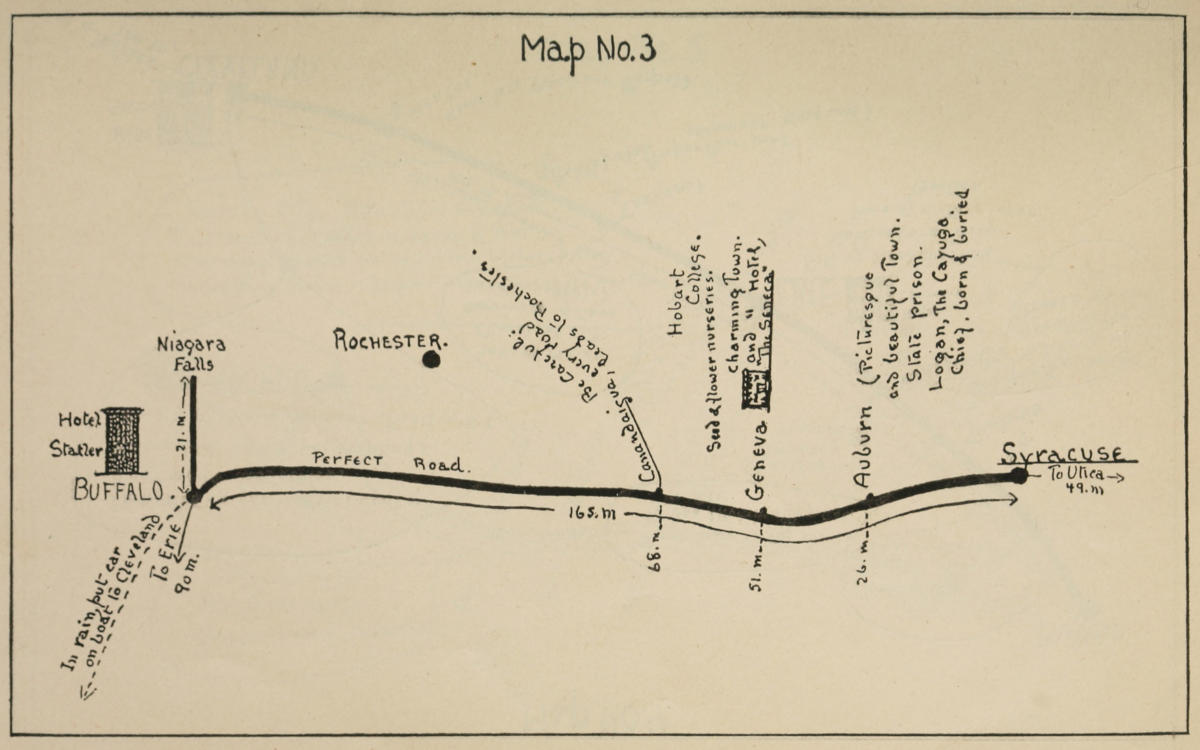
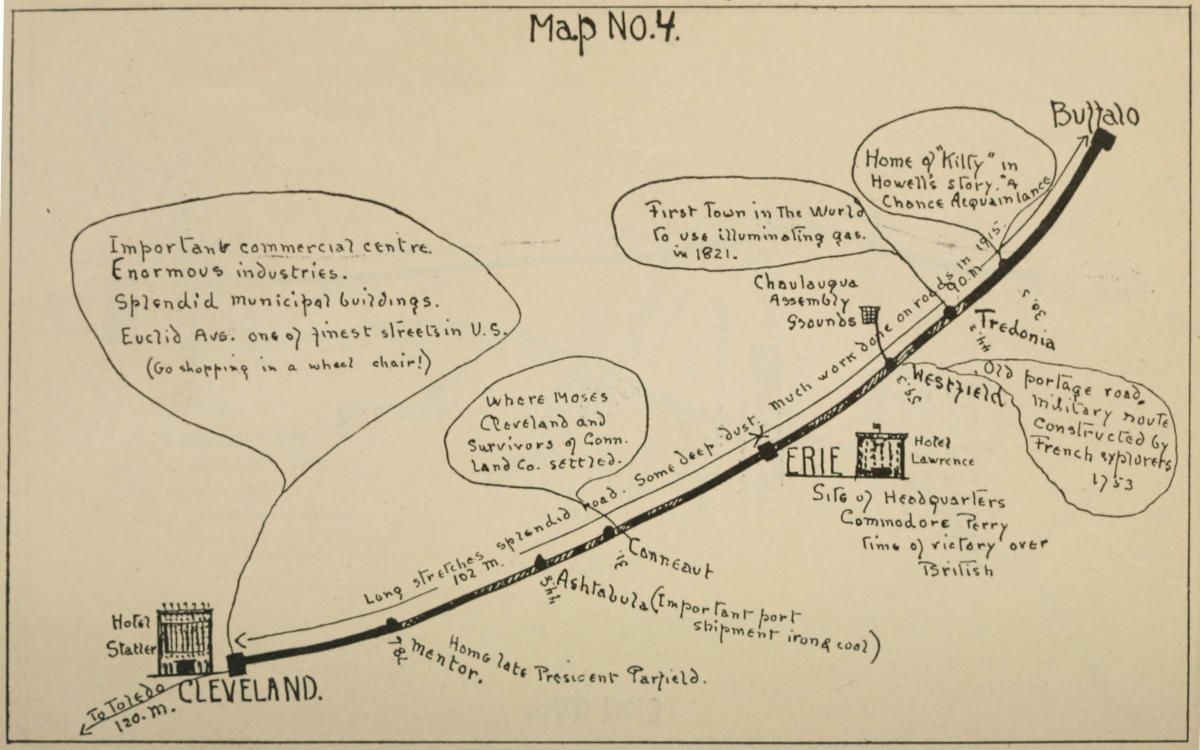
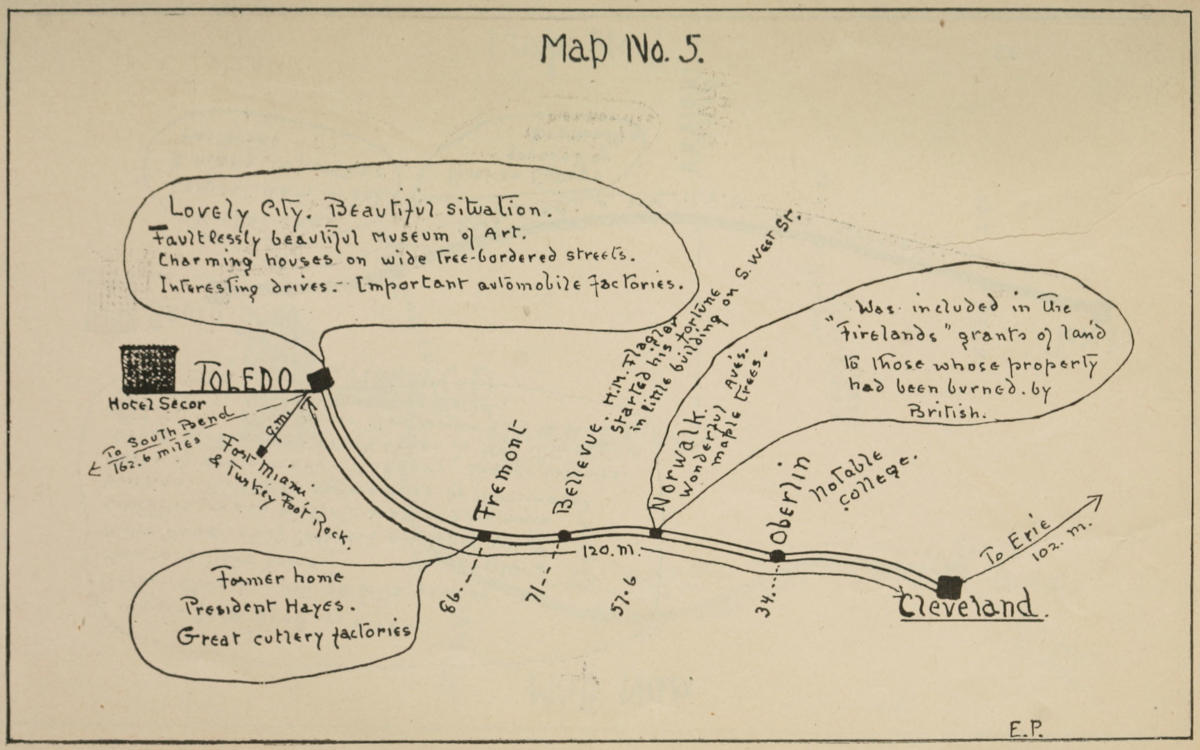
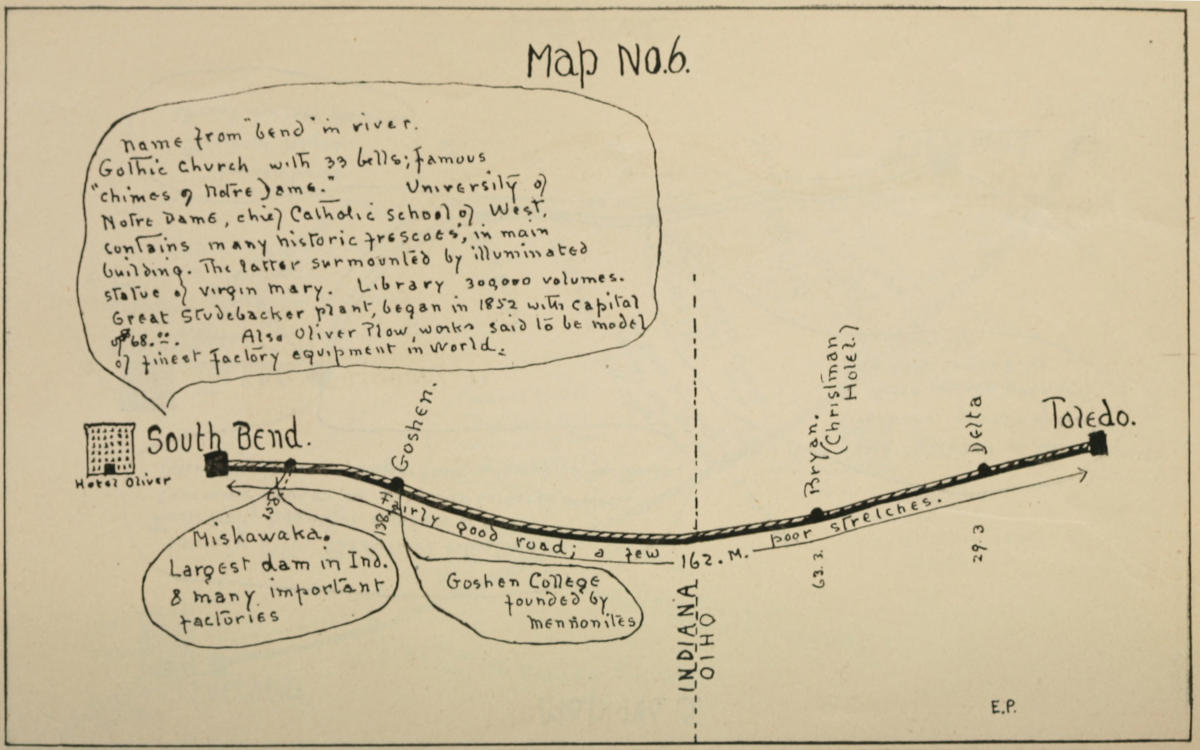
“Qui s’excuse s’accuse.” Which, I suppose, proves
this a defence to start with! But having been a few
times accused, there are a few explanations I want very
much to make.
When this cross-continent story was first suggested,
it seemed the simplest sort of thing to undertake. All
that was necessary was to put down experiences as they
actually occurred. No imagination, or plot or characterization—could
anything be easier? But when the
serial was published and letters began coming in, it became
unhappily evident that writing fact must be one
of the most unattainably difficult accomplishments in the
world.
In the first place, only those who, having lived long
in a particular locality and knowing it in all its varying
seasons, are qualified truly to present its picture.
The observations of a transient tourist are necessarily
superficial, as of one whose experiences are merely a
series of instantaneous impressions; at one time colored
perhaps too vividly, at another fogged; according to the
sun or rain at one brief moment of time.
It would be very pleasant to write nothing but eulogies
of people and places, but after all if a personal
narrative were written like an advertisement, praising
everything, there would be no point in praising anything,
would there?
Compared with crossing the plains in the fifties, the
worst stretch of our most uninhabited country is today
the easiest road imaginable. There are no longer any
dangers, any insurmountable difficulties. To the rugged
sons of the original pioneers, comments upon “poor
roads”—that are perfectly defined and traveled-over
highways—or “poor hotels”—where you can get not only
a room to yourself, but steam heat, electric light, and
generally a private bath—must seem an irritatingly
squeamish attitude. “Poor soft weaklings” is probably
not far from what they think of people with such a point
of view.
On the other hand if I, who after all am a New Yorker,
were to pronounce the Jackson House perfect, the City
of Minesburg beautiful, the Trailing Highway splendid,
everyone would naturally suppose the Jackson House
a Ritz, Minesburg an upper Fifth Avenue, and the Trailing
Highway a duplicate of our own state roads, to say
the least!
I am more than sorry if I offend anyone—it is the
last thing I mean to do—at the same time I think it best
to let the story stand as it was written; taking nothing
back that seems to me true, but acknowledging very humbly
at the outset, that after all mine is only one out of
a possible fifty million other American opinions.
BY MOTOR TO THE GOLDEN GATE — CHAPTER I IT CAN’T BE DONE—BUT THEN, IT IS PERFECTLY SIMPLE
“Of course you are sending your servants
ahead by train with your luggage and all
that sort of thing,” said an Englishman.
A New York banker answered for me: “Not at
all! The best thing is to put them in another
machine directly behind, with a good mechanic.
Then if you break down the man in the rear and
your own chauffeur can get you to rights in no
time. How about your chauffeur? You are sure
he is a good one?”
“We are not taking one, nor servants, nor mechanic,
either.”
“Surely you and your son are not thinking of
going alone! Probably he could drive, but who
is going to take care of the car?”
“Why, he is!”
At that everyone interrupted at once. One
thought we were insane to attempt such a trip;
another that it was a “corking” thing to do. The
majority looked upon our undertaking with typical
New York apathy. “Why do anything so
dreary?” If we wanted to see the expositions,
then let us take the fastest train, with plenty of
books so as to read through as much of the way
as possible. Only one, Mr. B., was enthusiastic
enough to wish he was going with us. Evidently,
though, he thought it a daring adventure, for he
suggested an equipment for us that sounded like
a relief expedition: a block and tackle, a revolver,
a pickaxe and shovel, tinned food—he forgot
nothing but the pemmican! However, someone
else thought of hardtack, after which a chorus
of voices proposed that we stay quietly at
home!
“They’ll never get there!” said the banker,
with a successful man’s finality of tone. “Unless
I am mistaken, they’ll be on a Pullman inside of
ten days!”
“Oh, you wouldn’t do that, would you?” exclaimed
our one enthusiastic friend, B.
I hoped not, but I was not sure; for, although I
had promised an editor to write the story of our
experience, if we had any, we were going solely
for pleasure, which to us meant a certain degree
of comfort, and not to advertise the endurance of
a special make of car or tires. Nor had we any
intention of trying to prove that motoring in
America was delightful if we should find it was
not. As for breaking speed records—that was the
last thing we wanted to attempt!
“Whatever put it into your head to undertake
such a trip?” someone asked in the first
pause.
“The advertisements!” I answered promptly.
They were all so optimistic, that they went to my
head. “New York to San Francisco in an X— car
for thirty-eight dollars!” We were not going
in an X— car, but the thought of any machine’s
running such a distance at such a price immediately
lowered the expenditure allowance for our
own. “Cheapest way to go to the coast!” agreed
another folder. “Travel luxuriously in your own
car from your own front door over the world’s
greatest highway to the Pacific Shore.” Could
any motor enthusiasts resist such suggestions?
We couldn’t.
We had driven across Europe again and again.
In fact I had in 1898 gone from the Baltic to
the Adriatic in one of the few first motor-cars
ever sold to a private individual. We knew European
scenery, roads, stopping-places, by heart.
We had been to all the resorts that were famous,
and a few that were infamous, but our own land,
except for the few chapter headings that might
be read from the windows of a Pullman train,
was an unopened book—one that we also found
difficulty in opening. The idea of going occurred
to us on Tuesday and on Saturday we were to
start, yet we had no information on the most
important question of all—which route was the
best to take. And we had no idea how to find
out!
The 1914 Blue Book was out of print, and the
new one for this year not issued. I went to various
information bureaus—some of those whose
advertisements had sounded so encouraging—but
their personal answers were more optimistic than
definite. Then a friend telegraphed for me to
the Lincoln Highway Commission asking if road
conditions and hotel accommodations were such
that a lady who did not want in any sense to
“rough it” could motor from New York to California
comfortably.
We wasted a whole precious thirty-six hours
waiting for this answer. When it came, a slim
typewritten enclosure helpfully informed us that
a Mrs. Somebody of Brooklyn had gone over the
route fourteen months previously and had written
them many glowing letters about it. As even the
most optimistic prospectus admitted that in 1914
the road was as yet not a road, and hotels along
the sparsely settled districts had not been built,
it was evident that Mrs. Somebody’s idea of a
perfect motor trip was independent of roads or
stopping-places.
Meanwhile I had been told that the best information
was to be had at the touring department of
the Automobile Club. So I went there.
A very polite young man was answering questions
with a facility altogether fascinating. He
told one man about shipping his car—even the
hours at which the freight trains departed. To a
second he gave advice about a suit for damages;
for a third he reduced New York’s traffic complications
to simplicities in less than a minute; then
it was my turn:
“I would like to know the best route to San
Francisco.”
“Certainly,” he said. “Will you take a seat
over here for a moment?”
“This is the simplest thing in the world,” I
thought, and opened my notebook to write down
a list of towns and hotels and road directions.
He returned with a stack of folders. But as I
eagerly scanned them, I found they were all familiarly
Eastern.
“Unfortunately,” he said suavely, “we have not
all our information yet, and we seem to be out of
our Western maps! But I can recommend some
very delightful tours through New England and
the Berkshires.”
“That is very interesting, but I am going to
San Francisco.”
His attention was fixed upon a map of the
“Ideal Tour.” “The New England roads are
very much better,” he said.
“But, you see, San Francisco is where I am
going. Do you know which route is, if you prefer
it, the least bad?”
“Oh, I see.” He looked sorry. “Of course if
you must cross the continent, there is the Lincoln
Highway!”
“Can you tell me how much work has been done
on it—how much of it is finished? Might it not
be better on account of the early season to take a
Southern route? Isn’t there a road called the
Santa Fé trail?”
“Why, yes, certainly,” said the nice young
man. “The road goes through Kansas, New
Mexico and Arizona. It would be warmer assuredly.”
“How about the Arizona desert? Can we get
across that?”
“That is the question!”
“Perhaps we had better just start out and ask
the people living along the road which is the best
way farther on?”
The young man brightened at once. “That
would have been my suggestion from the beginning.”
Once outside, however, the feasibility of asking
our road as we came to it did not seem very practical,
so I went to Brentano’s to buy some maps.
They showed me a large one of the United States
with four routes crossing it, equally black and
straight and inviting. I promptly decided upon
the one through the Allegheny Mountains to
Pittsburgh and St. Louis when two women I
knew came in, one of them Mrs. O., a conspicuous
hostess in the New York social world, and a
Californian by birth. “The very person I need,”
I thought. “She knows the country thoroughly
and her idea of comfort and mine would be the
same.”
“Can you tell me,” I asked her, “which is the
best road to California?”
Without hesitating she answered: “The Union
Pacific.”
“No, I mean motor road.”
Compared with her expression the worst skeptics
I had encountered were enthusiasts. “Motor
road to California!” She looked at me pityingly.
“There isn’t any.”
“Nonsense! There are four beautiful ones and
if you read the accounts of those who have crossed
them you will find it impossible to make a choice
of the beauties and comforts of each.”
She looked steadily into my face as though to
force calmness to my poor deluded mind. “You!”
she said. “A woman like you to undertake such
a trip! Why, you couldn’t live through it! I have
crossed the continent one hundred and sixty odd
times. I know every stick and stone of the way.
You don’t know what you are undertaking.”
“It can’t be difficult; the Lincoln Highway
goes straight across.”
“In an imaginary line like the equator!” She
pointed at the map that was opened on the counter.
“Once you get beyond the Mississippi the
roads are trails of mud and sand. This district
along here by the Platte River is wild and dangerous;
full of the most terrible people, outlaws
and ‘bad men’ who would think nothing of killing
you if they were drunk and felt like it. There
isn’t any hotel. Tell me, where do you think you
are going to stop? These are not towns; they are
only names on a map, or at best two shacks and a
saloon! This place North Platte why, you
couldn’t stay in a place like that!”
I began to feel uncertain and let down, but I
said, “Hundreds of people have motored across.”
“Hundreds and thousands of people have done
things that it would kill you to do. I have seen
immigrants eating hunks of fat pork and raw
onions. Could you? Of course people have gone
across, men with all sorts of tackle to push their
machines over the high places and pull them out
of the deep places; men who themselves can sleep
on the roadside or on a barroom floor. You may
think ‘roughing it’ has an attractive sound, because
you have never in your life had the slightest
experience of what it can be. I was born and
brought up out there and I know.” She quietly
but firmly folded the map and handed it to the
clerk. “I am sorry,” she said, “if you really
wanted to go! By and by maybe if they ever
build macadam roads and put up good hotels—but
even then it would be deadly dull.”
For about five minutes I thought I had better
give it up, and I called up my editor. “It looks
as though we could not get much farther than the
Mississippi.”
“All right,” he said, cheerfully, “go as far as
the Mississippi. After all, your object is merely
to find out how far you can go pleasurably! When
you find it too uncomfortable, come home!”
What We Finally Carried
No sooner had he said that than my path seemed
to stretch straight and unencumbered to the Pacific
Coast. If we could get no further information,
we would start for Philadelphia, Pittsburgh
and St. Louis, as we had many friends in these
cities, and get new directions from there, but as
a last resort I went to the office of a celebrated
touring authority and found him at his desk.
“I would like to know whether it will be possible
for me to go from here to San Francisco by
motor?”
“Sure, it’s possible! Why isn’t it?”
“I have been told the roads are dreadful and the
accommodations worse.”
He surveyed me from head to foot with about
the same expression that he might have been expected
to use if I had asked whether one could
safely travel to Brooklyn.
“You won’t find Ritz hotels every few miles,
and you won’t find Central Park roads all of the
way. If you can put up with less than that, you
can go—easy!” Whereupon he reached up over
his head without even looking, took down a map,
spread it on the table before him, and unhesitatingly
raced his blue pencil up the edge of the
Hudson River, exactly as the pencil of Tad draws
cartoons at the movies.
“You go here—Albany, Utica, Syracuse.”
“No, please!” I said. “I want to go by way
of Pittsburgh and St. Louis.”
“You asked for the best route to San Francisco!”
He looked rather annoyed.
“Yes, but I want to go by way of St. Louis.”
“Why do you want to go to St. Louis?”
“Because we have friends there.”
“Well, then, you had better take the train and
go and see them!” Indifferently he took down
another map and made a few casual blue marks
on the mountains of Pennsylvania. “They’re rebuilding
roads that will be fine later in the season,
but at the moment [April, 1915] all of these places
are detours. You’ll get bad grades and mud over
your hubs! Of course, if you’re set on going that
way, if you want to burn any amount of gasoline,
cut your tires to pieces, and strain your engine—go
along to St. Louis. It’s all the same to me; I
don’t own the roads! But you said you wanted
to take a motor trip.”
“Then Chicago is much the best way?”
“It is the only way!”
He did not wait for my agreement, but throwing
aside the second map and turning again to the
first, his pencil swooped down upon Buffalo and
raced to Cleveland as though it fitted in a groove.
He seemed to be in a mental aeroplane looking
actually down upon the roads below.
“There is a detour you will have to take here.
You turn left at a white church. This stretch
is dusty in dry weather, but along here,” his pencil
had now reached Iowa and Nebraska, “you will
have no trouble at all—if it doesn’t rain.”
“And if it rains?”
“Well, you can get out your solitaire pack!”
“For how long?” The vision of the sort of
road it must be if that man thought it impassable
was hard to imagine.
“Oh, I don’t know; a week or two, even three
maybe. But when they are dry there are no faster
roads in the country. What kind of a car are
you going in?”
I told him proudly. Instead of being impressed
by its make and power he remarked: “Humph!
You’d better go in a Ford! But suit yourself!
At any rate, you can open her wide along here, as
wide as you like if the weather is right.” At the
foot of the Rocky Mountains his pencil swerved
far south.
“Way down there?” I asked. “That is all desert.
Can we cross the desert?”
“Why can’t you?” He looked me over from
head to foot. I had felt he held small opinion of
me from the start. “I only wondered if the roads
were passable,” I answered meekly.
“The roads are all right.” He accented the
word “roads.”
“I was wondering if there were hotels.”
“And what if there aren’t? Splendid open dry
country; won’t hurt anyone to sleep out a night or
two. It’d do you good! A doctor’d charge you
money for that advice. I’m giving it to you free!”
On the doorstep at home I met my amateur
chauffeur.
“Have you found out about routes?” he asked.
“We go by way of Cleveland and Chicago.”
He looked far from pleased. “Is that so much
the best way?”
“It is the only way,” and I imitated unconsciously
the voice of the oracle of the touring
bureau.
One would have thought that we were starting
for the Congo or the North Pole! Friends and
farewell gifts poured in. It was quite thrilling,
although myself in the rôle of a venturesome explorer
was a miscast somewhere. Every little
while Edwards, our butler, brought in a new package.
One present was a dark blue silk bag about
twenty inches square like a pillow-case. At first
sight we wondered what to do with it. It turned
out afterward to be the most useful thing we had
except a tin box, the story of which comes later.
The silk bag held two hats without mussing, no
matter how they were thrown in, clean gloves,
veils, and any odd necessities, even a pair of slippers.
The next friend of mine going on a motor
trip is going to be sent one exactly like it!
By far the most resplendent of our presents was
a marvel of a luncheon basket. Edwards staggered
under its massiveness, and we all gathered
around its silver-laden contents; bottles and jars,
boxes and dishes, flat silver and cutlery, enamelware
and glass, food paraphernalia enough to set
before all the kings of Europe.
“I could not bear,” wrote the giver, “to think
of your starving in the desert.”
Stowing the Luggage
Mr. B. brought us a block and tackle and two
queer-looking canvas squares that he explained
were African water buckets. All we needed further,
he told us, were fur sleeping-bags and we
would be quite fixed!
Another thing sent us was an air cushion. Air
cushions make me feel seasick, but the lady who
traveled with us loved them. By the way, we
added a passenger at the last moment. On Friday
afternoon, a member of our family announced
she was going with us to protect us.
“The only thing is,” we said, “there is no
place for you to sit except in the back underneath
the luggage.”
“I adore sitting under luggage; it is my favorite
way of traveling,” she replied. And as we
adore her, our party became three.
We had expected to leave New York about nine
o’clock in the morning, but at eleven we were still
making selections of what we most needed to take
with us, and finally choosing the wrong things
with an accuracy that amounted to a talent. Besides
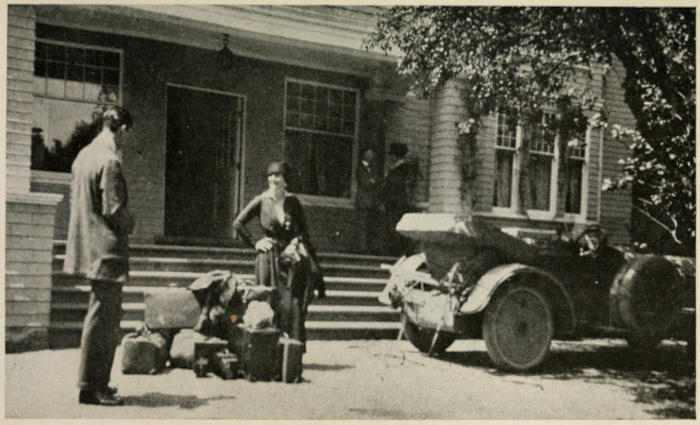
our regular luggage, the sidewalk was littered
with all the entrancing-looking traveling
equipment that had been sent us, and nowhere to
stow it. By giving it all the floor space of the tonneau,
we managed to get the big lunch basket in.
Then we helped in the lady who traveled with us
and added a collection of six wraps, two steamer
rugs, and three dressing-cases, a typewriter, a
best big camera and a little better one—with both
of which we managed to take the highest possible
percentage of worst pictures that anyone ever
brought home—a medicine chest, and various other
paraphernalia neatly packed over and around her.
Of this collection our passenger was allowed one
of the dressing-cases, two wraps and a big bag.
As there was not room for three bags on the back,
my son and I divided a small motor trunk between
us; I took the trays and he the bottom. It seemed
at the time a simple enough arrangement.
On our way up Fifth Avenue, two or three times
in the traffic stops, we found the motors of friends
next to us. Seeing our quantity of luggage, each
asked: “Where are you going?”
Very importantly we answered: “To San
Francisco!”
“No, really, where are you going?”
“SAN-FRAN-CIS-CO!!!” we called back. But
not one of them believed us.
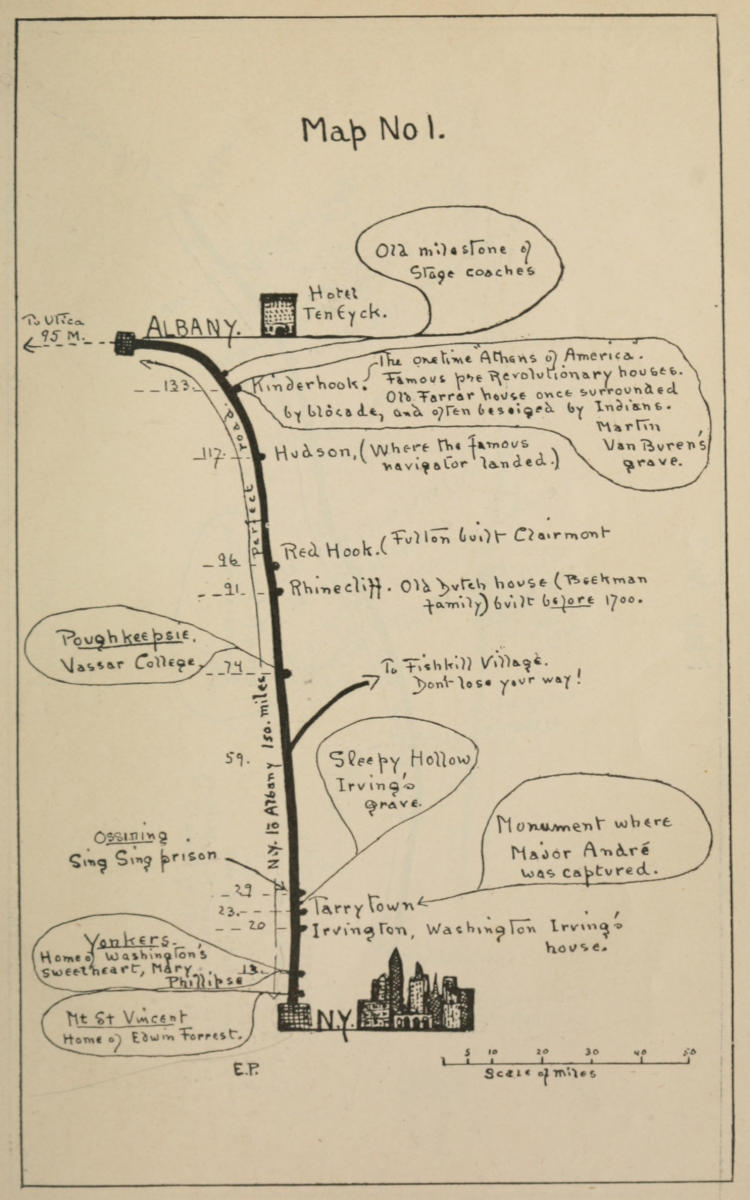
CHAPTER II ALBANY, FIRST STOP [1]
We had intended making Syracuse our
first night’s stopping-place. It can easily
be done, but as we were so late starting—it
was nearly half-past one—we decided upon
Albany instead. We felt very self-important; it
even seemed that people ought to cheer us a little
as we passed. A number of persons, especially
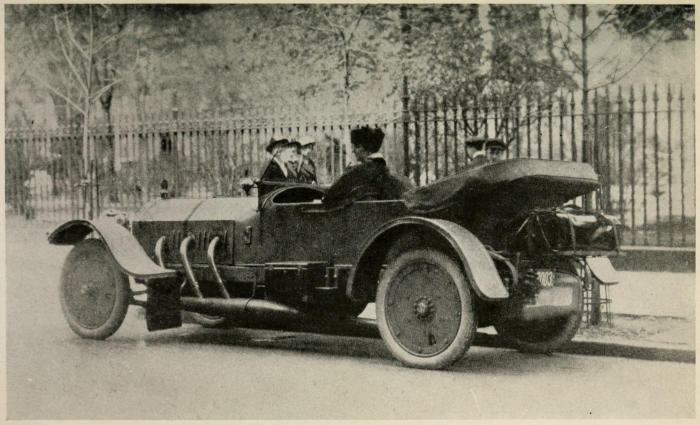
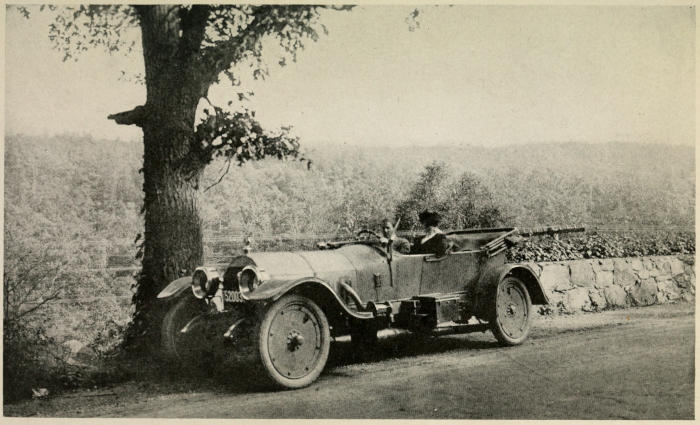
boys, did look with curiosity at our unusually foreign
type of car—solid wheels and exhaust tubes
through the side of the hood always attract attention
in America—but no one seemed to divine or
care about the thrilling adventure we were setting
out upon!
For about thirty miles outside of New York the
road grew worse and worse. Through Dobbs
Ferry and Ardsley the surface looked fairly good,
but was full of brittle places. Our chauffeur says
that the word brittle has no sense, but it is the
only one I can think of to convey the sudden sharp
flaked-off places that would snap the springs of
a car going at fair speed.
I was rather perturbed; because if the road
was as bad as this near home, what would it be
further along? But the further we went the better
it became, and for the latter seventy or eighty
miles it was perfect.
The Hudson River scenery, the lower end of it,
always oppressed me; I can never think of anything
but the favorite fiction descriptions of the
“mansions where the wealthy reside.” Such
overwhelmingly serious piles of solid masonry,
each set squarely in the middle of a seed catalog
painter’s dream of pictorial lawn! Steep hills,
steep houses, steep expenditure, typify the lower
Hudson, but the scenery a hundred miles above
the river’s mouth is enchanting! Wide, beautiful
views of rolling country; great comfortable-looking
houses with hundreds of acres about them;
here, though many are worth fortunes, one feels
that they were built solely to answer the individual
need of their owners, and as homes.
Out on a knoll, with the river spread like a great
silver mirror in the distance, we christened our
tea-basket. It took us five minutes to burrow
down and unpile all the things we had on top of
it, and five more to find in which compartment
were huddled a few sandwiches and in which other
box was the cake. For twenty minutes we boiled
water in our beautiful little silver kettle, but as
at the end of that time the boiling water was tepid,
we gave it up and ate our sandwiches as recommended
by the Red Queen in “Alice” who offered
her dry biscuits for thirst. Then we spent fifteen
minutes in putting everything away again.
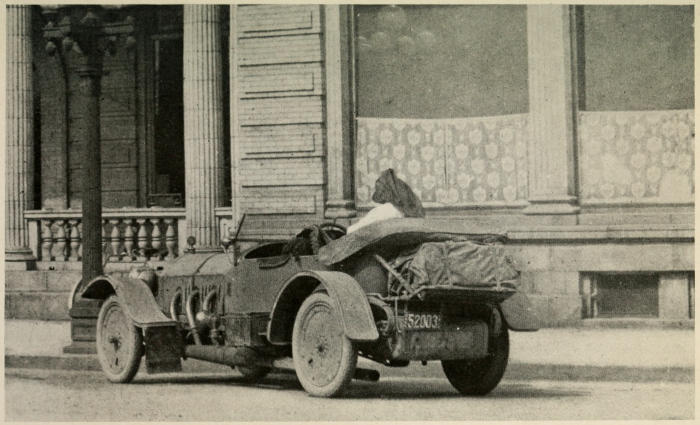
Leaving Gramercy Park, New York
“When we get out on the prairies, where can
we get supplies enough to fill it?” I wondered.
Our “chauffeur” mumbled something about
“strain on tires” and “not driving a motor
truck.”
“It is a most wonderfully magnificent basket,”
said the lady who was traveling with us, rather
wistfully, as she braced all the heaviest pieces of
luggage between her and it.
Not counting the time out for tea, which we
didn’t have, it took us five hours and a half from
Fifty-ninth Street, New York, to the Ten Eyck
at Albany.
The run should have been one hundred and fifty
miles, but we made it one hundred and sixty because
we lost our way at Fishkill. We had no
Blue Book, but had been told we need only follow
the river all the way. At Fishkill the road runs
into the woods and the river disappears until it
seems permanently lost! We wandered around
and around a mountain in a wood for about ten
miles before we discovered a signpost pointing
the way to Albany!
Fortunately we had telegraphed ahead for
rooms at the Ten Eyck, or they would not have
been able to take us in. The hotel was filled to
overflowing with senators and assemblymen, but
we had very comfortable rooms and delicious
coffee in the morning before we left for Syracuse.
CHAPTER III A BREAKDOWN
Only two hundred miles from home and a
breakdown! We had left Albany early in
the morning and were running happily
along over a road as smooth as a billiard table.
Everything went beautifully until we were about
twenty miles from Utica when our “chauffeur”
said he heard a squeak. Gloom began to shadow
his features. Half a mile further, the squeak became
a knock and gloom deepened. He stopped
the engine, got out and looked under the hood,
lifted the cranking handle once or twice and threw
his hands up in a gesture of abject despair. His
lips framed all sorts of words but all he said aloud
was: “It’s a bearing!” He looked so utterly
dejected that in my sympathy for him (starting
out on such a trip with a mother and a cousin and
neither of us of the slightest use to him) I forgot
that we were all equally concerned in whatever
this misfortune about a “bearing” might be.
“Couldn’t we try to get to a garage?” timorously
asked the one in the back.
Our “chauffeur” shook his head. “Not without
wrecking the engine. There is nothing for it but
to be towed to a machine shop.”
“And then?” I asked.
“That depends——” was his ambiguous answer,
and we said nothing more.
Is there anything more exhilarating than an
automobile running smoothly along? Is there
anything more dispiriting than the same automobile
unable to go? The bigger and heavier it is,
the worse the situation seems to be. You might
get out and push a little one, but a big car standing
stonily silent portends something of the inexorability
of Fate.
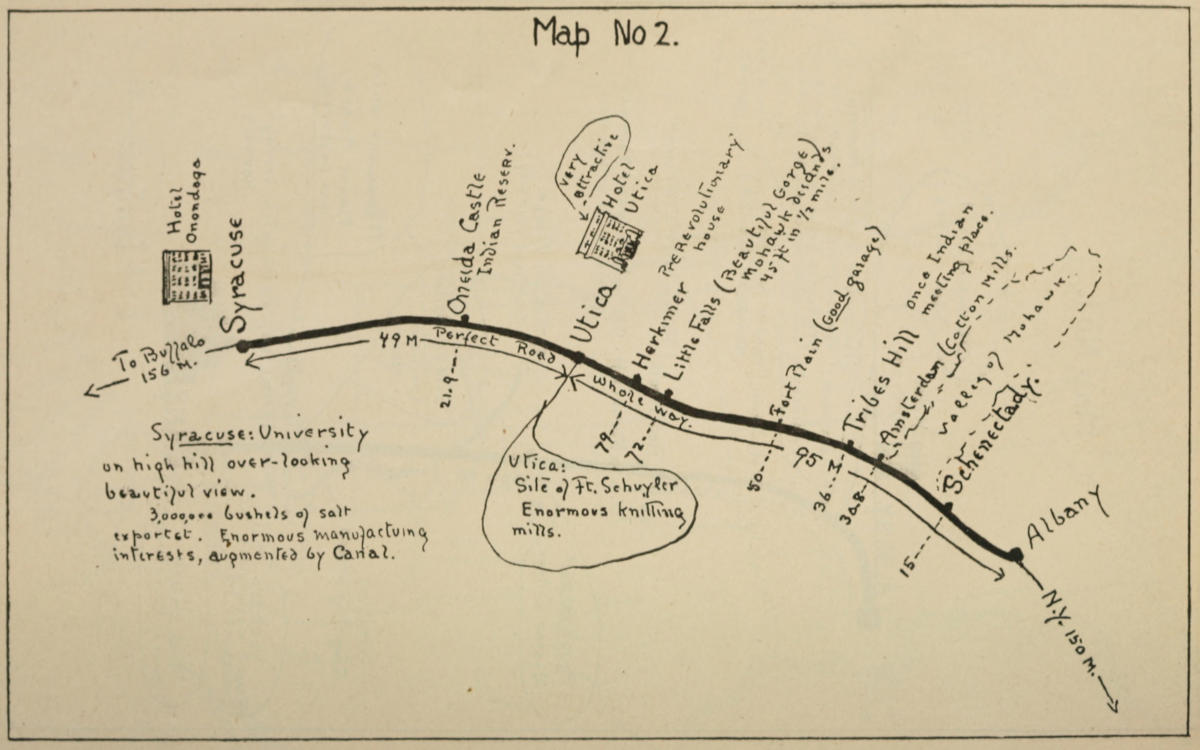
And there we sat. Presently an old man came
jogging along in a buggy. “Any trouble?” He
grinned as the owner of a horse always does grin
under such circumstances. But after a few further
exasperating remarks, he offered kindly, “Say,
son, I’ll drive you to a good garage down the road;
there are others a mile nearer, but Hoffman and
Adams’ place at Fort Plain is first class.”
There had been nothing in our informer’s conversation
to give us great confidence in his recommendation
but the garage turned out even better
than he said. There was a first-rate machine shop
with an expert mechanic in charge of it, who
peered into our engine dubiously:
“If it was only a Ford or a Cadillac,” said he,
“I could fix you up right away! But a bearing for
that car of yours’ll like as not have to be made.
Can you get one in New York, do you think?”
An unusual and “special” car may be very
smart-looking and be particularly easy to trace
if stolen, but in a breakdown a make of popular
type would be best—a Ford ideal. You could buy
a whole new one at the first garage you came to,
or maybe get a missing part at the first ten-cent
store. We discovered the difficulty, or inconvenience
rather, of repairing ours, within twenty-four
hours of leaving home.
The telephone service at Fort Plain was hopeless.
For over four hours we tried to get the
agency in New York; even then it was doubtful
whether they would have the part. Meantime the
engine had been taken down and the cause of the
burnt-out bearing discovered to be a broken oil
pipe. They mended that and our “chauffeur”
was a little more cheerful when he discovered that
they had all necessary tools and things to make a
new bearing by hand, which they started to do.
The lady who was traveling with us and I walked
round and round the town. We sent picture postals
by the dozen quite as though we had arrived
where we had intended to be. We discovered a restaurant
where we could, if it should be necessary,
return for lunch, and a news stand where we fortified
ourselves with chocolate and magazines. After
which reconnoitering we returned to the garage
prepared to stay where we were indefinitely.
Mr. Hoffman made us comfortable in the office,
where I found excitement in the workings of a
very gorgeous and complicated cash register. It
had all sorts of knobs and buttons in every variety
of color, and was altogether fascinating! I wonder
if anyone ever has opened a store for the mere
joy of playing on the cash register. I wanted to
set up a shop at once!
Still in New York State
Finally New York telephoned they had a bearing,
so we decided to go on to Utica by train.
Someone told us—I can’t remember who it was—that
beyond Albany the nearest good hotel was
the Onondaga at Syracuse; but as we would surely
have to stop at some poor hotels we thought we
might as well get used to a lack of luxury first as
last, so we took the train for Utica, to wait there
until our car should be repaired.
Notwithstanding our altruistic intention to accept
cheerfully whatever accommodations offered,
our delighted surprise may be imagined when we
entered the beautiful, wide, white marble lobby of
the brand-new Hotel Utica! Our rooms were big
and charmingly furnished. One had light blue
damask hangings, and cane furniture; another mahogany
and English chintz; each of them had its
own bathroom with best sort of plumbing.
The food is very good and reasonable as to
price. One dinner for instance was a dollar and
thirty cents for each of us, including crêpes Suzette,
which were delicious! There was music
during dinner, and afterward dancing. As in
most places outside of Broadway, they still call
every sort of dance that is not a waltz the “tango.”
Sitting in the lobby for a little while in the evening,
we noticed that the clerk at the desk, instead
of showing the blank indifference typical of hotels
on Fifth Avenue and Madison Avenue, greeted all
arriving guests with a hearty “How do you do?”
They also gave us souvenirs. A little gilt powder
pencil, a leather change purse, and a gilt stamped
leather cardcase. We felt as though we had been
to a children’s party.
Our “chauffeur,” who went back to Fort Plain
at daybreak, returned with the car in the late afternoon,
so that we were able to go on again after a
delay of only a day and a half.
CHAPTER IV PENNSYLVANIA, OHIO AND INDIANA
Erie is a nice, homelike little city, full of
business; and our hotel, the Lawrence, very
good. There was an irate man at the desk
this morning. “Say, what kind of a hotel do you
run? That dancing went on until three o’clock
this morning! It’s an outrage!” The clerk was
sorry, and willingly arranged to have the guest
put in a quiet room, but he bit off the end of a
cigar viciously and went out still storming about
the disgrace of allowing such a performance in
a reputable hotel.
“He ought to take a trip to little old New York
if he thinks dancing till three is late,” said a bystander.
“He’d better go back to the farm and go to
roost with the chickens!” answered another.
From Albany the roads have been wonderful,
wide and smooth as a billiard table all the way.
There were stretches of long straight road as in
France—much better than any in France since the
first year theirs were built. One thing that we
have already found out; we are seeing our own
country for the first time! It is not alone that a
train window gives one only a piece of whirling
view; but the tracks go through the ragged outskirts
of the town, past the back doors and through
the poorest land generally, while the roads become
the best avenues of the cities, and go past the
front entrances of farms. And such farms! We
had expected the scenery to be uninteresting! No
one with a spark of sentiment for his own country
could remain long indifferent. Well-fenced fields
under perfect cultivation; splendid-looking grazing
pastures, splendid-looking cows, horses,
houses, barns. And in every barn, a Ford. And
fruits, fruits, fruits! Miles and miles and miles
of grapevines as neatly trimmed and evenly set
in rows as soldiers on parade.
“It looks like Welch’s grape juice!” we said
and laughed. It was!
So much for the country. The towns—only the
humanizing genius of Julian Street could ever tell
them apart. Small Utica dressed herself in taupe
color, big Syracuse wore red with brown trimmings.
The favorite hues were brown and red,
though one or two were fond of gray, but all looked
almost exactly alike. Each had a bustling and
brown business center, with trolley cars swinging
around the corners, pedestrians elbowing their
way past big new dry-goods stores’ windows, and
automobiles driving up to the curbs; each had a
wide tree-bordered residence avenue, with block-shaped
detached houses, garnished with cupolas
and shelf-paper trimmings. The houses of Utica
had deeper gardens than most, and there was a
stable at the rear of nearly every one on the proverbial
Genesee Street. Syracuse, like the cities
in Holland, was picturesquely crossed by canals
and, like the thriving commercial center it is, by—this
is just our personal opinion—all the freight
trains of the world! It took us almost an hour to
dodge between the continuous parade of box, refrigerator,
and flat cars! Of the salt, for which
Syracuse is so celebrated—the marshes were to
the north of our road—we saw not an ounce. Perhaps
those millions of freight cars were all full
of it.
For a surprise we came upon Geneva, a perfect
little Quaker, sitting on her own garden lawn at
the edge of the road leading west. Facing an old
Puritan church across a square of green, stood a
row of little houses that suggested the setting of
a play like “Pomander Walk.” To the moneyed
magnates of the mansions of the lower Hudson,
to the retired tradesmen residing in some of the
red and brown residences of the various Genesee
avenues, the demure little square of huddled
houses of Geneva might seem contemptibly mean.
Yet the mansions left us cold, while the little
houses indescribably warmed our hearts. It was
like the unexpected finding of a bit of fragile and
beautiful old porcelain in a brickyard. We expected
to see the counterpart of one of the heroines
of Miss Austen’s novels come out of one of
the quaint little doorways.
We would have liked to find a tea shop on the
square, for it was lunch time and we hated having
to turn into Main Street and make our choice between
several unprepossessing hotels. Geneva
was certainly a town of unexpected contrasts.
Although the little houses around the corner were
so adorable, the Hotel Seneca from its façade of
factory brick, sitting flat on the street, never for
a moment warned us of an interior looking exactly
like the illustrations in Vogue! White woodwork,
French blue cut velvet, delicate spindly Adam
furniture, a dining-room all white with little
square-paned mirror doors, too attractive! Luncheon
was delicious and well served by waitresses in
white dresses, crisp and clean.
Our great surprise has been the excellence of
the roads and the hotels, and our really beautiful
and prosperous country. Going through these
miles after miles of perfect vineyards and orchards,
these wonderfully kept farms, it seems impossible
to believe that in New York City are long
bread lines, and that in other parts of our great
country there is strife, hunger, poverty and waste.
In Buffalo we stopped at the Statler, a commercial
hotel with a much advertised and really
quite faultless service that carries the idea of personal
attention to guests to its highest degree.
When you register, the clerk reads your name and
invariably thereafter everyone calls you by it. In
fact they did even more than that. I had wired
ahead for rooms and as soon as I went up to
register, the clerk, whose own name was printed
and hung over the desk, said: “Your room is
No. 355, Mrs. Post!” I had no idea where Room
355 was, but I felt as though I must have occupied
it often before—as though in fact it in some personal
way belonged to me. A decidedly pleasant
contrast to a certain New York hotel where, after
stopping four months under its roof, the clerks
asked a guest her name!
The Buffalo hotel publishes a little pamphlet
called the “Statler Service Codes.” It contains
advice to employees, an explanation of what is
meant by good service, a talk about tipping and
a talk to patrons. A few of its sayings, copied at
random, are:
“At rare intervals some perverse member of
our force disagrees with a guest. He maintains
that this sauce was ordered when the guest says
the other. Or that the boy did go up to the room.
Or that it was a room reserved and not dinner for
six. Either may be right. But no employee of
this hotel is allowed the privilege of arguing any
point with a guest.”
“A door man can swing the door in a manner
to assure the guest that he is in His Hotel, or he
can sling it in a way that sticks in the guest’s crop
and makes him expect to find at the desk a sputtery
pen sticking in a potato.”
After giving every thought to the guest’s comfort,
the end of the little book also asks fairness
on the part of the guests. Such as, not to say you
waited fifteen minutes when you waited barely
five; or not to object if the clerks can’t read your
signature if you write in hieroglyphics.
In the morning at the Statler, a newspaper is
pushed under your door and on it is a printed slip
saying: “Good morning! This is your paper
while you are in Buffalo.” And when you are
ready to leave instead of calling, “Front! Get
355’s baggage!” the Statler clerk says, “Go up to
Mrs. Post’s room and bring down her things!”
I certainly liked it very much. And I am sure
other people must feel the same.
If the hotel tried to make us pleased with ourselves,
we were not allowed to keep our self-complacence
long. When we went to Niagara, we
passed a sort of taxidermist’s museum; its windows
at least were full of stuffed beasts. The proprietor,
standing in front of it, tried his best to
make us “step inside and see the mummied mermaid”
and his museum of the greatest educational
wonders of the world. When we showed no interest
in his collection he burst out with:
“If you’re going to remain as ignorant about
everything you come to, as you are about this
wonderful museum, traveling won’t educate you
any!”
Put a little differently, it might have hit a mark.
We had ourselves been saying, only a little while
before, that we were undoubtedly missing lots of
interesting things because we did not quite know
how or where to see them. Yet, though we are still
ignorant about the “wonders” of that particular
museum, we are not always so indifferent. We
have tried to look out for points of historical value
and we have found many things of great diversion
to ourselves. In Utica, for instance, we hung for
hours over the railings of an exhibit of china making
by the Syracuse pottery manufacturers. There
is an irresistible fascination in watching the potter
shaping pitchers, and the decorators putting
decalcomania on plates and drawing fine gilt lines.
The facility with which experts in any branch of
industry use their hands is a marvel and a delight
to me. I could stand indefinitely and watch a
glass-blower, or a potter, or a blacksmith, or a
paper hanger—anyone doing anything superlatively
well.
I am not thinking of describing the world’s wonder
of wonders, Niagara Falls, because everyone
knows they are less than an hour’s run from
Buffalo, with a splendid wide motor road leading
out to them, and because their stupendous beauty
has been described too often.
There were four bridal couples with us in the
elevator that took us down to go under the Falls.
One of the brides was apparently concerned about
the unbecomingness of the black rubber mackintosh
and hood that everyone puts on, for her evidently
Southern husband said aloud:
“Don’t you fret about it, Nelly, you look real
sweet in it, ’deed you do!” Whereupon each of
the other three patted around the edge of the hood
where her hair ought to be, and glanced a little
self-consciously at the arbiter of her own loveliness.
Later, the young Southerner linked his arm in
that of his bride lest she go too close to that terrific
torrent of drenching water. The other three
pairs walked gingerly through the soaking rock
galleries in three closely huddled units. And the
rest of us looked at them with that smiling interest
that one irresistibly feels for happy young couples
on their honeymoon.
On Sunday evening in Buffalo a man who looked
as though he had been lifted out of a yellow flour
barrel had come into the lobby of the hotel. We
could not tell whether he was black or white or
even human. A clerk, seeing us staring, remarked
casually: “Oh, he’s just a motorist who has come
from Cleveland. Gives you some idea of the
roads, doesn’t it?”
We started the next day therefore in a rather
disturbed frame of mind, and soon saw how on a
Sunday, when every motorist is out, he had looked
as he did. Even on Monday the dust was so thick
that the wind blew it in great yellow clouds, sometimes
making it impossible to see ahead. But
most of the way it blew to the left of us, leaving us
fairly clean and not enveloping us unless we had
to pass another car going our own way. As we
had gone out to the Falls in the morning, we did
not leave Buffalo until about two o’clock, but in
spite of bumpy roads and dust so thick that it
made us swerve a little, we reached Erie easily at
a little after six.
We left Erie the next day at two o’clock and
arrived in Cleveland at seven—which was as fast
as the Ohio speed limit of twenty miles an hour
would allow. The road was much the same as it
had been the day before. Forty miles of the whole
distance was rather rough and very dusty; the rest
was good, a little of it splendid.
At Mentor, about twenty-three miles before
Cleveland, we came to a number of beautiful
places that must have been the out-of-town homes
of Cleveland people. The houses, many of them
enormous, were long, low and white; not farmhouses
and not Colonial manor houses, but a most
happy adaptation of the qualities of both; dignified,
homelike, imposing and enchanting.[2]
The remark of the man at the museum in Buffalo
irresistibly recurs to me. We certainly won’t
be “educated” if our chauffeur can help it! He
is exactly like the time lock on a safe. Only instead
of being set for an hour, he is set for distance. At
Erie, for instance, he throws in his clutch, “Cleveland”? he
asks, and snap! nothing can make him
look to the left or the right of the road in front
of him.
“Oh, look! That’s the house where President
Garfield——”
Zip! we have passed it!
“Wait a minute, let me see that inscription——”
We are half a mile beyond! We arrive in
Cleveland, when click goes the lock and he stops
dead, and nothing will make him go further.
The food at the hotel in Cleveland, also a Statler,
was so extraordinary good that I asked where
the maître d’hôtel and his chefs had come from.
I thought that possibly on account of the war they
had secured the staff of Henri’s or Voisin’s or
Paillard’s in Paris, and was really surprised to
hear the head chef was from Chicago and the
maître d’hôtel from New York.
The dining-room service was quite as good as
the food. We did not wait more than a moment
before they brought our first course, and as soon
as we had finished that our plates were whisked
away and the second put before us. Never, even
in France, have we had better or more perfectly
cooked chicken casserole, and the hollandaise sauce
on the asparagus was of the exact smooth, golden
consistency and flavor that it ought to be, instead
of the various yellow acids, pastes, and eggy mixtures
that too often masquerade under the name.
Our waiter brought in crisp, fresh salad and expertly
and quickly made his own dressing. He
was in fact a paragon of his kind, serving all of
our meals without that everlasting patting and
fussing and fixing that most waiters go through
with until what you have ordered is so shopworn
and handled and cold that it is not fit to eat. Can
anything be more unappetizing than to have a
waiter, or two of them, breathing over your food
for half an hour?
Personally I hate hotel service. I hate to be
helped. In our own houses even children of six
resent it. I often wonder, why do we submit to
having the piece we don’t want, in the amount we
don’t want, put on the part of the plate we don’t
want it on, covering it with sauce if we hate sauce,
or giving us the dryest wisps if we like it otherwise,
by a waiter who bends unpleasantly close?
Why do we have everything we eat pinched between
the fork and spoon in that one-handed lobster-claw
fashion, and endure it in silence? All
of this is no fault of the waiter who, after all, is
trying to do the best he can in the way that has
been taught him. But why is the service in a hotel
so radically different from all good service in a
private house?
Cleveland, “the Sixth City”—and she likes to
have you know her rating—is certainly prosperous-looking
and in many ways beautiful. She
has wide, roomy streets with splendid lawns and
trees and houses. A few of the older mansions are
hideous but enormous, comfortable, and well built.
They look like the homes of people with no end of
money who are content to live in houses of American
architecture’s darkest period because they are
used to them and often because their fathers lived
in them. There is no suggestion of the upstart in
their ugliness. The whole city impresses one as
having a nice fat bank account and being in no
hurry to spend it. The municipal buildings, however,
are superb, and the newer dwelling houses
all that money and taste can make them, but almost
best of all, I liked the shops.
In a big new one on Euclid Avenue, two elderly
ladies with much-befeathered bonnets were ensconced
in a double rolling chair like those of the
Atlantic City boardwalk. An attentive young man
was pushing them about among bronzes and porcelains.
Stopping before a shelf of samples he
asked: “Are any of these at all like the coffee
cups you are looking for, Mrs. Davis?”
Mrs. Davis was so absorbed in the conversation
of her friend that the clerk had to repeat his question
three times before her purple feathers bobbed
toward the coffee cups casually.
“Coffee cups?” she added absently. “I don’t
think I care about any today, thank you. But you
might drive us through the linen department
and the lamp shades. The lamp shades are always
so pretty!” she added to her friend, exactly as
though, after telling her coachman to drive around
the east side of the park, she had remarked upon
the beauty of the wistaria.
“Does that lady drive about town in a rolling
chair?” I asked of the man waiting upon us.
“Oh, those chairs are ours,” he answered.
“We have them so that customers can visit
with each other and shop without getting tired.
One of the clerks will be glad to push you about
in one. It is a very pleasant innovation,” he
added, and out of courtesy he did not say for
whom.
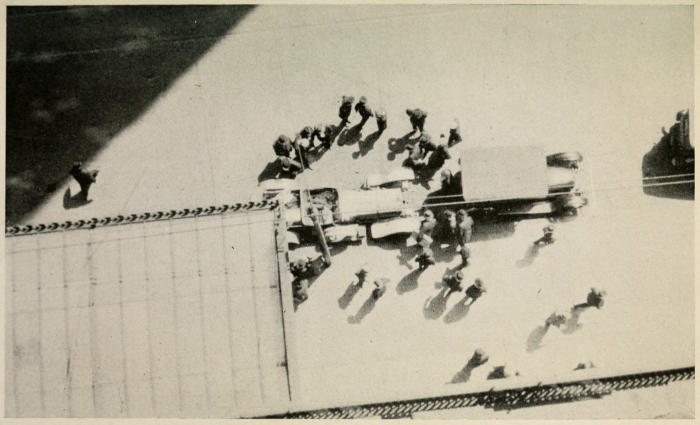
The Crowd in Less Than a Minute. “Out of the
Window” in Cleveland
Cleveland is also the city of three-cent carfares—in
fact three cents in Cleveland is almost as good
as five cents in other cities. Lemonade three cents,
moving pictures three cents, a ball of pop-corn
three cents—a whole counter full of small articles
in one of the big stores. Let’s all move to Cleveland!
One thing, though, struck us most particularly
in the hotels of Utica and Cleveland; the people
didn’t match the background. Dining in a white
marble room quite faultlessly appointed, there was
not a man in evening clothes and not a single woman
smartly dressed or who even looked as though
she had ever been! Men in unpressed business
suits, women in black skirts and white shirtwaists
are appropriate to the imitation wood or plaster
walls of some of the eating places that we have
been in, but in a beautiful hotel like the Statler
in Cleveland, and especially in the evening, they
spoil the picture.
From Cleveland to Toledo the roads are very
like those of France, they have wonderful foundations
but badly worn surfaces. Much the best
hotel in Toledo is the Secor, and the restaurant,
which made no attempt at imitating French cooking,
was good.
There was a most beautiful art museum in Toledo,
a small building pure Greek in style and set
like a jewel against pyramidal evergreens. It is
quite the loveliest thing we have seen.
Because of Ohio’s speed restrictions, twenty
miles fastest going and eight for villages, etc.,
one must either spend days in crawling across the
state or break the law. As is usually the case
with unreasonable laws, few keep them, or else the
motoring Ohioans interpret their speed laws
rather liberally. Of the hundreds of motors we
met in Ohio, especially near Cleveland, which is
one of the biggest automobile centers in the country,
scarcely one, even within the city limits, was
going less than twenty-five miles an hour.
However, as it is not courteous for the stranger
to dash lawlessly through at faster than the
twelve-mile average prescribed by law, the run
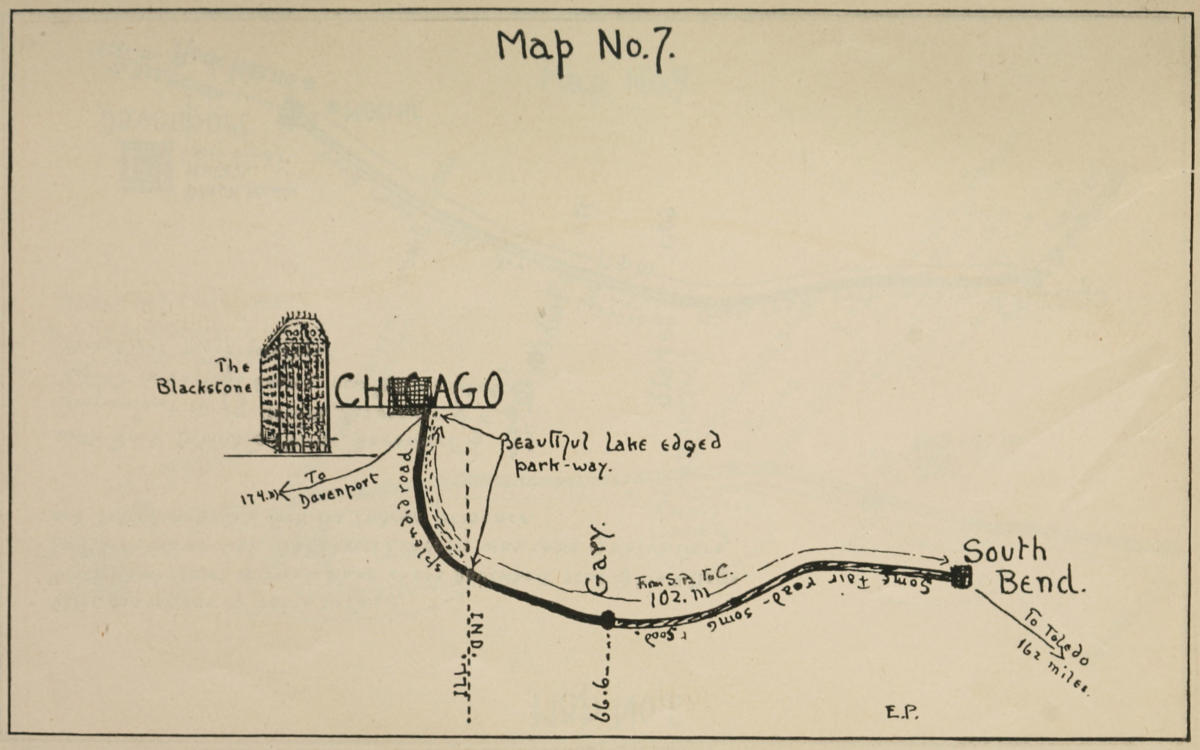
from Toledo to South Bend, a distance of one hundred
and sixty-two miles, will take from twelve to
fourteen hours. The road is good, most of it, but
sandwiched between occasional poor stretches.
We lunched at Bryan at the Christman Hotel.
It was here that I heard a new retort courteous.
I had dropped a veil; a youth picked it up. I said,
“Thank you.” He replied politely, “Yours
truly!”
The Oliver, “Indiana’s finest hotel,” at South
Bend is good, clean, well run, with a Louis Quatorze
dining-room in black and white. The black
and white craze is raging here quite as much as
in New York.
CHAPTER V LUGGAGE AND OTHER LUXURIES
Never in the world did people have so much
luggage with nowhere to put it and nothing
in it when it is put! Each black piece is
bursting! Yet everything we have with us is the
wrong thing and just so much to take care of without
any compensating comfort. We have gradually
eliminated everything we could until now
we have just enough for three hallboys on our
arrival and three porters on our departure to
stagger under. Then too, although possibly all
right for a man and wife, sharing the motor trunk
with a son is an inconvenience unimagined! If
the trunk is put in my room, he finds himself
somewhere on another floor or at the end of an
interminable corridor unable to get his pajamas
without entirely redressing. If the trunk is in his
room I have to hunt for him, get his key, and bring
the trays to my room. Packing one trunk in two
rooms at once is even more difficult. Consequently,
he has in desperation bought a “suitcase.”
It is orange-colored, made of paper, I
think, and it also makes one more lump of baggage
to be carried up and down and packed on top
of our traveling companion.
The thermometer was at about thirty when we
left home, so I could think of nothing but serge
coats of heavy weight, plaited skirts also nice and
warm, sweaters of various thicknesses, and fur
coats. There came almost a break in a heretofore
happy family when I insisted that over the Rocky
Mountains our “chauffeur” would need his heaviest
coat. He refused to take a coonskin—Heaven
praise his intuition on that!—but obligingly
brought a huge ulster. We had not gone
fifty miles from New York when the sun came out
hot and has ever since then been trying to show
how heat is produced in the tropics. Our car is
loaded down with wraps for the Rockies, and in
this sweltering heat not one thin dress have I
brought.
In every way my clothes are a trial and disappointment.
A taffeta afternoon dress that was
intended to give me a smart appearance whenever
I might want to look otherwise than as a
bedraggled tripper comes out of the trunk looking
like crinkled crepon. I thought of pretending
that it was crinkled crepon, but its crinkle was
somehow not quite right in evenness or design.
There is also a coat and skirt of a basket weave
material that I had made especially to be serviceable
motoring. I don’t know what sort of dresses
would have packed better, but I am sure none
could be worse. In fact, I unhesitatingly challenge
these two of mine against the most perishable
clothes that anyone can produce, that mine
will wrinkle more and deeper and sooner than any
others in existence.
I have, however, found one small article that I
happen to have brought, a great success, and that
is a lace veil with a good deal of pattern—one of
those things that make you look as though something
queer was the matter with your face—unless
there is something the matter with your face, in
which case it takes all the blame. In doing the
same thing every day you find you shake down to
a rather regular system. As we come into the
outskirts of the city where we are to spend the
night, I take off, in the car, my goggles and the
swathing of veils that I wear touring, and put on
the lace one. The transformation from blown-about
hair and dusty face to a tidy disguise of all
blemishes is quite miraculous. Dusters are ugly
things, but as every woman who motors knows,
there is nothing so practical. I don’t think personally
that silk ones can be compared for sense
and comfort with those of dust-colored linen or
cotton. Silk sheds the dust perhaps a little better,
but wrinkles more. At all events, I find that by
putting my lace veil on and taking my duster off,
I can walk up to the desk and register without
being taken for a vagrant. The lady who was
traveling with us is one of those aggravating
women who stay tidy. She keeps her gloves on
and her hands dustless. But even she saw the
transforming possibilities of a lace veil and
soon bought one too.
Hotels, however, are very lenient in the matter
of the appearance of guests, because of all the
begrimed-looking tramps, our “chauffeur” after
driving ten hours or so in the sifting dust is the
grimiest. The only reason why he is not taken
for a professional driver is because no one would
hire anyone so disreputable-looking.
In one hotel, though, a grimy working mechanic
having gone up in the elevator and a strange, perfectly
well turned out person having come down,
the confused clerk asked where the chauffeur went
and did the new gentleman want a room?
CHAPTER VI DID ANYBODY SAY “CHICKEN”?
Sometimes we take luncheon with us and
sometimes we don’t. If we do, we see nice,
clean-looking places on the road, such as the
Parmly at Plainsville between Erie and Cleveland
and the Avelon at Norwalk between Cleveland and
Toledo; if we don’t we find nothing but hotels of
the saloon-front and ladies’-entrance-in-the-back
variety.
Between South Bend and Chicago we had not
intended to stop, but found ourselves rather hungry
and unwilling to wait until about three o’clock
to lunch in Chicago. We looked in the Blue Book
and saw the advertisement of a restaurant a few
miles ahead. “Mrs. Seth Brown. Chicken dinners
a specialty.” That is not her real name.
The very words “chicken dinner” made us suddenly
conscious that we were ravenous.
“Do you remember the chicken dinners at the
different places near Bar Harbor?” reminisced
the lady-who-was-traveling-with-us. I am not going
to call her that any more! It is too long to
say. I will call her “Celia” instead. It is not her
name, but it is an anagram of it, which will do as
well. Also a repetition of our “chauffeur” sounds
tiresome, and his own initials of E. M. would be
much simpler.
Anyway, all three of us conjured up visions of
the chicken that was in a little while going to be
set before us.
“Country chickens are so much better than
town ones!” said Celia. “They are never the
same after they have been packed in ice and
shipped, and I do wonder whether it will be
broiled, with crisp fried potatoes, or whether it
will be fried with corn fritters and bacon!”
“—And pop-overs,” suggested E. M.
“Couldn’t we drive a little faster?” I asked.
For by now my imagination had conjured up not
only the actual aroma of deliciously broiled
chicken, but I was already putting fresh country
butter on crisp hot pop-overs. But in my greediness
for the delectable dinner that was awaiting
us, I lost my place in the Blue Book. Nothing that
I could find any longer tallied with the road we
were on, and it took us at least half an hour to find
ourselves again. By the time we finally reached
the little town of delectable dinners we were so
hungry we would have thought any kind of old
fowl good. But search as we might we could not
discover any place that looked even remotely like
a restaurant. There was a saloon, and a factory,
and some small frame tenements. Nothing else
in the place. Inquiring of some men standing on
a corner, one of them answered, “The ladies’ entrance
of the saloon is Mrs. Seth Brown’s place,
and the eating’s all right.” We were very hungry
and the lure of chicken being strong, also feeling
that perhaps the interior might prove better than
the entrance promised, we went in. In the rear of
a bar was a dingy room smelling of fried fat and
stale beer. There were three groups of perfectly
respectable-looking people sitting at three tables.
A barkeeper with a collarless shirt, ragged apron,
and a cigar in his mouth, sat us at a fourth table
with a coffee-stained cloth on it, rusty black-handled
cutlery, and plates that were a little dusty.
“What y’want!”
“Do you serve chicken dinners?” I asked.
“D’ye see it advertised?”
“Yes, in the Blue Book.”
“Y’ c’n have dinner,” he said as though he was
obliged against his inclination to live up to his advertisement.
E. M. was drawing water out of the well to fill
the radiator tank. Celia and I began wiping off
the plates and forks on the corners of the tablecloth.
At the table nearest us were four men and a
woman. One of the men kept hugging the woman,
who paid no attention to him. Two of the others
went continually back and forth to the bar, while
the fourth was occupied solely with his food. At
another table was a family motoring party, and
at the third, a second family, with a baby that
cried without stopping and a little child who
screamed from time to time in chorus.
Our chicken dinner proved to be some greasy
fried fish, cold bluish potatoes, sliced raw onions,
pickled gherkins, bread and coffee.
We ate some bread and drank the coffee. If we
had been blindfolded it wouldn’t have been so bad.
There is one consoling feature in such an incident,
that although it is not especially enjoyable
at the time, it is just such experiences and disappointments,
of course, that make the high spots of
a whole motor trip in looking back upon it. It
is your troubles on the road, your bad meals in
queer places, your unexpected stops at people’s
houses; in short, your misadventures that afterwards
become your most treasured memories. In
fact, after years of touring, I have in a vague,
ragged sort of way tried to hold to what might be
called a motor philosophy. Anyway, I have found
it a splendid idea when things go very uncomfortably
to remember—if I can—what a very charming
diplomat, who was also a great traveler, once
told me: that in motoring, as in life, since trouble
gives character, obstacles and misadventures are
really necessary to give the trip character! The
peaceful motorist who has no motor trouble or
weather trouble or road trouble has a pleasant
enough time, but after all he gets the least out of
it in the way of recollections. Not that our one
disappointment about our chicken dinner is meant
to serve as a backbone of character for this trip,
neither do I hope we shall run into any serious
misadventure, but I really quite honestly hope
that everything will not be so easy as to be entirely
colorless.
One of the Exciting Things in Motoring Is Wondering
What Sort of a Hotel You Will Arrive at for the Night
I was turning these thoughts over in my mind
as we sped on to Chicago and they suggested a
most discouraging possibility, which I immediately
confided to Celia:
“Suppose so little happens that there will be
nothing to write about? No one wants descriptions
of scenery or too many details of directions
as to roads or hotels, and supposing that is all we
know?”
“You could make some up, couldn’t you?” said
she sympathetically.
“Do you think that I could tell you a lot of
things that never happened and that you would
believe me?” I asked.
She answered positively: “Of course you
couldn’t.”
“Then I’m certain nobody else would believe
me either.”
“No, I don’t suppose they would,” she agreed,
but suddenly she suggested: “I tell you what we
could do. We could stop over in little places and
pass those where we mean to stop—and we can
in many ways make ourselves uncomfortable, if
you think it necessary for interesting material.”
But our conversation turned at that point into
admiration of our surroundings; for we had come
into a long drive through a park on the very edge
of the Lake that is the beautiful, welcoming entrance
to Chicago.
CHAPTER VII THE CITY OF AMBITION
We arrived yesterday at “America’s most
perfect hotel.” We are still a little overawed.
So far we have only been in hotels
that have prided themselves on being the “best
hotel in the state” or the “best hotel in the Middle
West,” but Chicago’s pride throws down the
gauntlet to America, North and South, and coast
to coast. I have never heard that Chicago did
anything by halves! “The world will take you at
your own valuation.” Maybe the maxim originated
in Chicago.
America’s best hotel looks like a huge tower of
chocolate cake covered with confectioner’s icing.
If it were cake, it might easily be the biggest piece
of chocolate in the world, but for “America’s
best”—probably because the word “best” in
America has come to mean also “biggest”—the
Blackstone seems rather small. Still, I don’t think
it boasts of being anything except the finest and
foremost, most perfect and complete hotel in the
Western Hemisphere.
The lobby as you enter it is very like the thick
chocolate center of the cake and gives a slightly
stuffy impression that is felt in no other part of
the really beautiful interior. The cerise and
cream-colored dining-room, in which for afternoon
tea they take up the center carpet and remove
some tables, leaving a hollow square of gray marble
tiling to dance on, is the most beautiful room
that I have ever seen anywhere, not excepting
Paris. The white marble simplicity of the second
dining-room also appealed to me, and the upstairs
halls are like those in a great private country
house.
The restaurant we find for its standard of high
prices not very good. The food at the Statler in
Cleveland was the best we have had anywhere, and
the prices were half. Perhaps we ordered, by
luck, the Statler’s specialties and the dishes that
the Blackstone prepares least well.
The room service, however, is well done, with
a lamp under the coffee pot and a chafing dish for
anything that ought to be kept hot. Yet my coffee
this morning had a flavor not at all associated
with memories of best hotels, but reminiscent of
little inns that one stops at in motoring through
France, Germany, or Italy. There should have
been a sourish bread and fresh flower-flavored
honey to go with it. It leaves a copperish taste
in the mouth long afterward.
In defense of the management, I ought to add
that we take our coffee at the abnormally early
hour of seven, and the coffee for such as we is
probably kept over in a copper boiler from the
night before. Still, ought this to happen in the
best hotel, even if only of the Western Hemisphere?
Our rooms high up and overlooking the lake
are lovely, perfectly appointed, and with an entrancing
view of moonlight on the water. The
furnishings of the bedrooms are very like those
of the Ritz hotels, and the prices are reasonable
considering the high quality of their accommodations.
The three-dollar-and-a-half rooms are
small, light, and completely comfortable; for seven
dollars one can have a big room overlooking the
lake, both of course including bathrooms with outside
windows and all the latest Ritz-Carlton type
of furnishings, and—I must not forget—linen
sheets and pillow cases, the first real linen we have
seen since we left home! Also the reading lamp
by my bed has a shade, pink on the outside and
lined with white and a generous flare, that I can
read by.
At the Statler in Cleveland there was an exceedingly
pretty bed table lamp with a silk shade on it
of Alice blue and a little gold lace, but one might
as well have tried to read by the light of a captured
firefly tied up in blue tissue paper. I tried
to get the shade off but it was locked on—to prevent
guests from ironing or stealing the shade or
the bulb? At any rate, since nothing could part
the cover from the fixture, and reading in the blue,
glimmering gloom was impossible, I was obliged
to get to sleep by watching the members of a club
in the building opposite smoking and lounging,
exactly like the drummers downstairs—downstairs
in Cleveland, not here.
The ubiquitous drummer is not in evidence as he
was in northern New York, Indiana, and Ohio.
The people down these stairs are more like the
people one sees in the hotels in New York, Boston,
or Philadelphia. In the other cities we have come
through there were traveling men to the right of
us and traveling men to the left of us, with hats
on the backs of their heads and cigars—segars,
looks more like it—tilted in the corners of their
mouths. Traveling men standing and leaning,
traveling men leaning and sitting, but always men
in cigar smoke, talking and lounging and taking
their rest in the lobbies.
Like the drummers, I shall soon have all the
hotels in the country at my finger ends; the advantages,
disadvantages, and peculiarities of each.
Already I could write a treatise on plumbing apparatus!
The Statler in Cleveland had an “anti-scald”
device. I read about it in the “service
booklet” afterward. The curious-looking handles
and levers occupying most of a white-tiled wall at
the head of the bathtub so fascinated me that I
had to try and see how they worked. I pulled
knobs and pushed buttons that seemingly were for
ornament merely, until suddenly a harmless-looking
handle let loose a roaring spray of water
that came from every part of the amateur Niagara
at once. My bath was over before I had meant it
to begin, and I got undressed afterward instead
of before. But I like the bathrooms with running
ice-water faucets, and I love to examine the wares
in the automatic machines, also placed in the bathrooms.
They look like a miniature row of nickel
telephone booths, each displaying a bottle or box
through the closed glass door, each with a slot to
drop a quarter in and a knob to pull your chosen
box or bottle out with. The tantalizing thing
about them is that they hold very little of use
to me. I don’t like the kind of cold cream they
carry; the toothbrushes are usually sold out, and
razors and shaving soap don’t really tempt
me.
There are paper bags in the closets to send your
laundry away in and a notice that all washing sent
to the desk before nine in the morning will be returned
by five in the afternoon. If only they could
run an owl laundry, taking your things at nine
in the evening and returning them at five in the
morning, it would be much more convenient for
people who arrive at night and leave in the early
dawn.
I should like to make a collection of hotel signs,
such as plates on the bedroom doors saying,
“Stop! Have you forgotten something?” And
in the bathroom the same sentiments and an additional
“How about that razor strop?”
While waiting for my change in one of the big
department stores I overheard the following conversation
between two women directly beside me:
“So you like living in the city, do you?” said
one.
“Sure!” answered the other. “You can run
into the stores as often as you feel like it, and if
you get lonesome you can go to the movies or a
vaudeville show, or you can walk up Michigan
Avenue and see the styles—there’s always something
going on in the city.”
“I dare say you get used to it and feel you
couldn’t give it up, but what I never could get used
to is one of them flats. Now out at home, we’ve
got a fifteen-room house, all hardwood floors——”
“What d’you want all that room for? You’ve
only got to spend money to furnish it and elbow
grease to care for it. You need two girls or more.
Now, we’ve got a flat all fixed up nice and cozy
and one girl takes care of it easy.”
“Well, I guess it’s all right, but if I had to bring
my babies out of the good country air and put
them in a flat, I think they’d die!”
CHAPTER VIII A FEW CHICAGOANS
The disappointing and unsatisfactory thing
about a motor trip is that unless you have
unlimited time, which few people ever seem
to have, you stop too short a while in each place
to know anything at all about it. You arrive at
night and leave early in the morning and all you
see is one street driving in, and another going
out, and the lobby, dining-room and a bedroom or
two at the hotel.
Happily for us, we have been staying several
days in Chicago, and, while we can scarcely be
said to know the city well, we have had at least
a few glimpses of her life and have met quite a
few of her people.
Last evening at a dinner given for us, our hostess
explained that she had asked the most typical
Chicagoans she could think of, and that one of
the most representative of them was to take me
in to dinner. “He is so enthusiastic, he is what
some people would call a booster,” she whispered
just before she introduced him.
In books and articles I had read of persons
called “boosters,” and had thought of them as
persons slangy as their sobriquet; blustering,
noisy braggarts, disagreeable in every way. I
think the one last night must have been a very superior
quality. He was neither noisy nor disagreeable;
on the contrary, he was most charming
and seemed really trying not to be a booster at
all if he could help it.
He began by asking me eagerly how we liked
Chicago. Had we thought the Lake Shore Drive
beautiful? Were we struck with Chicago’s smallness
compared to New York? I told him we had,
and we were not. He thereupon generously but
reluctantly admitted—the list is his own—that
probably New York had more tall buildings, more
wholesale hat and ribbon houses, a bigger museum
of art, a few more theaters, and yes, undoubtedly,
more millionaires’ palaces, but—he suddenly
straightened up—“Chicago has more real homes!
And when it comes to beauty, has New York anything
to compare with Chicago’s boulevard systems
of parks edged by the lake and jeweled with
lagoons? And yet she is the greatest railroad
center in the whole world. And let me tell you
this,” he paused. “New York can never equal
Chicago commercially! How can she? Look on
the map and see for yourself! From New York to
San Francisco, north to the lakes and south to
Mexico—that’s where Chicago’s trade reaches!
What is there left for New York after that? She
can, of course, trade north to Boston and south
to Washington, but she can’t go west, because Chicago
reaches all the way to New York herself, and
there is nothing on the east except the Atlantic
Ocean!”
After dinner we were taken to the small dancing
club, a one-storied pavilion containing only a ballroom
with a service pantry in the back, that a few
fashionables of Chicago built in a moment of
dancing enthusiasm. Although we met comparatively
few people and had little opportunity to
talk to anyone, I noticed everywhere the same attitude
as that of my companion at dinner. The
women had it as much as the men. As soon as
they heard we were from New York they began
to laud Chicago.
Mrs. X., one of their most prominent hostesses
and one of the most beautiful and faultlessly
turned out people I have ever seen, instead of talking
impersonalities as would a New York woman
of like position, plunged immediately into the comparison
of New York’s shoreline of unsightly
docks with the view across her own lawn to the
Lake. Imagine a typical hostess of Fifth Avenue
greeting a stranger with: “How do you do, Mrs.
Pittsburgh; our city is twice as clean as yours!”
However, I felt I had to say something in defense
of mine, so I remarked that the houses on Riverside
Drive faced the Hudson, and across a green
terrace, too.
“Oh, but the Palisades opposite are so hideously
disfigured with signs,” she objected, “and
besides none of your really fashionable world
lives on your upper West Side.”
Having staked out our fashionable boundaries
for us, she switched the topic to country clubs.
Had we been to any of them?
We had been given a dinner at the Saddle and
Cycle Club, and we had to admit it was quite true
that New York had nothing in its immediate vicinity
to compare with the terrace on which we had
dined, directly on the Lake, and apparently in
the heart of the wilderness, although the heart of
Chicago was only a few minutes’ drive away.
“You must come out to Wheaton and lunch with
us tomorrow!” Mrs. X. said. You could tell from
her tone that she was now speaking of her particularly
favorite club. “I think they will be playing
polo, but anyway you must see what a beautiful
spot we have made of it, and there wasn’t even
a tree on the place when we started—we have done
everything ourselves.”
Doing things themselves seemed to me chief
characteristic of the Chicagoans. A “do-nothing”
must be about the most opprobrious name that
could be given a man. Nearly all of Chicago’s
prominent citizens are self-made—and proud of
it. Millionaire after millionaire will tell you of
the day when he wore ragged clothes, ran barefooted,
sold papers, cleaned sidewalks, drove grocers’
wagons, and did any job he could find to get
along. And then came opportunity, not driving
up in a golden chariot, either! But more often
a trudging wayfarer to be accompanied long and
wearily. You cannot but admire the straightforwardness—even
the pride with which these successful
men recount their meager beginnings, as
well as the ability that always underlies the success.
Another thing that impressed us was that cleverness
is rather the rule than the exception, and
the general topics of conversation are more worth
listening to than average topics elsewhere. For
instance, their city is a factor of vital interest to
them, and therefore their keenness on the subject
of politics and all municipal matters is equaled
possibly in English society only. They are also
interested in inventions, in science, in all real
events and affairs, both at home and abroad. At
least this is what we found there, and what I am
told by many people who have spent much time
in Chicago.
To compare Chicago with Boston is much like
comparing a dynamo with a marble monument,
yet paradoxically there is a strong similarity between
the two. There is no public place where
people congregate. Both are cities of homes, and
hotel life has little part in the society of either.
Boston society is possibly the most distinguished
in America—and Boston front doors will never
open to you unless you have cultivation and birth
to the extent of proving satisfactorily who your
grandparents were. Chicago, of course, cares not
at all, in a Boston sense, who your grandfather
was so long as he was not a half-wit who transferred
his mental deficiency to you. Boston society
is distinguished and cultivated. Chicago society
interesting and stimulating. At least that
is what the people I have met in these two cities
seem to me.
But to go back to the evening of our first dinner
party in Chicago: the attitude of everyone rather
puzzled and not a little amused me, and after I
had gone to bed I lay awake, and their remarks,
especially those of the man at dinner, recurred to
me and I began to laugh—then suddenly stopped.
The mere bragging about the greatness and bigness
of his city was not the point; the point was
his caring. The Chicagoans love their city, not as
though it were a city at all, but as though it were
their actual flesh and blood. They look at it in the
way a mother looks at her child, thinking it the
brightest, most beautiful and wonderful baby in
the whole world. Tell a mother that Mrs. Smith’s
baby is the loveliest and cleverest prodigy you
have ever seen, and her feelings will be those exactly
of Chicagoans if you tell them anything that
could be construed into an unfavorable comparison.
They can’t bear New York any more than
the mother can bear Mrs. Smith’s baby. At the
very sight of a New Yorker they nettle and their
minds flurry around and gather up quickly every
point of possible advantage to their own beloved
Chicago. Not for a second am I ridiculing them
any more than I would ridicule the sacredness of
a man’s belief in prayer. Their love of their city
is something wonderful, glorious, sublime. They
don’t brag for the sake of bragging, but they
champion her with every last red corpuscle in
their heart’s blood because they so loyally and
tremendously care.
I wonder, is it their attitude that has affected
us, too? Otherwise why is the appeal of Chicago
so much more personal than that of other cities
we have come through, so that even we are feeling
quite low-spirited because tomorrow we leave for
good! To be sure, the Blackstone is a beautiful
and luxurious hotel, and we are not likely to meet
its double again between here and the Pacific
Coast, but it is not that, neither is it that we have
any sentiment for the city or those that dwell
therein. We have no really close friends here, we
have met only a few people—in fact, we are ordinary
tourists merely passing through a strange
city, running into a few acquaintances as people
are sure to run into occasional acquaintances almost
everywhere.
I don’t think I can explain this personal and
sudden liking that I feel for Chicago. Once in a
very great while one meets a rare person whom
one likes and trusts at first sight, and about whom
one feels that to know him better would be to love
him much.
To me Chicago is like that.
I don’t suppose a New Yorker ever wants to
live anywhere else, but if sentence should be
passed on me that I had to spend the rest of my
life in Chicago I doubt if I would find the punishment
severe. There is something big, wholesome,
and vitalizing out here. It is just the sort of place
where one would choose to bring up one’s children,
the ideal soil and sun and climate for young
Americans to grow in. New York is a great exotic
hothouse in which orchids thrive; but the question
is this: in selecting a young plant for the garden
of the world, is an orchid the best plant to choose?
CHAPTER IX TINS
If E. M. were put in charge of the commissary
department we would be given hardtack and
water—his suggestions as to food never go
any further. I, on the other hand, feel impelled
toward chocolate in the way a drunkard is impelled
toward rum, and if the supplies were left
to me I should fill every thermos with chocolate
ice-cream soda water and the sandwich boxes with
chocolate cake. But Celia, having little opinion
of hardtack and still less of chocolate, which she
declared was making me as fat as butter, suddenly
took the matter of food supplies into her own
hands. Although she acknowledged that she had
invited herself upon the expedition in the first
place, and that she had agreed to sit under the
luggage in the back, she protested that a heavy
hamper full of silver and crockery and nothing
to eat in it was an inhumanly heavy weight to
put her up against, and she would like to arrange
things differently.
Of course we told her that if she felt like rising
above her surroundings it was not for us to hold
her down. So without any more ado she shipped
the beautiful lunch basket home by freight and
dragged me out with her to buy a more practical
substitute. Her first purchase was a large, white,
tin breadbox—just an ordinary box with a padlock,
neither lining nor fixtures.
“What for?” I asked.
“To put things in,” said she. “It is going to
be padlocked and it is going to stand flat on the
floor of the tonneau and stay there, and not tumble
over on me! Also we won’t have to have it
lugged up to our room at night or carted down
in the morning.”
“Excellent!” I agreed enthusiastically. “Let’s
have paper plates and five-cents-a-dozen spoons
and throw them away and not have to fuss with
anything to be washed.”
At a ten-cent store we bought only three knives,
but dozens of plates and spoons and enough oiled
paper to wrap sandwiches for an expedition.
Then we went to a beautiful grocery store near the
hotel and laid in a supply of everything imaginable
that comes in china, glass, or tin! Chicken,
ham, tongue, pheasant in tubes like tooth paste,
pâté de foie gras in china, big pieces of chicken in
glass, nuts, jam, marmalade, and honey.
One article of food that we had tried to find
ever since leaving New York was still unobtainable.
Neither brittle bread nor protopuffs had
ever been heard of west of New York, and our Chicago
grocer looked as blank as the rest. Either
New York women are the only ones who worry
about keeping their figures or else the women of
other cities stay slim naturally! Nothing but
good, rich fat-producing bread and butter to be
had, to say nothing of chocolate! And our waistbands
getting tighter every day! Not E. M.—he
being very young is as lathlike as ever.
Having bought everything else, we repeated our
question, was he sure he had no gluten or Swedish
bread, no dry, flourless bread of any kind! No,
he had only hardtack, and then produced—round
packages of brittle bread!
Wonderful! We were so delighted we fairly
floundered in it. “Bring us more; we are going
to cross the continent; we must have lots of it!” I
said greedily. Then we hurried home and waited
for our supplies to arrive.
First came a big basket, bulging. Had we
really bought all that? But it was only the beginning.
Bread, bread, and more bread! Bales of it!
It was I who had ordered “lots of it.” Celia
looked sorry for me.
“It looks like rain! We could shelter the car
under it,” was all I, idiotically, could think of.
And in my absent-mindedness I broke open one
of the bales. It was certainly Swedish bread, the
nicest, crispest imaginable, and then I took a bite.
Caraway seeds!
In our family some ancestor must have been
done to death on caraway seeds. The strongest
of us becomes a queer green at even so much as a
whiff of one. Celia ran out into the hall as though
I had exclaimed “Snakes!” And I, like the one
who had just been bitten, followed unstably after
her.
“Is there a bat in your room?” asked the floor
clerk, sympathetically.
“N-o,—car-a-way s-seeds,” said Celia, all in a
tremble.
“We none of us can bear them—and they are in
the bread,” I explained.
“Caraway seeds?” exclaimed the bewildered
floor clerk. “Oh, but I like caraway seeds very
much!”
“Do you?” we gasped. “Well, then if you will
send a staff of porters into Room 2002, you can
have enough to last all your life! You can stack
a whole mountain of it around your desk and eat
your way out.”
It rained all last night and drizzled off and on
all morning. As everyone has warned us against
muddy roads west of Chicago, we sat with our
faces pressed to the windows overlooking the
Lake, feeling alternately hopeful and downcast
and asking each other questions in circles. Might
we try to get on? Had we perhaps better unpack
and stay? Twice the sun struggled out and we
sent down for the porters to come for our luggage,
but both times when they arrived it had begun to
rain and we sent them away again. By twelve
o’clock, having finally decided to stay over a day,
E. M. went to the Saddle and Cycle Club to lunch
with some friends. Celia and I were about to go
down to the restaurant for our own luncheon when
the breadbox caught her attention. I saw her lift
the cover and look wistfully at the two neatly tied
white paper packages and three brightly shining
thermos jars that were on top. Expecting to start
early in the morning we had the night before
ordered a luncheon put up. And now what were
we to do with the food?
“It was so expensive!” she said wistfully.
“The pâté sandwiches were sixty cents apiece and
they will be horrid and dry tomorrow!”
“And the lobster salad was a dollar and a
half—and that certainly won’t keep!”
“And we don’t even know whether it is good or
not!” she almost wailed, but quite as quickly she
exclaimed happily: “Let’s picnic here!”
“Here?” I said vaguely, looking about at the
rose silk hangings and the velvet carpet.
“Why not? It is ever so much more comfortable
here than it would have been out on a dusty
roadside. Besides, we really ought to see how
our commissary department works. We ought to
be sure that we haven’t any more caraway
seeds!” she shivered.
A few minutes later we had spread our picnic
on the floor and were having a perfect time. Also
while we were about it we thought we had better
sample the various things we had bought the day
before.
“There is no use,” said the food expert, “in
carting about a lot of stuff that we don’t like!”
So we opened and tasted a tin of this and a jar
of that until we were surrounded with what looked
like the discards of a canning factory. Suppose
our New York friends who had exclaimed at our
going without any servants could see us now!
I was jabbing a hole in a can of condensed milk
with a silver and tortoise-shell nail file when someone
knocked at the door. Without a thought of
the picture we were presenting to the probable
chambermaid, I called, “Come in!” but was too
busy to look up until I heard a sort of gasp and
a man’s voice stammered:
“I only came to see—to see if Mrs. Post—if
there was anything I could do to—serve——”
“Miller!” It was the head waiter of one of
the dining-rooms downstairs—a man who had for
several years been a second head waiter in a celebrated
New York hotel and who had once been a
butler for a member of our family. The expression
on his face was one of such surprise, bewilderment,
apology, shame and humility that I
found myself explaining:
“We were to have picnicked along the road, but
it rained. And so we have picnicked——! It is
very simple!”
“Yes, madam,” he agreed, stoically. But it
was not until I had assured him that we never
picnicked more than once a day indoors and had
given him permission to order our dinner at
what time and wherever he pleased, and most particularly
after I refused to allow him to send a
waiter to put the room in order and be a witness
to the family’s eccentricities that he became
his urbane, impassible self once more.
Tonight I suppose we will have to deck ourselves
out in our best bibs and tuckers and sit
through a conventionally complete dinner at the
most prominent table in the dining-room so that
Miller may suffer no loss to his proper pride.
CHAPTER X MUD!!
We have struck it!
It looks pretty much as though our
motor trip to San Francisco were going
to end in Rochelle, Illinois.
Thirty-six miles out of Chicago we met the
Lincoln Highway and from the first found it a
disappointment. As the most important, advertised
and lauded road in our country, its first appearance
was not engaging. If it were called the
cross continent trail you would expect little, and
be philosophical about less, but the very word
“highway” suggests macadam at the least. And
with such titles as “Transcontinental” and “Lincoln”
put before it, you dream of a wide straight
road like the Route Nationale of France, or state
roads in the East, and you wake rather unhappily
to the actuality of a meandering dirt road that
becomes mud half a foot deep after a day or two
of rain!
Still we went over it easily enough until we
passed De Kalb.[3] After that the only “highway”
attributes left were the painted red, white and
blue signs decorating the telegraph poles along
the way. The highway itself disappeared into a
wallow of mud! The center of the road was
slightly turtle-backed; the sides were of thick,
black ooze and ungaugeably deep, and the car was
possessed, as though it were alive, to pivot around
and slide backward into it. We had no chains with
us, and had passed no places where we could get
any. Apart from the difficulty of keeping going
on chainless tires our only danger, except that of
being bogged, was in getting over the bridges that
had no railings to their approaches. The car
chasséd up every one, swung over toward the
embankment, slewed back on the bridge, went
across that steadily, and dove into the mud again!
It certainly was dampening to one’s ardor for
motoring. If the Lincoln Highway was like this
what would the ordinary road be after it branched
away at Sterling?
A little car on ahead was slithering and sliding
around too, although it had four chains on it, but
it did not sink in very far and it was getting along
much better than we were—so much better in
fact, that at the end of a few miles it slowly
wobbled beyond our sight.
Finally we turned a bend and there was a little
car on ahead. Not the same one however. This
one evidently had no chains and was coming toward
us drunkenly staggering from side to side.
Gradually the lower half of it was hidden by the
incline of an intervening bridge, then suddenly it
disappeared altogether. When we arrived at
the bridge ourselves we saw the car in a deep ditch
almost over on its side. The occupants of it, a
man and a small boy, were both out and nothing,
apparently, was hurt. The small boy was having
a heavenly time paddling around in mud way
above his knees, and the man called up to us cheerfully:
“’Twas m’own fault; I hadn’t ought to ’a’ come
without chains on! No use for you to stop, thank
you! You couldn’t help any and we’d only block
th’road between us. A team’ll be along before
long!”
Regretfully we left them and slipped and slid
and staggered on for some miles more.
“Oh,” said Celia in the back, “how are we ever
going up that?” “That” was an awful embankment
ahead which to look at made me feel as if
I had eaten nothing for a week. It was steep,
narrow, turtle-backed, with black slime, and had
a terrifying drop at either side of its treacherous
and unguarded edges. The car went snorting up
the incline until, nearly at the top point where the
drop was steepest, it balked and slid toward the
edge——!
“This is the end,” I thought, wondering in the
same second if any of us would fall clear. For
one of those eternity-laden moments we seemed
to hang poised on the brink. Then E. M. seemed
almost to lift the huge weight of the machine
around bodily and compel it in spite of its helplessness
to crawl up, up, up on the bridge.
Glancing back at Celia, after we were safely
over, she looked about as chalky and weak-kneed
as I felt. A short distance further, however, we
ran on the brick pavement of a town. The ragged
red-brick buildings of the street we turned into
were not very encouraging and we feared that
again the Blue Book’s hotel description might be
one of those “complimentary” ones, consisting
of its paid advertisement. E. M. urged our trying
to get chains and going on to Davenport, but
Celia and I had all the motoring in the mud that
we cared about. No matter how squalid the town,
or how poor the accommodations, we meant to
cross no more bridges like that last one until the
roads dried! Then we made two turns like a
letter Z and found ourselves in the sweetest,
cleanest, newest little town imaginable. Its
streets were all wide and smoothly paved with
brick, and its houses, mostly white, were set each
in a garden of trim and clipped green. There was
a new post-office of marble magnificence and a
shopping center of big-windowed, fresh-painted,
enterprising stores, but no hotel except a dingy
ramshackle tavern that we took for granted was
the one mentioned in the guide book. We wondered
if one of the neat, sweet little houses might
perhaps take us to board instead.
In front of a garage was a man with a blue
coat and brass buttons, and “Fire Chief” on
them. We asked him if he knew anyone at whose
house we could stay until the road dried. He
looked at us and then at the car in a quizzical
sort of way.
“Oh, y-es,” he drawled. “You could put up
at Mrs. Blake’s, I guess.”
We asked the way to Mrs. Blake’s and then
happened to remark that it was curious a town
as up-to-date as this one had no good hotel. He
lost his drawl immediately: “No good hotel?
Well, I just guess there is a good hotel! The
Collier Inn is just across that street and around
the corner. It’s a fine hotel.”
We cheered up instantly. But why hadn’t he
told us that sooner? He thought that “considerin’
we had asked for a boarding-house, mebbe
th’ hotel it was too high-priced for us, but it was
a fine hotel if we didn’t mind the cost.”
I don’t know how we had missed it. It was a
fair-sized yellow brick building on a corner, a
rather typical small-town commercial hotel. I
went in expecting dingy darkness. The lobby
looked like the office in a Maine summer resort.
I asked—not that I for a moment expected to get
it—for rooms with baths. The proprietor said,
“Certainly,” and showed me three new little
rooms, each with a little new bathroom attached.
I returned to my companions grinning like a
Cheshire cat. It seemed to us as though we had
found a veritable Ritz!
CHAPTER XI IN ROCHELLE
Twenty-four hours in a town like this
and we feel as though we knew it and the
people intimately. In many ways it suggests
a toy-land town. Its streets are so straight
and evenly laid, its houses so white and shining,
its gardens so green, its shops so freshly painted,
its displays in the windows so new, and its people
so friendly.
“Strangers in town!” they seem to say to themselves
as they look at us, but instead of looking
at us in a “wait until we know who you are before
we take any notice of you,” they seem quite
ready to smile and begin a conversation.
Our most particular friend, as well as our
oldest acquaintance, is the fire chief. E. M. has,
of course, one or two other particular friends in
the garage. If he can only find a mechanic or two
to talk to, he is perfectly happy. Celia’s and my
chief diversion has been going to the moving picture
theaters, which is evidently the fashionable
thing to do here. In the evening we saw three
real theater parties. One of them was a very
important affair; they met in the lobby and went
down the aisle two by two; the ladies all had many
diamonds, brand-new white-kid gloves quite tight,
picture hats, corsage bouquets and boxes of
candy.
Celia and I had neither gloves nor hats on, and
when we ran into the theater parties, we felt almost
like urchins that had been caught wandering
into the foyer of the Metropolitan Opera
House. Like our hatred of caraway seeds, our
love of hatlessness must be a family failing. In
Chicago two different papers took the trouble to
mention E. M.’s carelessness in the matter of
head-covering. “Scorning to wear a hat even on
occasions when it is generally considered to be
convenable,” said one. The other described him
as “such a disciple of fresh air that he was seen
driving a big racing machine on Michigan Avenue
without a hat!” Yet isn’t it a popular supposition
that the West is freer from conventions
than the East?
The rain has finally stopped and this morning
the sun is trying hard to shine. To do much
good it will have to shine steadily for about three
days. We walked to the end of the brick paving
down one of the streets a little while ago and
looked at the black wet Lincoln Highway leading
to Sterling.
On our way back we met our friend the fire
chief.
“Been to look at the mud?” asked he, cheerfully.
“It isn’t a bit bad now. You ought to
see it when it’s muddy! Why, it took me eight
hours to go twenty-one miles! I did have to get
a team of horses to pull me out of one bog, but
otherwise I got through all right.”
“Didn’t you strain your engine?” I asked him.
“Oh, yes,” he said cheerfully; “I guess I did, but
I couldn’t help that.”
“Well, maybe you couldn’t,” I agreed, then
added with confidential finality, “but I tell you
what we’re going to do! We’re going to put ours
on a nice, dry, comfortable freight car tomorrow
morning and ship it past the mud district—which
is probably the width of the continent.”
His warmth of manner fell suddenly to zero.
I feared we had in some way offended him because
we thought his state muddy. “Of course it is a
lovely country to grow things in,” I added quickly,
“but you see we want particularly to get to San
Francisco, and the surest way is by freight.”
But we could not put the broken conversation
together again. In fact, our friend the fire chief
doesn’t smile any more. Our other friends, the
garage men, also look at us askance—in fact in
some way we seem to have lost our popularity.
CHAPTER XII THE WEIGHT OF PUBLIC OPINION
We know now what is the matter! They
think we are quitters! They are so
filled with a sense of shame for us that
we are beginning to feel it ourselves. In spite
of our original intention to go only so far as
roads were good and accommodations were comfortable,
we feel that we are somehow lacking
in mettle, that we are sandless, to say the
least!
To explain that we are not crossing the continent
as a feat of endurance is useless; having
started to motor to the West, our stopping this
side of the place we set out for is to them incomprehensible.
“Why, that car ought to go through anything!”
is all any of them can think of saying to us.
Our friend the fire chief stood glowering out
in front of the garage all morning. I think he
would have gone to great lengths to prevent our
machine’s incarceration in a freight car. The
proprietor of the garage gave us his opinion: “Of
course we drive pretty light machines around
here, and yours is heavy and your wheels are uncommon
narrow, but that engine of yours sure
ain’t no toy! I’d go through if I was you! I
wouldn’t quit for a little mud! No, sir!”
“And only a little mud at that!” scornfully
echoed the fire chief.
“And supposing we slide off one of those
bridges, or turn turtle in a ditch?” asked we.
The chief scratched his head, but his determination
was undaunted. “She’d be kind of heavy to
fall on you,” he grinned. “All the same, if that
car was mine, I’d go right on plumb across Hell
itself, I would!”
To finish what you have begun, to see it through
at whatever cost, that seems to be the spirit here;
it is probably the spirit of the West, the spirit
that has doubled and trebled these towns in a
few years. The consideration as to whether it
is the wisest and most expedient thing to do, has
no part in their process of reasoning. That is
exactly the point.
Theirs not to reason why,
Theirs not to make reply,
Theirs but to do and die.
Only they do not seem to die. They thrive
gloriously.
All the same, if this country of ours ever gets
into the war there will be the making of a second
Balaklava regiment in a town of Illinois beginning
with an R and a certain fire chief should make a
gallant captain.
But magnificent as is their indomitability as a
quality of character; for us, for instance, to wreck
a valuable car, which we might never afford to replace,
for the sake of saying that we were not
stopped by any such trifle as mud seems more
foolhardy than courageous. Nevertheless, they
have in some way imbued us with their spirit to
such a degree that we have countermanded the
freight car, and although the mud is not a bit
better, have put chains on and are going to start.
Enthusiasm was no name for it! The town
turned out to see us off; the fire chief drove out
his engine in all its brass and scarlet resplendency.
The ban of our cowardly leanings toward freight
cars was lifted and they saw us off on our muddy
way rejoicing!
We are glad to have seen this little town. Maybe
the contagion of its enthusiasm will remain
with us permanently.
The mud, by the way, lasted only ten miles.
The celebrated Lincoln Highway parted from us
at Sterling and as soon as we left it, the ordinary,
unadvertised River to River road that we had
dreaded was splendid all the rest of the way to
this beautiful hotel, the Black Hawk, in Davenport,
Iowa.
I was in a perfect flutter of excitement about
crossing the Mississippi though I have scarcely
the courage to tell the unbelievably idiotic reason
why! It was Mrs. Z., who had crossed the continent
an uncountable number of times, who told
me in all seriousness that the middle of the United
States was cut unbridgeably in two by the Mississippi!
Nothing spanned this divide except a
railroad bridge, and the only way motorists had
ever crossed was on the trestles in the middle of
the night, against the law and at the risk of
their lives! The bridges, needless to say, are
many and quite as crossable as Manhattan to
Brooklyn. The river itself is yellow as the Tiber,
but its banks, devoid of factories and refuse collections,
were enchantingly lovely, sloping and
vividly green; a little like the upper Hudson, or
still more, Queenstown Harbor in Ireland.
Davenport is evidently a gay resort. A friendly
elevator boy detained E. M. and whispered:
“Say, mister, there’s a cabberay going on tonight
on the island. They’ll be vaudeville, tangoing
and a band!” He must have put E. M.’s lack of
enthusiasm at our door, for he added: “The fun
doesn’t start until late. You could easy take
them,” pointing toward us, “to a movie first.
The Princess is high class and refined. You take
it from me and fix it to stay for a while. You’ll
find we’re some lively town!”
CHAPTER XIII MUDDIER!
The morning looked gray but having gone
easily enough the day before with chains
on, we no longer worried about a little rain.
Nevertheless, we left our beautiful rooms at the
Black Hawk in Davenport, Iowa, the best accommodations
at the most reasonable rates that we
have yet had, with a regret that has since been
doubly intensified.
For seventy-five miles beyond Davenport the
road was excellent; not macadam, but a wide
dustless surface of natural clay. The country
was very much like that in southern New York and
eastern New Jersey—a rolling picturesque landscape
of green fields, beautiful trees and streams.
As there were black clouds gradually coming up
behind us, and we had as usual forgotten to bring
any food except our tinned collection, it seemed
wiser when we got to Iowa City to buy some sandwiches
rather than stop at the Hotel Jefferson,
and give the black clouds a chance to catch up.
At an eating-place that had a sign on it: “Every
Sort of Sandwiches Ready,” a gum-chewing youth
leaning against the shelves behind the counter
pushed a greasy bill of fare toward me. From a
list of chicken, ham, tongue, and cheese sandwiches,
I ordered three chicken—we could not
do with less and I doubted if we’d care for more.
They hadn’t any chicken! “Ham, then?” There
wasn’t any ham! “Tongue?” The youth thought
if we weren’t in a hurry he might be able to get
some canned tongue at the grocer’s down the
street; the only sandwiches he had ready were
of cheese laid between huge hunks of bread and
each garnished with a radish skewered on the
top with a toothpick!
Celia meanwhile by chance discovered an apartment
called “Woman’s Rest Room” where she
got some delicious homemade coffee-cake and
rolls. Those with our own potted meats or jams
were, of course, all anyone could ask. That is
always the difficulty—a stranger in town has no
idea where to go for anything.
From a point about ten miles beyond Iowa City,
the story of that dreadful day ought to be written
in indigo of the darkest shade. It was such an
experience as to dampen your enthusiasm as an
adventuring motorist forever; but that leaves you
at least a great appreciation of Pullman trains,
or even old-fashioned stage coaches—any means
of conveyance that can keep going, right end first.
Our delay in foraging had given the black clouds
time to gain on us. But after observing them
uneasily for a mile or two, we felt confident that
we were keeping ahead of them, until about ten
miles further, at which point we had a puncture—our
very first—and the rain caught us. We
debated whether we had better go back to Iowa
City or whether we should try to run one hundred
and thirty miles in the rain to Des Moines.
E. M. was not at all enthusiastic about going
on. In fact he had not wanted to leave Davenport.
As he is certainly not apt to care about weather
we ought to have paid exceptional attention to
his dubiousness. But he only said something
about a strain on his engine, to which I paid no
great attention—as I feel perfectly confident that
no matter what happens, he is not going to let
that engine get hurt very much if it is in his
power to prevent it. The engine is to him what
Chicago is to the Chicagoans, the very child of
his heart; its every little piece of steel or aluminum
as personally precious to him as a baby’s
tooth or curl is to its doting parent. We can all
be tired and hungry, wet or cold, or broiling and
thirsty, it means nothing to him so long as that
engine is comfortably purring under its bonnet.
But the slightest complaint on its part, its faintest
squeak or grumble, the smallest thing that
he feels may disagree with it, and he is unspeakably
miserable.
However, the rain seemed to be only a drizzle
and the roads looked so hard and splendid, we concluded
it would surely take many hours of downpour
to get them in a bad condition—if in fact
they were likely to be much affected at all. So
although as a precaution E. M. put on chains, we
went on in tranquil ignorance of the Nemesis that
lurked in waiting.
As an illustration of what rain in Iowa can do,
twenty-five minutes of drizzle turned the smooth,
hard surface of the road into the consistency of
gruel. Not only that, but as though it were made
in layers, and the top layer slid off the under
layers and the under layers slipped out between,
or the reverse. Our wheels, even with chains on,
had no more hold than revolving cakes of soap
might have on slanting wet marble. The car not
only zigzagged sideways, backwards, every way
but forward, unless some unexpected obstacle or
pitfall loomed or yawned in our path, in which
case it was seized with an impetuous desire to
plunge to destruction. We saw two unfortunate
automobiles already landed in the ditch. One,
luckily, was being hauled out by a team, but the
second was on a lonely stretch of road, and embedded
far above the hubs. Its occupants peered
out at us sympathetically, as they saw we were
utterly powerless to help. We were just balancing
this way and that, and for a while it looked as
though we were going to park ourselves beside
them. We could only call out as we finally slithered
by, that we would send back a team from
a town ahead—if we ever got to one.
At the end of an hour of this swerving, crawling
misery, we had a second puncture. There was
a barn near by, and the farmer, a German, let
us drive in and change the tire under cover. We
asked if there was any town nearer and less out
of our course than Cedar Rapids. Or would he
himself, or perhaps one of his neighbors, take us
in? No, he did not want any boarders in his
house; he said it with a quite surly manner; his
neighbors had no liking for strangers, either.
Cedar Rapids was our nearest place.
In contrast to the kindness with which he had
motioned us to come into his barn in the first
place, it struck us that he was on closer acquaintance,
surprisingly curt. But it was not
until afterwards, in the light of later experience,
that we realized his manner had become intentionally
unfriendly.
The tire changing went very quickly, and in a
few minutes we were on the road again. Celia
and I ate our luncheon, but E. M., struggling with
the zigzagging car, had no thought for food and
ate only a mouthful or two that I fed him as he
drove. It was by now pouring hard and we
seemed to be making less and less progress. One
thing, we now quite understood what our friend
the fire chief meant when he said the road around
Rochelle was only a little muddy. Without hesitating
a moment we would be willing to swear
that the mud championship of the world belongs
to Iowa. Illinois mud is slippery and slyly eager
to push unstable tourists into the ditch, but in
Iowa it lurks in unfathomable treachery, loath
to let anything ever get out again that once ventures
into it. Our progress through it became
hideously like that of a fly crawling through yellow
flypaper—as though it were a question of time
how soon we would be brought to an exhausted
end, and sink into it forever!
At the end of two hours more, we had gone
ten miles. Cedar Rapids was still nearly twenty
miles away. Twenty miles! Could anyone in a
lifetime go so far as that? Could any machine
hold out so endlessly? In another hour we had
gone only four miles further, and by no means
sure of our road, and then came a third puncture!
It was one of those last straws that seem to finish
everything. You think you just can’t live through
it and struggle more. Much better give up and lie
down in the fly-paper and stay there. We were
at the top of a fairly steep hill, so that we might
perhaps be able to go on again, but to see E. M.,
already exhausted, and not a soul to help him, get
out again into that drenching rain—he had no
raincoat and the mud was over his shoetops—and
we had started on the trip in the first place because
he had been ill—I could easily have burst into
tears. Which exhibition of courage would have
helped the situation such a lot!
Hours and Hours, Across Land as Flat and Endless as the Ocean
Meanwhile he was having a hopeless time trying
to jack the car up. There was no foundation
for the jack to stand on, so that it merely burrowed
down into the clay. Some men lounged out
of the one house near by. They were Germans.
All the inhabitants seemed to be German. They
approached with seeming friendliness, but on
closer inspection of us, their demeanor noticeably
changed. There was something in our appearance
they did not like. I thought possibly they
resented our car’s waltzing, or thought that E.
M.’s jack was harmfully puncturing the surface
of their beautiful road. Two of them shrugged
their shoulders and all of them looked at us in
impassive silence that was neither friendly nor
polite. Then a younger man appeared who came
forward as though to offer to help, but stopping to
look inquisitively at the radiator top, he too,
grew sullen. And then we understood! The emblem
of the Royal Automobile Club of London
was put on when we were in England last year;
and as it is very pretty, we happen never to have
taken it off, and the men were Germans! That’s
why they wouldn’t help us. We had asked for a
piece of plank that one of them was holding; the
man carried it away. Finally, when that dreadful
tire was at last on, they would not even tell us
the way until I asked in German. Then one of
them laconically pointed it out.
Hot, tired, and soaked as a drowned rat, E. M.
for three and a half hours longer guided the
steaming, floundering and irresponsible machine
until at last by supreme effort he got us to Cedar
Rapids.
CHAPTER XIV ONE OF THE FOGGED IMPRESSIONS
Somewhere we read a sign “Cedar Rapids
suits me. It will suit you.” Of course after
those last six hours of mud-wallowing agony
C-e-d-a-r R-a-p-i-d-s simply spelled Heaven. But
after we were dry and warm and fed—such is the
ingratitude of human nature and tourists—we
would very gladly have gone away again.
I do not like thee, Doctor Fell,
The reason why I can not tell——
explains our feelings rather perfectly. We were
tired; at least E. M. was exhausted, and Celia and
I were tired probably in sympathy. Also it is
always disappointing to start out for a place and
not be able to get there, and little things sometimes
sum up a feeling of depression quite out of proportion
to their importance.
We went over bad pavement, and came to some
more that was torn up, so that the city had an
upheaved effect. It was all drenched in rain,
and the little we saw of it looked ugly and brown,
and finally our rooms were completely sapping to
joyfulness of spirit. Perhaps if we had come
from a hotel less attractive than the Black Hawk
in Davenport, we should not have so keenly felt
the contrast, but the rooms we were in depressed
us to the verge of melancholia. Dingy bottle-green
paper, a stained carpet, a bathroom in which
the plumbing wouldn’t work, a depressing view
of a torn-up street! I wandered around the cow-path
surrounding my big bed in my narrow room,
looked out at the weeping sky, and wondered
whether we were going to have this sort of thing
all the way—these dust-filled hideous rooms,
cleaned only with a carpet sweeper; these sooty,
ugly, busy, noisy towns. And the meals—those
anemic chilled potatoes, beans full of strings,
everything slapped on plates any which way, and
everything tasting as though it had come out of
the same dishwater!
Whenever I am far away from home and uncomfortable,
I think of the story Eleanor Hoyt
Brainard once told me. After a long chapter
of misadventures on one of those dreadful journeys
where she missed the good boat and rocked
about on a little one, failed to get accommodations
at the places that she counted on, and as a last
straw took a wrong continental train, and finally
too exhausted to sleep was settling herself for the
night in the corner of a third-class day coach, she
began to cry. To her husband’s amazed and
concerned questioning, “Oh, dear!” she sobbed,
“it’s just come over me we have a perfectly good
home! And I wonder why we don’t stay in it
more!”
When my article appeared in Collier’s, a Cedar
Rapids newspaper arose in wrath and said we
must have put up at a third-rate hotel. I agree
with its rating, but was told it was the best in
town. I do realize, however, it is a very distorted
judgment that appraises a town by a few rooms
in an hotel. Unless you can stay in a city long
enough to know some of its people, to learn
something about its atmosphere and personality,
your opinion of it is as valueless as your opinion
of a play would be, after seeing only the posters
on the outside of the theater. Yet if you are a
transient tourist, it is the room you are shown
into that necessarily colors your impression of
that city. If your room is fresh and clean and
comfortable, you give the attributes of newness,
cleanness and up-to-dateness to the city itself.
An ugly, down-at-heels, uncomfortable hotel
makes you think the same of the city. You can’t
help it, can you? Besides which we had come to
see the country and not stop, rained in, for indefinite
periods in towns that differed in no
way from dozens of others in the East. It was the
West, the real great, free, open West we had
come to see. Ranches, cowboys, Indians, not little
cities like sample New Yorks.
At the hotel there was a large Bakers’ Convention.
A suggestively domestic affair in more
ways than one, since many had brought their
wives. As though in advertisement of the nourishing
quality of a wheat diet, men and women
were nearly all pleasingly plump. We noticed
also, that every man without exception had a
solitaire diamond ring on his wedding-ring finger.
Sometimes the wife had only a wide gold wedding-ring,
but her husband was in diamonds. I don’t
know whether bread is a specialty of Cedar Rapids,
or whether an effort was made to do particular
honor to the bakers, but bread was the
one thing on the menu that proved to be really
good.
There were two bakers and their wives, elderly
couples, who sat at the next table to us. One of
the wives had a wretched cough and the other was
rather deaf; and to the combination we owe an
anecdote that I hope they did not mind our overhearing,
or my repeating.
It seems the husband of the wife who had the
cough, sent for a doctor who had been out night
after night on serious cases until the poor man
was completely exhausted. In order to listen to
the patient’s breathing he put his head on her
chest and told her to “count four.” The husband
came into the room and heard his wife counting,
“One hundred and forty-six—one hundred and
forty-seven——” and the doctor sound asleep!
It was in Cedar Rapids, too, that our waitress
told us about an automobile she had just bought,
to drive out in the evenings! As a newspaper
afterwards printed in criticism of my above remark,
“Tips in the West may be larger than the
earnings of dyspeptic authoresses in the East!”
CHAPTER XV A FEW WAYS OF THE WEST
Just as the good roads turned into mud slides
in a few minutes, a few hours of sun and
wind transformed them into good ones again.
After only two days’ delay we went back over
the scene of all our misery and the distance out of
our way that had taken us nearly six hours, we
skimmed over in less than one, returning to our
Des Moines road with a little delay and no misadventure.
(Our non-interruptible chauffeur
paying no attention to the suggestion of stopping
to taste the famous springs at Colfax.)
When we arrived in Des Moines, as E. M.
wanted to take the car to a garage to have some
things fixed, Celia and I went out by ourselves
on foot. The first vehicle we saw had a sign on it
“Jitney, 5 cents.” Never having been in one, and
not caring a bit where it took us, we promptly got
in.
“Now, what are we going to see?” asked Celia,
not addressing anybody in particular.
“Strangers?” questioned the driver affably,
turning around.
“Yes,” said Celia, “what can we see from your
car?”
“Well, there’s the Capitol—I go right by that,
and the finest buffaloes in the States are less’n a
block further out. You could go see the buffaloes
and then walk back to the Capitol.”
“Excellent!” we agreed.
The buffaloes were stuffed in a case at the
museum, but they must certainly have been among
the finest in the world when they were alive. We
also saw some stuffed prairie dogs. But out here
you need not go in a museum to see them! After
the museum we walked through the Capitol, a fine
building splendidly situated on a height overlooking
the city and its dome newly gleaming with
gold. When we were descending the many steps
of the Capitol’s terrace, we saw the same jitney
driver who had brought us there, and his car being
empty, he drew up expectantly at the curb. Not
wanting, however, to return to the spot we had
started from, we suggested that he take off his
sign and drive us about by the hour.
He grinned broadly. Sure he would! Also he
augmented his price with equal alacrity. Then
rolling up his “5-cent” sign, and surveying his
unplacarded machine in evident satisfaction, he
said jauntily:
“I tell you! The cops’ll think I’m the showfer
of a millionaire! When you’re nothing but a jitney
you stay behind here, and you don’t go there!
But you bet they’ll let me through now all right!”
As a jitney he had been trundling along briskly,
but now assuming all the characteristics of those
who are hired by time instead of by distance, he
never let the speedometer go above eight miles
an hour; tried his best to keep it at six and stalled
the engine about every hundred yards, until at
the end of a very little while of halting and creeping
we found his tin-kettle tramp machine acute
punishment. We told him that if he would only
go quickly, we would willingly pay for a second
hour’s drive at the end of twenty minutes. But
nothing we could say had any effect upon him.
He kept on at the same dot-and-go-one creep.
Finally, in desperation, Celia shrieked:
“If you don’t get us home at once, it will be
too late! You will have to take us to the asylum!”
He looked around at Celia like a scared rabbit,
and in her frenzied countenance found evidently
no reassurance, for he took us home at a speed
that broke the traffic regulations—even for the
“showfers of millionaires!”
In a few of our impressions, Des Moines had an
eccentric topsy-turviness as though we had stumbled
into the pages of “Alice in Wonderland.”
At the Chamberlain, an old-fashioned General
Grant style of hotel, the elevator boys sit on
chairs in the center of the elevator and the guests
stand. When I asked to have a cup of coffee
and toast sent up to my room the next morning
at half-past seven, the head waitress raised her
eyebrows and explained:
“If you will tell the clerk at the desk, he will
have your room called at whatever hour you say.”
“I don’t want my room called,” I protested,
“I want you to send my coffee up to me at seven-thirty.”
She looked vaguely puzzled. Then in a moment
she said, with obvious intention to be kind:
“Don’t you think you better just leave a rising
call? Because maybe you will feel all right in
the morning and’ll want to come down for your
breakfast.”
We also found another original idea in hotel
service. At the Chamberlain we were told our
rooms would be two dollars and a half apiece, but
our bill was two-fifty for one and five-fifty for the
other two. When I asked why, the clerk said:
“Didn’t you have the door open between?”
“Certainly we did.”
“Well, you see,” he explained, “that makes
the room en suite, so it is fifty cents extra.”
The interest people take in population is very
amazing to us. Ask any New Yorker the city’s
population and two out of five will shrug their
shoulders. Ask anyone out here—man, woman
or child—you will get on the spot the figures
of the last census—plus the imagined increase
since!
At random I asked two young girls looking in a
milliner’s window. In the midst of their exclamations
about the “swellness” of a black and white
hat they answered in unison, “Eighty-six thousand,
three hundred and sixty-eight.”
“A Mrs. Simson had twins this morning—that
makes eighty-six thousand, three hundred and
seventy, doesn’t it?”
“Why, yes—that’s so,” beamed one of them.
“But six deaths would make it six less!”
For a moment they looked disconcerted, then
the other answered brightly: “Oh, the deaths’ll
come off the next census taking, and there’ll be
ever so many births before that!”
Des Moines newspapers were full of the glory
of their city. “Enterprise, confidence, civic pride
are what make the citizenship of our city!” “Des
Moines is ever going forward!” are sentences we
read. “Nothing the matter with Des Moines!”
was the title of a leader in one of them. What was
the matter with Des Moines, we wondered. The
article did not tell us. It only said: “With our
new thirteen-story building and the new gilded
dome of the Capitol, Des Moines towers above
the other cities of the State like a lone cottonwood
on the prairie.”
However, levity aside, when Des Moines has
completed the parkway in front of the Capitol,
and built up all of the embankment like the stretch
that is already finished, the city with its civic
center will be one of the most beautiful and perfect
in the world. Already a community of beautiful
buildings and houses, some day Des Moines
will probably put up a last word in hotels. Maybe
Des Moines, being a city of homes, doesn’t care
about hotels!
Don’t think from this that the Chamberlain is
poor! It is a perfectly comfortable and well-run
hotel, but not truly representative of this fine city.
In a little hotel the other day a waitress rushed
out of the dining-room and shouted to the clerk
behind the desk at which I was standing:
“Say, have you seen Charlie?”
“Who wants him?”
“Miss Higgins.”
“Excuse me a minute,” said the clerk, as he
went to look for Charlie, the proprietor, for Miss
Higgins, the waitress!
Most of the hotels so far have been comfortable
and nearly all clean. One of the exceptions has
a story, and because of the story I cannot bear
to tell its name. “A new house,” the clerk we
left in the morning told us, “doing a big business.
Yes, you had better telegraph ahead for
rooms.”
Escorted by negro bellboys we entered a terra
cotta and green lobby, the walls and ceilings of
which protuberated with green and orange and
brown and iron and gold and plaster, and all
smudged with many wipings in of soot.
The clerk, or proprietor, was a ray of welcoming
attentiveness. Yes, indeed, he had saved
rooms with baths for each of us. He was the pink
of personal neatness and we hoped the bellboys’
color had perhaps not been chosen with a purpose.
Our rooms, however, were brown and sooty,
and in my bathroom I wrote the word “dirt” on
the washstand with my finger and it showed like
a rut in the road. We went down to dinner not
expecting much. And, had surprisingly good
food in a spotlessly clean dining-room!
When I went to bed the electric lights would
not turn on, and as no one answered the bell I
gave up ringing and went to bed in the dark. The
thermometer was about ninety-five; everything
felt gritty, and in front of my eyes blinked mockingly
an intermittent electric sign which in letters
six feet high flashed all through the night about a
snow-white laundry!
I was awakened by a waiter with my breakfast,
which couldn’t have been better; clean silver, unchipped
china, and the best coffee and toast
we had had anywhere! Evidently the man who
ran the restaurant was good, and whoever ran the
chambermaid was bad, and whoever decorated
the place in terra cotta, green, bronze and crimson
was criminal! The nice man at the desk was
evidently the proprietor; we wondered whether
to tell him about the electric light and the bells
that did not work, and the good-for-nothing chambermaid,
but decided that either he knew it and
could not help it or that he did not know it and
did not want to! When I went to the office to pay
our bill he was so really attentively interested in
our welfare that I found myself saying politely:
“We have been very comfortable.”
The man’s look of wistfulness changed to one
of pitying perplexity: “You have been comfortable!
Here?” He smiled as one would smile
at a child who was trying to say it did not mind
the splinter in its finger.
“I had a delicious breakfast,” I found myself
saying enthusiastically. “Really I did. The best
toast I have had since I left my home.”
“Did you?” He seemed pleased and interested.
“You were lucky.”
His expressionless, dry tone and impersonal
smile would have made Hodge in “The Man From
Home” even more famous.
“Don’t you mind my feelings,” he said, “you
needn’t try to pretend my house is first-class or
even second! I’ve seen good hotels, and I know!”
He leaned over the desk away from one of the
“shoe men.” “It’s about fourth-class; that’s
just about what it is.”
“There is just one thing the matter——” I
hesitated.
“One, which one?”
“A dirty chambermaid.”
“Oh, they’re Polacks! Housekeeper can’t
break them in! They are something like cats;
they don’t take to water! No, ma’am, there is a
big difference between this house and the ones in
New York City, I know that; but all the same,”
and the first look of pride crept into his face,
“this hotel’s the best in the city. The others’d
tumble to pieces if you stepped in ’em.”
A great deal of Iowa is uncultivated, picturesque,
with grazing lands, many trees,—chiefly
beautiful cottonwood,—and streams, and much
prettier than Illinois, although Illinois was to me
more interesting because of the immense flat
farms of grain, and the houses in groups, like being
placed at the hub of a wheel, the farms spreading
out like the spokes. The houses were like
those in New England, white with green shutters
and well built. All of this great Western country
is rich on its face value, and it is little surprise
to be told of the wealth reputed to these landowners.
Every town through the Middle West seems to
have a little grill of brick-paved streets; a splendid
post-office building of stone or brick or
marble; a court-house, but of an older period generally;
and one or two moving picture houses;
two or three important-looking dry-goods stores,
and some sort of hotel, and in it a lot of drummers
in tilted-back chairs exhibiting the soles of their
shoes to the street.
CHAPTER XVI HALFWAY HOUSE
Where, Oh, where is the West that Easterners
dream of—the West of Bret
Harte’s stories, the West depicted in
the moving pictures? Are the scenes no longer
to be found except in the pages of a book, or on a
cinematograph screen? We have gone half the
distance across the continent and all this while we
might be anywhere at home. Omaha is a big up-to-date
and perfectly Eastern city, and the Fontanelle
is a brand-new hotel where we are going
to stay over a day in order to luxuriate in our
rooms.
One act of cruelty, however, I hereby protest
against; they sent to our rooms a tempting bill
of fare—a special and delicious-sounding luncheon
at only sixty cents! When we hurried down to
order it, we were told it was served solely to the
traveling men in their café, Celia and I not admitted.
E. M. said it was as good as it sounded—much
interest was that to us! Also that he sat
at a table with a traveler for the Ansco Photographic
Company. E. M. had some very poor
films we had taken, and after luncheon his new
friend made him some prints. The results were
little short of marvellous. If it was the paper,—why
does anyone ever use any other? If it was the
man, Oh, why doesn’t he open a hospital for the
benefit of weak and decrepit amateur films.
On the subject of food, the cumulative effect
of a traveling diet is queer. After many days of
it you feel as though you had been interlined with
a sort of paste. Everything you eat is made of
flour, flour, and again flour. A friend of ours took
a trip around the world going by slow stages.
After a month or two her letters were nothing
except dissertations on the state of the cleanliness
of hotels and the quality of the food. Alas!
We are getting the same attitude of mind.
Ordinarily the advantage of motoring is that if
you don’t like the appearance of the hotel you
come to, you can go on. Out here where one
stopping-place is fifty or a hundred miles away
from the other, that is not possible, unless you
are willing to drive nights and days without a
pause, or sleep along the roadside and be independent
of hotels altogether. We are not traveling
that way—yet.
Omaha, as everyone knows, is divided from
Council Bluffs by the coffee-colored Missouri.
How can as much mud as that be carried down
current all the time and leave any land above, or
any river below?
It seemed to us that Council Bluffs and Omaha
were comparatively not unlike Brooklyn and
Manhattan. Council Bluffs is much the smaller
city and the Bluffs from which it takes its name
are not steep river embankments as we had supposed,
but a high residence-crowned hill behind
and above its innumerable railroad stations.
Nothing, by the way, seems more typical of
American towns than to have a “residential district”
on the“heights.”
Omaha, as I said before, is an impressively up-to-date
city with many fine new buildings, important
dwellings and beautiful avenues on which,
last but not least, motors are made hospitably
welcome. In nearly all Eastern cities automobiles
are treated as though they were loitering
tramps; continually ordered by the police to
“keep moving along.” In Omaha the avenues are
so splendidly wide that they can afford chalked-off
parking-places in the center of the streets
where motors can stand unmolested and indefinitely.
If only New York and Boston had the
space to follow their example!
Much as New Yorkers go to Sherry’s or the
Ritz, Omaha society seems to come to the Fontanelle
to dine. On Sunday evenings, we are told,
it is impossible to secure a table unless ordered
long in advance. Even on an ordinary evening,
the dining-room of the Fontanelle looked like an
“Importers’ Opening.” A few women looked
smart, but a number suggested the probability of
their having arrayed themselves to take part in
tableau vivants, or an amateur fashion parade.
A young girl with pink tulle draped around the
lower half of her face bent the top edge down
gingerly while she ate a few mouthfuls, and then
carefully arranged it across the tip of her nose
again. It seemed to be another example beside
that of banting for thinness, of faut avoir faim
pour etre belle.
A quite plump matron had on a high-necked
dress of white satin hooped round the hips, and
trimmed with black velvet; another wore black
charmeuse, the neck and sleeves and picture hat
outlined with three-quarter inch diameter pearl
beads, but the prize for eccentricities of costumes
belonged to a man in a black-and-white checked
suit, black-and-white striped socks and tie, and
a white stiff shirt with black mourning border on
the collar and cuffs and down the front seam.
You can’t get away from the black-and-white
craze anywhere; people will paint the fronts of
their houses in black-and-white stripes if the obsession
goes any further.
Among the appropriately and well-dressed
women one was superlatively smart. This one
was really perfect, from the direction in which her
hair was brushed to exactly suit the outline of
her hat, to her perfectly shaped patent-leather
shoes. Her costume is not much to describe: a
severely simple gun-metal-colored taffeta one-piece
dress with a white organdie collar and
sleeves of self-colored chiffon, a wide-brimmed
black straw hat turned up at one side of the back
with a black bird. The distinctive effect was due
more to the way it was worn than to the costume.
You felt that it belonged to her almost in the
way that a collie’s fur belongs to him; it was
as much a part of her, as her perfectly done hair
or her polished fingernails. How few women pay
attention to the effect or outline that their heads
make! Nine women out of ten—more, forty-nine
out of fifty—seemingly gather their hair up on
a haphazard spot on their heads and fasten it
there almost any way. Sit in any theater audience
and look at them! And yet a paradox; a really
chic woman never gives the appearance of having
made an effort. Her hair suggests dexterity, not
effort, and though she may have on a four-hundred-dollar
creation of jet or white velvet she
looks as though she happened to put on a black
dress or a white one, but never as though she had
put on the black or the white one! This dissertation,
by the way, belongs by no means solely to
Omaha, but to every city where women follow
fashions. New York women are quite as prone to
be content with being mannequins for the display
of their clothes rather than take greater pains to
select clothes that are a completion of their own
personalities—the last leaf left for the American
woman to take out of the book of her Parisian
sister.
Quite by chance on our last evening, we ran
across Mrs. K. in the corridor of the Fontanelle;
and the next moment found ourselves in a little
fragment of Omaha Society—with a capital S.
Had it not been for one topic of conversation I
should probably not mention the incident, as we
had merely a glimpse of a few well-bred people
that offered little matter for comment. The topic
was the famous cyclone of three years ago.
Among the stories they told us, was one of Mrs. R.,
the one whose appearance I had so much admired
earlier in the evening. Three years ago she arrived
home from Paris with seventeen trunks full
of trousseau, and as soon as her things could be
unpacked she spread them around a big room, in
imitation of a bazaar, so that her particular
friends might view them. Instead of her friends,
however, arrived the Cyclone! It tore off the
entire bay window; caught up dresses, hats, lingerie,
wraps; whisked them through the open
space where the window had been, and festooned
the topmost branches of the trees all down Farnum
Avenue with fragments of French finery.
Scarcely a garment was ever worth rescuing, as
each was pierced through and through by the
branches that skewered it fast.
Mrs. K.’s own story of the cyclone, I give as
she told it. “It did not seem very amusing at
the time, but one of the funny things to look back
upon was what happened to Father! The storm
came from the south. Father started across the
living-room, which has both north and south windows,
just as the cyclone struck. The windows
burst out, the furniture flew around the room and
literally out of the north window. Father made
a sort of vortex in the middle and everything
swirled like a whirlpool around him. When we
got to him he was tightly bound up in the rugs,
portières, and curtains, which completely prevented
his moving; but also protected him snugly
from flying glass. He was prostrate, of course,
and lightly resting on his chest was a large picture
of the Doge’s palace.”
Whatever damage the cyclone did has long been
obliterated, and Omaha now presents a beautifully
in order exterior and enjoys an evidently
gay social life; two features of which are the new
Hotel, and the Country Club—neither of them
likely to grow much moss on their ballroom floors.
But to go from the triviality of the mere social
side to the deeper characteristics of the Omahans.
There is something very inspiring, very wonderful
in the attitude of the West. The pride in their
city, the personal caring, that we met first in Chicago,
is also the underlying motive here. One
hears much of the ambitious Western towns, but
I think the word not quite right; it is not mere
ambition, but aspiration, that is carrying them
forward. One of the editors of a leading paper
said yesterday:
“The making of a great city depends less on the
men who are in office than on those who have no
office, and who want none. It is the spirit of the
people that makes a city go forward or leaves it
standing still. The spirit that is essential to progress,
in Omaha as everywhere, is one of unity,
harmony and good will. Combined with this
there must be energy, enterprise, confidence in
the future, civic pride and devotion. No city, however
well favored otherwise, can make the progress
its opportunities call for, if its people are
forever quarreling among themselves, envious of
one another’s good fortune, seeking each to build
himself up by tearing some other down. It is
shoulder to shoulder, in mass formation, that
great armies advance. Rancor, hatred, suspicion,
pettiness, that cause division in the ranks, are
as deadly as the other extreme where indifference,
greed, lack of respect for the other man’s rights,
produce dry rot.”
Nor are these merely editorial embroideries of
speech. They are the actual sentiments, not only
thought, but for the most part lived up to.
CHAPTER XVII NEXT STOP, NORTH PLATTE!
North Platte might really be called
“City of Ishmael.” For no reason that
is discoverable except its mere existence,
every man’s tongue seems to be against it. Time
and time again—in fact the repetition is becoming
monotonous—people say to us, “It is all very
well, of course, you have had fine hotels and good
roads so far, but wait until you come to North
Platte!”
Why, I wonder, does everyone pick out North
Platte as a sort of third degree place of punishment?
Why not one of the other names through
which our road runs? Why always set up that
same unfortunate town as a target? It began with
Mrs. O. in New York, who declared it so dreadful
a place that we could never live through it. Her
point of view being extremely fastidious, her
opinion does not alarm us as much as it otherwise
might, but in Chicago, too, the mention of our
going to North Platte seemed to be the signal for
people to look sorry for us. Now a drummer
downstairs has just added his mite to our growing
apprehension.
“Goin’ t’ th’ coast?” he queried. “Hmm—I
guess you won’t like th’ hotels at North Platte
overmuch.”
“Do you go there often?” I returned.
“Me?” he said indignantly. “Not on your
life! No one ever gets off at North Platte except
the railroad men—they have to!” That is the
one unexplained phase of the subject, no one of
all those who have villified it has personally been
there.
Just as I asked if he could perhaps tell me which
of the hotels was least bad, a fellow drummer
joined him. The usual expression of commiseration
followed.
“Well,” said the second drummer, “it’s this
way. Whichever hotel you put up at, you’ll wish
you had put up at the other.”
“Suppose it turns out to be the very worst we
can think of—what can that worst be?” I asked
rather shakily of Celia.
“Dirty rooms over a saloon with drunken ‘bad
men’ shooting in it,” she whispered with a shiver.
“Don’t you think—” we suggested to E. M.,
“it would be a good idea to buy a pistol, in
case——”
“In case——?” he asked with the completely
indifferent tranquillity of youth.
Celia prodded me. “Well, just in case——” I
said lamely. I think Celia might have finished the
sentence herself.
Of all the bogey stories, the one about North
Platte is the most unfounded! Instead of a rip-roaring
town, rioting in red and yellow ribaldry,
it is a serious railroad thoroughfare, self-respecting
and above reproach and the home of no less
a celebrity than Mr. Cody—Buffalo Bill. Of
course if you imagine you are going to find a
Blackstone or a Fontanelle, you will be disappointed,
but in comparison to some of the other
hotels along the Lincoln Highway, the Union Pacific
in North Platte is a model of delectability!
A Bedroom in the Union Pacific Hotel, North
Platte—Not Much of a Hardship, Is It?
As a matter of fact, it is an ocher-colored wooden
railroad station, a rather bare dining-room,
and lunch counter, and perfectly good, clean bedrooms
upstairs. You cannot get a suite with a
private bath, and if you are more or less spoiled
by the supercomforts of luxurious living, you may
not care to stay very long. But if in all of your
journeying around the world, you never have to
put up with any greater hardship than spending
a night at the Union Pacific in North Platte, you
will certainly not have to stay at home on that account.
There are no drunkards or toughs or even
loafers hanging about; the food is cleanly served
and good; the rooms, although close to the railroad
tracks, are as spotless as brooms and scrubbing-brushes
can make them.[4]
There is a place, though, between the Missouri
and the Rio Grande—there is no use in being more
exact as to its locality—where, except in case of
accident—ours was a broken spring—you are not
likely to stay. There our own particular horrors
were pretty well realized: dirty rooms over a
saloon and lounging toughs on the corner; uneatable
hunks of food at a table in a barroom, our
dinner put in front of us on a platter, and no
plates used at all. And the bedrooms! I slept
on top of my bed wrapped in an ulster with my
head on the lining of my coat. And even so, I was
seriously bitten by small but voracious prior inhabitants.
The next day all the “bath” I had
was a catlick with the corner of a handkerchief
held reluctantly under a greasy spigot.
This experience was pretty unappetizing but
also it was our only bad one, sent no doubt as a
punishment for our lack of appreciation of one
or two former stopping-places, which, as E. M.
would say, “sounds fair enough.” Also in order
to live consistently up to that motor philosophy I
wrote about, we will in time be glad of the color it
will give to our memory book. But at present its
color seems merely a grease spot on the page, and
all the motor philosophy in the world doesn’t
seem potent enough to blot out the taste and smell,
to say nothing of the stings.
By the way, I seem to have arrived at North
Platte and possibly farther, on a magic carpet—a
little difficult for anyone taking this as a guide
to follow! Therefore to go back, merely on the
subject of the roads, almost as far as Des Moines.
Taking the general average of luck in motoring,
no matter how well things have gone for you, the
chances are that you have had some delays. A
day or two of rain that held you up, detours that
made you lose your way, a run of tire trouble—something,
no matter what it is, that has delayed
you more than you expected. And whatever it
is you find yourself thinking this does not matter
very much because when we get to those Nebraska
fast roads we can make up lost time easily.
The very sound “Nebraska” correlates
“dragged roads” speed! While you are still
gently running through the picturesque Sir
Joshua Reynolds scenery of the River to River
road in Iowa, you find that your mind is developing
an anticipatory speed craze. So thoroughly
imbued has your mind become with the “fast
road” idea that the very ground has a speed gift
in its dragged surface. What if your engine is
barely capable of forty miles an hour, that miraculously
fast stretch magically carries you at
the easiest fifty. If you have a big powerful engine,
you forget that ordinarily you dislike whizzing
across the surface of the earth, and for just
this once—even though you think of it more in
terror than in joy—you are approaching the raceway
of America, and you, too, are going to race!
“We must be sure that everything is in perfect
running order,” you exclaim excitedly as you
picture your car leaping out of Omaha and shooting
to Denver while scarcely turning over its engine.
“Not many stopping-places,” you are told.
What matter is that to you? You are not thinking
of stopping at all. North Platte, perhaps,
yes. Three hundred and thirty miles in a day is
just a nice little fast road run.
“A nice little which?” says the head of a garage
in Omaha.
“We’ll leave early,” you continue, unheeding,
“and make a dash across the continental speedway——”
“See here, stranger,” says the garage man,
“what state of fast circuits d’y think y’re in?
This is Nebraska and the speed limit is twenty
miles!”
“Twenty miles a minute?” you gasp, “that certainly
is speed!”
The garage man half edges away from you.
“Fr’m here t’ Denver is about thutty-five hours’
straight travelin’. You gutta slow down t’ eight
miles through towns and y’ can’t go over twenty
miles an hour nowheres!”
When you manage to get a little breath into
your collapsed lungs you say dazedly, “But we’re
going over the ‘fast dragged’ road.”
“Road’s fast enough! But the law’ll have you
if you drive over it faster’n twenty miles an
hour.”
If you can find the joke in all of this, you have
a more humorous mental equipment and a sweeter
disposition than we had.
A Straight, Wide Road; Not Even a Shack in Sight—and
a Speed Limit of Twenty Miles an Hour
Across Nebraska from the last good hotel in
Omaha to the first comfortable one in Denver or
Cheyenne is over five hundred miles. At the
prescribed “speed” of about seventeen miles an
hour average, it means literally a pleasant little
run of between thirty and forty hours along a
road dead level, wide, straight, and where often
as far as the eye can see, there is not even a
shack in the dimmest distance, and the only settlers
to be seen are prairie dogs.
If between Omaha and Cheyenne there were
three or four attractive clean little places to stop,
or if the Nebraska speed laws were abolished or
disregarded and it didn’t rain, you could motor to
the heart of the Rocky Mountains with the utmost
ease and comfort.
In May, 1915, the road by way of Sterling to
Denver was impassable; all automobiles were
bogged between Big Spring and Julesburg, so on
the advice of car owners that we met, we went
by way of Chappell to Cheyenne. It is quite possible,
of course, that we blindly passed comfortable
stopping-places, but to us that whole vast
distance from Omaha to Cheyenne was one to be
crossed with as little stop-over as possible. Aside
from questions of accommodations and speed laws,
the interminable distance was in itself an unforgettably
wonderful experience. It gave us an impression
of the lavish immensity of our own
country as nothing else could. Think of driving
on and on and on and yet the scene scarcely
changing, the flat road stretching as endlessly in
front of you as behind. The low yellow sand
banks and flat sand islands scarcely vary on the
Platte, which might as well be called the Flat,
River. The road does gradually rise several thousand
feet but the distance is so immense your engine
does not perceive a grade. Once in a while
you pass great herds of cattle fenced in vast
enclosures and every now and then you come to
a group of nesters’ shanties, scattered over the
gray-green plain as though some giant child had
dropped its blocks, or as though some Titans,
playing dominoes, had left a few lying on the
table.
At greater intervals you come to towns and
you drive between two closely fitted rows of
oddly assorted domino-shaped stores and houses,
and then on out upon the great flat table again.
For scores and scores of miles the scene is unvarying.
On and on you go over that endless
road until at last far, far on the gray horizon you
catch the first faint glint of the white-peaked
Rocky Mountains.
You have long ago turned away from the river’s
yellow sand flats, and you watch that slowly rising
snow-topped rim, until—it may be gradually,
or it may be suddenly—your heart is thrilled by
the sublimity of the amazing contrast of mountain
upon plain.
Perhaps you may merely find dullness in the
endlessly flat, unvarying monotonous land; perhaps
you are unwilling to be enthralled by Titanic
cones of rock or snow. But steep your sight
for days in flatness, until you think the whole
width of the world has melted into a never-ending
sea of land, and then see what the drawing
close to those most sublime of mountains does to
you!
And afterwards, when you have actually
climbed to their knees or shoulders, and look back
upon the endless plains, you forget the wearying
journey and feel keenly the beauty of their very
endlessness. The ever-changing effect of light
and shadow over that boundless expanse weaves
an enchanted spell upon your imagination that you
can never quite recover from. Sometimes the
prairies are a great sea of mist; sometimes they
are a parched desert; sometimes they are blue
like the waves of an enchanted sapphire sea; sometimes
they melt into a plain of vaporous purple
mystery, and then the clouds shift away from
the sun and you see they are a width of the
world, of land.
But however or whenever you look out upon
them, you feel as though mean little thoughts,
petty worries, or skulking gossip whispers, could
never come into your wind-swept mind again.
That if you could only live with such vastness of
outlook before you, perhaps your own puny heart
and mind and soul might grow into something bigger,
simpler, worthier than is ever likely otherwise.
And now I am getting quite over my head, so
better climb down the mountains again and go
back to the motor, which may be supposed to have
reached Cheyenne.
If you think Cheyenne is a Buffalo Bill Wild
West town, as we did, you will be much disappointed,
though it may be well not to show the
progressive citizens of that up-to-date city that
you hoped they were still galloping along wooden
sidewalks howling like coyotes!
I thought that Celia and E. M. looked distinctly
grieved at the sight of smooth laid asphalt, wide-paved
sidewalks, imposing capitol and modern
buildings. Even the brand-new Plains Hotel was
accepted by both of them in much the same spirit
that a child who thought it was going to the circus
and found itself at a museum of art, would accept
the compensation of a nice hot supper instead of
peanuts and red lemonade.
Wyoming in the Ranch Country
Unfortunately we had no friends in Cheyenne
and therefore never got so far as even the threshold
of society, but the following account taken
from the morning paper is irrefutable evidence
that Cheyenne, far from being a wild town of
border outlawry, is a center of refined elegance
and fashion:
“Governor and Mrs. K. tendered a beautiful
courtesy to the Cheyenne and visiting cadets
and their sponsors Sunday afternoon when they
entertained them at an informal reception and
luncheon at the executive mansion.
“This brilliant social function was scarcely
second in the estimation of the guests to the wall-scaling
tournament Saturday evening, when world
records were smashed by the invincible cadet
squad from Casper.
“The Governor’s mansion was exceedingly attractive
with its luxurious furnishings, in artistic
setting. One hundred and twenty voices mingled
in chatter, laughter and song to the accompaniment
of violin and piano. College songs and familiar
popular airs in which everyone joined,
made the ‘welkin ring’ as the exuberant spirits
found vent in melody.
“To the hostess’ understanding of the needs of
boys and girls was due the satisfactory nature
and quantities of the salads, sandwiches, ice
cream and candies served so generously in the
dining-room.
“The cadets outnumbered the pretty sponsors
eight to one, and every girl was a queen at whose
shrine a circle of admiring youths was in constant
attendance.”
In our ignorance we don’t know what a “sponsor”
is further than that the paper tells us she is
a young girl who is a queen of despotic fascination,
but what, or whom, or why or how she
sponsors, is a mystery too deep for our solving.
Cadet, of course, makes an instantaneous picture
of a straight, square-shouldered young human
being of inflexibly rigid demeanor but with a quite
susceptible young human heart beating underneath
his rigid exterior.
The object in quoting all this is merely to show
our fellow Easterners that the West of yesterday
was no longer to be found in Cheyenne!
On one day in the year though, they have a
Frontier Days Celebration—when, like in the midnight
hour of the Puppen Fée, the West that was,
comes back to life. There are wonderful exhibits
of “broncho busting” and rope throwing, and all
the features of county fair, horse show, and wild
west show in one.
From Cheyenne to Denver, and from Denver to
Colorado Springs, the road was uneventfully excellent
all the way.
Denver, where we stopped merely for luncheon,
is far too important a city to mention in a brief
paragraph or two, and is for that reason left out
altogether.
CHAPTER XVIII THE CITY OF RECKLESSNESS
“For West is West, and East is East, and
never twain shall meet”—except in Colorado
Springs!
Mountains, plains, squatters’ shanties, replicas
of foreign palaces, cowboys, Indians, ranchers,
New Yorkers, Londoners. The free open-air
life and altitude of the plains, the sheltered
luxurious manners and customs of the idle
rich! Across the warp of Western characteristics
is woven the woof of a cosmopolitan society.
Before coming here I had imagined the place a
sort of huge sanatorium. I had expected long
lines of invalid chairs on semi-enclosed verandas,
even beds possibly, as in the outdoor wards of hospitals.
I knew, of course, that there were good
hotels and many private houses; and having
friends who had come out here, I thought perhaps
we might take luncheon or dinner with them in a
quiet, semi-invalid sort of way—an early simple
supper, and someone to tell us not to stay too long
for fear of tiring Jim or Mary.
As a matter of fact Mary drove her own motor
up to the hotel ten minutes after we arrived, and,
telling us of half a dozen engagements that she
had made for us, including a dinner that she was
giving that evening, wanted us to come out to polo
then and there.
Hadn’t she better rest? Not a bit of it!
Instead of the invalid regimen that we expected
to fall into, we were kept going at a pace we could
scarcely catch up with. We dined in extravagantly
appointed houses, lunched on terraces overlooking
gardens, danced into the first hours of the
morning, and led the life typical of any fashionable
pleasure resort. Of invalidism there was, on
the surface, not a trace. Mary herself had come
out a few years ago very ill, and Jim and L——,
two men who had been sent away from home in an
almost dying condition, seemed quite as unlike invalids
as Mary. L—— has a beautiful house, run
exactly as his establishment in Newport used to
be, and he leads much the same life that he used
to lead there. Motoring takes the place of yachting;
he plays poker, polo, and golf, and dines
rather much, wines rather more, and has changed
not at all.
Jim, not because he is different, but only because
he is less rich, lives in a little bungalow in Broadmoor.
Instead of three or four footmen standing
in the hall, as in L.’s house, Jim lives alone
with a Jap boy who is cook, butler, valet, housemaid
and nurse combined, but he gave us a delicious
luncheon to which he had asked a few of his
neighbors.
Cripple Creek
“They all have t.b.,” he whispered, otherwise
we should never have known it.
After lunch he showed me his sleeping-porch.
Nothing unusual in that; everyone has a fad for
sleeping out of doors nowadays. He did, however,
happen to mention that his Jap boy was bully
whenever he was ill, but it was only in his almost
emotional gladness to see us, his wistful eagerness
for every small detail of news from home that I
caught a suspicion of what might once have
been homesickness. Perhaps I only imagined that
faint suspicion. Certainly he seemed cheerful
and happy and spoke of himself as a “busted
lunger” as lightly as he might have said he was
six feet two inches tall! As a matter of fact, his
“busted lungs” are pretty well mended—for so
long as he stays out here. Later we heard that
there was likely to be a wedding between Jim and
the young quite-lately widow who sat opposite him
at table. She happily is not a member of the t.b.
fraternity, but came out some years ago with a
dying husband.
“What an old fox you are! Why didn’t you
tell me about her?” I said to him afterward. He
grinned until he looked almost idiotically foolish;
then he exclaimed:
“Isn’t she wonderful?” and he squeezed my
hand as though I and not he had made the remark.
Besides the conspicuous and palatial homes that
one associates instinctively with Broadmoor, there
are a few little bungalows, each with its sleeping-porch,
a living-room, dining-room and a bedroom
or two. There are also, in Colorado Springs itself,
many boarding-houses, and in both of these
the people do live very simply and follow more or
less the prescribed life of a health resort. But in
the general impression of Colorado Springs, one
might imagine oneself in a second Newport, Monte
Carlo, or Simla in India. Not that any of these
places bear much physical resemblance to the
heart of the Rocky Mountains, especially Simla,
yet this last is suggested most of all. The conditions
are much the same in that the people are
there because they have been ordered to be, rather
than because it is a home they have themselves
chosen. In India the people can’t do very much
because the climate is too enervating; in Colorado
the people can’t do very much because their health
is too uncertain. In both places there is an underlying
recklessness of attitude, of wanting to get all
the fun out of their enforced extradition that they
can; and the “fun” consists in both places in riding,
driving, playing, or watching polo or tennis,
flirting and gambling. The latter two are the favorites,
as they afford the most diversion for the
least physical effort. The Anglo-Indians plunge
into whatever form of amusement offers because
the place would be deadly otherwise; the Coloradoites
lead as gay a life as health will permit
and ingenuity devise, because the deadliness may
at any time be earnest. “Eat, drink and be merry,
for tomorrow——” was never more thoroughly
lived up to, even in the time of the ancients who
originated the adage. Anything for excitement,
anything for amusement, anything not to realize
that life is not as gay as it seems!
Death is the one word never mentioned. If by
chance they speak of one who has gone, they say
he has “crossed the great divide.” If someone
leaves to go home hopelessly, the women say good-by
as casually as they can; a few men at the club
drink to him—once. That is all. They are people
facing the grim specter always, yet never allowing
their eyes to see. Personally I should have
had no inkling of the sadder side; I should have
taken everything at its happy face value had it
not been for one awakening incident.
I was sitting in the wide, cheerfully homelike
hall of the Antlers Hotel when the people from an
arriving train came in. Among perhaps a dozen
indiscriminate tourists one in particular attracted
my attention and interest. He was little
more than a boy—twenty-two perhaps or twenty-three—good-looking,
well-bred, and well off if one
might judge of these things by his manner and appearance,
and the pigskin bags, golf clubs, polo
mallets and other paraphernalia that two porters
were carrying in his wake.
“There’s a lucky young person,” I thought,
“evidently fond of sport and with the ability,
wealth and leisure to gratify his taste.” I saw
him register and give a stack of extra baggage
checks to the clerk, and then on his way to the
elevator he passed close to me. He was moderately
tall with a graceful, well-built frame, but
his step lagged and his shoulders drooped, and
in his drawn face I caught a lost, helpless, despairing
expression that I recognized unmistakably.
Near where I often go in the autumn is a boys’
school and I have seen little new boys on the first
evening of their arrival look just so—livid and
lost, poor little chaps—but you know that in a day
or two they will be running about as happy as
grigs in the excitement of school events and the
exhilaration of football. But the look in my “fortunate”
youth’s face went deeper and an illuminating
word flashed to my mind: life termer!
Homesick? He looked as though he would die
of it.
A moment before the big splendidly kept hotel
with its broad white hallways, wide verandas and
sunny terrace under the very shoulder of Pike’s
Peak, rising in snow-crowned glory above all the
lesser glorious mountains, had seemed so beautiful.
Suddenly, though, I saw it not merely with
the eyes of one broken-hearted, homesick youth,
but with some realization of the thousands of tear-filled
eyes that have looked about its commonplace
stations. What must it be like to be weak
and ill, when the strongest clings like a little child
to the ones he loves best, and then to be sent far
away to live always, or to die, perhaps, among
strangers?
In the Garden of the Gods
After this I became more observing of the lives
about us, and people told me many things—quite
simply, as though it were all in the day’s work.
The greatest number who are sent out here are
young, and strapping athletes are the most usual
type. Sometimes they get well soon, and go back
happily to their families; sometimes their families
move out too, and in that way bring “home”
with them, but the majority come and stay alone,
and never leave again except for short annual
furloughs. One of these latter lives here at the
hotel. A friend of his told me that “Harry could
never go home, poor chap,” but the adverb
“poor” scarcely seemed to qualify that young
man from what I saw of him. He is always laughing,
always shoving his shoulders through the
atmosphere; inquisitive as Ricki-ticki and quite
as full of life and vim; he seems ready to seize
every opportunity of hazard or engagement that
the moment offers. He plays all games recklessly;
the more dangerous as to stakes or excitement, the
better. He drives a powerful motor-car and he
is flirting outrageously with one of the prettiest
women imaginable, whose invalid husband seems
to care very little how much attention she accepts
from her frivolous though ardent admirer.
But a little while ago I was in my window and
he was on the terrace just below, close enough for
me to see him without his seeing me. His face
was turned toward the glory of the snow-capped
mountains but his unseeing eyes too, had the exact
look of the little homesick boys at school. I saw
then why his friend had called him “poor chap”
and I also a little better understood the exaggeration
of his recklessness, the over-swagger of his
shoulders, the laugh and flippancy with which, like
Jim, he speaks of “t.b.” I wonder if anywhere in
the world the moon looks down upon more tear-stained
pillows than here!
And this is enough of the black side of the picture—the
blackest side there is. For by no means
all of the people are homesick, unhappy or in any
way ill. Families who have come out originally
for the sake of a sick member have stayed because
they loved the place and made it their home. And
of the others, many who have been lonely and
homesick at first have found the place an Eden
because they have also found the “one in all the
world.”
In fact, meeting the “one” is the almost inevitable
thing they do. Supposing the newcomers
live in little bungalows in Broadmoor; opportunity
need go no further. He, for instance, sits
on his little porch in the sunshine, and she sits on
her little porch across the way. Hours and hours
and days and days, they sit on their little porches
in the sunshine. Then by and by they sit together
on the same little porch. It is quite simple.
Often the story ends as it should. They get
well and marry and live happy ever afterward.
Sometimes, of course, it ends sadly. But nearly
always love brings its compensation of joy, and
nearly all who have ever lived out here keep afterward
in their hearts an unfading flower of romance.
Colorado Springs is a place unique in the world.
Filled with people unhappy to come, deserted by
people unwilling to go. And nearly always their
coming and going is through no wish or will of
their own. Sometimes their going is as sudden
and tragic as their coming.
A friend of ours whom we had expected to find
out here had only the week before been obliged to
pack up on a few hours’ notice and go to California.
She had just built a new house and had been
in it hardly two months and now she has to begin
in a new environment all over again. The great
tragedy in this case is that the husband cannot
stay long away from a high altitude and the wife
must probably always live at a low one.
Of the fashionable element in the Springs a certain
elderly lady told me with bated breath:
“It is the fastest society on earth! They just
live for excitement, and they don’t attend church
half as regularly as they go to each other’s houses
to dance or gamble. If you see a woman out walking
or driving with a man, it’s more likely another
woman’s husband than her own. My dear, you
may call such a state of affairs modern and up
to date, but I call it shocking—that’s what I call
it!”
She, dear soul, is from Salem, Massachusetts,
and I can well believe that she thinks as she spoke.
There is also a younger woman, the wife of a prosperous
manufacturer whose home is in Omaha.
The old lady from Salem I had known in York
Harbor, Maine, but the Omaha lady we “picked
up an acquaintance with” through the offices of
E. M. in saving the life of an attenuated specimen
of a dog from the grip of one whose looks were
more flattering to the species.
Apparently the old lady and the younger one
sit and exchange opinions all day, a rather needless
effort, as they share the same in the first
place. At almost any hour that you pass them
the old lady is saying:
“My dear, that is Mrs. Smith talking to Mr.
Baldwin!”
And the younger, aghast, echoes, “Well, who’d
have thot it!” (“Thot” is not a misprint, that is
the way she pronounces it.) And then in unison
they wonder where Mr. Smith can be and why Mrs.
Baldwin is not out walking with her husband.
Colorado. Pike’s Peak in the Distance
The point of view of the old lady and the
younger one represent not unfairly the attitude of
the majority of wives in the two thousand miles
we had come through since leaving the corner of
Fifty-ninth Street and Fifth Avenue, New York.
An opposed attitude jumps from Central Park
East to Colorado Springs. Central Park West is
curiously like the gap between. On Fifth Avenue
and South and East and again in Colorado
Springs a wife does not believe the happiness of
family life dependent upon her husband’s never
speaking to another woman but herself. More
often is the shoe on the other foot. The husband
generally goes from his office to his club, the wife
more than likely goes with an agreeable young
man to a dancing tea. Parlor Snake is the New
York vernacular for the ideal type of a five-o’clock
young man! Once west of Fifth Avenue and for
two thousand miles thereafter nothing like this at
all! For Mr. X. to cross the threshold of Mrs. B.’s
house unless accompanied by Mrs. X—and sometimes
several little X.’s—would be just cause for
storms and tears, if not for divorce. Even we as
strangers could see wives trailing like veritable
shadows behind their husbands. Let Mr. X. stop
for a second to speak to any Mrs. W., Y. or Z. and
Mrs. X. sidles up and clings to husband’s sleeve
as though a few sentences uttered apart from a
general conversation were affronts upon the security
and dignity of a wife.
In the small circle of Chicago’s smart set this
wifely attitude of “speak to him not; he is mine”
is certainly not apparent. A very opposite attitude,
however, is very noticeable in Colorado
Springs where a perfectly adoring wife said to Celia,
who is one of the most attractive women imaginable:
“For Heaven’s sake, do take Fred out
on the veranda and talk to him; he has been here
two years without seeing a new face, and scarcely
anyone to talk to about home but me!”
Just how the pioneers and cowboys affect the
place is hard to define, and yet they undoubtedly
do. Colorado people love the very name “cowboy”
with an almost personal sentiment, just as,
in their love for them, they seem personally to appropriate
the “mountains,” and from both, in
spite of the luxury which many have brought from
Europe or the Atlantic coast, and in contrast to
their mere recklessness, they have acquired directness
of outlook, fearless, open-air customs of
living, and an unhampered freedom from unimportant
trifles. The spirit of going through with
what you undertake and not being stopped by a
little mud that we first met with in Rochelle is
here much intensified. In Illinois they prided
themselves on surmounting obstacles; out here
they are so imbued with the attitude of the men
who live out on the plains and through the mountains—the
pioneers whose adventures the most
frivolous social leader knows by heart—that they
don’t even recognize an obstacle when they see
it.
Notwithstanding the luxury of his own house,
L. goes off into the wilderness generally with one
guide but sometimes entirely alone, sleeps on the
ground, eats what he can kill and reverts to the
primitive. And you can sit in a room the interior
of which might be in the Palace of Versailles and
hear your hostess in a two-hundred-dollar simplicity
of chiffon and lace repeat to you by the hour
stories beginning: “Bill Simpson, who was punching
cattle on the staked plains——” or “The
Apaches were on the warpath and Kit Carson——”
Possibly even she may tell you of a
hold-up adventure of her own when as a child she
was traveling in the Denver stage.
One amusing anecdote told us one afternoon at
tea was of a celebrated plainsman who, carrying
a large amount of money and realizing that he was
about to be held up, quickly stuffed his roll of
money down his trouser leg, but craftily left two
dollars in his waistcoat pocket. The outlaws finding
him so ill supplied with “grub money” made
him a present of a dollar to show him that he had
met with real gentlemen.
Perhaps from habit, just as when someone says,
“How are you?” you say, “Very well, thank you,”
though you may be feeling wretchedly, whenever
anyone mentions the topic of motoring, I find myself
saying:
“Can you tell me anything about the roads between
here and ——?” Why I keep on asking
about the roads I really don’t know! Hearing that
they are good or bad is not going to help or hinder.
I think I must do it for the sake of being
sociable and making conversation. So, sitting
next to one of the prominent members of the Automobile
Club, yesterday, I found myself quite
parrotlike asking for details of the road to
Albuquerque.
“With good brakes, and an experienced chauffeur
who won’t get flustered or light-headed, you
oughtn’t to have much trouble. You will find
teams nearly always available to pull you through
dangerous fords,” he said casually.
Having ourselves withstood the mud of Iowa
without injury and survived the perils of the
Platte River Valley without meeting any, we find
ourselves as commonplace as anyone who had
crossed Long Island would be to New Yorkers.
These people out here talk about being hauled
through quicksand streams, or of clinging along
shelf roads at the edge of a thousand-foot drop as
though it were pleasant afternoon driving. I
don’t like the sound of the word “shelf”—why not
by calling them mountain-view roads let us keep
our tranquillity at least until we get to them? And
beyond the precipices is the desert, where there
is no place to stop over and Heaven alone knows
what fate awaiting us should anything happen
to the car.
First Cowboys and Cattle
My companion at luncheon volunteered further
that he had unluckily never been farther south
than Pueblo himself, but he knew a drug clerk who
was the highest authority on road information.
Information and ice-cream soda at the same time
was a combination too alluring to be resisted, and
an hour later saw me thirsting at the fountain.
The soda clerk called to another out of sight behind
the drug screen:
“Say, Bill, there’s a lady here wants to start for
Albuquerque tomorrow. Do you know anybody
that’s gone over the Raton lately?”
A long, lanky, typical “Uncle Sam,” sauntered
in eating a stick of peppermint.
“Why, yes,” he drawled, “Bullard went down.
I guess he went with a team though; it was about
a month ago. But Tracey went last week and took
his bride on their wedding-trip. Of course,”
he turned to me, “Tracey is a big man. Used to
work on the freight depot. He bought a good
manila towline and he is as strong as an ox.
He could haul his machine out of anything, I
guess.”
At this point an outsider entered; he was labeled
from head to toe with prosperity, expensive
clothes, diamond rings—one on the third finger of
each hand—a diamond scarfpin, a breezy air of
“here-I-am” self-confidence. He seemed to be a
friend of the drug clerk’s and he ordered a malted
milk and sat on the stool next to me. Immediately
the clerk who had been called “Bill” appealed to
him.
“This lady is going down to New Mexico. Do
you know anything about the Raton Pass?”
“Do I know anything about Raton? I was born
there!” Then he laughed and turned to me: “You
needn’t tell anybody though. Want to know about
Raton? Well, I’ll tell you, they have no streets,
and they have no drainage, and when it rains the
mud is so soft you can go out in a boat and sail
from house to house! There’s just a Santa Fé
roundhouse and a bunch of cottages. Oh, it’s the
road over the Pass you want to know about?” He
stirred his baby beverage. “Well, they say they
have fixed the road up some since I was down there
but I guess the best thing you can do is to let your
chauffeur take the automobile down, and you walk
behind it with the wreath!”
But somehow these alarms no longer terrify!
Are we, too, being imbued with the spirit of the
West? Forgetting that our original intention was
to motor only so far as we could travel comfortably,
we can now think of nothing but that we have
arrived merely at the gateway of the land of adventure,
where cowboys, prairie schooners, and
Indians may possibly still be found!
The Honorable Geoffrey G., an Englishman
whom we met in New York last year, says he is going
with us as far as Santa Fé. He has just imported
a brand-new little foreign car and is as
proud as Punch over it. It is even lower hung
than ours, and has a very delicate mechanism. He
drives it apparently well, but from various remarks
he has made I don’t believe he knows the
first thing about machinery.
CHAPTER XIX A GLIMPSE OF THE WEST THAT WAS
We might have been taking an unconscious
part in some vast moving picture production,
or, more easily still, if we overlooked
the fact of our own motor car, we could
have supposed ourselves crossing the plains in
the days of the caravans and stage coaches, when
roads were trails, and bridges were not!
To Pueblo by way of Canyon City and over the
Royal Gorge loop, you go through great defiles
between gigantic mountains, then out on a shelf
road overlooking now vistas of mountains, now
endless plains, now hanging over chasms two or
three thousand feet deep, now dipping down,
down to the brink of the river tearing along the
base of the canyon walls. All of the mountain
roads of Colorado are splendidly built—even
though some of their railless edges are terrifying
to anyone light of head, and by no means to be
recommended to an inexpert driver. One famously
beautiful drive has a turntable built at an otherwise
impossibly sharp bend.
After Pueblo—which by the way is not in the
least quaint or Indian as its name promised, but a
smoky and smeltering industrious little Pittsburgh—you
come out upon the plains, plains that
look as you imagined them, on which cattle and
cowboys ranged and prairie schooners came slowly
over the horizon. A few miles beyond Pueblo,
exactly like a scene in the moving pictures, we
passed three of the white-topped wagons, their
hoods rocking and gleaming in the sun and little
burros with saddles on them trotting on either
side. A man walked at the head of the caravan
and two others walked behind. One wagon was
driven by a woman, while a man slept, and two
children peered out at us from within. A young
man drove the second wagon; by his side was a
young woman holding a baby. All that was
needed to make a frontier drama was a band of
befeathered Indians on the warpath.
A little way farther we saw a cowboy galloping
over the plains swinging a lariat. He laughed
when we came up to him, as though he had been
caught doing something foolish. In the next few
miles we passed another caravan and through a
herd of cattle driven by three cowboys, but not a
sign of our friend, the Englishman, with whom we
had planned to lunch. He, having taken the direct
road, which was about sixty miles or so
shorter than ours, had agreed to select an attractive
spot and wait for us. We had about decided
that he had either been lost or overlooked, when
we saw a team coming toward us and behind it,
being towed, his nice, new, little car. He had come
to a ford through a wide, swift river which he so
mistrusted from the start that he made his valet
wade across it first. But as the water came up
only to the man’s knees, and the bottom was reported
to be firm and pebbly, the Honorable Geoffrey
plunged in—and, bang! she blew up! The
water flooding his carburetor sucked into the hot
cylinders and was changed so violently into steam
that it blew off the cylinder heads!
Halfway Across a Thrilling Ford, Wide and Deep, on the
Huerfano River
Mixed with our very real sympathy with the
Englishman was not a little doubt as to whether
we had better risk a like fate. The driver of the
team, seeing our doubt, explained: “The river’s
a mite high just now, but when you come to the
bank, just go in slow and steady, and if the water
comes up too high, stop your engine quick, and
fire a revolver! See! I’ll hear you and send
someone to pull you through!”
The thought of luncheon had vanished. We
parted with our unfortunate friend and approached
with not a little trepidation the rushing
waters that had wrecked him. The river looked
formidable enough; wide, swift, bubbling, and
opaque—like coffee with cream, exactly. We remembered
that it had a gravel bottom and that its
greatest depth was very little over the drenched
valet’s knees.
We went in very cautiously, very slowly, the
water came up and up, almost to the floor boards.
The rest of the story is perfectly tame and flat;
our car went through it like a duck!
Further on, we came to several fords, all small
and shallow, and we splashed through them gleefully.
We passed great herds of cattle and any
number of cowboys. We saw hundreds of gophers,
ran our wheels over two rattlesnakes, and escaped—one
skunk.
In Trinidad we ran across our first companion
motor tourists. “Kansas City to Los Angeles”
was written in letters six inches high with an
American pennant on one side, and the name of a
popular machine on the other. Another car, a
Ford, announcing that it was bound from Lincoln,
Nebraska, to San Francisco, had enough banners
to decorate the room of a schoolboy. The owners
of these two talked volubly on touring in general
and the roads ahead in particular. The owner of
the Ford, adjusting the vizor of his yachting cap
and pulling on his gauntlets, looked at us doubtfully.
“Well,” said he, “everyone to his own liking!
I myself prefer a shorter, lighter car!”
“Are you going to try to take that machine
down the Bajada?” asked the other. “I’m glad I
haven’t the job of driving her even over the Raton!”
“My, but she’s a peach!” exclaimed an enthusiastic
mechanic. “Don’t you have no fear, mister!”
he whispered to E. M. “The stage coaches
they used to go over this road to Santa Fé; if they
could get over, I guess you can!”
It had never occurred to us that we couldn’t,
but the reminder of the lumbering caravans was
comforting, and we started tranquilly to climb the
Colorado side of the Raton divide. We passed
first one, and then the other of the two cars, whose
owners had little opinion of ours. Did they believe
their ugly snub-nosed tin kettles, panting and
puffing and chug-chugging up the grade, like asthmatic
King Charles spaniels, better hill-climbers
than our beautiful, big, long engine, that took the
ascent without the slightest loss of breath even in
the almost nine thousand feet of altitude? We
had looked at the two machines in much the same
way that passengers in the cab of a locomotive
might look at a country cart trundling along the
road, for we had pulled smoothly by them in much
the same way that the locomotive passes the cart.
We have all heard the story of the hare and the
tortoise, and the old adage, “He who laughs
last——” It was all very well as long as we remained
in the state of Colorado! But the instant
we crossed the Divide, our beautiful great, long,
powerful machine lay down perfectly flat on its
stomach and could not budge until one of these despised
snub-nosed spaniels heaped coals of fire
on our heads by kindly pulling us out.
Because of their highness—one of the chief attributes
of their ugliness—the other two cars
could under the present conditions travel along
without hindrance, whereas we discovered to our
chagrin that we had far too little clearance, and
the first venturing into New Mexico ruts held us
fast.
The road over the Raton Pass, by the way, was
originally built by a famous character known as
“Uncle” Dick Wooten. Having defrayed all the
expenses out of his own pocket he established a
tollgate so that he might somewhat reimburse
himself. The American traders paid the toll without
a murmur; the Mexicans paid only through the
persuasion of a revolver, and the Indians would
not pay at all. After going over the road we
agreed with the Indians.
The rest of our story all the way to Santa Fé
is one long wail. But in justice to the roads of
New Mexico, it is necessary to go into some explanation
of the wherefore of our particular difficulties.
In the first place we went out there in the
very early spring after the worst of the thaw,
but before any repairs, which might have been
made for the summer season, had been begun. As
for equipment, ours could not by any possibility
have been worse.
With a wheel base of one hundred and forty-four
inches, our car has a center clearance of only
eight inches! Furthermore, we have a big steel
exhaust pipe that slants from ten inches above the
ground under the engine to eight and one-half
inches above the ground where it protrudes behind
the left rear wheel. Therefore, where
shorter, higher cars can go with perfect ease, it
requires great skill and no little ingenuity for a
very low and long one to keep clear of trouble.
For instance, over deep-rutted roads we have
to stay balanced on the ridges on either side,
like walking a sort of double tight rope; if
we slide down into the rut, we have to be jacked
up and a bridge of stones put under to lift us
out again. On many of the sharp corners of
the mountain passes we have to back and fill two
and often four times, but our real difficulties
are all because of that troublesome exhaust
pipe.
A Glimpse of the West of Yesterday
Out on the cattle ranches they build a great
many queer little ditch crossings; two planks of
wood with edges like troughs, and a wheel-width
apart. They are our particular horror. Again,
right wheels went over perfectly, but the only
way we can get the left ones over is to build up
the hollows with pieces of wood—some barrel
staves we found by luck and that we now always
carry with us.
Another particular joy to us is sliding down into
and clambering out of arroyos, on the edge of
which the car loves to make believe it is a seesaw.
Our only good fortune seems to be in having plenty
of power, and the carburetor high enough not
to be flooded—as yet—by any streams we have
gone through. Once, in order to find a bank that
we could crawl up on, we had to wade up the
stream, with the possibility of quicksand, for
nearly half a mile.
After three days of this sort of experience, you
can’t help wincing at the very sight of ruts or
rocks or river beds, in exactly the same way that
you wince at the close approach of dentist’s instruments.
Between Trinidad and Las Vegas we were
overtaken by a blizzard. It rained, hailed, and
finally snowed; and it all passed by us in less than
an hour. But in the midst of it we lost our way
and wandered for miles across the prairie. Finally,
at the end of about twenty miles we saw an
open wagon and two men resting under it, but
they spoke only Spanish and we understood their
directions so vaguely that when our road disappeared
into hilly, roadless prairie, and we came
to a new bridge without any tracks leading to it,
and apparently uncrossable between it and us, it
was snowing again, there were no shadows to tell
the points of the compass by. As E. M. drove
on at a snail’s pace, wondering which direction to
turn, two Indians on ponies appeared over the
edge of a nearby hill.
Again we had no language in common. But we
repeated, “Las Vegas,” and they, gravely motioning
us to follow, led us through a labyrinthian
path between the hillocks to the mesa from which
the bridge started. Although they helped us with
greatest willingness, and accepted a coin with
grave courtesy, their faces were as expressionless
as wood-carvings and neither uttered a sound nor
smiled.
Finally, because we were hungry and not by reason
of any inviting charm at that particular point
of the earth’s most dreary surface, we stopped
for luncheon. We had just about spread out our
food paraphernalia when, turning at the sound of
a galloping hoofed animal, we saw a horseman
tearing across the plains toward us. He rode as
a brigand might, and as only a Westerner can.
Standing in his stirrups rather than sitting in his
saddle, and seemingly unaffected by the rocking
motion of his mount, his body was poised level
with the horizon.
Was he a highwayman, one of those notorious
bad men that the Southwest is said to be infested
with, or was he just a cowboy? His outline fitted
into any sort of a part your fear or delight might
imagine. The wide-brimmed hat, bandanna handkerchief
around his neck, leather cuffs on his shirt
and murderous-looking cartridge belt and revolver,
suited equally a make-up for good or bad.
My heart thumped with the excitement of a possible
hold up, and yet I was far too fascinated to
feel either fear or inclination to escape. As he
came nearer, he came slower, and when quite close
he brought his horse to a leisurely walk that had
no longer any hold-up suggestion in it and I took
a bite out of my hitherto untouched sandwich.
When almost beside us, he leaned a little sideways
in his saddle and glanced at our State license number,
and then at us, with a manner as casual and
unconcerned as though we might have been an inanimate
hillock of the landscape.
Then, “Howdy, strangers!” he said. The tone
of his voice was friendly enough, in spite of his
taciturn and utterly unsmiling expression. It has
struck us all through the West how seldom anyone
has smiled.
“How are you!” echoed E. M., matching manner
for manner. His tone, too, had a friendly
ring, but he went on opening a tin of potted meat
as though no one else were present.
“Come all the way from back East in that machine?”
the Westerner asked, with a little more
interest. “How long you been comin’?”
E. M. glanced up from his tin-opening and the
two exchanged a few remarks on the subject of
roads and horses and motors and then, as nearly
as I can remember, the Westerner said:
“It’d be a mighty long ride on a cayuse! Which
them machines shorely disregards distance a
whole lot.”
E. M. asked the Westerner, “Won’t you have
some lunch with us? Awfully glad if you will!”
“Thank you,” but he moved a little away from
us, as though for the first time embarrassed.
“Thank you!” he said again. “I et dinner ’bout
an hour ago!”
“We have only cold things,” I explained, not
only thrilled at an encounter with a real live cowboy
but attracted by his distinctly pleasing personality.
He had no manner at all and yet in his
absence of self-consciousness there was very real
dignity. And in contrast to the copper-brown of
his face his unsmiling eyes were so blue that their
color was startling. I had been wrapped in admiration
of E. M.’s color, which I thought as
brown as sun could make a man, but beside this
other of the plains, E. M. looked almost pallid.
“I don’t aim to have you deny yourself nothin’
for me!” he hesitated.
“Oh, we have lots of food!” said Celia. “Cold
food, though, you know; nothing hot.”
For the first time his eyes crinkled into a half
smile:
“The grub we get is hot, which is most of the
virchoos you can claim for it.”
Meanwhile E. M. had proffered an open box of
eggs and sandwiches. The other dismounted,
threw the reins forward over his horse’s neck, and
accepted our hospitality. He turned a paper plate
and a thin tin spoon in his hands as though
dubious of such flimsy utility until he discovered
it was to be used for ice cream. Hard frozen
ice cream under the midday sun and fifty
miles from where it could be bought, interested
him.
“I’ve seen bottles for liquids, but I’ve never
seen one like that for solids. It sure is cold!” he
said. And with its coldness, he quite thawed. He
did not look more than thirty, yet talked quite a
while about the old times that he himself remembered,
generalities for the most part, but with a
lingering keenness in describing the qualifications
that men on the range used to have.
Also he told us a string of yarns—that may have
been true—or they may have been merely the type
of divertissement whereby Westerners love to entertain
themselves at the expense of Eastern
credulity. One amusing story, at any rate, was of
the hold-up of a passenger stage by a single
masked man. Afterwards when the sheriff and
his men followed his horse’s tracks, they suddenly
disappeared as though the earth had swallowed
them. It had. They found the thief’s buried
boots with horseshoes nailed on them on a path
that had too many footprints to single out one to
follow.
He added quite regretfully that cow-punching
was not what it used to be. Cattle were getting
tame and the ranches were enclosed in wire fences
and life was so soft and easy, that cattle raising
was no more exciting than raising sheep. Finally
he volunteered:
“I’ve got folks in Massachusetts; my brother
Sam’s in Boston.”
When E. M. told him that he had come from
Boston, as he was still a student at Harvard, the
Westerner could neither understand how it was
that E. M. did not know his brother, nor that a
man of such an age and size could still be getting
an education.
“Book learning” was a good thing, he thought,
but twenty years of age was too late in his opinion
to be still acquiring it. He himself had run away
from home at the age of eleven. Not because of
ill-treatment, but merely that it seemed the manly
thing to do. In his opinion a boy was a no-account
specimen who would stay past his twelfth year
“hangin’ round his womenfolks.”
To run away and never send a word home seems
to be the commonplace behavior of Western boys.
“I don’t know how your mothers stand the anxiety,”
I said aloud, “not to know whether their
sons are even alive.”
“I reckon that’s so. I never showed up nor
wrote for six years. One evening I walks in on
the old folks, and they didn’t recognize me; the
old woman went plum’ over backwards when she
saveys it was me. That was some years ago and
I haven’t been back since.”
Having finished luncheon E. M. cranked the car,
and our guest gathered up the trailing reins of his
patiently standing horse. Once his rider was in
the saddle, however, the broncho, as though to
show what he could do, gave quite a gallery display
of bucking, while his rider gave no less an
exhibition of Western horsemanship, rolling
a cigarette in tranquil disregard of his pony’s
hump-backed leaps, which, however, soon
settled down into a steady gallop that carried
our friend across the plains. On the top of a
nubble he waved to us and we waved back as
we continued, on our side regretfully, our separate
ways.
We have passed any number of little Mexican,
or Indian, adobe villages. One house was surrounded
by a picket fence painted bright laundry
blue. Several had blue door and window frames.
The houses were all one-storied and the people
looked more Mexican than Indian.
When we finally arrived, without further difficulty,
at Las Vegas, it seemed rather questionable
whether we would be able to go on next day or
not. The barometer was down, several other motorists
doleful and the outlook very glum.
“What did you start so early in the season
for?” we heard one driver ask another.
“Well,” said the second, “I don’t mind a little
speculation as to what you’re going to run into.
If you know the road ahead of you is all fine and
dandy, what’s to keep your interest up?”
Leaving Las Vegas early the next morning, we
encountered the same erratic weather that we ran
through the day before. When we happened to
be under an unclouded area, we could see that all
about us were separate storm clouds, black
smudges against an otherwise clear sky. As we
drove beneath one of the black areas, we were deluged
with rain, or hail, or snow, and through it
came into sunny weather again. It was the most
curious sensation to run into a blinding storm, and
being able to gauge beforehand how long it would
take us to pass through it.
As we approached a ford some Mexicans standing
beside it motioned us to make a wide sweep;
it landed us in deep soft sand up to our hubs.
Whereupon they attached their horses to us and
pulled us through.
Your Route Leads Through Many Mexican and Indian Villages
“Do many motors have to be helped?” I asked.
“Every one, all same!” they replied.
We had passed two cars, so I held up my fingers.
“Two more are coming!” I said.
They immediately broke into a broad grin.
I rather wonder do they make all cars drive in
that large circle to avoid the sand pile!
Between Las Vegas and Santa Fé, the going was
the worst yet.
Washed-out roads, arroyos, rocky stretches, and
nubbly hills. We just about smashed everything,
cracked and broke the exhaust, lost bolts and
screws, and scraped along on the pan all of the
way.
And yet the dread Bajada Hill, in which we are
to drop nine hundred feet in one mile and long cars
are warned in every guidebook of the sharp and
precipitous turns, is still ahead of us. One thing,
if it is worse than from the top of the Raton we
might as well be prepared to leave all that is left
of us scattered in odd pieces along the road.
The next time we motor the trail to Santa Fé
we are unanimously agreed that it is going to be
in a very different type of car—or best of all, on
the backs of little sure-footed burros!
CHAPTER XX OUR LITTLE SISTER OF YESTERDAY
With straight black Indian hair piled high
under a lace mantilla, with necklaces of
gold and silver and coral and turquoise
as big as hens’ eggs, with her modern American
dress barely showing under her Indian blanket of
holiest red, her head pillowed against the mountains
of the North, and her little pueblo feet in the
high-heeled Spanish slippers stretched out upon
the plains of the South, Santa Fé sits dreaming in
the golden sunlight.
Sometimes she dreams idly of her girlhood when
she ran about the mountains barefooted, her hair
done in two squash-blossom whorls on either side
of her dusky head, so long ago that no white man
had ever set foot on the western continent. Or
perhaps, half shutting her unfathomable eyes, she
remembers the heroes who fought and died for
her, or the pomp of her marriage with her Spanish
first lord, Don Juan d’Onate—noble in estates
rather than character, though he brought her a
wedding-gift of white wooly animals, afterward
called sheep, and furthermore, dressed her in fine
clothes, put her in a palace, and made a lady of
her. Her little bare feet were shod in scarlet
slippers, and she had many skirts of silk and velvet,
though never a bodice to one of them, but
her breast was strung with necklaces and her
arms with bracelets, and she had shawls of silk
and mantillas of lace to wrap most of her face
and all of her bare brown shoulders in. The palace
had walls six feet thick; some say the thick
walls were to hide the true palace already built
by her own Indian forefathers. All the same,
nobles in broadcloth embroidered in silver and
gold crowded her audience room when the Island
of Manhattan was a wilderness, and the wood of
which the Mayflower was to be built was still
growing in the forest of England.
But then the dream becomes a sad one of injustice
and cruelty; of long, long miserable years
under the oppression of a dissipated gambling
tyrant who put her family to the sword or made
them slaves. Then came revolt and savage warfare;
massacres that made her palace steps run
red, vivid days of flame, black ones of darkness
until——And this is her dream of dreams! She
forgets it all happened in the long ago. The
quick blood leaps again in her veins, her heart
beats fast, her pulses quiver at the magic name
of her hero, her conqueror, her lover, Don Diego
de Vargas! Again she sees him, surrounded by
his panoplied soldiers, lances flashing, banners
waving, marching victorious across the plaza, and
planting his cross at her palace door in the name
of the Virgin, demanding her glad surrender!
“Ah, to love was to live!” says Santa Fé.
“Yet in all the world there was only one De
Vargas—and he has passed!” And she wraps
herself in her Indian blanket and falls again to
dreaming.
Her alliance with the American Republic is
what one might call a marriage of arrangement.
Foreign in race, in sentiment, in understanding,
she has never adopted the customs or manners
of her new lord, but lives tranquilly, uneventfully,
dreaming always of the long ago.
And even though Don Diego de Vargas has lain
for two centuries in the grave of his forefathers,
though Indians no longer go on the warpath,
though the eight-horse wagon mile-long caravans
of the traders and travelers from the far
East beyond the Mississippi no longer come clattering
down over the mountains, to the excited
and welcoming shouts of the populace of, “Los
Americanos! La Caravana!” crowding into the
Plaza to receive them, if the streets of Santa Fé
no longer riot in tumult and bloodshed, they at
least still riot in color and picturesqueness, kaleidoscopic
enough to vie with anything in Constantinople
or Cairo. You might think yourself in
the Orient or in a city of old Spain transported
upon a magic carpet, but nothing less like the
United States can be imagined. Along the narrow
crooked streets, dwellings hundreds of years
old stand shoulder to shoulder with modern houses
that have wedged themselves between. Down a
zigzag lane you may see an Indian woman hooded
in a white cotton shawl, and balancing a jar of
water on her head as in the Biblical pictures of
Rebecca.
Besides big modern automobiles are Indians
leading little burros so loaded down with firewood
that their meek little faces are all there is to be
seen protruding in front, little switching tails or
kicking heels in the back, and the whole bundle
supported by spindly tiny-footed legs. On a
corner is an Indian wrapped in his bright blanket.
Two Mexicans in high-crowned wide-brimmed
sombreros lean against a door frame and smoke
cigarettes. Cowboys in flannel shirts have vivid
bandannas around their throats, and there is more
color yet in women’s dresses, in flowers, in fruits,
in awnings—color, color rioting everywhere.
Over everything the sun bakes just as it does in
Spain or Northern Africa, and the people all look
as silent and dreamy as the town.
Only a few hundred miles away are typical
striving American cities shouting to anyone who
will hear, and assailing the ears of those who
won’t, “Watch me grow—just watch me!” The
big ones boom it, the little ones pipe it, but each
and every one shouts to the earth at large, “Yesterday
I was a community of nesters’ shanties;
today I’m an up-to-date thriving town. Tomorrow—wait,
and you shall see!”
Yet their little Indian and Spanish sister in
the center of a vast domain of buried cities, of
unmined treasures, dozes in the sun and cares
not a bit how much the world outside may strive,
or teem or grow. Can anyone fancy her waking
from her reverie, dropping her indolent soft
Spanish accent and shouting in strident tones,
that she, too, will be a bustling growing town?
Sooner fancy the Sphinx on the African desert
urging, “Votes for women!”
CHAPTER XXI IGNORANCE WITH A CAPITAL I
Imagine people living all their lives in Cairo
never having seen the Pyramids. Imagine
anyone living in Italy never having been to
Pompeii. Yet we, ourselves, to whom the antiquities
and wonders of far countries are perfectly
familiar, did not even know that the wonders of
our Southwest existed! We thought that Pueblo
had a nice Indian sound, that Santa Fé must be
an important railroad terminal. Arizona we pictured
as a wide desert like the Sahara, with the
Grand Canyon at the top of it, and a place called
Phoenix, appropriately named as the only thing
that could survive the heat, and another place
called Tombstone, also fittingly named, in the
middle of a vast area of sizzling sand.
Was there ever any place less like a railroad
center than Santa Fé? The main line of the
railroad which has taken its name does not even
go there. A little branch runs to the terminal
city from a junction called Lamy, where, by the
way, there is a Harvey hotel, which means, of
course, a good one. This is a word of advice to
the tourist who finds the one in Santa Fé poor.
Still, in a city that is old and colorful, and quaint,
one hardly expects wonderful accommodations.
The hotel in Biskra, Africa, did not use to be
much to boast about, either.
As for our ignorance about the country, we
came across a woman today who was certainly,
at least to us, a new type. She was traveling on
mule-back and absolutely alone! At first it
seemed the most daring and dangerous thing I
had ever heard of, but a few minutes of her conversation
convinced me that she was quite safe.
Never did I believe a human being could so closely
resemble a hornet. She looked us over as though
we might have been figures in the Eden Musée.
Then she asserted:
“Humph! You’re the English people! I saw
a British emblem on a car outside, and it’s easy
to see you are the ones it belongs to!”
We denied the nationality but claimed the car.
She shrugged her shoulders:
“Well, if you aren’t English, you’re either from
New York or Boston—it amounts to the same
thing! Ever been to Europe?”
We had.
“Ever been out here before?”
We hadn’t.
“I knew it! I knew it the very first moment
I clapped eyes on you!”
Like a phonograph she recited a long tirade on
the topic of the “Americans who go spend money
in Europe and neglect their own country.” She
asserted the superiority of our own land over
that of every other in generalities and in detail,
ending with a final thrust: “What can you get
over there, I’d like to know, that you can’t get
here?”
She asserted that a two-hundred-thousand-dollar
collection of modern paintings was far more
worth seeing than the incomparable masterpieces
of Italy; she declared that Egypt and Pompeii
held no treasures comparable with the New Mexican
cliff-dwellings.
Our cliff-dwellings like little bird holes along
the face of solid rock in which cave men lived hundreds—maybe
thousands of years ago, are
marvelously interesting, but to the spoiled globe-trotter,
looking for profuse evidences of bygone
manners and customs and beauty, such as you
find in Alexandria or Pompeii, there are none.
There is, however, we had been told, an Arizona
cave-dwelling that has a mural decoration
that can rival in interest the frescoes in Italy
or the hieroglyphics of Egypt. It is merely the
imprint of a cave baby’s hand pressed thousands
of years ago against the wall when the adobe was
soft. You can also see cave-dwellings of a pigmy
people that lived in the Stone Age and wore
feather ruching around their necks; enchanted
pools that have no bottoms; a lava river with a
surface so sharp, brittle, like splintered glass,
that nothing living can cross it and not be footless,
actually, in the end. You can also find, to
this day they say, a religious sect of Penitents
who, in Holy Week, practice every sort of flesh
mortification, carry crosses, lie down on cactus
needles, flay themselves with cat-o’-nine-tails, and
they used, a few years ago, to crucify especially
fervent members.
But why try to convince people that traveling
in the byways of the Southwest is not a strenuous
thing to do? Our hornet inquisitor told us,
“What do you want better than a cave to sleep
in? It’s as good as your European hotels any
day!” We forgot to ask her how she got up the
face of the cliffs to get into the caves—a feat
far above any ability of Celia’s or mine. She
also said she liked taking potluck with the Indians.
I wonder does she like, as they do, the
taste of prairie dogs, and they say, occasionally,
mice and snakes?
Although she did her best to spoil it all for
us, we took away an unforgettable picture of an
enchanted land. Why, though, I wonder, did she
want to speak of it or think of it as different
from what it really is? Vast, rugged, splendidly
desolate, big in size, big in thought, big in ideals,
with a few threads of enchanting history like that
of Santa Fé, or vividly colored romances of frontier
life and Indian legends that vie with Kipling’s
jungle books.
CHAPTER XXII SOME INDIANS AND MR. X.
The best commentary on the road between
Santa Fé and Albuquerque is that it took
us less than three hours to make the sixty-six
miles, whereas the seventy-three from Las
Vegas to Santa Fé took us nearly six. The Bajada
Hill, which for days Celia and I dreaded so
much that we did not dare speak of it for fear
of making E. M. nervous, was magnificently built.
There is no difficulty in going down it, even in a
very long car that has to back and fill at corners;
there are low stone curbs at bad elbows, and the
turns are all well banked so that you feel no
tendency to plunge off. A medium length car with
a good wheel cut-under would run down the dread
Bajada as easily as through the driveways of a
park! And the entire distance across Sandoval
County, although a tract of desert desolation or
bleak sand and hills and cactus, is an easy drive
over a smooth road. In one place you go through
a great cleft cut through an impeding ridge, but
most of the way you can imagine yourself in a
land of the earth’s beginning and where white
man never was. Two Indian shepherds in fact
were the only human beings we saw until our
road ran into the surprisingly modern city of Albuquerque.
Stopping at the various Harvey hotels of the
Santa Fé system, yet not being travelers on the
railroad, is very like being behind the scenes at
a theater. The hotel people, curio-sellers, and
Indians are the actors, the travelers on the incoming
trains are the audience. Other people
don’t count.
The Indian Pueblo of Taos
For instance, you enter a tranquilly ordered
dining-room. The head waitress attentively seats
you, your own waitress quickly fetches your first
course, and starts towards the pantry for the second,
when suddenly a clerk appears and says,
“Twenty-six!” With the uniformity of a trained
chorus every face turns towards the clock, and the
whole scene becomes a flurry of white-starched
dresses running back and forth. Back with empty
trays and forth with buttered rolls, radishes, cups
of soup, like a ballet of abundance. You wonder
if no one is going to bring your second course, but
you might as well try to attract the attention of
a hive of bees when they are swarming. Having
nothing else to do you discover the mystic words
twenty-six to be twenty-six places to set. Finally
you descry your own waitress dealing slices of
toast to imaginary diners at a far table. Then
you hear the rumble of the train, the door leading
to the platform opens and in come the
passengers. And you, having no prospect of
anything further to eat, watch the way the train
supper is managed. Slices of toast and soup in
cups are already at their places, then in files the
white-aproned chorus carrying enormous platters
of freshly grilled beefsteak, and such savory
broiled chicken that you, who are so hungry, can
scarcely wait a moment patiently for your own
waitress to appear. You notice also the gigantic
pots of aromatically steaming coffee, tea and chocolate
being poured into everyone’s cup but your
own, and ravenously you watch the pantry door
for that long tarrying one who went once upon
a time to get some of these delectable viands for
you.
“Will you have broiled chicken?” asks the
faithless She you have been watching for, bending
solicitously over a group of strange tourists
at the next table. At last when the train people
are quite supplied, your speeding Hebe returns
to you and apologizes sweetly, “I am sorry but
I had to help get train Number Seven’s supper.
They’ve eaten all the broiled chicken that was
cooked, but I’ll order you some more if you don’t
mind waiting twenty minutes.”
By and by the train people leave, your chicken
arrives and you finish your supper in commonplace
tranquillity. But let us look on at another
comedy, for which the scene shifts to the railroad
station at Albuquerque where the long stone
platform is colorless and deserted. You have
always on picture postcards seen it filled with
Indians. There is not one in sight. Wait though
until ten minutes before the California limited is
due. Out of the nowhere appear dozens of vividly
costumed Navajos and Hopis; their blankets and
long braids woven with red cloth, their headbands
and beads and silver ornaments fill the platform
with color like a flower display. Old squaws and
a few young squat themselves in two rows, forming
an aisle between the train and the station
salesroom. Although you walk up and down between
their forming lines watching them arrange
their display of baskets and pottery, they are silent
until the first passenger alights, and then unendingly
they chorus two words:
“Tain cent!” “Tain cent!” The words sometimes
sound like a question, sometimes a statement,
but generally a monotonous drone. There
is a nice old squaw—although I believe the Hopis
don’t call their women squaws—sitting at the end.
I tripped and almost fell into her lap. She looked
up, smiled, and by her inflection, conveyed, “Oh,
my dear, did you hurt yourself?” but what she
said was, “Tain cent!”
The third Harvey scene is frankly a vaudeville
performance of Indian dancing and singing. The
stage the adobe floor of the Indian exhibit room,
the walls of which are hung to the ceiling with
blankets, beadwork, baskets, clay gods, leather
costumes—everything conceivable in the way of
Indian crafts. Immediately after supper the tourists
take their places on benches ranged against
three sides of the apartment. Generally there is
a big open fire on the fourth side, adding its flickering
light as the last note to a setting worthy
of Belasco.
The Indians dance most often in pairs but occasionally
there are as many as eight or nine in a
row or a circle, with an additional background
of others beating time. The typical step is a sort
of a shuffling hop; a little like the first step or
two of a clog dancer before he gets going, or else
just a bent kneed limp and stamp accompanied
either by a droning chant or merely a series of
sounds not unlike grunts. To our Anglo-Saxon
ears and eyes it seemed very monotonous even
after a little sample. Yet we are told they keep it
up for eight or ten or twelve hours at a stretch,
when they are dancing seriously and at home.
Dancing to them is a religious ceremony, not
merely an informal expression of gayety.
The women we saw wore heavy black American
shoes and calico mother hubbards with a ruffle
at the bottom, and generally a shawl or blanket
around their shoulders. Only one wore the blanket
costume as it is supposed to be worn: around
her body and fastened on one shoulder leaving
the other arm and shoulder bare and also bare
feet.
The men were much more picturesque, in dark-colored
velvet shirts, silver belts, necklaces of
bright beads and white cross-bars that looked like
teeth, huge turquoise square-cut earrings and red
head-bands. The “Castle cut” head-dress that
has been the rage in New York for the last year
or two is simply that of the Navajo Indians. Their
head-band is a little wider and invariably of red,
and the black straight hair ends as stiffly as a
tassel.
In some places as at the Grand Canyon, there
are Navajo huts and a Hopi communal house
where the tourist can see something of the way
the Indians live; the way they weave blankets
or baskets, beat silver or make and paint pottery.
But to go back to Albuquerque, where although
we saw less of the Indians than later in other
places, we were lucky enough to hear a great deal
about them. After dinner—there was no dancing—we
were in the Indian Exhibit room—probably
the most wonderful collection of their crafts that
there is. As we were admiring an exceptionally
beautiful blanket of red, black and white and
closely woven as a fine Panama hat, a man—we
thought him the proprietor at first—said:
“It took three years’ bargaining to get that
blanket from a Navajo chief. You can’t get them
made of that quality any more. They’d rather
get ten or twelve dollars for a blanket they spend
a few weeks on and get paid often, than work
a year on a single blanket that they can sell for
a hundred.”
He picked out various examples of pattern and
weaving and explained relative values. The
amount of red, for instance, in the one we had
been looking at added greatly to its price. We
found out later that although not stationed at
Albuquerque, he was one of the Harvey staff, and
as we spent the whole evening talking with him,
and he might not care to have his name taken
in vain, I’ll call him Mr. X. He has lived for years
among the Indians. We could have listened to
his stories about them forever, but to remember
the greater part would be a different matter.
On the subject of business dealings, an Indian,
he said, has no idea of credit. No matter how
well he knows and trusts you, he wants to be paid
cash the moment he brings in his wares. To wait
even an hour for his money will not satisfy him.
A puzzling thing had happened on the platform
that afternoon. I heard a lady say to an old
squaw, “I’ll take these three baskets.” Whereupon
instead of selling the baskets, the Indian
hastily covered all of them with a blanket, got
up and went away!
I told this to Mr. X. He considered a minute,
then asked:
“Did the lady by chance wear violet?”
“She did!” interposed Celia. “She had on a
violet shirtwaist and——”
“That explains it!” Mr. X broke in. “No wonder
she ran away. To an Indian violet is the color
of evil. None but a witch would wear it. Red
is holy; they love red above all colors. Also they
love yellow, orange and turquoise.”
As we were talking a young Navajo who was
standing near us, suddenly covering his eyes with
his arm, rushed from the room. Naturally we
looked at our clothes for an evidence of violet
but Mr. X. laughed.
“It wasn’t a case of color this time! Do you
see that old squaw that just came in? She is
his mother-in-law. Navajos won’t look at their
wife’s mother; they think they will be bewitched
if they do. He is going back to the Reservation
tomorrow, because the old woman came down today.
He is an intelligent Indian, too, but if he
spies a stray cat or dog around tonight, he will
probably think it is his mother-in-law having taken
that shape. Their belief in witchcraft is impossible
to break. At the same time they have an
undeniable gift for necromancy, second sight or
whatever it may be called, scarcely less wonderful
than that of the Hindoos of India. The boy
in the basket trick and the rope-climbing trick of
Asia are not to be compared with things I have
seen with my own eyes in New Mexico.
“I have seen a Shaman, or priest, sing over a
bare adobe floor, and the floor slowly burst in
one little place and a new shoot of corn appear. I
have seen this grow before my eyes until it became
a full-sized stalk with ripened corn. Instead
of waving a wand, as European magicians
do, the priest sings continually and as long as
he sings the corn grows, when he stops the cornstalk
stops.
“The same Shaman can pour seeds and kernels
of corn out of a hollow stalk until all about him
are heaping piles of grain that could not be
crowded into a thousand hollowed cornstalks.
Medicine men of all tribes can cure the sick, heal
the injured, get messages out of the air and do
many seemingly impossible things.
“Navajos abhor snakes as much as we do, but
Moquis hold them sacred. Before their famous
snake dance, during which they hold living rattlesnakes
in their mouths and bunches of them wriggling
in each hand, they anoint their bodies with
the juice of an herb, and drink an herb tea; both
said to be medicine against snakebite. At all
events they don’t seem to suffer more than a
trifling indisposition even when they are bitten
in the face. One theory is—and it certainly
sounds reasonable—that from early childhood the
snake priests are given infinitesimal doses of rattlesnake
poison until by the time they reach manhood
they are immune to any ill effects.”
We had by this time wandered out of the Indian
room and seated ourselves in the big rocking-chairs
on the veranda of the Alvarado, Mr. X.
with us. Every now and then he stopped and
said that he thought he had talked about enough,
but we were insatiable and always begged him
to tell us some more. Of the many things he told
us, the most interesting of all were stories of the
medicine men and the combination of articles that
constitutes each individual’s own fetich or “medicine.”
To this day not only medicine men, but
chiefs, would as soon be parted from their own
scalp-locks, as from this talisman. Each has his
own medicine that can never be changed, though
upon occasion it may have a lucky article added to
it. Most commonly the fetich is composed of a
little bag made of the pelt of a small animal and
filled with a curious assortment of articles such
as bear’s claws, wolf’s teeth, things that are associated
with the wearer’s early prowess in the
world, or more likely a former existence. At all
events, an Indian’s standing and power in his
tribe is dependent upon this fetich, and to lose
it is to lose not only power but caste—much more
than life itself.
In the days past of the Redman’s war prowess,
this sort of “medicine” worn by warriors most
especially, was supposed to grant them supernatural
powers to kill enemies and preserve their
own life. If they were wounded or killed, it meant
that the enemy’s medicine was even more powerful.
But using the word “medicine” in our sense,
their “medicine men”—healers—certainly know
of mysteriously potent cures, the secrets of which
no white man understands.
Their most usual way of effecting a cure is, apparently,
to dance all night in a circle around the
afflicted person, with curative results that are too
uncannily like magic to be believable. One case
that Mr. X. vouched for personally was that of
a child that was dying of blood poison. Two white
surgeons of high repute said that the child had
scarcely a chance of living even by amputating
an arm that had mortified beyond any hope of
saving; and that without the operation, its death
was merely a question of hours. The Indian
parents refused to have it done, and insisted upon
taking the child to the Reservation. The white
doctors declared the child could not possibly survive
such a journey but as, in their opinion, it
could not live long anyway, the parents might
as well take it where they pleased. They started
for the Reservation. It was Sunday. “Four
sleeps we come back, all right,” said the father.
On Thursday, the fourth day, exactly, back they
came again with the child well, and its arm absolutely
sound. That a mortified arm should get
well, comes close to the unbelievable—even though
vouched for, as in this case, by several reputable
witnesses.
As a case of mental telepathy, Mr. X. told us
that time and time again he had known Indians
to get news out of the air. An old Navajo one
day cried out suddenly that his squaw was “heap
sick.” He was so excited that he would not wait
for Mr. X. to telegraph and find out if there was
any truth in his fear, nor would he wait for a
train, but started on a pony to ride to the Reservation.
After he had gone a telegram came
saying that the squaw had been bitten by a
rattlesnake and was dying.
After a while the topic turned upon our own
trip. We had intended to ship the car at Albuquerque,
but the road from Santa Fé had been so
good we were encouraged to go further and Mr.
X.’s enthusiasm settled it.
“Having come down into this part of the country,”
he said, “you really ought not to miss seeing
some of the wonders of our Southwest. The
Pueblo of Acoma is a little out of the way, but
there is nothing like it anywhere. ‘The city of
the sky’ they call it—I won’t tell you any more
about it—you just go and look at it for yourselves.
Isleta, a short distance south from here,
is a pueblo that lots of tourists go to see, and
Laguna is fairly well known, too. They are both
on your road if you go to Gallup. Acoma is off
the beaten track but you wait and send me a
postcard if it is not worth considerable exertion,
even to behold it from the desert. The Enchanted
Mesa, the higher one that you come to
first, is interesting chiefly because of its story.
The truth of it I can’t vouch for, but it is said
to have been inhabited once by people who reached
its dizzy summit by a great ladder rock that
leaned against its sides. One day in a terrific storm
while the men were all plowing in the valley below,
the rock ladder was blown down and the
women and children were left in this unscalable
height to perish. Laguna is about halfway between
here and the continental divide, or about
one-third of the distance to Gallup. Acoma is
perhaps eighteen miles south of Laguna where
you can get a guide and also more definite information.
Or you can just go south across the
plain by yourselves, fairly near the petrified forest
later—no, that not until you are on the way
to Holbrook. You also skirt the edge of the lava
river—I don’t think you’d know it was anything
to look at unless you were told. At the time of
the eruption, the lava on the surface cooled while
that underneath it was still boiling, and the steam
of the boiling mass burst through the hardened
surface and splintered it like broken glass. Glass
is in fact the substance it most resembles. The
country is full of stories of men and animals that
have tried to cross it, but neither hoofs nor cowhide
boots have ever been made that can stay
intact on its gashing surface.
To See the Sleeping Beauty of the Southwest, the
Path Is by No Means a Smooth One to the Motorist
“And of course you must get a glimpse of the
painted forest. After that you can take a train
when you please”—then with a laugh he corrected—“when
you get where a train goes.”
“Where could we sleep?” asked Celia.
“Well, you can sleep at the hotel in Gallup—it
isn’t an Alvarado but it’ll shelter you. For my
own part, if you have a fine night, I’d sleep out!”
CHAPTER XXIII WITH NOWHERE TO GO BUT OUT
Personally I felt a sort of half-shiver.
Sleep out in this land he had been telling
us about! Sleep out in the wildest, loneliest
country in the world, surrounded by the very
Redskins about whom he had earlier in the evening
been reeling pretty grewsome stories! He
seemed to divine my thoughts. “The Indians are
as peaceful as house cats now. Navajos never
gave us much trouble except when it came to
horse-stealing.”
Then he looked at me in much the way our
friend the fire chief had in Rochelle, Illinois.
“You are not afraid, are you?”
“Oh, n-no! I think it’s most enchanting!”
“Are you cold?” asked E. M.
“P-perhaps,” I said weakly. “Besides if we
are starting early I’d better go in and see about
ordering provisions and things.” Which last remark,
I think, quite saved my face—at least it
was meant to.
I did, of course, want to see Acoma, that exaltedly
perched city of antiquity. I did want to
get at least a glimpse of the Painted Desert, but
my bravery of spirit was of a very halting quality.
The only thought that bolstered me up was
the possibility that I was really very brave, because
I was not telling anybody but myself that I
was scared to death at the thought of a night of
homelessness in the middle of an Indian reservation.
When we started the next morning I
thought Celia looked less sturdy than usual. She
said, “We are not going to spend the night anywhere,
are we?”
And I said with my best effort at spontaneous
gladness, “No, won’t it be fun!”
Celia looked exactly as a beginner who is told
to jump head foremost into the water in his first
attempt to dive. E. M.’s attention was as usual
entirely upon the car, and the probabilities of
twistings and bumpings that the unknown roads
might inflict upon his cherished engine. The question
of nowhere to sleep was of little interest—still
less importance. At all events we have
seemingly enough provisions for ourselves and the
machine to carry us to Alaska. Without doubt
we can get motor supplies somewhere, but that
is the one risk E. M. refuses to take and so we
are starting off like a young Standard Oil agency,
with forty-five gallons of gasoline, thirty-five in
the tank and ten extra in cans. Also extra cans
of oil. We have plenty of water for ourselves and
some, too, for the car although we doubt whether
alkali which ties the human stomach into a hard
knot of agony at a taste would give the radiator
a pain.
Our idea is to go, if we can, as far as Winslow.
It seems rather funny that we, who nearly failed
to stay intact over the well-worn Santa Fé trail,
are branching into the unbeaten byway of the
desert! We have taken our battered exhaust pipe
off, and shipped it to Los Angeles, and our sensation
without it is one of such freedom that we
feel we can surmount all obstacles.
CHAPTER XXIV INTO THE DESERT
What has this land lived through? What
sorrows have so terribly wasted, what
cataclysms rent it, what courage exalted
it! Stupendous in its desolation, sublime in
its awfulness, it mystifies and dumbfounds at
every turn. Smooth plains fall into an abyss, or
rise in bleak rock spires. Firm, pebbled river-beds
suddenly shift to greedy quicksands; pools
that look cool and limpid are boiling, or poisonous
alkali. It suggests a theme of sculpture conceived
by an Olympian Rodin, splendidly and
gigantically hewn and with all the mystery of
things not brought to a finite shaping.
But like the Sleeping Beauty in the fairy-tale,
the beauty sleeping in the Southwest is surrounded
by a thorn hedge of hardships and discomfort
that presents its most impenetrable
thicket and sharpest spines to the motorist. To
see this wonderland intelligently or well, you
ought really to be equipped with a camping outfit
and go through on horseback. However, if you
are willing to turn away from the main travel
and strike west from Albuquerque, you can get
a few compensating glimpses.
For miles and miles after leaving Isleta, a quite
large settlement where there are many Indians
and also many tourists, you go on and on and on
over an easy gradually ascending road not unlike
the long Platte Valley drive, but much more uninhabited.
The once dangerous fording of the
Puerco River is no longer a barrier to motorists,
as there is a splendid new bridge that takes you
smoothly over. From time to time you come to a
few adobe huts or a lonely little packing-box railroad
station, but your road stretches uneventfully
on, until Laguna.
There is no need of going by motor to get a
glimpse of Laguna, for you have only to sit on
the observation platform—or even look out of
a window of any train in the Santa Fé Railroad.
The pueblo of Laguna at a glance, is a collection
of baked earth blocks piled steeply one behind
the other against a sun-baked yellow hill at the
side of the railroad track.
But to reach the Enchanted Mesa, and the sky-built
city of Acoma, you must drive southward
from Laguna across a stubbled prairie into a
desert valley rimmed with distant cliffs like the
walls of a vast garden. As you round a sand
dune you come suddenly upon a gigantic round,
flat-topped rock, like a titanic pink tree-stump—scarcely
a reward for all those miles and miles of
dreariness and intense heat, even though its flat-chopped
top is a thousand feet clear above the
surrounding plain. But when you visualize the
story of that terrible storm that washed the great
rock ladder away and left a village of women and
children marooned upon that dizzy height until
they starved or plunged off to a quicker death,
it certainly grips you in its appalling awe.
It is a little wonder that the Indians think it
haunted and accursed! For my part it seems
miracle enough that anyone ever got up there at
all even with a leaning rock supplemented with a
notched tree ladder. Scaling such a cliff would
be a feat of horror beside which circus thrillers,
looping gaps and dipping deaths would be a comparatively
tame performance.
A little way beyond the Enchanted Mesa
crowned upon ramparts of fantastic perpendicular
crags arises Acoma, the skyland citadel of enchantment.
You know you can’t be in such prosy
place as Here, or within a thousand years of Now.
You are standing before the shadowy citadel of
some ancient Assyrian king, or more likely yet,
you have journeyed into the land of fairy-tales
and have come to the castle of the King of the
Iron Mountain. Way, way above you, you see
tiny figures of the sky inhabitants inquisitively
peering down. Several Indians come down from
their soaring citadel and look you over. Finally
one of them, very solemn and serious, with his
shirt-tail hanging out, motions, “Do you want to
go up?”
You do, but how? There are only two paths,
one hard and short, the other long and easy! The
easy one is as close to mountain climbing as the
ordinary person would want to undertake, though
Indian mules and burros make it without difficulty.
A burro, and a mule, and a mountain goat must
spring from the same species. You clamber,
therefore, up the easy road—a stiff, winding defile
like the rock-hewn causeway to Valhalla in a
Metropolitan production of a Wagner opera, the
trail narrowing as it ascends until finally it is
nothing but a narrow shelf at a precipice edge.
If you are rather light-headed and none too sure-footed
you clutch tightly to a stronger, steadier
hand and turn your face cliffward as you shakily
venture the last of the ascent.
But your reward on top is a prehistoric Aztec
citadel of communal houses and occupied by people
living today exactly as their ancestors lived
hundreds of years ago. An Indian communal
house is really a honeycomb of adobe boxes like
a flight of gigantic steps; the row on top set back
from the one below so that the roof of the first
floor makes the terrace in front of the second, and
the roof of the second a piazza in front of the
third. Against the wall of each story lean the
typical ladders by which the Hopi Indian always
enters his home. The ground-floor rooms are usually
entered through a hatchway in the ceiling
from a room or a terrace above.
Acoma is really the sister of Santa Fé, who has
never changed her Indian ways. When the noble
Spanish invader tried to make a conquest of the
whole family, Acoma met him at the top of her
cliff-hewn staircase with a battle-ax! I should
think after that climb—the so-called “easy” way
had not been built then—one of her brown babies
could have pushed him off with a small fore-finger!
To know anything at all about the lives or natures
or customs of these people, you would have
to see more than is possible to an average, ignorant
tourist, who looks helplessly at their inscrutably
serious faces. Even if by fortunate chance
one of them invites you to mount a ladder and look
into a dwelling or two, all you see is a small adobe
room with bare walls, a bare floor and possibly a
small high window. There is a fireplace in one
corner and maybe a string stretched across another
with some clothes or blankets hung over it,
or piled against a wall on the floor, a water jar or
two, and some primitive cooking utensils. Except
a few younger members of the community who
have been to Carlisle, no one speaks a word of
English. Although in a few places such as the
Grand Canyon or Albuquerque an Indian will let
you take his picture for twenty-five cents, Mr. X.
at Albuquerque had warned us not to photograph
any Indians we might meet elsewhere. In such
places as Acoma it might even be dangerous. Believing,
as they do, that a photograph takes a portion
of their life away from them, no wonder they
object to a stranger’s helping himself to a little
piece of their existence.
After leaving Acoma, you drive again long and
tediously but without serious hindrance, all the
way to Gallup. At Gallup there is a hotel, a small
frame, frontier type of building. But by the time
we reached it we agreed with Mr. X. that it would
be more of an experience to spend the night under
the stars. How much the beauty of the stars
would have tempted us had the hotel been more
inviting I am not very sure. Beyond Gallup you
run into the Navajo Indian Reservation, your
road having ascended rather steeply through
parklike woods of cedars, and the altitude again
affects both lungs and carburetor, but even if it
makes you gasp a little it is an essence of deliciousness
as reviving as an elixir of life. You go
past the road that leads to the wonderful Canyon
de Chelly, but it is impossible for a motor—any
kind of a motor, even the littlest and lightest one—to
go over it in the early spring, so you continue
on until at last, coming out upon a mesa, you
see spread below you the Painted Desert! It can
be none other. You would be willing to take oath
that a great city of palaces in all the colors of the
rainbow lies spread before you. It is inconceivable
that rock and sand and twilight alone create
these turrets and ramparts and bastions of crimson,
gold, blue, azure, indigo, purple, and the
whole scene immersed in liquid mauve and gold,
as though the atmosphere were made of billions
and billions of particles of opalescent fluid. And
as you stand in silent contemplation an Indian
with scarlet head-band rides by on a piebald pony
so that there shall be no color unused.
Across the Real Desert
At last when the vividness of colors begin to
soften into vapory purples, deepening again to indigo,
you gather a little brushwood and for the
mere companionable cheerfulness make a campfire
to eat your supper by. You probably heat a can
of soup, roast potatoes, and finally, having nothing
else to cook or heat for the present, hit upon
the brilliant thought of boiling water, while the
fire burns, for next morning’s coffee. At least this
is what we did, and poured it into a thermos to
keep hot. Also we climbed back into the car. Personally
I have an abject terror of snakes, though
there was very likely none within a hundred
miles of us. For nothing on earth would I make
myself a bed on the open ground. Also the seats
of our car—there was at least one satisfactory
thing about it—are only four or five inches from
the floor, and sitting in it is like sitting in an upholstered
steamer chair with the footrest up—a
perfectly comfortable position to go to sleep in.
So that bundled up in fur coats with steamer
blankets over us we were just as snug as the proverbial
bugs in a rug. For my own part, though,
the night was too beautiful out under that star-hung
sky willingly to shut my eyes and blot it
out. My former fears of prowling Indians,
strange animals, spooks, spirits—or perhaps just
vast empty blackness—had vanished completely,
and instead there was merely the consciousness of
an experience too beautiful to waste a moment
of. I could not bear to go to sleep. The very air
was too delicious in its sparkling purity to want
to stop consciously breathing it. Overhead was
the wide inverted bowl of purple blue made of an
immensity of blues overlaid with blues that went
through and through forever, studded with its
myriad blinking lamps lit suddenly all together,
and so close I felt that I could almost reach them
with my hand.
I really don’t know whether I slept or not, but
the thing I became conscious of was the beginning
of the dawn. Overhead the heaven was still that
deep unfathomable blue. In the very deepest of its
color the crescent moon and single star glowed
with a light rayless as it was dazzling. Over near
the horizon the blue lightened gradually to pale
azure and deepened where it rested on the brown
purple rim of the desert to a band of reddish orange,
very soft, very melting. Gradually the
moon and star grew dim like turned-down lamps
against a heaven turning turquoise. Down in the
valley hung a mist of orchid against which the
black branches of a nearby cedar were etched in
Japanese silhouette. Far, far on the north horizon
the clouds of day were herded, waiting. Then
a single cloud advanced, dipped itself in rose color
and edged itself with gold; a streak of red, as
from a giant’s paint-brush, swept across the sky.
A moment of waiting more and then the great
blinding sun peered above the eastern mountains’
rim and the clouds broke and scattered
like cotton-wool sheep across their pasture skies.
The moon turned into a little curved feather
dropped from a bird’s breast and the star a
pinprick; yet in their hour, how glorious they
were!
Celia and I tried to find a stream in which to
wash our faces, but, failing in our search, we
shared the water in our African bags with the radiator.
The hot water in the thermos bottle
poured over George Washington coffee did not
delay us a moment in our breakfast-making, and
it could not have been later than five o’clock when
we were well off on our way.
It was an endlessly long day’s run and difficult
in places. I’m sure we lost our way several times,
a perfectly dispiriting thing to do, as it was much
like being lost in a rowboat out in the middle of
the ocean. Except while still in the Reservation
where we passed occasional Navajos we saw no
living person or thing the rest of the day. Sometimes
we went over rolling, stubbled prairie,
fringed again with cedars and pines; next through
a veritable desert of desolation with nothing but
rocks and sand. Sometimes the road wound tranquilly
through timbered glades; again came a
straight, monotonous stretch of sandy trail. Then
suddenly it twisted itself over a path of washed-out
rock, or suddenly fell into an arroyo. Over
and over these symptoms were repeated in every
variety of combination. Finally we reached Holbrook,
and we drove without any adventures over
a traveled road to Winslow.
For nothing would I have missed the experience.
It was wonderful, all of it, yet no hotel ever
seemed so enchanting as the Harvey, nor was any
supper ever so good as the one they so promptly
put before us.
Of course, if we had had a breakdown we would
have been marooned out in a wilderness! No living
being knew our whereabouts and we might
quite easily have been dust before anyone would
have passed our way. If we had had different
equipment we would certainly have gone further.
Fortunately the most interesting (as well as most
difficult) part of the desert was all behind us, and
as we also wanted to motor through California,
we had no choice. The car was in a seriously crippled
condition; any more arroyos and there really
would be no more motoring for us this trip. So,
all things considered, we hailed our freight car
resignedly, put the motor on it and sent it ahead
of us to Los Angeles, while we ourselves took
the train to the Grand Canyon.
Our Chauffeur Takes a Day Off at the Grand Canyon of the Colorado
By the way, a word about the Navajos whose
dwellings in no way resemble the staired adobe
pyramids in Acoma, Taos and Laguna. The Navajo
huts—hogans they are called—are made of
logs and twigs plastered with mud, not all over
like an icing, but merely in between the logs as a
mortar. They have no openings except a low
door that you have to stoop to enter, and a smoke
hole in the center of the domelike roof. Inside, if
the ones at the Grand Canyon are typical, as they
are supposed to be, they are merely one room with
a fire burning in the center and blankets spread
around the edge of the floor close under the slanting
walls. Personally I feel rather embarrassed
on being told to look in upon a group of swarthy
figures who contemplate the intrusion of their
privacy in solemn silence. In one of them a
mother was rolling her plump brown baby on its
swaddling board. When it was securely tied in
place, although the father carried it outside in order
to allow me to take its picture, I nearly got
into trouble about it. The shutter of my camera
had to be set first and then released which made
two clicks. When I paid the regulation quarter,
he was furious and demanded double pay. I, on
my side, thought I was being imposed upon as he
had himself volunteered to hold the baby for me
for twenty-five cents. E. M., who divined the difficulty,
quickly took the film pack out, and holding
it open against the light, explained to the Indian
carefully, “Little click no picture.” And the
Navajo, being quite satisfied with the quarter, I
then gave him the second one—a senseless, but
commonplace proceeding.
Meanwhile, comfortably lounging on the terrace
overlooking this greatest of all great canyons, an
old-timer is talking of “the good old days of
Hance’s camp before this high-falutin’ hotel was
built.” And at his mere suggestion I become
vividly aware that, after all, the way I like best to
see anything is comfortably. Perhaps there might
be an added awe if one stood alone at the brink
of this yawning abyss, perhaps some of the
gnarled roads and small clefts that seemed wonderful
when we were crawling among them might
have seemed dull little places from the terrace of
a luxurious hotel, but being at heart—no matter
how much I might pretend to be above the necessity
of comfort—an effete Easterner, I very gratefully
appreciate the genius of the man who built
this hotel for such as I.
CHAPTER XXV THROUGH THE CITY UNPRONOUNCEABLE TO AN EXPOSITION BEAUTIFUL
Says Los Angeles, “Whatever you do, don’t
call me Angy Lees”!
Laboriously E. M. wrote her name as she
herself pronounced it, “Loas Ang-hell-less.”
With the piece of paper before me I can say it
glibly enough, but in coming upon it unprepared,
my only hope is to follow his flippant but very
helpful suggestion and mentally dive through it.
First, get hell as the objective plunge fixed in
mind, then start on loas (like a run-off), Ang (hit
the springboard), hell (the dive), less (into the
water).
I am not very certain, though, that I want to
call her at all. Perhaps we had the spleen, but
the meaning and beauty of the city was quite as
obscured to us as her name is to those having no
knowledge of Spanish. Another thing that is even
more obscured is why Los Angeles calls herself
the City of Hotels? New York might as well call
herself the City of Mosques, or Chicago the Citadel
of Fortifications, or Colorado Springs the Seaside
Resort! All the way across the continent in
the various illustrated information books that
are strewn for the edification of idle tourists
around mezzanine writing-rooms, you read and
read and read of Los Angeles hotels. Not a word
does any one of these pamphlets say about the
Southern capital’s gigantically growing industries,
fertile surroundings, automobile interests,
millionaire mansions, peerless parks, or even the
height to which the June thermometer can soar.
Each advertising line acclaims it solely as the City
of Hotels.
“Which shall be your hotel?” reads one eulogy.
“You have only to name your ideal, and choose
whatever you like.” “If you care most for food
there is the restaurant of the Van Nuys; if you
want a homey place to stop at, you have a score
of smaller hotels to choose from. But of course if
you want to find the most luxurious metropolitan
hostelry on the entire continent there is the Green
and Gold lobby at the Alexandria.” How the lobby
in itself is supposed to so much contribute to
your happiness and comfort, you have no idea.
But each and every advertisement either begins or
ends with a description and a full-page picture of
this imposing hallway. To test the peerless perfection
of this Blackstone rival is naturally irresistible
and into its overwhelming gorgeousness
you go! The gorgeousness is there quite as in the
pictures, also it is in every way a perfectly up-to-date
and luxurious hotel. You wonder, though, is
the cost of food inordinately high? Are wages
prohibitive? Is it merely monopoly or forces of
circumstance beyond its control that allows the
only strictly up-to-date hotel in the place to
charge such prices? At Trouville, in the season,
or Monte Carlo, your bill can be rather staggering,
but at least you get the quintessence of exotic luxury
and the most unlimited offerings in diversions
that the purveyors to the spenders of the world
can achieve. When, however, a commonplace city
of extremest dullness asks you Monte Carlo prices,
higher than the Ritz in New York or the Blackstone
in Chicago, you find a certain much-advertised
green with gold lobby illuminingly
symbolical of the guests who would for any
length of time stay there.
This Is Not a Gallery in a Spanish Palace, but a Gallery in
the Mission Inn at Riverside, California
To find anywhere else to stay is more than difficult.
You run around to “This” one and to
“That,” and then to the whole advertised list,
but your own “ideal” is not among them. So
either you stay on where you are, and ignore the
hole in your bank account or you go quickly on
to the next place; or, better yet, move out to the
beautiful suburb, for which one might say Los Angeles
is famous and where half of the Los Angeles
fashionables live. In other words, Pasadena.
Pasadena, besides having many splendid hotels,[5]
is a floral park of much beauty, a little too neat,
perhaps, for real allure and possibly a little over-obviously
rich. But its even squares of streets
are splendidly bordered with palms or pepper-trees.
Here and there the center of the street is
sentineled by a superb tree that you are glad the
street builders had not the heart to cut down.
Back of tropically verdant lawns are rows of
homelike bungalows smothered in vines and there
are many important and beautiful places that entirely
compensate for the few crude garish ones
that flaunt so much wealth and so little good taste.
The Country Club is most charming, and in it a
big room so appealing in color and furnishing that
you feel irresistibly like settling yourself in the
corner of one of the chintz-covered sofas and staying
indefinitely. Yet the same people whose own
houses are so attractive will seriously take you to
admire a horticultural achievement that, in its magentas
and scarlets, purples and heliotrope, orange,
Indian red and Paris green, lacks no element
of discord except an out-of-tune German band to
play among its glass globes. I don’t really remember
whether I saw any glass globes or not, but
the disturbed visions that come back to me are of
silver globes, iron stags, sea-shell fountains amid
a floral debauch.
They say that when people paint their faces
they lose their eye and soon put the whole paint
box on. In the same way it may be that the brilliancy
of the sunshine has affected people’s sight
and that they can’t perceive color discords. All
through Southern California you see combinations
of color that fairly set your teeth on edge. Scarlet
and majenta are put together everywhere;
Prussian blue next to cobalt; vermilion next to
old rose, olive-green next to emerald. Not only in
flowers, but in homes and in clothes.
We dined the other night in a terra-cotta room
hung with crimson curtains; one woman in a turquoise-colored
dress wore slippers of French blue,
another carried an emerald-colored fan with a
sage-green frock!
The conversation—only some of it—was as
queerly assembled as the colors. A Mr. Brown,
to convince me of the high moral tone of Pasadena
men, told me that, in Honolulu, a chief offered a
friend of his two beautiful young wives. He laid
special stress on their beauty of “form” and
sweetness of disposition. Also he explained carefully
that they were yellow in color, not black.
“But my friend explained to the chief that he was
married. The chief said, ‘What difference does
that make? Do you want to insult my brotherly
love for you?’” But the friend “insulted” and
refused the little gold-colored wives. I waited
for the rest of the story but there did not seem to
be any rest. So I said, “And then——?”
“Well, that was just to show you,” he answered
proudly, “the high type of men we have out here
on the coast.”
I put this down as I heard it, although I myself
don’t see much point to it, even yet!
I am trying not to say so much about hotels any
more, but there is one I must mention—particularly
after the failure we had with them in Los
Angeles. Wanting to see the most famous orange
grove in the country, we drove to Riverside and
found quite by accident the most ideal hotel imaginable—the
really most lovely place that ever was!
So I must tell you that the Mission Inn at Riverside
is worth traveling miles to stop at; a hotel of
pure delight, in which the beauty of a Spanish palace
and the picturesqueness of an old mission is
combined with the most perfect modern comfort
and at fair and reasonable rates. I don’t believe
anyone ever entered its hospitable doors without
pleasure or left them without regret.
From Riverside we made a loop back to Los
Angeles and drove to San Diego along the edge of
the ocean all the way. The coast was one long
succession of big ocean resort hotels on a boulevard
that seemed too smooth and perfect to be
true. We had forgotten that such road smoothness
existed for our poor long-tortured engine to
glide over.
The Fair at San Diego was a little Exposition
Beautiful! The composite impression was of a
garden of dense, shiny green. Great masses and
profusions of orange-trees and vines against low
one-storied buildings of gray-white. Across a
long viaduct under an archway and down a long
avenue, there was no other color except gray-white
and green until you came into the central
plaza filled with pigeons as in St. Mark’s in Venice,
and saw over one portico of the quadrangle
of white buildings a single blaze of orange and
blue striped awnings—stripes nearly a foot wide
of blue the color of laundry blue, and orange the
color of the most vivid fruit of that name that
you can find! Against the unrelieved green and
gray this one barbaric splash of color actually
thrilled.
In a California Garden
Down the next avenue hanging behind the balustrade
of another building was the same vivid
sweep of blue. Over a building around the corner
was a climbing amber rose, and just beyond it
some pinkish-purple bougainvillea, that beautiful
but most difficult vine to put anywhere. There
were gardens and gardens of flowers but each so
separated and grouped that there was not a note
of discord.
And how things did grow! Some of the buildings
were already covered to their roofs with
vines, and benches shaded by shrubs, that we
treasure at home in little pots!
The San Diego Exposition was a pure delight.
Its simplicity and faultless harmony of color
brought out all its values startlingly.
A farmer—ought he be called a rancher?—said
he thought it a “homey” exposition. I doubt if
the sentiment could be better expressed. It was
first and foremost designed to show by actual demonstration
what could be accomplished in our own
land of the West. The citrus groves were full
sized; the fields of grain were big and real; instead
of putting reapers and harvesters in a large machinery
hall, they demonstrated them on a model
ranch, so that anyone likely to be interested could
see how they were used.
The Indian exhibits were very complete—especially
those of the Hopis. There was a life-size
model of the pueblo of Taos and miniature models
of the other more famous pueblos, and examples of
their arts and crafts.
Otherwise the general impressions of the exhibits
were much alike; bottles of fruit in alcohol,
sheaves of grain, arches of oranges, and school
children’s efforts in art.
Of all the buildings, we liked Kansas best. We
liked it from its three stiff clay sunflowers raised
and painted over its plain little front door to its
unending varieties of grains. And all because the
old Kansan—not that he was so old either—in
charge of it so loved his state and was so unaffectedly
proud of it, that we caught the infection from
him. We couldn’t help it.
“Of course,” he said, “I’ve only samples here
but there’s nothing that can grow in the soil that
we can’t grow in Kansas! These people out here
talk about beautiful California, the ‘ever-blooming
garden of California,’ and her ‘sublime mountain
scenery,’ ‘ocean-kissed shore’ and what not. Now,
for my taste, give me a land that is as flat as the
pa’m of your hand—give me Kansas!”
An old woman came in while we were there.
She poked all around, sniffed at the kaffir corn,
at every variety of grain that could be stored in
glass-fronted bins or arched into sheaves.
“Land sakes!” she said. “Y’ain’t got nothin’
in here but chickin feed. Ain’t yuh got nothin’
t’eat?” And out she switched again.
“I suppose that old woman’d like me to keep
a nice crock of doughnuts ready to give her, and a
cup of tea, mebbe. Chickin feed, indeed! Well,
when it comes to hens, I like the feathered kind.
You can put them in a pot and boil ’em! Chickin
feed! And it’s mighty fine chickin feed, I tell you,
that a man can grow in the state of Kansas!”
Coronado Beach, the famous winter resort, is
across the bay and reached in a few minutes by
ferry from San Diego.
In San Diego itself a new apartment house, the
Palomar, offers a novelty in automatic and economic
living that is quite original. Single apartments,
for instance, rent for $65.00 a month and
consist of a large living-room, a small dressing-room,
a bathroom, and a kitchenette. No bedroom!
You dress in the dressing-room, and sleep
in the living-room in a disappearing bed, not a
folding one, that in the daytime is rolled into an
air chamber large enough to hold it intact. You
can rent a room for your personal maid, or valet,
but all of the service is furnished as in a hotel.
Only instead of ordering your food in a restaurant,
you do your own marketing and have it
prepared in your own kitchen. Instead of paying
your cook by the month, you hire one at twenty-five
cents an hour whenever you want a meal
cooked. No meals at home, no cook!
From the point of view of the stranger glancing
about the streets, the chief diversion in San
Diego seems to be moving pictures. The square
which appears to be the central point around
which the city is built, is lined with electric arched
doorways displaying every lure of lithograph.
Besides the picture palaces are two drug-stores,
and a funeral director’s window, proffering the
latest novelties in caskets. But the most lingering
memory of San Diego, outside of her harbor, is of
her school buildings. They are the last word in
construction and equipment, Tudor in design, and
very imposing.
When we left San Diego and all along the ocean
the weather was deliciously cool, but as we went
inland toward Pasadena it became hotter than
anything you can imagine. It was a case of 116°
in the shade and there wasn’t any shade!
“How can the orange-trees remain so beautifully
green?” I heard Celia muttering. Twenty
miles north of Los Angeles I looked at the unburnt
hills and crisply standing live-oaks in wonder and
amazement. I could actually see blisters forming
on E. M.’s nose. Finally we panted up a big winding
hill, a branch of the Coast Range of mountains,
I suppose it was, and as we dipped over on
the other side, such a gust of cold sea wind greeted
us that in five minutes, we, who had been gasping
like dying fish, were wrapping our now shivering
selves in coats!
Under Santa Barbara Skies
Besides the life-giving coolness of the sea air,
never, never was there a more beautiful drive than
the one to Santa Barbara. Not the Cornici of
France—not even the Sorrento to Amalfi of Italy.
Mountains on one side, the ocean on the other,
curving in and out of bays each more lovely than
the last, and on a road like linoleum. I thought
I should like to live where I could drive up and
down that road forever!
CHAPTER XXVI THE LAND OF GLADNESS
Light-hearted, happy, basking in the
sunshine, her eyes not dreamily gazing into
the past, nor avariciously peering into the
future, but dancing with the joy of today—such
is California! It is not only the sun of heaven
shining upon California that makes her the garden-land
of the world, but the sun radiating from
the hearts of her people. Golden she certainly is—land
of golden fruit, land of golden plenty,
daughter of the golden sun.
If you have millions and want to learn a million
ways to spend them; if you are a social climber
and want to scale the Western Hemisphere’s most
polished pinnacle; if you want to become worldly,
cynical, effete, go to New York. New York is the
princess of impersonality, the queen of indifference.
Your riches do not impress her; without
any, you do not exist. You can come or go, sink
or swim, be brilliant, beautiful or charming, she
cares not a whit. “What new extravagance do
you bring to amuse me?” she asks, bored even
before she has finished asking.
“What are you ambitious to do?” asks Chicago.
“What are you trying to be? Can I help you?”
“Welcome to the land of sunshine!” says smiling
California. “If your heart is young, then
stay with me and play!”
There are plenty of reasons why they liken
Santa Barbara to Nice, Cannes, or Monte Carlo.
When we arrived in our rooms at the Hotel Potter
we could hardly believe we were not on the
Riviera, not merely because of the white enamel
and shadow chintz furnishings of our rooms looking
out upon the palm-bordered esplanade to the
ocean just beyond, but because only in Continental
watering places do friends send—or could they
possibly find for you—bouquets of welcome like
that. Against the gray wall above the writing-table
a great sheaf bouquet of the big, pale-pink
roses that you associate with France, combined
with silver violet thistles, gladiolii in a chromatic
scale of creams and corals, and in such profusion
that they were standing in a tall vase on the floor.
The third bouquet was of apricot-colored roses,
heliotrope and white lilies.
As a matter of fact, the Riviera bears the same
resemblance to Santa Barbara that artificial flowers
bear to the real. The spirit of one is essentially
artificial, insidiously demoralizing. The
spirit of the other is the essence of naturalness,
inevitably rejuvenating.
Instead of spending your every waking moment
in electric-lighted restaurants and gambling
rooms, you live in the sunshine, and in the open.
Every house, nearly, has its patio or open court,
and no matter what your occupation may be, you
seldom go indoors. Carrying the love of outdoors
even to concerts and theatrical performances, the
owner of a very beautiful garden has built a theater,
of which the stage is a terrace of grass, and
the scenery evenly planted trees. In spite of some
of the pretentious villas, the keynote of the Pacific
coast is still naturalness. Affectations have
really no place.
One afternoon at a fruit ranch, we found ourselves
next to a woman who for twenty minutes extolled
the perfection of her long years of living in
Italy. With her hands affectedly clasped and gazing
at the feathery olive-trees, she exclaimed:
“Ah! that takes me so back to my beloved Sicily,
and the mornings when I used to walk along the
olive groves and eat ripe olives before breakfast.”
To offer strangers olives picked from the trees
is a pet joke of Californians no less than the Italians.
The uncured fruit is as bitterly uneatable
as quinine.
“Oh, do you like fresh olives?” This gleefully
from the host. “Let me pick you some!” In a
few moments he returned with a fruit-laden
branch. With bated breath, everyone watched as
she plucked one and—gamely, ate it!
Ostrich Rock, Monterey, California
To look at the orange, lemon, walnut and olive
groves out here you would think failure in crops
an impossibility. Put any kind of a little shoot in
the ground and you can almost stand beside it and
wait for it to be grown. But perhaps the land’s
perfection is a proof of skilled industry after all.
At least one of the greatest of the orange-growers
in the State told us: “Come out and run a ranch
for fifteen seasons and you will find fifteen reasons
why you can fail.”
Ordinarily, though, in the conversation of people
here, the personal equation is left out. Californians
seldom if ever accentuate their own
share in the success of anything.
Everywhere else the enthusiastic inhabitants
speak of their state and of their city as a man
speaks of his success in business, or a woman
speaks of her new home—not only with pride in
the thing accomplished but with a satisfaction that
comes from their personal effort toward its accomplishment.
The Chicagoans, I remember, for instance, in
their pride in the Wheaton Country Club, seemed
to feel that their planting and building and making
a beauty spot out of a sand heap was the most
admirable thing about it.
The only parallel to the attitude of the Californians
that I can think of is that of the Italians.
Living in their land is merely a great
privilege that God has given them, and the beauty
of it is a thing that has always been—a thing
with which mere man has had little to do.
The picture that the visitor remembers first,
last and best in Santa Barbara is of a succession
of low mountain ledges capped with white, pink,
gray or terra-cotta villas, surrounded by tropical
gardens and overlooking a sapphire-colored ocean
gleaming in perpetual sunlight. Nothing in all of
Italy, not on the road from Sorrento to Amalfi,
not even at Taormina in Sicily, is there any scene
of land and water more beautiful. Of the villas,
most are impressive, a few are admirable, and one,
in particular, is like a fifteenth-century Italian
gem of the first water transplanted by magic, gardens
and all, from the heart of Italy. No other
place has quite the atmosphere of this one—that
sense of nobleness that we have been taught to
believe is made only by centuries of mellowing on
an already perfect foundation. It is not an imitation.
Everything in it is real and everything is
old except the garden, which looks the oldest of all.
Perhaps, though, in a land where green things
crowd an average year’s growth into every week,
it is small wonder that an effect of centuries can
be acquired in a decade.
I don’t know whether we missed them, but
among all the glorious gardens of lawns and
hedges and trees, we saw scarcely any flower gardens;
and the few we saw screamed in hideous
discords of magenta, scarlet and purple. As in
Pasadena, the riot of sun and color seems to make
people blind to color discord. An exception, however—the
only one we saw—was in the gardens of
the Mirasol, which reminds me, by the way, that
the Mirasol Hotel is a sort of post-impressionist
ne plus ultra, in hotel-keeping.
To begin with, its groups of little white bungalows
neatly set within its white picket-fenced inclosure,
is more like a toy village than any possible
suggestion of hotel. Each little bungalow is low
and white, with boxes of flowers under every window
and a general smothered-in-vines appearance.
So much for the outside. Inside each holds several
bedrooms, one or two bathrooms, and perhaps a
private sitting-room, all of them super-modern in
their furnishings, and each room looking out upon
a vista of garden that matches its own color
scheme. A rose-chintz sitting-room, for instance,
looks out on a rose garden; a lavender bedroom
opens on a garden in which there are none but lavender
flowers, and a yellow one looks into a vista
of yellow. All of the decoration is rather over-stenciled
and striped, but the bedroom bungalows
are really enchanting. The public rooms, dining-room,
public sitting-room and tearoom, are in a
bigger house, the orange and blue interior of
which suggests nothing so much as the setting of
a Bakst ballet. The walls, curtains, table cloths,
decorations, chairs, napkins and the waitresses’
aprons are all apricot orange, and the stenciling
and stripes and floor and waitresses’ dresses are
blue. There is a tearoom in which gorgeous cockatoos—live
ones!—live in blaze of orange surroundings.
The details are all carefully done,
most of them are effective, and certainly unusual.
For our own parts we thought the bedrooms lovely;
the highly polished indigo floor paint an inspiration,
and the orange-colored table linens
amusing; but when it came to filigreed silver
breast-pins glued into the drawing-room mantel,
it was the one touch too much!
CHAPTER XXVII THE METTLE OF A HERO
An explosion shook the town, then came the
fire engines. Everybody ran and of course
we ran too. We saw a big, Colonial house
in a blaze, then a second explosion! And a thick
black mass of smoke blew off the roof. People
ran hither and thither in wild excitement; a fireman
dashed into the flames and carried out a dying
girl; her face was bleeding and her clothes
were in burnt shreds. More dying people were
miraculously saved, then suddenly like a huge
screen the whole house fell flat. It had no behind
and no inside and the whole scene was only the
“movies.” The injured face of the heroine was
only red paint and the house a property one built
for the purpose.
“This is nothing,” said a member of the company
to me, “if you want to see something exciting,
go to the chalk cliffs just on the road to Santa
Maria tomorrow morning. We’re going to work
on the ‘Diamond From the Sky.’ That’s our star
over there! You don’t want to miss any pictures
when he is in it.”
I saw a young man leaning against a telegraph
pole chewing a straw. He looked almost too lazy
to be alive.
“He’s always like that!” said the member of
the company. “You wouldn’t think there was an
ounce of go in him! He’s always whittling a stick,
or chewing a straw, and if he was to be killed, he’d
never move a muscle!”
“He looks kind of comatose, doesn’t he?” said
the manager, who overheard. “Well, you go out
to the chalk cliffs at about eleven tomorrow
if you think he’s comatose, and see him come
to.”
Naturally we went. We found the place easily
by the number of people gathered at the spot. A
shelf road was cut on the face of the high chalk
cliffs, above a seventy-foot sheer drop into the
water. We saw the comatose one, looking just as
indifferent as ever, get into a car and start for
the narrow road up on the edge of the cliff. Then
another followed him. At a word from the director,
they raced across the high narrow shelf,
the comatose one swerved to the very edge, toppled
and plunged over the abyss! No stopping
the picture at the brink and putting a dummy in
his place. A feeling of such nausea caught me I
could not look to see him land. How he escaped
with his life he alone knew. The car struck the
rocks and smashed to pieces, but they say he threw
himself like an eel clear of the wheel and safely
into the water. They then fished him out, he got
into another car just as he was, and started home
as though nothing had happened. When we
reached a railroad track where they were going to
take another picture, the same actor was this time
to drive so near the track that the locomotive
might in the picture seem to hit the car. The
camera man was ready to turn the crank of his
camera, the locomotive was almost at the crossing,
when dash! went the devil-driver toward the track.
Stop? Nothing of the sort! He met it as a ram
meets an enemy, head on. The locomotive carried
his mangled self and wrecked machine up the
track. The engineer, shaking as with the palsy,
almost fell out of his cab. The company and we,
too, rushed up to where the wrecked machine and
injured man lay. Blood was streaming from his
head, his arm distortedly twisted under him, and
he was writhing in pain, but when the camera man
reached him all he said was:
“This’ll be great stuff! Make a close-up
quick!” They made the pictures and then he lost
consciousness.
Although decorated with many bandages, he is
up and about, looking as comatose as ever.
We went to a film rehearsal at the Flying A.
In front of us sat the heroine, the hero, the villain,
and all members of the company. The director
read the words that would be printed between sections
of the finished reel and the pictures were
shown in negative only. Every now and then the
actors made a few remarks such as, “That’s a
fine action, Steve”; “Gee, Steve, that’s great!”
“I like Flora down by the brook”; “Nice scene,
Flora!” Finally the heroine died.
“Nobody can die with so much sob stuff as
Flora,” said our friend in a whisper.
Flora heard and answered: “Some time I’d
like a part that I don’t have to die in. That’s the
seventeenth time I’ve died this season.”
Of the many moving picture plants we saw, the
Flying A was the smallest but most interesting.
The difference between the Universal City and
Flying A studio is that between Barnum’s Circus
at the Madison Square Garden and the Little
Theater—or better, the Grand Guignol in Paris.
The Universal City is a gigantic organization that
can produce anything from tiger-hunting in the
jungle, to plays like “Quo Vadis.”
But why—Oh, why don’t the moving picture
people have someone show them how the houses
of the socially prominent really look? Where do
they devise the manners, customs, and nightmare
interiors that could not be found outside of the
society atmosphere of Dingy Dunk or Splashville
except in the “movies”?
Leaving Santa Barbara about two o’clock we
arrived at Paso Robles long before dark. The
next morning, however, we left early in order to
spend part of the day with some friends who have
a cattle and alfalfa ranch about midway to Monterey.
I should think the cattle would all topple
over dead and the alfalfa shrivel to cinders. Cool
California? The thermometer was easily 120, and
that cloudless sky a blinding blaze of torture.
Our friends were quite tranquil about it. “It is
pretty hot here just now. You see we are pocketed
in between the hill ranges, but it is beautifully
mild all winter.”
To us the mild winter did not seem to compensate,
since we could not understand anyone’s surviving
so long as until then.
On the Seventeen-Mile Drive at Monterey
That afternoon’s drive was the hottest I hope
ever to have to live through. To put your hand
on unshaded metal was to burn it, as though on a
hot flat-iron. The main road, El Camino Real,
was good all the way to Salinas, but the branch
road from there to Monterey was bumpy and bad
until within a mile or so of our destination.
Of Monterey and its peerlessly beautiful seventeen-mile
ocean and cedar drive, there is no
need to write. Like Niagara and the Grand
Canyon, it has been written about and photographed
in every newspaper and periodical in the
world. Also, as was the case further south, hot
as it might be inland, the coast was deliciously
cool. The weather changed fortunately by the
time we again drove inland and up the perfect
boulevard to San Francisco. They tell me, however,
that so far as the neighborhood of San
Francisco is concerned no one need ever dread
heat, a scorching temperature being unknown.
Wind you may have, and sometimes fog, but extremes
of either heat or cold, never! Besides
other blessings in this particular spot of this wonderful
land you can also choose your own temperature.
If you like warm weather, walk in the sun.
If you like cold weather, walk in the shade. On
the former side of the street, you will find a muslin
dress just right; on the latter you will be comfortable
in a sealskin coat. This is not a joke,
as I had always thought it to be, but quite true.
CHAPTER XXVIII SAN FRANCISCO
Just as it is often for their little tricks or failings
that we love people best, so it is with
San Francisco. You may find her beautiful
as she rises tier on tier on her many hills above
the dazzling waters of the bay, you must admire
the resolution and courage with which, out of her
annihilation, she has risen more beautiful than
before; but you love her for a lot of human, foolish,
adorable personalities of her own, such as
the guileless way she stuccoes the front of her
houses, leaving their wooden backs perfectly visible
from behind or at the side—a pretense deliciously
naïve, as though she said: “I am putting
a lovely front of concrete where you will see it
first, because I think it will please you!” And it
does.
Her insistence upon loading your pockets with
pounds of silver cartwheels, instead of few dollar
bills, is not quite so enchanting—but maybe
when your muscles and pocket linings become used
to the strain, you learn to like her silver habits
too.
And in her methods of building she has no
“fashionable section,” but mixes smart and
squalid with a method of strange confusion peculiar
to herself. The value and desirability of
the land is entirely proportionate to the altitude
or view, and not to convenience of location or
neighborhood. On the top of each and every hill,
on the “view side,” perches Mr. Millionaire. If
the hill slopes down gently, the wealth of his neighbors
decreases gently also, but as the descent is
likely to be almost a cliff, Mr. Poorman’s shanty,
often as not, clings to Mr. Richman’s cellar door.
And then there are her queer-looking cable-cars—with
“outside” seats facing the sidewalk, as in
an Irish jaunting car—pulled up and let down the
terrific hills on their wire ropes. The cable-car
was, in fact, originated on the hills of San Francisco.
Many streets are so steep that they have a
stairway cut in the sidewalk, and in the center, the
crevices between the cobblestones are green with
grass. The streets are divided into those you can
drive up and those you can’t. In motoring to an
address ten blocks away, instead of driving there
directly as in any other city in the world, you
have to take a route not unlike the pattern of a
wall of Troy.
Also, as there are scarcely any names posted up
on any corners, and the traffic policemen order you
about for no seeming reason but their own sweet
will, it is just as well for a stranger to allow twice
as much time to get anywhere as would ordinarily
be necessary. We were trying to go to the Hotel
St. Francis for lunch. “You turn down Post
Street,” said one policeman. We certainly made
no mistake in the name of that street. When we
got to it and tried to go down, another shouted at
us, “What’s the matter with you! Don’t you
know you can’t go down Post Street!” I don’t yet
know the solution unless there is one section of
Post Street you can go down, and another section
that you can’t. But I do know, however, that at
the end of a little while you get so confused turning
around three times for every block that you
go forward, that your sense of direction seems
very like that of a waltzing mouse in a glass
bowl.
One thing, though, delays are not as annoying as
they would seem. Californians take life too tranquilly
to begrudge you a little while spent in trying
to solve the hill and traffic mysteries. In fact,
nothing could harass or annoy anyone long in a
land where the spirit of gladness is the first and
only thing that counts.
Where giantism, self-inflation, or personal ambition
plays a prominent part in the characteristics
of other states, the Californians are merely
happy—happy about everything, happy all the
time. Their optimism is as unfailingly golden as
their metal, their fruits, their grain, their poppies.
In a corner of the orange country, lava poured
over the soil. Were they down-hearted? Not
a bit.
“For all we know,” said they, “we may find we
can grow something new in it that we’ve never
tried before.”
In Pasadena the heat was stifling. It required
all the breath I could muster to ask weakly of a
land owner:
“Do you think there is any likelihood of more
of this weather?”
“Yes. Oh, yes, indeed,” he beamed. “It is generally
cool until the first of May, and then it gets
pleasant just like this.”
In San Francisco it rained all through May
without ceasing. “Too wonderful!” they said.
“The Eastern tourists will see the country so
beautifully washed.”
But we have heard that their gladness had one
vulnerability, they could not bear to speak of
earthquakes. Therefore, curious as I was to hear
something about them, I did not dare to ask.
Drinking my coffee one morning in San Mateo
where we were stopping with the B.’s my bed suddenly
shook so that my coffee spilled. In a moment
Mrs. B. rushed into my room in joyful
excitement:
“Did you feel the earthquake? Wasn’t it a
wonderful one! I was afraid you would go back to
New York and never know what they are like!”
All that day everyone we saw spoke of the earthquake
in much the same way, as though some delightful
happening had occurred for our special
benefit. Instead of shying away from the subject
they reveled in it; advised us if ever we felt a
severe one to run and stand in the doorframe.
Even if the whole house comes down the doorways,
it seems, are perfectly safe. Then they drove us
to a beautiful estate that was directly over a fault
and to prove what a real earthquake could do, they
showed us a stone wall that had been shifted four
feet, and an orchard of trees that had been picked
up bodily and planted elsewhere. They added casually
that the house, of course, was new, the other
having been quaked to the ground.
But “How terrible,” exclaimed nearly everyone
to us, “to live as you do in a country where they
have thunderstorms!”
There is, however, one small matter that upsets
them curiously. To us, it was a phenomenon not
unlike the elephant’s terror of a mouse. Never
call Californians Westerners. They get really
excited and indignant if you do. They live on the
Pacific Coast—not in the West. For my own part
they are children of the golden sun; call them what
you please!
I think it is a rather universal habit to dismiss
any unusual features in the lives of others by saying:
“Oh, but they are a different sort of people
from us!”
When we first crossed the Rio Grande and heard
of two women who had gone out camping in the
Rocky Mountains alone, and when later we saw
a group of unmistakably well-bred people—each
riding astride of a little burro and each leading a
second burro laden with camping things, we
thought, “What an extraordinary people Westerners
are! We are brothers and yet it is impossible
to believe that we spring from the same
stock.” Later on, however, we learned the difference
was geographical and not ethnological. And
the realization came this way:
A Mrs. R. used to be the most nervous and timid
woman I ever knew. Six years ago, living on Long
Island with twelve servants in her house, she used
to lock herself in her bedroom immediately after
dinner if her husband was out, because she was
too nervous to sit in the front part of the ground
floor alone. I remember distinctly that she once
left a dinner party at about half-past nine because,
with her own coachman driving, she was
afraid to go late at night through the woods.
About four years ago her husband and she moved
to California. Last year she bought a ranch ten
miles from the nearest station, and seven miles
from the nearest neighbor. And this same woman
who used to be scared to death in a house full of
people, with neighbors all around, now sleeps
tranquilly in a ground-floor bungalow with every
door unlocked, every window open, and her servants’
quarters half a mile away. She drives her
own motor everywhere, and thinks nothing of dining
with a neighbor fifteen or twenty miles distant,
and coming home at midnight through
Mexican settlements alone!
On a Beautiful Ocean Road of California
Another New York girl, Pauline M., who certainly
was as spoiled as pampering could make
her, went once long ago to a Maine hotel and
never stopped talking about how awful the rooms
were and how starved she was because of the horrible
food. Twenty years ago she married a Californian
and her house in San Francisco is as luxurious
as a house can well be, but when we arrived
she had gone into the mountains to camp,
and telegraphed us to join her. We did not do
that, but we motored out to lunch. Having always
associated her with Callot dresses and marble balustrades,
I expected the make-believe “roughing
it” of the big camps in the Adirondacks. As we
arrived at a small collection of portable houses
dumped in a clearing we saw our fastidious friend
in heavy solid boots, a drill skirt, flannel shirt,
kneeling beside a campfire cooking flapjacks. She
used to be beautiful but rather anemic; her sauntering,
languid walk seemed always to be dragging
a five-yard train, and her face was set with
a bored expression. The metamorphosis was startling.
She looked younger than she had at twenty
and she put more life and energy in her waving of
her frying-pan in greeting than she would have put
in a whole New York season of how-do-you-do’s.
Even the Orientals seem affected by the spirit
of this land’s gladness. The Chinaman of San
Francisco is a big, smiling and apparently gay-hearted
individual—none the less complex and
mysterious for all that.
Frankly, the people out here who fascinate me
most of all are the Chinese. From the two or three
that we have seen in friends’ houses, a Chinese
servant must be about as easy to manage as the
wind of heaven; you might as well try to dig a
hole in the surface of the sea as to make any impression
on him. He is going to do exactly what
he pleases and in the way he pleases. Of course,
his way may be your way, in which case you are
lucky. Also it must not be forgotten that his faithfulness
and devotion, when he is devoted, is quite
as unalterable as his way. Of the two or three individual
ones that we have seen in friends’ houses,
one at least will never be forgotten by any of us.
His serene round face was the personification of
docility, and he moved about in his costume of dull
green brocade like some lovely animate figure of
purely decorative value. Why have we nothing
in our houses that are such a delight to the eye?
I have forgotten what we had for luncheon—caviare
canapé, I think, and with it finger bowls.
“No, Chang, not finger bowls yet,” I heard Mr.
K. say. So Chang removed them, only to bring
them back again with the next course.
“There is no use,” laughed Mr. K. to me, “he
will keep bringing them back no matter how often
I tell him to take them away. He always does,
and we just have to have them from the beginning
through.”
Mr. K. carved on the table—Chang probably insisted
on that too—and asking me whether I preferred
dark or white, put the breast of a broiled
chicken on a plate. The Celestial one in green
brocade instead of passing it to me, deftly picked
up a fork, placed the chicken breast back on the
platter, took a second joint instead, and saying
severely:
“Him likee leg pliece!” carried the plate to Mr.
K.’s mother. Company or no company, Chang
served her always first.
Also the K.’s told me that Mrs. K., senior, was
the only member of the family whose personal
wishes he invariably respected. He is also the
slave of the K. baby, but to the rest of the family
he behaves exactly as a chow, or a Persian cat,
or any other purely decorative independent household
belonging.
China is the place for old women to live in!
They receive all the attention and consideration
that is shown in our own country only to the most
young and beautiful.
Mrs. S., whose husband was for many years
chargé d’affaires in the American legation in
Pekin, is the most enthusiastic champion of everything
Chinese. “If a Chinaman is staying under
your roof, you need have no uneasiness on the subject
of his good intentions,” she said this morning.
“No Chinaman will stay in your employ if he does
not like you.” As an example, she told us that
while she was in Pekin the head boy of another legation
was taken to task about something in front
of some of the under servants—a situation of great
indignity. The occurrence happened in the midst
of the serving of a meal. The Chinaman quietly
laid down the dish he was holding and left the
room and the house. In less than ten minutes he
presented himself before Mrs. S. and announced
that he had come to live with them. For nothing
would he go back to the other legation, and having
elected Mrs. S. as his tai tai (lady) in her particular
service he stayed. One New Year’s he presented
her with a miniature pig, stunted in the
way that the Japanese stunt trees or else just a
little freak. It was only a foot long, but full
grown, and as black as though it had been dipped
in shoe polish.
One day in San Francisco, I went out shopping
in the Chinese quarter with Mrs. S. The sensation
may be imagined of an American lady suddenly
speaking perfectly fluent Manchu Chinese. Such
a grinning and gesticulating and smiling as went
on! And the whole neighborhood gathered suddenly
into the discourse.
Understanding not a single syllable, I could
only watch the others, but even more than ever,
they fascinated me.
In San Francisco we rushed early each morning
to the Exposition and spent no time anywhere else.
Every now and then someone said to Pauline, with
whom we were stopping, the mysterious sentence:
“Have you taken them to Gump’s?” And her
answer: “Why no, I haven’t!” was always uttered
in that abashed apologetic tone that acknowledges
a culpable forgetfulness. Finally one day
instead of driving out towards the Exposition
grounds we turned towards the heart of the city.
“Where are we going?” I asked.
“To Gump’s!” triumphantly.
“To Gump’s? Of all the queer sounding things,
what is to Gump’s?”
“Our most celebrated shop. You really must
not leave San Francisco without seeing their Japanese
and Chinese things.”
Shades of dullness, thought I, as if there were
not shops enough in New York! As for Oriental
treasures, I was sure there were more on Fifth
Avenue at home than there are left in Asia. But
Pauline being determined, there was nothing for
us to do but, as E.M. said, “to Gump it!”
Feeling very much bored at being kept away
from the Exposition, I entered a store reminiscent
of a dozen in New York, walked down an aisle
lined on either side with commonplace chinaware.
My first sensation of boredom was changing to irritability.
Then we entered an elevator and in the
next instant I took back everything I had been
thinking. It was as though we had been transported,
not only across the Pacific, but across centuries
of time. Through the apartments of an
ancient Chinese palace, we walked into a Japanese
temple, and again into a room in a modern Japanese
house. You do not need more than a first
glance to appreciate why they lead visitors to a
shop with the unpromising name of Gump. I am
not sure that the name does not heighten the effect.
If it were called the Chinese Palace, or the Temple
of Japan, or something like that, it would be like
telling the answer before asking the conundrum.
As in calling at a palace, too, strangers, distinguished
ones only, are asked to write their names
in the visitor’s book.
In this museum-shop each room has been assembled
as a setting for the things that are shown in
it. Old Chinese porcelains, blue and white, sang
de bœuf, white, apple-green, cucumber-green and
peacock-blue, are shown in a room of the Ming
Period in ebony and gold lacquer.
The windows of all the rooms, whether in the
walls or ceiling, are of translucent porcelain in
the Chinese, or paper in the Japanese; which produces
an indescribable illusion of having left the
streets of San Francisco thousands of miles, instead
of merely a few feet, behind you.
The room devoted to jades and primitives has
night-blue walls overlaid with gold lacquer lattices
and brass carvings and in it the most wonderful
treasures of all. They are kept hidden
away in silk-lined boxes, and are brought out and
shown to you, Chinese fashion, one at a time, so
that none shall detract from the other. We wanted
to steal a small white marble statuette of a boy
on a horse. A thing of beauty and spirit very
Greek, yet pure Chinese that dated back to the
oldest Tang Dynasty! There was also a silver,
that was originally green, luster bronze of the
Ham Period, two thousand years old, and a sacrificial
bronze pot belonging to the Chow Dynasty,
B.C. 1125. The patina, or green rust of age, on
these two pieces was especially beautiful. I also
much admired a carved rhinoceros horn, but found
it was merely Chien Lung, one hundred and fifty
years old, which in that room was much too modern
to be important.
In one of the Japanese rooms there were decorated
paper walls held up by light bamboo
frames, amber paper shoji instead of windows,
and the floors covered with tatami, the Japanese
floor mats, two inches thick. You sit on the floor
as in Japan and drink tea, while silks of every
variety are brought to you.
We saw three rugs of the Ming Dynasty that
are probably the oldest rugs extant. The most
lovely one was of yellow ground, with Ho birds
in blue. And there was an ice-cooler of cloisonné,
Ming Period. They brought the ice from the
mountains and cooled the imperial palace—years
ago. Yet to hear Europeans talk, you’d almost be
led to believe that ice is an American invention.
We were shown old Chinese velvet wedding-skirts
and a tapestry of blues, with silver storks
and clouds of an embroidery so fine that its
stitches could be seen only through a magnifying
glass, and poison plates belonging to the Emperor
Ming that were supposed to change color if any
food injurious to His Majesty were served on
them.
One of the most beautiful things was a Caramandel
screen of the Kang Hai Period, in a corridor
that it shared only with an enormous lacquer
image of the Buddha.
We were told that a rather famous collector
went out to see the Fair. On his first day in San
Francisco—he was stopping at the St. Francis
Hotel which is only a stone’s throw across the
square—he went idly into this most alluring of
shops and became so interested he stayed all day.
The next day he did the same, and the third morning
found him there again. Finally he said with
a sigh: “Having come to see the Exposition, I
must go out there this afternoon and look at it,
as I have to go back to New York tomorrow.”
I don’t know that this is an average point of
view, but it is a fact that was vouched for, and
also that his check to the detaining shop ran into
very high figures.
Of the suburbs of San Francisco, Burlingame,
I suppose, compares most nearly to Newport, of
our Eastern coast, Sewickley of Pittsburgh or
Broadmoore of Colorado Springs. It is a community
of big handsome places occupied by the
rich and fashionable. It strikes you, though, how
much simpler people are in habits, in taste, in attitude,
than in the East. Suggest anything on a
house-party in Burlingame or San Mateo, or Ross,
and instead of being answered: “What for?” or
“Oh, not just now!” the response is a prompt and
enthusiastic, “Fine! Come on!”
Young women and men in San Francisco,
though many have more money to spend than they
know what to do with, demand less in the way of
provided entertainment than New York children
in their earliest teens. A dozen of San Francisco’s
most gilded youths stood around a piano and
sang nearly all one evening. After a while someone
played, and the rest danced. At Newport they
would have danced, more likely than anything else,
but the music, even if thought of at the last moment,
would probably have been by an orchestra.
One afternoon they pulled candy, and every day
they swim in someone’s pool. Today at the J.’s,
tomorrow at the H.’s. The girls play polo as well
as the men and all of them, of course, drive their
own cars.
In the J.’s garden, they have ladders against
the cherry trees, and everyone wanders out there
and eats and eats cherries—and such cherries! In
the first place we haven’t any such cherries, and in
the second, can you imagine a group of Newport
women climbing up ladders and clinging
to branches rather than let the gardeners gather
them?
But it isn’t the standing on cherry-tree ladders,
or the doing of any actual thing, that makes the
essential difference between the people of the Atlantic
and the Pacific Coast. It is the land itself,
perhaps—the sunshine, the climate, that pours a
rejuvenating radiance upon the spirit of resident
and visitor alike.
Even at the end of a little while you find yourself
beginning to understand something of the oppressive
grayness that settles upon the spirit of
every Californian when away from home. Which
reminds me of a young Italian girl whom I found
one day crying her heart out on a bench in the
Public Gardens in Boston. To me Beacon Street
is one of the most beautiful streets I have ever
seen, especially where the old and most lovely
houses face the green of the Public Gardens, and
the figure of this sobbing girl was doubly woeful.
To every question I could think of she shook her
head and sobbed, “No.” She had not lost anyone,
no one had deserted her, and she was not hungry,
or cold, or houseless, or penniless. “But, my dear,
what is the matter?” I implored. Finally, almost
strangling with tears, she stammered: “B-boston
is so u-ugly!”
Mrs. M., a Californian married to a New Yorker,
had seemed to us rather negative, a listless silent
figure who trailed through New York drawing-rooms
more like a wraith than a live woman. We
happened to be at her mother’s when this pale,
frail, young person returned home for a visit and
came very much to life! She hung cherries on her
ears, covered her hat, and filled her belt with poppies,
and came running up the terraces of their
very wonderful gardens, her arms outstretched
and shouting at the top of her voice:
“California, my California! I’m home, home,
home!”
The Portico of a California House
Does anyone ever feel like that about New York?
I wonder! Does anyone really love its millionaires’
palaces, its flashing Broadway, its canyon
streets, its teeming thoroughfares, its subway
holes-in-the-ground into which men dive like
moles, emerging at the other end in an office burrow—sometimes
without coming up into the outdoors
at all? Or are the sentiments composed
more truly of pride that has much egotism in the
consciousness of more square feet of masonry
crowded into fewer square feet of ground; more
well-dressed women, more automobiles; bigger
crowds—sprucer-looking crowds; more electric
signs; more things going on; more business; more
amusements; more making and spending; more
losing and breaking, than, one might almost say,
all the other cities of the world together?
All of which makes typical New Yorkers contemptuous
of and dissatisfied with every other
city. But as to whether they love it, as the people
of Chicago or San Francisco do—do they? Do
we?
For anyone to look out upon New York’s immensity
and spread out his arms and say: “My
city! My home!” would be almost like looking
overhead and saying, “My sky, my stars!” Almost,
wouldn’t it?
I wanted to lead up to the story of a California
bride’s impression of New York. Instead of which
I seem to have arrived in New York, but left
the bride at home!
The story was told me by Mr. B., himself a New
Yorker, but whose wife and stepson were Californians.
Last winter the stepson brought his wife
to New York on their wedding-trip. This is what
Mr. B. told me:
“She had everything we could give her, but
spent the afternoon at matinées and galleries and
shopping; her evenings at the play or the opera
and a cabaret afterward, and her mornings in bed.
Finally I said: ‘Why don’t you want us to have
some dinners for you, so that you can meet some
people? You can’t know much about a city if you
meet no one.’
“‘Oh,’ she said,’the people look so queer.’
“‘How, queer?’
“‘Why, so—so well-dressed and so horrid—their
faces aren’t kind, and they don’t seem to
smile at all.’
“But I insisted on taking her up Fifth Avenue
to see the fine houses. No enthusiasm. Finally I
said:
“‘But surely, the V. house is wonderful!’
“‘I suppose so,’ she said,’but like all the rest,
it is just stone and mortar stuck up in a crowded,
noisy street, and the newspapers blow up around
the door.’
“Then she stopped, and seeing how disappointed
I was, patted me on the arm: ‘You know,’
she said, ‘I was born and grew up in an orange
grove, and you people stifle me. I want to go
home.’”
CHAPTER XXIX THE FAIR
The Fair will be over when this account is
published, but it was so dominant a part
of San Francisco at the time we—and all
the thousands of others—were there I haven’t the
heart to cut the pages out.
With merely a phrase, you can make a picture of
the little fair at San Diego; cloister-like gray
buildings with clumps of dense green, and a vivid
stroke of blue and orange. But to visualize the
Pan-American Exposition in a few sentences is
impossible. You could begin its description from
a hundred different points and miss the best one,
you can say one thing about it and the next moment
find you were quite wrong. In the shade or
fog, it was a city of baked earth color, oxydized
with any quantity of terra cotta; in the sun
it was deep cream glowing with light. If you
thought of half the domes as brown, and others
as faded green, you found, the next time you saw
them, that they looked like a bit of the sky itself,
and the brown ones glimmered a dull, yet living,
rose.
Seeing it first from a distance, coming down
upon it from the hill streets of San Francisco, you
saw a biscuit-colored city with terra-cotta roofs,
green domes and blue. Beyond it the wide waters
of a glorious bay, rimmed with far gray-green
mountains. But you were luckiest if you saw it
first when the sun was painting it for you, which
was invariably unless there was a fog, or perhaps
you looked down upon it at night when the scintillating
central point, the Tower of Jewels, looked
like a diamond and turquoise wedding-cake and
behind it an aurora of prismatic-colored search-lights—the
most thrilling illumination possible to
imagine.
Or entering one of its many gates you wandered
like an ant through bewildering chaos. Not
that it lacked plan; its architectural balance was
one of the most noteworthy things about it. But
there were so many courts, so much detail. Gradually,
you noticed that there were eight great exhibition
palaces, and a ninth, the Palace of the Fine
Arts, like a half-circle at the end. You perceived
that the buildings of the separate States and foreign
nations trailed off like a suburb at one end,
and that the Zone was a straight street also by itself.
Among the thousands of embellishments,
you noticed perhaps the lovely statues of Borglum’s
“Pioneer,” Fraser’s “End of the Trail,”
Daniel Chester French’s “Genius of Creation,”
the adventurous bowman on the top of the Column
of Progress, nor could you miss the nations of
the West and East, and the figures of the rising
and the setting sun.
The murals of Brangwyn no chair boy would let
you pass. Each one pushed you in front, and
backing off to give you the proper distance, declared
that they cost five thousand dollars “each
one.”
We were admiring their vital animation, for
they pulsated fairly with energy and life, as well
as color, when suddenly from the sublime to the
ridiculous, E. M. remarked: “That’s curious!
The men have just taken their shirts off.” Then
Celia and I wondered too, why every male figure
was brown as a berry as high as a shirt sleeve
would roll up, and white as a person always sheltered
from the air over all the rest of his body?
We also wondered about the four women who
clung to the corners of gigantic boxes on top of
the beautiful Fine Arts colonnade. Each of
the boxes suggested the coffin of a very fat Mormon
and his four wives weeping for him. There
was something hidden up there that the clinging
women were afraid to take their gaze away
from, but what it was we had no idea. All of
which levity reminds me that in Paris I watched
two tourists as they hurried eagerly down the long
gallery toward the Venus de Milo. Arrived at
its base one of them leaned over the guard rail,
stared at the marble, and exclaimed:
“Why, Gussie, she’s all pock-marked!”
My criticism of a work as notable as the Pan-American
Exposition is probably much like the
above. Beautiful as much of it is, I wish they had
left a few unfilled niches, a few plain surfaces,
but they are filling them fuller every day. When
we first came, the little kneeling figure on her
peninsular front of the Fine Arts Temple and her
reflection in the lagoon gave an impression of a
dream. While we were there, they filled every
archway with imposing sculptures until it looks
merely like a museum.
I found myself driving around and mentally taking
things away. The lovely old eucalyptus trees,
the only planting that was on the grounds before
the Fair, seemed almost to have heard me, for they
were not to be kept from taking everything off
that they could, and untidily strewing the ground
with their discarded clothing.
One thing, however, was hard to understand
or forgive; of all the courts, especially at night,
the one which had the most imaginative appeal,
was the Court of Abundance. At the four
corners of a square pool were standards of erect
green cobras holding brasiers filled with leaping
flames of tongues of silk blown upward by concealed
fans and red and yellow lights; in the center
of the pool was the Fountain of the Earth, a work
of highly imaginative beauty in which, above four
panels of symbolic figures in high relief, the globe
of the earth was set in a rose-colored glow surrounded
by a mystic vapor, made by a gentle escapement
of steam, and then at one side they had
planted two huge Maltese cross standards of blatant
electric lights!
On the subject of the exhibits, everyone has read
about the Ford cars that are assembled on a conveyor.
Beginning at one end as pieces of metal
and running off at the other under their own
power. That was undoubtedly the most interesting
exhibit to the public in general, but to many
others the Sperry Flour display was quite as ingenious
and if anything more interesting. They
had a whole row of little booth kitchens to show
how all the nations of the world use flour.
A camper tossed flapjacks over a campfire; a
Mexican made anchillades and tomales; a Swede,
a Russian, a Chinaman, a Hindoo and four or five
others made their national wafers and cakes—and
gave samples away! In the center at a bigger
oven was baked home-made American bread and
cake and pies, of such deliciousness that everyone
who passed by looked as longingly as the proverbial
ragamuffin in front of a baker’s window.
There was always a crowd, too, watching the
manufacture of white lead paint by the Fuller
Company, and going through the staterooms of
a section, full-sized, of an Atlantic steamer. Perhaps
the greatest interest of all was shown in a
model United States post-office, with bridges crossing
above, so people could look down and see all
the details of sorting and distributing.
One thing you noticed—nearly all San Franciscans
were personally, or through some members
of their family, interested in the Fair. Everyone
gave dinners on the Zone, either on the balcony
of the Chinese restaurant—that had nothing Chinese
about it except its Chinese ornamentation on
the front of the building—or at the Old Faithful
Inn of the Yellowstone. The illuminations at night
were very soft and subdued, all the lanterns were
turned dark side to the Concourse and light side
to the buildings.
In the Zone there were few new attractions, and
fewer worth seeing. The best were the Panama
Canal, the Painted Desert, and Captain, the mind-reading
horse. A woman mind reader, who took
turns with the horse, was equally remarkable.
The queen of the Samoan village, clad literally
in a short skirt, a Gaby Deslys head-dress, a string
of beads and a dazzling smile, had not only great
audacity but a fascinating personality that was
literally bubbling over with the old Nick. We were
crazy about her, a fact she saw perfectly well, for
in the garden afterward, when she had discarded
her gorgeous head-dress and donned a modest
piece of sash tied around her chest, she came
straight to us and shook hands as a child might,
who, amidst a crowd of strangers, had singled out
a friend. That is all there is to tell, as we
couldn’t speak Samoan, nor she English.
A few months ago, in the midst of a daring
flight, the wings of the famous Beachey’s aeroplane
crumpled and plunged into the sea. The
aviator was strapped into his machine in such a
way that, if he still lived, he could not free himself.
Le roi est mort! Vive le roi!
And the new king was Art Smith. At eleven
o’clock at night, the siren blew and thousands
crowded about the open field to see him start.
Up and up and up he went until, at several hundred
feet up, a torch suddenly burned at the back
of the machine which swept the sky, leaving a trail
of fire like a comet’s tail, looped and double looped
and curved and twisted and wrote “ZONE”
across the sky.
But really to see the feats of this aeronaut who
far exceeded Beachey’s daring, you had to go to
the Aviation Field on a day when he flew at five.
You saw, if you were early enough to stand near
the ropes of the enormous enclosure, a young boy
apparently, very small, but stockily built, walk
casually out of the crowd standing back of the
machine, wave good-bye to a young girl, his wife,
and get on a sort of bicycle on the front of his biplane
without any apparent strapping in, except
the handle of the steering-wheel that he pulled
close in front of him. Across the wide grass field
he gradually arose, soared higher and higher, until
at half a thousand feet or more, he dipped and
swooped, then somersaulted round and round and
round in a whirling ball, then flying upside down,
dropped nearly over your head, then arose again,
flying backwards, sideways, fell, arose, dipped—like
a bird gone mad. At last he came swooping
down and alit at the end of the great green field.
Very young and small, Art Smith walked the
whole length of the field between fifty thousand
shouting, waving human beings. No hero of the
Roman Stadium, no king coming to his own, has
lived a greater moment than the young birdman
lived every day. Boyishly his mouth broke into
a wide smile, he doffed his cap, bowing to the right
and to the left, and the applause followed him in a
series of roars. At the hangar his young wife ran
out and kissed him. He had been spared to her
once again.
CHAPTER XXX “UNENDING SAMENESS” WAS WHAT THEY SAID
Of course you can’t see the Fair in a day, or
two days, or three. And if you stay long
in San Francisco, you won’t want to leave
at all. Up and down and around the hills, you constantly
see houses that you wish you could immediately
go and live in. For in what other city can
you sit on a hillside—only millionaires sit on hilltops—with
a view of sea and mountains below and
beyond you? Where else, outside of a Maxfield
Parrish picture, is there a city rising gayly on
steep sugar-loaf hills, and filled with people whose
attitude of mind exactly matches their hilltops?
In many other cities people live in long narrow
canyons called streets, under a blanket of soot, signifying
industry, and they scurry around like ants
carrying great mental loads, ten times as big as
they are, up steep hills of difficulty, only to tumble
down with them again. The people of countless
other cities are valley people, their perception
bounded by the high walls of the skyscrapers they
have themselves erected in the name of progress.
The San Franciscans, too, are building in the valley
towering office buildings in which they work
as earnestly for their living as any others elsewhere,
but in spirit they are still hill-people, and
their horizon is rimmed not by acquisitive ambition,
but by sea and sky.
When we started, I had an idea that, keen
though we were to undertake the journey, we
would find it probably difficult, possibly tiring,
and surely monotonous—to travel on and on and
on over the same American road, through towns
that must be more or less replicas, and hearing
always the same language and seeing the same
types of people doing much the same things.
Everyone who had never taken the trip assured
us that our impression in the end would be of an
unending sameness. Sameness! Was there ever
such variety?
Beginning with New York, as that is the point
we started from, New York was built, is building,
will ever be building in huge blocks of steel and
stone, and the ambitious of every city and country
in the world will keep pouring into it and crowding
its floor space and shoving it up higher and
higher into towering cubes. New York dominates
the whole of the Western Hemisphere and weights
securely the Eastern coast of the map, and because
of all this weight and importance, New Yorkers
fancy they are the Americans of America, but New
York is not half as typically American as Chicago;
and that is where you come to your first real contrast.
Omnipotent New York, in contrast to ambitious
Chicago. Chicago is American to her backbone—active,
alive and inordinately desiring, ceaselessly
aspiring. Between New York and Chicago is
strung a chain of cities that have many qualities,
like mixed samples of these two terminal points.
But beyond Chicago, no trace of New York remains.
Every city is spunky and busy, ambitious
and sometimes a little self-laudatory. (New York
is not self-laudatory; she is too supremely self-satisfied
to think any remarks on the subject necessary.)
Leaving the country of fields and woods
and streams, you traverse that great prairie land
of vast spaces, and finally ascend the heights of
the mighty Rocky Mountains.
The next contrast is in Colorado Springs, which
is as unlike the rest of America as though St.
Moritz itself had been grafted in the midst of our
continent. All through New Mexico and Arizona
you are in a strange land, far more like Asia than
anything in the United States or Europe. A baked
land of blazing sun, dynamic geological miracles,
a land of terrible beauty and awful desolation, and
then the sudden sharp ascent to the height of
steep snow and conifer-covered mountains, looking
even higher than the Rockies because of their
abrupt needle-pointed heights. And finally, the
greatest contrast climax of all, the sudden dropping
down into the tropically blooming seacoast
gardens of the California shore.
It goes without saying that only those who love
motoring should ever undertake such a journey,
nor is the crossing of our continent as smoothly
easy as crossing Europe. But given good weather,
and the right kind of a machine, there are no difficulties,
in any sense, anywhere.
There couldn’t be a worse tenderfoot than I am,
there really couldn’t. I’m very dependent upon
comfort, have little strength, less endurance, and
hate “roughing it” in every sense of the word.
Yet not for a moment was I exhausted or in any
way distressed, except about the unfitness of our
car and its consequent injuries, a situation which
others, differently equipped, would not experience.
I suppose the metamorphosis has come little
by little all across our wide spirit-awakening country,
but I feel as though I had acquired from the
great open West a more direct outlook, a simpler,
less encumbered view of life. You can’t come in
contact with people anywhere, without unconsciously
absorbing a few of their habits, a tinge
of their point of view, and in even a short while
you find you have sloughed off the skin of Eastern
hidebound dependence upon ease and luxury, and
that hitherto indispensable details dwindle—at
least temporarily—to unimportance.
CHAPTER XXXI TO THOSE WHO THINK OF FOLLOWING IN OUR TIRE TRACKS — TO THE MAN WHO DRIVES — A FEW SUGGESTIONS ON DRIVING — REPAIR WORK ON THE ROAD
For the benefit of those who are planning
such a trip and in answer to the many
questions that have been asked us since
our return, we have compiled the following pages:
The subject of car equipment, driving suggestions,
garage and road notes, I have left to E. M.,
who has written a part of this chapter.
At the end of the book is a small outline map of
the United States and the route we took marked
on it with divisions, each indicating a day’s run.
On separate pages are enlarged, detailed diagrams
of these divisions, drawn to uniform scale, giving
general road surfaces, points of historical or topographical
interest along the road, and thumbnail
outlines that suggest the types and relative sizes
of the hotels they represent. Each little symbol
means a modernly, even a luxuriously equipped
house; good food, good rooms and private baths.
The mileage between all these best hotels is clearly
indicated, so that a tourist can plan the distance
he likes to run at a glance.
East of the Mississippi there are plenty of high-class
hotels, and although fine ones are building in
every state of our country, in many sections of
the West those dependent upon luxuries will still
have to go occasionally long distances a day to
get them.
From New York to San Francisco, by way of
the Rocky Mountains and Los Angeles, is about
4,250 miles; which divides itself into about four
weeks’ straight running, including the side trips
to the Grand Canyon, to San Diego and Monterey,
but not including extra days to stop over. To
make it in less would be pretty strenuous, but
perfectly feasible. Allowing no time out for sightseeing,
accidents or weather delays, we arrived in
San Francisco in four weeks’ running time, including
the run to San Diego (two days), but
we skipped a stretch of Arizona and Southeastern
California, a distance that would have taken about
three days, which would have made our own entire
distance time twenty-nine days.
Some days we drove thirteen or fourteen hours,
others we drove only three or four. We never
ran on schedule, but went on further or stayed
where we were as we happened to feel like it, excepting,
of course, our one breakdown and the two
times we were held over by rain. When roads
were good and the country deserted, we went fast,
but the highest the speedometer ever went for any
length of time in the most uninhabited stretches
was fifty miles an hour. At others it fell to six!
For long, long distances, on account of the speed
laws or road surfaces, we traveled at eighteen to
twenty. Between thirty-five and forty is the car’s
easiest pace where surface and traffic conditions
allow. East of Omaha we were never many hours
a day on the road. Between Omaha and Cheyenne,
and again between Albuquerque and Winslow,
finding no stopping places that tempted, we drove
on very long and far.
By E. M. Post, Jr.
If I were starting again for the West, I should
want an American car. A new car of almost any
standard American make would be better for such
a trip than the best foreign one.
In the first place, our own cars have sufficient
clearance—ten inches. In the second place, spare
parts are easy to get. Especially is this true of
the moderate priced cars, which are sold in such
large numbers that even the small country garages
must carry supplies for them. But the important
advantage is sufficient height. There are many
places, particularly in New Mexico and Arizona,
where with a low car you will have to fill in ruts
so that your center can clear the middle of the
road; and you will have to pile earth and stones
on the slopes of some of the railroad crossings,
so as not to “hang up” on the tracks.
Beyond the state of Colorado, which has magnificent
mountain roads, if your car is a foreign
one, you should have extra-sized wheels put on it
to lift the frame high enough. Of course, you can
get through, by destroying your comfort and temper,
in road building, and jacking the machine
over places impossible to pass otherwise, and arriving
in a very battered condition in the end. Another
qualification besides height in favor of an
American car, is endurance. American manufacturers
have solved the problem of building machinery
that needs little care and can be jolted
without injury, where the more complicated European
machinery under like treatment goes to
pieces.
With a foreign car you are furthermore at a
disadvantage in using metric tire sizes. You can
always get the standard American sizes, which in
the tubes will fit your metric casings all right,
and for that matter you could probably at a pinch
and temporarily use a standard casing. Metric
size can be found in such places as New York, Chicago,
Los Angeles and San Francisco, but shoes
have a way of exhausting themselves without regard
to your position on the map.
At Los Angeles or San Francisco you can get
your metric equipment for the return trip so that
if you start with new tires all around and two
spares, you should have no need of buying tires
on the road. Mine are, according to average
American equipment, way under size for the
weight of my car, and my six shoes carried me
through easily. In fact there was New York air
in two of them when we arrived in San Francisco.
Sometimes We Struck a Bad Road
In the matter of what to carry: New tires, of
course. For any but a very heavy car two spare
shoes are plenty. Tubes you can buy anywhere.
I only had five punctures all the way—and no
blow-out. More than two extra shoes would be
a hindrance because of their weight. A small
shovel is sometimes convenient but not necessary
east of New Mexico, and with a high car not necessary
at all. African water bags are essential west
of Albuquerque, but not before. Fifty or a hundred
feet of thin rope may be very useful if
you happen to strike mud or sand stretches, especially
if two cars are making the trip together.
In the way of spare parts, I should suggest a couple
of spark plugs, extra valve and valve spring,
fan belt, extra master links for a chain-drive car.
Tire chains with extra heavy cross-pieces for all
wheels are indispensable through the Middle West
in case of rain. And see that the tools that have
been “borrowed” from your tool kit have been replaced.
Repairs on the road are aggravating
enough, not to be made more so through lack of
tools. Now that people carry spare rims and
almost never seem to put in a new tube and
pump it up on the road, they neglect to carry a
pump and a spare tube, but if you should
have three flat tires in one day, you will appreciate
a spare tube and an old-fashioned tire
pump that works!
I carried thirty-five gallons of gasoline in my
tank, which gave me a radius of three hundred
and fifty miles on a tank full, with which I was
never in any danger of running short. I should
say that a two hundred-mile radius would be plenty,
except across the desert. You can buy it even
there, but at about three or four times the regular
rate. You may go many miles before you come to
a hotel, but gasoline you can buy anywhere. Good
shock absorbers all around will probably save you
a broken spring or two. It will pay to look over
your springs after each day’s run and if a leaf is
broken, have a new one put in before attempting
to go on.
In the Middle West, automobile associations or
highway commissioners do magnificent work.
Roads are splendidly sign posted, and in the
dragged roads districts, the rain no sooner stops
than the big four- and six-horse drags are out.
Follow a rainstorm in a few hours, and you will
find every road ahead of you as smooth as a new-swept
floor. Hence for the patient motorist, who
can spare the time, there is always an eventual
moment when there are good roads.
A few of the bad roads of the Southwest are so
rocky that you have literally to clamber over
them, but about seventy per cent of the road
across New Mexico and Arizona, in which I include
the road across the Mohave Desert that I
covered later, is a fair, and occasionally fast, natural
road. The streams are generally easy to get
through, and at those that are sandy or too deep,
the automobile association keeps teams standing
on purpose to see you through.
Don’t try to drive from New York to San Francisco
on high gear. You will often have used
“first” by the time you strike the Rocky Mountains.
Don’t, then, subject your bearings to an
unnecessary strain by forcing your motor to labor
as it must, if too steep a hill is taken on too high
a gear. See that your hand brake can lock your
wheels. On a five-mile grade one brake may burn
out, and on most cars in this country the hand
brake is next to worthless from lack of use and
care. Letting the engine act as a brake is a good
practice on long descents.
On going through sand or mud that looks as if
it might stop you, change into a lower gear and
don’t lose your forward momentum. It is easier
to keep a car going than to start it again. Fording
through streams instead of crossing on bridges
is common in the Southwest and many of the
streams have bottoms of quicksand character. Before
fording a stream make sure that the water is
not going to come above the height of your carburetor.
Then start and stay in first until you are
out on the other side. The idea is to go through
at a constant speed with no jerk on the wheels.
In high altitude your carburetor will need more
air, as there is less oxygen in a given volume of atmosphere
than at sea-level. This means also that
a gasoline motor has considerably less power in
Colorado than at sea-level. Don’t be discouraged
and think your car is failing you when you find
that you have to crawl up a long hill in “second,”
upon which you think you ought to “pick up” on
“high.” Not only is your motor less powerful
than at home, but the hill is steeper than it looks.
When you get back to sea-level it will run as well
as ever.
The hardest thing for a stranger to guess seven
or eight thousand feet up in the air, is height,
grade or distance. You see a little hill, a nice
little gentle incline about half a mile long at most;
then gradually from the elevation of your own
radiator out in front of you, you get some idea
of the steepness of grade and you find from your
speedometer when you get to the top, that it was
a short little stretch of three miles.
One other point: on high altitudes you will have
to fill your radiator often. Water boils more
quickly, and this added to the long stiff grades,
will cause a lot of your cooling water to waste in
steam—even in a car that at normal altitude never
overheats.
In Order to Cross Here E. M. Built a Bridge with
the Logs at the Right
You will find a few garages anxious to please,
beautifully equipped and capable of the finest
work. The garages of Europe are not to be compared
with our best ones. Garage equipment of
the newest is to be found frequently, and all the
way across the continent. The greater majority
of garages are neither good nor bad; and again
a few—a very few only—are incompetent, careless
and lazy, the men having the attitude that they are
doing you a favor in robbing you.
If you know enough about your car to do your
own repairing, or know what should be done well
enough to superintend others, you will have no
trouble. Furthermore, if you actually oversee
everything that is done—you know that your car
is all right and you don’t have to hope that nothing
has been forgotten by a man who knows that
he is not going to be the one to suffer if his work
is not what it should be. Also you know your
car’s weaknesses and in driving can save them.
I find garage men who take pride in their garages,
glad and willing to serve an owner who takes that
much interest in his machine.
On rare occasions, a first-class man resents your
persistent superintendence, as though it were a
slur on his ability or good intentions. There was
a case in the Marksheffel garage in Colorado
Springs—it was one of the best, by the way, that
I have ever encountered. The car had been driven
over 30,000 miles without ever being taken down,
and without other care than my own. And before
going into such an uninhabited country as the
desert, there were several parts that I thought
it safer to put in new.
Taking the crank case off and fitting new gaskets,
two men worked on it until late into the night.
I did not do any work myself this time, but stood
watching the men, so interested in the efficient
way they were doing the job, that I was unconsciously
silent. At the end of about two hours,
one of them burst out with:
“I guess you’ve had some pretty tough experience
with dishonest garages—is that it?”
“No,” I told him, “that was not it, but that I
always wanted to know the exact condition of my
engine. Otherwise I might get into serious trouble
on the road somewhere.” The situation being
thus explained, his former resentment melted entirely,
and a few hours later we parted warm
friends.
In the case of this particular garage, as well as
those whose names are listed in the garage expense
accounts (pages 260-277), you can certainly
leave the repairs to them, unless your engine is to
you what a favorite horse is to a lover of animals—something
whose welfare you do not want for a
moment to be in doubt about.
On the whole, to a man who has had any driving
experience at all, and who chooses a proper
car, most particularly if it is a new one, the trip
will not present any difficulties. And the experiences
he may have will prove an incomparable
school for his driving and for his ability to tackle
new problems with the means at hand.
CHAPTER XXXII ON THE SUBJECT OF CLOTHES — FOOD EQUIPMENT — EXPENSES — DAILY EXPENSE ACCOUNT
We had far too many! They were a perfect
nuisance! Yet each traveler needs a
heavy coat, a thin coat or sweater, a
duster and a rug or two, and there is a huge bundle
already. Then possibly a dressing-case for
each, and surely a big valise of some sort, either
suit-case or motor trunk. Added to this are innumerable
necessities—Blue Books, a camera,
food paraphernalia, an extra hat—most women
want an extra hat, and men, too, for that matter—and
though goggles and veils are worn most of the
time, they have to be put somewhere. All of these
last items go too wonderfully in a silk bag such as
I described as having been given us. It was of
taffeta, made exactly like an ordinary pillow-case
with a running string at one end; it was about
twenty inches wide and thirty inches long. E.
M.’s straw hat, Celia’s extra hat, and mine all
went in it, beside veils and gloves and other odds
and ends. It weighed nothing; it went on top of
everything else and, tied through the handle of a
dressing-case by its own strings, was in no danger
of blowing out. Why hats traveled in it without
crushing like broken eggshells, I don’t know, but
they did.
Offering advice on clothes for a motor trip is
much like offering advice on what to wear walking
up the street. But on the chance that in a perfectly
commonplace list there may be an item of
use to someone, I have inventoried below a list of
things that I personally should duplicate, if I
were taking the trip over again:
First: A coat and pleated skirt of a material
that does not show creases. Maltreat a piece first,
to see. With this one suit, half a dozen easily
washed blouses and a sleeveless overwaist of the
material of the skirt, which, worn over a chiffon
underblouse, makes a whole dress, instead of an
odd shirtwaist and skirt. These underblouses are
merely separate chiffon linings with sleeves and
collars, and half a dozen can be put in the space
of a pound candy-box—yet give the same service
as six waists to your dress.
On an ordinary motoring trip such as over the
various well-worn tours of Northeastern States or
of the Pacific Coast or Europe, where you arrive
in the early afternoon with plenty of time to rest
for a while and dress for dinner, several restaurant
or informal evening-dresses may be useful,
but crossing the continent, unless you stop over
several days in cities where you have friends, in
which case you can send a trunk ahead, it is often
late when you arrive, and any dressing further
than getting clean and tidy does not strongly appeal
to you. Besides one suit and blouses, a very
serviceable dress to take would be a simple house
dress of some sort of uncreasable silk. There is
a Chinese crêpe that nothing wrinkles—not to be
confused with many varieties of crêpes de chine
that crease like sensitive plants at a mere touch.
If I expected to go through towns where I might
be dining out, I would add an evening dress of
black jet or cream lace—two materials that stand
uncreasingly any amount of packing. Otherwise
my third and last would be a silk skirt and jacket—the
skirt of black and white up and down stripes
with white chiffon blouses, and the jacket black.
The taffeta should be of the heavy soft variety
that does not crack and muss. The skirt should
be unlined and cut with straight seams gathered
on a belt; a dress that folds in a second of time
and in a few inches of space. With the coat on, it
is a street dress; coat off (with a high girdle to
match the skirt), it is whatever the top of the
blouse you wear makes it.
A duster is, of course, indispensable. A taffeta
one is very nice, especially when you want something
better-looking, but on a long journey taffeta
cracks, dirt constantly sifts through it and it can’t
be washed as linen can. In the high altitudes of
the Southwest, a day of tropical heat is followed
by a penetratingly cold night. The thermometer
may not be actually low and the air seem soft and
delicious, but it sifts through fabrics in the way
a biting wind can, and you are soon thankful if
you have brought a heavy wrap. When you need
it, nothing is as comfortable as fur. I took an old
sealskin coat and I don’t know what I should have
done without it. On my personal list, a mackintosh
has no place. If it rains, the top is up, and
to keep wind out, I’d rather have fur.
Nor are shoes under ordinary fortunate circumstances
important. But on my list are “velvet
slippers.” Scarcely your idea of appropriate
motoring footwear, but if your seat is the front
one over the engine, you will find velvet the coolest
material there is—cooler than buckskin, or
suède, or kid or canvas—much! And if you want
to walk, your luggage, after all, is with you.
Every woman knows the kind of hat she likes
to wear. But does every woman realize, which
Celia and I did not, that a hat to be worn nine
or eleven hours across a wind-swept prairie must
offer no more resistance than the helmet of a race
driver? A helmet, by the way, made to fit your
head and face is ideally comfortable. A hat that
the wind catches very little won’t bother you in
a few hours, but at the end of ten, your head will
feel stone-bruised. An untrimmed toque, very
small and close, and tied on with a veil is just
about as comfortable as a helmet. It has the disadvantage
of having no brim, but yellow goggles
mitigate the glare, and it is the brim, even though
it be of the inverted flower-pot turn-down, that
is a pocket for wind that at the end of a few hours
pulls uncomfortably.
On the Famous “Staked Plains” of the Southwest
A real suggestion to the woman who minds getting
sunburnt, is an orange-colored chiffon veil.
It must be a vivid orange that has a good deal of
red in it. Even with the blazing sun of New
Mexico and California shining straight in your
face, a single thickness of orange-colored chiffon
will keep you from burning at all. If you can’t see
through chiffon, but mind freckling or burning, to
say nothing of blistering, sew an orange-colored
veil across the lower rims of your goggles and
wear orange-colored glasses. Cut a square out of
the top so as to leave no sun space on your temples,
and put a few gathers over the nose to allow
it to fit your face. Fasten sides over hat like
any veil. The Southwestern sun will burn your
arms through sleeves of heavy crêpe de chine,
but the thinnest material of orange—red is next
best—protects your skin in the same way that the
ruby glass of a lantern in a photographer’s developing
room protects a sensitive plate.
Wear the thinnest and least amount of underwear
that you can feel decently clad in, so as to
get as many fresh changes as possible in the least
space, because of the difficulty in stopping often
to have things laundered. What they put in the
clothes in Southern California I don’t know, but
in any mixture of linen and silk, the silk has been
apparently dipped in blue dye. A cream-colored
silk-and-linen shirt of E. M.’s that happened to
have the buttonholes worked in silk, is now a stippled
green with buttonholes of navy blue. It is
rather putting your belongings to the test of virtue—as
those which are pure silk wash perfectly well.
If I were going again I should take everything I
could of thin crêpe de chine. It seems to be very
easy to launder, and is everywhere returned in a
clean and comfortably soft condition, whereas
linen often comes back uncertain as to color and
feeling like paper.
Although of more service on boats or trains,
or in Europe where private baths are not often to
be had, a black or dark silk kimono and a black
lace bed-cap, if you ever wear bed-caps, are invaluable
assets to anyone who dislikes walking
through public corridors in obvious undress. My
own especial treasures, acquired after many unsuccessful
attempts, are a wrapper cut the pattern
of an evening wrap, of very soft, black silk brocade.
It rolls up as easily as any kimono, and
takes scarcely any space. The cap is a very plain
“Dutch” one, of thread lace with a velvet ribbon
around it. A wrapper that isn’t obviously a
wrapper, is sometimes very convenient. You
could make believe it was an evening wrap, if
you were very hard pressed.
And above everything, in traveling you want
clothes that are uncomplicated. The ones that
you get into most easily are the ones you put on
most often. Underblouses, such as I have described
above, are a perfect traveler’s delight, because
there is no basting in, or trying to clean
collars, cuffs, etc. A fresh underblouse with lace
trimming, rolled like a little bolster, measures
one and a half inches by seven.
And remember: Plain skirts crease in half-moons
across the back, pleated or very full ones
don’t. An orange veil prevents sunburn. Western
climate is very trying to the skin, so that you
need cold cream even if you don’t use it at home.
A lace veil of a rather striking pattern is at times
of ugliness a great beautifier.
Clothes for men are a little out of my province.
E. M. had some khaki flannel shirts, breeches and
puttees that seemed to be very serviceable. At
least he was able to spend any amount of time rolling
on the road under the machine, and still brush
off fairly well. He had a sweater and an ulster
and two regular suits of clothes to change alternately
at the end of the day. His evening clothes,
tennis flannels, etc., were sent through by express.
To send one hundred and fifty pounds from New
York to San Francisco costs fifteen dollars.
Don’t take a big, heavy, elaborate lunch basket.
If you want to know what perfect comfort is, get
a tin breadbox with a padlock, and let it stay on
the floor of the tonneau. In the bottom of it you
can keep tins of potted meats, jars of jam, and a
box of crackers, some milk chocolate, or if you like
better, nuts and raisins. And on top you can
put everything you lay your hands on! Books,
sweaters, medicine case, and a pack of oiled paper
to wrap luncheons in. We had a solidified alcohol
lamp, a ten-cent kettle, and thermos bottles, a
big thermos food jar, which we filled with ice
cream if the day was hot, and one of the bottles
with cocoa if it was cool. Coffee (if you put cream
in it) has always a corked, musty taste, but cocoa
is not affected, neither is soup. Food tastes better
if you don’t mix your bottles. Keep the jar for
ice cream, if you like ice cream, a bottle for cocoa
or soup, and two for ice or hot water. On long
runs in the Far West, a canvas water bag is convenient.
You can buy one at almost any garage,
and it keeps water quite wonderfully fresh and
cool.
On top of our permanent supplies we put the
daily luncheons we took from the hotels: sandwiches,
boiled eggs and fruit and the above-mentioned
cocoa or ice cream. Cocoa we bought at the
hotels, but our favorite place to buy ice cream was
at a soda-water fountain.
The tins in our bread box we hoarded as a miser
hoards gold—as a surplus that we might need to
keep us alive; and, as is the common end of most
misers, when we got to San Francisco and our
journey was over, the greater part was still left—to
give away.
The following pages of actual expenses copied
out of our diaries may be useful as a table of comparison
by which other travelers can form an idea
of what their own are likely to be.
For some the trip will cost more, but on the
other hand, it can be done for very much less. In
every case we had the kind of rooms that
are assigned to those who, without questioning the
price, asks for “good outside rooms with baths.”
Undoubtedly, there were in many cases more expensive
ones to be had, but in all cases there were
cheaper ones.
Our restaurant bills, however, were comparatively
light. We seldom ordered more than three
dishes each, and the restaurant charges to people
of very substantial appetite, will run more rather
than less. On extras, of course, anyone could add
or subtract indefinitely, but the details noted may
serve as a scale of current charges.
The garage bills speak for themselves. Each
man knows how far his own car can go on a gallon,
and how often he wants it washed. No one
can count his repairs in advance, but our garage
bills, however, were certainly very much heavier
than average. E. M.’s car is at best an expensive
one to run, and on this trip it was at its worst,
having been driven without overhauling for two
years.
PREPARATORY EXPENSES
6 Repub. staggered tires, 6 tubes, and put on
$347.04
Warner speedometer
51.00
First Day’s Run, New
York to Albany (Map No. 1)
PERSONAL
MOTOR
New York.
New York. 49th Street Garage.
Lunched at home.
15 gals. gas
$2.70
160 miles (should have been 150).
Albany. Ten Eyck Hotel.
Albany. Albany Garage Co.
2 hallboys carrying up luggage
$ .50
18 gals. gas
$2.70
Dinner, for three
4.60
Storage
1.00
Tip
.50
Washing
1.50
“Movies”
.30
1 gal. oil
.80
Postcards
.10
Stamps
.10
Soda water
.30
Telephone home
.90
Double room and bath (hotel full, couldn’t get three singles)
5.00
Single room (no bath)
2.00
Coffee and toast for two (in room)
.80
Tip
.20
Breakfast (E. M.)
.70
Tip
.25
Luggage carried down
.50
Tip, chambermaid
.75
Second Day’s Run, Albany to Fort Plain (Map No. 2)
Fort Plain, N. Y.
Fort Plain.
Lunch, for three
$1.50
Broke bearing; towed to Hoffman & Adams’ garage
$3.00
Tip
.30
Hoffman & Adams’ garage at Fort Plain.
Chocolate, postcards, etc.
.40
New bearing valves
$9.09
Time labor
12.30
9 gals. oil
1.15
Gaskets, telephone, etc.
3.00
(A remarkably good garage; intelligent, efficient and good-natured men.)
Utica. Hotel Utica.
Utica. Hotel Utica garage.
3 fares Utica Hotel omnibus
$.45
10 gals. gas
$1.20
Telephone home
1.20
2 qts. oil
.40
Dinner (delicious) for three
3.50
Washing
1.50
Tip
.40
Storage
1.00
Tip, 1 hallboy (most of luggage left in the car)
.25
(Wind shield broken in garage.)
“Movies”
.30
Soda water
.30
Double room (very big, and lovely; did not wire ahead and could not get three singles and baths)
$6.00
Single and bath (small but attractive)
2.50
Coffee for two (in room)
.90
Tip
.20
Breakfast (E. M.)
.90
Tip
.25
Telephone home
1.20
Lunch (for two)
1.60
Tip
.30
Valet, pressing one suit, E. M.
1.00
Hired motor
3.00
Tip
.50
Second night and morning Utica about same as above.
Third Day’s Run, Utica to Buffalo (Maps Nos. 2 and 3)
Lunched Geneva. Hotel Seneca.
Geneva.
Lunch for 3 (very good and beautifully served)
$3.00
2 gals. oil
$1.20
Tip
.35
(218 miles.)
Buffalo. Hotel Statler.
Buffalo. Hotel Statler garage.
2 hallboys carrying up luggage
.50
New glass in windshield
$4.00
Dinner (for three)
$3.95
Storage
1.00
Tip
.40
2 gals. gas
2.60
3 single rooms (very nice and each with bath)
7.50
Tip, chambermaid
.75
Telegram to Erie
.26
Sundries
.80
Fourth Day. Buffalo to Cleveland. Broken by Stopover in Erie (Map No. 4)
Lunch at Niagara Falls.
Drove out to Niagara Falls, back after
lunch, and to Erie, Pa., 93 miles.
(At R. R. lunch counter to save time)
$.50
Tip
.20
Erie, Pa. Hotel Lawrence.
Erie. Star Garage.
Hallboys up and down
1.00
Storage
$1.00
Chambermaid
.75
10 gals. gas
1.30
Dinner
4.95
2 gals. oil
1.20
Tip
.50
(Very nice garage.)
3 single rooms with baths
9.00
Coffee and toast (in room) for one
.65
Breakfast, C. and E. M.
1.60
Tip
.25
Telegrams and sundries
1.00
Lunch (for three)
3.15
Tip
.35
Cleveland. Hotel Statler.
Cleveland, 102 miles.
Dinner (three)
4.80
Tip
$.50
Hotel’s Garage.
Theater (three)
6.00
Storage
$1.00
Ice-cream sodas
.30
10 gals. gas
1.30
3 rooms with baths (lovely)
13.50
1 qt. oil
.20
Coffee in room (2)
.80
Toledo, 120 miles.
Tip
.20
“Club” breakfast, E. M.
.75
Tip
.25
Valet, press two suits (E. M.)
2.00
All tips—2 boys up
.50
Down
.50
Chambermaid
.75
Fifth Day’s Run, Cleveland to Toledo (Map No. 5)
Cleveland
Lunched Statler
$3.75
Very reasonable! Most delicious food.
Toledo. Hotel Secor.
Toledo. United Garage.
Dinner
3.40
Storage
$.75
Tip
.40
12 gals. gas. (15c.)
1.80
“Movies”
.30
Wash and polish
1.50
Ice-cream soda
.30
Fill grease cups
.75
Telegrams, newspapers, etc.
.80
Pair of pliers
.50
3 rooms, 2 baths
10.50
Coffee and toast (for two)
.70
Tip
.20
Usual tips, hallboys
1.00
Chambermaid
.75
Telegram to South Bend
.26
Sixth Day’s Run, Toledo to South Bend (Map No. 6)
Lunch Bryan
Christman Hotel (3)
$2.25
Tip
.25
South Bend. Hotel Oliver.
South Bend. Lincoln Garage.
Dinner
$4.10
Storage
$.75
Tip
.40
1 gal. oil
.80
3 rooms, 3 baths
9.00
17 gals. gas
2.38
Coffee and toast (2), breakfast (1)
1.90
Usual tips
1.75
Sundries
.80
Seventh Day’s Run, South Bend to Chicago (Map No. 7)
Average one day’s expenses, less extras than above.
Extras bought in Chicago:
Supply of potted meats, etc.
9.35
At Woolworth’s:
Kettle
.10
4 doz. plates
.20
Oiled paper
.10
2 doz. spoons
.10
Solid alcohol, lamp, saucepan (complete)
1.25
Bread box
3.45
Padlock
.30
Eighth Day’s Run, Chicago to Rochelle (Map No. 8)
Stopped by mud at Rochelle, Ill., 77 miles, May 6-7.
Rochelle, Ill. Collier Inn.
Rochelle. Garage next door to Inn.
(Typical day.)
Storage, two days
$1.00
(No bellboys.)
Wash car
1.50
3 telegrams
$1.48
Chains (2)
3.60
3 rooms with bath, one at $3, two at $2.50, including board
$8.00
8 gals. gas
1.20
Tips to waitress
.75
Tip to chambermaid
.50
“Movies,” etc.
.80
Left Rochelle, May 8
Eighth Day’s Run, Continued.
Rochelle to Davenport (Map No. 8)
Lunched Rochelle.
Davenport, Iowa. Black Hawk Hotel.
Davenport. Black Hawk Hotel’s garage.
Dinner (3)
$3.40
10 gals. gas
$2.20
Tip
.40
1 gal. oil
.75
Hallboys, luggage up and down
1.00
Storage (night charge)
.50
(Went down to river bank and spent nothing.)
Wash car
1.50
Enormous twin-bed room and bath, very attractive furnishing
4.50
Started on road of mud to Des Moines. We went to
Cedar Rapids, but as it is out of the course between Davenport
and does not belong on this route, it is omitted. There was an A1 garage
there, but our experience in mud cost:
Single room and bath
1.50
Vulcanizing 3 tires
$2.25
(Best rooms for least price of any hotel we encountered.)
Take off radiator, repair gear case
5.60
Breakfast
.60
Car in shop (no storage), wash
2.00
Tip
.25
20 gals. gas
4.40
Coffee and toast (2)
.80
1 gal. oil
.75
Tip
.20
Ninth Day’s Run, Davenport to Des Moines via Cedar
Rapids (Map No. 9)
Des Moines. Chamberlain Hotel.
Des Moines. Bernhard & Turner Auto Co.
Tips, bellboys, etc., as usual
$1.75
Vulcanizing tire
$.75
Drive in the converted jitney
5.00
Storage
.50
Dinner (3)
3.75
20 gals. gas. (22c.)
4.40
Tip
.35
2 qts. oil
.30
Breakfast, E. M.
.75
Tip
.25
Sundries
.80
Coffee and toast (in room) (2)
1.10
2 single rooms (bath between)
5.50
1 single room and bath
2.50
Lunch to take with us
2.25
Ice cream
.30
Tenth Day’s Run, Des Moines to Omaha (Map No. 10)
Omaha. Hotel Fontanelle.
Omaha. Guy L. Smith Garage.
(Typical day.)
Storage (2 days)
$1.50
Hallboys, porters, chambermaid
$1.75
20 gals. gas
4.40
Dinner (3)
3.80
1 gal. oil
.80
Tip
.40
3 single rooms and baths (at $3.50) (lovely)
10.50
Coffee (1)
.30
Tip
.15
Breakfast (E. M.)
.50
Tip
.20
Lunch, ladies’ dining room (2)
2.70
Lunch (E. M.), club lunch, men’s café
.60
Tip
.25
“Movies,” magazines, soda water, etc.
1.30
Lunch to take with us
1.80
Ice cream
.40
Eleventh and Twelfth
Days’ Run, Omaha to North Platte (Maps
Nos. 11 and 12)
Lunch in car.
Independent Garage, Grand Island.
15 gals. gas
$3.30
North Platte. Union Pacific Hotel.
North Platte. J. S. Davis Auto Co.
3 rooms (no baths), supper and breakfast for three
$7.50
Storage
.50
Tips, postcards, etc.
1.35
17 gals. gas. (22c.)
3.74
Lunch to take with us
1.60
1 gal. oil
.60
Thirteenth Day’s Run, North
Platte to Cheyenne (Map No. 13)
Cheyenne, Wyo. Plains Hotel (brand new).
Cheyenne. Plains Hotel garage.
Tips, as usual
$1.75
Storage
$.50
Dinner and tip
3.85
20 gals. gas
4.40
3 single rooms and bath
9.00
2 gals. oil
1.20
Coffee and toast (in room, for two)
.90
Breakfast (E. M.)
1.00
Fourteenth Day’s Run, Cheyenne to Colorado Springs (Map No. 14)
Lunch Denver. Brown’s Palace Hotel
$3.60
Colorado Springs. Antlers Hotel.
Colorado Springs. Mark Sheffel Motor Co. (highest class garage).
Usual tips
$1.75
Take off pan, stop leak, crank case and gaskets
$8.80
An average dinner (3)
4.80
Vulc. case
4.50
Drive over “high drive” (motors not allowed) (for 3)
6.00
Greasing and tightening bolts. 7 cups grease
1.40
Tip to driver
.50
1 pt. kerosene
.05
Enormous double room with dressing room, bath
6.00
1 pt. cylinder oil
.05
Single room and bath
3.50
3 days’ storage
1.50
Coffee and toast (in room)
.70
35 × 4 B. L. Republic red tube
7.35
Tip
.25
4½ B. O. patch
.90
(Especially attractively served.)
22 gals. gas
3.30
Breakfast (E. M.) (averaged)
.95
3 gals. oil
2.40
Tip
.25
Valet (pressing all our clothes)
8.00
Laundry
6.20
Fifteenth Day’s Run, Colorado Springs to Trinidad (Map No. 15)
Lunched, Pueblo. Vail Hotel
$3.00
Trinidad. Hotel Cardenas (our first of the
Harvard chain of hotels).
Trinidad Novelty Works Co.
Am. plan, 3 good rooms with 3 baths and good “American cooking” meals ($4.50)
$13.50
Storage
$.50
$1.50 deducted for lunch we were not to have.
14 gals. gas. (15c.)
2.10
Tips
1.75
2 qts. oil
.40
Incidentals, movies, etc.
1.30
Las Vegas, 145 miles.
Lunch to take with us
1.60
Las Vegas. The Castaneda. (Did not telegraph ahead,
so could not get baths).
Las Vegas Auto Co.
3 rooms ($3.25)
$9.75
Storage
$.50
American plan (lunch deducted).
15 gals. gas.
2.50
Lunch to take with us
1.50
Tips
1.75
Telegrams, sundries
2.50
Seventeenth Day’s Run, Las Vegas to Albuquerque
(Map No. 17)
Lunched Santa Fé.
(Own lunch.)
Albuquerque. Hotel Alvarado.
Santa Fé Transcontinental Garage.
Usual tips
$1.75
2 men, 1½ hours, patching muffler and exhaust
and tightening bolts, etc.
$2.25
Telegrams and sundries
2.80
3 delightful rooms, 3 baths, supper and breakfast ($4.25 each)
12.75
Extra amount of food to take:
Eggs
.60
Cake
.80
Sandwiches
2.10
Cocoa
.20
Ice cream
.30
Eighteenth Day’s Run,
Albuquerque to Winslow (Map No. 18)
Leave Albuquerque. Out in desert.
Albuquerque. Coleman Blank Garage (A 1 garage).
2 men, 4 hours each (night labor, double rate), mending
leak in radiator, taking off exhaust, filling grease cups, etc.
$6.00
1 front spring shackle bolt
.80
18 gals. gas in tank
5.40
10 gals. in cans
3.00
4 gals. oil
2.80
(First-class garage.)
Winslow, Ariz. Harvey Hotel.
Winslow.
Rooms, including meals
$10.50
Car shipped, via A. T. & S. F. R. R.
Freight to Los Angeles. Perfect system for motor shipment, no
crating and no delay.
Tips (most of luggage shipped with car)
1.25
3 tickets Winslow to Los Angeles
65.85
Freight charge
$151.20
Extra tickets Williams to Grand Canyon
22.50
By Train, Winslow to Grand Canyon (Map No. 19)
Lunch, Williams
$3.30
Car on freight.
Grand Canyon, Ariz. El Tovar Hotel.
2 rooms, bath between
$10.00
1 room and bath
5.00
Including meals.
Mule down Angel Trail (E. M.)
4.00
Moving pictures exhibited at studios of trip through Colorado river
3.00
Tips, per day, about
$1.25
Sundries, etc.
1.80
By Train, Grand Canyon to Los Angeles
Drawing room, Pullman
$14.00
Car on freight.
Lower berth, E. M.
4.00
3 breakfasts
2.60
Tip
.30
3 lunches
3.15
Tip
.35
Los Angeles. Alexandria Hotel.
Los Angeles. Smith Bros.’ Garage (highest class garage).
1 hallboy (most luggage in car)
.25
Result of desert:
Dinner (very simple; for three)
7.80
1 front spring
$11.00
Theater
6.00
Tire and tube vulcanized
2.50
1 room and bath, inside and dark
7.00
Exhaust pipe brazed
6.10
1 very small outside room and bath, but perfectly good room
4.50
Exhaust pipe welded and repaired; install new gaskets and
assemble; dismantle muffler, repair and assemble; paint muffler
21.50
Breakfasts and tips and luggage down
2.70
Hiring a motor to move to Pasadena
(while ours being repaired)
10.00
2 gaskets
.90
Stopped with friends, but beautiful hotels in Pasadena.
Wash and polish
2.50
21 gals. gas. (8c.!!)
1.68
1 gal. oil
1.00
To charge battery
.50
Resumed Motoring. Short Run Late in Afternoon, Pasadena
To Riverside
Riverside. Mission Inn. (The most enchanting hotel!)
3 rooms, baths, and food
$18.00
Tips and sundries
3.60
Twenty-third Day’s Run,
Riverside to San Diego (Map No. 23)
San Diego. U. S. Grant Hotel.
White Star Motor Co.
Dinner
$3.00
Storage, 3 days
$1.50
Tip
.35
20 gals. gas
3.20
(Average day.)
1 gal. oil
.80
Hallboys, luggage up and down
1.75
Wash car
1.50
Chambermaid
.75
3 rooms and baths
14.00
3 entrances exposition (night)
1.50
Electric chair
2.00
Breakfast (3)
2.95
Exposition, 3 entrances (morning)
1.50
Electric chair (whole day and held all 3 of us)
4.00
Lunch at Exposition restaurant (3)
1.50
Tip
.30
Indian Village
.75
Panama Canal (3)
.75
Various side-shows, etc.
6.30
Twenty-fourth Day’s Run, San Diego to Santa Barbara
(Maps Nos. 23 and 24)
Lunched in car on road.
Santa Barbara. Hotel Potter.
Santa Barbara. El Camino Real Motor Co.
3 rooms and baths, a day, including meals (none of which
we took; lunched and dined out every day)
$21.00
25 gals. gas
$2.50
Bringing coffee to room and tip
.45
Storage, 3 days
1.50
Lunch to take with us the day we left
1.50
Oil (1 gal.)
.80
Ice-cream at druggist’s in thermos jar
.30
Sundries and telegrams
3.10
Twenty-fifth Day’s Run, Paso Robles to Monterey (Map No. 26)
Paso Robles, Cal. Paso Robles Springs Hotel.
Paso Robles. Pioneer Garage.
Rooms with baths and two meals; no luncheon charged for
$12.75
15 gals. gas
$3.30
Storage
.50
Lunched at the R’s on our way. Much farther out of
our way than we thought, and had
supper at Salinas; had cocoa, toast and omelette, plenty of it and
very good for 75c. for three.
Twenty-sixth Day’s Run, Monterey to San Francisco
Monterey. Hotel Del Monte.
Monterey. Hotel Del Monte Garage.
Rooms (perfectly vast) and baths, American plan
$18.00
14 gals. gas
$3.08
Tips and breakfast tray
2.50
Storage
.50
Lunch to take with us
1.60
Oil
.90
Sundries
2.00
CHAPTER XXXIII HOW FAR CAN YOU GO IN COMFORT? — SOME DAY
This was the original query that we started
out to answer, and second “How long did
it take you?” is the question that has been
asked us more often than any other.
Interpreting “comfort” as really meaning “luxury,”
you can go, so far as roads are concerned,
only to Pueblo. So far as high-class hotels are
concerned, there are two inhospitable distances.
The first from Omaha, Nebraska, to Cheyenne,
Wyoming; the second between Albuquerque, New
Mexico, and Winslow, Arizona, over three hundred
miles.[7] Between Ash Fork, Arizona, and Needles,
California, the distance is one hundred and ninety-one
miles, which over those roads is a long distance,
but perfectly possible to make in a day.
Also it is by no means necessary to motor across
any of these sections, unless you choose to. Putting
a machine on a freight train is a very different
matter from putting it on a boat and shipping
it to Europe. In the latter case, you have to have
a crate made as big and clumsy as a small house;
then there are always delays and complications
about catching boats, and altogether it is something
of an ordeal. But to send a motor across
our own country, for as short or as long a distance
as you please, is very simple. You have only
to drive it to the railroad station, roll it on an automobile
freight car with a door at the end, as in
a small garage, take the next passenger train
yourself and skip as many or as few miles as you
choose. In America, automobile freight is wonderfully
efficient, and is about as fast as ordinary
express. (At least the Santa Fé service is.)
We spent only two days at the Grand Canyon
and the car arrived in Los Angeles at the same
time we did. There is only one deterrent to frequent
freight shipments: the cost. Automobiles
weigh a good deal and the freight charges are by
the pound. From Winslow, Arizona, to Los Angeles—a
distance of 613 miles—costs $151.20 for a
car weighing 4,000 pounds. A 2,000-pound car
would cost, of course, exactly half that amount. If
you don’t want to go into the desert where hotels
are great distances apart and roads are not the
smoothest in the world, a 3,000-pound car costs
$133.20 from Albuquerque, New Mexico, to Barstow,
California, after which there are plenty of
good hotels and beautiful California roads. The
above freight rates will be of interest to very few,
as except in case of accident or some unseen conditions
no one who can help it, will want to see their
car, housed like a lonesome and abandoned dog, on
a freight. If it is a very crippled car, that is different;
it is more like leaving it in a nice cot in a
hospital, where it can’t get hurt any more.
But on the subject of cross-continent freight,
by which many people may want to ship their cars
home, the Transcontinental Freight Company’s
offices in Chicago, New York, San Francisco, etc.,
have a special rate for through shipment of automobiles
that is a very good thing to know about.
They ship three automobiles in one freight car,
and for cars weighing 4,500 pounds and over,
they charge a maximum rate of $225.00, or $5.50
a hundred pounds, from New York to San Francisco
or vice versa. A car weighing 3,000 pounds
would cost $165.00.
The sole objection to this consolidated car load
shipment is that they only send out the cars when
they have three auto consignments, and you may
have to wait a few days for the other two car
spaces to be filled. Also their service is only between
the most important terminal points. If you
live somewhere in the middle distance between
these terminal cities, it might be cheaper, as well
as more convenient, to ship by regular railroad
freight.
Some day we are going back. Celia, E. M.,
and I have planned it. We must have plenty
of time, and take our whole families with
us, so that she will not have to hurry home to a
husband, and I will not have to rush on without
pause, in order to get home to a younger son.
When we go again, we are going in two cars—one
to help the other in case of need, and, if possible,
a third car to carry a camping outfit—and camp!
Celia and I both hate camping, so this proves the
change that can come over you as you go out into
the West. I say “out into,” because I don’t in
the least mean being tunneled through on a limited
train! The steel-walled Pullman carefully
preserves for you the attitude you started with.
Plunging into an uninhabited land is not unlike
plunging into the surf. A first shock! To which
you quickly become accustomed, and find invigoratingly
delicious. Why difficulties seem to disappear;
and why that magic land leaves you afterwards
with a persistent longing to go back, I can’t
explain; I only know that it is true.
The taste we had of the desert has something
so appealing in the reminiscence of its harsh immensity
by day, its velvet mystery at night—if
only we might have gone further into it! We
couldn’t then and now it is lost to us, three thousand
miles away!
[4] Since writing the above, the Union Pacific Hotel has unfortunately
burned down—and still more unfortunately for tourists,
the railroad is not building another, and will run a restaurant
only.