May Heaven forbid that I should wander off into the realms of
psychology, which I don't understand any more than any one else does;
but it is necessary to explain a little in order to make clear what
followed. We three—Winifred, Grabowski and I—were prisoners in the
hands of a man who had shot down twelve British soldiers and their
officer ruthlessly, if that word is not too mild. Mir Mahommed was a
public enemy, a danger to all that border, a desperate rogue, and a
man whom every educated instinct in us should have urged us to hold in
horror. Actually we admired him.
But that was not all. Grabowski, although in love with Winifred,
was furiously indignant with her and doing his courteous damnedest
to be polite. There were moments, I think, when he suspected her,
although his suspicion was probably vague and he may have merely been
exasperated by her having followed him. Or perhaps he was jealous of me.
But I knew that it was no regard for me that had brought Winifred
Orloff out of bounds on the wildest frontier in the world. And she knew
I was aware of that. She knew I suspected her of being a spy. Louise
was suspicious of all of us, and hovered near enough to prevent us from
holding anything like intimate conversation; and the more I observed
and reflected, the more I believed Louise to be the real key to the
mystery.
Somebody—that much was definitely known—had supplied Mir Mahommed
with money in the form of English bank notes, which had reached him in
spite of the vigilance of almost countless spies. If Winifred was the
agent through whom the money passed, there was still a bare chance that
she had not known what she was doing. Possibly Louise had tricked her
into it. But how?
It was impossible to imagine that Mir Mahommed could have lured that
girl into acting as his secret agent. He was not even thinking about
her. He appeared to have forgotten she was there. The only word he
spoke for an hour was when he threw a firebrand at one of his sleeping
men and curtly ordered him to pile on fuel. Mir Mahommed, I guessed,
was himself the victim of far deeper schemers than himself—a puppet
whose strings were pulled by agents of the Czar.
Besides, Winifred paid no attention to him, whereas she watched Louise
continuously. Winifred was dressed in a tweed coat and skirt, wool
stockings, a blouse opened at the neck, and a man's soiled Terai hat
that she probably snatched from a peg as she ran from the bungalow.
It made her look boyish and a little younger than she was. It suited
her sunburned hands and general air of having lived in the open all
her life. But her good looks lay in character, not regularity of line,
which made it easier to guess the nature of her thought than if she had
been merely plastically pretty.
She did not appear to me to be in the least degree cowed by the
savagery of her surroundings. I could detect in her no physical fear
whatever; but judged her to be horribly afraid of an intangible—of
something she did not understand—of something that perhaps she did not
wish to understand, and that she wished by hook or crook to prevent
Grabowski from discovering. It seemed to me that she loved Grabowski
and feared what he might find out about her.
Louise hovered around us in the shadowy background, watching, until at
last she built a small fire near us and set coffee on to boil. That
awoke Mir Mahommed out of his brown study.
"Allah!" he exclaimed. "God's ways are wonderful and hard to
understand. Nevertheless, it is given to me in part to understand them."
"It is easier to understand the British," said Grabowski. "They will
send troops. When they find the bodies of those men you slew they will
waste no time theorizing."
Suddenly the mullah stood up, setting the fire between us and himself;
thus his back was toward the cavern entrance and the light shone on his
fierce face, gleaming on his eyes and on his teeth that flashed amid
the blackness of his beard like the fangs of a great animal at bay.
"If it is his will, let the troops come! It will also be his will that
I shall defeat them. This earth is but an anvil of the Most High,
whereon a man's soul is forged until it is fit for Paradise. How often,
and how often is it Allah's will that a man's mercy shall be as a
snare for his own feet! His generosity a pitfall! If I had slain that
man"—he pointed at me; I felt almost guilty—"this had not happened.
But for you"—he stared at Grabowski—"that cursed image never would
have been made, compelling me to act, as it now appears, too soon.
It has been a poisonous barbed weapon in the hands of my accusers.
Nevertheless, it shall be they who are undone. It shall be I who
triumph, lest it be said that his servant was forgotten by Allah—on
whose Prophet's head be blessings through all eternity, and on whose
loyal sons let wisdom fall like dew on the ripening grain!"
The fire spat applause as the coffee boiled over. Louise made magic
until the affluent aroma of her caldron filled our part of the cavern
and thought thrummed on another vibration. She served the wondrous
stuff in tin mugs. Mir Mahommed gulped his. It burned his mouth. He
squirted it into the fire and demanded more with an oath that suggested
earthquakes.
"How soon will you let us go?" asked Winifred, in English. "You have
killed quite a number of innocent men—"
"Wallah! Would they not have slain me?"
She glanced at Grabowski, who was known in all that countryside as Mir
Mahommed's friend. But that glance was intended to deceive me, and I
knew it; it was intended to hide from me the personal meaning of her
next words.
"Is it thus, Mir Mahommed, that you repay favors? Have you received
nothing, that you feel you owe us nothing?"
"Tooth for a tooth—gift for a gift," said Mir Mahommed scornfully. "Do
you want more coffee?"
He strode away and stood glowering out at the night with his hands
behind him. Louise gathered up the coffee mugs and was about to speak,
but Winifred, with no more than a gesture to Grabowski and me, got up
and stood beside the mullah in the cavern entrance. Grabowski went
and sat near them on a lump of rock, to keep her, so to speak, in
countenance; no Moslem ever entirely understands the frankly equal,
unsex-conscious challenge of the modern woman.
Mir Mahommed glanced at Grabowski and seemed to be glad he was close
at hand. But it was obvious enough to me that Grabowski's nearness
prevented Winifred from saying to the mullah what she had intended.
Louise came and sat beside me, sharing the same mat beside the fire.
"Honey," she said, "you don't know how to manage that girl." She took
it for granted that I was hopelessly in love—I suppose because I had
been watching Winifred's face so intently. "You should treat her the
way Mir Mahommed treats a woman."
It is a good rule not to correct your Opponent's errors, since one
error begets the next, so I said I was interested at the moment in
getting Winifred safely back to Peshawar—that and nothing else.
"And in Peshawar, what? Honey, she'll give you the go-by in Peshawar.
You're not ruthless. Listen: you can have her. Mir Mahommed goes his
own way, and if I can't follow he wouldn't wait to bury me; but if I
should ask him not to let that girl go—if I should say I'm lonely and
I want her to be friends and to quarrel with, he'd give her to me just
as quick and ruthless as he'd cut your throat if I told him you'd done
me an insult. I'll keep her up here in the hills for awhile, and these
old hills will tame her mighty quick. But you and I have to understand
each other, honey."
Craving to understand—but not at all to be understood—I encouraged
her to talk on.
"Mir Mahommed," she said, "knows a thousand shifts, and if the troops
come before he's ready he'll soon put a range of mountains between us
and them. I know him, honey. We are as likely as not to be fifty miles
from here this time to-morrow; he and I know caverns in the mountains
where an eagle couldn't find us. You and she shall come—I'll see to
it. Grabowski is in the way. I can tell Mir Mahommed to let Grabowski
go back to Peshawar. He can take a letter saying what will happen
to you two if the troops aren't called off. But you must persuade
Grabowski to go with the letter; he'll need powerful argument."
"Why not let Winifred go?" I suggested. "That way, you'll make friends
for yourself—friends you may need later on. You can hold Grabowski and
me for ransom and no particular harm done."
I was on the edge of learning something. Louise was about to answer,
and her eyes foreboded revelation; but Mir Mahommed turned in the
entrance and gruffly commanded her to heap fuel on the fire. He ordered
me against the wall where Winifred had sat with Grabowski when they
were first brought in.
Winifred and Grabowski joined me just in time to get out of the way
of fifty hard-breathing Pathans who came swarming into the cavern,
treading on each other's heels. They were armed to the teeth, the
greater part of them with stolen army rifles, but some with jezails and
a few with only iron-studded shields and tulwars—the latter men being
the most dangerous, because they would risk anything to be armed as the
others were.
They were smelly with sweat and with the damp night air on
their sheepskin jackets; they were fierce-eyed—hungry with
imagination—silent with expectancy.
They eyed the mullah as the wolves look at a strong wolf who can lead
them to the kill, with no more loyalty than wolves have and no hint
of mercy for the man who fails. The mullah returned insolence for
insolence, in double measure:
"Laggards! Were you afraid to leave your women? Are they such loose
wantons that ye could not trust them out of sight?"
The newcomers crowded around the fire, some sprawling, others sitting
upright and a few men muttering to each other as if afraid of the
leaping shadows that might conceal evil spirits summoned by the mullah
to undo their faith in God. Their glances confirmed the common rumor
that Mir Mahommed had a reputation for black magic. Some of them
dreaded the magic more than him. Some grinned with grudging admiration.
Winifred whispered to me: "I want to talk to you—alone—where we can't
be overheard. The mullah might let me go, but I'm afraid to go. I want
to tell you why."
Grabowski laughed—one of his deep ones that sound like something
popping at the bottom of a well.
"This is a nice, tough nut for the burra sahib![1] Can't you hear him
cursing while he writes a minute in his journal in red ink! I'll bet
the pen goes through the paper. If he doesn't send troops to rescue us,
every hillman south of Kabul will laugh and go immediately into the
hostage-bagging business. If he does send troops, it probably means the
lives of fifty or a hundred men. No matter which way he decides he'll
get a wigging from the Viceroy in Council. And, ho for the ha'penny
papers! 'Niece of English Officer Ravished by Savage Hillmen on
Northwest Frontier While Authorities Look Idly On!' And then questions
in Parliament: 'Is the Secretary of State for India aware that the
Indian government's policy of blockade and brutality on the Northwest
frontier is likely to cause the sacrifice of hundreds of innocent lives
and prodigious sums of money?' Hell or high commissioner—you pay your
excellent intention and you take your choice!"
It was one of those so-called psychological moments—Winifred on the
verge of tears and Grabowski trying to be cynical to hide emotion. I
struck swiftly and hard—and hooked my fish!
"Are you guilty?" I asked Winifred. "Or did you blunder?"
"I made a fool of myself—and got in deeper and deeper. Now I'm done
for."
"Is it Louise?" I asked.
She nodded. Grabowski was talking away, listening to his own voice,
sneering at his own lame jokes; he did not even suspect that she and I
were whispering. But I saw Louise watching us.
"Do you love Grabowski?" I asked. "Do you want him?"
She nodded again. "But I've lost him."
"Do you want him?"
"Yes."
"Is he innocent?"
"He knows nothing. He isn't even suspicious. But when he finds out—"
"If you'll promise to come clean—tell me everything—I will do what I
can."
"I told you: I want to talk to you alone."
"Will you tell everything?"
"Yes."
"Whatever happens? Here or in Peshawar?"
"Yes, I promise."
It appeared to me that there was something I could do that minute.
I made my way over to Mir Mahommed, where he stood staring through
the cavern mouth at Jupiter blazing brightly over banks of mist that
wreathed the summits of the hills.
"Hajji," I said, considering it wiser to address him by his honorable
title, "should a man shoot three times if one bullet is enough?"
"Nay, once," he answered.
"And in the matter of a loan: should a man demand three times its value
for security?"
"Nay, nay," he said, "that would be as bad as usury, which is a foul
sin for which men's souls pay bitterly and forever."
"Then one hostage is ample," I told him. "Keep me. I have precedence,
having been the first to fall into your hands. Act reasonably in the
sight of Allah and all honorable men by releasing those others. Let
them go back to Peshawar."
He nodded, stroking at his beard, but there was mocking laughter in his
eyes, which I thought to change, nevertheless, by argument.
"It is enough for you to threaten to slay one prisoner. The troops
would make terms."
"You and he may go then. I will keep the woman," he said curtly.
I had presence of mind enough to turn away. He had not sworn by any of
the nine-and-ninety names of God, so he might reverse that decision
without loss of self-respect; and there had been laughter in his eyes.
I made haste before laughter should turn into anger. But as I turned I
noticed that Louise was lurking in the shadow. She had heard. It might
be that the mullah's eyes had answered her unspoken thought.
"God pity me," I said when I returned to Winifred, "I've cooked our
goose. I mean, I've cooked yours." I related what had happened.
Grabowski let a laugh come rumbling up from somewhere near his heels.
"Excellent!" he said. "When fortune comes rotten end foremost, it can't
grow worse, and it may grow better. Watch Mir Mahommed." He threw an
arm around Winifred, suddenly sure of himself again and full of love
for her.
Mir Mahommed stiffened himself like a wolf with its scruff raised. In
the shadowy entrance the firelight touched a rifle barrel and the hilt
of some one's tulwar. Once or twice I saw a man's eyes glittering, but
Louise stood close beside Mir Mahommed and the owner of the eyes was
screened from view. He spoke in very low tones.
Presently another fifty or sixty men came trooping in, most of them
less well armed than the first contingent, but more smelly, presumably
having come a greater distance. They were hungry and, though they
carried goat-skin bags and stolen British army haversacks full of
provisions for perhaps a week, they grumbled noisily because no banquet
was spread ready for them.
Mir Mahommed dismissed the man with whom he was speaking; the fellow
went away into the darkness coughing like a sick sheep, but moving
rapidly, if one could judge by sound with all those tricky echoes. Mir
Mahommed studied the hundred men who crowded around the fire, then
suddenly filled his lungs and let them know their captain's name.
"Ye know me. By the nine-and-ninety names of God, I know you! In the
name of the Prophet, on whose head be blessings, I have summoned you
to earn eternal life. And by Allah who made tigers, it is I who lead
you. Deny my leadership and learn whose sword I wield!—the sword of
the avenger!—of the Prophet of the God of life and death! Deny me and
I will curse your souls into the stinking pits of torment—in the name
of the Most High and his Prophet, on whose head be praise! But he who
follows me shall go the way that I take, to eternal life—and doubly,
aye, tenfold is he blessed who dieth in the battle against unbelievers!
I have spoken."
Suddenly Grabowski spoke up—astonishment seizing a hundred men so
sharply that their breath came like the sound that hail makes when it
cuts into the standing corn.
"Lend me a tulwar, Mir Mahommed. I deny your leadership. Stand forth
and fight me before these witnesses. Let Allah judge between us."
Winifred clutched Grabowski's arm, but I checked her—not that I wanted
to see Grabowski take that chance. I knew the mullah would refuse
to fight him. He was under no obligation to take up a prisoner's
challenge. He would have been a fool to do it: Grabowski's skill with a
tulwar was notorious.
Mir Mahommed's eyes glowed, facing a new perplexity with anger,
but indomitable courage. Rather than not he would have taken up
that challenge; he even leaned his rifle against the wall and his
fingers gripped at the hilt of his tulwar so fiercely that Winifred
unconsciously seized my hand and dug her nails into it.
But he understood Grabowski's motive; let him refuse to fight, and his
men might call him a coward. Let him fight and lose—his force would
scatter. Let him fight and win—even so, his men might accuse him of
lacking dignity. That was a bold bid of Grabowski's—generous and
rash. The mullah's simplest answer would be to shoot all three of us,
and he could have forced his men to share that guilt as onlookers and
consequently parties to it. He could hold it over them, to make them
fight more desperately if British troops should come.
"Ye have eaten my salt," he said after a moment. "Though ye three are
prisoners, ye are also guests."
There was silence for about three minutes—then the sound of hurrying
footsteps on the ledge outside the cavern. Cursing and hard breathing.
A challenge. In came fourteen of the mullah's men, including Feisal and
Abdul beni Rahman, who had carried the letter I wrote to Grabowski.
They were surly and dog-weary. They dumped at Mir Mahommed's feet a
thing so like a corpse in its burial shroud that a murmur arose in the
cavern. Mir Mahommed glared across it at Grabowski.
"Fight me that!" he said tartly. "You raised it out of hell to mock my
unwise tolerance of western ways." Spittle of scorn was on his lips,
but his eyes looked grateful for the chance to set aside Grabowski's
challenge without relying too much on that rather specious excuse
of hospitality. He turned on Feisal and the other thirteen, lashing
himself now into a fury that was too convenient to be altogether
genuine.
"Allah! Is this obedience? Ye were to have buried that up-valley in the
grave made ready for it. Death of a hundred thousand dogs! What now?"
"We have done our best," said Feisal. "That thing is accursed. Devils
follow it and mock us! Lo, we bore it up the valley and the grave was
ready. There were many who came to observe, and to them we said, with
proper respect for the valiant dead, that this is the body of Mir
Mahommed killed by a bullet after he had slain ten Highlanders. It was
well. There were some who grieved and some who sighed good riddance,
and there was none to deny your honor's sainthood—until Ali bin Adam
came clambering down a hillside hugging an arm that hurt him as if
red-hot iron was bedded in it. A blasphemously angry man was Ali,
filled to the teeth with bitter speech."
"Shall a wet cat such as Ali change the will of God?" demanded Mir
Mahommed. "Ran ye from Ali-who-sighed-for-a-shirt?"
"By Allah, not we! But he told of this cavern, and of a dummy dressed
up to resemble your honor, shot at by himself and others because of a
feud between you. And he said, so devilishly was the dummy fashioned
that even he believed it was your honor's self until it fell and he saw
the string attached to it. Then he told how his friends were slain by
your honor's men laying in wait, and how he ran, and was shot in the
arm, and that he was now on his way to Peshawar to beg treatment from
the British dakitari in the harsipittal. Then Ali made haste on his
way because the hurt was paining him as if a thousand devils gnawed
to reach the marrow of his arm. But before he went he swore he had
followed Mir Mahommed all night long, and had seen him alive, not dead,
so that this is sorcery of some kind."
"Who would believe Ali bin Adam?" asked Mir Mahommed.
"No man, surely, without writings and a thousand witnesses—and even so
with grave doubt. But there were more than a hundred men who came to
watch that burying. And they said: 'Are we blind or do our eyes know
Mir Mahommed's face? So let us look and our eyes shall answer whether
Ali tells truth or otherwise.' And could we fourteen have prevented
them? By Allah—how? Is my throat hoarse? It is from arguing that none
should defile with his unwashed hands the shroud of such a saint as
Mir Mahommed. Lo, they sent their women to bring water, making their
hands clean. Wallah! What could I do? I could call them jackals and
grave robbers. I could curse them by the nine-and-ninety names. I could
say—and lo, I did say—what Allah put into my mind concerning their
wives and their mothers and their sons' grandsons. But it all availed
nothing. They commanded me to stand aside and they would look. So I got
thence, and these others also, bringing the thing with us. At our backs
was laughter, some shouting one thing and some another; but most of
them shouted that Mir Mahommed must be up to his tricks again."
"God's ways are wonderful," said Mir Mahommed. "Lo, a man's sin mocks
him though he run from it to Kandahar! Am I doomed to live forever with
that cursed image that I foolishly let a man make?"
Winifred whispered to me: "Can't you say something to make those
hillmen burn that thing?"
"Eh, what's that?" Grabowski asked her. "Don't you know that to burn
it would be, according to their superstition, the same thing as
condemning him to hell?"
All eyes were on Mir Mahommed. I was probably the only one who saw
Louise, behind him in shadow, whispering none knew what counsel in his
ear. But I could guess.
"What came through this time?" I asked as soon as I was sure Grabowski
was not listening. "Money?"
"I don't know."
"Instructions? Advice? Promises?
"I don't know."
"Don't you ever know?"
"Only the first time—money for Louise. Ever since then he—they—have
kept threatening exposure—denunciation unless I would keep on
forwarding messages."
"How?"
The fire in the midst of the cavern was dying down and deepening
shadow, shot with crimson when the falling embers made a flame leap
suddenly, cast a phantomlike appearance on every face. Bodies became
almost invisible. The eyes of Mir Mahommed began to resemble a
disembodied tiger's; nothing suggested that they belonged to a human
being, except that the hand that held his rifle showed and now and
then the firelight shone on the metal barrel and on the hilt of his
tulwar. The wait, nigh breathless, for his words seemed endless.
Winifred whispered her answer to me so low that I could not hear it,
but Grabowski did.
"That image?" He let out one of his deep belly laughs, "Mea maxima
culpa! All my own doing, and the damned thing has jinxed us all.
I made it for a spiritual purpose—art—heart—same words if you
understand 'em. But it was the devil who understood and used my image
to send Mir Mahommed's plans down wind. Mir Mahommed's remedy won't be
milk and water. There's blood in his eye."
There came another challenge on the ledge outside the cavern. It was
answered by a long-drawn wail and there was shouting to and fro. A
man ran in to get a fire brand to wave from the ledge and show the
direction to somebody. More shouting. Winifred kept silence; all eyes
were again on Mir Mahommed.
Suddenly the mullal's voice came booming like a sound from a sepulcher,
hollow and startling: "I speak of God. There is no god but God. I swear
there is no god but God, whose prophet is Mahommed!"
It broke the tension. The whole cavern full of ruffians began to chant
in unison the magic phrases that make Islam one emotional entity that
becomes a weapon of steel and fire and frenzy in the hands of him who
understands it. There had been purpose in that long pause of his. He
had them by the heartstrings now. They would excite themselves until no
lesser sacrifice than unbelievers' blood would still them—blood and
plunder! Our blood probably.
Grabowski leaned past Winifred, pitching his voice in a key that made
it audible against the thunder of the Moslem chant:
"He expects bad news! There's some one coming. He knows it can't be
good news. By God, he's desperate. He's afraid that statue will turn
'em against him unless he fills 'em full of anger against some one
else. He'll throw us to the wolves, I expect. Me, anyhow. Why not? I
made the statue."
He threw his left arm around Winifred again. I cursed him for it, and
he let go, wondering; but I had no time to explain then that Louise was
watching. I could not tell him how I was deceiving Louise about our
relationships. I put my own arm around her, and Grabowski grinned like
some one being photographed by the police.
Two men came into the cavern and the hundred-throated din of Allah's
greatness ceased as suddenly as when the frogs cease croaking in a
moonlit pond. The gloom within the cavern became one vast ear that
listened. Aware of drama, the two messengers stood staring at the
mullah and at each other.
"Praise Allah, speak!" commanded Mir Mahommed, his own iron nerves so
strained that he was hard put to it at last to behave with dignity.
But those two men were strangers to each other, come from different
directions, sore-footed, sweating rival heralds of emergency. Both
burst into speech at once.
"Devils of hell! What ears can listen to the clamor of two fools?"
roared Mir Mahommed, "Silence, you! Speak, you!"
The man he indicated burst into his story: a shadow, a voice in
darkness:
"Hajji—they come two hundred strong to throw you and your graven image
from the cliffs! Making haste by all three trails, lest you escape
them! On his way down-valley Ali bin Adam fell in with three of your
honor's enemies. To them he told his story, saying you are in this
cavern consulting spirits from hell with the aid of the woman they call
the black she-devil! Your honor's enemies awoke the countryside. Run,
Hajji! Escape below the border! Hide where no man knows you! There is
no escape save southward; they are coming along all three trails to
hurl you and your image from the cliff and burn your body before kites
and vultures can tear it and become possessed in turn by devils! In the
name of the Almighty, run while there is time!"
The echo of his voice had not ceased
ringing in the cavern when the other
man burst into speech.
"Run?" he exclaimed. "Run whither? In the name of God, what devil's
work? Hajji! The troops come! Ali bin Adam fell in with a half-troop
of the British Guides, and to them he told his story. God knows what
tale he told! I know this: that he told them where this cavern lies
amid the hills, and he showed them the hut of a border-thief who knows
the way to it. They caught that thief and burned his hand with matches
while their officers were not looking—burned him until he agreed
to lead them hither. The Guides made much signalling, and now the
Scotchmen come! Scotchmen, Hajji! Scotchmen! The Guides hold every
pass that a goat could clamber by. Two companies of Scotchmen come like
witches of Eblis! Allah, but they swung their rumps up-valley! Now they
climb and crawl, cursing every rock that hinders them from vengeance
for the dozen men you slew. They come! At sunrise you shall see their
bayonets!"
"By Allah! Heard ye that?" roared Mir Mahommed. He drew his tulwar.
Some one threw dry wood on the fire and flame leaped to reveal him. He
was splendid.
"By the word of the Prophet of God, who runs? Who fights behind me?
Allaho—Allaho—Akhbar! He swung his tulwar high; it thrummed with
the heft he gave it. Then he began again that ritual that fuses Moslems
into one hot hatred of opposition, no matter whence it comes. I swear
there is no god but God, whose prophet is Mahommed!"
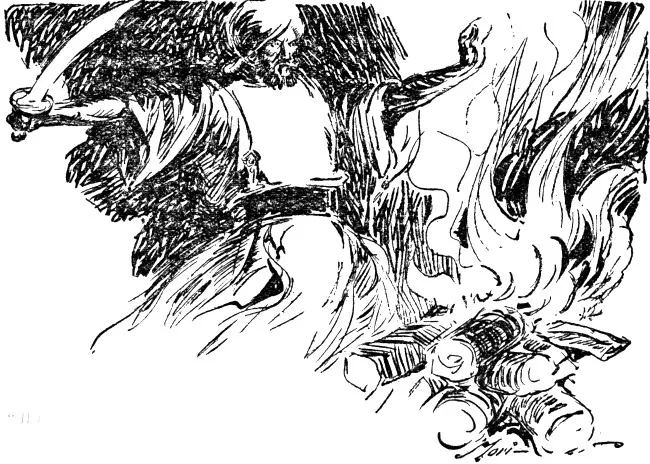
"Who fights behind me? Allaho—Allaho—Akhbar!"
Winifred tried to say something to me, but her words were engulfed in
the uproar. I made signs to her that I would try to read her lips, but
Mir Mahommed strode toward us. As he came the din rose in a wave of
frenzy, hillmen leaping to their feet to howl at us the names of God
and strike into us terror of the wrath to come. But Mir Mahommed knew
the trick of making himself heard in any tumult, pitching his voice
harshly off-key, speaking to Grabowski not much louder than was normal.
"It was you," he said in English, "you, who swore you are my friend,
you who sent word for a troop of the Guides to follow you! Wallah!
What friendship!"
Grabowski faced him, Winifred clutching his arm again, her young face
etched with agony, while frantic men heaped fuel on the fire and
the cavern seemed to sway and tremble with the vibrance of passion.
Nevertheless, in all that din Grabowski's voice was perfectly distinct
because it was passionless and disconnected from the uproar—almost
like a dream-voice:
"Mir Mahommed, you need no lies. You have a ground for quarrel, if you
seek one. I made that image. It was I who claimed that favor after I
saved your life—so you said—and you begged me to let you repay me
in some way lest you should feel under too great obligation. Therefore
it was I who caused much of this trouble. But as God is my witness, I
had nothing to do with the coming of troops."
The mullah glared at Winifred. "You sent for them! My woman heard
you say that Feranquesat here sent a message by his dog. You gave that
message to an officer—"
I thought of Louise's pistol, but there was no sense in using that yet.
If I shot the mullah that would only loose from restraint a hundred
savages, who would be egged on by the vengeful Louise. I did the only
thing I could think of—thrusting Winifred aside and facing him,
telling a bold lie bluntly:
"It was I who sent for troops. In the dog's collar there were two
messages. One was to her, but the other was addressed to the General
bahadur in Peshawar."
He stepped a full pace backward, hand on tulwar-hilt. Winifred tried
to drag me away, but I resisted and Grabowski, with his eyes on Mir
Mahommed's face, stepped in front of both of us. Mir Mahommed drew his
tulwar halfway from the scabbard.
"Allah—"
But yet again the mystery of Allah's will prevented Mir Mahommed's
purpose almost in mid-action. If his purpose was to kill me—as I
think—that might have served him—might have whetted the edge of his
men's savagety; they might have felt blood guilty along with him and so
have been the more determined to fight with the last cartridge to prove
guilt was godliness. But dawn was creeping down the walls of the ravine
and there was dim gray light and raw cold in the cavern entrance.
Harsh—sudden—convincing came the cry of one of Mir Mahommed's
watchmen on the ledge:
"In the name of Allah, make ready! Scotchmen come!"