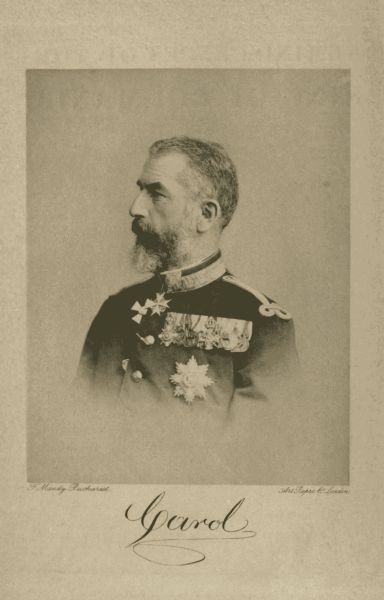
The day selected by the Prince and Princess
of Roumania for the commencement of their
tour through Moldavia—April 20, 1871—was one
of good omen for the result of that journey.
Prince Charles was anxious to reinstate the close
and intimate relations which had existed between
him and his people before the recent agitation,
as well as to give the lie to the calumny that he
no longer took an interest in his subjects. The
Princess, too, was eager to become more closely
acquainted with the beauties of her new country
under her husband's guidance. Unfortunately
the pleasure of the trip was marred by the constant
downpour of rain, which laid half of Jassy
under water. But the Prince and Princess did
not allow the weather to interfere with their
plans, and succeeded in visiting every noteworthy
place or institution. At their departure from the
Moldavian capital, as on their arrival, they
received a most enthusiastic ovation, to which
Prince Charles replied that the heartiness of their
welcome everywhere had convinced him that the
lately dissolved Chamber had in no way expressed
the sentiments of the nation. The memory of the
heartfelt sympathy accorded to the dynasty in
Jassy had, he added, given him fresh courage and
energy to devote to the high duties entrusted to
him by the nation.
Prince Charles expressed the same views to the
Ministry on his return to Bucharest, and informed
them that he had given up the thought of abdication,
as his tour through Moldavia had satisfied
him that the nation would be loyal to the Sovereign
they had elected, whilst condemning the
revolutionary aims which had been the source of
the recent trouble. The marvellous change which
had taken place in the Roumanian situation in the
short space of five weeks did not fail of prompt
recognition abroad. The Austrian Ambassador at
Constantinople remarked: "If Prince Charles
succeeds in managing Roumania with his own
resources, and in rendering it governable, it will
be the greatest tour de force I have witnessed in
my diplomatic career of more than half a century.
It will be nothing less than a conjuring trick!"
Prince Charles thus described the surprising
change of situation between March 22 and May 22:
"Then there were revolts in the streets, breaking
of windows, and an approaching abdication.
Now there is rejoicing throughout the country,
ovation after ovation, and a celebration of the
anniversary of my accession in a more hearty
and universal fashion than I have been accustomed
to for a long time. Everything that was
possible has been done to wipe out the memory of
our bitter experiences of last winter, alike during
our tour through Moldavia and on our return and
on May 22....
"Moldavia has recently been the arena of
anarchical and separatist intrigues so wide in extent
that no great success could be expected at the
recent elections, the more so as a rumour had been
spread throughout Moldavia that I had decided
to turn my back on the country very shortly.
Our tour effected a complete change. Towns
like Galatz and Fokschani, which have sent anti-dynastic
Deputies to the Chamber for four years
in succession to advocate my deposition, have now
elected men who openly declared themselves to be
on the side of my dynasty during the most critical
period. The elections throughout the country
have resulted satisfactorily, and my Ministry can
count upon a secure majority.... Tell voted
against a foreign prince in 1866, as he was of
opinion that such a ruler could neither become
intimately acquainted with the country, nor would
enjoy the same language or religion.... He informed
me on entering the Ministry that no Prince
had ever known the country better or respected
the Church so much as I had done.... He
says: 'I think more of the happiness of the
country than of its liberties!'...
"General Solomon and Colonels Slaniceanu,
Lupu, and Sefcari are thorough soldiers, who were
all at their posts in the hour of danger and did
their duty loyally. The army, moreover, behaved
excellently at the critical time, which gave me
great pleasure, as I have always given it special
attention.
"... I should like to be able to lengthen
every day, for none suffices for my continuous
work. Everything that is performed in silence
by the chiefs of departments in other countries is
here laid before me; no decision is arrived at
without my being consulted. Every one wants
an audience of the Prince to lay a grievance
before him. But the more work I have the better
I like it, and I by no means wish to complain."
Owing to the sudden illness of the Grand
Vizier, Ali Pacha, through overwork, and the prevailing
centralisation of the Turkish Government,
all affairs of State came to a standstill for the
time being. The Sultan refused to appoint a substitute,
and Ali Pacha refused to resign: "I shall
die, if needs be, but I shall die as Grand Vizier!"
The Prince and Princess, with their little
daughter, sought protection from the climate of
Cotroceni in the cloister of Sinaja on August 2.
The arrangements made for them were extremely
primitive: the small whitewashed rooms, or rather
cells, were connected only by a wooden verandah
on the inside of the building, round the inner
court of the cloister. The magnificent view over
the mountain scenery, however, amply compensated
for the lack of comfort; whilst a heavy
thunderstorm, with brilliant flashes of lightning,
cleared and cooled the atmosphere shortly after
their arrival. The weather that followed left
nothing to be desired, and the Prince spent the
greater portion of each day in the company of
his wife and daughter in the glorious Carpathian
woods under a cloudless sky. The Princess of
Wied arrived at Sinaja on August 31 to take part
in the festivities of the first birthday of the little
Princess Marie, who, as her father reported with
joy, "has already two teeth, and will soon be
able to run about."
Almost daily some expedition or picnic in the
woods was arranged, especially at that spot in
the valley of the Pelesch where Prince Charles
thought of building a summer residence. This
plan had, however, to be given up, as the situation
of the proposed house was too much exposed to
the violent winds which swept down the valley.
These happy days came to an end, only too soon,
when on September 11 the Prince returned to
Cotroceni, followed two days later by the remainder
of the family. The Princess of Wied was forced
to commence her journey home on October 28.
The Prince and Princess accompanied her a short
distance on the Giurgiu line. Prince Charles
Anthony expressed his great joy at the favourable
impression which the Princess's mother had
formed of their surroundings in Bucharest. "Her
impressions are generally favourable and, best of
all, she has gained an insight into your home
life, which could not be happier. That is of the
greatest comfort to us, since other circumstances
remain unchanged.... Moreover, Princess Wied
is satisfied with the social elements, and has
everywhere found receptivity for what is nobler
and better; a firm mortar alone is wanted to
prevent the good from dissolving and the evil
from working to the surface...."
Prince Charles replied the same day: "Elisabeth
has created her own sphere of action; she frequently
visits the schools and communicates the remarks
and observations made whilst the instruction is
going on personally to the conseil permanent de
l'instruction publique. By this method she has
already succeeded in introducing several minor
improvements; in addition to this, she is translating
some school-books for children into Roumanian,
with the aid of some young ladies; and once a
week she presides over the Society for the Poor,
which has done good work since its institution a
year ago.... We are all well. Little Marie is full
of life, and runs from room to room. When I have
a minute to spare, I play with her. The dear
child is my greatest joy!"
Prince Charles and his family decided to
celebrate the Christmas festivities of 1871 according
to the Eastern calendar, on December 24
(January 5). Prince Charles Anthony's Christmas
letter contained the following interesting allusion
to German affairs:
"On the whole everything is satisfactory in
Germany. The Prussian officers sent to Württemberg
and Baden find it difficult to grasp the
situation of South Germany; but all is satisfactory,
since necessity knows no law. Manteuffel
plays a great part in France, and is endeavouring
to traverse Bismarck's plans and intentions. But
it is really of no importance; everything succeeds
with us. Both Military Cabinet and Government
of State go their own way, and yet finally
effect a junction, because the National-Prussian
principle outweighs all else.
"May Thiers and the Republic long steer
France! any so-called dynastic revolution would
cause a war with Germany—not that we fear one,
but we need peace and development."
The Chambers passed a law on January 5 by
which Roumania undertook to pay the coupons
commencing from January 1, 1872, and all that
remained to end the matter was the consent of
the Berlin Syndicate to the proposed compromise.
On January 28, 1872, Prince Charles was able to
inform his father that the unfortunate dispute
about the railways had at last been settled:
"A telegram has just been received from Berlin
informing us that the shareholders have accepted
the first part of the law; you can imagine our
delight! The history of this suffering has now
reached its end—thirteen months of anxiety,
excitement, and fears, form a long episode!"
"My chief news to-day is that the condition
of Elisabeth's health renders a journey to the
South an absolute necessity; she has never
quite recovered from the violent attacks of fever
of last summer, and in spite of all precautions
has recently been ill again; this might lead to
serious consequences if often repeated. Since
change of air is the only really effective remedy,
she will go to Italy, and meet her Nassau relatives
and Therese of Oldenburg in Rome before Easter.
Should the climate there not suit her, she will go
on to Naples. The two months' separation, which
lies before us, is indeed very hard, the harder for
Elisabeth, since she must part with both husband
and child! It is satisfactory for me to know that
she will meet relations in Rome, whom she will be
very glad to see again. I must submit to the
inevitable; but I shall feel my solitude very much.
"We shall then spend the whole summer in
Sinaja, where we shall be more comfortable this
time than we were last year. Abegg is at present
negotiating the purchase of some meadow and
wood lands so that we can build a country house
on our own estate, and have a refuge in the
healthy mountain air from the fevers of the
marshes....
"The following incident will show you the anti-German
feeling here: The Court of Appeal has
acquitted the rioters of the 10th-22nd March for
want of evidence. Costa-Foru in consequence
demanded the removal of the judges, but I refused
my consent, to avoid further unpleasantness. He
then laid a decree before me, which made the
President of the Court responsible for the acquittal
and transferred him as a punishment; this I signed.
The result of this measure was the resignation of a
large number of the best judges both of the first
and second instance, a demonstration which has
caused great excitement and has been received
with satisfaction. The gentry in question are considered
as victimes de la Prusse, and only a few
have the courage to agree with Costa-Foru. This
is, of course, water to the opposition mill, and the
affair is exploited in every kind of way...."
In a long letter, received March 8, 1872, Prince
Charles Anthony minutely discussed the Prussian
and Roumanian views about the recently settled
railway dispute, and devoted particular attention to
the attitude of Bismarck and the Imperial
Government.
"I do not believe that the writer of the reports
you forwarded to me can take an active share in
politics, since he gives so free a rein to his dislike
towards Bismarck and Radowitz.
"The German Empire to-day is a given factor,
which the practical politician is forced to take into
consideration. If you look back upon the scenes
which took place nearly a year ago in Bucharest on
the occasion of the Emperor's birthday, you cannot
expect that Germany should meet the Roumanian
population with much sympathy. Such incidents
have a lasting and estranging influence. Moreover,
the continual demonstration of the Roumanians in
favour of France cannot but displease Germany,
who has lost many thousands of her best sons in
a war which was forced upon her against her will.
"I am no blind eulogist of Bismarck, but he is
indispensable to Germany and Prussia, and aims
solely at great ends and means.
"He steps courageously over every bound; just
as he passed over us in the Spanish question, he
has now proved the correctness of his views and
his courage in the retirement of Mühler, and in
insisting on the School Inspections Bill, which
were both fundamentally opposed to the King's
wish and opinion. It is easy to understand that he
must neglect you in striving for great political aims.
"It is not because you are a Hohenzollern, but
in spite of your being one, that no consideration
could be paid to your name and race in the recent
solution of the railway question.
"I am convinced that, now that Roumania has
regained her international position with glory, the
relations with the German Empire will take a more
peaceful form. At all events, the advances lie on
the shoulders of the smaller and weaker State:
that is the ordinary course of events in politics.
"For that reason I dislike the following sentence
in the report you sent me: 'Because certain
capitalists are pleased to put their money into an
industrial speculation, is it necessary that it
should become a matter for the two Governments?
If this principle is admitted, where will it lead?'
"The participation, therefore, in a loan guaranteed
by the State is called an 'industrial speculation'!
Germany, accordingly, is peaceably to allow her
subjects to suffer loss through the Roumanian
State, and if she complains about such treatment,
where should the complaint be addressed if not to
the State, that is the Government, which does not
act in accordance with its pledges? On the other
hand, one might well ask: 'If this principle is
admitted, where will it lead?...'
"The importance of the names connected with the
Strousberg Syndicate was by no means the reason
for the decided steps that were taken in Berlin. The
action was rather due to consideration for the many
thousands of smaller men, who had confidently
invested in the Roumanian bonds; the high rate
of interest, it is true, was the chief inducement,
but nobody imagined that his money was invested
in a dishonest business.
"I now come to the end of this long letter, in
which I have spoken my mind so freely, but in
which I hope you will only recognise a proof of
my affectionate sincerity. I make no claim to be
infallible, but I should like to impress upon you that
the Teuton element to-day possesses the greatest
vitality and the richest future, and that Roumania
can only remain the master of her own future by
a sensible union with it. Let society, the Press,
and the general instinct of the nation be anti-German
if they will—they must not, if they intend
to put their feelings into practice, throw down the
gage to the Teuton spirit."
Princess Elisabeth was forced to tear herself
away from her husband and daughter on March 12,
to seek health under the cloudless sky of Italy.
At Trieste the Princess of Hohenzollern was
awaiting her arrival in order to accompany her to
Rome, and, later on, to Naples, where the King
and Queen of Denmark, and the Prince and
Princess of Wales, with other Royal personages,
were spending the Spring. The Prince of Wales
discussed politics earnestly with Princess Elisabeth,
and asked with which side Roumania would be
ranged in the event of a war. The Princess
quickly replied: "With the strongest, of
course!"
A very plain and straightforward letter was
received from Prince Bismarck on April 25, 1872, in
reply to an explanation which Prince Charles had
sent him on the railway question.
"Your Highness can have no cause to doubt
my devotion to your person. I am sincerely
pleased that your Highness has reason to look
towards the future with greater confidence and a
more joyful assurance. My former respectful
letters will have shown your Highness how highly
I rate the difficulties of your position, and I hope
that your present hopes will not be disappointed.
"In the railway crisis, which is now, we hope, so
fortunately ended, the Government of his Majesty
could adopt no other attitude than that of guarding
the rights and interests of German subjects.
The appeal to the suzerain power of the Porte,
which your Highness complains of, was necessary
on account of the position of these German interests
and the principles of international law; and
only the blindness of the parties in Roumania
could see in it any damage to the autonomy of the
country as established by the conventions."
After alluding to the anti-German demonstrations
in 1871 and the acquittal of the rioters of
March 22, Bismarck continued:
"It is therefore a surprise to us to learn that,
as your Highness remarks, the hope is cherished
in Roumania that the autonomy may be extended
by the mediation of Germany, and new rights
acquired, and that by this means friendly relations
may be re-established. I am afraid that
public opinion in Germany will scarcely appreciate
the reconquest of the favour of the Roumanian
nation, since we may say to ourselves that we have
neither desired nor brought about its loss. Your
Highness knows how unconditionally you may
reckon on the good will of H. M. the Emperor
and King and of his Government, and that we
all entertain the best wishes for the prosperity
and welfare of your country; but at the same time
your Highness has too clear an insight into the
wants of your country not to recognise that the
conditions of that prosperity and that welfare
must be sought in the development of its internal
politics, and in the faithful fulfilment of the
obligations it has undertaken, and that the influence
exerted in Europe by the German Empire
may be of great use to the Roumanian nation, if
the latter in any way responds to, or even acknowledges,
the friendly feeling for Roumania which
still exists here."
"My best thanks for the photographs; your
child must have charming and interesting features:
she reminds one of both the families to which
her parents belong! The surroundings amused
us, and we greatly admired Elisabeth in the
national costume. In spite of photographs, however,
I can hardly imagine my old friend Charles
as a married man and father with a child on his
arm! It is an indescribable happiness to be a father,
and I can only too readily imagine how you spend
every free hour in the society of your child, and
that you found the little mite the only consolation
for her mother's absence during your first separation....
"When I reflect on the course of events in
Germany, since the Düppel assault first attracted
the attention of the world to us Prussians,
it always seems to me as though I had listened
with rapt attention to a long history lesson—that
I was called to witness the reality appears a
marvel. May our people in future preserve the
same becoming earnestness and humility which up
to now they have not laid aside in spite of all their
successes! So long as that feeling is not abandoned
we show ourselves worthy of the deeds we have
witnessed.
"You will remember that the thought of a
reconstitution of the Empire as the finishing
touch in the work of German unity has always
occupied me, and been among my sincerest wishes;
truly, my aim was directed at a peaceable and
bloodless achievement of this fact, and perhaps
the same object might have been reached without
a war. But these are idle questions which can no
longer be considered: we have rather to look to a
systematic and thorough completion of the Empire,
the external form of which is perhaps attained,
but many a year must pass before its southern
component parts have quite found their place in
the new building. The peoples, especially that
portion which took active part in the war, are far
more favourable to the new situation than the
Cabinets; I shall therefore not be at all surprised
if the next few years bring us some most disagreeable
conflicts of aim. The peculiarities of
each separate country forming the Empire will
always be respected and interference with their
internal affairs must be avoided; I therefore do
not at all like the expression 'a uniform State.'
But it is for that very reason that earnest pains
must be taken that perfect unity may be shown in
military, legal, and foreign-political fields, and that
these elements may become more and more firmly
welded together.
"To my joy our neighbour States do not appear
to view our union with unfavourable eyes, and
that is in itself a great deal—we shall certainly not
be loved by any of them. The revengeful feeling
of France is only natural and explicable, though
much water will flow between the banks of the
Rhine before that feeling will issue in act....
"You would hardly recognise my children
again. William[16] is growing and is hard at work.
Henry has become stronger than he was. Charlotte
does not seem to grow at all, yet she is pretty,
like her fair-haired sister. The youngest you do
not know at all—they are already very well-developed
little atoms mentally."
Princess Elisabeth reached Genoa on her way
home to Bucharest on April 30. She had left
Naples only a few days before a terrible eruption
of Vesuvius, accompanied with earthquakes, which
caused the death of some two hundred persons.
At Vienna the Princess was visited by the Emperor
of Austria, Count Andrassy, and a number of her
relations. Prince Charles met the Princess near
Orschowa and was delighted to find her completely
restored to health. Their entry into Bucharest
was greeted in every way as heartily as on their
return from Germany in 1869. The streets of
the capital were so densely packed by a most
enthusiastic multitude that the carriage could
only proceed at a walk.
The following letter from the German Emperor
was brought by M. Mavrogheni:
"My Dearest Cousin,—
"I have to thank you for two letters, one for
March 22 handed me by your father, and the
other by the bearer of this letter. Let me first
thank you heartily for your loyal wishes on
my birthday; since recent events took place
that day has certainly gained more prominence
than formerly, but it also reminds us to return
thanks to Him who set us so unexpected a task,
and who gave us strength to execute it. The
feelings expressed to me on March 22 are in this
respect of value and joy to me, since it is assuredly
of God's mercy that one is selected to execute His
will on earth on behalf of a nation and its army.
"Your last letter gave me an occasion only
yesterday to speak with your Minister, as I am
suffering from an injured knee and cannot dress
myself well. We discussed the Strousberg affair,
which appears to be favourably settled on the
whole, but which has had a very susceptible and
aggravating effect at times. The Jewish question
was then discussed. It is a hard task to have to
side with a race of men whose character I know
only too well from the Russian Poles. Although
in the most examples the guilt of the Jews,
according to your own Government's showing,
was not at all as heinous as it appeared at first,
still the punishment was severe, and some show of
mercy would certainly be advisable; on the other
hand, it must be regretted that the repression of
riots and Jew-baiting was not employed quickly
or effectually enough. This, of course, again
creates the impression abroad that the internal
politics of Roumania are not yet stable, and you
will never eradicate this impression until you have
created a well-organised and disciplined army, able
to enforce obedience to the orders of the Government,
not by strength of numbers, but by quality.
I expressed this opinion years ago to you through
Colonel Krenski, and I regret that you still do
not grasp this point—i.e., that you still place more
value on the quantity of your forces than in their
quality.
"I realise the difficulty of your task, but it is
absolutely necessary if Europe is to gain confidence
in your Government through the prevalence
of order and security in Roumania.
"I am indeed sorry that your wife's health
made a separation necessary, but it was certainly
high time to overcome the fever: nothing undermines
the health more than lingering ill-health;
I therefore hope the best from the Princess's
change of air!
"Farewell, and preserve a friendly memory of
your very sincere Cousin,
"WILLIAM."
The Roumanian Court moved to Sinaja on
May 29, 1872, where the fresh mountain air completely
restored the Prince and his family to
robust health. The Prince wrote the following
description of a great bear-hunt to his father:
"I went bear-hunting a week ago. Three
hundred beaters with drums and trumpets, the
sound of which re-echoed tenfold in the rocky
valleys, and close on thirty hunters, who completed
a circle of several miles, and secured our
quarry. Two drives were arranged, each of which
lasted from two and a half to three hours.
"After leaving Sinaja about five o'clock I
climbed the first summit, Furnica, which I reached
at seven. It was just here that a large she-bear
had killed several sheep three days before, and
devoured them at a short distance from the
shepherds, who looked on trembling. I posted
myself at this point behind a rock overlooking two
deep ravines. The drive then began, accompanied
by the penetrating cries of the beaters, who
descended the slopes on all sides in an unbroken
chain. Suddenly the sky clouded over and a
terrible storm broke, so that you could not see ten
paces before you. As nothing was to be seen after
a wait of two hours we sought refuge in a hut; in
a short space of time the weather cleared up,
and the pretty Prachova valley lay at our feet
bathed in the brightest sunshine.
"This change in the weather encouraged
Elisabeth and her ladies to leave Pojani Zapului,
whither she had driven that morning, and proceed
to meet me with the luncheon. After I had sat
three hours in the hut waiting for the bear, or
rather the luncheon, the latter arrived about noon,
and we sat down to it together on a greensward;
the hunters and beaters, the Dorobanzi and their
horses camped round about us. All the groups
were indescribably picturesque; in the background
the bare rock summits of the Kairaman, Omul,
&c., appeared like veritable ghosts. At two
o'clock we again descended to Pojana Zapului, a
little village at the entrance of the valea babei,
the rendezvous of the bears. I separated from
Elisabeth here, and climbed down into this
haunted valley, where we came across a primeval
wood. Again I found a position which overlooked
two ravines. The greatest bear-hunter of the
neighbourhood was close to me, and assured me
that I should catch sight of some bears. I waited
patiently for close on three hours behind a decayed
tree; the cries of the beaters had long since died
away, single shots were heard in the distance, a
portion of the beaters had finished their task, and
still nothing was to be seen. I laid my rifle aside
discontentedly, but the huntsman whispered to
me to have patience for another half-hour. I took
up my rifle, and ten minutes had barely sped
when I heard a loud rustling, stones rolled down
the sides of the ravine, and two young bears
crossed our field of sight, and one after the other
descended the slope, breaking the rotten boughs
with their broad paws. The distance was not
great, and I could easily have put a bullet into
one of them if boughs and tree-trunks had not
impeded my aim. I therefore quitted my position,
and climbed down a little way to get a free field
of fire, but the huntsman had in the meantime
reached the edge of the ravine and killed one of
the bears with his first shot; the other would
certainly not have escaped him if he had had a
double-barrelled rifle. The great excitement now
commenced, as the she-bear, which had already
been fired on by the beaters higher up, was
expected to arrive, but no one could say whether
she had been wounded, or whether her cubs
had preceded her. The circle of beaters and
hunters now drew closer in, the matador of the
hunters placed himself close by my side, and drew
my attention to the danger of an attack by so
savage an animal. We waited half an hour for
the decisive moment; unfortunately the she-bear
did not turn up, and the hunters declared it
probable that she had been wounded and had
hidden herself in some rocky crevice, as otherwise
we should certainly have had a shot at her.
"On the way home we witnessed another interesting
scene. At least thirty large golden eagles
had assembled round a carcase on the far side of
a ravine, but the distance was far beyond our
range. I fired at one which was hovering over
my head, but only hit one of his feathers, which
fluttered to the ground. The shot frightened the
interesting inhabitants of the mountains from
their meal, and they flew in all directions between
the rocky spurs, where we were able to follow
them with the naked eye for a long time."
The same letter also contained a most interesting
picture of the situation of Roumania, both at
home and abroad.
"Since my last letter to you on April 30
many things have improved here, and every day
shows more and more the advantages of a firm
Government, which alone can secure progress and
increase the prosperity of the country. The loyal
and frank attitude of Catargiu's Ministry has
practically crippled the intrigues of the parties,
the more so since they have no burning question
to exploit. The Opposition Press, it is true, is
not ashamed to publish the grossest calumnies
about the Government, or to prophesy that the
fate of King Otto or the Emperor Maximilian will
befall me unless I dismiss the Ministry soon!
Fortunately their sallies are so violent that no one
places any belief in their screed. As affairs stand
at present only some external crisis can affect the
resignation of the Cabinet; luckily it is in such
favour with the Great Powers that even this
anxiety disappears.... It is the immediate duty
of my Government to maintain order at all costs,
and to aim during the coming session at putting
an end to the abuse of liberty, which only damages
and discredits us in the eyes of foreign countries.
As Roumania is the spoilt child of Europe and
has been permitted to do so much, it knows
nothing of reflection or fear. It is like an
unbroken foal, which is imbued with liberty, and
ignores every danger. Guizot says: 'There are
times when nations are swayed by their desires
beyond all else, and others where they act solely
in accordance with their fears. According as
the one or the other of these dispositions prevails,
nations are intent on liberty or security for
preference. It is the first degree in the art of
government to distinguish between those sentiments.'
To Roumania liberty is more than
security: she only knows her own desires, and
is fearless. I have not, therefore, been deceived
hitherto about her sentiments, which in the eyes
of the French statesman is the height of statescraft.
For my part I consider that I have committed
an error and that I should have achieved
more if I had sometimes gone against the desires
of the nation!
"As a matter of fact, I have from the commencement
devoted my whole energy to the
development of the material welfare of these
richly endowed countries. My groundwork was
the execution of the net of roads and railways.
This is the national-Roumanian policy which I
have so far pursued, and which I shall continue
in the future. Perhaps this is the very reason of
the great wrath of those to whom the existence
of Roumania is a thorn in the flesh. The enmity
to which it is exposed by a paid Press is therefore
well founded, for even a small country which
makes material progress daily may in time become
a factor with which perhaps the world may be
forced to reckon. I have observed two currents
in the policy of Austria-Hungary regarding us:
the official circles appear at present to favour the
stability and peaceful development of Roumania,
whilst others—I know not how to define them:
clerical, financial, Jewish—show their animosity
by an incessant paper-warfare against the country.
The Austrian and Hungarian papers compete with
each other in this rivalry. What lasts too long
ends by becoming tedious, and one may hope that
the world will some day have had enough of this
tangled web of printed lies. It may also be that
much of this arrogance is based on Stock Exchange
speculations. The Jewish haute finance has declared
that it will not embark upon any business
with "Jew-devouring" Roumania, and will oppose
with all its might any of the country's aims. In
the meantime we have concluded a tobacco
monopoly with a great Hungarian Jewish house,
and obtained an unexpected bid of 8,000,000
francs a year, a brilliant piece of business for both
parties."
"Our stay at Sinaja, which, if the weather
holds good, we shall prolong for another four weeks,
suits us excellently. The life here is pleasant and
unconstrained; every day brings fresh interests.
A bevy of young girls adds much liveliness to our
circle; in addition to the lately appointed maid of
honour, Mlle. Valeanu, we recently had seven
young ladies to dinner, with a dance and round
games in the evening. Even nonsense refreshes
the mind, and it was a real benefit to us all to let
ourselves go. We made Costa-Foru dance and
D. Ghika played with us. This is a very different
matter from sitting head over ears in work. Until
to-day it would have been impossible to accuse me
of playing with my present and former Ministers,
and hence it is a real satisfaction to me to have
done so in Sinaja. Moreover, our stay here is of
great benefit to us in many ways: it brings us
into closer contact with people than would be
possible in the city, where everything is red tape;
we have also had the pleasant experience that, in
spite of the difficulty of communication, everybody
seems delighted to come here. We have had
numerous visitors even from Moldavia....
"On September 8 our little Marie will be two
years old, but she might easily pass for three, for
her mental and physical development is far more
mature than that of most children of two years old.
You ought to see my little daughter now, my
dear parents. You would certainly take as great a
pleasure in her as we do ourselves; she already
speaks three languages—Roumanian, German, and,
above all, English; is very independent, runs about
alone, calls everybody by his proper name, and
on Sundays goes to the chapel of the Monastery,
where she keeps quite quiet during the service.
Her character is amiable and gentle; she obeys
every order, and gives up all her little possessions
with pleasure."
The birthday of the little Princess was celebrated
in the same way as the year before, with
the ceremony of breaking a cake over her little
fair head, and with serenades, and fireworks. The
childlike grace and charm with which her Serene
Highness accepted the homage captivated all
hearts.
"We have been permitted, after many storms,
to spend a quiet and happy summer, admiring
nature and art, and visited by people of all kinds
and of all nationalities—mutable and merry,
despite the stillness of the cloister surrounded by
giant mountains. Even a few Englishmen put in
an appearance, and I gave them the heartier
welcome for the hope that they will now spread
healthier ideas about Oriental countries amongst
their fellow countrymen. Unfortunately the shade
of Palmerston still moves amongst England's diplomatists,
and her inhabitants are more Turkish
than the Turks themselves, which fact you will be
able to estimate correctly, as you are acquainted
with Turkish rule. I have said this to all who
came, and I hope that the Foreign Office will
acquire a more just appreciation, particularly of
the territories of the Danube."
"We fared very well during the summer;
my wife and I and our two youngest children
enjoyed the Alps in Berchtesgaden and Salzburg,
a region which we find extraordinarily attractive.
"There, as in the whole of South Germany,
where later on I inspected troops, a reception was
prepared for me as hearty and brilliant as any in
the old Mother Country. The feeling of cohesion
amongst all German races since the re-establishment
of the German Empire has spread in those
parts extraordinarily, broadly, and quickly. All
feel themselves elevated and strengthened; they
see themselves as members of a nation which commands
a respect such as the former thirty Fatherlands
could never have commanded. The enemies
of our union, against whom we struggle, cannot prevail
in face of this political power, but they will leave
no means of damaging it untried. Only we must
not make a mistake in our choice of weapons, for
otherwise we shall make martyrs of our opponents,
and shall reap neither thanks nor advantage."
"The burning question in the new German
Empire is the Church. This question is making
a great stir and embittering family life; it
undoubtedly points to future danger, since the
Ultramontane Party will use it as a lever to
intrigue against the new German Empire and the
Protestant Emperor. Simply to oppose Germany,
France is highly in favour of Rome and everything
connected with it, and so she is enlisting the
sympathies of our Ultras, who believe, or wish to
have it believed, that France is the only sanctuary
of Catholicism, and that Prussia's policy is universal
evangelisation. This tendency in France
is at present a means of agitation, inspired by
revenge and not by the glorification of the Church.
"The boundaries between the powers of the
State and the Church are to be regulated by
legislation in Berlin. This problem may possibly
be solved in theory, but never in practice. When
my opinion was asked, I advised the Emperor to
decide each concrete case with the utmost rigour,
but never to embark upon disputes about theoretical
dogmas—history teaches that in such
struggles the State invariably comes off the worst.
The introduction of civil marriage, the separation
of the schools from the Church, and the establishment
of State examinations for the clergy are
alone excepted from this. The Church must be
left to herself; the State has nothing to do with
dogmas, which depend entirely upon the conscience
of Catholics.
"You have no idea of the agitation which these
questions are causing just now, or of the prevailing
misconceptions.
"It is well that the Jesuit law is, so to speak,
an already surmounted vantage-point; but those
who expect improvement from it are mistaken;
the greater part of the Catholic priesthood of to-day
has been educated by the Jesuits. The whole
struggle is grievous.
"If the contending parties had long ago arrived
at an understanding, particularly in the time of
King Frederick William IV., that the Throne
and the Altar are two irreconcilable conceptions,
it might have been possible to regulate their
relation without the intervention of force. But
that ruler's absolutist tendencies sought and found
in the absolutism of Rome an alliance which is
still a heavy burden upon our national development.
"You will certainly have followed the debates
on the 'Kreisordnung' in the Upper House with
interest. To myself it is a brilliant satisfaction
for the wrongs suffered in 1859 and 1860; what
I then prophesied has happened to-day—the
Upper House is an institution whose entire composition
stands in urgent need of reform.
"The situation in Bavaria and Württemberg,
especially in the dynastic spheres, is scarcely yet
intelligible. Particularism is as obstinate as
possible. The unification of the Empire from a
military point of view is proceeding smoothly, and
will not recede; but the minor Sovereigns take it
very ill that they are to be mediatised in a
military and diplomatic sense at once...."
The unexpected news of the death of
Napoleon III. was received at Bucharest on
January 10, 1873. Prince Charles and the
Roumanian nation were deeply moved by this sad
event, for the dead Emperor had been the champion
and protector of the national existence of
Roumania in its darkest days. Throughout the
whole land memorial services were held, though
the Metropolitan at first objected on the ground
that the late Emperor was not a member of the
Orthodox Church. The universal expression of
sympathy with the widowed Empress and the
Prince Imperial created a certain friction with the
Republican Government, and the Foreign Minister
reminded M. Strat that the Roumanians ought
not to forget that, after all, "it was to France,
and not the Emperor, that gratitude was due"!
M. Thiers, the President, also expressed his vexation
that the Roumanian Chambers should have
sent messages of condolence to the Prince Imperial
as well as to the Empress, since the former had
never had anything to do with Roumania. This
measure was considered to indicate that Roumania
held the French Republic "nul et non avenu."
M. Thiers concluded with the remark: "If I had
acted strictly in accordance with the rules of
international custom, I should have recalled all
my agents and broken off all communication with
you!" M. Strat was able, however, to convince
the President that Roumania had only paid a
debt of gratitude to a benefactor, and had no
intention of insulting France.
The situation in Paris at the commencement of
1873 was described by M. Strat as "the same
struggles, the same defiance in every camp, and
the same uncertainty about the future as in the
past." A sort of armistice existed between M.
Thiers and the Majority of the National Assembly,
who were anxious to foist a King upon France,
whilst the adherents of the Republic were divided
into two camps. "Those who desire a moderate
and conservative republic do nothing to bring
it to pass, and those who wish for a régime on
the lines of Gambetta & Co. do everything in
their power to render it permanently impossible."
Gambetta's school, which unfortunately had made
proselytes throughout the whole of Europe, aimed
at "governing by inane discourses, banquets,
harangues, demonstrations in the streets, and all
the customary trappings of a vulgar democracy."
Hampered by all these conflicting elements, M.
Thiers was confronted by the task of maintaining
order, paying milliards, and raising the commerce
of the country. He would only secure peace with
the National Assembly if he gave it complete
liberty "to play upon that instrument which they
call universal suffrage."
On February 13 King Amadeo of Spain
announced in a special message to the Cortes
that he had laid the crown aside, under the conviction
that the incessant struggles of the parties
were frustrating all his efforts for the peace and
happiness of his country. The Cortes, by a large
majority, proclaimed the Republic pour l'éternité,
and elected as their President a well-known and
thorough-going Republican, Senor Fiqueras. And
so the saying of Napoleon III., that a Latin race
is almost ungovernable, received a melancholy confirmation,
which was only partly refuted by the
Prince Charles's unquestioned success in ruling
the "Latin sister-nation." Public opinion was
only now beginning to realise the great merit of
the Prince in achieving, by patience, abnegation,
and perseverance, a stable Government, which
only a few years before had appeared to be an aim
Utopian and altogether beyond realisation to all
those who were acquainted with the people and
the affairs of Roumania.
Prince Charles was invited by the Emperor of
Austria to attend the Vienna Exhibition, where
Roumanian commerce was to be represented by
exhibits of tobacco, wool, silk, wood, salt and other
minerals. There were scarcely any manufactures,
but the Prince was confident that they would
soon follow in the track of the railways.
The Princess, whose health had not been at all
satisfactory, and her little daughter, set out on
a visit to the Princess of Wied on May 31, 1873.
Little Marie soon became accustomed to the motion
of the yacht, and took the greatest interest in her
first long journey. Neuwied was reached safely,
and the first news which Prince Charles received
on June 23 in Vienna was that they were delighted
to be home, and that the German Crown Prince had
given them a most hearty welcome.
Prince Charles received the same treatment at
Vienna, where he found his brother, the Hereditary
Prince Leopold, awaiting him. He could
not fail to notice that the reception accorded to
him in 1873 was far more cordial than that in
1869, and he found, too, that his labours and
sacrifices during the last four years had at last
received due recognition in the Press.
Count Andrassy had a long and important
interview with Prince Charles on June 25, when
the Prince mentioned his project of declaring
Roumania an independent State, because the
relations with the Porte only led to constant
friction, and were prejudicial to the welfare of his
country. Moreover, a free Roumania, he held,
would be a better friend to Turkey than it
could possibly be under the existing circumstances.
Count Andrassy pointed out that Roumania, as an
independent State, would be exposed to danger
from outside, while at present her safety was
guaranteed by conventions and treaties. At the
same time he gave emphatic denial to the rumour
that Austria had any intention of annexing
Roumanian territory. "We should be acting
against our own interests, were we to increase the
number of our discontented Roumanian subjects,
and extend our frontier against Russia." Prince
Charles replied that it would always be his aim
to remain strictly neutral between his two all-powerful
neighbours, Austria and Russia.
The Roumanian section in the exhibition was
altogether successful; the centre of attraction was
a portrait by an American painter, Healy, of the
Prince in cavalry uniform, and of the Princess in
national costume. The many-coloured carpets and
woven silks also received great commendation, as
well as the wines of the country.
The Prince quitted Vienna on July 1 by the
train which carried the German Empress back to
Germany. The Empress expressed herself greatly
pleased at the reception accorded her by the
Austrian capital, especially by the amiability of
the Emperor Francis Joseph. After a short stay
at Neuwied Prince Charles proceeded to Ems to
see the Czar before the latter left for Russia, and
to congratulate him in person upon the approaching
marriage of the Grand Duchess Marie to the
Duke of Edinburgh. A couple of days later the
Prince and Princess again visited Ems, this time
to see the German Emperor, en route for Imnau,
where they expected to rejoin the Princess of
Wied. The Emperor William welcomed his
Roumanian guests with the utmost cordiality and
affection, and declared himself delighted with the
improved relations of the Prince to the Austro-Hungarian
State. He again pointed out to his
young cousin the necessity of paying particular
attention to his army, and reminded him that a
small but well-disciplined force was far superior to a
more numerous though less highly trained army.
An amusing adventure happened to the Prince
and Princess on their way to Imnau at Giessen,
where they had the misfortune to miss their
train, and were forced to spend the night at a
small hotel near the railway station, without
either luggage or sufficient money to pay for
their railway-tickets. As they desired to preserve
their incognito, they determined to make use of
their "honest looks" to induce the hotel-keeper
to advance the necessary sum of money. This
hope, it is pleasant to note, was not cherished in
vain, and Imnau was reached on July 8. The
Prince's parents remained at Hechingen, which
lies only a short distance from Imnau, but met
every day either at one place or the other, so that
Prince Charles Anthony's favourite wish was at last
fulfilled. In this peaceful fashion a month passed
only too quickly, and, after a couple of days spent
at Krauchenwies the wanderers returned to Sinaja
on August 28, touching Vienna en route, so that
the Princess might also have an opportunity of
visiting the exhibition.
The affairs of Roumania were absolutely uneventful,
and the efforts of the Prince, warmly
supported by the Ministry, made satisfactory
progress towards the attainment of the high ideal
which Prince Charles had kept before him ever
since he first took up his arduous task. In a
letter written to his parents at Christmas the
Prince remarked: "Roumania has never witnessed
so peaceful or, in many respects, so happy a year
as 1873. The general progress is excellent, and
the good understanding between the Government
and the Chambers still continues."
The early part of 1874 was darkened by the
illness of Princess Elisabeth, who was seized by a
contagious disease whilst supervising the distribution
of gifts to the poor children of Bucharest.
Fortunately the trouble abated in time to enable
the Princess to enjoy the visit of her brother-in-law,
Prince Frederick. Princess Marie, too, was
not spared by the epidemic, and for a few days
her condition caused the gravest anxiety to her
parents.
"You will certainly have followed with sympathy
the course of the lamentable religio-political
struggle between our Government and
the Papal Curia. I am sorry that it should have
occurred; but I foresaw it, as the custom,
established these thirty years, of giving way to
the demands of Rome rather than maintaining a
firm position could not possibly continue. I
think, perhaps, a different sequence in the legislature
might have been observed; but since the
struggle has been undertaken we must carry it
through. Austria, very opportunely for us, is
beginning to adopt a similar attitude.
"I am sorry that there should be a current
report that the Government wishes to attack the
Catholic Church and its dogmas for their own sake.
Every one who is capable of calm deliberation must
know that nothing is further from our thoughts."
"I write to you oppressed by care and anxiety
on account of our dear child, who is suffering from
scarlet fever. On Saturday she was quite well,
and drove out with us in the warm spring
weather; early on Sunday she complained of not
being well. Her malady increased towards midday,
and was accompanied by sickness. Towards
evening she became very restless and feverish,
and Dr. Theodori recognised the symptoms of a
dangerous illness. The poor child passed a very
bad night, moaning and sleepless, whilst we
watched by her bedside; at 2 A.M. her skin
became deep red, and her temperature rose considerably.
Theodori came at eight o'clock and
pronounced it to be scarlet fever. At noon her
whole body was burning with heat, and her head
was affected. The doctor then informed me that
the illness was so dangerous that he should like
another opinion. A consultation took place the
same evening in the sick-room, to which the local
medical authorities were summoned. They did
not conceal her serious condition from us, and
declared that her age added to their anxiety.
"Another bad night was passed, but the fever
was less intense the following morning; there
was no question of sleep. We do not lose our
courage, and trust in God, who will not abandon
us in the hour of our trouble...."
After a slight improvement on the 8th the
condition of the child became so alarming at
midnight that her parents, who had not left her
side till eleven P.M., were again summoned to her
bed. They found their little daughter gasping
for breath. The hastily summoned physicians
declared the condition of their patient to be
hopeless. As she lay in the lap of her English
nurse, the child's strength seemed to ebb with
every minute, and as the first rays of the rising
sun touched the windows of the room, the
despairing parents were kneeling by the lifeless
body of their only child. Only a short time
could be given them to be near her; the little
coffin was closed, and carried by the grief-stricken
father out of the death-chamber. A long procession
accompanied the body of the little Princess
to the Church of Cotroceni, where it was to
remain until the morrow, which was Good
Friday. At two o'clock the last sad rites of the
Orthodox Church were celebrated in the presence
of an enormous concourse of sympathetic representatives
of every class of society.
"We have just received the unexpected and
afflicting news of the terrible misfortune that
has befallen you. May God's grace be with you
and grant you strength to bear the desperate
sorrow, the burden of which we know from our
own experience! In thought I put myself in
your frame of mind, and realise that you must
both be numbed with grief at seeing your sweet
child lifeless before you, and at knowing that you
can never again see a light in her dear eyes,
never again a smile on her face!
"These are hours in which, in spite of all Christian
principles, one still asks: why need it have
been? And certainly it is hard to say: 'Thy will
be done!'
"I wrote this text on the tomb of my son Sigismund,
your god-child, because I know of no other
consolation: and yet I cannot conquer that pain
to-day, though many years have already passed,
and though God has given me a large family.
Time does certainly blunt the keenest edge of a
parent's anguish, but it does not remove the
burden, which remains a companion for life....
"Your grief is also ours, and you are both the
object of our anxiety and our prayers; for that
my wife is at one with me in these thoughts of
sympathy you know as well as that these lines
are for poor Elisabeth no less than for you. God
be with you, and be merciful to you!"
In the following letter, addressed to the President
of the Ministry, Prince Charles endeavoured
to thank his people for their sympathy.
"The Almighty has summoned our only and
dearly loved child from this world of trouble.
"If a proof of my country's devotion had
been needed, it could not have been shown
in a more affecting manner than in these
days of sorrow, when the sense of the sincere
sympathy of all has been our chief consolation in
distress.
"And so I desire to assure my country that
just as it has supported me by its affection in
the hardest moment of my life, so I shall endeavour
to repay in good measure the kindness which it
has manifested towards me.
"The sweetest memory which our lost daughter
has left us as an inestimable treasure is her
boundless love for the country in which she was
born, a love so strong that despite her tender age
she felt the pangs of home sickness during her
first stay abroad.
"Our child's faith and the language which she
spoke have assumed a new sanctity in our eyes,
for every Roumanian word will from henceforth
be to us the echo of that voice which we shall
never again hear on earth.
"Though the dearest and most intimate bond of
our family circle has been severed, a still stronger
tie unites us now with our greater family, the
Roumanian nation, which joins with us in mourning
the loss of our and their child.
"It is a sacred duty with the Princess and
myself to express to one and all, from the depth
of our sorely tried hearts, our cordial gratitude,
together with the hope that all will unite with us
in prayer that the Almighty may grant us strength
and patience in the trial which He, the Father of
All, has in His inscrutable wisdom sent to us."
"What terrible news! Though yesterday we
awaited your telegram not without anxiety, still
we were reassured towards evening. As long as
I live I shall not forget to-day's awakening—I
opened the telegram without agitation—speechless,
and with the keenest heartache, I read it
again and again. For a long time I could not
believe in the possibility of the destruction of your
domestic happiness. God's ways are inscrutable!
He has for only too short a time entrusted to you
a being whom He loved so much that he could
not but recall her to Him. These lines are not
meant to console you, for at such moments there
can be no consolation: they are only to remind us
all that we must humbly submit, come what
may!"
"We established ourselves here (Cotroceni)
yesterday, and we hope to find more peace and a
little consolation for our sorrowing hearts, since
we shall now be close to the resting-place of our
loved child. The palace in the capital seemed so
empty and melancholy to us that we awaited with
impatience the day when we could leave it. But
we shall feel our loss bitterly even here. Our
daily walk is to her grave, where we sit and talk
over the legacy of rich and manifold memories left
us by our dear child. The whole country mourns
for little Marie; this you know, and will have
seen from our newspapers; many expressions of
sympathy have also reached us from abroad. The
German Emperor wrote me a very kind letter in
which he shows his true kindness of heart. I also
received a letter from the King of Italy, and
Elisabeth one from the Queen of England, which
was couched in very warm and affectionate terms.
The Empress Eugénie also telegraphed her
sympathy with me.
"... Elisabeth's nerves are so shaken that the
greatest care is necessary. I must confess to you
that I am often anxious myself, and am much
depressed by pain, sorrow, and apprehension. I get
but very little sleep at night, and have repeatedly
heard my poor Elisabeth cry out in her dreams:
'Dead, dead!' This cry of pain is each time a
fresh stab in my wounded heart!"
Whilst Princess Elisabeth sought to conquer
her grief by distraction in translating Roumanian
legends and fairy tales, Prince Charles's time was
claimed by affairs of State. Great Britain, in
pursuit of its Turkophile policy, wished to accredit
its new agent, Mr. Vivian, with a letter in which
mention was made of the "good relations which
exist between England and the Sublime Porte and
the territory governed by your Highness." The
Roumanian Government declined to receive this
communication, but the incident was eventually
settled by an exchange of Notes between the
English Consul-General and the Minister for
Foreign Affairs. Mr. Vivian had a private
audience on May 4 with the Prince, who expressed
his opinion very plainly on the Oriental policy of
England.
"We are impatiently awaiting Leopold's arrival,
which is promised for Monday. The Prince of
Servia will have left us by then; he has truly
Oriental ideas of hospitality! We hold aloof
from all public entertainments in his honour, and
only invite him now and again to dinner or tea.
Every time he comes to Cotroceni he brings a
wreath, which he places, either with his own hand
or by another's, on the grave of our child. He is
a very pleasant, bright, and handsome man, an
excellent talker; he is by nature gifted with
understanding, but is deficient in higher culture.
His visit here is making a great impression in
Constantinople, which he quitted in anger. The
Servians are now on a worse footing with Turkey
than we are, since they have been refused Swornik.
After voting us addresses of condolence in corpore
the Chambers are endeavouring to overthrow the
Ministry and to form a coalition."
On June 7 a law was passed providing for the
allotment of land in Bessarabia to the Bulgarians
expelled from the right bank of the river. This
measure was warmly advocated by the Russian
Consul-General, but Prince Charles, mindful of
Russia's declaration in 1871, was disquieted by
the discovery that the Russian Government had
not surrendered its hopes of the reacquisition
of Bessarabia.
After a short stay in the pleasant groves of
breezy Sinaja the journey to Franzensbad was
commenced on July 15 in the company of the
Hereditary Prince. The Princess of Hohenzollern
arrived a few days later alone, Prince Charles
Anthony's infirmities keeping him practically a
prisoner in his room. Prince Charles was
delighted to find that his mother's health
was unaffected by her exertions: "We are inexpressibly
happy to have her here, but reproach
ourselves for having taken her from you, and we
are grieved that you should remain alone at
Krauchenwies. We fully appreciate the sacrifice
you have made for us, and thank you with all
our hearts.
"The Empress had been so kind as to inquire
from the Queen of England what watering-place
would suit us best. The latter replied by
telegraph that her physician, Sir W. Jenner,
recommended Eastbourne for Elisabeth 'and her
husband.'
"When ladies of so high degree look after a
watering-place for us, we ought certainly to reap
the full benefit from our stay! We shall,
therefore, probably go to Eastbourne or Hastings.
"One day is very much like another, and we
live solely according to the 'Kur.'... These
places in Bohemia are fortunately so accustomed
to Royal visitors that a Queen and an Oriental
Prince create very little stir."[17]
After paying a flying visit to the German
Emperor at Eger the Prince and Princess arrived
in London on August 19. The Marchioness of
Lorne came to express the Queen's regret at her
inability to receive the travellers, as she was about
to set out for Scotland. The Prince of Wales
and the Duke and Duchess of Edinburgh welcomed
Prince Charles and his wife with warm
sympathy. The young Duchess of Edinburgh
had changed greatly since the first time Prince
Charles saw her at Livadia in 1869. Then she
left the impression of a charming child, but now
she appeared with all the character of a young
mother.
During their three weeks' stay at St. Leonard's
the Prince and Princess made many excursions
to Brighton, Oxford, Woolwich, Chislehurst,
and the neighbouring country seats of the
nobility. The visit to Oxford, with Professor
Max Müller as cicerone, was of especial interest
to the Prince, who was much impressed by the
ancient University, with its glorious colleges. By
the courtesy of the Secretary of War, Gathorne
Hardy, Prince Charles was able to make a minute
inspection of the Woolwich Arsenal. The Prince
was astonished to find that the heaviest naval
guns for the British fleet were still built on the
muzzle-loading principle, and endeavoured, without
much success, to convince his guide, Major-General
Simmons, of the advantages of the
breechloading system.
Several very pleasant hours were spent at Lord
Brassey's castle and on board his yacht. Lord
Brassey had visited Roumania on several occasions,
as he was interested in the Offenheim
railway concession, and was, therefore, no stranger
to the Prince. A couple of visits were also paid
to Holmebury House to Lady Mary Anne
Alford and her brother, Mr. Leveson-Gower, whose
brother, Lord Granville, had formerly been in
communication with Roumania as Secretary of
State for Foreign Affairs.
"We shall commemorate in quiet and grief the
birthday of our dear daughter on the 8th of September.
She was the light of our home life. Now
this anniversary will only teach us, as each year
comes round, that this earthly life, with all its
pleasures and sorrows, is but the preparation for
a better life, and that, therefore, we must not cling
too much to the things of this world. England by
no means seems full of this sentiment. I believe
that in no other country has materialism gone to
such a length as here. People live solely to enjoy
their lives—et voilà tout. Commerce and industry,
therefore, flourish, which bring in money, and
money is the essential requisite for English
comfort!
"I discussed the social condition of England
with Max Müller, and derived much benefit from
the insight into the situation here which I owe to
him.
"Roumania is a terra incognita here, and the
sympathy with Turkey is so great that it is useless
to struggle against this folly. Nevertheless, I
have placed myself in communication with several
influential Englishmen.
"In spite of the cutting cold winds, we continue
our sea-bathing, and derive much benefit
from it...."
Lord Derby, in reply to a letter from Prince
Charles, who expressed his regret at not having
met the Foreign Secretary in London, professed
his deep concern at being unable to pay the
Prince a visit before his departure from England.
On the way home Prince Charles visited the
Oriental Congress in London, where representatives
of all Eastern nations were assembled.
Amongst others, the Prince made the acquaintance
of Sir Henry Rawlinson, the decipherer of
the cuneiform inscriptions; of Léon Rosnez, the
learned exponent of Semitic languages; of Sir
Henry Bartle Frere; of Sir John Lubbock and
Charles Kingsley. The majority of these were
presented to Prince Charles at a Mansion House
banquet given in honour of the Oriental Congress.
The quaint ceremonies, the ancient costumes of
the civic dignitaries, the luxury and wealth of
the table appointments, and the excellent music
discoursed during the dinner all contributed to
attract the Prince's attention and interest.
The homeward journey lay through Paris, where
the ruins of the Tuileries awakened melancholy
reflections; Strassburg, which still bore plain traces
of siege, to the Weinburg where Prince Charles
Anthony was feverishly awaiting their arrival.
The meeting was most affecting, and the memories
awakened by the deep mourning of his children
almost overcame the aged Prince, whose bodily
infirmities were increasing with every year. The
stay at the Weinburg ended on October 8. Prince
Charles Anthony's bodily suffering, though borne
with heroic courage, threw a melancholy shadow
over the otherwise happy home life of the
Hohenzollern family.
With their return to Sinaja the grief of the
unfortunate parents was constantly aroused by
the absence of their dear one from the rooms which
once were enlivened by her presence; the very
gloom of the weather seemed to encourage this
melancholy mood.
"I was very pleased to make the acquaintance
of the bearer of these lines (the Roumanian
Minister of War) and to see him at our
manœuvres, which appeared to interest him
greatly. My best thanks to you for the letter he
brought me. I think it most natural that your
journey this time should have been undertaken
solely on account of the health of both of you, and
that, moreover, your mood was not such as to care
to make any visits except in the narrowest family
circle. Let us hope that another time you will
give us the pleasure and joy of seeing you here.
In any case I am happy to have spoken with you,
though only for a short time in Eger.
"With a thousand greetings to your wife,
"Your sincere Cousin,
"WILLIAM."
"We quitted Sinaja three weeks ago with
heavy hearts to return to Bucharest. The weather
remained beautiful until a week ago, and our
longing for the mountains was increased; the
more so as the empty rooms of the Palace can
never appear lively. We endeavour to distract
ourselves as much as possible and invite people to
dinner every day, but nothing can make us forget
the dear voice of our child, which we miss everywhere
and at all times.
"I opened the Chamber yesterday. My speech
was short, and touched only on practical questions.
"The question of the commercial treaties is on
the high road to an immediate solution, the only
difficulties are matters of detail. We are now
negotiating with Austria-Hungary, whose interest
it is to enter on closer relations with us both
politically and commercially. Even now the Porte
cannot grow resigned to a defeat which is due to
its own lack of skill. England, France, and Italy
will have no course left but to adopt the same line
as the three other Great Powers; their representatives
here are quite willing to influence their
Governments in our favour. We have every
reason to be satisfied with our Diplomatic Corps;
France and England, in particular, have sent us
amiable and experienced men, who have already
travelled throughout the country, and can judge
of our circumstances with intelligence. They have
both pleaded for the commercial conventions in
their reports."
A most interesting and important report on the
condition of the Servian forces in 1874 was
received on January 9, 1875. M. Sturdza prefaced
his remarks by insisting upon the extreme difficulty
of ascertaining the truth about Servia: Chauvinism
and love of exaggeration conspired to keep
strangers in the dark. He had, however, been
able to discover enough to prove that the Servian
troops were, strictly speaking, no army at all.
Both quality and quantity left much to be desired,
whilst the standing force of 5000 men was hardly
sufficient to keep order in the interior. The permanent
force of cavalry amounted to but one solitary
squadron, whilst only one battery was armed
with modern guns. The fortresses were in an
indefensible condition, as their sole armament consisted
of the guns which the Turks had left there.
The Territorial Army was of still less value than
the standing army. Without officers and without
equipment or proper arms it in no way deserved
serious consideration. The political situation of
Servia also gave rise to considerable doubt as to
the stability of Prince Milan's Government. The
Press constantly urged the Croats, Slavonians, and
Hungarian Servians to rebel against Austria.
Prince Milan had flouted Germany by his openly
expressed sympathy with France, whilst England's
favour had been lost by the anti-Turkish policy of
the Ministry. Russia, Servia's best friend, had
supported the Ministry, until it applied to the
French Ambassador in Constantinople for his
assistance in the Swornik question. Count Ignatiew
was so much exasperated by this step that
he counselled the Porte to resist the demands for
the withdrawal of the Turkish troops from that
fortress.
The attitude of the populace of Montenegro and
Herzegowina towards Turkey threatened most
serious complications in January 1875. The massacres
of Christians at Podgoritza late in 1874 still
remained unpunished, though the instigators had
already been sentenced by Turkish Courts. Representations
to the Sublime Porte resulted in the
preposterous demand that the Montenegrins, who
had been the cause of the disturbance, should be
tried by a Turkish Court before the sentences on
the Ottoman officials were carried out. Eventually
the Ambassadors of the Powers succeeded
in persuading the Porte to abandon this
claim.
Prince Milan's popularity had suffered greatly
by his favouritism and caprice, whilst his Ministry
seemed to aim either at forcing him to abdicate,
or at least at putting such difficulties in his way
that the Powers would be forced to intervene, and
thus effect his fall. His long stay in Paris in 1874,
together with his unbounded extravagance, gave
rise to most unfavourable comment. "It is
asserted that the Prince's debts now amount to
the whole of his private fortune. Bills of exchange
arrive every day from abroad and cannot be paid.
His landed property in Wallachia will be invaded.
Expedients for borrowing from all sides are seen
at the Palace. Many people here, even peasants,
are owed money. The civil list has been spent six
months in advance."
"... I only now realise the magnitude of the
work your Highness has undertaken, a work which
demands the highest form of heroism, the heroism
of patience! To sow without the hope of enjoying
the harvest demands a degree of faith such as
is not common in the present day. If I were
younger, I would enthusiastically offer my services
to the warden of European culture on the Danube,
and would leave him no peace until the schools
and universities had become the pride of his
people and an example to the whole world. Guns
are wanted; railways are wanted; but, above all,
schools are wanted; they are the most sacred
duty of all! It is often hard to love or to benefit
our neighbours, but we can all love and benefit
our own posterity. When the Budget of Love
(education) is as high as the Budget of Hatred
(war), the Eastern Marches will be under the protection
of Europe even without treaties.
"Public opinion in England remains unaltered—the
arrival of a telegram from the Danube
makes us tremble in every limb. Two reasons for
this are apparent. Humanity is the slave of
phrase, and the phrase, 'integrity of the Ottoman
Empire,' is as much a matter of course to the
English as 'Britannia rules the waves.' Such
phrases have a firmer hold on English policy than
on French or German. The Turkish funds form
the second reason...."
On February 14, 1875, Prince Charles received
the Spanish Ambassador, who came to announce
the accession of Alfonso De Borbon y Borbone "by
the Grace of God and the National Will King of
Spain." Don Gherardi was received with every
honour usual on such occasions at the European
Courts. Though this step of the King of Spain
was entirely due to his personal relations to
the Roumanian Court, and not to any political
motive, it nevertheless caused much excitement
in diplomatic circles, as it was practically tantamount
to the recognition of the independence of
Roumania. The Sublime Porte at once demanded
satisfaction from Spain, and declared that Turkey
would not recognise the new kingdom until such
satisfaction had been given.
"One of the most ridiculous and narrow-minded
of political interests is the unbounded
importance attached to the Spanish notification
to Bucharest, which is treated as seriously as
though the whole Eastern Question depended
upon it. The English papers, followed by
those of Berlin, never tire of discussing this
matter from every point of view. It is truly
ridiculous, but, on the other hand, discloses
the still prevailing aversion from your emancipation."
"We lost all communication with abroad and
the interior for a whole month in consequence of
heavy snowstorms. Many accidents and considerable
losses have occurred which will be more
severely felt here, where misfortunes, as well as
prosperity, are ascribed to the Government,
than elsewhere. It is hard to realise the
sufferings of the poor peasants: famine and
typhus raged in several villages; and it was
impossible to send them help! No one dared to
go out of doors on account of the multitude of
wolves which infested every locality in search
of food. According to official reports, these
brutes have devoured a number of human
beings and cattle, whilst the bears have done
equal damage on the mountains! The total
suspension of railway traffic has caused a most
unwelcome loss of 3,000,000 francs to the State
at a moment when the deficit had been covered
with difficulty. Trade also has suffered materially,
as all business was interrupted; the
Exchequer has had no money for the last ten
days, as no remittances arrived from the districts—and
all payments had to be suspended in consequence!
All this had a serious effect on every
one; discontent and ill-humour prevail everywhere!...
"The slowness of the present thaw will, it is to
be hoped, prevent larger inundations; the streets
in town, however, are in an incredible state; locomotion
is only possible in sleighs—which are in
imminent danger of being capsized. This happened
to us last week, but we escaped unhurt.
Elisabeth was delighted at the adventure, but I
am ashamed at having been upset in my capital!
Our hound, Mentor, was so terrified by this accident
that he refused to get into the sleigh again,
and went home on foot....
"Russia and Germany have declared themselves
willing to negotiate commercial and consular
conventions with us. England regrets that
she has not been able to frustrate the fait
accompli, but, nevertheless, makes a bonne mine
à mauvais jeu. Yet she could not help inciting
the Sublime Porte, by her very anti-Roumanian
representative in Constantinople, to issue the
ridiculous protest about the Spanish notification.
This was an ill turn to Turkey, as an innocent
affair was expanded into a cause célèbre....
The expenditure of 5,000,000 francs (for warlike
purposes) produces not a little disquiet, and has
set England against us; and yet England is one
of the keenest competitors for the contract! Very
significant!"
On March 28, 1875, the Chambers legislative
period of four years came to an end. Not only
was it the first time that one and the same
Chamber had sat for the full term, but it was also
the first time that the same Ministry had both
opened and closed the Chamber, an achievement
which speaks volumes for the progress and
development of the Principalities during this
period.
Prince Charles accepted the presidency of the
Bucharest Jockey Club, founded by Mr. Vivian,
the English Consul-General, in April 1875. At a
banquet on April 18 the Prince expressed the
hope that the foundation of the Club would be
beneficial to horse-breeding in Roumania, and
restore the industry to the position it held in the
time of Frederick the Great, who procured part of
his remounts from Moldavia.
"My life is so quiet and lonely that my
connection with the outer world is actually based
on confidential letters and the newspapers alone.
"Nevertheless, I am very well posted, and
am daily better able to appreciate that one sees,
hears, and judges all the more clearly for being
more concentrated and quiet. Unfortunately I
cannot say that the policy of the young German
Empire satisfies me at present.
"The demand on the Italian Government about
the Papal Guarantee law appears to me to be
out of place. Difficulties increase every day in
the religious-political field, and it does not seem
clear how we are to get out of it without
entrenching on matters of Catholic belief. I
certainly am no Ultramontane; but my objective
sense of justice revolts against our tactics, groping
wholly in the dark against a power which possesses
an unparalleled spiritual influence. Our alliances
at present are more of a personal nature than
based upon mutual interests. Fortunately the
universal desire for peace has now gained the
upper hand everywhere.
"Everything seems to be going well and quietly
with you; it is to be hoped that the elections
will not cause too great excitement in the country.
However, you are already more or less accustomed
to these agitations: and with sangfroid one may
regulate much which at first appears to be overwhelming."
As a matter of fact, with the exception of a
couple of student demonstrations in Bucharest,
the elections took place in perfect peace and
order, and resulted again in a large majority for
the Conservative Government. The Opposition,
it is true, attempted to prove that the Ministry
had influenced the elections, and twelve Liberal
judges of the first instance resigned as a protest.
One of the first duties of the new Chamber
was the election of a successor to the venerable
Niphon, the Metropolitan of Bucharest, who died
suddenly on May 17, 1875, at the age of eighty-four.
The body, in accordance with a strange old
custom, was seated on the archiepiscopal throne
in the Metropolie, dressed in full canonicals—a
picture of peaceful and spiritual dignity. Countless
numbers of orthodox believers thronged the
church to kiss the Metropolitan's hand for the
last time. All through the night priests chanted
before the altar, whilst high and low, rich and
poor, passed in one long line before the dead
Prince of the Church.
Owing to the great heat it was found impossible
to comply with the custom of carrying the
seated corpse to the monastery of Cernica. Four
priests therefore held the chair on a hearse open
on all four sides, and thus bore the venerated
priest to the burial-place of his predecessors.
Many of the spectators threw themselves to the
ground as the procession passed them.
"I write to you to-day with painful emotion,
after an escape from a great danger.... The
railway journey to Giurgiu, when I was accompanied
by a number of senators and deputies, as
well as the return journey as far as Filaret, passed
uneventfully; at the last-named station the train
crossed over to the loop line. The engine had the
tender in front.
"I looked out of the window and noticed that
the train was moving on to a line at Dealu-Spirei,
where a ballast train was already standing. I
sat down quickly and said to those who were
with me in the saloon-carriage: 'Sit down, there
is going to be a collision!' At the moment a
violent shock took place, throwing my companions
on to the floor; I was thrown in my armchair
against the table opposite. A second shock
threw me backwards, breaking the chair; my
sword was bent round my knee and probably
caused the contusion, but unquestionably saved
my leg. Every one hastened to help me, but I
got up unaided and said a few reassuring words.
We had all blows about the head; Davila was
bleeding....
"The tender and the engine were both derailed
and ran into the sand. Three carriages of the
ballast train were destroyed and a couple of our
carriages were much damaged.... We were
about one mile from Cotroceni, and walked there
in spite of the heat.... Fortunately Elisabeth
first heard what had happened from my own
lips!"
"God has clearly protected you! You can
imagine the tremendous play that imagination
possesses when so great a distance divides us....
"I know from experience how tedious injuries
to the shin bone are; on reckoning up my own
threefold experiences of that kind I find that I
spent a good six months' time on the chaise
longue!...
"I prefer to be silent about our policy—it is
most unpleasant for us that the Czar of Russia
should be hailed on all sides as the apostle of
peace. Radowitz is said to have conducted
himself passionately and without tact: his immediate
transfer to Athens is discussed. I congratulate
you on your successful elections; it is
quite clear that the longing for material development
has gained the upper hand over the empty
aims of the dreamers!"
"The excitement over the Church struggle is
beginning to abate.
"The blunders of the Government and the
Ultramontane party mutually set each other off.
It is a pity that they are not confined to one
side, for then the crisis would be hastened to the
general benefit.
"I had an opportunity of going thoroughly
into these questions with the Emperor during
his visit here. He is inclined to a conciliatory
attitude, but is not sufficiently informed. I have
made him understand much, for which he was
grateful, and which he is the readier to believe
since I adhere to the basis of the May laws, but
condemn the petty method of carrying them out.
The Emperor was full of touching sympathy with
us, asked minutely after you, and was very well
pleased with the course of your policy."