In order to understand this Oregon Expedition, it is
necessary to say, that thirty years ago (1803), PRESIDENT
JEFFERSON recommended to Congress to authorize competent
officers to explore the river Missouri from its mouth
to its source, and by crossing the mountains to seek the best
water communication thence to the Pacific Ocean. This
arduous task was undertaken by Captain M. Lewis and
Lieutenant W. Clarke of the first regiment of infantry. They
were accompanied by a select party of soldiers, and arrived
at the Missouri in May, 1804, and persisted in their novel
and difficult task into the year 1806, and with such success
as to draw from President Jefferson the following testimonial
of their heroic services, viz. "The expedition of
Messrs. LEWIS & CLARKE, for exploring the river Missouri,
and the best communication from that to the Pacific
Ocean, has had all the success which could be expected;
and for which arduous service they deserve well of their
country."[4]
The object of this enterprise was to confer in a friendly
manner with the Indian Nations throughout their whole
journey, with a view to establish a friendly and equitable
commerce with them, on {2} principles emulating those that
marked and dignified the settlement of Pennsylvania by
William Penn. It was beyond doubt that the President
and Congress sincerely desired to treat the Indians with
kindness and justice, and to establish peace, order, and
good neighbourhood with all the savage tribes with whom
they came in contact, and not to carry war or violence
among any of them who appeared peaceably disposed.
A few years before the period of which we have spoken,
our government had acquired by purchase the vast and
valuable Territory of Louisiana from the renowned NAPOLEON
BONAPARTE, at that time the Chief of the
French Nation. Considering his previous intentions, and
actual preparations under his famous General Bernadotte,[5]
nothing could be more fortunate for these United States
than this purchase. Our possession of Louisiana was so
grievous a sore to the very jealous Spaniards, that they
have, till lately, done all in their power to debar and mislead
us from pursuing discoveries in that quarter, or in the Arkansas,
Missouri, or Oregon. Yet few or none of them
probably believed that we should, during the present generation,
or the next, attempt the exploration of the distant
Oregon Territory, which extends from the Rocky Mountains
to the shores of the Pacific Ocean, or in other words,
from the Missouri and Yellow Stone rivers to that of the
river Columbia or Oregon which pours into the Ocean by
a wide mouth at the immense distance from us of about
four thousand miles; yet one and twenty men, chiefly farmers
and a few mechanics, had the hardihood to undertake
it, and that too with deliberation and sober calculation.
But what will not a New-England {3} man undertake when
honor and interest are the objects before him? Have not
the people of that sand-bank, Nantucket, redeemed it from
the ocean, and sailed round Cape Horn in pursuit of whales
for their oil, and seals for their skins? A score of our farmers
seeing that Nantucket and New Bedford had acquired
riches and independence by traversing the sea to the distant
shores of the Pacific, determined to do something like it by
land. Their ardor seemed to have hidden from their eyes
the mighty difference between the facility of passing in a
ship with the aid of sails, progressing day and night, by
skilfully managing the winds and the helm, and that of a
complicated wagon upon wheels, their journey to be over
mountains and rivers, and through hostile tribes of savages
who dreaded and hated the sight of a white man.
This novel expedition was not however the original or
spontaneous notion of Mr. Nathaniel J. Wyeth,[6] nor was
it entirely owing to the publications of Lewis & Clarke or
Mackenzie.[7] Nor was it entirely owing to the enterprise
of Messrs. Barrell, Hatch, and Bulfinch, who fitted out two
vessels that sailed from Boston in 1787, commanded by
Captains Kendrick and Gray, which vessels arrived at
Nootka in September, 1788.[8] They were roused to it by
the writings of Mr. Hall J. Kelly, who had read all the books
he could get on the voyages and travels in Asia, Africa,
Europe, and America, until he had heated his mind to a degree
little short of the valorous Knight of La Mancha, that
is to say, he believed all he read, and was firm in the opinion
that an Englishman and an American, or either, by himself,
could endure and achieve any thing {4} that any man could
do with the same help, and farther, that a New-England
man or "Yankee," could with less.[9] That vast region,
which stretches from between the east of the Mississippi, and
south of the Lakes Superior, Huron, Michigan, Erie, and
Ontario, was too narrow a space for the enterprise of men
born and bred within a mile or two of the oldest University
in the United States.[10] Whatever be the true character of
the natives of New England, one thing must be allowed
them, that of great and expansive ideas,—beyond, far beyond
the generality of the inhabitants of the small Island
of Britain. I say small, for if that Island should be placed
in the midst of these United States, it would hardly form
more than a single member of our extended republic. That
vast rivers, enormous mountains, tremendous cataracts,
with an extent corresponding to the hugeness of the features
of America, naturally inspire men with boundless ideas,
few will doubt. This adventurous disposition, at the same
time, will as naturally banish from the mind what the new-light
doctrine of Phrenology calls the disposition bump of
Inhabitiveness, or an inclination to stay at home, and in its
place give rise to a roaming, wandering inclination, which,
some how or other, may so affect the organs of vision, and
of hearing, as to debar a person from perceiving what others
may see, the innumerable difficulties in the way. Mr. Hall
J. Kelly's writings operated like a match applied to the combustible
matter accumulated in the mind of the energetic
Nathaniel J. Wyeth, which reflected and multiplied the
flattering glass held up to view by the ingenious and well-disposed
schoolmaster.
Mr. Nathaniel J. Wyeth had listened with peculiar {5}
delight to all the flattering accounts from the Western regions,
and that at a time when he was surrounded with
apparent advantages, and even enviable circumstances.
He was born and bred near the borders of a beautiful small
Lake, as it would be called in Great Britain; but what we
in this country call a large Pond; because we generally give
the name of Lakes only to our vast inland seas, some of
which almost rival in size the Caspian and Euxine in the
old world. It seems that he gave entire credit to the stories
of the wonderful fertility of the soil on the borders of the
Ohio, Missouri, the river Platte, and the Oregon, with the
equally wonderful healthfulness of the climate. We need
not wonder that a mind naturally ardent and enterprising
should become too enthusiastic to pursue the laborious
routine of breaking up and harrowing the hard and stubborn
soil of Massachusetts within four miles of the sea,
where the shores are bounded and fortified by stones and
rocks, which extend inland, lying just below the surface of
the ground, while the regions of the West were represented
as standing in need of very little laborious culture, such was
the native vigor of its black soil. The spot where our adventurer
was born and grew up, had many peculiar and
desirable advantages over most others in the county of
Middlesex. Besides rich pasturage, numerous dairies, and
profitable orchards, and other fruit trees, it possessed the
luxuries of well cultivated gardens of all sorts of culinary
vegetables, and all within three miles of the Boston Market-House,
and two miles of the largest live-cattle market in
New England. All this, and more too, had not sufficient
attractions to retain Mr. Wyeth in his native town and
county.
{6} Besides these blessings, I shall add another. The
Lake I spoke of, commonly called Fresh Pond, is a body
of delightful water, which seems to be the natural head or
source of all the numerous underground rivers running between
it and the National Navy Yard at Charlestown, which
is so near to the city of Boston as to be connected to it by a
bridge; for wherever you sink a well, between the body of
water just mentioned, you strike a pelucid vein of it at from
nineteen to twenty-two feet depth from the surface. With
the aforesaid Lake or Pond is connected another not quite
so large, but equally beautiful. Around these bodies of
inosculating waters, are well cultivated farms and a number
of gentlemen's country-seats, forming a picture of rural
beauty and plenty not easily surpassed in Spring, Summer,
and Autumn; and when winter has frozen the lakes and
all the rivers, this spot has another and singular advantage;
for our adventurer sold the water of this pond; which was
sent to the West-Indian Islands, Philadelphia, New Orleans,
and other places south of this; which is so much of
a singularity as to require explanation.
In our very coldest weather, January and February, the
body of water we spoke of is almost every year frozen to the
thickness of from eighteen inches to two feet,—sometimes
less, and very rarely more. It is then sawed into cubes of
the size just mentioned, and deposited in large store-houses,
and carted thence every month in the year, even through the
dog-days, in heavy teams drawn by oxen and horses to the
wharves in Boston, and put on board large and properly
constructed vessels, and carried into the hot climates already
{7} mentioned. The heavy teams five, or six, or more,
close following each other, day and night, and even through
the hottest months, would appear incredible to a stranger.
Here was a traffic without any drawback, attended with no
other charge than the labor of cutting and transporting the
article; for the pond belonged to no man, any more than the
air which hung above it. Both belonged to mankind. No
one claimed any personal property in it, or control over it
from border to border. A clearer profit can hardly be
imagined. While the farmer was ploughing his ground,
manuring and planting it, securing his well-tended crop by
fencing, and yet after all his labor, the Hessian-fly, the
canker or slug worm, or some other destructive insect, or
some untimely frost, as was the case last winter, might lay
waste all his pains and cut off all his expectations. The
only risk to which the Ice-merchant was liable was a blessing
to most of the community; I mean the mildness of a
winter that should prevent his native lake from freezing a
foot or two thick. Our fishermen have a great advantage
over the farmer in being exempt from fencing, walling,
manuring, taxation, and dry seasons; and only need the
expence of a boat, line, and hook, and the risk of life and
health; but from all these the Ice-man is in a manner entirely
exempted; and yet the Captain of this Oregon Expedition
seemed to say, All this availeth me nothing, so long
as I read books in which I find, that by only going about
four thousand miles, over land, from the shore of our Atlantic
to the shore of the Pacific, after we have there entrapped
and killed the beavers and otters, we shall be able,
after building vessels for {8} the purpose, to carry our most
valuable peltry to China and Cochin China, our seal-skins
to Japan, and our superfluous grain to various Asiatic ports,
and lumber to the Spanish settlements on the Pacific; and to
become rich by underworking and underselling the people
of Hindostan; and, to crown all, to extend far and wide the
traffic in oil by killing tame whales on the spot, instead of
sailing round the stormy region of Cape Horn.
All these advantages and more too were suggested to
divers discontented and impatient young men. Talk to
them of the great labor, toil, and risk, and they would turn
a deaf ear to you: argue with them, and you might as well
reason with a snow-storm. Enterprising young men run
away with the idea that the farther they go from home, the
surer they will be of making a fortune. The original projector
of this golden vision first talked himself into the visionary
scheme, and then talked twenty others into the same
notion.[11] Some of their neighbours and well-wishers thought
differently from them; and some of the oldest, and most
thoughtful, and prudent endeavoured to dissuade them
from so very ardous and hazardous an expedition. But
young and single men are for tempting the untried scene;
and when either sex has got a notion of that sort, the more
you try to dissuade them, the more intent they are on their
object. Nor is this bent of mind always to be censured,
or wondered at. Were every man to be contented to remain
in the town in which he was born, and to follow the trade
of his father, there would be an end to improvement, and
a serious impediment to spreading population. It is difficult
to draw the exact line between contentment, and that
inactivity {9} which approaches laziness. The disposition
either way seems stamped upon us by nature, and therefore
innate. This is certainly the case with birds and beasts;—the
wild geese emigrate late in the Autumn to a southern
climate, and return again in the Spring to a northern one,
while the owl and several other birds remain all their lives
near where they were hatched; whereas man is not so much
confined by a natural bias to his native home. He can live
in all climates from the equator to very near the dreary
poles, which is not the case with other animals; and it would
seem that nature intended he should live anywhere;—for
whereas other animals are restricted in their articles of food,
some living wholly on flesh, and others wholly on vegetables,
man is capable of feeding upon every thing that is eatable
by any creature, and of mixing every article together, and
varying them by his knowledge and art of cookery,—a
knowledge and skill belonging to man alone. Hence it
appears that Providence, who directs everything for the
best, intended that man should wander over the globe,
inhabit every region, and dwell wherever the sun could
shine upon him, and where water could be obtained for
his use.
So far from deriding the disposition to explore unknown
regions, we should consider judicious travellers as so many
benefactors of mankind. It is most commonly a propensity
that marks a vigorous intellect, and a benevolent heart.
The conduct of the Spaniards, when they conquered Mexico
and Peru with the sole view of robbing them of their gold
and silver, and of forcing them to abandon their native
religion, has cast an odium on those first adventurers upon
this continent and their first {10} enterprises in India have
stigmatized the Dutch and the English; nor were our own
forefathers, who left England to enjoy religious freedom,
entirely free from the stain of injustice and cruelty towards
the native Indians.—Let us therefore in charity, nay, in
justice, speak cautiously of what may seem to us censurable
in the first explorers of uncivilized countries; and if
we should err in judgment, let it be on the side of commendation.
Mr. Wyeth, or as we shall hereafter call him, Captain
Wyeth, as being leader of the Band of the Oregon adventurers,
after having inspired twenty-one persons with his
own high hopes and expectations (among whom was his
own brother, Dr. Jacob Wyeth,[12] and a gun-smith, a blacksmith,
two carpenters, and two fishermen, the rest being
farmers and laborers, brought up to no particular trade)
was ready, with his companions, to start off to the Pacific
Ocean, the first of March, 1832, to go from Boston to the
mouth of Columbia river by land.
I was the youngest of the company, not having attained
my twentieth year; but, in the plentitude of health and
spirits, I hoped every thing, believed every thing my kinsman,
the Captain, believed and said, and all doubts and
fears were banished. The Captain used to convene us
every Saturday night at his house for many months previous
to our departure, to arrange and settle the plan of our future
movements, and to make every needful preparation;
and such were his thoughtfulness and vigilance, that it
seemed to us nothing was forgotten and every thing necessary
provided. Our three vehicles, or wagons, if we may
call by that name a unique contrivance, half boat, and
half carriage, may be mentioned as an instance of our Captain's
{11} talents for snug contrivance. It was a boat of
about thirteen feet long, and four feet wide, of a shape partly
of a canoe, and partly of a gondola. It was not calked
with tarred oakum, and payed with pitch, lest the rays of
the sun should injure it while upon wheels; but it was nicely
jointed, and dovetailed. The boat part was firmly connected
with the lower, or axletree, or wheel part;—the
whole was so constructed that the four wheels of it were
to be taken off when we came to a river, and placed in the
wagon, while the tongue or shaft was to be towed across
by a rope. Every thing was as light as could be consistent
with safety. Some of the Cambridge wags said it was a
boat begot upon a wagon,—a sort of mule, neither horse
nor ass,—a mongrel, or as one of the collegians said it was
a thing amphibious, anatomically constructed like some
equivocal animals, allowing it to crawl upon the land, or
to swim on the water; and he therefore thought it ought
to be denominated an amphibium. This would have gone
off very well, and to the credit of the learned collegian,
had not one of the gang, who could hardly write his own
name, demurred at it; because he said that it reflected
not back the honor due to the ingenious contriver of the
commodious and truly original vehicle; and for his part,
he thought that if they meant to give it a particular name,
that should redound to the glory of the inventor, it ought
to be called a Nat-wye-thium; and this was instantaneously
agreed to by acclamation! Be that as it may, the vehicle
did not disgrace the inventive genius of New England.
This good-humored raillery, shows the opinion of indifferent
people, merely lookers-on. The fact was, the generality
{12} of the people in Cambridge considered it a
hazardous enterprise, and considerably notional. About
this time there appeared some well written essays in the
Boston newspapers, to show the difficulty and impracticability
of the scheme, purporting to doubt the assertions
of Mr. Hall J. Kelly respecting the value and pleasantness
of the Oregon territory. The three vehicles contained a
gross of axes, a variety of articles, or "goods" so called,
calculated for the Indian market, among which vermilion
and other paints were not forgotten, glass beads, small
looking-glasses, and a number of tawdry trinkets, cheap
knives, buttons, nails, hammers, and a deal of those articles,
on which young Indians of both sexes set a high value, and
white men little or none. Such is the spirit of trade and
traffic, from the London and Amsterdam merchant, down
to an Indian trader and a yankee tin-ware man in his jingling
go-cart; in which he travels through Virginia and the
Carolinas to vend his wares, and cheat the Southerners,
and bring home laughable anecdotes of their simplicity
and ignorance, to the temporary disgrace of the common
people of the Northern and Eastern part of the Union,
where a travelling tin-man dare hardly show himself,—and
yet is held up in the South as the real New-England
character, and this by certain white people who know the
use of letters!
The company were uniform in their dress. Each one
wore a coarse woollen jacket and pantaloons, a striped cotton
shirt, and cowhide boots: every man had a musket,
most of them rifles, all of them bayonets in a broad belt,
together with a large clasped knife for eating and common
purposes. The Captain and one or two more added pistols;
but {13} every one had in his belt a small axe. This
uniformity had a pleasing effect, which, together with their
curious wagons, was noticed with commendation in the
Baltimore newspapers, as a striking contrast with the family
emigrants of husband, wife, and children, who have for
thirty years and more passed on to the Ohio, Kentucky,
and other territories. The whole bore an aspect of energy,
good contrivance, and competent means. I forgot to mention
that we carried tents, camp-kettles, and the common
utensils for cooking victuals, as our plan was to live like
soldiers, and to avoid, as much as possible, inns and taverns.
The real and avowed object of this hardy-looking enterprise
was to go to the river Columbia, otherwise called the
river Oregon, or river of the West,[13] which empties by a very
wide mouth into the Pacific Ocean, and there and thereabouts
commence a fur trade by trafficking with the Indians,
as well as beaver and other hunting by ourselves. We went
upon shares, and each one paid down so much; and our
association was to last during five years. Each man paid
our Leader forty dollars. Captain Wyeth was our Treasurer,
as well as Commander; and all the expenses of our
travelling on wheels, and by water in steam-boats, were
defrayed by our Leader, to whom we all promised fidelity
and obedience. For twenty free-born New-England men,
brought up in a sort of Indian freedom, to be bound together
to obey a leader in all things reasonable, without
something like articles of war, was, to say the least of it, a
hazardous experiment. The Captain and crew of a Nantucket
whaling ship came nearest to such an association;
for in this case each man runs that great risk of his life, {14}
in voluntarily attacking and killing a whale, which could
not be expected from men hired by the day, like soldiers;
so much stronger does association for gain operate, than
ordinary wages. As fighting Indians from behind trees and
rocks is next, in point of courage, to attacking a whale, the
monarch of the main, in his own element, a common partnership
is the only scheme for achieving and securing such
dangerous purposes.
We left the city of Boston, 1st of March, 1832, and encamped
on one of the numerous islands in its picturesque
harbour, where we remained ten days, by way of inuring
ourselves to the tented field; and on the 11th of the same
month we hoisted sail for Baltimore, where we arrived
after a passage of fifteen days,[14] not without experiencing
a snow-storm, severe cold, and what the landsmen considered
a hard gale, at which I, who had been one voyage
to sea, did not wonder. It made every man on board look
serious; and glad were we to be set on shore at the fair
city of Baltimore, in which are to be found a great number
of merchants, traders, and mechanics from different parts
of New England, and where of course there are none, or
very few, of those ridiculous prejudices against what they
call Yankees, that are observable in Virginia and the Carolinas.
At Baltimore our amphibious carriages excited great attention,
and I may add, our whole company was an object
of no small curiosity and respect. This, said they, is "Yankee
all over!"—bold enterprise, neatness, and good contrivance.
As we carefully avoided the expense of inns and
taverns, we marched two miles out of Baltimore, and there
encamped during four days; and then we put {15} our wagons
into the cars on the rail-road; which extends from thence
sixty miles, which brought us to the foot of the Alleghany
mountains.[15] Quitting the rail-road at the foot of the Alleghany,
we encountered that mountain. Here we experienced
a degree of inhospitality not met with among the
savages. The Innkeepers, when they found that we came
from New England, betrayed an unwillingness to accommodate
Yankees, from a ridiculous idea, that the common
people, so nicknamed, were too shrewd at a bargain and
trading, for a slow and straight-forward Dutchman; for
the inhabitants of this mountainous region, were generally
sons and grandsons of the Dutch and German first settlers;
and it cannot be denied and concealed, that the New England
land-jobbers were in their bargains too hard for the
torpid Dutchman, who, it is true, loved money as much as
any people, yet when they, or their fathers had been the
sufferers from a set of roving sharpers, it is no wonder that
an hereditary prejudice should descend with exaggeration
and aggravation from father to son, and that their
resentment should visit their innocent sons to the third
and fourth generation. No one pretends to mention any
fact or deed, in which those Dutch foreigners were defrauded
of their rights and dues; and all that can be, with truth,
said, was, that the land-speculators from Connecticut and
Massachusetts were to New-England what Yorkshire men
are thought to be to the rest of the people of England, a
race more sharp and quick-sighted than their neighbours,—and
with a sort of constitutional good humor, called fun,
they could twist that uneducated progeny of a German
stock around their fingers;—hence their reluctance {16}
to have any thing to do with men, whose grand-fathers
were too knowing for them. You never hear the French or
the English complaining of the over-shrewdness of the New-England
people. They accord very well together, and very
frequently intermarry. No, it is the Dutch, and the descendants
of transported convicts, who sneer at those they
call Yankees, whom their fathers feared, and of course
hated.
At one public house on the mountains near which we
halted, the master of it, learning that we came from Boston,
refused us any refreshment and lodging. He locked up
his bar-room, put the key in his pocket, went out, and came
back with four or five of his neighbours, when the disagreement
ran so high, that the tavern-keeper and the Yankee
Captain each seized his rifle. The latter pointing to the
other's sign before his door, demanded both lodging and
refreshment, as the legal condition of his tavern-license;[16]
and the dispute ended in our Captain's sleeping in the house
with three of his party, well armed, determined to defend
their persons, and to insist on their rights as peaceable and
unoffending travellers, while the rest of the company bivouacked
near their wagons, and reposed themselves, like
veteran soldiers, in their tents and wagons.
We gladly departed from the inhospitable Alleghany or
Apalachian mountains, which extend from the river St.
Lawrence to the confines of Georgia, {17} and which run
nearly parallel to the sea-shore from sixty to one hundred
and thirty miles from it, and dividing the rivers, which flow
into the Atlantic on the east, from those that run into the
lakes and into the Mississippi on the west. The part we
passed was in the state of Pennsylvania. Our next stretch
was for the river Monongahela, where we took the steamboat
for Pittsburg.[17] This town has grown in size and
wealth, in a few years, surprisingly. It is two hundred
and thirty miles from Baltimore; three hundred from Philadelphia.
It is built on a point of land jutting out towards
the river Ohio, and washed on each side by the Alleghany
and Monongahela, which rivers uniting are lost in the noble
Ohio. It was originally a fortress built by the French,
called Fort du Quesne being afterwards taken by the English
in 1759, it was called fort Pitt, in honor of the famous
William Pitt, afterwards Earl of Chatham, under whose
administration it was taken from the French, together with
all Canada.[18] On this spot a city has been reared by the
Americans, bearing the name of Pittsburg which has thriven
in a surprising manner by its numerous manufactories in
glass, as well as in all the metals in common use. To call
it the Birmingham of America is to underrate its various
industry; and to call the English Birmingham Pittsburg,
would be to confer upon that town additional honor; not
but what the British Birmingham is by far the most pleasant
place to live in. Pittsburg is the region of iron and fossil
coal, of furnaces, glass-works, and a variety of such like
manufactures. This town has somewhat the color of a
coal-pit, or of a black-smith's shop. The wonder is, that
any gentleman {18} of property should ever think of building
a costly dwelling-house, with corresponding furniture,
in the coal region of the western world; but there is no disputing
de gustibus—Chacun á son gout. The rivers and
the surrounding country are delightful, and the more so
from the contrast between them and that hornet's nest of
bustle and dirt, the rich capital. Thousands of miserable
culprits are doomed to delve in deep mines of silver, gold,
and quicksilver among the Spaniards for their crimes; but
here they are all freemen, who choose to breathe smoke,
and swallow dirt, for the sake of clean dollars and shining
eagles. Hence it is that the Pittsburgh workmen appear,
when their faces are washed, with the ruddiness of high
health, the plenitude of good spirits, and the confidence
of freemen.
From the busy city of thriving Pittsburg our next important
movement was down the Ohio. We accordingly
embarked in a very large steam-boat called The Freedom;
and soon found ourselves, bag and baggage very much at
our ease and satisfaction, on board a truly wonderful floating
inn, hotel, or tavern, for such are our steam-boats.
Nothing of the kind can surpass the beauty of this winding
river, with its fine back-ground of hills of all shapes and
colors, according to the advancement of vegetation from
the shrubs to the tallest trees. But the romantic scenery
on both sides of the Ohio is so various and so captivating to
a stranger, that it requires the talents of a painter to give
even a faint idea of the picture; and the effect on my mind
was, not to estimate them as I ought, but to feed my deluded
imagination with the belief that we should find on the {19}
Missouri, and on the Rocky Mountains, and Columbia
river, object as much finer than the Ohio afforded, as this
matchless river exceeded our Merrimac or Kennebeck:
and so it is with the youth of both sexes; not satisfied with
the present gifts of nature, they pant after the untried scene,
which imagination is continually bodying forth, and time
as constantly dissipating.
The distance from Pittsburg to the Mississippi is about
one thousand miles. Hutchins estimated it at one thousand
one hundred and eighty-eight,—Dr. Drake at only nine
hundred and forty-nine.[19] Wheeling is a town of some
importance. Here the great national road into the interior
from the city of Washington, meets that of Zanesville,
Chillicothè, Columbus, and Cincinnati.[20] It is the best point
to aim at in very low stages of the water, and from thence
boats may go at all seasons of the year. We passed Marietta,
distinguished for its remarkable remains of mounds,
and works, resembling modern fortifications, but doubtless
the labor of the ancient aboriginals, of whom there is
now no existing account; but by these works, and articles
found near them, they must have belonged to a race of men
farther advanced in arts and civilization than the present
Indian in that region,[21]—a people who, we may well suppose,
were the ancestors of the Mexicans. Yet we see at
this time little more than log-houses belonging to miserable
tenants of white people. All the sugar used by the people
here is obtained from the maple tree. Fossil coal is found
along the banks. There is a creek pouring forth Petroleum,
about one hundred miles from Pittsburg on the Alleghany,
called Oil Creek, which will blaze on the application of a
{20} match. This is not uncommon in countries abounding
in bituminous coal. Nitre is found wherever there are
suitable caves and caverns for its collection. The people
here are rather boisterous in their manners, and intemperate
in their habits, by what we saw and heard, more so than on the
other side of the river where slavery is prohibited. Indeed
slavery carries a black moral mark with it visible on those
whose skins are naturally of a different color; and Mr.
Jefferson's opinion of the influence of slavery on the whites,
justifies our remark.[22]
We stopped one day and night at the flourishing town of
Cincinnati, the largest city in the Western country, although
laid out so recently as 1788.[23] It is twenty miles above
the mouth of the Great Miami, and four hundred and sixty-five
miles below Pittsburg. It appears to great advantage
from the river, the ground inclining gradually to the water.
Three of us had an evidence of that by a mischievous trick
for which we deserved punishment. We were staring about
the fine city that has risen up with a sort of rapid, mushroom
growth, surprising to every one who sees it, and who
considers that it is not more than forty years old. In the
evening we went into a public house, where we treated ourselves
with that sort of refreshment which inspires fun,
frolic, and mischief. We remained on shore till so late an
hour that every body appeared to have gone to bed, when
we set out to return to our steam-boat. In our way to it
we passed by a store, in the front of which stood three barrels
of lamp-oil, at the head of a fine sloping street. The
evil spirit of mischief put it into our heads to set them a rolling
down the inclined plane to the river. No sooner hinted,
than executed. {21} We set all three a running, and we
ran after them; and what may have been lucky for us, they
were recovered next day whole. Had there been legal inquisition
made for them, we had determined to plead character,
that we were from Boston, the land of steady habits
and good principles, and that it must have been some gentlemen
Southerners, with whose characters for nightly frolics,
we, who lived within sound of the bell of the University of
Cambridge were well acquainted. The owners of the oil
came down to the steam-boat, and carried back their property
without making a rigid examination for the offenders;
without suspecting that prudent New-England young men
would indulge in a wanton piece of fun, where so much
was at stake. But John Bull and Jonathan are queer
fellows.
From Cincinnati to St. Louis, we experienced some of
those disagreeable occurrences, that usually happen to
democratical adventurers. Our Captain, to lessen the expenses
of the expedition, had bargained with the Captain
of the steam-boat, that we of his band should assist in taking
on board wood from the shore, to keep our boilers from
cooling. Although every one saw the absolute necessity
of the thing, for our common benefit and safety, yet some
were for demurring at it, as not previously specified and
agreed upon. Idleness engenders mutiny oftener than
want. In scarcity and in danger men cling together like
gregarious animals; but as soon as an enterprising gang can
sit down, as in a steam-boat, with nothing to do but to find
fault, they are sure to become discontented, and discontent
indulged leads to mutiny. Whatever I thought then, I do
not think now that Captain Wyeth was {22} to blame for
directing his followers to aid in wooding; nor should the
men have grumbled at it. I now am of opinion that
our aiding in wooding the steam-boat was right, reasonable,
and proper. Every man of us, except the surgeon of the
company, Dr. Jacob Wyeth, ought, on every principle of
justice and generosity, to have given that assistance.
Our navigation from Cincinnati to St. Louis was attended
with circumstances new, interesting, and very often alarming.
Passing the rapids of the Ohio, or falls as they are
called, between the Indiana territory and Kentucky, was
sufficiently appalling to silence all grumbling. These
falls, or rapids are in the vicinity of Louisville, Jeffersonville,
Clarksville, and Shipping-port, and are really terrific
to an inexperienced farmer or mechanic.[24] Our Hell-gate
in Long-Island Sound is a common brook compared
with them; and when we had passed through them into
the Mississippi, the assemblage of trees in the river, constituting
snags and sawyers, offered themselves as a species
of risk and danger, which none of us had ever calculated
on or dreamt of. We knew that there was danger in great
storms, of huge trees blowing down on one's head; and
that those who took shelter under them in a thunder-storm,
risked their lives from lightning; but to meet destruction
from trees in an immense river, seemed to us a danger of
life, which we had not bargained for, and entirely out of
our agreement and calculation. We had braced ourselves
up only against the danger of hostile Indians, and enraged
beasts, which we meant to war against. Beyond that, all
was smooth water to us. The truth of the matter is,—the {23}
men whom Captain Wyeth had collected were not the
sort of men for such an expedition. They were too much
on an equality to be under strict orders like soldiers. Lewis
& Clarke were very fortunate in the men they had under
them. Major Long's company was, in a great degree,
military, and yet three of his soldiers deserted him at one
time, and a fourth soon after.[25]
On the 18th of April, 1832, we arrived at St. Louis. As
we had looked forward to this town, as a temporary resting-place,
we entered it in high spirits, and pleased ourselves
with a notion that the rest of our way till we should come
to the Rocky Mountains would be, if not down hill, at least
on a level: but we counted without our host.
St. Louis was founded by a Frenchman named Peter la
Clade in 1764, eighty-four years after the establishment
of Fort Crève-cœur on the Illinois river; and inhabited
entirely by Frenchmen and the descendants of Frenchmen,
who had carried on for the most part a friendly and lucrative
trade with the Indians.[26] But since the vast Western
country has been transferred to the United States, its population
has been rapidly increased by numerous individuals
and families from different parts of the Union; and its
business extended by enterprising mechanics and merchants
from the New-England States; and its wealth
greatly augmented. The old part of St. Louis has a very
different aspect from that of Cincinnati, where every thing
appears neat, and new, and tasteful; as their public buildings,
their theatre, and spacious hotels, not forgetting Madam
Trollope's bazar, or, as it is commonly called, "Trollope's
Folly,"[27] as well as its spacious streets, numerous coaches,
and other {24} marks of rapid wealth, and growing luxury.
As St. Louis has advanced in wealth, magnitude, and importance,
it has gradually changed the French language
and manners, and assumed the American. It however
contains, I am told, many of the old stock that are very
respectable for their literary acquirements and polished
manners.
We shall avoid, as we have avowed, any thing like censure
of Captain Wyeth's scheme during his absence; but
when we arrived at St. Louis, we could not but lament his
want of information, respecting the best means of obtaining
the great objects of our enterprise. Here we were constrained
to sell our complicated wagons for less than half
what they originally cost. We were convinced that they
were not calculated for the rough roads, and rapid streams
and eddies of some of the rivers we must necessarily pass.
We here thought of the proverb, "that men never do a
thing right the first time." Captain Wyeth might have
learned at St. Louis, that there were two wealthy gentlemen
who resided at or near that place, who had long since
established a regular trade with the Indians, Mr. M——,
and a young person, Mr. S——, and that a stranger could
hardly compete with such established traders. The turbulent
tribe, called the Black-foot tribe, had long been
supplied with fire arms and ammunition, beads, vermilion
and other paints, tobacco and scarlet cloth, from two or
three capital traders at, or near, St. Louis, and every article
most saleable with the Indians. Both parties knew each
other, and had confidence in each other; and having this
advantage over our band of adventurers, it does not appear
that Mr. Mackenzie, and Mr. Sublet felt any apprehensions
or jealousy {25} of the new comers from Boston; but treated
them with friendship, and the latter with confidence and
cordiality; the former gentleman being, in a manner, retired
from business, except through numerous agents.[28] He
owns a small steam-boat called the Yellow Stone, the name
of one of the branches of the Missouri river.[29] Through
such means the Indians are supplied with all they want;
and they appeared not to wish to have any thing to do with
any one else, especially the adventurous Yankees. These
old established traders enjoy a friendly influence, or prudent
command, over those savages, that seems to operate
to the exclusion of every one else; and this appeared from
the manner in which they treated us, which was void of
every thing like jealousy, or fear of rivalship. Their policy
was to incorporate us with their own troop.
We put our goods, and other baggage on board the steam-boat
Otter, and proceeded two hundred and sixty miles
up the Missouri river, which is as far as the white people
have any settlements. We were obliged to proceed very
slowly and carefully on account of the numerous snags
and sawyers with which this river abounds. They are
trees that have been loosened, and washed away from
the soft banks of the river. They are detained by sandbanks,
or by other trees, that have floated down some time
before. Those of them whose sharp branches point opposite
the stream are the snags, against which boats are
often impelled, as they are not visible above water, and
many are sunk by the wounds these make in their bows.
The sawyers are also held fast by their roots, while the body
of the tree whips up and down, alternately visible and
concealed beneath the surface. These {26} are the chief
terrors of the Missouri and the Mississippi rivers. As
to crocodiles they are little regarded, being more afraid
of man than he of them. On account of these snags
and sawyers, boatmen avoid passing in the night, and are
obliged to keep a sharp look out in the day-time. The
sawyers when forced to the bottom or near it by a strong
current, or by eddies, rise again with such force that few
boats can withstand the shock. The course of the boat
was so tediously slow, that many of us concluded to get out
and walk on the banks of the river. This, while it gave
us agreeable exercise, was of some service in lightening
our boat, for with other passengers from St. Louis, we
amounted to a considerable crew. The ground was level,
and free from underwood. We passed plenty of deer,
wild turkeys, and some other wild fowl unknown to us,
and expected to find it so all the way.
We arrived at a town or settlement called Independence.[30]
This is the last white settlement on our route to the Oregon,
and this circumstance gave a different cast to our peregrination,
and operated not a little on our hopes, and our fears,
and our imaginations. Some of our company began to
ask each other some serious questions; such as, Where
are we going? and what are we going for? and sundry
other questions, which would have been wiser had we
asked them before we left Cambridge, and ruminated well
on the answers. But Westward ho! was our watchword,
and checked all doubts, and silenced all expressions of
fear.
Just before we started from this place, a company of
sixty-two in number arrived from St. Louis, under the
command of William Sublet, Esq., an experienced Indian
trader, bound, like ourselves, {27} to the American Alps,
the Rocky Mountains, and we joined company with him,
and it was very lucky that we did. Our minds were not
entirely easy. We were about to leave our peaceable
country-men, from whom we had received many attentions
and much kindness, to go into a dark region of savages,
of whose customs, manners, and language, we were entirely
ignorant,—to go we knew not whither,—to encounter
we knew not what. We had already sacrificed our amphibious
wagons, the result of so much pains and cost.
Here two of our company left us, named Kilham and Weeks.
Whether they had any real cause of dissatisfaction with
our Captain, or whether they only made that an excuse
to quit the expedition and return home early, it is not for
me to say. I suspect the abandonment of our travelling
vehicles cooled their courage. We rested at Independence
ten days; and purchased, by Captain Sublet's advice,
two yoke of oxen, and fifteen sheep, as we learnt that we
ought not to rely entirely upon transient game from our
fire-arms for sustenance, especially as we were now going
among a savage people who would regard us with suspicion
and dread, and treat us accordingly. From this place
we travelled about twenty-five miles a day.
Nothing occurred worth recording, till we arrived at the
first Indian settlement, which was about seventy miles
from Independence.[31] They appeared to us a harmless
people, and not averse to our passing through their country.
Their persons were rather under size, and their
complexion dark. As they lived near the frontier of the
whites, they were not unacquainted with their usages and
customs. They have cultivated spots or little farms, {28}
on which they raise corn and pumpkins. They generally
go out once a year to hunt, accompanied by their women;
and on killing the Buffalo, or Bison, what they do not use
on the spot, they dry to eat through the winter. To prevent
a famine, however, it is their custom to keep a large
number of dogs; and they eat them as we do mutton and
lamb. This tribe have imitated the white people in having
fixed and stationary houses. They stick poles in the
ground in a circular form, and cover them with buffalo-skins,
and put earth over the whole, leaving at the top an
aperture for the smoke, but small enough to be covered
with a buffalo-skin in case of rain or snow.—We found
here little game; but honey-bees in abundance.
We travelled on about a hundred miles farther, when we
came to a large prairie, which name the French have given
to extensive tracts of land, mostly level, destitute of trees,
and covered with tall, coarse grass. They are generally
dreary plains, void of water, and rendered more arid by the
Indian custom of setting fire to the high grass once or
twice a year to start the game that has taken shelter there,
which occasions a hard crust unfavorable to any vegetable
more substantial than grass. At this unpromising spot,
three more of our company took French leave of us, there
being, it seems, dissatisfaction on both sides; for each complained
of the other. The names of the seceders were
Livermore, Bell, Griswell.[32] In sixteen days more we
reached the River La Platte, the water of which is foul and
muddy.[33] We were nine days passing this dreary prairie.
We were seven and twenty days winding our way along
the borders of the La Platte, which river we could not
leave on {29} account of the scarcity of water in the dry
and comfortless plains. Here we slaughtered the last of
our live stock, and at night we came to that region where
buffaloes are often to be found; but we suffered some sharp
gnawings of hunger before we obtained one, and experienced
some foretaste of difficulties to come.
The Missouri Territory[34] is a vast wilderness, consisting
of immense plains, destitute of wood and of water, except
on the edges of streams that are found near the turbid
La Platte. This river owes its source to the Rocky mountains,
and runs pretty much through the territory, without
enlivening or fructifying this desert. Some opinion may
be formed of it by saying that for the space of six hundred
miles, we may be said to have been deprived of the benefits
of two of the elements, fire and water. Here were,
to be sure, buffaloes, but after we had killed them we had
no wood or vegetables of any kind wherewith to kindle
a fire for cooking. We were absolutely compelled to dry
the dung of the buffalo as the best article we could procure
for cooking our coarse beef. That grumbling, discontent,
and dejection should spring up amongst us, was what no
one can be surprised at learning. We were at times very
miserable, and our commander could be no less so; but we
had put our hands to the plough, and most of us were too
stuffy to flinch, and sneak off for home without reaching
the Rocky Mountains; still hunger is hunger, and the young
and the strong feel the greatest call for food. Every one
who goes to sea may lay his account for coming to short
allowance, from violent storms, head winds, damaged
vessel, and the like; but for a band of New-England {30}
men to come to short allowance upon land, with guns, powder,
and shot, was a new idea to our Oregon adventurers, who
had not prepared for it in the article of hard bread, or
flour, or potatoes, or that snug and wholesome article,
salt fish, so plenty at Marblehead and Cape Ann, and so
convenient to carry. When the second company shall
march from the seat of science, Cambridge, we would
advise them to pack up a few quintals of salt fish, and a
few pounds of ground sago, and salep, as a teaspoonful of
it mixed with boiling water will make three pints of good
gruel, and also a competent supply of portable soup.
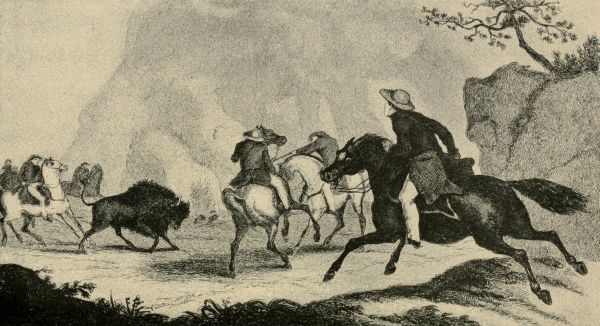
Buffaloes were plenty enough. We saw them in frightful
droves, as far as the eye could reach, appearing at a
distance as if the ground itself was moving like the sea.
Such large armies of them have no fear of man. They
will travel over him and make nothing of him. Our company
after killing ten or twelve of them, never enjoyed
the benefit of more than two of them, the rest being carried
off by the wolves before morning. Beside the scarcity of
meat, we suffered for want of good and wholesome water.
The La Platte is warm and muddy; and the use of it occasioned
a diarrhœa in several of our company. Dr. Jacob
Wyeth, brother of the Captain, suffered not a little from
this cause.—Should the reader wonder how we proceeded
so rapidly on our way without stopping to inquire, he must
bear in mind that we were still under the guidance of Captain
Sublet, who knew every step of the way, and had actually
resided four years in different green valleys that are here
and there in the Rocky Mountains. To me it seems that
we must have perished for want of {31} sustenance in the
deserts of Missouri, had we been by ourselves. It may
have been good policy in Sublet, to attach us to him. He
probably saw our rawness in an adventure so ill provided
for as ours actually was. But for him we should hardly
have provided ourselves with live stock; and but for him
we should probably never have reached the American
Alps. By this time every man began to think for himself.
We travelled six days on the south branch of the La
Platte, and then crossed over to the north branch, and
on this branch of it, we travelled eighteen days.[35] But
the first three days we could not find sufficient articles of
food; and what added to our distress was the sickness
of several of our company. We noticed many trails of
the savages, but no Indians. The nearer we approached
the range of the mountains the thicker were the trees.
After travelling twelve days longer we came to the Black
Hills. They are so called from their thick growth of cedar.
Here is the region of rattle snakes, and the largest and
fiercest bears,—a very formidable animal, which it is not
prudent for a man to attack alone. I have known some
of the best hunters of Sublet's company to fire five and
six balls at one before he fell. We were four days in crossing
these dismal looking hills. They would be called mountains,
were they not in the neighborhood of the Rocky
Mountains, whose peaks overtop every thing, and elevate
themselves into the region of everlasting frost and snow.
Our sick suffered extremely in ascending these hills, some of
them slipped off the horses and mules they rode on, from
sheer weakness, brought on by the bowel complaint already
mentioned; among these was Dr. {32} Wyeth, our
Captain's brother, who never had a constitution fit to encounter
such an expedition. And yet we could not leave
them under the care of a man, or two or three men, and
pass on without them, to follow us, when they were able.
It was to me particularly grievous to think that he, who
was to take care of the health of the company, was the
first who was disabled from helping himself or others, and
this one a blood relation. It required a man of a firmer
make than Dr. Jacob Wyeth to go through such a mountainous
region as the one we were in: a man seldom does
a thing right the first time.
From the north branch we crossed over to what was called
Sweet-water Creek.[36] This water being cool, clear, and
pleasant, proved a good remedy for our sick, as their bowel
complaints were brought on and aggravated by the warm,
muddy waters of the Missouri territory we had passed
through. We came to a huge rock in the shape of a bowl
upside down. It bore the name of Independence, from,
it is said, being the resting-place of Lewis and Clarke on
the 4th of July; but according to the printed journal of
those meritorious travellers, they had not reached, or entered,
the American Alps on the day of that memorable epoch.[37]
Whether we are to consider the rock Independence as
fairly in the Rocky Mountains, let others determine. We
had now certainly begun our ascent to those lofty regions,
previous to which we had to pass the chief branch of the
river La Platte; but we had no boat whatever for the purpose;
and had we not been in the company of Captain Sublet,
it is hard to say what we should have done short of going
a great way round. Here I, and others were entirely {33}
convinced that we were engaged in an expedition without
being provided with the means to accomplish it. Our
boats and wagons we had disposed of at St. Louis, and
here we were on the banks of a river without even a canoe.
Captain Clarke brought his canoes to the foot of the range
of mountains and there left them. The reader will understand
that not only the Missouri river, but the Yellowstone
river, the La Platte, and many other smaller ones
commence by small beginnings in the Black Hills, and
in the Rocky Mountains, and increase in size and depth
as they proceed down to join the Arkansa, or the Canadian
river, and finally the Mississippi, and so run into the vast
salt ocean. Whether it was Captain Sublet's own invention,
or an invention of the Indians, we know not, but the
contrivance we used is worth mentioning. They called
it a Bull-boat. They first cut a number of willows (which
grow every where near the banks of all the rivers we had
travelled by from St. Louis), of about an inch and a half
diameter at the butt end, and fixed them in the ground
at proper distances from each other, and as they approached
nearer one end they brought them nearer together, so as
to form something like the bow. The ends of the whole
were brought and bound firmly together, like the ribs of
a great basket; and then they took other twigs of willow
and wove them into those stuck in the ground so as to make
a sort of firm, huge basket of twelve or fourteen feet long.
After this was completed, they sewed together a number
of buffalo-skins, and with them covered the whole; and
after the different parts had been trimmed off smooth, a
slow fire was made under the Bull-boat, taking care to dry
the skins moderately; and as {34} they gradually dried,
and acquired a due degree of warmth, they rubbed buffalo-tallow
all over the outside of it, so as to allow it to enter
into all the seams of the boat, now no longer a willow-basket.
As the melted tallow ran down into every seam,
hole, and crevice, it cooled into a firm body capable of
resisting the water, and bearing a considerable blow without
damaging it. Then the willow-ribbed, buffalo-skin,
tallowed vehicle was carefully pulled up from the ground,
and behold a boat capable of transporting man, horse,
and goods over a pretty strong current. At the sight of
it, we Yankees all burst out into a loud laugh, whether
from surprise, or pleasure, or both, I know not. It certainly
was not from ridicule; for we all acknowledged the contrivance
would have done credit to old New-England.
While Captain Sublet and his company were binding
the gunwale of the boat with buffalo-sinews, to give it
strength and due hardness, our Captain was by no means
idle. He accordingly undertook to make a raft to transport
our own goods across the river. Sublet expressed
his opinion that it would not answer where the current
was strong; but Captain Wyeth is a man not easily to be
diverted from any of his notions, or liable to be influenced
by the advice of others; so that while Sublet's men were
employed on their Bull-boat, Wyeth and a chosen few
were making a raft. When finished, we first placed our
blacksmith's shop upon it, that is to say, our anvil, and
large vice, and other valuable articles belonging to black-smithery,
bar-iron, and steel traps, and alas! a cask of powder,
and a number of smaller, but valuable articles. We fixed
a rope to our raft, and with some difficulty got {35} the other
end of it across the river to the opposite bank by a man
swimming with a rope in his mouth, from some distance
above the spot he aimed to reach. We took a turn of it
round a tree. Captain Sublet gave it as his opinion that
the line would not be sufficient to command the raft. But
our Leader was confident that it would; but when they
had pulled about half way over, the rope broke, and the
raft caught under the limbs of a partly submerged tree,
and tipped it on one side so that we lost our iron articles,
and damaged our goods and a number of percussion caps.
This was a very serious calamity and absolutely irreparable.
Almost every disaster has some benefit growing out
of it. It was even so here. Two thirds of our company
were sick, and that without any particular disorder that
we can name, but from fatigue, bad water, scanty food,
and eating flesh half raw. Add to this, worry of mind,
and serious apprehensions of our fate when the worthy
Captain Sublet should leave us; for he was, under Providence,
the instrument of our preservation. Our own
individual sufferings were enough for us to bear; but Captain
Wyeth had to bear the like, and more beside, as the responsibility
lay heavy upon him. Most men would have
sunk under it. At this point of our journey we were sadly
tormented by musquetoes, that prevented our sleep after
the fatigues of the day. This little contemptible insect,
which they call here a gnat, disturbed us more than bears,
or wolves, or snakes.
The next day after we started from this unlucky place,
we descried a number of men on horseback, approaching
us at full speed. Various were our conjectures. Captain
Sublet had an apprehension that they might be hostile
Indians who fight on {36} horseback; he therefore ordered
every man to make fast his horse as quick as possible, and
prepare for battle on foot. But on their near approach,
we found them a body of white men called trappers, whose
occupation is to entrap the beaver and other animals that
have valuable furs. Captain Sublet has, for several years,
had about two hundred of these trappers in his pay, in
and around the Rocky Mountains, and this troop was a
party of them. His place of rendezvous for them is at
Pierre's Hole, by which name they call one of those deep
and verdant valleys which are to be found in the Rocky
Mountains from the eastern boundary of them to their extreme
edge in the west, where the Oregon or Columbia
river commences under the name of Clark's river, some
branches of which inosculate with the mighty Missouri
on the east. It is to Pierre's valley or Hole, that his trappers
resort to meet their employer every summer. It is here
they bring their peltry and receive their pay; and this traffic
has been kept up between them a number of years with
good faith on both sides, and to mutual satisfaction and
encouragement. When Sublet leaves St. Louis, he brings
up tobacco, coffee, rice, powder, shot, paint, beads, handkerchiefs
and all those articles of finery that please both
Indian women and men; and having established that sort
of traffic with his friends, the Indians on and in the vicinity
of the Rocky Mountains, what chance was there that any
small band from Boston, or even Cambridge, could supplant
him in the friendship and confidence of his old acquaintance,
the Shoshonees, the Black-feet, or any other
tribe? He must have seen this at once, and been convinced
that nothing like rivalship could {37} rise up between him
and the New-England adventurers. He therefore caressed
them, and, in a manner, incorporated them with his troop.
This gentleman was born in America of French parents,[38]
and partakes largely of those good-humored, polite, and
accommodating manners which distinguish the nation
he sprang from. The old French war, and wars on this
continent since then, amply prove how much better Frenchmen
conciliate the natives than the English. The English
and the Americans, when they come in contact with the
untutored savage, most commonly fight. But not so the
French. They please and flatter the Indian, give him
powder, and balls, and flints, and guns, and make a Catholic
of him, and make out to live in friendship with the red
man and woman of the wilderness. It is strange that such
extremes of character should meet. Some have said that
they are not so very far distant as others have imagined,—that
the refined French people love war, and the women
paint their faces, grease their hair, and wear East India
blankets, called shawls.—Captain Sublet possesses, doubtless,
that conciliating disposition so characteristic of the
French, and not so frequently found among the English
or Americans; for the descendants of both nations bear
strong marks of the stock they came from. The French
have always had a stronger hold of the affections of the
Indians than any other people.
The trappers kept company with us till we came to Pierre's
Hole, or valley, which is twelve miles from the spot where
we first met them. Three or four days after, we were
fired on by the Indians about ten o'clock at night. They
had assembled to about the number of three hundred.
They stole {38} five horses from us, and three from Sublet's
company.[39] About the first of July we crossed the highest
part or ridge of the mountains.[40] In addition to the mountain
composed of earth, sand, and stone, including common
rocks, there were certain peaks resembling a loaf
of sugar, from a hundred to two hundred feet high; and
some appeared much higher; I cannot guess their height.
They were to us surprising. Their sides deviated but little
from perpendicular. They looked at a distance like some
light-houses of a conical form, or like our Cambridge glass
manufactories; but how they acquired that form is wonderful.
Subsiding waters may have left them so, after washing
away sandy materials. But nature is altogether wonderful,
in her large works as well as small. How little do
we know of the first cause of any thing! We had to creep
round the base of these steep edifices of nature. We now
more clearly understand and relish the question of one
of our Indians who was carried to England as a show, who,
on being shown that elegant pile of stone, the cathedral
of St. Paul, after viewing it in silent admiration, asked
his interpreter whether it was made by men's hands, or
whether it grew there. We might ask the same question
respecting these conical mountains. Had the scaffolding
of St. Paul's remained, the surprise and wonder of the
sensible savage had been less.
It was difficult to keep our feet on these highest parts
of the mountains; some of the pack-horses slipped and
rolled over and over, and yet were taken up alive. Those
that did not fall were sadly bruised and lamed in their
feet and joints. Mules are best calculated, as we experienced,
for such difficult travelling. They seem to think,
and to judge {39} of the path before them, and will sometimes
put their fore feet together and slip down without stepping.
They are as sagacious in crossing a river, where there is
a current. They will not attempt to go straight over,
but will breast the tide by passing obliquely upwards. One
of our horses was killed by a fall down one of these precipices,
and it was surprising that more of them did not share
the like fate. Buffaloes were so scarce here, that we were
obliged to feed on our dried meat, and this scarcity continued
till after we had gained the head sources of the
Columbia river. For the last five days we have had to
travel on the Colorado of the West, which is a very long
river, and empties into the gulph of California.[41]
On the 4th of July, 1832, we arrived at Lewis's fork,
one of the largest rivers in these rocky mountains.[42] It took
us all day to cross it. It is half a mile wide, deep, and
rapid. The way we managed was this: one man unloaded
his horse, and swam across with him, leading two loaded
ones, and unloading the two, brought them back, for two
more, and as Sublet's company and our own made over a
hundred and fifty, we were all day in passing the river.
In returning, my mule, by treading on a round stone, stumbled
and threw me off, and the current was so strong, that
a bush which I caught hold of only saved me from drowning.
This being Independence-Day, we drank the health
of our friends in Massachusetts, in good clear water, as
that was the only liquor we had to drink in remembrance
of our homes and dear connexions. If I may judge by my
own feelings and by the looks of my companions, there was
more of melancholy than joy amongst us. We were almost
{40} four thousand miles from Boston, and in saying Boston
we mean at the same time our native spot Cambridge, as
they are separated by a wooden bridge only. From the
north fork of Lewis's river we passed on to an eminence
called Teton mountain, where we spent the night. The
next day was pleasant, and serene. Captain Sublet came
in the evening to inquire how many of our company were
sick, as they must ride, it being impossible for them to go
on foot any farther. His kindness and attention I never
can forget. Dr. Jacob Wyeth, the Captain's brother,
George More, and Stephen Burdit[43] were too weak to
walk. To accommodate them with horses, Captain Wyeth
was obliged to dig a hole in the earth, and therein bury
the goods which had been hitherto carried on horseback.
In the language of the Trappers this hiding of goods was
called cacher or hidden treasure, being the French term
for 'to hide.' When they dig these hiding-holes they
carefully carry the earth on a buffalo-skin to a distance,
so as to leave no marks or traces of the ground being dug
up or disturbed: and this was done to secure the caché
from being stolen by the Indians or the white men.
The goods so hidden are wrapt up in buffalo-skins to
keep them dry, before the earth is put over them. Nor is
this all; they make a fire over the spot, and all this to prevent
the Indians from suspecting that treasure is caché,
or hidden there, while the owner of it takes care to mark
the bearing of the spot on some tree, or rock, or some
other object that may lead him to recognise the place
again. But I have my doubts whether they who hid
the goods will ever return that way to dig up their hidden
treasure. We did not meddle with it on our return
with Captain Sublet.
{41} On the 5th of July we started afresh rather low-spirited.
We looked with sadness on the way before us.
The mountain was here pretty thickly timbered down its
slopes, and wherever the ground is level. The pines and
hemlock trees were generally about eighteen inches through.
It had snowed, and we were now at a height where the snow
commonly lies all the year round. Which ever way we
looked, the region presented a dreary aspect. No one could
wonder that even some of us who were in health, were,
at times, somewhat homesick. If this was the case with us,
what must have been the feelings of our three sick fellow
travellers. We passed through a snow bank three feet
deep. We well ones passed on with Captain Sublet to the
top of the mountain, and there waited until our sick men
came up with us. George More fell from his horse through
weakness. He might have maintained his seat on level
ground, but ascending and descending required more
exertion than he could call forth; and this was the case
also with Dr. Wyeth. Burdit made out a little better. When
we encamped at night, we endured a snow storm. Sublet's
company encamped about two miles from us; for at best
we could hardly keep up with his veteran company. They
were old and experienced trappers, and we, compared
with them, young and inexperienced soldiers, little imagining
that we should ever have to encounter such hardships,
in realizing our dreams of making a fortune. Ignorance
of the future is not always to be considered among the
calamities of man.
Captain Sublet's grand rendezvous, or Head Quarters,
was about twelve miles from our encampment.[44] He had
there about two hundred {42} trappers, or beaver-hunters;
or more properly speaking, skinners of entrapped animals;
or peltry-hunters, for they chased but few of the captured
beasts. To these were added about five hundred Indians,
of the rank of warriors, all engaged in the same pursuit
and traffic of the fur-trade. They were principally the
Flat-heads,[45] so called from their flattening the heads of
their young children, by forcing them to wear a piece of
wood, like a bit of board, so as to cause the skull to grow
flat, which they consider a mark of beauty even among the
females. They are otherwise dandies and belles in their
dress and ornaments. This large body of horse made
a fine appearance, especially their long hair; for, as there
was a pleasant breeze of wind, their hair blew out straight
all in one direction, which had the appearance of so many
black streamers. When we met they halted and fired
three rounds by way of salute, which we returned; and
then followed such friendly greetings as were natural and
proper between such high contracting powers and great
and good allies. This parade was doubtless made by
Sublet for the sake of effect. It was showing us, Yankee
barbarians, their Elephants;—like General and Lord
Howe's military display to our commissioners of Congress
on Staten Island, when the British Brothers proposed that
celebrated interview; and when Dr. Franklin, Mr. Adams,
and some others of the deputation, whose names I do not
now recollect, assumed all that careless indifference, very
common with the Indians on meeting a white embassy;
for the express purpose of conveying an idea, that we,
though the weakest in discipline and numbers, are not
awe-struck by your fine dress, glittering arms, and full-fed
persons.
{43} It was now the 6th of July,[46] 1832, being sixty-four
days since we left the settlements of the white people.
Captain Sublet encamped his forces; and then pointed out
to Captain Wyeth the ground which he thought would
be most proper for us; and altogether we looked like a
little army. Not but what we felt small compared with
our great and powerful allies.
We were overjoyed to think that we had got to a resting-place,
where we could repose our weary limbs, and recruit
the lost strength of our sick. While Sublet was finishing
his business with his Indian trappers, they delivering their
peltry, and he remunerating them in his way with cloth,
powder, ball, beads, knives, handkerchiefs, and all that
gawdy trumpery which Indians admire, together with
coffee, rice, and corn, also leather, and other articles,—we,
being idle, had time to think, to reflect, and to be uneasy.
We had been dissatisfied for some time, but we
had not leisure to communicate it and systematize our
grievances. I, with others, had spoken with Captain
Sublet, and him we found conversable and communicative.
Myself and some others requested Captain Wyeth to call
a meeting of his followers, to ask information, and to know
what we were now to expect, seeing we had passed over
as we supposed the greatest difficulties, and were now
nearly four thousand miles from the Atlantic, and within
four hundred miles of the Pacific Ocean, the end and aim
of our laborious expedition, the field where we expected
to reap our promised harvest. We wished to have what we
had been used to at home,—a town meeting,—or a parish
meeting, where every freeman has an equal right to speak
his sentiments, and to vote thereon. {44} But Captain
Wyeth was by no means inclined to this democratical procedure.
The most he seemed inclined to, was a caucus
with a select few; of whom neither his own brother, though
older than himself, nor myself, was to be of the number.
After considerable altercation, he concluded to call a meeting
of the whole, on business interesting and applicable
to all. We accordingly met, Captain Wyeth in the chair,
or on the stump, I forget which. Instead of every man
speaking his own mind, or asking such questions as related
to matters that lay heaviest on his mind, the Captain commenced
the business by ordering the roll to be called; and
as the names were called, the clerk asked the person if
he would go on. The first name was Nathaniel J. Wyeth,
whom we had dubbed Captain, who answered—"I shall
go on."—The next was William Nud, who, before he
answered, wished to know what the Captain's plan and
intentions were, whether to try to commence a small colony,
or to trap and trade for beaver? To which Captain Wyeth
replied, that that was none of our business. Then Mr.
Nud said, "I shall not go on;" and as the names of the rest
were called, there appeared seven persons out of the twenty-one,
who were determined to return home. Of the number
so determined was, besides myself, Dr. Jacob Wyeth, the
Captain's brother, whose strength had never been equal
to such a journey. His constitution forbade it. He was
brought up at College. Here were discontents on both sides;
criminations and recriminations. A commander of a band
of associated adventurers has a very hard task. The
commanded, whether in a school, or in a regiment, or
company, naturally combine in feeling against {45} their
leader; and this is so natural that armies are obliged to
make very strict rules, and to pursue rigid discipline. It
is so also on ship-board. Our merchant ships cannot
sail in safety without exacting prompt obedience; and
disobedience in the common seamen is mutiny, and mutiny
is a high crime, and approximates to piracy. It is pretty
much so in these long and distant exploring expeditions.
The Captain cannot always with safety satisfy all the questions
put to him by those under his command; and it would
lead to great inconvenience to entrust any, even a brother,
with any information concealed from the rest. There
must be secrecy, and there must be confidence. We had
travelled through a dreary wilderness, an infinitely worse
country than Palestine; yet Moses himself could not have
kept together the Israelites without the aid of miracles;
and the history we have given of our boat-like arks, and the
wreck of our raft, and the loss of our heaviest articles may
lead most readers to suspect that our Leader to his Land
of Promise was not an inspired man. In saying this, we
censure no one, we only lament our common frailty. Reflect
a moment, considerate reader! on our humble means,
for an expedition of FOUR THOUSAND miles, compared
with the ample means, rich and complete out-fit,
letters of credit, and every thing deemed needful, given
to Captains Lewis and Clarke, under the orders of the
government of the United States; and yet they several
times came very near starving for the want of food, and
of fuel, even in the Oregon territory! In all books of voyages
and travels, who ever heard of the utmost distress for want
of wood, leaves, roots, coal, or turf to cook {46} with? Yet
all through the dreary wilderness of Missouri, we were
obliged to use the dung of buffaloes, or eat raw flesh. The
reader will scarcely believe that this was the case even at
mouth of the Oregon river. Clarke and Lewis had to
buy wood of the Indians, who had hardly enough for themselves.
To be deprived of solid food soon ends in death;
but we were often deprived of the two elements out of
four, fire and water, and when on the Rocky mountains,
of a third, I mean earth; for everything beneath our feet
and around us was stone. We had, be sure, air enough,
and too much too, sometimes enough almost to blow our
hair off.
But to return to our dismal list of grievances. Almost
every one of the company wished to go no farther; but they
found themselves too feeble and exhausted to think of
encountering the risk of a march on foot of three thousand
five hundred miles through such a country as we came.
We asked Captain Wyeth to let us have our muskets and
a sufficiency of ammunition, which request he refused.
Afterwards, he collected all the guns, and after selecting
such as he and his companions preferred, he gave us the
refuse; many of which were unfit for use. There were
two tents belonging to the company, of which he gave us
one; which we pitched about a quarter of a mile from his.
George More expressed his determination of returning
home, and asked for a horse, which after considerable
difficulty he obtained. This was July 10th. The Captain
likewise supplied his brother with a horse and a hundred
dollars.
On the 12th of July, Captain Wyeth, after moving his tent
half a mile farther from ours, put himself under the
command of Mr. Milton Sublet,[47] {47} brother of Captain
William Sublet so often mentioned. This Captain Milton
Sublet had about twenty men under his command, all
trappers; so that hereafter as far as I know, it was Wyeth,
Sublet and Co.; so that the reader will understand, that
Dr. Jacob Wyeth, Palmer, Law, Batch, and myself concluded
to retrace our steps to St. Louis in company with
Captain William Sublet, while Captain Nathaniel J. Wyeth
remained with Milton Sublet, and his twenty men. I
have been unreasonably blamed for leaving my kinsman
beyond the Rocky Mountains with only eleven of his company,
and that too when we were within about four hundred
miles of the mouth of the Columbia, alias Oregon river,
where it pours into the boisterous Pacific Ocean, for such
Lewis and Clarke found it to their cost.
The spot where we now were, is a valley, between two
mountains, about ten miles wide, so lofty that their tops
are covered with snow, while it was warm and pleasant
where we pitched our tent. This agreeable valley is called
by the trappers Pierre's-Hole, as if it were a dismal residence;
and was the most western point that I visited, being
about, we conjectured, four hundred miles short of the mouth
of the Oregon river, whence the territory derives its name,
which Mr. Hall J. Kelly has described as another paradise!
O! the magic of sounds and inflated words! Whether
Captain Wyeth's expedition was wise or imprudent we are
not prepared to say; but under existing circumstances,
half of his company having left him, and among them his
own brother, the surgeon of the expedition, we cannot see
what better he could have done than to ally himself to an
experienced band of hunters, as a step necessary {48} to
his own preservation. He was three thousand and five
hundred miles from the Atlantic Ocean, with only eleven
men, and half his goods lost or expended, and no resource
of supply short of St. Louis, nineteen hundred miles from
them. Had not the Sublets been with them from that
place through the wilderness of Missouri and La Platte,
it is hardly probable they would have ever reached the west
side of the Rocky Mountains. In passing judgment on
this strange expedition, we must take in, beside facts, probabilities
and casualties.
On the 17th of July, Captain Wyeth and Captain Milton
Sublet set out westward with their respective men to go to
Salmon river to winter.[48] The former had eleven beside
himself: that river they computed at two hundred miles
distance. Wyeth accordingly purchased twenty-five horses
from the Indians, who had a great number, and those very
fine, and high-spirited. Indeed the Western region seems
the native and congenial country for horses. They were,
however, delayed till the next day. But when they were
about moving, they perceived a drove of something, whether
buffaloes or men they could not determine with the naked
eye; but when aided by the glass, they recognized them
for a body of the Black-foot tribe of Indians, a powerful
and warlike nation. As this movement was evidently hostile,
Captain Milton Sublet dispatched two men to call on
his brother, who was about eight miles off, for assistance;
when Captain William Sublet ordered every man to get
ready immediately. We had about five hundred friendly
Indian warriors with us, who expressed their willingness to
join in our defence.
{49} As soon as we left Captain Wyeth we joined Captain
Sublet, as he said that no white man should be there
unless he was to be under his command; and his reason
for it was that in case they had to fight the Indians, no one
should flinch or sneak out of the battle. It seems that
when the Black-foot Indians saw us moving in battle array,
they appeared to hesitate; and at length they displayed a
white flag as an ensign of peace; but Sublet knew their
treacherous character. The chief of the friendly Flat-heads
and Antoine[49] rode together, and concerted this savage
arrangement; to ride up and accost them in a friendly
manner; and when the Black-foot chief should take hold
of the Flat-head chief's hand in token of friendship, then
the other was to shoot him, which was instantly done! and
at that moment the Flat-head chief pulled off the Black-foot's
scarlet robe, and returned with the Captain to our
party unhurt. As soon as the Black-foot Indians recovered
from their surprise, they displayed a red flag, and the
battle began. This was Joab with a vengeance,—Art
thou in health, my brother?
The Black-foot chief was a man of consequence in his
nation. He not only wore on this occasion a robe of scarlet
cloth, probably obtained from a Christian source, but
was decorated with beads valued there at sixty dollars.
The battle commenced on the Prairie. As soon as the
firing began on both sides, the squaws belonging to the
Black-foot forces, retreated about fifty yards into a small
thicket of wood, and there threw up a ridge of earth by way
of entrenchment, having first piled up a number of logs
cob-fashion, to which the men at length fell back, and from
{50} which they fired upon us, while some of their party
with the women were occupied in deepening the trench.
Shallow as it was, it afforded a considerable security to an
Indian, who will often shoot a man from behind a tree
near to its root, while the white man is looking to see his
head pop out at man's height. This has taught the United
States troops, to load their muskets while lying on their
backs, and firing in an almost supine posture. When the
Duke of Saxe-Weimer was in Cambridge,[50] he noticed this,
to him, novel mode of firing, which he had never before seen;
and this was in a volunteer company of militia.—I do
not mean to say that the Indians fired only in a supine posture;
when they had loaded they most commonly rose up
and fired, and then down on the ground again to re-load.—In
this action with the formidable Black-foot tribe, Captain
Nathaniel J. Wyeth's party had no concern. He himself
was in it a very short time, but retired from the contest
doubtless for good reasons. After contesting the matter
with the warlike tribe about six hours, Captain Sublet found
it of little avail to fight them in this way. He therefore
determined to charge them at once, which was accordingly
done. He led, and ordered his men to follow him, and this
proved effectual. Six beside himself first met the savages
hand to hand; of these seven, four were wounded, and one
killed. The Captain was wounded in his arm and shoulder-blade.
The Indians did not, however, retreat entirely,
so that we kept up a random fire until dark; the ball and
the arrows were striking the trees after we could see the
effects of one and of the other. There was something terrific
to our men in their arrows. The idea of a barbed
arrow sticking {51} in a man's body, as we had observed it
in the deer and other animals, was appalling to us all, and
it is no wonder that some of our men recoiled at it. They
regarded a leaden bullet much less. We may judge from
this the terror of the savages on being met the first time by
fire arms,—a sort of thunder and lightning followed by
death without seeing the fatal shot.
In this battle with the Indians, not one of those who had
belonged to Captain Wyeth's company received any injury.
There were, however, seven white men of Sublet's company
killed, and thirteen wounded. Twenty-five of our
Indians were killed and thirty-five wounded. The next
morning a number of us went back to the Indian fort, so
called, where we found one dead man and two women, and
also twenty-five dead horses, a proof that the Black-foot
were brave men.[51] The number of them was uncertain.
We calculated that they amounted to about three hundred.
We guessed that the reason the three dead bodies were left
at the entrenchment was, that they had not enough left to
carry off their dead and wounded. This affair delayed
Captain Wyeth three days, and Captain Sublet ten days.
The names of those who left Captain Wyeth to return
home, were Dr. Jacob Wyeth, John B. Wyeth, his cousin,
William Nud, Theophilus Beach, R. L. Wakefield, Hamilton
Law, George More, —— Lane, and Walter Palmer.[52]
The names of those who remained attached to Captain
Wyeth, and who went on with him to Salmon river, are J.
Woodman, Smith, G. Sargent, —— Abbot, W. Breck, S.
Burditt, —— Ball, St. Clair, C. Tibbits, G. Trumbull, and
—— Whittier.[53]
When they had gone three days journey from us, {52}
as they were riding securely in the middle of the afternoon,
about thirty of the Black-foot Indians, who lay in ambush
about twenty yards from them, suddenly sprang up and
fired. The surprise occasioned the horses to wheel about,
which threw off George More, and mortally wounded one
of the men, Alfred K. Stevens.[54] As the Indians knew
that More could not get away from them, they passed him,
and about twenty Indians were coming up the hill where
they were. Eight or ten Indians followed up while only
five trappers had gained the hill. They were considering
how to save George More, when one of them shot him
through the head, which was a better fate than if they had
taken him alive, as they would have tortured him to death.
We have said that Captain Wyeth and the few who had
concluded to go on with him, were ready to begin their
march for Salmon river. On this occasion Captain Milton
Sublet escorted them about one hundred miles, so as to
protect them from the enraged Black-feet, and then left
them to take care of themselves for the winter; and this is
the last tidings we have had of Captain Nathaniel J. Wyeth,
and his reduced band of adventurers.[55] If we have been
rightly informed, their chief hope was residing on a pleasant
river where there was plenty of salmon, and probably elk
and deer, and water-fowl; and we hope fuel, for to our
surprise, we learnt that wood for firing was among their
great wants. I have since been well-informed that in the
valley of Oregon, so much extolled for its fertility and pleasantness,
wood to cook with is one among their scarcest and
very dear articles of necessity. From all accounts, except
those given {53} to the public by Mr. Kelly, there is not a
district at the mouth of any large river more unproductive
than that of the Columbia, and it seems that this is pretty
much the case from the tide water of that river to where it
empties into the ocean.
The Flat-head Indians are a brave and we had reason to
believe a sincere people. We had many instances of their
honesty and humanity. They do not lie, steal, nor rob
any one, unless when driven too near to starvation; and
then any man black, white, or red will seize any thing to
save himself from an agonizing death. The Flat-heads
were well dressed. They wore buck-skin frocks and pantaloons,
and moccasins, with seldom any thing on their
heads. They draw a piece of fresh buffalo hide on their
feet, and at night sleep with their feet not far from the fire,
and in the morning find their shoes sitting as snug to their
feet as if they had been measured by the first shoe-maker
in Boston. It is probable that no people have so little shoe-pinching
as these savages. I never heard any one complain
of corns, or kibed-heels, severe as the weather is in
winter. The women wear moccasins also, but whether
made in the same extempore method as those of the men, I
know not. I suspect they must experience some shoe-pinching.
They wear a petticoat, and a frock of some sort
of leather, according to fancy, but all decent and comfortable.
In rainy weather, or when very cold, they throw a
buffalo-skin over their shoulders, with the fur inside. They
have no stationary wigwams; but have a sort of tent, which
they fix down or remove with facility. In Major Long's
book may be seen an engraved representation of them.[56]
Their mode of cooking is by roasting and boiling. They
{54} will pick a goose, or a brant, and run a stick through its
body and so roast it, without taking out its entrails. They
are, according to our notions, very nasty cooks.
I know not what to say of their religion. I saw nothing
like images, or any objects of worship whatever, and yet
they appeared to keep a sabbath; for there is a day on
which they do not hunt nor gamble, but sit moping all day
and look like fools. There certainly appeared among
them an honor, or conscience, and sense of justice. They
would do what they promised, and return our strayed horses,
and lost articles. Now and then, but rarely, we found a
pilferer, but not oftener than among the frontier white people.
The Indians of all tribes are disposed to give you
something to eat. It is a fact that we never found an Indian
of any tribe disposed to treat us with that degree of inhospitality
that we experienced in crossing the Alleghany
Mountains, in the State of Pennsylvania.
The Black-foot tribe are the tallest and stoutest men
of any we have seen, nearly or quite six feet in stature, and
of a lighter complexion than the rest.
The Indian warriors carry muskets, bows, and arrows,
the last in a quiver. The bows are made of walnut, about
three feet long, and the string of the sinews of the buffalo,
all calculated for great elasticity, and will reach an object
at a surprising distance. It was to us a much more terrific
weapon of war than a musket. We had one man
wounded in the thigh by an arrow; he was obliged to ford
a river in his hasty retreat, and probably took a chill, which
occasioned a mortification, of {55} which he died. The
arrows are headed with flint as sharp as broken glass; the
other end of the arrow is furnished with an eagle's feather
to steady its flight. Some of these aboriginals, as we learn
from Lewis, Clarke, and Major Long, especially the last,
have shields or targets; some so long as to reach from the
head to the ancle. Now the question is how came our
North American Indians with bows and arrows? It is not
likely that they invented them, seeing they so exactly resemble
the bows and arrows of the old world, the Greeks
and Romans. They are the same weapon to a feather.
This is a fresh proof that our savage tribes of this continent
emigrated from the old one; and I have learned from
a friend to whom I am indebted for several ideas, which
no one could suppose to have originated with myself, that
the Indian's bow goes a great way to settle a disputed point
respecting what part of the old world the ancestors of our
Indians came from,—whether Asia or Europe. Now the
Asiatic bow and our Indian bow are of a different form.
The first has a straight piece in the middle, like the crossbow,
being such an one as is commonly depicted in the hands
of Cupid; whereas our Indian bow is a section of a circle,
while the Persian or Asiatic bow has two wings extending
from a straight piece in the middle. Hence we have reason
to conclude that the first comers from the old world to the
new, came not from those regions renowned for their cultivation
of the arts and sciences. The idea that our North
American Indians came over from Scythia, that is, the
northern part, so called, of Europe and Asia, whether it is
correct to call them Scythians, Tartars, or Russians, I
leave others to determine. We {56} have many evidences
that our Northern Indians have a striking resemblance in
countenance, color, and person to the most northern tribes
of Tartars, who inhabit Siberia, or Asiatic Russia. The
Black-foot Indians who inhabit small rivers that empty
into the Missouri, resemble in mode of living, manners,
and character, the Calmuc Tartars. Both fight on horseback,
both are very brave, and both inured to what we
should consider a very hard life as it regards food. Both
avoid as much as they can stationary dwellings, and use
tents made with skins.
On this subject we ought not to omit mentioning that
the Indians on all sides of the Rocky mountains have several
customs both among men and the women, which might
lead some to conclude that our Northern and Western Indians
descended from the Israelites; and this similarity is
certainly very remarkable; yet there is one very strong fact
against that hypothesis, namely, there is not the least trace
amongst our Indians of the eight-day rite of the Jewish
males, which sore, and, to us, strange ceremony would hardly
have been forgotten, had it been practiced by our Indians.
If our idea be well-founded on this subject, the custom
could have originated only in warm and redundant climates,
so that had Moses marched first from the shores of the
Baltic, as did the Goths, instead of the shores of the Red
sea, the Jews never would have been subjected to the operation
of circumcision.
After all, it is very likely that the Persians came from a
different stock from that which peopled the Western and
Northern parts of America,—I mean from the warmer
regions of Asia. They seem possessed of more delicate
marks of person and of mind {57} than the fighting savages
of the North. There appears to be a strong line of separation
between them, as far as our information goes.
To return to our own story. After the battle at Pierre's
Valley, I had an opportunity of seeing a specimen of Indian
surgery in treating a wound. An Indian squaw first sucked
the wound perfectly dry, so that it appeared white as chalk;
and then she bound it up with a piece of dry buck-skin as
soft as woollen cloth, and by this treatment the wound
began to heal, and soon closed up, and the part became
sound again. The sucking of it so effectually may have
been from an apprehension of a poisoned arrow. But
who taught the savage Indian that a person may take poison
into his mouth without any risk, as the poison of a rattlesnake
without harm, provided there be no scratch or wound
in the mouth, so as to admit it into the blood?
Three of the men that left Captain Wyeth when I did,
enlisted with Captain Sublet to follow the trapping business
for the period of one year, namely, Wakefield, Nud,
and Lane, leaving Dr. Jacob Wyeth, H. Law, T. Beach,
W. Palmer, and myself. We accordingly set out on the
twenty-eighth day of July, 1832, with Captain William
Sublet, for home; and thus ended all my fine prospects
and flattering expectations of acquiring fortune, independence,
and ease, and all my hopes that the time had now
come in the order of Providence, when that uncultivated
tract, denominated the Oregon Territory, was to be changed
into a fruitful field, and the haunt of savages and wild
beasts made the happy abode of refined and dignified man.—Mr.
Hall J. Kelly published about two {58} years since a
most inflated and extravagant account of that western
tract which extends from the Rocky Mountains to the shore
of the Pacific Ocean.[57] He says of it that no portion of the
globe presents a more fruitful soil, or a milder climate, or
equal facilities for carrying into effect the great purposes
of a free and enlightened nation;—that a country so full of
those natural means which best contribute to the comforts
and conveniences of life, is worthy the occupancy of a people
disposed to support a free representative government,
and to establish civil, scientific, and religious institutions,—and
all this and much more to the same effect after Lewis
and Clarke's history of their expedition had been published,
and very generally read;[58] yet this extravagant and fallacious
account of the Oregon was read and believed by
some people not destitute of a general information of things,
nor unused to reading; but there were circles of people,
chiefly among young farmers and journeymen mechanics,
who were so thoroughly imbued with these extravagant
notions of making a fortune by only going over land to the
other side of the globe, to the Pacific Ocean, that a person
who expressed a doubt of it was in danger of being either
affronted, or, at least, accused of being moved by envious
feelings. After a score of people had been enlisted in this
Oregon expedition, they met together to feed and to magnify
each other's hopes and visionary notions, which were
wrought up to a high degree of extravagance, so that it was
hardly safe to advise or give an opinion adverse to the
scheme. When young people are so affected, it is in vain
to reason with them; and when such sanguine persons are
determined to fight, or to marry, it is dangerous to {59}
attempt to part them; and when they have their own way
and get their belly full of fight, and of matrimony, there
comes a time of cool reflection. The first stage of our reflection
began at St. Louis, when we parted with our amphibious
wagons, in which we all more or less took a pride.
Every one there praised the ingenuity of the contrivance
and construction of them for roads and rivers such as at
Cambridge, and other places near to Boston; but we were
assured at St. Louis, that they were by no means calculated
for our far distant journey. We were reminded that Lewis
and Clarke carried canoes almost to the foot of the Rocky
Mountains, by the route of Missouri river, but were obliged
to leave them there, and ascend mountains so very steep,
that sometimes their loaded horses slipped and rolled over
and over, down into lower ground sixty or seventy feet.
This may serve to show, among other things, how ill-informed
Captain Wyeth and his company were of the
true condition of the country through which they had to
pass. We expected to support ourselves with game by our
firearms, and therefore powder and shot were the articles
we took the most care to be provided with. Nor were we
followers undeceived before we were informed at St. Louis,
that it would be necessary to take oxen and sheep to be
slaughtered on the route for our support. We also found
it advisable to sell at that place the large number of axes,
great and small, with which we had encumbered our wagons.
All these occurrences, following close after one another,
operated to damp our ardor; and it was this probably that
operated so powerfully on W. Bell, Livermore, and Griswold,
that they cut {60} and ran away before we entered
upon the difficulties and hardships of our expedition.
Nothing of importance occurred for the first ten days
after we left Pierre's Valley. Our huntsmen were abroad
in pursuit of buffaloes, when they were alarmed at the
sight of a large body of the Black-foot tribe who had been
watching our movements. Captain Sublet was not a little
alarmed, for he had with him his whole stock of furs, very
large in quantity and valuable in quality, which we were
told would be worth eighty thousand dollars in St. Louis.
But all the world exaggerates; nor even were we of the
Oregon expedition entirely free from it, although not to be
compared with Hall Jackson Kelly, who never stops short
of superlatives, if we may judge by his publications. But
he says, by way of apology, that it is needful that the friends
of the contemplated Oregon colony should possess a little
of the active and vital principle of enthusiasm, that shields
against disappointments, and against the presumptious
opinions and insults of others. Now the fact is, the sanguine
and enthusiastic Mr. Kelly was never in that country,
nor nearer to it than Boston; and his zeal in the colonization
of that dreary territory led him to believe what he
wished, and to disbelieve every thing adverse to his
favorite enterprise. He had a right to enjoy his opinion;
but when he took unweary pains to make ignorant people
believe as he did, he was the remote cause of much misery
and lasting regret in more than half the adventurers from
Cambridge. If the blind lead the blind, we know what
will be the consequence. But our business is not to censure
from a disposition to find fault, {61} but to warn others from
falling into the errors and difficulties which attended me
and my companions, and chiefly through the misinformation
of persons who never saw the country.
Each man, when he left St. Louis, was allowed to carry
but ten pounds' weight of his own private baggage, and not
every one to encumber his march with whatever he chose;
and we adhered to that order on our return. We were ten
days in passing over the Rocky Mountains in going, and
nine in returning; and I repeat it as my fixed opinion, that
we never should have reached the western foot of the
mountains had we not been under the guard and guidance
of Captain Sublet, and his experienced company. He was
acquainted with the best way, and the best mode of travelling.
He knew the Indian chiefs and they knew him, and
each confided in the other. An anecdote will illustrate
this. There was a hunters' fort or temporary place of
defence occupied by about a dozen white beaver-trappers
from St. Louis, where were deposited furs, and goods belonging
to the troop of trappers, and that to a considerable
amount. One day this small garrison was alarmed at the
sight of about six hundred warriors approaching on horseback.
Upon this they barred their gate, and closed every
door and window against the Indians, but with faint hopes
of repelling such a powerful host of well-armed savages;
for they had no other idea but that they had come for their
destruction. But when the Indians saw them shutting
themselves up, they displayed the white flag, and made
signs to the white men to open their fort, for they came to
trade and not to fight. And the little garrison thought
it better to trust to Indian honor {62} than risk savage
slaughter or captivity; and accordingly they unbarred their
doors and let the chiefs in with every expression of cordiality
and confidence. After remaining nine days, they departed
in peace. And what ought to be recorded to their honor, the
white people did not miss a single article, although axes,
and utensils, and many other things were lying about, desirable
to Indians. The savages did not consider, as white
men too often do,—that "might is right." When I expressed
my surprise at it, one of the white trappers replied,
"Why, the word of these trading Indians is as good as the
Bible."
We were surprised to find the Indians in the vicinity
of the mountains, and all round Pierre's Valley, and the
Black-foot tribe, and the Shoshonees, or Snake-tribe, so
well provided with muskets, powder and ball, woollen cloth,
and many other articles, until we were informed that Mr.
Mackenzie, an established and wealthy Indian trader, had
long supplied them with every article they desired. Had
the Captain of our band been acquainted with this fact,
and also been informed of the trading connexion between
the Indians and the two brothers, William and Milton Sublet,
before he started from home, we should have avoided a
great deal of trouble, and he escaped a great deal of expense,
and for aught I know, suffering; for the last we heard
of him, he was to pass the winter at the Salmon river.
From all I could learn, St. Louis was the depot, or headquarters
of the commerce with the Indians. Mackenzie,
I was informed has a steam-boat called the Yellow-stone,
by which he keeps up a trade with the natives inhabiting
the region watered by {63} the river of that name. The
Yellow-stone is a noble river, being eight hundred and thirty-seven
miles from the point where Captain Clarke reached
it to the Missouri, and is so far navigable for batteaux;
and eight hundred and fifty feet wide at its confluence with
the river just named. By all accounts, the superiority of
the Yellow-stone river over the Columbia, or Oregon, for
a settlement of New-England adventurers, in point of fertility,
climate, and pleasantness, is such as to impress one
with regret that ever we extended our views beyond it; for
the lamentable fact is, that the trade with the Indians all
round the Rocky Mountains, and beyond it to the Oregon
territory and Columbia river, is actually forestalled, or
pre-occupied by wealthy, established, and experienced
traders residing at, or near St. Louis, while we are more
than twelve hundred miles in their rear, and very far
behind them in time. Besides all these considerations, we
may add another of great importance; I mean the fact,
that Mackenzie's and Sublet's white trappers, or hunters,
are a sort of half Indians in their manners and habits, and
could assimilate with them, while we are strangers to the
savages, and they to us, with all the dislikes natural to both
sides. Captain Sublet, who appears to be a worthy character,
and of sound judgment, perceived this, and must
have seen, at once, that he had nothing to fear from us, and
therefore he paid us great attention, conciliated and made
use of us, and while he aided us, he benefited his own concern,
and all without the least spice of jealousy, well knowing
the impossibility, under existing circumstances, that
we could supplant him in the affection of the red men of
Missouri and Oregon.
{64} The white traders, and the Indians have, if we may
so term it, an annual Fair, that has been found by experience
profitable to both sides.[59] It is true the white trader
barters a tawdry bauble of a few cents' value, for a skin
worth fifty of it. And so have we in our India shawls, and,
a few years since, in Leghorn hats, in which we were taxed
as high as the white merchant taxes the equally silly Indian.
Coffee was sold at two dollars a pound, and so was tobacco.
Indeed some of us gave that price to Mr. Nathaniel J.
Wyeth for the latter article, a luxury more coveted by men
in our situation, anxious and fatigued as we were, than
whisky or brandy. This was the case under Lewis and
Clarke. When deprived of tobacco, they cut up the old
handles of tomahawks, which had been used as pipes, and
chewed the wood for the sake of its smell and smack. It
is not a singular case. It has been experienced among
sailors at sea. They have pined more for the lulling effects
of that nauseous weed than for ardent spirits; and it has
been known that men will mutiny sooner when deprived
of their tobacco, than when deprived of their usual food and
rum. There was no small grumbling on being obliged
to buy tobacco out of what we thought common stock, at
the rate above mentioned, being, as we thought, all members
of a commonwealth.
The following may serve to show the knowledge or instinct
of horses.
When marching on our return home in the troop of Captain
Sublet, not far from the eastern declivity of the Rocky
Mountains, we were met by a large body of Indians on
horseback. Sublet generally kept seven videts about two
miles ahead {65} of his main body. The horses of this
advance guard suddenly refused to go on, and turned round,
and appeared alarmed, but the riders knew not the cause
of it. Captain Sublet rode up, and said, that he knew by
the behaviour of the horses that there was an enemy ahead.
He said there was a valley several miles off where he apprehended
we might be attacked. He therefore ordered every
man to examine his arms, and be ready for action. After
riding a few miles we discovered a large moving body of a
living something. Some of us thought it was a drove of
buffaloes; but the Captain said no, because they were of
different colors, whereas bisons, or buffaloes appear all
of one color. After viewing them through his glass, he
said they were a body of the Black-foot tribe, who had on
their war dresses, with their faces painted, bare heads, and
other signs of hostility.
Their appearance was very singular, and, to some of us,
terrible. There was a pretty fresh breeze of wind, so as to
blow the long manes and tails of their horses out straight.
Nor was this all: the wind had the same effect on the long
black hair of the warriors, which gave them not only a
grotesque but a terrific appearance. Added to all this,
they kept up a most horrid yell or war-hoop. They rode
up and completely surrounded us; and then all was silent.
Captain Sublet rode up to the chief, and expressed his
hope that all was peace. The savage replied that there
should be peace on their part, on condition that Sublet
should give them twenty-five pounds of tobacco, which was
soon complied with, when the Indian army remounted their
horses, and rode off at full speed as they came on: and we
{66} pushed off with like speed, lest they should repent their
bargain and return upon us to mend it.
Who will say that this gallant body of cavalry were not
wiser than the common run of white soldiers, to make peace
for a quid? and thereby save their horses and their own
skins? Out of what book did this corps of savage dragoons
learn that discretion was the better part of valor?—We
answer, From out of that book of Nature which taught the
videts' horses that an enemy was in the wind. The horse
is the dumbest of all beasts. He is silent under torture.
He never groans but once, and that is his last. Did they
roar like bulls, or squeal like hogs, they would be useless
in an army. That noble animal suffers from man a shameful
weight of cruel usage in town and country.
The wild horses are a great curiosity. They traverse
the country, and stroll about in droves from a dozen to
twenty or thirty; and always appear to have a leader, like
a gander to a flock of geese. When our own horses were
feeding fettered around our encampments, the wild horses
would come down to them, and seem to examine them, as
if counting them; and would sometimes come quite up to
them if we kept out of sight; but when they discovered us,
they would one and all give a jump off and fly like the wind.
There is a method of catching a wild horse, that may
appear to many "a traveller's story." It is called creasing
a horse. The meaning of the term is unknown to me.[60]
It consists in shooting a {67} horse in the neck with a single
ball so as to graze his neck bone, and not to cut the pith of
it. This stuns the horse and he falls to the ground, but he
recovers again, and is as well as ever, all but a little soreness
in the neck, which soon gets well. But in his short state
of stupefaction, the hunter runs up, and twists a noose
around the skin of his nose, and then secures him with a
thong of buffalo-hide. I do not give it merely as a story
related; but I believe it, however improbable it may appear,
because I saw it done. I saw an admirable marksman,
young Andrew Sublet,[61] fire at a fine horse, and after
he fell, treat him in the way I have mentioned; and he
brought the horse into camp, and it turned out to be a very
fine one. The marvel of the story is, that the dextrous
marksman shall shoot so precisely as only to graze the vital
part; and yet those who know these matters better than
I do, say, that they conceive it possible.
After we had made peace with the large body of the Black-foot
Indians, for, as we may say, a quid of tobacco, nothing
occurred worth relating until we arrived at the town of
Independence, being the first white settlement in our way
homewards. I would, however, here remark, that the
warlike body just mentioned, though of the fierce Black-foot
tribe, hunted and fought independently of that troop
with which we had a battle in the Rocky Mountains; and
were most probably ignorant of that affair, in which a
chief was treacherously shot by one Antoine, who was
half Indian and half French, when bearing a white flag,
and with which {68} nefarious deed I believe Captain
Sublet had no concern. But of all this I cannot speak
with certainty, as I myself was half a mile distant, when
the Black-foot chief was shot, and his scarlet robe torn off
of him by the mongrel Indian, as a trophy instead of his
scalp; for the Indians returned their fire so promptly,
and continued fighting so long, even after dark, that there
was no time nor opportunity of his securing that evidence
of his savage blood and mode of warfare.
When we arrived at the town of Independence, Dr.
Jacob Wyeth, Palmer, Styles, and myself bought a canoe,
being tired of travelling by land, and impatient to get on,
and this was the last of my money except a single six-cent
piece. A thick fog prevented our early departure, as it
would be dangerous to proceed on account of the snags and
sawyers in the river. To pass away the tedious time, I
strolled out around the town, and lost my direct way back.
At length the fog cleared off, and after my companions
had waited for me an hour, they pushed off and left me behind!
They, be sure, left word that they would wait for
me at the next town, Boonsville,[62] twenty miles' distance.
I hurried, however, as fast I could five miles down the
banks of the river; when, finding that I could not overtake
them, and being fatigued by running, I gave over the
chase in despair. I was sadly perplexed, and vexed, at what
I conceived worse than savage usage. In this state of mind,
I saw a small skiff, with a pair of oars, when an heroic idea
came into my half-crazed brain, and feeling my absolute
necessities, I acted like certain ancient and some modern
heroes, and jumped into the boat, cast off her painter, and
pulled away for dear life down the stream. {69} The owner
of the boat discovered me when not much more than a
quarter of a mile on my way. He and another man got
into a canoe and rowed after me, and gained upon me; on
perceiving which, I laid out all my strength, and although
two to one, I distanced them, and they soon saw they could
not overtake me. When I started it was twelve o'clock,
and I got to the next town, Boonsville, the sun half an hour
high,—the distance about twenty miles. When my skiff
struck the shore my pursuers were about twenty rods behind
me. I ran into the first barn of a tavern I could reach.
They soon raised the neighbors, and placed a watch around
the barn, one side of which opened into a cornfield. In
searching for me they more than once trod over me, but
the thickness of the hay prevented them from feeling me.
I knew the severe effects of their laws, by which those who
were too poor to pay the fine were to atone for their poverty
by stripes, which were reckoned to be worth a dollar a stripe
in that cheap country; and hence I lay snug in the hay
two nights and one day without any thing to eat. Hunger
at length forced me from my hiding-place, when I went into
the tavern, where I found Dr. Jacob Wyeth, Walter Palmer,
and Styles. I told the landlord I was starving for
want of food, and he gave me supper; and then I went
back into the barn again, where I slept that night.
The next morning I went into the tavern again, and
there I found my pursuers, and they found their prisoner,
whom they soon put under the custody of two constables,
who ordered me breakfast, which having eaten with a good
relish, I watched my opportunity, while they were standing
thick {70} around the bar, and crept unobserved out of the
back-door into the extensive cornfield, and thence into the
barn window out of which they threw manure, and regained
my snug hiding-hole, where I remained one day and one
night more. I now and then could see the constables and
their posse prowling about the barn, through a crevice in
the boards. In the midst of my fears, I was amused with
the solemn, and concernful phizes of the two constables,
and one or two others. In the morning very early, I ventured
out again, and ran down to the river; and there spying
a boat, and feeling heroic, I jumped into her and pushed
across the river, and landed on the opposite bank, so as to
elude the pursuit of the authorities, who I knew would be
after me on the right bank of the river, while I marched
on the left. When I came to the ferry near St. Louis, I
had only a six-cent piece, which the ferryman took for his
full fare which was twelve cents, and so I got safe to St.
Louis, but with scarcely clothing enough for decency, not
to mention comfort: and yet I kept up a good heart, and
never once despaired. My companions arrived a day before
me; they on Thursday, I on Friday, at four o'clock
in the afternoon; they in the steam-boat, like gentlemen,
while I, the youngest in the whole Oregon company, like
a runaway. But I do not regret the difference, seeing I
have a story worth telling, and worth hearing.
Where to get a lodging that night I did not know, nor
where to obtain a morsel of bread. I went up to a large
tavern, and asked permission of the keeper to lodge in his
barn that night, but he sternly refused. I then went to the
other tavern, and made the like request, when the landlord
{71} granted it, saying that he never refused a man sleeping
in his barn who was too poor to pay for a lodging in his
house. I wish I knew his name. I turned in and had
a very good night's rest. Should any one enquire how
I came to leave my old companions, and they me, I need
only say that I had a very serious quarrel with one of them,
even to blows; and with that one too who ought to have
been the last to treat me with neglect; "and further the
deponent saith not."
The next morning I went round in search of work, but
no one seemed disposed to hire me; nor do I much wonder
at it; for in truth I was so ragged and dirty, that I had
nothing to recommend me; and I suffered more depression
of spirits during the following six days of my sojourn at
St. Louis, than in any part of my route. The steam-boats
refused me and Dr. Wyeth started off for New Orleans
before I could see him. Palmer let himself by the month
on board a steam-boat running between St. Louis and
Independence, while I was left alone at the former place
six days without employ, victuals, or decent clothing. I
could not bear to go to people's doors to beg; but I went on
board steam-boats and begged for food. I was such a
picture of wretchedness that I did not wonder they refused
to hire me. My dress was buck-skin moccasins, and
pantaloons; the remains of a shirt I put on in the Rocky
Mountains, the remnants of a kersey waistcoat which I
had worn ever since I left Cambridge, and a hat I had
worn all the time from Boston, but without any coat whatever,
or socks, or stockings; and to add to the wretchedness
of my appearance, I was very dirty, and I could not
help it. My looks drew the attention of a great many
spectators. I thought {72} very hard of it then, but I
have since reflected, and must say that when people saw a
strong young man of eighteen in high health, and yet so
miserable in appearance, it was natural in them to conclude
that he must be some criminal escaped from justice,
or some vagabond suffering under the just effects of his own
crimes.
At length, wearied out by my ill fortune, I plucked up
courage, and went to the Constitution steam-boat, Captain
Tufts, of Charlestown, near Boston, and told him my name
and family; and detailed to him my sufferings, and said
that he must give me a passage, and I would work for it.
To my great joy he consented, and he gave me shirt,
pantaloons, &c.; and I acted at a fireman, or one who
feeds the fire with pine wood under the steam-boilers.
I forbear narrating the particulars of my sufferings for want
of food during the six days I tarried at St. Louis. Suffice
it to say, that I was in a condition of starvation, and all
owing to my wretched appearance. When I at times
went on board the steam-boats, I was glad to scrape up
any thing after the sailors and firemen had done eating.
At length I obtained employ in the steam-boat Constitution,
and a passage to New-Orleans, on the condition of acting
as one of the firemen, there being twelve in all, with five
men as sailors, and two hundred and forty passengers,
party emigrants, but chiefly men belonging to the settlements
on the Mississippi, going down to Natchez, and to
New-Orleans to work. We tarried one night at the Natchez;
but soon after we left it the cholera broke out among the
passengers, eighty of whom died before we reached New-Orleans,
and two of our own firemen. A most shocking
scene followed.
{73} I felt discouraged. My miseries seemed endless.
After trying day after day in vain to get a passage in a
steam-boat, I was made happy in procuring one, though I
paid for it, by working as a fireman, the hardest and most
disagreeable occupation on board; still I was contented,
as I had victuals enough to eat; and yet, after all, I saw
men perishing every minute about me, and thrown into
the river like so many dead hogs. It is an unexaggerated
fact that I witnessed more misery in the space of eight
months than most old men experience in a long life.
On arriving at New-Orleans, Captain Tufts sent off
every man of the passengers, leaving those only who belonged
to the boat. He gave me shirts and other clothing,
and offered me twenty dollars a month, if I would go back
to St. Louis with him. I remained on board about a week;
and so desirous was I to get home, that I preferred going
ashore, although I knew that the yellow fever and black
vomit, as well as cholera were committing great havoc in
the city. The shops, stores, taverns, and even the gambling-houses,
were shut up, and people were dying in-doors, and
out of doors, much faster than they could be buried. More
white people were seized with it than black; but when
the latter were attacked, more died than the former. The
negroes sunk under the disorder at once. When a negro
gets very sick, he loses all his spirits, and refuses all remedies.
He wishes to die, and it is no wonder, if he believes
that he shall go into a pleasant country where there are
no white men or women.
I soon got full employ as a grave-digger, at two dollars
a day, and could have got twice that sum had I been informed
of the true state of things. In {74} the first three
days we dug a separate grave for each person; but we soon
found that we could not clear the hearses and carts. I
counted eighty-seven dead bodies uninterred on the ground.
Yet where I worked, was only one of the three grave-yards
belonging to the city, and the other two were larger. We
therefore began on a new plan. There were twenty-five
of us grave-diggers. We dug a trench fifty-seven feet
long, eight feet wide, and four feet deep, and laid them
as compactly as we could, and filled up the vacant spaces
with children. It was an awful piece of business. In
this large trench we buried about, perhaps, three hundred;
and this business we carried on about a month. During
this time, you might traverse the streets of New-Orleans,
without meeting a single person, except those belonging
to the hearses, and carts, loaded with the dead. Men
were picked up in the morning who died after dark before
they could reach their own houses. If you ask me if they
died with yellow fever, or cholera, I must answer that I
cannot tell. Some said the one, and some the other. Every
thing was confusion. If a negro was sent by his master
to a carpenter, for what they called a coffin, which was
only a rough board box, he was commonly robbed of it
before he got home. I myself saw an assault of this kind,
when the poor black slave was knocked down and the rude
coffin taken from him. New-Orleans is a dreadful place
in the eyes of a New-England man. They keep Sunday
as we in Boston keep the 4th of July, or any other day of
merriment and frolic. It is also a training day every other
Sunday for their military companies.
I was in part witness to a shocking sight at the marine
hospital, where had been many patients {75} with the yellow
fever. When the doctors, and those who had the
care of that establishment had deserted the house, between
twenty-five and thirty dead bodies were left in it; and these
were so offensive from putrefaction, that when the city
corporation heard of it, they ordered the house, together
with the bodies to be burnt up; but this was not strictly
complied with. A number of negro slaves were employed
to remove the bodies, which being covered with wood
and other combustibles, were all consumed together.
At length I was attacked myself with symptoms of the
yellow fever,—violent pain in my head, back, and stomach.
I lived at that time in the family of a Frenchman, who,
among his various occupations, pretended to skill in physic.
He fed me on castor oil. I took in one day four wineglasses
of it, which required as much resolution as I was
master of: but my doctor assured me that he had repeatedly
scared away the yellow fever at the beginning of it, by large
and often repeated doses of that medicine. Its operation
was not one way, but every way. I thought I should have
no insides left to go home with. Yet it is a fact, and I
record it with pleasure, that it carried off all my dreadful
symptoms, and in a very few days, I had nothing to complain
of but weakness, which a good appetite soon cured.
I therefore recommend a man in the first stage of yellow
fever to take down a gill of castor oil, made as hot as he
can swallow it; and repeat the dose in eight hours.
I remained nine weeks in New-Orleans, a city so unlike
Boston, in point of neatness, order, and good government,
that I do not wonder at its character for unhealthiness.
Stagnant water remains in the streets as {76} green as grass,
with a steam rising out of it that may be smelt at the distance
of half a mile. Besides this, their population is so
mixed, that they appear running against each other in the
streets, every one having a different object and a different
complexion. In one thing they seem to be agreed, and
to concur in the same object, namely, gaming. In that
delirous pursuit, they all speak the same language, and
appear to run down the same road to ruin.
I am glad that it is in my power to support what I have
said respecting the Marine Hospital, by the following
public testimony, published by authority, taken from one
of their newspapers.
"NEW-ORLEANS.—The following report from a committee
appointed to examine one of the hospitals, will
account, in some degree, for the unprecedented mortality
which has afflicted New-Orleans. The report is addressed
to the mayor.
"The undersigned, standing committee named by the
city council during the prevalence of the epidemic now
desolating the city, have the honor to report, that, in consequence
of information given by sundry respectable persons,
relative to the condition of the hospital kept by Dr. M'Farlane,
they repaired to-day, at half-past one o'clock, to said
hospital; that in all the apartments they found the most
disgusting filth; that all the night vessels were full, and that
the patients have all declared that for a long time they had
received no kind of succour; that in many of the apartments
of the building they found corpses, several of which
had been a number of days in putrefaction; that thence
they repaired to a chamber adjoining the kitchen, where
they found the body of a negro, which had been a long
time dead, in a most offensive state. They finally went
to another apartment opposite the kitchen, {77} which
was equally filthy with the other rooms, and that they
there found many corpses of persons a long time dead;
that in a bed, between others, they found a man dying,
stretched upon the body of a man many days dead.
"Finally, they declare that it is impossible for one
to form an idea of what they have witnessed, without he
had himself seen it; that it is indispensably necessary
for the patients to evacuate this hospital, and above all,
to watch lest the corpses in a state of putrefaction occasion
pestilence in that quarter, and perhaps in the whole
city.
"November 7. The standing committee has the honor
to present the following additional report.
"In one of the apartments where were many living and
dead bodies, they found under a bed a dead body partly
eaten, whose belly and entrails lay upon the floor. It
exhaled a most pestiferous odor. In a little closet upon
the gallery there were two dead bodies, one of which lay
flat upon the floor, and the other had his feet upon the
floor and his back upon the bed forming a curve; the belly
prodigiously swelled and the thighs green. Under a shed
in the yard was the dead body of a negro, off which a fowl
was picking worms. The number of corpses amounted
to twelve or fourteen.
"Signed,
E. A. CANNON, Chairman.
FELIX LABATUT,
Alderman, Second Ward.
CHARLES LEE,
Alderman, First Ward."
I took passage in the ship Henry Thomson, Captain
Williams, and arrived in Boston, January 2d, 1833, after
an absence of ten months, having experienced in that time
a variety of hardships.
The lesson to be collected from this short history is the
great danger in making haste to be rich, instead of relying
upon patient industry, which never fails to give a man his
just deserts. Making haste to become rich is the most
fruitful source of the calamities of life; for here cunning,
contrivance, and circumvention, take the place of diligence.
After the schemer's plans have all failed, there seems only
one tempting means left to obtain riches in a hurry, and
that is by gaming, the most prosperous invention ever
devised by the arch enemy of mankind; and when that fails,
the next downward step to destruction, excepting drunkenness,
is robbery, many instances of which we find recorded
in the annals of Newgate and the records of the Old Bailey
in London. Such atrocities have never, or very rarely,
occurred in our own country, and never will so long as we
are wisely contented with the fruits of patient industry,
and so long as we believe that the diligent hand maketh
rich. These reflections refer to extreme cases, and are
not applicable, or meant to be personally applicable, to
the unfortunate expedition in which we have been concerned.
It is not meant to reprehend those enormous
vices and crimes which are known in the old countries,
but only to correct a spirit of discontent in men well situated
and circumstanced. "If you stand well, stand still," says
the Italian proverb.
Some may say this doctrine, if put in practice, would
check all enterprise. Not entirely so, provided the means
and the end were cautiously adjusted. Christopher
Columbus ran a great risk; {79} yet he knew, from the
reasonings of his capacious mind, that there must be "another
and a better world" than that he was born in; and under
that strong and irrestistible impression he tempted the
trackless ocean and found it. But what shall we say of
our Oregon adventurers, who set out to pass over the Rocky
Mountains, and thence down the Columbia river to the
Pacific ocean, in boats upon wheels? and that too with a
heavy load of goods, and those chiefly of iron. What
renders the project more surprising is, that they should
take with them the most ponderous articles of a blacksmith's
shop,—anvils, and a large vice. It is more than
probable that the old and long established wholesale Indian
traders at St. Louis laughed in their sleeves, when they
saw such a cargo fresh from the city of "notions," paraded
with all the characteristic confidence of the unwavering
Yankee spirit. After assuring them that their ingenious
and well-constructed amphibious vehicles would not answer
for travelling in such a rough country as they must go
through, they purchased all three of them, and advised
our leader to buy sheep and oxen to live on between the
white settlements and the country of the savages, and
not to trust to their guns for food. This turned out very
wholesome advice, as they must have starved without
that provision.
The party under Captains Lewis and Clarke, sent out
by the government of the United States, consisted of nine
young men from Kentucky, fourteen soldiers of the United
States army who volunteered their services, two French
watermen,—an interpreter and hunter,—and a black
servant belonging to Captain Clarke. All these, except
the last, were enlisted to serve as privates during the expedition,
{80} and three sergeants were appointed from
amongst them by the captains. In addition to these, were
engaged a corporal and six soldiers, and nine watermen,
to accompany the expedition as far as the Mandan nation,
in order to assist in carrying the stores, or repelling an attack,
which was most to be apprehended between Wood
river and that tribe. This select party embarked on board
three boats. One was a keel-boat fifty-five feet long,
drawing three feet of water, with a large square sail, and
twenty-two oars, with a forecastle and cabin, while the middle
was covered by lockers, which might be raised so as to
form a breast-work. There were beside two periogues, or
open boats of seven oars each. They had two horses, for
any purpose, which they led along the banks; and fourteen
bales of goods, with a variety of clothing, working utensils,
locks, flints, ammunition, and richly-laced coats, and other
gay dresses, and a variety of ornaments suited to the taste
of the Indians, together with knives, flags, tomahawks, and
medals.[63] Yet all these articles were exhausted, without
any accident or particular loss. The party was led by two
experienced military officers, and the men were under
military regulations; which was not the case with the
Cambridge adventurers, who were upon shares, and all
on a level.
We are unwilling that our readers should rely entirely
on our opinion of the inadequacy of the outfits for such a
formidable undertaking as that of going from the Atlantic
shore of New-England to the shore of the Pacific by land.
We shall therefore subjoin the opinion of a sensible gentleman,
who had spent some time in the Missouri territory, and
traversed its dreary prairies, where no tree {81} appears,
and where there is, during the greater part of the year, no
fuel for cooking, nor water fit to drink. He says: "Do
the Oregon emigrants seek a fine country on the Oregon
river? They will pass through lands [to get to it] of which
they may buy two hundred acres for less than the farther
expenses of their journey."[64] He tells us that a gentleman
(Mr. Kelly) has been employing his leisure in advising
schemes to better the condition of his fellow countrymen,
and has issued advertisements, inviting the good people
of New-England to leave their homes, their connexions, and
the comforts of civilized society, and follow him across the
continent to the shores of the Pacific. He tells those who
may reach St. Louis, that they will find there many who
have been to Oregon, and found no temptation to remain
there;—that they may possibly charter a steamboat from
St. Louis to the mouth of the river Platte, but no farther,
as that stream is not navigable for steamboats unless during
freshets. And after they reach the mouth of the Platte,
they will have a thousand miles to go before they reach the
Rocky Mountains; and the country through which the adventurers
must pass is a level plain, where the eye seeks in
vain for a tree or a shrub,—that in some places they must
travel days and nights without finding wood or water, for
that the streams only are scantily fringed with wood. Our
Cambridge emigrants actually found this to be the case, as
they had no other fuel for cooking their live stock than buffalo-dung.
The writer says, (and he had been there), that
the ground is covered with {82} herbage for a few weeks
in the year only, and that this is owing to the Indians burning
the Prairies regularly twice a year, which occasions
them to be as bare of vegetation as the deserts of Arabia.
The same experienced traveller assures them that they
could not take provisions with them sufficient for
their wants, and that a dependence on their guns for
support was fallacious, and the same uncertainty as to the
buffaloes;—that sometimes those animals were plenty
enough, and sometimes more than enough, so as to be dangerous.
When they trot smartly off, ten thousand and
more in a drove, they are as irresistible as a mountain-torrent,
and would tread into nothing a larger body than the
Cambridge fortune-hunters. Their flesh is coarse beef,
and the grisly bear's, coarse pork; but this kind of bear,
called the horrible from his strength and ferocity, is a most
terrific beast, and more disposed and able to feed on the
hunter than the huntsman upon him. We can assure the
emigrants, says the writer already quoted, from our own
experience, that not one horse in five can perform a journey
of a thousand miles, without a constant supply of something
better than prairie-grass.
The journal of Lewis and Clarke to the Pacific ocean,
over the Rocky Mountains, was a popular book in the hands
of every body; and the Expedition of Major Long and company
was as much read; and both of these works detail
events and facts enough, one would suppose, to deter men
from such an arduous enterprise; not to mention the hostile
tribes of Indians through which they must pass. It seems
strange, but it is true, that a theoretical man need not despair
of making the multitude believe any thing but truth. They
believed the enthusiastic {83} Mr. Hall J. Kelley, who had
never been in the Oregon territory, or seen the Rocky
Mountains, or a prairie-dog, or a drove of buffaloes, and
who in fact knew nothing of the country beyond some
guess-work maps; yet they would not read, consider, or
trust to the faithful records of those officers who had been
sent by the government to explore the country and make
report of it.
There is a passage in the essay written by W. J. S. which
we shall insert here on his authority, as it cannot be supposed
that we, at this distance, should be so well acquainted
with the affairs in Missouri, as one who had resided on the
spot. We assume not to keep pace with the professed
eulogist of Oregon, of its river, and its territory, its mild
climate, its exuberant soil, and its boisterous Pacific, so
inviting to the distressed poor in the neighbourhood of
Boston; who are exhorted by him to pluck up stakes and
courage, and march over the Rocky Mountains to wealth,
ease, and independence. The passage we allude to reads
thus:—"About twelve years since, it was discovered by a
public-spirited citizen of St. Louis, that the supply of furs
was not equal to the demand. To remedy this evil, he
raised a corps of sharp-shooters, equipped them with guns,
ammunition, steel-traps, and horses, and sent them into
the wilderness to teach the Indians that their right was only
a right of occupancy. They did the savages irreparable
injury. They frightened the buffaloes from their usual
haunts,—destroyed the fur-clad animals, and did more
mischief than we have room to relate." He adds, sarcastically,
that "the Indians were wont to hunt in a slovenly
manner, leaving a few animals yearly for breeding. But
that the white hunters were more thorough-spirited, {84}
and made root-and-branch work of it. When they settled
on a district, they destroyed the old and young alike; and
when they left it, they left no living thing behind them.
The first party proving successful, more were fitted out, and
every successive year has seen several armed and mounted
bands of hunters, from twenty to a hundred men and more
in each, pouring into the Indian hunting grounds; and all
this has been done in open and direct violation of a law of the
United States, which expressly forbids trapping and hunting
on Indian lands. The consequence has been that there
are now few fur-clad animals this side the mountains."
Lewis and Clarke, and some other travellers, speak of
friendly Indians,—of their kindness and hospitality, and
expatiate on their amiable disposition, and relate instances
of it. Yet after all, this Indian friendship is very like the
affection of the negroes in the Southern States for their
masters and mistresses, and for their children,—the offspring
merely of fear. There can be no friendship where
there is such a disparity of condition. As to their presents,
an Indian gift is proverbial. They never give without expecting
double in return.
What right have we to fit out armed expeditions, and
enter the long occupied country of the natives, to destroy
their game, not for subsistence, but for their skins? They
are a contented people, and do not want our aid to make
them happier. We prate of civilizing and Christianizing
the savages. What have we done for their benefit? We
have carried among them rum, powder and ball, small-pox,
starvation, and misery. What is the reason that Congress,—the
great council of the nation,—the collected wisdom
of these United States, has turned a deaf {85} ear to all applications
for establishing a colony on the Oregon river?
Some of the members of that honorable house of legislation
know that the district in question is a boisterous and inclement
region, with less to eat, less to warm the traveller,
and to cook with, than at the mouth of any other known
river in the United States. We deem the mouth of the
river St. Lawrence as eligible a spot for a settlement of peltry
merchants as the mouth of the Columbia. When Lewis
and Clarke were on that river, they had not a single fair
day in two months. They were drenched with rain day
and night; and what added to their comfortless condition
was the incessant high winds, which drove the waves furiously
into the Columbia river with the tide; and on its ebb,
raised such commotion, and such a chopping sea, that the
travellers dared not venture upon it in their boats; yet the
Indians did, and managed their canoes with a dexterity
which the explorers greatly admired, but could not imitate.
The boisterous Pacific was among the new discoveries of
our American adventurers. Had their expedition been to
the warm climate of Africa, or to South America, they would
have been sure of plenty to eat; but in the western region,
between the Rocky Mountains and the great river of the
West, the case is far otherwise.
It is devoutly to be wished that truth may prevail respecting
those distant regions. Indeed the sacred cause of humanity
calls loudly on its votaries to disabuse the people
dwelling on these Atlantic shores respecting the Oregon
paradise, lest our farmers' sons and young mechanics
should, in every sense of the phrase, stray from home, and
go they know not whither,—to seek they know not what.
{86} Or must Truth wait on the Rocky Mountains until
some Indian historian,—some future Clavigero[65] shall
publish his annals, and separate facts from fiction? We
esteem the "History of the Expedition under the command
of Captains Lewis and Clarke to the Sources of the Missouri,
thence across the Rocky Mountains, and down to the
Pacific Ocean," substantially correct. Their conduct towards
the Indians was marked throughout with justice and
humanity; and the journal of that expedition will be a
lasting monument of their judicious perseverance, and of
the wisdom of the government of the United States.
Reader! The book you have in your hands is not written
for your amusement merely, or to fill up an idle hour, but
for your instruction,—particularly to warn young farmers
and mechanics not to leave a certainty for an uncertainty,
and straggle away over a sixth part of the globe in search
of what they leave behind them at home. It is hoped that it
may correct that too common opinion that the farther you
go from home the surer you are of making your fortune.
Agriculture gives to the industrious farmer the riches which
he can call his own; while the indefatigable mechanic is sure
to acquire a sufficiency, provided he "build not his house
too high."
Industry conducted by Prudence is a virtue of so diffusive
a nature that it mixes with all our concerns. No business
can be managed and accomplished without it. Whatever
be a man's calling or way of life, he must, to be happy, be
actuated by {87} a spirit of industry, and that will keep
him from want, from dishonesty, and from the vice of
gambling and lottery-dealing, and its long train of miseries.
The first and most common deviation from sober industry
is a desire to roam abroad, or in one word, a feeling of discontent,—a
making haste to be rich, without the patient
means of it. These are reflections general and not particular,
as it regards all such high hopes and expectations,
as lead to our Oregon expedition and to its disappointments.
The most that we shall say of it is,—that it was an injudicious
scheme arising from want of due information, and the
whole conducted by means inadequate to the end in view.
Oh happy—if he knew his happy state,
The man, who, free from turmoil and debate,
Receives his wholesome food from Nature's hand,
The just return of cultivated land.
THE END
Townsend's Narrative of a Journey Across the
Rocky Mountains, to the Columbia River
————
Reprint of pp. 1-186, 217-264, of original edition: Philadelphia,
1839. "A Visit to the Sandwich Islands, Chili, &c., with a Scientific
Appendix," also contained in this edition, is here omitted as irrelevant
to the scope of the present series.
NARRATIVE
OF A
JOURNEY ACROSS THE ROCKY MOUNTAINS,
TO
THE COLUMBIA RIVER,
AND
A VISIT TO THE SANDWICH ISLANDS, CHILI, &c.
WITH
A SCIENTIFIC APPENDIX.
BY JOHN K. TOWNSEND,
Member of the Academy of Natural Sciences of Philadelphia.
PHILADELPHIA:
HENRY PERKINS, 134 CHESTNUT STREET.
BOSTON: PERKINS & MARVIN.
——
1839.
Entered according to Act of Congress, in the year 1839, by
John K. Townsend,
in the Office of the Clerk of the District Court of the Eastern District of
Pennsylvania.