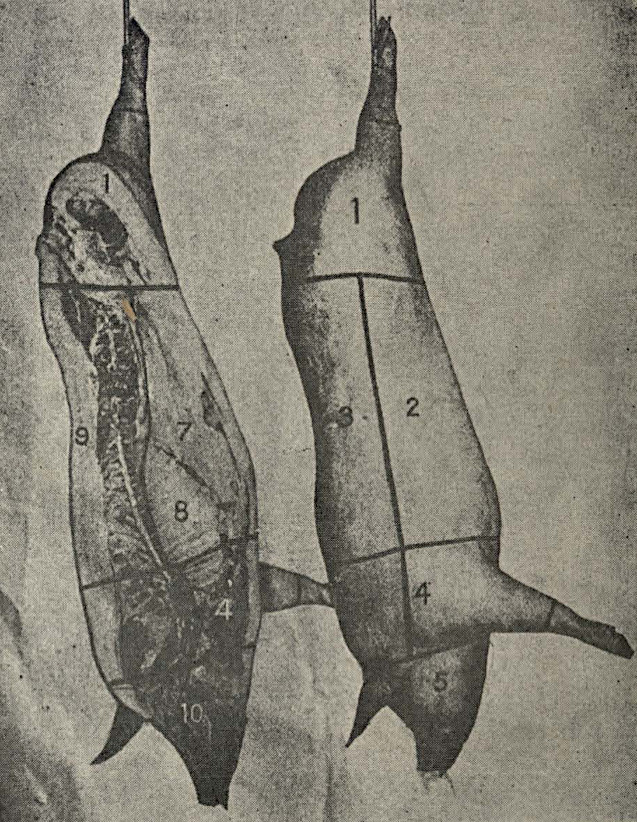
Any piece of beef can be used for corning, but the cheaper cuts are
the parts generally used for this purpose. The plate, rump, and parts
of the chuck are generally used, although the ribs, loin, and round
may also be used. The pieces for corning should be cut into pieces of
convenient size, say four or five inches square. If they are cut much
larger, they well not cure very well as the pickle will not work in
soon enough. They should be cut as nearly the same size as is possible
so they will pack in even layers in the barrel or jar.
When as the meat is thoroughly cooled, it should be corned as quickly
as possible. Weigh the meat and allow 10 pounds of salt for each 100
pounds of meat. Sprinkle a layer of salt a half inch deep over the
bottom of the jar in which the meat is to be placed. Rub each piece of
meat with good, clean salt. Pack each layer of meat closely in the
bottom of the jar, and sprinkle a layer of salt one-fourth to one-half
inch deep on each layer of meat before the following layer of meat is
placed in the jar, and cover the top layer of meat with a good layer
of salt. After it has stood over night, cover with a brine made as
follows: for each one hundred pounds of meat, use four pounds of
sugar, six ounces baking soda, and eight ounces of saltpeter. Dissolve
in a gallon of water that has been boiled and cooled until it is
tepid. Three gallons more of boiled, tepid water should then be added.
Meat from fat animals makes choicer corned beef than that from poor
animals. Under no circumstances should meat be corned while it is
frozen.
In case of more or less than one hundred pounds of meat to be corned,
make the brine in the proportion given. The meat should be weighted
down with a board and stone so that all the meat is well beneath the
surface of the brine. In case any of the meat projects above the
surface, decay will commence in a short time.
It is best to cook the brine, or the water used in making the
brine solution. If the weather is warm, the brine is apt to get sour
and ropy. In that case, wash each piece of meat in cold water,
scald the vessel and repack in a new brine. If the brine is reboiled
every few days before it gets ropy, it is not necessary to make new
brine so frequently. To test the brine for freshness, dip the fingers
into it, and if it does not drip freely from the fingers, but appears
stringy or ropy, it should be turned off, the meat washed, and new
brine added. In the spring of the year, the brine should be watched
closely, as it is more likely to spoil at that time than during the cold
winter months. If kept in a cool place, with a uniform temperature
of below 50 degrees Fahrenheit, and above freezing, there should be
little trouble from this source. To secure thorough corning, the
meat should be kept in the brine for twenty-eight to forty days, the
exact length of time depending on the size of the pieces of meat and
on the weather.
The round and shoulders are the parts most commonly used for dried
beef. The pieces should be cut with the grain, so that the muscle
fibers will be cut crosswise when the dried beef is sliced for table
use. It should be cut in about the same sizes as for corned beef, and
packed in vessels in the same manner. The pickle should be made as
follows: for each one hundred pounds of meat, weigh out six pounds
table salt, three pounds of granulated sugar, and two ounces of
saltpeter. Mix these pieces thoroughly. Before the meat is placed in
the jar, each piece should be well rubbed with the spice mixture.
Dissolve the remainder of the spices in four gallons of boiled water
that has been allowed to cool. Pour this pickle solution over the meat
in the jar until it is completely covered. Weight the meat down, as in
the case with corned beef. The pickle solution should be watched and,
in the case of tendency to become ropy, should be handled as in
corning beef.
After ten days, the meat should be removed from the pickle and hung up
in an airy out-house to drip and dry. When dry, which should be in
about 24 hours, it can be smoked, as in the case of smoking ham. The
drier the climate, the more easily can the meat be dried and smoked.
It is difficult to dry and smoke meat in the Canton region unless done
in December and January, before the rains begin.
{26}
Rub each piece of meat with fine common salt and pack closely in a
barrel. Let stand over night. The next day, weigh out twelve pounds of
salt and three ounces of saltpeter to each one hundred pounds of meat,
and dissolve in four gallons of boiling water. When cold, pour this
pickle over the meat, cover and weight down to keep the meat under the
brine. The meat will pack best if cut into pieces about six inches
square.
For each one hundred pounds of meat, weigh cut eight pounds of salt,
two pounds of granulated sugar, and two ounces of saltpeter. Mix
thoroughly, and rub the meat once every three days, using a third of
the mixture at each rubbing. Keep the meat on a shelf, or in a vessel,
while curing. After the last rubbing, allow the meat to remain in a
vessel for about ten days, when it is cured and ready to smoke. To
cure nicely, it is desirable to have a cool and rather moist place in
which to keep it.
This recipe should not be used where the meat must be kept in a warm
dry place, as the preservatives will not penetrate easily and
uniformly under such conditions.
Rub each piece with salt and allow to remain over night. A wet pickle,
or brine, may also be forced into the hams and shoulders close to the
bone with a special pump, using from 5 to 10 ounces of the pickle or
brine for each piece, the amount depending on the size of the piece.
The following morning pack in a vessel with the hams and shoulders at
the bottom and the bacon on the top. For each one hundred pounds of
meat, weigh out eight pounds of salt, two pounds of brown sugar, two
ounces of saltpeter, and one-half pound baking soda. Dissolve all in
four gallons of water, and cover the meat with this wet pickle. In
warm weather, the pickle should be boiled and thoroughly cooled before
using. A board and stone should be used to weight down the meat. Bacon
strips should remain in the pickle from three to four weeks, and the
hams and shoulders five to seven weeks, depending on their size. If
desired, the meat may then be smoked. Before being smoked meat should
be soaked for several hours in clean water at about 80 degrees
Fahrenheit to remove the excess salt on the surface of the meat and
thus make the meat more palatable. In soaking the meat about one-half
pint of water should be used for each pound of meat.1 The Canton
Christian College has had very good success with this cure.
Pork sausage should be made from clean, fresh pork only. The parts
generally used are the shoulder, neck, and lean meat trimmings. About
three pounds of lean meat should be used to one pound of fat meat. Mix
the fat and lean meat together in chopping. With some cutters it is
necessary to run the meat through twice in order to make it fine
enough and to mix thoroughly the lean with the fat meat. After it has
been cut the first time, spread thinly and season. For each 100 pounds
of meat, use one and one-half pounds of pure, fine salt, four ounces
of ground black pepper, and two pounds of pure leaf sage, rubbed fine.
The seasoning should be sprinkled over the meat, and the meat again
run through the cutter, in order to mix the spice thoroughly with the
meat. For immediate use, the sausage may be packed away in jars. It
may be kept for some time in a jar if melted lard is poured over the
top, so as to exclude the air. The sausage may also be stuffed into
muslin bags about two inches in diameter. If the stuffed bags are
coated with paraffin, they will keep for some time.
Mixed sausage may be made from a mixture of pork and beef in almost
any proportion. Sausage should not contain too much fat. A good
proportion is two pounds of lean pork, one pound of fat pork, and one
pound of lean beef.
To each ten pounds of lean beef, use one pound of fat pork or bacon.
Chop finely and season with three ounces of salt, two ounces pepper,
and a little ground coriander. Stuff casing, and tie every ten or
twelve inches. Hang the stuffed casings straight. Smoke for ten or
twelve hours. Cook in boiling water until the sausage floats. Dry on
clean hay or straw in the sun and hang away in a cool place until
wanted.
{28}
Blood sausage is made with the following ingredients: 25 pounds of
cured pork or shoulder fat, seven pounds cured fat skins, six pounds
of blood, one-half pound onions, one pound salt, one-half ounce white
pepper, one ounce sweet marjoram, and one-half ounce cloves.
Cook the fat for one hour and the skins two hours at a temperature of
200° Fahrenheit. When cooked, put through a grinder, grinding quite
fine. Then add the blood and seasoning and mix thoroughly. Stuff into
large beef casings and boil in the same water in which meat was cooked
until the sausage floats. Then dip the sausage in cold water and hang
up to cool.
The following ingredients are used in making smoked or country
sausage: 85 pounds lean pork, 15 pounds beef, one and one-half to two
pounds salt, four ounces black pepper, and one ounce sweet marjoram.
Cut the meat into small pieces and sprinkle seasoning over it. Then
grind finely. Put away in a cool place for twenty-four to thirty-six
hours, then add a little water, and stuff into hog casings and smoke
in a very cool smoke until a dark mahogany is obtained.
This popular sausage is made with the following ingredients: 70 pounds
beef, 30 pounds fat pork, 20 pounds water, one and one-half to two
pounds salt, two ounces red pepper.
Cut the beef into small pieces, salt, and allow it to cure for
forty-eight hours in a cool room. Cut the pork into small pieces and
put the beef and pork through a grinder together. Put into a vessel
and add the water and spices. After it is all mixed, put it through a
grinder again and grind fine. Stuff into sheep casings. Then, by means
of the forefinger and thumb, press the stuffed casing together about
four inches from one end, and give this first link two or three
twists. Do the same about every four inches, twisting each succeeding
link in the opposite direction from the preceding link, in order to
prevent untwisting. Then hang in a smoke house for about two hours at
a temperature not to exceed 125° Fahrenheit. After smoking, boil for
five or ten minutes, then plunge into cold water and hang in a cool
place.
{29}
Odds and ends, resulting from trimming up the various cuts
of the hog carcass, as well as the liver itself, can be used in making
liver sausage. If the head is used, it should first be cleaned, as for
headcheese. The jowl, which is practically all fat, may be cut off
and made into salt pork, or used for rendering lard. The remainder
of the head meat, trimmings, liver cut into slices, and some beef or
veal, if such meat can be had, should be boiled. Skin that is free
from hair, and from which the fat has been removed, is also sometimes
used. The skin will cook before the meat, so it should be
put in a cloth sack and removed when thoroughly cooked. Liver
cooks in a very short time, and should be removed before the rest of
the meat. The meat should cook until it readily falls from the
bones. All the meat should then be ground in a meat grinder. For
40 pounds of meat, use one and one-half pounds salt, three ounces
sweet marjoram, one ounce allspice, one ounce black pepper, and
about one gallon broth in which the meat was cooked. Garlic or
onions can be added, if desired. The seasoning should be well worked
into the meat. It can then be put into jars, covered with paraffin,
or stuffed into beef casings or rounds. When stuffed into casings
or rounds, it should be cooked in the same water the meat was
cooked in until it floats. Then it should be placed in cold water
until the sausage is thoroughly cooled.
Summer sausage is made with the following ingredients: 25 pounds cured
beef free from sinews, 15 pounds pork trimmings, four to six ounces
white pepper, one ounce whole black pepper, and one ounce whole
mustard seed.
This sausage can be made in cold weather only. All the meat is put
through the grinder, and spices added. No salt is needed as the cured
beef is salty enough. Mix it all thoroughly until it is evenly
seasoned. Spread it out in a cool place for thirty-six to forty hours.
Then stuff into hog casings and let it hang over night. Smoke with
cold smoke for several days. If kept in a dry place, it can be kept
the year round. It if gets moldy, simply wipe off the mold before using.
{30}
The head of the hog, and trimmings, are used for making headcheese.
The head should be shaved clean and nostrils cut off just in front of
the eyes. Cut out the eyes and ear drums. The fattest part of the head
is generally used for lard. Clean the head by soaking it in water for
some time to extract all blood and dirt. After the head is thoroughly
cleaned, cover with water and boil until the meat separates from the
bones. Lungs and heart may be cooked with the head. When it is
thoroughly cooked, take out the meat, saving the liquor for future
use. Chop the meat finely. Season with one and one-half pounds salt,
three ounces black pepper, four ounces allspice, and four ounces
ground cloves, together with two gallons of the liquor for every 50
pounds of meat. The mixing should be done thoroughly, so that proper
seasoning is secured. Stuff the meat into large beef casings
thoroughly cleaned, hog stomach, or muslin bags about three or four
inches in diameter. After stuffing into casings, it should be boiled
until it floats on the top, then place in cold water for a short time.
Store away in a clean, cool place on a shelf or table. If there are no
casings or muslin available in which to stuff the meat, it can be kept
in shallow pans.
The head and feet of hogs are generally used in making scrapple, but
scrapple can be made from any hog meat. The heads should be split
through the middle and placed in a kettle with sufficient water to
cover them. They should be cooked until the meat falls from the bones.
Drain off the broth. Separate the bones from the meat, then chop the
meat fine and add it to the broth, and boil. Corn meal should be added
until it is as thick as mush. Add the corn meal slowly and stir
vigorously, so as to avoid lumpiness. Stir the mixture well for ten or
fifteen minutes, and allow it to boil one hour. Pour the scrapple into
shallow pans or molds. When cold, it should be sliced and fried.
Snow packing is a method that can be used only in localities where
snow and continued dry cold weather prevails during the winter months.
The carcass should be cut into steaks, roasts, and boiling pieces. All
trimmings for the table should be made before freezing the meat. Lay
the pieces out to freeze. Be sure they freeze solid to the center. In
the bottom of a box large enough to hold all the meat, pack a layer of
snow. Put in a larger of the frozen meat, packing in such a way that
the pieces do not touch each other. Cover with a layer of snow, and
continue with alternate layers of meat and snow. Set the box in a room
where it will not be subject to changes in temperature. For
convenience, it is well to pack the steaks in one section or end of
the box, and the roasts and stews in another. The meat will then be
but little disturbed when a supply is taken from the box. Only snow
should be used in packing. Be sure the meat is frozen solid before
packing, and it will keep through the winter, unless the weather gets
very warm. In preparing the meat for the table, it should not be
thawed out too rapidly.
Partial cooking and packing in jars is a method of preserving meat
which is sometimes used on the farm. It has the advantage over snow
packing in that it can be done in warm weather and is a most
satisfactory way of keeping fresh pork. However, it requires
considerably more work than other methods of preserving meat.
The loin and side meat, or any part of the carcass, may be used. Cut
into slices about one-half inch thick, and fry until a little more
than half done. Pack the slices in a jar and cover with hot lard. As
the meat is wanted, it can be removed from the jar and warmed up. If
the jar is to stand any length of time without using, after it has
been opened, it is best again to cover the top with lard. It is better
to use several small jars than one large one. They should be kept in a
cool, dark room to insure safe-keeping of the meat.
The leaf lard, fat back, and fat trimmings from the hams, shoulders
and neck make good lard. Intestinal fat should never be mixed with the
other fat parts, as it makes a strong smelling lard of an inferior
grade, but should be rendered by itself. By thorough washing and
soaking in cold water for several hours, part of the offensive odor
will leave it.
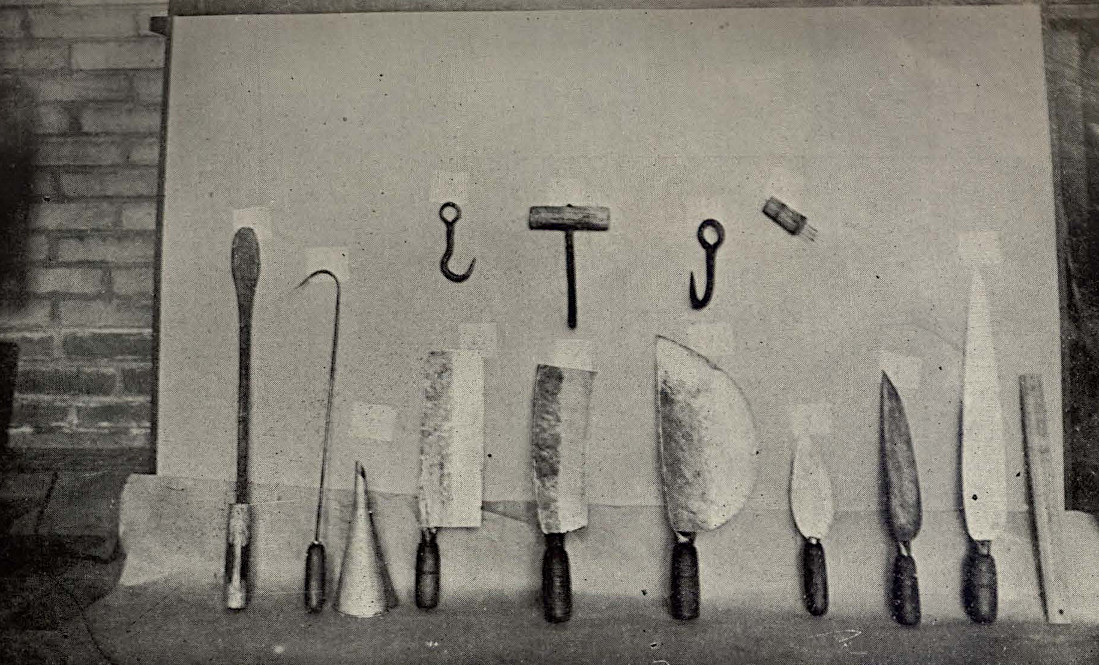
First of all, remove the skin from the fat trimmings. To do this,
place the meat on a table, skin side down, and cut the fat from the
skin, using a strong knife. When a piece of skin large enough to grasp
is freed from the fat, take it in the left hand, and, with the right
hand, insert the knife between the skin and fat. Pull the skin and cut
with the knife slightly slanted downward. With a little practice, the
fat can be cleanly removed from the skin in this way with one clean
cut of the knife. The strips of fat should then be cut into cubes of
one to one and one-half inches, making them about equal in size so
they will try out evenly.
Pour into the kettle about a quart of water or melted lard, and then
fill it nearly full with the cubes of fat meat. The fat will then heat
properly and the lard will be brought out without burning. Keep a
moderate fire until the cracklings are brown and light enough to
float. Frequent stirring is necessary to prevent burning. When done,
remove from the fire and allow to cool slightly. Then strain through a
muslin cloth into a jar. Stir it occasionally, until it is cool enough
to begin to solidify. Stirring while it is cooling tends to whiten the
lard and make it smoother. A quarter of a pound of saleratus added to
each one hundred pounds of fat has a like effect.
When removing lard from a container for use, take it evenly from the
surface. Do not dig down into the center of the lard, for when this is
done, it will leave a coating of lard around the sides of the
container which will become rancid very quickly by the action of
bacteria in the air.
The process of smoking helps to preserve meat, and, if smoked
properly, and with the right kind of fuel, adds a desirable flavor to
meat. The creosote formed by the combustion of the wood closes the
pores to some extent, and excludes the air. This also helps to keep
out the insects.
The size of smokehouse to build depends on the amount of meat that is
to be smoked. In a house eight feet square and ten feet high, the
hams, sides, and shoulders of three to five hogs can be smoked at one
time. Ventilation should be provided to carry off the warm air in
order to prevent overheating the meat. A chimney, made by placing a
six inch tile in the roof, makes a good ventilator. The smoke house
walls may be built of lumber, brick, or concrete. Lumber would be the
cheapest, but least permanent, and concrete the most costly. Brick is
no doubt the most satisfactory material for a small smoke house in
southern China. Mud bricks may be used, but burnt clay bricks are more
lasting. The roof should be made of tile. The best material for the
floor is large square tiles, called in Chinese taai ch’uen (大磚).
Concrete or brick may also be used, but would be more expensive then
taai ch’uen.
A good arrangement is to have the fire box outside the smoke house,
with a flue to carry the smoke into the smoke house. When this cannot
well be arranged, a fire may be built on the floor of the house, and
the meat shielded from heavy smoke by a sheet of tin, about four feet
square, placed over the fire between the fire and the meat, about
three feet above the floor.
Lychee, or any other hard wood, makes good fuel for smoking meat.
Resinous woods, such as pines and cedars, should never be used as they
give an objectionable flavor to the meat due to turpentine which they
contain.
Meat that is to be smoked should be removed from the brine and
thoroughly washed in tepid water in order to clean off the coat of
pickle that has formed on the surface of the meat. It can then he hung
up in the smokehouse, but should be allowed to drain for a day or two
before the fire is started. The pieces of meat should be hung so that
the air can pass freely between them.
For the first day or two, the fire should be slow, in order that the
warming of the meat may be gradual. In clear, dry weather, smoking may
continue from the day the smoking begins until it is completed, which
should be in one to three weeks, the length of time depending on the
size of the pieces of meat and on the weather. When sufficiently
smoked, the meat will have a characteristic straw color. Meat should
never be smoked on a damp day, because in a damp atmosphere moisture
will condense on the meat, and moist meat will not smoke well. Light
smoking for two weeks is better than heavy smoking for one week. With
a longer period of smoking the smoke will enter the meat more
thoroughly.
{34}
During cool weather smoked meats may be left in the smokehouse for
some time after the smoking process is completed. The house should be
kept dark in order to keep out flies, and it should be well ventilated
so as to prevent dampness. A dry, cool cellar, with free circulation
of fresh air, will be a satisfactory place for keeping smoked meats.
If the smoked meat is to be kept only a short time, it needs only to
be hung up without covering. For longer keeping, it is well to wrap
first in paper, and then in burlap, canvass or muslin, and bury the
meat in a grain bin or box of sand. The object of this is to provide a
condition which will be uniform in temperature and keep out insects.
A coat of ground pepper, rubbed into the meat before wrapping, will be
distasteful to insects.
After smoked meat has become thoroughly dry, it may be wrapped in
parchment paper and enclosed in a heavy muslin or canvass, which
should be covered with yellow wash or ordinary lime white wash with
glue added.
For one hundred pounds hams or bacon, take: three pounds barytes
(barium sulphate), .06 pound glue, .80 pound chrome yellow (lead
chromate), .40 pound flour, and twelve pounds water.
Put the flour in the water, dissolving all lumps thoroughly. Dissolve
the chrome in a quart of water in a separate vessel, and add the
solution and the glue to the flour and water. Bring the whole to a
boil, and add the barytes slowly, stirring constantly. Make the wash
the day before it is required. Stir it frequently when using, and
apply with a brush.