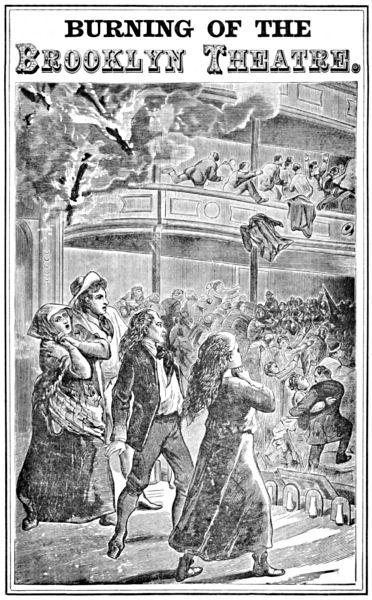
THE destruction of the Brooklyn Theatre, on the night of Tuesday,
December the 5th, was the most terrible calamity of its kind that
has occurred in this country. What was first deemed to be an ordinary
fire, naturally involving serious financial loss to the owners, the
lessees and the actors, was really a catastrophe of the most heartrending
character, causing, as it did, the loss of upwards of three hundred lives.
No theatre fire on this continent had so much horror lent to it. Even the
most stony-hearted were touched by the awfulness of this great calamity.
Three hundred human beings of both sexes and of all ages were thrust into
eternity through an agonizing and painful death. They were thus doomed at a
moment of pleasure and mental excitement over the mimic troubles of the dramatic
personages in a play possessing features that touched the hearts of those
who followed the scenes on the stage. At a moment when every eye was fixed
on the painted scene, and every ear strained on the utterances of the several
characters, the dreadful cry of “Fire!” was raised, and, in a few moments
after, the entire building was filled with flame and smoke, and hundreds of
men, women and children were suffocated and burned to death, and their
charred and disfigured remains buried beneath the ruins.
Such is the simple and terse record of this most dreadful occurrence, and
these few sentences afford such outline and visible form to the picture that it
scarcely needs the shocking details that necessarily follow to give it color
and ghastliness. That so much horror should attend the burning of a theatre
sent a thrill of pain through every heart in the land. The full scope of the
calamity and the dreadful scenes attending it are depicted in the accounts
that follow.
No more awful moment can be imagined than that when the fire was discovered.
The full moon of the fatal evening had tempted upwards of twelve
hundred people from their homes, and lighted them to the brilliant entrance
of the theatre. The famous play of the “Two Orphans,” with an excellent
cast, mainly from the Union Square Theatre, of New York city, was the
attraction, and had renewed its fascinations over a public long since familiar
with its story. The audience was characteristically a Brooklyn gathering.
Many well-known citizens were there: among them the family of Mr.
20]
William C. Kingsley, the Hon. Henry C. Murphy, Edgar Cullen and ladies, E. B.
Dickinson and ladies, and Henry Beam. The following was the distribution
of characters in the play, and, with the exception of Miss Morant, Miss
Vernon and one or two of the minor characters, all the members were in the
theatre at the outbreak of the fire:
| Chevalier De Vaudry |
Mr. C. R. Thorne. |
| Count de Linieres, Minister of Police |
Mr. H. F. Daly. |
| Picard, Valet to the Chevalier |
Mr. Claude Burroughs. |
| Jacques Frochard, an Outlaw |
Mr. J. B. Studley. |
| Pierre Frochard, his Brother |
Mr. H. S. Murdoch. |
| Marquis de Presles |
Mr. J. G. Peakes. |
| Doctor of the Hospitals St. Louis and Salpetriere |
Mr. H. B. Phillips. |
| La Fleur |
Mr. H. W. Montgomery. |
| Officer of the Guard |
Mr. John Mathews. |
| Martin |
Mr. L. Thompson. |
| De Mailly |
Mr. J. Clements. |
| D’Estres |
Mr. George Dalton. |
| Footman |
Mr. E. Lamb. |
| Antoine |
Mr. R. Struthers. |
| Louise, |
{ |
The
Two Orphans. |
} |
Miss Kate Claxton. |
| Henriette, |
Miss Maude Harrison. |
| La Frochard |
Mrs. Farren. |
| Countess de Linieres |
Miss Fanny Morant. |
| Sister Genevieve |
Miss Ida Vernon. |
| Marianna, an Outcast |
Miss Kate Girard. |
| Julie |
Miss Ethel Allen. |
| Cora |
Miss L. Cleves. |
| Sister Therese |
Mrs. L. E. Seymour. |
The play had proceeded to the last scene of the last act. The curtain had
just been rung up, revealing a scene of exciting and pathetic interest to the
audience. It was the interior of the hovel boat-house on the Seine. The
blind Louise (Miss Claxton) lay on a bed of straw; Mme. Frochard (Mrs.
Farren) was scraping a carrot; the cripple was at his wheel, and Jacques
was about to emphasize his brutality with a threat. As was natural from
her reclining position, which enabled her to see the flies, the first flame
caught the eye of Miss Claxton. Mr. Murdoch (Pierre) was delivering his
speech when the two heard a whisper of “Fire” from behind the scenes, and,
looking up, saw flames issuing from the flies. Mr. Murdoch stopped, but
Miss Claxton whispered to him, “Go on, they will put it out, there will be a
panic—go on,” and he resumed. So far the audience had not noticed anything
out of the way, and the two played the scene through, Mrs. Farren
(Frochard) entering meanwhile. The carpenters were all the while trying to
stop the progress of the flames, unnoticed by the house, and Miss Claxton
delivered her little speech to Jacques: “I forbid you to touch me,” which
was greeted with applause. Meanwhile the audience had begun to suspect
something, and with Miss Claxton’s words, “I will beg no more,” the actors
were forced to move from fear of falling timber, and the audience rose to
their feet. Mrs. Farren and Mr. Murdoch stepped to the footlights and
waved to the people to resume their seats, while Mr. Studley and Miss Claxton
went forward to do likewise. Mr. Studley shouted: “Ladies and gentlemen,
21]
there will be no more of the play, of course; you can all go out if you
will only keep quiet.” Miss Claxton, at the other end of the stage, begged
the people to keep cool, adding: “We are between you and the flames.”
By this time the fire (which seems to have originated by some of the “short
drops” blowing against the “border lights” in the flies, and so communicating
to the scenery) had made so much headway that the actors had to look
out for themselves. They had held their ground as long as it was possible,
and, seeing from the panic which started immediately in the gallery and spread
all over the upper part of the house, that the worst had begun, they began their
retreat, the ground floor being already almost cleared. Mr. Thorne had gone.
Mr. Burroughs was up-stairs in his dressing-room, from which he escaped
only to meet his death. Mr. Murdoch was never seen again. Miss Claxton
and Miss Harrison rushed one way; Miss Girard and the minor people
another.
The sight of fire seemed to paralyze every one for an instant, and just as
they recovered sufficiently to act, Mr. Studley’s sudden coming to the front
of the stage and assuring them that there was no cause for alarm caused
another pause of a second. It was for a second only. The blazing fragments
began falling thick and fast, contradicting the actor’s well-intentioned deception.
The audience arose as by one impulse and made a rush for the doors.
The entreaties of Miss Claxton and Mr. Murdoch were unheeded. The fierce
struggle for life had begun.
The ushers for the most part preserved their presence of mind and endeavored
to enforce order among the rushing crowd, as did also the police in
attendance. Mr. Rochfert, the head usher, broke open a small door at the
farther end of the vestibule and increased the facilities of exit into the open
air, which regularly consisted of two doors five feet wide, opening upon Washington
street. Mr. Rochfert also entered the auditorium and endeavored to
quell the excitement, but without effect.
A fire alarm had been immediately sent from the First Precinct Station-House,
which is located next the theatre, and a minute or two after a general
alarm and also a call for the reserved force of all the precincts. But by the
time the engines were in position and at work the fire was beyond control.
The occupants of the orchestra chairs and parquet had had but little difficulty
in making good their escape, but at least two-thirds and perhaps even a larger
fraction of the audience were still in the dress-circle and gallery. The lowest
estimate of the number in the gallery is that five or six hundred people were
in that portion of the house, and from among these were most of the three
hundred deaths. The exit from the first balcony was down a single flight of
stairs in the rear of the vestibule. Down these stairs the people came in scores,
leaping and jumping in wild confusion. The way out from the upper gallery
was down a short flight of stairs starting from the south wall of the building,
thence by a short turn down a long flight against the same wall to the level
of the balcony, and from this floor down a cased flight into Washington street.
The main floor and first balcony were soon emptied through their respective
exits, but for the five or six hundred panic-stricken gallery spectators to pass
safely through the tortuous passage described was next to an impossibility.
22]
Every indication points to the belief that, suffocated by the smoke forced down
like a wall from the roof, the mass of those in the upper gallery thronged
about the entrance to the stairs and were either blocked there so as to make
exit impossible, or were unable even to make the attempt to escape, and sank
down, one upon the other, to fall in a mass into the horrible pit under the
vestibule when the supports of the gallery were burned away. Those near the
entrance of the stairs were, probably, the only ones who were able to escape
from this terrible slaughter-pen. There was comparatively little outcry here,
and this again would seem to indicate that suffocation had intervened to numb
the sensibilities of the hundreds to whom death was to come by fire.
As soon as the flames reached the rear of the theatre, near the entrances,
where the hundreds of people were contending wildly, the horror of the scene
was increased tenfold. Some leaped madly from the gallery upon the orchestra
chairs, and only a few were sufficiently self-possessed to lower themselves
by the railings. One man escaped by the small window at the head of the
gallery stairs, letting himself down upon the roof of the station-house. Another,
who attempted the same escape, was suffocated or became insensible as
he reached the window, and was seen sitting motionless there until swept
away. A few lowered themselves from the second-story windows on the
Flood’s alley side. But the great mass stood helplessly blocked in. The
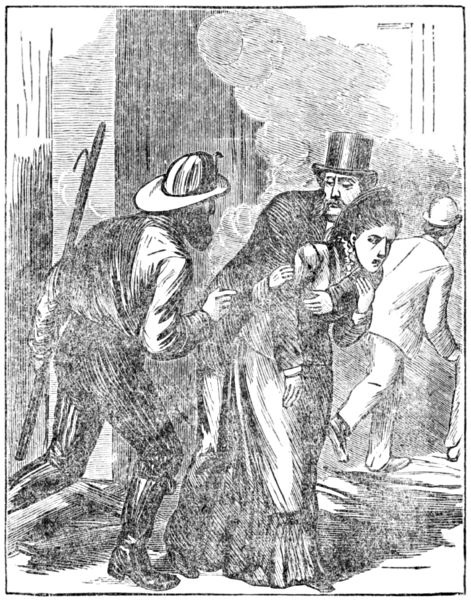
smoke became unbearable, and the police and firemen who had been able to
penetrate the crowd at all were obliged to retire. They seized as many of the
paralyzed bodies as they could and dragged them into the street, passing on
their way out over piles of insensible men and boys. Fifteen minutes after
the fire broke out the interior of the theatre was wrapped in flames. Shortly
after the roof fell in, and, at 11.45, a half an hour after the fire started, the
broad east wall fell with a terrible crash. The few who had reached the first
flight of stairs from the street were taken out and carried into the First Precinct
Station-House. The crowd that had escaped from the theatre remained
in the adjacent streets. Men without hats or coats, with clothing torn and
faces bruised; women bonnetless and dishevelled, weeping convulsively—every
face was a picture of woe and fright.
The crowd was quickly and largely augmented by the anxious throng of
sight-seers, and to keep them within the proper limits required the efforts of
nearly the entire reserved police force of the city. The Police Commissioners
and Superintendent Campbell, and Inspector Waddy; the Chief of the Fire
Department, Thomas F. Nevins, and Fire Marshal Keady, had been telegraphed
for and came promptly to the scene of the conflagration, and did
everything in their power to provide for the sufferers, for many had been
brought out bruised and burned. The firemen had not fairly begun their labors
before it became evident that it was impossible to save the theatre or any part
of it; the entire attention of the force was therefore directed to the surrounding
buildings, which meanwhile were seriously threatened. Several small
buildings on the opposite side of Flood’s alley were partially destroyed, and
at one time the First Precinct Station-House was in imminent danger. The
fire was, however, confined to the theatre by the united exertions of the entire
fire department. The interior decorations of the theatre were of such light
25]
and inflammable material that the fire was quite beyond their control, so far
as the theatre was concerned, and the roof being equally light and inflammable,
it required constant exertion to keep the fire from spreading.
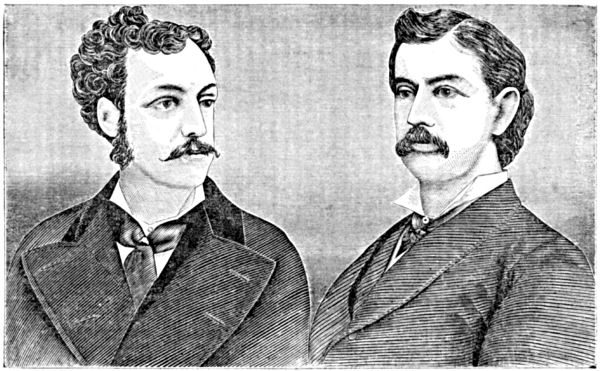
CLAUDE BURROUGHS. H. S. MURDOCH.
At about three o’clock in the morning the fire had been nearly extinguished,
and the major part of the throng of sight-seers had gone to their homes, ignorant
of the fatal consequences of the conflagration.
The flames had subsided sufficiently to permit the firemen to make an investigation
near the main entrance of the theatre. Chief Nevins passed over
the trembling floor of the hallway toward the inner doorway. Inside the
doors the flooring had fallen in, leaving a deep pit of fire and flame, from
which a dense smoke and steam ascended. Here a sickening spectacle met
his horrified gaze. Close up to the flaming furnace, and clinging to the splintered
verge of the demolished flooring, was the body of a woman. Her hands
clasped the frame-work of the door in a desperate grasp. She had fought
hard for life. Evidently she would have escaped had not the flooring given
way beneath her. All the clothing was burnt off, and the features were so
blackened that she was unrecognizable, and the body was removed to the
Morgue.
At 4 o’clock in the morning the flames were put out, and the heap of debris
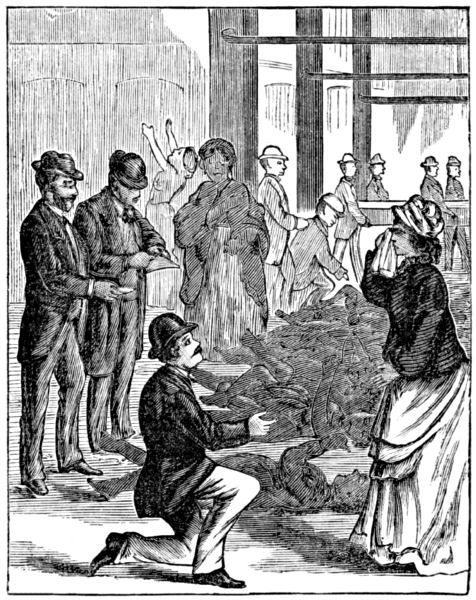
was black and cold. From the vestibule platform the firemen saw a most
horrible spectacle. The mound that had at first appeared to be simply a heap
of ashes proved to be almost wholly composed of human bodies. Heads, arms,
legs, shoulders, shoes, and here and there entire human remains protruded
through the surface of the mound. Policemen and firemen hesitated for a
moment before leaping down upon the sickening heap. An inclined plane
of plain deal boards was hastily constructed to reach from the tender vestibule
platform to the pit, and upon this a ladder was rested. Upon the ladder
the men went to and fro. Upon the plane, coffins were hauled up and down.
At first the firemen lifted the bodies from the debris, after having carefully
dug around them and loosened them, and ten minutes was consumed in exhuming
each body. But as it became apparent that there were scores and
scores of human remains, and that a day, and perhaps a night, would end
before the last corpse was taken out, less tender means were used in the operation,
and the work assumed a more earnest and energetic character. Instead
of five men, ten men set at work among the ruins, while on the vestibule platform
a dozen sturdy firemen manned the short ropes by which the coffins,
laden with human remains, were drawn up and dragged to the sidewalk. All
the bodies were bent into horrid shapes, assumed in the struggles of death by
suffocation and by burning. Nine out of ten of the corpses had an arm upraised
and bent to shield the face. Something was missing from every one.
This one lacked a head or a foot, this a nose, an ear, or a hand, another its
fingers or the crown of the skull. Very many broken limbs and protruding
bones were found, and there were gashes in the upturned faces or fractures
in the smooth-burned skulls, so that each corpse as it was dragged into the
light was a new revelation of ghastliness. A few lusty pulls disengaged each
body. Two or three men seized its stiffened limbs and pressed them into a
coffin, a pair of sharp-pointed tongs clutched the coffin, and the firemen overhead
26]
dragged it even with the street, where a cloth was thrown over the
coffin, and it was dragged to the dead-wagons, which kept coming and going
all day long.
Opera glasses, chains, studs, purses, and even watches were found under
and on the bodies, and were thrown to one side upon a spread-out newspaper.
Opposite the main entrance at the rear of the theatre other firemen and police
officers delved in the ashes and brought forth corpse after corpse to be
boxed and carried away to the Morgue, with the same rapidity as at the
other door. At four o’clock, when a hundred and forty-seven bodies had
been exhumed on the Washington street side, fifty-three had been carried
from the alley-way in the rear. Moving among the firemen, either as spectators
or supervisors of the ghastly work, were Chief Engineer Nevins, Police
Commissioner Hurd, Fire Commissioner McLaughlin, Assistant Engineer
Farley, and ex-Police Superintendent Folk.
Surrounding the ruins, in Washington, Johnson and Adams streets, were
throngs of people who stood close together on the sidewalks and left only
room enough for one vehicle at a time to traverse the roadways. The dead-wagons
continually passing and repassing, kept this passage way clear, and
were themselves the objects of the most interest. During the entire day there
were continual quarrels between the police officers and the over-curious people.
Pickpockets—nearly all boys—were numerous, and were brought into
the First Precinct station two at a time. In the station were coats, and hats,
canes, shawls, bundles, valises filled with costumes, and numerous other articles
taken from the ruins of the theatre.
When the first wagon, laden with the dead from the fire, halted in front of
the Morgue, the gathering pressed forward and crushed its way between the
wagon and the doorway. The police officers appealed to the people to be calm,
and at length the bodies were taken into the building.
Daylight had not set in when the arrival of the dead bodies was announced.
It was thought at first that the first was the remains of a young woman, but
a vest displaying a watch and chain was revealed. About nine o’clock the
second body, that of a young man whose hands were clasped, and who wore a
plain silver ring and a gutta percha ring, was received. Nicholas Kieley’s
remains were next, and the Rev. Father Kieley, who wept as though his heart
was broken, recognized his brother.
Upon the body of the fourth corpse was a gold open-faced watch, to which
was attached a thin gold chain. On the back of the watch was the words,
“A mother’s gift.” The fifth body was that of a stalwart man, whose hands
were fixed over his face. Then there was a negro whose features were beyond
recognition. Following was a body whose head had been nearly consumed,
and next one whose arms had been burned away. On this man was a bright
gold collar button. Then there were the remains of a young woman. The
limbs were drawn up, the body was twisted, and the features could not be
recognized.
The remains of a boy about fourteen years of age were next carried in. A man
with a checked shirt was put at his side. The bodies of three young boys and
three girls were next received. On one of the bodies was a hunting-case silver
27]
watch, 76,744, with a gold chain and a piece of the Hell Gate telegraphic wire
as a charm. The timepiece was in good order and marked the correct time.
Before 3 o’clock seventy-eight bodies were strewn about in the Morgue, and
a long line of men and women were constantly passing in and out of the building.
Nearly every person had permits from the Coroner’s office, and the women
visitors were in the majority.
A most shameful and vulgar feature of the inroad upon the Morgue was the
vast number of women who, through mere curiosity, insisted upon entering the
building. Women who were naturally nervous and hysterical forced their
way in and risked good clothing and head dress in their wild attempts to
hover over the bodies. They began to sob and gesticulate long before they
reached the hallway in which twenty-three blackened corpses were in line on
the marble floor.
When the women reached this scene they shrieked as though bereft of all
their kindred, but the majority of them were forced to admit that they knew
no one among the dead. Occasionally some agonized mother or wife recognized
the charred remains of a loved one, and the woman wept as only a
woman can weep.
Keeper McGuire, who has witnessed much sorrow in his place, and who is
supposed to have a heart of adamant, wiped tears from his eyes, and then
tried to excuse himself by saying: “This is too much. I am almost unnerved.”
Occasionally some plain, methodical person entered, and, through close
searching, discovered one who was known to him. In a business-like way the
discoverer pinned a card or a slip of paper, bearing the man’s name, to what
remained of the clothing. Young and giddy girls, who should have been
chastised for their impudence, flaunted themselves in the presence of distressed
visitors, and seemed to enjoy their trip through the Morgue.
On each side of the building is a yard, and there are many windows. Small
boys and stalwart men peered through these windows and indulged in expressions
that were unseemly. This outside rabble became so unruly that an
additional force of police was called upon to prevent a crush into the building.
None of the bodies were put on the slabs. All were on the flooring. The
faces were so blackened by the fire that they could not be recognized, and it
was only through clothing or jewelry that any were identified. The undertakers
of Brooklyn combined together and volunteered their services in behalf
of the sorrow-stricken families. They were of very great assistance to the
police in preventing professional mourners from robbing the dead. One woman
recognized her brother when she discovered a stud in his shirt bosom. Another
woman, with a small piece of cloth and a piece of shirt bosom, identified her
husband, and saying, “He has $100 in his pockets,” put her hand in his vest
pocket and took therefrom that amount.
The arms of nearly all the dead were fixed as though shielding their faces,
and one woman had drawn her clothing over her face and clinched her hands
above her forehead. Two young men were grappled together as though they
had had a personal encounter in an attempt to escape from the theatre. Others
lay on their sides in the manner of persons who thus slumber. Their watch
28]
chains and other jewelry were beautifully bright, and the clothing of all was
blackened through the fire.
In only about one-third of the cases were the limbs exposed through the
torn and burned clothing. Uplifted hands, whose fingers were shining bones,
bore golden rings, and shoeless feet glistened in their whiteness. The hair and
whiskers were gone, and faces were terribly scarred. A few of the bodies were
burned to a crisp, and these were put into rough pine boxes, and all hope for
their identification was given up.
Until late in the afternoon, men, women, and children flocked to the Washington
street station to tell of fathers, husbands, brothers, and children who
had not returned to their homes since the evening previous. Hour by hour
the list of missing persons increased in numbers until it comprised nearly 200
names. All who made inquiry for friends or relatives were necessarily
disappointed, for the blackened, charred bodies were few of them in a condition
to be identified. Strong men, who had kept up both heart and hope, broke
down and sobbed like women when they learned their own flesh and blood
might never be discovered from out of the scores of shapeless trunks that were
being exhumed from the ruins. Women came in sobbing and went away
convulsed with grief. The policemen themselves often surrendered their forced
self-possession and sobbed aloud.
In the evening the work was continued by the aid of calcium lights. It
was thought best to discontinue the removal of the bodies from the rear
through Theatre alley to Myrtle avenue. Sixty-seven in all had been taken
out that way. The main entrance, with the ghastly burdens still regularly
coming out of it, was thrown into bold relief. The burner and lantern had
been knocked off the street lamp over the way, and a great flame of gas
blazed and flared into the air, lighting up the scorched and splintered doorway
and the upturned faces of the throng. A calcium light on the sidewalk
near the door illumined the corridor to the point where the floor had broken,
and there another was fixed whose rays shone directly into the deep pit in
which the earlier search had discovered the horrible mass of charred human
bodies.
This pit was the cellar of the main corridor, and its ruins were separated
from the debris in the auditorium by the strong foundation wall that had
borne the gallery columns. It was not until nine o’clock that this cellar,
about twelve feet wide, and running through to the foundation wall on the
alley side, was cleared. Over one hundred and fifty bodies had been removed
from it.
Toward the rear fewer were found, and those were evidently not from the
gallery, as fragments of kid gloves could be seen on the fingers of the blackened
hands, some of which still clutched opera-glasses. These bodies were
more thoroughly calcined than those first found, and not unfrequently the
firemen were able to put two or three into one box.
After dark the orders against admitting outsiders to the ruins were more
strictly enforced. Among those admitted was the foreman of the Grand
Jury, W. W. Shumway. A calcium light from the alley wall shone over
the ruins of the auditorium, and here the firemen began work shortly after
29]
nine o’clock. In addition to the lime light, oil lamps with reflectors and lanterns
were used.
In this fitful glare the firemen, their faces pallid from fatigue and hunger,
toiled on without a word. The first body found in the auditorium was on the
Theatre alley side. Its position indicates that the victim had reached a
window when he was struck down.
Some friends of Mr. Murdoch were very anxious that an early effort should
be made to recover his body. His mother was expected to arrive in the city
during the evening, he having sent for her a few days before. About nine
o’clock a stream of water was put upon the ruins in the northeast corner to
cool the immense pile of bricks under which the body was thought to lie.
The firemen were greatly impeded by the clouds of steam. They made
their way from the southern end toward the stage. The broken wall lay in
great lumps of brick and mortar. About halfway toward the stage shapeless
human flesh was found crushed between two huge masses which had protected
it from the flames that had consumed all the rest of the body. It was long
before the bricks could be sufficiently cooled to admit the removal of this
fragment. It was feared all the bodies in this part of the ruins had been
similarly or more thoroughly consumed, owing to the intense heat from the
inflammable stage fixtures.
The interior of the Adams Street Market presented at night a weirdly
horrible sight. Disuse had made the place grimy. The gas fixtures had
been removed, and candle light had to be used. The bodies were in rows
that reached the entire length of the long apartment. On the breast
of each was a lighted candle held in a small block of wood. Candles
were also stuck on the hooks that had once been used to hang meat on, and
lanterns helped to illuminate the spacious place; but the combined light was
not sufficient to rid the corners of dark shadows. The bodies were in strained
shapes, as though death had stopped them in a writhing struggle. Their
arms were raised to their faces in most instances, the gesture suggesting suffocation
or warding off heat. The charring made them appalling to look at.
At an old counter officers added to lists the names of the few who were from
time to time identified.
Articles taken from the bodies were in a basket, enveloped and numbered,
and corresponding numbers were written on slips of paper and pinned to the
rags that still clung to the corpses. Men and women passed from body to
body, seeking friends or relatives, examining the bits of clothing, holding
the candles close to the blackened faces, and looking for scars or other marks
that might make recognition possible. They were wonderfully composed in
manner, the only outbreaks of feeling being when a search was successful, and
that was very rare. They were in the main of the poor class, such as occupy
the galleries of theatres. They were persistent in their sad task, going
along the rows of ill-shapen remains without missing a thing that promised
identification. In several instances importunate appeals were made for permission
to remove recognized remains, but the coroners decided not to grant
that privilege until the next day.
On the next morning (December 7th) the confusion was less at the scene
30]
of the awful catastrophe, but the solemn gloom was deeper than before, the
excitement was nearly as great, and the under-currents of sympathy more intense.
There was a gloom in Brooklyn which could be felt even in the streets.
There was but one topic of conversation. Men, women, and children thought
and talked of little else than the Brooklyn Theatre and the burned dead beneath
its ruins. On the sidewalks, in the street-cars, on the ferry-boats, there
was one and the same subject of interest. In the neighborhood of the theatre
itself the excitement was at its height. But there was little to be seen that
could either stimulate or gratify curiosity. Two or three undertakers’ wagons
with the ugly coffins from the dead-house, were in attendance, but the uninterrupted
procession of corpses, which was so horrible a feature of the scene
on Wednesday, ended late at night, and on this morning there was nothing to
see save the smouldering ruins of the theatre. There was only the great void
where the theatre had stood, a mere rim of crumbling walls, scarcely breast
high, enclosing immense heaps of brick and rubbish, from which columns
of steam arose in the air.
A surging mass of people occupied the sidewalk in front of the dead-house,
and stretched into the middle of the street, and men and boys clambered upon
fences and wagons in the neighborhood, and gazed intently at the blank walls
of the building. Policemen guarded the main entrance and the iron gateway
before it. No permits for admission were demanded of those persons who
could satisfy the officers that they had lost friends or relatives by the fire.
They were allowed to enter from time to time, passing in the front door and
through the room on the right-hand, which contained about thirty bodies,
lying on the floor, none of them identified; so, through a smaller room at the
further end of the building, back to the left-hand room, in which some of the
corpses were lying upon marble slabs and tables in the centre. Upon such
bits of clothing as remained upon the bodies, numbers, written hastily with
lead-pencils on bits of paper, had been pinned; and where a body had been
recognized, the name and address were added to the number. Then, upon receipt
of the coroner’s permission, the corpse was placed in a plain deal coffin
and sent to the address given by the persons who had claimed it.
On Friday morning (December 8th) the work of removing and examining
the ruins was suspended, it being deemed unsafe to proceed any further while
the walls remained in such an unsafe position. The dangerous parts of the
walls were, however, braced, and the firemen resumed their labors in the
afternoon.
During Friday night and early Saturday morning a large number of
small pieces of bodies, and several heads, were discovered, and the trunk of a
body which was identified as that of Mr. Murdoch. The remains were taken
in charge by an undertaker.
Identifying the Bodies in the Morgue.
Identifizirung der Leichen in der Morgue.
Many of the bodies were so mangled and charred that it was impossible to
identify them, and it was determined by the Board of Aldermen to bury these
at the public expense. The scenes at the Morgue and the old market on
Saturday morning were, if possible, more heartrending and horrible than
anything that had occurred in those places since the burning of the theatre.
The undertakers’ wagons rattled up to the door of the old market by dozens,
33]
and the coffins of stained and polished wood, studded with silver nails, were
ranged in rows on the market floor, beside the black, gnarled things that
had been human bodies. Outside a motley crowd of men, women, and boys
pressed close to the doors and tried to get past the police lines in order to
witness the work of putting the stiffened and distorted bodies into the narrow
coffins. Wandering among the ghastly rows was the usual throng of sight-seers
and mourners searching for friends.
Soon after one o’clock the last coffin was taken from the old market, and
the driver who carried it hurried away after the others. The crowd around
the door took a last glance at the blackened floors inside, as though the
horrible place had fascinated them, and then chased the wagons and carriages
that were going to join the procession.
At a quarter before two o’clock the gleam of bayonets appeared in Schermerhorn
street, and the winds bore fitfully the strains of a dirge played by a
military band. The head of the procession was nearing the point of establishment
of the right of the line. At Flatbush avenue it halted for ten
minutes only, while the disposition of the various parts of the procession was
perfected. The Twenty-third Regiment, that had marched up in hollow square
formation, opened and rested at an “order arms,” while the Forty-seventh
Regiment passed through and took the right of the line, headed by its
splendid band. Then the hearses and undertakers’ wagons were broken from
single to double column, and the Twenty-third Regiment was placed as a
guard of honor, surrounding this portion of the mournful cortege. The other
necessary dispositions were quietly effected, and then the march was resumed,
with the procession in the following order:
Squad of Mounted Police—Sergeant Johnson.
Alderman Fisher and Supervisor Quimby of Committees—in carriage.
Forty-seventh Regiment Band.
Forty-seventh Regiment.
Detachment Fourteenth Regiment, without arms.
Gatling Battery, without piece.
Conterno’s Band.
Twenty-third Regiment as Guard of Honor, leading and flanking first hearses.
Hearses—Seventeen.
Forty-five Undertakers’ Wagons, with from one to four coffins each.
Carriages with Relatives and Friends.
Carriages with Ministers and Officials.
Thirteenth Regiment and Drum Corps.
Near Bergen street the dirge which the band had been playing up to that
point ceased, and the roll of twenty-four muffled tenor drums marked the time
for the steps of the military. Solemnly impressive as had been the music of
the band it seemed infinitely less effective than the roll of the drums. The
former had the color of melody, even though full of sadness, but the latter
impressed itself on the heart as a monotone of sobs. The air grew heavier with
the weight of those measured pulsations of half-voiced grief. Along both
34]
sidewalks moved steadily, keeping step with the procession, a silent multitude.
There was no hurrying, no conversation to beguile the weary way; only a
sullen resistance to the frenzy of the gale.
The drums ceased, and from the military band wailed forth another dirge
more weirdly sad than that first played. A trembling, thrilling cry, as of a
stricken soul, voiced by a single cornet, awoke, a harmonic wail, in hearing
which, one could not repress a shudder. Again the music ceased, and the
terrible roll of the muffled drums began, mingled with the shriekings of the storm.
The march was a terrible one, for its oppressive gloom, the deadly cold, the
grief on every hand; but that portion from Sixth avenue to the gate of Greenwood
Cemetery was in all respects the worst. All that way the roll of the
muffled drums continued, and across the wide vacant spaces toward the bay
the icy blast seemed the breath of death itself.
Battle Hill, where the arrangements for the interment of the bodies in one
common grave had already been made, is the highest point of ground in the
cemetery, and is situated but a short distance from the gate by which the procession
entered. Here a circular trench had been cut, seven feet deep and
thirteen feet wide, nearly surrounding a round sodded space ten feet in diameter,
upon which the projected monument is to stand.
It soon became evident that human endurance would be insufficient to bear
any protraction of the obsequies. With wonderful fortitude, not less than
2,000 persons maintained their places about the enormous grave, held as if by
a hideous fascination. But all were suffering intensely from cold, and it was
determined by those in charge to make the services as brief as possible.
The Rev. John Parker read the Protestant Episcopal burial service. The
Rev. Dr. Putnam, instead of the extended funeral oration which he had
prepared for the occasion, announced that the extreme cold would preclude
the possibility of its delivery, and merely said a few brief words on the
uncertainty of life and the blessed hopes of immortality. Then the benediction
was pronounced by the Rev. Mr. Odell, and the ceremony concluded
with the singing by the Germania choir of Kuhlau’s beautiful choral, “Above
all summits there is repose.”
Besides the public funeral, many private ones, of persons who had been
identified by friends, took place on Saturday, Sunday and Monday.
The bodies of the actors Murdoch and Burroughs were taken to Irving
Hall at 1 o’clock on Saturday, and remained in state until the funeral on
Sunday.
Great festoons of crape hung in long curves from a common centre in the
middle of the room reaching to the galleries, that were draped in funeral
cloth. Each end of the hall bore its burden of black. Two circles of gas in
the ceiling cast a melancholy radiance. The bodies were encased in two
rosewood coffins mounted with silver, which were placed in the centre of the
room. The coffins severally bore the inscriptions:
CLAUDE DE BLENAU BURROUGHS,
Born Aug. 12, 1848; died Dec. 5, 1876.
HENRY S. MURDOCH,
Died Dec. 5, 1876, aged 31.
35]
Crosses and wreaths, the gifts of friends, covered the lid of each. At their
head was placed a stand containing a large scroll of white flowers with the
word “Arcadian” in violet, the tribute of the members of the former club of
that name. There was also a rich offering from the Order of Elks, with the
mystic initials of the order predominant. As soon as the bodies were placed
in position friends began to pass by the coffins. They continued to do so in
the afternoon and evening. During the night the bodies were watched by a
committee, the members of which relieved each other at intervals.
The funeral services were held in the Church of the Transfiguration, better
known as “The Little Church Around the Corner.” The services were very
impressive, and the attendance was very large. Dr. Houghton conducted.
The remains of Mr. Burroughs were placed in the receiving vault of the
Second Street Cemetery, and those of Mr. Murdoch were taken to Philadelphia,
and buried on Monday in Woodland Cemetery, the funeral services
being conducted in St. Peter’s P. E. Church.
Mr. Henry S. Murdoch, one of the victims of the terrible calamity, was
engaged in the cast of the “Two Orphans” as Pierre, the cripple, and was
the sole support of a widowed mother and two sisters, who reside in Philadelphia.
The latter were expected in Brooklyn next week to visit their brother
during the Christmas holidays. Mr. Murdoch was born in Boston, August
5, 1845, and was consequently in the thirty-second year of his age. He received
his education in Philadelphia, and made his début at the Arch Street
Theatre, in that city, in the winter of 1864. During the season of 1865 he
fulfilled an engagement at the Boston Museum, and from there he went to
Cincinnati, where he performed at Pike’s Opera-house until its destruction by
fire on March 22, 1866. In this case he narrowly escaped with his life, and
lost his entire wardrobe in the fire. He next went to San Francisco, where
he played with John McCullough at the California Theatre. He remained
there two years—1867-8. He then performed short engagements in Washington,
Baltimore, St. Louis and Pittsburgh. In 1872-3 he played at the
Arch Street Theatre, Philadelphia, under the management of Mrs. John
Drew, taking the parts of “fop” and “walking gentleman,” and upon one or
two occasions played leading characters. The season of 1873-4 he spent in
Chicago, and acted at Hooley’s Theatre, under the management of Mr. Fred
Williams, of Boston. He resigned his position before the close of the season
to support Miss Clara Morris at the Academy of Music in the same city, then
under the management of Mr. C. R. Gardner, who is now the manager of the
Arch Street Theatre, Philadelphia, where Mr. Murdoch made his début.
During his engagement with Miss Morris he made a decided hit as Armande,
in the play of “Camille.” At the conclusion of his engagement in Chicago
he returned to Boston, where he remained one season, and commenced his engagement
with Messrs. Shook & Palmer last spring, when he played the part
of Sandy Morton, in the play of “Two Men of Sandy Bar,” at the Union
Square Theatre, New York. From there he went to the Brooklyn Theatre
on October 9 last. Mr. Murdoch was a nephew of Mr. James E. Murdoch,
36]
the eminent tragedian, and a brother of Frank Murdoch, the author of “Davy
Crockett.” He has a brother in New Orleans also an actor, whose stage
name is William Wallace, and who lately made his début in that city. Mr.
Murdoch was an accomplished and educated gentleman, and a rising actor.
During his engagement in Boston he played such characters as Charles Middlewick,
in the play of “Our Boys,” and Harry Spreadbrow, in “Sweethearts.”
He gave much satisfaction in Brooklyn in his interpretation of Eustace, in
“Conscience,” Charles Surface, in “School for Scandal,” and was giving an
exceptionally good rendition of Pierre, the cripple, in the “Two Orphans,” at
the time of the fire. He was a good vocalist and amateur artist. He had
been suffering from sciatica for some time, and the malady had given him
considerable pain during the six weeks previous to his tragic death, causing
him to limp painfully at times. He occupied apartments at No. 53 Concord
street, where his uncle, Mr. Henry Murdoch, resides.
Claude Burroughs first made his appearance on the stage at the Winter
Garden, New York, in 1865, playing in “Hamlet” with Edwin Booth. At
the conclusion of his engagement with Mr. Stuart, who was then managing
the Winter Garden, he went to Brooklyn, where he played light comedy
parts in the Park Theatre, then under Mrs. Conway’s management. Upon
the opening of the Union Square Theatre by Messrs. Shook & Palmer Mr.
Burroughs was engaged to play light parts. His first appearance at that
theatre was as a reporter in “Agnes,” the first piece produced in the house,
and he has been in the cast of nearly every play since produced there.
Upon a few occasions when not playing in New York he has accepted engagements
in Brooklyn. He was the fop in “Atherley Court,” the fop in “Jane
Eyre,” Maxime in “Ferreol,” and a very clever representative of Talbot
Champneys in “Our Boys.” At the time of his death he was playing Picard,
the valet in the “Two Orphans.” Since the opening of the St. Stephen’s
Hotel, in Eleventh street, in October, Mr. Burroughs has lived there. He
had a delightful summer residence at Larchmont, on the New Haven Road,
where he was wont to entertain his numerous friends. He was about twenty-six
years of age and unmarried.
Stuart Campbell Hand, a young reporter on the staff of the Commercial
Advertiser of New York, is among the victims of the calamity. He is known
to have visited the theatre on the night of the fire, and has not been seen
since. He was only eighteen years old.
William L. Donnelly, another young reporter, left his home on the evening
of the fire to visit the theatre, and was never seen alive again. He had
just returned to New York from a journalistic trip to the West. Among the
charred remains his stepfather felt assured he had discovered poor Donnelly’s
body, identifying it by several articles of clothing; but as these articles were
partly divided between two crisped trunks his mother declined to acquiesce in
the identification, for fear of receiving the wrong body.
37]
Mrs. Caroline Berri and her mother, Mrs. Martin, were undoubtedly
trampled upon by the panic-stricken audience, and then fell victims to the
flames. Mrs. Berri was the wife of officer Richard Berri, of District-Attorney
Britton’s office. He accompanied her and Mrs. Martin to the theatre;
but when the cry of fire rang through the house, and the audience became
uncontrollable, he was standing in the vestibule. He tried to push into the
theatre to rescue his relatives, but was carried by the rushing crowd out into
the street. His wife and her mother undoubtedly perished together.
Officer Patrick McKean, of the Central Office Squad, who was detailed to
preserve order in the gallery of the theatre, is among the dead. He was a good
officer, and had been made a member of the Central Squad for his exemplary
conduct. He was seen working bravely in the vestibule of the theatre, trying
to get the panic-stricken people to move out in an orderly manner. Just
before the fatal blast of smoke and gas filled the entire building it was
noticed that he was exhausted by his hard labors; that he had lost his hat,
and that his coat was torn from him by the surging crowd. It is supposed
that he was precipitated, when the flooring gave way, into the horrible pit
from which so many dead were taken on Wednesday. Officer McKean was
a young man—about thirty years of age, and the support of a widowed
mother.
John McGinniss, an old employee of the Brooklyn Eagle, was among the
killed, with two lady friends whom he had escorted to the theatre. He was
about thirty-five years old, and was well known in Brooklyn. It is likely
that he bravely remained with his lady friends until the last. He was an old
fireman of the former volunteer department, accustomed to battling with
flames, cool-headed, and rapid in decision, and if he had been alone would
undoubtedly have found means of escape.
The body of Nicholas F. Kelly, aged twenty-two, was taken out of the
theatre early Wednesday morning. As it was being placed in an undertaker’s
wagon a young man standing by glanced at the corpse, and after
saying, “My God, that’s Father Kelly’s brother,” fainted away. The body
was afterward identified by Father Kelly himself, who is the pastor of the
Church of the Visitation, and one of the best-loved and most eloquent priests
in Brooklyn.
The following story would be deemed almost incredible were it not vouched
for by Police Captain Worth. Mr. Hecht, of 431 Pulaski street, a wealthy
merchant, identified the remains of his son, Louis, eighteen years old, by the
gold watch and gold chain and seal-skin hat found on the remains. As he
stood stricken with grief over the charred corpse, two men jostled him aside,
and, with many exclamations of sorrow and grief, claimed the body as that
of their relative, and looked about for means to remove it. When the grief-stricken
parent recovered from the shock their positive identification gave
him, he again examined the body, and satisfying himself that they were those
of his son, he directed their attention to the marks and signs by which he
declared it impossible for him to be mistaken. The men passed away. They,
38]
however, were followed by others. To these the father again rehearsed his
story of identification. “I thought,” said Mr. Hecht, speaking to Coroner
Nolan, “that the people were mistaken in the identification of the remains,
but when over half a dozen people, whom I saw by their actions had no one
among the unfortunates, came along, and with pretended cries of grief pointed
out the body as that of some relative, I knew that it was done for the sake of
obtaining possession of the valuables.”
Mr. Hecht, before seeking out the coroner to obtain a permit for the removal
of the body, placed his son, the dead boy’s brother, guard over the
remains. The coroner at once made all the necessary arrangements to offset
the work of these fiends.
In 1871 a building association, composed in chief of Wm. C. Kingsley,
Alexander McCue, and Abner C. Keeney, erected for Mrs. F. B. Conway the
edifice then known as “Mrs. Conway’s Brooklyn Theatre.” Under her management
the first season opened on the evening of October 2d, 1871, the play
being Bulwer’s comedy of “Money,” with Mr. and Mrs. Conway, Edward
Lamb, Mrs. Farren, and others in the cast. Until 1875, with varying success,
Mrs. Conway kept the theatre open, introducing her daughters, Minnie (now
Mrs. Levy) and Lilian, Mr. Roche, Mr. Lamb, Mr. Chippendale, Mrs. Farren
and others, in the regular company, and playing as occasional stars, Booth,
Raymond, Jefferson, Sothern, the Florences, the Williamses, and Charlotte
Thompson. At her death the daughters continued the lease, making their
managerial début in “The Two Orphans.” The house was packed, and when
Henriette said to the blind Louise, “Don’t say so, dear sister; we are not
without friends, I hope,” the audience rose as with a single impulse, and for
five minutes stopped the action of the play by demonstrations as wild as they
were encouraging. It soon became evident, however, that the Conway element
could not make the theatre a success, and a lease was issued to Sheridan
Shook and A. M. Palmer, of the New York Union Square Theatre. Under
their management as a star and stock theatre it soon became a popular resort.
But perhaps the greatest success the theatre has known was the “Two
Orphans,” the strongest play of the century, which ran hundreds of nights in
New York, and with almost equal favor was played in Brooklyn.
The conveniences in the auditorium of the Brooklyn Theatre were admirably
arranged for ingress and comfort, but for egress and safety they were like
those of every other theatre. The outer entrance was shut off from the street
by three doors. Two of these opened on to a corridor, on the left of which was
the box office, and at the further end the ticket-taker’s stand, with movable
doors, kept shut until a few moments before the close of the performance. An
orderly and an unexcited audience would have no difficulty in getting out,
for there were two large doors opening from the first circle on to the corridor,
which in turn led to the movable doors referred to. The third door at the
front entrance opened on a short and narrow hall, on one side of which was
the party wall, and on the other a high iron partition. From this hall one
41]
long flight of narrow stairs led, two stories up, to the gallery. At all times the
exodus of the gallery boys, in all theatres, is noisy and turbulent, but on an
occasion like this no words could picture the rush. Critical examination of
the places of exit from the lower sections of the theatre affords no ground for
censure of the architect, but the gallery exit couldn’t by any ingenuity be
worse. Under ordinary circumstances five minutes’ time would amply suffice
to empty the house, but when disorder and confusion reign no deduction can
be made, because the base of information is necessarily unreliable.
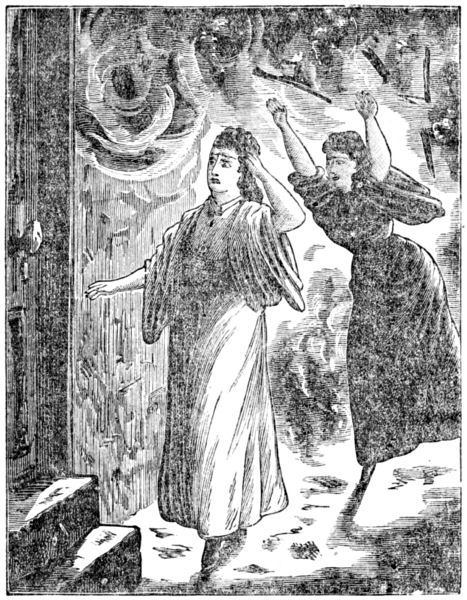
“My God! if the Door should be locked.”
»Mein Gott! wenn die Thür verschlossen wäre.«
As far as experience and money could secure immunity from danger, the
Brooklyn Theatre was equal to the best appointed playhouses. Every gas jet
was shielded by gauze shades. No smoking was allowed in any of the rooms.
No matches were tolerated. No one but the gas man, Mr. Webster, was
permitted to light the gas. In the rear of the left hand proscenium box was
Mr. Thorpe’s private office. It communicated with the box and also with the
auditorium. It was used this week by Mr. Thorne as a dressing room. Mrs.
Thorne was, as always, with him. On the other side of the stage, behind the
other box, was Fanny Morant’s room. Instead of remaining till the close
of the piece, she left at the end of the fifth act. Above Thorpe’s room was a
dressing room at the top of an exceedingly narrow stairway, occupied by
Murdoch and Burroughs.
The disaster at the Brooklyn Theatre far surpasses in loss of life any accident
by fire in this country or Europe. Theatres have been frequently burned and
losses of life have not been uncommon, but the Brooklyn tragedy is altogether
unparalleled. The disaster at Richmond, Va., December 16, 1811, when
seventy persons were killed, has up to this time been known as the most
terrible of the class, but it is many times overshadowed by the Brooklyn fire.
The following are the principal theatres that have been burned in this
country, with loss of life:
National Theatre, Philadelphia, Ninth and Chestnut streets, July 6, 1854,
and an actor named Shepherd burned.
Fox’s Theatre, Philadelphia, Walnut street, below Ninth, June 19, 1867.
None of the audience were injured, but ten firemen and five spectators were
killed by the falling of the front wall, and thirty persons were injured.
The following theatres were burned without loss of life:
Front street, Baltimore, Feb. 3, 1838; Melodeon, Pittsburg, 1865; Silbee’s
Lyceum, Philadelphia, July 21, 1851; Gaiety, New Orleans, Nov. 7, 1854;
Adelphi, San Francisco, May, 1851; Sandford’s Opera House, Philadelphia,
1851; Winter Garden, New York, March 23, 1867; Chestnut Street, Philadelphia,
April 2, 1820; Columbia Museum, Boston, January 15, 1807; Park
Theatre, New York, 1848; City Museum, Philadelphia, Nov., 1868; Academy
of Music, New York, May 22, 1866; Butler’s American Theatre, Fifth Avenue,
New York, January 1, 1872; Waverly, New York, 1872; Adelphi, Boston,
February 4, 1871; and theatres during the Chicago fire, Oct. 8 and 9, 1871;
Arch Street Opera House, March 20, 1872, and Barnum’s Hippodrome,
December 24, 1872.
42]
How true it is that it requires great events to bring out latent properties in
the minds of the every-day people one meets. Especially is this true of
woman.
“Oh, woman, in our hours of ease,
Inconstant, shy, and hard to please;
When pain and anguish wring the brow
A ministering angel, thou.”
Another of the many instances of such devotion as Scott hints at in these
lines was witnessed on that terrible night. While the fire was in progress, a
fireman near the entrance on Washington street saw a strange sight. An
undersized, delicate-looking woman came staggering out, carrying literally on
her back and shoulders a man weighing apparently a hundred and fifty
pounds. Thinking the man was hurt, assistance was offered. It appeared,
however, that the man (who was the father of the girl) was paralyzed on one
side, and that, fearing he would be unable to make his way out, his daughter
had lifted him up bodily and carried him from the parquet to the front
entrance. She desired no further help than the placing of him on a car, and
left the scene before his name could be ascertained.
In one of those graphic narratives of her experience on the eventful night
that proved such a trying ordeal to her, and was yet borne with such high-souled
self-possession, Miss Kate Claxton relates one incident of intense interest.
* * * “The back entrance was by this time a perfect hell of fire.
Miss Harrison, on my call, rushed from her room and darted by me into a
little subterranean passage, which led from the stage under the floor to the
box office in front of the house. No such passage exists in other theatres.
It was designed by Mrs. Conway when the theatre was built, so that she could
readily communicate with her treasurer. I rapidly followed Miss Harrison,
and it seemed as if the fire, swept by the draught, almost licked the clothes
from our backs as we entered the passage. As we fled through it I remembered
that it was closed at the other end by a door with a spring lock, and
was usually kept closed, one of the ushers carrying the key. As I reached
the flight of three or four steps leading up to the door my heart stood still,
and I hesitated to try it. I thought,
Outside of the door we could hear the roaring of the maddened multitude
struggling through the passage without. We must really have hesitated only
a flash, but it seemed to me that we stood there for hours. The door fortunately
was open, and we were in a second inside the box office. With
the strength of despair we burst the door open against the struggling throng,
and in an instant were in their midst. We had yet some distance to go; the
43]
fire followed us fast, and there was still a crowd of excited people to pass
through. We got into the crowd and dashed along, heedless that now and
again we felt that we had trod upon a human being. Once I looked down
and saw a human face, horribly distorted and burned. Oh, my God! it
was a fearful sight. I shall never forget it. Afterward I saw the injured
man taken out. He was horribly injured, and I think, must be dead. As
soon as we got into the street we dashed into the police station. There a gentleman
loaned me his overcoat, and after a short stay in the station we walked
around home.”
William Kerr, of Hamden street, Brooklyn, says that he was in front of
the theatre when the fire broke out. He attempted to enter the theatre, but
was prevented, and stepping back to the street he heard a noise beneath the
sidewalk. The iron plate over the coal-hole was pushed up, and the head
and shoulders of a man appeared. He pulled the man to the sidewalk, and
he was followed by another man. He was then ordered off by the police.
The police clapped the plate back, and nothing is known of the fate of the
men who went back.
When the rush from the parquet was at its height a father and mother with
their child had made their way as far as the lobby, when the father, who
held the child in his arms, was knocked down by the crowd. The child fell
with its father, and its cries could be heard above all the din. The father
struggled to his feet, and as he arose with the child in his grasp, the blood
flowed from several gashes in his face and crimsoned his shirt. At the sight
of the blood the wife shrieked and immediately fainted, falling upon the
people directly in front of her. Two men who appeared to think less of
themselves than of others, lifted her up, and after a desperate struggle succeeded
in removing her to the street, thence to the police station, where she was
afterward joined by her husband and child. The man was found to have
been badly injured by being trampled upon, beside being cut about the face.
In another instance a wife became separated from her husband. The husband
had fallen beneath the feet of the crowd, and his face was trampled into
an almost unrecognizable mass. The woman became frenzied and clutching
her hat tore it from her head. Few people paid any attention to her. Her
cries were heard on the street.
“Where is my husband?” she shrieked. “Where is my husband? Won’t
some one find him for me? My God! my God! I shall go mad.”
People thought
The nearly lifeless form of her husband was subsequently dragged from beneath
the feet of the throng and borne into the police station.
A fashionably-dressed lady, who occupied a seat near the stage, was so completely
overcome by terror that she sank to the floor, not in a faint, but out
of sheer fright. She was actually carried from the place by her attendant.
44]
Samuel Solomon told the following sad story at the Morgue, the morning
after the fire: “Last night my father, Morris Solomon, my brother Philip, his
wife, Lena, and my two sisters, Mary and Deborah, went to the Brooklyn
Theatre, and occupied seats in the family circle. When the fire broke out I
came up here. The theatre was then in flames. I could see nothing of my
relatives. I have remained here all night, with the exception of going home
occasionally to see if they had returned. My mother is almost crazy, and has
searched our neighborhood for them. Not the slightest trace of either of
them has been found since they entered the theatre. I am told the staircase
gave way, and I am afraid they have been crushed to death and then burned.”
The young man was much overcome by the sudden catastrophe which had
befallen his family, and shed tears as he recited the story. The missing members
of the Solomon family are Morris Solomon, aged 47 years, a cigar dealer
at Maiden lane, New York; Philip Solomon, a musician, aged 24; Lena
Solomon, his wife, aged 22; Mary Solomon, aged 23, and Deborah Solomon,
aged 20 years.
We have obtained from the returns of the Treasurer what we believe to
be a correct list of all who were in the theatre on the night of the fire as
spectators, and have also procured a full list of the employees.
| In the dress circle |
300 |
| In the parquet |
250 |
| In the gallery |
405 |
| Actors and actresses |
21 |
| Supernumeraries |
20 |
| Scene shifters and the like |
10 |
| Orchestra |
12 |
| Dressers, ushers, check takers, etc., etc. |
22 |
| In all about |
1,040 |
Although it is generally presumed that places of amusement are more apt
to be crowded and more subject to fires than churches, history shows that
fires in churches have proved even more fatal to human life than all the
theatres that were ever burned.
On the 27th of May, 1875, a shocking catastrophe happened in the French
Catholic Church, at South Holyoke, Massachusetts, which in many respects
was much like that in Brooklyn. The vesper hymn was being sung, when a
candle at the altar set fire to the draperies surrounding the image of the
Virgin Mary. There were about seven hundred people present, of whom
those in the body of the church escaped without difficulty. But the flames
streamed upwards to the galleries and spread along them, while the crowd on
the staircase became a densely-packed, panic-stricken mass. Many were
killed or severely wounded in the crush, besides those who were overtaken by
the flames and burned to death. The whole thing lasted but twenty minutes,
and in that time over seventy lives were lost.
45]
One of the most terrible disasters of modern times, also strikingly similar
to this recent disaster, occurred in the Church of the Jesuits, at Santiago, in
Chili, on the 8th of December, 1863. It was the last day of the celebration
of the feast of the Immaculate Conception, and the church had been elaborately
decorated for the performance of mass.
A gigantic image of the Virgin, in whose honor the celebration was held,
occupied a prominent position in the church, and all around pasteboard devices
and thickly intertwining draperies covered the masonry of the church
from floor to ceiling. Festoons led from pillar to pillar, and from the roof
and projecting arches hung twenty thousand paraffine lamps. The women
of Santiago, who on these occasions go from church to church, had filled the
Church of the Jesuits. Three thousand persons, the greater number of whom
were women and children, were present in this most venerable of Santiago’s
churches, and even on the steps outside women knelt in prayer to the Virgin,
whose altar they were unable to reach. In the midst of the ceremony a
paraffine lamp burst, and the flames at once caught the draperies and festoons
surrounding it. Then from arch to arch and pillar to pillar the fire leaped,
the lines that held the lamps aloft being burned the burning paraffine was
emptied on the women below; and, while these twenty thousand vessels of
flaming liquid were deluging the unfortunate women, the decorations above
carried the flames to the roof, which burned and crackled like a tinder-box.
A rush was made for the great centre door, and in a few minutes it was
hopelessly blocked, while only a few knew of the small door beyond the altar.
As women endeavored to escape through the crowd, others who were burning
clutched their dresses and cried in piteous tones for help, and clinging in
their agony communicated the flame that was consuming them to the persons
whom they had seized. Some women in their desperation divested themselves
of their clothing, and a few succeeded in effecting their escape, but only
a few. Each moment increased the crowd and intensified the block at the
main door, and while it became more and more difficult to escape, the flames
were spreading on the floor, flying from one prostrate body to another, and
destroying the panic-stricken creatures by scores and hundreds, while the
church resounded with piteous cries for help and still more heartrending
shrieks of agony; the vast roof now gave way, and came down with its blazing
beams and rafters, crushing and inundating the seething mass of tortured individuals
beneath it. When the fire had burned itself out and workmen could
get at the ruins, two thousand corpses were carried out.
As soon as it was known that so many had perished in the flames, a
generous spirit of rivalry sprang up among the proprietors of places of amusement
all over the country, as to whom should contribute the largest amount of
money for the relief of the survivors and those rendered destitute by the fire.
Individual actors also subscribed liberally, and a relief association was organized
to receive and disburse the money thus contributed. Memorial
services were held in New York and Brooklyn the Sunday after the fire, and46]
prominent clergymen all over the country selected the terrible catastrophe as
a theme for eloquent sermons.