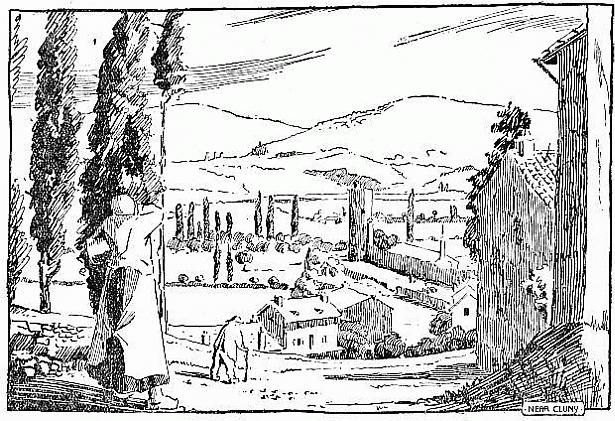
The loitering train, that, climbing, winds among the vine-clad slopes of
the Mâconnais, gave us our first glimpse of the vendangeurs gathering the
last of a scanty crop. Those blue shirts, moving through the bronze-clad
bushes, were our first intimation that the Saône-et-Loire had escaped the
utter ruin that the winds and rains of a wintry summer had wrought among
the vines of the Côte d'Or. But this incident did not impress us as it might
have done at another time or in another place. Our thoughts were not with
the wine-harvest; they were ahead, busy with the memories the name of
Cluny evokes.
To one who cares for what was best in the middle ages, no place in
France, no place in Europe, unless, perhaps, it be Citeaux, can exercise an
equal charm. But, as we shall see, though Citeaux rivalled, and ultimately
eclipsed Cluny in power, and, through the influence of St. Bernard, outshone
her, not in material splendour, but by the dazzling whiteness of her
purity, the historic interest of the site of the Cistercian house, there, by the
deserted woods and wind-ruffled pools of the eastern plain, could not survive,
in the minds of many, the destruction of the ancient monastery.
Cluny, the Mother Abbey of Europe, the school of popes, holds first place,
by right of birth, by right of what she was, and is. For Cluny still stands.
The little town nestling upon the lower slopes of the valley, through which
the Grosne winds between her poplars, is not merely built upon the site of
the Abbey. It is the Abbey.
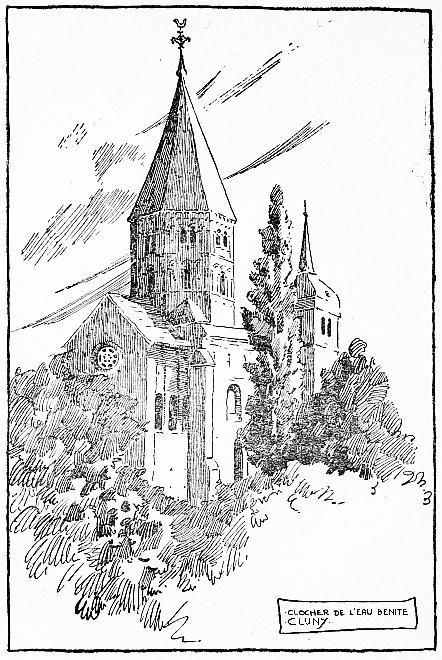
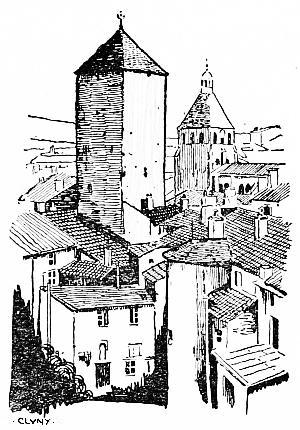
From the moment, when, on the way from the station, you see the ancient
towers raising, one by one, their hoary heads above the roofs, as they have
raised her past from oblivion, till, having climbed the cobble-stoned street that
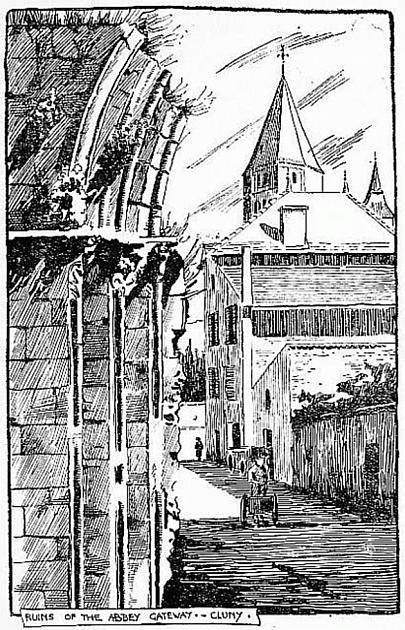
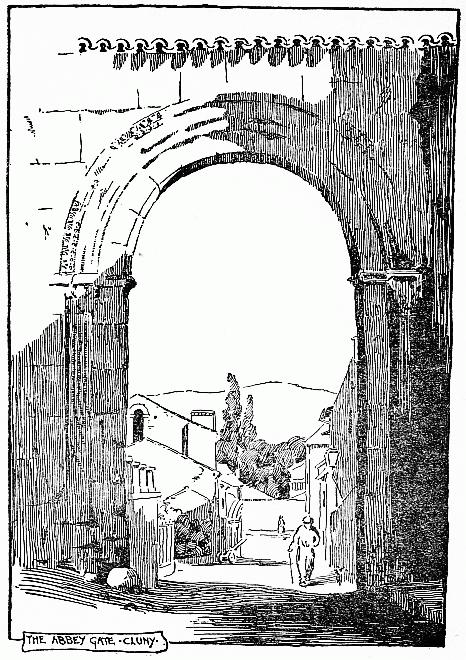
winds upwards through the town, you look down through the ruined gateway
that once gave passage to kings and abbots, from every street corner, from
every church, and dwelling-house, Cluny calls to you out of the past.
We did not hear her at first; and we were disappointed. The Grande
Rue, by which you enter the town from the east, is so narrow, that it affords
no glimpse of what lies on either hand; and it was with unexpected
suddenness, that, turning to the right, after a few minutes of wandering, we
stood before the Hotel de Bourgogne, and looked up from the little, white
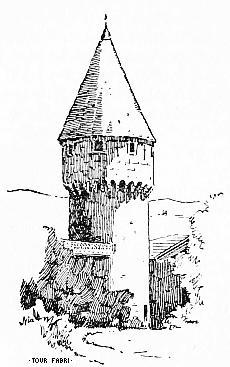
building, at the great, grey, octagonal tower and the wall of masonry, that,
we knew, must be the last survival of the Abbey Church itself. At that
moment we were standing on the site of the nave; but we did not know it.
It takes time to orient oneself.
Following upon the Gallo-Roman and early Christian periods, centred
in the Autunois, the story of the rise of Cluny from humble beginnings to
her apothegm of spiritual and temporal power marks the second notable
period of Burgundian history. From this source, also, was to flow the main
stream of progress, religious and artistic, that culminated in the mediæval
triumphs of thirteenth-century European civilization. At the time of the
rise of Cluny, Burgundy, under the capetian dukes, was already established
as a vassal province of France, but the inwardness of Burgundian history—of
French history, indeed, in the 11th and 12th centuries—will be understood
only by those who realize that, until the advent of the semi-royal dukes of
the house of Valois, in 1364, the controlling forces of the duchy are to be
sought, not in Dijon, nor in Auxerre, but here, in this the mother abbey of
Western Europe.[68]
In the year 909, the veteran Duke William of Aquitaine, haunted by the
shades of the many warriors who had fallen in the service of his ambition,
or troubled by the whispers of conscience, or moved, perhaps, by that not
wholly disinterested piety which sometimes awakens with the approach of
death, decided to follow the course then usual in such cases, and to found a
monastery. For this purpose, he took into his confidence his friend, Bernon,
Abbot of Gigny, who, accompanied by Hugues, Abbot of St. Martin at
Autun, paid a visit to the Duke in his villa of Cluny, and was bidden to
search out a place meet for the service of God. But the monk, gifted with
a keen eye for all the amenities of a monastic site, could find none more fitting
than this "in a spot withdrawn from all human society, so full of solitude,
of repose and of peace, that it seemed in some sort a picture (image)
of the heavenly solitude."[69] The Duke, however, stung by a last pang of
regret for the loss of his lovely valley, had objections to raise. The spot was
not suitable; for, all day long, the shouts of huntsmen and the baying of
hounds broke the silence of the neighbouring forest.
"Drive the dogs away," said Bernon, with a laugh, "and replace them
with monks; for you well know which shall stand you best before God,
the bay of the hounds, or the monks' prayers."
"Surely, Father," replied the Duke, "your advice is sound, and since you
give it unfeignedly, be it done, with Christ's aid, as thy goodness bids me
do."
In the year 909, the 11th year of Charles the Simple, the old Duke, lest,
at his last hour, he should deserve the reproach of having thought only of the
care of his body, and of the augmentation of his earthly possessions, wrote in
his will, as follows:—"I declare that, for the love of God and of our
Saviour, Jesus Christ, I give and bequeath to the holy apostles, Peter and
Paul, all that I possess at Cluny ... without excepting anything
dependent upon my domain of Cluny (Villa), farms, oratories, slaves of
both sexes, vines, meadows, fields, water, water-courses, mills, rights of
way, lands, cultivated or uncultivated,
without any reserve."[70]
He gives
this, he goes on to say, for the good of soul and body of himself, his wife,
his relatives, and dependents, "on condition that a monastery shall be built at
Cluny, in honour of the apostles, Peter and Paul, and that there shall
gather monks, living according to the rule of St. Benedict[71] to hold and
administer for ever the things given, so that this house may become the
true house of prayer, that it may be filled for ever with faithful vows and
pious supplications, that here shall be desired and besought, with ardent
wish and earnest longing, the wonders of communion with Heaven, that
prayers and supplications be addressed without ceasing to God, both for
me and for those persons of whom I have already made mention."
Further:—"By God, in God and all His Saints, and under the fearful
menace of the last judgment, I beg, I beseech, that no secular prince, nor
count, nor bishop, nor the Pontiff himself of the Roman Church, do invade
the possessions of God's servants, nor sell nor diminish, nor give in benefice
to whomsoever it may be, anything to them belonging, nor allow any head
to be set over them against their will. And that this prohibition may be
more strongly binding upon the wicked and the headstrong, I insist and I
add, and I conjure you, Oh! Holy Apostles, Peter and Paul, and Thou,
Pontiff of the Pontiffs of the apostolic seat, to cut off from communion
with the Holy Church and from life eternal, by the canonical authority
thou has received of God, all robbers, invaders, or sellers of that which I
give, of my full satisfaction and of my evident will."
Sometimes, reading the old Duke's powerful anathema, that tells us more
of the spirit of the time in which he lived than could any long narration of
facts, I wonder, as I think of the after history of Cluny, whether that awful
curse may not have alighted, or may not alight hereafter, upon the souls of
those who have violated the conditions of its grant, or in blind fury have laid
impious hands upon the hallowed stones of its church.
Here, then, in the solitary valley of the Grosne, on the slope of a hill
forming one of a range which marks the northern extremity of the Cevennes,
was planted the tree whose branches were to over-shadow Europe. The
site was well chosen for the birthplace of such a destiny.
Occupying a middle position between Gothic and Latin influences, Cluny
could here best fulfil her mission, which, indeed, has been and is still, in
some sort, the mission of Burgundy, that of reconciling the conflicting, and
often bitterly antagonistic, elements of north and south. Situated within a
few kilometres of the Roman Road of Agrippa, which, passing Clermain and
St. Cécile, connected Lyons and Boulogne, by way of Mâcon and Autun,
the Abbey was also connected with Italy by that magnificent waterway, the
Saône and the Rhône. Travellers could come by land or by river to Cluny.
In the early years of the monastery, few came. Faith had weakened
throughout all the land, and in many houses the monks of Gaul had departed
from the strict rule of St. Benedict. It was the mission of Odon, the
first of the long line of great and saintly abbotts, to be a reformer of that
rule, and, by the example of his holy life, to augment the numbers, and increase
the prosperity of the Abbey. From his earliest years, while yet he
was in the monastery of Balme, says his
chronicler, Jean de Salerne, his merits,
becoming known throughout all the district,
were finding expression in the
gracious legends of the time. One of
the best known was the miracle of the
crumbs.
An article of the rule bade the monks
gather carefully the crumbs of bread
from the table, and eat them before the
end of the meal. When the signal to
rise had been given, it was forbidden to
lift any more food to the mouth. Odon,
intent, one day, upon the lesson that was
being read aloud in the refectory, forgot
the crumbs. Not daring either to eat
them, or to leave them on the table, he
kept them in his hand, while he and his
companions left the refectory and went
into the church where grace was sung.
At the conclusion of the ceremony, Odon
threw himself at the feet of the father,
and asked forgiveness; but, when he opened his hand to show him the crumbs,
behold, to the astonishment of the brothers, each crumb was a precious pearl!
By the order of Bernon, the stones were fastened to one of the ornaments
of the church.[72]
Under such heavenly guidance, even the very beasts of the forest
ministered to the growing community. When Odon had completed the
early church, which Jean de Salerne modestly speaks of as an oratory and
chapel, replaced, a century later, by a larger one, the bishop came to consecrate
the building. Forgetting the poverty of the monks, he brought with
him such a lordly retinue of attendants and servants, that the abbot was
sorely troubled as to how his guests were to be worthily received, and suitably
fed. On the day of the ceremony, when the grey dawn had driven westward
the shadows of the night, a great wild boar emerged from the neighbouring
forest, and ran, at full speed, to the monastery. The guardian of
the church, who was busy adorning the exterior porch, struck with terror at
the sight, retreated hastily, shut the door behind him, and drew the bolts.
But the fierce animal, fierce no longer, began to lick the door—leaving upon
it marks of white foam—and to tap gently with its hoof, as though to beg
admittance. But all who saw the beast, fled, until, weary with much
knocking, it lay down across the threshold. When the bishop and his suite
arrived, a cry of terror rose from the company. They aroused the neighbours,
who came, armed with sticks. But the boar, instead of shewing fight,
offered himself voluntarily to death, and his flesh, prepared with all the art
of the monastic cooks, satisfied the refined tastes of the prelates.
Every day Cluny grew in grace, in wisdom, in numbers, in riches, in
influence, in power civil and spiritual. One after one, she founded new
monasteries, and reformed those already in existence, until, under Odilon,
in the beginning of the 11th century, a cluster of priories had been built upon
lands ceded to the abbey, and Cluny was attaining an importance greater than
any other order had acquired until that day. In the plains, upon the summits
of the hills, by the banks of river and stream, in the depths of the
forests, in the solitude of the valley, even in remote and silent places, were
springing up little communities of monks, whose clocher, was, for the
peasants, a symbol of charity, of refuge, of God come down among men;[73]
and every year, nobles, not a few, gave lands in the neighbouring comtés to
the Abbey of Cluny.
The great fervour with which the monastic revival was received, had been
due, in part, to the awful miseries of France during the 10th
century, and in part to an almost universal belief that the year 1000 a.d.
would herald the second coming of Christ, and the end of the world;
but, by the time that year had passed without the advent of any of the
expected phenomena, the more clear-sighted, perceiving the immense possibilities
which the religious revival shadowed forth, for the welfare of a people
crushed beneath the harsh feudal laws of the time, saw therein an additional
inducement to encourage monastic effort. Gratitude for preservation had
also its effect. All omens were propitious for the rise of Cluny to great
glory.
In the year 1024, a lady of noble Burgundian family, knowing that the
hour was come in which she should give birth to a child, and following the
custom of the time, summoned a priest, who, by the sacrifice of the mass,
should assure her a happy delivery. At the moment when, while consecrating
the host, he was wrapt in fervent prayer, there appeared to him, shaping
itself upon the golden bottom of the cup, a child's face radiant with a
heavenly light. At the conclusion of the ceremony, he hastened to tell the
mother what he had seen, and, finding the child already born, predicted that,
God granting him life, the boy was chosen out for a great destiny, and
would surely be found worthy, one day, to minister the cup in which his
birth had been thus signalized. To the great joy of the mother, that hope
was gloriously fulfilled; for the son born under such happy omens was
Hugues, the greatest of the great abbots of Cluny, he, under whom the
abbey, and, indeed, the whole church of Rome, was to establish an authority
never before dreamed of in Christendom.
Braving the anger of his father, Delmace, an ambitious and violent
Seigneur, who would fain have seen his son don the knight's armour rather
than the monk's cowl, Hugues, already ardently set upon a life of piety,
obtained admission to the monastery of St. Marcel de Chalon, which he soon
left, in order to place himself under the protection of Odilon, the then
abbott of Cluny. This new father of the young Hugues was one of the best
beloved of the abbotts of that monastery. Lacking the austerity of his predecessor,
Odon—the great reformer whose energies had given new life to the
Benedictine order—Saint Odilon, this "dernier et le plus méprisable des
frères de Cluny," as he styled himself, though short and thin in person, was,
at the same time, robust and virile; a humble, grave, sympathetic, fatherly
man, whose pale face could flush with anger, and his gentle voice become
terrible in rebuke of wrong-doing; one whom the sins and sorrows of the
living and the dead[74] touched to the heart, as attested by the many healings
with which legend has credited his name.
Such was the man, already abbot
for more than forty years, under whose worthy protection young Hugues
placed himself. The new-comer, elected abbot on the death of Odilon in
1048, soon showed himself to be of yet sterner stuff even than his predecessor.
Humble as regards his personal pretensions, kind and charitable to the poor
and needy, he had, nevertheless, an eye which could read in their faces the
souls of men; and he was fired with a holy ambition for the glory of the
church.
In bringing about the realization of these dreams, he found a worthy ally
in that Napoleon of the Church, Hildebrand (Gregory VII.), one of the four
monks, who, from a cell at Cluny, passed to the throne of St. Peter.[75] We
need not here deal at length with that long
struggle—the most significant event of the
eleventh century—between the civil and
religious rules of Christendom, in which
Gregory succeeded in enforcing, if only for
a time, the most tremendous and all-embracing
claims that the church has ever advanced;
but I shall be excused for recalling again that
extraordinary scene enacted, in 1076, on the
castled summit of the craggy Apennine hills,
the rock of Alba Canossa, where the
representative of temporal power, Henry
IV., King of the Germans, attired in a penitent's garb of coarse wool,
waited barefoot, through three bitter winter's days, in the courtyard
of the castle, upon the pleasure of God's vice-regent on earth. Hugh,
then Abbot of Cluny, was present at that scene; and it was largely owing
to his mediation, backed by the influence of the Countess Matilda, that
Henry was at last admitted to the royal presence.[76]
Remembering how brief
was Gregory's pontificate—a span of ten years—and his bitter last words at
Palermo: "I have loved justice and hated iniquity, therefore I die in exile,"
it may appear to some readers that the triumph of this little, ill-shaped
homuncio was short-lived; but we have to remember that, as Bishop Mathew
has pointed out, his influence upon succeeding generations was greater than
upon his own, and that without Gregory VII. there would have been no
Innocent III. to become, in effect, "the king of kings, lord of lords, the only
ruler of princes" in all Christendom.
In many sublime and dramatic scenes, then being enacted throughout
Europe, Hugues was called upon to play the part of peacemaker, but in none
was his task more difficult than in that struggle between Gregory and Henry,
to whom he was equally bound by ties of close friendship. That he remained
on good, even on intimate terms, with both men, is strong testimony to his
integrity of character. More than once, in later years, he allayed the storms
that Gregory was raising; he defended Henry IV. against the ingratitude of
his son; and it is to Hugues that we find the dethroned and fugitive emperor
turning for consolation and advice concerning that revolt.[77]
In such hands, at such a time, the glories of Cluny were safe. Nor was
the papacy unmindful of all it owed to the great abbey. Here is Gregory's
own eulogy of Cluny, delivered before the Council of Rome, in 1077.
"Among all those situate beyond the hills, shines in the first rank that of
Cluny under the protection of the holy seat. Under its holy abbots, it has
reached so high a degree of honour and of religion, that, by the fervour with
which God is there served, it surpasses undeniably all other monasteries, not
excepting even the most ancient; so that none other in this part of the Christian
world may be compared with it. To this day, all her abbots have been
raised to the honour of sainthood. Not one among them, not one of their
monks, obedient sons of the Romish Church, has fallen away nor bowed the
knee to Baal; but, faithful always to the dignity and liberty granted to them
by the Church from the foundation of the monastery, they have nobly upheld
its authority, and will submit to no other power than that of St.
Peter."[78] The privileges of Cluny became the ideal type for all others, and
Gregory always regarded a comparison with the Burgundian abbey as a peculiar
sign of favour, as in the case of St. Victor of Marseilles, whose monks he
wished to console for the loss of a beloved abbot.
Not unnaturally, an institution so growing in grace, power, and riches,
was growing also in numbers. The new monks must be housed; God must
be honoured in, and by, a nobler Church. Nor was the Deity long in
making known His will.
One night, a monk of Cluny, sick and paralytic, was asleep in bed, when
he saw appear before him the Apostles, Peter and Paul, and Stephen, the first
Martyr. The monk asked them who they were, and what their will might
be. Then St. Peter spoke:—
"I am St. Peter, and these are St. Paul and St. Stephen. Rise, without
delay, brother, and bear our orders to Hugues, Abbot of this Church. It
pains us to see so many brothers gathered into so small a space, and our wish
is that the Abbot should build a greater. And let him not consider the cost;
we shall know how to provide all things necessary for the work."
"I dare not take it upon me to bear your orders," replied the monk.
"For no heed would be given to my words."
"You have been chosen before all others," said St. Peter, "to transmit our
commands to Hugues, so that your miraculous healing may gain credence
for your message. If you obey faithfully, seven years shall be added to your
life, and if Hugues defers the execution of our will, the sickness, upon leaving
you, shall pass into his body."
So speaking, St. Peter proceeded to measure out with cords the length,
breadth, and height of the new building; then, showing the monk its proportions,
the style, the necessary ornament, and the nature of the materials to be
used, he counselled him to keep all these things faithfully in his memory.
The monk, for whose funeral the bell-ringers were already awaiting the
summons, awakened with a start, ran, safe and sound, to the Abbot's room,
and told him the whole story. This midnight appearance of a man, dying
an hour ago, and now healed by a marvellous vision, greatly astonished the
good Abbot. Threatened with his brother's sickness, if he postponed the
commencement of the building, and encouraged, moreover, by the heavenly
aid promised to the enterprise, he believed, obeyed, and, with God's help,
raised, in twenty years, a temple that was the glory of its age, and remained,
for centuries, one of the marvels of Western Europe.[79]
Tradition adds, that Hugues, not knowing exactly where to build the
Church, threw a hammer into the air, and chose the spot where it fell for the
site of his sanctuary. In after years, before the abbey buildings were mutilated,
the inhabitants would still show, near one of them, an enormous stone
that all the workmen and all their machines were unable to lift. St. Hugues
only, during the night, by Divine help, could raise the huge mass, and place
it in position; and ever after the stone retained the imprint of the Holy
Founder's hand.
Often the workmen, as they built the walls of the Church, would notice,
watching them unweariedly, working
silently in their midst, but sharing never
in their repasts, a mysterious and wonderful
figure. Some said that he was an
angel presiding over the erection of the
House of God; some said that he was
none other than St. Hugues himself.
It was in 1095 that Pascal II., crossing
Provence by way of Tarascon and Avignon,
arrived at Cluny, in the month of
November, accompanied by a large suite
of cardinals, bishops, and priests. Everywhere
he was received with transports of
joy; for no living man had yet seen the
Vicar of Christ in this part of the land of
Burgundy. At the request of Hugues, he
had come to consecrate the great altar of
the unfinished basilica. This he did, and
also superintended the consecration, by
attendant archbishops, of the other altars
in the transept. In the midst of these
ceremonies, turning to the crowd of on-lookers
who had surrounded the building
on all sides, Pascal reminded them of the
special privileges with which the monastery
had been endowed, of his own connection
with it as monk under the same
Abbot, who still, by God's mercy, was alive and well in their midst; then,
in the name of God, and by the holy memories he had awakened, he implored
all to uphold and respect the sanctity of the new abbey-church.
It was not until 1131 that the great basilica, completed at last, was consecrated
by Innocent II., amid scenes similar to those that had attended the
visit of Urban II.
Whether the building was inspired of God, or was merely a successful
exercise of a fast-developing art, the new Cluny was not unworthy of the
great order for which it stood. Not only was it, with the exception of St.
Peter's at Rome, the largest Church in existence,[80] but it remained also one
of the most perfect examples of the Romanesque architecture, and became
the accepted model for many a later Burgundian church and cathedral. The
architect, according to Pignot, was a former canon of Liège, named
Etzebon; artist, orator, theologian, and author of the life of St. Hugues. He
appears to have had no difficulty in acquiring the first necessity of his work,
namely, funds. Kings, nobles, and bishops vied with one another in their
eagerness to make offerings to the new Church; the neighbouring princes
made handsome donations, the pious of all classes brought gifts, offered voluntary
labour, or the loan of beasts of burden. The two lordliest givers were
Alonzo VI., King of Castille, and Henry I. of England, the former of whom
was deeply indebted to Hugues, whose influence with his kinsman, Eudes,
Duke of Burgundy, had often smoothed Alonzo's path. The Abbot, in
recognition "of the incessant benefits of this faithful friend," founded, on
his behalf, almsgivings and special prayers throughout the order, and every
day served, at the chief table, as though the King were present, a royal
dinner, which was afterwards distributed among the poor.
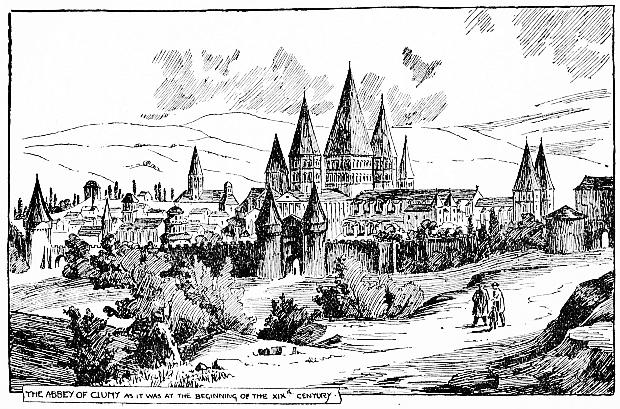
Meanwhile, as the gifts poured in, the building grew. From the great
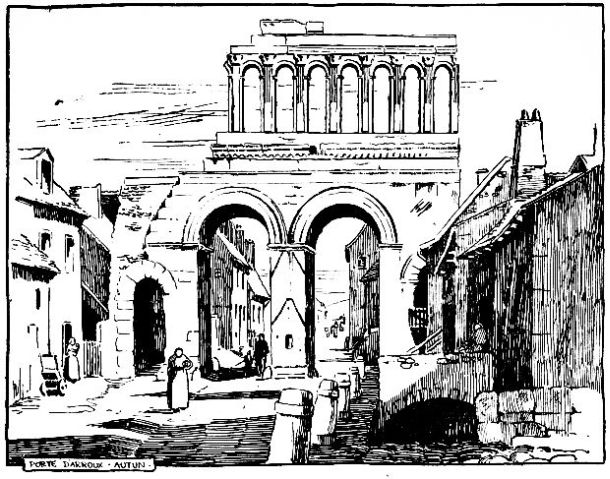
double gates,[81] Roman in style, and imitated, probably, from the Porte
d'Arroux, at Autun, the land sloped downwards to the parvis, from the
midst of which rose a great stone cross. Thence flights of balustraded steps,
broken, at intervals, by terraced platforms, led down to the porch, flanked
on each side by square towers, the Tour de la Justice, and Tour des
Archives, each a hundred and forty feet high, and crowned with a pyramidal
flêche. This porch, ornamented with statues of the saints and the Virgin,
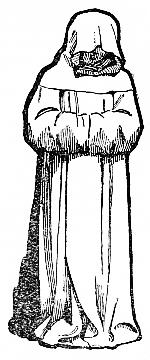
was surmounted, in the space between the towers, by a great rose, thirty feet
in diameter, with the figure of a Benedictine monk above.
It opened into a
magnificent church of five bays, one hundred and ten feet long, and one
hundred and eighteen feet high, the narthex of the great basilica.[82] It was
divided into a nave and two aisles, the whole supported by enormous square
pillars, their sides decorated with fluted pilasters, which also helped to carry
the pointed arches of the bays. From the capitals of the pilasters, clusters of
four shafts rose to the level of a frieze, just above the tops of the arches, from
which other columns carried the high vault. A cornice supported on consoles
separated the clerestory from the triforium arcade of four round-headed
arches, enclosed in pairs under a larger arch. Cornices, friezes, and capitals
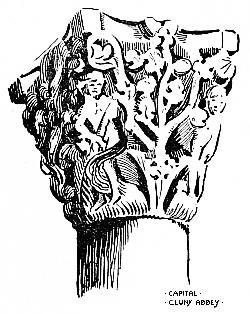
were decorated with flowers, birds, figures, and grotesque animals in the
Clunisian style. Many a pilgrim visitor, standing in this great church,
nearly as large as the Church of Notre Dame de Dijon, believed himself to
be in the basilica itself, never dreaming that this was but the porch or ante-nave.
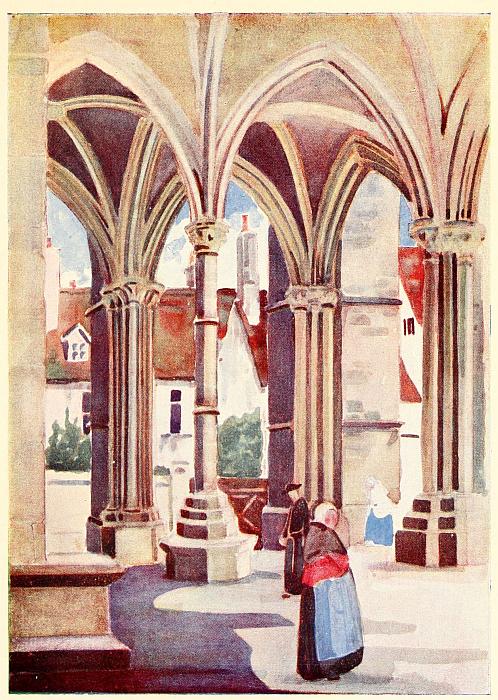
Many theories have been advanced as to the purpose of this narthex,
which became a usual feature of Clunisian construction, from about the
middle of the twelfth century. Some have suggested that it was for overflow
congregations from the new church, or that it served for the servants of
the Abbey, for the suites of noble visitors, for the peasants from the neighbouring
towns, or for criminals seeking refuge, as they were wont to do, in
the shadow of the porch. Others have supposed, perhaps rightly, that it was
used for the reconciliation of the excommunicated, for rites of exorcism, or
for the dispensation of justice; but the most probable solution is that the
narthex was a temple, in which, at Easter and other seasons of the year, the
crowds of penitents and pilgrims—too numerous to be admitted into the
basilica, or to be left outside—might hear the Word of God at the very
threshold of, but not within, the building reserved for the monks. The
narthex was, in effect, a purgatory, a sojourning place between earth and
Heaven; the natural development of a custom which had arisen, for the
priest, by order of the bishop, to say mass as near as possible to the gates of
church, for the benefit of the penitents in the porch.
There existed, until the 18th century, on the left of the door of the
narthex, a stone table, which, perhaps, was formerly an altar, though
made use of, at that time, only by mothers and nurses, who believed that
they could hush their crying charges by depositing them thereon.
At the end of the vestibule was the original gate of the basilica, of which
the impost was the stone that St. Hugues had miraculously raised. Twenty-three
figures were carved upon it in relief, and in the tympanum above was
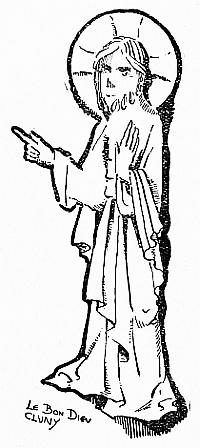
seated the Heavenly Father, as Teacher, His right Hand raised in benediction,
His left holding the Gospel. Beside Him the four Evangelists
listened to His words, and cloud-borne angels held the medallions upon
which were shown the Throne and Person of Christ.
The interior of the great basilica must have been of the most majestic and
impressive character, with its two transepts[83] and double row of aisles on each
side of the nave. The great pillars supporting the central vault were seven
and a half feet in diameter, with pilasters on the side of the nave, and
engaged columns on the other three sides, meeting the aisle vaults. At the
transept, the columns, together with the pillars they surmounted, rising in
unbroken lines, formed the ribs of the vaulting. Above each bay was a triforium
of two rows of superposed, romanesque, round-headed, arcaded
arches, in threes, the lower row separated by pilasters, and the upper by
colonnettes. The arches of the bays and the transepts were pointed; a
feature, which, though quite usual in Burgundian work of the period, was
more or less accidental, and was necessitated, or rendered advisable, by practical
considerations, rather than by a deliberate departure from an architectural
style that was still of the purest Romanesque. The capitals everywhere
were ornamented with characteristic sculpture, of extraordinary freedom and
boldness, representing scriptural, and many other subjects.
At the bottom of the nave, close to the entry of the choir, was placed, in
after years, the tomb of Pope Gélase, and two altars, which, with a gate at
the entrance, screened the monks from the eyes of the laymen. Here, too,
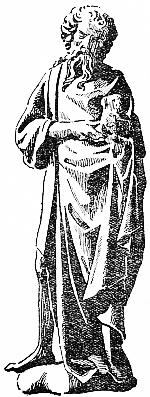
against the pillars of the nave, were four large, painted, wooden statues,
representing St. Hugues, holding the model of the church in his right hand,
St. Mayeul, St. Odon, and St. Odilon.
The choir occupied the space
between the two transepts; the sanctuary was carried on eight columns,
three of which were of African marble, and three of Pentelic Greek marble,
veined with blue, which St. Hugues brought from Italy by way of the
Durance and the Rhône. The transept had many lateral chapels, and the
east end, which was in semi-circular form, had five apsidal chapels, vaulted
in half dome. A processional ambulatory circled the sanctuary and the
tomb of St. Hugues, in front of which stood the great altar. Here, too, at
opposite ends of the ambulatory, were placed the tombs of the Abbot Pons,
and of Pierre le Vénérable. The vault of the apse was adorned with a fine
painting, of the end of the eleventh, or beginning of the twelfth century,
representing the Eternal Father borne upon clouds, one hand raised, and the
other placed upon the Apocalypse sealed with seven seals. At his feet was
the Lamb without Blemish, and about Him were winged figures of man, the
lion, the eagle, and the ox.
But, in spite of the realism of the sculpture and the painting, in spite of
the gorgeous tapestries, the golden candelabra, the pearl-encrusted ornaments
of every kind, which the noblest men and women of the time, and of later
times, showered upon Cluny, it is in the sense of spacious dignity and
majesty, rather than in the sense of ostentation and magnificence, that we
must interpret the words of Hildebrand de Mans, when he said that, "If it
were possible for the inhabitants of the heavenly mansions to be happy in an
abode fashioned by the hand of man, Cluny would be the angels' walk
(ambulatorium angelorum)."
Nor was the church less noble without than within. From the circular
chapels lying about her transepts and her apse, along the collateral and the
double row of flying buttresses,[84] rising higher than the narthex, the eye was
lifted, stage after stage, high above her lofty nave, to the mighty towers that
rose to the sky, in witness, for ever, one would have said, of Him whose
Dwelling was not made with hands.
The conventual buildings were on the south side of the basilica. From
the principal south transept, a processional, and a smaller, door, opened upon
the great romanesque cloister, of which a fragment here and there remains,
built into the modern work. It was similar in style to the other buildings
of the period. Further south were the Lady Chapel and the great refectory.
Abutting on the great wall of the Abbey, by the side of the Grosne, was a
mill and a thirteenth century bake-house, which still exist. Among the
many other buildings, chapels, baths, schools for the young, pharmacy, workshops,
dormitories, and stables, which are the necessary equipment of a great
monastery, was a large infirmary, with its own cloister and refectory—a small
establishment within the larger one. On the east side, extending to the
fortified wall that enclosed the whole monastery, were the gardens of the
abbey.
Such, in its essential aspects, was the "ambulatorium angelorum." How
did its occupants live? What was the rule observed within those walls?
The rule, as kept in those early days, was stern and exacting. The first of
the regulations was silence, except at stated intervals. In the church, in the
dormitory, in the refectory, in the kitchen, absolute silence, broken only by
the summoning bell or by the chanting of prayers. Like ghosts, the sandalled
monks glided about the echoing corridors; deaf mutes speaking by signs.
The times for speech were the mornings, after chapter, and evenings after
sexte. A parlour was reserved for the talkers, where, seated, book in hand,
they might converse on spiritual and other topics. Yet they were recommended
rather to remain in the cloister, and there meditate, read, pray, or
copy manuscripts. This was the hour, too, for drying their clothes in the
sun, for visiting the sick in the infirmary, for washing their cups, or for
sharpening their knives on the grindstone in the cloister. Their daily food
was limited to bread, vegetables, and fruits—meat was given only to the sick—eggs,
cheese, and fish were allowed only occasionally, and nothing whatever
might be eaten after complines. At certain seasons, the use of fat for
flavouring vegetables was forbidden. If wine were permitted, on days of
great solemnity, and during exhausting fasts, it must be free from spirituous
seasoning, and from the spice that flatters the palates of the worldly. Still
less was it permitted to drink hypocras, or oriental or Italian liqueurs—the
"little wine" of the apostle was to suffice them. Only two repasts a day
were allowed, except to the young, or to those engaged in specially hard
work.
The monks might shave one another once in three weeks, chanting psalms
the while, and not until the days of decadence were they shaved by a secular
barber. "In bygone times," says the chronicler, "they were not shaved,
they were skinned."[85] They might not bathe often, lest the habit should
engender softness, and they did not usually indulge in full ablution more than
twice a year—before Christmas and Easter. Sick monks, however, might
bathe as often as they pleased.
The clothing allowed to the brothers consisted of a woollen shirt of dark
colour—one for the day, another for the night. Their garments were
rustic in form and substance; such as were worn by the peasants. Over the
tunic was a scapular, with a hood or capuchon attached, and over all the
frock was sometimes worn. Precious stuffs, silks, and gay colours were forbidden;
for it was unfitting, said the statutes, that monks should be apparelled
like brides for the nuptial chamber. The strict rule of St. Benedict
allowed no furs; but a concession was made to the rigour of the Burgundian
climate, and the monks might wear sheep-skin or goat-skin cloaks in winter,
and fur boots for sleeping in, but no rich and costly skins from foreign lands—"For
those who are softly clothed dwell in kings' Palaces." No monk
might eat or drink at other than the regular hours; he might not go out at
night, nor leave the monastery without the abbot's permission. When on a
journey, he should receive only monastic hospitality, and, in any event, must
never accept wine or meat; nor might he eat outside the gates, unless it were
impossible for him to return home before sunset.
The vice of property was resisted to the utmost. Each monk received
from the Superior, in addition to his clothing, all necessary articles, such as
a handkerchief, a knife, a needle, a writing pencil and tablet. Nothing was
the monk's own; no brother possessed money; testaments were forbidden;
and those who violated the precepts were excommunicated, and refused
ecclesiastical burial.
Above all, the Clunisian monk must earn his bread with his hands. The
earth, whence his body came, and whither it should return, must support
him. This held good for long; but in later times, the monasteries increased
in size, manual labour naturally became specialized, and some did little more
than mend their clothes, wash their linen, clean and grease their boots, and
take their turn in the kitchen.
"To speak truth," remarks Udalric, "the work which I saw done most
often was to free the beans of the leaves which retarded their growth, to
pluck the ill weeds from the garden, and sometimes to knead the bread in
the bake-house." Manual work, however, remained always part of the strict
rule. "Then will you be monks," said St. Benedict, "when you live by the
work of your hands, after the example of the holy preachers of the monastic
law." Bitter must it have been to Pierre le Vénérable, the last of
the great abbots, to have to write as he did of the growing decadence:—"Idleness
is the enemy of the soul: and do we not see
the greater part of the brothers ... both within and without
the cloister, in a state of absolute inactivity. How few are they who
read, still fewer they who write! Do not the greater number sleep, leaning
against the walls, or do they not waste their day from dawn to sunset in vain
and idle, or in what is yet worse, malicious conversation." But, in the
earlier years of Cluny, the rule was not easily broken, nor broken with impunity.
A continuous surveillance, day and night, was exercised so
regularly, by monks called "circateurs," that scarcely the least fault could
be committed unseen, and punishment, inflicted in grave cases by the abbot
himself, followed hard upon the offence. Sometimes the delinquent was
condemned to solitary confinement, or to stand, all day long, at the door of
the church; sometimes he was flogged, in full chapter, by his brother monks,
or, if the fault had been publicly committed, the whipping was administered
before all the people. It was customary, also, to expose certain delinquents
before the door of the basilica, at the hour of mass, while one of the servants
of the abbey announced the cause of his penance to the worshippers as they
entered. The sinner was denied all participation in the solemnities and in
Christian communion; he was denied the kiss also. If he revolted against
his punishment, the outraged monks would drag him voluntarily to a fearful
dungeon, without door or window, into which he must descend by a ladder.
And over all their day of toil, of silence, of fasting, and of prayer, hung a
shadow, dark as those that fell from the vaulted nave, or lingered at sunset in
the cool cloister galleries—the shadow of ever-present death. When a
brother died, each monk, with his own hand, must sew stitches in the winding-sheet,
whose clinging folds should recall vividly to his spirit that all flesh
is as grass, and that the way of life is the way of death.
The monks' day was divided between work, prayer, and psalmody; the
latter sub-divided into the office and the mass, thus fulfilling literally the
words of the psalmist;[86] "Seven times in the day have I celebrated Thy
praises, and I rose in the middle of the night to confess Thy Name."
The
intervals for rest or sleep were short, and, during a part of the year, the
monks slept less than half the night. Udalric, the author of the widely-circulated
manual of the customs of Cluny, gives a vivid picture of the discipline
observed by the brothers during the "regular hours," as they were
called. At the first sound of the bell announcing nocturnes, they sat up in
bed, put on the frock without throwing off the blankets, finished dressing
without showing their legs, and descended to the church. As it might well
chance that one of them would be overcome by sleep during the psalmody
or prayer, a brother was appointed to go the round of the choir, carrying a
wooden lantern, which he would hold under the eyes of any monk whom he
believed to be asleep. If he had made a mistake, and found that his brother
was merely wrapped in meditation, he would bow low before him by way of
excusing himself; if, on the contrary, the delinquent was really asleep, the
light would be held awhile, close to his eyes. This warning would be
repeated three times during the round, and if, at the third time, the light did
not awaken the sleeper, the lantern would be left at his feet; and upon the
somnolent monk, when he awoke, fell the duty of doing the next round.
At the signal for matins, the monks would descend to the cloister, and
there wash their hands and faces, and comb themselves, returning to the
choir before the last stroke of the bell. There, whether they were sitting
or standing, the feet must be in line, and neither the long sleeves, nor the
skirt of the frock, must touch the ground.
With the addition of regular hours for reading and study, such, in short,
was the life led by the Clunisian monk, from the day of his entry, until the
tolling of bells, and the coming of the brothers with cross, candles, and
incense, announced that one more devotee had gone to receive—let us hope—the
reward of a life of self-sacrifice.
One might be pardoned for supposing that an existence such as this we
have outlined, would have been austere enough to satisfy even the most
rigorous ascetics of the time. But it was not so. To old Pierre Damien,
for example, when he rested awhile at Cluny, to nurse in good company his
aged back, scarred by the strokes of iron rods, the rule seemed almost voluptuous.
He spoke about it to Abbot Hugh.
"If you could abstain for two days more in the week from using fat in
your victuals, you, who are so perfect in other points, would, in the matter
of mortification, be in no way behind the anchorites."
The wary Abbot replied with a smile:—
"Before attempting, well-beloved father, to augment our merits by augmenting
our abstinence, try yourself to bear, for eight days, the burden of
our rule; and then judge whether we can add aught to our austerities."
The brave old ascetic accepted the challenge, and at the end of eight days
decided that things might well remain as they were.[87] The rule of Cluny
was more severe than his own.
Under the government of St. Hugues, grown old and gray, Cluny had
reached the summit of worldly power, and of moral influence; with him, her
best days passed. On the 29th April, 1109, the priests, loudly lamenting,
were gathered round the body of their dead saint. Clothed in his sacerdotal
robes, he lay, for three days, in the church, and a great crowd of lords and
ladies, of bourgeois, woodsmen, labourers from field and vineyard, women
and children, came to kiss his feet, and lift his raiment to their lips. On the
day before, Bernard de Varennes heard Saint Denis the Areopagite announce
to him, in a vision, that, if he wished to see again, for the last time, his friend
and abbot, Hugues of Cluny, he must haste to the dying man. Bernard
obeyed the summons, but, on his arrival, fell sick and remained three days
in a lethargy. When he came to himself, he said to the monks around him,
"Unhappy man that I am. I had come to salute my abbot, and he is dead
before the grace is granted me. But what I might not see with the eyes of
the body, I saw with the eyes of the spirit. I saw the dwellers in Heaven
descend among men, and the Mother of God, brighter than the morning star,
standing in the midst of the monks around the death-bed of Seigneur Hugues.
At the moment of the passing of his soul, spirits, armed with arrows, flew to
seize upon it, but the Mother of Mercy, raising her hand, struck them with
terror, and put them to flight, as the wind scatters the autumn leaves.
Martin, the pearl of priests, Benedict the sun of abbots, at the head of the
heavenly cohorts, bore the soul of Hugues into a fair and fertile vineyard,
that there it might rest awhile. Hugues, perceiving me in this place, addressed
me thus: 'Eat, dear friend, these bunches of white grapes, eat and
rest with me awhile; not for long am I here. When my feet are freed from
the swelling and the dust of a long earthly pilgrimage, I shall pass into the
home that God hath prepared for me throughout eternity. Recommend to
Pons, my successor, to treasure humility and innocence, to forget his own
needs for those of others, and to follow my example of monastic rule.'"
Pons did not follow Hugues' example of monastic rule. When his
vanity, weakness, and love of pomp had alienated a portion of his following,
he resigned his abbacy and retired. His successor, Hugues II. held office
only a few months, when the task of presiding over the destinies of Cluny
passed to Pierre le Vénérable, the last of the great abbots, a name that already
links us in memory with him whose destiny it was, by a return to simplicity,
as a source of strength, to rival, and, for a time, to exceed the power of
Cluny. I speak of St. Bernard, the champion of the Cistercian order. We
shall meet him again at Citeaux and elsewhere.
It is probable that St. Hugues himself, by acquiring such great wealth for
the abbey, prepared its ultimate downfall. Be that as it may, though the
rhyming Burgundian proverb,
"En tous pays ou le vent vente
L'Abbaye le Cluny a rente,"
may not have been coined until a later century, it is certain that Cluny was
fast acquiring wealth, and succumbing to a luxury utterly alien to the Spirit
of Him Whose benediction was upon the poor and the humble. It was
natural that the order, following the fashion of the age, should wish to house
worthily the many priceless relics brought back by pious, though too
credulous, crusaders from the Holy Land, and the members of the Clunisian
school of art soon learned to vie with one another in fashioning châsses for
the miraculous rod with which Moses brought forth water in the desert, or
for the stone from Mount Sinai on which he kneeled when he received from
God the table of the law, or for the alabaster vase from which Mary Magdalen
anointed the Saviour's Feet.[88]
As the treasures grew in number, the skill of the artificers, and their passion
for exercising it increased simultaneously, until, at last, the story of the
treasures of Cluny, in the monastic inventories, is like a tale from the "Thousand
and one Nights," told in gold and jewels. When there were no more
relics to work for, the monks turned to what was next to hand, and soon,
from the crosses, from the pastoral baton, from the candelabra of gold and
silver, of crystal and ivory, from the draped altars, from the pontifical mitres,
even, diamonds and rubies flashed, opals sparkled with their changing rays,
while, sometimes, a softly-shining pearl dropped from the Abbot's sandal,
as he stepped into the blaze of light in which the great altar was bathed.
Not less gorgeous were the sacerdotal robes, woven always of the most
precious stuffs, and in the choicest colours, and worked, on body and sleeves,
with an infinite number of designs, lions and griffons, kings and dragons,
angels, eagles, leopards and serpents, crosses, arms, lilies, and roses. All the
rich and varied symbolism of the times shone out from the robes of Cluny.
Nor were the altars, statues, and tombs less gorgeous. The magnificent
châsse of St. Hugues was of precious wood, entirely covered with silver, the
reliefs representing, in gold, the mysteries of the Life and Death of the
Saviour. The pictures and altar pieces were similarly treated. One of the
statues of Mary was of gold; she held in her hand a silver candle adorned
with great pearls; she was crowned with a golden crown; precious stones
flashed upon her brow. The Infant Christ was playing with a golden
rattle, and wore, upon His Baby head, a golden crown enriched with rubies
and emeralds.
To such a Cluny there could only be one end. Her days, as a spiritual
force, were spent. Henceforth, to the religious world, she was to be no more
than a splendid memory; yet the soul of goodness that ever lives and moves
in things seemingly evil, had reserved wonderful uses for the work that
deft hands, otherwise idle, were still fashioning in the cloisters of Cluny.
Her lions, her lilies, her crosses in wrought gold, her symbols in chased silver
and in precious stones, had already awakened the spirit of emulation in a
thousand brooding minds. Who shall tell the debt that Gothic art owes,
that we, its inheritors, shall ever owe to the decadence of the mother abbey.
When we come to talk of Bernard and Citeaux, we shall hear
again of Clunisian luxury; but we have not time, nor would it repay
us, to follow, through all its stages, the decline and fall of this
Mother Church of Europe, from its glorious position as "the light
of the world," to a mere asylum for feudalism—interesting to the
student of sociology, but no longer in touch with the great onward movements
of history. The last three centuries of the Abbey's existence make
sad reading. The envy and jealousy with which the monks were regarded
on all sides, made it hard for them successfully to cultivate and harvest their
enormous territories. Their rights and privileges, grown old and almost forgotten,
could scarcely be asserted and maintained, except by threats and
violence. The Revolution found the Benedictines in conflict with the town,
over pasturage and other rights in the woods of the monastery; and, on July
29th, 1789, the abbey was threatened by a band of armed peasants, who were
repulsed only by the united efforts of monks and townsmen.
On the 21st April, 1799, after considerable discussion, in which it appears
that the inhabitants of Cluny did their best, or at least made an effort, to save
the abbey, the buildings were sold to Citizen Batonard, a merchant of Mâcon,
for the sum of two million, fourteen thousand francs.
In spite of the lively protests of the municipality, the new-comer at once
proceeded to play havoc with the church ornaments, a feat which he followed
up by making a new road, north and south, through the precincts, cutting
the church in two. Later, the Empire completed what the Revolution had
begun. In the summer of 1811, Cluny was shaken by a series of terrific
explosions. They were blasting, with 75 bombs, the towers and sanctuary
of the Abbey.[89]






 " (Only
Star), are scattered broadcast. No less ubiquitous is her motto, The Bird on
the Bough, signifying how lonely she was to be after her lord's death. Guigonne,
no doubt, was sincere enough; but one cannot help remembering that
the sentiments expressed in these devices were not always lived up to. Did
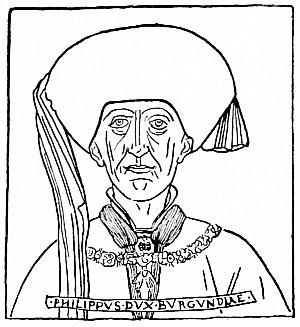
not Rolin's own master, Philippe le Bon, for example, choose the words
"Aultre n'Auray" as a chaste allusion to his conjugal devotion? yet we have
Olivier de la Marche assuring us that his gracious master had "de bâtards et
de bâtardes une moult belle compagnie."
" (Only
Star), are scattered broadcast. No less ubiquitous is her motto, The Bird on
the Bough, signifying how lonely she was to be after her lord's death. Guigonne,
no doubt, was sincere enough; but one cannot help remembering that
the sentiments expressed in these devices were not always lived up to. Did
not Rolin's own master, Philippe le Bon, for example, choose the words
"Aultre n'Auray" as a chaste allusion to his conjugal devotion? yet we have
Olivier de la Marche assuring us that his gracious master had "de bâtards et
de bâtardes une moult belle compagnie."