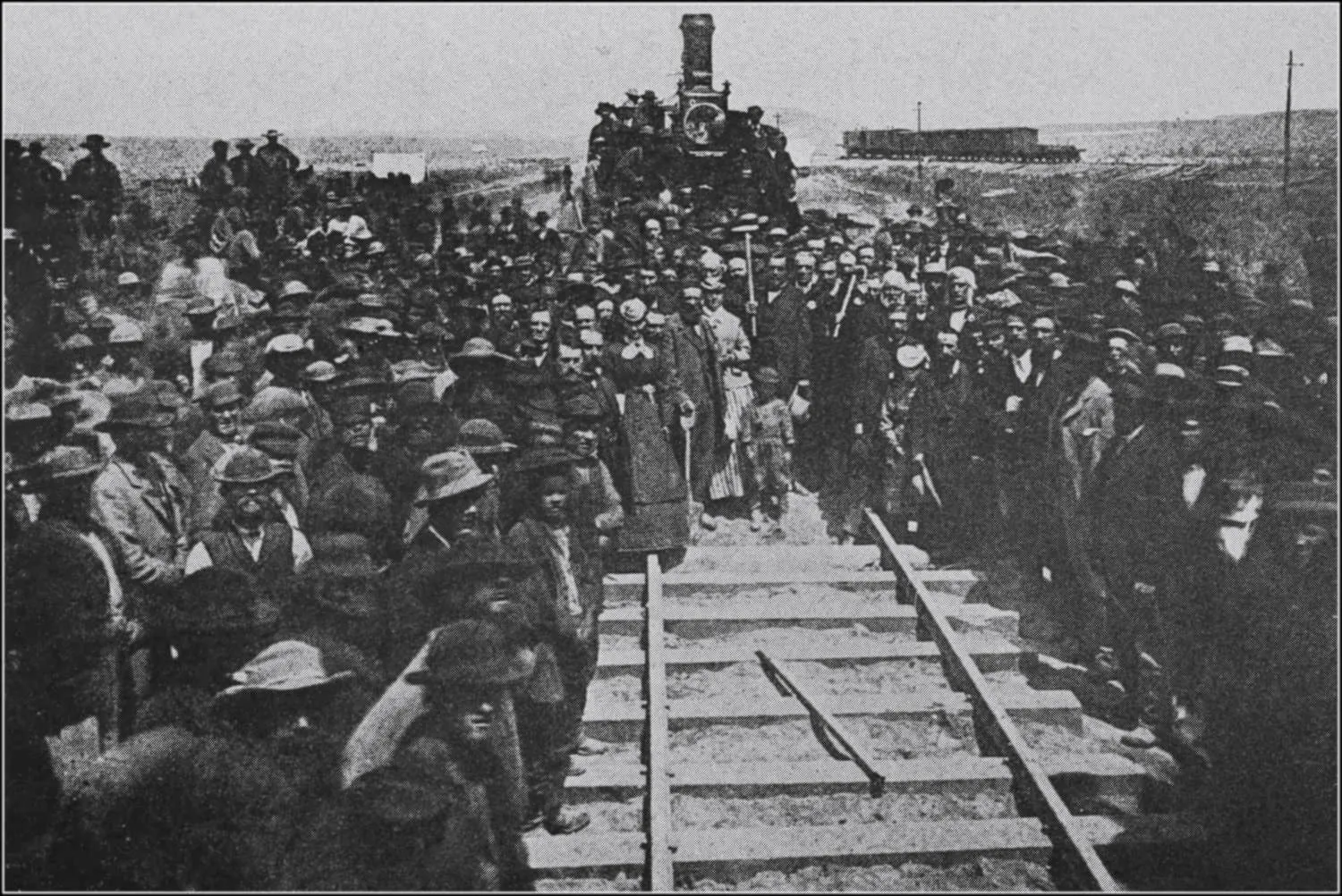
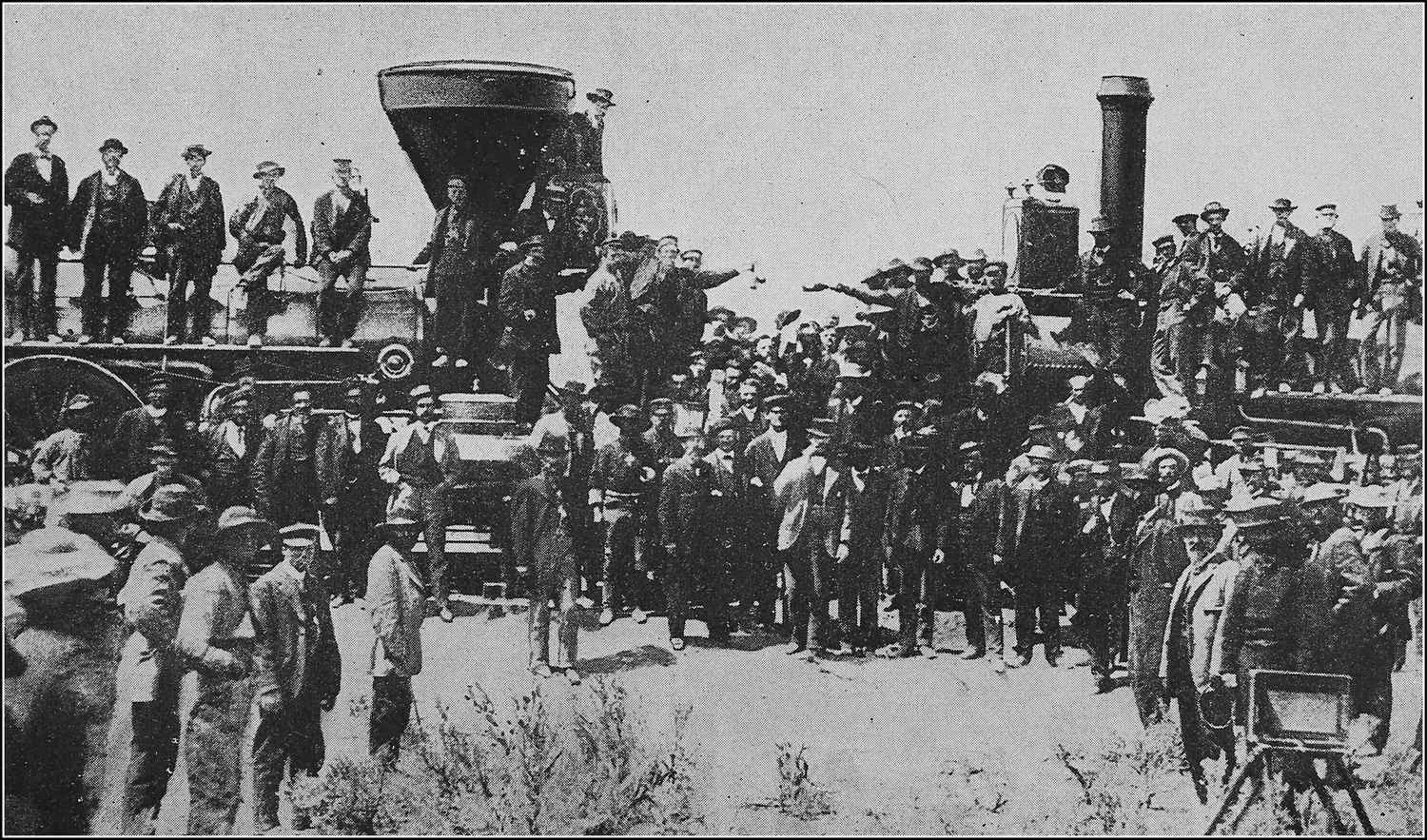
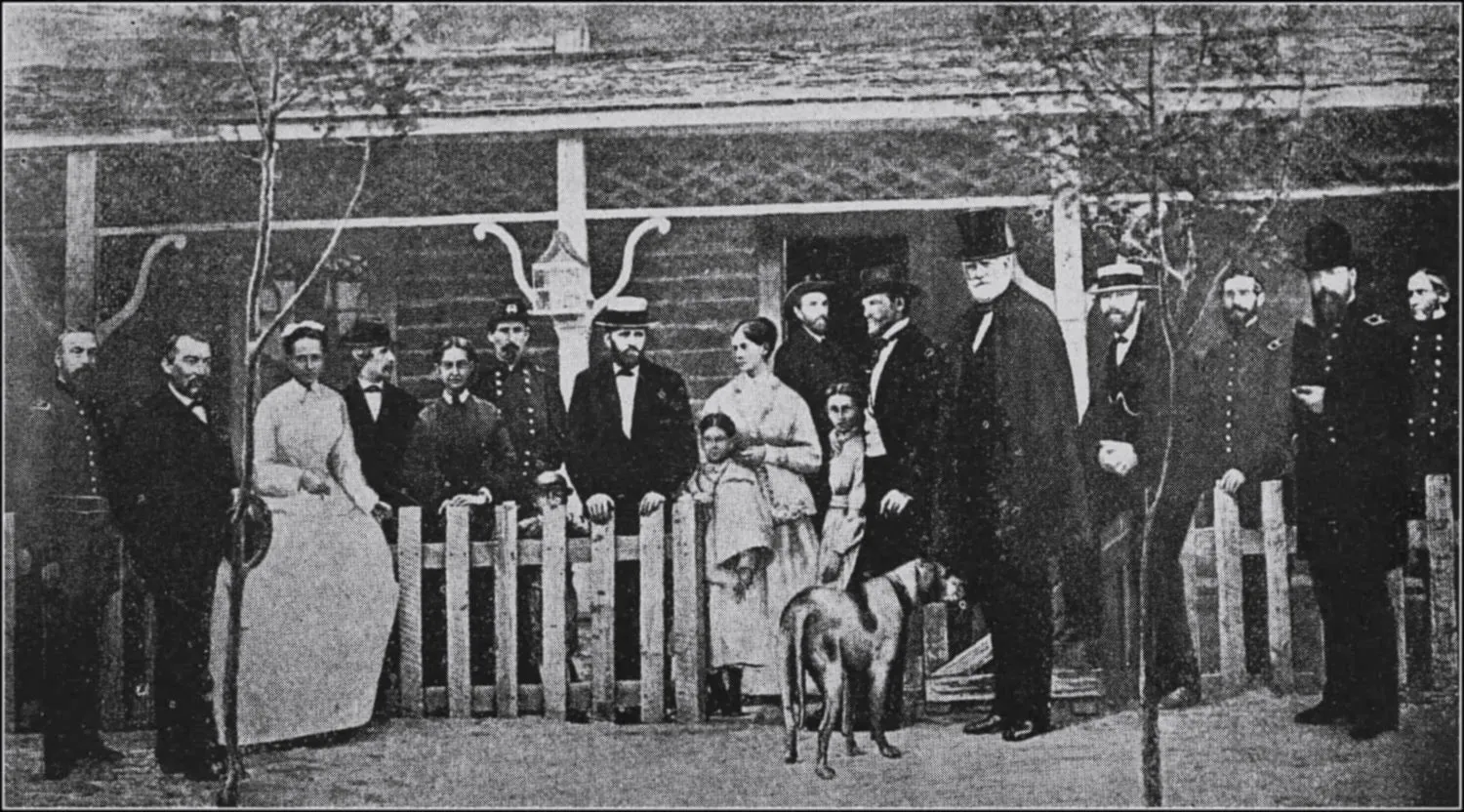
Probably the best photograph extant of the gathering at Promontory Summit, May 10, 1869, where the golden
spike was driven. In center, holding silver maul, Central President Stanford. On his left U. P. Consulting Engineer
Silas Seymour (face); U. P. Vice-President Durant (with sledge), U. P. Director John Duff (white-haired), Chairman
Sidney Dillon (with side-whiskers). In front of Duff, U. P. Chief Engineer Dodge; in front of the girl, C. P. Chief Engineer
Montague. Right of Stanford, C. P. Construction Superintendent Strobridge with spade. The two women are
Mrs. Strobridge and Mrs. Ryan. The boy, Sam Strobridge. To right of Mrs. Ryan (fore) Rev. Mr. Todd (full face).
Photograph by Courtesy of J. K. Knowland, Oakland “Tribune”
THE CONSTRUCTION-STORY OF AMERICA’S FIRST IRON
THOROUGHFARE BETWEEN THE MISSOURI RIVER AND
CALIFORNIA, FROM THE INCEPTION OF THE GREAT IDEA TO
THE DAY, MAY 10, 1869, WHEN THE UNION PACIFIC AND
THE CENTRAL PACIFIC JOINED TRACKS AT PROMONTORY
POINT, UTAH, TO FORM THE NATION’S TRANSCONTINENTAL
BY EDWIN L. SABIN
WITH 22 ILLUSTRATIONS AND A MAP
What was it the engines said,
Pilots touching—head to head,
Facing on the single track,
Half a world behind each back?
—Bret Harte.
PHILADELPHIA AND LONDON
J. B. LIPPINCOTT COMPANY 1919
COPYRIGHT, 1919, BY J. B. LIPPINCOTT COMPANY
PRINTED BY J. B. LIPPINCOTT COMPANY
AT THE WASHINGTON SQUARE PRESS
PHILADELPHIA, U. S. A.
TO
MR. FRANK A. WADLEIGH, P. T. M. DENVER & RIO GRANDE R. R.
AN INSPIRING EXECUTIVE WHOSE DAILY SCHEDULE
NEVER GIVES BUSINESS PRECEDENCE OVER COURTESY
FOREWORD
Fifty years have passed since most of the events
noted within this volume were new. On May 10, 1869,
at Promontory Point, fifty-six miles northwest of
Ogden, Utah, the last rails were laid and the last spike
was driven, completing the Pacific Railway for quick
traffic between the East and the West.
Two distinct books might be written upon the construction
of the Union Pacific Railroad from the Missouri
River, and of the Central Pacific Railroad from
the Sacramento River—those iron trails that lengthened
westward and eastward until they crossed the vacant
space of 1770 miles and joined in the Utah desert.
The one book should focus upon the actual building
operations in the great open of plains, mountains and
deserts; the other, upon the financial operations by the
Crédit Mobilier of the Union Pacific, and by Crocker &
Co. and the Finance Company of the Central Pacific.
The pages which here follow aim at providing the
first-mentioned story. They are devoted mainly to the
stress, the sweat, the toil by mind and body in order
to achieve the physical problems. Deeds and romance
a-plenty may be found, without resort to those disputed
details that once made great names common property
and are now relatively unimportant. That past is dead;
an undying path brightens in the swath of Time.
The writer of the present book wishes to tell only
how the Pacific Railway, the wonder of its age and of
any age, came into being; how Lincoln, Judah, Huntington,
Stanford, Crocker, the Ameses, Durant,
Dillon, Dodge, General Sherman, the two doughty
Casements, the surveyors, the train crews, the laborers—Americans,
Irishmen, Chinamen, Mormon settlers—all
generously backed it, a young giant, in its relay race
through half a continent, to the goal attained within
six years instead of the allotted fourteen.
The performance was typically American—the
eighth wonder of the world, and unsurpassed to this
day. Heroes attended upon the march of the rails.
Some died in line of duty; as far as the writer knows,
every department official, save one, of construction
times, is dead. The Ames monument, so long lonely
and near forgotten upon the Sherman Summit of the
Wyoming Black Hills, and the neglected pedestal of triumph
at distant Promontory, are punctuations in pages
of historic endeavor by a host named and unnamed.
The work itself, however, is not all forgotten. It
was completed at the close of one great war, and was
commemorated at the close of another. On May 10,
1919, there gathered at Ogden of Utah a remarkable
concourse, representing the breadth and growth of the
United States, who celebrated the semi-centennial of
the driving of the Golden Spike. More remarkable, a
thousand names were enrolled of men and women who,
some of them as children, assisted in laying those rails
that “banded the continent and wedded the oceans.”
That monument to American energy—the union
of the East and of the Farthest West by a single iron
highway almost 1800 miles long—was thirty years in
the planning although only six years in the erecting.
With those six, and especially with the last three, when,
in hot rivalry, twain companies, facing opposite and
pitting blood against blood, forged into their strides of
two, five, seven, ten miles in a day, this narrative has
chiefly to do.
Over 1100 miles of double rails laid by hand in
thirteen months, by two companies racing to meet:
such is the record.[1]
The Pacific Railway was nurtured through its infancy
upon visions that seem fantastic to us now, yet
were no more so than the prophecy of the new power as
spouted by the famous tea-kettle; than the genesis of
the undersea boat in Jules Verne’s remarkable romance,
and the promise of the oversea boat as given form and
substance in Robert Fulton’s derided Clermont.
The very inception of the great project of a transcontinental
steam road dates exactly one hundred years
ago, when, in 1819, fifteen years after Richard Trevithick
applied the first steam locomotive to the Welsh
trams, the American Robert Mills proposed a steam
carriage, to run from the head of the Mississippi Valley
to the valley of the Columbia. The notion was so outrageous
that it was rightfully looked upon as a chimera—especially
when, the next year, the proposition of the
Englishman Thomas Gray for steam passenger service
between Liverpool and Manchester was summarily dismissed.
Half a century later, and the longest railroad
in the world crossed American soil.
The definite first bubble that really broke the surface
of public thought in the United States was symptomatic
of the rising national spirit. Back in early 1832 a
writer pioneer, unknown by name, in the Emigrant,
a weekly paper issued at Ann Arbor, Michigan, prefacing
his proposition by another proposition that “it is
nobler to fail in a great undertaking than to succeed in
a small one,” modestly suggested a plan for a railroad
from New York, by way of the Lakes and the Platte
Valley, to Oregon.
We of a later day, when invention and population
have made rough paths smooth, may fittingly take off
our hats to this untried Livingstone of a Dark Continent.
The year, 1832; the territory of the United
States, west of the Mississippi, narrowly fringed with
white, and extending red and wild and practically unmapped
for 1000 miles to the Rocky Mountains; beyond
the barrier Rockies, all alien territory except for the
Oregon Country, and this Oregon Country, the proposed
terminus, doubtful ground.
That the feeble locomotives of the times could store
fuel enough en route across the plains; that they could
combat the mighty slopes and excessive altitudes; that
there could be traffic enough to warrant maintenance
of train service; that the routes could be adequately
protected against weather and savages; that laborers
could be fed even if secured; that Mexico or England
would look with favor upon such an invasion by the
Yankees—required a prodigy of faith. In all the
United States there were but 140 miles of railroad,
from an experimental two years, and here it was proposed
to build and operate 3000 miles in a straightaway
beset like a Pilgrim’s Progress!
However, the bubble was true harbinger of an
event that should astonish the world. The germ idea
by the article in the Emigrant persisted.
Dr. Hartwell Carver, of Rochester, New York,
grandson of the immortal Jonathan Carver whose 7000
miles of travel through the Indian Northwest was as
audacious as the projected railroad scheme, claimed
to have discovered the same idea in the same year,
1832, and to have memorialized Congress for such a
highway, of iron rails upon stone foundations, over
which palace sleeping-cars sixteen feet long should run
between New York and San Francisco Bay!
At any rate Dr. Samuel Barlow, of Massachusetts,
revives the discussion by an article in the Intelligencer,
1833. In the Knickerbocker Magazine of 1836 Lewis
Gaylord Clarke asserts fathership. In his “Tour
Beyond the Rocky Mountains,” published in 1838, the
Rev. Samuel Parker, of the pioneer Protestant missionaries
upon the Oregon Trail to the Columbia, declares
that a railroad from the Atlantic to the Pacific
is entirely practicable. The energetic Lilburn W.
Boggs, early governor of Missouri, and worthy representative
of the noted Boggs family of the old Santa Fé
Trail, in 1843 draws up a scheme for the railroad, with
estimate of cost. In 1844 Senator Thomas H. Benton,
the doughty expansionist and ambitious father-in-law
to an equally ambitious explorer, predicts that men
then full-grown would live to see “Asiatic commerce”
crossing the mountains by rail for the Atlantic coast.
The genius of the Pacific Railroad had taken the
guise of a beneficent Asia—of an Orient that should
pour its riches into the lap of America. The spices,
the teas, the precious woods and fabrics of a Cathay
should travel by steamship across the Pacific and by rail
across the Western Continent, to heap the warehouses
of New York. Imports and exports were to be quickened,
Europe should be dependent upon this cut-off
between West and East, and the Pacific Railroad should
thrive upon the long haul rather than upon local traffic.
In the workout, over 90 per cent. of the revenue
was derived from the local traffic. But this condition
would not have obtained in the beginnings.
Meanwhile the Iowan, John Plumbe, Esq., had
arisen. For four years, from 1836 to 1840, he worked
by arguments written and spoken; the first of the
“railroad meetings,” at Dubuque in 1838, is historic;
he memorialized Congress, received attention favorable
and adverse, and in 1847 was awarded in public assembly
the title “Original Projector of the great Oregon
Railroad.” Fifteen years after, his plan was embodied
in the first of the National Pacific Railroad acts.
Now we arrive at the lamented Asa Whitney, the
most thoroughgoing of all that file of enthusiasts: Asa
Whitney, the New York merchant and Oriental
traveler, who through a decade from 1845 labored
faithfully in the cause; who wasted a fortune but not a
life, although at the last he ran a dairy route in Washington
instead of a transcontinental road, and finally
died before his reward came to him upon this earth.
The Whitney plan proposed to build the railroad
as a private venture by Whitney himself—its finances
to be expedited by a grant of land thirty miles deep on
either side of the line. So much of the land was to be
sold by Whitney as would pay for each ten miles of
road; the remainder, if any, should remain in his possession;
the advancing colonists or settlers were to be the
laborers. There were provisions by which the Government
should check up on the expense, and should be
favored by the traffic regulations.
Partisanship and ignorance countered upon him
with the easy weapons of deprecation and ridicule. A
Boston committee endeavored to prove that if he built
his ten miles of road in one year, by the delay of another
year to sell the lands and three more years to collect the
money he would be 380 years in his occupation; and
that if he actually progressed at the limit speed of ten
miles every year he would be 170 years at least between
start and goal.
The George Wilkes scheme, contemporaneous,
vested the construction of the railroad, as a National
issue, in Congress, with the United States Treasury,
and not a grant of the public domain, as its fund.
Nevertheless, he was impressed with the belief that,
to avoid speculation in the adjacent lands, 100 acres
might well be allotted to each laborer and mechanic who
helped blaze the trail.
Either plan was as feasible, at this time, as that of
the indefatigable Senator Benton, who presently demanded
the reservation of a strip a mile wide along the
whole course of the track, for a chain of army posts
and, maintained at Government expense, “a plain old
English road such as we have been accustomed to all
our lives—a road on which the farmer in his wagon or
carriage, on horse or on foot, may travel, without fear
and without tax, with none to run over him or make
him jump out of the way.”
Nevertheless, Senator Benton, the Old Bullion of
National finance, was no unreasonable visionary. For
a dozen years the National Turnpike, well graded and
macadamized, had extended from Washington to St.
Louis, as a great thoroughfare for emigrant wagons
and stage-coaches. He may rest secured by the buckler
of time: when he advocated his extension of a national
road across the then unknown West he was the pilot
of the pleasure-car and the auto-truck.
As a matter of fact, seven years later, or in 1856,
the astute Captain William Tecumseh Sherman, then
a San Francisco banker, emphasized the need for such
a transcontinental wagon-road under military protection,
and forwarded a California petition to Congress,
upon the subject.
“And,” supplemented the Senator, again referring
to the railroad itself, “let it be adorned with its crowning
honor, the colossal statue of the great Columbus,
whose design it accomplishes, hewn from the granite
mass of a peak of the Rocky Mountains overlooking the
road, the mountain itself the pedestal, and the statue
a part of the mountain, pointing with outstretched arm
to the western horizon, and saying to the flying passenger,
‘There is the East! There is India!’”
In regard to the engineering bogies that hedged a
route from St. Louis west almost as the bird flies, to
San Francisco—no scientific figures were required!
“There is a class of topographical engineers older
than the schools and more unerring than the mathematics,”
pronounced the sturdy rule-of-thumb promoter,
although Frémont himself was an engineer.
“They are the wild animals—buffalo, elk, deer, antelope,
bears—which traverse the forests not by compass
but by an instinct that leads them always the right way
to the lowest passes in the mountains, the shallowest
fords in the rivers ... and the shortest practicable
lines between remote points. A buffalo road becomes
a war-path ... and finally the macadamized
or rail road of the scientific man.”
But the crowding events of the past span combined
to minimize the once splendid vision of the Emigrant
contributor, whose railroad should make his United
States “the first nation of the world”; and of Asa
Whitney, who would “civilize and Christianize mankind,”
and “compel Europe on the one side and Asia
and Africa on the other to pass through us.” They
began to color the florid word-pictures of Benton, and
place politics above patriotism, prejudice above prescience,
spoils above principles.
The claim of the United States to the Oregon Country
had been substantiated; Texas had joined the Union;
California had warmed to the Stars and Stripes, and
all the intervening land east to the Rocky Mountains
was American soil. Without a break the Republic extended
from ocean to ocean, and from the Rio Grande
to the accepted 49° north.
The Mormons were cultivating once sterile Utah;
a great westward inflow of population, flooding the
emigrant trails to Oregon and the California gold fields,
had astounded the wastes of deserts and mountains;
and realizing full well that a people’s destiny might
ride triumphant upon the first overland train, the North
and the South became rivals.
For the question of slave labor or of free labor, to
erect edifices and till the waiting soils, weighted the
national balances. The answer lay in preponderance
of citizenship—the voice of the polls.
With the engaging Pierce and the cautious Buchanan
in the executive chair, Jefferson Davis as secretary
of war and later as senator; with Floyd of Tennessee
his successor in the War Department and Brown
of Tennessee as postmaster-general, and the debaters
of the South not a whit inferior to those of the North,
during this period from 1850 to 1860 the South more
than upheld its end of the argument.
Out of singular blindness, brought on by the egotism
of thirty years’ national prominence, Benton thus addressed
the young Charles Sumner, Massachusetts’ new
senator, in 1851:
“You have come upon the stage too late, sir; all
our great men have passed away. Mr. Calhoun and
Mr. Clay and Mr. Webster are gone. Not only have
the great men passed away, but the great issues too,
raised from our form of government, and of the deepest
interest to its founders and their immediate descendants,
have been settled also. The last of these was the
National Bank, and that has been overthrown forever.
Nothing is left you, sir, but puny sectional questions
and petty strifes about slavery and fugitive slave laws
involving no national interests.”
In defiance of the prophecy, as a burning question
the route of the Pacific Railroad flamed forth to rival
the heat of the Missouri Compromise. It engaged the
best minds of the day—and those minds were among
the best that the halls of Congress have ever fostered.
Calhoun and Webster and Benton had spoken, but
Douglas, Houston, Seward, Rusk of Texas, Salmon P.
Chase, Lewis Cass, Thaddeus Stevens, Curtis of Iowa,
James Mason of Virginia, John Sherman of Ohio,
Henry Wilson of the Massachusetts Know-Nothings,
Sumner himself, and their peers in Senate and House
proposed, objected, sparred and parried, in the interests
of a constituency large or small. The columns of the
Congressional Globe bristle with the magic titles “The
Pacific Railroad,” “Central National,” “Atlantic and
Pacific,” a “Southern Pacific,” a “Northern Pacific,”
and so on.
The topic obsessed public thought until Senator
Butler of South Carolina compared the worship of
it to the worship of the god Nile, and Senator Rusk’s
appellation “Colossus of Rhodes” brought the happier
appellation “Colossus of Rail-Rhodes.”
The United States, like the Omnia Gallia of Cæsar,
was divided into three parts. A faction, voiced chiefly
by Seward, favored the northern route of Whitney,
running through Chicago to the Pacific coast; a faction,
with Benton as first spokesman, favored a central route,
out of St. Louis, to operate across the Rocky Mountains
by a pass assumed to have been discovered at the
head of the Rio Grande by the errant Frémont in his ill-fated
expedition of 1848, and by the expedition of 1853
transferred to the Cochetopa Pass, farther north in
Colorado; a faction representing the alarmed South,
championed by Houston and Rusk of Texas, Jefferson
Davis, and their compatriots, through word of mouth or
of pen and influence more subtle, advanced the claims
of the southern route, with emphasis upon a line by
way of El Paso to San Diego.
Chicago, Memphis, St. Louis, Charleston, Vicksburg,
the mouth of the Ohio—these were among the
eastern terminals; New York sat expectant of the large
end of the cornucopia. San Francisco, Monterey, San
Diego, were the western terminals, with a branch line
north to the mouth of the Columbia.
But California wished only the road, and the road
it was determined to have. Senators Gwin and Frémont
had their instructions. The plea of 1853 to
Congress rang poignant:
The distance to California by way of Cape Horn
was more than the entire circumference of the globe
on the latitude of San Francisco. The other carrying
route, across the Isthmus, equalled the distance from
Washington to Pekin. Great Britain was projecting a
railroad of 1600 miles out of Halifax.
“Shall we who have beaten them [the British] in
clipper ships, swift steamers and other useful notions
yield to them the palm of building the longest railroad
on the American continent? Never!”
Many an aspiring traveller across from east to west
spied out the proper route for the Pacific Railroad.
Captain Howard Stansbury, exploring to the Salt Lake
in 1849, had made official recommendations. By direction
of Congress in 1853, Secretary of War Jefferson
Davis had sent out those notable five columns, under the
auspices of the Corps of Engineers, “to ascertain the
most practicable and economical route for a railroad
from the Mississippi River to the Pacific Ocean.” They
were officered by capable men, several of whom, such
as Lieutenant George B. McClellan and Lieutenant
John Pope, were slated to make national history.
The trial routes selected for reconnoitre were popularly
known as the Northern Trail (of Whitney), the
Mormon Trail, the Benton “Buffalo” Trail, the Thirty-fifth
Parallel Trail, and the Southern Trail. The resultant
reports fill twelve large volumes with fascinating
narrative, pictures and maps, forming a classic of
Government exploration.
The estimate upon the Northern route, from St.
Paul to Vancouver by way of the Upper Missouri, was
1854 miles, at $117,121,000—increased by the War Department
to $130,781,000. The estimate upon the
Mormon route from Council Bluffs to San Francisco
by way of the South Pass and Salt Lake City was
2032 miles, at $116,095,000. The estimate upon the
Buffalo (or Central) route from old Westport (Kansas
City) to San Francisco by way of Frémont’s Cochetopa
Pass of the southern Colorado Rockies was 2080 miles,
at a cost “impracticable.” Thus fell from grace Senator
Benton’s pet scheme. The estimate upon the Thirty-fifth
Parallel route, from Fort Smith of Arkansas to
San Pedro (Los Angeles) by way of the present Panhandle
of northern Texas, northern New Mexico and
northern Arizona across to Needles at the Colorado
River, was 1892 miles, at $169,210,255. The estimate
upon the Southern route, from Fulton at the Red
River of southwestern Arkansas to San Pedro by way
of central Texas and southern Arizona, was 1618
miles, at $68,970,000.
The majority of these routes have been approximated
by the lines of the Northern Pacific, the Santa Fé,
the Southern Pacific, and the Union Pacific from Council
Bluffs to the mountains. But although an estimate
of the Asa Whitney route from Chicago and through
the north, including a bridge across the Mississippi and
equipment and maintenance during construction of the
road, had placed the cost at only $69,226,000, the reports
of the Pacific Railroad surveys were clearly a
feather for the cap of the South.
The Northern Trail and the Mormon Trail were
declared almost impossible by reason of the snows. The
Buffalo or Central of Benton had been summarily
disposed of. The cost of the Thirty-fifth Parallel Trail
out of Fort Smith, a terminal that would satisfactorily
draw upon the trade of Little Rock, St. Louis, Memphis
and other Southern centres, was prohibitory. The only
route left, according to the recommendations of the
Mississippian, Secretary Davis, was the far southern
route. By climate, resources and first cost it stood
forth paramount.
But the surveys soon took on the phase of twice-told
stories. The Northern interests yielded not an inch;
the Southern interests fervidly declaimed that if public
lands were to be apportioned to a railroad, the South
was entitled to equal benefits with any other section.
The spectre of Free Soil or Slave Soil dominion would
not down; and the character of the immigration into
the new States and Territories was the crux of the
long-threshed matter.
Events were shaping. Supporting California, the
Utah Mormons twice petitioned Congress for railroad
connection with the East. Out of Chicago the iron
rails were racing for the eastern border of Iowa, and
thence keen eyes were peering across westward for the
Missouri River and the Great Plains beyond. Commencing
its traverse of Iowa, the Mississippi and Missouri
Railroad Company, parent line of the Chicago,
Rock Island and Pacific, already had dispatched a
young engineering chief, Grenville M. Dodge, to determine
the best point at which to strike the Missouri
on Iowa’s western boundary, and to survey onward
into the Platte Valley.
The M. and M. was bolstered in its Washington
lobby by other Chicago roads, and the Mormon route
sprang again into prominence. In 1855 the first legislature
of the new Territory of Nebraska memorialized
Congress in behalf of a railroad by the trail of the
Platte Valley. In 1856 the Frémont Republicans and
the Buchanan Democrats inserted Pacific Railway
planks into their National platforms—with the purpose,
each, as states Colonel Alexander McClure, of
winning the trans-Missouri States. The Republican
plank declared for Government aid without qualifications;
the Democratic plank, for the Federal aid to the
extent of the constitutional power.
In 1859 a tall, homely man by the name of Abraham
Lincoln seeks young Dodge, in the Pacific Hotel at
Council Bluffs, Iowa, and learns all that he has learned
of the plains country from the Bluffs to the Rockies.
This same year the Pike’s Peak Rush founds the
magic city of Denver, more isolated and unprotected
than even San Francisco; and here is a new halfway
station in the vista of the Pacific Railroad.
Samuel R. Curtis, of Iowa, prepares for Congress
a bill that bears the name “Union Pacific.”
Horace Greeley, in his old white coat and dingy
white hat, tours by Leavenworth and Pike’s Peak stage
to the Colorado gold camps, to the Mormon capital, and
on to the Coast, preaching to plains and mountains and
valleys upon that salient text, the Pacific Railroad.
Denver, Gregory Gulch, Salt Lake, Placerville,
Sacramento and San Francisco cheer him.
The pendulum had not definitely swung. St. Louis
(Chicago’s rival) and the Central route still were
strong. The Pacific Railroad convention there of 1849,
attended by delegates from fifteen States and Territories,
had strongly petitioned Congress; the first
Pacific Railroad (in due time the Missouri Pacific) had
been organized, liberally subscribed, and with Government
aid in lands had built 200 miles to Sedalia, its next
goal Kansas City, but its mind upon California by
either the northwest trail or the southwest trail; with
the Southern Overland Stage line carrying the Govemment
mail, and with the advantages of a snowless route
shrieking to be heard, it is not improbable that the first
of the through Pacific Railroads would have crossed
the Rio Grande and the Colorado instead of the Platte
and the Green had not the split in the Union seated the
North firmly in the legislative saddle.
The Butterfield Overland Stage mail contract was
transferred by the Government to the Platte trail,
whereon the new Central Overland California and
Pike’s Peak stages, under Majors, Russell and Waddell,
were manfully proving that the snows and the
northern mountains had no terrors for the resolute.
The Union was in doubt. Rumors flew like storm-driven
snow-flakes—a Western Empire threatened and
the loyalty of the Pacific Coast appeared uncertain. It
was imperative, now more than ever, that California
should be bound indissolubly to her distant sister States.
The Republican party in its platform of 1860 declared
vigorously for absolute Government aid that should
insure the immediate construction of the Pacific Railway.
The Douglas and Breckinridge Democratic
parties were advocates reiterating for such aid as might
be supplied “under the constitution.”[2]
California, reading the writing of the stars, rose to
her opportunity.
Theodore D. Judah, contemporary of the young
engineer Dodge, had explored the Sierra Nevada Range
for a railroad route out of and into California. He
had addressed a railroad meeting in San Francisco,
September, 1859, attended by delegates from Washington
Territory, Oregon and California; the meeting had
called upon Congress to note that the stages by the
Oregon and California Trail had been operated regularly,
summer and winter, and that California was
prepared to welcome an incoming railroad at the State
line with another railroad. Judah himself had appeared
before Congress without results.
In June, 1861, the Central Pacific Railroad of California
was incorporated. Engineer Judah and his plans
were again sent forward to Washington, by the Panama
route, to help the California Congressmen. Vice-President
Huntington of the new company soon hastened
overland by stage.
The hour had struck. From the wreak and wrack
of the Free Soil contest that marked the travail of
Nebraska and Kansas Territories the Pacific Railway
had emerged disfigured but still in the ring. The waste-paper
baskets of the Senate and House select committees
were crammed with railroad bills—bills for one
road, for two roads, for three roads, by private enterprise,
by State enterprise, by Government enterprise;
the Northern Pacific route, the People’s Pacific Railroad
of the Perham Construction Company of Maine,
and the old-time Central route were ready topics; but
the apparition of a California and an Oregon tributary
to the Confederacy or to foreign invasion crystallized
sentiment into hard fact.
The “Little Congress,” reduced now all to Northern
iron, had before it apparently more pressing questions
than a National railroad until in January of the
new year Sargent of California gained the floor of the
House, and immediately stepped from the war discussion
into the older well-beaten trail.
He won attention, and with the tireless Judah’s
help prepared still another railroad bill for the approval
of the select committee.
“Do I understand the gentleman from California
to say that he actually expects this road to be built?”
challenged Lovejoy of Illinois.
“The gentleman from Illinois may understand me
to predict that if this bill is passed the road will be
finished within ten years,” was the instant response.
The new bill, House Roll 364, was a revision of the
Senator Rollins Missouri bill, which provided for several
building lines from the borders of Iowa and Missouri
to unite at the 102nd meridian—the Rollins bill
itself being a substitute in the House for the Samuel
R. Curtis (Iowa) bill. McDougall of California and
the grand Harlan of Iowa adapted it to the demands
of the Senate.
St. Louis as the main terminal lost out; Missouri
was a doubtful State. The bill as amended passed the
Senate June 20, 1862; passed the House June 24; President
Lincoln signed it July 1; and after all those years,
now at a troublous time, when capital would be shy
and labor scarce, and the nation was suffering within
its bowels the pangs of impending dissolution, in this
summer of 1862 the Pacific Railroad at last was a
potential entity.
The title of this “Act of 1862” reads:
“An act to aid in the construction of a railroad and
telegraph line from the Missouri River to the Pacific
Coast, and to secure to the Government the use of the
same for postal, military and other purposes.”
The bill named 158 men, more or less prominent
in business and finance, appointed from Rhode Island,
Connecticut, New York, New Jersey, Pennsylvania,
Ohio, Missouri, California, Nevada, Michigan, Iowa,
Illinois, Massachusetts, Kentucky, Maine, Vermont,
Oregon, Wisconsin, Indiana, Maryland, Minnesota,
New Hampshire, Kansas, Nebraska and Colorado,
who together with five commissioners upon the part
of the Government should be called the Board of
Commissioners of the Union Pacific Railroad and
Telegraph Company.
Very many of these names were of standing in
National, State and business records. It is to be noted
that among them were the dynamic Ben Holladay, of
New York and the West, who was on the eve of making
the Overland Mail stage line a striking example of
tremendous organization; Jacob Blickensderfer, of
Ohio, an engineer who officiated for the Government
upon advance surveys; Collis P. Huntington and Engineer
Judah, of the Central Pacific Company, and
Charles McLaughlin, one of the construction contractors
of the San Francisco and San José Railroad Company,
also of California; Hartwell Carver, the original
sleeping-car promoter; Louis McLane, the head of
the new Wells, Fargo & Company express merger;
Samuel R. Curtis, the soldier statesman from Iowa,
now again in the army and wearing the laurels of Pea
Ridge; William B. Ogden, Chicago’s first mayor, twice
a railroad president, about to be the first president of the
Union Pacific, and soon the driving power behind its
Missouri River connection, the Chicago and Northwestern;
Henry Farnam, another Illinoisan, who with
Thomas C. Durant (Union Pacific construction vice-president
and chief financier) was pushing the Rock
Island into Iowa; and Governor John Evans as the sole
representative from Colorado. Utah was unrepresented.
Vested with all the usual powers of a corporate
body, the commission and its associates were authorized
“to lay out, locate, construct, furnish, maintain
and enjoy a continuous railroad and telegraph, with the
appurtenances,” on a line that “shall commence at a
point on the one hundredth meridian of longitude west
from Greenwich, between the south margin of the
valley of the Republican River and the north margin
of the valley of the Platte River, in the territory of
Nebraska, at a point to be fixed by the President of the
United States, after actual surveys; thence running
westerly upon the most direct, central and practicable
route, through the territories of the United States, to
the western boundary of the territory of Nevada, there
to meet and connect with the line of the Central Pacific
Railroad Company of California.”
The 100th meridian as mentioned crosses the country
some sixty miles west of present Kearney, Nebraska.
In the original House bill the commencement of the
Union Pacific had been placed at the 102nd meridian.
The Leavenworth, Pawnee and Western Railroad—a
Kansas company—was to build from a connection with
the Missouri Pacific of St. Louis (the first “Pacific
Railroad”), at the mouth of the Kansas River, to the
meridian, exact point not designated. As this left matters
to the St. Louis interests and to the State of
Kansas, and as the Union Pacific was authorized only
to build a branch line from Iowa to connect with the
Kansas company at that meridian wherever made most
convenient by the L., P. and W., obviously St. Louis
was to be the main eastern terminal.
The Senate amendments devised by Harlan effectually
changed the aspect. The point of juncture was
placed in the Territory of Nebraska (thus avoiding any
conflict with States’ rights) and moved 120 miles
toward the Mississippi. The Leavenworth, Pawnee
and Western was authorized to extend to connection
there; so was the Hannibal and St. Joseph, from St.
Joseph or Atchison on the Missouri north of the mouth
of the Kansas; a branch to tap the northeast through
Sioux City of Iowa was to be built, and the Union
Pacific Company was also to extend from the 100th
meridian eastward some 250 miles to a point on the
western border of Iowa, as designated by the President.
As these would be Union Pacific tracks, and without
doubt would connect with one or more of the Chicago
roads already building across Iowa, they would
be the main line. The L., P. and W., a State corporation,
had 380 miles to build; therefore, as previously
said, St. Louis had lost out.
The Leavenworth, Pawnee and Western never did
connect with the Union Pacific at the 100th meridian.
By act of Congress in 1866 it was permitted to diverge;
and as the Kansas Pacific (the Union Pacific, Eastern
Division) it battled heroic way by the old Smoky Hill
stage route through the opposing Indians of northern
Kansas and entered Denver direct.
The Hannibal and St. Joseph, organized as far back
as 1847, became a part of the great Burlington system.
The Sioux City and Pacific branch was built, under
its own charter, to Frémont, Nebraska.
The roads as named, and the Central Pacific Company
of California should be entitled to right of way,
through public land, of 200 feet width on either side of
their tracks, and the privilege of taking earth, stone,
timber and other material from the public lands adjacent—the
United States pledging itself to extinguish
the Indian titles along the route. This provision was
rather necessary, inasmuch as here and below we have
a Government contracting to deliver land that it did
not actually possess.
As a subsidy there was granted vacant lands within
ten miles on either side of the lines for five alternate
sections per mile—mineral lands alone excepted.
As further financial aid the Government would lend
$1000 6 per cent. thirty-year bonds as follows: On
150 miles of mountain construction, $48,000 per
mile; on construction to the base of the mountains,
$16,000 per mile; on the construction through the
basin between the Rockies and the Sierra, $32,000
per mile. The whole amount of the loan should
not exceed $50,000,000.
But the grants and bonds should apply to the Hannibal
and St. Joseph upon only 100 miles west of the
Missouri River—this as a check should that company
unite with the L., P. and W.
The Central Pacific Company of California was to
build east from the Pacific coast at or near San Francisco
to the eastern boundary of California, and there
meet and join the Union Pacific and form one continuous
line with it.
“The track upon the entire line of railroad and
branches shall be of uniform width, to be determined
by the President of the United States, so that, when
completed, cars can be run from the Missouri River
to the Pacific coast; the grades and curves shall not exceed
the maximum grades and curves of the Baltimore
and Ohio Railroad [i.e., 116 feet to the mile and radius
of 400 feet to the mile]; the whole line or said railroad
and branches and telegraph shall be operated ...
as one connected continuous line.”
If the Union Pacific should reach the California
boundary before the Central Pacific, it might continue
on, with the consent of that State, to another meeting
point. Conversely, the Central Company, if arrived
first, might continue on. And both the Central and the
L., P. and W., having completed their lines, might
unite with the Union Pacific to build that road across
the space of country yet unoccupied by it.
The L., P. and W. was required to complete 100
miles of road westward from the mouth of the Kansas
River within two years after formal acceptance of the
provisions of the act, and then at the rate of 100 miles
a year to its western terminal. The Central Company
was required to complete fifty miles of road within the
first two years after assent to the act, and fifty miles
each year following. The Union Pacific Company was
required to complete 100 miles of road and telegraph
west from the border of Iowa within the first two years,
and 100 miles a year thereafter.
The connection at the Nevada-California boundary
should be made within twelve years, or before the first
day of July, 1874; and there must be “a continuous
line of railroad, ready for use, from the Missouri River
to the navigable waters of the Sacramento River, in
California, by the first day of July, eighteen hundred
and seventy-six.”
The rails and other iron must be of the best American
manufacture only.
Two Government directors should sit with the final
board. Three Government commissioners should inspect
each forty miles of road and telegraph line as
completed; and upon their approval of the work and
equipment the bonds and the land patents pertaining
to these forty miles should be issued. The delivery
of the bonds constituted a first mortgage upon the
whole line of railroad and telegraph, to insure payment
of principal and interest advanced by the United States.
Government dispatches, troops, mails, munitions
and so forth were to be forwarded at fair rates not
in excess of rates charged to private parties; and the
compensation as agreed should be credited by the
Government upon the payment of the companies’
indebtedness to it.
Permission was given to utilize, if desired, the already
existing telegraph line across the continent.
There were other provisions, including, of course,
penalties for non-completion according to specifications
and for defaults in payments of principal and interest;
but the foregoing are the striking features of the portentous
Act of 1862.
The act had passed the Senate by a vote of 25 to 5;
had passed the House by a vote of 104 to 21. However,
the lavish subsidies, of $50,000,000 in bonds and
of public lands aggregating 11,000,000 acres for the
main Union Pacific and Central Pacific (amount
doubled by an amendment of 1864), startled the old-school
cautious people as a dangerous precedent.
Above the alarmist protests the voice of the great
Free Soiler, Senator Henry Wilson, Sumner’s colleague
from Massachusetts, and in after day to be
Grant’s vice-president, reëchoed clearly:
“I give no grudging vote in giving away either
money or land. I would sink $100,000,000 to build
the road, and do it most cheerfully, and think I had
done a great thing for my country. What are
$75,000,000 or $100,000,000 in opening a railroad
across the central regions of this Continent, that shall
connect the people of the Atlantic and Pacific, and bind
us together? Nothing. As to the lands, I don’t
begrudge them.”
While in contrast General William Tecumseh Sherman,
wet-blanketing his brother from Ohio but eventually
one of the strongest supporters of the vast enterprise,
goes on alleged record:
“A railroad to the Pacific? I would hate to buy a
ticket on it for my grandchildren!”
It was 19,000 miles around the Horn. In 1862 by
the improved Panama route New York and San Francisco
were separated four and five weeks. By the Concords
on the Overland Stage line the time between the
Missouri River and California was seventeen days.
Between end of railroad, at St. Joseph, and Placerville
of California the galloping Pony Express had been
carrying tissue-paper mail, for $1 the half-ounce, in
eight days—a marvel of achievement until the Overland
Telegraph of the budding Western Union had
stabled the last relay.
And it still was seventeen days—112 miles in every
twenty-four hours—for mail and citizens. As to
moving troops and government supplies, the march of
the Mounted Rifle regiment from Fort Leavenworth
to Oregon in 1849 had consumed five months; the
Colonel Albert Sidney Johnston’s “Army of Utah”
had been over three months marching from Leavenworth
to Fort Bridger of the Rockies in the summer
and fall of 1857.
The exigencies of a war threatening the Pacific
country would crowd the Panama route; and the hazards
of war would render the long trip down the Atlantic,
across the Isthmus, and up the Pacific an undertaking
trebly fraught with menace.
Now war had come from an awkward quarter—a
quarter that closed the exit of transports from New
Orleans, and imperiled the high seas to the Isthmus.
The Trent affair, by which England was almost alienated,
and the disaffection in California which seemed to
incline her toward the Confederacy or a Pacific Republic,
sharpened the call for quick and secure interior
communication between East and Farthest West.
A Pacific Railroad therefore was a military measure
as well as a measure for domestic improvement; and
while it never developed into a Rebellion measure, and
its actual military province was that of subduing the
Indians, its prospective course through loyal territory
appeared to be an asset.
The Central Pacific Railroad Company of California
had been well organized and was straining at the
leash. The new Union Pacific Company, more diffuse
in its personnel and interests, needs must mark time
for a spell. Consequently the operations of the Central
come first.
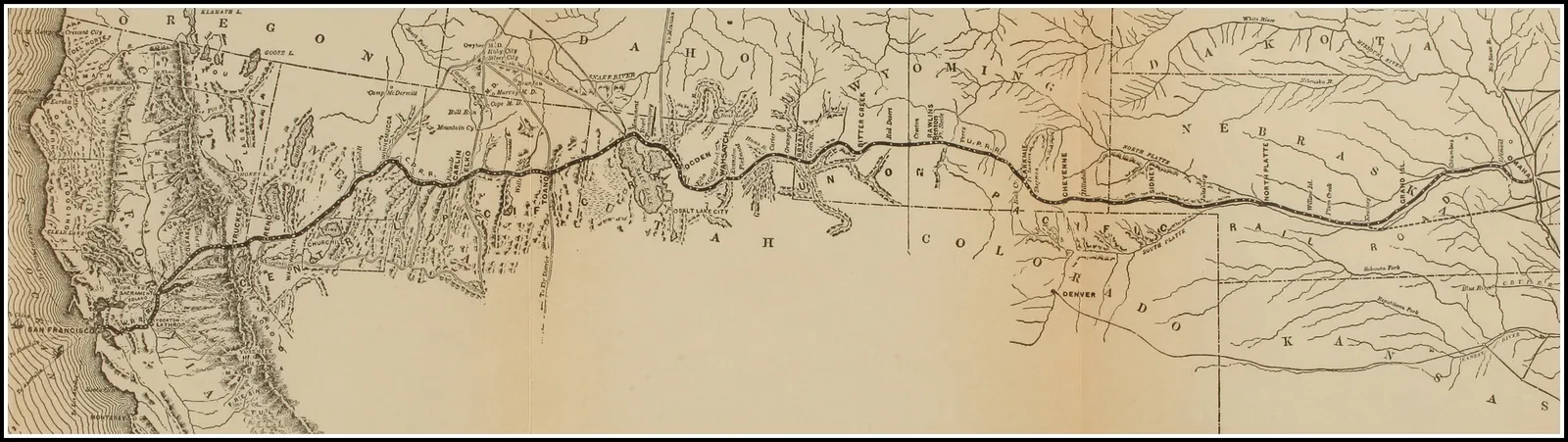
THE PACIFIC RAILWAY
As Completed May 10, 1869
II Central Pacific Men and Methods
By its marriage with the Southern Pacific, the Central
Pacific somewhat lost its identity as a pioneer
across continent. The S. P. locomotives and cars have
long been the occupants of the C. P. tracks on the main
line between San Francisco Bay and the Great Salt
Lake. Few passengers, of all the annual host switched
so easily over the long grades and the high bridges
of the Sierra and sped thundering through snowsheds
and tunnels, think “Central Pacific.”
On the contrary, the Union Pacific, which formed
the link from the Missouri to the Salt Lake, has retained
the prestige of its building name.
Not only was the Central Pacific the first to leave
its take-off, separated from the opposing take-off by
1770 miles, but the stamina that fed its youth was the
dynamic force of five men: Leland Stanford, Collis
Potter Huntington, Charles Crocker, Mark Hopkins,
and Theodore D. Judah, all of Sacramento.
They were young, that is to say, verging upon the
time of life when man’s mental and physical energies
should be at their best combination.
Leland Stanford, a delegate to the Lincoln convention
in Chicago, and who at the organization of the
Central Pacific Company had been ten days nominated
for first Republican governor of California, was thirty-seven.
He had been born a farmer’s boy, near Albany,
N. Y.; was by early profession a lawyer, had moved
from Wisconsin to California in 1852, and for a period
of half a dozen years before his elevation to the executive
chair of the State had been a member of the mercantile
firm of Stanford Brothers, Sacramento, dealers
in groceries and provisions.
Railroad work had interested him since boyhood.
His father, Josiah Stanford, had been engaged upon
the second of the all-steam railroads in the United
States, the first to use the truck-wheeled locomotive
and the first to experiment with a coal-burner. This
was the Mohawk and Hudson, later the Albany and
Schenectady, of the present New York Central, whose
line in 1831 ran past the Stanford farm.
It is a curious coincidence that upon this line, at the
time its engine the little “John Bull” attracted the
attention of the urchin Leland Stanford, destined to
be president of the Central Pacific, there was employed
the stripling Sidney Dillon, destined to be, in a same
year, the president of the Union Pacific; and that,
during the construction period of the Pacific Railway
they two, one buoying the C. P., the other buoying the
U. P., approached each other across continent until
they met at Promontory Point, Utah.
Leland Stanford, California’s war governor for
two years, was a man of hearty, ruddy aspect, of massy
brow and high principles, of immaculate garb and suave
but forceful presence. His name endures not only as
that of a great citizen, but likewise in Leland Stanford,
Jr., University, founded by him as a memorial to his
son. Long before his death in 1893 he had acquired a
large fortune.
Collis Potter Huntington, in 1862 aged forty-one,
had been born a Connecticut Yankee, was a Forty-niner
by the Panama route, from Oneonta, N. Y., to
California, and at the launching of the Central Pacific
was senior member of the firm of Huntington and Hopkins,
hardware and miners’ supplies, Sacramento. At
his death in 1900 he had outlived his three colleagues.
His name is synonymous with the Southern Pacific
Railroad system, of which he became president.
Through his nephews the same name is attached to
other immense enterprises, in Southern California, and
also in the East.
Gifted in mind, frame and features, he early proved
himself as a man of most tenacious purpose, and as a
consummate manipulator of affairs when dealing with
fellow-men. Activity characterized his whole course;
but—“I do not work hard. I work easy,” was his
significant phrase.
Mark Hopkins, his partner, and his associate in the
Central Pacific, aged forty-nine, of New York State
birth, had been an Argonaut by land from Michigan to
San Francisco. He had studied law as a business training,
and in Sacramento was known as a very conservative
but sound business man.
As compared with Mr. Huntington he was of
darker complexion, slighter physique, and of less pronounced
but scarcely less efficient methods. He and
Huntington were partners in the mercantile trade for
twenty years. “One of the truest and best men that
ever lived,” is the encomium upon him. “If Mark
Hopkins had told me that he had sold my dwelling
house, and if he sent me the deed of sale, I would have
signed it without reading it,” Mr. Huntington testified.
His conservatism made him the dependable member
to whom was referred the final decision upon debated
matters. “I never thought anything finished until
Hopkins looked at it,” asserted Huntington the lion.
Charles Crocker was forty years of age; his birthplace
Troy, N. Y. He came from a hard-pushed family;
had been a wage-earner since early boyhood. His profession
was that of a forge man until, after arriving in
California in 1850 and trying the mines, he opened the
leading dry-goods store in Sacramento. In 1860
he had been elected to the State legislature on the
Republican ticket.
His forte was intense activity, both physical and
mental. “Loved work for work’s sake,” states Bancroft,
California historian; could “drive” men in
gangs—was a natural as well as a trained executive in
the actual field; and according to his own words was
“always trying to make a dollar buy a dollar and five
cents’ worth.” He was stoutly built, heavy-featured,
firm-lipped, with the blue eye of a fighter. His death
occurred at Monterey, California, in 1888.
Theodore D. Judah had been born at Bridgeport,
Connecticut, and was thirty-five. Graduation from the
Troy Polytechnic had started him upon a brilliant engineering
career which terminated in his death in 1863.
Thus he was deprived of the laurels that, more to him
than material wealth, the future seemed to hold in store.
Stanford, Huntington, Crocker and Hopkins
formed the famous Big Four of California railroad
enterprise through fifteen years—a unity broken by
the death of Hopkins in 1878.
Judah called a public meeting of Sacramento citizens
to discuss his railroad project. Merchant Huntington
counseled him, aside, that such means might
answer for a Fourth of July celebration, but were inadequate
for a scheme of this magnitude—the conquest
of the Sierra; invited him to come into his
store and talk it over.
After several meetings at the store of Huntington
and Hopkins, the Central Pacific Railroad Company of
California, capitalized at 85,000 shares, par value $100,
was organized on June 28, 1861, and incorporated under
the laws of the State. Its name evidently sprang from
the “Central” Overland stage route. A “Central
Route” needed little advertising, for it had been much
before the people.
Leland Stanford, the Republican candidate for governor,
was chosen president—a position that he held
for thirty years, combining it with the presidency of
the Southern Pacific Railroad also. Mr. Huntington
was chosen vice-president; and his tenure of office likewise
was long, connected with his presidency at an early
date of the Southern Pacific, parent company of the
present S. P. coast and gulf system.
Mark Hopkins was chosen treasurer; James Bailey,
a Sacramento jeweller and patron of Judah, secretary.
Among the directors was Edwin B. Crocker, brother
of Charles Crocker, and soon to be the company’s attorney.
The principal stockholders subscribed to the
extent of 150 shares each.
Theodore Judah was, of course, the chief engineer.
He had been imported from the East in 1854 as engineer
for the Sacramento Valley Railroad—the first of
the California iron roads, which succeeded in building
from Sacramento east to Folsom, 22 miles, at a cost of
$60,000 a mile. He was an enthusiast upon the subject
of a road over the Sierra Nevada range, and his lore
gained from some twenty surveys of that snowy divide
fascinated his audience.
The Central was fortunate to get him. He knew
the California mountains thoroughly; he knew Washington,
also, and its legislative methods—had already
been there several times in the interests of California
railroad schemes which would secure land grants from
the Government. He was of engaging personality, and
of utter, even boyish honesty. Following his trip to
Washington, after the railroad convention of 1859 at
San Francisco, he had submitted a charge of only $40,
for printing, out of a total expense of $2500.
A cash fund of $35,000, supplied by the few initial
stockholders, kept Judah in the field for the Central
until fall. On date of October 1 he made his final
report upon routes.
The “Dutch Flat” route, the continuation of the
popular emigrant and Forty-niner trail from the Platte
and the Salt Lake, up the Truckee and in by way of
Donner Pass over the Sierra, was his recommendation.
This demanded an ascent of 7000 feet in not more
than seventy miles. But he had found a long unbroken
spur extending from Donner down along the north side
of the American River into the Sacramento Valley.
Its maximum grade would not exceed 105 feet to the
mile; there were no mountain rivers nor canyons to
cross, except a small tributary of the Bear River a short
distance above Dutch Flat.
The eastern slope might be descended by two convenient
ravines on the south side of the tragic Donner
Lake—tragic by reason of the Donner party catastrophe
amidst the snows of 1846-1847. Truckee River on the
other side might be reached, at eleven miles from the
summit, by grades not greater than those of the west
slope. The passage of the Truckee through the eastern
summit ridge or secondary ridge of the Sierra offered
a practicable exit by a 40 per cent. grade to the Truckee
Meadows and the Big Bend in the Desert of the Humboldt,
Nevada.
The distance from Sacramento to the Truckee was
only 123 miles; to the State line, only 140 or 145 miles.
His report estimated eighteen tunnels, most of them
over 1000 feet long but none over 1400 feet long, and
all in granite rock, that called for little timbering. He
foresaw no snow trouble. The route was chiefly “side
hill line,” on the flanks of slopes where snow slid off
or might be removed. By the testimony of the moss-line
on the trees, and of mountaineers, the greatest
depth of undrifted snow on the summit was about thirteen
feet; but if snow-plows were set at work after each
storm the road could be kept open all winter. The snow
in any quantity was confined to a stretch of about fifty-five
miles—from Dutch Flat, forty miles west from the
summit, to a point less than half that distance east from
the summit.
His cost estimate, from Sacramento to the eastern
boundary of the State, 140 miles, summed up about
$12,500,000, or a little over $89,000 a mile. Construction
near the summit would run to $150,000 a mile,
whereas the initial construction out of Sacramento
would call for only about $50,000 a mile.
This Dutch Flat or Donner Lake route was approved.
President Stanford rehearsed that when he
and the other members of the official examining party
stood at the proposed pass here; looked at the lake, 1200
feet below, and at the cliffs, still 2000 feet above;
realizing as they did that their railroad would have to
make an elevation of 7000 feet in 103 miles, they agreed
that could a steamship around Cape Horn either from
San Francisco or New York “get in back there” with
its goods, they could not build the road and meet with
the competition.
But the feat being impossible, and the only competition
being that by ox-team and mule-team, “as the
laws of the State of California allowed 15 cents a ton
per mile, we concluded we would build it.” With his
maps and estimates Judah, accompanied by Secretary
Bailey, his long-time acquaintance, officially proceeded
to Washington, earning there the success such as has
been narrated in the foregoing chapter.
He filed his company map with the Secretary of the
Interior, that the public lands as designated might be
withdrawn from entry; and on July 21 took the steamer
for his long voyage home again, bearing with him a testimonial
from Congress thanking him for his National
service. Theodore Judah, now vaguely remembered,
was the tutelary genius of the Pacific Railway.
In his report of October to the company he urged
the extension of the surveys as far as Salt Lake, and
advised undertaking at least 300 miles of road beyond
the California boundary.
When he directed attention to the probable financial
benefits that but awaited the extension, he broke no
news to Messrs. Stanford, Huntington, et al. The prime
inducement for building through on a line as short
and direct as feasible lay in the shining prize offered by
the Nevada silver mines. The fabulous Comstock vein
had been uncovered, Virginia City had been baptized
with a bottle of whisky, the Washoe excitement (immortalized
by the ubiquitous Ross Browne, assayer and
peripatetic journalist whose sketches rival those of
“Roughing It”) had scarcely simmered down; the
Nevada “Silverado” was eclipsing the California El
Dorado, and the California stage lines, the Wells-Fargo
Express, and an army of freighters were doing a
plethoric business between Placerville on the Sacramento
Valley side and Virginia on the Nevada side.
To shunt this business, or part of it, into Sacramento
by rail promised a revenue for the Central of $5,000,000
a year in the midst of its building program.
The Central’s acceptance of the Act of 1862 was
filed with the Interior Department on December 1, this
year. On December 27 the provisional construction
firm of C. Crocker & Co. was granted the contract for
the grading, masonry, bridges and track of eighteen
miles of road out from Sacramento. Crocker divided
the distance into eighteen sections and sublet them.
“Breaking of ground” took place at Sacramento
January 8, 1863, a year almost to a day after the inauguration
of Governor Stanford. Now as president
and governor he wielded the first spade on the Pacific
Railway, when before State and local officials and a
throng of other spectators, at K Street, the levée terminus,
he ladled some earth from a dump-cart into a
mud-hole that marked end o’ track in the West. There
were cheers and speeches.
The company early had decided that President Stanford
should attend to State legislation in support of
the road; that Vice-President Huntington should be the
financial agent in the East and look out for additional
National legislation; and that Charles Crocker and
Treasurer Mark Hopkins should manage the business
end. The assignments could not have been improved.
Forty miles of track, including some difficult and
expensive work amidst the foothills, must be completed
before the company might draw upon the Government
bond and land subsidies. The members had
not entered upon this thing through philanthropic or
wholly patriotic motives. It had an element of romance,
but not the luster attached by the Congressional
debates to the more widely appealing Union Pacific.
The members were hard-headed business men, inured
to making their own way. In California they had
seen many a golden dream shattered, and many a large
stake won through sheer daring. The alert and
resourceful there gained; the sluggard lost.
It is said that they were poor, in comparison with
their wealthy peers and in the light of their great undertaking.
Possibly so. It is said that they were well-to-do,
were their assets rightly computed. Again,
possibly so.
They all were in “going” and long-established enterprises
which did not conflict the one with another.
By testimony of Huntington before the investigating
commissions of Congress, Crocker’s dry-goods house
was very prosperous. Crocker said that he himself
was worth over $200,000. The Stanford brothers
(groceries and provisions) were worth “several millions.”
The Huntington firm had been capitalized in
1855 with $400,000; he swore that when alone in the
hardware and metal trade, in eight months of 1854 he
had cleared $854,000. In 1861 the firm had credit standing
of a million. Sacramento was a thriving centre,
second only to San Francisco.
Opposing this statement, there should be set the
memorial to Congress at the time when the company
was organized, to the effect that the Stanford brothers
were worth $33,000; Huntington, $7000; Hopkins,
$9700; Huntington and Hopkins, $34,000; Charles
Crocker, $25,000.
A San Francisco petition to Congress rated the
company, in its beginnings, at less than $250,000.
There was method in all these statements. A
medium might be struck.
Engineer Judah estimated the prospective cost of
the first fifty miles at $3,250,000, or an average of
$65,000 per mile, exclusive of rolling stock. By the
laws of California, embodied in the charter, ten shares,
or $1000, a mile must be subscribed on the line across
the State, figured at 138 miles, before the road might be
commenced. Of this amount, 10 per cent., or $10 a
share, must be paid down; assessments should be made
at $5 a share during the course of construction.
The initial sale of the capital shares in California
was meagre, but sufficient to meet the law—1580 out
of the total 85,000 being subscribed for by the company
officers and a few friends. War conditions were rendering
money dear and investors cautious. San Francisco
citizens rewarded an all-day session with open
subscription books by taking one block of ten shares!
The company had no notion of advancing from its
members’ private funds until absolutely necessitated.
Available on paper there was at most only $158,000; a
portion of it, $125,000, in the treasury, and the entire
amount merely a bagatelle in building a railroad. David
O. Mills, already a wealthy man and soon to help found
the great Bank of California, declined to ally himself;
so did other San Franciscans who commanded large
capital. Huntington applied to his Eastern acquaintances,
of whom he had a flattering number in financial
circles. It was better to borrow, if needs be, there than
in California at 2 per cent. a month.
Henceforth he spent the major portion of his time
in the East; a month at New York, then ten days in
California, then back again; to and fro, to and fro, by
stage, and eventually by stage and rail together, 6000
miles of toilsome round trip.
He knew men such as Moses Taylor, William E.
Dodge, William R. Garrison and father, the wealthy
philanthropist, steamship magnate, and one-time San
Francisco’s mayor practically by acclamation, Commodore
C. K. Garrison. But they and other commercial
leaders in New York and Boston refused to take a
substantial interest, even in the company bonds, alleging
that the risk was high, the profits remote; until—
“Huntington, we do not want to go into it; but if
you will guarantee the interest on these bonds for ten
years we will take them.”
And Huntington replied, in his abrupt way:
“I will guarantee them, because if the Central
Pacific ever stops short of completion C. P. Huntington
will be so badly broken that you will never spend any
time picking him up.”
At the outset, by pledging the credit of himself and
his associates to the amount of $250,000 he was enabled
to contract for the delivery, upon schedule time,
of the iron and other equipment for building and operating
fifty miles of road. Eventually he gained the day
for the company’s Government bonds by enlisting the
young brokers and bankers, Fisk and Hatch, who specialized
in such securities. They acted as the Central
Pacific’s financial agents in the East, took paper and returned
gold—and when they failed in 1874 owed the
company over $830,000. But their vigorous backing as
the godfathers of the company in its childhood more
than offset their defection in its manhood.
There came a time when Vice-President Huntington
and the other company individuals were upon promissory
paper to the extent of $1,250,000. However,
the case first in evidence, when he obtained the wished-for
material from Eastern manufacturers, is a salient
example of the value of business integrity.
In July, 1863, Engineer Judah was pleased to report
that 6000 tons, or sixty miles, of rails had been purchased,
to be delivered 500 tons a month, including
also the spikes and chairs (fishplate fastenings were
adopted afterward) for the sixty miles. There had been
engaged six locomotives, six first-class passenger cars,
two baggage cars, twenty-five flat-cars, fifteen box-cars,
and frogs, switches, turntables and other appliances
for the fifty miles.
At this time the bridge across the American River
was almost completed. The greater portion of the
eighteen miles had been graded and was waiting for
the rails.
In October Judah started for the East, to reinforce
Huntington. He died from a fever upon his arrival
in New York. Samuel S. Montague, his assistant, succeeded
him as chief engineer, with George E. Gray as
consulting engineer, and the work was done well.
Although the Central was a California enterprise,
the fact early became apparent that little moral help
could be expected from the California people. The sectional
and personal fight in opposition to the road duplicated,
on a smaller scale, the opposition that retarded
the Pacific Railroad projects through the Fifties.
Almost at once the San Francisco press, subsidized
by business interests jealous of Sacramento, and by
other interests with their own irons already in the fire,
tried hard to kill it by adverse comment.
The Wells-Fargo Express Company, now under its
able president, Louis McLane, waxing to be a power
in California and Nevada, and controlling the main
traffic between, foresaw serious competition in carrying;
and although President McLane was upon the
board of commissioners appointed for the Union Pacific
Railroad he felt bound to serve his company.
The California Stage Company and enlisted transport
lines, that rendered Sacramento one of the busiest
stage centres in the world and formed the connections
with the Nevada silver mines and the Overland business
out of Salt Lake, viewed the Central as a distinctly
dangerous rival. The Pioneer Stage road
between Virginia City and Placerville was a lucrative
toll road, bringing its owners $693,000 in 1862.
The Overland Stage across country from the Missouri
to California saw itself doomed by the Pacific
Railway agitation; and although Ben Holladay had
subscribed for twenty shares of Union Pacific stock—a
tentative investment of $20,000—he would have been
willing to lose the full amount if that might have halted
the march of events which threatened his Government
contract of $1,800,000 a year.
The great Pacific Mail Steamship Company, which
cared for the Isthmus traffic, and the California Steam
Navigation Company, that plied on San Francisco Bay
and the Sacramento River, of course joined the ranks
of the opposition: the one combating the transcontinental
short-cut, the other fearing the entry of the
rails into San Francisco.
The Overland Telegraph, whose Pacific companies
had perfected their service between Placerville and
Salt Lake City, could not be counted upon as welcoming
those wires upon which Government and commercial
messages would be sent.
A host of freight contractors, large and small, and
their more than 10,000 employes in plains, mountains
and deserts, bristled belligerent. The Sitka Ice Company,
supplying ice to consumers at five cents a pound,
tossed a monopolistic hat into the ring.
The “Dutch Flat and Donner Lake route” was
given a bad name. Out of a doubt real or pretended
that the company ever would be able to finance a road
across the Sierra, the project was dubbed the “Dutch
Flat Swindle.”
Even the personal friends of the company wavered
at the constantly impinging assertion “the road will
end high in the air and nowhere else.” Huntington,
Stanford—they all were earnestly warned, “You will
bury your whole fortune in the snow of the Sierra.”
Vice-President Huntington testified before Congress
that the mercantile credit of himself and his colleagues
was seriously impaired by their connection with the
so-called crazy venture.
Outside of San Francisco the bitterest fight was
waged by Placerville and its allies. From a decadent
mining camp Placerville had grown to be a prosperous,
bustling mart upon the Nevada-California highway for
the rumbling six-horse Concords, the long pack-trains,
the toiling foot-travelers, and all that steady traffic
between mines and market—a traffic that in 1863
amounted to $13,000,000. The Dutch Flat route of
the Central left Placerville at one side; and by bidding
for the traffic would relegate the old town back to the
“has-beens.”
Nevada tilted a lance or two. Its legislature, to
hurry matters, hung up a prize of $3,000,000 in bonds
for the first railroad that should connect the Territory
with the navigable waters of California.
President Stanford hastened over and pleaded that
the donation should be made to the Central. The
clause was finally killed; but soon thereafter, when the
Central had completed only thirty miles, Nevada again
interfered, in favor of the new San Francisco and
Washoe, whose track, now thirty-eight miles in length,
was to pass from the Sacramento’s head of navigation
through Placerville and onward to present Reno.
The first legislature of the new State of Nevada
memorialized Congress to grant $10,000,000 in bonds
to the initial railroad from the Sacramento to the eastern
base of the Sierra; and appointed a senate committee
to get reports upon the prospects of the various
companies in the field.
The engineer of the opposition to the Central
promptly belabored that company with an astonishing
array of allegations—to the extent that out of his own
surveys he knew the projected route to be impossible;
that Judah had known this, had resigned in consequence,
and accepted $100,000 first mortgage bonds to
keep silence; that the company dared not make public
its location line to the summit—that it had no intention
of entering Nevada and would stop when it had diverted
traffic by a cut-off wagon-road to the mines.
The report was so extravagant that it defeated itself.
Nevada became too busy to pay further attention
to the imbroglio. Congress declined to place eggs in
still another basket. The C. P. was building on, now
with ample resources; and although launched with a
chorus of acclaim and promises, the San Francisco and
Washoe fell by the way.
Despite the hue and cry of fraud, under Republican
auspices and the exigencies of the war California State
legislation had been satisfactorily engineered. By acts
of 1863 and 1864 the State and various counties were
authorized to exchange bonds for company stock to
the sum, all told, of $1,650,000, much of it payable
at once; the company was authorized to issue bonds
in $12,000,000 at 7 per cent., secured by mortgage,
the interest on the first $1,500,000 to be borne by the
State treasury.
The San Francisco city and county subscription of
$600,000 was held up for several years, and finally was
discounted only after much litigation; for San Francisco
seemed to be implacable. But the remainder of
the local subsidies was delivered.
June 1, 1863, the company books showed total stock
subscriptions of 7115 shares, with $210,930 paid in.
The vast majority of the stockholders were of Sacramento;
San Francisco had doled out two subscriptions;
but all were of California, and the first thirty miles of
the Central Pacific were built with California money
stretched out by the personal efforts of Vice-President
Huntington in the East. Stanford testified that for
one period of seventeen days there was not a cent in
the treasury.
The light ahead rapidly broadened into day.
Fortune certainly favored the bold. At the outset there
had been a vexation—an added straw—when Congress
changed the gauge of track in defiance of President
Lincoln’s decision. Upon the harassed, busy Lincoln
the Act of 1862 had imposed this question of gauge to
be uniform from river to ocean. Lines already established
were using gauges ranging from seven feet down
to the four feet eight and one-half inches which was
being adopted as “standard” gauge by the New York
Central, the Michigan Central, Baltimore and Ohio,
the Chicago and Northwestern and the Rock Island.
The California railroad charters required the gauge
of five feet. At a cabinet meeting during the week preceding
January 24, 1863, the gauge of the Pacific
Railroad was discussed with Vice-President Huntington
and other alert Californians. The cabinet itself,
says the Secretary of the Navy, Gideon Welles, was
almost unanimous in favor of the standard gauge—arguing
that to reduce width of track was less expensive
than to increase it; but swayed by perhaps the
California necessities as represented to him, at any rate
informed that a large amount of material had already
been ordered for the five-foot gauge, the President
obligingly issued his dictum: five feet.
Whereupon, moved in turn by protests of the Eastern
interests, and particularly of those roads then building
toward the Missouri for connection with the transcontinental
line, in resolution of February and March
the Senate and House declared; “That the gauge of the
Pacific Railroad and its branches throughout the whole
extent, from the Pacific coast to the Missouri River,
shall be, and herein is, established at four feet eight and
one-half inches.”
This was the first defeat for the Californians, but it
was amply made up to them in succeeding legislation.
Aided by the Union Pacific force of lobbyists, Vice-President
Huntington of the Central and his lieutenants
were working, as they well knew how to work, for
a betterment of the Act of 1862.
There were good arguments: That the first mortgage
lien by the Government barred other investors and
militated against the company bonds; that the Government
currency bonds, in war time, needs must be sold
at 10 per cent. discount; that the intrinsic worth of the
California lands was greater on paper than in the reality;
that none of the lands had value until the tracks
were in and the country opened; that the price of labor
and material had soared; that gold, the standard on the
coast, was at a premium of 30 and 40 per cent., and
that currency and securities had depreciated; that the
Union Pacific had not turned an inch of earth, and
would rather forfeit its charter than plunge ahead into
financial disaster. And there was the specious argument
that unless the Pacific Railroad was pushed, California
might be lost to the Flag.
The pages of the Congressional Globe tell vivid
stories of this fight, waged day and night, by the
railroad lobbyists and their host of crumb-seeking
hangers-on, in the corridors and upon the floors of Congress.
The majority claimed in print that the final bill
was not the bill as recommended by the Senate and
House committees, but was a cleverly palmed substitute,
rushed to adoption without a reading, without a
teller to appraise the ayes and noes, and thus foisted,
like a changeling, upon the people.
Nevertheless, subsequent testimony would show that
in approving the munificence of the new act the National
law-makers and the President were carried along
upon the crest of an honest desire to provide for the
Pacific Railway, at the outset, a “strong corporation”
that should “be able to withstand the loss of business
and other casualties incident to war and still to perform
for the Government such reasonable service as might
under such circumstances be demanded.”
“It was the purpose of Congress in all this to provide
for something more than a mere gift of so much
land, and a loan of so many bonds on the one side, and
the construction and equipment of so many miles of
railroad and telegraph on the other.”
The young giant was to be started out insured
against failure; and there were those who affirmed that
if the Government never got back a cent from its advancement
in bonds and lands, like a good father it
should gaze proudly upon its living investment.
The Act of 1864, passed by both Houses in June
and signed by President Lincoln on July 2, became a
fact. Perhaps it was upon this occasion that the Huntington
succinct dispatch flashed across the continent:
“We have drawn the elephant; now let us see if we
can harness him.”
By this act, amending the Act of 1862, the land
grants were increased to ten sections per mile, within
twenty miles on either side of the tracks—doubling the
area to 12,800 acres a mile.
Vastly more important to the roads, however, was a
new provision that authorized the companies to issue
their own bonds in amounts equal to the Government
bonds (both to be released on the completion of twenty
instead of forty miles of road); and these bonds should
be secured by first liens upon the roads, thereby submerging
the Government bonds into second mortgages.
Of only less importance was the provision that authorized
the issuance of the Government $32,000 and
$48,000 bonds in amounts of two-thirds the total when
any twenty miles of road between the eastern base of
the Rocky Mountains and the western base of the
Sierra Nevada had been prepared for the track. The
remaining one-third should be paid upon approval of
the completed twenty miles. But this advance should
not apply to the Union Pacific west of Salt Lake
on more than 300 miles beyond the fully completed
continuous track.
The time limit in which the first stretches must be
completed was extended one year. The Central was required
to build only 25 miles a year thereafter, and was
given four years in which to reach the State border.
Right of way was reduced from 200 to 100 feet on
either side of the tracks, but private property might
be condemned for the purpose. Coal and iron might
be taken from land otherwise exempted as mineral
lands. Transportation and telegraph service for the
Government should be paid for one-half in cash, one-half
by credit upon the bond loan.
The two companies might unite in all road building;
the failure of one company to meet the conditions
should not invalidate the other; the Central Pacific
might build 150 miles east of the California border in
order to meet the Union Pacific.
Three Government inspecting commissioners
should be appointed for each road, and five Government
directors should serve upon the Union Pacific board—“visit
all portions of the line,” sit in the meetings, and
from time to time report to the Secretary of the Interior.
The Union Pacific capital stock was placed at
1,000,000 shares of $100 each, instead of 100,000 of
$1000 each; the books should be kept open until all the
stock had been subscribed.
It was an extraordinarily generous act. Under its
patronage the two companies might move onward content—and
particularly the Central, to whom the only
obnoxious provision was that limiting its extra growth
to the 150 miles. But as for this—
“I said to Mr. Union Pacific, when I saw it, I
would take that out as soon as I wanted it out,” Mr.
Huntington affirmed.
So he did, in 1866—“without,” he said, “the use
of one dollar.”
When the Act of 1864 arrived like a legacy, the Central
had built only to Newcastle, thirty-one miles; the
eighteen months since the letting of the first construction
contract had been a struggle of nerve against time;
but now the company, working in great harmony and
with infinite skill, saw the open way through the physical
obstacles that loomed before.
It had a land grant of 12,800 acres per mile. It had
a creation of marketable bonds in sums of $96,000,
$64,000 and $32,000 per mile, besides the State and
county subsidies. Public sentiment, which, nowhere
more strongly than in California, desired the Pacific
Railroad, swung to it when its success was assured.
From the moment that the scrawl of Abraham Lincoln
made the Act of 1864 a law the Central’s future
was assured. Picks and spades of the grading crews upturned
golden soil, and the company found itself confronted
with the pleasing question “how to dispose of
the vast sums beginning to flow in on every side.”
Again aid came from President Lincoln, who sought
to favor the Central no more than the Union, but who
was amenable to every project that promoted the course
of the Pacific Railroad.
In this is seen the fine Italian hand of Congressman
Aaron Sargent, who as a good angel had accompanied
Theodore Judah around the Isthmus in 1861, and who
served long in State and Government duties.
By decision of the California Supreme Court the
Sierra western foothills terminated thirty-one miles
from Sacramento; but with a bonus of $96,000 a mile
for 150 miles of mountain work, the Central Company
naturally was anxious for the first foothills to begin
as low and as level and as soon as possible.
In the gloomy winter of late 1864 the President
had to cast off for the moment his burden of dark war
and transfer his thought to a foreign field—moreover,
to a region that he had never seen. Where did the
Sierra Nevada Mountains start, east of Sacramento,
on the line of the Central Pacific Railroad?
Thousands of dollars were at stake; his only recourse
was geological maps and the advices of experts,
and of well-wishers biased in one direction or the other.
Congressman Sargent is said to have proved by a
map of his own that the reddish soil of the slopes and
the black soil of the valley met seven miles northeast
of Sacramento. But let it be admitted that the map
was drawn by authority; for the company had been
supplied with letters from State Geologist Joseph
Dwight Whitney, of illustrious name; from the United
States surveyor-general for California, Edward Fitzgerald
Beale, likewise unimpeachable; from J. F.
Houghton, the State surveyor-general: all agreed upon
the one initial point—the crossing of Arcade Creek.
Forthwith the bothered National executive so decreed,
in all good faith. By date of January 12, 1864,
he issued the dictum: ... “the point where the
line of the Central Pacific Railroad crosses Arcade
Creek in the Sacramento Valley is hereby fixed as the
western base of the Sierra Nevada Mountains.”
Thus by a stroke of the pen the base of the Sierra
was moved twenty-four miles westward; and for construction
across an easy-rolling country the Central received
the Government top bonus of $48,000 a mile and
was authorized to market its bonds in same amount.
Even under these extended limits the 150 miles
carried the work over the actual mountain portion and
down into Nevada; but the desert portion beyond
proved no sinecure at the $32,000 a mile.
The Central seemed to have grasped fortune by the
forelock, and did not loosen its hold.
In September the company treasury contained
$7000 in cash and the books showed only trivial indebtedness.
The first eighteen miles were more formidable
than expected, owing to riprapping the grade along the
unruly American River and the expense of a bridge
across that stream; the sledding onward to Newcastle
taxed the abilities of the engineers to obtain easy grades
and curves while making distance among the foothills.
Beyond Newcastle the company virtually did its own
building, forming from its membership two construction
firms and applying the profit, if any. Presently
it had capital, either through its stock and its hypothecated
securities or regularly earned.
It laid a wagon-road from Dutch Flat, west of the
summit, across to Carson Valley of the Nevada mining
district; and by this road, which aroused accusations in
press and on street corner that Dutch Flat was to be
the terminus, traffic was attracted to the rails.
The company began to buy in its outstanding stock—realizing
the steady glow of the future. It triumphed
over all opposition, physical and sentimental. By Government
consent it assigned its subsidy rights to the
Western Pacific Railroad, in order to utilize that now
building line as its branch from Sacramento to San
Francisco. It was due to be called the “great absorber.”
When one surveys the careful yet bold handling
of their every resource by this little group of men, each
of whom had made his own way up from a restricted
boyhood, there can be no wonder that wealth inevitably
amassed for them—that vast railroad projects gravitated
to them; that Charles Crocker, who had started
from home with a cotton shirt, a linen “dickey,” a pair
of socks, and all his other possessions wrapped in a
handkerchief, should write his check for a million; that
the names of Stanford and Huntington are golden, and
that the latter eventually rode from the Pacific to the
Atlantic in his private car over his own lines.
COLLIS P. HUNTINGTON
Vice-President Central Pacific R. R.
CHARLES CROCKER
Supt. Construction Central Pacific R. R.
From Paintings in Crocker Art Gallery, Sacramento.
III Union Pacific Men and Methods
The title “Union Pacific” would seem to admit of
little controversy. Before the passage of the act adopting
the name a bill by Senator Curtis of Iowa is said
to have proposed it; and during the pre-war debates
upon the Pacific Railroad Senator Wilson of Massachusetts
applied the stigma “dis-union route” to the
southern survey.
The act authorizing a road that should meet the
California road was passed at a time when the word
“Union” was doubly significant. However, the claim
has been advanced by one or two historians that the
title was based not upon a union of country, but upon
the proposed union of branch lines which, issuing fan-shape
from the Missouri River, should join at the 100th
meridian, to proceed on as the single main line.
The argument is too prosaic to be popular; and too
haphazard to be tenable.
As an institution the Union Pacific Railroad radically
differed from the Central Pacific Railroad. The
Central was organized under a State charter, to build in
California; it was a private company, and as such it
had appealed to the Government for aid. Supervision
by the United States was exercised to protect the Government’s
security for the loan. But by accepting the
provisions of the act which governed the loan, and as a
common carrier when it extended across the State line,
the Central obviously came under the provinces of
National legislation.
The Union Pacific was Government born and was
national in its machinery. It operated by a Federal
charter, based upon that clause in the Constitution (applying
to the Central also) which directed the Government
“to regulate commerce with foreign nations, and
among the several States and Indian tribes, to establish
post-offices and post-roads,” to organize the army, and
so forth. Through its Government directors it was
answerable to the Secretary of the Interior in same
measure that through its other directors it was answerable
to its stockholders. Its route as projected lay
entirely through Territories, where the Federal rights
were supreme.
Out of all the men who formed the directorate and
the executive staffs of the Union Pacific some eight
eventually bore the brunt of battle through to the meeting
of the rails at Promontory Point.
These were Oakes Ames and Oliver Ames, of
Boston; Dr. Thomas C. Durant, of New York City;
John Duff, of Boston; Sidney Dillon, of New York
City; General John Stevens (“Jack”) Casement and
Dan T. Casement, of Ohio, but with headquarters at
Omaha; and General Grenville M. Dodge, of Council
Bluffs, Iowa.
The Ames brothers, Oakes and Oliver, were shovel
and tool manufacturers at Easton, Massachusetts—they
having taken over the business, one of the oldest
in New England, from their father in 1844. It was
thereafter conducted under the firm title of Oliver
Ames and Sons. The announcement of gold in California
in 1849 and the resultant opening of the trans-Missouri
country by the feverish emigrants vastly
stimulated the company’s business, so that its output
increased by leaps and bounds. The product of the
factory was backed by the inherent honesty of the
methods employed. As Henry B. Blackwell said, at
the dedication of the Oakes Ames Memorial Hall, 1881:
“I remember a good many ups and downs in the currency
of the country, but there is one thing which has
known no ups and downs since that time [forty years
back]; for then, as now, the Ames shovel was legal
tender in every part of the Mississippi Valley.” And as
a Boston merchant related, among all the natives, no
matter how ignorant nor how frequently defrauded
by poor goods, in South Africa, he found none who
didn’t have and appreciate Ames’s shovels.
Oakes Ames, the senior brother, at the outbreak of
the Rebellion was a member of War Governor Andrew’s
cabinet, in Massachusetts, as Republican Councillor
from the Bristol District. He was fifty-eight
years old when from his Councillorship he was sent by
popular vote to the House of the Thirty-eighth Congress,
where he became a member of the committee on
railroads and helped to draft the various measures that
culminated in the Act of 1862. He was passing his
sixtieth year when in 1865 President Lincoln first personally
requested him to assist in tiding, by material
means, the Union Pacific over its rocky way.
The building of the Pacific Railway naturally
opened another promising trade avenue for the Ames
factory. The Old Colony brand of shovels dug the
Union Pacific grade. But there is nothing to show that
this prospect influenced the Ames brothers beyond ordinary
business prudence, or swayed them to any misuse
of their financial connections. Oakes Ames was now
a man of wealth, of unchallenged integrity and undoubted
patriotism. He responded to President Lincoln’s
appeal by investing $1,000,000, raising an additional
million and a half and putting all the resources
of the factory at the road’s disposal, on whatever terms.
He pledged his credit to the danger point. Like Charles
Crocker, his heart was in the work. While still congressman,
in 1873 he was censured by the House investigating
committee for alleged improper distribution
of finance stock among the National legislators. Ten
weeks after, he died, a worn-out, broken man.
He left to his son, Oliver (in 1887 governor of
Massachusetts), a factory encumbered by staggering
debts incurred on behalf of the railroad. These were
cleaned up to the last dollar; and, of even greater satisfaction
to the name of Ames, the father’s public record
was vindicated by time and by resolution of the Massachusetts
legislature.
Oliver Ames, the brother, silent partner in the
manufactory, was the president of the Union Pacific
Company during its closing construction career. He
and Oakes portrayed the sound New England type of
American citizen: shrewd, vigorous, substantial, conservative,
and hanging on to the last inch when once
they got their teeth set. “Stand by the company and
let the Ameses take care of themselves,” Oakes Ames
wrote to Chief Engineer Dodge—who adds: “Nothing
but the faith and pluck of the Ameses, fortified with
their extensive credit ... carried the thing
through.” They might be termed the Big Two of
the Union Pacific, as opposed to the full-blooded,
perhaps more speculative Huntington and Stanford
of the Central.
Instead of Senator Benton’s Columbus, a massive
monolith in shape of a stone pyramid, dedicated to the
Ameses, was erected beside the Pacific Railway line,
upon the highest point, Sherman Summit.
Thomas C. Durant, a thorough railroad man, was
the company’s vice-president in construction days, but
upon him devolved the duties of president also. As
general agent for the company in the East his work
paralleled that of Huntington for the Central: to raise
money, money, money, and to mould National legislation.
He had had practical experience in railroad
building, when with Henry Farnam, of Chicago, he
had engaged in the construction of the Mississippi and
Missouri in Iowa; but by pledging the paper of the
firm, Durant and Farnam, to cover certain ventures he
had badly involved his partner and had ruined the immediate
onward progress of the road. He was of unlimited
energy, aggressive spirit, and swift ambition; and
the extravagant means which were employed in the
expense accounts almost ruined him likewise. His railroad
career ended with the joining of the tracks.
To the Casement brothers, General “Jack” and
Dan Casement, fell the immense supervising contract
for laying the 1000 miles of track and for doing most
of the grading beyond central Nebraska. The general,
ranking as brevet brigadier, had performed valiant
service with Ohio troops in the war. His fighting
qualities were farther developed in the railroad work.
There are many stories told of “Jack” Casement—gritty,
tireless, some five feet plus in stature and weighing
in proportion, but with the capacity of being as hard
as the hardest. He had all the driving power of Charles
Crocker, whom he opposed.
His post was the front, in the construction camps
at end o’ track, or in his car at the tail of the work
train. His brother Dan, of similar mettle, attended
mainly to forwarding the supplies from the last base.
John Duff, of Boston, early a director, proved to
be one of the loyal attachés whose interest in the company
was exceptionally keen. He accepted every opportunity
to make trips over the completed line, sent his
son as a guest with Chief Engineer Dodge upon an advance
survey expedition clear to Salt Lake, and was
honored by having his name registered in Duff’s Peak,
north of Rawlins, Wyoming. In 1873-1874 he was
vice-president of the company.
Sidney Dillon, of New York, had been a railroad
man ever since his beginnings in 1834 as train boy upon
the Albany and Schenectady Railway. He served the
Union Pacific (a service, according to his testimony
before the United States railroad commission, to which
he devoted his best twenty years) as president of the
construction company, and after construction days as
president of the operating company itself. Born in
1812, in the sixties he was a self-made man of brisk
but courtly address, and of the English type with side-whiskers
already turned white.
If the Central Pacific had its Judah, the Union Pacific
had its Dodge. Major General Grenville Mellen
Dodge, engineer and soldier, was thirty-five when in
the spring of 1886 he became chief engineer of the
Union Pacific Railroad; but for a dozen years he had
been an enthusiast upon the topic of an iron trail from
the Iowa border to the Salt Lake.
He had graduated from the Norwich, Vermont,
military and scientific academy; had immediately gone
into the Western country as surveyor under Peter A.
Dey, in the field corps of the Chicago, Rock Island and
Pacific (the Mississippi and Missouri Valley extension),
then planning to cross Iowa. His assignment
carried him into the little-settled Platte Valley of 1853,
beyond the Missouri. Before he was twenty-five, by
personal exploration and inquiry he had thoroughly
mapped the region from present Omaha to the mountains,
was in position to recommend the later U. P.
route up the Platte and over the Black Hills as that most
feasible for a transcontinental line—and soon told
Abraham Lincoln all about it, in the Pacific House of
young Council Bluffs.
Recalled from plains and mountains by the war,
he speedily rose to be corps commander under Sherman
before Atlanta, at thirty-three was major-general
of volunteers, at thirty-four was in charge of the plains
operations against the hostile Sioux and Cheyennes
who were raiding overland travel; and after five years
of fighting and engineering in the uniform was released
from military duties, May 1866, to head the
surveying corps of the struggling Union Pacific.
He was President Lincoln’s own selection at a critical
period. He brought to the office a high reputation
for character and efficiency and an exact knowledge,
fresh to the minute, of the northwest plains and mountain
country. Moreover, he was inspiring, indomitable,
devoted to his profession, well seasoned in spite of his
moderate years, and devoted to the principles of his
two professions.
The good judgment with which he approved of the
final surveys is demonstrated in the fact that when,
thirty years after the completion of the road, the Harriman
management took charge, although millions of
dollars were expended in attempts to rectify hasty
grades and curves consequent upon the fast work and
limited mechanical means of the early days, the whole
distance from Omaha to Ogden, upwards of 1000 miles,
was shortened by less than forty miles.
Verily, those days of railroad building in the West
seem to have been young-man days—though perhaps
not more so than now.
Colonel Silas Seymour, of New York, an expert in
railroad construction, was appointed consulting engineer
to Chief Dodge. They did not always agree, but
Dodge usually was right.
Among the division chiefs there were Samuel B.
Reed, Thomas H. Bates, James A. Evans, F. M. Case,
Percy T. Browne, L. L. Hills (these two killed by
Indians), J. E. House, Marshall F. Hurd, F. C. Hodges,
James R. Maxwell, John O’Neill, Francis Appleton,
J. O. Hudnut, J. F. McCabe, Jacob Blickensderfer, Jr.,
and Thomas B. Morris. The field covered by the Union
Pacific was much larger than that of the Central Pacific;
25,000 miles of exploratory trips, afoot and
ahorse, were made, 15,000 miles of instrumental line
were run, throughout a strip 200 miles wide from the
Missouri River to the California border. From this pioneer
service for the Union Pacific many of the engineers
stepped into post-graduate work upon succeeding transcontinental
roads.
Samuel Reed soon was taken from the field and
appointed superintendent of construction—a position
analogous to that of Strobridge for the Central. Major
Hurd became his assistant. A number of these engineers,
like young Hurd of Iowa, had won their spurs
in the Civil War. Hurd himself had been upon General
Dodge’s engineering staff as a private. Following the
Union Pacific days, he and Superintendent Reed joined
the location corps of the Canadian Pacific.
David Van Lennep, of the New York School of
Mines, was appointed geologist for the road, to examine
the country in advance, determine its resources
of coal, building rock and ballast, and minerals.
Of the Government commissioners who assiduously
chased end o’ track in the “Lincoln” car, approved of
the completed sections, twenty and forty miles at a
stretch, and on occasion helped to fight off the Indians,
there were Lieutenant-Colonel J. H. Simpson, U. S.
Corps of Engineers, and an explorer in the great Utah
basin himself; Major and Doctor William M. White,
soldier and congressman; Major General Francis P.
Blair, of Missouri, newspaper man and politician;
Major General Samuel R. Curtis, the sterling Iowan;
Jacob Blickensderfer, Jr., the Ohio engineer; Major
General G. K. Warren, of the army; and others perhaps
now less prominent in National annals. Among those
for the Central Pacific, may it here be noted, there
was F. F. Low, minister to China and in 1863 the successor
to Leland Stanford as governor of California.
Of the Union Pacific Government directors who
figured largely Jesse L. Williams, an authoritative engineer
of Indiana, was the most active, not only frequently
making, out of expert knowledge, separate reports
upon the construction, but also in 1866 examining
the experimental surveys in the Colorado Rockies. Congressman
T. J. Carter, of Illinois, as director accompanied
General Dodge upon an inspection of the Black
Hills and beyond at the time when Commissioner Blickensderfer,
especially assigned by President Andrew
Johnson, accompanied to determine the real eastern
base of the Rocky Mountains. Congressman Charles
T. Sherman, cousin of General Sherman and Statesman
John Sherman, likewise performed earnest service
upon the Government board.
Although the Government directors on the U. P.
were laughed at by Huntington of the Central, who
said that whenever they wished to “go fishing” they
took a car and went, for the stipend of their expenses
and a small per diem they certainly put in a great deal
of valuable time. Some of them did see new and interesting
country; maybe fished.
When calling the roll of the active aiders and abettors
of the Union Pacific the name of Major General
William T. Sherman should by no means be omitted.
In the beginning rather skeptical of such a project
(“Let the railroad alone; it will cost so much money
that it will break down any administration that adopts
it as a party measure,” he had warned his senator
brother; and in 1859: “It will not receive enough net
profits to pay interest on its cost”), the military needs
of quick transportation through the Indian country
brought him to its full support. As General Dodge’s
former corps commander and present zealous friend,
and as commander of the Military Division of the Mississippi
through which the transcontinental would extend,
he instructed officers and men in all his western
departments to lend every possible aid to the protection
of the surveys and track-building. In 1865 he sat on
a nail-keg upon a flat-car of the first train to end o’
track, fifteen miles.
From General Grant, head of the army, down
through Sherman, Sheridan, Crook, and all the uniform
attached to plains and mountains duties, the Pacific
Railway received generous assistance; “and it took a
large stretch of authority to satisfy all our demands,”
General Dodge remarks.
“What makes me hang on is the faith of you soldiers,”
Oakes Ames said to him in the darkest days of
the construction period.
By the Act of 1862 twenty-five of the 163 commissioners
appointed from twenty-two States and three
Territories constituted a quorum. On call by the Illinois
members the board held its first meeting in Chicago,
beginning with September 2, the same year. Former
Senator Samuel R. Curtis, now a major-general in
the Federal army, occupied the chair.
The act was accepted—the acceptance being filed
in the Interior office the next June (1863), which was
within the year limit. Henry B. Ogden, whose railroad
career was well under way, was elected president of
the Union Pacific Company; Thomas W. Olcott, of
New York, treasurer; Henry V. Poor, of the Government
appointees, secretary.
Upon recommendation of Henry Farnam, Peter
A. Dey, of Iowa City, Iowa, was selected to be the
chief engineer.
Mr. Dey, another of Iowa’s great men, distinguished
not only in his younger days as a railroad engineer but
in his later days as dean of the State railroad commission,
had been the chief engineer of the Chicago, Rock
Island and Pacific extension projected and partly built
by Messrs. Durant and Farnam; and he had been also
the mentor of the younger Dodge, at this date serving
the colors as a brigadier general.
Pending the first annual meeting of the company,
at which permanent organization should be effected
by the election of officers and a board of directors, Engineer
Dey was instructed to make reconnaissance for a
route up the Platte Valley and across to Salt Lake.
This he did; but at the meeting, held in New York
City October 29 and 30, 1863, little substantial progress
could be reported. To be sure, the Dey exploratory
surveys had confirmed previous surveys, as run by the
Dodge parties for the Rock Island line to the Rocky
Mountains and beyond. However, of the 100,000
shares of capital stock, aggregating $100,000,000, only
some 1500 had been subscribed—and these mainly as
a loyal effort upon the part of a few patriotic citizens
who contemplated merely enabling the company to
meet the provisions of the act.
The belief of Congress and the faith of President
Lincoln that the American public would rally to the
support of a National road were proven to be fanciful.
As in the case of the Central, war-time investors at
large shied from the lure of a first mortgage covering,
on the distance between the Missouri and California,
a loan of $35,000,000 and interest at 6 per cent.; and
the prospective assets of 6,000,000 acres of lands, much
of them located in a so-called unproductive desert
region, appealed no more than did the currency bonds.
Indeed, the task before the Union Pacific far
dwarfed that before the Central, who had to build only
fifty miles, difficult though they were, into waiting
traffic, while the Union was to build 1500 miles, long
stretches of what tapped no settlements whatever.
There were the Colorado gold fields, the city of
Denver, and the produce of the Salt Lake Valley, with,
of course, the Pacific coast at the far end, as trade
sources; but the whole Territory of Nebraska contained
scarcely 35,000 people. From central Nebraska
to the Salt Lake Valley the country was deemed a
barren waste. Congressman John A. Rockwell’s report
upon the Whitney scheme in 1849 had estimated that
the annual upkeep of a Pacific Railroad would exceed
$1,000,000; that there was no fuel en route, and that
owing to the inconvenience of trans-shipment not a
chest of tea would be sent over it from Canton.
Samuel Bowles, the Springfield Republican man, for
the year 1864 figured that the freighting traffic by
wagon across the plains moved 40,000,000 pounds at
an expenditure sufficient to provide a transcontinental
railroad with receipts of $48,000 a mile. But the
East had not yet awakened to this enormously growing
plum from which the overland stage and freighting
companies were taking generous bites.
In the apparent consensus of opinion, endorsed by
Durant himself, the road never would pay; it would be
only a measure of Government utility. General Sherman
had named $200,000,000 as the sum necessary to
complete the line from river to coast—and the Central’s
end was but 140 miles; the Chicago roads utterly
declined to see any profit in taking over the Union
Pacific contract, despite their Eastern connections.
Fortunately, the young General Dodge had been
summoned this spring of 1863 from his Military District
of Corinth to Washington for an interview with
the President. Lincoln had remembered the talk at
Council Bluffs in 1859. By the Act of 1862 he was
empowered to fix the point for the Missouri River terminus.
Now he relied upon the advice of Dodge, the
boy surveyor from four years ago.
Towns upon Iowa’s western border for a distance
of 100 miles above and below the mouth of the Platte
River were competing to secure the terminus. There
really could be little question as to the proper location.
T. J. Carter, one of the two Government directors (the
other being Springer Harbaugh) had been reconnoitering
out of the little hamlet of Omaha for a good crossing
of the Missouri, and had transmitted his recommendation
to the President and the Secretary of the Interior.
The Chicago railroads were focussing upon Council
Bluffs, opposite Omaha; Council Bluffs was the logical
juncture for the transcontinental route. In taking up his
residence at Council Bluffs, Dodge had foreseen this.
November, of this year, the President issued his
fiat (made more explicit by his proclamation of March,
the next year) designating that portion of the western
boundary of Iowa lying opposite the United States
township of Omaha “as the point from which the line
of railroad and telegraph in that section mentioned
shall be constructed.”
As yet, the terminus of the main line was to be the
100th meridian, 247 miles into Nebraska. This was
later changed. But the proclamation, and the matter
of the bridge, brought on a long and acrimonious rivalry
between the two towns, Omaha and Council Bluffs, for
Union Pacific favors.
Ambitious Omaha, suddenly on the up-grade, referred
to Council Bluffs as “East Omaha,” “Milkville”
and “Iowa-town”; while the Bluffs, through all
the construction years waiting to be connected up by a
bridge and to get a rightful share of the terminal business,
retorted with “Bilkville,” “Train-town” and
“That Union Pacific Depot across the river.”
At the interview of General Dodge with President
Lincoln the finances of the road were thoroughly discussed.
“He was very anxious that the road should
be built,” the general narrates—and adds that he himself
urged upon the President the necessity of Government
construction entirely. Private enterprise was not
equal to it.
The careful Lincoln could only reply that to build
the railroad was beyond the Federal abilities at this
time; but that the Government would make any changes
in the existing law, or extend any other reasonable aid
calculated to enlist private capital.
Dodge, who kept in close touch with the company
affairs, snatched leave from his war duties personally
to bear the President’s encouraging promise to the New
York offices.
At the meeting of the stockholders there, in October,
1863, thirty directors were chosen, and officers
elected in the persons of General John A. Dix, president;
Thomas C. Durant, vice-president; Henry V.
Poor, secretary; John J. Cisco, treasurer.
This accomplished, the parent body of commissioners
automatically ceased to function. The ship Union
Pacific had been launched.
General Dix never filled the duties of his office.
Veteran of the War of 1812, honored by several chairs
of state in New York and one time the Free Soil candidate
for governor, as Secretary of the Treasury he had
uttered his famous order, “If any man attempts to haul
down the American Flag, shoot him on the spot,” and
now, at sixty-five, was major-general commanding the
Seventh Army Corps.
Vice-President Durant acted as chief executive besides
being financial agent and business manager. At
the last, in the words of Journalist Richardson, the
New York Tribune traveller, “he from his quiet office
in New York directs by telegraph the labors of twelve
thousand men—an army which it requires generalship
to handle, particularly when its commander must be
paymaster as well.”
The moneyed men of the East had not yet been convinced;
no immediate aid seemed likely, except the
cautious donations of $100 a share on shares whose par
value was $1000. But, basing their plans upon the
President’s reported attitude and a strong lobby to
work in conjunction with a Central Pacific lobby, anticipating
the resultant Act of 1864, the company instructed
Engineer Dey to run survey lines this fall on
the route as endorsed by himself and his former subaltern
Dodge; to extend them up the Platte Valley,
across the first range known as the Black Hills Range,
and to the Wasatch Mountains of the Utah border.
Ground was broken at the straggling village of
Omaha, December 2, 1863. George Francis Train,
original genius and eccentric financier—about to acquire
500 acres here and to boom town sites out along
the line—made the principal speech, in which he predicted
that the road would be completed within five
years. Many persons laughed; but he did not far
miss his guess. Governor Saunders of Nebraska
wielded the spade.
Telegrams were received from East and West, congratulatory:
from the mayors of New York and
Denver, from Governor Yates of Illinois and Governor
Stanford of California; from President Brigham
Young of Utah, and from President Lincoln at Washington,
through his private secretary, John Hay. Great
names attached to the event. The canvass of the Pacific
Railway was large.
Sidney Dillon says that the celebration exhausted
the company’s treasury.
Grading was deferred for almost a year, awaiting
financial backing. Forty miles of road, estimated to
cost $1,000,000, had to be completed without Government
aid direct.
At the close of this year the stock subscriptions had
increased to 2177 shares; but the treasury receipts comprised
only the 10 per cent. down, or $217,700. Men
foremost in the commercial ranks of the country appeared
upon the list. The largest blocks signed for were
in fifty shares, as taken by Cornelius Bushnell, of the
New York merchant princes; Edward Cook, the Iowa
capitalist; Thomas C. Durant himself, H. C. Crane,
E. T. H. Gibson, and two or three others to-day known
or unknown. General and President John A. Dix,
George Francis Train, William B. Ogden, Treasurer
John J. Cisco, Samuel J. Tilden, the great lawyer; Merchants
William E. Dodge and Moses Taylor, to whom
Huntington also had appealed, were among those subscribing
for twenty shares. Thurlow Weed, of Albany,
and Banker Augustus Belmont, Lincoln’s war diplomat,
were among those who subscribed for ten shares;
Brigham Young, the Mormon president, for five.
Subscriptions had now practically ceased, with
$2,177,000 in sight but not due except in driblets. By
private means and by State means the Central Company
had boldly let its first contract and had started from
its Sacramento terminal. In the year and a half since
the passage of the act the Union Pacific had not opened
a foot of grade. Luckily, the Act of 1864 relieved the
time limitations upon the completion of the first one
hundred miles, and also appealed again to the purses
of cautious capital.
The relieving Act of 1864 is among the Ifs of history.
There is another “If,” less exploited, which
relates to Samuel Hallett and his own Pacific Railroad.
The Leavenworth, Pawnee and Western extension
to join the Union Pacific at the 100th meridian had
been waiting. Early in 1863 Hallett, a young banker,
stirred by the beck of empire and romance, came out
from New York State to do the deeds of youth. He
financed the proposed extension, authorized by the Act
of 1862 and later rechristened Union Pacific Eastern
Division, and Kansas Pacific. The restless John C.
Frémont became the president.
In the heart of present Kansas City, Kansas, Hallett
in August cleared a terminus at the river bank, amidst
the thickly timbered bottoms, and hacked a right-of-way
through the forest trees; planted at the water’s
edge a post, whose eastern face challenged Missouri
with the word “Slavery,” whose western face greeted
Kansas with the word “Freedom.”
“And thus the Pacific Railway was begun.”
He had completed some forty miles of track when
he was assassinated upon the street in the village of
Wyandotte, Kansas, by an employe, who shot him
through the back.
“Hallett was a man of genius, of boundless energy
and enthusiasm, fertile in expedients, bold and prompt
in action. Had he lived he would have been the master
spirit in the construction of the Union Pacific Railway,
and probably one of the leading railroad men of
the country.”
This is the claim by the Kansas statistician in a
Government report. At the rate with which Hallett’s
enthusiasm was building his head start might have carried
him to the 100th meridian before the arrival there
of the main line from Omaha; and the provisions of
Congress would have inspired him to push on, winner
in the race. The Union Pacific tracks did not reach the
meridian beyond Kearney, at mile-post 247, until
October, 1866.
The Act of 1864 became operative by approval of
the President July 2. In the light of these new provisions
the Union Pacific Company rallied. This August
a contract was let to Hubert M. Hoxie for the
building and equipping of the first 100 miles west from
Omaha at $50,000 a mile, reckoned in securities at face
value; sum total, $5,000,000. Owing to shortage of
labor and the balloon ascent of all material, construction
and equipment expenses had swelled as in the case
of the Central.
Mr. Hoxie had been in charge of the company ferry
between Omaha and Council Bluffs. He did not go far
with his contract. The company decided to do away
with independent contractors (thus pursuing the course
taken by the Central also), and entrusted its building
march to the financial corporation formed of its stockholders
and entitled, at the suggestion of the irrepressible
George Francis Train, “The Crédit Mobilier of
America.” The name, under the searchlight of Congressional
investigation or prosecution (as may be),
was accused of covering a multitude of sins. It killed
Oakes Ames and peppers volumes of committee reports;
but at any rate the road was put through.
Contractor Hoxie was appointed assistant superintendent
in the train operating department, and served
efficiently in getting supplies to the front.
The Peter A. Dey survey of the first forty miles
from the Missouri River was overruled, upon recommendation
of Consulting Engineer Seymour and Government
Director Jesse Williams. In January, 1865,
Mr. Dey resigned his office. “I am giving up the best
position in my profession this country has offered any
man,” he said, in his letter to the company. Grading to
the extent of $100,000 had been applied to his sections.
He testified in after years that the mounting expenditures
appalled him. Those were indeed days to worry a
conscientious engineer—days when in the try-out no
estimates seemed high enough.
If as chief engineer he was expected to shoulder
the responsibility for the line, yet was not allowed to
follow the dictates of his own judgment, he had no
other recourse than to resign. Time rewarded him, for
forty years after the completion of the road his grades
were restored for main traffic.
J. E. House and D. H. Ainsworth, assisted by
Colonel Seymour, filled the interim as the construction
and location engineers out of Omaha.
The financial investments were taxing the resources
of the company. The delay in completing the first
twenty miles of track was serious; the completion of
the first 100 miles within the time limit looked dubious.
Pending the result upon capital of this amendment,
and planning also to issue land bonds covering their
grants upon either side of the line, the company proceeded
to meet the present emergency. The ways and
means are piquantly detailed in the testimony of Broker
John Pondir before the United States Pacific Railway
Commission in 1887.
Broker Pondir, a man of voluble grievances and
considerable aplomb, stated that in May, 1865, he was
introduced by Secretary of the Interior Harlan to Doctor
Durant, the Union Pacific vice-president, in Washington.
Mr. Pondir’s services were requested to finance
the Union Pacific. Doctor Durant approved of him,
and Treasurer Cisco telegraphed: “Stick to Pondir.”
The “Boston people”—evidently that wealthy
circle which included the Ameses—had not come in
and capital was still shy of embarking in the National
enterprise. Broker Pondir engaged to find money—“I
arrived in New York, and I made up a syndicate
and I gave them a million dollars in five days.”
Mr. Pondir was a man of resource and of action.
He set out to increase the fund by obtaining from all
the banks of the city an investment of 5 per cent. of
their capital. He applied to the Manhattan Bank and
the Phœnix Bank.
“They told me, ‘Mr. Pondir, you must go to
Charles H. Russell, of the Bank of Commerce, and if
he puts his name to it [the plan] you will be very successful
in carrying it out.’”
Treasurer Cisco agreed.
“If you can get the Bank of Commerce to come
into it, the balance of the banks will follow.”
The directorate of the Bank of Commerce held a
called meeting and questioned the validity of the Government
subsidies. Attorney Jerry Larocque had been
appointed to look up the legal aspects of the act; he submitted
to Broker Pondir an opinion that “the whole
act of Congress was illegal.”
“A man never lived that was a better man. He was
convinced of it,” stated Mr. Pondir, in retort to the
comment that Attorney Larocque was a Democrat,
albeit Examining Commissioner Anderson’s cousin.
This opinion might have put a quietus on the campaign,
but with General Dix himself, the company’s
president, and Treasurer Cisco, Mr. Pondir sought out
Mr. Daniel Lord.
Said Mr. Lord:
“I will give you an independent opinion. I do not
want to see Mr. Larocque’s opinion; I do not want to
see Mr. Tracy’s opinion, or Mr. Tilden’s opinion [these
were the company’s attorneys]; but I will give you an
independent opinion on the affair, if you will leave
it to me!”
Mr. Lord reported that everything pertaining to
the act of Congress and to the Union Pacific Railroad
was valid.
The Bank of Commerce accepted the Lord opinion;
would not allot 5 per cent. of the bank’s capital, but
offered to make a loan of $1,000,000 on the scrip of
the Government “to be put in at 90,” exchangeable for
bonds, “currency 6’s.”
“As long as Pondir is with us, we will finish the
road in 1876,” General and President Dix praised,
pleased with the quick $2,000,000.
In the words of Mr. Pondir, “after these loans had
been effected the Boston people came on”; so did the
Crédit Mobilier construction company, and for a time
the Union Pacific management “had all the money
they wanted.” Much to his surprise Broker Pondir,
who appeared about to fill the rôle of intermediary,
similar to the rôle of Fisk and Hatch for the Central,
soon was released from further responsibility. The
Ameses had taken the financial helm.
The first rail was laid, the first spike driven, at
Omaha, the “initial point,” July 10, this 1865. By the
close of the year forty miles of track had been completed.
The company had confidently expected to lay
sixty miles of track before the close of the year. But
the start was again short of the purpose. The discussion
over change of route from the river bank, by the
Dey survey, bombarded President Lincoln’s successor,
Andrew Johnson, and kept Omaha and Council Bluffs
on the anxious seat for a longer time. By the recommendations
of the engineers, the bridging of the river
should be accomplished at Bellevue, seven miles below
Omaha and the Bluffs. The river was not bridged, anywhere,
until half a dozen years later; and it did not
cross at Bellevue; but the changing of the original
Dey survey postponed track-laying in earnest from
mid-July to September.
With the opening week of January, 1866, forty miles
of rails were down at last. Brick machine-shops and
engine-houses had been erected at Omaha. A seventy-ton
stationary engine for the shops had been hauled
150 miles across western Iowa by ox-team and ferried
over. Four locomotives, two first-class passenger cars,
twenty-five second-class passenger cars, baggage- and
box-cars, thirty-four platform- or flat-cars and nine
hand-cars had arrived by steamboats up from St. Louis.
Over 1,000,000 ties had been delivered; the cottonwood
ties were being Burnetized or impregnated with zinc
at the rate of 1000 daily. Several thousand cords of
wood for the engines had been heaped up. In the Missouri
River bottoms north and south five portable saw-mills
were turning out more ties, more wood, and bridge
and car lumber. Preliminary surveys under Division
Chiefs Reed and Evans had been run to the Humboldt,
200 miles west of the Salt Lake. The grade had been
extended to the 100th meridian, and surveyors there
had already been driven in by the Indians.
After having marked time for three years the Union
Pacific track finally had obeyed marching orders. It
was started upon its long, long trek into the wide,
scarcely known West—reaching forward from its
one base at Omaha to touch its next base at new
Frémont, like a great measuring-worm staking off
an experimental way.
GENERAL “JACK” CASEMENT
Champion track-layer of the Continent
OAKES AMES
Who spent his all in aiding the Union Pacific
IV Progress of the Central Pacific
With the beginning of July, 1864, and while yet
the Union Pacific had not laid a rail out of Omaha, the
Central Pacific had opened thirty-one miles of track
to Newcastle—an initiatory climb of almost 1000 feet
in the 7000 feet of rise to the snowy summits of the
Sierra, now seventy miles distant.
Vastly relieved in mind by the Act of 1864, coincident
with the arrival at the first terminal point, the
company was confronted apparently more by physical
than by financial difficulties.
Over a million and a half dollars in capital stock
were about to be disposed of, and out of this there would
be due, on the books, only some $135,000 unpaid. From
the State the company was entitled to $105,000 annually
for twenty years. County bonds soon to be available
aggregated $638,500. For thirteen out of the first
twenty miles of the completed road the company was
entitled to $48,000 a mile in Government 6 per cent.
bonds, and upon the same distance might issue its own
first mortgage bonds in same amount; therefore it had
potential resources of $96,000 a mile for the thirteen
miles, and $32,000 a mile for the remaining seven miles
out of Sacramento. The gross receipts of the road,
when it had reached Newcastle, were $121,679.10, and
with the extension of the rails would steadily mount.
But a great proportion of business was being done
upon paper. The majority of the capital stock had
been exchanged for the county bonds at par and for
services rendered. The small sub-contractors had
been paid largely in cash or equivalent; Charles
Crocker had been paid by three-eighths stock and
bonds, five-eighths cash or equivalent—the equivalent
being bonds at a discount of 50 per cent., their actual
marketable value.
Gold was the only medium of business on the Coast,
and during the war was at a premium of $1.32 to $1.48.
The Government and company bonds sold in West and
East at an average of $1.34. The buying power of
currency dropped to as low as forty-two cents; its high
mark was eighty-three cents. There was a time when it
took three dollars greenbacks to obtain one dollar gold,
and the Government currencies brought only forty
cents gold. In the beginning the Government currency
bonds at 6 per cent., and the company bonds, were practically
a drug in California, where the local interest
on loans and investments was running 2 to 3 per cent. a
month; the same condition militated against the company
stock. In the East Vice-President Huntington,
as before related, had his own hard row to hoe.
The issuance of the Government bonds was long
delayed. The first issue, in amount of $1,258,000 was
dated May 12, 1865, bore interest from January 16,
and was not delivered, according to the company
records, until 1866.
By the time these bonds were in hand they and
prospective issues had been hypothecated long back, and
pledged by other securities, to obtain the working funds.
In the depreciation of currency the company was due
to lose on the Government bonds over $7,000,000. But
time forbade any arguments on the matter.
The prices of material were astounding. Practically
everything save the ties and timber and masonry
had to be shipped from the East around the Horn or
transferred across the Isthmus. By the cheapest way,
around the Horn in sailing vessels, the delivery took
six months.
Having been confined by the act of Congress to
American iron, the company found the price boosted
rapidly, and the situation was aggravated by war conditions.
For the first fifty miles of rails, or 5000 tons,
the company paid $115 a ton, at New York and Boston,
in company bonds taken at par. For a lot of 500 tons,
in stock at the mill, there was paid $262 a ton, or
$267.50 a ton delivered in New York. The average
figure asked for iron rails at the mills, during the construction
of the road, was $91.70 a ton, as compared
with $55 in 1861. The freight rates by the Horn
averaged $17.50 a ton; by the Isthmus the rates
mounted to over $50 a ton. Insurance advanced from
2½ to 17 per cent.
Twenty years afterward the best steel rails cost, in
California, $45 to $56 a ton; in the East, $35 to $36.
Engine No. 1 cost, delivered, $13,688; on this the
freight by the way of Cape Horn to San Francisco was
$2282. Engine No. 2 cost $15,196; No. 3 cost $9785;
No. 4, $10,366; No. 5, $16,629; No. 6, $18,549.
The first ten engines summed $191,000; the second
ten summed $215,000. These were small locomotives
of twenty to thirty tons, illy compared with the 100-ton
moguls of to-day; their cylinders ranging from eleven-inch
bore and fifteen-inch stroke to eighteen-inch bore
and thirty-inch stroke; the majority, however, being
of sixteen-, seventeen- and eighteen-inch bore, twenty-two-
and twenty-four-inch stroke. Those dimensions
were adopted through twenty years and more, when
similar engines might be purchased for $7000 and
$7500. Before the war, the rolling stock figures would
have been reduced by a third, with $10,000 as a top
price on a locomotive.
By the Isthmus route, steamer and land, freight
rose as high as $8100 on a single engine. A rush order
for two engines across the Isthmus resulted in an expense
of $37,796 on one, when set up; on $37,710 for
the other. On a shipment of eighteen engines the freight
charges alone were $84,466.80.
The Government tax was 6 per cent.
The engines arrived at San Francisco “knocked
down” or disassembled; there were transferred or
lightered, like all other material, for shipment by boat
up the Sacramento River, and were assembled at the
Sacramento shops.
Prices were relieved but little as construction proceeded.
In 1868 thirty-eight locomotives cost
$418,000, or $11,000 each; passenger coaches were
entered at $3500 each; flat-cars at $600; hand-cars at
$150; all in gold—premium $1.65—which brought the
price of the engines up to $18,150 each, currency.
Spikes ruled six and one-half cents a pound, as
compared, later, with two and one-tenth cents; fish-joints
rose from $1.90 to $6.50 a hundred pounds, as
compared, later, with $1.70; bar iron was $110 and
$115 a ton, as compared, later, with $40 and $45 a ton.
For telegraph arms there was paid, in thousand
lots, almost eighteen cents apiece; for insulators, more
than thirty cents apiece; brick was $30 a thousand;
rough lumber $40 to $90 a thousand feet; once the
timber belt was crossed, ties mounted to $1.25, $2,
$4, $6, $8 each!
The Union Pacific suffered likewise by the war
prices and by the restrictions of trade, but the Central
was peculiarly helpless, for California manufactured
no iron and little of anything else. The company always
had at least $1,000,000 in material in shipment by the
hazardous water route, and sometimes $3,000,000 in
transit at one time. Delays were frequent, owing to
storm, calm and wreck; the Government commandeered
at will for its own use in war exigencies.
That there was extravagance in contracting and
purchasing is not to be denied. The accusation is softened
by the fact that material had to be ordered a year
in advance, and that time soon became of more value
than money. It is not the purpose of this story to
revive long-dry controversy. The unquestionable
methods, alone, through which with scarcely a break
and by dint of courage, will-power and consummate
skill in managing men and events the builders of the
Far Western link in the first transcontinental railroad
earned a goodly measure of what they acquired supply
a subject inspiring enough for great American history.
Vice-President Huntington spent his time principally
in New York, preparing the way for the bonds of
company and Government and turning the credit of
himself and associates into gold—without which business
could not be done in California. He says that he
and the firm of Huntington & Hopkins supplied the
company with a large amount of construction money:
the firm sometimes taking the company’s notes and he
himself buying stock and bonds outright. The stock
in the beginning was accepted at par, $100; eventually it
sank as low as nineteen cents, and went begging at that.
President Stanford obtained loans in San Francisco,
pledging therefor his own paper and the paper
of Huntington, Hopkins and Charles Crocker. Few
capitalists and no bank there would accept the company’s
bonds, the county bonds were subject to 30 per
cent. discount., the Government currency 6s did not
appeal; and interest on loans was, as said, 2 per cent.
and upward until the Bank of California lowered it to
1 per cent. a month. Under these conditions President
Stanford nevertheless furnished collateral sufficient
for the purpose, and so well upheld his credit that from
a rating of $100,000 he gained until he was upon
the Bank of California’s debit ledger in the sum
of $1,300,000.
Faith may move mountains, and in the case of the
Central Pacific may appear to have overcome mountains;
but the abilities of that building coterie in their
climb onward and upward rivals the miracle of the
loaves and fishes and the widow’s cruse. The keystone
of their amazing success was faith, perhaps—business
faith—and cemented by teamwork and daring.
As previously stated, the first eighteen miles of
grading and track-laying had been consigned to Charles
Crocker (the “Co.” may be omitted as superfluous) as
contractor. Samuel S. Montague, selected as chief engineer,
succeeding the lamented Judah, might be regarded
as an experiment equal to that of the road. He
was a young man, without name as a railroad engineer.
He proved to be worthy of his trust—“faithful, honest
and proficient.” He died in 1883, after having served
as chief engineer for the Central to that date. Assistants
to Mr. Montague were Lewis M. Clement, who
went all the way through from Section No. 1 to Promontory;
William Hood, who entered the Central Pacific
service in 1867 and accompanied the line over the
Sierra—and at this writing is chief engineer of the
Southern Pacific as successor to Mr. Montague; Butler
Ives, S. M. Buck and William Epler, upon divisions in
Nevada and Utah; McCloud, Phelps, Haslett, Hutchinson—who,
like Engineer Ives, are to-day only names,
second to the name of Judah himself.
J. H. Strobridge, still living in 1919, became superintendent
of construction under Charles Crocker.
A. L. Bowsher was foreman of the telegraph crew.
Arthur Brown was bridge superintendent, this department
including the immense trestles and the miles of
snowsheds in the mountains. The roll of the Pacific
Railway is a roll of heroes paraded under prosaic titles.
The first eighteen miles had been completed not
without difficulties. The tailings from the hydraulic
mining up the American River were filling the bed and
causing a constant rise of the stream, so that an extremely
heavy fill protected by riprapping was necessary
to conduct the railroad grade for the three miles across
the overflow lands from the Sacramento levée to the
river. The piles for the bridge across the American
River had to be driven through fifteen to twenty feet
of tailings.
The eighteen miles from the levée to connect with
the old California Central line at the Junction, present
Roseville, was begun in February, 1863, and completed
in the early winter. The Crocker contract was for
$400,000, $250,000 in cash, the remainder in securities.
The final bill amounted to $425,000, allowance being
made for extras. The bridge across the American
River had cost $100,000. Mr. Crocker says when he
started in he had $200,000 in personal assets; that when
he finished he was owing money. He had been obliged
to petition the company for an advance payment, in
order to satisfy his men. The company was then owing
him $48,000. He offered to accept company bonds at
fifty cents on the dollar, so that he might be enabled
to raise the funds.
Once at Junction, the company “concluded to build
up to Newcastle, some 31 miles.” Progress was by
the hop-along method, while sparring for openings.
Public sentiment still was much adverse to the company.
Many interests were fighting it. Mr. Crocker
literally took off his coat; his eighteen miles had not
daunted him, and he prepared to bid for the construction
of these next thirteen miles. He was now doggedly
heart and soul allied to the Central Pacific project.
Owing to the howl raised against him by other contractors,
alleging that he was a favorite with the company,
he was awarded only two miles: the hardest two.
He took them, and also the risk. The eleven other
miles were apportioned among several bidders. The
plan did not work out well. Labor was scarce and independent;
the contractors outbid each other for men;
prices of labor consequently mounted alarmingly; there
were strikes, delays and quarrels; eventually the bulk
of the thirteen miles fell to Crocker again.
Newcastle was reached in early July, 1864. Here
the work stopped. It was a period of discouragement.
County bonds were being held up, suits were pending,
even labor appeared to regard the company as fair prey
as long as it lasted. Grant had been defeated at Cold
Harbor, and gold was quoted at $2.90; currency at
thirty-five cents. The board of directors decided that
to let the construction by stretches of one or two miles
would so disorganize the labor market that the wage
scale would prove ruinous.
But in nine miles more the next twenty-mile division
would have been completed and the company be entitled
to the Government subsidy upon the same; the Act of
1864 provided for a two-thirds subsidy payment upon
the graded line in advance of the rails; therefore Charles
Crocker was authorized to go ahead, and as far as he
could. He went—until, he says, all his money and all
his borrowing power were gone, too.
“That was the time when I would have been very
glad to take a clean shirt and lose all I had, and quit.”
He was not the quitting kind. Neither were the
three, his associates. On May 10, 1865, the tracks were
into Auburn, five miles from Newcastle; another month
and they had arrived at the historic emigrant station of
Clipper Gap, seven miles farther, or forty-three miles
from Sacramento. They were slowly forging on eastward,
to replant the incoming trail of the Forty-niners,
as the Union Pacific was destined to replant the kindred,
older trail outgoing from the Missouri.
Now forty miles had been completed. The subsidy
was long postponed, but the future had brightened. The
war in the East had ended satisfactorily to Northern
industries and an easier money market might be anticipated.
The Act of 1865 had been passed by Congress.
This act, approved March 3, 1865, permitted the companies
engaged in the Pacific Railway work to issue their
bonds upon 100 miles of their grade, superstructure and
so forth for 100 miles in advance of their continuously
completed line—thus providing more funds for pressing
emergencies.
Such an extension of borrowing power, at this
time, vastly strengthened the resources of both companies.
From that date the Central people were enabled
to employ their bonds in considerable degree, and the
road was usually mortgaged for the 100 miles ahead.
All the construction contract from Clipper Gap
eastward had by resolution of June 4 been assigned
by the directors to Charles Crocker & Co. until new
orders. Illinois Town (the Colfax of to-day, as rechristened
in honor of Speaker Schuyler Colfax, over
whose distinguished presence California made much
ado in this summer of 1865), eleven miles distant,
beckoned as the next terminal point.
The country ahead had been changing rapidly.
From the winding but gradually ascending way the
survey was leading into the main foothills of the Sierra.
The engineers of the road characterized the route up
from Newcastle as one of the most difficult on the line—a
fact that may not impinge upon the senses of the
modern traveller when he bears in mind the stupendous
trestles and hanging-curves of the line beyond.
The company had been a year in getting from Newcastle
to Clipper Gap, twelve miles. Part of this time
was credited to delays in marshaling funds and settling
the labor question; but although the rise in the twelve
miles was only 800 feet, much of the distance demanded
sweeping detours and prolonged grades.
Two months conquered the eleven miles to Illinois
Town, at an elevation of 2242 feet—a climb of 500 feet
from Clipper Gap. Here, on September 10, end o’
track rested for 1865. Record for the year, twenty-three
miles; not an encouraging record to the public.
The gross earnings for May were reported at $740
a day, gold; for June they had increased to $1080
a day. The passenger rates were ten cents a mile,
freight rates fifteen cents a ton per mile; all gold.
Whether or no there was encouragement to be
found in these figures as given out, the nation, even
California, had not yet awakened to the main truth:
that here was a little squad of business soldiers conquering,
by physical and mental force combined, the
apparently unconquerable.
Dutch Flat, whence the company wagon-road was
opened to tap the Placerville-Virginia City stage and
freighting road, lay only thirteen miles before. Skeptics
in superabundance still asserted—and never more assuredly—that
the vaunted Central Pacific of California
would reduce to merely the abortive “Dutch Flat and
Donner Lake Route”; that, confronted by the snows
and gorges of the high Sierra, it would rest content with
the traffic diverted by the wagon-road from the Nevada
silver fields. Rival interests vigorously circulated the
statement by an engineer of reputation that the further
progress of the railroad through the mountains by the
Judah survey would require an expenditure of from
$250,000 to $300,000 a mile.
The company combated this statement; issued a
counter-statement in which it decried the “oft-repeated
slander” that the road was designed to be only a
feeder, and added, over the signature of President
Stanford, that both the Government and company
bonds were appreciating since the close of the Rebellion;
that few company bonds had yet been offered; and
that with the proceeds of the Government bonds and
certain loans, and by the privilege of its own first mortgage
bonds covering 100 miles in advance, the company
“is fully warranted in considering itself able to
overcome the Sierras as rapidly as possible, and in
undertaking the work beyond.”
In mid-August the Speaker Colfax party from the
East inspected the line from Sacramento to end o’
track at Colfax, and on along the grade almost to the
summit. Through Editor Bowles and his Springfield
(Massachusetts) Republican, and Journalist A. D.
Richardson, New York Tribune man and ex-prisoner
of war, the American people were given their first
authoritative unbiased tip upon the mighty achievement
ever waxing amidst these wild fastnesses.
Heretofore the project, so slowly developing, of the
Pacific Railway had been but briefly treated in the
National press. California was safe and remote, and
war news held the columns of daily and weekly in stern
grip. Truth to say, through several years of actual
construction work the Pacific Railway lacked advertising
other than that put out by its companies in prospectuses
and reports and the financial departments of
the public prints.
Editor Bowles, no doubt properly inspired, called
attention to the lavish financial backing of the Central
Pacific—according to his figures, $6,000,000 in Government,
State and company bonds already accrued and
none utilized; for the work so far had been accomplished,
he understood, by means of the sale of stock,
the county subscriptions, and the earnings. Out of this
income the company showed $500,000 surplus.
Possibly Mr. Bowles was no financier—his profession
did not tend in that direction. Of more worthy
reckoning was his exploitation that in its last annual report
the company declared it would be into Salt Lake
within three years (for Stanford, Huntington and their
coöperates had this goal firmly fixed before them); and
he recites that the grading crews, mustering 4000 Chinamen,
were working twenty-five miles ahead of the rails.
As general construction superintendent Charles
Crocker was proving of astonishing mettle. He was
“the engine that drove everything ahead,” and “from
a small dry-goods merchant had rapidly developed into
a great organizer and manager.”
He had changed and advanced as the character of
the work had changed and advanced, from the first
thirty miles in the Sacramento Valley and the short
sections over which the sub-contractors had warred by
hiring labor away from each other, to the high country,
the fuller purse and the need of thousands of hands
instead of hundreds.
He solved the labor problem by answering with
Chinamen. White labor on the coast was independent
to the extreme. Why should an able-bodied man wield
subordinate pick and spade at a dollar or two dollars
a day when he might earn four dollars a day at the docks
and the mines, and in the hills perhaps make his everlasting
fortune by a lucky stroke of a tool? The
gambling spirit of the Eldoradans was still rampant,
kept alive by the Nevada excitements. A trip pass for
grading or track-laying duty, to end o’ track, was very
likely to be but a stepping-stone in a journey to the
Comstock, the Washoe and the White Pine lures. The
man kept on going.
During the White Pine craze 2000 laborers were
shipped across the mountains to Humboldt Wells before
a hundred stuck.
Crocker countered upon this tendency when, in the
spring, at Auburn, he met a wage-strike among the
Irish laborers by directing his construction superintendent,
Strobridge, to send down for some Chinamen.
They were set at work—much to the disgust of the
Irish, who “begged us not to have any Chinamen
come.” But the Chinamen did so well, and there was
such pressure bearing, calling for speed, that to end
the bickering the “big boss,” issuing a call for 5000
laborers, repleted the ranks of unenthusiastic Celts by
filling up with Mongolians.
In the beginning for $26 a month and keep themselves,
later for $30 and later again for $35, they
trooped in from Sacramento and San Francisco, in
their basket hats, their blue blouses and flapping pantaloons,
bringing their scanty outfits, their placid visages
and choppy talk, to face heat and cold, storm and toil
and American curses, and require only their dollar a
day and an infrequent lay-off in tribute to some Joss.
“Crocker’s pets” they were styled by the invidious.
But despite the hullabaloo levelled against this invasion
of “yellow” labor, in the fall of this 1865 Superintendent
Crocker had some 3000 of them at work under
white bosses, mainly Irish; he was planning to import
more, from China itself, when occasion demanded.
Once shown what and how, the Chinaman became
an efficient toiler. Hitherto his hard labor had been
confined to the mines. He was not an adept with teams,
but with pick and spade, basket and wheelbarrow he
was as steadily industrious as an ant.
“Quiet, peaceable, industrious and economical—ready
and apt to learn all the different kinds of work
required in railroad building,” and “as efficient as
white laborers,” was the report by President Stanford.
“Without them it would be impossible to complete the
western portion of this great National highway within
the time required by the acts of Congress.”
To the Chinese laborers “Mistuh Clockee” was a
general; under the spur of his forceful presence they
shuttled back and forth, digged and delved, like thoroughly
drilled companies; while to the visitors along
the grade the sight of the interminable lines of pig-tailed
figures, diligently pecking into rock and earth,
trundling their wheelbarrows, or the countless groups
squatted around their bowls of rice and pork and what-not,
was an unfailing curiosity.
The Central Pacific earnings for 1865 were $405,591.95;
the net earnings $282,233.44; by the deduction
of $150,000 interest and $105,000 sinking fund, there
was left, “carried to profit and loss” (in this case
profit), $27,233.44.
The construction work of the year—the twenty-three
miles of track-laying and some fifty miles of
grading—footed over $3,200,000; the construction to
date, from Sacramento up, summed over five and one-half
millions; the total cost of the road, over six and
one-quarter millions; there were additional assets,
county bonds, materials, and accounts, of almost another
million. The annual report of this 1865 made a
satisfactory showing.
Figures, like the country, were getting large.
Having built fifty-four miles, and braved all financial
difficulties, the company plunged ahead. It confessed
to no fears, it promised to Charles Crocker that all
expenses should be met by private means, if necessary;
the tide had turned with the definite turning of the
war; securities were rising in market value. Funds
were forthcoming. The campaign of Vice-President
Huntington in the East, assisted by the brokers Fisk &
Hatch, was placing the Government currency bonds
and the company bonds there, and even in Europe.
Money thus obtained and not directly applied to the
construction was loaned out at 1½ and 2 per cent. a
month or at a lower annual rate.
Seemingly undismayed or confused by the tangled
coil of finance, the company kept its gaze clearly fixed
upon its visions, both the practical and the altruistic.
“Many a time,” testified Mr. Huntington, “I would
have given anybody largely out of the money that I
had if they would have taken the work off my hands
and assured me that they would have built the road.... I
have done many things that I did not do for
profit. I did them in order that the road should be a
success. California was full of people that wanted to
come East, including women and children. That point
had its weight with us. It is very well to sneer at that,
as people of small minds will; but it had its influence
on us, and a very large influence. A railroad would
give people a means of crossing the continent comfortably
in six days and on land, instead of spending
twenty to thirty days on the ocean, with all the inconveniences
of such a voyage.”
And this was true, as Editor Bowles himself pointed
out: that the whole Western country was poignant with
women, and men also, who had cut loose from home
and home folks, and were held captive behind the bars
of the long water and desert trails that lay between the
new and the old.
This fall and winter end o’ track rested at Colfax,
while the grading, trestling, bridging and tunneling
were pursued with vigor upon the survey beyond. Three
regular trains a day were running between Colfax and
Sacramento. Along the grades eastward 5000 men
and 600 teams were at work in October. The force
increased, until by the end of the year there were 7000
Chinamen, at $30 a month and keep themselves; 2500
white laborers, at $35 a month and board. They were
comfortably housed in tents, caves, dug-outs and board
shacks, and supplied by wagons that bucked the mud
and the snows from Colfax, the base.
The distance from Colfax to the summit was some
fifty miles; the spectacular engineering and construction
feats required, which in the beginning had been
faced with the zest of a Judah, now were to tax the skill
of Montague and Gray, and summon the indefatigable
pluck of Crocker.
Early in the spring, throwing forward one of those
high, curving trestles (in this case 1100 feet long)
with which the road strode across the deep gorges and
ravines, the rails moved out from Colfax for the attack
upon the gigantic Cape Horn.
Here a bed had been literally chiselled from the
granite slope so sheer that the laborers, yellow and
white, were suspended by ropes while they hacked,
drilled and blasted, 2500 feet above the rushing American
River. Steadily making height, the iron trail bored
on past the storied mining camps of Gold Run, Red
Dog, You Bet, Little York, startling the echoes with
raucous blasts of the panting iron-train, signalling civilization’s
advance.
The spring rains fell in floods, the melted snows
joined, and all trails were bottomless with miry clay.
The stage from Colfax to Virginia City was stuck in
the mud of Gold Run’s one street for six weeks straight.
Passengers were forwarded by saddle, and pack-mules
took on the supplies for the Central camps.
In May the track was beating around Cape Horn.
On the Fourth of July it was into Dutch Flat, and the
first train carried a patriotic excursion to Sacramento.
This same day the headings in the Grizzly Hill tunnel,
ten miles beyond, and 508 feet long, met—“thus practically
refuting the slanders which had been heaped
upon the company by its enemies in their oft-repeated
declaration that Dutch Flat was to be the terminus
of the road.”
The work proceeded. At the terminal base there
was the supply depot, from which the material should
be forwarded. Near end o’ track there was the construction
camp, for the track-layers, spikers, bolters,
and so forth. Attached to two engines, the heavy construction
train busily plied back and forth between base
and end o’ track, with clangor of iron dumping its load
of rails and fastenings.
These were transferred to a low push-car and
trundled onward by a squad of sweating Chinamen as
fast as the rails were partially spiked.
When the iron-train had cleared, another construction
train might enter, bringing the material for trestles,
bridges, culverts, the powder, the scrapers and all, to
be hauled forward by teams.
The graders maintained a pace far ahead.
To keep everything moving in a difficult, restricted
country Superintendent Crocker needs must infuse his
own energy into 10,000 hearts. The trestles must be
ready, the fills must be prepared, the bridges waiting,
the timbering and masonry and iron must be delivered.
“Why,” he dictates for Historian Bancroft, “I
used to go up and down that road in my car like a mad
bull, stopping along the way wherever there was anything
amiss, and raising Old Nick with the boys who
were not up to time.”
J. H. Strobridge, the superintendent in charge of the
field work, lived at end o’ track; and with him, from
Newcastle clear to the finale at Promontory Point, was
his wife—who as the only white woman that saw
the thing through from beginning to end earned the
title “Heroine of the Central Pacific.”
In its march eastward and upward the railroad
erected its stations and water-tanks, put in its sidings,
founded new towns, established saw-mills for ties and
timbers. Eventually there were twenty turning out
equipment for it.
As stipulated by the act of Congress, it accompanied
its tracks with a telegraph line, upon which the
Overland Telegraph Company (virtually the Western
Union), put through by James Gamble and Horace
Carpentier, superintendent, in four months of 1861,
from Placerville to connection at Salt Lake with the
Omaha link (the Pacific Telegraph Company of
Edward Creighton), already had an eye. The Central’s
line did little commercial business as yet; it was
devoted mainly to dispatching.
Cisco, fifteen miles from Dutch Flat, and of elevation
only a scant measure short of 6000 feet, was
reached November 24, 1866. The famous Emigrant
Gap of the gold-seekers lay eight miles behind. By a
tunnel of 300 feet the rails had cleaved the divide down
which the emigrant wagons pitched headlong, retarded
by ropes and drags, and from the trail of the American
River had penetrated to the South Yuba.
From Colfax the road had climbed 3400 feet in
twenty-eight miles; of these, 2286 feet had been gained
in twenty-three miles. The grades had averaged almost
2 per cent., on ninety-one feet to the mile, and
the maximum of 116 feet had been touched for three
miles running.
Record for the year 1866: the twenty-eight miles at
a construction expense of $8,290,790—the payments,
of course, covering considerable grading, grubbing,
blasting and bridging in the advance. The total cost of
road and equipment for the ninety-two miles, to date
of December 31, was entered at seventeen and three-quarters
millions. The earnings, gross and net, of the
year, were twice those of 1865.
Cisco, named in honor of John J. Cisco, assistant
treasurer of the United States and at this period treasurer
of the Union Pacific, was for nine months the
terminus of the road while the crowbars and powder of
grading crews broke a passage for the rails through the
giant crests of the Sierra.
From Cisco the summit was fourteen miles, with a
rise of 1131 feet to the highest stake, 7042 feet elevation.
At Cisco the snow remained into May; beyond,
it gathered twelve to sixty feet deep and the drifts
persisted year to year.
The work from Colfax up had been considered as
the climax of railroad building; was pronounced as the
most difficult known to the world. But from Cisco to
the eastward of Donner Lake Nature still sat entrenched
twenty-five miles deep, all arrayed to stop the
progress of the puny tracks. By reason of impossible
canyons, gorges and abrupt pitches ten tunnels were
required—one at the Summit, of 1659 feet, almost a
third of a mile—in order to bridge grades that otherwise
would be beyond the power of any locomotive. The
emigrant wagon-road might accomplish 400 feet climb
to the mile, but a railroad, never. In all, there were
fifteen tunnels upon the engineers’ maps. Numbers
Three and Four, just outside of Cisco, proved among
the toughest; granite so hard was encountered that the
shots spurted from the holes as if from a cannon, and
left the rock uninjured. Nitroglycerin was manufactured
in the camps, but it was more dangerous to the
men than to the cliffs.
The winter of 1866-1867 closed in with uncommon
severity. Storm succeeded storm, until the snow lay
fifteen and eighteen feet on the level and the fall registered
forty feet. Throwing its crews well to the front,
and calling every available man, now with its 10,000
Mongolians and Caucasians, the company, championed
by Charles Crocker, had buckled to its job.
Half the men were engaged in shovelling snow. The
ground had to be kept bared for the roadbed; the ballast
along the fills had to be kept clear from top to
bottom until sheds were erected or drains put in,
otherwise the bases of the embankments would
settle in the thaws, and grades of 105 and 116 would
exceed the limit.
On the right-of-way through the timber the choppers
and grubbers worked in snow to their knees and
to their waists. An avenue 200 feet wide must be opened
and the stumps grubbed by pick and powder to a width
of twenty feet. “Those are not Yankee forests,” explains
Assistant Engineer Clement, “but forests with
trees four, six and eight feet in diameter.” Three hundred
men labored ten days to clear a mile. The cost
approached $5000 a mile. Under the giant stumps
there were placed two to ten kegs of powder, mingling
earth and wood in a black vomit of dust and splinters.
The snows gained upon the shovellers and the
scrapers. Cuts were filling—the tunnel men had to
excavate through twenty to 100 feet of drift before
they reached the face of the cliff; and shut off from the
world by these masses of snow they burrowed like
gophers, sending to the surface their débris of rock
after each round of blasts. The rocks for the retaining
walls of culvert and bridge construction were lowered
down a shaft of snow to the snow caves below.
It was slow work, trying work, and terrifically expensive
work. The grades had to be abandoned; space
was becoming congested; in some of the cuts laborers
were crowded, thirty teams and 250 men, upon a space
within a compass of 250 feet. Only orderly Chinamen
could have managed such restrictions.
Transport of supplies by wagons and even by pack-trains
grew precarious. Crocker shipped a third of
the force to the rear, until spring, and concentrated
upon the tunnels.
Sheltered inside, the men could keep going all
winter. For their sleeping and eating quarters rude
cabins were erected. Thus they wintered high up
amidst the whitely coated, heavily timbered slopes, clear
to the bare vastness of the granite-armored divide.
FIGHTING THE SIERRA SNOW
Central Pacific R. R., 1866
The Summit tunnel, with its 1659 feet exclusive of
approaches, challenged haste; but until it had been
opened no Central train might roar across the mighty,
long-forbidding ridge and face the expectant East.
Engineer Clement, in charge of this division, shortened
time by sinking a shaft at the halfway point. The
heading at either end of the tunnel had been started last
August; the shaft, bitten out at the rate of seven inches
a day, pierced the crown on December 12, on December
19 was deep enough to commence the laterals; thenceforth
the Chinamen drilled and blasted both ways from
the middle, to meet their fellows boring in from the
ends. At that, Summit Tunnel was a year in the
making before the headings met.
The powder bill waxed portentous, to $54,000 in a
month. The price per keg had risen from the normal
two dollars and a half to five dollars; it continued to
soar, the Eastern market had been swept bare by the
Government arsenal demands following the high tide of
war; in the gleaning the figures were boosted to eight
and ten, twelve and fifteen dollars a keg; twelve and
fifteen kegs were used in a single blast, and the toll
reached 500 kegs a day. Daily progress in the headings
ranged from nine inches to two and a third feet; in
clearing the bottoms, from a foot and a half to five feet.
The blasts shook the solitudes to their foundations.
By one volcanic explosion 3000 tons of granite were
scattered like shrapnel.
At No. 9 tunnel, by name Donner Peak, the trail
down from the camp grew so dangerous on account of
snowslides that all work was stopped. Slides carried
away camps and crews. In the spring the frozen
corpses of laborers were revealed as the snow level
lessened—still upright, their tools in their marble hands.
The tracks into Cisco from the west were kept open
by a constant procession of snow-plows bucking the
drifts with the force of six and twelve engines. Long
ox-teams, aided by shovellers, broke the trail as best
they might to the camps above; but when nine feet of
snow fell in a single storm this was a terrific task.
Pack-trains of mules bearing the supplies toiled back
and forth, pigmies amidst the white expanse.
As the snow gained and the working space became
more crowded, in order to waste no time with idle men
Crocker loaded his extra laborers, their tools and supplies,
upon ox-sleds; sent them across and down, to prepare
the way through the Truckee River canyons near
the Nevada line, or twenty-eight miles.
He followed this thrust with a reinforcement of
forty miles of track equipment—rails, ties, fastenings,
forty freight cars and three locomotives. For the
twenty-four miles from Cisco to Donner Lake ox-teams
and sleds hauled these tons of freight up to the summit
through snow eighteen feet deep on the level, forty
and sixty feet deep in the drifts; over and down again
to the lower, more open country near the base of the
east slope. Here the loads were transferred to wagons
and mud-skids and log-rollers for the four miles to the
Truckee. No stranger procession ever had traversed
the western trails. Unhampered by snow the men might
work freely blasting a way in expectancy of the rails.
The Overland Stage line was now connecting with
the Central railroad at Cisco; the freight business between
Sacramento and the Nevada mines, by way of
Dutch Flat and Cisco both, had developed satisfactorily;
but it long had been evident that the company
had no notion of stopping at Cisco, or of justifying its
title “Dutch Flat and Donner Lake Route” by tapping
merely the treasure-house of Nevada.
DUTCH FLAT MINING CAMP, 1865
Just before the Central Pacific built through
Nor was it to be content with the 150 miles of leeway
beyond the California-Nevada boundary, as
granted by the Act of 1865. Projected to pass twenty-one
miles north of Virginia City and the Comstock
lode, the road had resolved to make the goal of the
Salt Lake Valley, 600 miles.
This goal had been in the minds of the Central
founders almost from the beginning. As soon as the
Union Pacific had been set upon its feet, the Big Four
realized the true task before them. Mining booms
swelled and burst; Nevada might prove a lucrative
feeder, but also a transitory one. Railroads thrive most
securely upon agriculture; the Central looked to that
and to the long haul. The produce of the Utah beehive
awaited outlet.
Vice-President Huntington was not a man adapted
to halfway measures. As he had predicted, he very
easily wiped from the horizon that obnoxious limitation
of the Act of 1865 which would leave the Central
stranded in the Nevada desert and at the mercy of the
Union Pacific.
“In 1866 I went to Washington,” he asserts to
Historian Bancroft. “I got a large majority of them
[the votes] without the use of one dollar. We still
had our means and wanted to get every vote, so I went
into the gallery for votes—one head after another. I
examined the face of every man, and I am a good
judge of faces. I examined them carefully through
my glass. I didn’t see but one man I thought would
sell his vote.”
The result of this Huntington campaign was the
Act of 1866, which among other matters amended the
Act of 1864 by authorizing the Central Pacific Railroad
Company “to locate, construct, and continue their road
eastward, in a continuous completed line, until they shall
meet and connect with the Union Pacific Railroad.”
This success had been anticipated by the engineering
department. Three survey parties under Butler
Ives, William Epler and S. M. Buck already were in the
Nevada and Utah field. As early as the fall of 1863
survey lines had been run clear to the Big Bend of the
Humboldt, almost 200 miles east of the California
boundary. The Act of 1866 was seized upon immediately.
Chief Engineer Montague issued his orders.
Mr. Ives, who had been running lines from the Big
Bend to the south end of the Salt Lake, was directed
to explore for a route to the north end of the lake. In
January of the new year 1867 a route was adopted from
the Big Bend by way of Humboldt Wells, and thence
230 miles to the mouth of Weber Canyon beyond
Ogden. On January 16 the map of the proposed location
was forwarded to Washington.
But this was not the end. When spring opened
the Epler party faced eastward; passed up through
Weber Canyon and Echo Canyon and across the Wasatch
and on to Fort Bridger of the eastern slope of
the Utah-Wyoming range, setting their flags and stakes
beside the flags and stakes of the oncoming Union
Pacific engineers.
The Union Pacific, striking a stride of over a mile
of track a day, had boasted that it would meet the
struggling Central at the California line. That was not
to be. Crocker turned loose an army of 11,000 Mongolians,
2500 Caucasians, 1000 teams; he recalled his
force from the Upper Truckee into the hills again; with
every pick and spade and crowbar and scraper and
plow he launched fresh attack upon the tunnels and the
grades. The monthly powder bill swelled to more
than $64,000.
Of some of the Chinamen he made masons.
“What!” protested the skeptical Strobridge, with
all his faith in the yellow toilers. “Make masons out
of Chinamen?”
“Sure,” replied Crocker. “Didn’t they build the Chinese
wall, the biggest piece of masonry in the world?”
The Chinamen proved good masons, and good
blacksmiths as well.
Sixty feet of snow had to be shovelled by hand out
of the winter-locked ravines—“pitched over six or
seven times”—to reach the grade. In the blasting a
fragment of rock weighing 240 pounds was hurled two-thirds
of a mile across Donner Lake. In August the
daylight shone through Summit Tunnel; this midsummer,
1867, the first locomotive crossed the divide, and
looked upon gaunt Nevada.
Below, at the Upper Truckee, the tracks were building
both ways. In early December they cut the boundary
and on December 13 the east-bound construction
engine poked its nose across the Nevada line.
At the close of 1867 end o’ track had moved onward
from Cisco sixteen miles, over the divide and two miles
down. In the Truckee region the rails stretched
twenty-four miles, or into Nevada. Between end o’
track and beginning of track there was a gap of seven
miles, in the Donner Lake country, where the surveyed
line was so difficult of access, on a 116-foot downgrade,
that horses scarcely could keep their footing.
But the engineers, Chief Montague and Colonel
Gray, his colleague, declared that the tracks could find
their way; the only question was the cost. Cost, at this
stage of the game, made no difference. The Union
Pacific was already at the Black Hills of present Wyoming,
and thus 550 miles upon its march. Its published
maps extended its line to the California boundary—it
had built 240 miles this year as against the Central’s
scant forty, was promising 500 miles more and
Ogden in 1868; the Central’s trackage was not yet complete
and continuous; time was worth more than money.
Engineer Montague’s estimates were approved, and
never mind the cost.
Freight and passengers from Nevada and California
were transferred across the gap between Truckee
and Section 108 above. The rails out of Cisco had been
hastily laid, without ballast; when winter settled down
this section of the track was abandoned and the transfer
lengthened to the twenty-three miles between the
Truckee and Cisco.
During the winter the grading was pushed twenty
miles into Nevada, or beyond Reno. Early in the
spring the mountains behind were again assailed. The
whole sixteen miles of abandoned track had to be
cleared by hand, for the hard-packed, ice-cemented
drifts defied the plows. The steaming Mongolians under
their white bosses worked shovelling the thirty-foot accumulation
from the ravines in the seven-mile gap.
Well nigh the whole force of the Central laborers was
engaged in fighting the stubbornly lingering snow. And
the Union Pacific was coming on.
In May the Nevada tracks entered Reno. On June
15 the mountain gap had been bridged by the iron rails.
Snowsheds had been started to defeat the winter
Sierra. Miles of them yet remained to be erected, like
the tortoise bridges of Roman shields, before the road
could be operated continuously; that lesson, unforeseen
by Judah, had been learned. Thirty-seven out of forty
miles must be roofed—twenty-three miles in one stretch—at
a cost of from $10,000 to $30,000 a mile. But no
matter. Time would not bide on these necessities.
The road for the 138 miles across California had
cost $23,650,000 in cash and convertible paper—rather
a far reach from Judah’s $12,500,000. As convertible,
at thirty cents and fifty cents, the paper brought the
actual outlay down, however, to some $14,300,000 gold.
The total receipts by the road for 1867 had been in
excess of $1,400,000, in which over $1,000,000 was
from freight, $332,000 from passenger traffic. The net
balance to profit, on the books, was $870,000.
The Central girded its loins anew. The sheds could
be building. Enormous quantities of iron had been
piling up at the Summit awaiting release. Backed by
dollars and by energy, and by an abundance of Chinamen
(some literally kidnapped at the gangways of the
San Francisco steamers), and with 500 tons of iron a
day, taxing fifty cars and ten locomotives, pouring
down the eastern slopes of the Sierra for the front, the
Central again far advanced its docile pioneers and
pursuing along the lower Truckee moved upon the
Valley of the Humboldt.
V Progress of the Union Pacific
The Central Pacific had been wielded like a battle-ax;
feinting, sparring, then beating down the opposition
and cleaving asunder the armor of the heights.
The Union Pacific, once adjusted to the grip of its masters,
lunged and lunged again with the far reach and the
uncanny precision of a rapier.
At the request of the Union Pacific directors Major
General Grenville M. Dodge, relieved from army duties
upon the plains, on May 1, 1866, became the chief engineer
of the road. Since the resignation of Mr. Dey,
Colonel Silas Seymour, the consulting engineer, and
Mr. Jesse L. Williams, Government director, had continued
their professional inspections which had lost to
the company an able and a very honest man.
The young General Dodge found the great company
apparently well organized and a “going” concern.
During 1865 the Crédit Mobilier, formed by stockholders
of the Union Pacific, had taken over the contract
to build the road to the imaginary 100th meridian,
or 247 miles, at the $50,000 a mile.
The “Boston people” had been won. Not long
before his tragic death the untiring Lincoln, his mind
ever directed upon the nation’s future and now already
planning for the onward march of peace, had sought
out Oakes Ames, member of Congress from Massachusetts.
In Mr. Ames’s words, he had said, referring to
the Union Pacific Railroad:
“Ames, take hold of this; and if the subsidies provided
are not enough to build the road, ask double and
you shall have it. That road must be built, and you are
the only man to do it; and you take hold of it yourself.”
And he added, hopefully: “By building the road you
will become the remembered man of your generation.”
Repeatedly importuned by friends and acquaintances
who recognized in Oakes Ames a sterling business
man and earnest citizen with means and inclination
that would make him the one in a million to promote
National enterprises, the Ameses this early fall of 1865
headed a band of capitalists for the relief of the deflated
Crédit Mobilier.
This stock company, formed in the spring of 1864
to finance the construction of the road, was stalled on
the grade of the Hoxie contract, between Omaha and
the 247 mile-post. The new members had infused
it with $2,500,000 fresh dollars—the Ames brothers’
contribution being one million dollars—and likewise
with confidence.
And from this time onward Oakes Ames and Oliver
Ames gave themselves to the cause of the transcontinental
railway with every financial and moral resource
at their disposal. “They were the honestest men that
ever lived,” declared Broker Pondir, whose knowledge
of men and affairs in the money mart of those days
equipped him for such judicial summaries.
In January, 1866, the first terminal base, introductory
to the “roaring towns” of other bases to be sown
like dragon’s teeth amidst the plains and deserts and
mountains all the way to Promontory Point, had been
located at awakened Frémont, forty-six miles.
In January Colonel Silas Seymour had replied, from
New York, to the categorical letter from the Government
enquiring just what the Union Pacific comprehended
in the term “first-class road,” that in his
opinion a first-class road meant a first-class road: or,
in other words, like the legs of Lincoln’s typical man
which should be long enough to reach from the body
to the ground, a first-class road was a railroad suitable
and proper in all respects for the nature and extent of
its prospective traffic!
These were the general principles, and, as he
pointed out, the five Government directors, the three
Government commissioners and the Government stipulations
on grades, curves, gauge, and quality of rails
seemed to be sufficient safeguards hedging any tendency
to skimp.
This much, in his official capacity as the consulting
engineer for the company. To be more specific, as a
professional man: The locomotives upon a first-class
road of ordinary grades should be from twenty-eight
to thirty tons, with five-foot drivers, cylinders sixteen
by twenty-four inches; the rails should weigh fifty
pounds to the linear yard, and be increased in proportion
to the friction entailed by steep grades and heavier
engines; the joint fastenings should be either the fishplate
or the wrought-iron chair—the chair being advisable
upon the Union Pacific in order to speed the
construction; ties, eight feet long, six inches deep and
not less than eight inches in the face; the roadbed of
proper width and of proper material, and the side-ditches
governed by the character of the roadbed.
So much granted, he rather more than intimated
that to this extent the Union Pacific was capable of
building within the safety limitations, and that the Government,
secured by its inspectors, might subordinate
its fears to the “vigorous prosecution and speedy completion
of the road.”
Forty-five of the leading railroad engineers and
superintendents of the United States, Canada and England
had been invited by the Government Board of
Pacific Railway Commissioners and Directors to
submit their views “upon a standard to which the
Pacific and other railroads in which the Government
has an interest shall be made to conform.” The somewhat
late symposium from meagre contributions by the
few who managed to find time and to overstep the
ethics of their training did not alter the construction
policy of the hastening U. P. or countermand the
already large orders for materials.
When in May Chief Engineer Dodge entered upon
his duties the grading forces, with their “patent excavators,”
had been at work since April 11. They had
put last touches upon roadbed, masonry and bridges
of the first 100 miles and were heading out into the
second 100 miles.
The surveying parties were again in the field from
Nebraska across into the Utah and Nevada desert—where
Engineer Reed had encountered a stretch of
sixty miles without fresh water, which prompted him
to recommend that in future surveys there camels be
employed instead of horses! President Brigham Young,
of the Mormon Church (whose not unreasonable anticipation
that the Pacific Railway would, of course,
open through his capital was to be shattered), had
materially assisted the explorations.
By surveys aggregating several thousand miles two
important matters had been settled: the first transcontinental
railroad was not to strike expectant Denver, and
it was not to follow through by the other first transcontinental
trail—the Oregon and California Trail.
This great historic thoroughfare, worn smooth by
the fur-hunter, the emigrant and the stage, from the
main Platte diverged up the North Platte through
present Wyoming (approximating the Chicago, Burlington
and Quincy tracks of to-day), to Fort Laramie
post; thence wended westward to the Sweetwater, and
by the famed South Pass of the trappers over into the
Valley of the Green, on the western slope of the Continental
Divide. Thence southwest to Fort Bridger of
the Wasatch Range and to the Great Salt Lake, the
trail of the Mormons and the California gold-seekers
trended. The Union Pacific broke another trail that
in southern Wyoming short-cut the northern curve
formed by the radius of Fort Laramie and the Pass.
To the average mind the old-time Oregon Trail and
its wide, open, gradually sloping South Pass appeared
a standing invitation for a railroad. But to this day
no iron rails have spanned that South Pass, and its
services as the gate by which the East sought the West
when the West was newest and most difficult have gone
unrewarded except in the tributes by historians.
The Union Pacific engineers viewed it, mapped it,
estimated its value from all sides. The hard dictates
of mathematics eclipsed the glow of romance. True,
the pass itself presented no great engineering difficulties;
but by all reports the snows and winter storms
there would seriously interrupt traffic; having crossed
by the detour to the north the railroad would have to
drop far south again in order to enter the Salt Lake Valley,
thus losing much distance; and there were shorter
and more practicable routes direct from the Platte.
Thus the pioneer Oregon Trail onward from the
Platte was rejected, much to the astonishment of a
public unlearned in railroad engineering.
The sidetracking of Denver was a greater surprise,
equalled only by the later word that Salt Lake City also
had been declined, with regrets.
Denver was admitted to be of high importance as a
traffic point. For three years surveys were prosecuted
through the main Rockies west, to find an outlet across.
Altitudes of over 11,000 feet, with snow and sharp
grades necessitating tunnels from two to six miles long
and the expenditure of years and millions in driving
them, confronted the plucky engineers—with the alternative
of turning directly north again from Denver and
repeating the in-route back to the Laramie Plains of
present Wyoming.
The eager hopes of Denver went glimmering. It
put up a good fight, but its frantic protestations to
Washington were overruled by the needs of the hour
for a National railroad built rapidly. Rallying from
the shock of acute disappointment it began to plan a
connection with the main line.
As a final result of the surveys of 1865, a through
line, “with actual distances and levels,” could now be
reported “from Omaha on the Missouri River to Salt
Lake City,” virtually but not wholly by the Mormon
Trail. This proposed line followed up the north side,
not the south, of the Platte, and of the South Platte,
to Lodge Pole Creek, where previously the Overland
Stage road diverged north to Fort Laramie and the
South Pass. From here on across the Black Hills
spur there was choice of several routes.
These tentative passes, none of which was adopted,
would be mentioned only to suggest, as intimated also
in the Government directors’ report of February, 1866,
the “weighty problems of location that must arise in
the proper adjustment of 2000 miles of railroad line
traversing a vast mountainous region which, after all
the liberal and wisely directed efforts of the Government
and its competent corps of topographical engineers,
was found, at the commencement of these surveys,
in a great measure unexplored.”
From Denver north there were 200 miles of mountain
chain, ranging from the snowy heights of Berthoud
Pass, 11,500 feet (the pass advocated by the Denver
enthusiasts) to the 8000-feet elevations of the Black
Hills. The three passes proffered by the Black Hills
themselves were contained in an extent of almost
unknown country 130 miles long.
In the annals of the days a pleasant tale is current
to the effect that “old” Jim Bridger, dean of the trapper,
trader and Indian-fighter fraternity, was summoned
from St. Louis to Denver by the perplexed
engineers, in order to get his advice upon crossing
the mountains.
Whereupon old Jim, disgusted by an errand so
trivial, with a bit of charcoal drew upon a piece of
drawing-paper an outline of the range.
“I could have told you fellers all that in St. Louis
an’ saved you the expense of bringin’ me here,” he is
reputed to have said. “Thar’s whar you fellers can
cross with your road, an’ nowhar else without more
diggin’ an’ cuttin’ than you think of.”
It is alleged that the map drawn by old Jim was long
preserved among the archives of the Union Pacific.
However, it seems to have vanished from mortal ken;
and inasmuch as a personal letter from the late General
Dodge flatly denies that his aforetime friend and comrade
scout ever pointed the way for the U. P.—and
inasmuch as the railroad does not cross the main Rockies
by any obscure gap but accomplished the feat without
much research—the services of old Jim Bridger,
in this particular respect, must be accepted as pleasant
fiction attached to the romance of those days.
General Dodge did not require this information for
his engineers. Out of his own experience in command
of the plains military operations he knew—or thought
that he knew—of a pass, superior to any detailed in the
reports of 1865, from the east to the west; and one of
the first things that he did as chief engineer was to
direct Engineer James Evans to find it again. The
story, to be told presently, rather makes up for the deficiency
occasioned by the failure of the Bridger tale.
Upon the map the line of the Union Pacific from
Omaha clear to the main range of the Rockies, 700
miles, appears to have been an easy feat. The traveller,
whirled smoothly over leagues and leagues of open,
apparently level country, is likely to agree with the map.
He fails to realize the difference between a road on
paper and a road on the ground. And the public, estimating
the building progress of the Central Pacific and
Union Pacific, at the time fell into the same delusion.
The Central was obliged to overcome 7000 feet of
mountain rise in 100 miles, whereas the Union Pacific
had 500 miles in which to overcome a gradual rise of
5000 feet, and fifty miles more of leeway in which to
attain the summit of the Black Hills, 2000 feet higher.
This appeared slight, compared with the rise of 2000
feet in twenty miles accomplished by the Central.
Viewing the prospect with journalistic eyes while
crossing the plains in the spring of 1865, Editor Bowles
of the Springfield Republican proclaimed that the
building of the Union Pacific from Omaha to the
Rocky Mountains “is mere baby work.”
“Three hundred men will grade it as fast as the
iron can be laid.... It is a shame all this section
is not finished and running already.”
And—“From here to Salt Lake, over the Rocky
Mountains, there are apparently no greater obstacles
to be overcome than your Western Road from Springfield
to Albany, the Erie and the Pennsylvania Central,
have triumphantly and profitably surmounted.”
The worthy Mr. Bowles strayed both ways from
the middle. The route up the Platte Valley did indeed
proffer a National turnpike—a natural vast onward
reach, open, unobstructed by abrupt rises and smooth
to the eye uneducated in scientific engineering. Not a
paltry three hundred men but an army of three thousand
eventually were grading at full speed to keep
abreast of the hurrying rails.
The Rocky Mountains were indeed crossed with
grades ranging a third less than those employed on the
Erie and the Baltimore and Ohio; but not by the passes
that he selected as so practicable—one of them 11,500
feet; no, not even by Jim Bridger’s pass, up which his
stage horses “trotted with apparent ease.”
It is a significant fact that neither the Central
Pacific nor the Union Pacific was enabled to take much
advantage of the existing stage roads, except in data.
Between the Missouri River and the Salt Lake
Valley the best line laid out by the Union Pacific engineers
imposed a total climb of 12,100 feet, divided
among the plains undulations and the more sweeping
gradients of the mountain. In all this the maximum
was only ninety feet to the mile, which called for supreme
engineering skill over such a stretch of previously
unknown country.
It is strange that the lowly Black Hills spur of the
Rockies, with elevation of merely some 2000 feet above
their base, and with the snowy range of the Wasatch
dividing Utah from Wyoming still looming gigantic
beyond, should have proved the real stumbling block
in the path of empire.
Railroads have in general two methods of crossing
mountain ranges. They may follow up the course of
streams, or they may follow up the divides between the
streams. The Black Hills objected to either method.
As Chief Engineer Dodge explained in his reports, the
streams there were so canyoned and so tortuous that
they forbade the company of the iron rails; and as to
the water sheds or divides between, the sedimentary
and the granite rocks met usually at an abrupt pitch
of from 500 to 1000 feet, forming an impassable
barrier, and challenging even tunnels.
Nevertheless, by the discouraging reports upon the
South Pass, to the north, and the snow passes out of
Denver, to the south, the middle ground of the Black
Hills only remained, and the Black Hills must either
be surmounted or removed. That accident of circumstances
which so frequently wins battles and alters
dynasties and moves at zigzag in its mysterious way
made of General Dodge a Judah in the field, and opened
the way across the Black Hills after the best engineering
science of the keenest ambitious minds had failed.
In the spring of 1865 while returning from the
Powder River campaign he had left his column at Lodge
Pole Creek, east of the Black Hills range, in order,
with a small escort, to explore along the range itself.
The Sioux cut him off from the column, and drove him
to the vantage ground of a long ridge bisecting the flank
of the hill. He and his escort, leading their horses and
using their rifles, fought the Indians off, at the same
time making what time they might down the ridge in
order to signal to the troops on the plains below.
It was almost dusk when the rescuing company arrived.
In rejoining the column they all continued down
the ridge to the plains.
Then said General Dodge to one of his guides:
“If we save our scalps I believe we have found the
crossing of the Black Hills.”
He had in mind the railroad; for since 1853 the
transcontinental railroad and he had never been divorced,
and he was well aware that for two years the
engineers of the Union Pacific had been looking for a
crossing of the Black Hills.
He marked the foot of the grade by a lone tree;
upon assuming the duties of chief engineer, twelve
months later, one of the first things that he did was to
instruct Assistant Engineer Evans to find Lone Tree
Pass and run a line up the ridge.
The result was the establishment of a ninety-foot
grade, extending almost unbroken from near present
Cheyenne to the flat atop the Black Hills, whence Engineer
Evans might gaze over and down to the great
Laramie Plains in the beckoning west. As Lone Tree
Pass it had been designated; as Evans Pass it was renamed
at once—soon to be permanently entitled Sherman
Summit in honor of the man who, receding from
his former position, was proving to be one of the
stanch supporters of the road.
The discovery of this easy pass solved a vexatious
problem, although it was only one pass, and first of
several, and the unknown Red Desert, the fastnesses
of the Rockies, the Utah desert still lay before in an
ever-extending array.
As Oakes Ames says, in reference to only the six
hundred and sixty-seven miles of construction which
in 1867 he personally assumed:
“To undertake the construction of a railroad, at
any price, for a distance of nearly seven hundred miles
in a desert and unexplored country, its line crossing
three mountain ranges at the highest elevations yet attempted
on this continent, extending through a country
swarming with hostile Indians, by whom locating engineers
and conductors of construction trains were repeatedly
killed and scalped at their work; upon a route
destitute of water, except as supplied by water-trains,
hauled from one to one hundred and fifty miles, to
thousands of men and animals engaged in construction;
the immense mass of material, iron, ties, lumber, provisions
and supplies necessary to be transported from
five hundred to fifteen hundred miles—I admit might
well, in the light of subsequent history and the
mutations of opinion, be regarded as the freak of a
madman if it did not challenge the recognition of
a higher motive.”
The location problems were not the only ones. The
Union Pacific was like a cantilever bridge begun in
mid-stream and teetering out through vacancy for a
farther bank. It commenced nowhere; it reached
forward without visible support and where it would
end was uncertain.
Its line of communication with supplies already
was tenuous, and in its progress of a thousand miles
would grow more tenuous. The Central Pacific began
with its base at tidewater, and at the wharves of a
thriving town. The Union Pacific’s base was at the
west or frontier side of the unbridged Missouri, upon
which navigation was practicable scarcely more than
three months in the year, between freshet and low
water. The nearest delivery of supplies was at St.
Louis; thence they must be transported by steamboat
up river 300 miles; or at the end of the railroad then
building across Iowa—the Chicago and Northwestern
being distant over 100 miles. From end of railroad
transportation was by wagon to the Missouri, and by
ferry to the Omaha side.
It had in contemplation over 6,000,000 ties, over
300,000 tons of iron rails. Clear to the Black Hills,
540 miles, there was no large timber except cottonwood—and
cottonwood would rot out in two or three years
unless treated by the zinc process. Some cedar was
available, in doubtful quality and at high prices. Oak
ties needs must be contracted for by quantity as far
east as Pennsylvania and New York; by the time they
were delivered at Omaha they would cost $3.50 each.
The iron, shipped by rail and boat, rose to $138
a ton. The company had purposed to build its own
cars at the Omaha shops, but the locomotives purchased
in the East lacked only a margin of the long freight
haul to make them equal in price to the Central locomotives.
Beyond Omaha there were no settlements of any
size, no industries, no produce save the scant supplies
of hay cut by a few ranches and usually contracted for
by the army and the freighting outfits. Fuel wood was
$100 a cord, grain $7 a bushel, hay cut from the bottoms
$34 a ton, on the plains line of the Union Pacific.
Ties, iron, feed, bridge timbering, provisions—all
material must be brought from Omaha on a single track
and without delays and without interrupting local traffic.
Verily, the Union Pacific of the Pacific Railway
was built from one end.
The red warriors on the buffalo range vastly increased
the difficulties. For the three years of building
across the plains from Omaha to the Rockies they
bitterly fought the road, impeding it at almost every
mile. It proved to be a trail far eclipsing in danger the
Wilderness Road blazed by Daniel Boone and his thirty
into Central Kentucky. The wooded paths of the
Ohio Valley when the fierce Shawnees and Wyandots
lurked for the invading Long Knives were not so bloody
as this iron trail piercing the country of the Cheyennes
and the Sioux. Surveyors worked under military escort—they
were attacked, and they died beside their transits
and their stakes; graders digged and delved after they
had stacked their guns within instant reach—and
they, too, died upon their picks and shovels. Construction
trains and way freights were derailed or stormed
by bullet and arrow. The boldest assault of all occurred,
not in the initiatory days but in 1867, only a
few miles west of old Fort Kearney, and between established
nations.
However, in 1866 the Civil War had ended; the
ranks of North and South had been mustered out.
Omaha was doubling in population—this year 630 new
buildings were erected. Labor was plentiful, and so
were fighting men in army shirts and trousers. The
meagre force of 200 graders, a sprinkling of horses
and oxen and two excavating machines with which the
road had started in the fall of 1864 soon had been
quadrupled and was working over 200 miles in advance
of the track.
This spring and summer the chief engineer travelled
over the line in person as far as the east slope of the
main Rockies; he was accompanied by Consulting Engineer
Seymour, Government Director Jesse Williams
and Geologist David Van Lennep. Mr. Van Lennep
made critical examinations for coal (a very necessary
article), iron, and formations that would supply building
stone and ballast.
Under the increase of labor and of efficient organization
the rails leaped ahead. Editor Bowles’s
dictum that such road building was mere “baby work”
seemed accurate.
The track early passed Columbus, ninety miles out
of Omaha—Columbus, George Francis Train’s pet, by
him and its hopeful citizens pictured as the population
centre of the United States, and the future National
capital. Issuing from glad Columbus, which began to
move its houses from the ferry crossing of the Platte
to the depot, the rails spanned the Loup River by means
of an iron bridge 1500 feet long, and headed into the
400 miles of plains, treeless except for the stream
courses and practically without a human habitation
upon the survey line.
And after the 400 miles of plains there waited,
darkly brooding, the desolate Black Hills—the first
timber, the first fuel either coal or wood in any quantity;
and after that the waterless, trailless, immutable
Wyoming basin intervened before the next supply country,
that of the wooded Wasatch might be reached.
By the middle of September 180 miles of track had
been laid in the five months—an average of over a mile
a day. The first division point had been established
at the German settlement of Grand Island (which had
to be moved across the Platte), and end o’ track was
twenty-five miles beyond old Kearney stage and emigrant
junction, on the opposite side of the river.
The Government acts required that the first 100
miles of road be completed by June 27, this year. A
company circular had promised that the Marathon
should be opened to the public on July 4. Not only was
the promise fulfilled but there was no resting upon oars.
The famed 100th meridian, signalized by a lettered
arch, at 247 miles, was attained on October 5—October
15 the first Great Pacific Railroad excursion started
from New York and gathering momentum along the
way, arrived at Omaha for inspection to the meridian.
But while the company had been journeying by rail and
boat and stage, lo and behold, the magic railroad had
grown another link, like a jointed serpent; so that the
delighted excursionists needs must pursue end o’ track
an added thirty-two miles before they overtook it.
The construction year of 1866 closed upon December
11 with the astounding record of 260 miles of track
laid in exactly eight months—still an average of more
than a mile to a working day. The Central end o’ track
and terminal base were in the Sierra snows of bustling
Cisco, ninety-two miles. The Union Pacific terminal
base was at “roaring” North Platte (a genii city upsprung
over night) of the dun plains, 293 miles, and
its end o’ track was at the 305 post, twelve miles farther.
Truly, the dusty, rusty cowhide brogans of the
sweating, swearing toilers with tools and arms had
betaken to themselves the proclivities of the seven-league
boots.
No such railroad building ever had been dreamed
of. The Atlantic portions of the Pacific Railway now
formed the longest air-line route in the world; it
stretched straightaway over the heaving surface of the
astonished plains. Pointing west, it was to be the
shortest route to the Orient.
Statisticians grew busy, drawing their figures of
probable traffic from shipping lists, insurance companies,
and the plains and mountain overland trade. Three
hundred thousand passengers annually carried from
coast to coast at $150 each: $45,000,000. Three hundred
thousand tons of freight at $1 a cubic foot or $34
a ton: $10,200,000. Gross receipts, to the through
line, $55,200,000—from which the Union Pacific would
net $15,000,000 as its share.
“We leave this estimate on record,” says Commissioner
of Statistics for the State of Ohio, Hon. E. D.
Mansfield, “as a moderate (not an exaggerated) view
of the business and profits which may be fairly expected
from the Grand Pacific Railroad.”
The $15,000,000 net earnings were a long time in
coming; the figures of the statisticians ran true to form,
but the worthy gentlemen did not take into consideration
the various dark horses—the Canadian Pacific, the
Northern Pacific, the Kansas Pacific to Denver, the
Santa Fé, and later roads—that entered the transcontinental
race and divided the purse.
The construction and equipment to the 100th
meridian footed over $13,000,000; to the end o’ track,
sixty miles beyond, totalled some $16,000,000. The
Crédit Mobilier had financed the greater portion.
The road was being operated by the contractors,
pending acceptance by Government and company. This
winter Chief Engineer Dodge prepared for another
dash. New Fort Sanders, figured as 288 miles distant
across the Black Hills of the “Dakota” Wyoming
and at the south end of the Laramie Plains, was
his objective. He announced his plan in a letter to his
firm friend and believer, General Sherman. General
Sherman replied, from St. Louis, date of January:
“I have just read with intense interest your letter
of the 14th. Although you wanted me to keep it to
myself, I believe you will sanction my sending it to
General Grant for his individual perusal, to be returned
to me. It is almost a miracle to grasp your proposition
to finish to Fort Sanders this year, but you have
done so much that I mistrust my own judgment
and accept yours.”
General Dodge merited the confidence. Events
were shaping in favor of the rapid work contemplated.
The Chicago and Northwestern Railroad across Iowa
was connecting with Council Bluffs opposite Omaha.
There soon would be all-rail communication from the
bank of the Missouri River with the iron and tie supplies
of the East. Work upon the bridge was in prospect;
the company had hopes that the bridge would be
completed and opened to traffic by the end of the year!
The surveying parties who had been called into headquarters
for a winter’s revision of their notes hustled
out from Omaha for the Indian country in the first
week of March. They were snowbound at North Platte
terminus and beyond, and delayed for six weeks in
their field work. The parties that had wintered at Salt
Lake left there April 1.
The surveys of the mountain and desert region had
scarcely commenced when Assistant Engineer L. L.
Hills was killed by the Indians six miles east of present
Cheyenne. It was to be a bad year in the field: young
Percy Browne would run his last line, and the Thomas
Bates men would almost lose their lives to desert thirst.
Graders and train crews also were to suffer from arrow
and bullet and knife.
Final locations had to be consummated through
the most difficult portion of the projected route: from
the high plains of southeastern Wyoming, at that time
Nebraska Territory; over the Black Hills of the Laramie
Plains, the Red Desert and the Bitter Creek Region,
over the Wasatch and to the Salt Lake; for the graders
were pressing after the survey stakes and the rails were
to clang at their heels.
Alarmed by the reports from the Indian country, in
June General Dodge hastened forward. Seventy miles
of track already had been laid in two months. The
terminus base was at new Julesburg, “red-hot” new
Julesburg, “wickedest city in America,” 377 miles from
Omaha, across the Platte from the old Overland stage
station of the same name at the Upper California crossing
of the older Oregon Trail.
A distinguished party accompanied General Dodge
upon his inspection tour of the fighting advance. From
Omaha, as his guests, Brigadier and Brevet Major
General John A. Rawlins, chief-of-staff to General
Grant, destined to be Secretary of War for six months
of 1869 and then dying in office—and now, this June
of 1867, afflicted with tuberculosis and added to the
party at the personal request of Grant in the hopes that
the trip would benefit his health; his aide-de-camp,
Major William McKee Dunn, captain in the Twenty-first
Infantry; General Rawlin’s guest, John F. Corwith,
of Galena, Illinois; young John Duff, Jr., of
Boston, son of Director John R. Duff; a Mr. Rogers,
who appears not to have gone through; Engineer Jacob
Blickensderfer, Jr., of the engineering corps (ten years
later chief engineer of the U. P.), who had been deputized
by President Andrew Johnson to determine the
true eastern base of the Rocky Mountain, whereat the
Union Pacific would begin to draw its $48,000 a mile
of Government subsidy for 150 miles onward; Government
Director T. J. Carter, Geologist David Van
Lennep, and Consulting Engineer Silas Seymour, of
New York, who would assist Mr. Blickensderfer in
determining the foot of the Rockies. Division Chief
James Evans also went out; by reason of his accurate
work the Dodge pass over the Black Hills had been
named Evans Pass, and he was the man to help his chief
now to establish the final location line. There were
several surveyors, as reinforcement to the Indian-harassed
field parties.
The little company was joined, en route, by two
companies of the Second Cavalry, from Fort McPherson
on the Platte, commanded by Captain (brevet Lieutenant-Colonel)
J. K. Mizner and First Lieutenant
James N. Wheelan, with Surgeon Henry B. Terry,
Department Quartermaster General William Myers,
and a wagon train.
At Julesburg, end o’ track, Construction Superintendent
Sam Reed and General Jack Casement, track
contractor, were added.
June 28 the expedition moved westward out of
turbulent Julesburg by easy marches to accommodate
the strength of General Rawlins. At Crow Creek, 140
miles, the site of the next division point was denoted,
and named Cheyenne. The Fourth of July was spent
here; General Rawlins delivered a patriotic speech to
the party and to the detachment of General C. C. Augur,
commanding the Department of the Platte. General
Augur had come down from old Fort Laramie to meet
the Dodge column and designate a new military post
at the selected division point. This was named Fort
D. A. Russell, in memory of Major General David
Allen Russell, of Mexican War and Civil War service.
Cheyenne, boasting at the outset one cabin erected
by a trader, speedily boasted a graveyard also. While
the combined engineering and military columns were
encamped here the Cheyennes and Sioux attacked an
east-bound Mormon grader outfit just to the south.
The train was rescued none too soon; the Indians were
put to flight by the cavalry, General Rawlins and the
tenderfoot Easterners gained a knowledge of this kind
of fighting, and two graders were left underground—the
nucleus of a graveyard where many another man
was buried with his boots on.
The Dodge exploration this summer extended
across the Black Hills by way of Sherman Summit up
through the length, 150 miles, of the Laramie Plains,
through the desert beyond (where another division
point, the future town of Rawlins, was located, where
Division Chief Percy Browne’s party, disorganized by
two Indian attacks, was re-formed, and the Tom Bates
half-dead party was succored), across the Wasatch
Range to Salt Lake City, and by northward circle to
the Wind River and the Sweetwater country of the
South Pass back to the outgoing trail in the Bitter
Creek Desert again.
General Rawlins and the two civilian Easterners
enjoyed the experience thoroughly. The general bore
an enthusiastic report to General Grant upon the heroic
duties performed by the surveyors, laborers and all.
He had had a first-hand experience.
Meanwhile, along grade and track there were booming
days and nights. The company was taking the
operation from the contractors. In the far East Oakes
Ames, of the Crédit Mobilier, had engaged to construct
the road for 667 miles west from the 247 mile-post at
the 100th meridian. The sum agreed upon aggregated
$47,000,000, comprised of sections of 100 miles at
$42,000, $45,000, $80,000, $90,000 and $96,000 a mile,
with 6 per cent. of the sidings and equipment to the
amount of $7500 a mile where required.
Oakes Ames personally assumed this financial task.
From the 100th meridian the country was stigmatized
as the “rainless belt”; the lands thence onward were
considered worthless and the company stock and securities
flattened alarmingly. Ames agreed to see to it that
the track was built and to take payment in company
securities at par; his the risk to place them at a profit
or at a loss; his desire, he says, “to connect my name
conspicuously with the greatest public work of the
present century.”
It was “by no means strange that my credit with
conservative financiers like Governor Washburn [General
C. C. Washburn, at that time congressman from
Wisconsin, and in 1872 governor of the State] should
have been shaken, and that he should have hastened to
call in loans which, in his judgment, this contract
proved to be in unsafe hands.”
The 667 miles would carry the road across the Black
Hills, across the great basin of the Red Desert and
Bitter Creek country, to the Wasatch slope, short of
the Salt Lake by but little more than 100 miles. The
contract covered all the difficult line. It gave a distinct
impetus to the unflagging activities from Omaha to the
uttermost location stakes and vastly relieved the fears
of the stockholders. To that there was added the cheering
report from the front, where the eastern base of
the Rocky Mountains had been established as beginning
just west of Cheyenne.
The grade to Cheyenne was not exceeding thirty-five
feet to the mile; from Cheyenne, 6000 feet elevation,
the road would climb to Sherman Summit of
Evans Pass, thirty-two miles, elevation 8262 by the
engineers’ figures, on an easy grade not exceeding
ninety feet; and down by open country and on through
the rolling Laramie Plains would draw Government and
company bonds of the $96,000 a mile. Evans Pass over
the bugbear of the Black Hills was a natural highway,
long waiting for the transcontinental rails.
Coal beds had offered themselves to answer the fuel
problem. Tie and bridge timber, and mountain streams
down which they might be floated from the winter and
summer camps to the line itself, bided in the frowning
heights north and south and west. Upon the Black
Hills the grading would provide perfect ballast of disintegrated
granite.
By the middle of August end o’ track was out from
Omaha 430 miles; the grade had been opened 100 miles
before. The 125 miles of track had been laid in four
months, despite a start hampered by a late spring and
a progress impeded by successive freshets of the Missouri
River that imposed an annoying barrier between
the Nebraska and Iowa shores. Even in July great
stores of iron and ties and other supplies were heaped
up opposite Omaha awaiting ferriage. Out upon the
rolling plains the march of the tracks was regulated
only by the delivery of the material means.
Therefore the march had been spasmodic, but also
spectacular. The grading gangs, flung forward 200
miles in advance, numbered 3500 men; the track construction
crews numbered 450; the operating train force
numbered 300. Nine saw-mills and several steamboats
were owned by the company. For sixty miles below
Omaha and 100 miles above the banks of the Missouri
River were being stripped of timber. Tie camps to
employ thousands of choppers were being planned for
the mountains. A machine shop costing $20,000
had been opened at North Platte, in addition to the
$250,000 shops at Omaha; the company was prepared
to turn out twenty cars a week and take care of
all its locomotives.
Already world’s records in track construction had
been broken by the march of two and one-half miles in
one day and 150 miles in 100 consecutive days. The
East was awakening to the significance of the hail in
the corridors of her hotels as the omnibuses clattered
up: “Passengers for the Pacific Railroad!” Interested
travellers began to flock by Northwestern railroad and
by ferry and ’bus into “Train Town,” the Union Pacific
suburb of Omaha, to view the miracle being
achieved beyond where the sun sank in a Brierstadt
canvas. The eager newspaper correspondent was out
there, his pencil poised, his eyes roving, his ears thirsty.
They all witnessed little General “Jack” Casement,
“champion track-layer of the continent,” hard
at work—ever at the fore, driving his doughty $2.50-a-day
Irish, he as scrappy as the best of them. His was
the contract for laying the track (1000 miles eventually
became his stint) and he took over part of the grading
as well when the section contractors failed in their jobs.
It was a sight surprising. The snaky, undulating
double row of glistening rails stretching on, on, on, into
the west; the side-tracks filled with supply trains bearing
hundreds of tons of iron and thousands of ties; the
last terminal base, brimming with riotous life, grotesque
with makeshift shacks and portable buildings, amidst
which Casement Brothers’ huge take-down warehouse
with dining-room loomed portentous; then out to end
o’ track, a route impeded every few miles by more
construction trains awaiting their turn; and at end o’
track the boarding-train for the track gangs, of dining-cars,
bunk-cars, the combined kitchen, stores-car and
office-car, each eighty feet long, with beds made up atop
and hammocks slung to braces and trucks underneath;
the dusty line of wagons toiling still on and on, bearing
ties, hay, what-not, up the interminable grade; on the
grade, ant-like figures, delving, plowing, scraping,
cursing; beside the grade, the “grader’s forts”—of
dug-outs half beneath ground, roofed maybe with sheet-iron,
sheltering two or four or six men apiece in time
of Indian attack. The same kind of hut was used in
the Wilderness and before Vicksburg.
The boarding-train was shoved up-track by the
engine at its rear. The first construction train pulled
in, halted noisily, and dumped its thunderous load. The
construction train backed out; the boarding-train pulled
out to clear the way for the charge of the iron-truck
hauled by rope and galloping horse with a shrieking
urchin astride. Forty rails were tossed aboard; the
iron-truck rumbled full speed to end o’ track, passing
another truck, tipped aside to give it right of way. The
rail squads, five men to a squad, were waiting on right
and left; two rails were simultaneously plucked free,
to the truck’s rollers, and hand after hand were run out
to the ties. “Down!” signalled the squad bosses,
almost in one voice. The end of each rail was forced
into its chair. The chief spiker was ready; the gauger
stooped; the sledges clanged—and another pair of rails
had been set and the truck rolled forward over the preceding
pair, interrupting the busy hands of the bolters.
Thirty seconds to each pair of rails; two rail-lengths
to the minute, three blows to each spike, ten spikes to
a rail, 400 rails and 4000 spikes and 12,000 blows to a
mile. To every mile some 2500 ties—say 2400 at the
outset, 2650 on the grades—at $2.50 each, delivered.
The roadbed is ever calling for more and more; the six- and
eight-horse or mule teams toil on from end o’ track
with spoils from the immense tie-piles; in the mountains, the
tie camps are heaping others by the thousands.
The magnitude and precision of the undertaking
awed beholders. The system reminded of the resistless
march of the military ants of South America, or of a
column of troops occupying a country. While in a
June afternoon the correspondent for the Cincinnati
Gazette gazed entranced, from one o’clock to four a
mile and 200 feet of track was laid. During the sixty-mile
run from North Platte the iron road had lengthened
by another mile. This day there were over two
miles of rails placed, ready for engine and cars.
And military the work was, in its organization.
The officials were generals, colonels, majors, by actual
rank; captains, lieutenants, sergeants, corporals and
privates, ex-bluecoats and “Galvanized Yanks” labored
with transit, rod, chain, pick and bar and spade
and sledge. General Casement’s track train “could
arm a thousand men at a word; and from him, as a
head, down to his chief spiker it could be commanded
by experienced officers of every rank, from general to
captain,” who had served five years at the front. At a
Plum Creek fracas the year before, General Dodge himself
led twenty trainmen, strangers to him, to the
rescue. “I gave the order to deploy as skirmishers, and
at the command they went forward as steadily and in as
good order as we have seen old soldiers climb the face
of Kenesaw under fire.”
End o’ track thrust forward, mile after mile, lunging
farther and farther. The telegraph line kept pace
with it; and all along the Platte there was presented
the oddity of a telegraph line paralleling the river on
either side, the Pacific or Overland line on the south,
the Union Pacific railroad line on the north. The Ben
Holladay stage line shortened: to Kearney, to North
Platte, to Julesburg, and presently, in November, to
Cheyenne, for the run to Denver, only 112 miles. The
day of the Overland Stage on the plains was rapidly
drawing to a close. Stages would still be necessary,
but not for the long haul of 1900 miles between the
Missouri River and California.
On November 13 the tracks entered Cheyenne. The
first passenger train from the East followed the next
day. The “Magic City of the Plains” had swarmed to
the welcome with banners, a brass band and speeches.
President Sidney Dillon, of the Crédit Mobilier, and
Champion Track-Layer Jack Casement replied. All
Julesburg moved up to the new terminal, leaving a station
house and a litter of cans to mark the site of a five-months’
town, faded in a night.
Five hundred and seventeen miles from Omaha!
Eighty-seven miles of track laid in the three months.
Cheyenne was to be an important point as the junction
for Denver, from which the Denver Pacific was soon to
build northward. Sidings and switches had to be put
in. It was a week before the main track again attacked
the impatient grade. The real ascent of the Black Hills
beckoned only fifteen miles below; to the summit was
fifteen miles farther; then Fort Sanders, the goal of
the year, waited only twenty odd miles over and down.
But winter closed in early. They did not make it.
The accepted Evans location line to the summit was
vetoed, upon advice of Consulting Engineer Seymour,
and this New York interference stopped the rails. December
caught them amidst cuts and curves at 8000
feet, high up on the pass, and end o’ track halted short
of the coveted summit by ten miles, and of Sanders,
the 570 mile-post, thirty miles.
The march of 1867, 240 miles; but well won.
The year’s record of the Central was perused with
interest. To the brag of the Union Pacific company
that it would reach the California border before the
Central reached the Nevada border, Superintendent
Charles Crocker now responded with the promise: “A
mile a day for every working day in 1868.”
This stung. From Sherman Summit the Salt Lake
Valley itself was distant some 500 miles of desert and
mountains. The Central Pacific had yet to build some
600, mainly a straightaway across the desert. Its
mountains lay behind; they and winter had been
conquered: the Union Pacific’s mountain work in the
snowy ranges lay ahead; the race looked to be in favor
of the Central.
Another matter also caused keen anxiety. That
was the Mormon question. The Union Pacific surveys
west of the Rocky Mountains had definitely decided
that a route south of the Salt Lake, by way of Salt Lake
City, and on up into the Humboldt country for the
California border, was impracticable. True enough the
Overland Stage ran by this route from the lake, and
there was a great desire, of course, to enter the Mormon
capital. But, although a number of surveys had
covered the south end of the lake and beyond, the
figures were altogether opposed by engineering judgment;
whereas the one line projected north of the
lake worked out perfectly.
Brigham Young naturally would fight the decision
with his whole united people. He ruled in Utah; his
was the rich storehouse of produce, the only one in the
seventeen hundred miles between the Missouri and the
Sierra. To the road which bent for his capital he would
contribute the aid of all his moral power and all his
material resources. Thus he could make or break.
Opposed by him, a railroad would have a slow journey
through his Territory.
It was well known to the Union Pacific that the
Central engineers, Clement and Ives, had been instructed
to run through surveys at the south and north
ends of the lake. The filing of the Central’s engineering
report was awaited with exceeding apprehension.
President Young already had announced that he stood
prepared to furnish labor that would grade 200 miles
east and west of the lake.
When the Central’s report was filed the Union Pacific
heaved a great sigh of relief. The Central’s engineers
were even stronger than the Union Pacific engineers
in recommending the route by the north end
of the lake.
President Young personally thundered at General
Dodge in the Tabernacle. A protest from the Mormon
church and Utah had gone forward to Washington.
The Utah citizens had been prohibited from aiding the
Union Pacific; they had been instructed to support the
Central. As late as June of this year 1868 a mass-meeting
was held in the Tabernacle to take measures
to secure the transcontinental line for Salt Lake City,
which had been one of the prime movers in the enterprise.
But when both roads, to their credit, stood firmly
upon the recommendations of the engineers; and when
the Government accepted the Central as well as the
Union Pacific lines as plotted on the map, President
Young swallowed his disappointment with as good
grace as possible for any man, demonstrated his thrifty
nature by making what profits he might for his church
and people out of the grading and the supplies, and
threw his forces into promoting the progress of the
iron trail. In fact, had it not been for the Mormon
graders the Union Pacific would have been beaten into
Ogden by the Central.
This winter General Dodge was called to New York
for a conference of the heads of departments and the
company officers. He received directions to start out
at the earliest practicable moment and push the rails
forward with all speed, regardless of expense. Time,
time, time—that was the issue. Ogden must be won,
and there still was the opportunity of striking so far
toward the California border that when the two roads
met the Union Pacific would control the traffic, and
the Central Company would be shut out from the Salt
Lake Valley.
During the winter immense quantities of material
and stores were accumulated at Cheyenne, the terminus.
Tons upon tons of iron flowed in; the ties stacked high;
the Casement Brothers’ warehouse bulged with stuff.
In the Black Hills 1000 men worked, cutting timber
for other ties and for bridges, to be floated to the grade
down the spring streams. A call for labor was sent
out; an army of 10,000 Irish graders and track-layers
gathered in Cheyenne; every train disgorged its rough-and-ready
gangs. The surveyors were told to be prepared
to set forth before spring opened. Four hundred
and eighty miles of track, from Sherman to Ogden,
were to be laid without a halt, and the location lines
were to be run from Ogden to California, 600 miles
farther, in readiness for the grade.
The construction and equipment of the road to the
close of 1867 approached $30,000,000 for the 540
miles of track. The net earnings for the year figured at
$2,061,000, a good proportion of this being the haulage
of material and men for the contractors. Nevertheless
the commercial business apart from the reduced-rates
business was estimated at four times the operating
expenses. Harper’s Weekly was predicting that in a
short time “the demands of trade will call for a second
track, to be used exclusively as a freight road, over
which an endless line of slowly-moving vans shall continuously
pass, leaving the other track for the use of
impatient passengers only.”
The price of rails delivered at Omaha had dropped
from $135 a ton to $97.50 a ton. The rolling stock
comprised fifty-three locomotives, nine first-class passenger
cars and four second-class passenger cars—three
of the former and all the latter having been built at
the Omaha shops; and over 800 freight cars.
There should not be omitted “one officers’ car,”
presumably the “Lincoln” car purchased from the
Government last year; and “one president’s car,” being
a brand-new creation in the ingenious George Pullman’s
best style, quite after the Vice-President Durant
special taste.
The road had been accepted within seven miles of
Cheyenne. Civilization had followed end o’ track, for
beside the road through the Episcopal diocese of
Nebraska alone “fourteen new churches had already
been built in as many towns.”
WESTWARD ACROSS THE PLAINS, 1866
An excellent sketch of the Union Pacific R. R. in construction through Nebraska
Pawnees on guard.
From Richardson’s “Beyond the Mississippi”
DEFENDING THE RAILS, 1867
By Courtesy Union Pacific System
VI The Race to the Finish
The Union Pacific tracks rested upon Sherman
Summit 540 miles out of Omaha; the grade, a broken
line of reddish earthworks, extended thirty-five miles
farther, down to the next base, Laramie City, three
miles north of Fort Sanders. The survey of the engineers
led on into the Laramie Plains; but here and on
the high plateau of the bare divide west (the real Continental
Divide, although lower than Sherman Summit)
and in the mystic Red Basin and the drear Bitter Creek
country the Indians had cut wide gaps in the explorer’s
trails. Thence across the snowy Wasatch Range to
Ogden, and into the vast Great Basin of an ancient western
sea—the Utah and Nevada deserts—the surveys
were only tentative.
The company instructions to Chief Engineer Dodge
bade him locate the line to Green River, 300 miles, by
June 1; to the Salt Lake by fall, and before winter to
have developed it west of the lake. He decided that
this development should comprise actual location to
Humboldt Wells, 220 miles beyond Ogden. In all, the
location work mapped out by his plans summed over
700 miles of line in eight months.
Again the railroad was to part company with the
stage, which had pursued it up the Platte and had
jumped across country to meet it at Cheyenne. From
the Laramie Plains the Overland Stage swung southward
to the foothills that bordered the southern rim
of the Red Basin and the Bitter Creek desert, for no
horses could be expected to travel in harness amidst the
desolate, bone-dry or poison-water expanse of this age-cursed
mid-region—a region into which, as the trapper
legend read, a jack-rabbit had to carry a canteen and
haversack. But the transcontinental iron trail was
plotted to traverse this flat, withered bosom of Nature,
and by a short-cut avoid the grades and the washes
of the hills.
In order, as he had promised, to strain every nerve
to get the location work so far advanced in the spring
as to be far out of reach of the construction corps, the
chief engineer issued early marching orders to the
survey crews.
By date of February 1 Jacob Blickensderfer, Jr.,
received his instructions as chief of the Utah division
to proceed into the field “at the earliest practicable
moment”—if possible, to begin location work March 1.
With his party he left Omaha on February 26, crossed
the Wasatch by sleds in snow above the tops of the
telegraph poles, and arrived March 5.
James A. Evans was appointed chief of the Laramie
Division, to complete the location surveys from Laramie
to the Green River and connect with the Blickensderfer
men working east from the Salt Lake Valley.
The spring was backward; the surveying parties
fought snow and storm, lost animals and wagon equipment,
and almost lost lives.
At the last of April Vice-President Durant sent
new and startling word to Chief Engineer Dodge, then
in the field himself.
The company desired “to cover the road with men
from Green River to Salt Lake within one month,
and to Humboldt Wells in three!” That called for
a location of the 700 miles by August—a job of eight
months, short time at the best, concentrated into four
and made final.
The echoes of the thundering construction trains of
the oncoming Central Pacific in western Nevada had
reached the watchful ears of the Union Pacific New
York office at 20 Nassau Street; bonds, Government
and company, to the sum of $64,000 to the mile of
track; land to the sum of 12,800 acres to each mile of
track, had been hung up as a glittering prize of competition.
General Dodge delivered his opinion that the rush
of construction work to Ogden could cost an extra
$10,000,000; the company told him to go ahead on that
understanding, and never mind. The Crédit Mobilier,
backed by Oakes Ames, was listed to strain every nerve,
as the engineers were straining every nerve; it had tottered
before this; the race was to break Oakes Ames
and imperil his great factory, now turning out 120,000
dozens of shovels a year, and swapping them for rails
and ties and human sweat.
“Go ahead. The work shall not stop even if it takes
the shovel shop,” was his encouragement to the pioneers.
“We do not take our hand off the throttle night
or day until we know the front is supplied,” was the
slogan of the operating department, whose devotion
kept the material moving.
There was to be no rest, summer or winter, on the
long road to Ogden; neither heat nor cold, rain nor
snow, level nor mountain, should halt the march of the
rails, if muscle and steam and human will might open
the way. Chief Dodge, astonished but not appalled,
rearranged his parties as best he might, caught them
by telegraph and messenger wherever he could, threw
all his available force into the stretch of 400 miles between
Green River of Wyoming and Humboldt Wells
of Nevada. The Evans survey from Laramie to the
Green was almost completed, and the construction crews
were free to press forward where the rows of stakes
jutted, pin-heads in the immutable Red Desert.
Preliminary lines were hardened into location lines.
The best trail over the Wasatch was accepted, as endorsed
by the lines already run eastward by the Central
engineers. In his report to the company Chief Engineer
Montague called attention to the fact that the
Union Pacific adopted the Central surveys. Be that as
it may, an engineer in the field is an engineer, and
mathematics are mathematics. The entrance to Ogden
by way of Echo Canyon and Weber Canyon proved
to be the most feasible way. The surveyors and
their chiefs worked feverishly. There was little opportunity
for revision or back-tracking. It is remarkable
that such work stood the test of time, but it has
been little altered.
“I do not hesitate to say that over half the number of
miles of line was never located before in the same time
by the same force—especially when it is remembered
that the line between Green River and Salt Lake [the
mountain portion] was difficult, requiring long and
careful study,” declared General Dodge. “In Eastern
States, with the same force, it would have been considered
a quick location if made inside of a year.”
The actual work of the surveyors far outstripped
the preparations of the grading contractors; outstripped
the preparations of the Mormons on the spot.
When General Dodge passed over the line in July and
August he found the grading camps idle, waiting on
tools and supplies. By this time the engineering forces
were running their lines from Ogden westward and
from Humboldt Wells eastward.
The Green River-Ogden division had been virtually
completed. The project of crossing the northern arm
of the Great Salt Lake (prophecy of that miracle of
the Lucin Cutoff) had been abandoned, after numerous
soundings and tabulations. The road must detour from
Ogden to the north of the lake, and scale the abrupt
Promontory Ridge. Beyond was that washboard, mud-lake
basin, worthless as land but still yielding the mileage
subsidy reward of $64,000, and guaranteeing the
mastery of the haul from coast to coast.
The anvil chorus of sledges was ringing again
across the leagues between the foothills of the Sierra
and the Black Hills. On April 1, while yet the ground
was frozen too hard for the picks of the graders, the
Union Pacific construction army had sallied from
winter quarters in Cheyenne. At his office 1400 miles
away (“probably the finest in New York, beautiful
with paintings and statuary, and enlivened with the
singing of birds,” as admiring visitors related), Vice-President
Durant sat as generalissimo over the advance
of 12,000 toiling men. At the front General Jack Casement,
another Crocker, raged by car and horse and
foot up and down the earnest line, denouncing everything
but work, work, work. At the base of supplies
the Casement brothers’ warehouse launched a constant
stream of material and Dan Casement taxed the capacity
of eighty-foot freight cars and six-horse teams.
The Crédit Mobilier Company, borrowing funds
and hypothecating securities, lashed by interest payments
rising to $500,000 a month, urged haste and ever
haste to the meeting of the tracks and the winning of
the gamble against time. Each added mile at the
subsidy allowance was looked upon as eventual
reimbursement for the excessive outlay upon the
construction to Cheyenne.
Owing to the lateness of the spring end o’ track was
a month in reaching Laramie, “Gem City of the
Plains,” at the 573 mile-post, twenty-three miles from
Sherman Summit crest. But even at this a mile a day
had been accomplished. The rails shot forward for
another leg northwest through the easy Laramie
Plains, favorite of the hunters white and red. The antelope
fled from the clangor of the iron and the puffing
of the engines.
In two months the terminus had moved at a stride
120 miles farther, and founded Benton. Here on the
eastern edge of the Red Desert a sprawling dust-coated
town of 3000 thirsty haphazard people up-sprang, mushroom,
in a fortnight, and hauled water three miles from
the North Platte. The first frost of autumn seemed to
wither it, and before snow it had vanished utterly.
For end o’ track had again launched itself into the
horizon. Two miles a day had been the clip from
Laramie. Now the graders were working for 250
miles in advance, distributed along the more difficult
stretches clear into the mountains. There were 10,000
of them, with 500 teams. From five to twenty miles
ahead of the track the bridge and culvert gangs labored.
At end o’ track General Jack Casement was using the
energies of 1000 track-layers and 100 teams. The
supply teams, 300 and 400, plodded back and forth
along the grade; the desert dust, red with the pulverized
granite, white with soda and alkali, and blue with the
fumes of the Irish dudeens, hung in a line 100 miles
long. The racked desert gazed in wonder.
Eastward stretched the connecting link of rails,
attentuated to 700, 800 and finally 1000 miles. The
construction trains, relaying the ammunition transported
from the far Missouri River, puffed in and out,
pressing to the very pilot of the boarding-train and
dumping their welcomed loads. Forty carloads of
material to the mile was demanded, by single track
from terminus, and by single track from Omaha itself.
It was a feat. Never was such assault carried on with
communication so slender.
To the south might be glimpsed the dust from the
overland stages at the base of the Medicine Bow range.
That marked the old. In the desert had been born
the new, with the shriek of the hurrying passenger
trains dooming the old to ages that had passed.
In the mountains themselves, to the south and to
the west, the timber camps, employing crews of number
unknown, under small contractors hacked and sawed
and hewed, turning out ties and bridge timber; and
these poured in a torrent down the mountain streams
or by trails upon creaking wagons to meet the grade.
Ties were costing, delivered, $1.20 each, in summer.
The Casement brothers’ track-laying contract read:
$800 a mile for anything less than two miles a day; for
over two miles a day, $1200 a mile; for delays consequent
upon an unfinished grade, $3000 a day. It is
little marvel that the work speeded up; but the track
gangs and the grader gangs were upon their mettle also.
Laborers were drawing $3 a day. They were Irish,
almost to a man; a fighting breed drawn from the East
and by lure of good wages and steady work from the
mining camps and the border towns of north and
south. To be sure, 300 negroes had been employed
and gave satisfaction. But the Union Pacific was
built by the Irish.
The Central had a working force equal in point of
numbers, not equal in stamina. ’Twas the boast of
the U. P. men that one Irishman was worth three Chinamen.
No better stuff could have been found for the
Casement command with which to fight not only grim,
relentless nature, but thirst, heat, cold, fatigue, and the
scalping-knife. All that the Irish asked was their pay
and a boss who dealt no favors. Good stuff, yes; and
tough stuff, of the knock-down-and-get-up type.
In burning August the rails had swept across the
Red Desert; they climbed the broad, bare plateau of
the Continental Divide at 7164 feet, and charged on
into the alkali dust of the Bitter Creek basin, abhorred
by overland travellers. Throughout 100 miles the
water was poison rank with salt and alkali and scum,
or altogether lacking. It foamed in the engine boilers
and ate the stomachs of the men. Grading camps were
taking what they could get, in barrels hauled by wagon
and sixes from two to ten miles; when it arrived it was
brackish. Tank trains plied between end o’ track and
the last passable supply. There was no halt yet to
bore wells and erect wind-mills.
September 20 the track was at the 820 mile-post; the
Bitter Creek desolation had been flung to the rear. One
hundred and twenty miles again in two months—but
two months of such work that the half has never yet
been told. The average of two miles a day does not
spell the answer that the graders and the track-layers
delivered to the challenge of the deserts. For 630 miles,
General Dodge remarks, the Union Pacific was built
with no material at hand to aid it except the earth.
Onward, even the earth proved antagonistic.
GRADING OUTFITS GOING TO THE FORE, UNION PACIFIC RAILWAY, 1867
By Courtesy of Union Pacific System
The two-miles-a-day gait had not been constant.
Disposing of his 500 tons and 600 tons daily tossed
at his feet as a tribute from the hands upon the throttle
and the nervous figures bent over office desks, General
Jack shoved his track into the very midst of the
graders. He caught them, and while angrily tugging
at his russet beard he drew his $3000 a day and waited.
Then with a spurt he bridged the newly filled gap in the
roadbed and tore on. Three miles in a day, four miles
in a day, five miles in a day—he knew no limit except
as grade and material failed.
The press and people of the East were awakening
to the miracle of railroad building being enacted in the
West. The front pages of the metropolitan papers—the
Tribune of Chicago and the exultant Greeley’s great
Tribune of New York—the papers of Boston and Cincinnati
and Washington—displayed the bulletin, in
each issue: “One and nine-tenths miles of track laid
yesterday on the Union Pacific Railroad”; “Two miles
of track laid yesterday on the Union Pacific Railroad”;
“Two and three-quarters miles of track laid yesterday
on the Union Pacific Railroad.”
It was good advertising, and true. The travelling
public flocked to see. They came and applauded. The
summer and fall of this year was a new pilgrim season,
with end o’ track as the Mecca.
“It was worth the dust, the heat, the cinders, the
hurrying ride day and night, the fatigue and the exposure,
to see with one’s own eyes this second grand
‘March to the Sea.’ Sherman with his victorious
legions sweeping from Atlanta to Savannah was a
spectacle less glorious than this army of men marching
on foot from Omaha to Sacramento, subduing unknown
wildernesses, scaling unknown mountains, surmounting
untried obstacles, and binding across the
broad breast of America the iron emblem of modern
progress and civilization.”
The New York Sun, Tribune, Express, Times, Evening
Mail, the Observer, the Christian Advocate, the
Scientific American; the Boston Transcript, Journal,
Traveller, Advertiser, Post, the Congregationalist; the
Philadelphia Press, Inquirer, Age, Bulletin, North
American; the Pittsburgh Chronicle, the Cincinnati
Enquirer and Commercial, the Baltimore American,
the Chicago Journal of Commerce—they and another
hastened to gain first-hand information of
the campaign now in full swing to cleave a way into
the Golden West.
This July General Grant himself, lately acting Secretary
of War and now the unanimously nominated
Republican candidate for the Presidency, had come out,
accompanied by a distinguished retinue—Generals Sherman,
Sheridan, Dent, Harney, August Kautz, Company
Vice-President Durant, Director Sidney Dillon, and so
forth. They made headquarters at Sanders, and were
heartily hailed by all the old soldiers along the line as
they proceeded by the special train to end o’ track.
And still other visitors there were: sportsmen and
civilian and army friends of General Casement and
General Dodge. They lodged at end o’ track and in
the graders’ camps beyond, and in the tie camps
of the mountains.
The Union Pacific crews were in close rivalry with
the Central crews; the Overland telegraph wires connected,
and flashed news between the East and West,
between New York and Placerville and Sacramento.
From the Overland wires it might be relayed to the
company’s wires.
In defiance of the Central’s best endeavors the Casement
track-gang laid six miles of track in one day from
rise to set of sun. The Central accepted the gage, and
“Crocker’s pets” retorted with seven miles. General
Casement and his rugged Irish laughed. They had
other tricks up their sleeve.
“No damned Chinamen can beat me laying rails,”
said Jack Casement.
At Granger, in late October, General Casement had
as his camp guests General J. M. Corse, of Iowa;
Edward Creighton, of Omaha, who had strung the
Pacific telegraph with as much expedition as the Union
Pacific tracks were being laid, and others. It had been
a gala night—there are reports which state that the
doughty little general himself was rather the worse for
wear in the morning; and on this day the “Casement
tarriers” were booked to step on the tails of the
Central Chinks.
Before the eyes of the guests seven and a half miles
of track, less a few rail-lengths, were put down before
the bosses finally bawled, “Lay off!” In the dusk the
men quit, well satisfied. General Casement vowed that
the next stint should be eight miles, if Crocker did not
cry enough.
Crocker replied: “The Central promises ten miles
in one working day.” And he added, to himself: “But
we will take our time to it.”
When Vice-President Durant received the word off
the wire, at New York, he was prompt to call:
“Ten thousand dollars that you can’t do it before
witnesses.”
“We’ll notify you,” Crocker answered coolly.
Green River, by first company orders only the engineering
goal for June, had been left as a division station
of the completed road in September; the pace set from
the 820 mile-post had been over two miles a day, including
the idle Sundays. To the “roaring” terminal base
town of Bryan, thirteen and one-half miles farther, was
the matter of a short week; and out of Granger, sixteen
miles beyond, the track had leaped almost eight miles
at a bound into the Utah Territory of 1868.
Little time was being spent in ballasting the ties.
They were laid upon the clods turned by the graders’
plows and picks, and the rails passed over. Scant attention
was being paid to whether or no the rail joints
measured with the ties, or hung between. No masonry
was attempted; wood hewn to stock measure was
quicker for trestles, drains and abutments. The sting
of winter was in the frosty nights, and the first snows
were whitening the crest of the Wasatch, before. As
Government Director Jesse Williams, himself an engineer,
pointed out: “The first object in railroad construction
is, very properly, to lay the rails,” so as to
provide for the transportation of material.
This was being done in the race to daunt the threatening
voice of time with the staccato of the sledges.
The Overland Stage road still wended in the south.
The venerable Colonel “Dick” Carter, courtly Virginian,
in vain had tried to have the iron trail follow
through by way of his suzerainty of old Bridger’s Fort.
Deaf to his solicitations, the rails swept by eleven miles
north, and dropped him his station of Carter as a
memento. The company orders had bade the engineers
run their lines according to the best engineering judgment,
regardless of cost or of solicitations. Having
declined Denver and Salt Lake, the tracks turned
Bridger’s Overland post down also. Even Bridger’s
Pass was deemed unavailable.
At Piedmont the rails were atop the Uintah chain
of the northern Wasatch; and here squatted the great
stacks of ties, floated down the streams and gathered at
Tie Siding; ninety cents to $1.20 apiece, but with an
overhead to the contractors for hauling.
The Oakes Ames $47,000,000 contract in behalf of
the Crédit Mobilier had ended—and the Crédit Mobilier
and Oakes Ames were almost ended, too.
Halfway between Carter and Piedmont General
Dodge took charge of the contracts, for the company.
Relief for General Casement likewise was close at hand.
On the long trail out from the Laramie Plains numerous
of the sub-contractors had fallen under the pressure of
their grading jobs. Time and again the Casement reserves
had been hustled forward to fill the gaps. But
now, replacing the plains and desert ditty:
Drill, my paddies, drill!
Drill, you tarriers, drill!
Oh, it’s work all day,
No sugar in your tay—
Workin’ on th’ U. Pay Ra-ailway!
a new chantey was reverberating amidst the granite
walls before:
At the head of great Echo the railway’s begun,
The Mormons are cutting and grading like fun;
They say they’ll stick to it until it’s complete—
When friends and relations they’re hoping to meet.
Hurrah, hurrah, the railroad’s begun,
Three cheers for the contractor; his name’s Brigham Young.
Hurrah, hurrah, we’re honest and true,
And if we stick to it, it’s bound to go through.
Now there’s Mr. Reed, he’s a gentleman too—
He knows very well what the Mormons can do.
He knows they will earn every cent of their pay,
And are just the right boys to construct a railway.
Solicited by the popular superintendent, Sam Reed,
and encouraged by the mandate of President Brigham
Young, the sturdy Utah men and boys had flocked with
pick and spade and wheelbarrow and cart to open the
grade from the Wasatch into the Promised Land.
President Young himself, of business tendencies, had
taken the major contract, at $2,000,000, to grade from
the head of Echo Canyon 120 miles to Promontory
Summit. At the completion of the road the company
owed him $1,000,000. He gained a settlement (after
his manner in such things) by direct appeal to New
York and acceptance, as part payment, of $600,000 in
left-over equipment, for his Utah Central Railroad.
Swarming to the summons of bishop sub-contractors,
the workers, old and young, of the thrifty Beehive
community lay to. With $10 a day and keep for man
and ox-team, with man and boy power ranging to $3
and more a day, with hay at $100 a ton and potatoes
$7 a bushel, and nothing small despised, Utah, long
shut off from the world, reaped a golden harvest.
As an Ogden veteran of the day states: “It was
there that I laid the foundation for a competency.”
All in all, the Mormon grades carried the Union
Pacific through the last 150 miles, and got it to Promontory
in time.
At Aspen, the 937 mile-post, nine and one-half
miles beyond Piedmont, the rails were again high in air:
7540 feet, an elevation second only to Sherman Summit
of the Black Hills.
It was late November. Upon the heights winter
was marshaling its snow and cold as an army of occupation.
The advance already had possessed the weighted
pines and denuded the feebler aspens; the grade was
beleaguered by ambush—the white-clad soldiers had
arrived in millions. In close touch with the stage once
more, the rails plunged down for the Wasatch passes,
thirty miles before; struck the Bear River and waiting
Bear River City, of unsavory reputation; crossed on a
trestle 600 feet long, advanced through the Wasatch
pass, 1000 feet lower than Aspen, toiled through the
Evanston coal depot (named for James Evans, late
division engineer), where the snow was climbing for
the eaves of the clustered shacks and staggering on,
hard beset, with the end of the year established winter
terminus at the rude haven of Wasatch, 966 miles
from Omaha and a mile and a quarter in air.
Track record of the eight months, 425 miles and
100 miles of sidings. Track accepted, 940 miles out of
the 966. Operating expenses, a jump from $1,400,000
to $4,160,000 out of $5,062,000 earnings. The year’s
construction account, $56,290,000; the $10,000,000
chargeable to rush had been absorbed. Ogden was
sixty-five miles. The Central——?
Charles Crocker had made good his promise of a
mile a day. Three hundred and sixty-three miles was
the record of the Central; its end o’ track was now 245
miles west of Ogden, only twenty-five miles short of
that U. P. goal of Humboldt Wells, and still coming
amidst the snowless desert. Its graders had far passed
the U. P. graders, desperately advanced 220 miles
beyond Ogden to claim the right of way; they were
forging for Promontory and Ogden, and threatening
the passes of the Wasatch, where the C. P. engineers
had set the line stakes.
When at the close of 1867 the Central Pacific track
had crossed the California-Nevada line, and the spring
energies were to be centred upon the Donner Gap of
seven miles behind, the construction firm of Charles
Crocker was exhausted financially, if not physically.
The outlay and difficulties had been extraordinary.
The Contract and Finance Company had come to
the rescue. Emulating the example of the Union Pacific’s
Crédit Mobilier, it had been organized and duly
incorporated by the four builders and Edwin B.
Crocker, the road’s attorney, to carry on the construction
work. From New York Vice-President Collis
P. Huntington telegraphed his famous dispatch to his
representative, “Uncle” Mark Hopkins, regarding
the stock: “Take as little as you can and as much
as you must.”
The new company engaged to build and equip the
road from the State line through to the Salt Lake for
$43,000 a mile cash and an equal payment in Central
stock. At the completion of the line the four principals
held some $52,000,000 in company stock and had
assumed between three and four millions of company
debt. But the road was there.
From the State border at Camp 24 to Ogden was
600 miles. On May 1 the Central tracks entered Reno,
sixteen miles. From a population of two men, one
woman, three pigs and a cow Reno expanded to fill
thirty new buildings in a week. The Jonah’s gourd
miracle of the eastern plains and deserts was being
repeated here upon the far western deserts; but the
Central had not struck its stride for the year.
“A mile a day in the desert,” had been Superintendent
Crocker’s pronunciamento.
“Durant has started for the Pacific Ocean. We’ll
strain every nerve to get into Salt Lake and secure a
portion of the business,” had asserted Mr. Huntington.
The company had about the same force as when in
the mountains; the 10,000 Chinese laborers and
mechanics, the 2000 whites, mainly Irish. In early July
the tracks issued from the lush Truckee Meadows (that
welcome resting-spot of the desert-worn overlanders)
by way of the lower Truckee Canyon, on July 9 crossed
the Truckee, and a mile beyond founded Wadsworth,
thirty-five miles from Reno.
The horses and mules had cropped the last green
grass that they would see, save at the borders of the
stagnant sinks and the infrequent springs, for 100
miles. From here eastward stretched the alkali Nevada
Desert, and then the Utah Desert: all a rock-ribbed,
stinking-lake, bitter-shrub region, with the main water
supply that of the deceitful Humboldt, and with only
the emigrant stations in all the 500 miles of route between
the Truckee and the Salt Lake.
The Chinamen called for soldiers: Indians lurked
yonder in the solemn vista of shimmering soda and
isolated peaks, white labor of Nevada was rising against
the invasion by the yellow. Such rumors tried the
hearts of the chattering Mongolian phalanx. At the
request of the governor of Nevada the scouting cavalry
came. But the Indian scare died, the white militants
were left behind; “Crocker’s pets” shuffled on
with pick and shovel, sledge and rail.
Crocker himself called for material and set himself
to the desert job. From the survey word had returned
of difficult country ahead. At the Humboldt there
awaited three canyons. He loaded 3000 graders into
wagons and sent them forward 250 miles, with 400
animals, to dig and blast through the Palisades.
Fifteen-Mile Canyon was graded in six weeks. Five-Mile
Canyon was graded in three weeks. Twelve-Mile
Canyon, 800 feet deep, through which no hoof nor
sole had ever pressed, likewise was open and ready
when the rails arrived.
President Stanford crossed to Salt Lake City by
stage and contracted with the Brigham Young legion
to lend their aid. Work was begun to grade 160 miles
west from Ogden and meet the incoming rails. A carload
of tools was forwarded, at thirteen cents a pound,
from end o’ track by freighter outfits to Salt Lake, and
thence at two cents a pound north to the line of grade.
Across the desert to the Palisades toiled the long,
dusty files of supply wagons drawn by panting,
stumbling mules; from Union Pacific terminus, 400
miles in the east, there rolled into the Salt Lake Valley
countless sacks of Iowa corn for the famished nags of
the Central’s Utah section. The Utah native oats were
fourteen cents a pound; $6 a pound was paid for the
native hay; water was being piped eight miles and
hauled eighty-four miles; while in between the Palisades
and the westward-working grade at Ogden, Union
Pacific stakes up-jutted and the Union Pacific Irish had
penetrated to Humboldt Wells.
Crocker had called for material. The East was
being combed to answer him. Thirty vessels at one
time were en route from New York bearing the precious
iron. The ties, redwood, pine and cedar, were flowing
down the slopes of the Sierra. The desert country furnished
nothing. For 500 miles there was not a tree of
size sufficient to make a board, nor a stone that could be
used in a permanent foundation. The fuel timber did
not exceed a few cords of scrub pine and juniper.
The Central, pushing northward through a drear
land uninhabited and apparently uninhabitable, had entirely
cut loose from its base. But the 500 and 600
tons of ammunition a day needs must keep up with the
onward march. The price of ties mounted from two to
eight dollars each, for quick delivery by skid-way and
wagon and steam from parent trees felled, some of
them 600 miles to rear. Speed was the word.
So the slumberous Nevada desert, hitherto disturbed
only by the emigrants upon the Humboldt trail
through its middle and the stages across its south, witnessed
an awakening sight akin to the sight at the same
time disturbing the solitudes of the Wyoming basins.
Here advanced the army of a new race. First the
pioneers, the sappers, opening the way with the oldest
civilization extant—the patient Orient, directed by the
Occident. Then followed the army of conquest, white
and yellow mingled, conducted by the masterful Caucasian
with all the energies of a world before unknown
and unsuspected. And California, thoroughly aroused
to the full import of that unwonted stir just beyond her
borders, delegated her scouts to see and glorify.
From his end o’ track headquarters of travelling
office, storeroom, bunk-cars, dining-car and repair-shops,
at dawn each morning Superintendent Strobridge
sent forth his orders for the day. The thin air
was blue with the wood smoke from the track-force
tents and shacks where the mess cooks prepared the
breakfasts. The assistant superintendents and chief
bosses galloped hither-thither, arraying the men. The
movable blacksmith shop and the accompanying harness
shop opened for the day to perform their never-ended
tasks of hammering, rasping, cutting, stitching. Behind,
until merged in the purple distance, stretched the
long double line of rails, and the equally long single
line of poles strung with the wire which at the fore
dropped sharply from the last pole into the telegraph
office of the camp train. Into the brightening eastern
sky ran the low ridge of freshly upturned desert soil,
a waiting trail, with myriad blue-bloused figures squatting
around their camp-fires beside its course.
The supply train, a double-header of twenty or
thirty cars, was close at the tail of the camp train. The
work of the day began promptly at sunrise. The iron
and ties were unloaded upon wagons, which hauled
them around the camp train, to be reloaded upon the
trucks drawn by horses. The coolies grabbed the ties,
dropped them seven to the rail-length; the rail gangs
dropped the rails, the spike men, bolt men and fastener
men ran, distributing their booty, the spikers and bolters
sprang with sledges and wrenches. The truck moved on
until emptied, when it was thrown upon its side and
the fresh truck passed.
On the right, the telegraph poles kept pace, and from
the wire wagon the wire unreeled. In the telegraph
office of the camp train the sounder clicked, signalling
for more, more, and ever more.
All this system differed little from the Union Pacific
system, except that the murmur of the Chinamen
was a contrast to the jovial quip and banter and the
hearty language of the exuberant Irish in the east.
Only every other tie was placed for the rails; but
a follow-up gang pursued, inserting the odd ties. The
camp train regularly cut down the distance for the
following supply train; brought dinner at noon, and at
evening moved in to its station at end o’ track with
supper and to connect to the telegraph.
Thus, out of the first thirty-five miles of arid desert,
paralleling the California emigrant trail but separated
from it by the river, from the sinks of the Carson and
of the Humboldt the Central Pacific marched up the
south side of the crooked, tantalizing Humboldt and
sowed the desert as it went. Fungus growths, strangely
named, flourished in its wake; Oreana, Winnemucca,
Golconda, Shoshone, Beowawe, Cluro—where descending
the massy Cortez Range the exhausted emigrants
rested in the meadow bottoms for the travail westward
to the Land of Gold.
The hurrying tracks crossed the river; the Palisades
gateway through the barring lava walls was ready and
opened. From the Palisades’ three canyons the rails
emerged to establish Carlin as division headquarters.
Date, December 20; march from the California
border, upwards of 300 miles; from Sacramento, the
base of supplies, 444 miles, of which 330 had been accepted;
distance from Ogden, 300 miles. The iron trail
again thrust forward, whipping like a lash laid along
the tortuous river; founded Elko, the desert prospectors’
base for the White Pine treasure-house of the
cunning Paiutes; and at end of the year was within
quick striking distance of that Humboldt Wells emigrant
station which the Union Pacific had vainly
claimed for outpost.
BUILDING THROUGH THE FOREST
Central Pacific R. R., Sierra Nevada Mountains, 1864
BUILDING THE TELEGRAPH LINE
Central Pacific R. R., Humboldt Desert, 1868
The year’s record, 363 miles of track; construction
expense, $22,350,000; net earnings increased from
$1,055,000 to $1,271,700; operating expenses increased
from $378,600 to $680,900. Rails were down to $75
the ton delivered at Sacramento, but locomotives were
being entered at $11,000 each, passenger cars at $3500,
flat-cars at $600.
Between the Central end o’ track and the Union
Pacific end o’ track there intervened 300 miles of desert
and mountain and valley unoccupied save by the rival
graders now competing, west-bound and east-bound,
side by side. But from Humboldt Wells the Union
Pacific tracks were separated by 275 miles; they would
never make it. The Central might cover its space in a
fortnight—and race in for the Salt Lake Valley, to
meet not alone the Union Pacific but its own oncoming
grade from Ogden. Once around the East Humboldt
Range at Wells, and there was open going to the Promontory
Range north of the Salt Lake.
The Central construction corps saw its opportunity
and made the most of it. It had the advantage of position;
it held the comparatively snowless lowlands while
the Union Pacific was battling with the timbered
heights. The nights were cold—the graders blasted the
frozen earth like granite; the winter winds blew
fiercely; but the track advanced. It leaped to the coveted
Wells; the brogans of the laborers and the hoofs of the
gaunt horses were crushing the location stakes of the
Union Pacific surveyors. From here onward to Ogden
was debated ground. In the estimation of Assistant
Engineer Lewis Clement, the U. P. engineers had run
the better line—but a line was not a track.
The Central had builded well, with an eye to the
ultimate tussle. From rear the supplies streamed in
steady current. Twenty-three miles, thirteen of them
continuous, out of a final thirty-seven at a cost of
$2,000,000 across the summit of the Sierra Nevada
were being protected by snowsheds and galleries; 2500
men and six construction trains were fighting snow, to
keep the road open and cheer on the front 600 miles
eastward with the long convoys of ammunition. For
if the line of communication failed, the Crocker army
in mid-desert was lost. The Sierra line was blocked
only two weeks.
Now surrounded in the Wasatch, there upon the
high divide between the waters of the Bear and the
Weber, almost at the Promised Land but not quite, the
Union Pacific was experiencing all the rigors of the
Central’s Sierra without the Central’s prevision. Winter
enfolded deep and deeper, burying shack and tent and
grade; behind, 200 miles of track at a time were put
out of commission when the blizzards swept the Laramie
Plains; for weeks at a time neither supplies nor
material moved forward; during three months the construction
force fought doggedly, cut off, and tortured
by the delays and by the thought that the Central was
forging on.
The work continued. Those were the orders: work
all winter, as all summer and fall. Thaws succeeded
freezes, but the snow had gathered twenty feet, and the
grade, shovelled partially bare, was a white-walled
galley. To descend from the divide into Echo Canyon,
a tunnel of 770 feet, approached by two lofty trestles of
230 feet and 450 feet, was necessary, or the grade would
touch the 116-foot limit. The hard-frozen red clay and
sandstone required nitroglycerin, and called for an
expense of $3.50 a yard. But Dodge, Casement, Assistant
Superintendent James Evans, and all, could not
wait upon the tunnel.
By a zigzag temporary route named the “Z,” of
ten miles, the track circumvented the tunnel, and thus
material was shunted down. The rails could not wait
for the clearing of the grade either; they were laid upon
the ice and glaring snow—a whole train, from engine
to caboose, slid sidewise into the canyon’s bottom,
carrying with it iron and ties.
The tracks sought the canyon bottom; and here the
mushy ground yielded until crowbars were used to
steady the superstructure while the construction train
crept over.
The track-men stuck, but they demanded $3.50 a
day; so did the company graders; they got it. Sunday
was forgotten, except in doubled price. The Mormon
workers at $5 a day to man and team required their $10
on Sunday. It was given, and earned. Where sub-contractors
dodged the spring-sinks and the heavy cuts,
Casement flung his tireless Irish into the breach.
Vice-President Huntington of the Central rode
through by stage and rail. He witnessed the struggle—perhaps
grimly smiled, for he knew the Sierra of
California and the Wasatch both.
“I met some teams with ties in the Wasatch Mountains
and I asked what the price was. They said $1.75
each. They had seven ties on the wagon. I asked
where they were hauled from, and they said from a
certain canyon. They said it took three days to get
a load up to the top of the Wasatch Mountains and
get back to their work. I asked them what they had a
day for their teams, and they said $10. This would
make the cost of each tie more than $6. I passed back
that way in the night in January, and I saw a large
fire burning near the Wasatch summit, and I stopped
to look at it. They had, I think, from twenty to
twenty-five ties burning. They said it was so fearfully
cold they could not stand it without having a
fire to warm themselves.”
This winter contest, waged unrelaxing and after
the mêlée of summer and fall, brought another extra
expense of $10,000,000 to top the $15,600,000 of the
last contract.
“No one can obtain at this time an intelligent idea
of the difficulties met with and overcome; to appreciate
them one had to be present and witness the work,” asserted
General Dodge in his closing report. And he
supplemented, later, in the simply spoken words: “Men
who went out in the morning with overcoats on, and
would have to work with overcoats on all day, were not
able to do very large days’ works.”
The spectacular defile of Echo Canyon was put
behind; in late January the first engine roared past the
lone pine, within the portals of Weber Canyon, which
displayed the rudely lettered sign “1000 Miles.” One
thousand miles from Omaha—hooray!
THE 1000-MILE TREE IN WEBER CANYON
“One Thousand Miles from Omaha,” 1869
by Courtesy Union Pacific System
But this was no token of breathing spot. From
Ogden the affable Superintendent Sam Reed, in charge
of the work west, had launched the grading column for
Humboldt Wells, 220 miles, and was dispatching material
for eighty miles of track to be built eastward from
the Wells; the Mormon gangs were attacking the grade
to Promontory Point; and along this grade the rails
from Ogden should hasten westward before the Central
might drive the spikes in its own gap.
And sudden alarm spurred. From New York Vice-President
Huntington had sent word back to his Central
not to be concerned over the presence of the Union
Pacific people in the Humboldt Valley—to come right
on as fast as possible, “and leave a good road behind.”
Forthwith, up Weber Canyon and up Echo Canyon
there were strung the Central’s Mormons to grade upon
the Central survey; and in Washington there was filed
the Central’s map, claiming the right of way to the
head of Echo, and the advance bonds upon this sixty
miles! The smartness of the great Huntington must
be acknowledged.
It did not matter that the Central track was still
100 miles west of Ogden, and that the Union Pacific
with only twenty-five miles to go, had virtually won
the race into the Salt Lake Valley. On the last day
of President Johnson’s administration the bonds, in
amount of $1,333,000, were issued; but on the same
day, March 3, the U. P. rails entered Ogden.
Beginning at eleven o’clock in the morning, from
hill and housetop and upper-story window the glad
town watched the engine-smoke, rising like a signal of
succor for a hard-put garrison. And indeed Utah had
been sorely isolated through many years.
“About 2:30 p.m. they [the track-layers] steamed
into Ogden.” Flags waved, the military brass band
blared, the Captain Wadsworth artillery boomed, and
a parade bore the banner: “Hail to the highway of
nations! Utah bids you welcome.”
For some months the American press and people
had been speculating upon the final outcome of this
frantic scrambling race westward and eastward, that
seemed to regard neither men nor money, except in
bulk. And this February the Secretary of the Interior,
replying to a query from the House, had sought to solve
the problem by suggesting: “The point of junction has
been assumed to be 78.295 miles east of Salt Lake City,
or at a point that will entitle the two companies to an
equal amount of bonds.”
This was futile bargaining. The two roads were in
no mood for listening to decimals—the Union Pacific
already had passed the 78.295-mile mark, and now
Ogden had been won despite the desperate coup de main
of the wily Huntington. The route to California and
the stretch to Humboldt Wells had been lost—that also
was a foregone conclusion. But to reach out as far as
possible from Ogden and shut the Central off completely
the Union Pacific recalled all its graders from
the Nevada desert and centred its efforts upon building
into the immediate west.
Like the massed spectators in the grandstand of a
race-course, a nation stood tiptoe to see the straining
thoroughbreds finish their last relay, seven years ahead
of the official bookmakers’ time for the field.
Working night and day shifts the Union Pacific
headed out into the northwest up along the lake, to
swing westward and climb the bold ridge to Promontory
Summit. This, “600 feet high, with scarcely four
miles of direct ascent from the east,” was void of
natural ravine or water course, and was approached by
way of treacherous mud-flats and curving trestles and
switch-backs for an 80 per cent. grade.
The grading had been only a month in progress.
The construction in the fiercely contesting mountains
had dwarfed that upon the flats below. For once the
Union Pacific was caught short. Again the cost of
speed mounted high. This was not contract work—it
was work that the contractors had skipped as a money
loser; Dodge and Casement and Reed and Evans took
command in behalf of the company, and “without regard
to economy.” ’Twas no time to talk figures; the
shrieks of the Central’s engines might almost be heard;
the Central’s graders were connecting up with Ogden.
Here where 800,000 yards of excavation had cost
by contract $623,000, 178,000 yards were costing
$618,000 by the day-and-night system.
“Save the credit of the road—I will fail,” Oakes
Ames had written, in authorizing the staggering sums
called for all the way from Piedmont. And means for
the moment seemed to come somehow.
Across the desert west of Promontory the Central
limped gamely in, mile after mile. Crocker and Strobridge
were driven frantic by the wreck of an iron-train
plunging through a trestle. They were held up by lack
of rails when every minute of wasted time was maddening.
Smallpox devastated their camps. They worked
their Chinamen by light of sage-brush bonfires, to make
up, and the track lengthened in the night. Of their
650 miles 200 more had been approved, raising the
total to 530.
Between Promontory and Ogden their graders and
the Union Pacific graders were delving in parallel
lines, frequently within rock-roll of each other. The
westward-facing Irish gazed at the eastward-facing
Chinks and laughed. ’Twas too much for the blood of
Erin—this Mongolian host taking white men’s wages.
And the Paddies laid a “grave”—a blast that buried
several Chinamen and sent others squeaking and scurrying.
Twice this was done, to the huge delight of the
Murphys and the O’Briens and the Sullivans and all the
flannel-shirted, two-fisted crew.
Remonstrance from the Central bosses to the U. P.
bosses and orders from General Dodge himself had no
effect upon the Irish graders. Whereat the Chinamen,
in surprising self-defense, laid a grave of their own,
directly above the Union Pacific grade. It was a successful
grave—killed two or three Irishmen and injured
others. This tit-for-tat ended the physical hostilities;
the sport was growing too dangerous.
For a month the contest to indefinite goals waged
hotly. The Union Pacific had the more difficult leg to
the Summit; the ascent from the west was not difficult.
The Union’s track-layers were clanging their rails upon
the very heels of the pick-and-shovel men and the
trestle builders. On March 28 the terminal base of
Corinne, twenty-eight miles from Ogden, was located;
the rate of advance had averaged a mile a day despite
the obstacles; but the Central, fifty miles out on the
desert, was doing as well if not better.
At the graders’ camp of Blue Creek, eighteen miles
on, under the shadow of the beetling Promontory ridge,
the end had been declared. For 220 miles from Ogden,
or to Humboldt Wells in Nevada, with the exception
of the partially closed gap from Blue Creek to the top,
ten miles, the Union Pacific grade skirted the Central
Pacific grade, upon almost eighty miles into the Wells
the Union Pacific rails had been hastily laid. The
Union Pacific survey extended to the California line—and
there were rumors that California interests still
hostile to the Central had invited the rival road to enter
California by Beckwith Pass of the Sierra Nevada
to the north.
East from Ogden ten miles to the mouth of Weber
Canyon the Central grade was opened, the projected
division to the head of Echo Canyon, fifty-five miles
farther, had been endorsed by Government payment,
and the survey had been run across the Wasatch.
Both companies were weary but stubborn, and the
people of the United States had incited them to astonish
all nations by speed toward the completion of the first
transcontinental. The lines met, mathematically, nowhere.
The Union Pacific had bagged Ogden and the
Salt Lake trade, and with an empty treasury was agreeable
to overtures. A compromise between Vice-President
Huntington and Vice-President Durant was
reached upon advices from the engineering chiefs. Congress
forthwith ratified it in decree of April 10:
“That the common terminus of the Union Pacific
and the Central Pacific Railroads shall be at or near
Ogden; and the Union Pacific Railroad Company shall
build, and the Central Pacific Railroad Company shall
pay for and own, the railroad from the terminus aforesaid
to Promontory Point, at which point the rails
shall meet and connect and form one continuous line.”
Upon this careful wording “at or near Ogden”
both companies based certain hopes and plans. However,
now the race was only a matter of history; there
was no incentive for the Union Pacific to head across
the plateau save in friendly competition by mileage figures.
From Blue Creek camp—the rendezvous of
hangers-on and employes discharged as the work ahead
lessened—it began to climb Promontory, carrying its
water with it.
A trestle 300 feet long and thirty feet high, another
500 feet long and eighty-seven feet high, numerous extremely
heavy cuts and fills and sweeping curves (all
to be charged against the Central Pacific, thank
heaven!); and on April 28, having this winter and
spring crossed three ranges of mountains, passed for
sixty miles through the gorges of the Wasatch and in
so doing having dropped from over 7500 feet to less
than 4300, now issuing breathless upon the broad table-land
fifty miles from Ogden, the track-gang might
glimpse to-night the twinkle of the Central Pacific bonfires
on the desert incline twenty miles westward.
The grades connected six miles before, where the
expectant railroad camp of Promontory had settled
itself to wait for the end.
Charles Crocker sent word—already sped by telegraph
to Doctor Durant in New York:
“Tomorrow we’ll lay those ten miles.” To his own
force he had said: “We’ll do it now, when they can’t
get back at us.”
The ten miles would close the gap to a last ten, of
which the U. P. share was six. The Union forces prepared
for a holiday to witness the feat.
ON THE LAST LEG
The Union Pacific approaching Promontory Summit
VII The Finish
Ex-Governor and President Leland Stanford had
come out to be spectator. From the Union Pacific end
there went forward General Casement, Superintendent
Reed, Assistant Superintendent Marshall Hurd, and
others, including a number of laborers; and the camp
of Promontory sent its roisterous delegation, ripe for
any event.
Crocker took his time. Some doubts had been expressed
among even his own crews that the Union’s
record of nearly eight miles could be more than
equalled; but he and his field superintendent, J. H.
Strobridge, were confident. The men had been hardened
by four years’ work; they had been drilled to
operate machine-like; he had hands in abundance and
a plentiful supply of iron.
The ties had already been laid far in advance; early
in the morning the teams were hauling reinforcements
of others to the fore. The camp train had been relegated
to a temporary side-track, and five long trains
of rails, spikes, bolts and fastenings were arrayed
upon the main track—the rearmost sending forward
wagonloads in profusion for distribution by means
of the iron-trucks.
Sunup to sundown was the working day; but seven
o’clock had arrived before the signal to jump in was
given to the bosses by a sharp word and a lift of the
hand from Crocker on horseback.
With nippers the eight selected rail-carriers—four
in a squad—seized a pair of rails from the rail-truck
and running them forward plumped them down.
They were adjusted instantly, the spikes had been
dropped, the fishplate fastenings and bolts followed,
there was one man told off for each spike, one for the
fishplate and one for each bolt; pursuing them closely
marched a solid column of Chinamen, the outside files
with picks, the middle file, between the rails, with
shovels, to ballast the roadbed. Bending their backs
another squad of the Chinamen shoved the rail-truck
onward over the newly-laid rails, keeping pace with
the advance.
The moment that the supply was down to a few
lengths, these were thrown off, the emptied truck was
tipped to one side, another truck, loaded high, galloped
forward, up the cleared way, and the work proceeded
without a hitch. Now and again the supply trains
moved in.
From water carriers to bolters it was a system that
brought generous plaudits. Union Pacific watches
timed the march at 144 feet a minute—five pairs of
rails, or a pair to every twelve seconds. End o’ track
was moving forward as fast as a horse might walk.
When the panting truck-crews slowed through exhaustion,
another crew of the pig-tailed host sprang
to relieve them. The rail gang was dripping with sweat,
but worked with automatic precision.
At 1:30 o’clock six miles of track had been laid in
six and one-quarter hours! It was almost incredible.
The record had already been broken; the remaining
four miles were a granted conclusion, and Crocker gave
the signal to “lay off” for nooning. Here, at the six-mile
stake, christened the station of Victory but later
renamed Rozel, the Central experts might throw themselves
down to rest and gasp. James Campbell, superintendent
of the division, ran the camp train in and
served dinner to the whole force of employes and guests,
numbering some 5000. Congratulations were offered
and accepted.
An hour’s nooning was taken. At half-past two
the Central squads lurched into their work for the
finish. At seven o’clock, when the sun was setting
behind Monument Point, in the near west, the ten miles
of new track had been completed, with 1800 feet added
for good measure.[3]
It was an achievement that has never been approached
by modern methods even in the United States,
where big things along rapid construction lines are
monthly accomplished, and where the World War
flooded industry to the high-water mark of production.
Perhaps there is something in the remark made by a
leading railroad official at the recent Golden Spike
semi-centennial in Ogden, that whereas man-power in
the building fifty years ago was 100 per cent. efficient,
these later days are depending upon mechanical means
and causing a slackening to only 50 per cent.
At any rate, the ten miles were a man-size job, requiring
sheer muscle and nerve combined. The eight
men who carried the rails were named Mike Shay, Mike
Kennedy, Mike Sullivan, Pat Joyce, Thomas Dailey,
George Wyatt, Edward Killeen and Fred McNamara—Irish
almost to a man, which was a cause of rejoicing
by the Union “Paddies.” Each squad of four lifted
560 pounds in each rail, these being Central thirty-foot
rails, weighing fifty-six pounds to the yard. Accordingly
in the ten miles, taking the Central’s estimate
of the rail tonnage, eighty-eight tons to the mile, the
eight men handled, by physical strength, with only the
hour’s rest, upwards of 1,970,000 pounds dead weight.
The spike-droppers had distributed, by the reckoning,
52,000 pounds of spikes; the bolt-droppers had
dropped 14,000 bolts and 28,000 nuts for the 3750 joint
fastenings at seventeen pounds each.
The whole amount of iron moved, and some of it
handled several times, aggregated in an excess of
2,000,000 pounds.
Superintendent Campbell hopped an engine and ran
the ten miles in forty minutes, as proof that the track
had been well laid. The Union Pacific crowd protested
that with the proper preparation, such as massing supplies
and men for the one purpose, they could outdo
the ten-mile record; their seven and a half miles had
been laid by the ordinary routine. But inasmuch as
the astute Crocker had left them only some three miles
to go before attaining the meeting-place at Promontory,
they might swallow their chagrin. For some
years two sign-boards upon the old Promontory line,
between Promontory and Rozel and Rozel and Lake,
read: “Ten Miles of Track in One Day.”
The next day both companies leisurely laid track to
the meeting-place. On May 1 they had stopped short
by a pair of rails each. A mere fifty-eight feet separated
the two ends o’ track. In the one direction stretched
the iron trail of 690 miles to Sacramento; in the
other direction stretched the iron trail of 1086 miles
to the Missouri.
By a spurt of thirteen months’ duration the Union
Pacific had laid 555 miles of main track and 180 miles
of sidings and temporary trackage—altogether 735
miles; had graded from Laramie to Humboldt Wells,
676 miles. In their own period of 1868 and this 1869
the Central had laid 549 miles of main track and graded
615 miles; had laid 501 miles in nine months. The
track records were about even, but it must be admitted
that the Union Pacific had met greater difficulties, not
only crossing their desert in the summer but also their
snow mountains in the winter.
“CROCKER’S PETS” AT WORK
The Central Pacific on the Humboldt Plains, 1868
CENTRAL PACIFIC CONSTRUCTION CAMP, 1869
Chief Engineer Montague is the bearded man in center
Now the two forces might draw apart and rest
pending the last act, that of uniting the tracks. The
end had come with such swiftness that it left them
dazed with the relaxation of mind and body. The
Union Pacific had been discharging men rapidly in
order to lessen the payroll; only enough had been retained
for repairing the last division of the road, so
hastily laid in winter, and bringing it up to Government
approval. The commissioners had accepted to the 1000-mile
tree last February.
The U. P. construction camp was removed from
waterless Promontory to the border of the lake below,
south from Blue Creek station, where there were
springs. Speedily Promontory camp, up on the
plateau, and Blue Creek, at the eastern base, brimmed
with idle graders and track-layers, until the two places
vied in rough play. The gambling tables, the bars and
guns and fists were busy, yielding a corpse a night,
while the inhabitants waited for the curtain to drop
upon the last scene in the great railroad drama. Truth
to say, a number of the discharged men were waiting
for their pay also.
The Central likewise sought water, but maintained
a large camp some distance beyond their end o’ track,
and well removed from the turbulent Promontory; they
sent many of their Chinamen back along the line to
complete work that had been left unfinished. When
the ceremony of uniting the rails was performed the
Union Pacific had considerably more representatives
on hand than the Central Pacific.
By agreement of Chief Engineers Dodge and Montague,
in behalf of their companies, this ceremony was
set for the end of the next week, or Saturday, May 8.
California was alive to the occasion; the efforts to
arouse the same flame of interest in the less volatile
East failed. California felt a strong local proprietorship
in the Central; the Union Pacific had amazed the
people by its progress, but its terminus in the West was
so far removed that they still could scarcely grasp the
fact that the gigantic undertaking was a thing already
accomplished. The let-down from the daily reports
upon which their minds had been fed for so long produced
an apathy that required organized enthusiasm
as a tonic.
The enthusiasm was organized in nick of time; but
the Union Pacific management was too busy with its
own affairs to beat up excursions into a country little
known. All that it wanted was to get the matter of
connection done with, and find out how much of the
road west from Ogden it might control.
The California delegation was first upon the
ground. The Central Pacific regular passenger train,
leaving Sacramento at six o’clock in the morning of
May 6, bore a number of excursionists. It was closely
followed by the Stanford special, of engine, tender and
superintendent’s car. This car, one of the indulgences
of the road to date, as an official travelling home of the
early Pullman style, comprised kitchen, dining conveniences,
and sleeping accommodations for ten.
There were aboard President Stanford, Chief Justice
Sanderson, Governor A. P. K. Safford of Arizona;
Collector Gates, of Nevada; the three Government commissioners,
Sherman, Haines and Tritle, and two or
three other guests.
The special carried a precious consignment aside
from the dignitaries. All the previous evening the contributions
of California had been on display in the
Sacramento office of the Pacific Union Express. First,
the Last Tie, of highly polished native mahogany or
laurel, eight feet long, eight inches wide and six inches
thick, bound with silver and set with a silver plate seven
inches long and six inches wide, thus inscribed: “The
Last Tie Laid on the Completion of the Pacific Railroad,
May ——, 1869. Directors—L. Stanford, C. P.
Huntington, E. B. Crocker, Mark Hopkins, E. H.
Miller, A. P. Stanford, and Charles Marsh. Officers—Leland
Stanford, president; C. P. Huntington, vice-president;
Charles Crocker, superintendent; Mark Hopkins,
treasurer; E. H. Miller, secretary.”
The tie was a donation from West Evans, the Central’s
tie contractor.
In addition to the tie there was the Last Spike, cast
from twenty-dollar gold pieces; of regulation size or
about seven inches long and extended, at the time of
casting, by a gold nugget. The nugget was designed
to be broken off at the ceremony and melted into souvenirs.
Upon the head of the spike was the legend:
“The Last Spike”; on one side: “The Pacific Railroad;
Ground Broken January 8, 1863; Completed
May ——, 1869”; on another side: “May God continue
the unity of our country as this railroad unites the two
great oceans of the world”; on the third face: “Presented
by David Hewes, San Francisco”; on the
fourth, the names of the company officers.
The value of spike and nugget was set at $413 by
the Sacramento reporters, but probably was higher.[4]
The Express Company itself had presented a silver-headed
maul for the driving of the golden spike into
the laurel tie.
On the way out the Stanford special narrowly
escaped catastrophe—an omen offset by good luck.
Chinamen cutting timber on the mountain above the
entrance to tunnel No. 14, near the State line east of
Truckee, saw the regular train pass, and not being
aware of the following special carelessly skidded a log
down upon the track below. The log, fifty feet long
by three and one-half feet through, landed in a cut, with
its one end against the bank and its butt upon a rail.
The engineer, rounding the curve here, had scant time
to slacken. He struck; the engine was badly crippled,
a guest riding on the cowcatcher was seriously injured;
and the log scraped all along one side of the car, taking
the steps with it.
A wire was sent ahead from the next station in time
to hold the passenger train at Wadsworth until the
Stanford coach might be attached. But those
“Crocker’s pets” who had made the road possible almost
dislocated the final events that were to celebrate
their handiwork.
The coach arrived at Promontory Point Friday
afternoon, the seventh, in the anticipation that the ceremonies
were to occur the next day. No preparations
were found. The telegraph operators for each end o’
track were housed in tents within a few rods of each
other. Query was wired to the Union Pacific Ogden
office. General Casement replied that it was impossible
for the Union Pacific delegation to arrive before
Monday. The heavy rains had interrupted traffic east
of Ogden.
That was unwelcome news. President Stanford
telegraphed back to Sacramento and San Francisco,
informing of the change in program. Sacramento and
San Francisco answered that it was too late now for
them to alter their own schedule of festivities; they
were going to celebrate anyway. And so they did—for
three days.
The official party and the other passengers found
themselves in an embarrassing position. Rain was falling;
here they were, stranded at Promontory in the
desert, with a two days’ wait ahead of them. Some
hired rigs and drove to the nearest Union Pacific construction
camp beyond. General Casement ordered out
a special train from Ogden to bring them in. This night
was spent by President Stanford and guests in his
car. The next morning the U. P. superintendent’s car
arrived to take them upon a tour into Weber Canyon.
The invitation was gladly accepted.
It was plain to the Central excursionists that the
Union Pacific had encountered weather difficulties. The
spring rains, of unusual amount, were playing havoc
with the roadbed down through the canyons of the
Wasatch—a roadbed levelled in haste to be rehabilitated
at leisure. The approaching train from the East,
bearing the first excursionists and through passengers,
was creeping in at snail’s pace upon a red-flag trail.
With tourists gathered from New York, Boston, Chicago
and intermediate points it had left Omaha May 5;
at darkness of May 8 was to be stalled in the downpour
near the exit from Weber Canyon, ten miles out of
Ogden. The conductor declined to proceed until daylight.
Whereupon the boldest of the miserably shivering
and well-soaked passengers took stage for the haven
of Salt Lake City, forty miles south.
The section men were working hard to fortify the
track and bridges (the Devil’s Gate bridge had to be
closely watched all day Sunday and Monday), but the
operating department could give no guaranty of anything
pertaining to arrival of trains.
Saturday night the Stanford party was returned,
somewhat dampened. The Stanford car withdrew to
a more sightly location at Monument Point siding,
thirty miles west from Promontory, where there was
a view of the lake. The steward sallied forth and shot
a mess of plover. Meanwhile San Francisco had been
celebrating, whether or no, and Sacramento was trying
only to curb the spirits of its hundreds of visitors.
In the Promontory region the rain continued,
drenching the plateau and huddled, muddy town and
the hardy construction camps. The outlook from the
Stanford car was dismal.
The Union Pacific scored by the delay. In the
evening of Sunday, May 9, the clouds broke, with
promise of fair weather. The construction force heard
that the Central was preparing to sally early in the
morning and extend its spur, temporarily laid, into a
complete siding, thus establishing a claim to Promontory
as a Central terminal.
General Casement hustled his gangs. He and Chief
Engineer Dodge, who held the position of general
superintendent also, worked all night. At daybreak
they had finished their own sidings and Promontory
was a Union Pacific terminus. By the time that the
Central construction train puffed in, bearing material
and Chinamen, the Union ballasters greeted it with a
cheer. “There was some chagrin and joking, but no
ill feeling,” relates Sidney Dillon. The ten miles of
track did not taste so bitter to the Casement Irish now.
This was the day; and a fine day. The weather
had cleared so cold that ice formed upon still water, but
the morning had dawned brightly, with a fresh breeze
that ironed out the flag snapping from the telegraph
pole overlooking the gap in the track, and whipped the
Great Salt Lake into a multitude of foam-tipped waves.
Promontory town, of a single miserable street
lined with canvas and rough board shacks, was arrayed,
the drab, in all her festal clothes. It was her hour. For
one brief heyday she occupied the centre of the National
stage and acted as hostess to giants of finance
and industry. She would not have traded places
with a New York or a San Francisco. She stood
upon her present, not upon her rather dubious past,
short and turbulent.
The Wedding of the Rails resembled a runaway
marriage. The spot for the ceremony could not well
have seemed more remote from interference, if accessible
at all. The plateau of Promontory Summit
was elevated 5000 feet. To the south, behind the camp
of Promontory, it rose sharply, cedar covered, and
bordering the lake gave from its crest and out-thrust
point a magnificent view of the expanding inland sea
1000 feet below. North from the tracks the bench
again rose, to form a paralleling parapet.
Therefore the wedding occurred in a flat valley,
bare except for the sage brush and a sprinkling of scrub
cedars, its portals concealed, and the uninvited world,
save the circling buzzards, shut out.
It had been planned that the Central Pacific and
the Union Pacific specials should arrive, from west
and east, at the same moment. But the ready construction
trains were first on hand, loaded inside and
out and from cabooses to the pilots of the tooting
engines with the cheering track and grading gangs.
They side-tracked, and their bevies poured out.
Astraddle of sorry grading nags, another concourse
was hastening.
A Central Pacific excursion train pulled in, received
with applause from the crowd. To some of the few
settlers who had ridden across country for the celebration,
this was their first sight of a railroad. The train,
drawn by Jupiter-60, Engineer George Booth, Fireman
R. A. Murphy, Conductor Eli Dennison, fluttered banners
and bunting in the red, white and blue—a noble
sight. The Stanford car had been shunted upon the
siding. The official party was increased by Treasurer
Hopkins, Engineering Chiefs Montague and Gray,
Superintendent Strobridge, and others.[5]
A handful of the Chinamen was engaged in putting
last touches upon the gap in the tracks—preparing it for
the last tie and the joining of the iron. The gap had
been spanned by one line of rail, leaving only the south
ends of the ties vacant.
Between ten and eleven o’clock the Union Pacific
special excursion train arrived, bringing the Eastern
officials and also four companies of the Twenty-first
Infantry, Major Milton Cogswell commanding, with
the headquarters band, from Camp Douglas, Salt Lake,
en route for the Presidio at San Francisco.
The train, B. S. Mallory, conductor, Sam Bradford
at the throttle of the Rogers-119, was characterized
as the most “elegant” in equipment, with the largest
number of passengers, that had yet run over the line.
The Stanford muster trudged forward to the
Durant Pullman (described as “a very handsome car,
in walnut,” as might be anticipated of a magnate whose
office was exotic) and lustily bravoed by the assembling
throng shook hands with the U. P. delegation.
This was composed of Vice-President Durant,
courtly Sidney Dillon, chairman of the board of directors
and head of the Crédit Mobilier construction company,
the portly white-haired John Duff from the
Boston membership, General Dodge, Consulting Engineer
Silas Seymour, General Casement and his brother
Dan, Superintendents Sam Reed and James Evans,
Assistant Marshall Hurd, and a number of guests, including
the Reverend Dr. John Todd, of Pittsfield,
Massachusetts, imported to bless the union of the
contracting parties.
Any prevailing differences between the garb of official
East and official West—ranging from the broadcloth
of the functionaries to the business suits of the
workers—were harmonized by the attire of Doctor
Durant, who wore a smart black velvet coat and a modish
New York tie that in brilliancy rivalled, according
to a chronicler, the other “last tie.”
The difference between the two locomotives,
Jupiter-60 of the Central and Rogers-119 (possibly a
tribute to the Banker Rogers who later effected the
rescue of the marooned Durant) was radical. The
Central engines were addicted to the flaring funnel
stack, whereas No. 119 presented the straight stack—a
feature crowned, to be sure, on the plains, with
the spark-arrester cap. But both engines were ornate
with brass bands and filigree, calling for never-ending
attention.
The official group proceeded to the gap in the track,
kept clear by the infantry. A second train from the
West, bringing more sight-seers, arrived; and a second
from the East, loaded chiefly with Utahans accompanied
by the Tenth Ward band of Salt Lake City.
The band was resplendent in the gayest of uniforms and
the brightest of new instruments for which it had
sent $1200 to London.
Neither Brigham Young nor the governor of Utah
was present. The astute Mormon leader was upon
church and personal business in southern Utah, and the
next Monday was formally to officiate at the breaking
of ground for his own Utah Central road, which should
connect the City of the Saints with Ogden of the U. P.
Governor Charles Durkee, Gentile Wisconsin appointee
in the Territorial chair, was on hand.
Bishop John Sharp—the “Railroad Bishop” of
Utah’s Mormon history—and Colonel Charles R.
Savage, whose photographs of the day’s scenes have
proved of lasting record, brought the apologies of President
Young. In all, the Salt Lake capital sent a
worthy deputation. Ogden sent her mayor, Lorin Farr,
and among others the companion woman for Mrs.
Strobridge, in the person of Mrs. Ryan, wife of the
Central’s Ogden station agent. These two were the
only women from outside present at the Promontory
celebration. Promontory town, however, contributed a
quota of furbelows.
“Also present” there were representatives from
the newspapers of East and West: from the Omaha
Herald, Assistant Editor Foote; from the San Francisco
Chronicle, Atwell, who was better known as
“Bildad the Scribe”; from the Sacramento Press, Doctor
Harkness. New York, Chicago and Boston had
their correspondents; the Associated Press was, of
course, on hand.
By orders of the Western Union superintendent,
W. B. Hibbard, wires were being run from the nearest
telegraph pole down to a special operator’s kit upon a
small four-legged deal table beside the gap, where W. N.
Shilling, of the Ogden office, presided. A strange
sense of awe pervaded more than one of the onlookers,
who realized that in sunset land San Francisco was
bending attentive ear, that afar in the East Omaha, St.
Louis, Chicago, Philadelphia, Washington on the
Potomac, New York and Boston of the Atlantic, and
New Orleans, Queen City of the Gulf, were focusing
upon this small spot in the erstwhile region of nowhere.
The hot sun rode higher into the blue dome, and the
plain and the blue-gray ridges shimmered; the peering
crowd, afoot and on mule and horse, shifted and jostled,
illy content with the brave music from the bands. The
number of spectators has been variously estimated,
from Sidney Dillon’s careless 500 or 600, mainly “contractors,
employes and surveyors,” to the more fluent
guidebook’s 3000. It is probable that it was 1500 at
the utmost, with the construction men—the Irish, the
Chinamen, some Mexicans, some Americans, a cosmopolite
body—in the ascendant.
They had toiled, not to this end but to this time, for
the ending was only an incident in the race.
General Dodge and Edgar Mills, of Sacramento
(son of the San Francisco banker, D. O. Mills), had
been conferring together. The space to the south of
the gap was kept open, the officials and guests of the
occasion grouped themselves on either hand within it—the
Heroine of the C. P. and Mrs. Ryan and the small
children occupying a post of honor.
Received with craning of necks and admiring comments,
Construction Superintendents Strobridge of the
Central and Reed of the Union Pacific brought from the
Stanford car the silver-plated laurel tie. The two rails
followed—the Central rail proudly carried by a clean-frocked
squad of Chinamen under their boss, H. H.
Minkler, the U. P. rail carried by an Irish squad under
Foreman Guilford. The cheers broke out afresh. A
veteran recounter says that “we all yelled like to bust”
throughout the program; the engines shrieked.[6]
Just before noon General Dodge, acting as spokesman
while Mr. Mills conducted proceedings, lifted his
hand for silence and introduced Doctor Todd.
The telegraph instrument had been clicking the
message east and west to impatient enquiries from
various offices:
“To everybody. Keep quiet. When the last spike
is driven at Promontory Point, we will say ‘Done.’
Don’t break the circuit, but watch for the signals of the
blows of the hammer.”
The instrument clicked again:
“Almost ready. Hats off; prayer is being offered.”
This was bulletined at 2:27, eastern time, in Washington.
By orders of James Gamble, head of the
Western Union, all wires were cleared for Promontory
news, which had the right of way. Consequently the
bulletins flashed from the little deal table high in the
Utah desert were read almost at the same moment by
the crowd collected in front of the telegraph offices in
the majority of the large cities the length and breadth
of the continent.
At Promontory Doctor Todd had concluded, ere
this, and the obligatory speeches were being delivered.
By President Stanford, in part:
“The day is not far distant when three tracks will
be found necessary to accommodate the commerce and
travel which seek a transit across this continent. Freight
will thus move only one way on each track, and at rates
of speed that will answer the demands of cheapness
and time. Cars and engines will be light or heavy,
according to the speed required and the weight
to be transported.”
While there was much curiosity to see the handsome
figure of California’s noted ex-governor, who was
rivalled by only the likewise noted Huntington, his
words were not prophetic to many of the hearers, and
struck with astonishment a boy of nine, perched atop a
telegraph pole. His father had brought him to Promontory
from California that he might see and remember,
for “there would never be another transcontinental
line built—it was too expensive to be repeated.”
Doubtless many another mind that day shared that
opinion. But within attainment to full stature the
same boy was enabled to cross country by choice of
several transcontinentals.
Chief Engineer Dodge, of the Pacific, was called
for. As general superintendent he said:
“Gentlemen, the great Benton proposed that some
day a giant statue of Columbus be erected on the highest
peak of the Rocky Mountains, pointing westward,
denoting this as the great route across the continent.
You have made that prophecy to-day a fact. This is
the way to India.”
The crowd yelled, with cheers for the United
States, for the Star-Spangled Banner, for the Pacific
Railway, for the officers, for the men who raised the
money, for the men who built the grades and laid the
track—not forgetting the engineers who found the way.
To this there might have been no end; it was a
crowd waxing exuberant with proper enthusiasm. The
telegraph operator had sent the bulletin—received in
the East at 2:40:
“We have got done praying, the spike is about to
be presented.”
Some trouble was being experienced at Omaha with
the wires, and the bulletins were delayed.
Chicago office replied:
“We understand. All are ready in the East.”
The spikes had been brought forward; also the
silver-headed maul, which the operator connected with
his instrument.
To Doctor Durant, the Union Pacific vice-president,
Commissioner F. A. Tritle, who was also Republican
aspirant to the governorship of Nevada,
presented a spike of silver from the Comstock lodes.
“To the iron of the East and the gold of the West,
Nevada adds her link of silver to span the continent and
weld (wed?) the oceans.”
Rumor said that in forging this spike 100 miners
each had struck one blow.
Governor A. P. K. Safford of Arizona added a
spike of alloy; gold, silver and iron.
“Ribbed in iron, clad in silver, and crowned with
gold, Arizona presents her offering to the enterprise
that has banded the continent and welded (wedded?)
the oceans.”
Idaho and Montana furnished spikes of silver and
gold. California was generous with two golden spikes,
one for either meeting end of rail. They were presented
by Doctor Harkness, of Sacramento, in behalf of
that State, “within whose borders and by whose citizens
the Pacific Railroad was inaugurated.”
“From her mines she has forged this spike,” he
addressed, to the waiting Stanford, standing in readiness
to receive the silver-headed maul from the Pacific
Union Express representative, Mr. Coe, “and from
her woods she has hewn this tie, and by the hands of her
citizens she offers them to become a part of the great
highway which is to unite her with her sister States
on the Atlantic. From her bosom was taken the first
soil, so let hers be the last tie and the last spike.”
The telegraph instrument had ticked off:
“All ready now; the spike will soon be driven.
The signal will be three dots for the commencement
of the blows.”
Sidney Dillon states that the arrangements were
made on short notice; that the two companies were too
much occupied with their own affairs, financial and
building, to get up an elaborate program. Nevertheless,
graceful speeches, these, and the responses; and all in all
a pretty little ceremony, without frills but impressive.
The brief words and the picturesque scene must have
struck home to even the rudest element in the human
mélange there gathered.
The silver spikes had been set into holes prepared
to receive them, and in perfunctory fashion partially
driven by rather abashed guests. Doctor Durant was
invited to drive his golden spike, and debonairely accomplished
the feat.
The Last Spike remained untouched. President
Stanford was to have the privilege of signalling the
waiting world. It was a moment pregnant with history;
likened afterward to the signing of the Declaration
of Independence and the landing of the Pilgrim
Fathers. National progress bided only the hammer
taps that from the long campaign to level the mountains
and split the deserts dividing a great people
should announce the “Open, sesame!” of “Done!”
Amid the hush, and inconvenienced by the dangling
wires, President Stanford plainly was nervous. He
delivered a tentative blow at the golden head—a blow
to be heard “the farthest of any by mortal man,” like
the first shot fired at Lexington; but he struck only the
rail. That mattered not. The gods were gracious and
the telegraph operator obliging. The instrument recorded
“Dot! Dot! Dot!—Done!”
The celebrating San Francisco and Sacramento received
it direct. The Omaha board grew panicky, but
the operator there was fully equal to the occasion, and
instantly passed the message on to Chicago.
At 2:47 (eastern time) the magnetic ball upon the
dome of the capitol at Washington fell and the crowd
before the telegraph office was shouting. At San Francisco
the three dots had pealed the heavy fire-bell in
the city hall tower and had started the discharge of 220
guns at Fort Point. At Sacramento the answering
din of cannon, whistles and bells drowned the uproar
of thousands of excursionists brought in from valleys
and mountains by free trains. At Omaha one hundred
guns were booming from Capitol Hill, and a
cheering procession of military and civic companies
traversed the streets.
In New York another 100 guns were firing, Trinity
Church was chanting the Te Deum, and the bell-ringer
was standing ready to follow with Old Hundred on
the chimes. In Philadelphia the Liberty Bell had
spoken, and Independence Hall was vibrant to a joyous
clamor. Buffalo echoed to the “Star-Spangled
Banner” sung by a mighty concourse in the streets.
Through decorated Chicago wended a procession four
miles long, and Vice-President Schuyler Colfax was
inspired for his evening address. In Salt Lake the
great Tabernacle was filled to overflowing with Mormons
and Gentiles forming one happy family. In
Ogden, where the news from the front had been received
at 12:32, the guns had been firing for fifteen
minutes from courthouse, city hall and Arsenal Hill;
all business places were closed, and beginning at two
o’clock 7000 people, gathered in the new Tabernacle,
listened to addresses and to a program by Huntington’s
Martial Band, which opened with “Mill May” and
closed with “Hard Times Come Again No More.”
On Promontory Point, President Stanford, after
his first remarkable blow, had politely stood aside for
Vice-President Durant, who with responsive courtesy
imitated the first effort by striking the rail also, instead
of the Last Spike.
To President Grant at Washington there was flashing
the formal announcement:
Promontory Summit, Utah, May 10, 1869.
The last rail is laid, the last spike driven. The Pacific
Railroad is completed. The point of junction is
1086 miles west of the Missouri River, and 690 miles
east of Sacramento City.
Leland Stanford,
Central Pacific Railroad. T. C. Durant, Sidney Dillon, John Duff,
Union Pacific Railroad.
President Stanford and Vice-President Durant
grasped hands across the tie. The perspiring official
photographers, Colonel Savage, of Salt Lake City, and
Albert Hart, of Sacramento, worked hard with their
slow lenses and delicate wet plates. The crowd was
again yelling “fit to bust”; the bands tooted and the
engines shrieked, and the nine-year-old boy almost fell
from his telegraph pole. The operator was busily
receiving messages from East and West.
All the functionaries present were invited to tap
the Last Spike, and it soon was in a rather battered condition
beside the scarred iron. But no one begrudged
that extravagance. The final setting of the spike was
awarded to the two engineers, Dodge and Montague—the
men who had found the way. Mr. Montague struck
first, General Dodge second. They also shook hands.
After that there was a medley of hammering, with
various spikes as the marks.
The two engines, Jupiter and 119, which had been
separated by the late gap, were unhooked from their
trains. Bearing enthusiasts who clung like ants, they
advanced proudly down a cheering lane. The “stokers”
took the throttle, the “drivers” swung out to the pilots,
each with a bottle of champagne; and as the locomotives
touched noses, the bottles were broken upon the opposite
pilots, so that the wine foamed down upon the last
tie and the last rails and the last spike.
Hooray! The engineers shook hands, and the
cameras clicked.
THE ENGINES TOUCH NOSES, PROMONTORY SUMMIT, MAY 10, 1869
Dr. T. C. Durant in the centre
By Courtesy Union Pacific System
Snorting Jupiter and 119 backed up and hooked
on. The Central train retired a short space; the U. P.
train entered, crossed the juncture of the tracks, halted
an instant, and majestically withdrew. The Central
train pursued, to achieve a similar feat. The transcontinental
iron trail was an entity.
Scarcely had the gap been cleared when joint crews
of Central and Union track-men charged in with spades,
crowbars and pinchbars; jerked the precious spikes
from the precious tie, unbedded the tie itself, substituted
a common tie, drove iron spikes home and bolted
the fishplate fastening. It was accomplished with the
celerity born of toilsome years, but with a celerity none
too much practiced, for scarcely had the workers
straightened their backs when the rush was upon them.
Knives were digging at the tie, reducing it to splinters,
and hacking at the rails. Verily, the human mind ran
in about the same channels as to-day, fifty years later.
Six ties and two rails were demolished before the juncture
was left in peace to the slower inroads of time.
By motion of the Union Pacific the combined officials
and guests adjourned to the Durant Pullman—that
“superb piece of cabinet work”—and received the
telegrams that were pouring in.
Then by invitation of the Central party they all
adjourned to the Stanford car, where wine and speeches
flowed during a “sumptuous lunch.”
In mid-afternoon the track was cleared both ways,
as the traffic returned east and west. This night Promontory,
of thirty tent houses, left to its own devices, indulged
itself with a grand ball, a banquet, and a torchlight
procession. The Central Pacific paid a warrant
of $1000 to George Rowland, “account of celebration
upon completion of the railroad.”
At San Francisco a genius of the West had drafted
his famous verses upon “What the Engines Said”:
Pilots touching—head to head.
Facing on the single track,
Half a world behind each back?
And a genius of the East had uttered, as demanded
by his muse:
Ring out, oh bells! Let cannon roar
In loudest tones of thunder.
The iron bars from shore to shore
Are laid, and Nations wonder.
Through deserts vast and forests deep,
Through mountains grand and hoary,
A path is opened for all time,
And we behold the glory.
We reach out toward the Golden Gate
And eastward to the ocean.
The tea will come at lightning rate,
And likewise Yankee notions.
From spicy islands off the West
The breezes now are blowing,
And all creation does its best
To set the greenbacks flowing.
The eastern tourist will turn out
And visit all the stations,
For Pullman runs upon the route
With most attractive rations.
On the morning of May 11 the first transcontinental
passengers by rail from the East passed across
the legendary last tie, once more whittled to the
danger point.[7]
On May 12 a San Francisco dispatch in the New
York papers announced that at the moment of the
driving of the last spike a consignment of tea had been
started eastward—thus “inaugurating the overland
trade with China and Japan.” This, says Sidney Dillon,
was the main thought of the officials at Promontory:
the Pacific Railway led to the marts of the Orient,
rather than to the many doors of the local, widely
lying Occident.
May 14 the Central Pacific paid another voucher
of $2000, to George Rowland, “account of celebration
upon completion of the railroad.” Well, it was worth
the money, at any fiddler’s price. According to current
reports, that was indeed a “sumptuous” affair in
the Stanford car.
“So mote it be,” as the facetious Silas Seymour
would have said. By evening, following the ceremonies,
there was only a small force of construction
and operating experts here upon the ground, to whip
the junction into shape for through traffic.
Many of the engineers and construction officials
met again, at the laying of last rails on the Texas and
Pacific, when it joined the Southern Pacific; on the
Santa Fé and the Atlantic and Pacific, on the Canadian
Pacific, and elsewhere. A great era of railroad building
had definitely opened; the graduates of the Union Pacific
and the Central Pacific were equipped for any task.
Of the brilliant Dr. Thomas Durant there is one last
word. While his contemporaries, Stanford, Hopkins
et al., were speeding westward, content and in funds
sufficient for the day, he himself, speeding eastward,
encountered a most vexatious demand for a reckoning.
At Piedmont, on the east slope of the Wasatch
summit, his train was halted by gunshots, a pile of ties
and an open switch—summons quite sufficient from
300 discharged and not yet paid graders and tie
cutters. They had subsidized a willing telegraph
operator, installed him in the station, kept tab upon
the approach of the Durant train bringing the Durant
cars—and here they were.
The train was shifted to the siding; the tail was
uncoupled and the engineer told to “move along,”
which according to the narrator he was “very glad
to do.” The cars composing the quarters of the Union
Pacific dignitaries and guests were placed under guard
until the demands of the insistent crowd were satisfied.
It was a veritable hold-up—the first on the road.
The amount of back pay aggregated in the neighborhood
of $200,000. Doctor Durant had no immediate
means of supplying the deficiency—and he argued
that he was not to blame, anyway. The spokesmen for
the crowd were obdurate. The rather perturbed vice-president
and financier telegraphed east and west, applying
for ransom; but he was kept in custody from the
eleventh to the thirteenth before Henry Rogers, who
controlled a string of banks in Cheyenne, Laramie and
Salt Lake, effected his release by transmitting the cash.
Doctor Durant, who had been made the scapegoat
in lieu of irresponsible contractors, proceeded on, with
the remark that he had “had enough of the West.”
And the West knew him not again. He vanished also
from railroading.[8]
UNION PACIFIC LOCOMOTIVE 119
At Promontory Point, May 10, 1869. Dignitaries of the day posed on the boiler
IN THE DAYS OF THE OLD WOOD-BURNERS
Central Pacific R. R., Promontory Point, May, 1869
VIII Blood on the Trails
The Pacific Railway across continent was built
straight through a country hostile by nature and by
man. For the eastern march and the western march
alike there were the mountains and the utter deserts;
but whereas the Central Pacific invaded the rabbit runs
of the wandering Paiutes and Shoshones (Nevada’s
native sons deficient in weapons and morals), the Union
Pacific struck at the heart of the buffalo range, long the
rich preserve of the lordly Sioux and Cheyennes. The
iron trail crossed the pony trail—the lodge trail and the
war trail. The telescopic transits of the surveyors
brought the shriek of the iron horse, the shriek of the
iron horse was the banshee wail from the bad gods,
dooming the wild meat.
The march of the Central Pacific was not an armed
march. With that adroitness which levelled all opposition
save the mountains, the company early minimized
Indian troubles. It was fortunate in having to deal
with only the Diggers and the Snakes, who had already
been taught humility by the murderous retaliations of
the emigrants and the miners.
A solemn treaty was negotiated—a treaty remarkable,
first with the Paiutes, then with the Shoshones.
“We gave the old chief a pass, good on passenger cars,
and we told our men to let the common Indians ride on
the freight cars whenever they saw fit,” Collis P. Huntington
explained. The free transportation was potent,
as always. The company promised that if the Indians
would take care of the road, they would be cared for in
return. Selah! The pleased Paiutes and Shoshones
kept faith.
Succeeding California railroad projects copied. The
Atlantic and Pacific, through northern Arizona to meet
the westward-pointing Santa Fé; and the Southern Pacific
upon the bloody trail of the Butterfield Southern
Overland Stage down toward the Mexican border, tore
a leaf from the Central’s book. The Apaches perused,
and agreed.
After the surveyors had driven home their stakes,
and after the graders had enforced rule and misrule,
the fierce Apaches lifted no arm against the section
men, train crews or passengers upon the Southern Pacific
Railroad in Arizona and New Mexico. Another
miracle, this.
The plains Indians were of different mettle.
General Sherman thought that he had solved their
problem when in writing to his brother the Congressman
he advised:
“No particular danger need be apprehended from
the Indians.... So large a number of workmen
distributed along the line will introduce enough whiskey
to kill off all the Indians within 300 miles of the road.”
The whiskey was wielded manfully, but it proved
a double-edged weapon. Sherman himself was summoned
to the rescue.
“Every mile had to be run within range of the
musket,” said General Dodge, speaking of the years
when the track was chasing the graders. “In making
the surveys numbers of our men, some of them the ablest
and most promising, were killed; and during the construction
our stock was run off by the hundred, I might
say by the thousand; our cars and stations and ranches
burned. Graders and track-layers, tie-men and station-builders,
had to sleep under guard, and have gone
to their work with their picks and shovels and their
mechanical tools in one hand and the rifle in the other,
and they often had to drop one and use the other.”
The military departments protected. Through Nebraska
and Wyoming the road was “reconnoitred,
surveyed, located and built inside their picket line.” But,
as General Crook suggested, it is hard to surround three
Indians with one soldier; and there was a period when
it did seem as though the Pacific Railway from the east
could proceed no farther.
The opposition to the advance of the iron horse and
the medicine wagons of the whites was manifest openly
in 1866, when survey parties were driven in from the
plains of central Nebraska, and Chief Red Cloud, of
the Sioux, personally warned the engineers in present
Wyoming that they must turn for the back trail.
“We do not want you here. You are scaring away
the buffalo.”
The bloody year 1867 dawned redly. This was the
year when the northern Plains Indians made one last
concerted effort to halt the forward march of empire:
when all along the Smoky Hill emigrant route through
Kansas into Colorado, and all along the great Overland
route on the north, through Nebraska, ranchers and
stage hands fought from sod walls and galloping
coaches for their lives; when Custer rode and Hancock
marched and Sherman raged; when the advance
of the Kansas Pacific crumpled and the Union Pacific
nevertheless did its 260 miles of track, 1600 miles
of line, 3000 miles of reconnaissance, in defiance of
the very devil.
The bulk of the defense by the military fell upon
the Second Cavalry, the Twenty-first, Thirtieth and
Thirty-sixth Infantry, stationed at Forts Kearney, McPherson,
Sedgwick, Morgan, along the Platte; new
Fort Russell at Cheyenne, Laramie headquarters to the
north, Sanders beyond the Black Hills, Douglas of Salt
Lake City; assisted upon the plains by the free-roving
Pawnees of Major Frank J. North, the white chief.
He had organized them; him they trusted because
he spoke their tongue and had lived in their lodges.
There were four companies enlisted into the United
States army as scouts and outfitted with regulation
arms and clothing. They were incorrigible as soldiers—they
cut the seat from their blue trousers, in battle
they preferred to ride breechesless altogether; it was
useless to place them upon guard duty, they remained
as much Indian as a house dog remains a dog; but
when they sighted their hereditary enemies the Sioux
and the Cheyennes they fought with the reckless abandon
of crusaders charging the Moslems.
The year 1867 broke first upon the heads of the
devoted surveyors. L. L. Hills, assistant chief for
James A. Evans, who had charge of the location work
from Cheyenne westward over to the Laramie Plains,
was the initial victim.
The Sioux attacked his party in May, six miles east
of present Cheyenne; killed him, and had it not been
for the prompt leadership of Axeman J. M. Eddy might
have wiped out the whole crew. Eddy, a lad scarcely
yet of age, organized the defense and made a running
fight of it until the Sioux sheered off.
General Dodge learned of the affair by dispatch
from the commanding officer at Fort Collins of northern
Colorado, saying that one J. M. Eddy had brought
a Union Pacific survey squad in from the Lodge Pole
fifty miles to the northeast, and that the chief of the
party, by name Hills, had been killed.
General Dodge knew nothing about the employe
Eddy; but upon inquiring in the engineering department
at Omaha ascertained that he was upon the rolls
as an axeman, and had served in the Sixteenth Army
Corps during the war.
That being the general’s own corps, he naturally
was the more interested—at the same time recognizing
by the Fort Collins dispatch that the young man had
performed a brave deed. So, inasmuch as he was about
to start west with General Rawlins and guests, he wired
to have Eddy meet him at Lodge Pole Creek, on the
survey line in southeastern Wyoming, near the scene
of the tragedy.
There he found out by conversation that Eddy had
entered the Thirteenth Illinois Volunteer Infantry when
only sixteen, and had fought throughout the war.
Prompt promotion in survey duty followed the conversation,
and was well deserved, for other promotions
ensued throughout the construction period of the Union
Pacific. From the Union Pacific Engineer Eddy accompanied
his chief to the building of the Texas Pacific;
he continued in the railroad service and died in
the harness as the widely-known general manager of
the Southwestern System. Few careers have been more
fully earned than that of J. M. Eddy, the axeman who
by his incisive character rallied his comrade surveyors
against the triumphant Sioux.
The station of Hillsdale, upon the Union Pacific in
southeastern Wyoming, is a silent monument to the
man who died there. A mild and peaceful name this, but
like many a mild and peaceful personality it harbors
memories unsuspected.
Continuing westward, General Dodge was met by
more bad news. Percy T. Browne, another assistant
engineer in the Evans division, also had been killed;
and he not the only one.
Browne was young, and a veteran. He had risen
from the ranks, having enrolled in 1864 as rodman.
Last fall he had been engaged in reconnoitering through
the main ridge of the Colorado Rockies for a practicable
route across out of Denver. From Berthoud
Pass, 11,300 feet, he had worked north to Boulder
Pass, 11,700 feet, and thence to Argentine Pass, almost
13,000 feet where fifteen feet of snow covered the summits.
A terrific early storm caught him and party, compelled
them to abandon their animals and fight their
way afoot to the lower country.
This spring of 1867 he had left Omaha March 6,
and finally had forced a trail through the spring blizzards
to La Porte stage station of northern Colorado;
on north to the Black Hills, and at last to Fort Sanders
at their western base. His orders were, “to develop
the country from Fort Sanders to Green River,” two
hundred and seventy-five miles.
No assignment could have been more dangerous.
The region comprised the Laramie Plains, that prized
hunting range of the Sioux; and the far, unprotected,
practically unknown Red Desert and Bitter Creek
basins beyond.
With his party he was only six days, or fifty-five
miles, out of Sanders, and was reconnoitring from his
camp near Rock Creek north of the Overland Stage
route through the Laramie Plains, when on the evening
of May 12 it was rushed by the Sioux. A wood-gathering
squad under charge of the stripling Stephen Clark
was cut off; Sergeant Clair, of the Second Cavalry
escort, was killed; a span of work mules was stampeded,
and the few men barely managed to reach shelter,
with the loss of several guns.
The attack was resumed in the morning. This time
Clark fell. He was from Albany, New York—a
nephew of Thurlow R. Weed, the veteran New York
State journalist and politician, and “had much endeared
himself by his genial and happy disposition to
all the members of the party.”
The Sioux were beaten off in action which caused
Corporal Cain, Privates Doyle, Lipe and Hughes, of G
Company, Second Cavalry, to be mentioned by Colonel
Gibbon in dispatches. Mention of the engineers in the
field reports refers to the dead, and not so much to the
living, by name.
Browne took the bodies back to Sanders and recouped.
On June 1 he led his party on again. The
survey work must not stop. They all crossed through
the Laramie Plains, running lines as they went, forded
the North Platte River, and presently had the Red
Desert before them.
Field survey work in Indian country is particularly
perilous. The party is necessarily strung out, with the
level-men and the front and rear flag-men separated
from the chief and from each other by a quarter of a
mile. The red skulkers scarcely could ask better game.
Browne had made one advance trip over the divide
into the first of the desert basins; had expected to find
the western slope with streams flowing toward the Pacific.
But his maps were untrustworthy. As a matter
of fact, the Red Basin was the first of several basins
like the bottoms of dried seas, and the feeble waters
flowed independently of the Continental Divide plateau.
That puzzled him. He decided to reconnoiter
farther; and with eight troopers as escort, leaving his
party to continue the surveys for locating a line from
the North Platte to the top of the divide, on July 5 he
pushed into the Red Desert again.
This was a land of ruddy buttes and soil, unbounded
sage, and patches of soda and alkali. A baleful wizard
had blasted it with a curse, and handed it over to his
genii and their spells. But antelope roamed here, and so
did the Sioux, their eyes upon the stage line wending
along the mountain bases to the south.
The devoted Browne and his equally devoted troopers
had penetrated 100 miles when, at noon of July 23,
300 Sioux, riding to raid the stage line, pounced upon
them. They managed to gain a little knoll, and there,
dismounted, fought the good old-time fight of whites
against reds from noon to night. They were nine
against 300. It is but one of many such stories, the
majority yet untold.
At dusk Browne was shot through the stomach. By
repeated charges the Sioux succeeded in stampeding
all the horses; they began to draw off; Browne begged
the soldiers to leave him and make for the stage line,
by darkness. They refused, manufactured a litter from
their carbines and a blanket, and carried him the fifteen
miles through the brush to LaClede Station of the
Overland Stage. And here he died.
Upon the Union Pacific in the Laramie Plains, east
of old Fort Fred Steele and the North Platte River,
there is a small station named Percy. Historians have
ascribed it to a mythical Colonel Percy of the army who
died hereabouts, victim of the Sioux. It is a far cry
from Percy station to Bitter Creek, and a farther cry
from Percy Browne of the survey to a Colonel Percy
of the army. The mirage of distance has trifled
with events. Percy Browne died in line of duty.
His name lives.
“Those who knew him best can best appreciate how
great is his loss,” appealed his friend and associate,
Engineer Appleton; “a man without a blemish.”
General Dodge met the now rather demoralized
main party under Assistant Engineer Francis E. Appleton
west of the North Platte River—“unable to go on
for want of water, with their horses gone, their escorts
used up, and apparently with no alternative but to back
out of the country that Browne was killed in while
endeavoring to get a line through. They were, however,
in good spirits, and I had no doubt could soon be
put on their feet again.”
He aided in reconstructing the party, commissioned
young Appleton as chief of it, and pressed ahead. General
Rawlins was gaining considerable accurate information
upon the difficulties attending the advance of the
Pacific Railway. He speedily acquired more.
Near present Creston in the same treacherous Red
Basin they encountered the Thomas H. Bates survey
party, for whom General Dodge was anxiously looking.
Bates was trying desperately to get out, by running
a compass line due east, regardless; had suffered
thirst for three days; had been driven to the supply
from a poisonous lake, which had almost killed several
of his men and escort; was abandoning his teams and
mounts, and struggling forward, with his party crawling
upon hands and knees, their tongues black.
The rescue company at first had mistaken the party
for sneaking Indians, and reached the straggling
column, after due caution, only in time.
So much, and little indeed, touching upon the
danger trail of the surveyors; but to which might be
added the adventures of the F. S. Hodges party in the
spring of 1868 among the fastnesses of the Wasatch,
when they were blocked for two weeks straight by the
rains and snows; when on May 27 they upset their
remaining wagons in eight feet of snow; lost all
their packs in the crossing of a mountain freshet,
drowned four mules by a cave-in of a mountain trail,
barely saved several of the men, and, stripped completely
of wagons and animals and supplies, broke for
lower country and the haven of Salt Lake.[9]
So much, however, for the scouts in the advance.
Behind them followed upon their trail the sappers—the
graders, living in their “prairie monitors” as they
termed the low dug-out mounds; delving and scraping
and shovelling, sometimes guarded by a cavalry or infantry
detachment temporarily camped nearby, but
more frequently unprotected by any visible presence
save themselves and the Springfields, Spencers and
Remingtons stacked near.
The Indians soon learned the wisdom of contenting
themselves with the grading stock, and of foregoing
the more hazardous booty of scalps. These rough-and-readies
never had the slightest objection to a fracas;
they were prone to joke and fight each other, but were
more prompt to turn joke and weapons upon the
common enemy from without. The orders to surveyors,
graders, bridge and tie men were “never to run
when attacked.”
End o’ track, and the construction and supply trains
plying thereto, were the favorite attractions for the
plains warriors. The hottest operations occurred in
Nebraska, when the tracks had passed Fort Kearney,
one hundred and ninety miles out.
The work trains and freights were forts on wheels:
the box-car quarters of the section men and other laborers
were doubly walled, with sand for a packing;
so were the cabooses of the freights. They were well
supplied with rifles and muskets, and in the early passenger
cars the rifle was as familiar as the wrecking
axe that has persisted to this day. General Dodge’s
private car was, as he styled it, a “travelling arsenal.”
Engineer and fireman had guns within quick reach in
the cab; brakemen wore their revolvers with as much
ease as they wore gloves.
The United States commissioners sometimes took
a hand in the mêlées. General J. H. Simpson, of the
engineer corps of the army; Congressman W. M.
White, and General Frank P. Blair, of journalistic
and political fame, were going out with General Dodge
to inspect the last completed section beyond Kearney,
and witnessed the Cheyennes fall upon the grading
camp right within sound of end o’ track and only five
miles from the post of the military guard. They proved
their soldier training by running to the Dodge car for
guns and joining in the charge.
This Plum Creek vicinity, opposite the stage station
of the same name and about halfway between
Omaha and the Colorado border, for one reason and
another (principally because a main lodge trail here
crossed the Platte) invited the Indians as a feasible
point upon which to focus.
Here it was that Dodge, returning from the front
in his car attached to a train bearing a number of discharged
workmen, was stopped by the telegraphed word
that down track a freight had run into Indian trouble,
had been set afire and was stalled, surrounded by the
shrieking, volleying reds.
Acting decisively, sometimes the trains were enabled
to dash through the Indian cavalry, and vomiting
steam and ball leave pursuit behind. This was one
occasion when numbers had told.
The general delivered rapid orders, rallied the train
crew and the discharged laborers, discovered that every
one obeyed the order “Fall in,” and proceeded carefully
to the scene, deployed his force as skirmishers,
and retook the train, or what was left of it.
“They went forward as steadily and in as good
order as we had seen the old soldiers climb the face
of Kenesaw under fire,” he praised, as quoted in a
preceding chapter.
It was near Plum Creek that occurred, also, the
Plum Creek Massacre in the summer of 1867.
End o’ track was then 450 miles out, and into present
Wyoming. Plum Creek itself is some 230 miles
from Omaha. Therefore the Indian attack was made
upon established traffic. Heretofore the Sioux and
Cheyennes had confined themselves to wild essays such
as racing the engine and peppering the cab and boiler
and the caboose, and to the wilder prank of stretching a
hide rope, from pony to pony, across the track, in the
anticipation of stopping the iron horse short. This
scheme worked disaster to the rope-holders.
But at dusk Tuesday, August 6, a party of Chief
Turkey Leg’s Cheyennes accomplished the first real
railroad wreck ever achieved by Indians. The only
wonder is that there have not been more of them.
Porcupine, the Cheyenne who related the event to
George Bird Grinnell, says that this was the first time
any of them had seen a railroad track. From a distance
they watched the white man’s curious wagons passing
back and forth; then they went down to inspect the
trail and found the iron rails.
They were feeling bitter and poor, because the
soldiers had been chasing them. And they reasoned,
with that childlike innocence which covers a multitude
of sins:
“In these big wagons that go on this metal road
there must be things that are valuable—perhaps clothing.
If we could throw these wagons off the iron they
run on and break them open, we should find out
what was in them and could take whatever might be
useful to us.”
Therefore—
“We got a big stick, and just before sundown one
day tied it to the rails and sat down to watch and see
what would happen.”[10]
This was at a dry ravine four miles west of Plum
Creek. The Indians had fastened the tie to the rails
with telegraph wire, and at nine o’clock William
Thompson, head lineman, and five of his repair crew
were sent out of Plum Creek on a hand-car to investigate
the break.
The Cheyennes had built a fire, for comfort, and
were complacently waiting to “see what would happen.”
It did. They heard a rumbling in the darkness, and
they might glimpse “a small thing coming with something
on it that moved up and down.” The hand-car
men saw the fire, when too late to stop saw the forms of
Indians rising on either side, and at full speed jumped.
The car struck the tie, turned somersault and landed
halfway down the ravine. The six men had dived,
sprawling, in all directions; gained their feet and tried
to escape.
A mounted Cheyenne chased Thompson and called
upon him to halt; then shot him through the right arm
and, still pursuing, knocked him down with the butt
of the rifle; stabbed him through the neck and began
to scalp him.
Thompson bore the operation without the anæsthesia
of unconsciousness. He desired to yell, but dared
not utter a sound. “It felt as if the whole top of my
head was taken right off,” he deplored to the newspaper
correspondent Henry M. Stanley, in Omaha,
later. Having obtained the prize, the Indian galloped
away, but the scalp slipped from his belt. Thompson
scuttled after and got it, in the hope that it might be
made to grow in place again. He heard nothing but
groans from his comrades.
The success of their experiment emboldened the
Cheyennes to try farther. They had discovered that the
iron trail was not invulnerable. Now they busied themselves
by firelight; with poles pried the end of a pair of
rails from the chairs, bent them upward, and piling
more ties again waited. Two west-bound freights were
coming; the first in charge of Engineer Brookes Bowers
(popularly known as “Bully Brookes”), Fireman
Gregory Henshaw (who wore the title “Drummer
Boy of the Rappahannock” in mistaken tribute to
the Civil War’s youthful Hendershot), Conductor
William Kinney, Brakemen Fred Lewis and “extra”
Charles Ratcliffe.
The Kinney train endeavored to run by at twenty-five
miles an hour. It was derailed in a twinkling. The
engine leaped from the tracks, dragging with it the
tender and five cars, including two flat-cars loaded with
brick. The two flat-cars were catapulted clear over the
locomotive, and scattered their bricks forty feet in
advance; the box-cars piled on top of the locomotive,
and the mass caught fire.
Fireman Henshaw had been in the act of stuffing
the firebox with wood. He was thrown against the
ruddy furnace and roasted alive. Engineer Bowers
was hurled through the cab window; the throttle handle
cut his abdomen open, and he sat amidst the débris,
holding his entrails in with his fingers.
The delighted Indians pranced around the funeral
pyre, yelling and laughing and now and then shooting
into the caboose, still on the rails.
All this the scalped and sickening Thompson saw,
by the light of the mounting flames.
There were brave men in the caboose. The Indians
clustered at the wreck before; Conductor Kinney and
the two brakemen and an ex-fireman who was deadheading
west piled out into the shadows.
“Go and flag that train behind,” ordered Kinney
of Lewis.
“I don’t dare. The Injuns are all around,” pleaded
the brakeman.
“Damn the Indians!” Kinney rapped. “Somebody
flag that train or she’ll be into us.”
Whereupon he started at a run, himself, down track,
with his lantern; Lewis and the deadhead pelted after;
the lanterns bobbed rapidly, signalling of the sprint.
Ratcliffe, left alone, hid under the caboose.
In a few minutes he saw the legs of an Indian who
was investigating alongside. He crawled out, opposite,
and scurried for safety. The weeds cracked in his trail
and away he ran, spurred by the sounds of pursuit. He
sighted the headlight of the oncoming freight, a mile
distant down track. He glanced behind and saw
his pursuers—two dusky forms. It was going to be
nip and tuck.
The figures of the three trainmen—Kinney, Lewis
and the other—were outlined against the glare of the
headlight. The panting Ratcliffe heard the blasts of
the whistle, calling for the brakes. The train was
grinding, and the engineer was leaning from his cab.
Ratcliffe shouted his best, hoping and yet almost
hopeless. The pursuit still clung to his very heels, and
his back twitched in expectation of a knife blow. He
was tortured also by the fear that the engine would
reverse at once and back out and leave him to his death.
But his shout was answered, the two Indians shrank
from the headlight, he lunged in, breathless, was caught
up, hoisted aboard, and there sank down to laugh and
cry hysterically as the train gathered speed in retreat
to Plum Creek.
The operator at Plum Creek telegraphed to Omaha.
Omaha headquarters replied brusquely with the train
orders: “Get out of the way as soon as possible.”
All the little population of affrighted Plum Creek
station, except the plucky operator, boarded the freight
for the safety of Elm Creek station, eighteen miles east.
The exultant Indians were likely to raid right and left.
Up track, at the wreck, Lineman Thompson was
witnessing a scene infernal, eclipsing any Doré canvas.
The engineer had been shot and scalped and his body
thrown into the fire. The bursting box-cars were
being plundered. It was a rich train. “Bales of calico,
cottons, boxes of tobacco, sacks of flour, sugar, coffee,
boots, shoes, bonnets, hats, saddles, ribbons, velvets”—these
were hauled about and scattered broadcast.
The figures of the Indians grew more and more
grotesque as from imps they were transformed to
demons. Ribbons fluttered from scalplocks, braids,
breech-clouts, and from the manes and tails of the
ponies. Women’s bonnets moved rakishly hither-thither.
Gaudy calicos and strips of velvet were worn
toga-like; and whole bolts of cloth unrolled from the
tails of galloping horses while impromptu races were
staged, in which warriors tried to run each other down
and tear the bolts loose.
A barrel of whiskey had been broached. Having
gorged themselves with the spoils, the Indians bore firebrands
from car to car. Speedily the whole train was
a mass of roaring flames, with the drunken savages
encircling in a furious dance.
The saturnalia was scarcely abated when, toward
daylight, the wretched Thompson had crawled and
staggered away, for Willow Island, fifteen miles west,
arriving with his rag of a scalp in his hand.
The Plum Creek refugees returned in the morning.
With a spyglass they might see the Cheyennes rioting
around the smouldering wreck, racing and chasing
while from the bluff another party watched.
Traffic was paralyzed. The wires were down, west.
Old Fort Kearney was being dismantled. It had a
garrison of twelve infantrymen and a band as caretakers.
McPherson’s cavalry and most of its infantry
were distributed west on scout duty. By Overland
telegraph word was sent from Omaha to Sedgwick at
old Julesburg for the Major North Pawnees to hustle
in from beyond end o’ track, 250 miles.
The day passed. Toward evening the Cheyennes
were clearing out, bearing their plunder. The Plum
Creek people ventured to the scene. The Pawnees arrived,
eager for the fight, and set out upon the trail.
The remains of Engineer Bowers and Fireman Henshaw
were taken to Omaha. They were contained in
two small boxes thirty inches by twelve, and weighed,
together, about thirty pounds. Correspondent Henry
M. Stanley, who had been detailed by the Missouri
Democrat to accompany the United States “peace commission”
into the plains, was here, and inspected.
Lineman Thompson also appeared, with his scalp
in a pail of water to keep it moist. It was nine inches
long and four inches wide, and as it floated about, curled
up, it looked like a drowned rat. Doctors Pecke and
R. C. Moore were very certain that they could make it
grow fast upon Thompson’s head; but they never did.
He took it with him, as loose baggage, to England; later
returned it as a gift for Doctor Moore, who presented
it to the Omaha Public Library Museum, where it long
was on exhibition in a jar of alcohol.
Viewing it, people might try to conjure up that
scene, now fifty years ago, witnessed by the scalp’s
original owner, there just west of little Plum Creek
station, central Nebraska, when the first transcontinental
railway was building onward.
The Sioux took a hand. In April, the next year,
their bandit Dog Soldiers surprised Elm Creek east of
Plum Creek, killing five section men, and ran off the
station stock. On the same day other Sioux attacked
thriving Sidney, 414 miles from Omaha but short of
end o’ track and the front by 150 miles.
Two freight conductors, Tom Cahoon and William
Edmundson, were fishing in Lodge Pole Creek, a mile
and a half out. They heard the shooting, and climbed
up the creek bank to gaze. Several Sioux sighted them,
and raced to cut them off from the station.
Cahoon was shot down and scalped and left. Conductor
Edmundson made a running fight, holding the
enemy off with a small derringer. He arrived with
four arrows in him as guarantee of his close call. Other
wounds are mentioned—a half dozen.
He recovered. Cahoon likewise recovered later;
was promoted to passenger conductor, ran on one of
the first two trains out of Ogden when the regular
schedule had been established after the completion of
the through line; retired to locate in Ogden, where a
street is named for him; and always wore his hat “well
to the rear of his head,” where there was a peculiar
“bare spot.”
In September of this year 1868 the Sioux imitated
the Cheyennes by wrecking a mixed train between
Alkali and Ogalalla, in Nebraska again, some 330 miles
from Omaha. They bent up a pair of rails; the ends
pierced the engine’s boiler, the steam spurted out, and
by the steam and the firebox the fireman was cooked.
The other trainmen and the few passengers (among
them the brave Father Ryan, a Roman Catholic priest
of Columbus, who was nothing loth to fight the devil),
seized arms and stood the Indians off until a wrecking
train pulled in.
This October Potter Station, eighteen miles west of
Sidney, was rushed, the section hands driven under
cover, and twenty head of horses and mules stampeded.
The fragmentary records are altogether inadequate
to the purpose of depicting the danger trail upon which
the heroes of transit and level, throttle and brake and
key, repeated the deeds done by those preceding heroes,
the knights of the goad, the “ribbons” and the pony-express
saddle. And, forsooth, it was a toss-up also
between the security of the trail itself and of the
traders’ camps.
No placid Chinamen, these. There they were, 500
booted, flannel-shirted, hard-fisted, hairy-chested,
sweat-drained men, at a time: Mike, Pat, Tom, Dick
and Harry, gathered from city and town, camp and
steerage, rank and file dog-tired by Saturday night, removed
from all amusements save in their own devices,
but lustily fed upon red beef and strong tea and coffee,
ripe for the whiskey and with plenty of it supplied by
the solicitous peddlers.
Rarely a Sunday morning here, and likewise in
the tie camps of the mountains, that did not casually
note a corpse or two dragged to hasty burial with its
boots on—unless the boots had already been appropriated.
The Roaring Towns were not the only rendezvous
with death that demanded a toll of “one a night.”
Pneumonia stalked. The construction proper laid
its tax, levied by sunstroke, freezing, poisoning, drowning,
and relaxed only after the “Iron Horse Man,”
bossing the distribution of the hurrying rails, fell between
the ties of the trestle at Corinne beyond Ogden,
into the swollen Bear River. Whether anybody sought
for him history does not state. The track sped on to
the meeting.
IX The “Roaring” Towns
The fourteen new Episcopal churches of the beginnings
on the plains, the newly commercialized old
mining camps of the Sierra in the west, the water-tank,
the furrow, the greening of barren ground, the smoke
from contented hearths and the voices of pulsating
trade were not alone the tokens planted by the footsteps
of the Pacific Railway. Flotsam and jetsam were
strewed in its wake., Evil pioneered in rivalry with
good while the Union Pacific van swept on, and while
yonder, over toward the California border range, the
Central was stringing the Nevada desert with another
row of beads.
There were, then, those recurrent stations of greed,
the “roaring town” terminal points—each a brief
supply quarters from which end o’ track was fed with
iron ammunition and stimulus for man and beast
until, 100 or so miles out, Jack Casement or Charles
Crocker stamped his foot and another thistle burst
into full bloom from some seed waiting in the apparently
sterile soil.
Upon the Central Pacific mountain and desert trail
which when first projected might sight only one white
man along its route of 575 miles from the California
boundary to central Utah, there flourished, for heyday
long or short, the terminal bases of Cisco, Truckee,
Lakes Crossing, rechristened Reno, Wadsworth,
Humboldt, Lovelocks, Winnemucca of French Ford,
Argenta, Carlin, Elko, Wells, Toano—semicolons
of the railroad history. Upon the Union Pacific trail,
where for 400 miles at a stretch the rails needs must
bring their own company with them, there burst upon
the astonished sunrises North Platte, Julesburg,
Sidney, Cheyenne, Laramie, Benton, Bryan, Green
River, Wasatch, Corinne, Promontory Point. And
these were the epitome of “roaring towns” whose like
has been matched only by a Virginia City, a Deadwood,
a Dodge City, a Leadville.
“Hell on Wheels” was the title accorded them;
whether reported first by Journalist Samuel Bowles,
their observer in 1868, is not stated, but at any rate the
phrase has come down uncensored, as a current coinage
of the day. They successively irrupted along the
Union Pacific like malignant sores upon the surface
of a hectic westward-hurrying civilization, only to
disappear again or form into healthy flesh. They
were a phenomenon.
When in the spring of 1866 the transcontinental
railway, flying the flag of the Union Pacific, headed out
of Frémont, the only town in the horizon was Columbus,
forty-five miles; when in the early summer it
drew Columbus across the river to it, and the new
centre of the United States had been proclaimed by
George Francis Train, only Grand Island settlement
broke the distance before; Grand Island moved to the
glamour of the rails like steel to the magnet; and the
squatter sovereignty of old Fort Kearney waited.
Kearney was the second of the terminal bases out
of Omaha. When it had been put behind, everything
before was still in the seed envelope, clear to the stage
cross-roads settlement of Julesburg, 200 miles.
On November 1, 1866, at the 100-mile point west
of Kearney there was only the suburbs of a prairie-dog
town; populous but unsophisticated. By November 22
there was the city of North Platte, 290 miles out on
the plains but only five days by mail from New York:
the future metropolis of North Platte, noisy with hammer
and saw and the bustle of 1000 people—big with
twenty buildings, including a brick roundhouse calculated
for forty engines and already accommodating
ten; a water-tank of “beautiful proportions”; a frame
depot, also beautiful; the Railroad House hotel that
should cost $18,000; Casement brothers’ famous portable
quarters comprising warehouse, eating-house and
general store; and mercantile establishments wet and
dry, and dwellings of various degrees.
North Platte City swelled apace this fall and winter,
as the railroad supplies poured in preparatory for the
spring drive; as the idle laborers tarried, and as the
real estate speculators, the merchant adventurers, the
liquor dealers and the blacklegs of Chicago, Omaha and
St. Louis hastened to the harvest.
Everything and everybody bound westward stopped
here en route: Mormon emigrants, Idaho settlers, Montana
gold-seekers, Overland travellers waiting for a seat
in the stage to Denver and Salt Lake; plains-and-mountains
freighting outfits by the dozens, their hundreds of
unshaven bullwhackers ruffling through the streets;
gamblers of North, South and East revelling in “flush
times” come again; soldiers, remittance men, second
sons; down-at-the-heel lawyers, doctors, clergymen, in
the guise of jacks-of-all-trades; and tenderfeet plunged
into the glamour cast by swagger of body and display
of holstered belt. Every building seemed to house a
saloon, and every saloon was a den.
In May there were 15,000 tons of Government
freight piled up, demanding transportation; 1200
wagons and 800 teamsters were encamped around. In
the straggling town the cappers barked, the Colonel
Sellers orated, the seething 5000 citizens roared like
10,000, and the bluffs along the river echoed. Six
weeks thereafter and booming North Platte had shrivelled
as if blighted prematurely by a fervor of fast
living. From 5000 it had shrunk to less than 500; for
all its fatness was festering at new Julesburg, the next
terminal point. But North Platte did not die; there
it is, purged and reformed and well-to-do, its wild oats
sowed, reaped and forgotten.
Julesburg had been founded, the third of its name;
377 miles out, as removed from the stage line south of
the South Platte to squat beside the rails and brag of
its well-earned title, “The Wickedest City in America.”
What a fresh nucleus of the bizarre and vice rampant
this was, where North Platte experience joined forces
with Denver’s, and all the hard-bitten tail-twisters of
old Julesburg (toughest of Overland stage stations)
migrated, jealous of opportunities!
In June new Julesburg had a population of forty
men and one woman. By the end of July it had 4000
transient residents. Town lots, staked off by the land
agent of the railroad, were selling at $1000. The streets,
ankle deep in sand, were lined by warehouses, saloons,
gambling joints, and stores piled with goods fresh from
New York and Chicago. The people trudged, laughed,
whooped, bargained, joked and cursed and shot, in the
exuberance of life at high tide: soldiers, teamsters,
graders, merchants, clerks, gamblers, tourists; the “expensive
luxuries” of women in Black Crook dresses,
with fancy derringers daintily dangling at their ribbon
and rattlesnake-skin belts; Mexicans, Indians, half-breeds,
horses, oxen and dogs—all these swirled in this
eddy of the northern plains.
The “upper-tendom of sinful Julesburg,” as young
Henry M. Stanley called them, dined at the Julesburg
House, selecting from a menu of “soups, fricandeaus,
vegetables, game in abundance, pies, puddings, raisins,
apples, nuts, wine and bread at discretion for the moderate
sum of twelve bits.”
By their gold watches and expensive chains, their
modish clothes and their patent-leather boots, he
thought them to be capitalists, and was amazed to find
that they “were only clerks, ticket agents, conductors,
engineers” and the like.
At night the great dance hall, “King of the Hills,”
was ablaze with the brightest of lights; the strains of
music, the shuffle of feet, the clamor of voices, almost
deafened. Along the shallow Platte, beyond the kerosene-illuminated
streets, myriad camp-fires twinkled.
In the mornings the customary dead man was buried.
The Union Pacific had laid out the town. The
gamblers and gunmen anticipated owning it cheaply,
for a human life was worth less than a bottle of wine.
When on the survey west of Salt Lake City General
Dodge heard of the defiance to law and order, he wired
General Jack Casement to go back with his track-force
and help the officers.
In the fall they visited Julesburg together. General
Casement acted as guide.
“What did you do, General?”
“I will show you,” he said.
He led straight to the graveyard, and indicated by
a wave of his hand.
“There they are, General. They died with their
boots on, but they brought peace.”
Peace indeed! There was nothing else here. Of
all the “roaring” town of Julesburg, Wickedest City
in America, there remained only the graveyard, the
station agent, heaps of tin cans, and the undisturbed
prairie-dogs and ground owls. After its five months’
existence, like a May-fly Julesburg had dried up. Its
progeny had folded their tents and departed.
Cheyenne, “Magic City of the Plains,” was booming,
140 miles westward again. Hell on Wheels had
hit the trail, amazing the sage and the very heavens.
Casement brothers’ portable warehouse, store and
dining-room; all the other knock-down contraptions
of canvas, rough lumber, and sheet-iron; the imitation
stucco-front buildings, collapsible into sections numbered
with the convenience of a pack of cards; the
gamblers’ lay-outs, the saloon bars, the merchants’
counters and desks, the various commodities of trade
and housekeeping—all these, accompanied by owners
and employes, had been loaded upon flat-cars for the
next end of creation. And up the trail wended horse,
buggy, wagon and foot—man, woman and child astride,
atop, within, without, dust-drenched, expectant, cheering,
peering, following the pay-car to Cheyenne.
Midway, depleted Sidney sat, a minor quantity.
Who cared for Sidney and its pretentions as a terminus
when Cheyenne awaited?
Cheyenne, located by General Dodge July 4 here
upon the dun flatness in a bend of Crow Creek, at an
elevation of 6000 feet, already was accoutred complete,
from spurs to helm; had a city government duly elected,
two daily papers, 4000 people, and a brass band with
which to welcome the first influx on November 13.
Town lots sold by the railroad company at $250
were being resold at $3500. The post-office was ten
by fifteen feet, the Headquarters Saloon thirty-six by
100 feet. A store building fifty-five by twenty-five
feet, of rough lumber from Denver, had been erected in
forty-eight hours. There were two two-story hotels—the
Rollins House hostelry catered to only the élite,
including Chief Spotted Tail and Mrs. Spotted Tail,
recent arrivals “in our midst.” There were the Great
Western mammoth corral, three banks, a stone warehouse
costing $20,000, 100 saloons, gambling joints,
dance halls, a medley of shanties, dug-outs and tents, a
town site of four sections of land, a military reservation
four miles square, and a “man for breakfast”
every morning.
Great was Cheyenne, the Magic City and the winter
terminus of the Pacific Railway on the plains. Before
spring it was headquarters for 10,000 men and women
of all degrees, and the entrepôt for all degrees of business.
Every known gambling device was in lucrative
operation, and legitimate merchants themselves reaped
at the rate of $30,000 a month.
The value of the city scrip had been raised eighteen
cents on the dollar by Magistrate Colonel Murrin, who
required every man who had indulged in a gun-play to
pay a fine of $10 “whether he hit or missed.” The city
treasury was plethoric.
“Your fine is ten dollars and two bits.”
“Yes, your Honor; but what’s the two bits for?”
“To buy your honorable judge a drink in the
morning.”
Thus Cheyenne made its hay while the sun of fortune
shone and mindless of warning wafted westward
from the graveyards of certain other once “Great and
Growing Cities”: cities upsprung from the desert, full
equipped for business and pleasure, with ready-made
aristocracy, commoners, old settlers, first families and
newcomers, hotels, restaurants, drink palaces and
hearth-stones; now reduced to “a few piles of straw
and brick with débris of oyster cans nearly covered by
the shifting sands.”
In Cheyenne the Vigilance Committee arose; the
military of General J. D. Stevenson marched down
from Fort Russell; culprits were paraded, criminals
hoisted. Life ceased to boil, and only simmered. In
April 1000 grading teams toiled out for Sherman Summit
and beyond. Five thousand chastened graders and
track-layers followed. In May Hell on Wheels was
rolling again into the west; and with its 10,000 souls
concentrated to 1500, Cheyenne (lucky at that) settled
down to be a “quiet and moral burg.”
On to Laramie, “Gem City of the Mountains,”
next terminal point of the Pacific Railway. When in
April the land agent of the Union Pacific arrived as
the harbinger of prosperity for the Laramie Plains, 200
people, in wagons, tents, sod-roofed dug-outs and railroad-tie
cabins were camped upon the very spot. Four
hundred town lots were sold in the first week; 500 ambitious
tenements of business, home and pleasure materialized
in the first fortnight.
May 9 end o’ track entered; May 10 passengers and
freight and the wheeled inferno entered. The rakes,
touts, cappers, dram venders, three-card-monte men
and poker kings, their shrill-voiced painted consorts and
all the other North Platte-Julesburg-Sidney-Cheyenne
froth and dregs settled like locusts upon new Laramie.
Tie cutters, Black Hills prospectors and soldiers from
Fort Sanders were overwhelmed by the sudden founts
of high carnival widely opened.
The big-game heads, the agates, opals, and mountain
amethysts and rubies heaped in the show-case of
the station eating-house were the feeblest of the lures
for incoming tourists; the great water-tank and its
wind-mill seventy-five feet high, on a base twenty-five
by fifteen feet—the sparkling streams of water flowing
down the principal streets, failed to wash away the sins
of Laramie and the major portion of its 5000 people,
until the Vigilantes helped.
For three happy months Laramie roared; within
six months it had passed the sear and yellow-leaf stage.
History had been repeated, the farther erstwhile solitudes
had conceived, in turn, and out of unholy
alliance with some cockatrice the changeling Benton
had been cast.
Hell on Wheels had moved there in July. A fortnight
of influx bloated the new terminus to 3000 human
beings, swirling and jostling, working, playing, dicing
with the fates, here on the edge of the Red Desert, 700
miles from Omaha, 300 from Salt Lake.
“Far as they could see around the town not a green
tree, shrub, or spear of grass was to be seen; the red
hills, scorched and bare as if blasted by the lightnings
of an angry God, bounded the white basin on the north
and east, while to the south and west spread the gray
desert till it was interrupted by another range of the
red and yellow hills. All seemed sacred to the genius
of drought and desolation.”
It was stage terminus, freighting terminus, railroad
terminus, and the terminus of many a life. Water
was hauled three miles from the North Platte River;
price $1 a barrel, ten cents a bucket. The streets were
eight inches deep with white dust, the low buildings and
the tent and brush shacks resembled banks of dirty
lime; a man in black clothes looked like a cockroach
struggling through a flour barrel.
The mule-skinner, the miner, the gambler, the
Cyprian brushed sleeves with the merchant, the soldier,
the tenderfoot and the Eastern tourist. Twenty-three
saloons and five dance halls wooed to relaxation; the
monte dealer called incessantly “Watch the ace”; for
half a dollar a throw one might win the $300 gold watch
and chain on No. 6 square of the chuck-a-luck board
(but never did), and just across the street sounded
the hoarse appeal: “Come down here now, you rondo-coolo
sports, and give us a bet.”
At night the Big Tent, 100 feet long and forty
feet wide, summoned the populace to its floor, its
mirrored Eastern bar, its monte, keno, faro, rondo-coolo,
chuck-a-luck and poker straight.
Life and nothing else was cheap at Benton; time
itself was precious, space, in this 100 miles of desolation,
was dear. The wholesale liquor dealers in a
canvas establishment twenty by forty feet booked
$30,000 a month, at 80 per cent. profit—and felt discomfited
by the sales of rival enterprises. The red-brick
and brownstone-front buildings of painted pine,
shipped from Chicago at $300 delivered, mocked the
senses; half a dozen men could erect a business block
in a day, two boys with screwdrivers could put up a
fancy dwelling in three hours. Civilization was improving
its facilities.
In sixty days all that remained of ebullient Benton
was a few iron barrel-hoops, a few perforated tin cans,
a few crooked mud chimneys, a few warped poles like
Indian scaffolds, and about 100 nameless graves.
Rawlins, next station, had absorbed the best of
Benton; the worst had been properly acclimated by the
military and the Vigilantes or had trekked to Green
River City, another 140 miles.
Green River City, at the western edge of the desert
country, was sure to boom. Former Mayor Hook, of
Cheyenne, the Magic City’s first executive, had founded
it. He had crossed Twenty-Mile Desert, Red Sand
Desert, White Desert, Bitter Creek Desert—all those
forsaken stretches where mules succumbed to heat by
day and at night shivered in a temperature that formed
a quarter of an inch of ice on the hoarded water—had
outguessed the railroad and staked a terminal
point in advance.
The grade burst through and carried the graders
with it. The Casement Paddies charged to the river’s
brink in September. Two thousand people, permanent
adobe buildings, and law and order greeted them;
but so did a bridge. General Casement scarcely tarried.
It was the fall of 1868, and he was due at Ogden upon
January 1. The rails found the bridge, passed over
and on; so did Green River City and a Hell on Wheels
much diminished.
Of Green River City there remained the adobe
walls, their empty windows gaping in astonishment.
Bryan, thirteen miles, proved to be the real terminal
base for the iron and the Casement Brothers’
faithful warehouse. But the pace had waxed too swift
for the flotsam and jetsam drawn into the current.
Cheyenne had roared like a lion, Benton laughed like a
hyena, Bryan only blatted. And yet it was tough
enough while it lasted; the essence of the long back
trail drifted to it, and the Bad Man from Bitter Creek
cavorted with joints somewhat stiffened.
“We’ll give you fifteen minutes to leave town,”
proffered the Vigilantes. “There’s your mule.”
“Gentlemen, I thank you,” he replied. “If this
damn mule don’t buck I don’t want but five.”
Casement Brothers’ portable warehouse tarried only
briefly even at Bryan. The rails climbed to Wasatch.
With one saloon, one store, a telegraph station and a
handful of shacks Bryan was left to meditate amidst
the sage and greasewood over what might have been.
To-day knows it not.
Wasatch, 7000 feet up, 966 miles from Omaha,
had won the plum of winter terminus. Eastward and
below, clear to North Platte of Nebraska, 675 miles,
were strewn at intervals the deflated carcasses of its
once joyous predecessors. Some were past resuscitating,
others were only taking breath. Now, up here,
Wasatch hustled. Four thousand lusty graders and
track-layers and trainmen and clerks required hospitality.
In the regulation fortnight 1500 persons gathered
to do the honors and reap reward.
In the week of January when the travelling scribe
and amateur mule-skinner Beadle was there, and the
thermometer never rose above three below zero, the
saw and hammer plied incessantly day and night.
The tables were spread in the eating-houses before
the weather-boarding was on. Beadle ate breakfast
at the California Hotel in a temperature of five below,
while enabled to view the snowy landscape through
cracks in the walls an inch wide.
For three winter months Wasatch lived the life
and saw the death. It established a record of which it
was not ashamed, for a community snowed in to the
eaves of the shacks and deprived of imported amusements.
Of the forty-three occupants of its new graveyard,
only five had “died natural.” Three of these had
frozen to death while drunk; one, a girl, had inhaled
charcoal fumes, and the other girl, chloroform.
Wasatch subsided to the rôle of meal station;
eventually its table was removed to Evanston, 11 miles
east, and to-day Wasatch the gateway station into
Utah is perfectly safe for even the veriest tenderfoot.
The track tore loose from winter and on into Ogden
March 3. On March 25 Corinne (pretty name), at the
north end of the Salt Lake, thirty-one miles from
Ogden, was opened for business—any kind of business.
By the Mormons Corinne, as the only strictly Gentile
settlement amidst the Latter-Day Saints, was looked
upon askance. The fate of Tyre, Sodom, Moab and
Edom was freely predicted for it. But the Corinneans
gazed onward and upward. To be the “Chicago of
the Rocky Mountains,” “Queen City of the Great
Basin,” rival of Salt Lake City and of Ogden—that
was its destiny.
While endeavoring to fatten upon the short stay
of the rails as they gathered force for the charge upon
Promontory Ridge, it proclaimed its advantages. It
had the navigable portion of the Bear River as a waterfront,
the Salt Lake as a waterway, Montana and Idaho
as tributary trade centres, and the transcontinental railroad
ran “plumb” through it, connecting it with the
East and the farther West.
It also had needful rest and recreation for the tourist
and the tired railroad men: to wit, nineteen saloons,
two dance halls and eighty syrens, commonly called
“girls.” Weekdays the enthusiastic citizens declaimed
from dry-goods boxes by bonfire light upon topics calculated
to make for the future of Corinne. Sunday was
devoted to the present, for then the construction men
came in from end o’ track. Most of the male citizens
went hunting or fishing (says Beadle, as editor of the
Corinne Reporter); and the “girls” had a dance or got
drunk. As open-air entertainment there were dog-fights.
Corner lots rose from $200, $300, $500 to $1000,
$2000, $3000. Many a Colonel Sellers exhausted his
vocabulary of adjectives. Ten thousand people within
two years: that was the slogan. Alas! in three months
the “Chicago of the Rocky Mountains” had lost its
floating population and was unaccountably down to 400
sobered residents. It is stronger to-day, but not yet
the “Queen City of the Great Basin.”
Meanwhile, the panting graders and track-layers
had founded the camp of Blue Creek. They were
making short spurts now. Blue Creek was only eighteen
miles onward from Corinne, and a welcome breathing
spot. Life in Blue Creek was not so gay as in
Corinne, but more rapid. Twenty-eight killings occurred
in thirty days. Nevertheless the amenities of
polite society were rigorously observed. A man who appropriated
an undue amount of gravy paid the ultimate
reckoning at once, levied by the gun of another diner;
and a stranger to such Western discipline who innocently
attempted to leave the table was very properly
disciplined by being compelled to finish out the meal.
Etiquette demands that in cow-camp, lumber-camp,
sheep-camp and railroad camp one polish off one’s plate.
Promontory town roared last but not least. As the
junction of two great railroads, whither all the world
should flock and where passengers from East and West
be transferred, its future shone golden. It had thirty
tent houses and one street; it had its drinking water,
hauled only four miles; it had an eating-house sixty
feet long, purveying to some seventy-five graders, and
occupied mainly by one table down the middle—the top
of the table being used as a short-cut to seats by hobnailed
guests in a hurry. When the cook displeased
they threatened to hang him.
It had its “Pacific Hotel” (fifteen by twenty feet),
its “Club House” (with space but not membership
limited), its “strap” game, its “patent lock” game,
“ten-die” game and open-air monte. That remnant of
Hell on Wheels which had persisted through the three
years’ journey from Nebraska was amply rewarded; at
Promontory found another abiding place and a final
grand halloo. Transcontinental tourists need never
waste two hours here while waiting for connections.
These “roaring” towns which celebrated each successive
stage of the march by the Pacific Railway westward
across plains and deserts and mountains were
unique. Some overcame their gambling spirit and settled
down to legitimate prosperity; others, builded literally
upon the sands, became of the sands, for they had
staked their all in loaded dice.
Prosperous North Platte to-day betrays not the
slightest tokens of its former wild hurly-burly. Another
Julesburg—Julesburg IV—arose from the ashes
of Julesburg III, but not upon the same dump. Sidney,
Cheyenne, Laramie—there they are, the pupils of yesterday
and the masters of tomorrow rather than the
blind devotees of to-day. Benton and Bryan had no
substance at all upon which to feed after the insight
store of short pleasures and quick profits had showed
bottom. A new Green River was born of better planning
than the planning of the old. The Lucin cut-off
of the transcontinental left Corinne, Blue Creek and
Promontory to industry no longer dependent upon the
chance traveller and the roisterer.
There have been many other “roaring” towns
and boom towns, in the advance of the nation’s prosperity.
Gold and silver, oil and wheat, fathered them,
speculation fed them; but none went the pace of Julesburg
and Benton—the San Francisco of Sunday, the
ages-dead Thebes of Monday, with no Bret Harte to
record their crowded page of joys and sorrows, hopes
and fears, their crimes, charities, and fantasies in gamut
ranging through every human emotion.
On the other hand, the Central’s Chinamen proved
to be poor material for speculative practices. They
drank not, they gambled only among themselves, they
toiled but they did not spin; they offered no inducements
to whiskey peddlers and monte men. The Missouri
River border had its eyes turned westward, its
mind inflamed by the projects of land agents, town
boomers, and the ignes fatui of the transient schemes
all fostered by the transition from stage-coach to railroad
coach, from red rule to white rule. The California
end of the transcontinental already was of the
West. Californians were satisfied with their own precincts;
Nevada promised only mines, and the trend of
population was toward, and not from, California.
The thought of the Central focussed principally
upon getting the road through the barren stretch to
the producing goal in the Salt Lake Valley. Virginia
City failed to contribute as anticipated; beyond the
connection with Virginia, nothing material could be
expected in the way of traffic for 500 miles. So without
any accompaniment seeking prosperity and without
any tendency to foster instant centres of new population,
Charles Crocker and his assistant Strobridge
travelled a trail of law, order and determination, their
wheeled town being a town of their own, strictly limited
and as far as possible whiskeyless, cardless, viceless.
They were their own vigilantes also, protecting the
employes from the inroads by the hopeful. This occasionally
brought suits and threats of reprisal; but rarely
has a railroad, building through a lawless region, contributed
so little to the spoils of civilization.
Cisco was founded; might have been a Wasatch
but never has been. California had flung its fling ten
years before, had drained the hill cup of riotous living
and was pursuing greed in Nevada. Cisco prospered
with 7000 people devoted to lumbering, staging and
grading, and of dissipations only reminiscent of Poker
Flats and Hangtowns; when the construction crews
moved on over, they left four hundred permanent
residents, business educated.
Truckee began clean, with every building of bright
new lumber, Lake Tahoe as an inspiration and industry
assured. Present Reno, Wadsworth, have their annals
of boom freighting days, but they did not roar like Benton,
nor collapse through failure of breath. Humboldt
flattened to eighty houses without a single occupant, but
not through the railroad withdrawing the bung from its
barrel; treasure fields distinct from the railroad called.
Winnemucca, Argenta, Carlin enjoyed their terminus
boom; the road passed on and they did not chase
it; they waited for something else to turn up and pinned
faith to the desert prospector. Elko “roared” as a
mining depot, simple though not pure.
The “fast town” of Elko, in the days of the White
Pine mines excitement, close following but not connected
with the rails: here upon the dreariest of deserts
yet unwatered and unwashed, and sentinelled by the
barest of grim ranges; with its Commercial Street and
its Railroad Street and its Silver Street and inevitable
Main Street, through which the alkali dust swirled
furiously, and where an umbrella was the recognized
trademark of the Eastern pilgrim; with its stores selling
everything (excepting umbrellas) from a box of pills
to a bottle of champagne; with its medicated springs,
outbidding the Carlsbads of Europe, supplemented by
Ung Gen, Chinese doctor, “prepared to cure all diseases
that may come to his notice”; with its Elko
Independent, price twenty-five cents a copy; with its
White Pine Saloon, wherein “the most delicate fancy
drinks are compounded by skillful mixtologists in a
style that captivates the public and makes them happy”;
with its Paiutes, Diggers, Greasers, Mongolians, desert
rats, stage-drivers, freighters and millionaires, its Wandering
Jew in the person of the “wickedest man west of
the Rocky Mountains,” its long strings of pack-mules,
its dust-covered Concords, its tales of fortunes—all
regardless of the rails that led now nobody particularly
cared where. With its lumber at $100 a thousand, but
with Chloride Flat, Yellow Jacket, the Eberhardt and
such lodes, only 125 miles south, swelling the patronage
from 400 to 20,000 in five months.
However, the Central Pacific of the transcontinental
had gone on long before; had dropped an eating
station named Toano; was preparing to lay its ten miles
in a day and rest at Promontory, its trail peopled mainly
by the quick and but sparsely by the dead.
X Tourists to End o’ Track
“The Union Pacific and overland excursion had
become too common,” laments the restless J. H. Beadle,
Cincinnati Commercial man, in August, 1869. “Every
man who could command the time and money was eager
to make the trip, and everybody who could sling ink
became correspondents.”
Consequently he branched off for southern Utah—but,
lo and behold, the Pacific Railway was in prospect
once more even to him, for in September he was again
en route westward to end o’ track at the California
coast. After all, there was nothing else to do.
As between the Union Pacific and the Central Pacific
lines the California project was the one that received
the first attention from travellers. Reference
has already been made to the Fourth of July excursion
run from Dutch Flat to Sacramento in 1865—antedating
by four months the flat-car excursion upon
the Union Pacific under the auspices of the hopeful
Doctor Durant.
And reference had also been made to the Central
excursion arranged for the Speaker Colfax party in
August of the same year.
This distinguished party had left Atchison, Kansas—the
Missouri River terminus of the thriving Overland
Mail—May 22, outward bound in one of Ben
Holladay’s last stages, under soldier escort, for San
Francisco, with stoppages along the way. The personnel,
to wit, the Honorable Schuyler Colfax, five feet
six, weight 140, age forty-two, six terms in Congress,
“drinks no intoxicating liquors, smokes à la General
Grant, is tough as a knot, was bred a printer and editor,”
of unbounded tact, tireless industry and no rough
points—“some people talk of him for President”;
Lieutenant-Governor William Bross of Illinois and
the Chicago Tribune editorial staff, “hale and hearty in
body and mind,” simple, unaffected, enthusiastic, and
sturdy in principles; Albert D. Richardson, of the
Greeley Tribune, Civil War correspondent, Bohemian
in tastes, but addicted to black broadcloth and “biled
shirts,” chews no tobacco, disdains whiskey but is a
connoisseur of Catawba, “carries a good deal of baggage,
does not know how to play poker,” and as a
young widower of thirty-five “shines brilliantly among
the ladies”; Editor Samuel Bowles, of the scholarly
Springfield Republican, that dean in the New England
press—and he himself a stanch New Englander with a
mind broadly receptive to the new West; George Otis,
special agent for the Overland Stage Company, who as
representative of the princely Holladay thus personally
conducts the little company and amuses it with his
ready puns.
They saw the gold mines of Colorado, the many
wives of Utah, the silver lodes of Nevada, and in California
learned of turnips weighing twenty-six pounds,
beets 118 pounds, and squashes 265 pounds. And they
toured over the Central Pacific Railroad.
On the way out Editor Bowles had decided that the
great bulk of the Pacific Railway (upon which all sign
of progress was one small party of engineers, in Salt
Lake City, who seemed to have lost their bearings),
should be constructed in three years; the whole could
be opened to travel in five years. He might safely
have said four.
At Sacramento he and his companions were to exclaim
over the progress of the western end of the
building program which aroused from the Bowles pen
the appeal to the East for an army of 50,000 picks and
spades in 1867, 100,000 in 1868. That his appeal apparently
may have had effect was proved to him upon
his next trip out from the East, when in the summer
of 1868, on the Wyoming desert, he “witnessed here
the fabulous speed with which the railroad was being
built” at last, and Governor Bross, again his companion,
“with stalwart blows upon their spikes”
helped to pin down the last rail of the Atlantic slope
and the first rail of the Pacific slope.
But at Sacramento, in the summer of 1865——
“Ex-Governor Leland Stanford, president of the
Central Pacific Railroad, and other gentlemen engaged
in building it, were kind enough to organize a pleasant
excursion,” records Journalist Richardson.
This extended up the line to Colfax, fifty-five miles
(“nearly to the summit of the Sierras”), and onward
along the grade twelve miles by horse, around
Cape Horn.
“The rugged mountains looked like stupendous
ant-hills. They swarmed with Celestials, shovelling,
wheeling, carting, drilling and blasting rocks and earth,
while their dull moony eyes stared out from under immense
basket hats, like umbrellas. At several dining-camps
we saw hundreds sitting on the ground, eating
soft-boiled rice with chop-sticks as fast as terrestrials
could with soup-ladles.”
By six-horse stage the excursion was continued
from Gold Run, in a night trip to the summit (en route
distributing mail to the survey camps) and on down
three miles to Donner Lake—“blue, shining, and
sprinkled with stars, while from the wooded hill beyond
glared an Indian fire like a great fiendish eyeball.”
From headquarters at the Lake House here the
Easterners were shown the location line. In the evening,
at the rude tavern—
“The candles lighted up a curious picture. The
carpet was covered with maps, profiles and diagrams,
held down at the edges by candlesticks to keep them
from rolling up. On their knees were the president,
directors and surveyors, creeping from one map to another,
and earnestly discussing the plans of their magnificent
enterprise. The ladies of our excursion were
grouped around them silent and intent, assuming liveliest
interest in the dry details about tunnels, grades,
excavations, ‘making height’ and ‘getting down.’
Outside the night wind moaned and shrieked, as if
the Mountain Spirit resented this invasion of his
ancient domain.”
The first of the Union Pacific excursions, when in
November Vice-President Durant, and General Sherman
as special guest, toured the fifteen miles from
Omaha to Salings Grove, sitting upon nail-kegs on a
flat-car, was an humbler matter. This, however, was
far eclipsed by the Great Pacific Railway Excursion of
1866 to celebrate the attainment of the 100th meridian,
at the 247 mile-post, in 182 working days, or more than
a year ahead of Federal requirements.
Consulting Engineer Silas Seymour himself wrote
a very entertaining little story of that early grand
tour up the Platte Valley—not for 247 miles but
for a full 285.
Invitations had been sent by the company to the
President of the United States, and his cabinet; to the
foreign ministers, to the members of Congress, to the
commanders of the army and navy, to the “principal
railroad men and leading capitalists throughout the
country.” The railroads, steamboats and stages connecting
Omaha and New York were placed at the disposal
of the prospective guests.
The New York party, of 100 passengers, left on
Monday evening, October 15, by the New Jersey and
the Pennsylvania Central Railroad to Pittsburgh, by
the Pittsburgh, Fort Wayne and Chicago Railroad to
Chicago; by the Chicago and Northwestern to Denison,
Iowa, thence by stage to Omaha; or by the Chicago,
Burlington and Quincy and the Hannibal and St. Joseph
to St. Joe, Missouri, thence by the packets Denver and
Colorado up river, forty-eight hours of steamboating
with bands playing and colors flying; and they all foregathered
at Omaha on Monday morning, October 22.
The major portion arrived well fed. The steamboat
menus, of old-time river glory, titillate the ravished
senses of this degenerate day. Soup, fish, meats boiled
and roasted, with sugar-cured ham and champagne
sauce as crescendo; cold dishes, ten, including buffalo
tongue; entrées, thirty; game—larded antelope, brazed
bear, saddle of venison, mallard and teal ducks, larded
grouse, quails on toast, wild turkey, rabbit pot-pie;
vegetables eleven, relishes seven, pastries eighteen, desserts
six, eked out with oranges, pecans, almonds, raisins,
apples, figs, grapes, peaches, filberts, pears, tea,
coffee and chocolate; Horn of Plenty, Pyramid of
Sponge Candy, Gothic Pyramid of Rock Candy,
Nougat Vase, as “ornaments.”
Stars attach to the names of the officials and guests;
the printed columns in the Railway Pioneer (that
ephemeral journal especially issued) reads like a roll
of honor. President John A. Dix had been appointed
minister to France, and sent his hearty regrets. Vice-President
Durant, the indefatigable, headed the company’s
staff. General Superintendent Samuel Reed was
ill, Assistant Operating Superintendent Hoxie “the
Ubiquitous” was master of ceremonies up the Missouri
to Omaha, and his chief, Webster Snyder, conducted
over the road.
There were present, in addition, for the company:
Directors Edward Cook, of Iowa; Sidney Dillon, of
New York; C. A. Lambard and John Duff, of Massachusetts,
and Congressman Charles T. Sherman, of
Ohio; from the Government: Government Commissioners
General J. H. Simpson, of Washington; General
Samuel R. Curtis, of Iowa; Colonel William
M. White, of Connecticut; Engineers General Dodge,
of Iowa, and Colonel Seymour, of New York; the
two Casements.
Among the guests: Senators J. W. Patterson, of
New Hampshire; J. M. Thayer and T. W. Tipton
(elect), of Nebraska; Rutherford B. Hayes, of Ohio;
Benjamin Wade, of Ohio, with a Ballard rifle for antelope
shooting, in which he had more success than in
his subsequent gunning for the presidency and vice-presidency;
the Earl of Arlie, England; Monsieur
O’Dillon Barrot, secretary of the French legation; Marquis
Chambrun, of Paris; General John Bates, Major
General Philip St. George Cooke the peppery, and his
staff, of the Department of the Platte; John Crerar,
of Chicago fame; the merry George Francis Train,
wife “and maid”; Kinsley, the rising caterer—a welcome
accession; Joseph Medill, the Chicago Tribune
chief; Luther Kountze, the Omaha banker; George M.
Pullman, the sleeping-car inventor; Robert T. Lincoln,
of Chicago, and a nation’s love; Governor Alvin
Saunders, of Nebraska; Chief Justice William Kellogg,
of Nebraska; Secretary A. S. Paddock, of Nebraska;
Editor “Giles,” of the Council Bluffs Bugle; Editor
Burke, of the Council Bluffs Nonpareil; John Jones—these
and such as these, with their ladies and their
scions, to the number of two hundred, not forgetting
Photographers Carbutt and Hien, the Great Western
Light Guard Band of Chicago, and Rosenblatt’s Band
of St. Joe.
Omaha did itself proud with a ball and an exhibition
of all its Aladdin industries peculiar to its sudden
elevation as a railroad mart. And the excursionists,
bedecked with ribbons and rosettes, were “somewhat
astonished to find themselves, after a week’s journeying
westward from New York, still among people of
wealth, refinement and enterprise.”
“The excursion train [leaving at twelve o’clock,
October 23] consisted of nine cars drawn by two of
the Company’s powerful locomotives.” Deference evidently
was accorded to the weight, mental, moral and
financial, of the personnel embarked. At the rear, as
balance, there was the Directors’ car, “devoted to
members of Congress and other distinguished guests,
who felt desirous of making a critical examination of
the road and adjacent country.” Next forward there
was “the celebrated Government, or Lincoln car, the
private property of Mr. Durant,” and occupied by himself
and personal party. Forward of this, four fine
coaches built at Omaha, and now turned over to the
excursionists en masse. Then the “mess or cooking
car”—which is designated as always accompanying
the Directors’ car as tender. Then a mail-car “conveniently
fitted up as a refreshment saloon.” Then the
baggage and “supply” car, and the engine “profusely
decked with flags and appropriate mottoes.”
“The whole outfit presented a most imposing appearance
as it left the Missouri Valley and steamed
away toward the Rocky Mountains.”
Never will another such railroad excursion occur,
in the history of the Republic; never again will a concourse
like to this be introduced, a happy family, to the
freedom of the plains.
Kinsley catered—lunch was served at once through
the cars; Joseph Medill, the Earl of Arlie, the Marquis
Chambrun, George Pullman, Major General Cooke,
Monsieur Barrot, John Crerar, George Francis Train,
the Duffs, the directors, the commissioners, the senators,
John Joneses—they ate and quaffed; Rosenblatt’s
and the Great Western Light Guard Band played; the
officials—Durant, Dodge, the Casements, Snyder,
Hoxie, Special Conductors Bunker and Colonel Gesner
and the brakemen answered questions, and the train
rolled on into the New West, following the wonderful
transcontinental rails.
At evening an illuminated encampment covering
several acres of Columbus town was found awaiting
occupants. Hoxie speedily announced supper. There
was a war-dance by Major Frank North’s Pawnee
scouts—“and the congregation of lady and gentlemen
spectators were only too glad to know that the Indians
were entirely friendly.” After which, warned by the
“waning moon and camp-fires,” the bursting Easterners
were stowed in family tents, where, upon soft hay
mattresses under buffalo robes and blankets, they were
wooed to slumber by the howling of the distant wolf
and the “subdued mutterings” of the Pawnees.
At dawn an alarming Indian serenade, of unearthly
whoops and yells which demanded the quieting reassurances
of Vice-President Durant, General Dodge,
and others. A “sumptuous breakfast.” A journey
onward. Farther along, the main encampment of the
Pawnee guardians of the road, and a halt for a sham
battle in which mock Sioux were defeated and scalped
by the Pawnees. Lunch. Supper and another large
tented area at the 279 mile-post, thirty miles beyond
the 100th meridian. Miracle of miracles! Would
wonders never end—and would the track never end?
Yes, upon the morrow. Meanwhile telegraph office
and printing office were set up. In the morning a bath
all together in the Platte; breakfast; meeting called for
nine o’clock in the public square of this camp No. 2,
U. P. R. R., Buffalo Co., Nebraska, for the purpose of
“locating a city, the election of a Mayor, City Council,”
etc.; announcement of a buffalo hunt for all inclined
to the same; and thereafter a trip to end o’ track,
eight or ten miles on, where as an exhibition the Casement
Paddies laid eight hundred feet of double rails in
half an hour.
In the evening, fireworks—a profusion “shooting
and whizzing through the air for more than an
hour”; a concert at “Bunker Hill” and a lecture
upon phrenology, with the George Francis Train head
as an object lesson.
In the morning, again much picture-taking, preceding
the call “All aboard” for homeward bound.
On the way, a stop at the 100th meridian arch; another
to inspect the prairie-dog town twenty-five miles
square; another to view a night prairie fire, prepared
in advance by the obliging and resourceful Durant.
“What surprise awaits us next?”
“When, and where will these wonders cease?”
“We did not know that this was in the program!”
After Omaha, Chicago once more; and a thanksgiving
meeting in the Opera House (well reported by
the Chicago Tribune), where full meed of praise was
bestowed upon the railroad hosts, upon the Pacific
Railway project as materialized, and upon those comfort-makers,
Pullman and Kinsley.
No, there cannot be another excursion quite like
this of the Sixties, in an emotional America spendthrift
of sensibilities lavished upon the new and yet tribute to
the old: when the senatorial frock coat was a toga and
the senatorial presence was Jovian; when Patti sang
and Edwin Forrest declaimed, and Ole Bull was master
of the violin; when Artemus Ward and George Francis
Train lectured and General Tom Thumb toured and
Petroleum V. Nasby wrote; when Murat Halstead
edited the Cincinnati Commercial, Joseph Medill and
Horace Greeley their Tribunes, and the satire and
poetry of George D. Prentice, of the Louisville Journal,
were still preserved in household scrapbooks; when the
memory of Kossuth was green, and Edward, young
Prince of Wales, had stood upon the balcony of the
Continental Hotel in Philadelphia, gazing at the riotous
celebration by the Lincoln “Black Republicans”;
when “Uncle Tom’s Cabin” and P. T. Barnum’s museums
thrilled; when in the Far West beyond the Mississippi
the Holladay stages lumbered at schedule of
five miles an hour across the plains and mountains, and
in the East a Colorado quartz miner had introduced
that astonishing luxury the sleeping-car, wherein one
might with propriety disrobe in public; when in the
typical East no lady would be caught at large without
her crinoline and balmoral, and in the typical West no
gentleman without his “shooting-iron” and scalping-knife;
when buffalo tongue and antelope steak vied
with Delmonico’s terrapin, and new Eldorados with
Wall Street; when there beyond the frontier Kinsley
served, the Light Guard Band played, Train expatiated,
the Pawnees danced, and broadcloth and furbelow,
transported upon the Bagdad carpet of the first transcontinental
railway, picnicked gaily in the wild outland
1600 miles from home.
This summer Brevet Brigadier General James A.
Rusling also had viewed end o’ track, at Kearney, on
his way by stage to inspect the army posts of the West.
He briefly reported upon progress and hastened on,
to write more at length upon the Central, then reaching
out for Cisco and a winter station.
The records of the early travellers from the Missouri
River borderland form an index of the periodic
march by the Pacific Railway.
In May of 1867 Colonel Alexander K. McClure,
Republican leader in Pennsylvania and later to establish
the stanch Philadelphia Times, first journeyed into
the trans-Missouri West, on a tour to Salt Lake City.
The Chicago and Northwestern had recently connected
to Council Bluffs opposite Omaha, “by throwing up a
few feet of embankment on the usually level plains of
Western Iowa and laying the superstructure without
ballast.” The rate of speed over the uncertain tracks
undermined by the spring thaws was from six to ten
miles an hour, and interrupted by frequent wrecks;
after a fast of thirty-six hours broken by hard-boiled
eggs and bacon at an Irish section-house, the passengers
were stranded at ten o’clock at night four miles from
the Missouri. Here they waited twelve hours, and were
conveyed, breakfastless, by improvised stage to the
ferry. Time from Chicago, two and one-half days.
The Union Pacific was complete to North Platte,
293 miles. The trip out registered upon Colonel McClure
by its lack of interest save for the buffalo herds,
the antelope, the prairie-dogs, and a hundred miles
without sign of human habitation aside from a few
station shanties.
He found President Brigham Young torn between
anticipation and apprehension; “the day that the iron
horse first sang his song in the valley of Utah dated the
decline and fall of the Mormon ruler.”
Vice-President Durant now travelled out in state
with the Government directors, in a brand-new
equipage—a Pullman “hotel car” christened the
“Western World”—that supplied sleeping berths at
one end and at the other a kitchen from which meals
were distributed.
In September of the same year a second party of
distinguished citizens travelled over the Union Pacific—this
time from Omaha to milestone 460, halfway between
Julesburg and Cheyenne. The special train bore
a portion of the United States “peace commission” to
sit with the Sioux and the Cheyennes: General Sherman
(who upon his nail-keg in 1865 had lamented that
probably at his age he could not expect to live out the
completion of a transcontinental, but now with faith
in the Casements and General Dodge had revived
hopes), General Alfred Terry, the Hero of Fort Fisher,
and Congressman John B. Henderson, of Missouri;
also the young Henry M. Stanley, at this date only the
correspondent from the Indian Country for the Missouri
Democrat and the New York Herald, and with
the Dark Continent unknown to him; and Frederich
Gerstaecker, of the Cologne Gazette, pursuing that adventure
in western America which turned to gold under
his pen.
Reporter Stanley took breakfast in the Casement
boarding-car at end o’ track. Incited by Captain D. B.
Clayton, the track-laying superintendent, the U. P.
force laid twenty-five pairs of rails, or seven hundred
feet, in five minutes!
“At that rate,” Stanley accepted, “sixteen and a
half miles of track could be laid down in one day.”
So they could, but they never were.
Sixty-eight, that year of real conquest upon the
plains and in the Rockies, following the years of conquest
in the Sierra, saw the remarkable influx along
the U. P. of the newspaper excursionists, who wrote
that people might read and run. It saw also an inspection
visit, the most notable yet.
There had been some differences between the views
of the company engineers as to the most practicable and
thorough line, and of the contractors, who proposed
lines more profitable for themselves. Consequently,
stirred by the perplexed Government commissioners
upon whom hinged the acceptance of the road, the
interested General Grant and the lively General
Sherman came out themselves in July to investigate
for the Government. General Grant was then
slated for the Presidency.
With them came General Sheridan, commanding
the Military Division of the Missouri; General August
Kautz, who in 1865 had led the colored troops into
Richmond; General Joseph H. Potter, who had won
his first brevet at the battle of Monterey, and others
at Fredericksburg and Chancellorsville; the doughty,
hard-fighting and hard-swearing but altogether splendid
old General William S. Harney, beloved by rank and
file in spite of his temper; General Frederick T. Dent,
Grant’s brother-in-law and West Point classmate, now
lieutenant colonel of the Twentieth Infantry but brevetted
three times during the war; General Adam J.
Slemmer, lieutenant colonel of the Fourth Infantry but
wearing honors won at Murfreesborough, and now
within two months of his death; U. P. Vice-President
Durant (of course) and Director Sidney Dillon again.
Generals were plentiful at this period; but as General
Dodge remarks: “Probably no more noted military
gathering has occurred since the Civil War.”
He was wired to meet the party at Fort Sanders,
three miles south of new Laramie, west of the Black
Hills, where Colonel John Gibbon, late commander of
the Twenty-fourth Army Corps under Grant at Lee’s
surrender, guarded the railroad line against the problematical
red protégés of last year’s “peace commission.”
General Dodge had come in from the survey country.
A procession of the children attached to the post
and to the railroad camps nearby was formed, met the
special train at the station, and had the never-forgotten
privilege of shaking hands with General Grant. The
dispute over the grades was adjusted in the engineers’
favor, and the Durant Pullman conveyed the brilliant
party to end o’ track, then 100 miles farther on, at the
western end of the Laramie Plains, or 670 miles from
Omaha. The construction gangs hailed “Old Bill,”
great “Little Phil” and “Unconditional Surrender”
with Union cheer and Rebel yell mingled.
Copyright by Union Pacific R. R.
THE GENERAL GRANT INSPECTING PARTY AT FORT SANDERS, WYOMING, JULY, 1868
From left to right—Gen. August Kautz, Gen. Philip H. Sheridan, Mrs. Potter, Gen. Frederick Dent, Mrs. Gibbon, Gen.
John Gibbon, Master John Gibbon, Gen. U. S. Grant, Katie Gibbon, Mrs. Kilburn, Allie Potter, Chief Engineer G. M. Dodge,
Lieut.-Gen. William T. Sherman, Gen. William S. Harney, Dr. T. C. Durant, Gen. Adam Slemmer, Gen. Joseph H. Potter,
Gen. Louis C. Hunt.
On the return eastward 15,000 persons greeted
Grant at Omaha; among them the impecunious lawyer
and amateur journalist J. H. Beadle, Southern Indianan,
whom a graveyard cough, a family physician, a
book-peddler fund, and a roving commission from
Halstead’s Cincinnati Commercial had encouraged
to “go west.”
He now retraced the steps of the Grant generals,
but not in a private car; saw much and wrote whereof
he saw; was flat amidst the giddy whirl of Benton terminus,
690 miles out on the edge of the Red Desert; in
rôle of trudging mule-skinner beat the rails into the
Salt Lake Valley; and having served an unprofitable
apprenticeship as Gentile editor to the Latter-Day
Saints eventually rode home upon the completed road.
Thus they chased end o’ track on the Union Pacific:
soldiers, statesmen, writers and pleasure-seekers,
month to month finding it farther and farther on, its
wonder undiminished. Nor was the Central slighted,
although still remote to public inspection.
Bowles, Colfax and Richardson had proclaimed it;
General Rusling had praised it; in February of 1868
the General W. J. Palmer party, having surveyed from
Fort Wallace of western Kansas to San Diego for an
extension of the Kansas Pacific to Southern California
(a route the forerunner of the Santa Fé trademark),
faced homeward over the Central from Sacramento.
An engine to pull and an engine to push rolled the
wayfarers up to Cisco. The mountain scenery appealed
to Dr. William Bell, the chronicler, as “Alpine
in character”; the pines were buried to their branches
in the snow; one pass reminded of the Col de Balme
into the Val de Chamonix.
At Cisco the warmed cars were exchanged for the
Overland Mail Company sledges and forty feet of snow
underneath; at Donner Lake transfer was made into
mud-wagons, with two feet of mud underneath; and at
the Black Hills the stage journey veered south to
Denver, for all traffic on the Union Pacific had been
stopped by snow on the plains eastward.
Charles Loring Brace, the Yale schoolman and the
newsboys’ friend, likewise inspected to Cisco this
spring; by climb “slow and careful,” as befitting ascent
awheel of the “American Alps”; found the project
comparable only with the Austrian Government’s Brenner
Pass Railroad, in the Tyrol; from the summit
beyond Cisco thought upon “the fearful wilderness
between the Sierras and Salt Lake,” bare of fuel and
timber; and with all credit rendered to the energy of
the Californians, reflected that “the cost of the road
and the great expense of running it will always be an
obstacle to cheap freights or low rates.”
“Men experienced in these matters doubt if they
[the transcontinental roads] ever carry freights of importance
from one coast to the other, except the lightest
and most valuable. But they created a large local
traffic, and find their great profits from way-business.”
In this last sentence Brace was a prophet unreckoned.
There should not be omitted the Government commissioners—most
assiduous of all the road inspectors
at large, although rivalled by the Government directors.
Theirs was the duty of passing upon the track in
sections of twenty miles. Their faithfulness is demonstrated
in the tabulated reports, comprising thirty-six
trips over the U. P. in three years and a half, inspecting
stretches, of which the longest was forty miles, all the
way from Omaha to the 1033rd mile-post, five miles
out of Ogden.
Some untoward incidents slightly marred the records.
One official suggested an approval fee of
$25,000; in order to lose no time in quibbling, when the
race with the Central was particularly hot the company
shunted its temporarily unwelcomed mentors over a
ten-mile leg of Echo Canyon in the night; but as a rule
the commissioners and directors were open-minded and
fairly met. They might not have been railroad men,
but they were patriotic.
A special car was placed at the disposal of commissioners
and directors. Sometimes it was the superintendent’s
car, sometimes the Dodge “travelling arsenal,”
sometimes the Durant Pullman, and occasionally
the Lincoln car.
This car had been built at the Military Car Shops,
Alexandria, Virginia, in 1864, for the use of the President
and to meet his ideas. Heavy boiler iron was
placed between its inner and outer walls; there were
kitchen and dining service, and an extraordinarily long
couch to accommodate his many inches. Lincoln was
very fond of his acquisition—found much comfort
therein; and it formed his funeral bier on the last journey
from Washington to Springfield.[11]
Doctor Durant purchased it from the Government
to be his own special; but becoming enamored of the
Pullman cabinet-work creations and all their conveniences,
he transferred it to the Union Pacific yards at
the close of 1866. Thereafter it was at the disposal of
the Government guests, when they did not stand out for
a Pullman themselves.
Naturally, a certain sacredness pertained to the car
which had been the travelling home of the martyred
President; but the boiler-plate walls proffered a considerable
appeal to those Eastern gentlemen who, essaying
the plains of the ’60’s, preferred utility to ornament.
The commissioners for the Central were mainly
of California and Nevada. It appears that they were
not so constant in their attendance upon the track-laying
as their Union Pacific colleagues. In 1867 they had
accepted to the California line, 138 miles, with provisional
acceptance of seventy-seven miles beyond.
August 28, 1868, they had accepted forty more miles, or
to the 255 mile-post; September 24, seventy-five miles
to the 330 mile-post, February 18, 1869, 200 miles
at the clip, to the 530 mile-post; and concluded when
July 31 they approved of the remaining 160 miles
to Promontory.
As soon as the date was declared for the joining
of the tracks which should open the whole Pacific
Railway to traffic, East and West prepared to make
the grand tour.
On May 3 the first detachment of travellers designated
to go through to the Coast by rail left the Atlantic
border for Chicago, via the New York Central and
Lake Shore Railroads; thence by the Northwestern
for Council Bluffs and the ferry to Omaha.
Of their adventures the worthy W. L. Humason,
Massachusetts bred, is the chronicler in his eminently
New England tale “From the Atlantic Surf to the
Golden Gate,” or “First Trip on the Great Pacific Railroad.”
This was the pioneering train which failed to
arrive in time for the May 8 date at Promontory; and
what with vigilantes en route, Indian scares, washouts,
and a wild night at Wasatch, where one death occurred
under the car windows, nobody to-day will envy
Mr. Humason his “first trip.”
At Promontory, May 11, there was a wait of all
day. The Central train appeared at dark, but lacked
sleeping-cars. The meeting of the tracks had beaten the
delivery of such equipment by two months. So we may
dismiss the excursionists, dusty and heavy-eyed, where
they meet the first of the east-bound trains at Colfax
and are bombarded with queries “concerning the road,
the eating-houses, and the Indians.”
The passengers from California and way points
arrived at Omaha on May 16: 500 of them, in two
sections. Two trains a day each way were soon needed.
The Pacific Railway had opened a new world.
The regular schedule between Sacramento and
Omaha was five days; between Sacramento and the
Atlantic coast, six and a half days. For example, by
schedule of May, 1869, one left Sacramento early in
the morning of a Monday; arrived at Ogden about
12:30 of Tuesday noon; arrived at Omaha at 10 a.m.
Friday; arrived at Chicago at 10 a.m. Saturday; arrived
at New York shortly after noon of Sunday. San
Francisco added twelve hours to the trip.
Counting the rail and steamer connections for San
Francisco, the first-class fare across continent then was
$173; sleeping-car rates, $2 a day and $2 a night; meals
at the dining stations, from $1 to $1.25—“a pretty
steep price to pay for fried ham and potatoes,” Mr.
Humason submits.
The through tariff was reduced, in time. Rates between
Omaha and San Francisco remained at $100
first-class, $75 second-class, $40 “emigrant”—which
might sound attractive did the prospective tourist not
comprehend that the emigrant cars were attached to
the freight trains, with schedule uncertain. The rate
across continent was $139 first-class, $109 second-class,
emigrant $65. Children under five years, free. Pullman:
New York and Chicago, $5; Chicago and Omaha,
$3; Omaha and Ogden, $8; Ogden and San Francisco,
$6. Total, $22.
The Central was pronounced the better built, the
Union Pacific the more interesting. However, the
Union division was soon improved over its initial construction.
It had been built upon the sound railroad
principle of a well-surveyed route as a basis; for no
tinkering with equipment can make a good road out
of a poorly-located line.
The great Pacific Railway now entered into business
with colors flying. The American people discovered
that their speculative dreams were more than realized.
No such trains de luxe had been known in the
East like to those rumbling across plains and deserts
and mountains in the Far West. The change from the
toilsome, cramped Concords was miraculous.
Upon the Union Pacific the best Pullman palace
and sleeping-cars that the new corporation in Chicago
could turn out were put into service. It was good
advertising—the reports in the newspapers and periodicals
by rapturous travellers paid as much attention to
the conveniences as to the scenery.
In May of 1870, after the transcontinental route
had been in operation only a year, the famous “Hotel
Train” from Omaha clear through to San Francisco
without transfer was tried. It was the mother of the
future Pullman limiteds: left Omaha weekly, with
equipment of three sleepers, a diner and a buffet or
“lounging” car; excess fare to Ogden, $10. The terminus
proved to be Ogden, for the Central Pacific
finally declined to join the scheme. Eventually the
service was discontinued.
This same month the Boston Board of Trade recognized
the spirit of the day by chartering a train
through from the Atlantic to the Pacific. A daily
paper, entitled the Trans-Continental, was published en
route, and by resolutions of the passengers called attention
of New England to the enterprise exhibited in
Far Western traffic.
In September another triumph in luxurious railroading
occurred, when by invitation of the general
traffic agents of the Union Pacific and the Central Pacific
a large delegation of Eastern and Southern general
agents was taken from Chicago to Ogden in a
special train, composed of five Pullman drawing-room
and sleeping-cars, a smoking-car, two lounging-cars
fitted with couches, easy-chairs and a “stationary
organ,” and a baggage-car; thence to San Francisco by
six of the Central’s “Silver Palace” sleepers and a
smoker—the superintendent’s private car, supplied with
California fruits and wines, being attached at the rear.
Before adopting the Pullmans the Central Pacific
made shift with its independent brand of sleeping and
lolling accommodations—the Silver Palace cars. In
the opinion of travellers, these were inferior to the
Union’s Pullmans: they were plainer, and lacked the
obliging special conductor. In his stead the negro porter
officiated as both officer and private—a source of dissatisfaction
to those tourists who out of much petting
had already grown captious.
The facile Mr. Pullman had followed his “hotel
car,” the Western World, which so fascinated impressionable
Doctor Durant, with his regular dining-car, the
Delmonico, in 1868; and this innovation was being
used upon Eastern roads. The Pacific Railway clung
to the system of meal stations on such a long haul as
that comprised by its schedule.
In truth, at the first some of them, particularly
upon the desert, were execrable—as attested by the
objector, Tourist Humason, and others. Their offerings
seem to have been the old-time greasy, dirt-infested,
hard-fried menus of the stage stations, where if the
traveller didn’t like the mustard he might help himself
to the pepper sauce.
But speedily they revised their dishes, in tribute to
finicky patrons from afar. At Grand Island, Nebraska,
“they give you all you can possibly eat”; Sidney specialized
in antelope steak, and, for breakfast, “there
were given us eight little dishes apiece, containing hot
beefsteak, two slices of cold roast antelope, a bit of cold
chicken, ham and poached eggs, a couple of boiled potatoes,
two sticks of sweet corn, stewed tomatoes, and
four thin buckwheat ‘hot cakes’ laid one on top of the
other,” all to be disposed of by the vehicle of one knife
and fork in thirty minutes. Surely nobody but a Britisher
could have objected to this al fresco lay-out.
Cheyenne’s dining-room was a perfect museum of
big-game heads staring down upon the tables. Laramie
supplied famous beef from the Laramie Plains; isolated
Green River of the Wyoming desert bragged of its biscuits;
Evanston, high up in the Wasatch, of its mountain
trout and Chinese waiters; Elko, Winnemucca and
Battle Mountain on the Central’s Humboldt Plains of
their California fruit centre-pieces, their vegetables,
range beef and spring water; Humboldt of its apples;
Colfax in the Sierra of its fish and fresh vegetables.
Meals were one dollar greenback, or west of Ogden
were seventy-five cents silver—except that at Lathrop,
near San Francisco, they were fifty cents. Many a
passenger looked forward to Lathrop the generous.
Thus the Far East and the Far West toured across,
back and forth; over mountains and through desert, in
their Pullman Palace and Silver Palace domiciles connected
by draw-bar and link-pin, twitched along by the
brass-bound Colorado, General McPherson, Rogers-119,
Jupiter-60, the Tiptop, the Texas, the Hurricane
and the Gladiator; and the wonder ever grew.
The pronounced features of the overland travel by
half a dozen railroads to-day were concentrated and
accentuated by the one road then: the California
Forty-niner, upon a train for the first time in twenty
years, returning “home” in six days over the route
upon which he once had toiled for six months; the
alkalied desert prospector, spending the last of his grub-stake
to “get out” and recoup; the bullwhacker, rocking
along at a steady sixteen and eighteen miles an
hour, and gazing superciliously at the old-fashioned
prairie schooners and deep-bellied Conestogas plodding
over the plains at their two and a half miles an hour;
the San Francisco merchant and banker, on a business
flier to New York; the white-faced, gentlemanly
gambler, always agreeable to helping “pass the time
away” by a little game of cards; the “States” tourist,
wide-eyed for buffalo, Indians and prairie-dogs; the
flat-chested, hectic health-seeker, fearful of the elevations,
warned to move slowly when he stepped out upon
Sherman Summit, 8000 feet, but already “feeling
better”; the army officers bound to their frontier posts
by steam instead of by saddle or ambulance, and the
naval officers short-cutting to their Atlantic or Pacific
stations; the globe-trotter European with his questions
and his notebook.
For the Continent sent its emissaries to witness and
partake. This was the longest railroad and the highest
in the world—a piece of Yankee legerdemain. The
Britisher himself yielded to admiration. He compared
the plains and mountain comfortable travel in the New
World to the first-class trains out of his own London,
and concluded to write to The Times. The scenery
along the great highway enthused his pen and provided
him with material for enlightening volumes. There
were a few free-and-easy customs that somewhat
rankled, but in the main he warmed with just appreciation.
That beloved emigrant of 1876, Robert Louis
Stevenson, magician in words, voiced him in paying the
meed: “It seems to me, I own, as if this railway were
the one typical achievement of the age in which
we live.”
Guidebooks, of course, sprang up full-bloom.
Among the first, Samuel Bowles’s rehashed and boiled-down
“The Pacific Railroad—Open. How To Go:
What to See.” Simultaneous, Crofutt’s “Trans-Continental
Tourists’ Guide,” semi-annually issued. Then
Williams’s “Pacific Tourist and Guide Across the
Continent,” and Lester’s “The Atlantic to the Pacific.
What to See, and How to See It.”
Compendiums of kindly wisdom, these:
“It is not customary, it is not polite, it is not right
or just for a lady to occupy one whole seat with her
flounces and herself, and another with her satchel,
parasol, big box, little box, bandbox and bundle.”
“Fee your porter on the sleeping-car always—a
moderate allowance, twenty-five cents per day, for each
day’s travel.”
“Prejudices against sleeping-cars must be conquered
at the start. They are a necessity of our long
American travel.”
“The traveller notices with interest the ever-frequent
wind-mills which appear at every station, and
are such prominent objects over the broad prairies
... Probably no finer specimens exist in the
United States than are found on the lines of this road.”
“In packing your little lunch-basket, avoid tongue,
by all means, for it will not keep over a day or two, and
its fumes in a sleeping-car are anything but like those
from ‘Araby the blest.’”
THE “LINCOLN CAR”
Acquired by the Union Pacific in 1866 and used as a directors’ car during
construction days
INTERIOR OF AN EARLY PULLMAN CAR, U. P. R. R.
By Courtesy of Union Pacific System
XI Checking Up. — FOOTNOTES:
Scarcely had the Promontory Summit celebration
been concluded when the two companies proceeded
to bargain over the common terminus directed by Congress
to be “at or near Ogden.” The exact distance
by Union Pacific track from Ogden computed at 53.56
miles. The Union Pacific offered forty-five miles of
this for $4,000,224.96. Washington scaled the price
down to $3,000,000; and for forty-seven and one-half
miles, to within about five miles of Ogden, the Central
paid the $3,000,000, largely in bonds, which reduced
the cash consideration to $2,698,620. The remaining
five miles were later leased. Thus the Central got to
Ogden after all.
In June, 1870, it absorbed the Western Pacific,
which had been its protégé for some time. This rounded
out the all-rail route from New York to San Francisco.
The Union Pacific was rather in a hole as regarding
its work between Ogden and Promontory. Congress
had interfered without warrant to quash a
winning game; and moreover the Central, by expending
some $700,000, appeared designing to build into Ogden
in defiance of the U. P. tracks. The Big Four had no
notion of resting content with their eastern terminal
marooned in the desert.
Upon contract figures the Union Pacific Railroad
from Omaha to Ogden cost $93,546,287.28; the United
States Pacific Railway Commission asserted that the
actual cost to the contractors was $50,720,958.94, and
further asserted that the real outlay had been only
$38,000,000. The expert who was put at work upon
the company books eighteen years after the Promontory
Summit celebration found sums indicating that
the cost of the road to Promontory was $98,309,880.77;
also, to date of December 31, 1869, there were total
construction charges of $88,500,000, $100,000,000,
and in between. He complained of the bookkeeping.
Figured by contract estimates the cost of the Central
Pacific Railroad of California, to the company,
from Sacramento to Promontory, was $71,116,828.15.
Upon the company books the construction expenditures
to the close of 1869 were $85,401,554.76—and
again $94,000,000.
The guidebooks’ statement that the Pacific Railway
cost over $181,000,000 may not have been far off; as a
matter of fact, the longer one summed and the more one
examined the accounts the larger and more perplexing
grew the totals, for such a railroad never is “completed”
in the full sense of the word. The meeting of
the rails at Promontory was only the end of a paragraph,
and the past expenditures trooped forward into
the reckoning of the present and the future.
The Central Pacific builders had started out upon
their own initiative and at their own risk—and here
was their road. Of the Union Pacific builders the Government
had demanded another road—and here it was,
too. “Five eminent citizens” were appointed by Congress
to inspect and render verdict. They inspected
in August and September, 1869.
They found the Union Pacific with a location
line highly creditable to the engineers and to be a road
that “compared favorably with a majority of the first-class
roads in the United States.” They recommended
the application of $1,586,100 in further improvements.
They found the Central with a line adequate to
the purpose, and “capable of doing its business with
safety, and dispatch.” They recommended $576,650
in improvements.
In Government bonds there were issued or due:
To the Union Pacific, $27,236,512, face value, discounted
upon the market to $27,145,163.28; to the
Central Pacific, $25,885,120, face value, turned into
gold at a discount of about $7,000,000.
The Union Pacific issued its own first mortgage
bonds in the sum of $27,213,000; the Central’s own
first mortgage bonds aggregated $23,349,000.
Of land there was due the Union Pacific 11,309,844
acres valued at $1.25 an acre—but a considerable portion
worth not fifty cents in the beginning; to the Central
Pacific, 8,000,000 acres, of like variation. As sold,
these lands were averaging $4.50 an acre—a tribute to
the influence of the railroad upon barren ground.
Before pursuing the payments of bonds and lands
the careful Secretary of the Interior wished to know
whether or when the Pacific Railway contract with the
Government had been completed. In course of time
and controversy the Secretary of the Treasury alleged
that the Central Pacific had been completed July 16,
1869; the Union Pacific, November 6. The Government
directors of 1873 proffered that the two roads had
been completed according to specifications June 30,
1870; a special commission of 1874 set the date of
completion at October 1, that year; the Supreme Court
of the United States inclined to November 6, or thereabouts,
1869, again. However, during the discussion
the Pacific Railway had been operating right along,
and giving returns to the Nation commensurate with its
outlay, although not unmolested by the critics.
The Government had profited at once by raising the
price of public lands contiguous to the line—Platte
Valley lands, which to Reporter Stanley had appeared
“to afford meagre chances for the agriculturist,” and
upon which, in 1865, he had counted from the stage-coach
fifteen hundred skeletons of oxen, horses and
mules—from $1.25 an acre to $2.50. The Overland
stages had been carrying 1000 pounds of mail daily on
a contract of $1,800,000 a year, schedule for delivery
from the Missouri to California, during eight months
of the year, sixteen days; in 1870 6000 pounds daily
were being delivered in four days and a half, between
Omaha and San Francisco, at a year’s expense
of $513,000.
Quick delivery and low freight charges spelled ruin
for Pacific coast merchants caught imprudently overstocked;
7000 teamsters on the plains and deserts were
thrown out of work, but the annual expense of $8,000,000
in transportation was reduced to $1,300,000.
The military departments and General Sherman
were jubilant. Troops could now be forwarded
at the speed of 500 miles in twenty-four hours—a distance
that previously would have required a full month
of “painful marching.” The solution of the Indian
wars was seen; but that arrived more slowly by fact
than by fancy. The Santa Fé and the Northern Pacific
and the Southern Pacific were yet needed. They were
coming. In less than two years after the joining of the
first transcontinental’s tracks, the Northern Pacific, the
Atlantic and Pacific and the Texas Pacific had been
launched under Government auspices.
The people of the United States continued their
lively interest. In 1869 the Central Pacific handled almost
30,000 through passengers. In 1870 the Union
Pacific passengers numbered 142,623. These were but
the feeble advance tricklings of a mighty flood.
In 1869 the population of the five States and Territories
traversed by the Pacific Railway was 820,000;
within a year it was over a million. The “uninhabitable
waste” assumed to extend, with break of only
the Salt Lake Valley, from 200 miles west of Omaha
to the California border aroused and opened its bosom
for the magic touch of water. And as if in answer, the
rain-belt soon began to march westward at the rate of
eight miles a year.
[1]
This closely approaches an average of three miles of track a
day, in desert and mountain country. As a comparison, it may be
noted that the American army engineers in France, in 1918,
achieved the mark of 130 miles of track in 100 days—being about
one and one-third miles in a day. The Pacific Railway builders
had no assistance from steam shovels, steam derricks, and the
like. The first transcontinental was a “hand-made” road.
[2]
In his “Recollections of Half a Century” Colonel A. K.
McClure states that the broad scope of the Republican avowal,
as compared with the more cautious utterance of the two
Democratic parties and the prevalent belief in Democratic circles
as to constitutional limitations in the matter of a National
railway, was what swung California and Oregon into the Republican
column.
[3]
A letter to the author from Mr. J. H. Strobridge, the construction
superintendent (H. H. Minkler having been the track-laying
boss), says: “That morning we laid six miles in six hours
and fifteen minutes, and although we changed horses every two
hours, we were laying up a sixty-six-foot grade, our horses tired
and could not run; consequently it took practically the rest of the
day to lay the remainder of the ten miles and 1800 feet.” Mr.
Strobridge refers to the iron-truck horses and supply-wagon teams,
both of which were taxed to the utmost.
[4]
Description of tie and spike is taken from a Sacramento
newspaper, presumably of May 6, 1869. Concerning the spike,
Mr. Robert B. Moore, who was a boy of sixteen at the time, supplies
the author with somewhat different data. He was then
employed in the Vail blacksmith shop at San Francisco. A jeweler,
Gray, brought in a “piece of gold, about eight inches long and
the diameter of a fifty-cent piece.” He wished it drawn out a
little by fire and hammer. This was done. He explained that it
was designed for a golden spike. It had no appearance of having
been composed of gold coins, and he did not mention any such
method. The David Hewes, according to Mr. A. F. Hess of the
present Bureau of Pensions of the Southern Pacific Railroad
Company, was the descendant of Joshua Hewes, New England
pioneer, and gained prominence as a contractor in San Francisco
by removing sand dunes with the first of the steam
shovels. About the year 1889 he married Miss Lathrop, sister
of Mrs. Leland Stanford.
[5]
Reports of the day naturally include Vice-President Huntington
and Superintendent Crocker among the Central notables
present. Mr. Strobridge states that this is an error, Mr. Huntington
having been in New York and Mr. Crocker being detained
in Sacramento during the time of the ceremony. The apparent
defection, for business reasons, was balanced by the unaccountable
absence of Oliver Ames, the U. P. president, and his brother
Oakes Ames.
[6]
A letter to the writer from another of the spectators relates
that when the two rails were arrived, a voice called to Photographer
Savage: “Now’s the time, Charlie! Take a shot.” The
word “shoot” was all too familiar to the Mongolians out of
sundry painful experiences. They “looked up, and saw the
opening of the camera pointing their way”—and dropping the rail
stampeded for cover, amidst the joyous shouts of the delighted
crowd. It took considerable argument to get them back for the
laying of their rail.
[7]
The Golden Spike is still preserved, and so is the silver-headed
maul. The Last Tie was discovered, a decade ago, dust-covered
and neglected in a storeroom of the Southern Pacific
shops at Sacramento. It was cleaned up and removed to the
directors’ room in San Francisco, where the fire of 1906
destroyed it.
[8]
The above incident is related by Mr. W. H. Hampton, of
Colorado, a surviving member of the “gang.” His own share
of the pay due was $478, earned by cutting ties.
[9]
Mr. Hodges is one of the assistant engineering chiefs of
building days who rounded out the half-century to the semi-centennial
year, 1919.
[10]
Grinnell’s “The Fighting Cheyennes.” Scribner’s, 1912.
[11]
Proper credit, however, should be given to statements by
authority that President Lincoln never had occasion to use this
car. On its first official trip it bore only his body.
INDEX
Transcriber’s Notes.
Evident typographical and punctuation errors have been corrected
silently. Inconsistent spelling/hyphenation has been normalised.
Title reiterations have been discarded.
End of page footnotes have been sequentially numbered and gathered
at the end of the text.
To improve text flow, illustrations have been relocated. Page
numbers in the List of Illustrations may no longer be relevant, but
will link to the image.