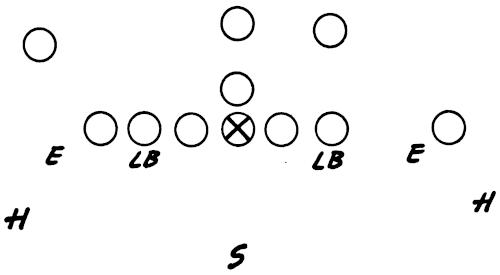
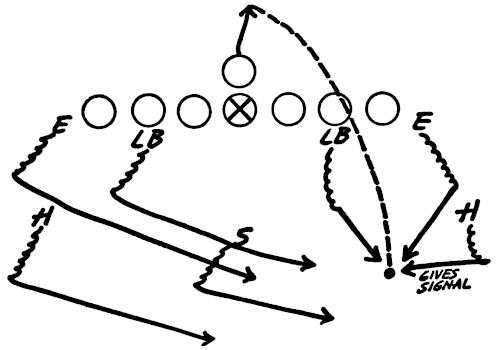
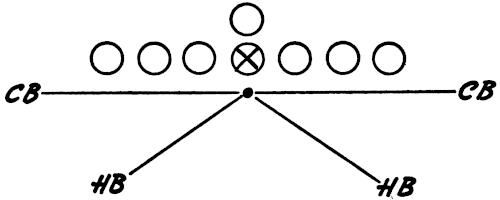
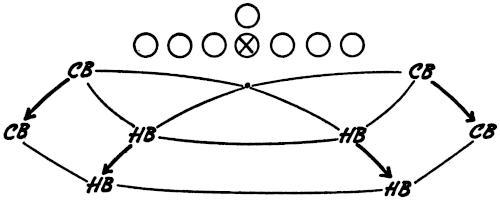
ALL RIGHTS RESERVED. NO PART OF THIS BOOK
MAY BE REPRODUCED IN ANY FORM, BY MIMEOGRAPH
OR ANY OTHER MEANS, WITHOUT PERMISSION
IN WRITING FROM THE PUBLISHER.
Library of Congress
Catalogue Card Number: 60-53173
Eighth Printing February, 1968
PRINTED IN THE UNITED STATES OF AMERICA
08605—BC
Dedication
To a few close associates who were genuinely dedicated to the
game of football. These men were not only great assets to the game;
they also exemplified the true American way of life. Had it not been
for men like these, many of us would have fallen by the wayside.
To them, I am forever grateful.
Robert A. Cowan
Fordyce, Arkansas
Herman Hickman
Yale University—Sports Illustrated
Frank W. Thomas
University of Alabama
Jim Tatum
University of North Carolina
W. A. Alexander
Georgia Tech
G. A. Huguelett
University of Kentucky
H. R. “Red” Sanders
U. C. L. A.
Herman L. Heep
Texas A & M
Charles Caldwell
Princeton University
Rex Enright
University of South Carolina
Acknowledgment
This book would not have been possible had
it not been for the untiring efforts of Eugene
Stallings, co-captain Texas A & M 1956, All
Conference SWC End, and assistant football
coach, University of Alabama. “Bebes” Stallings
exemplifies the true meaning of football,
both as a player and as a coach.
A Real Competitor
“Fight on, my men,” Sir Andrew says,
“A little I’me hurt, but yett not slaine;
“I’le but lye downe and bleede awhile,
“And then I’le rise and fight againe.”
“Sir Andrew Barton,” Part 2, St. 16
(PERCY’S RELIQUES, Series II, Book II)
If Sir Andrew were coaching football today, he would be accused
of teaching “hard-nosed football,” for his battlecry “I’ll
rise and fight again” is that of Paul “Bear” Bryant, author of
this book and self-acknowledged teacher of hard-nosed or all-out
football.
Paul Bryant is one of the ablest, most colorful, most controversial
mentors. Fans either love Bear Bryant or despise him—which
makes him excellent box office.
Competitive fires flame high in Coach Bryant. Legend has it
he once played an entire game with a broken leg, believable
when one considers the all-out effort he demands of himself and
his players. Deep down, he is a sentimentalist who leaves a
heavy imprint on his players. John David Crow, All-American
back and Heisman Trophy winner under Bryant at Texas A & M,
and now a National Football League star, says, “Coach Paul
Bryant is the greatest coach in America. He made a man out
of me.”
Paul Bryant is a builder. When he came to Texas A & M in
1954, Aggie fortunes were at a low ebb. In four years, Bryant’s
Aggies won 25, lost 14, tied 2, and nine of those losses were
in his first year.
As a sports writer and television commentator, this observer
has watched Southwest Conference football since 1915, the first
year a grid champion was crowned. The conference’s best job
of coaching was Bryant’s, beginning in 1954. His outstanding
player walked out of the Junction, Texas training camp, and
Bryant would not let him return. In their first game, the Aggies
lost to Texas Tech 9 to 41. The Aggies dropped all six conference
games, but only Baylor was able to achieve a two-touchdown
margin. In 1956, Bryant built an unbeaten team, with
“my Junction boys” the nucleus.
There was something almost mystical about Bryant’s story
of why he was leaving Texas A & M for his alma mater, the
University of Alabama: “As a small boy, I sometimes would
play until after dark, and then, from afar off, I’d hear my beloved
mother calling, ‘Paul, come home.’ I’d run as fast as my
legs would carry me.”
Some cynics sneer at Paul Bryant’s explanation. But the many
sportsmen who hold for him lasting respect and affection know
this warm-hearted man is telling the truth.
Building a CHAMPIONSHIP Football Team — CHAPTER 1 Why Football? — FOOTBALL IS MORE THAN A GAME — FOOTBALL IS THE GREAT AMERICAN NOVEL — FOOTBALL IS THE AMERICAN WAY OF LIFE — The Game’s Intrinsic Values — The Greatest Display of Courage
Have you ever wondered about football? Why it’s only a
game which is as fundamental as a ball and a helmet. But the
sport is a game of great importance. If you take all of the ingredients
that go into making up the game of football and put
them into a jar, shake well and pour out, you’ve got a well-proportioned
phase of the American way of life.
Football is the All-American and the scrub. It’s the Rose
Bowl with 102,000 cheering fans, and it’s the ragged kids in
a vacant lot using a dime-store ball. It’s a field in Colorado
ankle-deep in snow, and one in Florida sun-baked and shimmering.
Leaping cheerleaders, a brassy band, and the Dixie Darlings
are a part of the wonderful game of football. It’s a rich guy
being chauffeured to the stadium gate, and a frightened boy
shinnying the fence and darting for the end zone seats. It’s a
crowd which has gone crazy as it rips down the goal posts. And
it’s a nation stunned and wet-eyed at the news of Knute Rockne’s
death.
Football is drama, music, dignity, sorrow. It’s exhilaration
and shock. It is also humor and, at times, comedy. It’s a referee
sternly running the game. It’s an inebriated character staggering
onto the field and trying to get into the action.
Football is the memory of Red Grange, the Four Horsemen,
and the Seven Blocks of Granite. It’s a team’s traditional battle
cry, such as, “War Eagle,” in the middle of the summer. It’s
a crisp fall day, traffic jams, portable radios and hip flasks. It’s
train trips, plane flights and victory celebrations. It’s the losers
moaning, “You were lucky, just wait’ll next year!”
Names are football, such as Bronco, Dixie, Night Train, The
Horse, Hopalong, Bad News, The Toe, and Mr. Outside.
For four quarters, football is the Great American Novel, with
chapters from Frank Merriwell, the Bible, Horatio Alger, the
life of Lincoln and Jack the Giant-Killer.
Newspaper photos, arguments, Mr. Touchdown USA, yellowed
clippings, the Hall of Fame, The Star-Spangled Banner—they’re
all football.
It’s a game of young men with big shoulders and hard muscles.
It’s also a game of old pros, such as, 38-year-old Charlie Conerly
quarterbacking the New York Giants to a football championship.
Football is popcorn, cokes, banners and cigaret smoke. It’s
people standing for the kick-off, lap blankets, pacing coaches,
penalties and melodious alma maters.
Football is a game of surprises. The big guy everybody picks
in pre-season as All-American fizzles out. But a kid nobody ever
heard of scores the winning touchdown and a star is born. It’s
Tennessee going 17 games without being scored on. It’s also
tiny Chattanooga upsetting mighty Tennessee, making a coach’s
dream come true.
It’s the pro halfback who is a movie star. And the water boy
who got into a game at Yale. It’s Bronco Nagurski butting down
a sandbag abutment, and dwarfish Davey O’Brien disappearing
from sight behind an array of 250 pound linemen. It’s Harry
Gilmer jumping high to pass, and Coach Jim Owens proving
that nice guys finish first.
Football is Bud Wilkinson, whose Sooners are 40 points
ahead, walking up and down the sideline like a caged lion. It’s
35-year-old Paul Dietzel and 90-year-old Amos Alonzo Stagg.
It’s 6′8″ Gene “Big Daddy” Lipscomb and 5′6″ Eddie LeBaron.
Women who don’t know a quick kick from a winged-T cheer
every move on the field, waving pennants, purses and even mink
stoles. That’s football. So is the pressbox with its battery of
clattering typewriters. And the oldtimer who claims they played
a better game in his day is a part of football, too.
It’s Ray Berry, who wears contact lenses, making unbelievable
catches for the Baltimore Colts. And after the game, when he
dons his thick glasses, he looks the part of a studious school
teacher—which he is after football season terminates.
It’s a scramble for tickets, playing parlays, wide-eyed youngsters
getting autographs, a fist fight in the stands, second guessing,
banquets, icy rains, color guards, fumbles, goal line stands,
homecoming queens, and the typical mutt running onto the field
attracting everyone’s attention.
Football is Tommy Lewis jumping off the bench in the Cotton
Bowl game and tackling a touchdown-bound Rice runner
simply because, “I’ve got too much Alabama in me, I guess.”
It’s the quivering voice of a dying George Gipp telling his Notre
Dame teammates, “Win one for the Gipper.”
It’s New Year’s, Christmas and the Fourth of July rolled into
one. It’s VJ Day, the Declaration of Independence, Haley’s
comet and Bunker Hill. It’s tears and laughter, pathos and
exuberance.
Football is a game that separates the men from the boys, but
also it’s a game that makes kids of us all.
Most of all it’s a capsule of this great country itself.[1]
[1] The author extends sincerest thanks to Clettus Atkinson, Assistant
Sports Editor, Birmingham Post-Herald, for contributing his fine depiction
to the meaning of football.
Football, in its rightful place, can be one of the most wholesome,
exciting and valuable activities in which our youth can
possibly participate. It is the only sport I know of that teaches
boys to have complete control of themselves, to gain self-respect,
give forth a tremendous effort, and at the same time learn to
observe the rules of the game, regard the rights of others and
stay within bounds dictated by decency and sportsmanship.
Football in reality is very much the American way of life.
As in life, the players are faced with challenges and they have
an opportunity to match skills, strength, poise and determination
against each other. The participants learn to cooperate, associate,
depend upon, and work with other people. They have
a great opportunity to learn that if they are willing to work, strive
harder when tired, look people in the eye, and rise to the occasion
when opportunity presents itself, they can leave the game
with strong self-assurance, which is so vitally important in all
phases of life. At the same time they are developing these priceless
characteristics, they get to play and enjoy fellowship with
the finest grade and quality of present day American youth.
Not only is football a great and worthwhile sport because it
teaches fair play and discipline, but it also teaches the number
one way of American life—to win. We are living in an era where
all our sympathy and interest goes to the person who is the
winner. In order to stay abreast with the best, we must also win.
The most advantageous and serviceable lesson that we can
derive from football is the intrinsic value of winning. It is not
the mere winning of the game, but it is teaching the boys to win
the hectic battle over themselves that is important. Sure, winning
the game is important, and I would be the last to say that
it wasn’t, but helping the boy to develop his poise and confidence,
pride in himself and his undertakings, teaching him to give that
little extra effort are the real objectives of teaching winning
football.
If I had my choice of either winning the game or winning the
faith of a boy, I would choose the latter. There is no greater
reward for a coach than to see his players achieve their goals
in life and to know he had some small part in the success of the
boys’ endeavors.
Boys who participate in football, whether in high school or
college, are in their formative years. It is every coach’s responsibility
to see that each boy receives the necessary guidance and
attention he so rightly deserves. I would be deeply hurt and
embarrassed if I learned a boy wasn’t just a little better person
after having played under my guidance. If we, as coaches, lose
the true sense of the value of football and get to a point where
we cannot contribute to a boy progressing spiritually, mentally,
and physically, we will be doing this wonderful game of football
a great injustice by remaining in coaching.
The coaching profession is honorable and dignified and we
football coaches are in a position to contribute to the mental
development and desirable attitudes which will remain with the
boys throughout their lives. We have the opportunities to teach
intangible lessons to our players that will be priceless to them
in future years. We are in a position to teach these boys intrinsic
values that cannot be learned at home, church, school or any
place outside of the athletic field. Briefly, these intangible attributes
are as follows: (1) Discipline, sacrifice, work, fight,
and teamwork; (2) to learn how to take your “licks,” and yet
fight back; (3) to be so tired you think you are going to die, but
instead of quitting you somehow learn to fight a little harder;
(4) when your team is behind, you learn to “suck up your guts”
and do whatever it takes to catch up and win the game; and
(5) you learn to believe in yourself because you know how to
rise to the occasion, and you know you will do it! The last trait
is the most important one.
One personal reference will illustrate the intangible attributes
that football teaches. We have all seen or heard someone tell
about the greatest display of courage a team has ever shown.
When a team you coach has had such an experience, it makes
you exceedingly happy and proud of your position and the team.
While I have never been ashamed of any of my football clubs,
I will always have a soft spot in my heart for one of my teams
in particular. I think my 1955 Texas A & M team displayed the
greatest courage, rose to the occasion better, and did more of
what I call “sucking up their guts and doing what was required
of them” in a particular game than any other team with which
I’ve ever been associated.
We were playing Rice Institute in Houston on a hot, humid
afternoon. Our play was very sluggish and before we fully realized
it, the game was almost over, and we were behind 12-0.
We were leading the Conference race up to this point, but it
was beginning to look as if we were going to be humiliated
before 68,000 people. Having become disgusted with my starting
unit’s ineffective play, I withdrew the regulars from the game
early in the fourth quarter. With approximately four minutes
left to play, I decided to send the regulars back in. I told them
they still had time to win the game if it meant enough to them
to do so.
The first unit went on to the field and immediately called
time out. I later found out they vowed to each other they were
going to do whatever it took to win the game. We eventually
got possession of the football on our own 42-yard line, and the
clock showed 2:56 remaining to play. Again the boys called
time out, giving each man a few seconds to make up his mind
just exactly what he was going to do. On the first play from
scrimmage, Lloyd Taylor, a little halfback from Roswell, New
Mexico ran 58 yards around left end for a touchdown. He kicked
the extra point and the score was 12-7, with 2:08 remaining in
the game. We tried an on-side (short) kick, and Gene Stallings
recovered the ball on Rice’s 49-yard line. Our quarterback,
Jimmy Wright, then threw a 49-yard pass to Lloyd Taylor who
made a beautiful catch as he crossed the goal line. Taylor scored
his fourteenth point as he kicked his second point-after-touchdown
placement. With the score 14-12, we lined up and kicked
the ball deep to Rice. Forcing Rice to gamble since they were
behind, they attempted a deep pass which our great fullback,
Jack Pardee, intercepted and returned 40 yards to the 3-yard
line. On the next play Don Watson carried the ball across for
a touchdown, making the final score 20-12 in our favor.
After the game in our dressing room when everyone was congratulating
each other, and everything was in a state of confusion,
Lloyd Taylor suggested we thank the Master for giving us the
courage to make the great comeback. From that game on we
have always said a prayer of gratitude after the game, win, lose,
or draw.
The particular incident cited was the greatest display I have
ever seen of boys reaching back and getting that little extra,
showing their true colors, and rising to the occasion and putting
into practice the thing that we preach and believe in.
What do we get out of coaching? There is nothing in the world
I would swap for the associations with those boys, and the other
fine men I have coached, and the self satisfaction of knowing
I’ve helped many boys to find themselves. In my estimation,
football is truly a way of life.
CHAPTER 2 The Theory of Winning Football — HOW TO START BUILDING A WINNER — The Administration Must Believe in Your Plan — The Coach Must Have a Long Term Contract — The Coach Must Be Dedicated and Tough Mentally — You Must Have a Definite Plan — You Must Have a Good Staff — THE TYPE OF BOY = SUCCESS OR FAILURE — The Players Must Be Dedicated — Our Boys Must Have the Desire to Excel — You Must Beat Your Opponent Physically — Genuine All-Out Desire for Team Victory — Must Be a Leader and a Good Student — You Can’t See Into the Heart of a Boy — GOOD ORGANIZATION—A BIG FACTOR IN BUILDING WINNERS — Use the Ant Plan — CONCLUSION
Every football team has a slogan, and each coach has his own
theory as to what makes a winning team. We are no exception.
Our slogan is, “Winning is not everything, but it sure beats anything
that comes in second.” Our theory on how to develop a
winning team is very simple—WORK! If the coaches and players
will work hard, then winning will be the result.
We want to win. We play to win. We are going to encourage,
insist and demand that our players give a 100% effort in trying
to win. Otherwise we would be doing them a great injustice.
It is very important for the boys to have a complete understanding
of what they must do in order to win.
When a boy has completed his eligibility or has played four
years under our guidance, I like to believe he will graduate
knowing how to suck up his guts and rise to the occasion, and
do whatever is required of him to get his job done. If our boys
are willing to work hard, and we give them the proper leadership
and guidance, then they will graduate winners and our athletic
program will be a success.
Building a winning football team is something that cannot be
accomplished overnight, or even in a year or two, if the program
is starting from scratch. I believe, irrespective of the time element
involved, a football program has little chance of succeeding unless
the following “musts” are adhered to:
1. The coach must have a definite plan in which he believes,
and there must be no compromise on his part.
2. The football coach must have the complete cooperation
and support of the administrators and the administration, who
must believe in the head coach, his staff, and his plan.
3. The coach must have a long term contract.
4. The coach must not only be dedicated to football, but he
must be tough mentally.
5. The head coach must have the sole responsibility and
authority of selecting his staff of dedicated men, who must believe
in the head coach and his plan.
It is vitally important that a coach build a solid foundation
for his program. In order to do this he must have complete
cooperation from every member of the school’s administration.
In many cases the school officials will not have a complete and
thorough understanding of your athletic program. It is important
that you explain to them just what you are trying to accomplish,
how long it will take, and why you are doing it in your particular
manner. The administrators and the administration must understand
the value the program has for each boy who participates,
and the ways the program can benefit the entire school system.
Therefore, before a coach accepts a particular position he should
give considerable thought to the administration’s philosophy, attitude
or point-of-view toward the football program. If the
school president or principal is skeptical, consider the position
seriously before accepting it. Building a championship team is
difficult enough with full cooperation from everyone, but it is
an impossible coaching situation without the administration’s
full support and confidence.
If a college coach is going to build a team, it is an absolute
must that he have a long term contract. There is little use in believing
or thinking any other way. It is very possible, and highly
probable, it will take at least four or five years to shape a ball
club into winning form. Without the security of a long term
contract, a coach can be forced to concentrate on winning a
certain number of games each year, and it is possible this can
completely disrupt or disorganize a rebuilding program. I am
not saying that a coach should not try to win every game, because
he obviously should strive to win ’em all. I merely want to
point out the fact that without the security of a job for a period
of years, he might be forced to revert to certain practices which
he knows are not sound principles on which to build a winning
program. As an illustration, he might have to revert to such a
practice as playing individuals of questionable character because
of their immediate ability, rather than weeding them out and
concentrating on the solid citizens. The latter group will stay
with you and will eventually be winners, if you are given job
security and adequate time to work with them.
Unless a person is dedicated to his chosen trade or profession,
regardless of his field of endeavor, he is never going to be highly
successful. Building a winning football team is no exception. The
head coach, as well as his assistants, must be dedicated to football.
All of them must be tough mentally, too.
Many times a coach’s job is unpopular and unrewarding.
From time to time a coach must make decisions that are unpleasant.
He cannot compromise, however, if he expects to build
a winner. He must be tough mentally in order to survive.
In addition, a coach must be tough mentally in another sense.
He must be able to spend numerous hours studying football all
ways and always. A coach who hopes to be successful must drive
himself and be so dedicated to his job that he puts it ahead of
everything else in his life, with the exception of his religion and
his family. One can have a tremendous knowledge of the game,
but he cannot possibly make the grade unless he can stand up
to the long hours and the trying times. It is not an absolute
necessity for a coach to be exceptionally smart or a brilliant
strategist, but he must be a hard worker, mentally tough, and
dedicated to the game of football. One can only be honest with
himself in determining whether or not he has these qualifications.
As head football coach, you must give leadership and direction
to your program if you expect it to be successful. Therefore,
you must have a definite plan in which you and your assistants
believe. In order to build winners you cannot deviate from your
plan, and there cannot be any compromises.
Many factors go into the plan, such as organizing the program
and the type of boys whom you have on your squad, both
of which will have a great deal to do with your ultimate success
or failure. These and other phases of the plan will be discussed
in detail shortly, and in later chapters in this book.
In order to build winners, the head coach must surround
himself with a dedicated staff of hard working coaches. While
I have touched on this point briefly already, this particular must
will be discussed in greater detail in Chapter 3, “Making the
Most of Your Coaching Staff.”
The team with the best athletes will usually win the tough
ball games, other things being equal. It is a well recognized
fact that a coach is no better than his material. Therefore we must
have the best material available in order to be a winner. I tell
my coaches if they can recruit the best athletes to our school,
then I can coach them. If they recruit mediocre athletes, then
the assistants will have to coach them.
There are a number of qualifications that we look for in our
athletes, and some of these are musts if the boys are to become
champions. Football is nothing more than movement and contact.
If a player has excellent movement but won’t make contact,
he will never be a winner. Conversely, if a boy is mean, loves
body contact, and likes to hit people, but is so slow he never
gets to the ball carrier, then he will never make a winner either.
There are ways to improve an individual’s quickness, but if a
boy refuses to make contact, there is nothing that I know of to
correct it.
The type of boy you select to play on your football team has
a great deal to do with your ultimate success or failure. In order
for our program to be successful, we try to select the boy with
the following traits:
1. He must be dedicated to the game of football.
2. He must have the desire to excel and to win.
3. He must be tough mentally and physically.
4. He must be willing to make personal sacrifices.
5. He must put team glory first in place of personal glorification.
6. He must be a leader of men both on and off the field.
7. He should be a good student.
A player must be dedicated to the game to the extent he is
willing to work, sacrifice, cooperate and do what he possibly
can to aid the team in victory. It is our duty as coaches to explain
and show our boys the advantages of being winners, and
to impress upon them the absolute necessity of it so they will
put forth the much needed effort to accomplish the objective.
It is important for the players to understand that football is
not an easy game; nor is achieving fame an easy task. However,
anything worth doing, is worth doing right. Therefore let’s do
it right and be winners.
We refer to “the little extras” a boy must give in order to be
a winner. These little extras really make the difference between
good and great, whether it be on an individual or a team basis.
When a boy puts into practice what you have been preaching
about giving that extra effort when he is dog tired, going harder,
rising to the occasion and doing what is necessary to win, then
you are making progress and he is on the way to becoming a
winner both individually and for his team.
There is nothing else I would rather see than when our boys
are in their goal line defense, and they have supreme confidence
they will keep the opposition from scoring. Every boy is taking
it upon himself personally to do what is necessary to stop the
ball carrier from scoring. When a coach has a team thinking
like this, he will have a winner, and the boys will be winners
when they get out of school.
We talk about the importance of particular aspects of coaching,
such as full cooperation, long contracts, and other phases
connected with coaching, but in the final analysis the success or
failure of your program depends on the performance of the boys
on the playing field. The game is generally won by the boys
with the greatest desire. The difference in winning and losing
is a very slight margin in a tough ball game. The same applies
to two players of equal ability, except that one is great and the
other is average. What is this slight margin? It’s the second and
third effort, both individually and as a team. The boy who intercepts
a pass or blocks a punt, or who gets his block then
goes and knocks down another opponent is the individual who
wants to excel. He will make the “big play” when it counts the
most. He and others will give us “the winning edge.” These are
the deciding factors in a tough ball game.
The teams that win consistently are the ones in the best physical
condition. As a result they can play better football than
their opposition in the fourth quarter. We also believe and teach
our boys they must be more aggressive and “out-mean” our
opponents if they expect to win consistently.
We may not be as smart and as tricky as our opposition, so
we have to out-work ’em. If our boys are in top physical condition,
if we “out-mean” and physically whip our opponents by
hard blocking and tackling, and we are consistent in doing it,
we’ll win a lot of football games. Football is a contact sport,
and we must make the initial contact. In order to be a winner
a boy must whip his man individually, and the team must beat
the opponent physically.
Unity is the sound basis for any successful organization, and
a football team is no exception. Without team unity you cannot
have winners. We believe and coach team victory. Our goal is
to win every game we play. We go into every game believing
we will win it. Obviously we don’t win all of them, but we never
go into a game believing we cannot come out of it the winner.
In order to have a winner, the team must have a feeling of
unity; every player must put the team first ahead of personal
glory. The boy who plays for us must be willing to make sacrifices.
Victory means team glory for everyone. Individual personal
glory means little if the team loses.
In order to have winners your boys must be leaders both on
and off the field. They should be good students, too. As was
indicated previously, if your contract will give you sufficient
time to work with the “solid citizens,” they will stay with you
even if the going gets tough, and eventually they will be winners.
Most coaches take pride in their ability to pick out boys with
athletic ability. I am no exception. However, you can never be
absolutely certain about a boy because you cannot see what is
inside of his heart. If we could do this, we would never make
a mistake on a football player. We have seen it occur frequently
where a player was pitiful in his freshman year, and the coaches
almost give up on his ever improving. However, through determination,
hard work, pride and desire the boy would finally
develop and would play a lot of football before he graduated.
My assistant coaches have a favorite story they like to tell
about a player we had at the University of Kentucky. We had
started our first practice session in the fall of 1948 when a
youngster walked out on the field. His appearance literally
stopped practice. He had on a zoot suit with the trouser legs
pegged so tightly I am certain he had difficulty squeezing his
bare feet through the narrow openings. His suspenders drew up
his trousers about six inches above his normal waist line. His
long zoot coat extended almost to his knees. His “duck tail”
hair style looked quite unusual. He was standing in a semi-slump,
and twirling a long chain around his finger when one of
my assistants walked over and asked him if he wanted someone.
His answer, “Yeah. Where’s the Bear?”
He found me in a hurry. Our first impression was that he
would never be a football player, but he was issued a uniform
anyway. I figured he wouldn’t have the heart for our type of
football and would eliminate himself quickly from the squad.
To help him make up his mind in a hurry I instructed one of
the coaches assisting me to see that he got plenty of extra work
after practice. The boy’s name was difficult to pronounce, so
we started calling him “Smitty.”
Despite “Smitty’s” outward appearance, he had the heart of
a competitor and the desire to show everyone he was a good
football player. He worked hard and proved his point. In his
senior year he was selected the outstanding player in the 1951
Sugar Bowl game when we defeated the University of Oklahoma.
After graduation he played for several years with the New York
Giants as a fine defensive end. I shall always have the greatest
respect for him.
Other coaches probably have had similar experiences where
a boy with questionable ability has made good. If a boy has
a great desire to play football, regardless of his ability, and you
work with him, he is likely to make tremendous progress toward
fulfilling his objective.
Without good organization our thoughts or plans of any kind
would be absolutely useless. Good organization is a must if a
team is to operate at maximum efficiency. There are many plans
of organization that are good, and I am not saying mine is the
best, but I believe my plan is sound and this is what really
counts.
It always has been my practice to observe people who are
successful in a particular field, and try to determine what makes
their operation successful. There is little originality remaining
in the field of coaching. Consequently we have gotten many
of our ideas from other people. As Frank Howard of Clemson
College put it, “If we get something from one team, it’s called
stealing; but if we get ideas from several different teams, it’s
called research.”
I borrowed my plan of organization from some ants in Africa.
I realize this sounds ridiculous and far fetched; nevertheless,
it’s the truth. It is interesting how it all came about.
While I was in the Navy in Africa, one hot, humid afternoon
I was sitting under a tree feeling sorry for myself. I started to
watch some ants building an ant hill. At first I was amused,
but as I watched I became very interested. What at first appeared
to be confusion was actually a carefully organized plan as the
ants all worked toward their objective of building a home. The
longer I watched the more obvious it became that all of the
ants were working, many in small groups here and there. There
was no inactivity, no wasted motion. There was unity and there
was a plan. It appeared the ants had planned their work and
they worked their plan.
With the ant plan in mind, we try to organize our practice
sessions so that we have everyone working and no one standing
around idle. We work in small groups and this eliminates inactivity.
As a result we feel that we can get more work done in a
shorter period of time. Consequently we believe the less time
a player spends on the practice field, the higher will be his
morale.
I did not have to watch the ants to learn the value of teamwork
and cooperation, although this was evident in their activity.
The main lesson I learned from them was the value of small
group work in order to keep everyone busy.
There are many other factors that must be taken into consideration
when organizing the program, and I shall discuss the
subject more fully in Chapters 3 and 10. Planning and organization
are the backbone of a successful team. Planning a practice
so that you get maximum results from the players and the assistant
coaches requires a great deal of time. The importance of
this cannot be emphasized too greatly.
Winning theories vary from coach to coach, but our philosophy
toward building a winner consists of the following factors:
(1) a hard working staff that is dedicated to football; (2)
players with a genuine desire to excel, to “out-mean” the opponent,
and be in top physical condition; (3) a strong organization
and a sound plan; (4) mental toughness in both staff and
players; and (5) the full confidence of the school administration.
In addition, you must teach sound football. Your boys and your
staff must have confidence in your type of football. I shall discuss
our methods fully in later chapters.
CHAPTER 3 Making the Most of the Coaching Staff — ASSISTANT COACH: TYPE OF MAN — A Dedicated Person, Hard Worker, Loyal — Initiative and Ambition — Honesty and Integrity — A Sound Thinker With a Good Understanding of the Game — DIVISION OF COACHING DUTIES — Assistant Coaches Direct Group Work — The Coaching Specialist — Delegating Responsibility — A Good Coach Is a Good Teacher — CONCLUSION
I am a firm believer in the old saying, “A head coach is no
stronger than his assistant coaches.” In order for any head coach
to have a good program he must surround himself with a staff
of good assistant coaches. This does not mean that every coach
must have six or eight assistants. In some cases the head coach
may not have more than two or three assistants. The principles
are the same, however, regardless of the number of assistant
coaches. I have been fortunate in having an excellent group of
assistants every place I have coached, and I want to give credit
to them for any measure of coaching success I may have had
in the past.
There are many characteristics I am seeking in an assistant
coach. I shall not attempt to list them in the order of importance
because I think they all belong at the top of the list. Briefly, the
desirable traits and characteristics I am seeking in an assistant
are as follows:
1. He should be dedicated to the game of football.
2. He should be willing to work hard and to make personal sacrifices.
3. He should be an honest person.
4. He should have a sound knowledge of football.
5. He should have a great deal of initiative.
6. He should be a sound thinker.
7. He should be tough mentally.
The first trait, “Be dedicated to the game of football,” is a
must for all coaches, assistants as well as head coaches. Don’t
ever try to fool yourself or anyone else. If you are not truly
dedicated to your work, and you dread spending many hours
every day working and planning on building a good football
team, then you are in the wrong business. I’ll guarantee there
is no easy way to develop a winning team. If it were an easy
task, all of us would be undefeated and “Coach of the Year.”
Unfortunately one team generally wins and the other loses, and
if it is the latter it doesn’t make a coach’s job any easier. If you
will look at the consistent winners, you will find behind them
a group of coaches who are dedicated 100% to their work.
Regardless of whether it’s the college or high school level of
competition, there are coaches and teams that win year after
year. The real reason for this success, other than good material,
is the coaches of these particular teams are dedicated to the
extent that they “want” to do what is necessary to win. There is a
big difference between “wanting to” and “willing to” do something
to be a winner. Frankly, I don’t like the word “willing”
in connection with an assistant coach. First, if the coaches are
not willing, they should not be coaching. Coaching is not an
8 A.M. to 5 P.M. job. The assistant who is “willing” to work a little
extra is not the one I want on my staff. The assistant who
“wants” to do what is necessary in order to get the team ready
to play, regardless of the time element involved, is the man
whom I want to assist me.
A head coach cannot expect his assistants to be dedicated
to their work, unless he leads by example. The head coach
must work harder, longer, and be more dedicated to his work
than any of his assistants, if he expects to have a good, hard-working
staff and winners.
Another qualification I consider a must for all assistant
coaches is their 100% loyalty to the head coach’s plan. It is
very important for a coach and his staff to know they have
mutual trust and loyalty to each other. These characteristics
are obvious, and an assistant coach who does not possess them
commits professional suicide.
An assistant coach should have a great deal of initiative and
ambition. I prefer to have my assistants study the game all ways
and always. They should constantly try to improve themselves.
There is no corner on the brain market and a person advances
in his field through hard work and his own initiative.
It is a must that all coaches be good “mixers.” They must be
able to get along with each other, the head coach, the players,
and the people in the community. On the college level a coach
must know how to recruit, and most of the time the successful
recruiter is a good mixer. He must sell your product—the school,
the team, the coaching staff, etc.—to athletes and their parents,
and his job will be easier if he has this type of personality.
It is an absolute must that all coaches be honest with themselves,
the people for whom they work, and the others with
whom they come in contact. If I cannot trust a person, I do not
want him around. Along this same line, we like our coaches
to be active in their church work. We emphasize to our players
the value of attending church, and we like our coaches to set
a good example for everyone.
In order for a coach to be competent, he must be a sound
thinker and possess a good knowledge of the game of football.
I have mentioned this previously. I expect my assistants to
study, plan, discuss and try to come up with ideas that might
aid us in winning a football game. We are going to toss around
all ideas in our staff meetings before we adopt any of them,
but your brand of football can become stale and unprogressive
if the coaches do not study the game.
Morale on a squad is very important. The morale of a coaching
staff is very important, too. I feel the latter group will influence
the former group, consequently I am vitally concerned
about my assistants having good morale. With this thought in
mind, I try to delegate duties and responsibilities so the assistants
enjoy their work. Each man is really a specialist, or he can do
some phase a little better than another coach. Therefore it’s
just common sense to permit him to work at the specialty
in which he is going to excel. He will not only have more enthusiasm
for his work, but his enthusiasm will be reflected in
the players’ work. There is no substitute for enthusiasm. Under
such conditions the players learn more quickly and the coaches
are able to do a better job of coaching.
I do not think it advisable for a head coach to do group work
with one of his assistants. If an assistant is directing a group and
the head man comes over to help out, he takes the lead away
from the assistant. As a result the assistant coach is likely to
lose his initiative—the very trait you want him to develop.
Secondly, the players are likely to give the head coach all of their
attention, and this isn’t fair to the assistant working with the
same group of boys. Thirdly, I do not think it is desirable to
suggest changes, make corrections or reprimand an assistant
on the field. I feel the proper time to get the matter straightened
out is after practice, and not while the players are around. I
always try to avoid situations which are not conducive to good
team and staff morale because you’ve got to have good morale
in order to build a winner.
I think it is important for my assistants to specialize in either
offensive or defensive football. I feel they can do a better job
of coaching if they devote most of their time and effort toward
one aspect or the other. We still want them to be cognizant of
the opposite phase, however, as the defensive coaches must
understand offensive football, and vice versa for the offensive
coaches. In fact, from time to time I will put an offensive coach
with the defense so he can learn more about this particular phase
of the game. I believe it would be advisable for a high school
coach, with possibly only a staff of two, to follow the same plan—one
offensive coach and the other on defense.
Immediately after practice every day during the season I meet
with my staff. I have little patience with the assistant who wants
to hurry away from practice immediately. I want my staff members
to meet in the staff room so we can discuss all phases of
the day’s practice schedule while it is still fresh in our minds.
Evaluation of personnel goes on all the time. Therefore, I want
my assistants to list on the blackboard the work schedule for the
next day for their particular group of boys. In addition I want
their suggestions and comments as to the type of teamwork
needed. Now I am in a better position to do a more intelligent
job of setting up the practice schedule for the next day since I
have been made aware of our individual and team needs,
strengths and weaknesses. We have found this procedure very
helpful, and I encourage my assistants to express themselves.
I shall explain our procedures more fully in Chapter 10.
The head coach must delegate responsibility to his assistants
in order to have a more effective plan of operation. The head
coach must let each assistant know what he expects from him.
An explanation of duties and responsibilities in the beginning is
likely to eliminate misunderstanding later on. Secondly, a person
with some responsibility is likely to do a better job than the
individual who doesn’t have any. I have found it gives the assistant
more confidence in himself and more pride in his work
if he has been given a certain amount of responsibility.
As I mentioned previously in Chapter 2, in order to get the
most from your staff, they must be completely sold on your
plan for building a winner. Of course, the head coach must believe
in his own plan 100%, along with the assistants, and he
cannot make any compromises if he expects to be successful.
We stress the point frequently that coaching is teaching of
the highest degree, and a good coach is a good teacher. It is not
what you and your assistants know about football that is going
to win the games, but rather what you are able to teach your
players. In order to give our coaches an opportunity to improve
their coaching techniques, we have them get up at staff meetings
and explain and demonstrate various points. The other coaches
will pretend they do not understand the coach who has the floor,
and he must explain and answer the questions to our satisfaction.
We have found this method gives the coaches a lot of confidence
and they do a better job of coaching on the field.
In order for the head coach to get the maximum from his
assistants, he must set a good example. Since others will follow
a leader who actually leads, rather than one who merely tells
what to do, I believe a head coach must work longer, harder,
and stay a jump ahead of his assistants and the other coaches in
the profession. He must be dedicated to the game of football,
well organized, sound in his thinking, and have the ability to
delegate authority and responsibility to his assistants if he expects
to build a successful program.
CHAPTER 4 Defense: Our Kind of Football — DEFENSIVE OBJECTIVES — The Offensive-Minded Defense — Sell Them On Defensive Football — Defense Is a Personal Challenge — DEFENSIVE AXIOMS — Defense—A Team Proposition — Gang Tackling—A Defensive Must — OUR DEFENSIVE NUMBERING SYSTEM AND TERMINOLOGY — Advantages of a Defensive Numbering System — PLAYING OUR DEFENSIVE TECHNIQUES — The 0 Technique — The 1 Technique — The 2 Technique — The 3 Technique — The 4 Technique — The 5 Technique — The 6 Technique — The 7 Technique — The 8 Technique — The 9 Technique — OUR DEFENSIVE STANCE — OUR SURPRISE DEFENSE — OUR VICTORY DEFENSE — OUR GOAL LINE DEFENSE — A SPLIT-T DEFENSE — OUR DEFENSE VERSUS AN UNBALANCED LINE — ADJUSTMENTS VERSUS BACKS AND ENDS FLANKED — OUR DEFENSES VERSUS THE SINGLE WING OFFENSE — CONCLUSION
We believe defense is one of the most important phases of
football. As a matter of fact, we work on defense more than we
do on offense. We feel if we do not permit the opposition to
score, we will not lose the football game. While in reality most
teams actually score on us, we still try to sell our players on
the idea that if the opposition does not score we will not lose.
If you expect to have a good defensive team, you must sell
your players on the importance of defensive football. Our players
are enthusiastic about defensive football. I believe we do a good
job of teaching defensive football because the staff and players
are sold on what we are trying to do. Defense is our kind of
football.
The primary objective of defensive football is to keep the
opposition from scoring. We want our players to feel their ultimate
objective is to keep the opposition from crossing our goal
line.
A more functional facet of the primary object is to keep the
opposition from scoring the “easy” touchdown, which is the
cheap one, the long pass or the long run for six points. While a
singular long run or a long completed pass may not actually
defeat us, it is very likely if either play breaks for the “easy”
touchdown we will be defeated.
Secondly, our kicking game must be sound, which I shall
discuss fully in Chapter 6. We must be able to kick the ball safely
out of dangerous territory. Providing we do this, and eliminate
the “easy” touchdown, we believe our opposition’s own offense
will stop itself 65% of the time through a broken signal, a penalty,
or some other offensive mistake. Therefore, if my boys are
aggressive while on defense, we’ll probably keep our opposition
from scoring about 25% of the time they have the ball. The remaining
10% will be a dog fight. Therefore, we must instill in
our defensive men a fierce competitive pride that each player
is personally responsible for keeping the opposition from scoring.
Our next objective is to sell the players on the idea our defensive
unit can and will score for us. There are more ways to
score while on defense than on offense; consequently, the odds
favor the defense. If statistics are kept on the defensive team’s
performance, and the defensive team is given credit for all scores
made by running back a punt, recovering a fumble or any other
defensive maneuver where they either score or get the ball for
their offense inside of the opposition’s 25-yard line, which results
in a score, the players can be sold on the idea of the offensive-minded
defense.
Previously I mentioned the importance of good morale in
building a winner. In order to sell a boy on defense you must
create good morale. Therefore, we sell our boys on the idea that
playing defense is the toughest assignment in football. We try
to see that our defensive players get most of the recognition and
favorable publicity. If our defense makes a goal line stand, and
we win the game, we try to give most of the credit to our defensive
players.
We want to make our defensive players believe that when the
opposing team has the ball inside our 3-yard line they aren’t
going to score—they can’t score—they must not score! If a
team believes this, it’s almost impossible for the offense to score.
In 1950 our defensive unit prevented opposing teams from scoring
on 19 occasions from the 3-yard line. The morale of the
defensive players was outstanding. They thought it was impossible
for another team to score on them even though they had
only three yards to defend. I recall in our game with Oklahoma
University in the Sugar Bowl, the Sooners got down to our
3-yard line. We were caught with three or four of our best
players on the bench, and I was trying to get them back into
the game quickly. As Jim McKenzie, who had been replaced,
came off the field, he said, “Don’t worry, Coach, they will never
score on us.” And they did not score! When I see such evidence
as this, I know our players believe what we tell them, and “we
are in business!”
I do not believe you can teach defensive football successfully
unless you are able to present a clear picture to your players of
what you are trying to accomplish. Our objective is to limit the
offense to as small an area as possible. By limiting their attack,
we can hem them in and catch them. We attempt to build a
fence around the ball, and around the offensive operation. I
want my players to have a good picture of exactly how we are
going to build this fence, and what we hope to accomplish,
both of which will be explained later.
Defense is a phase of football I have always considered very
interesting because every play is a personal challenge. When
a team is on defense, the players are challenging the offensive
players in relating to an area of ground or field. Every man on
defense should believe, “I am not going to let the offense score.”
If you expect to be a winner, either as a player or a coach, you
must believe in this philosophy 100%. Your play must be sound,
and you must believe in it.
Offensive football is assignment football, while defense is
reaction football. One mistake on defense can cost a team a
football game. Consequently there cannot be errors on defense.
By being sound, and in order to eliminate errors, I mean you
must always have the strength of your defense against the
strength of the offense. The defensive players must be positioned
in such a way that the team as a whole can handle any situation
that might arise.
There are numerous defensive alignments, just as there are
different points-of-view or theories toward how defense should
be played. Regardless of the differences and a coach’s particular
plan, the following “musts” are considered basic axioms if a defense
is to be sound:
1. The defense must not allow the opponent to complete a
long pass for an “easy” touchdown.
2. The defense must not allow the opponent to make a long
run for an “easy” touchdown.
3. The defense must not allow the opposition to score by
running from within your 5-yard line.
4. The defense must not allow the opposition to return a
kick-off for a touchdown.
5. The defense must not allow the opposition to average more
than 20 yards per kick-off return.
6. The defense must intercept two passes out of every 13
passes attempted.
7. The defense must average 20 yards per return on each interception.
8. The defense must return three interceptions for touchdowns
per season.
9. The defense must force the opposition to fumble the ball
on an average of three and one-half times per game.
10. The defense must recover an average of two and one-half
fumbles per game.
These 10 basic axioms are extremely important, and must be
applied if a team is to be sound defensively.
A good sound defense is one that has every player on defense
carrying out his assignment. Then it is impossible for the offense
to score. Note that I said every player, which makes defense a
team proposition and eliminates the individual defensive play.
By this I mean every defense is coordinated and a player just
doesn’t do what he wants to do. I do not mean suppressing an
individual’s initiative or desire to excel while on defense, as long
as the entire defense is a coordinated unit. We try to instill in
every boy that he is personally responsible to see that our
opposition does not score. When individual players and a team
accept this responsibility, I feel we are making progress and beginning
to build a winner.
During all phases of our defensive work we elaborate frequently
on the importance of gang tackling. We like to see
six or seven of our boys in on every tackle. Such tactics are not
only demoralizing to ball carriers and wear them down physically,
but represent sound football. It is difficult for the ball
carrier to break loose and score when half a dozen men are
fighting to get a piece of him.
We want the first tackler to get a good shot at the ball carrier,
making certain he does not miss him. We want the other defenders
to “tackle the ball,” and make the ball carrier fumble
it so we can get possession of the football. We are trying to get
possession of the football any way we can. Frankly we want the
first man to the ball carrier merely to hold him up, and not let
him get away, so we can unload on him. You can punish a ball
carrier when one man has him “dangling,” and the others gang
tackle him hard. I am not implying we want our boys to pile
on and play dirty football merely to get a ball carrier out of
the game. First, we do not teach this type of football as it is a
violation of the rules and spirit of the game. Second, piling on
brings a 15-yard penalty. We cannot win when we get penalized
in clutch situations.
After coaching for a number of years, and always trying to
find something that would make football easier to understand
for the average player, I came upon a system of defensive numbering
that has proven very valuable to me since then. In the
past I have used many different defenses. I always employed the
technique of giving each defense a name. Most of the time the
name had little in common with the defense, and this confused,
rather than helped, the players. After discussing the possibility
of the numbering system with my own and other college and
high school coaches, while at Texas A & M in 1956 I finally
come across a feasible plan for numbering defensive alignments.
I must give credit to O. A. “Bum” Phillips, a Texas high school
coach, for helping work out the solution as he experimented
with the numbering system with his high school football team.
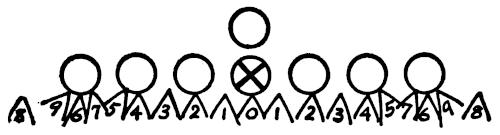
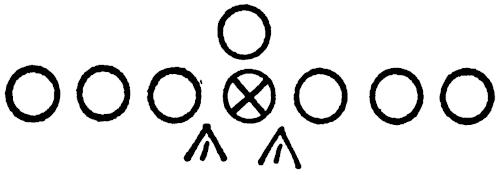
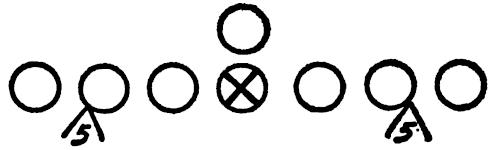
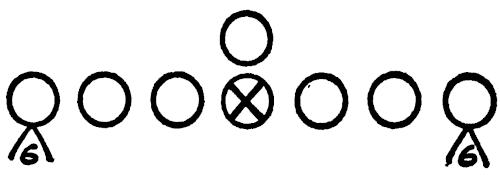
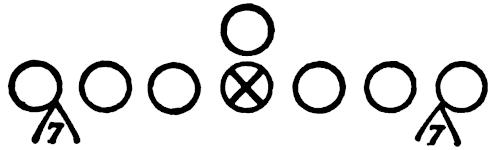
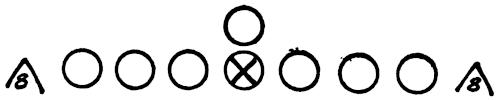
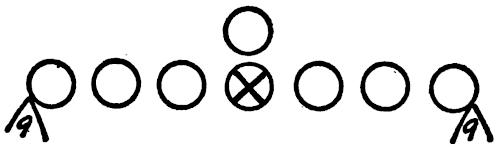
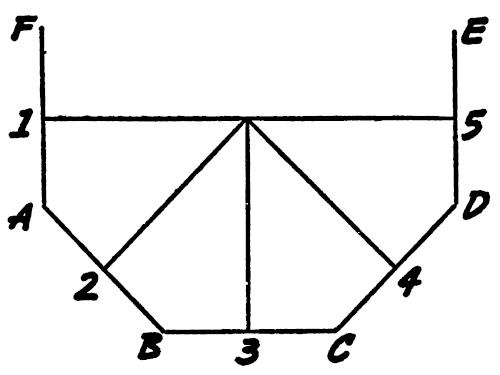
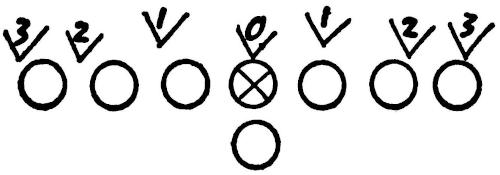
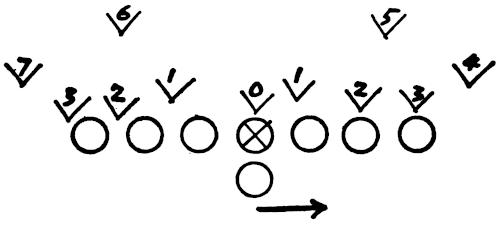
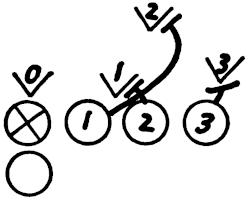
In the numbering of our defense now, we give each offensive
man a number, as well as the gaps between the offensive linemen.
Figure 1 is an example of our defensive numbering system.
Figure 1
Accompanying each number is a particular “technique,”
which will be explained shortly. If a defensive player lines up
in a 2 position, he will play what we call a “2 technique”; a 3
position plays a “3 technique,” etc. Therefore, from end to end
of the offensive line we can line-up our defensive men and each
position has a particular technique.
Who calls the defense? How is it called and what does it
mean? Who is included in the call? Each linebacker calls the
defense for his particular side of the line. He controls his guard,
tackle and himself, but he does not control the end on his side
of the line. The latter is controlled by the defensive signal caller
in the secondary who gives a call for the 4- or 5-spoke defensive
alignment.
Each linebacker calls two numbers. The first number tells
his guard where to line up and his accompanying defensive
technique. The second number gives the same information to
the defensive tackle.
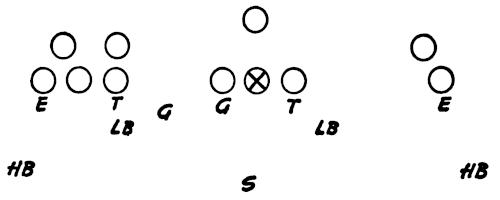
As an example, if the linebacker calls, “26,” the guard will
play a 2 technique and the tackle a 6 technique. If the caller
said, “59,” the guard would play a 5 technique and the tackle
a 9 technique. When the linebacker tells the guard and tackle
which techniques to play through his oral call, then he lines up
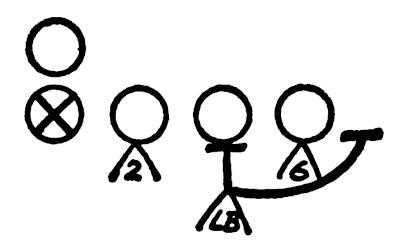
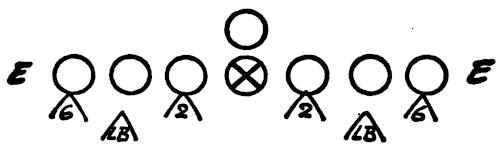
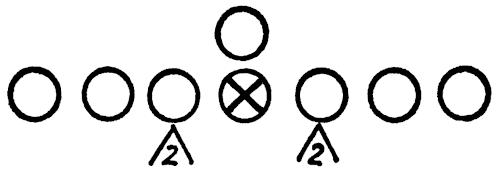
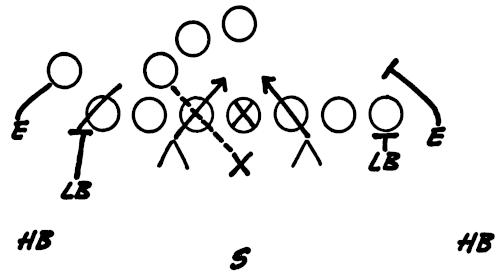
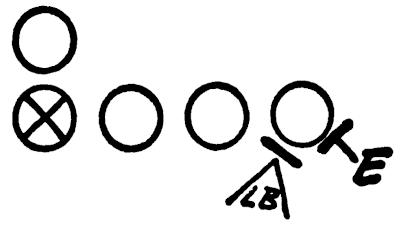
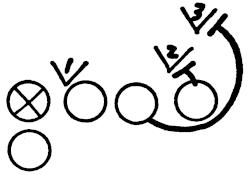
in a position to cover the remaining gaps. As an example, Figure
2 illustrates a 26 call, and the linebacker must take a position
between his guard and tackle so he can fill the gap(s) not covered
by the other front defenders. You can see by this example
the linebacker is in a position to help out over the offensive
tackle position, and also on a wide play to his side of the line.
Figure 2
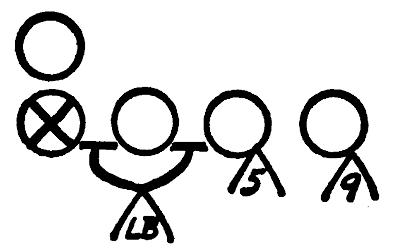
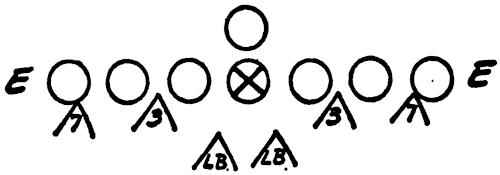
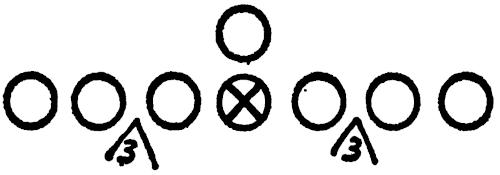
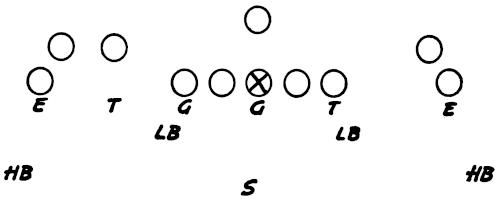
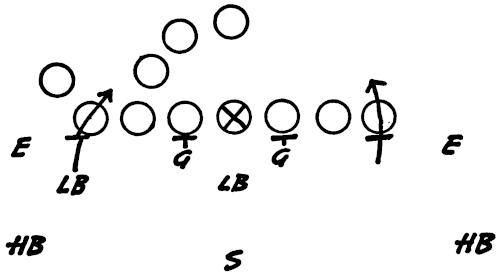
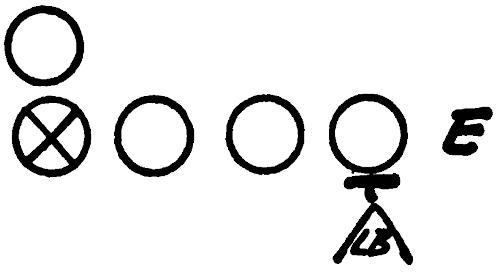
Figure 3 illustrates the position of the defensive right guard,
tackle and linebacker when the call is 59. The linebacker is now
in a position to help out on a play that is in the middle of the
line.
Figure 3
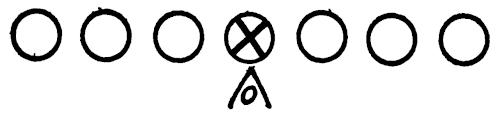
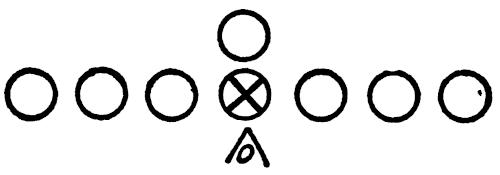
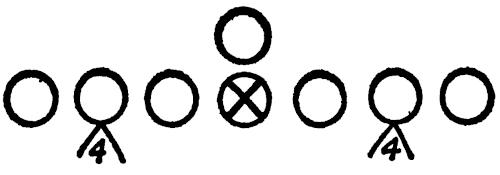
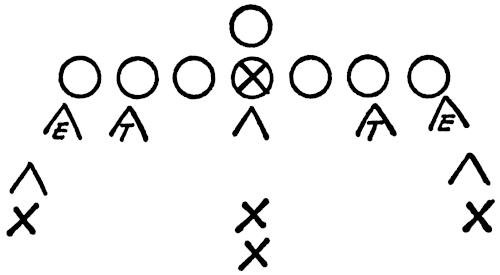
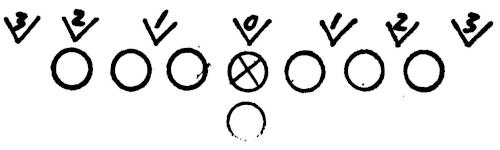
One point I failed to mention, if we are playing a 4-spoke
defense, which will be explained and illustrated shortly, we
assign one defender to play “head on” the offensive center, and
he does not figure in any of the calls. He lines up the same every
time, as is illustrated in Figure 4.
Figure 4
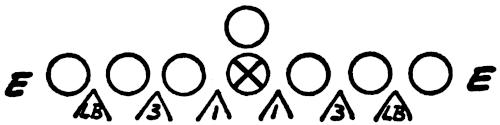
When we play a 5-spoke defense, which will also be explained
shortly, the two linebackers assign one player to the area inside
the offensive guards. As an example, if we are playing a 5-spoke
defense and the call on the right side is 59, the call on the left
side must be a one as the first digit, such as, 17, 16, 15. Figure
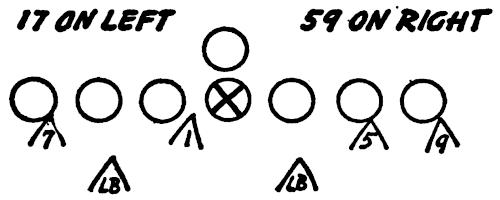
5 illustrates a 59 call on the right, and a 17 call on the left, with
one man playing a 1 technique in order to keep from having a
large gap between the two guards.
Figure 5
You can quickly observe that by having our players learn
only a few numbers and their accompanying techniques, we can
line up in numerous defensive alignments merely by calling two
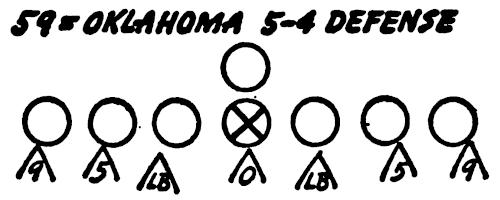
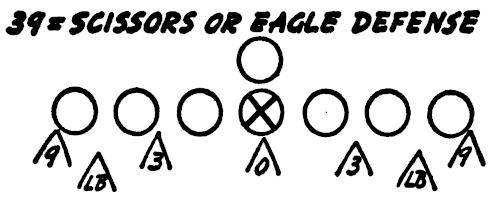
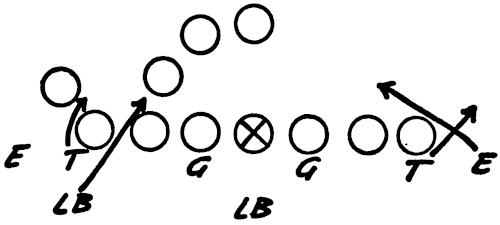
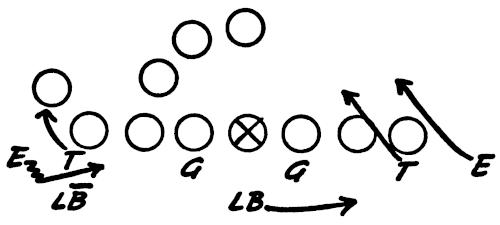
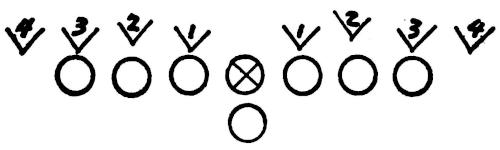
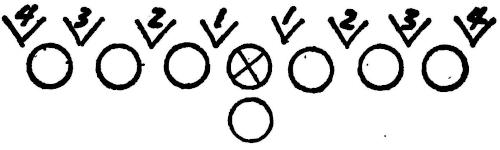
numbers. Figures 6 and 7 are examples of 59 and 39 defensive
calls, which are 4-spoke defenses with a man in a 0 technique,
and are commonly referred to as the Oklahoma and Eagle defenses,
respectively.
Figure 6
Figure 7
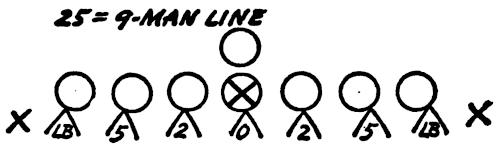
Figure 8 illustrates a 25 call, with a 0 technique, and is a
9-man front defensive alignment.
Figure 8
Figures 9-11 are 5-spoke defenses representing 26, 37, and
13 calls, which are commonly referred to as a wide tackle 6, a
split 6, and a gap 8 alignment, respectively.
Figure 9
Figure 10
Figure 11
These defenses, Figures 6-11, have the same call to each side.
Each side is actually independent of the other as far as the calls
are concerned. To eliminate any confusion, merely designate
which side (left) is to call first, and the other linebacker (right)
can adjust on his call accordingly so there is not a large gap in
the middle of the defensive line. The linebackers must be especially
aware of this if we are employing a 5-spoke defensive
alignment.
The signal caller should never call a defense involving two
successive numbers, such as 2-3, 7-6, as this will leave too much
territory for him to try to cover (see Figure 1). The caller is
always responsible for having a man in, or capable of covering,
every gap.
It is very simple for the defensive signal caller to change the
guard and tackle assignments even after he has given them a
position to line up in and its accompanying technique. The
caller merely adds a zero (0) or a one (1) to the end of the
number he has called. As an example, if he gives the call 37
and he wants the players in the 3 technique to charge one-half
a man toward the inside, he will say, “30.” If he wants this defender
to charge one-half a man to the outside, he would say,
“31.” This second call is given to only one player at a time, but
he can change both of their techniques by saying, “31—71,”
or “30—70,” etc.
Our present method is the simplest one I know of for getting
players into various defenses quickly with a minimum amount
of talking. We feel it eliminates much confusion. We have found
the players take a great deal of pride in learning only a few
techniques, which they are able to execute well. We know it
makes our job easier as coaches, and we can do a better job
of coaching the boys. As a coaching point, when a coach talks
to a tackle, as an example, he talks in terms of a particular technique
(6, 7, etc.), and the player understands him immediately.
When the coaches are discussing plays, or in a staff meeting, we
identify the particular technique immediately, and everyone
understands each other. We have also found the method useful
when making out the practice schedule as I merely specify,
“Tackle coach work on 6 technique,” etc.
Employing a defensive numbering system requires the defensive
signal callers to be alert. They do not merely call several
numbers. They must be aware of the tactical situation at all
times, and call a sound defense according to a tactical and strategical
planning. As an illustration, a good short yardage call
would be 13, and sound passing situation calls would be 36,
37, 39, 59 (see Figures 1, 3,
6, 7, 10,
11). I spend at least
several minutes every day with my defensive signal callers. It is
the linebackers’ responsibility to see that we line up in a sound
alignment every time.
As illustrated in Figure 1, and mentioned earlier, our techniques
and defensive positions are numbered from 0-9 on both
sides of the defensive line, numbering from inside-out (with certain
exceptions noted, Figure 1). I now wish to explain in detail
each particular technique, although there is only a slight difference
between several of them. As an example, when playing the
2 technique, a defender lines up head on the offensive guard,
and when playing a 4 technique he is head up on the offensive
tackle. Consequently these techniques are similar.
As illustrated in Figure 12, the defender lines up head on the
offensive center. Depending upon the situation, the distance he
lines up off the football will vary. On a short yardage situation,
he will line up close to the center’s head. On a long yardage
situation, normally he will be about one yard off the ball. He will
use either a three- or a four-point stance, with one foot staggered.
His technique is to play the center’s head with a quick hand
shiver on the snap of the ball. When he makes contact with the
center, he brings his back foot up so his feet are even with each
other. If the quarterback goes straight back to pass, the 0 technique
man is responsible for the draw play, and then he rushes
the passer. If it is a run instead of a pass play, he will keep the
center away from his blocking surface, not permitting himself
to be tied up in the middle of the line, and he will pursue the
ball taking his proper angle depending on the type of running
play.
Figure 12
The main job of the player(s) employing the 1 technique is
to control the offensive splits, forcing the guards to keep their
splits to a minimum, as illustrated in Figure 13. He is also responsible
for keeping the center off of the defensive linebacker.
If both guards are playing in this technique, as illustrated in
Figure 13, only one will “slam” the center, and the other will
take a long step toward his guard, playing him from inside-out.
He must always be aware of the trap coming from the inside,
however. If the play is a back-up pass, he is responsible for the
draw first, and rushing the passer second. If it is a running play,
he will slam the center or guard and then pursue the football.
Figure 13
The 2 technique is similar to the 0 technique, and is illustrated
in Figure 14. One difference is the guard is head on the offensive
guard, instead of on the offensive center. The distance he lines
up off the ball in a staggered stance will be determined by the
tactical situation. On the snap of the ball he plays the guard
with a hand shiver, and immediately locates the football. If it
is a back-up pass and there is no man in a 0 or 1 technique, he
will look for the draw play first, and then rush the passer. If it
is a running play, he will look first toward the inside for a trap,
and then pursue the football.
Figure 14
The 3 technique is similar to the 1 technique, and is illustrated
in Figure 15. The 3 man is responsible for keeping the
offensive tackle’s split cut down, and on occasion to keep the
offensive guard or tackle from blocking the defensive linebacker.
He, too, lines up with the feet slightly staggered, and about one
foot off the ball. Depending upon the defense, when the ball is
snapped, he will play either the guard or tackle with a quick
flipper or shiver, preferably with the hands. He is to watch for
the trap at all times. If the play is a straight drop back pass, he
will rush the passer from the inside. If it is a running play, he
will pursue the football.
Figure 15
The 4 technique man lines up head on the offensive tackle and
about one to one and one-half feet off the ball, and is illustrated
in Figure 16. He will have his feet slightly staggered, and on the
snap of the ball he is to play the offensive tackle with a quick
hand or forearm flipper. If it is a running play toward him, he
must whip the offensive tackle, be ready to stop the hand-off,
and help out on the off-tackle play. If it is a straight back pass,
he will rush the passer from the inside. If the play goes away or
to the far-side, he will control the offensive tackle and pursue
the football. On his angle of pursuit he should never go around
the offensive tackle, but pursue the football going through the
tackle’s head.
Figure 16
The 5 technique man lines up on the outside eye of the offensive
tackle, as illustrated in Figure 17, with the feet staggered
(outside foot back in most cases). On the snap of the ball he
employs a forearm flip charge into the tackle. As he makes contact,
his back foot is brought up even with his front foot. He has
75% off-tackle responsibility, and he should never be blocked in
by only one man. If it is a straight back pass, he should rush
the passer from inside-out. If the play comes toward him, he
should whip the tackle and make the play. He must be certain
to keep the offensive blocker in front of him at all times as the 5
man will be eliminated from the play very easily if he tries to go
around his blocker. If the play goes away from him, he must
pursue the football. He is instructed not to cross the offensive
line of scrimmage when employing a 5 technique.
Figure 17
The 6 technique player lines up head on the offensive end, as
illustrated in Figure 18. If the end splits too far, the 6 man is
to “shoot the gap.” He is primarily responsible for keeping the
offensive end from releasing quickly on passes, and he must keep
the end from blocking the linebacker. He is responsible for the
off-tackle play. Consequently he must not be blocked in or out.
The game situation will determine how far he lines up off the
ball, but it will usually vary from one to three yards. If the play
is a straight back pass, he is responsible for rushing the passer
from the outside-in. If the passer runs out of the pocket, the 6
man must not permit him to get to the outside. He must either
tackle the passer or force him to throw the football. If the
play comes toward the 6 man, he whips the end with a flip or
shiver charge, and helps out both inside and outside. He never
crosses the line of scrimmage unless it is a back-up pass. If it is
an option play toward him, he must make the quarterback pitch
the ball or he must tackle the quarterback. If the flow goes away
from him, he trails the play. He should be as deep as the deepest
man in the offensive backfield so he can contain the reverse play
back to his side, not permitting the ball carrier to get outside
of him.
Figure 18
The 7 technique player lines up splitting the inside foot of
the offensive end, as illustrated in Figure 19. He is responsible
for forcing the end to reduce his offensive split. We want him to
line up with his outside foot staggered, and he must never be
blocked out by the offensive end. He has 75% inside responsibility
and 25% outside responsibility. When the ball is snapped, he
uses a hand or forearm flipper charge on the offensive end and
brings his back foot up even with his front foot. His main responsibility
is to whip the offensive end, and to close the off-tackle
play. If the play is a straight drop back pass, he is the
outside rusher and he must not permit the quarterback to get
outside of him. If the play goes away from him, he is to trail
the ball carrier. He plays just like the trail or chase man on the
6 technique. He should be as deep as the deepest offensive backfield
man so he can contain any reverse play coming back to his
side of the line. He should not let such a play get outside of his
position.
Figure 19
When we speak of a man playing an 8 technique, as illustrated
in Figure 20, we are speaking of a “true end,” or a defensive
end who lines up outside of the offensive end. The 8 man
will be from one and one-half to three yards outside of the offensive
end’s normal position, with his inside foot forward, and his
shoulders parallel with the line of scrimmage. If it is a straight
back pass, the defensive end, without taking his eyes off the
passer, will turn to his outside, and using a cross-over step will
sprint to his outside trying to get width and depth to play the
ball to his side. His depth should be 8-10 yards deep, similar to
a linebacker’s position covering the flat. He stops running when
the quarterback stops to set up. When the ball is thrown, he
sprints for the ball.
If the play comes toward the 8 man, we want him to cross the
line of scrimmage about two yards, getting set with his inside
foot forward, shoulders parallel with the line of scrimmage, and
playing the outside blocker. He is the outside contain man, and
he must not permit the ball to get outside of him. He never
makes the quarterback pitch on option plays. If it is a running
pass toward him, he is the outside contain and rush man. If the
flow goes away from him, he must make sure it is not a reverse
play back to his side before he takes his proper angle of pursuit,
which is through the area where the defensive safety man lined
up originally.
Figure 20
Figure 21 illustrates where the defensive men line up when
playing a 9 technique, splitting the outside foot of the offensive
end. He should line up 14 inches off the line of scrimmage, with
most of the weight on his outside foot which is back. When the
ball is snapped, the 9 technique man will take a short step
with his inside foot toward the offensive end, and at the same
time he will deliver a hand or forearm shiver to the head of the
offensive end. If the offensive end blocks in and the play comes
toward him, the 9 man immediately looks for the near halfback
or the trapper expecting to be blocked by either offensive man.
If a running play comes toward him and the quarterback is
going to option the football, he must make the quarterback pitch
the ball. If the quarterback is faking the ball to the fullback, the
9 man must “search” the fullback for the ball first. The 9 technique
man never crosses the line of scrimmage. If the offensive
play is a straight back pass, the 9 man delivers a blow to the end,
and drops back two or three yards looking for the screen or
short pass. He is in a position to come up and make the tackle
if the quarterback gets outside of your outside rusher and the
quarterback decides to run with the football. If the flow goes
away, he is the trail man and has the same responsibilities as the
6 and 7 technique men, which I explained previously. The most
important coaching point is that the man playing the 9 technique
must deliver a good blow to the offensive end on every
play.
Figure 21
We are not too particular about the stance our defensive
players employ, but on the other hand we are not so indifferent
that we ignore how they line up defensively. We want them to
be comfortable, but at the same time the linemen must be in a
position so they can uncoil, make good contact, and be in a good
position so they can move quickly. We never permit a man to
take a stance in which he gets too extended and loses most of
his hitting power. There are a few basic techniques we insist our
defensive players use. These techniques vary to some extent from
position to position. The defensive stance for linemen, linebackers,
and the secondary is as follows:
Guards—The defensive stance our guards take is very similar
to the stance we use offensively. We like them to be in a four-point
stance with their feet even and spread about three inches
wider than their shoulders. The weight must be slightly forward,
and their tail slightly higher than their shoulders. Their back is
straight, and their shoulders are square. Their hands are slightly
outside of their feet, elbows relaxed, with thumbs turned in and
forward of the shoulders slightly.
Tackles—The defensive stance our tackles take is very similar
to the stance we use offensively. We want our tackles to use a
four-point stance, having their inside foot staggered back
slightly. Their feet should be a little wider than their shoulders.
The weight must be forward slightly, and the tail should be
slightly higher than the head. Just like the guards’ stance, we
want their back straight and their shoulders square. Their neck
must be relaxed, but their eyes must be focused on the man
opposite or on the ball. The hands are slightly outside of the
feet, elbows relaxed, and the thumbs turned in and forward of
the shoulders slightly.
Ends—The defensive ends line up with their inside foot forward
and perpendicular to the line of scrimmage. We want our
ends standing up in a good football position. The knees are
slightly bent, as is their body bent forward slightly at the waist.
They must have their eyes on the quarterback, but still be able
to see the offensive halfback and end closest to them on their
side. When the action starts toward an end, we want him to
come across the line and make contact with the outside blocker.
The shoulders should remain parallel with the line of scrimmage
upon contact with an offensive back.
Linebackers—We want our linebackers to be standing with
their feet even and parallel with each other. They should be in a
good football position—tail down, back straight, slight bend at
the waist, weight on the balls of the feet, knees bent, and coiled
to the extent that when a guard or tackle fires out on the linebacker
the defensive man can whip him. Our linebacker takes a
step forward with the inside foot toward the blocker who is firing
out at him. We want him to drop his tail and hit on the rise
when making contact. He then brings his back foot up even with
his forward foot so that he will be in a position to move laterally.
Halfbacks—Our defensive halfbacks line up in their regular
position which is three yards outside of the offensive end in
a 3-deep defense, and on the inside shoulder of the offensive
end in a 4-spoke defense. We want our halfbacks to have their
outside foot back with the inside foot pointing perpendicular to
the line of scrimmage. The outside foot is about 14″ behind the
front foot, and pointing out at a 45 degree angle. The halfback’s
knees should be flexed slightly, and he must be in a good football
position. His arms should be in a cocked position. He must
face the quarterback. His first step is backward and outward.
Corner man—The corner man lines up in his regular position
about four yards wide and two and one-half yards deep, with his
feet parallel and even about 18″ apart pointing directly toward
the offensive quarterback. He should be in a good football position,
weight on the balls of the feet, arms cocked, etc. He should
not rest his hands on his knees. From a good football position
he can rotate quickly and properly, or he can come forward
and meet the play if it comes toward him.
Safety—The safety man lines up a little deeper than the other
backs. He should face slightly the wide side of the field or the
strong side of the offensive backfield. He has his outside foot
back, and he is permitted to stand a little straighter than the other
deep backs. He, too, is in a good football position watching the
quarterback. His first step is backward and outward, and he
must be able to cover a pass from sideline to sideline.
We never send our boys into a football game without trying
to prepare them for every conceivable situation that might arise
during the contest. We must try to anticipate every situation, and
counteract with a sound defense. A situation might be very unusual,
and we cannot actually defense it properly until the coach
in the press box tells us exactly what the opposition is doing.
Then we can work out the proper defense on the sideline and
send it in. In the meantime the boys must have something they
can counteract with immediately or the opposition is likely to
score with its surprise offense. Consequently our signal caller
will yell, “Surprise Defense,” when he sees an unusual offensive
formation, and the boys will react accordingly. Our rules for
covering a spread or unusual offensive alignment are as follows:
1. If one man flanks, our halfback will cover him.
2. If two men go out, our halfback and end will move out and
cover them.
3. If three men go out, our halfback, tackle and end move out
and cover them.
4. If four offensive men go out, we put out the halfback, end
and tackle, and our linebacker goes out half-way. The alignment
for the linebacker would be a yard deeper and a yard wider
than he usually lines up.
5. If five men go out on the offensive team, we put out our
halfback, end, tackle, linebacker half-way, and the defensive
guard. If they put more than five men out, we do not change our
alignment.
6. If there is any doubt about how to meet strength with
strength, we start with the outside man and put a defender on
every other offensive man.
7. The safety man will always play in the middle of the field
or in the middle of the eligible receivers.
8. A defensive end must never be flanked by one offensive
man unless he can beat the flanker through the gap and into the
offensive backfield.
9. A tackle should never be flanked by two offensive men
unless he can beat the nearest opponent.
10. The initial charge of the players who are left on defense
is to the outside, unless there is a concentration of offensive
backs. Should the latter be the case, then the defensive charge
will be normal.
11. The greater the offensive team splits its line, the farther
off the line of scrimmage the defenders must play.
Figures 22-23 illustrate two examples of spread formations,
and the application of our surprise defense coverage rules.
Figure 22
The first offensive man who flanks to our right (Figure 22),
will be covered by our defensive right halfback. The second to
our right will be covered by our right end. The first man flanked
to our left will be covered by our offensive left halfback; the
second man out, by our left end; the third flanker, by our left
tackle; the fourth flanker will be covered by our left linebacker,
who will move out half-way. The fifth man flanked to our left
will be covered by our left guard. The remaining players will
meet strength with strength. Our right guard will play on the
outside shoulder of the offensive right guard, and the defensive
right tackle will play on the outside shoulder of the offensive
left guard, as illustrated in Figure 22.
We instruct our defensive players to force the offensive
players to come to them. We do not want our men off the line
of scrimmage to penetrate, leaving gaps in the defense. We
want our men to be in a good football position so they can pursue
the ball quickly.
Figure 23 illustrates another example of the application of
our surprised defense rules in covering a spread offense.
Figure 23
I think it is very important for a team to be able to go into
a “Victory Defense” when the occasion warrants its use; for example,
when you have a slim lead with little time remaining
before the termination of the first half or the game. We will go
into a 5-man line if we have the game won and our opponents
are not close to our goal line. Under such circumstances we can
afford to permit the opposition to get a first down or two, but
we cannot afford to let them complete the long pass or the long
run for a touchdown. We believe our victory defense is sound,
and we are playing sound defensive football when we employ it.
Figure 24 illustrates the victory defense we used eight times in
one year, and we intercepted our opposition’s intended forward
pass on seven of the eight occasions.
Figure 24
The individual and team duties and responsibilities when we
employ our Victory Defense are as follows:
Middle Lineman—Sole responsibility is to look for the screen
pass and/or for the draw play.
Ends and Tackles—Line up on the outside shoulder of the
offensive ends and tackles. If the offensive end(s) splits, we will
adjust on them with our three deep backs. We want our defensive
ends to shove the offensive ends to the inside, holding them up
if possible, and then look to the inside for a trap block or for a
screen pass. Should neither of these occur, the ends are to contain
the passer, not permitting the ball to get outside either of
their respective positions. They should play loose and proceed
with caution, rather than rushing hard into the offensive backfield.
The defensive tackles should play back off the line of scrimmage
with their feet even and parallel. Each tackle must keep
his man in front of him, not permitting the offensive tackles to
block them in or out. When a pass develops, the tackles must
rush the passer, making certain to stay in front of the football.
Linebackers—Line up about six yards deep and at a spot
opposite where the defensive end ordinarily would line up. By
lining up wide, we hope to funnel the offense toward the middle
of our formation. By this I mean we want them to direct their
attack toward the inside and we don’t want them to turn the
corner, to get outside or to kill the clock by running out-of-bounds.
Halfbacks and Safety—We want our halfbacks to be at least
12 yards deep and well outside the offensive formation. We want
our safety man at least 12 yards deep and in the middle of our
defensive alignment. The three backs will play their regular
defense.
Best Defensive Player—The next step in setting up our Victory
Defense is to station our very best defensive football player
10 yards behind the middle safety man. His sole responsibility
is to keep the offensive team from scoring. He must always stay
between the ball and the goal line. We do not want him to come
forward and break up a pass. Nor do we want him coming up
to make the tackle. We want him to fight off blockers and make
certain the ball carrier does not score should our defense break
down and the opposition move downfield toward the goal line
with a long run or a completed pass. When the ball is thrown,
we want every man on the team to go for the ball except our
deepest man, our best defensive football player. He remains 10
yards behind the ball at all times in case there is a tip and the
opponent might catch it and score. His sole responsibility is to
keep the opposition from scoring when we are using our Victory
Defense.
Our goal line defense is very simple, and I am certain many
other coaches use the same goal line defense, as illustrated in
Figure 25. Perhaps there are a number of goal line defenses
that are better than ours, but we have faith and believe in our
goal line defense, and I believe this is 50% of the battle. When
we go into our goal line defense, we want our boys to be so sold
on what they are doing that they are not going to let the opposition
score. Each man is going to take it upon himself to see
that they do not score over his particular defensive area. Playing
goal line defense is a terrific challenge. There is not much territory
remaining, and the big questions are, “Who is going to
come out on top?” and “Who will end up with the ball when
the dust settles?” If we give our team a sound plan and teach
it to them well, and they believe in it and in us, we will do all
right.
Figure 25
Figure 25 illustrates our goal line defense, and the individual
and team duties and responsibilities are as follows:
Ends—The defensive ends line up in a four-point stance as
close to the line of scrimmage as they can get, just shading the
outside eye of the offensive ends. On the snap of the ball the
defensive ends will charge low and hard through the tail of their
offensive ends, trying to get approximately one yard deep into
the offensive backfield. If the flow comes toward his side and
the quarterback has the football, the defensive end tries to force
the quarterback to pitch back to the off-halfback.
Tackles—The defensive tackles line up on the outside eye of
the offensive tackles, and they aim for a spot one yard deep in
the offensive backfield behind the inside foot of the offensive
tackles. Each tackle is responsible for the hand-off play to his
side, making the tackle or forcing the dive play to the inside so
our middle linebacker can make the tackle.
Guards—The defensive guards get their spacing by lining
up on each other, but theoretically they will line up on the inside
eye of the offensive guards. They are responsible for sealing-off
the middle of the line, and for keeping the offensive center from
blocking the middle linebacker. They aim for a spot about one
yard behind the offensive center’s position. They must get to this
spot using a low, hard submarine charge.
As illustrated in Figure 26, if our six linemen carry out their
defensive assignments using a low, hard charge and get to their
predetermined spots, we will form a wall.
Figure 26
Middle Linebacker or Defensive Center (see Figure 25)—He
is responsible for making any play that occurs between the offensive
tackles. He should make the tackle on a hand-off, on a
play up the middle, and help on the off-tackle play. On a back-up
pass, he will drop off covering a short zone. If the play starts
wide, the middle linebacker will pursue the football. He should
be one of the best defensive football players. Figure 27 illustrates
the defensive position and responsibilities of the middle
linebacker on our goal line defense.
Figure 27
Inside Linebackers or Fullback and Right Halfback (see Figure
25)—They are responsible for the off-tackle play and the
quick containing of the quarterback on the option play (Figure
28a). If the flow goes away, they check for the counter play
before they pursue the football. On a running pass toward one
side or the other, as illustrated in Figure 28b, one linebacker
will cover the flat and the other his hook spot. On a back-up
pass they will cover the short one-quarter zones or areas.
Figure 28a
Figure 28b
Outside Linebackers or the Left Halfback and the Quarterback
(see Figure 25)—They are responsible for the wide play.
They must not permit the play to get outside of them on their
particular side of the defensive alignment. When the offensive
play starts, both outside linebackers will “read” the offensive
end closest to them, and the flow of the offensive backs. It is
important they diagnose a running pass correctly, because the
offensive end to the on-side must be covered correctly if his
route is deep. (The outside linebacker must cover the deep man
whether it’s an end or a back.) If the play is away, the
backs will revolve toward it.
The two inside and two outside linebackers (Figure 25) play
4-spoke pass coverage on all passes, which will be explained in
greater detail in Chapter 5, “Pass Defense.” Our automatic
“Thunder,” which is very good versus this particular situation,
will also be explained later.
There are a number of good defenses versus a T team with a
straight-up T backfield. I will go over several of the defenses
we have used more frequently than others. Figure 29 illustrates
our 59 call or the Oklahoma 5-4 defense versus the T formation.
The individual and team duties and responsibilities are as follows:
Figure 29
Ends—The defensive ends play a 9 technique, and on this
particular defense both ends’ assignments and techniques will be
identical. They will not penetrate beyond the line of scrimmage
unless the flow is away. When the flow goes away, the off-side
defensive end becomes the trail man.
Tackles—The defensive tackles play a 5 technique, which I
discussed in detail earlier in the chapter. They will never cross
the line except on a straight drop back pass, and then both
tackles will rush the passer. Otherwise the tackles whip their
respective opponents (tackles) and pursue the football.
Middle Guard—The middle guard plays a 0 technique, always
alert for the screen pass or the draw play. On the snap of
the ball, the middle guard should whip the offensive center and
then go to the ball.
Linebackers—The inside linebackers will line up on the outside
eye of their respective offensive guards, and “read” through
them into the offensive backfield. If the offensive guards or
tackles fire out, the linebackers whip them and go to the football.
If the flow goes away, the off-side linebacker will check the
counter play, and then pursue the football. On a drop back pass
each linebacker will cover his short one-quarter pass zone or
area.
The defensive secondary will play its regular 4-spoke defense,
and revolve on the plays after the offense shows what they are
going to do (or from a predetermined call, which will be explained
shortly). The 4-spoke secondary will be discussed and
illustrated in Chapter 5, “Pass Defense.”
Figure 30 illustrates our 27 call or a wide tackle 6 defensive
alignment versus the T formation.
Figure 30
We use a 6-2 alignment frequently because we can stunt easily
or we can play it straight versus a long yardage situation, and
we can jump from it into another defensive alignment without too
much difficulty. The linebackers control their particular units,
as I explained earlier. The individual and team duties and responsibilities
are as follows:
Guards—The guards will play a tough 2 technique, then
pursue the football. On a drop back pass they are responsible
for the screen pass in the middle, the draw play, and rushing
the passer.
Tackles—The tackles will play a tough 7 technique. They are
responsible for the off-tackle play to their respective side. If the
play goes away, the tackle is the trail man. On back-up passes,
the tackles rush the passer from the outside.
Ends—The defensive ends play an 8 technique, and they are
the contain men if the flow comes their way. If the ball goes
away, the off-end drops back and pursues through the area
where the safety lined up originally. On back-up passes they will
cover the short one-quarter pass areas or zones.
Linebackers—The linebackers line up on the inside eye of
the offensive tackles, and play their regular positions. If the play
comes toward them, the linebacker whips the blocker with a
flipper and plays the ball carrier. When flow is away, he checks
the counter play and then pursues the football. On pass plays
they will cover their short one-quarter pass zones.
Secondary—The defensive secondary will play their regular
3-deep coverage, which will be explained in the next chapter.
On wide-running plays the halfback must come up to the outside
and turn the play back inside. The safety man comes up to the
inside, playing inside-out, and the off- or far halfback revolves
and becomes the last safety man.
Figures 31-34 illustrate several of our defensive stunts from
a 6-2 alignment which we have employed with success in the
past.
In Figure 31 the linemen pinch, sealing-off the inside, and
the linebackers cover outside.
Figure 31
In Figure 32 the guards loop to the outside over the offensive
tackles, and the linebackers fill inside the offensive guard splits.
Figure 32
Figure 33 illustrates a simple X-pattern between the defensive
ends and tackles.
Figure 33
Figure 34 illustrates the tackles pinching, and the linebackers
replacing them at the line of scrimmage over the offensive ends.
Figure 34
We do not adjust a great deal to an unbalanced line, and our
adjustments are relatively simple. We merely move our defensive
line over one whole man, and then revolve the secondary
toward the weak side, as illustrated in Figure 35.
Figure 35
When we do this, we carry out our same assignments, which
I have explained already. The only difference is that our middle
guard lines up on the offensive strong side guard, instead of on
the center. If we are playing a 3-deep defense, we would adjust
with our linemen. Then we consider the strong guard as the
middle of the offensive line (the center), and we play our
regular defense.
When we have a defense called and the opposition comes out
and lines up with a back or an end out, we can play it one of
two ways. If it is a floater out or an end split, we will adjust
slightly with our secondary, and we will drop the defensive end
off the line a little. The remainder of the defensive linemen
will play the defense that has been called. If a flanker is put out
to one side or the other, we will revolve our 4-spoke secondary
toward him and leave the linemen in their regular positions, or
we will shift our line toward the flanker one whole man. These
adjustments will be explained and illustrated more fully in Chapter
5, “Pass Defense.”
In making our game plans, which will be discussed in Chapter
10, “Planning For a Game,” we will always have a definite
call that our signal caller will use in the situations discussed
above relating to our adjustments versus backs and/or ends
flanked out. As an example, we may tell our signal caller to
shift our defense away from ends out and floaters, but shift
toward flankers and an unbalanced line. These calls will depend
upon the information we secure from scouting our opponents.
Defensing the single wing offense has always created problems
for us because we feel we must meet strength with strength, and
then we get hurt to the weak side. Figures 36-37 illustrate two
defenses which we believe are sound, and we have used them
successfully against the single wing offense. Of course, personnel
makes the defense as we all know, and a linebacker like Jack
Pardee whom I had at Texas A & M made all of our defenses
sound.
Figure 36 is a defense which I feel is especially good versus
the single wing offense. The duties of the defenders are as
follows:
Figure 36
Strong Side End—The end lines up one to three yards outside
of the wingback, “reading” him and the offensive end. If
the flow comes toward him, the strong side end comes across
hard about three yards into the offensive backfield, and he turns
everything in, as he is the contain man. When he makes contact
with the outside blocker, the defensive end’s shoulders must be
parallel to the line of scrimmage. If the flow goes away from
him, he drops back and pursues the ball carrier. On a straight
drop back pass, he will cover the short one-quarter area.
Strong Side Tackle—He lines up on the outside eye of the
offensive end, and on the snap of the ball he charges through the
head of his man. He is to penetrate the offense about one yard.
If the flow goes away, he trails the play. On a straight drop back
pass he rushes from the outside.
Strong Side Guard—He lines up on the outside eye of the
offensive guard and on the snap of the ball he tries to penetrate
through the head of the guard, trying to seal-off the middle. If
the flow goes away, he will pursue the ball. On a straight drop
back pass he rushes from the inside.
Weak Side Guard—He has the same alignment and assignment
as his strong side guard, only he is on the other side of the
defensive line.
Weak Side Linebacker—He plays in front of the offensive
weak side end and keeps him from getting out quickly on a pass
play. If the flow comes toward him, the weak side linebacker
whips the end and then “plays football.” If the flow is away, he
will pursue the ball. On a straight drop back pass he will cover
the short flat one-quarter pass zone or area.
Weak Side End—He lines up about two yards outside of the
offensive weak side end. If the flow comes toward him, he will
come across the line playing his 8 technique, which I have explained
before. He cannot permit the play to get outside of his
position. When he makes contact with the blocker, his shoulders
must be parallel with the line of scrimmage. He will trail the
play if the flow goes away from him. He rushes the passer on a
drop back pass action.
Middle Linebacker—He lines up in front of the center. He
varies his position as at times he will be close, and other times
off the offensive center’s position. He keys the blocking back,
who is the offensive quarterback, and the middle linebacker goes
to the football. He drops back and covers the short one-quarter
area on drop back passes.
Strong Side Linebacker—He lines up approximately behind
the strong side tackle, and he reads the wingback, end and
quarterback. When the flow comes toward him, he comes up
and plays it tough. When the flow goes away from him he pursues
the football. He covers a short one-quarter area versus the straight
drop back pass.
3-Deep Secondary—They play their regular 3-deep coverage,
which will be discussed in detail in the next chapter.
Figure 37 illustrates another of our 6-2 defensive alignments
versus the single wing offense. The individual assignments are
the same as those just described, except that the guards play
slowly.
Figure 37
We employ a number of defensive stunts when we play against
a single wing team. We have been quite successful in the past
with the stunts illustrated in Figures 38-41. There are other
stunts which may be used, of course, but we have found the
four stunts illustrated (Figures 38-41) satisfactory and adequate.
Figure 38
Figure 39
Figure 40
Figure 41
There are many defenses that are good versus various offensive
formations. The important point is to have a defense you and
your players believe in, and which is sound in all respects. Each
player must take pride in himself and his defensive ability. He
must personally feel he is not going to permit the opposition
to score. He must accept it as a personal challenge to himself.
He must eliminate the long run and/or the long pass for the
“easy” touchdown, pursue relentlessly and tackle viciously in
order to be sound both individually and as a team while on
defense.
Other phases of defensive football, such as defending against
the on-side kick and the field goal attempt, will be discussed in
detail in Chapter 6, “Our Kicking Game.” The drills which we
use for our defensive ends, interior linemen, linebackers, the
secondary, and for the team will be illustrated in Chapter 11.
Pass defense will be discussed in its entirety in Chapter 5.
CHAPTER 5 Pass Defense: Objectives and Tactics — PASS DEFENSE OBJECTIVES — Rushing the Passer — Holding Up Receivers — Covering the Areas — OUR FIVE-SPOKE PASS DEFENSE — Keys for the 5-Spoke Defenders — Dividing the Areas — OUR PASS COVERAGE — Coverage of Straight Drop Back Pass — Coverage of an Action Pass — Pass Defense Versus Broken Backfield (Straight Drop Back Pass) — Pass Defense Versus Action Pass With Broken Backfield — Pass Defense Versus End Out — Pass Defense Versus a Flanked Back and a Split End to Opposite Sides — PASS DEFENSE BY POSITIONS — ADVANTAGES OF THE 5-SPOKE PASS DEFENSE — THE 4-SPOKE PASS DEFENSE — Advantages of the 4-Spoke Defense — The 4-Spoke Alignment — 4-Spoke Pass Coverage Versus Straight Drop Back Pass — 4-Spoke Pass Defense Versus the Action Pass — 4-Spoke Pass Defense Versus the Roll-Out Pass — 4-Spoke Coverage Versus a Flanker Set — Action Pass With a Flanker — 4-Spoke Coverage Versus a Floater — Action Pass With a Floater — PREDETERMINED ROTATION — Defensive Calls 44-45 for Secondary Rotation — Defensive Calls 48-49 for Secondary Rotation — Defensive Calls 38-39 for Secondary Rotation — STUNTING IN THE DEFENSIVE SECONDARY — “ Thunder ” — “ Robber ” — “ Gangster ” — “ Lightning ” — CONCLUSION
An intercepted pass will probably get the defensive team out
of a tight spot quicker than any other play in football. An intercepted
pass also can change the complexion of a game very
quickly. We recognize the fact that a team which is difficult to
pass against is a difficult team to defeat. Therefore, in order to
be “tough” defensively pass defense is one phase of football
which we must work on every day. If we can either eliminate a
team’s passing game or hold this phase of their offense to a
minimum gain, we will definitely have the edge over our opposition.
Basically, good pass defense is merely being in the proper
position and going for the football when it is in the air. Our
most important coaching point is, “When the football is in the
air, it belongs to us and we must get it!” Pass defense requires
more individual desire by the players than any other phase of
the game of football. If a boy has tremendous desire and the
ability to play defensive football, you place him in a spot where
it is possible for him to intercept the pass if it comes near his
area, and you will have a winner.
Pass defense is so vital that one simple defensive mistake can
cost your team a football game. In order to have a good football
team, the play in the defensive secondary must be sound.
The primary objective of pass defense is to keep the opponent
from scoring, and secondly, to get the football. We stress these
points all the time. On every play we want each player trying
to get possession of the football for our team.
Pass defense consists of the following phases:
1. Rushing the passer.
2. Holding up the receivers.
3. Covering the areas or zones.
We have found it difficult to do a good job of all three of these
phases at the same time.
Rushing the passer is a good element of surprise, especially
with an 8- or 9-man line. Overloading one side of the line is a
sound tactic, too, because you have more men rushing than the
offense has blocking, and the quarterback must get rid of the
ball quickly. If the quarterback has sufficient time to spot his
receivers, then throw to one of them when he breaks to get
open, it is difficult for the defense to cover the pass properly.
The men rushing the passer must have their hands up high,
forcing the passer to release the ball higher than he does normally.
Such tactics keep the passer from throwing the fast,
straight, bullet-like pass, which is the hardest for the defenders
to break up. Secondly, the rushers with their hands high cause
the pass to remain in the air longer because of its upward
trajectory as it is released. Consequently this gives the defensive
secondary time to release from their areas and sprint to the
spot where the ball is descending.
The man who has the outside rush, and whose responsibility
it is to contain, must get his hands high. He should not leap off
the ground in an effort to tackle the passer, as he must be in a
position to contain him in the event the passer tries to get out of
the pocket and/or runs with the football.
When we are rushing the passer, we want our players to know
they must not permit the passer to throw the football. In a
definite passing situation when we decide to overload a zone
and rush more men than the opposition has blockers, we acknowledge
the fact we are sacrificing coverage in our secondary.
Therefore, we must put on a strong rush, and we cannot permit
the ball to be thrown.
Figure 42 illustrates an overload on the right side of the
offensive line. Analyzing the illustration and assuming it is a
passing situation when we overload, if the opposition does throw
a drop back pass, we are in good shape because we have more
rushers than they have blockers. If the opposition runs to their
right, which would be our left, again we are sound defensively
because they are running into our strength. In other words, we
are 66⅔% correct before the play even starts. If the opposition
goes to their left (our right), we are not strong, but by our
right side hitting and sliding to the outside, as illustrated in
Figure 42, we will not be hurt.
Figure 42
There are many ways of rushing a passer, but we do not
expect to do a really good job of rushing unless we out-number
the blockers. Then, when we have a pass rush called, our boys
know they cannot permit the passer to throw the ball, as I cited
previously.
We work on detaining the receivers at the line of scrimmage,
but we probably do not devote enough time to this phase of pass
defense. The purpose of this defensive tactic is to give your linebackers
time to get to their defensive areas before the receivers
get to them. It also gives your defensive halfbacks time to get
their width and depth and get set up in their respective pass
coverage zones. We hold up receivers several different ways as
illustrated in Figures 43-45.
Figure 43 illustrates the tackle playing head up on the offensive
end in order to detain him.
Figure 43
Figure 44 illustrates the defensive end and linebacker
pinching-off the offensive end, making it difficult for him to
release for a pass.
Figure 44
Figure 45 illustrates a third method of holding up an eligible
receiver, merely by placing the linebacker in front of the offensive
end so he can “whack” him as he releases from the line
of scrimmage.
Figure 45
We cover the areas on pass defense and not the eligible
receivers. We want our players to be in the middle of their areas
in a good football position, and as soon as the ball leaves the
passer’s hand, we want our boys to forget about everything else
except intercepting the pass. We want our defenders to play
through the receiver for the ball. They should never go around
the receiver, unless it is a short pass. They should go for the
ball at the highest point they can reach, and never catch the
ball low if they could have intercepted the pass at a greater
height. Our logic is that if a defender is waiting for the ball to
come down so he can handle it at his chest or waist, the intended
receiver has time to come in front of our defender and catch the
pass for a completion. Whereas if our defender will go back
when the ball is thrown, plant, and come toward the opponent’s
goal line intercepting the ball with arms and fingers extended
upward, the intended receiver can’t possibly take the ball away
from him. This, of course, would depend upon the type of pass
that was thrown.
The 5-spoke or 3-deep, as it is commonly referred to at times,
is a very sound defense in the secondary. Let me explain exactly
what I mean by a 5-spoke defense. We compare the perimeter
of our defensive secondary to one-half of a wheel, which may
have 5 spokes or 4 spokes. The principles are basically the same,
as you will see shortly. I shall discuss the 5-spoke defense first,
however.
Figure 46 illustrates our 5-spoke defense. At the end of each
of the imaginary spokes is a defender. The distance between
the defenders depends on their individual ability. The spokes
can be lengthened or shortened, but they should not be brought
closer together or there will be a vulnerable area in the defensive
secondary, as will be illustrated shortly. When the spokes of the
wheel are lengthened, the players automatically become farther
apart, depending upon the distance of the defenders from the
football.
Figure 46
As illustrated in Figure 46, there are defensive men stationed
at the ends of the spokes at points 1, 2, 3, 4, and 5. The
defensive end located at 1 is able to cover the area from point
F to A; the halfback at point 2 can cover the area from A to B;
the safety at point 3 can cover the area from B to C; the halfback
at point 4 covers C to D; and the end at point 5 can cover the
area from D to E. If the length of the spokes is decreased, the
area to be covered will not be as great. Conversely, the longer
the spokes, the greater the area to be covered by the defensive
secondary. If we stretch a wire from F to A to B to C to D to E,
the area enclosed will represent the space in which we should
be able to contain our opponents, as illustrated in Figure 46.
We want our players to assume that the half-wheel will revolve
clockwise and counter-clockwise, but the defenders must always
remain at their points at the end of the spokes keeping the same
relative distance from each other in order for the defense to be
sound. If the offensive team runs to their left, the wheel should
revolve to our right, counter-clockwise, as illustrated in Figure
47. It would be just the opposite if the play were run to our
left—revolve clockwise. If it were a running play up-the-middle,
the spokes of the wheel would be shortened as the defensive
men would converge on the ball carrier, keeping their same
proportionate relationship to each other.
Figure 47
Figure 48 illustrates a vulnerable area in the defensive secondary
as the result of the safety man being out of position versus
a back up pass. His course should be straight back, covering
the deep middle zone, so that he is approximately equidistant
from his halfbacks. Should the error occur, as illustrated in
Figure 48, our pass defense will not be sound.
Figure 48
The length of the spokes will be determined by the distance
of the defenders from the passer. As an example, if the passer
goes back to throw off of a drop back action, the spokes would
stretch proportionately. The defenders would have time to cover
more distance if the passer is attempting to throw deep because
the ball must remain in the air longer in order to reach its
receiver. Conversely, if the passer attempts to throw a quick
pass from only a yard or so off the line of scrimmage, the receivers
will not have time to get deep, consequently the length
of the spokes will not be lengthened but will be shortened
proportionately as the defenders converge on the ball as it is
thrown.
Figure 49 illustrates the initial depth and width of the ends
and the 3-deep secondary in the 5-spoke defensive alignment
when the ball is in the middle of the field between the hash
marks.
Figure 49
Figure 50 illustrates the width and depth of the ends and the
3-deep secondary in the 5-spoke alignment when the opposition
has the football on the defensive right hash mark and the wide
side of the field is to our left. It would be just the opposite if we
were on the defensive left hash mark and the wide side of the
field was to our right.
Figure 50
Our 5-spoke defenders key as follows:
Ends—Our defensive ends look through the tail of the offensive
ends and read the whole backfield, especially the back
nearest to the defensive end.
Halfbacks—They look through the offensive end to their side
and read the whole backfield. It is very important that the halfbacks
know at all times where the football is; consequently, they
should watch the quarterback closely.
Safety—The safety looks through the center, reading the
quarterback and the whole offensive backfield. He, too, must
know where the football is at all times.
Linebackers—They line up on the tackle or guard, depending
upon the particular front alignment we are employing at
the time, and read the man in front of them. They should watch
the entire backfield, too.
Figure 51 illustrates the positions and keys of the linebackers
and the 5-spoke defenders.
Figure 51
We divide the areas in our defensive secondary into four
short one-quarters and three deep one-thirds. The short one-quarters
are covered by the ends and linebackers, and the halfbacks
and safety cover the three deep thirds, as illustrated in
Figure 52.
Figure 52
Our short one-quarter areas extend back 16 yards from the
line of scrimmage because we are trying to force the passer to
throw the football higher to his receivers behind our front line.
We think that our linebackers can get back approximately 12-14
yards, but we always tell them we want them to cover 16 yards
so they will hustle and work hard to get depth on their pass
coverage. If we said only 12 yards, they might only get back to
a depth of 10-12 yards, which would not be sufficiently deep to
cover their zones.
If our inside linebackers drop back 16 yards and our corner
linebackers drop to 8 yards, if all four of these defenders are in
a football position and ready to move, they should be able to
touch any ball that is thrown in this area. There may be a ball
thrown in front of our linebackers, but a completed pass in this
area normally will not defeat us. We believe if the passer goes
back seven or eight yards, and our rushers can make him release
the ball at a higher angle over their extended arms and fingers,
it will be difficult for the passer to throw in front of the linebackers.
Consequently if they hustle and get to the depth I have
indicated, they should be in a good position to intercept any
ball thrown into their zone. We instruct our men in the short
“fourths” to tip the ball when possible, providing they cannot
intercept it, as one of our deep backs is likely to intercept a
deflected pass. Incidentally, at times we will not have a defender
in every “fourth,” or only two of the “fourths” will be covered.
At other times we’ll have an extra man in one of the “fourths.”
After our linebackers get back to their positions, we want
them to assume a relaxed position with the feet almost together,
knees slightly bent, and ready to move in the direction indicated
by their keys. We adopted this stance after making a study of
Jackie Robinson’s relaxed and always ready-to-move position
on the baseball field. We do not want our players to waste time
and motion running in a circle getting to the football.
We can play only three men back in the deep zones. Therefore,
we divide our deep zones into “thirds.” A pass should
never be completed in one of the deep zones if the line rushes
hard forcing the passer to release the ball higher than usual,
if the 3-deep men cover their zones properly, and if they see the
ball leave the passer’s hand and hustle to intercept it. Of course,
teams do complete passes on us in these areas, but we do not
believe it should ever happen. Each of the 3-deep men is a
“guardian” of his particular area of the field, left, middle and
right one-third.
The “thirds” will vary in size. As an example, if the football
is over on the offensive team’s left (our right) hash mark, the
defensive right halfback’s third would be smaller than the left
halfback’s one-third, as illustrated in Figure 53. The right halfback’s
one-third is smaller because of field position, and secondly
because the ball has a relatively shorter distance to travel if
thrown in this area of the field. Conversely, if the ball were
thrown in the left halfback’s area, the ball would be in the air
longer on a deep pass and both defender and receiver would
have farther to go to get to the ball. Therefore, the defensive
left halfback’s “third” would be larger and farther removed
from the ball on the opposite hash mark.
Figure 53
We normally want a man in every area on our pass coverage,
unless we decide for one reason or another not to cover one of
the “fourths,” as I indicated previously we sometimes do. The
defender must intercept or knock down any and all passes
thrown in his area. The defenders do not play man-to-man in
their areas, but each man covers a zone. If he will play in the
middle of his zone or area, when the ball is thrown he can go
to it. If a defender plays a man instead of his zone, the decoy
can take him out of his area permitting another receiver to
catch the ball. Then our defense is not sound. Therefore, we
stress zone coverage, and playing the ball—not the man.
We consider a pass that is thrown from between the offensive
tackle positions as a straight drop back pass, as is illustrated in
Figure 54.
Figure 54
Figure 55 illustrates our coverage of the zones versus a
straight drop back pass. The defenders’ duties and responsibilities
are as follows:
Figure 55
Defensive Right End—Turns to his outside, sprints back and
out to a depth of 10 yards. He then sets up and faces the
passer. He covers a short one-quarter zone. When the ball is
thrown, he sprints for it.
Defensive Right Linebacker—Using a cross-over step, he
turns to the outside and sprints back trying to get a depth of
12-14 yards. He must set up when the passer sets up. He keeps
his distance with his other linebacker to the inside. When the
ball is thrown, he sprints for it.
Defensive Right Halfback—His first step is backward and
outward, and he continues to go back covering his deep one-third
zone. He should not get closer than eight yards to the
sideline. When the ball is thrown, he sprints for it.
Defensive Safety—He should favor the wide side of the field
when he retreats to cover his middle one-third zone. If no one
is coming into his area, he should favor the side with two receivers
out. When the ball is thrown, he sprints for it.
Defensive Left Halfback—His first step is backward and outward,
and he continues to go back covering his deep one-third
zone. He should never get closer than eight yards to the sideline.
When the ball is thrown, he sprints for it.
Defensive Left Linebacker—He turns to his outside and
sprints back, using a cross-over step, and tries to get a depth
of 12-14 yards. However, he must set up when the passer stops
and sets up. He keeps his distance with the linebacker to the
inside. When the football is thrown, he sprints for it.
Defensive Left End—He turns to his outside and sprints backward
and outward to a depth of 10 yards, and faces the passer.
He covers a short one-quarter zone. When the football is thrown,
he sprints for it.
Figure 56 illustrates our coverage versus an action pass. The
defenders’ duties and responsibilities are as follows:
Figure 56
Defensive Right End—He crosses the line of scrimmage and
contains the passer very quickly. He must make the passer throw
the football quickly. We do not want the passer to be able to
hit the deep receiver.
Defensive Right Linebacker—He plays the run first. After he
sees the offensive end releasing, and when he knows that a pass
is developing, he sprints out and covers the flat.
Defensive Right Halfback—His first step is back and out.
He starts off slowly at first, then covers faster and faster. He
will cover the deep one-third of the field on his side. He must be
as wide as the widest receiver, unless the receiver is within eight
yards of the sideline. Then he will play an inside-out position
on the receiver.
Defensive Safety—His first step would be back and out,
favoring the wide side of the field. His area of responsibility is
the deep one-third of the field. He must always be as deep as
the deepest receiver. When the ball is thrown, he will sprint
for it.
Defensive Left Halfback—His first step will be back and out
when he sees the flow is going away from him. He should turn
to the inside and get depth as he covers his area of responsibility,
which is the deep one-third of his side of the field.
Defensive Left Linebacker—When he sees the flow going
away from him, he will play the counter first, then start to pursue
the football. When he sees a pass developing, he sprints back to
his spot and covers the short one-quarter zone.
Figure 57 illustrates our pass coverage of a straight drop back
pass when the offense has a broken backfield. The defenders’
duties and responsibilities are as follows:
Figure 57
Defensive Right End—He should line up slightly wider, and
he goes back to his spot about 10 yards deep. He will get a little
greater width when a man is flanking him.
Defensive Right Linebacker—He should play a little looser,
but still cover his spot about 12-14 yards deep.
Defensive Right Halfback—He should line up slightly wider,
about one and one-half yards outside of the flank man. He will
still cover his regular one-third deep zone.
Defensive Safety—He should line up in a position where he
will be in the middle of the eligible receivers. He will face out,
and he will cover the deep middle one-third of the field.
Defensive Left Halfback—His alignment does not change
and he has the same deep one-third area.
Defensive Left Linebacker—His alignment does not change
and he has the same short one-quarter area, which is about
12-14 yards deep.
Defensive Left End—His alignment and assignment does not
change. He will have the same width and depth, and cover the
short one-quarter area.
Figure 58 illustrates our pass coverage of an action pass (to
our left) from a broken backfield. The defensive players’ duties
and responsibilities are as follows:
Figure 58
Defensive Left End—He plays a little wider than usual, and
he has one of two options depending upon which defense has
been called. He either rushes and contains the passer quickly
or he will drop off and cover the short flat area. When the latter
occurs, the tackle has the outside rush and contain responsibility
then in place of the defensive end.
Defensive Left Linebacker—He plays his regular position.
He plays the run first, but when he sees a pass develop, he covers
his short one-quarter area. If the defensive end is going to contain
the passer, the linebacker will check for the run first and
then cover the short flat.
Defensive Left Halfback—He lines up on the outside shoulder
of the widest man and on the snap of the ball he steps back and
out. He plays his regular position, and his area of responsibility
is the deep one-third to his side of the field.
Defensive Safety—He lines up in the area where he will be
splitting the eligible receivers. His area of responsibility is the
deep middle one-third.
Defensive Right Halfback—His first step is toward his outside.
As soon as he sees the flow going away from him, however,
he turns and gets depth still covering the deep one-third area
to his side.
Defensive Right Linebacker—He will play the counter when
he sees the flow going away from him. When he sees a pass
develop, he will cover his short one-quarter area.
Defensive Right End—The back who is flanked out does not
alter the defensive right end’s responsibility. He will start pursuing
the ball until he recognizes a pass, then he will cover his
short one-quarter area.
We cover the split end, illustrated in Figure 59, exactly the
same way that we would cover a back out. If the play is an
action pass away from the end out, we would cover it as we
cover a regular action pass.
Figure 59
Figure 60 illustrates our defensive alignment versus a flanked
back and a split end out to opposite sides. Our coverage depends
on whether it is an action or a straight back pass we are defending
against.
Figure 60
Versus the straight drop back pass, we cover this like our
regular drop back coverage. Our ends drop off and cover their
short one-quarter areas, and the linebackers cover their short
one-quarter areas. The defensive halfbacks line up outside of
the widest man to their side unless he is closer than six yards
to the sideline. They cover their deep one-third area, always
staying as deep as the deepest receiver. The defensive safety man
would line up in a position splitting the eligible receivers. He
faces the wide side of the field, and as the receivers come downfield
he would cover the deep middle one-third of the field.
Versus the action pass, the ends play their regular defense
versus a man out toward them. If the flow comes toward the
end, he comes up containing the passer quickly forcing him to
throw the football. The end away from the action will start his
angle of pursuit through the area where the defensive safety man
lined up originally. When he sees a pass develop, he tries to get
back to the off-side one-third area. The defensive halfback on
the side of the action covers his deep one-third area, unless he
receives an oral signal from his safety man. The halfback away
from the side of the action takes his steps back and out, and
then sprints to a position where he can cover the off-two-thirds
of the field. He must get his width and depth first. The defensive
safety will start in the direction of the action, and then try to get
in a position so that he can cover the deep one-third of the field.
When he gets in this position, the defensive safety man gives an
oral signal which releases the defensive halfback to go up and
cover the short one-quarter area. If the safety cannot get in this
proper position, he does not give the signal and we have two
men covering the deep one-third area.
Defensive End (Flow toward a defensive end)—After lining
up in his proper stance and position, when he sees the action
coming toward him he crosses the line of scrimmage approximately
two yards deep in the offensive backfield. His inside foot
should be forward, and his shoulders parallel to the line of
scrimmage, as he plays off the outside blocker. He must contain
the passer quickly. He cannot permit the passer to get outside
of his position. On certain defenses he will drop off and cover
the short flat, especially when a back is flanked to his side of
the field.
Defensive Ends (Versus drop back pass)—After lining up
in his proper stance and position, when he recognizes a drop
back pass, he turns to his outside and sprints, using a cross-over
step, to a spot 10 yards deep. He never takes his eyes off the
passer. When the passer gets set to throw the ball, the defensive
end must stop and set up, even if he has only gotten five yards
deep. He must get into a good football position quickly, which
is tail down, head up, back straight, weight on the balls of the
feet, knees slightly bent and feet even. When the passer steps
in one direction as if to throw or fake the pass, we want the end
to start in that direction, even if he “takes the fake.” Should the
latter occur and the passer not throw the football, then the end
must bring himself under control quickly and sprint for the
football when the passer releases it, regardless of where it is
thrown.
Defensive End (Flow away from a defensive end)—After
taking his proper stance and position and he recognizes the play
going away from him, he commences his angle of pursuit through
the area where the defensive safety man lined up originally.
When he sees a pass develop, he stops and still facing the passer
and wide side, he tries to get back into a position to help out in
the deep off-one-third. He gets as deep as he can and puts his
hands high. Consequently the passer must throw the ball high
and get it over him. Since the ball is thrown higher, it stays in
the air longer and gives our defensive halfback who is covering
that third of the field time to react and sprint for the football.
When the ball is thrown, the end must sprint for it.
Defensive Linebackers (Versus straight drop back pass)—If,
after lining up in their proper position and stance, they recognize
the play as a straight drop back pass, the linebackers
will turn to their outside and by using a cross-over step they will
sprint back trying to get to a depth of 12-14 yards. They should
never take their eyes off the passer. As soon as he gets set to
throw, the linebackers should set up in a good football position
regardless of their depth at the time. The linebackers must take
the first passing fake of the quarterback or they will never be
able to knock down the short passes. When the ball is thrown,
they both must sprint to it.
Defensive Linebacker (Flow pass toward a linebacker)—After
the linebacker has lined up in his proper stance and
position and recognizes the flow is coming toward him, he must
expect a running play first. The hole he must check will depend
upon the defense that has been called. After he has checked for
a run but sees a pass developing, he must turn to his outside and
sprint for his short one-quarter area using a cross-over step, or
he will sprint to the flat on his side and cover this area. He, too,
must get set when he sees the passer get set, and he takes the
first fake. If the ball is not thrown, he regains his balance,
position, etc., and sprints for the ball when it is thrown.
Defensive Linebacker (Flow away from the linebacker)—From
his proper stance and position when he observes the flow going
away from him, he steps in and checks the counter play and
then starts his pursuit for the football. When he recognizes a
pass developing, he will plant and try to get back to his short
one-quarter area by using a cross-over step. He will continue
to go back to his one-quarter area still facing the direction of
the flow. He is trying to get to a depth of 12-14 yards. However,
he must come under control and maintain a good position when
the quarterback gets set to pass. He then plays his regular pass
defense. He must try to maintain his proper distance between
his other linebacker as a short one-quarter area will be vulnerable
if they move too close together. When the ball is thrown,
he sprints for it.
Defensive Halfbacks (Versus straight drop back pass)—After
the defensive halfbacks have lined up in their proper
stance and position and the ball is put into play, their first step
is back and out. Each halfback starts toward his deep one-third
zone as he sees the straight drop back pass develop. Although
they commence slowly, the longer the passer holds the ball, the
faster and deeper they cover their one-third areas. The deep men
do not take the passing fake, such as the ends and linebackers
must do. When the ball is put into the air in his area, the halfback
must sprint to intercept the pass. It is very important that
the halfbacks take the shortest and straightest line to the football
once it leaves the passer’s finger tips.
The defensive halfback will never get closer than eight yards
to the sideline when he is covering a deep one-third of the field.
As he gets close to the sideline and the passer is still holding the
football, the defensive halfback will bend away for the sideline
but still remain in a position to see it.
If the ball is thrown deep over his head, the halfback is permitted
to turn his back (whirl around) on the passer and go
after the football. We feel he can cover more ground and get
to the ball faster using the whirl around method than if he plants,
pivots, keeps his eye on the ball, and then goes after it. This is
the only time we will permit a 3-deep defender to take his eyes
off the football.
Defensive Halfback (Flow pass toward a defensive halfback)—After
the halfback has lined up in his regular position and he
recognizes an action pass or a running pass coming toward him,
he starts back and out. His area of responsibility is the deep
one-third to his side of the field. He must always be as deep as
anyone in his area, and he must be in a position so that he can
cover his whole zone. If the football comes into his zone, he is
responsible for it. He must play the ball at the highest possible
point he can reach it safely. He must not get closer than eight
yards to the sideline because this cuts down his ability to cover
the entire one-third, his responsibility. When the ball is thrown,
he must sprint for it.
Defensive Halfback (Flow pass away from the halfback)—After
lining up in his proper position and stance and recognizing
the flow is starting away from him on the snap of the football,
his first step is back and out. He must get his width in case of
a roll-out pass. On his third step he will plant, pivot to his inside,
and get depth covering his one-third to his side of the field. Regardless
of flow or action his pass responsibility is the deep one-third
of the field that he lines up in.
Defensive Safety (Versus straight drop back pass)—After the
safety has lined up in his proper position and stance and he
sees the ball has been put into play, his first step is back and
out, favoring the wide side of the field. He starts running slowly,
but the deeper he goes, the faster he runs. He cannot permit a
receiver to get behind him. He must be as deep as the deepest
receiver anywhere on the football field. His responsibility is the
deep middle one-third, and if the ball is thrown in his area, he
must play the ball and not the receiver. We instruct the safety
man to be deep enough so that he must come forward to play
the football in the air instead of running backward to play it.
If the ball is thrown in one of the deep one-third areas to his
right or left, he does not sprint for the ball. Instead he sprints
for a spot between the place where the ball will come down
and the opposition’s goal line. In case the opponent catches the
ball, he will be in a position to tackle the receiver. If the ball
is tipped into the air, the safety man should be in a position to
catch the ball. He must remember that he is the safety and it is
his duty to stop the opposition from scoring if they get past the
other 10 defensive men.
Defensive Safety (Flow pass in any direction)—After the
safety has lined up in his proper position and stance and sees
the flow pass develop, his first step is back and out toward the
flow. His area of responsibility is the deep middle one-third of
the field, but he goes back facing or favoring the flow. He must
get as deep as the deepest receiver and be in a position to cover
the middle one-third, as well as be in a position to help out on
deep passes from sideline to sideline. He must remember he is
the safety, and he must prevent the touchdown regardless of
where the ball is thrown.
All Defenders When the Ball Is Thrown—When the ball is
thrown to any deep one-third area, the procedure is the same.
Let’s assume the play is a straight drop back pass and it is
thrown into our defensive right halfback’s one-third zone area,
as illustrated in Figure 61. If he is in the proper position, he
will give an oral signal while the ball is still in the air. His signal
tells the other defenders he is going to touch the football, and
they should get set in the event it is tipped into the air. The
safety will get between the halfback and the opposition’s goal
line. He should assume a good football position and be alert for
the tipped football from his halfback. The defensive ends, linebackers
and the other defensive halfback will be sprinting for
the football. When they hear the right halfback’s oral signal,
they will stop about five yards away from him, get into a good
football position, and watch for the tip. If our defender intercepts
the football, his teammates will turn around quickly and block
aggressively for him. The technique as I have described it is
illustrated in Figure 61.
The advantages of the 5-spoke pass defense are as follows:
1. When playing a team that quick kicks frequently, we have a
man in position to field the kick without weakening our defense.
Figure 61
2. The 3-deep men only have one position to learn on defense.
The defensive right halfback is always the defensive right halfback,
etc.
3. When the offense flanks backs and splits ends, it is easy
to adjust our defensive backs. Instead of revolving, they simply
loosen up or line up wider and still play their regular positions.
4. There is always a defender in each of the deep one-third
areas without revolving into the areas.
5. It is easier to cover the running pass because there is no
point of indecision.
6. On a straight drop back pass, there is a defender in every
deep one-third area and one in every short one-quarter area.
7. We can get fast containment versus the action pass because
ends line up in a wide position initially.
8. It is easy to teach because we delegate a definite area of
responsibility on every occasion.
9. It is a very good defense against the long pass because
of the deep centerfielder or safety man.
10. Keying is cut to a minimum because there is no revolving
necessary in order to get a man in the deep safety position.
The 4-spoke or 2-deep defense is also a very good pass
defense. I believe it requires a little better athlete to play some
of the positions in a 4-spoke as compared to the 5-spoke defense.
I would probably be using the 4-spoke defense if it were not for
the fact that a number of teams we play quick kick frequently.
This was a major factor in my changing from the 4-spoke
defense which we used successfully at Texas A & M to the
5-spoke defense which we now use at the University of Alabama.
The advantages of the 4-spoke defense are as follows:
1. When playing a 9-man front, the extra man is always
where you need him.
2. You can stunt a great deal in your secondary and give
the passer problems.
3. It is a good defense against a Split-T offense.
4. Tremendous pursuit can be obtained from this formation
because the linemen all play an outside technique.
5. You can predetermine your rotation; consequently, you
remove any indecision.
6. You use the same coverage with your goal line defense,
merely tightening up the defense and the secondary.
7. You put quick pressure on the passer by using your 9-man
front advantageously.
8. The defensive keys are definite.
The principle of the 5-spoke pass defense and the 4-spoke
pass defense is basically the same with the exception you have
only four spokes or four men in the outer perimeter of your
secondary. The spokes run from an imaginary center with a
defender placed on the end of each spoke, as illustrated in
Figure 62.
These spokes can all be lengthened or shortened, as was
explained previously for the 5-spoke defense. They must move
as a unit or team, however, or there will be vulnerable areas
in the secondary. We run an imaginary line from defender to
defender, considering the lines as a rubber band, as illustrated
in Figure 63. The rubber band can stretch, but it should not
break.
Figure 62
Figure 63
In Figure 63 the spokes have lengthened, the rubber band
has stretched, and the defense is still sound. The defenders,
although they are farther apart, have all kept their proper
spacing with each other. Although they are farther apart, the
time that is required for the ball to travel the extra distance will
permit the defenders to cover the space between them.
In Figure 64 the defensive right halfback has taken the wrong
route, causing a large gap in the secondary and we are extremely
vulnerable should a pass be thrown into the area where
the rubber band has broken.
Figure 64
Figure 65 illustrates the depth and width of the secondary
defenders in the 4-spoke defensive alignment when the ball is
in the middle of the field between the hash marks. The defensive
corner man will line up about four yards wide and about two
and one-half yards deep. They key or read the offensive halfback
closest to them, and the nearest end. The reaction of the corner
man will be determined by his keys (offensive end and near
halfback). He will “read” the following situations:
1. If the end blocks in and the backs come toward the corner
man, he should come up and contain the play quickly.
2. If the end comes out and does not block and the backs
start toward the corner man, he should turn to his outside,
sprint back eight yards and get set to cover his short one-quarter
area.
3. If the end comes out and does not block and the back
starts away from the defensive corner man, he should sprint
back and get in a position to cover the deep one-third zone.
Figure 65
The deep backs or twin safeties line up on the inside shoulder
of the offensive ends about seven and one-half yards deep. They
should keep a relative position to each other. The safeties should
look through the offensive tackles to the halfbacks. The flow of
the offensive backs will determine largely the direction the
defensive safeties should go, who must react on the snap of the
ball. The twin safeties should react to the following situations:
1. On a straight drop back pass, the safety starts deep to
his outside until he gets an oral signal from his corner man. This
signal sends him to the middle one-third area.
2. If the football or the action of the offensive backs goes
away from the safety, he should go to the middle one-third zone.
3. If the flow comes toward him, he covers the deep one-third
area to his side of the field.
Versus the straight drop back pass, as illustrated in Figure 66,
the linebackers, corner men and twin safeties will react as
follows:
Figure 66
Defensive Left Corner Man—On the snap of the ball the
defensive corner man is in a position to observe both the end
and the halfback nearest to him. If the end releases and the halfback
is coming toward him, the corner man must turn to his
outside and sprint to a position eight yards deep. He sets up in
a good football position and covers his short one-quarter area.
He never takes his eyes off the passer, and should the ball be
thrown into his area he intercepts the pass.
Defensive Left Halfback (Safety)—After he lines up in his
proper position, the defensive halfback upon recognizing a
straight drop back pass developing, immediately looks to see
which side has two eligible receivers. He then starts to his outside
and goes deep, unless he receives an oral signal from his
corner man releasing him from his deep one-third area. As shown
in Figure 66, the defensive left halfback covers the deep one-third
area to his side of the field.
Defensive Right Halfback (Safety)—After lining up in his
proper position and stance, the defensive right halfback, upon
recognizing the drop back pass, covers the deep one-third zone.
Should he receive an oral signal from his corner man, he is
released from covering the deep one-third to his side and he
now covers the deep middle one-third. He should receive the
signal on his third or fourth step, if the corner man gives it.
The safety then plants his foot and turns to the inside, always
facing the passer, while he sprints to the middle one-third if he
is released from his other responsibility by his corner man.
Defensive Right Corner Man—On the snap of the ball, when
the defensive corner man observes the drop back pass developing,
and the end and halfback release to his side, he starts to
his outside in order to cover his short one-quarter area. If the
near halfback stays in and blocks, and only the end releases,
the corner man gives an oral signal to his safety, the defensive
right halfback, who covers the middle one-third, and the corner
man covers the deep one-third area on his side.
Defensive Linebackers—The defensive linebackers play exactly
like the linebackers on a 5-spoke defense, which I explained
previously. The only difference is the area which they
line up in (see Figure 55 and Figure 66). On the 4-spoke pass
defense the linebackers play the straight drop back pass and the
action pass exactly as they do on a 5-spoke defense, which I
explained previously.
Versus the action pass, as illustrated in Figure 67, the 4-spoke
defenders react as follows:
Figure 67
Defensive Right Corner Man—He lines up in his regular
position and observes the type of play developing. When he sees
the offensive end to his side releasing downfield and the action
is coming toward his side, he is alert for a pass. He then turns
to his outside and sprints to his short one-quarter area, which
is about eight yards deep. He should be in a good football position
so that he can cover his zone properly. He must try to stay
wider than the widest man in his area, unless he is closer than
six yards to the sideline.
Defensive Right Halfback—After lining up in his proper
position, when the action starts toward his side, he sprints to
his outside getting depth and tries to get into a position so that
he can cover the deep one-third area, as illustrated in Figure 67.
He should be as deep as the deepest man in his area, and when
the ball is thrown, he plays the football and not the receiver.
Defensive Left Halfback—When he sees the flow going away
from him, upon receiving an oral signal he will turn to his inside
and start for an angle of pursuit through where the safety man
would have lined up if it were a 3-deep defense. On his third
or fourth step he should see a pass developing, and then he must
start for the deep middle one-third of the football field.
Defensive Left Corner Man—On the snap of the football as
the defensive left corner man sees the flow of the backs going
away from him, he immediately knows only one man can come
to his side as a receiver. Therefore, he must sprint back to cover
the deep one-third area, usually covered by his defensive left
halfback in a normal situation. He gives an oral signal to his
halfback, which releases him from his normal responsibility.
Defensive Linebackers—The defensive linebackers play the
action pass on the 4-spoke defense exactly as they do on the
5-spoke defense, which was explained previously.
Figure 68 illustrates the 4-spoke pass defense versus the roll-out
pass. The box-wing defenders must react as follows:
Figure 68
Defensive Right Corner Man—When the defensive right
corner man observes the near offensive end release and the flow
starts toward him, he sprints back to his area eight yards deep.
When he sees the quarterback roll away from him, as illustrated
in Figure 68, he turns to his inside and gets into a position so
he can cover the deep one-third of the field to his side. He must
react quickly as his responsibility changes from a short one-quarter
to a deep one-third pass coverage when the play starts
toward him and then the quarterback rolls away from his position.
Defensive Right Halfback—On the snap of the ball if the
defensive right halfback sees an action pass coming in his direction,
he starts back and out to a position where he can cover
the deep one-third area to his side of the field. On about his
eighth or ninth step, he should be able to recognize a change in
the offense’s direction and the flow is going away from him. He
immediately turns to his inside and still watching the passer he
sprints to the deep middle one-third of the field. He, too, must
react very quickly and sprint in order to cover the deep middle
area. The time it takes him to react and change his direction will
be an important factor in determining whether or not he breaks
up the pass.
Defensive Left Halfback—When the defensive left halfback
sees the flow going away from him, he should receive an oral
signal from his corner man releasing him from his deep off-one-third
responsibility. After he hears his signal, he will sprint to
a position where he can cover the middle one-third area. As he
is running to his area, he observes that the quarterback is now
rolling out to his side. Therefore, the halfback must plant, pivot
and try to get into a position to cover the deep one-third area
on his side of the field. If he sees he can cover this area satisfactorily,
he will give an oral signal to his corner man which
tells the latter to go up and cover the short one-quarter area.
If he sees that he cannot get into a good football position to
cover his area, the defensive halfback will not give a signal.
Then we will have two men covering the deep one-third area,
and the short one-quarter area will not be covered in such a
situation.
Defensive Left Corner Man—By reading the offensive backs,
the defensive corner man observes the flow going away from
him. He immediately turns to his inside and yells an oral signal
to his defensive halfback, which tells the latter the corner man
will cover the deep off-one-third area. As he is sprinting toward
his area, he observes the quarterback reversing his action, and
the play is now coming toward him. He turns to his outside and
stays in a position to cover the deep left one-third (Figure 68)
until he hears an oral signal from his halfback releasing him from
his deep responsibility. If he does not hear a signal, he will
continue to go back and cover the deep one-third zone. If he
hears a signal, he is released from his deep responsibility, which
is now assumed by the halfback, and the corner man covers
his short one-quarter area. If the offense is going to complete
the pass, we want them to catch it in the short area rather than
in the deep zone. Therefore, the deep one-third coverage has
preference over the short one-quarter zone. At times we might
end up with two defenders in the same deep zone, but we would
rather do this than leave the deep zone uncovered. If this were
the case, then our defense would not be sound. Once again
our first objective of defensive football is to eliminate the “easy”
or “cheap” touchdown pass.
Figure 69 illustrates a 4-spoke coverage versus a straight drop
back pass from a flanker set. As you can observe, the entire
perimeter of the defensive secondary is revolved to the left. If
the offense were strong to their left, our secondary would revolve
to our right versus a flanker set left.
In Figure 69 the left corner man goes up on the line of
scrimmage, and from his new position he carries out the same
assignment he would if he lined up in his normal position of
two and one-half yards deep and four yards wide. In his new
position he can contain a running play very quickly. If a straight
drop back pass developed, he would turn to his outside and
still cover his short one-quarter area.
The defensive left halfback carries out the same assignment
by covering the deep one-third of the field to his side, but he
lines up outside of the flanker instead of on the inside shoulder
of the offensive end.
Figure 69
The defensive right halfback moves over and plays the safety
position. When the straight drop back pass develops, he covers
the deep middle one-third of the field. As he goes back to cover
his area, he faces toward the strong side of the offense.
The defensive right corner man revolves from his regular
corner position back to a defensive halfback. He lines up about
three yards outside of his offensive end, and when the pass
develops, he covers the deep one-third of the field that he has
lined up in.
The linebackers play their regular technique, sprinting to their
usual spots to play their regular pass defense.
Figure 70 illustrates 4-spoke coverage versus the action pass
from a flanker set.
The defensive secondary again revolves to the strong side of
the offense, as illustrated in Figure 70. If we do not have a stunt
on in our secondary, which I shall cover later in this chapter,
our secondary would play it exactly as we do the straight back
pass, explained above. The left corner man reads his keys and
goes back to cover his spot. He must be ready to come up if the
passer chooses to run with the football. The left halfback covers
the deep one-third to his side. The right halfback, who has
revolved to the middle, plays and covers the deep middle one-third.
The right corner man, who has also revolved back to the
defensive halfback position, covers the deep one-third to his
side of the field.
Figure 70
Figure 71 illustrates 4-spoke coverage versus the straight back
pass from a floater set.
Figure 71
When the offense lines up in a floater set, illustrated in Figure
71, our secondary does not revolve but merely loosens up a
little. The defensive corner man to the side that the back is flanked
(our right) lines up a little wider and a little deeper. On the
snap of the ball, if a back-up pass develops, he drops off to
eight yards depth, and covers his one-quarter zone. The defensive
right halfback lines up wider and he still covers the deep one-third
area to his side. The defensive left halfback lines up in
approximately his regular position because he must be able to
cover the deep one-third zone to his side of the field. On this
particular play as he sees a back-up pass develop, and only one
receiver is out to his left, he anticipates receiving a quick release
signal from his corner man. Should this occur, he now covers
the deep middle one-third of the field. Otherwise he covers his
deep side zone, as indicated above. The left corner man lines
up in his regular position and sprints into a position to cover
the deep one-third area on his side of the field when he sees his
nearest offensive back blocking and only one receiver is coming
out to his side. He gives the defensive halfback a quick release
signal on about his second or third step.
Figure 72
Figure 72 illustrates 4-spoke coverage versus the action pass
from a floater set. The entire secondary plays the action pass
exactly the same as a drop back pass if the action is toward the
back who is flanked. It would be played in a slightly different
manner if the action is away from the back who is flanked, as
illustrated in Figure 72. In such a situation the left corner man
would sprint to a position eight yards deep and set up immediately
to cover the short one-quarter zone. The left halfback
sprints to a position back and out so he can cover the deep one-third
of the field to his side. The right halfback plants, turns to
his inside, and sprints to a position to cover the deep middle
one-third of the field. The right corner man turns to his inside,
sprints back and out, and gets in a position to cover the deep
one-third of the field when the action starts away from him.
When identifying our different defenses, we decided to number
all of our 4-spoke defenses in the 40 series as far as the
secondary was concerned. I mentioned in a previous chapter that
we have a defensive signal caller for the secondary, as well as
for the defensive line. We decided that 4-spoke and 40 had
something in common (the 4’s), and would be easy for our
players to remember. Consequently a 4-spoke defense is in the
40 series.
In addition, we gave our right and left corner men numbers.
Our objective was to eliminate indecision as the second digit,
when called, gave the corner man a definite responsibility, as
will be illustrated shortly. Therefore, it was possible for the
secondary to do a good job of rotation merely by watching the
flow of the offensive backs.
As an example, let’s assume our defensive signal caller says,
“40,” which is our regular 4-spoke defense. Therefore, our
secondary will revolve according to the flow of the offensive
backs, and the corner men will read the end and halfback nearest
to them in order to ascertain whether they go up or drop back.
However, we will do more than play a straight 40 defense.
By numbering our corner men, we can predetermine the rotation.
Our right corner man is given the even numbers 4 and 8,
and the left corner man the odd numbers 5 and 9. Therefore,
we can call 44, 45, 48 and 49 defenses from the 4-spoke alignment.
Now 44 and 48 mean two different things, as does 45 and
49. However, 44 and 45 are the same, only to opposite sides
of the line, and the same holds true for 48 and 49.
When our defensive signal caller calls, “44,” our secondary
will have a predetermined rotation to our right, unless the flow
of the offensive backs is to our left. Then we will play regular
and disregard the predetermined call. Let’s assume 44 was called
and the flow of the offensive backs was to our right. We have
already predetermined our rotation. Regardless of whether it is
a pass or a run, our defensive right corner man must come
across the line of scrimmage and contain the passer quickly, as
illustrated in Figure 73. Our defensive right inside linebacker
knows the corner will contain quickly, so he is now responsible
for the short one-quarter area the corner man usually covers
on a flow pass toward him (Figure 73). If the corner man was
hesitant before, he need not be under these conditions as he
knows he will contain without fail on a 44 predetermined call
when the flow is toward him.
Figure 73
If the flow was away from him on a 44 call, as illustrated in
Figure 75, the predetermined call is “off,” and he revolves back
and covers his regular position. Both situations would be reversed
if the call was “45.”
Defensive call 44 is also good versus a straight back pass,
as illustrated in Figure 74. The same is true of defense 45. The
only thing that erases the predetermined call is when the flow is
away from the second digit called, i.e., away from 4 or 5.
Figure 74
Figure 75
We use the call 48 and 49 when we want a sure rotation, say,
to the wide side of the field. When our right corner man hears
“8” and the left corner man hears “9,” he knows he must go
across the line of scrimmage regardless of the flow of the play.
If the flow of the play is away from him, as illustrated in Figure
76, he will trail the play. If the play is a straight back pass, as
illustrated in Figure 77, he will rush the passer hard. Figure 78
illustrates the flow of the play coming toward the right corner
man. His job is to contain the play then. The remaining three
backs know they are going to go to a 3-deep secondary regardlessly.
We ordinarily will use such a stunt only toward the wide
(right) side of the field (Figure 76-78). The element of surprise
is very good, and it eliminates indecision on the part of the
secondary.
Figure 76
Figure 77
Figure 78
Another predetermined rotation is 38 and 39, and is similar
to 48 and 49, respectively, as one corner man rushes regardless
of the situation. We use 38 or 39 when we do not wish to call
48 or 49. If the offense sets a flanker to one side, and we want
our secondary to revolve toward the flanker and the corner man
who is now up on the line of scrimmage to rush regardlessly,
we would call 38 or 39. The first digit, “3,” tells our secondary
to revolve to a 3-deep toward the flanker. The second digit, “8”
or “9,” indicates the right or left corner man, respectively, is
going to fire into the offensive backfield. Figures 79-80 illustrate
call, “38,” versus a running play and a straight drop back pass,
respectively.
Figure 79
Figure 80
A team must be sound in its defensive secondary in order
to be a good football team. All of us use certain basic principles,
but we must be careful we do not “type” ourselves as this could
be very costly if the opponents pick up our maneuvers while
scouting our team.
One of the basic principles we try to teach our quarterback
when we are discussing different phases of the passing game is
where not to throw the football. While we might not complete
the pass, as long as the opposition does not intercept it, we are
not in too bad a position. Everyone knows the effect an interception
can have on both the offensive and defensive teams.
In order to do an intelligent job of telling our quarterbacks
where not to throw the ball, we must know the maneuvers of the
opponent’s defensive secondary on action passes and on drop
back passes. However, we always give our opponents credit for
being as smart or smarter than we are. They, too, teach their
quarterbacks where not to throw the ball. Consequently we try
to make their job even more difficult by using some stunts in
our secondary.
After we started to experiment, we found these stunts were
actually serving a two-fold purpose. Not only was it confusing
the opponents but it was also helping us to eliminate some problems
of indecision that our corner men were having on certain
occasions. By giving each man a specific assignment and by
letting his assignment be determined by the flow of the offensive
back and not by keying different positions, this greatly reduced
our mistakes.
When we are using a particular stunt in our secondary, we
never want to weaken our coverage at any point. To the contrary,
we think we are strengthening it when we stunt. We have
used four stunts successfully from time to time. We call our
stunts “Thunder,” “Robber,” “Gangster,” and “Lightning.” After
carefully analyzing these stunts, we came to the conclusion we
were usually having two or three men exchange assignments,
having defenders come from different angles, but still covering
all the regular areas.
“Thunder” is the name we have given to a stunt that will be
between our defensive right halfback and right corner man,
which will constitute one team, and our defensive left halfback
and left corner man which will constitute a second team. Each
team will be completely independent of the other team. What
the stunt really amounts to is that the halfback and corner man
will exchange assignments completely unless the flow goes away
from them. For example, let’s say the offense runs an action
pass to their right side. With an action pass of this type, our
left corner man would ordinarily drop back eight yards deep
and cover the short flat area. With “Thunder” called, however,
he will turn to his outside and sprint back and cover the deep
one-third of the field to his side. The left defensive halfback,
who ordinarily would cover the deep area on this particular type
pass, will come forward and outside and cover the short area the
corner man would ordinarily cover. Not only have we given the
quarterback an entirely new picture to look at, but we have
strengthened our coverage by having our halfback come forward
through the hook zone, going to the flat area. “Thunder” is
illustrated in Figure 81.
I mentioned earlier that one of the advantages of these stunts
was that it takes away any point of indecision for our corner men.
When we are using our regular coverage and the flow goes away
from our corner man, he will sprint to his outside and cover
the deep one-third area, but when the flow comes toward him
he has to key the offensive end and determine if he is blocking,
slamming, going down field to block or to catch a pass. The
action our corner man takes will largely depend upon the action
the offensive end takes. When we have “Thunder” called, the
corner man knows on the snap of the ball, regardless of what
kind of play the offense will run, he will sprint back and cover
the deep area to his side of the field. (Figure 81.)
The signal caller in our secondary can call “Thunder” for
our right side only, left side only or both sides at the same time.
If he calls it for both sides at the same time, then the direction
in which the offense operates will determine which side of our
defensive secondary will play “Thunder.”
Figure 81
“Robber” is another of our stunts that serves a two-fold purpose
of eliminating indecision and is an element of surprise.
Our “Robber” will be someone playing defensive right or left
halfback, depending upon our game plans. However, we will
never have “Robber” called on both sides at the same time.
For example, let’s say our defensive left halfback will be
our “Robber,” as illustrated in Figure 82. On the snap of ball,
regardless of the flow, our left corner man will sprint back and
cover the deep third of the field to his side, our defensive right
halfback will cover the deep middle of the field, and our right
corner man will cover the deep one-third to his side of the
field. On the snap of the ball, our “Robber” can go anywhere
he thinks the opponents will run. This is a very good element
of surprise because we will get an additional defender at the
point of attack and he can be very reckless due to the fact that
he does not have any designated responsibility. We expect our
“Robber” to try to second-guess the opponent’s quarterback.
When a pass play develops, he is in a very good position to break
up the short passes.
We do not use this as a steady diet, but we gain considerably
by having the “Robber” pursue the ball recklessly.
Figure 82
“Gangster” is a stunt we particularly like with a 4-5 defense
or any 9-man front defense where our linebackers will line up
a little wider than ordinarily.
This stunt will be performed by three men—a corner man,
linebacker, and halfback. For example, we will use our defensive
left side, as illustrated in Figure 83. On the snap of the ball,
regardless of the flow, our left corner man will sprint back and
cover the deep third area to his side of the field (the halfback
ordinarily covers this area). The left linebacker will cover the
short flat to his side of the field (the corner man ordinarily
covers this area). The left halfback will come forward and
cover the hook spot (the linebacker ordinarily covers this area).
The remaining backs will cover their regular area.
The main advantage of this stunt is that by having our halfback
come forward we are in a good position to stop all short
passes in the hook zone. He is going forward and covering the
same area our linebacker usually covers. Our linebacker has to
key, sprint back, and set up, before he can get ready to go
forward. You can see that we have definitely strengthened our
coverage at this point and it is equally sound in the other area.
We will only call “Gangster” to one side at a time.
Figure 83
“Lightning” is a stunt between our linebacker and corner man
only, and is illustrated in Figure 84. We first started using this
stunt for the sole reason of eliminating any point of indecision
for our corner man. It is a very simple stunt. As an example, if
the flow goes toward the side on which we have called “Lightning,”
the corner man will come across the line of scrimmage
very fast and contain the ball carrier. He does not have any pass
responsibility at all if the action comes toward him. The linebacker
to his side will cover the short flat area if a running pass
develops. Our corner man is coached to contain the passer so
fast that a receiver does not have time to get very wide and
our linebacker does not have any trouble covering the short
flat area. The remaining backs will cover their regular areas.
The call, “Lightning,” will be off if the flow goes away from the
side we have called it on, or if a straight drop back pass develops.
We can call “Lightning” on both sides at the same time.
Figure 84
We do not use a stunt on every play, but with our regular
coverage and using a stunt occasionally we can give the opposition’s
quarterback a number of problems. He is looking at a
number of different “pictures” when we employ these defensive
tactics. Secondly, we feel it helps us because any indecision our
corner men might have is eliminated when we stunt.
The basic principles of pass defense are: when the ball is in
the air, your secondary men must sprint for the football, play
through the receiver for the ball and not around him, and play
the football at the highest point possible. If your defenders will
apply these basic principles along with an aggressive attitude
that the ball belongs to the defenders when it is in the air, you
will have a good defensive secondary.
In a later chapter I shall explain and illustrate our drills for
the defensive secondary.
CHAPTER 6 Our Kicking Game Techniques — THE PUNTING GAME — The Punter — The Center — Timing the Punter — Practicing the Punting Game — OUR SPREAD PUNT FORMATION — Spread Punt Line Splits — Spread Punt Blocking Rules — Spread Punt Coverage — OUR TIGHT PUNT FORMATION — OUR QUICK KICK FORMATION — Quick Kick Rules and Coverage — OUR PUNT RETURN — Punt Return Left — Our Middle Punt Return — OUR KICK-OFF AND ITS COVERAGE — Two Types of Kick-Offs — OUR KICK-OFF RETURN — Our Kick-Off Return Right — Our Middle Kick-Off Return — OUR ON-SIDE (SHORT) KICK — DEFENDING AGAINST AN ON-SIDE KICK — OUR EXTRA POINT AND FIELD GOAL PROTECTION — DEFENDING AGAINST A FIELD GOAL ATTEMPT — CONCLUSION
The over-all kicking game is probably the most important
phase of football. In considering the work to be done on the
practice field, I probably place more emphasis upon the kicking
game than any other coach. I feel I cannot have a sound football
team unless we have an extremely sound kicking game. We
thought the kicking game was important during the period when
we played two-platoon football, but now it is more important
than ever before under the present rules governing the game of
football.
I am certain our players are “sold” on the kicking game, and
take pride in it. If a player takes pride in something, he will do
it well. Incidentally, we work on our kicking game every Tuesday
during the regular season. Previously we waited until
Thursday to work on our kicking game, but we found our boys
were tired the day of the football game, probably as a result of
so much running on Thursday. We use the kicking together with
our kick-return game in our pre-season practice as a conditioner.
We feel we can get sufficient running from our kicking game
to get our players in good physical condition. At the same time
we are developing this important phase of the game.
Instead of merely talking to our players about their individual
kicking game assignments, we go on the field and rehearse
everything over and over again. This is also true of any unusual
situations that might confront the punter at various times during
the game. We also time our punters. I believe it is possible to
over-coach the kickers, however, and this is not desirable. I
know from past experience. When we tried too thoroughly to
coach our kickers, we found we were probably doing more
harm than good. At least, we were not getting the desired results
in comparison to the amount of time we were devoting to their
instruction. As an illustration, I had Bob Gain at Kentucky, an
All-American tackle, who as a freshman was a terrific kick-off
man. By taking only three steps he could boot the ball out of
the end zone when he kicked-off. Unfortunately we over-coached
him and by the time he was a senior he would run 10 yards on
his approach, and could only kick the ball 35 yards on the
kick-off.
Another illustration relates to Clayton Webb, a very fine
punter whom I had at the University of Kentucky. As a freshman
he could “hang” the ball in the air for a relatively long period
of time when he punted. Yet during his senior year I felt we
had coached him down to a 29.4-yard average on his punts.
Consequently we now do very little coaching of the kickers.
We like to have our punters use the step-and-a-half method,
taking the first (half) step with the kicking foot, then a full
step with the non-kicking foot. We ask our punters to hold the
ball 18 inches in front of the hip over their kicking foot. We
watch our kickers closely, time them, and try not to over-coach
them if they are kicking well in practice. However, we do have
a meeting with our kickers to review every situation that might
confront them in a game. We want our punters to know what
to do under such conditions, always taking into consideration
the tactical situation. Merely talking about these problems is not
sufficient training for the punters. They must be placed in various
confronting situations and must have the opportunity to react
to them on the practice field if they are to perform with proficiency
in a game. An example will illustrate my point.
One of my former assistants at the University of Kentucky
played under an extremely intelligent football coach, a Phi Beta
Kappa honors graduate. The coach had gone over many situations
on the blackboard, but had never taken time to actually
rehearse them under game-like conditions. This was a typical
situation: Assuming that a team had the lead in the game, if on
the third down that team was forced to kick from behind its
own goal line, should the punter receive a poor snap from his
center and be unable to kick, he should pick up the football and
either run with it or throw an incomplete forward pass. The
team was playing Michigan State, and the score was 7-6 in the
fourth quarter. The other team was backed up to its own 2-yard
line. The punter said that as he lined up to punt he knew exactly
what to do if he received a bad pass from his center. The pass
was poor, the punter picked up the ball and threw it up into
the stands. Unfortunately the play was not an incomplete forward
pass, but was ruled a safety as the ball went out of the
end zone behind the goal line, and Michigan State won, 8-7.
I am not criticizing the punter nor his coach as both are extremely
capable men, but merely citing what can occur if a
kicker is merely told what to do but is not given actual experience
under game-like conditions practicing it.
Our procedure is to put the ball on our 2-yard line, inform
our kicker of what could occur, then give him the “works.” We
load up and rush hard, give him a bad pass, etc., and our punter
must react properly to the situation, always being cognizant of
the tactical situation.
Since I have been coaching, one of the few punts we have
had blocked was at Texas A & M when we were playing Rice
Institute. The situation was as follows: third down, senior punter,
poor pass from center. Instead of attempting to run with the
ball, since we still had fourth down in which to kick, my punter
tried to kick then. The result was a blocked punt. In fairness to
the boy, I must assume the responsibility for the blocked punt.
We had not done a good job of coaching the punter since he
did not react to the situation properly. Nevertheless, the mistake
was costly.
The most important person in our kicking game is our center.
We believe if he can snap the ball back to our punter at a
distance of 13 yards with a perfect pass in six-tenths of a second,
we won’t get our kicks blocked. I believe about 98% of all
blocked kicks have resulted from imperfect passes from the
center to the kicker. Incidentally, as a coaching point, if the
center makes a poor pass, your kicker should inform him of this.
In timing the center’s pass, we have had very few centers
who could snap the ball in less than six-tenths of a second.
I recall, however, there was a center at the University of Georgia
who could get the ball back to the kicker in four-tenths of a
second. This is the exception rather than the rule, however.
We time our centers in their work every day. As a point of
interest, the coaches are not with the centers when we are timing
them. We put a defensive man over our centers as we want our
centers to pass the ball and then block a man, rather than keep
their heads down, watching the ball going back to the punter.
We want our punters to get the ball away within one and
three-tenths seconds from the time the ball hits their hands on
the pass from center, until their foot makes contact with the
ball. Gene Henderson, one of my kickers at Texas A & M,
could get the ball away in one second. Babe Parella at Kentucky
could also get the ball away in a second when punting. Here
once again these are more exceptions than the rule.
I stated previously we wanted our kickers to use the step-and-one-half
method of punting. We are not too concerned
if he doesn’t follow this method, providing he kicks well. Nor
are we too concerned about his method of holding and dropping
the ball and other individual techniques, providing he kicks well
and gets the ball away in one and three-tenths seconds or less.
If our kicker is a 3-step kicker, who kicks well and can get the
ball off in the prescribed time limit, we merely move him back
an extra yard. Frankly, we don’t believe we’ll ever get a kick
blocked if the center gets the ball back in six-tenths of a second
or less, and the kicker’s time does not exceed one and three-tenths
seconds (total time of one and nine-tenths seconds),
providing the defensive men are bumped and not permitted to
have a straight run directly at the kicker.
When talking about the punting game, one must realize the
importance of the length of time the ball is in the air over the
field of play. We want our kicker to be able to kick the ball in
such a manner that it will remain up in the air and over the
playing field for a period of four seconds or more. Consequently
a kick of four seconds’ duration in flight will be about a 40-yard
punt. We are not interested in an 80-yard punt, as we cannot
adequately cover such a long kick. The following example will
illustrate my point.
I had a player at one time who could literally kick the football
a country mile. Yet his kicking was very erratic. I recall
he kicked the football 78 yards out-of-bounds in a game against
Tennessee, and later in the fourth quarter he kicked the ball 80
yards over the end zone line. In another football game, he kicked
the ball 70 yards, out-kicking his coverage, and the opposition
returned it for the game-winning touchdown against us. My point
is that he was too good a kicker for us. The average net gain
is the most important thing in punting, not the total distance
the punter kicks the ball. A punt 40 yards from the line of
scrimmage with no return is a 40-yard kick. A 60-yard punt
returned 50 yards is a net punt of 10 yards. We are interested
only in the net gain of the play.
If the kicked ball can remain in the air for four seconds and
if it takes one and nine-tenths seconds to get the punt away,
there is a total period of time of five and nine-tenths seconds
expended. If our linemen block for one second on the line before
releasing to cover the punt, they will have approximately four
and nine-tenths seconds to cover the ball. A fast lineman can get
downfield a good distance in four and nine-tenths seconds,
though I don’t know of anyone who can cover 60 or 70 yards
in this period of time. As you can see, this sort of thing allows
a team time to get the ball, set up a wall, get a couple key blocks
and run one back for a long gain or a touchdown merely because
the punter has out-kicked his coverage. Therefore, we are not
interested in how far the punter kicks the ball, but we are vitally
interested in how far the opposition returns our punts. I shall
discuss this particular phase of the kicking game in greater
detail shortly.
During the regular scheduled practices, we work on our defensive
kicking game at least one period two days a week, and
sometimes three days a week. These periods never have a time
limit, and they are our last drill. Our reasoning is two-fold.
First, the boys are tired and in order to get proper execution
and coverage we insist they give that “little extra,” which I feel
is so important in order to build a winner. Secondly, the boys
know there is no time limit and we are going to work on this
phase of our football program until we do it to my satisfaction.
Therefore, they strive extra hard to get perfect execution and
coverage so we can end practice. We feel if the boys can learn
to execute the kicking game perfectly while they are tired, they
will do it perfectly during the actual game.
Before discussing the techniques of our spread punt, I would
like to tell you how we adopted it. I related previously that
Tennessee defeated my 1946 Kentucky team with a punt return.
In 1947 a number of teams hurt us badly by returning our
punts. In 1948 the University of Mississippi ran back punts for
258 yards and two touchdowns.
Our Mississippi game bothered me a great deal. At the time
we were using only the tight punt formation. I was searching
for another type of formation which would give us better coverage.
I had never used the spread punt, but we had played against
Tulane and Vanderbilt, both of whom had employed spread
punt. Woody Woodard, while at Southern Methodist University,
had an exceptionally fine punting game, and I was considering
changing to his system. However, while coming back from
Chicago one weekend with “Scrappy” Moore of the University
of Chattanooga, he sold me on trying the spread punt. He gave
me his spread punt blocking rules. I adopted them, and since
1949 we have used the spread punt formation. The results have
been very favorable as far as we are concerned. As an illustration,
we made a study of our punting game and we found that
during the season we went for eight games without having our
punts returned one inch. For the entire season our punts were
returned only one and four-tenths yards. During our 1950 season,
the average yards returned per game from our punts was four-tenths
of a yard, and we recovered five mishandled punts. The
following season our opponents returned our punts for an average
of one and four-tenths yards per punt, and we recovered
three mishandled punts. Since we tie our kicking game in with
our defensive game very closely, you can see that spread punt
coverage has been much more satisfactory for us than the tight
punt formation and coverage which we employed prior to 1949.
I shall discuss our spread punt coverage shortly.
The main advantage of using spread punt formation is that
the defensive team has a difficult time holding up your coverage.
A team can cover its punt much wider. If a team can spread its
men across the field as they are covering a kick, it is very hard
for the receiving team to return the ball for a sizeable gain.
The splits in our offensive line are determined largely by the
size of the men. We want our guards to be split about one and
one-half yards from the center. These splits also will be determined
by the physical size of our backfield men whom we
place in the gaps to each side of the center, two yards deep. If
the back is a small man, then the guard will cut down his split
to approximately one yard. Conversely, if the back is a large
person, the guard can widen his split to approximately one and
one-half yards. Our tackles will split from their guards one and
one-half to two yards. Each tackle must be able to block the
second man outside of his guard. Our ends can split out as far
as they wish, providing they can block back all the way to the
tackle if a situation arises warranting it. The ends usually split
out about two yards, as illustrated in Figure 85.
Our up-backs line up in the seams between the guard and
center, about two yards deep, as was explained previously. The
personal protector will line up five yards deep, and will be on
the right side for a right-footed kicker, and on the left side for
a left-footed kicker. His depth will be 13 yards. The type of
spread punt we employ is illustrated in Figure 85.
Figure 85
We do not believe a defensive lineman will ever get a straight
run at the spot where the kicker’s foot meets the football if our
players occupy their proper positions, unless the defensive man
comes from the outside of our protection. For this reason, we
feel it is not necessary for our players to block for more than a
second before going down under the punt. Our players are
instructed to count, “One thousand and three,” then release
downfield covering the kick.
The rules which our players use in protecting our punter
apply to the blocking of any man who is within one yard of the
line of scrimmage. We do not feel an opposing player can block
a kick if he is more than one yard off the line of scrimmage, even
though we do not block him. Our spread punt blocking rules
are as follows:
Center—The center should make a perfect pass to the kicker,
snap up his head quickly, and cover the kick immediately. We
do not want him to block anyone.
Guards—Our guards will block the first man to their outside,
and they must keep their inside foot stationary. If a guard steps
laterally with his inside foot as he blocks, he will leave a hole
through which a defensive man can sprint and block the kick.
After he has blocked the first man to his outside for a period of
one second, which I explained above, he covers the kick downfield.
Tackles—If there are two men lined up between the tackle
and his adjacent guard, he will block to his inside. If there are
not two men between his position and his adjacent guard, he
will block the first man to his outside. After he has blocked for
one second, he will cover the kick.
Ends—Each end will block the first man to his outside, unless
there are two defensive men between him and his adjacent tackle.
If there are two men between his guard and tackle, he will block
the first man to his inside.
Up-Backs—The up-backs block anyone coming over their
territory between the guard and center. If no one comes through
their territory, they delay slightly and cover the kick.
Personal Protector—He looks up and down the line for the
most dangerous man to the kicker, and then blocks him as he
rushes.
These spread punt blocking rules apply to any defense and
provide the most protection at the spot where the ball will be
kicked. The basic principle for the linemen in carrying out their
assignments is never to move the inside foot. If the lineman
makes contact with the defensive man and throws him off-balance,
then he can cover the kick immediately. The up-backs
take a good stance with a wide base and uncoil at anyone coming
through the inside gaps. The personal protector can use any
type of block he wishes, but we prefer the butt block or the
cross-body block when protecting the kicker.
We want the first man down under the punt to dive at the
safety man’s Adam’s apple, really “unloading” on him if possible.
He may leave his feet if necessary in order to accomplish
his objective. For illustrative purposes, Figure 86, let’s assume
that our center is the first man down under the punt. We want
him to try to beat the football down the field, and tackle the
safety man high when he touches it, or force the safety man to
fair catch the football. We want our guards to go down and
assume positions indicated in Figure 86. Our left end and right
tackle will go down and set up five yards outside of the safety
man, and five yards away from him. We set our right end out
about 10 yards, and he is our “sprinter.” His assignment is to
sprint straight for the safety man, and force the safety to fumble
the ball, if possible. His line of direction has a second purpose,
too. Since he is in an excellent position to catch the football
should the punter fake the punt and pass, the defense must
adjust to him and cannot merely permit him to run a diagonal
course downfield every time we have a punting situation. If the
defense continuously ignores him and doesn’t adjust to him when
he covers punts, sooner or later we are going to hit him with
the pass for a sizeable gain.
It is not possible for a coach to get the type of coverage on
kicks, as illustrated in Figure 86, unless he stresses the fact to
his players that it is extremely important for them to spread
out in order to maintain proper positions in “spreading the net”
for the receiver. They must sprint at top speed in covering kicks.
We do not want our left end and right tackle to make any tackles
in our punt coverage, as they merely turn the runner into the
other men. We want our six men to go down and get set in a
football position three yards from the football and then guard
the safety man. In assuming a good football position, we mean
a position in which the player’s eyes are on the safety man, his
tail is down, back straight, and his feet apart. If we have six
men down on the safety man, guarding him, he will have no
place to run. We want to drive the safety man back and forth,
searching for a place to turn upfield, and then we’ll move in on
him. We refer to this as our One-Six Formation. We want our
up-backs to go downfield and take the positions of linebackers
behind our six-man coverage, as illustrated in Figure 86. They
must be in a position to defend against the return up the middle.
We want our personal protector and punter to take halfback
positions to the outside behind the one-six-two coverage formation
(Figure 86).
Figure 86
We spend a great deal of time giving our players practice in
executing their assignments on blocking and covering from
spread punt formation. I can assure you that merely talking
about their assignments and responsibilities will not obtain the
desired results. I think we do a good job of covering punts simply
because we work on this important phase of the kicking game
so much.
As I mentioned previously, we do our kicking work last,
not setting a definite time limit on it. When our players are
covering punts, we blow a whistle and everyone stops. We want
to find the players in their proper positions when covering the
kick. If they are not covering to our satisfaction, we merely do
it over and over again until we get the type of coverage we
want. The boys actually put the pressure on each other to get
perfect coverage, consequently we generally spend about 10
minutes instead of 20 minutes covering punts.
The only time we kick from a tight punt formation is when
we are backed up inside of our own 3-yard line and it is impossible
for us to kick from a spread formation since our kicker
cannot get the sufficient depth of 13 yards which we think is
necessary. Therefore, we always tell our quarterback we should
never kick the ball from behind our own 3-yard line. His objective
is to get us out to at least the 3-yard line so we can employ
spread punt. Assuming we can’t get out to the 3-yard line, then
we will have to use tight punt formation. When we are definitely
going to kick the ball out-of-bounds as we do on occasion,
we kick from tight formation.
Because I feel we cannot cover the kick very well from tight
punt formation, the quarterback will always designate in the
huddle the direction the punter is going to kick the ball—“Punt
from tight punt; kick to our right.” This tells our linemen in
which direction they should sprint after they have blocked their
men. It also affects the blocking assignments of our ends. Figure
87 illustrates our tight punt formation and coverage on a kick
to our right. Our blocking rules are as follows:
Interior Linemen—Our interior linemen will line up in a
tight formation with very little splits. They all have one blocking
rule—inside gap N/T over, which means they will block a man
if he is in their inside gap; if there is no one playing that position,
they will block the man playing over them. They must all
block for one and one-half counts, when using the tight punt,
then release and cover the kick quickly.
Figure 87
Ends—The ends will be split out about two yards, and they
have definite assignments. If the quarterback indicates in the
huddle the kick will be to the right, then the right end does not
have a blocking assignment but he must cover the kick immediately.
He must get good width and make certain the ball
carrier does not get outside of him. The end playing the position
on the opposite side will block the defensive end. If the kick
is to the left side, the ends merely exchange assignments.
Up-Backs—They will line up about two yards deep and in
positions behind their respective offensive tackles. Their assignment
is to keep their inside foot in place and block the first man
who shows outside of our offensive tackle. They must make the
defensive man come to them. They are going to protect their
area.
Personal Protector—He lines up about one and one-half
yards behind the right up-back, and his assignment is to block
the second man outside of our offensive tackle or the first man
outside of our up-back. When he makes contact with the defensive
man, he forces him to his outside. He, too, must keep his
inside foot in place. If we are going to kick the ball to our left
after the ball has been snapped, he will cross over and block
the first man who shows outside of our left up-back. He covers
wide to the side he blocks on.
Kicker—The kicker is back nine yards, and after he kicks
he immediately covers to the side opposite he kicked the ball.
The tight punt coverage is practically the same as we use on
our spread punt, but the linemen are so close together it is
difficult for them to cover wide. Our center cannot leave quite
as quickly as on spread punt and we hold our blocks a little
longer. Otherwise everything is the same on the two punt formations.
The quick kick is a tremendous offensive weapon which we
now employ frequently, depending upon our particular opponent.
We think the quick kick has helped us win a few football
games in the past, and I suspect it will continue to aid us in
the future if we execute it properly. Consequently we will continue
to spend time practicing and coaching the quick kick.
Since we quick kick frequently, this makes our short passing
game more effective as our opponents must play their safety man
deeper than usual.
We try not to tip-off when we intend to quick kick. We try
to make the formation look exactly like our regular running formation.
One slight difference is that we line up our backs slightly
deeper than usual and slightly to their right, as illustrated in
Figure 88, if the left halfback is quick kicking.
Figure 88
Our quick kick rules and coverage are very simple, and are
as follows:
Ends, Guards and Tackles—They block the man on their
inside gap, and if no man is there, they block the man over
them. They are trying to form a completely new line of scrimmage
on their first charge about one yard straight ahead. It is
very important these six men penetrate the defense on their
initial charge, in order to give the kicker adequate room to
kick the football.
Center—The center’s first responsibility is to make a good
snap to the person who is going to kick the football. Then he
blocks the man in the off-gap—no one there, blocks man over
him. As an example, if we have a right-footed kicker, the center
will block to his left, as illustrated in Figure 88. If the kicker is
left-footed, the center would block to his right.
Quarterback—The quarterback acts as if he is going to receive
a hand-back pass from his center. However, he takes a
wider leg spread than usual in order to permit the center to pass
the ball directly through the quarterback’s legs to his left halfback
(Figure 88). His blocking rule is to block the on-gap, i.e.,
the right gap for a right-footed kicker, as illustrated in Figure 88,
and the left gap for a left-footed kicker.
Right Halfback—He has no blocking assignment as he covers
the quick kick immediately.
Fullback—He will move over to his right slightly, and his
assignment is to block the first man who shows outside of our
offensive right end. He will step up to meet him, giving the
kicker adequate room to kick the ball.
Left Halfback or Kicker—He lines up a little deeper than
usual and moves over about a foot to his right. When the kicker
catches the football, he will rock his weight back to his right
foot, leaving his left foot in place, and pivoting his body to the
right. He then takes a step with his left foot in about a 45
degree angle to the sideline, and at the same time he will drop
the ball (pointing straight down the field) and kick the ball
trying to make contact with it over the arch of his right foot.
After he hits the football, he legswings toward the goal line. This
action will make the ball go end-over-end and cause it to continue
rolling toward the goal line upon hitting the ground.
The quick kick must come as a complete surprise to the
defense or it will not be effective. If the defense knows you are
going to quick kick, it will be more effective to employ spread
punt and kick the football. You would get better protection and
coverage from spread formation, though the element of surprise
is not present.
We have never done what I would consider an outstanding
job of returning our opposition’s punts. One reason for this is
that it is awfully easy to overlook this particular phase of the
kicking game. I am planning to devote more time on punt returns
from now on.
We feel about punt returns about the same as we do pass
defense—you must either rush or return, and it is difficult to
accomplish both at the same time. Therefore, we try to do one
or the other, depending upon the game situation.
We use a punt return to our left and one to our right, and a
return up the middle to keep the kicking team honest. All of
these returns have proven satisfactory from time to time.
When we are going to return the punt left or right, we line
up in a strong side defense. Consequently there is no indication
of whether we are returning the punt right or left, or rushing
the punter trying to block the punt.
Figure 89 illustrates our punt return left. Our return rules are
as follows:
Left End—He comes across the line of scrimmage about five
yards deep into the offensive backfield, and makes certain the
kicker does not get outside of him in the event the latter tries
to run with the ball. After he sees the kicker punt the football,
he turns and swings in behind his right guard in forming the
wall. He will be the fourth man in line and he must keep his
proper distance from his guard. The length of the kick will
determine how far downfield he will go before he sets up. He
blocks anyone who is in his area trying to break through the
wall.
Figure 89
We have an imaginary post three yards outside of our defensive
left end, and we want all of our players to swing wide and
go around this spot before going back downfield. If all of the
players do this, our entire line will be running in approximately
the same path and our wall will be set up correctly.
Left Tackle—As soon as he crosses the line of scrimmage,
he will turn to his left, go around the imaginary post, and head
quickly downfield becoming the first man in the wall. His block
will be a key one, springing loose the safety man. His depth
depends on the distance the punter kicks the ball.
Middle Guard—He follows the same course as the left tackle.
He will be the second man in the wall, and he must maintain
the proper distance between the first man and himself. When he
gets into position, he will block anyone who is in his area trying
to break through the wall.
Right Guard—Same course as the left tackle, only he follows
the middle guard around the imaginary post and back downfield
becoming the third man in the wall. He should keep his
proper distance from our middle guard.
Right Tackle—He will rush the punter from the outside,
making certain the punter actually kicks the ball. Then turning
to his left, he will swing wide, as illustrated in Figure 89, becoming
the fifth man in the wall. He must keep his proper distance
from our defensive left end who will be the fourth man,
as I explained previously.
Right End—He will rush the kicker from the outside making
certain he actually kicks the ball. He will then turn to his left,
and start around the imaginary post. He will be the sixth man
in the wall, and he should maintain a proper distance between
his right tackle and himself.
Right Linebacker—The right linebacker will come back to
his outside and block the most dangerous pursuer threatening
the safety man. He usually blocks the offensive left end as he
covers the punt downfield.
Left Linebacker—He will come back fast to his outside, and
his responsibility is to block out the offensive right end. The
others are blocking toward the wide side of the field. He is the
only man blocking toward the sideline.
Halfbacks—They will handle the short kick to their side of
the field. Otherwise they are personal protectors for the safety
man if he fields the kick. They block the most dangerous pursuer
who is in a position to tackle our receiver.
Safety—It is very important that the ball is handled in the
air and not permitted to strike the ground and bounce around.
Assuming the safety man catches the football, he should start
straight up the field in order to give his wall time to form and
to draw the pursuers into the middle toward him. Then he swings
in behind his wall on the sideline.
Our return up the middle is very similar to our man-to-man
kick-off return (Figure 94), in that we assign one man to block
one man at the line of scrimmage. Each defensive man is supposed
to stay with his offensive man, as illustrated in Figure 90.
We use the same defensive alignment as when we are going to
return the ball to our right or left (Figure 90).
Figure 90
Figure 91
If we want to be in a balanced defensive alignment, and we
know they have a slow offensive lineman, we will line up in a
straight 6-2 defense. Figure 91 illustrates our alignment and
hold-up return if we know the offensive center is slow. We merely
let him go, and our interior linemen and linebackers hold-up the
offensive ends, tackles and guards. Our ends rush the kicker
from the outside, making certain he kicks the football. The
interior linemen and linebackers use the same techniques our
offensive backs use when they are protecting the passer. When
they feel they are losing their men, then they will go into a cross
body block. Our halfbacks will be the personal protection for
the safety man. The safety will field the ball in the air and start
upfield. If he sees a hole, he will break for it on our middle
return.
The kick-off is a very important phase of the defensive kicking
game because of the number of times it is used in a game.
As you know, the kick-off comes at the start of the game, at
the beginning of the second half, and after a team has scored.
It is a terrific advantage to get a deep kick-off with good coverage,
and tackle the ball carrier inside of his 20-yard line. It is
important to eliminate the long run on the kick-off return for
several reasons. First, a long run has a demoralizing effect on
the kicking team, and gives the receiving team both a psychological
and a strategical advantage. With respect to the latter
point, if the receiving team gets beyond its 30-yard line, it can
open up with its entire offensive attack immediately. Conversely,
if the kicking team keeps the receiving team deep in its own
territory, the receiving team is forced to run a limited offense,
punt the ball or gamble in order to get out of its own territory.
We employ two different kinds of kick-offs, depending upon
the particular opponent we are playing. As an illustration, if we
know the opposition has two dangerous runners playing deep,
we will kick the ball in such a manner that it strikes the ground
and bounces around making it difficult for either man to control.
This tactic also gives us time to cover the kick properly. On
the other hand, if our scouting report reveals the safeties are
only fair runners, then we will kick the ball high in the air and
end-over-end. Of course, if we had a place kicker who could
boot the ball out of the end zone every time, our kick-off strategy
would be simple and our problem would be solved. Kickers with
such ability are difficult to locate.
I suppose our coverage on the kick-off is like that of most
other football teams. We want our men back five yards from the
ball in a 3-point stance, all facing toward the football. Our
quarterback stands one yard to the side of the ball and a yard
off the ball on the 39-yard line with his arms raised ready to
give the starting signal to the men watching him. When the
kicker approaching the football gets to a point where the men
covering the kick-off cannot get off-side, the quarterback will
drop his arms as a signal for the men to start forward together.
We want everyone but the safeties to cover the kick quickly.
Each man is to protect his own area, and then go to the cut-off
point. We instruct our ends to be certain no one gets outside
of them.
We have two safeties not including the quarterback. If the
ball is kicked down the middle, the quarterback is the safety. If
the ball is kicked to our right, our quarterback and left halfback
will be safeties. If the ball is kicked to our left, the quarterback
and our right halfback will be safeties, as illustrated in Figure
92. When our safeties drop out, our other men will converge
slightly to close the gaps. The safety men cover slowly, and
should always be in a position to tackle the ball carrier before
he can score.
Figure 92 illustrates the fullback kicking the ball. If a player
other than the fullback is the kick-off man, he and the fullback
would merely exchange places in the line up.
Figure 92
It is very important that our men going down to cover the
kick-off keep their proper distance from the men on each side
of them. If we have two men covering the kick close together,
a good block by the receiving team could eliminate both of them,
and then our coverage would not be sound.
I explained previously the advantages of returning the kick-off.
I like to get this psychological and strategical “jump” on our
opposition when we receive the kick-off; consequently, we attach
much importance and significance to returning the kick-off.
We work hard on our returns. We want a good return so
that if we must surrender the ball by punting to the opposition,
we’ll give it to them back in their 3-down zone. By this I mean
they must make a first down in their first three plays or they
will be forced to kick the ball back to us on the fourth down.
If we get a poor return and cannot move the ball and must punt
it from deep in our own territory, we might give the ball to
them immediately in their 4-down zone. Now we have increased
their chances of scoring by 25% merely because we did not get
a good kick-off return.
Figure 93 illustrates our kick-off return to our right with the
men on the receiving team blocking their “numbers” downfield,
as indicated. Each man on the kicking team is numbered from
one through seven from the outside-in, except the last four men
on the opposite side of the kicking line, i.e., the men on our
extreme left in Figure 93. If we know from scouting reports
who the safety man will be, we do not give him a number. If
we don’t know who the safety man is, we instruct our players—if
your man turns out to be a safety, regardless of where you
line up, then you will block the first man to your inside. The
deep back who does not receive the ball will head upfield and
block the most dangerous man threatening the ball carrier.
Figure 93
We think our middle kick-off return is very simple and actually
takes very little work to perfect it. What we are trying to
accomplish is to wall off the opposition in a solid line. This gives
our ball carrier time to pick up speed and we let him break
where the hole opens up.
In our alignment, illustrated in Figure 94, our front line is
about 12 yards in front of our back line. When the ball is kicked,
our front line will drop back six yards and get into a good
football position, keeping their eyes on the men they are going
to block. When we are using this type of return, we commence
counting from the outside-in on both ends of the line. The end
men are not blocked because we know they are taught to stay
outside. If our scouting report shows they converge and other
men cover the outside, then we will change our assignments
to handle the situation.
Figure 94
We want our blockers to use the same block that our backs
use when protecting the passer. We want them to remain on
their feet until they feel they are losing their man. Then they
go into a crotch block. The deep back who does not field the
ball will get in front of the ball carrier and lead interference.
The back who receives the kick-off will start straight up the
field attempting to gain as much yardage as possible. When he
sees daylight in the line in front of it, he breaks for the opening
at his discretion.
If the kicking team places the football on the hash mark to
kick-off and we are employing a middle return, we will count the
end man closest to the football and block him, and disregard
the two farthest men from the ball on the opposite end of the
line.
The on-side kick, i.e., legal short kick, is one of the best
weapons a team can have when you must gain possession of
the ball after a touchdown. We work on the on-side kick, practicing
it every week. If an on-side kick helps us to win one
football game, then it is well worth all the time we have spent
on it.
Previously I mentioned our 1955 game with Rice where we
were behind 12-0, with three minutes remaining to play in the
game. We scored on a running play, kicked the extra point, and
with the score 12-7 we still needed a touchdown to win the
football game. Having rehearsed the on-side kick during the
week, as we lined up for the kick-off, we knew our strategy
would be a short kick. We recovered the ball successfully on the
on-side kick, then scored with a long pass, and converted the
point-after-touchdown, making the score 14-12. Rice attempted
to get back into the game by passing as time was running out. We
intercepted a pass, scored again, and won the game 20-12. You
can see why we are firm believers in the on-side kick.
Figure 95 illustrates our on-side kick to the left. We line up
in our regular kick-off alignment. When the kicker approaches
the ball, instead of driving through with the toe of his kicking
shoe, he kicks the football with his instep. He merely tries to
get a piece of the ball, sort of punching it left or right so we
can go down and cover it quickly. The end, tackle and center
(Figure 95) do not try to recover the ball, but try to wedge
in front of it and wall off the area so the men on the receiving
team cannot get possession of the football. Our halfback comes
down fast and his assignment is to recover the football (behind
the wall). When we kick the ball to the left, as illustrated in
Figure 95, the quarterback will swing in behind the halfback
in the event he misses recovering the ball and the opposition
is trying to advance the kick-off.
Figure 95
We also try an on-side kick down the middle with the tackles
and guards (see Figure 95) forming a wall in front of the kicker,
who tries to recover the football.
When we try an on-side kick to our right, the principles are
the same with our end, guard and tackle forming the wall while
the right halfback tries to recover the ball.
We also work on defending against the on-side (short) kick
because we know the opposition will attempt to use it against us.
The last year I was at Kentucky, we were playing Cincinnati
and I knew they would attempt an on-side kick. I sent 11 players
into the game with the sole responsibility of recovering the
kick and not permitting Cincinnati to get the football. I wish
I could report that we were successful, but Cincinnati recovered
its on-side kick. However, our boys at least knew we had worked
on defending against the on-side kick and we were not surprised
when the opposition used it.
When we are expecting an on-side kick, we want to get our
best ball handlers up close to the restraining line so they can
field the ball. Figure 96 illustrates our receiving alignment defending
against the on-side kick. Our halfbacks and quarterback
are at the 45-yard line, with the fullback deep and the
ends in their usual alignment. We put our five interior linemen
close to the restraining line for two reasons. First, we do not
want them to handle the football. Second, we want them to block
or wall off for the man who is going to field the ball. Our quarterback
is our surest ball handler so we place him in the middle,
hoping he will be the one to field the ball. Note the halfbacks
are inside of the end men on the restraining line in front of them.
If the ball is kicked to our left, our front men sprint quickly to
a point in front of the football where they can block the men
on the kicking team before they can recover the football. The
halfback on the left side is instructed not to try to advance the
football, but merely to fall on it and get possession of the football.
The quarterback and right halfback swing in behind the
left halfback in the event he mishandles the football. If the kick
were to our right, the right halfback would handle the ball with
the other two backs backing up the right halfback. If the ball
is kicked down the middle, we want the quarterback to fall on
the ball, with the two halfbacks swinging in behind him in the
event he mishandles the ball. Our five front men would block
in front of the ball for their quarterback.
Figure 96
Our extra point and field goal protection are the same with
the exception that on the latter we must cover the kick. Our
point-after-touchdown and field goal attempt blocking rules are
as follows:
Center—Our center’s main responsibility is to make a perfect
snap to the holder, and then he braces himself and holds his
ground. We actually try to get our center to grab the ground
with his hands so that he cannot be knocked backwards. Should
the latter occur, the center would leave a hole in the line. The
center must hold his ground, and he should keep both feet
stationary.
Guards, Tackles, Ends—The other six linemen have exactly
the same blocking rules. The guards and tackles do not take
splits, so the line from tackle to tackle will be tight. The ends
will split approximately six inches. None of these men can move
their outside foot. It must remain stationary. They will line up
looking in at the football. On the snap of the ball, the guard will
step with his inside foot toward the center. He will put his head
in front of the center’s leg, with his neck firm against it. The
guard must keep his outside leg stationary as the tackle will put
his head and neck firmly against the guard’s leg. The end will
use the same technique putting his neck against the tackle’s
outside leg. We are trying to build a solid wall so the opposition
cannot penetrate it and get to our kicker. We are trying to force
the opponents to rush from the outside, rather than permitting
them to rush inside.
Up-Backs—The up-backs line up about a yard deep and a
yard inside our offensive ends. They are in a position where
they can reach out and touch the tail of our end on their respective
sides. The up-back’s assignment is to keep his inside foot
in place and force the rushers to go wide. He cannot move his
inside foot, and he must not be knocked down. On a field goal
attempt he has wide responsibility to his side of the field. He
will leave as soon as he hears the thud of the ball.
Holder—The holder lines up about six yards and one foot
deep and his responsibility is to place the ball on the tee in a
good position, permitting our kicker to get his foot into the ball.
Figure 97 illustrates our place kicking formation. The whole
operation for the extra point or field goal attempt should take
only one and three-tenths seconds. If it takes longer than this,
it is likely the kick will be blocked.
We have our extra point and field goal kickers out 20 minutes
early every day practicing their specialties. We have a set
of goal posts approximately one-half as wide as the regulation
width that our kickers practice kicking through.
Figure 97
When we are trying to rush a field goal attempt, we never
rush from both sides at the same time, and we always play our
3-deep pass coverage. The only exception is that our safety will
line up a little deeper so he can handle the ball if the situation
warrants it. We are always as conscious of the fake field goal
attempt and pass as we are of the actual place kick.
We only rush from one side at a time, and it will probably
be our right side if the kicker is right-footed. We overload to
that side, as illustrated in Figure 98, trying to get one of our
fastest ends in there to block the attempted place kick.
Figure 98
I think the kicking game is very important as it is tied in
closely with our defensive football. You must be sound in all
phases of the kicking game, as neglecting any one phase can
cost you a football game. In order to have a winner, our kicking
game must be sound.
CHAPTER 7 Our Offensive Running Game — BASIC PRINCIPLES AND REQUIREMENTS OF OFFENSIVE FOOTBALL — A Sound Offense — OUR OFFENSIVE TERMINOLOGY — OUR OFFENSIVE STANCE — Offensive Stance for Linemen — Offensive Stance for Center — Quarterback’s Stance — Halfback’s Stance — Fullback’s Stance — OFFENSIVE LINE SPLITS — The Pre-Shift Position — Our Basic Split Rules — OUR SNAP COUNT — Automatics — Faking the Automatic — THE OFFENSIVE HUDDLE — The Quarterback Controls the Team — THE QUARTERBACK’S TECHNIQUES — Taking the Snap-Back — After Receiving the Snap — Making the Exchange — Quarterback Faking — BALL CARRYING TECHNIQUES — Open Field Running Techniques — The Importance of Proper Mental Attitude — OUR BLOCKING TECHNIQUES — The Drive Block — The Reverse Shoulder Block — Blocking Linebackers — Downfield Blocking — The Post-Lead Block — The Trap Block — The Pass Protection ( Drop back pass ) — The Crack Back Block — The Junction Block — The Roll Block — NUMBERING THE DEFENSIVE ALIGNMENTS — Application of Our Blocking Rules — ATTACKING THE DEFENSIVE ALIGNMENT — GOING WIDE — The Run-Pass Option — The Quarterback Option — The Three-Way Option — Changing Offensive Blocking Assignments at the Line — CONCLUSION
The number one objective of offensive football is to score. If
we cannot score, then the only alternative is to kick. We never
want to surrender the ball to our opposition outside of the
4-down zone other than by kicking it to them. We cannot possibly
win the tough football games if we lose the football by
fumbles, interceptions, blocked kicks, or anything else other
than by kicking the ball to our opponents.
Offense is based on two primary principles, running with
and/or passing the football. They go hand in hand and complement
each other in all respects. A team must pass sufficiently
in order to keep the opposition from putting all of its strength
on or relatively close to the line of scrimmage. A team also
must be able to advance the football with its ground game so
the opposition does not have to defend against only one phase
of the game, the passing attack.
The main requirements for playing offensive football are:
(1) explosive speed, and (2) a real desire to carry out the
specific assignment, whether it be to block, run or fake. Offense
is a game of skill and perfection, and many hours must be spent
working on it.
A sound offense is one in which each play is designed to gain
ground, and if executed perfectly there is a good possibility for
a long gain and/or scoring a touchdown. If the offense is going
to operate at maximum efficiency, the bad play must be eliminated
completely. The bad play is one that does not gain yardage.
If the offense is based on the 4-yard per play or short thrust
offense, such as Oklahoma has used so successfully in the past
under Bud Wilkinson, it is clear to see how a bad play can
stymie the offensive attack.
The sound attack also utilizes the best personnel available,
such as the best ball carriers carrying the ball, the best blockers
for blocking, and so on. If you will analyze your offensive attack,
you are likely to learn this does not always occur. The
best blocker might be carrying the ball more often than your
best ball carrier, who in turn might not be a strong blocker.
We had a fine team at Texas A & M in 1956, but when I look
back over the season I now realize I did not utilize my backs to
maximum efficiency. Our quarterback, Roddie Osborne, was a
very fine football player, and like the great ones he enjoyed
running with the football. Roddie did a terrific job of running
with the ball, but we had other outstanding backs, such as All-American
John Crow, All-American Jack Pardee, and Lloyd
Taylor, a great competitor. When the season was over and we
tabulated our final statistics, we found Roddie had carried the
ball nearly as many times as the combined carries of Crow,
Pardee, and Taylor.
In order to maintain maximum results with the offense, it
must be presented to the squad so they all have a complete
understanding of what you are trying to accomplish and how
it is going to be done. Unless the players have a thorough picture
and understand the reasoning behind your offensive attack,
maximum efficiency is impossible.
I firmly believe that the simpler the offense, the better. The
fewer things a boy has to do and remember, the better he will
execute the fundamentals you have taught him. If executed well,
the player will have more confidence in what he is doing and his
own ability. Consequently the greater the chance the offensive
attack has of being successful.
To be sure that we are all talking the same “language” and
can understand each other readily, we have adopted the following
offensive terminology:
Flow—Direction in which most of the backs start.
On-Side—Lineman on side of point of attack.
Off-Side—Lineman on side away from point of attack.
Near Back—Halfback on side of flow.
Far Back—Halfback away from side of flow.
On-Back—Of the two remaining backs in the backfield, the
back toward call.
Off-Back—Of the two remaining backs in the backfield, the
back away from call.
Point of Attack—Spot where ball crosses the line of scrimmage.
Over—Defensive man over any part of the offensive man.
Cut Off—Shoot the head and shoulder past the defensive
man, destroying his correct pursuit angle to the football.
Set—Fake pass protection block.
Slam—Entertain defensive man with shoulder and forearm.
N/T—No one there.
Position Lateral—Getting self in position to receive lateral
from the man with the football.
Covered—Designates offensive man with a defensive man
over him on L.O.S.
L.B.—Linebacker.
M.L.B.—Middle linebacker.
L.O.S.—Line of scrimmage.
Man on L.O.S.—Defensive man down in 3- or 4-point stance
on the line of scrimmage.
“6”—Right end.
“7”—Left end.
Club—A vicious running head and shoulder block attacking
the defensive man’s upper extremities from the blind side.
This block is used in the area approaching the point of attack.
Color—First man approached with different color jersey.
Motion—Back leaving before snap of the ball.
Ice—Receiver going to outside or inside and becoming a
possible receiver after making his block or when no one shows.
Yell “Ice” when open.
Trail Junction Blocker—Ball carrier straddling the outside
leg of junction blocker. Stay close to him.
Pursuer—Defensive man pursuing the ball carrier.
Gap—Space between two offensive men.
Flare—Call to tell a back to run a flare route.
Drive Man—Man who does the driving on a two-on-one
block.
Post Man—Man who stops the progress of the defensive man
on a two-on-one block.
Odd Defense—Offensive guards not covered.
Even Defense—Offensive guards are covered.
Box Defense—Only two deep men in the secondary.
3-Deep Defense—Three deep men in the defensive secondary.
9-Man Front—Box defense.
8-Man Front—Three deep defense.
Position Ball—Bring ball immediately into belly, elbows in,
ball in fingers.
Drive Block—A vicious head and shoulders block and turn
opponent.
Climb Block—A brutal drive block.
Chop Block—Open field block on men in the secondary by
throwing your body (extended) at his throat.
Crack Back—A vicious low reverse body block.
Groin Block—A low drive block with upward action aimed
at defensive man’s groin.
Fill—Protect the area to your inside.
Shoot Out—Springing from your original stance, hitting on
your hands and feet running (used to get downfield).
Against the Grain—Direction in the secondary opposite the
flow.
On Linebacker—Denotes (on-side L.B. N/T M.L.B.).
Position—Getting to a spot between the man you are to
block and the ball carrier.
Roll Back—Position and block defensive man from blind side.
Eagle—Call to tackle and guard to switch assignments.
Head On—Man nose on nose.
We want all of our players and coaches to understand and
use our offensive terminology. One or two words either explains
the descriptive action we want or identifies some segment of the
offense or the opposition’s defense. The terms are simple, meaningful
and descriptive.
The offensive stance is very important. It is difficult enough
trying to attain maximum results when they are lined up in their
proper stance, but it puts your players at a distinct disadvantage
and handicaps them greatly if you permit them to assume a
stance that is improper and incorrect. Therefore, we put first
things first, and try to coach our players always to take the
proper stance.
The stance for the linemen, with the exception of the center,
is basically the same, with allowances being made for various
physical characteristics, which vary from individual to individual.
The inside foot is forward, the feet staggered in an arch to
toe relationship. The tackles and ends exaggerate the stagger
from heel to toe since they are further removed from the center
and quarterback.
The feet should not be spread wider than the individual’s
shoulders, with the weight of the body concentrated on the balls
of the feet. The heels should be slightly in, with the cleats on
the heel of the forward foot almost touching the ground. The
ankles should be bent slightly. The knees should be bent slightly
more than 90 degrees, and turned slightly in. The tail is even
or a little higher than the shoulders, and splitting the forward
and rear heels. The back is straight, shoulders square, neck
relaxed, and eyes open keeping the defensive linebacker in line
of sight. The hands are placed down slightly outside of the feet,
elbows relaxed, and thumbs in and slightly forward of the
shoulders.
The center lines up in a left-handed stance with the feet even
and slightly wider than the shoulders. The weight is on the balls
of the feet, heels turned slightly in, with the cleats on the heels
of the shoes almost touching the ground. The knees are slightly
in and bent a little more than 90 degrees. The tail is slightly
higher than the shoulders and about two inches in front of the
heels. The center places his left hand inside his legs down from
between his eye and ear almost directly under the forehead, with
the fingers spread and the thumb turned slightly in. The shoulders
are square, the back is straight, the neck is relaxed, and the eyes
looking upward. His right hand grasps the football like a passer.
He should reach out as far as possible without changing his
stance. The center is coached to place the ball on his tail as
quickly as possible with a natural turn of the arm. He should
drive out over the ball with his head coming up and tail down,
keeping his shoulders square as he makes his hand-back to the
quarterback.
The quarterback is coached to get into a football position
with the feet slightly wider than the shoulders, weight on the
balls of the feet, heels and knees turned slightly in, knees bent
slightly, and a natural bend at the waist in order to be in a good
position to receive the ball from the center as he snaps the ball
on the hand-back. The elbows must be bent and in close to the
body.
The quarterback’s right hand goes up in the center’s crotch.
He turns it slightly to the right. At this spot he applies pressure
with the hand to his center’s tail. The left hand must be in a
comfortable position, making slight contact with the right hand,
and it is used to trap the ball and to assist the right hand in taking
the football from the center.
The feet of the halfback should not be wider than the shoulders,
and staggered in a heel to toe relationship with each other.
The weight should be on the balls of the feet, but will vary
slightly depending upon the direction the halfback must move
in carrying out his particular assignment. With the snap of the
ball he should throw himself in the direction he is going, and
he should not use a cross-over step.
His knees should be bent a little beyond 90 degrees, with the
knees and heels turned slightly in, and the tail a little higher
than the shoulders. The halfback’s shoulders should be square,
with his head and eyes in a position to see the defensive linebacker
on the opposite side from him. The inside hand should
be down, slightly forward and inside of the knee with the
thumb turned a little to the inside. The body weight should be
forward slightly.
The fullback lines up with the feet even and a little wider
than his shoulders. The cleats on the heels of his shoes should
touch the ground. The heels and knees are turned slightly in
with the weight on the balls of the feet. The head and eyes are
in a relaxed position, but where they can see the second man
standing outside of the offensive end. The hands are directly in
front of each foot with the thumbs turned in. The shoulders are
square, the back is straight, the tail is directly above the heels,
with the weight slightly forward, but not to such an extent he
cannot start quickly in a lateral direction to either side.
The use of intelligent line splits by the offensive guards,
tackles and ends must be mastered in order to realize the full
potential of our basic offensive attack. Without proper line splits,
it is impossible for the offense to function at 100% efficiency.
Therefore, we must present line split theory and coach our linemen
in such a way they will have a clear understanding of why
and when we want to move in, out or remain stationary. Mastering
the intelligent use of line splits is one of the most important
single duties of the offensive linemen. (The other is a quick
offensive charge together on the starting count.)
When the linemen leave the huddle and come up to the line
of scrimmage in a pre-shift position (hands on knees in a semi-upright
stance), the basic split rule for the guards is to split
one full man. The tackles and ends will split slightly more than
one full man. As the linemen go down into their offensive
stance, each man (except the center) will move in, out or
remain stationary, depending upon the particular defensive
alignment and the individual’s split rules.
Our offensive basic split rules are as follows:
Even Defense:
1. Guards—full man; don’t move.
2. Tackles—man over you, split one-half man. If no one is
there, use a common sense split which would be to cut the
split down on a wide play and take a maximum split on an
inside play.
3. Ends—Line up a little over a full man split, and use the
common sense split rule which would depend upon the play.
Never move more than one-half man either way.
Odd Defense:
1. Guards—Take a full man split, but never so wide that if
a man should jump into the gap between the guard and center,
you could not cut him off. After taking the proper split, then
apply the common sense split rule.
2. Tackles—If there is no inside linebacker:
(a) Wide play called—split in one-half man.
(b) Inside play called—fake split and don’t move.
Inside linebacker: Split out one-half man.
3. Ends—Take good wide splits and apply common sense
rule, never split more than one-half man either way.
In order to split intelligently it is important to determine first
of all if the defensive man will move with you when you move
(Figure 99a), or whether he is keeping his spacing on his
own defensive man (Figure 99b). You are attempting to determine
as quickly as possible if your defensive man is taking
a variable or a static position. Figures 99a-b illustrate variable
and static spacing, respectively, by the defensive linemen.
Figure 99a
Figure 99b
Do not ever emphasize that you are splitting to get good
blocking angles, but you split in order to isolate a defender. If
the defender splits when the offensive man splits, you can isolate
him. If his split is static, a good blocking angle will be the result.
Your linemen should never split merely to get the angle, however.
It will also help the linemen if they have a clear picture
of where the ball crosses the line of scrimmage (the critical
point of attack), and from where the ball is being thrown on
a pass play. Then, too, there is no set rule that will cover all
defensive situations and the offensive men must be able to apply
the common sense split rule along with the basic split rule.
Figure 100 illustrates the pre-shift position of the right side
of the offensive line and the application of the guard’s, tackle’s,
and end’s split rules. From the pre-shift stance and position, the
offensive men are allowed to split one-half man either way, according
to the defense. The inside always must be protected. A
defensive man must not be allowed to penetrate or shoot the
inside gap as he is likely to stop the offensive play for a loss.
Figure 100
If the defensive man will move with the offensive man, then
the offense should be able to isolate one man and the point of
attack should be directed toward him. Figures 101a-b illustrate
the center’s man and the offensive right tackle’s man being isolated
respectively, and the critical point of attack being directed
at the isolated defenders.
Figure 101a
Figure 101b
It is very important for the offensive lineman to know his
main objective in proper line splitting is either (1) to spread
the defense out, or (2) to isolate a man. The main objective is
never to split in order to get a good blocking angle. This latter
misconception can destroy any advantage we gain by splitting
the line.
In order for a team to operate at maximum efficiency offensively
all of the players must get off with the ball at the same
time. They must uncoil as a unit and strike the opposition as
quickly as possible. The only advantage the offense has over
the defense is the former knows where the play is going and
when the ball will be snapped. In order to maintain this advantage
the offense must strike quickly as a unit. Should the
defense penetrate the offense or the offense not get off on the
ball together, the offense loses its advantage over the defense.
The offense’s advantage hinges on its ability to get off on the
ball together. Whether or not the offense can do this well will
depend upon their first initial movement, which in turn depends
upon the snap count.
At one time or another I believe we have used just about
every imaginable snap count. We have found that our line gets
off better as a unit, without leaning, and hits quicker when we
employ a sound snap count. The quarterback can say what he
likes if we are going on the first sound. While in the huddle,
the quarterback will give the play and then cue the action with
the first sound, second sound or the third sound. We use the
same word for our sound snap count, but the emphasis is placed
on the first, second or third sound. For example, if the quarterback
calls, “24 on the second sound,” the team lines up in its
offensive position, and the quarterback says, “Go!” Since this
is the first sound, the ball is not centered. Then the quarterback
commands, “Go!” for the second sound, the ball is centered
and the team moves as a unit. The quarterback can wait between
his first and second commands since our snap count is
non-rhythmic. Such a measure not only keeps the defense off
guard, but it also keeps the offense constantly alert.
It is not my purpose to discuss the automatic versus the non-automatic
systems of signal calling. In the former the quarterback
can use the automatic system or change the play at the
line of scrimmage. In the latter he runs the play that was called
in the huddle and does not change it at the line of scrimmage.
There are advantages and disadvantages to both systems. A
strong argument that is advanced for the non-automatic system
is that it gives the linemen time to analyze their block and mentally
pick out the person they are supposed to block as they approach
the line of scrimmage. The people who favor the non-automatic
system maintain they have fewer broken signals, and
fewer bad plays than the teams using the automatic play change.
While I am not stressing the merits of one system over the
other, frankly, I would never send my players into a football
game without several plays which could be automaticked at the
line of scrimmage. It is just common sense to realize certain
plays are not good against certain defenses, and it is useless in
most instances to run a play directly toward the strength of a
defense when you need to gain yardage in order to sustain your
offensive drive. Therefore, we always have a trap play, an end
sweep, and a look pass as our automatics. Since they are few
in number, our automatics are easy to learn and they allow the
quarterback to change his play at the line of scrimmage if he
wishes to do so.
Our automatic system is very simple, and there is very little
confusion when we change our plays. As an example, while we
are in the huddle, the quarterback will call play, “18,” and the
players will break from the huddle and go to the line of scrimmage.
After the quarterback gets the players down into their
offensive positions and he sees he wants to change the play
on automatic, he will repeat the original play, “18.” This will
alert the players, and they know the next number they hear will
be the new play that will be run instead of play 18. After the
quarterback has repeated the original play, and has called another
number, “24,” as an example, everyone on the offensive
team knows the new play will be 24, and the snap count always
remains the same.
If the quarterback wishes to fake an automatic so the opponents
cannot catch on to what he is doing, this can be done
very simply. As an example, let’s say the quarterback called the
play, “30,” in the huddle. At the line of scrimmage he decided
to fake or dummy the automatic. At the line he will say any
number other than the one he called in the huddle. This notifies
the boys it is a fake automatic and they will not pay any attention
to the next number he calls as they are going to run
the play which the quarterback called originally in the huddle.
By using this two number system we can always play the
automatic or fake it, and it is impossible for the opponents to
catch on because they do not know the play the quarterback
called in the huddle originally. It is impossible to use the
automatic if the quarterback has elected to run the play on the
first sound. The majority of the time when we are going on the
first sound we will be hitting fast and straight away, and an
automatic will not be necessary. If the quarterback thinks there
is any chance he might want to change the play for any particular
reason, he would not run the play on the first sound.
The entire offensive operation starts with the huddle; therefore,
it is very important to insist that proper huddle techniques
are carried out properly. It is not too important the way the men
are spaced or lined up in forming the huddle, as long as everyone
can see, hear, and get to their proper offensive positions
with as little confusion as possible. It is a must, however, for the
quarterback to use the proper techniques in calling his plays and
in controlling the huddle.
A quarterback should never allow any talking in the huddle,
unless he asks a question and wants specific information. Therefore,
he should stand out of the huddle until it is completely
formed. This will give any player an opportunity to come and
give specific information to the quarterback without talking in
the huddle.
The quarterback should not just call a signal, but on certain
occasions he should make a few extra comments while in the
huddle. He should be forceful, and above all he must be confident.
The team will run the play the way the quarterback calls
it. Occasionally he should single out the man called on to make
the key block and inform him the team is depending upon him.
After the quarterback has called the play, and someone wants
to check the signal, the quarterback should not merely repeat
the signal but the entire play over again.
The quarterback must know the tactical situation at all times.
If a substitute comes into the game, the quarterback should always
ask if there are any instructions from the coach. The
quarterback must always be conscious of the 25 seconds between
plays, and he should use it to his advantage, whether to
speed up or slow down the game. Training the quarterback will
be discussed in greater detail in Chapter 9.
I spoke previously of the quarterback’s stance. It is very important
for him to take the same stance every time. The center
must know where to place the ball every time. Centers and
quarterbacks should work with each other frequently giving
them as much practice as possible. Each center or quarterback
has particular traits, and by the centers and quarterbacks working
with each other they get to know one another better, thus
eliminating bad exchanges between them.
The quarterback should have his head up and always look
straight ahead, while observing the defense at all times. He
should be as comfortable and as relaxed as possible, and he
should never look down when receiving the ball from his center.
On the snap of the ball, the quarterback should dip his hips
so his hands will follow the tail of the center as he charges.
This technique will also help the quarterback push off. The
quarterback will take the ball with his right hand, using the left
as a trapper, as was explained previously. He should make certain
he has the ball, and he should not fight it, before withdrawing
his hands from the center’s crotch. As soon as the
quarterback has possession of the ball, he should bring it into
his “third hand,” his stomach. Such a procedure will help prevent
a fumble. He then wants to push off and execute his techniques
as quickly as possible.
The quarterback must always be cognizant of the fact he
cannot score without the ball; consequently, he wants to make
certain he has possession of it before pulling out of there. If he
gets in a big hurry, he is likely to drop the ball to the ground.
I have seen this occur many times.
After receiving the snap, the quarterback will operate in one
direction or the other by using a pivot or a cross-over step. The
theory and techniques are basically the same.
First, the quarterback must know the defensive alignment
as this will determine how far he should pivot, or if he needs
to take a position step. After he has recognized the defense and
he has taken the first short jab step or pivot step, he should
have the ball in close to his body until he is ready to hand-off.
The head is the first part of the body around if using the
pivot step, and also the first to move in the direction the quarterback
is taking if the cross-over step is used. After the head is
pointed in the right direction, the steps can be adjusted to avoid
running into the ball carrier. The quarterback should not wave
his arms or his body up and down as he should maintain the
same level throughout the entire operation. The quarterback
should never flash (show) the football; he always operates under
control.
It is important for the quarterback to know each man with
whom he must make an exchange, including his speed, strong
and weak points. He should look at the target, the far hip, of
the man to whom he is going to hand the football, and he should
be very quick with the exchange. He should try to make the
hand-off with the same motion he would use if he were dealing
cards quickly.
The faking of the quarterback is very important. He should
always remember to carry out his fakes realistically. Incidentally
we sometimes give the ball to the man who is supposed to be
doing the faking. We have found it helps our faking as the man
is not certain whether or not the quarterback is going to give the
ball to him.
When attempting a fake, it is very important for the quarterback
to look at the man he is faking to, and not merely swing
his arms in a half-hearted fake. He should go through the same
motions he uses when he actually gives the ball to the faker.
His fakes must be realistic for the offense to be effective. The
quarterback should remember he never stops moving while on
offense, except when faking to set up a drop back pass.
Every team wins or loses a great percentage of its games due
to the manner in which the backs and ends carry the football.
All players, not only the backs, should be drilled in the proper
mechanics and techniques of carrying a football properly as it
is possible on occasions an interior lineman will have an opportunity
to run with the ball.
The outstanding characteristics or strength of each ball carrier
is likely to be different as one might possess outstanding speed,
another is a nifty, shifty runner, and the third is solid on his
feet, possesses power, and is capable of running over the opposition.
Every ball carrier must utilize his natural talents, and
should practice diligently to become as versatile as possible. Regardless
of the individual style of a runner, the most important
point is for him to hold on to the football and not fumble it.
Good habits, careful handling, and the execution of proper
techniques will prevent fumbles on ball exchanges. When a player
has the ball in his possession and fumbles it, he has committed
the unpardonable sin in my estimation. The ball carrier should
remember to have one point of the football in the palm of his
hand with the fingers around the end of the ball, and gripping
it tightly. The other end should be in the crook of his arm,
which should force the football up close to his body.
If the football is carried properly, and the ball carrier is determined
to hang on to it, the football should never be lost due
to a fumble. The ball is the most valuable object on the football
field. Consequently if the ball carrier fails to hang on to the
ball, he is letting down his entire team. Once a player has control
of the ball and fumbles it, this is no accident. It is either carelessness
or lack of courage. I can’t build a winner with this type
of player. In a close game a fumbled ball can be the deciding
factor in winning or losing.
A ball carrier should remember his primary objective is to
gain ground; if possible, to score. Therefore, he should move
directly toward the opposition’s goal line as quickly as possible,
unless there is a definite reason for doing otherwise. There are
always exceptions to the rules, and a ball carrier may not be
running toward the opposition’s goal because he might be trying
to make better use of a blocker, dodge an opponent, get to the
opening, time the play properly, or he might have some other
valid reason. There will be times when top speed and the correct
direction will not be sufficient to get the job done.
When a ball carrier is in the open field, he should always keep
the tackler guessing. He should not tip-off whether he is going
to try to outrun him, run through him, or dodge him, until he is
close enough to the tackler to give him the fake and then get
by him. The ball carrier should never concede he is down, and
he should always keep fighting to gain ground until the whistle
stops the play.
The ball carrier should always realize and know exactly where
he is on the field, and just what he must do in order for the play
to be successful. In a majority of cases, a ball carrier should
be concerned only with running for a touchdown.
The basic difference between ordinary and great athletes is
mental attitude. As far as football players are concerned, the
ordinary ball carrier will try to make a touchdown, but he will
be satisfied with a five or six yard gain. The champion athlete,
the All-American back, is dissatisfied when he fails to score.
He is always going for the opposition’s goal line. The ball carrier
actually does not succeed in his objective unless he runs for a
touchdown on every play (except for occasional tactical situations),
and he should never be made to feel he has accomplished
his objective unless he scores.
A ball carrier must be made to realize when he does a poor
job of carrying the ball, the effort of the other 10 men has been
wasted. The ball carrier must always be aware of the yardage
necessary for a first down and for a touchdown. When the ball
carrier has possession of the football, he must realize he has the
control of the game in his hands.
Blocking techniques are basically the same for all linemen.
The blocks the backs are called upon to execute are basically
the same, too. Therefore, we will not discuss the techniques of
each position, but merely discuss techniques and procedures as
a whole.
The drive block or the one-on-one block was developed primarily
for a fast hitting attack, and is one that we use on many
occasions. All blocks consist of the following steps: (1) the approach,
(2) the contact, and (3) the follow through.
Approach:
1. Approach with short, controlled step. First step should be
with the outside foot, and it should not go beyond the forward
foot. The knees should be bent at this time.
2. Split the opponent’s course with the first step, and aim the
nose guard at the middle of the opponent’s target.
3. Keep the eyes on the target at all times.
4. Uncoil off the forward foot. Do not duck the head during
the uncoil.
Contact:
1. Strike a jarring blow with the forehead.
2. Bring the head up as contact is made. (The body will
follow the head; this will help arch the back.)
3. The drive should be forward, then upward. The object is
to knock the opponent off-balance, thus depriving him of his
traction; this will make him easy to move out of the play.
4. Bring the feet up fast with short, choppy, digging steps,
but still keeping the knees bent.
Follow Through:
1. Stay on feet with the knees still bent and keep driving.
2. Keep the feet well spread and under the body.
3. Charge through the opponent.
4. Keep the body between the opponent and the path of the
ball carrier.
The most important single step in the drive block is keeping
the feet driving the instant contact is made.
This block is used primarily when the blocker already has
position on a hard charging lineman.
Approach:
1. Aim the far shoulder for the opponent’s far hip. This will
help allow for the opponent’s charge.
2. Shoot the head and shoulders in front of the defensive man.
3. This movement must be sharp and on a straight line.
4. Take a short positive step with the inside foot.
Contact:
1. Uncoil off the near foot.
2. Strike a good blow on the opponent’s hip, squeezing with
the neck and head in the stomach.
3. Bring inside foot up to help cut off penetration.
Follow Through:
1. Bring the legs up fast and keep them driving.
2. The charge of the defensive man will put the blocker in
a perfect blocking position.
3. Keep the body weight into opponent.
4. If and when the opponent attempts to spin out, go into a
crab position around the outside thigh to prevent pursuit.
The percentage of time the offense can block the linebackers
will determine to a great extent how successful the offense will
be. If the linebackers are blocked, the defense will usually break
down.
Approach:
1. Get off on snap of the ball.
2. Whenever possible release to the inside to block an inside
linebacker; to the outside when blocking an outside linebacker.
3. Stay low, don’t run in a circle, but take the shortest route
to the linebacker.
4. Get to the point of attack in position to block before the
linebacker can get there to defend it.
5. Keep your body between the linebacker and the ball
carrier.
Contact:
1. Split the linebacker right down the middle with initial
block.
2. Thrust the body forward and upward, hit the linebacker
on the rise and elevate the shoulders on contact.
3. Strike the blow with a low fundamental position, hit with
forehead and forearm.
4. Make contact off top of the feet. Keep the feet underneath
the blocker, thus making it impossible for the blocker to follow-through
properly if he lunges or leaves his feet before or while
making contact.
Follow Through:
1. As soon as contact is made with the linebacker, continue
the leg drive. The initial blow should knock him off balance
and the leg drive should keep him this way.
2. Keep the weight into the linebacker.
3. Gain position follow through. The blocker should continue
to strive for position to eliminate any possibility of the linebacker
being in on the tackle downfield.
The approach of the downfield block will vary with the play
called and position of the defensive secondary men. The approach
we will discuss will be centered around attacking the
defensive halfback.
The downfield block is a definite characteristic of all good
football teams, and it is virtually impossible to have many long
runs without good downfield blocking.
Approach:
1. Release rapidly on the line of scrimmage.
2. Sprint shallowly just beyond the line of scrimmage.
3. When approaching the designated person to block, aim
for a spot in front of his original position; this eliminates running
behind the halfback when he comes up to make the tackle.
4. The blocker must have a clear concept of the point of
attack and the prescribed path of the ball carrier.
5. The blocker should make the defensive man commit himself
before he starts to make contact.
Contact:
1. Once the defensive man has committed himself in a specific
direction, the blocker then starts his contact.
2. The blocker will get as close as possible to the defensive
man (about two yards) and spring off his inside foot, thus swinging
his outside elbow and arm toward the head of the opponent.
This will cause a lifting motion and make it possible for the
blocker to extend the entire length of his body in a horizontal
position.
3. The blocker must aim his body at the opponent’s throat,
trying to make contact with his hip.
4. The defensive man will not allow him to hit him in the
throat, but by aiming there he may hit him around the knees.
Follow Through:
1. The follow through will consist of keeping the body extended
as long as possible and jumping up and trying to make
another block.
The post-lead block, or two-on-one block, is used to insure
the blocking of the most dangerous defensive man, and at the
same time give the ball carrier the feeling of confidence that
he can concentrate his efforts on whipping the one defensive
man to the inside or outside of the man being double-teamed.
With this in mind, the blockers are more conscious of turning
the defensive man away from the play rather than drive him
straight down the field. By using this same method, it makes it
possible to cut off the pursuit.
Approach:
(Post Man)
1. Drive straight at the defensive man with a short controlled
step. First step is with the outside foot.
2. Aim the nose guard at the middle of the target.
3. Keep the eyes on the target at all times.
4. Uncoil off the forward foot.
(Drive Man)
1. Take a position step with the inside foot and then a good
step with the outside foot to get squared away.
2. From this new position aim the nose guard at the middle
of the opponent and use as an apex. From this position the
middle of the opponent would be below the armpit and just
above the waist.
3. Keep eyes on target all the way.
Contact:
(Post Man)
1. Strike a good blow with the forehead.
2. Drive straight through the opponent to stop his charge.
3. Hit on the rise and keep the pressure applied, keeping the
knees bent at all times.
(Drive Man)
1. Strike a jarring blow with the forehead below the armpit
of the opponent.
2. After good contact, slide head past body and continue
applied pressure with the inside shoulder.
3. Keep the tail down, head up, and feet under the body.
Follow Through:
(Post Man)
1. After good contact and feet are well up under the body,
turn the tail toward the drive man.
2. Keep pressure applied, feet moving in short, choppy steps,
and drive man down the line.
(Drive Man)
1. Keep pressure with shoulder and neck, and do not let man
spin out to outside.
2. Keep the tail to inside and do not allow defensive man
to split.
3. Keep feet moving in short, choppy steps and move man
down the line.
4. Force defensive man into pursuit to help eliminate it.
Approach:
1. It is important to take the same stance as if going straight
ahead, but just before the ball is snapped, the weight is shifted
to the outside foot.
2. Take a quick, short, 6-inch step with inside foot and
point toe directly toward spot to be trapped.
3. Never raise the body up. Stay down and in a semicoiled
position.
4. Drive off the forward foot, still taking short steps.
5. Anticipate the person to be trapped, to be filling the inside
or floating in the hole.
Contact: (see below)
Follow Through:
The contact and follow through are exactly the same as on
our drive block, which I explained previously.
This technique is used by the guards and tackles when protecting
the passer on a straight dropback pass. It is good to go
from a pre-shift position when using this type of block.
Approach:
1. Take a short step backwards with the inside foot, then a
longer step backwards with the other foot.
2. While doing this, turn the tail slightly to the inside and
remember the inside gap must be protected.
3. After the second step backwards, the blocker should be
in a good football position (tail down, head up, knees bent, back
straight, and the body in a cocked position ready to strike a
blow).
Contact:
1. Look at the man to be blocked, make him come to the
blocker. When close enough, spring and butt him with the forehead,
trying to make contact with him at the numbers.
2. After contact is made and the charge of the offensive man
has been stopped, the blocker will take a step back, regain his
football position and make contact again.
3. At all times the blocker will be forcing the defensive man
to the outside.
Follow Through:
1. When the blocker sees that he can no longer strike a blow
with his head, due to the position of the defensive man, he will
fake a blow with his head, then slide it and his body in front
of the defensive man.
2. He will lock him with his leg and at the same time apply
pressure with his body.
3. At all times the blocker will be in a crab position and
working his feet around to force the defensive man to the outside,
thus keeping him away from the passer.
This block is used primarily by the ends when they are blocking
an inside linebacker. It can also be used by anyone who
might be blocking directly in front of the ball carrier.
Approach:
1. Release from line of scrimmage as quickly as possible and
run straight at linebacker.
2. Aim slightly above the knees of the linebacker.
3. Get within a yard and a half before going into block.
Contact:
1. Throw outside arm with a quick, jerky motion in front
of linebacker. This quick motion will cause the head and shoulder
to get in front of defensive man.
2. Release off of inside foot to start block.
3. Make good solid contact with the outside hip just above
the defensive man’s knees.
Follow Through:
1. After contact is made, go into a four-point position with
the arms extended, and tail high into the air.
2. Work the feet around and force the defensive man to go
in front of blocker’s head.
3. Do not let defensive man get out behind the blocker’s feet
because this will allow him to pursue the ball from a proper
angle.
4. Keep tail up and feet working.
This block is used primarily by the fullback when he is blocking
a true end or a corner man on a wide play.
Approach:
1. Aim for a spot about a yard in front and outside of man
to be blocked.
2. Run low and hard at spot.
Contact:
1. Extend the head and shoulders in front of and past the
defensive man. (The blocker’s head is pointing downfield.)
2. The blocker will use his inside leg and hip to catch the
outside leg and hip of the defensive man.
3. The blocker will then have his head and shoulders past
the defensive man and his inside leg firmly against the outside
leg of the defensive man, with his hands down and his tail up.
Follow Through:
1. Force defensive man to go inside by keeping feet moving
and driving downfield.
2. Do not extend body and fall flat on the ground.
3. Do not let man spin to blocker’s outside.
4. Keep pressure on defensive man as long as possible.
This block is used when a small back, in particular, is trying
to block a true end or corner man on the ground.
Approach:
1. Aim for a spot about a yard in front and outside of the
man to be blocked.
2. Run low and hard at spot.
Contact:
1. With the head pointed at the outside hip of the defensive
man, the blocker will get about a yard and a half from him. As
the blocker springs, he will drop his inside shoulder and turn
his head down and to the outside.
2. The blocker will hit the outside leg of the defensive man
with the part of his shoulder pad that covers the scapula of his
inside shoulder.
Follow Through:
1. After contact has been made with the back of shoulder,
the blocker will roll to his inside and give a corkscrew effect.
2. Stay as high as possible (around the knees) and make
two or three complete rolls in the corkscrew fashion, trying to
knock the legs out from under the defensive man.
3. At all times the blocker must keep his head pointing
downfield or no less than a 60 degree angle.
Figure 102a
In making our blocking rules or assignments for all of the
players versus all different defensive alignments, there are several
factors to take into consideration. The rules must be simple,
and secondly, they must be brief. We have used several different
kinds of rules, such as, “Inside gap, over, linebacker,” and
others. This was a good method, but it amounted to quite a bit
of memory work for the players because the majority of the
blocks were all different and the players were required to learn
a number of different sequences. Trying to adhere to the theory,
“the simpler, the better,” we started numbering the defensive
men as illustrated in Figure 102a versus the 5-4 defensive alignment;
102b versus the wide tackle 6; 102c versus the gap 8
defense; and Figure 102d versus the Eagle defense.
Figure 102b
Figure 102c
Figure 102d
We start counting with the man over the center and number
him zero, and from there go both left and right numbering every
man within two yards of the line of scrimmage, as illustrated in
Figures 102a-b-c-d. We also number the men in the secondary.
We do this by merely continuing with our numbering beyond
the end lineman in the direction the ball is going to go, as
illustrated in Figure 103a versus the Oklahoma 5-4 defense,
and Figure 103b versus the wide tackle 6-2 defensive alignment.
Figure 103a
Figure 103b
By numbering the defensive men it is simple when making
out the blocking rules to assign each man a number, and the
offensive man merely learns which numbered man he will block.
There will be certain plays in which a particular position must
have one or two options. As an example, a rule might read,
“#3 unless outside, then, #2.”
The following are examples of blocking rules by numbers:
Regular Block—straight ahead
On-E
#3
On-T
#2
On-G
#1
C
#0, off-side
Off-G
#1
Off-T
#5
Off-E
#6
Trap Block—
On-E
#3
On-T
L.B.
On-G
Slam man #1 or #2, N/T #0
C
Off-side
Off-G
Trap
Off-T
1st outside guard
Off-E
#6
Counter Block—
On-E
#6
On-T
#2
On-G
#1
C
#1, N/T #0, N/T off-side
Off-G
#1
Off-T
#2
Off-E
#3
By using this particular method it is also very easy to incorporate
the backs into the blocking scheme. When using the
back to the side the ball is going, in order to have a backfield
man block a particular defensive player, we merely add two
zeroes to the number which has been assigned to the defender,
and the back gets this man. As an illustration, if we want our
halfback to block the #3 defensive man, the halfback’s block is
300; and the #4 man, the block would be called 400. Several
complete illustrations would be as follows:
300 Block—
Off-E
#6
Off-T
#5
Off-G
#1
C
#0, N/T off-side
On-G
#1
On-T
#2
On-E
slam #3, then #5
H.B.
#3
400 Block—
Off-E
#6
Off-T
#5
Off-G
#1
C
#0, N/T off-side
On-G
#1
On-T
#2
On-E
#3
H.B.
#4
Under Block—
Off-E
#6
Off-T
#5
Off-G
#1
C
#0, N/T off-side
On-G
#1
On-T
#2
On-E
#3
H.B.
#4
Over Block—
Off-E
#6
Off-T
#5
Off-G
#1
C
#0, N/T off-side
On-G
1st man on line of scrimmage
On-T
2nd man on line of scrimmage
On-E
3rd man on line of scrimmage
H.B.
1st inside linebacker
Probably like many other football teams, we have too much
offense. However, in order to do an intelligent job of planning
our attack versus the numerous defensive alignments, one must
have sufficient offense since not all plays are good against all
defenses.
Regardless of one’s offense, the first approach is to establish
a good sound middle attack that is based on the trap, fullback
hand-off, and a pass off of the same action. Unless a team can
force the defense to respect the inside power and force the
defensive linebackers and guards to stay “at home,” it is almost
an impossibility to perfect the outside attack. After we establish
the inside attack, then we want to run far enough inside the
defensive end to cut down his quick containment. The next step
then is to perfect the wide attack and the corner passes, in order
to have a well-rounded offense. Bootleg passes, reverses, and an
occasional trick play are also needed in order to keep the defense
“honest,” and to make the above-mentioned plays more effective.
It is an offensive must for a team to be able to go wide and
to get the long gainer. Occasionally all of us get a good gainer
from the inside attack, but most long gainers are from passes or
some form of wide attack.
Previously we operated on the assumption if we could gain
four yards on each play we would score with a sustained drive.
Statistics will prove a team will generally stop itself by some
error, or the defense will stop the offense, before the attack
can make four consecutive first downs or gain 50 yards, a
majority of the time. Consequently a team must perfect its wide
game.
There are several ways of going wide, but regardless of the
manner attempted, the defensive end or corner man must be
eliminated either by blocking him, optioning him, or throwing
the football over his area.
When trying to get wide against a corner man, the run or
pass option is one of the best methods to employ. Figure 104
illustrates the on-guard blocking #1, on-tackle #2, and the
fullback blocking the #3 man. The near halfback and the on-end
will run their pass routes. The #4 man is not blocked, and
the passer is going to option from him. As soon as the passer
has possession of the ball, he watches the #4 man. If he comes
up to tackle the passer, the latter throws to the open receiver.
If the #4 man drops back to play pass defense, the passer is
instructed to turn upfield and run with the football. If our passer
feels he can gain at least four yards on the play, we want him
to run with it most of the time. The play is much better against
a team that uses a 9-man front than against an 8-man front
alignment.
Figure 104
There are several kinds of option plays, but the one designed
to get wide is the two-way option, in which the quarterback
either keeps or pitches to the far halfback, depending upon the
reaction of the defensive man from whom he is optioning.
The blocking rules on the quarterback option play are very
simple, as illustrated in Figure 105. The offensive guard and
tackle to the on-side block their numbers, respectively. The on-end
will block to his inside, N/T (No One There) halfback, and
the fullback will block the #4 man with a junction block. The
quarterback must watch his man all the time in order for the
play to turn the corner successfully. He must option the #3
man and not permit the latter to option the quarterback.
Figure 105
Figure 106
The other option play, illustrated in Figure 106, is the three-way
option with the quarterback playing the #4 defender. This
option is in the same series with the outside belly play. The
quarterback has the option of (1) giving the ball to the fullback,
who will hit off-tackle, (2) keeping the ball himself, after faking
the fullback off-tackle, or (3) faking the off-tackle play and
optioning off of the #4 man by pitching back to the far back
running wide, after the defender plays the quarterback. The
on-guard blocks #1, on-tackle #2, on-end #5. The fullback
is responsible for making #3 tackle him, and the quarterback
must watch #4 man.
Since there are numerous defensive alignments and we cannot
always anticipate where our opponents will line up, and due
to the inherent limitations of the number rule blocking system,
we use a change-off for our blockers. As an example, Figure
107 illustrates a defensive alignment where the offensive tackle
could not block his man (#2) on a play going wide. Therefore,
the offensive tackle merely calls, “Tiger,” or any other code
name, and this alerts the end that he and the tackle are exchanging
blocking assignments (Figure 107).
Figure 107
Figure 108
Figure 108 illustrates an exchange of blocking assignments
between the tackle and guard, as the code, “Eagle,” has been
called by the tackle. Ordinarily the guard’s block is #1 and the
tackle’s block is #2, but as Figure 108 illustrates, it would be
difficult for the guard to sustain his block on a play going wide.
Therefore, “Eagle,” or any other appropriate code word, changes
the blocking assignments between the guard and tackle. On
certain occasions the center and guard can exchange assignments,
too, by using a code call.
My objective has been to present each phase of our offensive
running game, which can be utilized against the various defensive
alignments. Our offensive passing game will be discussed
in Chapter 8. My philosophy is to keep the offense simple, be
sound in our coaching, and never settle for anything less than
perfection in its execution!
CHAPTER 8 Our Offensive Passing Game Techniques — THE PASSER — The Grip — The Release and Delivery — The Footwork — Individual Passing Principles and Techniques — PASS ROUTES — Flooding An Area — Offensive Pass Cuts — PASS RECEIVING — Release : — Approach (Man-for-man coverage): — Faking (types): — Run (immediately after faking to receive the ball): — Catching the Ball : — Running (after catching the ball): — CONCLUSION
The passing game is one of the two main weapons of offensive
football. In order for your passing game to be successful, you
must sell this phase of football to your players, and then have
good protection, good receivers, and a good passer. These essentials
of a good passing game go hand-in-hand, and no combination
of any two is any value without the third.
It is beyond the wildest expectation of any optimist to hope
for a good passing game without a good passer. Therefore, select
an individual who has the natural ability to throw. There are
certain things one can and cannot teach a passer.
It was my good fortune to have Vito “Babe” Parilli at Kentucky,
one of the finest natural passers in modern-day football.
Since his motion was natural, we coached him very little, other
than on the basic mechanics of grip, holding the ball, etc. I feel
it is possible to over-coach the passers, just like the kickers.
Assuming a boy has natural throwing ability, the first coaching
point to teach is the grip. It is generally preferred for the
passer to grip the ball with the point of his little finger touching
almost in the center of the lace. We feel if the points of any
of his other fingers touch the lace, he will be gripping the ball
in the center (the roundest part of the football), consequently
limiting his ability to get a good grip of it. A passer definitely
cannot throw the ball properly if he grips it with the point of the
forefinger, middle or third finger touching the lace. The grip is
very important. The passer should not grip the ball as tightly
in inclement weather as he ordinarily does under more ideal
playing conditions.
When employing the T formation, the quarterback is required
to fake with the football, and then set up to pass. Therefore, he
must always bring the football back into his stomach after every
fake. When the quarterback’s forearms are touching his hips
in a relaxed position, he is able to keep the football closer to
his body and it is easier to hide. During the faking of the ball,
the quarterback should shift his entire weight toward the back,
rather than toward the extension of the arms and the extended
football. This, too, is very helpful to aid in hiding the football
after the faking is completed.
The quarterback should be ready to throw the football the
instant he gets back and sets up. The ball should be held with
both hands until the passer is ready to release it or fake a release.
This procedure will insure the passer of being in a relaxed
position, which is vitally important. After the passer has set up
to throw the ball, it should be in a cocked position by the passer’s
ear. This position enables the passer to save time as he prepares
to release the football.
Releasing and delivering the football are next. If the passer
has learned the grip and how to hold the football as explained
elsewhere, then the release and delivery will come more easily.
The passer must release the ball with a snap of the wrist. Very
few passers have a good, natural wrist snap. Consequently there
are few good natural passers. The wrist snap can be developed
by drills, and we use several different types.
In delivering the football, which is actually part of the release,
the passer, except in rare instances, should step toward the intended
receiver as he throws the football. Not only will the
passer be more accurate, but he will be going in the correct
direction to cover his pass in case of an interception, when he
steps and throws in the same direction. If he steps in one direction
and attempts to throw in another or attempts to throw across his
body, the passer is throwing from an awkward position and
throwing against his own weight.
Perfecting the passer’s footwork is very important. He must
know the spot from which he is going to throw the ball prior
to his actual passing. It is especially important for the protecting
line and backs to know the spot from which the passer is going
to throw. They cannot do an intelligent job of protecting him
unless they know and unless he makes certain he actually throws
from that spot. When throwing from the pocket, the passer must
retreat straight back, set up as quickly as possible, and stay
inside the pocket formed by his linemen and remaining backs.
The running or optional pass is one of the best passes in
modern-day football. It should be perfected by those teams who
base their attack partially on wide plays. There are no definite
rules or steps for the passer on the running pass, because all
athletes are a little different. What might be right and proper for
one passer on his fifth and sixth steps would be wrong and
improper for another passer due to individual differences. Nevertheless,
the passer should have the ball up and in a position
ready to throw it by the time he reaches a spot directly behind
the area where his offensive end lined up originally. He should
start upfield as quickly as possible. This not only makes the
play more effective, but it also puts him in a position to run
if the defensive man drops back to cover the pass (see Figure
104).
Passing is one phase of football in particular that needs constant
practice and close attention. It is also one phase which
is overlooked and underworked by teams that do not have natural
passers. The following individual principles and coaching points
should prove helpful in teaching a boy with natural throwing
ability how to be a better passer:
1. Push off with the left foot (right-handed passer).
2. Hide the ball on the way back to set up.
3. Set up quickly.
4. Get at least seven yards deep on most drop back passes.
5. Be under control when you set up, and be sure to be in a
good position to throw the football.
6. Look straight downfield.
7. Stay in your pocket while throwing.
8. Keep the arm cocked, and the ball high at all times.
9. Step in the direction of your pass.
10. Throw the ball out-of-bounds or hold it if no receiver
is open.
11. Know the pass routes.
12. Know the receivers.
13. Know the weak and the strong defenders.
14. Know when to drive the ball or pull the string on it.
15. Don’t throw interceptions.
A good passing game is based on the following primary objectives:
1. To flood an area, that is, to have more receivers in a particular
area than there are defenders.
2. To get a one-on-one situation, and let the offensive man
outmaneuver the defensive man by using various cuts or patterns.
Flooding an area is perhaps the easiest and surest way of
having a receiver open or in a position to catch the ball. The
basic thinking in this particular type of passing game is to assign
two or three receivers to a particular area, as illustrated in Figures
109-111, making it impossible for one or even two defenders
to cover the receivers if they stay spread out and run their
routes properly.
Figure 109
Figure 110
Figure 111
There are numerous offensive sets a team can employ in
order to force the opposition to cover using a man-on-man
coverage. When using different sets and formations, I think it is
more advisable to teach all of the eligible receivers pass cuts,
rather than having them classified under pass patterns which
would affect the whole team. As an example, the quarterback
could call a formation that would set the left halfback right
and split the left end out. He could then call a pass pattern to
his right which would be a pattern to flood a particular zone,
and at the same time call a particular cut for the left end who
will try to outmaneuver the defensive right halfback—who might
be forced to cover him alone. Figures 112-115 illustrate several
individual pass cuts, such as, sideline, deep, out, drive, circle,
stop, Z-in and Z-out.
Figure 112
Figure 113
Figure 114
Figure 115
A football team can have a great passer and good cuts and
patterns, but unless the receivers do their jobs correctly the
passing game is of little value. The pass receiving phase is broken
down into the following six basic maneuvers: (1) the release, (2)
the approach, (3) faking, (4) running, (5) catching the ball,
and (6) running with the ball.
To be a good and consistent receiver, the first prerequisite is
clearing the line of scrimmage. A good receiver should never
be held up at the line of scrimmage. He must work on this important
phase of the passing game in order to perfect it. Every time
an end releases downfield on running plays, he should
experiment on techniques which will aid him later on pass plays.
No two defenders are the same. What is successful against one
might not be successful against another defender.
Straight Line Approach:
1. Run at three-fourths speed.
2. Run at a specific point of the defender’s body.
3. Force the defender back, attempting to get him to turn
in the opposite direction of your final break.
4. Make a good fake and step in the opposite direction of
your final break.
Weave Approach:
1. Run at three-fourths speed.
2. Run an irregular course.
3. Through the change of direction force the defender to
change his feet.
4. The number of weaves will be determined by the cuts
called and the depth in which the ball is to be caught.
5. Give the impression that each weave is to be the final cut.
1. Head fake—accompanied by a short jab step in the opposite
direction of the final break.
2. Roll step—fake one way and roll off back foot directly
toward the defender.
3. Change of direction.
4. Hook.
5. Hook and go.
1. Run under control and relaxed.
2. By running three-fourths speed, the receiver is able to
adjust to poorly thrown balls.
3. Keep the arm action parallel to the leg action, until ready
to catch the ball.
4. While running, turn only the neck and head. If the body
is turned at the waist, the receiver will be slowed down considerably.
1. Relax completely as the ball comes toward the receiver.
Relax particularly the fingers.
2. Follow the ball with the eyes all the way into the hands.
3. Catch the ball in and with the hands.
4. Never attempt to trap the ball next to the body.
5. Eliminate all thought from the mind except catching the
football. All great receivers concentrate to such a degree they
are actually unaware of the presence of the defenders.
6. A ball thrown directly at chest level or higher should be
caught with the thumbs in. If the ball is thrown below the chest
level, the thumbs should be turned out.
7. Always try to get the body in front of the ball on short
passes.
8. A ball thrown on the outside and away from the receiver
should be caught with the thumbs out.
9. When attempting to catch a long pass, never allow the
inside arm to be in a position to blind you from seeing the
football.
10. Catch the ball and tuck it away before running with it.
11. Every pass thrown to a receiver belongs to him, and he
should exert every effort to catch it.
12. If the receiver cannot possibly catch the football, he
should not permit the opponent to catch it. This is a cardinal
rule.
1. As soon as the ball is caught, take it firmly in the hand,
tuck it under the arm, and most important, do not fumble.
2. Drop the inside shoulder expecting immediate contact.
3. Turn upfield to score.
Offense is based on two primary principles, running with
and/or passing the football. The passing and running games
supplement and complement each other. Neither phase is of
particular value, however, unless the quarterback knows when,
where, why and how to use each phase, along with the kicking
game. Training the quarterback will be discussed in Chapter 9.
CHAPTER 9 Training the Quarterback — THREE TYPES OF QUARTERBACKS — FIELD POSITION — The “Must” Zone (Goal Line to 3-Yard Line) — The Three-Down Zone (3-Yard Line to 25-Yard Line) — The First Down Zone (20-Yard Line to 40-Yard Line) — The Free Wheeling Zone (40-Yard Line to 40-Yard Line) — The Scoring Zone (40-Yard Line to 20-Yard Line) — The Gut Zone (20-Yard Line to 4-Yard Line) — The Self-Scoring Zone (4-Yard Line to Goal Line) — Our Three MUSTS : — RECOGNIZING AND ATTACKING DEFENSES — Recognizing and Attacking an 8-Man Front — Recognizing and Attacking a 9-Man Front — Playing the Game on a Blackboard — THE QUARTERBACK’S GUIDE — Offensive, Defensive and Tactical Information — Game Strategy — CONCLUSION
All outstanding football teams have two distinct characteristics
in common—a great fighting spirit and a great quarterback.
A smart, capable quarterback is the greatest single asset
a football team can possess. Success in a football game is determined
mainly by the selection of plays. Poor selection of plays
will destroy team morale and nullify the finest of teamwork.
Quarterback generalship is simply the application of good
common sense. It consists of two parts—knowing what to do
and making the team do it. If a team has confidence in its quarterback,
it is likely the plays selected will be successful. If a
team does not have confidence in its quarterback, it is likely the
plays will not be successful. The “right” quarterback inspires
confidence. One manner in which the quarterback builds confidence
is through the selection of proper plays. I do not mean
to imply the “right” quarterback can grab-bag any play and
make it work. If he is wrong frequently as the result of his grab-bag
selection of plays, his teammates will lose confidence in him.
There are basically three types of quarterbacks. There is the
quarterback who makes positive mistakes, due to his total disregard
for the basic principles of generalship. He does not know
his offense, and has little understanding and knowledge why his
plays are not effective. He is unaware of what the defense is
doing. Generally he calls plays quickly—any play to get the
team out of the huddle. He destroys team morale and spirit. His
team generally loses badly. He is not coachable. I cannot build
a winner with this type of quarterback, and I consider him
highly undesirable.
The quarterback who works to avoid mistakes is a second type
of individual. He does what he is told and taught, but from a
tactical and mechanical standpoint only. Generally he lacks
initiative. He tends to be conservative in his quarterbacking. His
errors and mistakes are not the glaring, positive type, as in the
first case cited. Although he is not brilliant in his quarterbacking,
he is dependable.
The third type of quarterback is the one every coach is seeking.
He directs his team to maximum results. He is a student of
the game. He is logical in his thinking, and bold in his action
when necessary to win the football game. He is confident, which
in turn gives his team confidence in him and the offense. He is
a winner through preparation, and he will give you winners
through his action and leadership. Unfortunately there are few
such quarterbacks of this particular type. Consequently you
must take what you have and develop what you’ve got. Regardless,
however, a good quarterback must be a natural leader, be
smart, have initiative and resourcefulness, be unselfish, have a
good voice, and good mechanical ability. If your quarterback
either lacks the ability to select the proper plays, or does not
have the natural ability to inspire your team to do its best on
every play, it is not likely you will have a winner.
From time to time I have been blessed with smart quarterbacks—and
we have had winners then. I attribute much of this
success to my backfield coaches who have spent considerable
time with the quarterbacks teaching them the what, when, why
and how of offensive football, and a knowledge of defensive
football so they can do an intelligent job of field generalship.
As I indicated previously, without proper play selection it is
almost impossible to win the tough football games.
Of the many factors that go into selecting a play, probably
the most important single factor is field position. To aid our
quarterback in his play selection, we divide the field into different
areas and zones, as illustrated in Figure 116. Each zone
is given a name, and there are some very important “musts”
concerning each area.
Figure 116
We divide the field into the following areas and zones, with
the most important coaching points listed as follows:
In this zone we must move the ball out at least to the 3-yard
line so it will be possible to kick from spread formation. Our
kicker stands back 13 yards deep when we kick from our spread
kick formation.
1. Normally we will kick on third down with five yards or
more to go.
2. We must make a first down with three plays.
3. We do not like to punt while in this zone. If we can hold
the football until we get past the 25-yard line, we can put the
opposition in their three-down zone with a 40-yard kick.
4. Run trap plays.
5. Anticipate a goal line defense occasionally.
We must make a first down so we can continue to control
the ball when we reach the Free Wheeling Zone.
1. Easiest part of the field to score from.
2. Go into our game planned offense.
3. It is a guessing game until you make a good gain, then
you should be a play ahead of the defense. Once you gain this
advantage, keep the pressure on the defense.
1. Try to score with a trick play or a scoring play which you
have set up.
2. You may use a play the scouting report indicates should
work.
3. Figure on four downs to make the 10 yards.
1. Must “out gut” them.
2. Do not lose ground.
3. Try to get five yards or more on first down.
4. Pass on first down or waste down.
5. Must maintain control of the football.
1. Minimum handling of the football.
2. Score yourself if you have a play per yard.
3. Do not pull linemen.
4. Give the football to the best ball carrier.
5. Must score.
Our quarterback must continuously remind our team of three
very important principles affecting our offense, which are as
follows:
1. We must not get a penalty.
2. We must not break an offensive signal.
3. We must get our men (blocks).
After your quarterback is thoroughly familiar with the zones
and their relationship to each other, then you can do an intelligent
job of instructing and teaching him which plays should
be run in the various zones. Consequently he will have a better
understanding of field position.
When working with our quarterbacks “picking” a defense,
we never tell them to attack the opposition’s weakness but merely
to run away from their strength. The only time your quarterback
really needs to know how to recognize a defense and its strengths
and weaknesses is when he is changing plays at the line of scrimmage.
Otherwise your quarterback will call specific plays in
certain zones or areas according to your scouting report and
game plans.
There are two basic defensive alignments, which are even and
odd. If there are defensive men playing over our guards, we
call this an even defense. If there are no defensive men playing
over our offensive guards, we call this an odd defense.
With respect to the secondary, there are two alignments. They
are 3-deep and box. If there is a safety man, it is a 3-deep secondary
and an 8-man defensive front. If there is no safety man, it is
a box defense and there are nine men in close proximity to the
line of scrimmage, or a 9-man front.
After the quarterback has determined whether the defense is
odd or even, and the secondary is 3-deep or box, he should then
look and determine the number of men who are playing outside
of his offensive end. By doing this he can determine if the
strength of the defense is inside or outside. If there are two or
more men outside of his offensive end, as illustrated in Figure
117, the strength of the defense is wide. Consequently the quarterback
should run inside plays, away from the strength of the
defense. As illustrated in Figure 117, by looking through the
inside and outside lanes it is easy to see these defenses are
fundamentally the same.
Figure 117
You can definitely run against an 8-man front, as illustrated
in Figure 117, because by splitting properly the defense has only
two men outside of the offensive ends. Consequently you can
run wide. Or the defense must have four men or less inside your
end, in which event you can run inside with your basic offensive
attack.
The defensive team playing a gap 8 defense, as illustrated in
Figure 118, is trying to get penetration by shooting the gaps.
The quarterback must recognize what the opposition is attempting
to do, and he must eliminate the bad play. Consequently
he should work slightly off the line of scrimmage in order to
avoid being tackled before he can hand-off. The strength of the
defense is inside. Consequently the quarterback must run the
corners. The game situation and field position will determine
which play the quarterback will call. The quarterback should
never throw a counter pass or a back up pass versus the gap 8
defense because all the defenders cannot be blocked. He stands
a better chance of scoring if he selects a corner pass. The block
or action pass is very good because it helps to eliminate the
bad play.
Figure 118
If it is not a 3-deep secondary, then it is a 9-man front. All
9-man fronts are basically the same, as I have illustrated in Figure
119.
The quarterback wants to run at the man who is isolated in
the defense, and in most cases it is the defensive man over the
offensive center’s area. The attack can go wide, too, but the
offensive team must do an intelligent job of splitting in order
to draw the defense in tight. If the offensive guards take wide
splits and the defensive men move out with them, the defensive
man over the center will be isolated and the quarterback can
direct his attack toward the middle.
Figure 119
The corner passes versus a 9-man front, with the quarterback
exercising his option of running or passing, are excellent because
of the pressure exerted on the corner man. If he drops off
to cover an area for the pass, the quarterback must run with
the football. If he rushes to contain the passer, the short flat is
open for a pass.
It is very important to teach your quarterbacks the different
defenses, and the strength of each defensive alignment. As I
mentioned previously, we teach the quarterbacks to run away
from the strength of the various alignments. The quarterback
must also be aware of the fact that he does not have to whip
the entire defense, but only the weak area in the defense. If a
defensive man is isolated or if there is not a defensive man on
the line in a particular area, we consider this the weak part of
a defensive alignment.
We have a number of meetings with our quarterbacks going
over strategy and game situations and drilling them in the principles
of quarterbacking and field generalship. It is difficult to
expect a quarterback to make the correct decision at a critical
time in a game unless he has been drilled to react to such a
situation. With this in mind, for years I have used the procedure
of having our quarterback coach and the quarterbacks play a
game of football on the blackboard.
In order to explain our procedure more clearly, let’s assume
it is early September and we are preparing for our opening game
with the University of Georgia. We have been drilling our quarterbacks
daily on the defenses we expect Georgia to use in
various parts of the field. We have been drilling them on how
to attack these particular defenses with our offense. With this
basic information, we are now ready to work with the quarterbacks
at the blackboard playing our football game.
A coach goes to the blackboard and draws a diagram of a
football field, along with the defenses we expect Georgia to use
on the hash mark, in the middle of the field, on the goal line,
and in a short yardage situation. On the board the coach will
also list the backfield personnel, so the quarterback will have an
opportunity to use his men properly. To digress for a second:
the quarterback uses the wrong judgment if he calls for sweeps
with a slow backfield, does not employ the best blocker to block,
etc. The quarterback must know his offensive personnel thoroughly.
The coach then explains to the quarterbacks, who are observing
what he is writing on the blackboard, the condition of the
field, wind, and the other tactical factors. It is now time to play
the game with a particular quarterback.
The coach will select a quarterback and say, for example,
“Georgia kicked-off to us and we returned the ball to the 25-yard
line on the right hash mark.” The coach will plot the position
on the diagram. The quarterback will then take into consideration
the defensive alignment we expect Georgia to employ in this
particular section of the field, and the quarterback must call a
play accordingly. If he makes what the coach considers a good
call, the coach will say, “You made four yards on the play. It is
now second and six.” If the quarterback makes a bad call, the
coach will say, “You lost three yards on the play,” and he will
explain why the call was a poor one. If the quarterback takes
too long in calling his play, he receives a five yard penalty. When
the quarterback makes a very good call, the coach gives him
a long gain or a touchdown.
By using this game, a quarterback can learn to call plays by
anticipating defenses in areas all over the football field. He also
learns to use his personnel properly. We have found this game
at the blackboard has helped our quarterbacks tremendously.
While one quarterback is playing the game, the other quarterbacks
are listening. If the boy at the board fails to make a first
down, he must punt, and the coach appoints another quarterback
to take over. After each play the coach will plot the position
of the ball on the diagram, and the players learn to know
which defenses to expect. We have found, with other things being
equal, the quarterback who has the mental ability to sustain
the ball for a long drive and a touchdown will usually be your
best quarterback.
We also spend quite a bit of time going over situations. The
coach will cite a specific situation, and then say, “What would
you do in this situation?” The situations are usually the clutch
ones, and should the quarterback select the wrong answer in
the game it is likely to lose the contest. Even though you drill
the quarterbacks there is no fool-proof method of making certain
they will always make the right decision. The following example
will illustrate my point.
Early in September during our 1959 season, our backfield
coach, Phil Cutchin, was going over situations with our quarterbacks
and said, “We are playing the University of Houston (our
second game). We are ahead by six points. There are five minutes
remaining to play. We are on our own 18-yard line. It is a
first-and-10 situation, and Houston is playing a 5-4 defense.
What would you do?” One quarterback said quickly, “Coach,
I would throw a corner pass into the sideline.” Phil answered,
“Yes, and they would intercept the pass, return it for a touchdown,
kick the extra point, and we would lose the game, 7-6.”
The quarterback saw his mistake and said he was glad we had
gone over this particular situation.
Three weeks later the same quarterback was faced with almost
the identical situation, except that we were ahead by three points.
The other factors were the same as previously cited. What did
the quarterback do? He threw the corner pass into the sideline,
and Houston intercepted it. Fortunately Houston did not score!
The point I am trying to make is your quarterbacks will still
make mistakes even after you have worked with them.
In order for a quarterback to be outstanding, he must be
cognizant of certain pertinent information relating to his offense,
the opposition’s defense, tactical and strategical information, and
the principles of quarterbacking and field generalship.
The following information is of value and significance to the
quarterback:
Information a Quarterback Must Know About His Own Offense:
1. Know your teammates thoroughly, including your best
ball carrier, your best blocker, best pass receiver, best faker, etc.
2. Know all of your plays and everyone’s blocking assignments.
3. Know where every receiver is on every pass pattern.
4. Know your best play and pass against every defense.
5. Know and understand how each play fits into a series.
6. Know and remember the plays that are working—keep
running them.
7. Know the reasons for the proper line splits.
8. Know the plays the players have the most confidence in.
9. Know the best plays for special situations—draw, screen,
etc.
10. Know how to stop the clock.
Information a Quarterback Must Know About the Defense:
1. What defense are they playing?
2. Who is making the tackles?
3. Are they stunting their defenses?
4. What type of pass coverage do they use?
5. Do the linebackers run through?
6. Are the ends crashing?
7. Who is tackling the passer?
8. Who is the best defensive man?
9. Which man can we isolate?
10. How quickly does the secondary revolve?
Information a Quarterback Must Know About the Game:
1. Time left to play is a big factor.
2. Time outs left.
3. Weather and field condition.
4. Know which down it is at all times.
5. Field position.
6. What yard line the ball is on.
7. Which zone the ball is in.
The following game strategy information is of value and
significance to the quarterback:
General Information:
1. Always know score, time to play, yards to go and down.
2. Know your field zones, and avoid giving the ball to the
opposition in the 4-down zone.
3. You are playing for a victory, but remember a tie is better
than a defeat.
4. Know your own personnel and each man’s capabilities.
5. Know all there is to know about your opponents by studying
scouting reports and movies.
6. Know your offense, including the blocking assignments.
7. Be able to recognize any defensive alignment.
8. Understand the importance of field position.
9. Know when not to pass.
10. Know when to kick.
11. Use the wind intelligently.
12. Know when not to try for a score.
When To Kick:
1. When in doubt.
2. Normally for every touchdown lead you have, you should
kick a down earlier.
3. Kick early with a strong wind or against a weak offense.
From 40 to 40-yard line, kick straight away and high. Inside
40-yard line kick out of bounds.
4. When score is even, or you are ahead, always make safe
kick to 3-down zone.
5. Kick early on a wet field; let the opponents handle the ball.
When Not To Pass:
1. When the opponent expects a pass.
2. When you have two downs to make six yards or less.
3. In your own territory, just before half-time.
4. When backed up and you are ahead.
Type Of Pass To Throw:
1. On long yardage, throw short passes or to third man out.
Draws, screens.
2. On first down, play passes.
3. On waste downs, play passes, long passes, and screens.
4. When time is short, throw near sideline.
5. When in doubt, throw optional passes.
On Wet Field:
1. Play conservatively and kick early.
2. No difficult ball handling.
3. Avoid bad places on field, also wide plays and cut backs.
4. Do not be afraid to pass.
5. Doubt the wisdom of a quick kick.
When Not To Try For Score:
1. Just before half time, behind your own 40-yard line.
2. When you are running clock out.
3. When you are preparing to give a safety.
4. When you have one down to make first down—go for
first down.
When To Try To Score In One Play:
1. When you have mental edge on opponent following a
block kick, a recovered fumble, or an intercepted pass in the
opponent’s territory.
2. Just before half-time in the opponent’s territory.
3. On waste down in opponent’s territory.
When To Run Your Best Ball Carrier Behind Best Blockers:
1. When you must have a first down.
2. In four down zone going in for a score.
3. Clutch down in danger zone, coming out.
4. Save your best ball carrier in the free wheeling zone.
5. Do not use him first play after a long run.
What To Do On Clutch Down:
1. Fake and give.
2. Some kind of an optional play.
3. Best ball carrier behind best blocker.
4. Waste man effectively.
5. When trying to save time, tell ball carrier to go out of
bounds.
Scoring Area:
1. Waste man effectively.
2. Best ball carrier behind strongest blockers.
3. First down inside three—run ball yourself. No ball handling.
4. Make sure that on fourth down you will have the ball in
the middle of the field where you can try any type of a scoring
play.
What To Run on Waste Down:
1. Safe, long gainers.
2. Fake-give, or optionals are normally effective.
When To Speed Up Offense:
1. When you are behind.
2. Inside the opponent’s 15-yard line.
3. When you have the wind to your back.
When To Slow Down Your Offense:
1. When you are trying to kill time.
2. Just before the half in your own territory and you are
ahead.
3. Fourth quarter, if more than one touchdown ahead.
4. When the wind is against you.
Free Wheeling Zone:
1. Try for long gainer.
2. Use sideline intelligently.
3. Use wind intelligently.
4. Use best ball carrier as decoy.
5. Utilize various formations.
6. Try long gainer on first down and second down and go
for first down on third down.
7. Call trick plays that have been set up earlier.
8. Try to keep ball in middle of field.
Quarterbacks Must Remember:
1. Poor field position calls for conservative plays.
2. When you are ahead and the game is drawing to a close,
play slowly, conservatively, and very deliberately.
3. When you are behind and the game is drawing to a close,
play faster, be more reckless, and get the ball out of bounds to
stop the clock.
4. When you are in scoring territory, you must score. Any
yardage gained without scoring is of slight value only.
5. Any yardage you make deep in your own territory which
does not serve to get the team into the free wheeling zone is of
slight value.
6. If you are ahead by 11 points and there is not more than
five minutes remaining to play and there is a strong wind against
you, it is smart to take a safety instead of trying to punt out
from inside your 10-yard line.
7. Time works with you when you are ahead; against you
when your team is behind in score.
8. Figure what the defense would normally expect in any
given situation, and then do the opposite.
9. If a play fails, you must know why.
Tips for Quarterbacks:
1. You must have genuine confidence in yourself and your
ability.
2. You must have the confidence and respect of your team.
3. You must have personality and leadership; then exercise it.
4. You must know the ability of your own personnel.
5. Play the percentages for ultimate team victory. Consequently
you must study scouting reports and have a clear picture
of the game plan. You must be able to recognize defenses immediately,
and be able to direct your attack away from the
strength of the defense. You should think with the defensive
signal caller by putting yourself in his place. Remember it is a
guessing game until you make a gain. After a gain you should
be one play ahead of the defense.
6. Eliminate bad plays as they will defeat us. Any play that
does not gain is a bad play. Only a fumble or a penalty can stop
our offense if you eliminate the bad plays.
7. Run more offensive plays by getting out of the huddle
quickly.
8. After a penalty or a time out, have your play called and
the team ready to play at the line of scrimmage. Do not follow
this procedure when trying to run out the clock.
9. Try to score in one play after a break in an effort to
demoralize the defense. Should you follow this procedure several
times and not be successful, discontinue it; otherwise, you will
demoralize your own team.
10. Never try to score just before the half from deep in your
own territory. Run out the clock and get a fresh start the second
half.
11. When you are behind, never try to score in one play.
Play the game as if it were a tie contest; otherwise, you can be
out of the game before you realize it.
12. Normally we like to pass on first down and on a waste
down. On short yardage, throw play passes. On long yardage,
throw in front of the deep men.
13. First down is your important call. If you make five yards
or more, you have the advantage. If you fail to make four yards,
the defense has the advantage.
14. On clutch downs and short yardage, run fake gives because
the defense must go to the first fake under such circumstances.
15. Remind your line to tighten up on the goal line, and do
not call plays that require linemen to pull as the defense may
break through and throw us for a loss.
16. Do not pull a play out of the hat. If you are in doubt,
run an option run-pass.
17. We will rehearse weekly every situation possible, such as
saving time, killing time, giving up a safety, side line offense,
etc., so that you will automatically make the right decisions in
the game.
It is virtually impossible for a quarterback to know and do
everything correctly. However, a coach must work with his
quarterback, and the individual must spend many additional
hours studying and preparing himself so he will be able to
handle any situation that arises. It is an absolute must for your
quarterback to be well prepared if you expect to have a successful
football team. If you are rebuilding a football team, it is
very important for you to pick your quarterback first, find out
what he can do well, and then build your offense around him.
CHAPTER 10 Planning for a Game — OUT-OF-SEASON PLANNING — IN-SEASON PLANNING — Sunday’s Schedule — Monday’s Schedule — Tuesday’s Schedule — Wednesday’s Schedule — Thursday’s Schedule — Friday’s Schedule — Saturday’s Schedule — GRADING THE GAME FILM — CONCLUSION
Planning for any phase of football is important, but planning
for a particular game is vitally important. I tell my players our
staff will study, prepare and plan one hour for every minute
the players are on the practice field. Then we actually spend
this much time in our practice and game preparation. The
typical fan has little conception of the amount of time we spend
planning for a single football game.
Our planning commences in early summer when I assign each
assistant coach to a particular game opponent for the coming
season. If we do not have as many coaches as we have football
games, several assistants will have to double up and prepare for
two opponents.
Each coach will secure as many movies as possible on his
particular opponent and break-down the films. He also familiarizes
himself with the returning personnel, and studies each player’s
characteristics, strengths and weaknesses. The coach will
observe the returning quarterback’s movements in particular,
looking for tip-offs. Does he look at his receiver all the way
downfield? Does he have a favorite pass route? Does he have a
favorite receiver? Does he favor action or drop back passes?
Does he like to operate to his left or right? Such information,
along with additional scouting information, helps us get a “book”
on the quarterback.
It is important to know the opposition’s strongest and weakest
positions on offense and defense. The coach looks at the films,
and attempts to get as much reliable and valid information as
possible from them. Then when the coach (scout) sees his
opposition in the fall he will do a better job of scouting them
because he is familiar with the offense, defense, and the returning
personnel.
During the season we like to see an opponent play at least
three times. We feel we can do a better job of planning after
we have a fairly clear understanding of what our opponents are
likely to do. We want to have a fairly definite idea of what our
opposition will do offensively in the following situations:
1. First down and 10 yards to go.
2. Second down and long yardage.
3. Second down and short yardage.
4. Third down and long yardage.
5. Third down and short yardage.
6. Fourth down and short yardage.
7. Unusual and special situations.
Conversely, we want to find out what our opposition will do
defensively versus the above situations.
In order to give you a run-down of our procedures, let’s consider
a typical week preceding Saturday’s game.
The coaching staff will meet together early Sunday morning
and go over the film of Saturday’s game. While the assistant
coaches are studying and grading the film, I will meet with the
assistant coach who scouted the team we will be playing this
coming Saturday. In addition to receiving a thorough scouting
report from him, I want his recommendations offensively and
defensively of what we should do against the opponent. The
scout will then complete his report as he will present it to the
squad members on Monday night.
In the meantime the other assistant coaches have completed
their grading of the film, and then we discuss personnel. As the
result of game performance, we commence to make plans as
to the personnel we will be using in the upcoming game.
On Monday morning the scout will give his report to our
entire staff. He then answers questions relating to the opponent
we will be playing on Saturday. After we have fully discussed
the opposition from every aspect, our defensive coaches will
have a separate meeting and make plans to set up the defenses
which they would like to use. The offensive coaches have a
similar meeting, and map out their strategy versus all of the
various defenses the opposition has used in various situations.
We recognize the fact that some plays are good only against
certain defenses and not all plays are successful against all
defenses. Therefore, we try to limit our offense to the best possible
plays against our opposition’s anticipated defenses. Of
course, we must have a valid, reliable, comprehensive scouting
report in order to make our plans. We also understand and
recognize the fact that some teams will change practically their
entire offensive system from game to game. However, this gives
such teams only one week to perfect a new “favorite” series,
and this is almost an impossible feat.
All of our coaches will meet together again around 10:30
A.M., with the defensive coaches making their recommendations
for Saturday’s opponent. The strategy is discussed at length before
a decision is reached. Let me digress for just a second to
say that once we have made our decisions, we will stick with
them tenaciously for fear of confusing our players by changing
defenses later in the week.
The procedure is repeated again, this time with the offensive
coaches. All coaches, regardless of position or whether they
specialize in offense or defense, will enter the discussion. We
have found following such a procedure helps us do a better job
of coaching, and some of our best suggestions relating to offense
have come from our defensive coaches, and vice versa, defensive
suggestions have come from the offensive coaches. We are always
open to suggestions!
After we have made our plans, we can then make out our
work schedule for Monday afternoon. Although I usually make
out the remainder of the schedule for the week each night after
practice, you can see the necessity of waiting until Monday in
order to make out the day’s work schedule.
After lunch we will have a short squad meeting. First, we go
over last Saturday’s game discussing both the good and bad
points. Then we will inform the squad of our plans for this
coming Saturday’s game, and change assignments, make adjustments,
etc., at this time.
The boys who do not have late afternoon classes meet at
3:30 P.M., and we go over last week’s game movie. Each coach
will sit with the players whom he has graded and discuss their
performance in the film. If time permits, we like to have the
ends and backs meet in one group and the interior linemen in
another group for separate viewings of the film. We feel such
a practice is highly desirable and eliminates the confusion that
generally occurs when all of the players view the game film at
the same time.
On Monday and Friday our regular practice commences at
5:30 P.M., since our boys take their laboratory classes on these
two days. It is impossible to set up a practice schedule if key
personnel are absent due to late labs every day of the week.
The boys who played in Saturday’s game will be out in sweat
clothes for approximately 45-50 minutes. They will stretch and
loosen up, before we spend most of the time learning and
rehearsing the defenses they will be using for this coming Saturday’s
opponent. Our procedure is to have the “red shirts” come
out of the huddle and line up in the different offensive formations
we expect to face, and our defense will adjust accordingly.
For the last 15 minutes of the session a scrub team will run
the opposition’s favorite plays about half speed so the regulars
will have an opportunity to familiarize themselves with the offense.
Then the boys in sweat clothes take several short sprints
and we send them to the showers.
The boys who did not play in last Saturday’s game have a
good workout emphasizing and practicing fundamentals. At
times we terminate Monday’s practice session with a short scrimmage
against the freshman squad.
After a late dinner on Monday night, we have another squad
meeting where the scout will give a complete oral report to the
players on our upcoming opponent. He will discuss personnel,
favorite plays, passes, defenses, kicking game, and any additional
pertinent information relating to the opposition. He then
hands out a comprehensive typed scout report to the squad
members. Frankly, I do not believe a boy can do an intelligent
job of playing without studying his scouting report.
We will have a staff meeting early on Tuesday morning in
order to set up the practice schedule for the afternoon. A typical
Tuesday practice session will last approximately one hour and
35 minutes, plus the last period which does not have a specific
time limit for the reasons I explained previously.
Our schedule is generally set up so that the first five minutes
the linemen will be firing out and hitting the big sled or seven
dummies, and the backs will be having a fumble drill or working
on stance and starts. Our exercises and agility drills precede this
drill for the linemen and backs.
The second period will usually be 20 minutes in duration,
which will vary from week to week according to our needs. A
typical period will have our first team secondary working on
pass defense against a scrub team who will be throwing the opponent’s
passes. At the same time, in another area we will have
our first and second team guards and tackles working on
defensive techniques. Our backs will be divided into two groups.
One group will work on our polish drill, and the other on the
secondary drill. Our third and fourth lines will be working as
teams on blocking.
At the termination of the previously mentioned 20 minute
period, we exchange the backs and linemen, and the coaches
repeat the drills again with their new groups.
Our next period will be working on individual techniques by
positions for approximately 15 minutes’ duration. During this
time our coaches generally work on weaknesses or correct errors
which they observed in last Saturday’s game film. Or they will
work by positions on recommendations which were made at
Monday’s coaches’ meeting.
Our team drills and “team learning” are next on Tuesday’s
practice schedule. The first and third teams will work on our
offense for Saturday’s game. The first team will run about three
plays to one compared to the third team. During this time the
second team will work on defense against the scrub team, which
will be running the opposition’s plays and passes. At the termination
of 20-25 minutes the first and second teams will change
around, with the first team working on defense, and the second
and third teams working on offense. This period continues for
20-25 minutes.
The first and second teams will work on the kicking game
next. As I stated previously, we use our kicking game as a
conditioner and at the same time doing something functional
with respect to perfecting our protection and coverage. When
they do it properly, normally this phase of the practice schedule
lasts 10-12 minutes. If not executed to our satisfaction, the
period is longer in duration. While the first two units are working
on their kicking game, the third team will usually be working
on their defensive play. After completing their 20 minutes’ defensive
drill, they must have their kicking game practice.
After we have set up Tuesday afternoon’s schedule we will
amend offensive and defensive plans if necessary. We generally
spend the remainder of Tuesday morning evaluating player personnel.
After lunch we will have a short squad meeting for about
15-20 minutes if we have amended our offensive or defensive
plans or if we are going to make any changes of any nature
involving the offense or defense.
Some time after lunch and before our specialists take the
field at 3:10, with our regular scheduled practice commencing
at 3:30 P.M., our defensive coach will meet with our defensive
signal callers and our offensive coach will meet with our quarterbacks,
and go over defensive and offensive plans and strategy,
respectively.
After practice we will have a brief staff meeting again and
we will review our entire practice schedule. At this time I want
my assistant coaches to make recommendations for the next day
as I want to work on the schedule at night for the following
day. I discussed our procedures in Chapter 3.
The procedure is the same as previously—staff meeting and
set up the afternoon’s practice schedule, which will be about
one hour and 30 minutes, excluding the last drill which is not
timed.
After setting up the exercises and the agility drills, we will
have our linemen firing out, the same as on Tuesday, and the
backs will be polishing plays.
The next 25 minute period will be first team on defense
against the scrub team, and they will practice defense over the
field. The scrub team will run the opposition’s plays and tendencies,
and the defense is full speed with the exception of tackling
the ball carrier. During this time, on another field our second
and third teams will be running our offense versus the opposition’s
defenses.
During the next period the first and second teams will exchange
and repeat the same drills listed above.
The next period will usually be 20 minutes’ duration with the
third team working on defense over the field, and the first and
second teams working on special situations such as quick kicks,
passes, etc.
The next period will be devoted to our kicking game. We
also usually have a few goal line drives on Wednesday.
Our Wednesday’s practice schedule will vary more than the
other days because we spend about 20 minutes on group drills
and about six minutes full speed on goal line defense, and
phases of this nature.
After Wednesday’s schedule is completed and out of the way,
the staff will usually go to the projection room and view films
of this week’s opponent.
After lunch we will again have a short meeting and inform
the squad of any changes we have made or plan on making.
We will also discuss the previous day’s practice.
The defensive signal callers and the quarterbacks will meet
separately with their respective coaches for about 20 minutes,
which is our usual procedure daily during the football season.
After Wednesday evening’s dinner we have a squad meeting
and go over the film of the opponent we will be playing on
Saturday.
Thursday morning we will again have an early staff meeting
and we set up the afternoon practice schedule first.
After five minutes of firing out for the linemen as units, and
the backs working on stance and starts or a quick fumble drill,
we will have three 25 minute periods where we will stress learning
and perfection more than body contact.
We will have three different groups working at the same
time. The first unit will be working on offense versus the opposition’s
defenses, over the field. The second unit will be working
on their defenses versus the opposition’s offense, being run
by the scrubs over the field. The purpose of this is to check
our defensive signal caller to see that he is calling the correct
defense in various sections of the field. In a third area we will
have the third team working on all phases of the kicking game,
such as quick kicks, spread punt, punt returns, on-side kick, etc.
At the termination of the 25 minute period, the teams will
change. The first unit will go to the defensive drill; the second
unit to the kicking drill; and the third unit will go to offense.
When the second 25 minute period has terminated, we will
change for the third period. Following such a procedure gives
each unit 25 minutes of offense, of defense, and on the kicking
game. Then we send the players to the showers because we do
not want them to leave their game on the practice field and be
tired on Saturday.
After Thursday’s schedule is set, the staff will spend the
remainder of the morning discussing the progress which has
been made to date in preparation for our forthcoming opponent.
We also discuss personnel at this time.
After lunch we will have a very short meeting, merely taking
time to discuss or review our defensive game plans. Our defensive
signal callers and quarterbacks will meet as usual, as I
mentioned previously. Our regular practice session will commence
at 3:30 P.M.
The coaches meet after practice, as is our usual procedure.
We do not meet with the squad on Thursday evening after dinner,
however.
Since Friday’s practice schedule will not be longer than 30
minutes’ duration, we do not have to spend much time in setting
it up. We will work as a group and have a short, snappy workout
in sweat clothes, going over all of the situations that are likely
to occur during the game. After we rehearse kick-offs, returns,
on-side kicks, and a couple of goal line drives, we send the boys
in. As I stated previously, due to Friday afternoon labs, our
practice session will commence at 5:30 P.M.
A typical Friday evening dinner menu, if we are playing on
Saturday afternoon, would be as follows:
Tomato soup
Fruit cocktail cup
14 ounce choice sirloin strip, medium well done
One-half baked potato mashed, topped with American cheese
Green beans
Assorted bread (but no hard French bread)
One pint of milk or iced tea
Vanilla ice cream, one dip.
After dinner we will go to a movie as a group or we go some
place where we will all be together. At 10 P.M. the team will
return from the movie to the dormitory or hotel where they are
staying. Lights will go out and players will be in bed by 10:20
P.M. the night before a game.
On Saturday morning the football managers will telephone
the players in their rooms at 8:30 A.M. The boys who want
coffee or juice will be served at 9 A.M. The pre-game meal will
be served at 10 A.M., and will consist of the following:
11-12 ounce choice sirloin strip, well done
Green peas
Dry toast, two slices (no butter)
Honey
Hot tea (no cream).
We will have a squad meeting at 10:30 A.M., and leave for
the stadium at 12:10 P.M., preparing to meet our opposition at
2 P.M. During the squad meeting we will go over all tricky situations
that might arise during the game. After the meeting the
defensive and offensive coaches will meet with the signal callers
and quarterbacks respectively, and review our final game plans.
After we arrive at the stadium, we send our passers out to
warm up about 31 minutes before game time, and the backs
and ends will come out about 26 minutes before game time.
Our linemen start warming up about 30 minutes before the
game. As 2 P.M. approaches, we always feel we are ready and
we have done the very best we can to get ready for our particular
opponent.
I failed to mention a procedure we follow which we think
is highly desirable. During the week of the game, the assistant
coach who scouted Saturday’s opponent lives in the football
dormitory with the players. From 7:30-10:00 P.M. nightly,
when we do not have squad meetings, he will show films of the
opposition in the dormitory. He will answer questions and give
the players any information they are seeking on our opposition.
We find our players do a better job when they understand why
we ask them to do something. On the field many times we do
not have the time to explain why. The assistant in the dormitory
does have the time to explain why and as a result the players do
a more intelligent and better job of playing.
Grading the game film is a very definite part of our planning.
If we do not know who is doing what during a game, we can’t
do an intelligent job of planning and coaching. I am sold on
our grading system, and we feel that through the study of films
we can determine who to play, and also who not to play, in
critical situations. Knowing this information in advance has won
a number of football games for us.
Our procedure for grading films is for one coach to take one
position and grade every player in that position offensively and
defensively. It is possible for a player to get one of three possible
scores, plus (+), minus (-), or ungradable (U), on each
play. Our criteria is as follows:
Plus (+)—If the boy carries out his assignment and gets his
job done properly, his coach will give him a plus. His technique
of execution might not be the way he was taught, but we are
concerned with the fact either he did or did not do his job.
Minus (-)—If the player failed to carry out his assignment
and/or his man “whipped” him, then he is graded minus (for
the particular play).
Ungradable (U)—If a player is not shown in the picture or
he does not have the opportunity to help out on the play, he is
ungradable and would receive (U). An example would be the
defensive right end when the play goes away from him and in
all probability he will not have an opportunity to take part in
the play.
After getting a grade for each play, like symbols are added
together, and the total number of offensive (or defensive) plays
participated in to determine percentages. Divide the sum total
of plus and minus signs into the total number of plus signs in
order to arrive at the percentage of plays that got the job done.
We have found that a player must grade at least 61% on offense
and on defense in order to be a winning football player.
We grade the offense and defense separately. If a player consistently
makes a good grade on defense and a poor grade on
offense, we know either we have to play him only on defense
or we must give him more offensive work.
We have several other expressions, which we have borrowed
from baseball terminology, that we use in our grading system.
They are as follows:
RBI—Stands for runs batted in, and means something extra
good, such as intercepting a pass, causing or recovering a fumble,
blocking a punt, throwing a key block—a real clutch play. These
are what we call the “big plays” and they are the ones that win
the tough games for you. If your team does not make many
big plays, you will not win many tough games. We place a great
deal of emphasis on the big play. Frankly, we would rather
have a boy make three or four RBI’s, even though his grade
is only 50-55%, rather than have a boy get 65-68% and never
make any big plays.
Errors—If a player busts an assignment, gets a penalty, misses
a tackle in open field, permits a receiver to get behind him,
fumbles the ball, or commits some act of a similar negative
nature, we consider this bad and he is given an error. A player
who consistently makes two or three errors per game simply
cannot play for us. His play will cost you more ball games than
you will ever win with him. Consequently, we watch the errors
column very closely when we are grading film.
Coaching football is a race against time. Time lost on the
practice field can never be regained. We attempt to utilize every
minute possible in preparing for our opponents and our practice
sessions.
CHAPTER 11 Our Drills — DRILLS FOR THE SECONDARY — Defensive Cuts Drill (6-8 men): — Intercept Drill (8-10 men): — Tip Drill (8-10 men): — Running the Line Drill (6-8 men): — Covering Third-and-Fourths Drill (2 complete defensive secondaries): — Dog Fight Drill (For defensive halfbacks and corner men) (6-8 men): — Dog Fight Drill for Safety Man (8 men): — Outside Drill (15-25 men): — Big Tip Drill (2 complete secondaries): — Tackling Drill in the Secondary (8-10 men): — DRILLS FOR THE DEFENSIVE ENDS — Peel-Off Drill (10-12 men): — “Reading” Drills (8-12 men): — All Secondary Drills : — DRILLS FOR THE DEFENSIVE INTERIOR LINEMEN — Butt Ball Drill (8-10 men): — 4-on-1 Drill (6-8 men): — A & M Wave Drill (9-12 men): — 3-on-3 Drill (16-24 men): — Middle Drill (14-25 men): — 7-Man Spin-Out Drill (8-12 men): — Circle Drill (5-7 men): — Leverage Drill (8-12 men): — Explode Drill (9 men): — Defensive Reaction Drill (14-18 men): — Alabama Wave Drill (8-12 men): — Rushing the Passer Drill (12-16 men): — Gauntlet Drill (10-12 men): — Defensive Bucker (4-6 men): — DRILLS FOR THE LINEBACKERS — All Secondary Drills : — Eye-Opener Drill (8-12 men): — Eye-Closer Drill (12-15 men): — DEFENSIVE DRILLS FOR THE TEAM — CONCLUSION
There are many good football drills. Since we place a great
deal of emphasis on defensive football, it is only natural our
drills for the most part emphasize individual and team defensive
techniques.
The following drills are used to teach individual and team
techniques for the defensive secondary:
With a defensive man standing in a good football position,
the coach will move the ball back and forth, and the player
will plant, pivot to the inside and sprint in the direction the
coach is pointing the football. He will then throw the football
and the defensive man will sprint to catch it. The Defensive
Cuts Drill is illustrated in Figure 120.
Figure 120
Eight or 10 secondary men will line up behind each other.
One player at a time will run toward the coach who will throw
the football directly at the player, or to either side of him. The
defensive man should intercept the pass, as illustrated in Figure
121.
Figure 121
Following the same line up and procedure described previously
for the Intercept Drill, instead of the player catching
the football he tips it back to another player who is training
him, who intercepts the pass. The Tip Drill is illustrated in
Figure 122.
Figure 122
A defensive man will line up straddling a line about 35 yards
long, facing the coach. On a command from the coach, the
player will start backwards using a cross-over step but keeping
his eyes and head on the coach. He will try to change direction
as many times as possible, always using a cross-over step, keeping
his eye on the coach (passer), as he zigzags properly from
one side to the other down the 35-yard line. (Running the Line
Drill is not illustrated by diagram.)
The entire secondary can be set up in a 4-spoke or 5-spoke
defense, as illustrated in Figure 123. A coach, simulating a
passer, will stand facing the unit. He will simulate either an
action pass or a drop back pass, and the men must react properly
to the simulated backfield action. When the ball is thrown, all
defenders must sprint for it. The ball is placed on either hash
mark and in the middle of the field and a full offensive backfield
may or may not be used to establish flow for the defensive
secondary’s proper reaction.
Figure 123
Place a defensive halfback or corner man in his regular position.
A pass receiver runs a direct route in front of the defensive
man’s regular position. A coach or passer throws the ball, and
we want the defender to play full speed through the receiver
for the football, as illustrated in Figure 124. It is merely one-on-one
and gives both the receiver and defender practice fighting
for the ball.
Figure 124
We put a safety man in the middle of the field and receivers
on each hash mark. On a signal from the coach, the receivers
start down the field and the passer drops back with the football.
The safety man must stay in the middle of the field as he gets
depth in order to be in a position to cover both receivers. When
the ball is thrown, the safety man sprints full speed for the
interception, as illustrated in Figure 125.
Figure 125
We set up a skeleton offensive unit of ends, center and a
complete backfield versus the defensive ends and secondary, as
illustrated in Figure 126. The offense works full speed running
its outside plays and passes, and the defense is drilled in stopping
the wide attack.
The entire defensive perimeter is used in our Big Tip Drill,
illustrated in Figure 127. A coach will establish flow by running
to his left or right simulating backfield action, and the defense
must react and rotate accordingly. The coach will then pass
the ball, simulating an action pass, and the defender nearest to
intercept the ball will yell an oral signal indicating he is going
to tip it. The other defenders get in a good football position,
and look for the tip. As the first man tips the ball, the defender
nearest to it will intercept it and return the pass. The others will
head downfield as blockers.
Figure 126
Figure 127
Figure 128 illustrates a drill which we use on the sideline,
teaching our backs to utilize the sideline properly as the “twelfth
man.” The dots represent shirts which are placed six yards from
the sideline. The defensive tackler (T) gets in a good football
position, which I have described previously, and makes the ball
carrier come to him. The ball carrier may take any course or
use any individual tactic he wishes to evade the tackler, as long
as he stays inside of the six-yard area. We do not want the
tackler to meet the ball carrier head on, but we want him to
approach his man from an angle, keeping leverage on the ball
carrier in order to force him out of bounds. The tackler should
keep his head in front of the ball carrier, and should try to butt
the football with his helmet.
Figure 128
The following drills are used to teach individual and team
techniques for the defensive ends:
Figure 129 illustrates a good drill to teach reaction and to
protect his area, which we use for our defensive ends. The end
assumes his normal defensive position. The first backfield blocker
attempts to block the end, then the second, and finally the third
blocker. As soon as the first man leaves, the second starts, and
then the third blocker leaves, giving the defensive end experience
in playing one blocker at a time but in rapid succession.
Figure 129
Figure 130 illustrates a “Reading” Drill which we use for
our defensive ends. The end has to play properly the block of
the offensive end, pulling guard, on-side halfback and/or the
fullback. These are the situations he will face in a game. This
drill teaches quick reaction and play recognition for the defensive
ends.
Figure 130
Since we consider our ends as part of our defensive secondary,
as I explained previously, they will take part in all of the
drills explained and illustrated in Figures 120-128, if feasible.
The following drills are used to teach individual and team
techniques to the interior linemen:
An offensive man is given a football and told to run a straight
line laterally back and forth, carrying the ball on the side he is
moving toward. The defensive man must be in a good football
position moving back and forth with the offensive man, butting
the football with his forehead. He bounces back and forth and
keeps butting the football trying to knock it out of the ball
carrier’s arm. The tackler’s head should be up and his back
straight. (The Butt Ball Drill is not illustrated by diagram.)
Figure 131 illustrates four offensive blockers playing one
defensive man. The coach stands behind the defensive player,
and indicates by hand signal the starting count and the blocking
assignments of the offensive men. The defensive man must react
to the various blocks—double team, wedge, trap, etc., and fights
pressure.
Figure 131
On a signal, the offensive men will uncoil on the defensive
men, illustrated in Figure 132. The defenders must control the
blockers with their hands and forearms, locate the ball and
pursue in the direction the coach points or runs with the football.
Figure 132
The offense runs a hand-off to the right or left halfback, or
to the fullback. The coach, standing behind the defensive team,
indicates which back will carry the football. The defensive man
varies his techniques from head on, inside, outside or linebacker.
If the play is in one defensive man’s area, he must whip
his blocker and make the play. The other two defenders take
proper pursuit angles on the ball carrier. The drill is full speed
both ways, and we do not want the men stopping until they hear
a whistle. Figure 133 illustrates our alignment for the 3-on-3
drill.
Figure 133
The middle drill is similar to the previous drill, only the interior
linemen are used offensively and defensively, as illustrated
in Figure 134. The defensive alignments are changed around
and the offense runs all situations. At times we use the down
marker and chains simulating down and distance when doing
this drill.
Figure 134
Figure 135 illustrates a player moving from a good defensive
position hitting the sled, spinning out, and hitting every
other pad on the machine. If moving to the right, we want the
players to hit the sled with the right shoulder, keep a tight arc,
spin out correctly, and deliver a good blow to the alternate pad.
We drill the players right and left as we want to give them practice
spinning out both ways.
Figure 135
One player gets in the middle of a circle about five yards in
diameter in a good football position. On a signal from the coach
the middle man starts moving his feet, body crouched, pivoting
slowly. The coach will call out a boy’s name who is on the
outside of the circle, who will rush in facing the defender and
deliver a shoulder blow. The defender should step with the foot
closest to the rusher and deliver a forearm shiver or shoulder
blow to the man. He should play only two or three men, and
then get out of the circle, permitting another of the men to move
to the middle. Figure 136 illustrates our circle drill.
Figure 136
Figure 137 illustrates our Leverage Drill and we have two
groups going at the same time in opposite directions. Four blockers
are lined up one behind the other, with the defensive man
lined up on the outside shoulder of the blocker facing him. On
a command by the coach, the defender must play the first blocker
with a shiver and the other blockers one at a time with the
forearms, shoulders and hands as he retreats and reacts, not
permitting himself to be hooked from the outside and blocked in.
Figure 137
The offensive men will line up with their inside knee on the
ground, and the defensive man in the gap between the two offensive
men, as illustrated in Figure 138. The defensive player
will explode and uncoil on his count with his tail down, head
up, and feet moving after bringing them up under him after his
initial contact. The coach will give him a hand signal, and the
defensive man must spin out properly, ending up in a good football
position. It is important for the defensive man to get under
the offensive men on his initial charge. We also let the blockers
go full speed and teach the defensive man to react from a
two-on-one block.
Figure 138
With the interior linemen from tackle to tackle, we place
defensive men head on the center and tackles, as illustrated in
Figure 139. A coach will stand behind the defensive men, facing
the offensive men, and give hand signals indicating starting
count and blocking patterns. The defensive men must react and
pursue the football properly.
Figure 139
Four men line up facing a coach, in a good football position,
feet moving as illustrated in Figure 140. The coach points to
his right and the players using a cross-over step must react in
that direction. He then points in another direction and the players
stop, plant and start in this direction as quickly as possible.
The drill is not only a good conditioner, but teaches quickness,
too.
Figure 140
Using the two-man Crowther sled, two defenders explode
into the machine with a good hard blow on the snap of the
football, spin out laterally, and rush the passer playing through
two blockers (X), as indicated in Figure 141. The defensive
men must hit with the inside shoulder before spinning out to
play through the blockers at the side and rear of the sled.
Figure 141
We are primarily concerned with the tacklers in this drill.
Two rows of jerseys five yards apart is the area the ball carrier
(X) is permitted to run with the football. The tacklers (T) are
five yards apart one behind the other. The ball carrier tries to
get by the tackler, and the coach is checking on the latter’s
football position—bend at the knees, back straight, hit on the
rise, and follow-through. If the coach stands behind the ball
carrier, he will be in the best position to observe the tacklers,
making certain they do not close their eyes on contact, etc.
Figure 142 illustrates our Gauntlet Drill.
Figure 142
The individual Bucker Drill, not illustrated by diagram, is
used when we work in small groups. It teaches the correct form
for delivering a blow with the hands, shoulders or forearms. A
coach or manager moves the ball to simulate the start of a play,
and the defensive man reacts and moves quickly on the sight
of the ball.
The following drills are used to teach individual and team
techniques to our linebackers:
Since our linebackers are a part of our defensive secondary,
every drill relating to pass defense mentioned and illustrated
previously, are also used for our linebackers.
Figure 143 illustrates four large dummies, a line of ball carriers
(O) and a line of tacklers (X). The ball carrier either
fakes at one hole and goes through the next one, or goes through
the first hole trying to beat the tackler. The linebacker tries to
keep leverage on the ball carrier, trying to meet him in the hole.
The tackler must be careful he does not over-run the ball carrier.
Figure 143
Figure 144 illustrates our Eye-Closer Drill with the offense
running its middle attack and the linebackers in particular reacting
to every situation they are likely to encounter in a game.
Figure 144
The linebackers also take part in the following drills which
I have discussed and illustrated previously:
1. Defensive Bucker Drill.
2. Gauntlet Drill.
3. Middle Drill.
4. Pursuit Drill.
5. Wave Drill.
6. Peel-Off Drill.
When we have defensive drills for our entire team, it is usually
three-quarters full speed, or as we commonly refer to it, full
speed except for tackling.
We also have drills in which our linemen run half-speed and
the defensive secondary, full speed. At times one side of the line
will be full speed and the other half-speed. The offense is operating
full speed and does not know which side of the defensive
line is full speed and which side is half-speed.
Our game condition scrimmages are about the only time our
entire defensive unit will play full speed, with the exception of
full speed goal line defensive scrimmages occasionally. We learn
and rehearse our defenses as a team, but seldom scrimmage full
speed as a team.
We think our drills are functional in nature, and this is why
we use them. I cannot see the value of employing drills which
are not functional and which do not adhere to the individual
and team techniques we will use in a game. We want to drill
and rehearse the players in practice the way we want them to
perform in a game.
CHAPTER 12 Those Who Stay Will Be Champions — It’s All in a State of Mind
Quitting comes easy for many people. Many do not want to
pay the price to be a winner. It requires little effort to be a loser—and
anyone who tries can be most successful. The “solid
citizens” who finish my “course” will be better men as a result
of having stuck it out. The boy who sets his mind to do what
is required of him in order to be a winner is not only the type
of boy we are looking for, but he will get the most from the
program. Those who stay will be champions and will become
winners not only on the football field but in life itself.
Walter D. Wintle’s poem about a person’s state of mind has
a great deal of meaning to it. We have the poem posted in
various places throughout our building so our boys can read it
from time to time. The poem is as follows:
If you think you are beaten, you are;
If you think you dare not, you won’t;
If you like to win, but don’t think you can,
It’s almost a cinch you won’t.
If you think you’ll lose, you’re lost;
For out in the world you’ll find
Success begins with a fellow’s will;
It’s all in a state of mind.
For many a game is lost
Ere even a play is run,
And many a coward fails
Ere even his work is begun.
Think big and your deeds will grow,
Think small and you’ll fall behind;
Think that you can and you will;
It’s all in a state of mind.
If you think you are out-classed, you are;
You’ve got to think high to rise;
You’ve got to be sure of yourself before
You can ever win a prize.
Life’s battles don’t always go
To the stronger or faster man,
But sooner or later, the man who wins
Is the fellow who thinks he can.
We must inspire our boys to the degree they think and know
they are capable of doing what it takes to win. Teaching the
boys how to accomplish this is extremely gratifying and one of
the rewards of coaching.
From time to time I have been asked, “Coach, what has been
your greatest thrill as a football coach?” Trying to single out
the “greatest thrill,” or even one of my greatest thrills as a coach,
is very difficult for me to do. The game of football has been
thoroughly rewarding to me.
I recall one thrill in particular, the day our 1956 team at
Texas A & M defeated the University of Texas, 34-21, in Austin.
You like to win ’em all, but the real thrill is the story behind
this particular game.
It actually started in the spring of 1954 when I first went
to Texas A & M. The Aggies had not won the Southwest Conference
Championship in 15 years. We hoped to remedy this
situation in time, so we commenced our building program that
spring.
In the fall we took our players to Junction, a small place in
South Texas, for pre-season training. The work was hard and
the weather was hot, and many boys dropped by the wayside.
Many did not want to pay the price to be a winner.
That fall I imagine those who had not remained for early
season practice felt they had made a wise decision since we won
only one football game. Those who stayed, although beaten in
every game except one, seemed more determined than ever to
prove their point. They fought their hearts out in every game
and although beaten they won the admiration and respect of
everyone for their courage. While it was disappointing to lose,
I felt deep down in my heart if those boys stayed, they would
be champions by the time they were seniors.
The following year we had a good team, but we lost the final
game of the season to the University of Texas, and with it we
lost the Conference Championship. So close, yet so far was the
elusive championship and a victory over Texas.
From the beginning of the 1956 season the determination of
the senior group was evident. Consequently we went into the
final game of the season with Texas in Austin, undefeated. There
was more to it than just a mere football game. The Aggies had
not beaten the University of Texas in Austin for a period of 33
years. In fact they had never beaten Texas in Memorial Stadium,
the site of the 1956 battle.
The afternoon of November 29, 1956 could mean a great deal
to this group of boys who started setting their sights at Junction
in 1954. The public was aware of the fact these boys could
win the Southwest Conference Championship, have an undefeated
season, and break the “jinx” at Memorial Stadium.
They probably were not aware the stakes were higher. These
boys had a chance to prove to themselves that they were men;
they could and would do what it takes, no matter how tough it
may be, to become champions.
The greatest thrill was not in the final score, 34-21. The
thrill was watching those boys work, grow, develop and rise
from a season in 1954 where they won only one game to an
undefeated season in 1956. These boys paid the price to become
champions. They were champs then, and they will always be
champions, because they know, understand, and are willing to
do what they must do to be successful. The boys who started
at Junction as sophomores are as follows: Don Watson, Lloyd
Hale, Jack Pardee, Gene Stallings, Bob Keith, Dennis Goehring,
Dee Powell and Bobby Lockett. As for the boys who dropped
out because the going was too tough, who can remember their
names?