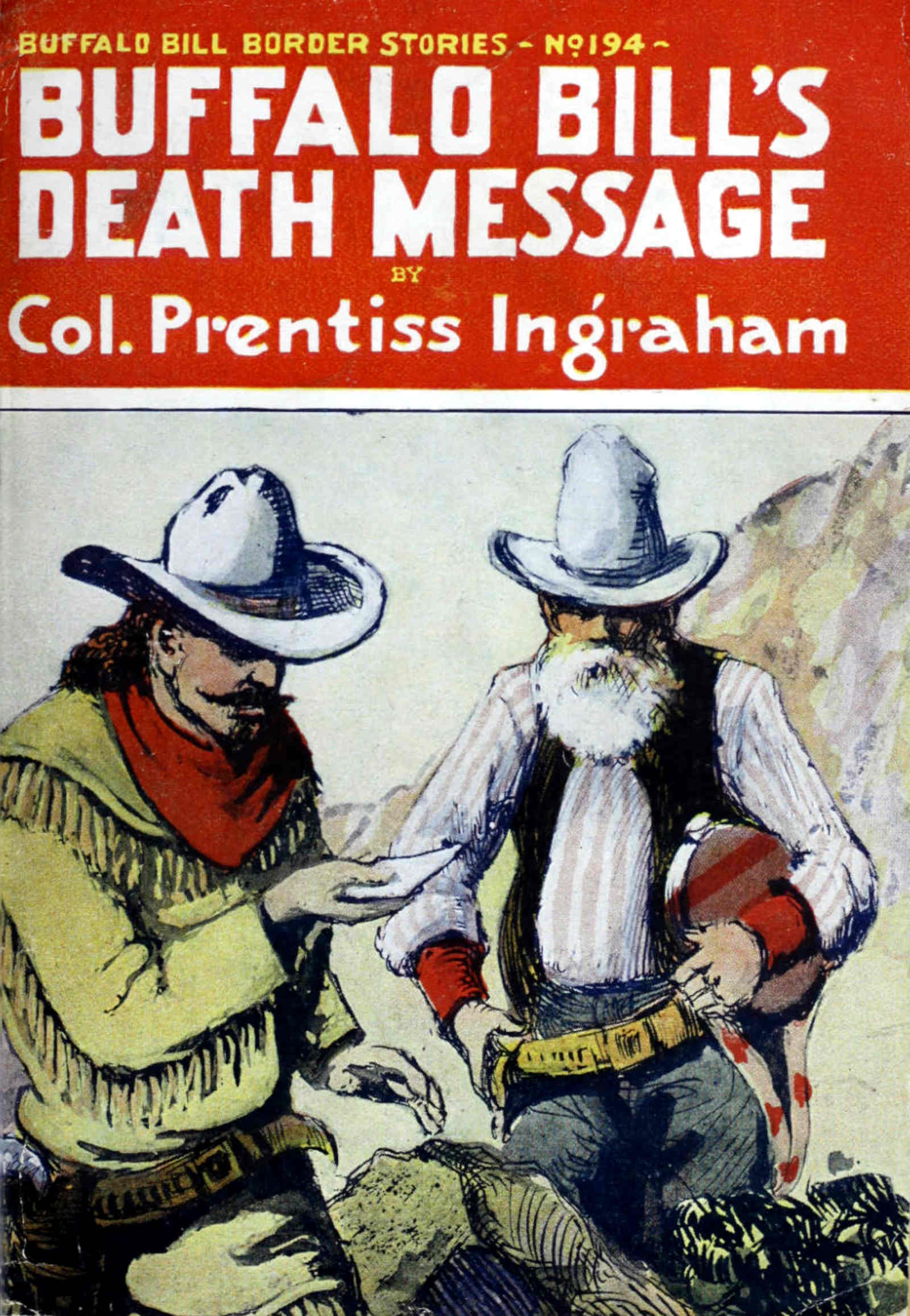
Buffalo Bill’s Death Message OR, IN THE FACE OF DOOM
i
Western Stories About
BUFFALO BILL
ALL BY COL. PRENTISS INGRAHAM
Red-blooded Adventure Stories for Men
There is no more romantic character in American history than William
F. Cody, or, as he was internationally known, Buffalo Bill. He,
with Colonel Prentiss Ingraham, Wild Bill Hicock, General Custer,
and a few other adventurous spirits, laid the foundation of our great
West.
There is no more brilliant page in American history than the winning
of the West. Never did pioneers live more thrilling lives, so
rife with adventure and brave deeds, as the old scouts and plainsmen.
Foremost among these stands the imposing figure of Buffalo Bill.
All of the books in this list are intensely interesting. They were
written by the close friend and companion of Buffalo Bill—Colonel
Prentiss Ingraham. They depict actual adventures which this pair of
hard-hitting comrades experienced, while the story of these adventures
is interwoven with fiction; historically the books are correct.
ALL TITLES ALWAYS IN PRINT
51—Buffalo Bill, Dead Shot
132—Buffalo Bill’s Tangled Clew
52—Buffalo Bill’s Buckskin Bravos
133—Buffalo Bill’s Wolf Skin
53—Buffalo Bill’s Big Four
134—Buffalo Bill’s Twice Four Puzzle
54—Buffalo Bill’s One-armed Pard
135—Buffalo Bill and the Devil Bird
55—Buffalo Bill’s Race for Life
136—Buffalo Bill and the Indian’s Mascot
56—Buffalo Bill’s Return
137—Buffalo Bill Entrapped
57—Buffalo Bill’s Conquest
138—Buffalo Bill’s Totem Trail
58—Buffalo Bill to the Rescue
139—Buffalo Bill at Fort Challis
59—Buffalo Bill’s Beautiful Foe
140—Buffalo Bill’s Determination
60—Buffalo Bill’s Perilous Task
141—Buffalo Bill’s Battle Axe
61—Buffalo Bill’s Queer Find
142—Buffalo Bill’s Game with Fate
62—Buffalo Bill’s Blind Lead
143—Buffalo Bill’s Comanche Raid
63—Buffalo Bill’s Resolution
144—Buffalo Bill’s Aerial Island
64—Buffalo Bill, the Avenger
145—Buffalo Bill’s Lucky Shot
65—Buffalo Bill’s Pledged Pard
146—Buffalo Bill’s Sioux Friends
66—Buffalo Bill’s Weird Warning
147—Buffalo Bill’s Supreme Test
67—Buffalo Bill’s Wild Ride
148—Buffalo Bill’s Boldest Strike
68—Buffalo Bill’s Redskin Stampede
149—Buffalo Bill and the Red Hand
69—Buffalo Bill’s Mine Mystery
150—Buffalo Bill’s Dance with Death
70—Buffalo Bill’s Gold Hunt
151—Buffalo Bill’s Running Fight
71—Buffalo Bill’s Daring Dash
152—Buffalo Bill in Harness
72—Buffalo Bill on Hand
153—Buffalo Bill Corralled
73—Buffalo Bill’s Alliance
154—Buffalo Bill’s Waif of the West
74—Buffalo Bill’s Relentless Foe
155—Buffalo Bill’s Wizard Pard
75—Buffalo Bill’s Midnight Ride
156—Buffalo Bill and Hawkeye
76—Buffalo Bill’s Chivalry
157—Buffalo Bill and Grizzly Dan
77—Buffalo Bill’s Girl Pard
158—Buffalo Bill’s Ghost Play
78—Buffalo Bill’s Private War
159—Buffalo Bill’s Lost Prisoner
79—Buffalo Bill’s Diamond Mine
160—Buffalo Bill and The Klan of Kau
80—Buffalo Bill’s Big Contract
161—Buffalo Bill’s Crow Scouts
81—Buffalo Bill’s Woman Foe
162—Buffalo Bill’s Lassoed Spectre
82—Buffalo Bill’s Ruse
163—Buffalo Bill and the Wanderers
83—Buffalo Bill’s Pursuit
164—Buffalo Bill and the White Queen
84—Buffalo Bill’s Hidden Gold
165—Buffalo Bill’s Yellow Guardian
85—Buffalo Bill in Mid-air
166—Buffalo Bill’s Double “B” Brand
86—Buffalo Bill’s Queer Mission
167—Buffalo Bill’s Dangerous Duty
87—Buffalo Bill’s Verdict
168—Buffalo Bill and the Talking Statue
88—Buffalo Bill’s Ordeal
169—Buffalo Bill Between Two Fires
89—Buffalo Bill’s Camp Fires
170—Buffalo Bill and the Giant Apache
90—Buffalo Bill’s Iron Nerve
171—Buffalo Bill’s Best Bet
ii91—Buffalo Bill’s Rival
172—Buffalo Bill’s Blockhouse Siege
92—Buffalo Bill’s Lone Hand
173—Buffalo Bill’s Fight for Right
93—Buffalo Bill’s Sacrifice
174—Buffalo Bill’s Sad Tidings
94—Buffalo Bill’s Thunderbolt
175—Buffalo Bill and “Lucky” Benson
95—Buffalo Bill’s Black Fortune
176—Buffalo Bill Among the Sioux
96—Buffalo Bill’s Wild Work
177—Buffalo Bill’s Mystery Box
97—Buffalo Bill’s Yellow Trail
178—Buffalo Bill’s Worst Tangle
98—Buffalo Bill’s Treasure Train
179—Buffalo Bill’s Clean Sweep
99—Buffalo Bill’s Bowie Duel
180—Buffalo Bill’s Texas Tangle
100—Buffalo Bill’s Mystery Man
181—Buffalo Bill and the Nihilists
101—Buffalo Bill’s Bold Play
182—Buffalo Bill’s Emigrant Trail
102—Buffalo Bill: Peacemaker
183—Buffalo Bill at Close Quarters
103—Buffalo Bill’s Big Surprise
184—Buffalo Bill and the Cattle Thieves
104—Buffalo Bill’s Barricade
185—Buffalo Bill at Cimaroon Bar
105—Buffalo Bill’s Test
186—Buffalo Bill’s Ingenuity
106—Buffalo Bill’s Powwow
187—Buffalo Bill on a Cold Trail
107—Buffalo Bill’s Stern Justice
188—Buffalo Bill’s Red Hot Totem
108—Buffalo Bill’s Mysterious Friend
189—Buffalo Bill Under a War Cloud
109—Buffalo Bill and the Boomers
190—Buffalo Bill and the Prophet
110—Buffalo Bill’s Panther Fight
191—Buffalo Bill and the Red Renegade
111—Buffalo Bill and the Overland Mail
192—Buffalo Bill’s Mailed Fist
112—Buffalo Bill on the Deadwood Trail
193—Buffalo Bill’s Round-up
113—Buffalo Bill in Apache Land
194—Buffalo Bill’s Death Message
114—Buffalo Bill’s Blindfold Duel
195—Buffalo Bill’s Redskin Disguise
115—Buffalo Bill and the Lone Camper
196—Buffalo Bill, the Whirlwind
116—Buffalo Bill’s Merry War
197—Buffalo Bill in Death Valley
117—Buffalo Bill’s Star Play
198—Buffalo Bill and the Magic Button
118—Buffalo Bill’s War Cry
199—Buffalo Bill’s Friend in Need
119—Buffalo Bill on Black Panther’s Trail
200—Buffalo Bill with General Custer
120—Buffalo Bill’s Slim Chance
201—Buffalo Bill’s Timely Meeting
121—Buffalo Bill Besieged
202—Buffalo Bill and the Skeleton Scout
122—Buffalo Bill’s Bandit Round-up
203—Buffalo Bill’s Flag of Truce
123—Buffalo Bill’s Surprise Party
204—Buffalo Bill’s Pacific Power
124—Buffalo Bill’s Lightning Raid
205—Buffalo Bill’s Impersonator
125—Buffalo Bill in Mexico
206—Buffalo Bill and the Red Marauders
126—Buffalo Bill’s Traitor Foe
207—Buffalo Bill’s Long Run
127—Buffalo Bill’s Tireless Chase
208—Buffalo Bill and Red Dove
128—Buffalo Bill’s Boy Bugler
209—Buffalo Bill on the Box
129—Buffalo Bill’s Sure Guess
210—Buffalo Bill’s Bravo Partner
130—Buffalo Bill’s Record Jump
211—Buffalo Bill’s Strange Task
131—Buffalo Bill in the Land of Dread
iii
TALES OF THE ROLLING PLAINS
Great Western Library
By COL. PRENTISS INGRAHAM and W. B. LAWSON
Thrilling Adventure
For many years we have been urged by readers who like Western
stories to publish some tales about the adventures of Diamond Dick.
Therefore, we decided to have a new series of stories based upon
the adventures of this famous Western character, and to put them
in a line called GREAT WESTERN LIBRARY, together with
stories about Buffalo Bill, by Col. Prentiss Ingraham.
Thus, in this line two of the most famous of all American characters
join hands. The so-called society stories with a kick in them
come and go, but these clean, wholesome tales of the West give a
clean-cut picture of the lives and characters of the men who carried
the advance banners of civilization westward.
There are Indian stories, cowboy stories, outlaw stories, all sorts
of stories of adventures out West. Each one is clean and decent,
even if it is thrilling.
ALL TITLES ALWAYS IN PRINT
In order that there may be no confusion, we desire to say
that the books listed below will be issued during the respective
months in New York City and vicinity. They may not reach the
readers at a distance promptly, on account of delays in transportation.
To be published in January, 1927.
1—Diamond Dick’s Own Brand
By W. B. Lawson
2—Buffalo Bill’s Honor
By Col. Prentiss Ingraham
To be published in February, 1927.
3—Diamond Dick’s Maverick
By W. B. Lawson
4—Buffalo Bill’s Phantom Hunt
By Col. Prentiss Ingraham
To be published in March, 1927.
5—Diamond Dick’s Man Hunt
By W. B. Lawson
6—Buffalo Bill’s Fight with Fire
By Col. Prentiss Ingraham
To be published in April, 1927.
7—Diamond Dick’s Danger Signal
By W. B. Lawson
8—Buffalo Bill’s Danite Trail
By Col. Prentiss Ingraham
To be published in May, 1927.
9—Diamond Dick’s Prospect
By W. B. Lawson
10—Buffalo Bill’s Ranch Riders
By Col. Prentiss Ingraham
To be published in June, 1927.
11—Diamond Dick and the Gold Bugs
By W. B. Lawson
12—Buffalo Bill’s Death Trail
By Col. Prentiss Ingraham
13—Diamond Dick at Comet City
By W. B. Lawson
iv
NOTE THE NEW TITLES LISTED
Western Story Library
ALL BY EDWARD C. TAYLOR
For Everyone Who Likes Adventure
Ted Strong and his band of broncho-busters have most exciting adventures
in this line of attractive big books, and furnish the reader
with an almost unlimited number of thrills.
If you like a really good Western cowboy story, then this line is
made expressly for you.
ALL TITLES ALWAYS IN PRINT
1—Ted Strong, Cowboy
23—Ted Strong’s Justice
2—Ted Strong Among the Cattlemen
24—Ted Strong’s Treasure
3—Ted Strong’s Black Mountain Ranch
25—Ted Strong’s Search
4—Ted Strong With Rifle and Lasso
26—Ted Strong’s Diamond Mine
5—Ted Strong Lost in the Desert
27—Ted Strong’s Manful Task
6—Ted Strong Fighting the Rustlers
28—Ted Strong, Manager
7—Ted Strong and the Rival Miners
29—Ted Strong’s Man Hunt
8—Ted Strong and the Last of the Herd
30—Ted Strong’s Gold Mine
9—Ted Strong on a Mountain Trail
31—Ted Strong’s Broncho Boys
10—Ted Strong Across the Prairie
32—Ted Strong’s Wild Horse
11—Ted Strong Out For Big Game
33—Ted Strong’s Tenderfoot
12—Ted Strong Challenged
34—Ted Strong’s Stowaway
13—Ted Strong’s Close Call
35—Ted Strong’s Prize Herd
14—Ted Strong’s Passport
36—Ted Strong’s Trouble
15—Ted Strong’s Nebraska Ranch
37—Ted Strong’s Mettle
16—Ted Strong’s Cattle Drive
38—Ted Strong’s Big Business
17—Ted Strong’s Stampede
39—Ted Strong’s Treasure Cave
18—Ted Strong’s Prairie Trail
40—Ted Strong’s Vanishing Island
19—Ted Strong’s Surprise
41—Ted Strong’s Motor Car
20—Ted Strong’s Wolf Hunters
42—Ted Strong in Montana
21—Ted Strong’s Crooked Trail
43—Ted Strong’s Contract
22—Ted Strong in Colorado
We have arranged with the author, Edward C. Taylor, to continue the stories, and
the following, therefore, are new stories, right up to the minute. They are going to
make a big hit, for we have abundant proof in the way of letters that readers of paper
books are strong for Ted Strong.
In order that there may be no confusion, we desire to say that
the books listed below will be issued during the respective months
in New York City and vicinity. They may not reach the readers at
a distance promptly, on account of delays in transportation.
To be published in January, 1927.
44—Ted Strong’s Stolen Pinto
45—Ted Strong’s Saddle Pard
To be published in February, 1927.
46—Ted Strong and the Sioux Players
47—Ted Strong’s Bronchos
To be published in March, 1927.
48—Ted Strong’s Ranch War
49—Ted Strong and the Cattle Raiders
To be published in April, 1927.
50—Ted Strong’s Great Round-up
51—Ted Strong’s Big Horn Trail
To be published in May, 1927.
52—Ted Strong in Bandit Cañon
53—Ted Strong at Z-Bar Ranch
54—Ted Strong’s Cattle Feud
To be published in June, 1927.
55—Ted Strong’s Border Battle
56—Ted Strong on U. P. Duty
v
BY
Colonel Prentiss Ingraham
Author of the celebrated “Buffalo Bill” stories, published in the
Border Stories. For other titles see catalogue.
STREET & SMITH CORPORATION
PUBLISHERS
79–89 Seventh Avenue, New York
vi
Copyright, 1907
By STREET & SMITH
Buffalo Bill’s Death Message
(Printed in the United States of America)
All rights reserved, including that of translation into foreign
languages, including the Scandinavian.
IN APPRECIATION OF WILLIAM F. CODY ( BUFFALO BILL ).
1
It is now some generations since Josh Billings, Ned
Buntline, and Colonel Prentiss Ingraham, intimate friends
of Colonel William F. Cody, used to forgather in the
office of Francis S. Smith, then proprietor of the New
York Weekly. It was a dingy little office on Rose Street,
New York, but the breath of the great outdoors stirred
there when these old-timers got together. As a result of
these conversations, Colonel Ingraham and Ned Buntline
began to write of the adventures of Buffalo Bill
for Street & Smith.
Colonel Cody was born in Scott County, Iowa, February
26, 1846. Before he had reached his teens, his
father, Isaac Cody, with his mother and two sisters,
migrated to Kansas, which at that time was little more
than a wilderness.
When the elder Cody was killed shortly afterward in
the Kansas “Border War,” young Bill assumed the difficult
rôle of family breadwinner. During 1860, and until
the outbreak of the Civil War, Cody lived the arduous
life of a pony-express rider. Cody volunteered his services
as government scout and guide and served throughout
the Civil War with Generals McNeil and A. J.
Smith. He was a distinguished member of the Seventh
Kansas Cavalry.
During the Civil War, while riding through the streets
of St. Louis, Cody rescued a frightened schoolgirl from
a band of annoyers. In true romantic style, Cody and
Louisa Federci, the girl, were married March 6, 1866.
In 1867 Cody was employed to furnish a specified
amount of buffalo meat to the construction men at work
on the Kansas Pacific Railroad. It was in this period
that he received the sobriquet “Buffalo Bill.”
In 1868 and for four years thereafter Colonel Cody
2served as scout and guide in campaigns against the Sioux
and Cheyenne Indians. It was General Sheridan who
conferred on Cody the honor of chief of scouts of the
command.
After completing a period of service in the Nebraska
legislature, Cody joined the Fifth Cavalry in 1876, and
was again appointed chief of scouts.
Colonel Cody’s fame had reached the East long before,
and a great many New Yorkers went out to see
him and join in his buffalo hunts, including such men
as August Belmont, James Gordon Bennett, Anson
Stager, and J. G. Heckscher. In entertaining these
visitors at Fort McPherson, Cody was accustomed to
arrange wild-West exhibitions. In return his friends
invited him to visit New York. It was upon seeing his
first play in the metropolis that Cody conceived the idea
of going into the show business.
Assisted by Ned Buntline, novelist, and Colonel Ingraham,
he started his “Wild West” show, which later
developed and expanded into “A Congress of the Rough-riders
of the World,” first presented at Omaha, Nebraska.
In time it became a familiar yearly entertainment
in the great cities of this country and Europe.
Many famous personages attended the performances, and
became his warm friends, including Mr. Gladstone, the
Marquis of Lorne, King Edward, Queen Victoria, and
the Prince of Wales, now King of England.
At the outbreak of the Sioux, in 1890 and 1891,
Colonel Cody served at the head of the Nebraska National
Guard. In 1895 Cody took up the development
of Wyoming Valley by introducing irrigation. Not long
afterward he became judge advocate general of the
Wyoming National Guard.
Colonel Cody (Buffalo Bill) died in Denver, Colorado,
on January 10, 1917. His legacy to a grateful world was
a large share in the development of the West, and a
multitude of achievements in horsemanship, marksmanship,
and endurance that will live for ages. His life
will continue to be a leading example of the manliness,
courage, and devotion to duty that belonged to a picturesque
phase of American life now passed, like the great
patriot whose career it typified, into the Great Beyond.
A singular tapping on the door of his room awoke
Buffalo Bill, who was in the St. Cloud Hotel, in the
town of Klamath, which was about as near to the
“jumping-off place” of civilization as one could get
without going over the boundary.
The wary scout remained quietly in bed when he
heard the tapping, his only movement being to clutch
the revolver he had placed under his pillow on retiring
for the night.
The room was as dark as a “stack of black cats,”
and he knew that complete darkness reigned outside,
or a little light would have reached him through the
window.
The tapping was repeated at intervals for the better
part of five minutes, then there was a resounding
thump on the panel of the door.
Shortly after that the scout heard soft footsteps
moving away, and when the footsteps ceased to sound,
he struck a match cautiously, and looked at his watch.
“Four o’clock!” he said. “Just the darkest hour
before dawn. Daylight will be here in a little while.”
He blew out the match, and lay back quietly on his
pillow, listening. Not so much as a rat now stirred.
6“I wonder what that meant?” was his thought.
“Well, I’m not anxious enough to know to run risks
in trying to find out. Some rascal might have wanted
to assassinate me. There’s no telling.”
Klamath was notorious for its desperadoes at that
time, and Buffalo Bill was pretty sure that more than
one man in the town would be glad to take his life.
“If any one is really anxious to see me,” was his
thought, “let him come to me in broad daylight. This
is no hour for an interview, and the thing didn’t look
honest.”
He was out of bed as soon as the dawn came, and
after hastily dressing, he took his revolver and tiptoed
to the door. He more than half expected to discover
that an assassin lurked in the big hall.
But when he opened the door, he was surprised in
another way.
Pinned to the panel was a folded sheet of paper,
held in place by a slender gold stick pin driven into
the wood. The head of the stick pin was a representation
of a skull and crossbones.
The resounding thump on the door had been made
when this singular pin had been driven in to hold the
paper in place.
Buffalo Bill looked curiously at the pin, and then
spread open the paper, which he saw was a sheet of
writing. This he proceeded to read:
“Buffalo Bill: I want to have a talk with you
about something very important. I knocked on your
door, and you wasn’t in, or wouldn’t answer. Meet me
to-night, at eight o’clock, at the foot of the big poplar
7that hangs over the river at the upper bend, about half
a mile from here. The place is called Poplar Bend.
Don’t fail. This is as important to you as to me, and
more so. Your friend,
“Klamath John.”
While Buffalo Bill was reading this and inspecting
the queer gold pin, he heard himself addressed. His
negro servant, Cudjo, was approaching along the
hall, Cudjo having spent the night in the servants’
quarters below stairs.
“Marse Cody, you is up ter’ble early dis mawnin’!”
Cudjo remarked, showing his ivories. “How you
reckon I’m gwine to git to black yo’ boots, befo’ you
puts ’em on, ef you’s gwine to put ’em on befo’ I done
wakes up? I ’lowed, tired as you was las’ night, dat
dis mawnin’ you’d sleep as sound’s a possum. And
heah you is, awake befo’ I is. Hit’s plum’ reedic’lus
an’ scan’lous.”
Cudjo felt privileged to scold his master now and
then, though his chidings were always so good-natured
that they had no sharp edge. He swung his
tongue with so much freedom, perhaps, for the reason
that he owed his life to Buffalo Bill; there seemed to be
no other excuse.
Two months before, he had been a train porter, on
a wild mountain route where holdups were not infrequent.
Buffalo Bill had been a passenger on the train
one night when a holdup came. Cudjo did not move
quickly enough to suit the robbers, and one of them
knocked him down and would have shot him, when a
bullet from the pistol of the fearless scout put the
outlaw out of business. The next moment Buffalo Bill
8fell, shot through the shoulder, in retaliation, by one
of the outlaws.
Cudjo resigned his position and nursed the gallant
scout until he recovered from the effects of the bullet
wound, after which he became, for a time, Buffalo
Bill’s personal servant, and was now with him in the
lawless border town of Klamath.
“See here!” said the scout, and he displayed the
letter and the gold pin. “Take a look at these.”
Cudjo’s face seemed to become a shade whiter
through pallor when he looked at that queer stick pin.
“Did you ever see anything like that before?” Buffalo
Bill asked.
“I has, Marse Cody, and I don’t want to see um
ag’in. Dat’s des like de pin de car robber wore what
shot you dat time. Des like it!”
The scout gave Cudjo the note to read.
“You is a dead man, Marse Cody, if you goes to
dat place. Keep away f’m it. Dis is a trick.”
Buffalo Bill stayed away from Poplar Bend that
evening, and also the next.
Because of this, no doubt, at about the hour of four
in the morning he again heard that peculiar tapping
on the door of his room. As before, he listened
quietly, clutched his revolver, and said nothing. The
singular thump on the panel sounded again, and again
he heard footsteps moving softly away.
When he opened the door, at daylight, he found another
message pinned to it, with one of those queer
gold pins, a message which again asked him to meet
the writer at Poplar Bend, assuring him that it concerned
9a matter of the utmost importance to him, as
well as to the one who wrote the note.
When this happened the third morning, the gold pin
and the pinned paper were discovered before the scout
arose by a young Irishman named Michael Flynn—called
Mike or Mickey—who occupied the room next
to him.
“Begobs!” roared Flynn, hammering on the scout’s
door, “the United States gover’mint has sthruck a
quare sthreak in deliverin’ its letthers, so it has. Will
ye obsarve this wan, Misther Cody? Here’s a letther
fer ye, lift by the postman on yer dure, and hammered
in wid a gold pin. It’s that rich the gover’mint is
growin’ that it throws in gold pins widout cost whin it
delivers letthers. ’Tis a gr-reat counthry! Will yez
git up and see the letther?”
Buffalo Bill hurried into his clothing, and opened
the door for Flynn.
“Come in, Mike!” he invited. “That’s the third letter
of the kind which has been stuck on my door.
What do you think it means? Read it and then tell me
what you make of it. Remember, I’ve had two others
like it.”
Flynn read the letter, which was identical with the
other two received by the scout.
“And the pin?” said the scout. “Take a look at it.”
“It’s a quare wan,” said Flynn, “but I’m guessin’
it’s gold. I’ll l’ave you to shpake the m’anin’ av it.”
Cudjo appeared in the hall, and came in, as the door
was open. His eyes rounded with awe and fright
10when he discovered that a third letter had been received.
“I’ve no idea who this fellow is who calls himself
Klamath John,” said the scout, “but I’ve suspected a
trap.”
“Whoosh! A trap, is it? Thin I’d trap him.”
“You would?”
“Shure, an’ I would. If ye want to thry it, I’m in
wid ye.”
Flynn’s face flushed even redder than was its natural
wont, by reason of the thought that came to him.
“It’s the iligant chance,” he went on. “An’ it’s like
what I’ve been wantin’, ye see. I towlt yez about it.
Whin I left the grane sod, says I to mesilf, says I,
‘There’s niver a chance anny more fer a man in Ireland!’
An’ it was the thruth I shpoke. ‘Ameriky, the
land av the free, an’ the home av the br-rave, is the
land f’r me,’ says I. ‘There a man can shtand up f’r
his rights,’ says I, ‘an’ can crack a head when he sees
wan,’ I says, ‘an’ it’s the land fer me.’
“But here I’ve been six months, and not a shindy
comin’ my way. Barrin’ a fight or two wid pistols, I
ain’t sane anny fightin’ at all, an’ they towlt me this
town was filled wid fightin’ min and the rarest fightin’
undher the sun. But it’s a lie. There ain’t no fightin’.
It’s jist pull a gun, and down yer man goes on his back
in the sthrate, dead as a dure nail. I don’t call that
fightin’, I call that murdher.
“And now here comes the chance f’r me. There’s
a brave hint av advinture in thim letthers, as I can
see. I’m wid yez in it. The man is thryin’ to trap yez,
11mebbe. Say that he is. So much the betther. Thrap
him. And Mickey Flynn is the b’y that will help ye.”
Flynn became boisterously enthusiastic, as he thus
outlined his thoughts. But Cudjo failed to share his
enthusiasm.
“What ef you is de man dat’s killed?” he asked.
“If yez are, hope that it’ll be quick. And if ye’re
only wounded, pray to the saints that ye may have
stringth to bear it. But what’s life widout the ixcitement
av danger? It’s a shtale soup, widout anny
pepper in it. None av it f’r me! Yez can have it.
But it’s not to be ixpicted that a nagur would fale the
same as an Irishman.”
Cudjo’s black eyes glittered. “Who’s a nigger?” he
said testily. “Onderstand dat I is a cullud ge’men,
suh! I done been a car po’ter, suh! Ef you has any
oncompliments to hand roun’, don’t hand um dis way.
I’m ’bleegd to incline um.”
Buffalo Bill smiled. “I agree with Mike,” he remarked.
“If that man is trying to draw me into a
trap, we may be able to turn the tables on him. Anyway,
I’d like to know the meaning of these letters.
My curiosity is excited. He’s persistent, for this is his
third letter.”
Mike looked curiously at the gold pin.
“He must be moighty rich,” he observed, “to be
flingin’ his gold about in this way, I’m thinkin’. An’
a quare pin it is. Luk at it.”
Buffalo Bill took the other gold pins from his
pocketbook, and laid all three in the palm of his hand
for inspection.
12“Des like de one what dat car robber wore fo’ a
breast pin,” said Cudjo. “I don’t want to see de man
what has um. Dat man is a robber, and mebbe wuss’n
dat. If Marse Cody axes my devices, I’m ‘bleeged to
tell him to stay away f’um de place whar dat man says
to come. Stay plum’ away f’um it. We’se safe heah
in dis hotel. What’s de use tuh be runnin’ into undnecessary
danger? Dem’s my sembliments.”
Nevertheless, Buffalo Bill prepared to “trap the trapper,”
if the latter proved to be playing a treacherous
game, and to find out just what those singular messages
meant.
Flynn’s adventurous blood went to the boiling point
when he heard the decision.
“You’re a courageous man, Misther Cody!” he said,
by way of compliment.
That was a discovery to Michael Flynn, perhaps,
yet the real men of the West had known for many
years that there was not on the whole Western border
a man of more true and genuine courage than Buffalo
Bill, the famous border scout.
CHAPTER II. KLAMATH JOHN’S MESSAGE.
13
Shortly before eight that evening, Buffalo Bill, accompanied
by the fighting Irishman and by Cudjo,
took his way to the river bend above the town where
grew the lone poplar.
Darkness fell before they reached the spot, and they
crept close up to it and went into hiding.
Leaving Flynn and Cudjo behind, with instructions
as to what they were to do in the event of a pistol
shot or other signal from him, the scout stole softly
away, approaching Poplar Bend from the opposite direction.
The time was after eight o’clock when he came
again within sight of the high bluff at the bend, and
saw in the dim light at the foot of the tree a human
form. No other person seemed near, and when he
had determined that, the scout stood up, revolver in
hand.
“Hello!” he called softly.
The man sprang to his feet and looked about.
“Hello!” he answered, after a moment of hesitation.
“Are you alone?” the scout asked.
“Yes,” the man answered, looking around, for he
not only did not see Buffalo Bill, but also he was unable
to locate his direction.
This deceptive manner of speaking, so that the
14voice seemed to come out of the air rather than from
the ground, Buffalo Bill had long practiced and had
found it useful.
“You are sure no one is with you, or near?”
The man stared upward, and then, stepping out
from the bluff, glanced at its top.
“You’re up there, are you?”
“No, I’m off here!”
The man turned slowly around, staring.
“Is there any one with you?” the scout demanded.
“A straight and true answer will save your life, perhaps,
while trickery will cause me to promptly snuff
out your candle.”
“Is that you, Cody?” the man asked. “I can hear
you, but can’t locate you. There’s not another soul
here, I swear. If that’s you, show yourself. I’ve
been here three nights, and I was afraid you wouldn’t
come.”
Buffalo Bill stepped out now and advanced, still
closely watching out for an ambush. But the fellow
was alone.
The scout saw as he came up to the man that he
was young, yet he was rather heavily bearded, for he
wore mustache and imperial and side whiskers that
stuck out like Dundreary’s. Long hair hung down on
his shoulders, after the border fashion. His clothing,
too, was of border style, though somewhat exaggerated.
His jacket was of buckskin, and he wore
buckskin chaps, and high-heeled boots with spurs that
jingled when he walked. He seemed rather a dude
sort of cowboy.
15“You’re Cody?” he asked, peering into the darkness
as the scout came up to him.
“Yes.”
“Well, I’m glad to see you, for I feared you wasn’t
coming. Sit down. I’m Klamath John.”
“That’s not your real name, of course,” said the
scout.
“No, my real name is John Langstrath. But I call
myself Klamath John.”
“Why?”
“Why do you call yourself Buffalo Bill?”
“The name was given to me. I did not take it myself.
It was given to me because, when I had a contract
to furnish beef to the men who were building the
Union Pacific Railroad, I killed more buffaloes than
any other man of the border ever killed before. It’s
not a record I’m particularly proud of, though the
work was necessary at the time. Now, why are you
Klamath John, and what do you want with me?”
“I took the name because the town here suggested
it,” was the man’s answer. “That’s the only reason.
As to what I wanted—you saw the letters I left sticking
on your door?”
“I saw them, but they didn’t explain anything. I
wasn’t sure but they paved the way for a trap. That’s
why I didn’t respond very promptly to them.”
This seemed to please Klamath John, for he
chuckled.
“Why didn’t you call on me at my hotel, instead of
taking that singular way to get in communication with
me?” Buffalo Bill now demanded.
16“I had my reasons, Cody; I wanted to test you.”
“In what manner?”
“Well, the purpose was to see if you could be
aroused to a proper interest in this thing.”
“I’m in the dark, you know, as to what it is you
want of me.”
“I’ll come to it right off. You remember the gruesome
stick pins I used?”
“Yes. I have them with me.”
“They’re not gold, of course, but——”
“I beg your pardon, they’re pure gold!”
“What?”
“Just as I say, they’re pure gold. I had one of
them tested.”
“Gr-reat governor! Is that so?” His astonishment
was too natural to be assumed. “I thought they
were just brass, washed over with gold,” he declared.
“So they’re pure gold? Then it becomes even more
interesting.”
“Just remember that I don’t know what you’re talking
about.”
“Well, I’ll come right to it. I found the pins, and
there was a letter lying with them. I’ve got it here,
and I’ll show it to you in a minute. The letter is
signed, ‘Red Reynard, the Fox.’”
“Ah!”
“That interests you, does it?”
“Yes, very much.”
“Just in what way?”
“I think I’ll hear your story before I say in what
way such a letter interests me.”
17“Well, this Red Reynard is said to be a highwayman
and desperado. I’ve been trailing him. But it
was luck got me that letter. It seems to have been
dropped accidentally, and the pins with it.”
“You are an officer?” the scout asked.
“No, not at present.”
“You have been?”
“No.”
“Well, go on.”
“I found out, by that letter, that Red Reynard and
a lot more are in the Golconda Cup, and they’ve found
gold there.”
“But nobody can get into the Golconda Cup!”
“That’s what everybody thinks. But they got in.
And they went by the way of Lost River. Golconda
Cup, you know, is supposed to be a big, wide valley,
or basin, walled in by cliffs so steep and high on all
sides that they can’t be scaled. It’s said that a few
men have climbed to the top of the outer walls, and
have looked over into the basin, but no man has ever
been able to get down the inner walls; or, if he did, he
was never able to climb ’em and get back to tell what
he’d discovered. That’s the story.”
“Yes.”
“You’ve seen those walls?”
“I climbed to the top of them, on the south, once,
a couple of years ago.”
“Jerusalem! You did? Well, I tried it, and quit
soon enough. I don’t see how you did it.”
“Ropes and patience,” said the scout.
“But you couldn’t get down on the inside?”
18“No. And I could see no place where any one
could get down. The walls have a thousand feet drop
and are as steep as the sides of a house, with not a
crevice showing in them, and not a bush, nor anything
that would give foothold or a place to hang a rope.”
“Yet this Red Reynard is in there now, and he and
his men are taking out the gold.”
“Just a fairy story,” said the scout.
“They went in by the way of Lost River,” Klamath
John continued, without heeding this comment. “It’s
said that no man ever descended that river, that it
runs into a black cañon, and then on into a tunnel-like
hole, and then down into the very bowels of the earth.
Two men were caught in it, in a canoe, and they were
sucked down into the hole and never were seen again.”
“I’ve heard that.”
“You wouldn’t want to try that route?”
“I should think twice before trying it.”
“Well, I’ve been along the top wall of the cañon
there, and I believe it can be done. You see, a thing
not generally known is, that after the stream gets close
down under the outer walls of Golconda Cup, it splits
into two parts. One is Lost River, or the continuation
of it, the other simply shoots through a big hole
in the walls and flows into the Cup, where it’s as gentle
as a mill pond.”
“But you’ve no good proof that it does?”
“I’ll show you a letter. I’ve got a candle here,
which I brought for the purpose, hoping you’d come
and would want to see it, and talk this thing over.
19Cody, you’re the man to help in this, if I can get you
interested.”
Klamath John lighted his candle and produced the
letter.
By the light of the candle the scout read it.
It was as follows:
“My Dear Bat: You can get into Golconda Cup
without any trouble, if you’ve got a little nerve and
don’t scare too easy. Take a canoe at the head of
the cañon where Lost River flows into it. Then when
you get well down toward the walls of the Cup, you’ll
find where the stream branches. One of the branches
is Lost River proper, the other shoots through a dark
tunnel, and then out into the Cup, where it flows
along as quiet as you please. There’s plenty of room
over your head when you go through that tunnel, and
you needn’t be afraid.
“It’s a lucky thing for us that the entrance looks so
scary, for it keeps people out, and makes them believe
that Golconda Cup can’t be got into at all. But it’s
dead easy. Take the right fork where it branches,
and you’re safe enough.
“We’ve got a cinch down here—gold to talk about.
I never saw the like of it, the river sand is full of it,
and there are slivers to be picked up that are bigger
than a toothpick. Yesterday I got a pure nugget that
was worth at least a thousand dollars. We’re cleaning
up more than a thousand dollars a day, and some
days we clean up twice that much. But this thing
wants to be kept on the strict q. t.
“I’m hiding out here, you know, and so are the
other boys, and the officers are simply up against it.
They couldn’t find us in a thousand years. For everybody
believes that the Golconda Cup can’t be got into.
We got into it dead easy; and we get in and out just
20as easy as we got in. I’ll show you if you come. The
gold we’re carrying to Frisco, and stacking it in the
banks there. The Frisco bankers think we’re working
in Death Valley, and we let it go at that, and they
don’t know where the gold is coming from. We let
Poker Pete take it in for us. Pete’s a shrewd guy,
and they haven’t got wise to him yet. And they’ll
never get wise to Golconda Cup. The thing is so easy
I laugh whenever I think of it.
“Crimp up your nerve, and come along.
“Your old pal,
“Red Reynard, the Fox.”
Buffalo Bill was surprised as much by the fact that
he knew the handwriting as he was by the contents.
“What do you think of it?” said Klamath John,
when he saw that the scout had finished reading.
“It’s the handwriting of Red Reynard.”
“Not a forgery?”
“No, I know his handwriting too well. I’ve got
some of it right here.”
He dived into his pocket and produced a folded
paper.
When he opened it, Klamath John saw that the
handwriting was the same.
Thus ran the note produced by Buffalo Bill:
“Dear Bat: Look out. Buffalo Bill is on our
track. He came near roping me in Glendive yesterday,
but I threw sand in his eyes and got away. I’m off
for another and healthier climate quick as I can go.
Keep your eyes open, or you’ll be into something hard.
“Your old pal,
“Red Reynard, the Fox.”
21The scout spoke, while Klamath John was looking
this over.
“Whoever you are, or are not, I’m willing for you
to see that note, to compare it with the other,” he
said. “Red Reynard knows I’ve been following him,
so that it can’t hurt to tell you, or anybody.”
Klamath John looked up quickly.
“You think mebbe I’m in with that devil?”
“I don’t know anything about you, so I’ve no
thoughts on the subject at present; but if you were
Red Reynard himself, it would be nothing new for me
to make openly the statement that I’ve been following
him. He knows it already, and he has known it
for a long time.”
“Yes, this note shows that.”
Klamath John laid the letter and the note side by
side on his knee, and held the candle so that they could
be seen and compared.
“The same handwriting,” he declared. “Cody, this
proves to you that I don’t lie, not about that letter,
anyhow. And I haven’t lied about anything else. I
want to go into the Golconda Cup, and I want you to
go with me. There’s gold there, worlds of it, and I
want to see it, and mebbe handle some of it. I thought
mebbe if you knowed Red Reynard was in there, you’d
jump at what I’ve told you—I mean at the chance of
getting in there and at him. And if what the letter
says is true, and I believe it is, it will be easy to get in
and dead easy to get out again.”
CHAPTER III. BUFFALO BILL DECIDES.
22
The scout put his fingers to his lips and blew a signal.
Instantly there was a cracking of the bushes not far
off, and then Mickey Flynn appeared, running with
Cudjo right behind him.
Klamath John jumped to his feet, pulling a revolver
as he did so.
“Sit down!” said the scout. “One of them is my
negro servant, and the other is a friend.”
“You had ’em out there watching?”
“Yes. I didn’t intend to be trapped, you see, without
having some one near to come to my help if I
needed it.”
Klamath John dropped back to his seat by the
poplar.
“Yes, I see,” he said. “That was right and proper.
You couldn’t be expected to do anything else. Only,
I didn’t think of it.”
He looked curiously at the Irishman and the negro
when they came up.
“Mr. John Langstrath,” said the scout, introducing
him to Flynn, and then to Cudjo.
“An’ there’s to be no fight at all,” said the Irishman,
with a humorous show of regret. “An’ it’s me that’s
been gettin’ ready for the fray f’r the last tin minutes.
It’s a disapp’intmint I’m rec’avin’, to be shure.”
23Flynn was shown the letter exhibited by Klamath
John.
“Come up to my hotel, Langstrath,” the scout invited,
“and there we’ll talk this thing over at our
leisure. I’ll admit that I’m interested.”
“Will you make a try for that gold?” said Klamath
John.
“I may, and I may not, but I’d like to get my fingers
on Red Reynard. I’ve been wanting to for a good
while.”
But Klamath John refused to visit the hotel, though
he said he would again meet the scout at any other
place outside of the town.
“I’ve good reasons for not wanting to be seen there,”
he declared, and he refused to explain further.
Buffalo Bill was permitted to retain the letter which
bore the name of “Red Reynard, the Fox.” He re-examined
it in his room at the hotel, comparing it
again with the undoubtedly genuine one he had in
his possession. He submitted it to the tests used by
handwriting experts, which included a close scrutiny
with a magnifying glass. In the end he was sure
it had been written by Red Reynard.
But whether it had really been meant for the eye of
Bat Stevens, the man to whom it was addressed, or
whether it had been intended to fall into the hands
of some one like Klamath John, could not be determined.
And Klamath John himself was proving to be a
good deal of an enigma. His manner had evidenced
the proof of the things he told, yet there was something
24strange and suspicious in his refusal to show
himself in the town, and the manner in which he had
sought to get into communication with Buffalo Bill
seemed queer, if nothing else.
Buffalo Bill did not again meet Klamath John for
two whole days, nor did he send him any communication.
During that time, the scout tried to verify the
statements made in Red Reynard’s letter to Bat
Stevens.
That Stevens, commonly called “Bat,” was one of
Red Reynard’s followers, was a thing he knew.
Stevens was an all-round “bad man” of the border.
Two years before the scout had tried to lay him by
the heels on a charge of murder, but Bat had “faded
away” at that time, and the scout had not seen him
since. Apparently, he was now in or near Klamath
City, a town peculiarly attractive to men of his class.
In his pursuit of information, Buffalo Bill climbed
to the tops of the high rocky ridges which overhung
the cañon of Lost River, and there, at much peril,
he traced the course of that stream until he saw that
in one respect, at least, the letter spoke truly—Lost
River branched as it neared the frowning walls of
the Cup.
On the second day of his exploration, the scout
climbed the walls of the Cup, where he had climbed
them before, a feat so difficult that he was compelled to
use ropes.
From the tops of the walls he scanned the inside
of the Cup with his powerful binoculars.
He could discover no signs of occupancy, yet the
25Cup was of so vast an extent and was so covered in
places with trees, that it might have held a whole village
in its depths without any one discovering it from
the walls.
There was a stream which flowed through the center
of the Cup, thus in a measure confirming the statement
of the letter, and this stream seemed to issue
somewhere under the northern walls, at about the point
where the letter said one of the forks of Lost River
broke through.
The evening of this second day found Buffalo Bill
again at Poplar Bend, talking with Klamath John.
“I have come to this conclusion,” he said: “If you
will go with me and my company, we’ll get a canoe
and descend the cañon of the river together. If the
canoe is wrecked and we go into the river, you’ll go
with us. See?”
“Which means that you don’t trust me?”
“As I don’t know anything about you, you can’t
expect me to trust you further than that. I’m willing
to speak plainly. I can trust you so long as you share
with me equally the dangers of that trip. We may
never come back alive. But you have made me anxious
to get into the Golconda Cup. I want to find
Red Reynard, and I’d like to be able to explore that
big valley, which report says has never been entered
by any human being. We may never get into it, and
if we get into it, we may never get out; but I’ve
thought the thing over, and I’ll risk it with you.”
“Shake, Cody!” the young man cried, with enthusiasm.
“I don’t ask anything else. We’ll get the
26canoe and we’ll make the trip. I’ve only one thing to
say about it, and that is, if there’s the gold in there,
which that letter says, I want my share of it. That’s
all.”
“We’ll have as much right to it as any one, if gold
is there,” the scout declared. “I’ve no objection to
that. I think I shall want some of it myself.”
“We’ll be gold hunters,” said Klamath John.
“We’ll be gold hunters and explorers in a new region.
The gold is there, and we’ll find it, and we’ll have
some adventures worth talking about.”
“You speak now like Mike Flynn. He’s been saying
that to me all day.”
“Is that Irishman going?”
“Yes.”
“And the negro?”
“I shall take both of them. We’ll get a canoe that
will hold the four of us, and we’ll try the cañon of
Lost River.”
“When?”
“To-morrow. I’ll get the canoe this afternoon, and
have it hauled to the upper end of the cañon.”
“You won’t tell anybody what you want to do with
it? Cody, we don’t want any others in this thing.
If there’s gold there, we want to have it to ourselves.
But if Red Reynard’s got a big gang down in there,
we might need a big gang to fight him with. What
do you say to that, Cody?”
“We’ll have a party of four, and none others.”
“That suits me, then. I’m ready to start this minute.
I’ve been waiting for this thing ever since I
27found that letter. Cody, we’ll get in there without
trouble! I’m dead sure of it.”
“Won’t you go into the town with me now?”
“No. I’ll still camp out here. But I’ll be ready for
you when the time comes.”
CHAPTER IV. DOWN THE CAÑON .
28
At the upper end of the cañon of Lost River the
water is smooth and the rocky banks are low enough to
permit a canoe to be launched without much trouble.
The canoe was lowered to the water by means of
ropes, and into it, when it was anchored, was put the
arms and ammunition, together with the food supply,
and other things, which the scout had decided to
take. He had provided amply, for he did not know
just where he was going, what he should meet, nor
how long he should be gone.
When the four men were in the canoe it sank low in
the water, yet it was still quite buoyant, and, though
a large canoe, easily handled.
Klamath John took the bow paddle and pushed the
canoe away from the rocky shore.
The canoe swung lightly along in the quiet current,
but soon the water quickened its pace and the boat
began to dance on its way, still with feathery lightness,
yet at a speed that made careful paddle work
necessary.
Buffalo Bill crouched just behind Klamath John,
where he could watch him. The scout dipped his paddle
with ease and skill, his eyes on the current ahead,
where at intervals rocks showed. Behind him was
Cudjo, while Flynn handled a paddle in the stern.
“Whoosh!” yelled Flynn, as the rocky walls began
29to shoot past. “An’ it’s now that we do be goin’
some.”
“Starboard!” yelled Klamath John. “Put ’er to
starboard!”
He threw his strength on the oar, and was aided
by Buffalo Bill. The canoe veered and whisked by the
big rock that had seemed to leap out of the water to
meet it.
Higher and still higher rose the frowning cañon
walls, until the cañon grew dark as twilight. And still
the light canoe sped ever faster, the walls speeding by
at a pace that soon became frightful. The river roared
in its narrow channel, and at times the torn water
rose and flashed into whitecaps.
The canoe soon plunged into the cañon rapids.
Buffalo Bill had looked down upon those rapids as
well as he could from the tops of the walls, and had
decided that, though swift, and even dangerous, the
canoe could navigate them. But they were even
swifter and wilder than he had thought.
“She gets quieter farther down,” Klamath John
shouted, by way of encouragement. “Just hold her to
it, and we’ll go through all right.”
“Whoosh!” howled Flynn. “But this is an iligant
adventure. Gold hunters, is it? By me sowl, if we
git through this, we’ll be airnin’ all the gold we’ll git.”
Yet the Irishman was now in his element. Adventure
was as the breath of his nostrils. He had chafed
at the dullness of the town of Klamath. This suited
him, and he hoped for even better things beyond.
But the darky who crouched on the thwart in front
30of him, though he clutched his paddle and tried to obey
the commands of Buffalo Bill, was sending up a
prayer for safety, while his teeth were chattering and
a grayish shade seemed to have crept into the black of
his face. Cudjo was heartily wishing himself well
out of it.
Yet if the occupants of the canoe had desired to retreat,
that was now impossible. The only thing that
could be done was to hold the canoe in the channel,
as near the center as possible, and let it drive, guiding
it as skillfully as possible round rocks and other
obstructions.
A half mile farther down the stream seemed to be
sown with rocks. They were everywhere, and they
appeared almost to leap at the bobbing bow of the
canoe, as if bent on splitting it, and dragging it down.
But Buffalo Bill and Klamath John were practiced
canoemen, and they sent the canoe round every obstruction
with such skill and good judgment that its sides
were not even grazed.
For two miles this terrific pace held. Then before
them they saw where the stream forked, split into two
branches by a great rock.
A surge of green water slipped by on each side of
this sharp wedge of granite and went plunging on, to
become lost soon in the mist that blanketed the surface
of the wild river.
“Which channel?” roared Klamath John, poising his
paddle in hesitation.
“The right!” Buffalo Bill shouted back. “The letter
said the right!”
31“Aye! So it did! The right it is!”
He dipped and pulled, and the scout did the same,
their efforts seconded by the negro and the Irishman.
The wedge of granite rose right before the canoe,
and it seemed the frail shell would dash against it;
then the canoe slipped past, and went plunging down
the right channel, where the waves frothed and roared
and the mist hung heavily.
The speed of the canoe became even more rapid
now. It quivered and reeled under the impact of
waves that slid from one black granite wall to the
other and back again, and there were moments when
it seemed that it would be dashed into splinters against
these walls.
Klamath John began to show evidences of fright,
while hitherto he had been as cool and courageous as
the dauntless scout.
The mist lifted somewhat, and then, straight ahead,
was beheld a black opening, toward which the canoe
sped with arrowy swiftness.
Klamath John appeared to lose his head when he
saw that black hole.
“Cody, we’ve taken the wrong channel!” he yelled,
and he half rose to his feet. “We’re dead men! We
made a mistake back there. We’re in Lost River!
Good heavens, we’re in Lost River!”
He dropped his paddle, which the scout caught, thus
keeping it from going overboard.
“Sit down!” the scout shouted at him. “Sit down,
or you’ll have us all into the water!”
32Klamath John did not obey. He stood up, swaying
about in the plunging canoe, rendering the task
of guiding it difficult, as well as threatening it with
destruction.
“Sit down!” Buffalo Bill yelled at him.
The situation was so desperate that when Klamath
John did not sit down, the scout caught him by the
coat and hurled him down.
Klamath John was up again instantly, swaying about
and making the canoe lurch so violently that it was
in danger of capsizing.
But a remarkable revelation had come, for as Klamath
John fell the dark mustache and imperial was
torn from his face, revealing youthful and unbearded
features.
The disclosure was almost paralyzing, for Klamath
John’s disguise had been so exceedingly good and
clever that until that minute even the sharp eyes of
Buffalo Bill had been deceived by it.
“Sit down!” the scout yelled again.
“We is all dead men!” Cudjo shrieked. He was
staring at the beardless face of Klamath John, the
paddle had dropped from his nerveless fingers, and he
acted as if he meant to leap out of the boat.
“Shoot the divil!” Mickey Flynn yelled.
But Mickey did not forget his paddle, and for the
first minute in which that stupefying surprise lasted,
the strong young Irishman did almost as much as the
scout in keeping the canoe from being hurled to destruction.
“So, you’re a fraud, eh!” the scout shouted. “Well,
33if we’re in Lost River and are going to death, you’ll
go with us!”
Klamath John seemed to lose his head as that black
hole of a tunnel was brought close at hand. He stood
up again, balancing himself, as if he thought of jumping
over into the water. He threw down his hat,
snatched from his head a wig of long hair, howled as
if he had suddenly become an insane devil, and refused
to obey the orders of the scout.
Buffalo Bill lifted his paddle, while his other hand
stole back as if to get out his revolver for the purpose
of shooting Klamath John. But a violent lurching of
the canoe caused him to grip the paddle again and
thrust it into the boiling stream.
“Sit down!” he yelled, in desperation. “You lunatic,
sit down!”
The dark hole of the tunnel was right before them
now. Into that hole the river rushed with a roar
that was frightful.
Mickey Flynn and Buffalo Bill were bending to
their paddles, straining until the stout ash blades bent
as if they would break, straining to hold the canoe
steady and to keep it in the center of the current. They
had no time to give to Klamath John. Cudjo was but
a bit of helpless lumber. Overcome by terror, he had
sunk down in the bottom of the canoe, where, crouching
on his knees, he prayed frantically.
Klamath John yelled again as the canoe shot for the
black hole, which it did as if it were a race horse rushing
to leap an obstruction.
As Klamath John yelled in that wild way, he sprang
34straight out into the air. He clutched something that
swung dangling in the mist over the mouth of the tunnel.
Buffalo Bill saw that it was a rope, and that Klamath
John had seized it and was drawing himself up hand
over hand. He heard Klamath John yell again, in a
different key—a yell that seemed to speak of triumph—and
then the canoe went into the dark hole, rushing
to apparent destruction.
“Hold hard!” Buffalo Bill yelled to Mickey Flynn.
“Har-rd it is!” Flynn screeched back. “Kape her
in the middle! Kape her in the middle! Pl’ase goodness,
if we’re goin’ into the cinter of the airth we’re
goin’ in a hurry.”
CHAPTER V. THROUGH THE TUNNEL.
35
The roar of the stream was much increased as the
canoe shot into the natural rock tunnel. The walls
caught and threw it back with tenfold power. The
darkness was terrifying.
As the canoe sped on its arrowy way into the darkness,
Buffalo Bill crouched in the bow, trying to penetrate
the gloom. Now and then the white spray that
boiled about some half-sunken rock could be seen, and
the canoe steered past it.
Occasionally he shouted a command to Flynn, but
he doubted if in that mad turmoil of sound the plucky
young Irishman heard him.
The minutes seemed like hours, and how long that
terrifying voyage lasted the scout did not know.
With a jerk and a thump the canoe scraped over
some sunken object. A small hole had been torn in its
bottom, near the prow, and the water began to come
in over the scout’s feet. Apparently the end of the
wild journey was at an end, for it was clear the canoe
could not now live many minutes.
The scout tried to block the rent partially by thrusting
his foot against it, but still the water came in, and
the exertions he put forth with the paddle made it
hard for him to keep his foot over that hole. He did
not try to communicate this ugly fact to the praying
darky, nor to the heroic Irishman. They would know
36it soon enough. Premature knowledge would do them
no good. He only did his best to keep the water from
rushing in.
The scout felt the canoe sinking slowly under him,
when ahead he dimly discerned some dark outline,
which a minute later proved to be an island, low and
rocky, but with sand round its margin, as he later discovered.
With a desperate sweep of the paddle he swung
the prow of the canoe toward this island.
The light craft struck it with such force that the
forward end was lifted, bouncing up apparently, and
then slipped over the wave-worn rocks, driven on by
the waves and by the momentum of the canoe.
The scout sprang out at once, and, seizing the
painter, he began to haul on it, to bring the canoe still
farther out of the water.
Cudjo aroused when he saw that the canoe had
struck and was actually aground on what seemed to
be land. He could see but the dim outline, but that
was enough, and with a howl he sprang out of the
water, landing waist-deep. He would have been swept
away, if Michael Flynn, coming after him, had not
caught him and helped him to make a landing.
Buffalo Bill aided both as they scrambled out of
the water.
Cudjo dropped down on the wet rocks, lifting his
voice again in prayer.
“Help here with the boat, Flynn,” said the scout.
Together they dragged it clear of the water, placing
it well up beyond the waves.
37The island was but a few yards wide and not over
twenty yards long; but in the center it rose to a secure
height above the stream, and there the rocks
were comparatively dry, for the waves and the wash
of the current did not reach them.
Buffalo Bill did not begin to explore the island until
he had made the painter of the canoe fast to a jutting
point of rock.
“Come, Cudjo!” he said, shouting the words. “Be a
man! We’re safe for the present.”
The darky stopped praying and got on his feet.
“Marse Cody, we is dead men!” he urged. “We
ain’t drowned, but here we is, and we can’t git away.
I reckon dis is de center of de earf. How we gwine
to git out of it?”
The scout walked toward the other end of the small
island, which lay in the very middle of the stream.
The darkness was too great to see what was in the river
beyond this island; but that they had found a refuge
at a time when matters could not have been worse
gave him a renewal of hope.
“Pl’ase Heaven, we’re shtill livin’!” said Flynn,
standing beside the scout and looking out in the darkness
where the river lost itself.
“And as long as there’s life there is hope,” was
the scout’s answer.
“Thrue f’r ye! That canoe may yit take us out av
this.”
“It has had a hole knocked in it, at the prow, but
I think we can patch it.”
“A hole in it! Whoosh! Thin it’s dead lucky we
38are that this island was close by. I seen ye throw the
head av the canoe into it, and then I pulled f’r it, and
we made it. But how we’re to git aff av it, and what
we’ll find whin we do, I dunnaw.”
Cudjo came slowly across the rocky island, shivering.
“Marse Cody,” he cried, “what y’o fink of dat
man?”
“Klamath John?”
“Yas, sir. What yo’ fink of him, now? I done warn
yo’ not to trust ’im. But you did, and here we is.
Did yo’ see dem whiskers and dat hair dat man was
wearin’? Befo’ Gawd, dat beat me!”
“An’ it’s mesilf will bate him, if iver I see his ugly
mug ag’in. False whiskers and false hair, d’ye mind!
It was the iligant make-up that he had, to be sure.
I’m hopin’ that he’s livin’, so that I can hammer his
face in f’r that.”
When they examined the canoe they decided that
they could patch it. Then they sat down to talk over
their situation.
“Klamath John fooled me,” Buffalo Bill admitted.
“But I still think the letter he showed me was genuine.
I’ve got that letter with me now, and we’ll see if we
can take a look at it. I was sure it said take the
right fork of the river.”
He drew out his waterproof metallic match box, and
then from the stores that were in the canoe he got a
candle. Having struck his match and lighted his candle,
he first looked over the island by its light, and then
examined the letter written by Red Reynard, the Fox.
39“‘Take the right fork, where it branches, and you’re
safe enough,’” Buffalo Bill read from this letter.
All three looked at those words.
“But here is a thing that we didn’t properly consider.
Red Reynard may have thought of the other
branch as the right fork. Perhaps he meant the one
on the right hand looking upstream, instead of the
one on the right hand looking downstream. And that
would make all the difference in the world.”
“It was quare, the way that rapscallion did, anyhow,”
said Flynn. “He thought we had taken the
wrong coorse, and thin he wint that wild he was clane
an idjiot. ’Twas that made him pull aff his whiskers
an’ wig.”
“The whiskers were pulled off when I threw him
down in the canoe,” Buffalo Bill corrected.
“Ye’re right. It’s a wondher I ricollict annything.
The whiskers fell aff whin ye threw him down. And
thin I suppose he got that rickless, fr’m seein’ that he
was rev’aled in his duplicity, that he pulled aff the
wig. He laughed like a young hyena, begorra, whin
he did it. The man was clane cr-razy.”
“An’ we was crazy for comin’ wid ’im!” expostulated
Cudjo. “I’se wonderin’ dat I’se livin’ dis minute.”
“Yez seen him git holt av that rope?” said the Irishman.
“Did he know the rope was there, or did he
not? In the evint that he did, thin he was expictin’
it, and was prepared f’r it; and was ready to jump, before
we got to it. Thin, by the same token, he wasn’t
40cr-razy, but was a schemin’ divil, bint on l’adin’ us
to desthruction.”
To conclude that Klamath John had deliberately
planned to take the great risk of springing from the
canoe to that rope was to credit him with a daring
which bordered on lunacy. Yet that wild laugh, which
still rang in their ears, had been the laugh of a madman,
or of a man whose change from despair to hope
had seemed to result temporarily in a sort of insanity.
The whole thing was a mystery.
“Can we belave that letther now?” said Flynn.
“And if we can’t belave it, what thin? Is there gold
layin’ r-round in lumps and sphlinters down in the Golconda
Cup? Is there a Golconda Cup at all. And is
that pirut ye call Red Reynard doon there?”
“We’ll know better when we get there.”
“When we git dar?” cried Cudjo. “Marse Cody,
you knows we ain’t nebber gwine git dar!”
“I’m hoping we shall.”
“How you ’specs tuh bring dat combobberation
about?” Cudjo demanded.
“We’ll float on down this stream in the canoe, after
we get it patched.”
“If we tries it, we is sho’ dead men!” Cudjo protested.
“If we stay here we are dead men.”
“I reckons dat’s so, Marse Cody. We is dead men
no matter how yo’ fix it.”
“I’m niver dead, so long as I’m livin’!” Flynn declared,
with true Irish hopefulness. “This may be
Lost River, and it may be the other fork av it. I41dunnaw. But whatever it is, it shore goes somewhere.”
“It goes into de groun’, Marse Flynn. Ain’t we in
de ground now? An’ if we goes furder we suttinly
will be mo’ deeper into de ground’, won’t we? Dis
Los’ River is a los’ river, which mean dat it run down
into de yea’th and never come up no mo’. And if we
goes wid it, how we gwine tuh come up? You des
’splain to me dat, will yo’?”
“I ain’t belavin’ it goes down into the earth no great
ways, annyhow!” Flynn protested. “It runs fasht
enough here, I know, but that’s no r’ason it doesn’t
come out into the sunlight ag’in. I’m goin’ to stick
to it that it does, begorra! It’s no use to belave anny
other way; f’r if we thried niver so har-rd we couldn’t
git back up this sthrame.”
“That’s to be taken as settled,” said Buffalo Bill.
“We can’t get back up the stream. Therefore, if we
leave this island, we’ve got to go downstream, no matter
what happens. I think we’d better see if we can’t
patch the canoe.”
He wanted to put Flynn and Cudjo to work, knowing
it would help to bolster their spirits.
It took an hour of close work to patch the hole
in the prow.
The stores were lifted out of the canoe and carried
to the highest part of the island, and the canoe was
also carried to that point, before work on it began.
The three men down on their knees, in the flickering
candlelight, working at the canoe, on that dark
little island set in the blackness of the underground
42river, presented a strange sight. The river roared by
close at hand, and the dark walls and roof of the singular
natural tunnel stretched in each direction as far
as eye could see.
“We could live here some time,” said the scout
cheerfully. “We’ve got stores enough, and we have
the whole river for our water supply.”
“But dey’s bats and fings in here, Marse Cody!” the
darky objected. “I hear um go flyin’ by.”
Yet Cudjo was in no haste to leave the island and
trust his precious self to that wild black torrent.
When they had patched the canoe they again sat
on the rocks and talked over the situation.
“It will soon be dark outside,” said the scout, holding
his watch so that the candlelight fell on the dial.
“Shall we try it before morning?”
Cudjo declared his desire to wait for daylight outside.
“I think, myself, it will be better,” the scout urged,
when Flynn did not express his opinion. “With daylight,
we could see when we approached the end of
this stream, where it flows out of the tunnel. For
I’m taking it for granted that it flows out somewhere.
And, also, it seems to me that the light from the outside
may get in here to a certain extent, and so that
would help us. We can set candles in the prow of the
canoe; but if we could have a few rays of daylight additional
it would be welcome.”
So they decided to remain in their present position
until the scout’s watch showed that morning had come.
CHAPTER VI. ON THE UNDERGROUND RIVER.
43
Though there was a good deal of misty vapor in the
tunnel, it was possible to keep reasonably dry and comfortable
by wrapping in the blankets taken from the
canoe.
A generous supper, taken from the canoe supplies,
helped much to add to the cheerfulness which the
scout’s hopeful manner created.
Flynn lighted his pipe when supper was over, and
sat on the rocks, smoking and talking of the outlook.
“Begorra, the drainage is good, f’r wan thing!” he
declared, as he saw Cudjo heave some of the supper
remnants into the river. “A felly might shtay here a
good while, though the mist would damage his health,
I’m thinkin’. There’s many a worse place in the
world, no doubt. Shtill, I’m not wantin’ to shtay
longer than I nade to.”
“I doan’ want tuh stay at all,” said Cudjo. “Marse
Cody, didn’t you heah somepin’?”
“I heard nothing,” the scout answered. “If you’ll
lie down, Cudjo, and get some rest and sleep, you’ll
feel better. Wrap up in that blanket and lie down a
while.”
“Dis river make so much noise I couldn’t sleep a
wink, Marse Cody!” Cudjo declared. “And I keeps
hearin’ fings. You doan’ heah um?”
“I hear nothing but the roar of the river.”
“’Twas a kind ob low moanin’ like, Marse Cody.
44Dar it is ag’in. An’ I heah’s somepin’ breathin’ hard,
too.”
Cudjo got up and walked uneasily to and fro. At
last he sat down on a log by the shore. That is,
he thought it was a log when he sat down on it; but
he knew better soon, for what he supposed to be a log,
taking no notice of him at first, began by and by to
squirm under him. He sprang to his feet with a howl
that would have done credit to an Indian.
“Marse Cody!” he screeched, “dis heah log is alive!
Befo’ the Lawd it is! Yah! Hit’s movin’.”
Buffalo Bill and Mickey Flynn ran to him, and
then they beheld an astonishing thing.
A long, dark object, which in the poor light they
had from the first fancied was a wet log, had moved
from its bed and was crawling slowly into the water.
Cudjo had jumped back, and was screeching again.
“You see it, Marse Cody?” he yelled. “You see
it?”
Buffalo Bill ran back for the candle, and, bringing
it up, flashed its light down on the moving “log.”
“An alligator!” he exclaimed, holding the light close
to the creature’s back. “No, not an alligator,” he corrected,
“though it resembles one. What is it?”
The lizardlike thing drew its length lazily into the
water, where it sank out of sight without a sound, although
they were given time to see it.
It was not an alligator, though it certainly was a
saurian. It resembled an alligator, or crocodile, but
was more sluggish, had a larger head, and a thicker,
shorter body.
45Cudjo’s panicky fright was too pitiable to be laughed
at. He was almost in a state of collapse.
“Dat’s de fing I heard breathin’,” he declared. “Hit
must er been. And to fink dat I set down on it! Dat
sho’ does analyze me! I’se dat trimbly and skeered dat
I cain’t move. Marse Cody, does ye’ reckon any
more ob um is roun’ heah?”
That he might be sure there were not, Buffalo Bill
began to look over the island with the aid of the candle.
Flynn accompanied him, but Cudjo remained behind,
keeping now near the very top of the rocky
islet, that he might be as far as possible from the
water.
“Begorra, there’s another wan av the bloody crathers!”
declared Flynn.
But this was only a log, slimy and wet, looking, in
the faint light, much like the strange saurian sat on
by the negro.
“There are no more here,” said the scout, when he
and Flynn had made their circle of the island.
“You bet I stays awake dis night!” said Cudjo.
“Dat was an alligator, and an alligator sho’ does love
nigger meat. Yo’ couldn’t make me lay down ag’in
if you was to hit me wid a club. No, sir! I keeps my
eyes open dis night. None of dem fings ain’t gwine to
swaller me while I’m sleepin’.”
While they were talking they heard a roar down
the river—a singular sound, mingling with the noise
of the stream. They did not doubt it was made by the
saurian, which they believed had gone in that direction.
46Though Buffalo Bill did not blame Cudjo for having
been frightened by his unpleasant experience, he tried
to argue him into a quieter frame of mind, and again
advised him to lie down and try to get some rest, assuring
him that the “alligator” would not return. But
Cudjo sat up, refusing to trust himself in the blanket.
Buffalo Bill and Flynn talked, while Flynn smoked
pipeful after pipeful of tobacco.
The scout lay down at last, when his watch showed
that the time was after midnight. Then Flynn rolled
in his blanket, and Cudjo, fearing to stare longer out
into the darkness, also wrapped himself up, and tried
to get some rest, if not some sleep.
All slept soundly before morning.
When they woke the darkness still held, though the
scout fancied it was not as dense. His watch showed
him that it was seven o’clock.
They had breakfast from the boat’s stores, and
again Flynn smoked his pipe, while they talked of
what they should now do.
Then the canoe was loaded again, and they took
their places in it, and floated off from the island, trusting
themselves once more to the swift stream. It was
the only thing they could do.
A number of candles threw their light on the water,
enabling the scout, who sat in the prow, to see obstructions.
With the deafening roar of the river about them, the
canoe plunging on, and uncertainty ahead, that was not
a pleasant voyage. How long it continued they hardly
knew.
47More than once, by a deft stroke of his paddle, Buffalo
Bill saved the frail craft from destruction.
The light of the candles showed only seamed, black
walls, where the mist of the river had collected and
hung in glistening drops, which resembled flashing diamonds
as the light of the candles touched them. The
river looked as black as the walls.
After a while Buffalo Bill became sure that the daylight
was brightening in the tunnel. That he might be
sure of this, after speaking of it to his companions,
he swept the candles into a heap in the bottom of the
canoe, extinguishing them.
For a little while the darkness seemed to have been
made pitchy black, but it was only by reason of the
contrast. Soon it became clear that the dark tunnel
was really growing brighter ahead.
“Hooray!” Flynn yelled, unable to restrain his joy.
“I’d welcome light ahead there av it was fr’m the
fires of the pit. Whoosh! But we’re fair flyin’.”
They could again see the walls flying past them,
showing the speed with which the canoe was going.
The current was nearly free of rocks, and it was
not difficult work to keep the canoe away from the
walls, so that this terrific speed really harmed nothing
now.
Brighter and still brighter grew the light within the
tunnel.
The brightness came from ahead, showing that
some sort of opening was there which let in the sunlight.
Cudjo forgot his fears, and clamored for the canoe
48to go faster, when it seemed already that it was almost
flying.
Then a white point, like a star, shone dead ahead.
“The opening!” shouted Buffalo Bill. “There it
is!”
Cudjo chattered his joy, and the Irishman’s lips
shot out wild exclamations.
Steadily that starlike point of light gained in size,
and the brightness of the tunnel increased. Then they
could see that the “star” was a hole through which
light came.
“Kape her goin’!” yelled Flynn, sweeping the canoe
on with his paddle. “Kape her goin’!”
The shining aperture enlarged rapidly, and soon the
canoe was right in it, and a blinding flash of daylight
was just before. Then the canoe shot out of the tunnel’s
black mouth, and sped along the surface of a
stream that rolled between rocky and sandy banks. Behind
towered the high walls of mountains, steep as
upright boards, reaching apparently to the sky.
“We’ve passed through the walls,” said the scout,
“and are in the Golconda Cup.”
“And that letther wasn’t a lie at all, at all!” said
Flynn. “Glory be! It’s praisin’ the saints I am f’r
this blissed minute.”
As they floated on they saw that they were in a
vast valley, encircled by precipitous mountain walls,
and that the river flowed through it. They were in the
Golconda Cup, which it was said no man had ever entered.
CHAPTER VII. SKULL AND CROSSBONES.
49
The current decreased when they entered this wide
valley. The cañon had disappeared beyond the tunnel,
and here were only broken hills and sandy river banks
inclosing the stream. At points along the stream were
trees and bushes.
When they were nearly a mile out from the tunnel,
and the current had dropped to no more than seven
or eight miles an hour, they beheld in front of them
a low, bush-grown island. Then, looking off to the
right, where the stream made a bend beyond the island,
they were astonished to behold houses amid the trees
on the river bank. They seemed to be large cabins,
and their presence denoted human occupancy.
“That letther wasn’t a lie at all!” Flynn repeated,
when he saw those houses.
“And if what it said is true, that Red Reynard is
in here with a lot of his villains, we’ll be a good deal
better off if they don’t see us,” the scout remarked,
as he turned the prow of the canoe toward the shore,
which presented a sandy bluff at that point.
“We’ll get under that bluff,” he said, “where we’re
not so likely to be sighted by whoever occupies those
cabins, and then, I think, we’d better try to land on
that island, and go into hiding there until we see who
is in this valley.”
The eyes of Cudjo were round and staring. When
50he turned them from the cabins to the surface of the
river he uttered an ejaculation of fear.
“Marse Cody, dar it is!” he said in a whisper.
“Dar’s dat alligator. He riz right plum’ up f’um de
bottom of de river. Yo’ see ’im, doan’ you?”
They could not but see the scaly saurian, as it floated
on the surface of the water. Apparently, it had not
seen them. At the small bend just below the saurian
turned across the stream, heading as if for the island.
“Hit look des lack it’s leadin’ de way, and sayin’
for us to come on!” whispered Cudjo, his eyes staring.
“Marse Cody, I doan’ lack de appearance ob dat, does
you? Looks as if he’s leadin’ us on. I reckon mebbe
he’s livin’ over dar.”
The canoe, turning at that bend, for the high bluff
ended there, was following in the wake of the big
saurian. They saw it reach the low shore of the island,
where it sank from sight, and did not rise again.
This crossing of the river in the broad light of day
was a ticklish thing, and the scout kept his eyes trained
as much as possible on the river banks below, and on
those cabins. He was anxious not to be seen.
They made their landing at almost the spot where
the big saurian had disappeared. Stepping ashore
there, they drew out the canoe, then took the load out
of it, and carried it back into the bushes. They did not
believe they had been observed.
As for the “alligator,” Cudjo was the only one who
feared it, and because he feared it he kept well back
from the water.
The island consisted of several acres of bush-grown
51land lying in the middle of the river, which here
widened out into a sluggish stream, so different from
its hitherto known characteristics.
Having concealed the canoe and their belongings,
Buffalo Bill and his companions made their way
quietly through the brushy ground to the other side
of the island.
They beheld now an astonishing sight. Instead of
the few cabins, which they had supposed were the only
ones, they beheld a village.
The cabins were ranged along the right bank of the
river, in the midst of trees, less than a mile below the
flat island. Between the houses ran a single wide
street, which paralleled the course of the river. Men
were seen walking in this street, and down by the river
other men were seen working, as if they searched for
gold, or were washing it.
Buffalo Bill brought out his binoculars and covered
the houses and the men with them. The houses were
big log cabins, though some of them seemed to have
additions constructed of mud and stone.
“That letther wasn’t anny lie at all, at all!” said
Mike Flynn, repeating what he had said so many times
before.
“It looks as if it were true; and if so, then Red
Reynard, the Fox, has his lair right here before us.
Take a look, Flynn.”
Michael surveyed the cabins and the men carefully
and long.
“Begorra, it’s too bad they ain’t honest min!” he
52said. “We could walk out and jine thim, av they
were. But I’m guessin’ it wouldn’t be wise to thry it.”
“Anything but wise, Flynn. We’ve got to find out
what all this means, before we venture to show ourselves.”
“I’d like to know now, so I would, if Klamath John
is dead or livin’, and what he mint by what he did.
Troth, so I would! It’s that quare I can’t make annything
out av it. What do yez think av it, Cody?”
He returned the glasses, and the scout gave them
to Cudjo, asking him to take a look and report whatever
he saw. Cudjo, after a few moments’ survey, began
to search the river with the binoculars.
“Marse Cody, did dat ’gator go on downstream?”
he asked.
“Yes.”
“Well, I ’clar to goodness I fink he’s comin’ back!
I sho’ seen somepin’ down dar looked lack his haid
stickin’ up.”
Buffalo Bill and Flynn, not being greatly interested
in the “alligator,” continued to speculate concerning
the houses and the men.
“If dem men finds us heah, Marse Cody, we’s gwine
see int’restin’ times,” Cudjo prophesied.
“An’ that ain’t anny lie!” said Flynn.
“Yes,” assented the scout, “we’ll have to be careful.
But I don’t think they come often to this island.
There are signs that they’ve been here, but not for several
days.”
He pointed to some marks on the sandy shore just
below, where digging had been done in the sand.
53When they looked closely they beheld tracks of human
feet.
“Marse Cody, how is we gwine tuh git out o’ dis
place?” said Cudjo.
“I don’t know. That’s to be found out. We’re
safe for the present. And we’ve plenty to eat. But
we’ll have to eat it without cooking, for the smoke of
a fire would certainly attract attention.”
For a long time the scout and his companions stared
out from the shelter of the bushes, watching the village,
and the men they saw moving about.
As the scout was making a final survey of the
cabins with his binoculars, he turned them on the
open door of a cabin, hoping to see the interior. What
the glasses brought into view above the door was
startling and suggestive.
“A skull and crossbones, and not a mere representation
of them!” was his thought. “Flynn,” he said,
“take the glasses, and tell me what you see just over
the door of that cabin.”
Flynn took the binoculars and trained them on the
cabin door.
“I hope I’m not dr’amin’,” he said, “but if that
ain’t a skull, and if thim ain’t the thigh bones av a man
crossed under it, thin I am dr’amin’ or cr-razy. What
does it mane, begorra?”
Cudjo clutched the glasses and looked through them.
“Marse Cody, you ’members dem stick pins? It’s
des lack um, ober dat door.”
The scout and Flynn had thought of the stick pins
even before Cudjo thus spoke of them.
54“The skull and crossbones!” said Buffalo Bill. “If
Klamath John found the stick pins with that letter
written by Red Reynard, the Fox, it’s easy enough to
connect the skull and crossbones on the stick pins with
those over that door.”
“It begins to luk as though that felly wasn’t lyin’
whin he towlt yez how he found the letther,” said
Flynn seriously.
“But you mustn’t forget that he went to the very
depths of deception when he disguised himself with
that wig and whiskers,” was the scout’s comment.
“There is something very singular about it all.”
“Shure, it’s too quare f’r words.”
The discovery of the skull and crossbones above the
cabin door threw Cudjo into a new flutter of fear.
He had never been able to forget the outlaw wearing
a stick pin of that kind, who had knocked him down
at the time of the railway holdup. Apparently members
of that same band of desperadoes occupied the
cabins here in the Golconda Cup.
“I wonder if they’re washin’ f’r gold?” said Flynn,
once more studying the figures by the stream. “It’s
gold I’m wantin’—gobs av it; an’ it makes me fingers
itch to think that anny man can be takin’ it out that
way, right befure me eyes, wid me here wantin’ my
share, and that hilpless I can’t poke me nose out av the
bushes. Musha! But it’s the loikes av that makes the
hear-rt ache.”
Buffalo Bill brought out the stick pins he had kept
in his possession, and looked at them. Their suggestiveness,
in connection with that gruesome sign over
55the door of the cabin, and the letter written by Red
Reynard, was impressive.
“Fr’m the looks av the cabins—the number av thim,
I mane—the min huntin’ gold down here ar-re too
manny f’r us,” said Flynn. “It was the gold and the
iligant advinture that brought me. We’ve had the advinture,
and I’m not denyin’ it was thrillin’ enough;
and now we want the gold. How we’re to git it,
though, I dunnaw. Thim divils have camped on the
claim, and if we secure anny gold I’m thinkin’ we’ll
have to crack heads f’r it.”
CHAPTER VIII. THE PRISONER.
56
Throughout the remainder of the day the scout and
his companions kept close under cover of the bushes
of the island. They needed rest and sleep, and were
not yet ready for any decisive movement.
Shortly before sunset, while Buffalo Bill was lying
down and Flynn was dozing, Cudjo uttered a cry
which brought the two white men to their feet.
They saw Cudjo floundering at the edge of the
water, as if he had stepped off and gone beyond his
depth, but as they ran to aid him they noticed the
scaly back of an “alligator” rising slowly to the surface.
The back was of a brownish mud color and
seemed to be plastered over with river slime. The next
moment the huge head rose in sight, the piggish eyes
could be seen, and then the huge mouth came into view.
Within the jaws of the loathsome creature was a piece
of Cudjo’s coat. Cudjo gave another flounce and
splash, like a speared fish, and the piece of coat, tearing
loose, was left in the mouth of the saurian.
Buffalo Bill seized Cudjo’s hand and helped him to
land, and the saurian disappeared with a slow and sullen
movement. Cudjo fell on the shore under the
bushes in almost a fainting condition.
“Marse Cody,” he said, “I is a dead man! Dat
gator bit me, and I know I’se pizened. I sho is. I
can feel de pizen wukkin’ through my ligerments.”
57He would not believe otherwise until Buffalo Bill
had shown him that he had not even been touched
by the teeth of the creature.
“It caught your coat in its mouth, but its teeth never
so much as touched you!” the scout assured him.
Thereupon Cudjo sat up. His black face had
changed to an ashen brown, and he was trembling.
“A ’gator is monst’ous fond ob de meat of a nigger,”
he said. “I has heah’d dat always, and now I
knows it; and it’s only by de grace o’ Gawd dat I’se
heah now, ’stead ob in dat ’gator’s stummick. Marse
Cody, it was dis heah way: I was watchin’ de sho’
over yondeh, as yo’ done tole me to, and I was watchin’
de river fuh de ’gator. But I didn’t see ’im. My
back was to’a’ds de way we come f’um, and I was
lookin’ down de river to’a’ds dem cabins, lack you
said. While I was doin’ dat dis ’gator riz right beside
me, an’ I didn’t know he was widin a mile twell
he had me. Den I yelled. Marse Cody, you’d ’a’
yelled, too. You would ’a’ been ’bleeged tuh yell. I
’spect I was head’d at dem cabins, but I can’t help it,
nohow.”
Mickey Flynn had watched the river while Buffalo
Bill made his examination of the negro, and now Flynn
spoke:
“Cody, there’s a man on t’other shore, right acrass
fr’m this island, and he’s lukin’ at it. I’m bel’avin’ he
heard the nagur whin he let out that screech.”
“Who’s a nigger?” said Cudjo, bristling with indignation,
in spite of his scare; for, though Cudjo would
58call himself a “nigger,” he objected to any one else
doing it.
Buffalo Bill left Cudjo’s side and slipped to the
point where the Irishman was watching.
The man seen by Flynn stood on the other shore,
just abreast of the island, and stared across the water.
He wore rough boots and a red-flannel shirt, and he
carried a pick, while at his hip swung a revolver. In
addition, he had long hair and a heavy red beard.
After staring a while at the island, he went on downstream,
but soon he was seen again, this time in a
shallow boat, which he had drawn from under the
bank.
“He’s comin’ acrass!” said Flynn. “He shure heard
the screech av the nagur, and now we’re in f’r it. I’ll
cr-rack the head av him whin he makes his landin’.
It’s a swate headache he’ll be havin’, if he comes in
close by me.”
He picked from the ground a broken bough that
would serve well as a club.
“It’s breakin’ heads reminds me of the dear ould
dart,” he said grimly. “It would be Donnybrook
Fair, if there was enough av thim. Whurroo! He’s
comin’ sthraight f’r this p’int.”
Buffalo Bill stepped back and drew his revolver,
though he had no intention of using it except as a
club. As a second and better thought, he went to the
heaped-up articles taken from the canoe and selected a
rope, which he looped and put in shape for a lasso cast.
The man held his way steadily across to the island,
but when he approached it he stopped the canoe, and,
59sitting quietly in it, looked through the bushes as well
as he could. When he saw and heard nothing, he
dipped his paddle again and came on. He drove the
nose of his boat into the reeds that grew by the water’s
edge, and stepped out.
Mickey Flynn rose from behind a bush and brought
his club down on the man’s head with such force that
the fellow pitched forward on his face without a
sound.
“Whurroo!” said Flynn, dashing on him. “It’s a
nate way to do a job av that kind, betther than a knife
or a pistol. He’ll be comin’ r-round in a minute, but
we can have him fast enough befure he does.”
With the rope which he had meant to use as a lasso,
Buffalo Bill tied the hands and feet of the unconscious
man.
When, five minutes later, the fellow recovered
enough to talk, he looked with quailing eyes into the
faces of his captors.
“Do you belong down there?” said the scout, nodding
in the direction of the cabins. “We know you
do, of course. Answer our questions straight, and we
won’t be hard on you.”
“Why did yez come acrass?” queried Flynn.
“You laid a trap for me,” said the man, looking at
Flynn. “I ought to ’a’ knowed it was a trap, but I
didn’t believe that any men could be over here, not
of our crowd. How you got in here I don’t know.
That bellow one of you let out didn’t sound like anything
human, and that helped to fool me; I thought
it must be some kind of a beast.”
60“Baste! It was near to bein’ a baste, for it was a
nagur.”
“Mister Flynn, will yo’ quit callin’ me a nigger?”
Cudjo protested. “I ain’t no nigger, I’se a gem’man
ob color, and I’se been a car po’ter, suh. I ain’t a
nigger no mo’ dan you is, I’d hab you comperhend.”
The prisoner turned his staring eyes on Cudjo.
“Did you ever see one of these?” asked Buffalo
Bill, holding before him one of the stick pins showing
a skull and crossbones.
The prisoner stared at it with unwinking eyes, but
it was clear he was astonished.
“I’ve seen something like it,” he admitted slowly.
“There is something like it on the door of the cabin
which can be seen from here!”
“Yes.”
“About two years ago a band of masked bandits attacked
and robbed a train on the Cedar Mountain
Railroad. They wore stick pins like this. Were you
with that crowd?”
The prisoner hesitated. “What are you drivin’ at?”
he said. “I dunno what you’re talkin’ about.”
“The leader of that band was Red Reynard, the
Fox, and Red Reynard is in command of the men in
the cabins down there. Am I right in that?”
“In the fiend’s name, who are you?” said the man,
as he lifted himself on his elbow and stared hard.
“You are Buffalo Bill!” he added, with sudden
comprehension.
“I admit it.”
61“And you’ve follered Red Reynard? This will be
a surprise to the boys.”
“Then Red Reynard is down there?”
“So long’s you know all about it, what’s the use of
denyin’ it?”
“He came here through the cañon of the Lost River,
by way of the tunnel through the cliffs; and he’s found
gold in the sand of the stream. You’re taking out a
tremendous lot of it, and are sending it to Frisco by
Poker Pete, and stacking it up in the banks there.”
The prisoner stared as if dazed; the knowledge possessed
by Buffalo Bill struck him as something so uncommon
and unaccountable that it was weird.
“Yes,” he admitted. “If you’ll loosen up these cords
a bit I’ll tell everything I know, though I guess you
don’t need me to. You must ’a’ got in here the same
way we did.”
“Where is Klamath John now?” was Buffalo Bill’s
next question, at which the prisoner’s eyes widened
again.
“Klamath Jack, you mean?”
“Klamath Jack, or Klamath John, I suppose it’s all
the same. Where is he?”
“I don’t know. He went to Frisco a couple of
weeks ago, and ought to be back by now.”
“How did he get out of the Cup? There’s another
way besides the river?”
“Yes, there’s another way.”
“Tell us about it.”
“You climb the cliffs with ropes.”
62But a certain change in his manner made the scout
sure he was lying.
“Tell me how Klamath John looks,” was the scout’s
next demand.
“He is smooth-faced, but he disguised himself before
he set out for Frisco.”
“We met the divil!” cried Flynn. “He wore a
false beard and a wig.”
“Yes, that’s what he wore.”
“Did he intend to visit the town of Klamath?” said
the scout.
“I understood so; he was to come back by there.”
“What else do you know about him?”
“Not much. He’s the lieutenant, and acts as chief
here when the chief is gone.”
“And the chief is Red Reynard?”
“Yes.”
“How long have you fellows been here in the Cup?”
“The better part of a year.”
“And you’ve taken out a lot of gold in that time,
and sent it to Frisco?”
“Yes, that’s right.”
“You built the cabins?”
“Yes, we cut the logs above here and floated ’em
down. ’Twasn’t any great job.”
“How long was it planned for your gang to stay
in here?”
“As long as we liked; there wasn’t no time set. We
was suited here; plenty of game in the Cup here, and
fish in the river, and what extrys we needed could be
brought from Frisco, or some place like it. We
63thought we’d hit it good here, and we didn’t care to
get out in a hurry, ’specially as officers outside was
lookin’ for some of us. We calc’lated to leave by and
by, of course, to enjoy the gold we got here, but we
wasn’t hurryin’ it. We was comfortable enough.”
His manner admitted that he believed the end of
that pleasant dream had come.
CHAPTER IX. THE PRISONER’S ESCAPE.
64
The red-shirted prisoner, who had confessed to the
name of Jim Benton, lay on the ground, bound hand
and foot, and watched with curious eyes the transformation
taking place in the appearance of Buffalo Bill.
The scout had produced the wig and the beard worn
by Klamath John, and had put them on. He did not
need the false imperial and mustache, for his own resembled
them in a marked degree; but the Dundreary
side whiskers made a great change in his looks.
When Buffalo Bill had effected these alterations, he
untied the prisoner and made him surrender his red
shirt and hat, his boots, and his muddy trousers, giving
him in lieu of them a pair of blankets in which to
wrap himself. When the scout had put these on he
would not have been recognized by his most intimate
friend.
“I’m going into your camp,” he said to the prisoner.
“Perhaps I can make the gang there believe I’m one
of them, or at least one of their kind. If Klamath
Jack and Red Reynard are away my chances are all
the better. Perhaps you think I look somewhat like
Klamath Jack now?”
“The dead image of him.”
But again the scout detected the false note.
“Thanks for the hint that the disguise isn’t as good
as I thought it. Maybe it wouldn’t be healthy for me
65to try to make them think I am Klamath Jack. You
will be kept close here, and if you do not make trouble
you will have none. My friends will guard you, and
they have orders to shoot you if you try to get away.”
Buffalo Bill departed in the boat which had brought
the prisoner to the island, dropping down the river
in the darkness. He was hardly out of sight before
Benton, under cover of the blankets that had been
thrown over him, was twisting at the cords which held
his wrists together behind his back. As he did so he
felt the cold touch of a rock, and against its jagged
edge he began to saw the cords that were around his
wrists.
The darky was roosting well back from the shore,
under the trees, with his eyes fixed on the dark water,
where momentarily he expected to see the “’gator.”
Flynn was crouched on the ground but a few paces
from the prisoner, smoking his pipe reflectively.
Mickey was following Buffalo Bill in imagination,
wondering what the outcome would be, and he was
denouncing, with Irish vehemence, the fate that kept
him on the island when so daring an adventure was
to be carried out.
For these reasons, and also because he fancied the
prisoner was tied securely, Flynn was giving little attention
to aught save his own thoughts.
Benton made no noticeable sound as he sawed the
cords to and fro against the jagged edge of the rock.
He, too, was thinking of Buffalo Bill, but he was
thinking much more of himself and his chance of
escape.
66“Marse Flynn,” he heard the darky say, “if dat
fing comes up dar ag’in hit’s gwine tuh be monst’ous
close to yo’ laigs, hit might bite um off. ’Gators is got
pow’ful sharp teeth.”
“I wish it was gnawin’ at these strings, then!”
thought the prisoner, with a grim sense of humor. “I
don’t seem to be doin’ anything, and I reckon that infernal
scout will be back here before I cut through
’em.”
“Divil take the ’gator!” said Flynn, unmoved by the
darky’s warning. “Alligators was niver known to ate
annything but nagurs an’ dogs.”
“Den yo’ ain’t safe dar at all, Marse Flynn!”
Flynn turned toward Cudjo, who seemed to be showing
his ivories in a grin.
“Call me a dog, will yez?” he said. “Take that!”
A stick whistled through the air, aimed at the
darky’s head, but Cudjo dodged it, and laughed.
The sounds caused by this altercation and the crash
of the stick in the bushes Jim Benton took advantage
of. Sawing furiously, he felt one of the strands of
cord fall away. This so encouraged him that he continued
his work, with a hope that became buoyant as
he felt the cords loosen more and more.
Finally his wrists were free. He rolled over on his
side, and stretched his arms, working his fingers to relieve
the stiffness occasioned by the cords.
“Now, if I had my feet loose!” was his thought.
To accomplish that promised not to be so easy.
Making a pretense of restlessness, he twisted about
until he had his ankles against the rock that had cut
67through the wrist cords. Slowly he began to work
to cut the ankle cords in the same way.
“What the divil makes ye squirm ’round so, like a
shnake?” said Flynn, whose attention was at length
drawn.
“Marse Flynn, dat man been doin’ dat fuh mo’ dan
ten minutes, I reckons,” observed Cudjo.
“An’ ye niver mintioned it to me! Yez ar-re a
gr-reat wan to be lift to watch a prisoner! Don’t yez
know that ivery movement that luks suspicious has to
be reported? Yez are not only a nagur, but a fool
nagur!”
“Misteh Flynn,” protested the darky, “if you keeps
on ’sultin’ me in dat scan’lous manner, I done gwine
bus’ yo’ haid open wid a stone. I don’t stood nuff
f’um you already. I ain’t been lef’ to watch dat pris’ner;
you has been placed in discharge ob him yo’self.
An’ if he gits away de faults ob de matter will be
laid at yo’ do’. I washes my han’s of you. I hopes
you falls in dat river an’ de ’gator ’vours you! You
is de mos’ contemptuous man I ebber see. I’se a
gem’man ob color, unnerstan’, and I been a car po’ter!”
Mickey Flynn walked over to the prisoner. The
latter had ceased his struggles to cut those ankle cords,
and lay back now, narrowly watching the Irishman
through half-closed eyes. His hands were behind his
back, to give them the appearance of being tied there.
“What the divil ar-re yez up to, annyway?” Flynn
demanded, stooping over him. Flynn’s temper had
been ruffled by the words of the darky. “Ye’re wrigglin’
round like a wor-rm, begorra! What’s bitin’ ye?”
68“These cords are tied so durn tight that they hurt
me, that’s all,” the prisoner explained, hoping when
he said it that Flynn would go away.
“Oh, they ar-re? Well, the likes av you ought to
have a cor-rd round his nick, begorra, with an ind av
it fastened to the limb av a three! Thim’s my sintimints;
and that’s what would be done to yez, av I was
havin’ me own way about it. Cody’s too aisy intirely
wid crathers av your class.”
He stooped over, to inspect the cords that he supposed
held the man’s wrists.
It was to the prisoner a critical moment; he had no
time for hesitation. Driven to desperation by the discovery
that stared him in the face, he lifted his bound
feet, and planted them with such force in the Irishman’s
stomach that Flynn was hurled backward and
fell with a crash in the bushes.
The next moment the prisoner had staggered up.
He tried to run, but fell, then he began to roll over
and over like a cart wheel, on his way to the water.
Flynn came out of the bushes, roaring his wrath in
no gentle tones.
Even the darky had leaped up, and was now rushing
toward the prisoner. Flynn drew his revolver, though
he knew he dared not fire, lest the report of its discharge
should reach the cabins.
“Shtop, ye divil!” he commanded, but before he
could reach the man, the latter had flounced over into
the river. Flynn reached for him, but he was gone,
for he sank from sight as soon as he touched the water.
“Now, the divil is to pay!” said Flynn, fingering
69his revolver and staring at the spot where the man
had disappeared. “He’ll be drowned, I’m thinkin’, an’
’twill sarve him right!”
“’Twas yo’ fault, Marse Flynn!” Cudjo asserted.
“Say that ag’in,” Flynn roared at him, “and I’ll
shtick me fist down yure black throat! ’Tis a lie, it is!
Av he’s drowned, it’s his own fault.”
But that the escaping prisoner was not drowned both
saw a second or so later; for he arose to the surface
a few yards away, put up his hands, and began to
swim, heading across toward the shore opposite.
Flynn pointed the revolver at him, then lowered it,
fearing to fire.
“Git the canoe!” he said. “Tumble lively, too! The
divil has got his hands loose, and he’s gittin’ away.”
He ran for the canoe and dragged it into the water;
and, as the darky moved too slowly to suit him, he
sprang in alone.
Paddling away from the shore, he headed the canoe
for the spot where he had seen the man swimming;
but he saw him no longer, for the desperate fellow had
dived, and was out of sight.
Flynn rowed round and round in a circle, muttering
excited ejaculations, but the man did not reappear.
“The divil’s drowned, begob!” he said, speaking so
that the darky could hear. “His fate were tied, aven
if he had his hands free, and he wint undher widout
comin’ up ag’in.”
Nevertheless, he widened his circles, still looking
for the man’s head to pop out of the water. Then he
70heard a splash, and saw that the man had risen near
the other shore and was swimming for it with strong
strokes.
Flynn sent the canoe flying after him, but again the
man dived, going under like a fish. When the escaping
prisoner rose again, in the willows by the shore,
the darkness favored him and Flynn could not see
him.
Flynn paddled slowly past the willows, staring into
them; but the prisoner had only his head sticking above
the water, and remained undiscovered. For nearly an
hour the Irishman kept the canoe going up and down
the shore, crisscrossing the stream, and searching with
great persistence. At the end of that time he gave up,
and paddled back to the island.
“He’s gone!” he said to Cudjo.
“Marse Flynn, I reckons de ’gator got him!” declared
Cudjo solemnly.
Then both were startled by a report of revolvers
coming from the village.
CHAPTER X. DANGER AND DARING.
71
When Buffalo Bill departed from the island it was
his intention to enter the village and discover what he
could. If observed while doing it, he fancied that his
chances of getting off safely would be increased by the
changes made in his attire and the disguise he had
adopted.
Thanks to the darkness, he had no trouble in bringing
his boat to a landing without discovery at the foot
of the rocky bluff just above the first log cabin. He
tied the boat there, then climbed the bluff and walked
boldly into the village.
Lights were burning in some of the cabins, and he
saw here and there a moving form, but the street and
the spaces between the cabins were dark.
As the scout passed along he saw that a cabin close
by the stream and backed on one side by a high bluff
was not only the largest in the village, but was occupied,
and that on one side was a sashless, open window.
He slipped up to this cabin, and, creeping along
the dark wall, gained the open window and looked in.
Several men were sitting there, talking and smoking.
They were red-shirted fellows, rough-faced and
hard looking. The interior of the room was bare of
anything like luxuries. The men sat on stools and
logs of wood. There were two or three doors, in addition
to the closed door at the front.
72Buffalo Bill fixed his eyes on one of the men, who
had more of an air of authority than the others.
“Red Reynard!” he said to himself. “He is here.”
The man referred to was younger and smarter looking
than his companions. He had his chair tipped
against the wall, and he smoked a big brier-root pipe.
“Frisco was lively enough,” he was saying. “Too
bad we can’t all pull our freight out of this and enjoy
a little of the life they have down there. When we’ve
raked in a little more gold dust I think we can try it.”
For a long time the scout stood by the window, listening
and watching.
It was plain that Red Reynard had but recently returned
from a trip to Frisco, where he had gone with
some gold dust, and had brought back a few sorely
desired luxuries, one of them being tobacco. All the
men were smoking as if the witching weed had not
been scented by them for many days.
As Buffalo Bill thus watched, one of the doors
opened into this room, and there appeared before his
eyes a marvelously beautiful young woman. The thing
was so surprising that he fairly gasped. She carried a
package under one arm, and after greeting the men
and glancing quickly round, she went on toward the
outer door.
“Say, there!” Red Reynard shouted at her, bringing
the front legs of his tipped chair to the floor with a
thud. “Where you goin’?”
“Just to the other cabin,” she said timidly.
“What you got there?”
Her calmness deserted her, and she showed fright.
73“Only my jacket,” she said, but her voice trembled.
“I’ll take a look at it!”
Red Reynard’s red face had flushed to a deeper hue,
with suspicion that seemed mixed with anger. He
rose, stretching out his heavy red hand.
“It’s—just my jacket!” the girl protested, strong
agitation now showing in her face and manner.
“I’ll look at it!” he said roughly.
When he came toward her she uttered a suppressed
cry, and ran to the outer door, where she tried to go
out. But she was too nervous to open the door quickly,
or it stuck, for before she could escape, Red Reynard
reached her.
“No tricks!” he cried, with an oath. Then he
caught her and threw her backward with a cruel jerk,
and the package she had been carrying dropped to the
floor with a thump. It fell open, and some bags of
gold dust rolled out before the surprised eyes of the
men.
Red Reynard’s face flushed with wrath.
“That was your game, was it? You sneaked the
gold, and then was intending to sneak yourself out of
here. Not much you don’t!”
The girl screamed when he caught her by the hair
with so rough a touch that he seemed to be dragging it
out by the roots. The men in the room did not interfere.
One or two of them were brutes enough to
laugh.
To see an outlaw and brute like Red Reynard abuse
a woman in that manner made the scout’s blood boil.
He did not know what relation she bore to the outlaw,
74if any; yet it seemed she had planned to leave the
house without his knowledge, and that intention spoke
volumes.
Buffalo Bill dropped his right hand to the revolver
that lay in his coat pocket, when he saw Red Reynard
throw the woman to the floor. As the scout put his
hand on the weapon in his pocket, not having yet made
up his mind what to do, the door opened, and Klamath
John appeared in it.
The girl was struggling to get on her feet, and Red
Reynard had lifted his heavy boot, as if to kick her.
“Get behind me,” said Klamath John, “and I’ll defend
you!”
He caught her by the hand and fairly threw her
against the wall, at the same time whipping out a revolver
and stepping in front of her.
Nothing could have been more surprising to the
scout, for he had about made up his mind that Klamath
John had lost his life when he tried to climb
the rope that swung in the dripping mist over the
mouth of the tunnel. But here Klamath John was,
appearing at an opportune moment to defend the girl
from the abuse of Red Reynard.
The daring and defiant manner of Klamath John
astonished Red Reynard. He stopped, and drew his
knife.
“So you’ll interfere, will ye?” he snarled. “Then
I’ll make a quick finish of you!”
He stooped for an opening, with the naked knife
held in his hand, and Klamath John tried to throw up
75his revolver. The revolver caught in Klamath John’s
coat, slowing his movement.
The next moment Red Reynard would have been
upon him, and probably would have sunk the knife
to his heart. But a shot came through the open window,
knocking the knife out of Red Reynard’s hand.
Following the shot came Buffalo Bill, who entered the
room with a flying leap.
Red Reynard whirled around, startled and unnerved,
his hand stinging with pain. The other men had already
left their stools and seized their weapons. They
stared at Buffalo Bill, who, standing by the window,
seemed the coolest man there, notwithstanding his
spectacular entrance.
The girl might have gone out at this juncture, if
Jim Benton, the prisoner who had escaped from the
island, had not appeared, blocking the door. He was
wrapped in a blanket that dripped water as he walked,
and he seemed to have just come out of the river.
“Down him!” he screamed, indicating the scout.
“That man is Buffalo Bill!”
The great scout seemed to stand even more erect,
while his fine face flashed defiance.
“Yes, I am Buffalo Bill!” he declared. “It’s a name
I’m not ashamed to own.”
With a swift motion he stripped off the disguising
beard. Then his hands came up with lightning quickness,
each holding a cocked revolver. One of them
covered Red Reynard and the other swung around toward
the group at the other side of the room.
76“I have you all covered,” he announced coolly.
“Stand where you are!”
Instead of obeying, one of the rascals lifted his revolver,
thinking to use it.
The weapon in the scout’s right hand cracked, and
the villain dropped his arm with a howl, the revolver
falling from his hand to the floor. The scout’s bullet
had broken the arm near the elbow.
“Hands up!” the scout commanded. “And stand
where you are!”
Klamath John, who had staggered against the wall,
seemed dazed by what had happened. The girl was
trying to reach the half-open door. Red Reynard
yelled to her to stop, and in the same breath yelled to
his men to shoot Buffalo Bill.
“Gimme a pistol, and I’ll down him!” roared Benton,
and he picked his chief’s revolver from the floor.
But as he rose with it in his hand, Buffalo Bill’s
deadly weapon again spoke, and Benton dropped back
against the wall, badly wounded, a bullet in his shoulder.
Unfortunately, in his fall he blocked the door
to some extent.
Again the scout’s voice rang:
“Stand where you are! I don’t want to kill anybody,
but necessity knows no law. I’ll do it, if you
crowd me. That girl wants to get out of this room,
and she shall go. I expect to follow her, and offer
her aid, if I can. And I’ll shoot the first man who
interferes with her.”
The cool defiance of the great scout was astonishing.
77He seemed not to know the meaning of fear, as
he thus faced those desperadoes. Several of them
were squirming, and he saw that more than one was
willing to take even desperate chances. If they rushed
him in a body, they might overpower him, or kill him.
They knew it, but feared his quick revolvers. To
further impress them, he shot off the neck of a whisky
bottle that stood on a slab table at the end of the
room, near one of them.
“You see that!” he said.
The revolver roared again, and the bullet cut
through a small hole in the wall.
“I can drive nails with these things!” he cried, as
if boasting.
There was a nail by the door, used for a hanger of
some kind. His revolver cracked, and the nail disappeared.
He swung the weapon farther around, causing
one of the men to duck his head, and the tin cup
on the wall flew, with a clatter, across the room, hurled
by the bullet.
“This is easy work!” he said. “Do you want a bullet
in your eye?”
His next bullet smashed the oil lamp that lighted
the room. It was his intention to put out the light
without warning, in the hope that the girl and he
could escape in the darkness that followed.
“Through the door!” he yelled to her, as he went
across the room with quick bounds. Then he heard
the girl scream, and he believed she ran outside.
A man stood before him in the doorway whom he
78thought to be Klamath John. The scout gave a push
which sent this man reeling before him through the
opening.
The man was Red Reynard. He had recovered possession
of his revolver, and he now fired at the scout.
But the bullet went wild.
Inside the house pandemonium reigned. The desperadoes
were rushing toward the door and the open
window, yet were impeded by the darkness and by
frequent collisions.
Buffalo Bill took a snapshot at Red Reynard, which
dropped the rascal in his tracks; then he looked round
for the girl, but failed to see her.
Two of the desperadoes came tumbling through the
door to the outside. Both were yelling.
Buffalo Bill ran along the side of the cabin, away
from the river, thinking the girl had gone in that direction,
but he still failed to see her. Nor did he see
Klamath John, whose sudden appearance at the cabin
had been so startling and puzzling.
A rattle of revolver fire opened up, as the outlaws
began to shoot at imaginary forms by the river. And
the scout discovered that men were running toward
the cabin from various directions.
Nevertheless, he lingered by the corner of the big
cabin, and in his anxiety for the girl he even called
to her, though he did not know her name.
His call attracted the attention of the men by the
door, and some came in his direction, forcing him to
hurry along.
79Soon he had half circled around the house, to find
himself again by the river, with the big bluff that
seemed part of the cabin towering over his head. The
darkness was favorable here, and he dropped down
close by the bluff.
Men passed him at a quick run, and he heard them
calling to each other down by the edge of the water.
Then he heard the thump of oars in a boat. In the
midst of this he was sure he caught the voice of Red
Reynard giving orders.
Two of the men came running back from the river,
passing so close to the scout that he might have
touched them with his outstretched hand. They did
not discover him, but his position there was so exposed
and perilous he changed it, sliding away from
the bluff, out through the darkness. He did not try
to get the boat which had brought him, as he believed
it had been found by the outlaws.
“Benton got away from Flynn and Cudjo,” was his
thought. “And Klamath John is still living! That
will be news for them. He seems to be one of Red
Reynard’s men, yet he stood up for that girl handsomely,
and I respect him for that. I wonder what
became of him, and what became of the girl? If I
stay here, though, trying to find out, I’ll run into a bullet
pretty soon, and that may end things for me.”
As he thus thought, he was slipping along the
ground away from the cabin and the bluff.
When he was far enough out to make it safe, he
rose to his feet. Then, after a few minutes of waiting
80and hesitation, he shaped his course for the
island.
This was now of paramount importance, for he believed
that Cudjo and the Irishman would be captured
there by the desperadoes, guided by Benton, if
warning was not conveyed to them quickly.
CHAPTER XI. THE RETREAT.
81
Hurrying along at a pace that left the cabin rapidly
behind, Buffalo Bill soon was made aware that some
one was in front of him. His thought on making this
discovery was that the desperadoes had got ahead of
him and were trying to cut him off. He stopped, and
the noise ceased when he came to a standstill.
Having stood without motion for several minutes
the scout heard a sliding sound.
“Ah! One of the scoundrels is trying to slip on
me!” was his thought, and he stared through the
gloom, and finally saw a human form crawling softly
over the grass toward him.
When it was close up he dropped down on it. There
was a smothered exclamation, which he recognized as
coming from Michael Flynn.
“This you, Flynn?” he said.
“I dunnaw who I am. L’ave me go! Who’s this
that’s shpakin’?”
“Cody.” Buffalo Bill released the Irishman, who
rolled over, puffing and grunting.
A timid voice sounded in the darkness.
“Dat you, Marse Cody?”
“So you’re here, too, Cudjo? Flynn, I hope I
haven’t hurt you. We’ve got to be moving! Why
did you leave the island?”
“’Twas the nagur’s fault that the prisoner got away,
82and thin we heard the shootin’ and thought mebbe you
was in nade. So, that’s why we come. Begorra, I
think you’ve cracked me windpipe! But it’s betther
yez did it than anither.”
The young Irishman sat up, breathing heavily.
Cudjo slid into view out of the gloom.
“Thank Heaven, Marse Cody, dat you’s livin’!
When I heerd dem guns goin’ I ’lowed dat you was
dead sho’ ’nough.”
“I got into a little scrimmage down there, which I’ll
tell you about in a minute. Just now we’d better hustle
along. You are all right, Flynn?”
“I think me neck is cracked, but it’s shtill hangin’
togither. Wurra! But ye’ve got fingers of iron!
Yis, I’m ready to go an. It’s back to the island, I suppose?
The canoe is right off there undher the bank.”
“The island will be a dangerous place, since Benton
got away, though he is now wounded. He returned to
the village. We’ll have to abandon most of the goods
on the island, I’m afraid. But I’ve got to risk something
to get my clothing. That disguising served me
no good turn whatever. Lead the way to the canoe,
Flynn.”
They were soon in it and paddling quietly up the
stream.
When they gained the island they were sure none
of the desperadoes had been there yet, for everything
was undisturbed.
The scout threw his clothing into the canoe, and
they tumbled into it such things as they did not wish
to lose, and then paddled across to the mainland.
83As they drew the canoe up under the bank there
they heard some of the outlaws coming up the stream
in a boat. The boat landed on the island and the occupants
went ashore. It was plain they were under the
leadership of Jim Benton.
“Now!” whispered the scout. “We’ll get out of
here while they’re crashing round over there.”
So saying, he turned the nose of the canoe upstream,
and they paddled on close by the bank, screened by the
darkness.
They pulled inshore a mile above. There they drew
the canoe out of the water, and tried to hide it securely
under some willows. Then they took what things they
had brought and climbed ashore, where the scout
changed clothing.
Sitting in the darkness, Buffalo Bill told his story,
which drew wondering comments and exclamations
from his hearers.
All sounds from the village and the island had died
away, or were lost in the distance.
“We must first find a place to cache these things,”
said the scout, when he had finished his story. “And
we want a place in which we can hide. There’s no
good cover along the stream, so I suggest that we
strike for the high cliff wall. As we saw it to-day,
it is not far from here; and my binoculars showed
many bushes and trees there.”
As they pushed on, they talked of Klamath John,
whom they had thought dead; of the girl whom the
scout had seen, and of Red Reynard. When they came
84close up to the wall which was their objective point,
they heard something moving there.
“Wan av the divils lukkin’ f’r us here!” whispered
Flynn. “Begorra, he’s thraveled fast!”
Cudjo’s eyes rolled in the direction of the sound.
“Marse Cody, dat sounds like de ’gator. Dem creeturs
travels on lan’ sometimes.”
“Keep quiet a minute, while I see what it is.”
The scout put down his bundle and stole away.
Soon they heard him laugh, and then heard a quick
trampling of heavy feet.
“I’ve got the ’gator, Cudjo!” he called softly.
“Come on, now, I won’t let it bite you.”
They discovered that he had captured a horse, that
was saddled and bridled and had apparently but lately
escaped from its rider.
“This is a good find!” he said. “I shall return to
that village on his back. It will get me there quicker.”
Cody tied the horse with the lariat that was attached
to the saddle, and when he had done that he began to
search for a secure hiding place. The capture of the
horse had determined him suddenly to return to the
cabins, leaving Flynn and Cudjo in hiding at this
point.
CHAPTER XII. RED REYNARD’S PLANS.
85
Red Reynard, the Fox, did not lose his craftiness
because of his rage. He had been wounded, but not
seriously; he had received a slight scalp wound, which
for the moment had dropped him like an ox in the
shambles; and his right hand and arm still tingled
painfully. But he considered himself as good as
whole.
He had made a desperate effort to capture the daring
scout, and in that had failed. But the girl who
had tried to escape had not succeeded, and that was
balm to his sore spirit. Now he gathered his desperadoes
around him in the big cabin, to counsel with them
as to what could now be done.
“Where’s Benton?” he said, when he had looked
them over.
A search outside revealed Jim Benton lying unconscious;
so that the possibility of securing further information
from him was eliminated.
Klamath John had disappeared, and the talk of the
outlaws showed they supposed him to be with Buffalo
Bill.
Red Reynard sat in the lamplight, boldly enough,
for he believed the scout was not near, and before him
gathered his men, all desperate and daring, as he was
himself. Red Reynard was not a bad-looking man
except for a few things. He had a low brow and a
86heavy shock of hair. Beyond that, his countenance
seemed so open and frank it would have deceived most
men. Yet when his gray eyes were studied closely,
they revealed the cunning which had given him the
name of the Fox.
“What’s to be done?” he said. “We’ve got to git
that feller. One o’ you go and fetch up the horses
and have ’em ready.”
One of the men departed hastily.
“He called himself Buff’lo Bill, and I reckon he was,
jedgin’ by the way he could sling lead,” one of the
men began. “And takin’ Buff’lo Bill won’t be easy.
How he got in hyer is what rattles me.”
“He’s in here,” said Red Reynard, “and that’s the
important thing; we’re going to see now that he don’t
git out. Benton said he came down the river. He
must have got some notion that the river was safe, and
so tackled it. And he’s here! But if he came in by
the river, he’ll never git out.”
He pointed to two men.
“You, Bill and Jim, take yer guns and cut out for
the lower openin’. If he tries it there, pot him. But
it’s my opinion he won’t try to git out. He’s got some
men with him, and he’s here for biz.”
“What can he do?” was asked.
“Well, he’s about killed Benton already. And Sutton’s
got his arm broke all into splinters. He can
creep up on us and serve us the same, can’t he, one at
a time? He’s here for business. It’s his way. We’ve
got to git him, and them that’s with him.”
The two men selected to go to the lower opening
87rose from their seats, slid through the door, and vanished.
Obedience was one of the things required by
Red Reynard. He ruled with an iron hand, though he
usually gloved it with persuasive words.
“It’s my opinion he’ll be back ag’in,” he said. “He’s
one o’ them devils that never knows when to stop.
And he’ll be back to-night, since he’s seen the girl.
That will be our chance.
“The moon will be up in less’n an hour. Some of
us will ride along the river and out ’round. He’ll see
us, no doubt, and he’ll git the idee we’re out huntin’
for him. Well, we will be, but some of us will be
back here, laying for him.
“When he sees the gang that’s out, then he’ll come
on in ag’in, and then will be the chance for the men
that’s left here. If they post themselves in the right
places, they can’t fail to see him, and if they don’t
down him in the moonlight, I’ll want to know why.”
They talked for a number of minutes, after which
a door was opened, into what proved to be a closet,
and out of the closet Red Reynard brought some queer-looking
garments.
In the meantime the horses had been brought up
and were outside, saddled and bridled.
Red Reynard and some of his men donned the queer
garments the chief produced. The effect was rather
startling and sinister. They were clothed and masked
in white. There were holes in the head parts of the
garments for eyes, and on the bosom of each was the
outline of a skull and crossbones in red.
Thus clothed and masked, Red Reynard and his men
88mounted the horses that had been brought up to the
cabin, and departed from the village, riding close by
the river, and following in the general direction taken
by Buffalo Bill.
The scout had already set out for the village from
the hiding place he had chosen at the foot of the high
cliff wall. He had left behind him a negro who was
perfectly willing to stay in hiding, and an Irishman
who had voiced some strenuous objections. Flynn
was not pleased to be left out of this “advinture.” He
declared that in accompanying the scout it was adventure
he sought, and he demanded his full share.
But there was no horse for the Irishman, and the
scout did not at that time desire his genial company.
Buffalo Bill kept close by the rocky cliffs for a while.
He believed the horse had escaped from one of Red
Reynard’s men, and had grazed along that cliff. When
its tracks were seen in the morning, he did not want
them to point too plainly to the hiding place.
By and by the scout turned the head of the horse
toward the river. He did not think danger awaited
him near the cliff. So he rode rapidly, through the
white moonlight, for the moon had risen some time before;
and soon found himself at the edge of the river.
Here he drew the horse down into a walk, and kept a
wary watch for Red Reynard’s men.
Though he was careful, the trees prevented him
from seeing far ahead; and suddenly in the trail appeared
those terrible figures—members of the Clan
of the Skull and Crossbones, as the followers of Red
Reynard called themselves.
89“Halt!” they cried, covering Buffalo Bill with their
rifles.
To obey was certain death.
The scout’s right hand swung up, and his revolver
flamed, dropping a man out of his saddle.
As the revolver sounded, the scout hurled himself
backward off his horse. Striking behind a rock, he
went rolling over and over.
There was a quick, sputtering fire of revolvers, but
the outlaws used their weapons in such haste that the
scout remained untouched. He sprang to his feet,
when screened by some bushes, and began to run toward
the river in zigzag fashion.
As he gained the water’s edge, with those revolvers
cracking behind him and bullets cutting through the
bushes, he seized and hurled a heavy stone as far out
into the water as he could, where it struck with a
splash.
Just below this bank he had left the canoe, and he
now sprang down and into it, cutting the painter and
pushing the canoe along close by the shore. As he
did so, he heard the outlaws reach the bank above him.
“He jumped into the river,” he heard Red Reynard
say. “I heard the splash. But he’s got to come
up. Shoot him as soon as his head shows.”
He kept the canoe moving slowly along under the
bank, and heard the outlaws talking above as they
watched for him to show his head on the surface of
the moonlit river, where it would have been an easy
target.
90“There he is!” was yelled suddenly, and revolvers
cracked again.
Looking out in curiosity, the scout saw that the
head of a saurian had been shoved up out of the water;
but it went down when the bullets struck it.
The outlaws discovered their mistake, and while
some cursed, others laughed.
The canoe was moving on with the current, and already
Buffalo Bill was several yards from the point
where he had set it in motion.
The outlaws ran along the bluff, staring into the
water, but under the bluff the scout’s canoe kept steadily
on its way, unseen by them.
“I believe he’s drowned!” “Mebbe that critter swallered
him!” “No, he’s bound to come up; keep a sharp
watch!”
These were some of the things Buffalo Bill heard.
“Perhaps he’s hidin’ under the bank!”
The scout dipped his paddle and sent the canoe along
faster when he heard that.
Two of the men came tumbling down the bank to
look for him there. These men saw him, even though
under the bank the light was dim, and they called out
their discovery. One of them fired at him.
The scout’s return shot knocked the fellow into the
water.
Wild cries were heard on the bank above, and more
men came tumbling down.
The canoe was right against the shore. The scout
slid out of it, sending it on with a push, and then
crouched low by the roots of a tree. His situation
91was critical, but he had two good revolvers and knew
how to use them. The current drew the boat away
from the shore.
The desperadoes who had leaped down the bank saw
it and began to shoot at it, under the impression that
the scout was in it; and those who had remained above
began, also, to fire on the canoe. In addition, there
were excited cries and shouted commands.
Under cover of the noise and confusion, Buffalo Bill
crept back along the shore, screened by the high bank
and by bushes, and gained a point beyond that where
he had entered the canoe. He began to feel safe again,
as the shooting at the canoe continued, and all the desperadoes,
chasing it, were moving downstream.
Before they discovered that the canoe was empty,
and returned, the daring scout had climbed up the
bank, and had concealed himself in a scanty growth of
bushes, where he lay closely hidden, when they came
running back to search along the shore for him.
The disgust and indignation of the desperadoes
passed all bounds, and they were accusing each other
angrily.
“He must ’a’ got into the river, after all,” said Red
Reynard; “and by this time he may be on the other
side. Some o’ you fellows take the canoe and go over
there.”
The search was continued, and one of the men
looked into the very hiding place where the scout lay,
without seeing him. From the other shore to which
they had crossed in the canoe, men shouted that nothing
could be found there.
92Knowing that the desperadoes were so aroused that
the peril of venturing into the village would be too
great, Buffalo Bill retreated, as soon as he could do so
safely, and returned to the spot where he had left
Flynn and Cudjo.
CHAPTER XIII. SURPRISING DISCOVERIES.
93
Throughout the remainder of that night, and all the
next day, Buffalo Bill and his companions remained
close in hiding by the high cliff wall to which they
had retreated.
At intervals they saw men riding by, and once or
twice some of these men came near enough to give
them much uneasiness. Yet they were undiscovered.
Fortunately, they had brought food from the island,
and in the scout’s drinking flask was some water; so
that they did not suffer from hunger and thirst.
Though in terror of the outlaws, Cudjo was pleased
to be that far from the river, as, to his mind, it lessened
the danger he felt he was in from the “’gator.”
When night came, Buffalo Bill was ready to try
again to enter the village. The belief that a great
deal of gold was there did not lure him, nor was he
moved at the moment by his desire to capture Red
Reynard, but thoughts of that helpless young woman
in the midst of those conscienceless scoundrels, where
she received such inhuman treatment, stirred him
deeply. He resolved to make a determined effort to
locate her and effect her rescue that night, for he was
sure she was held against her will. What he had seen
and heard convinced him of that predicament.
The scout’s plan of taking the Irishman and Cudjo
with him delighted Flynn, but was not so hilariously
94received by the darky. Yet Cudjo prepared to go, for
the very good reason that he feared to stay alone.
Whatever the dangers, he felt safer close by the scout’s
side.
They set out before the rising of the moon, that
they might reach the village while darkness held. As
they approached it, they crept down to the river’s edge,
and moved along under shelter of the high bluff.
When the moon rose, they were ensconced in a
growth of bushes not far from the big cabin where
the exciting events of the previous night had occurred.
The moonlight flooded the single street of the village,
and shone bright on the surface of the stream. By
it men were seen moving about, though none were
quite near.
When he had watched a while, Buffalo Bill ventured
to creep forth and up to the cabin. Then he lay in
the shadows, by the bluff that seemed to join the cabin
and towered high above the water’s edge.
As he lay there, waiting and watching, a startling
thing happened: A door opened close by him, in what
he had thought was solid rock, and two men came out.
They were Red Reynard and another, whom the scout
soon recognized as Bat Stevens, the scoundrel to whom
Red Reynard’s letter had been addressed. They were
talking in low tones, and as they passed close by the
concealed scout, they spoke of the girl, showing by
what they said that she was still with them, but had
been giving them trouble.
“I’ll tame her, or break her neck,” said Red Reynard
harshly. “The way she carries herself, you’d
95think she was a queen. If Buffalo Bill is still livin’,
and if he comes to-night, we can git him.”
They passed on, and the sounds of their voices died
away.
The scout stared hard at the wall where the door
had opened, though it was now closed, and at the risk
of detection he crawled over to it and felt along it
with his fingers. He found in one of the inequalities
of the surface a hole made for a key, and he knew then
that the door was not of rock, but of boards. Having
a bunch of keys on a ring in his pocket, he took
them out and began to try the lock.
Stooping there in the darkness, for at that point the
shadows lay heavily, he worked long and patiently,
twisting and turning the keys in an effort to find one
that would throw the bolt.
As he thus worked, he heard footsteps approaching.
Thrusting the keys into his pocket, he dropped down.
In a moment or two Flynn and Cudjo came crawling
up to him.
“Dat you, Marse Cody?” Cudjo whispered. “One
o’ dem men said you was daid!”
“That’s what brought us,” said Flynn. “Whin they
wint by us, they was shpakin’ av yez, and wan av
thim said you was dead. I didn’t belave it, havin’ seen
yez so racintly, but we kem to find out.”
“They were just hoping me dead, no doubt. Keep
watch along by the side of the cabin there, Flynn.
There’s a door here, and I’m trying to open it. If
we’re seen, we’ll jump along the bank and get off that
way. Keep your eyes open, Cudjo.”
96Buffalo Bill began again to work at the keyhole,
with the darky and Flynn now standing as sentinels.
At length a key which fitted but poorly threw the
bolt, and the door swung slowly open, revealing a dark
hole.
“Step inside!” the scout commanded, and when they
were in with him, he locked the door carefully. “I
don’t know where we are, but we’ll see.”
He struck a match and held it aloft.
They were in a large room that seemed to have been
hewn or dug out of the bluff. It lay behind the big
cabin, and he was sure that it connected with the
cabin by an inner door. He recalled that the girl had
come from a door on that side of the cabin, and he
wondered if she were not now held a prisoner somewhere
in this place.
The match went out, but the scout and those with
him had got a good look at the room they were in.
They had noticed that, though damp and close by the
river, the room seemed to be filled with stores of
various kinds. Bags and boxes were on the floor, and
on the walls saddles and blankets.
“I wondher if anny of that gold is in this place?”
Flynn whispered.
“I heahs de river down dar somewhars,” Cudjo declared,
thinking of the “’gator.” “Marse Cody, we’d
better git out o’ dis. What we gwine tuh do if dem
men come back?”
“I want to learn if that girl is held anywhere in
here.”
“But if we’s cotched in heah, Marse Cody?”
97“What I’m axin’ mesilf is, can there be anny gold in
here?” said Flynn. “Bedad, the bags we sane on the
flure was too big, but I think I’ll thry wan av thim,
to see what they howld.” He stopped and felt about.
“Lind me a match, Cody! Ah! I have wan mesilf!
I’ll sthrike it, and luk round ag’in. Wurra! but this is
the iligant adventure! In the cave av the robbers, wid
bags of money layin’ round f’r the takin’. I’ve
dr’amed av such things, Cody, maybe the drame is
goin’ to come thrue.”
He scratched his match, and, seeing a bag lying at
the other end of the room, close by the wall, he went
up to it. It lay in an irregular heap. When he stooped
to touch it, the bag seemed to move. He sprang back,
letting the match fall.
“Cody,” he said, “come here.”
His voice trembled, but he had courage enough to
strike another match. As the match flamed, he kicked
at the bag, and a man rolled from under it.
Cudjo uttered a shriek which he tried hard to suppress,
and Flynn tumbled back in amazement. The
scout whipped out a revolver.
But the flaming match was still held by Flynn, and
by its light they saw the beardless face of the man
they had known as Klamath John.
“Hello!” he said, and then the match went out.
CHAPTER XIV. ASSAULT AND BATTERY.
98
“Hello, it is!” said Flynn, striking another. “An’
it’s you? By the piper that played before Moses, but
this is a quare place to be findin’ yez in.”
“No stranger than to find you here,” was the answer.
“Perhaps not,” said the scout, “but what were you
doing here, hiding under that bag?”
“That’s explained easily. I came in here to see if I
couldn’t help that girl, and then I heard you come in.
Red Reynard and a man had gone out, and I thought
you were them. So I got under that bag, for I didn’t
want to be seen. I heard you talking, but the bag kept
me from recognizing your voices, or else I was too
scared to remember how they sounded.”
As before, he seemed sincere.
“You came here to help the girl?” said the scout.
“Yes. I’ve been lying round outside almost ever
since last night, to do that, ever since I saw her and
saw you, in the cabin. I’m sure she’s in here. I
heard her last night, after you had gone, and to-night
I heard her again. She’s in here. Just where I don’t
know.”
He kept his voice low, and spoke rapidly, as if he
valued time.
“What do you know about her?”
“Nothing, except what I heard.”
99“What was that?”
“That she’s the daughter of a prosperous ranchman
named Fernald, who has a son in the army, and she
was carried off by Red Reynard through revenge for
something the ranchman did. He intends to force
the girl to be his wife. Her folks don’t know where
she is, nor anything about her; and, of course, they
don’t dream she’s in this place, which everybody
thinks can’t be entered.”
“How’ does it come that yez wasn’t dhrowned?” said
Flynn, mentioning a subject of which he had talked
much since learning that Klamath John was still alive.
“I hardly know, myself.”
“Ye climbed that rope?”
“Yes. I was hours doing it, it seemed. Then I
kept on, after getting above the mist; and finally I
reached the top of the wall there. I stayed there in
a hole all night; and the next day I got down into the
Cup, though I nearly broke my neck doing it.”
“An’ why did yez lave the canoe? Was it treachery
yez was playin’?”
The scout stopped whatever answer Klamath John
might have made.
The match had burned to Flynn’s fingers and he
dropped it, thus plunging the room into darkness.
“Sh!” said the scout.
“What is it?” asked Flynn.
“I heard something.”
“Marse Cody,” said Cudjo, his voice trembling, “I
heahs dat river, and maybe it’s de ’gator!”
But the scout heard it again—a step, and instantly
100this was followed by a scream in a woman’s voice, followed
by a fall, and a loud oath from a man. Though
intervening walls deadened them, they were enough to
electrify Buffalo Bill’s little party.
“It sounded over that way,” he said, and he moved
in that direction, striking a match as he went.
As the light flamed up, he saw a box before him,
against the wall. It was open and showed candles,
which had been stored there by the outlaws, with other
things.
The scout snatched a candle and stuck the flaming
match to the wick. Holding up the lighted candle, he
looked about, and all listened again for those sounds.
Klamath John stood behind the other men, having
followed them.
“That was the girl,” he said, in a low tone. “I heard
something like that before, and I thought it came from
over that way. I was working to get over there, when
you fellows came in.”
The scout moved on, with the others creeping at his
heels.
The uneven floor of earth and natural stone fell
away toward the river, and became damp, and then
oozy; but that was the direction from which the sounds
had come. Where the floor was the lowest, they beheld
a dark line of water. The water of the river rose
there through a large hole which connected with the
stream.
“One might get out that way, by diving,” said the
scout, when he observed it. “It will be well to remember
that, if we’re cornered in here.”
101Cudjo looked at the water with frightened eyes.
“Marse Cody,” he said, in a hollow whisper, “dat
’gator could come in frough dat place!”
“Kape shtill, an’ the baste won’t know yez aire in
here,” was the advice of the Irishman.
“But, Marse Flynn, dem creeturs kin smell scan’lous
good, dey kin smell a mile!”
“Wurra! Kape shtill, will yez?”
Close by the water, and to be reached over a jumble
of slimy stones, the scout now saw a door.
“Could those sounds have been beyond that door?”
he asked, flashing the candlelight upon it.
“Like’s not,” said Klamath John. “It shows, anyway,
that there’s a room beyond this. I’m guessin’
that room is a prison, where the girl is held.”
Flynn stared at him. “Begorra, if yez aire wan av
Red Reynard’s min,” he remarked, “ye’d ought to
know what’s behind that dure!”
“One of Red Reynard’s men?”
“That’s what I’m sayin’! If ye’re wan av thim, ye
ought to know this place. Ar-re yez playin’ a game
wid us ag’in? It’s me that will cr-rack yer nick, av
yer ar-re!”
“I’m playing no game!”
“No? Thin, be all the powers, what did yez mane
by wearin’ thim whiskers and that wig? And why
did yez thry to sind us to death in that river, afther
preparin’ to save yersilf by jumpin’ f’r that rope?
Thim questions have been ’atin’ into me, an’ the answers
to thim would be roight welcome.”
“I can explain all that, I——”
102“Don’t speak so loud,” the scout ordered. “Cudjo,
come on here and hold this candle. I heard a sound
there again. Flynn, back there I saw a miner’s pick or
two. Will you get them and bring them?”
The scout moved forward, climbing over the rocks
till he reached the door. Cudjo followed him and took
the candle, while Buffalo Bill bent over by the door
and put his eye to the keyhole.
As he did so, he became aware of the fact that beyond
this door was a lighted room. Footsteps were
heard in it, and, as he listened, with ear against the
keyhole, he thought he heard a groan.
“Some one is in there!” he said.
Flynn and Klamath John came over the slippery
rocks, armed with picks they had found in the stores,
and Flynn had also a huge hammer.
“Whurroo!” he whispered. “We can bate the dure
down with these things.”
“Sh!” warned the scout. Then, all listening, they
heard a groan.
Following this groan, came the sound of an opening
door, and footsteps. Then Red Reynard’s voice
reached them.
“Git up!” he commanded harshly. “I don’t stand no
more of this pretendin’. There’s nothing the matter
with you but stubbornness, and I can cure that with a
cowhide.”
Klamath John pushed close up to the scout.
“That’s Red Reynard,” he whispered.
In intense excitement they listened.
“Git up, I say!” they heard Red Reynard command.
103Then there was a sound as if he had seized and
was dragging some one; and this was followed by a
scream, which seemed near now coming through that
keyhole.
“In the name of Heaven, can’t we do something?”
whispered Klamath John.
Buffalo Bill began to apply his keys to the keyhole,
working quickly. One of them stuck, and when
he tried to get it out, he twisted it, and it remained
fixed, so that he could not move it.
The woman screamed again, this time as if she were
being murdered.
This was too much for even the calm nerves of
Buffalo Bill. He caught the big hammer from the
hand of the Irishman and swung it against the door,
which shook under the terrific blow.
A curse was heard, and the screams of the girl increased.
“Stand guard there, you fellows, with your revolvers,
while I smash in this door!” the scout ordered.
“We’ll fight these devils to the death, if we have to.”
Cudjo was nothing loath to get back from that
door, which was too near the water to suit him. So
he set down the candle and retreated. When he had
clambered to the top of the slippery rocks, he drew
his revolver and stood guard, his eyes wandering round
into the darkness beyond the candlelight.
“If we ain’t all killed in heah, it will be a wonder!”
he declared.
The hammering blows of the scout were making the
104room resound, and the door trembled and creaked.
Cudjo suddenly uttered a little screech of fear.
“What’s the matther wid yez?” Flynn demanded
angrily.
“Marse Flynn, dat candle is walkin’ off all by itself!”
Cudjo chattered. “See it dar!”
Flynn looked at the candle, and uttered a cry of
amazement. “By all the saints, the nagur’s right, or
I’m dr’amin’.” He went climbing across the slippery
rocks toward the candle, as Buffalo Bill swung the
hammer again and brought it down against the door.
Cudjo was in a panic, but still he poked up his head,
to see what was happening to the candle.
“One o’ dem ’gators!” he shouted.
“Yis, but ’tis a little wan. Ye crazy nagur, ye set
the candle down on the crather’s back!”
A small saurian, no more than a foot or two long,
had been lying close by the water, and the darky had
taken it for a rock. In his haste to get away from
the water, he had stuck the candle down on the creature’s
back. It had been too sluggish to move until
the melted tallow ran down, burning it into activity.
“A movin’ candleshtick!” said Flynn humorously.
“Cudjo, yez ought to git a patent on it. ’Twould pay
ye big.”
He stretched out his hand to take the candle from
the back of the saurian, but he failed, for with a motion
so quick that it surprised him the lizardlike creature
slipped into a hole in the wall, taking the candle
with it.
“Begorra, did ye say that?” said Flynn, in astonishment.
105“It’s goin’ to light up the rats, and the other
crathers that delight in darkness.”
The candlelight went glimmering into the hole where
the saurian was disappearing, and the room began to
grow dark. Buffalo Bill stopped swinging the hammer.
“Get another candle!” he ordered, and Klamath
John, nearest to them, hurried to get candles.
On the top of the slippery rocks Cudjo was muttering
like one demented.
“De big ’gator will come tuh find what’s ’come o’
de little one,” he said. “Marse Cody, we’d better git
out ob heah befor’ it does!”
He began to slide down from the rocks, getting as
far from the water as he could.
“Lave me have a whack at the dure wid the hammer!”
Flynn requested, when candles had been lighted.
A shot sounded, and they knew it was fired at the
door, but the bullet did not come through. The girl
was now apparently trying to get out of the room
where she was held, and Red Reynard had turned
the revolver on the door which the scout was battering.
Klamath John, at this juncture discovered that the
door by which he and the scout’s party had come in
had been opened, and that men were hurrying in
through it. He announced his discovery, and began to
shoot at the men he saw there.
“Put out the candles!” shouted Buffalo Bill.
Flynn gave them a kick that hurled them into the
water, plunging the room in darkness.
Buffalo Bill still swung the hammer, the girl was
106screaming now as if attacked with hysteria, and the
men who had entered the room where the scout and
his companions were opened with their revolvers.
“Bedad, but it’s gittin’ war-rm in here!” said Flynn,
as he dropped behind the rocks and answered the pistol
fire of the men.
Klamath John yelled defiantly at the desperadoes,
and worked his revolvers as fast as he could.
Buffalo Bill discovered the door was yielding to his
persistent hammering. Splinters began to fly from it,
and soon a blow sent the head of the hammer through
the wood.
But more men had come to the help of Red Reynard
in that room, and more men were crowding into
the room where stood the gallant scout and his companions.
Flynn continued to shoot from behind the slimy
rocks, but Klamath John stood forth boldly, as if he
defied death.
The head of the scout’s hammer again sank through
the door. Another blow broke a hinge, and the door
swung sideways, revealing the lighted room behind.
Red Reynard was there, and now, with a snapshot
at the scout, he commanded his men to take him.
The girl, who had apparently been in hysteria,
sprang from a corner, and, clutching Red Reynard,
tried to stop him, thus throwing him to the floor.
Klamath John, reckless to the last, fell from the
top of the rocks, with a bullet through his body, but
continued to work his pistols.
“Whurroo!” Flynn howled, in wild excitement.
107“We’re at the ind, Cody, but we’ll go down like min.”
He fired again at the men who were running across
the room. “Wan for ye, ye divils!”
Buffalo Bill sprang through the broken door and
dashed toward Red Reynard, seemingly as reckless
as Klamath John himself. But he did not reach Red
Reynard, nor did that doughty desperado gain the side
of the scout.
A tremendous explosion sounded.
When the scout picked himself up, after the explosion,
which had hurled him heavily against the wall,
he found that he was alone, except for Michael Flynn.
The girl lay on the floor, some distance away. At
the farther end of the room a fire was raging, and its
light revealed all round him broken and jagged walls.
“’Twas the alligator, I’m thinkin’, which carried aff
the candle, that done it,” said Flynn. “’Twas an ixplosion
of gunpowder, d’ye mind. It tore the very
divil out av this room, and knocked me into the middle
of nixt wake. But I’m shtill livin’.”
“Marse Cody, I’se livin’, too!” Cudjo came crawling
through the shattered door and over the fallen
rocks. “I was hidin’ in a hole dar when de shootin’
was goin’ on, and when dat upsplosion done come, de
rocks des kivered me as dey fell. But I’se still livin’,
Marse Cody.”
Klamath John was found in a dying condition.
“I’d like to explain to you,” he whispered. “I was
honest in all them things. I did find the letter and the
stick pins, and I was only scared when I jumped out
of the canoe and grabbed that rope. I don’t know who
108put the rope there, but I s’pose it was Red Reynard’s
men.”
“But what made yez so mysterious about it?” asked
Flynn. “Why wouldn’t yez come to Cody’s hotel?
And why did yez wear the false whiskers and the
like?”
“I was practicing,” was the unexpected answer.
“Practicing?”
“Yes, practicing for detective work. I wanted to be
a detective. So I thought I’d try to fool you—fool
Cody, I mean—and I thought if I could, I could fool
anybody. That’s why I disguised myself. And I
didn’t want to come into the town, because it would increase
the danger of recognition.”
“Cody, what do yez think av that?” the Irishman
asked presently. “Did yez iver hear annything like it?”
“I never did,” was the scout’s answer.
“But he was an honist man,” said Flynn. “Klamath
John was honist.”
“Perfectly honest, and perfectly foolish in doing
what he did.”
Red Reynard, Bat Stevens, and others of the leaders
of the desperadoes were killed by the explosion and
by the falling stones. The others, who lingered around
and were seen by the scout the next day, were scattered
by him and Flynn. One of them was captured,
and he was forced to show the scout and his party the
way out of the Cup. It was a hole in the eastern wall,
hidden by vines, which the desperadoes had found
after they had by chance gained the Cup’s interior
by way of the river.
109When the scout and his companions went out
through this hole, they took the gold abandoned by the
desperadoes, and they took, also, the young woman,
whom they restored to her father, presenting her at
the same time a considerable quantity of the gold.
“And it was an iligant advinture!” said Flynn. “It
would be har-rd to bate it!”
“You’d never git dis chile in dar ag’in,” said Cudjo.
“Because of the alligators? ’Twas wan av thim that
saved us, whin he carried aff the candle and set fire
to the powder magazine. They’re gr-reat crathers.
Av that wan wasn’t kilt, I’d like him for a pet, begorra!”
“You can hab him, Marse Flynn,” said Cudjo, his
eyes big and round. “Dem fings is called caymen by
de folks heah, but dey’s sho’ nuffin’ but jes’ common
alligators. And ’gators does lub de flesh ob de nigger.
You cain’ never git dis chile in dar ag’in, not if
dar was bags o’ gol’ in dar so heavy I couldn’t tote
um.”
“Ah, but it was the iligant advinture!” said Flynn.
“I wish I could have another wan like it.”
“I think I should enjoy an experience like that again,
myself,” said the scout. “Perhaps we shall share in
further adventures, you and I. What do you think,
Mike?”
“Begorra, I’m game!” quoth Michael Flynn.
CHAPTER XV. THE BEWITCHED COMPASS.
110
Nevertheless, “game” as he was, Michael Flynn was
destined not to take part in any more “iligant adventures”
with the noted scout; at least, for several weeks.
Buffalo Bill’s next commission took him far afield,
and, when he was returning from its successful conclusion,
caused him to lose his way while out on the
Mexican desert near the border.
Holding his compass in his hand, Buffalo Bill looked
at a round hill before him, which was very high and
almost a perfect cone.
“This is queer!” he said, and, keeping the compass
level on the palm of his hand, he walked slowly to the
right for a dozen steps. He saw the compass needle
swing slowly, pointing straight at the hill.
That there might be no mistake, the scout retraced
his steps, studying the compass, and now he saw the
needle swing steadily back. When he walked farther
around, the needle swung still more, always pointing
at the hill.
The sky was gray, so that the sun could not be
seen. The ground under the scout’s feet, and for a
considerable distance around, was hard-baked clay
or stony, so that not a footstep showed in it. His feet
had left no tracks.
“So it’s that which has made the compass act so
strangely!” he said, looking at the hill. “This is unpleasant,
111and it might be serious. Here I’ve been walking
hours, trusting to the compass, and find that it has
been pointing to this hill. Now, where is north? The
compass can’t tell me, for that hill has bewitched it.
The hill must be full of magnetic iron.”
Stowing the compass in his pocket, he took out his
knife and set it upright, with the point of the blade
on his thumb nail.
There are few days so gray and cloudy that a knife
so placed will not throw a shadow on the thumb nail;
and opposite that shadow, of course, is the direction
of the sun. When the time of day is known, together
with the direction of the sun, north can be approximately
ascertained.
But the air was filled with a smoky haze, and this,
in addition to the cloudiness and grayness, made the
sky so dark that the knife blade refused to cast its
shadow.
“This is a go!” said the scout. “If I were in a
northern forest I might find north by a study of the
moss on the tree trunks, which is heaviest and reaches
to a sharper point on the north side. But I’m in Old
Mexico; there are no trees near me, and I suppose in
this dry land moss hasn’t much chance to grow on tree
trunks, or anywhere else.”
Cody took out the compass again and placed it on
the palm of his hand. As a matter of curiosity, he
walked toward the cone-shaped hill, and he studied the
compass as he went.
“Straight at the heart of that hill it points!” he said,
watching the needle. “And when I walk to one side
112or the other the needle shifts. I suppose if I should
walk round the hill the compass would make a complete
circle. I’ll try it.”
Accordingly, he set out along the base of the hill,
holding the compass level.
As he expected, the needle continued to point at
the hill.
By and by the scout walked up to the hill and inspected
it. He saw that it was almost a solid mass of
ore, and the compass showed him that it was magnetic
iron.
As the scout continued on his way around the treeless
hill, he heard voices. Instantly he sank down behind
a screen of cactus, sliding the compass into his
pocket and drawing a revolver.
“Some one here ahead of me, eh? White men, I
think. And possibly outlaws.”
Soon he saw two men come in sight round the curve
of the hill. The one who walked in front was tall,
thin, and severe looking. He wore a high hat much
out of place in that region, and black, dust-stained
clothing. The man who followed him was short and
squat, with a ponderous stomach. This man was
dressed in dirty plaids, and his face had a worried
look. He carried a large hand bag.
“Brofessor,” the scout heard him say, “uff de gompass
tvist its head off in dot vay, vot ve going to do?
Ve can’t neffer fint our feet tracks vat ve made in
coming here yit.”
The man in front stopped, and the stumpy man behind
came near running into him.
113“Henselman,” said the tall man, “this is a most peculiar
mountain. It is, as you see, of iron—magnetic
iron. Truly a wonderful phenomenon!”
“Unt de grazy gompass dinks it vos de Nort’ Pole,
eh?”
“Just so, Henselman. The compass thinks this is
the North Pole. We shouldn’t blame the compass.
We——”
“Nein? Vot shall I plame? Me? I follow de gompass.
It say: ‘Dis is de nort’!’ It dell me de lie.
Am I to plame?”
Henselman dropped the hand bag and energetically
hammered his breast.
“Dose gompass is a shackass!” he said. “Uff ve
foller heem some more, efery dime we shall come right
back to dis hill uff iron. T’ree dimes ve haf tried it
alretty yet. And now we iss back here again. What
shall ve do? Smash de gompass? Dot don’t fint us
de vay nort’!”
“It would do no good to smash the compass. Let
us rejoice, rather, that we have been led to such a phenomenon
as this singular hill of magnetic iron. I observe
from here that the top of the hill splits into
two parts that slightly resemble horns. I shall have
to add that detail to the notes I have taken.”
The tall man brought from an inner pocket of his
black coat a leather-bound book, which held a pencil,
and after squinting through his eyeglasses at the top
of the hill, he began to write in the book with the
pencil. Meanwhile, the rotund German stood looking
about, with ill-concealed displeasure.
114“Honest men, I take them to be,” thought the scout.
“Like me, they have been fooled by that magnetic hill,
and have lost their way.”
When the scout rose into view behind the cactus the
taller man stared at him blankly, while the stubby
German tumbled backward with a sort of howl.
“Mein gracious!” he exclaimed. “Who iss dis?”
“I observe that the magnetic mountain has fooled
you, the same as it did me,” said the scout, smiling at
the German and speaking to the tall man. “And so we
meet here, guided to this hill by the crazy antics of our
compasses.”
The tall, severe-looking man fitted his eyeglasses to
his prominent nose, and surveyed the scout.
“Do you belong here, my man?” he questioned.
“Yes, we have lost our way. This is a magnetic hill,
and the compass deviates to it and refuses to point to
the magnetic pole. Hence, we were led out of our
course, and now must be far astray, as we think we
have been going in a wrong direction for a long time.
If you can help us in our predicament we shall be
greatly obliged, I assure you. I am Professor Felix
Bounderby, and this is my servant. Fritz Henselman, a
most estimable German, though at times a bit excitable.
We are here in the interests of scientific knowledge.”
Buffalo Bill introduced himself, repressing the
smiles he felt inclined to indulge in.
“You are an American scout, over here in Mexico,
eh?” said Bounderby. “Or is this still Mexico? We’re
not sure on that point. We’re not sure of anything,
115having lost our way and wandered we do not know
how many miles.”
“I happen to be in the same boat,” said the scout,
yet cheerily. “We can, of course, sit down here and
wait until we get some sunshine to guide us, or we
can make a guess at the direction we wish to go, and
set out, trusting to luck.”
Professor Bounderby turned to Fritz Henselman.
“Henselman,” he said, “just chip off a piece of that
ore, will you, and put it in the bag. I shall wish to
use it in illustration of the lecture I shall give on this
mountain, when we return to the university.”
The German took a hammer from the hand bag and
began to beat at one of the small stones, trying
to break it.
“I think I have heard that name—Buffalo Bill,”
said Bounderby, addressing the scout.
“Yaw! I heert heem,” said the rotund German,
hammering the stone. “Id vas in Yarmany, vhere I
vas pefore I come to Unitet States.”
“This is a most remarkable hill,” remarked the professor.
“I think it affected our compass many miles
away. We were on a dim trail across there somewhere.
We had been told to go north and to leave the
trail at a certain point. We thought we went north,
but now I am not sure of the direction which we followed.
And you say that you were misled in like
manner? It is truly wonderful.”
“Vhat trouples me,” said Henselman, cracking off
a piece of the ore and throwing it into the hand bag,
116“is how are ve going to ged oudt uff dis? Vhen ve
haf noddings to show de vay nort’ hew can ve fint id?”
“As I said, we can camp down here until we get a
sight of the sun,” said the scout, “or we can set out
and run the risk of not going in the right direction.
Does the light seem a bit brighter, professor, than a
while ago?”
“No, it seems even darker,” said Bounderby. “The
atmosphere is very peculiar. I shall not be surprised
if I learn eventually that there have been volcanic disturbances
in this region, and that the darkness which
we observe is attributed to gases and smoke from
some volcano.”
The scout produced his knife and set the blade on
his thumb nail, in the hope of getting a shadow, but
failed again. He explained to Bounderby and Henselman
what he was doing.
To all appearances, they were just what they
claimed to be, and he saw that they were likely to get
into all sorts of difficulties, in an unfamiliar region.
Bounderby was no doubt a highly educated man along
certain lines, but in the ability to meet such an emergency
as this he was helpless as a child. Henselman
was no better.
“If we had left any tracks,” said Bounderby, “we
might hope to trace them back, and get out in that way.
But the earth here is of volcanic formation, you will
observe. At one point we crossed a small sand plain,
and if we could find that, we could find the footprints
we made in it.”
117“Yaw! I made feet tracks in id more as a foot
deep!” said Henselman.
“But the wind was blowing, you will recollect, Henselman,
and those tracks may be covered over. Besides,
I doubt if we could find them, even if they were
not.”
The professor fitted his glasses to his nose and gazed
at the hill, then took them off and looked round in a
helpless sort of manner.
Henselman held up his hand excitedly.
“Brofessor, I haf an itea!”
“Dear me, Henselman, you startled me! You have
an idea? That is remarkable. What is it, Henselman?”
“Gif me de gompass unt I vill illustration id to you.”
“It is in the hand bag, Henselman.”
The fat German extracted the compass from the
hand bag, shook it as if he would make sure it was
in working order, and set it on the ground.
“You vill opserve, brofessor, unt likevise our frient
here, dat dose gompass iss now bointing to dis magnedic
iron moundain!”
“Yes, that is true,” Bounderby assented.
“Vale! Ton’d you see?”
“I see the needle pointing to the mountain, if that
is what you mean, Henselman.”
“But de odder end uff de needle! Vere iss id bointing?”
“In the opposite direction, of course, Henselman.”
“Vale! Ven id vas bointing to de moundain ve follered
id, unt id prought us here to dis place. Unt now
118uff ve foller yoost back again de vay de odder end uff
de needle is bointing, we vill arrife at de blace vere
ve comed from. Dot iss yoost so easy I vhonder I
neffer dinks me uff id till dis minute.”
“But, see here, Henselman! On the other side of
this hill the south pole of the needle points in a direction
the very opposite of what it does here. Wherever
the compass is placed, in going round this hill, the
needle points at the hill. Your plan might do, if we
knew just where we approached the hill, and could
likewise be sure that in coming up to it we had not
deviated any from a direct line. But as we can’t do
that, your plan won’t work. We would be going away
from the hill, it is true, but in which direction we
should be going we could not know. We might be
going south, when we wish to go north.”
The fat German dropped back to the ground with so
heavy a thump that the breath was knocked out of
him.
“Dot iss true!” he admitted. “So long as ve don’t
know, vichefer vay ve go ve are sure to go wrong.”
CHAPTER XVI. TRACKS IN THE SAND.
119
As Buffalo Bill wished to keep moving, he determined
to risk a guess at what was a northerly direction,
and also to set out at once; and as Bounderby and
the fat German did not care to remain behind, they accompanied
him.
It did seem as if there were about three hundred
and sixty-five chances of going wrong to where there
was one of going right, as Bounderby asserted, yet
the attempt to do something seemed better than inaction.
This brought a surprising discovery.
Within an hour’s time they reached a sandy area,
which both Bounderby and the German declared to be
the one they had crossed.
A search was instituted for the tracks which it was
hoped could be readily found—the tracks they had
made in crossing the sand on their way to the magnetic
mountain.
They did not find the tracks, even though they covered
a large area, but in a depression of the sandy
plain Buffalo Bill came upon footprints of a woman.
The thing was almost too surprising for belief, and
he at once called the attention of his companions to
his discovery.
“The tracks of a white woman,” he said, “here in
a spot where one would think no white woman had
120ever been; and the tracks have not been long made.
The woman was not an Indian, and she was not a
Mexican, or, if a Mexican, she was not of the peon
class. You will observe, too, that the woman walked
with an alert, rapid, springy step.”
Bounderby and his German servant stared at the
footprints.
“All of which,” the scout went on, “convinces me
that the woman was an American, and that she was
young. But what a young American woman is doing
here passes my comprehension.”
“Maype she is fooled yoost de same as ve vas py de
iron mountain?” suggested Henselman. “Unt now
she iss trying to git avay from id. Nein?”
Buffalo Bill looked about, and he let his eyes follow
as far as possible the tracks in the sand.
“That would not explain what a young American
woman is doing here,” he said. “Come! I’m going
to follow these tracks, and see what they mean.”
“Unt maype ve lost our own vay again!” Henselman
protested.
“We haven’t found it yet, recollect!”
“Yaw! Go ahead.”
“The American young woman of fashion,” said the
professor, in a learned tone, “is usually urban in her
tastes. She may venture forth out of a city, but she
never gets far from one. Therefore, I am under the
impression, Mr. Cody, that if we continue to follow
these steps we shall arrive sooner or later at or in the
neighborhood of a city. That is scientific reasoning.
I have more than once found a bone, and from that
121bone alone have been able to reconstruct the animal of
which it was a part. We see these tracks, and——”
“Look there!”
The exclamation came from the scout, who had hurried
on, unheeding the professor’s learned lecture. He
was fairly trembling, as he pointed to other tracks,
which joined those made by the woman he had declared
to be a young American.
The low, sandy surface which held the tracks of the
woman passed at this point close to higher ground,
and from this higher ground, as from a leaping board,
had sprung the maker of the other footprints.
What struck the scout more than anything else was
the shape and character of these new tracks.
They resembled in some essentials the footprints of
a man, in other respects they were like those of a
bear, and in still others they looked like nothing the
scout had ever seen in the way of tracks, and his experience
and observation had been large.
Instead of waiting to find the explanation, he hurried
on again, observing that the larger tracks kept
close by those of the woman, as if the creature making
them had been pursuing her. A hundred yards beyond,
near the point where the sandy land ended in
volcanic rocks, the tracks of the woman disappeared.
Buffalo Bill stared ahead, and drew his revolver.
“See that?” he said, when he was joined by Bounderby
and the German.
“I see that the woman’s tracks no longer show,”
said Bounderby. “And why not?”
122“She musd haf vings,” said the German.
“The creature that followed her caught her at this
point and carried her on,” said the scout. “You will
see that his feet sank more deeply into the sand afterward.
He carried her, and as there seems to be not
much sign of a struggle, I fancy that he moved so
quietly in following her that he was able to overtake
her before she knew he was near.”
“You think it was a man?” said Bounderby, sticking
his eyeglasses on his nose and bending over to look
at the tracks. “Dear me, this is remarkable!”
“You are a scientist! What made those tracks? A
man? Or were they made by a beast? A while ago
you said that often from a single bone you have been
able to determine the form of the creature of which
that bone was a part. Then, tell me what made those
tracks!”
Bounderby got down on his knees and scrutinized
the tracks. A call like that aroused his professional
pride and put him on his mettle.
“Mr. Cody, that is the track of an orang-utan!” he
declared, as he rose and dropped his eyeglasses from
his nose with an air of finality.
“That is the track of an orang-utan. He sighted
the young lady from the higher ground back there, as
she walked through the lower ground. She had passed
him, and he followed so slyly that she did not discover
the fact, and right here he captured her and carried
her away.” His voice trembled. “And that
means, Cody, that we must follow at once. For, as
you say, these tracks are not old. This may have been
123done even while we were at the iron mountain discussing
what we should do.”
“But this is Mexico!” the scout protested. “Orang-utans
are not found in Mexico.”
“Cody, no one would have believed that snow existed
on the planet Mars, until astronomers discovered
it as a fact. How this orang-utan got here I don’t
know. The creatures may be indigenous to the country.
However that may be, one is here, or has been
here; and he has, it seems, seized a lady, whom you declare
to be an American. It calls for an investigation.”
The scout started forward, and Bounderby and the
German followed him. But they could not pursue the
trail far, as in a short time they reached the limits of
the sand, and after that the ground was of hard volcanic
origin, and left no tracks.
“They were pointed in that direction when they
reached the rocks here,” said the scout. “It is reasonable
to infer that the creature continued in the direction
he was going, though he may really have turned
to the right or left.”
Buffalo Bill hastened on in the course he thought
the creature had taken. Though urged by unwonted
excitement and the drawing power of a strange mystery,
he yet was as calm and careful as ever.
To know that a civilized woman was in that out-of-the-way
place was a thing marvelously strange, yet
it did not equal the stupendous discovery that an
orang-utan was there.
But was the thing an orang-utan? Buffalo Bill was
124not yet ready to believe it, though he admitted that
had he seen that footprint in a land where orang-utans
were to be expected he should have guessed that animal
at once. As singular as anything was that the
creature had walked on its hind feet. Orang-utans do
that at times, though not by choice; yet this creature
had walked on its hind feet even before it reached
and seized the woman.
The hills toward which it seemed the beast and its
burden had gone were farther off than either the scout
or Bounderby thought, so that the day was waning
by the time they were reached. But neither there, nor
in the ground passed over in reaching them, was any
indication found of the singular thing that had captured
the woman.
While Buffalo Bill still hunted about the base of
the hills, loath to give up, the darkness that came early
because of the queer character of the atmosphere, began
to settle down, and they could do nothing further.
“We’ll try it again in the morning,” said the scout,
still undaunted.
CHAPTER XVII. THE SPOTS OF LIGHT.
125
Professor Felix Bounderby and Fritz Henselman
were sitting bolt upright, their backs against a tall
white rock, which at a distance resembled the white
wall of a tent.
They were asleep and snoring at a terrific rate, in
spite of the fact that the morning was well advanced.
The reason for their somnolence was that the fatigues
of the previous day had been unusually wearing,
and its excitements had kept them up until a
very late hour of the night.
Buffalo Bill, who had risen early, had walked away
some distance, and was searching again for the tracks
he had failed to find the evening before.
One thing pleased him. During the night the peculiar
condition of the atmosphere had passed away,
so that the sun, which rose red in the eastern sky, was,
an hour afterward, shining with a clear, white light.
Knowing now which direction was the east, he had
a knowledge of the points of the compass, even though
his magnetic needle still pointed obstinately to the hill
of magnetic iron.
The scout was returning from a vain search for
tracks, when he came in sight of Bounderby and Henselman
sitting against the white rock.
Suddenly Bounderby snorted, twisted uneasily, and
opened his eyes; but he closed them again, and began
once more to snore.
126A little later Henselman gave a similar snort, and
slapped at his face as if a mosquito tickled it. A moment
afterward he slapped again, so energetically that
he was half aroused from his sleep. Then he tumbled
forward on his knees, and put up his hands in supplication.
“Yaw!” he gurgled. “Blease, Misder Robber, ton’d
shood me! Keep dose bull’s-eye lighd oudt uff my
faces! Keep it oudt! Take my moneys, but ton’d
shood me!”
Bounderby uttered a little squall, and sat up, and,
hearing and seeing Fritz Henselman making that
ridiculous appeal, he stared.
“Henselman,” he said, with a superior air, “kindly
tell me what you are doing?”
Henselman opened his eyes, with a gurgling snort,
stared around, and then gazed at Professor Felix
Bounderby. His face had a look of blank foolishness.
“Yaw!” he gasped. “Dere vos no robber going to
shood me, eh?”
“Of course not, Henselman! What put such a
ridiculous notion into your head?”
“Unt nopody tidn’t t’row der light uff a pull’s-eye
landern in my faces?”
“Certainly not, Henselman! Don’t be ridiculous.
It was the sun shining in your face. See, the sun
shines! I myself felt that light in my face; but it was
the sunshine, and it awoke me. Thank Heaven for the
glorious sunshine again, Henselman!”
The German still stared around. “But, brofessor,”
127he objected, “de sun iss not shining so dat it can hid
us in de faces! De sun shines pehint dis rock. It
coult nod haf peen der sunshine hid me der faces
in. Nein!”
Bounderby stared, too, when he made that discovery.
“I must have dreamed that the sunshine struck me
with blinding force in the face. It is such a change
from yesterday that it had that effect. Henselman,
that is the solution. Always remember that every phenomenon
of nature has a perfectly reasonable and sensible
solution.”
“You mean I treamed dot a man mit a pull’s-eye
landern vos shining de lighd uff id in my faces?”
“Yes. Certainly. That is the true explanation.
We both dreamed——”
But he stopped with a gurgling snort and tumbled
back against the white rock.
“Brofessor, vot——”
Then Henselman uttered a cry, like the squeal of a
stuck pig, and also tumbled back against the rock. He
put his hand up to his face.
“Yiminy Gristmas! I am treaming again, ven I
am avake unt my eyes iss vide open. I am treaming
dot de sunshine iss hidding my face in. Yaw!”
A spot of brilliant white light flickered and wavered
over his hand-covered face, flitted as a white dot on
the white rock, and then smote the professor once
more, causing him to howl again and fall back.
Professor Felix Bounderby rolled to one side to get
away from that blinding spot of light, and Fritz Henselman
128rolled in the opposite direction. Both stared
at it, as it flickered on the rock. Then it was gone.
“I am treaming, brofessor, dot de sunshine is hidding
de rock, also, it iss hidding my face in! Unt
id vas hidding you, too, alretty. Vat iss? I am
treaming it mit my eyes vide open!”
“This is singular! This is very singular!”
Professor Felix Bounderby uncoiled his long frame
and got on his feet, as he made this admission. He
stared at the sky and saw that the sun was not in a
position to throw spots of light on the rock at that
point.
“This is a natural phenomenon which I must investigate,
Henselman,” he said. “I must add it to the
notes for that lecture on ‘Peculiar Life in a Wild
Region.’ The sun throws spots of light on the face
of a white rock, when, according to all the known
laws of light, it is not able to do so. This is worthy
of special investigation.”
He took out his eyeglasses, hooked them over his
nose, and stared hard at the rock where he had seen
the moving light spots. Nothing of the kind showed
there now.
The German had risen, or, rather, had rolled, to his
feet, and he, too, was inspecting the white face of
rock.
“By yiminy, id puzzle me alretty!” he admitted.
“Maybe dis rock is vat you call dransparent, so dot de
lighd uff de sun can shood t’rough id. Nein?”
“Impossible, Henselman. We are here in the presence
of one of nature’s great mysteries. If we can
129elucidate it, fame may be ours. I shall add the discovery
to those notes on my lecture on——”
He stopped. Buffalo Bill was coming up briskly,
and the professor became aware of the fact.
“Welcome!” he said. “Mr. Cody, we have here a
strange thing. Though the sun is behind this rock,
yet white spots of light from it strike with a dancing
effect on this side of the rock. I have wondered if
there can be extra brilliant points of light in the sun,
the opposite of sun spots in effect, which would produce
anything like that? There would need to be
some reflecting surface, however, and——”
The dancing spots came again, flickering in a queer
and irregular way over the rock.
The scout saw them for the first time. He watched
them, as they flashed and flickered for nearly a minute,
then they were gone.
“Every phenomenon of nature has a perfectly natural
solution, Cody, if it can be known,” said the
amazed Bounderby.
“Very true, professor,” the scout answered. “In
this instance, the explanation isn’t far to seek. Those
are telegraphic spots of light from a heliographic instrument.”
They came again, and the scout stared at them. He
was reading them:
“‘We are at the red bluff. Join us at once. She
is still missing and we need you.’”
The spots disappeared.
Buffalo Bill repeated to Bounderby and Henselman
what he had read.
130“Over in the hills, there, at a point where its mirrors
catch the sunlight, is a heliograph instrument.
By means of it a message was flashed on that white
rock, the flashes representing in their duration the dots
and dashes of the Morse telegraphic code. Fortunately,
I learned the code, and have practiced it enough
to be able to read those flashes.”
“Yaw! Dot iss a telegraph?”
“It is a sunlight telegraph. The light of the sun
falls on its mirrors, and is then reflected, or thrown,
to this spot.”
The flashes were reappearing, and again the scout
studied them.
“The same message again,” he said.
“But who is sending that message?” said Bounderby,
who was so puzzled he took off his tall hat
and scratched his bald head.
“I don’t know,” the scout was forced to admit.
“Perhaps they think they know us. They call for
help. And they speak of a missing girl. It must be
the girl whose tracks we followed, and who you
thought had been carried off by an orang-utan.”
“This—is—remarkable!” said Bounderby. “Remarkable!”
“The sender of that message and his instrument
must be in that direction!” said the scout. “The light
could not well be flashed to this spot from any other
direction. Over there must be the red bluff mentioned
in the message. The way to clear up this mystery
is to go there and find the sender of the message.
Perhaps we will in that way get more speedily
131on the tracks of the girl and the wild creature that carried
her away.”
“We supposed, Cody, that we were the only people
in this forsaken country,” said Bounderby, still
scratching his bald head. “It appears we were mistaken.
That young lady must have belonged to the
party which is trying to signal us. But why are they
trying to signal us? It can’t be that they know us.”
“The way to find out is to go over there, and I’m
ready to start at once.”
“Cody, we are with you! Henselman, get the hand
bag. I am feeling a bit hungry, but we can eat something
as we go on. Yes, Cody, this is important.
The spots were not thrown directly from the sun, but
by a heliograph! I must put that in the notes for my
lecture. Cody, we are ready to start at once. This
is certainly a remarkable adventure.”
They had not had breakfast, yet they set out, heading
in what the scout was sure was the right course,
Bounderby gnawing at some meat as they pressed on,
and Henselman sweating and puffing under the weight
of the hand bag, which was made heavy by many specimens
of rocks and ores.
CHAPTER XVIII. THE PARTY WITH THE HELIOGRAPH.
132
A hard tramp through the hills over rough ground
brought Buffalo Bill and his companions, after a time,
in sight of a tall cliff of red sandstone, which had at
one side a projecting shelf some distance above the
earth.
Upon this shelf stood a youthful fellow, scarcely
more than a boy in years, and by him was the heliograph.
When he sighted Buffalo Bill’s party he leaped
off the shelf and slid rapidly down the side of the cliff
to the ground. In another minute he came running
out from the foot of the cliff, and with him ran a
young man dressed in semimilitary clothing.
“We saw your heliographic flashes on the side of
the white rock off there, and I was fortunately able to
read the message,” said Buffalo Bill, addressing them.
“So we came at once.”
The scout discovered that these senders of the message
had not meant it for him, but for some missing
members of the heliographic party, who had become
separated from them the day before.
These two—the youth and the young man—were
young Tom Lawler, who had charge of the burro
train, and Lieutenant Butler, second in command, of
an expedition which had been recently sent out from
Klamath to make railway surveys.
“We thought this was the section where we were to
133do our work,” said Butler, “but I confess that a week
ago, when the hazy atmosphere began, we got lost.
When we followed our compass we were led here; but
this morning I found that our compass is utterly unreliable.
It points east, instead of north. When the
sun rose the compass was pointing right at it. I was
wondering if some electrical storm on the sun could
have affected it?”
Yet the thing that now most concerned Lieutenant
Butler and young Tom Lawler was that the sister of
Major Fernald, the commander of the expedition, was
missing, and had been gone for many hours. She had
set out for a little walk through the hills, and had not
returned. They had hunted for her, and Major Fernald
and all his men, with the exception of these two,
were out searching for her now.
“We have a considerable party,” said Butler. “We
have surveyors and chainmen and a hunter or two
whose business it is to shoot game for us, and we
have been out two weeks. We haven’t accomplished
anything, except to get lost; and now, since the singular
disappearance of Miss Fernald, the whole expedition
is demoralized. When I flashed that message on
that rock we saw you, but at the distance you were we
thought you members of our party. It was a hit-and-miss
chance, and couldn’t be done often, yet it worked
this time.”
Buffalo Bill and his companions made explanations,
so that soon both parties had all needed information.
The scout told of the discovery of a girl’s tracks, and
134of the strange tracks following hers, and of what had
been inferred.
“This is important,” said Butler. “Those tracks
were no doubt made by Miss Fernald. She came in
this general direction, you say, but you lost the tracks
after they left the sand? We must search for them
there again. I wish Major Fernald were here. He
and his party have been gone all night, and I’ve no
idea where they are. We shifted our position after
their departure, and, though we left marks for them
to follow, they may not even find their way back to
them. What you say about the magnetic hill which
has made the compasses useless, and worse, is interesting.
Probably they don’t know about that yet. No
doubt we are many miles from the spot where we supposed
ourselves to be. Even you don’t know just
where we are?”
Fritz Henselman had put down the heavy hand bag.
“Vat iss?” he said. “Vonce I seen a sugar barrel,
mit flies yoost flying to id from efery tirection. Here
id iss de same vay. Dot magnedic hill iss de sugar
barrel, unt ve are de flies; it draw us, unt here ve iss.
Uff id keep on drawing beobles, ve vill haf more as
a rigimend uff men in dis blace peety qvick.”
Professor Bounderby had produced his notebook,
and was making notes for his lecture.
“Every phenomenon has a perfectly natural and reasonable
cause,” he said, as he scribbled away, speaking
as if to his notebook. “We have seen why our compasses
acted, so queerly, and why flashes of light hit
that white rock in so strange a way. If we continue,
135we shall discover how it happens that an orang-utan
is here in Mexico, and why it chose to capture the
young lady. I will just set down here that her name
is Miss Fernald, that she is the sister of the commander
of this surveying party, which came to make
surveys for a railroad, and that she is a young lady
whose love of adventure led her to accompany her
brother in this expedition. Now she is lost, perhaps
in great danger, maybe even dead; and we are to learn
as soon as possible the facts.”
He read over what he had written, tucked away the
pencil, and dropped the book into his pocket.
“Cody,” he said, taking the eyeglasses from his
nose, “my servant and I are at your disposal. We
came to make geological researches, but human nature
and human needs are more interesting and important
than cold stone; hence we stand ready to help you to
the extent of our ability.”
The lieutenant and his companion scrambled up to
the rocky shelf and brought down the heliograph and
other things there.
“We have not a burro left,” said Butler. “When
we came here we had a large burro train, and Mr.
Lawler had charge of it. The burros were scattered
a week ago in a violent night storm, and we couldn’t
recover them. Since that time we have been wandering,
led astray by our compasses.”
Buffalo Bill volunteered to guide Butler and Lawler
to the sandy area where the tracks of the young woman
had been found, for they were certain the footprints
136were those of Miss Emily Fernald, the sister of their
commander.
Before departing from the red cliff, Lieutenant Butler
wrote out a statement of what he had done and discovered,
and what he now purposed to do, which he
affixed to a stick thrust into a crevice in the cliff,
where it could not fail to reach the eyes of Fernald’s
party on their return.
Once more the attempt was to be made to find out
what had become of the girl and her captor.
CHAPTER XIX. A STARTLING ATTACK.
137
Buffalo Bill and his companions camped that night
at a distance even farther in the hills than before.
They had made no discovery. The tracks of the girl
and of the strange creature that had followed her could
not be traced beyond the sandy area.
Yet so persistent had been the search that the night
camp was made only after the light had failed, and
the first satisfactory meal of the day was then eaten.
Major Fernald and his party had not been sighted,
and their present location could not be guessed.
The distress of Lieutenant Butler and young Lawler
was marked that evening; they had almost given
up hope.
“It’s a terrible thing,” said Butler. “That a young
woman of refinement and education, a woman of
beauty and culture, should meet such a fate is something
almost too horrible to think about. And she
was as kind and good as she was beautiful. You would
have said so, Cody, if you had known her.”
“I begin to believe that I do know her,” said Buffalo
Bill, with a smile. “Unless I am greatly mistaken,
she is the daughter of a ranchman, a girl whom
I recently had the honor of rescuing from the clutches
of Red Reynard. I am much interested in her fate.”
“This is going to kill her brother, the major.”
“I haven’t given up yet,” declared the scout. “I
138shall cling to hope until we know that we can’t hope
any longer. We’ll begin the work again at daylight.”
Worn out by fatigue, Buffalo Bill slept rather
soundly that night. But shortly before day he was
awakened by a strange feeling of fear, which impressed
him with a danger he could not combat or
comprehend. He was shivering with dread as he
opened his eyes. He almost cried aloud when he saw
that he was looking straight up into another pair of
eyes. The darkness was great, and his position was
such that he could see nothing but the eyes, which
looked down into his with a strange and fear-inspiring
glare.
The scout was held by a horrible spell. A weight
seemed to be pressing down on his chest. He struggled
with the feeling, and, throwing it off partly, he
tried to turn his body, and reached up to push aside
the face that held those terrible eyes, even though he
could not see the face.
When he did so he felt himself seized about the
throat in so strong a grip that it seemed as if the muscles
of his neck had been compressed suddenly by iron
bands.
As those fingers, or claws, settled on his throat, his
head was jammed backward against the earth. This,
together with the quick choking, almost deprived him
of his senses. Then he felt himself jerked to one side,
and dragged over the ground. It was like a horrible
nightmare, and he felt that he must be dreaming. Yet
he knew better.
Struggling fiercely to throw off that awful clutch,
139which seemed to be crushing his neck, the scout succeeded
in drawing his knife.
With a swing he plunged the blade into the side of
the thing that held him. That swinging stroke was
followed by a sound of some kind. There was a blow
in the scout’s face, and his head fell backward.
When he returned to consciousness, after having
lain without sense or motion for many minutes, darkness
and silence were around and over him. He put
his hand to his throat, which ached with a heavy, dull
pain. His lungs were choked and wheezing, his head
throbbed, and his eyes felt as if they were about to
jump out of their sockets. Worse than all was that
horrible fear, still chilling him and seeming to stop
the very current of life in his body. Yet he knew he
was alone, that the creature, whatever it was, had
gone.
Then he heard a voice. It sounded far off at first,
but a moment later it seemed quite near. He recognized
it as the voice of Lieutenant Butler, and he knew
then that Butler and the others were hunting for him.
The great scout lifted himself on his elbow and
looked around in the gloom. He saw no one.
“Here!” he called, and to his ears his voice sounded
husky and strange.
They came running to him—Lieutenant Butler, Tom
Lawler, Professor Bounderby, and Fritz Henselman.
“What has happened to you?” said Butler, when
he reached the scout. “Lawler heard something, and
he thought he saw you being dragged away. Then
140we knew you were gone, and we aroused the camp, and
ever since have been looking for you.”
“How long ago was that?” Buffalo Bill asked.
“Fully ten minutes.”
“What did you see dragging me, Lawler?”
“I don’t know, I couldn’t make out. I shouldn’t
have known it was you but for a groan that I thought
you made, and then we found you were not in the
camp, and knew it was you. But what attacked you I
don’t know.”
“Yet you really saw me dragged out of the camp?”
“Yes.”
Cody tried to sit up, and then to stand.
“If you will help me, Lieutenant Butler, I’ll try to
get back to the camp. As soon as daylight comes I
hope to find the tracks of the thing that attacked me.”
Butler and Lawler gave him aid in getting to the
camp, while Professor Bounderby and the German
made a pretense of watching for the return of the
“thing,” whatever it was.
“Tell us just how it looked,” said Bounderby, when
the scout was in the camp and in some condition for
talking.
“I don’t know, I saw only its eyes. I had the most
singular feeling of fear I ever experienced. I think
it must have been the kind of fear a superstitious man
has when he thinks he is in the presence of a ghost.
Only this was no ghost, its grip was altogether too
solid and material. Its fingers fairly cracked my neck.
When I roused up, the thing was looking straight down
141into my eyes, and all I could see were those terrible
eyes staring into mine. I wanted to yell. In my opinion,
professor, we have found the thing that carried
off Miss Fernald, or, rather, it found me. Perhaps
it meant to carry me away, and failed. I’m sure
I struck it with my knife, and perhaps that saved me.”
“The orang-utan is a strange beast,” said Bounderby,
with oracular certainty. “You spoke of its fingers.
That is permissible, for an orang-utan, you
know, is a four-handed animal. When we say it
walked upright on its hind feet, we really mean it
walked on its hind hands.”
He produced his notebook and began to scribble
in it.
“If you could describe just the sound it made after
you struck it with your knife, at the moment it released
you, I can make a note of it here, and use it
in my lecture.”
“If that thing captured Miss Fernald, she is dead!”
declared Butler, with much feeling.
The German had sat through all the talk, quiet, yet
quaking.
“Uff id capture us ve iss all dead!” he declared now.
“De young voman iss gone—kilt. Vy should ve stay
here and be kilt alretty, too? I ton’d vish to investigation
any pizness like dot. Brofessor, I t’ink ve petter
pull ower freighd oudt uff dis blace vhen de daylight
come, unt I hobe id vill come qvick.”
There was no more sleep for any of the party that
night. They sat in the darkness, with loaded weapons,
142watching for the return of the thing that had attacked
the scout, and they beheld it at various times, in various
forms, by the aid of their excited imaginations,
sneaking across the rocks toward them.
Yet it did not return.
CHAPTER XX. ANOTHER SURPRISE.
143
When morning came Buffalo Bill began a search of
the camp and of the ground over which he had been
dragged in the darkness.
At the point where he had thrust the knife into
the creature he found marks of blood on the rocks.
His knife had gone home, and it was that which had
caused the thing to drop him.
Farther on the scout saw pebbles displaced and
turned, though the hardness of the ground kept tracks
from showing. He at once informed his companions
of the nature of his discovery.
Bounderby and Lieutenant Butler joined him, and
the others came soon.
Pursuing the general course shown by the displaced
pebbles, they shortly gained a softer spot, and in the
soil there they beheld again footprints, like those
seen the previous day in the sandy area.
The scout looked at them closely, and pointed them
out.
“There is proof that the thing which attacked me
last night is the thing which carried off the young
lady. We are on the right trail.”
Apparently the scout had recovered from the effects
of that assault in the night, yet there were dark
lines on his throat, and he had not been able to shake
off entirely that strange and, for him, unnatural feeling
144of fear and horror. Fear in its ordinary sense
was a thing unknown to Buffalo Bill. Yet he almost
quaked when he remembered how those strange eyes
had looked down into his in the darkness.
“I have encountered many terrible things,” he said,
“but nothing ever before like that. Yet I don’t know
what form the creature bore, whether it was like an
ape or a man. All I can recall are those terrible, fiery,
haunting eyes.”
“The eyes of an orang-utan,” said Professor Bounderby
sonorously, “would glow in the darkness like
those of an animal, if seen at the right angle. You
didn’t notice a greenish glare, I suppose?”
“No, the eyes seemed fiery and staring, as near as
I can describe it. They held me spellbound with horror.”
“It is awful to think of Miss Fernald having fallen
into the power of such a creature,” said Butler. “We’ll
believe that she fainted at sight of the thing, and that
if it slew her, the deed was done before she recovered
consciousness.”
He looked around with a shudder, as if he feared to
behold the horrid shape pictured by his imagination.
Buffalo Bill led the way now, with cocked revolver.
The tracks of the monster appeared so fresh that he
half expected to come upon it at any moment. At
his side strode Lieutenant Butler and Tom Lawler,
carrying the necessary parts of the heliograph.
The tracks led by a roundabout course which finally
drew the pursuers under some high, natural rock walls,
that were set on a sort of plateau.
145From the base of these walls the country which had
been passed over was visible. The white rock, resembling
at a distance the wall of a tent, and the more
distant cone-shaped hill that had played such tricks
with the compasses, could be clearly seen.
When Buffalo Bill led the pursuers up to the natural
rock walls, he saw the ground there was not favorable
for trailing, and that again the tracks of the “beast”
had disappeared. He pointed out the last track to be
seen.
“The orang-utan was moving along the wall,” said
Bounderby. “That track looks very fresh, Cody.”
“I should say it was made last night, or early this
morning.”
Butler stared along the wall, and ran his eyes here
and there, searching vainly for other tracks.
Fritz Henselman, who had been groaning under the
weight of the heavily laden hand bag, took this opportunity
to set it down. He had kept well behind.
That seemed a safer place, and it was a thing his position
as a servant enabled him to do without question.
“Brofessor,” he said, panting heavily, “I voult yoost
as soon stay here mit de hant pag as to go furder on.
Yaw! Vot iss de use? My arms iss pulled off alretty
yet. I dinks I stay here mit de hant pag. You vill
oxcoose me for nod going any furder along. I am
nod afraid uff dot peast, or vatefer it iss. Ton’d dink
id! I am yoost tired oudt by too much trafeling
Yaw!”
Buffalo Bill smiled, in spite of the weight of uneasiness
that burdened his mind.
146“But, Henselman,” he said, “if we go on and leave
you here, that beast may come on you from the other
direction while we are gone; and then what would
you do? We don’t know which way it went, and so
we can’t tell which way it may come back.”
Henselman jumped to his feet.
“Iss dot so?” he cried, and he picked up the hand
bag, apparently forgetting that it was not light in
weight, and was ready to move on again. “Uff id
vasn’t for dose magnedic needles vich haf peen magnetized
py dose magnedic moundains, ve coult fint our
vay oudt uff dis place!” he groaned. “Brofessor, I
dink now dot de sun iss shining maype ve coult find
vich vay ve vish to go. Nein? I am voding dot ve
try id. I haf lost not any apes and monkeys vot I
shoult pe hunding. Unt dose vimmins is dead long
ago. Brofessor, shall ve nod try to fint our vay oudt
by der light uff der sunshine?”
“Henselman, I’m ashamed of this show of cowardice!”
declared Bounderby, putting on his eyeglasses
to give severity to the look he cast on his German
servant. “We are engaged in an errand of mercy—the
rescue of a young lady from the jaws and arms of
a monster, an orang-utan; and shall we here hesitate?
Perish the thought! Henselman, we remain
with this party, let the result be what it may!”
But even the professor, though his words were brave
enough, was shaking a little, as he considered the result
of a possible encounter with the thing he had
denominated an orang-utan.
Buffalo Bill was moving on, looking for the vanished
147tracks. A hundred yards beyond he found them
again, showing that he had been taking the right
course.
As he saw them thus once more, he stared. The
tracks entered into a queer-looking place in the rocks,
which seemed to have been hewn out, for it was
oblong and formed on mathematical lines. Within it
was a framework of wood.
“What have we here?” said the scout to Butler, who
was at the moment by his side.
“It looks like a primitive sort of elevator,” said
Butler.
And, indeed, that was just what it did look like.
The hewn-out place in the cliff, together with the
wooden framework it contained, resembled an elevator
in a marked degree.
“Hello!” the scout added. “What more have we
here?” Pressing farther in, his eye had been caught
by a stone image. “An Indian idol!” he exclaimed, in
astonishment. “Perhaps this is some old Indian
chapel.”
Lawler was now at his side, peering in, his youthful
features working with excitement and curiosity.
The scout struck a match, and held it up so that it
lighted the rather gloomy interior of the “elevator”
and fell on the stone image.
The image was apparently an idol, in a recumbent
position, with an arm extended and finger pointing.
The chisel work on the face was crudely done, yet
the Indian features were recognizable.
148Bounderby came crowding after Lawler, drawn by
the words he had heard.
“A find?” he said.
“A queer one, professor,” said the scout. “Take a
look! This seems to be an Indian chapel, and there
is the idol. What is it pointing to?”
He held the light down in the corner toward which
the finger pointed, and saw there a wooden peg set
into a hole.
Bounderby had crowded in, and was staring, with
his eyeglasses perched on his nose.
“Not too fast, Cody!” he objected. “I must make
accurate notes of this.” He whipped out his notebook.
“Here we have what is probably a chapel of the ancient
Aztecs, with one of the idols that race worshiped.
It is a singular discovery.”
“Did that beast come into this place?” said Lieutenant
Butler. “If he did, he went out again, because
he could go no farther. This is interesting, but we are
wasting time here. His tracks are so fresh out there
that if we hasten we may come on him soon. So we
oughtn’t to tarry here.”
Henselman came in and dropped his hand bag to
the floor with a thud.
“Brofessor,” he said, and his tone had an appeal in
it, “I opserve dot de sun is clouding ofer again, so
dot py unt py maype de sky vill pe yoost like it vas
yistertay. Den ve can’t fint ower vay oudt uff dis
blace. I dinks me ve had petter dry id righd now, insteat
uff vaiting. Vot you dink?”
“This idol sits in a recumbent position,” Bounderby
149was saying aloud, jotting down the words in his notebook,
“and it has a finger pointed toward the corner
of this singular room. Possibly that may indicate
something.”
Buffalo Bill was stooping again, with a lighted
match, to look at the wooden plug in the corner, to
which that stone finger appeared to point. It seemed
set tightly in a hole in the stone, but when he pulled
on it, the wooden plug came easily away.
At the same time a startling thing occurred. The
wooden framework in which they stood began to sink
downward into the rock, dropping as if into a well.
The thing that had seemed an elevator was an elevator.
This sudden drop downward into that well-like
space was too startling almost for belief. It seemed
to the scout a part of what had appeared to him in
the night as a dream—a part of that impression of
fiery eyes and darkness and clutching fingers.
Bounderby uttered an exclamation of dismay and
astonishment, and Henselman flopped down with a
grunt of terrified helplessness.
“Mein Gott in himmel!” he cried. “Vat iss? Brofessor,
ve iss all dead men!”
Nor were the other members of the party less astounded
than Bounderby and the German.
After a quick descent the rickety car stopped with
a thump that almost shook Buffalo Bill from his feet.
Henselman emitted another squawk of fear.
CHAPTER XXI. FURTHER SURPRISES.
150
As the elevator thus came to a standstill the scout
and those with him dimly saw in the gloom an open
door.
As explained, the elevator was nothing but a framework
of decaying wood, hence it was plain that this
door was in the wall of the elevator well.
Buffalo Bill, unhesitating, struck another match,
while his companions were variously expressing their
astonishment. Its light showed that the door opened
into a small, square room, which, except for that
light, was perfectly dark. The only door it had was
the one entering from the elevator.
Not without some hesitation did the scout step forth
into this room. As the light of the match flamed
higher he beheld a sight which called another exclamation
from his lips.
An Indian sat in a crouched attitude in a corner.
Lawler saw the Indian at the same instant, and Buffalo
Bill heard the clicking of the boy’s revolver.
“Don’t shoot!” was the scout’s warning, and he
thrust the match down toward the Indian. “He is
dead!”
The match went out, and it was necessary to ignite
another before further examinations could be made.
Then they discovered that the Indian was not only
dead, but that he was, in fact, a mummy, but so well
151preserved that he was not like the dried-up specimens
of Indian mummies usually seen. He had the
appearance of an Indian who had been not long dead.
In his mouth, projecting from between his teeth, he
held a queer-looking flat stone. The scout flashed
upon it the fight of the match, and saw that the stone
held written characters, or what appeared to be written
characters.
“See here, professor!” he said, and Bounderby came
forward, trying hard to suppress any manifestation
of his really great excitement. “There is something
written on this stone, professor; it seems to be a message,
or a letter, or, perhaps, instructions. I should
guess instructions. But it’s in a writing I never saw
before.”
Professor Bounderby gravely produced his eyeglasses,
strung them across his nose, and bent to look
at the flat stone projecting from between the lips of
the mummy.
“It’s only visible in part,” he urged. “I——”
The scout took hold of the stone, and it came away
easily. It was flat and round and covered on both sides
with what seemed to be figures, or writing in hieroglyphics.
“Can you make it out, professor? It’s beyond me,
I confess.”
All stared at Bounderby, and at the stone which
the scout placed in his hands.
“It’s Aztec,” Bounderby declared, when he had
looked it over. The professor was guessing, for he
really did not know what it was; but as his scholarly
152ability seemed to be at stake, he said “Aztec.” Perhaps
he was correct.
“It’s certainly Aztec, Cody, Aztec picture-writing;
but I can’t read it.”
Butler and Lawler were looking around.
“That image above, you know, pointed to a wooden
plug, and that showed us how to make the elevator
descend. There’s another plug like it over there—somewhat
like it, anyhow.”
It was Butler who spoke. He gave this wooden pin
a pull, as the scout had done the other, with a result
as startling. With a jerk and a wheezing grind, the
elevator began to ascend.
Fritz Henselman, who had lingered in the doorway,
gave a squeal of fright, and came plunging into
the room, with a jump such as a bullfrog might have
made; he had come near getting squeezed by the elevator,
as it shot up past the doorway.
The match that had been flaming in the scout’s fingers
went out, plunging the room into darkness. All
stood in silence, hearing that grinding roar as the elevator
ascended. They heard, also, the chugging sound
it made as it stopped. The silence that followed was
oppressive.
It was broken by Henselman.
“Brofessor, ve are all dead alretty yet! Der elefator
has lefd us! Vot shall ve do?”
The elevator had left them, they were inclosed in
that small room, with their only apparent avenue of
escape the elevator well.
153Lieutenant Butler struck a match with hands that
trembled.
“That was my fault,” he said. “I was too confident—too
positive. I thought if I pulled that plug we
might descend again here; in other words, I foolishly
thought this room was also an elevator. Instead of
that, the elevator which brought us here was sent back
by my act.”
The scout likewise struck a match, and Lawler did
the same.
With these matches burning, the room was plainly
revealed. The door opened into the elevator well, but
when this was inspected it was seen how impossible
it was to climb out of it without ropes. The elevator
worked up and down in a rough wooden frame, but
this frame could not be ascended. Apparently the
party was immured in that room of stone under the
ground.
“Some one may use the elevator and come down
here,” suggested young Lawler. “If that should happen,
we’d make him take us out of this.”
Lieutenant Butler continued to inspect the well of
the elevator, still hoping it could be ascended, while
Buffalo Bill was looking around the room in which
they were imprisoned. Bounderby was beginning to
show the terror he had so long and successfully concealed.
His face was white and drawn, and his form
trembled. As for Fritz Henselman, he had never
made any pretense of bravery, and had now given way
to a great fright.
154“Brofessor, ve iss all dead men!” he continued to
declare, with much monotony.
Professor Bounderby began again to study the stone
taken from the mouth of the mummy. He was hoping
to guess from the looks of the characters on it
what it said; for he, as well as the scout, was convinced
that the stone held the secret.
Staring at the stone, and then at the dark face of
the mummy, the professor, perhaps to bolster up his
courage, and certainly to make the others think him
courageous, began to apostrophize the mummy.
“Thou lump of human clay, lifeless these hundreds
of years, tell us the meaning of this! What secret
dost thou hold in that heart of dust? What words
of life and freedom are concealed behind those cracking
lips? Out with it! Spell us the message on this
page of stone!”
Buffalo Bill had made a round of the small room,
without the discovery of anything that gave hope.
There was no other wooden pin, no suggestive projection,
nothing that hinted of a way out.
“Yield up thy secret!” the professor adjured the
stony-faced mummy.
“Perhaps there is something hidden in the rags of
raiment which clothe him,” the scout ventured.
There was a tattered blanket of Indian weave, some
coarse-fibered mummy-cloth, together with a sort of
cape of matting laid over the mummy’s shoulders.
Buffalo Bill stooped to lift this matting, and, in
doing so, unintentionally drew the mummy toward
155him. It pitched forward on its face, and behind it was
a hole.
It will be recalled that it sat in a crouching attitude
in a corner of the room. In that corner was a niche
which it had filled, and that niche, or hole, was undoubtedly
a door.
Bounderby’s mouth dropped open, so great was his
astonishment. He was for the moment so surprised
that he had not a word he could say; which was remarkable,
as he usually had altogether too many words
for every occasion. The scout uttered an exclamation
of amazement.
“What is it?” cried Lawler and Lieutenant Butler in
a breath.
“A way out!” said the scout, his voice shaking with
the tremendous significance of his discovery.
Both Lawler and Butler rushed to see, and stared
into that black hole.
The scout pitched his flaming match down into it.
He thought he was to be forced to regret this, for a
flame shot upward, and this flame licked into the little
room, which began to fill with smoke. But the flame
began to die down almost at once. Then the excited
discoverers found that the match had fallen upon some
mummy-cloth, which had dropped from the back of
the mummy into the open space that lay behind that
little nichelike door.
“There is a good draft here,” said the scout, as he
watched the smoke. “And that proves one thing. Air
comes through that little hole, feeding the fire, and
goes up the elevator shaft, as up a chimney. That
156shows there is a way out, or, at least, a way for the
air to get in.”
Henselman staggered to his feet.
“Dere iss a vay oudt?” he screeched.
“I think so; we’re hoping so.”
Henselman pushed the scout aside, and poked his
head into the small hole. But the fire flamed up
again, scorching his face and hair, and he tumbled
back.
CHAPTER XXII. MORE DISCOVERIES.
157
Buffalo Bill stooped and looked down into the hole,
as soon as the fire had ceased and the smoke no longer
rose in a way to suffocate him. He struck another
match, which he held in his hand instead of tossing it
down. Its light showed a narrow, cramped gallery
leading off into the darkness. He announced his discovery
to those behind him.
“Of course,” said Bounderby, in his superior tone,
“an elevator descending can be expected to descend
to a place where the passengers can get out. Strange
we did not think of that before!”
“We thought of it, professor,” Butler corrected,
“but we couldn’t find that way out. But here it is,
Cody has found it.”
Henselman came to his feet again. “Brofessor, de
hant pag iss gone!” he announced, with a wail.
“It was in your charge, Henselman! What has become
of it?”
“Der elefator took id. Ven der elefator went oop
de hant pag also id went oop. Yaw! Vat iss?”
Butler and Lawler, not heeding this, were crowding
in back of Buffalo Bill, trying to look into the tunnel
he had discovered. Professor Bounderby took off his
hat and scratched his bald head in a puzzled way.
“Henselman, when we get back to civilization, I
shall discharge you for this bit of carelessness!” he
158announced with severity. “That hand bag contains
the ore specimens I have labored so hard to get, it
represents the work of nearly three weeks of dangerous
toil. And now it is gone!”
“Yaw! Id iss gone!” The rotund German waddled
to the elevator well and looked up. “But, brofessor,”
he said, and his voice changed as the thought
came to him, “uff you hat peen combelled to carry dose
hant pag like me, you voult rechoice dot id is gone
alretty yet. Nein?”
The excited talk of Buffalo Bill and those with him
made the professor forget for the time the loss of
that precious hand bag. He turned to them.
“Have you found a way out?” he asked.
“We have found a narrow tunnel, Bounderby, and
we’re hoping it will lead us out. It runs straight
through this clayey cliff, and it’s narrow; but perhaps
we can squeeze through.”
“We’ve got to squeeze through!” said Lieutenant
Butler.
“Follow me!” the scout ordered, and he tore from
the mummy some of its cloth, twisted it into a torch,
which he lighted, and then, slipping into the hole, he
began to crawl along, lighting the way with that gruesome
torch, whose flame filled the narrow space with
smoke, and soon set all to coughing.
After him came Lieutenant Butler, and then Lawler,
and, following behind, the professor and the German.
The tunnel proved a “Fat Man’s Misery” for Henselman.
He was soon in trouble and squealing for aid.
159“Hellup!” he bellowed. “Brofessor, ton’d leafe me
here. I am shtuck!”
“But I can’t turn around to assist you, Henselman!”
the professor declared testily. “My body and legs are
too long; I can’t turn in this place. Henselman, you’ll
have to help yourself!”
The yells of the German caused Buffalo Bill and
those on ahead to stop.
“Don’t send out such howls as that, Henselman!”
the scout protested. “You’ll have us in trouble.”
“Id iss me dot iss alretty in trouple,” said Henselman.
“I am shtuck in dis hole. I am too fad in my
stummick!”
“Henselman, squeeze along; you can make it!” the
professor urged; and seeing how difficult it was for
him to get help, the fat German began to “squeeze
along,” and, with much grunting and sighing, contrived
to advance a little.
When the scout had gone on for twenty or thirty
yards he saw a faint light. He announced the discovery
to Lieutenant Butler, who was next behind him.
Then he blew out the smoking and cough-producing
torch, being glad to get rid of it.
“We don’t know what we’ll find out there,” he explained,
“and we wouldn’t wish our light to be seen.
Bounderby, tell that German to cease his noise. We
don’t know what we’re coming to now. But there is
light ahead.”
The knowledge that light had been seen, indicating
that the end of the tunnel was being reached, had an
inspiring effect on Henselman. He got along much
160better after that, and with much less puffing and panting.
“Ve vill neffer pe aple to gid back der vay we haf
comed from, brofessor,” he declared.
“Perhaps, Henselman, we shall not want to. The
only reasons I can think of that would make me want
to go back are that hand bag and the hope of being
able to understand a bit more about the mysteries we
have beheld. That stone taken from the mouth of the
mummy, Henselman, I have here in my pocket. I
hope to be able to read it some time. When I deliver
my lecture——”
But Henselman was howling again, declaring that
he was stuck fast; and what more the professor said
was not heard by the others.
The light seen by Buffalo Bill increased. He saw
that he was nearing the end of the tunnel, and that
the light was sunshine coming in there.
But, unfortunately for Henselman, the tunnel contracted
still more as it neared the end, and soon the
rotund stomach of the German was having further
and continued trouble.
When the scout gained the end, he ventured to peer
out, before venturing out himself. What he saw was
as surprising as anything that had gone before.
A circular valley lay spread beneath him, a valley
of great beauty, embowered here and there in trees,
and having in its center a large village, which was
dominated by a shining, domelike structure.
Where there are houses people may be expected. In
this case they would supposedly be Indians, and, therefore,
161enemies. Thus thinking, the scout took a good
look, to make sure that no Indians were near the mouth
of the tunnel. Then he spoke to Lieutenant Butler.
“We’re at the end,” he said. “There’s a valley here,
with an Indian village in it; at least I think it is an
Indian village, though it has a templelike structure that
looks anything but Indian. Can you squeeze in by
me here and take a look at it? I fear to try to get
out yet.”
Lieutenant Butler crowded in by the side of the
scout, and their bodies so filled the narrow space that
the situation was almost uncomfortable. But what
Butler saw repaid him for the pain and effort.
“It is amazing!” he said. “I can hardly believe my
eyes.”
“An Indian village?” said the scout.
“I can hardly think so; Indians are not given to
fine architecture, and if that central house isn’t fine
architecture I miss my guess. See that high dome in
its middle, Cody! That must be a temple, and Indians
are not supposed to have temples.”
“Some kinds of Indians have temples, or once had,
and those were the Aztecs. You recall that stone in
the mouth of the mummy? The writing, or whatever
was scratched on that stone, resembled Aztec characters,
as I recall them. Can this be an Aztec city?”
“But the old Aztecs are all dead, Cody.”
“Very true. So far as we know, they are all dead,
and their descendants are the miserable Indians and
peon class of the Mexico we know to-day. But there
may be some remaining. Remember that we don’t
162know where we are. We suppose we’re in Mexico, yet
we don’t even know that. Following our compasses,
which had gone crazy, we were led we know not
whither, and we have no correct idea of our location.
There are strange Indian tribes in the interior of
Mexico, in some of the inaccessible mountains, for instance.
Lieutenant Butler, we can’t be sure that this
is not an Aztec city.”
Professor Bounderby heard a portion of that, and
he tried to squeeze to the front, with the result that
he and young Lawler were crowded into space so small
that soon Bounderby began to feel as pinched and
squeezed in as the German, who was still snorting his
calls for help.
“We’ll have to risk it,” said the scout to Lieutenant
Butler, after a further look round. “So, here goes!”
He crawled with difficulty through the opening,
which had pinched in until the hole was no larger than
his body, and seemed hardly so large.
When outside, the scout was gratified to see a screen
of bushes. It was some distance off, by the side of
what looked to be a highway. Yet it pleased him to
discover that when he had slipped away from the
mouth of the tunnel this bushy screen interposed between
him and the houses of the village. He drew
over to that side, and Lieutenant Butler, coming after
him, did the same.
Then Tom Lawler came crawling forth, his fine
young face shining and red, his eyes staring about
with interest and eager curiosity.
“I wonder where are we now?” he asked.
163“I’m sure I don’t know,” said Butler. “Perhaps
Bounderby can tell us.”
Bounderby’s head appeared, then his narrow shoulders
and long body and legs came into view. Behind
Bounderby the German was laboriously trying to make
progress, as his sighs, groans, and exclamations
showed. Bounderby sat up, straightened his tall hat in
place, and flourished a soiled handkerchief, which he
drew out to wipe his heated and now grimy face.
“This is—remarkable!” he declared, when he caught
sight of the shining building and the rows of white
houses, the houses at that distance, many of them, resembling
cubes of snow, or salt.
“Re-mark-able!” repeated the professor.
The familiar notebook and familiar pencil came out,
and he began to scribble with furious haste:
“Having crawled for a long distance through a small
tunnel, we found ourselves in the outer air again, and
before us we beheld a shining edifice which glittered
in the sun as if it were of gold; and beside it, running
by streets and in squares like the houses and business
blocks of a city, were many small houses. Most of the
small houses were white, though some, at this distance,
had a general dull-mud color. We could scarcely believe
we had not entered some sort of fairyland.”
As the professor had the singular habit of reading
aloud whatever he jotted down, and while he was
jotting it down, this was heard by Buffalo Bill, and by
Lawler and Lieutenant Butler.
“A very good description,” said the scout. “Can
you tell us what you think of it, professor? What sort
164of a city is that? Is it a large Indian village? And
what do you make of that large house in the center?
It seems to be nearly circular, and has a very high
dome.”
“That is a temple,” declared the professor, with
much certainty.
“But Indians, unless they are Aztecs, or of some
like tribe, do not build temples!”
“These may not be Indians, Cody. That is certainly,
to judge from its appearance, a temple, and its
roof seems to be of beaten gold. The houses are poor
enough, most of them, but that temple is magnificent.
These people have put all their wealth into it, and have
been content with the little houses for themselves.
That shows they are a religious people.”
“What I’m thinking of,” said Tom Lawler, when
the professor stopped, “is that strange beast which we
followed. Did that thing get into the elevator and
come down here through this tunnel?”
“I think it must have done so!” declared the professor.
“Then it pulled the peg which caused the elevator
to descend, and when it got into that little room back
there it toppled the old mummy forward and crawled
down into this tunnel. Is that your idea, professor?”
Bounderby hesitated to declare that this was so;
he began to see where it would lead him.
“If it did all those things,” Lawler went on, when
Bounderby did not reply, “then it was a man, and
not a beast!”
165“But the orang-utan footprints!” the professor objected.
“We don’t know that it was an orang-utan, professor!
None of us has seen it.”
“That is very true,” said Bounderby, with great
gravity, “but it is to be remembered that it is not
necessary to see a creature in order to know of its existence.
For instance, we may hear it howl and so
judge by the ear alone. We may discover its hiding
place, and get our knowledge from what we see there.
In the present case, we judge by the footprints which
it left, and by its attack on Mr. Cody. Its tracks are
those of an animal.”
“They are not like the tracks of a man, you mean,”
the scout corrected.
“They are not like the tracks of a man, and the
luminous glare of its eyes as it looked down at you
indicated also that it is an animal.”
“I do not think I said the eyes were luminous, but
only that they seemed fierce and fiery. It’s hard to
get a word to describe them, or their effect on me.
They might have been the eyes of a man.”
“There’s a sort of mist rising over in that direction,”
said Lawler. “It’s beyond what looks to be a road.
I wonder what causes it?”
“We’ll see,” said the scout. “I think there is a
waterfall, or swift stream there.”
CHAPTER XXIII. AN AMAZING DISCLOSURE.
166
They crawled away from the hole that had given
them entrance into the beautiful and mysterious valley,
sheltering their movements from possible observers by
the screen of the trees.
When they approached the trees they found a broad
highway, which seemed to be much traveled. The
trees were on each side of it, and made a shade.
Beyond the highway rose the thin mist mentioned
by the boy, and as they came nearer to it they heard
the sound of water. They found also that the tree-fringed
highway skirted the edge of a high bluff, this
bluff forming on that side the rim of the valley which
held the village and the shining temple.
As they drew near this bluff and looked down over
its upper rim, they beheld a fascinating sight.
The valley more than ever resembled a cup—a cup
of emerald, with its rim represented by low, clifflike
walls that ran almost wholly around it. The center of
the valley was occupied by a sparkling lake, and the
stream which they had heard, and which now they saw,
flowed into this lake and apparently flowed out again
on the opposite side. As strange as anything connected
with the stream was that it seemed to issue from under
the highway; in fact, they could fancy that they were
directly over it at certain points in their journey
thither.
167“I think that stream explains one thing that has
puzzled me,” said Buffalo Bill.
“And what is that?” asked Bounderby.
“The elevator. I have wondered what ran it—where
the power came from. It must come from that stream,
which seems to flow under the rock walls at about the
point where that elevator stands.”
“I see! Nevertheless, it was a remarkable piece of
work for Indians. Yet not half so remarkable as the
rearing of that temple.” He stared off at the shining
dome of the building they called the temple. “Can it
be possible, Cody, that the people who constructed that
are Indians?”
“I think there is no doubt of it.”
“I wonder,” said Lieutenant Butler, “if Miss Fernald
can be alive and down in that village?”
“I’m wondering if the beast that Professor Bounderby
says is an orang-utan can be down there?” remarked
Tom Lawler.
Buffalo Bill’s hand fell on the arm of Lieutenant
Butler, to call his attention.
“Hark!”
All listened. Then the silence was broken by the
shrill scream of fifelike instruments, with heavier,
reedy notes, and the thump of drums.
The sounds came from the upper end of the valley,
to which, until this moment, they had not given much
attention. Lifting their heads and craning their necks,
they soon saw the front of a strange procession come
into view.
Just below the rim of the valley on which they
168rested, and between it and the waters of the lake, was
another highway, even more beaten than the upper
one, and it was on that highway the procession had
appeared.
At the head of the procession were the fifers and
drum-beaters and a group of fantastic figures that
danced and leaped, waving their arms wildly, and now
and then shouting singular cries.
“It is a religious procession of some sort,” said
Bounderby.
Behind the musicians and dancers came other figures
as fantastic, some carrying fluttering banners. And
now a great chanting chorus rose on the air, which
changed occasionally to a wailing song that had a peculiarly
heartrending intonation.
“One would think they are mourning for the dead,”
said the scout, when he heard it.
More and more Indians came into view, as the procession
began to stretch out along the highway.
It was observed now that the end of this highway
appeared to be at or near the glittering temple which
had attracted so much attention. All around the temple
and within its doors people were gathered.
Bounderby had his pencil and notebook out and was
scribbling furiously. As usual, he spoke the words
aloud as he set them down:
“Having penetrated to the hidden valley by the
strange manner already recorded, and viewed the shining
temple and the snow-white huts, we heard sounds
of strange music, and beheld at the valley’s farther end
a singular procession. It appeared on the road that
169led by the beautiful, tree-shaded lakelet which is in the
center of the valley. Many of the villagers were
grouped within and close by the great temple. Toward
it the procession was moving, thus declaring to
us that what we saw and heard concerned the temple
and had a religious significance. It is well known that
the ancient Aztecs were a highly religious people, and
we concluded that we had here found a remnant of
that ancient race, hidden in these distant hills, still untouched
and uncontaminated by civilization, and practicing
all their ancient rites and customs.”
He held the book and the pencil between his fingers
and stared at the moving body of people, the head of
which was now near the lake and almost in front of
their post of observation.
“Cody,” he said, “this is really the most remarkable
thing I ever met in all my varied experience! We
are no doubt watching a religious ceremonial of the
ancient Aztecs, and if we could but penetrate to that
temple and see the people there after this procession
has reached it, I have no doubt we should behold things
so strange that they would astonish us and the world.
I wish it were possible to get there.”
“It would be at the sacrifice of our lives, if we
tried it,” was the declaration of the experienced scout.
“No doubt it would, but one could almost be willing
to die, to witness a scene such as that.”
A sort of fervor inspired the words of the professor.
When the scout glanced at him he saw that
Bounderby’s face was flushed to a deep red and that
his eyes held a strange and far-away gaze of anxious
170desire. The professor was eccentric, loved the sound
of his own voice, was quite boastful, and possessed
an unwarranted opinion of himself, yet he was also
learned in his way, and an honest delver after obscure
and stray bits of knowledge lying along the lines of his
specialty.
Again the scout, looking at the procession, touched
the arm of Lieutenant Butler.
“Yes, I see!” said Butler, in answer.
A silken pavilion, partly inclosed, had come into
view in the center of that long line of marching men,
a pavilion borne on men’s shoulders, and so constructed
that it was hoisted high over their heads
and was in full view of all the people. As the pavilion
was thus carried past certain groups that stood on the
sides of the highway these latter lifted their voices
in mighty shouting.
“Some conquering hero comes!” said Lieutenant
Butler.
“I should say it is the high priest borne thus aloft,”
said Professor Bounderby, whose interest and excitement
were constantly growing. He snatched up his
pencil and notebook and began again to set down what
he saw.
“The chief priest, or the chief of the tribe, or the
king,” said the scout, venturing a guess. “Hear the
people shout as he passes them!”
The watchers were so eager to see all that they
nearly forgot the danger they might be in, as they
thrust up their heads and craned their necks, trying to
get good views of everything. They had crawled forth
171to the very limit of the trees, so that they were close
upon the edge of the cliff there, and at times, as they
thus poked forth their heads, they might have been
seen if any of the people below had chanced to look in
that direction. But the excited inhabitants of the valley
were too much interested in what they were themselves
doing to give a thought, apparently, to anything
else.
That silken pavilion continued to attract attention
and comment. As it came nearer the watchers on the
cliff were able to see that the one who occupied it was
in a reclining position. When it swung around at a
bend in the highway, giving a view of its open side,
Buffalo Bill turned upon it his binoculars, which he
had already been using, though to small purpose so
far. An involuntary cry was drawn from his lips.
“What is it?” said Butler.
Without a word the binoculars were passed to the
lieutenant. The scout’s face had suddenly paled.
When Lieutenant Butler took a look through those
powerful glasses he not only echoed the cry of the
great scout, but he let the glasses fall out of his hands,
so startled was he by what he beheld.
Young Lawler caught up the glasses and trained
them on the pavilion.
“Great heavens!” he said. “It’s Miss Fernald!”
That was the sight beheld by Buffalo Bill and the
lieutenant—Miss Emily Fernald, the missing girl, in
that pavilion, in a reclining position, and with thick
ropes upon her, showing that she was bound.
The knowledge that the girl whom they had been
172so long and laboriously seeking was in the pavilion
thrilled the whole party.
“You say it is Miss Fernald. As soon as the glass
revealed her I judged that.”
Professor Bounderby snatched the binoculars out of
the hands of Tom Lawler and turned them on the
young woman.
“This is—terrible, Cody—terrible!” he whispered.
“She is a prisoner, without doubt—a helpless prisoner.
Ah! now I understand the mystery of that procession,
of that music, of that shouting; the girl is
to be sacrificed in that temple, by those Indians!”
“We’ve got to rescue her!” said Tom Lawler, almost
shouting the words. “We can’t permit that, you
know!”
Lieutenant Butler seemed too dazed to speak for
the moment. But finally he found his voice.
“What can we do, Cody?” he asked helplessly. “I
don’t doubt she is to be sacrificed. But what can we
do? I’m ready for anything, if a way of rescuing her
can be found.”
“We are but a small handful,” said Bounderby, “and
down there are hundreds of Indians, who are worked
up to a great pitch of religious enthusiasm. If we
should go down there we would but meet the fate
that is to be the portion of the poor girl.”
“If we had a hundred men,” said Lieutenant Butler;
“if we had but fifty, we could charge into their
midst, and perhaps accomplish something. But, as
it is!”
His face was pale as death, and his eyes, when he
173turned them helplessly on the scout, were seen to be
bloodshot. His agony was piteous to see. He had
known and admired Emily Fernald, and even some
warmer feeling stirred in his heart of hearts. So that
it was like death to him to see what he now witnessed.
“But what can we do?” he wailed.
“I don’t know just what we can do,” said Buffalo
Bill, “but we’ve got to do something.”
“That’s right!” cried Tom Lawler, his face flaming.
“We’ve got to do something.”
He clutched his revolver with a feverish grip, and
the fire of recklessness burned in his fine face.
Yet, truly, they seemed powerless to do anything.
CHAPTER XXIV. UNSELFISH HEROISM.
174
Buffalo Bill’s heroic determination to save the girl
from the terrible fate awaiting her took shape quickly
in action. Indeed, if anything was to be done, it appeared
that it must be done at once, for after she was
in that temple there was no knowing how speedily
the bloody purpose of these people would be accomplished.
“I am going down there!” was the scout’s simple
declaration, when he had given a moment or two to
inquiring of himself whether anything but the most
direct method promised hope.
“We’ll go with you!” said Tom Lawler.
Lieutenant Butler was as ready and willing to go
as young Lawler. But Professor Bounderby hesitated,
and Fritz Henselman very promptly showed the
white feather.
“Vat iss?” cried Henselman. “Uff dose Inchuns
iss going to ead dot girl, vy shoult ve led dem ead
us also unt likevise?”
“They are not going to eat her. Henselman!” corrected
Bounderby.
“Nein? Vat iss?”
“We fear they are going to sacrifice her.”
“Dot iss nod eading, eh?”
“Certainly not, Henselman. They will slay her as
an offering to their gods, that is all.”
175“Dot iss all? Dot iss enough, ain’d id? I voult
yoost as soon pe cooked unt eaden as to be saccerivised.
Ve petter sday righd here.”
“I—I think I should prefer to stay, myself,” Bounderby
confessed. “We could remain here and watch
this exit, to see that the Indians do not block it; so
that our friends, if they succeed in effecting the rescue
of the young lady, may have a way open to retreat.”
“Dis exid!” said Henselman. “Vat iss?”
“That hole back there is what I refer to, it is an
exit.”
“Oh, dot! Yaw! Ve vill sday here und keep dot
hole open. Uff an Inchun goes indo id I vill shood
heem.”
He clawed at his revolver and waved it so nervously
that Buffalo Bill asked him to put it down. The scout
was making hurried preparations—seeing that his revolvers
were loaded and that his cartridges were where
he could get at them readily.
“I am willing to go alone,” he said, “and it may be
better that I should. We haven’t force enough to fight
those fellows, and one might accomplish as much as if
all went.”
Lieutenant Butler looked at him earnestly.
“I see, Cody, that you rather expect to lose your
life down there in a mad attempt to rescue that girl.
It’s fine of you, but if you go, I go with you, for I
am willing to die in an effort to save her.”
“Here, too!” cried Lawler. “Mr. Cody, we’ll back
you in anything you try.”
“Ve petter all retread for de exid,” Henselman
176urged. “Vat iss? Uff ve are caughd here dis highway
in, we shall all be kilt, eenyhow. Id is dancherous
to be lifin’ so close by dis highway, vere beoples vat
ve ton’d vant to see may be coming along at any minute.”
“You can retreat, Henselman, you and Bounderby,
if you choose. And perhaps it’s as well if you do.
You can get outside, and that will make you safe.”
“But dose magnedic needles are crazy made by dose
magnedic moundains!” protested Henselman. “Nopody
can travel py dem. Vot vill ve do? For de sky
is clouding ofer again.”
Buffalo Bill had made his preparations. “Now I’m
ready,” he said to Lieutenant Butler. “If you choose
to go, lieutenant, I shall be glad to have you do so, but
I shan’t blame you if you stay. The chances, I confess,
are not good, but something must be tried. So,
I am going.”
Butler rose to his feet, and so did young Lawler.
“We’ll go with you!” cried the latter, showing a
courage undaunted.
“Fortunately,” said the scout, “the attention of those
Indians is attracted to the procession and the temple;
not one has even looked in this direction. We may
be able to get to the temple without discovery, if we’re
careful.”
He walked to the rim of the bluff and looked down,
and the next moment, having clutched some bushes
which grew there, he was sliding over. Butler and
young Tom Lawler followed him.
When they reached lower ground, where bushes
177again screened them, they discovered that Professor
Bounderby and Fritz Henselman were coming.
“Just slow up a minute,” called Bounderby. “I
think I’d rather take the risks with you than to stay
here. Henselman and I have just sighted a body of
men coming along that highway, and the chances of
being seen by them are good. So we’re going with
you. I think those men are seeking the exit.”
Buffalo Bill and those with him stood in the bushes
at the foot of the cliff, while Bounderby and Henselman
slid down, the latter puffing and groaning.
“Py yiminy,” said Henselman, as he struck solid
ground, “id is a lucky ding for me dot dose elefator
carried avay dot hant pag; I ton’d had to carry it any
longer! I pidy you vellers vot has to carry dot sunlight
telegraph!”
“We haven’t been seen, I believe,” said Bounderby,
taking courage.
Buffalo Bill was already moving on, followed by
Butler and Lawler. Henselman and the professor
came right after them now, seeming to feel safer by
keeping close at their heels.
The scout hugged the cliff wall, where a screen of
bushes grew, as he moved hastily in the direction of
the temple. The head of the procession was close up
to the shining building now.
The scout burrowed a way through the bushes with
practiced ease, making at the same time a pathway
for those who came after him.
The sounds of the shrill music and the wild shouting
178of the Indians drowned the noise made by the
scout and his companions in their hurried passage.
At intervals Buffalo Bill and those with him looked
out at the Indians. They saw the head of the procession
reach and enter the temple, then, before they
came opposite the building, they saw the silken pavilion
approaching the great shining door. Fortunately for
the scout’s purpose, the trees continued almost up to
the temple itself on that side.
Rapidly as the scout moved, the fact that he could
not go straight ahead hampered his progress, and he
saw the pavilion carried through the golden door of
the temple. His fears increased when he beheld that.
He broke into a run, which took him so rapidly on that
in a few minutes he was at the outer limits of the
trees.
At panting pace his companions followed.
The scout looked out. He had a good view of the
big door through which the pavilion had been carried.
All around it Indians were grouped, most of
them shouting. The fifing and the drum-beating rose
in a very fury of sound, mingling with the shouting.
The people were in a frenzy.
“There is just one chance,” said the scout, as he
thus looked out. “I can make a run up to the door,
and then fight my way into the temple. If anything
is accomplished it will have to be done as a surprise.
If I can reach the girl’s side perhaps I can get out of
the temple with her. I shall expect you to remain in
hiding here, ready to rush forth to my aid as soon
as I appear with her.
179“If I do not come out, you will know that I have
been killed or am a prisoner. After that you will
have to make your own plans and govern yourself by
them. Yet, if I fail, I think it will be useless for
you to try to get into the temple, it will be wisdom
for you to retreat as fast as you can, for my effort will
have aroused the Indians.”
Cody drew a revolver and clicked the cylinder
around to see that it was in working order. The fire
of heroic resolution was in his face.
“We’ll go in with you, if you say!” said young
Lawler. His chest was heaving from his quick run,
and his eyes were glittering with excitement. He was
a hero, too, youthful as he was.
Bounderby was trembling with excitement and fear,
and Henselman seemed on the borders of a physical
and mental collapse. The scout paid scant attention to
them, however.
“Cody,” said Bounderby, “I have been trying to explain
to myself how a young lady captured by an
orang-utan happens to be here in the power of these
Aztecs. But my logic fails me. My premises are
either wrong, or——”
“Be ready for my reappearance in the temple door,”
said the scout, speaking to Butler and Lawler. “I’m
sure I shall need your aid, if I am fortunate enough to
get that far with the young lady.”
So saying, he stepped boldly forth, for the bushes
gave no further cover, and an instant later he was running
with soft footsteps in the direction of the golden
door of the temple.
180Not an Indian turned to look in his direction. All
were staring at the door, beyond which apparently the
common people were not permitted to go.
Within the doorway were a number of brilliantly
dressed figures, whose feathered headdress and glittering
armlets, together with the gold ornaments on
their barbaric clothing, made them conspicuous. But
even these were looking into the temple, and not out,
so that they did not see the approach of the scout.
A thick fringe of Indians stood between the scout
and the door. They were the spectators, in holiday
attire, though in many cases their clothing consisted
of little more than a wonderful application of paint
and feathers.
Into this fringe the daring scout sprang like a football
player going at a line of opposing players. He
knocked over some of the Indians, whom he could not
get around, sprang past the others, and the next moment
was running toward the glittering door.
A wild bellowing yell broke from the lips of the
Indians. Unheeding this, the daring scout gained the
doorway with quick, springy leaps, and startled the
brilliant figures there by dashing past them and going
straight on into the building.
It was in many respects a gorgeous edifice, barbaric
in splendor, which the scout had thus invaded.
He saw that as soon as he had passed through the
doorway. Its walls of stone and mud were painted
and carved with strange scrolls and figures of men
and animals, and its pillared interior was lighted from
above by an opening that let in a flood of sunlight.
181At the side of the room the silken pavilion had
been halted. The scout did not even look at it. It
was empty. But his eyes fell on the figure of the girl
he was risking his life to save. She had been laid,
bound, on a sacrificial stone which no doubt had witnessed
the death of thousands of victims. Around her
were gathered the priests, some of them bearing the
sacrificial knives. The girl’s face was pale as death,
and her eyes were closed, that she might not see the
knives that were ready to slay her. She had long
before lost all hope.
Buffalo Bill knew as soon as he saw that bound
figure on the sacrificial stone that he had been right
in all his surmises concerning the purpose of the Indians.
This was, he saw, really an Aztec temple.
Strange as it seemed, these were Aztecs, worshiping
according to their ancient custom, which demanded
human sacrifices. He was to know later that this was
the temple and the town of Zataclin, and that the
priests and the people considered themselves a superior
order of beings, far removed from the common Indians
of Mexico, of whom, in truth, however, they
had very little knowledge.
The cries of the painted and feathered men in the
doorway attracted the attention of the priests gathered
around the sacrificial stone. Something had happened
to cause such an outcry, they knew. They
turned, to behold the heroic scout.
Buffalo Bill caught up the form of the girl from
the sacrificial stone and with defiant attitude faced the
bloody priests of Zataclin.
CHAPTER XXV. A HEROIC EFFORT.
182
If Buffalo Bill had been given time, or had possessed
the inclination, to take note of those priests, he would
at least have been interested. Their faces were unnaturally
red, with a coating of red paint, their clothing,
such as they wore, glittered with gold ornaments,
on their arms were shining gold armlets, and on their
heads crowns of painted plumes.
The girl opened her eyes when she felt herself
caught up from the sacrificial stone, and then, seeing
that she was in the arms of a white man, she screamed.
Wild yells came from the doorway, which was filling
with Indians, yet the priests fell back before the fiery,
defiant eyes of the scout.
With the girl in his arms, he moved toward the
door. The venture was so desperate that he did not
know how it would terminate. To take stock of the
chances against him was to court weakness.
“Stand back!” he said, speaking in English.
Though their knives were drawn, the startled priests
fell back before him. They were muttering and crying
out. The very daring of the thing was telling in
his favor. They were shocked by the sacrilegiousness
of this singular attempt to rescue from the sacrificial
stone a being who had been devoted to the gods. No
doubt they expected that the angry gods would strike
down this intruder.
183Yet the thing which really was working most in the
scout’s favor was that these priests had never seen a
white man before, and, until her capture, they had
never seen a white woman. They had heard of them,
as half-mythical creatures, and there were in the village
men who claimed to have seen them, and to have
penetrated to a land where white men swarmed like
ants. Yet these priests had never until this minute
looked into the face of a white man. Hidden away in
that cuplike valley, ringed in by mountains, far in an
unknown land, they had remained Aztecs in everything,
even as their forefathers were.
Buffalo Bill guessed something of this, when he saw
the terror and wonder working in the faces of the
priests.
“Stand back!” he shouted, for he trusted they would
understand the tone, if not the words.
But when he tried to pass out through that shining
door he was pressed upon by Indians who were determined
to resist this, by Indians who were not willing
to have the temple invaded and the victim taken from
the stone of sacrifice and from under the very knives
of the sacred priests.
Buffalo Bill whipped out his revolver.
The girl had fainted, fortunately, and lay as if dead
in his arms.
“Stand back!” cried the scout, and he swung the
revolver round.
But there was a rush, as those in front tried to
seize him, while a very frenzy of clamorous sound
arose.
184Then the scout’s revolver spoke, its report booming
like thunder within those temple walls. The man who
had sought to stop him uttered a cry of pain and bewilderment,
and fell backward, his arm broken and
dropping helpless at his side.
The effect of that revolver shot was unexpected even
by the scout.
Wild cries of fright rose within the doorway and
beyond it, where the packed Indians struggled now to
gain the open air, and the men close by the scout,
stunned apparently by the concussion of that revolver
explosion, threw themselves face downward on the
temple floor.
The way was open. At a bound the daring scout
cleared it, reaching the outer steps of the temple. As
he did this, the girl struggled in his arms, unconscious
that she was hampering him.
The scout held her on his strong left arm, and
clutched with his right hand his revolver.
Before him was a mass of Indians falling back out
of his way. Behind him in the temple he heard voices
wailing. Nearer at hand were those prostrate figures
that had dropped to the temple floor when the revolver
roared its defiant message.
The scout was looking beyond the crowd toward
the trees where he expected to behold his friends in
waiting, and was surprised that he did not see them
there. He ran down the steps, for delays were dangerous,
determined to fight his way through the compacted
mass of Indians.
In this moment, when it seemed the path was hopelessly
185blocked, he recalled how a single soldier of Cortez,
pitted against the Aztecs of his own day, had been
equal to hundreds of them.
“Stand back!” he commanded again, as he passed
down the temple steps.
The Indians near him tried to fall back, but those
behind prevented them, and the result was a wild jumble
and scramble of crowding Indians, that filled up
every avenue of escape.
At this juncture, there was a wild American yell,
the packed Indians in front of the scout were thrown
apart, and through the opening thus made came Lieutenant
Butler and Tom Lawler, with Bounderby and
the German at their heels. It was something like a
football wedge splitting open an opposing eleven.
The four white men had broken the line there by
force of the surprise more than by the mere battering
strength with which they had hit it. But the line
closed instantly behind them and seemed to become
more tightly packed than before.
They gained the side of the scout. Turning, with
drawn revolvers, Lieutenant Butler and young Lawler
placed themselves by him. Bounderby tried to line
up with them, but Fritz Henselman made no such
heroic effort. He had only come because he was afraid
to stay, and he now ran behind Butler, and tried to
crouch down. When he saw that Indians were coming
from the other direction as well, his plight became
pitiable.
The path of least resistance seemed to lie close along
the temple wall now, and the scout and his daring comrades
186took it. But no sooner had they started along
the wall than the Indians began to close in upon them,
as if gaining courage.
“We shall have to fight our way through,” said Butler,
flourishing his revolver. “Just give the word,
Cody. We’ll have to down these fellows.”
“Fire a shot now and then, but do not shoot anybody
unless you have to, and then shoot only to
wound,” were the scout’s instructions. “We don’t
want to enrage them. What we want to try to do is
to scare them.”
He shot a bullet into the ground at his feet, and as
it tore up the earth and the sound broke on their ears,
the Indians fell back before him as if in amazement.
Seeing the effect, Lawler and Lieutenant Butler began
to imitate him, with the same effect.
The Indians fell back, yet they did not vanish; they
merely kept two or three yards away, as if they feared
more than anything else the powder smoke and the
earth that flew about when the bullets struck the
ground.
“We’ll have to fight our way through,” said Lieutenant
Butler, and Buffalo Bill was beginning to think
this offered the only hope.
Then the unexpected happened.
A bag resembling a huge fishing seine dropped over
them with a swishing sound, and instantly it so entangled
them that they were helpless. It wrapped
around their arms and their legs, enveloped their heads
and necks, and closed about their heads and faces in
smothering folds.
187Buffalo Bill understood the nature of this trap at
once, and he tried to draw his knife to cut his way
through it, but the clinging net so held his hands that
he could not quickly get out his knife. He stumbled
and fell as he tried to walk, and the girl he had been
carrying dropped to the ground. She tried to rise,
but, her feet being caught in the net, she, too, was
entangled.
Henselman was yelling for assistance like a madman,
as he clawed and sputtered and tried to push
back the folds of the strange thing that had fallen upon
him.
The Indians were not idle. They swarmed forward
as soon as they saw the white men caught in the
clinging folds of the net, and throwing themselves
boldly upon them, they held them down.
Hundreds of Indians were all around the net.
Escape was impossible. The white men were trapped.
CHAPTER XXVI. INDIANS AND PRISONERS.
188
The red priests of Zataclin had not been thrown
long into confusion, nor had they permitted their
superstitious fears to keep them from taking prompt
action against the daring invader of the temple.
Around the upper floor of the temple ran an inside
gallery, which at intervals opened on an outer gallery.
To the inner gallery they rushed as soon as they
discovered that the white man had escaped from the
temple with the captive. They yelled to the people below,
urging them to crowd the white men close up
against the walls, yells which the white men heard
without comprehending their meaning.
The people obeyed, forcing them along the wall, so
that they were brought under the priests on the gallery.
Then at the opportune moment the priests flung down
that big net which enmeshed the white men and made
them prisoners.
In a very few minutes the entire party of white men
and the woman were captives in the hands of the howling
inhabitants of Zataclin. Instead of being tied,
they were simply dragged along enmeshed in the net—dragged
back to the wide door of the temple, and then
dragged on inside. The Indians yelled shrilly, and the
priests who superintended this curious method, shouted
loud commands.
When within the temple, the ends of the net were
189caught up by scores of hands, and the net and those
within it were lifted bodily and borne up a broad stairway
into a room. Having been pulled into this room,
the prisoners were dropped to the floor, still swathed
in the binding folds of the net. Then a heavy door
was closed on them and they were left alone. Beyond
the closed door they heard the Indians yelling fiendishly.
It was as strange a capture as was ever made; the
prisoners were like snared birds. For a few moments
after their rough usage they could do nothing but lie
panting on the floor. At length Buffalo Bill got out
his knife, after prodigious effort, and began to cut
the cords of the net. He called to the other men to do
the same, and they, too, got out their knives and began
to slash at the net.
Not a weapon or other bit of property belonging to
the white men had been touched. Perhaps the Indians
feared to touch the things the white men had in their
possession, since the strange fire sticks had the power
to inflict wounds and to make that thunderous roar
and spout deadly smoke.
It took Buffalo Bill but a moment to free himself,
and then he began to cut the cords that held Miss Fernald.
The girl had swooned again under her rough treatment,
and the scout and Lieutenant Butler were trying
to restore her. She was not long unconscious. When
she was helped to her feet, and Lieutenant Butler led
her to a couch by the wall, the couch being formed
of the coats of the men, she tried to smile her gratitude,
190yet urged them not to take so much trouble for
her. She looked earnestly at the famous scout, whom
she recognized with intense gratitude, for she was
aware that it was he who had so daringly invaded the
temple to release her.
Within their close prison they listened to the ominous
sounds outside.
“There is one thing,” said the scout, as he fingered
his trusty revolver, “they have favored us greatly by
letting us keep our weapons. We can hold a regiment
at bay here.”
“But they can starve us out without much trouble,”
said Lieutenant Butler.
Young Lawler was walking slowly round the room,
studying its configuration.
“There is a hole up there, where the light and air
come in,” he said. “There may be something above it.”
“If we could get up there we should be only that
much farther from the ground,” suggested Lieutenant
Butler, and, acting upon that suggestion, the scout
studied the opening in the roof of the room.
“We can get up there, if we think it best,” he said.
“We can make ropes out of the cords of this net, and
use them to climb with. That part will be easy enough.
I fancy we shall want to see where that hole will lead.”
Seeing that she had recovered somewhat, Lieutenant
Butler began to ask questions of Miss Fernald. Soon
they heard her story. She had wandered forth for a
stroll, and had got turned around, as they had supposed,
and lost herself; after that she had wandered
on and on in a vain endeavor to find the camp. While
191crossing the sandy area where they had seen her footprints,
she had been pounced upon by a hideous creature.
“An orang-utan!” said Professor Bounderby, with
the accent of positive knowledge. “It must have
frightened you very much.”
“It frightened me almost to death,” she said, “but
he was not an orang-utan.”
“No?” he cried. “Not an orang-utan?” He got
out his pencil and notebook. “What was it, then?”
All were now bending to listen.
“My dear young lady, if it was not an orang-utan,
what kind of beast was it?”
“It was a man.”
“Not a beast, but a man! That is impossible. We
saw its footprints, and——”
“It was a gnarled, bent man, hump-shouldered, with
very large, long arms, and twisted, naked feet like
claws. And he was an Indian, though he did not wear
paint nor feathers, his clothing was simply some skins
sewed loosely together. When he pounced on me, I
fainted. But I regained consciousness by the time we
reached the high bluffs that encircle this valley.
“In those bluffs was an opening, which held a queer
elevator, and down that elevator and through a black
tunnel he took me. When we came out I saw this
valley and this temple, with the houses.
“I was so frightened that when he ordered me on
I did not try to resist. I was helpless, and I think I
was nearly crazy. He brought me to this temple, and
here I was placed in a room somewhat like this. To-day
192I was tied, taken out, put in a pavilion that men
carried on their shoulders, and set in the midst of a
vast procession. When we got to the temple again,
I discovered that I was to be murdered—killed by the
priests as a sacrifice to their gods.”
Her face grew paler at the recollection of her experience,
and she closed her eyes as if to shut it out of
her mind. She opened them, and went on with her
story.
“And then this brave man came—this man whom
you call Buffalo Bill, the American scout. The rest
you know.”
Bounderby still held his notebook and pencil. The
professor’s thirst for knowledge seemed to make him
forget his position and danger.
“Tell me,” he urged, “about this queer dwarf who
captured you. Did you particularly observe his feet?”
“I noticed them—they were gnarled and twisted, as
if they had been cut and subjected to torture. I never
saw feet like them.” She closed her eyes again and
shuddered. “But there are others here like him,” she
added. “Another just like him, or nearly like him,
brought food to me in my prison, and when I looked
out—there were bars in my prison—I saw still others.”
“More dwarfs of that kind!” cried Bounderby, so
astonished that he neglected to use his pencil. “Perhaps
we have found here a race of queer dwarfs.”
“I should not call them dwarfs,” she corrected.
“They were as large as any of the other Indians, only
they were knotted and twisted, and they walked bent
193over. And they were clothed differently from the
other Indians.”
“Re-mark-able!” said Bounderby. “Simply past all
belief.”
“Yet it is but the truth.”
“My dear young lady, I do not doubt your word;
I mean, it is simply so strange that it staggers the imagination.”
Then he began to write furiously in his
notebook, talking out the words as he set them down.
“Remarkable!” he said, as he concluded. “Re-mark-able!”
CHAPTER XXVII. THE AZTEC SLAVES.
194
While Miss Fernald was still telling her strange
story and Professor Bounderby was indulging in his
characteristic comments, there was a sound of dragging
footsteps beyond the closed door.
“One of those strange men, I believe!” said the
girl.
“Perhaps if he opens that door we can get out!”
suggested Tom Lawler, and in a moment he drew his
revolver.
“No shooting!” said the scout. “The less we do of
that, the better, I think. Our peril is great enough
without adding to it.”
“But you mean to get away if you can?”
“Certainly, and we may do some shooting, for the
purpose of frightening these Indians.”
He arose and laid hand on his revolver.
All watched the door, and saw it fly open. The
space beyond was crowded with feathered and painted
Indians, but at the door was a strange man-beast creature,
answering to the girl’s description of the man
who had captured her. He had a skin robe cast loosely
about his crooked shoulders, and he bent and shambled
as he walked. The Indians behind him pushed him on
into the room, and immediately closed the door after
him.
The scout looked curiously at the twisted feet as
195the man shuffled in. The hands were as twisted and
gnarled as the feet, and his face was seamed and
scarred as if it had been touched by fire or hacked with
knives. He cowered, stopping close by the wall, and
looking out under bushy brows at the prisoners in the
room. His eyes were crafty and bloodshot. He spoke,
but in words they could not understand.
Professor Bounderby pushed forward, staring at the
man. In his excitement he had forgotten his pencil
and notebook.
“One of those words sounded like a Maya word,
used by certain of the Indians of Yucatan. I spent
a year in Yucatan, studying the ruined cities, and I
learned something of the Mayan language at that
time.”
He began to speak in queer words to the knotted
and bowed man before him.
The effect was remarkable. The man looked at him,
the light of understanding in his bloodshot eyes, and
then he answered.
The professor was so delighted he could have
danced. His face flushed and his eyes glittered.
“He understands Maya, in a manner,” he said. “It
seems that these Indians are a branch of the Mayas,
or the Mayas are a branch of this tribe. All are
united with the ancient Aztecs.”
Having stopped long enough to make this explanation,
he began again, and for five minutes he poured
out a stream of strange words, receiving answers. He
had set the bowed figure to talking at a great rate.
196The professor listened, still forgetful of his precious
notebook.
“Well, if this isn’t remarkable!” he said. “The
mystery is unraveled. This will make my lecture a
success—a prodigious success. The name of Professor
Felix Bounderby will be known throughout the whole
scientific world because of this. It will——”
“Remember, Professor Bounderby, that we are dying
with curiosity to know what he has been telling
you,” the scout reminded.
Bounderby had been fishing for his notebook, but
his hand stopped its fumbling.
“Very true!” he cried. “Let me tell you his remarkable
story; and if you do not say it is wonderful,
I am mistaken.
“This poor man”—he pointed at the bowed form—“is
the victim, I may say, of the religion of these people.
They are Aztecs, who have never been in touch
with white men; here in this valley they have lived
century after century, practicing their ancient religion.
They believe that they are children of the gods, and
their priests trace descent from a great god whose
name was Zataclin. They call themselves Zataclins,
and Zataclin is the name of their city here.
“This poor man, and others here who are like him,
are slaves; they are not of the race of these Aztecs,
but belong to a tribe that lives beyond the mountains,
who have had some intercourse with white men. Now
and then that tribe and the Aztecs of this city are at
war. Prisoners taken by these Aztecs are subjected
to tortures which transform them into horrible monsters
197of the kind you see before you. After that they
are held as slaves, and are treated with great indignity.
“This miserable man tells me that one of his fellow
slaves, being out in the hills, saw the white girl.
He was not as ignorant of the existence of white men
as are the Aztecs; he had seen many of them before
he was made a prisoner and held here. When he beheld
this girl, it occurred to him that by capturing her
and taking her to the priests he might gain their favor,
and that is why he did it. He tried to make them
think she had been sent here in some miraculous manner.
“As it chanced, the day of her capture fell on the
day of a great religious feast, and there had been a
prophecy that at some time the gods would send for a
sacrifice on that feast day a creature so beautiful that
her offering up on the sacrificial stone would be more
acceptable than any ever made before.
“Her capture tallied with that prophecy, and they
proceeded to celebrate it in a manner worthy of so
great an event. We chanced to see a part of that celebration,
and fortunately were in time to rescue her.”
“Vat iss?” groaned Henselman, who sat humped
against the wall, up to this time in disconsolate silence.
“She vill pe saccervised, eenyhow, unt ve vill pe saccervised
mit her. Ve are all dead men togedder.”
“This poor man tells me” Bounderby continued,
“that the Aztecs here feared to enter this room, because
of the fire sticks which make so much noise and
strike men down, and so they forced him to enter. He
198brings a message. If we will surrender the young
lady, so that she may be sacrificed in accordance with
that old prophecy, we will be permitted to depart unharmed.”
Henselman rocked eagerly forward. “Bud can ve
trusd dem?” he wailed. “Aber ve do dot voult dey
led us go free?”
“I suppose you’d accept such an offer?” cried young
Lawler, in scorn. “By gad, I never saw such a contemptible
coward as you, in all my life!”
The young woman had started up.
“It will be best to do as he says,” she declared, her
face pale as death. “You cannot escape from this
place. If you do not agree all of you will be killed,
while if you surrender me you can go. My life will
be lost anyway, even if you stay.”
“Never!” cried the scout, with stern determination.
“If we must, we will all die here together.”
“Bud I am nod vanting to die alretty yet!” wailed
the unhappy German. “Tell dose mans for me dot I
accept.”
“Tell him,” said the scout, “that we cannot accept
the offer. And tell him that our fire sticks not only
make smoke and noise and wound men, but that they
kill them, and that we will fight here to the death, if
they do not let us go. Give him that message.”
“Aye, give it to him straight!” cried Lieutenant
Butler. “Tell him they can have this Dutch pig here,
crammed full of bullets, for a burnt offering!”
“But you cannot escape,” the girl urged, “it is folly
to send such a reply.”
199“We will all die here together, before we will do
anything of the kind,” the scout declared.
Young Lawler swung his hat in a species of mad
excitement.
“We will!” he shouted. “Tell ’em that!”
Bounderby made the gnarled slave acquainted with
the decision of the prisoners.
“See if it is possible to bribe him,” Buffalo Bill suggested.
“Perhaps he knows a way out.”
Bounderby spoke to him again, and they saw the
slave shake his head in a negative.
“There is no way out, he says,” interrupted Bounderby.
“That hole up there leads only to a gallery
that gives access to the shining dome on the top of
the temple, and there is no way to get down, except
by some passages and doors known only to the
priests.”
“We will get up there and hunt for those secret
passages,” said the scout.
“What shall I try to bribe him with?” said Bounderby,
perplexed.
“Tell him we will give him and some of his comrades
fire sticks, and that with them they can fight
their way out to freedom. The thought of freedom
ought to spur him to try anything.”
Bounderby spoke again to the broken slave. But
the latter only shook his head sadly. Not only had
his body been broken, but likewise his spirit. He
had no courage left.
Beyond the closed and locked door they heard a
gathering roar of voices, showing that the Aztecs out
200there were growing impatient and were demanding the
return of their messenger.
The slave cast a frightened look toward the door.
“He’s got to go,” said Bounderby, “they’re calling
for him out there. Is there any other message we can
send by him?”
“No other!” said the scout. “Tell them that we will
slay them all with the fire sticks if they do not release
us, and that we will fight to the death to protect the
young lady.”
Bounderby delivered the message.
“Ask him, professor, if the slave who captured the
young lady was the one who attacked me in the night?”
“He says it was,” said Bounderby, when he had
asked the question. “The slave thought there must be
white men where there was a white woman, and he
went forth to see. He thought if he could capture one
of the white men and present him to the priests he
would win greater favor.”
“The scoundrel!” said young Lawler.
“While you are at it, professor, ask him about the
elevator and the stream which we thought gave it
power.”
These questions were put and answered.
“He says that the Aztecs are a very wonderful people.
They have many strange things they have made,
or that were made by their forefathers. That elevator
run by water power is but one of them.”
The slave turned about and hammered on the door
to summon the doorkeeper.
Henselman groaned when he saw the bowed figure
201pass through the door and caught a glimpse of the
excited Indians packed densely together beyond.
“Ve iss all dead men togedder!” he declared ominously.
“Shut up!” retorted Butler. “I wish you were
dead!”
CHAPTER XXVIII. THE ESCAPE.
202
A howl of rage and disappointment arose when
the slave delivered his message. But the attack which
was now expected did not come.
“They intend to starve us out,” was the scout’s conjecture.
Lieutenant Butler glanced at the hole in the roof.
“Yes, I think we’d better try that,” assented the
scout. “We can be no worse off than here, if we can
get up there, and we may discover something.”
“Ve iss all dead togedder!” groaned Henselman,
but when he saw the other members of the party begin
to tear up the net for the purpose of twisting its cords
into ropes, the hope of escape caused him to lend a
hand.
Though the net was large, and therefore presented
abundant material, the work of cutting out the cords
in such a manner that they could be used was not
easy. But the ropes, hand-twisted, grew in size and
length, until the scout declared they had enough for
their experiment.
Out of the ropes he fashioned a long lasso, and,
standing in the center of the room, he hurled its noose
at a supporting roof beam which projected just beneath
the hole.
At the second cast he caught the beam with the loop,
and when he had drawn it fast he ascended the rope,
203hand over hand, with all the dexterity of a trained
acrobat. It did not take the skillful scout long to
reach the opening. There, standing on the end of the
beam, with his head thrust through the opening, he
looked about.
“There is a gallery here, which leads to the dome,”
he announced. “In the other direction it ends at a
stone door, which I suppose is impassable. Just stay
here while I look about a minute.”
He crawled through the opening, and placed his
feet in the wide gallery.
Passing upward, he found that the gallery became a
winding stairway which led into the dome. This was
a round cupola, with windows overlooking the valley
and the adjacent hills. He was astonished by the view
to be had from those windows. Far off he could even
see the conelike hill of magnetic iron which had affected
the compasses, and nearer at hand, though quite
distant, the white, flat stone standing upright like
the wall of a tent, on which that message of the heliograph
had been flashed. But there was apparently
no way of escape from the dome except by a suicidal
leap from one of the windows.
Below him he saw masses of Indians moving about
in apparent excitement.
“Even if we could get down from here, we should
be right in the midst of them,” was his thought.
When he had retraced his steps to the stairway and
gallery and had gone downward and in the other direction
to the stone door, which he could not even shake,
he returned to the opening in the roof of the room.
204He crawled through to the beam, and rested on it,
while he spoke to those below, telling them of his
discoveries.
“I don’t know that we’ll be better off up here, or in
the dome, than down there,” he admitted, “but we’ll
at least have a better outlook, and that’s something.”
Lawler grasped the rope and began to climb it.
The scout permitted him to ascend to a seat beside
him on the beam.
“I think now, lieutenant,” he said, “that it would be
well to make a sort of harness, or chair, for the young
lady, in that end of the rope, after which we will hoist
her up to this point. Perhaps before she ascends it
will be best for you to come up here and help us to
lift her.”
“But I can climb,” she protested.
Nevertheless, Lieutenant Butler, assisted by Bounderby,
knotted together a sort of combined chair and
harness, in which she could sit, and which would support
her. They saw she was too weak from her trying
experience to attempt to climb the rope, and they
had no thought of permitting her to try it.
Having done this, Lieutenant Butler climbed up to
the perch occupied by the scout and Lawler, and all
three men then lent a hand in hoisting her up to that
point.
It was a hard pull, for the footing was not good,
but she aided herself by pushing with her feet against
the wall.
Henselman came next, in the chair she had used, assisting
205himself all he could, but groaning prodigiously;
and he was followed by Professor Bounderby.
When they stepped out into the gallery, they took
the rope with them; they had also brought the remnants
of the big net, thinking they might be of further
use.
Professor Bounderby was delighted with the view
from the dome, and at once began to set down his impressions
in his notebook. The others began to discuss
possible ways of escape.
As he looked out at the white, tentlike rock in the
distance, Buffalo Bill had a happy thought.
“Lieutenant Butler,” he said, “it would be possible,
I suppose, for you to flash a message from here to
the face of that rock. Or is the sun not just right
for it now?”
The face of the lieutenant lighted up at the suggestion.
“We can do it,” he said. “Lucky they didn’t take
our things from us. Of course if no one is near the
rock the message would be useless, but we can try it.”
For the next few minutes Butler and Lawler busied
themselves with getting the heliograph together and
in working order, adjusting its mirrors to the sun,
and training them on that white wall.
“Major Fernald is out there somewhere,” said Butler,
his face flushed with hope. “The chances are not
great, but he may happen to be where he will see the
flashes. I’m sure we can strike that rock with them.
The position of the sun in this window is all right for
it, and the heliograph is in working order now.”
206Then he sighted the machine at the rock, and soon
began to flash his message for help.
“The only thing to do,” he said, “is to keep it up—repeat
it over and over. If they’re not there, or near
there now, they may come there some time this afternoon.
And we can try it again to-morrow; keep it
going all day. This is a great idea, Cody. We can
hold those bloody Aztecs back with our revolvers, and
stay in here a week, even if we haven’t any food, and
perhaps before we’re actually starved out we can reach
the major.”
He worked with enthusiasm.
Buffalo Bill trained his binoculars on the white rock,
and could see the flashes playing and flitting on its surface.
Hour after hour Lieutenant Butler continued his
work, and when he tired, young Lawler took it up, so
that a succession of messages was being sent continuously.
Over and over they said the same thing:
“We are prisoners in the temple in the valley, which
you can see from the cliff walls. We are doomed.
Miss Fernald is with us. Come to our help.
“Butler.”
While this was going on, the Aztecs were not idle.
They discovered soon that the prisoners had escaped
from their prison room and were in the temple dome.
They crowded the gallery and filled the stairway, before
the scout and those with him knew that the
escape from the prison room had been found out.
207Cody saw that the stone door was still closed, though
doubtless the Aztecs had come through it.
“We’ll charge the rascals by and by, if we have to,
and clear them out of there,” he said, “and perhaps
when we do we may be able to get through that door.
It might let us reach the ground.”
“Bud voult dot hellup us?” said the despairing Henselman.
“Ve coult pe kilt yoost so soon as dey seen
us. Id iss no use. Ve iss all dead men togedder.”
The talk of reaching Major Fernald with the heliograph
had aroused Henselman’s hope a bit at first, but
that hope died utterly as the hours passed without result.
He saw the sun sinking, and knew that night
was coming when no more messages could be sent.
“Unt maype to-morrow vill be dark like id vas yisterday,”
he urged, “unt ve can’t sent no messaches at
all. Id iss no use.”
Bounderby rebuked him at intervals, even though
the professor’s courage had weakened until it was little
better than that of the German.
“Henselman, I am heartily ashamed of you!” the
professor would declare. “You are in no more danger
than the rest of us. Think what fine material this
will make for my lecture, when we escape from here.”
As the sun sank, and Butler declared no more messages
could be sent that afternoon, a strange commotion
was seen near the wall of the valley.
Indians on the highway there were seen running
toward the temple. As they came nearer and met
others, these began to run, too. Then behind them, in
the dust of the highway, the forms of white men were
208seen, and reports of rifles sounded, the smoke puffs
from the guns leaping now and then out of the dust
cloud.
Buffalo Bill swung his hat and cheered.
“Help at last!” he said. “Lieutenant Butler, your
messages have been seen. If I’m not mistaken, there
come Major Fernald and his gallant followers. We
are saved!”
Henselman leaped to his feet. “Vere?” he said,
then he, too, swung his hat, roaring: “Ve are safed!
Ve are safed!”
Miss Fernald leaned from a window of the dome,
looking with moist eyes across the valley.
“My brother!” she whispered. “My brave brother!”
In a little while the forms of the men who were driving
the Indians before them could be seen more plainly.
They were coming up at a swift pace, on foot, and
were shooting at every Indian they saw, thus carrying
consternation into the midst of the Aztecs, who
saw their friends falling slain by those mysterious fire
sticks.
The Aztecs near the temple were thrown into a
panic, as the white men charged them, shooting at
them, and tumbling many of them down, wounded or
dead.
The Indians who had crowded the gallery and stairway
leading to the dome vanished through that stone
door; but before Buffalo Bill and his companions
could get down to it the door was closed and immovable.
Though they hammered on it, they could not shake
209it; nor could they find any means of opening it. It
seemed set in a groove, in which it no doubt slid, but
their utmost exertions would not move it.
Major Fernald had more than twenty men with him,
and they conducted themselves like heroes.
In spite of the tremendous force which they might
have expected would oppose them, they had climbed
the cliff walls into the valley, and then had charged
with sublime heroism upon the Indians between them
and the shining temple mentioned in the heliograph
message which they had fortunately seen flashing on
that tentlike stone so far away.
Right into the temple they came, firing at every Indian
seen; and so great was the scare they created, and
so terrible the fear in which the Indians stood of those
death-dealing fire sticks, that the Aztecs fled pellmell,
scattering in every direction.
Some of the priests opposed them at the altar and
before the sacrificial stone, only to fall dead there.
But now that they were in the temple itself, they did
not see the prisoners. They discovered at length, however,
that they were in the high dome, and they found
a way to get up to it.
They arrived at the door which shut the prisoners
in, but from that side the door was not difficult to
move; they had but to throw their weight against it,
and it slipped along in its groove, opening for the prisoners
a way to freedom.
Emily Fernald fell with hysterical sobbing into the
arms of her brother.
Not many words were spent in telling how Major
210Fernald’s party, after long searching, had returned
toward the point from which they had started, and
while so doing had passed near the tentlike rock, and
there had seen the heliograph messages; time was too
precious to be wasted in much talk.
The prisoners and their rescuers hurried down from
the dome, and made haste to get out of the valley of
Zataclin while the fright of the Aztecs lasted.
They gained the hills beyond the cuplike valley, and
by the stars found a northerly course, which they
hoped would take them out of danger before morning.
When morning arrived the sky was again gray and
cloudy and the compasses refused to perform their
mission. But under the expert guidance of Buffalo
Bill the party held as true a course as possible, so that
on the second day they were far from the valley of
the mysterious Aztecs of Zataclin. It was so bewildering
a region that they did not care to seek it again; but
were content to let the bloody-red priests and people
live there undisturbed, as they had done from time
immemorial.
“I think you should be content to go back to the
ranch for a while, and stay with father, Emily,” said
her brother, when they all had crossed the border and
were on their way to the town of Bellona. “It seems
to me that you’ve had enough adventures and perils
for any foolhardy girl! Anyway, whatever you think
about it, I simply refuse to take you again with this
expedition, if it should be sent out again.”
Lieutenant Butler, for reasons of his own, heartily
211agreed with this counsel; but he maintained a dignified
and discreet silence. In his own mind, however,
he resolved to try to persuade the girl whom he
loved—if persuasion were needed—not to expose herself
to dangers and hardships in future. He was
greatly relieved when Emily made known her own
wishes in the matter.
“Already I have decided to return to the ranch,” she
said quietly.
“I’m very glad, dear,” said the major, and then he
added in a lighter tone: “We’re approaching Bellona,
a small garrison town. I expect to find letters from
Colonel Garland there, and I may be ordered to proceed
into another section of the district. In that case,
Butler and Lawler will escort you to Klamath.”
CHAPTER XXIX. AN ENIGMATICAL HOST.
212
On reaching Bellona, the major’s prediction was
verified, and his orders were carried out by the gallant
young lieutenant. Meanwhile, after saying farewell
to these friends, Cody—who also received instructions,
as will be seen later—rode forth alone, on the return
trail, and thence across the borders of New Mexico,
to a small ranch known as the Porfiero Hacienda,
where he arrived about twilight.
When he hitched his horse to the post beyond the
small, flower-filled garden of the ranch, he walked
to the narrow path that ran between the flowers, and
came thus toward the house.
It was a large, rambling adobe, built about a little
court, or placita, in the Mexican style, but had a number
of attached rooms which formed winglike additions,
these seeming to have been tacked on as an afterthought,
to accommodate the needs of a growing
household.
The style was more common to the New Mexico of
a former period than to that of the present, and that
the building was old was shown not only by its architecture,
but by the tumble-down and only partially
repaired condition of certain parts of it, especially the
out-thrust wings.
Such of the windows as were visible to the scout as
he passed up the flower-bordered walk were small,
213nearly square, and seemed little more than holes
through the thick walls. The flowers, too, while they
bloomed with that profusion which results from a hot
sun in a warm climate, seemed neglected, though there
were apparently attempts, recently made, to remedy
this. Everything betokened a house once of a certain
magnificence, long abandoned, or nearly so, and now
inhabited, and renovated with hasty and ineffective attempts
to restore it to something of its pristine glory.
Over Buffalo Bill’s head was the bright blue sky of
New Mexico, untouched by a cloud, a sky belonging
to a land of drought. There was no water in that sky,
and the only water visible was that which trickled
through some half-choked irrigating ditches and fed
the plants growing in the garden through which the
scout walked.
He was almost to the door, when a Mexican servant
appeared, stared at him, and then retreated hastily,
without bidding him welcome. The servant had the
air of being surprised and startled.
In another minute, and just as the scout reached the
wide door, which had been closed, the door opened,
and a dark-faced man stood there. He looked curiously
at the scout, then smiled and extended his hand.
“Welcome, señor,” he said. “In the Southwest,
whoever comes is our guest, so long as he is willing
to bestow on us the pleasure of his company. Ah,
señor, you do not know how the sight of an unfamiliar
face cheers us here in this remote region of
dust and sand! Welcome again, señor.”
Yet the welcome in his face was not as warm as that
214of his words. In fact, a shadow of some kind had
fallen on it; and, as the scout accepted the extended
hand, the dark-faced man searched his countenance
closely, as if questioning.
“You are Señor Leon Ruiz?” the scout asked.
“I am happy to answer to that name, señor.”
“Permit me, then, to introduce myself as William F.
Cody, an American army scout, sometimes known as
Buffalo Bill. You have a handsome place here, señor.”
The dark face of the man calling himself Leon
Ruiz paled slightly.
“You honor me with your presence, Señor Cody,”
he replied. “I have heard of you, and it makes me
happy to offer you the poor hospitality of the Porfiero
Hacienda. Whatever I have is yours, and I and my
servants are at your distinguished service.”
He bowed in the courtly, yet self-abasing, Spanish
fashion, with his hand laid on his heart, and his thin
lips wreathed in a smile. The smile, the bow, and the
attitude made Buffalo Bill think of Mephistopheles.
Leon Ruiz led the way through a wide hall into a
large square room. Old dusty curtains of tapestry
hung at the small, narrow, deep windows. The chairs
and couches, while elegant, were very old and worn.
The white walls were ornamented with pictures of
saints. Over the one door, and the only thing which
was not in harmony with the room, was the head of an
elk, showing great branching antlers.
“I have not been here long,” Ruiz explained. “Soon
I hope to have things more in keeping with what this
place should be. It is very old, señor—an old Spanish
215hacienda, built three hundred years ago, and long neglected,
so that it is falling down and the furniture is
in ruins. But your generous American mind will pardon
defects, I am sure.”
His speech had a hollowness that was not pleasing,
and the glance he bent on the scout, out of the corners
of his eyes, would not have been reassuring, if the
scout had seen it. But Buffalo Bill was at that moment
looking around the room.
“You have not been in possession here long?” said
the scout.
“Barely two months, señor. Perhaps you would
like to hear the history of the old place? It is interesting.”
“I should be delighted.”
“As I said, it is very old, and was built by one of
the old Spanish conquistadores—one of the early explorers
and conquerors. The Spaniards who subdued
the natives were but a handful in comparison with the
numbers they governed. They conquered the territory,
took possession of it in the name of the King of
Spain, and proceeded to rule it. But the conquered
Indians were at times rebellious and troublesome, and
were murderously disposed toward their conquerors.
That can scarcely be wondered at, when it is remembered
that the Spaniards subjected them to slavery and
hard toil in the mines. Those mines, producing gold,
silver, and turquoise, had been worked by the Indians
for centuries before the Spaniards came, and it must
have seemed a hardship when they who had regarded
themselves as the owners were forced to toil in those
216mines, to enrich men who were their enemies and had
enslaved them.
“There were several rebellions, one a very bloody
one. To protect themselves, the Spaniards built houses
such as this, of strong adobe walls, which the Indians,
who had only bows and arrows and lances for weapons,
could do nothing to destroy. The walls, you will observe,
are very thick, and the roof, also of adobe, laid
on a framework of wood, could not be burned.
“In one of the rooms here I can show you a spring
of water, or what seems a spring, bubbling up in the
middle of the floor; it is not truly a spring, but water
conducted by hidden underground pipes from the
mountains. Furnished with water and plentiful food
supplies, as well as with ammunition for their fire-arms,
the Spaniards were able to defy the natives, and
finally subdued them again, and forever after held
them in subjection.
“There you have the history, in brief, of this most
interesting house, so far as it relates to those early
days and to its builders.
“Its later history is not so interesting, I fear. It
descended to the Ruiz family, of Spain, but was
abandoned at various times, for many years, as its
owners preferred to live in gay Madrid to dwelling in
this desert land of the New World. A year ago my
father died, and the place came to me by inheritance.
I had often heard of our great estate in New Mexico.
Things told of it took on the colors of gay romance,
in my childish fancy.
“Two months ago I arrived here, to find it much as
217you see it now. I took possession, and have been here
since. I have tried to restore it in some respects, and
the work of restoration still goes on; but, señor, it
was and is far from the place of my childish imaginings.
Perchance if you should come this way in a
year from now, I might have something more worthy
to show you and better hospitality to offer you. But
what I have, and such as I have, is at your service.”
While telling this, Leon Ruiz’s air was furtive, as
if he studied his guest; and Buffalo Bill took note not
only of the manner in which the account was given, but
also of the personal appearance and dress of his host.
Leon Ruiz was very dark, with sloe-black eyes, and
teeth white as milk. Those teeth gleamed now and
then in one of his flickering smiles.
Ruiz now stepped to the door, and gave an order
to a servant.
“We will have supper in a very short time, señor.
And I have ordered your horse stabled and fed.”
“You are very kind,” said the scout. “I have no
right to demand hospitality of you.”
“The room next to this, overlooking the garden,
will be your guest chamber to-night,” said Ruiz. “It
is not as good as I would wish it, but such as it is,
señor, it is yours for as long as you are willing to
stay.”
“I think I shall have to go on, after I have enjoyed
your kind hospitality, Señor Ruiz,” said the scout. “I
should like to make a longer stop in this most interesting
place, but the limits of my time forbid it at present.”
218The Spaniard lifted his brows inquiringly.
Buffalo Bill had watched the man closely, and now
he decided to speak what was in his mind.
“You are not a Moor?” he said, asking the question
so suddenly that Ruiz was taken by surprise.
“I am of Moorish descent,” he acknowledged. “I
feel that you have a reason for asking that question.”
“I have,” the scout admitted.
“I shall be pleased to hear it, of course, or so much
as you wish to confide to me.” He was looking
straight at the scout now, his sloe-black eyes half
veiled by their heavy black lashes. “The Moors were
long in Spain, you know,” he went on, “and there is
a good deal of Moorish blood still in that land. One
of my ancestors was a Moorish king.”
“My mission here,” said the scout “concerns a Moor.
He is, if he is still living, a native of a little kingdom
lying south of Morocco; in fact, he is the crown
prince of that kingdom. He came to this country a
few months ago, and was last heard of somewhere in
this region. There are several reports, none of which
may be correct, concerning his disappearance. My
friend Major Fernald, whom I have just left on his
way to Sagetown, not far from here, has been telling
me a great deal about this young man’s disappearance.
“One report has it that he and his party wandered
into the mountains of Arizona and were killed by
Apaches. Another report says that while crossing
from Yuma to some copper mines in New Mexico, he
and his party were set upon by road agents, and he
219was slain by them. Another report declares that he
was captured by a band of Mexican brigands, and
that he is now held in Old Mexico, the brigands intending,
perhaps, to demand ransom for him by and
by, when they feel that it is safe to do so. Still another
account says that he and some others were traveling
by stage from Rincon to San Paz, and that the
stage was lost in the quicksands while crossing Perditas
River. Which of these, or whether any of them,
can be believed, I do not know. What is really known
is, that he has dropped out of sight in a mysterious
manner, and it may be that all these stories were set
afloat merely to cover up his real fate.
“The facts so far as known have been submitted to
the United States department of state, and were
communicated to the army officer in command of the
military division of the Southwest. Upon Major Fernald’s
advice, I have to-day been detailed to look into
the matter and make a report; with further instructions
to aid this Moorish crown prince, if I find he is
in distress.
“There you have my story, Señor Ruiz, and the explanation
of why I am here.”
The Spaniard had listened with an intensity that
made his black eyes shine.
“It is a surprising account,” he admitted.
“I might not have told it,” said the scout, “but for
your declaration of Moorish descent. Because of that,
it occurred to me that the story might interest you.”
“It interests me very much, señor. It is marvelous,
romantic, like one of the ancient tales of Spanish
220brigandage.” He smoothed his thin mustache with his
jeweled right hand. “But is it reliable?”
“I think so; my government thinks so. Otherwise,
I should not have been dispatched to look into it.”
“Very true,” said Ruiz, smiling incredulously. “It
has the sound of a fairy story.”
The scout regarded him attentively.
“Of course, you have heard nothing of this, yourself?”
“I? Not until this moment.”
“It struck me as strange and peculiar that while
looking for this lost Moor, I should find, at the first
hacienda I came upon, a man who is of Moorish descent.
It seemed really a remarkable coincidence.”
“Very true, señor. It does seem so. What was
the name of this lost crown prince?”
“Raoul Mogador.” Buffalo Bill took a letter from
his pocket, as if to refresh his memory. “Yes, Raoul
Mogador. My memory does not always hold names
of that kind as well as I should like. But that is it.
His father is the present king, I understand, and at
his death this young Moor will become king. I suppose
the country over which this king rules isn’t
much bigger than a pocket handkerchief; but to be
king, even of a small country, is no doubt considered
a very high honor by those who are fortunate enough
to come into the line of succession. And, of course,
the people of this little pocket-handkerchief kingdom
are very much concerned about the strange disappearance
of the man they expect will some day rule over
221them. Hence, they have asked our government to discover
what has become of him.”
“Very interesting, I admit,” said Ruiz, “but, indeed,
I have heard nothing at all of this, until you told me.
Pray, is there any way in which I might offer my
aid?”
“I can think of nothing, so long as you have heard
nothing. I must push on to-night.”
“And your destination?” said Ruiz, his voice showing
the interest he could not conceal.
“I shall cross the desert below here to San Paz, and
shall look there for some clew. It is nearer than this
to the point where, those conflicting reports say, he
vanished. Perhaps I can strike some one who can set
me on the right track to get my information.”
“Permit me to wish you success,” said Ruiz, but his
tone was not sincere. “And when you return,” he
added, “I trust you will again accept my poor hospitality
here, and tell me of your adventures in search
of the Moorish prince. Strange that a prince should
be lost in this republic! Princes are out of place here.
Perhaps that is why he became lost!
“Permit me to step out and see how our supper is
coming on,” he said, rising. “I have not the most reliable
servants in the world, señor, I am sorry to say.
They must be watched, or things go wrong continually.
I will return in a little while.”
From a shelf he took cigarettes and matches, and
placed them on the small table near which the scout
sat.
“Your pardon for not thinking of these, señor, but
222you can enjoy a smoke and the society of your own
pleasant thoughts while I am away.
“Adios!” he said, turning about in the doorway, and
bowing. Then he vanished into the wide hall, and was
gone.
CHAPTER XXX. THE GOLDEN DAGGER.
223
“Cunning as a Spaniard and treacherous as a
Moor!” thought Buffalo Bill, selecting one of the
cigarettes and lighting it, after having made sure by
taste and smell that it was not doctored. He looked
at the door where Leon Ruiz had disappeared. “I
wonder how much he knows, if anything? That will
be hard to find out. To judge by his looks, he is more
Moor than Spaniard. What a curious room! A
good place for a prison. These walls are wonderfully
thick, and if the windows and door were properly
barred, a fellow would have a hard time getting out.”
Sitting there, he recalled the verbal instructions of
the colonel, who had asked him to undertake this difficult
and dangerous commission. Colonel Garland had
written to Major Fernald and to Cody, giving full instructions:
“At the old Porfiero Hacienda you will find a man
who has but lately come there and taken possession,
making his appearance from no one knows where.
He is said to be a Spaniard, and claims the estate as
his by inheritance. So far as I know, his claim may
be true. I want you to see him, and have a talk with
him. You will be able to judge something by what
he says and does when you tell him that you are looking
for Prince Mogador. He may know nothing,
and he may know a great deal. As to that, you will
have to be the judge, and you can be trusted to find
224out as much as any other man could. I am sending
you because I trust so implicitly in your wisdom and
discretion.”
Buffalo Bill smoked his cigarette quietly as he
thought over Colonel Garland’s instructions.
“I have tried to sound the fellow,” was his thought,
“yet the result has put me very much at sea. I shall
have to talk with him further and watch him closely.
I know my story surprised him, and it seemed to startle
him. Why should it startle him, if he knows nothing?
And how does it chance that he came to this
place at about the time the prince disappeared?”
Ruiz was gone so long that the scout rose and began
to walk around the room, inspecting the pictures
of saints and the curtains and tapestry. As he did so,
he came to a set of hanging shelves in a corner.
At first glance, the shelves seemed to contain only
ore specimens, apparently gathered in the surrounding
hills. There were greenish specimens of copper ore,
pyrites, glittering quartz, and one from a turquoise
mine showing the turquoise in its matrix of stone.
Buffalo Bill had seen many similar specimens, and was
not interested. But as he lifted a large slab of green
copper ore, there was displayed beneath it a queer dagger,
which at once caught his eye.
The dagger was large and ponderous, with a handle
that seemed to be gold. It was apparently of Moorish
make, and the gold handle was covered with fine and
intricate figures and scrollwork.
Buffalo Bill lifted it to the light of the window and
looked at it with marked interest.
225“A strange-looking dagger,” was his thought. “I
never saw one like it. It must be rare and valuable.”
He passed his thumb along the keen edges of the
double blade, and felt of the sharp point.
“A nasty weapon in a fight, if handled by a fanatical
Moor. I judge it is Moorish.”
He placed the dagger where he had found it, and,
standing by the window, became lost in thought.
It struck him as strange that in this house he should
find that dagger of Moorish make. Yet, when he
recalled that Leon Ruiz had said he was of Moorish
descent, it did not seem so strange, after all. No
doubt, Ruiz had come legitimately into possession of
it, the dagger had been handed down from some Moorish
ancestor. Ruiz had declared the family legends
held that one of his ancestors had been a Moorish
king.
Turning these things over in his mind, Buffalo Bill
began to conclude that it was very natural, after all,
to find that dagger in Ruiz’s house.
“I suppose he didn’t think to show it to me when
he was talking of his Moorish descent. He may have
many Moorish relics. I suppose he has. In this matter
I must not let my imagination run away with sober
judgment.”
He was still standing by the window, pondering,
when he heard a light step. He had observed that
the sun had gone down and that night was at hand.
When he turned from the window, expecting to see
Ruiz in the doorway, he beheld another man, whose
dress proclaimed him to be a Mexican, although there
226was something of the bandit type in his appearance, in
the slashed trousers, the short Mexican jacket, and
the crimson waist sash, with knife sticking in it. The
face looked more Spanish than Mexican, and what
was intended to be a smile curling the thin-mustached
lip was rather a sneer of cruelty and cunning.
Even more than Leon Ruiz, the scout distrusted
this man at once.
“Señor Ruiz has been called away,” said the man,
speaking with a peculiar accent, that had been noticeable
also in the speech of Ruiz. “One of the herdsmen
was thrown by his horse and has suffered a broken
leg. Señor Ruiz has gone to attend him. But he bade
me serve you in his place, and I have the pleasure to
announce that supper is awaiting you. Permit me to
introduce myself as Ramon Periguez, the major-domo
here. If you will kindly follow me, señor.”
He turned back into the hall, and the scout followed
him, after a moment of hesitation.
While passing through the hall into the dining
room, Buffalo Bill looked from the doorway and saw
only the usual quiet of the place.
The scout and the major-domo were the only two
persons at the supper table. They were waited on by
a light-footed servant, dressed in white, who came
and went about as if he were an automaton speaking
never a word except when directly addressed. The
scout noticed that he spoke English very badly. His
face was as dark as the face of Leon Ruiz.
“Señor Ruiz was telling me something of the interesting
story you bring,” said the major-domo, while
227the servant was pouring the wine. “I trust I may be
permitted to hear it from your own lips. It is a remarkable
thing, that a Moroccan prince should even
be in this country, not to speak of his getting lost, or
disappearing, in that absurd way. He ought to have
felt quite at home in this sand-and-dust region.”
Buffalo Bill noted that he took the glasses from the
hand of the servant, instead of permitting the servant
to place them on the table.
“You will have an interesting search for this remarkable
crown prince, I doubt not!”
His hand shook a little as he pushed toward Buffalo
Bill one of the glasses, and the keen-eyed scout
saw a wine-colored powder escape from his fingers into
the glass.
The thing was done so deftly, and the powder dissolved
so quickly, that Buffalo Bill was almost ready
to believe his eyes had fooled him.
Yet he knew now that he faced a dangerous foe,
and he believed that a lie had been told him to account
for the absence of Leon Ruiz. His wits were aroused
instantly, and strengthened for a conflict.
The story of the young prince he told again, not
because he now believed that this man, Ramon Periguez,
cared to hear it, but to occupy the time and give
him a chance to watch Periguez.
Periguez turned his head to speak to the servant,
and, with a quickness that would have done credit to
a professional sleight-of-hand performer, the scout
shifted the glasses of wine, drawing Periguez’s to his
side and pushing his own over in place of it.
228The servant saw what Periguez did not, and the
napkin resting across his arm dropped to the floor.
He stooped to get it, and said something in a tongue
unknown to the scout. It was like an ejaculation,
such as might be made under the circumstances; but
the start which Ramon Periguez gave told the watchful
scout that the servant had informed him of the
shifting of the wine glasses.
When the major-domo turned about, after saying a
word or two in the same unknown tongue to the
servant, his dark face had changed to a sickly yellow.
“I observe that you do not speak Spanish to your
man here,” said the scout. “Is he a Moor?”
“It was the language of the Spanish mountaineers,”
said Periguez, evidently disconcerted and confused.
“He is from a little hill town lying far from any of
the recognized routes of travel, and the language there
is difficult for even a Spaniard not well acquainted
with it.”
“Very interesting,” Buffalo Bill observed dryly, toying
with the glass he had taken.
“There is much Moorish blood in the mountains of
Spain,” said the major-domo, trying to steady his
nerves and get control of himself, for he realized that
his manner was betraying him.
“I have never been in Spain,” said the scout quietly.
“You should travel in Spain. You would find it a
very interesting country.”
“You are Spanish, of course?”
Periguez bowed. “I am from Madrid.” He lifted
his wine glass as if to put it to his lips, but caught the
229table linen between his fingers as he did it, and by an
apparent accident let the glass fall to the floor, where
it was shivered into atoms. He started up nervously
at the crash.
“How awkward of me!” he exclaimed, and, summoning
the servant, he ordered the broken glass to be
removed. He had another glass brought and filled.
“Very excellent wine,” said the scout, sipping his.
“The finest to be procured in Spain,” said Periguez.
“It is made by the monks of San Sebastian, and it
has a great reputation in my country. You were telling
me of the Moroccan prince,” he said, smiling
with hypocritical lips. “And I believe you were to tell
me your plans for getting at the real facts in this most
interesting mystery?”
The pallor was going out of his face; he had got
rid of the drugged wine which the scout had so cleverly
passed back to him, and, therefore, he felt better.
Yet he was doubtless wondering how it came about
that the scout had suspected him.
The scout talked of his journey to the Porfiero Hacienda,
of the mystery which had sent him forth, and of
his hopes soon to get some tangible information concerning
the missing man. All the while he watched
Periguez closely.
But, having been caught and foiled once, the latter
did not try anything more; perhaps he was not prepared
for anything more.
“I have been making some chemical studies lately,”
Buffalo Bill remarked, quite casually. “And they
brought me one bit of queer information. A sleeping
230potion has been discovered which so resembles wine in
color, and dissolves so readily, that it can be administered
by the physician or nurse to the patient without
the latter even dreaming that it is being administered.
It is used when, in cases where it ought to be given, the
patient objects to taking anything of the kind.”
He touched his wine glass, and watched Periguez’s
face, and again he saw that sickly yellow over-spread
it.
“I had not heard of it. You are not a chemist?”
“A mere dabbler in chemistry, that is all. No man
can be everything, though he may be properly interested
in many lines of information. I try to be a good
scout, and I find that is quite enough.”
“Very true,” said the major-domo. “And from all
I hear you have a distinguished reputation in your
line.”
“Thanks!” said the scout dryly, as he glanced at
his watch. “Señor Ruiz tarries long,” he remarked.
“He had to go some distance,” Periguez explained.
“You will at least stay until he returns?”
The scout dropped the watch back into his pocket.
“I have decided to accept his hospitality and remain
overnight at Porfiero Hacienda.”
“Good!” said Periguez, and there was undoubted
satisfaction in his tone. “It distressed him to think
that you could not accept his hospitality for a short
time, at least. We have very few callers here, and enjoy
so much the few visits we get that we would fain
have our guests remain with us much longer than they
are ever willing.”
231They arose from the table.
“Now you will permit me to show you some of the
interesting things of this queer old house,” said Periguez.
As they strolled from room to room, the scout deftly
led him to the hanging shelves containing the ore
specimens and the dagger of gold.
“Ah!” he said, standing before the shelves and looking
at the specimens, lifting one as he spoke, and revealing
the dagger hidden beneath it. “This is a
strange weapon, Señor Periguez!”
“It is very old Spanish,” said Periguez. “A magnificent
weapon, as you see!”
“Not Moorish?” said the scout.
“The pattern may be Moorish; I don’t know as to
that. Much Moorish ornamentation is still used by
the Spanish sword-makers. That scroll work may
very well be Moorish. Why did you ask, señor?”
“I had no reason, other than curiosity. I simply
desired to know.”
Then they strolled on, and the dagger was not
spoken of again.
CHAPTER XXXI. AGAIN IN DANGER.
232
The hour was late, and Buffalo Bill sat alone in the
room to which he had been shown by Ramon Periguez.
The door and window were where he could see them.
There was no lock on the door, but he had set a chair
against it, so that the moving of the chair would attract
his attention, if any one tried to get into the
room there.
The great scout’s suspicions were keenly alive. A
sense of peril in the air made his nerves tingle. He
did not know whence the danger was to come, yet that
it would come he was sure.
The attempt to drug his glass of wine, the strange
behavior in other ways of the major-domo, the singular
disappearance of Leon Ruiz, were of themselves
enough to arouse his keenest distrust. To them he
added the fact that Ruiz was a Moor, yet denied it,
claiming to be a Spaniard.
“The distance ridden by Leon Ruiz must be long,
as he has not yet returned,” mused the scout. He had
put out his candle and sat alone in the darkness, but
now he struck a match and glanced at his watch. “Past
midnight! I think I’ll lie down a while.”
Cody looked at the chair against the door, and inspected
the window. It was narrow and held but a
loose sash, with small panes of glass. There was no
way to bar it. He lay down on the bed without removing
233his clothes, and near his hand he placed his revolver;
his face was turned toward the window. There
was no moon, but the stars were bright and gave a
good deal of light. The room was in heavy shadow.
It was not Buffalo Bill’s intention to fall asleep, but
when an hour or more had passed without any occurrence
whatever, he yielded to the feeling of drowsiness
which stole over him.
As he knew afterward, he slept full three hours.
Then he awoke. He heard nothing and saw nothing,
yet some subtle sense told him that enemies had stolen
into the room. The chair was where he had placed it
by the door, and the window seemed not to have been
disturbed. This made it certain that if enemies were
in the room, they had gained it by some secret way.
Buffalo Bill lay quite still, though his hand stole
softly to his revolver and clutched it.
When he heard nothing, he turned his head slowly
to look about.
By the opposite wall he saw a dim form, whose eyes
reflected the light that came in from the window, and
so were made visible.
“Ramon Periguez!” was the thought of the scout.
“He is in here with assassins, and they will kill me if
they can. They do not intend that I shall go in
search of that missing prince—which proves very conclusively
that they have good reasons for wishing to
stop such an investigation as I intend making. Well,
we’ll see who wins or loses, Ramon Periguez, major-domo
of the Porfiero Hacienda, or myself.”
With a quick motion, he threw his arm over and
234fired at the crouching figure. The report of the revolver
was deafening, but it did not cover up the
sound of the man’s fall. Then, through the thick
smoke over the bed, the scout sprang up and leaped
for the window.
As he did so, two revolvers spoke within the room,
one of them chipping the adobe from the wall right
over his head, and the other cutting a hole through the
big hat the scout carried in his left hand. He gained
the little window, hearing confused cries, trampling
feet, and a deep groan, and went through it to the outside
like a scudding rat. Then he dropped quickly to
the ground.
Whoever the would-be assassins were, he had
thwarted them, and wounded one of their number.
Buffalo Bill was now in the garden. He ran quickly
across it, and leaped the low adobe wall that hedged
it in.
Before him were the stable and the horse corral, and
to the stable he hastened. Behind him, in the hacienda,
he heard cries and shouts and sounds of running
feet.
Dashing into the stable, where his horse should
have been, he saw that it was not there. Apparently it
had not been placed in the stable, or else it had later
been removed from it. Nor were there any other
horses in the stable, and none were in the corral.
“Left afoot!” was his thought. “They have horses,
and they think they can ride me down.”
He darted out of the stable, having no desire to be
caught in it and hemmed in.
235As he ran along the wall and on around the wire
fence of the corral, he heard footsteps in the flower
garden, and then, in the faint starlight, he saw two
men appear. Their voices reached him, and the voice
of one he recognized as that of Ramon Periguez.
“Some other scoundrel got my bullet, eh? That is
bad. I had hoped it was the major-domo. Bullets are
good for a rascal of that stamp.”
Beyond the corral the scout, to his satisfaction, saw
a horse hitched to a post. It bore a saddle and bridle.
But a man was running toward it from the opposite
side of the house. Apparently, the horse had been
made ready and left there for this man’s use.
“They provided against contingencies that they
hardly expected would arise,” was the scout’s thought.
“They were sure they could kill me in that room. It
had a secret entrance by which they came in. But they
ought to have blocked up that window. A little slip
like that sometimes makes all the difference in the
world in one’s plans.”
Cody was running toward the horse, but the man
running from the corner of the house to get to the
horse had the advantage in being much nearer the
animal.
The scout’s revolver came out, and he halted for one
brief second.
“It’s almost discreditable to win even such a race
in this manner!”
The revolver cracked, and the man tumbled to the
ground with a broken leg.
“Fire upon me, and you get the next bullet through
236your head!” the scout shouted to him, as he reached
the horse and sprang into the saddle. Bending forward,
he severed the rope that held it to the post.
Then he plunged the spurs into its sides, and the horse
started off with great bounds, being headed straight
away from the hacienda.
There were more cries and shouts in the darkness
behind him, followed by the barking reports of revolvers,
as the men there began to fire at the figure
they beheld faintly flying onward through the gloom.
The bullets went wild, but immediately there
sounded a pounding of hoofs, showing that a pursuit
had begun.
Buffalo Bill bent forward on the neck of his horse,
stroked its mane, and laughed quietly.
“Old fellow, it was a great favor that they left you
there for me, after taking my horse! They didn’t intend
it, of course. I wish you could talk, for you
might be able to make some rare revelation. But I
guess something.”
A thunder of hoofs dinned behind him, and cries
floated to him. He drove his steed on madly for
nearly an hour, and then shifted into the course he
wished to pursue.
“Too bad to scorn the hospitality of Leon Ruiz and
Ramon Periguez in this way, yet it seems best,” he
remarked, as if speaking to the horse, which was proving
itself to be a speedy animal. “And I really hadn’t
concluded my investigations there! However, a few
things seem to be plain.
“It is plain that Ruiz and his major-domo know
237much more about the strange disappearance of Prince
Mogador than they would be willing to admit. It is
further plain that Ruiz and that servant are Moors,
and perhaps Periguez is also a Moor. Another thing
is clear: My coming frightened them, and they made
sudden plans to put me out of the way. That can
mean nothing else but that they fear me. The wine
held something worse than a sleeping potion; the powder
was a poison, and if I had swallowed it I should no
doubt be dead before this time. Ah, well, I am out
of their clutches, and I’ll take care not to fall into
them again!”
He glanced backward, listening, but he heard no
sounds of his pursuers.
CHAPTER XXXII. THE MYSTERY OF THE DAGGER.
238
Shortly before daybreak Buffalo Bill turned aside
again, rode at an easy gait for a couple of miles, and
then sought a resting place. He found it in a glade
watered by a spring. The glade contained grass, as
well as water, for his horse.
Trusting to the same mysterious faculty which had
aroused and warned him of danger in the hacienda,
Buffalo Bill lay down, wrapped in the Mexican blanket
he had found behind the saddle, and gave himself up
to deep sleep. Yet deeply as he slept, he would have
been aroused by the slightest sound of a suspicious
nature, though the movements of the horse did not disturb
him in the least.
Many a night when Indian foes hunted for his life,
he had thus lain down to get a little needed rest, though
knowing that he was literally surrounded; and he had
trusted to the security given by that singular faculty
which warned him as certainly of danger as the odor
of some venomous serpent warned him of its presence.
Buffalo Bill never attempted to explain this, but he
had found that he could trust to it.
It was broad day when he awoke. The horse was
lying down, after having eaten the grass to the end
of its tether.
From the edge of the bushes the scout scanned the
country in the direction of Porfiero Hacienda, and
239then, with his field glasses, from the other edge of the
little grove he surveyed the mountains that loomed before
him. They were an outthrust spur of the Superstition
Range, their sides nearest him being palisaded,
barren of trees, and almost as steep in places as the
walls of a house. They seemed to cut him off from
the route he had chosen. He studied them long,
searching for a pass that would lead in the direction
of the Perditas River and the little town of San Paz.
As he made this search along the base of the mountain,
his glasses caught a brief view of a horseman
riding there. The man was far off, and before the
scout could make him out clearly, he had ridden behind
some tall rocks, out of sight.
But the man’s presence there, combined with the
pursuit of the night, suggested the possibility that some
of the hacienda pursuers had passed and were now
ahead of him.
“And that means that I’ve got to be careful as I
go on,” was his thought. “It wouldn’t be pleasant, or
healthy, to be caught by those rascals in some narrow
pass of those mountains.”
As he had no food, the scout ventured to shoot a
sage rabbit. He doubted if any one was near enough
to hear the report of his revolver. Anyway, as he required
food, he was willing to take the risk.
Over a fire of dry sticks he cooked the rabbit he had
killed, and from the borders of the grove he watched
to see if the smoke attracted attention. It was a light
smoke; yet in that clear air it might be seen a long
distance.
240When Buffalo Bill had satisfied his hunger, he
mounted and rode forward again, but he shifted to
an indirect course that would screen him and his horse
as they approached the precipitous walls of the Superstition
Mountains. He saw no one now, the rider beheld
from the grove had vanished completely.
Arriving at a point near where he had seen that rider
with his glasses, the scout dismounted, and after tying
the horse, he set out on foot, to inspect the ground
where it seemed the horseman had been. Great was
his surprise, as he thus walked on, to come suddenly
face to face with Ramon Periguez.
Periguez was at the moment scanning the ground,
as if also looking for tracks, and he was taken by surprise
quite as much as the scout.
“Strange that we meet here!” was Buffalo Bill’s
greeting, when Periguez lifted himself with a start on
hearing the scout’s footsteps.
That sickly yellow came into the Spanish Moor’s
face; but it passed instantly, giving place to a hot flush
of anger. For a moment Periguez did not speak, while
his right hand stole stealthily toward his revolver.
“I wouldn’t do that, señor,” said the scout coolly.
“The risk is too great.”
“Do what?” Periguez snarled.
“Try to draw that revolver. If you should try
it seriously, another revolver might go off, to your
hurt.”
“You mean that you would shoot me?”
“I should certainly defend myself, señor. How does
it come that you are here?”
241“My horse brought me.”
“Very good. I presumed as much. I mean why
are you here? The hour is early, and Porfiero Hacienda
is some distance off. You were looking for
me.”
“I was not. Yet, if I was?”
“You and your rascals tried to assassinate me in
my room at the hacienda last night. You slipped in
by some secret passage and were in the room before I
knew it. But I sleep like the weasel, señor, and I
awoke in time, fortunately for me. I was sorry to
shoot one of your servants, I thought the fellow was
you.”
Periguez’s black eyes burned with anger he had tried
vainly to suppress. A sudden reckless defiance flushed
his face.
“Yes!” he shouted. “We followed you, and you
shall not escape us now! I admit that I was looking
here for the tracks of your horse. I thought you had
already passed along. But I have men here, and you
cannot escape us this time.”
Buffalo Bill folded his arms and looked with a
mocking smile at the enraged man.
“You are overconfident, my good major-domo. I
really fear you are overconfident! Tell me, why did
you seek my life last night, and why have you and
your villains chased me to this point?”
“Do I have to answer the questions of an American
dog?”
“You may feel the bite of the American dog, señor,
unless you choose your words with more care. It
242isn’t pleasant to be insulted even by a murderous scoundrel.”
“You shall rue this!” Periguez panted, his hand
again stealing toward his revolver in spite of the
scout’s warning.
“I think I can tell you. You know what has become
of Prince Mogador. His disappearance is to benefit
you, or your employers. Confess it, my dear Periguez,
it will save both of us trouble!”
Ramon’s revolver came out with a quick motion,
and he lifted it to fire at the scout, a cry of triumph
at the same time rising from his lips. But the cry
changed to a groan.
Something bright shot downward and struck him
in the breast as he lifted the revolver. The weapon
dropped from his hand, and he stumbled backward,
with that bright thing protruding from his bosom. It
was a gold-handled dagger!
Buffalo Bill had not touched the man who threatened
him, but the dagger of gold, dropping from the sky,
had struck the villain down in a manner that was bewildering
and mysterious.
The astounded scout leaped to the rascal’s assistance
as he thus tumbled backward. He bent over him, as he
dropped to the ground, and then, kneeling by him, he
lifted Periguez’s head.
But the man was already dead, the dagger had been
driven to his heart. It was a thing so unexpected and
astonishing that Buffalo Bill was bewildered.
As soon as he saw that Periguez was beyond help,
Buffalo Bill glanced up at the sky, and at the cliff
243which rose close by him; but neither in the sky nor on
the cliff did he see anything to elucidate this mystery.
He looked at the dagger. He had already noticed that
its handle was of a dull, golden luster, but now he
stared at it in wide-eyed amazement.
“The dagger of gold!” he whispered, as if he could
not trust himself to voice a thing so unbelievable.
“The dagger that I saw in that room at the hacienda!
No, it can’t be! Yet it is. It is the same handle, showing
the same figures and scrollwork.”
He looked around again, staring. He searched the
face of the cliff, and even the sky.
“Where did the dagger come from?”
He took hold of the handle, and with difficulty drew
out the weapon. The keen, double-edged, sharp-pointed
blade dripped blood as he held it up. He
looked at the bloody blade, and again studied the
lines and scrollwork of the handle.
“The identical dagger!” he said. “And it was either
hurled from that cliff, or dropped from the sky, and
slew Periguez. It sounds like a crazy dream.”
He wiped the dagger on the grass, to remove the
blood from the blade.
Periguez was dead. His revolver, with which he
had tried to shoot the scout, lay, as it had fallen, on
the grass.
The scout looked into the dead man’s face almost
with sorrow, though he had been given no reason for
loving this man, who in the night had sought to assassinate
him, and, having followed him with a band of
men on fleet horses, had then tried to shoot him.
244The body of Periguez seemed almost grotesque, as
it lay thus, sprawled on its back, the yellow face upturned
to the sky, the black eyes open and staring. The
costume, fantastic in the extreme, with the crimson
scarf holding a keen knife, seemed unbecoming on the
dead.
Having cleaned the blade, the scout again and again
inspected the dagger, reaching each time the conclusion
already gained, that it was none other than the
gold-handled dagger which he had seen at the hacienda.
How it had come to be in this place, and had
dropped apparently out of the sky, to strike Periguez
down, was a mystery that promised to baffle solution.
CHAPTER XXXIII. A STRANGE MESSAGE.
245
As Buffalo Bill glanced round again, he began to
look for tracks in the soil. He saw only his own, and
those of Periguez, which came from the opposite direction.
“In following these I can perhaps find the men who
were with him,” was his thought. “They may be
scattered now, but if he had followers, or companions,
he left them at some point, certainly; and by pursuing
his tracks the trail of the other men can be picked
up. Yet I should not care to go on without my
horse; and if I rode while following these tracks the
risk of being seen would be great. I should like to
know who was with him, but it may not be worth my
while.”
He was carrying the gold-handled dagger in his
hand. It slipped from his fingers, as he held it carelessly,
and struck with a sharp click on a stone at his
feet. He stared down at it with a gasping cry.
Small wonder that he did so; what he saw was
enough to make him gasp and stare.
The fall on the stone had released some hidden
spring in the dagger’s handle, and it had opened.
Within the cavity a twisted something was seen resembling
paper.
With a quick motion the scout caught up the dagger,
looked at the heavy handle, which had been so deceptive,
246and then began to untwist what at first sight appeared
to be a roll of paper. He saw that it really
was not paper, but the fine inner, fibrous bark of a tree.
Letters were traced on it with the leaden end of a bullet
or cartridge. The writing was in Spanish, but
he was able to read it:
“My name is Leon Ruiz. I have been made suddenly
a prisoner. Where I am I do not know, but
my prison is a large adobe house, on a hill, and mountains
are all around me. Whoever finds this——”
The message broke off abruptly.
Buffalo Bill read it over and over again, as if he
could not convince himself that he read aright.
It was in the highest degree mystifying.
In the first place, it gave the name of the writer as
Leon Ruiz, who was the Moorishlike proprietor of the
Porfiero Hacienda, and who, after welcoming Buffalo
Bill, had disappeared so strangely, instead of returning
to take supper with him.
In the second place, Ruiz had apparently returned
to the hacienda in the night, or certainly after the supper
hour, for it was after supper that Buffalo Bill had
the second time seen the dagger of gold among the ore
specimens on the hanging shelves.
If Ruiz had so returned—and it seemed he must
have done so, or he could not have gained possession
of the dagger—why had he not made his presence
known?
The answer to that might be, the scout suspected,
that Ruiz and Periguez were enemies. If that were
247true, Ruiz might have fled from the hacienda to escape
sudden vengeance, and might have returned in the
darkness to get certain articles, taking among other
things this dagger, yet had been afraid to try to see the
scout.
According to the writing, he was now a prisoner
in a big adobe building located on a certain hill, with
mountains surrounding it.
Buffalo Bill was fairly familiar with that portion of
New Mexico, and he remembered that the only large
adobe building answering to that description, of which
he had knowledge, was the Perditas Hacienda, on a
high hill near the Perditas River.
That hacienda was mountain girt, but it was distant
a number of miles from the Porfiero Hacienda, so distant
that hard riding would have been required to convey
Ruiz to it in the time that had elapsed. Yet it
could have been done.
“But if he is a prisoner where he says he is, how did
the dagger get here?” the scout asked, looking up as
if questioning the air from which apparently it had
come. “And why did Ruiz not finish his letter?”
Though the letters scrawled on the back with the
end of a bullet were large, there was yet enough space
remaining on the bark to have written several words
more. There was no apparent reason why the message
should have been left unfinished.
The more the scout thought of it, the more puzzled
he grew. Finally he replaced the letter in the handle
of the dagger, for safe-keeping, and, after an examination
248of the hidden spring, now to be seen, he closed
the handle.
It shut with a sharp click, and after it had been
closed it seemed perfectly solid, with nothing to show
that it was hollow. And its weight added to that appearance
of solidity.
“Those old Spaniards, or Moors, or whoever made
this dagger, were experts at their trade,” was the
scout’s thought, and then he turned to the body of
Ramon Periguez, which still lay just as it had fallen.
Wondering if there could be anything in the dead
man’s pockets that would throw any light on this
mystery, or perhaps the singular disappearance of
Prince Mogador, Buffalo Bill put his hand into the
inner pocket of the man’s jacket.
Periguez had been his enemy—had sought his life
and Periguez’s scoundrelly companions, the scout believed,
were somewhere near. Therefore, Buffalo Bill
felt justified in securing even in this way any information
he could.
As he thus stooped over the body of Periguez, a
rifle cracked some distance away, and the scout
dropped downward with a limp motion, falling across
the body of the dead man.
Three men in Mexican costume sprang out of some
bushes at the point from which the rifle had been fired,
and came running toward the fallen scout.
One of them was the servant who, dressed in white,
had waited at the supper table the previous evening at
the Porfiero Hacienda. This rascal carried a rifle
249from which smoke still curled, and it was plain that he
had fired the murderous shot.
“He is dead!” said this man, as they reached the
scout.
To all appearance he was right in his conjecture,
for Buffalo Bill lay in a limp heap upon Periguez’s
body. Yet his right hand still clutched the dagger.
“Shot him in the head! See? There flows the
blood!”
Blood trickled down over the scout’s face, and
there was a bullet hole in his hat.
One of the other men saw the dagger of gold, and
greeted the sight with an exclamation of astonishment.
“See?” he fairly screeched. He held up the dagger.
“See? The dagger of Leon Ruiz!”
They looked at it, with many ejaculations.
“The very dagger, taken by this American robber
from the hacienda. And with it he killed Ramon
Periguez.”
“Aye, it is so! He stole the dagger from the hacienda,
and killed Periguez with it!”
“Aye! But he is dead now. Señor Gomez, your
eye was true and your bullet a good one. You sent his
cowardly soul to the pit in a quick way, and may it
burn there forever!”
But at this juncture Buffalo Bill began to stir.
Though it had hurled him into sudden and complete
unconsciousness, the bullet from the rifle of
Gomez had merely scraped along his skull, cut the
skin open, and produced a free flow of blood, yet had
made no more than a superficial wound. It was the
250concussion which had dropped the scout in a senseless
heap across the body.
“The rascal still lives!” Gomez ejaculated, and,
bending over to look, he lifted the gold dagger as
if he thought of driving it to the scout’s heart in order
to finish him.
Buffalo Bill’s eyes fluttered open, but closed again,
for consciousness was but returning.
“Ah, he is rousing!” said another of the three men.
“We will question him about this murder, if he comes
back to life for a while.”
“He may not be mortally hurt,” said the third man.
“If he is not,” said the other, “I have here a medicine
that will finish him!”
He touched significantly the protruding handle of
his knife.
Gomez was still bending above the scout, watching
his struggling return from the land of insensibility.
“Manuel,” he said, without looking round, “bring
the lariat from my horse, that we may bind this devil.
He is not so badly hurt, mayhap. We will tie him.”
Manuel started off at a run. When he came back he
was riding one horse and leading two others. He approached
at a gallop, drew up with a thunder of hoofs,
and leaped down with a spectacular flourish, swinging
the lariat he had procured. Evidently Manuel was a
rascal of theatrical tendencies. He threw the lariat to
Gomez, who, with deft loopings and turns, together
with some quickly made knots, soon had the scout
bound hand and foot.
251“Help me to turn him,” he said, “and we will pass
the lariat round his body and arms.”
“He will think the foul fiend has him sure enough,”
declared one of the men with a laugh, as the rope was
wrapped round and round the scout’s body.
CHAPTER XXXIV. FACING DEATH.
252
When Buffalo Bill regained consciousness, he found
himself a bound prisoner, with three men, whose dress
proclaimed them Mexicans, standing guard over him.
One of them held in his hand the dagger of gold, and
the scout, looking closely at this man’s face, saw that
he was the servant who had waited upon him at the
table the evening before at the Porfiero Hacienda.
“Ho! You have come back to life, señor!” said this
man, called by his companions Gomez. “We took
the liberty of tying you, so that when you awoke you
could not harm yourself.”
He sat down on a stone before the scout, and behind
him crouched his comrades.
Buffalo Bill saw that they were armed to the teeth,
and he knew by the way the lariat felt, as its folds
girt his body about, that the work of tying him had
been well done. Men of this class were usually as
much masters of ropes and knots as seamen.
“Fortunate for you, señor, that my aim was not
good; my bullet barely scratched your skull, while I
aimed to send it through your head. The distance was
great, or I had done better. But the respite gives you
a chance to talk, and we will listen to anything you
desire to say.”
“I have nothing to say,” was the reply.
“Over there is the body of Ramon Periguez. You
253can see it if you will but turn your head. You slew
him.”
Buffalo Bill did not answer.
“You slew him with this dagger, which you stole
last night from the Porfiero Hacienda. Is it not true,
señor?”
Gomez held up the dagger.
The scout not only did not reply, but he hardly
heard the words. He was trying to consider his situation.
He felt sure he could expect no mercy from
these men. They had bound him, and sooner or later
they would murder him, if not prevented. Gomez admitted
he had aimed the rifle with the intention of
dealing a death wound.
Buffalo Bill found difficulty in clear thinking.
Though he had recovered consciousness, his ideas were
strangely confused. One does not get over a knock-down
blow like that which the bullet delivered, in a
few minutes, and without difficulty, pain or trouble, or
haziness of ideas.
One thing was clear: While these men watched
him he could not escape from his bonds, and he might
not be able to escape, even if they should leave him
to himself.
“I must try to fight for time,” was his conclusion.
“Time means everything. I must be subservient, and
not anger them. They may want to take me before
some leader, and that will mean delay. If they decide
to finish me here, I have no chance.”
Gomez spoke the second time, holding up the dagger,
254before Buffalo Bill really heard and comprehended
his question.
“I did not kill him!” the scout now declared.
The denial was greeted with cries of disbelief.
“The señor has the tongue of a serpent, as the Indians
say,” Gomez observed. “But it will do him no
good to deny that he killed Ramon Periguez. We
found him here, bending over the body, with this dagger
in one hand and his other hand thrust into the
pocket of the dead man’s jacket. It angered us, for
even at a distance we recognized the clothing worn by
Periguez. It was then that I fired my bullet.”
“I did not expect you to believe me.”
“That is because the señor is not a fool. It is a
lie so palpable that he could not expect us to think it
the truth. We saw you bending over the body, and in
your hand this dagger; it was in your hand still when
we reached you. And Periguez had been dead so
short a while that his body was warm and limp. The
señor does not deny that?”
“That is true enough, but I did not kill him.”
“He died of heart failure, eh? After you struck
him with the dagger!”
The rascals laughed at this.
“You will not believe me, if I tell just how it came
about.”
“We are listening for the señor’s confession.”
“The dagger dropped down from the sky and slew
him.”
Then they laughed uproariously.
“The señor is merry in the face of death!” said
255Gomez. “I presume he will tell us that the horse he
stole from the hacienda stable and rode to this point
brought him through the air without ever touching
hoof to the ground? Mahomet had a wondrous horse
called Alborak that carried him in such fashion. The
American scout is no doubt greater than Mahomet!”
The villains laughed again at what they conceived
the wit of Gomez.
“I knew you would not believe it,” said the scout.
“The señor denies that he killed Ramon Periguez,
and that he stole the dagger from the hacienda?”
“Yes.”
“Then it is useless to talk with him.”
“Why did you and Periguez follow me?” the scout
asked.
“We wished to look in your kind face again,” said
Gomez.
“Periguez tried to poison my wine at the supper
table, and he smuggled himself and some assassins into
my room to slay me, after the poisoning attempt had
failed. I escaped by the window, and was pursued and
shot at, and you and he followed me even to this
place. Why?”
“Had the señor forgotten the Moroccan prince?”
said Gomez, with an uplifting of his black eyebrows
and a shrugging of his shoulders. “That is the answer.
The señor may ponder over it in the few minutes
that are yet left to him.”
“You mean to kill me?”
“Horse thieves and murderers are hanged in this
country. It is the unwritten law of the land. We
256shall but deal out justice to the señor. His head was
too hard for any bullet; but I doubt if his neck is
too strong to break under the jerk of the rope. As
to that, we shall see. The señor may console himself
by reflecting that the method is quick and must
be well-nigh painless. I have even been told that men
who have been hanged, yet who were not killed by
the hanging, have declared that they saw enchanting
visions while they danced on nothing at the lariat’s
end. May the señor’s dying visions be filled with
ravishing delights.”
Gomez, as well as the rascals who heard him, must
have fancied himself a clever wit.
One of the horses was brought up, and to its back
the scout was lifted. There he was lashed to the saddle
with another lariat, in a most uncomfortable position.
When the horse was led forward the motion
gave him excruciating pain.
Yet no lamenting moan, no word of complaint,
came from the lips of the heroic scout. And dark as
was his outlook, he did not permit himself to despair;
not because he believed there was a chance of escape,
but only for the reason that throughout his life of
marvelous adventure he had always acted on that
principle. Hope was a quality so buoyant that he
could not afford to let it slip out of his heart even
though death stared him in the face.
The scout’s horse, which Gomez and his villains had
seen before the scout was fired upon, was now secured.
Then the scout was conducted down by the
high cliff wall, to where a tree offered its wide-spreading
257branches for the rope’s end. Under the tree the
scout was lifted from the back of the horse and a
lariat was prepared quickly as a hangman’s noose.
“If the señor has any messages to send to his friends
we will hear them,” said Gomez, standing before him
with a mocking smile. “We can communicate them
to his wonderfully winged horse and instruct that
sagacious and marvelous beast to fly straight to his
friends with them. Now is the señor’s time to speak.
In another minute he will be beyond speaking, or the
need of it.”
The end of the long lariat was thrown over the low
limb of the tree, and two of the rascals pulled it down,
fastening it temporarily to the tree trunk.
Then Buffalo Bill, still bound and as helpless as a
log, was lifted to his feet and placed beneath the tree,
the noose of the rope being drawn around his neck and
pulled tight.
Seizing the other end of the rope and removing it
from around the body of the tree, the three rascals
began to haul upon it.
The noose clutched round the scout’s neck with a
jerk, and he was dragged from his feet.
“We have friends in Satan’s kingdom, señor!”
Gomez shouted. “When you meet them give them our
kind regards.”
They swung down on the rope again, and the scout’s
body was hoisted between the earth and the sky.
CHAPTER XXXV. ENOS SPALDING.
258
A revolver cracked in the thick boughs of the
scrubby oak above the heads of the men who were thus
bent on murdering Buffalo Bill, and Gomez fell back
with a cry, clutching frantically at his breast.
Before he struck the ground the revolver cracked
again, and another of the three men fell. The third
dropped the rope and turned to run.
Buffalo Bill’s feet struck the ground with a thump
as the lariat was thus released, and then he toppled
over, falling as heavily as either of the two men who
had been dropped by the revolver.
A third time the revolver cracked, and the rascal
who was running uttered a cry, but sped on, moving
his heels with marvelous speed.
A chuckling laugh sounded in the top of the oak.
Then there was a rustling of the thick branches, a
scraping sound, and a few moments later a pair of
long legs came sliding down the trunk of the tree,
followed by a long, lank, muscular body, and then by
a small head that was covered by a shock of coarse hair
and a huge flapping hat.
When this queer figure struck the ground with its
big feet and then straightened up, a tall, slim man was
revealed, a man of elderly aspect, whose shrewd face
was twisting with excitement and whose blue eyes
snapped and burned. He wore a billy-goat beard, and
259his whole appearance stamped him unmistakably as a
“down-East Reub.”
So tall was he that he seemed to have squeezed himself
into the clothing of a boy, the sleeves and the tail
of his coat and the legs of his trousers were so short.
The short sleeves revealed a pair of red, bony wrists,
while the stump legs of the trousers showed a vista of
bright-red stockings of coarse yarn. The shoes were
big and hobnailed.
“By chaowder!” he grunted, “I reckon I didn’t do
that shooting none too soon. I hate tew pull a deadly
weepon on any human critter, but ’twan’t never in the
Spalding blood to allaow what ain’t a square deal
’tween man and man. And this feller was an American,
whilst t’others was yaller Mexicans, and that’s
got tew be caounted in, by gum! An American has
got tew stand up fer another American every time.
But, I vum! I dunno but I was too slow, fer seems
ter me he’s stun-dead. One of them Mexicans is still
kickin’, and he’s got a gun, tew! I’ll jes have tew relieve
him of that, fust thing.”
The wounded man lay on his back, glaring at the
Yankee. He had been shot in the shoulder. It was
a stunning sort of wound, which had knocked him out
temporarily, though he was probably not fatally injured.
But the other man was dead, and that man
was Gomez.
Running his long fingers over the clothing of the
wounded man, the Yankee deftly extracted a murderous
knife and a revolver.
260“I reckon yeou’re a reg’lar walkin’ ars’nel! What
else ye got on ye, in the way of weepons?”
He found nothing else, but from one of the pockets
he brought up a slip of paper written in Spanish.
The Yankee stared at it, and then deliberately bringing
from his pocket a pair of heavy spectacles he set
them on his nose and tried to read the writing.
“Them hen tracks is tew much fer me!” he admitted,
as he tucked the paper away for future reference.
When he had satisfied himself that the wounded
man was now weaponless, he turned his attention to
Buffalo Bill, who was again unconscious, because the
noose cut so sharply into his neck. The Yankee loosened
and cast off the noose.
“Looks like I was a bit tew slow with that shootin’!”
he said. “I hesitated tew long, I reckon. But I didn’t
want tew do anything unless I seen I jes’ had to. I
ain’t got any stummick fer killin’ men, even if they
aire Mexicans and aire deserving of death.”
He began to work the scout’s arms up and down,
and then, bending over, he blew into his face.
“If I had any worter!” As he spoke he noticed
Buffalo Bill’s flask lying on the ground, with his field
glasses, which the scoundrels had appropriated. He
picked up the flask, opened it, and took a sniff.
“Whisky, by heck! And they tuck it frum him.
I vum, ef this critter ain’t a drinkin’ man, and he
looked tew me like a plum’ straightforward critter!
Looks is deceivin’.”
He not only sniffed the whisky, but tasted it.
“Fiery as all git-aout, by gosh! Wonder what the
261Temperance Society daown at Spalding’s Corners
would say ef they should see me tastin’ and handlin’
the vile stuff? They’d call me a backslider, by heck!
But I ain’t goin’ tew use it on myself, and I reckon it’s
use is allowable, anyhow, as a medicine. Waal, here
goes!”
He pried the jaws of the scout apart, and poured
some of the whisky down his throat.
“Makes ye choke, does it? Waal, that’s a sign
yeou’re livin’, anyhaow.”
Again he began to move the arms up and down and
breathe into the scout’s face and nostrils.
The color returned to the pallid features, the breathing
strengthened, and the scout was again on the road
to consciousness.
The Yankee inspected the cut made by the bullet in
the scout’s head.
“That bullet come darn near gittin’ ye, didn’t it? I
reckon yeou’re born tew be draowned in the sea; fer
bullets and ropes don’t finish ye. Ef a man’s born tew
be draowned he can’t be killed by hangin’.”
When Buffalo Bill opened his eyes he saw the thin
face of the Yankee close by his own, and heard the
Yankee’s harsh yet kindly voice:
“Comin’ raound, be ye? Waal, yeou’ve been a tarnal
long time doin’ it. And every minute we stay here
is a resk. One man got away, and it’s my opinion
others like him aire raound here a-plenty. He’ll find
’em, and come back.” He heard a sound, and glanced
around. “Hello! That critter over there’s movin’!”
The wounded Mexican was trying to crawl to the
262body of Gomez, to get the revolver which the Yankee
had not removed. The Yankee swung around and
cocked his own weapon.
“Don’t dew it!” he warned. “I’ve killed one man
a’ready, and I don’t want tew haf to kill another.”
The Mexican dropped limply back upon the grass.
“That’s right, jes’ lay there, will ye! And don’t
tempt me tew shoot ye. I don’t want to.”
He turned again to Buffalo Bill, but glanced now
and then at the wounded Mexican.
“I should like to know your name,” said the scout,
“you have saved my life.”
“Me? Waal, call me Enos Spalding, and you’ll git
clost to it. It was jes luck I was up that tree. Feelin’
better, ain’t ye?”
“I think so, very much better.”
“Take another swig o’ this devil’s fire. I don’t believe
in whisky, except as a medicine. It su’prised
me tew find yeou had been kerryin’ this flask. But it
come in paowerful handy.”
“Yes, that’s why I carried it.”
“Yeou expected to be shot and hung, and tew have
need of it?”
“In this wild land one never knows when he may
have need for a stimulant.”
“That’s right, I reckon, jedgin’ by what I seen to-day.
I don’t reckon yeou could set on a hoss, could
ye?”
Buffalo Bill tried to lift himself. His head felt
dizzy, and a blackness swam before his eyes when he
raised his head.
263“Yes, I can sit on a horse,” he said courageously.
“I ain’t wantin’ tew hurry ye any, but one o’ them
devils got away, and I reckon there’s more of his
kind raound here. He may come back with ’em. So,
the sooner we git tew movin’ the better.”
“You’re right,” said the scout. “Just help me a
little.”
“When they skun aout they left their hosses.
Your’n is here, tew, I think. It’s lucky fer both of
us; we can have two hosses apiece, and I didn’t have
even one. Mine got away frum me yistidday, and
I’ve been hossless and afoot ever sense. Jes lay back
a minute while I bring ’em up.”
Buffalo Bill lay back on the grass, weak and exhausted,
and the Yankee hastened to get the horses.
Then he removed Gomez’s jacket and hung it in the
tree so that it could be seen.
“That will bring ’em to help this critter that’s
wounded,” he explained, and as he helped the scout
to the saddle he began to tell his story, without having
been asked to do so.
“As I said, my name is Enos Spalding. I’m frum
Varmount, which, as ye know, is a good ways frum
this place; and it’s a better country than this land of
sand and cactus, ef I do say it.
“Waal, I come down here on a sing’lar mission.
I’ve got a niece, Irene Nelson, that is a master hand at
singin’. She kin sing jes as easy as a bird kin warble,
and a good deal sweeter than any bird I ever heerd
open its mouth. She’s been ejicated in singin’ abroad,
264over in France and Italy. That was all foolishness, I
tole her, and jes a waste o’ money, fer ef a body is a
natural singer there ain’t no sense, as I can see, in
goin’ across the ocean to practice yer voice. We’ve
got singin’ teachers right here in Ameriky. There was
Tod Bunnell, used tew come raound to Spalding’s Corners
every winter and give singin’-skewl lessons, and
he could ’a’ teached her jes as well as them teachers
over in Paris, what charged sech all-fired prices fer it.
That’s what I tole her, but she couldn’t see it the same
way as I did.
“Waal, when she couldn’t, and was baound and determined
to be a singer, I give her the money, though
it did cramp me a putty consid’able tew do it. I paid
her way while she was over there with them high-notion
singin’ teachers.
“I dunno whether she sung any better after that than
before, but p’r’aps she did, fer they tuck her up in
them foreign cities, and she begun tew sing in operys.
She sent me clippings aout of the newspapers over
there that told abaout her, but most of it was in sech
all-fired queer langwidges that me ner nobody at Spalding’s
Corners could make head ner tail aout of it. If’t
hadn’t been fer her letters explainin’, we wouldn’t
knowed what it was all abaout.
“But there was some English papers, that she sent
from London and Manchester, and other taowns in
England, and they did praise her right up tew the
mark, I tell yew. So, I reckoned mebbe I hadn’t been
sech a fool, arter all, when I furnished the money fer
her musical ejication. Though at the time every
265critter in Spalding’s Corners said that I was the
dummedest fool that ever went on two legs.”
Having lifted the scout to the saddle, the Yankee
steadied him until he could put his feet in the big
Mexican stirrups. When mounted, the scout could
ride even when he had not strength to walk.
Spalding tied one of the horses by a lariat to the
scout’s saddle and one to his own, the other he
mounted.
“We’ll make fer a notch I seen over there yistidday,”
he said. “I don’t know ef any enemies aire
layin’ round er not; but it’s healthier to think they be,
and tew keep aout of the way of ’em. It looks like a
sin tew leave that wounded critter here, but there
ain’t no help fer it. I reckon he’ll pull through somehaow;
I’ll hope so. His friends will be putty cert’in
tew see that jacket flappin’ in the wind.”
He started the horses.
“I was tellin’ ye about my niece, but I didn’t git
through. Waal, arter she’d sung in England and in
Europe, she went to Australy and sung there. She
sent me some o’ the Melbourne and Sydney papers.
Then she sot aout fer home, comin’ across the Pacific,
and stoppin’ at the Sandwich Islands. She sung in
Californy a few times, and then, havin’ promised to
visit with a young woman daown in this section, what
was a ranchman’s daughter, she started aout fer the
ranch.
“Ye see, she and this young woman had been in
skewl together, when they was gals. My niece’s
266friend’s mother married a cattleman, named Fernald,
and moved daown here. And that’s haow ’twas.
“You’ll think I’m a long time gittin’ tew it, but naow
comes the queerest part, and the reason fer my bein’
here. She’s disappeared. I’ve been to that ranch
haouse, and I’ve been everywhere, and I can’t find
hoof ner hair of her, tew show what’s happened.
“Three days ago I struck across in this direction,
hossback, intendin’ to hit the trail frum San Paz,
some’eres below these maountains. I got lost. Then
my hoss got away. All day yistidday I walked and
walked. Seemed like I’d never git raound these
maountain walls. This mornin’ I come over in this
direction, fer I thought I seen a hoss, and it might be
mine, but I didn’t find it.
“Then I seen Mexicans ridin’, and I’d heerd so
much abaout road agents, and Mexicans, and cattle
like that, I jes hid in that tree.
“Waal, tew make a long story short, I was in there
when them three fellers brought ye there intendin’ tew
hang ye. When I seen that they meant bisness, I jes
had to chip in.
“That’s all, except that I ain’t found ary trace of
my niece or Miss Fernald, and it begins ter look as
ef I ain’t goin’ tew. But mebbe I was sent here tew
give yeou that lift. I dunno. Things works queer at
times. Ef this was a lawabidin’ country I allaow I’d
be arrested for killin’ that Mexican; but sheriffs to
arrest a man aire about as skurse here, I cal’late, as
hen’s teeth. Waal, that’s my story, anyhaow.”
267Spalding looked at the scout with inquiring interest.
“I’ll hear yours, when yeou’re better able tew tell
it. It’ll keep, I guess. Ef you can stand faster ridin’
we’ll move the legs of these hosses a little. The furder
I git frum that dead and wownded Mexican the better
I’ll be feelin’.”
They rode on, seeking lower ground, leaving the
tree which had witnessed the tragedy quickly behind.
CHAPTER XXXVI. HEMMED IN.
268
Under the direction of Buffalo Bill, a hiding place
was found at length in a notch of the hills, and in it
the scout and the Yankee sought refuge. Buffalo Bill
would not have stopped in the notch but for the fact
of his extreme physical weakness. He needed time
in which to recuperate.
In addition to the wide opening in front, which was
screened by scrubby bushes and tall cactus, there was a
narrow pass leading to the rear, and the sides of the
ravine were jagged and notched, so that, if closed in
on from both ends of the ravine, there would still be
a good chance to escape.
Before this two of the horses had been abandoned,
on Buffalo Bill’s advice, as he thought they were likely
to be an encumbrance.
The releasing of these horses, really good animals,
and their loss with their accouterments, was a sore
grief to the close-fisted Yankee.
“It sorter seems like throwing away money,” he
said, as the horses were left behind, and, with a backward
look, he saw them browsing by the trail. “I was
allus taught never to throw anything away, never to
let go of anything that might be used, and never to be
wasteful. The one what does them things, I was allus
told, will never git rich. It seems a sin and shame to
let ’em go. They’d fetch good money, if we had ’em
at any market.”
269Buffalo Bill smiled at the covetous Yankee’s observation.
“We’ll be better off without them. Yet, if you
choose to take them yourself, and are not going far
with me, it’s not my place to object to your doing
what you please with them. But I know that my movements
would be only hampered by them. They’re
good horses; but I’m willing that the Mexicans, to
whom they belong, shall have them.”
“Waal, I’ve got a fine critter under me, in place
of the one I lost,” was Spalding’s consoling answer.
When they had stowed themselves securely in their
retreat, the Yankee brought forth the writing in Spanish
he had taken from the pocket of one of the Mexicans,
explaining at the same time where he had obtained
it.
Buffalo Bill glanced at the paper and his eyes brightened
when they took in the writing, which was as follows:
“The American scout must be killed. It will never
do for him to find Prince Mogador. Do not hesitate
to slay him as if he were but a wolf. Everything depends
on it. When you have succeeded, ride at once
to San Paz Hacienda.
“Leon Ruiz.”
The signature of Leon Ruiz was what caught the
eye of the scout quite as much as the nature of the contents.
It was the signature attached, also, to the mysterious
note which had been in the handle of the dagger.
It seemed to him that the handwriting was the
same, too; but as he had not possession of the other
270note he could not be sure of this. He had replaced
that note in the handle of the dagger, and there it
had been when he was shot down and the dagger was
taken from him.
Whether the men who now had the dagger knew of
that receptacle in the handle he could not tell, of
course. He hoped they did not, and that knowledge of
it would be kept from them.
This new note made him anxious to start on for
San Paz Hacienda.
It was the only place which answered to the description
given in the dagger note as that of the prison of
the writer, and this second note hinted that Prince
Mogador was held there.
The first note had been written with the end of a
bullet or cartridge, which tended to prove that the
writer was a prisoner, not in possession of pencil or
pen, and the material on which it had been written
showed the same thing. The note produced by the
Yankee was written on ordinary paper, with a lead
pencil.
“What’s it say?” asked the Yankee. He had doubled
his long frame up like a jackknife, and, with his
arms on his sharp knees, he had rested his chin on
them, and was thus looking curiously at the scout.
“It looks like hen tracks tew me.”
Buffalo Bill translated it for him.
“I want tew know!” he exclaimed. “Where is this
San Paz Hacienda?”
Buffalo Bill told him.
“I ain’t heerd your story yit, yeou know. You recollect
271I said I’d wait till yeou was better able tew tell
it. I cal’late it may be int’restin’.”
“I’m sure I can trust you.”
“Yeou’ll hev to, I guess, ef yeou tell it, though
trustin’ is mighty pore bizness. Trustin’ come nigh
to bustin’ me onct, up in Varmount; trustin’ goods
aout of my store, I mean. Ef I had all the money
owin’ tew me by the farmers raound Spalding’s Corners
I’d be a sight richer’n I am to-day.”
“I think I can trust you, I’m sure of it. You risked
your life to save mine, and that’s all the credentials I
want, to show me that you’re a man whose heart is
in the right place. I’ll tell you my story.”
This Cody did, giving Enos Spalding a clear idea of
why he was in that section, and what he had discovered
since coming into it.
“I want tew know!” said Spalding, who throughout
the telling had sat with his mouth dropped open, like
the mouth of a fish out of water. “I reckon that yeou
and me aire both on a huntin’ trip daown this way—yeou
huntin’ fur this furrin prince and me huntin’ fur
my niece! An’ so yeou know Miss Fernald, tew! It’s
a curious coincidence, I may say, and it would be funnier
than time ef we should find that aour steps
p’inted in the same direction.
“It begins tew look tew me as if there’s a good deal
of abductin’ goin’ on daown here. That is, jedgin’ by
what you think. You don’t believe this furrin’ prince
is dead, and I ain’t willin’ tew believe that my niece is
dead. Suppose we splice teams and hunt together?
I’m not much good at it myself, but I mightn’t be sech
272bad shakes, ef I had yeou to lead. I’d try to do my
part.”
His long, lank face looked at the scout solemnly, but
in his blue eyes there was a fire which showed that he
had a good deal of courage and spirit.
“If I could, I should be glad to help you in this matter
of your niece,” said the scout, wondering how
Emily Fernald could have met with dangers and difficulties
again, so soon after being taken home by Lieutenant
Butler. “As soon as I’m able I shall go on to
the Hacienda of San Paz. The letter in that dagger
handle described the San Paz Hacienda, and this note
in Spanish, signed also by Leon Ruiz, directs his men
to ride there as soon as they have finished me.”
The Yankee’s face broke into a dry smile.
“Ef they dew that, I reckon yeou won’t be goin’ to
this hacienda, unless they kerry yer body there on their
hosses.” His face sobered again. “But ef yeou do go
there, I’m guessin’ yeou’ll be runnin’ into whole heaps
of danger and trouble. If them men what aire trying
to git ye here find yeou raound that haciender
they’ll try tew kill ye there. I allaow ’twon’t be
healthy fer either of us in that vercinity, sense I laid
aout that Mexican and wounded the other one. They’d
be wantin’ my hair abaout as bad as they do yourn.”
“That’s true, too,” said the scout. “If those men
happen to meet you they’ll try to punish you for what
you did. But you’re a man of courage. I’ve seen
that. And you can shoot a revolver.”
The Yankee grinned solemnly. “My courage was
kinder of the shakin’ order, when I popped intew ’em
273frum that tree,” he admitted. “Ef it hadn’t been a
needcessity I’d never done it. But when a lot o’
heathen Mexicans tries tew hang an American citerzen,
then I’m under obligations as an American tew chip
in and help him all I kin. ’Twouldn’t be becomin’
in an American not to.
“And,” he added, “I learnt haow to shoot a pistol
when I was constable up in aour taown, a good many
years ago, and I ain’t furgot it. I used to practice
pistol shootin’ reg’lar, aout behind the woodhouse, in
them days. Zenas Dane was a leetle better shot than
me, but sometimes I even beat Zenas. I’ve noticed
that when a man learns anything, whether it’s pistol
shootin’ er something else, he never fergits it intirely.
But my hand was shakin’ a putty considdable when I
pulled daown on them Mexicans. Otherwise, I allaow
I’d ’a’ got the third man, tew.”
“As I said, I’m going to ride to San Paz Hacienda,
as soon as I feel strong enough to undertake the journey.
If you will accompany me, I shall be glad to
have you do so,” replied Cody. “If your niece and
Emily Fernald are held prisoners down here anywhere,
we might possibly get some information there; no
one can tell. Of course, it seems the merest chance.”
“I’ll go ’long with yeou,” said the Yankee, his face
brightening. “One place is as good as another, so
long’s I don’t know no more than I dew now. Yeou’ll
cut aout before dark?”
“Perhaps so.”
Thus they talked, discussing their plans and their
situation.
274Buffalo Bill began to feel much better, and was trying
to get some sleep, when the Yankee aroused him.
“I swan tew man, somebuddy’s comin’ this way!”
he whispered.
Buffalo Bill was wide awake and alert instantly.
Then he discovered that some of the men the Yankee
called Mexicans were already in the little pocket and
were making a search through it.
“Gosh all hemlock!” whispered the Yankee excitedly.
“They struck them hosses, and naow they’ll
find us! It’s fight, I cal’late.”
So saying, he drew his revolver.
“Don’t fire, don’t be hasty!” Buffalo Bill caught
his arm. “Just slide back here behind these bushes;
there’s a hole that will hide us.”
“They’ll trap us in there!” said Enos, but he obeyed
the scout, nevertheless, and slid back into the hole.
The Mexicans had found the two horses, and they
were talking of their discovery in such high whispers
that the words reached the men in concealment.
“What they sayin’?” the Yankee demanded.
“They think that we’re near, or the horses wouldn’t
be where they are.”
“Good guessin’! There’ll be some fightin’, ef they
nose us aout.”
He lay flat behind the bushes, clutching his revolver,
his breath coming heavily.
The hole in which he and the scout sprawled was
dark, and bushes were thick around it.
“They may find our tracks, if they’re experienced
275men,” whispered the scout. “If they do we’re in for
trouble.”
“Let it come!” said the Yankee, his eyes beginning
to blaze. “We’ll fight the hull of ’em.”
They heard the Mexicans beating about in the
bushes, and caught sight of one of them as he walked
through the lower ground, not a dozen yards off.
Closer and closer drew the searchers.
Suddenly the bushes in front of the hole were
shaken. Then they were drawn aside, and a dark
face peered in. The face paled to a sickly tallow color
when the man saw that he was looking into the muzzle
of a revolver. Before he could draw back, the scout
had caught him by the leg, thrown him down, and
jerked him back into the hole, and, with the scout’s
revolver muzzle pressed against his breast, he feared
to cry out.
“Too much curiosity often gets men into trouble,”
Buffalo Bill said in Spanish. “Cry out, and you’re a
dead man!”
The threat was sufficient; the man made no sound,
but lay trembling, with a piteous appeal for mercy in
his face.
“How many men are out there?” the scout whispered.
“More than a dozen, señor.”
“They think we are in here?”
“Si, señor.”
“Watch him,” said the scout, speaking in Spanish
for the man’s benefit, “and if he so much as moves,
shoot him dead.”
276Cody repeated it to the Yankee in English.
“By gosh! I’d jes’ like to send a bullet rippin’
through him!” the Yankee whispered. To show that
he meant “business,” he sat on the Mexican’s arm,
and pressed the muzzle of the big revolver against the
prisoner’s breast. “Ef yeou so much as wink an eye
yeou git this bullet!” he threatened.
Buffalo Bill crawled along and tried to see out.
The other men were not far off.
After hunting round and round a while they began
to call to their missing comrade.
“Nuncio!” they yelled.
“What has become of that villain Nuncio?” one of
them was heard to ask a little later.
“Hast looked behind those bushes, Perez?” said another.
Perez was heard coming up the slope. He parted
the bushes, saw the face and the revolver of Buffalo
Bill, and, with a cry, threw himself backward before
the scout could catch him. His yell as he rolled down
warned his comrades; the next minute he was telling
them of his discovery.
A crackling fire of revolvers followed instantly, and
the bullets came through the bushes. Nuncio uttered
a groan. One of them had struck him in the breast.
“Down!” said the scout to the Yankee.
“Come out of there, you American dogs!” was the
shouted command from below.
Buffalo Bill answered, in Spanish, without exposing
himself:
“We have captured your friend Nuncio, and have
277him here, and we are using him as our shield. Already
you have wounded him. If you fire on us again
you are likely to kill him. We will not surrender,
and if you try to take us it will but result in the death
of your friend.”
The men were heard to retreat, and then there
sounded, farther off, the hum of their voices. One of
them came back and shouted:
“We do not believe you. If you have Nuncio, let
him speak.”
Buffalo Bill pointed his revolver at the head of
the suffering man.
“Answer them!” he commanded. “Tell them they
shot you, without harming us, and that if they fire
again they’re likely to kill you.”
Nuncio answered, coughing out the words, for he
was in great distress.
“If you love me, do not fire again!” he begged.
“Already I am badly wounded.”
Again the hum of voices was heard.
“Surrender, for you cannot escape,” said the spokesman.
“We have you corralled. We will treat you
well, if you surrender without giving us trouble.”
“We do not trust you,” said Buffalo Bill, “and we
refuse to surrender; and, if you crowd us, we will
kill your friend.”
“We will starve you out!” was shouted back. “You
cannot get away, and we will starve you out.”
CHAPTER XXXVII. AT THE SAN PAZ HACIENDA.
278
The day had passed and night had come. Buffalo
Bill and the Yankee were still cooped up in their hiding
place.
Throughout the long hours of the afternoon the
men who had them hemmed in had called to them from
time to time, demanding their surrender. Always
they had given the same answer, or its substance.
Several times, in reply to the demands of his friends,
and coerced by the scout’s threats, Nuncio had spoken.
Always he had begged his friends not to fire again, and
they had so far obeyed. But Nuncio was past speaking
now, though as yet the watchers below did not
know it; his death was but a matter of a short time.
Buffalo Bill had questioned him about the San Paz
Hacienda, but the fellow knew nothing, or, at least,
claimed that he did not. And he claimed, likewise,
that he knew nothing of the present whereabouts of
Leon Ruiz. The scout was not sure, however, but the
rascal lied on these points. His manner in giving answers
was not satisfactory. But now he was not able
to speak or to understand.
“We’ve got to get out of this, Spalding,” said the
scout, when darkness had come. “We can climb the
cliff behind us. We can reach it by burrowing under
those bushes off at the right.”
“They’ll shoot us while we’re doin’ it!”
279“We must take the risk. You saw the path which
I think we’d better try. It’s steep, but we can do it.”
The scout was his old courageous self again. In
spite of the excitement of the afternoon, the rest in
that little notch had restored his strength.
“I dew hate to lose them hosses!” said Spalding,
with genuine regret. “That will be the second pair
of hosses we’ve had to give up this day. And hosses
like them aire wuth two hundred apiece in any hoss
market. I call that a burnin’ shame. And them
bridles and saddles is wuth a heap, tew.”
“There’s no help for it.”
“What will we do with this pore critter?”
“His friends will find him, though perhaps he will
be dead when they do. But we have the satisfaction
of knowing it was not our lead that brought about his
end.”
Buffalo Bill crawled over to the bushes he had indicated,
and began to creep through them in the direction
of the cliff he had marked in the afternoon. The
Yankee came slowly after him.
Their departure from the notch was not discovered
at once by the Mexicans below. But when they
began to climb the cliff, which was steep and very difficult
in the darkness, the Yankee slipped and came
near falling. He was supported by the scout until
he could regain his footing. The noise reached the
ears of the watchers, who began to call and shout.
Then a sputter of revolvers came from them, and the
bullets raked and scraped over the face of the cliff.
“Come on!” Buffalo Bill whispered. “Don’t shoot
280back. They don’t know just where we are, and they
can’t see us.”
“They’re shootin’ paowerful straight, though,” the
Yankee grumbled. “One of their dummed bullets cut
through my hat, and I’ll bet it’s ruined. Cost me
three dollars in Los Angeles, that hat did. I don’t like
tew have it cut up in that way. Hats cost money, by
gum!”
“Keep still, and now come right after me. Hold
tight. I’ll help you now and then, at the worst
places.”
They climbed on.
The revolvers were still popping, and around and
about them the bullets whistled and scraped. But that
shot through the Yankee’s hat was as near as any of
them came to the fugitives.
When they were still higher on the cliff they heard
the Mexicans calling to Nuncio.
“They’ll go up and look fer him, I reckon, and then
they’ll foller us!” said the Yankee.
“Likely. But the darkness is all in our favor, remember.”
“I’m hungrier’n all git aout!” the Yankee grumbled,
when they gained the top of the cliff. “What’s
yer plans naow?”
“We start now for San Paz Hacienda.”
They had not only reached the top of the cliff,
but the rocky land lay now rather level before them.
Even in the darkness so keen was the vision of Buffalo
Bill that he had no trouble in going forward,
directing the Yankee now and then by a word. Soon
281they were almost beyond hearing of the occasional
pistol shots which sounded in the ravine.
The scout held steadily on his way over the uneven
ground. This was a sort of plateau, lying on the top
of one of the lower hills of the Superstition Range,
and it took hours to cross it. When at last they
gained its farther side, they found that the land
dropped away into what seemed a dark ravine.
Having descended into this, the scout found what
he believed to be a game trail, leading somewhat in
the direction he wished now to go; and this they followed.
Throughout the night they continued their wearing
travel, but they went into camp at the breaking of
day, hiding again under cover of bushes.
Here Buffalo Bill killed a rabbit, bowling this one
over with a stone, and he ventured to build a fire with
which to cook it. No enemies were in sight, and it
seemed safe to believe that the Mexicans who had so
harassed them had been distanced during the night.
After a rest of two or three hours they pushed or
again. It was midafternoon when they came in sight
of the San Paz Hacienda, perched on the top of its
hill, with mountains surrounding it.
“Naow, what aire we goin’ tew do?” asked the
Yankee, dropping down to rest, for he confessed that
he was pretty well tired out. “We don’t know what’s
up there, except that I see some men that look tew me
tew be guards.”
“They are guards,” said the scout, “and that indicates
something.”
282“Indercates that the place is guarded, I reckon.”
“Yes, and if it’s guarded, there is a reason. Those
men up there could fear no foes unless they were
holding some one there and expected a pursuit. There
are no Indians in this section, and I think no outlaws,
except the rascals themselves.”
The Yankee stared up from his hiding place at the
adobe structure on the hill. It resembled a Spanish
castle in its outward appearance, though the walls were
of adobe, or sun-dried bricks, instead of stone.
“A perfect Gibraltar, in some respects,” said the
scout, when he had studied the house and the hill with
his field glasses. “Unless one climbs those sheer walls
on this side, which seem to hang above a sort of moat,
there’s no way to get up there, save by the path which
those sentries are closely watching.”
“Funny little towers on it!” said the Yankee.
Buffalo Bill looked at the towers—there was one
on each of the four corners—and he showed a sudden
increase of interest. His field glasses had revealed a
handkerchief fluttering from the barred window of
the tower right over the wall above the moat. He
studied it closely. His strong glasses even brought
into view the bars at that window.
“The prisoner is there!” he said. “See! It may be
Leon Ruiz, and it may be some one else.” He gave
the glasses to the Yankee. “Turn them on that tower
above the white wall. You will see a handkerchief
hanging from the bars of the window. Another
thing you will observe is, that the window cannot be
seen from the other side of the house; nor do I think
283it would be visible to any one standing directly below
it. Off here it is in plain view. Does that suggest
anything?”
“It might su’gest that whoever is in there may be
tryin’ to signal abaout it.”
“It suggests to me that whoever is in that tower,
knowing the signal cannot be seen readily from any
point of the building nor from the ground below that
wall, keeps that handkerchief flying from that window
in the hope that it may be seen by some one in this
direction; one would have to be in this direction to
see it.”
“Yes, that’s so.”
“It’s only a guess that the prisoners are held there,
but it’s so good a guess that I’m going to find out to-night.”
“Haow?”
“By climbing that sheer wall to the window.”
“I want tew know! ’Twon’t be easy tew do.”
“I shall try it. I’ve got to know who is in that
tower. It may be Leon Ruiz. But I believe I have
found the prison of Prince Mogador.”
“Gosh all Friday! I’m wishin’ we could find the
prison of my niece! That is, ef she’s held anywhere,
and ain’t dead. By gum! that might be her hankcher
shakin’ there! Who knows that it ain’t?”
“No one knows. That’s what we must find out.”
“Yit I don’t see what any one would want to capter
her fur, and hold her that way, anyhaow. She ain’t
got no money to pay a ransom with, and I ain’t. I’ve
spent more naow in this search than I kin afford tew.
284It’d be jes’ my luck tew find her in sech a place and
have to come daown with a lot of hard cash tew git
her aout. She’s cost me a mint o’ money already, by
gum! I wonder ef she kin be in there?”
His voice and his hands trembled.
It was plain that no matter what the cost, nor how
near the payment might come to breaking his old heart,
he would pay whatever was demanded, if a demand
was made, and the money could be raised by him.
He might grumble, but he would not hesitate.
CHAPTER XXXVIII. THE PRISONER OF THE TOWER.
285
Using the immemorial privilege of a teller of tales,
I ask the reader to turn back now and look with me
into one of the tower rooms of the San Paz Hacienda.
It is not the room at whose barred window Buffalo
Bill saw the flutter of that handkerchief, but is like
it, except that the bars are broken, and a space in the
window is open large enough to permit the passage
of the body of a man.
Yet this is of no use to the pallid prisoner lying on
his cot in a corner of the little room, for below that
window are the jagged tops of trees, projecting
sharply upward, ready to impale him like dagger points
if he should venture to try to escape by leaping down.
He believes he has reason on his side, when he thinks
it is the wish of his jailers that he shall leap down
upon those treetops and thus meet death.
Yet his jailers, cruel as they are, have not, so far,
tried to take his life directly, though they have apparently
sought to do so indirectly, for they have subjected
him to tortures so inhuman they pass belief.
His body is knotted and bent by reason of these tortures,
and the intolerable torment of continuous pain
is his portion. He groans now and then, covers his
eyes with his hands, and wonders if the end his fiendish
captors seem to wish is not near.
Yet he will do nothing to destroy his own life. He
286desires to live, and he feels that he has justification
for this desire. His death would mean much to many
people, besides his jailers.
Night comes, shadowing the little room by slow
degrees, and then plunging it into darkness. Lying on
his cot, his cheeks flushed and feverish, his brain
gradually becoming bewildered, he yet listens to the
sounds of the night—to the cry of birds, to the distant
yelping of wolves in the mountains, the occasional ring
of a rifle or musket as its butt is jarred against the
earth by the hand of a sentry.
Feeling that his strength is failing, that his mind
is leaving him, he begins at length to pray for death.
He takes from beneath the thin pillow of his cot a
dagger. It has a handle of gold, is ponderous, and its
keen double edge would quickly let out his life. He
holds it in his hand, which shakes under the suggestive
temptation; he even lifts it to drive it into his bosom.
But he does not. His hand drops against the tattered
covering of the cot, and he groans aloud.
“I must live!” he moans. “Yet here I die! Die in
this poisonous place, without friends, without help!”
The dagger slips from his fingers and he covers his
face with his hands, while tears of weakness trickle
down his cheeks. His sobs choke and stifle him.
“If I could but get word to them of what I suffer!
If they could but know that I live—that I exist, for I
do not live! But they will never know. I am buried
in a place of which I have no knowledge; and how
long I have been here I fail even to remember. For
287my mind is blank at times, and days and nights go
without leaving any record on my miserable brain.”
There is a scratching sound at the window. He
hears it, the sobbing and the tears cease, and he is alert.
“Is help at hand?” he whispers. “It cannot be!”
He is so weak that in trying to get out of the bed
he almost falls to the floor, yet with caution he crawls
toward the window.
Something is beating against it, on the outside.
The darkness is so great he cannot see what it is,
but, creeping up to the window, he puts a hand
through, and it touches a frightened bird, which flutters
its wings and makes strange cries as he draws it
into the room. He is bewildered. This was not what
he expected.
He cannot see the bird, but it seems to be some kind
of gull, or sea bird, and he thinks it has wandered
from the sea, and, becoming bewildered, has struck
in the darkness against the window ledge and injured
itself.
Crawling over to the other side of the room, he finds
a stub of candle on a box, and, with trembling fingers,
he secures a match and gets a light. Then he sees
the bird, to which he has clung. It is a sea bird, he is
sure, and its head is bruised, showing that he judged
truly in thinking it had struck in the darkness against
the tower. It seems as sadly bewildered as he had
been himself a little while before.
The bird is too weak to be released, it could not
fly if he should toss it through the window, he fears,
yet he knows that it will get strong. It has wings of
288broad expanse, and it must have been a powerful flyer
in its normal condition.
He tears from his tattered coat a bit of thread, and
ties the legs of the bird, lest in its weakened state it
may flutter to the window and escape.
Having done that, he begins to pull with feverish
eagerness at the coat, extracting thread after thread.
These threads he separates by untwisting, and at
length succeeds in getting a fine strong cord that he
deems of suitable length for the purpose that has
come to him.
Having done this, he crawls over to his cot, and
brings to view again the dagger with the handle of
gold. He tests its weight by swinging it up and down.
“Too heavy, I fear, yet I must try it!” he says, and
he searches about the littered floor, which is covered
with filthy straw, and from the straw he at length
extracts a cartridge. It had slipped from the belt of
a guard. He had noted its fall, but had thought nothing
of it until now.
He has discovered that the interior of the hard mattress
of his cot is composed of bark. He has had
much time in the past to inspect thoroughly the few
belongings of his room, and he has again and again
looked curiously at that bark. He had never seen any
just like it, and did not know the name of the tree
which had yielded it, yet he had observed that it resembled
thin sheets of paper.
Now he crawls weakly to the cot and gets one of
the thinnest and lightest of these bark sheets. None
289are of very large size, yet he takes the largest he can
find.
Then, by the light of the dripping candle, he begins
to write a message on the bark, using the lead
of the cartridge as a pencil.
The prisoner has not written the half of what he
wishes to say, when he hears a sound which causes
him to cease writing. He crushes the unfinished message
into the handle of the dagger, which opens when
he presses a secret spring.
Still hastening feverishly, he ties the dagger to the
neck of the bird with the cord he has twisted, and then,
crawling to the window, he hurls the bird out into
the darkness. He hears the apparently futile beat of
its wings, as it seems to be drawn downward by the
weight of the dagger tied to its neck; and then, overcome,
he falls, half fainting, by the window.
“It was useless!” he groans. “The bird cannot
carry that weight while it is weak, and I could not
wait for its strength to return. It has fallen, and it
will not rise again.”
Nearer he hears the steady thump of feet which
had hastened and frightened him. Then the door of
his prison is opened, and a man, fierce whiskered and
fierce of eye, looks in. He sees the candle guttering
on its box, and anger blazes in that fierce, bright eye.
He strides across the room.
“Was it not commanded that no lights should be
shown in this room at so late an hour?” he demands,
and he seizes the limp form, drags it over the floor,
and flings it upon the cot in the corner, using as
290harsh a hand as if the miserable prisoner had been
but a bag of salt.
The prisoner’s head strikes heavily against the wall,
and he drops limp, with a moan, upon the cot.
“Scoundrel! Dog!” cries the fierce-whiskered man.
“Lie there! You would send a message to some one
with the candle, eh? If thou art dead, well enough!”
He blows out the candle, retreats, and locks the
door, then his heavy tread is heard descending the
stairs.
In the morning he comes again, unlocks the door,
and steps within. He sees that the prisoner is lying
as when last seen. He bends over the cot and looks
again into the pallid face and closed eyes.
“Humph!” he mutters. “Dead! He must have had
a soft skull, if that killed him. But he is dead!”
CHAPTER XXXIX. A PERILOUS CLIMB.
291
Buffalo Bill had retained the lariats that had been
on the two horses abandoned, and had them with him
now, and these he meant to use in scaling the steep
wall he had seen before him.
With them on his arm he approached the wall, after
darkness had fallen, leaving the Yankee in hiding in
the midst of some bushes not far from its base.
The handkerchief had been seen still fluttering from
the barred window when the last rays of the sunset
touched the tower, and the spot had been carefully
marked by the scout. He had no fear of going astray;
the only thing he questioned was his ability to mount
the wall. Yet he was a good climber, and he hoped
to have no trouble.
Enos Spalding, left behind, gnawed his gnarled fingers
and grumbled to himself, for he had gone without
food many hours.
Having reached the moat before the wall, the scout
climbed carefully down into it, finding water not more
than ankle deep, with some slimy ooze and a growth
of rank weeds and grasses.
At the base of the wall he stopped and reconnoitered,
then found the exact spot he had located
during the day with his glasses.
Above this point, he had discovered, was a small
projection. He hurled one of the lariats up through
292the darkness, hoping to loop its noose over the projection.
More than a dozen times he tried and failed,
but his persistence was at last rewarded. He drew
down on the rope to see that it was really fast and
would support him; then he began to climb it, with
feet set against the wall. The second lariat he bore
on his arm.
When he had gained the projection, he clung there
by his eyebrows, as it were, and hurled the second
lariat upward, with an outswing of his arm.
Time and again the folds of the lariat fell down
about him.
It would have been a difficult feat to noose that second
projection even in the daytime, at night the task
was infinitely harder.
He began to grow tired from swinging the noose
upward so many times, when it caught, as the one
had done, before, and held fast. He left the first
lariat in position, and began to climb the second, intending
to leave them in place, to facilitate a quick
descent in case of need.
This noose had caught on the projection of stone
just below the barred window; and in a very short
time the scout had his face at that window, having
clutched the ledge and drawn himself up.
At the scout’s back, tied there, was a strong stick
of wood, with which he had armed himself, in addition
to his revolvers and his knife.
“Hist!” he called, as he clung to the window and
tried to look through the bars.
293The handkerchief was in position; he felt it flutter
against his cheek.
“Hist!” he called, still louder.
There was a startled stir in the room and after an
instant a voice whispered: “What is it?” The words
were in Spanish.
“If there is a prisoner in here, I have come to aid
him,” said the scout.
“Thank Heaven!”
There was a scrambling sound, as if some one slid
to the floor, and then soft footfalls. A face was
pressed close against the bars on the inner side.
“Who is it?” was asked in Spanish.
“I am an American scout, and if prisoners are held
here, I stand ready to aid them. Is this Leon Ruiz?”
“Ruiz is dead; he died in the tower at the other
corner, a week ago.”
“That is impossible,” said the scout, “for I saw
and talked with him but two nights since.”
There was no answer to this, save the excited
breathing of the man crouched at the tower window.
“Speak quickly,” said the scout. “I cannot sustain
myself here longer; the strain is too great. I shall
have to lower myself. Are you Prince Mogador?”
The answer was a joyful cry, and then the words:
“I am Prince Mogador! You bring me help? You
have come to get me out of the clutches of these foul
fiends?”
“Yes.”
“But you cannot get in! You cannot get through
294these bars, unless you have a saw. I have tried to
force them, but failed.”
“Reach your hand through and clasp mine,” said the
scout. “That will assist me. If you can support me
here in that way for a few seconds I may be able
to loosen one of the bars. They are secured on the
outside, I discover.”
Trembling hands came through the bars and
clutched the scout by the wrist. But those hands had
the holding power of steel, the scout found; hope of
escape had filled their owner with renewed strength.
With one hand thus freed, the scout took the strong
stick of wood that he carried lashed to his back, and
thrust an end between the bars of the window.
“Hold hard!” he ordered, and threw his weight on
the stick.
The window bars were of iron, fastened on the
outside by heavy staples, yet the force of the wrench
thus given tore loose the staples at one end.
But for the clinging hands that clutched him the
scout would have fallen when the staples lost their
hold and the window bar twisted around. He caught
the projection, and again hoisted himself.
“That was good!” he said. “One more, and you
can come out of that. Your fingers clung like iron.”
“Hope makes me strong, señor,” was the trembling
answer.
The scout rested a moment or two.
“Now, again!” he said, “hold for your life!”
Again he thrust in the stick and threw his weight
upon the outer end. There was a cracking sound; the
295stick itself broke; the bar had been loosened, though
the scout had come near falling. Then he crawled
up again, using the rope.
“Now, you can come through, and before morning
we can be far from here. You may tell me your story
after we have got down from this and the peril is
not so great. Hold hard!”
There was an interruption, the scout heard a suspicious
sound. He whispered his discovery to Prince
Mogador. He felt the rope shake by which he had
ascended. Then he heard the voice of the Yankee,
who had climbed the first rope undiscovered and was
now mounting the second.
“By gravy! aire ye up there?” he asked.
“Yes, what is it? What does this mean?”
“It means, Cody, that I was crowded aout daown
there by some men, and had tew make a run fur it. I
run tew this wall. While I was flaounderin’ raound
in that consarned moat, they come on me ag’in, so
clost that I see the only thing I could do was to climb
up here, and so I clumb. But——”
His trembling explanation was cut short by words
in Spanish shouted from below.
Then a revolver cracked, spurting its fire into the
darkness. The bullet shattered itself against the iron
of the last bar the scout had torn away.
“Wow!” cried the Yankee, as if he had been hit.
“That was cuttin’ some clost, I tell ye!”
The way below was blocked, for other revolvers
popped there, and other voices were heard.
The frightened Yankee, swaying on the rope and
296clutching blindly at the wall for support, was almost
ready to fall headlong.
“Cody, I can’t hold on here a minute longer!” he appealed.
“Can’t ye git higher, er git somewhere?
They’ll shoot us here, sure as guns!”
Buffalo Bill felt one of the bullets cut through his
coat and burn his arm, so close did it pass to his body.
The men below did not see who was at the window,
but they had discovered, or suspected, this attempt
at a rescue, and they were popping away in
the darkness, sending their lead perilously near.
“We’ll have to climb into the room,” said the scout,
with sudden decision. He regretted the necessity, but
he drew himself up and crawled between the broken
bars and dropped into the room.
Prince Mogador clasped him enthusiastically round
the shoulders, in the impulsive Spanish fashion.
“My rescuer! My savior!” he panted.
“Let me help the other man in,” said the scout, freeing
himself. “This is bad—bad! If we could have
had but five minutes longer.”
Then he dragged the frightened and panting Yankee
through the bars into the little room of the tower.
CHAPTER XL. A PERILOUS POSITION.
297
When he was safely within the tower, Buffalo Bill
drew up the rope last used, so that the men below could
not readily climb to the window. The tower room
was in total darkness, and he could not even see the
Moroccan prince for whom he had taken such risks.
“We ought to have a light,” he said. “Have you a
lamp or a candle?”
Prince Mogador scuffled across the room, and, by
the light of a match, produced the stub of a candle,
which he offered to the scout. The latter set a match
to it, and when the candle was burning well he glanced
about.
The room was small, and its only furnishings were
this candle, a thin cot, a stool, and a box on which the
candle had been sitting.
The scout looked at the prince, and beheld a hollow-eyed
young man, whose unshaven face was so thin
and so sallow that it seemed he must be the victim
of a fever. His clothing hung loosely on his almost
fleshless bones. Seeing this mere wreck and skeleton
of a man, the scout marveled at the strength displayed
when the prince rendered assistance at the window.
It had been the false strength lent by sudden and high
hope.
The excitement of his situation still buoyed Prince
Mogador. His eyes were unhealthily bright and staring,
298and he trembled as if he had a fit of ague. The
scout saw him reel and put his hand against the wall.
“You are weak,” said the scout. “Sit down.”
“But we must escape while we can!”
Prince Mogador was looking at the exhausted
Yankee, who had been thoroughly tired by his hard
and unaccustomed climbing. And the Yankee was returning
the look with interest.
“What’s he sayin’ in that furrin lingo?” asked
Spalding.
“This is Prince Mogador!”
“I want tew know!” Spalding gasped, his mouth
dropping open. “That beats heck, by gum! So it’s
him?” He turned to Buffalo Bill. “Waal, what we
goin’ tew do? They’re still shootin’ daown there. We
can’t git aout by the winder.”
“There may be another way out,” said the prince,
speaking to the scout—he did not understand Spalding’s
twisted English, but understood his glance at
the window. “If that door could be opened!”
The scout took some keys from his pocket and began
to try them on the lock of the door. He found
one that fitted, and threw the bolt.
The rays of the candle streamed out into a narrow
corridor, at the end of which was another locked door.
“We’ll see where this leads,” he said, stepping into
the corridor. “Follow me!”
He found a key which fitted the other door, but, as
he was unlocking it, he was interrupted by a startled
cry. Prince Mogador bent forward, listening.
“It is the woman!” he said. “I didn’t know she was
299in there—that she was imprisoned so close by me!
Yes, it is the woman.”
“What woman?” asked the scout, as he worked the
key round in the lock.
“The señorita with the voice of gold!”
This was astonishing.
“There is an American woman held prisoner here?”
“Yes, señor, two women. One is a beautiful American
lady, whose singing is divine.”
“Hear that, Spalding? But I forgot that you do
not understand Spanish.”
The bolt slipped back, and the scout pushed the door
open, hearing again that stifled cry.
When his light flashed into the room he saw at its
farther side the crouching figures of two women,
whose attitude was that of terror.
“Don’t be frightened!” said the scout kindly. “We
are your friends. Miss Fernald, are you—yes, it is
you! And, if I’m not mistaken, Miss Nelson—your
uncle is here, having come a long distance to search
for you.”
Emily Fernald sprang forward with a glad cry, but
the other girl stared at Cody, her face white as ashes;
and then, seeing the men behind him, she advanced
with a hesitating step.
“You are friends?” she cried suddenly. “What do
I hear? You are friends, and my uncle is with you?”
Her voice broke in a scream of incredulous delight
when she beheld the ungainly form of the Yankee
glide into the room. The next moment she had her
arms around his neck, and was weeping hysterically.
300“Gosh all hemlock!” Spalding sputtered. “But this
does beat all, don’t it? I’m as s’prised tew find ye
here as if I’d picked up a gold dollar. I dreamed it
might be so, but, b’gosh, I didn’t reely think it could
be! And that’s a fact.”
He released her clinging hands and held her at
arms’ length, looking at her by the light of the candle.
The Moroccan prince was uttering sundry Spanish
ejaculations.
“We must go on!” said the scout, in warning. “If
we delay we may be cooped in. I’ll try my key on
that other door.”
It yielded to his manipulations even more easily than
the others, and they found themselves in a wide hall.
Following this, they came to another door at the next
corner of the building. The wide hall bent and ran
around this; but now they heard, on some stairs beyond,
excited cries and a trampling of feet, showing
that men were coming up there.
“We’ll see what’s behind this door,” said the scout,
observing that it offered the only avenue of escape.
When it was opened they were at the foot of a
short flight that led to one of the tower rooms. Into
this they rushed, and the scout locked the door behind
them.
The excited cries and trampling feet drew nearer,
and a resounding knock sounded soon on the door.
“Open!” was the demand.
To the scout’s surprise, the voice which shouted this
was the voice of the man he had known at the Porfiero
Hacienda as Leon Ruiz.
301Recalling what Prince Mogador had said, he knew
now that this man had assumed the name, to which
he had no right, while the real Ruiz lay a prisoner
in this place.
“What would you?” the scout asked.
“Surrender to us, Prince Mogador, and you and the
others may go free; we will not molest you.”
The scout laughed scornfully.
“Never! You are the scoundrel who falsely called
himself Leon Ruiz. Hear this: I was sent here by
my government to aid and succor Prince Mogador, and
I shall do what I can for him, if I lose my life.”
“You will lose it!” was shouted back.
They withdrew without shooting into the room, apparently
because they did not wish to risk slaying the
prince.
“Well, we’re in for it now,” said Buffalo Bill, almost
ruefully. “They’ve got us caged, unless we can escape
from this window. And we have no ropes.”
He struck a match and walked over to the window,
which was barred. Between the bars he thrust the
match and tried to look down, and then threw the
match away. It went out quickly, revealing only
blackness below the barred window.
Soon, in the hall leading to the tower room, they
heard a sliding sound which they did not at that moment
understand.
“We’ve barred you in, and you can stay there until
you rot!” was soon shouted. “When you are ready
to surrender, let us know. You cannot escape.”
302Again it was the voice of the man who had called
himself Leon Ruiz.
It was clear, now, that this man, frightened by the
scout’s descent on the Porfiero Hacienda, had departed
from it hurriedly, after learning his mission,
to carry word to this place, and, perhaps, he had been
at this place since. Yet that did not explain the other
mysterious things which so long had puzzled the scout.
“They have slipped some bars into position beyond
the door,” said Prince Mogador. “With a barred window
behind us, and the way barred in front, the outlook
is gloomy. But we will still hope.”
The scout had struck another match and was looking
around for a candle. He found none. But before
the match burned out he saw Prince Mogador
standing with his hand clasping the hand of Irene
Nelson, as if he would protect her. The sight was
illuminating. It showed that the two were not only
acquainted, but were lovers.
The prince caught that inquiring glance as the
match went out, and began to explain in his voluble
Spanish.
“The American señorita has promised to become my
wife. We met on the stage that came from Rincon,
which was waylaid and destroyed at the time we were
captured and brought here. But our love had already
ripened, and she had promised to become my wife. I
love this woman, and I will marry her if we escape
from here.”
“What’s he sayin’ in that furrin lingo?” Spalding
asked; but Prince Mogador was hurrying on.
303“You know why they captured me and brought me
here, if you came as my rescuer; but perhaps you do
not know all. You have heard that I am heir apparent
to the throne of my father—the throne of the small
kingdom of Ussuli, to the southward of Morocco.
The capital is in an oasis of the great desert.
“My father cannot live long; two years at the utmost,
the physicians say, and he may be dead even
now, for he was seriously ill when I heard of him.
But I have a brother who wishes to be king, but who
cannot be king so long as I am alive, unless I abdicate.
“My health was not good, and I went to the summer
resort of Faezzi, on the heights of the Atlas
Mountains. From the palace there I was kidnapped, as
I walked abroad one day not dreaming of danger. It
was by my brother’s orders. I was placed on a camel,
and a long journey to the seashore began. There I
was smuggled aboard a vessel.
“The voyage was long—it covered months, and then
I was landed on a shore which was barren and which
was said to be Mexico. Certain men were still with
me—my captors. But I escaped from them, and by
good chance made my way into California. I was trying
to reach some eastern point, or some railway that
would take me east.
“I took the stage at Rincon, thinking I had thrown
my enemies off my trail. It was there, señor, I met
this beautiful American lady and her friend, who had
come to meet her, only two days before. Señor, I
won her promise to become my wife.
“Then came the attack on the stage. The driver
304was killed. These women and I and another were
the only passengers. The stage was smashed to bits
and sunk in the river to destroy all traces of it, the
horses were appropriated by the robbers. I discovered
that they were the men, with others, who had abducted
me from the palace in the Atlas Mountains.
“I told them, señor, who these women were, but
they refused to believe me, declaring that they knew
Miss Nelson was my wife. With us they took prisoner
Don Leon Ruiz, the Spanish gentleman, who was
the only other passenger in the stage. By chance in
my wanderings in California I had met him. He was
a descendant of a noble Spanish family, and he intended
to visit some estate of his ancestors in New
Mexico. He had long wished to do so, and for that
purpose had come up from Mexico, where he had been
traveling.
“When he learned who I was, he joined my
fortunes, and so was with me when the stage was
attacked and destroyed. And he was brought as a
prisoner with me to this place. He was confined here,
in one of the towers, but a week ago he died, so one
of the guards informed me, when I asked information
from him.”
“I can add to that,” said the scout. “The ruffian
out there who has been shouting to us to surrender
has taken possession of Don Ruiz’s New Mexican estate,
claiming to be the real Leon Ruiz. And if the
noble Don Ruiz died in his prison here, it may be
safely guessed that the false Ruiz was in part, or
wholly, responsible for his death. I presume he believed
305that if Ruiz was put out of the way he could
hold the New Mexican property without trouble, or
sell it soon and get out of the country with the money.”
“I have fallen into the hands of a nest of villains!”
said Prince Mogador.
“There is no doubt about that. And how we are
to escape is a thing not clear to me just now.”
“I will die defending her, before they harm this
woman!” said Prince Mogador.
“What’s he sayin’ in that furrin lingo?” Spalding
asked again.
Buffalo Bill informed him briefly, thus also informing
Irene, who understood Spanish but imperfectly.
Raoul Mogador could speak English, but preferred to
use Spanish, and so addressed the scout in that tongue,
when he knew that Buffalo Bill spoke Spanish fluently.
The men under the false Leon Ruiz, who had barred
them in, made no hurried movement against them, and
they had time to canvass their situation thoroughly,
and discuss, as well, some of the mysteries which had
so puzzled the scout. He asked Spalding to produce
the note in Spanish which he had taken from the
jacket pocket of the Mexican. They examined it by
the light of a match.
“That is not the signature of Leon Ruiz, though it
professes to be; it is a forgery,” said the prince.
“Written, of course, by the false Leon Ruiz,” said
the scout. “He intended to use the name at all times,
and so did not hesitate to sign it here.”
“Very true. He is a scoundrel. I wish I could see
his face. He is, of course, one of the men who
306brought me here. Ah, Leon Ruiz, my true friend,
your kind friendship for me has cost you dear!”
Buffalo Bill brought up the subject of the dagger
of gold which had seemingly fallen from the sky and
slain Ramon Periguez.
“Periguez! Ah, he was one of the fiends! So he
is dead, struck down by a dagger that dropped from
the sky! I cannot explain it; yet Leon Ruiz had such
a dagger, cleverly concealed on his person; he told me
once that he had so good a way of hiding it that no
one could find it.”
“Describe that dagger to me!” said the scout.
Prince Mogador complied.
“I have seen it often,” he said. “I wish I had it
here, and, also, the message I placed in the handle.
You knew it had that hidden receptacle in the handle?”
“Yes, Ruiz revealed it to me one day when he was
showing me the dagger. It was Moorish, and the
spring was cunningly concealed. He said he defied
any one to find the spring.”
“I have a theory,” said the scout. “He must have
written the message, but, being interrupted, he did
not finish it, and then he gave it to some one he had
bribed, instructing him where to take it.”
“It may be true,” said Mogador, “but how did it
drop out of the sky?”
“The bearer may have hurled it from the cliff,”
said the scout. “I cannot explain it.”
Irene Nelson listened in wonder to all this, though
she followed the unfamiliar words with difficulty.
“I don’t like this furrin lingo,” expostulated the
307Yankee, who felt that he was being cheated when he
could not understand every word said. “Why don’t
you talk United States? It’s well-nigh treason tew
talk anything but United States in this country.”
But at intervals the scout explained for his benefit
what had been said.
All speculation concerning the manner in which the
dagger had killed Ramon Periguez seemed useless.
While they still talked, a flare of fire greeted their
eyes at the barred window.
Looking from the window, they discovered that a
great bonfire had been kindled at the foot of the cliff,
among the trees, that it might light up the hacienda
wall on that side, and so reveal to the watchers any
attempt which the prisoners might make to escape by
way of the window.
“That cuts us off in that direction,” said the scout,
“but we could not have got out here, if we had tried,
for we had no ropes, and the jump down in the darkness
would be to commit suicide.”
“Alas! We are doomed!” said the prince.
CHAPTER XLI. MUSIC HATH CHARMS.
308
“Since I have been held here,” Prince Mogador went
on, “attempts have been made to get me to sign papers
relinquishing my rights to the throne of my country.
I refused; I would have died first. I think ultimately
I should have been murdered in this place. Perhaps
even now my false-hearted brother sits on the throne,
for my father’s health was precarious. I have not
heard from my native land for months. But whatever
befalls, my beautiful Irene will stand by my side,
and if I should one day mount to the throne of my
fathers, she will be with me even then.”
But the next moment he was bewailing the fate that
held him a prisoner in the tower and declaring that
they would never be able to get out with their lives.
While Prince Mogador was still talking, the scout,
looking from the window at the fire below, had an
inspiration.
“You will notice, prince,” he said, “that a good many
men are down there round that fire; it seems to me
from the number I see that nearly all the garrison of
this place must be there.”
“They have guards stationed in the hall, no doubt,
and at the door below,” said Prince Mogador, in a
despairing tone.
The scout turned to the women and Spalding.
“I have been informed by your uncle, Miss Nelson,
that you are a noted singer.”
309“Singing is my profession,” she admitted.
“I have hit on a plan, and shall want your coöperation.
Will you sing for me?”
“Here?” she said, astonished.
“Yes, here; I want to see what effect it will have on
those men below.”
Irene went to the window and looked out. Then
she began to sing in a voice of marvelous beauty and
strength. Old Enos Spalding listened enraptured.
“Cody, what’s this singin’ fur here?”
The scout was watching the men from the window.
He advised the girl to stand back a little, lest some
reckless devil down there might send a bullet at her;
and, for the same reason, when he looked forth, he
was careful not to expose his person to their view.
The singing seemed at first to startle the men below.
The scout beheld the false Leon Ruiz among
them, and pointed him out to Prince Mogador.
“Ah, that man! That is Malvolio Ducraz, my
worst enemy of all there. So, he would take the estate
of the noble Don Leon Ruiz? May the curses
of Heaven blast him!”
The men stood up in the midst of the trees, listening
to the singing from the barred window of the
high tower. The woman’s voice floated clear and
birdlike out into the night air. It certainly was a
strange stage for an opera singer.
The scout walked softly over to the door and listened.
“Keep on singing!” he said. “It has drawn their
attention.”
310He fitted to the lock one of the keys on his key
ring, and listened as he twisted it around.
When he drew the door open, he saw that the hall
beyond was empty of human beings, but that across it
there had been slipped into place, down some grooves
in the walls, a series of iron bars that effectually cut off
escape in that direction. Apparently there was no
need for the keepers of the hacienda to watch that
hall; the bars were enough.
Down the short flight of steps the scout descended
to the bars, and tested them. So far as he could discover
there was no one near, though he heard voices
below the farther stairs, which told him guards were
stationed there.
Soon he heard some of these guards ascending.
Thereupon he retreated quickly into the tower room
and relocked the door behind him.
“If you can continue that singing, I think we may
have a chance to get out of here,” he said to the
woman, as he listened for the approach of the guards
from below.
All heard them as they came up to the door, where
for a few moments they stood to hear the singing.
Though it puzzled them when they discovered that
the door was as they had left it, they retreated, closing
the barred exit in the hall as they went.
“Now, my plan!” said the scout, speaking hurriedly.
“I have here, in the brim of my wide hat, a saw of
finely tempered steel, made for the especial purpose of
cutting through iron bars. It will take long work
to cut through out there, as it will be necessary to
311sever two of the bars; but if Miss Nelson can hold
those men by her singing, and so cover up the noise
I may make, perhaps I can do it. I want to make
the trial.”
All were eager for him to do so, even Irene stopped
her singing for a brief time to discuss this new hope
with him.
“We must do something of the kind,” he declared,
“if we are to get out of here. They think they have
us secluded securely, and that we have not a single
chance of getting out. Perhaps we may be able to
surprise them.”
Irene began again to sing by the window, while
the scout and Spalding crept down the short flight of
stairs, after the scout had again unlocked the door of
their prison room.
“You watch while I work,” was the scout’s orders.
“I don’t want them to surprise me. Your ears are
good?”
“The best ever,” said the Yankee, dropping down
on his knees and laying an ear against the crack under
the lower bar. “If they git up them steps without
me hearin’ em, they’ll have tew come paowerful quiet.”
From the wide rim of his hat the scout, in the darkness,
drew out a fine saw, the texture of which was so
superior that he could bend the thin blade about in
his fingers almost as if it were a ribbon. This saw
he applied to one of the bars, and began work.
For two solid hours Irene Nelson entertained with
her singing the ruffians gathered around the bonfire
amid the trees below the barred window of that high
312tower. She sang as she had never sung before any
audience in either the New or the Old World. Hitherto
she had sung for fame and money, now she felt
that she was singing for liberty and life.
The Spanish are a music-loving people. Those
men knew what good singing was, and they had seldom
heard anything so good as this. They stood as
if enraptured. If they suspected the meaning of it,
they gave no sign. Apparently they believed she was
thus singing to lighten the hearts of her fellow prisoners.
Now and then there were cries of “Bravo!”
and a clapping of hands.
Buffalo Bill worked without stop. At the end of
two hours he had cut away two of the iron bars.
Before announcing his success even to Spalding, he
replaced the precious saw carefully in the brim of his
big hat.
“There!” he said. “Two bars are off, and that will
let us out of here. We’ll have to fight in the room
below, to get past those guards; but by making a rushing
surprise we can go through, I don’t doubt.”
Spalding wanted to yell, but he restrained this wild
desire.
The man and women in the other room were informed
of the success of the scout’s labors. The singing
stopped.
“Now, follow me!” said the scout. “Take this revolver,
Prince Mogador, and use it. Spalding, I can
rely on you. This is to be a desperate break for
freedom, and we must get through.”
Then they followed him out of the room, through
313the cut bars in the hall at the foot of the short stairs,
and on down to the guardroom just below. Into this
guardroom they dashed, shooting at the men they saw
there.
Six men were in the room, all armed, all smoking;
they had been listening to the singing, and were asking
themselves why it had continued so long and then
so abruptly had stopped.
Through the room, still shooting and now yelling,
rushed the scout, with his companions dashing along
right behind him; and so sudden did they come that
the guards were overwhelmed, and offered no resistance
to their quick passage. Less than five minutes
later they were outside of the big hacienda.
Here along the wall the scout led, while the startled
men who had been by the bonfire were coming up at
a fast run.
The fugitives were soon out beyond the trees on
the opposite of the big house, and well under cover
of the darkness.
Straight northward the scout led the way, avoiding
all pitfalls with wonderful skill—the sort of skill that
has made Buffalo Bill famous the world over. The
next morning they were far away, and had baffled pursuit.
The scout concealed their trail and hid his little
party in the hills, and for their sustenance he killed
game with his revolver.
The next night they pressed on again. They baffled
and distanced their pursuers, and two days later safely
reached some outposts of civilization. Thence, after
resting a day or two, they proceeded to Klamath,
314where they were joined by Emily’s anxious lover and
her father, to whom they related their adventures.
“Emily,” said Mr. Fernald, with mock severity,
“you’ve got to do either one of the only two things
that’ll keep you out of danger: stay home with me
at the ranch, or—marry John Butler. Take your
choice!”
“I choose—John,” said the girl.
“Cody, you’ll have to stay here and be best man
at our wedding,” said Butler, when he found words
to speak.
It was three months after the wedding when the
scout received the following letter, bearing a queer
foreign postmark; it was from Enos Spalding:
“My Dear Cody: Well, we arrived in this confounded
country all right and O. K. But fer me it
was the most seasicky voyage you ever heard about.
The prince was the real thing. He married Irene in
New York, ye know, before we set out fer this place;
and here he married her again, according to the customs
of this country. Two weddin’s ought to make
the nupshal tie plenty good and strong, hadn’t it?
“Well, you’d ought to be here to see things. They’d
surprise ye. I’m more and more surprised every day
I live; and to think I never ever dreamp that there
was sech a country as this kingdom!
“Ye see, the old king he died; and the brother
what made all the trouble fur the prince, he cut out
when he found that he was likely to lose his head fur
what he’d done to Moggie. I call the new king Moggie,
though Irene she says ’tain’t befittin’ and proper.
315Well, you’d ought to see things here! I jes’ wish
you could see some of these heathen when they drap
down and paound their heads on the pavement when
I pass by! ’Twould shore tickle ye. Fur, ye see, I’m
the queen’s uncle, and that means I’m a big man in
these parts. Haow’s that fur old Enos Spalding, of
Spalding’s Corners, Vermont? By heck, at night sometimes
I think shore I’m dreamin’ it, and that I’ll wake
up in the mornin’ and find I’m back tew Spalding’s
Corners.
“Come over, Cody, I’ll give ye the time of yer life.
“Your old friend,
Enos Spalding.”
As to how the dagger of gold dropped out of the
sky, Buffalo Bill never knew certainly. We may reasonably
believe that the gull carried it for a time, tied
to its neck, and that the hurriedly knotted string at
length gave way. When this occurred, and let the
dagger fall, the gull must have been flying over the
steep wall of the Superstition Range; the bird’s motion
must, also, have given a forward impetus to the
falling dagger, and by chance it struck point foremost
in the bosom of Ramon Periguez, killing him. There
was certainly more than one dagger, just alike, which
explains the mystery.
THE END.
No. 195 of the Buffalo Bill Border Stories, by
Colonel Prentiss Ingraham, is entitled “Buffalo Bill’s
Redskin Disguise.”
316
Round the World Library
Stories of Jack Harkaway and His Comrades
Every reader, young and old, has heard of Jack Harkaway. His remarkable
adventures in out-of-the-way corners of the globe are really classics, and every one
should read them.
Jack is a splendid, manly character, full of life and strength and curiosity. He
has a number of very interesting companions—Professor Mole, for instance, who is
very funny. He also has some very strange enemies, who are anything but funny.
Get interested in Jack. It will pay you.
ALL TITLES ALWAYS IN PRINT
By BRACEBRIDGE HEMYNG
1—Jack Harkaway’s School Days
23—Jack Harkaway’s Cadet Days
2—Jack Harkaway’s Friends
24—Jack Harkaway in the Black Hills
3—Jack Harkaway After School Days
25—Jack Harkaway in the Tolls
4—Jack Harkaway Afloat and Ashore
26—Jack Harkaway’s Secret of Wealth
5—Jack Harkaway Among the Pirates
27—Jack Harkaway, Missing
6—Jack Harkaway at Oxford
28—Jack Harkaway and the Sacred Serpent
7—Jack Harkaway’s Struggles
29—The Fool of the Family
8—Jack Harkaway’s Triumphs
30—Mischievous Matt
9—Jack Harkaway Among the Brigands
31—Mischievous Matt’s Pranks
10—Jack Harkaway’s Return
32—Bob Fairplay Adrift
11—Jack Harkaway Around the World
33—Bob Fairplay at Sea
12—Jack Harkaway’s Perils
34—The Boys of St. Aldates
13—Jack Harkaway in China
35—Billy Barlow
14—Jack Harkaway and the Red Dragon
36—Larry O’Keefe
15—Jack Harkaway’s Pluck
37—Sam Sawbones
16—Jack Harkaway in Australia
38—Too Fast to Last
17—Jack Harkaway and the Bushrangers
39—Home Base
18—Jack Harkaway’s Duel
40—Spider and Stump
19—Jack Harkaway and the Turks
41—Out for Fun
20—Jack Harkaway in New York
42—Rob Rollalong, Sailor
21—Jack Harkaway Out West
43—Rob Rollalong in the Wilds
22—Jack Harkaway Among the Indians
44—Phil, the Showman
By Stanley Norris
45—Phil’s Rivals
By Stanley Norris
46—Phil’s Pluck
By Stanley Norris
47—Phil’s Triumph
By Stanley Norris
48—From Circus to Fortune
By Stanley Norris
49—A Gentleman Born
By Stanley Norris
50—For His Friend’s Honor
By Stanley Norris
51—True to His Trust
By Stanley Norris
52—Facing the Music
By Stanley Norris
In order that there may be no confusion, we desire to say that the books listed
below will be issued during the respective months in New York City and vicinity.
They may not reach the readers at a distance promptly, on account of delays in
transportation.
To be published in January, 1927.
53—Jungles and Traitors
By William Murray Graydon
54—The Rockspur Eleven
By Burt L. Standish
55—Treasure Island
By Robert Louis Stevenson
To be published in February, 1927.
56—In Fort and Prison
By William Murray Graydon
57—The Rockspur Rivals
By Burt L. Standish
To be published in March, 1927.
58—George Arnold’s Pluck
By John De Morgan
59—The Golden Harpoon
By Weldon J. Cobb
To be published in April, 1927.
60—The Rockspur Nine
By Burt L. Standish
61—Always on Duty
By John De Morgan
To be published in May, 1927.
62—On the Wing
By Weldon J. Cobb
63—Twenty Thousand Leagues Under the Sea
By Jules Verne
To be published, in June, 1927.
64—A Legacy of Peril
By William Murray Graydon
65—Lost in the Ice
By John De Morgan
318
The Dealer
who handles the STREET & SMITH NOVELS
is a man worth patronizing. The fact that he
does handle our books proves that he has considered
the merits of paper-covered lines, and
has decided that the STREET & SMITH
NOVELS are superior to all others.
He has looked into the question of the morality
of the paper-covered book, for instance, and
feels that he is perfectly safe in handing one of
our novels to any one, because he has our assurance
that nothing except clean, wholesome
literature finds its way into our lines.
Therefore, the STREET & SMITH NOVEL
dealer is a careful and wise tradesman, and it
is fair to assume selects the other articles he
has for sale with the same degree of intelligence
as he does his paper-covered books.
Deal with the STREET & SMITH NOVEL
dealer.
STREET & SMITH CORPORATION
79 Seventh Avenue New York, N. Y.
Transcriber’s Notes
Note: Printer’s errors and apparent misspellings have been changed and are noted below
Note: For the reader’s convenience, a Table of Contents has
been created and is released into the public domain
Pg. 2: Corrected typo: ‘Buffalo Bill and the Red
Maurauders’ to ‘Marauders’
Pg. 3: Assumed typo fixed: ‘B. W. B. Lawson’ to ‘By
W. B. Lawson’
Pg. 6: Missing punctuation at paragraph end: ‘This
he proceeded to read’ to ‘read:’
Pg. 7: Added missing open-quote: ‘Klamath John.”’
to ‘“Klamath John.”’
Pg. 18: Assumed typo fixed: ‘... into a tunnellike’
to ‘tunnel-like’
Pg. 28: Assumed typo fixed: ‘DOWN THE CANON’ to
‘CAÑON’—CAÑON elsewhere, assuming the printer didn’t have tildes for capitals
Pg. 33: Best guess filling blank in scan: ‘... in
that wild way he sprang’ to ‘in that wild way, he sprang’
Pg. 39: Assumed typo fixed: ‘... Bill read from
this letter’ to ‘letter.’
Pg. 39: Added missing open-quote: ‘... I’se
wonderin’ dat I’se livin’ dis minute.”’ to ‘“I’se’
Pg. 40: Best guess filling blank in scan: ‘...
dunnaw. But whatever it is’ to ‘I dunnaw’
Pg. 54: Added missing close-quote: ‘... crossbones
on the stick pins with those over that door’ to ‘door”’
Pg. 54: Corrected typo: ‘... cabins here in the
Colconda Cup.’ to ‘Golconda’—Golconda elsewhere
Pg. 56: Best guess filling blank in scan: ‘... with
a slow and sulen’ to ‘sullen’
Pg. 102: Corrected typo: ‘... they heard Rey
Reynard command’ to ‘Red’—Red elsewhere
Pg. 113: Added missing period at end of paragraph:
‘... with ill-concealed displeasure’ to ‘displeasure.’
Pg. 115: Added missing period at end of paragraph:
‘... Bounderby turned to Fritz Henselman’ to ‘Henselman.’
Pg. 130: Removed extra period: ‘... and scratched
his bald head..’ to ‘head.’
Pg. 179: Added missing close-quote: ‘will have
aroused the Indians.’ to ‘Indians.”’
Pg. 205: Added missing open-quote: ‘The chances are
not great’ to ‘“The’
Pg. 206: Removed extra close-quote: ‘... flash his
message for help.”’ to ‘help.’
Pg. 226: Corrected typo: ‘Señor Ruis has gone to
attend him’ to ‘Ruiz’—Ruiz elsewhere
Pg. 228: Added missing close-quote: ‘“I am from
Madrid. He lifted’ to ‘“I am from Madrid.”’
Pg. 269: Added missing open-quote: ‘Leon Ruiz.”’ to
‘“Leon Ruiz.”’
Pg. 274: Corrected typo: ‘... or the horses would’t
be where they are.’ to ‘wouldn’t’
Pg. 303: Corrected typo: ‘From the palace there I
was kidnaped’ to ‘kidnapped’
Pg. 308: Corrected typo: ‘... Miss Nelson. that you
are a’ to ‘... Miss Nelson, that’
Pg. 318: Best guess filling blank in scan: ‘STREET
& SMITH CORPORAT’ to ‘CORPORATION’
Pg. 318: Best guess filling blank in scan: ‘New
York’ to ‘New York, N. Y.’