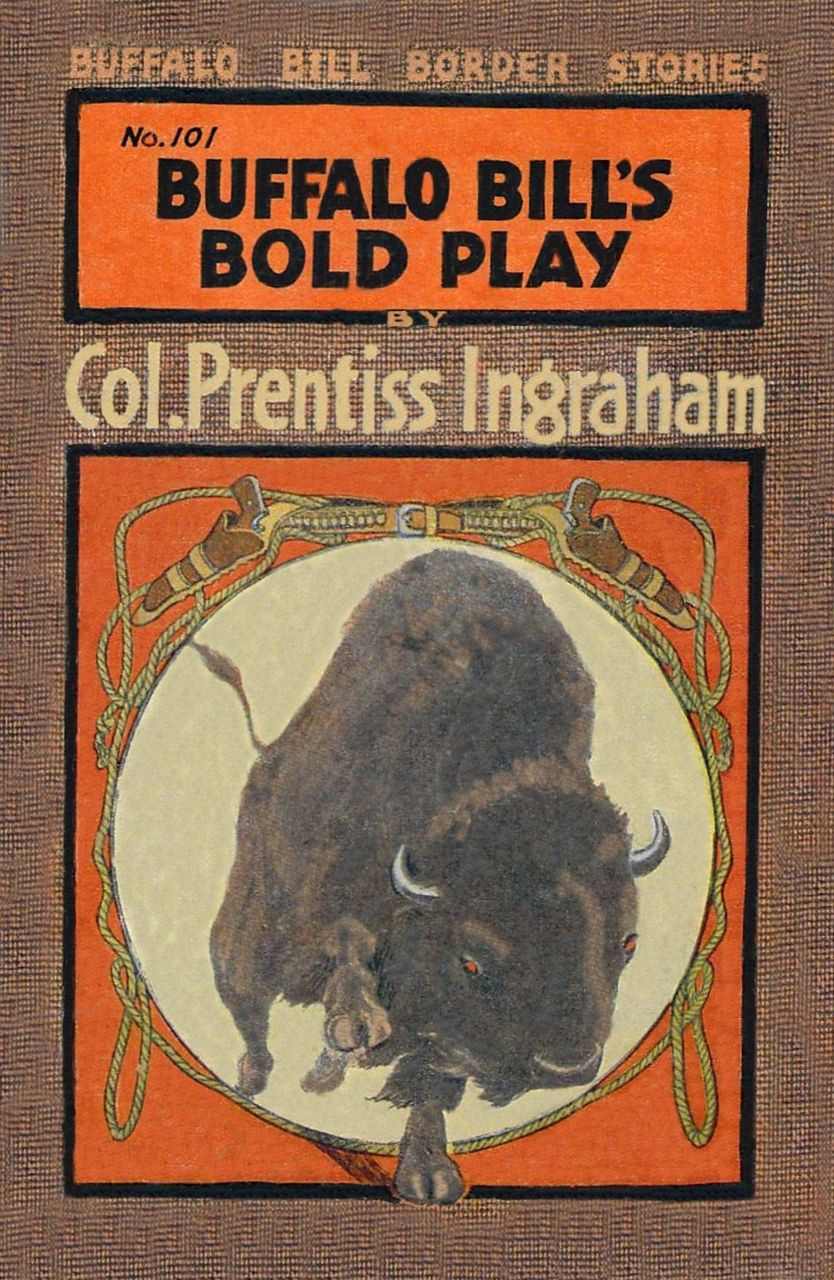
IN APPRECIATION OF WILLIAM F. CODY (BUFFALO BILL).
It is now some generations since Josh Billings, Ned
Buntline, and Colonel Prentiss Ingraham, intimate friends
of Colonel William F. Cody, used to forgather in the
office of Francis S. Smith, then proprietor of the New
York Weekly. It was a dingy little office on Rose Street,
New York, but the breath of the great outdoors stirred
there when these old-timers got together. As a result of
these conversations, Colonel Ingraham and Ned Buntline
began to write of the adventures of Buffalo Bill
for Street & Smith.
Colonel Cody was born in Scott County, Iowa, February
26, 1846. Before he had reached his teens, his
father, Isaac Cody, with his mother and two sisters,
migrated to Kansas, which at that time was little more
than a wilderness.
When the elder Cody was killed shortly afterward in
the Kansas “Border War,” young Bill assumed the difficult
rôle of family breadwinner. During 1860, and until
the outbreak of the Civil War, Cody lived the arduous
life of a pony-express rider. Cody volunteered his services
as government scout and guide and served throughout
the Civil War with Generals McNeil and A. J.
Smith. He was a distinguished member of the Seventh
Kansas Cavalry.
During the Civil War, while riding through the streets
of St. Louis, Cody rescued a frightened schoolgirl from
a band of annoyers. In true romantic style, Cody and
Louisa Federci, the girl, were married March 6, 1866.
In 1867 Cody was employed to furnish a specified
amount of buffalo meat to the construction men at work
on the Kansas Pacific Railroad. It was in this period
that he received the sobriquet “Buffalo Bill.”
In 1868 and for four years thereafter Colonel Cody
served as scout and guide in campaigns against the Sioux
and Cheyenne Indians. It was General Sheridan who
conferred on Cody the honor of chief of scouts of the
command.
After completing a period of service in the Nebraska
legislature, Cody joined the Fifth Cavalry in 1876, and
was again appointed chief of scouts.
Colonel Cody’s fame had reached the East long before,
and a great many New Yorkers went out to see
him and join in his buffalo hunts, including such men
as August Belmont, James Gordon Bennett, Anson
Stager, and J. G. Heckscher. In entertaining these
visitors at Fort McPherson, Cody was accustomed to
arrange wild-West exhibitions. In return his friends
invited him to visit New York. It was upon seeing his
first play in the metropolis that Cody conceived the idea
of going into the show business.
Assisted by Ned Buntline, novelist, and Colonel Ingraham, he
started his “Wild West” show, which later developed and expanded
into “A Congress of the Rough Riders
of the World,” first presented at Omaha, Nebraska. In time it became a
familiar yearly entertainment in the great cities of this country and
Europe. Many famous personages attended the performances, and became
his warm friends, including Mr. Gladstone, the Marquis of Lorne,
King Edward, Queen Victoria, and the Prince of Wales, now King of
England.
At the outbreak of the Sioux, in 1890 and 1891,
Colonel Cody served at the head of the Nebraska National
Guard. In 1895 Cody took up the development
of Wyoming Valley by introducing irrigation. Not long
afterward he became judge advocate general of the
Wyoming National Guard.
Colonel Cody (Buffalo Bill) died in Denver, Colorado,
on January 10, 1917. His legacy to a grateful world was
a large share in the development of the West, and a
multitude of achievements in horsemanship, marksmanship,
and endurance that will live for ages. His life
will continue to be a leading example of the manliness,
courage, and devotion to duty that belonged to a picturesque
phase of American life now passed, like the great
patriot whose career it typified, into the Great Beyond.
CHAPTER I. JUNIPER JOE’S JUBILEE.
BUFFALO BILL’S BOLD PLAY.
When that wonderful invitation was read by the masculine
element and the few women of Blossom Range,
it created a sensation, announcing, as it did, that Juniper
Joe’s jubilee was to consist of his marriage to a
charming widow of the East, Mrs. Rafferty, followed
by a dance and “refreshments.”
Stuck up in front of the post office, in none too legible
handwriting, it invited the whole town.
The ending was a screamer:
“If you-all what sees this invitation dont come, you
shore will miss the only first-class happenin that, so fur,
has hit this hyer lively hamlet. I aint seen Mrs. Rafferty
yit; but I have her photographt, an shes all to the
good, jedgin by it. Anyway, I’m takin the risks.
Every man what is goin to laff at me had better come
armed; and every man what is goin to envy me my good
fortune why he had better come armed, too. The ceremony
will be performed strictly accordin to Hoyle, by
our cellerbated feller townsmen an Jestis of the Peace
Jedge Abercrombie Morris. After the weddin there
will be a dance, and after the dance refreshments of the
kind you-all can appreciate. The music aint goin to be
no Wagnerian concert stuff, but somethin that has got
a lively jump in it; furnished by that prince of fiddlers
White-eyed Moses. And jokes about Moses’ eyes or
nose will provoke a homicide. Likewise anybody callin’
his fiddle a violin will be shot on the spot. What the
refreshments aire to consist of will depend on what sort
of truck Gopher Gabe happens to have in stock behind
his bar when the happy day arrives.”
The thing was signed by “Juniper Joe.”
What the fellow’s real name was few, if any, knew;
some said it was Mason, some Morgan, some even
slandered him by claiming that he walked about among
men bearing the plebeian cognomen of John Jones,
where he was better known.
Juniper Joe’s cabin—it was a big one—stood right at
the edge of the camp of Blossom Range, on the east.
The back of it burrowed into a hill; and in that hill was
Juniper Joe’s mine. No one could get into the mine,
it was claimed, unless he went through the house; and
the house was always locked, when Juniper Joe was
at work, or not receiving company.
The mine had gained great fame lately. Juniper Joe
had struck “pockets” that were wonderfully rich, judging
by Blossom Range standards. They were rather
high standards, too; for other men, in other holes in
the ground, were making good strikes, all round the
town.
It was because he had been so phenomenally lucky
that had induced Juniper Joe to seek a helpmate; he
wanted a woman to share his joys and sorrows, and help
him to spend his surplus cash. He might have got one
even in Blossom Range, on account of the plutocratic
reputation he had suddenly acquired; but he preferred
to pass them by and seek in fields afar for the future
partner of his bosom. So he said.
Juniper Joe’s invitations were a ten days’ sensation;
they would have been a month’s sensation, if that time
had intervened before the wedding and the dance.
When the stage came in from Calumet Springs, on
the morning of the day fixed, every man who could be
there was down at the stables, for it was known that
the stage was bringing the bride.
Juniper Joe was there, of course, at the forefront,
ready to welcome to this “garden spot of the mountains”
the future Mrs. Joe. Also, he was arrayed regardless;
in solemn black, with a shirt and collar as white as Mrs.
Maginniss, the laundry lady, could make them; and by
extra pay she had been spurred to do her best. Topping
his head was a silk cady of the previous year’s vintage,
which he had bought of the one Jew pawnbroker of the
place. The pawnbroker had worn it the first day he
came into the camp; there was still a dent in one side,
where the brickbat had landed which expressed the
town’s disapproval of that style of headgear. Israel
Silverman, being by nature a wise man, had then laid
the cady gently away in moth balls; only to resurrect it
and sell it to Juniper Joe.
On this day no one took a shot with brickbat or stone
at the shining hat. One reason was that Juniper Joe
had a “hostyle” temper when he was aroused by what
he considered an insult; the second reason was a double
one, but like it; he had two revolvers belted to his manly
waist, under the tails of his black broadcloth.
There was some disappointment when Mrs. Rafferty
descended from the stage; she was veiled! It was a
staggering blow to the curiosity of Blossom Range. But
she recognized Juniper Joe, when he rushed to meet
her; and the envious crowd was permitted to see her
walk away, with her arm hooked through his, to the
“hack” he had ordered.
He escorted her, in the hack, to the best hotel in Blossom
Range, where he left her for the time being.
One other circumstance must be mentioned, in connection
with that arrival, which created almost as much
curiosity as the coming of the Widow Rafferty.
Out of the same stage coach stepped a tall man, of
handsome carriage and almost military bearing; a small,
oldish man, with a seamed face and whitening hair; and
a round-bodied man, whose legs were thin as pipe stems.
They, too, took their way to the self-same hotel; but
they walked.
When they had been in the town less than an hour, it
became known, or noised about, that the three men were
Buffalo Bill and his two pards, Nick Nomad and Baron
Schnitzenhauser.
But what were they there for?
Nobody could answer the question, and few people
thought of them long. Time could not be wasted on
people, even so prominent, when every one in town had
to think all the while of the coming “jubilee.”
Yet the three were not wholly forgotten; for along in
the afternoon a copy of that queer invitation found its
way to the men mentioned.
To it was appended a little postscript:
“Mrs. Rafferty says that as you-all was so pleasant
to her while she was with ye in the stage from Calumet
Springs, that she thinks highly of ye, and has suggested
that it would be ther proper caper if, though bein strangers,
you was invited. Tharfore it’s hopin that you-all
will feel free to look on at the weddin, fling a heel in
the dancin, and sample the refreshments all ye like. In
this I am gladly jinin Mrs. Rafferty; though, at the
same time, acknowledgin that hers is the gentle hand
at present on the tiller of the bark matrimonyul. So
here’s again hopin you-all will come.”
This, too, was signed “Juniper Joe.”
It is almost needless to say that the trio went.
The fiddle of White-eyed Moses was scraping, and
thudding feet shook the rafters at the time of the arrival
of Buffalo Bill and his pards at Jubilee Joe’s cabin.
But the wedding ceremony had not yet taken place. The
premature dancing was due to certain men so hilariously
inclined that they had “tipped” the fiddler, and set him
to going ahead of time, because they could not wait.
But this ended, when Abercrombie Morris came into
the room and asked for quiet, announcing that the momentous
moment had arrived.
“Honored as we aire this evening,” said “Judge” Morris,
“we aire under obligations to conduct ourselves as
ladies and gents, and lend a listenin’ ear to the sollum
words which is goin’ to bind this man and woman together
in the holy bonds o’ matrimony.”
He was “sollum” enough himself, in his black clothing,
his fat, florid face clean-shaven, his hair plastered down
tight against his scalp with pomade; he was the only
“legal light” in Blossom Range, and appraised himself
accordingly.
The main room, large as it was, was crowded to suffocation,
the guests wedging themselves round the walls
in closely packed ranks, leaving an open space in the
centre, where Morris had taken his stand.
Buffalo Bill and his pards were near the outer door,
but in a position where they could witness everything
that took place.
A hush fell on the crowd, as a door at the other end
of the room opened, and the bride and groom appeared
in it.
Mrs. Rafferty, revealing herself for the first time, was
seen to be a medium-sized woman, light-haired, and
much painted and powdered. She was dressed in white,
and carried roses. Rumor said, afterward, that they
had been ordered from Frisco, at a staggering price, by
the happy bridegroom. Mrs. Rafferty was almost as solemn
in appearance as Morris; but Juniper Joe shot
happy glances here and there, apparently willing to think
that all the men in the room were dying of envy.
Abercrombie Morris, Justice of the Peace, having
never officiated on such an occasion, bungled the marriage
service through nervousness; yet drew it out to a wonderful
length, sure that in Blossom Range Fate would not
soon give him such opportunity.
The crowd was respectful; it would have been quite
as much so, even if it had not noted the bulging of the
coat tails of the bridegroom.
When Abercrombie Morris had pronounced the couple
“husband and wife,” Juniper Joe took much apparent
delight in introducing his bride to every one in the house
he could reach conveniently.
When it was through, he made a little speech.
“What I has to say, ladies and feller citizens, is: ‘Go
and do likewise.’ Thar, on the wall, set in a picture
frame which I made to-day myself, is the thing which
worked the trick fer me; and any of you can use the
same means, and make a copy of it, if you want to do
as I did.”
He pointed to an advertisement cut from a newspaper,
which he had framed and stuck against the wall.
“I don’t need to sling no wise advice to the ladies present;
fer they aire knowin’ well to the fact that they can
each and every one of ’em git married any minute that
they say the word. So I directs my remarks to the male
sect; which, because it’s out o’ all proportion with the
other in this hyer town, don’t have much of a show. In
the East, thar’s women so numerous that they fair jostles
each other, without half enough men to go round;
a condition that is highly prejudicial to the good of society
both hyer and thar. Most any o’ them women
would jump at a chanct to marry a likely man, ’specially
if he could show a good bank account. The hills round
this hamlet aire sproutin’ with gold, in pockets, leads,
fissure veins, and every other way; every man hyer has
got a cinch on wealth, if only he’ll hustle. And that
wealth will git him a wife, if he wants one; it’s what
brung me mine.”
He looked round, beaming, the woman at his side.
“That’s all,” he said; “except that the room will now
be cleared fer the dancin’. White-eyed Moses has promised
to hand out some o’ his choicest toe-ticklin’ selections;
and you-all know how he can do it. No firearms
er knives to be allowed on the dancin’ floor; no altercations
permitted, neither. The first gent that starts one
will be bounced.”
He swung on round, still smiling, a gaunt figure, in his
black clothing.
“So,” he finished, “that’s all; git yer pardners.”
In order to do that, as there was so few women, some
of the men knotted handkerchiefs round their left arms,
to indicate that they were “women”; and the dancing
began, as White-eyed Moses struck up one of his lively
quadrilles.
The new Mrs. Juniper Joe—no one could remember
that even in the ceremony Abercrombie Morris had
called him anything but Juniper Joe!—tried to dance
with nearly every man there, when they besieged her for
that favor; and only gave over the attempt because the
fiddler’s arm took a cramp at last, and he stopped fiddling.
The new Mrs. Juniper Joe thus proved that she was
certainly of the strenuous type, so far as muscular activity
was concerned.
As the dancing ended, and there was a rush for the
“refreshments,” a thing occurred which threw every one
into a flutter of excitement.
A man who, as it appeared later, had not been invited
came in. He was a small, lithe man, with a smooth
face, and keen, light-blue eyes; Buffalo Bill had observed
him almost as soon as he was in the room, and wondered
who he was.
His discovery, close by the door, which was open
behind him, brought quick work on the part of the hitherto
smiling bridegroom. Juniper Joe’s revolvers
bounced out of their hiding places beneath his coat tails,
and were fired as soon as he could swing them up; the
two reports, one from each revolver, crashing together.
The lithe little man tumbled backward against the door,
which his fall half closed.
As he did so, he sent a shot which smashed the one
light—a huge kerosene lamp suspended from the ceiling—thus
plunging the room into darkness.
There was wild confusion following this shooting.
Men tumbled headlong out of the place, by the doors
and windows; those who remained flung themselves flat
on the floor, to escape possible bullets.
The loud voice of Juniper Joe was heard, commanding
that another lamp should be brought.
“I guess I got him,” he said.
But when the lamp was brought, from another room,
the little man was not found, dead or wounded, by the
door. Juniper Joe’s bullets had gone through the wood
of the door; but neither on the door, nor the floor by it,
was there a stain of blood.
There were naturally vociferous howls for an explanation,
by the men who had dropped for safety; this
thing of a man beginning pistol work like that seemed
to call for an apology.
Juniper Joe gave it, in a few crisp and characteristic
words.
“That feller, gents,” he said, “was Tim Benson, road
agent and gin’ral outlaw, what I’m shore has been doin’
the hold-up work recently on these hyer trails. I seen
him onct, at Holbrook, when he made a gitaway, after
robbin’ the Holbrook stage. He got five thousand dollars
o’ my good money at that time, and I swore I’d kill him
if ever I got a chanct. I thought I had the chanct, jes’
now; but dropped it, somehow. I reckon I didn’t hit him,
fer he shot out the light, and seems to have hit the safe
places outside somewhar.”
Not many of the guests tarried for the “refreshments”
after that. Some went to look for Tim Benson; others,
scared, thought it best to take themselves off. In ten
minutes after the shooting, Juniper Joe’s cabin was nearly
emptied.
CHAPTER II. “JACKSON DANE, DETECTIVE.”
At the Eagle House, an hour afterward, the man shot
at by Juniper Joe appeared before the door of Buffalo
Bill’s room, and rapped.
Nomad, who was in the room with the scout and the
baron, being nearest the door, drew it open.
The little man came in, glancing narrowly around; a
quiet man, apparently mild-mannered. There was nothing
remarkable in his looks; in a crowd he would have
been passed without notice. Yet to the keen eyes of
Buffalo Bill the man’s very quietness of manner spoke of
reserve force and repression.
“Cody, is it not?” said the little man, addressing the
scout.
“The same,” the scout answered. “Have a chair with
us. These are my good friends, Nick Nomad and Baron
von Schnitzenhauser.”
“Glad ter meet up with ye,” said Nomad, as the stranger
tucked himself into the first chair.
“Aber I tond’t knowed you, I gan say der same py
mineselluf,” seconded the German.
The stranger regarded them closely.
“Thanks!” he said. “I think all you fellers was up at
Juniper Joe’s when he took them shots at me.”
“Ouch! We seen idt! One of dose pullets vhistled
so close py mine ear dot I t’ink I can hear him yidt.”
“I fancy they didn’t come as close to you as to me!”
The little man ran his hand through his hair, and revealed
a red welt on his forehead, just under the hair
he had lifted.
“One of them came as near to me as that. I wonder
it didn’t knock me out. I still had enough sense to pull
for the lamp, as I went down; then I crawled out through
the door, and got away.”
He looked at the three men curiously, as if wondering
what they thought of it.
“It was quick shooting!” was the comment of Buffalo
Bill.
The man had not yet introduced himself; and the scout
did not forget that Juniper Joe had charged him with
being Benson, the road agent, a man the scout had never
met, but whom he wished right then he could surely lay
his hands on.
In truth, Buffalo Bill and his friends had been discussing
this very man when he appeared at the door
and came in.
“What was said about me, after the shooting?” the
stranger asked, drawing one leg over the other and settling
into an easy attitude.
“I suppose you want us to be quite frank with you?”
said the scout.
“That’s what I’m expecting, gents. I knew something
would be said, and I fancied you heard it. I confess I
got away so quick that, whatever it was, I lost it. The
climate there didn’t seem healthy for me; so I tried as
fast as I could to change it.”
He smiled, then—a thin-lipped smile, that had little
merriment in it.
“Juniper Joe declared,” the scout told him directly,
“that you were Tim Benson, the outlaw and road agent;
that he recognized you, as soon as you came through the
door, as being the man who had held up a stage at Holbrook
and robbed it, getting five thousand dollars of
his money; for which he had sworn to kill you on sight.”
That thin-lipped smile, sneering now, became evident
again.
“A clever yarn, to be made up so quickly!”
“Then, it wasn’t true?” the scout queried.
“Not a word of it. On the contrary, instead of being
Tim Benson, I am Jackson Dane, of San Francisco, in
the detective business, and came here looking for Tim
Benson myself.”
“Ach! Iss dot so-o?” gasped the baron.
“It’s so.”
“Py yiminy, dhen——”
But the scout cut in, to keep the baron from making
some damaging statement:
“I suppose there must be something in your general
appearance which caused Juniper Joe to make that fool
mistake?”
The stranger laughed at that.
“If so, it came near being a fatal blunder for me!”
The scout and his pards were making a careful study
of the man, without appearing to do so.
“It was a clost call,” said Nomad. “But yer war too
quick fer him! Shootin’ out ther lights is a star play,
ef a man kin do et; an’ you rung the bell at the fust
crack. Buffler, here, couldn’t done et no better.”
“Thanks for the compliment! But”—turning to Buffalo
Bill—“I don’t think I much resemble Benson, except
that we are both small men—rather undersized, you
know; which is a marked thing in this country, where
nearly all the men are so big.”
“Size an’ heft don’t allus count,” said Nomad naïvely.
“F’r instance, thar’s Buffler, an’ thar’s me.”
“I judge that it’s your opinion,” the scout remarked,
“that Juniper Joe didn’t make any mistake?”
“No; he simply lied.”
“Why?”
“I’ll have to leave that to you; for I don’t know.”
“Unless he really made a mistake, and thought you
were Benson, he wouldn’t have any reason to want to
shoot you?”
“If he had any reason, I don’t know it.”
“Then, we may suppose that, seeing you there by the
door, and not having time to correct his first impression,
he felt sure you were Benson, and blazed away.”
“Mighty careless of him to do that!” said the stranger.
His light-blue eyes twinkled, as if the thing amused
him.
Then he shifted his legs, and for a moment the conversation
seemed stalled. He probably had noticed by
this time that the scout was closely watching him!
“One of the things bringing me here,” he said, breaking
the silence, “was to find out if you fellows air barking
up the same tree; that is, to see if you came here
chasin’ Tim Benson?”
“If so?” the scout queried.
“Well, then, I didn’t know but that somehow we might
make shift to work the thing together—me giving you
whatever tips I run acrost, and you doin’ the same by
me. There’s a reward of ten thousand out for Benson,
half of it put up by the Wells Fargo. I’d like to handle
all of it, of course; but if I can’t swing the thing alone,
I’d be willing to divide up with good men like you; in
case we could work the thing by a combination better
than singly.”
“You know about me,” said the scout; “that is, that
I’m in the employment of the government, as a scout,
and for other special purposes; so, of course, you will
see readily that if I came here with my friends looking
for Benson, it is because Benson has been troubling the
mails.”
“Yes, I know that, or supposed it. As for me, I fly
alone; in the private detective line, you know; just now
on the trail of that ten thousand dollars reward, and
hoping I’ll land it.”
“That isn’t what I meant.”
“No? What did you mean?”
“That you have my credentials—that is, you know
something about me. I don’t know anything about you!
It’s an important matter; so I hope you won’t mind my
bluntness.”
“But I’ve told you!”
“But shown no papers, nor even a badge. You must
have some source of authority, I suppose?”
For an instant the man who had given the name of
Jackson Dane seemed to hesitate.
“The truth is,” he said, “though likely you won’t believe
it, that I lost everything in that hotel fire at Deming,
where I was last week; just got out by the skin of
my teeth; so that my extra clothing and everything else
went up in smoke.”
“Er, waugh!” Nomad gulped.
“You think that is fishy?”
“I didn’t say et!” the trapper apologized. “Et’s jes’ a
way I has o’ breathin’ hard, at times.”
“You haven’t any letters which you have received
since?” Buffalo Bill questioned.
“Well, yes: just one!”
Jackson Dane pulled out what seemed at first a letter,
but was discovered to be an envelope from which the
letter was gone; it bore the postmark of Blossom Range,
and the date of that very day.
“I got this letter here this morning, soon after I struck
the town,” he explained.
The scout looked at the envelope, noting that it bore
the address of “Mr. Jackson Dane, Blossom Range,” but
that it held no letter.
“I see,” he said; but his tone was noncommittal.
“That’s all I’ve got right now, in the way of credentials,”
said the little man.
“You’ll pardon me for saying,” said the scout quietly,
“that since Juniper Joe tried to kill you because he
claimed you are Tim Benson, it would hardly be politic
for me to enter into any arrangements with you, of the
kind you mention.”
Jackson Dane flushed slightly.
“Sorry you look at it in that way,” he said. “But
for that fire in Deming, I could prove who I am, even to
your satisfaction.”
He sat in hesitation, looking from one to the other.
Then he seemed about to put on his hat.
“Just what do you know about Juniper Joe?” the
scout inquired of him.
“No more than what everybody else knows here in
the town, I reckon: he has struck it rich in his mine,
has taken a wife, and is celebrating. I can’t say that I
admire his judgment, that’s all.”
“In taking a wife in that way?”
“Just so. What does he know about her? She answers
his advertisement, which says that he is rich, and
comes on. Mebby they’ll git along together; but the
chances are that they’ll be fighting like cats and dogs inside
of a month. I know that all of life is a gamble;
yet I wouldn’t take fool risks.”
He put on his hat, and arose to go.
“Sorry, gents, that we can’t make a hitch,” he said.
“But I can ask this of you: Don’t mention it so’s Juniper
Joe will know I’ve been here. As he seems convinced
that I’m Tim Benson, I reckon I’ll have to keep
out of his sight; or else get myself ready to shoot
quicker than he can. I don’t care to get into trouble
here in this town, as that would interfere with the work
that brought me.”
He turned to the door.
Nomad sat, crouched, as if he thought of hurling himself
at the stranger and stopping him.
But as Buffalo Bill made no movement, the trapper
held his impulse in check; and Jackson Dane, of Frisco,
wended his way down the stairs in peace.
“Er, waugh!” Nomad gurgled, when he was gone.
“Waugh!”
“Well, out with it, if it hurts you,” the scout told him.
“Didn’t et strike ye thet mebby Juniper Joe told ther
truth, and that we’re lettin ’ther very critter we’re after
git erway?”
“I am yoost t’inking dot mineselluf,” said the baron;
though he did not seem excited.
Buffalo Bill produced a flat pocketbook, and extracted
from it a tintype picture.
It was of a miner, in red shirt and clay-stained trousers,
leaning on the handle of a miner’s pick. He looked
at it closely; then passed it to Nomad.
The round-bodied German climbed out of his chair,
and came over to inspect it with Nomad, looking over
the trapper’s shoulder.
“Waal, et’s powerful hard ter decide a matter like
thet,” said Nomad. “This hyar was taken all o’ five
y’ars ago, I reckon; and ’tain’t anything much of a pickcher.
Yet put the clo’es this hyar Jackson Dane war
w’arin’ outer ther man in this, an’ et might be ther same
feller.”
“Aber dhey tond’t look der same, idt mighdt pe,” confessed
the baron; “budt dhis veller he iss vearin’ a musdache.”
“’Twouldn’t be hard ter shave et off, I reckon,” Nomad
reminded.
The resemblance between the man in the tintype and
Jackson Dane could not be said to be marked. Both
were apparently of about the same size, the stature of the
man in the tintype being judged by the height of the
pick. They had been told that the original of the picture
was light-haired and blue-eyed. So was Jackson Dane.
The man in the tintype was the outlaw and road agent,
Tim Benson. They had come to Blossom Range looking
for him. Two weeks before he had been working
the Blossom Range stage trails, taking heavy toll. He
had, likewise, not hesitated to lay his hands on valuables
carried in Uncle Sam’s mail bags; for which reason
Buffalo Bill had been sent on his trail. From the
vicinity of Blossom Range he had skipped into other territory;
then had been heard of in Deming; when last
seen, he was said to be making back toward Blossom
Range.
That was about all that the scout knew, and it was
little enough. Five years before, Tim Benson had been
a miner, in a little place near Virginia City; it was there
he had this picture taken, by a traveling tintype artist,
leaning on his miner’s pick.
“Vale,” said the baron, “I am sduck! Vot ar-re ye
going to do?”
“I think I shall try for a talk with Juniper Joe,” said
the scout.
“Eenyhow,” the baron added, “I am hobing dot soon
ve vill pe scaring oop some adwentures dot haf a liddle
excidemendts in ’em.”
They were still talking the thing over, the little man
not having been gone ten minutes, when the scout had
another visitor, who came to the door of his room at
the Eagle House, and knocked.
Again Nomad drew open the door.
All were surprised to see the object of their talk—Juniper
Joe, tall and thin, dressed in his black broadcloth,
the tails of his coat suspiciously lifted by the big
revolvers that rested against his hips. He looked carefully
at the scout’s companions; then came on in, when
invited.
“I don’t keer if I do,” he said, when the scout asked
him to take a chair.
He helped himself to the one which the little man had
occupied so short a while before.
“You-all was at the jubilee to-night,” he said, running
his eyes over them; “and so know what happened ter
break up the gin’ral hilarity o’ that festive occasion. Because
o’ which I’m hyer, when I ought ter be thar with
my blushin’ bride this minute. I believe that the town
gin’rally thinks that the only mistake I made was in not
gittin’ the coyote I shot at; which you heerd me say
was Tim Benson, the road agent.”
“Er, waugh! We heerd yer!” Nomad told him.
“You know somethin’ about Benson?”
“Not so much but thet our cur’osity is ixcited ter hear
more.”
Juniper Joe turned to Buffalo Bill.
“I reckon you’re hyer trailin’ somebody. It’s considered
lately that you aire, when you pike into a town like
this.”
“I might be traveling for my health, you know,” Buffalo
Bill observed, with a smile.
“When already yer has got ther health o’ a grizzly?
Nobody’d think it. No; you come hyer fer somebody;
and I’ve been figgerin’ that it must be you’re lookin’ for
Benson, because he’s known to have been in this section
recent, doin’ hold-up work, as I said thar at my house.”
“Have you known him well?”
“I never seen him clost but onct; but then I had so
good a look at him that I spotted him to-night as soon’s
he poked his nose in at the door. Too bad that when I
pulled on him I didn’t git him! Of course, he’s still in
the town; and I reckon if chanct comes his way, he’ll
make the new Mrs. Joe ag’in a widder. But I’m heeled
fer him!”
He dropped a hand to the bulging revolvers.
“He’ll haf to pot me from the dark, if he gits me!” he
boasted. “But that ain’t what I come over hyer to
elucidate, after leavin’ my bride of an hour er so to
home all alone, which ain’t a proper thing fer any man
to do; and I wouldn’t do it but for the circumstances.
“You-all aire knowin’ to the fact,” he went on, “that
lately I’ve been hittin’ it big in my mine. Sense the
Wells Fargo sent out its last shipment, I’ve pulled out
o’ that mine gold dust and nuggets to the amount of ten
thousand dollars’ worth. To-morrow the Wells Fargo
is goin’ to ship it out fer me, with stuff from a good
many other mines round hyer; I reckon thar’ll be fifty
thousand dollars go out in the express company’s cash
boxes to-morrow.”
Buffalo Bill, having been so short a time in the place,
did not know this, and was interested.
“So-o?” said the baron. “Dot iss more gold as I haf
effer seen in one bunches.”
“Et’s er heap,” Nomad admitted.
“I reckoned,” went on Juniper Joe, “that you-all would
be takin’ a hand in gyardin’ that stage load of wealth
when she pulls out. So I’ve come to give ye a pinter.
Jest in the cañon tother side o’ Stag Mountain is whar
you’re likely to have trouble; in my opinion, if the agents
hits you, it will be right thar. I say this so’s you can
be ready for ’em.”
“As the Wells Fargo people haven’t told us anything
about it,” said the scout, “I think it is unlikely they will
ask our help.”
“But the mail goes through on the same stage, you
know,” Juniper Joe explained. “I jedge it’s the mail
that you’re most int’rested in?”
“Aber you tond’t know vhere diss roadt achent iss
vot you shodt at,” said the baron, “I exbose dot you
vill pe looking for him yourselluf?”
“Waal, I’ll kinder keep my eyes peeled, as I ambles
round the town,” Juniper Joe admitted. “Ye see, I
think he’ll lay low, now that he knows he has been spotted.
But it’s him being hyer which makes me figger that
the bullion stage to-morrow is goin’ to have er heap
of fun gittin’ through?”
“You think,” said the scout, “that he will hold it up,
at the place you mentioned?”
“I figger that he has got friends hyer, and they’ll help
him do it. I’m goin’ to say to the Wells Fargo folks
what I’ve said to you. And I’m goin’ to make ’em a suggestion,
which I now make to you. Why wouldn’t it be
a good idea to send the old stage out empty, but with
gyards in it? Make a bluff, ye see, which will cause
Tim Benson an’ his gang to think the bullion, nuggets,
an’ dust aire goin’ that way. Then put the stuff over
the mountains in some other manner, which the agents
wouldn’t git onto.”
“It might do,” the scout admitted.
“Uff he tond’t gatch onto it.”
“It can be kept quiet,” said Juniper Joe. “I jest wanted
to say these things, and have ye think ’em over to-night.
Now I got to git back to my new wife; er she’ll
be thinking that mayby I’ve run up ag’inst the pistol of
Benson. She didn’t want me to come down hyer to-night,
on that account. Women aire gin’rally skeery critters,
ye know.”
He pulled himself out of his chair; then went out and
downstairs, walking slowly, as if he were thinking over
the situation.
“Er, waugh!” Nomad whooped again, when he was
gone. “What does yer make o’ thet?”
“I’ll know better when I’ve had a talk with the Wells
Fargo people,” was the scout’s answer. “That’s what
I’m going to do now, if I can find them at this time of
night.”
When the scout and his pards found the Wells Fargo
people, which was not for an hour afterward, as the express
office had long been closed for the day, they discovered
that Juniper Joe had deviated far enough from
his homeward track to get there with his advice ahead
of them.
“His idea is so good,” said the Wells Fargo agent,
“that we’re going to adopt it. We’ll send out the stage
empty, but with a strong guard in it. If the agents hold
it up, we’ll have a chance of shooting them all to pieces;
and they will secure nothing, even if they get into it.”
“How will you send the stuff?” the scout asked.
Though the agent was in his own home, he got out of
his chair and, going outside, walked all round the house,
to see if possible eavesdroppers could be there.
When he came back he was satisfied.
“Well, I’ll tell you,” he said. “We’ll send the stuff
over the mountains in charge of two prospectors that we
know are reliable—Jack Austin and Bennett Brown.
They’ll take burros, and will pretend to be setting out on
a prospecting trip; and so throw off any suspicion. When
they get down out of Eagle Gap, they’ll swing to the
east, and put the stuff on the stage at Colorow Springs,
where the stage will be instructed to wait for them. Beyond
that point there won’t be much danger, as the country
is open and level, and a hold-up wouldn’t be attempted.”
“Der only t’ing,” said the baron, “iss, vill idt vork? I
vouldt like to go mit Austin unt Prown.”
“Why?” said the agent.
“Because, in my obinion, dot iss vhere der excidement
iss going to pe seen; unt I am fondt uff excidemendts.”
CHAPTER III. THE BARON FINDS EXCITEMENT.
The baron got his wish.
The Blossom Range postmaster, having wired for instructions
that night, handed to Buffalo Bill in the morning
an order requiring him to become one of the escort
of the mail stage to leave the town that day. The post
office authorities had got into quick communication with
those of the war department, with that result.
Nomad chose to go with Buffalo Bill. The stage
would carry the mails, even though it did not take the
treasure. So that determined the matter for the scout.
When the Wells Fargo agent asked if he could recommend
a good fighting man to go with the burros that
were to be taken out by Austin and Brown, the scout
recommended the baron.
“Ach! I am a brosbector,” said the baron, highly
pleased, as he clattered down from his room in the
Eagle House and paused by the desk of the clerk.
He looked it, every inch, in spite of his girth and his
pipe-stem legs. He was dressed as a miner, except that
he stuck to his little fore-and-aft cap.
“I haf seen enough since I gome py dhis town in,” he
explained, “to seddle idt vor me. Dhere iss goldt in
dhese hills; unt I am going to findt some uff idt.”
“Look out for road agents and Indians, then, if you
git hold of any,” the clerk warned him. “Going out
alone?” he asked, as a second thought.
“Not any. I tond’t peen ackvainted mit dhese hills,
unt meppy I might losdt mineselluf. No; I am going
oudt mit Ausdin unt Prown.”
“Oh, they’re going out this morning, are they? Good
men! But though they’ve prospected a lot round here
in the last month or so, I never knew them to strike
anything worth while.”
“Idt iss me vot vill shange dheir lucks!” the baron
boasted, as he went on out of the office.
Austin and Brown had their burros in the street, and
were waiting for the baron. They were quiet-looking
men, of the miner type, who, in a town like that, would
not attract a second glance. Nor was anybody paying
heed to their burros and their packed outfit, with the
picks and shovels displayed prominently on top; prospectors
went from the town every day, and these two
men had already been out a number of times.
All attention was being directed to the stage, ready
soon to leave the stables with the United States mail,
and, as was supposed, the treasure to be shipped that day
by the Wells Fargo company.
The stage was filled with armed men, who prominently
displayed their hardware. On top, sitting beside the
driver, were old Nomad and Buffalo Bill. The public
knew now that Buffalo Bill was being sent along by the
postal authorities.
It was the general belief that when the treasure went
through the cañon beyond Stag Mountain, where so many
hold-ups had occurred, there would be a lively fight, if
the bandits, who were known to be infesting the hills,
could get enough men together to make the deadly tackle.
But the stage went through the cañon that day without
a ripple of excitement. Not a road agent was there.
To be sure of this, when the stage had passed beyond
what was considered the danger spot it was halted, and
some of the armed men went back, to poke through the
bushes.
“Scared ’em off with the big show of fighting men we
made,” said the men, when they returned.
It was fully two hours later when the baron, with Austin
and Brown, butted into the excitement which the
baron had anticipated.
At Eagle Gap, where no trouble of any kind had ever
before occurred, two men rose up beside the winding
path, and began to shoot as soon as they rose. The
men were masked, and they were well armed, each with
a repeating rifle and a brace of revolvers.
Austin went down at the first fire, shot through the
head, being killed instantly. Brown toppled, falling
wounded. The baron threw himself flat on the ground,
escaping that first shooting as if by a miracle; though
the real reason was that Austin and Brown stopped the
first bullets the bandits sent from their repeaters; and
before they could fire again the baron was down, and
behind a rock.
“Ouch!” he squawked. “I am to pe kilt, huh!”
Then he fired back.
He apparently wounded one of the men, which stopped
their rush toward him, and enabled him to take a tumble
backward down the steep slope. The baron plowed a
reckless furrow, which barked his skin and tore his
clothing, but landed him in a rocky hollow some distance
down, before the outlaws could get to the top of the slope
and shoot at him.
Poking his head out enough to enable him to see, he
blazed away again, when he saw one of the men appear;
and drove the bandits back once more.
Following this, the baron crept on his hands and knees
down the gulley, determining what the men were doing
by the sounds they made.
“Ach!” he said. “Dhis iss der vorsdt effer.”
The baron did not show himself for a while; but sat
nursing his rifle, occupying a hollow into which he
wedged his body, and where he was resolved to fight to
the death if the outlaws followed him.
He knew they had the advantage, being familiar with
the country, and being two to one.
When he concluded that they were not coming after
him, he got out of his hole, and tried to discover what
they were doing.
Then he found that they were gone.
They had taken the burros and treasure, and had vanished.
The place was a cut, with debouching gashes making
from it in various directions, all rocky and hard as flint;
so that, being unfamiliar with the location, the baron
could do nothing.
Abundant proof that they had been there was given by
the grewsome sight of the dead Austin, and by the wounded
man they had considered dying when they left him.
Brown had been shot through the right side, but he
was still conscious. To keep them from finishing him,
he had feigned death.
When the baron gave him some stimulant from his
pocket flask, the prospector regained enough animation
to be able to talk.
“Tough luck, pard!” he said. “They got Austin!
“Unt der dreasure!”
“Yes. I didn’t see but two of ’em. If they hadn’t
surprised us, we might ’a’ done something. But thar
wasn’t much show, when they riz up shootin’ as they
riz. If you think they’re gone, see if that bullet is still
in my side, will ye?”
The baron made the examination, his rifle on the
ground where he could pick it up instantly.
“Der pullet vendt t’rough,” he said, when he had
looked the man over. “You needt der hosbidal pooty
kvick, I dell you.”
“I reckon I’ll never git thar, with the burros gone.”
The baron gave the man more stimulant; then plugged
the wound and bandaged it as well as he could, tearing
the man’s shirt into strips for the purpose.
Having done that, he stood back and looked the man
over.
“I dhinks maype I gan carry you,” he said. “You aind’t
so heavy as me.”
“I don’t reckon you could do it, pard,” Brown answered.
“Vale, ve dry idt, eenyhow. Uff der voundt tond’t
pleed too much ve gan make idt. How many miles iss
idt?”
“All of three, I reckon; and rough goin’.”
In spite of his unpromising physical appearance, the
baron was strong; and he had the stuff of which heroes
are made.
He accomplished the three miles over the rough trails
with Brown on his shoulders, and got him into the local
hospital in time to save his life.
The knowledge that the prospectors had been in charge
of the treasure; that Austin was dead, Brown wounded,
and the treasure gone, furnished news of a sufficiently
exciting kind to fill all the public places of Blossom
Range with crowds.
“A Dutchman’s luck!” was the universal verdict, when
reference to the baron’s escape was made. “You can’t
kill a Dutchman.”
Buffalo Bill talked the matter over with his pards, in
the seclusion of his room at the Eagle House, while a
delegation of the townspeople had gone out to Eagle
Gap to bring in the body of the dead prospector, and
poke round out there for whatever they could find of
interest concerning the daring desperadoes who had
made the attack.
“Thar is one shore thing,” said old Nomad, humped
up in his chair and smoking his pipe; “ther chaps what
made ther tackle had information o’ the hull bizness.”
“Unt der kvestion iss,” the baron added, “how didt
dey knowed idt?”
“Somebody leaked the information,” said Buffalo Bill.
“Which means,” said Nomad, “thet either ther express
agent, ther fellers in ther post office, er at the stage
stables, aire inter ther thing deep. Et was ter be kept
so clost, ye know, thet nobudy c’d ketch on.”
“Vot uff Yuniper Yoe?” asked the baron; “I am t’inking
uff him!”
“Er, waugh! Yer mean he might er been ther one
ter give ther snap away?”
“Dot iss yoost vot I am saying.”
“But—he had ten thousand dollars’ wuth o’ stuff in
them burro packs! Would he tip off ther road agents,
ter git his own wealth? Et don’t hardly look like it,
pard.”
“I aind’t saying dot he did idt,” the baron admitted. “I
am yoost asking some kvestions.”
“Right now, we are pretty much in the dark,” the scout
admitted.
“Ve ar-re all oop der sdump!”
“They are giving you a lot of praise round the town,
baron,” Buffalo Bill told him. “They say that you put
up a nervy fight.”
“Vale,” said the baron, unmoved, sucking at his long-stemmed
pipe, “dey tond’t know only yoost vot I toldt
’em.”
“Brown says that you put up a good fight, and that
you wounded one of the outlaws.”
“I seen der willain reel pack unt shake, ven I shodt
at him; budt he ditn’t vall town.”
“And you brought Brown in on your shoulders.”
“Uff course! Vot else couldt I do? Dot aind’t no
pravery, idt vos yoost muscle; unt idt took a heab uff idt,
I dell you. He veigh apoudt two dons, pefore I gidt him
here py der hospidal in. Yaw!”
“What makes you think et may be Juniper Joe leaked
information?” Nomad asked, coming back to the subject
that interested hint.
“I haf no reason; idt iss yoost vot Puffalo Pill somedime
calls insdinedtiveness. I seem to schmell idt in
der admosphere.”
“That ain’t no reason!” the trapper sniffed.
“You ar-re righdt; idt aind’t.”
“Speaking of Juniper Joe,” remarked Buffalo Bill,
“this morning early I saw his wife downtown; I heard
her say she was out making calls on the ladies, as she
wanted to get acquainted with them as soon as she
could.”
“It wouldn’t take her long,” Nomad sniffed, “fer thar
ain’t many in this hamlet.”
“I noticed that she paid a visit to the show girls who
are stopping at the Casino; the bills outside announce that
they’ve got a playlet on the boards there, called ‘Grandpa’s
Holiday’.”
Nomad snickered.
“Whatever would she want to call on them song birds
fer?” he asked.
“I don’t know, except through curiosity, and because
there are so few women in the town. I was still outside
when she came down, and she was talking with one
of them at the foot of the stairs just before she came
away. I took a look at the girl—a thing with a head of
hair like a Circassian Beauty; on asking one of the assistants
who she was, I was informed that her name is
Vera Bright.”
“Waugh!” Nomad gulped, smothering a snicker.
“Thar’s a name fer ye!”
“I don’t suppose it meant anything at all,” remarked
the scout, as if musing over it.
“Prob’ly not. Them show gals is frum ther East, I
reckon, and likely thet accounted fer Mrs. Joe payin’ ’em
a visit.”
They came back to the subject uppermost in their
minds—the question of who could have leaked information
to the road agents.
When they had threshed through it again, and made
nothing of it, Buffalo Bill prepared to go down to the
Wells Fargo office.
“Do yer reckon,” said Nomad, as he and the baron
arose to accompany the scout, “that this hyar Jackson
Dane, what calls hisself a Frisco detective, could be
mixed inter ther thing? Recklect thet Juniper Joe says
he is shore Tim Benson.”
“I’m not forgetting what Juniper Joe said about
him.”
“But what does yer think?” the trapper persisted.
“There I am stalled again. It seems that we are
called on to suspect everybody: the express agent, the
post office people, the stage hands, and driver, Juniper
Joe, and this alleged detective. Perhaps we’ll even add
to the list as we go along.”
“Mebby we’ll ring in the Casino ladies,” suggested
the trapper with a grin.
“It wouldn’t surprise me if we did.”
“Waugh!”
“Vale, dot vouldt furnish some excidemendt!” protested
the German.
“I should think, Schnitz, thet ye’d had ernough fer
one day!” Nomad growled.
“I am a hawg for excidemendt,” the baron admitted.
Down at the Wells Fargo office they found Juniper
Joe, with a number of other men, most of them shippers
of the treasure taken by the road agents. They had
been filing claims for repayment by the company.
“I cain’t afford to lose that ten thousand dollars, y’
know,” the scout heard Juniper Joe remarking, as he
entered the door. “It’s a lot o’ money; I paid the company
fer safe transportation, and I expects it to make
good.”
Some of the other claimants said much the same
thing.
The office was crowded, for, in addition to these men,
a lot of loafers were hanging round, their ears open for
news and gossip.
Having entered, Buffalo Bill and his pards stood by
the door, almost at first unnoticed, listening to the talk,
trying to get a “line” on something.
The agent seemed flustered and nervous; apparently,
he did not know what the powers who were over him
would think of his action in sending the treasure across
the mountain with the prospectors. He even admitted
that he expected a “call down,” as he had exceeded his
authority in doing it.
“I suppose I ought to have let her gone by the stage,”
he said. “Likely if I had the stage would have been held
up, and the stuff taken, and instead of one dead man
and another in the hospital, the cañon down there beyond
Stag Mountain would have been full of them.”
“So, it’s your opinion that somebody who knew the secret,
leaked?” said Buffalo Bill, speaking up now, to
note the effect.
“Oh! you’re here?” said the agent.
To the scout, perhaps unduly suspicious just then, it
seemed an unfortunate remark, as he was sure that the
agent had seen him when he entered with his pards.
“What is your opinion?” he asked.
“Somebody blabbed, of course! But I hope you don’t
think I did it.”
“It’s an uncalled-for statement,” said the scout. “I’m
not accusing anybody—simply asking questions.”
“Well, I don’t know anything about it! About all I
know right now is that it puts me in a hole, and I’ll
likely lose my job. Why, there was more than fifty
thousand dollars’ worth of stuff in those bags the burros
carried!”
“So I knew.”
“And, of course, the Wells Fargo company air going
to make a hot time about it.”
“I think they ought to.”
The people in the room, loafers and all, were staring
at the tall scout.
“It don’t make any difference to me about that,” spoke
up Juniper Joe. “I surrendered my stuff into your
hands; and, of course, I’m goin’ to see that the company
makes good the loss; that’s all. You’d do the same, if
me.”
“But you forget that it was you who suggested the
plan of sendin’ it out with them prospectors!” the agent
shot at him.
“I thought it was a good scheme; ’twould have been,
if somebody hadn’t been too free with his mouth. I
ain’t sayin’ who it was. But somebody on the inside
hustled the news to the road agents. That ain’t my
fault; and my scheme cain’t be blamed fer it.”
“Oh, well! you’ve put in your claim, and that settles
it!” the agent snapped back.
“It don’t settle it until I see the company’s money!”
Juniper Joe told him; then went out of the office.
When Buffalo Bill and his pards left, after a talk
with the agent, they were no wiser then when they went.
CHAPTER IV. SUSPICIONS.
Buffalo Bill and his pards tried to “jump a trail” that
afternoon and evening, without success.
The scout talked with Brown, the wounded man in
the hospital; but got no additional information.
“The two fellers was so masked,” said Brown, “that I
couldn’t tell if they was black, white, or red. The surprise
was so complete, anyway, that maybe I wouldn’t
have noticed. We wasn’t expectin’ trouble—leastways, I
wasn’t; for I allowed the agents would be fooled complete,
and would tackle the stage, if they done anything.
Then, fu’st thing I knew, there was them masked devils
whanging away at us with repeating rifles. Austin was
killed; and I got this hole in my side. Your Dutch
pard was gamy, and clipped one of the agents. I could
swear to that; because, as I drapped, I heard the feller
rip out a cuss word, and saw him reel back. But he
didn’t fall; so, p’raps the wound didn’t amount to much.
One of ’em tried to down the Dutchman; but he got
away. That’s about all; except that we lost everything.
They even took my hardware and Austin’s, with our
cartridge belts. Then they drove the burros away. I
had my nose ag’inst the yearth, playin’ dead fer all I
was wu’th at that time, so I didn’t see ’em go, but I
heard ’em. About the next thing I knew, your friend
was bendin’ over me. I got purty weak, and I reckon
I had fainted. And that’s all.”
“Did you see what sort of men they were, as to size?”
the scout asked. “You might have done that when they
were getting your weapons.”
“I was too busy playin’ dead jest then to notice clost,”
Brown admitted. “But I did see that one was tall and
t’other seemed medium size. It was the small one that
was wounded.”
“Did you notice their voices?”
“Not in p’tickler.”
“You were at Juniper Joe’s wedding?”
“Well, I reckon.”
“Then you probably saw the man Juniper Joe shot
at?”
“I did.”
“Joe claimed the man was Tim Benson, the road
agent.”
“I ain’t fergittin’ that, neither.”
“Try to recall if one of the road agents resembled
that man in any way.”
Brown pondered over this.
“Well, the littlest one might have been him,” he said;
“I should say he was about that size.”
“Some one on the inside must have informed the agents
that you and Austin were going over the mountains with
the treasure bags,” said the scout. “You couldn’t give
a guess as to who that could be?”
“I’ve been thinkin’ about that,” Brown confessed.
“No, I can’t say who it could have been. My best guess
is, that if that little man was Benson he hung round
somewhere and overheard the talk when the thing was
planned.”
“It’s a good guess.”
In Brown’s wounded and feverish condition the scout
had talked long enough; and he took his departure.
“A water haul,” he told himself. “But Brown’s guess
that the man called Benson may have got onto the thing
by eavesdropping may be the right one. I think I should
like, right now, to meet Jackson Dane, detective.”
He met him, on his return to his hotel; Dane was
by the door of his room, awaiting his appearance.
“Hello!” said the little man, cheerily. “I’ve been
waiting to have a talk with you confidential.”
“I’m agreeable to that,” said the scout.
He unlocked the door, and they went into the room
together. Closing and locking the door, Buffalo Bill
hoisted one of the windows.
“What’s that for?” said Dane.
“The window is to let in a breath of air; the door is
locked to keep out possible intruders.”
“Oh!”
“It startled you?”
“Well, as you were unkind enough to suggest that I
was a fraud of the first water, when I was here before, I
didn’t know but you was getting ready to jump at me,
and put up a holler for help to hold me.”
Buffalo Bill laughed grimly.
“You are nervous.”
“Who wouldn’t be, knowing that Juniper Joe is walking
the streets with two revolvers, ready to down me
the minute he sees me? That’s enough to make any
man nervous. Are your pards here?”
“They’re close about.”
“I have been hammering away at this case ever since
I saw you last; and have a theory.”
“Out with it; if you want to share it with me.”
“It’s just this. Juniper Joe’s wife is one of the road
agents.”
“What makes you think so?” Buffalo Bill asked mildly,
yet showing interest.
“The thing has come to me by degrees. A while ago
I was down in Gopher Gabe’s saloon, just inside the
door; I had my hat pulled over my eyes, for I didn’t
want to be recognized; and I heard men talking in there,
by the bar. I don’t know who they were; but what they
said gave me all the information I have about that remarkable
hold-up and shooting in Eagle Gap to-day;
though I admit that before that I knew something had
happened, for I saw your Dutch pard come in with that
wounded man on his back.
“What I heard them saying at Gopher Gabe’s,” he
went on, “was that the Dutchman reported that one of
the agents was a tall man, and the other a small man.
Juniper Joe is a tall man; and Mrs. Joe is a small woman.”
“You don’t think that the new Mrs. Joe is a man?”
“I don’t know about that; but probably a woman.
Now, inasmuch as Juniper Joe knew all about the plans
for sending the stuff over the mountains on burros, what
would have been easier than for him and his wife to
disguise and go out there and do the hold-up act?”
“It could have been done by them, in all probability.”
“Say that Joe had ten thousand dollars of stuff in the
express bags, what of it? There was as much as forty
thousand more, as I understand it. That forty thousand
would be a big haul.”
“It would.”
“So, there you are, according to my way of thinking.”
“Why don’t you arrest Joe, then? You say that you
are a detective.”
The little man flushed slightly.
“I suppose I oughtn’t to admit it,” he said; “but, since
Joe took that shot at me, I’m afraid of him; if I should
go up to his cabin, he would down me, and ask what I
had come for afterward. That’s the way I look at it.”
“If I should arrest this woman, and find that you are
right, what would you expect?” the scout demanded.
“The half of that ten thousand reward for the arrest
of Tim Benson,” was the unexpected statement.
“What is that?” cried the scout.
“I heard, before I came here, that Tim Benson is a
woman!”
The scout sat pondering this.
“Would that be any reason why Juniper Joe should
want to shoot you?”
“He knows that I am here after Tim Benson!”
“I see.”
“And you’ll see that I’m right, if you arrest Mrs. Joe,”
Dane declared, confidently. “That’s what I want you to
do; and the sooner the better.”
“Why your hurry?”
“It will keep other fellows from being held up and
killed by that couple,” he explained suavely.
The scout sat looking at him.
“This gives me a new idea,” he said.
“I thought it would.”
“For one thing”—he still looked at Dane—“I think
I ought to arrest you; but—hold on, the door is locked,
remember!—I am not going to do it—right now.”
Jackson Dane, who had leaped up with a startled look,
dropped nervously back into his chair.
“You’re humorous—at times.”
“Think so?”
“It would turn out to be a boomerang, if you did arrest
me and it was found then that I am just what I
claim to be; the town would sure have the laugh on you.
But you do what I say, and you won’t regret it. Go up
to that cabin and arrest Mrs. Joe; and don’t delay about
it.”
“Why the haste?” Buffalo Bill asked again.
“Because I have a feeling that she isn’t going to stay
long in Blossom Range, and now is your chance to get
Tim Benson by doing it.”
He stood up and put on his hat.
“I am ready to go, now,” he said. “You will do as
you please, of course.”
“I’m pretty sure to.”
“Well, think it over, anyway. Perhaps you’ll come
round to my opinion.”
The scout put the key in the lock, and opened the
door.
“So, you don’t intend to arrest me?” said Dane, as he
passed out into the hall.
“Not right now,” the scout told him.
“That’s kind of you, anyhow.”
He laughed lightly, and ran for the head of the stairs.
Well behind him, yet keeping the little man in sight,
Buffalo Bill trailed him through the streets of Blossom
Range, observing that Dane had pulled his hat down
over his eyes, and turned up the collar of his coat, as if
he did not wish to be recognized. But Blossom Range
was a bustling place, and men were too busy to pay
much attention to pedestrians; so that, apparently, Jackson
Dane was not given a second look by any one, as
he passed along.
The scout’s interest was quickened when Dane turned
to the Casino, as the little local theatre was called, and
went in by the entrance marked “Private.”
Reaching that door, the scout stood listening; then
went in, also; but quietly.
In a room above, as he stood on the stairs, he distinctly
heard Jackson Dane talking with the blonde beauty
whose name had been given as Vera Bright.
“Well, that’s singular!” was his thought. “He is
talking with the same girl that Mrs. Juniper Joe had a
confab with! I wonder if there is a connection here?”
But he could not understand what Dane and the girl
were saying.
He did not want to be seen spying on the stairs of
the Casino, and when it seemed he could not get nearer
that room without discovery, as people were passing
through the upper halls, he retreated to the street.
But he did not at once go away.
Taking a position on the opposite side of the street,
where he fancied he could not be seen, he watched the
door marked “Private.”
But though he tarried there two hours, Jackson Dane
did not reappear.
Buffalo Bill was a good deal puzzled, when he made
his way back to the Eagle House.
“But there’s one thing,” he resolved; “to-night I’ll
watch Juniper Joe’s cabin for a while.”
He did not wait until night, however, before visiting
the place. He made a bold call on Juniper Joe, soon
after leaving the Casino.
The door of the cabin was locked, as usual; but when
the scout had rapped briskly two or three times, heavy
steps were heard, and Juniper Joe cautiously opened the
door.
“Oh, it’s you!” he said, when he beheld the scout, his
manner uneasy.
“Yes; can I come in?” Buffalo Bill answered.
Juniper Joe flung the door open, and invited him in.
The big room which had witnessed the “jubilee” was
unoccupied, save by Juniper Joe and the scout.
“Your wife is not in?” the scout asked.
“She’s downtown somewhar, gittin’ acquainted with
the Blossom Range ladies; she allowed, seein’ that she
was mightily int’rested in society back East, that it was
goin’ to be plum lonely fer her hyer if she didn’t stir up
some women to talk to; so she sailed out, and has been
workin’ hard at it the better part of the day.”
Juniper Joe had discarded his black broadcloth and
shiny cady for a miner’s working suit and a soft, clay-stained
hat.
“Been pokin’ about in my mine,” he explained. “Struck
another rich pocket, too!” He beamed. “Allow me to
show you some o’ the nuggets I got out of it.”
He went into the other room, and brought out some
nuggets—a handful of them.
“Beauties, ain’t they?” he said, as the scout inspected
them. “Struck the pocket this mornin’, soon after I
come back frum the express office, an’ have been gopherin’
round it ever sense. If things keeps up this way,
I’ll have another shipment to make in a week er so; but,
by jings, I don’t let the Wells Fargo handle it!”
“They fell down pretty badly on that last job.”
“’Jever see anything like it! Every bush round Blossom
Range seems to be hidin’ an agent, and the town is
full o’ thieves. That’s why I allus keep that door locked
when I’m out of the house, or at work back in the mine.
I was glad to git that stuff into the hands of the express
company, fer I expected every night to be knocked on
the head before mornin’, so long as I had it in hyer.
Thar’s plenty men in this town would kill ye fer a bag
o’ gold dust.”
“I’m afraid that’s right.”
“I’m shore of it. And sense Tim Benson is round
hyer, I ain’t takin’ no chances.”
He indicated the two big revolvers under his coat.
“I keep ’em strapped to me constant,” he confessed.
“It will be him er me, if we meet; and I know it.”
He put the nuggets away. On coming back, he asked
how Brown was getting along.
Knowing that the man he called Benson had gone to
the Casino, Buffalo Bill was tempted to tell him of it;
which would perhaps send him down there, looking for
him. If a duel came of it, there might be some surprising
developments.
But the scout put the temptation aside.
He did not know how much he could believe of what
Juniper Joe and Jackson Dane had said. And, if all
were true, he did not care to take the responsibility of
setting two men to shooting at each other.
“I’m still stalled!” he admitted to himself, when he
left Juniper Joe’s cabin.
CHAPTER V. THE SURPRISE AT JUNIPER JOE’S.
Buffalo Bill filled in the day by riding with Nick Nomad
out to Eagle Gap, for the purpose of looking over
the scene of the hold-up.
Baron von Schnitzenhauser, his curiosity fired by what
the scout told him of the visit of Jackson Dane to the
show girl called Vera Bright, had determined that he
would shadow the Casino, instead.
So the baron donned again his prospector’s suit of
clothing, discarded his little fore-and-aft cap for a miner’s
slouch hat, and sallied forth. It was one of the
baron’s peculiar delusions that he could disguise himself
easily; it was a harmless impression, and sometimes it
yielded
no end of excitement. But any one familiar with
the appearance of that round body and those pipe-stem
legs did not need to wait for the baron to open his mouth
to know who he was.
The body of Austin had been brought in by some of
the citizens of Blossom Range; so there was nothing
grewsome at Eagle Gap, when the scout and trapper
reached it.
They found the spot readily enough, from the descriptions
which had been furnished by the baron.
As said, it was a ragged crevice of rock, through which
the winding mountain trail ran. Beside it was the ridge
over which the baron had jumped, and the shaly slope
down which his round body had plunged in search of
safety.
Buffalo Bill and Nomad looked the place over pretty
thoroughly. They found blood stains at the point where
Austin had been killed and Brown had been wounded.
Near by they picked up empty cartridge shells, apparently
from the rifles of the outlaws. But they found
nothing else of much interest. The rocky surface held
no tracks, either of the men or the burros; so that
trailing was out of the question. Any of the several
gullies leading off from the main one might have taken
the road agents away; yet which one, or whether they
had gone straight along the winding path when they disappeared
from the sight of Brown, could not be settled.
The baron had not seen them depart.
After spending a fruitless hour in their search, Buffalo
Bill and Nomad returned to town, as night was at
hand.
On the way to the pass and back, they talked much of
what had happened, each presenting many theories for
discussion. One of the things they particularly discussed
was the statement of Jackson Dane, that the two road
agents who had done the work had been Juniper Joe and
his new wife.
“Ef Dane didn’t act so quare hisself, some deependence
might be put in what he said,” averred Nomad.
“Very true,” the scout assented; “the difficulty lies
just there.”
“Ef he wanted to be frank and aboveboard wi’ ye,
why didn’t he make some mention of thet gal, Vera
Bright?”
“She may have no connection with the thing at all;
in fact, I don’t see how she could have.”
“So, thar ye air; jest whar ye was before,” said Nomad.
The lights of the town were glimmering across the
rocky slopes as they approached; and night had come.
“What ye goin’ to do to-night?” Nomad asked.
“I think I shall stick to my plan of watching Juniper
Joe’s cabin to-night.”
“Y’ ain’t had any sleep ter-day!” the trapper objected.
“That doesn’t matter. I can roll in some time before
morning, and get all I need. We’ll first see if the baron
has jumped anything, in his watching at the Casino.”
But the baron did not appear at the evening meal at
the Eagle House; nor had he showed up when the scout
set out with the trapper for Juniper Joe’s.
By a roundabout way, they reached the cabin, without
being observed, as they believed.
It was dark.
Juniper Joe, who had been downtown, came home about
ten o’clock. He locked the door after he went in. Then
the light that had been burning was put out, and darkness
reigned in the cabin.
About four o’clock in the morning, Buffalo Bill and
Nomad gave it up, and went back to the Eagle House.
They needed sleep and rest.
The baron had not returned; and the night clerk had
not seen him.
“When ther baron gits onter a job, he’s like a dawg
hangin’ ter a root,” Nomad observed. “I opine thet he’s
still hanging round ther Casino.”
“If he doesn’t appear by morning we will investigate,”
said the scout, as he turned in.
In the morning, when he went down to the Casino
and Gopher Gabe’s saloon to inquire about the German,
Buffalo Bill was told that he had been seen in the
vicinity of Juniper Joe’s cabin.
The scout’s informant was a disreputable, rum-soaked
specimen, who had heard him ask Gopher Gabe if the
German had been there during the previous evening.
“I know the Dutchman,” said the fellow. “He was
wearin’ miner’s clo’es, like he did when he piked out with
them prospectors. I dunno what he was doin’ up there.”
“What hour was this?” the scout asked.
“Now, I’ll tell ye how ’twas,” said the fellow, laying
a hand on the scout’s arm with confidential and offensive
familiarity. “I was boozin’ las’ night, and I had wandered
up there for a snooze, to git over it; there air
trees growin’ along the slope by Juniper Joe’s, an’ they
make a dandy sleepin’ place. I camped down there
early in the evening; mebby ’twas nine o’clock; and I
went to sleep at onct. About four, er mebby five, in
the mornin’. I awoke with a tur’ble thirst; you know how
’tis! I was so thirsty it woke me.
“It was too early to git a drink. I knowed that; and
I hadn’t tuck any whisky up there with me. While I
was wonderin’ how I was goin’ to live out the time
until Gopher Gabe’d open his shutters down here, I seen
the Dutchman; he come stealin’ along through the trees,
right by me. That’s all I know.”
“You are sure of that?”
“Hope I may die, if I didn’t!”
“Thanks!” said the scout, turning away.
The greasy loafer caught him by the coat.
“It’s wuth somethin’, ain’t it?” he whined. “Enough
ter git a feller a drink, anyhow.”
Buffalo Bill, disgusted, threw him a silver dollar, and
hastened off.
He knew that the man’s statement had been overheard
by Gopher Gabe, if not others; which fact he disliked.
And he wanted to get away from him. Besides,
if his story were true, it was worth investigating.
“What was the baron doing at Juniper Joe’s, when
he set out to shadow the people in the Casino?” was his
thought. “I wonder if that rascal is a liar?”
When Buffalo Bill reached Juniper Joe’s cabin, it
was tightly locked. As the hour was yet early, it seemed
probable that the occupants were not yet up. But at a
venture the scout knocked.
A deep groan was the answer, within the cabin.
The scout knocked again, startled by that; and heard
another groan.
After that, he did not stop to get help; but threw his
weight against the door, ramming it half off its hinges,
splintering the wood round the lock. Having struck it
like a stone out of a catapult, he was precipitated into
the big front room when the door yielded.
The light of early morning streamed in, revealing an
unexpected sight. Juniper Joe lay on the floor in a
corner, bound and gagged; while not far from him lay
Mrs. Joe, either dead or apparently unconscious.
With a cry, the scout sprang to the woman first.
When he turned her, he saw that blood was clotted
in her hair over her forehead. She seemed unconscious,
and it looked like a case of murder.
Turning to the man, Buffalo Bill cut the cord that
held the gag, then severed those on his arms and ankles.
The gag was made of a piece of stick, smooth and round,
held by strong cotton string; the wrist and ankle cords
were of the same sort of string.
Juniper Joe gasped and choked as the gag came out of
his mouth.
“Mum—my wife!” he sputtered.
The scout went again to the woman, and lifted her
head; then he got out his flask and gave her some of the
contents. It revived her; so that she gasped and moved.
“She isn’t dead,” he told Juniper Joe.
The latter got heavily to his feet, and came over,
kneeling beside the scout, who was working over the
woman.
“If you can walk,” said the scout, “you had better
hustle out for help and a doctor. How did this happen?”
“Bub—Benson!” Juniper Joe stuttered.
“He did it?”
“Sh—shore thing. How he got into the cabin, I
dunno; but the first thing I knowed I heard my wife
screech out. It was before light; but I was back in the
mine. It brought me running. When I butted through
the door thar, not knowin’ what to expect, Benson tripped
me, and give me a side-winder behind the ear that done
me up fer a while. When I got my thinker to goin’
again, I was hawg-tied like you found me.”
“Benson!”
“That gold you saw me have—he got it, every bit
of it.”
“You saw him get it?”
“I was comin’ back to myself, and seen him take it;
he done it up in a bag that was over thar; then he let
himself out by the door, which he locked behind him.”
“If I hadn’t been gagged,” he added, “I might have
hollered then, when he opened the door; but I reckon
even then ’twouldn’t done no good, as nobody lives
clost by.”
“Better get help for your wife,” Buffalo Bill advised.
Juniper Joe seemed either too anxious to leave her,
or he did not want to get a doctor; instead of following
the scout’s advice, he turned his attention to assisting
in restoring her to consciousness.
Their combined efforts were soon rewarded.
When she came back to consciousness the woman lay
on the bed, in the rear room, where the scout had placed
her; she looked round wildly.
“You are all right, now,” Buffalo Bill told her.
“B-b-but Benson!” she cried, as if frightened.
“He is not here now.”
“He struck me and knocked me down,” she stated.
She put out her hands, clinging to Juniper Joe.
“Thar—thar!” he said. “That’s all right; he ain’t
hyer now.”
She stared round.
“He cut out,” he said; “but he tuck the nuggets I got
out o’ that pocket in the mine yisterday.”
“He didn’t shoot you?” Buffalo Bill asked her, as he
again looked at the wound and the caked blood round
it. “It resembles a pistol wound.”
“He hit me with a pistol, I think,” she averred. “I
reckon it was the pistol hammer done it.”
“Very likely.”
As Juniper Joe still showed an unwillingness to get
help, Buffalo Bill soon left the cabin, and sent a physician,
whose office he passed on his hurried way back
to the town.
“Of course, the hammer of a pistol could have made
that wound,” he thought; “but to me it looked mightily
like a bullet wound, made some hours before, though
it had bled rather recently.”
He could not get away from the thoughts suggested
by Jackson Dane’s declaration that Juniper Joe and his
wife were the two who had played road agents and
corraled the treasure guarded by the baron and the
prospectors.
CHAPTER VI. THE BARON’S ADVENTURES.
Old Nomad was right in saying that when the baron
tackled a job that interested him he would hang to it
like a dog to a root.
The baron loved excitement, though he was not an
excitable man. All hunters love excitement—that is
why they hunt. Now, of all manner of hunting, there
is nothing so tremendously exciting as a man hunt. It
holds that tingling spice of personal danger which makes
all other forms of hunting tame in comparison.
The German was in some ways a very shrewd man,
though in others he was the personification of folly.
But, taken all around, he had a good deal more hard
horse sense that he was ever likely to get credit for.
And some of his intuitions—call them guesses, if you
will!—were really remarkable.
When he heard from Buffalo Bill that the fellow calling
himself Jackson Dane had gone down to the Casino,
and had been heard in conversation with Vera Bright,
the baron’s intuitions told him that here was something
worth investigating. He did not know what it was,
but that did not matter. He determined to investigate,
and he did, with the wonderful patience of a German.
It is a patience which makes the Germans seem slow at
times, but which enables them to “get there.”
In his miner’s clothing, the baron went down first to
Gopher Gabe’s booze mill; but finding nothing there that
interested him at the time, or offered anything, he went
on to the Casino, which was not far distant. In fact,
the Casino and Gopher Gabe’s disreputable establishment
had secret inner connections, and Gopher Gabe was
financially interested in the Casino. It was a sort of
attachment to his bar, for there were “wine rooms” in
the rear of the Casino, to which, at certain times, waiters
passed continually with beverages.
The baron knew all this, without having to ask
about it.
As no great time had elapsed since Buffalo Bill had
been watching, the baron reasoned that Jackson Dane
was still somewhere behind the doors of the Casino.
To get the hang of the entrances and exits, he went
round to the back of the building, which abutted on an
alley, where he found a rear door. But as the alley, after
a semi-circular swing, came back to the main street, the
baron found a spot where he could conveniently observe
it, while at the same time watching the front entrances,
and particularly that door marked “Private,” through
which Jackson Dane had passed.
But it was a long and tiresome wait.
The baron, not caring to produce the long-stemmed
pipe dear to his German heart, though he had it with
him, bought a cheap clay article at a tobacco store on
the corner; which he enjoyed, as he squatted silently in
a convenient doorway.
Now and then he walked about, mingling with the
people who came and went. But ever his eyes were on
the doors, even when he seemed to be looking in other
directions; not a man came out that the baron did not
see and size up. Thus he remained until night came;
when for his supper he bought a sandwich on the corner.
Throughout the evening performance in the Casino,
the baron stuck to his post outside, though giving attention
now and then to the singing, which could be heard
from the street.
When the crowd came away at last, the baron was on
his feet, moving about, watching everything.
He did not see Jackson Dane come out.
“I tond’t t’ink he has passed me,” thought the baron,
when the last of the concert goers had departed. “So-o,
uff he vos in dhere vhen I fairst sit me down, he iss
in dhere yidt. I vill vaidt a vhiles.”
He waited, with German patience, until two o’clock in
the morning, before he was rewarded.
At that time he seemed to be a drunken miner asleep
in the doorway he had chosen, his body slouched against
the door, his big hat over his eyes, in such a way that
he could see under its broad brim.
At two o’clock Jackson Dane and Vera Bright came
down the private stairs leading to the street, and they
were quarreling.
“Ach!” muttered the German. “Yoost hear dot!”
It was a jealous quarrel; he could make that out,
though he could get only a word now and then.
“Vhen lofers blay oudt, dhen der dickens iss to bay!”
muttered the baron. “Mr. Shackson Dane iss two-vaced,
somehow; yidt I tond’t seen yoost how. Dot misinformation
may gome py me lader. Yaw!”
He could not see the man and the girl at first, but soon
they came out through the door, still quarreling, and he
had a fair view of them; so knew he was not mistaken
as to their identity.
Dane strode up the street, and the girl went back into
the building.
The baron pretended to awake with a snort; then rose
heavily, and stretched himself.
“Ouch!” he muttered. “I am going to gatch so mooch
coldt sidding here dot I petter gidt me avay.”
And he did.
He slouched into the street, which was pretty well deserted
by that time; then, getting the bearings of Jackson
Dane, he began to follow him, with care.
Dane went to the upper part of the town, and disappeared
there, the spot where he vanished being not remote
from the cabin of Juniper Joe.
“I haf been t’inking all alongk dot dhere is some gonnection
between dhem two vellers,” the baron muttered;
“unt now maype I gan findt oudt vot idt iss.”
But he failed in that.
He searched about for Jackson Dane, but did not find
him, though several times he passed through the trees
close up to the cabin.
Shortly before daylight he thought he saw Dane amid
the trees; but he failed to see where he went.
Right there the baron camped down, to wait for daylight.
“Dhis groundt idt iss pooty soft,” he mused; “unt dher
vay he vas valking he vouldt haf to make some dracks;
I vill vaidt yoost a vhiles unt dake a loogk.”
When he could see the tracks the baron began to follow
them, finding that they led out into the hills on the
north of the town.
“I am vishing dot I haf Puffalo Pill’s Inchun drailers
py me ridght now,” he thought, every time the trailing
became difficult. “Liddle Cayuse couldt do dhis petter
as me.”
But the German patience that characterized him
caused him to stick to the work, even though at times he
went so slowly that it seemed he was not progressing
at all.
When he was a mile from the town, Schnitzenhauser
suddenly doubled up, and fell on his stomach, in such
haste that it jarred the breath out of him.
“Ouch!” he breathed, as soon as he could breathe at
all. “Dot iss too kvick vork for oldt Schnitzenhauser. I
am vondering dit he see me?”
He had sighted Jackson Dane, whom he had been so
long following, and he could not be sure that Dane had
not reciprocated.
For a time the baron lay flat on the ground; the only
movement he made was to put back his hand to his hip
holster, and get out his reliable forty-five.
“Der hartvare is der pitzness, uff he dries too choomp
me,” he thought. “Aber I tond’t apsoludely knowed idt,
I am gonwinced now dot dhis Shackson Dane is one
willain.”
When he began to feel safe, the baron lifted his head
and took a look.
Jackson Dane had scooped out a hole beneath a stone
on a hillside, and was burying buckskin bags. Even as
he looked, the baron saw him open one of the bags, put
in his hand, and let a shower of gold nuggets slide
through his fingers.
The baron was tremendously excited by that.
“Yiminy!” he gasped, lifting himself higher.
Jackson Dane did not turn round, nor indicate in any
way that he caught that unwise exclamation; though after
events indicated that he must have heard it.
He went on quietly with his work of cacheing the
bags of nuggets.
When he had finished, having been watched throughout
by the baron with deep interest, Dane covered the
cache, taking apparent care to obliterate all traces of
what he had done; then he walked straight away, into
the bushes growing beyond.
“Py yiminy, dhis iss a luckiness vor me!” gasped the
baron. “I haf fint vhere he iss hide some goldt unt I
vandt to know vot iss der meanness uff idt. Meppy I
vill resurrecdion idt unt took idt in to Puffalo Pill. Yaw!
Dot vouldt make his eyes standt oudt so beeg pesite his
noses dot he couldn’t see.”
He was quivering with the excitement of his discovery.
He crawled from behind the bush which had covered
him; then in a stooping position hurried up to the cache.
As he bent over it there was a flash and a report and
the baron pitched forward on his face.
Jackson Dane had not only discovered him but had
laid a trap for him and had shot him, discharging his
revolver from a nest of bushes twenty yards away.
The baron came to himself by and by, feeling very
dizzy at first and without knowledge of what had happened.
But when he beheld the hole where the bags had been
cached it brought him to full recollection.
“Yoompin’ yack rappits!” he gasped. “I am shodt—huh?
Vale tond’t idt beat der Dutch? Yoost vhen I am
t’inking I am so smartness dot nopody couldn’t pe eeny
smardter I am shodt into sixdeen bieces.”
His head ached terrifically. When he put up his hand
to it there came away a trickle of blood on his fingers.
“So-o I am shodt py der headt in!”
He stared at the hole in the ground marking the
empty cache.
“Unt he haf daken off der goldt? Vale, vor bermitting
dot I oughdt to pe shodt more as I am now.”
But the baron had not been robbed.
He looked about, but saw no one; then he examined
his wound again. It was but a scratch on the top of
the head; but it had knocked off his hat and dropped
him senseless. The wound had bled freely and the baron
discovered that his face was dyed crimson.
“Dot iss vodt haf made him t’ink I am deadt,” he
thought; “vhen he seen dher bloodt vlowing like dot
he iss shure I am a goneness undt he tond’t do noddings
more; only he yoost dake der goldt unt gidt oudt. Yidt
I t’ink me dot a doctor petter loogk at dot pullet sgratches
pooty kvick.”
He knew that it was useless to think of following
Jackson Dane; in his present condition the baron was
not equal to it.
“Uff I kan gidt indo town I vill haf Puffalo Pill unt
Nomat dackle der yob vot I had made a messes uff,” he
said. “Yaw! I am no goodt.”
The baron climbed to his feet, staggered a few times
in trying to go forward; then got a new grip of his
strength and started off at a pretty good gait.
Now and then he experienced a sensation as if he were
falling over on his face; at other times he felt as if he
must sit down and rest. But Dutch grit carried him
through and got him into the town.
Buffalo Bill and Nomad were at the Eagle House and
astonished they were, too, when they saw him in that
condition.
“Whoop!” Nomad roared. “What in the——”
“Kvit idt!” commanded the baron, waving his hand.
“I am shodt, but I tond’t vandt nopoty to knowed idt.”
“Wow!”
Buffalo Bill and the trapper caught the baron by the
arms and drew him hastily into the scout’s room.
“Bad hurt?” asked the trapper.
“Dake a loogk, unt seen vor yourselluf.”
Buffalo Bill made a hasty examination, asking questions,
with Nomad, while he was doing it.
“Idt vos der Denfer dedecdive,” said the baron.
“Waugh!” Nomad rumbled. “How’d et happen?”
“Vale, he hadt a bistol, unt he bulled der triggers.
How does idt effer habben, vhen a vellers is shodt—huh?”
“I mean——”
“I am in der vay vhen der pullet gomes—dot iss vot I
mean.”
“Stop yer guffin’! Is his skull bu’sted, Buffler? Blame
ef he don’t seem like it; acts like he’d lost what little
sense he ever had.”
“You vix oop dot voundt fairst, Cody, unt dhen I vill
do some dalkings. Der ploodt is ruining dhis nice brosbector’s
suidt uff cloding, v’ich gost me dwendy tollars.”
“Yer aind’t keerin’ fer yer bu’sted headpiece?” said
Nomad, with a grin. “I don’t wonder! ’Tain’t wu’th
much.”
When the scout had bathed and washed out the wound,
he finished his examination, and told the baron that it
was but a scalp wound, which he did not consider at all
serious.
“I think I can fix you up, without any need of sending
you to a doctor.”
From his saddle pouches he got out material, and in
a little while had the wound dressed as well as any surgeon
could have done it.
In the meantime, the baron had begun to unfold his
tale of woe.
“I vendt py der Casino down,” he explained; “unt vhen
I haf sday dhere so longk dot I gand’t goundt how
longk idt iss, Shackson Dane he gomes oudt, dalking mit
dhis vomans. Vhen he goes oop der streedt, I am doing
der shatow acdt yoost so neadtly as neffer vos. Budt
oop py Yuniper Yoe’s I lose sighdt uff him.”
“Juniper Joe’s!” gasped Nomad.
“We have just come from there,” the scout announced.
“So-o! I haf come vrom some odder blaces. Oop
py Yuniper Yoe’s I lose sighdt uff him. I hoondt roundt
a vhiles, unt sday py der drees in, till idt iss pooty near
morning. Dhen I seen him.”
“By Juniper Joe’s?” said Nomad.
“No; py der drees in.”
“Oh! But maybe he come frum thar.”
“Maype he dit. I am nodt knowing. As soon as I
see him I losdt him ag’in.”
“Wow!”
“I am nodt an Inchun drailer, but I sday me righdt
dhere undil I gan see his dracks py der daylighdts. So,
I voller him. Afdher a vhiles I see him making a gache.”
“A gash!”
“No; a hole in der groundt vot he iss putting goldt
nuggedts in. He haf der goldt nuggedts in puckskin
pags; unt in der hole he puries dhem. Yaw!”
“Waal, go on, Schnitz! Et’s plum more irritatin’ than
moskeeter bites ter lissen to you—you’re so slow.”
“Vhen he iss gone avay, I grawl oop py der gache, to
dake a loogks. Unt dhen——”
“Yes, go on! An’ then!”
“‘Bangs!’ goes his bistol; unt I am deadt.”
“Wow! But you’re livin’ yit.”
“Maype so-o; aber vor a liddle vhiles I tond’t know
noddings. Vhen I haf gome pack py mineselluf der goldt
nuggedts iss gone, unt he iss gone, unt I am laying on
der groundt yoost like a deadt mans. Now, vot do you
t’ink uff dot?”
“Thet he seen ye, Schnitz, an’ laid fer ye.”
“Idt iss yoost vot I t’inks.”
“You are sure this man who shot you was Jackson
Dane?” the scout queried.
“Yaw! I seen him.”
“Ye didn’t try ter foller him, after thet?” asked the
trapper.
“Afdher dot? Himmel! Vhen I am shoodedt py der
headt in, unt am pleeding like a stuck pigs? Pesites, I
am inkinscious vhen he gidts avay, unt tond’t know
vhere he haf gone.”
“No, o’ course, ye couldn’t well follered him, under
ther sarcumstances.”
“Ledt me exblanadion idt to you petter,” said the
baron, in his interest and excitement ignoring his throbbing
head. “Vhere der gache iss made py him, der
groundt iss werry hardt, so dot I tond’t t’ink dhere vos
eeny dracks. Eenyhow, yoost pefore I got to dot sbot, I
am vollering him by insdinctifeness; py vhich I mean dot
I am going alongk yoost like a hoondting tog, aber I
gandt smell eenyt’ings. Unt, dhen, I seen him!”
“I think we’ll want to take a look at that place as soon
as we can,” Buffalo Bill remarked, deeply interested.
“I gan showed you idt righdt avay.”
“But your head!”
“Ach! Now dot you haf fixed him, idt iss noddings
at all. Yoost a pullet sgratch.”
“You’re likely to feel bad effects from it, baron. I
think, when it knocked you down and out, there must
have been some concussion of the brain. It’s advisable
for you to go to bed and get a rest, after that. Besides,
you need sleep anyhow.”
“Sleeb!” the baron sputtered. “Couldt I sleeb afdher
dot? Nein!”
“Ef you can give us good enough p’inters, I reckon
Buffler an’ me can find the place,” said Nomad, anxious
to set out immediately.
“Yoost ledt me dake a resting vor a liddle vhiles, unt
I vill show you myselluf,” the baron declared.
He settled himself more comfortably in his chair; then
fished out and filled his pipe.
“A goot schmoke iss vot I am needting. Aber a glass
uff lager peer vouldt be efen petter. I am going to
schmoke, vhile you tell me apoudt Yuniper Yoe, vhen
you vos oop to his blace dhis morning.”
“Waal, you’ll find it as movin’ a tail, baron, as was
ever stuck on a dawg,” said Nomad. “Buffler went up
thar, jest after daylight. He found ther cabin locked
tight as a money chist; and when he hammered on ther
door he heard a groan. So he broke ther door down an’
went in, ter find Juniper Joe hog-tied an’ gagged in the
corner, and Mrs. Joe layin’ slung out on the floor as
ef dead. An’ ther place had been robbed.”
The German dropped his pipe and stared.
“Himmel!” he cried. “Iss dot der troot?”
“Nothing truer, baron.”
“It’s a correct account of it,” said Buffalo Bill. “The
woman was unconscious from a wound on the head; it
looked like a bullet wound to me, but she thought it had
been made with the hammer of a revolver; at least, that
is what she claimed. I got Joe on his feet, and then we
worked over the woman for a while, finally bringing
her round. They declared that the man who had attacked
them and robbed them was Tim Benson.”
“Who iss also-o Shackson Dane!” said the baron.
“So far, that is merely a supposition.”
“Eenyhow, I am pelieving it.”
“Thet would er been excitement fer ye, baron, ef so
be you hed been thar!”
“I vos hafing enough excidemendts, being shoodted py
him.”
“Ther question is,” Nomad went on, “kin we hang
these things together? F’r instunce, ef you trailed Jackson
Dane frum ther Casino, could he also been ther man
thet turned ther trick at Juniper Joe’s cabin?”
“He couldt,” the baron declared.
“Wow!” gurgled Nomad.
“Ledt me exblanadion idt to you,” said the baron.
“Vhen I haf drailed Shackson Dane close py der cabin
uff Yuniper Yoe, I lose him; dot iss, I tond’t gan seen
him eeny more. Unt I t’ink vunce, maype he iss go py
dher capin in; budt I tond’t know. I sday roundt unt
vaidt. Py unt py, like vot I toldt you, I seen him makin’
a sneek drough der drees. Budt idt iss dark, unt I gan’t
voller him. So I cambs me town dhere, unt vaidts vor
idt to gidt some lighdter. Dhen I dake ub der drail, vot
I see vhen der daylighdt gomes. Py unt py, I seen him
ag’in, making der gache, unt hidting der goldt. Unt—dhen
I am shoodted py him. Yaw!”
Nomad turned with beaming, wrinkled face to the
scout, his blue eyes bright with excitement.
“Seems cl’ar ernough, Buffler,” he commented. “I
reckon Dane went to Juniper’s; got inter ther cabin,
knocked down the woman, and tied up Juniper, then
hiked with the gold.
“Budt,” said the German, “I tought dot Yuniper Yoe
haf shipped all uff his goldt avay py der Vells Vargo
Gompany.”
“He told me,” said the scout, “that he had made another
strike; and he showed me some of the nuggets he
had got. They were handsome.”
“So-o?”
“I reckon et’s a shore thing that Dane went to Juniper’s
an’ got his goldt,” averred Nomad. “Thet don’t
prove that Juniper Joe was right in claimin’ thet Dane
is this pizen tarantler, Tim Benson; but et goes a long
ways toward it.”
“Dot iss so,” the baron admitted.
Buffalo Bill could but agree to the same thing.
“Now,” said the baron, putting away the pipe he had
dropped, and had not smoked, “I am readty to leadt you
to der sbot vhere I am shoodted, unt vhere vos der
gache. Uff ve sdrike a drail dhere, ve gan voller idt,
unt maype findt oudt somet’ing’s vort’ vhiles. I t’ink,
py yiminy, dot ve ar-re on der righdt dracks, unt dot
Shackson Dane iss Dim Penson.”
“Do you think you’re equal to it?” Buffalo Bill asked.
“Ach! Dot pullet voundt iss only a sgratch! Uff I
sday me pehint now, I am going to vorry me indo some
sicknesses. Ve ar-re going to haf some excidemendt
now, I pet you.”
“Allus huntin’ excitement, baron!” said Nomad, with a
smile. “Et’s goin’ ter be ther death o’ ye yit.”
“Uff so-o, I vill die habby.”
CHAPTER VII. A STARTLING DISCOVERY.
The three pards passed Juniper Joe’s cabin on foot.
Though they attracted some attention as they went along,
they were not followed. It had been heralded over Blossom
Range that Juniper Joe’s cabin had been robbed in
the night, and he and his wife injured. As a consequence,
sensation lovers and the overcurious were prowling
around in numbers in the vicinity of the cabin. But it
was closed.
The scout and his pard avoided these people; and on
the hills beyond the cabin proceeded to lose themselves
to view, in the brush and trees.
They had deviated several points from a direct line
to the spot named by the baron, until they were out of
sight; then the baron straightened away for their destination,
leading rapidly.
When they reached the place where he had been shot,
they found proofs of the truth of his story. The hole
where the gold had been placed, then removed, had been
but partly filled in. The spot where the baron had fallen
when the bullet struck him could also be seen. He
pointed it out with trembling pride.
“Himmel! Vhen I am shot it seemed dot der dop uff
my headt vly off; unt dhen I ditn’t knowed noddings
votsoefer.”
“I reckon he took his crack at ye, Schnitz, frum behind
thet bush over thar,” commented the trapper, looking
round narrowly. “Et’s a good thing fer ye thet
et’s all o’ twenty yards to thet bush; ef’t had been nearer
he’d a hogged ye. Pistols allus shoot high at a leetle
distance; which is why ye got his lead on ther top o’
yer head, instid o’ right through et. Funny he didn’t
think o’ thet, an’ make a clost enough examination ter
find out.”
“I am guessing dot he vos in a hurry,” said the baron.
“He vandted to make a gitavay kvick, as somepoty
mighdt haf heard him.”
“Schnitzenhauser is probably right about that,” Buffalo
Bill agreed. “The rascal couldn’t tell but that the shot
would be heard, and bring some one; and it’s a safe gamble
that he wouldn’t want to be seen here.”
“Oh, he toughdt I vos deadt, all righdt, unt so dit I;
aber I ditn’t knowed eenyt’ings apoudt idt. Vhen I
gome to mineselluf pack, I haf a headaches vot you readt
apoudt, I pet you. Ach! Idt shoombs yidt, yoost like a
grasshobber kicking py der insite uff my heat.”
Buffalo Bill gave the German a sharp look, observing
that his florid face was a bit less highly colored than
usual.
“I don’t know but you ought to be at the hotel in bed,
baron,” he suggested.
“Neffer!” cried the undaunted German. “I aind’t gifing
oop undil ve findt dhis veller. Cody, you unt Nomad
ar-re as goodt as Inchuns vor drailing; see uff you gan
findt der willain’s dracks.”
They began the search; but the ground was like flint,
and they accomplished nothing near the cache.
When they picked up footprints, they were at some
distance, but in the direction of the flight of the man who
had shot the baron.
“Ah!” said the scout. “Here he goes!”
“Waugh! K’rect ye air, Buffler. Now we’ll hang to
’em. Seems thet he was p’inted out into the hills.”
“I pedt you,” whispered the baron, staring round as if
he expected to see Jackson Dane start up out of the
brush, “he vos going furdher on, to pury dose puckskin
pags ag’in. You see, he iss disdurped py me, unt gan’t
hidt dhem here no more; so he iss loogking vor anodder
blace.”
It was a very reasonable supposition.
In this opinion, they began to follow the tracks;
though even there the trailing was far from easy. The
baron acknowledged that he was not enough of a
“hoondting tog” to do anything with a trail so dim; but
the scout and trapper were as keen-eyed and experienced
as Indians, and they went along fast enough.
When they had gone half a mile, covering the ground
slowly, they came to what seemed to be another cache.
It was in a sandy place. All round it the sand had
been smoothed down—a bush having been drawn over it;
so that whatever footprints had been made were wiped
out. Even the “cache” had been covered in that manner;
but as a good deal of sand had been taken out in digging
the hole, all of which could not be put back when the hole
was filled in, a slight mound was the result.
The scout and his pards inspected this mound, and the
apparent work of track-hiding round it, before they ventured
up to it; for they could not be certain that the man
who had done the work was not somewhere near, in
hiding.
To make sure on this point, they cautiously skirted
round the place.
But no human presence was discovered.
Then they came up to the “cache.”
The baron was now much excited; he believed the gold-nugget
bags he had seen were buried anew at that spot.
Buffalo Bill and Nomad drew their sheath knives and attacked
the sand, which, when loosened, they were able
to draw out with their hands.
They went down rapidly; but the hole was much
deeper than they anticipated.
“Gone down ter Chiny, he did,” grumbled the trapper,
“ter make shore thet ther stuff would be safe.”
When they got down near the bottom of the hole,
which, after all, was not so very deep, instead of striking
against buckskin bags, their knives struck clothing.
“Waugh!” Nomad gurgled in his surprise. “He’s
wrapped ther thing up in his coat, I reckon.”
Buffalo Bill began to heave out the sand in great handfuls;
when it was discovered that the coat hid a body.
The old trapper flung himself out of the grave—for
that is what it was—with a snort.
“I’m jiggered ef thet don’t give me ther creeps!” he
cried. “Waugh! Cody, there’s a dead man in thar.”
The baron was also tremendously excited.
Buffalo Bill continued to excavate quietly, but hurriedly;
and soon revealed a man’s arm.
“I’ll have your help here, Nomad,” he said.
“Br-r-r! I’m er Piegan, Buffler, ef thet don’t give me
ther creeps.”
“I am in der same fixings,” said the baron, jumping
about. “Ach! A deadt mans! Vot iss der meanness?”
But Nomad sprang down to the aid of the scout; when
together they pulled the body out of the sand. It had
been doubled and crumpled up in the hole, was fully
dressed, and the sand had been simply pushed in on it
and trampled down.
Even Buffalo Bill gasped in surprise when the face of
the dead man was seen.
For it was the face of Jackson Dane!
“Waugh! Er, waugh!” Nomad was whooping. “I’m
er Piegan, ef——”
“Well, it knocks all our theories on the head,” said the
scout, breaking in on Nomad’s war-dance accompaniment.
“Idt iss make me veel like I am grazy!” cried the
baron, staring goggle-eyed.
The dead man, having been lifted out of the hole, was
laid gently on the ground.
Then it was seen that Dane had been shot through
the body.
“Probably killed instantly,” was the scout’s conclusion,
when he saw the character of the wound. “Nomad, you’d
better pike back to town and send officers out to take
charge of this. It will be impossible to keep the thing
still, I suppose; and I don’t know that there is really any
need of it.”
“Who kilt him?” cried the baron. “He couldn’t haf
shoodted himselluf unt also puriet himselluf!”
“That’s a fool idea, Schnitz!” the trapper snorted.
“I knowed it iss. But uff he gone here py himselluf—— Vale,
somepoty exblanadion idt to me.”
“Apparently, unless we are all off in our guesses, he
came out here to bury the stuff the baron saw him have,”
suggested the scout; “then some one, seeing him with it,
shot him, got away with the gold, and hid the body
here.”
Instead of starting off to town, Nomad began to circle
round, to see what he could discover.
In a few seconds he let out a cry.
“Hyer’s er trail, Buffler!”
When the scout examined it, he found tracks somewhat
larger than those they had been following. They
plunged into some bushes off on the right, went on a few
yards, then swung round in the direction of Blossom
Range.
“Hikin’ back fer home, he was!” said the trapper.
“What does yer make o’ thet, Buffler?”
“The tracks of the murderer, without a doubt. After
he covered up the grave, he was in too big a hurry to
thoroughly hide his tracks here; though you can see that
he was trying to step softly. If he doesn’t take to rocky
land, we can probably follow this until the streets of the
town are at least reached. He is back there by this time,
of course, if he went right along; and there can be no
trailing of him in the streets.”
“Somebody might ’a’ seen him, though, when he went
inter the town,” Nomad suggested. “You stay right
hyar with ther baron, by ther body. I’ll foller these
tracks, on my way ter town, and see ef I kin make anything
of ’em. You’ll find me back hyar ’fore ye know
et.”
The wiry old trapper set off at a sharp jog trot, following
the trail of the supposed murderer; and was soon
out of sight.
The German, still weak from his wound, though excitement
now flushed his face, dropped down on the sand a
few yards from the body. Buffalo Bill placed his handkerchief
over the face of the dead man; then took a seat
beside the baron.
“Vale, vot do you make uff idt?” the baron asked.
“What do you make of it?”
“Noddings. I am as mixed oop as a cotton pall vot
der pussy cats haf peen blaying mit.”
He breathed heavily.
“You see how idt iss. Ve manufacdure der t’eory dot
Shackson Dane he has gone to der capin uff Yuniper
Yoe unt ropped him, unt dot he vos oudt here drying
to hide der goldt he got py doing so-o. Dot may sdill
pe der troot’. Yidt der t’ought vot game py me, vhen I
seen der poty, iss dot Yuniper Yoe haf follered him unt
kilt him; budt idt tond’t holdt vater. Vor you see, Yuniper
Yoe he gand’t pe here unt at der same dime at der
capin daking care uff his voundedt vifes. So-o.”
He puffed out his cheeks, and his eyes stared, as he
struggled with this knotty problem.
“Unt uff Shackson Dane he iss Dim Penson, unt—Ach!
I gif idt oop! You say somedings.”
“Jackson Dane, or Tim Benson; the fellow is dead.”
“Dot iss too blain to sbeak apoudt.”
“And he said that Juniper Joe would kill him on
sight.”
“Yaw.”
“Is there any one else he would have been afraid of?”
The German jumped as if a bee had stung him.
“What is it?”
“An itea haf hidt me.”
“Out with it, then.”
“You rememper dot vomans py der Casino in?”
“Vera Bright?”
“Der same. Dhey vas kvarreling vhen on der sdairs
at der Casino, yoost pefore he gome avay.”
“But you didn’t see her follow him.”
“I tidn’t. Budt iss idt a sign dot she ton’t? She
mighdt haf; and she mighdt haf done dhis shooding
here.”
“What about those big tracks Nomad is following?
They were not made by a woman.”
The baron jumped up and began to circle round the
sandy spot, going farther and farther out, like a dog trying
to pick up a lost scent.
At last he whooped a discovery.
“Idt vos der vomans, shure!” he howled, as Buffalo
Bill hurried to him. “See der dracks uff dhem liddle
shoon.”
The tracks which the baron had discovered were small,
as if they had been made by a woman. In their haste,
the scout and Nomad had overlooked them, or rather had
not searched long enough to find them, after discovering
the larger tracks.
“Idt iss a skinch dot idt iss der vomans!” said the
baron, his face shining. “Vot you t’ink?”
The scout was following the tracks.
They led off in a direction opposite to those taken by
the larger tracks; but circled after a while, and also
turned toward the town.
“Vale, vot do you t’ink uff idt?” cried the baron.
They continued to follow the tracks, which led them
on toward the town.
But they had gone but a few hundred yards when a
rifle cracked, and a bullet sped with a whining sound past
the scout’s head.
He ducked and fell flat.
“Down!” he urged.
“You are hidt?” the baron squawked, as he also
dropped to the ground.
“No; but that came within an inch of me.”
“Py yiminy, dhis iss some excidemendts vot you readt
apoudt!”
“You are getting your full share to-day, baron.”
“I pet you!”
They stopped talking, to listen; but they heard nothing.
“Iss he caming?” the baron whispered.
“I think not; I don’t hear anything.”
“Who vos idt?”
“Ask me something easy.”
“He shodt at you?”
“Well, it seemed like it, didn’t it?”
The baron began to crawl off.
“Whereaway?”
“I’m going to loogk vor dot willain.”
“He may be waiting for us to show ourselves; it seems
likely.”
In spite of this, the reckless German crept off to a
slight knoll, where, in the midst of bushes, he lifted his
head, with his hat off, and took a look.
“Better keep your hat on,” the scout warned; “that
bandage on your head makes you conspicuous.”
The baron ducked down with a “yeep.”
“Did you see him?” Buffalo Bill asked.
“No; but I ditn’t vanted him to seen me!”
After listening some time longer, the scout joined the
baron; but though they looked about as well as they
could, they saw no one.
“He thought he killed me, and let it go at that; or he
feared that he didn’t, and that I would get him if he
came on. One guess is as good as another.”
“I gan make a guesses dot peadts all uff dhem: I
guess dot ve tond’t knowed noddings apoudt idt.”
While they were talking in low tones, they heard a
crashing among the brush, but in the direction of the
town.
“Vot?” the German gasped.
But the next moment they knew that the sound was
made by the men whom the trapper had secured from
Blossom Range.
When they came in sight they were seen to be excited
citizens, half a dozen in number, accompanying an officer
and the coroner, bearing with them a stretcher for
the body.
The baron leaped to his feet and swung his hat to
direct them; but did not call.
“Petter loogk oudt!” he cautioned, as they came near.
“Who was that shootin’?” Nomad demanded. “We
heard a rifle off hyar. Been shootin’ at somebody?”
“Somepoty has peen shoodting at us!” the baron informed
him.
“Great gallinipers! Who was et?”
“I vish dot you vouldt toldt me. Der pullet idt seems
vos vor Cody; but it ditn’t git him.”
“Couldn’t er been ther feller thet killed Dane?” said
Nomad.
“Ve tond’t know who idt vos.”
The scout arose and greeted the officers and citizens.
“We have found other tracks here,” he said, pointing
off to the right, where the tracks were to be seen.
Nomad and some of the men ran over there.
“Tracks of a woman!” cried the trapper.
“So we thought.”
“Whar’d they come frum?”
“Near the point where the body was buried,” the scout
told him.
“And goin’ toward town?”
“Yes.”
“Then thet woman must er been with ther man what
downed Dane.”
“It would seem so. Gentlemen, we can show you
where the body lies now,” said the scout, “if you will
follow us.”
“Petter loogk oudt vor der man mit der gun!” the
baron warned.
But apparently the man with the gun had vanished;
for when they set out for the spot where the body had
been left, they did not see or hear him.
But still another surprise awaited them, as stunning
almost as the first. On reaching the spot where it had
been left, the body itself had disappeared.
“Whar’d yer put et?” Nomad asked, puzzled.
The baron and the scout were staring dumfounded at
the place where the body had last been seen.
“Idt iss gone!” the baron howled. “Yumpin’ yack
rappits, idt iss gone!”
“It’s true, gentlemen,” the scout supplemented; “the
body that we left right here has disappeared.”
The thing was astounding.
“More excitement baron!” Nomad yelped.
“Don’t I knowed idt? I am grazy mit excidemendts.”
“Yer air shore gittin’ good measure, Schnitz!” the
trapper whooped.
He began to look for the trail of the man who must
have borne the body away.
Tracks were found almost immediately—those of a
man, whose shoes cut rather deeply into the ground, and
made some impression even where the soil was hard;
showing that he had borne a burden. There could be not
a doubt that the burden was the body of Jackson Dane.
“Vale, I see some daylighdts,” the baron declared;
“der mans vot haf done dhis iss der same vun vot haf
shoodted at Cody; I am petting on idt.”
“I guess ye’re right, Schnitz,” the trapper agreed.
“Now, we’ll see ef we can foller him.”
Buffalo Bill put himself at the head of the excited
little party, and the chase began.
CHAPTER VIII. STRANGE DISAPPEARANCES.
As if he knew he would be followed, the man who had
borne off the body had struck rocky ground soon, so
completely breaking his trail that to pursue it promised to
be a work of great difficulty.
Buffalo Bill stopped.
“I don’t think I care to go farther just now,” he said.
“Though, later, I want to come here and cipher this
thing out. I’m going back to Blossom Range.”
“Waugh!” the trapper objected. “What fer? This
hyar is ther place fer work ter be done right now.”
“I’ll tell you what I’ll do,” said Buffalo Bill, thoughtfully;
“I’ll leave you and the baron to claw the tangles
out of this thing; and I’ll try to join you before long. As
you go along break a bush now and then, so that when
I return I’ll have no trouble in finding you.”
“But what ye goin’ back fer?” Nomad asked, impatiently.
It seemed to him that to pick up the lost trail was the
most important thing at the moment; at any rate, he
could think of nothing more promising.
Because of the listening ears turned toward him, Buffalo
Bill did not care to acquaint the trapper with the
thoughts in his mind.
So he made a lame excuse, about having forgotten
something; and turned about, leaving the trapper and
the baron to go on alone; as all of the town men turned
back when Cody did.
“You can dig out that trail, Nomad, if any one on
earth can,” he told the trapper. “So just hang to it, you
and the baron—unless he wants to go back with me!
When I return, I shall come with the expectation of finding
that you have dug out something worth while.”
But the baron had no wish to return to Blossom Range
at that time; it was his idea that the blind trail which
Nomad was to try to spell out offered worlds of excitement,
of the most surprising kind.
When Buffalo Bill reached
Blossom Range, he took the officer and the coroner aside, after
dismissing the other men.
“Perhaps you know all about those men who have been
with you, and that they’re to be trusted,” he explained;
“but I don’t know any of them, and the faces of one or
two didn’t strike me favorably. What I want to do now
is to have you go with me to the Casino and arrest there
a woman called Vera Bright; she is with the show company
that has been giving performances in the Casino
the past week. After that, I shall ask you to go with
me to Juniper Joe’s and place Juniper Joe and his wife
under arrest.”
The officer and coroner stared at him.
“Not Juniper Joe!” gasped the officer.
“None other. If I am making a mistake, I will stand
responsible for it. The man who was slain out there
was the same that Juniper Joe tried to kill the night of
his wedding; and this woman, Vera Bright, was with
the murdered man shortly before daylight this morning,
as I know through the testimony of the German, who
was watching the Casino at that time. He heard them
quarreling. In addition, Mrs. Juniper Joe made that
woman a visit yesterday.”
“If you back the thing, I’ll make the arrests,” said the
officer, but reluctantly.
“I will back you!” the scout told him. “Or, if you
don’t want to do it, I will make the arrests myself; yet
I should prefer to have you to do that part of the work.”
He did not think it wise, being still rather hazy about
some points himself, to tell these men all his conclusions;
he preferred to let events speak for themselves.
When they got down to the Casino and called for Miss
Vera Bright, they were informed that she was not there;
that, in fact, she had left Blossom Range that morning,
on the stage for Calumet Springs.
“Let me see the manager of the show,” Buffalo Bill
requested.
The manager came down—a pale, blond, young fellow—and
began to answer Buffalo Bill’s questions.
“I didn’t know she was going,” he declared; “and
none of the company did. The first we knew, she had
her things packed, and asked me for her salary. I
wouldn’t pay it, of course, under the circumstances, as
we expect to play here another week, and she was in the
cast. She went away in a huff.”
“How long was she with your company?” was the
scout’s next question.
The manager admitted that he had “picked her up” at
Calumet Springs, when the company was there on its way
to Blossom Range.
“She wanted to join us, and I let her do so, as I
thought we could use her,” he explained.
“So you really know nothing about her?”
“Not a thing!”
When Buffalo Bill left the Casino, he sent a telegram
to the marshal of Calumet Wells, requesting him to hold
the woman until certain charges against her could be investigated.
“Now for Juniper Joe’s!” he said to the officer.
When they reached the cabin of Juniper Joe, they had
somewhat the same experience; Juniper Joe was not
there, neither was his wife. The cabin was locked.
The door which the scout had so recently splintered
had been somewhat repaired, and was braced on the inside,
as well as locked.
“This is queer!” was the officer’s comment.
“Just a little bit,” the scout agreed.
“Shall I break the door in?”
“That is my advice.”
When it was battered in and they entered, they found
no one inside.
A warrant had been secured, authorizing the house and
the mine to be searched. Therefore, the officer forced
the door which led to the mine. The mine looked dark
as a cave; so lights were secured, before they tried to
enter it.
They examined the mine back of the cabin, the scout
flashing the light curiously on the walls.
He made no remarks about his discoveries, and his
examination was not a close one; but he commented freely
enough on the fact that the couple must have departed
by the front door.
“Yet it seemed to have been barred on the inside!”
was the officer’s objection.
This was overcome, when a closer examination of the
door was made. The bar of wood had been so arranged
that it would drop down on the inside and so hold the
door when it was closed from the outside. Hence the
theory that it had been barred from the inside fell to the
ground.
“This may be nothing but a mare’s nest, though,” the
officer suggested; “Juniper Joe and his wife may be
both downtown right now.”
“His wife was supposed to have been too badly hurt
to leave the cabin,” the scout reminded.
“But she may have gone to some doctor’s office!”
Though this was true enough, the scout did not believe
it.
After they had made sure that the mine and cabin
were unoccupied, Buffalo Bill asked the men to return
to the town and make a search for Juniper Joe and his
wife, and to arrest them if they were found.
As for himself, as soon as the men set out, he turned
about and started off, with the intention of rejoining Nomad
and the baron.
“A water haul!” he said to himself, as he walked on
swiftly. “But I think that at last we are making some
progress.”
It was the scout’s opinion that the couple and Vera
Bright had hastily left the town.
“Why?” was the question.
It seemed to him there could be but one answer.
CHAPTER IX. THE CHASE.
Old Nomad was exclaiming softly in his characteristic
way, standing on the edge of a precipitous cliff wall.
The baron, by his side, had hold of a bush, and was peering
over into the depths below.
“I’m er Piegan,” said Nomad, “ef suthin’ ain’t been
throwed down thar!”
“Aber I gand’t seen noddings, I am pelieving idt iss
der pody,” the baron averred.
Sounds of footsteps attracted their attention.
Then they saw Buffalo Bill hurrying toward them.
He had come rapidly from the town, having followed
them without trouble, because of the broken bushes
they had left in their wake to guide him.
“Waugh!” Nomad called to him, and swung his hand.
“Come over hyar!”
“I’m coming.”
“Ve haf followed der drail to dot boint ofer dhere,”
the baron explained, as the scout came up. “Idt vendt
straight on; but Nomat he seen vot he took to pe dracks
goming dhis vay; unt idt loogks as uff somed’ings had
peen pitched town here.”
“We’re believin’ thet ther critter we follered sidetracked
carefully to this point,” added Nomad, “an’ hyar
he got rid o’ ther body he war kerryin’. Et looks et.”
The scout seized a bush, and began to go down the
cliff side.
“We can soon discover if it is so,” he said.
“Vot dit you findt in der town?” the baron shot at him.
“Vera Bright, Juniper Joe, and his wife are all missing.”
“Waugh!” Nomad whooped. “We’ve been figgerin’
thet we’ve been follerin’ ther trail o’ Juniper Joe and
p’raps his wife. Anyhow, thar’s big tracks and leetle
ones. But we couldn’t make et come out right thet
Juniper Joe an’ his wife had been hyar, when we reckoned
they war back in ther own cabin.”
The scout soon reached the bottom of the cavity, which
was bush-grown along its sides. He called up his discovery.
“Your guess was right,” he said. “Here is the body.”
It had been pitched far enough out, so that in its fall
it did not break bushes; and it lay in a crumpled heap.
The scout only tarried long enough to be sure that it
was the body of the man known to him as Jackson Dane;
then he came climbing up out of the black depths.
“Yes,” he added, “whoever had the body threw it over
here, to get rid of it; and took it from that other place
so that it might not be found by the searchers.”
“Why sh’d he wanted ter do thet?” Nomad queried.
“I can only guess, of course; though he ought to have
known that it had already been seen. In law, you know,
the body must be produced, or identified, in order to
convict any one of murder; otherwise, there could be no
showing absolutely that the man supposed to be murdered
was dead. He might be living, somewhere in secret.
But it was a foolish move, in this case, to try to
hide it here, it seems to me; as the body had already been
seen.”
“Aber the man vot dook it mighdtn’t haf knowed dot,”
suggested the German.
“Very true.”
“But about thet woman and Juniper Joe cuttin’ out?”
said Nomad. “You air shore of thet?”
“I went with the officer to the Casino, to arrest the
woman, but she had left by the morning stage for Calumet
Springs. I sent a telegram to the marshal there; and
if he does his duty, it will stop her at that point. When
we went to Juniper’s cabin, we found it empty and dark.
On forcing the door, we found no one, even though we
searched the cabin and the mine. Of course, if you have
been following their trail, it shows plainly enough where
they are now.”
“What’s yer idee?” the trapper questioned.
“Simply that they came out and killed Dane. Perhaps
they started back to the town; then saw us, and that
changed their plans. Some one shot at me, you know;
and probably that was Juniper Joe.”
“Then you’ve reached ther conclusion thet he is plum
crooked?”
“I have.”
“And his wife, too?”
“Doesn’t it look it?”
“Waugh! Et does.”
“We’ll pick up their trail over there, and see if we
can’t crowd ’em. Did it seem fresh?”
“Not so very old, anyway,” Nomad told him.
“You didn’t see any indication that buckskin bags had
been cached, or pitched into some hole?”
“No; but they could er been pitched inter some hole
easy ’nuff, without our knowin’ it. Thar’s a lot o’ crevices
along the trail; an’ without leavin’ his tracks a feller
could easy ernough heave buckskin bags inter any of
’em.”
“We haven’t time to look that up, now. Show me the
trail, and we’ll see what we can do.”
When the trail was regained, the scout took the lead,
and pushed the work hard.
Though the country was rocky and covered with much
scrub, they went along rapidly. There were few trailers
who could equal Buffalo Bill. It was hard work, so that
often he preferred to let his Indians do it; but he was
always equal to the task, as in this instance.
There were tracks of two people—one the track of a
man surely; the other smaller, which might have been
made by a woman; though, if so, she had worn a coarse
and heavy shoe, just fitted for that kind of work.
At length the trails split; the larger tracks going off
to the right, the others to the left.
“I’ll follow the man,” said the scout; “you take the
other. I fancy the man is Juniper Joe; the other may
be his wife.”
It had become evident that the couple were getting
tired; they had traveled rapidly, as if at first frightened,
and so had begun to use up their strength. It was perhaps
for that reason they separated; as they might have
thought the pursuers, if they knew of them, would follow
the larger tracks.
By this time Buffalo Bill and his pards were a good
five miles north of the mining town of Blossom Range,
and in the vicinity of a village of the Ute tribe of Indians.
The Utes were supposed to be peaceably inclined. At
any rate, they had shown no hostile intentions since Iron
Bow had led them on the warpath, five years before, and
had been badly worsted. But they were still blanket
Indians, much given to powwowing and strange dances,
to feathered headdresses and variegated paints.
For some time Buffalo Bill had been half convinced
that the tracks he and his pards had followed would lead,
by and by, to this Ute village.
Yet, when the tracks separated, this did not seem so
likely.
Buffalo Bill, pressing ahead on the trail he had chosen,
soon lost sight of Nomad and the baron.
He had gone nearly a mile, through a very rough country,
when he became aware of the fact that the Indians
were near him; he saw a few, and heard others. They
had apparently been deer hunting. Their tracks, here and
there, covered over those he was pursuing; so that twice
he had to stop and spend valuable time in puzzling out
the trail.
“If this fellow is a friend of the Utes, it’s likely he
will join the deer hunters,” thought the scout.
A little later a shot rang out.
Thereupon, a man sprang out of bushes a hundred
yards away, leaping up as if he thought the bullet had
been sent at him, and ran with big jumps across the
rocks, through the rough ground.
At a glance, Buffalo Bill saw that the man was Juniper
Joe.
“Our guess is right, so far,” he muttered.
The man disappeared quickly; but Buffalo Bill was in
hot chase, determined not to lose sight of him.
He was wondering, at the same time, if the Indians had
shot at this man. Apparently, the fellow had thought so;
for it seemed that he had leaped up and ran from the Indians,
rather than from the scout, whom, apparently, he
had not yet seen.
Off at one side Indian yells broke out; but they were
not war-trail yells; they were hunting yells, announcing
victory.
“The Utes fired at game, and brought it down,” was
the scout’s conclusion. “I am sure now they did not
shoot at Juniper Joe.”
Then he came again in sight of the man, who had
gained a slippery slope, which he was trying to climb,
though, at some points, to do it he would have needed
the ability of a fly.
Buffalo Bill could see that Juniper Joe was a badly
frightened individual. It seemed to the scout he was
frightened by the Indian yelling, following the shot; that,
in short, Juniper Joe was sure the Indians had fired at
him and were now pursuing him.
Climbing over slippery rocks, Juniper Joe gained the
treacherous edge of a cañon, along which he ran at
reckless speed.
The scout called to him.
The effect was bad. Juniper Joe tried to stop and look
about; as he did so, stumbling, so that he was thrown
heavily. The next instant he was bounding off the edge
of the precipice, and went shooting down.
The scout stopped with a gasp of surprise.
He saw Juniper Joe crash into the top of a pine, out
of which he tumbled, to land in a cleft of rock in the face
of the cañon.
Apparently, in his wild haste and fright, Juniper Joe
had been seriously, perhaps fatally, wounded; he lay
prostrate where he had fallen, without motion at first.
But a moment later Buffalo Bill saw him put up his
hand.
“Not dead yet, at any rate!” said the scout, looking
about, with the desire of hurrying to the man’s assistance.
Fortunately, in leaving Blossom Range the scout had
not only fully armed himself, but had brought along his
lariat, which he had often found more useful than any
weapon.
Juniper Joe’s red shirt showed plainly in the niche,
looking like a gout of blood, thus making it very suggestive.
Buffalo Bill had been somewhat surprised to
see Juniper Joe in full miner’s outfit, very different from
the clothing he usually wore in the town.
For some time nothing had been heard from the Indians;
but now the scout saw some of them on the top
of the cañon wall, looking down at the injured man.
Others appeared in sight at various points.
Buffalo Bill paid no attention to the Utes, though they
did not seem friendly. They showed no disposition to
help the injured man. In truth, even to consider such a
thing seriously was an evidence of much courage; for
Juniper Joe lay in a spot not to be approached at all
without much danger.
The scout was not thinking of the possible danger, as
he hastened along, looking for a point at which he could
launch his lariat; his intention being, if he could find
such a place, to hurl the rope at it, then swing out and
over the cañon.
The cañon was of such depth that even to look down
into it made one’s head swim.
In spite of this, when he had found a favorable finger
of rock outthrust the scout swung the noose of his rope,
and with a wonderful cast fastened it round the tip of
the rocky projection on the other side.
“Here goes!” he said.
Clutching the rope, he ran forward, then flung himself
boldly out over the black gulf. The momentum carried
him across, so that his feet struck the opposite wall. As
soon as he could steady the oscillation of the rope, he
began to climb it, hand over hand.
Though they had shown some evidences of an unfriendly
attitude, Buffalo Bill’s daring in going to the
aid of Juniper Joe stilled the Indians into peace.
Slowly the scout climbed up the rope, over the dizzy
chasm, mounting steadily until he gained the spot where
Juniper Joe lay.
Then he saw that Juniper Joe was not only not dead,
but treacherously inclined; the fellow’s eyes were blazing,
and as Buffalo Bill swung into the notch at his side,
Juniper Joe lifted himself and drove at the scout with a
knife.
Though the surprise was stupendous, the scout was
equal to the occasion; he dropped down on the treacherous
scoundrel, and gripped him.
A struggle followed; but Juniper Joe had not recovered
from the jarring effects of his fall, and the scout
was quickly the victor.
Juniper Joe dropped back, panting and glaring.
“Curse you!” he fumed.
The scout had caught the fellow’s knife away, and
now snatched away his revolvers.
“A pretty greeting for a man who risked his life to
come up here!” he said bitterly.
“That’s all right!” growled Juniper Joe. “But what
did ye come up for? Me, I reckon! You didn’t come
jest to help me, I know.”
Then he realized that he had said too much.
“I’m kind o’ flighty,” he apologized; “so don’t think
o’ what I’ve done. I didn’t really know it was you,
Cody; ’pon honor, I didn’t. That jolt I got sort o’ put
me out o’ my head. Hope you’ll overlook it.”
He rolled his eyes round, as if looking for the Indians.
“Those Utes won’t trouble you!”
“Mebby they won’t,” Juniper Joe grumbled; “but I
ain’t wantin’ to chance it. Ye see, I onct had trouble
with old Iron Bow.”
“You thought they shot at you and chased you?”
“I did.”
“Rest easy, then. They shot at a deer, or some game
animal.”
“How do you know it?”
“I could tell by the way they yelled.”
“You’re thunderin’ smart, you think!”
Unnoting this insult, the scout tried to make an examination,
to discover if Juniper Joe was much hurt.
“It’s jest my leg and right hip,” said the rascal; “feels
like my leg is broke.”
“You couldn’t move it, if that was so.”
The fellow had been bruised by his heavy fall, and
the breath had been jarred out of him, yet he was not
hurt, otherwise.
“Oh, I think you’re all right!” the scout told him.
“What you goin’ to do?”
“Try to get you down from here.”
“I’m surprised to see you hyar,” said Juniper Joe, more
mildly. “I don’t reckon you come out to see if Iron
Bow is thinkin’ of war trailin’?”
“We’ll talk about that when we get you down from
here,” the scout evaded.
Just then a whoop sounded; and, looking up, Buffalo
Bill saw that the baron and Nomad had come in sight.
He stood up and waved his hand to them, that they
might locate him; but at the same time he was careful not
to give Juniper Joe a chance to push him out of the
notch into the cañon. He was convinced that Juniper
Joe might want to do that very thing.
“Who’s them?” asked Juniper Joe.
“My friends—the baron and old Nomad.”
Juniper Joe growled something in his throat.
“What was that?” the scout asked.
“Oh, nothin’! Lower me down, if you kin.”
“It’s going to be a hard job; you’re a heavy man.”
“Waal, then let me stay hyar!” the fellow growled.
The scout put the noose of the rope round Juniper
Joe’s body, under the arms.
“I’ll try it,” he said, “if you’ve got the grit!”
Juniper Joe looked over the edge, and shivered.
“If anything should happen, I reckon I’d fetch up
dead on them rocks down there.”
“I can get a pretty good grip, by locking a leg round
this point of rock, and I think I can hold you; but the
rope is strong enough to hold you, even if I should
slip.”
“It’d cut me in two, if you should let go.”
“I suppose you’re willing for me to try it?”
The fellow looked over again.
“Go ahead!” he said, setting his jaws together. “I’ve
got to git down out of this in some way.”
Helping himself, Juniper Joe slid over the edge of the
notch, aided by the scout, the latter supporting him as
he released his grip on the rock and dangled in midair.
It was a fine exhibition of muscular strength, when
Buffalo Bill lowered the heavy body of Juniper Joe slowly
down from the notch, letting it slide against the cañon
wall.
There was a shelf below; and when Juniper Joe had
gained that the scout directed him to cast off the noose.
“I’m coming down,” he announced. “But,” he warned,
“no tricks! My pards are over there, you see; and they
wouldn’t stand for treachery on your part.”
“Oh, I ain’t intendin’ any,” Juniper Joe growled back.
The scout swung out and lowered himself to the shelf.
The rope was left hanging, of course, with the noose
hooked over the finger of rock. But the scout was a
rope wizard. By some clever jerks, which made wavy
ripples run up the rope, he flipped it off the rocky point,
and it dropped down.
He found another projection, to which he fastened the
noose; and the performance was gone through again, this
time bringing the scout and his prisoner to the bottom of
the cañon.
When they got down there they found the baron and
Nomad.
CHAPTER X. STARTLING REVELATIONS.
If the Utes remained in the vicinity, they kept out of
sight and were not seen again.
Old Nomad and the baron had heard the shot of the
Indians; but, thinking it had come from the rifle of Buffalo
Bill, they had abandoned the trail they were following,
and came over to see if the scout was in trouble.
“We allowed you was,” explained old Nomad, “er you
wouldn’t opened up in thet way. Glad ter know it was a
false alarm.”
Juniper Joe, standing up, with the noose of the lariat
removed, was walking about, apparently testing his
strength; suddenly he started off at a clipping gait,
showing how little he had been hurt by his fall.
The baron and Nomad yelled when they saw him
start.
Buffalo Bill, instead of yelling, plucked out a revolver,
swung it round his head, and hurled it at the fleeing man.
It struck him in the back of the neck and knocked him
sprawling.
Though he fell heavily, and was somewhat stunned,
Juniper Joe still had full use of his tongue, as his raving
showed when they ran up to him. He demanded the reason
for such treatment.
“Well, we’re going to hold you, you know!” Buffalo
Bill told him.
Juniper Joe tried to pretend surprise.
“What fer?” he howled.
“For the murder of Jackson Dane—if that was his
name.”
Juniper Joe declared that he did not know what they
were talking about.
“You tried to kill him once, at the time of your wedding,
when you claimed he was Tim Benson, the road
agent.”
“Waal, that feller was Tim Benson; but I ain’t seen
him since.”
“As we think you know all about it, and for other reasons,
we’re now going to take you back to Blossom
Range,” Buffalo Bill told him.
Juniper Joe protested against this loudly.
“Perhaps you will tell us who, then, was with you?”
Juniper Joe denied that any one had been with him.
“Waugh! We won’t fool wi’ no sech liar,” Nomad
whooped. “You’ve showed thet ye kin walk—you done
some runnin’ a while ago; so we’re goin’ to tie ye and
march ye ahead of us, wi’ the understandin’ ef yer don’t
go peaceable you’ll go some other way.”
When he saw that neither lying nor anything else
would do him any good, Juniper Joe submitted, but with
bad grace; after which he became sullen, refusing to
answer questions.
On the return to the town, as they were able to pick
an easier trail than they had followed in getting there,
the scout’s party made better progress. They did not
stop to follow the trail of the supposed woman; but Nomad
was detached to see what he could do with it, under
instructions not to waste too much time, but to report in
the town by nightfall. The baron’s head still troubling
him, he went along with Buffalo Bill.
When Buffalo Bill entered Blossom Range with his
prisoner, the afternoon stage was coming in from Calumet
Springs. So he took his prisoner right down to the stage
stables, though Juniper Joe protested against this outrage.
One of the passengers by the stage was the marshal of
Calumet Springs, who had with him a woman, Miss Vera
Bright, whom he had brought back to Blossom Range.
She stared at Buffalo Bill’s prisoner.
“I think it will be well if we take them into a room
here together, and see if they won’t do some talking,”
was the scout’s statement to the Calumet Springs marshal.
“If you can get anything out of her, you’re ahead of
me,” the marshal admitted; “she fit like a wildcat, when
I told her she would have to come back here, and only
stopped it when I threatened I’d put irons on her. She
weakened at that, and come along; but she’s a plum
furious beauty, I tell you, git her started.”
The blonde woman and Juniper Joe were taken into a
back room of the stage office, where they were brought
face to face. In the room at the time was the marshal of
Calumet Springs, with Nomad and the baron, and, of
course, the scout, together with the local manager of the
stage line.
Buffalo Bill, a shrewd reader of human nature, opened
the ball by telling the woman that Juniper Joe was under
arrest for the murder of the man called Jackson Dane,
but whom Joe had said was Tim Benson.
Her face paled at that, and her eyes flashed, and she
turned on the prisoner like a tigress.
“Is that so?” she cried.
“It’s a lie!” Juniper Joe declared to her.
She turned to Buffalo Bill.
“Is it true,” she said, “that he has killed him?”
“Dane has been killed, and we believe this man did it;
we have evidence which it seems to us proves it.”
“I’m sure he did—if he is dead.”
She bent her burning eyes on Juniper Joe; and he
seemed to wither under them.
“Where is Tim?” she demanded.
“I—I don’t know what you’re sayin’!” he said.
“Oh, yes, you do!” she flashed at him. “Where is the
man who was pretending to be your wife—the man you
made everybody believe was a woman, when you had
that fake wedding at your cabin? That was a fine game;
and I nearly died laughing when I knew about it. What’s
become of him?”
It was an astonishing revelation; and Buffalo Bill
questioned her about it.
“Well, that’s the straight truth I’m giving you,” she
said defiantly; “I don’t care anything about this scoundrel
here; you can hang him, if you want to, and I think
he needs it; but I do want to know what has become of
the man who played that game with him. I want to
know if he is dead, too, or what has become of him.”
“He isn’t dead!” the scout told her.
“No! Then, if you know where he is, you had better
arrest him at once; for that man is Tim Benson, the road
agent.”
“You’re sure of that?” the scout demanded.
“Well, I reckon I am. Didn’t he come down to the
Casino to see me yesterday, and just because he was jealous
of Dane?”
“Is Dane the name of the man who was killed by
Juniper Joe?”
A dash of tears came into her eyes.
“Well, no, it isn’t, if I have to tell; and as he is dead,
it doesn’t matter now. His name was Ward—John
Ward.”
It was another surprise; for John Ward was almost as
notorious an outlaw as Tim Benson.
“It was a case of jealousy between Ward and Benson,”
she explained. “Benson came down to the Casino,
and threatened to kill me there, because Ward had
been to see me. Then Ward got mad, when I told him
about it, and swore he would kill Benson, or tell the
authorities who Benson really was. He didn’t like Benson,
and he didn’t like Juniper Joe; and he thought Juniper
was the biggest scoundrel of the two. There had
been bad blood between them a long time.”
“Aw! Go ahead with yer lies!” Juniper Joe snarled at
her, giving her baleful glances. “Make up some good
ones while you’re at it.”
“I’m going to tell the truth,” she said; “they can’t do
anything with me, for I’m not mixed up in the thing,
except that Ward came to see me, and he and Benson
quarreled about it. I’ll tell the whole thing, you murderer;
you killed Ward, and I’ll get even with you by
blabbing everything!”
She “blabbed.”
According to her statement, Tim Benson had discovered
that Buffalo Bill was hot on his trail, and was coming
to Blossom Range, where Benson had been doing a
lot of hold-up work recently. To throw him off the
track, he and Juniper Joe, who was secretly his partner
in crime, concocted the dazzling scheme of the “jubilee”
wedding, when Juniper Joe pretended to marry Tim
Benson, who was posing as Mrs. Rafferty, the widow
from the East. No one could deny that the thing had
been cleverly carried out; the whole of Blossom Range
had been neatly hoodwinked.
It was Juniper Joe’s plan, after that, to have the gold
shipments sent out by the way of Eagle Gap, in charge
of the prospectors. He and Benson held them up there,
killing one and wounding the other. They got safely
back to the cabin with the plunder, after bringing the
burros near to the town, and then turning them loose in
the hills.
Ward had knowledge of all this, and had told the woman
about it when he called on her. He had said that he
meant to kill Benson; and there could not be any doubt,
from evidence gathered later, that in the night, or just
before morning, he had gone to the cabin, where he had
attacked Juniper Joe and Benson. Probably, as he had
left Benson unconscious, he believed he had killed him.
Benson had already been wounded in the head by a
bullet from the baron’s revolver. In the fight with Ward,
the latter had rapped Benson on the head, opening the
unhealed wound made by the baron’s bullet; thus producing
a condition which had puzzled Buffalo Bill; who, it
will be recalled, had found Juniper Joe and his “wife” in
the cabin that morning; Juniper Joe tied and gagged, and
his “wife” unconscious on the floor.
Ward had got out with some of the nuggets in buckskin
bags, a part of the loot from the burro shipments;
and had tried to cache them at the time he was followed
and seen by the baron.
Juniper Joe and his “wife” had also followed Ward;
and they had killed him. After that, becoming frightened,
they had tried to hide the body in a cañon, had
thrown away the bags of nuggets, and had shaped their
course to get out of the country, sure that at last Buffalo
Bill had discovered the truth and was after them hotfooted.
Juniper Joe bitterly denied the statements of Vera
Bright, raving thunderously in making his denials; he
was a much-abused and injured man, he declared, of good
intentions and wholly innocent of wrongdoing.
Some proof against him was found when the mine was
again gone over by Buffalo Bill and the local officers, and
a thorough search brought out of various hiding places
the whole of the gold shipments which the Wells Fargo
had tried to send across the hills by the prospectors. This
was good evidence that Juniper Joe had been concerned
in that hold-up, and that when John Ward attacked the
occupants of the cabin he found but a small part of the
treasure.
As for Juniper Joe’s mine, it was a “fake.” The indications
showed that no rich pockets had ever been struck
in it; so that it was apparent that the nuggets which
Juniper Joe pretended he had dug out had been obtained
in hold-ups.
CHAPTER XI. THE FOOL OF FOLLY MOUNTAIN.
Finding the trailing difficult, old Nomad returned to
Blossom Range that evening, having accomplished nothing.
He was tremendously excited, when he learned the
story told by Vera Bright.
“Waugh! Thet was a ringer!” he cried, commenting
on the clever manner in which Tim Benson and Juniper
Joe had deceived everybody with their “jubilee.”
Buffalo Bill got out and reread Juniper Joe’s unique
invitation to attend the “wedding.”
“I vonder vot Vhite-eyed Moses iss t’inking now?”
said the baron.
“Oh, waal, he got paid fer his fiddlin’,” said Nomad;
“so what does he keer? I should say thet Jedge Abercrombie
Morris, who performed the weddin’ ceremony,
was about the wu’st fooled man in town.”
Buffalo Bill laughed.
“Do you think he was fooled any worse,” he said,
“than Buffalo Bill, Nick Nomad, and Baron von Schnitzenhauser?
It seems to me not.”
“Say, thet was shore the plum limit, wan’t it?” the
trapper whooped.
“I t’ink dhose two men shouldt be called Vera Bright,
insteadt uff dot voman,” the baron punned. “I am admitting
dot idt vos too mooch vor Schnitzenhauser.”
“Waugh! Ther same hyar. We was all fooled complete.”
It was likely that the town would have “the laugh on
itself” for a long time, whenever Juniper Joe’s jubilee
was mentioned.
The next day, Buffalo Bill and his pards tried to pick
up the trail of Tim Benson. But the clever little rascal
had a good start; and in the hills north of the town he
had so blinded his trail that they could do nothing with it.
Once Buffalo Bill believed he had trailed the fellow
right to the edge of Iron Bow’s Ute village, and entered
the village to make inquiries. But if Benson had sought
concealment there, the Utes would not give up the secret.
At last the chase was given over, and the scout and his
party returned to camp.
“Waal, we’ve bagged one o’ the scoundrels, anyhow,”
Nomad comforted himself by saying.
It was true enough—Juniper Joe was in jail in Blossom
Range.
The woman was being held, too, for she would be
needed as a witness against him.
They called on Juniper Joe on their return to the town;
but he was in a sullen mood, and would not talk.
“If I’ve done all the things you say I have, I must be
mighty clever,” he said to them; then a twinkle came into
the corners of his eyes.
It made Nomad laugh.
He laughed again, when they came out of the jail.
“Waugh!” he gurgled. “Whenever I want ter tickle
myself half ter death, I’m jest goin’ ter whisper, ‘Juniper
Joe’s jubilee.’ But what yer goin’ ter do, Buffler? Let
Benson go by the board?”
“No,” replied the scout with determination. “I am going
to get Benson, and make a clean round up.”
That night a tall man with a blonde mustache and long
hair was closeted for a long time with Buffalo Bill in
the latter’s room at the Eagle House.
He came to the Eagle House late at night, and he went
away before morning. With the exception of the scout
himself, no one saw him come and no one saw him go.
Not a servant, not even the night clerk, knew that he
had been there.
Sunrise saw him occupying the cabin on top of a
hill called Folly Mountain, just north of the town. A
tenderfoot had built the cabin, worked furiously for a
month in the prospect hole behind it, without taking
out enough gold to pay even the blacksmith for sharpening
his picks, and was ready to sell out. The tall man
made him an offer for the cabin and the mine; then
the tenderfoot moved out, and the man with the blond
hair took possession.
The first thing apprising Blossom Range of this
change of ownership was the small United States flag
flying from the pole in front of the house. The stranger
had changed the slender aspen growing there from a
tree into a flagstaff, and hoisted Old Glory.
Blossom Range knew then that the tenderfoot had
either moved out or gone crazy. His habits had been
too penurious to admit of the suggestion that he could
have bought the flag, and it was not in keeping with his
character that he would have flung it to the breeze if he
had owned one.
The smoke floating from the rusted stovepipe in the
lean-to which, backed against the hill, served as kitchen,
suggested that whoever had hoisted the flag was now
getting breakfast.
The hour was early, yet curiosity was sufficient warrant
for sending a number of men to the cabin to investigate.
When they gained it and looked through the open
door, they saw the tall, blond-haired man. He was
dressed in miner’s clothing, even to the flaming red
shirt, while round his neck was knotted a blue tie with
broad white stripes in it. It was not, however, until
attention was called to it that any one was likely to see
that this blue and white, with the red of the shirt, formed
the same colors as those in the flag.
When the stranger turned to the visitors he gave
them a broad, pleasant smile, and they saw that he was
a handsome, well-set-up fellow, with an attractive face,
lighted by dark eyes.
“Howdy!” he cried, seeing them.
They clustered round the door.
“Just bought this shack and moved in, and now I’m
getting me something to eat,” he explained. “Step in,
if you can find room in here.”
Some of them came in, seating themselves on boxes he
pushed out for them. He continued the work of getting
his breakfast.
“The tenderfoot I bought this of was kind enough to
tell me, after he had my cash, that the mine wouldn’t
yield anything; said he’d worked at it until he was tired
out, and didn’t get enough out of it to buy his smoking
tobacco.”
“I allow he was slingin’ ye the straight truth,” avowed
Persimmon Pete, who rested his claim to fame on the
fact that he hadn’t shaved since he came into the camp,
a year before.
“I reckon you know what this hill is called?” he added,
after he had studied the face and figure of his host a
minute.
“Well, no; I hadn’t even heard that it had a name.”
“Folly Mountain,” said Persimmon Pete.
The blond-headed stranger turned round, the frying
pan in his hand.
“Wherefore and why?” he asked.
“Because every man that’s ever tried to git gold out of
it has been compelled to admit, in the end, that he was a
fool.”
The stranger laughed lightly, and put the frying pan
back on the stove. It was sending up a cheerful odor of
bacon fat.
“That sets out a pleasant prospect for me,” he said,
smiling.
“So I reckon you’re in to spend yer good money and
hard work fer nothin’.”
The stranger stabbed at a slice of the bacon with his
fork, turned it over neatly, then looked at Persimmon
Pete and the men with him.
“But there’s more ways of killin’ a dog,” he said,
“than by chokin’ him to death on bones.”
“Which is what?”
“I’m satisfied that I can get gold where others have
failed.”
“Ye can’t git blood out of a turnip,” declared Persimmon
Pete.
The man laughed again; he had an easy, gurgling
laugh, and his manner was calculated to make him friends.
“Which is saying that there ain’t any blood in this
turnip. Mebby so. Time will tell the tale. But I’ll
say to ye now that I’ve got a new process which will git
all the gold there is, anyway; by that I mean all the
gold.”
He leaned back against the wall, with a glance now
and then at his frying pan.
“I’ve been lookin’ at that hole in the ground back
there since I bought it, and with my new processes I
can skin gold out of it in a way to make your eyes bulge
out. You’ll see.”
He sat down to his breakfast at last. It was a simple
meal, suggesting that the stranger did not expect to live
in luxury; but he invited them to share it with him.
“No, we’ll be goin’,” they told him.
“Come up and see me often,” he said to them, and
smiled at their backs as he watched them walk away.
Not until they were halfway to the foot of the hill
did any of them remember that they had not learned the
stranger’s name.
Persimmon Pete came back for this desired information,
poking his bushy beard again through the narrow
door.
“Beggin’ yer pardin!” he said. “But the boys has delegated
me to inquire how you spell it.”
The stranger’s gurgling laugh rang out again.
“Spell what?”
“Why, your name, o’ course.”
The stranger came to the door of the cabin, and swung
his sinewy hand up at the flag floating from the top of
the trimmed aspen.
“See that?” he said.
“I see the flag, if that’s what you mean.”
“There are a number of things that I’m short on, but
I’m long on two things—patriotism and pluck. Ever
hear of a hiatus?”
Persimmon Pete shook his puzzled head.
“Never did,” he declared.
“Well, a hiatus is a sort of vacancy between one something
and another something. Do you get that? There
came a hiatus in my memory—a sort of chink—and my
name dropped out through that chink. Find it for me,
and I’ll give you good money. So long as I couldn’t
remember my own, I’ve taken one that everybody knows
and everybody can remember. Call me Uncle Samuel.”
He looked at the flag again.
“N-n-not Uncle Sus-Sam?”
“The same. I see that you recognize the name; so, of
course, you can’t forget it. I’m Uncle Sam, and the flag
up there is my emblem. What can’t be done under the
folds of that flag there ain’t no use trying to do. For
which reason I know that I’ll get blood out of this
turnip.”
Persimmon Pete turned away.
“Crazy as a bedbug,” he reported to the men who were
awaiting him. “He calls himself Uncle Sam, and says
that the flag is his emblem.”
Before the day ended the stranger in the tenderfoot’s
cabin had been given another name by the amused people
of Blossom Range; they called him the Fool of Folly
Mountain.
As a usual thing, little attention was paid to the men
who delved here and there about the town in search of
the elusive metal on which the town based its prosperity.
Miners and prospectors came and they went, and no
one noted either their coming or going, save the men
who sold them grub and outfits.
But it was different with Uncle Sam; because he had
given a queer name and achieved another, and because
he professed to be able to get gold where none was believed
to exist.
He put up a little furnace in the back room, where he
heated ores, “roasting” them, to test their value. He
brought in a small assayer’s outfit and a blowpipe. Often
he was seen toiling far into the night, the light of his
window looking like a red eye or a blazing star, shining
on the top of Folly Mountain.
The curiosity concerning him was increased by this.
If he had sought deliberately to excite the citizens of
Blossom Range, the stranger could not have taken means
more effective.
The hope that some method might be found to render
low-grade ores worth working was in the heart of every
man; and the stranger’s oft-repeated assertions that he
had such a process, and was perfecting it more and more
every day, stirred their imaginations.
Sometimes men crept up in the night to the cabin, and
lay close against the walls, watching and listening, hoping,
to surprise his secret, if he had one.
But the stranger seemed to possess marvelous intuition.
As often as this happened he either ceased his
work and remained silent within or came out casually
and greeted them. He did not seem surprised when he
found them, nor put out; but always spoke to them
cheerfully and sometimes invited them in.
Twice he was known to show men of that kind what
he was doing, so far as they could understand it; which
was just far enough to befog them completely. He
talked in learned words which none of them could comprehend;
and his explanations, though at the moment
seeming marvelously clear, were seen afterward not to
explain anything.
When he had been there a week he lugged down to the
Wells Fargo Express office a gunny bag that seemed
heavily laden.
Some of the loafers before the office doors followed
him inside, and saw him plump the heavy bag down
before the Wells Fargo agent.
When the stranger opened it, they saw that it held
gold; not in nuggets or gold dust, but in solid pieces,
which apparently he had fused with his blowpipe.
“Test it and weigh it,” he said; “and then ship it for
me.”
“Who’ll I ship it to?” the agent asked, staring at the
yellow lumps.
“Ship it to Uncle Sam’s Sister, ’Frisco,” was the answer.
The agent tested and weighed the “stuff,” and found
there was five hundred dollars’ worth; it was genuine
gold.
“Got it out of that hole up there that I bought of the
tenderfoot,” beamed the stranger. “Everybody said there
wasn’t anything in it; but they hadn’t seen me work my
new and secret process. By and by they will begin to
believe.”
“I suppose your sister will get this without any other
name than that?”
The stranger had given a street and a number, but no
other name for the consignee.
“Just that—Uncle Sam’s Sister. She’ll git it. If not,
the company can ship it back to me at my expense.”
Some of the loafers, when outside, expressed their
amazement; and if Uncle Sam had been selling stock in
his new process the stock would have taken a boom.
Yet as the news spread there were comments of another
kind.
“Yes, that’s all right, for him!” remarked a certain
Wise One of the camp. “But I don’t go no yarn of that
kind. Why, see here, how long’s it been sence Juniper
Joe was digging in that hole back of his cabin, and
shipping stuff he claimed he got there? Not ten days,
has it? Then it was found out that Juniper Joe was
doin’ the road-agent act big, and the stuff he shipped he
had stole. He’s in the jail right here in this camp now,
for that, ain’t he?”
“Then you think this new feller is playin’ the same
game?” was asked.
“I’m not saying,” said the Wise One. “But see here:
night before last a bullion stage was held up and the cash
box emptied by agents. The Wells Fargo wouldn’t take
the risk of that shipment, but it was sent by other parties,
and the road agents got it. Does any one know who them
road agents are?”
No one knew; or, at least, no one was willing to admit
that he knew.
“Put two and two together and they make four, don’t
they—or do they make five?” said the Wise One. “But
remember, I ain’t making no charges against anybody.”
“So you think——”
“No, I don’t think anything; I’m jest trying to make
you think.”
The words of the Wise One went flying round town.
So that more people visited the tenderfoot’s cabin, to
take a look at the tall man with the blond mustache and
the long hair; all of whom he greeted genially, and some
of whom he showed his “process,” so much, at least, as
he wished to show; and he told them about it in words
that were more wonderful than any they had ever seen
in print.
But the universal judgment was that this party could
not be Tim Benson, who was a small man—so small that
he had successfully played the rôle of a woman. Neither
could he be Juniper Joe, as Juniper Joe was at that
blessed moment immured tightly within the walls of the
jail at Blossom Range.
Who was the stranger?
“Uncle Sam,” he said, smiling, if any one ventured to
ask him.
So the fame of the Fool of Folly Mountain went broadcast
throughout the land surrounding the stirring mining
camp.
CHAPTER XII. THE MISSION OF WHITE-EYED MOSES.
Uncle Sam’s flag had been flying and his blowpipe
going for a week or more, when one day White-eyed
Moses came out of Gopher Gabe’s, his fiddle in a green
bag under his arm, and a bundle of clothing in another
bag he hoisted over his shoulder on a stick.
Apparently, White-eyed Moses was about to depart
from Blossom Range.
But when some one asked him about it, he set his pack
on the ground, and explained:
“You see, it is this way: The Utes are going to haf a
dance, and they want some music which is not all tom-tom.
So I am going out to aggommodate the Utes.”
“Taking your clothing?” was the smiling question.
“Ah, yes! I ditn’t mention that. I am gommissioned
to bring them some clodings and blankets. I sell them
to them and git a gommission. That is why I say I am
gommissioned.”
He waved his hands and smirked, then hoisted his
bundle to his shoulder and went on.
At least ten times in getting out of Blossom Range
White-eyed Moses was asked those questions and made
those answers.
“It is foony,” he said to himself, when he hit the trail
north of the town and plodded on toward the distant Ute
village. “It is nopody’s pusiness vere I am going, yet
eferpody makes it his pusiness.”
It took him three hours to reach the Ute village.
Just before coming to it he mounted to the top of a
hill which gave him a good view of the backward way;
there he remained for nearly an hour, watching, to make
sure that he had not been followed.
Satisfied at last, White-eyed Moses took his way into
the village, apparently without fear, though lately the
Utes had been in no good temper toward the white men,
chiefly because of the encroachments of miners and
prospectors.
As the Utes gathered round him, the fiddler stood
looking about.
He did not understand their language, so it was of no
use to try to speak with them; but he had a universal
language in his fiddle.
He took it out of the green bag, twanged the strings
with his fingers, tuned it, and began to play.
No sooner had the strains of “Money Musk” floated
among the tepees than a man appeared, jumping hurriedly
out of one. He was a white man, small of frame. A
blanket was round him, covering his ordinary clothing,
and his face had been smeared with grease and dirt. As
he was clean shaven, with that blanket on him he looked,
at a little distance, like one of the Utes.
“I t’ought it would fetch him!” muttered the fiddler,
with a smile. “He was hiding.”
The blanketed white man was quickly at the fiddler’s
side.
“How did you get here?” he demanded.
White-eyed Moses stopped fiddling, extended his hand,
and smiled.
“My feet brought me. How you are?”
“Good. What’s the news downtown?”
“Juniper Joe is still in chail.”
“So I supposed.”
“And he aind’t going to git oudt easy.”
“I s’pose not.”
The Indians standing round were staring; others were
hurrying up, and the lodges continued to yield still more.
“Vere can we go for a little talk?” asked White-eyed
Moses.
“In that lodge I come out of. Of course you’re here
to see me?”
“Of gourse. But before I go avay dere must be some
dancing and chumping, in Indian fashion; to make me be
able to keep my wordt, you know.”
“There comes Iron Bow now. What shall I say to
him?”
“Tell him I heardt that the Utes was going to have a
dance, and wanted some white man’s music. I vill blay
for them by and by, afdher we have hadt that talk. You
understand? Gopher Gabe he sendt me.”
“Oh!”
“You have been doing some roadt-achent work ladely?”
“Some has been done, hey?”
The blanketed white man grinned under his grease and
dirt.
“Some holdt-ups. Gabe says idt was you done ’em.
I told him I ditn’t think you vouldt be so reckless.”
Iron Bow came up with a number of his warriors.
By this time a considerable crowd of curious redskins
surrounded the two white men. But they showed no
hostile feelings. The fiddle had caught their fancy; they
kept telling the fiddler to work it again, though he did
not understand them.
“How?” said Iron Bow gravely.
White-eyed Moses put out his hand.
“I am gladt to see you,” he said. “Afdher a liddle
we will have some music and a dance. My friend here
can explain it to you petter than I. Idt is a peautiful
location you have here for a willage; cooler and higher
than in the town. I think myself I should enchoy it.”
He shook hands with some of the warriors.
None of them had said a word except the chief, but
they shook his hand limply when he held it out. Now
and then they looked at the blanketed white man, as
if for an explanation.
He gave it to Iron Bow in Ute, telling the chief that
the man with the music-maker had come out to amuse
them, so that they could have a dance if they wished;
but that first he wanted to talk.
Iron Bow grunted what seemed an assent, and the
white men went into the lodge.
“Iron Bow knows me,” explained the blanketed figure,
who was none other than the road agent, Tim Benson.
“So I hit this place when Cody and his gang crowded me
too hard; and I’ve been here ever since.”
“Excebt when you was road achenting!”
Benson nodded.
“I’ve been out just twice.”
“Dare have been more holdt-ups than shust two.”
“Others are jumpin’ in, eh?”
“It is hinted that this Fool of Folly Mountain is in
it.”
“Likely he is. What I got I cached, and it’s where
I can lay my hands on it when I need it. How is Juniper
Joe?”
“He couldn’t pe worse.”
“It’s rough to be in a hole like that.”
“Wery rough. Gopher Gabe triedt to get him out on
bail, and couldn’t. He is held for murder, you understandt—for
shooting that man, John Ward.”
“Well, he could expect that. It’d be the same for me
if they could lay hands on me. Cody there yet?”
“Righdt there.”
The outlaw ground out some ugly words between his
teeth.
“As we couldn’t git Juniper Joe out in no way, Gopher
Gabe has sent me to see you,” explained the fiddler.
“That so? Does he think I can do anything?”
“He knows idt. I have here clodings and everything,
so that you can make shanges in your looks. I can cut
your hairs while I am here, too, and give you another
shave.”
Benson stared.
“I was wondering what you had in that bag,” he
said.
“The oudtfit—everything you will needt. It is a desperate
situvation. Gopher Gabe says that you are the
only man what can work it, so as to get Juniper Joe out
of the chail. And so I am here.”
They talked for half an hour, then were forced to stop,
because the curious Indians, peering in on them, gave
them no peace.
“You’ll have to give that dance, now that you’ve
promised it,” said Benson.
“It is vhat I wandt; so that I can surely say, vhen I
go back, that I have been blaying the fiddle for an
Indian dance.”
“It’s known that you came?”
“Oh, yes! Vhat was the use to try to hide idt? It
couldn’t been didt.”
“You could have made a sneak in the night.”
“Idt was only this morning that Gopher Gabe came
to the notion he wouldt sendt me; and he insisted I shall
gome at once.”
“How in thunder did you fellers know that I was
here?”
“Vell, he guessed it; that last holdt-up was like your
work, he said; and he felt sure if you was round here you
must be hiding with the Utes.”
“Yes; he knew I was friendly with them and old Iron
Bow.”
“So it was, and he sent me.”
He took his fiddle and went outside.
Tim Benson came out, also; and, standing by him, announced
to the Indians that the white man would furnish
music if they desired to dance.
The Indians were willing enough, yet the thing was a
failure; the Utes had no knowledge of any dancing steps
suited to the music of White-eyed Moses, nor could the
latter adapt his fiddling to the jerky hops of the Utes.
Aside from this, dancing is not, with Indians, the light-hearted
and light-heeled affair it is with white men, but
something solemn, or fierce, or fanatical.
The Utes gave it up after a while. Yet White-eyed
Moses continued to please them with his music; for they
enjoyed the strains of his fiddle, even though they could
not dance to them.
After the fiddling and the dance failure, White-eyed
Moses went back into the tepee which was being used
by the road agent, where they took up the thread of
their talk. He also shaved Benson and gave him a haircut.
“This is going to be a risky thing,” Benson commented.
“If I’m caught, it means the jail, and maybe hangin’, for
me; but I’ll tackle it, anyhow. Juniper would do as much
for me, likely.”
“Gopher Gabe says that you are the only one who
can vork idt,” urged the fiddler.
“The thing I don’t like is that Cody and his gang are
still in the town. That’s a feller I’m afraid of.”
“Idt’s a vonder,” said White-eyed Moses, “that he
ain’t been oudt here looking for you.”
“Did you think he hadn’t?”
The fiddler stared.
“Vell, if he has ve ditn’t know idt.”
“He has been here twice, and old Iron Bow tells me
that once, besides, it’s known he was out on the hills,
off there, watching the village.”
“That interesds me. And it will be news to Gopher
Gabe.”
“The first time he come,” explained Benson, “was in
broad daylight; right after I’d made my escape. I think
it was the second day I was here. I was expecting it,
and stayed close in the tepee; and he didn’t see me. Iron
Bow fed him lies, and he went away. Though that had
seemed to satisfy him, he was back that same night. He
sneaked in that time, thinking he’d catch me if I was
hiding here; but he didn’t. He had an Indian blanket
round him, and how long he had been in the village
before the Indians caught on, nobody knows. He revealed
himself accidentally, by catching his blanket
against a snaggy limb and stripping it from his head and
shoulders. After which, when he saw that the jig was
up, he laughed and told them some fishy yarn about
trying to fool them.
“When Iron Bow—he wasn’t here at the time—heard
about it, the thing made him mad as fire. He doesn’t
particularly like Cody, anyway; so I took pains to make
him madder, showing him that it was an insult. So if
Cody does it again, and is caught, there’s going to be
trouble.”
White-eyed Moses listened to this uneasily.
“Maype he is oudt on the hills now?” he suggested.
“I don’t think it. You see, since he was seen here
I have had two Utes hired to stay out on the hills and
watch for him.”
“If he saw that fiddling and dancing it will be a gifaway!”
“I don’t see why, since you say you told in the town
that you was coming out here to play for a dance.”
This considerably relieved the apprehension of the
fiddler.
“But if he saw me with you?” he questioned.
“He would think I’m an Indian, wouldn’t he? I’m
looking out for that.”
White-eyed Moses looked at the road agent with a
glance of admiration.
“You are a smardt man,” he said, “and that is why
Gopher Gabe haf picked you oudt for this chob.”
“Jest the same, I’d been glad to have him pick another.”
“What shall I tell him vhen I go back?”
Benson got up and closed the flap of the skin tepee, to
keep the Utes from peering in. But as he came back
he laughed; for shadows dropping down showed that
they had sought the ground, and he saw then the lower
edges of the skins lifted and black eyes looking in.
“Yet there are some people who say that an Indian
is a stolid thing, without curiosity!” he commented.
“Take a look at that line of eyes, will ye?”
“I am seeing them,” said White-eyed Moses. “What
was you going to do?”
“I was going to look at the clothing and stuff you
brought me, but I won’t do it now. You can tell me
about it; not many of them understand English.”
“There is a suidt of cloding,” said the fiddler. “Also
vhiskers and mustache, and a vig; nothing cheap, you
understand, but expensive goodts, the best that could be
had in ’Frisco. He sent Swansea Bill to ’Frisco to get
them for this very occasion. Dhen there are paints and
dyes, and all dhat. You will find idt gomplete.”
“What’s my lay?”
“Gopher Gabe left it to you. But he said if you could
appear dare as some officer with authoridy to act, you
could get through the chail easy enough. Chust what
that authoridy would be he dit not know; he left it to
you. But he said, too, that vonce you was in the newspaper
line, and you might use that.”
“Is he prepared to back me?”
White-eyed Moses shrugged his shoulders.
“Vell,” he said, “you know how it is! Gopher Gabe
will spendt his money like vater; but vhen it gomes to
daking personal risks, he ain’t dare. You can’t exbect
much from him. But he couldt furnish fighting men,
if it was needet.”
“Nobody is allowed to see Juniper, I reckon?”
“I t’ink not.”
“You haven’t seen him?”
“No.”
“No chance, I suppose, to bribe the jailer?”
“It’s Matt Shepard; you know him.”
“No chance there, and Shepard will be a hard man to
fool. He’ll shoot, too. He wouldn’t like anything better
than to turn his gun loose on me.”
“So you will haf to be careful.”
“Well, I guess. I wish it was any man but Shepard.”
They talked the matter over at length, suggesting and
discussing various plans, with the chances for and against
each. The afternoon was well gone when they were
through.
“I’ll try it,” said Benson resolutely; “I’ll make a
break to do something for pore old Joe; I know he would
for me. You see, pals in this line have got to stick together,
or make a try to, even at the risk of going under.
If I don’t do something for him, I reckon he will have
to hang. That would be a pity, for the feller he killed
had it in for him, and deserved to be put under the sod.”
“That is righdt, too,” assented White-eyed Moses.
He was ready at last to go.
“I vill tell Gopher Gabe that you vill undertake it.”
“That’s right. Say to Gabe that he’ll hear of me
doing something inside of twenty-four hours.”
CHAPTER XIII. BENSON ACTS.
The quiet little man who came along the prison wall
and turned toward the high barred gate, peered before
him curiously, then stopped before the gate and looked
at it.
He was dressed neatly in a suit of light English tweed,
wore eyeglasses, a tall hat, and had a vacant air. Any
one seeing him would have said he was a high-browed
college professor or scientist who had strayed out of
his proper range. All but Gopher Gabe. Having sighted
him from his saloon over the way, Gopher Gabe came to
the door with some of his patrons, and opined wisely
that the stranger scanning the prison gate was “one of
these yere newspaper writers, lookin’ for somethin’ to
write up.”
In that, Gopher Gabe was a prophet; though his ability
at accurate forecasting had been gained by a recognition
of the clothing as the same which White-eyed Moses had
taken out to the Ute village the day before, and the
fiddler’s statements on his return.
Finding the way open as far as the prison office, the
stranger entered it and fished out his card, which he
threw on the desk of Matt Shepard.
Shepard, a bushy-browed man with keen eyes, whose
heels were at the moment lifted to the top of the desk,
looked at the card, then at the little man. Though he
had seen Tim Benson, there was no recognition in his
eyes.
“Well, what is it?” he asked.
“You can see by that I am a representative of the San
Francisco Oracle,” said the little man quietly. “I am
studying the prison systems of the West, and want to
look this one over. When I publish my article I shall
have a good word to say of you personally, I hope.”
“Never heard of this hyer San Francisco Oracle,” said
Shepard severely, though his tone was milder than before.
“Well, it’s the leading paper of its kind in the city of
San Francisco,” the little man assured him. “Sorry I
neglected to bring a copy with me, but I have some down
at the Eagle House, and will see that you have one. In
last week’s issue I had a write-up of the Comstock Mine,
at Virginia City.”
“When will this hyer write-up come out?” said the
jailer, flattered and interested.
“In two weeks, if I can get the copy in on time, and I
think I can. I’ve got to look at the prisons at Deming
and Nueces first; but that can be done yet this week.”
“Well, what do you want me to do?”
“Simply conduct me through the prison, or such parts
of it as you wish to show me; and I’d like a look at
some of the most notorious of the prisoners you’ve got in
here. A little spicy talk about them will help to give my
write-up the necessary tang.”
Shepard didn’t know what “tang” was, but it sounded
well. So he tumbled.
He got out of his comfortable chair, grumbling a little,
but more than ever pleased, for he had the usual vanity
of men of his class; and a few minutes later he was
piloting Mr. Osgood Fleming—that was the name on
the card—through the prison of Blossom Range.
It was a new prison, with strong walls; as good as
could be found within five hundred miles; Shepard knew
that, and was proud of it. Proud he was, likewise, of the
fact that he was the sheriff of the county, and by virtue
of it keeper of this magnificent jail.
“We’ve got a mighty fine assortment of jailbirds in
hyer right now,” he said, warming up under the influence
of the ingratiating manner of the polite little man.
“Road agents, murderers, horse thieves—y’ can’t name
any of that class o’ criminals we ain’t got. Last one
put in was Juniper Joe. He was the real ringer out of
all of ’em; took the hull blamed town in in the neatest
way y’ could ever think of.”
He had to tell the whole story, it seemed so good to
him, even if it was at the expense of Blossom Range.
The narrative so interested the little man that he insisted
he must see this “graceless scamp,” and, if possible,
have a talk with him.
“You can talk with him through the bars of his cell,
standin’ outside,” said the jailer, who was of the honest
kind. “Against the rules, ye see, to do otherwise, when
a man is in hyer on a charge of murder.”
The little man was sure that was all he would care to
do. He even asked if there would not possibly be danger,
even though he stood outside in the jail corridor.
Shepard laughed hoarsely at that; it was not a joke,
it seemed, for the little man actually trembled.
“Well, he’s shore some quick on the shoot,” avowed
Shepard; “but y’ needn’t be afraid of him; he ain’t got
a gun on him. Been searched thoroughly; I seen to it
m’self.”
When they came to the cell occupied by Juniper Joe
the little man stood back against the opposite wall of the
corridor, apparently fearing that Juniper Joe might reach
out his long arms and seize him, like some caged gorilla.
Shepard stepped up to the cell door, thus putting himself
in front of the little man.
The jailer was hazy as to what took place after that;
but something whacked him on the back of the head,
and he fell against the cell door, then tumbled heavily to
the floor.
When he came to himself, half an hour afterward, he
was still hazy; but he could see that the cell door was
open and that Juniper Joe was gone.
Feeling in his pockets, he found that his keys and his
pistols were gone, too.
That aroused him.
He delivered himself of a howl that sounded like a
war whoop, and flinging himself out of the corridor, raced
down to his office and the outer gate, passing on his way
a guard who had been stationed in the corridor. It is
to be stated that the guard was lying on the floor, and
was as unconscious as Shepard had been a few minutes
before.
When Shepard reached the outer gate he found it
locked.
He had no keys—and was locked in his own jail.
He now set up a terrible howling, which brought the
other guards and caused citizens to gather round outside.
The upshot of it was that when the outer gate was
opened, and Shepard got into the street, he found that
Juniper Joe and Osgood Fleming were nowhere to be
found.
Two men had been seen, by people in Gopher Gabe’s
saloon, to issue from the jail; one being Osgood Fleming,
the other a tall man wearing a linen duster and a soft
crush hat.
“It was Juniper Joe!” howled Shepard. “Though
where he got the duster and hat beats me.”
“Why, if that feller that went in was a fake,” said
Gopher Gabe, “he must ’a’ furnished Joe with the things.”
“But he couldn’t—he didn’t have ’em; didn’t have any
place to carry ’em, er hide ’em.”
“He might have had ’em in his high hat,” said Gopher
Gabe, smiling. “A linen duster and soft hat might be
rolled up into a very little ball.”
Shepard smote himself on the forehead, sank weakly
on a bench, and called loudly for a drink, to steady his
shaking nerves.
“I’m a fool!” he howled. “I’m a blithering idiot!”
A crowd was gathering round him.
Gopher Gabe brought the drink himself.
“I’ve got to send out an alarm,” said Shepard, when
he had swallowed the whisky. “It ain’t too late to
round them fellers up, maybe. Where’s Buffalo Bill?
Somebody jump down to the Eagle House and let him
know. And git word to the mayor, somebody; thar’s got
to be a reward offered. The Wells Fargo will want to
give a reward, anyhow. Gee whittaker! Juniper Joe out
of jail ag’in, and I done it! Gabe, give me another
drink; this knocks me all out.”
When Buffalo Bill came down to see the perspiring
jailer, he asked a number of questions.
“You were fooled neatly,” was his comment, when he
had heard the story.
“But—but,” stammered the jailer, “who was the brass-plated
high brow that carried the job through?”
“Tim Benson,” said the great scout quietly.
Shepard fell back against the wall.
“Benson!” he gasped. “Wow! The feller that played
woman and fooled the whole town!”
CHAPTER XIV. A WORRIED SHERIFF.
The express office and Gopher Gabe’s saloon were
robbed that night.
Matt Shepard, sheriff and jailer, brought the news to
Buffalo Bill, at the Eagle House.
“I didn’t think they’d strike so soon,” he said. “That
is, if it was them done it. But Benson has got nerve
enough fer anything.”
Shepard was “sore” over the way Benson had overreached
him.
“There has been other robberies, though—while Juniper
Joe was in the jail; and of course them couldn’t be
charged against him.”
He had taken a seat in the scout’s room in his best
chair, and now helped himself from the box of cigars on
the table. Nomad was in the room, and so was the
baron.
“What do you think of this chap they call the Fool
of Folly Mountain?” he asked abruptly.
“What do you think of him?” Buffalo Bill returned.
“Well, it’s suspicious, the way he is doin’. There’s
a whole lot of fellers in town ready to swear that he is
up to road-agent tricks, and that what he’s doin’, er
pretendin’ to do up there, is jest a blind. I dunno about
it myself, but I’m watchin’ him. I was up there yesterday,
after Juniper Joe got past me, lookin’ round.”
Buffalo Bill seemed amused.
“You didn’t find Juniper Joe there, of course?”
“No. Hardly expected that I would; but I wanted
a peek at the things that feller’s doin’. He’s rigged up
a little place where he assays stuff frum his mine, so he
says. I think it’s a bluff. I seen some of the gold he
took down to the express office which he claimed he got
out of his mine by some new and secret process; it was
just gold fused together. He could hold up stages and
travelers, git their gold ore, and turn it into solid pieces
that way, couldn’t he?”
“Easy enough, I should think,” the scout admitted.
“So I’ve about arrive at the conclusion that’s what he’s
doin’,” the sheriff averred, biting off a piece of his cigar.
“I think I’ll have some men set to watch his cabin.”
“Er, waugh!” Nomad snorted.
The sheriff gave him a sharp look.
“Jest got a frog in my throat,” the trapper explained.
“I’m tuck thet way et times.”
The baron sucked silently at his long-stemmed pipe,
and the expression of his face was as cast iron as he
could make it.
“It come to me,” the sheriff went on, “after I’d started
fer this place, that maybe this fool on the mountain
was into that game last night, instead of Juniper and
Benson. Though at first I was sure it was them; and
that they had done it more as a exhibition of clear sand
than to git the money.”
He studied the face of Buffalo Bill.
“What’s your idea?”
“That it was the work of Juniper Joe and Benson.”
“Then you don’t credit the idea that the Fool o’ Folly
Mountain may have turned the trick?”
“I don’t.”
“Do you think he’s giving the public a square deal?
Don’t you think he is lyin’?”
Buffalo Bill seemed to ponder this.
“I’m interested in watching that fellow,” he said. “So,
if you’ll just leave his case with me, it will be a favor.”
The sheriff was glad enough to get it off his hands,
he said; he had now so many irons in the fire that he
was burning some of them. But he declared that in the
end Buffalo Bill would discover that the Fool of Folly
Mountain was playing a huge double game and profiting
by it.
“That’s the opinion of the town, is it?” the scout
asked.
“Nearly every one is comin’ round to that belief. So
it wouldn’t surprise me if a mob marched up there some
night and took him out and hung him. We’ve had too
much hold-up work round hyer. And the town is sore
over the way it was fooled by Benson and Juniper Joe.
The people ain’t goin’ to be easy with the next feller
that runs a bluff like that.”
Buffalo Bill laughed.
“I guess there never was a community more cleverly
sold,” he remarked.
“And they ain’t any notion o’ bein’ sold ag’in.”
“Y’ cain’t blame ’em,” Nomad commented, as if he
felt he ought to do some of the talking. “Even Buffler
was tuck in complete.”
“Budt only at fairst,” corrected the German, coming
to the scout’s defense.
“What I’m up hyer fer mainly,” said the sheriff, “is
to git your idea of what move I’d better make. Juniper
Joe and Benson are partners once more. What deviltry
them two can’t hatch up when they’re together there’s
no tellin’. They’ll shore go back to the road if they
haven’t already. I’d like to lay ’em by the heels.”
“The only thing that can be done for a time,” the
scout answered, “aside from keeping up a continual
watch, is to stop shipments of gold out of Blossom
Range until they have been apprehended.”
“Which would tie up the business of the camp,” Shepard
objected.
“But it’s better policy to keep the gold here than to
lose it. Yet there is one other thing that can be done:
that is to send such a strong guard with every stage
that goes through that the road agents won’t dare hold
it up.”
“You see, speakin’ gin’rally, we figger that we’re workin’
ag’inst jest two men,” said the sheriff; “when, as a
matter of fact, we don’t know how many we’re up ag’inst.
Benson and Juniper Joe, in my opinion, has got scores
of men who will help ’em, right hyer in this camp. I
remember two months ago, when Benson was workin’
the road, we tried sendin’ through strong guards with
the stages. There was ten men on one stage that was
held up in the cañon jest t’other side o’ Stag Mountain.
But there was twenty of the road agents that held it
up. Five of the guards was shot dead in the fight, two
more wounded, and the whole shipment was lost. They
even took the stage horses. That’s the kind of men we’ve
got to deal with.”
He knocked the ashes from his cigar, swung one leg
over the other, and went on:
“Then there’s the Utes. They ain’t road agents, but
they’re treacherous devils, and they hide the road agents.
They do it because the agents supplies ’em with whisky
and amm’nition. Old Iron Bow, the Ute chief, is as
big a rascal as ever walked on two legs, and the most
of his waryers air jest like him.
“Three weeks ago, when I was after Jimmy Blood, I
had a tip that he had hiked to Iron Bow and that the
chief was hidin’ him. So I goes up there with a gang
of my men at my back, and demands him. The chief
he gives me the laugh; says ’t no white man ain’t been
in that village for a month. I wanted to search the
tepees, but he wouldn’t let me. I didn’t dare try it without
his consent; I didn’t have men enough, in the first
place, and, in the second, if I’d got the Utes started,
there’d been a merry old party; it might ’a’ put ’em on
the warpath, and I didn’t care to take that risk. Jimmy
was there, I reckon; but he made a sneak afterwards, and
got out of the country. He was heard of, anyway, over
in Albuquerque.”
He paused for breath.
“So,” he added, “that’s the situation. If any one
reckons that bein’ sheriff of this county is a snap, let him
take another think. It’s plantin’ gray hairs in my head
fast enough, I tell you; which is maybe because I try
to play square and do my whole duty.”
He was on the point of recurring to the subject of
the possibility of apprehending Benson and Juniper Joe,
when there was a tap on the door that stayed him.
When Buffalo Bill opened the door in answer to the
knock he saw a veiled woman.
“May I come in?” she said, looking past him.
But when she was inside and beheld the sheriff she
seemed on the point of making a retreat.
“I’ll go, madam,” said Shepard, rising, “if you think
you can talk better without me bein’ here.”
“No; stay!” she said, after hesitating. “Perhaps it is
just as well that you should hear what I’ve come to say
to Mr. Cody.”
Buffalo Bill had put out a chair for her. When she
took it she lifted her veil and revealed herself as Vera
Bright.
The woman looked about the room, then fixed her eyes
on Buffalo Bill, though she gave a glance now and then
in the direction of the sheriff.
“I think I can guess what Mr. Shepard is here for,”
she said, making her beginning. “It concerns the escape
of Juniper Joe from prison.”
“You’ve hit the nail straight on the head, madam,”
Shepard admitted. “That’s a thing that’s worryin’ me
a whole lot right now.”
He was trying to study the face of the woman, as he
had an idea that she bore him no good will, for the reason
that he had held her in Blossom Range at a time when
she was very anxious to get away.
But the study of her face could not reveal much. The
paint and powder were laid on too thick for that. Her
abundant hair was blondined, or false—perhaps both.
But artificial as she was in appearance, she seemed at
the moment at least to be in earnest.
“I think I can perhaps give information of value,”
she declared, “if I am assured that I shall be shielded.”
“I think we can promise that, so far as the men in
this room are concerned,” the scout assured her.
“I don’t know that Mr. Shepard will be likely to
think that anything I say can be believed,” she said. “He
remembers that I lied to him when I was brought back
from Calumet Wells; but I wanted to get away, then,
and so thought I had cause for lying. But in this case
it’s different. I’ve got a good reason for telling the
truth.”
She turned to Buffalo Bill.
“I don’t need to tell you why Tim Benson killed John
Ward, as you know all about it. But you may not know
that when he killed him he made me his deadly enemy.”
“I had guessed as much,” the scout told her.
“So, now that Benson is still hanging round here, and
he and Juniper Joe are again together, I want to tell
you to watch the saloon of Gopher Gabe.”
“We have been doing something in that line already,”
the scout told her.
“Then you have suspected Gopher Gabe?”
“Perhaps I shouldn’t say as much as that; but resorts
like his are always to be held in suspicion. Even if the
proprietor is straight, such a place draws shady characters
of all kinds.
“Perhaps you do not know,” he added, “that Gopher
Gabe’s place was robbed last night.”
Her surprise showed, even under her paint and
powder.
“I was not aware of it.”
“The post office shared the same fate,” he told her.
“It puzzles me,” she said; “for that would indicate
that the robbers were not friends of Gopher Gabe.”
“And you had thought they were?”
“Yes, I thought so.”
“The robbery at Gopher Gabe’s may have been a
mere blind, madam,” said Shepard. “I’ve known o’ the
like.”
“That would explain it.”
She turned back to the scout.
“There is one other thing I wanted to mention,” she
said. “This new man up on the hill that they speak of
as the Fool has been visiting Gopher Gabe’s place. I saw
him go in there only yesterday.”
“That so?” said Shepard. “You know, Cody, I said
I had been suspectin’ that feller. He’s crooked.”
“He is gambling at Gopher Gabe’s,” said the woman.
“One of the girls with the company here has told me
that. I am sure he is in with Gopher Gabe’s gang.”
“It seems to be an important bit of evidence,” the
scout admitted.
“Yaw, I pedt you!” gulped the German.
“I’m allowin’ et seems ter be,” Nomad added.
“You’ll all come round to my opinion of that feller
after a while,” the sheriff declared confidently. “I’m
goin’ to—— But I forgot, Cody, that you asked me
to keep my hands off him; that you wanted to handle
that part of the thing yourself.”
“That is my wish,” the scout admitted.
“You knew that Gopher Gabe is interested in the
Casino?” said the woman.
“Yes,” the scout told her.
“The two are connected. The waiters go from the
saloon to the wine rooms back of the Casino through an
alley leading from the rear of the saloon. The distance
is but a few steps.”
The scout nodded.
“And of course if the waiters can go through there
other people can, from the wine rooms to the saloon.
My suggestion is, if you could get a man in there as
one of the waiters, and have him watch, some revelations
would come that would surprise you.”
“It might be done,” said Shepard, straightening up in
his chair as the idea struck him; “though jest now I
don’t know how we could work it to get a man in there.”
She laughed unpleasantly, and suggested, as if she did
not mean it, that some night they might rap one of the
waiters on the head, and then put a man in his place.
Nomad, who was sitting near the door, now made a
sudden dive at it, breaking the conversation abruptly;
then flung the door open and raced along the hall. They
heard the click of his revolver as he cocked it, and his
bawling command to some one to stop; and heard, likewise,
the pattering of feet.
The incident brought up every one in the room. Buffalo
Bill and Shepard jumped to the door; the baron
tumbled out of his chair, dropping his pipe; and the
woman stood up nervously.
Nomad soon returned, grunting and fuming.
“Waugh!” he breathed. “Thar was a critter out thar
eavesdrappin’. I heard him breathin’, by the lower aidge
o’ the door, as he listened, and jumped fer him; but he
was too quick fer me. I might ’a’ shot him as he
skedaddled, but I didn’t hardly want ter do et; an’ when
I got ter the foot o’ the stairs, he was clean gone.”
“An eavesdropper!” the woman cried, shaken with the
agitation of sudden fear.
“I guess we’ll have to loaf round out in the hall while
we continue this talk,” the scout said to Nomad. “It’s a
thing we ought to have done before.”
“Wonder who the skunk was?” puffed the sheriff.
“Some one who had a good reason for wanting to
know what was being said in here, you may be certain,”
the scout told him.
“Vale, he vor shure heardt vot you vos saying apoudt
putting somepoty in der blace uff one uff dose vaiters,”
the baron reminded.
“Yes, I reckon he must have heard that,” admitted
Shepard.
“Which means that we’ll not be able to do it now,”
said the scout. “If he was a friend of Gopher Gabe,
which seems likely, of course Gabe would be looking for
a trick of that kind now, and block it promptly.”
The scout saw that the woman still seemed frightened.
“I was going to make a request of you, and I shall
still make it,” he said, “though what has happened may
cause you to think the thing will be dangerous. I take
it for granted that you want to get even with Tim
Benson for killing Ward.”
Her courage seemed to come back with a bound.
“It seems to me,” she said, with her first show of emotion,
“that I would be willing to give my life for that!”
“You will not have to give your life, I am sure; yet
you will have to assume some risk in doing what I
suggest. That is that you rejoin the show company
you were with, which is still at the Casino. I think
that would put you in a position where you could do
some spying on Gopher Gabe’s place to good advantage.”
“That certainly would be at the risk of my life, after
what that eavesdropper must have heard,” she told him.
“But are you willing to try it?”
She drew a deep breath; then for a moment or so
was silent.
“Yes,” she said, “I will try it; I’ll rejoin the company,
if the manager will take me back.”
“I think he will do that. If he isn’t willing, a little
money given to him quietly will work it. Yet I hardly
need to say to you that in my opinion he will consider
that you are worth more to him now than ever. You
understand what I mean. Everybody has been talking
about your supposed connection with the road agents.
Could there be a better advertisement, from the manager’s
standpoint?”
Shepard slapped his knee.
“Jest the ticket!” he said. “If the lady will consent
to it.”
She was silent again, as if thinking this over.
“I can try it,” she declared quietly, rising. “But don’t
forget that what I came here for was to ask you to
watch Gopher Gabe’s. I will do what I can, from the
Casino side, if I get the chance; but you men ought to
be able to do a good deal more from the outside.”
The scout was on his feet as she turned to the door.
“Remember,” he said, “that while we are watching,
we will take means to protect you as far as we can.
We are anxious to get Benson.”
“And mighty anxious to get Juniper Joe back in the
jail,” added the sheriff.
She stopped in the doorway, turning to the scout.
“I may want to communicate with you. I shall use
the post office if I do. I suppose that can be trusted?”
Nomad had come back to the door, along the hall.
“Nothin’ kin be trusted in this hyer thievin’ town!” he
declared.
She smiled on the old trapper with what must have
been something of a remnant of her vanished coquetry.
“Not even me?” she said.
Then she hurried along the hall and left the hotel,
pulling her veil down as she did so.
Nomad came on into the room, after a steady look
at her back.
“Waugh!” he said, flinging himself into a chair. “Is
she playin’ fa’r er otherwise? Mebby so; I dunno.”
“Nomat, I am mit you,” declared the baron. “Vhen
I rememper my vife, vot was so sveet yoost pefore ve vos
marriet, unt den vos a she-tiger yoost afdher ve vos
marriet, I ton’dt dake no stocks in enny vomans.”
Buffalo Bill laughed.
“She will play fair while it is to her interest to do
so, and just now she thinks it is to her interest.”
“Well,” drawled Shepard, “we can watch her while
we’re watchin’ other people. But I’d like to know who
it was had his nose stuck under the door hyer while we
was talkin’.”
“It looked to me,” said Nomad, “like the back o’ White-eyed
Moses.”
CHAPTER XV. THE SHERIFF’S WARNING.
Gopher Gabe, fat but rat-eyed, sat in one of the little
rooms back of his saloon, a schooner of beer on the table
before him. His full jaws had a sleek, round, well-fed
look, which, with his eyes, gave him a fancied resemblance
to the thick-cheeked, pouched gopher of the West,
and had conferred on him the name by which he was best
known.
In another respect the saloon keeper was like the gopher:
He worked underground. Though in secret connection
with most of the “bad” men of Blossom Range, he had
managed to hide the fact from the general knowledge
of the public. Most people were reluctant to think that
a man so “whole-souled” as Gopher Gabe could be a
secret partner with the thugs and road agents who had
made Blossom Range notorious.
He ran a saloon, it was true, and gambling was done
there. Also, he had an interest in the Casino and the
unsavory wine rooms connected with it. Everybody
knew that, yet few, if any, guessed the whole truth.
Into the small room where Gopher Gabe sat, White-eyed
Moses suddenly projected himself at such speed
that his coat tails flapped out behind him. His white
eyes were staring and he was much excited, as well as
breathless.
“Vhat an escabe!” he gasped, sinking into a chair.
Gopher Gabe, who had lifted the foaming glass, put it
down untouched.
“What in Sam Hill——”
“You said I shouldt vatch Buffalo Bill’s rooms, if I
could,” explained the fiddler. “So when, this morning, I
seen Shepardt go dare, and then this voman, Miss Vera
Bright, I triedt it. That is vhat I mean. They were in
his room, talking, and I dropped down by the door, in
the hall outsite. I vas gitting some imbortant information,
I t’ought, vhen that trapper chumbed at the door,
and I had to gidt.”
He breathed heavily.
Gopher Gabe looked at him steadily.
“I reckon what you heard was about that jail escape
and the robberies last night? Naturally Shepard would
go there to talk about it, as he thinks he is small persimmons
alongside of Buffalo Bill. What was they
sayin’.”
“Vell, the voman is going in with them!”
The saloon keeper stiffened back in his chair.
“So?”
“They was talking it over. She was gifing her suspicions
about you.”
“So?” said Gabe, but his voice had risen, and his rat-like
eyes began to glitter. “What was she sayin’?”
“She was telling them to vatch your blace.”
“So?”
“That’s vhat I made of it. She is wanting rewenge
on Juniper Joe and Benson for killing Ward.”
“Git a woman worked up along the jealousy-and-revenge
line,” said Gopher Gabe, “and you’ve got a devil
to deal with. But she don’t know anything.”
“I am hobing not.”
“I’m certain she don’t. She was with the show only
a week, and all she saw was what went on in the wine
rooms. What’s she goin’ to do?”
“Vell, I don’t know that. She was gifing them tips.”
“And will give ’em more if she can. But that needn’t
scared you.”
“I see you ton’dt understand. I was scared because I
am so near being catched. I didn’t get oudt of the hall
before that trapper vas in it. I t’ought he was going to
shoot.”
“Did he recognize ye? That’s important.”
“I am hobing he didn’t, but I don’t know. He didn’t
see my face, I am sure. I was going down the stairvay
vhen he shouted to me to stop. He clicked his rewolver,
but I didn’t stop.”
“You didn’t hear anything to make you think they
guess where Juniper and Benson air?”
“Only vhat she said. She told them to vatch your
joint. And there was some talk about putting some one
in blace of one of your vaiters, so that he could act as a
sby.”
“Well, we can block that, now that we’re on. I don’t
think they can find Benson and Joe.”
“Are they going out to the Utes?”
“No. They’ll be safer right where I’ve got ’em. I
ain’t scared yet. Buffalo Bill has been watching this
place straight along, but not saying anything about it;
we know that. Let him watch. He’ll not catch me napping.”
“Shepardt has been your friendt.”
“He is yit. But of course he won’t stand for lawbreakin’
and jailbreakin’. So long’s he thinks I’m on
the square, Shepard ain’t goin’ to make trouble; but——”
A man who had come into the saloon, instead of stopping
before the bar, had come on back, and now approached
the small room where Gopher Gabe and his
fiddling lieutenant were conferring.
White-eyed Moses took a look through the crack of the
door.
“Gootness! It’s him, right now.”
“Matt Shepard?”
“Sure.”
“Well, that’s all right. Jest you keep your face
straight, and say that you hain’t been near the Eagle
House. I’ll fix him.”
Matt Shepard, square-jawed, big-framed, honest, and
gritty, but a man of the type known as a “mixer,” came
up to the door of the room, then pushed it open, and
walked in, looking at the proprietor and at White-eyed
Moses.
“Hello, Mose!” he said, taking a seat quite as if he
felt at home. “Where you been keepin’ yerself lately?”
“Oh, all roundt. In the usual blaces,” was the fiddler’s
answer.
“Fiddlin’ business as good as ever, eh?”
“Purdy goodt!”
“You wasn’t over t’ the Eagle House a while ago?
Think straight now!”
“I vasn’t over dare.”
“You’re goin’ to stick to that?”
“Vhy shouldt I be over dare?”
“It was said that you was spyin’ on Cody!”
White-eyed Moses threw out his hands in vehement
disclaimer.
“Well, I ain’t goin’ to ask you to swear to it,” said
Shepard. “If a man’s word can’t be believed, I wouldn’t
believe his oath. You’ve heard, o’ course, of the escape
of Juniper. Everybody has. So, what do you think
of it?”
“You vas neatly done.”
“That’s right.”
He turned to Gopher Gabe.
“I’m goin’ to talk straight, Gabe,” he said to him.
“I’ve always been your friend, you know.”
“Sure!” Gopher Gabe grunted.
“Well, it’s like this: You’re bein’ suspected. First,
they say that you’re in with the thieves and thugs that
have been workin’ overtime round this camp lately.
Then they say that you know something about this plan
by which I was induced to let Juniper Joe slip through
my fingers.”
“All a lie,” said Gopher Gabe.
“Of course I expected you’d say that. So I’ve got only
this remark to make, though really I haven’t any right,
as an officer of the law, to make it. It’s jest this: If
any of the things that’s bein’ said are so, I give you
warning that it must be stopped. If you’re helpin’ Juniper
and Benson in their present game of hide-out, stop
it; and if you’re in with any of those hold-up men, stop
that, too; and short off.”
Gopher Gabe’s face flushed and his ratlike eyes glittered,
but he kept his temper within bounds, so that when
he spoke his voice was as usual. He even laughed as
he retorted:
“All lies. You know the kind of business I run here—something
to drink, with gambling as a side issue, and
the serving of the Casino wine rooms. Everything’s
open and aboveboard. I ain’t no call to do any different.”
“You oughtn’t to have, Gabe, and that’s a fact.”
The sheriff got to his feet.
“I stand for law and order here,” he said; “that’s my
business, and I’m goin’ to run it straight so long’s as
the people elect me to the office. You’d do the same, in
my place. But I play fair. So I jest dropped in to give
you warnin’.”
He left the room, and they heard him speak to the barkeeper
on his way to the street.
“Now, vhat do you think of that?” asked White-eyed
Moses.
“It’s like Shepard, and it’s the thing that makes him
so popular.”
“He’ll pull you, chust the same?”
“Oh, yes, if I give him the chance.”
“You noticed that he ditn’t say anything aboudt Vera
Bright and the putting of some one as a sby in blace of
one of your vaiters!”
“Well, I reckon he’s got sense enough to keep some
things to himself.”
Gopher Gabe finished the beer on the table.
He did not seem disturbed.
CHAPTER XVI. THE GOPHER BITES.
Vera Bright found that Buffalo Bill was right in his
conjecture that she would have no difficulty in securing
her former position and that the manager would consider
her recent notoriety an added attraction.
So she appeared in the show that evening in her former
part.
When the performance was ended and she went back to
the wine rooms, she was told that Gopher Gabe wished
to see her.
One of the waiters brought the invitation.
“He’s in that little den he uses, back of the saloon,”
she was informed. “You’d better see him.”
Vera Bright shivered, in spite of herself; she recalled
the fact that some one, possibly White-eyed Moses, had
eavesdropped at the door of Buffalo Bill’s room at the
Eagle House.
“He isn’t in a temper?” she said anxiously.
“I don’t think so; he seemed in good enough humor.
But the way he said it when he told me to tell you made
me know that he meant it. So I’d advise you to go.”
For a moment Vera Bright thought of bolting out of
the place and giving up the task she had assumed. Then
her native courage came to reassure her.
“He may talk rough,” she thought; “but so long as
the waiter knows that he sent for me he won’t do anything
more than that. And if I’m to stay here and play
spy I must expect to meet him.”
So she girded up her courage and went to the room
which Gopher Gabe used at times, where he would sit
giving his orders.
His round, fat, flushed face showed only the utmost
kindness as she came into the room after pausing timidly
on the threshold. The hour was late—the performance
had lasted a long time. She wondered if she was
not doing a foolish thing.
“So you came!” he said. “I thought you would.”
He got up, gave her a chair, then closed the door;
but she observed that he did not lock it.
“Good show to-night, they tell me,” he observed as
he came back, “and a good audience. I suppose the manager
raised your pay. He ought to.”
She felt afraid of him; he was so large and strong,
such a very giant of a man—his jaws were heavy, his
neck thick, his shoulders big and broad. He was a huge,
coarse leviathan, and she felt that if he wished he could
crush her between his fat, thick fingers. Again the feeling
came on her strongly that in mixing in this matter
she was putting her life in danger.
There was a slight trembling of her voice when she
asked him why he had sent for her.
“Well,” he said, leaning back in his big chair and
looking steadily at her, “I understand that you have
gone over to my enemies; I wanted to ask you if it was
true.”
“Not in the sense you perhaps think,” she assured him,
knowing now that White-eyed Moses had heard and
told, and that she could not deceive the man before her
as to what had passed at the Eagle House.
“In what sense, then?” he asked.
“I have nothing against you,” she told him.
“Against some of my friends, eh?”
“Not unless you call Juniper Joe and Tim Benson
your friends,” she declared. “I don’t need to explain
about that matter, as you understand it.”
“You’ve got it in fer them because you think they
killed Ward, and you was sweet on Ward! That’s it,
eh?”
She clinched her hands tightly together in her lap.
“Something like that,” she admitted.
“Well, what is it you’re goin’ to do?” he asked.
“If I can find out where they are I’m going to notify
the sheriff.”
“And Buffalo Bill?”
“Yes, I shall tell him, too.”
“Well, now, do you think all that gives you any cause
to ask them to watch my establishment?”
He saw her tremble.
“I—I——”
He stopped her with a wave of his fat hand, leaning
toward her.
“Before you answer that, which will be with a lie, I
reckon, tell me what you know about this feller on top o’
Folly Mountain?”
“I don’t know anything about him.”
“We’d like to know somethin’ about him, more than
we do.”
“I’ve heard it hinted that he is a road agent, playing a
game there to fool the people.”
“I’ve heard the same, and I’d like to know the truth.
Now, I get right down to why I sent fer you. By offerin’
to go in with Buffalo Bill and Matt Shepard, you’ve
showed that you’re a good deal of a fool. I’m speakin’
straight, you see. What can they offer you? And what
have you got in common with them, anyhow? Your
kind is the kind that hangs out at the Casino and round
the wine rooms; not the law-and-order crowd. You
know it.”
“Yes, I know that, though I’m ashamed of it.”
“Get over that!” he said roughly. “You’ll receive
more kindness from your own crowd than you ever will
from any other. Take it from me straight, that you will.
So, in the end, you ain’t goin’ to gain anything by goin’
in with that crowd. Cut it out!”
She returned his steady look.
“What do you want?” she asked.
“That sounds more like it. In the first place, I want
to say to you that you can’t stay round here and me not
know everything you’re doin’; just recollect that, and it
may be of help to you. I’ve got friends in plenty; men
you wouldn’t think of, too. When that law-and-order
crowd gets through with you, and that will be just as
soon as they ain’t got no further use for you, you’ll get
no favors from them; you ought to know that. With
your own crowd you can always have friends and help
when you want it. I know what’s troublin’ you. You
think you want to got even with Benson and Juniper
Joe. Now, let me tell you that you don’t. You’d better
forgit that old jealousy quarrel and let it go.”
But he saw her eyes blaze when he said it.
“You won’t?” he asked.
“Not until both of them are back in jail or hung for
it,” she told him, her voice tense with sudden emotion.
“A fine spirit for a woman to get into!” he declared,
with a forced laugh. “But I think you’ll get over it
when you’ve had a little time. Now, I’m goin’ to make
you a proposition. It’s got money in it, too. I’ll pay
you twice what you’re gettin’ at the Casino, if you’ll
scrape an acquaintance with the Fool of Folly Mountain
and find out just what he is up to.”
He studied her face. Long experience had made him
apparently able to see to the heart of this woman, right
through the powder and paint.
“You won’t do it?”
She shook her head.
“No!” she declared.
“Why won’t you?”
“Because, right now, I’ve got other work to do. Besides,
I don’t care to.”
“You can’t waste time on that feller on Folly Mountain?”
“No; and I don’t want to.”
“So you’re goin’ to stick to this thing of bringin’ Benson
and Joe to the gallows?”
“That’s just what I’m going to do!” she told him.
“You told Buffalo Bill to git one of my waiters out of
the way and put a spy in here in his place.”
She did not answer.
“That’s so, ain’t it? Out with it!”
“I see I’m a little fool.”
“I think you are, myself.”
“I mean, I’m a fool, or I would have lied to you, and
made you think I would do whatever you told me to do;
now, I’ll have to get out of that Casino company, and
out of the wine rooms, and won’t be able to do any of
the things I had planned.”
“Still, you won’t come round to my idea, even when
you know that?”
“No! I can’t.”
“You’ve got in you the making of a mighty good
woman!” He sneered. “But let me tell you why you
didn’t lie to me. It’s because you couldn’t. You know
you couldn’t fooled me, if you had tried it. So,” he
paused, and drew a deep breath, “I’m givin’ you now the
last chance. Say the word, and you’ll not want for
friends, or money, while you’re in this town. But if you
still want to stand in with that law-and-order crowd—well!”
He drew up his shoulders and threw out his hands.
“If you do,” he ended, “that’s your lookout. I’ll——”
“You’ll do what?” she said, rising, terrified by his
answer.
He rose, too.
As it chanced, his chair was nearer the door than hers,
so that now, apparently without having intended it, he
blocked her way out.
“I’ll do this!” he said, stepping toward her.
She stared at him, frozen and stupefied with sudden
horror, because of the alteration in his face and manner;
it was as if a smiling man had changed into a snake before
her very eyes. And though she tried to recoil, she
did not seem able to do it.
“I’ll do this!” he repeated, putting out his hand—a
fat, pudgy hand, that now had a clammy look, as if the
fingers were brown eels.
She tried to step backward and cry out.
But the hand shot out, and the next moment it had
clutched her throat. She fell to the door, writhing in
that deadly, serpent grip.
CHAPTER XVII. THE BARON’S EXPERIENCE.
“Idt pegins to loogk like excidemendt iss goming my
vay in punches.”
The round-bodied baron, hiding in the shadows, stared
hard at a man of big girth who hurried past him bearing
a burden in his arms that strongly resembled the limp
form of a woman.
The baron, having heard everything in that interview
with Vera Bright, had begged to be assigned work
in and about the Casino.
“I haf done some goot sbying dhere alreadty,” he
urged. “I know some uff der beoples, too.”
“But you couldn’t disguise yerself, Schnitz. Every
dog in Blossom Range knows ther look o’ ye, by this
time,” old Nomad had told him.
“Vhen I dry, I gan disguises meinselluf as vell as eenypoty,”
the baron had protested; “but yoost dhis dime I
aind’t going to tried idt; I am going to der show, unt
loogk aroundt a liddle afdher idt iss ofer. Alreadty I
haf peen to dhis show more as vunce; unt I gan go ag’in
mitout keeking oop any teeficuldy.”
Buffalo Bill had let the baron go.
After the Casino performance was over, the German
managed to lose himself in the wine rooms and corridors
that lay behind the Casino and connected it with the establishment
presided over by Gopher Gabe.
Yet he had not escaped observation entirely. A
waiter, meeting him in a passage, had asked him what he
was doing there. And when the baron said he was trying
to find his way out, the waiter had escorted him to the
exit.
The baron had gone out; then he had come in again.
This time he professed to be seeking White-eyed
Moses.
“I hear he iss a Cherman, unt uff so, I vant to git
acvainted mit him,” was his statement.
He did not find White-eyed Moses—did not look for
him; but again made his way into the passage which he
had been forced to leave.
When near the saloon he heard the low grumble of the
voice of Gopher Gabe, at the time Gabe was talking with
the woman; but he could not hear what was said.
Crouching in a dark corner, the baron waited; he
wanted to see with whom the saloon keeper was conversing.
It was while in that spot that the big figure of Gopher
Gabe loomed before him; then passed swiftly on, bearing
in his arms what seemed to be the limp body of a
woman.
Gopher Gabe had apparently passed without seeing the
baron.
The latter rose up immediately and began to follow.
“Dot iss shure a vomans,” he thought; “unt it look to
me as if she iss inkinscious. Uff so, idt haf a meanness.”
In the dim light, the baron saw Gopher Gabe slide his
huge bulk through one of the doors of the wine rooms.
Then the door closed behind him. But as the room was
not lighted the baron was not able even yet to make sure
that this was Gopher Gabe.
So he crouched outside, again waiting. He had
reached the belief that the woman was Vera Bright.
Five minutes later the big man came out of that room,
alone.
Again he passed the baron, without apparently seeing
him; and went toward the saloon.
The baron squatted in the gloom, staring at the door,
which the saloon keeper had closed behind him on coming
out.
“He leef der inkinscious voman in dot room vor
shure,” was the baron’s conclusion. “Maybe diss iss a
case uff murter. Idt iss oop to me to see. By yiminy, uff
a murter haf been gommitted, Gopher Gape vill findt
himselluf in a slings.”
He rose to his feet, trembling with eagerness.
“Shall I dry der door?” he asked himself. “I ton’dt
know vot iss in dare; unt maybe I gan’t git in uff I dry
idt. Yidt, here iss going.”
He crept up to the door, listened, then tried some keys
he had on a ring in his pocket. To his gratification one
of them turned the bolt of the lock, and the door opened.
Having entered cautiously, he closed the door behind
him; then stood listening in the darkness. The room was
quiet. From the wine rooms beyond he heard singing
and laughter.
“Iss eenypoty in here?” he asked, in a hoarse whisper.
He got no satisfaction from this; so concluded to risk
a match.
When it flared up and he looked about by its light he
saw the outlines of a very small square room, which was
empty. The only door was the one by which he had
come in, and there were no windows. The woman was
not there. The only thing which drew his attention as
being out of the ordinary was a piece of wood, or board,
braced below the ceiling, which seemed likely to fall if
touched or jarred.
“Vale, I am oop a sdump!” he concluded, staring round
in disappointment. “She vos broughdt in here, budt she
iss not bresent. Vot is der explanadions?”
He turned to the door, intending to leave the room.
As he did so he felt the floor begin to sink under him,
carrying him downward.
He jumped for the door; but he could not get out now,
even when he tried to open it, for the descent of the platform
was so swift that by the time he had the door
opened a blank wall was passing apparently upward before
his face. He could not see it clearly, because of the
darkness; but he felt the wall sliding upward, when he
touched it with his fingers.
“I am going indo der cellar uff dhis estaplishmendt!
Maybe der voman vent der same vay. Yaw! I pedt
you I am guessing righdt. Now, uff——”
The sinking floor stopped with a bump that brought
the baron to his knees. He heard the piece of timber
which he had seen over him scuttling down, and threw
up his arm to ward it off; failing to do so, it rapped him
on the head, knocking him heavily to the floor.
The door opened; and the baron, dazed and bewildered,
was seized by strong arms and dragged out, not
knowing at the moment what was happening to him.
When he came back to something like clearness of
thought a dim light was shining before him, and by it a
man was sitting. The man was Gopher Gabe, and the
light was from a candle stuck on top of a box. The
place seemed to be a cellar, and had the odor of one.
The baron’s first effort was to brush away cobwebs
that seemed to obscure his vision. In trying it, he made
the discovery that he was tied up, hand and foot. He was
dizzy and half blind.
“Vale,” he said, “how iss dhis?”
His voice sounded strange to him, and far off.
“You know where you are?” came in answer.
“I seem to be in der cellar. Who ar-re you, eenyhow?
Somedings seems to pe fluddering pefore mine eyes, so
dot I do not see so blain as I wouldt like.”
“How did you get in here?”
“Idt iss der kvestion I am vandting to ask uff you.”
“Do you know who I am?”
The baron leaned forward and stared.
“Iss dare somedings pefore mine eyes? I am in sooch
a bevildermendt dot I ton’dt know nottings blainly.”
“You got a crack on the head when the elevator
stopped; I guess that’s what’s the matter with you.
There was a piece of timber loose in that elevator, and it
fell down on you.”
“T’anks vor der misinformadion,” the baron grunted incredulously.
“But the question is, What was you doin’ in that elevator?”
“I ditn’t knowed idt vos one.”
“Well, you know now; and by buttin’ in where you had
no business you got yerself in this fix.”
The German, feeling his way back to clearer thought,
did not answer this.
“You was spying!” said the man.
The baron stared hard at him again.
“You are Misder Gopher Gape, I t’ink,” he said at
last.
“So you’ve recognized me?”
“Vhy you tie me oop like dhis, Misder Gopher Gape?”
“So you won’t hurt yerself, and so you won’t go pokin’
about in places where you’ll get into trouble. I’m
goin’ to let you think over that a while. By and by, I’ll
see you again.”
Gopher Gabe arose, took the candle, and disappeared,
leaving the baron in total darkness.
“Vale, dis iss a kveer pitzness,” he said. “Yaw! I
remember now, dot I was drying to findt oudt vot habben
to der vomans. Unt so I gidt me into teeficuldy. I vonder
vhat pecame uff her?”
He had unconsciously spoken his thought aloud, in his
queer English.
Then a voice reached him, from some spot near:
“I am here!”
The baron twisted around in his cords, staring.
“You ar-re here? I ton’dt seen you.”
“It would be hard to see anything, in this black hole.”
“Yaw! I pelief you. You come down py der elefator,
too—huh!”
“I don’t know how I got here.”
“Yaw! I remember. You vos inkinscious.”
“That man attacked me, after he had sent for me to
visit him in his room back of his saloon; he choked me
until I couldn’t breathe; then I lost consciousness. I
think he means to kill us. For myself, I am sure of it.”
“Yoompin’ yack rappits! Iss dot so-o?”
“I’m sure of it. I saw it in his eyes when he lunged
at me.”
“Dhen I am t’inking dot ve petter pe findting a vay to
gidt oudt uff dhis blace.”
“If it could be done!” she said hopelessly.
“Aber I——”
But he stopped; for voices had reached them. They
had been speaking in whispers, or little more; and the
voices came merely as a low grumble, as if walls separated
them from the speakers. When they kept silence
and listened they could now and then make out words,
that, apparently, were not meant for their ears.
“We’ll show Cody a thing or two,” was one thing they
heard. “He has been thinking he is only up ag’inst a
couple of men. He is now gettin’ his eyes open to the
fact that he’s got a crowd to fight. But we can down
him. A shot from the dark will put him out of business.
As for this fool Dutchman, we’ll hold him a while, for we
may want to use him; then he can go over the road.”
The grumble rose and fell, so that a good many things
could not be made out; but something was said about the
Fool of Folly Mountain.
Then some words came quite clearly.
“He’s in with us, all right;” this plainly referring to
Uncle Sam. “Cody thinks he is standing in with him;
and we’ll let him think it. By and by, if we don’t down
him too soon with a bullet, Cody will learn the truth.”
Again the grumble died down.
Then once more words came which could be understood.
“The trapper, too; we’ll fix him. Needn’t think he can
come into this camp and put the kibosh onto us; it can’t
be done easy. We’ve got too many friends here, and
our organization is too strong.”
For some time the voices went on, in a grumble that
rose and fell. But, though snatches of the talk came into
the cellar, the baron got little more that he could piece
together into intelligible sentences.
At last the talk stopped altogether. But the men were
not heard to walk away. Still, it was apparent that they
had gone.
“Vot do you t’ink uff idt?” the baron breathed at last.
“It proves just what I said—that Gopher Gabe means
to kill us. It proves, too, what I’ve thought, that he has
a strong organization in this town. Cody will find that
he is fighting all the thugs and bad men of Blossom
Range, and there is a regiment of them; I think that in
the end they will kill him, too.”
“Ton’dt you pelieve idt!” protested the baron. “Dare
iss nodt eenypoty vot gan kill Cody.”
“He doesn’t bear a charmed life any more than other
men; and a bullet in the dark, or a knife thrust, can put
him out of the way as easy as it would any one else.”
“You ton’dt knowed Cody!”
“Yes, I know him. But his days are numbered.”
“You are loogking indo der darkness,” said the baron;
“loogk oudt ondo der sunlighdt.”
The woman seemed to laugh.
“I can’t see any sunlight, in this black place.”
“Imachine dot you see der sunlighdt, eenyhow! Idt
vill hellup. As vor Schnitzenhauser, he nefer gifs oop.
I haf peen in vorse blaces, unt I am sdill lifing. You
pedt me, ve gan gidt oudt uff dhis.”
“I wish you would show me how.”
“Py yiminy, I vill!”
He began to tug and struggle, in a wild effort to release
his hands from the cords that cut them.
“I pedt I vill magke idt,” he declared. “Uff in no
odder vays, I vill gidt you to gnaw dhem off yoost like
a radt.”
CHAPTER XVIII. AN ASSASSIN AT WORK.
The disappearance of Baron von Schnitzenhauser and
Vera Bright filled Buffalo Bill and Nomad with so much
uneasiness that they instituted a thorough search for
them, but without avail. They had dropped out of sight
completely. All that was known, was that the woman had
returned to her work at the Casino, and had disappeared;
and that the baron, set to shadow the Casino and Gopher
Gabe’s, had also vanished.
Buffalo Bill sent for the sheriff, Matt Shepard; and
laid the facts before him.
“You may not want to think so, Shepard,” said the
scout; “but Gopher Gabe is at the bottom of this. So,
as you’re on talking terms with him, I want you to tell
him, as coming straight from me, that he had better drop
this business. Tell him that I know he is holding the
baron and the woman; and that it’s up to him to let them
go, and right off.”
“Which, if he don’t,” added Nomad, in a rasping
voice, “thar’ll be a dead saloon keeper purty prompt in
this hyar town!”
“You’d better not say that to him, right now,” advised
the scout, speaking to Shepard, “but give it to him
hard, that he is making a fool of himself. Tell him it
shows he must be in with the blackleg gang that has
been running the robbery-and-murder mill round here
lately, and that he ought to know what the end will be
for the members of that gang.”
Matt Shepard went over to Gopher Gabe’s.
The saloon keeper was in his usual place, wiping off
the sloppy bar with a damp cloth. He looked white-faced
and worried.
The sheriff delivered Buffalo Bill’s message.
Gopher Gabe heard it through without apparent emotion,
but a bit of color came into his fat cheeks, and his
ratlike eyes glittered.
“You tell Cody for me, that he is an a-number-one
fool,” was his answer. “Does he take me for an idiot?”
“You don’t know a thing about it?” Shepard asked.
“Certainly I don’t. I’d be a candidate for a lunatic
asylum, wouldn’t I, if I done a thing like that?” He
crushed the damp cloth in his thick fingers, and looked at
Shepard. “Cody has got so excited over his failure to do
anything, that he has gone to seein’ visions. Now, there
ain’t no band of highwaymen makin’ their headquarters
in this town; and you, as sheriff, ought to know that.
There’s been hold-ups and robberies; but they’ve been
done by individuals. Cody’s like a blind snake in August—scared
at every sound he hears, and strikin’ out at
everything.”
Matt Shepard was about convinced that this was the
truth.
“Of course, he’s naturally he’t up by this disappearance
of his pard,” he said, almost apologetically.
“Maybe the Dutchman is on a drunk, and layin’ out
somewhere,” Gopher Gabe suggested.
“It might be,” Shepard admitted.
“As for that woman, the place to find out about her is
at the Casino; if the manager of the show can’t tell you
anything about her, I can’t.”
“About this Fool of Folly Mountain?” said Shepard,
coming back to what to him was a subject of mysterious
interest. “They tell me he’s been buckin’ the tiger
heavy of late, in your rooms back there.”
Gopher Gabe smiled.
“Well, he says he is gittin’ a lot of gold out of that
wuthless dirt in what he calls his mine; and if he wants
to drop it here with me, I ain’t goin’ to make a kick,
am I?”
“And they say he’s gittin’ thicker’n fleas with some of
the suspected men about town?”
“I reckon you’d better see him, about that.”
“I’m beginnin’ to watch him.”
Shepard came away from Gopher Gabe’s knowing considerably
less than when he went. He reported to the
scout his disbelief that the saloon keeper was not playing
a straight game.
But the report did not change the scout’s opinions, or
cause him to lessen his efforts.
He was rapidly accumulating proof that in Blossom
Range Juniper Joe and Tim Benson were connected with
a desperate band, who were not only disposed to protect
those rascals, but willing to “put out of the way” their
enemies.
Proofs of the desperate character of the men he was
watching came fast.
As Buffalo Bill was sitting in the Eagle House dining
room that evening, the time being just after dark, a shot
sounded in the street, and the bullet shattered the glass
beside his plate, throwing splinters into his face.
Nomad dived with a whoop under the table, crawled
out on the other side, and with revolver in hand ran to
the window through which the bullet had come.
But he saw no one.
That night Buffalo Bill spent several hours in quiet
work around Gopher Gabe’s and the Casino, with Nomad
doing business on the “side lines.” They returned to the
hotel together, at a late hour, having accomplished nothing.
Hardly were they closeted in the scout’s room, talking
over their work, when a man passed rapidly through the
hall before the scout’s door. He stopped just the fraction
of a second, as if to make sure, by the sounds of
the voices within, where Buffalo Bill was sitting; then he
fired his revolver through the door, and went jumping in
wild leaps down the back stairs.
It was useless to follow him.
Five minutes later a bullet came through the window,
struck and caromed from the top of the table at which
the scout was sitting, then imbedded itself in the wall
behind him.
Nomad promptly turned out the lamp.
“Waugh!” he growled. “I reckons we’ve got to set
round hyer in ther dark, ef we don’t want ter git lead
under our hides! This thing is gittin’ plum serious.”
The scout went to the window, drew down the curtain,
then turned up the lamp; but he did not sit down again
by the table.
“When such things as this begin to happen, it’s clear
proof that somebody’s getting badly scared,” he commented.
“Who’s doin’ et? Thet’s what I wanter know.”
“Some of Gopher Gabe’s emissaries, of course; but he
ought to hire men who can do a little better shooting.”
“Thet bullet come nigh ernough ter make a clost call.”
“Well, yes; when it jumped from the table, it almost
kissed me on the nose.”
He went to the wall and looked at the hole torn by the
bullet.
“From a forty-five Colt revolver, I judge,” he commented.
Steps were heard in the hall, and Nomad pulled his
revolver.
“Ef thar’s more shootin’, I shoots fust!” he growled.
But when, in answer to a rap; the scout opened the
door, they saw the white face of the night clerk; he
seemed scared.
“Was that shooting in here?” he asked.
Nomad pointed to the bullet hole in the wall.
“Ther eending of et war hyer, though ther beginnin’
wasn’t. Somebody has got inter ther pesky bad habit o’
poppin’ at Buffler; et’s likely ther same cuss what tried
ter pot him at the supper table.”
“This has got to stop,” said the exasperated clerk; “we
won’t have a guest in the house if it keeps up. To-night,
after that shooting at the dining table, four of our guests
left; the ones who were sitting at the table with you.
They said they didn’t care to run such risks; and that if
some one was trying to shoot you, they preferred to
absent themselves from your company.”
“Who do you think’s doin’ et?” Nomad demanded.
“I haven’t the ghost of an idea.”
“Yer might guess.”
“If I did, my guess would be that it’s a friend of Benson
and Juniper Joe. It’s known that the scout is hunting
for them two.”
“Also, et’s known, ter me, at least, thet he’s shore goin’
ter git ’em. Yer ain’t heard any news down at your
desk?”
When the clerk declared that he hadn’t, and went
away, Buffalo Bill buckled on his pistols.
“Whar away?” Nomad flung at him.
“I think I’ll prowl round outside a little while. Maybe
I can get sight of that rascal, if he’s lurking about.”
“I’ll pike erlong with ye.”
“No; you stay here. Move about now and then; so
that if any one is watching the window he won’t know
that I’ve gone out. That may help me to catch him.”
“An’ help me ter git er hunk o’ lead under my hide!”
Buffalo Bill skulked round outside for an hour; but
he saw no one.
“This hyar thing’s gittin’ onto my narves,” the trapper
declared, when the scout came back.
“It’s a bit trying to be shot at, and not know who is
doing it!”
He took a turn about the room.
“I think, Nomad,” he said, “that I’ll do some scouting
around that cabin of the Fool, up on Folly Mountain,
before I turn in for the night.”
“Wow!” Nomad gurgled. “He’s gittin’ thicker’n
thieves wi’ them cattle what air herdin’ continyul round
Gopher Gabe’s. I’m beginnin’ ter think he’s ther wust o’
the lot. So, look out fer him; an’, ’special, look out fer
yerself.”
The scout went away, slipping noiselessly down the
back stairs, then out into the night.
But he saw no lurking form as he went.
Buffalo Bill knew now that it was a race between
Death and Success, in his case and Nomad’s. If he
did not soon “get” the leaders of the band he was after,
they would “get” him. Evidence was accumulating,
showing that the desperadoes had a surprising number
of friends and allies, in some places where they were
least expected.
He was still worried over the fate of the baron. Since
the German had dropped so suddenly and mysteriously
out of sight not a word had been received from him or
about him. The same was true of Vera Bright. The
show manager claimed not to know what had become of
the woman, and appeared to be much mystified. It was
useless to ask Gopher Gabe. Matt Shepard was being
fatally handicapped in his honest efforts to aid the scout
by reason of his belief in the statements of the saloon
keeper.
During the next day another effort was made to assassinate
the scout. He was shot at in passing the window
of a house near Gopher Gabe’s saloon. He jumped
for the door and smashed it in, after the shot was fired,
and saw the disappearing heels of a man who dived
through an open window into an alley. When he reached
that window the scout found that the scoundrel had vanished.
But what view he had almost convinced him that
the man was White-eyed Moses. The house was unoccupied;
and the would-be assassin had apparently stationed
himself there and waited for the scout to pass
along.
The shooting created some excitement in the street;
men also came out of Gopher Gabe’s place to investigate
it. The scout could only tell them that some one
had shot at him from the empty house.
As White-eyed Moses was known to be one of Gopher
Gabe’s intimates, and the baron had been set to watch
Gopher Gabe’s as well as the Casino, the scout’s belief
that within Gopher Gabe’s establishment, or the Casino,
lay hid the mystery of the baron’s disappearance, became
more than ever established.
That night, when the Casino show was over, Buffalo
Bill stationed the trapper in one of the alleys, with instructions
to watch both the saloon and the Casino; then
the scout swung over the alley wall, and tried to get at
the heart of the intricate maze of corridors and wine
rooms back of the saloon.
He had a feeling that in doing this he was putting his
head into the lion’s mouth. Yet danger never daunted
him when such a purpose as this moved him. He had
reached a point where it seemed to him he must know
just what happened to the baron, no matter at what risk.
Waiters were still passing to and fro between the saloon
and the wine rooms. Failing to make any prominent
discoveries back there, the scout moved upon the saloon
itself. Entering thus by the rear way, he came into the
gambling room, located back of the room containing the
bar.
It was well filled, and some exciting games were in
progress. As men made way for Buffalo Bill, looking
at him curiously, for the rumor had run round the town
that bad blood existed between him and the saloon proprietor,
the scout’s eyes fell on the tall form and blond
locks of the Fool of Folly Mountain. With some others,
he was deep in the mysteries of a card game, at one of
the tables.
The scout stood looking with apparent interest at the
man who called himself by the name of Uncle Sam.
Finally, the man of the blond hair and blond mustache,
apparently feeling the scout’s staring eyes upon him,
looked up.
“Won’t you have a try at poker, pardner?” he asked,
drawling his words.
“Not to-night,” Buffalo Bill answered, and moved on.
The scout saw nothing to make him suppose that these
men knew aught of the baron, and turned to leave the
place by the back way.
As he did so, there was a flash and report, in a corridor
leading to the wine rooms, and the bullet brushed
his face.
Buffalo Bill lowered his head and projected himself at
the corridor, hearing the fleeing steps of the man who
had shot at him.
“White-eyed Moses!” was his thought.
The rascal, discovering that he had failed once more,
was so frightened by it and the scout’s reckless pursuit
that he failed to fire again, but ran headlong toward the
wine rooms.
When Buffalo Bill reached them, however, the man he
sought was not there. And when the inmates were questioned
they declared that though they had heard the shot
they had seen no one.
As he turned back, Buffalo Bill thought he heard a
voice in one of the small rooms, the one nearest the
saloon.
But when he entered it, the door being open, he saw no
one, and the room was empty. As the cubby-hole of a
place was dark, he struck a match, to look about.
As if that were the signal, the room gave a downward
jerk and dip, then settled with him, sinking so rapidly
that he could not get out by the door.
He did not know it, then; but he was in the same elevator
room which had trapped the baron.
As the elevator struck bottom somewhere with a heavy
jerk, the scout heard a piece of wood break from its
fastenings and come down on him. With quick presence
of mind he dropped flat to the floor. The wood
struck so heavily that it would have crushed his head
like an eggshell if it had hit it fair; but by throwing
himself flat the scout escaped with only a bruising of his
shoulders, as one end of the timber struck against the
elevator wall and was partly stayed by it.
“Trapped!” gritted the scout.
He drew his revolver, waiting for the next move of his
enemies; for he was sure this had not happened by
chance.
It came soon enough.
The door opened before him, into the cellar, and some
men jumped at him.
But as they expected to find that he had been knocked
out by the dropping of the timber, they were not prepared
for the facts. One went down from a blow of the
scout’s fist planted where it would do much good; the
others—there were four of them—tumbled backward.
In another moment the scout was out in the cellar, his
revolver swinging.
“Stand back!” rang his clear voice.
When they came at him with a jump he fired. One
man dropped, hitting the cellar bottom with a grunt.
Another the scout knocked down, giving the rascal a left-handed
side-winder.
The total result enabled Buffalo Bill to run to the other
end of the cellar, looking for a way out.
One of the men on the floor opened with a revolver,
but he shot wild, being excited, and not able to see very
well.
The scout did not reply to the shooting, but groped
along, looking for an exit.
He came beneath a manhole, with a pile of coal under
it. He knew the coal could not have been dumped there
unless there was a place above for a wagon to stand. So
he scrambled to the top of the coal and set his broad
shoulders against the iron covering.
Two of the men were on their feet again and were now
coming for him. One was swearing like a pirate.
They had heard the sliding of the coal as the scout
climbed it; still, they could not see him.
“Surrender!” yelled the fellow of the sulphurous voice.
The scout had by this time unsettled the covering of
the manhole. He now heaved it upward and aside; then
quickly drew himself up through it.
A shot roared behind him, as the light from the opened
manhole revealed to the men in the cellar what he was
doing. But Fortune still favored him. He was outside
now, unhurt, in an alley beside the saloon, the alley opening
on the main street.
In another moment he was in the street itself.
He ceased to run as soon as he was out in the light.
But he did not tarry, for he expected more shots to come
singing after him.
The shooting had attracted attention, and the street
was filling with men, who came pouring out of the saloon.
In their midst appeared Matt Shepard. Then Nomad
came whooping on the scene, hastening from the alley in
which he had been left to watch.
“I was trapped in the cellar there, Shepard,” the scout
explained, “by some men who tried to shoot me. I want
you to go in there with me, and we will make a search.”
“Under Gopher Gabe’s?” cried Shepard, staring.
“Yes, the cellar under Gopher Gabe’s; though it seems
to extend, also, under some of the wine rooms.”
“You bet, we’ll look into it!” declared the sheriff.
“You jest foller me; we’ll interview Gabe about this.”
The men who had leaped into the street were returning.
Some of them had heard the scout’s declaration to
the sheriff. They followed into the saloon, hard on the
heels of Shepard, Buffalo Bill, and Nomad.
The barroom was filled with a talking, excited crowd.
A few men were still in the gaming room back of it.
Gopher Gabe came out of the latter place into the barroom,
as the scout and his companions entered.
“What’s up?” he demanded. “Was that you shootin’
round hyer, Cody?”
“I was being shot at,” Buffalo Bill told him.
“’Tain’t ther fust time, neither,” Nomad whooped.
“Bullets has been chasin’ him hard fer ther better part
o’ two days. We’re gittin’ so anxious erbout et thet ef we
don’t find sompin soon we’re plum li’ble ter throw fits.”
Buffalo Bill gave Gopher Gabe a keen look, and passed
on; the fat, flushed face of the saloon keeper revealed
nothing.
“As the thing happened in your cellar,” said the scout
to him, “I have asked the sheriff to search it, and the
wine rooms. Back there I stepped into a little room,
which turned out to be an elevator and dropped me into
the cellar, when the villains who were down there attacked
me, and tried to shoot me. But I winged one of
them, I’m sure.”
“I reckon he must be thar yit,” said Nomad. “Lead
on thar, an’ we’ll mighty soon find out.”
“I heard shootin’,” said the saloon keeper, his tone that
of apology; “but I reckoned it was out in the street.”
Shepard led the way through the gaming room and
on into the corridor indicated, the scout and Nomad
tramping at his heels. Behind them followed Gopher
Gabe, protesting that he could not understand this queer
shooting attempt. Back of the saloon keeper streamed
the straggling and excited mob.
“What was you doin’ back hyer, anyhow, Cody?”
Gopher Gabe demanded finally. “Only the waiters is
allowed in this passageway.”
“Only the waiters, and officers of the law,” the scout
retorted.
“Yes; if you put it that way.”
“That’s the way I put it, Gabe. As I was shot at from
the window of an empty house near this place, I thought
I’d look round near the wine rooms, in the hope that I
might find who did it. Then this thing happened.”
“It goes ahead o’ me,” said Gopher Gabe, “who could
have done it.”
They gained the little cubby-hole of a room that had
been transformed into an elevator, or had been built in
that shape to conceal its design.
“This is the place,” said the scout, stopping before the
door. “I thought the elevator would be at the bottom of
the cellar, but I see that it has been raised. Perhaps you
will know who raised it? I went in here; then struck a
match to look round, as it was dark. As I did so the
elevator descended; and that bit of timber up there,
which I see is in place again, came down on top of me
as the bottom was reached. It’s heavy enough to kill a
man, if it struck him right; and you will please note that
it seems braced up there, as if for the purpose.”
Gopher Gabe protested that he had never noticed that
the timber was “loose.”
“It didn’t get me,” said the scout, “simply because I
dropped flat as the elevator landed. But though I wasn’t
much hurt by it——”
“War yer hurt at all, Buffler?” Nomad bellowed.
“It hit me on the shoulders, but did no damage. Then
the door was pulled open, and men came at me from
the cellar, trying their best to kill me. I found a manhole
and got out, or I reckon they would have succeeded.”
“It’s a mighty queer thing,” said Gopher Gabe. “Some
rowdies got in hyer, I reckon, and tried to do ye, but I’m
not responsible fer that; you’ve got a lot of enemies in
this town, Cody. I suppose you know it?”
The scout looked straight at Gopher Gabe.
“Yes, a lot of them!” he said.
“We’ll go down and look round,” said Shepard. “How
do ye work this thing, Gabe? Hanged if I knowed you
had an elevator hyer. What you use it fer?”
“I keep whisky barrels and the like down there,” the
saloon keeper explained. “I put ’em in, and get ’em out
with this elevator.”
“Oh, I see!”
As many as could crowded into the elevator and were
lowered by Gopher Gabe to the cellar.
This time the timber above did not come down. Some
unobserved touch of the hand of the saloon keeper stayed
it in place.
When the cellar was gained and entered, the sheriff
flashing round it the light of the lamp he had brought,
no wounded or dead man was seen in it; there were no
evidences of the fight.
It looked, at first blush, as if the scout had been dreaming.
If he had not been able to show spots on the walls
where bullets had struck, many men there would have
gone away believing that he had lied.
The manhole was found closed.
“I don’t see nothin’, though, of the men,” said Shepard,
disappointed.
“It’s as I said,” was Gopher Gabe’s comment; “some
street rowdies that have got it in fer Cody jumped on him
in hyer and tried to do him.”
“Why war they layin’ fer him in hyar?” asked Nomad.
“You can answer that as easy as I can,” the saloon
keeper replied. “How am I to know anything about it?
Everything was runnin’ along smooth upstairs when this
thing happened. If I should make a guess, it’d be that
they sneaked down hyer, thinking to find somethin’ they
could lug off. Then, when Cody come down they
thought he was after ’em; and so they tried to get ’em.”
It seemed so reasonable an explanation that most of
the men who heard it believed it to be the true one.
CHAPTER XIX. SHIFTING THE PRISONERS.
The Fool of Folly Mountain had no more than got
home when he had callers, though the hour was so late
that it verged upon morning. He had lighted his lamp
and was thinking of turning in for the balance of the
night, when they tapped on his door. When he admitted
them he saw that they were Gopher Gabe and White-eyed
Moses.
“Have seats, gentlemen,” he said, in his suave manner.
“Sorry I can’t offer you cushioned rockers, but stools are
all I’ve got in stock right now. I haven’t much time to
sit down myself, so don’t find the need of soft chairs.”
He pushed out two stools for them.
Seating himself, Gopher Gabe looked curiously round
the room, at its rude and simple furnishing, and then
at the man himself. He could not but note that the fellow
who called himself Uncle Sam was a tall, handsome
man, made remarkable in appearance by his blond mustache
and the long, blond hair that fell down on his
shoulders. The man’s eyes were keen and penetrating,
almost belying the smiling face and genial manner.
A door opening into the small back room gave a
glimpse of an assayer’s furnace and appliances.
“I’m judgin’ that your secret process for gettin’ gold
out of just plain dirt is a good deal of a success,” said
the saloon keeper, with a meaning smile.
“Well, yes; I’m doin’ tol’able in my line, thank you!
Took out a snug sum this week.”
“And doubled it at my gaming tables.”
The stranger’s gurgling laugh overflowed. The compliment
seemed to please him.
“I hobe that our friendt vill not t’ink it an insuldt if
I say that he seems to know vare a blendy of aces are
to be foundt most easily,” remarked White-eyed Moses.
Uncle Sam laughed again.
“That seems to be the general inference,” he admitted;
“but I assure you, gentlemen, that I get my aces from
where they ought to come—the regular pack. Shall I
be blamed if the dealer throws them to me, when he
would, perhaps, prefer to throw me something else? It
is just gambler’s luck.”
“It makes you a heap of a winner,” was Gopher Gabe’s
dry comment.
“It’s a fact that the winnings seem to come my way
with astonishing regularity. But what would you? Shall
I refuse to win, when I can? I play for money, you
know—not for my health. The other gentlemen are doing
the same; so if they lose it’s their lookout.”
“Cards and minin’ ain’t your only line, I take it?” said
Gopher Gabe, with a wink.
“Idt is vhat brought us up here—ower obinion that
you had somet’ing else up your sleeve,” White-eyed
Moses added.
“Several times, and in various ways,” said the saloon
keeper, “you have given us to understand that.”
Uncle Sam winked back at Gopher Gabe.
“It may be so,” he admitted.
“You know what we are drifting at?” said White-eyed
Moses.
“Usually, I’m a good guesser, gentlemen!”
“Then, gettin’ right down to business,” said Gopher
Gabe, “wouldn’t you like to go in with us?”
“Getting right down to brass tacks, as you say. I’d like
to do that very thing, if my understanding of your meaning
is straight.”
“You ain’t playing this game of assayer hyer without
a mighty good reason,” urged Gopher Gabe.
“You’re right, I ain’t!”
“The gold you get out of this dirt hyer you put into it
before you get it out?”
Uncle Sam winked again, twisting his face in a comical
smile. Then he lifted one eyelid.
“See anything green under there, gents?” he asked.
“Ve knowed all along that it was bluff,” said White-eyed
Moses.
Uncle Sam winked again, at the fiddler.
“How much you makin’ out of it?” asked the saloon
keeper.
“All I can.”
“How many hauls do you make in a week?”
“In the time I’ve been here I’ve made just five—if
that’s what you mean.”
Gopher Gabe and White-eyed Moses looked at each
other. The Fool of Folly Mountain leaned back on his
stool, smiling.
“There have been just seven hold-ups round here in
that time, that we know about. We can account for two
of them; that is, we know who worked ’em. You done
the rest?”
“I guess we understand each other, Gabie. So I reckon
you might as well get down to business.”
“You would go in with us?”
“Kind gentlemen, I would, and be delighted. I believe
I could clear up more money, in with you.”
“What kind of a hole have you got back there?” asked
the saloon keeper, looking at the assay room.
“That’s my bluff assay room; but there’s space behind
it.”
“A secret place?”
“Hide a man in there, and you couldn’t find him in a
hundred years. I knew that hole was there when I
bought out the tenderfoot. He worked back here in
secret, thinking gold was to be found in great hunks;
I’ve been using it secretly, too, but for another reason.”
“You’ve got your winnings back there?”
“And my stealings—some of them.”
“Could you keep a couple of people snug in there for a
week or so?”
“For a month, if you want it done.”
“That is shust what ve have come to findt out about,”
White-eyed Moses admitted, rubbing his hands together.
“I guessed it.”
“You dit?”
“Sure thing.”
“Vhat dit you guess?”
“That the people you want me to care for back there
air the man and the woman who have so mysteriously
dropped out of sight recently.”
“I’ll tell you how it is,” said Gopher Gabe, growing
confidential now, drawing his stool nearer the other.
“We have got them two, and it’s puzzlin’ us what to do
with them.”
“You might knock ’em on the head!” said Uncle Sam,
with apparent callousness.
“Lader, ve might,” admitted White-eyed Moses; “but
not shust now. You see, ve don’t vandt to gommit murter,
unless ve have to. It is a murter charge they have
got ag’inst Juniper Joe.”
“Yet you’ve been trying to kill Cody!”
“I ditn’t finish what I was saying. Ve vant to hold
them as some sort of hostages, you see. If ve git indo a
hole that we gan’t crawl out of, ve gan, maype, use them
to secure ower safety. You see the boint?”
“I see that, all right.”
“We’ve been holdin’ ’em in a room leadin’ off from
that cellar which was searched to-night,” the saloon
keeper told him. “Cody, when he was knockin’ round
down there, hammered with his knuckles on the walls.
He didn’t hit the right spot, or he would have tumbled.
The thing is too risky. He will search the place again,
and he’ll find that room. Then I’ll be in more trouble
than I want.”
“If I ton’dt kill him in the meantime!” said White-eyed
Moses.
“Moses will have to go into training, before he can
qualify as a pistol expert,” said Gopher Gabe, with a
skeptical laugh.
“You mean that when he shoots at a man he hits the
lamp beside him, or shoots through the window where he
is sitting, and hits the wall? It would indicate that our
friend Moses has got a bad case of shaking palsy in his
trigger finger, when shooting times comes. He ought to
get over it.”
Uncle Sam’s gurgling laugh sounded again, as he
concluded:
“Why don’t you hire a substitute, Moses, who isn’t
affected in that way?” he asked.
“I’ve tried to hire ’em,” the saloon keeper admitted.
“But the men of this town are so paralyzed with fear
whenever Cody comes in sight that money won’t buy ’em;
they say they don’t want to die with their boots on. He
has got a bad reputation as a quick gun man, and they
don’t want to take the risks.”
“Yet a bit of cool assassination couldn’t get ’em into
trouble! I should think they would appreciate the fine
art of downing a man in the dark, when he wasn’t looking.
Drop a man that way, and he can’t shoot back, you
know.”
“I reckon you’re laughin’ about it.”
“Oh, no! The thing is too serious to laugh about.”
“White-eyed Moses is weakenin’ on the game himself.
He come nigh gettin’ Cody’s lead yisterday.”
“It vent t’rough my hat!” the rascal confessed.
“And destroyed your nerve, eh?”
“So we want to change tactics for a little while; that
is, we want to get them two people out of my cellar into
a safer place. We thought of you. Knowing that really
you are of our class, we come hyer; and I’m glad to find
we wasn’t mistaken.”
The stranger smiled, apparently pleased by the compliment
which allied him with all the thugs and toughs
of Blossom Range.
“Show me my duty and I’ll do it,” he said; “that is,
if there’s good money in it.”
“A thousand dollars a week,” said the saloon keeper;
“and I’ll give you five hundred of it right now, if you’re
willin’. Besides, you can, if your place back there is
really secure enough to hold our prisoners, keep on beating
the fools at my gaming tables, and go right ahead,
too, with your hold-up work; though, in that last, there
is so much danger that I’d like to have you drop it till
this thing blows over. It will be safer for you, if you
do.”
“At least vhile Buffalo Bill is here!” said White-eyed
Moses.
“Then you’re going to let him live?” cried Uncle Sam,
in mockery.
“I am nodt shoking!” Moses protested, flinging out his
hands.
“Same here. I was never in a more serious humor in
my life.”
“Can we bring them up here to-night?” Gopher Gabe
asked.
“If you like, and think it’s safe.”
“I want to see the hole back there first; that will help
me to decide the matter.”
Uncle Sam arose, and took the lamp from the table.
“Just follow me, gents, and I’ll show you as cunning
a fox den as you ever looked into.”
He led the way into the back room, where he pushed
on a concealed panel, which slid to one side under his
pressure, revealing a black hole that was seen to be a
passage.
This they entered, the man going ahead with the light,
after closing the secret door behind them.
A few yards of the tunnel admitted them to a small
chamber in the earth.
“The tenderfoot gophered this out, and thought to
make a fortune,” Uncle Sam explained.
Gopher Gabe looked it over with interest, and estimated
the distance to the cabin.
“I reckon they could holler a long time in hyer without
bein’ heard beyond your cabin,” he said.
“Until they was black in the face, and nobody’d ever
hear ’em.”
“Idt seems,” said the fiddler, “shust the t’ing ve are
vanting.”
“I reckon,” said Uncle Sam, “if you’re lookin’ for a
close cage to hold your birds in you see it right here. I’ll
take care of ’em for you; for that thousand a week, you
bet!”
When they had looked the place over thoroughly and
discussed it, they went back to Uncle Sam’s cabin.
Gopher Gabe looked at the hidden door, which appeared
to be the same as the rest of the wall.
“I think it will do,” he said.
He stripped off some bills, from a roll he drew from
his pocket, and passed them to the man of the blond hair.
“Five hundred,” he said; “count it; you’ll get the other
five at the end of the week.”
The stranger slipped the bank bills through his fingers
quickly, then put them in his wallet.
“Correct,” he declared. “Bring along your cattle and
I’ll take care of ’em for you.”
“You go with us down to my place now,” said Gopher
Gabe, “and we’ll turn ’em over to you there; and find
some men who will help you get ’em up here. How does
that suit you?”
“If the bunch should be jumped on its way here, you
don’t want to be found with it. That’s your idea?”
“I’m paying you to take that risk.”
“That’s clever of you, anyway.”
“I admit that in this game against Cody I’m playing
double,” said the saloon keeper. “You’ll know by and
by how that is.”
“I reckon I know now, pard,” was the amiable answer.
“You’re the wise critter sitting in the dark and pullin’
the strings, rakin’ in most of the money, too, while others
do the dangerous work. But it’s all right. I ain’t no call
to kick. Just ante up the cash to me at the end of each
week, and I’ll hold that couple back there till their heads
are gray. I can’t make a thousand dollars a week easier,
as I see it.”
“Andt it is safe—for you,” urged White-eyed Moses.
“I’m goin’ to make it safe, pards.”
“We’d better be movin’, then,” said the saloon keeper,
“if the thing is all understood. Daylight will come
jumpin’ along by and by.”
“Right you are. I’m ready.”
Uncle Sam locked the door of his cabin when they went
out of it.
Then they took their way together downtown, but kept
to the dark streets.
Entering Gopher Gabe’s establishment by the back
way, they came again into the gaming room; when the
man of the blond hair was surprised to find two men in
it—Tim Benson and Juniper Joe.
They looked a bit startled, but Gopher Gabe reassured
them.
“He’s all right, boys,” he declared, referring to Uncle
Sam. “He’s come in with us, jest as I knew he would.
I think we’re goin’ to find him a mighty valuable man.”
He introduced Uncle Sam to the two men.
“What’s your right name?” Benson asked, looking at
the tall man with the blond hair. “We don’t want to
make any mistakes, you know.”
“Well, I’ve clean forgot what it used to be.”
“You’ve had a good reason to forget it?”
“You’re sayin’ it.”
“Well, if you should ever think of playin’ us false,”
Benson flung at him, “better think twice about it; for you
won’t live long afterward.”
Uncle Sam laughed.
“That don’t trouble me,” he declared.
“Idt is no use to pe making threats,” said White-eyed
Moses.
“Correct!” agreed the saloon keeper. “You fellers
want to be friends. It stands you in hand; for I’m going
to hide you at his place for a couple o’ days or longer;
we talked it over while comin’ down hyer. I’m goin’ to
ask you to help him get that fool Dutchman and the
woman up to his cabin, too. So we’ll have to hustle.”
“Changed your plans, eh?” asked Benson, rising.
“I had to. Cody is catching on. If he should find you
in here it would land me, along with you—see? So I’ve
got to get you out of here. He’ll raid this place again,
in better fashion, before another twenty-four hours; and
I reckon you don’t want him to ketch you in here any
more than I do. That’s the way I look at it. If he
should find you occupyin’ that room where you’ve been—and
at the same time unearth the baron and the woman
down below, I reckon it would be me for the jail, along
with the rest of the bunch.”
It was singular, the influence the fat saloon keeper had
over these men. Benson was the brainier man, yet he
seemed willing to obey the saloon keeper’s orders.
The five men went down into the cellar, taking the
back-cellar stairs, and carrying a lamp.
The place was nearly filled with barrels and casks,
some empty, others containing liquors of various kinds.
Two of these casks the men rolled out of the way,
under the saloon keeper’s instructions, when a small
door was revealed.
This he opened. By stooping, the men passed through
it into a small room. In that room the light of the lamp
showed the baron and the woman, both trussed up in a
painful manner.
The baron began to rave as soon as he saw them, for
the stolid Dutch patience had at last given away.
“Cut it out, my friend,” said Uncle Sam. “You’re
goin’ with me. If you do right, you’ll be treated right.
But we ain’t goin’ to have any howling, understand,
either here or on the street.”
The German stared up at him, blinking his eyes in the
unfamiliar light.
“Take a good look at me,” the man said, with a laugh;
“maybe you’ll be able to recognize me hereafter.”
“You ar-re vun tuyfel!” the baron spat at him.
“Think so? All my friends say that I’m a perfect
angel.”
The woman had not a word to say; she seemed chilled
by her position, and filled with hopelessness.
By one of the back doors of the Casino the prisoners
were got out into a dark street. Four men were in
charge of them—Uncle Sam, White-eyed Moses, Benson,
and Juniper Joe.
The ropes had been removed from the ankles of the
prisoners, but their hands were still tied; and they had
been told that if they tried to escape, or call for help,
they would be killed without mercy.
In that darkest hour before dawn the whole population
of Blossom Range appeared to be asleep. Not a person
was encountered in any of the dark, back streets through
which the party passed.
When the cabin of Uncle Sam was reached, on the
crest of the hill called Folly Mountain, the darkness still
held.
“I reckon we’d better not have a lamp,” said Uncle
Sam. “Its light might attract attention. I can strike a
match, and use that; and put it right out. So, in with
you.”
The baron and the woman went into the cabin without
resisting. In fact, the baron seemed to have resigned
himself to his fate quite as fully as the woman.
The three desperadoes went away as soon as the prisoners
were in the hole back of the cabin; but Juniper
Joe and Tim Benson informed Uncle Sam that they
would be back in a short time, and “board” with him.
The blond-haired man watched them through his
darkened window as they melted out of sight down the
hill; then he took up his lamp, unlighted, and unlocked
the door which had been closed on the prisoners.
Not until he had passed into the prison and had locked
the door behind him did he light the lamp.
The prisoners were lying on the floor, bound again
hand and foot.
“This is rough!” he said, holding up the lamp and looking
at them.
“You gan bedt idt iss!” the baron exploded.
“Now, I’ll tell ye what I’ll do; I’ll take these cords off
o’ you if you’ll give me your solemn word that you won’t
try to get out and cause me to lose the money I’m to receive
for holding you? What say?”
“Ach! Cut ’em off!”
“It seems to me that I can’t stand them on any longer,”
spoke up the woman.
Laughing, the man began to untie the cords.
“I don’t want to cut ’em,” he explained, “and this takes
time; but if you’ll have patience off they will come soon.
Ye see, I may want to put ’em back on you, just as they
are now.”
“Donder und blitzen!” the baron sputtered, when once
more he was free of the bonds that had chafed him.
“Feels good, eh?”
“Vot iss idt you ar-re going to do mit us now?”
“You’ve promised to be good children, you know;
which means that you won’t try to get away; and I’m
goin’ to treat you accordingly. If any of that crew comes
back, I’ll have to tie you up again; but until then I’m
jest going to hold you on your word of honor.”
“Idt iss der limidt.”
“You mean I am the limit?”
“Idt iss yoost vot I mean.”
“Had anything to eat lately, you two?”
“Nodt anyt’ings.”
“Well, you stay right here and be good, and I’ll bring
you something.”
“Why can’t we go out into the other room?” asked the
woman. “It seems to me I’d give anything for a breath
of fresh air.”
“Well, you see, you couldn’t eat out there without a
light, and a light might tell tales; so you’d better do the
eating act in here.”
“Yaw! Dot iss so,” the baron agreed. “How longk do
ve haf to sday here?”
The blond-haired man laughed.
“Wow!” he gurgled. “I’ll have to keep you here as
long as I get that thousand dollars a week. Unless,” he
added, “you could make it fifteen hundred, and buy me
off. I’m on the make.”
He went out of the room, laughing. What he was
doing seemed a joke.
Ten minutes later, having supplied them with food, he
left the cabin, locking the door on the outside.
But he had not secured the hidden door leading from
the cabin to the excavated room that was occupied by
the baron and the woman. This door was pushed open,
as Uncle Sam went away; and the woman, coming out
for a “breath of fresh air,” stood at the one window,
watching him as he disappeared down the hill.
“Der ouder door iss locked, huh?” asked the baron.
“Tightly locked,” she told him.
“Vale, vot do you t’ink uff idt?”
“The thing is so daring,” she said, “that it makes me
dizzy.”
CHAPTER XX. SPRINGING THE TRAP.
Tim Benson and Juniper Joe wanted to get out of the
country, but they yearned for more money before they
went. They had become so much frightened that not
even the offer of a hiding place in Uncle Sam’s cabin
could reassure them. Seeing more clearly every hour that
Gopher Gabe thought more of his own safety than he did
of that of any member of the gang, they were resolved to
cut loose from him, but to hide their intention until after
they had pulled off another “job.”
That job was no less than the cracking of the safe of
the Blossom Range bank, which they knew was stuffed
with money and gold. The express company had refused
to carry either money or treasure over its route until
times bettered. So the prudent people of the town had
rushed their wealth to the bank, where guards were
mounted over it day and night.
The question of how it could be cracked with safety,
under these conditions, was an important one. Benson
wanted to get the personal aid of Gopher Gabe and
White-eyed Moses, both of them once experts in that
line, though latterly they had taken to pathways that they
reckoned more secure.
They refused to do the dangerous work; but agreed to
meet Benson and Juniper Joe that night, with others,
at the cabin of the Fool of Folly Mountain, there to talk
the matter over privately. They would look about during
the day, they said; so would be in position to give advice,
if nothing else.
Strolling into Gopher Gabe’s establishment that day,
the Fool of Folly Mountain was asked by Gopher Gabe
to come into the back room, where a “talk” could be had.
Back there the miner found both Juniper Joe and Tim
Benson; also White-eyed Moses, and another all-round
bad man, called Williams.
They conferred with him about the matter in hand,
after cautiously “sounding” him.
He thought it was a good scheme, he said, if it could
be worked; and he agreed to a meeting of the “gang” at
his cabin that night.
“I don’t think I care to try the safe-crackin’ job myself
jest yet,” he told them; “though maybe I’ll come to
it by and by; but I want you fellers to do it, so that you
can sure cinch onto enough money so that I won’t have
any trouble in gettin’ my little thousand a week. You
see, I’m lookin’ out for Number One, the same as you
are.”
They asked him about the prisoners; and were assured
that they were “all right.”
“Cody is gettin’ ready to raid this place,” Gopher Gabe
told him. “I got it straight. But he won’t find a thing
when he does it.”
The night was dark and late when Gopher Gabe and
his friends came to the cabin on the mountain. With the
saloon keeper were Tim Benson, Juniper Joe, White-eyed
Moses, and the scoundrel called Williams.
The Fool of Folly Mountain met them at the door and
let them in. The place was as dark as the night outside.
“I’ll light my lamp as soon as you get inside,” he said
to them. “You see, if it was lit now the light would
shine out when the door is open, and somebody might see
you comin’ in; I don’t care for that. I’ve got to look
out for my own health, gents.”
He laughed in his easy way; then told them to stand
still while he made sure the curtains were all drawn
tight, and he could light his lamp.
“You might crack some of my valuable furniture, if
you should bark yer shins ag’inst it,” he explained further,
laughing.
The only furniture to be seen when the lamp was
lighted were the stools and bed and the few belongings
of the cabin.
“How’s the prisoners?” was Gopher Gabe’s first question,
when he was seated on one of the stools.
“Fine as a fiddle—even Moses’ fiddle!”
“I didn’t know but the Dutchman would rave round
some.”
“Well, he did, at first; but I argued the thing out with
him.”
“He didn’t seem to be open to argument?”
“He changed his mind, when I told him if he wouldn’t
take my argument any other way I’d open a hole in his
head with a bullet and so get it in. That weakened him.
Improved much in your marksmanship lately, Moses?”
the Fool asked airily.
“Ah, drop it!” the fiddler growled.
“I ain’t heard that you have killed Buffalo Bill yet!”
“That’s all righdt. But ve ditn’t come here for shoking.”
“No?”
“We come hyer to talk business,” said Gopher Gabe.
“But first I’d like to look at them prisoners.”
“Doubt my word, eh?”
“No; I just want to see ’em.”
“Right this way, then.”
He took up the lamp.
“Unless some of you gents have got the stub of a candle
in your pockets, you will have to sit here in the dark,”
he said, “or foller the procession.”
They preferred to follow the procession.
In the back room Uncle Sam stopped, and, with interest,
showed them his furnace, blowpipe, and other
things; also a lump of gold which he had laid on a shelf.
“Kind o’ keerless, to lay gold round that way,” said
Williams, eying the chunk greedily.
“Mebby so. But we’re bound to be honest among ourselves,
if not with other people; you see, I’m trustin’ you,
in showin’ it.”
“Where’d you git it—out of the rocky dirt back there?”
asked Gopher Gabe, with a hoarse laugh.
“That’s the result of the last hold-up I manipulated,”
said Uncle Sam, with apparent pride. “There’s some
nuggets, some gold dust, and the gold from four watches,
melted down into that. As soon as the express office
people git over their scare, I’m goin’ to ship it to my sister
in ’Frisco, and tell the express people I got it out of
my mine by my famous secret process.”
“I reckon you ain’t got no sister!” said Williams.
“I see that our friend Williams is inclined to be a
scoffer; and scoffers never come to any good end. Get
over it, Williams.”
When he had shown them around the apartment and
talked learnedly of his “secret process,” he was ready to
go into the hidden room with them; the place that held
his “mine.”
“That talk is my regular stock in trade, that I hand out
to all the inquisitive people who come up here askin’ fool
questions,” he explained; “you ain’t expected to understand
it; nobody can. I don’t understand it myself; but
it sounds good.”
Tim Benson smiled. Such work was of a kind that he
could appreciate.
“Throw anything that seems to be high-browed at the
average man,” he said, “and he’s ready to think that you
know everything.”
“Same as you did to Matt Shepard, eh?” said Uncle
Sam. “There was nerve for you, gents—the clear, wire-coated,
fibrous article. I think I have some nerve myself;
but Benson seems to hold the medal right now.”
Benson was flattered, and smiled.
The blond-haired man pushed on the hidden panel, and
swung open the door leading into the black hole; then he
took up his lamp again, and led the way into it.
“Right at my heels, gents. There’s nothin’ in here to
bite ye.”
They crowded in after him, and he closed the door;
then led the way to where, at one side of the room, the
baron lay tied hand and foot. At the other side was the
woman, tied in the same way.
“The Dutchman was ragin’ round so at one time that
I had to anchor him to the wall, as you can see,” he said.
“Trust me, gents, to keep him; I’ll do it if I have to kill
him!”
A rope passed round the baron’s rotund body held him
to the wall.
“Ach!” he spat at them as the light was flashed in his
face. “Go avay!”
“How are ye feelin’, Dutchy?” asked the man of the
blond hair, laughing down upon him.
“Uff I effer gidt dese t’ings off uff my handts, I vill
keel you!” the baron howled at him.
“You see how gentle and tame he is, gents!” said Uncle
Sam. “I don’t know but I’ll have to put a gag in his
mouth, to keep him from biting himself.”
“Vhen I gidt oudt uff dhis,” the baron snarled, “I vill
shoodt you yoost so full uff holes dot you vondt holdt
vhisky any longker.”
“Wow! He thinks, Gabie, that I’m a steady patron of
your bar. You might disabuse his mind of so unflattering
an idea.”
The men stood looking at the baron.
“Go avay!” he shouted at them.
They moved over to the side of the woman, though not
because he had ordered them off.
Under the light of the lamp she looked pale and worn;
but perhaps that was largely because the paint had come
off her face.
“The light hurts my eyes,” she urged.
Gopher Gabe turned on his heel.
“Oh, they’re all right,” he said. “We’ll go back into
the house and have a talk now.”
“You wouldn’t want to see where I’ve cached some of
the gold I’ve been gettin’ by my secret process?” asked
the Fool.
Williams perked up his head, showing his thieving interest;
but the others, particularly Gopher Gabe, did not
seem so interested.
“I think I won’t show it—now,” said Uncle Sam.
“Williams looks as if he’d like to steal it.”
“Is that an insult?” asked Williams, bristling.
“Only the truth, Williams.”
“Oh, come on!” Gopher Gabe growled. “We’ve got
something to do, other than fightin’ this night, if that
bank business is to be pulled off. That’s what we want
to talk about; so, come on!”
The Fool of Folly Mountain led the way back into the
cabin, lamp in hand. This time he did not close the sliding
door behind him; but it was a thing not noticed.
He went steadily to the table in the middle of the
room, set his lamp on it, so that the room was brightly
lighted; then put stools round the table for the men to
sit on.
When he had done this he stepped toward the back
room; but stopped near the doorway, and stamped his
foot.
Attracted by this, and by a scraping of feet and a
rustling sound, Gopher Gabe and the men at the table
looked around. What they saw paralyzed them.
The Fool of Folly Mountain had two revolvers leveled,
covering them. Beside him, in the doorway, stood
the baron, holding two more revolvers. Out from one
corner of the room had stepped Buffalo Bill, with two
more revolvers leveled; and out of another corner Nomad
had appeared, with still two more.
“The game is up!” said the Fool of Folly Mountain.
“You can see that I hold all the aces.”
Gopher Gabe tried to rise from his stool, but sank
back, an exclamation of bewildered amazement exploding
from him.
“Tricked!” said Benson.
With one sweep of his hand he knocked the lamp from
the table, smashing it; then they heard him crash
through the one little window.
Another man tried to follow him; when there was a
flash and report, and he rolled to the floor; the man was
Williams.
“Hands up, everybody! The next who tries it will be
shot down!”
The words were from Buffalo Bill.
“Cody, I’m the boss fool, after all; and deservin’ the
name of the Fool of Folly Mountain; if I hadn’t been, I
wouldn’t have put the lamp where it could have been
knocked over. But you get by that window and down
the first critter that tries to go by you.”
“I’m by et now,” came in the voice of Nomad; “and
you bet ther next devil tries it he goes down, jest like
this thing on the floor that has swallered ther lead pill I
sent at him. Gents, we’re hyer fer clean bizness.”
The Fool of Folly Mountain got another lamp, from a
stand near his elbow, and lighted it; then, holding it
over his head, he looked at the table.
Gopher Gabe, White-eyed Moses, and Juniper Joe sat
there, rigid and scared; on the floor by the window, which
had a ragged hole in it, lay the body of Williams.
“Who in the devil’s name air you?” the saloon keeper
howled at the Fool, his tongue so thick he could hardly
pronounce the words.
His face was white, his ratty eyes rolling, his pendulous
lips were apart, and his whole huge body quivered with
fear.
“Yes,” said Juniper Joe, not less scared, “who air ye,
anyhow?”
The man of the blond hair smiled.
“Wash off the stain that has turned my hair and mustache
to golden, and make a few other changes, and you
might recognize me; for I’m Cody’s old chum and side
pardner, Wild Bill Hickok!”
The men at the table groaned.
“Shall I jump through the winder and try ter git that
feller?” Nomad asked. “He’s ther wust of ther lot.”
“He is,” the scout admitted; “Benson is the worst of
the lot, but he hasn’t escaped yet, even if he is out of this
room. Better let him go, right now, Nomad, unless you’re
hankerin’ to get a bullet. Better put in your time in tying
these rascals here, while the rest of us keep them
covered.”
“Uff yoost vun uff dhem moves,” said the baron, “I
am going to shoodt him; I haf suffered so mooch dot it
vouldt pe a bleasure.”
The white, scared face of the woman called Vera
Bright appeared in the doorway.
“You’ve got them?” she said, peering in.
“We will have,” Wild Bill told her, “just as soon as
Nomad can harness them up.”
She came on into the room.
“Idt vos a great drick, huh?” cried the German to her.
“Aber I ton’dt t’ought at one dime dot I gan standt idt
to blay it to der endt.”
“So, you wasn’t tied at all back there?” said Gopher
Gabe, boring the baron with his ratlike eyes.
“Not so dot I feldt idt, eenyhow,” said the baron.
“Ve vos der bait for der rat drap, undil idt couldt pe
sprung.”
Juniper Joe began to rave wildly, cursing the man he
had known as the Fool of Folly Mountain.
“Was it a fair deal?” he howled. “You went even into
the road-agent biz, jest to carry this thing through.”
“Which is where you’re mistaken, old boy,” Wild Bill
told him; “I only told you so, to get you to take me into
the gang, so that I could get on the inside of its schemes.
See? And the thing seems to have worked most beautifully.”
Nomad was tying the rascals, doing the work well and
expeditiously. He was enjoying it, too.
“Trapped!” snarled Gopher Gabe, as if the thought
choked him. “Trapped!”
CHAPTER XXI. TIM BENSON’S ESCAPE.
There was no more astonished man in the town than
Matt Shepard when he learned what had happened, and
that the Fool of Folly Mountain was none other than the
famous Wild Bill. The whole of the population of Blossom
Range were equally amazed.
“It’s even a better trick than Juniper Joe played when
he pretended to marry Benson and fooled the whole kit
and b’ilin’ of us,” the sheriff declared.
But Buffalo Bill was not satisfied; Tim Benson had got
away, and he wanted Benson.
Juniper Joe was back in jail, in charge of Shepard;
and with him were Gopher Gabe and White-eyed Moses.
Now that he was trapped and caught, fearing the worst,
White-eyed Moses had “peached” on the whole gang, so
that others were soon brought to the jail; and there was
an exodus of scared people from the town.
Knowing that Tim Benson had on more than one occasion
sought refuge with the Utes, Buffalo Bill took with
him his pards and Shepard, and went out there.
Old Iron Bow, the chief, was not pleased with their intrusion
into the village.
When Buffalo Bill demanded the surrender of the
white man, Iron Bow told him no white man was there.
“You will let us look for him?” said the scout.
Iron Bow declared that the thing would be an outrage,
but if the white wanted to look they could do so.
As well as they could, Buffalo Bill and his companions
searched through the Ute village; but they did not find
Benson.
“I suppose he suspected we would come here the first
thing, and so kept away,” was the scout’s conjecture.
“Trust Benson for a long head,” said Shepard. “He’s
the slipperiest rascal in the West.”
It had been said of Tim Benson more than once.
Iron Bow’s warriors became ugly and truculent before
the white men left the village, so that it seemed a longer
stay might have brought about a collision.
“Oh, they needn’t howl so,” said the sheriff, when the
village was left behind; “everybody knows that they
hide all sorts of jailbirds, if only the said jailbirds can
bring along a good supply of whisky and blankets, and
amm’nition, an’ the like o’ that. Some o’ these times I’m
goin’ to get a line on that work, and lug old Iron Bow
down to jail fer it.”
“Waugh!” whooped Nomad. “You’ll stir up an Injun
uprisin’, ef ye do.”
“Vot iss makin’ me mad as hornedts,” declared the
baron, “iss dot I ditn’t shoodt Penson vhen he smashed
der lamp. Dot vos incriminal carelessness, vor I had a
beadt on him.”
“If ye had, baron, you would be now deprivin’ yerself
o’ much-needed excitement,” Nomad told him. “You
couldn’t be huntin’ fer him right now, ef he war dead,
could ye?”
“And you couldn’t be runnin’ the pleasant resk of him
slammin’ a bullet into ye as you go along hyer,” added
Shepard.
“Dot iss so,” the baron admitted. “I am t’inkin’, too,
dot pefore ve gidt him ve vill pe having so mooch excidemendt
as neffer vos.”
Between the town and the Indian village was a hill,
which had some good hiding places in and around it.
This they searched, on their way back; though really
they had begun to feel that perhaps Benson had hurriedly
left the country.
Benson was in hiding on this hill, and he had seen them
coming.
He was armed, and in a desperate frame of mind.
“So, they think they’ll surround me, and get me!” he
snarled, when he saw Wild Bill and Shepard go in one
direction, and the scout, with the others, in another direction.
“There will be dead men here, if they crowd
me.”
He got into a position where he could see the approach
of Buffalo Bill and those with him, for he feared the scout
most of all.
They passed beneath him, in a troughlike depression.
He saw them enter the “dip,” and was seized with the
thought that he might slay them all, when they gained a
certain point.
Close by him was a great bowlder. He was familiar
with it, and knew that it might be set in motion down the
hill if a lever were set under its edge. He found a stick
that would do for the lever, which he put in position;
then he waited.
He could not see them now, but he could hear them.
When he judged the right moment had come he threw
his weight and strength on the lever, and started the
stone.
He started more than that—he started a landslip!
The crash of the bounding bowlder, and the roar of
the landslip which it had started, warned the scout and
his pards of their peril.
Yet it seemed that the discovery of their danger came
hardly in time.
“Run for your lives!” the scout yelled.
But as they ran for their lives the Dutch pard went
down before the terrible landslip.
Fortunately, Baron von Schnitzenhauser was an exceedingly
quick-witted man in times of danger; otherwise,
it is probable he would not have lived so long.
He scrambled for a hole that had a covering of rock, in
the shape of a shelf, and hurled himself under it just in
time.
With a booming roar the bowlder passed over him;
then the loosened soil and rocks followed it, with a noise
that was deafening.
The baron was buried, apparently; but he still could
breathe; for the shelf of rock held the weight of the
débris from even touching him.
Buffalo Bill and Nomad turned back. The landslip had
passed, but a cloud of dust hovered. Out of it floated
those yells of the baron.
“Waugh! He’s livin’, anyhow,” said Nomad.
The yells of the baron also brought Wild Bill and Matt
Shepard; they had started when they heard the landslip.
It took two hours to dig the baron out; but he issued
forth without a scratch on him.
“A fool for luck,” said Shepard, when the baron had
been unearthed.
“Uff you mean der Fool uff der Folly Moundain, idt
iss so,” admitted the baron, feeling gingerly of himself,
to make sure he was uninjured. “It iss no luckiness for
me dot I am scar’dt into sixdeen fidts alreadty, iss idt?”
“Another lucky boy,” remarked Wild Bill, “is Tim
Benson. He started that landslip, and I saw him running.
But he was too far off for me to shoot at him;
and by this time he must be miles from here.”
“Whether he is so very lucky or not will be told by and
by,” said Buffalo Bill. “I still intend to get him.”
CHAPTER XXII. TIM BENSON’S CLEVERNESS.
With Tim Benson at large a desperate fear lay on the
town and on the trails.
Therefore, when Hank Elmore, stage driver, swung
his horses round in front of the stage station, and bawled
out, “All aboard fer Calumet Wells!” the response was
disappointing.
A woman stepped out of the station, closely veiled, and
carrying a large hand bag. Elmore dropped from his high
seat and handed her into his vehicle. Both Elmore and
the spectators knew that she was Miss Vera Bright.
“Nobody else wantin’ to take passage in this hyer
hearse?” demanded Elmore, swinging round on his high-heeled
boots. “Tim Benson ain’t goin’ to——”
A belated little man pushed his way hurriedly through
the crowd.
“I’m going,” he said, and ran up to the coach.
“Hop inside, er on ther seat with ther driver, jest as
ye like,” cried Elmore.
He swung on round, glowering at the crowd.
“As I was sayin’, thar ain’t no need fer ary gent hyer
what is wantin’ to travel over this trail to-day to be
afeard o’ Tim Benson. I know he’s a rantakerous gun
man, what shoots first and does his explainin’ about it
later; and that he has conducted more hold-ups than ary
man whatever was in this town; but he’s got sense. He
don’t hold up no stage when thar’s nothin’ to be gained
by it. To-day I ain’t kerryin’ no gold dust, ner treasure
o’ any kind—- ’ceptin’ the lady, gents, o’ course!—so, I
know he won’t bother me. He allus knows when treasure
is goin’ out, an’ when it ain’t; an’ he was never
knowed to come fer an empty stage. How he knows
when it kerries treasure I reckon is his business. So—who’s
goin’ over the trail with me ter-day?”
When nobody else showed a desire to accompany him,
Hank Elmore climbed to his high seat, swung his long
lash, yelled at the horses; and the stage bounced and
jolted away over the cobblestone street, into the Calumet
Wells trail.
“It’s gittin’ so that women have sure got more sand
than the men!” was his mental comment, as he thought
of his female passenger. “But I wonder why she’s pikin’
out of Blossom Range?”
The man who had entered the stage was apparently
thinking the same thing; for he began to question her.
“I’ve seen you at the Casino,” he said, his tone one of
flattery. “Good show they’ve got there! I understood
that you was to stay another week.”
She had lifted her veil after entering the stage, and
now gave him a close look.
“I don’t think I know you!” she said, as if that were a
sufficient answer.
She observed that he was a small man, with a face
clean shaven, and a quiet, even unassuming, manner.
“Oh, I reckon it ain’t any of my business,” he admitted,
“if you put it that way. It’s no loss, if you don’t
know me. But I’ve seen you a number of times. I
s’pose you’re on your way to Calumet Wells?”
“Yes,” she said, but indifferently.
“And beyond that, of course; for that ain’t no proper
stopping place.”
“Yes, I’m going beyond there.”
“To ’Frisco?”
“Perhaps.”
She drew back into her corner of the stage. But she
found it hard to stay there, for the pitching vehicle now
and then projected her out of it, once almost into the
arms of the man before her.
“I—I beg your pardon!” she cried.
“Don’t mention it.” He laughed. “’Tain’t the first
time I’ve had a lady throw herself at my head.”
“It’s a poor joke!” she declared. But she laughed, too.
He began to talk to her again, then; and presently
began once more to ask questions.
“What you got in that big hand bag?” he queried.
“What should I have in it? My clothing, of course.”
Suddenly the expression of his face changed, and she
knew him—knew that this little man was Tim Benson
himself—Benson, the terrible desperado and road agent;
and she knew she had nothing to expect from him in the
way of favors.
She started up with a little cry, but a jerk of the stage
threw her back against the cushions, while the rattle
of the wheels over the rough trail drowned her cry so
that it did not reach the driver.
“That’s all right,” said Benson; “I see you know now
who I am!”
“Yes, but——”
“Just a little trick I have, by which I fool both my
friends and my enemies. It’s easy, when one has the
gift, and knows how. Just draw up a few facial lines
here, and a few others down there, elevate your brows,
squint your eyes a little—just a little!—change the appearance
of your hair, and the thing is done. Nothing
easier.”
He ran his fingers through his hair, hiding his face
with them for the fraction of a second; then looked at
her. The change was so complete that again she would
not have recognized him.
“Easy enough, when you know how, eh? But it takes
a lot of practice. I worked at that for years before I
could get it down fine. But you needn’t be startled; and,
particularly, I advise you that it would be foolish for you
to call out to the driver. It could do you no good; and
might cause his sudden demise.”
She sat staring at him, fascinated, terrified.
“Perhaps you’ll be willing to tell me why you’re leaving
Blossom Range now?” he added.
Suddenly her eyes blazed.
“I thought you were gone!” she gasped.
“And that, because of it, your work there was done?”
“Yes.”
She was silent a moment or so, still staring at him.
“Couldn’t we be friends hereafter?” he asked.
“No,” she told him, the fire in her eyes increasing.
“You know what I have sworn to do?” Her voice trembled.
“Hand me over to the hangman, or kill me yourself.”
He laughed. “It isn’t a nice resolve for a woman to
make.”
“If I had known you were going on this stage!” she
panted.
“Ah! My dear girl, in that you have a lot of company.
A great many people would have been glad to
know that I was going on this stage.”
“They said you had left Blossom Range.”
“Of course, I wanted them to think that. I could have
stayed longer, but I didn’t care to.”
“I know why.”
“Perhaps you can guess.”
“You knew that Buffalo Bill would get you, sooner or
later.”
“Well, Cody can make himself very unpleasant, you
know. He is out of town this morning; and I was told
that he was out along the trail looking for me. He left
Wild Bill in the town, though, to keep watch there. I
saw Hickok in the street; but I’m sure he didn’t recognize
me, any more than you did.”
He looked through the little window on that side.
“Hello!” he said. “This old hearse has been doing
some tall traveling since we hit the trail. Either that, or
we have found each other such pleasant company that
time has fled faster than either of us was aware. I
prefer to think it is the latter.”
He looked at her again, as if musing.
“I want to say to you that if at any time you are very
much tempted to sing out your discovery of who I am to
the driver, better not do it.”
He pulled a revolver from his pocket, and laid it on
the seat by him, with the muzzle toward her.
“Oh, I’m not going to use it,” he told her, when she
shrank back in evident fright. “Not unless Cody appears
in the trail, as I’m half expecting him to do; then
I may use it on him. It’s a funny thing, the way he has
been able to keep tab on me. He couldn’t find me, yet he
seemed to know all the time about what I was doing.
It’s my opinion that he heard I meant to leave the town,
and thought I would walk. If so, it was a foolish idea;
as he ought to know I never walk when good riding can
be had.”
He looked at the hand bag again, lying on the floor of
the stage at the woman’s feet.
“Anything else in that but your clothing?”
“Nothing!”
Her voice was weak from fear of him.
“You seem to be scared. Well, you needn’t be! And
I’ll say that it doesn’t become you, as a woman who has
sworn against me all the terrible things you have. How
are you ever going to carry them out, if you weaken like
that?”
He reached over, and pulled the bag across to him.
Then he cocked his revolver on the seat beside him.
“This revolver will go off and do you irreparable
damage,” he said, his voice hardening, “if you try to
interfere with me now. You know, of course, that I’m a
desperate man. Please don’t forget it.”
“What are you going to do?” she asked.
“Well, I’m going to change myself into a woman.
See? If you’ll watch me, you’ll see how it’s done.
Where is the key to this thing?”
She hesitated; then, trembling, she gave it to him.
He unlocked the bag and tumbled the contents out on
the floor of the stage.
“I ought to have a mirror—— Ah, thanks, here is
one!—and it would be better if I had a steady floor under
me. Yet needs must, when the devil drives. I’m
really expecting my friend Cody to appear now soon; and
I must be ready for him.”
He chuckled, when he saw face powders and paints.
“Just in my line,” he said. “I thought you’d have
them, and the clothing as well. In fact, I’m ready to confess
right now that I knew you were to go out in this
stage, and laid my plans accordingly.”
“You’re a—devil!” she gasped.
“Thanks, my dear, for the pretty compliment!”
He pulled a dress out of the heap, looked it over
quickly, and began to put it on, over his clothing.
“Just the fit,” he told her. “I’m a small man, you see.”
He worked quickly.
“I see that you’ve got a roll of false hair that is beautifully
blondined; I’ll thank you for the loan of it a
while.”
She stared at him in terror; then, in fear, she gave it
to him.
“You see,” he said, as he got to work, “that I wear my
hair long; so I can use this little headgear of yours very
readily. I’ll take those hair pins, too, if you please.”
He looked into the hand mirror that had been in her
bag; then pinned the false hair in place.
Having completed this to his satisfaction, with glances
now and then into the mirror, he took up her powder
and puff, and began to dab the powder over his face.
“I took the precaution to have a clean shave before I
started,” he explained airily, but quietly; “so this will
work all right.”
The whip of the driver was cracking from the top of
the stage, and the wheels were jarring heavily, so that
the stage pitched about; yet the pitching did not seem to
discommode him. He worked quickly and with skill. On
his cheeks he put some of the paint which the woman
had applied so liberally to her own; he looked at her
sharply from time to time, then consulted the mirror.
To her amazement, she saw that he was transforming
himself into a clever counterfeit resemblance—that his
features were becoming marvelously like hers, even to
the heavily laid on paint and powder. Besides, he had a
wonderful facial ability, enabling him to twist his face
into a fair counterfeit presentment of hers.
“I’ve sometimes thought I made my mistake in life in
not going on the stage,” he remarked casually. “As
you’ve had experience, you may be able to judge of that
better than I can. This road-agent business is horribly
dangerous, as you may guess; and it isn’t any fun to be
breaking jail one week, and running away from Buffalo
Bill the next; which you know has been my awful lot.
Yet there is still a lot of fun in it, and whole worlds of
keen excitement. And what is life, if it is barren of
excitement?”
He had brought into the stage a small hand bag; which
now, after he had made the desired changes in his appearance,
he opened. From it he took the contents, and
transferred them to her hand bag.
Again he looked out of the window; but though his
eyes were turned on the landscape speeding past the
stage, his ears were keen; for when in desperation she
moved, with the wild intention of trying to get his revolver,
he lifted it from the seat beside him, and pointed
it at her.
“I wouldn’t try it, my dear!” he said, in his smooth
voice.
He looked again at her. She had dropped once more
back against the cushions, with a gasp of terror.
“You see, I should hate awfully to be compelled to
shoot you!” he explained, in a cold-blooded tone that
made her shudder. “It would be bad for both of us; and
bad to muss up the stage, you know; it’s really a very
good stage, and newly recushioned. So you understand
how I feel about it.”
“You are a devil!” she gasped again.
“Only a man determined to protect himself at all
hazards. I wanted to look out and see if we aren’t
reaching the vicinity of Stag Mountain. In the cañon,
just beyond it, as you doubtless know, there have been a
lot of stage hold-ups lately; it may be we will meet
trouble there. We are nearing the place right now. Our
Jehu above seems to be laying on the whip a little more
heavily, and I judge that he is thinking of that place, too.
He has been through a good many of the hold-ups. I
should think, by this time, he would be so used to them
that if they did not happen he would miss them as a bit of
fun.”
She did not answer.
“But I’ll say this. If we are held up there, you sit
still right where you are. Otherwise, this revolver might
go off in your face. I shouldn’t hold myself responsible
for the consequences.”
The tall peak of Stag Mountain came into view.
Benson closed the woman’s hand bag and dropped the
key into his pocket. Then he lifted the skirt of the dress
he had put on over his clothing, and hid the revolver
somewhere under it.
“We’re comin’ to ther place,” Hank Elmore bellowed
to them, leaning down from his high perch so that they
could hear him. “But I don’t reckon we’ll meet up with
any trouble to-day.”
He cracked his whip over the backs of the horses, and
the stage lurched and bounded into the gorge that swung
past the hill, and on into the cañon noted for its many
hold-ups.
As if to bolster his courage, he began to sing.
CHAPTER XXIII. BUFFALO BILL’S HOLD-UP.
Matt Shepard bounced quickly into the room occupied
by Wild Bill Hickok, at the Eagle House.
“Excuse me!” he said. “But if what I hear is so, Tim
Benson has got out o’ the town!”
Wild Bill, who had been sitting comfortably by the window,
came to his feet with a jump.
“Do you reckon it’s so?” he asked.
“They say he took the stage; that he was the man that
was seen to git on. It was only after the stage had pulled
out, that Barney, the stableboy, decided that the one man
who went as a passenger was Benson. Barney has got
keen eyes, and I’m bettin’ his guess is the truth. If so,
Benson fooled me complete.”
Matt Shepard turned back to the door when he had
delivered this.
“I thought I’d tell you,” he said. “I’m goin’ to git
some men together and shack right out after that stage.
Benson has fooled me so many times——”
“And may be fooling you now,” the man from Laramie
reminded.
“You mean this guess of Barney’s may be wrong?”
“It’s just what I mean. Who else went in the stage?”
“Vera Bright.”
“Wow!”
“But I’m guaranteein’ that she didn’t know that the
man who climbed into the hearse with her was Benson.”
“Where is Miss Bright going?”
“On her way to ’Frisco, I heard. She’s had enough of
the game here. She told me only yisterday that she believed
Benson had got out of the country, and she was
goin’ this morning.”
“It’s a queer thing, if they’re there together.”
“But just like Benson. Nobody can ever tell what
he’ll do. He’s sharper than tacks and slipperier than
eels. But that stage is humpin’ right along—Elmore is
driving, and he makes things hum when he’s on the box.”
“Yes, that’s so.”
Wild Bill came out of his room, following the sheriff,
and locked the door behind him.
“What you goin’ to do?” Shepard asked.
“I’m going to get word of this to Buffalo Bill as fast
as I can.”
“Where is he?”
“Out on that very trail, and looking for Benson.”
“You follow the stage, as soon as you can get your
men together! I’ll shack out alone.”
Wild Bill went down the stairway to the lower floor
three steps at a jump; then ran out to the stable, at the
rear of the hotel, where he kept his riding horse.
Before the slower-moving sheriff was well out in the
street, Wild Bill had his horse ready, and was in the
saddle.
He struck at once into the Calumet Wells stage trail,
galloping out of the town; but he did not stick to it long.
The appearance of the dust in the trail told him that the
stage had passed that way not long before.
“I’ll want to pass round the stage without Benson
knowing it, if the scoundrel is in it,” was his thought,
“and so get word to Cody. It will take some hot riding
to do it, but I’ve got an animal here that can go. Shepard
is a slow mover; so he won’t get this far out within
an hour, if then; for he will want to get a lot of men
together, with horses, and that will take time. The stage
will be at Stag Mountain long enough before the sheriff
can get anywhere near it. That would be just the place
for Cody, if I can get the word to him in time.”
So Wild Bill swung out of the trail, turning off to the
right, and rode at a swift gallop.
Occasionally, as he drove his horse on, he consulted his
watch, and looked at the rising peak of Stag Mountain,
estimating the probable time the stage would get to that
point.
Having left the trail, he did not see the stage at all.
But he came abreast of Stag Mountain in a remarkably
short time, and swung on around it, keeping to the path
he had chosen.
“If Cody suspects that Benson may try this trail, in an
effort to get out of the town, I’ll find him near the other
end of the cañon,” was his conclusion. “I’ll look for him
there, at any rate.”
The man from Laramie, knowing of his pard’s plans,
judged so accurately that, when he came again into the
stage trail, just beyond the cañon, he saw first a rifle
poked at him over the bushes, then the head of old
Nomad appear.
“Waugh!” the trapper bellowed at him. “I war jest
on ther p’int o’ pumpin’ lead at ye. Better swing back
on them reins. Buffler’s in hyar.”
Buffalo Bill and the Baron rose out of the bushes and
stepped into the trail, where Wild Bill had brought his
panting horse to a halt.
“News!” said the man from Laramie.
“I cal’lated et, soon’s I seen ’twas you!” said Nomad.
“Tim Benson is coming in the stage, so I was told.
Shepard gave me the word; and though it is just a guess,
I straddled my animal and brought it to you.”
“And the stage is due here at almost any minute,” was
Buffalo Bill’s comment.
“Yes, I reckon it is. I rode like the devil was after
me, for I was bound to git here first. Shepard is to follow
it with a posse; but it’ll take him half a day, likely,
to turn round a few times and get under way.”
“Uff idt iss drue,” said the baron, “I gan see some
bromise of a varm dimes goming. Dot Penson iss a
fighdter.”
“Anybody with him?” the scout asked.
“Yes—and it’s a funny thing! Vera Bright is in the
same stage.”
“Waugh!” Nomad whooped. “Thet actress woman.
But she’s his inemy.”
“As I understand it, she didn’t know he was to go, and
perhaps didn’t recognize him; he’s got a wonderful way
of changing his appearance—never saw anything like it.
The only thing I’m afraid of is that a mistake has been
made, and he ain’t in the stage with her at all. She went;
that’s sure. And a man went—a small man, about the
size of Benson; one of the stableboys says he knows it
was Benson. Now you know all I do.”
“Budt ve vill haf to do some mofing kvick,” averred
the baron. “You vill pe hearing dot stage in apowet fife
minudes.”
“You’ll have to look out for Benson’s revolvers,” the
man from Laramie warned. “He’s quick with the trigger,
and he will shoot if cornered. We’ve got to get the
drop on him.”
Buffalo Bill took charge of the situation, and led his
friends at a run toward the cañon, which lay like a black
gulf on the southern side of the low peak called Stag
Mountain.
Through the cañon the trail ran, and because the cañon
was dark, with bushes growing on each side, it had for
many months been a favorite place for hold-ups. Benson
had used it in that way a number of times himself.
Hardly had the scout and his friends got into position
in the bushes in the cañon when the rumble of wheels announced
the approach of the stage.
They soon afterward heard the snapping of Elmore’s
long whip, and the voice of the driver. He was singing,
to give himself and his passengers assurance. Elmore
always got nervous when he came to that spot. Though
he had been in a score of hold-ups and never injured, he
expected that each would be his last. If there had been
another way for the stage, he would have taken it. There
was a bridle path, which Wild Bill had followed; but
though it was wide enough for a horse, the stage could
not get through it.
Elmore’s bellowing voice was wafted ahead of him
into the dark-walled confines of the cañon:
“The red-headed man from Santy Fe,
Held aces four, an’ then some more;
He got my wealth away frum me,
An’ I am sore—I’m mighty sore!”
The stage came in sight, lurching down into the
cañon. Elmore swung his whip, making it crack like a
pistol.
“G’lang!” they heard him yell. “Git through this hyar
brimstone hole, fast as ye can. Whoop! Wow! Go on,
there!”
Hank Elmore, thinking he was through, or nearly so,
and safe, broke out in song again.
But suddenly his singing changed to a howl, his foot
was jammed automatically against the heavy brake, and
he pulled back on the lines.
“Whoa!” he yelled.
Out of the bushes on each side weapons had appeared,
making him think that it was another road-agent hold-up;
though in an instant he saw that the men were Wild
Bill, Buffalo Bill, old Nomad, and Baron von Schnitzenhauser.
“What in the name o’ Sam Hill!” he yelled, in his
amazement, as he recognized them. “Gents, this is——”
“Just keep your seat and steady your horse,” Buffalo
Bill shot at him. “We won’t trouble you. The man we
are after is in the stage.”
“Wow!” said Elmore. “Is that so? What’s he been
up to?”
“If we aren’t mistaken, you’re pulling Benson along in
your old hearse to-day,” the scout told him.
Elmore came near falling out of his seat.
“Bub-Benson! But—say, it cain’t be. Bub-Benson
ain’t——”
Buffalo Bill advanced on the stage, a revolver in each
hand, paying no further heed to the stage driver.
“We think you’re in there, Benson!” he called out. “So
you might as well step right out and surrender. We
know you’re a big little man, and a mighty good pistol
shot; but there are four of us here, and we can do some
shooting, too. So, even if you downed one or two of us
you couldn’t get away. And it would go mighty hard
with you. Better come right out like a little man and
surrender.”
But there was no reply to this.
“Hold your revolvers on the stage doors,” the scout
commanded. “If Benson jumps out and tries to get
away, down him. He has given us enough trouble.”
He stepped to the door of the stage on his side, and
boldly drew it open with his left hand, holding a revolver
in his right.
“You might as well come out, Benson. There is a
woman in there. Miss Vera Bright; but, of course, she
knows that we mean no harm to her. We’re after Tim
Benson.”
There was a rustling sound; then a woman—or what
they took, in the rather dim light, to be a woman—came
out of the stage, carrying a hand bag.
“You—you sc-scared me so!”
“No harm will be done you, Miss Bright,” said the
scout. “But there is a man in here; and we want him.”
The scout put his head in at the stage door, and saw a
form lying back amid the cushions.
“Hello!” he said. “What is this!”
The next moment he had leaped into the stage, after
calling on his friends to keep a close watch.
A woman lay unconscious against the cushions of the
coach, the scout saw at once.
He stooped over her, the light not so good that he
could see her face clearly; but a feeling that something
was wrong came to him.
“Stop that woman outside!” he yelled.
He turned to get out of the stage.
At the same instant Nomad yelled something.
“Stop her!” Buffalo Bill shouted.
Nomad began to run after the supposed woman.
“She is hikin’, Cody,” he announced.
“Then shoot her! For that woman must be Tim
Benson!”
The trapper’s revolver roared the next moment.
“Waugh!” he howled. “She’s gittin’ away, Buffler!”
The scout flung himself out of the stage.
All he saw at that first look was the skirts of the supposed
man, as they whipped out of sight behind a rock,
and Nomad lunging in that direction.
“I’m afraid we’re tricked,” said the scout to Wild Bill
and the baron. “But you stay right here; some woman is
in the stage, or else Benson. We will know directly.”
Then he sprinted after Nomad.
The disguised man was out of sight, amid the rocks
that lined the cañon, by the time the scout and the trapper
reached the spot where last they had seen him.
“Waugh!” Nomad roared, staring around. “Was et a
man, er a woman? Anyway, ther critter hes kited.”
The scout ran on, looking about, hand on ready revolver,
prepared to shoot, and expecting to be shot at. The
rocky sides of the cañon were bush-grown, and there
were little crevices and cracks making off from it on
the right and left. These were dark, and made darker
by the bushes. The outlaw had all the advantage. He
could lie hidden; and when he felt safe, he could climb
softly up the broken and ragged cañon wall, or sneak
away along the rifts. Twenty men would hardly have
been enough to make a prompt and thorough exploration
of the many hiding places.
Buffalo Bill turned back, meeting Nomad, who had
been following.
“Er clean giterway!” the trapper howled.
“It looks it, Nomad. But we’ll go back to the stage
and see what we have there.”
Instead of answering, Nomad whirled as if on a pivot,
swinging his revolver round, and sent a shot plunging
and roaring into one of the side gorges. At the same
time he followed the shot by rushing into the place.
“Did you see him?” Buffalo Bill called, following the
trapper.
“I heared him—er her!”
But the sound did not come again.
What was heard next was a plunging of the stage
horses, then the bounding and rattling of the stage, accompanied
by a roar from Hank Elmore, commanding
the horses to stop.
“I reckon ther hosses hez tuck et inter their heads ter
make a break, too,” commented the trapper.
He and Buffalo Bill rushed into the gorge, searching
for the author of the sound they had heard. But they
unearthed nothing, and by and by came out.
“We might’s well give et up, Buffler,” the trapper admitted
ruefully. He was in a fuming rage. “This is
tough luck. Whoever thet was made a clean giterway.
Looks like er trick o’ Benson’s.”
Hastening back to the spot where Wild Bill and the
German had been left with the stage, they found the
stage gone, and those who had been with it.
“This is a beastly mess!” Nomad whooped. “Even so
big a thing as a stagecoach slips right through our fingers.
But I reckon thet Wild Bill an’ ther baron aire
chasin’ arter et.”
They followed, also, hurrying at a run along the trail.
When they came out of the cañon they saw the stage
and horses a quarter of a mile away. The German and
Wild Bill had apparently overtaken the stage, and then
had turned back, for they were coming toward the
cañon. The stage driver, after wrapping the lines round
a tree by the trail, came also toward the cañon, hastening
to overtake the man from Laramie.
“Might’s well wait fer ’em ter git hyer,” suggested
Nomad. “I’m plum winded. But ef we war follerin’
Benson, ther kyote got away.”
“I believe it was Benson, in spite of the woman’s
clothing. Circumstances suggest it.”
“And Wild Bill said thet et war him.”
When Wild Bill came near he swung his hat and
whooped:
“Did he get away?” he demanded.
“Plum made ther through trip,” Nomad answered, his
face an angry red.
“Was it a woman who was left in the stage?” the scout
asked.
“It was Vera Bright.”
“You’re sure of that?”
“There’s no doubt whatever, pard. We brought her
round, and she talked with us. She’s in the stage yet,
but weak; we left her there and come hoppin’ back,
judgin’ that you was needin’ help. She told us that Benson
had taken her hand bag, got clothing and other things
out of it, and made a change in his looks, while he was in
the stage with her; and that she was too frightened to
make an outcry. He said to her, too, that he was
expecting you to appear, and that he would fool you, and
get away.”
“Et’s what he has done, ther ornery skunk!” cried
Nomad. “But et’s jest like Benson.”
“He iss like der flea,” put in the baron; “vhen you haf
got him, you gan loogk vor him at some odder blaces alreadty.”
“He’s certain a mighty smart un,” commented the
stage driver. “I was tur’ble oneasy as I driv up ter ther
cañon, but I’d ’a’ been throwin’ fits ef I had guessed thet
Benson was the little gent ridin’ in my hearse.”
“Benson knew that the town and the trails were watched
and covered, so he had to make use of some scheme to
get out at all; and, of course, he wanted to get out,” said
the scout. “I wonder where he will go now?”
“Could we trail him?” asked the man from Laramie.
“That’s to be settled, after we try it.”
“Then you mean to try it?”
“I certainly shall do everything to keep him from getting
out of the country. After he leaves this rocky section
and puts his foot on softer ground he has got to
make a trail, and I see no reason why we can’t find it
and follow him. It will take time; but if no rain comes
to wash out his tracks, we can do it.”
“No rain in sight now,” said Nomad. “Et don’t rain
down in this kentry enough ter make a man reckle’t what
a good rain seems like.”
A sound came from the direction of the horses, that
the stage driver had tied to the tree.
“Wow!” he howled. “They’ve broke that hitchin’
strap, and thar they go, cuss ’em!”
The horses had broken away from the tree, and were
going down the trail at a tearing gait, dragging the stagecoach,
which swayed and bounced on the rough places, as
if it would go over.
The excited stage driver started after them on foot, as
if he thought he could overtake them in that way.
“No use to run your lungs out in that style, Elmore,”
the man from Laramie called out to him. “Our horses
are right here. You can straddle the back of one of ’em,
with the reg’lar rider, and get there a heap quicker.”
The scout and his pards hurried to get up their horses,
which were hidden out in the scrub.
But by the time they had done this the stage had
bobbed out of sight. By and by they even ceased to hear
it; though, before the sounds of its flight ceased, a
crashing sound reached them, much as if the stage had
been overturned.
“That girl is shore gittin’ a run fer her money,” observed
Nomad; “thet is, ef she likes fast goin’ in an ole
stagecoach. I’m hopin’ she ain’t hurted none whatever.”
They were quickly galloping along the trail after the
stage.
When they came in sight of it they saw what had
happened. Scared by shadows at one side of the way, the
horses had swung out of the plain road, then had vainly
tried to get past, a big bowlder by going one on each
side of it; the result of which was that the pole of the
stage had struck the rock, breaking the pole, bringing the
horses to a violent stop, and tumbling the stage over on
its side. In addition, the horses had snarled themselves
in their harness with a perfection that rendered them
helpless.
Hank Elmore was aghast when he beheld the damage.
“I wonder what et done fer ther woman?” was Nomad’s
query. “I don’t see her stirrin’ round, and ef she
ain’t eternally smashed, I sh’d think thet she’d git outer
ther ole hearse.”
“I am guessing,” said the baron, “dot she iss inkinscious
ag’in.”
“Repetition of a thing creates a habit,” said the man
from Laramie, with a laugh on his lips. “I’m hoping it
won’t be so in her case; as unconsciousness would be a
bad habit to cultivate.”
They galloped up to the stage and the tangled horses.
But when they had done so and looked into the vehicle,
they were struck with amazement.
The woman was not in the stage!
“Wow! What’s ther meanin’ of et?” Nomad whooped.
“Uff she had peen sbilt oudt alongk der vay ve musdt
haf seen her,” said the German.
“That cushion has fallen, and maybe she is crumpled
up under it,” Buffalo Bill suggested.
But she was not under the cushion; nor was she in the
stage at all.
Hank Elmore, fuming and growling, was trying to
get his horses untangled.
“This trip puts ther kibosh on any I ever took,” he
growled. “I have been through hold-ups a-plenty, but
this is wuss than any of ’em, fer me. One o’ you fellers
that’s got a sharp knife lend a hand yere; this hawse has
twisted ’leventeen bowknots o’ leather round his forrud
laigs, and I cain’t untie none of ’em; we’ve got ter do
some knife work, I reckon.”
Wild Bill sprang to his aid, and the recalcitrant harness
was hacked away.
After making certain that the woman was not in or
near the stage, the scout requested Nomad and the
baron to look for trails near by, then turned about and
retraced his way, leaning over from the saddle, searching
carefully.
A whoop from Nomad stopped the scout and brought
him back.
“I’ve found tracks,” said the trapper, “but they ain’t
hers; look like a grizzly b’ar’s; but thet cain’t be, fer a
grizzly don’t w’ar shoes.”
The scout flung himself out of the saddle; and, leaving
Bear Paw standing in the trail, he hurried over to the
spot occupied by the baron and Nomad. Wild Bill and
Hank Elmore were still unsnarling the stage horses.
The trapper pointed solemnly to some tracks that he
and the baron had found.
“Erbout big ernough fer a grizzly,” said Nomad, “an’
ther feller thet made ’em shore shuffled along jest like a
b’ar; yit I reckon ’et war a man, ’count o’ ther shoes.
I never yit heerd thet b’ars war addicted ter ther shoe
habit.”
The tracks were large, showing they had been made
by shoes of the biggest size. As the trapper stated, the
wearer had progressed with a shuffling movement, as was
to be told by the fact that where the ground was soft the
tracks were long-drawn, indicating that the feet had slid
along, instead of being well lifted.
“Der kvestion vot me unt Nomat haf peen asking,”
said the baron, “iss, Dit he haf der vomans?”
“We couldn’t tell, Buffler; fer, ye see, though them
tracks sink purty deep, it may be bercause ther feller was
a purty good weight hisself; ther size o’ them feet indercates
a big man.”
“We’ll see if we can pick up the trail of the woman,”
said the scout. “That is, if she left the stage at this
point, and not before it reached here. It seems to me,
though, that she could not have got out of the stage, the
way it was tearing along, until it made its stop right
here.”
“What would she want ter leave it fer?” asked Nomad.
“She iss Vera Bright,” said the baron.
“By which the baron means, I judge,” the scout explained,
“that she has been little better at times than a
comrade and friend of outlaws, and perhaps is not to be
trusted to do the honest thing in this case.”
“Vot I am t’inking iss dot perhabs she ditn’t vant to
seen you, Cody. She might haf a reasons.”
The scout was searching for tracks of the woman.
Soon he found them—off on the right; small tracks,
going in the same direction of the large ones.
“Now, which were made first,” he asked, “the woman’s,
or the tracks of the big feet? You can see that
both are fresh.”
“Idt gidts me,” the baron confessed.
“Likewise, hyer,” said Nomad. “Was she follerin’ ther
man, er was he follerin’ her; er was they travelin’ independent?
Ther only way ter find out is ter overtake ’em,
I reckon.”
The horses had been released from the tangled harness,
and the disgusted stage driver was tying them to
some trees. Wild Bill walked over to the place where
Buffalo Bill and his pards were discussing the trails.
“I’ve been hearing your talk,” he said. “And I judge
you’re up in the air.”
The scout admitted it.
“What you going to do?”
“Follow these trails, and see what became of the
woman first. Then try to pick up the trail left by Tim
Benson. I suppose there is no doubt the fellow was
Benson?”
“Miss Vera Bright declared he was Benson.”
“Budt can she pe trusdted?” asked Schnitzenhauser.
“I think so, in that,” Wild Bill told him. “She was
scared, and she seemed to be speaking the truth. Yet I
can’t understand why she left the stage here, unless the
jolt she got when the stage hit that rock unsettled her
mind a bit.”
Buffalo Bill followed along the trail of the woman.
“It’s a thing we’ve got to find out,” he said.
CHAPTER XXIV. GORILLA JAKE.
Tim Benson, having by some clever and careful climbing,
got out of the cañon gorge, and to the high ground
beyond it, was hastening along, hurrying so rapidly to
put distance between himself and the men he feared that
he had not stopped even long enough to remove the woman’s
dress he wore, when he was brought to a sudden
and gasping halt by seeing a revolver poked at him over
the top of a bush.
“Try ter draw a gun, and I’ll down ye!” came in warning
from behind the bush.
Benson’s hands, going involuntarily to the revolver he
carried, stopped on touching the dress, which at the moment
he had forgotten he was wearing.
“Hands up!” repeated the fellow behind the bush.
Grumbling, and still ready to fight, Benson complied;
he did not believe the man who spoke was one of Buffalo
Bill’s followers, which increased the likelihood that
the man was an outlaw, like himself.
“Come out of that, and let me see you!” he said.
“Likely I know you, if you’ve been herding round here.”
The man came out, with his revolver leveled.
As soon as Benson saw him he dropped down with a
breath of relief, then began to laugh, as an understanding
of the situation came to him. Yet the man saw nothing
to laugh at.
“I’ll jest take that there hand bag,” he said, “and any
other vallybles ye’ve got about ye.”
“Wow! Gorilla Jake!”
The man stopped with a grunt of surprise, but still
kept the revolver pointed at Benson.
“It’s funny, eh?” he said. “Well, explain it, so’s I can
laugh with ye.”
The fellow was a very giant, so far as stature went;
but he seemed an immense ape, or gorilla, rather than a
man. His arms were so abnormally long that the one
which hung down at his side extended to his knee. His
legs, by comparison, were short. His body was long; his
shoulders big and thick. His head was small, with cunning,
apelike eyes, set in the midst of a hairy face. His
clothing was rough; his hat, a brimless thing, crowded
down so tightly on his skull that the small size of his
head was clearly shown.
“Who—who do you think I am?” Benson gasped.
“I reckon you’re ther woman what let out the screech
when I come up to the stage over thar, after it whanged
into the rock. I looked in at ye; then you give out that
clippin’ yell and streaked it; I never see a female make
sech a jump. And run! Well, you was runnin’ like a
locomotive. I seen you had a hand bag, and that the
stage held nothin’; so I piked out and follered ye. Now,
I’ll take the hand bag.”
Tim Benson stared at the apelike man before him.
“When was this?” he asked.
“Waal, I’m figgerin’ that you know that jest as well as
I do. I’ll thank ye fer the hand bag.”
“Was it this hand bag?”
“I’m sayin’ it was. Hand it over.”
“See here, you’re fooled.”
“Not on yer life, I ain’t. When ye hand that bag over,
simply git rid of all yer other vallybles, too; fer I want
’em. How you knowed I’m called Gorilla Jake, I dunno;
but it don’t make much difference. I’m him. Knowin’ it,
you ought to know that I’ve got an impatient temper.”
Tim Benson stood up, smoothed out his facial muscles
and threw off the dress he had drawn over his clothing.
Then Gorilla Jake saw that he had a man to deal with.
When fuller recognition struck him like a blow in the
face, he fell back.
“Benson!” he howled.
“Needn’t yell it. There’s men on my trail; and they’ll
be on yours in a minute, if they ain’t already. You know
’em, too—Buffalo Bill and his crowd.”
Gorilla Jake looked around, with a startled air.
“Was that the crowd that was up by the cañon?” he
asked.
“You’re speakin’ it.”
“Gee-whittaker!”
“But you needn’t holler it. They’ll be hoppin’ along
here soon enough, without that. What are you doing
here?”
“What air you? And what was you playin’ woman
fer?”
Tim Benson stood up, listening for sounds of pursuit.
“Let’s hunt a safe hole somewhere; then we can talk
things over. It may be a lucky thing for both of us that
we’ve met.”
“Not fer me—if you’ve got Buffalo Bill’s crowd follerin’
ye!”
But the apelike man followed Benson when the latter
set out to seek a safer stopping place.
It was found by and by, in a hole, after a careful climb
across a rocky slope.
“There’s a few bushes growing in the crevices here,”
said Benson, “and they’ll help to hide us; while this position,
away up here, gives us such an outlook that
Cody’s crowd can’t come on us easy without us seeing
them. So we can talk things over.”
Gorilla Jake dropped down inside the hole with Benson.
“First,” said Benson, “what brought you here?”
“I might answer by sayin’ my feet,” the apelike man
answered, spreading his mouth in a horrid grin; “but that
wouldn’t be explainin’, would it? So I forks over the
information that I was on my way to Blossom Range,
and was keepin’ out of the reg’lar trails simply as a
matter of habit.”
“Any sheriffs chasin’ you?”
Gorilla Jake hesitated.
“Not this trip.”
“The last I heard of you,” said Benson, ignoring the
hesitation, “was when it seemed you was going to hang
for killing Nat Spargo, over in Valley Falls.”
Gorilla Jake drew up his huge shoulders.
“I got out o’ that,” he explained, “by makin’ the jury
believe that I done the thing in self-defense; but it was a
close squeeze.”
“What is your lay now?”
“Seems to me that I’m doin’ all the explainin’!” the
apelike man objected. “But, never mind—I’ll git my
whack at you when I’m through. Jest now I was goin’
to Blossom Range, where I thought I might find some o’
my old pals. But the chief reason was the Utes, that’s
livin’ jest north of it.”
He pulled a package from his pocket. Opening it, he
displayed a number of brown tablets.
“Good trick,” he said; “I paid fifty dollars fer the
recipe tellin’ how to make ’em. I never need to go road
agentin’ no more, to git all the cash I want. Feller that
I bought the recipe of was a Chinaman. Ordinary, I
take the drugs in their raw state, and mix ’em in whisky.
But over in Virginny City I found a drug-store man
what made it up in that shape fer me; and I kin kerry a
lot of it in a small compass.”
He held one of the brown tablets up in his fingers.
“Contains jest two grains,” he said. “Let a man mix
one o’ them in his whisky, and then let him drink it, and
he’s jest got to have more. After that, I’ve got him. It
makes him see visions and have the howlingest happy ole
time, with adventures in clear joy, such as never was; all
fer a few cents. One tablet will do that. Give him
three; and he gits wild. Give him four er five, and he’d
kill his best friend fer a dollar. Give him as high as ten,
and he jest lays down and don’t know nothin’ fer twenty-four
hours straight.”
Tim Benson became intensely interested.
He took the tablet and looked at it; felt it, smelled it,
then tasted it.
“Not much taste to it,” he remarked.
“It’s the effect what does the work.”
“You’ve tried ’em yourself?”
“Not any fer me, thank ye! If I did, I’d simply be
eatin’ ’em all the time; and it would be the end of me.
It gits the best of ’em, after a while, if they don’t stop it;
and they can’t stop it so long as the stuff is to be had.
Start an Injun at it, and first he’ll trade ye his gun; then
he’ll pass over his ponies and his blankets; finally he’ll
give ye his squaws, if ye want ’em.”
“He might murder you to get the stuff, I should
think.”
“It don’t work that way. When he’s the wildest, he’s
still got sense enough to pertect the man what furnishes
him his means of happiness, so’s he kin git more. See?
So I always feel safe.”
“Is it an opium compound?”
“Thar’s opium in it, and Indian hemp; them’s the principal
ingrediments. Thar’s another thing called woolly
loco; an’ some jalpasca, which comes frum Ceylon. But—shucks,
d’ye think I’m goin’ ter give ye ther recipe of
how to make this?”
Tim Benson sat staring at the little tablets.
“How many you got of them?” he asked.
“More’n enough to set a hundred men crazier’n a band
o’ bobcats.”
“That’s good!”
“See hyer,” snarled the apelike man, showing his fang-like
teeth. “Seems to me I’m doin’ all the talkin’—answerin’
all the questions! You ain’t opened up any information
about yerself, thet I’ve noticed. No hawg bizness
goes with me!”
“I was just thinking.”
“Didn’t I notice it. I want you should do some talkin’.”
“I think we can make this stuff highly useful.”
“I’m doin’ that already; it’s highly useful, to pull
money in my direction. That’s a secrit I ain’t goin’ to
sheer with nobody. Besides, you said we would have a
confidential ixchange of information personal. I’ve laid
my cards on the table; put down yours.”
“Oh, I see! You want to hear my story.”
“Prezackly.”
“It’s short—but not sweet. As I told you, Cody and
his crowd are off over there somewhere, looking for me.
I came in the Calumet Wells stage from Blossom Range
this morning. In the stage with me was a woman, that
you don’t know—a show girl, who goes by the name of
Vera Bright. I thought a good deal of her at one time;
in fact, me and a gambler and road agent by the name of
John Ward ran a close race for a snug place in her affections.
She allowed Ward was a better looker than
myself, and he won out.”
“I know him.”
“You mean that you once knew him. Right now he is
dead.”
“Wow! What did he die of?”
“A bullet out of my pistol.”
The apelike man edged away, staring at Benson.
“Does that hit you in a tender spot?”
“Not p’ticklerly; he wasn’t no friend of mine.”
“I’m glad of it. This woman I’m telling you about
never forgave me for killing Ward; though, as I look at
it, it was Ward for the graveyard, or me. He would
have killed me, only that I got him first.”
Then Benson related his adventures in Blossom Range
in detail, and when he had finished the apelike man sat
staring in admiration at the master villain.
“You’re shore a wonder!” he ejaculated.
The compliment pleased Benson, and he smiled.
“I got away, as I said; then I met you.”
“Jest so. Well, I heard a rumble and noise in the trail,
and saw the stage down there, with the horses snarled.
Looked like nobody was in it, er that they was all dead;
so I slid down to investigate. When I poked my nose in
at the stage door thar was a woman layin’ on the cushions.
I reckon she thought I was the devil, fer which I ain’t
blamin’ her; I never did count much with women, ner in
a beauty show. She let out a yell, jumped out of the
stage, and fair flew; and she come in this direction.
“About that time I thought I heard men frum the
cañon, and I kited; fer I didn’t want to meet ’em. I run
over in this direction, and then I heard you. Thinkin’
it was maybe somebody that had follered me, I got behind
that bush. It was my intention, if the man was alone, as
I thought, to hold him up and rob him. But it was you.”
“So we understand each other.”
“Yes; now we understand each other.”
“Got any plans now?”
“I told you I was goin’ into the town, then to the
Utes.”
“Better keep out of the town right now. As for the
Utes, I want to talk with you about them.”
Throughout their talk Tim Benson had not been at
ease, owing to his fear that Buffalo Bill’s party might
come upon him unawares.
Now he got up and crept stealthily away, after telling
the apelike man that he wanted to look round, and
would be back in a minute.
When he returned he had news.
“I got a look at ’em,” he announced, “from that hill
out there.”
“Wow! Ye did?” said Gorilla Jake, sitting up
straighter.
“They’ve found the woman that you scared away from
the stage—the woman I was telling you about—and
they’re taking her back to it. I reckon they’ll send her
on to Calumet Wells with Elmore, or back to Blossom
Range.”
“Who’s Elmore?”
“Hank Elmore is the stage driver.”
“Oh!”
“Soon’s they’ve got the woman off their hands they’ll
be up here, follerin’ our trail.”
“They’ll find it hard work trailin’ us acrost them
rocks.”
“I guess you don’t know Cody. He can smell out a
trail just like a bloodhound. He’ll find it.”
“Then I reckon we’d better be goin’ on.”
“Yes, after we’ve had a few more words. You said
you were going into the town.”
“It was my calc’lation.”
“But you didn’t tell me who is after you!”
The apelike man stared again—and the clever road
agent saw that in his guess he had hit the bull’s-eye.
“Who said anybody was after me?” said Gorilla Jake.
“Your manner told me. Who is it? Perhaps I can
give you some information.”
The apelike man looked round, then at Benson.
“Might’s well tell it, I s’pose. I was follered by them
cussed Betts brothers.”
“Jim Betts and Bill Betts, the Great Combination?”
“Edzackly. I see you know ’em.”
“Only too well. I saw ’em no longer ago than last
night.”
Gorilla Jake stood up with a jump.
“But there’s no use getting scared about it—here!” assured
the crafty road agent. “It was down in Blossom
Range that I saw ’em.”
Gorilla Jake sat down, his great frame shivering.
“I might’s well tell ye the whole of it.”
“I think it will be better, if you do,” said Benson, who
had lied in saying he had seen the Betts brothers in the
town; the truth being he had not seen them there or anywhere
else recently, though he knew who they were, and
feared them almost as much as he did Buffalo Bill.
“I put a knife into the superintendent of the Goliath
Mine, at Soda Springs,” Gorilla Jake explained. “Hard
luck had me by the throat, and I was tryin’ to git the
cash that was in the safe at the mine office. The superintendent
was in the office, and we come together. He
gripped me; and to git free I knifed him. It was only
ten days ago. The thing made me pick up my feet and
git out o’ that in a hurry. A reward was offered fer me
alive er dead, by the mine directors, and it put the Bettses
hot on my trail; but I thought I had shook ’em off.”
Benson concealed the feeling of satisfaction which this
gave him.
“You won’t dare to go into the town now, at any rate,”
he said.
“No, I reckon not.”
“And Buffalo Bill will help the Bettses, of course.”
“He allus does,” Gorilla Jake admitted, “when they
happen ter be workin’ in the same territory.”
“So it looks to me that the best thing we can do is to
join forces. And since you’ve told me about those tablets,
and that you intended to go to the Utes, an idea has
come to me.”
“I was goin’ to sell the stuff to the Utes; but I’ve got
to have whisky as a basis, to soak the things up in; that’s
why I was goin’ into Blossom Range—to git the whisky.
Can’t do nothin’ without it. I doctor the whisky with
the tablets. A red jest naturally likes the stuff, anyway;
put that dope into it, and you couldn’t pry him away from
it with a crowbar. He’ll trade everything he’s got fer
it. I’ve heard them Utes have got some gold dust, and I
know they’ve got furs and pelts. So that was my lay.
I thought I’d be safe there for a time, and that maybe
the Bettses would git tired, or lose the trail.”
Tim Benson sat thinking over this, forming his crafty
plans. He knew now that Buffalo Bill would “get” him
unless he could hurl a force against the scout’s party and
crush it. That force might be the Utes.
“I’ve got the whisky,” he announced, “and I’ll go in
with you in this thing; it will make for the safety of
both of us. I’ve been using the Ute village as a hide-out
on more than one occasion, and have found it a mighty
good place. But Cody has brought up Matt Shepard, the
sheriff, with a posse, and gone all through it, more than
once recently. And he’ll do it again. The Utes are
afraid of the sheriff and his posse; though without that
posse backing him they wouldn’t stand it. Iron Bow
told me the last time I was with him that he couldn’t
hide me again; he’s afraid Shepard will lug him off to
the Blossom Range jail. So it’s not that the old scamp
ain’t willing enough to hide me; and he wants the whisky
I give him for it.”
“Where do ye keep this whisky? Git it in the town
every time?”
“I used to. Lately I had a burro load cached in the
hills, as a thing to fall back on, if I wasn’t able to get it
in the town. Ye see, I didn’t dare take it all to the Utes
at once, and didn’t want to. The most of it is in that
cache now, in bottles.”
“Wow!”
“How does it hit you?”
“Great!”
“My idea is this; and you can tell if it will work. Give
enough of that stuff of yours, in that whisky, to a lot of
the warriors, and get them into a bloody humor; then
make them think that Buffalo Bill’s crowd is out here to
make trouble for ’em. It ought to send them out against
Cody’s gang red-headed.”
The apelike man gurgled what he probably thought
was a laugh.
“It’d do it.”
“Then, the thing is easy. If the stuff will do that we
can simply wipe that crowd off the face of the earth.”
Gorilla Jake stood up and looked across the rocky
land.
“How fur is it to that whisky cache? Seems to me I’d
like a drink myself. But with no dope in it; none o’ that
dope fer me!”
“The cache isn’t far from the Ute village.”
“If the reds has found it thar’ll be an empty cache
when we git thar.”
“I don’t think they could find it.”
“I reckon we ought to be movin’ out of this. If I
understood you, after Cody’s crowd put that woman back
into the stage they’re likely to come this way, follerin’
our trails.”
“They’re sure to.”
He stepped farther out, still looking about.
Suddenly he turned and dived back. As he did so a
bullet plunked against a rock right over his head.
“Gee-whiskers!” he sputtered. “That was a close
call.”
No rifle or revolver report had sounded.
“They ain’t in the town, you bet!”
His apelike face had changed in a moment to an ashen
white, showing terror. “It was from Bill Betts’ rifle,”
he said.
Tim Benson was not a little startled.
“You saw Bill Betts out there?” he asked.
“I seen the swish of his umbreller; then that came at
me.”
Sweat began to stream out of his face.
“Take a look out, and see! It was over by that big
rock. But look out fer yerself.”
A good deal puzzled, Tim Benson crept to the edge of
the hole and looked out. After staring hard he failed to
locate the umbrella.
“I don’t see anything,” he called back in a whisper.
“Mebby she’s circlin’!”
“She?”
“I see that yuh don’t know much about ther Betts
brothers. Jim, he’s a tall, ganglin’ feller; while his
brother is little; that’s Bill. And Bill he does the female
lay.”
“I see. One of my little tricks—plays woman.”
“Where they ain’t known they purtend ter be husband
and wife, and air gin’rally quarrelin’ about all ther time,
jest to fool folks. The woman—I’ve kinder got inter
ther habit o’ callin’ Bill a woman!—don’t carry any
weepins that anybody knows of, but she is allers packin’
about with her a big gray umbreller. It’s her rifle; an
air gun, that shoots wicked, yit don’t make a sound that
you can hear ten yards off. She whanged at me jest now
with her air gun. Which shows that she seen me. And
o’ course she’s crawlin’ up. Ain’t thar no way o’ gittin’
out o’ this infernal hole without rushin’ out thar?”
“I don’t see her, or the umbrella,” Benson declared.
Gorilla Jake ventured to creep out at Benson’s side.
As soon as he could see across the rocks he dropped
down, dragging at the sleeve of his companion.
“Thar! Thar!” he said, shivering. “Don’t yer see it?”
“Blamed if I do.”
“That gray rock off thar; looks jest like a gray rock,
anyhow. It’s her umbreller. She’s squattin behind it,
waiting fer me to show myself. She’ll hold us hyer till
Cody’s crowd comes up. It’s her game. She thinks she
has got me in a hole, and now she has plugged up the
hole.”
Tim Benson saw the “gray rock,” when Gorilla Jake
pointed it out to him; but even then could hardly believe
that the gray object was not a rock.
“If it’s an umbrella, a bullet through it ought to get
Bill Betts,” he said.
“Which goes ter show that you don’t know her. She
is layin’ off to one side, prob’ly, wi’ a rock coverin’ her,
er coverin’ her head and shoulders, so a bullet through
ther umbreller wouldn’t git her.”
He worked a little higher, even at a risk, and tried to
look round. He was perspiring profusely, and his gray
eyes glittered; while his lips, drawn back, revealed his
fanglike teeth. More than ever he resembled an ape or
gorilla, rather than a man.
Tim Benson was not slow in perceiving the desperate
character of the situation. Bottled up in the hole by that
deadly air rifle, what was to hinder the pretended woman
from keeping them there until Buffalo Bill’s party could
come up? That would mean Benson’s capture, as well
as Gorilla Jake’s.
He drew back his head and studied the stones at the
rear of the hole. Then he looked at the long arms of
the man-ape, and his powerful shoulders. Benson himself
was a small man; but this giant at his side might do
the thing he could not. He could furnish the brains
which Gorilla Jake lacked, and the man-ape could furnish
the muscle which he lacked. It was, it seemed, a fortunate
combination.
“If you’ve got the courage, Jake,” he said, “there’s no
reason why, with your strength, you can’t push those two
stones out of the way back there. It would furnish us a
means to get out of this hole.”
Gorilla Jake stared at the stones, licking his hairy lips.
“If she didn’t pot me while I was doin’ it!” he objected.
Benson looked round again.
“Here, we can up-end this stone,” he said, “and it will
screen you from her bullets while you turn the trick. But
we’ve got to be quick about it.”
“Quick’s the word! Cody’s crowd is comin’; I know
it by the way she jest sets down thar behind that umbreller.”
They up-ended the stone, a thing easy to do when the
man-ape applied his immense strength to the task.
Believing that this would screen him, Gorilla Jake
now attacked the stones at the rear of the nest, which
Benson pointed out. It was a wonderful exhibition of
brute strength; the muscles on his arms and shoulders
corded themselves up like knotted ropes, his breast
heaved up and down convulsively, sweat rained from his
face; but he moved the heaviest of the stones, and with
a great surge of his writhing body threw it to one side.
The next, which had lain under it, was not so difficult,
and a hole had been opened.
Through it they pulled themselves; then slid their
bodies down the slope on the other side.
They now had the rocky hill between themselves and
the terrible “woman” with the umbrella.
Gorilla Jake bounded to his feet like a huge ball of
live rubber.
“Now fer the tall hills!” he panted.
“Yes; this is our chance. Poke your nose at that peak
over there, and keep going. I’ll try to hold you in sight.
I guess we can give that crowd the slip even yet.”
Then they began to run, with the peak as their first
objective point, being careful to keep to rocky and hard
ground.
CHAPTER XXV. THE BETTS BROTHERS.
Tim Benson was right in saying that the rocky slopes
crossed by him and Gorilla Jake would not detain Buffalo
Bill, or throw him off the scent.
But the difficult character of the work slowed his
progress, even though he had with him such wonderful
trailers as Nick Nomad and Wild Bill Hickok.
As for the baron, he did not waste time in trying to
spell out the tracks—which he could not see at all without
assistance, and hardly then—but contented himself
with looking ahead and around, thereby performing a
most useful service, as it would not have been advisable
for all the eyes of the party to engage in trail searching.
While doing his part of the work, the baron saw a man
duck down suddenly behind a rock.
“Vot iss?” he gasped, stopping dead in his tracks.
“Jes’ now it’s a fool Dutchman squawkin’ too loud!”
Nomad flung at him.
“Budt I seen somepoty.”
This attracted attention.
“What did yer see, Shnitz? Don’t stand thar gogglin’.”
“A man.”
“Benson, I reckon. Whar was he?”
“Budt idt vos nodt Penson. He iss a liddle veller.
Dhis vos a dall man, unt he vos vearing vhiskers!”
Buffalo Bill and the man from Laramie began to ask
questions.
“Righdt py dot rock pehint I seen him, yoost now. He
vos so dall like he iss vearing sdilts, unt he haf longk
vhiskers like a sbinach.”
“Which don’t prove et wasn’t Benson,” Nomad objected.
“Thet feller kin change his looks more than any
actor thet ever helped ther bloodhounds chase Eliza.
When we last seen him he was wearin’ one o’ Miss Vera
Bright’s dresses and doin’ ther woman act. Benson is
rale cute.”
“Budt he couldn’t make himselluf so dall as dot, couldt
he, mitout sdilts?”
“Waal, who’s ter know he warn’t w’arin’ stilts?” said
Nomad, determined to meet all objections, for he was
sure that the man seen could be none other than Benson.
But a minute later he was undeceived; the man appeared
in full view for just a second, then jumped back
behind his rock.
“Waugh!” Nomad whooped now, rubbing his eyes.
“Ef thet ain’t ole Jim Betts, I’m er Piegan.”
“Right-o! None other!” chimed in Wild Bill.
Buffalo Bill had discovered the same thing. He
stepped out, so that Jim Betts could see him clearly.
Thereupon the hidden man appeared again; this time
coming toward them with tremendous strides of his long,
birdlike legs.
“Thunder and carry one!” the man from Laramie exploded.
“What’s Betts doing here?”
“Vhen he iss arrifed he vill exblandion idt,” suggested
the German.
Jim Betts came up rapidly, his small head outthrust,
his spinach whiskers floating in the breeze.
“Howdy!” he called, yet he did not speak loud. “You
out after the same man we air?”
“If you are after Tim Benson, we are,” the scout told
him.
Greetings followed.
“We ain’t after him,” said Betts; “we’re after Gorilla
Jake, fer knifin’ the mine superintendent at Sody Springs.
Thar’s a big reward out fer him, dead er alive; and
wherever a reward floats its invertation thar me and Bill
is mighty cert’in to be found. We been trailin’ him fer
better’n a week. He’s been p’intin’ his nose toward
Blossom Range; but we rounded him up, arter a fashion,
in these hills, this mornin’, an’ air now lookin’ fer him.”
“Did he wear big boots?” asked the man from Laramie.
“Yoost so peeg as vot a grizzly bear vears?” added
the German.
“Waal, he does. He’s a sort o’ grizzly, too; er, ruther,
human ape. If ye ever set eyes on him ye’ll never fergit
him.”
Jim Betts took from his pocket a soiled reward advertisement,
which gave a very accurate description of
Gorilla Jake; then the scout recalled who the man was.
“I’ve heard of him, but never seen him,” he explained.
“Then you know he’s a troublesome citizen,” said
Betts. “When I seen you comin’ along hyer I couldn’t
make out who ye was; so I dodged behind that rock.
Then I tuck the risk of showin’ myself, knowin’ that if
you was friends, and recognized me, you would come on.
Brother Bill is out hyar some’eres.”
“Waugh!” Nomad’s face was wrinkling with smiles
of pleasant recollections. “I recomembers yer brother,
all right. He’s ther female. Bill still w’arin’ skirts
now?” he asked.
“Not this trip; ’tain’t necessary. But he’s got his ole
umbreller with him. I prefers pistols and rifles m’self;
but Bill he says give him ther ole umbreller. It’s a wonder
the way ther thing will shoot, an’ ther way he kin
shoot it.”
“You’ve seen those big tracks near here?” the scout
queried, after explaining further about Benson. “We
lost them.”
“Yes,” said Betts.
“We’re follerin’ purty near by guesswork now,” Nomad
admitted. “Yit I cal’late we’re p’intin’ right.”
“Waal, I’m powerful glad t’see ye!” Betts asserted
again. “Was your man goin’ in this same direction?”
“Vot a kvestion!” exclaimed the baron. “Uff nodt,
vouldt Puffalo Pill pe going dhis vay?”
“Then we’ll go on together,” said Betts. “I likes to
keep within clus hailin’ distance o’ Brother Bill, as he’s
a master hand to git into trouble when I ain’t nigh to
advise him.”
“An’ Bill says,” Nomad reminded, “that he has continyul
got ter look out fer you, ter keep you frum gittin’
inter trouble.”
“Jest his idee o’ humor,” Jim Betts asserted airily.
They were moving on together, across the stony land.
Half an hour later they came in sight of Bill Betts,
crouched near his gray umbrella gun, watching the hole
where he believed Gorilla Jake lay concealed.
When he saw his brother and the men with him, he
stared; then he lifted his hand, on recognizing them.
After that he closed the umbrella part of his gun, and
slid backward, rising to his feet as soon as he felt safe.
In a minute or two he was before them.
“Glad to see everybody—Cody specially!” he cried,
making an all-inclusive bow. “But right now I ain’t got
time ter tork. Right off thar is a hole what Gorilla Jake
is hidin’ in, an’ another man what’s a stranger ter me
hidin’ with him. I’ve been holdin’ ’em in thar by slammin’
away now and then with this ole air gun; and I’m
afraid they may make a break fer other cover unless we
close up on ’em quick.”
They “closed up” on the hole amid the rocks, near the
crest of the ridge, following Bill Betts. He began to
sing out for the occupants of the hole to “surrender,” as
soon as he was near enough.
“Might’s well come right out o’ that and save trouble,”
he warned. “I has got Cody and his crowd backin’ me
now; and if we’re forced to charge ye somebody’s goin’
to git hurt mighty bad. What do ye say? Goin’ to surrender
peaceable, er do we have to come fer ye on ther
run?”
Nomad, obeying a motion from Buffalo Bill, had
hitched back, and was now circling round the base of the
ridge, to get on the other side.
But at a risk, the scout took a shorter cut to knowledge.
“Your men may not be in there,” he said to Betts.
He stood up quickly, inviting a bullet, and saw the hole
made when Gorilla Jake heaved aside the stones.
“The nest is empty!” he shouted; and started toward
it with drawn revolver.
“Iss dot so-o!” howled the baron, tumbling right after
him. “Den ve haf peen wit-oudted!” He meant out-witted.
The others followed.
“Thunder and carry one!” exploded the man from Laramie,
as the deserted hole in the rocks was reached and
he looked about.
Bill Betts was stupefied.
“May I be doggone!” he said. “I reckon I’m about
forty different kinds of fools, fer not suspectin’ that. But,
ye see, I didn’t suppose them rocks could be lifted; fergittin’
that Gorilla Jake is a human steam engine, when
it comes to strength.”
He began to look about on the other side of the ridge,
searching for the tracks of the fugitives there, a work in
which he soon had plenty of assistance.
CHAPTER XXVI. IN THE UTE VILLAGES.
Having made their successful getaway, Tim Benson
and Gorilla Jake covered the distance to the whisky
cache in record time.
The whisky was in flat, pint bottles, and it was vile
stuff. Still, Gorilla Jake celebrated the opening of the
cache by swallowing the contents of one of the bottles.
Only about half the bottles were removed, the others
being carefully concealed again. The men divided those
taken, distributing them to the best advantage on their
persons, after “doctoring” them with Gorilla Jake’s tablets.
Before they started on for the Ute village they did
their best to obliterate all traces of the cache and of their
visit to it. Also, in approaching and leaving it, they
blinded their trail with great care.
“If Cody finds this trail he’ll be doing good work,”
said Benson. “I don’t think he can do it.”
Gorilla Jake’s brutish face had flushed under the influence
of the liquor swallowed, and his gray eyes were
glittering. He still shuffled his steps with half-dragging
feet, and swung his long arms clumsily; yet his courage
was improved, and he walked more erect.
“I reckon it’s a good thing fer you,” he said, growing
boastful, “that I met you jest as I did.”
“I judge it was a good thing for both of us,” Benson
parried.
Though Benson had not touched the whisky, his face
had a peculiar look, and one that was not pleasant. All
the facial masks he assumed at various times were now
laid aside, so that his real self was more than usually
well revealed. It denoted cunning; but also a fear that
had begun to approach terror. It showed, too, a lack of
mental balance. Some of Benson’s “feats” had often
made his friends say he was “crazy,” though in its literal
sense they did not mean it. If they had beheld him now,
though, they might not have thought him crazy, they
would have seen that he was desperate. And desperation
carried to an extreme is but a form of insanity, in that it
leads men to do things which in ordinary moments they
would not dream of attempting.
No greater proof of Benson’s decided list toward insanity
was needed than the step he had decided on, and
was now bent upon carrying out. A man normally balanced
would have seen that its end was more than
threatening. For, even granting that he induced the
Utes to destroy Buffalo Bill’s party, that could not be
the end of it. Other men would be sent, backed by the
power of the American Government. A perfectly sane
mind would have known that he could no more combat
and destroy them all than the old woman could sweep
back the sea.
Benson justified his plan to himself by the thought
that if he had to “go under” he could send Buffalo Bill
ahead of him to the land of shades.
A question was voiced now by the man who looked so
much like a great ape that Benson had a real scorn of
his mental ability:
“Don’t ye reckon it’d be best if we jest dropped this
hull blamed thing and purceeded to put distance between
us and these hyer people?”
Benson stopped, his face white and nervously troubled,
his brows lowering.
“Weakening, are you?” he snarled.
“Not edzackly, but——”
“Then, swing along. In an hour or less Cody’s crowd
will pick up our trail in spite of all we’ve done, and will
be follering it. I ain’t any notion to be caught by ’em,
out here.”
A cluck of anger sounded in the throat of the apelike
man. He did not like the tone in which this was said to
him. But he “swung along,” following hard at Benson’s
heels.
On gaining the edge of the village, they were met and
opposed by warriors. But Benson stood his ground.
“Tell Iron Bow that Little Eagle comes, with his servant,
bearing gifts for the chief and warriors, and wishes
to see him,” he said, making his communication in Ute.
Iron Bow, the chief, was already approaching, drawn
by the hubbub. He arrived in no pleasant humor; and he
stared in a forbidding manner at the apelike man with
Benson.
“Little Eagle knows,” said the chief, “that it is not
well for him to come again to the Ute village. Iron Bow
is his friend; yet the chief must think of his people.”
“I don’t know what ye’re sayin’,” objected Gorilla Jake,
“but I don’t like the looks o’ things hyer.”
Benson gave this no heed—he did not even look at
Gorilla Jake, but merely smiled upon the frowning chief
and truculent warriors; then he fished from a pocket one
of the bottles of “doctored” whisky.
“I and my servant have come with gifts for the chief
and warriors,” he said smoothly, as if he had not heard
the objections of Iron Bow. “Here are bottles of the
white man’s fire-water, which my brothers like so well.”
He tried to pass them around; but the eager Indians,
forgetting their angry growls, clutched and crowded so
that it was soon a case of “first come, first served.”
Iron Bow, deeming a scramble beneath his dignity,
raised the bottle given him to his lips, after which
sounded a hollow “gurgle-gurgle,” as the tempting liquor
slipped down his throat. He was almost the only Indian
there permitted by others to drink his bottle empty in
peace.
“My servant has more,” said Benson airily, having
passed out all that he had. “But you must not fight for
it, and you must not make such a squabble over it that
you may break the bottles. It is very good fire-water,
as the chief knows.”
He turned to his “servant,” and Gorilla Jake’s pockets
and shirt began to yield up “doctored” bottles.
As many as thirty warriors, and the chief, got enough
of the powerful and poisonous stuff to fit them for murder
within half an hour.
CHAPTER XXVII. MATT SHEPARD AND THE MASSACRE.
Instead of driving the stage through to Calumet Wells,
Hank Elmore had turned his horses about in the trail,
and, with viciously cracking whip and jumping horses,
he took it at a bouncing gait back toward Blossom Range.
Elmore was undeniably scared. Aside from that, he
wanted to be the first with the news into Blossom Range,
and talk the thing over with his cronies there, as he had
talked over every hold-up in which he had ever been
engaged. Elmore disliked hold-ups, because of the danger;
but when they were past he got great glory and
satisfaction out of the fact that he had been in them.
Sometimes he told marvelous stories of his courage and
prowess, but that was only when no one could contradict
him.
With his horses jumping along the trail and the old
“hearse” rocking like a catboat in a gale, Elmore was
suddenly taken aback by the supposed discovery that he
was in for another hold-up, even though he had in the
stage only the scared woman who answered to the name
of Vera Bright. He stabbed his boot against the brake,
and surged back on the lines with a pull that threatened
them, weakened, as they were, with splicings and tyings.
But, instead of road agents, the men who came into
view were Matt Shepard, sheriff and jailer of the county,
with a body of men behind him, some mounted and others
on foot. Heavily armed, they had looked peculiarly
brigandish.
“Oh, it’s you, is it?” yelled Elmore, much relieved.
“Who did you think it was?” demanded Shepard, while
his men swarmed up behind him.
“Agents!” answered Elmore laconically. “See anything
o’ these hyer knotted lines, gents? See that trace
over thar thet’s been cut and then tied together; and that
back band that has been served the same way? Y’ don’t
notice, I reckon, that this hyer harniss is hangin’ tergether
with strings. Ef you did, you wouldn’t ask has
I been in a hold-up.”
Shepard and his backers were immensely interested.
“Who was the hold-up gents?” he demanded.
Then Elmore was able to turn one of the few jokes of
his life.
“Buffalo Bill and his crowd!” he yelled. “Wow!
Would ye ’a’ thought it?”
But after that he explained what he meant, while the
men from Blossom Range crowded round the stage and
looked at the cut and patched harness and the scratched
horses.
“So the lady is inside?” said the sheriff.
She came to the door, very pale and large-eyed. She
corroborated the story of the stage driver, and was able
to add details of her own from personal observation.
“Cody is follerin’ him, then,” said Shepard. “It’s a
game we want to git into. Which way did Benson go?”
“Buffler said he’d be mighty certain to rack out fer
the Ute village,” Elmore explained. “They’re goin’ thar
to git him. Buffler tole me to tell yer.”
Shepard consulted a few moments with his followers.
“I reckon we’ll save a whole heap of time,” he said,
“if we cut right acrost the hills hyer and head straight
fer the Ute village. No use in us goin’ on to where
Benson got out of the stage, as we couldn’t do nothin’
there; it would be a foolish waste of time.”
The men agreed with him.
“So we’ll hit it up for the Ute village. If Benson has
taken refuge there ag’in we’ll snake him out, and I’ll
handcuff old Iron Bow and land him in jail for harboring
him.”
Hank Elmore drove on toward Blossom Range, having
added interesting details and additions to the story he
meant to tell there, while the sheriff and his posse set off
across the hills by the shortest route, the Ute village their
objective point.
In spite of the fact that some of them were unmounted
they made good progress, not being hampered by the
necessity of picking up and following an obscure trail.
The time was past noon when the Ute village was approached.
Afar off they had heard Indian howling.
A quarter of a mile from the village, when they were
most unsuspecting, they were struck by a blind charge
of warriors, of a kind they had never experienced or
heard of, and for which they were totally unprepared.
Shepard had expected to walk up to the village, summon
Iron Bow, demand Benson, then search the tepees, as he
had done before.
Instead came this wild charge, the Ute warriors rising
out of a nest of rocks and pouring down on the posse
without warning. They were led by a small painted and
feathered figure and a very giant of a man who seemed
more like a wild animal than a man, though he also wore
Indian paint and feathers. Iron Bow was there, too,
transformed into an Indian maniac.
The screeching braves did not stop even when revolvers
were emptied at them. Rushing on the horsemen,
they caught them by the legs and pulled them bodily to
the ground. They seemed in a fanatical rage. The falling
men were shot and hatcheted. Those who at first, in
fright, pulled their horses round, got away. The others
fell, dead or wounded, or captured. Not even the horses
were spared; for when there seemed no white men to kill
the Utes began to slay the animals. It was not a rout, it
was annihilation.
Matt Shepard had been shot from his horse, a bullet
passing through his body; but he still lived when he
struck the ground, and did not lose consciousness.
With such horror as he had never felt, he witnessed the
terrible massacre of his followers. A groan which the
sight drew from him told the warriors that he was not
dead. One of the braves, thereupon, jumped at him with
a lance, to run him through.
But the small painted chief, whom Shepard had noticed
at the beginning of the charge, leaped in, caught the
lance, and turned its point aside, so that it drove into the
ground; then he shouted angrily to the other Indians,
who were crowding round to finish the white prisoner.
When it seemed that the Utes would kill Shepard, the
small man, yelling something, pulled a whisky bottle
from beneath his blanket and flung it out from him.
The drug-and-whisky-crazed warriors made a combined
rush for it, and in a minute were fighting among
themselves for its possession.
The small man whom Shepard thought a chief stood
now before him. Close behind the small man came that
other painted figure, that had such a marked resemblance
to a wild animal.
The little man spoke in English, and Shepard recognized
the voice of Tim Benson.
“You know me?” said Benson.
“Yes, I know you now,” Shepard admitted. “It explains
things.”
“Glad you see a great light. But you ain’t going to
last long.”
“I know it,” said Shepard; “I don’t reckon I can live
half an hour. I’m bleeding inside.”
“You were coming to the Ute village to get me?”
“Yes; there’s no use denyin’ it. I’d have done it, but
for this treachery.”
“Is it treachery for a man to protect himself?”
“We won’t argue it—I ain’t got time! But the white
man who will furnish whisky to Indians had ought to be
tortured as well as hung.”
“Where is Cody?”
“I don’t know.”
“He ain’t right out there?”
“Perhaps so; I can’t say as to that.”
“Well, I’d like to send you to him with a message, saying
that the thing that has happened to your crowd is
going to happen to his. I’ll admit that when we jumped
down the hill here we thought—I did—that it was his
crowd; and if I hadn’t been mistaken in it he would be
where you are now. I’d like to send that word to him.”
Shepard did not answer. He still looked courageously
at the man who was disguised as an Indian, but a grayish
pallor was stealing over his face.
The Indians had squabbled for the whisky, had swallowed
it, and now came rushing back. They were howling
for the blood of the white man.
“Take him!” said the outlaw.
He stepped aside, drawing the apelike man with him.
It was the end of Matt Shepard, one of the bravest of
the sheriffs of the Western border.
The panicky survivors encountered Buffalo Bill’s party.
The shooting and yelling had been heard, and the scout
had hastened.
“Better go back!” said Shepard’s deputy, whose name
was Dugan. “Shepard’s dead or wounded, and the hull
bilin’ that ain’t killed was captured, ceptin’ them that’s
with me. They’ll wipe you clean off the slate, if you go
there.”
The other men with Dugan said much the same thing.
Then they went on, riding and running in the direction
of Blossom Range.
The hubbub of the Indians had died out.
Buffalo Bill took stock of the situation before moving
on. The thing had a bad look.
“It’s Benson’s work, of course,” he declared.
“Benson’s and Gorilla Jake’s,” said Jim Betts. “They
j’ined forces, ye know; fer they war shore together in
that hole what Brother Bill thought he had blocked.”
“They have given the Indians whisky.”
“Hangin’s too good fer sech varmints,” Nomad declared.
“I reckon, Cody,” suggested the man from Laramie,
“that we’d better find out just how the land lies ahead
of us, before we try to do much.”
“How’re ye goin’ to git Benson, if he’s with the Utes,
and the Utes air out fer that kind of fightin’?” asked
Bill Betts.
But they did not spend time discussing the situation
uselessly. Under Buffalo Bill’s guidance they moved
forward toward the point where the Indian attack had
fallen.
When close upon it, the scout and the man from Laramie
went on, leaving the others to await the result of
their inspection.
The evidence of the bloody work of the crazy Ute
warriors was plentiful and appalling. But they did not
find Matt Shepard, alive or dead.
“He was wounded, the boys reported,” said Hickok,
“and I reckon they hauled him into the village. They’ll
be torturing him next. The thing I’m wishing is that I
could get Benson by the heels.”
They were so close upon the Indian village that they
had used the utmost caution in reaching the battle
ground, and they could see right into the village, when
they cared to take the chances of discovery to accomplish
it. The Utes were making a lot of noise, and seemed
engrossed in dancing and yelling.
“Well, what shall we do?” asked Wild Bill.
“I was just thinking of sending to the town for help.
While our messenger is gone you and I might do something.
If Shepard is in the hands of the Utes we want
to know it.”
“And if Benson is there we want to get him.”
“Right. I think he will be either in our hands or dead
before this thing ends.”
“Who can we send to the town; no one will want to
go? We’ve left our horses, and it will have to be some
one afoot. Besides, will anybody come out against the
Utes now, when they hear the story those fellows will
tell?”
As there was no possibility of penetrating into the
village while daylight held, the two scouts and friends
back-tracked carefully, and delivered their report.
While scouting around that afternoon, Buffalo Bill
came upon “sign,” which led directly to the discovery of
Tim Benson’s whisky cache. Wild Bill, Nomad, and Bill
Betts were with him at the time.
Though Benson and the apelike man had blinded the
trail there, and had taken every means to conceal the
cache from the Indians, the trained eyes of the scout and
his friends enabled them to find it in a comparatively
brief period.
“Waugh!” Nomad grunted, when the cache had been
located. “I reckon Benson’s been hidin’ some of ther
gold from his hold-ups right hyar.”
That was the first and most natural conclusion.
“When we’ve gophered down to it,” said Wild Bill,
“we’ll know whether he’s been hiding anything. Whatever
it was he may have taken it away.”
“I’m bettin’ thar’s gold down hyer!” Nomad reiterated.
When they had gophered down and came upon the
concealed whisky bottles they were amazed. Yet they
did not fail to understand why they were there. Buffalo
Bill had known for some time that Benson bought the
good will of the Utes by providing them with whisky.
“Waal, this hyer is a disapp’intment ter me,” Nomad
admitted. “Fer right now I warn’t seekin’ no red likker.”
“Might sell the truck in town, though, for a good deal,”
said Bill Betts. “It’d be a cute thing to do, to keep the
reds frum gittin’ it.”
Wild Bill laughed over this naive view of the proper
method to remove temptation from the Utes.
“Nighabout half enough fer a burro load,” remarked
Betts, as the bottles were lifted out, one by one, and
placed on the ground. “Benson expected ter continner
in the whisky bisness with the Utes fer some time, by
ther looks.”
“This sand hyer has been disturbed quite recent,”
averred Nomad, whose old eyes were still of the keenest.
“Right-o!” Wild Bill agreed. “Here is where the Utes
got the courage which enabled them to charge and wipe
out the sheriff’s party.”
“A man what will give whisky to pizen reds ought to
be hung,” Bill Betts added. “But what air we goin’ ter
do with the stuff, if we don’t take it to town?”
Buffalo Bill had been considering the possibilities of
the discovery. Now he spoke:
“Everything indicates that Benson cached a lot of
whisky here, which he has used from time to time in influencing
the Utes; and that this last Ute outbreak was
caused by it. If so, it occurs to me that he will come back
here soon for more of it. Now that he has started in, he
will have to keep the Utes drunk in order to control
them; otherwise, they might sober up, get scared over
what they have done, and be ready to make peace and
surrender him. He has got to block that; and to do it
he must get more whisky. He will come for it here.”
“Right ye air, Buffler!” said Nomad. “Which means
’et we kin lay fer him right hyer, and rake him in when
he does come.”
“Jest so,” said Bill Betts. “And if Gorilla Jake comes
with him, why, I kin rake him in. Me and Brother Jim
is after that reward.”
The bottles lay on the ground, an imposing array.
“Enough to stock up a barroom,” said Betts, eying
them covetously. “Thar ain’t any reason, gents, why we
can’t jest shift this cache; and, then, when we go to the
town, take the stuff with us and sell it thar. Whisky will
sell in a town like Blossom Range, when nothin’ else
would, and it allus brings good prices. We c’d divvy on
the stakes.”
Buffalo Bill was mentally shaping up another plan.
“As I said,” he remarked, “Benson will have to keep
the Utes intoxicated in order to manipulate them. But
suppose he fails to do so?”
“Then he’ll bust,” said Betts, who was busily engaged
in reckoning up the value of the whisky, marking in the
sand and using a sliver of rock for a pencil.
“K’rect!” commented Nomad, bending over him; but
whether Nomad meant to approve the idea or agreed
with the result of Bill Betts’ figures was not apparent.
“Suppose,” said the scout, “that some of the Indians
should be with Benson when he comes to get the remainder
of his whisky here?”
“Wow! We c’d rake ’em all in!” Nomad cried, looking
up.
“But if we happened not to be right here, what would
happen?”
“Why, we wouldn’t rake ’em in,” Nomad admitted.
“I see you don’t get my idea. It is just this: The Indians
would be angered, perhaps would think Benson
had fooled them; then things would look bad for Benson.”
“He might trail to the other cache, and show the Utes
jest what had been done, and so save himself; for the
Utes couldn’t blame him, when they saw how it had
happened,” said Betts.
“I wanted to bring you round to that,” the scout confessed,
“so that perhaps you would agree with my ideas
on the subject. My suggestion is that we empty out
this whisky and fill the bottles with water from the
stream over there; then restore them to the cache!”
“Waugh!” Nomad blurted, but not in approval.
“Throw away all this good and vallyble whisky?” cried
Betts.
“It isn’t ours to sell in the first place,” argued the
scout; “but if we can accomplish something we will take
it anyway, and drain it out into the sand. Considering
the use it is being put to, we have ample justification.”
“But——” began Betts.
“You have already admitted that if we cache the stuff
somewhere else the Utes may get it. If we turn it into
the sand they can’t. That’s a point to be considered.
But the chief thing—the chief object to be gained—is
that it will anger the Utes against Benson, if he brings
them here, or sends them here, and they find that the
whisky bottles hold nothing but water. If he angers
them, his influence over them is lost; particularly we can
count on that, when the influence of the whisky they have
had has died out.”
Wild Bill put out his hand impulsively.
“Buffalo Bill forever!” he said. “I was willing to
agree with Bill Betts and Nomad, that it would be a
wicked waste to turn all this whisky out; but you’re right
about it. We might not be here when Benson comes for
the stuff, which he will do sooner or later; and if he
comes with a lot of Utes we sure couldn’t grip him, even
if we were here. But if he brought ’em, and then they
got their mad up because the whisky was gone and the
bottles filled with water, Mr. Benson would sure be,
right off, in the hottest kind of trouble.”
Buffalo Bill further elaborated his idea, but the gist of
what was said has already been given.
Only one change was made in the plan when they came
to carry it out. The whisky was emptied into the little
stream, instead of into the sand, for the reason that the
odor of the liquor in the sand might betray too much.
Then the bottles, filled at the stream, were restored to
their hiding place. When all had been done, careful
pains were taken to obliterate every trace.
The time lacked yet two hours of sunset when the work
was completed, and Buffalo Bill’s little party drew back
into the brush, in the midst of the rocky ground surrounding
the cache, where they “bogged” down, waiting
to see what would happen.
Buffalo Bill’s wish still was that Benson would come
out there alone, or accompanied only by Gorilla Jake, and
the rascals could be captured.
CHAPTER XXVIII. HOW IT WORKED.
If Buffalo Bill had been blessed with the gift of
prophecy he could not have given a more accurate forecast
of what would happen.
For no more than half an hour had gone by when
Tim Benson appeared, creeping out of the bushy covert
of the hillside, in company with the gigantic, apelike
man, and a score of Ute Indians, with them the chief
himself, old Iron Bow.
It was plain that many of the Indians, if not all, were
under the influence of liquor—their reeling walk showed
it; yet they maintained, in spite of this, their characteristic
Indian silence when on dangerous ground, and they
proceeded across the open sand to the site of the cache
without making much noise.
The two who led the way, though they were painted
and feathered like the Indians, it was easy to see were
white men. The scout and his pards knew that the
small man was Benson; while Bill Betts was equally sure
that the apelike figure was Gorilla Jake.
“We’ve got the proof o’ all yer surmises, Cody, right
hyer in a nutshell,” Betts whispered. “Benson and Jake
has been dopin’ the reds.”
He did not know how accurately the word “dope” described
just what had been done.
“I figger thet I could drap that skunk Benson right
frum hyer,” said Nomad, fingering his revolver. “But
’twouldn’t do. Bersides, we don’t want ter start no
killin’; we want ter capter him, so’s he kin git his jest
desarts at ther hands o’ ther hangman.”
“And I’d hate to see Gorilla Jake killed,” said Betts,
“as it would cut me and Brother Jim out o’ that reward.
Still, we might be able to perduce his body, even if he
was killed; and the reward is fer him dead er alive.”
It was a characteristic of the Bettses that they kept
their eyes on the main chance, and in all their clever border
detective work thought more of the offered rewards
than anything else. If it was a defect, it was forgiven
by their friends, who knew the terrible chances they
sometimes took to bring some ruffian to justice. They
earned all they got.
“I don’t suppose, Cody,” said the man from Laramie,
the old reckless light so often seen in his eyes flaming
there once more, “that we could charge that pizen crew
and get Benson and the other feller? If you say the
word, I’m ready to try it.”
“We might do it!” the scout admitted.
“Wow! Then you’re willing!” and Hickok drew out
his revolver.
“But I didn’t say that it would be wise to make the
attempt. One or more of us might be killed, and that
wouldn’t pay, you know.”
“If we charge with revolvers cracking and every man
Jack of us yellin’ to beat the band those reds would run,
and I know it.”
Buffalo Bill was not so sure of it that he was willing to
take the risk.
“Now we’ll see some fun,” whispered Nomad, as the
Utes and their guides came up to the cache which contained
nothing but whisky bottles filled with creek water.
“It’ll be like deprivin’ children of their promised candy.
They won’t be willin’ to stand et.”
They saw Benson and the apelike man stop, and Benson
point to the ground. The Utes swarmed round the
spot, forgetting their caution, and talking, with furious
gestures.
“Plenty stung up with excitement, when they thinks
they’re goin’ ter git er drink!” Nomad commented.
“They’ll be stung up a heap more when they discover
that they ain’t goin’ ter git none,” said Bill Betts.
“Woosh! Wouldn’t I jes’ like ter turn my umbreller gun
loose on them varmints now.”
He pushed the singular weapon out in front of him.
“I reckon that would be too much like murder,” urged
the man from Laramie; “they’re heathen brutes, but still
they’re human.”
Benson seemed to be talking to the Utes.
They were too far off to get the words; but they saw
Gorilla Jake drop down and begin to scratch away the
sand with his huge, clawlike hands. He went into the
ground with the rapacity of a scared badger.
The excited Utes stooped over him, getting in his
way; and there was a great chattering, showing that they
had lost their caution.
Buffalo Bill was beginning to think that an opportunity
to charge and capture Benson was being presented, when
Gorilla Jake flung out a bottle.
One of the Utes pounced on it; and so great was his
eager haste that he did not look at the contents, but broke
off the neck of the bottle with a blow of his brown fist
and stuck the broken bottle to his mouth.
He gave a choking howl of astonishment and grief
when his mouth filled with the luke-warm water; then
he held up the bottle, gesticulating furiously.
Gorilla Jake was flinging out more of the bottles, all of
which were being seized on. But the yell and the jabbering
words of the disappointed Ute nevertheless drew attention.
The Utes discovered suddenly that the bottles held
tepid water instead of whisky. Benson made the same
astounding discovery, and so did Gorilla Jake. The
thing was at first incomprehensible.
Benson spoke to the apelike man, who delved deeper
and flung out more bottles. But these, too, contained
only water.
The Indians were yelling in their excitement. They
were angry, too, as if they thought that the white men
with them had worked the trick. Knives and hatchets
flashed in the red rays of the now declining sun.
“A Kilkenny cat fight,” gulped Nomad. “Now’s ther
time, Cody, ter wade right inter them.”
Buffalo Bill drew his revolver, and was about to give
the command, when a score more of Ute warriors appeared
on the scene, coming from the direction of the
village. Apparently, having been left behind without a
knowledge of what was to be done, they had suspected it,
and followed.
“Not now; it would be foolish to charge now!” the
scout whispered.
“Waugh!” Nomad growled. “Yer had ought to done
et a while ago!”
“That’s what I said,” avowed Bill Betts, fingering his
umbrella gun.
He lifted and sighted it. The handle of the umbrella
was the gun, the umbrella frame and cloth being mere
deceptions.
“Give the word, Cody, and I can sure sting ’em up
some, and they won’t know who’s doin’ it.”
But Buffalo Bill did not give the word. Twoscore or
more wildly excited Utes too much resembled a hornets’
nest for him to want to poke them up in that way. Buffalo
Bill was noted for his courage, but that does not
mean that he was noted for recklessness. A good many
people mistake the one for the other. Nor was he inhuman.
The Ute recruits were soon yelling quite as much as
those who had arrived at the cache with the white men.
What was being said could not be made out, but it was
apparent that warm remarks were being directed to Benson
and Gorilla Jake. Benson could be seen, surrounded
by Utes, waving his arms as if trying to explain the
thing.
Conditions changed with startling suddenness. Benson’s
words seemed to take effect. The Utes swung out
from that centre of turmoil, and began to make a search
about the deceptive cache in quickly widening circles.
It was plain to the scout and those with him that they
would have to get back to avoid trouble. The Indians
were in a murderous mood. And to try results with
more than forty Utes who were in that ugly mood would
be not merely foolhardy, but an invitation to hasty death.
The Utes were rapidly widening their circles, running
round and round like hunting dogs that have lost a game
trail. Apparently Benson had convinced them that other
white men had tampered with the cache, and they were
now furiously resolved to pick up the trail of these interlopers
and properly punish them for such an outrage.
Buffalo Bill gave the order to retreat.
“I hates ter go,” Nomad declared.
“No wuss’n I do,” said Betts. “I wouldn’t be keerin’,
if only I had Gorilla Jake by the slack o’ the neck, takin’
him along with me.”
Buffalo Bill and the man from Laramie dropped behind
to hide the trail; a work which they so thoroughly
accomplished that the retreat was effected quickly and
safely.
From the top of a tree on a hill some distance off, as
the sun was going down, Buffalo Bill saw the Utes
streaming back toward their village, the two white men
with them. The Utes were howling like drunken maniacs.
Jim Betts set out shortly after dark with the intention
of hastening to Blossom Range that he might
hurry assistance to Buffalo Bill’s small party. Throughout
the whole afternoon the hope had been held that a
strong force would appear from the town, to avenge
the death of the sheriff and his men, but the help had not
come. Jim Betts had been selected because his legs were
long and he was a rapid and tireless walker. No horses
were to be had, as those of the scout’s party were too
far away.
But a wise man makes sudden changes in his plans when
there seems reason for so doing.
Hence, instead of striking straight out at his best gait,
Jim Betts did not go toward the town at all, after he had
proceeded less than half a mile in that direction but
turned toward the Ute village.
The reason was that he had seen a shadowy, skulking
form moving in that course that he believed to be Gorilla
Jake.
Jim Betts, quite as much as his brother Bill, was moved
most strongly by considerations touching his pocket; he,
too, wanted the reward offered for the arrest of Gorilla
Jake. If he could get the ape-man soonest by following
him now and pouncing on him it was what he wanted to
do. Perhaps he could, he thought, make the capture and
take Gorilla Jake right on into the town with him.
The thing was too tempting not to try, and he slipped
off through the darkness in hasty pursuit of the skulking
figure.
The man he was following was really Gorilla Jake, as
Betts made sure when the Ute village was approached.
He had not been able to come up with him, nor even see
him clearly, until the man passed into the light of a small
fire glowing before one of the outer tepees of the village.
Betts hastened his steps, but he was too late; for the
apelike man flitted on past the fire.
Jim Betts stopped, his heart hammering against his
ribs by reason of his rapid pursuit, while a sense of disappointment
and anger went through him.
The Utes were either having a powwow near the
centre of the village, or were doing a lot of screeching
there just because they liked to howl in their present
demoralized condition: but the apelike man had not gone
in that direction; and, because he had not, and no one
was near the tepee or the fire to observe, the daring fellow,
who long before had won the title of the Gamecock
because of his recklessness, crossed the line into the Ute
village, still pursuing the murderer of the mine superintendent.
Once again he caught sight of Gorilla Jake, near another
lodge, and scudded in that direction, bending his
tall form and running with almost silent feet.
“If I kin lay my hands on the dog I’ll choke the wind
out o’ him and manage to git him out of hyer, when, if I
kin do that much, you bet I kin git him down to Blossom
Range. I could land him in the jail thar while I am
attendin’ to the other matter, and hold him in it till I
got ready to take him to Sody Springs.”
The Indians were still howling.
To his disappointment he saw the apelike figure turn
in the direction of those inharmonious sounds.
Betts stopped and listened, called himself softly any
number of fools for not getting out of that dangerous
place, then went on, still pursuing Gorilla Jake.
There was a fire leaping in front of a lodge, and in and
about the lodge he saw many Indian figures; but what
they were howling about he could not make out, unless
simply noisy because they were drunk. He concluded
that the latter must be the explanation.
Then he saw the apelike man, who had been moving
toward the Utes, stop beside a lodge, duck his head as if
he had heard something, then pass into the tepee.
“Wow!” said Jim Betts, staring. “What’s it mean?”
Anyway, he thought he might be given a chance to
dive into that lodge, even though it was almost under
the painted noses of the yelling Utes, and grip his intended
prisoner. He was too close to the lodge not to
try it, reckless as it was.
He was cautious enough to keep the bulk of the lodge
between himself and the Indians, and to take all the advantage
possible from the shadow cast by the leaping
fire; he crouched low, too, so that he seemed to slide his
tall form along the ground.
In that manner he gained the rear of the lodge, where
he was stopped from proceeding farther by hearing
Gorilla Jake talking with Tim Benson. At first Betts
thought they had company, for he heard Indian grunts,
which came, however, from behind the lodge.
The white men were flinging accusations at each other,
as soon as Gorilla Jake entered the lodge; it was apparent
that Benson had seen him passing and beckoned or
called to him to come in.
“You didn’t have as many of them tablets as you said,”
Benson declared.
“And you didn’t have any whisky, ’cept what we fust
brought in,” Gorilla Jake flung back at him.
“Was that my fault?”
“It wasn’t mine!”
“Some one tampered with the cache. I’m betting it
was one of Cody’s crowd.”
“Fer which reason,” said Gorilla Jake, and Jim Betts
heard him suck in his breath angrily, “if I’d hed a million
o’ them tablets you wouldn’t had the whisky to use
with ’em.”
“We might have used them alone. We could have
told the Utes that they were better than whisky. That
was my plan, when I found the whisky was gone; then
I discovered you didn’t have any more. They’ll sober off
now, and then——”
“We can cut out o’ this, can’t we?”
“Not while I’m on yer trail,” Jim Betts whispered.
“You’re my meat.”
“Cody will follow us!” said Benson.
His tone showed that his courage had broken down, or
else he was losing his mental balance.
The apelike man snorted his anger and moved uneasily
about the lodge.
“He’ll be comin’ out in a minute,” thought Jim Betts.
In spite of the peril he began to crawl round to the
tepee entrance, with the intention of knocking Gorilla
Jake on the head there and making a desperate fight to
get out of the village with him. He drew his heavy
revolver, which he held so that he could use the butt.
Betts had crawled no more than halfway round when
the apelike man, appearing in the lodge entrance, drew
toward him a mob of furious Utes, who came at him
howling.
Betts heard him utter an exclamation and step back;
then heard him say to Benson:
“If you’ve got any influence with ’em you’d better use
it now. They want me. I reckon, frum the looks; but
they’ll be wantin’ you next.”
The Indians foamed up to the entrance, then flowed on
into the lodge.
A desperate curiosity caused the reckless Gamecock
to lift the edge of the lodge skin and peer in, his form
flattened out and his face against the earth.
As he did it a blow sounded; and he saw, then, that
Gorilla Jake had knocked one of the Indians down, and
was backing over against the wall, passing Benson, who
sat crouched on a lot of skins.
A growl like that of an aroused animal came from the
lips of Gorilla Jake.
“Stand up hyer and help me!” he flung at Benson.
But Benson knew which side his bread was buttered
on right then, and he did nothing of the kind. He saw
that the Utes had come for Gorilla Jake, and that if he
interfered he would put his life in jeopardy. So he sat
still, letting the angry Utes stream past and even over
him.
“Wow!” breathed the excited Gamecock, an eye at
the aperture taking everything in. “Wish’t Brother Bill
was hyer ter see this right now. But I’m afeard that this
trouble is goin’ to make it mighty hard fer me and Bill
to collect that reward fer Gorilla Jake; it begins to look
as if he is goin’ to git all that’s comin’ to him. Yet that
reward offer said ‘alive or dead.’ If he was scalped, I
don’t reckon that would make any difference. Only—I
hope they won’t burn him; ’twould be purty hard ter
produce the body, in that case.”
The Gamecock was trembling with excitement and apprehension.
He wanted to hurl himself in there and take
the part of the threatened man, then lead him off to the
Blossom Range jail. But, plainly, that would not do.
Even Jim Betts was not reckless enough to try that.
“Benson’s a coward, er he’d git right up and into that
game,” he breathed. “Gorilla Jake is his friend, ain’t he?
Well, why don’t he stand by his friend?”
The Indians were crowding before Gorilla Jake, who
was shouting wildly at them. The one he had knocked
down was on his feet again, this time with a hatchet in
his hand.
“Stand back!” the apelike man howled at them. His
knife had come out. “Stand back, all o’ ye, er take the
consequences. Y’ ain’t goin’ to pull me to pieces, and
not git my knife, I tell ye. Thar on the floor is the man
you want—not me; he’s the man that started this thing,
by s’jestin’ it. He’s the man that was to furnish the
whisky—the coward; and now he sets thar, an’ let’s me
do the fightin’. Stand back!”
Few if any of them understood his English, but they
understood the significance of the sweep of his long arm
as it whirled the knife.
The watching Gamecock did not know what they were
yelling, but he judged that they were accusing him of
treachery or deceit, or were demanding more whisky,
which it was clear he could not furnish. It was plain,
too, that they were temporarily crazy. That was the
only explanation; and Benson and Gorilla Jake had made
them so. No band of maniacs in any lunatic asylum ever
looked more terrifying or more desperate.
One of them sprang straight at the throat of Gorilla
Jake like a dog flinging at an enemy.
But he never reached the panting man. Gorilla Jake’s
long arm swept out, struck him in mid-air with a thump,
and the Ute dropped at the feet of the apelike man, his
chest torn open by the knife.
“Stand back!” the desperate man yelled, swinging the
bloody knife.
He looked insane, too, now; his lips frothing, his great
shoulders and muscular arms working, his hairy, painted
face twisted in rage, and his gray eyes glittering like
an angry animal’s.
The fall of the Ute stayed the braves before him, it
had come so suddenly, but only for a moment; then
another leaped at him, with still others rushing in right
behind.
Thump! Thump!
Two of the Utes fell. The third Gorilla Jake caught
to his breast, gave him a deadly squeeze, such as a great
ape might give, and hurled him lifeless as a missile
straight into the faces of his friends, knocking down half
a dozen.
Flinging himself backward against the rear wall of
the tepee, Gorilla Jake tried to get out there, but found
that he could not, and turned to rip the tough, dried
skins with his knife.
It gave an opportunity for the maddened Utes to close
in on him, and they made use of it.
His swinging arm clove open a hole in the tepee, and
he staggered through it, with Utes hanging to him like
leeches. Others poured, yelling, through the hole after
them.
As this happened, the staring-eyed white man who
watched under the edge of the lodge saw Tim Benson
rise from the skins he sat on and project himself out of
the lodge by the way of the regular exit, brushing aside
the Utes crowding in there.
The Gamecock got into action.
But he was bewildered by his desire to follow and capture
Benson and his equally strong desire to know what
was being done to Gorilla Jake. Already he had reached
the conclusion that if he ever received a reward for
producing the body of Gorilla Jake, it would be by producing
a dead body.
The roaring tumult on the other side of the lodge
where the apelike man and the maniacal Utes had gone
was indescribable.
But Jim Betts was not able to see what became of
Gorilla Jake.
He found it necessary to consider his own safety.
Utes were all round him. One had actually stepped
on the Gamecock’s fingers as he lay sprawled on the
ground.
“I got ter git out o’ this!” was his startled thought.
Apparently it was a conclusion taken none too soon.
He began to crawfish away from the lodge, almost
flat on the ground, keeping out of the way of the Indians,
who rushed in what seemed the probable direction
taken by Gorilla Jake.
The Gamecock moved rapidly, now that he had made
up his mind.
There was another lodge, into whose shadow he got;
then he began to crawl round it, intending to get on the
other side, where the darkness lay heaviest, and then
perhaps make a dash to get safely out of the village.
“I reckon that Gorilla Jake has gone under,” he was
thinking, “and that this climate is gittin’ mighty unhealthy
fer Tim Benson. It’ll be also plum malarious
fer me if I don’t move out of it. A sudden change of
base looks mighty good fer my health right now.”
Then he stopped—not his words only, but his motions.
Right before him he saw a blanketed figure hugging
the ground.
“Wow! An Injun! Jest when I was gittin’ shet of
’em!”
The “Injun” discovered by him moved with surprising
suddenness.
The blanket lifted, and the man under it jumped at
him, clutching the Gamecock by the throat before he
could get back or get out a weapon.
Betts was a powerful man, and was never known to
surrender readily, so he began to put up the best fight
he could. He partly broke the strangle hold on his throat,
and reached for his knife, gurgling out a panting exclamation
at the same time.
That gurgling exclamation, unintentional though it
was, proved a mighty lucky happening for Jim Betts
right then. The clutch on his windpipe, which was
closing again, dropped away; then a voice sounded:
“Who are you?”
“Wow! Who air you?”
Jim Betts fell back, gasping and gurgling.
“I’m Buffalo Bill!”
“Wow! I’m Jim Betts!”
The man drew himself together, pulling the blanket
over him.
“I beg your pardon,” he whispered: “I thought you
were an Indian.”
“An’ I thought you must be the devil the way you
got holt o’ me.”
“Get under this blanket quick, and lie low. Some of
the Utes are coming over this way.”
Betts, helped by the scout, slid under the gray covering,
so that, as both men lay flat, the blanket covering
them looked like a dark shadow against the ground.
“Wow!” Betts was breathing, filled with amazement.
“Cody! Wow! Buffalo Bill! I wonder if my thinkin’
machinery ain’t slipped its gearin’? Cody can’t be here.”
“What’s happening?” the scout asked in a whisper,
lowering his head.
He had been peering out, with the blanket drawn close
about his eyes.
“I reckon that Gorilla Jake has gone under.”
“I was guessing as much.”
“You seen him?”
“I heard him.”
“And the Utes!”
“No one could help hearing them.”
“You didn’t see Matt Shepard, the sheriff?”
“I didn’t; reckon he has gone under,” said Betts.
“What you doin’ in hyer, anyhow?”
“And you? We supposed you were on your way to
Blossom Range.”
Betts began an explanation, but the scout cut him
short.
“Hist! Not now. The Utes are near, some of them!”
Betts and the scout lay snugly under the blanket, and
the running Utes passed on and away.
Buffalo Bill began to talk again in cautious whispers.
“I came in here to look round, thinking that perhaps I
might be able to capture Benson.”
“And I come in hyer to look round, thinkin’ maybe I
might be able to capture Gorilla Jake.”
“But why didn’t you go on to Blossom Range?”
“That’s why. I wanted to capture Jake. I seen him
outside of the village when I fust set out, and turned
in hyer after him. I might have got him, but the Utes
chipped in, and I reckon Jake has seen his finish.”
“You saw Benson?”
“Yes. He was in the lodge with Jake, but he cut and
run when the Utes pounced on Jake, so I don’t know
what become of him.”
“I think we’d better try to get out of this.”
“It’s dangerous hyer right now.”
“Almost as dangerous as death itself. If the Utes
find us we’re gone. I never saw Indians so crazy. I’ve
seen them drunk, but never anything like this. If
Gorilla Jake has been killed by them I guess he brought
it on himself, for he and Benson must have fired them
up with whisky.”
“Old forty-rod, if it’s filled with drugs and dope to
make it go fur, will knock out a white man, and make a
lunatic of a red; I’ve seen it before.”
“I never saw Indians as wild as these are to-night.”
“I couldn’t understand anything the Utes said, but I
jedge they was crazy mad because Jake and Benson
couldn’t furnish ’em no more old redeye. Deprive a
red of whisky, after he’s been havin’ some, and it turns
him into a wild man. Benson and Jake was shore playin’
with fire, and they’d ought to have knowed it. I reckon
it finished Jake.”
“We’ll crawl off in this direction, in the shadow of the
lodge; be sure to keep the blanket over you,” said the
scout. “Be careful, too, that you move slowly and cautiously.
I shouldn’t have risked my life in here if I
had fully understood the situation. I’m glad I met you.”
Jim Betts coughed out a low, wheezing laugh.
“My achin’ throat don’t echo that sentiment,” he said;
“it’d feel a heap easier if I hadn’t met you. I never met
up with a man had a grip like that; I thought my neck
was bein’ crushed in.”
The scout did not echo the laugh; at this distance the
thing looked too serious.
“I might have killed you, Betts,” he said. “I saw you
getting that knife, and——”
“Then I ripped out somethin’ in purty plain English,
and you tumbled. It’s all right now. But I reckon my
throat will ache fer a week. When I have a heap of
time I’m goin’ ter see if you can’t choke an iron bolt so
that it will holler.”
They crept along under the blanket, slipping it over
the ground, until they had cautiously crossed an open
space; then found themselves within the shadow of another
lodge.
They were moving away from the centre of disturbance
and apparently increasing their chances.
“Whar did ye leave the rest o’ the boys?” Betts asked,
as they stood up in the shadow of this lodge.
“Where they were when you left us.”
“They knowed you had come?”
“Yes.”
“Brother Bill would be surprised, I reckon, if he
knowed I was here. He says I allus take too big risks.
Shall we make a run fer the aidge o’ the village now?
The distance ain’t more’n a hundred feet. Thar’s a
heap o’ noise goin’ on, and I reckon we could make a
lot of racket without bein’ heard by the crazy Utes.”
“I think your brother Bill is right in saying that you
are inclined to take unnecessary risks. If we make a
dash to get out of here we may be seen and might be
shot. Caution still stands us in hand, I think.”
The scout stooped again, and, clinging to the shadow
of the lodge as long as he could, he worked his way
toward the outer circle of lodges.
Jim Betts followed him.
Fortunately, interest in another quarter kept them
from being seen.
CHAPTER XXIX. THE DARING OF BILL BETTS.
“Vot iss?”
Nomad and his pards were guarding the camp, Baron
von Schnitzenhauser being on the side toward the town.
Hearing something, he dropped down, the characteristic
question whispering from his lips, and stared hard into
the darkness.
The sound, which had been like that of crashing feet,
had stopped. The baron did not know but that an Indian
had tried to come upon him, though an Indian,
unless intoxicated, would hardly have made so much
noise.
“Der Inchuns haf peen howling so mooch dot maype
I am hearing t’ings vhen dare aind’t notting to seen,”
he muttered.
Then he heard the sounds again, unmistakable footsteps
coming toward him.
The baron lifted his forty-five revolver and poked it at
the sounds.
“Uff you tond’t vant to gidt shodt you vill sbeak so
quickness like I dell you,” he commanded. “Who iss
idt?”
“It’s me.”
“Yaw! Budt I tond’t know ‘me.’ Who iss ‘me’?”
“Dugan. That you, Schnitz?”
“Oh, idt iss Dugan? Der shepidy deriff—I mean der
debudy sheriff. Uff you ar-re sure dot you aind’t makin’
a misdake you may come on.”
When Dugan, deputy sheriff, came on, Schnitzenhauser
discovered that he had a man with him.
“I’m Hank Elmore, stage driver,” said the second man,
reaching out his hand to the German.
“You haf peen in more danger righdt now as in eeny
holdt-oop,” the baron told him; “vhen I gand’t seen
you, I am come mighdy nigh shooding you. Why you
make der sneak?”
“Feared o’ the Utes,” said Elmore. “Where’s Cody?
We was huntin’ fer his party.”
“I am some uff his barty.”
“Yes, I know it; where’s the others?”
“Righdt ofer dhere. Nomat is vatching on der righdt
site uff der gamp, unt Vilt Pill on der lefdt, unt Pill
Petts on der odder, unt me here. Cody is scoudting
roundt, unt saidt he vos going into der willage. From
der noises I haf peen hearing I t’ink, py yiminy, dey
musdt haf sbalped him alreaty.”
“Yit you stay right hyer?”
“Idt iss orders. Ve opey orders, uff somepoty gits
kilt. Oddervise, uff Cody iss nodt kilt unt comes py
dhis blace, he tond’t findt us here, unt dhere iss a mix-oop.
Notting iss vorser as a mix-oop in der night. You
hav somepoty caming pehint you—huh?”
“Thar will be a crowd in the mornin’,” said Dugan.
“I tell ye thar’s the biggest skeer goin’ on down in Blossom
Range as ever ye see, ’count o’ the Utes chargin’
that crowd and killin’ Shepard. I tried to git a posse to
come out to-night, but I couldn’t make it; nobody had
the sand. Elmore said he’d come with me, and we’re
hyer.”
“Cody vill pe glad to seen you—yaw. He vants more
men as he has got.”
“Where will we find the rest of your crowd?” asked
Dugan.
“Go righdt aheadt. Vhen you have gone tventy
yardts or so you petter call oudt, mitout too mooch noise,
so dot you don’t git shodt.”
They were about to move on.
“But, in attition,” said the German, “I vouldt pe
bleased uff vun of you couldt dake my blace standting
here, as I am getting so mooch exercise uff my mindt
apoudt Cody dot I shouldt like to make an inwestigadion.
Tond’t vorgidt idt.”
They moved on, and soon he heard them speaking
with Bill Betts and Nomad.
In a little while footsteps rustled again, and the baron
was about to call out, when Bill Betts announced his
presence and came forward.
“I’m gittin’ that worked up over the racket goin’ on
in ther village thet I want ter see what it means,” he
said.
“Yoost der same here. Cody iss in drouble, unt I
knowed idt.”
“Sounds like it, don’t it? What I’m most afeard of
is that the bloody Utes air murderin’ Gorilla Jake.”
“Unt maype Penson!”
“I don’t keer fer Benson. But Jake is my meat. Me
and Brother Jim wants that reward fer arrestin’ him.”
“Vale, you don’t can’t gidt it now, uff dhey kill him.”
“We might. I’d like to see about it. And as Cody
must be havin’ trouble, I’d like you to go with me, so’s
we two kin look into things.”
The baron shook his head.
“Orders iss orders! I am commandedt to sday righdt
here.”
“I know Cody said that, but Dugan is coming right
over hyer to watch at this p’int. He told me he would.
I asked Nomad to go with me, and he said he wouldn’t,
though I could see that he was mortally skeered up
about Buffler.”
“You ditn’t ask Vildt Pill?”
“No.”
They were silent a moment, listening to the unearthly
racket in the Ute village.
“Thar’s another thing stingin’ me all up,” Bill Betts
admitted.
“Vot iss?”
“I’m harborin’ ther oncomfortable feelin’ that Brother
Jim is over in that village.”
“He vendt to der town.”
“I have a feelin’ that he didn’t, and that he’s now in
trouble. You see, he’s as anxious as me to git hold of
Gorilla Jake. I askt Dugan and Elmore if they met up
with him, and they said they didn’t.”
“Idt iss not proof dot he ditn’t go to der town.”
“I know it ain’t. But didn’t you ever have a presenterment,
baron?”
“Many dimes, vhen I am asleeb; but odder beoples
call idt a nighdtmares.”
“It is a feelin’.”
“Yaw! Idt iss a offul veeling. I haf hadt him.
Vonce diss nighdtmare vot climbed indo my pedt vos
redt all ofer, unt I hollered yoost like a horse. I am
sveadting yidt, venever I t’ink apoudt idt.”
“You don’t understand me, but it don’t make any difference;
the question is, will you go with me? I’m settin’
out right now for the Ute village. Hyer is yer
chance fer excitement, baron.”
The “excitement” appeal seldom failed to move Baron
von Schnitzenhauser. He would have been willing to
rove half round the world to find some unusual form
of it. For a moment longer only he hesitated.
“Dhis site uff der camp is avay frum der Inchuns, unt
Dugan iss to come here soon. Yaw! I will go mit you.
I am dot anxious apoudt Cody I gan’t standt idt eeny
longker. Ledt der vays, unt I am mit you. As for der
Utes, raus mit ’em. Cody iss maype needting rescuink
dhis minude.”
Having made up his mind to accompany Bill Betts
on this wild excursion to the Ute village, the baron set
out forthwith, tramping at Betts’ heels with exceeding
care. He had been wanting to see for himself what was
happening, for such infernal Indian yelling he had never
heard in all his wide experience. He was genuinely anxious,
too, about Buffalo Bill. He justified his disobedience
of the latter’s orders by this feeling of anxiety,
though he knew well enough that if Cody’s wish could
be ascertained, Nomad would have been selected to go
to the village, if any one went at all. Buffalo Bill trusted
the old trapper as he did no one else except Wild Bill
Hickok.
No difficulty was experienced in keeping to a straight
line—that wild howling would have guided one through
Stygian darkness. The only thing was to guard against
stumbling and falling. There was little likelihood that
they would be heard, because of the Indian uproar.
“Sounds like ther infernal regions has heaved themselves
right out upon the yearth,” Bill Betts observed
when they stopped on nearing the commotion and noise.
“D’y’ ever hear anything like it?”
“Der nearest,” said the baron, “iss vhen my vife gif
me a biece uff her mindt der second day after ve ar-re
marriet.”
“Wow! It must er been a heavy piece!”
“Vell, you haf heardt a door preaking down, unt a
stick uff vood hammering on idt. Dot vos my vife drying
to gidt at me into der room vare I haf run. Also-o,
she vos yelling for der bolice.”
“You must have had a happy married life, Schnitz.”
“Yaw! Der fairst day idt voss vlatirons, der secondt
day idt vos proomsdicks unt rolling bins, unt der nexdt
day idt——”
“Wow!” Betts broke in. “Lissen ter that. We’ve got
to git nearer.”
“Nearer idt iss. I am mit you.”
They were not content until they were close up by the
lodges. Then, as they still could not see well enough,
they crossed the line into the village.
“Keep close by me, Schnitz, and be ready fer trouble
and to cut and run if we have to. See that lodge off
thar? It’s whar the yellin’ is fiercest. Sounds like
killin’ men thar, don’t it? I have a ingrowin’ feelin’
that Brother Jim is clost about that spot.”
The baron, who had been stooping, stood up and
stared off in the direction indicated.
A leaping fire near it showed the lodge and the swarming,
painted Indians.
“Thar’s a temperance lesson fer ye!” said Betts.
“Shows what whisky will do.”
“Ach! Vhisky iss no goot.”
“I’m goin’ to git clost enough to see if Jim is in the
midst of that. You keep by me. Don’t fergit that I’ve
got my umbreller gun. We’re goin’ to git down now
and sneak along behind it. Thar’s bowlders big and
little everywhars you look. Set this umbreller open on
the ground, and in this pore light you couldn’t tell it
frum a bowlder. We can take advantage of that fact;
it’s why I like the old gun. Besides, if anybody comes
toward us, I can drap him with it, and he won’t know
whar the bullet come from. You jest keep close at my
heels.”
Slipping to the ground, Bill Betts spread open his
umbrella gun, and he and the baron got behind it.
The baron then saw that around the handle—which
was the gun—where it passed through the umbrella
there were openings, so that through them he and Betts
could look out. Through those openings, also, Betts
could aim the gun.
“The old thing is chock-a-block with ca’tridges, as I
call ’em,” said Betts. “I kin mow down half a dozen
reds without havin’ to reload, and I got plenty more
ca’tridges in my pockets. Now, we’ll git closer.”
Pushing the open umbrella carefully ahead of him and
moving slowly, Betts made a cautious approach to the
lodge where the howling Utes were seen.
They were stopped in this perilous advance by seeing
the rear of the lodge break open suddenly and Gorilla
Jake come rolling out, dragging with him a number of
Utes. Though he was painted like the Indians, Bill
Betts knew him at once.
“Wow!” Betts breathed. “See that—see it?”
“I am seening idt.”
“Thar he goes down, with Injuns right on top o’ him;
they’re goin’ ter kill him. Would you open on ’em if
you was me?”
The German caught Betts by the arm.
“Dond’t dooded idt!” he whispered. “Idt vouldt pe
our finishment.”
“But they’re killin’ him, I reckon.”
“Yaw! Idt looks like idt.”
“And if they finish him, how am I to git that reward?”
“You von’dt gidt eeny uff idt, Misder Petts, uff you
make a foolishness mit yourselluf righdt now. I am
vondering dot dey ton’dt seen us.”
Then the German saw Tim Benson leap out of the
lodge entrance and go scampering in the other direction.
Betts caught sight of him, too.
“Thar goes Benson,” Betts whispered, his hands shaking.
“Yaw! I seen him. Budt I ain’dt vanting to foller
him dhis minude. Vot I am loogking vor iss Puffalo
Pill. You ton’dt seen Cody?”
“No, I don’t see him.”
They beheld the “finish” of Gorilla Jake, to the great
grief of Bill Betts. The Indians had killed the apelike
man without mercy, simply because he could not furnish
them more whisky.
A little after that the two crouching behind the umbrella
beheld the scalp of the unfortunate man elevated
on a lance before the lodge, with the drunken Indians
dancing and howling round it.
“Gives me the creeps!” commented Bill Betts. “I’m
beginnin’ to think that Jim didn’t come hyer.”
“Budt Cody dit!” whispered the German.
“Yit he may have got out before this happened.”
“Yaw, I am hobing so.”
Bill Betts’ keen eyes beheld sneaking forms near the
outer lodges. He stared at them. What had seemed
but one man became suddenly two, when the blanket
round them dropped down.
“White men!” he gasped. “I’m betting one of ’em is
Jim Betts. He’s that reckless he’s allus runnin’ inter
danger.”
“Unt der odder iss maype Cody, who is yoost as reckless.
Now, you unt me——”
“B’ jings, I believe they’re comin’ round this way. If
one o’ them men is Brother Jim I’ll roast him fer runnin’
hisself into danger like this.”
The “bowlder,” which the umbrella seemed to be, began
to move slowly backward, the men concealed by it
crawfishing toward the outer lodges.
“I hate dog-goned bad to have to go and leave Gorilla
Jake!” said Betts.
“Budt he iss dead.”
“I know it, but the reward said ‘dead or alive.’”
The reckless men did not get safely out of the village
without trouble. When they were still some distance
from the outermost lodge an Indian dog came toward
them, sniffing. Suddenly the dog began to bark.
“Freeze!” said Betts.
“Yaw! I am a piece uff ice.”
An Indian appeared and called to the yelping dog.
“Wow! See that?” whispered Betts.
“I am hearing idt.”
Encouraged by the Indian, the dog made a barking
rush at the dark umbrella.
“The Injun thinks this is a bowlder,” said Betts, “but
the dog knows better.”
“Yaw! He knows idt mit his nose.”
“Shall I let him have it?”
The dog settled the question by making a furious rush
upon the bowlder.
The finger of Bill Betts clutched round the stock of
the umbrella handle in a nervous grip; a dull click
sounded, and the dog, yelping its last, fell dead in its
tracks.
The Ute stared in wildest astonishment, then ran to
the dog, which was thirty feet or more from the bowlder.
“Now he vill gome on unt seen us,” whispered the
German.
The mystified Indian, after stooping for a moment
over the dog, advanced toward the “bowlder,” probably
thinking some one was behind it, yet puzzled because he
had heard no gun.
The dull click sounded again, and the Indian reeled
backward with a yell, his right arm dropping at his side.
He yelled again; then began to run toward the dancing
Indians.
“The bowlder’s got to move back ag’in,” said Bill
Betts. “Ye’re seein’ now the uses of a gun what don’t
seem ter be a gun. I reckon this ole umbreller has saved
more’n a dozen lives fer me; I’d been killed that many
times if I hadn’t had it.”
“Vun more life idt haf safed you to-nighdt—huh?”
“You bet you! Hitch back fast’s ye kin, Schnitz;
thar’ll be more Injuns whar that’n stood in a little while.
He’s reached the dancers and is spreadin’ the news thar.”
Some of the dancers stopped their whirling and howling
and began to run toward the spot where the dog
had been killed and the Ute had received a shattered
arm. The injured Ute led the way, holding his bleeding
arm with his left hand.
“Now we haf got to make der slide.”
“Yes, it’s a lively skedaddle fer us. Up goes ther umbreller.
Now, jump fer it.”
The umbrella closed with a snap, and the two men
whom it had concealed sprang to their feet and beat a
hasty retreat out of the village before the staring eyes of
the astounded Utes.
But the Utes, getting their wits together, followed,
howling like a crazy mob.
As the baron and Bill Betts leaped into the darkness
beyond the farthest lodge they heard the voices of Buffalo
Bill and Jim Betts.
“Right this way,” said the scout.
“Come a-b’ilin’, Brother Bill!” Jim Betts called.
The four men came together, then beat a quick retreat.
Before the camp was reached the Betts brothers were
quarreling, each charging the other with foolish recklessness.
CHAPTER XXX. THE CAPTURE OF BENSON.
When morning came a considerable force arrived from
Blossom Range. It was composed of the most courageous
men of the town, and they were well armed.
Buffalo Bill, taking command of this force, moved on
the village of the Utes. But there was now no one in
the village who sought to oppose him. The warriors who
had howled and danced throughout the night lay in
a stupor and were helpless; several warriors were dead.
The woman and children, with the older men, and such
of the braves as had not been able to get enough of the
doctored whisky to hurt them, were alone able to meet
the force of the scout and talk intelligibly.
They were dreadfully frightened by this array of
fighting men from the town, and seemed ready to make
any promises demanded. They were not to blame, they
said, for what had happened. The white men who had
brought the whisky should alone be blamed. One of
the white men who did it was dead, the other had fled
from the place.
But the body of Gorilla Jake could not be found. This,
the Indians explained, was because it had been burnt
on the bonfire the Utes had built and kept roaring
through the greater part of the night.
Old Iron Bow was in a stupor, from which he was
aroused with difficulty. Even then he could give no satisfactory
account of what had happened. But he and
some of the worst of the warriors were placed under
arrest by Dugan, and were taken down to the Blossom
Range jail.
Buffalo Bill and his friends searched the Ute village
through and through, but were not able to find Tim Benson.
“He’s a feller yer cain’t never ketch,” said Nomad.
Buffalo Bill did not side with this view.
He sent orders everywhere, which blocked all the
trails leading from Blossom Range and the country surrounding
it, and sent messages again to all the surrounding
towns and mining camps.
“I’ll get him yet,” he said in serene confidence. “You
see, he is probably now in the hills, or else has come
right back into Blossom Range. If he is in Blossom
Range it must be our work to see that he don’t get out
again. If he is out in the hills he will starve there, so
will have to come in.”
But old Nomad had seen the hopes of the scout baffled
so often by the clever road agent that he had become
pessimistic on the subject of the capture of Tim Benson.
Nevertheless, the old trapper did not relax his efforts.
Buffalo Bill never had better lieutenants than Nomad,
Wild Bill, and the baron. They gave their strength
and time night and day to watching and shadowing.
Wild Bill kept a close watch on all the gaming places
of the town, knowing that Benson was a notorious
gamester, and would be found in such places if he felt
that he could visit them safely.
Benson’s ability at disguising was not forgotten. So
every man and woman leaving the town was subjected
to an examination.
It was bad for the business of the town, but it brought
results.
Benson had really fled into Blossom Range, stopping
on the way only long enough to remove his Indian paint
and feathers and assume his ordinary clothing, which
he had kept with him in the Ute village and brought out
of it.
For a day or two he hid with a friend, who fed him
and kept him secluded.
But this friend was soon suspected and arrested. Benson
had to leave his house.
The few friends left now in the town became afraid
to harbor him.
At last a day came when Benson, grown desperate,
hungry, wearied with hiding like a terrified wolf, came
boldly out into the street. Yet he had taken the care to
give himself a change of clothing, which he stole during
the previous night, so that he was not now the dapper
gambler and desperado, but appeared as a miner in rough
clothing and clay-stained boots.
“There are miners going in and out of the town to
their work every day, and I’ll try that trick,” he said to
himself. “I can’t get away during the night, for no man
is permitted to go out who is not known, so I’ve got to
make the try in broad daylight. If I fail——”
He walked boldly down the street, passing dozens of
men, who gave him not a second glance.
“They don’t know me! I guess I can work it. But
I’ve got to get farther than just out in the hills. How
will I do that? All the surrounding towns are guarded,
with men looking there for me, so I can’t go into the
towns. And if I stay in the hills I’ll starve; a coyote
couldn’t live there. I think I’ll have to try the stage
again.”
Yet he knew that no man whose identity was not
clearly proven could leave now by the stage.
Benson had not proceeded half a mile when he saw
the man whom he feared above all others—Buffalo Bill.
The great scout had been standing at a street corner,
as if at ease with himself and the world, also apparently
not watching any one or looking for any one.
But it was evident that he had seen and spotted Benson
as soon as the latter appeared in sight.
When Buffalo Bill sauntered with seeming carelessness
across the street to intercept Tim Benson old
Nomad was in another street, which hid him from Benson’s
sight, though he and the scout could see each other.
The scout put up his hand in a peculiar way, much as
if he were settling a refractory cuff in place, a sign
which Nomad saw at once and understood.
Benson was still under the impression that Buffalo
Bill had not recognized him, when the scout, after brushing
by him, turned quickly, with handcuffs ready for
Benson’s wrists.
“Better surrender without trouble, Benson!” he said
in a low tone. “I’ve got you, you see.”
Benson whitened to the lips; then in desperation he
whipped out a revolver and fired at the scout. The
scout ducked and seemed to reel. At the same instant
the trapper came yelling upon the scene.
“Waugh!” old Nomad whooped. “Better drap et,
Benson, fer ye’re shootin’ only blanks!”
The shouted words, telling him his revolver held only
blanks, confused and balked Benson for a moment; it
made him uncertain, and that caused him to hesitate.
The scout had not been touched by Benson’s bullet, and
it gave him the time and opportunity needed.
He sprang upon Benson. When the latter’s hand went
up again with the revolver, Buffalo Bill turned the
weapon aside and at the same time snapped the wrist in
the handcuff; then, with a swing, he caught and brought
the other wrist round.
“Click!” sounded the manacles.
The revolver fell to the ground, and Benson reeled
back against the wall. That click and the touch of the
cold steel on his wrists let him know that the great scout
had him at last.
Not until the thing had been done and the handcuffs
held his arms together did Benson come to a full realization
that Nomad had shouted those words simply to confuse
him and cause him to lose time.
He turned upon the old trapper furiously.
Nomad only laughed.
“Thet’s all right, ye reprobate,” said the trapper. “We
wanted ter ketch yer, so I didn’t want ter drap ye with
a bullet myself, or hev ye drap Buffler. Ye’re the star
road agent o’ this section and the king o’ all the desperadoes
that’s been workin’ round hyer; but now we
has got ye. Et’s the final scoop.”
Tim Benson, a very few minutes later, was in the jail
of Blossom Range, whither his pals had gone before
him.
As for the Utes, old Iron Bow and the others who
were jailed, they were released in a few days and permitted
to return to the village. It was held that, being
savages, they were not really responsible for deeds committed
under the influence of desperate white men and
strong drink.
The Betts brothers did not get that reward.
They could not produce the body of Gorilla Jake, dead
or alive. Yet there was no doubt that he had suffered
at the hands of the Utes a terrible punishment for his
crime of furnishing them with drugged whisky.
THE END.
No. 102 of the Buffalo Bill Border Stories, entitled,
“Buffalo Bill, Peacemaker,” is a rattler that any boy
would sit up all night to read. The great scout’s hunt
for peace gets him into all sorts of trouble, and every
page has its thrills.
WESTERN STORIES ABOUT
BUFFALO BILL
Price, Fifteen Cents
Red-blooded Adventure Stories for Men
There is no more romantic character in American history than
William F. Cody, or as he was internationally known, Buffalo
Bill. He, with Colonel Prentiss Ingraham, Wild Bill Hickok,
General Custer, and a few other adventurous spirits, laid the
foundation of our great West.
There is no more brilliant page in American history than the
winning of the West. Never did pioneers live more thrilling
lives, so rife with adventure and brave deeds as the old scouts
and plainsmen. Foremost among these stands the imposing
figure of Buffalo Bill.
All of the books in this list are intensely interesting. They
were written by the close friend and companion of Buffalo Bill—Colonel
Prentiss Ingraham. They depict actual adventures
which this pair of hard-hitting comrades experienced, while the
story of these adventures is interwoven with fiction; historically
the books are correct.
ALL TITLES ALWAYS IN PRINT
1
—
Buffalo Bill, the Border King
By Col. Prentiss Ingraham
2
—
Buffalo Bill’s Raid
By Col. Prentiss Ingraham
3
—
Buffalo Bill’s Bravery
By Col. Prentiss Ingraham
4
—
Buffalo Bill’s Trump Card
By Col. Prentiss Ingraham
5
—
Buffalo Bill’s Pledge
By Col. Prentiss Ingraham
6
—
Buffalo Bill’s Vengeance
By Col. Prentiss Ingraham
7
—
Buffalo Bill’s Iron Grip
By Col. Prentiss Ingraham
8
—
Buffalo Bill’s Capture
By Col. Prentiss Ingraham
9
—
Buffalo Bill’s Danger Line
By Col. Prentiss Ingraham
10
—
Buffalo Bill’s Comrades
By Col. Prentiss Ingraham
11
—
Buffalo Bill’s Reckoning
By Col. Prentiss Ingraham
12
—
Buffalo Bill’s Warning
By Col. Prentiss Ingraham
13
—
Buffalo Bill at Bay
By Col. Prentiss Ingraham
14
—
Buffalo Bill’s Buckskin Pards
By Col. Prentiss Ingraham
15
—
Buffalo Bill’s Brand
By Col. Prentiss Ingraham
16
—
Buffalo Bill’s Honor
By Col. Prentiss Ingraham
17
—
Buffalo Bill’s Phantom Hunt
By Col. Prentiss Ingraham
18
—
Buffalo Bill’s Fight With Fire
By Col. Prentiss Ingraham
19
—
Buffalo Bill’s Danite Trail
By Col. Prentiss Ingraham
20
—
Buffalo Bill’s Ranch Riders
By Col. Prentiss Ingraham
21
—
Buffalo Bill’s Death Trail
By Col. Prentiss Ingraham
22
—
Buffalo Bill’s Trackers
By Col. Prentiss Ingraham
23
—
Buffalo Bill’s Mid-air Flight
By Col. Prentiss Ingraham
24
—
Buffalo Bill, Ambassador
By Col. Prentiss Ingraham
25
—
Buffalo Bill’s Air Voyage
By Col. Prentiss Ingraham
26
—
Buffalo Bill’s Secret Mission
By Col. Prentiss Ingraham
27
—
Buffalo Bill’s Long Trail
By Col. Prentiss Ingraham
28
—
Buffalo Bill Against Odds
By Col. Prentiss Ingraham
29
—
Buffalo Bill’s Hot Chase
By Col. Prentiss Ingraham
30
—
Buffalo Bill’s Redskin Ally
By Col. Prentiss Ingraham
31
—
Buffalo Bill’s Treasure Trove
By Col. Prentiss Ingraham
32
—
Buffalo Bill’s Hidden Foes
By Col. Prentiss Ingraham
33
—
Buffalo Bill’s Crack Shot
By Col. Prentiss Ingraham
34
—
Buffalo Bill’s Close Call
By Col. Prentiss Ingraham
35
—
Buffalo Bill’s Double Surprise
By Col. Prentiss Ingraham
36
—
Buffalo Bill’s Ambush
By Col. Prentiss Ingraham
37
—
Buffalo Bill’s Outlaw Hunt
By Col. Prentiss Ingraham
38
—
Buffalo Bill’s Border Duel
By Col. Prentiss Ingraham
39
—
Buffalo Bill’s Bid for Fame
By Col. Prentiss Ingraham
40
—
Buffalo Bill’s Triumph
By Col. Prentiss Ingraham
41
—
Buffalo Bill’s Spy Trailer
By Col. Prentiss Ingraham
42
—
Buffalo Bill’s Death Call
By Col. Prentiss Ingraham
43
—
Buffalo Bill’s Body Guard
By Col. Prentiss Ingraham
44
—
Buffalo Bill’s Still Hunt
By Col. Prentiss Ingraham
45
—
Buffalo Bill and the Doomed Dozen
By Col. Prentiss Ingraham
46
—
Buffalo Bill’s Prairie Scout
By Col. Prentiss Ingraham
47
—
Buffalo Bill’s Traitor Guide
By Col. Prentiss Ingraham
48
—
Buffalo Bill’s Bonanza
By Col. Prentiss Ingraham
49
—
Buffalo Bill’s Swoop
By Col. Prentiss Ingraham
50
—
Buffalo Bill and the Gold King
By Col. Prentiss Ingraham
51
—
Buffalo Bill, Deadshot
By Col. Prentiss Ingraham
52
—
Buffalo Bill’s Buckskin Bravos
By Col. Prentiss Ingraham
53
—
Buffalo Bill’s Big Four
By Col. Prentiss Ingraham
54
—
Buffalo Bill’s One-armed Pard
By Col. Prentiss Ingraham
55
—
Buffalo Bill’s Race for Life
By Col. Prentiss Ingraham
56
—
Buffalo Bill’s Return
By Col. Prentiss Ingraham
57
—
Buffalo Bill’s Conquest
By Col. Prentiss Ingraham
58
—
Buffalo Bill to the Rescue
By Col. Prentiss Ingraham
59
—
Buffalo Bill’s Beautiful Foe
By Col. Prentiss Ingraham
60
—
Buffalo Bill’s Perilous Task
By Col. Prentiss Ingraham
61
—
Buffalo Bill’s Queer Find
By Col. Prentiss Ingraham
62
—
Buffalo Bill’s Blind Lead
By Col. Prentiss Ingraham
63
—
Buffalo Bill’s Resolution
By Col. Prentiss Ingraham
64
—
Buffalo Bill, the Avenger
By Col. Prentiss Ingraham
65
—
Buffalo Bill’s Pledged Pard
By Col. Prentiss Ingraham
66
—
Buffalo Bill’s Weird Warning
By Col. Prentiss Ingraham
67
—
Buffalo Bill’s Wild Ride
By Col. Prentiss Ingraham
68
—
Buffalo Bill’s Redskin Stampede
By Col. Prentiss Ingraham
69
—
Buffalo Bill’s Mine Mystery
By Col. Prentiss Ingraham
70
—
Buffalo Bill’s Gold Hunt
By Col. Prentiss Ingraham
71
—
Buffalo Bill’s Daring Dash
By Col. Prentiss Ingraham
72
—
Buffalo Bill on Hand
By Col. Prentiss Ingraham
73
—
Buffalo Bill’s Alliance
By Col. Prentiss Ingraham
74
—
Buffalo Bill’s Relentless Foe
By Col. Prentiss Ingraham
75
—
Buffalo Bill’s Midnight Ride
By Col. Prentiss Ingraham
76
—
Buffalo Bill’s Chivalry
By Col. Prentiss Ingraham
77
—
Buffalo Bill’s Girl Pard
By Col. Prentiss Ingraham
78
—
Buffalo Bill’s Private War
By Col. Prentiss Ingraham
79
—
Buffalo Bill’s Diamond Mine
By Col. Prentiss Ingraham
80
—
Buffalo Bill’s Big Contract
By Col. Prentiss Ingraham
81
—
Buffalo Bill’s Woman Foe
By Col. Prentiss Ingraham
82
—
Buffalo Bill’s Ruse
By Col. Prentiss Ingraham
83
—
Buffalo Bill’s Pursuit
By Col. Prentiss Ingraham
84
—
Buffalo Bill’s Hidden Gold
By Col. Prentiss Ingraham
85
—
Buffalo Bill in Mid-air
By Col. Prentiss Ingraham
86
—
Buffalo Bill’s Queer Mission
By Col. Prentiss Ingraham
87
—
Buffalo Bill’s Verdict
By Col. Prentiss Ingraham
88
—
Buffalo Bill’s Ordeal
By Col. Prentiss Ingraham
89
—
Buffalo Bill’s Camp Fires
By Col. Prentiss Ingraham
90
—
Buffalo Bill’s Iron Nerve
By Col. Prentiss Ingraham
91
—
Buffalo Bill’s Rival
By Col. Prentiss Ingraham
92
—
Buffalo Bill’s Lone Hand
By Col. Prentiss Ingraham
93
—
Buffalo Bill’s Sacrifice
By Col. Prentiss Ingraham
94
—
Buffalo Bill’s Thunderbolt
By Col. Prentiss Ingraham
95
—
Buffalo Bill’s Black Fortune
By Col. Prentiss Ingraham
96
—
Buffalo Bill’s Wild Work
By Col. Prentiss Ingraham
97
—
Buffalo Bill’s Yellow Trail
By Col. Prentiss Ingraham
98
—
Buffalo Bill’s Treasure Train
By Col. Prentiss Ingraham
99
—
Buffalo Bill’s Bowie Duel
By Col. Prentiss Ingraham
100
—
Buffalo Bill’s Mystery Man
By Col. Prentiss Ingraham
101
—
Buffalo Bill’s Bold Play
By Col. Prentiss Ingraham
102
—
Buffalo Bill: Peacemaker
By Col. Prentiss Ingraham
103
—
Buffalo Bill’s Big Surprise
By Col. Prentiss Ingraham
104
—
Buffalo Bill’s Barricade
By Col. Prentiss Ingraham
105
—
Buffalo Bill’s Test
By Col. Prentiss Ingraham
106
—
Buffalo Bill’s Powwow
By Col. Prentiss Ingraham
107
—
Buffalo Bill’s Stern Justice
By Col. Prentiss Ingraham
108
—
Buffalo Bill’s Mysterious Friend
By Col. Prentiss Ingraham
109
—
Buffalo Bill and the Boomers
By Col. Prentiss Ingraham
110
—
Buffalo Bill’s Panther Fight
By Col. Prentiss Ingraham
111
—
Buffalo Bill and the Overland Mail
By Col. Prentiss Ingraham
112
—
Buffalo Bill on the Deadwood Trail
By Col. Prentiss Ingraham
113
—
Buffalo Bill in Apache Land
By Col. Prentiss Ingraham
114
—
Buffalo Bill’s Blindfold Duel
By Col. Prentiss Ingraham
115
—
Buffalo Bill and the Lone Camper
By Col. Prentiss Ingraham
116
—
Buffalo Bill’s Merry War
By Col. Prentiss Ingraham
117
—
Buffalo Bill’s Star Play
By Col. Prentiss Ingraham
118
—
Buffalo Bill’s War Cry
By Col. Prentiss Ingraham
119
—
Buffalo Bill on Black Panther’s Trail
By Col. Prentiss Ingraham
120
—
Buffalo Bill’s Slim Chance
By Col. Prentiss Ingraham
121
—
Buffalo Bill Besieged
By Col. Prentiss Ingraham
122
—
Buffalo Bill’s Bandit Round-up
By Col. Prentiss Ingraham
123
—
Buffalo Bill’s Surprise Party
By Col. Prentiss Ingraham
124
—
Buffalo Bill’s Lightning Raid
By Col. Prentiss Ingraham
125
—
Buffalo Bill in Mexico
By Col. Prentiss Ingraham
126
—
Buffalo Bill’s Traitor Foe
By Col. Prentiss Ingraham
127
—
Buffalo Bill’s Tireless Chase
By Col. Prentiss Ingraham
128
—
Buffalo Bill’s Boy Bugler
By Col. Prentiss Ingraham
129
—
Buffalo Bill’s Sure Guess
By Col. Prentiss Ingraham
130
—
Buffalo Bill’s Record Jump
By Col. Prentiss Ingraham
131
—
Buffalo Bill in the Land of Dread
By Col. Prentiss Ingraham
132
—
Buffalo Bill’s Tangled Clue
By Col. Prentiss Ingraham
133
—
Buffalo Bill’s Wolf Skin
By Col. Prentiss Ingraham
BOOKS THAT NEVER GROW OLD
ALGER SERIES
Clean Adventure Stories for Boys
Price, Fifteen Cents
The Most Complete List Published
The following list does not contain all the books that Horatio
Alger wrote, but it contains most of them, and certainly the best.
Horatio Alger is to boys what Charles Dickens is to grown-ups.
His work is just as popular to-day as it was years ago.
The books have a quality, the value of which is beyond computation.
There are legions of boys of foreign parents who are being
helped along the road to true Americanism by reading these
books which are so peculiarly American in tone that the reader
cannot fail to absorb some of the spirit of fair play and clean
living which is so characteristically American.
In this list are included certain books by Edward Stratemeyer
upon whose shoulders the cloak of Horatio Alger has fallen.
They are books of the Alger type, and to a very large extent vie
with Mr. Alger’s books in interest and wholesomeness.
ALL TITLES ALWAYS IN PRINT
1
—
Driven From Home
By Horatio Alger, Jr.
2
—
A Cousin’s Conspiracy
By Horatio Alger, Jr.
3
—
Ned Newton
By Horatio Alger, Jr.
4
—
Andy Gordon
By Horatio Alger, Jr.
5
—
Tony, the Tramp
By Horatio Alger, Jr.
6
—
The Five Hundred Dollar Check
By Horatio Alger, Jr.
7
—
Helping Himself
By Horatio Alger, Jr.
8
—
Making His Way
By Horatio Alger, Jr.
9
—
Try and Trust
By Horatio Alger, Jr.
10
—
Only an Irish Boy
By Horatio Alger, Jr.
11
—
Jed, the Poorhouse Boy
By Horatio Alger, Jr.
12
—
Chester Rand
By Horatio Alger, Jr.
13
—
Grit, the Young Boatman of Pine Point
By Horatio Alger, Jr.
14
—
Joe’s Luck
By Horatio Alger, Jr.
15
—
From Farm Boy to Senator
By Horatio Alger, Jr.
16
—
The Young Outlaw
By Horatio Alger, Jr.
17
—
Jack’s Ward
By Horatio Alger, Jr.
18
—
Dean Dunham
By Horatio Alger, Jr.
19
—
In a New World
By Horatio Alger, Jr.
20
—
Both Sides of the Continent
By Horatio Alger, Jr.
21
—
The Store Boy
By Horatio Alger, Jr.
22
—
Brave and Bold
By Horatio Alger, Jr.
23
—
A New York Boy
By Horatio Alger, Jr.
24
—
Bob Burton
By Horatio Alger, Jr.
25
—
The Young Adventurer
By Horatio Alger, Jr.
26
—
Julius, the Street Boy
By Horatio Alger, Jr.
27
—
Adrift in New York
By Horatio Alger, Jr.
28
—
Tom Brace
By Horatio Alger, Jr.
29
—
Struggling Upward
By Horatio Alger, Jr.
30
—
The Adventures of a New York Telegraph Boy
By Horatio Alger, Jr.
31
—
Tom Tracy
By Horatio Alger, Jr.
32
—
The Young Acrobat
By Horatio Alger, Jr.
33
—
Bound to Rise
By Horatio Alger, Jr.
34
—
Hector’s Inheritance
By Horatio Alger, Jr.
35
—
Do and Dare
By Horatio Alger, Jr.
36
—
The Tin Box
By Horatio Alger, Jr.
37
—
Tom, the Bootblack
By Horatio Alger, Jr.
38
—
Risen from the Ranks
By Horatio Alger, Jr.
39
—
Shifting for Himself
By Horatio Alger, Jr.
40
—
Wait and Hope
By Horatio Alger, Jr.
41
—
Sam’s Chance
By Horatio Alger, Jr.
42
—
Striving for Fortune
By Horatio Alger, Jr.
43
—
Phil, the Fiddler
By Horatio Alger, Jr.
44
—
Slow and Sure
By Horatio Alger, Jr.
45
—
Walter Sherwood’s Probation
By Horatio Alger, Jr.
46
—
The Trials and Triumphs of Mark Mason
By Horatio Alger, Jr.
47
—
The Young Salesman
By Horatio Alger, Jr.
48
—
Andy Grant’s Pluck
By Horatio Alger, Jr.
49
—
Facing the World
By Horatio Alger, Jr.
50
—
Luke Walton
By Horatio Alger, Jr.
51
—
Strive and Succeed
By Horatio Alger, Jr.
52
—
From Canal Boy to President
By Horatio Alger, Jr.
53
—
The Erie Train Boy
By Horatio Alger, Jr.
54
—
Paul, the Peddler
By Horatio Alger, Jr.
55
—
The Young Miner
By Horatio Alger, Jr.
56
—
Charlie Codman’s Cruise
By Horatio Alger, Jr.
57
—
A Debt of Honor
By Horatio Alger, Jr.
58
—
The Young Explorer
By Horatio Alger, Jr.
59
—
Ben’s Nugget
By Horatio Alger, Jr.
60
—
The Errand Boy
By Horatio Alger, Jr.
61
—
Frank and Fearless
By Horatio Alger, Jr.
62
—
Frank Hunter’s Peril
By Horatio Alger, Jr.
63
—
Adrift in the City
By Horatio Alger, Jr.
64
—
Tom Thatcher’s Fortune
By Horatio Alger, Jr.
65
—
Tom Turner’s Legacy
By Horatio Alger, Jr.
66
—
Dan, the Newsboy
By Horatio Alger, Jr.
67
—
Digging for Gold
By Horatio Alger, Jr.
68
—
Lester’s Luck
By Horatio Alger, Jr.
69
—
In Search of Treasure
By Horatio Alger, Jr.
70
—
Frank’s Campaign
By Horatio Alger, Jr.
71
—
Bernard Brook’s Adventures
By Horatio Alger, Jr.
72
—
Robert Coverdale’s Struggles
By Horatio Alger, Jr.
73
—
Paul Prescott’s Charge
By Horatio Alger, Jr.
74
—
Mark Manning’s Mission
By Horatio Alger, Jr.
75
—
Rupert’s Ambition
By Horatio Alger, Jr.
76
—
Sink or Swim
By Horatio Alger, Jr.
77
—
The Backwood’s Boy
By Horatio Alger, Jr.
78
—
Tom Temple’s Career
By Horatio Alger, Jr.
79
—
Ben Bruce
By Horatio Alger, Jr.
80
—
The Young Musician
By Horatio Alger, Jr.
81
—
The Telegraph Boy
By Horatio Alger, Jr.
82
—
Work and Win
By Horatio Alger, Jr.
83
—
The Train Boy
By Horatio Alger, Jr.
84
—
The Cash Boy
By Horatio Alger, Jr.
85
—
Herbert Carter’s Legacy
By Horatio Alger, Jr.
86
—
Strong and Steady
By Horatio Alger, Jr.
87
—
Lost at Sea
By Horatio Alger, Jr.
88
—
From Farm to Fortune
By Horatio Alger, Jr.
89
—
Young Captain Jack
By Horatio Alger, Jr.
90
—
Joe, the Hotel Boy
By Horatio Alger, Jr.
91
—
Out for Business
By Horatio Alger, Jr.
92
—
Falling in With Fortune
By Horatio Alger, Jr.
93
—
Nelson, the Newsboy
By Horatio Alger, Jr.
94
—
Randy of the River
By Horatio Alger, Jr.
95
—
Jerry, the Backwoods Boy
By Horatio Alger, Jr.
96
—
Ben Logan’s Triumph
By Horatio Alger, Jr.
97
—
The Young Book Agent
By Horatio Alger, Jr.
98
—
The Last Cruise of The Spitfire
By Edward Stratemeyer
99
—
Reuben Stone’s Discovery
By Edward Stratemeyer
100
—
True to Himself
By Edward Stratemeyer
101
—
Richard Dare’s Venture
By Edward Stratemeyer
102
—
Oliver Bright’s Search
By Edward Stratemeyer
103
—
To Alaska for Gold
By Edward Stratemeyer
104
—
The Young Auctioneer
By Edward Stratemeyer
105
—
Bound to Be an Electrician
By Edward Stratemeyer
106
—
Shorthand Tom
By Edward Stratemeyer
107
—
Fighting for His Own
By Edward Stratemeyer
108
—
Joe, the Surveyor
By Edward Stratemeyer
109
—
Larry, the Wanderer
By Edward Stratemeyer
110
—
The Young Ranchman
By Edward Stratemeyer
111
—
The Young Lumbermen
By Edward Stratemeyer
112
—
The Young Explorers
By Edward Stratemeyer
113
—
Boys of the Wilderness
By Edward Stratemeyer
114
—
Boys of the Great Northwest
By Edward Stratemeyer
115
—
Boys of the Gold Fields
By Edward Stratemeyer
116
—
For His Country
By Edward Stratemeyer
117
—
Comrades in Peril
By Edward Stratemeyer
118
—
The Young Pearl Hunters
By Edward Stratemeyer
119
—
The Young Bandmaster
By Edward Stratemeyer
120
—
Boys of the Fort
By Edward Stratemeyer
121
—
On Fortune’s Trail
By Edward Stratemeyer
122
—
Lost in the Land of Ice
By Edward Stratemeyer
123
—
Bob, the Photographer
By Edward Stratemeyer
Say, Boys!
How’d you like to own your own bronc’? How’d you like to be an
expert at lassoing and branding? How’d you like to ride the rolling
prairies in search of lost stock, and perhaps have an adventure or
two with certain bad men who did not like you because you were on the
side of law and order? How would you like it?
Well, we all cannot go west and be cowboys, but we sure can pay
15 cents for the stories in the Western Story Library, and find
a good, comfortable spot, and immediately imagine ourselves riding
with Ted Strong and his broncho boys, sharing their adventures, their
hardships and pleasures.
Ted Strong and his pals are lovable fellows—every one of
them, and you will do well to make comrades of them.
Ask your dealer to show you a copy of the Western Story
Library.
STREET & SMITH CORPORATION
79 Seventh Avenue New York City
RATTLING GOOD ADVENTURE
SPORT STORIES
Price, Fifteen Cents
Stories of the Big Outdoors
There has been a big demand for outdoor stories, and a very
considerable portion of it has been for the Maxwell Stevens
stories about Jack Lightfoot, the athlete.
These stories are of interest to old and young. They are
not, strictly speaking, stories for boys, but boys everywhere
will find a great deal in them to engage their interest.
The Jack Lightfoot stories deal with every branch of sport—baseball,
football, rowing, swimming, racing, tennis, and every
sort of occupation, both indoor and out, that the healthy-minded
man turns to.
ALL TITLES ALWAYS IN PRINT
1
—
Jack Lightfoot, the Athlete
By Maxwell Stevens
2
—
Jack Lightfoot’s Crack Nine
By Maxwell Stevens
3
—
Jack Lightfoot Trapped
By Maxwell Stevens
4
—
Jack Lightfoot’s Rival
By Maxwell Stevens
5
—
Jack Lightfoot in Camp
By Maxwell Stevens
6
—
Jack Lightfoot’s Canoe Trip
By Maxwell Stevens
7
—
Jack Lightfoot’s Iron Arm
By Maxwell Stevens
8
—
Jack Lightfoot’s Hoodoo
By Maxwell Stevens
9
—
Jack Lightfoot’s Decision
By Maxwell Stevens
10
—
Jack Lightfoot’s Gun Club
By Maxwell Stevens
11
—
Jack Lightfoot’s Blind
By Maxwell Stevens
12
—
Jack Lightfoot’s Capture
By Maxwell Stevens
13
—
Jack Lightfoot’s Head Work
By Maxwell Stevens
14
—
Jack Lightfoot’s Wisdom
By Maxwell Stevens
Adventure Stories
Detective Stories
Western Stories
Love Stories
Sea Stories
All classes of fiction are to be found among
the Street & Smith novels. Our line contains
reading matter for every one, irrespective of age
or preference.
The person who has only a moderate sum
to spend on reading matter will find this line
a veritable gold mine.
STREET & SMITH CORPORATION,
79 Seventh Avenue,
New York, N. Y.
Transcriber’s Notes
The Table of Contents at the beginning of the book was created by the
transcriber.
Minor punctuation errors have been silently corrected and, except
for those changes noted below, all misspellings in the text, and
inconsistent or archaic usage, have been retained.
Inconsistencies in spelling and hyphenation such as
“fang-like/fanglike” and “clean-shaven/clean shaven” have been maintained.
Extraneous commas in advertising pages deleted to properly align
table columns in electronic versions.