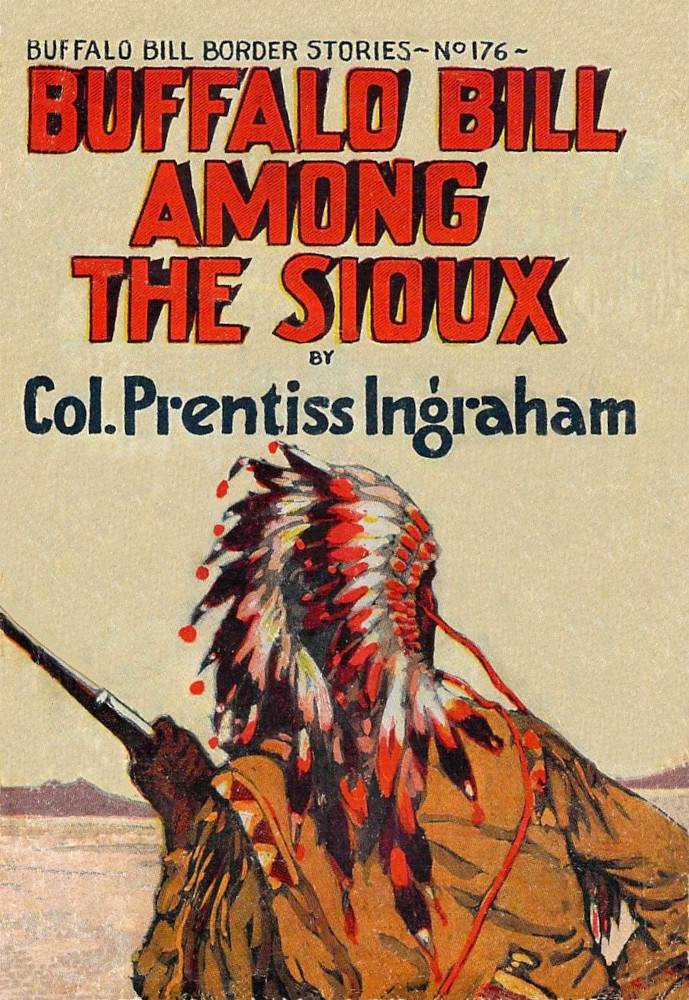
IN APPRECIATION OF WILLIAM F. CODY (BUFFALO BILL).
It is now some generations since Josh Billings, Ned Buntline, and
Colonel Prentiss Ingraham, intimate friends of Colonel William F. Cody,
used to forgather in the office of Francis S. Smith, then proprietor of
the New York Weekly. It was a dingy little office on Rose
Street, New York, but the breath of the great outdoors stirred there
when these old-timers got together. As a result of these conversations,
Colonel Ingraham and Ned Buntline began to write of the adventures of
Buffalo Bill for Street & Smith.
Colonel Cody was born in Scott County, Iowa, February 26, 1846.
Before he had reached his teens, his father, Isaac Cody, with his
mother and two sisters, migrated to Kansas, which at that time was
little more than a wilderness.
When the elder Cody was killed shortly afterward in the Kansas
“Border War,” young Bill assumed the difficult role of family
breadwinner. During 1860, and until the outbreak of the Civil War, Cody
lived the arduous life of a pony-express rider. Cody volunteered his
services as government scout and guide and served throughout the Civil
War with Generals McNeil and A. J. Smith. He was a distinguished member
of the Seventh Kansas Cavalry.
During the Civil War, while riding through the streets of St. Louis,
Cody rescued a frightened schoolgirl from a band of annoyers. In true
romantic style, Cody and Louisa Federci, the girl, were married March
6, 1866.
In 1867 Cody was employed to furnish a specified amount of buffalo
meat to the construction men at work on the Kansas Pacific Railroad. It
was in this period that he received the sobriquet “Buffalo Bill.”
In 1868 and for four years thereafter Colonel Cody
served as scout and guide in campaigns against the Sioux and Cheyenne
Indians. It was General Sheridan who conferred on Cody the honor of
chief of scouts of the command.
After completing a period of service in the Nebraska legislature,
Cody joined the Fifth Cavalry in 1876, and was again appointed chief of
scouts.
Colonel Cody’s fame had reached the East long before, and a great
many New Yorkers went out to see him and join in his buffalo hunts,
including such men as August Belmont, James Gordon Bennett, Anson
Stager, and J. G. Heckscher. In entertaining these visitors at Fort
McPherson, Cody was accustomed to arrange wild-West exhibitions. In
return his friends invited him to visit New York. It was upon seeing
his first play in the metropolis that Cody conceived the idea of going
into the show business.
Assisted by Ned Buntline, novelist, and Colonel Ingraham, he started
his “Wild West” show, which later developed and expanded into
“A Congress of the Rough Riders of the World,”
first presented at Omaha, Nebraska. In time it became a familiar
yearly entertainment in the great cities of this country and Europe.
Many famous personages attended the performances, and became his warm
friends, including Mr. Gladstone, the Marquis of Lorne, King Edward,
Queen Victoria, and the Prince of Wales, now King of England.
At the outbreak of the Sioux, in 1890 and 1891, Colonel Cody served
at the head of the Nebraska National Guard. In 1895 Cody took up the
development of Wyoming Valley by introducing irrigation. Not long
afterward he became judge advocate general of the Wyoming National
Guard.
Colonel Cody (Buffalo Bill) died in Denver, Colorado, on January
10, 1917. His legacy to a grateful world was a large share in
the development of the West, and a multitude of achievements in
horsemanship, marksmanship, and endurance that will live for ages. His
life will continue to be a leading example of the manliness, courage,
and devotion to duty that belonged to a picturesque phase of American
life now passed, like the great patriot whose career it typified, into
the Great Beyond.
CHAPTER I. WILD BILL’S CLOSE CALL.
BUFFALO BILL AMONG THE SIOUX.
One summer morning, in the sixties, when the Indians in the West and
Southwest were still giving much trouble to Uncle Sam’s settlers and
soldiers, and when the great railway lines were being pushed forward
across the continent to the Pacific coast, a scout rode across country
in Kansas from Fort Larned to another military post, about sixty miles
distant.
He was carrying the military mail and dispatches from one fort to
another, and his mission was an exceedingly dangerous one, for it was
known that the Indians in Kansas and the neighboring territory were
on the point of rising to attack the whites, if they had not already
risen.
Many reports had been received from scouts familiar with the Indians
which showed that an alliance was being arranged between several of
the tribes with the object of going on the warpath in numbers strong
enough, as they imagined, to enable them to bid defiance to Uncle Sam’s
troopers, even though the latter were armed with the quick-firing
“devil guns” so much feared by the redskins.
The scout who was riding across country was, with one exception, the
most remarkable man of his class at that time in the West.
He was none other than our old friend Wild Bill,
and it need hardly be added that the exception alluded
to was his great friend and comrade, Colonel William F. Cody, better
known as “Buffalo Bill,” the king of the scouts.
As he rode along, mounted upon a magnificent mustang, Wild Bill was
a splendid, fearless figure that it would have done the heart of any
brave man good merely to look upon.
In person he was about six feet one inch in height, and, as has been
described by his friend, General George A. Custer, “straight as the
straightest of the Indian warriors whose implacable foe he was.” He had
broad shoulders, well-formed chest and limbs, and a face strikingly
handsome. His sharp, clear blue eyes were used to looking any man
straight in the face, whether that man were friend or foe. His nose was
a fine aquiline, and his mouth well shaped, with lips partly concealed
by a handsome mustache.
His hair and complexion were those of a perfect blond—fair as
a Saxon viking. He wore the former in long, flowing ringlets, which
fell carelessly over his powerfully formed shoulders. Riding his horse
as if he were part of the animal, he looked a perfect type of physical
manhood.
He had galloped for about twenty miles, when he stopped on a small
hill overlooking a valley through which a river ran.
He cast a quick glance around the landscape to see if any foes were
in sight, and his eyes immediately fell upon a band of about fifty
Indians not more than a third of a mile away.
They saw him almost at the same moment, and immediately jumped on
their horses, from which they had dismounted with the idea of watering
them in the river, and gave chase.
Wild Bill waited until they came near enough to
enable him to see what tribes they belonged to, and
whether they were dressed in their war paint. When he had satisfied
his doubts on those scores, and found out that they were really on the
warpath, he hastily turned his mustang to make a ride for life. But
before he galloped off, he lifted his rifle and shot the foremost of
the Indians through the head.
As the brave tumbled from his horse, his comrades gave a yell of
rage. Wild Bill responded by turning in the saddle and waving his
sombrero toward them defiantly.
They fired a scattering volley, but the bullets whizzed harmlessly
around him. Riding over uneven ground, the Indians could not take
accurate aim.
The scout was riding a splendid mustang, and the gallant animal
fully understood what was expected of him. He knew that it was a
ride for life, and that he must put forth his greatest speed to save
his master from death and himself from an Indian owner—a fate
terrible to any decent horse.
He crossed a wide ravine and tore along the valley toward Fort
Larned.
Reaching a ridge beyond, Wild Bill looked back for a moment and saw
that the Indians were tearing after him. They rode at great speed, and
many of them were evidently well mounted.
“Their own ponies can’t travel like that,” said the scout to
himself. “They must have done some raiding before this, and got hold of
some of the settlers’ animals. The rising we’ve been looking for has
broken out, sure. Them folks at the fort must be put on their guard,
whatever happens. I guess the whole country will be ablaze in a couple
of days.”
If he had been mounted on a fresh horse, Wild Bill would have
had no doubt of the outcome of the race; but his mustang, splendid
animal though he was, had already ridden far, and showed signs of
flagging.
The Indians began to gain on their quarry for a time, and then the
mustang made a spurt and shot ahead again. But the effort was too great
for him, and he could not keep up his speed for long.
When he had run about three miles farther, half a dozen of the
Indians had crept up to within two or three hundred yards, while
several of the other braves were not far behind.
Now and then they fired at him, but their rifles were of inferior
quality and their aim was bad, so that neither the scout nor his horse
was touched.
The Indians seemed to be shortening the distance from their prey at
every stride, but Wild Bill bent over in his saddle and whispered to
his mustang: “Get up, old man!”
It was the first effort he had made to urge the animal to greater
speed, and immediately he exerted himself to the very utmost, drawing
slowly away from the Indians for the next three or four miles.
But there was a limit to the mustang’s power of endurance, if not to
his will.
The Indians were nearly as well mounted as Wild Bill, and their
steeds were comparatively fresh. One of them in particular—a
spotted animal—kept gaining all the time. The others were strung
out behind in a long line for a distance of more than a mile, but they
were all riding as hard as they knew how, for they wanted to be “in at
the death.”
The brave riding the spotted horse was armed with a rifle, and as
he drew within a hundred yards he occasionally sent a bullet whizzing
unpleasantly close to Wild Bill.
The scout saw that this Indian must be stopped, or a stray shot from
his gun might do fatal harm to his mustang or himself.
Suddenly reining up his horse and wheeling him
around, Wild Bill raised his rifle to his shoulder and took a quick aim
at the brave.
The Indian was not more than sixty yards off, and as Wild Bill’s
rifle cracked he reeled and fell from his saddle.
Without waiting to see whether his enemy was dead or only wounded,
the scout wheeled his horse around and fairly flew in the direction of
Fort Larned.
He would have liked to stop and take a few shots at the other
Indians as they came dashing toward him, but he realized that his first
duty was to carry a warning to the fort. He had no right to play with
his life when such a duty as that was placed upon him.
It was true that fifty Indians could do nothing against the strong
body of troops stationed at the fort, but, if they succeeded in killing
him, they would certainly not ride on for that place.
They would wait until reënforced by a much stronger party, and then
perhaps carry the fort by surprise if the garrison had not received a
timely warning.
Wild Bill realized these facts, and resolved that he must curb his
natural propensity to fight, and run away instead—a thing he
always hated to do, however great might be the number of the enemies
opposed to him.
While he was engaged in shooting their leader, the other Indians had
gained upon him, and they sent several shots whizzing after him as he
resumed his flight. Now and then he turned in the saddle and returned
their fire, shooting two of the foremost horses as they drew near
him.
“Buffler Bill would shoot the blamed varmints through the head if he
was here,” muttered the scout,
“but I’m not sure as how I could do that with a snap
aim at a gallop. Anyhow, I can’t run the risk, so I’ll shoot the durned
cayuses instead.”
The redskins kept up the pursuit until they were within about three
miles of the fort. One of the outposts saw them chasing the scout over
the prairie and promptly gave the alarm, for a vigilant watch was being
maintained at that critical time.
As Wild Bill rode up, several of the soldiers mounted in hot haste
and rode to his rescue. The Indians saw this, and promptly turned on
their trail to ride back as quickly as they had come.
A lieutenant, with thirty or forty men behind him, galloped in
pursuit, while Wild Bill rode into the fort to make his report to the
commandant.
CHAPTER II. AT FORT LARNED.
The officer in charge of the fort was a colonel named Mathers, who
had had much experience in Indian fighting, and had taken part in
several campaigns with Buffalo Bill and Hickok.
As Wild Bill entered his quarters, he rose from his chair and
grasped him heartily by the hand.
“Thank Heaven, they didn’t get you, Bill!” the officer exclaimed. “I
saw them through my field glasses chasing after you, and I immediately
ordered out the men, but the outposts had done the work already.
“We shall need you badly before this business is over, for it looks
as if it is going to be one of the most serious Indian wars we have had
for years. You did not find it possible to get through to Fort Hays?”
he concluded.
“I believe I could have got through,” Hickok replied. “I guess I
could have ridden round the Injuns, and maybe got to Fort Hays all
right. But it occurred to me that this fort might get surprised and
rushed if ye didn’t know the Injuns had broken out at last.”
The commandant nodded his approval. If Wild Bill had been a soldier,
he would have expected him to carry the message without exercising his
own individual judgment. But a noted scout like Hickok was expected
to think for himself, weigh the situation, and act for the best
accordingly. That, indeed, was the very reason of his employment.
“Could you tell me who the Indians were—what tribes they
belonged to?” the colonel asked.
“Yes, of course; I took care to find that out,” Wild Bill replied,
almost in an injured tone of voice. “I waited till they got near enough
so as I could find out from their feathers and war paint. They was
mostly Sioux, but there was a few Cheyennes and Crows, and I shot an
’Pache. He was the only one in the bunch, so fur as I could see.”
“Then there has been an alliance made between the tribes, and we
will have to meet the attack of a strong confederacy,” muttered the
commandant.
He rang a bell and an orderly entered the room, saluted him, and
stood at attention.
“Ask Colonel Cody to oblige me by stepping in here for a moment,”
the colonel said.
The soldier left the room, and in a few moments returned, announcing
the famous king of scouts, Buffalo Bill.
He had been making a tour of inspection to see that the horses of
the soldiers were in good shape, and that all necessary preparations
had been made for a long ride and a hard campaign, if the need should
arise.
The famous frontiersman was an even more striking and handsome
figure than his friend Hickok. At this time he was in the zenith of his
vigorous manhood.
It was only a short time before that he had earned his sobriquet of
Buffalo Bill by shooting a record number of buffaloes to supply fresh
meat for the workmen engaged in the construction of the Kansas Pacific
Railway.
Every line of his face and every movement of his body showed force,
courage, and determination such as are rarely seen even among the
bravest men.
The border king greeted his friend Hickok warmly, and said:
“So they couldn’t get you, old pard! I wish I’d been with you to
help you put up a little bit of a fight.”
The colonel briefly explained the position, and Cody was not
surprised to hear that several tribes had joined in the rising.
“The Sioux are at the bottom of it,” he said. “Unless we strike hard
and swiftly, the rising will spread not only over Kansas, but over all
the territory round about.
“I received a message from my friend and blood brother, Red Cloud,
the war chief of the Navahos, only two days ago. He sent one of his
braves to tell me that the Sioux had sent their messenger even down
into New Mexico to try to persuade the Navahos to join with them in a
grand uprising against the whites.
“Red Cloud is a good friend to us, and he promised me once that
whenever his tribe had trouble with the government he would send to me,
and get me to help him straighten it out without war.
“He tells me now that some of his young men want to dig up the
hatchet. He is doing his best, with the help of the old men, to keep
them back; but he wants me to come to him.
“I think I’d better go, for if the Navahos join the rest the matter
will become very much more serious even than it is now.”
The colonel nodded his head, but remarked:
“You will be putting your head in the lion’s mouth, Cody. You will
probably arrive there just about the time the bucks are doing their war
dance and putting on their war paint. The peacemaker generally has a
hard time of it, and if you ask them to bury the hatchet they are very
likely to bury it in your own skull.”
“Of course, that is the risk one is always taking in this business,”
replied the border king, laughing lightly, “but I know the Navahos, and
they like me
pretty well. I had the good luck once to help them save
their chief, Red Cloud, from some dangerous enemies.”
The colonel rested his head on his hand, and was absorbed in thought
for a few moments. Then he straightened up, and said, with decision:
“Go to the Navahos, and Heaven send that you reach them safely
and persuade them not to dig up the hatchet! But first I must have a
message sent through to Fort Hays. Maybe they are not on their guard at
that post, and even if they are I must let the commandant there know my
plans, so that we can work out a joint plan of campaign.
“I have five hundred brave men in this fort, but there is not one
among them whom I can trust to take this message when thousands of
hostile Indians are riding over the country.
“I know they would all do their best, but there would not be a
chance in a thousand of any one of them getting through.
“I can only trust that message to you two men, for you will know how
to dodge the enemy as no other would.”
The two scouts immediately signified their desire to make the
dangerous trip.
“I think you had better go together,” said the colonel, “for the
carrying of the message is vital for the success of our plans.
“I want the commandant at Fort Hays to march to meet me at Fork
River, about midway between the two forts. He must not only leave
enough men to garrison his fort, but bring along all that can be spared
to join my force.
“It is no use for us to skulk behind walls and let the Indians
ravage the country as they like. We must
strike at them swiftly, even if they do outnumber us
by ten to one. That is the only way to nip the rising in the bud.”
Cody applauded this brave resolution, for his knowledge of Indian
character told him that the colonel was perfectly right.
“We will saddle our horses and ride at once,” he said, rising to
leave the room.
“No, don’t go until after dark,” urged the officer. “You will have a
much better chance of getting through then, and it is better to delay
a few hours than run the risk of not having the message delivered at
all.”
The border king agreed, and the colonel then took up a dispatch
which was lying on the table beside him, and asked:
“Do you know anything of a man named Hunky Kennelly? He is known
among the Sioux, I am told, by the name of Bad Eye.”
Wild Bill shook his head, but Cody replied:
“I heard of the man a few months ago, when I was doing some hunting
in Wyoming. He is an Irishman, and a disgrace to his country. He killed
a man in St. Louis, and had to flee from justice.
“I understand he married a Sioux girl in Red Dog, one of the border
settlements in Wyoming, and then joined the Sioux tribe, being made a
member of one of their clans.”
“Yes, that is the man,” said the commandant. “I am told in this
dispatch from Washington that a native spy reports he is the leader in
this movement. He has stirred up the Sioux, and through them the other
tribes.
“He is said to be a man of gigantic stature and terrible ferocity.
They tell me, too, that he possesses extraordinary cunning and military
skill, for he was once an officer in the army. He had to leave because
he stole money belonging to his regiment.”
“I should say that he is a man to be reckoned with,” observed
Buffalo Bill. “I have found that Indians fight better, as a general
rule, when they are led by a white renegade.”
“Durn my cats! but I hope I get a chance for a shot at him!”
exclaimed Wild Bill.
The three men then left the quarters, and made the round of the fort
to see that all was in readiness to repel the attack which they knew
might come at any moment.
Several settlers from the country round about had already come into
the fort with their wives and families, and such of their household
goods as they could move, for the news of the Indian rising had already
begun to spread.
The men among the newcomers were all tough frontiersmen, fine
riders, and good shots; and Buffalo Bill saw that they would form a
valuable addition to the regular troops who garrisoned the fort.
After they had seen that all was in order, the colonel and the two
scouts chatted with the fugitive settlers, and found that they were all
eager for a fight with the Indians at the earliest possible moment.
They were all true-blue Americans, who hated to be on the defensive
when a fight was in prospect.
They discussed the situation, and there was not a man who did not
seem convinced that the Indians would get the worst of it before
long.
Several of the settlers denounced the redskins in unmeasured terms,
saying that hanging and shooting were too good for “sech varmints.”
“The durned skunks hev got every reason ter be grateful to us,” said
one old man, “but there ain’t an ounce of gratitude in their natoors.
We give ’em lands
and huntin’ grounds, and don’t trouble ’em anyways;
but whenever they see a chance they want to scalp us and lift our
cattle.”
“I don’t think all Indians are vermin,” said Buffalo Bill. “I have
met some pretty good ones. And I don’t think they are all ungrateful,
either, for I’ve known some, at least, who were as grateful as any
white man could be.”
CHAPTER III. AN IMPENDING ATTACK.
The afternoon wore away, but no bands of hostile Indians appeared
in sight. Buffalo Bill and Wild Bill headed scouting parties, and rode
some five miles from the fort, but they saw no signs which led them to
suppose that an attack was imminent.
The party of soldiers who had chased Wild Bill’s pursuers returned
to the fort during the course of the afternoon, and reported that they
had followed the Indians about ten miles without coming up to them.
Then they saw another party of Indians, at least five hundred
strong, riding across the prairie to join the fugitives, so the
lieutenant in command wisely gave the order to turn the horses’ heads
back toward the fort. The Indians did not chase them.
More settlers came in during the afternoon, and they lighted fires
in the courtyard of the fort, and prepared to cook their dinner, for
there was no proper accommodation for them.
As their bear steaks and deer meat frizzled and sizzled on the fire,
they told one another queer yarns of Western life, for they were all
men who had seen the rough and humorous side of the frontier.
“We’ll come out of this yer business all right,” observed one of the
men. “I’ve come through worse gol-durned contraptions than this, by a
long sight.”
“Yes, it’s an old saying out in my country,” said a hunter from
Arizona, “that if you let things alone long enough they will even up of
themselves.
“Take, for instance, the case of Jack Cade. There
were two brothers of them—Jack and Bill—and one
day a crowd got after Bill for horse stealing, and caught and strung
him up. He protested his innocence, but it was no go. We found out a
month later, however, that we had actually hung the wrong man and let
the real thief get out of the country.”
“And did things even up later on?” he was asked.
“They did. We couldn’t restore Bill to life, and beg his pardon,
and elect him alderman of the town, but when we caught his brother
Jack, after he had robbed a settler of his outfit, we not only let him
off the hanging, but made him sheriff and squared things in proper
shape.
“Things don’t always even up for the man who’s been planted, but if
he leaves any relatives behind, the public will see to it that his loss
turns out to be their gain.”
Just before it grew dark several of the scouts and outposts who had
been placed by Buffalo Bill rode into the fort, and reported that a
very strong force of Indians was advancing over the prairie in three
columns.
Some of the men estimated that the war party numbered more than four
thousand men, but others placed it at not over half that number.
The colonel called Buffalo Bill and Hickok to him, and held a hasty
council of war.
“It is as I expected,” said the border king. “The Indians are
fondest of attacking either at dusk or just at daybreak. They think
sentries are likely to be less vigilant at those times, and I guess
they are right, as a rule.
“But luckily we are ready for them. If I might make a suggestion,
colonel, I think it would be a good plan to pretend that we are much
less numerous than we actually are. They are not likely to know our
strength.
“Let only fifty or a hundred men reply to their fire. Keep about
four hundred in reserve, ready to pour a terrible volley into the
redskins when they try to rush the fort, encouraged by what they
suppose to be our weakness.
“A surprise like that always knocks the heart out of an Indian. As
soon as they recoil, we might make a sudden sortie and charge them
vigorously.
“By adopting this plan, I believe we shall have a good chance of
inflicting a crushing defeat upon them, although they so greatly
outnumber us.”
“It’s a capital idea,” said the colonel, “and we will carry it out.
I won’t let more than about seventy men reply to their first volleys,
and I’ll tell the officers in charge of our four field guns not to fire
until the redskins are swarming outside the walls.”
He hurried away to give these orders, and by the time he had done so
the redskin host appeared in sight.
It numbered between two and three thousand men, and approached
swiftly, for all the braves were mounted. They belonged to tribes which
practically lived in the saddle—the Sioux, the Cheyennes, and the
Crows.
CHAPTER IV. A BATTLE WITH REDSKINS.
There was still sufficient light to see the Indians more or less
clearly as they deployed in four large columns until they completely
encircled the little fort.
They did not advance immediately to the attack, as the defenders
expected. Instead, they sat on their horses like bronze statues, as
soon as they had taken up their positions.
The men of the little garrison, clutching their rifles tightly,
waited impatiently for the fray behind the log walls where they lay
concealed.
In a few moments three men rode out from the Indian host, one of
them, in the center, bearing a white flag, which he waved above his
head as he approached the walls of the fort.
He was a man of gigantic stature, and he rode a big horse which
absolutely dwarfed the small ponies of his companions.
As he halted about twenty yards outside the fort, Buffalo Bill could
see at a glance that he was a white man, although he was dressed in the
paint and feathers of a Sioux chieftain.
His two companions were redskins, one being a Cheyenne and the other
a Crow. Thus the three tribes which had entered into a confederacy were
represented under the flag of truce.
“That’s the renegade Irishman, sure enough!” said Buffalo Bill to
the colonel, who nodded agreement.
Kennelly, the renegade, otherwise known as Bad Eye, reined up his
horse and shouted, in English:
“We want to come inside the fort to discuss terms of surrender with
you.”
“This fort will never surrender while I am in command,” the colonel
answered, “and we will hold no talk with renegades and murderers. Go
back to your redskin allies at once, unless you want a bullet through
your head!”
The renegade had expected this answer, but he had had a lingering
hope that he might have been allowed inside the fort on the pretense
of discussing terms of surrender, and then he would have been able to
gain some valuable information as to the number of the garrison and the
strength of the defenses.
His disappointment showed plainly in the vicious grin which flitted
for a moment over his evil face. His left eye, which had a squint,
glared horribly.
It was this defect that had gained for him his Sioux name, Bad
Eye.
He shook the rein of his horse, and tried to urge the animal right
underneath the wall of the fort; but before it had advanced three steps
a bullet from Buffalo Bill’s rifle cut a feather from the headdress of
the rider.
As Kennelly hastily reined his horse back, Buffalo Bill sang out:
“The next bullet will go through your head, Bad Eye, unless you
clear out at once. The white flag was never meant to protect such
scoundrels as you are.”
Seeing that nothing further was to be gained, the three men turned
their horses and rode back to the ranks of the Indians.
Before he departed, however, the representative of the Cheyennes
drew his scalping knife, and sent it hurtling through the air at the
log wall of the fort, where it stuck, quivering. Then he raised his arm
and uttered a defiant war cry.
One of the soldiers lifted his rifle to shoot the brave, but Buffalo
Bill struck the weapon upward before the man could fire.
“He has a right to defy us,” said the border king, “and he is a
brave man. We won’t shoot him under the white flag, even if he is a
redskin.”
No sooner had the three envoys retreated than the Indians began
their attack.
True to their natural instincts, they were cautious at first,
beginning by long-range firing.
Some of them dashed toward the walls of the fort on horseback,
circling around and lying down in the saddle to avoid presenting an
easy mark. They fired their rifles, and then retreated hastily.
But the greater portion of the Indian army dismounted and advanced
to the attack on foot, taking advantage of every bit of cover they
could find.
Following out Buffalo Bill’s suggestion, the garrison only made a
feeble reply to the heavy fusillade poured in upon them.
The volleys of the Indians did little harm, most of their bullets
burying themselves harmlessly in the thick walls of the log fort.
Two of the soldiers were killed by bullets which entered the
loopholes through which they were firing, and three others were
slightly wounded.
On the other hand, at least a dozen redskins bit the dust in the
first few minutes’ fighting, although only twenty or thirty men fired
at them.
They approached nearer to the fort, and the colonel ordered another
twenty-five men to join the firing party.
By gradually increasing the resistance, he wanted to make it appear
that he was putting forth his greatest possible effort to repel the
onslaught.
Suddenly there was a loud war whoop, which Buffalo
Bill recognized as coming from the renegade, Kennelly.
Next moment the entire force of the Indians leaped to their feet
and charged toward the fort, uttering a chorus of frightful yells that
would have made the blood of most men run cold.
When the leaders of the host were within about thirty yards of the
walls, the colonel shouted:
“Now, boys, let them have it!”
Instantly there was a blaze of flame all around the fort.
Over five hundred rifles discharged their dreaded messengers of
death at the same moment, and the four field guns, posted one at each
corner of the fort, hailed shell at the advancing Indians, tearing
terrible gaps in their ranks.
It was impossible for any army to withstand such a sudden and
fearful shock. The redskins halted with one accord, as if they had
suddenly been struck with paralysis.
Next moment they turned and fled, in spite of the frantic efforts of
their chiefs to rally them.
Another volley was poured into them as they ran, and they fell all
around the fort by dozens.
The colonel hastily gave orders for a sortie and a charge, with the
idea of cutting them up as they fled and keeping them on the run.
The horses were at hand, all saddled, for this purpose, and in less
than two minutes three hundred men were speeding from the fort, headed
by Buffalo Bill.
But by this time the Indians had reached their own horses and were
galloping away in all directions. Many of them were shot before they
could escape, and the rest were chased for two or three miles, until
they began to bunch together in strong parties and return the fire of
the white men.
Then Buffalo Bill, who had been placed in charge of the pursuing
party by the colonel, ordered a retreat to the fort.
He did not wish to get too far away in the darkness and risk
spoiling the great victory by a subsequent reverse.
The Indians still greatly outnumbered the band under his command,
and if they turned on him they would be able to do serious damage. He,
therefore, gave them a parting volley and rode back at the head of his
men.
“I reckon we must have killed at least two hundred of them around
the walls of the fort,” said the colonel, clasping him warmly by the
hand. “How many did you get in the pursuit?”
“Fifty or sixty, as nearly as I can figure it,” replied the border
king.
It was a great victory, and it had been bought at a comparatively
trifling cost. Only about a dozen of the defenders had been killed,
most of them during the pursuit, and not more than twenty were
wounded.
“Do you suppose the redskins have had enough?” asked the colonel.
“No, I don’t,” Buffalo Bill said. “Of course, this is a galling
repulse for them, but all three of the tribes are brave and persevering
in warfare, especially the Sioux. This defeat will merely enrage them
and make them all the more anxious to have revenge on Uncle Sam’s
troopers.”
Wild Bill rode at this moment to the two men as they stood talking.
He was mounted on one of the swiftest horses in the fort, and he led
another splendid animal, which he offered to Buffalo Bill.
“These are the best beasts I could pick out of the bunch, Buffler,”
he said.
Buffalo Bill mounted without a word, and offered his hand to the
colonel.
“Where are you going?” asked the astonished officer.
“Where else but to Fort Hays,” said Buffalo Bill. “We had arranged
to ride there as soon as it was dark, and if you will hand us the
dispatch we will get off at once.”
“But the country is full of the fleeing Indians,” the colonel
objected, “and there is not one chance in ten thousand of your getting
through. It is sheer madness to attempt to ride under these new
conditions.”
The border king laughed lightly, and said:
“We are still waiting for that dispatch, colonel.”
The officer looked at him steadily for a moment, and saw that
argument would be useless. Nothing would turn the gallant and famous
scout from his heroic purpose. Nor was Wild Bill one whit less
resolute.
Without another word, the colonel took the dispatch from his pocket
and handed it to Buffalo Bill. Then he shook the two scouts by the
hand, and a minute later they were galloping away in the direction of
Fort Hays.
CHAPTER V. WHARTON IN PERIL.
Buffalo Bill and his partner rode along swiftly and silently for
about half an hour, and saw no traces of the redskins. Then, as they
slackened their pace for a moment to breathe the horses, Wild Bill
said:
“Gosh all hemlocks, Buffler——”
Buffalo Bill turned in the saddle and interrupted him.
“That’s Nick Wharton’s expression,” he said, “and I know what you
are going to say. You wish that old Nick was with us now, joining in
the fun. This certainly would be an adventure after his own heart.”
“I guess he’ll be buttin’ into it before we get through,” Wild Bill
remarked. “He was away at Fort Leavenworth a couple of weeks ago, so
I heard, and he must have known we were around this yer section. I
wouldn’t be surprised to run across him any moment.”
There is an English proverb that says: “Talk of angels, and you will
hear the flutter of their wings.” There is also another, which runs:
“Talk of the devil, and you will see his tail.” The truth of these two
adages was speedily made clear to Buffalo Bill and Wild Bill.
They relapsed into silence, each thinking of their old friend, and
rode forward over the prairie. They had not gone more than half a mile
before they saw, through the darkness, which was illumined only by the
pale light of the stars, a figure on horseback spurring toward them at
a terrific pace.
Instinctively they grasped their rifles and made ready for anything
that might happen.
In a few moments the figure drew up alongside, and they saw from its
ungainliness and general tattered and dilapidated appearance that it
was none other than that of their old friend Nick Wharton, of whom they
had just been speaking.
He was riding his old mare, who, as he often said, was “not much to
look at, but a holy terror to go.”
She was certainly tearing along at a great pace, but as she reached
the two scouts she stopped dead short and reared up on her haunches.
Old Nick brought her to the ground again by a single dexterous
movement of the reins. He recognized his comrades in a flash, but he
did not pause to exchange greetings. He merely gasped out the one
word:
“Injuns!”
As he said this, Buffalo Bill and Wild Bill saw, coming toward them
through the darkness, half a dozen figures on horseback.
Silhouetted against the horizon of the prairie, they could see that
the figures were those of Indians, for their feathers and scalp locks
were plainly visible against the light of the stars.
As the Indians came up they were met with a volley from the scouts,
and three of them reeled in their saddles and fell to the ground.
Buffalo Bill and his companions were not accustomed to miss their
aim.
The remaining Indians drew rein sharply, and gazed in blank
astonishment at their fallen comrades.
They had been chasing only one man, and suddenly they were brought
face to face with three magnificent marksmen.
As they sat on their horses, hesitating what course to pursue, the
rifles spoke again, and their hesitation was solved for them.
Never again would they roam the prairie or lift the scalp of an
enemy!
“Darn all catamounts, but them varmints chased me nigh on six
miles,” said old Nick, as soon as he had time to make explanations.
“I heard, down in Fort Leavenworth, that the Injuns was goin’ on the
warpath, so I struck a bee line for Fort Larned, whar I knowed you two
boys war.
“I guess you’ve had a hot time. As I was comin’ ’cross the prairie
I butted inter a hull army o’ Injuns, who seemed ter hev met with a
rough time. Somebody had thrown a scare into them, an’ I thought I
reckernized yer trade-mark, Buffler.
“Waal, I ducked under cover, and the most of them passed me by, but
I got up too soon, an’ ’bout twenty of ’em, comin’ along last, caught
sight o’ me, an’ give me a hot chase.
“My mare laid herself down to it noble, and I managed to shake off
all of ’em ’cept them six what’s layin’ over there in thar tracks
now.
“But what sort of a game aire you two boys puttin’ up now? I guess
thar’s somethin’ doin’, ain’t thar?”
Buffalo Bill gave him a brief account of what had happened, and told
him that they had planned to reach Fort Hays and subsequently go down
to the country of the Navahos, if necessary, to try to prevent that
tribe from taking the warpath.
Old Nick was delighted at the prospect, and immediately insisted on
accompanying them.
“Gol-durn all fishhooks!” he exclaimed. “I’ve been buttin’ round
Fort Leavenworth for a couple o’ weeks, and thar ain’t been nothin’
doin’.
“I got into a bit of a dispute with a young lootenant, an’ I h’isted
him off the colonel’s verandy onto the
ground. I thought sure he’d want to hev my blood fer
thet, but he merely obsairved thet I was an unedicated person who
didn’t know the proper rules of ettyket.
“Then I got into a mix-up with a couple o’ settlers. They was
heeled, all right, but ’stead of drawing their guns they walked ten
miles to the nearest sheriff to demand justice. When the sheriff come
around, I told him to fergit it, and he forgot quick enough.
“But this yer sort o’ business didn’t seem to make me popular around
the fort. The colonel was a bully good sort o’ a feller, but at last he
hinted that the place was sorter narrer fer my talents. So when I heerd
that somethin’ might be doin’ around Fort Larned I saddled up and came
to find you boys.”
“You certainly need Hickok and me to look after you, Nick,” said
Buffalo Bill, laughing heartily.
“I dunno how it is,” Wharton responded, heaving a sigh. “I’m jest
about the most peaceful critter on airth, an’ yet I always seem to be
runnin’ inter trouble.”
The three scouts rode on for some time, chatting about their former
adventures and the chances of the present campaign, until they had
covered about half the distance between the two forts.
Then, as they crested a hill and looked down into a wide-stretching
valley beyond, they saw half a dozen camp fires gleaming through the
darkness about two miles away.
They reined up their horses sharply, and held a council of war.
“Those must be the Indians we fought,” said Buffalo Bill. “They have
stopped their flight and gone into camp until morning.”
“What shall we do?” asked Wild Bill. “Shall we make a detour and
pass by them, about a mile away, so as to be out of touch of their
scouts and sentries; or shall we creep in on them, and see if we can
learn anything
of their plans? The chances are they are discussing them around the
fire.”
Cody hesitated.
He knew that the carrying of the message safely to Fort Hays was of
the utmost importance, but on the other hand, he felt that a chance of
learning what the Indians proposed to do ought not to be missed.
“I tell you what we will do, boys,” he said, after a few moments’
thought. “Nick and I will creep into the camp and see what we can find
out. You know the Cheyenne and Sioux lingo, don’t you, Nick?”
Nick nodded.
“So do I. Hickok, you must take the dispatch and wait on horseback,
holding our two beasts at a safe distance. If they catch sight of us,
you mustn’t attempt a rescue. You must ride at top speed for Fort Hays.
We will shift for ourselves as best we can, but that message must be
carried, at all costs.”
“May I be scalped ef I leave you and Nick in the lurch!” exclaimed
Wild Bill.
“You must do it, if needs be, old pard,” urged the border king. “The
lives of many men, the peace of the border, the whole plan of campaign
depend upon that message reaching Fort Hays. I don’t suppose the
Indians will see us, but if they do you must ride the best you know, as
soon as you hear the first war whoop.”
The manner of the king of the scouts was so impressive that Wild
Bill at last agreed to do as he commanded.
They rode cautiously toward the camp fires, and as they approached
they saw that the encampment of the Indians was a very large one.
It had been established on the banks of a stream,
and by a rough computation Buffalo Bill estimated
that nearly two thousand braves were gathered there around the six
fires.
Evidently the Indians had rallied after the first shock of the
retreat had passed; and they again constituted a very formidable
fighting force.
About a quarter of a mile from the camp the three scouts drew rein
and dismounted, Buffalo Bill and Nick Wharton leaving their horses in
charge of Hickok.
“Don’t try to cut up the hull gang o’ them Injuns,” Wild Bill said,
as his two friends strode off into the darkness toward the camp fires
that twinkled ahead of them.
CHAPTER VI. THE RENEGADE.
As Buffalo Bill and Nick Wharton approached the first of the camp
fires, they saw that the Indians were dancing the Sioux ghost dance
around it, while at the next fire several of the Cheyennes were
indulging in their own tribal war dance.
Several sentinels had been placed around the camp, but, by careful
scouting and judiciously taking advantage of cover, the two comrades
managed to dodge them and get inside the cordon.
When they had accomplished this feat, Buffalo Bill uttered a sigh of
relief. They were now fairly safe, unless they were observed by some
of the braves around the fire. In that event, the sentries were likely
to cut off their retreat, unless it were made too rapidly to give them
time to take up the alarm.
Nothing was going on around the first two fires except the dancing,
which both Buffalo Bill and Wharton had seen many a time before.
Taking shelter behind a clump of bushes, they crawled forward until
they were right in the center of the camp, and opposite the largest of
the bivouac fires.
Here they saw that most of the leading chiefs of the three tribes
were gathered, and they rightly concluded that a war council was being
held.
Four braves were posted near the camp fire, evidently for the
purpose of keeping the other Indians from intruding while the chiefs
and the old men discussed their plan of campaign.
Among the men seated around the fire the two scouts saw the renegade
Kennelly.
He was smoking a big pipe, which looked incongruous in the midst
of such wild and weird surroundings. His face was stained with blood
from a wound in the forehead where a bullet had grazed him, and this
intensified his ordinary ferocious look.
Nick Wharton drew his revolver—the rifles had been left behind
with Wild Bill—and in another moment would have sent a bullet
through the head of the renegade, but Buffalo Bill seized his arm and
signed to him to control himself.
They crept nearer and nearer to the camp fire, until they were
within about fifteen paces of it, lying hidden in a small clump of low
brushwood.
They could get no nearer, for the light of the fire brightly
illuminated the surroundings, and there was no other cover.
The Indians were talking angrily in the Sioux tongue, and the
scouts, who were both familiar with it, were pleased to find that they
were loudly abusing Kennelly for the failure of the attack on Fort
Larned.
One after another denounced him as a bad leader, who had betrayed
them into believing that they had hardly any opposition to meet, and
had then taken them up against an almost impregnable position.
At last, after a young war chief had denounced him as a lying
traitor, Kennelly took the pipe from between his lips and broke silence
for the first time.
“Listen, my brothers, and pay heed to my words, for I do not speak
with a false tongue,” he said. “I told you that it would not be easy to
take the fort, and that you must be willing to lose many braves in the
attempt.
“I told you that Long Hair, the slayer of many buffaloes, was there,
and you know well that he is worth
a hundred men in himself. Yet you persisted in making
the attempt, and you have no right to blame me for the failure.
“Did I hang back in the charge? Did I not lead your young men up
to the walls of the fort? If they had followed me, we would have got
inside and taken the scalps of all the men there.
“It was not my fault that they reeled back and would not follow me
when the big firing began. How was I to know that your warriors are
nothing but women and babes?”
At this gross insult half a dozen of the chiefs sprang to their feet
and menaced the renegade with the tomahawks which they drew from their
belts.
But the Irishman, in spite of his villainy, was a brave man. He
merely gazed at them contemptuously, without deigning to draw his gun,
and went on:
“You think that you have a quarrel with me. Very well. Name your
champion, and I will meet him in single combat before you all.
“If he overcomes me, he may take my scalp; but if I slay him there
must be no more disputing of my orders. My brothers, the Sioux, chose
me for their war chief in this fight, and I will be obeyed.”
The young chief who had denounced Kennelly most hotly eagerly
accepted this challenge, and begged his red comrades to let him act as
their champion.
After a few minutes’ consultation among themselves, they agreed.
Kennelly watched them from the corner of his squint eye, but pretended
to be utterly uninterested in the matter which spelled life or death to
him.
The young chief threw off his buffalo robe and stepped out into an
open space near the fire, naked to the waist, but gorgeously painted
with the war colors of his tribe. He was a Cheyenne.
As he stood in the firelight, straight as a young sapling,
with his right hand resting upon the tomahawk in his belt, he looked a
formidable foe.
Kennelly glanced at him for a few moments through half-closed
eyelids, and then yawned sleepily and knocked the ashes out of the bowl
of his pipe.
The Indians, on the one side, and the two scouts, hidden behind the
bushes on the other, watched the scene with interest.
The young chief stamped his foot impatiently, and Kennelly slowly
raised his huge, bulky form from the ground.
Once he was upon his feet, however, a wonderful change came over
him.
Seated upon the ground, he had seemed as lazy and inert as a hog,
but now his body was as tense and active as that of a panther.
Stealthily he crept toward the Indian, and they looked into one
another’s eyes as intently as if they were both hypnotized.
An old Crow chieftain gave the signal for the duel to commence by
dropping his tomahawk to the ground.
Instantly the young Cheyenne rushed forward, whirled his tomahawk
around his head, and flung it straight at the skull of his enemy.
But he had reckoned without his adversary’s lightninglike quickness
of eye.
Kennelly ducked just in time to escape the deadly missile, which
tore off part of one of the feathers in his headdress.
Straightening himself immediately, he flung his own tomahawk at the
Cheyenne, burying it deep in his skull.
The man staggered, yelling his death whoop; but before he could fall
to the ground Kennelly leaped upon him, caught him in his arms as if he
was a baby, and tossed him high into the air over his own head.
He fell to the ground, and when the other Indians
rushed up to examine him they found that not only was his skull cleft,
but that his neck had been broken by the terrible fall.
Bad Eye calmly drew his knife and took the dead man’s scalp,
although he knew that that act would doubly enrage the already furious
Cheyennes.
Then, holding the bloodstained knife above his head, and dangling
the scalp in the other hand, he cried:
“I have overcome your champion, oh, chiefs! Who will be next to
yield up his scalp to Bad Eye?”
There was no response to this challenge. The Indians were brave men,
and the Cheyennes, at least, were much irritated at the death of their
champion; but not one among them cared to try conclusions with such a
redoubtable fighter as Kennelly had shown himself to be.
Suddenly Buffalo Bill rose from a clump of bushes in which he had
lain concealed, and stalked, a majestic figure, into the circle of
light cast by the glow of the fire.
To say that the Indians were surprised by this sudden apparition is
but faintly to convey their absolute amazement. They looked as if a
ghost had suddenly emerged into their midst.
The renegade Kennelly was not less astonished. He stared at the
border king for a moment, and then sat down heavily upon the ground,
picked up his discarded pipe, and began to fill it with tobacco.
Buffalo Bill surveyed the scene for a moment with quiet amusement,
and then said, in the Sioux tongue:
“Greeting to you, chiefs and elders of the Sioux, Cheyenne, and Crow
tribes! I have heard the challenge thrown down by Bad Eye, and I come
into your midst to accept it.
“You know me for your enemy. I am Long Hair,
and I have slain many of your braves. But I come
fearlessly among you for the ordeal by single combat, for I know your
code of honor must give me a fair start on my horse after the fight is
over, supposing that I come out of it victorious. Is it not so, oh,
chiefs?”
Cody’s action might have seemed to the outsider to be nothing else
but suicide. To a man acquainted with the Indian laws of chivalry,
however, there was nothing so very extraordinary about it.
One of their most stringent rules was that an enemy who challenged
one of their braves to the ordeal by single combat must be held sacred,
like an envoy under the white man’s flag of truce; and after the fight
was over he must be allowed a good chance of retreat.
The oldest chieftain by the camp fire, after looking round the
circle and catching the eyes of his comrades, acted as spokesman. He
bent his head gravely, and said:
“It is as you say, Long Hair. You are a great warrior, and your
fame has been sung by our young men round the camp fires. You shall
fight Bad Eye if you desire to do so, and at the end, if you live, you
shall go forth unharmed and bestride your horse, and ride away from
us. None of our braves shall seek your scalp until you are half a mile
distant.”
Buffalo Bill saluted the chief gravely, after the Sioux fashion,
and then turned to Kennelly, who sat smoking and glowering at him, and
asked:
“What weapons?”
“Tomahawks,” growled the renegade, as he rose to his feet and
fronted the border king.
Nick Wharton had followed Buffalo Bill, after a moment’s pause,
due to his absolute amazement at the bold course Cody had taken. His
appearance did not
alarm or surprise the Indians. Too many startling
events had happened that evening for one more to have any effect on
them.
“Durn my cats, Buffler!” said old Nick, after he had glanced
defiantly round the circle of Indians. “You are the queerest duck I
ever struck in my galumpin’ existence. What in thunder d’ye want to
butt into this yere controversy for? Let me tackle thet thar Irish
mountain o’ flesh! I guess I kin manage to settle his hash for him.”
The border king waved his friend aside, and whispered:
“Be on the watch, Nick, in case any of the Indians tries to get me
in the back while I am fighting him.”
Wharton nodded, and promptly rested his hand upon his six-shooter in
his belt, ready to whip it out and fire at a moment’s notice.
The Indians formed a ring, which was speedily added to by hundreds
of other braves who flocked to the scene from the camp fires near
by.
Buffalo Bill and the renegade stood in the center.
Kennelly held his tomahawk, red with the blood of the slain
Cheyenne, in his hand.
Buffalo Bill did not possess such a weapon, but a Cheyenne brave
stepped out of the circle of onlookers and handed one to him.
It was a weird and impressive scene.
The firelight cast a fitful glow on the faces of the duelists, and
illumined their eyes as they circled around for a few moments, waiting
the opportunity to send their sharp-edged weapons whizzing to the
mark.
Suddenly Kennelly stepped forward with a rapid motion and flung his
tomahawk at the border king’s head.
Buffalo Bill had held his eyes, just as the pugilist
does those of his opponent, and instinctively he knew
what was coming a second before Kennelly raised his hand.
He flung himself forward, and the tomahawk passed harmlessly a foot
above his head.
“Wah!” cried the Indians, in admiration of the border king’s clever
movement.
Before the exclamation had died upon their lips, Buffalo Bill had
darted forward and struck Kennelly a terrible blow on the crown, which
cleft his head asunder almost to the chin.
Bad Eye would trouble the peace of the border no more. The renegade
had met with his deserts at last.
CHAPTER VII. A BRISK ENGAGEMENT.
The Indians gazed silently at the corpse of their white ally, and
not one of them showed the slightest sign of grief or indignation at
his death.
Buffalo Bill had only done what many of them would have liked to do
if they had possessed the courage and skill.
The border king wrenched his dripping tomahawk from the skull of his
fallen enemy, and, holding it tightly in his right hand, boldly faced
the assembly of chiefs, with a questioning glance in his eyes that
seemed to say:
“Now, what are you going to do about it?”
Nick Wharton stood by his side, with his hand on his six-shooter,
ready to fight to the death.
The bold aspect of the two scouts profoundly impressed the redskins,
and not a thought of revenge crossed their minds.
Even if the renegade had been more popular than he was, their code
of honor would not have allowed them to attack the victor in an ordeal
by single combat without giving him a fair chance for his life.
“Go in peace, Long Hair,” said an old Crow chief, stepping forward
and saluting him. “You are indeed a great warrior, and I would that you
were one of my tribe. I hope that some day I may meet you in the front
rank of battle, or, if that cannot be, in the happy hunting grounds of
the Great Manitou.”
With a majestic wave of his hand, the chieftain motioned
three of his followers toward him, and ordered
them to escort Buffalo Bill and Nick Wharton past the sentries and see
them safely to their horses.
Then the redskin, who was imbued with all the chivalry of his race,
drew from his waist belt a pipe, filled it with tobacco, and said to
Buffalo Bill:
“As soon as you are gone, oh, Long Hair, I will light this pipe, and
not until I have smoked it and the flame dies out need you fear that we
will mount our horses and pursue. Is not that all you ask?”
Buffalo Bill bent his head in token of assent, and muttered to Nick
Wharton:
“Will you say that Indians are no better than varmints now, old
pard? Could anything be fairer than that?”
“I guess he is a white man whose skin went red by mistake,” growled
old Nick.
As the two scouts strode away from the camp fire, accompanied by
their Indian escort, Buffalo Bill glanced back and saw the Crow chief
lift a burning stick from the fire and light his pipe.
He immediately increased his pace, for he wanted to get as long a
start as possible before the calumet of peace burned out.
In a few minutes they reached the spot where Wild Bill was holding
the three horses. He was naturally surprised at the appearance of the
Indians with his friends, but a warning cry from Cody prevented him
from firing, although he had immediately whipped his rifle up to his
shoulder.
Buffalo Bill explained the situation in a few hurried words, and
then the three scouts lost no time in mounting their horses and putting
as much distance between themselves and the camp of the redskins as
they could before the truce pipe was smoked out.
“I don’t believe they will trouble to pursue us,” said
Buffalo Bill, as they sped along over the prairie at a
tearing gallop. “That old chief is a pretty smart fellow, and he will
know very well that there is no chance of catching us, after the start
we have got. Our only danger, as I figure it, is that we may stumble
across another war party, or some of their scouts, before we reach Fort
Hays.”
They rode along for a couple of hours, occasionally glancing
behind to see if they were followed; but they saw nothing to indicate
danger.
Suddenly, as they emerged from a brush-covered ravine, Buffalo Bill
held up his hand in warning.
His comrades reined up their horses and listened intently.
They had not remained silent more than a few seconds before they
heard an almost noiseless pad of hoofs on the turf of the prairie.
The scouts knew that Indian ponies were always unshod, and they
realized in a moment that another fight was ahead of them. Rifle in
hand, they waited for the enemy.
The darkness was so intense that they could hardly see ten yards
ahead of them. Suddenly, out of the gloom, half a dozen mounted figures
emerged.
The scouts saw at a glance that they were Indians, even if they had
not known, as they did the next moment, by the startled war whoop that
broke from the lips of the redskins.
Buffalo Bill galloped toward them, revolver in hand, and before the
redskins fully understood their peril he had shot down two of them and
broken through the party.
Wild Bill and Nick Wharton followed close behind him, and in their
passage they each sent an Indian to join his forefathers in the happy
hunting grounds.
The two remaining redskins hastily fired their rifles at random, and
fled into the darkness at top speed.
Wild Bill was eager to pursue them, but the border king reminded him
of the necessity of reaching Fort Hays, and the scouts resumed their
adventurous journey.
Shortly before dawn they reached the fort and were sharply
challenged by one of the sentries.
News of the Indian rising had been carried thither, and a vigilant
watch was being maintained.
Buffalo Bill cried out that they were friends, and in a few moments
they stood within the gates of the fort and in the presence of the
commandant, who was hastily summoned from his bed, where he had
lain down to take a couple of hours’ sleep after a night of anxious
watching.
The news of the victory over the Indians at Fort Larned caused great
rejoicing, and the daring feat of the three scouts in riding through
a territory infested with Indians made the commandant exhaust his
vocabulary of compliments.
“Do you think the Indians will accept battle with the combined
garrison of the two forts?” asked the commandant.
“I doubt it,” replied Buffalo Bill. “They have lost a good many
men, and they will not care to fight in the open until they get
reënforcements. Unless you move swiftly and make a junction with the
troops from Fort Larned, they will escape to the hills and scatter,
until fresh war parties can be brought up from the villages of the
three tribes. Meanwhile the most important thing that I and my two
companions can do is to ride down to New Mexico and help Red Cloud to
prevent the Navahos from joining the confederacy. If they do so, other
tribes may join it, too, and the whole frontier would be ablaze. That
must be prevented, at any cost.”
The commandant agreed, and, after a brief rest at the fort, Buffalo
Bill and his two friends started on their long ride down to New Mexico,
taking with them spare horses and provisions, as they did not wish to
waste time by hunting on the way.
CHAPTER VIII. TREED BY A GRIZZLY.
Several days later the three men were compelled to part when they
were approaching the border of the Navaho country.
Nick Wharton was not able to resist the temptation of following
some panther tracks which he found near the spot where they camped one
afternoon. He followed the trail into the thick woods, and the panther
sprang upon his shoulders before he was aware of its presence. He
killed it with his bowie knife, after a terrible struggle; but he was
so badly mauled that he had to be taken by his friends to the house of
a rancher near by.
Wild Bill agreed to stay and look after him here, while Buffalo
Bill went on alone to visit his friend Red Cloud, the chief of the
Navahos.
It was a late New Mexican afternoon. Red Cloud, was out alone on a
hunt, and had just pitched his camp.
He was a tall, finely built, athletic young fellow, thoroughly
trained in all the craft and skill of the Indian.
None of his fellow braves could throw a tomahawk with more unerring
aim; none could shoot straighter, either with the rifle or with the
bow.
Red Cloud lighted a fire of dry twigs, and set to work to fry some
deer meat—the result of his successful hunting on the previous
evening. He had crept
down to the pool where the deer were wont to drink,
and, keeping well to windward of them, had shot a couple before the
rest of the herd took flight.
The stream beside which he had camped ran through wooded country,
and from time to time Red Cloud’s piercing black eyes roved around the
trees in his immediate vicinity, for he was too well trained to let an
enemy, whether man or beast, creep upon him unawares.
Nevertheless, as he took his fried steak from the fire and became
absorbed in eating it, with the keen appetite of a youthful hunter, he
narrowly escaped being caught.
Suddenly his quick ear heard the sound of the snapping of a twig,
and, turning round hastily, he saw an immense grizzly bear—by
far the biggest he had ever met—approaching swiftly toward him
through the trees.
The animal was running on all fours, with the peculiar, humped-up
gait of the grizzly; but, despite its ungainliness, it was wonderfully
quick. It had scented the meat and the man, and was evidently
determined to have both of them.
Red Cloud had fought grizzlies before, and knew full well that they
were about the most dangerous enemies a man could encounter. He seized
his bow, and sent an arrow whizzing into the flesh of the bear, just
below the shoulder.
The animal gave a howl of rage and pain, but came on as if nothing
more had happened to him than the mere pricking of a pin.
The Indian hastily launched another arrow, without any better
effect, and then threw down his bow and seized the rifle which lay on
the ground near by his camp fire. By this time the grizzly was not more
than
twenty yards away. Red Cloud fired one shot, which
wounded the beast, but only served to further enrage it without doing
any mortal injury.
Then the man turned on his heel and fled to the nearest tree, hoping
to dodge the beast around its trunk and find a chance of getting in a
death shot.
But the grizzly was already at his heels, and, as he sprinted to the
tree, he could feel the hot breath of the angry bear upon his back.
He gained the shelter only a yard or two ahead of his enemy, and the
bear, carried on by the momentum of his speed, went about ten yards
beyond the trunk, giving the Indian a second or two in which to catch
his breath and bring his gun to his shoulder.
The animal turned with incredible swiftness and charged again. But
Red Cloud had dodged to the other side of the trunk, and met him with a
bullet squarely in the breast.
Before he could fire another shot with his repeater, the grizzly was
upon him, rearing upon its haunches.
The beast presented a terrible sight, that might well have inspired
terror even in the heart of a brave man like the young Indian
hunter.
It was covered with blood from head to foot from its wounds. Its
mouth was wide open, exposing its long, cruel teeth and a terrible
snarl; and its forepaws, with their frightful claws extended, were
raised to tear the man to fragments.
Before Red Cloud could press the trigger again the rifle was dashed
from his hands by a terrific blow of one of the bear’s paws. Next
moment he was clasped in the beast’s merciless hug and borne to the
ground.
He abandoned all hope of life, but, with the game instinct of a
well-trained Indian, he managed to draw his hunting knife and deal the
beast several deep wounds in its side.
Roaring with pain, the grizzly released him for a
moment, just as a shot rang out from behind a near-by tree.
Hit through the head, the animal turned, with a vicious
snarl, to meet its new enemy. It took a few rapid bounds in the
direction from which the shot had come, and then rolled over on its
side—stone-dead. It had struggled for life and revenge with
desperate tenacity, but a bullet through the brain had settled it at
last.
Buffalo Bill, with a smoking rifle in his hand, stepped out from
behind a tree and walked toward the prostrate Indian, glancing at the
body of the bear as he passed it, to make sure that it was really
dead.
As he approached, the young Indian lifted himself slowly and
painfully upon his elbow, and said:
“Brother, I thank you.”
Then, as he tried to rise to his feet, he was overcome by the loss
of blood from the many wounds inflicted upon him by the claws of the
bear, and he sank back unconscious.
Buffalo Bill promptly attended to his injuries, bandaging the wounds
and stopping the flow of blood as cleverly as any surgeon could have
done.
This accomplished, he forced some brandy and water from his
flask between the Indian’s teeth, and gradually brought him back to
consciousness.
“Let my brother rest quietly, so that his wounds will not reopen,”
said Buffalo Bill, as Red Cloud opened his eyes and gazed gratefully
at him. The Indian, trained in a severe school of discipline, did as
he was bidden. Buffalo Bill would not allow him even to talk until his
faintness had passed away.
The border king threw fresh twigs on the fire and made some strong
broth, which Red Cloud drank eagerly.
The Indian, who had been watching him in grave silence, presently
said:
“My brother has saved my life for the second time, and Red Cloud is
grateful. But my brother is on a journey, and he must not delay himself
upon my account. Let him place my rifle by my side and some meat near
by, and Red Cloud will wait until he is strong enough to return to the
tents of his people.”
“No, Red Cloud, you need not think I am going to leave you like
this. You are not in a fit condition to travel. We will camp together
until you can ride to your village.
“Indeed, it was you that I was coming to see. I have traveled all
the way from Kansas to talk with you and your braves, and tell you
the words of the Great White Father. Some of the tribes to the north
have risen against him and dug up the tomahawk to smite the palefaces,
but they have themselves been smitten, and they will be sorely
punished.”
In a few brief but rapid sentences Buffalo Bill told the young
Navaho chief about what had happened at Fort Larned.
Red Cloud replied that he had personally every desire to live on
good terms with the white men, and so had most of his tribe, but
there were some trouble makers among the young braves who were always
talking war. However, nothing was likely to be done in the matter
until his return to the village, then he would call a war council and
give Buffalo Bill an opportunity of explaining the matter to the whole
tribe.
CHAPTER IX. A STRANGE STORY.
Buffalo Bill and Red Cloud lived together, by the side of the
stream, for several days. The border king constructed a hut of wattled
branches, in which he put the Indian. There he tended him until his
injuries were healed.
It was some time, however, before he was able to totter out into the
sunlight again.
At nighttime the king of the scouts kept guard over his friend until
long after dawn, for he knew that in his weak state the Navaho would
easily fall a prey to any prowling animal or marauding enemy.
The scout took his rest during the day, lying by the side of his
patient, who could wake him at the least sign of danger.
He was sleeping thus one afternoon, when he was awakened by his
shoulder being violently shaken. He opened his eyes and reached for his
gun in a moment.
Red Cloud, who was evidently in a state of great excitement,
although he repressed outward signs of it with Indian stoicism, pointed
to an arrow that was still quivering in the wall of their little
shelter above his head.
“The Cave Dwellers! The Cave Dwellers!” he cried, and he pointed
toward a clump of trees about fifty yards from their hut.
Glancing thither, Buffalo Bill saw two squat, deformed, misshapen
creatures who looked more like big apes than men. They were almost
black in color, and
their arms and legs were bowed like those of a gorilla.
As he watched them they danced to and fro and gave vent to several
hideous yells, making the most hideous grimaces at the same time.
Buffalo Bill had heard of these strange creatures before, but he had
never imagined they could look so demoniac and inhuman. After a few
seconds one of the savages leaped forward, fitted an arrow to the bow
which he carried in his left hand, and was about to pull the string.
Before he could do so Buffalo Bill drew a quick bead on him and shot
him dead.
The other Indian gave a wail of dismay, looked at his slain
companion for a moment in a dazed way, and then promptly took to his
heels and fled through the trees. The border king did not attempt to
pursue him, for he thought it possible that some other of his comrades
might be lurking about, and it would therefore be dangerous to leave
his patient.
“It was a lucky shot, brother,” said Red Cloud. “The arrows of the
Cave Dwellers are almost always poisoned, and the slightest scratch
with one of them is likely to kill a man. If the first arrow they fired
had struck me, I should now be roaming the happy hunting grounds of the
Great Manitou.”
“Who are they, and why did they attack us?” asked Buffalo Bill,
after he had satisfied himself that the savage he had shot was really
dead.
“They are the Cave Dwellers,” replied the Indian, “and they attacked
us because they have a mortal feud with my tribe, and especially with
myself. It is a long story, brother, but it were well that you should
know it.”
“Let me get rid of the body first,” remarked Buffalo Bill. “If I
leave it here, the coyotes and buzzards will come around pretty soon
and trouble us. See! they are beginning to circle already.”
He pointed overhead, where several vultures were circling in whirls
that approached constantly nearer to the ground.
With his strong, broad-bladed bowie knife, the scout hollowed out a
grave a few feet deep in the loose, sandy earth, and placed the body of
the dead savage in it. Over the shoveled-in earth he rolled a number
of heavy stones, so that the coyotes would be unable to dig up the
body.
Having thus given his slain enemy decent sepulture, the border king
returned to the hut and prepared a meal for himself and his patient. As
they sat smoking their pipes, after they had finished the repast, he
asked Red Cloud for the story of his feud with the Cave Dwellers.
Red Cloud thought a moment, and then began:
“They are the old people, these Cave Dwellers—the oldest
people in all this country. They are older than the Moquis, or the
Piutes, or the Navahos, or the Apaches. They were here from the
beginning of time, but when the other tribes came into the country they
were driven to take refuge in great caves far up on the sides of the
mountains, where hardly a goat can climb.
“There has always been enmity between them and the other tribes, and
though they often dwell for long months up in their caves and do not
trouble us, yet the hatchet is never buried. These Cave Dwellers are
more like beasts than men, and they are fond of eating the flesh of
their enemies, when they can capture them and carry them up the secret
paths that lead to their caves.
“But it is not alone in the caves of the mountains that they live.
They have also subterranean caverns running far into the bowels of the
earth, and they also
dwell in tents on the plains at some seasons of the
year, when they come out of their caves to hunt and steal the cattle
and ponies of the other tribes.”
“And how did you manage to incur their special enmity, Red Cloud?”
asked Buffalo Bill.
“Three years ago, my tribe dwelt peacefully in our country, under
the strong and good rule of our great chief, Spotted Snake. The
neighboring tribes feared and respected us, and we had beaten the Cave
Dwellers into submission. We had buried the hatchet with the white man,
and we were left alone in our hunting grounds without interference. It
was a happy time for the tribe.
“But Spotted Snake died, and his son, Scared Coyote, was a weakling.
He ruled over the tribe like a woman, scarcely ever leaving his wigwam,
and never risking his skin in the perils of the chase.
“Gradually the tribes which his father had kept so well in check
began to encroach upon our territory, and the Cave Dwellers especially
caused us great trouble, stealing our ponies and raiding our crops.
Scared Coyote never resented this insult, for his heart was as weak as
water within him.
“Our main camp was pitched at that time by the side of the Giant
Spring.
“Does my brother know it? It is a spring that bubbles up from the
earth and makes a big pond, coming from a subterranean river that flows
many miles under the ground of the open prairie.”
“Yes, I have seen it,” answered Buffalo Bill.
“Then my brother will be able to understand my story. In those days
I was just beginning to win my name as a scout and brave among my
tribe, and I was always eager to do some great deed.
“My arm was big with muscle and sinew, and I could shoot an arrow
farther than most of the braves; but I was yet counted as a boy by many
of them.
“I learned one day that the Cave Dwellers had ridden into our
country and established a camp there in great numbers. I crawled to
the place by night and listened secretly as they talked around their
fire. I learned that they were preparing a great surprise for us. Our
tents were to be surrounded by them, and the Navahos would be destroyed
forever, so that they could enter into possession of our hunting
grounds and no longer be obliged to live in their desolate caves.
“I hastened back to camp with this startling intelligence, and
asked to see Scared Coyote, who, as usual, was in his wigwam with his
squaws.
“‘Tell the dog of a boy,’ was his message in reply, ‘that the chief
will see him to-morrow, because he is too busy now mixing his paints
with which he adorns himself.’
“I told the messenger that my mission was most important, and that
the fate of the tribe depended on my seeing him.
“I waited over an hour for the reply to the second message, and
then Scared Coyote—who was jealous of the prowess I had gained
in hunting—sent out another messenger to say that he was a man
who did not change his mind. He had said that he would not see me until
to-morrow, and therefore he would not see me, whatever I might have to
say. With the pride of an ignorant, foolish youth, he added that the
word of a great chief was not lightly given and could not be lightly
taken back.
“‘Tell Scared Coyote,’ I said, with my heart hot with anger within
me, ‘that his word is the word of an infant in swathing clothes. Even
a chicken just hatched by his mother hen would have the sense to flee
from danger, but he will stay here and die. Then let him die!’
“I turned on my heel and walked to the tents of
the other braves, on whom I knew I could depend, and whom I knew were
disgusted, like myself, with their young chief.
“I told them what I had learned, and we held a war council.
“We decided that we would shift our tents secretly in the night
and leave Scared Coyote alone while he was asleep. Everybody heartily
detested him, and therefore the plan was agreed to by all. We
threatened to throw the squaws into the Giant Spring if they told the
chief of our plans. We resolved to wait our chance of raiding the Cave
Dwellers at a convenient season, for they greatly outnumbered us, many
of our tribe being away on a distant hunting expedition.
“We struck our tents silently at the dead of night. The stamping of
the horses was muffled by tying their feet in the long prairie grass.
Any other Indian would have heard us, none the less; but Scared Coyote
did not sleep with one eye open, like the rest of his people. He slept
the heavy sleep of a prairie dog in his burrow.
“As we rode away over the prairie, and looked back to see the
chief’s tent standing alone, we laughed at the thought of how surprised
he would be when the sun arose and showed him that his tribe had left
him.
“But there was a greater surprise even than this one in store for
Scared Coyote. By a wonderful happening, the Cave Dwellers decided to
make their attack on us the very same night that we rode away, although
when I heard them talking around their fire they were going to postpone
it till the following night, in the hope that some of their tribe would
join them.
“They had moved down upon our camp in the night
at the same time we were moving off in another direction;
and when Scared Coyote awoke he found himself surrounded by the dreaded
savages.
“One of the Cave Dwellers, whom we took prisoner afterward by a
daring feat, of which I shall tell you, informed us that Scared Coyote
swooned away like a woman when he saw them.
“How we laughed when we heard of the traitor’s death—for was
he not a traitor to skulk in his wigwam with the women instead of
looking after the welfare of his tribe?”
Red Cloud looked at Buffalo Bill inquiringly.
“Yes, he was certainly a skulker and a traitor,” the border king
agreed. “I do not know that you did right to leave him, but I can
understand how enraged you and your fellow braves must have been.”
“The Cave Dwellers, in overwhelming numbers, moved after us, and
we were obliged to move farther away,” continued Red Cloud. “At last
the braves who had been out hunting joined us, and then our enemies
retreated and camped near the Giant Spring.”
“But you have not told me what happened to Scared Coyote,” remarked
Buffalo Bill, interrupting the story.
“Oh, they threw him into the Giant Spring, with his paints tied
around his neck, for he behaved in so womanly a manner that they got
a greater contempt for him than we had, and they would not give him a
warrior’s death.
“Though we had abandoned the place which had for so long been our
headquarters, we had no idea of giving up the struggle,” Red Cloud
continued. “We knew that the Cave Dwellers still greatly outnumbered
us, but we nevertheless meant to attack them. At a grand council of
war I was chosen chief, in place of Scared Coyote; for, although I was
such a young man, I had distinguished myself by saving the tribe from
certain annihilation.
“I thought long and hard what I should do, and presently I hit upon
a good plan, although it was one fraught with great danger.
“Five hundred yards above the Giant Spring, on the north, there is
a great hole covered over with brushwood and prairie grass. A narrow
furrow in the ground, also covered by grass and brush, leads to this
hole, the furrow extending along the prairie for nearly a mile.
“I thought that we would creep along this furrow and hide in the
hole, and then surprise the hostile tribe when they struck their
camp and marched northward, as I would contrive they should do by
sending some of my men to make a feint of attacking them from that
direction.
“I expected that by this ambush I would have them at my mercy, for
they would be surprised beyond measure to see us spring up from the
ground to attack them practically within the limits of their camp.
“But on reconnoitering the place, after we had crept along the
furrow, I met with a great surprise. The hole at the bottom was filled
only by a thin crust of earth, which broke when I pushed the end of
my bow into it. I found that the hole actually went down into the
subterranean river which led to the Giant Spring.
“Instantly a new and better plan occurred to me. Why not drop into
the water and be swept along to the spring, and thence emerge into the
center of the enemy’s camp, and attack the Cave Dwellers as they slept
in their tents? The sentries would not be able to see us, for they were
posted on the outskirts of the camp, and we should emerge from the
center.
“As we looked down through the hole we could see that the water was
surging by with tremendous force,
and several of the braves who were with me said that
my plan was sheer folly. They thought that any man who dropped through
that hole would meet instant death. None of them would agree to the
plan, and we returned to our camp.
“The next night I crept back to the place, with one of my best men,
and got him to lower me down into the hole by some buffalo thongs tied
tightly together and looped under my armpits.
“I was overjoyed to find that the river ran swiftly through a wide,
high-vaulted passage. It was almost a cavern, and there was no danger
of a man having his head knocked off or being battered to pieces as he
was swept along, as the braves had predicted.
“We went back to the camp and told the braves what we had found,
and they immediately agreed to follow my lead. I selected thirty of
the best among them, and just before dawn we had assembled at the hole
again.
“Our plan was to let ourselves drop well into the river, descending
to some depth; for we did not know how low the rocks might be at the
other end of the passage, where we would have to emerge. It would not
do, therefore, to float down on the surface of the river; and this fact
made our enterprise ten times more difficult and dangerous than it
would otherwise have been.
“We agreed to wait for one another on the sides of the Giant Spring,
hidden among the water lilies and other plants that grew there; and
then, when all had arrived through the tunnel, we would rise up with a
yell and attack our sleeping enemies.
“This yell was to be the signal for the rest of our braves, lurking
around the camp, to rush in and help us to utterly annihilate the Cave
Dwellers. Finding enemies in their very midst, and thinking themselves
surrounded on all sides, I felt sure they would be too demoralized to
be able to make any real resistance.
“As I was the chief it naturally fell to me to lead the way. I
slipped down the buffalo thongs until I was within eight feet of the
water. Then I let go, dropping my hands to my sides, and went down into
the river feet first.
“The water was as cold as the snow of the mountains, and it seemed
to me that I would never cease going downward into icy depths. The
moment after I struck the surface of the stream I felt as if I had been
seized by some giant wrestler, in whose hands I was a mere baby.
“My arms were pulled from my sides by the surging, swiftly flowing
waters, and it seemed to me as if somebody was pulling my limbs apart
with terrible force. I held my breath until I thought I would be
obliged to take in some of the water, and at one moment my lungs felt
as if they were being torn asunder. There was a loud roaring in my
ears, and I thought my head would split open.
“Fortunately, just at the moment when my senses were leaving me, I
came up to the surface, and my hands instinctively grasped some reeds.
I took a long breath, and looked up, and there were the stars looking
down at me from the sky. I had come safely through the tunnel and
reached the side of the Giant Spring. As I looked to one side I saw a
number of tents, from some of which smoke was ascending.
“I was in the midst of the enemy’s camp, and my position was one
of great danger. I kept my head well down among the reeds, and waited
impatiently for my comrades. It seemed as if they would never come. I
waited for what seemed like an hour, but probably it was only a minute
or two, at the most, and then, one after another, I saw heads bobbing
up around me, first on one side and then on the other.
“One of the braves, as he came up, gave a loud gasp for breath, and
then went down, never to appear again. I regretted his loss, but only
one man lost out of thirty in such an enterprise was better than I had
ever expected.
“We got together silently on the bank, and then, drawing our
tomahawks, rushed upon the silent tents with a mighty war cry. We were
instantly answered by loud whoops from our friends on the outskirts
of the camp, and in a few moments we had the Cave Dwellers at our
mercy.
“We captured several of their chiefs and head men as they were
sleeping in their tents, and many others we slew. It was the most
complete victory that my tribe has ever achieved, and it reduced the
Cave Dwellers to complete submission. A few of them managed to escape
and get back to their inaccessible caves, but never again did they make
a concerted raid upon our territory.
“Nevertheless, they cherish a bitter animosity against the Navahos,
and especially against me. One of the chiefs whom we took prisoner
managed to escape, after learning that I was the man who had dealt such
a heavy blow to his people. Evidently he told them about it, for two or
three times since then a few of the Cave Dwellers have tried their best
to take my scalp.
“This attack that you saw, my brother, was not by any means the
first one they have made upon me. I guard myself against them as well
as I can, but I expect that some day I shall fall a victim to their
poisoned arrows or be carried away a prisoner to one of their caves,
and there be devoured by them in one of their hideous feasts.”
Red Cloud said these last words calmly, with all
the stoical philosophy of an Indian, and then folded
his buffalo robe about him and sank into profound thought, gazing into
the dying embers of the camp fire.
The young warrior was not a man to worry over even the worst that
might happen. The matter was in the hands of the Great Manitou, and
when his time came he would die as bravely as he had lived.
CHAPTER X. IN THE RAPIDS.
In a few days Red Cloud was sufficiently recovered to travel, and
Buffalo Bill was glad of the opportunity to carry out his mission at
last.
The Indian and the scout mounted their horses, which were very fresh
and mettlesome after their long rest in camp, and each man secretly
admired the great skill and horsemanship which the other showed.
“You are a great rider, Red Cloud,” said Buffalo Bill, after he
had watched his blood brother for a few moments, sitting his horse
like a bronzed statue as it reared and bucked and cavorted in all
directions.
A gratified smile shone on the Indian’s face, and he replied:
“Would my brother care to try to mount this horse? No other man but
myself has ever ridden him. Once he kicked a brave to death who tried
to ride him.”
“I don’t mind trying,” said the border king, who had never yet met
the horse that he could not subdue.
He leaped from his own mustang as he spoke, but Red Cloud kept his
place in the saddle.
“No, my brother,” he exclaimed. “I did but jest. I might as well
take my tomahawk and bury it in your head as let you mount this beast.
He would surely kill you, for he is very savage to all but myself.”
By this time Buffalo Bill’s blood was up, and he was determined to
mount the Indian’s mettlesome animal.
“Here is a fair offer, Red Cloud,” he exclaimed.
“If your wounds are quite well, will you try to mount
my mustang and ride him? He is not fierce, but he
will certainly shake you off gently to the ground if I
give him the word to do so. And if you cannot keep
your seat on him you must let me try to mount your
beast.”
The Indian’s spirit was aroused by this challenge. He eagerly
accepted it, feeling confident that he would be able to sit the mustang
without any difficulty. Like his white companion, he was used to
conquering any animal he met.
He dismounted and approached the mustang, which cocked up its ears
suspiciously and looked inquiringly at his master.
Buffalo Bill said: “Steady, old girl!” The mare kept as quiet as a
lamb while the Indian mounted her, and allowed him to ride her gently
up and down.
“Ugh! Do you call her troublesome?” the redskin exclaimed. “I never
rode a gentler horse.”
Buffalo Bill smiled and gave a low, peculiar whistle. Instantly the
mare stopped her quiet gait and began to rear and buck violently.
The Indian clung to the saddle with great skill and resolution,
but the animal suddenly stopped its plunging and rolled gently on the
ground, shaking him off and depositing him gently in the long grass of
the prairie.
He got up, with a shamefaced look, and waved his hand toward his own
pony.
“Mount her if you wish my brother,” he said. “But I pray you be
careful, for her rage is sometimes terrible. I would much prefer that
you did not try.”
Buffalo Bill went fearlessly up to the animal, caught it by the
bridle, and vaulted into the saddle. Instantly the pony started on
a wild gallop, and before it had gone twenty yards stopped suddenly
in the middle of its stride and reared up almost erect on its hind
legs.
The border king leaned forward, patted its head soothingly, and
whispered in its ear. The animal became quiet in a moment, brought its
forefeet to the ground, and trotted along peacefully, with Buffalo Bill
bending forward and soothing it all the time.
In less than two minutes he had got it under complete control, and
brought it back at a gentle canter to Red Cloud, who had watched the
scene with the most intense astonishment.
“Are you a medicine man, oh, brother?” he exclaimed, in amazement.
“You must have some spell that you cast over horses, for I never saw
anything like this in all my days.”
“There is no spell needed,” said the border king lightly. “I have
a way of letting animals know that I am their friend, and so I never
have any trouble with them. This is particularly the case with dogs and
horses. I never yet met one that I could not get along with.”
The two men then mounted their own steeds and rode toward Red
Cloud’s village, which they entered at evening on the following day.
The chief was welcomed with loud cries of delight by the women
and children, and with deep grunts of satisfaction by the less
demonstrative braves, whom he had led to victory against their enemies
on so many occasions.
He had gone away from the village on his hunting trip for only a day
or two, and they had been much alarmed by his long absence, especially
as one of the braves who had been out scouting had returned to report
the discovery of Cave Dwellers’ footprints in the direction which Red
Cloud had taken.
A great feast was held that night, and Red Cloud
sang the praises of the border king as a great white
chief who had twice saved his life and had sworn
blood brotherhood with him.
Naturally the redskins welcomed him warmly, and the chiefs and old
men smoked the pipe of peace with him, and swore that he would always
be to them as their brother, because he had restored to them their
beloved chief.
Under such circumstances as these, Cody’s mission was naturally
rendered easy for him. At a council of the tribe he told of the
crushing defeat which had been inflicted on the Crows, Cheyennes, and
Sioux at Fort Larned, and he appealed to the Navahos to keep the peace
and try to induce the other tribes in the Southwest to do the same.
There was hardly any dispute about the matter. Only two or three of
the younger and more hot-headed braves spoke in favor of war, and they
were speedily overruled. Solemn pledges were given that the peace with
the palefaces would be kept, and when at last the time came for Buffalo
Bill to leave the village and rejoin his friends, he did so with a
feeling of deep satisfaction at the complete success he had achieved in
his diplomatic task.
“Do not go back on horseback, my brother,” said Red Cloud to
him, when the king of the scouts announced that he must make his
preparations for departure. “Go by the river. It is much easier, and it
will land you within a few miles of the ranch where your friends are
waiting for you. One of my braves can take your horse for you to that
place, and he can bring back the canoe which you will use.”
Buffalo Bill agreed to this arrangement willingly. Although he
traveled so much on horseback, he was not averse to other means of
transportation, now and then.
Red Cloud loaned him a fine birch-bark canoe, and
the greater part of the population of the village came
down to the river bank to see him off, parting from
him with expressions of the deepest regret.
“Take care you don’t fall in with the Nez Perces, my brother,” was
Red Cloud’s final warning. “They are a cruel and treacherous tribe, and
Yellow Plume, their chief, has no love for white men.”
“I know that,” Buffalo Bill replied. “I have met Yellow Plume twice,
and once I had a very narrow escape from falling into his clutches.”
With a parting wave of his hand, the king of the scouts plied the
paddle vigorously and sent his frail bark into the center of the
stream. In a few moments, he had passed round the bend of the river,
and was out of sight of the Navahos.
The journey to the ranch was not a long one, but it was considerably
increased by the windings of the stream. The banks were clad thickly
with timber and brushwood, and the bushes in many places grew right
down into the water.
Buffalo Bill had been traveling for about five hours when he saw a
canoe suddenly shoot out into the middle of the river from under the
cover of some of these bushes. In it were seated two Indians.
They yelled at him threateningly, and ordered him to halt.
The border king saw at a glance that they belonged to the Nez Perces
tribe, and that their motives were obviously hostile.
As he came near to them, he put down his paddle and took up his
rifle. At the same moment one of the Indians fitted an arrow to his bow
and drew it up to his head.
Before he could discharge the shaft, Buffalo Bill tumbled him over
into the water with a bullet through his breast.
The other Nez Perce gave a yell of alarm and paddled swiftly for the
shelter of the bank. Before he could reach it, however, he, too, fell a
victim to the deadly rifle of the king of the scouts. Cody had no wish
that the man should escape and bring a horde of his companions down
upon him.
Putting down his rifle, Buffalo Bill paddled on. He soon got into
broken water, which suggested that he was approaching some rapids.
The strength and roughness of the stream rapidly increased, and just
as the scout was thinking that it would soon be advisable to paddle
in to the bank and make a portage with the canoe, a new and serious
danger confronted him. Just behind him, over toward the left, he heard
a chorus of loud and angry yells.
Recognizing the war cry of the Nez Perces, he looked over his
shoulder, and saw a large canoe shoot out from the cover of some
low-growing bushes. It was filled by six stalwart Indians, and their
powerful arms made the craft shoot toward Buffalo Bill’s canoe at
terrific speed.
The border king paddled as hard as he could, but escape in that way
was out of the question.
The Indians did not seem to want to kill him. They were intent upon
making him a prisoner.
With every stroke of the paddle, it became more and more apparent
that some dangerous rapids were being neared. But neither Buffalo Bill
nor his pursuers, in the excitement of the chase, took much heed of
that fact.
Cody thought of stopping and fighting it out, but the
Indians were so close that he knew he could only kill
two or three of them before the rest settled with him.
Therefore, when they had almost drawn alongside, he
cast a swift glance around and decided that his only
chance was to take to the water and swim to the
other bank, where he might find cover and escape.
As he looked round he saw that the man in the bow of the Indians’
canoe was none other than Yellow Plume, the chief of the Nez Perces;
and he determined that he would take any risk rather than fall into his
hands as a prisoner.
Suddenly, to the intense amazement of the redskins, Buffalo Bill
flung down his paddle and slipped over the side of the canoe farthest
from them.
With a yell of hate, Yellow Plume leaped to his feet and, bending
his bow, let drive full at the scout. But with the quickness of thought
Buffalo Bill dived ere the shaft could reach him, and, drawing his
bowie, slashed fiercely at the bottom of the savages’ frail craft as it
swept past him.
Still keeping under water, he swam to the bank and pulled himself
up under cover of a weeping willow that grew right down into the
stream.
Peering through the branches, he saw that the Nez Perces had come to
grief. Their canoe had speedily filled with water and sunk.
As he watched he saw Yellow Plume swirled violently by the swift
current against a rock, which cracked his skull as if it were an
eggshell. Two of the other savages, unable to struggle against the
rapids into which they had now entered, were speedily drowned; but the
remaining three, taking advantage of an eddy in the current, managed to
swim to the opposite bank.
Buffalo Bill continued his journey on foot, and at
last reached his destination. He was warmly welcomed
by the rancher, an old man who had known him for
many years in several parts of the West and who had
a great reputation as an Indian fighter. His name was
Hank Jones. He was much pleased when he heard
the news of Buffalo Bill’s dealing with the Navahos,
for he lived near the border of their country and was
naturally delighted to know that they were likely to
keep the hatchet buried.
“Have you had any trouble with the Cave Dwellers?” the king of the
scouts asked, as they sat smoking after dinner.
The old man said that he had not had any for the last year or so,
but that they were in the habit of stealing his cattle before the
Navahos broke their power in the manner Red Cloud had described. The
border had now been at peace for some time, and the settlers were
consequently enjoying a period of unusual prosperity.
“Gol-durned dull, I should call it,” said Nick Wharton, who had now
fully recovered from his injuries. “What in thunder do you do to pass
the time?”
His host explained that there was plenty of good hunting in the
neighborhood, and he hoped to show them some before they left his
ranch.
“Grizzlies and mountain lions is pretty well in thar way,” growled
old Nick, “but a man hunt for mine, that’s the greatest sport of
all.”
Next morning, Buffalo Bill and Wild Bill went out for a ride
together, and stopped for a glass of milk at the log cabin of a settler
about ten miles off. As the man was handing it to them, his glance fell
upon a couple of Indians who were coming toward them at full gallop.
“Injuns!” he said, and he ran inside to fetch his gun.
Buffalo Bill looked carefully at the men as they rode up, and saw
that they were Navahos. They were not dressed in their war paint, and
when they came near enough he recognized their features as those of two
of Red Cloud’s best braves.
The old man reappeared, rifle in hand, and was about
to level the weapon at the redskins, when the border
king stopped him and exchanged greetings with the
Indians.
“What is the matter, Eagle Eye?” he asked the leader of the two
braves.
The Indian was much excited. Instead of wasting time beating about
the bush and exchanging empty compliments, after the manner of his
people, he went straight to the point at once.
“Red Cloud has been captured by the Cave Dwellers, and carried off
to one of their inaccessible caves in the mountains,” he said. “We fear
that they are saving him to offer up as a sacrifice at their great
feast of Toshak, five nights hence, and that then they will devour
his flesh, and so disgrace our tribe and the bones of our ancestors
forever.”
Buffalo Bill recoiled in horror at this news, for he had grown to
like the young Indian extremely, on account of his high courage and
manly qualities.
“How did this happen?” he asked. “Where were your braves, that they
allowed their chief to be captured?”
“Blame us not, oh great white chief,” said Eagle Eye, “although in
truth I sometimes blame myself. Yet I could not help it.
“Red Cloud went by night to visit the graves of his father and
uncle and pray to the Great Manitou to give him wisdom and strength to
rule properly over the tribe. It was his custom to do this once every
moon.
“Knowing that the Cave Dwellers had sought his life many times,
I begged him to let me accompany him to the graves and watch over
his safety while he prayed. But he would not permit it. He strictly
commanded me not to follow him, saying that he must be alone with the
spirit of his father.
“When day dawned he had not returned to the village, and I began to
grow alarmed. After an hour had passed I went to the burying place with
six other braves. Red Cloud had disappeared, but two dead Cave Dwellers
lay on the ground near his father’s grave.
“There had been a fierce struggle, as the marks on the ground
plainly showed; but the Cave Dwellers were more than twenty to one, and
at last they had overpowered him and carried him away to one of their
caves.
“Following swiftly on their trail, we found this message, which he
had managed to write and drop on the path when they were not watching
him closely.”
Eagle Eye handed to the border king a fragment of white cloth,
evidently torn from the Navaho chief’s shirt, on which was written, in
Indian hieroglyphics with the man’s own blood, the following brief but
appealing message:
“Tell my brother, Long Hair.”
Buffalo Bill’s heart burned within him with rage against the Cave
Dwellers as he read these words, and he registered a mental vow to
do all that a man could do to save his blood brother from their
clutches.
“We could not catch the Cave Dwellers before they reached their
mountains and ascended to their lofty retreats,” said Eagle Eye,
continuing his story. “It was hopeless to try to follow them there, for
they had many sentries posted on rocky ledges on the hillside. These
sentries shook their spears at us and shouted their defiance.
“We would have ascended, but we could find no path by which to
climb. Every time we followed one, we found it terminated in a sheer
wall of rock or a precipice.
“At last I pretended to withdraw, with my men, but really lay
concealed in the brushwood near the foot of the mountain until one of
the Cave Dwellers came down, thinking we had gone. We captured him, and
forced him to tell us what they were going to do with Red Cloud. He
said they were keeping him for a sacrifice at their cannibal feast of
Toshak.
“I sent two of my braves to bring the rest of the tribe to the spot,
left the others on watch near the mountains, with the prisoner, and
then followed you as hard as we could ride to give you Red Cloud’s
message.
“I have heard much of your great deeds, oh Long Hair, and I thought
that if anybody could rescue Red Cloud it would be you, who are his
blood brother. But, indeed, it seems hopeless, for we are not birds
that we can fly to the abode of the Cave Dwellers.”
“If they can climb up, we can,” said Buffalo Bill, with his usual
brave confidence. “There must be a path, and we must find it.”
During this conversation they had been riding back to the ranch at a
sharp canter, and they soon reached it. While food and drink were being
served to the two Indians by the orders of the hospitable rancher,
the border king told Nick Wharton and his host that he would have to
postpone the hunting trip they had arranged, and go instead to the
rescue of his blood brother.
“Have as good a time as you can while I’m away, Nick,” he said, “but
don’t shoot everything in sight. Leave a little hunting for me to do
when I get back.”
“Shuck my hide, Buffler!” exclaimed the old scout,
in aggrieved tones, “but did you sagashuate that I was
goin’ ter let yer go off by yer lonesome among those
Injuns? I’m comin’ along, too, and if we don’t find
some way ter flutter up that gol-durned mountain, call
me a blamed tenderfoot.”
Ten minutes later Buffalo Bill, accompanied by Wild Bill and Nick
Wharton, rode with the Indians to join the Navaho braves who had
assembled at the foot of the Cave Dwellers’ mountain to rescue their
chief.
CHAPTER XI. A DARING DESIGN.
When evening came the little party was still far from its
destination. As twilight stole over the prairie Buffalo Bill called a
halt for supper, and the Indians set to work to build a fire.
When they had done this one of them took his earthen pot, which he
always carried at the bow of his saddle and went to a stream near by
for water.
He was back in a few moments, and ran up to Buffalo Bill and
said:
“Come! Bring gun, grizzly coming up!”
The border king was on his feet in an instant, and he followed the
Indian to a little thicket of trees down by the side of the stream.
Peering through the fast-growing darkness, he made out a great gray
form advancing toward him. When within about twenty yards, it scented
danger and stopped with an angry howl.
Buffalo Bill leveled his rifle and fired, but the bear, although
mortally wounded, charged forward. When it was within a few paces of
the scout, it exposed its flank in turning toward the Indian; and thus
gave the border king an opportunity to finish it with a bullet through
the heart.
“Good! That’s the first grizzly I ever killed with only a couple
of bullets,” said Buffalo Bill to himself, as the other men ran up,
alarmed by the sound of the shots.
The Indians lost no time in skinning the animal. A
portion of the flesh was carried to the fire, cut up into
strips, and at once cooked. As soon as the meal was
finished, the rest of the meat was cut up and divided
among the party, who then mounted and rode on, the
two Indians again leading the way.
Next day they reached the mountain where the Cave Dwellers lived,
and found that the Navahos, to the number of over two hundred, had
pitched their camp in front of it. But they had been able to do nothing
toward the rescue of their chief, for the face of the mountain was a
perpendicular cliff, at the foot of which a stream flowed.
Buffalo Bill crossed the stream and rode forward to reconnoiter the
position, accompanied by several of the Indians. They had not gone more
than a hundred yards along the foot of the cliff when a great stone
came bounding down from above, striking the ground a few yards in front
of Buffalo Bill’s horse and breaking into fragments.
At the same moment a shrill yell was heard from the cliff above,
and, looking up, they saw a number of the Cave Dwellers on a ledge two
hundred feet above them, with their bows bent threateningly.
“Back, all of you!” shouted Buffalo Bill. “Their arrows may be
poisoned.”
Seeing that the party retreated quickly, the savages did not
shoot.
When they had got out of range, Buffalo Bill called a council of
war, but found that nobody had any useful suggestions to offer. Then he
mounted his horse and rode along the bank of the river farthest from
the Cave Dwellers to get a good view of the cliff. He saw that there
were three or four openings in the solid rock on the level of the ledge
on which the Indians were posted.
He was astonished to notice that above these openings
the cliff, which was in this place quite perpendicular,
was covered with many strange sculptured figures,
some of which still retained the color with which they
had been painted in times long past.
Evidently the Cave Dwellers had not always been the degraded savages
they were at present, or, more probably, a higher race had formerly
occupied the caves and made these sculptures.
“Now, Eagle Eye,” said the border king, as the Navaho brave came up
to his side and watched the cliff with him, “we have to see how this
place can be climbed.”
The Navaho shook his head sorrowfully.
“I’m afraid it is impossible, Long Hair,” he replied in his own
tongue. “You see that there is a zigzag path cut in the face of the
cliff up to that ledge. In some places, as you can see, the rock is cut
away altogether and the path is broken. They must have ladders to cross
these breaks, and no doubt they would draw them up at once if they were
attacked. You see that the lower ones have already been pulled up.
“Likely enough, sentries are posted at each of those breaks whenever
they are threatened with an attack. Besides, we must remember that our
first aim is not to attack, but to rescue Red Cloud. If they thought
there was any risk of our getting up, they would almost certainly kill
him without waiting for the feast of Toshak.”
“I understand all that, Eagle Eye,” replied Buffalo Bill, “and I
have no idea that we could make our way up by that zigzag path. The
question is, could the cliff be climbed elsewhere? The other end of the
ledge would be the best point to get up at, for any watch that they
might be keeping would certainly be where the steps of this path come
down to the ground.”
Eagle Eye looked doubtful.
“Unless a man could fly, Long Hair, there would be no way of getting
up there.”
“I don’t know about that,” the border king responded, carefully
scanning the cliff. “Wait till I have had a good look at it.”
For a long while he gazed intently at the cliff, observing even the
most trifling projections, the tiny ledges that ran here and there
along its face.
“It would be a difficult job and a dangerous one,” he muttered
presently, “but I am not sure that it cannot be done. At any rate,
I shall try. When I was a boy one of my favorite sports was cliff
climbing, and there was nobody who could beat me at it, Eagle Eye.
“Do you see, just in the middle of that ledge, where the large
square entrance to the principal cave is, that the cliff bulges
outward? That is lucky, for if there are any sentries on the steps of
the zigzag path, they will not be able to see round that point. If they
could, I would not have much chance of getting up, for it will be a
bright, moonlight night.
“When I get to the ledge, if I do get there, I will lower down a
rope. You can fasten the lariats of your braves together to make that
rope; they will hold the weight of a dozen men easily. The lightest
and most active of the warriors must come up first, and when two or
three of them have mounted the ledge we can haul the rest of them up
easily.
“Now you can leave me and see that the rope is made ready, and tell
your braves what I propose. I shall be here for half an hour at the
least. I must see exactly the way to climb and calculate the number of
feet along each of those little ledges to the point where I can reach
the big one above. I must have the whole thing well in my mind before I
start to climb.”
The Indian shook his head doubtfully and departed.
He had little faith in the feasibility of the scheme, and
he thought it was nothing short of madness to attempt
it.
Such was the opinion of the rest of the tribe when he told them what
the white man proposed.
Buffalo Bill, however, had a look of confidence on his face when he
rejoined them.
“I’m more convinced than ever that it can be done,” he said, after
the evening meal of bear’s meat had been eaten. He filled his pipe and
began to smoke quietly.
Wild Bill and Nick Wharton remonstrated with him and told him that
his scheme was pure folly, and he would simply throw his life away.
When they found that they could not turn him from his purpose, they
both begged him to let them climb the cliff in his stead, but he would
not hear of it.
“You are a brave man, Long Hair,” said Eagle Eye, “but no man can
do what you are talking of, and you will simply sacrifice yourself for
nothing.”
“I will wager my horse against yours that I will succeed,” replied
Buffalo Bill.
The Navaho gravely nodded and took the bet. Indians of all tribes
are much given to wagering, and the horse which Buffalo Bill was riding
was a far better one than his own. Eagle Eye regarded the matter in the
light of a legacy, rather than a gamble.
In order to lull the Cave Dwellers into a feeling of security, the
border king ordered that the camp be struck, and the whole party rode
away as if they had given up the enterprise as hopeless.
When they got out of sight a halt was called, and Buffalo Bill gave
instructions for the operation of the night.
“We will cross the river on the horses a mile above
the caves,” he said. “We must use the animals, or we
shall not be able to keep our rifles and revolvers dry.
We will tear up a couple of blankets and twist the
cloth round the barrel of the guns so that if they
knock against the rocks, as we climb up, they will not
make a noise and put our enemies on their guard.”
The border king then chose the lightest of the Indians to follow
him up the rope of lariats after the ascent had been made. Another
lightweight was to be the third, Wild Bill was to follow, and then
those on the ledge were to pull up Nick Wharton, Eagle Eye, and the
rest. The lariats were securely knotted together, and the knots tied
over again with strips of hide to prevent their slipping.
The Indians obeyed all of Buffalo Bill’s orders without a word, but
it was evident from their manner that they had not the slightest hope
that his daring attempt would prove successful. Even Nick Wharton, who
usually had the utmost confidence in his friend and leader, shook his
head dubiously and said to Wild Bill:
“He is an all-fired wonder, is Buffler, but I sagashuate he
hev stepped up agin’ a bigger contraption than he kin manage this
time.”
CHAPTER XII. A PRECIPICE STRUGGLE.
About an hour after sunset they started, riding slowly and scouting
carefully to see that none of the Cave Dwellers was on the watch. It
was two days after full moon, and they had therefore as many hours to
reach the foot of the cliff before it rose.
An hour was more than sufficient to travel the distance. They
therefore rested for a time, after darkness set in, before they
started. Then they swam the river on horseback, and made their way
noiselessly along, keeping at some distance from the river bank, until
they reached the place where the cliff rose perpendicularly.
They pressed on, keeping close to the base of the rocks, until they
arrived at the place which Buffalo Bill had decided upon as the easiest
at which to make the ascent. Then they lay down among the bowlders at
the foot of the wall of rock, and remained there until the moon rose,
for it was impossible to attempt such a difficult and dangerous climb
in the darkness.
While they waited they discussed the best way of getting the lariat
rope up, for it was obvious that whether it was carried in a coil over
the shoulder or wound around the body it would hamper the movements of
the climber.
At last Buffalo Bill solved the problem by putting a ball of twine
in his pocket and saying that he would throw it down from the ledge
when he got up, so that the lariat could be tied to it and then pulled
up.
“Good luck, pard!” said Wild Bill, as the border
king prepared to start, and both he and Nick Wharton
gripped their friend by the hand, while Eagle
Eye laid his hand on his shoulder, saying: “Ugh,
heap brave!”
The ascent was comparatively easy for a short distance. Then Buffalo
Bill came to the first of the ledges he had noticed.
It was only about ten inches wide, but, keeping his face to
the rocky wall, and using his hands to grip the most trifling
irregularities in the smooth surface, or to get a hold in small
crevices, he managed to make his way along until he arrived at a bulge
in the wall which seemed to effectually bar further progress.
Buffalo Bill drew his bowie knife, bent forward, and cut a hole in
the rock just large enough to rest his feet in. Thus, gaining a step
forward, he cut another foothold, and so went on until he had got round
the projecting rock at a frightful risk, and gained a secure footing on
the next ledge.
But this ledge narrowed rapidly as he passed around it. He was
now at one of the points which had appeared to him to be the most
difficult, for, as he had looked up from the ground in the afternoon,
the ledge seemed almost to cease, while the next one above it was also
so narrow that he doubted whether he could obtain standing room upon
it.
The scout now made his way along on tiptoe, in imminent peril of
falling down the face of the cliff with every step.
In some places the ledge was not more than three inches wide.
After he had gone about thirty feet it widened, and the next forty
or fifty feet upward were comparatively easy, for the rock sloped to
some extent inward, and there were many fissures in which he could get
a tight grip with his strong fingers.
Then came several difficult places, but he was now thoroughly
confident, and he attacked the rocky wall with the utmost daring. At
last he reached his goal and drew himself up on to the broad ledge that
led to the caves.
None of the Cave Dwellers were in sight, and he flung himself
down on the ground and rested for a few minutes, for he was utterly
exhausted by his difficult climb, which not one man in a hundred
thousand could have accomplished safely.
As soon as he felt refreshed by his brief rest he took the ball
of twine from his pocket and flung one end, weighted by a bullet,
over the side of the cliff. He knew that he had allowed ample length,
and he drew it in until he felt a slight strain, followed by three
jerks—the prearranged signal.
His friends below had hold of the string. Two more jerks told him
that they had fastened the lariat rope to it, and in a couple of
minutes he had the rope in his hands.
The scout found a big rock jutting out of the ground in the path,
and he tied the rope firmly around it, and then shook the rope to show
that he was ready for the first Indian to ascend.
Two pulls upon the lariat told him that the man had been tied on,
and he began at once to haul. He found the weight much less than he
expected. Not only was the Navaho a short and wiry man, but he used
his hands and feet with such good effect that in about five minutes he
stood beside Buffalo Bill.
“You can haul up the next man, while I go forward and reconnoiter
the cave,” said the border king.
The Indian nodded, and immediately signaled with the rope for the
next man to be tied on.
Buffalo Bill meanwhile stepped forward cautiously
along the ledge until he came to the wide entrance of
the principal cave. As he approached it, a short figure
rose up from behind a rock. It was one of the
Cave Dwellers keeping vigilant watch.
Before the man could utter a yell, Buffalo Bill had gripped him
tightly by the throat, so that he could only gurgle feebly. Yet he
managed to draw his tomahawk and raise it above his head to dash out
the brains of the king of scouts.
Taking his right hand from the man’s throat, which he still held
tightly gripped with the left, Buffalo Bill caught his wrist and
wrenched away the weapon. He struck the Cave Dweller a heavy blow on
the head with the flat of the blade, which knocked him senseless.
The border king then stepped swiftly into the cave. He could see
several recumbent forms lying on the ground, and from the back of the
cave there came a confused hum of voices. The light of the moon shone
full into the entrance, and the place was almost as light as day.
The intruder had not taken more than a few paces when he stumbled
against a body lying in the shadow. The man arose and bent forward into
the moonlight, uttering a low cry of surprise.
Buffalo Bill raised the tomahawk, but before he could use it he saw
that the man was none other than his blood brother, Red Cloud, the
Navaho chieftain.
Without a word Red Cloud extended his hands, and Buffalo Bill saw
that they were bound together by a rawhide rope. He drew his bowie
knife and cut the bonds, and then handed the Indian the tomahawk which
he had taken from the sentry at the mouth of the cave.
Red Cloud rose to his feet and eagerly gripped the weapon. “I
expected you, my brother,” he said simply.
The cry which the Indian had given when Buffalo
Bill stumbled against him had aroused one of the Cave
Dwellers sleeping near by. He was, as it appeared
afterward, the chief of the tribe, and he raised his
body on his elbow and glanced around suspiciously.
His eyes fell upon Buffalo Bill and Red Cloud, and he instantly
leaped to his feet, with a frightful yell of rage and warning.
In a moment the cavern was alive with the forms of the Cave
Dwellers, wakened from their sleep, while those who had been talking
at the back also ran forward. All this had happened in a much shorter
space of time than the telling takes. The rest of the attacking party
had not yet come up, and the blood brothers were in the most deadly
peril.
The chief of the Cave Dwellers rushed forward, and in a moment was
locked in a death grapple with the border king on the ledge at the
mouth of the cave. As the rest of the band came forward, Red Cloud
advanced a pace or two to meet them.
Buffalo Bill and the chief of the Cave Dwellers struggled on the
edge of the precipice, locked in a deadly embrace; while the brave
Navaho, tomahawk in hand, kept the other Indians at bay.
Although he was a man of small stature, the savage chief possessed
the strength and ferocity of a giant ape. He strove to throw Buffalo
Bill over the cliff, and in his rage he cared not whether he went over
with him.
To and fro they swayed, and it seemed as if they must go down to
death together, locked in one another’s arms. But with a mighty effort
Buffalo Bill overpowered the savage, raised him from the ground, and
flung him sheer over the cliff, making a quick turn on his heel as he
did so, in order to avoid being carried over himself by the impetus of
the falling body.
He had got rid of his dangerous adversary none too
soon, for the Cave Dwellers were attacking Red Cloud
with great ferocity and would have overpowered him
in another moment, although he was making fine play
with his tomahawk and had stretched two of the savages
dead at his feet.
Buffalo Bill drew his six-shooter and speedily dropped three of the
foremost Cave Dwellers. But the rest pressed on to the attack, and the
blood brothers had to battle for their lives more desperately than
either of them had ever done before, accustomed though they were to
wild adventures.
“The last shot, Red Cloud!” gasped Buffalo Bill, after a few moments
of rapid firing, as he thrust his second six-shooter into his belt and
drew his bowie knife.
The Cave Dwellers, demoralized by the rapidity and accuracy of
his aim, had retreated a few paces; but they were getting together
again for another rush. The doom of the blood brothers seemed to be
sealed.
But just as the Indians rushed forward Wild Bill, Eagle Eye, Nick
Wharton, and a couple of Navaho braves charged to the rescue round the
ledge and into the cave. They met the Cave Dwellers with a volley of
shots and drove them back into the recesses of the cavern.
Realizing that their only chance of life was to cut their way out
through their enemies, the savages soon rallied to the attack, and
several minutes’ hard fighting followed. But Buffalo Bill’s party
managed to hold the entrance until reënforcements came up, for Eagle
Eye had left a couple of braves at the rope to draw up the rest.
It was a fight to the death. The Cave Dwellers refused quarter, and
in the end only three or four of them managed to escape down the zigzag
path.
Red Cloud and his warriors took many scalps that
night, and there was much rejoicing in the Navaho
village on their return, for they had not lost more than
half a dozen braves in the fight and had utterly annihilated
their troublesome neighbors.
Buffalo Bill had escaped from one of the fiercest fights in his
experience without a scratch, and Wild Bill and Nick Wharton were also
unwounded.
CHAPTER XIII. A TERRIBLE FATE.
On the night following the fight with the Cave Dwellers, a feast was
held in the village of the Navahos to celebrate the great victory they
had gained.
The Indian braves and their three paleface brethren gathered closely
around the camp fire after the feasting was over. The warriors told
stories and legends of their tribe and indulged in wrestling and other
sports, in all of which they showed great skill.
Buffalo Bill and his friends noticed that in the wrestling a tall
and truculent-looking warrior named Leaping Dog overcame the other
braves with ease. He threw one of them after another with scarcely an
effort, until at last he could find none willing to meet him.
Then he turned to the white men, insolent with his triumph, and
cried:
“Will you wrestle with me, palefaces? I will wager my tomahawk that
there is none of you who can throw me.”
“Remember that the white chiefs are guests in our lodges, Leaping
Dog,” said Red Cloud, in a reproving voice. “It is not seemly to
challenge them thus.”
“I mean them no harm,” declared the truculent brave. “All men say
that Long Hair is a great warrior and a mighty champion among his own
people. If that is so, he should not fear me.”
“Fear you!” yelled Nick Wharton angrily. “It ’u’d take a sight more
than you, ye durned red devil, ter scare the bravest man thet ever
straddled a hoss on the plains.”
In his indignation the old trapper spoke in English, which the
Indian did not understand. But he knew from the tone that what was
said was not particularly complimentary to himself, so he turned his
piercing black eyes on Wharton with an angry glance.
“If Long Hair will not wrestle with me, perhaps the old chief who
roars like a bull will do so,” he said sarcastically.
“Sure, thar’s nothin’ better I’d like than ter break yer neck, ye
durned savage,” retorted old Nick.
“Let him alone, old pard,” Buffalo Bill said soothingly. “I’ll
take him on, if one of us must. I guess your muscles aren’t quite as
tough, or your limbs as supple as they used to be when you were a young
man.”
“You be everlastingly gol-durned, Billy Cody!” exclaimed Nick, now
thoroughly incensed. “I kalk’late I kin tackle a blamed Indian still,
even if I hev come ter be an old man. You let him get at me—an’
don’t you or Bill Hickok butt in.”
“All right! Go as far as you like, but try not to quite kill him,”
laughed Cody.
Nick Wharton advanced into the center of the ring of redskins, in
which his adversary was already standing in an attitude of defiant
challenge.
Old Nick was a husky fellow, despite his age, but he did not look
the physical equal of the red man, who was a giant over six feet tall,
with muscles that stood out like masses of whipcord all over his arms
and legs.
“I guess I may be a gone coon,” said the old trapper, as he removed
his hunting jacket and stared critically at his opponent. “I used ter
be powerful strong on the wrassle onct, but I guess I’m weakening a bit
now. In all my wrasslin’ days, I reckon I never hit up agin’ a tougher
proposition than thet thar redskin.”
Old Nick advanced boldly to the encounter, but his anticipation was
soon justified.
The redskin rushed suddenly forward and had him in a resistless grip
almost before he understood what was happening. He tried to struggle,
but, with a mighty heave, the Indian sent him squarely to the ground
and rose from his prostrate body with a sarcastic laugh.
“Will either of the other palefaces wrestle with Leaping Dog now?”
he asked.
Cody and Hickok both jumped up, ready to accept the challenge and
avenge their friend, but Wharton had already risen from the ground, and
he stepped in between them.
“Wait a minute, old pards!” he said. “This hyar is my funeral. I
ain’t had my bellyful yet, not by a long shot! I want the best two out
of three.”
When Leaping Dog understood this he said that he was perfectly
willing. He would throw the white man again, as he had thrown him
before.
“It is no use, my brother,” said Red Cloud, taking Nick Wharton
aside for a moment. “In wrestling we are all as children in the hands
of Leaping Dog. He is a champion against whom no man can stand. He has
beaten the best wrestlers of all the tribes.”
Old Wharton said nothing, but a look of grim determination came into
his face that meant volumes.
The other Indians seemed to be of the same opinion as their chief,
for they shouted to the white man not to meet their champion again,
saying that he might hurt him seriously.
“Gol-durn him, let him go as fur as he kin!” muttered Nick savagely,
as he stepped forward and faced his late victor.
Leaping Dog did not seem to hold his opponent so
cheaply this time. He saw, by the glitter in the old
trapper’s eyes, that he was indeed a man to be feared.
He held his body as tense and rigid as that of a panther, and his
coal-black eyes did not waver for a second in their baleful glance into
those of the white man.
Suddenly he leaped like a wild beast straight at the throat of his
opponent, seeking to grapple him round the neck—a favorite hold
among the less sportsman-like of Indian wrestlers.
But Nick had seen Indians wrestle too often to allow himself to be
caught in that manner.
He showed an agility surprising in so old a man.
With a movement even quicker than that of the Indian, he
side-stepped, and, before his foe could recover his balance, he had
grasped him round the shoulders in a clever hold that left him little
chance to break away.
After swaying to and fro for a few moments, he forced the redskin
backward until his shoulders fairly touched the ground.
The Indians were dumb with intense surprise for a
second or two, and then they hailed the victory with
loud whoops of delight. Leaping Dog, being a surly
fellow, was not popular in the tribe. As the wrestling
champion he had always been overbearing in his manner,
and they were therefore glad to see his pride meet with a fall.
“Quits!” cried Nick. “Now fur the rubber!”
Leaping Dog got to his feet, looking angry and crestfallen. There
was an expression of fierce vindictiveness in his eyes as he faced
Wharton for the final bout.
Before they could clinch, Red Cloud rushed in between them, put his
hand down to the brave’s belt, and pulled out a knife, which he tossed
to the ground at Buffalo Bill’s feet.
There was nothing wrong in the fellow having the knife. All the
braves were wearing one, as they commonly did; but Red Cloud had caught
that evil look in Leaping Dog’s eyes, and he thought that the man might
be tempted to use his weapon, if he were worsted again.
Leaping Dog glared at his chief savagely, but said nothing.
A chorus of emphatic “Ughs!” of approval went up from the Indians
around the circle. It was clear that they did not think their chief’s
suspicions were altogether unjust.
As the two men met again the Indian was far more wary than on either
of the other occasions. Nick Wharton, tired of his cautious feints,
eventually had to rush in and grapple him.
He secured a good grip, but the redskin struggled stoutly, bringing
all his tremendous strength to bear to overcome the old scout.
The men struggled backward and forward for more than two minutes,
panting heavily. Now one, and now the other, would gain a slight
advantage, only to lose it again in a moment.
Then Wharton thought of an old trick which he had often used in his
youth. It was too old to be used with any good effect on an expert
American wrestler, but it might be new to the redskin, whose style of
wrestling was altogether different.
Putting forth all his strength, he started to push the Navaho
backward, inch by inch, as if he meant to force him over to the ground,
as he had done before.
Leaping Dog strained his muscles to resist this attempt, just as
Wharton had expected he would do. The redskin was thus pushing forward
with all his strength.
Suddenly the trapper stopped pushing and pulled him violently
forward.
As the Navaho’s own strength was being exerted in the same
direction, he could not save himself in time. He struggled for a second
or two to keep his balance, but in vain.
Before the spectators could fully realize the cleverness of
Wharton’s trick, Leaping Dog was lying face downward on the ground, as
flat as the proverbial pancake.
He was badly shaken up, for the fall was a heavy one. For several
moments he lay prostrate, and then Nick Wharton helped him to his feet
and offered to shake hands with him.
The surly Indian brushed aside the proffered hand and shouted
savagely:
“I will fight you with knife or with tomahawk!”
“That you shall not!” declared Red Cloud angrily, stepping in
between them. “Begone to your tepee, Leaping Dog! You blacken the face
of our tribe. Learn respect for our white brothers, who have fought so
well for us.”
The other braves around the fire shouted angrily that Leaping Dog
ought to be expelled from the tribe.
Seeing how strong was the feeling against him, Leaping Dog retired
to his lodge, as commanded, but he did not lie down to sleep.
Had any one drawn aside the flap of buffalo hide that served for a
door, the buck would have been seen busy at a task congenial to his
savage nature.
He was whetting a long, broad-bladed knife by the light of a lamp of
crude oil, and singing a savage death song as he did so.
After the wrestling was over, some other games
were indulged in, and then the circle around the camp
fire broke up.
Cody and his two comrades were conducted by Red
Cloud to his own tepee, which was the best in the village.
He begged them to use it for the night, saying
that he would sleep in the medicine lodge with Silver
Fox, the venerable medicine man of the tribe.
As the chief turned to leave his white friends, after
bidding them good night, he did not notice that a figure
was watching him from the shadow cast by an adjoining
wigwam.
The figure was that of Leaping Dog. He had
caught the last words uttered by the chief.
He had sharpened the knife until its edge was as
keen as that of a razor, and now he thirsted to plunge
it deep into the hearts of his enemies.
But he knew he must be cautious. He must stab
them when they were asleep. If he were discovered in
his crime, his life would not be worth a moment’s purchase.
Even when the bodies were found it would go hard
with him, though there might be no actual evidence
that he was the guilty party. His fellow braves would
at once suspect him, and they were likely enough to
kill him on suspicion—for he knew that most of them
disliked him strongly.
Lurking in the shadows, he wondered whom he
should attack first—the whites or his own chief. Red
Cloud had disgraced him before his own people, and
his savage heart burned with rage at the thought. But
the old white man had beaten him at wrestling, and
made him a laughingstock before them all.
He must carry out his revenge quickly, and put a
long distance between himself and the village before
the dawn. He would have to travel fast and far, for
the avengers of blood would follow on his trail as
soon as the dead bodies were discovered.
With this idea in his mind Leaping Dog went to his
tepee, and made preparations for a long journey. He
saddled his pony, and placed some provisions and his
weapons upon it. This done, he stole quietly to the
medicine lodge of Silver Fox.
He had made up his mind. He would slay his chief
first, and then assassinate the white men. He had a
violent hatred of all palefaces, and the blood of Nick
Wharton alone would not satisfy his lust for revenge.
He listened outside the lodge and heard voices talking
inside. The chief of the Navahos and his venerable
host of the night had not yet gone to sleep.
They were talking of the white men and praising them
highly. Their words added fuel to the fire of hatred
in Leaping Dog’s heart.
At last their voices ceased, and by the sound of their
deep and regular breathing, the watcher concluded they
were asleep.
Meanwhile, the three scouts had made themselves comfortable in their
wigwam, and were talking over the events of the evening.
Cody and Wild Bill congratulated their old friend heartily on his
victory over the redskin wrestler.
“Thet’s all right,” said Nick, “but thar’s goin’ ter be more trouble
over that. Thet redskin is out fur blood.”
“If that’s the case, we had better not all go to sleep to-night,”
remarked Buffalo Bill. “He did look pretty wicked. This is his chance
to get even with us, for he knows we shall probably leave the village
to-morrow.
“Of course, the tribe would punish him with death
if he stuck a knife into any one of us, but when an
Indian sees blood he isn’t going to stop out of fear
of the consequences. We must take turns at keeping
watch to-night.
“By the way, don’t you think he is as likely to stab Red Cloud as
any one of us? Remember how the chief treated him in front of all the
other braves. That must have been a bitter pill for him to swallow.”
“Let us go to Silver Fox’s lodge and warn Red Cloud to be on his
guard,” said Wild Bill. “I know which lodge it is. It’s only about a
hundred yards down the line of tepees.”
His companions agreed, and they all stepped out into the cold,
biting night air. Buffalo Bill took the precaution to pick up his
revolver before he sallied forth.
As they came in sight of the medicine lodge they saw a figure
outside it.
Before they could get near enough to recognize the man, the latter
lifted the buffalo robe that hung over the door of the lodge, and
passed inside.
“Come on!” said Cody, in a hoarse whisper, to his friends. “If that
is Leaping Dog he may do his work before we can stop him.”
He ran toward the lodge at the top of his speed, but before he could
reach it a frightful scream rang out—a cry far worse than any
death yell he had ever heard. It froze his blood with horror, and for a
moment he stood still—aghast.
Then he rushed forward, expecting to find the dead body of the young
chief of the Navahos.
He tore aside the flap of the tent, but the sight which met his eyes
was very different from that which he had expected.
Red Cloud was rising to his feet from his blanket,
tomahawk in hand, but there was no foe for him to
strike.
Buffalo Bill let the hand which grasped his revolver fall to his
side, for he saw that the body of Leaping Dog was lying in a twisted
and huddled heap on the floor.
The aged medicine man was towering over him, with his right arm
outstretched, and his finger pointing down at the prostrate figure.
He looked as stern as an avenging angel. Fire seemed to flash
from his eyes, and his frail form shook like an aspen leaf with the
intensity of his passion.
Buffalo Bill bent down, and saw at a glance that Leaping Dog was
dead.
There was a look of unfathomable terror in his eyes, and his body
was twisted like the trunk of a blasted tree.
“He is dead,” said the border king. “You don’t want your tomahawk,
Red Cloud. But how did he die, Silver Fox?”
“The dog was smitten by the wrath of the Great Manitou,” replied the
old medicine man cautiously.
“So we see. But that wrath came through the medium of the Great
Spirit’s servant, Silver Fox, I suppose. How did you do it?”
“Seek not to know the mysteries of the medicine lodge, Long Hair,”
said the old priest solemnly. “They are known only to a few of us,
who are bound by the most solemn oaths. We may not reveal them to our
children or brothers—still less to white men. Let it suffice that
there is an Indian magic which in some matters is greater than the
wisdom of the palefaces.
“I knew what was in the heart of this dead dog,”
he went on, spurning the body of Leaping Dog with
his foot as he spoke. “I knew that he meant to murder
Red Cloud as soon as he had formed the purpose
in his mind. I waited for him to come and raise the
knife, as I knew he would do, and then I invoked the
wrath of the Great Manitou and slew him.”
“You mean that you killed him by sheer terror, Silver Fox,” said
Buffalo Bill.
He bade good night to his red friends and went back, with Wild Bill
and Nick Wharton, to their own tepee.
They discussed the strange death of Leaping Dog, but could come to
no satisfactory conclusion about it.
“It must have been done in some way by means of hypnotism,” said
Buffalo Bill. “Silver Fox must, in one momentary glance, have made the
man think he saw something terrible enough to frighten him to death.
And that Indian had pretty good nerves, too, I should say. Yet I never
saw such a crazy look of fear and horror in any man’s eyes—not
even in the eyes of men who have died under the tortures of the
redskins—and you know what they look like. I tell you I’m afraid
to go to sleep to-night, for I know I shall dream of that look in the
eyes of Leaping Dog.”
However, in a few minutes, the border king was fast asleep. His
nerves were much stronger than he had represented them to be.
CHAPTER XIV. IN COUNCIL.
The three scouts only stayed for a day or two with the Navahos
after the rescue of Red Cloud. They were anxious to hurry back to
Kansas and find out how the campaign against the three rebel tribes was
proceeding.
A toilsome but unadventurous journey brought them back at last to
Fort Larned, where they were warmly welcomed by the commandant. He
heard with great pleasure the results of Cody’s mission—that
there was no danger of the Navahos giving trouble, but that, on the
contrary, they would do all in their power to restrain the other tribes
in the Southwest from digging up the hatchet.
“Have you done much fighting with the confederated tribes while we
have been away?” asked Buffalo Bill.
“No,” replied the officer. “They have kept carefully out of our
way. They retreated to the mountains, where our troops could not
follow them. We have had a few small skirmishes, but they are still
unconquered. They have been gathering strength lately, according to
the reports brought in by my scouts, and I am expecting them soon to
descend down into the plains again and assume the offensive.”
“Will you be ready to meet them?” asked Buffalo Bill.
“Yes, with the help of the troops at Fort Hays.
The commandant there and I have arranged to move
together against the redskins as soon as they give us a
chance. Between us, we ought to be able to account
for any number of them.”
The commandant’s expectations were justified that
very night.
A scout came riding in, with his horse all used up and himself
on the point of exhaustion. He staggered into the commandant’s
headquarters, where Buffalo Bill was dining as a guest, and sank limply
into a chair.
Buffalo Bill saw at a glance that the man had been through a very
rough experience. So it proved when, revived by a glass of wine, he
told his story.
He had been scouting away up in the hills, and had witnessed the
descent down into the plains of several large war parties of the three
allied tribes. He had been detected by one party, and had been forced
to flee for his life. After a long and hard chase, he managed to escape
from his pursuers shortly before he came in sight of the fort.
The man was closely questioned as to the course the Indians had
taken, and he said the war parties were converging on a point by the
bank of a river about midway between the two forts where they were
going to establish their military camp.
“This news must be carried to Fort Hays at once,” said Cody.
The commandant nodded.
“And I will take it as soon as my horse is saddled,” added the king
of scouts.
The officer thanked him and gave him a letter to the commandant at
Fort Hays, making arrangements for them to meet at a rendezvous and
attack the Indians.
It was a hard ride that Cody had that night, but an hour after dawn
he drew rein at Fort Hays and delivered his message. This done, he
flung himself down on a sofa for a few hours’ sleep.
The border king awoke about six o’clock, and, going out of the
commandant’s house into the courtyard of the fort, found that two
hundred troopers were already saddling their horses to ride to make the
junction with the Fort Larned contingent.
A well-equipped expedition was being got ready. Pack mules carrying
provisions, water, ammunition, and tents were awaiting to accompany
the soldiers. Their commander evidently expected a long and hard
campaign.
As the men were having their breakfast, Wild Bill and Nick Wharton
appeared on the scene; and the three scouts rode out with the column
when it left the fort.
The march was kept up nearly all day, until late in the afternoon
the rendezvous was reached.
Strong parties of Indians had been observed hovering around the
flanks of the column during the morning; but they had not dared to
attack, and the officer in command would not allow his men to break
ranks in order to chase them.
Arrived at the rendezvous, he gave orders to pitch the camp and
await the arrival of the Fort Larned forces. As yet, they were nowhere
to be seen.
The mules were unloaded, and soon rows of white tents were erected
on the green prairie.
Before any steps could be taken to fortify the encampment, the
Indian bands which had been observed during the morning appeared
again.
They hovered round the camp at some distance, keeping well out of
rifle shot, but presently they were strongly reënforced by other war
parties, which had evidently been sent for.
Toward the close of the afternoon the camp was ringed round by
nearly two thousand redskins, who outnumbered the white soldiers by
almost ten to one.
It looked as if Uncle Sam’s troopers would be doomed immediately an
attack was made. However bravely they might fight, they must succumb at
last to overwhelming numbers.
Buffalo Bill figured out the situation, and when the Indians were
gathering their forces together for an advance he decided it was high
time to try the effect of a bluff.
He remembered that the Indians had used the white flag at Fort
Larned, and he decided that he would try it himself.
At the worst, he hoped to be able to hold them by talk for some
time, and thus increase the chance of the troops from Fort Larned
arriving before the fight was over.
He drew out his handkerchief, tied it to the barrel of his rifle,
and rode toward the Indians, waving his improvised flag of truce.
His action evidently surprised the Indians, but in a few moments
three or four of them, who seemed to be chiefs, rode out to meet
him.
The commander of the soldiers and two or three of his officers
spurred their horses after the border king, and were by his side before
he met the Indians.
“What in thunder are you up to, Cody?” the commander asked.
“I am going to try to work a bluff on them,” the border king
replied. “We would stand very little show if it came to a fight. I want
to hold them off until the Fort Larned people show up, or else bluff
them into not fighting at all.”
“How on earth are you going to do that?”
Cody did not reply, for at that moment the Indian chiefs came up to
him, and he turned to salute them with his usual dignified courtesy.
One of the redskins was the same old Crow chief
who had spoken to him by the camp fire the night before,
and had smoked the pipe of truce to give him his
fair start.
“Greeting to you, Long Hair!” the Crow exclaimed. “Our tomahawks
are thirsting for the blood of white soldiers. Why do you call upon us
to delay the fight? Do you wish to surrender? It is useless, for our
braves are determined to take the scalps of all your men. The Crows and
the Cheyennes and the Sioux do not take prisoners.”
“Listen to my words,” replied Buffalo Bill, speaking in his most
impressive manner. “My tongue is not forked, and my words are the words
of wisdom and mercy. I have no hatred in my heart against your tribes,
and I wish to save you from absolute defeat and annihilation.
“If you attack the white soldiers, you will surely die. They are
armed with rifles which cannot miss. You know how many of your braves
lost their scalps in the fight at Fort Larned. Many more will bite
the dust now unless you go back to your tents in peace and bury the
hatchet.
“What can you gain by fighting against the white man? You know that
you are always beaten. I cannot count on my fingers the number of times
I have seen your braves scattered and shot down by the white soldiers,
as the clouds are driven before the wind.”
Buffalo Bill’s harangue, delivered in a stern and impressive tone
of voice, seemed to shake the warlike resolution of the Indian chiefs.
They were all old warriors, and each one of them could remember
previous occasions when he had fought against the white man and been
hopelessly beaten.
“What are these new rifles that cannot miss?” asked
the Crow chief, after talking with his comrades aside.
“Give us a proof of their wonderful power, and perhaps
we may believe your words.”
“Here is one of them,” replied the border king, tapping his own
weapon as he spoke.
“Show me what it can do,” demanded the Indian.
Buffalo Bill noticed that the Indian had a bow and a quiver full of
arrows slung on his back. A daring thought came to him.
It seemed impossible to execute, but he determined to try it. It was
the only way he could think of to save Uncle Sam’s troopers from an
attack by their overwhelming enemy.
“Shoot an arrow into the air as far and as hard as you can,” he
said, “and I will cut it in halves with a bullet as it falls backward
and comes whizzing down to the ground. My rifle cannot miss, and
you will find, if you attack our camp, that the rifles of the white
soldiers cannot miss, either.”
The Crow looked at him in amazement for a moment, and then took his
bow from his shoulder, fitted an arrow to the string, and shot it into
the air with all the force of which he was capable.
Buffalo Bill stood about ten paces off, with his Remington to
his shoulder. The arrow soared far into the air, and then, when the
momentum was exhausted, came down swiftly, turning round and round with
an erratic motion.
Bang!
Buffalo Bill’s rifle cracked when the feathered missile was about
ten feet from the ground.
The Indian chieftain stooped and picked up the shattered shaft, with
a cry of amazement.
“See,” he exclaimed, “the bullet has broken the arrow!”
The other Indians gathered round, surprised out of
their ordinary gravity and reserve. They handled the
broken arrow as children would handle a new top, and
looked at Buffalo Bill as if he were a magician.
They had never seen such shooting before, and they regarded it as
something beyond the scope of merely human skill. There must be some
witchcraft in it.
Buffalo Bill struck while the iron was hot.
He knew the Indian character thoroughly, and he immediately began
another harangue about the terrible results that would ensue to their
tribes unless they immediately consented to bury the hatchet and return
to their villages and live in peace.
While the Indians were hanging in the wind, anxious to do as he
counseled, and yet unwilling to abandon their blood lust, they saw a
column of dust approaching across the prairie.
They watched it silently for a few moments, and then saw that it was
a column of cavalry coming up at full gallop.
The men from Fort Larned had arrived at last to reënforce
their outnumbered comrades.
This sight decided the redskins. Turning toward Buffalo Bill, the
Crow chief threw his tomahawk to the ground, and said:
“Let it be buried, my brother! We will return to our villages, and
dwell in peace with the white man. Bad Eye, who stirred up all this
trouble, is dead; and there is nothing to be gained by keeping on the
warpath. There will be wailing in our villages for the braves whose
scalps have already fallen. We will bury the hatchet before worse
befalls.”
Thus ended the war of the confederacy of the three tribes, which
might have led to widespread massacre and suffering had it not been for
the border king’s ready wit and marvelous skill with the rifle.
There was a joyous party at the bivouac that night.
The troopers, while somewhat disappointed at the
thought that the fighting was over, were satisfied with
the complete victory that had been won.
They had seen the backs of their late enemies, who, before
retreating to their villages, delivered over two chiefs from each tribe
as hostages.
These prisoners were to be returned after all the details of peace
had been arranged by the officials of the government.
The lion’s share
of the credit was given by all to Buffalo Bill for
the suppression of the rebellion, and his fame stood even higher in
Kansas and all along the frontier than it had ever done before.
CHAPTER XV. AT DANGER DIVIDE.
Several weeks after Buffalo Bill had taken leave of his friends of
Fort Larned, he stood one day upon the veranda of a little hotel in
the frontier settlement of Danger Divide, when a young man came up,
and, taking him by the arm, led him courteously to the other end of the
veranda.
“Mr. Doyle, let me introduce to you Colonel Cody, the chief of
scouts of the Department of the Platte.”
The speaker was a tall, handsome sun-tanned young man, whose frank,
honest look and kindly, smiling eyes would at once have prepossessed
any one in his favor.
The man to whom he spoke was old enough to have been his
grandfather. His appearance was distinguished, but his face bore deep
lines that spoke of some great sorrow which had clouded his life.
The old gentleman rose from the chair in which he was sitting and
bowed courteously to the man who was being introduced to him.
“Any friend of yours, Mr. Mainwaring, honors me by his
acquaintance,” he said. “But it gives me especial pleasure to meet
Colonel Cody. I have heard much about his great deeds out here in the
West, and now that I see him I am sure that nothing I have heard has
been exaggerated.”
“I am delighted to meet you, sir,” replied the scout.
“I heard you make a speech in the Senate two years ago, when I was
in Washington on some business with the War Department,” he added
cordially.
“Ah, they say that you never forget a face, Colonel Cody, and it
appears to be true. But I have resigned from the Senate and left
Washington forever.”
Buffalo Bill’s face expressed polite interest, but he made no
remark. He could not help wondering, however, how it had come about
that one of the most distinguished statesmen at that time in America
should have abandoned his great career, and instead of being in his
proper place at Washington should be found at a wretched little
frontier shanty—which was all that the best “hotel” in Danger
Divide could really be called.
“Yes, I have turned my back on Washington,” Mr. Doyle went on, “and
I am now on my way to California, with my two daughters. I am going to
buy a ranch there and make it my home for the small balance of my days.
I want to leave all the old associations of my life behind. They have
become painful to me.
“My eldest boy died three months ago in Washington. He was the last
of my three sons. My wife died years ago, and now I have only my two
girls left—May and Gertrude. Like myself, they wish to live in a
new country, among fresh scenes and people who will not remind us of
the past.”
It was a strangely frank speech to make to a new acquaintance, but
Buffalo Bill was a man who inspired confidence at first sight, and Mr.
Doyle found it natural to talk to him of his most sacred and private
affairs as he could not have done to another man.
A smiling, honest-looking negro came out onto the veranda and said
to the old man:
“Lunch done got ready, massa. Missie Gertrude and Missie May waiting
for you. I ’clar’ to goodness, suh, I cooked de best lunch I could, but
you can’t get nuthin’ more in this place than down in ole Virginny at
de end ob de wah.”
“All right, Norfolk Ben,” replied Mr. Doyle, smiling kindly at the
man. “I’ve no doubt that you have done the best you can, and probably
you have done wonders, under the circumstances.”
The honest fellow, grinning his appreciation of these words,
vanished through the door.
“That is my servant, Norfolk Ben,” said Mr. Doyle, turning to Cody
and Jack Mainwaring. “I don’t think any one ever had a more faithful
one. He has been with us for many years, and is perfectly devoted to my
daughters. He comes from Norfolk, in Virginia—hence his name.”
“A good Virginian servant of the old stock is indeed a treasure,”
remarked Mainwaring.
“Will you join us at lunch, Colonel Cody, and you, too, Mr.
Mainwaring? I want to hear some more about that ranch of yours in
Texas, and my girls will be delighted to meet you, Colonel Cody, and
listen to some stories about your adventures.”
“I don’t think it will be easy to induce Cody to tell them,” said
Jack Mainwaring, smiling. “Somebody else is always the hero of the
stories he tells. I have known him for three weeks, but all that I have
heard about his adventures has been from other people.”
Both men accepted Mr. Doyle’s invitation and went into the small,
stuffy dining room of the hotel with him.
They found there two girls, of about twenty and eighteen years of
age respectively, whom they were introduced to by Mr. Doyle. The elder
was his daughter May and the younger was Gertrude.
Both were pretty, but the elder was by far the prettier,
and Buffalo Bill, wise in such matters, could see at
a glance that young Mainwaring was powerfully attracted
by her. It was the first time they had met, for
he had only made the acquaintance of Mr. Doyle a
short time before he introduced Cody to him.
The party sat down to lunch, Norfolk Ben waiting on them, and they
were soon in the midst of an animated conversation.
Jack Mainwaring told stories of his life on his ranch in Texas. He
was a wealthy young fellow, owning one of the best cattle runs in that
State. He was now enjoying a hunting trip in the farther West, and
Buffalo Bill, whom he met some time before, had been able to show him
some very good sport.
As Mr. Doyle had prophesied, the two girls were eager to hear the
king of scouts tell about his own deeds, but he evaded their questions
and appeals as well as he could. He was more silent and abstracted than
was his wont, and something seemed to be weighing on his mind, in spite
of the gayety of the little party.
“Mr. Doyle,” he said suddenly, in a lull in the conversation, “would
you mind telling me why you have halted in this little place on your
journey to California? The accommodations are so bad that I am sure you
would not have done so without some very good reason.”
“Necessity was my reason,” replied the old gentleman, smiling.
“I have a train of three wagons, and one of the wagons was so badly
damaged in crossing a deep gully near here that we had to stop to have
it repaired. From what they tell me, it will be a pretty long job.
They have few facilities for such work in a little place like Danger
Divide.”
“It is a pity you could not have gone on to Fort
McPherson, seventy miles farther on,” said Buffalo
Bill. “It is a military post, and they have all the means
for doing such work. The general who commands the
post would have been pleased to help you. I know
him well, for I am attached to the post as his chief of
scouts.”
“We could hardly get to Danger Divide,” replied the old man.
Buffalo Bill thought deeply for a few minutes, hesitating whether or
not he should speak out what was in his mind. Then he said:
“Mr. Doyle, what I am going to say to you will no doubt sound
extraordinary and impertinent, but it is prompted by my knowledge of
this country.”
“Whatever it is, I am sure it will be well meant, Colonel Cody,”
remarked the ex-senator, looking puzzled.
“Well, then, it is this: When your wagon is repaired you would, in
my opinion, be well advised to turn back east, instead of trying to
cross the great plains at present. If I were in your position I would
wait for a few months at least before trying to reach California by the
overland route.”
Mr. Doyle and his daughters looked very much surprised at this
remark. A shadow of annoyance crossed the old man’s face, as if he
thought an unwarrantable liberty was being taken with him and his
plans, but it passed almost as quickly as it came, and he turned to the
king of the scouts and said:
“What you have just told me, Colonel Cody, is certainly rather
strange, but I am sure you must have some good reason for saying
it.”
“I have,” replied the border king. “The great plains are very unsafe
for wagon teams at present—more unsafe, I think, than they have
ever been before in my experience.”
Mr. Doyle looked surprised.
“I was assured by the officials of the War Department
in Washington that the soldiers at the various
posts in this territory had the Indians under complete
control,” he said.
Buffalo Bill smiled.
“What they don’t know about this part of the country in
Washington would fill a big book,” he retorted. “The troops do their
best—they do wonderfully, indeed. But they can’t be everywhere at
once. Sometimes they are too late to protect, and can only avenge.”
The old man looked grave, but at the same time obstinate. He had
made his plans, and he was not of the kind to give them up readily.
“Of course, I know that there is always a certain amount of risk on
the overland route,” he said. “That must be taken for granted. We have
reckoned it in the plans we have made, and the girls are not at all
afraid, I can assure you.”
“Indeed we are not, father!” exclaimed May, glancing at Buffalo Bill
with some indignation.
“What is the special danger at present?” the old man asked.
“It is twofold: The Shawnee Indians, under their chief, Evil Heart,
are in a very ugly mood toward the whites, and there is a band of
outlaws calling themselves Death Riders who have held up several wagon
trains during the past few months, and even ventured to raid some of
the settlements.”
“The Death Riders!” exclaimed the old man. “It is an ominous
name.”
“And it fits them well,” returned Cody. “They show mercy to none
who fall into their power. They are the worst gang of outlaws who ever
cursed the West in all my experience.”
CHAPTER XVI. THE DEATH RIDERS.
“Have you met these Death Riders?” asked Mr. Doyle, after a brief
silence produced by the impressive manner in which Buffalo Bill had
spoken. “Have you had any personal experience with them?”
“Yes,” replied Buffalo Bill. “As chief of scouts I have assisted
more than once in efforts to hunt them down, but those efforts have
not yet been successful, although in three little skirmishes we have
thinned down the gang considerably. They have a great knowledge of
the best hiding places in the hills, and so have been able to elude
pursuit.
“They have particular hatred of me, because of my efforts to hunt
them down, and they have sent me more than one message threatening my
life. Only six weeks ago Wild Bill and myself were caught by seven of
them in a narrow cañon, and we had a pretty close call.”
“What happened when you met them?” asked Mr. Doyle, looking at the
king of the scouts curiously.
“Oh, we managed to get away from them,” answered Buffalo Bill
lightly.
“Why don’t you tell the story as I heard it from Wild Bill, Cody?”
said young Mainwaring. “He told me that he was knocked senseless
after two of the men were down, and that you killed the other five
single-handed. Isn’t that true?”
The knight of the plains was loath to admit this,
for he had an almost morbid dislike of anything that
savored of boasting, but finally, under the cross-questioning
of the girls, he was obliged to confess that
Wild Bill had stated the facts.
“But the Shawnees are fully as dangerous as the Death Riders,” the
king of the scouts added. “Indeed, I think they are even more so. I’ve
had a good deal of experience of that tribe during my life on the
plains.
“Unlike the tribe which is so nearly related to them—the
Pawnees—they have a most inveterate hatred of the white man, and
they never lose a chance of gratifying it.
“They’ve always been ugly neighbors for us, but since their present
chief, Evil Heart, has risen to power they have been worse than
ever.
“They have not actually dug up the hatchet and declared war against
us at the present time, but there are nasty reports from our Pawnee
scouts that all is not right with them in their villages.
“They are talking fight all the time, and Evil Heart and the
medicine men are doing all they can to encourage it. I have had a good
deal to do with Evil Heart myself at various times, and we don’t like
one another much. I spared his life once when I had him in my power,
and I think it was a great mistake on my part.”
“Well,” said Mr. Doyle, setting his teeth grimly, “I am much obliged
to you, Colonel Cody, for this information, but I am afraid that I
cannot change my plans on account of it. The dangers which you mention
seem, to my mind, rather remote, and I should feel myself a coward if I
were to abandon my journey on account of them.”
Buffalo Bill looked at the two girls across the table, and thought
sadly that they were the ones who were likely to suffer through their
father’s obstinacy.
If the party with the wagon train had consisted only of men he would
have had nothing to say. They could have taken their chances, as men
should.
But the thought of the danger to which May and Gertrude would be
exposed worried him greatly. He was only too familiar with the tortures
which the Indians were accustomed to inflict upon helpless women or any
other white captives who might chance to fall into their hands.
Yet it was evidently hopeless to try to induce Mr. Doyle to change
his opinion and abandon his journey. The border king was a good reader
of faces and of character, and he could see quite clearly that there
was a strain of obstinacy in the old man’s nature which would make
him reject the best advice if it did not happen to coincide with his
preconceived opinions.
“How many men have you with your wagon train?” asked the scout.
“There are four of them, not counting Norfolk Ben,” replied the old
man.
“What sort of men are they?”
“They are all old frontiersmen, who have been many journeys on the
overland trail.”
“Who is their boss?”
“An old man named Jake Wallace.”
“Jake Wallace! I know him well. He and I have hunted on the plains
together more than once. What did he say to you when you proposed to
make the trip at the present time?”
Mr. Doyle hesitated for a moment, for this question had struck home
to him.
“I must confess that he took very much the same
view that you do, Colonel Cody,” he finally said. “He
told me that it was his business to guide parties across
the plains, and that he liked to get all the jobs he could.
But he added that he could not reconcile it with his
conscience to let me go along with my daughters without
giving me a warning.
“He did not tell me what you have said about the Shawnees and the
Death Riders, but he gave me to understand that the territory was
particularly disturbed and dangerous just now.”
“And in face of that—in face of these two warnings you have
received from men who are in a position to know—you will persist
in this mad journey!” cried Buffalo Bill, rising to his feet and facing
the old man, with a look of anger on his face.
Mr. Doyle and the others looked at him in surprise, so carried
beyond himself was he by his indignation at the thought of the peril to
which the girls might be recklessly and needlessly exposed.
May and Gertrude were quick to reply to him. They were both angry at
what they thought was an insult to their father.
“You are surely forgetting yourself, Colonel Cody!” cried May. “My
father is quite able to judge what is best. He is quite able to take
care of us. I know you are experienced in regard to these matters,
but I think you are exaggerating the danger. In any case, if we have
decided to go on we will go on in spite of all your Shawnees and
outlaws.”
Gertrude was briefer in her retort, but certainly not less
explicit.
“I think you are just horrid, Colonel Cody!” she cried.
Then she got up from the table and swept indignantly out of the
room, followed by her sister.
Their father looked after the two girls quizzically as they went
out.
“You must excuse them,” he said, turning apologetically toward
Buffalo Bill. “I am sure I don’t deserve it, but as a matter of fact
they idolize me, and when you questioned my judgment you touched them
on a sore point.”
“They are quite right,” said Cody. “I assure you, sir, that I have
no grievance in the matter. But I beg you, none the less, to think over
what I have said, and to do what I suggest, if you feel that it is
possible.
“In any case, if you resume your journey call at Fort McPherson on
your way, and no doubt the commandant will supply you with an escort of
troopers to conduct you beyond the danger zone.”
“That is not a bad idea,” replied Mr. Doyle. “But I do not feel that
I can abandon my journey.”
Buffalo Bill, seeing that nothing further could be done, in view of
the obstinacy of the old man, now hastened to change the subject, and
the talk ranged over a variety of topics connected with frontier life
and with Mainwaring’s experiences in Texas.
In the course of the conversation Mr. Doyle begged that Buffalo Bill
and Mainwaring would join his party, so long as they happened to be at
Danger Divide.
He did not expect, he said, to be able to get away for two or three
days, and he and his daughters would be very glad to have their society
while they were staying there.
The old gentleman was perfectly sincere in this invitation, and his
motive was not altogether unselfish.
The other inhabitants of the place were of a rough type and
repugnant to his polished nature, and he was delighted at the prospect
of the society of men with whom he felt he had something in common.
Buffalo Bill, feeling that some protection was needed for the party
under the circumstances, accepted the invitation, and Jack Mainwaring
gladly did the same, because he desired, above all things, to have the
chance to improve his acquaintance with May.
CHAPTER XVII. THE PRICE OF A LIFE.
On that same evening Buffalo Bill and young Mainwaring were sitting
on the veranda of the saloon alone, and the young rancher took the
opportunity to cross-question his friend about the Death Riders.
Buffalo Bill told him how he had met them, and of the danger in
which he and his friends stood from them and also from the Shawnees.
“The scoundrels!” exclaimed the rancher fiercely. “I have heard a
great deal about the doings of these outlaws, and how they have even
dared to defy the authority of the United States and fight American
troops.
“I can’t think what has come to our government, that it does not
make them either obey the law or wipe them out. If we only had some
of them on our ranches down in Texas for a few weeks we’d make them
precious sorry for themselves, I can tell you!”
“I wish you had them there,” said Cody, with a laugh.
“Pardon me, gentlemen, but I don’t think you know very much about
these people you are talking of.”
The two friends looked up hastily.
They had thought that they were alone on the veranda, but a man had
stolen up to them as silently as a cat while they were talking, and he
stood at the young rancher’s shoulder, less than a yard away.
He was a big, broad-chested man, with a coarse, bloated face, a
swaggering figure, and a bristling red mustache.
Buffalo Bill recognized him at once.
He was Simon Ketchum, known to everybody as a professional gambler
and suspected to be the spy and agent of the Death Riders in the
settlement of Danger Divide.
“I think I ought to know something about the Death Riders,” said
the border king, after he had looked at the man in silence for a
few moments. “I am in their black books, as you probably know very
well.”
“How should I know anything about it?” asked the intruder quickly.
“The Death Riders? There are no such people. It is an old story that
they tell around here to scare tenderfeet.”
“It’s hard to prove, isn’t it?” said the king of the scouts, giving
the man a significant look. “Dead men tell no tales.”
“You seem to be quite nervous about these imaginary Death Riders,”
sneered Ketchum. “I should not have thought that a man with Buffalo
Bill’s great reputation feared anything.”
Buffalo Bill did not reply, for he did not care to assert his
courage in words. But his companion faced the swaggering stranger and
said hotly:
“Cody and one of his friends managed to account for a gang of your
rascally assassins between them. You had better send ten times the
number next time if you want to make sure of your bloody work!
“But you had better be careful. You are suspected, and if we can
only get some good evidence against you, you will find that there is
some law and justice in the West, after all!”
The swaggerer’s red face grew as black as night with rage, and he
seemed about to spring at the throat of his bold challenger, but Cody
stepped in between them and eyed him calmly and steadily.
Ketchum tried to meet his gaze, but he could not do
so. He read the menace of death there, and his cheeks
turned pale.
“Get out of here!” said the border king. “We understand one another
perfectly, I think. You can do your worst, and we will be ready to
defend ourselves—and to strike back!”
Frightened by these words, Ketchum turned on his heel and left
the veranda. He knew Buffalo Bill well by reputation, and thoroughly
understood that he was not the kind of man to speak at random.
“You had better not meddle in this affair, old fellow,” said Cody to
Mainwaring when they were alone again. “That man Ketchum is a coarse
brute, and I’ve been inclined to insult him publicly and make him fight
me. But I don’t think it would be the wisest course. I have other plans
for meeting his murderous schemes.”
“Count on me to help you in any way I can,” said the brave young
rancher, setting his lips in a stern line. “It is of no use for you to
tell me to keep out of this business. I am in it, and I’m going to stay
in it.
“Let me tell you one thing: I love May Doyle, and I mean to try to
win her for my wife. It is true I have only just met her, but I fell in
love at first sight. Now, do you expect to persuade me to keep out of
this trouble in order to save my own skin?”
“No, I don’t,” admitted the border king, smiling cheerfully at his
friend. “I wish you luck. You couldn’t find a better girl than May
Doyle if you searched all through the West.
“But let me give you a word of advice about Ketchum. He is a
notorious bully, gambler, and duelist. He has killed several men in
duels and has the reputation of being one of the best pistol shots
in this section. If you meet him again don’t let him draw you into a
quarrel.”
An ominous bending of the rancher’s dark brows was his only
reply.
Just then May and her father came out to call the two men in to
eat the roughly cooked dinner, which was the best that this frontier
hostelry had to offer, and Mainwaring instantly forgot all about the
bully in the pleasant society of the girl he loved.
But later in the evening the hot-headed young fellow met Ketchum
again.
May had gone to bed, after sitting out on the veranda with him for
some time, and he was wandering about the saloon disconsolately, when
he happened to stroll into the card room at the back of the bar. It was
full of men, sitting around little tables and playing poker, écarté,
and other games.
Mainwaring sat down by the open window to smoke a cigar before going
to bed, and presently, happening to turn around, he saw that Ketchum
was playing poker at a small table near him with another of the men
staying at the saloon.
Obeying the instinct of keen observation which had been bred in him
by his life on the ranch, the young man began to watch the game with
close attention.
Ketchum did not seem to like this. He was still sore, perhaps, at
the memory of the meeting earlier in the evening, for he shot angry
glances at Mainwaring now and then.
The other player was having a run of the very worst kind of luck.
After winning a trifle, the cards went steadily against him. He lost
once—twice—thrice—four times running.
He was just about to put down a fifth stake when Mainwaring jumped
up from his chair and stopped him.
“Foul play!” he shouted. “Throw up your hand,
sir! This game must not go on! You are being
cheated!”
Instantly an excited group of spectators came pressing around
them.
Ketchum rose to his feet, trembling with passion, and asked
fiercely:
“Whom do you accuse of foul play, you young whelp?”
“You—you card sharper and thief!” cried the young rancher.
Tearing the cards from the bully’s hand, he dashed them in his face
with such violence that the blood started from his cut cheek.
The two men sprang at one another’s throats, and in a moment they
would have rolled down on the floor, perhaps not to rise again, but
the other men standing around closed in and dragged them apart by main
force.
Such a dispute could have but one ending, even without the deadly
insult in which it had culminated.
In those early days in the West dueling was common on very much
smaller cause than this quarrel afforded. Any one who had dared to
dissent from the custom and refused to meet his enemy on the “field of
honor” would have been publicly branded as the most cowardly of men.
“You will meet me to-morrow morning!” hissed the bully, choking back
his rage with an effort.
“Certainly—whenever and wherever you like,” replied the young
rancher.
At this point Buffalo Bill, who had been smoking on the veranda and
had heard the scuffle, entered the room. He took in the situation at a
glance and went up to Ketchum.
“I don’t like your face or your manner, Mr. Ketchum,”
he said, in a hard, clear voice, which every man
in the room could hear. “It will give me great pleasure
if you will meet me in the morning before you
fulfill your engagement with my friend here.”
Ketchum looked into the eyes of the border king, which were filled
with a somber and dangerous light, and he quailed before them.
“I have no quarrel with you,” he muttered. “My quarrel is with your
friend. He struck me in a most unwarranted manner.”
“Oh, is that all? Well, he’s not the only man who can do it.”
Buffalo Bill stepped lightly forward and struck the bully a smashing
blow between the eyes, which sent him reeling to the floor.
“Have you got a quarrel with me now?” he asked, as the man got up
and wiped away the blood that was streaming from his nose.
“Yes, curse you! I suppose I must fight you, but I insist on my
right to fight this young whelp here first!”
“And so do I!” cried Mainwaring. “Cody, you mean well, but I won’t
let you take up my quarrel in this way. I can fight my own battles,
and I will. But I’ll be very much obliged to you if you will act as my
second.”
“Certainly I will,” said Cody, seeing that it was hopeless to try
to prevent the duel, now that the quarrel had gone so far. “And if you
fall it will not be long before I avenge you. But, you hot-headed young
ass, why couldn’t you leave him alone, as I wanted you to do?”
It was a clear, bright, beautiful morning when the two men went
forth from the little frontier hotel to kill or be killed.
The sun was rising in cloudless glory over the green-clad prairie.
All nature seemed peaceful and glad and bright around these two men who
had murder in their breasts toward one another.
All the men who had witnessed the quarrel on the previous evening
were present. One of them consented to act as a second for Ketchum, who
seemed to have no friends of his own.
As the insulted party, Ketchum had not only the choice of weapons,
but also the decision as to the manner in which the duel should be
fought out. He chose the French “barrier” method, in spite of the
protest of his second that it was altogether too bloodthirsty.
A rope was stretched between two small posts driven into the earth.
Each combatant was to stand at a dozen paces from the rope barrier on
either side and to advance toward it to meet the other. One shot only
was allowed, and it rested with the duelists to fire when they chose
as soon as the signal was given by one of the seconds dropping his
handkerchief.
Thus the duel, while perfectly fair, was almost certain to end in
the death of at least one of the combatants.
The man who fired first, before he got to the barrier, would be
absolutely at the mercy of his opponent if he missed, for he would
be obliged to walk up to the rope and be shot at a few inches’
distance—unless, of course, he chose to confess himself a coward
by refusing the ordeal.
It was a thrilling moment when Ketchum’s second dropped the
handkerchief.
The toughest old fire eater present felt his heart beat quicker
when the two men began to move slowly toward each other, step by step,
gradually raising their weapons as they advanced, and eying each other
like panthers.
Crack!
There was a flash—a puff of smoke—the whistle of a
bullet—a quick, short, indrawn breath from all the onlookers,
breaking the tense silence like a hiss.
Mainwaring had fired—and missed!
He advanced steadily until he touched the rope. Flinging down his
useless pistol, he folded his arms on his breast and stood facing his
enemy, motionless as a rock. There was not a tremor on his lips.
“It’s all over now!” whispered one of the spectators, who was
standing near Buffalo Bill. “Ketchum can hit a silver dollar at ten
paces, and no man could miss under these circumstances.”
The bully eyed the doomed lad with the grin of a demon, and then
advanced toward him, step by step. It seemed an age before he reached
the rope and held his pistol right against the breast of the young
rancher.
“Now, then, you young fool, take back that lie you told about me,
or I’ll shoot you on the spot!” he said loudly enough for all the men
standing around to hear.
“Shoot!” replied Mainwaring sternly. “I said you cheated, and I say
so still!”
The spectators held their breath, for it now seemed that nothing
could save the brave young fellow.
But Ketchum looked around the circle before he pulled the trigger,
and he caught the steely glance of the king of the scouts piercing him
through and through.
That look said as plainly as any words could have done:
“Shoot him, and I will shoot you within five minutes! Spare him, and
I will spare you.”
Fear conquered even the mad passion of hatred that was raging in the
breast of the bully.
“The young fool is mad! He doesn’t know what
he is saying!” he muttered, and he fired the pistol in
the air and folded his arms sullenly.
“Now, I am ready for you, if you wish, Buffalo Bill!” he said.
The border king walked up to him and replied, in a high, clear voice
that all could hear:
“I will stand up to you and fight you, if you wish; but first I wish
to offer you an apology for striking you last night. If you care to
accept it our duel need not take place. It is for you to decide.”
The men standing around were amazed—and not least among them
young Mainwaring. Buffalo Bill apologize and try to avoid a duel! It
seemed incredible, but his courage was so well known that he could
afford to do what would have branded any other man as a coward.
It was the price he paid for Mainwaring’s life, although the young
man never knew it.
Ketchum did not share the surprise of the rest. He understood
perfectly.
“I accept your apology, sir,” he said, with a clumsy attempt at
dignity. “As you suggest, the duel need not take place.”
The two men bowed to one another, but did not offer to shake
hands.
The whole party then strolled home to breakfast at the little
hotel.
Buffalo Bill and Mainwaring walked together, arm in arm.
The young rancher tried to find out what had induced his friend to
apologize to Ketchum, but the border king dodged the subject.
“I wonder what made the fellow spare me when he had me at his
mercy,” the young fellow said, as they walked onto the front veranda of
the saloon.
“I wonder!” Cody echoed, smiling inwardly.
“I suppose it must have been because there was some slight streak of
decency in his nature, after all—though I confess it seems hard
to believe,” said Mainwaring.
“Yes, it does seem hard to believe when you know the man,” Cody
remarked, smiling now openly, somewhat to the surprise of his
friend.
As they sat down to breakfast with the Doyles, May remarked
brightly:
“You two were out early this morning, were you not?”
“Yes; we took a little stroll for the benefit of our health,” the
knight of the plains replied.
“I suppose you feel that it has done you good?”
“Oh, yes! It has given us a good appetite.”
Not a word was said about the duel, for Cody had a suspicion that
the girl returned the love which Mainwaring confessed he felt for her.
He did not wish to alarm her more than was absolutely necessary, and
he felt that he had only played the first game in the rubber with the
Death Riders.
The stake that hung upon that rubber, as he well knew, was nothing
less than life or death; but he believed that he could play out the
game successfully.
Later in the day, on making inquiries, Buffalo Bill found that
Ketchum had taken his horse, sold all his belongings, and driven away
from Danger Divide.
He evidently had not cared to stay in the place after the
proceedings of the early morning, or perhaps he feared that the king of
the scouts would still call him to account in a manner that would prove
fatal for him.
Everybody in the place was agreed that his departure was “a good
riddance of bad rubbish,” and the only people who felt any regret at
his vanishing were his creditors.
Two days later, the damaged wagon having been
repaired, Mr. Doyle and his party set out from the
little
settlement to resume their journey.
With much regret, Buffalo Bill and young Mainwaring bade adieu to
them, wondering whether, among the curious chances of life, they would
ever see them again.
The young rancher had almost made up his mind that he would go to
California later on, seek out the party, and renew his acquaintance
with them.
He had not dared to speak to May of his love, after knowing her only
for such a brief time, but it was none the less ardent.
Buffalo Bill, noticing how despondent he seemed after the wagon
train had lumbered off and disappeared from view over the prairie,
invited him to ride with him next day to Fort McPherson.
“We are going to have a big hunt,” the king of the scouts said. “The
supply of food for the soldiers of the fort is running low, and we are
going out to see if we can fall in with a herd of buffalo. There is a
chance of some fine sport. I am to take a band of scouts with me, as
well as some Pawnee friendlies.”
Jack Mainwaring’s eyes shone with delight. He was a sportsman
through and through, and he knew very well that Buffalo Bill could show
him better hunting than any other man in the West.
“Nothing would please me better than to come,” he said.
“And there is another thing that may be an inducement to you,”
Buffalo Bill added slyly: “If Mr. Doyle has taken my advice in the
matter of getting an escort of troopers we ought to strike Fort
McPherson about the time he gets there.
“He has the start of us, but we shall travel faster
on horseback than the wagon train. Besides, the general
at the fort is a hospitable fellow, and he will be sure to detain them
as his guests for a day or two. Visitors of the type of the Doyles are
not common at a lonely military post on the edge of the great plains,
and when they do arrive they are not allowed to go in a hurry, if it
can be helped.”
At this idea Jack Mainwaring was more delighted than ever. He might
have a chance of seeing May again, and he was consumed with impatience
to start on the journey to the fort.
But Buffalo Bill had some business to finish up in the settlement,
and it was not until the following morning that they mounted their
horses and rode away.
Buffalo Bill, being in a hurry to reach the fort, took a shorter
route than that ordinarily followed by wagon trains, so that the two
men did not come up with the Doyle party, and when they reached the
fort they found that it had not arrived there.
CHAPTER XVIII. A STRANGE DISCOVERY.
Two days passed, and still the wagon train did not arrive at the
fort.
It was then evident that Mr. Doyle, true to the obstinacy which was
so strongly ingrained in his nature, had decided not to take the advice
of Buffalo Bill, but had pushed on, with his small force, across the
plains, reckless of the dangers he might meet with.
Buffalo Bill hastened the preparations for his big hunt, for he
thought it was quite possible that in the course of it he might fall in
with the Doyle party.
“And if you do, Cody,” said the general in command of the troops at
the fort, “there is one thing that I want to ask of you: You must bring
that man and his party back, even if you have to do it by force.”
Buffalo Bill smiled queerly.
“That’s a hard proposition you are putting up to me, general,” he
said. “The man is a free-born American citizen. If he wants to travel
over any part of the United States I suppose he has a perfect right to
do so. I don’t see what authority I have to stop him.”
“Consider the position for a moment, Cody,” said the general,
leaning over his desk and addressing the scout with intense
earnestness. “This man Doyle is a national character. He was a United
States senator, and a great one at that! We can’t afford to allow him
and his daughters to get scalped by the Indians, for the sake of our
own reputations as the guardians of the frontier—without taking
account, even, of the humane aspect of the matter.
“If the man is foolish it is for us to save him from
the consequences of his folly. If we don’t do that there will be a
national scandal that will reflect badly on the reputation of the
troops who are supposed to guard travelers by the overland route.”
“You are right, general,” said Buffalo Bill. “I see the point of
your argument perfectly. I will let the hunting slide until I deal with
this matter. All our efforts shall be devoted to hitting the trail of
that wagon train and coming up with it.
“And when we do reach it I will engage that we’ll bring Mr. Doyle
back, even if we have to tie him with rawhide ropes and throw him down
on the floor of one of his own wagons.”
The general rose up from his chair and grasped Cody warmly by the
hand.
“That’s like you, Bill!” he exclaimed. “You know as well as I do
that you must necessarily take all the responsibility in this business.
If Doyle gets mad about it and complains to Washington you stand to
lose your position as chief of scouts and all prospects of future
employment in the government service. And yet you are willing to do
it!”
“There is no other way, general,” replied Buffalo Bill simply. “It
is clearly my duty—for the sake of those two girls, if not for
that of the obstinate old man.”
“Well, Cody, I won’t forget this in a hurry—and if you get
into any trouble over it you can rely on me to help you through, if I
can possibly do it.”
Buffalo Bill, after bidding farewell to the officer, hastened out to
complete the preparations for the starting of his hunting party.
In view of the new task he had before him—the end of which
he felt that he could not possibly foresee—he was particularly
careful to choose the best men among his corps of scouts and Pawnee
friendlies.
He also saw to it that all the men were well mounted, with spare
horses, and that they carried an ample supply of ammunition and dried
meat for food.
This last detail surprised his great friend and comrade, Nick
Wharton, who formed one of the party, as did also Wild Bill, the famous
scout who at that time was only second to Buffalo Bill himself in
reputation as a hunter and Indian fighter.
“What are ye thinkin’ about, Buffler?” growled old Nick. “I never
seed sich a gol-durned lot of meat stocked up by a huntin’ party in
all my born days. We might be goin’ ter hit the trail right across the
plains ter Californy. Don’t ye think we know enough by this time ter be
able ter shoot fur our grub?”
“Everybody knows that you can, Nick—if there’s any game
around,” Buffalo Bill replied to this protest, smiling enigmatically.
“But you never can tell whether we’ll find any. We may not see hoof
or hide of a buffalo for several days. Besides—other things may
happen.”
Nick Wharton, unconvinced, went off, growling, to attend to the
saddling of his horse.
Buffalo Bill did not wish to take even his two best friends, old
Nick and Wild Bill, into his confidence concerning the delicate task
with which he had been intrusted.
If he came up with the wagon train—regarding which he had
very little doubt, as he knew the course it must take, and it would
necessarily have a broad, clear trail—he hoped to be able to
persuade Mr. Doyle to return, without having recourse to actual
violence.
That being the case, it would be unwise to tell anybody of the
lengths to which he felt authorized to go in case of necessity. He
allowed all the men, even Jack Mainwaring, to think that there was
nothing more in the expedition than a simple hunting trip.
On the day after leaving the fort Buffalo Bill found the trail of
the wagon train.
Much to the surprise of his party he had headed on a course which
would take them clear away from the region in which buffaloes had been
last reported by the Pawnee friendlies.
They thought he was losing his skill as a hunter, but his discipline
over them was so good that they made no open protest, though they
growled among themselves.
They could not know that Buffalo Bill was not looking after game,
but after the Doyle party.
“We’ll follow this trail, boys,” said Buffalo Bill, pointing to the
broad tracks left by the wagons. “It’s pretty fresh, and perhaps the
folks will be able to tell us where the buffaloes are ranging. Anyway,
we can pass the time of day with them.”
“Is Buffer goin’ suddenly crazy?” asked Nick Wharton, in a hoarse
aside, of Wild Bill. “What in the name of the everlastin’ hickory do
we want ter pass the time o’ day with people fur? I thought we cum out
from the fort ter hunt meat.
“It seems we didn’t. We cum out fur a nice sociable ride, payin’
polite calls on wagon parties! It beats all in my knowledge o’ Bill. As
if a wagon train wouldn’t scare away all the bufflers within ten miles
of it!”
Old Nick only voiced the feelings of the other men. Even the stolid
Pawnee friendlies, trained from their boyhood not to express their
emotions, looked at Buffalo Bill in sheer amazement—but they said
nothing in opposition to his command, and neither did any one of his
white comrades.
They all knew him well—and knew that when he gave an order he
meant to have it obeyed.
The conduct of the border king was fully justified toward the
evening of that same day.
As they were cresting a rise in the prairie the scouts saw the
wagons of Mr. Doyle’s train about two miles away.
Buffalo Bill’s keen eye at once perceived that something was wrong.
The covers of the wagons were torn, the horses and mules were on the
ground, prostrate, and one of the wagons itself was overturned.
The cheeks of the king of the scouts blanched almost as soon as he
topped the rise and got his first glimpse of the wagon train.
“They have been attacked!” he gasped, between clenched teeth.
“Heaven alone knows what has happened to them! Forward, boys, at the
gallop!”
Setting the example, he dug his spurs into the horse—a thing
which he did only under stress of the direst necessity—and shot
forward from his party like an arrow from the bow.
They were a hard-riding set—those scouts and Pawnees—but
the Texan beat them all. Jack Mainwaring alone kept up with Buffalo
Bill in that wild ride across the prairie toward the wagons.
Even Wild Bill, one of the hardest riders ever known on the great
plains, was left well behind.
But Jack Mainwaring had the spur of love to urge him on, and to make
him take out of his horse all the speed it had—even at the risk
of killing the animal.
When, in an incredibly short time, they came up to the wagons and
leaped off their panting horses, a terrible sight met their eyes.
All the horses and mules attached to the train were dead. Some of
them had been pierced by bullets, others by Indian arrows.
The frontiersmen who had driven the teams and
guided the party were stretched on the ground beside the animals in
attitudes which showed that they had died only after making a bitter
and desperate fight for their lives.
This, indeed, was proved by even plainer evidence; for around them
were the bodies of more than a score of dead redskins.
“Shawnees!” exclaimed Buffalo Bill, after a single glance at one of
these bodies. “This is Evil Heart’s work.”
“Where is May?” gasped Jack Mainwaring.
Buffalo Bill looked at the young man, and saw that his lips were
quivering under the stress of his strong emotion. He dared not answer
him, for he felt that he could give him no reply which would hold out
any hope of the safety of the girl he loved.
Instead of speaking, he started to search around, in the long grass
of the prairie, for the bodies of the girls.
In this search he was speedily assisted by Wild Bill and the rest of
his party, who came dashing up after him.
Five minutes passed, and then Buffalo Bill came up to Mainwaring,
who was standing like a man dazed, and said to him:
“Neither of the girls has been killed. Their bodies are not to be
found.”
“And that means?”
The young man was pale to the lips as he asked this question. Cody
did not reply.
“You know what it means, Buffalo Bill! They have been carried off
by the redskins. They will be exposed to a fate worse than death. They
will be tortured with the fiendish cruelty of which only the Indian
squaws are capable.”
“Steady! Brace up, old fellow!” said Buffalo Bill.
“Don’t give way to despair at once. All is not lost. We can follow the
trail of the Shawnees, and the chances are good that we may rescue the
girls. The redskins cannot have a big start of us.”
Mainwaring’s face lost its look of blank despair when he heard these
words.
“Thank Heaven, Cody!” he gasped. “You have lifted a load off my
mind. Yes, we will follow. We will rescue the girls, and we will make
the redskins pay dearly for what they have done.”
Before Buffalo Bill could reply he was amazed by hearing a feeble
voice calling to him:
“Marse Cody!”
Turning on his heel, he saw a black face peering out at him from the
upraised tent of one of the wagons. It was the face of Norfolk Ben, the
negro servant of the Doyles.
“Marse Cody!” the faithful black repeated, beckoning to him.
Buffalo Bill had been rooted to the spot in amazement for a moment,
but now he rushed eagerly up to the wagon.
He jumped into it, and a new surprise awaited him. There, stretched
out on the floor, he saw the form of Mr. Doyle, pallid as death and
covered with blood from a gunshot wound through the breast and another
through the leg.
Bending down swiftly, Buffalo Bill placed his hand over the man’s
heart and felt his pulse. To his joy he found that he still lived, and
by a swift examination of the wounds, which he dressed and bound up, he
convinced himself that he even had a fair chance of recovery.
While he was attending to the wounded man in
this manner, with Mainwaring looking eagerly on
through the flap of the wagon tent, Norfolk Ben said nothing.
The poor negro was in a bad way. He had been cut over the shoulder
with a tomahawk, which had inflicted a mere flesh wound, but one which,
nevertheless, had cost him the loss of a great deal of blood.
It was also plainly to be seen that he had been hit over the head
with the butt of a gun with a violence that would have cracked the
skull of any one but a negro.
He sat on the floor of the wagon, nursing his sore head, until
Buffalo Bill rose up from his ministrations to the unconscious old
man.
Then he said:
“Marse Cody!—dem two sweet gals! Dem two cherubims! Whar am
dey?”
“I don’t know, Ben. I wish I did,” replied the border king sadly.
Ben gave a groan which evidently came from the bottom of his heart
and gave the plainest proof of the sincerity of his affection for his
young mistresses.
“How did this happen, Ben?” asked the king of the scouts. “How does
it come about that you and your master aren’t killed and scalped. It’s
one of the strangest things I ever heard of.”
“I ’clar’ to goodness I don’t know, Marse Cody. Dem Injuns rushed on
us ’fore we knowed it. De men with de teams fought like debbils, but
dey went down in a few seconds. I was in dis wagon wid de massa, who
was feeling some sick, so he couldn’t ride a hoss.
“I rushed in front ob him, but I was jess too late. He got hit by
two bullets in the first volley. Then a terr’ble man struck me wid a
ax, an’ I felt stars; an’ anodder hit me wid a gun.”
“But how was it that the Indians went away without
finishing both of you and then scalping you? It
wasn’t like them to do that.”
“I seed de reason ob that jess before I fainted off, Marse Cody.
Soon as dem Injuns struck me, dere was a loud yell outside, an’ dey
turned at once an’ run off. I crawled to de side ob de wagon an’ looked
out.
“All de red mens was ridin’ off like as if de debbil was behind
them. Anodder red man was tearin’ down on his hoss from de top ob de
ridge, ’way off, an’ waving to dem wid his arms.”
“That explains it,” said Buffalo Bill. “They had a scout out there,
and he signaled the approach of our party when he saw us at a long
distance off. Evil Heart at once gave the yell for his band to mount
and ride. But still it is strange they did not wait to lift the scalps.
That would only have taken them a few moments.”
The border king assisted Norfolk Ben from the wagon and told him to
point in the direction from which he had seen the solitary Indian scout
riding and waving his arms.
To his surprise the negro pointed in the opposite direction to that
from which his party had ridden, to another ridge.
“You must be making a mistake, Ben,” said the border king. “We came
front the other side.”
“I dunno whar you came from, Marse Cody,” protested the black man.
“But he was thar.”
He stuck to this so firmly that Buffalo Bill was compelled to
believe him. It was evident that the Indians had not been scared away
by the approach of his party. They had been alarmed by some other
danger which threatened them.
“I give it up,” the scout confessed finally. “But it
really makes no difference. Our course is clear. We
must follow the trail of these Shawnees and rescue the girls, if it can
be done.”
“An’ Norfolk Ben will come wid you, Marse Cody,” said the faithful
negro.
“No, Ben,” replied the king of the scouts. “You are wounded. I must
send you to Fort McPherson with your master in one of the wagons. We
can hitch up some of our spare horses to it.”
“No, massa, Ben is all right. He mus’ jess go wid you an’ try to
find dem sweet cherubims.”
He pleaded so earnestly that Cody had no alternative but to give in
to his wish.
The wagon was hitched up, and Mr. Doyle, still unconscious, was sent
off to the fort in it, under escort of three scouts.
The bodies of the slain frontiersmen were then quickly buried,
and Buffalo Bill led his party at a swift pace on the trail of the
Shawnees.
CHAPTER XIX. EVIL HEART’S SUICIDE.
Although the Indians had obtained only a short start of the border
king and his men, the chase was a long and difficult one.
As the scouts and their Pawnee allies followed the trail, it became
more and more evident that every expedient of redskin craft had been
employed to hide it.
Even Buffalo Bill’s skill was often at fault, and sometimes for
hours—once even for a whole day—the tracks were lost
completely and only recovered after the most arduous search.
“Evil Heart is one of the best chiefs on the plains, both in
fighting and in running away,” said Buffalo Bill to Wild Bill, as they
were riding side by side on the fifth day of the chase. “But I think
we shall get him this time, after all. The trail is freshening all the
time.”
“Yes, that is so,” Wild Bill replied, “and, of course, you must
have noticed one thing—that during the last few hours not a
single effort has been made to hide it. That strikes me as being rather
strange, for they have done all they could to conceal their tracks up
to now.”
“Yes, I have noticed that,” said Buffalo Bill, knitting his brows in
some perplexity, “and it has seemed peculiar to me.”
It was not long before this mystery, which so much puzzled the
experienced scouts, deepened.
They had not ridden more than a mile when Buffalo Bill, who was in
front, pulled up his mustang, with a cry of astonishment.
“Here is another trail!” he exclaimed to Nick Wharton and Wild Bill,
who instantly pushed their horses up alongside of his.
It was a fact. Another body of Indians, who had evidently ridden
across the prairie from the left at a tangent, had met with the
Shawnees.
The tracks plainly showed that the new party outnumbered the first
by more than four to one. The Shawnees had been held up, but there were
no signs to indicate that a fight had taken place.
There had been a halt and a palaver, but evidently that was all.
The newcomers had not joined the Shawnees. Another trail showed that
they had ridden off in a different direction, while the Shawnees had
proceeded on their own course.
What had happened? This was a question which all the experience and
ingenuity of the scouts failed to answer.
Was the second party composed of Shawnees? From the fact that no
fight had taken place, there was some reason to suppose that this was
the case; but, on the other hand, if they were Shawnees, why had they
not joined the party under Evil Heart, the paramount chief of that
tribe?
The scouts examined all the tracks with the greatest care, but they
could not solve the riddle.
“Certainly there is more in this than meets the eye,” said the
border king. “It is difficult to know what to do.”
“You mean that it is hard to decide which of the two parties to
follow?” asked Mainwaring.
“Yes. It is just possible, you see, that the stronger
party forced the weaker to give up the girls to them,
under threat of attack in case they refused to do so.
The chances are against that having happened, but still
it is a possibility.”
“Could you not divide our party and follow both trails?”
“No. I am afraid that is out of the question. We have few enough
men, in all conscience, to attack the Shawnees, and we could do nothing
against the stronger party. If we divided our force we would be
helpless against either when we caught up with them. We must take our
choice which we will pursue.”
“I can’t speak as an authority,” said Mainwaring, “but, if I may
offer an opinion, I would favor going after Evil Heart’s band. We know
he has the girls—or, at least, that he had them; and the chances
are that he would not give them up without a fight.”
“That is just my way of looking at the matter,” agreed Buffalo Bill.
“But let us hear what the others have to say. It is such a dubious
question that it ought to be decided by the general voice.”
The king of the scouts called Wild Bill, Nick Wharton, and several
of the most experienced scouts and Pawnees around him.
With one exception, they were all in favor of keeping on after the
original band they had been pursuing. The exception was an old Pawnee
warrior named Dead Eye.
“Ugh!” this veteran grunted. “What for other Injuns ride after Evil
Heart? What for they make him stop and hold palaver? They not do it for
nothing. They took no scalps. What else they take? White squaws!”
Having delivered himself of this opinion, in opposition
to all the others who had spoken, the old brave
sat stolidly on his horse, as if the matter had no further
concern for him. Indeed, it had not. He was quite
willing to follow either party, for there would be a
fine fight at the end of the chase and a rich harvest
of scalps—both of which things would satisfy his
savage nature.
Buffalo Bill looked at him undecidedly.
“How many summers is it since you followed your first war trail and
took your first scalp, Dead Eye?” he asked.
Dead Eye made no reply in words, but he held up the fingers of
both hands five times. He had been a full-fledged warrior for fifty
years.
“And how many scalps have you taken?”
Dead Eye handed his tomahawk to Buffalo Bill without a word.
The border king examined it with curious interest. It was covered
with small notches from the blade to the end of the helve. Each notch,
of course, stood for a scalp taken.
“All braves!” grunted Dead Eye. “Me no kill women or children.”
Here was a man, thought Buffalo Bill, whose opinion was worth
taking.
“We will go after the larger party,” he said.
But Dead Eye interposed.
“You no do that,” he said. “You have called council. All but me say
go after Evil Heart. You must do that. How Dead Eye feel if other band
no have girls and you follow it?”
Buffalo Bill could not but admit that this view of the matter was a
just one. He ought to abide by the general voice of his advisers, even
though Dead Eye’s brief arguments had impressed him so strongly.
He gave the word to follow the Shawnees at the best speed
possible.
After a few hours the trail left the level prairie and
wound up into a range of foothills which led up into
frowning mountains beyond. The scouts now knew, from the exceeding
freshness of the trail, that they were almost on the heels of their
enemies and might expect to catch sight of them at any moment.
Suddenly, as they turned a corner of the broad but rough trail that
led up into the hills, they were startled by a loud yell from Buffalo
Bill, who, as usual, was riding in advance.
“There they are!” he shouted.
The Shawnees were not more than half a mile in advance. They were
toiling slowly and painfully up the trail; for their horses were
evidently much fatigued.
Although they largely outnumbered the scouts, they tried to get away
without a fight; but Buffalo Bill’s party gained on them so rapidly
that they soon saw the attempt was vain and gave it up.
As they turned and scattered out along the trail to take such cover
as they could find, Buffalo Bill saw, to his chagrin and horror, that
the two girls were not with them.
“You were right, Dead Eye!” he said remorsefully, to the old Pawnee.
“I ought to have insisted on taking your advice against that of all the
others, as I was inclined to do.”
“Ugh!” grunted the Indian. “Take scalps of Shawnees first—then
go back and take scalps of others.”
This was obviously the only course now to be adopted. Buffalo Bill
gave the word to charge, and the scouts swept up the trail at a gallop,
recking nothing of the hot but ill-directed fire of the Shawnees.
The redskins had the advantage of position and numbers, but that was
more than counterbalanced by the superior marksmanship of the scouts
and the dash with which they made their assault.
Buffalo Bill’s men had the great advantage of being
the attackers, and under his fine leadership they took full benefit of
it.
Twice the number of Indians could hardly have withstood their
furious charge. In a few minutes they were in the midst of the
Shawnees, whose cover then availed them nothing.
Several of the braves, their guns having been emptied vainly, tried
to get at close quarters and use their deadly tomahawks; but they were
shot down before they could do so.
The fight was brief and bloody, but nearly the whole loss was
sustained by the Shawnees.
In a few minutes those who had escaped the first onslaught turned to
retreat up the trail. The retreat was soon turned to a rout, and the
rout into a veritable stampede.
But, with their fagged ponies, the Indians could not escape the
well-mounted scouts. They were ridden down, one after another, until
only one man was left toiling far ahead on a spent horse up the
mountain.
“I know him,” shouted Buffalo Bill, who had taken the leadership in
the pursuit. “He is the chief, Evil Heart. Let no man but myself follow
him. There is an old account to be settled between us, and I will
settle it now, hand to hand, with this!”
The king of the scouts flourished a tomahawk which he had taken from
one of the Shawnee braves whom he had slain.
In deference to their leader’s command, the other scouts held back,
and Buffalo Bill on his fine mustang pursued the Shawnee chief at a
gallop. But soon the track became so rough that he had to slacken his
speed to a trot, and then to a walk.
The foothills had now been left behind, and the way wound steeply up
into the mountains beyond.
From time to time Buffalo Bill lost sight of the man
he was following, for the track, with a sheer cliff on one side, had
many turnings. Yet he was confident that he would catch up with Evil
Heart before long, for he had noted how tired the horse of the chief
was.
Presently the trail became so rough and encumbered with bowlders
that his own mustang could barely keep its footing, and he was thinking
of dismounting and following on foot, when he came suddenly on the dead
horse of the Indian.
It had stumbled over a rock and fallen, breaking its leg. Evil Heart
had then promptly stabbed it to death with his knife and fled onward on
foot.
Buffalo Bill had too much affection for his own animal to expose
it to the same risk, so he dismounted, ordered the faithful animal to
stand still and await his return, and then ran up the trail at a good
speed.
Turning the next bend in the cliff he saw the Shawnee ahead of him,
not more than five hundred yards away.
Yelling at the top of his voice, the border king challenged the
redskin to turn and fight him hand to hand. He emphasized the command
by waving the tomahawk which he carried in his hand.
Evil Heart looked round as the king of the scouts came swiftly
toward him, gaining at every stride; and when Buffalo Bill came near
enough he saw that sheer terror was written plainly on the redskin’s
face.
To a man deeply imbued with Indian superstitions, as Evil Heart
undoubtedly was, it may have seemed that death itself was following on
his trail—so unremitting and relentless had been the pursuit.
Whether this was the case or not, it was plain that Evil Heart,
renowned for many years as a famous warrior, had at last lost his
nerve.
He faced Buffalo Bill and flung his tomahawk at
him when he was within about forty yards. But his
arm was palsied with fright, and the weapon did not go within a yard of
the intended mark.
Then the Shawnee gave up hope entirely. There was a deep chasm on
one side of the trail and the cliff on the other.
Yelling defiance to his paleface foe, Evil Heart leaped over the
precipice. He preferred suicide to death at the hands of Buffalo
Bill.
CHAPTER XX. THE RESCUE OF STEVE.
The border king ran to the edge of the cliff and peered over. He saw
that there was a sheer descent of more than five hundred feet, with no
trees or shrubs to break a fall—nothing but a smooth face of bare
rock.
Far below, lying upon a heap of fallen bowlders, he could see,
through his field glasses, the body of the Shawnee chief.
There could be no doubt that he was dead. Every bone in his body
must have been broken by that fearful fall.
Cody promptly returned to his horse and rode back to the scene of
the fight, where his companions were awaiting him. He briefly told them
of the fate of Evil Heart and ordered them to mount and ride back on
the trail. He wished to follow the other trail of the larger Indian
party without delay and do what he could to recover the girls.
“Wait a moment, Cody,” said Mainwaring, who had distinguished
himself in the fight. “I’ve got a prisoner here, and I want to know
what you are going to do with him.”
“A prisoner!” exclaimed Buffalo Bill, in amazement. “How did you get
a chance to take one in such a fight as this, where quarter is neither
asked nor given?”
“Here he is,” said Mainwaring, pointing to a young
Shawnee, who was sitting upon the ground, closely
guarded by two Pawnees with tomahawks in their
hands. “I guess he was a young brave just out on his
first trail. Anyway, he got scared when I had the drop
on him. He threw down his tomahawk and begged for
mercy, and I hadn’t the heart to shoot him then.”
“A strange thing for an Indian to do,” remarked Buffalo Bill. “Well,
it’s a nuisance. I don’t see what we are going to do with him.”
“The Pawnees were keen to kill and scalp him,” said Mainwaring. “I
had a good deal of trouble in preventing them.”
“I dare say you had,” commented the border king grimly. “They don’t
approve of such mercy.”
It was plain from the looks of the two Pawnees who were guarding
the brave that they did not. Their fingers clutched their tomahawks
with a nervous grip, as though they yearned to send the deadly weapons
crashing into the skull of the captive.
The Shawnee looked up beseechingly into the face of the border king.
He was evidently afraid to die, and he knew that his fate rested in the
hands of the renowned Long Hair.
“White Feather will tell the great chief about the paleface maidens
if he will spare his life,” he said. “He will tell how they were taken
from Evil Heart and who took them.”
He spoke in his own tongue, which Buffalo Bill understood.
“That’s another matter,” replied the king of the scouts. “Let White
Feather speak straight words and tell me all I want to know, and he
shall not only have his life, but he shall go free. He is not a warrior
we need fear.”
The Shawnee was too nervous for himself to resent or even notice the
last cutting remark. He plunged into his story eagerly.
It appeared that the Shawnees had fled from the
wrecked wagon train because one of their scouts had
signaled the approach of a strong war party of Utes,
far outnumbering their own. As the Utes, like the
Apaches, had their hands against almost all the other
tribes, Evil Heart had feared to meet them.
The Utes had not seen them, apparently, but they had done all they
could to hide their trail, without knowing that the white men were
after them.
But, nevertheless, quite by accident, the war party of Utes had
sighted them later on the prairie and ridden up to them, compelling
them to halt. This explained the mystery of the two converging
trails.
The Utes were under the command of a famous chief named Bear Killer,
and they were out on the warpath against the Snake Indians, having
traveled far from their own lodges for that purpose.
Bear Killer and Evil Heart had held a palaver, the result of which
was that the Ute chief had demanded that the two white maidens should
be handed over to him as the price of his letting the Shawnees go on
their way without a fight.
Evil Heart had been loath to grant this, but his braves had
prevailed on him to do so, for the Utes so far outnumbered them that a
battle would have meant their almost certain extermination.
The Ute chief had ridden away with his followers, saying that he
would hunt for the Snakes, and after he had vanquished them he would
return to his home far across the great mountains, and make the eldest
white maiden his squaw, while his brother, who was with his war party,
would take the other to his lodge.
This was valuable information, and Buffalo Bill did not grudge the
captive his liberty as the price of it.
Grateful at having saved his life, even at the price of showing
cowardice, White Feather departed on foot to seek the lodges of his
people.
Buffalo Bill gave the word to ride as swiftly as
possible back to the point where the Utes had met the
Shawnees.
When they got there the scouts scattered around and examined the
tracks carefully in order to estimate the strength of the Utes as
nearly as they could.
The result was to show that it was a party of such strength as it
seemed almost foolish to try to tackle.
While they were busy in this work Wild Bill heard a low moan coming
from a small clump of bushes near by. He called Buffalo Bill to him,
and together they hastened to the spot.
There they found a man lying on the prairie. He had been staked out
on the ground, so that he would perish of hunger and thirst.
Buffalo Bill cut him loose, helped him to his feet, revived him with
a drink, and asked:
“How long have you been here?”
“About five hours, I reckon, pard.”
“Who did it?”
“Utes.”
“A large party?”
“No.”
“Any white girls in it?”
“No.”
“How many braves?”
“Ten.”
“That can’t be Bear Killer’s gang,” said Buffalo Bill, turning to
Wild Bill.
“There are Utes all over the country,” said the rescued man.
“Several bands. They are spread all over, looking for the Snakes.”
“I know you now,” remarked Buffalo Bill, looking keenly at the man.
“You are Steve Hathaway. You used to be a government scout, but you
turned outlaw.”
“That’s right, Buffalo Bill,” said Hathaway, who
was an old man, hanging his head in shame. “But I’ve got tired of the
life and want to be an honest and decent man again. I joined the Death
Riders, but I couldn’t stand for their ways, so I left ’em at the risk
of my life, an’ I was trying to reach the settlements when the Utes
caught me.”
“If you want to turn over a new leaf, I’ll do all I can to help you,
Steve,” said the chivalrous knight of the plains. “You used to be a
good man in the old days. Now, listen:
“We are chasing the Utes to recover two white girls. If they are as
numerous as you say we shall want help. I am going to send a man to
Fort McPherson to ask for a troop of cavalry. Will you go and guide
them to me? I will send two scouts back later on to meet you and help
to direct you.”
“Sure, pard,” replied Steve. “There’s nothing I’d like to do better.
If you will trust me I won’t betray your trust. You have saved my life,
and it is yours. I will go to Fort McPherson and bring the troopers
along, or die in the attempt.”
Hathaway stopped only to eat and drink a little, and then, being
supplied with a horse, he rode off to the fort.
When, after some hard riding, he reached there, he gave the
commandant a letter with which Buffalo Bill had intrusted him,
explaining the nature of the situation.
“Order Captain Meinhold and Company B to go at once,” said the
commandant to his adjutant. “They are the boys for this kind of work.
Tell Captain Meinhold to spare no effort to bring the girls back. That
is the first consideration. Even the punishment of the Indians is a
secondary matter.”
CHAPTER XXI. TROOPERS ON THE TRAIL.
Captain Meinhold was on old Indian campaigner, and his lieutenant,
a gallant young fellow named Lawson, although much younger in the
service, took to the work naturally.
They were fortunate in having all the essentials of a good troop.
They had good horses, well seen to and in fine order. Next, they had
good men, well disciplined, who liked their officers, and consequently
were ready to endure hardship and extra duty without murmuring.
No company, therefore, was better prepared than Company B of the
Third Cavalry to make a good record whenever it had a chance.
Pushing on by night as well as by day, and taking only such time
to rest and feed as was actually necessary, even Steve Hathaway
himself—an old “Overlander” who was used to getting through at
all costs, even if the stock went under in doing it—was satisfied
with the progress made by the soldiers.
On the third day out from the fort they had news from Buffalo Bill,
for the scouts he had promised to send back met them, and now the order
to “hurry up” did not require to be repeated.
Feeling almost certain that an Indian fight was before them, the
seasoned troopers were as keen as war horses who snuff the smoke of
gunpowder. There was no hanging back on the part of any one of them.
Taking a route described to them so minutely by
the scouts that Hathaway, with his experience, knew
exactly where Buffalo Bill must be, they pushed on
at the top of their speed. Steve told Captain Meinhold
that they would see the tracks of Buffalo Bill and
his party, if nothing more, inside of twenty hours.
“We must do that—or else stop to hunt,” replied the officer.
“Our rations are all out.”
“Men who can’t go twenty hours without eating have got no business
to come on the great plains at all,” responded the tough old scout,
who was himself thoroughly familiar with all the hardships of Western
life.
The course now lay directly over the almost boundless plains, with
no water except some half-stagnant pools met with now and then in a
buffalo wallow, and it was a weary journey for both men and horses. But
toward night the blue of the hills once more greeted their eyes, and
when at last the grateful evening air, cool and pleasant, came to them,
the hills were in full view.
A short halt at sunset by some poor water and yet poorer grass
gave the animals and men a brief rest, and then the forced march was
resumed, not to be broken by any ordinary circumstances until the hills
and good water were reached.
This occurred after a long night ride, just at dawn, and the two
hunter scouts, riding ahead, had the good luck to come upon a herd of
elk in the mouth of the pass which first opened up before them.
Three of the animals were shot down before they could get out of
range, so that meat was plentiful for the soldiers when they made their
morning halt. The grass was good, too, and both men and horses had a
good chance to recuperate after their hard travel.
The two scouts, after a brief rest, taking from
Steve Hathaway the course he meant to travel, started
off to find Buffalo Bill and to carry to him the news that help was at
hand.
Before they left, Captain Meinhold arranged a code of smoke signals
with them which would aid his movements—signals that would tell
him when and where Buffalo Bill and his men were found, and whether
they were fighting.
A halt of about three hours gave both men and animals sufficient
rest and feeding time to make them quite fit for another rapid
journey.
It was now deemed best to skirt the base of the hills until the
trail was found. Hathaway became more and more eager as they went on,
for he felt confident that Buffalo Bill would have the prudence to
wait, and, therefore, that they would soon join him and his own good
faith be proved.
The man had lived a hard and criminal life, but he now saw a chance
to redeem the past and he was eager to seize it.
About noon they came upon the trail where Buffalo Bill and his party
had entered into the hills.
Captain Meinhold asked Steve how long it was since the king of the
scouts had passed.
“The trail is cold,” was the reply. “The night dew has fallen on it.
He must be a long way ahead, if he has not halted to wait for us. He is
on a trail almost as fresh as his own—and the trail of a bigger
crowd, many times over. If he and all with him are wiped out, it is
his fault. He should have waited for us, for I told him I’d guide you
straight to his trail, and I’ve done it.”
“Halt!” cried the captain, turning to his men. “There are smoke
signals rising. They must be from the scouts who left us. Yes, it is
so. Three quick smokes half a minute apart. That means that a fight is
going on.
“But it is strange. There is no long, steady smoke lasting five
minutes—the signal which I arranged with them to show that
Buffalo Bill was there. They must surely have forgotten, or else
misunderstood me. Ah, there is another smoke spiral—another and
another—but they are farther off!”
“And they are not made by those two scouts or by their friends,”
said Steve. “Those last puffs of smoke came from the vicinity of that
devil’s hole they call Nick’s Cavern.”
“I don’t know the place. Who is there?” asked the officer.
“It is the favorite resort of the Death Riders—and a strong
place. They are a gang of cutthroats and outlaws, sir—one of
the worst in the West. I know them only too well! They have seen
these signals, and the men probably think they are signs of their own
comrades.
“They’ll be moving down to help them, too. Whatever gang are
fighting over there will get help from them if they are fighting
Buffalo Bill. They hate him so bitterly that they would gladly risk
their lives on the chance of wiping him out.”
“Then we will move on. If there is a fight going on, the sooner we
get into it, the better.”
And the captain at once put his command to a trot.
CHAPTER XXII. WHITE RUFFIANS.
May and Gertrude had now been for three days in the power of the Ute
chief, and so far, though closely watched and guarded, they had not
been badly treated.
He seemed to have complete control over his braves, and as band
after band joined him in answer to the signal smokes he sent up and
the scouts he sent out, until he had gathered a large party, this was
very remarkable. For discipline in an Indian tribe is as much to be
expected as it is in a newly recruited regiment of volunteers, where
every private feels as big as his captain, and sometimes bigger, having
no responsibility to settle him down.
But how long this kind treatment would last the poor girls did not
know, for the chief and his brother often spoke of them as their squaws
to be, when the present war trail was at an end.
For now, with his force augmented, the Ute chief was keener than
ever to hunt down his tribal enemies, the Snakes, and kill and scalp
all of their war party.
When he got within sight of the plains, upon a trail that led
nearly back to where he had emerged from them when he came upon his
expedition, only one great mass of hills intervening, the eyes of Bear
Killer flashed with a glad fire.
“Now the paleface girls shall see how the Ute warriors can fight!”
he cried. “The Snakes are seeking
us, and they shall find us soon enough.”
He pointed away to a plain at the foot of the hill
slope where they were, and the girls saw that a large
band of Indians were indeed there, apparently well
mounted and armed.
The keen eyes of the chief had detected at the instant he saw them
that they were not of his tribe, and he knew that the Snakes would be
sure to keep the warpath until the quarrel was fought out. They would
be just as keen for battle as he was himself.
“We are strong now, and we will make a big fight,” said Bear Killer.
“We will not leave a single Snake dog alive to bark. The paleface girls
shall see us fight. They shall see what brave men they will have for
their husbands.”
Bear Killer now chose four braves, and gave them strict orders to
guard the young girls and to allow no harm to come to them, but to keep
them safe until the fight was over. He posted them on the side of the
hill beneath a lofty cliff, down which a small stream wound its silvery
way in crystal beauty.
From this place they could look in safety over all the plains below,
and the coming fight would be decided before their eyes.
Perhaps there was, without his knowing it, a small vein of chivalry
in the savage nature of Bear Killer—hence his desire to do battle
and distinguish himself before the eyes of the beautiful girl whom he
destined to share his lodge.
The girls, guarded by braves who did not understand English, or, at
least, appeared not to do so, spoke to one another freely as the Utes
in column began to descend the hills, deploying farther down as they
were discovered by the Snakes.
“If our horses had been left we might escape now,” said May, whose
mind was ever busy in studying how to get away from her captors.
The wily chief had had all the horses taken out of
reach of both the captives and his enemies, excepting
only those which he and his warriors rode as they
went down to fight.
The battle soon commenced.
The Utes, forming a scattered line as they went nearer to where the
Snakes were massed to receive them, closed but little more when within
rifle shot; but adopted the usual plan of circling around at a gallop
and picking off an enemy at every chance.
The Snakes soon met this maneuver by extending their lines and
charging here and there till the mêlée became so universal that the
girls—now anxious witnesses of the battle—could hardly tell
one band from the other, or know which was victorious.
All they could see was bands of mounted Indians whirling here and
there, striking and firing at one another in terrible confusion. Clouds
of dust rose constantly as they rode over some dry and sterile piece of
ground.
The braves who guarded them, in spite of the exciting nature of the
fight, stood stolid and calm at the posts assigned to them in front
of the girls, for the rear was a wall of solid rock. So far as the
expression on their faces went, it seemed as if it mattered nothing to
them how the fight went.
May would have questioned them if she could have done so, for she
thought that their experienced eyes told them which side was so far
victorious, but unfortunately she could not speak their language.
Suddenly one of the braves turned, and his face showed anxiety. He
seemed to have heard something to alarm him, for his eyes ranged back
to the rocks in their rear.
Almost at the same instant a sharp volley from unseen riflemen came
rattling from the back, and the four braves were stretched out dead on
the ground.
A band of white men, only six in number, with evil,
repulsive faces, which indicated that they were ruffians of the worst
type, came rushing forward from among the rocks at the point where the
stream came trickling from above.
“Gals! White gals—and beauties, my boys!” shouted their
leader, as he sprang forward.
CHAPTER XXIII. UTES AGAINST SNAKES.
“The trail is hot now!” cried Buffalo Bill, as the sight of the
distant plains met his eyes once more and he saw the stones yet damp
where the water had dripped from the Indians’ horses as they had
crossed and emerged from a brook. “We’ll soon have the rascals before
us, and then we’ll have the girls and teach the redskins a lesson they
badly need. We’ll give them a hot time if we can do it without risking
the girls’ lives.”
“There’s a hot time going on already. Look down there!” said Wild
Bill, who was ahead and had halted on the crest of a steep descent.
He pointed to the valley, where all who were up to him could now see
that a terrible Indian fight was going on.
“Good!” cried Buffalo Bill. “It’s dog eat dog. We’ll let them fight
it out, and then we’ll settle with the winners.”
“But the girls? Where are they?” asked Mainwaring anxiously.
“Hidden away, most likely, while the fight is going on. They are not
there, so far as I can see.”
He had been looking over the scene through his field glasses.
“If we had any men we could spare or risk I’d like to take a hand in
that fight,” the border king remarked, after a few moments. “Those are
Snakes who are fighting the Utes, and they’re getting the
worst of it, too—but that’s not our lookout. The
Utes have got the girls—that we know quite well—and they
have most likely hidden them up here in the hills somewhere under
guard.”
“Let us look for them!” said Mainwaring eagerly.
“Not till we see how the fight ends; then we can be ready to play
our own hand,” replied Buffalo Bill quietly.
“Look back, pard, and tell me what that means!” exclaimed Wild Bill,
whose eyes, ever wandering about, had caught sight of several columns
of smoke rising away to the north.
“It’s a conundrum to me,” said the king of the scouts. “It may
be Indians signaling or smoke made by those white ruffians, the
Death Riders. Their chief hangout, Nick’s Cavern, is over in that
direction!”
He turned again to watch the fight going on below.
“Those Snakes fight well, but they’ll be clean whipped,” he said,
after a while. “The Utes are too many for them and they’re fighting
better. There’ll be a big feast for the crows and the coyotes.”
“A good thing, too!” growled old Nick Wharton. “The fewer live
Injuns on the plains the better.”
“Hello! Look up there! Ho, they’re gone!” suddenly cried Mainwaring,
pointing to a cliff far over to the right of the party, fully two miles
away.
“What’s gone? Your senses?” asked Buffalo Bill, noticing how wildly
the young rancher gazed at the place where he himself could see nothing
but bleak, bare rock.
“No, no—the girls! I saw them plainly over there on that rock;
and it seemed as if a party of men was hurrying on with them!” said
Mainwaring.
“I think you must have been mistaken, or some one
else would have seen them, too,” replied Buffalo Bill.
“They could hardly have got out of sight so soon,
either, for you see there is neither tree nor bush on
that rock.”
“I certainly did see them, and they disappeared so quickly that it
looked as if they had sunk right down into the earth.”
“I’ve had just such visions,” said the border king, smiling. “And it
was when I was in love, too.”
“It was no vision; it was real,” persisted Mainwaring.
“Well, after the fight is over down there we’ll see what we can find
in the way of tracks up there,” said the king of the scouts.
Then, his face all aglow with pleasure, he cried:
“Here’s some news coming for us now! Here are the men we sent to
meet the soldiers coming back!”
He spoke truly. The two scouts who had communicated with Steve
Hathaway and the troops were hurrying toward him, having sent up smoke
signals to hasten the soldiers forward.
Their report decided Buffalo Bill to remain where he was until
the cavalry got up, but to satisfy Mainwaring he suggested that the
latter should take a couple of fresh men and go over to the cliff to
see whether he could find any tracks where he said he had seen the two
girls.
Norfolk Ben, however, volunteered to go, and Mainwaring said he
would take him and let the scouts remain.
As Buffalo Bill had no belief that there was really any one
where Mainwaring said he had seen people he made no objection to
this arrangement. He did not know that the young rancher was really
rushing into deadly danger, or he would not have let him go out of his
sight.
But his attention was soon drawn away from the
fighting Indians and everything else by the sight of
the carbines and sabers of cavalrymen glittering in the
pass to the north, and he rode up to greet Captain Meinhold
and Lieutenant Lawson, and to take Steve Hathaway
by the hand and tell him that he had done nobly
and well.
“I did my level best, mate,” replied Steve. “I had my life to pay
for. Now that I’ve done it, I suppose I’ll be no more use to you.”
“Yes, Steve, you will. I’ll enroll you in my band of scouts of the
Department of the Platte, if you wish, and you can ride and fight
alongside of me if it suits you. If it doesn’t, I’ll do anything else I
can to help you. All you’ve got to do is to say what you want, and you
shall have it if I can get it for you.”
“Thank you, Bill. I know I’m not deserving of much in the way of
kindness after the life I’ve led, but I’ll try to turn over a new leaf,
and we’ll see how things work out as we go along. Has there been much
of a fight down there?”
“I reckon there has, and it isn’t over yet. If they keep on for a
while longer there won’t be much more of them left than there was of
the Kilkenny cats after their scrap.”
“What are they?”
“Snakes and Utes. They’re both just crazy to fight each other, and
always were since I’ve known anything about them. Captain Meinhold, you
had better let your command rest and feed till it’s over down there,
and then we can sail in and finish the job. I see the Utes are getting
the upper hand, and it’s them I want to settle with. We’ve traced the
two captives we want to rescue to their trail, and they’ll have to give
them up or go under.”
The captain was only too glad to take the chance
to rest his men and horses, and the necessary orders
were at once given, while he and his lieutenant, through
their field glasses, watched the fight which was still
going on down below.
The Snakes were fast becoming disheartened, for their foes were
not only nearly double their number, but better armed and better
disciplined. The Utes fought as if they were directed with better
generalship than the red man usually has to give.
As a matter of fact, Bear Killer had a great deal of military skill,
and he was excelling himself now, for he was fighting under the eyes of
the white girl whose love and admiration he wanted to win.
As the Snake braves fell or tried to retreat out of the battle the
Utes redoubled their efforts, until in a short time the fight seemed
to the gallant officers who were looking on little better than a
massacre.
“It really seems to me that it would be a mercy for us to interfere
now,” said Captain Meinhold, turning to Buffalo Bill and Wild Bill, who
were watching the battle, like himself.
“A mercy to the Snakes, but not to ourselves, captain,” replied
Buffalo Bill. “The Utes are very strong yet. Every one who falls
strengthens us, and the Snakes, knowing they need expect no quarter,
will account for a good many more of them yet before they all go
under.”
“Yes; and the Utes are so hot now that they wouldn’t stop if they
could, and they couldn’t if they would. They are like tigers who have
tasted blood,” said Wild Bill. “They’d pitch into us in a minute unless
they had a little time to cool off.”
“Well, we’ll have our horses ready,” said the captain. “One thing is
quite certain—it can’t last much longer.”
He was right. The Snakes were almost all slain,
and the few remaining ones were completely disheartened.
They only kept up their resistance so that they
might die with weapons in their hands.
“That warrior’s a great fighter!” exclaimed Buffalo Bill, as he saw
a Snake Indian, evidently a chief, dismounted and fighting hand to
hand with five or six of the enemy—only falling when struck from
behind with a tomahawk after he had slain three of his foes.
It was the last of the leader of the Snakes, and soon after he fell
the sole survivor of the Snake braves drove his own knife home to his
heart rather than let a Ute do it.
Then the fierce yells of victory rose louder than ever from the
throats of the victorious Utes.
But suddenly these were hushed.
For Bear Killer and his warriors—his brother had been slain
in the battle—saw the troops drawn up in line on the hill, their
arms and accouterments glittering in the noonday sun, and the scouts,
under Buffalo Bill, on their flank.
It looked as if another battle was going to be fought, with fresh
and well-armed soldiers against braves who were tired with a long and
bloody fight, and most of them wounded in addition.
“Now’s the time to wipe them out, captain!” cried Wild Bill, eager
to dash forward.
“I’d like to see whether we can’t get them to give up the girls
without a fight first,” said Buffalo Bill. “If they saw that there was
no chance they would be sure to kill them.”
“My orders are to save the captives, if I can,” said the captain.
“That is the first consideration.”
“Then let me try a palaver with the Ute chief,” suggested Buffalo
Bill.
“Certainly—try it first, by all means.”
Wild Bill and some of the other men looked disappointed
at this decision, for their hearts had been
set on a fight, and they thought they had the Indians
at their mercy.
But when they saw Buffalo Bill borrow a spear from one of the Pawnee
“friendlies” in his band of scouts and tie a white handkerchief on the
end of it they realized that the matter was going to be settled by
talking instead of by fighting, if it was possible.
The arrangements were soon made. Buffalo Bill, with the truce flag,
dashed boldly down the hill, followed more slowly by Captain Meinhold
and Wild Bill, the lieutenant holding the company ready to charge if a
sign of treachery on the part of the Indians demanded it.
The Utes, at first astounded at this unexpected demonstration in
their rear, were now seen to gather for consultation, and when Buffalo
Bill was well down the hill toward them three of them were seen to ride
out from the rest.
The first was Bear Killer himself, and a little to his rear, on his
right and left, rode two Ute braves.
The one on his right carried a rather dirty-looking white flag.
Buffalo Bill planted the spear with his flag on it in the earth, and
sat motionless on his horse close by, until the Ute brave, leaving his
chief behind, dashed forward and planted their flag by the first.
Then, seeing that Buffalo Bill neither dismounted nor put down his
weapons, the Ute chief rode forward armed and bloodstained from the
recent battle.
CHAPTER XXIV. A PALAVER.
Buffalo Bill opened the palaver.
“I have not come to smoke the peace pipe, but to talk,” he said. “If
the talk of the Ute is good then we may smoke the peace pipe. If not,
the soldiers and the scouts are ready for battle. They are many, and
there will be more behind to come if they are not enough.”
“What has the paleface chief to say to Bear Killer, the chief of the
Wasatch Utes?”
“The Wasatch? If you belong away over there in Utah what are you
doing on this side of the great mountain?”
“That is the business of Bear Killer—not of the paleface. Bear
Killer is like the wind; he goes wherever his spirit wills, and asks
leave from no man. What is the talk of the paleface?”
“This chief will speak,” said Buffalo Bill, waving his hand toward
Captain Meinhold, who came riding up with Wild Bill, thus making the
conferring parties equal in numbers.
“Where are the two white captives—the girls who were in your
possession?” asked the captain sternly.
The chief glanced off quickly toward the base of the cliff, where
Mainwaring had declared he had seen the girls, and a look of pleasure
lighted up his face, for he had supposed the whites had recaptured them
already while the fight was going on.
“Why does the paleface chief ask?” he said, now
ready to prevaricate or do anything else in order to
gain time, for he believed that the four braves he had
left in charge of the girls had been crafty enough to
retreat with them.
“Because he has a right,” was the reply. “The father of these girls
mourns for them at the fort of the white soldiers. And they must go
back to him, safe and well, or not a red man here shall live to say he
has seen them! I speak straight and plain. Where are they? I want them,
and mean to have them.”
“Bear Killer is a great warrior. He is chief of the Wasatch. Many
braves follow him——”
“Bear Killer, if that’s your name, will be a head less in height
very soon if he does not give me a straight answer!” cried the captain
angrily. “Where are the girls? Speak—or I pull up that flag and
my troops will ride you down!”
“Bear Killer, before the battle, sent them away out of danger,” said
the chief, again glancing toward the spot where they had been left.
“Alone?” asked Buffalo Bill, who had detected the look.
“No; with four braves to guard them from harm.”
“Wild Bill, ride to that cliff over there. Call half a dozen men
to go with you as you pass,” said Buffalo Bill nervously. “Mainwaring
said that he saw women there, and I didn’t believe him. He went with
only Norfolk Ben in his company, and neither of them knows much about
Indians. Go quickly, old fellow, for I feel uneasy.”
“You left the girls with four braves?” said the captain to the Ute
chief. “Can you not call them in now?”
“If I do what will the paleface chief give for the girls whom Bear
Killer took from the Shawnees? They are mine by a red man’s right. I
took them from the red men—not from the palefaces.”
“I will give you cold steel and lead, and plenty of both, if you
don’t give them up!” was the hot retort. “I shan’t waste any more time
in talk. Talking is not my trade. I had rather fight.”
“The paleface has seen that the Utes can fight,” said Bear Killer
proudly.
Then he glanced uneasily toward the hill whither Wild Bill and half
a dozen scouts were galloping, as Buffalo Bill had directed.
“You will soon see—and feel—what my soldiers can do if
these girls are not produced and given up!” said the captain. “I am in
no mood for trifling. I have not ridden so far for nothing.”
Bear Killer saw with alarm that the cavalry, evidently impatient,
were remounting their horses.
“We will talk,” he said. “We do not want to fight you palefaces. You
have good guns that shoot a great many times, and we do not want to
lose many braves for the sake of two women. You may take them.”
“Then send one of your braves back with orders to your people to
stay where they are, and go up with us to get the girls. My people
shall not move unless yours do.”
Bear Killer had a struggle with his pride before he could agree to
this, but he knew very well what well-armed and mounted white troops
could do, so he sent a warrior back, and leaving the truce flags flying
between the parties, he rode on toward the cliff with the captain and
Buffalo Bill.
Wild Bill and his men were there searching rapidly from rock to rock
for signs which might lead to the discovery of the girls.
Four dead Indians, unscalped, lay upon the ground, pierced by rifle
balls.
They were seen when Captain Meinhold, Buffalo Bill, and the Ute
chief rode up.
“Who has killed these braves?” demanded Bear Killer angrily. “These
were the guards I left with the girls.”
“Mainwaring and Norfolk Ben must have done it,” said Buffalo
Bill, turning to the captain. “Were they not at our lines when you
passed?”
He asked this last question of Wild Bill.
“No. The last seen of them was on that cliff, when they got your
permission to ride over this way and search.”
“These men are cold,” said the captain. “They must have been dead
a good while. They were killed before you came near the ground, Wild
Bill.”
Bear Killer, whose looks showed his passionate indignation, burst
out:
“The palefaces speak with double tongues! My braves have been killed
with big bullets, such as the palefaces use, for lead does not cost
them so much as it does the red man. They ask me for the girls after
they have killed their guards and taken them.”
“It is not so,” replied the captain. “Your braves were not killed by
our men, neither have any of us seen the girls.”
“It looks very dark. I cannot see my way clear,” said Bear Killer.
“My braves are killed—and killed by white men, who do not take
scalps. The women are gone. Who did it?”
Buffalo Bill, who had joined Wild Bill in the search, cried out:
“There have been men here who don’t belong to
our crowd—white men, too! They wore moccasins,
and all of my men wear boots—so do the soldiers of
the captain. Those men came down the hill in the
water and hid behind the rocks and shot the braves in
the back. Their tracks tell the story.”
“Where, then, is Mr. Mainwaring and that man Norfolk Ben you spoke
of?” asked the captain.
“They must be on the trail of the men who carried off the girls, for
beyond here I see no track of the girls,” said Wild Bill.
“Go to the top of the hill, some of you, quick!” cried Buffalo Bill.
“That is where Mainwaring said he had seen them. If only I had believed
him then he should not have gone alone.”
Wild Bill and some of the other scouts, by different routes, hurried
to reach the indicated spot. Those who followed the bed of the little
stream were there first. Wild Bill was not among them, but he was not
far behind the rest.
His report was quickly made. In one spot, where dry sand had blown
into a gully, there were the tracks of the girls, of men in moccasins,
and over these the small, slender boot marks made by Mainwaring and the
broader track of Ben’s brogans.
Just beyond this strip of sand there was a sudden descent—a
kind of channel between two cliffs—and then the tracks were lost,
for it was hard, solid rock in every direction for a considerable
distance.
“The girls have been taken by these white ruffians who killed their
guards,” said Buffalo Bill, who went up himself and examined the
tracks.
“They must be followed,” said Captain Meinhold. “But it is singular
that Mr. Mainwaring and the man who went with him have not returned.
Surely he would not be so rash as to follow on the trail alone.”
The captain had come up the ascent with Bear Killer.
“There is no trail here to find,” remarked Wild Bill. “If he has
followed them he must either have seen them or else gone off on a blind
chase.”
“We’ve got to find out. I wouldn’t have him hurt for anything!”
cried Buffalo Bill. “Captain, you can settle the truce with the Ute
chief, I reckon, while I try to hunt up Mainwaring and the girls.”
“There is nothing to settle,” said Bear Killer gravely. “I have had
a big fight and have killed many men. I have lost a great many braves,
too. My brother is among them. I do not want to lose any more. The
palefaces can go their way in peace, and I will go mine in the same way
if they will let me.”
“We have no war with you,” said Captain Meinhold. “Only when the red
man raises the hatchet to strike at us do we strike back.”
“It is well. Bear Killer will go bury his dead, and then he will
go back over the mountains to the Wasatch, for there will be great
mourning in all his villages. But we have many scalps to carry
back.”
The chief rode away, and then Captain Meinhold joined Buffalo Bill
again.
The latter had just returned from an unavailing search for the trail
of Mainwaring and the others, but Wild Bill and the other scouts were
still looking for it.
“I’m afraid Mainwaring has met with bad luck, or we should have
heard from him before now,” said the border king. “Brave and rash, he
has hurried on, and perhaps been shot down by those villains who have
now got the girls in their power. I dreaded to keep on looking, for I
feared that I would come across his body.”
A shout from Wild Bill, who came hurrying back, told them he had
news of some sort for them.
“I’ve found where they took their horses,” he said. “It was a pretty
strong party, for some of them remained behind while the rest went
forward and attacked the four Indians.”
“Have you seen any sign of Mainwaring?” asked Buffalo Bill
eagerly.
“Yes; he and Norfolk Ben have been taken and carried along. Their
tracks are plain where the horses were kept.”
“It is strange that they were not killed on the spot.
But we must take the trail at once—that is if Captain
Meinhold will do it.”
“Of course,” answered the brave officer. “I came to help you out of
a scrape, if you were in one, and I and my men will see this business
through.”
“Thank you, captain. Some day I hope to repay you. The safety of
Mainwaring means more to me than I can say.”
“I never knew Buffalo Bill forget to pay a debt, either to a friend
or an enemy,” said Wild Bill. “But we are losing time. Suppose I take
the scouts and get along on the trail? I don’t believe there are more
of those rascals than we can handle if we should chance to come up with
them.”
“I’ll join you with the rest of our fellows, and then the captain
and the troopers can come along at their leisure,” said Buffalo
Bill.
“We had better all try to keep together,” suggested the captain.
“They cannot have much start, and we surely can overtake them.”
“We’ll do it!” said Buffalo Bill, with grim determination; “or
there’s one of us here who’ll break his neck trying! If young
Mainwaring has been lost or killed I won’t be able to forgive myself
easily for letting him go off in that way, with only Norfolk Ben to
accompany him. I made a serious error in judgment in not crediting what
he said about seeing the girls.”
This was a thing which the border king very seldom
had occasion to confess, but, like most men who are
not in the habit of making mistakes, he was perfectly
ready to admit them when he did.
The captain now sent back orders for the troops to ride around to
where the trail could be taken, and then went with Buffalo Bill to the
point, guided by Wild Bill.
Sure enough there were tracks showing where a large band of horses
had stood for some time, for the ground was all trodden up, and then on
the thus softened ground the tracks of men could be seen.
Among these the keen eye of Buffalo Bill soon detected the boot
marks made by Mainwaring, the brogan tracks of Ben, and in one place
the small impressions left by the girls’ feet.
“We’re surely on their trail now,” he said, when he made this last
discovery.
By the time all the horses had been brought up from the place where
they had been left at the foot of the cliff the troop, with the rest of
the scouts, were there.
Steve Hathaway came with them.
When he saw the tracks he shook his head.
“Boss,” he said to Buffalo Bill, “you might as well count your
friend and Norfolk Ben dead and the girls safe in the hands of those
fellows. Bill Harkness, the boss of the Death Riders, has been here.
Do you see that track? That big track? His foot is the biggest in the
gang.”
“I’ll soon have the measure of it,” said Buffalo Bill, springing
from his horse.
“Be a little easy, mate, and listen to me, for I may help you more
than you think of. These chaps are strong, and they can lay for you in
a dozen places between here and Nick’s Tavern, where they quarter.”
“Let them lay, Steve,” said Buffalo Bill. “We’ll lay them out as
soon as we get within range!”
“I can’t see him ride right into the jaws of death!” cried Steve
Hathaway. “He saved me once, and I’ll save him now!”
And he rode on at a gallop to join Buffalo Bill at the head of the
column.
CHAPTER XXV. TRAPPED BY DEATH RIDERS.
So certain was Mainwaring that he had seen the girls that he was
determined to satisfy himself on the point, and he never took thought
of the danger into which he might be plunging.
The track which he and Norfolk Ben took to reach the top of the
cliff did not lead them past the bodies of the Ute braves, or the young
rancher might have got some idea of the peril into which he was walking
so blindly.
They rode to a spot where the ridge seemed most accessible on
horseback and attempted to ride up, but they found it too steep for the
horses and hurried up on foot.
They soon reached the crest of the cliff, and not seeing any one
there Mainwaring went on a little way and shouted. He thought that if
the girls were near they might answer. Indeed, he even imagined that he
heard a cry in response coming from some way farther on, and he pushed
forward at his best speed.
“Marse Mainwaring, I wouldn’t go dar out ob sight o’ de odders,”
said the thoughtful Ben. “I ’clar’ to goodness, I wouldn’t! You dunno
what dar is in dem rocks. Maybe painters—maybe wolves.”
There were wolves, indeed—but they were wolves in human shape,
and Mainwaring soon found them, as he hurried on, despite of Ben’s
entreaties.
“You can go back if you’re afraid,” he said, most unjustly, to the
faithful fellow.
“I’se mighty ’fraid, Marse Mainwaring,” was the response. “But I’se
comin’ with you.”
Ben followed doggedly, willing to share the danger if he could not
get Mr. Mainwaring to shun it.
Just where a small chasm opened in the rocks, and Mainwaring stepped
in to see if there was any sign of the girls there, he was confronted
by half a dozen men, with leveled guns.
Ben cried out from behind:
“Look out, Marse Mainwaring! Dere’s men wid shootin’ irons!”
Sure enough they were caught in a trap.
A man of tall stature, with all of his face hidden except his nose
and eyes by a tremendous black, bushy beard, cried out:
“Stranger, you’re caught in a trap! If you’ve got any prayin’
ter do, do it quick—an’ then shell out! I see you wear a
watch—an’ some diamonds. We’ll take them first an’ yer life
afterwards!”
“It might pay you better to think twice about taking my life,”
said Mainwaring, growing suddenly calm, though at first he had been
momentarily startled.
“I can’t see that!” growled the leader of the gang. “Boys, knock
that black man on the head! He’s not doing any good standing there!”
“Don’t do dat, Marse White Man! Don’t do it! You’ll spoil dat gun if
you do!”
Ben’s expostulation—his look and his words—spoken as one
of the men raised his rifle to strike him down, created such a roar of
laughter from the gang that the man could not strike.
“An’ it’s no use killin’ such a good cook an’ servant as I is. ’Fore
de wah I’d have brought a heap o’ money—you bet I would!”
Another laugh showed that Ben’s appeal had put his captors in
something like a better humor, or else the rich spoil they had taken
from Mainwaring had done it.
For the man who seemed to lead the gang had found a full set of
diamond shirt studs on the rich young rancher, a diamond ring, a fine
watch, and a wallet full of money.
“Rich—this chap sure is rich!” said the outlaw leader
gleefully, as he showed the plunder to his mates.
“Maybe he’s got more that could be reached, Bill Harkness. Let’s
keep him till we find out about that,” suggested one of the men.
“Well, I’ll agree to that,” said the leader. “We can make use
of this black man, anyway, when we get to the cave. He says he can
cook.”
“I jest kin do dat, Marse White Man!”
“Well, move on! We can’t stay here long, for some of your gang may
likely be on our track.”
The next moment a cry of surprise broke from the lips of Mainwaring
and one of real joy from those of Ben.
Two young girls, very pale and fatigued, but, even so, very
beautiful, stood near some horses guarded by three or four armed
men.
“’Clar’ ter goodness, dere’s de cherubims!” shouted faithful Ben,
breaking away from all restraint and rushing up to the girls, whose
hands he seized and kissed, while he actually wept with joy to see them
alive. “Oh, Missie May an’ Missie Gertrude! Jest to think I’m with you
once more! Ben’s ready to go now when Gabriel blows his horn—he
is dat! Oh, honeys, is it you—all sure alive?”
“The darky knows you?” asked the leader of the band.
“Yes,” said May. “He is my father’s servant.”
“Yes—I is his serbant, an’ yours, too, Missie May. Your
old fadder is alive, an’ he jest would give a hunderd t’ousand
dollars—an’ he’s got it, too—to see you an’ Missie Gertrude
alive!”
“A hundred thousand dollars! Do you know what you are saying,
darky?” cried the leader of the bandits, while the rest of the gang
talked eagerly among themselves.
“Yes, Marse White Man, I jest do know what I’m sayin’! And de old
boss has done got it, all in hard coin.”
“Where is he now?”
“Away back at de fort. He’s dere sure, an’ so is de money. I know
he’d give it all to see dese young ladies back with him.”
“Does this man speak the truth?” asked the bandit leader sternly of
Mainwaring.
“I believe he does,” said the latter, who had hardly let his eyes
move from the face of May all this time. “If there is any doubt of
the father of these ladies having the money, I know who has it, and
who will give up even that large sum to see them restored, safe and
unharmed, to their father.”
“You mean yourself, I suppose?”
“For such a purpose I can command that sum. I happen to be a fairly
rich man.”
“That’s as it may be. Why don’t you bargain for your own life?”
“Because I would rather buy their safety than my own. I am young and
single—and not afraid of death.”
“Well, you certainly take things pretty coolly! The things you wear
show you are rich. What do you say, boys? Shall we take them all on to
the cave and hold them to ransom? I guess we can make more by that than
by our regular business.”
“Yes; take them to the cave!” cried one of the men, and all the rest
shouted their approval of the proposition.
“We must hurry up. There’s a lot of men down below
the cliff, and they aren’t in that Indian fight,” said
one of the outlaws, who came up at this moment.
“Mount at once! We are lucky to have fresh horses!” shouted the
leader of the band. “Mount and away!”
Then turning to Mainwaring he said:
“Stranger, I’ll treat you well if you’ll act square. If you don’t,
you’ll die without having time to pray!”
“Treat those girls well, and you shall have every dollar I have in
the world, if necessary,” replied Mainwaring.
A grateful look from both girls, but especially from May, made him
feel that his fortune could not possibly be better expended.
“They shall be well treated—if we are well paid,” said the
bandit.
Now they were all mounted and were moving off up among the rugged
hills at a sweeping trot, which was increased to a gallop when the road
got better.
Mainwaring now had a good chance to look at the party, for he and
the girls were placed in the center, Norfolk Ben following close behind
them.
There were in all about twenty-five or thirty men, all well armed
and mounted, and all looking what they were—outlaws and murderers
of the worst type.
For a time they kept on in silence, the route being through a wild
and picturesque country, which Mainwaring would have admired under any
other circumstances.
But now he was busy thinking what Buffalo Bill would do when he
missed him. Would he discover the trail? And if he did, would not the
very fact of his following it up be fatal to the hopes, if not to the
lives, of the captives?
He thought that he would explain this to the leader
of the band, and get his permission to ride back and
prevent the border king from following until the ransom
matter was negotiated. But the thought of leaving
the girls, even for an instant, with such men deterred
him from that course.
He was wondering what to do, when one of the rear guard thundered by
him and rode to the front. After he spoke to the leader the pace was
increased to a swift gallop, and then the leader of the party dropped
back along the column to Mainwaring.
“Young man,” he said, “I’ve got a few questions to ask you, and if
you don’t answer them we’ll not bother about that ransom. What party
were you with when you happened to hit on our trail?”
“A party of scouts, commanded by Buffalo Bill—whom you have
probably heard of.”
“Yes; I’ve heard of him!” growled the bandit. “But were there no
troops—no cavalry—in the party?”
“None when I left, but they were expecting some to come up. They
were expecting them to come every hour.”
“Young fellow, I believe you have told me the truth, and now I’ll
tell you some news. These scouts and cavalrymen are on our trail; but
you needn’t think it will help your case much. I’d drop you, Indian
fashion, with a bullet before I’d lose you.
“In about half an hour you’ll see them the worst-whipped crowd you
ever heard of. By that time we’ll be in a place where their cavalry
will have about as much play as a horse in a hencoop.
“So you’d better keep cool and remain quiet, without trying to
escape, and then you and them gals will be safe. Remember, I’m not
foolin’ in this business. A sign or word that looks to me like getting
away—and it means a bullet through your heart!”
Mainwaring knew that every word the man said
was meant, and that any attempt to escape would not
only bring death upon himself, but upon the helpless
girls, whom he longed to protect with his own life,
if necessary.
The horses were kept to their full speed now for several miles,
and they seemed to have left pursuit far behind, when they suddenly
rode into a gorge so deep and dark that it seemed as if twilight had
descended when they entered.
The leader of the bandits here checked the speed a little, and
Mainwaring looked up, almost awe-stricken by the sight which met his
eyes.
Great rocks, red as if burned by volcanic fire, hung from either
side, almost over their heads, showing only a narrow strip of sky as he
looked far up the dark chasm.
And narrower yet seemed the pass as they kept on, until suddenly
they came to a place where it was only possible to ride in single file.
Here the leader halted and made the rest pass on.
Mainwaring saw the girls go just before him, and then he followed,
just as the crack of a rifle shot and a loud, ringing shout reached his
ears.
Only too well did he recognize the ring of the long-range rifle of
the border king and the sound of Buffalo Bill’s voice.
CHAPTER XXVI. IN NICK’S CAVERN.
Mainwaring glanced back when he heard these sounds, and he saw the
last man of the party, who rode just to the rear of where the leader
sat in his saddle, reel and fall from his horse.
At the same moment he saw Bill Harkness, the bandit chief, spur on
into the narrow pass, bringing up the rear. As he did so he managed, by
some contrivance which Mainwaring did not understand, to detach a huge
mass of rock. This completely blocked up the road, so that pursuit was
made impossible until it was cleared out of the way.
Not being able to stop even had he desired to do so, Mainwaring had
to keep on with the others a little farther, and then he found himself
in the place he had already heard so much about—the far-famed
“Nick’s Cavern,” the principal stronghold of the Death Riders, or of
what now remained of that villainous band.
It was an immense cleft, or yawning mouth, beneath the mountainside,
which seemed to have been hollowed out by a river of fire, so lavalike
were its curious and fantastic walls.
The main cave was large enough for a regiment to have maneuvered
in handsomely, while away off into the mountain ran dark halls and
avenues. How far these went only a few of the outlaws, who had explored
their secret recesses, knew.
Mainwaring had no time to see more than that there
was quite a large party of men there already, and that
fires were burning, which not only served to partially
light up the vast place, but gave several men and a
few women the opportunity to do some cooking.
A cheer greeted the arrival of the leader of the band, who seemed
to be popular with most of his men. They greeted him as “Gallant Bill
Harkness,” “Brave Bill,” and by other complimentary terms.
The only answer which he made was a shrill whistle call, which
brought all the men from the interior of the cavern to the spot where
he had seated himself when he dismounted from his horse.
As soon as they were all gathered around him he raised his hand to
command silence and said:
“Men! We have been followed closely by scouts, some
Indians—Pawnees, I think—and a troop of cavalrymen from
the fort. I’ve dropped the cliff rock in their path, but if they’re
as spunky and clever as I think they are they’ll try to get us out of
here.
“I’ve left a dozen men at the pass. The next thing to do is to fill
the range above with our best shots and try to clean them out.
“So get up there—about thirty of you—and take care of
things there so that you’ll make our visitors feel too sick to stay. As
soon as I and my crowd have had a bite to eat I’ll go up there and look
after things myself.”
The only reply to this speech was a general cheer, and Mainwaring
saw the men—all armed—scattering away to obey orders.
“Who have you got there, Bill?” asked one man, who seemed as rough
as Harkness himself, approaching the spot where Mainwaring, the two
girls, and Norfolk Ben were standing.
“Prisoners—to be well treated for the present, unless they try
to get away. Then the men are to be shot and—well, we’ll make the
girls stay somehow!”
“Yes,” said the man, with a sardonic laugh. “They’re too pretty to
be let go easily.”
Mainwaring could have choked the leering wretch with a good will,
but, unarmed as he was, and at the mercy of armed ruffians, what could
he do?
He made up his mind, however, to remain near the girls all the time,
and if an unkind hand was laid upon them, or any open violence offered,
he would die in their defense.
With every new glance that he directed at May he felt his love for
her grow stronger, until it filled his whole heart and mind, to the
utter exclusion of all thoughts of his own safety.
He had now a chance to say a few words of comfort to her and to her
sister. The ruffian Harkness, however, did not seem to like this. He
looked at them suspiciously, and then calling a stout, red-faced woman
to him he said:
“Here, Lize! You take them two girls to your corner of the cave over
there, and keep them under your own eye. Feed ’em well and treat ’em
well, but don’t let any man talk to ’em or bother ’em. Mind, now, and
do as I say! Hold on! That black man there has been their servant and
cook. He can wait on them and help you.”
“Thank you, Marse White Man. De ole lady’ll jest find me handy.”
“Who do you call old, you black idjit?” cried Lize angrily.
Norfolk Ben quailed before the fury of the termagant.
“Beg pardon, missis! I hadn’t looked at you afore. I ’clar’ to
goodness, you is younger an’ han’somer dan any lady I done see eber
since I left ole Virginny!”
“That’ll do!” said Lize, completely mollified.
“There’s dishes to wash. You ’tend to that, an’ then
get something to eat for the young ladies.”
Ben, only too glad to be near May and Gertrude, went right to work,
while Bill Harkness beckoned Mainwaring over to him.
“Stranger,” said he, “make yourself comfortable here nigh by this
fire. After I’ve attended to them cusses that have followed us I’ll see
to that ransom business.
“It’ll take some time, I suppose, for some one of us will have to go
for the money; but we’ll make you comfortable as long as you keep quiet
and take things easy. We’ll have something to eat and drink soon, an’
then I’ll have to be going.
“If those friends of yours push on for a fight they’ll get
it—an’ a great deal more than they’re looking for, too!”
“Maybe they’re wasting some powder. They couldn’t do anything with
us here, not if they tried for six months. We’re walled in from the
east, for I had it all fixed to tumble forty tons of rock down right on
the trail. I meant to wait a little longer, so that the rock would fall
on some of them, but the trap worked too easy.
“West from here there’s no opening that isn’t guarded, and only an
eagle could get up the cliffs on that side. So you can make your mind
easy about those friends of yours. You needn’t worry yourself with any
hopes that they are going to save you.”
But Mainwaring could not make his mind easy. He
loved Buffalo Bill as well as a brother, and he had been
a good comrade with the rest of the border king’s
party. And he feared now, seeing how strong the place
was, that the knight of the plains and his fellow scouts
would lose their lives in trying to rescue him.
Supper was now set out on a rough slab of stone for Mainwaring
and Harkness, and a very good meal it was, too, considering the
situation.
Mainwaring saw that there was a great deal of dried meat and some
fresh game hanging up in the place, and he also noticed that there was
forage for the horses stacked in the upper end of the cave, where they
were tied, to the number of about two hundred.
There was no lack of water. It dripped in springs on every side,
finding its way off in little trickling streams as bright as silver.
The bandit chief noticed how observantly Mainwaring took in the
general features of the place, and he said sarcastically:
“Study things out as much as you like, stranger. You’ll never have a
chance to tell outsiders how we look or live.”
“What do you mean?” said Mainwaring, in surprise. “You are going to
release me if the ransom is paid, aren’t you? That was our bargain.”
“Yes—but we shan’t let you go till the money is paid over. And
even then, before we let you leave, you’ll have to swear by an oath
that you dare not break never to expose what you have seen here. We’ve
got snug quarters here, and we intend to keep them.”
“If I gave you my promise to keep anything secret it would be as
good as any oath,” replied Mainwaring, looking the chief straight in
the eye.
“Yes, you look honest,” muttered Harkness. “Too honest for this
crowd, I reckon. But for all that you’ll have to take the oath. I
would be willing to let you go without it, but the men wouldn’t. They
wouldn’t trust you or anybody on his bare word.”
Mainwaring had now finished eating, and he asked if there was any
objection to his smoking.
“None at all. Eat, drink, and smoke when you feel like it. If you
are sleepy, there are blankets for you. But mark me—you must not
do any cruising about! If you go over where the horses are, you’ll get
a dose of lead through your carcass!
“You can go one hundred yards up this avenue here, but no farther
than that. If you go to where a light burns beyond that point you’ll
be dropped dead in your tracks. We’ve got rules for our prisoners, and
they have to be obeyed.”
“I shall not break them,” said Mainwaring. “It would be foolish. I’m
not going to throw away my life while I feel responsible for looking
after those girls. You need not be afraid.”
“I’m not, stranger.”
“It seems to me they’re firing pretty often outside,” remarked the
young man.
“Yes. I must go and see. Your friends are only wasting powder.”
As Bill Harkness left the place Mainwaring saw a man brought into
the cave, evidently badly wounded.
“That doesn’t look like wasting powder,” he muttered to himself,
taking care not to be overheard.
CHAPTER XXVII. A HARD TASK.
It is now time to go outside and see how Buffalo Bill and his crowd
get along.
When the trail was taken, Buffalo Bill in the lead, Steve Hathaway
following, the horses of the whole party were put to their full speed.
For Buffalo Bill argued that to save the life of Mainwaring and the
honor of those helpless girls, they must not give those white ruffians
any time to rest or to think.
Steve Hathaway was of this opinion, as far as that went, but he knew
the country and the stronghold so well that he told Buffalo Bill if the
ruffians got to the cave safe there would be no use in trying to attack
them, and no hope to drive them out, except by starvation—and
that would be difficult—for they had plenty of provisions.
Disguising himself by throwing away his Indian coat and taking a
jacket from a soldier, changing hats with Buffalo Bill, Steve now
felt no fear of recognition from the band, and, finding no words of
his could restrain Cody from charging right on, he rode on with him,
showing him short cuts to gain on the others.
Thus it was that Buffalo Bill, coming in sight just before the band
reached Nick’s Cavern, got a shot with his long-range rifle, which
dropped the last ruffian in the crowd dead from his saddle.
Steve, who knew the secret of the trap, and the peril if the rocks
were sent tumbling down, dashed his horse forward at its maddest speed,
and got the horse
of Buffalo Bill by the rein just in time to rear him back
on his haunches and save the heroic rider from being crushed by the
terrible avalanche which fell and blocked the way.
Anger flushed the face of the scout for an instant when the horse
reared back; but in the next second, when he saw what a terrible death
he had been saved from, he turned and said:
“Steve, I owe my life to you. I don’t know how I’ll ever pay the
debt.”
“Say no more about it. We’re no more than even, mate. Them hounds
are safe now. They’re shut in, and we’re shut out.”
“Is the trail entirely blocked?”
“Yes; entirely. They are all in Nick’s Cavern, where there is enough
feed for man and beast kept all the time to last for months. It is shut
in every way now.”
“Good! Then they can’t get out?”
“No, but you can’t get in.”
“We’ll see! They went in, and so will I.”
“But they’ll get to the top of the cliff over us, and make it too
hot for us here.”
“Will they? Then we’ll make it too hot for them there. If they can
shoot at us, we can return the fire. If I see a gun flash, lead will go
very near where I see that flash.”
“If you hurt any of them, they’ll murder the prisoners.”
“How are we to know they have not done that already? I tell you what
it is, Steve—I’ve done fooling! I have not come this far to go
back with my hands down, leaving them here to crow. They’ve got to be
wiped out.”
“It will be a hard job!”
“Then I’m just in for it. Here comes Captain Meinhold. What shall I
tell him?”
“That you’ve holed your game, but diggin’ for it in a rock will be
hard work.”
“Well—why don’t we go on?” asked the captain, who had not been
able to hold the wild pace that Buffalo Bill had kept for a few miles
back.
“Rocks caved in our way, and the enemy caved in behind them,” said
Buffalo Bill.
“Can you see them?”
“No, but I hear them,” said Buffalo Bill, as a bullet flattened
against a rock within a foot of his head. “If you’ll get under cover,
we’ll talk with Steve here and see what we can do.”
“I don’t like this,” said the captain, as they fell back a little to
where some rocks and trees sheltered them partially. From away up in
the cliff, out of sight of them, a fusillade was now opened which made
it necessary for all hands to take cover.
Two wounded men, a scout and a soldier, proclaimed this
necessity.
“Is there no way of getting in and making a charge?” asked the
captain. “Hand to hand, saber and revolver, I’ll risk meeting them
three to one!”
“Just about the odds, I reckon, captain, but the getting in is the
question. There is a passage in and out, besides the one they’ve filled
up, where a man can creep, but not where horses can go. But only Bill
Harkness and two more know anything about it. It was always kept from
the rest for fear of treachery at a time like this,” said Hathaway.
“It can and must be found,” said Buffalo Bill. “I’m going to look
for it.”
The brave scout handed his Remington to Steve.
“Take care of it,” said he. “If I don’t get in there, I shan’t need
it any more. If I do—I’ll make music with it when they’re on the
run among the hills.”
Buffalo Bill started out, determined to climb the
cliff. But the instant he was seen near the face of the rock bullets
rained at him. That Providence which seems ever to shelter and protect
the bravest when cowards fall must have shielded his breast, for he was
evidently a target for at least twenty marksmen.
Coolly he dropped back.
“Climbing just now in the face of a leaden hailstorm isn’t in my
line. But I’ve got the dot on one fellow. I’ll take the rifle again,
Steve.”
Hathaway handed over the rifle to him.
The latter went on to tell Steve that he had seen one gun flash from
the limb of a pine which almost overhung the spot where they had first
stood.
“I’m going to creep for him,” said Buffalo Bill. “If I can get him
between me and the sky, he’ll be dead meat after my rifle sings her
song.”
The scout crept from rock to rock under the bushes for some little
time, while the scouts and soldiers kept the men above occupied, for
the former fired every time they saw a gun flash.
This shooting, however, was entirely at random, and there was no
certainty of their hitting a man.
But when the border king’s rifle was heard to crack at last, almost
simultaneous with the report came a shriek of agony.
“Buffalo Bill first, last, and forever!” shouted Wild Bill. “Did you
hear that wild cat howl? He’ll not keep his den in them rocks any more.
I reckon he’s gone up!”
“No—he came down, like Captain Scott’s coon!” said Buffalo
Bill, who now crept back. “I let him down out of that tree nicely. But
he fell on the bank above. I was in hopes he’d drop over!”
The firing was still kept up, though it was now quite dark, but
apparently to no effect, except to show that powder was plentiful on
both sides.
CHAPTER XXVIII. STORMING THE CAVERN.
After Bill Harkness left Mainwaring, to go up where the firing was
now pretty regular, the latter thought he would look around as far as
the bounds named by Harkness would allow.
So, after taking a long, earnest look at May, who sat with Gertrude
near the fire listening to some droll talk from Ben which kept Lize
roaring with laughter, the young rancher strolled back toward the
avenue, or chamber, which he was told he could use for a promenade of a
hundred yards, if he liked.
It was dimly lighted by the distant fires and torches, but the floor
was level, so he walked on and thought.
Thought about home—his good mother, his dear brothers, and the
fair sisters who might never see him more, and then, walking back where
he could see May with the firelight at play upon her beautiful face,
he thought he would risk his very life to get her out of the hands of
these ruffians.
Suddenly he became aware that he was approaching a man; and thinking
it might be the sentinel who stood at the death line, he began to
retreat.
“Halt! Come here, I want to talk with you!” said the man, whoever he
was, seen indistinctly in the gloom.
Mainwaring recognized the voice. It was that of the man who had
spoken to Harkness, asking who his prisoners were, and what he intended
to do with them.
So he made up his mind quickly, as he knew this man was well armed,
that it would be folly to refuse his invitation to advance.
He came forward until he was close to the man, who then said, in a
low tone:
“Stop—you’re near enough. Speak low, and answer my
questions.”
Mainwaring halted, for he heard the click of a pistol as it was
cocked. He thought it was rather unnecessary, since he was unarmed, but
he made no comments.
“Bill Harkness means to hold you to ransom, don’t he?” asked this
man.
“I think I heard him tell you so!” said Mainwaring.
“Ah—you’ve sharp eyes in the dark. I didn’t think you’d know
me. But it don’t make any odds. How much are you going to give him?”
Mainwaring hesitated. He did not know if it were prudent to tell
this man. If Harkness knew it, it might make him a bitter enemy.
“Come, speak out! It may be the best thing you ever did for
yourself. You needn’t fear my telling—I want to know for my
own satisfaction, and because”—the stranger spoke in a whisper
now—“it might better your bargain.”
Mainwaring did not hesitate any longer. He felt in a moment that
there was a man before him whose treachery might be bought.
“One hundred thousand dollars,” said Mainwaring promptly, “for the
freedom of those two girls, myself, and the negro Ben!”
“Whew! Bill lied to me! You’ve got the spots, sure?”
“If you mean the money, yes. I’ve got it where, for this purpose, I
can command it.”
“You could have it paid into a man’s hand, in the border
settlements, wherever he named, and you went quiet, so nobody but him
would be the wiser?”
“Yes, I have no doubt of it.”
“Stranger—I can do you a turn, and I can do it twenty-five
thousand cheaper than he. I can get you out of here—and the
gals, too, for I know a secret passage. There’s only Bill and me and
one other man knows of it, and that other man is about past knowing
anything—for ’twas him they brought in dying just now. He is shot
through the throat, and he can’t speak!”
“Can I trust you?” asked Mainwaring eagerly.
“You’ve got to, you can’t help yourself. And I’ve got to trust you,
too, for the captain told me he cleaned you out of all you had on you.
But I looked in your eye out there by the fire, and there isn’t any lie
in it.”
“Thank you.”
“I’m not talkin’ for thanks—I’m talkin for money! I’m sick of
this kind of life. I haven’t been treated fair, anyway. They made me
captain and then broke me, because I wouldn’t go down to the railroad
and run trains off. But that isn’t business. Swear that if I’ll get you
clear, you’ll give me seventy-five thousand, good money.”
“I will, on my sacred honor and by my soul!”
“Well, I s’pose that is as good as an oath. The next thing is the
plan to get you out.”
“You understand the girls and the man Ben are in the bargain?”
“Yes—and there’s the trouble. I could get you off from here in
twenty minutes. But that Lize is as sharp as a ferret. Bill knew what
he was about when he told her to look out for ’em.”
“I will not move without them.”
“There’s but one other way—and I hate to do that. But
there isn’t one in a hundred of them that wouldn’t if they had the
chance.”
“Wouldn’t do what?” asked Mainwaring.
“Hush! Don’t speak so loud! If ’twas known we
were talking here and about this, we’d be burned alive. What I was
thinking of was the letting in of your friends in here. If I did, our
fellows would have to git, or go under. And then you and the girls
would be safe enough, so safe that if you wanted to go back on me I
might whistle for my money!”
“I have sworn that if you help me and the other three away, you
shall have it!”
“I might get killed, as I surely would, if Bill Harkness could get
one sight of me, and then I’d be where money wouldn’t do me any good.
I want to get out in the world and live honest once more—and I
can’t do that without money.”
“Why not go out, have an interview with Buffalo Bill, show him how
to get in, and then stay where you will be safe?” urged Mainwaring.
“I’ll be as safe here as there, if the party was in, and safer, too.
It’ll never do for Bill Harkness to know, while he lives, that I’ve
done this. He must be snuffed out first thing. Have you anything to
write with?”
“Yes—a pencil and memorandum book.”
“Then write a note to Buffalo Bill, telling him what I will do
and what he can do. I’ll get it to him. After that, you go and sit
down where he told you to sleep—keep cool and be ready to help
yourself when others are ready to help you. Here is a revolver. Keep it
out of sight till you need it.”
“I will,” said Mainwaring, rejoiced once more to have a weapon in
his hand.
“And be quiet. Don’t let Harkness, should he come down from above,
see that you’ve got a bit of hope. He is keen, and if he suspects
anything the whole job is gone up; for he could block the secret
passage just as easy as he did the pass out there.”
“Do not fear for my betrayal by look or word. I
will be apparently asleep, should you return, but wide awake enough to
do any duty which comes up.”
“All right. Trust me now, as I trust you.”
The man took the hasty note which Mainwaring wrote to Buffalo Bill,
and in another moment he was out of sight.
Mainwaring, placing the treasured revolver in his pocket, now went
back to the place where a heap of blankets had been pointed out by
Harkness as his sleeping place.
Here he sat down, and drawing his hat well over his brows, watched,
as calmly as he could, the faces of the girls, the comic looks of Ben,
and the mingled expressions that came and went on the face of the
creature Lize—for it would be an insult to the sex to call her
woman.
And he waited—for what, he could hardly tell. If the man,
whose name, even, he did not know, for it was so unimportant he had not
asked it, was faithful to his promise in a little while his friends
would be there, able and willing to rescue and protect those who had
become the objects of his dearest interest.
He had not known May long, yet his whole heart had gone out to her,
and he felt as if he would rather die with her there than live and
leave her behind.
He could see her beautiful, intelligent face, with the flickering
light of the fire now making it a glory and then leaving it in
shadow; her eyes, despite all this trouble, so full of womanly
expression, telling that no matter where the soul is its mirror is the
eye—and he felt as if he could worship her.
A noise from men advancing attracted the attention of Mainwaring
now, and he turned, to see Bill Harkness coming toward him, leaning on
the arm of one of his men.
“I’ve been hit, stranger, and have lost a little blood,
but it is nothing bad, only a flesh wound. I stayed too long before I
had it seen to,” said the robber, as he sank down near Mainwaring on a
pile of buffalo robes.
Then turning to the man who came with him he said:
“Hunt up Dolph Lowell, and tell the cuss to go up above and watch
them fellows, or some of ’em will climb the cliff. They’re the sharpest
crowd I’ve ever had dealin’s with. There’s one fellow there that shoots
the closest I ever knew.”
“Wild Bill, maybe, is the man you mean,” said Mainwaring. “He is one
of the best shots on the plains.”
“’Twas him that hit me, and I didn’t think they could see a square
inch when I crept up where I could see what they were doing, for they
seemed to be holding some kind of a palaver, but I didn’t get my head
out before a ball raked my shoulder.
“Jeff Perkins is dead; he got an ounce ball through his neck while
he was in a tree. They’re wide awake; but when it comes to daylight
we’ll have a fair show—we can pick them off till they’re sick of
staying around here.”
The man who went for Dolph Lowell came back and reported that he
couldn’t find him.
“The lazy cuss has gone to sleep, I suppose,” said Harkness, “or hid
away somewhere. Since he couldn’t be captain he hasn’t wanted to be
anything. Go up above yourself, Jake Durn, and look to the boys. After
I’ve had my wound dressed and taken a nip to bring the life back I’ll
try and crawl up again myself. I wish it was daylight—we’d make
that crowd sick then in a hurry.”
The man called Jake Durn now hurried away, and the robber called
Lize over to dress his wound.
She did this with a speed and skill that told she was
used to such work, and after the wound was dressed she brought a bottle
of liquor to Harkness.
“Stranger, after you!” he said, as he proffered the bottle to
Mainwaring.
“Thank you—I don’t drink,” said the young rancher.
“Don’t drink whisky?” cried Harkness, in surprise. “Don’t drink
whisky and come from Texas? Why, I thought ’twas nat’ral born for a
Texan to drink? And you told me you was one!”
“I’m proud to be an exception, so don’t wait for me,” said
Mainwaring.
“Well, I’m beat!” said Harkness, as he raised the bottle and took a
pull that was ample for both, had Mainwaring been a drinker.
“Hark! What was that?” said the robber. “I heard something
clash.”
“I saw a horse kicking out over there,” said Mainwaring, whose heart
throbbed wildly now, for he had recognized the clatter of a saber
against the rocks.
The robber appeared to be satisfied, and he called out to Lize to
get him a bite to eat to keep that “forty-rod” whisky from going to his
head.
The woman cut him off a huge slice of venison from a roasted haunch
and was in the act of handing it to him when her eyes, looking back
into the gloom, flashed like those of an angered tigress, and she
screamed:
“Bill, ye’re betrayed! Look—the soldiers!”
“Kill them gals!” shouted Harkness, as he sprang to his feet,
leveling his pistol at Mainwaring, who, with his revolver out, was on
his feet just as quickly.
Mainwaring, hearing the cry, “Kill the girls!” had sprung between
them and the woman, and Bill Harkness, following his body with his
pistol, fired just as the woman turned, and his ball, instead of
hitting Mainwaring, pierced her body.
In a second, with a terrible cry, Buffalo Bill sprang forward. As
the woman fell, Harkness, turning to meet the onset, received a blow
from the knife of the daring scout, which sent him reeling to the
earth, while the cavern, filled with soldiers, Pawnee Indians, and
scouts, rang with rapid shots as the robbers came rushing out to defend
their stronghold.
“Up above—up above, and wipe ’em all out, now your hand
is in!” cried Steve Hathaway, who knew the route to the top of the
cliff.
“Traitor, your place is below!” cried Bill Harkness, raising up,
with a dying effort, and firing his last shot.
As he saw Steve Hathaway fall he dropped back, with a gurgling death
rattle in his throat.
“He wasn’t the traitor!” yelled the woman Lize, who had crept up to
Bill in her dying agony. “There he stands!”
And she wrenched the revolver from the hands of the dead man and
fired at Dolph Lowell just as he, seeing his danger, leveled his gun at
her and fired.
Both shots were sure, and while Mainwaring rushed to the girls, to
see that they were unharmed, he saw the man fall who would have held a
seventy-five-thousand-dollar claim on him.
But it was wiped out now.
Yet the fight was not all over. The men who were above, hearing the
shots below, rushed down in a body, thinking to take the soldiers from
the rear, while they supposed Bill Harkness and the others held them in
front.
But they reckoned beyond their knowledge.
They were received as brave Captain Meinhold wanted to receive them,
and hand to hand, with saber
and revolver, while the Pawnee “friendlies,” Buffalo
Bill, and Wild Bill, with battle shout and whoop and yell, went through
them as fire goes through dry grass.
The robbers, asking no quarter, fought, but they fought without
heart and were completely wiped out.
When the light of another day dawned men were busy clearing out the
narrow road that led from the cavern.
Mainwaring was now happy. He could talk to his rescued love, May,
all that he wanted to.
Ben, too, was in what he termed “de sebenth hebben.” His young
mistresses were free; he had heard that his old master was alive and
getting well, and he was out of the hands of the bad men.
There was not a great deal of plunder in the place, except in arms
and horses, and these were indeed quite a capture.
CHAPTER XXIX. THE HAPPY RETURN.
“I wish that Buffalo Bill were back,” said the commanding officer
at Fort McPherson. “The report that Indians are thick between here and
the Loup is not agreeable. It seems to me that if they are not checked
in time we’ll have a general Indian war on our hands this summer. And
Buffalo Bill is the best man to go out and talk to the chiefs and try
to drive some sense into them.
“The redskins are getting too bold, and if they make a raid on the
railway or some of the frontier settlements we’ll have all the trouble
on our hands that we’ll know how to handle.”
While he was thus speaking to the post adjutant an old man, pale and
feeble, approached him, leaning on a staff.
“Ah, Mr. Doyle! I’m glad to see you out. I trust you are feeling
better at last. We are looking with hope for the safe return of your
daughters, for it is quite time that the troop which I sent out under
Captain Meinhold returned and reported to me.”
“I have hoped until hope seems a mockery,” replied the old man.
“My sons died long since, and sometimes, when I think what may have
happened to them in the hands of those cruel redskins, I almost wish
that I knew my daughters were dead, also. Then I could bow my head to
God’s will and go to my grave conscious that I had nothing left to live
for.”
“Look—look, general!” cried the post adjutant. “No man save
Buffalo Bill rides like that!”
A man, with his long hair flowing out in the sunlight from his bare
head, waving a big white sombrero in his hand and sitting his horse as
if he and the animal were one, came riding like the wind toward the
fort.
As the three men looked they heard a cheerful bugle call sounding
from the direction of the Platte.
“Company B is coming in!” cried the adjutant.
“What is the news?” asked the general hastily, as Buffalo Bill rode
up to him. “What is the news, Colonel Cody?”
“The very best, general. We have wiped out one of the worst band of
outlaws this country was ever cursed with—the Death Riders.”
“My daughters? You don’t say a word about them!” groaned old Mr.
Doyle. “Are they dead?”
“They are alive and well, sir. They are just as happy as they can
be, and it won’t be many minutes now before they are here with you. I
rode on ahead to bring in the news.”
“Quick! Lift him up! The old gentleman has fainted!” cried the
general.
He had fainted from sudden and excessive joy, and not until his
daughters arrived did he fully come back to his senses and to a
realization of the fact that there was yet happiness in store for
him.
By this time the general was receiving the report of Captain
Meinhold, who had not only done the country the great service of
breaking up a most dangerous band of desperadoes, but had managed
so well the care of his command, aided by Buffalo Bill, that he had
brought it back efficient in men and horses and ready for immediate
service. But the gallant soldiers were not needed again for immediate
active service, although the captain himself was wanted at once for
special duty with a surveying party on the Great Lakes.
Mr. Doyle gave up all idea of going across the plains and the
mountains of the far West to California. The perils to which his
daughters had been subjected and the great anxiety he had suffered on
their account had thoroughly cured him of his desire to do that.
On the second day after the return to the fort Mainwaring sought out
the old gentleman, told him that he had won the love of his daughter
May, and asked his consent to their marriage.
“If the dear child loves you she must do as she likes,” Mr. Doyle
replied. “I would not stand in the way of her happiness. But it seems
rather hard that I have got to lose her again after just getting her
back.”
“You need not lose her, sir,” replied Mainwaring. “Neither May nor I
would wish that. You have decided not to go on to California, have you
not?”
“Yes. I have quite made up my mind on that matter. I have been very
fortunate in getting my dear girls back, and I won’t tempt Providence a
second time. I will expose them to no more dangers.”
“Then why not come to Texas with me, sir? It is a glorious country,
especially the section where my ranch is located. You could buy a ranch
near by my place, and see May as often as you wished. We could all be
happy together.”
The old gentleman caught eagerly at this idea, and it was carried
out without delay.
Mr. Doyle, with his great wealth, bought a handsome estate, and at
his death, several years later, it passed by his will to the eldest son
of his daughter, Mrs. Mainwaring.
Jack Mainwaring himself handsomely rewarded the scouts and troopers
for the work they had done in rescuing him and the girl who became his
wife.
As Buffalo Bill and Wild Bill could not, of course,
be offered money for such work, he sent them each one of the finest
Remington rifles he could buy, as a keepsake.
His old adversary, Simon Ketchum, did not return to Danger Divide,
and was not heard of in that part of the boundless West for several
years.
Then his fate was discovered by Buffalo Bill, who rode into a little
frontier settlement in Utah and saw a man swinging to the limb of a
tree, surrounded by a party of vigilantes, who had just hanged him for
horse stealing and murder.
The dead man was Simon Ketchum, who had met with his deserts at
last.
CHAPTER XXX. BUFFALO BILL IN A WRECK.
The Great Lakes of the United States—yes, and even some of
the smaller ones—are often the scenes of storms as terrible as
those which occur on the broad bosom of any ocean on the face of the
globe.
But there was never a worse storm on any of them than that which
raged one night, soon after Buffalo Bill’s return to Fort McPherson, on
the dark waters of a large lake on the edge of the great plains.
Driving before the squall which had come down with awful suddenness
was a schooner containing the surveying party that had been sent out
from Fort McPherson to make surveys and take soundings of the lake.
The party was under the command of our friend Captain Meinhold, and
with him on the Enterprise was his old and trusted friend, Buffalo
Bill, who had been requested, at the last moment, to accompany him.
There were several surveyors in the party, and their assistants,
besides the sailors of the vessel and a few soldiers from Captain
Meinhold’s company, who acted as an escort.
Terrified almost out of their wits by the violence of the wind and
the fearful height to which the waves ran, tossing the craft up and
down as if it were a mere cockleshell, were also three women, wives of
three of the surveyors.
Suddenly, when the storm was at its height, a wave swept over the
quarter of the schooner, washing away a deck house and carrying five
men with it.
To save them was impossible. Even if the skipper could have worn
schooner, instead of merely driving helplessly before the wind, they
could not have been found and picked up on such a stormy night in such
a raging sea.
A few minutes later the mainmast went by the board, killing two more
men and leaving the vessel a helpless wreck.
The skipper was one of the two men killed by the fall of the mast.
His mate had been washed overboard. There was no one left who was
competent to navigate the vessel, even if she had been navigable.
The well had been sounded a little while before, and it had been
found that the craft was leaking badly.
Captain Meinhold ordered one of the seamen to find out if the water
was gaining. The man did so, and returned with the terrible news that
it was simply pouring in and the schooner was fast settling down.
“She’s nothing but a sieve now,” said the man. “The fall of the
mainmast just racked her to pieces and opened the seams.”
It was not necessary, indeed, to sound the well; for it was obvious
to the veriest landsman that the schooner was sinking, and must soon
disappear beneath the raging billows.
“We must take to the boats at once,” said Captain Meinhold to
Buffalo Bill, who was standing calmly by his side, as fearless on sea
as on land.
“There is no other course,” the scout agreed. “The schooner is
evidently doomed.”
Having anticipated the order which was now given to them, the
sailors who survived had already commenced to cut loose the boats,
ready for launching.
“I will run down below and get my weapons,” Cody said to Meinhold.
“I would not lose them for a trifle.”
He turned to execute this purpose, and as he got to the head of the
companionway a tall negro came rushing up the stairs and butted into
him. He was Joe Congo, the steward of the vessel, and one of the best
specimens of the African race to be met with anywhere.
“No time to go below, Massa Cody,” the black cried to him. “De ole
ship go down plumb quick now.”
Buffalo Bill would have gone, nevertheless; but at that moment
another wave came sweeping over the vessel, carrying Joe Congo off his
feet.
The border king, who was gripping a rail on the companion, caught
hold of the man with an iron grip, just in time to prevent him from
being swept overboard.
“Golly, massa!” said Congo, as soon as he could recover his breath
and speak. “Dat was a near t’ing! I owe you a life. Maybe I pay it some
day.”
“All right, Congo. Don’t worry about that. I must go below for my
guns.”
As he was about to do so a voice sang out in stentorian tones that
sounded clearly above the roaring of the storm:
“All for the boats! We can’t wait any longer.”
“Leave de guns, massa,” said Congo. “T’ink ob your life.”
Buffalo Bill concluded that this was good advice to follow under the
circumstances. Helping Congo along, he hurried across the slippery deck
to the side where one of the boats was even then being launched.
He helped the three women into it, and then motioned to Congo to
enter, following himself.
The other boats were being got away at the same
time, and in a few moments all the crew and passengers
who survived had left the doomed vessel, which
sank below the waves with a heavy lurch after they
had got a little distance away from it.
The danger of their position was understood by all, and it is
probable that not a soul in the company expected to set foot on dry
land again.
All through the long night, however, the men battled manfully at the
oars trying to keep the head of the boats to the waves and avoid being
capsized.
Again and again large volumes of water poured over the sides and had
to be bailed out.
It seemed as though the night would never wear through, but at last
it ended, and with the first rosy streaks of dawn the sea moderated
somewhat.
The welcome sun revived the sinking spirits of the worn-out men in
the boats, and they looked around eagerly for signs of land, but they
could see none.
They had little or no knowledge of their location. They had
been somewhere near the center of the lake when they were wrecked,
but the only men who could have given them any exact idea of their
bearings—the captain and the mate—were both dead.
Buffalo Bill, who had been looking around constantly, in accordance
with his usual habit, suddenly exclaimed:
“Hello, what’s the matter with that boat? She’s going over, by
thunder! Bad management there! See!”
There was no need to call attention to the foundering craft. Yells
from a dozen voices in it did that. It was the biggest boat of the lot,
and carried the greatest number of men.
Then the oval bottom of the boat was seen, with several men clinging
to it for dear life, while others were struggling in the water, upborne
by life preservers and floating like corks on the billows.
The capsized boat was perhaps about thirty or forty
yards from the one in which Buffalo Bill was sitting,
and the other was not much farther off.
Both came to her relief as speedily as possible, not without
increased peril to themselves. This was still more augmented when some
of the struggling swimmers came clinging to the sides of the boats and
begging to be taken in.
These appeals, of course, could not be disregarded, and the
sufferers were hauled in as fast as they came.
Some of them, however, being strong and brave men, and seeing that
their comrades were making an attempt to right the boat, swam back
to aid in it, for the danger of overloading the two other craft was
apparent to all.
Captain Meinhold called for volunteers to follow him into the
water and help to right the boat, and Buffalo Bill was the first to
respond.
Luckily the sea had now gone down still farther, though it was still
running high, and thus making the task one of extreme difficulty.
All of the men in the water were buoyed up by life preservers, but
unfortunately two soldiers who had not worn any had sunk when the boat
first went over.
For a time the violence of the sea defeated all the efforts of the
men to right the boat, but at last they got it over on its keel again
and with infinite labor bailed it free of the water.
Its crew got back, and the other men swam to their boats and were
hauled in.
The men were so thoroughly worn out by their labors that Captain
Meinhold realized that it was hopeless to try to head for land at
present.
He advised them not to still further exhaust their
strength by any attempt at making progress while the
sea still continued rough, but merely to keep the heads
of the boats straight with the waves and avoid being
caught broadside on.
“No matter which way we go or how far or how little,” he said, “let
your aim be only to keep from filling and upsetting. After it becomes
calmer it will be time enough to try to make progress. A few miles more
or less now can make little difference. These waves cannot always roll
like this. The sea seems to be going down all the time.”
The advice was followed. The utmost vigilance was observed by all,
and every attention was given to “trimming ship” by changing positions
at critical moments.
Now and then, when nothing else apparently would have saved the
boats, some of the boldest of the men would spring overboard on the
elevated side and by clinging to it restore the equilibrium.
Thus the day wore on until afternoon. No one but Buffalo Bill
continued to be hopeful, for they seemed to have been saved so long
only by a series of miracles—and miracles could not go on like
that forever.
Had it not been for the border king’s cheery voice and manner some
of the men would have thrown down their oars in blank despair; but his
heroic helpfulness inspired new life and courage in many a sinking
heart.
Fortunately there was as yet no lack of provisions. The schooner’s
larder had been well provisioned for the surveying trip, and some of
the food had been brought up and distributed before the boats left the
sinking craft. The passengers and sailors carried their rations as
best they could in their pockets or in the loose bosoms of their rough
shirts.
Buffalo Bill continued to talk a great deal, whatever else he might
chance to be doing, and listeners were not wanting; for the sound of a
cheerful voice
without a tremor in it was very welcome amid a babel
of wails and groans and stifled shrieks—welcome even to those
who, having lost their nerve, contributed most to the dismal chorus.
The king of the scouts took his turn regularly at rowing and at
bailing, for he never shirked a duty—but whether he was doing
these things, or taking a brief rest, or clambering with others over
the highest gunwale of the boat to avoid a threatened upsetting, he
talked incessantly, loudly cheering, sometimes even jokingly.
Many a pallid face in all three boats looked wonderingly into his
and caught his infectious hope.
Captain Meinhold acknowledged his valuable services in this way
again and again, and at one time said to him, pointing the compliment
with an expressive look:
“I begin to think we shall get through safely after all, old fellow.
We certainly ‘carry Cæsar.’”
“I don’t know about that,” was the quick response. “Perhaps you
carry Jonah.”
It was right that such a man, who had long sustained the despairing
hearts of his fellow voyagers, should be the first to discover for them
the signs of a well-grounded hope of safety.
About noon the clouds which had been obscuring the sky began to
break away, and the sun came out in all its glory, lighting a pathway
through the distant haze.
“Land ahead!” shouted Buffalo Bill, in stentorian tones.
“Land ahead!” came back in wild response from the other boats, while
cheer after cheer rose again and again, until the glad voices failed
from exhaustion.
The land was miles distant, and they had only the vaguest idea of
what sort of place it might be.
In all probability it was a wilderness inhabited by
savage Indians, who, although nominally at peace with
the white man, would yet not hesitate to take their
scalps when they saw their weak, if not utterly hopeless,
condition.
Buffalo Bill wished now that Congo had not prevented him from
dashing down below and getting his weapons. They were likely to be
badly needed when that land was reached.
But the rest of the company recked little of the dangers which might
confront them ashore. The main fact in their minds was that there in
front of them was the solid earth—grass-covered, tree-crowned,
and beautiful. Could they but reach it and feel sure that a watery
grave no longer yawned for them they felt that their happiness would be
complete.
The greatest care was still needed, for there was danger that the
excitement of this joy might produce some indiscretion which would
result in wrecking them on the shore.
They were no longer content to remain stationary, and the boats were
urged forward with moderate speed, instead of being simply kept head-on
to the waves. But as every man was now hopeful and vigilant, and ready
to plunge into the water, if necessary, in order to prevent a disaster,
the peril rapidly diminished.
Their new hope did not deceive them. There began to be more
appreciable abatement in the violence of the waves and the
wind—slight, yet plainly perceptible.
After an hour and a half of laborious rowing they drew near the
shore. Long before the keels grated on the pebbly beach some of the
men jumped overboard in their excitement and swam to the shore. They
were eager to set their feet firmly on it and make sure that it was no
mirage—no mocking dream.
The place where they had landed was utterly unknown
even to Buffalo Bill, for he had not hitherto explored
the coasts of the lake. For all that he knew
they might be a hundred miles from any human habitation,
except, perhaps, those of men whom it would
be dangerous to meet—the redskins.
While most of the men rested and ate their rations the border king
set out with Captain Meinhold on an exploring trip.
The news which they had to bring back when they returned to their
party toward evening was not encouraging.
They had discovered that they had landed on an island—and one
of no great dimensions, either.
They had seen no signs of human habitations—not even a track
or so much as a broken twig to show that the place was visited by men
from the mainland.
This was not strange, for it was evident to the two explorers that
the island could not support life for any length of time, certainly not
for such a large party as theirs.
The men ate their supper gloomily when they heard these tidings.
They had had enough of the boats and never wanted to enter them again,
but it was evident that they must.
“Let us wait here for to-night, at all events,” said
a young fellow named Hare, who was one of the surveyors,
and was now having his first taste of Western
life, having been born and bred in the East, where he
had left his wife and his people when he got his appointment
as surveyor in the government service.
Buffalo Bill agreed that this was a good idea, and all of the party
made themselves as comfortable as they could for the night. They were
too tired to talk, and soon after dark nearly all of them were fast
asleep.
The border king and Captain Meinhold did not think
it was necessary to set a watch during the night, for
they had satisfied themselves that the island was absolutely
uninhabited.
Besides, all the men were too tired to do sentry duty, unless their
lives certainly and surely depended upon it. Even then it was doubtful
if they would have been able to keep awake.
In the morning they were all feeling better for their long and
refreshing sleep, but a new difficulty presented itself. Their stock
of provisions was running perilously low, and the island afforded
apparently no chance of replenishing it.
This naturally hastened the departure from the island, and the men
rowed lustily for the mainland, still out of sight. The bad weather had
abated, though the sea was still by no means smooth. The work was hard,
but not by any means so exhausting as on the previous day.
“It looks as if we shall get through our troubles after all,” said
Captain Meinhold to Cody.
“I’m sure I hope so,” said the king of the scouts. “When we hit the
land we must try to find out where we are, and then make a bee line
for Fort McPherson. It won’t be an easy journey, I’m afraid, in the
wretched condition we are in. Why, we haven’t even got a rifle with
which to shoot game.”
Needless to say, Cody did not let the men overhear this last rather
gloomy view of the case. He whispered it to Captain Meinhold. To them
he kept a face as smiling and a manner as cheery as ever.
All day the men rowed, but when darkness fell they were still out of
sight of land.
During the night another violent squall sprang up
on the treacherous surface of the lake, and again they
had to battle desperately for their lives against wind and wave.
When the dawn broke one of the boats was missing.
It was the one that had overturned and been righted. After looking
vainly for it for some time Meinhold and Cody came to the conclusion
that it had been sunk in the squall.
A few hours after dawn, in splendid weather, the shipwrecked party
sighted the mainland.
CHAPTER XXXI. JOE CONGO’S DIPLOMACY.
There was some reason for haste, for the fine weather did not
promise to last long; heavy clouds rose in the west, which soon
obscured the whole sky, and it became impossible, with neither sun nor
stars to guide them, to keep anything near to a direct westward course,
which they thought would take them to Fort McPherson.
Nor could they tell in which direction they varied from it; but
shoreward they were sure they were going, though they no longer hoped
to effect a landing very near the fort they were seeking.
Vainly they had looked for land during the seemingly long night, and
when daylight at length revealed it a few miles distant they coasted
it for several hours in the hope of discovering some traces of others
of their comrades who might have escaped from the wreck of the missing
boat.
Not succeeding in this, they landed about nine o’clock in the
morning, to rest, and to make their breakfast with the scant remains of
the food which they had taken with them; and of which there was enough
left only to sharpen their appetites, not to satisfy them.
The shore was low and marshy, and, although it was thickly wooded,
they had no means of procuring game; and they soon departed in search
of a more hospitable region.
Nearly the whole day was spent in this quest, and late in the
afternoon they again debarked on a bolder shore in a prairielike
region, with little timber in view, yet with some elevated land in the
background.
Here they hoped to find some human habitation, and an hour’s search
by the scattered party resulted in the discovery of a cluster of Indian
wigwams, nearly a hundred and fifty in number, on the edge of a strip
of woodland not far from the lake shore.
This was a doubtful advantage, for it was of course uncertain
whether the savages—who were probably a branch of the Sioux
nation—would prove friendly or hostile; but it was argued that
from their position the Indians must have seen the boats coasting their
territory, and that if they were evil-disposed they would already have
attacked the white men while they were separated from each other.
They drew together for consultation, and being impelled by extreme
hunger—and, indeed, by fear of starvation—they decided to
apply to the red men for food.
They would not go in a body, but would send one or two of their
number, in order that their own pacific intentions might be understood;
for they thought it not improbable that the warriors of the little
village, at least equal in number to their wigwams, were in the wood
watching their movements.
“Let Joe go,” said Buffalo Bill. “The Indians are very partial to
colored men, and——”
“Is dey?” said Congo, who, when sober, had a penchant for big
words, and sometimes got hold of a larger one than he could manage.
“Den dare sentiments isn’t ’ciprocated, sah—they’se not at all
mutoo-toot-tual, sah!”
“And, besides, if the worst comes to worst, you owe me a life.”
“Yes—dat ar is fact, Massa Cody, but nobody pays debts
nowadays, sah. De gemmen are all failin’, sah, an’ goin’ into solvency,
and I don’t t’ink I can pay more’n twenty cents on de dollar on dat
debt, sah.”
“Very good, Joe,” said the captain, “but suppose we should raise a
purse for you of a hundred dollars. How then?”
“Well, sah, dat is anudder p’int of view. I’ll ’volve it a little.
Maybe dar is nobody dar. Den you’ll gib it to me all de same?”
“Certainly.”
“And some day I’ll git up airly and run away. But maybe dey kill
me?”
“I don’t believe they would, Joe.”
“Nor I, too—not ef I go polite, sah. But ef dey should, den my
wife——”
“She shall have the money—oh, yes.”
“I’ll do it, sah. Jiminy, but I will! A hull hundred dollars earned
in half an hour! It’s more’n I could save in t’ree years. Golly! I
never saved anyt’ing yet. I ain’t afraid. I’ve seen Injuns afore now.
I’ll go.”
The money was at once raised and put into the captain’s hands, and
the negro, having inspected it to make sure that it was all right,
prepared for immediate departure.
He received some instructions as to how he was to act, what he was
to say if he could make the red men understand his language, and what
gestures he was to make if they did not.
No weapon was allowed him, lest he should make indiscreet use of it
and precipitate ruin upon the whole party.
In fact, there were no weapons in the company except one clumsy
five-barreled revolver and three small pistols. In the wreck it had
been all they could do to escape with their lives.
“Be sure to tell them that we are well armed,” said
the captain, smiling, “but that we are good men, and
do not want to harm them. Tell them we want nothing
but food and we will pay for that, and then we’ll
go right away.”
They gave him some money in silver, and told him to give that to the
Indians and to promise them as much more as soon as the provisions were
sent.
“Be discreet, Joe, now, for everything depends on that,” said Cody.
“Remember the ladies must not be endangered.”
“I will, sah; I’ll be bery ’screet.”
“And whatever happens don’t get angry. When you get near them
stop and lay your hand on your heart—so—and point to the
sky.”
Joe, in attempting to imitate the gesture of his instructor, put his
hand on a region a great deal lower than his heart and one that might
be considered the more immediate seat of suffering from his prolonged
fasting.
This error being corrected, he was permitted to depart, and he set
out with perfect confidence and with no small sense of the dignity of
his mission.
The huts were about a mile distant, and he walked rapidly at first,
but with more deliberation when he got within ordinary rifle shot of
the settlement.
From this point he proceeded warily and with great vigilance,
soliloquizing some; but, fearing that he might be overheard, he was
very chary of his language.
“If de red debbils—gemmen, I mean—is gwine to fire I
wish to gracious dey’d do it now,” he said, “before I git any closer
and w’ile dare’s time to run. I can’t see nuffin’ movin’ ober dare.”
At a quarter of a mile from the village he stopped and bowed very
low, cap in hand, and he repeated his performance every few rods as
he proceeded, varying it at times by smiting his heart and pointing
upward.
Still he saw nobody, and, although he believed the
Indians were in hiding, near to or in their lodges, he
went forward, though with much trepidation, repeating
in the intervals between his obeisances the only prayer
he could recall to memory—beginning, “Now I lay
me down to sleep.”
At the edge of the wood and not a dozen yards from the nearest
wigwam, he stopped. After peering carefully around in all directions he
called out:
“Is any of the gemmen or ladies to hum?”
Receiving no answer to this polite inquiry, he advanced near enough
to one of the huts to look through an opening which served for a window
and to obtain a view of the interior.
A glance showed him that no one was within, and he ventured to push
aside the door or curtain of skin which hung before the entrance and
walk in.
The building, if such it may be called, was conical or tentlike in
shape, entirely made of saplings, and boughs, and bushes carelessly
intertwined, and partly covered with skins.
A bed of the same material was in one corner of the lodge, on the
bare earth, and a large log, hewn smooth on one side, served the
purpose of a bench or settee.
A few cooking utensils of stone and iron completed the furniture,
but that there was nothing edible in the room the hungry negro quickly
ascertained.
He went out and entered another wigwam, with a similar result; but
here everything bore the marks of a hasty evacuation.
A fire was burning outside the hut, within a little circular wall of
stones: an iron kettle and a large gourd of water stood beside it, and
near the door a few ears of dried corn had been dropped, evidently in
the haste of departure.
These Joe pocketed, and then he continued his explorations,
gaining courage as he proceeded, and
scarcely fearing any longer that he should encounter
a foe.
“Dey’re all run away,” he said, “and took dere victuals with ’em.
Let’s try dis ’ere next one.”
To his surprise the next lodge which he entered had an
inmate—a very old and decrepit Indian, who seemed neither able
to work nor to stand, and whom his alarmed companions had evidently
abandoned to his fate.
He was tall and gaunt, was dressed in a sort of tunic of dirty
deerskin, with bead-embroidered leggings and moccasins of the same
material; had heavy gold rings in his ears, a wampum belt about his
waist, and an eagle feather fastened in his scalp lock.
He was seated on a pile of skins, chanting in a low voice, and
he had probably decorated himself for the “happy dispatch” which he
anticipated receiving at the hand of his visitor.
“Good mornin’, sah—sarvant, sah!” said Congo, bowing and
scraping, as he caught sight of this strange individual. “Hope you’re
quite well!”
The Indian bent his head a little lower, as if for the expected
blow, and continued to sing.
“Neber mind de music now,” said the negro; “I’se in a hurry. Where’s
all your folks?”
The old warrior looked up, and, seeing that his visitor was unarmed
and was making pacific demonstrations, he gazed at and listened to him
for some seconds in silence and amazement.
“Do you talky Englishy?” continued Joe, who seemed to think he would
make himself more easily understood by this mode of speech.
The chief, for such he was, or had been in his better days, nodded
emphatically, as if he would have said: “Yes, you have come to the
right shop for English, my boy.”
What he did say was:
“Ess, me spokes him. Me Sioux, uh! Wise chief!”
“Glad you mentioned it, sah! Happy to make your acquaintance. Whare
is your folks?”
The Indian shook his head.
“Don’t you understandy?” asked Joe.
Again the chief made a negative gesture.
“Whare’s all de Injins, and de squaws, and de papooses?” continued
the negro, looking around the room.
“My braves hunt. Squaws and papooses much scare and run.”
“In de woods?” asked Joe, pointing that way.
The chief seemed disposed to be noncommital on this point, and his
visitor repeated his question.
“Um, sink in the ground,” replied the Sioux, gravely pointing
downward.
“Debbil dey did!” said Joe, with a wondering stare; and then, after
a pause, he continued:
“Tell you wot, old chap, I’se very hungry.”
He opened his huge mouth and pointed into it by way of explaining
this remark.
“Dare’s ten men back here, all berry hungry; good men,
understandy?”
“Good!” said the chief, echoing the word used by his guest.
“Yes—goody men—all armed wid rifles and ’volvers and
knives, understandy?”
“Rifles, knives, ugh!” repeated the Indian.
“Sackly! You understand. Now hab you got any victuals to sell?”
The chief looked steadily at him a while, and then said:
“Spoke him again.”
“Hab you any victuals to sell?”
The sachem shook his head in evident bewilderment,
and Joe, taking a handful of silver coin—half and
quarter dollars—laid it down beside him and asked
him if he knew what it was.
“Ess,” was the reply. “Me Sioux—wise chief. Know ’em.”
And without more ado he took up the money and slipped it, piece by
piece, inside his belt.
“All righty,” said Joe. “Now, whare’s de victuals?”
“Ah! No understan’ English.”
“De victuals!” screamed the negro again, pointing down his widely
opened mouth.
“No understan’.”
“Corn—venison—bear’s meat—anything to eat,”
continued the pertinacious Joe, pantomiming mastication by snapping his
great white teeth together like a hungry mastiff.
“Ah! ah! phuff! ess! Buckle, tuckle, gon so ripta, honorable much
tosh-a-long! Uh! uh!” said the chief, smiling with a sudden gleam of
intelligence and trying to rise.
“Dat’s it!” replied Joe. “You’ve got it now, I guess, dough I can’t
say I quite understand you.”
“Listen, my son!” said the chief, sinking back upon the skins from
which he had partly risen. “Me great chief.”
“Sartain. You tole me dat afore.”
“Me much old.”
“I s’spected dat ar, too.”
“Me seen t’ousand moons.”
“Thunder!” exclaimed Congo. “Dat must hab made it berry light!”
“Now great chief going to happy hunting grounds.”
“Is you, dough? Golly! Ef you’d lend me a rifle, I’d go along.”
“Listen! My son wants meat?”
“Yessy—very muchy.”
The Sioux took out one of the silver pieces from his belt, and held
it up in one hand, while he extended the other toward his visitor.
“More!” he said.
“Oh, dat’s your game, is it, you avaricious old
cormudgeon?—t’anks to goodness, he can’t understand dat!” said
the negro, laughing and taking out another handful of silver.
“No, you don’t!” he continued, as the sachem offered to take it.
“Not ef dis child know hisself!”
“Dollars,” said the Indian, still reaching out his hand.
“Corn and meat,” replied Joe.
“Money.”
“De victuals fust.”
The Indian smiled now, and, rising with difficulty, stood shaking a
moment, and then pointed to the skins on which he had been sitting.
“I see,” said Joe, “but we can’t eat dem.”
The chief motioned to the negro to push them aside, and when he had
done so, an opening was discovered in the ground about three feet by
two, and apparently of considerable depth.
In this little cellar was the unskinned carcass of a deer, which had
evidently been recently killed, and which had probably been thrown in
there in haste when the alarm of invasion had been given.
Joe’s mouth watered at the sight, and he took hold of a leg of the
venison to lift it out, but the old man shook his head and growled a
refusal.
He had only shown his wares with a view of eliciting a larger offer
of pay.
“I will hab it, Mr. Chiefy,” said the negro, jerking the carcass
out, “or, at least, half ob it. How muchy for de halfy?”
The Indian showed a silver quarter of a dollar, and then held up ten
fingers.
“All righty,” replied Joe, counting down three half dollars and four
quarters; but the chief could not be made to comprehend that he had got
his price. There were but seven pieces, and he held up three fingers
more.
All attempts at explanation were useless, and the ludicrous efforts
of the negro to convince the Indian that one “halfy” was equal to
two quarters were only responded to by a puzzled look and by renewed
shakings of the head.
“But I habn’t got any more,” said the black man.
“Ess—more—more. Me wise chief.”
“It’s my private opinion dat you is an old rip,” replied Joe,
smiling and turning his pockets wrong side out, by which means he
succeeded in finding one more quarter, which he put into the extended
hand of his companion. “See—all goney!”
Pending this controversy the old man tottered to the window and
looked out, but his visitor supposed it was only in apprehension of the
approach of the white men, and continued his negotiations.
“Dey shan’t hurty you,” he said. “Don’t be fraidy. All good men.
Jest gib me hatchet, ef you please, cap’n, to cut dis in two.”
“No un’stan’.”
“Little axy—papoose axy—eh? Understan’?” continued the
black man, making strange signs by way of elucidation.
A shake of the head followed.
“You drefful dumb! Habn’t you got leetle tommyhawky?”
A distant shout was heard at this moment, and the
negro, looking out of the door, saw about thirty armed
Indians and half a dozen large dogs, scarcely a quarter
of a mile distant, approaching the settlement.
The red men were sauntering lazily, and several bore heavy backloads
of game, while others were singing and cutting antics like merry men
after a successful chase.
Not a little alarmed, but guessing that it would be
useless—nay, most dangerous—to run before so many weapons
and dogs, Congo retreated into the cabin.
“Is dem your folks?” he asked, holding the skin curtain aside that
the old man might see out.
“Ess. My young man. Me great chief.”
“Yes, sah—dat you is! You next to de President ob United
States! You good man, too! You no let ’em hurty me, eh?”
Joe shook hands with the chief and smote his breast and made all
manner of pacific demonstrations while he said this.
“No un’stand.”
“Oh—debble you don’t! You grow dumb jes’ w’en it suits you, I
t’ink. And dey looks like mighty ugly customers.”
So saying, he tumbled the dead deer back into the hole and drew the
pile of skins over it, fearing that he might otherwise be suspected of
being a robber, and be slain before any explanations could be made.
Partly by urging, and partly by force, he induced the “wise chief”
to resume his seat, and then again tried to make him understand that he
wanted his protection from the coming warriors.
“Do dey speak English?” he asked anxiously.
“Ess—Running Water, he spokes ’em—great much.”
“Running Water, eh? Dat’s cur’ous name. Is he a chief?”
“Young chief. Me older. Wise man.”
“I see. You’ve been laid on de shelf a good w’ile, and ain’t of near
as much consequence as you makes yourself out. Is Running Water a good
man?”
“Ess—good! Got much scalps!”
“Golly! I hope he’s got enough! Dare dey come now close by; I hear
’em. I wish I wus back on de boat or anywhere else but here.”
Peeping out, he saw that the hunters had been joined by a rabble of
squaws and children, who had rushed out of their hiding places in the
woods to meet them, and that the whole party, babbling loudly, were
within a few rods of the lodges.
“Now for it!” said Joe, with great trepidation. “Stand by me, old
gemmen, or I’m a goner. ‘Now I lay me down to sleep.’ Oh, Jiminy! what
a fool I was to come here and git in sich a scrape as dis! Dey look
fierce as wild wolves and dem old squaws are tellin’ ’em all manner of
lies about me. I know dat dey are. Dey’ll sartain make mincemeat of me
jes’ as soon as dey find me.”
The red men were certainly in considerable excitement.
Some had stopped and were looking earnestly at the distant party of
whites who had been pointed out to them by the women, and others were
advancing warily toward the wigwam of the old chief, for vigilant eyes
from the brakes and bushes in the wood had watched the negro’s arrival
in the village.
His entrance into the several lodges, and the fact that he had not
departed from that one, were both well known to them.
CHAPTER XXXII. IMPRESSING SAVAGES.
The negro stationed himself a little behind the old chief, where,
with the greatest trepidation, but with many smiles and genuflexions,
he greeted the band of astonished savages who came crowding into the
little hut.
They were as wild and uncouth-looking as well could be. All were
more or less painted; and only Running Water, their seeming leader,
was fully clad in a hunting suit of undressed deerskin; the soiled and
frayed condition of which fully entitled him to the sobriquet which the
negro had so innocently bestowed upon him.
He might have been called an old man but for the contrast between
him and the decrepit chief; certainly, he was not less than sixty,
though he was seemingly in the full vigor of manhood.
There was a heavy scowl on his forehead when he entered the hut, and
his tomahawk was upraised in his hand. But, after a brief glance at the
propitiatory motions of the negro, and at the unharmed veteran, the
scowl subsided and he returned his hatchet to its place in his belt.
Not so others—for several of his followers had already
presented their guns at Joe; and one, who was doubtless emulous of
the glory of being the first to bring the strange enemy down, rushed
furiously upon him, and aimed a blow at him, which the negro avoided
only by leaping backward and crouching to the ground.
He begged piteously for mercy, but his words were
lost in the clamor of voices which ensued, and as many of the squaws
had by this time crowded in and others were looking in at the door and
window, and were adding their shrill chorus to the general outcry, the
tumult became very great.
Running Water’s voice could not be distinguished in the uproar, and
Joe’s minutes would have been few had not the Indian leader rushed
forward and forcibly held back the foremost of the assailants.
His wishes, being thus made known, were at once acquiesced in, and
something like order was restored while he addressed his companions,
angrily enough at first, but with a voice which subsided into gentle
and more persuasive tones as he proceeded.
There was nothing savage in this man’s appearance except the
inevitable scalp lock, and the few dashes of paint with which his
cheeks were besmeared; yet this was not the terrifying war paint, but
the rouge of the red man’s toilet, intended for a beautifying effect,
and answering its purpose in the main quite as well as the cosmetics of
civilized life.
In one respect it had a marked advantage over them, for there was no
false pretense about it. It did not claim to be nature’s pure bloom. It
was paint—open, honest, undisguised paint.
Running Water was a tall man, with a high, smooth forehead, and,
as he now motioned to the negro to rise, and addressed him in broken
English, his manner was anything but threatening.
“Sarvant, sah!” said Joe, coming slowly forward and bowing
repeatedly, yet keeping a watchful eye upon the bystanders. “Hope
you’s well, sah—you and Mrs. Running Water, sah, and de
chillen——”
“Who you be?” asked the Indian.
“I’m Joe, sah. Joe Congo, one ob de stewards, sah,
to de Enterprise, wot was lost, sah. You must hab
seen it in de newspapers, sah”—and Joe was rattling off a long
story when the red man interrupted him.
“Speakum slow,” he said, “and don’t chatter-chatter.”
“Yes, sah—sartain! Den—dat’s all! Dat’s who I am.”
Joe became conscious now, for the first time, that he was an object
of the greatest curiosity to the whole crowd. Their alarm having
subsided, they were pressing closely to him on all sides, looking
narrowly at him, and some reaching out their fingers gently to touch
his hands and his face, until, being rebuked by their leader, they drew
back, and contented themselves with staring.
“Are you great medicine man?” asked Running Water, after a pause for
reflection.
“Not very,” replied Congo. “I don’t often take medicine. I berry
well—t’ank you.”
“Ware you git your paint?”
“Paint?”
“Uh! Ware you git um?” repeated the savage, rubbing his fingers over
the negro’s hands, and then looking at them to see if the color came
off.
“Jingo! Dat ain’t paint, cap’n! Dat’s my nat’ral color, sah. Didn’t
you nebber see culled gemmen before?”
The chief did not reply, but gave some direction in his own tongue
to one of his people, who disappeared, and presently appeared with a
gourd of water, which he put down before Congo.
Running Water pointed first to the water and then to the left hand
of the negro, and said:
“Wash! Make um white!”
“Golly! But I wish I could, sah! I can’t!”
“Make um white!” repeated the other severely.
Joe laughed, and, dipping the hand into the water,
scrubbed away at it with the other for some minutes, and then held it
up, black as before, saying:
“Dare, sah—you see, I can’t and dat water is jes’ as clean as
it was afore; not quite, dough—but dat is only de dirt.”
“More water!” said the chief, looking at the discolored fluid.
“I tell you it’s no use, sah! It won’t come off. I only wish it
would.”
Another experiment failing to make the hand any whiter, and leaving
the liquid scarcely discolored. Running Water seemed satisfied, and
said:
“Good paint! Stick fast. Have you got um?”
Puzzled for a reply, Joe hesitated for a moment, and then, pointing
to the sky, said:
“Up dar. I was borned so.”
The Indian bowed profoundly.
“From the Great Spirit?” he said.
“Yes, sah.”
More convinced now than before that Joe was a great medicine man,
endowed with power to heal the sick, to give success in war and
the chase, or to harm them with an evil eye, Running Water and his
followers treated him with the respect which was due to his supposed
character.
They set food before him, but Joe, though very hungry, stopped only
to swallow a few large mouthfuls before resuming his negotiations in
behalf of his friends, from whom he had been absent so long that he
feared they might return to their boats without him.
He informed Running Water of the nature of his errand, told him
of the money which he had given to the old chief, which, by the way,
that old man was keeping very close and showed no disposition to
disgorge.
Running Water listened with evident surprise to
this story, and then addressed a few sharp words to the aged chief,
who nodded his head quickly in reply—as if he had only just
remembered it—and handed out about half the coin, after which he
seemed to relapse into a comatose state.
“Is this all?” the younger leader asked, at the same time handing
the money back to Joe and compelling him to take it.
“Yes, sah; near enough,” responded the negro, fearful of giving
offense in any quarter. “Let de old gemman keep de rest and
welcome.”
But Running Water fumbled in the belt of the seemingly sleeping
patriarch until he had recovered most of the silver and returned it to
Congo.
Then he addressed the negro in a sort of chant, the burden of which
was the duties of hospitality.
The strangers, he said, must not pay for food or rest in their
tents, but were welcome to come and partake of their corn and venison,
and the coldest water from their springs.
Their young men should wait upon them, and their maidens should
watch their sleep, and drive off the lizard and the spotted toad from
their couch.
His song being ended, he added a more prosaic but seemingly cordial
invitation to Joe to go and bring his friends to the wigwams, and he
pointed to the pile of game outside the hut as the source from which
their bountiful feast should be supplied.
But they must come unarmed, he said, for otherwise their women would
be frightened, and their little children would run and hide.
But Joe well knew that his white companions would not trust
themselves so unreservedly in the power of the savages.
“T’ank you berry much,” he said, “but dey ’fraid to
leave all deir rifles and ’volvers, ’cause some bad Injuns
from ’nudder tribe might come along and stole ’em. Dey ’fraid to go out
of sight o’ deir boats, too, ’cause dere is two little cannon in each
of dem dat might get pitched into de lake.”
The Indians looked at each other in alarm at this intelligence,
and even their leader seemed disconcerted; for savage men, it is well
known, have a most exaggerated opinion of the power of artillery.
“What! Have my white brothers brought thunder guns here?” asked
Running Water.
“Yes, sah! Thunder an’ lightnin’, sah, and brimstone! Dey could blow
all your wigwams right up to de sky, sah; but dey goody men, and dey
won’t do it—not at all. Dey only want victuals, and dey is quite
willin’ to pay for dem. I t’ink you’d better send two or t’ree quarters
of deers, Cap’n Running Water, and take de money, and dat will be de
end ob it.”
The chief consulted with a few of the braves, and in a few moments,
to the great joy of Congo, he announced their decision to send the
largest deer and some sweet corn dried on the ear; but said that they
would take no money from their white brothers.
“It is a gift,” said Running Water. “Speak no more of it. Four of my
young men shall carry it.”
But here arose another difficulty. The bearers of the provisions
would discover, and report, that the strangers were unarmed, and if
the Indians were evil-disposed they might pursue them and attack them
before they could get in their boats, or at least before they could
obtain a safe offering.
Doubtless, also, they had canoes moored somewhere on the shore, with
which they could give chase upon the water.
These thoughts occurred to the sagacious negro,
and he tried hard to avert the danger by proposing to
take a single quarter of the venison to his friends,
and then return to get another, which, he said, would
be enough to last them several days until they came
to where food was plenty.
He would not trouble “de gemmen” to carry it for him—not at
all.
But Running Water was equally polite, and would hear of no such
arrangement. His young men were idle. Three at least of them should
go with his guest, each carrying one quarter of the venison, while
Congo might, if he chose, shoulder the fourth himself. He seemed very
amiable—his eyes gleamed with a soft, genial light, and it was
easy to doubt that he was acting in perfect good faith.
Finding it useless further to protest, Joe acquiesced in his plan,
trusting to his white friends to foresee and in some way to avoid the
danger—if danger there were.
The quarters of a large buck—which had been skinned and cut
up where it fell—were quickly selected, and the three porters,
being designated by the chief, at once took their stations near their
respective loads, prepared to shoulder them, and to follow Congo as
soon as he was ready to start.
“Good-by, den, cap’n,” said the negro, extending his hand to Running
Water. “Ef you come my way, gib me a call, sah, and I’ll be glad to see
you.”
“Wait!” said the savage, who was not yet ready to let his visitor
depart, for he had given orders to have a patient brought in, to obtain
the benefit of his healing powers.
In a few minutes, a tall, olive-colored lad was led in, and
was conducted up to Joe, evidently in a state of considerable
apprehension.
“Him sick,” said the chief. “Burn, burn now, by an’ by
shaky—shaky with cold—un’stan’?”
“Goodness gracious—yes! He’s got the fever an’ agur, I
s’pose.”
“Cure him!” said Running Water.
“Wot! I cure him!”
“Yes—you wise man—medicine man,” repeated the other
persuasively.
Joe laughed and reflected. It could do no harm to encourage this
notion, and might do some good. He happened to have in his pocket a
corkscrew, and he was pretty sure that the Indian had never seen such a
utensil.
He took it out gravely, opened it, and all crowded nearer to see. It
was a large one of shining steel.
“Did you ebber see anyt’ing like dis afore?” he asked of Running
Water.
The chief shook his head solemnly, and gazed with awe at the
mysterious implement.
“It’s a screwemcorkibus!”
“Ugh! Good!”
“It draws out de sickness, sah. Make de boy sot down, an’ you all
keep berry still, an’ I show you.”
Joe said this very gravely, and his orders being promptly obeyed,
he approached the alarmed lad and slowly introduced the end of the
corkscrew into one of his ears, and turned it around several times,
being careful to inflict no wound.
Then removing it, he affected to examine the spiral part very
carefully—wiped it—pronounced it all right, and repeated
the operation on the other ear, the savages manifesting the profoundest
interest, and fairly holding their breath in order to preserve the
strict silence which had been enjoined.
“Dat ’ar is all,” said Congo solemnly. “I hab drawn de feber out ob
one ear, and de agur out ob de oder. In two days de boy will be well,
sah. He won’t nebber shake ag’in after dat.”
Running Water asked permission to examine the wonderful implement
with which this cure had been wrought, and he handled it a minute or so
with the greatest respect, while others of the warriors pressed forward
and barely touched it with their fingers, perhaps thinking that they
thus secured to themselves immunity from the dreaded disease.
The chief returned it to Congo with a regretful look at parting with
such a treasure, and the negro was about magnanimously presenting it to
him, when it occurred to him that such a course would have a tendency
to lower their estimation of its powers and his own.
He, therefore, wiped it carefully, closed it, and returned it to his
pocket, after which he again essayed to depart, but the red men had not
yet done with him.
They brought forward their guns, their fishing tackle, and their
bows and arrows, and begged that the medicine man would pass them
through his hands, which process they believed would impart some of his
mysterious power to them.
Joe complied, repeating the chorus of an old song in a croaking,
ravenlike voice, as he manipulated the weapons, and thus giving the
most unbounded satisfaction to the savages.
“Ef dem guns and bows don’t shoot straight arter dis, gemmen, it
will be your own fault,” he said, “and ef you put good bait on dem
hooks and go where de fish is, you’ll ketch ’em. Mind, I tell you! How
you feel?”
This question was addressed to the lad, who did not understand it
until it was repeated by the chief in the Indian tongue. According to
that linguist’s report, the boy replied that he felt “much gooder.”
“All right,” said Joe, “you jes’ wait a day or two and you won’t
know yourself. Good-by, Running Water; good-by, gemmen and ladies! Do
ole grandfer is asleep, I see, so I won’t shake hands with him.”
So Congo and his followers at last set out, each bearing his
backload of venison.
CHAPTER XXXIII. A TERRIBLE MISTAKE.
It was near sunset when the little company of half-famished men
and women, after long and anxious waiting, saw the welcome procession
approaching, and their joy and relief were so great that they no longer
thought of the necessity of any precaution, nor doubted the pacific
disposition of the red men who had sent them so bounteous a supply of
food.
This conviction was confirmed when Congo came and returned the money
to its owners, and briefly told the story, but it was not fully shared
by the negro himself.
“Day may be all right,” he said, “but dey t’ink you’ve got rifles
and cannons, and dat makes a difference. Dese boys are using dere eyes,
you see, and will tell ’em what a whopper I told ’em about de guns. So
I t’ink we’d better be off.”
Captain Meinhold considered this to be prudent counsel, on the
whole, and, although disposed to judge the Indians leniently, he
advised an immediate return to the boats, which were in full view, and
which the three red men seemed to be eying very narrowly.
They expressed no surprise, however, at the absence of the “thunder
guns,” nor at the unarmed condition of the white men, which could
not have escaped their observation. Having accepted some presents of
pocket-knives and jewelry, they departed, and the white men started for
their boats.
They were much enfeebled, however, by fasting
and toil; the way was rough, and they had the venison
to carry, so they made but slow progress, and some alarm was excited by
seeing that the Indians, who had started moderately enough, were all
soon on a rapid run.
It does not take an Indian long to run a mile, but there was plenty
of time to embark and obtain a safe offing, unless they were to be
followed by the savages in boats, and if such a pursuit should be made
with hostile intent, fight or resistance would be equally vain.
Thus Buffalo Bill argued, and, keeping very calm himself, advised
the others to do so.
“I believe they are all right,” he said. “Pray let’s have a little
faith in human nature, my friends, and not believe men to be fiends
when they have shown us nothing but kindness.”
“Gosh! Dey tried pretty hard to cut me to pieces at fust!” said the
negro.
“Because they thought you were an enemy, and had come to harm them.
That’s all, Joe.”
“Yes—de squaws was at de bottom of it. Dey fust got frightened
for nothin’, an’ den told awful lies about me, an’ sot de men on.”
“Don’t reflect on the gentle sex, Joe,” said the captain,
laughing.
“Gentle! Dey’se she catamounts, sah, dem squaws! Some of ’em. I wish
you could ’a’ seed one dat tried to git at me with a club. I should
like to cure her of de feber’n agur. De corkscrew shouldn’t come out
ob de same ear it went in at. Not at all, sah—it should go clear
through.”
“Yet probably she was a good wife and mother, and thought she was
defending her children from a robber and murderer. Probably she had a
woman’s nature, and under other circumstances she would have fed and
protected you,” said Buffalo Bill.
“Oh—would she dough? You’se a good man, Massa Cody; you t’ink
well ob everybody—even ob de grizzly bears an’ de sharks, I
s’pose.”
“Yes, they are what God made them. They eat men, indeed, as we eat
mutton, not out of malice, but because they are hungry and like that
kind of food.”
“Wouldn’t you kill dem?”
“Yes, if they came in my way and endangered my life, or that of
others, or if I needed them—not otherwise.”
While they talked they reached the boats and embarked safely without
further sight of the red men, and they began to anticipate with delight
the substantial supper they should make an hour or so later in some
secure spot on the coast.
“We made one great mistake in not inquiring of the Indians something
about the country, and whether we are near any white settlement,” said
Captain Meinhold. “They might have saved us several days’ journey by
heading us the right way.”
“Yes—that was a mistake,” replied Buffalo Bill; “but I think
we are going to have an opportunity of correcting it. Look at the
canoes coming around yonder point.”
True enough. The red men were coming. There was no escaping that
conclusion, nor avoiding them, if they had any evil design.
“Here they are!” exclaimed Hare, in great alarm, for he had from
the first refused to believe anything good of the savages. According
to his views they were all treacherous, crafty, cruel, and, in short,
utterly depraved. “We are all lost, I say, unless we can frighten them
off, but I suppose Cody would like to try a little ‘moral suasion’ upon
them.”
The village which Congo had visited was north of
the spot where the white party had landed, but not
very near the coast, having been built in the shelter of a piece of
woodland which did not extend to the shore.
In resuming their voyage northward—for in this direction they
were almost certain they should find their friends—they were
compelled to pass the Indian settlement, but they had designed to do so
out of gunshot of the shore, and were making their way outward for this
purpose when the pursuit was discovered.
Four long canoes, containing seven or eight men apiece, were coming
around a little jutting cape, about due east of the wigwams; and as
they were headed directly toward a point at which they must intercept
the two boats, no doubt could be entertained that a meeting, either
hostile or friendly, was intended.
“We are in their power, and they know it,” replied Cody to Hare,
as the canoes swiftly advanced, going at twice the utmost speed which
could have been made by the heavier boats of the whites. “There is
not much credit in pacific measures on our part now. We have no other
resource.”
“Haven’t we?” replied Hare, who was wild with excitement and alarm,
drawing the only revolver in the party’s possession.
“Put it up!” shouted Buffalo Bill.
“Put it up!” repeated Captain Meinhold, “or, at least, do nothing
more than show it, or you’ll draw down death upon all of us.”
“Death is coming fast enough, in my opinion,” replied Hare. “I have
a right to defend myself, and shall, and, perhaps, save all the rest of
you.”
There was great danger that the imprudent man would precipitate
fatal results, and the captain and Buffalo Bill, who were not in the
same boat with him, made signs to some of those who were, to disarm
him. But, in the confusion, these gestures were misunderstood or
disregarded.
The canoes were already close at hand, and as the foremost drew near
to the boat in which Hare sat, although the red men were bowing and
smiling, and talking unintelligently, the frantic young man presented
his revolver, shouting:
“Keep off! Keep off! or I’ll fire!”
The Indians could not have instantly stopped the headway of their
canoe if they had wished. It still darted forward, and, amid cries of,
“Don’t, Hare! Don’t! For Heaven’s sake, stop him!” two quick reports
were heard, and one of the red men fell backward, paddle in hand, and
lay stretched upon the bottom of the canoe.
CHAPTER XXXIV. ARRESTED FOR MURDER.
It was a terrible moment. A dozen guns came into sight and half
of them were already presented and the click of the locks was heard
on every side, when the still outstretched revolver was knocked from
Hare’s hand into the lake by one of his companions, and the loud voice
of Running Water arrested the leaden storm which in another instant
would have dealt destruction upon the dismayed white men.
But, although the guns were lowered at the chief’s command, they
were not put down, and for some minutes there was a jargon of loud and
angry words among the Indians, with fierce gestures and scowls, and
it was evidently all that their leader could do to restrain them from
taking instant vengeance for the outrage which had been inflicted upon
them.
Some raised and succored the man who had been shot, but his
wound was evidently mortal, and as they tried to stanch the blood
which flowed profusely from his breast, their wrath and grief broke
out afresh and threatened to set the authority of their leader at
defiance.
Running Water, in fact, did not look much less indignant than his
comrades, when, their clamor having abated, he turned toward Congo, and
asked, in a mournful voice:
“Why have my brothers done this?”
Captain Meinhold was about replying, when Buffalo Bill laid his hand
upon his arm and said:
“Wait! Let Joe be our spokesman, since he has
already done so well. Tell him the truth, Joe, and see that the whole
blame falls where it belongs.”
The chief repeated his question, and Joe, getting as near to him as
he could, replied, rubbing his eyes:
“I tell you wot, cap’n—it’s all a mistake.”
“No un’stan’.”
“You see dis man?” pointing to Captain Meinhold.
The Indian nodded.
“He is our chief. He good man; we all goody men, except him,”
pointing to Hare.
“What do you mean, you black rascal?” said the excited man.
“Keep still, Hare,” replied Cody authoritatively, “or you will be
compelled to. This matter has got to be explained. You would not take
our advice, and you must now bear the blame of your own actions.”
“I did what I thought was right.”
“Very well! And now we shall do what we think is right. You just
keep still, that’s all you’ve got to do.”
“He bad man,” continued Congo. “He shooty-shooty. We try to stop him
berry much. We all berry sorry. Cap’n Running Water—berry,” and
again the negro knuckled his eyes and almost brought tears.
All this had to be repeated several times before it was understood,
and when the chief had explained it to his people their concentrated
gaze of hatred fell upon the rash offender, who evidently quailed
before it.
“We came in peace,” said Running Water. “We brought presents to our
white brothers. See!”
He pointed, as he spoke, to a very large salmon trout and a string
of black bass which lay in one of the boats, together with a bundle of
dried corn and a gourd full of wild strawberries, red and luscious.
The offerings left no doubt of the pacific—nay,
friendly—nature of the visit, and the blush of shame succeeded
the ashen hue of fear on the cheek of the guilty man as he gazed upon
them.
Captain Meinhold now addressed the chief, expressing the deepest
sorrow for what had happened, and begging that they might be forgiven
and be permitted to proceed on their voyage, as they were a party of
shipwrecked men in great distress, being separated from their friends,
and some of them from wives and children at their homes, besides the
women in their charge.
Having seemingly made himself understood by words and signs, he next
collected and offered to the chief all the silver coin in possession of
the company, and Hare, taking the hint from these proceedings, hastily
drew out his watch and handed it to the captain to be added to the
presents.
But Running Water turned scornfully away from these gifts, and
refused to receive or to look at them.
“We must not sell our brother’s blood,” he said, and, turning to his
men, he conferred with them for a few minutes, and then announced, as
the general voice of his party, that the white men were all at liberty
to proceed on their voyage, except the offender, who must be given up
to them to be dealt with after their customs.
Hare turned pale and trembled very much when this decision was
announced, but no argument or entreaties of his own or of his friends
could produce any change or sign of wavering in the minds of the red
men.
They listened attentively to all that was said, but still Running
Water replied to it all in the same words, and almost in the same
tone.
“Life for life,” was their law. He was very sorry
for the young man, he said, but he could not protect
him, if he would, from those who had a right to demand
his blood—the relations of the slain man.
“Pray don’t give me up, gentlemen,” exclaimed Hare. “They will burn
me at the stake. They will torture me for a whole day.”
“We can’t possibly save you, Hare,” replied the captain. “We have no
weapons excepting three small pistols, and here are twenty-six armed
men.”
“Don’t give me up!”
“We certainly shall not give you up,” said Buffalo Bill; “but we
can’t prevent them from taking you. The best that I can advise you to
do, is to meet your fate like a man. As to their torturing you, I don’t
believe they will do it.
“Even as it is, we might fight for you if it were not for the women.
If we make a fight, they will be killed—or, worse still, made
prisoners and forced to live all their lives as the squaws of brutal
savages.
“I will speak to the Indians about the torturing, and beg them to
let you off it; or, rather, if our friends agree, we will all return
with you to their village, and see if anything further can be done for
you.”
“Thank you a thousand times, Cody. Yes, stay by me to the last.”
“I will do that,” replied Cody, “and try to save you even at the
eleventh hour.”
“It will be something to have my friends near me, and not be left
quite alone with these demons,” moaned Hare. “Oh, my father—my
poor father! It will break his heart when he hears of this, and it will
break my wife’s heart, too.”
Several of the white party protested earnestly against returning
with the Indians, saying that it would mean running into terrible and
unnecessary danger.
There was no telling what might happen when the
savages were incited to wrath by their women and by
their orators, who would harangue them over the dead body of the
murdered man and demand a tenfold retribution.
Buffalo Bill, however, with the aid of Captain Meinhold, persuaded
the men to stay by their comrade.
It was at first proposed by the whites that Hare should remain
with them on the way back to the village, but when this was attempted
Running Water directed that he be put at once into one of the canoes,
which movement better suited the Indians, who seemed anxious to get
hold of their prisoner at once.
He was taken into the very boat which held his unfortunate victim,
who was already quite dead.
Hare was made to sit down in the bottom of the craft, alongside of
the corpse. The horror of his position was indescribable, and was fully
expressed in his countenance, although he strove hard to maintain some
degree of fortitude and manliness.
“Promise that you will shoot me, Cody, if it comes to the worst,” he
said eagerly, “and not let me be tortured. For Heaven’s sake, promise
me that.”
“We will do all that we can for you,” was the evasive reply; “but
remember that we are all in the power of these men, and that we have to
be careful not to give them further offense, for the sake of the women,
if not for our own.”
The wretched man sighed, and looked over into the blue waters of the
lake, as if he were tempted to throw himself into their calm depths and
thus end his woes. But watchful eyes were upon him and active hands
would have defeated any such attempt.
Running Water made no objection to Buffalo Bill and his companions
returning with them to the village.
He said, indeed, that they would be quite welcome,
and would be at liberty to depart whenever they chose;
but he warned them that they must not attempt to interfere
in any way with the course of justice, or he
would not be answerable for the consequences.
Of course the chief did not use exactly this language, but he
contrived by words and signs to express himself in that way.
Running Water, who had waited with perfect composure and patience
while the white men were discussing among themselves, now began the
signal for starting to his own men.
The little fleet of canoes began to glide swiftly forward in the
direction of the Indian village, followed more leisurely by the heavier
boats of the white party, which was soon left far behind, and to which
the prisoner continued to look eagerly back. He feared, indeed, that
his friends, finding themselves so entirely at liberty, might change
their minds and desert him, after all.
This fear of his, indeed, was not by any means unreasonable or
without justification.
When the Indian canoes had got some distance ahead, one of the men
in the white party stopped rowing at his oar, and said:
“What’s the use of going on? We can’t save that poor fellow, and we
shall only run ourselves into danger, and the women, too.”
“We can’t abandon him now,” replied Cody. “We gave him our promise
and we can’t go back on it. We should be disgraced for life if we
did.”
“It’s no use for us to indulge in any hope, or to promise what we
cannot do—and shall not attempt,” was the blunt retort.
“We certainly shall attempt it,” said Cody, with a dangerous gleam
in his eye, as he drew out of his belt one of the few pistols possessed
by the party, which had been confided to his care.
He did not level it at the man, but the latter read his meaning
plainly enough, and quailed visibly.
“We must stand by our own comrade to the last,” Buffalo Bill went on
quietly. “Pick up that oar and go on rowing.”
The man obeyed without a word.
CHAPTER XXXV. A TALK FOR A LIFE.
It was after sunset when the white party reached the Indian village,
where the red men had preceded them with their prisoner, and the former
had not the opportunity of witnessing the first reception of the
mournful news by the women and children of the tribe.
But the commotion was very great when they arrived. The squaws were
screaming and chattering, and one, the widow of the deceased warrior,
was sitting beside his corpse on the grass, her head entirely enveloped
in her blanket, rocking herself to and fro, and now and then emitting a
wail of grief which seemed quite as genuine and intense as those which
bereavement everywhere elicits in the world of civilization.
There was a lad of apparently eighteen or nineteen years, and two
olive-skinned girls of about twelve and fourteen, children of the
slain man, who hovered about the mother, and who, although they gave
way now and then to passionate cries of grief, seemed chiefly bent on
comforting her.
The son, indeed, mingled his words of consolation to his remaining
parent with the promise that on the morrow she should herself see her
husband’s murderer immolated beneath the clubs of their people, or
burned at the glowing pile.
But in this he was doubtless influenced more by
his education than by the promptings of his nature,
for he was mild and placid in demeanor, and as yet
no baleful look of hatred or revenge gleamed in his
dark eyes.
Buffalo Bill and Captain Meinhold gathered some encouragement from
these appearances, but they soon learned from Running Water that there
was no ground for hope.
Even if the wife and children of the slain man should prove lenient,
he had a brother and father, who would both be implacable, and indeed
most of the small band could claim some affinity to the deceased, and
had a right to insist on their revenge.
The council sat in the evening. It was short, and its decision was
unanimous, not even Running Water raising his voice in behalf of the
man who had so grossly wronged his people.
Hare was condemned to death, with the privilege of running the
gantlet if he chose and taking the slight chance of escape which it
offered him.
In other words, he was to be burned at the stake in the first
place, or he was to run for his life between two files of men and
women—composing all the tribe—armed with clubs, who were to
stand facing each other, and were to strike at him as he went past.
No firearms or knives were to be used upon him, and if he passed
unharmed through the files, he was to have his liberty; but if he were
knocked down or disabled, he was to be taken at once to the stake and
burned.
“How much chance of escape did this process offer?” Cody inquired of
the chief, though he knew well how little it offered.
When made to comprehend the question, Running
Water replied in substance that a strong, active warrior,
who was accustomed to ruses and feints, who
could dodge, and dive, and leap like a fox, and who
could stand up under heavy blows, might possibly get
through safely. There would be one chance in ten
for him.
“But how would it be with the present prisoner?” the border king
inquired, again. “What was his chance?”
“Much little,” replied the chief, smiling faintly; “’bout half of
nothing at all. He no get past six squaws. He much too scare!”
Poor Hare had been tightly bound with bearskin thongs, and thrown
down at the foot of a tree, where a single guard kept watch over him,
but he had been provided with food, and his friends were permitted to
communicate freely with him. From them he received the tidings of his
doom.
He listened at first with some gleam of hope, but this soon vanished
when he learned the full program of the scene to be enacted.
The women and large boys were to be placed first in the
line—the oldest and least skillful of the men next, while the far
end of this valley of death was to be composed of the best braves of
the tribe, to whom it would be a lasting disgrace to allow the panting
fugitive to get past them.
“I’ve a mind to refuse it,” said Hare, with a groan. “It’s only for
their sport, as a cat plays with a mouse, which it is sure to destroy
at last. But they may kill me with a blow, and that will be better than
burning. No, I’ll run! At what time is it to be?”
“Soon after breakfast, and we are to have breakfast at sunrise,”
Cody told him. “Try to get a good night’s sleep, and that will
strengthen you for the task.”
“Yes, I shall probably sleep well and have pleasant dreams,” said
the prisoner bitterly.
“You may. Such things have been. And then in
the morning I will see that you have a good breakfast;
and, if you wish, some brandy to give you courage, for
I have some still left in my flask. Come, cheer up,
and make an effort for your life!”
“Thank you, Cody. You would make a man hope under the descending
guillotine, I believe. Well, I will try. But I cannot sleep yet. I
want to write to my poor wife and father first. I have a pencil and
some old letters which I can cross, and you, perhaps, can obtain for
me the freedom of my right hand for an hour. At least, I know you will
try.”
Buffalo Bill obtained this favor and others for the prisoner. His
bands were all so far loosened that they might not give him pain, and
he was removed into one of the huts for the night and was furnished
with a bed of boughs.
Still, he was watched all night long, closely and ceaselessly, not
by one man now, but by two, who stood motionless at the two ends of his
couch.
His eyes closed at last, and, after long waiting, he sank into
a troubled sleep, but he still saw the motionless sentries in
dreams, and he woke many times ere morning to behold them, still and
statuesque—but always facing each other, and always facing
him.
But he could have done nothing toward escape if they had been less
vigilant, for his ankles were bound together and his arms were pinioned
to his sides.
Buffalo Bill’s sympathy for the young man was extreme. He could not
bear to give him up, but he had to consider the women first. Yet he
spent a considerable portion of the night in talking with the patient
chief, and trying to induce a change of action; but as Running Water
was evidently acting on principle, and not from passion, the chance of
winning him over to the side of mercy was very slight.
Nor would it do any good, he said, for him to urge
the prisoner’s release, while by such a course he would
only render himself unpopular and aid the pretensions
of a rival claimant to his station without effecting
the end in view.
He had no right to command them contrary to their well-established
customs, which would seem to be equivalent to the common law of
civilized lands.
“But will you let me talk to them all together in the morning, and
try to persuade them?” Buffalo Bill urged.
“Yes,” Running Water promised. He would at least do that.
“And will you say to them in your own tongue the words that I speak
to them in English, so that they will understand me?”
Buffalo Bill did not understand the dialect spoken by the chief.
Running Water agreed that he would do that, so far as he could.
It was very hard for him to understand his white friend, or to make
himself understood by him. It was “slow talk,” he said, and “much
fog.”
“Let me tell you then, now, part of what I want said to them.”
The chief nodded.
“A man has a right to kill his enemy in order to save his own life,
has he not?”
With some difficulty, the Sioux was made to understand this
proposition, but when he did he heartily assented to it.
“This white man whom you have made prisoner thought that you had
come to kill us.”
“Uh! No—no! No business t’ink dat.”
“No matter. He did think it. He was foolish, I admit;
but——”
“Much fool!”
“Yes—but not much bad. He’s a good man at
heart. He’s very sorry. It was a mistake. You
will tell them this?”
“Yes—me tell um. But no good. The brave, Strong Arm, is dead.
See?”
The chief pointed to the corpse, which still lay unsheltered and
watched by the faithful widow.
“Was that his name?”
“Yes. But he no strong now. A-a-a-a-h!”
Something like a wail escaped from the chieftain’s lips, and he
shook his head angrily.
“But you will tell them?”
“Yes.”
“Tell them that the white man thought he was defending his life?”
“Yes—him fool!”
“You need not say that. You will speak for me. You will use my
tongue. Do you understand?”
“Yes. My white brother is right.”
“Tell them that the white man’s God is the same as the red man’s
Great Spirit—that He is up there looking down on all of us
now.”
Running Water looked up to the sky, and bowed his head
reverently.
“Yes,” he said. “Manitou there. Running Water hear Him
thunder—Running Water see His fire in the sky many times. But he
not think Manitou was the white man’s God.”
“There is but one God,” replied Cody. “He has ‘made of one blood all
the nations of men.’”
“It may be so.”
“Will you tell them all this for me?”
“Yes.”
“Tell them also that many thousands of moons ago He sent His Son
down out of the sky to teach all the people of the earth His will. Do
you understand?”
The chief nodded his head. He had heard the
story before, he said, when he visited a village of the Pawnees and
listened to the words of a “white medicine man.” He did not know
whether it was true or not, but some of the Pawnees had believed it.
“It is certainly true,” replied the border king. “We white men
believe it. He healed the sick. He brought dead men to life. He walked
on the great lake. He stilled the tempest. He made the winds and waves
obey Him. Our fathers saw it long ago, and they have told us.”
“Good! He was a great man.”
“He was the son of the Great Spirit.”
Running Water bowed his head in reverence.
“He told us what was His will, and what we must do to be happy after
death, when we go to the land of spirits. He said we must forgive our
enemies and do good to them, and then the Great Spirit would forgive
us and make us happy in His hunting grounds. Do you understand all
this?”
Running Water seemed greatly interested, although a look of
indignation and scorn crossed his features when his companion spoke
of forgiving his enemies. That was utterly opposed to all he had been
taught, from his youth up, though not to his natural disposition. But
the look passed, and to the last question he replied quickly:
“We un’stand little. Not too much. My white brother may speak um
again.”
Buffalo Bill did so, telling the story over and over again.
Running Water listened very attentively, and promised to report this
strange tale to his people in the morning.
“Are you sure, my brother,” he asked, “that the son of the Great
Spirit walked on the top of the water?”
“Yes.”
“And made the wind go back and the waves fall down flat?”
“Yes.”
“And made dead men live again?”
“Yes.”
“Are you sure?”
“Quite sure.”
“Me tell my people. Let my brother sleep now. It is late.”
CHAPTER XXXVI. BLACK PANTHER’S HAND.
The prisoner was awakened early, and had the bonds removed from his
arms and ankles, so that his limbs might recover their natural vigor
before the hour of the dreadful ordeal appointed for him.
His friends found him utterly despondent, and Buffalo Bill, who was
first at his side, said nothing of his last interview with Running
Water, or of the promised conference of the morning. He did not wish to
arouse hopes which might be doomed to disappointment.
“I know it will be useless for me to run,” the captive said, “and I
am resolved not to attempt it, save on one condition.”
“What is that?”
“Let me have that loaded revolver,” the man whispered. “Smuggle it
to me somehow, so that none of these guards will see it.”
“What will you do with it?”
“Use it on myself in case of failure in the lines. It will save me
from the stake. Otherwise, they may as well burn me first as last,
and I will at least escape the additional torture of running the
gantlet.”
The unfortunate man had begged repeatedly for the weapon before,
when his friends visited him, and they had refused to give it to
him.
But, as he now seemed resolute in his present determination, Captain
Meinhold promised to give it to him, on his word of honor that he would
not make use of it except in the last extremity—not until the
fagots around him were fired, or some equivalent torture was begun.
Buffalo Bill, Meinhold, and the other men had debated long and
earnestly together as to the course they should take if things came to
the worst with Hare; and they had found it very hard to arrive at a
decision.
Their natural impulse, being all brave men, was to die in his
defense, ineffectual as a fight would undoubtedly be.
But they had to think first of the women in the party. If necessary,
Hare must be sacrificed for their sake. In the event of a fight, the
chances were a hundred to one that they would spend their lives as the
squaws of Indian braves.
Captain Meinhold exhorted Hare to do his best in running the
gantlet, reminding him that there was a chance of escape if he was
vigilant and active.
“Well, captain, I will try,” the doomed man replied. “I will do my
best, if I have this pistol as a last resort.”
“You shall have it.”
“How am I to get it?”
“It is in my pocket. I will find an opportunity, in a few minutes,
to give it to you when these men are not looking. Then you can take it
up and secrete it about you. As you have already been searched, they
will probably not trouble to look you over again.”
Hare was supplied with an early and good breakfast—a repast
which he would have enjoyed but for the doom which awaited him, and
which was now so close at hand.
As it was, he ate pretty heartily, and while he was doing so the
captain succeeded in giving him the pistol unobserved.
The rest of the white men and Congo breakfasted, as they had supped,
unobserved.
The women of the party were served, by the orders of Running Water,
by the women of the tribe.
Breakfast was over in the chief’s tepee about sunrise, and still
earlier in the other lodges, so that when Running Water and his guests
went forth, the bustle of preparations for the great event of the day
was everywhere to be seen.
The women were running in and out of each other’s lodges, clamorous
and merry. The children were playing heartily, with whoop and shout,
for they were anticipating a gala day as inspiriting to them as the
Fourth of July to our own boys. Here and there, a brave, with his
war paint on, might be seen hurrying about the village with all the
important air of a militia officer on training day.
Outside of the village, on the edge of the timber, two rows of
larger boys and girls were playing a mimic game of running the
gantlet.
They rehearsed it with great accuracy, excepting that they were very
careful not to hit the seemingly frightened fugitive at whom their
blows were aimed with apparent fury.
Had not a loud laugh pealed out now and then from the two ranks, and
been echoed by the runner himself, the scene might have seemed as real
as the terrible one shortly to be enacted by the braves.
Running Water did not require to be reminded of his promise to the
king of the scouts. He called a hasty and informal council of his
warriors in front of his own lodge. They came to it rather wonderingly,
and some of them were a bit surly, for they did not wish their sport to
be deferred by talking.
He told them that their white brethren had something to say to them,
but he was interrupted by derisive cries, and by inquiries whether
the palefaces could not talk as well to them later on, when the great
business of the day was over.
A tall, sinewy brave strode forward. His face
bore an expression of courage and daring, but was savage
and cruel even beyond that of any of his fellows.
Over his head and shoulders he wore the skin of a large black
panther, with the head and its grinning teeth still preserved. He
had slain the animal in a hand-to-hand fight with a knife. This deed
had won him the respect of his comrades, more than all his other
achievements in war and hunting; for the black panther is a foe which
some hunters regard as even more terrible than the grizzly bear.
He had been named Black Panther in honor of the deed. Besides
being such a distinguished warrior, he was the orator of the tribe.
He aspired to the chieftainship of that band of the Sioux nation over
which Running Water ruled, but as he had not been able to get it he
had left the band and gone to dwell with another. He had returned on a
brief visit to his brother shortly before Congo came to the village.
Standing right in front of the chief, with his right arm upraised
impressively, Black Panther said:
“Do the palefaces wish to pay for the blood of Strong Arm? How much
will they give? The big fire canoe, that makes white the waters of the
lake when it passes by, could not carry enough silver to pay for this
great crime! The great lake itself could not wash out the sin of our
brother’s blood from our hands, if we should accept money for it and
let the paleface who slew him go free. Tell that to the palefaces.”
Running Water made no response. He recognized the force of the
argument, and knew how it must appeal to the savage warriors, who were
listening with intense eagerness to Black Panther’s words.
Black Panther went on, his voice becoming more and more passionate
with every sentence:
“What do we want of their shining silver? We cannot use it. We
are already rich in the things that we need. The forests, the lake,
and the prairies are ours. We draw from them all that we want, and
more—for we had abundance to give to the hungry palefaces who
came begging to us, and then repaid our kindness by killing one of our
best warriors.
“They ought all to die, and, if Black Panther had his way, they
should. The ghost of Strong Arm is unappeased, and his widow and
children weep over his body and cry out for vengeance. They look
reproachfully upon us.
“They ask, ‘Why tarries the avenger? Why are the brethren and
friends of the murderer protected—nay, more, even feasted in our
lodges?’ It is not the part of a good chief, who should be the father
of his people, to do this. Black Panther has spoken.”
Running Water looked angry at the last reference to himself, but
kept his temper. He had been thoroughly won over by Buffalo Bill, and
was determined to save Hare’s life, if he could do so. He knew very
well that a quarrel would not help matters, but would probably destroy
the last chance.
The speech of Black Panther was applauded by many of the warriors
and by all the women. The chief, who looked much disturbed, translated
it to the whites in English.
Buffalo Bill, who had been warned against making any offer of money
for Hare’s life, spoke earnestly with the chief, and told him that he
must impress on the warriors, as strongly as he could, that no such
offer had been made by any of the palefaces—that they appealed
for the release of the captive upon higher grounds.
Then he repeated what he had said on the previous
night, and Running Water translated it, as well as he
could, sentence by sentence, to the assembled ring of
braves.
At first some of the men were inclined to jeer, but they were soon
all listening attentively, although it was plain that many of them
strongly disagreed with what was being said.
A long consultation ensued between the Indians, ten or twelve of
them speaking in turn, slowly and seemingly without passion. Only by an
occasional gleam in their eyes could the white men guess how powerfully
they were moved.
The chief remained silent until all who wished to speak had
finished. Doubtless he wanted to allow time for the effect of Black
Panther’s vigorous speech to abate.
At last he arose, with much dignity, and spoke for about five
minutes in a slow but earnest way, with not a little emphasis and many
gestures.
There were some nods of approval at his remarks, but no other
manifestations of applause or agreement were made.
When he had finished, he turned toward Buffalo Bill and shook his
head dubiously.
“What will they do?” asked the border king and Meinhold, in the same
breath.
“Bad—bad!” replied the chief. “They must go with Black
Panther. So it look. But we see soon. They count how many one
side—how many other.”
CHAPTER XXXVII. RUNNING THE GANTLET.
The prisoner had, in the meantime, been brought out, and was sitting
under a tree a few yards from the council ground, surrounded by a crowd
of squaws and children and guarded by two young braves, who had not yet
taken a scalp in battle, and, therefore, were not allowed to have any
voice or vote in deciding his fate.
He was unbound. His friends, except Buffalo Bill, were with him. As
he knew of this last effort which was being made in his behalf, he was,
of course, waiting for the verdict in great excitement.
Congo was the first to speak.
“Here comes Massa Cody! He’s a-shakin’ his head an’ lookin’ berry
sober. I reckon it’s all ober wid you.”
So it was. The decision was against mercy by a majority of fifteen
votes.
A shout from the prisoner and a beckoning of his hands toward his
friends showed that he desired them to come to him. They at once
followed the rabble of squaws and children who were moving, with the
condemned man in their midst, toward the place where the gantlet was to
be run.
The lines were already being formed, almost at the same spot where
the mimic punishment had taken place half an hour before.
Poor Hare now seemed too much frightened to stand any chance of
escape in the ordeal that was before him—that was now so close at
hand.
He had already thrown off his hunting jacket, and was dressed only
in his underclothing, shirt and trousers, with boots and a sombrero.
He was deathly pale about the forehead and temples,
but there was a flush on his cheeks which went and
came quickly. This, with his pallor, his wide-open
nostrils, and his glaring eyes, proclaimed his excitement
to be little less
than that of a madman.
Perhaps it would have been well for him if he had been mad at this
moment, for insanity might have nerved him to some deed of daring that
would have saved his life.
His conductors stopped for his friends to come up when they saw
that was his wish, and he handed to Buffalo Bill the letters which he
had written to his wife and father. He had kept them by him until now,
for the purpose of adding some pencil postscripts to them from time to
time.
He had given his watch and pocketbook to Buffalo Bill secretly the
evening before, being afraid that he might be plundered of them, though
the border king had faith enough in the honor of the Sioux to believe
that there was no danger of such a thing happening.
Two redskins caught hold of the prisoner’s arm and dragged him
along, one of them saying impatiently, in English:
“Too much talk. No good!”
Hare looked back and exclaimed:
“Try—try, Cody, for mercy’s sake! Don’t give me up yet! Try
something—try anything!”
“We would fight it out for you, Hare,” Cody replied—even at
the risk of the Indians understanding. “But you know we must think of
the women first. What would their fate be if we fell, as fall we almost
certainly all would?”
Hare made some reply, but his custodians hurried
him along and Cody could not hear it. The crowd
which now enveloped the prisoner prevented the white
men from getting near him.
Black Panther was hurrying to and fro like a field officer on
parade day, except that he was on foot; and if he came near the white
men he gave them no opportunity to address him, but plainly showed
by his manner toward them that he considered their presence there an
impertinence and an intrusion.
“He feels mighty big,” said Congo angrily. “I should just like to
have him alone a little while out in a field dere, widout any weapons
’cept our fists. I’d give him such a drubbin’ dat he’d squeal like a
dog cotched under a wagon wheel.”
“Come, Cody,” said the captain, who saw the painfully anxious look
of the king of the scouts. “It is plain that nothing more can be done.
We must think of the women before everything. It will never do to turn
the vengeance of these savages against the whole lot of us.”
“Don’t let us stay and see the man butchered,” said another of the
party.
“So say I,” agreed another. “We have stayed here too long for the
safety of the women already.”
The other men concurred, except Buffalo Bill.
“Go, my friends, if you consider it your duty,” he said. “There are
the boats—take them and go. I shall certainly stay. I promised
this poor man to stay by him to the last, and I shall do it. We cannot
tell what chance may turn up, even at this eleventh hour. I do not
think he has many minutes of life left, but still there may be an
opportunity of saving him.”
Captain Meinhold hesitated, but, as it now became
evident that the lines were complete and the race about
to begin, curiosity detained him. Indeed, that same
feeling—morbid, though not unnatural—induced the
whole party to press closer to the course to get a better
view.
The crowd had broken away from the starting end of the line; some
of the squaws and larger boys having taken their places in the ranks,
clubs in hand, and others being scattered along the route, where they
could better see its whole extent.
As the white spectators were scarcely more than fifty yards distant
from the lists, they could now distinctly see everything that took
place.
Hare, catching sight of them through the opening that had been made,
beckoned to them eagerly to come nearer.
Buffalo Bill alone attempted to comply, but when he advanced
about halfway he was stopped by loud
cries and angry gestures from the Indians.
Thinking still of the women and the danger of provoking a conflict,
he went no nearer.
The prisoner was stationed with his back against a tree, and the
nearest of his watchful foes were about six feet from him, they being
two lads of sixteen or seventeen years at the head of the line. They
were evidently anxious to bring him down at the very outset of his
course.
They did not look in any way wrathful, Buffalo Bill thought. They
even exchanged nods and smiles now and then, while they waited for the
“sport” to begin; but as the starting moment drew nearer there was an
eager, intent look on their faces, like that of hunters when the deer
is breaking cover.
Running Water was seated at the end of the ground at the lower end
of the lists, where he could command a view of the race and see that no
rule of the course was violated. By him, also, the signal for the start
was to be given.
One who acted as a sort of marshal rode along the lines to see that
every man was in his proper place.
Half a minute later the starting signal was given by the chief
rising to his feet and clapping his hands loudly. Before he had struck
them twice together the prisoner sprang forward with an unexpected
velocity that carried him past the first half dozen of his enemies
unharmed, while their swift blows fell upon the empty air.
Inspired by this success, the young man dashed onward, receiving
some blows from the women and dodging others, and now and then stooping
low and darting beneath the extended clubs of his assailants.
Some happy instinct, or some rapid mental action, appeared to govern
his movements, for he seemed to see where his most formidable foes
were stationed, and to avoid them by brushing close along the other
line—too close for club blows and too swiftly for arrest or
detention by the grapple of long arms, which, dropping their weapons,
strove to clutch him as he passed.
Never, perhaps, had so singular a race been run; for although
the desperate fugitive violated no rule of the lists, he made so
many feints and dodges and sudden turns that he disappointed all
calculations as to where he would be found at any given instant.
In fact, his unexpected pluck and activity surprised both friends
and foes.
Buffalo Bill could not help sending forth a cheer of encouragement
as the fugitive sped onward.
But the cheer was ill-timed and evoked a defiant response from the
lower half of the line, where the best warriors were stationed.
As yet the panting man had encountered but few
of the braves, though there were several sturdy young
men and still active old ones among those whom he
had baffled and passed by.
But even when he had entered upon the latter half of his race his
good fortune seemed still to attend him. Although some sounding blows
fell upon him and staggered him at times, he kept on, making a little
progress, though doubling often and standing at bay occasionally for a
few seconds to get breath for renewed exertions.
And now, to the astonishment of all, he had passed two-thirds of his
foes and yet retained his feet, while a tumult of cries and shouts came
up from those he had deluded, inciting the others to more vigilant and
energetic action.
That he should have gone so far unharmed seemed little less than a
miracle, but Buffalo Bill was nearly certain that some of the blows
seemingly aimed at him with the greatest fury were mere feints, and
were made by those warriors who had voted for his release in council,
and were still willing to see him go free.
But this favoritism, alas! was not likely to save him.
Black Panther, perhaps, had anticipated it; for many of his
partisans were stationed near him, and they formed a terrible phalanx
which the prisoner had yet to pass before his safety could be
attained.
Jaded, breathless, bruised, and weakened, what could he do?
There was no mercy in the fierce faces before him. The sacred
teachings of forgiveness had not moved those fierce hearts.
The despised and trembling prisoner had grown almost into a hero in
their estimation, whom it would be an honor to imitate and whose escape
would be a lasting disgrace to their prowess.
The result was almost inevitable.
Poor Hare, after his really gallant effort to escape, fell under
a heavy blow. He was not a dozen yards from the goal of safety, but
he lay stunned and motionless on the ground. To all appearance he was
quite dead.
His friends, indeed, hoped that such might be the case and that his
sufferings were ended.
But in this they were disappointed, for when a few gourdfuls of
water had been dashed over him by his exultant foes he revived and
showed that he had yet enough of life in him to gratify their ferocity,
which was only now fully awakened.
CHAPTER XXXVIII. AT THE TORTURE STAKE.
When some gathered around the fallen man, and jeered and taunted him
with his defeat, others busied themselves in making preparations for
their next scene in the tragic entertainment.
The pyre was soon in process of construction around the trunk of a
tree, and as there were many willing hands to gather the dry fagots and
green boughs of which it was composed, it did not take long to complete
it.
Space was left between the fuel and the tree for the prisoner to
stand, and there was also an opening through the pile wide enough to
admit of his passage and to allow access to him for any preliminary
torments.
Still, no haste was made in leading the condemned man to execution.
The pleasure of anticipation was something, and, perhaps, it was deemed
best not to have the popular show terminate too soon.
It was yet only about eight o’clock in the morning, and while some
of the women and children surrounded the captive—who had again
been bound—and amused themselves by inflicting small annoyances
upon him, the warriors gathered in squads and entered into an animated
discussion of the sport in which they had just been engaged.
Some justified their blunders; some extolled their
skill, which had only been defeated by the most extraordinary
ill luck; but all agreed in awarding the
honors of the day to valiant Bulboo—whatever that
might mean—whose club had brought the exhausted
man down.
Now, as Bulboo was a half brother to Strong Arm, this result was
generally satisfactory, and was probably considered a proof of approval
of the ordeal on the part of those unseen powers which guide the
destinies of men.
However this may have been, the victor had certainly gained caste
and influence by his success, and the thought at once occurred to
Buffalo Bill that if anything more could be attempted in behalf of the
prisoner in the short time which remained for action, this was the most
promising field for effort.
Running Water could do nothing, and the proud Black Panther could
not even be approached directly by the white men, to whom he had
evidently conceived a hatred; but Bulboo, satisfied with his exploits,
might, perhaps, listen to the voice of mercy, for a “consideration,”
and be made the medium of a new communication with, and further
overtures to, the imperious Black Panther.
Buffalo Bill, in younger days, had been an amateur artist, and he
was still a ready, if not very correct, draftsman with the pencil.
Seated under a tree, with his knee for an easel, he drew on the
blank leaf of a letter a picture of a prancing horse saddled and
bridled, with a tolerable likeness of Bulboo at his side, holding him
by the reins.
Then he sketched two other horses, similarly caparisoned, eight or
ten guns, two kegs, and made a rather bungling attempt to represent a
box of clay pipes and a pile of blankets.
Having completed this picture writing, he watched
his opportunity when Black Panther was at a distance,
and then he dispatched Congo to ask the chief if he
would come and see his white brother once more for
a few minutes, and would bring the great warrior
Bulboo with him.
Running Water was seated on the grass, smoking his reed pipe and
watching the proceedings of those around him, and when he saw the negro
approaching he motioned to him to go back, and pointed to the place
where the boats were moored, as an intimation that the strangers ought
now to depart.
But these inhospitable gestures were evidently made more in sorrow
than in anger, and as Joe insisted on coming forward, and began to
speak, the chief, by a quick motion of the hand, signified to him to
sit down on the ground, with his back to the crowd, of whom but few, if
any, were near enough to hear what might be said.
Congo obeyed, and then delivered his message as intelligibly as he
could.
“My brother is not wise,” replied Running Water. “He is free now. By
and by he may be tied to a tree.”
“Guess notty,” replied Congo. “Come—be goody, Mr. Running
Water. You great chiefy.”
The Indian smiled, and replied with a brief eulogy upon his own
greatness, of which Joe could understand but little except the drift,
but he nodded gravely at the end of each sentence, and repeated:
“Great chiefy.”
But the potent leader did not deport himself like one at liberty to
do all that he pleased.
He looked carefully on either side of him, and particularly in the
direction in which Black Panther had vanished, and then informed Congo
that he would meet his brother in one of the remote wigwams, which he
pointed out to him.
“Him go; I come,” he said.
“An’ bring Cap’n Bully Boy?” asked the negro.
“Yes, me bring um.”
Joe returned with this message, being careful to keep his eye on the
lodge which had been named as the rendezvous, and Buffalo Bill, with
hopes slightly revived, was soon on his way thither, accompanied by the
negro, and regardless of the renewed entreaties of Captain Meinhold to
embark, and of the threats of some of the party that they would seize
the boats and go without him.
He went saunteringly, so as not to attract attention, and when he
was sure that he was unwatched, unless by Running Water, he entered the
deserted cabin, and from its one open window looked anxiously forth
for the approach of the two men to whom this his last appeal was to be
made.
The fact that this was his last hope, and that if it failed his
young friend and companion would in a few minutes be in the hands of
his tormentors and executioners made him exceedingly nervous.
At one moment he thought that he was foolishly persistent and that,
so far from there being any prospect of success, he was only risking
his own life and that of his other comrades and the safety of the women
by his importunities. But at the next there seemed a little ground for
hope, and he could not bear to abandon it.
Running Water and Bulboo soon came, the latter evidently wondering
and looking by no means mild and benignant. Yet if his war paint had
been washed off, perhaps all his fierceness of expression would have
gone with it.
He was a young man, scarcely past thirty years, tall and slim, and
clad in a kirtle of deerskin, which extended to his knees, and which,
with his leggings and moccasins, constituted his only apparel.
Two dried claws of the grizzly bear, fastened by a
leathern string around his neck, rested like epaulets
upon his shoulders, and were the badge of his rank
as a brave, he having killed the monster whose trophies
he thus wore.
Buffalo Bill opened the conference by frankly informing Running
Water of his designs, and, by way of making his meaning clear, he
exhibited the pictures he had drawn, which at once enlisted the
curiosity and excited the admiration of the savages.
Bulboo at once recognized the portraits of himself, for the figure
and dress were sufficient to individualize it, and he seemed much
pleased with it as a work of art before he comprehended the object for
which it had been drawn.
Buffalo Bill, before making any offer of presents which were so
likely to delight a savage, reminded the chief that he did not propose
to pay for the blood of Strong Arm; but if his people were inclined to
be just and merciful he wished to show them what they would gain by
it.
The prisoner, he said, was rich. He would give three horses, like
those in the sketch, all saddled and bridled, to Running Water, Black
Panther, and Bulboo, so that they might each ride to the chase or the
battlefield as became their rank.
He would also give a dozen good rifles, a dozen broadcloth blankets,
five kegs of fire water, five pounds of powder, two hundred pipes, a
barrel of tobacco, a big box full of colored glass beads, and enough
earrings and finger rings of the best brass to supply the whole
tribe.
“An’ de rigimintals, Massa Cody,” said the watchful Congo, when
the other had ended this enumeration of tempting gifts; “put in de
rigimintals, for de Injuns t’ink an orful sight of dem.”
Yes, it was well thought of. Two military suits,
with epaulets, were added to the list—these also being
sketched by Buffalo Bill’s facile pencil—one of them
being for the great chief and the other for the great
brave, Black Panther.
“An’ one for Bully Boy,” whispered Congo.
No. Buffalo Bill did not wish to make these coveted articles too
common, and, but for the fear of offending the chief, he would have
offered only one, making it a special prize for Black Panther, whose
extensive influence he was especially anxious to secure.
The savages listened with an amazed and puzzled look to this
catalogue of treasures, but, much to the disappointment of Buffalo
Bill, who watched their countenance closely, they showed no sign of
being particularly pleased.
After conversing gruffly, and with seeming anger, in their own
language, the chief took up the pictured paper, and said:
“My brother is not wise. These things are not for men—they are
for children.”
“No good! No shoot!” added Bulboo.
“Why, Massa Cody,” added Joe, “I’m blamed if dey don’t t’ink it’s
de paper horses an’ guns you’se offerin’ dem. Ha! ha! What a pair of
ninnyhammers!”
“Keep still, Joe,” replied the other, smiling, and then proceeding
to correct the mistake by assuring the red men, in the best mixed
English and Indian that he could command, that he offered them real,
living horses, of any color that they chose, and real rifles and
blankets, and everything else which he had enumerated, real and
substantial, and of the best kind.
“Me no see um,” replied the chief, affecting to look around through
the door and window. “Does my brother keep his horses in the clouds or
under the great lake?”
That both the Indians were altogether incredulous,
and were now inclined to depart in disgust, was quite
apparent, and it was with no little difficulty that Buffalo
Bill succeeded in making them understand the remaining
part of his proposition.
They should retain their prisoner, he said, until the time came,
which should be at the farthest by the next new moon—about twenty
days ahead—and if they failed to receive all that had been
promised they might then carry out their sentence against him.
As a pledge of his sincerity and of his expectations to redeem his
promises, he offered the chief his watch to keep until he came back,
bringing all the gifts; and Joe added to this offer that of his magic
corkscrew, on the special condition that it should be kept safe and
should be returned to him “w’en de hosses and guns come.”
The Indians, though still looking amazed, now seemed much pleased,
and said they would both talk to Black Panther and to their people, and
try to turn their hearts if it was not too late; but that the prisoner
was already being led to the tree, as his friends could see, and that
his tortures had probably begun.
“Then, for Heaven’s sake, make haste!” exclaimed Cody, who
remembered the pistol in Hare’s possession; “and you, Congo, run! run!
Get as near to him as you can, and tell him what we are doing.”
“Yes, sah; I’ll try,” said Joe. “But Black Panther, he’ll drive me
off, I know, and I ’fraid he tommyhawk me.
“Run! run! I’ll follow as fast as I can. If you can’t get near
enough to speak to him, make signs that we are coming.”
The four men all started for the scene of torture, but at very
different rates of speed, for the two Indians walked with stately
gravity, conversing as they went.
Buffalo Bill and Congo ran as fast as they could.
The negro, being the swifter of the two, was soon
hovering on the outskirts of the crowd of men, women,
and children who were gathered around the execution
tree.
Finding it impossible to get through the throng, he imitated the
example of many of the Indian boys and girls, and climbed a tree, from
the lowest branches of which he could overlook the crowd and get a view
of all that was going on.
The condemned man was bound to a small maple by a rope of bark,
which was passed several times around his waist, but his limbs and head
were left free, probably for the additional amusement to be derived
from seeing him attempt to dodge or ward off the various missiles aimed
at him by his persecutors.
This sport had already begun, as was apparent from some arrows and
knives sticking in the tree near his head, and a shout of laughter
which rang through the crowd just as Congo attained his elevated seat
applauded the successful feat of pinning one ear of the captive to the
tree by a shaft from a bow.
Pale as a ghost and frantic with terror, poor Hare now put up his
hands to ward off the flying weapons, and now tried to extricate
the arrow from his ear, groaning meanwhile and begging for mercy in
language, of course, which would have been unintelligible to most of
his tormentors if heard, but which was drowned by their own shouts and
cries.
He had been left clad in the garments in which he had run his race,
with the exception of his hat, which was off, and Congo could plainly
see the stock of his pistol slightly protruding from his pocket, as if
he had partly drawn it out, but feared to use it.
His hand wandered irresolutely toward it now and
then, and as it seemed that his sufferings and dread
must nerve him to a speedy use of this effectual means
of escaping the malice of his enemies, Joe hastily
tried to attract his attention without drawing upon
himself the observation of the savage crowd.
He drew from his pocket a yellow cotton kerchief, and waved it
toward him; but, failing to accomplish his object in this way, and
seeing that his hand again sought his pistol and rested with firm grasp
upon the protruding stock, he shouted desperately to him, heedless of
the danger which he was drawing upon himself.
“Massa Hare, Massa Hare!” he cried. “Hold on, dar! Don’t shoot
yourself! Dey’se comin’ to save you yit!”
Probably little or nothing of this was understood by the prisoner,
but he heard the negro’s voice, and, following the eyes of the crowd
who turned like one man to look at the intruder, saw him still waving
his yellow flag.
Great confusion ensued, many of the savages believing that the black
“medicine man” was performing some incantation to save the life of his
friend, and others, less superstitious, aiming guns and arrows at him,
seemingly by direction of the irate Black Panther, whose shouted orders
sounded over the field.
The vigilant Joe, seeing his danger, leaped to the ground and ran
to meet Buffalo Bill, who was now close at hand, followed at a little
distance by the chief and Bulboo, who had also quickened their speed
and were fast coming up.
“Stop, Massa Cody! Stop! An’ let’s git behind de chief an’ Cap’n
Bully Boy!” exclaimed the frightened Joe. “Or dey’ll shoot us bofe,
just as sure as a gun.”
Cody complied with this prudent request, for many of the Indians
were rushing toward them.
Running Water waved them back with an authoritative
gesture of his hand, and, placing himself in front
of the imperiled men, bade them sit down on the grass
and keep quite still.
“Is he alive?” asked Cody, in a whisper, as he complied with this
order, for his solicitude for Hare still outweighed his sense of
personal danger.
“Yes, massa, but he got de pistol in his hand, and I expect to hear
it go off every minute.”
“No—you’ve effected a diversion, for the present, I guess.”
“I don’t t’ink it’s very diverting, massa,” replied the trembling
negro. “See how mad dey is.”
“They won’t come any nearer. See, the chief is speaking to them, and
Bulboo stands close at his side to show that he agrees with him.”
“What does he say?”
“He is only telling them to be quiet, I believe, and to send Black
Panther to him. At least, I judge so by his gestures, and his frequent
mention of the orator’s name.”
“Yes—yes—dare comes Black Panther lookin’ as fierce as a
turkey gobbler; and a lot of others jest like him. It’s all up with us
now, Massa Cody. I never was so scairt before. I tell you dey’ll burn
us all.”
“Well, well, keep still. There’s nothing else that we can do now;
for to speak would incense them still further, and to run would
probably be fatal.”
But little of the dialogue which now ensued between the chief and
his warriors was understood by Cody, but, judging from its tones, it
was not over-courteous on either side.
If it was not an angry altercation, it was something
very near it, and if Running Water had not been supported
by Bulboo—the victor in the lists, and a near
relative of Strong Arm—he would scarcely have gained
a hearing in asking, as he now did, for an hour’s
suspension of the proceedings against the prisoner until
a new talk could be had and a new proposition considered.
Shouts of indignant refusal met this request at first, but when
Bulboo had gone over to Black Panther and whispered a few words to him,
doubtless about the presents, that dignitary consented to a respite and
a new council, but scouted the idea of its terminating differently from
the preceding ones.
That no time might be lost, the braves were at once separated
from the crowd and were seated upon the ground under the shade of a
large tree, while the prisoner, still bound, was left exposed to such
annoyances as the squaws and small children saw fit to inflict. But
they did not use any weapons upon him, for they had received orders not
to do so.
They pulled his hair, they pinched his flesh, they made mocking
faces at him, they pelted him with tufts of sod and dirt, and loaded
him with opprobrious epithets. These last, however, were lost upon him,
as he did not understand them.
But his friends, Cody and Congo, although not allowed to approach
him, were now within his view, and as long as he was not abandoned
he would not quite despair, nor resort to suicide, as he had been
momentarily tempted to do in order to escape the indignities and
tortures which were being heaped upon him.
As to hope of escape or release, he could scarcely be said to
indulge it, for he knew nothing of the reason why his severer tortures
were suspended, and he supposed it was only for the purpose of giving
the women and children their share of the sport.
Buffalo Bill and his sable friend did not know
whether they were in custody or not. Several armed
savages remained near them, and Joe, who had evidently
given serious offense, was disposed to take a
somber view of affairs.
“If Black Panther has his way, it’s all up with us, sah,” he said.
“He won’t believe in all these promises. ’Cause why? You’ve offered dem
too much, sah. He’ll say you’se only goin’ hum after soldiers to rescue
Massa Hare. You’ll see. Why for they no send for you to de council if
dey friendly?”
Sure enough, Cody was far from easy in his mind; and almost at this
moment a new cause for alarm was discovered, and was announced to them
by one of the red men. He came near, and then, with some unintelligible
ejaculation, pointed to the lake, where Captain Meinhold’s boat was
seen rapidly departing, and already many rods from the shore.
The chase after Congo had added the climax to the fears of the
officer and his companions. They were alarmed for the safety of the
women.
Meinhold was as brave as a lion personally, and he would have stayed
behind with Cody gladly; but he and the rest had felt that they dared
not risk the lives or safety of the helpless women in their care.
CHAPTER XXXIX. AT THE ELEVENTH HOUR.
The deserted men made no efforts to win back their comrades, for
Buffalo Bill not only believed that such an effort would be useless
now, but he felt that he had not the right to ask them further
to imperil their safety and that of the women against their own
convictions of duty.
He had no hard feelings against Captain Meinhold, for he perfectly
understood the reason that had led him to take such a course. He knew
the gallant officer too well to suppose that it had been a cowardly
anxiety on his own account.
He was not long left unrewarded for this self-abnegation, however;
for a messenger from the council soon summoned both himself and Congo
to attend the deliberations of that body.
The border king found that the braves were much excited over the new
proposition that had been made to them, and were quite disposed to be
good-natured.
Black Panther himself, in spite of the high-sounding speech he had
made scorning the silver of the palefaces, was really of a selfish and
covetous nature. He now found a good pretext for abandoning his lofty,
patriotic stand in the fact that a near relative of the slain man had
set him the example.
The orator was examining the pictured prizes with much interest.
With his eyes fixed solely on the horse and regimentals promised to
himself, he was descanting loudly on the benefits that would accrue to
others from the proposed arrangement.
The rifles were very much needed, he said, as nearly half of the
braves were without guns, and the blankets would be of much service;
while the whisky and tobacco and pipes and trinkets would make the
hearts of all the people glad.
He professed, indeed, not to believe in the ability of Buffalo Bill
to make all these gorgeous promises good. He must be a very great man
if he could do so; but personally he, Black Panther, was willing to
give him a trial.
They would risk little in doing this. The prisoner would remain in
their hands, and could as well be put to death a few weeks hence as
now.
In short, Black Panther said—quite mildly now—that he
agreed with Bulboo and with his cousin, the good chief, and would give
his voice for postponing the execution, and for finally releasing the
prisoner if all the presents came.
There was no difficulty about this, especially as so many of the
warriors had originally been in favor of mercy, and had been overruled
in the vote taken on the subject.
In a few minutes another vote was taken, and a favorable decision
was announced.
Buffalo Bill, delighted beyond all expression, hastened to ask
permission to inform the prisoner of his respite. This was granted by
the council.
The chief and others followed to see the man released from his
bonds.
No words could describe the ecstasy of joy with which the good news
was received by poor Hare, who swooned in his first excitement. For a
minute or two he lay on the ground, unconscious of the good fortune
that had come to him.
When he revived he found himself on the grass, resting in the arms
of his two friends.
After restoring him fully by dashing cold water in his face, and
dressing his wounds, they told him the particulars of what had taken
place and what they had promised in his behalf.
“It will probably take pretty nearly all you have in the world to
pay your ransom,” said Buffalo Bill.
“Oh, that’s of no consequence! What of that?” exclaimed the happy
man. “If you had been where I was just now, you would have thought
millions of dollars a cheap price to pay to get loose.”
“Of course,” said Buffalo Bill. “And you are to stay here quietly
until the presents come. Running Water says you will not be bound, but
you will be watched. If you try to escape, you will be killed. It would
be foolish for you to try to get away, for even if you did they would
follow you and track you down.”
“That’s all right. I’ll consent to that willingly enough. But, for
Heaven’s sake, don’t fail to get the things here on time. Do you think
you can do it? How can I ever thank you for all you have done for me,
Cody? I owe my life to you.”
“I have only done what I would have wished any other man to do for
me,” the king of the scouts replied.
“May Heaven help you in the same way when you are in your utmost
need!” continued the grateful man. “And Congo, too—for he has
done what he could. He has, at least, stayed near me and encouraged
me.”
“He has done a great deal more than that,” replied Cody, “as you
will find out presently. But our other friends are gone, Hare.”
“Gone? I thought they were back in the woods waiting for you.”
“No; they took the boats and went, as they had a
right to do. They got alarmed for the safety of the
women, and Captain Meinhold, I suppose, thought it
was best to go. I do not blame them. They thought
there was no hope for you, and they were all in great
danger. They gave me fair warning repeatedly, but
I——”
“Massa Cody wouldn’t go an’ leave you, sah, till de last was ober,
let come what would. Dat’s it, sah.”
“I see—I see. I am even more indebted to him than I supposed.
Cody, you have risked life and everything for me—for me, a
traitor!”
“I have only done my duty,” replied the border king simply. “Say no
more of it.”
But Hare, who, if he could not always be courageous, was at least
grateful, would not be repressed on this point, and he continued to
manifest his gratitude to his deliverer with childlike earnestness and
simplicity.
“But how are you to get off, and when?” he asked.
“I do not know. Probably our red friends will help to put us
in the way of getting to the nearest white settlement or to Fort
McPherson.”
“Ah, I hope you get through safely, both for your sake and for
mine. If you are lost, I shall be lost also. Yes; even if anything
happens to delay you beyond the three weeks stipulated, my fate will be
sealed.”
“Never fear. We shall doubtless get through without trouble, or one
of us, at least; and even Congo could attend to your business. He could
get assistance, you know.”
“Is there money enough at my command, I wonder?”
“How much can you raise?”
“About a thousand dollars. I will give you a letter which will
enable you to get the money.”
“It ought to be enough. If it is not, I will make up the
deficiency.”
“Yes, yes; and I will repay you the last cent, if I have to live on
bread and water to do it. But you may have time to communicate with my
father, and he will supply all you need. How will you get the things
here?”
“The best way will be to charter a small sloop and sail across
the lake, I suppose,” replied Buffalo Bill. “It will be quicker and
less perilous than traveling by land through a country so infested by
Indians, who, if they are not actually hostile, are yet not by any
means to be trusted—especially if they saw articles so much
coveted by them as those which we shall bring.”
“Massa Cody, dere’s Cap’n Running Water an’ Bully Boy, looking as if
dey was waitin’ to spoke to you,” said Joe.
“So they are. They are too polite to interrupt our talk. You find
more courtesy among Indians than you do among most white men. I will go
to them.”
He went, and the chief, advancing to meet him, pointed to the lake
and asked if he and Congo would like to be sent in a canoe to rejoin
their friends, who had not been gone more than an hour and could be
easily overtaken.
Of course, the border king replied in the affirmative, and instant
preparations were made for departure, Cody hurrying back to bid Hare
good-by and give him a last word of advice.
Hare promised compliance with his admonitions, and his friends,
after a more formal farewell with the chief and principal braves,
proceeded to the beach and embarked in a canoe which was awaiting them,
manned by two young Indians who had been instructed by Running Water to
go “much quick.”
Certainly the red paddlers propelled their little bark
with great rapidity, and within an hour, on doubling a
little promontory, they came in sight of Captain Meinhold’s
boat, apparently about three miles ahead.
But here a new difficulty occurred, for the men in the forward boat,
having discovered the pursuing canoe, believed themselves to be chased
with hostile intent, and they quickened their speed to escape.
They could not distinguish white men from red at that distance.
They could only see that there were four people in the craft behind
them, and as it was impossible for them to conjecture the true state
of things, it was most natural to suppose that those four men were
foes.
The outbreak of which they had witnessed the beginning, and
from which they had fled, had ended, they did not doubt, in the
arrest of Buffalo Bill and Congo and the sending of the canoe after
themselves.
So they fled, and as they put all their strength to their oars, the
chase was a long one.
“It’s just as I expected,” said a man named Hutton, who was not by
any means a courageous fellow, and had been one of the foremost in
counseling Captain Meinhold to leave. “That obstinate fellow Cody has
brought ruin upon us all. Here we are now with four or five Indians
after us, and probably more behind, and nothing but a pistol or two
to defend ourselves with. In a little while they will be within rifle
shot, and then they will begin to fire upon us.”
So they made for the shore with a view of scattering and hiding in
the wood until night. But they were a long way from the land, having
kept far out for safety.
In spite of the most exhausting labor at the oars, the Indians
gained on them. The canoe, increasing its speed and taking a diagonal
course, was soon within bullet range.
While, however, the wearied fugitives were expecting a shot and
were watching for the leveling of the guns, so that they might throw
themselves down in the bottom of the boat, they saw a more welcome
sight.
Two hats were waved in the air, and, as the Indians did not wear
hats, the conclusion was inevitable that they were followed by friends
instead of foes.
A closer inspection, which but for their alarm they might sooner
have made, justified this hope, and they turned joyfully to meet their
pursuers.
The tidings which Buffalo Bill brought were most astonishing and
gratifying to Captain Meinhold, who complimented the scout highly on
his success, and took shame to himself for having deserted him, even
for the sake of the women.
But the border king was not disposed to blame any one, and, so far
from reproaching the captain, he awarded him a large share of credit
for the happy result.
“If you had said no when we talked of going back with Hare,” he
said, “his fate would have been sealed. The rest of the men would have
sided with you, and I should have been obliged to submit.”
“Tell you wot, gemmen, afore you leave these red boys you better
borry or buy one of dere guns, or we shall starve ag’in,” said Joe. “We
ain’t got a mouthful o’ nuffin’.”
This was considered a good idea, and the attempt was made to
purchase a gun and some ammunition, the men offering all the silver
they had, and the women some jewelry. But the Indians refused to sell,
saying that the guns did not belong to them, but to two other braves,
and had only been lent to them for self-protection on this trip.
“Let’s take them by force,” said Hutton. “Our lives may depend on
it.”
This proposition was indignantly rejected by the others, and the
Indians, who fortunately did not understand it, offered instead a
fishing line which lay in the bottom of the canoe.
They would take nothing for it, but after it had been delivered and
thankfully accepted they suddenly turned their canoe around and started
homeward, waving a parting salutation.
The voyagers, after an hour of brisk rowing along the coast,
all felt the pressing demand of hunger, and went ashore, where
some searched for edible roots and fruits and others for bait for
fishing.
Congo soon had a pocketful of worms, and, while others roamed on
land for food or rested beneath the trees, he rowed out about twenty
rods from shore and tried his luck.
Perhaps the finny inhabitants of this part of the lake had never
before seen a baited hook, and had no tradition of their ancestors
having been caught by one. Perhaps there was a political or educational
convention of fishes assembled at this particular time and place; but,
whatever the cause, Joe’s success was immediate and extraordinary.
Perch and bass and catfish contended for the honor of being caught.
No sooner did the impaled worm drop in the water than it was seized by
one of the voracious throng and darted at by others, who followed the
envied captive almost to the surface of the lake, little dreaming that
his upward flight was other than voluntary.
“Bress my soul!” exclaimed Congo, as he soon found
himself the center of a circle of flopping life which
grew momentarily larger and more demonstrative.
“I neber seed nuffin’ like dis afore. Dis ’ere must be
an enchanted line! Whoop! Here comes anudder!
A whopper, too! A three-pound bass, dat ar is! Dere
you go, dancing wid de rest, w’ile I cotch your brudder
an’ de rest ob your relations.”
Thus Joe fished and chattered, nor did the sport cease until the
last of his bait had gone, by which time he had upward of sixty fish,
averaging over a pound in weight, and all caught in a little over an
hour.
Great was the amazement and delight of the party when they heard
of Joe’s success. After a hearty repast, during which everybody grew
jollier than they had been for a long time past, the voyagers resumed
their journey, taking with them the remainder of their provisions,
but feeling reluctant to leave so wonderful a fishing ground without
further sport.
CHAPTER XL. TOO MUCH FIRE WATER.
After three days of easy journeying, the party reached a white
settlement on the shores of the lake, and there Buffalo Bill, Congo,
and Captain Meinhold secured horses on which they could journey to Fort
McPherson quickly.
The rest of the party would follow at their leisure, but it was
imperative for Buffalo Bill to reach the fort, as from that place he
would be able to speedily make the necessary arrangements for Hare’s
ransom.
He well knew the danger of delay in this matter. If the presents
did not arrive within the stipulated time, it was likely enough that
the Indians, always more or less suspicious in their nature, would
decline to wait any longer, but would at once proceed to torture the
unfortunate captive to death.
No doubt Running Water would do his best to prevent this, but his
influence with the tribe over which he was chief seemed to be less than
that of Black Panther—at all events, in this matter.
Fort McPherson was safely reached without any incidents worthy of
record happening on the way.
The commandant already knew of the loss of the schooner; for the men
who had escaped in the other boat, from which the Buffalo Bill party
had been separated in the storm, had made their way to the fort just
before, reporting that they were the sole survivors.
There was naturally much rejoicing among the officers
and soldiers when they found that so many others
of their comrades had also managed to save their
lives, and especially at the fact that the women were
safe.
The commandant listened with deep interest to the story of their
adventures in Running Water’s village, as told to him by Buffalo Bill
and Captain Meinhold.
He was at first inclined to send a force of soldiers back with
Buffalo Bill to punish the Indians for daring to capture a white man,
hold him captive, and threaten to put him to death by torture.
Buffalo Bill, however, managed to persuade him that this would be
neither fair nor wise.
He pointed out that the Indians had been kind and hospitable toward
the shipwrecked party until Hare shot one of their number, that then
they had only thought to carry out their idea of strict justice,
and that in the end they had been willing to temper even that with
mercy.
If soldiers were sent after them under such conditions, the faith of
the redskins in the fair dealing of the whites would be shattered all
through the country.
The commandant recognized the force of these arguments, and
satisfied himself with helping the king of the scouts to get together
the promised presents for the red men.
There was little difficulty in arranging this, and two days after
his arrival at the fort Buffalo Bill set out on his way back to Running
Water’s village, accompanied by Joe Congo, Wild Bill, and Captain
Meinhold, the latter obtaining a short leave of absence for the
purpose.
“After deserting you and Hare in the way I did,” the officer said to
the border king, “I could never feel easy in my mind unless I saw the
end of this business.”
“It was not desertion at all,” replied Cody. “You
only did what you thought was your duty to the
women. But I shall be very glad of your company on
the trip, all the same.”
The Indian village was reached three days before the end of the
period of reprieve which had been granted by the council to the
captive.
“I was beginning to grow nervous,” Hare confessed, as he shook
hands warmly with Buffalo Bill. “I knew you would not desert me, but
as the time drew toward an end I feared that you might have met with
some accident that would delay you, or even prevent you from coming at
all.”
The man had been well treated by the Indians during his period of
captivity, but he had been closely watched night and day. Even had he
been disposed to disregard Cody’s advice against attempting to escape,
he would have found no chance to do so.
All of the Indians, from Running Water himself down to the youngest
brave, were delighted with the presents. They fell short in no
particular of the border king’s pictured descriptions. On the contrary,
they exceeded the wildest anticipations of the red men.
The horses and the rifles were particularly admired, for they were
far better than any the tribe could get. But unfortunately there was
one item of the ransom which led to trouble; it was the whisky.
Buffalo Bill had hesitated whether he should bring it with him.
He was much opposed to the selling or giving of fire water to the
redskins, and had always fought bitterly against it.
Sure enough, that night the whisky caused trouble, as it always does
among palefaces as well as redskins.
Buffalo Bill and his friend had arrived at the village in the middle
of the afternoon, and by the time the Indians had finished inspecting
the presents and talking with the whites it needed only about two hours
to sunset.
Buffalo Bill proposed to start on his journey back at once, taking
Hare with him. He feared that the Indians would indulge in a drunken
orgy that night, and it might not be safe for the white men to remain
in the village. At all events, there would be a risk of trouble, for
the worst passions of the braves would almost certainly be aroused by
the whisky.
But Running Water would by no means hear of their going. Hospitable
as ever, he begged Buffalo Bill and his friends to stay and take part
in the great feast which would be held that night to celebrate the
wealth that had come to his band.
Buffalo Bill tried hard to get out of the invitation, but the chief
and his braves were so insistent that in the end he was obliged to give
way, very much against his will.
The feast started early, and enormous quantities of meat were
consumed by the gluttonous braves.
Unfortunately enormous quantities of whisky were drunk also.
It was not long before the ugly traits in the Indian character began
to come to the front.
Several of the braves, reeling to their feet, yelled and shouted
defiantly at one another, declaring, as most men are apt to do when
they are drunk, that they could “lick the earth.”
Old enemies and feuds were recalled under the influence of the
liquor, and there would have been more than one deadly fight had it not
been for the restraining influence of Running Water, aided by Buffalo
Bill and the other whites, who had become very popular with most of the
warriors on account of the rich presents they had brought.
The old chief was a pretty clever diplomatist, and
he succeeded in calming down the angry braves until
the more drunken and quarrelsome of them, taking
more of the whisky, sank into a stupor.
Black Panther was one of those who had indulged heavily, but the
liquor did not seem to take quite the same effect on him as it did on
the others.
He seemed to retain his senses perfectly, but, as he took drink
after drink, his fierce black eyes became fixed upon the white men with
an even deadlier glance of hatred.
He did not think of any quarrels that he might have with his own
tribesmen. One of the great passions of his life was hatred of the
whites, and it came uppermost now.
This hatred was particularly concentrated upon Buffalo Bill, whom he
knew to be the leader of the little party.
The memory of the presents he had received that afternoon did not
soothe him, by any means. Indeed, he had clean forgotten them under the
influence of the whisky. He thought of only one thing—that he
hated all white men, and particularly Buffalo Bill.
Running Water had not touched a drop of the liquor. When Buffalo
Bill had asked him why, early in the evening, he had replied:
“Fire water bad for de man. Make him fool. Make him act like
crazy man. Running Water must watch his braves. Running Water cannot
drink.”
But of all the braves whom the chief watched, there was none he kept
his eye on more intently than Black Panther.
That warrior said no word, but he looked steadily at Buffalo Bill
with a baleful glare that would have done credit to the ferocious
animal after which he was named.
“Black Panther bad to-night,” said the chief, in a
whisper to Buffalo Bill. “He hate all white men—he
hate you most. Be ready. He want to fight, but I try
to stop him.”
“All right, chief,” replied the border king. “I’m sure I don’t want
to fight him, if I can help it. You have treated us well, and we don’t
want to have any trouble. We’d like to remain friends with all your
band.”
The words were hardly spoken, when Black Panther rose suddenly to
his feet and commenced to declaim a loud, passionate speech which even
awakened some of the drunken sleepers.
Buffalo Bill could not understand many of the words. Although he was
familiar with some dialects of the Sioux tongue, he did not know the
particular one spoken by this band.
But the purport of his speech was plain enough from Black Panther’s
impassioned gestures and the look of hatred which he concentrated on
the king of the scouts.
Even Captain Meinhold and Hare, although less versed than the two
scouts in the ways of the Indians, could not help seeing that what
Black Panther wanted to do was to provoke a fight with Buffalo Bill.
In the middle of the harangue, Running Water rose to his feet and
motioned to the brave to seat himself on the ground again; but Black
Panther remained defiantly standing.
“What does he say?” the border king asked the chief.
“Him say he fight you with tomahawk—with knife—with
revolver—with anything you like. But we not let him. You our
friend. If a brave fight you here when you eat our meat, the face of my
band is blackened.”
Running Water replied in this same strain to Black Panther, but he
might as well have spoken to the wind.
Several of the braves—the more sober of them—supported
their chief; but others wanted to see a fight,
and they clamored to let Black Panther have his way.
If the white man did not fight, they said, he was a coward.
Buffalo Bill caught this, for the word used was the same as in
another dialect of the Sioux, which he knew.
He rose at once, repressing his anger with difficulty, and suggested
to Running Water that he should wrestle with Black Panther. They need
not fight a deadly duel, he urged, but they could at least see who was
the better man.
The chief grasped eagerly at this proposal, for things were
beginning to look serious, and bloodshed seemed imminent.
He translated Buffalo Bill’s challenge to Black Panther, and the
latter fiercely accepted the suggestion.
He knew that he was far and away the best wrestler in the whole of
the Sioux nation—the admitted champion of all the bands—and
he had no doubt that he could vanquish his white opponent easily.
But he reckoned without his host, for he little knew that the king
of the scouts had muscles as strong as steel, and had been trained in
the art of wrestling from his youth up. So proficient, indeed, had
he become in it that he had never yet met the redskin who could beat
him—or the white man, either.
Black Panther stood up, naked to the waist, for the bout. He did not
seem to be much affected by the quantity of whisky he had taken. His
eye was clear, his attitude agile, and his movements as rapid as those
of the animal from whom he had taken his name.
With a loud yell, he darted straight at Buffalo Bill, and in a
second the two men were locked in a close embrace.
It was soon over. Buffalo Bill, with a mighty heave, flung the
redskin clean over his shoulder.
For a few moments Black Panther lay upon the ground stunned. Then he
rose unsteadily to his feet and glared at Buffalo Bill like a tiger.
The king of the scouts held himself ready for another wrestle, if
his opponent chose to take it—but Black Panther had another idea
in his mind.
He whipped a knife out of his belt, and would have rushed at Buffalo
Bill and stabbed him to the heart, but Running Water and several of the
other braves, fearing just this thing, had watched him closely.
In a trice they seized and disarmed him. He struggled furiously,
but in the hands of half a dozen strong braves he was as helpless as a
baby.
There was no one to say a word in his defense. Even the most drunken
of the braves condemned his action, for hospitality is a sacred
obligation to the red man. And Black Panther had actually tried to
murder a guest!
By command of Running Water he was taken to a lodge and closely
guarded until the white men left the village on the following
morning.
Three braves, the most sober whom Running Water could select,
watched him all night, tomahawk in hand.
They had orders to slay him on the spot if he made any attempt to
break out of the lodge.
Black Panther knew this, and he was wise enough to keep still. But
the flame of hatred in his heart burned more and more fiercely as the
hours went by, and he vowed to himself that he would never rest until
he had vengeance on his white opponent.
No man knew this better than Buffalo Bill, who was as familiar with
the nature of the redskins as any white man can be.
Before he left the village with his friends, Running
Water apologized profusely for the behavior of Black
Panther, who, he said, had brought disgrace on all the
band.
“He shall not remain with us,” the chief added. “He left us before.
He shall go back to the band he joined. He shall not remain another day
in the village.”
“Don’t drive him out on my account, chief,” said Buffalo Bill. “I
bear him no ill will. It was the whisky that did it.”
“But he feel ill will to you,” replied Running Water gravely. “He
kill you when he meet you, unless you kill him first.”
Buffalo Bill laughed.
“Well, I’ll do my best to look out for myself if I ever do meet him
again,” he said.
“You better shoot quick,” was the parting warning of the chief to
the border king, as he and his friends bade farewell and mounted their
horses for the return journey.
“I reckon Running Water is about right,” said Buffalo Bill to Wild
Bill, as they rode onward.
“How was he on the wrestle?” asked Wild Bill curiously.
“A mighty good man. If it hadn’t been for all that drink that was in
him, he’d have been the toughest proposition to handle that I ever ran
up against. As it was, he was not particularly difficult to throw.”
The fort was reached safely, and soon afterward Hare, the rescued
captive, returned to his relatives, quite cured of any desire for
further experiences of Western life.
CHAPTER XLI. BLACK PANTHER’S END.
Buffalo Bill had not seen the last of Black Panther.
Two months after the encounter in Running Water’s village the
commandant of Fort McPherson ordered him to go, with a small band of
his scouts, to the village of the Bear band of the Sioux nation.
They were threatening to cause trouble, the officer said, and
they must be looked after, warned, and over-awed by a show of force.
The famous Company B of the Third Cavalry, under command of Captain
Meinhold, would go along with the scouts.
The village, when it was at last reached after a toilsome journey,
was found to be deserted, except by a few women and children and old
men, who, having had experience of the white soldiers before, knew that
they had nothing to fear from them.
One of the old men, when closely questioned by Buffalo Bill,
admitted that all the braves had gone away on the previous day on the
war trail. They had had information from one of their hunters of the
approach of the white force, and had concluded that it was too strong
for them to meet.
The old man would not say in what direction they had gone, or what
point they were aiming for; but it was easy enough for Buffalo Bill and
Wild Bill, who was with him, to hit the trail of such a large party and
follow it.
Before he left the village the king of the scouts made inquiries as
to whether Black Panther was with the war party.
He was told that his enemy was not only with it, but was its
leader.
“But I thought that Wolf Claw was the chief of the Bear clan,” said
the border king to the squaw who told him this.
“He was,” the woman replied. “But Wolf Claw is dead. He was killed
by a grizzly bear while out hunting two moons ago, and the braves chose
Black Panther to succeed him. He is a great warrior.”
The squaw did not know what valuable information she had given to
the enemy of her people.
Buffalo Bill rode on with the knowledge that the conflict with the
Sioux, when he came up with them, would be a more than ordinarily
perilous one for him. Either Black Panther or himself would have to “go
under.”
He was under no illusions as to the inveterate character of the
hatred which the Sioux bore him. He knew that Black Panther would, if
necessary, be ready to give his own life in order to take that of the
man who had beaten him in wrestling and been the unwitting cause of his
disgrace before Running Water’s band.
Who should know better than William F. Cody that an Indian is not
wont either to forget or forgive?
After the trail of the Sioux had been followed for a few miles,
Buffalo Bill found that the horses of the soldiers in Captain
Meinhold’s troop could not keep up with those of the scouts under
his own immediate command. The men were not such good riders and the
animals were not so good.
He, therefore, suggested that he and his men should ride on ahead
and the troopers should follow as quickly as they could.
Meinhold saw the wisdom of this arrangement, for
it was imperative that the Indians should be caught up
with as speedily as was possible. It was impossible to
tell what scheme they had in mind. They might intend
to raid one of the settlements within easy reach of
such hard riders as they were.
All that day the trail was followed over the prairie, and the scouts
kept on far into the night, for it was bright moonlight, and the
broad track left by the horses of the Sioux could be followed without
difficulty by such experts in the business of Indian fighting as they
were.
A few hours’ rest—more for the sake of the horses than of the
tough frontiersmen—was at last ordered by Buffalo Bill, and soon
after dawn the chase was resumed.
The redskins outnumbered them by more than three to one, as the
trail plainly showed; but neither Buffalo Bill nor any of his men cared
anything for that. They were used to taking such odds—and far
worse ones, too.
Toward the close of the afternoon they sighted the Sioux, who had
offsaddled for a rest.
The vedettes of the Indians saw them at the same moment, and
hastened in to carry the news to Black Panther.
The chief had no thought of flight. He knew that his braves largely
outnumbered the white men, and he was only too glad to accept the gage
of battle.
He had heard, too, from his scouts who had reported to him the
approach of the white force before he left the village, that the famous
“Long Hair” was in command of the white scouts. That alone would
have been sufficient inducement to him to fight if there had been no
other.
The conflict opened at long range, and the two
parties fired at one another for two or three hours,
taking such cover as they could behind their horses
in the long grass, or behind small hummocks in the
otherwise flat expanse of the prairie.
But the Indians found that this way of skirmishing did not pay them.
The scouts were far better shots than they were, and possessed better
rifles. So at last Black Panther gave the word to force the fighting to
close quarters.
Buffalo Bill, like the good general that he was, tried to avoid
this; but he could not do so. The horses of his men were jaded, while
those of the Indians were fresh from their long rest.
Soon the two contending forces had closed, and the fighting was
furious and animated beyond all description.
Buffalo Bill and Black Panther sought one another out in the middle
of the scrimmage, and fought desperately hand to hand.
Then Buffalo Bill found out what a terrible enemy the Sioux chief
was. The king of the scouts was wont to say in after years that he was
the worst foe he had ever encountered.
Black Panther fired at him and missed. Then, angrily flinging down
his gun, he drew his tomahawk and struck at him.
The king of the scouts had fired the last shot in the magazine
of his repeater. He raised the weapon, and the blade of Black
Panther’s hatchet fell on the stock, shearing the tough wood clean
through—so terrible was the force of the blow.
But that blow was broken by the guard, and the tomahawk fell almost
harmlessly on Buffalo Bill’s shoulder, merely inflicting a slight flesh
wound.
Next moment the heavy breech of the border king’s rifle fell with
fearful force on Black Panther’s head, dashing out his brains.
The fall of the chief marked the close of the fight.
The Indians had lost heavily, and when they saw the death of Black
Panther the heart was taken out of the remnant of them.
Those who were not lying dead or wounded on the prairie turned to
flee; and, as they did so, the sound of a bugle proclaimed the arrival
on the scene of Captain Meinhold and his men—too late to take
part in the fight, but just in time to assist in the pursuit, at the
end of which few indeed of the Sioux were left alive.
Little more of the story remains to be told.
The defeat and almost total annihilation of the Bear clan kept the
rest of the Sioux nation quiet for some time to come, and the peaceful
and generous-minded Chief Running Water assisted in that task, ruling
over his tribe in prosperity and honor for many years, and maintaining
a close friendship with Buffalo Bill, who visited his village on many
occasions—but was careful never to take any more whisky there.
As for the brave and cheerful Joe Congo, he obtained employment as
a cook in the officers’ mess at Fort McPherson, and he was never tired
of telling of the stirring times he had in “Cap’n Runnin’ Water’s”
village.
THE END.
No. 177 of the Buffalo Bill Border Stories,
entitled “Buffalo Bill’s Mystery Box,” by Colonel Prentiss Ingraham,
is a thrilling account of the Moqui Indians on the warpath, and the
adventures that befell the great scout and his followers in quelling
them.
WESTERN STORIES ABOUT
BUFFALO BILL
Price, Fifteen Cents
Red-blooded Adventure Stories for Men
There is no more romantic character in American history than
William F. Cody, or as he was internationally known, Buffalo
Bill. He, with Colonel Prentiss Ingraham, Wild Bill Hickok,
General Custer, and a few other adventurous spirits, laid the
foundation of our great West.
There is no more brilliant page in American history than the
winning of the West. Never did pioneers live more thrilling
lives, so rife with adventure and brave deeds as the old scouts
and plainsmen. Foremost among these stands the imposing
figure of Buffalo Bill.
All of the books in this list are intensely interesting. They
were written by the close friend and companion of Buffalo Bill—Colonel
Prentiss Ingraham. They depict actual adventures
which this pair of hard-hitting comrades experienced, while the
story of these adventures is interwoven with fiction; historically
the books are correct.
ALL TITLES ALWAYS IN PRINT
1
—
Buffalo Bill, the Border King
By Col. Prentiss Ingraham
2
—
Buffalo Bill’s Raid
By Col. Prentiss Ingraham
3
—
Buffalo Bill’s Bravery
By Col. Prentiss Ingraham
4
—
Buffalo Bill’s Trump Card
By Col. Prentiss Ingraham
5
—
Buffalo Bill’s Pledge
By Col. Prentiss Ingraham
6
—
Buffalo Bill’s Vengeance
By Col. Prentiss Ingraham
7
—
Buffalo Bill’s Iron Grip
By Col. Prentiss Ingraham
8
—
Buffalo Bill’s Capture
By Col. Prentiss Ingraham
9
—
Buffalo Bill’s Danger Line
By Col. Prentiss Ingraham
10
—
Buffalo Bill’s Comrades
By Col. Prentiss Ingraham
11
—
Buffalo Bill’s Reckoning
By Col. Prentiss Ingraham
12
—
Buffalo Bill’s Warning
By Col. Prentiss Ingraham
13
—
Buffalo Bill at Bay
By Col. Prentiss Ingraham
14
—
Buffalo Bill’s Buckskin Pards
By Col. Prentiss Ingraham
15
—
Buffalo Bill’s Brand
By Col. Prentiss Ingraham
16
—
Buffalo Bill’s Honor
By Col. Prentiss Ingraham
17
—
Buffalo Bill’s Phantom Hunt
By Col. Prentiss Ingraham
18
—
Buffalo Bill’s Fight With Fire
By Col. Prentiss Ingraham
19
—
Buffalo Bill’s Danite Trail
By Col. Prentiss Ingraham
20
—
Buffalo Bill’s Ranch Riders
By Col. Prentiss Ingraham
21
—
Buffalo Bill’s Death Trail
By Col. Prentiss Ingraham
22
—
Buffalo Bill’s Trackers
By Col. Prentiss Ingraham
23
—
Buffalo Bill’s Mid-air Flight
By Col. Prentiss Ingraham
24
—
Buffalo Bill, Ambassador
By Col. Prentiss Ingraham
25
—
Buffalo Bill’s Air Voyage
By Col. Prentiss Ingraham
26
—
Buffalo Bill’s Secret Mission
By Col. Prentiss Ingraham
27
—
Buffalo Bill’s Long Trail
By Col. Prentiss Ingraham
28
—
Buffalo Bill Against Odds
By Col. Prentiss Ingraham
29
—
Buffalo Bill’s Hot Chase
By Col. Prentiss Ingraham
30
—
Buffalo Bill’s Redskin Ally
By Col. Prentiss Ingraham
31
—
Buffalo Bill’s Treasure Trove
By Col. Prentiss Ingraham
32
—
Buffalo Bill’s Hidden Foes
By Col. Prentiss Ingraham
33
—
Buffalo Bill’s Crack Shot
By Col. Prentiss Ingraham
34
—
Buffalo Bill’s Close Call
By Col. Prentiss Ingraham
35
—
Buffalo Bill’s Double Surprise
By Col. Prentiss Ingraham
36
—
Buffalo Bill’s Ambush
By Col. Prentiss Ingraham
37
—
Buffalo Bill’s Outlaw Hunt
By Col. Prentiss Ingraham
38
—
Buffalo Bill’s Border Duel
By Col. Prentiss Ingraham
39
—
Buffalo Bill’s Bid for Fame
By Col. Prentiss Ingraham
40
—
Buffalo Bill’s Triumph
By Col. Prentiss Ingraham
41
—
Buffalo Bill’s Spy Trailer
By Col. Prentiss Ingraham
42
—
Buffalo Bill’s Death Call
By Col. Prentiss Ingraham
43
—
Buffalo Bill’s Body Guard
By Col. Prentiss Ingraham
44
—
Buffalo Bill’s Still Hunt
By Col. Prentiss Ingraham
45
—
Buffalo Bill and the Doomed Dozen
By Col. Prentiss Ingraham
46
—
Buffalo Bill’s Prairie Scout
By Col. Prentiss Ingraham
47
—
Buffalo Bill’s Traitor Guide
By Col. Prentiss Ingraham
48
—
Buffalo Bill’s Bonanza
By Col. Prentiss Ingraham
49
—
Buffalo Bill’s Swoop
By Col. Prentiss Ingraham
50
—
Buffalo Bill and the Gold King
By Col. Prentiss Ingraham
51
—
Buffalo Bill, Deadshot
By Col. Prentiss Ingraham
52
—
Buffalo Bill’s Buckskin Bravos
By Col. Prentiss Ingraham
53
—
Buffalo Bill’s Big Four
By Col. Prentiss Ingraham
54
—
Buffalo Bill’s One-armed Pard
By Col. Prentiss Ingraham
55
—
Buffalo Bill’s Race for Life
By Col. Prentiss Ingraham
56
—
Buffalo Bill’s Return
By Col. Prentiss Ingraham
57
—
Buffalo Bill’s Conquest
By Col. Prentiss Ingraham
58
—
Buffalo Bill to the Rescue
By Col. Prentiss Ingraham
59
—
Buffalo Bill’s Beautiful Foe
By Col. Prentiss Ingraham
60
—
Buffalo Bill’s Perilous Task
By Col. Prentiss Ingraham
61
—
Buffalo Bill’s Queer Find
By Col. Prentiss Ingraham
62
—
Buffalo Bill’s Blind Lead
By Col. Prentiss Ingraham
63
—
Buffalo Bill’s Resolution
By Col. Prentiss Ingraham
64
—
Buffalo Bill, the Avenger
By Col. Prentiss Ingraham
65
—
Buffalo Bill’s Pledged Pard
By Col. Prentiss Ingraham
66
—
Buffalo Bill’s Weird Warning
By Col. Prentiss Ingraham
67
—
Buffalo Bill’s Wild Ride
By Col. Prentiss Ingraham
68
—
Buffalo Bill’s Redskin Stampede
By Col. Prentiss Ingraham
69
—
Buffalo Bill’s Mine Mystery
By Col. Prentiss Ingraham
70
—
Buffalo Bill’s Gold Hunt
By Col. Prentiss Ingraham
71
—
Buffalo Bill’s Daring Dash
By Col. Prentiss Ingraham
72
—
Buffalo Bill on Hand
By Col. Prentiss Ingraham
73
—
Buffalo Bill’s Alliance
By Col. Prentiss Ingraham
74
—
Buffalo Bill’s Relentless Foe
By Col. Prentiss Ingraham
75
—
Buffalo Bill’s Midnight Ride
By Col. Prentiss Ingraham
76
—
Buffalo Bill’s Chivalry
By Col. Prentiss Ingraham
77
—
Buffalo Bill’s Girl Pard
By Col. Prentiss Ingraham
78
—
Buffalo Bill’s Private War
By Col. Prentiss Ingraham
79
—
Buffalo Bill’s Diamond Mine
By Col. Prentiss Ingraham
80
—
Buffalo Bill’s Big Contract
By Col. Prentiss Ingraham
81
—
Buffalo Bill’s Woman Foe
By Col. Prentiss Ingraham
82
—
Buffalo Bill’s Ruse
By Col. Prentiss Ingraham
83
—
Buffalo Bill’s Pursuit
By Col. Prentiss Ingraham
84
—
Buffalo Bill’s Hidden Gold
By Col. Prentiss Ingraham
85
—
Buffalo Bill in Mid-air
By Col. Prentiss Ingraham
86
—
Buffalo Bill’s Queer Mission
By Col. Prentiss Ingraham
87
—
Buffalo Bill’s Verdict
By Col. Prentiss Ingraham
88
—
Buffalo Bill’s Ordeal
By Col. Prentiss Ingraham
89
—
Buffalo Bill’s Camp Fires
By Col. Prentiss Ingraham
90
—
Buffalo Bill’s Iron Nerve
By Col. Prentiss Ingraham
91
—
Buffalo Bill’s Rival
By Col. Prentiss Ingraham
92
—
Buffalo Bill’s Lone Hand
By Col. Prentiss Ingraham
93
—
Buffalo Bill’s Sacrifice
By Col. Prentiss Ingraham
94
—
Buffalo Bill’s Thunderbolt
By Col. Prentiss Ingraham
95
—
Buffalo Bill’s Black Fortune
By Col. Prentiss Ingraham
96
—
Buffalo Bill’s Wild Work
By Col. Prentiss Ingraham
97
—
Buffalo Bill’s Yellow Trail
By Col. Prentiss Ingraham
98
—
Buffalo Bill’s Treasure Train
By Col. Prentiss Ingraham
99
—
Buffalo Bill’s Bowie Duel
By Col. Prentiss Ingraham
100
—
Buffalo Bill’s Mystery Man
By Col. Prentiss Ingraham
101
—
Buffalo Bill’s Bold Play
By Col. Prentiss Ingraham
102
—
Buffalo Bill: Peacemaker
By Col. Prentiss Ingraham
103
—
Buffalo Bill’s Big Surprise
By Col. Prentiss Ingraham
104
—
Buffalo Bill’s Barricade
By Col. Prentiss Ingraham
105
—
Buffalo Bill’s Test
By Col. Prentiss Ingraham
106
—
Buffalo Bill’s Powwow
By Col. Prentiss Ingraham
107
—
Buffalo Bill’s Stern Justice
By Col. Prentiss Ingraham
108
—
Buffalo Bill’s Mysterious Friend
By Col. Prentiss Ingraham
109
—
Buffalo Bill and the Boomers
By Col. Prentiss Ingraham
110
—
Buffalo Bill’s Panther Fight
By Col. Prentiss Ingraham
111
—
Buffalo Bill and the Overland Mail
By Col. Prentiss Ingraham
112
—
Buffalo Bill on the Deadwood Trail
By Col. Prentiss Ingraham
113
—
Buffalo Bill in Apache Land
By Col. Prentiss Ingraham
114
—
Buffalo Bill’s Blindfold Duel
By Col. Prentiss Ingraham
115
—
Buffalo Bill and the Lone Camper
By Col. Prentiss Ingraham
116
—
Buffalo Bill’s Merry War
By Col. Prentiss Ingraham
117
—
Buffalo Bill’s Star Play
By Col. Prentiss Ingraham
118
—
Buffalo Bill’s War Cry
By Col. Prentiss Ingraham
119
—
Buffalo Bill on Black Panther’s Trail
By Col. Prentiss Ingraham
120
—
Buffalo Bill’s Slim Chance
By Col. Prentiss Ingraham
121
—
Buffalo Bill Besieged
By Col. Prentiss Ingraham
122
—
Buffalo Bill’s Bandit Round-up
By Col. Prentiss Ingraham
123
—
Buffalo Bill’s Surprise Party
By Col. Prentiss Ingraham
124
—
Buffalo Bill’s Lightning Raid
By Col. Prentiss Ingraham
125
—
Buffalo Bill in Mexico
By Col. Prentiss Ingraham
126
—
Buffalo Bill’s Traitor Foe
By Col. Prentiss Ingraham
127
—
Buffalo Bill’s Tireless Chase
By Col. Prentiss Ingraham
128
—
Buffalo Bill’s Boy Bugler
By Col. Prentiss Ingraham
129
—
Buffalo Bill’s Sure Guess
By Col. Prentiss Ingraham
130
—
Buffalo Bill’s Record Jump
By Col. Prentiss Ingraham
131
—
Buffalo Bill in the Land of Dread
By Col. Prentiss Ingraham
132
—
Buffalo Bill’s Tangled Clue
By Col. Prentiss Ingraham
133
—
Buffalo Bill’s Wolf Skin
By Col. Prentiss Ingraham
134
—
Buffalo Bill’s Twice Four Puzzle
By Col. Prentiss Ingraham
135
—
Buffalo Bill and the Devil Bird
By Col. Prentiss Ingraham
136
—
Buffalo Bill and the Indian’s Mascot
By Col. Prentiss Ingraham
137
—
Buffalo Bill Entrapped
By Col. Prentiss Ingraham
138
—
Buffalo Bill’s Totem Trail
By Col. Prentiss Ingraham
139
—
Buffalo Bill at Fort Challis
By Col. Prentiss Ingraham
140
—
Buffalo Bill’s Determination
By Col. Prentiss Ingraham
141
—
Buffalo Bill’s Battle Axe
By Col. Prentiss Ingraham
142
—
Buffalo Bill’s Game with Fate
By Col. Prentiss Ingraham
143
—
Buffalo Bill’s Comanche Raid
By Col. Prentiss Ingraham
144
—
Buffalo Bill’s Aerial Island
By Col. Prentiss Ingraham
145
—
Buffalo Bill’s Lucky Shot
By Col. Prentiss Ingraham
146
—
Buffalo Bill’s Sioux Friends
By Col. Prentiss Ingraham
147
—
Buffalo Bill’s Supreme Test
By Col. Prentiss Ingraham
148
—
Buffalo Bill’s Boldest Strike
By Col. Prentiss Ingraham
149
—
Buffalo Bill and the Red Hand
By Col. Prentiss Ingraham
150
—
Buffalo Bill’s Dance with Death
By Col. Prentiss Ingraham
151
—
Buffalo Bill’s Running Fight
By Col. Prentiss Ingraham
152
—
Buffalo Bill in Harness
By Col. Prentiss Ingraham
153
—
Buffalo Bill Corralled
By Col. Prentiss Ingraham
154
—
Buffalo Bill’s Waif of the West
By Col. Prentiss Ingraham
NICK CARTER STORIES
New Magnet Library
PRICE, FIFTEEN CENTS
Not a Dull Book in This List
Nick Carter stands for an interesting detective story. The
fact that the books in this line are so uniformly good is entirely
due to the work of a specialist. The man who wrote
these stories produced no other type of fiction. His mind was
concentrated upon the creation of new plots and situations in
which his hero emerged triumphantly from all sorts of trouble,
and landed the criminal just where he should be—behind the
bars.
The author of these stories knew more about writing detective
stories than any other single person.
Following is a list of the best Nick Carter stories. They have
been selected with extreme care, and we unhesitatingly recommend
each of them as being fully as interesting as any detective
story between cloth covers which sells at ten times the price.
If you do not know Nick Carter, buy a copy of any of the
New Magnet Library books, and get acquainted. He will surprise
and delight you.
ALL TITLES ALWAYS IN PRINT
850
—
Wanted: A Clew
By Nicholas Carter
851
—
A Tangled Skein
By Nicholas Carter
852
—
The Bullion Mystery
By Nicholas Carter
853
—
The Man of Riddles
By Nicholas Carter
854
—
A Miscarriage of Justice
By Nicholas Carter
855
—
The Gloved Hand
By Nicholas Carter
856
—
Spoilers and the Spoils
By Nicholas Carter
857
—
The Deeper Game
By Nicholas Carter
858
—
Bolts from Blue Skies
By Nicholas Carter
859
—
Unseen Foes
By Nicholas Carter
860
—
Knaves in High Places
By Nicholas Carter
861
—
The Microbe of Crime
By Nicholas Carter
862
—
In the Toils of Fear
By Nicholas Carter
863
—
A Heritage of Trouble
By Nicholas Carter
864
—
Called to Account
By Nicholas Carter
865
—
The Just and the Unjust
By Nicholas Carter
866
—
Instinct at Fault
By Nicholas Carter
867
—
A Rogue Worth Trapping
By Nicholas Carter
868
—
A Rope of Slender Threads
By Nicholas Carter
869
—
The Last Call
By Nicholas Carter
870
—
The Spoils of Chance
By Nicholas Carter
871
—
A Struggle With Destiny
By Nicholas Carter
872
—
The Slave of Crime
By Nicholas Carter
873
—
The Crook’s Blind
By Nicholas Carter
874
—
A Rascal of Quality
By Nicholas Carter
875
—
With Shackles of Fire
By Nicholas Carter
876
—
The Man Who Changed Faces
By Nicholas Carter
877
—
The Fixed Alibi
By Nicholas Carter
878
—
Out With the Tide
By Nicholas Carter
879
—
The Soul Destroyers
By Nicholas Carter
880
—
The Wages of Rascality
By Nicholas Carter
881
—
Birds of Prey
By Nicholas Carter
882
—
When Destruction Threatens
By Nicholas Carter
883
—
The Keeper of Black Hounds
By Nicholas Carter
884
—
The Door of Doubt
By Nicholas Carter
885
—
The Wolf Within
By Nicholas Carter
886
—
A Perilous Parole
By Nicholas Carter
887
—
The Trail of the Fingerprints
By Nicholas Carter
888
—
Dodging the Law
By Nicholas Carter
889
—
A Crime in Paradise
By Nicholas Carter
890
—
On the Ragged Edge
By Nicholas Carter
891
—
The Red God of Tragedy
By Nicholas Carter
892
—
The Man Who Paid
By Nicholas Carter
893
—
The Blind Man’s Daughter
By Nicholas Carter
894
—
One Object in Life
By Nicholas Carter
895
—
As a Crook Sows
By Nicholas Carter
896
—
In Record Time
By Nicholas Carter
897
—
Held in Suspense
By Nicholas Carter
898
—
The $100,000 Kiss
By Nicholas Carter
899
—
Just One Slip
By Nicholas Carter
900
—
On a Million-dollar Trail
By Nicholas Carter
901
—
A Weird Treasure
By Nicholas Carter
902
—
The Middle Link
By Nicholas Carter
903
—
To the Ends of the Earth
By Nicholas Carter
904
—
When Honors Pall
By Nicholas Carter
905
—
The Yellow Brand
By Nicholas Carter
906
—
A New Serpent in Eden
By Nicholas Carter
907
—
When Brave Men Tremble
By Nicholas Carter
908
—
A Test of Courage
By Nicholas Carter
909
—
Where Peril Beckons
By Nicholas Carter
910
—
The Gargoni Girdle
By Nicholas Carter
911
—
Rascals & Co.
By Nicholas Carter
912
—
Too Late to Talk
By Nicholas Carter
913
—
Satan’s Apt Pupil
By Nicholas Carter
914
—
The Girl Prisoner
By Nicholas Carter
915
—
The Danger of Folly
By Nicholas Carter
916
—
One Shipwreck Too Many
By Nicholas Carter
917
—
Scourged by Fear
By Nicholas Carter
918
—
The Red Plague
By Nicholas Carter
919
—
Scoundrels Rampant
By Nicholas Carter
920
—
From Clew to Clew
By Nicholas Carter
921
—
When Rogues Conspire
By Nicholas Carter
922
—
Twelve in a Grave
By Nicholas Carter
923
—
The Great Opium Case
By Nicholas Carter
924
—
A Conspiracy of Rumors
By Nicholas Carter
925
—
A Klondike Claim
By Nicholas Carter
926
—
The Evil Formula
By Nicholas Carter
927
—
The Man of Many Faces
By Nicholas Carter
928
—
The Great Enigma
By Nicholas Carter
929
—
The Burden of Proof
By Nicholas Carter
930
—
The Stolen Brain
By Nicholas Carter
931
—
A Titled Counterfeiter
By Nicholas Carter
932
—
The Magic Necklace
By Nicholas Carter
933
—
’Round the World for a Quarter
By Nicholas Carter
934
—
Over the Edge of the World
By Nicholas Carter
935
—
In the Grip of Fate
By Nicholas Carter
936
—
The Case of Many Clews
By Nicholas Carter
937
—
The Sealed Door
By Nicholas Carter
938
—
Nick Carter and the Green Goods Men
By Nicholas Carter
939
—
The Man Without a Will
By Nicholas Carter
940
—
Tracked Across the Atlantic
By Nicholas Carter
941
—
A Clew From the Unknown
By Nicholas Carter
942
—
The Crime of a Countess
By Nicholas Carter
943
—
A Mixed Up Mess
By Nicholas Carter
944
—
The Great Money Order Swindle
By Nicholas Carter
945
—
The Adder’s Brood
By Nicholas Carter
946
—
A Wall Street Haul
By Nicholas Carter
947
—
For a Pawned Crown
By Nicholas Carter
948
—
Scaled Orders
By Nicholas Carter
949
—
The Hate That Kills
By Nicholas Carter
950
—
The American Marquis
By Nicholas Carter
951
—
The Needy Nine
By Nicholas Carter
952
—
Fighting Against Millions
By Nicholas Carter
953
—
Outlaws of the Blue
By Nicholas Carter
954
—
The Old Detective’s Pupil
By Nicholas Carter
955
—
Found in the Jungle
By Nicholas Carter
956
—
The Mysterious Mail Robbery
By Nicholas Carter
957
—
Broken Bars
By Nicholas Carter
958
—
A Fair Criminal
By Nicholas Carter
959
—
Won by Magic
By Nicholas Carter
960
—
The Piano Box Mystery
By Nicholas Carter
961
—
The Man They Held Back
By Nicholas Carter
962
—
A Millionaire Partner
By Nicholas Carter
963
—
A Pressing Peril
By Nicholas Carter
964
—
An Australian Klondyke
By Nicholas Carter
965
—
The Sultan’s Pearls
By Nicholas Carter
966
—
The Double Shuffle Club
By Nicholas Carter
967
—
Paying the Price
By Nicholas Carter
968
—
A Woman’s Hand
By Nicholas Carter
969
—
A Network of Crime
By Nicholas Carter
970
—
At Thompson’s Ranch
By Nicholas Carter
971
—
The Crossed Needles
By Nicholas Carter
972
—
The Diamond Mine Case
By Nicholas Carter
973
—
Blood Will Tell
By Nicholas Carter
974
—
An Accidental Password
By Nicholas Carter
975
—
The Crook’s Bauble
By Nicholas Carter
976
—
Two Plus Two
By Nicholas Carter
977
—
The Yellow Label
By Nicholas Carter
978
—
The Clever Celestial
By Nicholas Carter
979
—
The Amphitheater Plot
By Nicholas Carter
980
—
Gideon Drexel’s Millions
By Nicholas Carter
981
—
Death in Life
By Nicholas Carter
982
—
A Stolen Identity
By Nicholas Carter
983
—
Evidence by Telephone
By Nicholas Carter
984
—
The Twelve Tin Boxes
By Nicholas Carter
985
—
Clew Against Clew
By Nicholas Carter
986
—
Lady Velvet
By Nicholas Carter
987
—
Playing a Bold Game
By Nicholas Carter
988
—
A Dead Man’s Grip
By Nicholas Carter
989
—
Snarled Identities
By Nicholas Carter
990
—
A Deposit Vault Puzzle
By Nicholas Carter
991
—
The Crescent Brotherhood
By Nicholas Carter
992
—
The Stolen Pay Train
By Nicholas Carter
993
—
The Sea Fox
By Nicholas Carter
994
—
Wanted by Two Clients
By Nicholas Carter
995
—
The Van Alstine Case
By Nicholas Carter
996
—
Check No. 777
By Nicholas Carter
997
—
Partners in Peril
By Nicholas Carter
998
—
Nick Carter’s Clever Protégé
By Nicholas Carter
999
—
The Sign of the Crossed Knives
By Nicholas Carter
1000
—
The Man Who Vanished
By Nicholas Carter
1001
—
A Battle for the Right
By Nicholas Carter
1002
—
A Game of Craft
By Nicholas Carter
1003
—
Nick Carter’s Retainer
By Nicholas Carter
1004
—
Caught in the Toils
By Nicholas Carter
1005
—
A Broken Bond
By Nicholas Carter
1006
—
The Crime of the French Café
By Nicholas Carter
1007
—
The Man Who Stole Millions
By Nicholas Carter
1008
—
The Twelve Wise Men
By Nicholas Carter
1009
—
Hidden Foes
By Nicholas Carter
1010
—
A Gamblers’ Syndicate
By Nicholas Carter
1011
—
A Chance Discovery
By Nicholas Carter
1012
—
Among the Counterfeiters
By Nicholas Carter
1013
—
A Threefold Disappearance
By Nicholas Carter
1014
—
At Odds With Scotland Yard
By Nicholas Carter
1015
—
A Princess of Crime
By Nicholas Carter
1016
—
Found on the Beach
By Nicholas Carter
1017
—
A Spinner of Death
By Nicholas Carter
1018
—
The Detective’s Pretty Neighbor
By Nicholas Carter
1019
—
A Bogus Clew
By Nicholas Carter
1020
—
The Puzzle of Five Pistols
By Nicholas Carter
1021
—
The Secret of the Marble Mantel
By Nicholas Carter
1022
—
A Bite of an Apple
By Nicholas Carter
1023
—
A Triple Crime
By Nicholas Carter
1024
—
The Stolen Race Horse
By Nicholas Carter
1025
—
Wildfire
By Nicholas Carter
1026
—
A _Herald_ Personal
By Nicholas Carter
1027
—
The Finger of Suspicion
By Nicholas Carter
1028
—
The Crimson Clue
By Nicholas Carter
1029
—
Nick Carter Down East
By Nicholas Carter
1030
—
The Chain of Clues
By Nicholas Carter
1031
—
A Victim of Circumstances
By Nicholas Carter
1032
—
Brought to Bay
By Nicholas Carter
1033
—
The Dynamite Trap
By Nicholas Carter
1034
—
A Scrap of Black Lace
By Nicholas Carter
1035
—
The Woman of Evil
By Nicholas Carter
1036
—
A Legacy of Hate
By Nicholas Carter
1037
—
A Trusted Rogue
By Nicholas Carter
1038
—
Man Against Man
By Nicholas Carter
1039
—
The Demons of the Night
By Nicholas Carter
1040
—
The Brotherhood of Death
By Nicholas Carter
1041
—
At the Knife’s Point
By Nicholas Carter
1042
—
A Cry for Help
By Nicholas Carter
1043
—
A Stroke of Policy
By Nicholas Carter
1044
—
Hounded to Death
By Nicholas Carter
1045
—
A Bargain in Crime
By Nicholas Carter
1046
—
The Fatal Prescription
By Nicholas Carter
1047
—
The Man of Iron
By Nicholas Carter
1048
—
An Amazing Scoundrel
By Nicholas Carter
1049
—
The Chain of Evidence
By Nicholas Carter
1050
—
Paid with Death
By Nicholas Carter
1051
—
A Fight for a Throne
By Nicholas Carter
1052
—
The Woman of Steel
By Nicholas Carter
1053
—
The Seal of Death
By Nicholas Carter
1054
—
The Human Fiend
By Nicholas Carter
1055
—
A Desperate Chance
By Nicholas Carter
1056
—
A Chase in the Dark
By Nicholas Carter
1057
—
The Snare and the Game
By Nicholas Carter
1058
—
The Murray Hill Mystery
By Nicholas Carter
1059
—
Nick Carter’s Close Call
By Nicholas Carter
1060
—
The Missing Cotton King
By Nicholas Carter
1061
—
A Game of Plots
By Nicholas Carter
1062
—
The Prince of Liars
By Nicholas Carter
1063
—
The Man at the Window
By Nicholas Carter
1064
—
The Red League
By Nicholas Carter
1065
—
The Price of a Secret
By Nicholas Carter
1066
—
The Worst Case on Record
By Nicholas Carter
1067
—
From Peril to Peril
By Nicholas Carter
1068
—
The Seal of Silence
By Nicholas Carter
1069
—
Nick Carter’s Chinese Puzzle
By Nicholas Carter
1070
—
A Blackmailer’s Bluff
By Nicholas Carter
1071
—
Heard in the Dark
By Nicholas Carter
1072
—
A Checkmated Scoundrel
By Nicholas Carter
1073
—
The Cashier’s Secret
By Nicholas Carter
1074
—
Behind a Mask
By Nicholas Carter
1075
—
The Cloak of Guilt
By Nicholas Carter
1076
—
Two Villains in One
By Nicholas Carter
1077
—
The Hot Air Clue
By Nicholas Carter
1078
—
Run to Earth
By Nicholas Carter
1079
—
The Certified Check
By Nicholas Carter
1080
—
Weaving the Web
By Nicholas Carter
1081
—
Beyond Pursuit
By Nicholas Carter
1082
—
The Claws of the Tiger
By Nicholas Carter
1083
—
Driven From Cover
By Nicholas Carter
1084
—
A Deal in Diamonds
By Nicholas Carter
1085
—
The Wizard of the Cue
By Nicholas Carter
1086
—
A Race for Ten Thousand
By Nicholas Carter
1087
—
The Criminal Link
By Nicholas Carter
1088
—
The Red Signal
By Nicholas Carter
1089
—
The Secret Panel
By Nicholas Carter
1090
—
A Bonded Villain
By Nicholas Carter
1091
—
A Move in the Dark
By Nicholas Carter
1092
—
Against Desperate Odds
By Nicholas Carter
1093
—
The Telltale Photographs
By Nicholas Carter
1094
—
The Ruby Pin
By Nicholas Carter
1095
—
The Queen of Diamonds
By Nicholas Carter
1096
—
A Broken Trail
By Nicholas Carter
1097
—
An Ingenious Stratagem
By Nicholas Carter
1098
—
A Sharper’s Downfall
By Nicholas Carter
1099
—
A Race Track Gamble
By Nicholas Carter
1100
—
Without a Clew
By Nicholas Carter
1101
—
The Council of Death
By Nicholas Carter
1102
—
The Hole in the Vault
By Nicholas Carter
1103
—
In Death’s Grip
By Nicholas Carter
1104
—
A Great Conspiracy
By Nicholas Carter
1105
—
The Guilty Governor
By Nicholas Carter
1106
—
A Ring of Rascals
By Nicholas Carter
1107
—
A Masterpiece of Crime
By Nicholas Carter
1108
—
A Blow For Vengeance
By Nicholas Carter
1109
—
Tangled Threads
By Nicholas Carter
1110
—
The Crime of the Camera
By Nicholas Carter
1111
—
The Sign of the Dagger
By Nicholas Carter
1112
—
Nick Carter’s Promise
By Nicholas Carter
1113
—
Marked for Death
By Nicholas Carter
1114
—
The Limited Holdup
By Nicholas Carter
1115
—
When the Trap Was Sprung
By Nicholas Carter
1116
—
Through the Cellar Wall
By Nicholas Carter
1117
—
Under the Tiger’s Claws
By Nicholas Carter
1118
—
The Girl in the Case
By Nicholas Carter
1119
—
Behind a Throne
By Nicholas Carter
1120
—
The Lure of Gold
By Nicholas Carter
1121
—
Hand to Hand
By Nicholas Carter
1122
—
From a Prison Cell
By Nicholas Carter
1123
—
Dr. Quartz, Magician
By Nicholas Carter
1124
—
Into Nick Carter’s Web
By Nicholas Carter
1125
—
The Mystic Diagram
By Nicholas Carter
1126
—
The Hand That Won
By Nicholas Carter
1127
—
Playing a Lone Hand
By Nicholas Carter
1128
—
The Master Villain
By Nicholas Carter
1129
—
The False Claimant
By Nicholas Carter
1130
—
The Living Mask
By Nicholas Carter
1131
—
The Crime and the Motive
By Nicholas Carter
1132
—
A Mysterious Foe
By Nicholas Carter
1133
—
A Missing Man
By Nicholas Carter
1134
—
A Game Well Played
By Nicholas Carter
In order that there may be no confusion, we desire to say that
the books listed below will be issued during the respective months
in New York City and vicinity. They may not reach the readers
at a distance promptly, on account of delays in transportation.
To Be Published in July, 1924.
1135
—
A Cigarette Clew
By Nicholas Carter
1136
—
The Diamond Trail
By Nicholas Carter
1137
—
The Silent Guardian
By Nicholas Carter
To Be Published in August, 1924.
1138
—
The Dead Stranger
By Nicholas Carter
1139
—
A Scientific Forger
By Nicholas Carter
To Be Published in September, 1924.
1140
—
The Doctor’s Stratagem
By Nicholas Carter
1141
—
Following a Chance Clew
By Nicholas Carter
To Be Published in October, 1924.
1142
—
The Bank Draft Puzzle
By Nicholas Carter
1143
—
The Price of Treachery
By Nicholas Carter
To Be Published in November, 1924.
1144
—
The Silent Partner
By Nicholas Carter
1145
—
Ahead of the Game
By Nicholas Carter
To Be Published in December, 1924.
1146
—
A Trap of Tangled Wire
By Nicholas Carter
1147
—
In the Gloom of Night
By Nicholas Carter
TheDealer
who keeps a good line of the STREET &
SMITH NOVELS is progressive.
The STREET & SMITH NOVELS represent
the favorite reading matter of ten
million Americans. They are up-to-date,
attractive in contents, and are greater value
for the money than can be purchased anywhere
else.
A few of the authors whose copyrighted
works we publish exclusively are—
Charles Garvice
E. D. E. N. Southworth
Georgie Sheldon
Bertha M. Clay
Nick Carter
Burt L. Standish
Effie Adelaide Rowlands
You can readily see from this list why the
STREET & SMITH NOVELS are popular.
Price 15 Cents
STREET & SMITH CORPORATION
79 Seventh Avenue :: :: New York City
Adventure Stories
Detective Stories
Western Stories
Love Stories
Sea Stories
All classes of fiction are to be found among
the Street & Smith novels. Our line contains
reading matter for every one, irrespective of age
or preference.
The person who has only a moderate sum
to spend on reading matter will find this line
a veritable gold mine.
STREET & SMITH CORPORATION,
79 Seventh Avenue,
New York, N. Y.
Transcriber’s Notes
The Table of Contents at the beginning of the book was created by
the transcriber.
Except for those changes noted below, all misspellings in the text,
and inconsistent or archaic usage, have been retained.
Page 2: “A Congress of Rough-riders of the
World” changed to “A Congress of Rough Riders of the World”.
Page 91: Removed double quote after “meet with
a fall”.