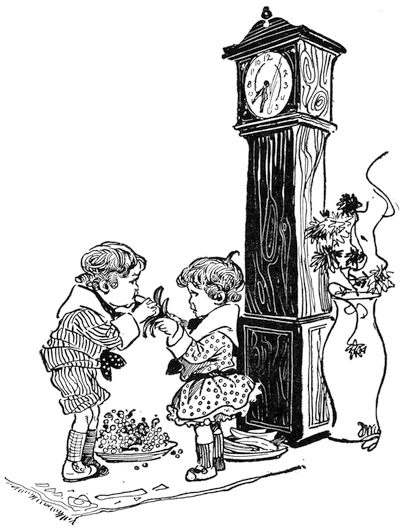
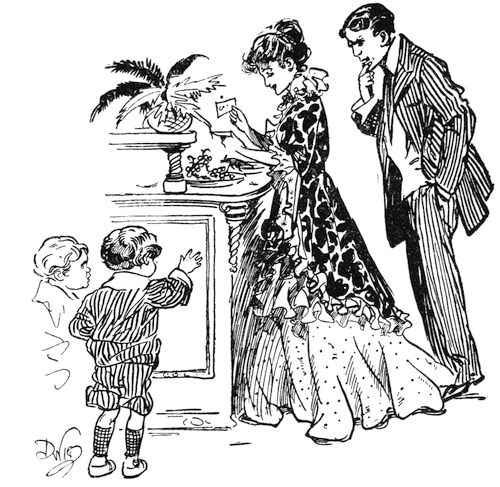
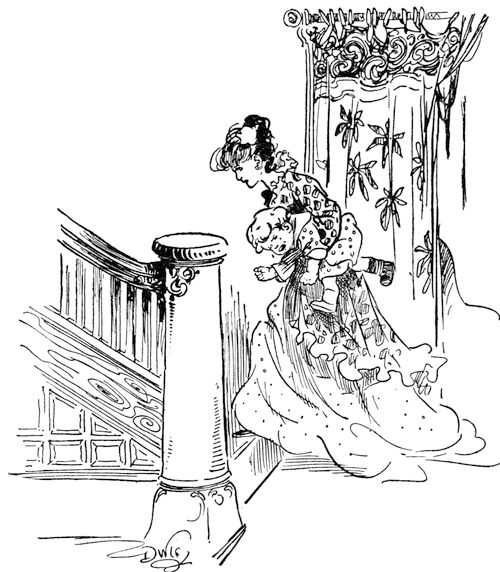
On the morning of the second day of Mrs.
Burton’s experiment, the aunt of Budge
and Toddie awoke with more than her usual
sense of the responsibility and burden of life.
Her husband’s description of a charming lot
of bric-à-brac and pottery soon to be sold at
auction did not stimulate as much inquiry as
such announcements usually did, and Mrs.
Burton’s cook did not have her usual early
morning visit from her watchful mistress.
Mrs. Burton was wondering which of her
many duties to her nephews should be first
attended to; but, as she wondered long without
reaching any conclusion an ever-sympathizing
Providence came to her assistance,
for the children awoke and created such a
hubbub directly over her head that she speedily
determined that reproof was the first
thing in order. Dressing hastily, she went up
to the chamber of the innocents, and learned
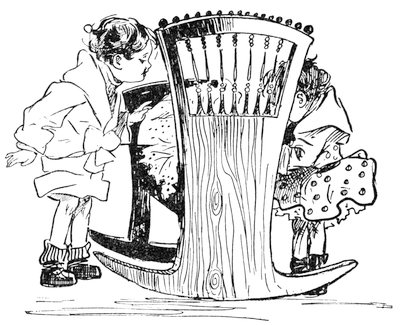
that the noise was occasioned by a heavy
antique center-table, which was flying back
and forth across the room, the motive power
consisting of two pairs of sturdy little arms.
“Hullo, Aunt Alice!” said Budge. “I
awful glad you came in. The table’s a choo-choo,
you know, an’ my corner’s New York
an’ Tod’s is Hillcrest, an’ he’s ticket-agent at
one place an’ I at the other. But the choo-choo
hasn’t got any engineer, an’ we have to
push it, an’ it isn’t fair for ticket-agents to do
so much work besides their own. Now you
can be engineer. Jump on!”
The extempore locomotive was accommodatingly
pushed up to Mrs. Burton with such
force as to disturb her equilibrium, but she
managed to say:
“Do you do this way with your mamma’
guest-chamber furniture?”
“No,” said Toddie, “’cause why, ’pare-chamber’h
always lockted. B’ides dat,
papa once tookted all de wheels off our
tables—said tables wash too restless.”
“Little boys,” said Mrs. Burton, returning
the table to its place, “should never use things
which belong to other people without asking
permission. Nor should they ever use anything,
no matter who it belongs to, in any way
but that in which it was made to be used.
Did either of you ever see a table on a railroad?”
“’Coursh we did,” said Toddie, promptly;
“dere’s a tyne-table at Hillcrest, an’annuvver
at Dzersey City. How could choo-choos
turn around if dere wasn’t?”
“It’s time to dress for breakfast now,” said
Mrs. Burton in some confusion, as she departed.
The children appeared promptly at the
table on the ringing of the bell and brought
ravenous appetites with them. Mrs. Burton
composed a solemn face, rapped on the table
with the handle of the carving-knife, and all
heads were bowed while the host and hostess
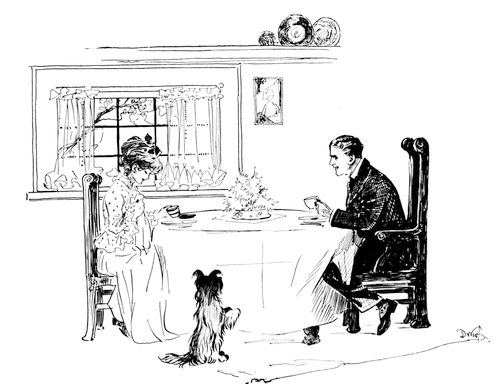
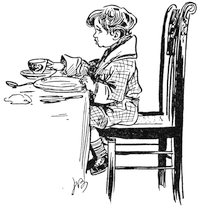
silently returned thanks. When the adults
raised their heads they saw that two juvenile
faces were still closely hidden in two pairs of
small hands. Mrs. Burton reverently nodded
at each one to attract her husband’
attention, and mentally determined that souls
so absorbed in thanksgiving were good ground
for better spiritual seed than their parents
had ever scattered. Slowly, however, twice
ten little fingers separated, and very large
eyes peeped inquiringly between them; then
Budge suddenly dropped his hands, straightened
himself in his chair, and said:
“Why, Uncle Harry! Have you been forgettin’
again how to ask a blessin’?”
And Toddie, looking somewhat complainingly
at his uncle, and very hungrily at the
steak, remarked:
“Said my blessin’ ’bout fifty timesh.”
“Once would have been sufficient, Toddie,”
said Mrs. Burton.
“Why didn’t you say yoursh once, den?”
asked Toddie.
“I did. We don’t need to talk aloud to
have the Lord hear us,” explained Mrs.
Burton.
“’Posin’ you don’t,” said Toddie, “I don’t
fink it’s a very nysh way to do, to whisper
fings to de Lord. When I whisper anyfing
mamma says, ‘Toddie, what’s you whisperin’
for? You ’shamed of somefing?’s Guesh you
an’ Uncle Harry’s bofe ’shamed at de same
time.”
Mr. Burton desired to give his wife a pertinent
hint yet dared not while two such vigilant
pairs of ears were present. A happy thought
struck him and he said in very bad German:
“Is it not time for the reformation to
begin?”
And Mrs. Burton answered:—
“It soon will be.”
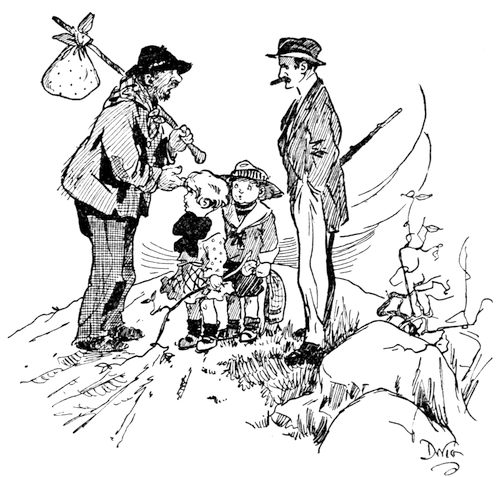
“That’s awful funny talk,” said Budge.
“I wish I could talk that way. That’s just
the way ragged, dirty men talk to my papa
sometimes, and then he gives ’em lots of
pennies. When was you an’ Aunt Alice
ragged an’ dirty, so as to learn to talk that
way?”
“Budge, Budge!” exclaimed Mrs. Burton.
“Thousands of very rich and handsome people
talk that way—all German people do.”
“Do they talk to the Lord so?” asked
Budge.
“Certainly,” said Mrs. Burton.
“Gracious!” exclaimed the young man.
“He must be awful smart to understand
them.”
Mr. Burton repeated his question in
German, but Mrs. Burton kept silent and
looked extremely serious, with a ghost of a
frown.
“What are you boys and your auntie going
to do with yourselves to-day?” asked
Mr. Burton, anxious to clear away the cloud
of reticence which, since the night before,
had been marring his matrimonial sky.
“I guess,” said Budge, looking out through
the window, “it’s going to rain; so the best
thing will be for Aunt Alice to tell us stories
all day long. We never do get enough
stories.”
“Just the thing!” exclaimed Mrs. Burton,
her face coming from behind the clouds, and
with more than its usual radiance.
“Hazh you got plenty of stories in your
’tomach?” asked Toddie, poising his fork in
air, regardless of the gravy which trickled
down upon his hand from the fragment of
meat at the end.
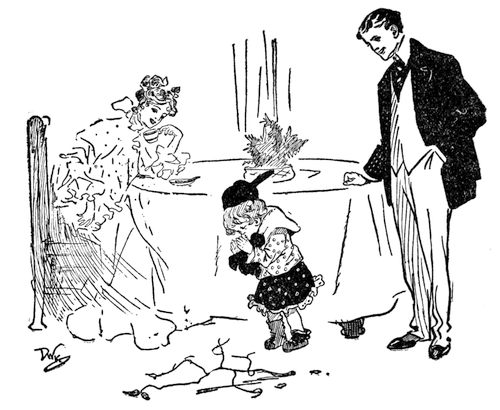
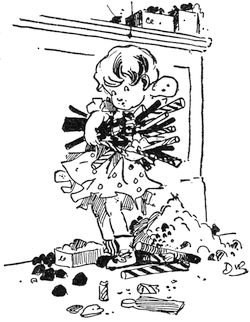
“RAGGED, DIRTY MEN TALK TO MY PAPA SOMETIMES”
“Dozens of them,” said Mrs. Burton. “I
listened to stories in Sunday-school for about
ten years, and I’ve never had anybody to tell
them to.”
“I don’t think much of Sunday-school
stories,” said Budge, with the air of a man
indulging in an unsatisfactory retrospect.
“There’s always somethin’ at the end of
’em that spoils all the good taste of ’em—somethin’
about bein’ good little boys.”
“Aunt Alice’s stories haven’t any such
endings,” said Mr. Burton, with a sneaking
desire to commit his wife to a policy of simple
amusement. “She knows that little boys
want to be good, and she wants to see them
happy, too.”
“Aunt Alice will tell you only what you
will enjoy, Budge—she promises you that,”
said Mrs. Burton. “We will send Uncle
Harry away right after breakfast and then
you shall have all the stories you want.”
“And cake, too?” asked Toddie. “Mamma
always gives us cakesh when she’s tellin’
us stories, so we’ll sit still an’ not wriggle
about.”
“No cakes,” said Mrs. Burton, kindly but
firmly. “Eating between meals spoils the
digestion of little boys, and makes them very
cross.”
“I guess that’s what was the matter with
Terry yesterday, then,” said Budge. “He
was eatin’ a bone between meals, out in the
garden yesterday afternoon, and when I took
hold of his back legs and tried to play that
he was a wheelbarrow, he bit me.”
Mr. Burton gave the dog Terry a sympathetic
pat and a bit of meat, making him
stand on his hind legs and beg for the latter,
to the great diversion of the children. Then,
with an affectionate kiss and a look of tender
solicitude he wished his wife a happy day and
hurried off to the city. Mrs. Burton took
the children into the library and picked up
a Bible.
“What sort of story would you like first?”
she asked, as she slowly turned the leaves.
“One ’bout Abraham, ’cause he ’most
killed somebody,” said Toddie, eagerly.
“Oh, no,” said Budge; “one about Jesus,
because He was always good to everybody.”
“Dear child,” exclaimed Mrs. Burton.
“Goodness always makes people nice, doesn’t
it?”
“Yes,” said Budge; “’cept when they talk
about it to little boys. Say, Aunt Alice,
what makes good folks always die?”
“Because the Lord needs them, I suppose,
Budge.”
“Then don’t he need me?” asked Budge,
with a pathetic look of inquiry.
“Certainly, dear,” said Mrs. Burton; “but
he wants you to make other people happy
first. A great many good people are left in
the world for the same reason.”
“Then why couldn’t Jesus be left?” said
Budge. “He could make people happier
than every one else put together.”
“You’ll understand why, when you grow
older,” said Mrs. Burton.
“I wish I’d hurry up about it and grow,
then,” said Budge. “Why can’t little boys
grow just like little flowers do?—just be put
in the ground an’ watered and hoed? Our
’paragus grows half-a-foot in a day almost.”
“You’s a dyty boy to want to be put in
de dyte, Budgie,” said Toddie, “an’ I isn’t
goin’ to play wif you any more. Mamma
says I mustn’t play wif dyty little boys.”
“Dirty boy yourself!” retorted Budge.
“You like to play in the dirt, only you cry
whenever anybody comes with water to put
on you. Say, Aunt Alice, how long does people
have to stay in the ground when they die
before they go to heaven?”
“Three days, I suppose, Budge,” said Mrs.
Burton.
“An’ does everybody that the Lord loves
go up to heaven?”
“Yes, dear.”
“Well, papa says some folks believe that
dead people never go to heaven.”
“Never mind what they believe, Budge.
You should believe what you are taught,”
said Mrs. Burton.
“But I’d like to know for sure.”
“So you will, some day.”
“I wish ’twould be pretty quick about
it, then,” said Budge. “Now tell us a
story.”
Mrs. Burton drew the children nearer her
as she reopened the Bible, when she discovered,
to her surprise, that Toddie was
crying.
“I hazhn’t talked a bit for ever so long!”
he exclaimed, in a high, pathetic tremolo.
“What do you want to say, Toddie?”
asked Mrs. Burton.
“I know all ’bout burying folks—that’
what,” said Toddie. “Mamma tolded me all
’bout it one time, she did. An’ yeshterday
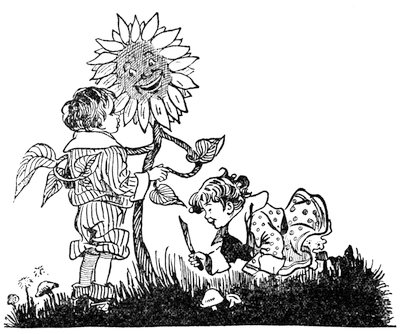
me and Budgie had a funelal all by ourselves.
We found a dear little dead byde. An’ we
w’apped it up in a piesh of paper, ’cause a
baking-powder box wazn’t bid enough for a
coffin, an’ we dugged a little grave, an’ we
knelted down an’ said a little prayer, an’
ashked de Lord to take it up to hebben, an’
den we put dyte in the grave an’ planted
little flowers all over it. Dat’s what.”
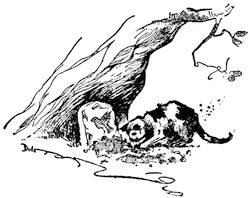
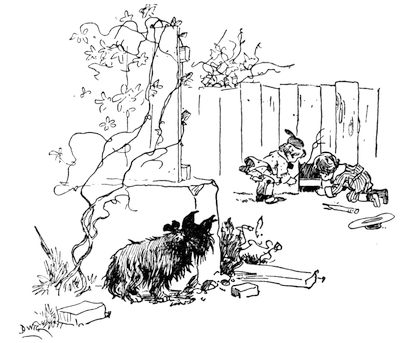
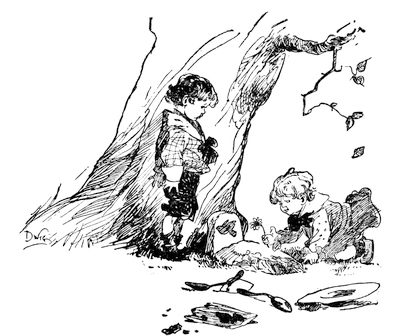
“Yes, an’ we put a little stone at the head
of the grave, too, just like big dead folks,”
said Budge. “We couldn’t find one with any
writin’ on it, but I went home and got a picture-book
an’ cut out a little picture of a bird,
an’ stuck it on the stone with some tar that I
picked out of the groceryman’ wagon-wheel,
so that when the angel that takes spirits to
heaven comes along, it can see there’s a dead
little birdie there waitin’ for him.”
“Yesh,” added Toddie, “an’ little bydie
ishn’t like us. ’Twon’t have to wunner how
it’ll feel to hazh wings when it gets to be a
angel, ’cause ’twas all used to wings ’fore it
died.”
“Birds don’t go——” began Mrs. Burton,
intending to correct the children’s views as to
the future state of the animal kingdom, when
there flashed through her mind some of the
wonderings of her own girlish days, and the
inability of her riper experience to answer
them, so she again postponed, and with a
renewed sense of its vastness, the duty of
reforming the opinions of her nephews on
things celestial. At about the same time her
cook sought an interview, and complained of
the absence of two of the silver tablespoons.
Mrs. Burton went into the mingled despondency,
suspicion and anger which is the frequent
condition of all American women who
are unfortunate enough to have servants.
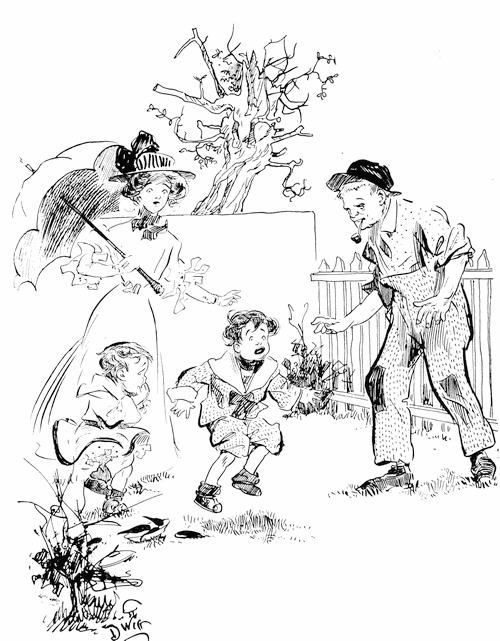
“YES, AN’ WE PUT A LITTLE STONE AT THE HEAD OF THE
GRAVE”
“Where is the chambermaid?” she asked.
“An’ ye’s needn’t be a-suspectin’ av her,”
said the cook. “It’s them av yer own family
that I’m thinkin’ hez tuk ’em.” And the
cook glared suggestively upon the boys.
Mrs. Burton accepted the hint.
“Boys, have either of you taken any of
auntie’s spoons for anything?”
“No,” answered Toddie, promptly; and
Budge looked very saintly and shy, as if he
knew something that, through delicacy of
feeling and not fear, he shrank from telling.
“What is it, Budge?” asked Mrs. Burton.
“Why, you see,” said Budge, in the sweetest
of tones, “we wanted somethin’ yesterday
to dig the grave of the birdie with, an’ we
couldn’t think of anything else so nice as
spoons. There was plenty of ugly old iron
ones lyin’ around, but birdies are so sweet
an’ nice that I wouldn’t have none of ’em.
An’ the dinner-dishes was all lyin’ there with
the big silver spoons on top of ’em, so I just
got two of ’em—they wasn’t washed yet, but
we washed ’em real clean so’s to be real nice
about everythin’, so that if the little birdie’
spirit was lookin’ at us it wouldn’t be disgusted.”
“And where are the spoons now?” demanded
Mrs. Burton, oblivious to all the
witchery of the child’s spirit and appearance.
“I dunno,” said Budge, becoming an ordinary
boy in an instant.
“I doeszh,” said Toddie—“I put ’em
somewherezh, so when we wanted to play
housh nexsht time we wouldn’t have to make
b’lieve little sticks was spoons.”
“Show me immediately where they are,”
commanded Mrs. Burton, rising from her
chair.
“Den will you lend ’em to us nexsht time
we playzh housh?” asked Toddie.
“No,” said Mrs. Burton, with cruel emphasis.
Toddie pouted, rubbed his knuckles into
his eyes, and led the way to the rear of the
garden where, in a hollow at the base of an
old apple-tree, were the missing spoons.
Wondering whether other valuable property
might not be there, Mrs. Burton cautiously
and with a stick examined the remaining
contents of the hole, and soon discovered one
of her damask napkins.
“Datsh goin’ to be our table-cloff,” explained
Toddie, “an’ dat”—this, as an unopened
pot of French mustard was unearthed
“is pizzyves” (preserves).
Mrs. Burton placed her property in the
pocket of her apron, led her two nephews into
the house, seated them with violence upon a
sofa, closed the doors noisily, drew a chair
close to the prisoners, and said:
“Now, boys, you are to be punished for
taking auntie’s things out of the house without
permission.”
“Don’t want to be shpynkted!” screamed
Toddie, in a tone which seemed an attempt
at a musical duet by a saw-filer and an ungreased
wagon-wheel.
“You’re not to be whipped,” continued
Mrs. Burton, “but you must learn not to
touch things without permission. I think
that to go without your dinners would help
you to remember that what you have done
is naughty.”
“Izhe ’most ’tarved to deff,” exclaimed
Toddie, bursting out crying. (N.B. Breakfast
has been finished but a scant hour.)
“Then I will put you into an empty room,
and keep you there until you are sure you
can remember.”
Toddie shrieked as if enduring the thousand
tortures of the Chinese executioner, and
Budge looked as unhappy as if he were a
young man in love and in the throes of reluctant
poesy, but Mrs. Burton led them both
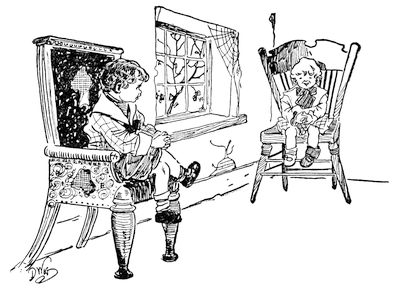
to the attic, and into an empty room, placed
chairs in two corners and a boy in each chair,
and said:
“Don’t either of you move out of a chair.
Just sit still and think how naughty you’ve
been. In an hour or two I’ll come back, and
see if you think you can be good boys here-after.”
“DON’T EITHER OF YOU MOVE OUT OF A CHAIR”.
As Mrs. Burton left the room, she was followed
by a shriek that seemed to pierce the
walls and be heard over half the earth. Turning
hastily, she saw that Toddie, from whom
it had proceeded, had neither fallen out of his
chair, nor been seized by an epileptic fit, nor
stung by some venomous insect; so she closed
the door, locked it, softly placed a chair
against it, sat down softly and listened.
There was silence after the several minutes
required by Toddie to weary of his crying,
and then Mrs. Burton heard the following
conversation:
“Tod?”
“What?”
“We ought to do something!”
“Chop Aunt Alish into little shnipsh of
bitsh—datsh what I fink would be nysh.”
“That would be dreadful naughty,” said
Budge, “after we’ve bothered her so! We
ought to do something good, just like big
folks when they’ve been bad.”
“What doezh big folks do?”
“Well, they read the Bible an’ go to
church. But you an’ me can’t go to church,
’cause ’tain’t Sunday, an’ we ain’t got no
Bible, an’ we wouldn’t know how to read it if
we had.”
“Den don’t letsh do noffin’ but be awful
mad,” said the unrepentant Toddie. “I’ll
tell you what we can do. Let’s do like dat
Maggydalen dat mamma’s got a picture of,
and dat was bad an’ got sorry; letsh look
awful doleful and cwosh. See me.”
Toddie apparently gave an illustration of
what he thought the proper penitential countenance
and attitude, for Budge exclaimed:
“I don’t think that would look nice at all.
It makes you look like a dead puppy-dog
with his head turned to one side. I’ll tell you
what; we can’t read Bibles like big folks, but
we can tell stories out of the Bible, an’ that’
bein’ just as good as if we read ’em.”
“Oh, yes,” said Toddie, repenting at once.
“Letsh! I wantsh to be good just awful.”
“Well, what shall we tell about?” asked
Budge.
“’Bout when Jesus was a little boy,” said
Toddie, “for he was awful good.”
“No,” said Budge; “we’ve been naughty,
an’ we must tell about somebody that was
awful naughty. I think old Pharaoh’s about
the thing.”
“Aw right,” said Toddie. “Tell us ’bout
him.”
“Well, once there was a bad old king down
in Egypt, that had all the Izzyrelites there
an’ made ’em work, an’ when they didn’t
work he had ’em banged. But that dear
little bit of a Moses, that lived in a basket in
the river, grew up to be a man, an’ he just
killed one of Pharaoh’s bad bangers, an’ then
he skooted an’ hid. An’ the Lord saw that
he was the kind of man that was good for
somethin’, so he told him he wanted him to
make Pharaoh let the poor Izzyrelites go
where they wanted to. So Moses went and
told Pharaoh. An’ Pharaoh said, ’No, you
don’t!’s Then Moses went an’ told the Lord,
an’ the Lord got angry, and turned all the
water in the river into blood.”
“My!” said Toddie. “Then if anybody
wanted to look all bluggy, all he had to do
was to go in bavin’, wasn’t it?”
“But he wouldn’t let ’em go then,” continued
Budge. “So the Lord made frogs
hop out of all the rivers an’ mud-puddles
everywhere, and they went into all the houses
an’ folks couldn’t keep ’em out.”
“I just wis mamma an’ me’d been in
Egypt, den,” said Toddie. “Den she couldn’t
make me leave my hop-toads out of doors, if
de Lord wanted ’em to stay in de house. I
loves hop-toads. I fwallowed one de uvver
day, an’ it went way down my ’tomach.”
“Didn’t it kick inside of you?” asked
Budge, with natural interest.
“No-o!” said Toddie. “I bited him in two
fyst. But he growed togvver ag’in, an’dzust
hopped right out froo de top of my head.”
“Let’s see the hole he came out of?” said
Budge, starting across the floor.
“It all growded up again right away,” said
Toddie, in haste, “an’ you’s a bad boy to get
out of your chair when Aunt Alice told you
not to, and you’s got to tell annuvver story
’bout naughty folks to pay for it. Gwon!”
Budge returned to his chair, and continued:
“An’ old Pharaoh went down to Moses’s
house an’ said, ‘Ask the Lord to make the
frogs hop away, an’ you can have your old
Izzyrelites—I don’t want ’em.’ So the Lord
done it, an’ all the glad old Pharaoh was, was
only ’cause he got rid of ’em; an’ he kept the
Izzyrelites some more. Then the Lord thought
he’d fix ’em sure, so he turned all the dirt into
nasty bugs.”
“What did little boys do den, dat wanted
dyte to make mud-pies of?” asked Toddie.
“Well, the bugs was only made out of dry
dirt,” exclaimed Budge; “just dust like we
kick up in the street, you know.”
“Oh,” said Toddie. “I wonder if any of
dem bugs was ’tato-bugs?”
“I dunno, but some of ’em was the kind
that mammas catch with fine combs after
their little boys have been playin’ with dirty
children. An’ Pharaoh’s smart men, that
thought they could do everythin’, found they
couldn’t make them bugs.”
“Why-y-y,” drawled Toddie, “did Pharaoh
want some more of ’em?”
“No, I s’pose not, but he stayed bad, so he
had to catch it again. The Lord sent whole
swarms of flies to Egypt, an’ there wasn’t any
mosquito-nets in that country either. An’
then Pharaoh got good again, an’ the Lord
took the flies away, an Pharaoh got bad again,
so the Lord made all the horses an’ cows
awful sick, an’ they all died.”
“Then couldn’t Pharaoh go out ridin’ at
all?”
“No. He had to walk, even if he wanted
to get to the depot in an awful hurry. An’ it
made him so mad that he said the Izzyrelites
shouldn’t go anyhow. So Moses took a
handful of ashes an’ threw it up in the air
before Pharaoh, an’ everybody in all Egypt
got sore with boils right away.”
“Ow!” said Toddie, “I had some nashty
boils oncesh, but I didn’t know ashes made
’em. I’ll ’member that.”
“An’ Pharaoh said ‘no!’again, so he got
some more bothers. The Lord made great
big lumps of ice tumble down out of heaven,
an’ he made the thunder go bang, an’ the
lightnin’ ran around the ground like our
fizzers did last Fourth of July, an’ it spoiled
all the growing things.”
“Strawberries?” queried Toddie.
“Yes.”
“An’ dear little panzhies?”
“Yes.”
“Poo’s old Pharo’! Gwon.”
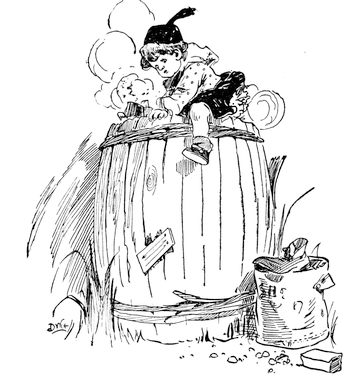
“—BUT I DIDN’T KNOW ASHES MADE ’EM”
“Then Pharaoh’s friends began to tell him
he was bein’ a goose, thinkin’ he could be
stronger than the Lord, an’ Pharaoh kind o’
thought so himself. So he told Moses that
the men-folks of the Izzyrelites might go
away if they wanted to, but nobody else.”
“Mean old fing! Who did he fink was
goin’ to cook fings—an’ go to school?”
“I dunno, but I guess he had a chance to
think about it, for the Lord made whole
crowds of locusts come. Them’s grasshoppers,
you know, an’ they ate up everythin’
in all the gardens, an’ the folks got half crazy
about it.”
“Den I guesh dey didn’t tell their little
boysh that they mushn’t kill gwasshoppers,
like mamma doesh. Wish I’d been dere!
What did he do den?”
“Oh, he was a selfish old pig, just like he
was before, so the Lord said, ‘Moses, just
hold your hand up to the sky a minute.’ An’
Moses did it, and then it got darker in Egypt
than it is in our coal-bin. Folks couldn’t see
anythin’ anywhere, an’ wherever they was
when it growed dark, they had to stay for
three whole days an’ nights.”
“Gwacious!” Toddie exclaimed. “Wouldn’t
it be drefful if Moses was to go an’ hold his
hand up in the sky while we’s a-sittin’ in
dezhe chairzh? Mebbe he will! Let’s holler
for Aunt Alish!”
“Oh, he can’t do it now, ’cause he’s dead.
Besides that, we ain’t keepin’ any Izzyrelites
from doin’ what they want to. Old Pharaoh
got awful frightened then, an’ told Moses he
might take all the people away, but they
mustn’t take their things with ’em—the selfish
old fellow! But Moses knew how hard
the poor Izzyrelites had to work for the few
things they had, so he said they wouldn’t go
unless they could carry everythin’ they owned.
An’ that made Pharaoh mad, an’ he said,
‘Get out! If I catch you here again I’ll kill
you!’s An’ Moses said, ‘Don’t trouble yourself;
you won’t see me again unless you want me.’”
“Shouldn’t fink he would,” said Toddie.
“Nobody’s goin’ to vizhit kings dzust to have
deir heads cutted off. Even our shickens
knows enough not to come to Mike when he
wants to cut deir heads off. Gwon!”
“Well, then the Lord told Moses somethin’
that must have made him feel awful. He
told him that next night every biggest boy in
every family was goin’ to be killed by an
angel. Ain’t I glad I didn’t live there then!
I’d like to see an angel, but not if that’s what
he wants to do with me. What would you
do if an angel was to kill me, Tod?”
“I’d have all your marbles,” Toddie answered,
promptly, “and the goat-cawwiage
would be all mine. Gwon!”
“Well, the Lord told Moses about it, an’
Moses told the folks; an’ he told ’em all to
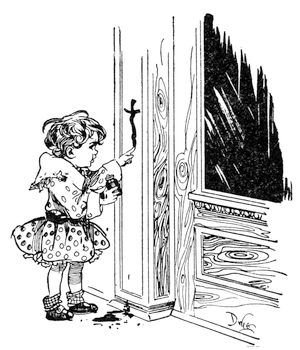
kill a little lamb, an’ dip their fingers in the
blood, an’ make a cross on their door-posts,
so when the angel came along an’ saw it he
wouldn’t kill the biggest boy in their houses.
An’ that night down came the angel, an’
everybody woke up an’ cried awful—worse
than you did when you fell down-stairs the
other day, because all the biggest died. You
couldn’t go anywhere without hearin’ papas
an’ mammas cryin’.”
“Did dey all have funerals den?”
“Of course.”
“Gwacious! Den the little ’Gyptian boys
dat didn’t get killed could look at deaders all
day long! What did Pharo’s do ’bout it
den?”
“He sent right after Moses an’ his brother,
in a hurry, an’ he told ’em that he’d been a
bad king—just as if they didn’t know that
already! An’ he told ’em to take all the
Izzyrelites, an’ all their things, an’ go right
straight away—he was in such a hurry that
he didn’t even invite Moses to the funeral,
though he had a dead biggest boy himself.
An’ all the Egyptian people came too, and
begged the Izzyrelites to hurry an’ go—they
didn’t see what they was waitin’ for. They
was so glad to get rid of ’em that they lent
’em anything they wanted.”
“Pies an’ cakes?”
“No!” said Budge, contemptuously. “You
don’t s’pose folks that’s goin’ off travelin’ for
forty years is goin’ to think ’bout eatin’ first
thing, do you? They borrowed clothes, an’
money, an’ everything else they could get, an’
left the Egyptians awful poor. An’ off they
started.”
“Did they have a ’cursion train?”
“No! All the excursion trains in the
world couldn’t have held such lots of people.
They rode on camels and donkeys, but lots of
’em walked.”
“I don’t think that was a bit of fun.”
“You would have,” said Budge, “if you’d
always had to work like everything. Don’t
you ’member how once when mamma made
you work, an’ carry away all the blocks you
brought up on the piazza from the new
buildin’? You walked ’way off to the village
to get rid of it.”
“Ye—es,” drawled Toddie, “but I knew
I’d be rided back when dey came to look for
me. Den what did they do?”
“They started to travel to a nice country
that the Lord had told Moses about, an’ they
got along till they came to a pretty big ocean
where there wasn’t any ferry-boats. I don’t
see what Moses took ’em to such a place as
that for, unless the Lord wanted to show ’em
that no ferry-boats could get the best of Him,
when all of a sudden they saw an awful lot of
dust bein’ kicked up behind ’em, an’ somebody
said that Pharaoh was a-comin’.”
“Should fink he’d seen ’nough of ’em,”
said Toddie. “Did he come down to the
boat to wave his hanafitch good-by at ’em?”
“No, he knew there wasn’t any boats
there, an’ so he came to take ’em back again
an’ make ’em work some more.”
“Should fink he’d be afraid de Lord would
kill him next.”
“P’r’aps he did; but then, you see, he was
awful lazy, an’ didn’t like to work for himself;
papa says there’s lots of folks that would
rather be killed than do any work.”
“Den what d’s de lazy folks do? They
can’t catch any Izzyrelites, can they?”
“No,” said Budge, “but they can do what
the Izzyrelites done themselves—they borrow
other people’s money. Well, when the
folks saw that ’twas Pharaoh a-comin’, they
began to grunt, an pitch into poor Moses, an’
told him he ought to be ashamed of hisself
to bring ’em away off there to be killed, when
they might have died in Egypt without havin’
to walk so far. But Moses said: ‘Shut your
mouth, will you? The Lord’s doin’ this job.’
Then the Lord said: ‘Moses, lift up your cane
an’ point across the water with it!’s An’ the
minute Moses done that, the water of that
ocean went way up on one side, and way up
on the other side—just like it does in the
bathtub sometimes when we’re splashin’, you
know—and there was a path right through
the bottom of that ocean. An’ the people just
skooted right along it!”
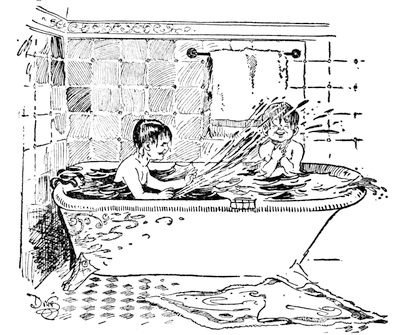
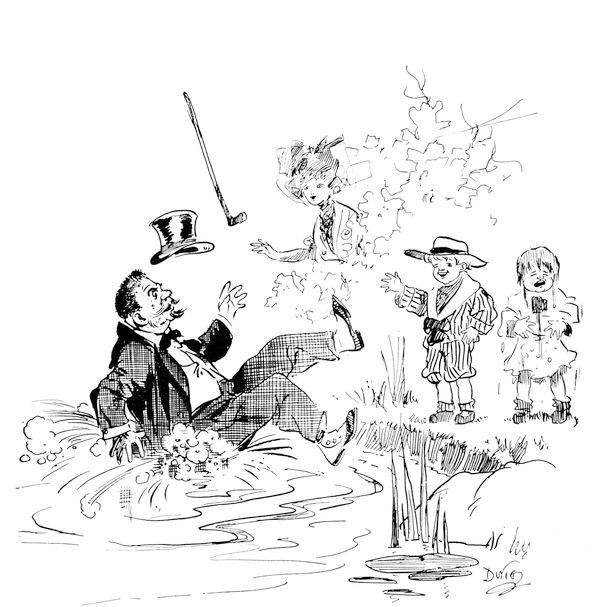
“SPLASHIN’ IN THE BATHTUB”
“Did they put on their rubbers fyst?
’Cause if they didn’t there must have been lots
of little boys spanked when they got across
for gettin’ their shoes muddy.”
“I don’t know about that,” said Budge, after
a slight pause for reflection. “I must ’member
to ask papa about that. But when they all
got over they began to grumble some more, for
along came Pharaoh’s army right after ’em.”
“I fink they was a lot of good-for-nothing
cry-babies,” Toddie exclaimed.
“Huh!” grunted Budge. “I guess you’d
have yowled if you’d have been trudgin’
along through the mud ever so long, an’ then
seen some soldiers an’ chariots an’ spears an’
bows an’ arrows comin’ to kill you. But the
Lord knew just how to manage. He always
did. Papa says He always comes in when
you think He can’t. He said to Moses, ‘Lift
up your cane an’ point it across the ocean
again.’s An’ Moses done it, an’ down came
that big fence of water on both sides kerswosh!
An’ it drownded old Pharaoh an’
the whole good-for-nothin’ lot.”
“Then did the Izzyrelites go to cryin’ some
more?”
“Not much! They all got together an’
had a big sing.”
“I know what they sung,” said Toddie.
“They all sung ‘TurnbackPharo’army-hallelujah.’”
“No, they didn’t,” said Budge. “They
sung that splendid thing mamma sings sometimes,
‘Sound the—loud tim—brel o’er—Egypt’—Egypt’
dark——’”
Budge had with great difficulty repeated
the line of the glorious old anthem, then he
broke down and burst out crying.
“What’s you cryin’ about?” asked Toddie.
“Is you playin’ you’s an Izzyrelite?”
“No,” said Budge; “but whenever I think
about that song, somethin’ comes up in my
throat and makes me cry.”
The door of the room flew open, there was
a rustle and a hurried tread, and Mrs. Burton,
her face full of tears, snatched Budge to her
breast, and kissed him repeatedly, while
Toddie remarked:
“When fings come up in my froat I just
fwallows ’em.”
Mrs. Burton conducted her nephews to the
parlor floor, and said:
“Now, little boys, it’s nearly lunch time,
and I am going to have you nicely washed
and dressed, so that if any one comes in you
will look like little gentlemen.”
“Ain’t we to be punished any more for
bein’ bad?” asked Budge.
“No,” said Mrs. Burton, kindly; “I’m
going to trust you to remember and be
good.”
“That isn’t what bothers me,” said Budge;
“I told a great, long Bible story to Tod up-stairs,
so’s to be like big folks when they get
bad, as much as I could. But Tod didn’t tell
any; I don’t think he’s got his punish.”
“He may tell his to-night, after Uncle
Harry gets home,” said Mrs. Burton.
“An’ sit in a chair in the corner of the up-stairs
room?” asked Budge.
“I hardly think that will be necessary this
time,” answered the lady.
“Then I don’t think you punish fair a bit,”
said Budge, with an aggrieved pout.
“I’ll be dzust as sad as I can ’bout it,
Budgie,” said Toddie, with a brotherly kiss.
The boys were led off by the chambermaid
to be dressed and Mrs. Burton seated herself
and devoted herself to earnest thought.
Time was flying, her husband had been between
dark and breakfast-time most exasperatingly
solicitous as to the success of his
wife’s theories of government, and not even
her genius of self-defense had prevailed
against him. She felt that so far she had
been steadily vanquished. Her husband
had told her in other days that it was always
so with the best generals in their first engagements,
so she determined that if men
had snatched victory from the jaws of defeat,
she should be able to do so as well. Her
desperation at the thought of a long lifetime
of “I told you so’” from her husband made
her determine that no discomfort should prevent
the most earnest endeavor for success.
The luncheon bell aroused her from what
had become a reverie in the valley of humiliation,
and she found awaiting her at the table
her nephews—Budge in a jaunty sailor-suit
and Toddie in a clean dress and an immaculate
white apron. An old experience caused
her to promptly end some researches of Toddie’,
instituted to discover whether his aunt’
dishes were really “turtle-pyates,” and an
attempt by Budge to drop oysters in the
mouth of the dog Terry, as he had seen his
uncle do with bread-crusts in the morning,
was forcibly brought to a close. Beyond the
efforts alluded to, the children did nothing
worse than people in good society often do at
table. After luncheon, Mrs. Burton said:
“Now, boys, this is Aunt Alice’s receptionday.
I will probably have several calls, and
every one will want to know about that dear
little new baby, and you must be there to tell
them. So you must keep yourselves very
neat and clean. I know you wouldn’t like to
see any dirty people in my parlor!”
“Hatesh to shtay in parlors,” said Toddie.
“Wantsh to go and get some jacks” (“Jack-in-the-pulpit”—a
swamp plant).
“Not to-day,” said Mrs. Burton, kindly,
but firmly. “No one with nice white aprons
ever goes for jacks. What would you think
if you saw me in a swampy, muddy place,
with a nice white apron on, hunting for
jacks!”
“Why, I’d fink you could bring home
more’n me, ’cause your apron would hold the
mosht,” Toddie replied.
“I’ll tell you what,” said Budge, calling
Toddie into a corner and whispering earnestly
to him. The purity of Budge’s expression of
countenance and the tender shyness with
which he avoided her gaze when he noticed
that it was upon him, caused Mrs. Burton to
instinctively turn her head away, out of respect
for what she believed to be a childish
secret of some very tender order. Glancing
at the couple again for only a second, she saw
that Toddie, too, seemed rather less matter-of-fact
than usual. Finally both boys started
out of the doorway, Budge turning and remarking
with inflections simply angelic:
“Will be back pretty soon, Aunt Alice.”
Mrs. Burton proceeded to dress; she idly
touched her piano, until one lady after another
called, and occupied her time. Suddenly,
while trying to form a good impression on a
very dignified lady of the old school, both
boys marched into the parlor from the dining-room.
Mrs. Burton motioned them violently
away, for Budge’s trousers and Toddie’
apron were as dirty as they well could be.
Neither boy saw the visitor, however, for she
was hidden by one of the wings which held
the folding-doors, so both tramped up to their
aunt, while Budge exclaimed:
“Folks don’t go to heaven the second day,
anyhow, for we just dug up the bird to see,
an’ he was there just the same.”
“And dere wazh lots of little ants dere wiv
him,” said Toddie. “Is dat ’cause dey want
to got to hebben, too, an’ wantsh somebody
wif wings to help ’em up?”
“Budge!” exclaimed Mrs. Burton, in chilling
tones; “how did all this dirt come on your
clothes?”
“Why, you see,” said the boy, edging up
confidentially to his aunt, and resting his
elbows on her knee as he looked up into her
face, “I couldn’t bear to put the dear little
birdie in the ground again without sayin’
another little prayer. And I forgot to brush
my knees off.”
“Toddie,” said Mrs. Burton, “you couldn’t
have knelt down with your stomach and
breast. How did you get your nice white
apron so dirty?”
Toddie looked at the apron and then at
his aunt—looked at a picture or two, and
then at the piano—followed the cornice-line
with his eye, seemed suddenly to find what
he was looking for, and replied:
“Do you fink dat apron’s dyty? Well, I
don’t. Tell you watsh de matter wif it—I
fink de white’s gropped off.”
“Go into the kitchen!” Mrs. Burton commanded,
and both boys departed with heavy
pouts where pretty lips should have been.
Half an hour later their uncle, who had come
home early with the laudable desire of meeting
some of his wife’s acquaintances, found
his nephew Toddy upon the scaffolding of an
unfinished residence half-way between his
own residence and the railway station. Remembering
the story, dear to all makers of
school reading-books, of the boy whose sailor
father saw him perched upon the mainyard,
Mr. Burton stood beneath the scaffolding and
shouted to Toddie:

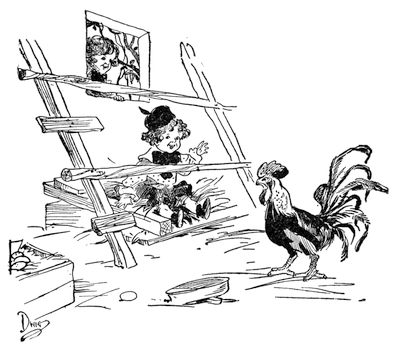
“JUMP!” SHOUTED MR. BURTON
“Jump!”
“I can’t,” screamed Toddie.
“Jump!” shouted Mr. Burton, with increased
energy.
“Tell you I can’t,” repeated Toddie.
“Wezh playin’ Tower of Babel, an’ hazh had
our talks made different like de folks did
den, an’ when I tells Budge to bring buicksh,
he only buingzh mortar, an’ when I wantsh
mortar he buings buicksh. An’ den we talksh
like you an’ Aunt Alice did yestuday at de
table.”
“Yes,” said Budge, appearing from the inside
of the building with an armful of blocks.
“Just listen.” And the young man chattered
for a moment or two in a dialect never
even dimly hinted at except by a convention
of monkeys.
Mr. Burton cautiously climbed the ladder,
brought down one boy at a time, kissed
them both and shook them soundly, after
which the three wended homeward, the boys
having sawdust on every portion of their
clothes not already soiled by dirt, and most
of Mrs. Burton’s callers meeting the party
en route.
Mr. Burton found his wife brilliantly conversational,
yet averse to talking about her
nephews. The exercise which they had been
compelled to take in their emulation of the
architects of the incomplete building on the
plain of Shinar gave them excellent appetites
and silenced tongues; but after his capacity
had been tested to the uttermost Budge said:
“It’s time for Tod to do his punishment
now, Aunt Alice. Don’t you know?”
Mrs. Burton winked at her husband, and
nodded approvingly to Budge.
“Come, Tod,” said Budge, “you must tell
your awful sad story now, an’ feel bad.”
“Guesh I’ll tell ’bout Peter Gray,” said
Toddie; “thatsh awful sad.”
“Who was Peter Gray?” asked Mrs. Burton.
“He’s a dzentleman dat a dyty little boy
in the nexsht street to us sings ’bout,” said
Toddie, “only I don’t sing ’bout him—I only
tellsh it. It’s dzust as sad that-a-way.”
“Go on,” said Budge.
“Once was a man,” said Toddie, with
great solemnity, “an’ his name was Peter
Gray. An’ he loved a lady. An’ he says to
her papa, ‘I wantsh to marry your little gyle.’
An’ what you fink dat papa said? He said,
‘No!’” (this with great emphasis). “That
izhn’t as hard as he said it, eiver, but it’s azh
hard as I can say it. It’s puffikly dzedful
when Jimmy sings it. An’ Peter Gray felt
awful bad den, an’ he went out Wesht, to buy
de shkinzh dat comes off of animals an’ fings,
dough how dat made him feel nicer Jimmy
don’t sing ’bout. An’ bad Injuns caught
him an’ pulled his hair off, djust like ladies
pull deirsh off sometimezh. An’ when dat
lady heard ’bout it, it made her feel so bad
dat she went to bed an’ died. Datsh all.
Uncle Harry, ain’t you got to be punished
for somefin’, so you can tell ush a story?”
“It’s time little boys were in bed now,”
said Mrs. Burton, arising and taking Toddie
in her arms.
“Oh, dear!” said Budge. “I wish I was a
little boy in China, an’ just gettin’ up.”
“So does I,” said Toddie; “’cause den you
would have a tay-al on your head an’ I could
pull it!”
The boys retired, and Mrs. Burton broke
her reticence so far as to tell her husband the
story she had heard in the morning, and to
insist that he was to arise early enough in the
morning to unearth the buried bird and
throw it away.
“It’s perfectly dreadful,” said she, “that
those children should be encouraged in making
trifling applications of great truths, and
I am determined, as far as possible, to prevent
the effects by removing the causes.”
And her husband put on an exasperating
smile and shook his head profoundly.