BUDDHISM
STUDIES IN THE FAITHS. I
BY
ANNIE H. SMALL
AUTHOR OF
‘YESHUDAS,’ ‘SUWARTA,’ ‘STUDIES IN BUDDHISM,’ ETC.
1905
London
J. M. DENT & CO.
New York : E. P. DUTTON & CO.
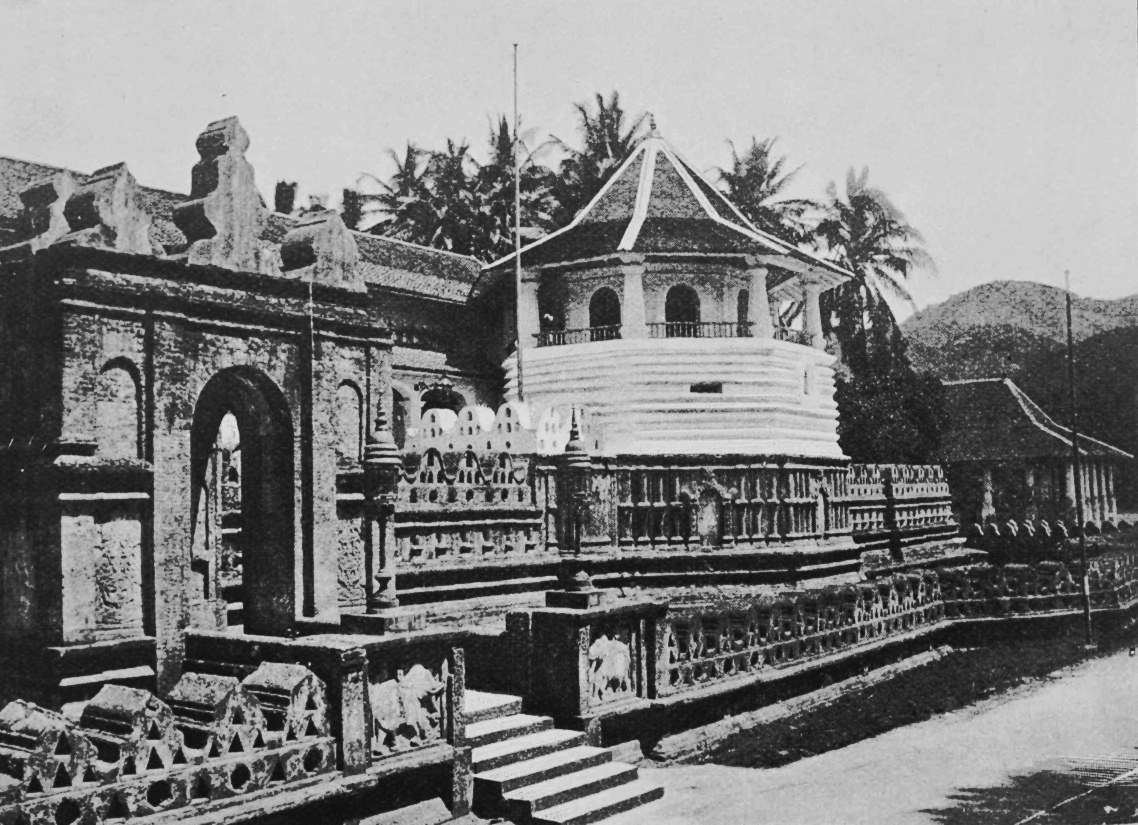
TEMPLE OF THE SCARED TOOTH, KANDY.
Whole book · 15 sections
STUDIES IN THE FAITHS. I
BY
ANNIE H. SMALL
AUTHOR OF
‘YESHUDAS,’ ‘SUWARTA,’ ‘STUDIES IN BUDDHISM,’ ETC.
1905
London
J. M. DENT & CO.
New York : E. P. DUTTON & CO.
TEMPLE OF THE SCARED TOOTH, KANDY.
TO
G. S. AND W. M. M.
THIS LITTLE SERIES OF STUDIES IS
AFFECTIONATELY INSCRIBED.
It is in the belief that it may be not unprofitable for us of the Christian Faith, that we should sit for a little space at the feet of the great Indian Sage and Teacher, to study some of the truths which he esteemed most highly, and to compare them with those already familiar to us but too little dwelt upon by us, and in the light of them once again to make real to our thinking those truths which are peculiarly ours in Christ Jesus our Lord, that this little book has been written. But no reader will mistake so slight a sketch for an attempt to tell the whole.
| PAGE | |
| India and Gautama | 11 |
| Israel and Jesus | 27 |
| The Universal Law. Buddhism and Christianity | 39 |
| The Universal Law in Human Life: Buddhism and Christianity | 45 |
| The WAY of Emancipation: Buddhism | 61 |
| The Formula of Confession | 69 |
| The WAY of Salvation: Christianity | 75 |
| The Two Ideals | 91 |
| The Buddha and the Christ | 103 |
I would not let one cry
Whom I could save.’”Sir Edwin Arnold.
♦ The Story of India ♦ Beyond other lands the great land of India has borne the burden of the havoc which has been wrought in this world of ours, and through it in the fair universe of God; and she has realized deeply that man has had some awful share in the tragedy. Her religious teaching is the expression of her sense of this fact, and of her yearning after the re-uniting of each several severed part with the original Oneness. To this end the appalling panorama presented to the view in such a city as Benares—the washings, the offerings and acts of worship, the pilgrim processions from temple to temple. To this end the fastings and austerities, the renunciations, the so-to-speak experiments in ways of salvation. And to this end the long thoughts and dreams of the centuries, and the missions of men like Gautama. The history of the Passion of India is, rightly understood, the most noble which the world has known, with one exception only. The huge blunders into which she has fallen take nothing from the grandeur of the story, they add much to its pathos. She has dreamed that man must seek God, and has never had the vision of God seeking man. She has failed to evolve the idea of a personal God, a living, speaking, loving God; and the pantheism into which she has drifted seems to us at best a poor thing, and at worst a bad thing. Life has failed of any moral significance. But the great heart of India is fundamentally right. Her mistakes are not, as has been so often affirmed, of the essence of her nature; they are only the best solution which her unaided mind and heart could discover, of the problem of the sorrow of the world. The greatest of her Masters was Gautama the Buddha, who proved, in one aspect of his teaching, too great for her acceptance, in another, too narrow; and he was rejected, not, however, before he made an ineffaceable mark upon her thought, and not before she had sent his influence far over the world.
♦ Gautama ♦ Gautama, known as the Buddha, was born at Kapila Wastu, on the river Rohini, about a hundred miles from Benares, some 550 years before Christ. He came of a noble family. Wonderful tales, most of them legends of a comparatively recent date, are told of his birth, childhood, and youth; little is really known. He was chivalrous and noble in character, and revealed very early a peculiarly sensitive temperament; the sight of suffering overwhelmed him; and his father, whose only child he was, brought him up in strictest seclusion, sheltering him, so far as might be, from contact with the darker aspects of life.
♦ His Story ♦ The Seeker ♦ He was married early and happily, and ten years later a son was born to him. It was about this time that the knowledge of the world’s sorrow reached him. The story is told of his driving out beyond the palace gates, and meeting examples of suffering, old age, and death. He insisted upon an explanation, and the charioteer explained to his master how that these were the common lot of humanity. Gautama returned to the palace; but from that day was unable to settle into the old life. Unrest grew upon him, and at length he determined to leave his home, don the garb of the Seeker, and learn from those who had studied the problems of evil in human life, the lesson of their meaning and their remedy.
♦ The Way of Religion ♦ He went, as was natural, in the first place, to the religious teachers, the Brahmans, in order to learn from them how by religious service and ritual, evil had been mastered. It is significant that the time spent in this study was short, and that very little is told of it. The cruelty of the sacrifices repelled him, and he could discover no relation whatever between the elaborate symbolism of the worship, and the deeper needs of his awakened nature.
♦ The Way of the ascetic Student ♦ He left the sacred city, and retired with five companions of like mind with himself, that in the quiet of a forest retreat they might meditate together. The only way known to them was the way of severest self-discipline. Great thinkers of India had taught that the universe is one great Soul from which all other souls had broken away. These, separate from their true home, wander in misery, finding bodies as they may, according to their nature, and having no rest until they return to the original Soul. This is the doctrine of transmigration or re-incarnation. The soul is incarnated again and again, suffering in each new body the true recompense of the previous life. This process is repeated until the soul is purified from all evil, when it returns to the Mother Soul. The fewer the deeds, good or evil, the fewer the re-incarnations; and for those who would cut short the painful history, the life of the ascetic is the only true life. By austerity the power of the body may be vanquished, the selfish life (cause of all deeds, good or evil) may be subdued, and the soul may be set free.
To this life Gautama gave himself for six years, adding ever severer and severer tests; until he was regarded as the greatest of living saints. But for himself was no satisfaction; the answer to his problem was not yet found. At length he owned sorrowfully that the way of asceticism was not the way of release. He had not yet discovered the cause of life’s suffering, and although the body seemed vanquished, Self lived, and temptation and sorrow were still possible. With superb courage he confessed to his companions that for him the experiment was a failure, and withdrew.
♦ Solitary Study ♦ Enlightenment ♦ He retreated deeper into the forest, and spent the following year in profound meditation. Seated under the tree ever after known as the Bo tree (tree of wisdom) the light dawned upon him. He saw that earthly desire, the yielding to selfish aims, was the true cause of human misery. If men were free from these, suffering must cease. Not then in religious ceremonial, which is not even symbolic of the truth; nor in self-torture or bodily discipline; but in the strenuous and constant denial of the Self-life until the dominion of self is broken, and also, in the tenderest pity for the great world of suffering men and women, is salvation to be found.
Towards self, discipline,
Towards others, love,—
this is the path of emancipation.
♦ Temptation ♦ It was while Gautama, now the Buddha, or Enlightened One, rested from the mental strain through which he had passed, and meditated upon his new-found Gospel, that the tempter came to him with subtle temptation. All earthly desires came before him, and he mastered them one by one, until at length he lay under the tree exhausted, but triumphant.
♦ Service♦ Peace had been obtained for himself, and now the thought of the suffering world possessed him. It was not in the nature of Gautama to desire publicity; but he could not rest with this new-found gospel of release from misery through the conquest of Desire. He went in search of his old Brahman teachers; but they were dead. He then found the five companions of his ascetic life, who received him at first with doubt; but when he made plain to them in a wonderful sermon, the experience through which he had passed, they gladly received the new gospel. The rest of his busy life was spent in telling his gospel, and in sending out his disciples on preaching tours. Before many months had passed, he was able to send out sixty disciples; and in the course of a very few years his followers numbered many thousands. From the high and the low, and especially from the troubled, they gathered around him, and many entered upon the Way. For forty years he carried on his gentle and loving ministry; travelling from place to place, eating the food which the rich and the poor vied with each other in providing for his own and his followers’ need, and then teaching those who gathered around him. When the Rainy Season came round, he retired with his disciples to some quiet retreat, and talked with them of the great things of the “Kingdom of righteousness.”
♦ Death ♦ His long life was spent thus in the open air, a simple and sweet and unselfish life; and when he died, at Kusi-Nagar, his body was burned and the ashes were divided, and carried for reverent burial to those parts of the land where there were the largest number of his followers. Gautama died in the year 480 B.C.
♦ The sum of the teaching ♦ “Now this, O recluses, is the noble truth concerning suffering. Birth is painful, and so is old age; disease is painful, and so is death. Union with the unpleasant is painful, painful is separation from the pleasant; and any craving that is unsatisfied, that, too, is painful....”
“Now this, O recluses, is the noble truth concerning the origin of suffering. Verily it originates in that craving thirst which causes the renewal of becomings, is accompanied by sensual delight, and seeks satisfaction now here, now there—that is to say, the craving for the gratification of the passions, or the craving for a future life, or the craving for success in this present life.”
“Now this, O recluses, is the noble truth concerning the destruction of suffering. Verily it is the destruction in which no craving remains over, of this very thirst; the laying aside of, the getting rid of, the being free from, the harbouring no longer of, this thirst.”
“Now this, O recluses, is the noble truth concerning the way which leads to the destruction of suffering. Verily it is this Eight-fold noble path; that is to say: Right Views, Right Aspirations, Right Speech, Right Conduct, Right Livelihood, Right Effort, Right Mindfulness, Right Rapture.”
“A great epoch was exhausted, and passing away to give place to another, the first utterances of which had already been heard in the north, and which awaited but the Initiator to be revealed.”
“He came. The soul the most full of love, the most sacredly virtuous, the most deeply inspired by God and the future, that men have yet seen on earth; Jesus. He bent over the corpse of the dead world, and whispered a word of faith. Over the clay that had lost all of man but the movement and the form, He uttered words until then unknown, Love, Sacrifice, A HEAVENLY ORIGIN. And the dead arose. A new life circulated through the clay, which philosophy had tried in vain to re-animate. From that corpse arose the Christian world, the world of liberty and equality. From that clay arose the true Man, the image of God, the precursor of Humanity.”—Mazzini.
♦ The Story of Israel ♦ “Suff’rance is the badge of all our tribe” is the sum of the history of the isolated, unsuccessful,[2] little Semitic nation of Israel.
But she has been made great—against her will indeed—by the fact that she sheltered a unique succession of patriotic men who were impelled by the miserable little ideals and ambitions of their nation, to raise their voices in expostulation, or solemn warning, or hot indignation, each according to his time and his manner.
♦ The Seers ♦ There is nothing in the national character or circumstances to warrant it, but in the message spoken by these men, each in his turn, there was that power and significance, that forward look, which we describe as “vision.” In contradistinction to the Aryan SEEKERS, these were SEERS.
♦ God ♦ They had found God; this was their secret. They believed that God had spoken, and must yet speak to man more clearly still: in the hope of hearing that voice of God they lived, and that men might be prepared to recognize that Voice when it should speak, they toiled and suffered.
The case of the human race was, in their thinking, bad. It was not that man had suffered, but that he had sinned, this was the tragedy. For if the relation of man to the Unseen were a personal relation, then suffering became at once the effect of a moral cause. “Ah, sinful nation.... They have forsaken the Lord.” Therefore was “the whole head sick, and the whole heart faint.”
♦ The Hope ♦ The word of the Seer was nevertheless a word of hope. Hope was indeed their note. The God of their vision was a God Who must, by His very nature, right all wrong, end all evil, and speak the word which must reveal the way back to Himself as the only true rest of man.
The Hope grew stronger in all religious souls as its fulfilment seemed to be delayed, and every earnest young mother dreamed that the child she bore might be the Bearer of that final message from Jehovah.
♦ The Silence ♦ Four hundred years of silence might well have ended the Hope, but it lived on: a sordid, national Hope in the people at large, a high world-wide Hope in the hearts of the silent waiting few, who studied the writings of those old Seers, and looked out upon the great world in its darkness; and believed that not only should the Light come, but that it should be the true glory of Israel to enlighten through It all the nations.
♦ Jesus ♦ “Can any good thing come out of Nazareth?” Many such questions must have been asked, even by those of the purest spiritual insight during the brief working life of Jesus. There was no human ideal of dignity or greatness which He did not ruthlessly deny.
♦ Consecration ♦ He gave Himself in solemn sacrament to His service, but used as the symbol of consecration a ceremony which usually typified repentance from sin on the part of man, remission on the side of God.
♦ Method of Service ♦ His human gifts and powers were unmeasurable, and He brought them to His life-work in all their perfection; but during a season of sore strain in solitary meditation, He set aside deliberately each well-tried human method which would have brought those powers and gifts into service; and chose to work out His purpose in a way startlingly new to human history, to the last inexplicable even to those who most deeply trusted Him.
It was a small matter that He rejected all such aids to the personal life as would have won for Him the allegiance of the People, and that He would have none of the glory and dignity which hedges the king idea, and which upholds in that office even men of weakest calibre. But it is truly strange to find that His was not, in any way known to history, a religious life; there was no apartness about it, no mystery, no sanctity.
He chose the simple, familiar open air life of the people. Until the pressure of work became too heavy, He maintained His family, He made friendships, He was the most brotherly of men. He entered keenly into every department of the life of the remote little country-side as it presented itself to Him; He was simply a Man among men.
His brothers were staggered by the waste of energy and power, and we cannot wonder at their remonstrance: “If Thou do these things, show Thyself openly.” For His method certainly involved the greatest amount of labour for the least visible return. He travelled on foot up and down the country roads, resting in the quietest spots, healing and aiding the poorest and sometimes the least deserving of the country folk. He taught also, wasting the loveliest of His exquisite word pictures upon groups of unappreciative fishermen and villagers.
♦ The Cross ♦ And in the end, as if to crown fittingly a career so utterly at variance with all previous conceptions of greatness, He set His face steadfastly to go to the capital, where were for Him nothing save cruel torture and shameful death—the punishment inflicted by men upon those who dare to subvert, and in so doing to condemn their own methods.
He died a young man, in defence of His chosen life; and to all appearance the strange little movement died with Him that day; for He had few followers, only one or two of whom were men of any promise.
♦ Character ♦ Motive ♦ Selflessness ♦ Calm ♦ “My Father worketh, and I work.” “My meat is to do the will of Him that sent Me, and to finish HIS work.” Such words as these, so often upon His lips, reveal to us the secret of the life of Jesus. The Father-thought filled His heart to the exclusion of all memory or thought of His own great Name and Power. Jesus had, so to speak, no Self; His centre was God; with Whose will and purpose He found Himself in perfect accord. He was the first human being who was unconscious of the need of at-one-ment; He was, from the beginning, at one with His own nature, because at one with the Centre of the universe. There was no conflict in His life. “Christ’s life outwardly,” writes Professor Drummond, “was one of the most troubled lives ever lived. Tempest and tumult, tumult and tempest, the waves breaking over it all the time till the worn body was laid in the grave. But the inner life was a sea of glass. The great calm was always there. At any moment you might have gone to Him, and found rest.... There was nothing the world could do to Him that could ruffle the surface of His spirit. Such living as mere living is altogether unique. It is only when we see what it was in Him that we know what the word rest means. It is the mind at leisure from itself; it is the perfect poise of the will; the absolute adjustment of the inward man to the stress of all outward things; the preparedness against every emergency; the stability of assured convictions; the eternal calm of an invulnerable faith; the repose of a heart set deep in God.”
St. John, writing long years after Jesus’ bodily presence had been withdrawn, uses two words of Him, which better than any other serve to tell His character. He was “full of grace and truth.” Human qualities both, though rare; never indeed found in fulness and in balanced perfection even in the noblest human character; nevertheless, humanity is brought very near to the Unseen when we read that these qualities represent to the most seeing of all the Seers, “the glory of the only begotten of the Father.”
♦ Grace ♦ “Grace,” essence of all gentle, sympathetic, forth-going, self-effacing, womanly virtues.
♦ Truth ♦ “Truth,” essence of all strong, courageous, strenuous, manly virtues.
It has been as difficult to grasp the union of truth and grace in Jesus, as it has been to receive the divine and the human. The Mediæval Church, feeling after the “grace,” and failing to recognize it in Him, elevated the virgin mother to symbolize the character. The great artists—with truer insight—struggled to express the union on canvas, but the task was beyond even their art; the “Christs” have been, without exception, far short of the ideal. Grace may be womanly, it is never effeminate.
That “perfect poise,” whether of the divine and the human, or of the grace and the truth, alone explains, and alone represents to the Christian, the only Son of the Father, Jesus Christ our Lord.
“The works of God are fair for nought,
Unless our eyes in seeing,
See hidden in the thing, the thought
That animates its being.”
“The outward form is not the whole,
But every part is moulded
To image forth an inward soul,
That dimly is unfolded.”
“Thus nature dwells within our reach;
But though we stand so near her,
We still interpret half her speech
With ears too dull to hear her.”
“Whoever at the coarsest sound
Still listens for the finest,
Shall hear the noisy world go round
To music the divinest.”
“Whoever yearns to see aright,
Because his heart is tender,
Shall catch a glimpse of heavenly light
In every earthly splendour.”
“The whole knowable universe forms one undivided whole.”
♦ The Causal Law ♦ It is composed of “a vast aggregate of original elements which are perpetually working out their fresh re-distribution in accordance with their own inherent energies.” These elements never become more nor less; but under the Law which governs them, they are in constant motion; they form, distribute, change, re-form; each fresh combination being the effect of Causes, or groups of Causes which precede it.
The all-governing Law which keeps the universe in motion is the Law of Evolution, the Law of Cause and Effect.
This Law is absolute in its working, it provides for no exceptions. Harvest-time follows seed-time; effects follow causes: and as the harvest provides the seed for all future seed-times and harvests, so, in every sphere, effects in their turn become causes of all future causes and effects. There is no possible deviation from this universal, fundamental law.
There is, nevertheless, infinite variety in the universe. For, Causes continually combine to produce ever new Effects; and the universe in its endless progression, is an ever-varying, harmonious, reposeful Unity. There can be no conflict under the governance of the one glorious unalterable Law.
♦ The Causal Law ♦ Christ has many things to say which reveal His constant consciousness of the Harvest Law, as it may be called. To Him also it was the deepest, the fundamental thought; and He illustrates His teaching continually by reference to it. The Causes already in the field—the ground as well as the seed—determine the harvest of the sower. As surely as tares are sown amongst the good seed, so surely shall there be a mingled harvest of tares and good grain. The kind of harvest will be according to the kind of seed. The tree is known by its fruit. “Men do not gather grapes of thorns, nor figs of thistles.”
There is no evasion of the Causal Law; and in the fair universe there is no desire to evade it. For the Causal Law is the Law of Life. “The earth beareth fruit of herself; first the blade, then the ear, then the full corn in the ear”—the farmer knoweth not how—but “when the fruit is ripe, straightway he putteth forth the sickle, because the harvest is come.”
♦ The First Cause ♦ Buddha ♦ How the universe came into existence, who enacted the Law, the Buddha did not inquire, and forbade men to inquire. It was enough for them that they found themselves a part of the endless chain of causation; duty lay for them in the practical task of finding their place in the chain, and of adjusting themselves within it.
♦ Christ ♦ The Christ, on the other hand, assumed a Builder of the universe, and a Purpose in the Law; and He summed the graciousness and the harmony of nature in the only human phrase which conveyed His own conception of its wonderfulness. “My Father worketh.” “Not a sparrow falleth to the ground without your Father.” “Consider the lilies of the field, they toil not, neither do they spin, and yet I say unto you that even Solomon in all his glory was not arrayed like one of these. Wherefore, if God so clothe the grass of the field...?”
“It has been remarked by one of the most distinguished physical philosophers of our day that no atmospheric vibration ever becomes extinct; that the pulses of speech, when they have done their work, and become to our ears inaudible, pass in waves away, but wander still, hither and thither through the regions of the air, eternally. He conceives that as the atmosphere comprises still within itself the distinct traces of any sound impressed on any portion of it, as there the record indestructively exists, we have only to suffer a change of position, or receive the endowment of an acuter sense, to hear again every idle word that we have spoken, and every sigh that we have caused. The truth is, that already, and within the limits of our mental nature there is a power which will effect all this. It is fully within the scope of our natural faculties of association and memory. It may be doubted whether any idea once in the mind is ever lost and past recall: it may drop indeed into the gulf of forgotten things, and the waves of successive thoughts roll over it; but there are in our nature possible and even inevitable convulsions, which may displace the waters, heave up the deep, and disentomb whatever may be fair or hideous there.... It is remarkable how slight a suggestion is occasionally sufficient to bring back vast trains of emotion. There are cases in which some particular function of the memory acquires most exquisite sensibility, and usually, as if God would warn us what must happen when our moral nature is divorced from the physical, it is the memory of conscience that maintains this preternatural watch.... And if thus the past be truly indestructible, if thus its fragments may be regathered, if its details of evil thought and act may be thus brought together and fused into one big agony,—why, it may be left to fools to make a mock at sin.”
“Be not deceived; God is not mocked: for whatsoever a man soweth, that shall he also reap. For he that soweth unto his own flesh, shall of the flesh reap corruption.”
“The lust when it hath conceived, beareth sin; and the sin, when it is full-grown, bringeth forth death. Be not deceived, my beloved brethren.”
♦ The Sacred Truth of Suffering ♦ But conflict has appeared, and associates itself with the creatures which seem to have an existence apart from the mother universe. There ought to be no Self, no life apart, all such Selves or lives are abnormal. Conflict, suffering, is the inevitable result.
♦ The Self-Life ♦ How the universe became thus maimed, and creatures born to the misery of separation came into being, the Buddha did not inquire, even as he did not inquire into the problem of a First Cause which set the chain of causation in the universe in motion. He took the situation as he found it, and applied himself to it. If separation from the universe, that is, a separate existence or being, be the evil, clearly the only possible remedy must be to end the separation.
The Buddha broke away from previous Indian teaching on one point; to the Brahman, Soul in the universe and soul in man are the central fact; Soul, either in the Brahman sense, or in the sense in which we understand it, Buddhist teaching denies. The being of man is composed of certain elements in addition to the body or material part. These are:—Sensations, Ideas, Tendencies, and Powers; and it is these which make up the consciousness of existence—the Self. As soon as a Self is born, that is, a being apart from the only true Centre, it becomes its own centre. It has no knowledge, but it sees that which is outside of itself, and supposes that there must be joy in drawing towards itself, in possession.
♦ Desire ♦ It therefore begins to feel outward from itself, to desire; and then to attempt to grasp that which it desires. Whatever be the result of that grasping, whether success or failure to attain the desire, sorrow, suffering, and loss are the inevitable end.
“This, O recluses, is the noble Truth concerning suffering. Birth is painful, and so is old age; disease is painful, and so is death; union with the unpleasant is painful, painful is separation from the pleasant; and any craving that is unsatisfied, that too is painful.”
The Effect of that Cause—a Self apart from its true Centre—is, as it ought to be, —misery.
♦ The Sacred Truth of the Cause of Suffering ♦ “Now this, O recluses, is the noble truth of the origin of suffering. Verily it originates in that craving thirst which causes the renewal of becomings, is accompanied by sensual delight, and seeks satisfaction, now here, now there; that is to say, the craving for the gratification of the passions, or the craving for a future life, or the craving for success in this present life.”
♦ The Self-life the Cause: Misery the Effect ♦ The self-life, then, is the cause of suffering.
The Self attains its desire only to lose it again, or in the very attainment to find disappointment, and so suffering.
The Self fails of its desire, and again it suffers.
In either case, so surely as a Self desires, and grasps at that which it desires, so surely will that Self have misery. For although each Self imagines itself to be free, to be responsible to none save Self, there is, even in separate existence, no such thing as freedom. The Causal Law, which acts so graciously in the universe of perfect mercifulness and truth, has the Self-life in its grip, and avenges the universe for the wrong done to it.
Every desire, every forth-going for Self, every action, good or bad, is a seed sown and will have its appropriate harvest; by so much increasing the sum of the Self-life; and at the dissolution of the body it will live on, taking to itself another body, and becoming the seed of harvests to come.
It will be noted that this is not a doctrine of heredity, effects are not transmitted with the physical being by parents. The true parent is the selfish Self, which transmits through its actions—Karma, as the Buddhist calls them—certain good or bad qualities, ideas, characteristics, which take to themselves new and appropriate form at the dissolution of the being which produced them.
Thus, a being and a character, the effect of certain previous causes, sows, in desire and action, seeds which another must reap to-morrow. As I now sow, another at my dissolution and the re-incarnation of my Karma (the sum of my Self-graspings), will reap. “The Buddha himself cannot contradict this law, which is the Buddha of Buddha.” “Neither man nor God can prevent the results.”
♦ Christ The Self-life the Cause of Suffering ♦ That Suffering, or conflict, is the Effect of which separation from God and the self-centred life is the Cause, is an element of the teaching of the Christ apt to be forgotten by students of His life.
♦ Reasons for forgetfulness of this teaching ♦ There are two chief reasons for this:—First, His pitifulness towards all sufferers, and indignant repudiation of the idea current in His time that individual suffering was necessarily the effect of individual sin. Second, His peculiar doctrine of Suffering, which belongs to a later stage of this study.
But if His life meant anything at all, it meant that in His view the Self-centred life, the life of Desire, is the true and original Cause of human misery. The sheep which had become separated from the shepherd, the coin lost from its place upon the wedding chain, the son who chose a life of which his own pleasure was the motive power; each of these represents vividly His thought, that separation and isolation are abnormal, a pain to God, ruin and misery to man.
♦ The Harvest of the Self-life ♦ The harvest of the self-centred life is the subject of some of His most solemn words. “One thing thou lackest yet,” He said to one of warm enthusiasm and blameless life. “Free yourself from the self life. Come out into the open.” But the great renunciation seemed too costly. “How hardly shall such enter the Kingdom,” was the sorrowful after-word.
Again,—and note the first personal pronoun in this story:—
“The ground of a certain rich man brought forth plentifully: and he reasoned within himself, saying, ‘What shall I do, because I have not where to bestow my fruits?’ And he said, ‘This will I do: I will pull down my barns and build greater; and there will I bestow all my corn and my goods. And I will say to my soul (life), Soul, thou hast much goods laid up for many years; take thine ease, eat, drink, and be merry.’”
“But God said unto him, ‘Thou foolish one, this night is thy soul required of thee; and the things which thou hast prepared, whose shall they be?’”
“So is he that layeth up treasure for HIMSELF and is not rich toward God.”
♦ The Sacred Truth of the Cessation of Suffering ♦ The third sacred truth points the direction in which man must look for the only possible remedy. He has broken away from his only true Home, and finds himself a sufferer under the rigour of the very law which should be his life and joy. The self-life, with its desires and forthgoings, is the seed of separation. The self-life must therefore be subdued.
Self must cease to sow the seed of evil deeds, however pleasant; for every such seed sown is adding to the harvest of evil.
Not only so, but Self must cease to sow the seed of any deeds good or evil, of which self-desire is the motive. Self must be rigorously disciplined and denied.
Deeds of mercy and love, having no selfish end, are indeed good; these hasten the at-one-ment of the broken universe; for the universe, in its unity, is pure truth and pure mercifulness.
“Now this, O recluses, is the noble truth concerning the destruction of suffering. Verily, it is the destruction, in which no craving remains over, of this very thirst; the laying aside of, the becoming free from, the harbouring no longer of, this thirst.”
♦ Christ ♦ Read in the light of the third sacred truth, the words of Christ:—
“If thy right eye causeth thee to stumble, pluck it out, and cast it from thee.”
“If thy right hand causeth thee to stumble, cut it off, and cast it from thee.”
“If any man cometh unto Me, and hateth not his own father, and mother, and wife, and children, and brethren, and sisters, yea, and his own life also, he cannot be my disciple.”
“Whosoever he be of you that renounceth not all that he hath, he cannot be My disciple.”
“If thou wilt be perfect, go, sell all that thou hast ... and come, follow Me.”
“Foxes have holes, and the birds of the air have nests, but the Son of Man hath not where to lay His head.”
“It is only with renunciation that life, properly speaking, can be said to begin.”
“All turning to self is so far turning from God; and so much as we have of self-love, so much we have of the hellish earthly weight that must be taken off.... Self is not only the seat and habitation, but the very life of sin; the works of the devil are all wrought in self, it is his peculiar workshop, and therefore Christ is not come as a Saviour from sin, as a Destroyer of the works of the devil in any of us, but as far as self is overcome and beaten down in us.”—Law.
“God will have us surrender without terms, and until then we are fast prisoners, and not children in His universe.”—Martineau.
“Christ’s love is firm, and can be severe. It never pares down His requirements to make discipleship easy; rather it attracts by heightening them, and insisting most strenuously upon the most difficult surrender.”—McLaren.
“For all followers of Christ, whoever and wherever they may be, the one essential and inestimable law is that of self-surrender. This was the very essence and substance of Christ’s teaching, again and again declared in language of almost awful sternness. This is Christ’s claim, just because He is our God and owns us; possible, because He is our kinsman, and understands us; blessed, because it enables Him to give us tenfold more, even now; merciful, for it is the way of our salvation.”—Thorold.
I. The Way of the Common Life.
II. The Way of the Saint.
“The instant of harmony is the instant when the Buddha in us and the pure truth become one. This is enlightenment. Literally we become Buddha by the correspondence of our wisdom with the universal truth. The aim is to reach this plane.”
The three sacred truths discover the situation of humanity in relation to the universe, and the ideal remedy for its misery. End the self-life and thus end the misery.
But the full teaching of the denial of Self cannot be received by all. The Self-life and the world-life are pleasant, and many will accept the misery which may come, rather than forego present joy.
For such, a simple, natural, human life, hedged and moralized by the law, is provided.
♦ The ten Sins ♦ The ten sins must be conquered. They are:—
Three Sins of the Body.
The taking of life.
Theft.
Unlawful sexual intercourse.
Four Sins of the Tongue.
Lying.
Slander.
Swearing.
Vain conversation.
Three Sins of the Mind.
Covetousness.
Malice.
Unbelief.
♦ The Moral Law ♦ For aid in the conquest of the sins, there is a short inclusive moral law:—
“Thou shalt not kill, nor cause to be killed, any living thing.”
“Thou shalt abstain from anything in any place, that has not been given thee.”
“Thou shalt avoid an unchaste life as a burning heap of coals.”
“Thou shalt not bear false witness against another.”
“Thou shalt not drink the Soma juice.”
(This command is not
only a command of total abstinence from
intoxicants, but a law of separation from the whole sacrificial system
of Brahmanism.)
♦ The Ideal ♦ The ideal is of a life lived in the world, adding to Karma as little as may be; solemnized by the thought of the future re-buildings of the being; a life of kindness, honesty, purity and temperance; a life of self-discipline, which shall aim at lessening the evil around as far as may be, and shall add none to the future. In particular, the human brotherhood, reverence for age, and for every living thing, and peacefulness of spirit, are the virtues to be practised.
♦ Some Precepts ♦ “Do not ask about descent, but ask about conduct.”
“Watching his speech, well restrained in mind, let a man never commit any wrong with his body. Let a man but keep these three roads of action clear, and he will achieve the way that is taught by the wise.”
“He who holds back rising anger like a rolling chariot, him I call a real driver, other people are but holding the reins.”
“He who by causing pain to others wishes to obtain pleasure for himself, he, entangled in the bonds of hatred, will never be free from hatred.”
“If a man find no prudent companion who walks with him, is wise, and lives soberly, let him walk alone, like a king who has left his conquered country behind, like an elephant in the forest.”
“Let a man overcome anger by love, let him overcome evil by good, let him overcome the greedy by liberality, the liar by truth.”
♦ No Nirvana ♦ But in the common life, how well soever it may be lived, there is no Nirvana.
Christ has in His teaching no counterpart to this path for the weak; even as there is small encouragement in the Buddha’s message for those who choose to walk in it.
“Narrow is the gate, and straitened the way, that leadeth unto life, and few be they that find it.”
“Noisy go the small waters, silent goes the vast ocean.”
♦ Character of the Path ♦ For him who will receive it there is another way revealed in the fourth sacred truth. It tells of the Eightfold Sacred Path which may lead within his own lifetime to the extinction of the Self-life.
It is called by the Buddha “the middle path,” for it is neither the path of the common life on the one hand, nor of asceticism (the Brahman path) on the other.
It is a path of understanding, and of release from all illusions about the harvest of Desire.
It is not a path of ease. Self-desire must be rigorously denied. The fetters which bind to the self-life must be broken.
The Path leads past sorrow and pain, past the illusions concerning the world and its pleasures, past future separate conscious existences, safely to the desired end, the repose of Nirvana.
I seek refuge in the Buddha.
I seek refuge in the Law.
I seek refuge in the Church.
♦ The Path ♦ “This, O Recluses, is the noble truth concerning the WAY which leads to the destruction of suffering. Verily it is this noble Eightfold Path; that is to say:—
Right Views.
Right Aspirations.
Right Speech.
Right Conduct.
Right Livelihood.
Right Effort.
Right Mindfulness.
Right Rapture.
Let no man think that this path is one easy to be trodden. At its entrance, after the Understanding which is the first step, and the Right Aspirations which is the entrance upon the Path, the candidate for Arahatship—sainthood—leads a life of constant, untiring watchfulness and self-culture.”
♦ Hindrances ♦ One by one the Hindrances must be overcome as he treads the Eightfold Path:—
The belief in the Self.
Doubt of the Teaching.
Trust in works of merit, or in religious ceremonies.
The desires of the body.
The love of life.
The desires after the earth life.
The desires after a future life.
Pride.
Self-righteousness.
Ignorance.
Each of these fetters which bind to the Self-life is loosened only at the cost of long strenuous discipline; and a glance must show the student that only one who has broken the bonds which bind him to the world-life, and has become a monk, is competent to practise it.
“Come, look at this world glittering like a royal chariot: the foolish are immersed in it, but the wise do not touch it.”
“Look upon the world as you would on a bubble, look upon it as you would on a mirage, the King of death does not see him who thus looks upon the world.”
♦ Self-mastery the ideal ♦ “Self is the lord of self, self is the refuge of self: therefore curb thyself as the merchant curbs a noble horse.”
“By oneself is evil done, by oneself one suffers: by oneself evil is left undone, by oneself one is purified. The pure and the impure by themselves; no one can purify another.”
“If one man conquer in battle a thousand times ten thousand men, and if another conquers himself he is the greatest of conquerors. One’s own self conquered is better than all other people: not even a god, ... could change into defeat the victory of a man who has vanquished himself, and always lives under restraint.”
“Like a well-guarded frontier fort, with defences within and without, so let a man guard himself. Not a moment should escape, for they who allow the right moment to pass, suffer pain when they are in hell.”
“If a man holds himself dear, let him watch himself carefully: during one at least out of the three watches a wise man should be watchful.”
♦ The last Message ♦ “Therefore, O Ananda, be ye lamps unto yourselves. Hold the truth as a lamp. Hold fast to the lamp of truth. Hold fast as a refuge to the truth. Look not for refuge to any besides yourselves.”
♦ The goal is Nirvana ♦
Sainthood is attained through long struggle. The writings tell of the
thirty-seven stages which must be passed before the Eightfold Path is
trod,—stages which represent the severest Self-discipline, but which
lead out to the life of entire freedom and serenity, until in the end
emancipation from the Self-life with all its attendant evils, and the
repose of Nirvana in at-one-ment with the Universe, has been
attained.
“This is the ultimate goal. Caught in the vortex of evolution there is no rest from birth to death even in highest heaven; and until you realize Nirvana, this changefulness must go on. On earth the purified perfected nature enjoys Nirvana, and after the dissolution of the physical body there is no further birth in an objective world. Neither man nor gods see him again.”
“If God is Love, why do we need a Mediator? I think the best answer is, I do not know. Nor do I know why, God being Love, the intervention of maternal suffering is the indispensable condition of existence, or why suffering is the necessary medium for the procuring of anything that really deserves the name of blessing. Why are knowledge, civilization, health, purchased only by severe labour for us by others, that is by mediation? I only know that it is so, an unalterable law, the beauty of which I can dimly see, and always most brightly in those moments when I am least earthly in feeling, and most disposed to reckon nobleness immeasurably above physical, or even mental comfort. And seeing that as the law of the Universe, I am prepared to believe and acquiesce in it when found in the Atonement, as part of the Divine Government—a philosophically as well as theologically demanded necessity. It is no exception to the great system, but in perfect harmony with it.”
♦ The Father-thought ♦ The fundamental thought of the message of the Christ, as of His life, is the thought of the Fatherhood of God, man being in His view the child of God, brought into being for a great purpose. None have been so conscious as He of the failure of man to maintain this high relation, or of the disastrous effect of the failure upon the whole of human life. It involved the breaking up of the Home, unutterable pain to the Father, unutterable loss to man, as is recorded in St. Luke XV. The self-life, as opposed to the child-life, had been set up; there are two centres where one had been, two conflicting wills in a universe in which one Will alone must reign.
In other words, Jesus realized, above the universe, and beyond Law, One to Whom man is related by the closest ties, from Whom he is unable truly to separate himself, and towards Whom he is accountable. Thus to each man there falls, in addition to his personal and relative share in the suffering involved in conflict with the inexorable working of the inexorable Causal Law, a very solemn personal responsibility.
♦ The Father is the true Centre ♦ That the true centre of man’s life is the Father—“the Father from Whom every fatherhood in heaven and on earth is named”—is the fact never to be forgotten in the study of the “Way of Salvation” as taught by Jesus. The first move, when the Prodigal Son “comes to himself,” is back to the Father.
And should he prefer to remain in the far country, sowing there the seed of his evil desires and forthgoings, the law of the harvest is immutable: every seed sown brings its assured and appropriate harvest.
“Whatsoever a man soweth that shall he also reap. He that soweth to the flesh shall of the flesh reap corruption.”
♦ The Law of Cause and Effect ♦ At the World’s Parliament of Religions, held in Chicago some years ago, a Buddhist delegate made the statement that no doctrine which ignores or denies the Law of Cause and Effect would find acceptance with men of his Faith. It is probable that he had not realized that the Christian Faith is founded upon the Law also.
♦ The supreme illustration ♦ The supreme illustration of the working of the Causal or Harvest Law, that which most exquisitely reveals its gracious beneficence, is that of the life, death, and rising of Jesus Christ. His own words in this connection are unmistakable, and should be carefully studied by any who are tempted to think that the death upon the Cross was either a mere martyrdom, or an arbitrary enactment of God designed to supersede His own Law. The Christ came not to be destroyed, nor to destroy, but to fulfil.
Why choose so ineffective a manner of life? Why court disaster by these repeated visits to the capital, unless prepared to yield something to the leaders of the religious and political parties there? Further, why go away, leaving the little company of devoted followers leaderless and comfortless?
Because He was carrying out the Father’s Purpose? Surely; but it was the Father’s Purpose because it was in the very nature of the case. The Causal Law demanded the Cross as the Effect of many Causes. The Causal Law demanded the Cross as a Cause from which should appear in their order such gracious world-embracing Effects as the wise and gentle Buddha must have rejoiced to know.
♦ Evil Causes ♦ Jesus refers to the evil Causes which led to the Cross very little, because in the “combination of Causes,” to use the Buddhist phrase, these must fall in with those which in the natural working of the Law must serve the purpose of the Law. The evil Causes were present, and penitent humanity will never cease to mourn them.
♦ The essential Cause ♦ The Harvest ♦ To make His meaning quite clear Jesus returned for illustration to the Law as it works in nature. “Except the corn of wheat fall into the ground and die, it abideth by itself alone; but if it die, it bringeth forth much fruit.” The little seed, hidden in the ground and apparently dead, reappears, not in its own individual life, but in a rich harvest. Present apparent failure; future great result. Now to all appearance, defeat, death, a Cross; some day, when realities are known, victory, life, glory.
How can these things be? If the little grain of wheat could speak, would it not say, “I die that the harvest may be”? and these are the very words of the Lord Jesus.
His harvest is, as we must remember, the same harvest which has been so passionately desired by all lovers of men—desired by the Buddha above them all—the harvest of the at-one-ment of humanity with the Universe, or, as He would state it, the harvest of the at-one-ment of men with the Father.
In other words, this shameful death is the seed of the Kingdom of the Father, sown in this world of ours, the harvest of which is silently, gradually, surely growing, as all harvests do grow. Men and women are being at-oned with the Father simply by falling into line with the universal harvest law. This fact may be stated and illustrated in many ways, but it must never be forgotten that this is our Lord’s own way of stating it. “I, if I be lifted up from the earth, will draw all men.”
♦ Suffering and Love ♦ Is the Causal Law a cruel Law, since death to life appears to be its true meaning?
Jesus, speaking with the authority of a perfect understanding of the Father-heart, speaks of the Law as in its essence pure Love. The Father, Himself Love, introduced the Law, and the Law lies very deep in Love since He Himself obeyed it. God so loved, that He gave.
There is no attempt to minimize the suffering which lies inside the Law in the case of a world which has defied it. Jesus, the Saviour, knew strong crying and tears during those dark days of the sowing of the seed. But already He saw of the travail of His soul and was satisfied. The Father’s Name—that is the newly-revealed Name, Father—is glorified. The defeat of the arch-enemy is assured. The life-giving power of the Cross is realized, for all the world and for all time, as in a vision of glory. These were the thoughts which upheld the Saviour of the world, as He, resolutely refusing all relief, faced the days which lay before Him. Thus, the grain of wheat, falling into the ground and dying, has already borne a great Harvest. (See St. John xii. 24-36.)
“The great lesson of love is to die unto oneself. Christ’s love is always shown through death, just because the death of self is both the greatest expression of, and the only way to love. The two things go together inseparably; in fact, they are opposite faces of the same thing. And that dying is eternal life.”
“The pages blotted with tears are not always the darkest to look back upon. One page in the world’s history, stained with the bitterest tears ever shed upon earth, and steeped in guiltless blood, is not the darkest to read. It is in the light of that sorrow, and that sin, thou must learn to understand all the rest. All these hard and bitter questions are answered there to the holy heart: nowhere else, and to none else.”
♦ The Law is Universal,
austere, but
immeasurably glorious ♦
Jesus maintained that the Law of the Harvest—the Law of Death unto
Life—is universal. It holds as truly of every man and woman who would
be in line with the Purpose of God as it did of the Christ. Devotion to
Self kills the true Self; for the true centre of Man is not Self, but
the Father. Hence the often-repeated demand of Jesus that His servants
should follow Him in His life and death. Such surrender of the Self as
His must, in their measure, be theirs. It is the only true human living,
the living day by day in harmony with the fundamental Law.
The demand seems, until it is in some measure experienced, far too high, too austere, for the common human life. Many shrink back from it in fear. But those who know something of the forth-going life which takes the place of the old self-centred life know that it is immeasurably fuller, richer, nobler than the old; for they make the great discovery that the true glory of the child is that he should be in sympathy with the Father, in the joy of the harvest of a loving heart.
♦ No distinction between layman and saint ♦ The Law of Desire as taught by Christ ♦ It is a unique fact, though quite in the nature of the case, that in the thought of Jesus no distinction is drawn between layman and saint. All are called to be saints. The Law applies to every man. And it is no less startling to note that the Law of the death of self unto the finding of the greater self may be fulfilled in the ordinary daily human life. As we have already noted, there was no apartness in His own life; accordingly, there are no religious orders in His Kingdom; “they are in the world,” “I pray not that Thou shouldest take them out of the world”; these are His own words. The reason is to be found in the Christian definition of the Law of Desire. Buddhism and Christianity are at one in the demand that the desires of the Self-life must die. But Christ substitutes for it a Desire so gracious, so fruitful, that it easily chokes all other desire, and makes even of the fascinating world a safe abode. This Desire is the Father. He is possessed by a passion for the Father, for His presence, His love, the fulfilment of His Purpose. The Law of the surrender of Desire becomes the most gracious free impulse of human nature. To die to self is the lesson of love. Uttermost allegiance to the King is an all-absorbing, consuming Desire. It is the old thirst for God, for the living God which distinguished the old seers of Israel, who foresaw that the thirst must be satisfied some day.
♦ Each surrendered life another Seed Sown ♦ Each surrendered life is another seed sown, and adds its share to the great Harvest of the Kingdom: “a Harvest of love, joy, peace, patience, kindness, goodness, faith, meekness, self-restraint.” It is a literal harvest; not as some, who forget the ethical in Christianity, would have us believe, some magical transformation. The obedience to the fundamental Law is the whole of Christian law; but then it is the inclusive law, the law which the Father Himself obeys, the law of Love.
♦ The End ♦ And the End? It is not the dreamless repose of Nirvana.
♦ With Him ♦ Let it be told in two commentaries upon two words of Jesus, from sources far removed from each other.
Bossuet.
♦ New Service ♦ “Right, lad; the best reward for having wrought well already is to have more to do; and he that has been faithful over a few things must find his account in being made ruler over many things. That is the true and heroical rest, which only is worthy of gentlemen and sons of God. As for those who, either in this world or in the world to come, look for idleness, and hope that God shall feed them with pleasant things, as it were, with a spoon, Amyas, I count them cowards and base, even though they call themselves saints and elect.”—Kingsley.
(The two following poems present respectively the Buddhist and Christian Ideals of Life.)
1 Hot steams my food. My cows are milked.
—So said the herdsman Dhaniya—
Along the banks of the Mahī
With equals and with friends I dwell.
Right well is my trim cottage thatched,
And on my hearth the fire burns bright.
So let the rain pour down now, if it likes, to-night!
2 Cool is my mind. No fallow land lies there.
—So said the Exalted One—
For one night only, as I wander on,
I dwell upon the banks of the Mahī.
My lodging’s open to the sky. The fires
Are out (for in my heart the flames
Of Lust, Ill-will, and Dulness burn no more).
So let the rain pour down now, if it likes, to-night!
3 There are no gadflies here. My kine
—So said the herdsman Dhaniya—
Are roaming through the meadows rich with grass;
Well can they bear the fickle rain-god’s blows.
So let the rain pour down now, if it likes, to-night!
4 My basket raft was woven well together.
—So said the Exalted One—
Crossed over now, I’ve reached the farther bank
And overcome the floods (the Lust of Sense,
The Lust of Life, Delusion, Ignorance).
So let the rain pour down now, if it likes, to-night!
5 Obedient is my wife, no wanton she,
—So said the herdsman Dhaniya—
Long has she dwelt with me, my well-beloved,
I hear no evil thing in her against me.
So let the rain pour down now, if it likes, to-night!
6 Obedient is my heart, wholly set free,
—So said the Exalted One—
Long has it been watched over, well subdued,
No evil thing is found within my breast.
So let the rain pour down now, if it likes, to-night!
7 On my own earnings do I live at ease.
—So said the herdsman Dhaniya—
My boys are all about me, strong in health,
I hear no evil thing in them against me.
So let the rain pour down now, if it likes, to-night!
8 No man can call me servant, and I wander
—So said the Exalted One—
At will, o’er all the earth on what I find.
I feel no need of wages, or of gain.
So let the rain pour down now, if it likes, to-night!
9 I’ve barren cows, and sucking calves
—So said the herdsman Dhaniya—
And cows in calf, and heifers sleek,
And a strong bull, lord o’er the cows.
So let the rain pour down now, if it likes, to-night!
10 No barren cows have I, nor sucking calves,
—So said the Exalted One—
No cows in calf, nor heifers sleek,
Nor a strong bull, lord o’er the cows.
So let the rain pour down now, if it likes, to-night!
11 The stakes are driven in, nothing can shake them.
—So said the herdsman Dhaniya—
The ropes of munja grass are new and strong,
No calves could break them loose, and stray.
So let the rain pour down now, if it likes, to-night!
12 I’ve broken all the bonds loose, like a bull,
Or like the lordly elephant, calm in his strength,
Contemning the weak strands of jungle rope.
I ne’er again shall enter the
dark womb.
So let the rain pour down now, if it likes, to-night!
13 Then lo! a thunder-cloud filling the hollows,
And the high ground, that moment poured forth rain,
And Dhaniya, the herdsman, as he heard
The god’s rain rushing, yielded him, and said:
14 O, great the gain that has accrued to us,
In that we met the Exalted One to-day!
In thee of the seeing eye we put our trust.
Be thou, O mighty Sage, a teacher to us.
My wife and I will be obedient;
Under the Happy One we both will lead
A holy life, and pass beyond old age and death,
And put an end, for aye, to every pain!
15 The man with sons takes pride in sons,
—So said Mara, the Evil One—
The man with kine takes joy in kine.
Lusts, evil, and Karma bring delights to men;
He, who has none of these, has no delights.
16 He, who has sons, has sorrow in his sons,
—So said the Exalted One—
He who has kine, has trouble with his kine,
Lusts, evil, and Karma, are the source of care;
He, who has none of these, is not care-worn.
Dhaniya Sutta is ended.
(By kind permission of Professor Rhys Davids, LL.D., Ph.D., whose translation it is. From Buddhism: Its History and Literature.)
There was silence. None did dare
To use again the spoken air
Of that far-charming voice, until
A Christian resting on the hill,
With a thoughtful smile subdued
(Seeming learnt in solitude)
Which a weeper might have viewed
Without new tears, did softly say,
And looked up unto heaven alway,
While he praised the Earth—
O Earth,
I count the praises thou art worth,
By thy waves that move aloud,
By thy hills against the cloud,
By thy valleys warm and green,
By the copse’s elms between;
By their birds which, like a sprite
Scattered, through a strong delight,
Into fragments musical,
Stir and sing in every bush
By thy silver founts that fall,
As if to entice the stars at night
To thine heart; by grass and rush,
And little weeds the children pull,
Mistook for flowers!
—Oh, beautiful
Art thou, Earth, albeit worse
Than in heaven is callèd good!
Good to us, that we may know
Meekly from thy good to go;
While the holy, crying Blood,
Puts its music kind and low,
’Twixt such ears as are not dull,
And thine ancient curse!
Praisèd be the mosses soft
In thy forest pathways oft,
And the thorns, which make us think
Of the thornless river-brink,
Where the ransomed tread!
Praisèd be thy sunny gleams,
And the storm, that worketh dreams
Of calm unfinishèd.
Praisèd be thine active days,
And thy night-time’s solemn need,
When in God’s dear hook we read
‘No night shall be therein’!
Praisèd be thy dwellings warm,
By household faggot’s cheerful blaze,
Where, to hear of pardoned sin,
Pauseth oft the merry din,
Save the babe’s upon the arm,
Who croweth to the crackling wood.
Yea,—and better understood,
Praisèd be thy dwellings cold,
Hid beneath the churchyard mould,
Where the bodies of the saints,
Separate from earthly taints,
Lie asleep, in blessing bound,
Waiting for the trumpet sound
To free them into blessing;—none
Weeping more beneath the sun,
Though dangerous words of human love
Be graven very near, above.
Earth, we Christians praise thee thus,
Even for the change that comes,
With a grief, from thee to us!
For thy cradles and thy tombs;
For the pleasant corn and wine,
And summer heat; and also for
The frost upon the sycamore,
And hail upon the vine!
E. Barrett-Browning.
| SOME SIGNIFICANT TITLES | |
|---|---|
| Gautama. | Jesus. |
| Sage of the Sakya. | The Word. |
| Teacher. | The Truth. |
| The All-knowing. | |
| The Lion of the Sakya. | The Captain of Salvation. |
| The Conqueror. | |
| Lord of the World. | Lord of lords. |
| The Blessed. | Blessed and only Potentate. |
| The Excellent. | God, Blessed for evermore. |
| The Enlightened. | The Light. |
| The Dayspring. | |
| The Daystar. | |
| The Morning Star. | |
| Saviour. | |
| Great, Good, Chief Shepherd. | |
| Lamb of God. | |
| The Way, the Truth, and the Life. | |
| Son of Man. | |
| Son of God. | |
| Emmanuel. | |
♦ Gautama and Jesus ♦ There is quite sufficient resemblance between Gautama and Jesus in character and teachings, and in the circumstances of their lives so far as they are known to us, to give much interest to a comparative study; and of such studies there are very many.
♦ The Buddha and the Christ ♦ But they do not come before the world as Gautama and Jesus, they are the Buddha and the Christ. As Dr. Oldenberg has said: “What makes a Buddha a Buddha is, as his name indicates, his knowledge. He does not possess his knowledge, like a Christ, by virtue of a metaphysical superiority of his nature, surpassing everything earthly; but he has gained it, or more strictly speaking, has won it, by a struggle. The Buddha is at the same time the Jina, i. e. the conqueror. The history of the struggle for the Buddhahood must therefore precede the history of the Buddha.”
♦ No true parallel ♦ Christ is all ♦ This essential distinction ends all parallel. The Buddha claimed through travail and sorrow to have discovered his gospel of the Path to emancipation from the Self-life. The Christ came from the Father, according to the vision of the Seers, to bring a gospel of recovered sonship; and, through travail, sorrow, death, and rising (for it was impossible that the grave should hold Him), to reveal the Way back into the true life. To the Christian “Christ is absolutely true, the Point whence we start, and where we must end. From Christ and to Christ includes the whole circle of our knowledge and the whole circle of our uncertainty. All truth and all ways to truth must end in Him Who is The Truth and The Way. Being in Him, what is unknown cannot baffle us, for He knows it in Whom are hid all the treasures of wisdom and knowledge.”
“Christ is all, and in all.”
THE END
[1]: From the Sermon preached at Benares to the five companions of his hermit life upon his return after attainment of Buddha-hood. From Prof. Rhys David’s translation, by permission.]
[2]: Unsuccessful, that is to say, as a nation.
Buddhism: Its History and Literature. By Professor Rhys Davids. (G. and F. Putnam’s Sons, London. 6s.)
Buddhist India. By Professor Rhys Davids . Story of the Nations Series. (T. Fisher Unwin.)
Buddha: His Life, His Doctrine, His Order. By Dr. Hermann Oldenberg. Translated by W. Hoey, M.A., LL.D. (Williams and Norgate. 18s.)
Studies in Eastern Religions. Buddhism. By Professor Geden. (Kelly. 3s. 6d.)
Manual of Buddhism. By Spence Hardy. (Williams and Norgate. 21s.)
Buddhism in Translations. By Henry Clarke Warren. (Published by Harvard University, U.S.A.)
The Gospel of Buddha. By Dr. Paul Carus . (Open Court Publishing Co., Chicago.)
The two latter are perhaps the most accessible of the many translations of Buddhistic literature.
The Sacred Books of the East. Edited by Dr. Max Muller. Vols. X, XI, XIII, XX, XLIX, and others are translations of Buddhist Scriptures.
Richard Clay & Sons, Limited,
BREAD STREET HILL, E.C., AND
BUNGAY, SUFFOLK.
In both the pure text and HTML versions, the sidenotes have been
moved to the top of the original paragraph and surrounded with ♦ ♦.
When multiple sidenotes appeared within the same paragraph, they
have been combined into a single entry. For example:
“♦ The First Cause ♦ Buddha ♦”.
The use of quotation marks has been standardized.
On Page 97, “aark” has been replaced with “dark”: I ne’er again shall enter the dark womb.
Other possible misspellings and variations in spelling (e.g., Eight-fold/Eightfold, Buddhahood/Buddha-hood, etc.) have been preserved as originally printed, since they do not impact the clarity of the text.
New original cover art included with this eBook is granted to the public domain.