Scouting and its Results—Caught Napping—Frantic with Terror—"Who
have been Trimmed so Neatly"—My Fat Friend in a
Pickle—Perspiration and Bullets—The Request to "swap"
Trees—Virtue its own Reward—High Treason to Uncle Sam—Going out
for Game—An Unpleasant Meeting—The Tussle for Life—Putting an
End to an Oration—"A Tuff 'Un."
Orders were shortly after given to continue the ascent, and in a
sufficiently brief space of time, we had mounted above the belt of dark
clouds, which were now drifting along the mountain-side beneath us, into
a fresh and warm sunshine.
The revulsion in our feelings was almost instantaneous. Those who had
quaked before, were now inclined to jeer at their own fright. Lips that
had been whitened with terror were now actually laughing. Indeed, I much
doubt whether he, whose involuntary audible piety had announced its
feelings a few moments since, would have thanked any of us for reminding
him of the exclamation. Very certainly, none of us did. We had, at any
rate, the grace, not, in our present security, to scoff at the thanks in
which we had so cordially although quietly participated.
When we were thoroughly above the heavily wet mass of cloud, we paused
to rest and dry our clothing.
Then, having examined our weapons and reloaded them, we continued our
progress in the direction in which it was supposed the Indians were to
be found.
Night at last overtook us, and orders were given for camping. After a
brief sleep of some four hours, with Harry Arnold, Butch' Hasbrouck, and
Brighton Bill, I started out to find the position of the Indians. After
we had moved in almost complete silence for a distance of some three
miles, the faint light of their camp-fires might be seen by us. Touching
Butch' and Bill, I in a whisper ordered both of them to remain where we
then stood, and with Arnold crept quietly in the direction of the dying
embers. Here, in their presumed security, were slumbering the men who
had slain nearly the whole of Major Ormsby's party.
As yet, we were unaware of this fact, and I had only the knowledge of
old Pete's death, and those of my other three companions, to square with
the red rascals, whether they had any hand in that affair or not.
In consequence of this, I and Harry took a good survey of their
situation, and, as noiselessly as we had approached it, returned to our
own camp, taking Butch' and Brighton Bill with us, on our way. There we
speedily aroused all the boys, and telling them we had spotted the game,
bade them make ready. The night was clear and cold, although cloudy
overhead, and in five minutes more we were upon our way, with an
imperative injunction, upon my part, of perfect silence. This was
perhaps needless, as few of the Rangers or those who had volunteered
with us were novices in Indian fighting.
When I had, with Arnold, made my reconnoissance, we had thoroughly
examined the position of the Indian camp. It was placed upon the summit
of a precipice some two hundred and fifty feet in height, which beetled
over a cleft or ravine in the mountain of considerable width.
On the side which we had approached it, it had been entirely unguarded.
Had it not been for their defeat of the large party under Major Ormsby
on the preceding day, they would, even in such a position, scarcely have
neglected to keep a watch.
However, now, from our side of the mountain, they had not any suspicion
of the possibility of an attack.
But, although unable to count their positive number, Harry Arnold and
myself had seen that they were exceedingly numerous; at the very least,
six or seven times outnumbering our own party. It was, therefore, a
matter of absolute necessity for us, even in taking them by surprise, to
secure every possible advantage of position, in order to counterbalance
this disproportion. To the left of the camp, in the rear of the plateau
occupied by the slumbering red men, the ground rose more precipitously
than it did on the side from which, some three hours earlier, we
approached them. A portion of the boys, under the command of Arnold, was
therefore detailed to this spot, while the remainder crouched under
cover where it, at the time, was.
After this we waited impatiently for the rapidly coming dawn. This was a
necessity, that we might have sufficient light to catch the sights of
our rifles. We dared not throw away a single shot.
A long red streak, like a band of flame, colored the eastern horizon
when the Indians began to stir. The first of the unconscious savages had
risen to his feet, when my order rung out sharp and clear:
"Fire!"
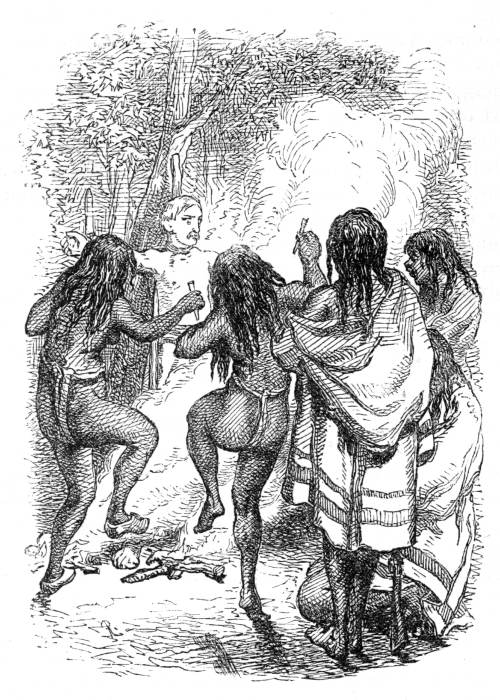
The red-skin fell, and in an instant all was terror and confusion in the
doomed camp.
Startled and confused by the sudden volley which was delivered with
slaughterously fatal precision, the scarcely awakened red-skins leapt to
their feet. Then came a volley from the party of Rangers with Harry
Arnold. It was followed by another from mine. I had taken the precaution
of ordering every other man to fire with each discharge, so as to give
the preceding marksmen time to reload. Like clock-work rang out our
deadly rifles, each shot dropping a man.
Fright had almost maddened the Indians, from the first intimation we had
given them of our presence. Some ran from side to side of the plateau,
looking vainly for a chance to escape. Others attempted to scale the
declivity on which my portion of the boys were posted, and the rocks
above which Harry held his position, in the very face of our fire. A few
stood and endeavored to return us what we were giving them. However,
they were considerably below either party; consequently, their shots
rattled on the rocky sides of either slope short of us.
Again and again our untiring volleys rang out on the no longer quiet
dawn.
Then, actually frantic with terror, many of the doomed savages leapt
from the brink of the precipice. Others contrived to scramble over the
broken edge of it, on the precarious and jutting portions of which they
would scarcely, even in mid-day, under other circumstances, have
trodden. In less than probably ten minutes from our first fire, not a
living Indian remained in the camp where they had lately been sleeping.
On examining this—for it would have been useless and, perhaps,
dangerous for us to follow the runaways—we found enough to convince us
that the white men had lately been severely punished. Scalps,
shot-pouches, and carbines, with other tokens, were hurriedly left
behind in their flight, to testify to this.
"We were not quick enough after the red devils, Mose!"
Arnold said this, as, with a positively qualmish sensation in my throat,
I was standing upon that stony stretch of level ground which was now
reekingly slippery with blood.
"We had better leave at once for the place where our horses are."
"I'd like to know who the whites were the darned scoundrels have trimmed
so neatly?"
While saying this, he was meditatively turning over two scalps which lay
on the gore-stained rock, beside a motionless red-skin, now as scalpless
as the bodies from which he had taken them.
"P'raps," ejaculated Brighton Bill, whose feelings had in the last few
years marvellously changed in regard to the legitimate manner of
fighting the red-skins, "they be some o' Hormsby's chaps."
"Nonsense!" exclaimed Harry.
"Bill!" I said, "do you think the Major would have been such an idiot as
to get trapped by the red skunks?"
"Why not? 'E mightn't be h'as thundering cute as you h'are, Cap!"
Unfortunately, as we soon discovered, my English friend was right in his
supposition.
The sun had just risen when we started on our return, and before we
reached the place where we had picketed our horses under guard the
preceding day, we fell in with two of the survivors of the ill-fated
party, and learned from them the details of the massacre, for which we
had unwittingly just taken so large and wholesale a vengeance. This
information completely obliterated every trace of compunction, for the
morning's even more wholesale slaughter, which I had previously felt.
Crossing over to the south side of Honey Lake Valley, we followed it up
to Captain Bird's old ranche.
After passing it, we found every house and farm empty and stripped of
all that was in any way portable. The whole of the stock had also been
driven off. But for the tramp of our hoofs, this portion of the valley
would have been as silent as a desert.
"I'd say, Cap!" exclaimed Butch', "the cuss'd red devils had been here,
too—only there are no dead men, laying round promisc'ous like."
Upon reaching Epstine's Ranche, we discovered the meaning of this. The
owner, Joe, here informed us, the news of Ormsby's death, and that of
most of the men with him, had reached the upper end of the valley on the
day before. A complete terror had seized upon the whole of those then
dwelling in it, and a general stampede had taken place amongst them for
Dr. Slater's Ranche, above what is now the town of Janesville.
"Howev'r I guess'd I'd wait a bit, and see what turn'd up."
He was fingering his rifle, as he made the last observation. But on
receiving the information of our retaliation his face brightened, and he
gave utterance to a guttural exclamation of fierce and somewhat
blasphemous delight, to which it will be needless for the pen to do
justice.
On arriving at the ranche where he had told us his brother settlers had
taken refuge, we found the men hard at work building a regular stockade
around a cabin, which had the year previous been erected for the double
purpose of a school-house and Masonic Hall. In spite of the joy with
which our intelligence was received, they did not however desist from
their labors. And, possibly, they were right, as the Indian troubles
continued, and though the savages refrained from positively besieging
the stockade while the Buckskin Rangers were around, they on one or two
occasions ran off large quantities of the stock.
During the remainder of the season, we were occupied in a continuous
scouting through this entire section of the country.
It was during one of our expeditions that Tom Harvey, one of us, was the
subject of a good joke.
Human nature, in whatever situation it may be placed, has always a
ludicrous side. Commonly, indeed, humor would almost appear to be the
twin-sister of sorrow. They would, indeed, seem to walk through life,
leaning upon each other, and hand in hand, to the very edge of the
grave. The marvellous creations of Shakespeare's genius partake
well-nigh equally of Tragedy and Comedy. Even so was it with the
Buckskin Rangers, and their leader may be pardoned if he presumes to
recall one of those creations (without the remotest hope of rivalling
the intellect he has just called attention to) with the view of
justifying himself.
"Falstaff" was most undeniably, as he has been drawn by the great
dramatist, a fat man. Wherever fat can be found, the spirit of Fun
almost invariably selects it as the subject or perpetrator of a joke.
Now Tom was a man of enormous dimensions, if not in length, very
certainly in width. Brighton Bill once said of him, that:
"Hif 'e was 'ammered hout, 'e would be long henough to reach the Nor'
Pole, hand find Sir John Franklin."
If he had not been slenderer than Tom, I think his scalp, the moment
after Bill had uttered this observation, might very possibly have been
in the possession of Harvey.
However, this is a digression.
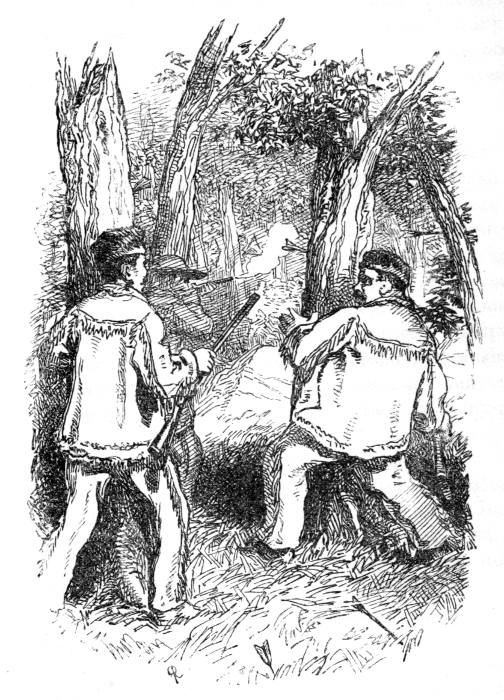
On one of our numerous scouts we had left our horses, guarded as usual,
and were passing up a small valley, covered with a scattering growth of
diminutive and remarkably lean trees, when some Indians, concealed in a
small grove immediately in front of us, pulled trigger. Luckily their
fire drew no blood. But, as in such cases, it is natural for him who is
the subject of such an unexpected attention to jump behind anything
which may be at hand, to shelter himself, we, each of us, made for the
largest and nearest tree. None of them were sufficiently broad to make
any of us a tolerably good cover.
In this situation, Tom also made for a tree.
Its exaggeratedly narrow trunk, merely concealed his head and the centre
of his prodigious frame. Butch', who was nearest to him, could not help
crying out.
"Look out, Fattee, or we shall only have the middle of yer left."
"Hold your darned tongue, you infernal fool!" roared out Harvey.
While saying this he had dodged to the one side of the tree, to escape
an arrow which whistled by the other. With commendable judgment, he lost
no time in leaping to the side he had left. This exertion of agility
saved him from a bullet.
Butch' had drawn a bead on the head of the red-skin who had fired the
last, and with a yell of agony, he toppled over, struck by the Ranger's
unerring ball.
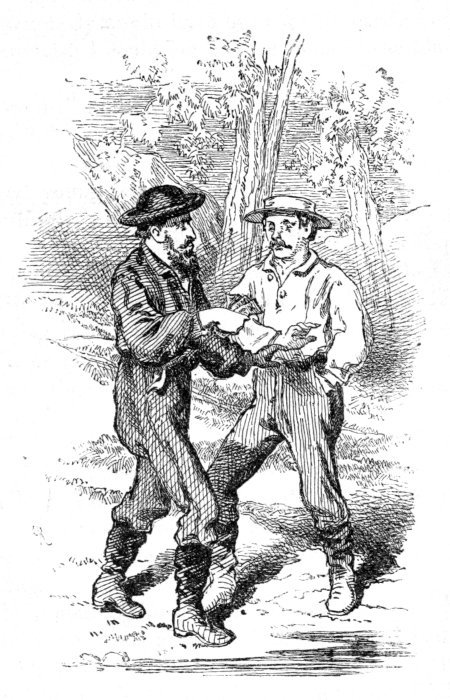
"I forgive you, old boy," panted out Tom, as he leapt back once more.
"'I forgive you, old boy!' panted out Tom, as he leapt
back once more."—Page 119.
This time he was scarcely quick enough, as another ball passed through
the flying portion of his Buckskin upper garment.
"Why don't yer hide yer fat carcass," sung out Butch' in fierce wrath.
There was no more time for jesting. "If yer don't, we shall have to bury
yer."
"How can I?"
As the perspiring Harvey screeched out this amidst a general chorus of
laughter, he took another wild leap, which was not one bit too soon.
All this had taken place in considerably less time than I have occupied
in recounting it, or I fear all would have been up with the too fat Tom.
The tree which I had been fortunate enough to secure was a fairly large
pine. From behind it, I had the luck of picking off an incautious
red-skin, and was already sighting another, when I heard our fat
companion's voice. He had (how he dared to look round, I never knew)
moaned or rather barked out, in a plaintive way:
"For God's sake, Mose! swap trees with me."
The irrepressible scream of laughter with which this pathetic appeal was
received by me, caused my shot to be useless. It missed the Pah-ute I
was aiming at.
Temporary inability on the part of our boys, from the painfully absurd
position of Harvey, to maintain a continuous fire, now induced the
red-skins to show themselves more boldly. They quickly found the mistake
they had made in doing so. A general although scattering volley
stretched a third of them upon the earth. They then evidently changed
their opinion, and once more getting under cover, rapidly scattered.
We pursued them a short way, when we were overtaken by the remainder of
our party, which we had left in charge of our animals.
Remounting them, we again started in pursuit. The red rascals had met,
however, with too warm a reception to wait for any further attention at
our hands. They had cleared out, and made good their escape across the
mountains.
For many days the luckless Harvey did not hear the last of his offer "to
swap trees" with me. At length, I, who had refrained from cutting any of
the tolerably coarse witticisms which were uttered at his expense, was
obliged to remonstrate warmly with Butch' and Brighton Bill.
"Yer are right, Cap!" exclaimed the former. "But I sware, it war too
good a joke."
"Wouldn't it be better to split 'im down, and splice 'is two hends?"
As Bill said this they both burst into a peal of laughter, loud enough
to be called Homeric, by any but a backwoodsman. They were, however, two
good fellows, for they spoke to the other Rangers, and after this, fat
Tom Harvey was left in peace. How he discovered the hand, I had, in
easing him off, it would be impossible to say, as I never knew. But some
two days afterwards he came up to me and Harry Arnold, as we were riding
along slightly in advance, and said:
"Mose! you're a darned good fellow, and I'll be blamed if I ever forget
it."
"What do you mean, Tom?"
"For stopping the chin-music of them fellows. What on airth else,
should I mean?"
At the same time, he jerked his thumb across his shoulder in the
direction of the rest of the party, who were at some little distance in
our rear, very significantly.
"You see, Cap!" exclaimed Harry with a slight chuckle, "what the
copy-book tells us, is right, after all."
"What are you driving at?"
"It says, Virtue is its own reward."
We had retraced our steps, passing Eagle Lake into Willow Creek Valley,
on the far side of the range of hills which divide it from Honey Lake,
until we arrived at the stockade built by the settlers, which has
earlier been alluded to.
A few days subsequently, we struck into Long Valley, and having crossed
Pea-vine Mountains, reached the Truckee River. Here we encamped, and on
the next morning, following it for some distance, struck across the
hills, towards the Sink of the Carson River. Passing this stream below
Fort Churchill, we continued in a southerly direction until we came to
the Walker River. Near it, we had a little brush with the Walker
Indians, which did not detain us very long. During this, one of our boys
received a slight flesh wound from an arrow. Why these red-skins have
received this name is matter of question, as they are certainly a branch
of the Pah-ute tribe. However, it had been given the savages in this
small portion of the country, and while I was living in that section, of
which it forms part, it stuck to them.
On the west fork of Walker River, we were met by a company of United
States cavalry.
The officer in command inquired for our leader, and I presented myself.
He behaved very courteously in manner, although his orders, given to me
with a degree of imperative sharpness, which was scarcely as courteous
in reality, were by no means agreeable. His instructions were to make
peace with the Indians, and he commanded us to return homewards. If we
would not desist from our present employment, he told us, he should be
obliged to arrest us and take us down to Fort Churchill. These
peremptory orders were unpalatable to the last degree. But what could be
done. He was Uncle Sam's servant in blue-coat, brass buttons, and
shoulder-straps. We were children of the aforesaid Uncle Sam.
Like obedient boys, although most unwillingly, we concluded, after a
brief hesitation, to bend our steps homewards.
With a cordial grasp of the hand—for, on finding we had so frankly
accepted the compulsory situation, the officer unbent himself
considerably—I bade him "Farewell," and we silently, for some time,
rode along the course of the stream. The first words I heard
subsequently, were some ten minutes after this. They came from the lips
of Brighton Bill.
"Huncle Sam his nothing but a blasted hidiot."
Possibly, I might have been valuing some of his servants at much the
same weight, but I was too good an American to stand such an expression
of opinion from a Britisher. Turning in my saddle, I roared out:
"None of that. It's high treason. I'll be hanged if I haven't half a
mind to ride after the blue-coats, and hand you over to them."
When I said this, there was a general laugh, and the whole of us
recovered, in some measure, our good humor.
After continuing about twenty miles along the road the soldiers had just
traversed, we encamped about two o'clock in the afternoon, turning our
horses out to graze, as there was good pasture in the neighborhood.
Portion of the boys commenced cooking. Butch', having a somewhat more
dainty tooth in his head on this occasion than usual, felt it crave for
fresh meat, and said to me:
"'Spose I go out, and kill yer something to eat."
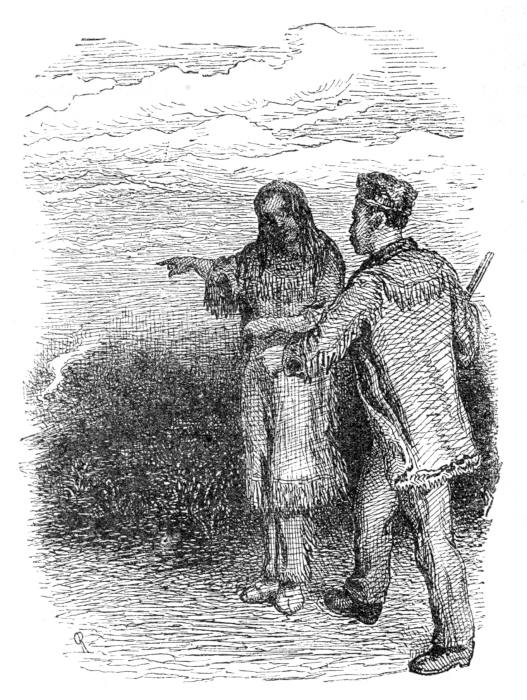
"All right," was my answer. "You may find a Jack or two," meaning a Jack
rabbit, "down the valley. I'll go up the cañon, and see whether I can't
find some grouse."
Saying this, I had pointed to a small cañon on one side, stretching
irregularly from the vicinity of our camping ground. At the same
instant, Brighton Bill, who had been stretched on the cool turf with his
eyes closed, leapt to his feet.
"You're hawful smart, hain't you, Mose? Hi'll 'ave some hof that fun
myself. If hi don't, blow me."
He, however, thought fit to try another cañon to the left.
For the first time since I had been an inhabitant of the Plains, I
neglected to arm myself, as I had constantly been accustomed to, when
scouting. The good servants of Uncle Sam, whom we had met earlier in the
day, had travelled up the road. Of course they had sharp eyes. Besides,
if the red-skins had seen them, they would certainly have got out of
their way as quickly as possible. How should they know our Uncle wanted
to be theirs, too? Peace would be the very last thing they thought of,
when they set eyes upon his uniform. So, thinking there could be no
danger, I placed my sheath-knife in my belt, and taking my Kentucky
rifle with me, started.
Walking carelessly up the cañon, now examining the trees for game, then
scaling the declivity to the right, or pushing through the chapparal and
the heavy timber, I had wandered on, for more than an hour.
Suddenly, in one of the thick and tangled clumps of chapparal, I fancied
I heard the familiar note of one of the birds I was in search of. At
once, I stopped to listen.
While standing there silent and motionless, it could scarcely have been
more than fifty seconds, I heard a noise almost immediately behind.
Instinct or experience, one or both, told me what that sound was. The
red-skins had not been so scared by the advance of Uncle Sam's servants,
as necessarily to refrain from a dash for one of his children, if the
chance was given them. I felt the chance was now.
Turning immediately, I had barely time to see two Indians.
In another instant, before I could lift my gun to my shoulder, one of
them had bounded towards me and wrenched it from my grasp, while the
other sprung at me with the evident intention of clinching me. If I had
then the time to think, I fear, loyal American as I might be, my
thoughts might have corroborated Brighton Bill's opinions touching the
sanity of Uncle Sam. Fortunately, I had no time to become critically
disloyal. My hunting-knife had been drawn, and at the very moment when
his hot and vindictively fierce breath came searingly to my face, was
buried to the very hilt in his heart.
As he fell, the other of my assailants, with my own rifle clubbed,
struck me a heavy blow upon the shoulder. It nearly felled me to the
earth.
Then, dropping the weapon, he sprang upon me, making a desperate clutch
for the hand in which my knife was grasped. As he seized my wrist, I
threw the knife from me as far as I could, and grappled with him. He
attempted to draw his own. I, however, had grasped him by a peculiarly
tender portion of his person, which modesty prevents me from naming. The
pain of this prevented his using his knife, and in the contest we both
fell on the sloping side of the cañon, clinched together firmly.
Now, commenced the struggle for life.
Rolling over and over, now on the short turf, and again amidst the dense
and tangled chapparal—at one moment the red-skin would be above me, and
in the next I would be stretched on his writhing body. Whenever I got
the chance, and one of my hands free, I would seize a handful of sand,
if it was within reach, and thrust it in the mouth and eyes of the
Indian.
He was not slow in taking the lesson I gave him. He began to follow
suit.
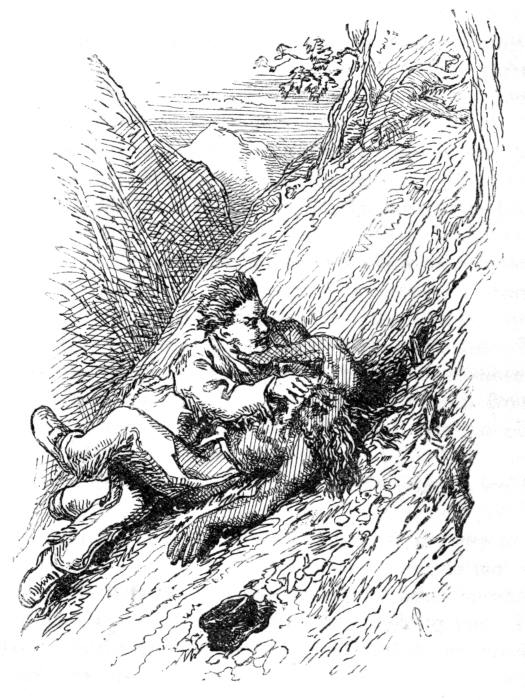
After rolling down the side of the cañon for some hundred yards or more,
panting with the desperate struggle, he opened his mouth to gasp for
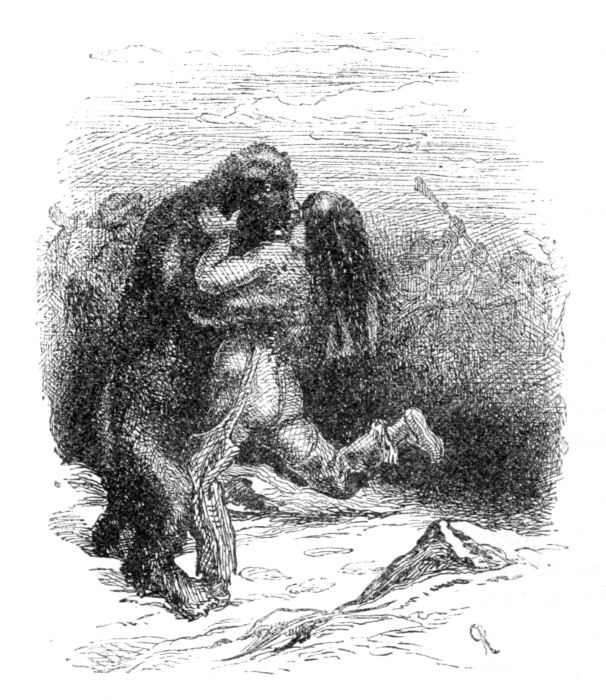
breath. At the time I was above him, and grasping a handful of sand, I
forced it into his gaping mouth.
"He opened his mouth to gasp for breath; I was above him,
and grasping a handful of sand, I forced it into his gaping
mouth."—Page 125.
It had its effect. Literally choking with the enforced dose, he loosened
me. At the same time, he violently threw up his hands, as a man might do
in the agony of strangulation.
Then, with a supreme effort, I groped for his knife. Having found it, I
drew it from its sheath, and, at last, the terrible struggle which had
been forced upon me was over.
When, at occasional times, I recall it now, it seems to my recollection
as if that brief contest for existence had nearly maddened me. Scarcely
did I appear to possess consciousness of any of my actions. And yet, I
know that I inflicted on him some fifteen to twenty wounds, any one of
which might or must have been a fatal one.
As I found myself once more upon my feet, it was a tolerably difficult
matter for me to realize that I was still living.
While engaged in attempting to do so, the whole landscape seemed to
quiver vaguely under my fading eyes. Its lines and colors fairly danced
before me. I felt that I was falling, and everything around settled into
a dense blackness.
I knew no more.
On, after some time, recovering my senses, I found that I was lying by
the side of the Indian, literally drenched with the blood flowing from
his wounds. Sitting up, after a few minutes, I was enabled to recall my
lagging senses and realize the struggle I had gone through. Yes! there
it lay, stark and motionless in the shadow thrown across it from the
rocky side of the cañon, by the sun which was now far beneath it. As for
the corpse beside me, it was stabbed and hacked in a frightful manner.
But for the fearful strife I had been engaged in with it, when living,
and the danger I had, as it seemed to me, so unaccountably escaped, I
should positively have sickened at the sight. The memory of this strung
my nerves once more to endurance, although my garments were dripping
with its blood, and absolutely soaked through with my own sweat.
Staggering to my feet, I re-collected my senses, which had, for a short
space, again wandered. Then, with some difficulty, I again ascended the
rough hill, until I reached the space on which the first Indian, I had
made an end of, was lying. His teeth were forced together—his eyes
staring unconsciously up to the blue sky. My knife was at some distance
from the spot. The rifle was close to him. Its barrel was bent and its
stock broken with the heavy blow I had received.
Let me squarely own that never, either before or since, have I raised
the hair of any Indian, with a more secure feeling of angry joy than I
felt in taking those two scalps.
I had now to return.
The position of the sun, low beneath the western summit of the cañon,
testified to the fact that some two hours must have elapsed since the
two Pah-utes had leapt upon me.
Slowly, and with great difficulty, I commenced my way towards the camp.
While looking on the scene of my danger, I had been kept up by the
remains of the excitement I had experienced. I had felt no pain, and
been unconscious of fatigue. Now, my dead enemies lay unconsciously on
the earth. The exhaustion consequent on my fierce struggle for life, and
the suffering from the blow upon my shoulder, became apparent to me.
Scarcely, was I able to walk. Frequently was I obliged to lean on a
jutting boulder of rock, or steady myself for a minute or two against
the trunk of a tree, before I could again persistently renew my
progress. Not yet had I reached the mouth of the cañon, when some of
the boys met me.
It seemed that Butch' and Brighton Bill had long since returned, and,
although scarcely alarmed, had grown in some slight degree uneasy at my
not putting in an appearance. Consequently, with some of the others,
they had come out to seek for me.
No sooner was I seen by them, than they shouted out to me. My lips
strove to frame a shout in reply. But even to myself, my voice sounded a
long way off. It was so faint and low that they did not hear a word.
Rushing towards me, Bill cried out:
"What his the matter, Mose?"
Butch' demanded:
"Have yer got any game?"
The only answer I could give them was to hold out the two scalps I had
taken.
Startled by this and my struggling silence, for they knew I was
attempting to speak, they looked at my dress, and in spite of the fading
light, saw its torn and dilapidated condition, and the blood with which
it was smeared and streaked almost in every part. Bill gave a groan, and
said:
"Get Mose to the camp, Butch'! Hi'll go hand look hafter 'is rifle,
before some hother thieving Hingin cusses find hit."
In an another instant Ben Painter had lifted me, and throwing me, gently
enough, although it caused me frightful suffering in my shoulder, across
his own, strode down the cañon. Indeed, so great was the pain from the
merciless blow I had received, that I remember little beside it, until I
found myself sitting on the ground, leaning against Painter's knee. The
whole of the upper portion of my dress had been stripped off, while
Butch' was bathing the black and swollen flesh which had been struck
with the clubbed rifle. How it happened that no bones were broken by it,
is, even now, a marvel to me.
When they found me again able to speak, the boys began to ply me with
questions. But while I was answering them, Brighton Bill appeared on the
scene.
His search of the ground on which I had run such a risk of being
completely chawed up, must have been a pretty thorough one. He brought
in, not only two rifles, but two United States blankets, several
unopened boxes of caps, two cans of powder, and, in addition to these, a
small keg of Uncle Sam's whiskey. This had already been opened, and may
possibly account for the red rascals having forgotten the reason for
which they had so liberally partaken of his bounty.
The whiskey was a veritable God-send, for we were out of the article. A
tincupful (this time I did not ask for a second before eating) did more
to put me to rights, and enable me to forget my pain, than the care
which the Rangers had been bestowing on me.
"If ever there was a good Samaritan, Bill, you are one."
Let me here record the fact that Bill knew nothing about Samaritans, for
good or evil. Nor, indeed, am I inclined to think, had any of the others
a very correct idea of my meaning. Even the teaching of a New England
Sunday-school had been forgotten, as I deeply regret being obliged to
say one of the boys hailed from the classically Methodist locality of
New Bedford.
But, if Brighton Bill was not well versed in Scripture, he displayed
himself this evening in a new light—that of an orator. No sooner had he
served round the whiskey which he had captured from the already
slaughtered enemy, than he produced from one of the blankets in which he
had wrapped it, my twisted and broken rifle.
"Jist look 'ere, boys," he said, "hat the popper of hour Cap. This h'is
the harticle with which 'e smashed ha couple of Hingins. Hi'm blowed
h'if you didn't, Mose! H'it's no huse 'iding your light hunder a bushel,
when H'i 'ave the hevidence in my hown 'and, and show hit." Here I
endeavored to put in a word, but it was drowned in the general applause,
and seizing on the instant of its cessation, he continued: "H'if you 'ad
only seen those blarsted Hingins. Wun of 'em stood seven an a 'alf foot
'igh in 'is stocking-feet, and the h'other—"
I could no longer refrain, but cried out:
"It's quite clear who tapped the whiskey keg, before we had a chance of
looking at it."
The Britisher gazed in pathetic wonder on his partially maimed leader,
as he heard this ungenerous insinuation against his sobriety. Then with
a sadly melancholy smile, he said:
"H'i forgive you, Cap! But, may H'i be blamed if you harn't a tuff 'un."
That night, guard being kept by Butch' and Ben Painter, I slept well and
soundly. On the next morning I was up by daylight, and we returned to
Honey Lake through Carson City.
When we arrived there it was to hear that another treaty had actually
been made with the Indians. Once more they were to be allowed to
re-enter the valley. The settlers were to resume possession of their
ranches, and what stock was left on them, or could be found. How long it
would continue, the Devil and the red men themselves, only, could form
an opinion.