“Be not overcome of evil, but overcome evil with good.”
Hiram and Ralph. The robin.
At one time Bruno had for his master a boy named Hiram.
Hiram had a friend and companion who lived in the next house
to him, whose name was Ralph. This Ralph had a robin. He
kept the robin in a cage.
The loft.
There was a small building near the bottom of Ralph’s father’s
garden, which was used as a place of deposit for gardening implements,
seeds, bundles of straw, matting for covering plants, and
other similar articles employed about the garden. This building
was called the “garden-house.” In the upper part of it was a
loft, which Ralph had taken possession of as a storehouse for his
wagons, trucks, traps, and other playthings. He used to go up
to this loft by means of a number of large wooden pins, or pegs,
that were driven into one of the posts of the frame of the garden-house,
in a corner. Somebody once recommended to Ralph to
have a staircase made to lead up to his loft, but he said he liked
better to climb up by these pins than to have the best staircase
that ever was made.
Ralph used frequently to carry his robin to this garden-house
when he was playing about there, and on such occasions he would
sometimes hang the cage on a nail out of the window of his loft.
He drove the nail himself into the edge of a sort of a shelf, which
was near the window on the outside. The shelf was put there
for doves to light upon, in going in and out of their house, which
was made in the peak of the roof, over Ralph’s loft.
Account of Ralph’s robin.
Ralph caught his robin when he was very young. He caught
him in a net. He saw the nest when the birds were first building
it. About a week after the birds had finished it, he thought
it was time for the eggs to be laid. So he got a ladder, which
was usually kept on the back side of the tool-house, and, having
planted it against a tree, he began to go up. Just then, his little
brother Eddy, who was walking along one of the alleys of the garden
near where the bird’s nest was, saw him.
Eddy’s advice.
“Ralph,” said Eddy, “what are you going to do?”
“I’m going to get the eggs out of the nest,” said Ralph.
“No,” replied Eddy, “you must not do that.”
Ralph paid no regard to this, but went on slowly mounting the
ladder. The top of the ladder, resting as it did against some of
the branches of the tree, was not very steady, and so Ralph could
not go up very fast. Besides, Ralph was somewhat afraid of the
old birds; for they, seeing that their nest was in danger, were
flying about him with very loud chirpings, being apparently in a
state of great terror and distress.
“Ralph,” said Eddy, “you must not trouble those birds.”
Ralph went steadily on.
“Besides,” said Eddy, when he saw that his brother paid no
heed to his remonstrances, “it would be a great deal better to
wait till the eggs are hatched, and then get one of the birds.”
The plan changed.
Ralph paused when he heard this suggestion. He began to
think that it might possibly be a better plan to wait, as Eddy proposed,
and to get a bird instead of an egg. He paused a moment
on the ladder, standing on one foot, and holding himself on by one
hand.
“Would you, Eddy?” said he.
“Yes,” said Eddy, “I certainly would.”
Eddy proposed this plan, not so much from any desire he had
that Ralph should get one of the birds when they were hatched,
as to save the eggs from being taken away then. He had an
instinctive feeling that it was wrong to take away the eggs, and
he pitied the poor birds in their distress, and so he said what he
thought was most likely to induce Ralph to desist from his design.
After hesitating a few minutes, Ralph said, “Well, I will.” He
then came down to the ground again, and, taking up the ladder,
he carried it away.
About a week after this, Ralph got the ladder one day when
the birds were not there, and climbed up to the nest. He found
three very pretty blue eggs in it.
The birds are hatched.
About a week after this he climbed up again, and he found that
the eggs were hatched. There were three little birds there, not
fledged. When they heard Ralph’s rustling of the branches over
their heads, they opened their mouths very wide, expecting that
the old birds had come to bring them something to eat.
About a week after this Ralph climbed up again, but, just before
he reached the nest, the three birds, having now grown old enough
to fly, all clambered out of the nest, and flew away in all directions.
“Here’s one!”
“Stop ’em! stop ’em! Eddy,” said Ralph, “or watch them at
least, and see where they go, till I come down.”
“Here’s one,” said Eddy.
He pointed, as he said this, under some currant-bushes, near an
alley where he was walking. The little bird was crouched down,
and was looking about him full of wonder. In fact, he was quite
astonished to find how far he had flown.
Ralph clambered down the ladder as fast as he could, and then
ran off to the tool-house, saying as he ran,
“Keep him there, Eddy, till I go and get my net.”
“I can’t keep him,” said Eddy, “unless he has a mind to stay.
But I will watch him.”
So Eddy stood still and watched the bird while Ralph went
after his net. The bird hopped along a little way, and then stopped,
and remained perfectly still until Ralph returned.
A bird pursued.
The net was a round net, the mouth of it being kept open by
means of a hoop. It was fastened to the end of a long pole.
Ralph crept up softly toward the place where the bird had alighted,
and, when he was near enough, he extended the pole, and
clapped the net down over the bird, and made it prisoner.
Caught and caged.
“I’ve caught him! I’ve caught him!” said Ralph, greatly excited.
“Run, Eddy, and get the cage. Run quick. No, stop;
you come here, and hold the net down, and I’ll go and get the
cage myself.”
So Eddy held the net down, while Ralph went into the tool-house
after the cage. He succeeded in putting the bird into the
cage safely, and then went home.
The feeding.
Ralph attended his bird very carefully for many days, feeding
him with strawberries and crumbs of bread. The natural food of
most small birds consists of seeds, berries, and insects. Ralph
knew, therefore, that strawberries would be good for his bird,
and as for bread, he reflected that it was made from seeds,
namely, the seeds of wheat. The only difference was, that in
bread the seeds were ground up, mixed with water, and baked.
So Ralph concluded that bread would be a very proper food for
his robin.
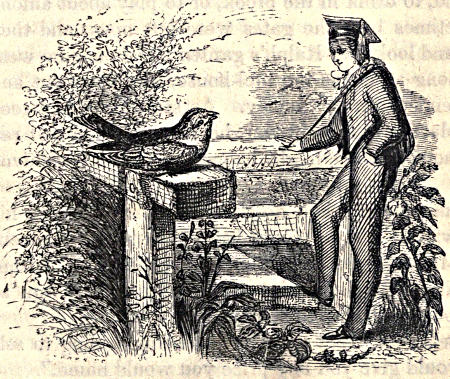
Ralph taming the robin.
The stile.
As soon as the robin grew old enough to hop about a little,
Ralph used often to take him out of his cage and put him on the
walk in the garden, or on the end of a fence, near a stile, where
was a broad, flat
place convenient
for the little bird
to stand on. In
such cases, he
would, himself,
always stand at
a little distance
off, so as not to
frighten the bird,
and in this manner
he gradually
taught him to be
very tame and familiar.
Bruno and Hiram. Description of the premises.
Although Ralph was thus very kind to his robin, he was generally
a very unreasonable and selfish boy. Bruno, at this time,
lived in the house next to the one where he lived. Bruno
belonged, as has already been said, to a boy named Hiram. The
two houses that these two boys lived in were pretty near together,
and the gardens adjoined, being separated from each other only
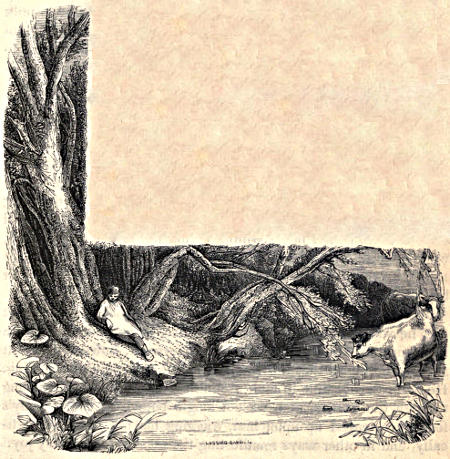
by a wall. At the foot of each garden was a gate, and there was
a little path which led along from one gate to the other, through
a field where there was a brook, and also a great many trees
overshadowing the banks of it. The boys used often to visit each
other by going from one of these gates to the other along this
path. There was a space under Hiram’s gate where Bruno could
get through. He used often to go through this opening, and pass
down into the field, to drink in the brook, or to play about among
the trees. Sometimes both the gates were left open, and then
Bruno would go and look into Ralph’s garden; and once he went
in, and walked along as far as the tool-house, looking about and
examining the premises very curiously. As soon as he had seen
what sort of a place it was, however, he turned round and ran
out again, not knowing what might happen to him if he stayed
there.
Ralph wishes to buy Bruno.
Ralph saw Bruno often when he went to visit Hiram in his
garden, and he wished that he could have such a dog himself.
In fact, he tried to buy him of Hiram a long time, but Hiram
would not sell him. Ralph became very angry with Hiram at
last for so strenuously refusing to sell his dog.
“You are a great fool,” said he, “for not being willing to sell
me the dog. I would give you any price you would name.”
“That makes no difference,” said Hiram; “I would rather
have the dog than any amount of money, no matter how much.”
Ralph becomes Bruno’s enemy.
So Ralph turned, and went away in a rage; and the next time
he saw Bruno out in the field behind the garden, he ran down to
his gate and pelted him with stones.
Bruno could not understand what reason Ralph could have for
wishing to hurt him, or being his enemy in any way. He perceived,
however, that Ralph was his enemy, and so he became
very much afraid of him. When he wished to go down to the
brook, he always looked out through the hole under the gate
very carefully to see if Ralph was near, and if he was, he did not
go. If he could not see Ralph any where, he would creep out
stealthily, and walk along in a very cautious manner, turning his
head continually toward Ralph’s gate, to watch for the slightest
indications of danger; and if he caught a glimpse of Ralph in the
garden, he would turn back and run into Hiram’s garden again.
The boys play together.
Bruno was a very courageous dog, and he would not have run
away from Ralph, but would have attacked him in the most
determined manner, and driven him away from the garden gate,
and thus taught him better than to throw stones at an innocent
and unoffending dog, had he not been prevented from doing this
by one consideration. He perceived that Ralph was one of
Hiram’s friends. Hiram went often to visit Ralph, and Ralph, in
return, came often to visit Hiram. They used to employ themselves
together in various schemes of amusement, and Bruno,
who often stood by at such times, although he could not understand
the conversation that passed between them, perceived, nevertheless,
that they were good friends. He would not, therefore,
do any harm to Ralph, even in self-defense, for fear of displeasing
Hiram. Accordingly, when Ralph assaulted him with sticks and
stones, the only alternative left him was to run away.
Hiram catches a squirrel. Ralph wishes to buy the squirrel.
It is singular enough that Ralph, though often very unreasonable
and selfish in his dealings with other boys, and though in
this instance very cruel to Bruno, was still generally kind to animals.
He was very fond of animals, and used to get as many as
he could; and whenever Hiram had any, he used to go to see
them, and he took a great interest in them. Once Hiram caught
a beautiful gray squirrel in a box-trap.
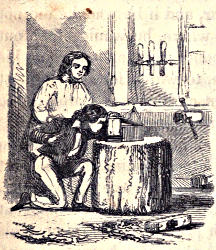
He put the trap down upon
a chopping-block in a little room that
was used as a shop in his father’s
barn. Ralph came in to see the
squirrel. He kneeled down before
the block, and, lifting up the trap a
little way, he peeped in. The squirrel
was in the back corner of the
trap, crouched down, and feeling,
apparently, very much afraid. He
had a long, bushy tail, which was
curled over his back in a very graceful
manner. Ralph resolved to buy this squirrel too, but Hiram
was unwilling to sell him. However, he said that perhaps he
would sell him, if Ralph would wait till the next day. Ralph
accordingly waited; but that night the squirrel gnawed out of his
trap, and as the shop window was left open, he made his escape,
and got off into the woods again, where he leaped back and forth
among the branches of the trees, and turned head over heels again
and again in the exuberance of his joy.
The shop.
Hiram and Joe go into the woods.
One day Hiram went out into the woods with a man whom
they called Uncle Joe, to get some stones to mend a wall. They
went in a cart. They placed a board across the cart for a seat.
Uncle Joe and Hiram sat upon this seat together, side by side,
Hiram on the right, as he was going to drive. The tools for digging
out the stones, consisting of a spade, a shovel, a hoe, and a
crowbar, were laid in the bottom of the cart. Thus they rode to
the woods. Bruno followed them, trotting along by the road-side,
and now and then running off under the fences and walls, to see
if he could smell the tracks of any wild animals among the ferns
and bushes.
Bruno barks at something.
He was not successful in this hunting on his way to the
woods, but, after he arrived there, he accomplished quite a brilliant
achievement. Hiram and Uncle Joe were very busy digging
out stones, when their attention was arrested by a very loud
and violent barking. Hiram knew at once that it was Bruno that
was barking, though he could not see him. The reason why they
could not see the dog was, that he was down in the bottom of a
shady glen, that lay near where Hiram and Uncle Joe were digging
the stones.
“What’s that?” said Hiram. “What is Bruno barking at?”
“I don’t know,” said Uncle Joe; “go and see.”
Bruno finds a fox’s hole.
So Hiram threw down his hoe, and, seizing a stick, he ran
down into the glen. He found Bruno stationed before a hole,
which opened in under a bank, near a small spring. He seemed
very much excited, sometimes running back and forth before the
hole, sometimes digging into it with his fore paws, and barking
all the time in a very loud and earnest manner. He seemed
greatly pleased when he saw Hiram coming.
As soon as Hiram saw that Bruno was barking at a hole, which
seemed to be the hole of some wild animal, he went back and
called Uncle Joe to come and see. Uncle Joe said he thought it
was the hole of a fox, and from the excitement that Bruno manifested,
he judged that the fox must be in it.
“I’ll go and get the tools,” said he, “and we will dig him out.”
Hiram gets a little fox.
So Uncle Joe went for the tools, and he and Hiram began to
dig. They dug for more than half an hour. Finally they came
to the end of the hole, and then they found a young fox crouching
close into a corner. He was about as large as a small kitten.
His plans for him. Hiram gives his fox a hole to live in.
Hiram said he meant to carry the fox home, and bring him up,
and tame him. He accordingly took him in his arms, and carried
him back to the place where they had been digging stones. Uncle
Joe carried back the tools. Bruno jumped about and barked a
great deal by the side of Hiram, but Hiram ordered him to be
quiet, and finally he learned that the little fox was not to be
killed. When they reached the stone quarry, Hiram made a
small pen for the fox. He made it of four square stones, which
he placed together so as to inclose a small space, and then he
covered this space by means of a flat stone which he placed over
it. Thus the little prisoner was secured.
When the pen was completed, and the fox put in, Hiram
resumed his work of digging stones with Uncle Joe. He was
very eager now to get the load completed as soon as possible, so
as to go home with his fox. While he was at work thus, Bruno
crouched down before the place where Hiram had shut up his
fox, and watched very earnestly. He understood that Hiram
wished to keep the fox, and therefore he had no intention of
hurting him. He only meant to be all ready to give the alarm,
in case the little prisoner should attempt to get away.
Hiram had very good success in training and taming his fox.
Ralph and Eddy came often to see him, and they sometimes
helped Hiram to feed him, and to take care of him. There was
a place by an old wall behind the house where Hiram lived where
there was a hole, which seemed to lead under ground, from a sort
of angle between two large stones.
“I’ll let him have that hole for his house,” said Hiram. “I
don’t know how deep it is; but if it is not deep enough for him,
he must dig it deeper.”
The chain.
Ralph had a small collar which was made for a dog’s collar;
and one day, when he felt more good-natured than usual, and had
in some measure forgotten Hiram’s refusal to sell Bruno to him,
he offered to lend Hiram this collar to put around Foxy’s neck.
“Then,” said Ralph, “you can get a long chain, and chain
Foxy to a stake close to the mouth of his hole. And so the chain
will allow him to go in and out of his hole, and to play about
around it, and yet it will prevent his running away.”
Hiram liked this plan very much. So Ralph brought the collar,
and the boys put it upon Foxy’s neck. Hiram also found a
kind of chain at a hardware store in the village, which he thought
would be suitable to his purpose, and he bought two yards of it.
This length of chain, when Foxy was fastened with it, gave him
a very considerable degree of liberty, and, at the same time, prevented
him from running away. He could go into his hole, where
he was entirely out of sight, or he could come out and play in
the grass, and under the lilac bushes that were about his hole,
and eat the food which Hiram brought out for him there. Sometimes,
too, he would climb up to the top of the wall, and lie there
an hour at a time, asleep. If, however, on such occasions, he
heard any one coming, he would run down the rocks that formed
the wall, and disappear in his hole in an instant, and he would
not come out again until he was quite confident that the danger
had gone by.
The cunning of the fox.
It is not very difficult to tame a fox. And yet, in his natural
state, he is very wild and very cunning. He resorts to all sorts
of maneuvers and contrivances to entrap such animals as he likes
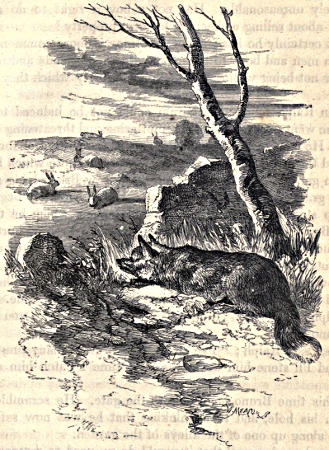
for food. On the adjoining page is the picture of a fox lying in
wait to catch some rabbits which he sees playing in a neighboring
field. He watches for them very slyly; and when they come
near enough, he will spring upon them, and seize them entirely
unawares.
Picture of a fox lying in wait for some rabbits.
He is very cunning, and yet, if he is caught young, it is not
difficult to tame him.
Ralph offers half a dollar for Hiram’s fox.
One day, after some time, Ralph took it into his head to buy
Foxy, as he had tried to buy Bruno; but he found Hiram as little
disposed to sell the one as the other.
“I will give you half a dollar for him,” said Ralph, “and that
is twice as much as he is worth: a full grown fox is not worth
more than that.”
Ralph had some money in small silver pieces and cents, amounting
to about half a dollar. This treasure he kept in a tin moneybox,
shaped like a house, with a place to drop money in down the
chimney.
“No,” said Ralph, “I would rather not sell him.”
Ralph tried a long time to persuade Hiram to sell the fox, but
Hiram persisted firmly in his refusal. At length Ralph became
very angry with him, because he would not consent. This was
extremely unreasonable. Has not a boy a right to do as he
pleases about selling or keeping his own property?
Most certainly he has; and yet nothing is more common than
for both men and boys to be angry with their friends and neighbors
for not being willing to sell them property which they wish
to buy.
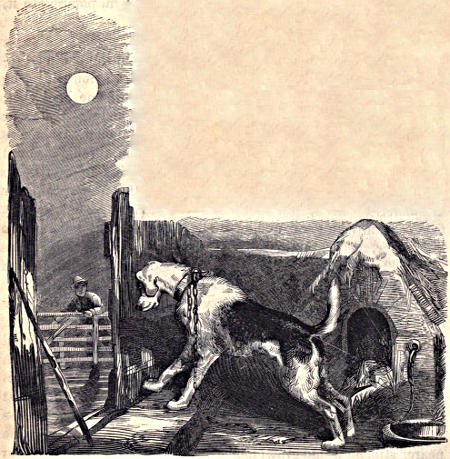
“Ralph, are you stoning Bruno?”
When Ralph found that Hiram could not be induced to sell
Foxy, he went off in great anger, muttering and threatening as he
went. He passed out through the gate at the bottom of the garden,
and then walked along the path toward the gate which led to
his own garden. As he was going in, he saw Bruno lying down
upon a grassy bank near the stream. He immediately began to
take up stones to stone him. The first stone which he threw
struck Bruno on the back, as he lay upon the grass, and hurt him
very much. Bruno sprang up and ran away, barking and making
other outcries indicative of pain and terror. Hiram came running
down to the garden to see what was the matter. When he
reached the place, he saw Ralph just aiming another stone.
“Ralph!” exclaimed Hiram, greatly astonished, “are you stoning
Bruno?”
“Yes,” said Ralph; “I’ve stoned him a great many times before,
and I’ll stone him again the next time I catch him down
here.”
Bruno’s escape.
By this time Bruno had come to the gate. He scrambled in
through his hole, and then, thinking that he was now safe, he
walked along up one of the alleys of the garden.
Hiram, knowing well that it would do no good to remonstrate
with Ralph while he was in such a state of mind, shut the gate
of the garden, and went to the house.
Ralph resolves to reclaim his collar.
That evening, while Hiram was in the house eating his supper,
Ralph came down out of his own garden, and went into Hiram’s.
He was talking to himself as he walked along.
“I am going to get my collar,” said he. “I won’t lend it to
such a fellow any longer. I shall take it off the fox’s neck, and
carry it home. I don’t care if the fox does get away.”
He does so.
When he approached the old wall, the fox was on the top of it;
but, on hearing Ralph coming, he ran down, and went into his
hole. As soon as Ralph reached the place, he pulled the fox out
roughly by the chain, saying,
“Come out here, you red-headed son of a thief, and give me my
collar.”
So saying, he pulled the fox out, and unhooked the chain from
the collar. He unfastened the collar, and took it off from the fox’s
neck. He then threw the fox himself carelessly into the grass, and
walked away down the garden.
Just at this time Hiram came out from his supper, and, seeing
Ralph walking away, he apprehended something wrong, and he
accordingly hastened on to see if his fox was safe. To his great
surprise and grief, he saw the chain lying on the ground, detached
and useless. The fox was gone.
He immediately called out to Ralph to ask an explanation.
“Ralph,” said he, “where is my fox?”
“I haven’t got your fox,” said Ralph.
“Where is he, then?” asked Hiram.
“Gone off into the woods, I suppose,” said Ralph.
Hiram stood still a moment, utterly confounded, and wondering
what all this could mean.
“I came to get my collar,” said Ralph, holding up the collar in
his hand, “and if the fox has gone off, it is not my fault. You
ought to have had a collar of your own.”
Hiram laments the loss of his fox.
Hiram was extremely grieved at the thought of having so wanton
an injury inflicted upon him by his neighbor and playmate,
and he turned toward the place where his fox had been kept with
tears in his eyes. He looked all about, but the fox was nowhere
to be seen. He then went slowly back to the house in great sorrow.
As for Ralph, he went back into his own garden in a very unamiable
state of mind. He went up into the loft over the tool-house
to put the collar away. He climbed up upon a bench in
order to reach a high shelf above, and in so doing he knocked down
a box of lucifer matches, which had been left exposed upon a corner
of the shelf. He uttered a peevish exclamation at the occurrence
of this accident, and then got down upon the floor to pick up
the matches. He gathered all that he could readily find upon the
floor, and put them in the box, and then put the box back again
upon the shelf. Then he went away into the house.
Hope.
About two hours after this, just before dark, Hiram was sitting
on the steps of the door at his father’s house, thinking mournfully
of his loss, when he suddenly heard a very loud barking at the foot
of the garden.
“There!” said he, starting up, greatly excited, “that’s Bruno,
and he has found Foxy, I’ll engage.”
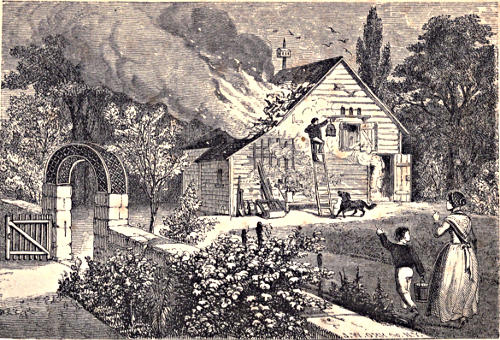
An alarm. The garden-house on fire.
So saying, Hiram ran down the garden, and on his way he was
surprised to see a smoke rising from the direction of Ralph’s garden-house.
He did not, however, pay any very particular attention
to this circumstance, as it was very common for Ralph to
have fires in the garden, to burn the dried weeds and the old straw
which often collect in such places. He hastened on in the direction
of Bruno’s barking, quite confident that the dog had found his
lost fox, and was barking for him to come and get him.
Just at this moment he saw Bruno come running to the gate at
the bottom of the garden. He was barking violently, and he
seemed very much excited. As soon as he saw Hiram coming,
he ran back again and disappeared. Hiram hastened on, and, as
soon as he got through the gate into the field, he saw that Bruno
was standing at the gate which led into Ralph’s garden, and running
in and out alternately, and looking eagerly at Hiram, as if he
wished him to come. Hiram ran to the place, and, on looking in,
he saw, to his utter consternation, that the garden-house was on
fire. Dense volumes of smoke were pouring out of the doors and
windows, with now and then great flashes of flame breaking out
among them. Bruno, having brought Hiram to the spot, seemed
now desirous of giving the alarm to Ralph; so he ran up toward
the house in which Ralph lived, barking violently all the way.
His effort was successful. In a minute or two he returned, barking
as before, and followed by Ralph. Ralph was greatly terrified
when he saw that the garden-house was on fire. He ran back
to the house to call his mother. She came down to the place in
great haste, though she seemed quite calm and composed. She
was a woman of a very quiet disposition, and was almost always
composed and self-possessed. She saw at a glance that the fire
could not be put out. There was no sufficient supply of water at
hand, and besides, if there had been water, she and the two boys
could not have put it on fast enough to extinguish the flames.
“What shall we do?”
“Oh dear me! oh dear me!” exclaimed Ralph, in great distress,
“what shall we do? Mother! mother! what shall we do?”
“Nothing at all,” said his mother, quietly. “There is nothing
for us to do but to stand still and see it burn.”
“And there’s my poor robin all burning up!” said Ralph, as he
ran to and fro in great distress. “Oh, I wish there was somebody
here to save my robin!”
The robin in danger.
The cage containing the robin was hanging in its place, under
the shelf by the side of the window. The smoke and flame,
which came out from the window and from a door below, passed
just over it, and so near as to envelop and conceal the top of the
cage, and it was plain that the poor bird would soon be suffocated
and burned to death, unless some plan for rescuing it could be devised.
When Hiram knew the danger that the bird was in, his
first thought was that he was glad of it. He pitied the bird very
much, but he said to himself that it was good enough for Ralph
to lose it. “He deserves to lose his bird,” thought he, “for having
let my Foxy go.”
This spirit, however, of resentment and retaliation remained but
a moment in Hiram’s mind. When he saw how much interest
Bruno seemed to feel in giving the alarm, and in desiring to have
the fire extinguished, he said to himself, “Bruno forgives him, and
why should not I? I will save the bird for him, if it is possible,
even if I get scorched in doing it.”
Hiram rescues the robin by means of the ladder.
He accordingly ran round to the back side of the garden-house
to get the ladder. Bruno followed him, watching him very eagerly
to see what he was going to do. Hiram brought the ladder forward,
and planted it against the garden-house, a little beyond the
place where the cage, was hanging. In the mean time, Ralph
had run off to the house to get a pail of water, vainly imagining
that he could do at least something with it toward extinguishing
the flames and rescuing the bird. By the time he got back,
Hiram had placed the ladder, and was just going up, amid the
smoke and sparks, to get the cage.[5] Bruno stood by at the foot
of the ladder, looking up eagerly to Hiram, and watching as if he
were going to take the cage as soon as it came down.
Hiram had to stop once or twice in going up the ladder to get
breath, for the wind blew the smoke and sparks over him so much
at intervals as almost to suffocate him. He, however, persevered,
and finally succeeded in reaching the cage. He took it off from
its fastening, and brought it down the ladder. When he reached
the ground, Bruno took it from his hand by means of the ring at
the top, and ran off with it away from the fire. He then placed
it carefully upon the ground, and began leaping around it, wagging
his tail, and manifesting every other indication of excitement and
delight.
Ralph was very much pleased, too, to find that his robin was
safe. He took the cage, and, carrying it away, set it down at
a still greater distance from the fire. The garden-house was
burned to the ground. Hiram and Bruno waited there until the
fire was almost out, and then they went home. Hiram experienced
a feeling of great satisfaction and pleasure at the thought
that he had been able to save Ralph’s bird. “I should have been
sorry,” said he to himself, “if he had lost his bird, and I think,
too, that he will be sorry now that he let my little Foxy go.”
The next morning, after breakfast, Hiram concluded that he
would go round into Ralph’s garden, and look at the ruins of the
fire. He passed out through the gate at the bottom of his father’s
garden, and then turned into the path leading to the other gate,
and there, to his surprise, he saw Ralph sitting on a stone, feeding
Bruno with a piece of meat. It was a piece which he had
saved from his own breakfast for the purpose. Bruno was eating
the meat with an appearance of great satisfaction, while Ralph
sat by, patting him on the head.
“Hiram, I am giving Bruno some breakfast.”
“Hiram,” said Ralph, as soon as he saw Hiram coming, “I am
giving Bruno some breakfast.”
Bruno looked up toward Hiram and wagged his tail.
“That’s right,” said Hiram. “He seems to like it very much.”
“Hiram,” said Ralph, again.
“What?” said Hiram.
Ralph hesitated. He seemed to have something on his mind,
and not to know exactly how to express it.
“How is the robin this morning? Did he get stifled any by
the smoke?”
Restitution. Ralph proposes to get another fox for Hiram.
“No,” said Ralph; “he is as bright as a lark.” Then, after a
moment’s pause, he added, “I am sorry I let your Foxy get away.
I suppose I ought to pay you for him; and, if I could get another
fox for you, I would. I have not got any thing but just my bird.
I’ll give you him.”
To find Ralph taking this view of the subject was something so
new and strange to Hiram, that at first he did not know what to
say.
“No,” he replied, at length, “I would rather not take your
bird, though I am very sorry that Foxy has got away. If you
had only told me that you wanted your collar, I would have
taken it off, and fastened Foxy with something else.”
Ralph hung his head and had nothing to say.
The boys went soon after this to look at the bed of ashes and
embers that marked the spot where the garden-house had stood,
and then they sauntered together slowly back into Hiram’s garden.
Bruno followed them. He seemed to understand that a great
change had somehow or other taken place in Ralph’s disposition
of mind toward him, and he was no longer afraid. The boys went
together to the place where Foxy had been confined.
“John Thomas hunts foxes sometimes with his father,” said
Ralph. “There are a great many in the woods back of their
farm. I am going to see if I can’t get him to catch you another
young one. I shall tell him I will give him half a dollar if he
will get one, and that is all the money I have got.”
Hiram did not reply to this suggestion. He did not know exactly
what to say. His thought was, that no other fox that could possibly
be found would supply the place, in his view, of the one that
he had lost. He had taken so much pains to teach that one, and
to tame him, that he had become quite attached to him individually,
and he was very sure that he should never like any other one
so well. He did not, however, like to say this to Ralph, for he
perceived that Ralph was very much troubled about what he
had done, and was quite anxious to make some reparation, and he
thought that it would trouble him still more to learn that all reparation
was wholly out of his power.
“And if he catches one for you,” continued Ralph, “then I’ll
give you the collar for your own. I would give it to you now,
if it would do you any good.”
“I’ll take the chain off, at any rate,” said Hiram, “and carry it
in, and keep it, in case I ever should have another fox.”
Foxy found.
So he stooped down, and began to unhook the chain from the
stake to which it was fastened. As he did this, his face was
brought down pretty near to the hole under the wall, and, looking
in there, his attention was attracted to two bright, shining spots
there, that looked like the eyes of an animal.
“Run and get the collar.”
“Hi—yi,” said he, suddenly, “I verily believe he is here now.
Run and get the collar.”
Ralph took a peep, first, into the hole, and then ran for the collar.
When he came back, he found Hiram sitting down on the
grass, with the fox in his arms. The truth was, that the fox had
been treated so kindly since he had been in Hiram’s keeping, and
he had become so accustomed to his hole under the wall, that he
did not wish to go away. When he found himself at liberty by
the removal of the collar, he had gone off a little in the grass and
among the bushes, but, when night came on, he had returned as
usual to his hole; and when he heard the voices of the boys at the
wall in the morning, he supposed that Hiram had come to give
him his breakfast, and he came accordingly out to the mouth of
his hole to see if his supposition were correct. He submitted to
have his collar put on very readily.
Thus there was a general reconciliation all round, and Bruno,
Foxy, Hiram, and Ralph became, all four of them, very excellent
friends.
Be not overcome of evil, but overcome evil with good.
This story reminds me of another one relating to the burning of
a small building in the bottom of a garden, called a tool-house. I
will here relate that story, and then tell more about Bruno. It
will be seen that this tool-house took fire in a very singular way.
Precisely how Ralph’s garden-house took fire never was known.
It was probably in some way connected with the matches which
Ralph left upon the floor. Whether he stepped upon one of them,
and thus ignited it, and left it slowly burning—or whether some
mouse came by, and set one of them on fire by gnawing upon it—or
whether one of the matches got into a crack of the floor, and
was then inflamed by getting pinched there by some springing or
working of the boards, produced by the gardener’s walking over
the floor or wheeling the wheelbarrow in—whether, in fine, the
mischief originated in either of these ways, or in some other
wholly unknown, could never be ascertained.
At all events, however—and this is the conclusion of the story—the
garden-house was soon rebuilt, and Ralph was effectually cured
of his resentment and enmity by the noble and magnanimous spirit
which Hiram and Bruno exhibited in saving his bird.
Be not overcome of evil, but overcome evil with good.
Three times I have put this precept in the story, in order that
you may be sure to remember it.