The officer whom the riders wished to see was evidently Colonel
Belthorpe, as he had been in command from the beginning. He hastened to
the hall, and found General there, who was rather more excited than
usual, simply because he had something to communicate. In about every
assemblage of men, white or black, there is generally one who naturally
becomes the leader, though there may be a number of others who think
they could do better. General was this single man, and had thus won his
name.
"What is the matter, General?" asked the Colonel, as he confronted the
bulky form of the black leader.
"Not'in' de matter, Mars'r Cunnel, but de rebels is on de road, comin'
dis way," replied the self-appointed captain of cavalry.
"How far off are they?" asked the commander.
"About a mile, mars'r; but I reckon some ob 'em done went home, for dar
isn't more'n half as many as we done see near de creek bridge."
"I should think they might have got enough of it by this time," replied
the colonel. "What do you want now, Sam?" he said, turning to the
mulatto in a white jacket, who appeared to be the man-servant of the
house.
"Another man here wants to see you, mars'r," replied Sam, as he
presented Mose, who had just come to the front door, where a servant
does not usually come in the South. "He's a footman, an' not a hossman,
mars'r."
"What is your name, my boy?" asked the colonel, turning to the
new-comer.
"Mose is w'at dey all calls me, sar, but my truly name is 'Zekel. De
ruffins is stopped half a mile from whar we com'd out on de ole road,
mars'r," replied Mose, clinging to his old hat, which he pressed to his
chest, as he bowed low, trying to be as respectful and deferential as
possible.
"Did you go near them, Mose?" asked the commander.
"Not berry near, mars'r: but dey done make a fire, so we see 'em plain
nuff."
"The main body of the ruffians cannot very well be on both roads," said
the colonel.
"No, sar; but I reck'n Cap'n Titus done dewide his army, and he's gwine
to take de place on de front and on de back," suggested Mose.
"Quite right, my boy; you have a head on your shoulders, and we shall
not soon forget the hit you gave the fellow that was carrying off my
daughter," added the colonel, surveying the leader of the foot party, as
he proved to be. "How far off is this party at the fire?"
"About half a mile, mars'r. I reckon de fire is a signal to dem as is on
de new road," replied Mose, bowing low and hugging his old hat again.
"All right, my boys; now return to your men, and we will be with you
soon," said the commander as he returned to the party in the
sitting-room.
All the party in the apartment fixed their gaze earnestly on Colonel
Belthorpe as he entered, and there was an expression of fear and anxiety
on the fair faces of the two daughters. By this time they all understood
the situation perfectly. A gang of ruffians were approaching the mansion
to revenge their defeat at Riverlawn upon the owner of this plantation,
for he had been the chief man of the defence. It was evident that the
commander had been put in possession of additional information in regard
to the enemy.
He lost no time, but proceeded to state the facts which had just been
reported to him by the scouts he had sent out. It was plain to all the
defenders that another battle, if such a name could be properly applied
to the skirmish near the creek bridge, was imminent.
"I think we are ready for the enemy," said Major Lyon; "and it will not
be a difficult matter to drive the ruffians off. But I am not a military
man, and we leave the defence entirely in your hands, Colonel
Belthorpe."
"As I have said before, my place is not as favorable for a defence as
yours is, Major Lyon," replied the commander. "We have no stream or
swamp to cover our position, and we must act on open ground. Now, what
force can we take into the field?"
"We have all that we had at the bridge," replied Squire Truman.
"Including Dexter, we have five white men here," added Major Lyon.
"Eight of my boys are mounted, and seven came over in the wagon, and all
of these are armed with breech-loaders, so that they can fire seven
shots apiece. That makes twenty."
"And here we add to our number," said Colonel Cosgrove, glancing at
Major Gadbury and Tom Belthorpe.
"Certainly; we expect to take part in any fight that is to come off,"
added the major.
"We have three repeating rifles in the house, two double-barrelled
bucking guns, and four revolvers. We laid in a stock of arms when the
horse-stealers were at work in this county," said the commander. "But I
have never put arms in the hands of my negroes."
"I never did till to-night, and I found that all mine were as willing to
fight as to work for me," the major explained. "You have an overseer, of
course."
"I have; but I have my doubts about him. Tilford is rather a brutal
fellow, and I believe he is a Secessionist at heart, though he has never
said anything to commit himself. The worst thing I know about him is
that he associates with Buck Lagger."
"Make him face the music, governor," added Tom. "If he is not willing to
stand by you at such a time as this, he ought to be fired off the
place."
Sam was sent for the overseer. Everybody about the mansion had been
roused from his slumbers, and Tilford had been sulking about the space
in front of the house, evidently disgusted to see the negroes from
Riverlawn mounted on fine horses with breech-loaders slung at their
backs. He obeyed the order of his employer, and stalked into the
sitting-room with a defiant expression on his face.
"Tilford, something like a hundred ruffians are coming up the two roads
for the purpose of burning my mansion and hanging me to the nearest
tree," Colonel Belthorpe began in a mild tone. "With the aid of my
friends here, I intend to defend myself, my family, and my property."
"Are them niggers with guns strapped on their backs your friends?"
demanded the overseer, with a cynical smile on his ill-favored face.
"They are brave men, who have this night defended their master from an
attack of the reprobates who are marching upon my place; and I honor
them for their bravery and fidelity, for not one of them has flinched!"
returned the colonel vigorously. "I want to know now upon whom I can
depend to defend me from the violence of these villains who are coming
down upon me."
"I reckon you can depend upon your niggers, but you can't depend on me!"
replied the overseer, edging towards the door. "You have fotched all
this on yourself by turning abolitionist!"
"If assisting my neighbor and friend to defend himself and his family
from the attacks of a pack of ruffians is being an abolitionist, then I
am one with all my mind, heart, and soul!" replied the planter with a
vehemence that brought down the applause of his associates, even
including the ladies.
"Them gentlemen you call ruffi'ns is my friends, Colonel Belthorpe, and
I don't never go back on my friends, not unless they turn abolitionists,
and I ain't go'n' to fight ag'in 'em," added Tilford, working nearer to
the door. "I reckon my time's about done on this place."
"Quite done!" said the colonel, taking a revolver from his pocket.
"Go and join your friends! I will order every man with a gun to shoot
you if you are seen about the place in five minutes!"
The overseer did not like the looks of the revolver in the hands of his
employer, and he fled from the house. The commander had sent all the
Riverlawn force back to the two roads to observe the movements of the
ruffians, or he would have given the faithless fellow an escort from the
vicinity of the mansion.
"The boys will all stand by you, mars'r," said Sam in the white jacket
as the colonel followed the renegade to the front door.
"Then call two of them"—
"They're all right here, mars'r," interposed the servant.
The commander sent two of them to follow Tilford. He found, somewhat to
his astonishment, that all the servants on the place, even to the old
men, had armed themselves with clubs, pitchforks, shovels, or whatever
they could lay their hands upon, ready to defend their master, who had
always been kinder to them than the overseer. Besides, the armed negroes
from Riverlawn had remained some little time on the premises, and had
very fully informed them in regard to the events of the night, including
the capture of the two daughters of their master, which had roused them
to the highest pitch of indignation, for they looked upon Margie and
Kate as a pair of angels, and wondered they had no wings.
When Colonel Belthorpe returned to the sitting-room, he found that Tom
had collected all the arms and ammunition in the mansion, taking a
repeating rifle for himself, and giving another to the guest of the
house. Each of them took a revolver, and they were loading these weapons
for immediate use. The rest of the arms were given to a few of the most
trusty of the servants.
The commander led the way to the large courtyard in front of the
mansion, where he divided the force into two parties, one to meet the
enemy on each of the two roads. Before this could be done, the scouts on
the new road returned, with the two Lyndhall boys who had followed
Tilford. They had passed him through the ranks of the mounted men when
they were in sight of the ruffians, and some of them had stoned him as a
farewell salute.
The commander made Major Lyon the officer of the old road force. He
objected, and suggested Major Gadbury for the position; but it was found
that the visitor held his title only by courtesy, and was not a military
man, and then the Riverlawn planter accepted the position. Tom
Belthorpe, Squire Truman, Deck, and four of the eight mounted men, with
about twenty of the Lyndhall boys, were placed under his command.
The commander had endeavored to make a fair division of the force, and
Colonel Cosgrove, Major Gadbury, four Riverlawn horsemen, and a score of
his own people composed his own force. The ruffians were within fifty
rods of the mansion on the new road, and the division for this service
marched at once. The cavalry were sent out ahead, with orders not to
fire unless the ruffians opened upon them.
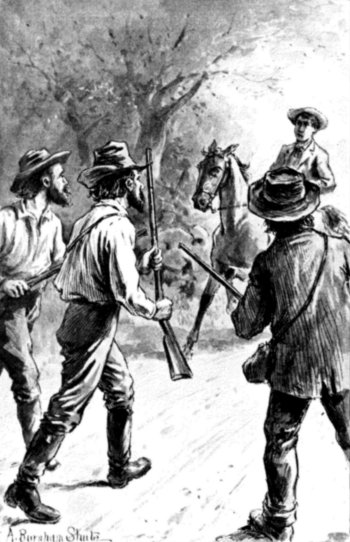
General was at the head of the horsemen, and he galloped his horse up to
the front of the ruffians. He and his men had loosened the slings of
their weapons, and brought them in front of them, so that they were
ready for immediate use. The ruffians had halted as soon as they
discovered the riders in front of them. Then they built a fire, and as
soon as its light shone upon them, General discovered a flag of truce.
The leader ventured to approach a little nearer to the enemy, when he
was saluted with a volley of oaths, and some one of them, not Captain
Titus, demanded where his master was.
"Ober on de ole road," replied General, almost as savagely as he had
been addressed.
"Do you know what this flag means, you nigger?" interrogated the speaker
with an oath.
"Yes, sar! Mars'r Belthorpe won't hab no more ob dat nonsense," answered
General.
"Tell him I want to see him under a flag of truce!" shouted the one who
appeared to be in command.
The horseman was afraid of making some mistake, and he sent one of his
boys back to the commander with this message. Colonel Belthorpe had sent
Sam back for his saddle horse, and presently he galloped to the front.
"Take in your flag of truce, or I will fire upon it!" shouted the
colonel. "No more fooling! I don't parley with ruffians!"
The flag immediately disappeared. By the light of the fire it could be
seen that about half a dozen men at the front of the column were armed
with muskets, which, with or without a command from the officer, they
brought to their shoulders and fired. Colonel Belthorpe put his hand on
his left arm, as though a ball had struck him there.
"Now, my boys, fire at them at will, just as you please," continued the
commander, as he began to blaze away with his heavy revolver.
The four mounted men began to use their repeaters; but their horses were
restive, and they could not fire at the best advantage, though several
of the ruffians were seen to fall, while the main body of them fled into
the adjoining fields.