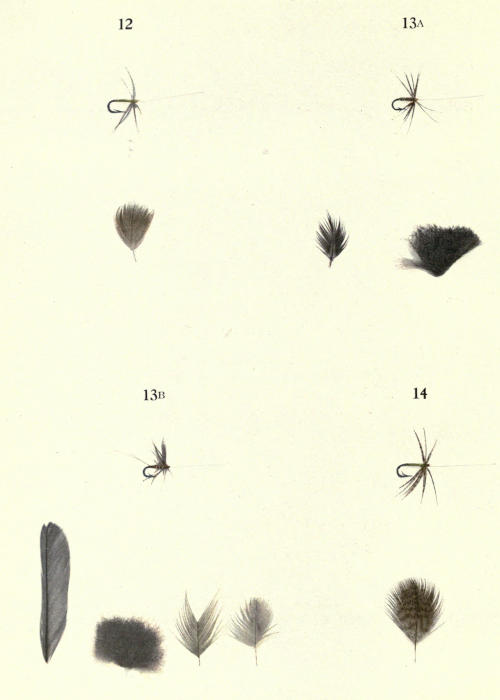
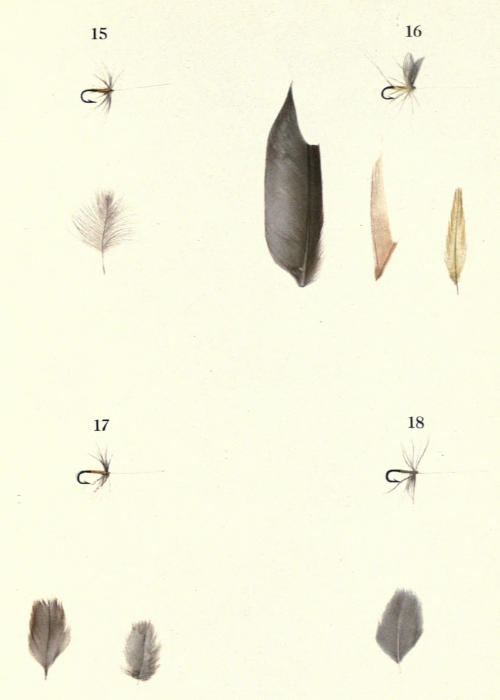
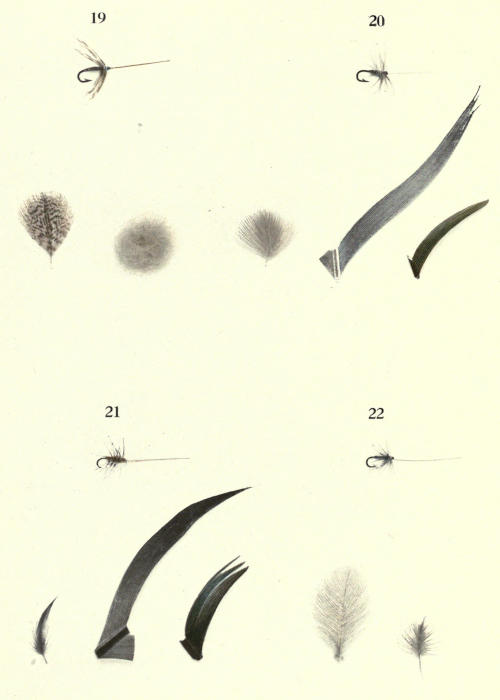
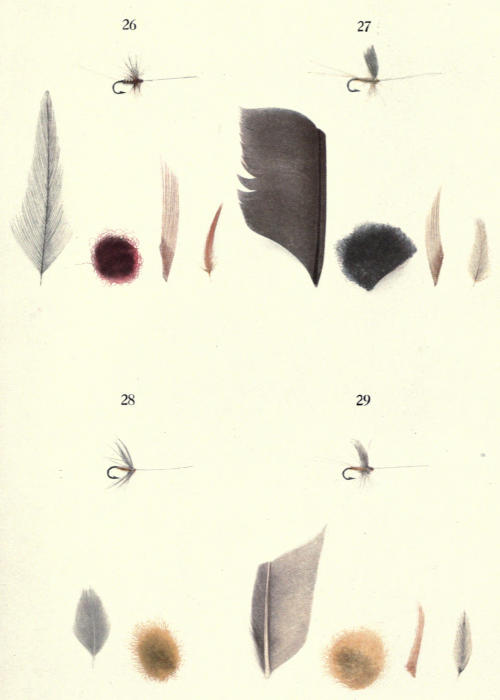
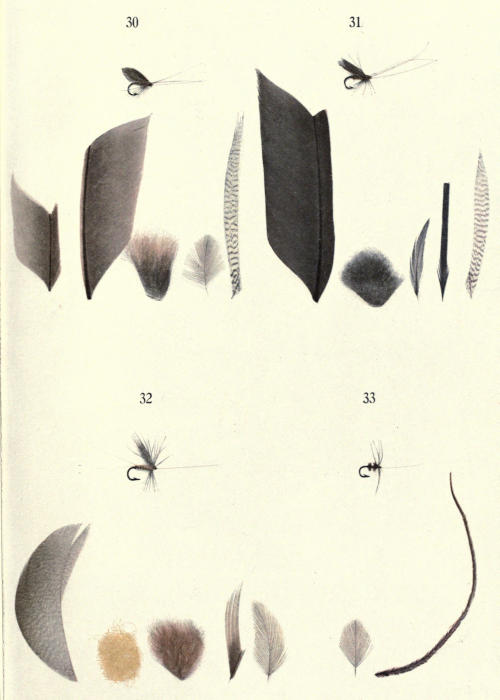
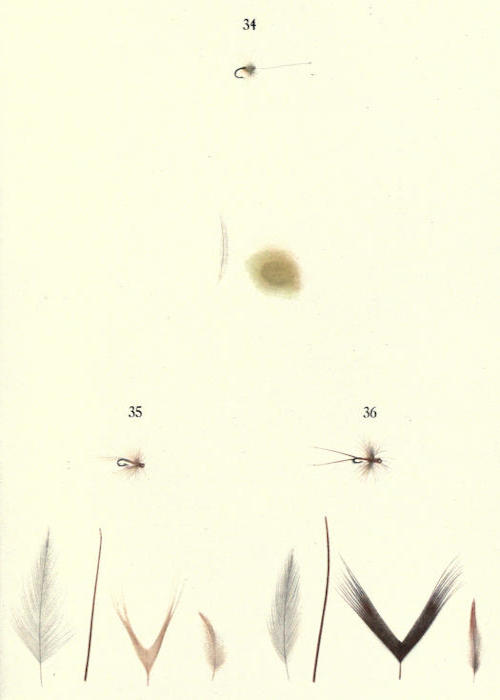
When the writers began to take a practical interest
in trout fly dressing, they experienced great difficulty in
determining the correct feathers for the various patterns,
as the older books on the subject of North Country
flies are vague in the extreme. The few more modern
writers on wet flies, for want of precision, have done
little to help the beginner to a proper appreciation of
his materials. It was therefore felt that a book, which
not only prescribed the exact part of a bird from which
the correct feathers should be taken, but illustrated
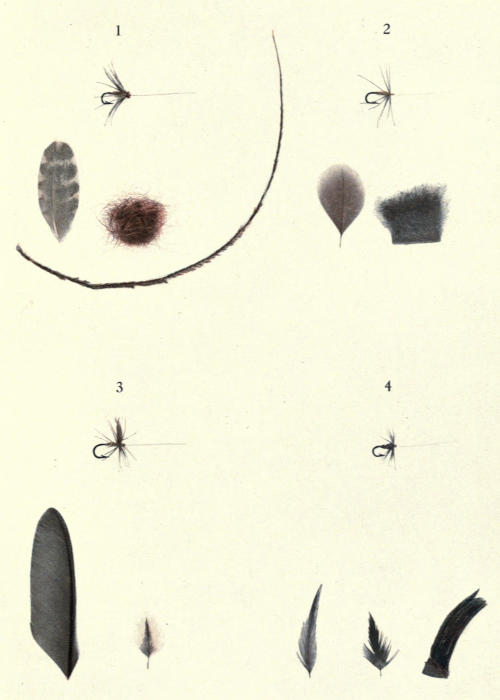
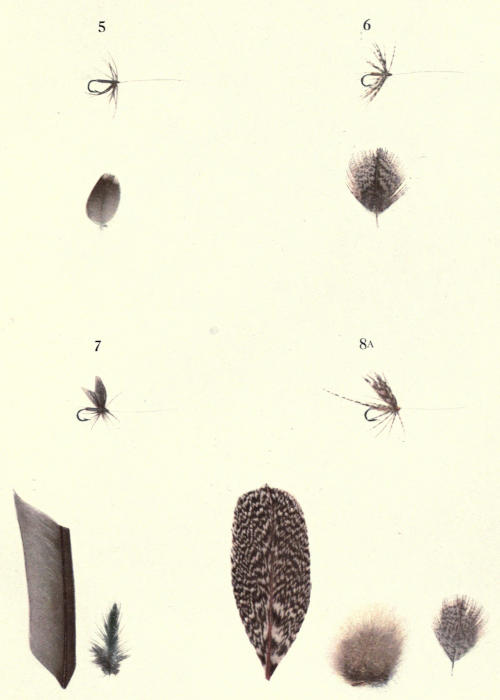
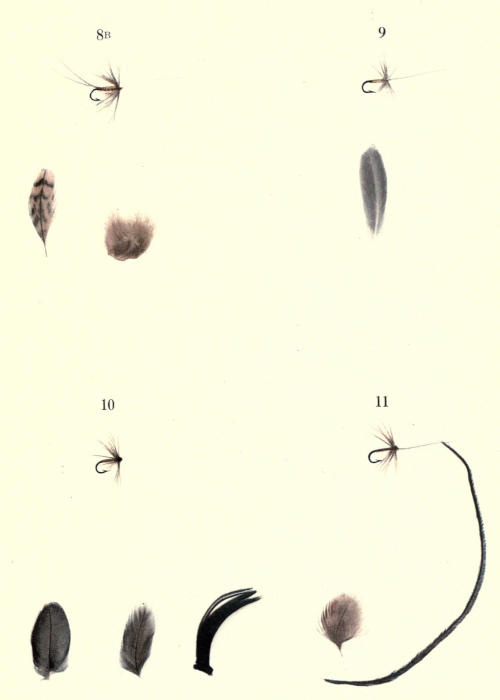
such feathers and other materials (as also the flies made
therefrom), in colour, would be a help, at least to
beginners in the craft, and not merely an encumbrance
on angling literature.
Having conceded the difficulties of the novice
wishing to dress his own flies, the question of the
number of patterns necessary for fishing the Rivers of
the North Country naturally came next for consideration.
As the tendency during recent years has been to increase
the number out of all reason and beyond practical
bounds, to the great bewilderment of the beginner and
the occasional fisherman, a list of flies has been drawn
up which, while it contains few patterns as compared
with many other lists, is yet wide enough to provide
for varying conditions the season through. The flies
are for the most part old friends, but for the above
reasons it is hoped they will not be unwelcome.
The original scheme of this work was limited by
the foregoing considerations. But when the book had
been mapped out in a general form it became evident
that a description of the methods employed in fishing
North Country streams with success would not only
give point to what the writers had to say on flies,
but might be of interest to the majority of North
Country fishermen. It was therefore decided to enlarge
the scope of the work. The chapters on the various
methods of fishing the Rivers of the Northern Counties
are the outcome of practical experience, and as such it
is hoped they will be both useful and interesting.
The authors desire to express their indebtedness to
Mrs. A. R. Gurney, Mr. L. A. Edmonds, and Mr. F.
Creedy for the photographs from which several of the
river scenes have been reproduced.
H. H. E.
N. N. L.
1916.
Chapter I. FLIES. — TABLE I. — TABLE II. — DRESSINGS. — WET FLIES. — DRY FLIES.
While it is the endeavour of this work to bring
the range of trout flies within reasonable and
practical limits and to describe no other than sound
practical dressings, there is no desire to limit experiment
either in patterns or numbers. In fact to do
so would take away one of the pleasantest features
of the pastime and rob many a winter’s evening of
its delight. All those who take an interest in fly
dressing should work from Nature wherever possible,
for flies frequently differ in no small degree in different
localities; and there is a great deal of enjoyment to
be obtained in dressing a fly with the natural insect
before one, and afterwards killing trout on the resulting
work of one’s hands.
It is not intended to devote any space to the processes
of fly-tying, as much has been written on the subject.
The reader in search of information cannot do better
than read the late H. G. McClelland’s book, The Trout
Fly Dresser’s Cabinet of Devices, or How to tie Flies
for Trout and Grayling Fishing, which is the most
practical and exhaustive treatise on the subject known
to the writers.
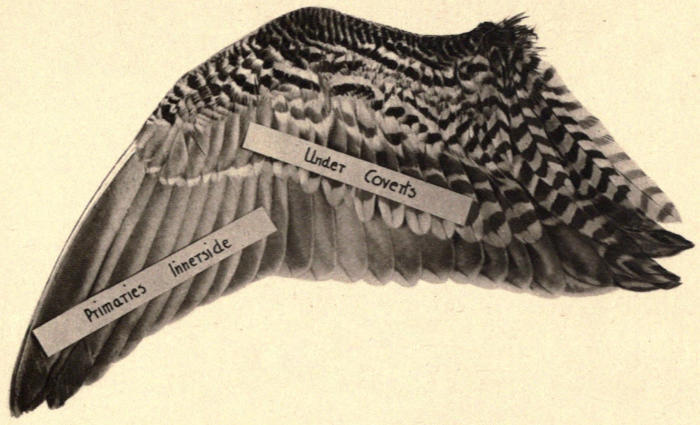
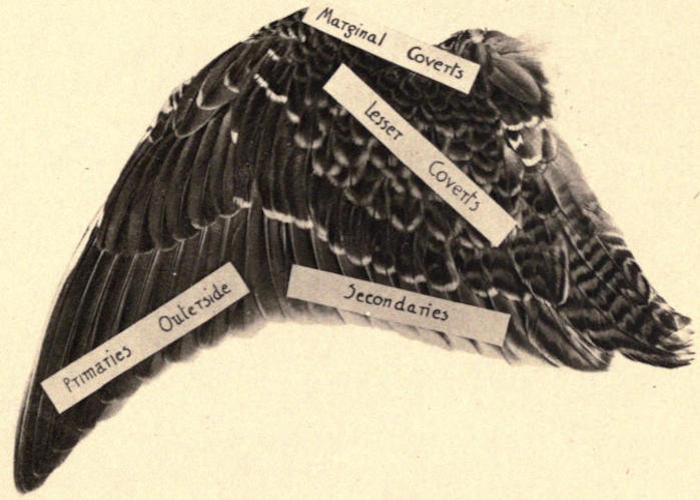
The illustrations, facing this page, of both sides
of a Snipe’s wing will show the reader the precise
places from which the various wing feathers, described
in the text, are taken, and while the descriptions of
the feathers may not satisfy the naturalist, they are
sufficient for the purposes of the writers.
It is naturally of importance in fly-dressing to use
no hooks but the best, and it will be found that Hardy
Bros.’ tapered snecks are satisfactory in every respect,
except that they are on the long side. If about one-sixteenth
of an inch be cut off the shank with an old
pair of scissors before dressing the fly, a more useful
length will be attained, as artificial flies are much more
killing if kept short in the body. Stress is laid on this;
and it will be seen from the illustrations of the flies
that the tail ends of the bodies are not carried further
down the hook than half way between the point of the
hook and the point of the barb. For the two floating
Spinners, Hardy Bros.’ Dry Fly Eyed Hooks are
recommended. The numbers of the hooks given in
the text correspond with the numbers enumerated in
Hardy Bros.’ catalogue.
Inner side
Outer side
The writers prefer to dress their flies to gut, 4x being the
most suitable grade; but good hair, if it can be obtained,
will be found delightful to fish with, as a cast made
from it falls so very lightly on the water; and, even
when the hair has become thoroughly soaked, the
droppers, unlike those tied to gut, have no tendency
to twist round the cast, but stand well out from it.
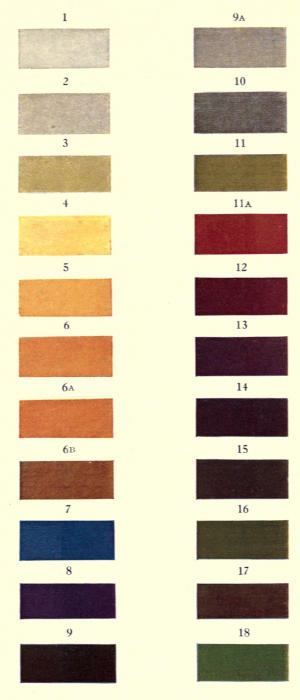
The most satisfactory tying silk is Pearsall’s
“Gossamer,” which is standardized in shades. A
shade card is illustrated and the numbers appearing
after the various silks mentioned in the text correspond
with the numbers above the various shades illustrated.
In dressing the flies the silk is in all cases waxed
with transparent wax; and, where it is stated that such
and such a silk is to be well waxed, the result should
be a shade or two darker than an ordinary waxing
would give.
In the dressings of most of the winged flies it is
laid down that either the outer side or the inner side
of the quill feather used should in the finished article
appear as the “under side” of the wing of the artificial.
The reader will easily understand which is the “under
side” of the wing of the artificial if he remembers that
it is that side of the wing which would touch the water
if the fly were “spent” and floating thereon.
Although the primary quill feathers are almost exclusively
recommended for the wings of most of the winged
patterns, the secondaries will often do equally well.
The correct shade of dubbing for the bodies of
flies, where coloured dubbing is specified, can often be
obtained to most advantage by a mixture of two or
more shades. For instance, the dubbing for the
Winter Brown is a mixture of brown and maroon
wool, while the dubbing for the Green Insect is a
mixture of green and yellow wool.
The silks forming the heads of the various flies are
of the same shade as the respective silks used for the
bodies unless otherwise stated; and it should be borne
in mind that the flies, particularly the hackle patterns,
must be dressed lightly, if one of the most distinctive
features of the North Country patterns is to be
preserved. In copying from Nature let the imitation
err on the small side if anything.
No attempt has been made to reproduce in the
coloured plates either gold or silver wire or tinsel.
When the river is “coloured,” flies dressed a size
larger than those employed under normal conditions
can be used with advantage.
Although the seasons for the various flies are given,
they are approximate only, as districts frequently
vary one from another, and the lateness or otherwise
of a season naturally has an effect on the hatch, just
as it has on the roses in gardens. Often the March
Brown can be seen in the latter part of May, and
sometimes a particular fly, for no apparent reason,
will remain on the water for a longer time than usual.
The necessity of careful observation cannot therefore
be too strongly impressed, as observation will teach far
more than all the books that were ever written.
Shades of Silk.
The form of wing specified for the Spinners is
recommended to the attention of the reader, as being
a most practical form of wing for any winged pattern,
wet or dry, where transparency is the primary object.
To the writers it seems an improvement on the hackle
points now so popular for many flies, as it is free from
the objectionable and comparatively thick midrib of
the latter and it is a harder wearing dressing than the
older form. The development to which such newer
form of wing lends itself for other patterns than the
Spinners mentioned in the list at pages 24, 26 and
30 may be noted, and the field which is open for
experiment will be evident to the reader.
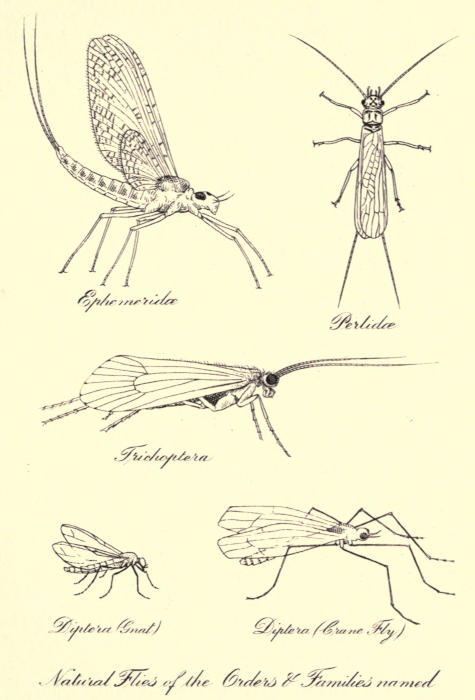
Under the name of each fly, in giving its dressing,
the name of the order or family to which the natural
insect as represented by the artificial belongs will be
found, and opposite page 12 reproductions of typical
examples of each of the orders or families of natural
insects mentioned will be found, with the exception
of the Ant and Green Insect. The latter are so well
known as to need no illustration. The beginner
will therefore have an idea of the fly he is copying and
perhaps be able to identify it at the stream side. It
must not be forgotten however that certain patterns
represent more than one species of fly.
It has been the good fortune of the writers to fish
on many waters; and while the Winter Brown has
often given them the first thrill of the season, and
the Green Insect accounted for fish when September
gusts have strewn the river with leaves and green
fly, they hope they have not grown dogmatic in their
views and opinions on matters piscatorial. Nevertheless
they are inclined to think that, the closer they
keep in shade and colour in their patterns to the
natural flies, the greater has been their success; for,
although they can recall occasions on which the fish
would rise at almost anything, such occasions have
been few and far apart; while the times when the
trout would only look at a particular fly of a particular
shade have been by far the more frequent in their
experience. Why deny fish the power to appreciate
variations of shade when they live in a world of colours,
and are clothed in such a beautiful and vari-coloured
mail? If trout can appreciate tones of colour, how
different a fly must appear to them in different lights
and with different backgrounds. Such natural variations
of surrounding light and landscape may have a
larger effect on “the bag” than many think.
For easy reference two tables of flies are given.
One, in which are set down the flies in the order in
which they may generally be fished through the
season, with the approximate times of their use, and
the other, with the flies tabled under the various trout
fishing months.
It remains only to add, that the taking fly should
be fished as point, i.e., the fly farthest from the angler.
Natural Flies of the Orders & Families named
1.
Winter Brown
March to middle of April.
2.
Waterhen Bloa
March to end of April and again in September.
3.
Greenwell’s Glory
March to first week in May and again in September.
4.
Spring Black
March and early April.
5.
Dark Snipe
March to middle of April and again in September.
6.
Orange Partridge
March to middle of May.
7.
Broughton’s Point
March to middle of April.
8.
March Brown
April and often May.
9.
Light Snipe
Middle of April to middle of May and again in September.
10.
Dark Needle
Middle of April to end of June and again in September.
11.
Brown Owl
Latter part of April to end of June.
12.
Olive Bloa
Latter part of April and throughout May.
13.
Dark Watchet
Last week in April and throughout May and sometimes early June.
14.
Yellow Partridge
May to middle of June.
15.
Light Needle
May, June and July.
16.
Yellow-Legged Bloa
May to end of June.
17.
Dotterel
Middle of May to end of Season.
18.
Poult Bloa
Middle of May to middle of July.
19.
Gravel Bed
Middle of May to end of June.
20.
Stone Midge
Middle of May to end of June.
21.
Knotted Midge
Middle of May to end of July.
22.
Black Gnat
Middle of May to end of August.
23.
Ginger Spinner (Wet)
June, July and August.
24.
Dark Sedge
Middle of June to the end of the Season.
25.
Light Sedge
Middle of June to the end of the Season.
26.
Red Spinner (Wet)
July, August and September.
27.
July Dun
July and August.
28.
Rough-Bodied Poult
July, August and September.
29.
Pale Watery Dun
Middle of July to the end of September.
30.
Light Silverhorns
Middle of July to the end of August.
31.
Dark Silverhorns
Middle of July to the end of August.
32.
August Dun
Last week in July, August and September.
33.
Ant
August to second week in September.
34.
Green Insect
August and September.
35.
Ginger Spinner (Dry)
June, July and August.
36.
Red Spinner (Dry)
July, August and September.
March.
Winter Brown.
Waterhen Bloa.
Greenwell’s Glory.
Spring Black.
Dark Snipe.
Orange Partridge.
Broughton’s Point.
April.
Winter Brown.
Waterhen Bloa.
Greenwell’s Glory.
Spring Black.
Dark Snipe.
Orange Partridge.
Broughton’s Point.
March Brown.
Light Snipe.
Dark Needle.
Brown Owl.
Olive Bloa.
Dark Watchet.
May.
Greenwell’s Glory.
Orange Partridge.
March Brown.
Light Snipe.
Dark Needle.
Brown Owl.
Olive Bloa.
Dark Watchet.
Yellow Partridge.
Light Needle.
Yellow-Legged Bloa.
Dotterel.
Poult Bloa.
Gravel Bed.
Stone Midge.
Knotted Midge.
Black Gnat.
June.
Dark Needle.
Brown Owl.
Dark Watchet.
Yellow Partridge.
Light Needle.
Yellow-Legged Bloa.
Dotterel.
Poult Bloa.
Gravel Bed.
Stone Midge.
Knotted Midge.
Black Gnat.
Ginger Spinner (Wet and Dry).
Dark Sedge.
Light Sedge.
July.
Light Needle.
Dotterel.
Poult Bloa.
Knotted Midge.
Black Gnat.
Ginger Spinner (Wet and Dry).
Dark Sedge.
Light Sedge.
Red Spinner (Wet and Dry).
July Dun.
Rough-Bodied Poult.
Pale Watery Dun.
Light Silverhorns.
Dark Silverhorns.
August Dun.
August.
Dotterel.
Black Gnat.
Ginger Spinner (Wet and Dry).
Dark Sedge.
Light Sedge.
Red Spinner (Wet and Dry).
July Dun.
Rough-bodied Poult.
Pale Watery Dun.
Light Silverhorns.
Dark Silverhorns.
August Dun.
Ant.
Green Insect.
September.
Waterhen Bloa.
Greenwell’s Glory.
Dark Snipe.
Light Snipe.
Dark Needle.
Dotterel.
Dark Sedge.
Light Sedge.
Red Spinner (Wet and Dry).
Rough-bodied Poult.
Pale Watery Dun.
August Dun.
Ant.
Green Insect.
No. 1.
Winter Brown.
Perlidæ
Hook 1 or 2.
Wings.—Hackled with a greyish feather, barred, from the under
coverts of a Woodcock’s wing. (The lighter side of the
feather towards the head of the fly).
Body.—Orange silk, No. 6a, dubbed with ruddy brown wool, the
three turns next the tail showing distinct orange.
Head.—Bronze Peacock herl.
March to middle of April.
No. 2.
Waterhen Bloa.
Ephemeridæ.
Hook 1 or 2.
Wings.—Hackled with a smoky grey feather from the under
coverts of a Waterhen’s wing. (The darker side of the feather
towards the head of the fly).
Body.—Yellow silk, No. 4, dubbed with Mole’s fur.
Head.—Yellow silk.
March to end of April, and again in September.
No. 3.
Greenwell’s Glory.
Ephemeridæ.
Hook 1 or 2.
Wings.—From a hen Blackbird’s primary quill feather, bunched
and split.
Body.—Yellow silk, No. 4, well waxed, ribbed with four turns of
fine gold wire or tinsel.
Legs.—Cochybondu Hen’s hackle.
Head.—Yellow silk, well waxed.
March to first week in May, and again in September,
although, by dressing with a lighter wing, body and hackle, the
fly can be used during the intervening months.
No. 4.
Spring Black.
Diptera (gnat).
Hook 0.
Wings.—Hackled with a black Cock’s hackle or a blue black feather
from an adult Starling’s neck.
Body.—Purple silk, No. 8, dubbed sparingly with Magpie herl.
Head.—Purple silk.
March and early April.
1 2 3 4
No. 5.
Dark Snipe or Snipe and Purple.
Ephemeridæ.
Hook 1.
Wings.—Hackled with the dark feather from the marginal coverts
of a Snipe’s wing.
Body.—Purple silk, No. 8.
Head.—Purple silk.
March to middle of April, and again in September.
No. 6.
Orange Partridge.
Perlidæ and Ephemeridæ.
Hook 1.
Wings.—Hackled with a brown mottled (not barred) feather from
a Partridge’s neck, or back.
Body.—Orange silk, No. 6a, or orange silk, No. 6a, ribbed with
about four turns of gold wire or tinsel.
Head.—Orange silk.
March to middle of May.
No. 7.
Broughton’s Point or Dark Bloa.
Ephemeridæ.
Hook 1 or 2.
Wings.—From a Starling’s primary quill feather, the outer side
of the feather as the under side of the wing.
Body.—Claret silk, No. 13.
Legs.—A black Hen’s hackle.
Head.—Claret silk.
March to middle of April.
No. 8a.
March Brown.
Ephemeridæ.
Hook 2 or 3.
Wings.—From a quill feather from a Partridge’s tail, greyish in
tone, the top side of the feather as the under side of the wing.
Body.—Orange silk, No. 6a, dubbed with sandy fur taken from
near the base of a Hare’s ear and ribbed with yellow silk, No. 4.
Tail.—Two strands from a Partridge’s tail, same feather as the
one used for the wings.
Legs.—Greyish brown feather from a Partridge’s back.
Head.—Orange silk.
April and often May.
5 6 7 8A
No. 8b.
March Brown.
Ephemeridæ.
Hook 2 or 3.
Wings.—Hackled with a mottled brown feather from a Snipe’s rump.
Body.—Orange silk, No. 6a, dubbed with fur from the nape of a
Rabbit’s neck which has been lightly tinged red with Crawshaw’s
Red Spinner dye, and ribbed with gold wire or tinsel.
Tail.—Two strands from a feather from a Snipe’s rump, same
feather as is used for the wings.
Head.—Orange silk.
April, and often May.
No. 9.
Light Snipe or Snipe Bloa.
Ephemeridæ.
Hook 1.
Wings.—Hackled with a bluish feather from the under coverts of a
Snipe’s wing. (The lighter side of the feather towards the
head of the fly).
Body.—Yellow silk, No. 4.
Head.—Yellow silk.
Middle of April to middle of May, and again in September.
No. 10.
Dark Needle.
Perlidæ.
Hook 1.
Wings.—Hackled with a brownish feather taken from where the
hinder part of a Starling’s wing joins the body, (There are
only about four of these feathers on each side of the bird.)
or with a brownish feather from the back of a Swift.
Body.—Orange brown silk, No. 6b.
Head.—Magpie herl.
Middle of April to the end of June, and again in September.
No. 11.
Brown Owl.
Trichoptera.
Hook 1.
Wings.—Hackled with a reddish brown feather from the lesser
coverts of a Tawny or Brown Owl’s wing.
Body.—Orange silk, No. 6a.
Head.—Bronze Peacock herl.
Latter part of April to end of June.
8B 9 10 11
No. 12.
Olive Bloa.
Ephemeridæ.
Hook 1.
Wings.—Hackled with an olive green feather from a Green Plover’s
neck.
Body.—Yellow silk, No. 4, well waxed.
Head.—Orange brown silk, No. 6b.
Latter part of April and throughout May.
No. 13a.
Dark Watchet or Iron Blue Dun.
Ephemeridæ.
Hook 0 or 00.
Wings.—Hackled with a dark smoky blue feather from a Jackdaw’s
throat.
Body.—Orange and purple silk, Nos. 6a and 8, twisted together,
dubbed very sparingly with Mole’s fur and wound on the body
so that the orange and purple show in alternate bands.
Head.—Orange silk.
Last week in April and throughout May, and sometimes early
June. Particularly for dull days.
No. 13b.
Dark Watchet or Iron Blue Dun.
Ephemeridæ.
Hook 0 or 00.
Wings.—From the darkish blue feather from a Blue Tit’s tail,
bunched and split.
Body.—Same as No. 13a.
Tail.—Two strands from a medium grizzled blue Cock’s hackle.
Legs.—Feather from a young Starling’s thigh or flank.
Head.—Orange silk.
Last week in April and throughout May, and sometimes early
June. For brighter days.
No. 14.
Yellow Partridge.
Perlidæ and Diptera (Crane-fly).
Hook 0 or 1.
Wings.—Hackled with a greyish feather barely tinged with brown,
from a Partridge’s back.
Body.—Yellow silk, No. 4.
Head.—Yellow silk.
May to middle of June.
12 13A 13B 14
No. 15.
Light Needle.
Perlidæ.
Hook 0 or 1.
Wings.—Hackled with a feather from a young Starling’s thigh
or flank.
Body.—Orange silk, No. 6a.
Head.—Orange silk.
May, June and July.
No. 16.
Yellow-Legged Bloa.
Ephemeridæ.
Hook 1.
Wings.—From a young Starling’s light primary quill feather, the
outer side of the feather as the under side of the wing.
Body.—Primrose yellow silk, No. 3.
Tail.—Two strands from a very pale ginger Cock’s hackle.
Legs.—A Cock’s hackle dyed a rich primrose yellow.
Head.—Primrose yellow silk.
May to end of June.
No. 17.
Dotterel.
Ephemeridæ.
Hook 1.
Wings.—Hackled with a light-tipped fawnish feather from the
marginal coverts or lesser coverts of a Dotterel’s wing.
Body.—Orange silk, No. 6, or primrose yellow silk, No. 3.
Head.—Orange silk, or primrose yellow silk.
If the Dotterel feather is unobtainable a feather from the
under coverts of a young Starling’s wing makes a fair substitute.
Middle of May to end of Season.
No. 18.
Poult Bloa.
Ephemeridæ.
Hook 0 or 1.
Wings.—Hackled with a light blue feather from the under coverts
of a young Grouse wing, taken before the bird is strong on the
wing. (The lighter side of the feather towards the head of
the fly.) This feather darkens very rapidly on the live bird
from August onwards.
Body.—Primrose yellow silk, No. 3.
Head.—Primrose yellow silk.
Middle of May to middle of July.
15 16 17 18
No. 19.
Gravel Bed.
Diptera (Crane-fly).
Hook 1.
Wings.—Hackled with a greyish feather, lightly tinged with brown,
from a Partridge’s neck.
Body.—Blue silk, No. 7, dubbed with blue-grey fur from the flank
of an Opossum.
Head.—Blue silk.
Middle of May to end of June. A useful fly in a coloured water.
No. 20.
Stone Midge.
Diptera (Gnat).
Hook 0 or 00.
Wings.—Hackled with an olive green feather from a Green Plover’s
neck.
Body.—Grey silk, No. 9a, well waxed, or ash-coloured silk, No. 10,
but in both cases dubbed sparingly with bluey-grey Heron herl.
Head.—Magpie herl.
Middle of May to end of June.
No. 21.
Knotted Midge.
Diptera (Gnat).
Hook 0 or 00.
Wings.—Hackled down the body “palmerwise” with a small
black Cock’s hackle.
Body.—Ash-coloured silk, No. 10, dubbed with dark Heron herl.
Head.—Magpie herl.
Middle of May to end of July.
For close days.
No. 22.
Black Gnat.
Diptera (Gnat).
Hook 00.
Wings.—A few fibres from a light blue Hen’s hackle put on as a
single wing.
Body.—Black silk, No. 9.
Legs.—Rusty black Hen’s hackle.
Head.—Black silk.
Middle of May to end of August.
For close days.
19 20 21 22
No. 23.
Ginger Spinner.
Ephemeridæ.
Hook 0 or 1.
Wings.—Fibres of light grizzled blue Cock’s hackle.
Body.—Flat gold wire with a wrapping over it of orange silk, No.
6, the silk to be untwisted and only one or two strands used.
Tail.—Two strands from a ginger Cock’s hackle.
Legs.—Ginger Cock’s hackle.
Head.—Orange silk.
June, July and August.
No. 24.
Dark Sedge.
Trichoptera.
Hook 1 or 2.
Wings.—Hackled with a reddish brown feather from the lesser
coverts of a Tawny or Brown Owl’s wing.
Body.—Yellow silk, No. 4, dubbed with brownish fawn Seal’s fur.
Head.—Brownish green herl from the tail of a cock Pheasant.
Middle of June to end of the Season.
No. 25a.
Light Sedge.
Trichoptera.
Hook 1 or 2.
Wings.—Hackled with a light-barred reddish feather, from the
lesser coverts of a Landrail’s wing.
Body.—Yellow silk, No. 4, dubbed with reddish fur from the thigh
of a Squirrel.
Head.—A reddish herl from the tail of a cock Pheasant.
Middle of June to the end of the Season.
No. 25b.
Light Sedge.
Trichoptera.
Hook 1 or 2.
Wings.—From a light barred reddish feather, from the lesser
coverts of a Landrail’s wing (a larger feather than the one
used for No. 25a), the outer side of the feather as the outside
of the wing. Wings put on “penthouse” fashion.
Body.—Same as No. 25a.
Legs.—Reddish feather from the marginal coverts of a Landrail’s
wing.
Head.—Same as No. 25a.
Middle of June to the end of the Season.
23 24 25A 25B
No. 26.
Red Spinner.
Ephemeridæ.
Hook 1.
Wings.—Fibres of medium grizzled blue Cock’s hackle.
Body.—Red silk, No. 12, dubbed with maroon wool and ribbed
with four turns of fine gold wire or tinsel.
Tail.—Two strands from a deep red Cock’s hackle.
Legs.—Deep red Cock’s hackle.
Head.—Red silk.
July, August and September.
No. 27.
July Dun.
Ephemeridæ.
Hook 1.
Wings.—From a Coot’s primary quill feather, the outer side of
the feather as the under side of the wing.
Body.—Yellow silk, No. 4, dubbed sparingly with Mole’s fur.
Tail.—Two strands from a medium olive Cock’s hackle.
Legs.—Medium olive Hen’s hackle.
Head.—Yellow silk.
July and August.
No. 28.
Rough-Bodied Poult.
Ephemeridæ.
Hook 0 or 1.
Wings.—Hackled with a light blue feather from the under coverts
of a young Grouse wing, taken before the bird is strong on the
wing. (The lighter side of the feather towards the head of
the fly.) This feather darkens very rapidly on the live bird
from August onwards.
Body.—Straw-coloured silk, No. 2, dubbed sparingly with buff fur
from the flank of an Opossum.
Head.—Straw-coloured silk.
July, August and September.
No. 29.
Pale Watery Dun.
Ephemeridæ.
Hook 0 or 1.
Wings.—From a young Starling’s light primary quill feather, the
inner side of the feather as the under side of the wing.
Body.—Yellow silk, No. 4, dubbed with palest buff fur from the
flank of an Oppossum.
Tail.—Two strands from palest ginger Cock’s hackle.
Legs.—Light blue Hen’s hackle.
Head.—Yellow silk.
Middle of July to the end of September.
26 27 28 29
No. 30.
Light Silverhorns.
Trichoptera.
Hook 1.
Wings.—From a Thrush’s secondary quill feather, the outer side
of the feather as the outside of the wing, or from a Landrail’s
primary quill feather, the outer side of the feather as the
outside of the wing. Wings put on “penthouse” fashion.
Body.—Ash-coloured silk, No. 10, sparingly dubbed with reddish
grey fur from the thigh of a Squirrel.
Legs.—Feather from a young Starling’s thigh or flank.
Head.—Ash-coloured silk.
Antennæ.—Two strands from a black and white feather from a
Mallard’s breast.
Middle of July to the end of August.
No. 31.
Dark Silverhorns.
Trichoptera.
Hook 1.
Wings.—From a Waterhen’s primary quill feather, the outer side
of the feather as the outside of the wing. Wings put on
“penthouse” fashion.
Body.—Black silk, No. 9, dubbed very sparingly with Mole’s fur
and ribbed with olive silk, No. 11.
Legs.—Black Cock’s hackle or Green Plover’s topping.
Head.—Black silk.
Antennæ.—Two strands from a black and white feather from a
Mallard’s breast.
Middle of July to the end of August.
No. 32.
August Dun.
Ephemeridæ.
Hook 2.
Wings.—From a Mallard’s breast feather, lightly tinged with
brown.
Body.—Yellow silk, No. 4, dubbed with yellow olive wool and
ribbed with orange silk, No. 6, sparingly spun with fur from
the nape of a Rabbit’s neck which has been lightly tinged red
with Crawshaw’s Red Spinner dye.
Tail.—Two strands from a medium olive Cock’s hackle.
Legs.—Medium olive Hen’s hackle.
Head.—Yellow silk.
Last week in July, August and September.
No. 33.
Ant.
Hymenoptera.
Hook 0.
Wings.—Hackled with a light blue Hen’s hackle.
Body.—Orange brown silk, No. 6b, dressed full at the tail with
bronze Peacock herl, then a few turns of the silk towards the
head, then dressed full at the shoulder with bronze Peacock
herl.
Head.—Orange brown silk.
August to second week in September.
30 31 32 33
No. 34.
Green Insect.
Aphides.
Hook 00 or 000.
Wings.—Hackled with a light blue Cock’s hackle.
Body.—Yellow silk, No. 4, dubbed with bright green olive wool.
Head.—Yellow silk.
August and September. Particularly on gusty days.
No. 35.
Ginger Spinner.
Ephemeridæ.
Hook 0 or 1, eyed.
Wings.—Fibres of light grizzled blue Cock’s hackle dressed “spent.”
Body.—Light cinnamon quill.
Tail.—Two strands from a ginger Cock’s hackle.
Legs.—Ginger Cock’s hackle, two turns at the most, as the fly must
be dressed lightly.
Head.—Orange silk, No. 6.
June, July and August.
No. 36.
Red Spinner.
Ephemeridæ.
Hook 0 or 1, eyed.
Wings.—Fibres of medium grizzled blue Cock’s hackle dressed
“spent.”
Body.—Red quill.
Tail.—Two strands of Gallina, dyed red brown.
Legs.—Deep red Cock’s hackle, two turns at the most, as the fly
must be dressed lightly.
Head.—Red silk, No. 12.
July, August and September.
34 35 36
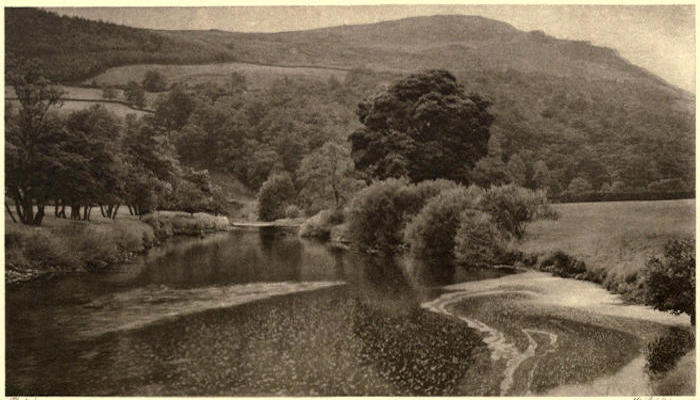
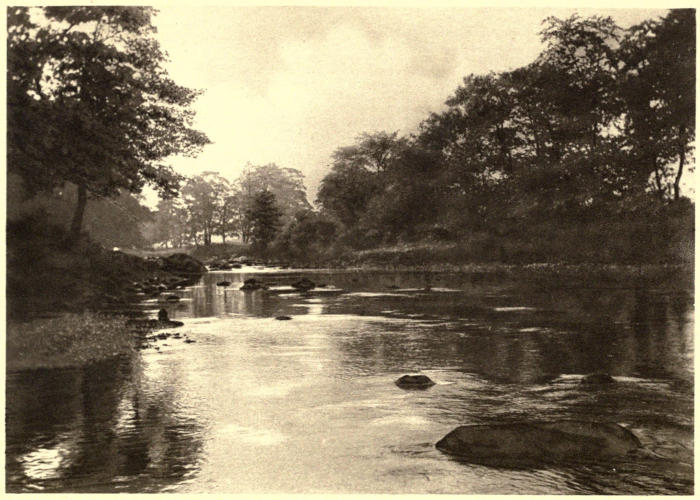
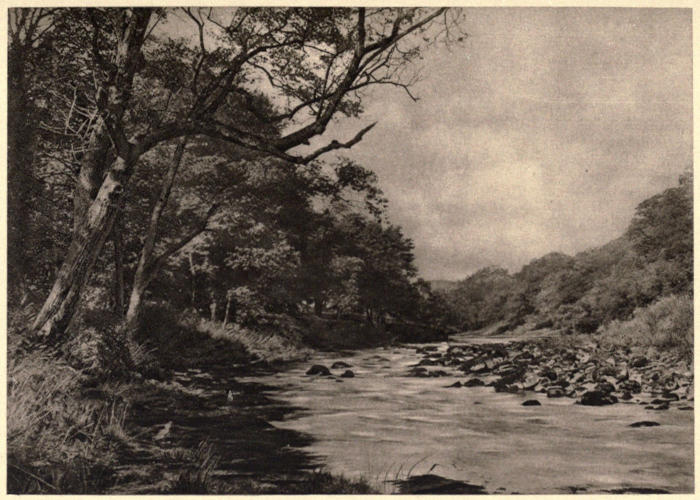
A Typical Stretch
Photo by Mrs. A. R. Gurney
Chapter II. FLY FISHING. — Wet-Fly Fishing. — Dry-Fly Fishing.
So much has already been written on fly fishing
by men of wide and varied experience, that it
is with no little diffidence the writers approach the
subject. Yet the more thoroughly the whole art of
trout fishing is explored, the more engrossing does it
become, and, as experience is gained, the more evident
it appears that little is really known and that a vast
field still remains open for investigation.
It is not intended to try in this chapter to teach
the art of fly fishing, as more can be learned by observation,
perseverance and practice on the river, than by
reading all that was ever written on the subject; but
it is desired, by emphasizing a few essential points, to
help the novice through his initial difficulties.
Some anglers who are only able to devote a few
weeks during the season to their pastime are content
to go to the local tackle dealer or the professional
fisherman and to rely entirely on his advice. While
it is always well to consult the “local men”—quaint
characters for the most part and many of them cobblers
by trade—it is often a mistake to rely entirely upon
them; for, if a man’s ambition be to get out of the
rut and to kill fish under difficult conditions, he must
think for himself.
The “local man” often has a strong partiality for
certain patterns of flies, no matter what the conditions.
Only recently the writers came across a most glaring
example of this particular tendency, which is perhaps
worth mentioning in order to illustrate their point.
Arriving at the river one September afternoon, they
noticed on the opposite bank the local professional,
who is held in very high esteem as a fisherman. He
certainly casts as neat a line as the writers have ever
seen thrown. In answer to their enquiry, “What
sport?”, they received the reply, “A few,” and were
more than a little astonished to learn that he was
using flies which, in their opinion, were more suitable
for the end of July. It is always a pleasure to see this
man cast, so they sat down and watched him. Time
after time he put his flies in the most beautiful manner
over rising fish, but without result, although the water
was coloured and the fish continued to rise steadily.
Soon one showed within casting distance of the bank on
which the writers were seated, so a fly was immediately
put over him and was accepted at the first offer.
Earlier that day there had been a large hatch of Dark
Needles, and it was an imitation of that insect which
induced the rise. Alternately the writers threw over
rising fish with more or less success; but the professional,
who persevered for another half-hour without changing
his flies, at last gave up in disgust. For the time
being at least he was beaten. Not that he did not know
the river or understand the habits of the trout—both
were to him as an open book—but simply because he
was deficient in his knowledge of insect life. This man
probably knew some ten or a dozen good all-round
flies which he used the season through, but without
due regard to the hatch of natural insects.
Now put yourself in the professional’s position on
that particular day, only add to his knowledge that
of insect life. On finding your flies rejected, you would
have picked from off the water, and examined, the
natural insects which were floating down; then,
immediately realizing what was amiss, you would
have substituted an imitation of the taking fly for one
on your cast. Success would have followed failure,
and a light-hearted angler would have tramped homewards
at sunset with a creel the heavier for his practical
knowledge.
From the foregoing it will be gathered that the novice
should make it his first duty to study on every possible
occasion the insect life of the river he is going to
fish, and not merely rely upon the tackle dealer
or professional to supply his deficiency in this, or
indeed in other matters. By this let it not be
thought that the writers consider it necessary to go
deeply into the study of entomology, fascinating as
that study is; but if the greatest amount of pleasure
is to be derived, and incidentally a fair number of fish
to be killed, it is essential that the angler should arm
himself with a good general knowledge of river insect life.
A great deal in this direction can be learned by an
occasional emptying of a trout’s stomach into a glass
of water, and an examination of the débris after they
have been separated by a brisk stir round. It is most
instructive, and it shows how catholic fish are in their
feeding. It shows too, not infrequently, the reasons
for a poor day’s sport, and often gives a hint which
may turn failure into success on some future occasion.
Though a knowledge of insect life is highly important,
it is equally necessary to learn to adapt
oneself to varying conditions.
This latter point may at the first glance appear
unnecessarily elementary, so much so as to seem
hardly worth making, but speaking from personal
experience, the writers think that, probably on account
of its very obviousness, it often receives far less attention
than it deserves.
How many anglers, after working the long winter
through begin, as the trout season draws near, to let their
thoughts wander to some favourite stream and live
for days, aye, almost weeks, in anticipation of the
opening day? They conjure up in their minds all the
details that have gone to make up some red-letter day
in the past, the whole scene comes up as fresh as
ever, and memory, ever willing, gives them a most
vivid picture of the pool in which the fish of the
season put up his last gallant struggle. They recall
those exciting moments when the strength of the cast
was taxed to its utmost as the fish wildly endeavoured
to reach the roots of an overhanging tree, and the
joyful feeling of power that crept over them when at
last the lusty trout, having somewhat spent himself,
allowed them to regain a foot or two of line. Then
came that last mad rush when the captive perceived
the net.
These memories are happy indeed, though often
enough they lead one astray, as, when the eve of the
opening day arrives, one has probably definitely
decided to begin operations at the exact pool that was
the scene of one’s former success. Is this adapting
oneself to circumstances? It can hardly be so, and
yet probably very few can say that they have never
fallen a victim to such foolishness.
The wise man waits until the morrow, when he can
see how the wind strikes his favourite stream or reach,
whether the water is too high or too low, and whether
the sport that it normally might be expected to yield
is going to be adversely affected by any other condition.
If so, even though disappointed, he will find
a more suitable place at which to begin and no doubt
at the end of the day his creel will reveal the reward of
his adaptability to circumstance.
The consideration of adaptability to circumstance
naturally brings one to a classification and subsequent
subdivision of the methods of fly fishing, which methods,
judiciously and intelligently combined, make for the
true road to success.
Fly fishing may be practised in two principal ways,
with the wet fly and with the dry fly.
In the former, as the name implies, the flies are
fished slightly submerged; and three or sometimes four
flies may be used on the cast. They are placed some 20
inches or so apart, but varied as to distance according
to the state of the river, greater distance between
them being necessary, and fewer flies being used, in
low clear water. In dry-fly fishing, as perhaps it is
unnecessary to state, only one fly is used, and it is
made to float by being whipped through the air after
each cast, so as to shake off any globules of water that
may be attached to the feathers, a process which is
generally assisted by the fly being lightly touched with
oil before use.
Before going further it is as well to say a few words
regarding the rod and tackle. The length of rod the
writers find most useful is 10 ft. 6 ins., and, if it is to
be used for wet-fly fishing exclusively, they would
unhesitatingly recommend a two-piece rod made of
greenheart, or of hickory for the butt, with greenheart
top, not too whippy and not too stiff. Such a rod is
softer in the action and less tiring to the wrist than
one made of split cane. That is a matter well worth
consideration when one is whipping the stream for
long periods at a stretch.
For dry-fly fishing however, and general use, and
for almost unending wear, a split-cane rod by one of
the first-class makers will probably best suit the
requirements of the average man; only in selecting
the rod, of whatever pattern, great care should be
devoted to getting one which, with reel and line
attached, will make a harmonious whole. If the rod
be a split cane, it should be rather more whippy than
the average type in use on Chalk streams. These
points should be carefully attended to, otherwise the
beginner, after working for an hour or so, will find
his wrist growing tired, and he will then get into a
slovenly way of casting, which is easier to learn than
to unlearn.
Regarding the reel, line and cast, we should recommend,
if the reader is buying his rod from a man of
practical experience, that he leaves the first two to
the maker’s discretion. He will then no doubt get
both reel and line of suitable weight for the rod. The
cast should be approximately three yards, tapered,
the last yard being of finest drawn gut for ordinary
waters, but a coarser cast may be used when fishing
a full or slightly coloured water. A good cast for
ordinary waters can be made of ten strands of gut,
each strand either 12 or 14 inches in length and tapered
as follows:—First two strands of Quarter drawn, then
two strands of Half drawn, then three strands of 2x,
and finally three strands of 4x.
It is with wet-fly fishing that it is proposed to deal
first, as this method is by far the more important on
the majority of North Country rivers, the dry fly
being a useful auxiliary under conditions to be detailed
later.
Why, it may be asked, should the fish be more partial
to the wet fly than to the dry fly on Northern streams.
The reason is not far to seek; for, owing to the roughness
and rapidity of such rivers, a large percentage of insects,
as they rise from the bed of the river preparatory to
hatching out, are carried many yards downstream
before they reach the surface of the water. Others,
getting into rough water, find themselves unequal to
the effort of emerging from their nymphal case, or
emerge with wetted and helpless wings, while many
flies, surviving these natural difficulties, are carried
down some rapid almost immediately after they reach
the perfect state, and get water-logged before ever they
have the opportunity of using their wings. Hence the
trout become used to taking much of their insect food
in a submerged or partially submerged state. Therefore
so long as those streams remain as heretofore, the
wet fly is likely to continue to hold the premier position
in the filling of a North Countryman’s creel.
There are two methods of fishing the wet fly, upstream
and downstream. Follows an attempt to give
a brief outline of how and when each method may be
used to the best advantage.
The use of the word “downstream” in this connection
is, perhaps, somewhat misleading, for it is not
intended to refer to that method of fishing in which the
angler casts his flies across and downstream, allowing
the current to sweep them round to a point below
him, in the same manner as when fishing the salmon
fly. To fish an imitation of a natural insect in such
a way as to make it resist the onward flow of the
water in a most unnatural manner, is, in the
writers’ judgment, unsound, and they wish it to be
understood that, by “downstream,” they do not allude
to this manner of fishing.
The downstream method advocated might quite
appropriately be termed across-stream fishing, as the
angler faces the bank towards which he purposes
fishing, casts across and slightly upstream, then
allows the flies to be carried without drag till they
reach a point a few yards below where they alighted
upon the water. Wading downstream a yard or more,
he repeats the cast, until the whole stream has been
worked in this manner. The only reason for the term
“downstream” being used in connection with this
class of fishing is that the angler himself works down
the river.
The next question for consideration is, when is
downstream fishing advisable? It may truly be
answered, “Not often,” for its practice might be
confined to strong and full waters, to waters tinged
with colour, to cold Spring days before and after the
hatch, to evening fishing in such places as have the
river flowing towards the sunset, and, lastly, to
occasions when a heavy downstream wind or the
nature of the country leaves the angler no choice.
The enthusiast frequently finds himself on the river
bank on a Spring morning long before the sun’s rays
have warmed the air, or any sign of insect life is visible.
With experience he will find that at such times the
trout are not in the heavy rapid streams, but may
be looked for in steady flowing water.
A favourite place, which the writers would never
pass by on such an occasion, is formed when a stream
some two feet deep flows gently along the edge of a
bank, and particularly if the bank be overhung, or
other natural causes make it a harbour or refuge for
the stream’s inhabitants.
Let the novice who finds himself, cold Spring
weather prevailing, at the top of such a stream, cast
in the manner described across, but slightly upstream,
towards such bank. As the flies are carried down, let
him vibrate the point of his rod slightly by an up and
down motion in order to make his flies appear as though
they were struggling to reach the surface of the water.
Ten to one before the stream is fished out a sharp pluck
will be felt, but the beginner, unprepared, will in many
cases leave his fly in the fish or miss him altogether.
The hooking of trout under such conditions is difficult
in the extreme, as frequently no rise is seen; and it is
only by perseverance, leading to appreciation of the
moment to strike, that he can hope to succeed.
To teach in theory the correct method and timing
of the strike under such conditions, is beyond the
writers. The knowledge seems to come to the persevering
almost as a sixth sense. At times it is
positively uncanny to watch an “artist,” in his
instinctive response to the rises of fish under the
conditions described, for they are totally invisible to
the average man.
Practice, coupled with intelligent reasoning out of
the whys and wherefores of success and failure, will
do more to help the novice than anything else. But,
even with the rod in the hands of a past-master, this
method of downstream fishing will not always succeed,
though the waiting hour before the rise may often be
well spent in giving these tactics a trial.
As soon, however, as the first insects floating on the
surface have been noticed by the fish, the time has
come to change methods and to fish upstream.
Upstream fishing is far more difficult than downstream
fishing, and the initial efforts will prove
disheartening. Rise after rise will be missed, and the
flies will be swept to the feet of the angler almost
before he has seen where they lit. It is nevertheless
all important that the novice should school himself in
this branch of fly fishing beyond any other, as upon it
will depend his future success.
The education of the angler who has only mastered
downstream fishing, or even dry-fly fishing, is
incomplete; and, though the dry-fly purist may
shrug his shoulders at the remark, it is not too much
to say that, if he were transferred from the pellucid
waters of the Chalk stream to some rapid broken river
of the North, and were to endeavour to fish the wet
fly, it would be some considerable time before he
achieved any great success. Whereas the man who
has once thoroughly mastered the art of fishing the
wet fly upstream would be able quickly to adapt himself
to the conditions and surroundings of the home
of the dry fly.
Scoffers have often termed wet-fly fishing in general
the “chuck and chance it” method, but those
who thus described it can never have seen an expert
at work fishing upstream. There is no such thing as
“chuck and chance it” in the way he throws his
flies. Every cast is made to a definite point, not
necessarily to a rising fish, as in dry-fly fishing, but
successively to each of the many little runs, eddies,
channels, and slack waters behind boulders, which his
experience teaches are likely to hold feeding fish. It
is just the experience gained by such definite fishing
that the dry-fly purist who throws to none but feeding
fish would lack, if he overcame his prejudices and
essayed to throw the wet fly on Northern waters.
The obvious natural law which causes fish to lie
head upstream should convince the reader that no
undue stress has been laid upon the importance of
fishing upstream, and that that method should be
rigidly adhered to on all occasions, except those
previously mentioned.
That trout have exceptionally keen eyesight, no one
who has ever walked along the banks of a trout stream
will deny. How then can the least thoughtful expect
to creel decent fish with the river in normal condition,
if he stands with the fish below him, or, for that matter,
stands anywhere within their very wide range of
vision, a range so wide that, if a circle be described
with the head of a trout for the centre, only about
one-sixth of the circumference of such a circle, and that
immediately behind, would appear to be outside the
range of vision of the fish?
From these well-known facts it will be obvious, even
to the uninitiated, that the best approach for the
angler bent on capturing trout in clear water is from
behind. Yet, astonishing as it may seem (and for the
simple reason that it is the easier way), many men—we
might almost say the majority of men—invariably
fish their flies across and downstream, letting the
flies sweep right round until they are directly below,
where they are often allowed to dangle in the water
at the end of a taut line.
To fish downstream in this manner requires no particular
skill, as the stream does most of the work;
and, while the great majority of fish risen are merely
pricked and lost, those caught are below the average
of size for the river fished. If the beginner is having
a bad day and everything is going wrong, if he grows
tired with his efforts to fish upstream and is tempted
to resort to this method, rather than do so, let him
knock off for a while and smoke a pipe, and then return,
with renewed hope and vigour, to his upstream fishing,
determined to master it.
Now it frequently happens that the angler wading
upstream gets almost up to, or at any rate within two
or three yards of a fish, before ever his presence is
noticed. There is therefore in general little necessity
to use a long line when fishing upstream, yet it is often
done.
Frequently anglers are met who say that they cannot
fish upstream, urging, by way of excuse, that they have
difficulty in seeing fish rise, which causes late striking,
the fish being missed entirely, or, at the most, only
turned over. Of course it is difficult to see a rise, or
to strike a fish, in a rapid stream if a long line is used,
and in the majority of these cases the reason for
failure is to be found in the use of too long a line.
Therefore the novice who is bent on mastering
fly-fishing upstream can almost dismiss from his
mind the first part of the “far off and fine” theory.
In practice it will be found that, for fishing strong
flowing streams, a line (including the cast) but little
longer than the rod is ample; while for fishing the more
gently flowing shallow water at the edges of such
streams, another yard or two of line will be necessary
to assist the angler in keeping out of sight. The angler
must be ruled by circumstances, always bearing in mind
the fact that the most practical length of line to use is
the shortest on which a trout may be killed. Once
this fact has been fully appreciated and carried into
practice, many of the supposed difficulties of upstream
fishing will vanish entirely, leaving the novice free to
tackle other problems.
Arriving at a likely stretch of water, and full of
excitement on noticing a fish rise at the tail of the
main stream, the beginner will often wade straight
out to a point below the fish and then cast over him.
There is always a temptation, even to the expert, to
go for a rising fish, but under such circumstances, if
the angler be wise, he will take a careful survey before
wading out, and will note the character of the water
within casting distance of the edge.
The experienced angler will do this instinctively, and
will make his first cast to the sharp run at the edge of
the bank. His second will be made slightly more
across; and, after he has released another foot or two
of line, his flies at the third throw will search the slack
water behind the rock. Here the cast will be repeated
two or three times in rapid succession, the flies not being
allowed to remain in the water more than a moment,
lest the current pick up the line and cause a drag.
The fear of drag is ever present, but drag may be
avoided in many cases, if care is exercised in regulating
the speed at which the rod point is raised as the flies are
swept down by the current. When the flies have been
thrown to a quieter bit of water and there is a danger
of the current picking up the line, the moment of drag
can often be postponed if the cast finishes in a wavy line
on the water, as the current has to pickup the slack before
the drag takes effect on the flies. To cast thus is a feat
not difficult of achievement for many of the fraternity.
Another throw is now made, then another, each
rather more across stream, and then, as a result of the
next cast, the flies are hustled rapidly down a race
between two boulders. Here, as in all swift-flowing
water, it is necessary to make several casts before the
angler can be sure that his flies have thoroughly
searched the run; and it is most important to keep
in mind that the casts of a past master at upstream
fly fishing follow quickly one after another.
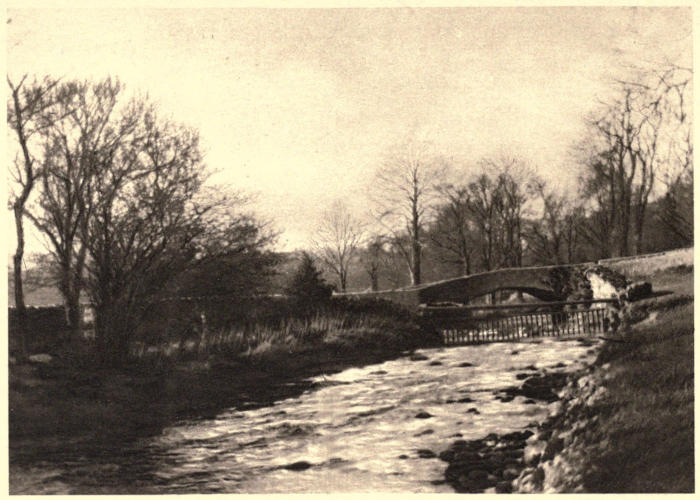
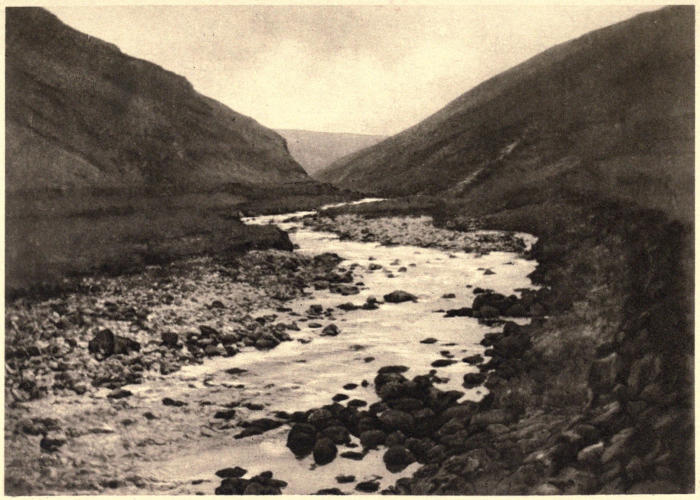
Headwaters of the Aire
Photo by N. N. Lee
Wading now a few yards across stream, the angler
continues this system of casting until he eventually
reaches a point from which he can assail the trout
that was noticed rising at the tail of the main stream.
A few more steps then bring him to the far bank.
To fish a stream or length of river systematically,
crossing and recrossing, each time a few yards higher
up, until the whole has been thoroughly covered, takes
time; but it is far better that the angler’s flies should
be on the water, searching every spot fit to hold a
fish, than waving in the air while he moves rapidly
on from stream to stream. Particularly is this the
case in Spring when the rise comes on late and ends
early, and also on a Summer’s evening when the water
seems literally alive with fish, so madly do they rise,
but for all too brief a spell. Time is of all importance
on such occasions, and here it is that the angler who
fishes methodically and with intelligence scores so
heavily as compared with the rod who spends half
his time in walking from stream to stream, and the
other half in fishing them in a mechanical sort of way.
So many unsuccessful fishermen only fish the larger
streams of a river (and usually downstream), entirely
ignoring the fact that, while such streams afford a
harbour for a great number of fish, they are often
deserted in favour of odd corners and favourite “lies”
directly the “rise” begins.
The thoughtful fisherman studies the water, its
pools, currents and eddies, and all those other details,
the meaning of which under varying conditions he has
learned to read, and he is always alive to gather some
new hint. He brings to his aid the wisdom gained
by past experiences, successes and failures, and a
knowledge of the habitat of the trout which has been
the reward of keen observation and a reasoning mind.
He will tell you that in early Spring the trout,
having hardly recovered their energy after spawning,
are not to be found in the heavy rapids, but may be
looked for at the tail ends of streams and in gently
flowing water; that, as the weeks go by, and as the
sun’s rays warm the water, insect life becomes more
plentiful, and that the trout, once more lusty and
strong with the abundant supply of food, spread
themselves over the river, into rapid streams and all
those places into which steady supplies are concentrated;
and further, that during the heat of Summer
they will be located in the thinnest of water, at the
very edges of streams, pools and eddies, where they lie
ever ready to dart away at the least suspicion of danger.
Such an angler realizes the necessity of a good knowledge
of insect life, watercraft and the habitat of the
trout, and becomes as intimate with each as an artist
is with his colours. And as blue and yellow combined
will make a green, so surely will the man who thoroughly
acquires such knowledge be a long way towards being
numbered amongst the elect.
A goodly dish of trout hardly come by is a great
satisfaction to a man who has to fit in his fishing days
when he can, but perhaps the greatest pleasure to the
true disciple of Walton is the capture, after many
failures and disappointments and under difficult
conditions, of some wily old trout whose education,
by the constant bombardment of his stronghold, has
been brought to a high degree of finish. What memories
of his capture crowd the mind when some chance word
stirs the chords! Perhaps he came from out a moorland
stream when the snell wind flung back the spray from
every sounding fall, or may be he stubbornly gave up
his virile life on some sun-steeped day when first the
daffodils proclaimed that laggard Spring had come to
a waking country side. Whatever the memory, it is
wholly delightful.
The charm of fly fishing is never ending and a great
part lies in the infinite field for experiment open to
him who runs. Every day some new feature is revealed;
and, even in this twentieth century, he who will leave
the beaten track, bent on exploration, will always
discover new ground for investigation. The truth of
this was brought home to one of the writers most
forcibly when on a fishing expedition one July some
years ago.
Rain on the previous day had left the river slightly
coloured, and in magnificent condition, and as the sun
was some little way above, though nearing the horizon,
he, with the lightest heart and full of hope, approached
a steady flowing reach where the banks were here and
there fringed with clumps of willows.
A fish rose well out in the stream, then another,
and another; and as the tackle had been fitted up
before leaving the farm-house, even to the putting on
of a cast of flies, it was not long before those fish, which
were apparently seizing every fly that passed over
them, were covered again and again. All to no purpose,
for the trout proved very discriminating, and at last,
when a fish half rose without breaking the surface of
the water, a change of fly was decided on.
Hovering round the willows, dancing to and fro in
the air, were hundreds of insects, which on examination
proved to be Light and Dark Silverhorns. Five
minutes had barely elapsed when, with a Light Silverhorns
to replace his point fly and a Dark one as first
dropper, the angler was again assailing his fish; but he
could get no more satisfactory response than a bulge
or two. Then the position of these two flies was
reversed, a step which often pays, but it did not on
that occasion.
The case was becoming desperate, for the rise would
soon be over. So with some reluctance he left the
rising fish and waded into the stream and put his
flies into a likely looking eddy below an overhanging
willow bush growing on the far bank. Almost immediately
a fish was battling for dear life, but without
avail; and soon five more, all coming from under the
bank, quickly joined him in the creel.
As the last of these fish was being drawn over the
net, two local anglers appeared on the scene. Neither
had killed a fish, so a few precious moments were taken
up in wading out and giving each one or two of the
killing fly.
When the rise was over the angler counted eight
brace of nice sizable fish, all but two being killed on
the Silverhorns, the exceptions having fallen to the
Brown Owl, which was probably taken for the Light
Silverhorns. All came from under the willows and
banks on a reach no more than fifty yards in length,
but strange to say, the local men finished up without
a fish to show between them.
Later on, when considering the events of the evening
between the sheets, it occurred to the successful one,
that the killing fly of the evening was a killing fly
only so long as it was fished close to the banks near
the willows, and in those places over which hovered
the natural fly. The locals had evidently fished the
fly out in mid-stream; hence their clean creels.
The following day was a Day of Rest, and as this
idea was after all but surmise, nothing was said to the
two local fishermen, but the results of the next evening’s
fishing were awaited with considerable interest.
Conditions on the Monday proved to be very similar
to those prevailing on the Saturday, and the results
of the day justified the surmise, that the fish under
the willows were feeding on such insects as hovered
above them, every now and then to touch the water,
while those out in mid-stream had no Silverhorns
available and so confined their attention to the spent
spinners, smuts and other flies, which were brought to
them by the current.
If the solution of the problem that presented itself
on that first evening be correct, then the killing power
of a fly is often dependent on its being fished with
due regard to the haunts of the natural insect it is
supposed to imitate. What a field is here for investigation,
and yet the matter is one upon which no hard
and fast rules can be made. Prevailing conditions
must be studied carefully. A cross-wind might obviously
entirely alter the local conditions, and one would not
look in such circumstances for flies in their usual haunts.
On windy days the observant angler would probably
find that the menu of the fish on the side from which
the wind was blowing would include many Diptera or
other land-bred insects, while the fish on the lee shore,
would most likely be feeding principally on such
insects of aquatic origin as happened to be hatching
out at the time.
The foregoing merely serves to illustrate a few of the
many considerations involved in this absorbing sport;
and in following up these problems many side issues
of equal importance will be opened up.
If the beginner is dogged by disappointment and
failure (and who can feel the utter bitterness of disappointment
more than a fisherman?), let him be advised
to take heart of grace and not to blame the lowness of
the water, the brightness of the day, thunder or any
of the elements, for his lack of sport, but to say to
himself, “What have I left undone that should have
been done? Where have I failed?” For trout, like
human beings, take their daily bread; and it is up to
the angler to find out when and where and in what
shape. If the beginner will therefore reason out the
causes of failure instead of making excuses for it, he
will be more likely then and on future occasions to
remedy his mistakes and to know the satisfaction of
killing fish on a really difficult day.
Next to be considered are the dry fly and its use on
the North Country Rivers; but the novice is strongly
urged, before ever he seeks to master this branch of
angling, to get a good grip of the wet-fly method.
From the term “North Country Rivers” are naturally
excluded such rivers as the Costa, which is probably
the nearest approach in the North to the Chalk streams
of Hampshire, the home of the dry fly. On that
particular river the dry fly would probably on most
occasions take the premier position, whereas on the
rougher and more rapid streams, such as the Wharfe,
Ribble, Lune, etc., the position is reversed.
Not many years ago one very seldom came across
anyone further North than Derbyshire fishing the
dry fly, but slowly and surely has the method become
more and more popular; for it is only by the judicious
combination of the two methods of fly fishing that the
best results and the greatest pleasure can, in the judgment
of the writers, be obtained. But chacun à son
goût, and far be it from them to legislate for any
sportsmen who wish or agree to keep their waters
exclusively for any one method of fishing.
Dry-fly fishing, as practised in the South, differs
slightly from the method here advocated for the
rougher streams above-mentioned, inasmuch as the
purist of the South will not throw a fly to any but a
rising fish, even though he wait an hour or more
before locating one, while the North Country angler
not only throws to the rise, but also to such places as
are likely to hold feeding fish.
When a specially strong hatch of duns takes place on
Northern rivers and the fish line up to suck in the
insects as they hurry downstream, sails spread to the
breeze, it will pay the angler to try the floater. Again,
between streams on rapid rivers one often comes upon
a long stretch of quiet steady flowing water ideal for
the dry fly. By applying themselves to such a stretch
with the methods of their friends of the South the
writers have more than once retrieved a bad day.
Quiet eddies too may frequently be fished with success
by this method, and every river has some places, and
is subject to some moods, in which the dry fly scores
over the wet.
The first experience of one of the writers in dry-fly
fishing was years ago. He had fished for grayling
till noon on a bright frosty October day with indifferent
success, when, on reaching a long stream with the
current under the far bank, he noticed several fish
rising at the tail. In between himself and the fish was
a wide stretch of water some twelve or eighteen inches
in depth, and the fish were out of reach, as the angler
was not wearing waders.
Now the occasional fish he had managed to reach
during the course of the morning absolutely refused
the wet fly.
At the moment another fisherman appeared from
upstream and, wading out, immediately caught several
nice fish, to the no small envy of him on the bank.
Before passing on the successful angler vouchsafed
the remark “dry fly,” and gave the writer in question
the “oil tip” in theory and in practice.
Off came boots and stockings, and, with the shallow
water safely waded, the rising grayling were within
casting distance. So long as the fly—a Red Tag—could
be kept dry, so long did the fish rise at it, but they
would not look at it when water-logged. Between whiles
the angler came to shore to stamp a bit of feeling into his
legs, for the water was icy cold; but he enjoyed himself
hugely and got quite a decent bag, besides adding greatly
to the scope of his accomplishment in the gentle art.
The writers have seen the dry fly score heavily
during the rise of Iron Blue Duns, and they remember
one occasion when that most dainty and beautiful
Ephemera was sailing down in numbers, and when a
feathered imitation accounted for six brace of fish
from a weed-grown reach of steady flowing water.
A word here must be said with regard to the timing
of the strike when using the dry fly, for the man who
is used to wet-fly fishing will probably strike too quickly
and at the most only prick his fish. In the former
method, before attempting to drive home the steel,
the fish should be allowed to turn with the fly in his
mouth. In wet-fly fishing the fish has often turned
before the rise becomes apparent.
Many occasions could be mentioned on which the
dry fly has given the writers most pretty fishing.
Once on a Cleveland stream, slow flowing and edged
with most luxuriant vegetation, the wet fly, cast over
rise after rise, was totally ignored, but a change to a
floating Female Black Gnat at once worked wonders.
Had it not been for the innumerable derelict branches
and water weeds in which the cast was time after time
tied up, the creel would have been heavy. But the
enjoyment was intense that glorious June evening.
Quite sharp streams too will often fish well with the
dry fly in the long evenings, and on one occasion it
was again the Female Black Gnat which accounted
for some difficult Wharfe trout that refused all wet
flies, however presented. It is indeed during the evening
rise that the dry fly will be found most generally
useful on Northern streams.
That fickle evening rise that so many anglers
impatiently wait for all day, only to return home
beaten and disappointed at dark! Not that the fish
do not rise, for at times the water literally boils with
them, but their discrimination is truly wonderful.
How many an angler on occasions during all that mad
rise has never killed a fish, or not until the sun had
dropped well behind the horizon and dusk was upon
him. Then perhaps he has creeled four or five before
the rise ceased, but has returned home dissatisfied,
realizing that he had been thoroughly beaten, and
that it was the failing light, and not his skill, knowledge
or ingenuity, that saved him from a blank.
An autopsy will often reveal on such occasions
spinners, gnats and sedge flies; and yet the most
lightly and carefully made imitations, however deftly
thrown, utterly fail as wet flies to attract the fish.
At times like these a Black Gnat, Ginger and Red
Spinners No. 35 and No. 36, fished dry, and later, as
the sun drops behind the horizon, a Silver Sedge may
be recommended.
The angler should begin at the tail end of the stream
and work gradually up, placing his fly over every rise
and in all such places as are likely to hold feeding
fish.
On occasions when all else fails, a trial may be given
to a fancy fly, such as the Pink Wickham or Coachman.
With such patterns during that most tantalising of
rises the writers have sometimes retrieved their
fortunes. Then, as dusk comes on and the dry fly
becomes difficult to see, let the angler quickly change
to a cast of wet flies, the flies dressed a size larger
than those usually used during the day, and before
the rise is over his creel may be the heavier for the
change.
The dry fly has done yeoman service on some of
those impossible days when fish streak away like
lightning directly the cast falls on the water. By
much stalking and careful fishing of out-of-the-way
places and odd corners, the writers have sometimes
finished with a brace or two which have given great
satisfaction.
It is very comical to see the evident surprise of a
fish which is taken in by a dry fly when he is quietly
feeding in the shallows. Before he moves off for the
stream he often seems to completely lose his head,
bouncing about half in and half out of the water, and
creating no end of a splash. On one occasion within
the writers’ experience under such circumstances a
trout landed himself high and dry on the shingle
where he broke the hold, and, continuing his antics,
regained the water. Long ere this he must have made
room for his descendants, as agile, let it be hoped, as
himself.
How inordinately fond trout must be of the
“fisherman’s curse”—a term which covers, no
doubt, several varieties of fly—for it will be found
to have occurred in the trout’s menu with unfailing
regularity throughout the summer and autumn. It
almost always is the fly which the trout pick off the
surface of the water when they rise in the quiet flats
the livelong day, days which, most anglers will agree,
are usually the most difficult. Sometimes something
may be done with Ginger or Red Spinners, wet or dry,
under such conditions, when imitations of the “curses,”
probably on account of their size, fail to attract.
The Ginger and Red Spinners described have only
by degrees worked their way into the inner circle of
the writers’ flies. Experience has proved their usefulness,
for they will often be taken when all else fails.
These dry patterns have killed fish under particularly
difficult and hopeless conditions; and their use is
recommended with the greatest confidence.
Such then is a brief outline of the occasions on which
the dry fly has been found to be of most use to the
North Countryman; but no hard and fast rules can
be made, for the angler’s discernment must play the
greater part in regulating his actions, and the foregoing
hints are merely given as some small guide to the
beginner. But let all who try the dry fly beware of
drag; it will ruin the chances of the most artistic cast.
Anyone with designs on dry-fly fishing on Northern
streams may well confine himself to a few of Mr.
Halford’s patterns, say the Olive Dun, Dark Olive Dun,
Iron Blue Dun, and Black Gnat, with the addition of
the Ginger and Red Spinners, Nos. 35 and 36, the Red
Quill, and the Silver Sedge, and a fancy pattern or two,
such as the Coachman and Pink Wickham, for use on
occasions described above.
A great debt of gratitude is due to those who introduced
the dry fly and developed its use so whole-heartedly,
for there is a charm about dry-fly fishing
which is distinctive, and a fascination that almost
defies description in watching a neatly cocked artificial
fly approach the rings made by a rising trout. A
moment of suspense, intense excitement, followed by
joy supreme when a timely strike is rewarded by a
tightened line. So, apart from its being an asset in
the filling of the creel, the dry fly increases the pleasures
of the gentle craft to a very great extent, a craft as
unique in its scope and variety as it is intriguing in
its difficulties. The whole setting of the craft enhances
its enchantment and give it a hold upon its followers,
powerful as that of friendship, converting them into
ardent devotees for life. Whether one follows its
calling in the flower-starred water meadows of the
South, or explores the rivers of the “stone-ribbed
North,” the peace and beauty of the surroundings, far
from the noisy crowd, add a charm which every good
fisherman knows how to be thankful for.
Broken Water
Photo by Mr F. Creedy
How pleasant is the time of the after-luncheon pipe,
with the dipper curtseying from the stones in mid-stream.
May be the desolate call of the curlew floats
down from the fells, and the grey dale village, with its
quaint architecture, speaks of times long past, of times
when the Borderers filed down the valley, perhaps
to fall upon a party of Monks from the rich Abbey of
Fountains. Imagination suggests to the ear the savage
shout of exultation of the assailants and the screams
of the stricken, when a widening circle in the stream
brings one back to present day realities in a second.
Such is a part of the angler’s day, which, lingering
in the mind, inspires him through the long wintry
months to look forward to the time when God’s earth
shall be fresh and green again, and the wild thyme be
fragrant on the banks of many a North Country stream.
Great men and small alike are held by the wonderful
fascination of the sport, which gives such joy, affords
such relaxation to the mind, and is so free from all
taint of brutality. And though the actual angling
requires the utmost concentration of mind and thought,
yet after all, it has truly been described as “The
Contemplative Man’s Recreation.”
Chapter III. CREEPER AND STONE FLY FISHING.
There are not many streams in the North that
have a distinct rise of May Fly or Green Drake,
and for that reason the writers have not given any
dressings of that fly, nor do they propose to devote
space to a consideration of May Fly fishing. To make
up for the loss of that beautiful Ephemera there is
on most of these rivers the sober-hued Stone Fly, whose
season almost coincides with that of the May Fly.
The flies are very different. The one, elegant and
dainty, is to be seen one moment floating with wings upright
upon the surface, then drifting in the breeze, while
the other, dark coloured and of unprepossessing aspect,
merges from the Creeper stage only to scuttle under the
stones and remain quietly in darkness till nightfall,
making off once more for obscurity if by chance its
whereabouts is revealed.
The Stone Fly has four wings, which in repose are
folded flat over the back. It passes the greater part
of its existence in the Creeper state, in which it can
be found during the latter part of April and throughout
May under the stones in shallow water near the edges
of streams. The Creeper varies in colour from an
olive green to a dull dark brown, strong yellow showing
at the junction of the segments of the body. It is of
somewhat repulsive appearance, and measures from
half an inch to nearly an inch in length. It has six legs,
two caudal setæ, and two antennæ.
It is often difficult to collect a supply of Creepers;
not that they are particularly active, but the disturbance
of the water caused by lifting the stones is
apt to hide them while they wriggle under other stones.
It is stated that if the angler, wishing to secure a
supply, stands with his back to the current of the
river and holds his landing net upright before him
with the top of the net resting on the river bed, and
then shuffles his brogues amongst the stones, the
Creepers displaced by his activity will be washed into
the waiting net and a plentiful supply be thus secured.
The writers have never been particularly successful in
this device, but that is no reason why others should
not try it. The Creepers obtained are best kept in a
tin box, together with a little damp moss.
There is no doubt that the Creeper forms an
important item in the trout’s menu in Spring, as an
autopsy of the day’s catch at that time of the year
will reveal; and many is the Creeper that has been
grabbed by a watchful fish as it ventured from out
its hiding place, or that has been torn from beneath
the stones by a questing trout. Creepers are very
plentiful in those North Country rivers which have
the typical stony bed, but the season of the Creeper
being April and May, the writers do not often fish
it, nor is Creeper fishing generally much followed, as
during that time of the year fly fishing is at its very
best. Still, if on occasion the reader has found his
most carefully dressed flies fail to rise a fish—as they
will sometimes even in Spring—he might do worse
than collect a few Creepers, as this method of fishing
forms a pleasant variant of the fisherman’s craft and
throws a further light upon the habits and life and
whereabouts of the trout.
The line should be well greased, and the cast (as in
fly fishing), three yards tapered down to finest drawn
gut with a form of Pennell tackle at the end, having
the lower hook a size larger than the upper one (this
latter being size No. 3 in the scale before mentioned
on page 8). The bend of one hook should be five-eighths
of an inch from the bend of the other, the
hooks to be whipped on with olive green silk for
preference. The fly rod and line complete the outfit.
The end hook of the tackle should be put through
the Creeper almost at the extremity of its tail, where
it is toughest, and the other hook in the unhappy
beast’s shoulder, not the head, as the head is liable
to tear off.
The fishing should be done upstream and the Creeper
cast gently, with an avoidance of jerk. The fly fisherman
will soon instinctively feel the amount of power he can
put into his casts. The rod point must be raised
slowly as the bait trundles down, so that there is no
drag. When the line stops or draws away, the angler
tightens at once; otherwise the fish may eject the
bait.
The most productive places in Creeper fishing are
usually the edges of the streams, but rougher water
and the necks of streams will often yield fish; and all
places where trout are known or expected to be should
be tried, particularly about boulders and where a
current in the river is contracted into a narrow run.
About the last week in May the Creepers will be
found to be quitting the water and fastening themselves
to the rocks and stones on the river’s brim, to
the buttresses of bridges, and to those rocks which
stand out above the water. Here it is possible at
times to watch the Stone Fly emerge through the
slit in the back of the Creeper, leaving the perfectly-shaped
skin rigid behind it, although in general Stone
Flies hatch during the night.
Once the Fly is hatching in numbers, the carnival
begins, although very few are to be seen unless they
are searched for. An odd fly may be seen occasionally
being carried down the stream or paddling across a
shallow, but for the most part the Stone Flies lie very
close in their hiding places beneath the stones near the
water. Consequently the ideal conditions for Stone
Fly fishing are when a fresh of a few inches comes
suddenly down the river and washes them out of their
hiding places.
The large females with the long wings are usually
preferred by both fishermen and trout; the fishermen
find them easy to see on the water, and the trout no
doubt find them a satisfying mouthful. The males
vary in size, although they are smaller than the females
and have shorter wings; the smallest males are difficult
to see when cast on the water and soon become water-logged;
the larger males are almost as good as the
females. The males are called “Jacks.” If males are
used, the hooks of the tackle should be nearer
together than the hooks in the tackle usually used in
Stone Fly fishing.
It is not as a rule difficult to collect a supply of Stone
Flies, but the males greatly outnumber the females.
As they are picked up they can be placed in one of the
Stone Fly boxes sold for the purpose, a transparent
one for preference. The tackle and rod line and cast
for Stone Fly fishing are exactly the same as those
described for Creeper fishing, and the fly should be
put on the hooks in the same manner as the Creeper.
The fishing should again be upstream and the Stone
Fly be cast as in Creeper fishing; but, whereas the
Creeper is fished under the water, the Stone Fly is
fished on the surface, as it loses much of its attractiveness
when water-logged. It will stand a fair amount
of knocking about, but jerks should be avoided, as
tending to throw the fly off the hooks.
The Stone Fly accounts for some large fish, and
sometimes those old warriors that have passed the
regular fly-taking stage, and have become wily and
big, succumb to its charms. Therefore it is well to
remember that all places which harbour a trout will
often yield one under proper conditions; and, although
the streams fish about as well with Stone Fly as with
anything else, it should not be forgotten that trout,
when on the feed, very often leave the streams for
shallow water, and for any vantage point where the
current concentrates all the flotsam and jetsam from
yards above into one narrow channel, and that they
love to haunt the neighbourhood of rocks and boulders.
The Stone Fly will kill many fish which are not
strictly on the feed, but which cannot resist the
temptation to make the most of the Stone Fly season
when a great juicy female fly floats overhead. If the
reader bears this fact in mind he will seize the opportunity
in the early summer to get the big one which
has so often waved a vanishing tail at his flies.
The size of the fly is against its being sucked in as
easily as the usual artificial, and it is of advantage to
give a moment’s grace before striking when a fish
rises. Never to be forgotten is the disappointment of
a too hasty strike one lovely early June morning.
The angler was out before the sun topped the fell,
and a few brace were already in the creel, when he
reached a perfect eddy at the side of the main stream.
The Stone Fly was cast secundum artem (would that
the further proceedings had been on the same plane!).
It had hardly alighted when a big fish came up like a
porpoise. Alas! quick as light the eager one tightened
without allowing the moment’s grace, down went the
fish and played strongly, facing the current and giving
heartrending jars to the line. Confidence was beginning
to take the place of fear of a light hold, when up the
beauty came, headed into the stream and came down
with all the force of its waters thrown into the scale.
He was just opposite the angler when the rod flew up,
and that sorrowful angler saw no more of what would
undoubtedly have been his big fish of the season.
The charm of Stone Fly fishing is truly enhanced
by the season of its use. What could be finer than
the river side in the latter days of May and early June;
and a turn before breakfast at that time of the year
is a delight to be remembered the winter through.
Besides, a good creel when fish are not so terribly difficult
to kill is like all success honestly come by, a delight
to the heart and a pleasure to one’s friends.
Chapter IV. UPSTREAM WORM FISHING.
No book devoted to the subject of the fishing of
North Country rivers would be complete without
a chapter on worm fishing.
This branch of the sport, has during recent years
become more and more popular in the Northern
Counties, as worm fishing, under the conditions mentioned
later, undoubtedly deserves to be classed as an
art alongside of the highest forms of fly fishing.
Indeed, in its difficulties it exceeds fly fishing, both
wet and dry.
There remains, however, still a certain amount of
prejudice against worm fishing among fly fishermen,
who continue to look upon it as unsporting and
therefore beneath the notice of a self-respecting fisherman.
But the prejudice of these men is probably
largely due to their misconception of the term. For
while trout can mostly be caught by any in a fresh
with very elementary tackle, it takes an observant
and persevering man to make a basket under conditions
suitable for sporting upstream worming.
The use of the worm during the first few months
of the season cannot be defended, whether the river
be low and clear, or running strong with the Spring
freshets; for seldom a day passes at that time of the
year without a rise at some part of it during which
trout will take a fly, and, while that is the case, what
true disciple of Walton would use any other lure?
The season therefore when the worm can fairly be
used is restricted to the time of low clear waters
during the hottest part of the summer, when the trout
have ceased to rise freely to the fly in the day-time,
a period of some eight or ten weeks, beginning about
the 10th of June. The Stone Fly is usually over by
that date. Any antipathy to worm fishing under those
conditions in our North Country Rivers is difficult to
understand, for it provides a most sporting variety of
fishing during the blazing days of summer when the
fly is hopeless. And unless a man is prepared to work
hard in the blistering sun, unless he has a good
knowledge of the habits of trout, and is able to show
a fair amount of skill, both in approaching his fish and
in throwing the worm, his basket will be a light one.
Many are the days during the latter part of June
and the month of July when the man who fishes fly
only will return home with but an odd fish or so to
show for his day’s outing. That may satisfy the
gentleman of leisure, but to those who can devote to
their favourite pastime only such days—often few and
far between—as can be snatched from business, the
killing of a few brace will appeal strongly.
To them in particular this chapter is addressed in the
hope that some of those who, through prejudice, use
fly only will reserve judgment, and, having read so far,
may be sufficiently interested to read to the end of
the chapter, and maybe to put into practice those
hints which are here offered on one of the most delightful
branches of trout fishing.
A day with the upstream worm always gives to the
writers the utmost pleasure and satisfaction. Each
cast is as full of interest as a cast made with the wet
fly; and from the moment the worm touches the water
to the moment it is withdrawn, the excitement rivals
that conjured up by the approach of a dry fly to the
spot whence recently emanated the rings made by a
rising trout.
Then again, the skill necessary to throw a worm
without flicking it off the hooks, and to drop it exactly
where required with the least possible disturbance, is
of no mean order.
That is not all, however; conditions vary, and all
rivers from day to day present new problems. Unless
therefore the angler is able to adapt himself to varying
conditions, the most precise and delicate casting is of
little avail.
To divine instinctively where the trout lie is the
great secret of success; and it is the application of
that knowledge that marks the expert in this branch
of angling. To put the matter in a nutshell, an adept
in upstream worm fishing combines delicate and
accurate casting, unsurpassed even by the dry-fly man,
with an intimate knowledge of the habits of trout.
This can only be gained by keen and careful observation.
Neither wet-fly nor dry-fly fishing requires quite
such a wide experience with regard to the habits of
trout, and for that reason upstream worm fishing is to
be classed as an art in itself. The knowledge gained
of the habitat of the trout by clear water worming is
a valuable asset to the wet-fly fisher and may often
be turned to good account on one of those days when
the hatch of fly is meagre and rising fish are few.
Is not this latter reason alone sufficient recommendation
to induce every fly fisher to take up this branch
of the art? If the reader thinks so, perhaps the few
following hints on tackle and procedure may serve as
some guide, particularly if he be a novice and about
to make his initial effort.
The rod is, of course, of primary importance. Many
writers recommend one of 12 ft. in length; and Stewart,
who has always held the reputation of being one of
the finest exponents of upstream worming of his day,
recommends the use of a rod even longer than that.
No doubt a long rod has the advantage of enabling
the wielder to keep out of sight readily, but the writers
seldom use any other than a 10½ ft. fly rod, simply
because they frequently find it advisable to change
from worm to fly and vice versâ.
The reel and line should be the same as that used
for fly fishing, and also the cast (as in fly fishing), a
tapered one of three yards, the last yard being of
finest drawn gut. Then comes the worm tackle. With
regard to this there is a choice of three different
varieties, each having its own advantages, and it is
for the reader to use that with which he best succeeds.
First there is the single-hook tackle, in which the
worm is threaded over the shank of the hook, and is
kept from slipping down by a crank at the top. The
advantages of this tackle are that most of the hook is
hidden, being buried in the worm, and, the hook being
fairly large, a good hold is got upon a fish when hooked.
Second comes the two-hook or Pennell tackle. In
this case two small hooks are used, one being whipped
on to the gut an inch above the other. The upper
hook is put through the worm a quarter to half an inch
below the head, the worm is then twisted once round
the tackle between the hooks, and the lower hook
is put through the lower end of the body. This is a
very good form of tackle, and is the one preferred by
the writers, as the worm lives longer on it than when
threaded on a single hook, is livelier and has a more
natural appearance in the water. The hooks should be
size No. 3 in the scale before mentioned on page 8.
Third comes the Stewart tackle, which is the same
in form as the Pennell, except that it has three hooks
one above the other, instead of two. This is a tackle
the writers have very seldom used, and they are
therefore, perhaps, hardly competent to speak of its
merits. Their experience, however, leads them to
think that the three hooks cannot be sufficiently well
concealed by the small worms which it is imperative to
use in low clear waters, and that therefore the trout
have a better opportunity of detecting the deception.
The next point in the outfit is waders, and these
are absolutely essential if the best is to be got out of
upstream worming. The fish must be approached
from almost directly behind, which is impossible in
most cases if the fishing is done from the bank.
Lastly, the angler should always carry a few small
leads or sinkers which can be easily put on and easily
removed. Split shot in various sizes, hammered flat,
will do quite well. They will not often be required,
but it is always as well to have them handy for the
odd places where their use is necessary, which are
described later.
And now a word as to worms. “Maiden dews,” so
often advertised, are not the best for the purpose,
but those known as “Pinktails” are the real thing;
they should be small, say 2 inches in length, and of
a pale pink colour. They should, of course, be well
scoured, and they can be carried in moss in a bag
hung round the neck.
With regard to throwing the worm, the two aims
never to be lost sight of are accuracy and delicacy,
and this combination can only be attained by constant
practice. The man who can cast a fly will soon get
the knack of putting the worm where he wishes, if
he remembers that, when throwing the worm, the
action is slower and more of a swing than in casting
a fly, and that the rod point should be brought rather
nearer the water at the finish of the cast. In addition
to this, the arm should be pushed forward just as the
worm is about a foot from the mark, in order to obviate
any recoil and ensure that there shall be little disturbance
of the surface as the worm drops into the water.
The greatest trouble of the novice is the frequency
with which he flicks the worm off the hooks, particularly
if the day’s supply has not been well scoured. To
master this trouble all jerks must be avoided, both
when withdrawing the worm from the water and also
when the cast is extended behind. As before stated,
the movement should be more of a swing than in fly
casting, with just sufficient power to extend the line
behind and the same in front; there will then be few
lost or broken worms.
The next and, without doubt, the most essential
point for consideration is where to fish.
Imagine a bright day towards the end of June on
the banks of a typical North Country river. The gate
just passed through brings one to the tail end of a
rapid stream some fifty yards in length, broken here
and there by boulders, some submerged and others
just showing their dark mossy heads above the surface
of the water. At the head of the stream there is a
line of submerged stepping stones which no doubt
many years ago, before the bed of the river changed,
served a useful purpose.
This stretch of river from bank to bank is nowhere
more than two feet deep, except in the middle a few yards
below the stepping stones, where the current is strongest
and where it has dug out a deeper channel. The
beginner looking at this stream immediately notices
the darker tone of water denoting the deeper channel
and concludes that, of all places in the reach, that is
the most likely to hold a good fish. Let him not be
misled; the deeper channel holds many good fish,
but of all parts of the stream, that channel is the
least likely place from which to basket one.
The Head of the Dale
Photo by N. N. Lee
Often have the writers seen men enter this stream,
and wade straight out to the deeper water, unwittingly
driving scores of trout in consternation before them.
They fish the deeper rush of water, are rather surprised
that it does not yield a fish, and then move up the
river to the next stream, splashing right through the
best water as they go. These men, more often than
not, return home with a creel lighter than it was before
they ate their mid-day meal; and, besides doing
nothing themselves, they make it absolutely impossible
for another following on, to fish the stream with any
chance of success within half-an-hour of their having
disturbed it.
The way in which a friend, an adept at clear-water
worming, would approach and fish this stream is very
different. Here is a description of his method.
He enters the reach at the very tail end, where,
at the edge, the water ripples along some two or three
inches deep. The manner of his beginning may be compared
to an otter’s in the quietness with which he enters
the river; there is no splash or disturbance, and, more
probably than not, he will stoop to avoid being seen.
He will make the first cast straight upstream, the
worm entering the water twenty-five or thirty feet in
front of him, but only some six to twelve inches from
the bank.
Many beginners have laughed at the idea of a fish
being caught in such a place, but let the unbelievers
walk on a bright summer’s day along the bank of a
trout stream, and what do they see? Innumerable
fish darting away from the edges of the river, scared
at their approach. It is for these very fish that our
expert intends to try, when he makes his cast at the
extreme edge of the river.
Directly the worm reaches the water, it begins to
travel naturally and without drag towards the angler,
who slowly raises the point of his rod, keeping in touch
with the worm so that a twist of the wrist will immediately
drive the hook home if a fish takes hold. He
is careful to avoid drag, which is fatal, and is usually
caused by the too rapid raising of the rod point.
Without moving his position he makes another cast,
only this time slightly more across the stream, then
another and another, each being further from the bank.
He now wades gently a yard further upstream. In
front of him, and just within casting distance, he
notices an obstacle which causes a tiny eddy. The
object is little more than a good-sized tuft of grass
jutting out from the bank, but even that so alters
the flow of the water, as to form a likely feeding place
for a fish. The cast is carefully made and the worm
falls into the water as though it had crawled to the
edge of the grass and dropped in.
Almost as soon as the worm has touched the water
the current carries it gently, and quite naturally, into
the eddy. The line stops, our friend withholds his
hand, and it is not until the line moves slightly towards
the main stream that he gives a turn of the wrist,
driving the hook home into a nice half-pound fish.
For a moment it splashes dangerously in the shallow
water before making off for the deeper stream. The
hook, however, is well home and the captive is quickly
brought down and drawn over the submerged net.
“Well!” says an uninitiated onlooker, “who
would have thought that a fish would have been so
near the edge, and in such shallow water too?” The
more you fish the upstream worm, the greater will be
your astonishment at the number and the size of trout
caught in such places.
Having basketed his fish, the angler rebaits his
tackle, and then gently moves a yard further upstream,
repeating his systematic casting. In this manner he
stalks his quarry up the one side to the head of the
stream. Yes, “stalk” is the word which most
adequately describes this man’s methods, as he takes
the greatest pains to avoid being seen. It is work,
and hard work too, on a blazing hot day; but it pays,
and it is only necessary to see the expert’s basket
at the end of it to be convinced. There is always a
good dish of fish, and, as often as not, a very large fish
to top off with.
The stepping stones having been reached, our friend
leaves the water. Keeping well away from the edge
he returns to the tail of the stream and wades some
eight yards across. His first cast is made upstream
and slightly towards the bank he has just left, the
next one more directly in front, the next inclined
towards the opposite side, and so on until he is casting
more and more towards the far bank. Yard by yard
the stream is covered in this manner, as the angler
works upwards until two or three boulders are within
casting distance, one showing distinctly above the
surface of the water, while the others are detected
only by the broken surface of the stream.
This is another very likely place, but our friend
prefers the edges of the stream and thinner water to
such places, although the latter are often good for
two or three fish. The first cast is made towards the
near bank, but without result. The second also fails
to entice a fish, although the worm was dropped just
by the side of one of the submerged boulders. At the
third cast, however, which was made to the other side
of the same boulder, a fish fastens and is brought to
net. The golden gleam of another trout is seen as he
is turned over, but missed, behind one of the other
rocks. Then at the succeeding cast the worm enters
the water about a foot beyond the rock which lifts
above the surface of the stream. The sharp water
running round the side of a boulder forms a favourite
feeding place for a fish; a trout occupying such a
position usually lies with his head slightly in advance
of the rock. The worm has just time to sink before
it is picked up by the stream and carried rapidly down
the run. A fish turns and darts after it. He seizes his
prey as it sweeps almost past the rock, the steel is
gently driven home, and another fish duly joins his
brethren in the creel.
The whole of the stream is worked in the foregoing
manner, the far edge of the river being treated in the
same way as the side on which a beginning was made,
and great care is taken that a tell-tale wave does not
precede the angler.
At the far side, immediately below the stepping-stones,
and lying slightly across stream, is the submerged
trunk of an old tree which lodged there years
ago, no doubt washed down and left by some winter
flood. The position of this tree trunk, resisting the
force of the current, causes a sharp stream to flow
parallel to it. In this run a good fish will always be
found, lying ready to seize whatever of his fancy the
stream may carry to him. A cast is made, the worm
gently dropping into the water some two or three
inches from the side of the log. The rod point is
slowly raised, our expert being most particular not to
do this too quickly, and cause a drag on the worm.
This necessity for avoidance of drag is a point to be
reiterated and insisted on as strongly in this branch
of the art as in fly fishing, as one is often inclined to
think a stream is running quicker than is actually the
case, and an unnatural drag will cause many a good
fish to turn away, that would otherwise have taken
the lure. The worm has hardly travelled more than
half its course, when the line stops. As it moves away
a gentle strike is rewarded by a tightened line, and
another lusty trout is battling for dear life. Upstream
he goes for a few yards, then flings himself into the
air, but a lowered rod point defeats the manœuvre, and
control of the captive is regained as he re-enters the
water. The split cane soon tells on his strength, and
quietly he is coaxed down stream to the net, but
instead of floating in he merges indistinct into the
shadowy water, and an upflying rod tells of a light
hold and the loss of a stout-hearted fish.
Leaving this stream, and incidentally the friend whose
methods have been studied, let the reader give his company
up the river to the next stream; and, to realize
how failure may be caused by wrong approach, let
him listen to an incident which happened to one of
the writers in his early days of upstream worming.
But first the stream must be described.
A long deep pool (or dub, as it is called on the
Eden) breaks away in a short characterless rapid,
narrowing towards the tail and then rushing under
willow trees which hang right out over the river from
the right bank. The strong stream has dug out a
deep channel under these willows, while the left or
near bank is a bed of fine gravel gradually sloping
into the deeper water at the far side. This deep
channel holds many good fish, but they are quite
unassailable so long as they remain well under the
willows.
Now for the incident. The day was blazing hot,
the month July, and the river low and clear when
the writer in question first essayed to fish it with
the worm. Entering the water at the tail of the
stream, he waded out as near as possible to the willows,
which, as described, were on his left. Casting straight
up in front of him he cherished the idea that the
stream would carry the worm under the willows to
the place where, it was hoped, the best fish would lie
feeding. So far, so good. In this manner he worked
to the top of the stream without a touch, when a final
throw was made, pitching the worm into the water
just where it rushed hardest under the willows.
Almost before the worm touched the water, the
dark form of a large fish, some three or four pounds in
weight, shot from the shallows on his right, to his holt
in the deeps under the willows. This fish had been
lying in the very thin water at the tail end of the
rapids, no doubt seizing every morsel that came
within reach, but ever ready to dart into his stronghold
on the least sign of danger.
On the two following days the same thing happened,
when it occurred to that youthful angler that his
approach had been all wrong, and that if he had
worked the thin water first, leaving the deeper channel
until the last, success might have attended his efforts.
But reflection had come too late; he had to leave,
and he never saw the fish again.
There is another moral to the incident; although a
deep inaccessible pool may be the stronghold of the
largest trout, they will, during the hot summer months,
frequently come to the thin edges of the stream to feed.
Another personal experience will perhaps serve
to illustrate other possibilities. Towards the end
of June, after seven weeks’ drought, the writers went
to the upper reaches of a North Country river,
where, thanks to the generosity of the proprietor,
they were permitted to have a few days’ fishing.
Owing to the long spell of dry weather the river, which
at the best of times is there little better than a good
sized beck, had shrunk to a mere trickle with deep
pools here and there. The whole bed of the river was
thickly coated with a green slimy growth.
Local opinion had it that fishing was waste of time
until a good flood came to clean the bed of the river.
Enthusiasm prevailed, however, as it was the first
opportunity one of the party had of fishing this stretch,
and the chance was not one to be missed, even though
the prospects held out no great hope of success.
Up to about noon on the first day he who was
strange to the water had never a fish to show for his
efforts, although the trout were there and plentiful.
What with the oppressive heat and persistent
failure, much of the keenness of early morning had
worn off, and it was with a feeling akin to relief that
the angler unslung his creel and threw himself on to
the bank where he might enjoy a cigarette under the
cool shade of the trees.
As the wreaths of smoke curled upwards, the
unsuccessful one, with his back propped against the
trunk of a tree, began to survey the stretch of river
above him. Both banks were bordered by trees and
clumps of willows for a distance of some two hundred
yards. The water was nowhere more than two feet
deep and so slight was the current that it was almost
imperceptible. Not a ripple broke the surface of the
stretch from end to end. It was like the proverbial
“sheet of glass,” and, had it but been able to reflect
the expression on the angler’s face, nothing but
disappointment would have been revealed.
At length he jumped up with the intention of
exploring the higher regions of the river and as he did
so several fish, scared at his proximity, darted from the
edge. Those trout decided the course of action, and,
although the reach was to all appearances hopeless,
the angler determined to try for some of the fish that
were lying at the very edges, apparently basking in
the sun.
Wading a stretch of water such as this, was most
difficult, necessitating the utmost caution and slow
approach, if the tell-tale wave were to be avoided.
For obvious reasons it was essential that the angler
should keep as close in to the willows on his side of
the river as possible, and cast as long a line as he
could control. Every time the worm was allowed to
sink to the bottom, it was fouled with the vegetable
growth on the stones. This happened almost every
cast, and just as the angler was beginning to think
that nobody but a fool would ever try to fish such a
place, he came within casting distance of a narrow
opening between the willows. Throwing carefully
round the trees, the worm was landed within a few
inches of the bank. There was a wave such as a trout
makes when darting from the edge, and for the fraction
of a second he thought that the slight disturbance
caused by the worm dropping into the water had
scared the fish. But no! the line quivered, then
moved slightly, and, in response to a well-timed strike,
the rod bent to the fight of a good half-pounder,
which gave that thrill of satisfaction which is only
felt when a difficult situation has been overcome.
That stretch of water yielded, within an hour or so,
eight fish, which later proved to be above the average
size for that part of the river.
The experience has been of the greatest value.
Many times since then, when fish would not take well
in the stream, has a blank been saved by attacking a
stretch of water of this nature in this way. One thing
leads to another, and perhaps a further use to which
the knowledge gained on that occasion has been put
is worth recording.
In common with many others, who can only go
a-fishing at such times as business permits, the writers
frequently wield the rod on most unpropitious days.
Even in July they sometimes find on reaching the
river that half a gale of wind is blowing dead down
stream. An hour’s battling against the elements,
trying in vain to get the worm well up in front, is as
a rule enough for anyone. Even if the worm lands
occasionally where it is wanted, the wind will catch
the line and cause a most unnatural drag, and ruin
all chance of enticing a fish.
Those were the prevailing conditions on the first
opportunity that offered of making use of the experience
just narrated.
Leaving an ideal stream, which on this particular
day was absolutely unsheltered from a strong downstream
wind, the writers walked upstream, but had not
gone far when one of them noticed, in contrast with the
wind-beaten surface of the water, an unruffled place
between two large trees which overhung the bank.
The water here was wadable, the current almost non-existent,
and within the shelter of the trees it was not
difficult to make a neat cast. The worm had scarcely
touched the water when, from under the cover of the
overhanging boughs, came a nice plump well-fed fish,
and in full view of the angler appropriated the worm
in the most unsuspicious manner. Enough, the angler
walked on trying behind every bush, whether the river
at that particular place was streamy or otherwise; and
since then, the writers have often had the laugh of a
heavy downstream wind.
Now by the foregoing it is not desired to suggest,
that it is wise, whenever an almost streamless stretch
of water is reached, to fish it, as the process is slow
and takes up much time, which might probably be
used to better advantage in the streams and thin
water; but, as a stand-by, when conditions are against
the angler and the trout not keen, it is always well to
try such places.
Another favourite feeding ground, where innumerable
trout always congregate, is the very tail end of a
pool, just before it breaks away into the stream below.
The water in such a place forms a glassy glide, in
fishing which the novice will find his path to success
beset with difficulties, particularly if the banks of the
river afford no cover. The greatest circumspection
in approach, and more than ordinary delicacy in
casting, are two essentials which will go far towards
the mastery of this situation; but there is again
the difficulty of an unnatural drag to be overcome.
To obviate this trouble entirely in such a place, is
almost impossible, but much may be done to attain
the desired end by fishing with a short line and
letting as little of it touch the water as possible.
Reaches of this character, however, will always fish
best when the angler has the wind behind him, and
under those conditions should never be neglected, as
among the trout which haunt such places will
frequently be found the largest that the river produces.
Let it be understood, however, that the remarks
in the foregoing paragraph apply principally to large
pools extending almost the whole way across a river;
but at the same time, it must not be thought that the
tail end of a small pool is useless; on the contrary,
such places will often yield a trout, and they are
easier to fish than the larger glides.
Mention of the uses for the sinkers suggested in
the outfit has been purposely left until almost the last,
as in clear-water worming the part they play is a very
small one.
When on an open stretch of water trouble is experienced
in casting against a wind, after having first tried
in vain to overcome the difficulty by reducing the length
of the casting line, then, as a last resource, pinch on to
the cast a small lead eighteen inches above the hooks.
This will materially assist in getting out the line, and
at the same time the lead will help to reduce the drag
on the line which the wind will be certain to cause.
Further use for sinkers will be found when fishing
rapid rivers where many channels of very swift flowing
water are frequently met with. Outside these occasions,
however, leads will be found of little value and
their use should be exceptional in upstream worming.
Without wishing to enlarge further on this almost
inexhaustible subject, there is one other point of
some importance which should be mentioned and that
is a method by which any difficulty experienced in
detecting when the worm has been seized may be
overcome. Many beginners, particularly if their
eyesight is not of the best, find this a great source of
trouble. Let them grease the reel line well before a
start is made. It will then float, and any check upon
it will be noticed immediately. If even that does
not get over the difficulty, let them tie on a small
piece of light-coloured wool where the cast and line
join (the wool can often be obtained from the fences
at the stream side where sheep have rubbed), form
the wool into a tiny ball and soak it with oil such as is
carried by the dry-fly man. When this ball gets
water-logged all that is necessary is to squeeze it
between finger and thumb and occasionally re-oil it.
It will be found to float splendidly, and by following
the golfer’s first maxim, “Keep your eye on the
ball,” few bites will pass unobserved.
Let it be hoped that those who have read to the end
of this chapter and feel any inclination to give clear-water
worming a trial will get from that branch of the
sport as much pleasure and satisfaction as the writers
have enjoyed, during those days in summer which
come, alas, all too seldom. Days which open with the
incomparable freshness of a June morning, continue
with the brightest of skies, with songs of birds, and
murmuring streams, and close with the landscape
wrapped in shadows. The while great beetles drone by,
and moths, white and brown, flutter out of the grasses
under foot, when it requires an effort to leave such a
wonderful world, and to re-enter the dwellings of man.
Chapter V. MINNOW FISHING.
Minnow fishing, although barred on many
streams, has much to be said for it, if it be
practised judiciously and at certain times of the year,
as it accounts for many of the larger fish whose cannibal
habits have grown in proportion to their years, and
whose demise can in no way be regretted. It may,
therefore, fairly be said that the majority of Northern
rivers are benefited by a limited use of the minnow.
But its use must be limited, for it does a stream a
great deal of harm, if, from one end of the season to
the other, it is daily raked with minnows, natural
and artificial, of all shapes and sizes. Besides, the
practice is unfair to those who wish to fish the fly, as
trout are usually put down for some considerable
time after a minnow has been spun over them.
It is, moreover, a mystery why any man should
wish to fish the minnow during the early part of the
year when trout rise readily to the fly. Spinning
should therefore be restricted to times of flood, as
hereafter described, and to the latter part of the
season, excepting September.
When fish begin to come somewhat shyly at the
worm during July and August—fished in the method
previously described—they are frequently in the right
mood for a minnow. At such times the waters are
usually low and clear; it therefore requires considerable
dexterity to achieve success, and there is no doubt
that the minnow, fished under such conditions, is a
sporting method of angling; although it is a greater
pleasure to land a pound trout on a 00 hook than to
kill a two pounder on the heavier tackle required for
minnow fishing.
With the evolution of the casting reel—its yearly
improvements and new inventions, all in aid of long
distance casting—there is reason to think that minnow
fishing has been popularized at the expense of the
skill shown by the old-fashioned school, which, using
a short line and possessed of a good knowledge of the
habits of its quarry, lured many an old cannibal from
under the tree roots, from behind some boulder, or
from the depths of an eddy, old villains that had
battened for years upon the young stock of the river.
One sees now, not without regrets, little of the old
manner of fishing the minnow, but far more of the
method in which the minnow is thrown as far as possible
across stream, and then worked back to the angler
with very little idea of its being properly presented.
The modern method appears to require but little skill,
knowledge or ingenuity, and it is by a long way the
nearest approach to “chuck and chance it” of any
of the methods of fishing described.
The long-distance casting reel has its uses, but in
minnow fishing, as in all other branches of angling,
the man must adapt himself to circumstances, and if
he does so he will find that it is not always necessary
to throw a long way.
Out of all the reels on the market it would be presumptuous
to say that such and such a reel is best.
Each has its advocates, and while one man will swear
by a certain make, the next may swear at it.
The rod should be short, 8 ft. 6 ins. or 9 feet,
and fairly stiff, though not too stiff. If a preference
may be expressed, it is for a rod that just gives slightly
as a minnow is drawn across the current, and for light
spinning the split-cane fly rod frequently serves
very well.
The line to use with the majority of reels is made
of fine waterproof silk, as it does not kink so readily
as an undressed one, but there are certain reels on
the market with which it is an absolute necessity to
use undressed lines, and for many it is claimed that
their mechanism can be so adjusted as to do away
entirely with kinking.
Out of the many varieties of mount for the natural
minnow there is none so popular in the North (and
deservedly so) as the “Ariel.” It is easily baited;
the lead (which can be had in various weights) is
pushed into the body of the bait, the bottom hook
is put through the back just above the tail, and the
gut is then drawn tight until a slight bend is imparted
to the minnow; the other hooks are then put into
either side so as to hold the bait in position. There
is one point of importance which must be carefully
watched in baiting the tackle. The fore part of the
minnow must be perfectly straight; if this is not so
and there is a curve in that part of the body, instead
of spinning cleanly, the minnow will come towards
the angler with an intoxicated wobble, which is fatal to
good results.
The variety of artificial minnows offered to fishermen
is truly bewildering, and life is far too short for the
writers to have tested even a tithe of them; but there
is one which has invariably proved a killer in a coloured
water, and that is the “Devon.” It is sold in all
sizes from one inch upwards and in a variety of colours.
The virtues of this minnow lie, in all probability, in
its particularly brilliant spin, and it is the writers’
practice always to have two or three sizes handy, in
gold, brown and blue.
To them it is a proven fact that the artificial is
never so good as the natural; for a trout if he once
runs at an artificial, but is not hooked, will seldom
come again. Whereas with a natural minnow, once
the trout has tasted blood, he often cannot resist the
temptation to have a second go, unless he has been
badly scratched; and in some instances, he will come
again and again until finally hooked. There are,
however, times when natural minnows seem more
difficult to get than trout; and for a clear water on
such occasions, a light Phantom, or one of the many
excellent reproductions of the minnow sold by fishing
tackle houses can be used.
The trace should be from three to five feet in length,
the former being long enough for a coloured water,
and the latter short enough for the clearest conditions.
It should, for average use, be of finest undrawn gut,
though when using very small minnows in a low clear
water, a much finer quality is to be recommended.
To obviate kinking of the cast and line, and to get
a nice free spin, it is, of course, necessary to use swivels
on the trace. Of these the angler should always
carry a supply of various sizes, and at least two should
be put on to the cast. The writers’ practice is more
often than not to use three, increasing slightly in size
as the distance from the minnow increases. And
in preference to the use of lead on the trace, they are
always for having it concealed in the body of the
minnow whenever possible.
The most silvery natural minnows are undoubtedly
the best. They should be from an inch and a quarter
to two inches in length, and they are perhaps better
used fresh than in any other condition. If they are
put into a bottle three parts full of water, corked,
and carried in the pocket, they may be kept alive the
whole day, if the water be changed occasionally.
If the angler is anxious to keep the weight of his
impedimenta down to a minimum, salted minnows
take up far less room than live ones and are naturally
much lighter, and it is doubtful whether they are
appreciably inferior to fresh ones. But preserved
minnows, which have been kept in a solution of formalin,
are certainly not so good as fresh or salted ones, as
trout never seem to want to try a second bite, when
they have been missed the first time.
Minnow fishing as practised in a coloured water
is comparatively easy, and does not call for any great
amount of dexterity. That branch of the sport, therefore,
may be dealt with first, with the prefatory remark
that the minnow at such times should be used
judiciously and sparingly and with a view to removing
the cannibals from the river.
When a fresh is running, the minnow is used to best
advantage when the river begins to rise and again as
it subsides, that is when it wears the complexion known
as “porter colour.” If on such occasions the angler
sees an odd fish or two rise in some eddy or back wash,
he may count the risers his if he spins with any skill at all.
A Brook in Spring
Photo by N. N. Lee
If the angler knows of the stronghold of some
monster trout grown ugly and big on a diet of trout,
minnows and bottom food, let him hasten thither
with all speed if a fresh comes down the river, and
fish very carefully round the ancient’s precincts, as
in all probability he will come from out his keep to
seek for food round the edges of the stream, and to
seize any fry which he sees carried down by, and
struggling against, the rush of the water.
To fish a coloured water, the angler must throw
his minnow well across stream and then bring it round
to his own side in a series of short pulls, occasionally,
where the current is strongest, allowing the force of
water to carry it a foot or two down stream, imitating
more or less what one would imagine the actions
of some small fish would be that had got into heavy
water. And as trout will often follow a minnow from
one side of the river to the other before taking it, and
as in flood time they are to be found under the banks
very close to the edge, it is imperative that the angler
should not lift the minnow out of the water until he
has worked it well up under the bank on which he
stands, and thoroughly searched the edges. It is
impossible to lay too much stress on this point,
as it will be found that almost eight fish out of ten
take the minnow close to the edge, just as they become
afraid that they may lose their prey.
All slack waters, eddies and places out of the rush
of heavy water, where trout seek shelter in time of
flood, should be fished; and, if it be possible to cast
the minnow upstream and to work it down, the reward
will be greater than that gained by the man who will
not take the trouble to fish as recommended.
The next point to consider is the strike, and it is
in minnow fishing that the angler’s self-control will be
most highly taxed. As soon as he feels a trout touch
the minnow, he will be tempted to strike—the novice
will probably give a startled jerk and ruin his chances—but
not until a trout has got a good hold on the
minnow should any strike be given; and then it should
be more of a firm steady strain than what is generally
known as a “strike.”
Minnow fishing in a clear water is very much more
artistic, and at the same time more difficult, than the
methods previously described, for it calls for precise and
delicate casting, and requires an intimate knowledge
of the habits of trout. In the blazing days of late
summer it is very exhilarating to fish the minnow up
some small clear tributary stream or brook, at the
most only a few yards wide; and to do so successfully
requires consummate skill.
In fishing waters of this description it is imperative
that the minnow be thrown directly upstream and
then rapidly spun down. This latter point must be
attended to, otherwise the minnow coming down
more or less with the current, will not spin. The
main stream, places under banks, about submerged
tree roots, and behind boulders, and the heads of
rapid streams, should all be carefully searched, and
when the angler observes a trout rush from its place
of concealment at his minnow, he must keep a firm
hold upon his nerves and simply continue steadily
to spin without himself otherwise moving.
A trout bent upon the capture of a minnow becomes
very unwary and will frequently follow his prey
almost to the feet of the angler, and, if the angler
remains as still as his spinning will allow, will often
seize the bait at the last moment. It is very necessary
therefore to fish a cast right out.
It is also wise in the main to adapt the size of the
minnow, be it natural or artificial, to the size of the
water to be fished; and it should always be remembered
that a minnow is better too small than too large.
When fishing small tributary waters, or even thin
water on the main river, the weight of the lead or
sinker may be materially reduced, and a small minnow
should be used.
When fishing the main river under low clear water
conditions, upstream methods must be rigidly adhered
to, and the beginner may here be warned, above all
things, not to get into that mechanical method of
fishing the minnow now so prevalent, which is satisfied
with long casts across the river and recovery of line
without any definite object in view, except to get the
minnow from one side to the other.
If a boulder resists the onward flow of the current
near the far bank, throw the minnow so that it drops
gently into the water a foot or more above the boulder;
then spin down past it. If nothing happens then,
try the other side of the rock. Should the water
undermine the far bank, drop the minnow in at the
top of the run and spin down it; in fact try every
place, including the thinnest of water, that could
contain a fish, and use all the knowledge and intelligence
you have; for you will need it all, if you are to get
any success in low clear water.
When a reach of quiet steady-flowing water is
ruffled by a wind, it will often yield good results to
a minnow carefully fished. The edges should be
thoroughly worked and the angler should never fail
to spin his minnow alongside all patches of weed, as
in such places minnows frequently congregate, and a
feeding trout knows where to find them.
Another type of spinning is afforded by a long
reach of rapid water that is broken up all over by
boulders of every possible shape and size. In such
water the trout will not follow the minnow far; they
will either seize their prey as it passes them, or turn
round and make a sudden rush at it before it can get
many inches below. Therefore it is best to fish the
minnow here with a short line and to spin the bait
briskly down past each boulder. For such water
the longer fly rod will be found to be the better
weapon. The minnow is also sometimes useful when
a gale of wind in the middle of summer puts fly
fishing out of the question.
To be able to command success with the minnow,
either in clear water or in brooks, is an accomplishment
worth striving for. It is a sport that gives the fisherman
excitement in plenty, as the whole actions of the
trout are seen from beginning to end. And it is
impossible to describe adequately the fascination
which holds the angler whose eyes are riveted
upon a fish rushing down upon his minnow, nor to
tell the difficulty of refraining from incontinently
snatching away the minnow from a fish in the act
of seizing it.
Although minnow fishing has many attractions,
when followed in times of bright skies and low waters,
it is perhaps more open to abuse than any other of the
fair methods of angling. For not only does the
indiscriminate use of the minnow, especially with the
long-distance casting reel in the hands of a persevering
man—not necessarily a very skilful one—work havoc
amongst the fish, but it spoils the sport of others, as
a spun minnow usually puts fish down for some considerable
time. Therefore, in Club waters particularly,
a man should be careful and circumspect in the use
of the minnow. For while its judicious use will do good
in removing fish that can well be done without, and
will sometimes provide a dish of trout when the fly
is at a discount during the heat of the day, say, in
August, its use out of season will call down many hard
words. And while it is possible for one to work
rapidly downstream, raking the whole river across
and across and thus spoil the sport of all others on
the water, a sportsman will choose his reach, fish it
quietly upstream, and leave his brethren of the fly in
peace and undisturbed enjoyment.