The cover image was created by the transcriber and is placed in the public domain.
BRONSON ALCOTT’S
FRUITLANDS
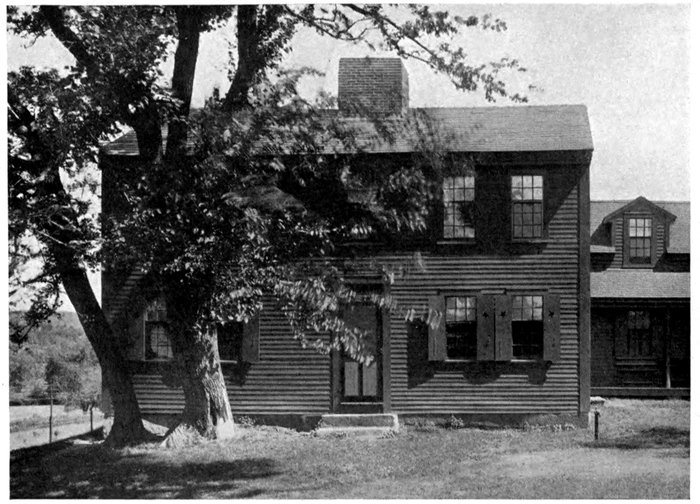
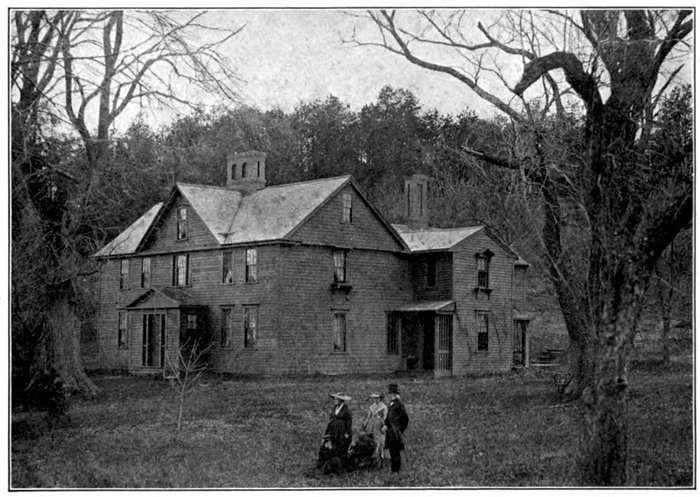
THE OLD HOUSE AT FRUITLANDS, HARVARD, MASSACHUSETTS
In front are the mulberry trees planted by the philosophers for the propagation of silkworms.
COMPILED BY
CLARA ENDICOTT SEARS
WITH
TRANSCENDENTAL WILD OATS
BY
LOUISA M. ALCOTT
BOSTON AND NEW YORK
HOUGHTON MIFFLIN COMPANY
The Riverside Press Cambridge
1915
COPYRIGHT, 1876, BY LOUISA M. ALCOTT; 1904, BY JOHN S. P. ALCOTT; 1915, BY CLARA ENDICOTT SEARS
ALL RIGHTS RESERVED
Published May 1915
NOTE
I desire to express my thanks to Mr. John S.
Pratt Alcott, of Brookline; Mr. F. B. Sanborn,
of Concord; Dr. Joseph Wiswall Palmer, of
Fitchburg; and Mr. Alvin Holman, of Leominster,
for facts and data concerning the Consociate
Family at Fruitlands, and for their
assistance in collecting and acquiring the greater
part of the original furniture which was there
in the days of the Community.
And I further thank Mr. John S. Pratt Alcott
for the privilege of including Louisa’s and Anna’s
Diaries at Fruitlands, and Mr. Alcott and Messrs.
Little, Brown & Company for the use of Louisa
M. Alcott’s Transcendental Wild Oats.
Clara Endicott Sears.
FOREWORD
For many years articles have appeared from
time to time in magazines and books regarding
the Community at Fruitlands, but it has remained
for Miss Sears to gather them together
with infinite patience for publication, and this
little book is the result, the first connected story
of the life and beliefs of that little Community
which tried so hard to live according to its ideals
in spite of criticism and censure and whose members
nearly starved as a result of their devotion.
A great deal of credit is due to Miss Sears for
her success in gathering material to make this
story of Fruitlands so complete, and I take this
opportunity, as the oldest surviving member of
the Alcott family, of expressing to her our gratitude
for the very interesting and complete account
of the Fruitlands experiment.
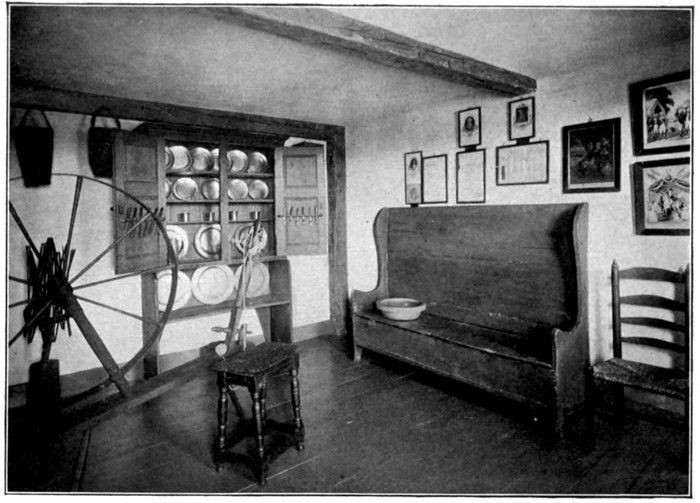
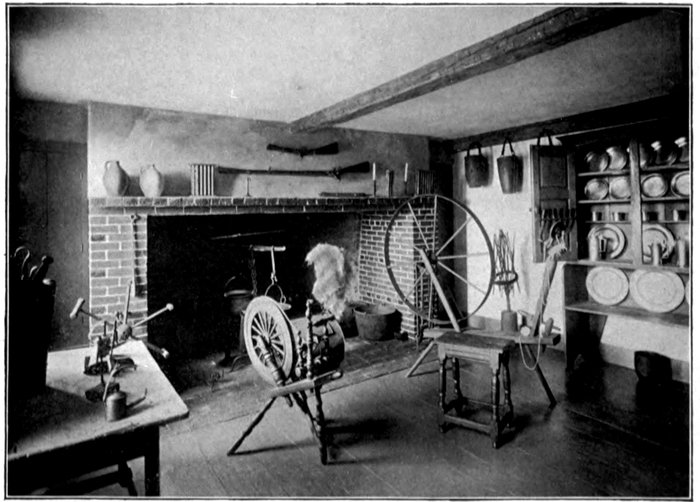
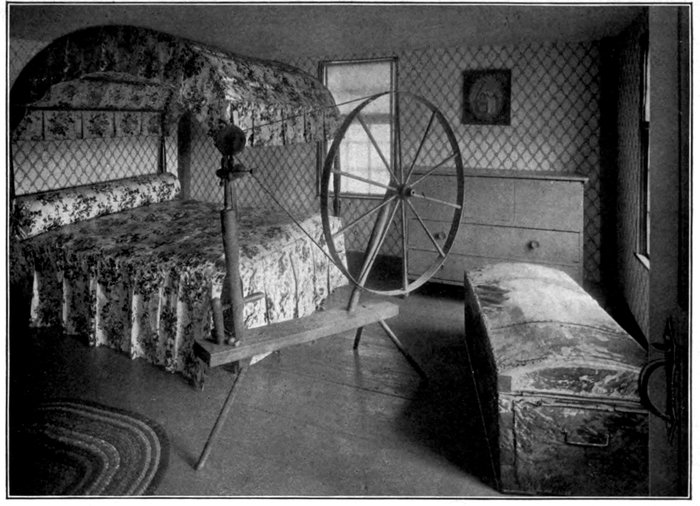
The old cowhide trunk, in which some of the most valuable of the books were shipped from London; also the old chest in which the linen was kept. The spinning-wheel belonged to a former owner.
Wafts through these earthly mists and vapors dense
A vital breath of more ethereal air.”
I found myself reciting these lines whenever
my eyes rested upon the old house of Fruitlands.
From my terrace on the hill I looked down upon
it with mixed feelings of pity, awe, and affection.
It seemed like a Presence, a ghost of the Past,
that compelled the eyes to gaze at it persistently.
In the warm joyousness of the spring sunshine,
or when the cold mists of autumn crept across
the valley, it conveyed to me the same sense of
xivdesolation, of mystery, of disillusionment. Its
broken windows looked like hollow eyes sunken
in an ashen and expressionless face. Within its
walls life and death had come and gone;—laughter
and the sound of weeping had echoed through
the quaint, low-ceilinged rooms. It had been the
sheltering home of British yeomen. Its heavy
chestnut beams bore record of the virgin forests
of the Colonies. The thrill of patriotism had vibrated
there when the sword of the Revolution
swept the land, and the sound of drum and fife,
leading the hurrying feet of eager volunteers to
Concord and Lexington, must have reached the
quiet hillside and stirred the hearts of those listening
in the doorway. Those were the brave and
vital days of its youth. In seed-time and harvest
it had smiled upon the valley, its shingles warm
and ruddy with ochre-red. At Yule-tide the log
had been chosen with fitting ceremony and
placed within the broad and spacious chimney.
The old and the young had feasted and made
merry to the sound of the crackling fire-music.
Who can tell what memories of happiness and
romance the old house contains?
Then came a period of quiet years, when the
meadows and pastures grew rich and fertile, the
upturned soil yielded abundant harvests, and
the branches of the apple trees hung heavy with
xvfruit. But it was when the old house had begun
to settle and look decrepid, and its floors had become
shaky and uneven, that its door opened
wide to its supreme experience. Then Fruitlands
was exalted into the New Eden. The two names
came to it simultaneously. It was to pulsate
with lofty ideals and altruistic aspirations. For
one perfect summer and mellow autumn its running
brook, its shady grove, its fertile meadows
and sloping pasture, its western view, so beautiful
at sundown, of Wachusett and Monadnoc,
and the chain of purple hills, were to be the inspiration
of a group of individuals then known as the
transcendental philosophers, and through them
Fruitlands became famous. Within its walls
great questions were discussed, great hopes for
the betterment and enlightenment of mankind
were generated. Alcott, Charles Lane, Wright,
Bower, Emerson, Hawthorne, Channing, Thoreau,
and many others went in and out of its
doors; and last, but not least, the child, Louisa
May Alcott, who later became our well-loved
New England authoress, and Joseph Palmer,
a Crusader in spirit as well as in actions, who
suffered for his principle of wearing a beard at a
time when it was looked upon as a badge of scorn
and contempt, and which won for him the name
of “the Old Jew.” When the beautiful dream
was over; when the New Eden proved to be only
xvian empty mockery of the vision it had once inspired;
when the great experience had ended in
failure, then the old house sagged pitifully as if
its heart had broken: the winter storms and summer
rains of the succeeding years washed all
color from its face: it became gray and haggard.
Joseph Palmer and his wife lingered on in old
age, and then passed out into the Beyond. Their
children and grandchildren clung to the place for
a space of years, but its history was over. It was
left desolate and abandoned.
So as I looked down on it from my terrace on
the hill, pitying its infinite loneliness, the thought
came to me that I must save it. If for a time it
had borne the semblance of a New Eden, then
that time must be honored, and not forgotten.
I longed to see it smiling again upon the valley
in its glowing coat of ochre-red. The fine old
chimneys must be put back in their places from
which they had been ruthlessly torn down to
make room for stoves. The hollow eyes must
gleam again with window-panes; the sound of
voices must ring once more through the empty
rooms. In the future it must be cherished for its
quaintly interesting history. If that history was
full of pathos, if the great experiment enacted
beneath its roof proved a failure, the failure was
only in the means of expression and not in the
xviiideal which inspired it. Humanity must ever
reach out towards a New Eden. Succeeding generations
smile at the crude attempts, and forthwith
make their own blunders, but each attempt,
however seemingly unsuccessful, must of necessity
contain a germ of spiritual beauty which
will bear fruit. Let no one cross the threshold of
the old house with a mocking heart. Looking
back from our present coigne of vantage, we, too,
cannot but smile at the childlike simplicity and
credulity, and the lack of forethought of those
unpractical enthusiasts. But let it be the smile
of tenderness and not of derision. In this material
age we cannot afford to lose any details of
so unique and picturesque a memory as that
of A. Bronson Alcott and the “Con-Sociate
Family” at Fruitlands.
BRONSON ALCOTT’S
FRUITLANDS
I A NEW EDEN
1
The following account of the Fruitlands Community
is largely a compilation of writings regarding
it by eye-witnesses and those in close
touch with its members. This is the surest way
of forming a just estimate of the experiment and
the characters involved.
Mr. Frank B. Sanborn, in his book entitled
“Bronson Alcott,” describes in a few short sentences
the circumstances which led up to the formation
of the Community, and this is what he
says:—
“James Pierrepont Greaves was an Englishman
born in 1777, who at the age of forty went
to reside in Switzerland with Pestalozzi, for four
years, and there adopted, a few years before
young Alcott did, the chief ideas of Pestalozzi,
as to the training of children. Returning to England
in 1825, he gradually formed a circle of mystics
and reformers, in London and its vicinity,
2who were, like himself, interested in the early
instruction and training of children. Hearing
from Harriet Martineau, upon her return from
America in 1837, of Mr. Alcott’s Temple School
at Boston, and thinking more favorably of it than
Miss Martineau did, Mr. Greaves opened a correspondence
with the American Pestalozzi, and
received from him some of his books,—Miss
Peabody’s ‘Records of a School,’ and Mr. Alcott’s
‘Conversations on the Gospels.’ From
these books, and from his correspondence, Mr.
Greaves and his friends, William Oldham, Mrs.
Chichester, Charles Lane, Heraud, and others,
formed so high an estimate of Bronson Alcott’s
talents and character, that they named for him
the English school they were about establishing
near London, and called it ‘Alcott House.’ They
also urged Mr. Alcott to visit them in England
and to take part in their schemes and labors. He
was well inclined to do this; and in 1842 he set
sail for London, where, late in May, he received
a hearty welcome from his correspondents and
their circle, with the exception of Mr. Greaves,
who had died earlier in the same year.”
Mr. Emerson furnished the money for Mr.
Alcott’s trip to England. The following letter
was written by Bronson Alcott to his cousin Dr.
William Alcott:—
3Alcott House,
Ham Common, Surrey,
June 30, 1842.
... I am now at Alcott House, which is ten
miles from London; where I find the principles
of human culture, which have so long interested
me, carried into practical operation by wise and
devoted friends of education. The school was
opened five years ago and has been thus far quite
successful. It consists of thirty or more children,
and some of them not more than three years of
age,—all fed and lodged at the House. The
strictest temperance is observed in diet and regimen.
Plain bread with vegetables and fruits is
their food, and water their only drink. They
bathe always before their morning lesson, and
have exercises in the play-grounds, which are
ample, besides cultivating the gardens of the institution.
They seem very happy and not less in
the school-room than elsewhere.
Mr. Wright has more genius for teaching than
any person I have before seen—his method and
temper are admirable, and all parties, from assistants,
of which there are several, to the youngest
child delight in his presence and influence.
He impersonates and realizes my own idea of an
education, and is the first person whom I have
met that has entered into this divine art of inspiring
the human clay, and moulding it into the
4stature and image of divinity. I am already knit
to him by more than human ties, and must take
him with me to America, as a coadjutor in our
high vocation, or else remain with him here.
But I hope to effect the first.
The Healthian is edited here by Mr. Wright
and Mr. Lane, and they contribute to almost
every reform journal in the kingdom. They are
not ignorant of our labors in the United States,
almost every work of any value I find in the library
at Alcott House,—your own works, those
of Mr. Graham (a vegetarian), besides foreign
authors not to be found with us. I shall bring
with me many books, both ancient and modern,
on my return to America.
It was during his sojourn in England in 1842
that the idea of creating “a New Eden,” as he
loved to call it, took firm root in Alcott’s mind.
A more quaintly unique character than his cannot
be found in all the annals of our literary
history. His unquenchable aspirations after the
ideal life caught the imagination of men and
women ready to break away from the narrowing
tendency of the Orthodox faith of the time. He
was both loved and derided. A transcendentalist
pure and simple; unpractical; a dreamer and
visionary in every sense of the word; yet his mind
emitted flashes of genius so unerring and decisive
as to elicit the spontaneous admiration of
Ralph Waldo Emerson and impel him to write in
his journal the following tributes:—
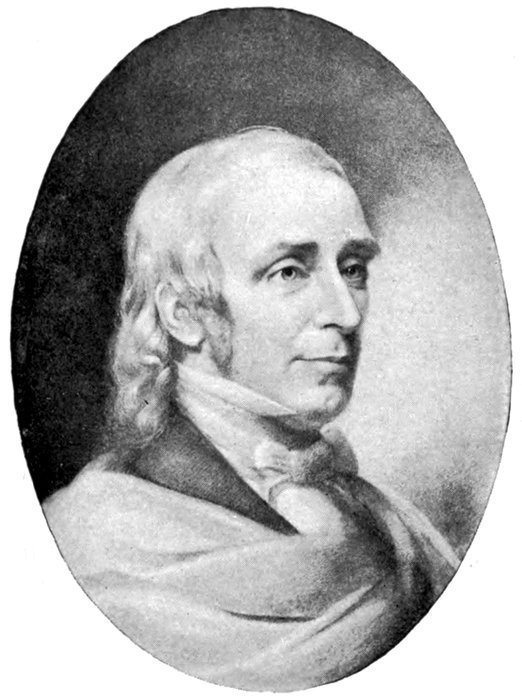
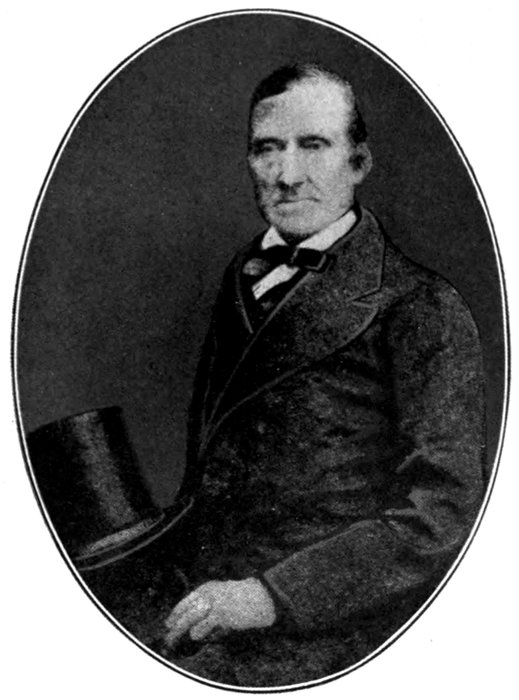
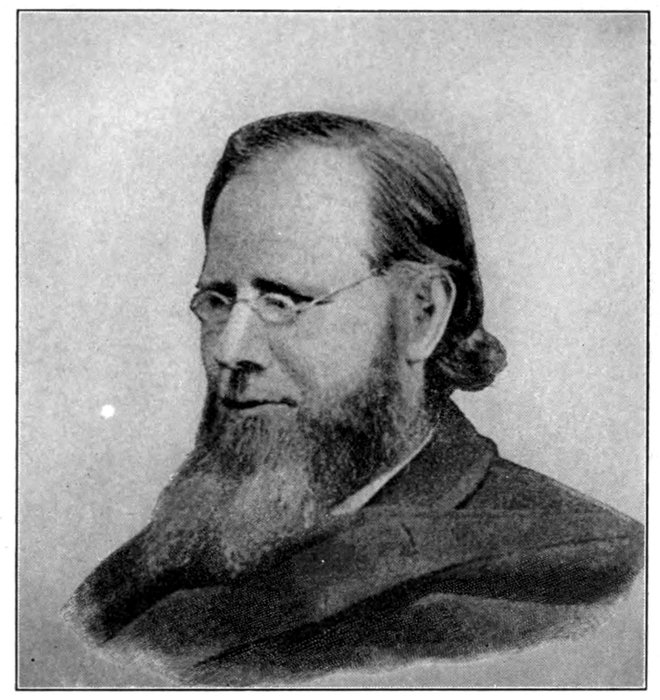
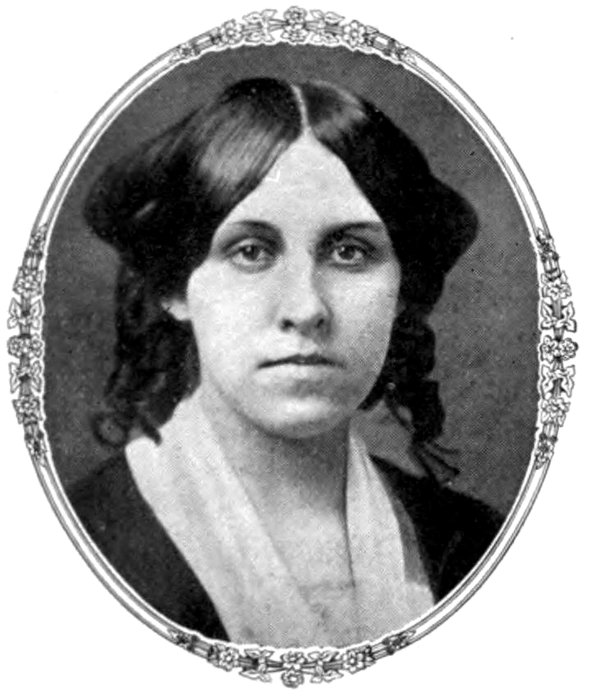
A. BRONSON ALCOTT AT THE AGE OF 53
From the portrait by Mrs. Hildreth.
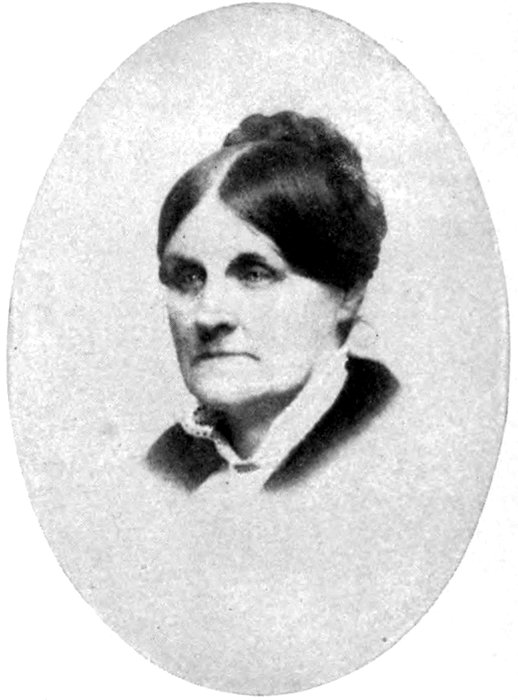
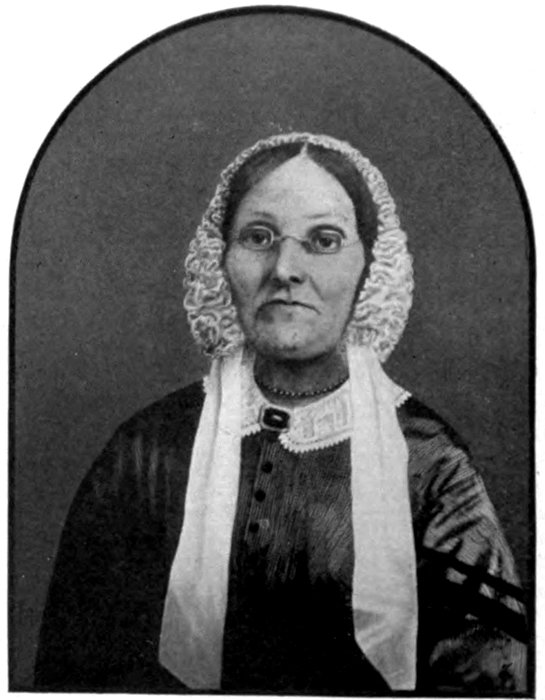
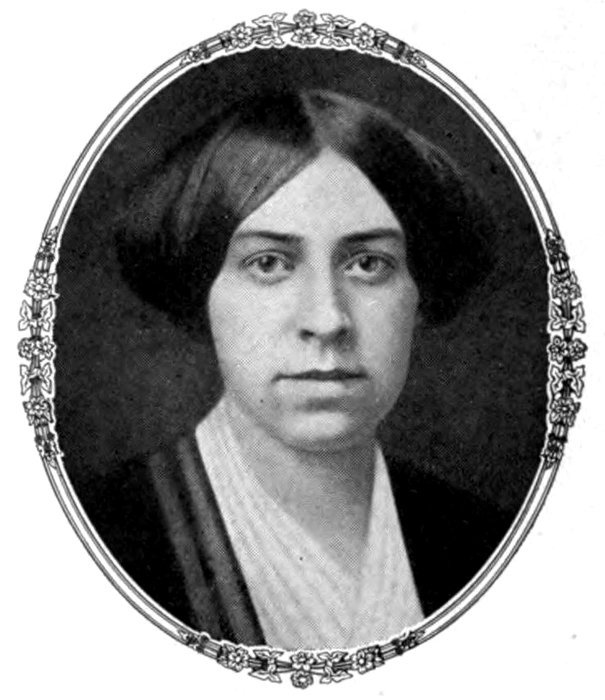
ABIGAIL MAY, MRS. A. BRONSON ALCOTT
From a daguerreotype.
5“The comfort of Alcott’s mind is, the connection
in which he sees whatever he sees. He is
never dazzled by a spot of colour, or a gleam of
light, to value the thing by itself; but forever and
ever is prepossessed by the individual one behind
it and all. I do not know where to find in men
or books a mind so valuable to faith in others.
“For every opinion or sentence of Alcott a
reason may be sought and found, not in his will
or fancy, but in the necessity of Nature itself,
which has daguerred that fatal impression on his
susceptible soul. He is as good as a lens or a
mirror, a beautiful susceptibility, every impression
on which is not to be reasoned against, or
derided, but to be accounted for, and until accounted
for, registered as an indisputable addition
to our catalogue of natural facts. There are
defects in the lens, and errors of retraction and
position, etc., to be allowed for, and it needs one
acquainted with the lens by frequent use, to
make these allowances; but ‘tis the best instrument
I have met with.”[1]
“Once more for Alcott it is to be said that he
6is sincerely and necessarily engaged to his task
and not wilfully or ostentatiously or pecuniarily.
Mr. Johnson at Manchester said of him, ‘He is
universally competent. Whatever question is
asked, he is prepared for.’
“I shall go far and see many, before I find such
an extraordinary insight as Alcott’s. In his fine
talk last evening, he ran up and down the scale of
powers with much ease and precision as a squirrel
the wires of his cage, and is never dazzled by his
means, or by any particular, and a fine heroic
action or a poetic passage would make no impression
on him, because he expects heroism and poetry
in all. Ideal Purity, the poet, the artist, the
man must have. I have never seen any person
who so fortifies the believer, so confutes the skeptic.
And the almost uniform rejection of this man
by men of parts, Carlyle and Browning inclusive,
and by women of piety, might make one despair of
society. If he came with a cannonade of acclaim
from all nations, as the first wit on the planet,
these masters would sustain the reputation; or if
they could find him in a book a thousand years
old, with a legend of miracles appended, there
would be churches of disciples; but now they wish
to know if his coat is out at the elbows, or whether
somebody did not hear from somebody, that he
has got a new hat etc. He has faults, no doubt,
but I may safely know more about them than he
7does; and some that are most severely imputed
to him are only the omissions of a preoccupied
mind.”[2]
“Last night in the conversation Alcott appeared
to great advantage, and I saw again, as
often before, his singular superiority. As pure intellect
I have never seen his equal. The people
with whom he talks do not ever understand him.
They interrupt him with clamorous dissent, or
what they think verbal endorsement of what they
fancy he may have been saying, or with ‘Do you
know Mr. Alcott I think thus and so,’—some
whim or sentimentalism, and do not know that
they have interrupted his large and progressive
statement; do not know that all they have in
their baby brains is incoherent and spotty; that
all he sees and says is like astronomy, lying there
real and vast, every part and fact in eternal connection
with the whole, and that they ought to
sit in silent gratitude, eager only to hear more,
to hear the whole, and not interrupt him with
their prattle. It is because his sight is so clear,
commanding the whole ground, and he perfectly
gifted to state adequately what he sees, that he
does not lose his temper when glib interlocutors
bore him with their dead texts and phrases.—Power
is not pettish, but want of power is.”[2]
8“Yesterday Alcott left me after three days
spent here. I had laid down a man and had
waked up a bruise, by reason of a bad cold, and
was lumpish, tardy and cold. Yet I could see
plainly that I conversed with the most extraordinary
man and the highest genius of the time.
He is a man. He is erect; he sees, let whoever
be overthrown or parasitic or blind. Life he
would have and enact, and not nestle into any
cast-off shell or form of the old time, and now
proposes to preach to the people, or to take his
staff and walk through the country, conversing
with the school-teachers, and holding conversations
in the villages. And so he ought to go, publishing
through the land his gospel like them of
old time.”[3]
It was not unnatural that these gifts, fully
acknowledged by so eminent a man as Emerson,
should have won to him the respect and devotion
of these Englishmen, who were living in the same
atmosphere of thought in which Bronson Alcott
lived and moved and had his being. And so after
much discussion and many plans, illumined by
great hopes and a deep enthusiasm, Charles Lane
and Mr. Alcott collected a valuable library of
books mostly on mysticism and all occult subjects
for the future Eden, and with William
9Lane, who was Charles Lane’s son, Wright, and
Samuel Bowers, sailed for America, their immediate
destination being the home in Concord
where Mrs. Alcott and her daughters, then very
young, were waiting to receive them.
Concord named the strangers “the English
Mystics” and received them cordially into the
inner circle of literary men which formed the
group now spoken of as the “Concord Philosophers.”
Emerson, Thoreau, Hawthorne, Ellery
Channing, and others became their friends, and
listened to their plans for forming universal
brotherhood. Emerson’s description of Charles
Lane was this:—
“A man of fine intellectual nature, inspired
and hallowed by a profound faith. This is no
man of letters, but a man of ideas. Deep opens
below deep in his thought, and for the solution of
each new problem, he recurs, with new success to
the highest truth, to that which is most generous,
most simple, and most powerful; to that which
cannot be comprehended, or overseen, or exhausted.
His words come to us like the voices of
home out of a far country.”
In the mean time the trunks containing the
books chosen in England with so much care were
opened, and lists were made of their contents.
It was either Emerson or Thoreau who inserted
10a notice of them in “The Dial,” the famous periodical
to which the literary men and women of
this noted circle contributed. It ran thus: “Mr.
Alcott and Mr. Lane have recently brought from
England a small, but valuable library, amounting
to about 1000 volumes, containing undoubtedly
a richer collection of mystical writers than
any other library in this country. To the select
library of the late J. P. Greaves, ‘held by Mr.
Lane in trust for universal ends,’ they have
added many works of a like character, by purchase
or received as gifts. In their Catalogue ...
they say, ‘The titles of these books are now submitted,
in the expectation that this Library is
the commencement of an Institution for the nurture
of men in universal freedom of action,
thought, and being. We print this list, not only
because our respect is engaged to views so liberal,
but because the arrival of this cabinet of
mystic and theosophic lore is a remarkable fact
in our literary history.’”
Mr. Sanborn, referring to this library in his
“Bronson Alcott,” says: “It was this collection
which, in the summer of 1843, occupied a hundred
feet of shelving in the old red farmhouse at
Fruitlands.”
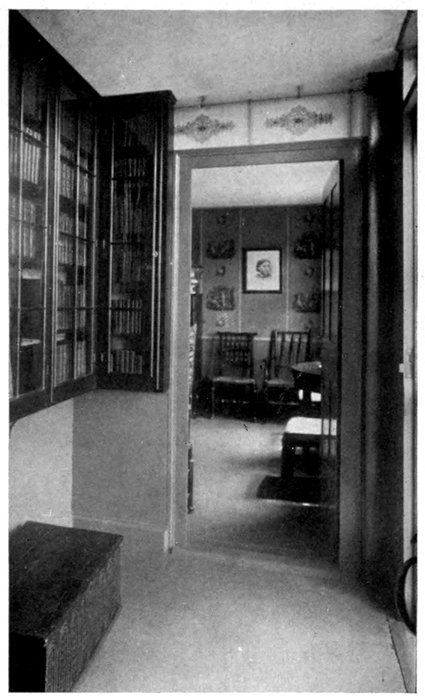
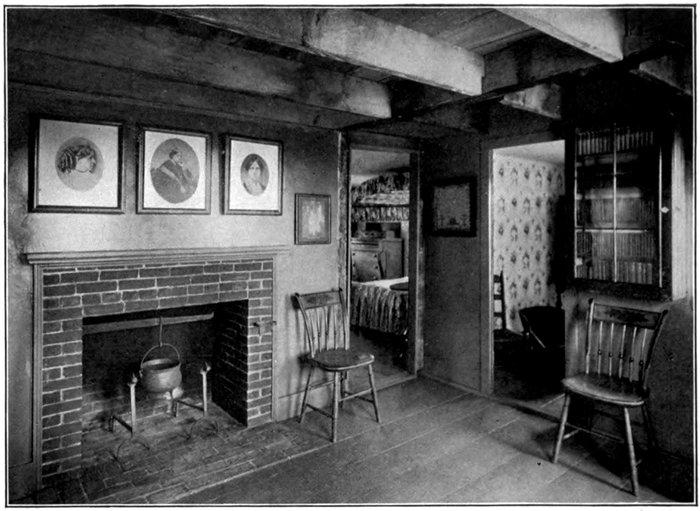
THE SMALL ENTRY WHERE THE VALUABLE BOOKS WERE KEPT
11The problem of where to establish the New
Eden became the great and vital question of the
moment. Many suggestions were offered from
many quarters, but the great impediment to a
definite decision was the lack of funds. Mr. Alcott
had no money to spare to put into a farm
such as they required, and the group of friends
were interested, but not wholly convinced of the
feasibility of the scheme, and hung back when it
came to a question of investment. This very
doubt fanned the flame of desire in Mr. Alcott
and Charles Lane to prove to the world the value
of their cherished dream. So it came about that
Charles Lane took the burden of paying for a
farm on his own shoulders, and he wrote the following
letter to Mr. Alcott’s brother, Junius
Alcott, on March 7, 1843:—
“I hope the little cash I have collected from
my London toils will suffice to redeem a small
spot on the planet, that we may rightly use for
the right owner. I would very much prefer a
small example of true life to a large society in
false and selfish harmony. Please put your best
worldly thoughts to the subject and favor me
with your view as to how and where we could
best lay out $1800 or $2000 in land, with orchard,
wood, and house. Some of the land must be now
fit for the spade, as we desire to give all animals
their freedom. We feel it desirable to keep within
the range of Mind and Letters; or rather to keep
refinement within our range, that we may be the
12means of improving or reproving it, without being
injured by it.”
Before this Mr. Alcott had written a letter to
Isaac T. Hecker, later known as Father Hecker,
head of the Paulist Brotherhood, and in it he
described the idea they had in mind. At that
time Father Hecker was at Brook Farm, but was
restless and dissatisfied with the life there, craving
a more ascetic existence; and knowing this,
Alcott felt confident of his sympathy and stated
the salient points of the scheme to him:—
Our purposes, as far as we know them at present,
are briefly these:—
First, to obtain the free use of a spot of land
adequate by our own labor to our support; including,
of course, a convenient plain house, and
offices, wood-lot, garden, and orchard.
Secondly, to live independently of foreign aids
by being sufficiently elevated to procure all articles
for subsistence in the productions of the spot,
under a regimen of healthful labor and recreation;
with benignity toward all creatures, human and
inferior; with beauty and refinement in all economics;
and the purest charity throughout our
demeanor.
Should this kind of life attract parties toward
us—individuals of like aims and issues—that
state of being itself determines the law of association;
13and the particular mode may be spoken
of more definitely as individual cases may arise;
but in no case, could inferior ends compromise
the principles laid down.
Doubtless such a household, with our library,
our services and manner of life, may attract
young men and women, possibly also families
with children, desirous of access to the channels
and fountains of wisdom and purity; and we are
not without hope that Providence will use us progressively
for beneficial effects in the great work
of human regeneration, and the restoration of
the highest life on earth.
With the humane wish that yourself and little
ones may be led to confide in providential Love,
I am, dear friend,
Very truly yours,
A. Bronson Alcott.
February 15, 1843.
Finally a decision was arrived at, and in a letter
to Mr. Oldham, Charles Lane narrates how
it came about. It was written from Concord,
May 31, 1843:—
My dear Friend:—
... Mr. Alcott and I walked up the river to a
place called the Cliffs, where is a young orchard
of 16 acres and woodland below. He came home
14with his head full of poetic schemes for a cottage,
etc., on this spot. I, however, came home first
and found that a man had been sent by the young
man who walked with me to Southborough, having
a farm to sell at Harvard, 14 miles off. He
proposed to take me directly to see it, but I was
fatigued, so Samuel Larned, the visitor who came
up with Mr. Wright, went in the waiting vehicle.
The next morning being very fine Mr. Alcott and
I walked there, not knowing his name, but we
ascertained it to be Wyman; we saw his place,
consisting of 90 acres, 14 of them wood, a few
apple and other fruit trees, plenty of nuts and
berries, much of the land very good; the prospect
from the highest part very sublime. The
house and barn very poor, but the water excellent
and plentiful. The capabilities are manifold,
but the actualities humble. For the whole he
asked 2700 dollars, which being beyond my
means, we had much talk when he offered to sell
the land for 1800 dollars and to lend us the buildings
gratis for a year. I should observe it is extremely
retired, there being no road to it. On
these terms we have closed. He gives us the few
crops he has just planted and grass to a considerable
amount will soon be cut. I have slept a night
or two there. William and two friends (Larned
and Abram Everett, called the “Plain Man”
in the Vermont Telegraph) and a hired man remain
15there, and the family are to start early to-morrow
morning, so now for plenty of work of all
sorts. Ninety acres; much of it first rate; some
worth 100 dollars per acre, the whole 20 dollars
per acre; would that some of the English honest
half-starved were on it! This, I think you will
admit, looks like an attempt at something which
will entitle transcendentalism to some respect for
its practicality.... We have very much to do,
but the occasions are opportune. I think Mr.
Emerson is not so well pleased with our departure
as he would be with our company, but
as he did nothing to keep us we must go. It
appeared to me that for the hopefulness of
many, it was needful we should make a movement
of some kind this year, even though we
fail; and Providence seems really to have worked
for us....
I thank you very much for the £10; the note
arrived very opportunely to enable Mr. A. to
quit Concord, to do which all his debts must be
paid, and I need not tell you on whom that falls.
Our transactions at present leave me about 500
dollars in debt, but every one says we have made
a good bargain in the purchase of the land. I seriously
hope we are forming the basis for something
really progressive, call it family or community,
or what you will....
We have now plenty of work to do and how we
16get on I shall faithfully report, though the pen
will not do much at present....
Believe me, dear friend,
Yours steadfastly in the spirit,
Charles Lane.
Mr. Sanborn, who above all others has an
intimate knowledge of what the situation was,
having in later years learned much concerning
it from Emerson and Alcott and others of
that time, makes this comment in his “Bronson
Alcott”:—
“After looking at several places in Concord
and elsewhere, Lane decided to buy the Wyman
farm at Harvard, two miles from the village of
that name, but less than a mile from Still River,
another village in the same township. Alcott
would have chosen the Cliffs in Concord, a favorite
resort of Thoreau and the Emerson family,
and Emerson would have preferred to retain his
friend in his own town; but Lane had rather
avoided Emerson, as not ascetic enough for his
abstemious habits, and seems to have been not
unwilling to withdraw Alcott from what he regarded
as an unfavorable influence.”
But when it was all settled, Alcott and his
English Mystics entered into their plan with a
touching enthusiasm. Before them lay vistas of
glowing possibilities. They dreamed dreams and
17saw visions of a “Peace on Earth, Good Will
towards Men” such as had never before been
realized. There was much to be done and they
were eager to begin,—the days were none too
long in which to collect the necessary things before
moving to Harvard. So Charles Lane persuaded
Samuel Bowers to write to Oldham a description
of the farm, he himself being too busy
to do so. And Bowers writes as follows:—
“Charles Lane wished me to sketch to you the
material picture of Fruitlands and the adjoining
scene, but I am unqualified to do justice to the
subject. The property is very compact and may
be a very beautiful domain. It is part a hill sloping
down to more valley. Several springs gush
out from the side of the hill and the water is very
good—better I think than is common in Massachusetts.
The soil varies much, but the average
quality is, I considerately judge, twice, if not
thrice as good as that of Tytherley.[4] There is
about 14 acres of woodland all in the vale and
adjoining is the Nashua River, on the other side
of which, where the receding lands gently rise,
stands a Shaker village (Shirley), its extended
orchards, corn and grass lands. There is in view
a long and high range of hills, one of which, and
that the highest, is famous for having been the
resort of an Indian sachem. The hill is called
18Wachusett. Altogether the scene reminded me
strongly of the Vale of Evesham, in Worcestershire,
where seen when one approaches it from
Oxford.”
4. The location of Owen’s Harmony Hall in England.
It is quite evident that Oldham had written a
letter to Charles Lane warning him against assuming
too great responsibility in this venture.
The question as to whether many enthusiasts
would join the Community was a very crucial
one, since it was on this expectation that they
based their plans of running the farm free of debt.
In answering the letter he asks Oldham to forward
certain money due to him. And in his explanation
says:—
“I do not see any one to act the money part
but myself.” (This refers to the land for the
Fruitlands experiment.) “Mr. Alcott cannot
part with me. I deem him too sincere and valuable
to quit him, and besides there is nothing in
the country so well as we can show if we be faithful;
but rents, debts, and mortgage would destroy
us. As to the recruits you speak of, are they good
for anything? Are they worth the small passage
money you name? Truly if they are some of
them you have at Alcott House, I think we should
not be much aided by their presence.
“Understand, we are not going to open a hospital.
We are more Pythagorean than Christs,
we wish to begin with the sound rather than to
19heal the sick. There is grand work here to be
done and I must not trifle with it.”
This matter of getting the right kind of persons
to join the Community required a keen insight
into human nature, and on this point Mr. Alcott
was not very strong. His own sincerity and depth
of purpose were so great that he looked for these
same attributes in every one who approached
him, and often failed to detect the superficial
qualities that lurked underneath the surface enthusiasm
of some of his followers. At this time
Transcendentalism was rife through the land.
Some called it “the Newness.” The expression
“Apostles of the Newness” was heard on all
sides. They could be recognized by their long
hair, Byronic collars, flowing ties, and eccentric
habits and manners. Nothing seemed too excessive
to prove their emancipation from the shackles
of conventionality. One day three young men of
this kind turned up at Mr. Emerson’s at Concord
and entered into an animated conversation
with him on his front porch. With them freedom
of thought and allegiance to “the Newness” took
the strange form of preceding every remark, however
trivial, with resounding oaths, which so
startled the passers-by, and Mr. Emerson as well,
that he hastily invited them to move round to
the back of the house where the vibrations of
their sulphurous ejaculations might roll harmlessly
20across the meadow instead of exploding
in through the windows of the houses near by.
That Mr. Emerson was deeply interested in
the experiment of creating the “New Eden” at
Harvard is shown by the fact that a deed of the
land was made out in his name as trustee for
Charles Lane. He and Thoreau and the rest of
the Concord circle viewed the departure with a
mixture of interest, curiosity, and anxiety. On
June 10, 1843, Emerson wrote to Thoreau:—
“From Mr. Alcott and Mr. Lane at Harvard,
we have yet heard nothing. They went away
in good spirits, having sent Wood Abram and
Larned and William Lane before them, with horse
and plough, a few days in advance, to begin the
spring work. Mr. Lane paid me a long visit, in
which he was more than I had ever known him
gentle and open; and it was impossible not to
sympathize with and honor projects that so
often seem without feet or hands.”
II THE FOUNDING OF FRUITLANDS
21
The original members of the Community that
started the unique experiment were Mr. Alcott,
his wife, and four small daughters, the Englishman
Charles Lane and his son William, H. C.
Wright (for a short time) and Samuel Bower,
Isaac T. Hecker, of New York, Christopher
Greene and Samuel Larned, of Providence, Abraham
Everett and Anna Page, Joseph Palmer, of
Fitchburg, and Abram Wood. The transcendentalism
of this last individual showed itself chiefly
in insisting upon twisting his name hind side before
and calling himself “Wood Abram.” As this
he was always known at Fruitlands. These members
did not all arrive at once, but came within a
short time of each other. Wright had shown some
dissatisfaction already in the extreme asceticism
of the plan of life adopted by Mr. Alcott at Concord
and he refused to be a regular member of the
Fruitlands Community on this account. In writing
to Oldham on the subject Charles Lane says:
“I can see no other reason but the simplicity and
order to which affairs were coming (in the cottage);
no butter nor milk, nor cocoa, nor tea, nor
coffee. Nothing but fruit, grain, and water was
22hard for the inside; then regular hours and places,
cleaning up scraps, etc., was desperate hard for
the outside.”
When finally the move from Concord to Harvard
was made, Mr. Alcott took what furniture he
could with him, such as beds, etc., and the rest
was supplied by Joseph Palmer, who carted his
over from his old Homestead at No Town outside
of Fitchburg.
Shortly after the move, Charles Lane sat down
and wrote to Thoreau a description of Fruitlands:
Fruitlands, June 7, 1843.
It is very remotely placed, without a road, surrounded
by a beautiful green landscape of fields
and woods, with the distance filled up with some
of the loftiest mountains in the State. At present
there is much hard manual labor, so much that,
as you see, my usual handwriting is very greatly
suspended. Our house accommodations are poor
and scanty; but the greatest want is good female
society. Far too much labor devolves on Mrs.
Alcott. Besides the occupations of each succeeding
day, we form in this ample theatre of hope,
many forthcoming scenes. The nearer little copse
is designed as the site of the cottages. Fountains
can be made to descend from their granite
sources on the hill-slope to every apartment if
desired. Gardens are to displace the warm grazing
23glades on the South, and numerous human beings
instead of cattle, shall here enjoy existence.
On the estate are about 14 acres of wood,—a
very sylvan realization, which only wants a
Thoreau’s mind to elevate it to classic beauty.
The farther wood offers to the naturalist and
the poet an exhaustless haunt; and a short cleaning
up of the brook would connect our boat with
the Nashua. Such are the designs which Mr.
Alcott and I have just sketched, as resting from
planting we walked around this reserve.
Though to me our mode of life is luxurious in
the highest degree, yet generally it seems to be
thought that the setting aside of all impure diet,
dirty habits, idle thoughts, and selfish feelings is
a source of self-denial scarcely to be encountered,
or even thought of, in such an alluring world as
this.
In the course of the next few weeks Lane wrote
with much detail to Oldham:—
Fruitlands, Harvard, Mass.,
June 16, 1843.
My dear Friend:—
The morning being rainy I have taken advantage
of the suspension of outdoor labours to
24sit down and have a little chat with you of and
concerning our doings and progress. The day
after I wrote you last all the household effects
and all the household were mounted on wheels
and trundled to this place; the old little cottage
being left as clean as a new book by Mrs. Alcott’s
great energy. The day was sharp and cold for the
season, but the weather has since come out fine
and warm, some days hot. We have all been
busily engaged in manual operations in the field,
house, wood yard, etc. Planting, ploughing, sowing,
cleaning fruit trees, gardening, chopping,
sawing, fitting up, etc., etc., have gone at a rapid
rate, as the place was in a very slovenly condition.
When tired we have taken a look round
the estate to see what was growing, learn the
shape of it, and its capabilities with more minuteness.
It seems to be agreed on all hands, and we
have opinions from many practical men, that we
have not made a bad exchange, even in the commercial
sense, of our cash for land. Only think,
brother Oldham, ninety acres, every one of which
may, in a short time, and without much outlay,
be brought into a state fit for spade culture; and
much of it very good land, obtained at the rate of
20 dollars or only four pounds per acre freehold.
Recollect, too, this includes fuel and some building
material, for there are 14 acres of wood, including
many trees of edible nuts, and still only
2530 miles from a metropolitan city of 110,000 inhabitants.[5]
The land is most beautifully disposed
in hill and valley, and the scenery is of a sublime
and elevating character. Water abundant and
excellent and the springs being on the hill, it may
be conveyed anywhere about the place for irrigation,
etc. As is common in this district, the principal
part is meadow and pasture; but we shall
go on ploughing up as much as possible, sowing
crops of clover or buckwheat, and turning them
in, so as to redeem the land without animal manures,
which in practice I find to be as filthy as
in idea. The use of them is disgusting in the
extreme. At present, we have about 4 acres in
Maize, 1½ in Rye, 1½ in Oats, 1 in Barley, 2
in Potatoes, nearly 1 in Beans, Peas, Melons,
Squashes, etc.; there will be some Buckwheat,
Turnips, etc., making in all about 11 acres arable.
We have no Wheat this year. The grass promises
well, and we may possibly cut 200 dollars’ worth;
but by hired teams we are now turning up one
piece of 8 or 9, and another of 5 acres, and mean
to attack another 4 or 5 for our next year’s homestead
or garden, should we obtain the means of
building. The hillside of 12 or 14 acres pasture is
also to be ploughed, directly, if we can; so that
the work of reclamation will go rapidly forward.
There is a large piece of peat land, as black as ink,
26which, mixed with sand, makes a most productive
soil, valued at 200 to 300 dollars per acre;
and there is sand on our lot within 100 yards.
We have been much plagued, and a little cheated,
with the cattle, but our stock is now reduced to
one yoke of oxen.
Besides Mr. Alcott, his Wife and Children, myself
and William, who is very efficient and active,
we have only a Mr. Larned and Abraham [Abram
Everett]—who appears in the Vermont Telegraph
as the “Plain Man.” Larned was many
months at West Roxbury, is only about 20 years
of age, his father was a merchant, and he has been
a counting-house man and is what the world calls
genteel. Abraham is about 42, a cooper by trade,
but an excellent assistant here, very faithful to
every work he undertakes, very serious, has had
rather deep experience, having been imprisoned
in a mad house by his relations because he had a
little property, but still he is not a spiritual being,
at least not consciously and wishfully so.
I have exchanged more letters with Samuel
Bower and he promises to come here to-morrow.
If his real state bears out his writings, I think he
may be added to the family, otherwise he thinks
of looking at Roxbury for the purpose of finding
a home there....
Mr. Alcott is as persevering in practice as last
year we found him to be in idea. To do better
27and better, to be better and better, is the constant
theme. His hand is everywhere like his mind.
He has held the plough with great efficiency,
sometimes for the whole day, and by the straightness
of his furrow may be said to be giving lessons
to the professed ploughmen, who work in a slovenly
manner. We have called in the aid of a carpenter
who has made simple shelves for our books,
and for the first time our library stands upright
as it should do. It occupies about 100 feet of
shelves.
June 28, 1843.
On the 19th I received your very kind and
newsful letter of the first instant enclosed in Mrs.
Chichester’s. Mr. Bower, having kept his promise,
was here, and I read much of it at breakfast,
having also another visitor from Brook Farm, Mr.
Hecker [Isaac T. Hecker]. All were much interested
in the facts reported, and Saml. Bower
heard your remembrances fresh from your pen.
You affect him more than any other person. In
your next, you will perhaps devote a slip to him
and I will forward it. He, Larned and Hecker
visited the Shakers and were much attracted by
them. Larned who, on common report, used to
oppose them, talks of joining them, so pleasant
is their society; at least at first....
If I were not at this moment surrounded by so
much that is beautiful in the present, hopeful in
28the future and ennobling in the act, your affectionate
invitation to Ham would seriously touch
me. But by God’s blessing something shall be
done here which shall reach you there. If we can
aid the people in any way to let self be conquered, we
shall do something. Lust abounds and love is deserted.
Lust of money, of food, of sexuality, of
books, of music, of art,—while Love demands
the powers devoted to these false ends. I thank
you for your hint respecting worldliness. I believe
I am getting on safe ground if I am not already
landed. From, or in England you say, I
should expect nothing, and I am now in the same
predicament here. Every farthing I had is now
either put in or involved in this affair, and more,
for I have put my hand to two rather large bills;
silly enough, you will say. In a few weeks I expect
to be literally pennyless, and even unable
for want of stage hire to travel to Boston if you
send me ever so many orders, of which you discover
I have been so neglectful. No; I think I am
now out of the money world. Let my privation
be ever so great, I will never make any property
claim on this effort. It is an offering to the Eternal
Spirit, and I consider that I have no more right
than any other person; and I have arranged the
title deeds, as well as I could, to meet that end.
I could only consent to return to England on condition
of being held free, like a child, from all
money entanglements. As no person or association
can guarantee this for me, I think it would
be better to remain here where the simple wants
can be so easily met, and where there is much
opportunity for doing good, and more hope as
the outward conditions are so beautifully free.
Would that you were here for a month; we have
now the most delightful steady weather you can
conceive; we are all dressed in our linen tunics,
Abraham is ploughing, Larned bringing some
turf from the house, Alcott doing a thousand
things, Bower and I have well dug a sandy spot
for carrots, the children and Lady are busy in
their respective ways, and some hirelings are assisting....
Now that something, though little,
is doing, you will find my expressions more peaceful.
Con-fi-dence in Love I hope will ne’er be
wanting in your affectionate friend,
Charles Lane.
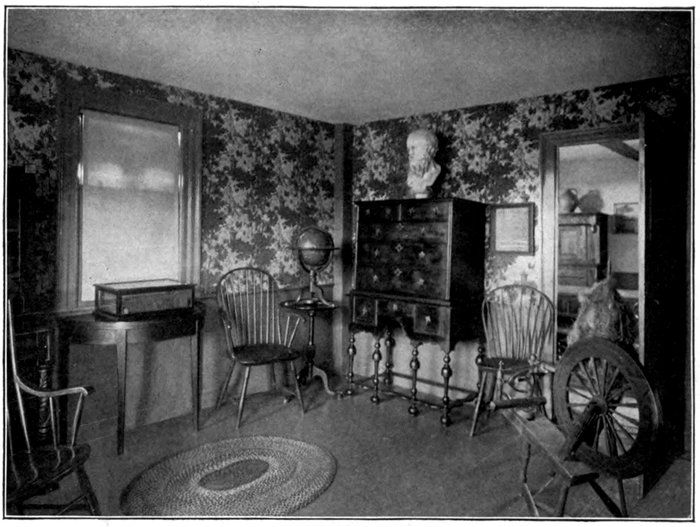
THE STUDY
A bust of Socrates stands on the fine old Dutch highboy that Joseph Palmer brought from No Town.
29Fruitlands, Harvard, Mass.,
July 30, 1843.
Dear Friend:—
... A few days after I wrote you Samuel
Bower joined us and has steadily and zealously
entered into all the works and speculations we
have in hand and mind. Mr. Hecker, a very
spiritual-minded young man, also has been with
us. He is partner with his brothers at New York
30in a very extensive baking and corn mill business.
He has resided several months at W. Roxbury,
but is by no means satisfied with their schoolboy
dilettante spiritualism. He will, I believe, go
to New York to clear up if possible with his family
as to the relations on which they are in future
to stand to each other. They appear to be so
loving and united a family with such strong human
attachments that, although he has done
much towards breaking away, I fear that in the
desire to bring his brothers further into the inner
world, he will himself be detained.
Mr. Alcott and I returned last evening from a
short visit to Boston to purchase a few articles,
and while there we went out one evening to Roxbury[6]
where there are 80 or 90 persons playing
away their youth and daytime in a miserably
joyous, frivolous manner. There are not above
four or five who could be selected as really and
truly progressing beings. Most of the adults are
there to pass “a good time”; the children are
taught languages, etc.; the animals (in consequence
I believe solely of Mr. George Ripley’s
tendency) occupy a prominent position, there
being no less than 16 cows, besides 4 oxen, a herd
of swine, a horse or two, etc. The milk is sold in
Boston, and they buy butter to the extent of 500
dollars a year. We had a pleasant summer evening
31conversation with many of them, but it is
only in a few individuals that anything deeper
than ordinary is to be found. The Northampton
Community is one of industry, the one at Hopedale
aims at practical theology, this of Roxbury
is one of taste; yet it is the best which exists here,
and perhaps we shall have to say it is the best
which can exist. At all events we can go no further
than to keep open fields, and as far as we
have it open house to all comers. We know very
well that if they come not in the right name and
nature they will not long remain. Our dietetic
system is a test quite sufficient for many. As far
as acres of fine land are concerned, you may offer
their free use to any free souls who will come here
and work them, and any aid we can afford shall
be freely given. The aid of sympathetic companionship
is not small, and that at least we can
render. To bridge the Atlantic is a trifle if the
heart is really set on the attainment of better
conditions. Here are they freely presented, at a
day’s walk from the shore, without a long and
expensive journey to the West. Please to advertise
these facts to all youthful men and women;
for such are much wanted here. There is now a
certain opportunity for planting a love colony,
the influence of which may be felt for many generations,
and more than felt; it may be the beginning
for a state of things which shall far transcend
32itself. They to whom our work seems not
good enough may come and set out a better.
I should mention to you that passing his door
Mr. Theodore Parker came to the Community in
the evening and again in the morning. He is a
very popular man at present and has a congregation
at Roxbury, but being unwell by reason of
close study, he will sail to Europe on the 1st
September. He will remain in Germany for three
or four months, and afterwards as long in England.
No doubt you will see him and render him
all the service you can.... At present we are not
sought by many persons, but the value in our
enterprise depends not upon numbers so much as
upon the spirit from which we can live outwardly
and in all relations true to the intuitions which
are gifted to us. We must not forget how great
have been the works done by individuals, and in
the absence of what are usually called facilities.
Our obstacles are, I suppose, chiefly within, and
as these are subdued we shall triumph in externalities.
I could send you a description of works
and crops, our mowing, hoeing, reaping, ploughing
in tall crops of clover and grass for next year’s
manure, and various other operations, but although
they have some degree of relation to the
grand principle to which they are obedient, they
are worth little in the exoteric sense alone. Perhaps
the external revelations of success ought
33always to be kept secret, for every improvement
discovered is only turned to a money making
account and to the further degradation of man,
as we see in the march of science to this very
moment. If we knew how to double the crops of
the earth, it is scarcely to be hoped that any
good would come by revealing the mode. On the
contrary, the bounties of God are already made
the means by which man debases himself more
and more. We will therefore say little concerning
the sources of external wealth until man is himself
secured to the End which rightly uses these
means....
Mr. Charles Stearns Wheeler, the eminent
Greek student, who went from here to Germany
last summer, died at Leipsic[7] in June, age 26.
He was one of Mr. Emerson’s great hopes.
Samuel Bower continues with us, but he is not
so happy in body or mind as he ought to be: a
letter from you in the universal spirit would cheer
him up. He confesses to the possession of a little
Nomadic blood in his veins. He thinks Mr. Alcott
is arbitrary or despotic, as some others do,
but I shall endeavour (and, I think, not in vain)
to urge him to the noblest conduct of which our
position is capable. He must not complain nor
walk off, but cheerfully amend whatever is amiss.
I suppose your letter has failed at the post somewhere,
34but I have inquired fully on this side.
With assurances of continued affection to yourself
and all friends on the divine ground,
I remain, dear Oldham,
Truly yours,
Charles Lane.
III BROOK FARM AND FRUITLANDS
35
There is so much confusion in the minds of
many regarding the difference of aim existing in
the Community at Brook Farm and that of Fruitlands
that it seems well to insert here a well-authenticated
account of Brook Farm and also an
extract from a letter written by John Sullivan
Dwight who was a member.
Brook Farm was a Community established in
West Roxbury, Massachusetts, in 1841. “The
head of the Community was George Ripley, formerly
a Unitarian clergyman in Boston, who had
been in 1836 one of the Founders of the Transcendental
Club with Emerson, Hedge, Alcott,
and others. Associated with Ripley in the Brook
Farm enterprise were Nathaniel Hawthorne,
Charles A. Dana, John S. Dwight, and other well-known
men. They bought a farm comprising
some 200 acres. Its object was the establishment
of an ‘agricultural, literary, and scientific school
or college.’
“Several trades beside agriculture were carried
on and a number of children were received as pupils,
instruction being furnished in ancient and
modern languages, history, mathematics, moral
36philosophy, music, drawing, etc. It was designed
to substitute coöperative for selfish competition,
and to dignify bodily labor by uniting it with the
intellectual and spiritual life. The Community
was at first organized as a joint-stock company,
each subscriber being guaranteed 5 per cent per
annum on his shares. In 1847 the experiment,
having proved a failure financially, was given up.
“Life at Brook Farm, especially during the
first years of enthusiasm, had idyllic and romantic
aspects. In its palmiest state the Community,
including school children and boarders, numbered
about 150 souls. Kitchen and table were
in common; very little help was hired, but philosophers,
clergymen, and poets worked at the
humblest tasks, milking cows, pitching manure,
cleaning stables, etc., while cultivated women
cooked, washed, ironed, and waited on table. All
work, manual or intellectual, was credited to
members at a uniform rate of ten cents an hour.”
John Sullivan Dwight wrote of Brook Farm:—
“I remember the night of my first arrival at
Brook Farm. It had been going all summer. I
arrived in November. At that time it was a sort
of pastoral life, rather romantic, although so
much hard labor was involved in it. They were
all at tea in the old building, which was called the
Hive. In a long room at a long table they were
37making tea, and I sat down with them. When
tea was over they were all very merry, full of life;
and all turned to and washed the dishes, cups
and saucers. All joined in,—the Curtis brothers,
Dana and all. It was very enchanting, quite
a lark, as we say. Much of the industry went on
in that way, because it combined the freest sociability
with the useful arts.”
Robert Carter, a co-editor with James Russell
Lowell of a magazine called The Pioneer in 1843,
wrote an article called “The Newness” in after
years, describing Fruitlands and Brook Farm.
Of the latter he says:—
“It was a delightful gathering of men and
women of superior cultivation, who led a charming
life for a few years, laboring in its fields and
philandering in its pleasant woods. It was little
too much of a picnic for serious profit, and the
young men and maidens were rather unduly addicted
to moonlight wanderings in the pine grove,
though it is creditable to the sound moral training
of New England that little or no harm came
of these wanderings—at least, not to the maidens.
Brook Farm, however, was not the only
Community which was founded by the disciples
of the ‘Newness.’ There was one established in
1843 on a farm called Fruitlands, in the town of
Harvard, about forty miles from Boston. This
was of much more ultra and grotesque character
38than Brook Farm. Here were gathered the men
and women who based their hopes of reforming
the world and of making all things new on dress
and on diet. They revived the Pythagorean, the
Essenian, and the Monkish notions of Asceticism
with some variations and improvements peculiarly
American. The head of the institution was
Bronson Alcott, a very remarkable man, whose
singularities of character, conduct, and opinion
would alone afford sufficient topics for a long lecture.
His friend Emerson defined him to be a
philosopher devoted to the science of education,
and declared that he had singular gifts for awakening
contemplation and aspiration in simple and
in cultivated persons.... His writings, though
quaint and thoughtful, are clumsy compared
with his conversation, which has been pronounced
by the best judges to have been unrivalled in
grace and clearness. Mr. Alcott was one of the
most foremost leaders of the ‘Newness.’ He
swung round the circle of schemes very rapidly,
and after going through a great variety of phases
he maintained, at the time of the foundation of
‘Fruitlands,’ that the evils of life were not so
much social or political as personal, and that a
personal reform only could eradicate them; that
self-denial was the road to eternal life, and that
property was an evil, and animal food of all kinds
an abomination. No animal substance, neither
39flesh, fish, butter, cheese, eggs, nor milk, was
allowed to be used at ‘Fruitlands.’ They were all
denounced as pollution, and as tending to corrupt
the body, and through that the soul. Tea and
coffee, molasses and rice, were also proscribed,—the
last two as foreign luxuries,—and only water
was used as a beverage.
“Mr. Alcott would not allow the land to be
manured, which he regarded as a base and corrupting
and unjust mode of forcing nature. He
made also a distinction between vegetables which
aspired or grew into the air, as wheat, apples, and
other fruits, and the base products which grew
downwards into the earth, such as potatoes,[8] beets,
radishes, and the like. These latter he would not
allow to be used. The bread of the Community
he himself made of unbolted flour, and sought to
render it palatable by forming the loaves into the
shapes of animals and other pleasant images. He
was very strict, rather despotic in his rule of the
Community, and some of the members have told
me they were nearly starved to death there; nay,
absolutely would have perished with hunger if
they had not furtively gone among the surrounding
farmers and begged for food.
8. This was a mistake on Mr. Carter’s part, as they ate
potatoes freely.
“One of the Fruitlanders took it into his head
that clothes were an impediment to spiritual
40growth, and that the light of day was equally
pernicious. He accordingly secluded himself in
his room in a state of nature during the day, and
only went out at night for exercise, with a single
white cotton garment reaching from his neck to
his knees.
“Samuel Larned lived one whole year on
crackers, and the next year exclusively on apples.
He went to Brook Farm after the collapse
of the Fruitlands Community, and when that
also failed he went South, married a lady who
owned a number of slaves, and settled there as
a Unitarian minister.”
In this same article Mr. Carter asserts that
Fourierism brought Brook Farm into disrepute
at the end, and that a large wooden phalanstery,
in which members had invested all their means,
took fire and burned to the ground just as it was
completed. Upon this catastrophe the association
scattered in 1847. Nathaniel Hawthorne
lost all his savings in the enterprise. While he
was at Brook Farm he looked after the pigsties.
In contrast to this is the full account of the
object and aim of Fruitlands.
The following letter on The Consociate Family
Life was written to A. Brooke of Oakland, Ohio,
and published in the Herald of Freedom, September
8, 1843:—
41Dear Sir: Having perused your several letters
in the Herald of Freedom, and finding, moreover,
a general invitation to correspondence from
“persons who feel prepared to coöperate in the
work of reform upon principles” akin to those
you have set forth, I take this public means of
communicating with one, who seems to be really
desirous of aiding entire human regeneration.
After many years passed in admiration of a
better order in human society, with a constant
expectation that some beginning would shortly
be made, and a continued reliance that some
party would make it, the idea has gradually
gained possession of my mind, that it is not right
thus to linger for the leadings of other men, but
that each should at once proceed to live out the
proposed life to the utmost possible extent. Assured
that the most potent hindrances to goodness
abide in the Soul itself; next in the body;
thirdly in the house and family; and in the
fourth degree only in our neighbors, or in society
at large; I have daily found less and less reason
to complain of public institutions, or of the dilatoriness
of reformers of genetic minds.
Animated by pure reform principles, or rather
by pure creative spirit, I have not hesitated to
withdraw as far and as fast as hopeful prudence
dictated from the practices and principles of the
Old World, and acting upon the conviction that
42whatever others might do, or leave undone, however
others might fail in the realization of their
ideal good, I, at least, should advance, I have
accordingly arrived in that region where I
perceive you theoretically, and I hope, actually
dwell. I agree with you that it would be well to
cross the ocean of Life from the narrow island of
selfishness to the broad continent of universal
Love at one dash; but the winds are not always
propitious, and steam is only a recent invention.
I cannot yet boast of a year’s emancipation from
old England. One free step leads to another; and
the third must necessarily precede the fourth, as
the second was before the third.
A. Bronson Alcott’s visit to England last year
opened to me some of the superior conditions for
a pure life which this country offers compared to
the land of my nativity and that of your ancestors.
My love for purity and goodness was sufficiently
strong it seems to loosen me from a position
as regards pecuniary income, affectionate
friends, and mental liberty, which millions there
and thousands here might envy. It has happened
however that of the many persons with
whom Mr. Alcott hoped to act in conjunction
and concert, not one is yet fully liberated by
Providence to that end. So that instead of forming
items in a large enterprise, we are left to be
the principal actors in promoting an idea less in
extent, but greater in intent, than any yet presented
to our observation.
CHARLES LANE
43Our removal to this estate in humble confidence
has drawn to us several practical coadjutors,
and opened many inquiries by letter for a
statement of our principles and modes of life.
We cannot perhaps turn our replies to better account,
than to transcribe some portions of them
for your information, and we trust, for your sincere
satisfaction.
You must be aware, however, that written
words cannot do much towards the elucidation
of principles comprehending all human relationships,
and claiming an origin profound as man’s
inmost consciousness of the ever present Living
Spirit. A dwelling together, a concert in soul, and
a consorting in body, is a position needful to entire
understanding, which we hope at no distant
day to attain with yourself and many other sincere
friends. We have not yet drawn out any preordained
plan of daily operations, as we are impressed
with the conviction that by a faithful
reliance on the Spirit which actuates us, we are
sure of attaining to clear revelations of daily practical
duties as they are to be daily done by us.
When the Spirit of Love and Wisdom abounds,
literal forms are needless, irksome or hinderative;
where the Spirit is lacking, no preconceived rules
can compensate.
44To us it appears not so much that improved
circumstances are to meliorate mankind, as that
improved men will originate the superior condition
for themselves and others. Upon the Human
Will, and not upon circumstances, as some philosophers
assert, rests the function, power and
duty, of generating a better social state. The
human beings in whom the Eternal Spirit has
ascended from low animal delights or mere human
affections, to a state of spiritual chastity
and intuition, are in themselves a divine atmosphere,
they are superior circumstances and are
constant in endeavoring to create, as well as to
modify, all other conditions, so that these also
shall more and more conduce to the like consciousness
in others.
Hence our perseverance in efforts to attain
simplicity in diet, plain garments, pure bathing,
unsullied dwellings, open conduct, gentle behavior,
kindly sympathies, serene minds. These, and
several other particulars needful to the true end
of man’s residence on earth, may be designated
the Family Life. Our Happiness, though not the
direct object in human energy, may be accepted
as the conformation of rectitude, and this is not
otherwise attainable than in the Holy Family.
The Family in its highest, divinest sense is therefore
our true position, our sacred earthly destiny.
It comprehends every divine, every human relation
45consistent with universal good, and all
others it rejects, as it disdains all animal sensualities.
The evils of life are not so much social, or political,
as personal, and a personal reform only can
eradicate them.
Let the Family, furthermore, be viewed as the
home of pure social affections, the school of
expanding intelligence, the sphere of unbought
art, the scene of joyous employment, and we feel
in that single sentiment, a fulness of action, of
life, of being, which no scientific social contrivance
can ensure, nor selfish accident supply.
Family is not dependent upon numbers, nor
upon skill, nor riches, but upon union in and
with that spirit which alone can bless any enterprise
whatever.
On this topic of Family association, it will not
involve an entire agreement with the Shakers to
say they are at least entitled to deeper consideration
than they yet appear to have secured. There
are many important acts in their career worthy
of observation. It is perhaps most striking that
the only really successful extensive Community
of interest, spiritual and secular, in modern times
was established by A Woman. Again, we witness
in this people the bringing together of the
two sexes in a new relation, or rather with a new
idea of the old relation. This has led to results
46more harmonic than anyone seriously believes
attainable for the human race, either in isolation
or association, so long as divided, conflicting
family arrangements are permitted. The
great secular success of the Shakers; their order,
cleanliness, intelligence and serenity are so eminent,
that it is worthy of enquiry how far these
are attributable to an adherence to their peculiar
doctrine.
As to Property, we discover not its just disposal
either in individual or social tenures, but in
its entire absorption into the New Spirit, which
ever gives and never grasps.
While we write, negotiations are entertained
for our removal to a place of less inconvenience,
by friends who have long waited for some proof
of a determination to act up to the idea they have
cherished. Many, no doubt, are yet unprepared
“to give up all and follow him” (the Spirit) who
can importantly aid in the New Advent, and
conscientiously accomplish the legal processes
needful under the present circumstances. We do
not recognize the purchase of land; but its redemption
from the debasing state of proprium,
or property, to divine uses, we clearly understand
when those whom the world esteems as owners
are found yielding their individual rights to the
Supreme Owner. Looking at the subject practically
in relation to a climate in which a costly
47shelter is necessary, and where a family with
many children has to be provided for, the possibility
of at once stepping boldly out of the toils
into which the errors of our predecessors have
cast us, is not so evident as it is desirable.
Trade we hope entirely to avoid at an early
day. As a nursery for many evil propensities it
is almost universally felt to be a most undesirable
course. Such needful articles as we cannot yet
raise by our own hand labor from the soil, thus
redeemed from human ownership, we shall endeavor
to obtain by friendly exchanges, and, as
nearly as possible, without the intervention of
money.
Of all the traffic in which civilized society is involved,
that of human labor is perhaps the most
detrimental. From the state of serfdom to the
receipt of wages may be a step in human progress;
but it is certainly full time for taking a new
step out of the hiring system.
Our outward exertions are in the first instance
directed to the soil, and as our ultimate aim is to
furnish an instance of self-sustaining cultivation
without the subjugation of either men or cattle,
or the use of foul animal manures, we have at
the outset to encounter struggles and oppositions
somewhat formidable. Until the land is restored
to its pristine fertility by the annual return of
its own green crops, as sweet and animating
48manures, the human hand and simple implement
cannot wholly supersede the employment of machinery
and cattle. So long as cattle are used in
agriculture, it is very evident that man will remain
a slave, whether he be proprietor or hireling.
The driving of cattle beyond their natural
and pleasurable exertion; the waiting upon them
as cook and chambermaid three parts of the year;
the excessive labor of mowing, curing, and housing
hay, and of collecting other fodder, and the
large extra quantity of land needful to keep up
this system, form a continuation of unfavorable
circumstances which must depress the human
affections so long as it continues, and overlay
them by the injurious and extravagant development
of the animal and bestial natures in man.
It is calculated that if no animal food were consumed,
one-fourth of the land now used would
suffice for human sustenance. And the extensive
tracts of country now appropriated to grazing,
mowing, and other modes of animal provision,
could be cultivated by and for intelligent and
affectionate human neighbors. The sty and the
stable too often secure more of the farmer’s regard
than he bestows on the garden and the
children. No hope is there for humanity while
Woman is withdrawn from the tender assiduities
which adorn her and her household, to the servitudes
of the dairy and the flesh pots. If the
beasts were wholly absent from man’s neighborhood,
the human population might be at least
four times as dense as it now is without raising
the price of land. This would give to the country
all the advantages of concentration without
the vices which always spring up in the dense
city.
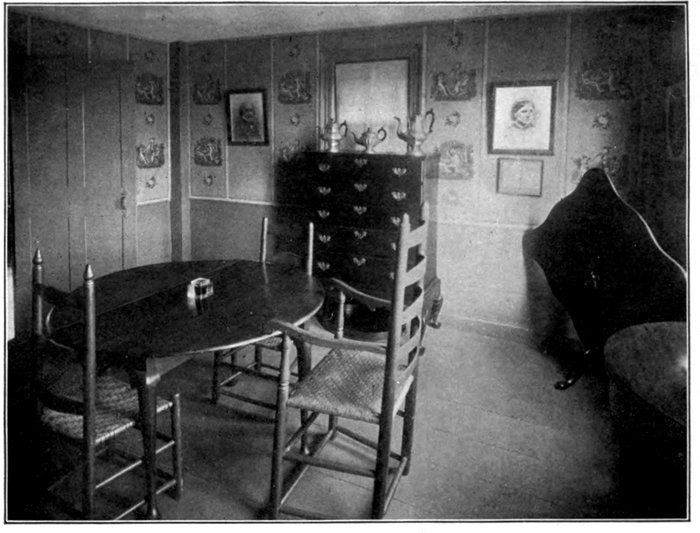
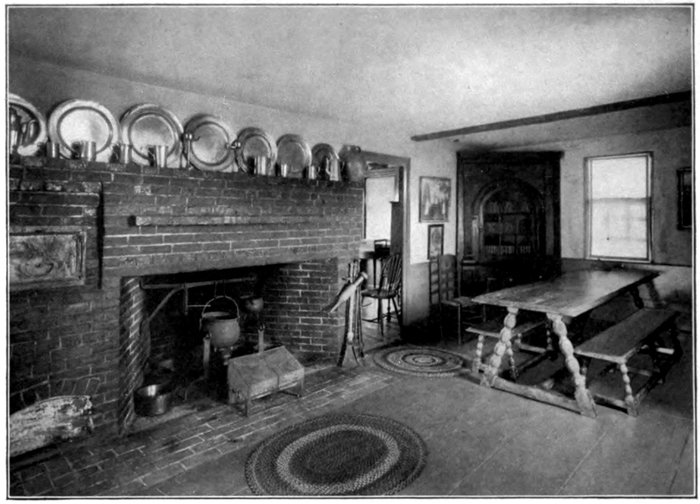
THE SMALL DINING-ROOM
Around this table the philosophers discussed their deepest problems.
49Debauchery of both the earthly soil and the
human body is the result of this cattle keeping.
The land is scourged for crops to feed the animals,
whose ordures are used under the erroneous supposition
of restoring lost fertility; disease is thus
infused into the human body; stimulants and
medicines are resorted to for relief, which end in
a precipitation of the original evil to a more disastrous
depth. These misfortunes which affect
not only the body, but by reaction rise to the
sphere of the soul, would be avoided, or at least
in part, by the disuse of animal food. Our diet is
therefore strictly the pure and bloodless kind.
No animal substances, neither flesh, butter,
cheese, eggs, nor milk, pollute our table or corrupt
our bodies, neither tea, coffee, molasses, nor
rice, tempts us beyond the bounds of indigenous
productions. Our sole beverage is pure fountain
water. The native grains, fruits, herbs, and roots,
dressed with the utmost cleanliness and regard to
their purpose of edifying a healthful body, furnish
the pleasantest refections and in the greatest
50variety requisite to the supply of the various
organs. The field, the orchard, the garden, in
their bounteous products of wheat, rye, barley,
maize, oats, buckwheat, apples, pears, peaches,
plums, cherries, currants, berries, potatoes, peas,
beans, beets, carrots, melons, and other vines,
yield an ample store for human nutrition, without
dependence on foreign climes, or the degeneration
of shipping and trade. The almost inexhaustible
variety of the several stages and
sorts of vegetable growth, and the several modes
of preparation, are a full answer to the question
which is often put by those who have never ventured
into the region of a pure and chaste diet:
“If you give up flesh meat, upon what then can
you live?”
Our other domestic habits are in harmony with
those of diet. We rise with early dawn, begin the
day with cold bathing, succeeded by a music lesson,
and then a chaste repast. Each one finds
occupation until the meridian meal, when usually
some interesting and deep-searching conversation
gives rest to the body and development
to the mind. Occupation, according to the season
and the weather, engages us out of doors or
within, until the evening meal,—when we again
assemble in social communion, prolonged generally
until sunset, when we resort to sweet repose
for the next day’s activity.
51In these steps of reform we do not rely as much
on scientific reasoning of physiological skill, as on
the Spirit’s dictates. The pure soul, by the law
of its own nature, adopts a pure diet and cleanly
customs; nor needs detailed instruction for daily
conduct. On a revision of our proceedings it
would seem, that if we were in the right course
in our particular instance, the greater part of
man’s duty consists in leaving alone much that
he is in the habit of doing. It is a fasting from
the present activity, rather than an increased
indulgence in it, which, with patient watchfulness
tends to newness of life. “Shall I sip tea or
coffee?” the inquiry may be. No; abstain from
all ardent, as from alcoholic drinks. “Shall I
consume pork, beef, or mutton?” Not if you
value health or life. “Shall I stimulate with
milk?” No. “Shall I warm my bathing water?”
Not if cheerfulness is valuable. “Shall I clothe
in many garments?” Not if purity is aimed at.
“Shall I prolong my dark hours, consuming animal
oil and losing bright daylight in the morning?”
Not if a clear mind is an object. “Shall I
teach my children the dogmas inflicted on myself,
under the pretence that I am transmitting
truth?” Nay, if you love them intrude not these
between them and the Spirit of all Truth. “Shall
I subjugate cattle?” “Shall I trade?” “Shall I
claim property in any created thing?” “Shall
52I interest myself in politics?” To how many of
these questions could we ask them deeply enough,
could they be heard as having relation to our
eternal welfare, would the response be “Abstain”?
Be not so active to do, as sincere to be. Being in
preference to doing, is the great aim and this comes
to us rather by a resigned willingness than a wilful
activity;—which is indeed a check to all
divine growth. Outward abstinence is a sign of
inward fulness; and the only source of true progress
is inward. We may occupy ourselves actively
in human improvements;—but these unless
inwardly well-impelled, never attain to, but
rather hinder, divine progress in man. During
the utterance of this narrative it has undergone
a change in its personal expression which might
offend the hypercritical; but we feel assured that
you will kindly accept it as unartful offering of
both your friends in ceaseless aspiration.
Charles Lane,
A. Bronson Alcott.
Harvard, Mass.,
August, 1843.
IV THE MAN WITH THE BEARD
53
No satisfactory record of Fruitlands could be
written without giving an account of Joseph
Palmer, the man with the beard. He filled an
important place in the life of the Community,
and is one of those picturesque characters which
must always stand out vividly in the history of
Fruitlands. He came of fine, sturdy English stock
which emigrated to this country in 1730. His
grandfather taught school in Newton, Massachusetts,
for twenty years. His father fought in the
Revolution, and he himself was a soldier in the
War of 1812. He was an eccentric character,
but steadfast and upright, and immovable when
it came to his principles. Wearing a beard became
a fixed idea with him, and neither the law
of the land nor the admonitions of the church
could make him falter in his determination to
claim freedom of action in this respect. He suffered
ridicule, insolence, and persecution to a
degree that was amazing, and which revealed
the fact that in spite of a seemingly greater enlightenment
on the part of the public, the same
tendency, which drove the people to persecute
54so-called witches, and Shakers, and harmless
persons with a little different viewpoint from
their own, was still alive, and ready to flame
forth as fiercely as ever.
On one occasion, before the Fruitlands days,
he went into a church in Fitchburg where the
holy Communion was being celebrated. He knelt
with the rest only to be given the shock of humiliation
at being ignored and passed over by the
officiating clergyman. Cut to the quick at such
injustice, and with the blood surging to his face,
he arose and strode up to the Communion table
where the Sacraments were, and lifting the cup
to his lips drank from it, and turning to the
shocked and abashed clergyman and his congregation
shouted in a loud voice and with flashing
eyes: “I love my Jesus as well, and better, than
any of you do!”
A beard at that time was only worn by the Jews,
and that was the real reason for this persecution,
and it caused him to be called “Old Jew Palmer,”
though there was not a drop of Jewish blood in
his veins. He carried on his farm at No Town
very successfully and sold his beef at the Fitchburg
Market. No Town was a “gore” of unreclaimed
land outside of Fitchburg and Leominster
in old Colonial days, a large tract of which
had been granted to Captain Noah Wiswell, his
maternal grandfather, by the General Court of
55the Province of Massachusetts for bravery in
the wars against the Indians. Joseph Palmer inherited
it. It belonged to no township, and therefore
was not taxed. So when he married the widow
Tenney rumors circulated through Fitchburg that
the marriage was not legal because he did not
publish the banns at the meeting-house according
to law, there being no meeting-house at No
Town. But investigation proved the marriage
legal because he had published the banns in his
own handwriting on a large piece of paper which
he had tacked to the trunk of a fine old pine tree
which grew near his house.
Joseph Palmer’s wife before her first marriage
was Nancy Thompson. She was a third cousin
to Count Rumford, who was Benjamin Thompson,
of Woburn, in Colonial days, but who returned
to England after the evacuation of the
British, and on account of services rendered to
the Government was knighted by George III,
and afterward given the title of Count Rumford
by the reigning king of Bavaria, and was well
known throughout Europe as a scientist, philosopher,
and savant.
A reporter of the Boston Daily Globe in 1884
interviewed Joseph Palmer’s son, Dr. Palmer, of
Fitchburg, and herein are inserted extracts from
the interview:—
56“The older inhabitants of Harvard, Sterling,
Leominster, Fitchburg, and other neighboring
towns can remember ‘Old Jew Palmer,’ who fifty
years ago was persecuted, despised, jeered at,
regarded almost as a fiend incarnate; who was
known far and wide as a human monster, and with
whose name mothers used to frighten their children
when they were unruly.
“‘Old Jew Palmer,’ as he was universally
called, was the most abused and persecuted man
these parts ever knew, and all because he insisted
upon wearing a beard. But many who in
those days looked upon the subject of this sketch
as a social outcast have lived to see whiskers
common and fashionable.
“With a view of getting at the facts of the
persecution of Mr. Palmer but fifty years ago,
his only son, Dr. Thomas Palmer, a well-known
dentist of Fitchburg, was interviewed, and the
doctor talked earnestly and vigorously about his
father’s career, for he had seen the time when
his schoolmates shunned him and made his boyhood
days miserable, railing at him because his
father wore a beard. But now the doctor looks
back upon those days proudly, as he realizes
that his sire was right and that the world has
indorsed the ways and ideas of the old man,
instead of the old man bowing to the absurd
whim of the world.”
JOSEPH PALMER
NANCY PALMER
57Said Dr. Palmer:—
“Father left No Town early in the thirties and
moved to Fitchburg into a house where the City
Hall now stands. He wore at that time a long
beard, and he and Silas Lamson, an old scythe-snath
maker of Sterling, were the only men
known in this section of the country as wearing
beards. Everybody shaved clean in those days,
and to wear whiskers in any form was worse than
a disgrace, it was a sin. Father was hooted at on
the street, talked about at the grocery, intimidated
by his fellow-men and labored with by the
clergy to shave, but to no purpose. The stronger
the opposition, the firmer his determination. He
was accosted once by Rev. George Trask, the anti-tobacconist,
who said indignantly: ‘Palmer, why
don’t you shave and not go round looking like
the devil?’ He replied: ‘Mr. Trask, are you not
mistaken in your comparison of personages? I
have never seen a picture of the ruler of the sulphurous
regions with much of a beard, but if I remember
correctly, Jesus wore a beard not unlike
mine.’ That squelched Trask and he left.
“Well, public sentiment against the man and
beard grew stronger, and personal violence was
threatened. One day, as father was coming out
of the old Fitchburg Hotel, where he had been to
carry some provision, he then being in the butchering
business, he was seized by four men, whose
58names I have not in mind now, who were armed
with shears, lather, and razor, their intention
being to shave him, as the sentiment of the
populace was that that beard must come off
at the hands of the wearer, possibly at the hands
of some one, anyway. Why, there are men living
to-day, old associates of his, who still cling to that
old idea and will not wear a beard. These four
men laid violent hands upon him and threw him
heavily on the stone steps, badly hurting his
back. The assaulted party was very muscular,
and struggled to free himself, but to no purpose,
until he drew from his vest pocket an old, loose-jointed
jack-knife, with which he struck out left
and right and stabbed two of them in the legs,
when the assailants precipitately departed without
cutting a hair. He was afterwards arrested
for committing an unprovoked assault, and
ordered by Justice Brigham to pay a fine, which
he refused to do, as he claimed to be acting for
the maintenance of a principle. He was thrown
into jail, where he remained over a year. He was
lodged with the debtors. One day Jailer Bellows
came in with several men to shave him. He
threw himself on his back in his bunk, and when
they approached, he struck out with his feet, and
after he had kicked over a few of them they let
him and his beard alone. He wrote letters to the
Worcester Spy, complaining of the treatment
59the prisoners received, which I used to carry to
the office for him, receiving them when I carried
him his meals, for we hired a tenement next to the
jail. For this the jailer put him in a sort of dungeon
down below, and one day when I went
to the jail, he heard my step and called out:
‘Thomas, tie a stone to a string and swing it by
the window so that I can catch it’; which I did,
and pulled up a letter for High Sheriff Williams,
in which he complained of his treatment. The
sheriff ordered him back to his old quarters.
Why, old Dr. Williams of Leominster told father
once that he ought to be prosecuted and imprisoned
for wearing a beard. In after years,
when whiskers became fashionable, father met
a minister who had upbraided him years before
for wearing them, and as this same minister had
rather a luxuriant growth, he went up to the
man of God and stroking his whiskers, said to
him, ‘Knoweth that thy redeemer liveth?’ He
claimed to be the redeemer of the beard.
“Father was a reformer; was early in the field
as an anti-slavery man and as a total abstinence
advocate. He was well acquainted with Phillips,
Garrison, and other prominent Abolitionists. I
remember going with him once to an anti-slavery
convention in Boston. As we walked up Washington
Street, the people would stop, then run
ahead, wait for us to come up, and finally the
60crowd around us was so great that the police had
to come to the rescue. Why was it? Oh, it was
the same old beard. It was so unusual to see a
man wearing one, and especially such a one as he
sported. Why, he was looked upon as a monstrosity.
When asked once why he wore it, he
said he would tell if any one could tell him why
some men would, from fifty-two to three hundred
and sixty-five times a year, scrape their face
from their nose to their neck. He never would
furnish liquor for men in the hay-field, and for
this reason had hard work to gather crops; but
they would have rotted before he would have
backed down and sacrificed his principle. He was
the first man in this section to give up that old
custom. He was interested in all reformatory
ideas, and was associated with A. Bronson Alcott
in forming that Community in Harvard at
Fruitlands which had for its object a more quiet
and unostentatious way of living than the world
offered. He went to Harvard in 1843. The Community
did not flourish, and father bought the
farm. Ralph Waldo Emerson, as trustee, at that
time held the deed of ‘Fruitlands.’ I remember
that when father refused to furnish liquor for
the hay-makers he had to hire boys. One mother
refused to let her lad work for him, saying that
‘He was too mean to allow the boys a little
liquor’!
61“Such was the interesting account given by
the venerable doctor of a condition of affairs existing
in this community but a comparatively
few years ago; but the average person of to-day
would not believe, without a full explanation of
the sentiment prevailing at that time, that within
so recent a period a man would not only be insulted
and persecuted, but actually mobbed, as
was the victim of this foolish and intolerant community.”
While in prison Palmer kept a diary, in which,
under date of July 21, 1830, occurs this account
of the sort of persecution he had from the two
fellow-prisoners who occupied the same cell
with him. One of them asserted that if the other
prisoner would attack him and cut his beard
off, he would look on all the time and then swear
that it had never happened, and that anyway
he could get enough money collected anywhere
on the street to pay the damages for the act. The
jailer coming to the door at this moment overheard
the remark and with a resounding oath
agreed with him, and added, “And pretty quick,
too!” Then he began to curse and swear at
Palmer, and vowed that they would get his beard
off soon, and even suggested that the other prisoners
should cut it off of him in his sleep. One
of these prisoners was named Dike. The jailer
62continued to pour volley after volley of oaths at
the unfortunate man, and finally spat on him repeatedly.
This happened when Palmer’s cell
was being whitewashed and the three inmates
were temporarily removed to another cell. When
they were taken back to their customary quarters,
Dike found that the jailer had taken his
razor away, which turned his wrath in a new
direction, and Palmer writes that as a result “Before
bedtime, he was as good as a man ought to
be to another, and talked very freely with me
on the Power and Goodness of God and on the
Holy Scriptures.”
Here is an entry on Wednesday, September 22,
1830:—
“I called out to some one in the hall. Wildes,
the jailer, opened the door in the entry next to
my door and said: ‘What do you want?’ I was
just going to ask him for a little water to use until
I could get some tea from Wilson, and he let
a pail full come in at the door, with great force.
It didn’t wet me much, as I see it was coming,
and having seen them throw cider and water in
the prisoners’ faces before. It caused me to start
so quickly that there did but little go into my
face, and on my clothes, but it went more than
half the length of the room. I split three crackers
and put them to soak where there was considerable
water standing on the floor, as I could
63see no chance of getting any more soon. I got a
quart jug filled with water out of the other room
to wet some bread which was all the water or
drink of any kind that I had since last Thursday
morning when I used the last of my tea, and I
had tried ever since last Sunday morning to get
some and could not. I thought I must suffer
very much soon if there wasn’t some attention,
and being satisfied that there were some in
Prison who were suffering greatly, I thought it
time to give a signal of distress to the Public,
which I immediately did by the cry of murder in
the Gaol, which I continued at the window that
somebody might come up while the door was
open that would grant some assistance for the
pay. About seven o’clock just as I was going to
take my crackers off the floor, Bellows and Wildes
came into the room and several others. I stepped
to the table and took the lines I had written to
send to Mr. Wilson, and asked them if I could
get any one of them to go for me if I would pay
them for it. Bellows said, ‘Yes, I’ll take care of
you!’ Bellows and Wildes then seized me by the
collar, shook and jarred me with great fury
through the entries, and dragged me down the
stairs. I tried to speak to the people who stood
by to take the paper I had in my hand to carry
to Mr. Wilson. Bellows then took me by the
hair and shook me furiously as I suppose to prevent
64my speaking to them. I then cried Murder.
He then let me go, and I told them that I wanted
to get some person to take the paper I had in
my hand and go about 100 rods of an errand, and
I would pay them well for it, for I hadn’t had
anything to drink since last week, nor I couldn’t
get any. They put me into the South Middle
room below and gave me a pail of water. I told
Wildes and C. B. that I wanted they should let
me have my things, for I hadn’t eaten anything
since yesterday morning. They took the other
three prisoners out of the room and shut the
blinds.”
Palmer was kept in solitary confinement from
September 22 to December 25.
December 30, 1830.
“In the afternoon Calvin Willard, Ashel Bellows,
Wildes, and Lawyer Goodwin, with four
or five other gentlemen, came in. Willard said,
‘How do you do, Palmer?’ I said, pretty tolerable
well for me except I have got a bad cold.
One of the men, which I took to be Esqre. Weed
said to me: ‘Why don’t you go out? What do
you stay here for? Why don’t you pay up the
demand and go out?’ I said I have no way
to pay it. Goodwin said: ‘A man from Fitchburg
told me to-day that he has from ten to fifteen
65hundred dollars property.’ Willard said: ‘I always
took him to be a man of property.’ One of
the men said: ‘I think there ought to be some
measures taken to secure the board if he stops
here.’ I said: I board myself and have hard work
to get it in here for the money. One said:
‘How much was your fine?’ I said, Ten dollars,
I believe it was.”
Saturday, January 1, 1831.
“Since the first of December I haven’t bought
me anything from Bellows, and they haven’t
brought me anything but eight Bushels and one
hod of coal, and they used two Bushels of that
when they whitewashed the room, except what I
took to make one fire. Thomas brought me my
water. I was out of my room three and a half
days to have it whitewashed, and I have now a
half Bushel of coal which brings it to seven and a
half Bushels I have burnt the past month while
I was in the room.”
April 11, 1831.
“Food for the day:—
“Breakfast:
5 ounces of brown bread
“Dinner:
5¼ ounces of brown bread
3½ ounces of beef meat
3½ ounces of potato
3¾ ounces of soup.”
66“He far out-stayed his sentence because he
had to pay for all his food, drink, and coal for
heating, and he considered they cheated him, so
he refused to go. The sheriff and jailers, tired of
having him there, begged him to leave. Even
his mother, Margaret Palmer, wrote to him ‘Not
to be so set.’ But nothing could move him. He
said they had put him in there, and they would
have to take him out, as he would not walk out.
They finally carried him out in his chair and
placed it on the sidewalk.”
Shortly after leaving the jail at Worcester
Palmer heard of the proposed Community of
Fruitlands, and being much interested in all reforms,
he offered to run the farm without pay
and went there at the very start. He took some
fine old furniture with him from No Town to
help furnish the house, and whenever anything
was needed in the way of farm implements, etc.,
he would drive over to No Town and bring it
back with him. When the Community of Fruitlands
failed, he bought the place and carried on
a strange sort of Community of his own for upwards
of twenty years. Emerson visited him
afterwards, and a motley collection of reformers,
wayfarers, and a host of tramps found a welcome
by his fireside.
Any one driving by the old North Leominster
67graveyard will see a stone monument adorned
with the head of a man with a flowing beard. On
it is written:—
JOSEPH PALMER
died
October 30, 1875
Aged 84 years, 5 months
Underneath the carved head is written:—
Persecuted for
Wearing the Beard
V SUMMER SUNSHINE
68
It was now July and all the days were full of
healthful occupations—the weather was perfect.
The philosophers had planted three mulberry
trees next the front door, and they had
set out apple trees and pear trees below the house
on the slope of the hill. They put the mulberry
trees so near the house that when they grew,
the roots almost unsettled the foundations, and
the fruit trees were planted in just the wrong
place to permit of luxuriant growth; but they
never knew it, and at the time they pictured to
themselves the full-grown trees with branches
overladen with the luscious ripening fruit. And
now they all had gotten their linen suits designed
by Mr. Lane:—loose trousers, tunic-ed coats
and broad-brimmed linen hats like Southern
planters. The Alcott girls, Anna, Beth, Louisa,
and three-year-old baby May were in linen
bloomers, and so were Mrs. Alcott (protesting!)
and poor Miss Page, who was summarily dismissed
from Fruitlands for having eaten fish.
THE REFECTORY, ALSO USED AS A KITCHEN
69Many visitors came and went. Parker Pillsbury
often came, his mind full of the anti-slavery
question. The Concord circle of friends
looked in upon them off and on, and Channing
spoke afterwards of conversations held in a small
dining-room next to the front door, and, as Mr.
Sanborn says in his account of it, “The library
of rare books from London stood proudly on its
hundred feet of new shelves in the small front
entry of the old house, proclaiming the atmosphere
of ‘Mind and Letters.’”
Emerson came and afterwards wrote in his
“Journal” on July 8, 1843:—
“The sun and the evening sky do not look
calmer than Alcott and his family at Fruitlands.
They seemed to have arrived at the fact—to
have got rid of the show, and so to be serene.
Their manners and behavior in the house and the
field were those of superior men—of men at rest.
What had they to conceal? What had they to exhibit?
And it seemed so high an attainment that
I thought—as often before, so now more, because
they had a fit home, or the picture was fitly
framed—that these men ought to be maintained
in their place by the country for its culture.
“Young men and young maidens, old men and
women, should visit them and be inspired. I
think there is as much merit in beautiful manners
as in hard work. I will not prejudge them successful.
They look well in July; we will see them
in December. I know they are better for themselves
than as partners. One can easily see that
70they have yet to settle several things. Their
saying that things are clear, and they sane, does
not make them so. If they will in very deed be
lovers, and not selfish; if they will serve the town
of Harvard, and make their neighbors feel them
as benefactors wherever they touch them,—they
are as safe as the sun.”
Mr. Sanborn, referring to the remark, “We will
see them in December,” says: “This passage indicates
that Emerson with his fatal gift of perception
had long since seen the incongruity between
Alcott and Lane. At this time all was still fair
weather at the Fruitlands Eden, although the
burden of too much labor, of which Lane had
written to Thoreau in June, had been falling more
and more heavily on Mrs. Alcott and her daughters,
Anna, then twelve, and Louisa, not quite
eleven. As they did so much of the domestic
drudgery, Mrs. Alcott doubtless thought it no
more than right that her English guests, both
there and at Concord, during the seven months
that Lane and his son were in their household,
should pay their share of the family expenses.”
The house at times was very overcrowded and
the children had their beds up in the garret. But
Anna begged hard for a tiny room adjoining Mrs.
Alcott’s, and great was the joy she took in it.
Of course it all was very primitive. The men
71bathed in the brook in the early morning and the
shower-baths that Anna speaks of in her diary
were accomplished thus:—rough clothes-horses
covered with sheets were put in a circle and the
bathers stood hidden within, while Mr. Alcott,
mounted on some wooden steps, poured water
from a pitcher through a sieve on their head.
(This was told the author by an old lady who
when very young went to visit the children.)
Hired laborers and beasts of burden were
against the principles of the Community, but in
order to make headway against the advancing
season they seemed to be a necessity. This concession,
however, troubled the philosophers, and
it was decided to carry out the original plan and
rely wholly on the spade instead of the plough,
even at a cost of valuable time. The results
were rather disastrous: Charles Lane’s hands became
sore and painful, and lame backs seriously
interfered with progress. Sobered by this new
experience, the philosophers met in conclave,
and as a result Joseph Palmer, who always came
to the rescue in trying situations, went to No
Town and brought back his plough and yoke
of oxen, as he called it—it really was an ox and
a cow which he had trained to work together.
Besides the outdoor work much writing was done
indoors. Charles Lane and Bower wrote prolifically
to different papers. The Herald of Freedom,
72the Vermont Telegraph and the New York Tribune
of that summer are full of their writings.
Mr. Alcott’s Diary furnishes clear evidence
of his purposes and hopes:—
“I would abstain from the fruits of oppression
and blood, and am seeking means of entire independence.
This, were I not holden by penury unjustly,
would be possible. One miracle we have
wrought nevertheless, and shall soon work all of
them: Our wine is water, flesh, bread—drugs,
fruits; and we defy meekly the satyrs all, and
Æsculapians. The Soul’s banquet is an art divine....
This Beast named Man has yet most costly
tastes, and must first be transformed into a very
Man, regenerate in appetite and desire, before
the earth shall be restored to fruitfulness, and redeemed
from the curse of his cupidity. Then
shall the toils of the farm become eloquent and
invigorating leisures; Man shall grow his orchards
and plant his gardens—an husbandman truly,
sowing and reaping in hope, and a partaker in his
hope. Labor will be attractive; life will not be
worn in anxious and indurating toils; it will be a
scene of mixed leisure, recreation, labor, culture.
The soil, grateful then for man’s generous usage,
debauched no more by foul ordures, nor worn by
cupidities, shall recover its primeval virginity,
bearing on its bosom the standing bounties which
73a sober and liberal Providence ministers to his
heed—sweet and invigorating growths, for the
health and comfort of the grower.”
Mr. Sanborn, commenting on this, remarks:—
“It was in the spirit of the passages just quoted
from Alcott’s diary ... and not from the ordinary
Fourieristic notions about attractions and
destinies and coöperative housekeeping that Alcott
undertook his experiment at ‘Fruitlands.’”
Alcott’s theory of human life was thus set
down in his Diary:—
“I have been (as is ever the habit of my mind)
striving to apprehend the real in the seeming, to
strip ideas of their adventitious phrases, and
behold them in their order and powers. I have
sought to penetrate the showy terrestrial to find
the heavenly things; I have tried to translate into
ideas the language and images of spirit, and thus
to read God in his works. The outward I have
seen as the visible type of the inward. Ever
doth this same nature double its divine form,
and stand forth—now before the inner, now
before the outer sense of man—at once substance
and form, image and idea, so that God
shall never slip wholly from consciousness of
the Soul. Faith apprehends his agency, even in
the meanest and most seemingly trivial act,
whenever organ or matter undergo change of
74function or mode of form,—Spirit being all in all.
Amidst all tumults and discomfitures, all errors
and evils, Faith discerns the subtle bond that
marries opposite natures, clinging to that which
holds all in harmonious union. It unites opposites;
it demolishes opposing forces. It melts all
solid and obstinate matters. It makes fluid the
material universe. It hopes even in despair, believes
in the midst of doubts, apprehends stability
and order even in confusion and anarchy,
and, while all without is perturbed and wasting,
it possesses itself in quietude and repose within.
It abides in the unswerving, is mighty in the
omnipotent, and enduring in the eternal. The
soul quickened by its agency, though borne on
the waves of the mutable and beset by the
winds of error and the storms of evil, shall ride
securely under this directing hand to the real and
the true. In the midst of change, it shall remain
unchanged. For to such a faith is the divine
order of God made known. All visible things are
but manifestations of this order. Nature, with
all its change, is but the activity of this power.
It flows around and obeys the invisible self-anchored
spirit. Mutability to such a vision, is
as the eddy that spirit maketh around its own
self-circling agency, revealing alike in the smallest
ripple and the mightiest surges the power that
stirreth at the centre.”
VI FATHER HECKER’S DESCRIPTION OF FRUITLANDS
75
[Isaac Thomas Hecker was born in New York
in 1819. Two years after his experience at Brook
Farm and Fruitlands he entered the Roman
Catholic church, and in 1849 he was ordained a
priest. Later he founded the Paulist Fathers. He
died in 1888. The following extracts are taken
from a contemporary record of his impressions
while in the socialistic community.]
“Fruitlands,” so called because fruit was to be
the principal staple of daily food, and to be cultivated
on the farm, was a spot well chosen; it was
retired, breathing quiet and tranquillity. No
neighboring dwelling obstructed the view of Nature,
and it lay some distance even from a bypath
road, in a delightful solitude. The house,
somewhat dilapidated, was on the slope of a
slowly ascending hill; stretched before it was a
small valley under cultivation, with fields of corn,
potatoes, and meadow. In the distance loomed
up on high “Cheshire’s haughty hill,” Monadnoc.
Such was the spot chosen by men inspired to live
a holier life, to bring Eden once more upon earth.
These men were impressed with the religiousness
76of their enterprise. When the first load of hay
was driven into the barn and the first fork was
about to be plunged into it, one of the family took
off his hat and said, “I take off my hat, not that
I reverence the barn more than other places, but
because this is the first fruit of our labor.” Then
a few moments were given to silence, that holy
thought might be awakened.
July 7, 1843. Brook Farm.
I go to Mr. Alcott’s next Tuesday, if nothing
happens. I have had three pairs of coarse pants
and a coat made for me. It is my intention to
commence work as soon as I get there. I will
gradually simplify my dress without making any
sudden difference, although it would be easier to
make a radical and thorough change at once than
piece by piece. But this will be a lesson in patient
perseverance to me. All our difficulties should be
looked at in such a light as to improve and elevate
our minds.
I can hardly prevent myself from saying how
much I shall miss the company of those I love
and associate with here. But I must go. I am
called with a stronger voice. This is a different
trial from any I have ever had. I have never had
that of leaving kindred, but now I have that of
leaving those whom I love from affinity. If I
wished to live a life the most gratifying to me,
and in agreeable company, I certainly would remain
here. Here are refining amusements, cultivated
persons—and one whom I have not
spoken of, one who is too much to me to speak of,
one who would leave all for me. Alas! him I
must leave to go.
ISAAC T. HECKER
77“[In this final sentence, as it now stands in the
diary and as we have transcribed it, occurs one of
those efforts of which we have spoken to obliterate
the traces of this early attachment. ‘Him’
was originally written ‘her,’ but the r has been
lengthened to an m, and the e dotted, both with
care which overshot their mark, by an almost imperceptible
hair’s breadth. If the nature of this
attachment were not so evident from other
sources, we should have left such passages unquoted;
fearing lest they might be misunderstood.
As it is, the light they cast seems to us to throw
up into fuller proportions the kind and extent of
the renunciations to which Isaac Hecker was
called before he had arrived at any clear view of
the end to which they tended.]”[9]
Last evening I arrived here. After tea I went
out in the fields and raked hay for an hour in
company with the persons here. We returned
78and had a conversation on clothing. Some very
fine things were said by Mr. Alcott and Mr. Lane.
In most of their thoughts I coincide; they are the
same which of late have much occupied my
mind. Alcott said that “to Emerson the world
was a lecture room, to Brownson a rostrum.”
This morning after breakfast a conversation
was held on Friendship and its laws and conditions.
Mr. Alcott places Innocence first; Larned,
Thoughtfulness; I, Seriousness; Lane, Fidelity.
July 13.
This morning after breakfast there was held a
conversation on the Highest Aim. Mr. Alcott
said it was Integrity; I, Harmonic being; Lane,
Progressive being; Larned, Annihilation of self;
Bower, Repulsion of the evil in us. Then there
was a confession of the obstacles which prevent
us from attaining the highest aim. Mine was the
doubt whether the light is light; not want of will
to follow, or light to see.
July 17.
I cannot understand what it is that leads me,
or what I am after. Being is incomprehensible.
What shall I be led to? Is there a being whom I
may marry and who would be the means of opening
my eyes? Sometimes I think so, but it appears
impossible. Why should others tell me that
it is so, and will be so, in an unconscious way, as
79Larned did on Sunday last, and as others have
done before him? Will I be led home? It strikes
me these people here, Alcott and Lane, will be a
great deal to me. I do not know but they may be
what I am looking for, or the answer to that in
me which is asking.
Can I say it? I believe it should be said. Here
I cannot end. They are too near me; they do not
awaken in me that sense of their high superiority
which would keep me here to be bettered, to be
elevated. They have much, very much. I desire
Mr. Alcott’s strength of self-denial, and the
unselfishness of Mr. Lane in money matters. In
both these they are far my superior. I would be
meek, humble, and sit at their feet that I might
be as they are. They do not understand me, but
if I am what my consciousness, my heart, lead
me to feel,—if I am not deceived,—why, then
I can wait. Yes, patiently wait. Is not this the
first time since I have been here that I have recovered
myself? Do I not feel that I have something
to receive here, to add to, to increase my
highest life, which I have never felt anywhere
else?
Is this sufficient to keep me here? If I can
prophesy, I must say no. I feel that it will not
fill my capacity. Oh God! strengthen my resolution.
Let me not waver, and continue my life.
But I am sinful. Oh forgive my sins! what shall I
80do, O Lord! that they may be blotted out? Lord
could I only blot them out from my memory,
nothing would be too great or too much.
July 18.
I have thought of my family this afternoon,
and the happiness and love with which I might
return to them. To leave them, to give up the
idea of living with them again.—Can I entertain
that idea? Still, I cannot conceive how I can
engage in business, share the practices, and indulge
myself with the food and garmenture of
our home and city. To return home, were it possible
for me, would most probably not only stop
my progress, but put me back. It is useless for
me to speculate upon my future. Put dependence
on the spirit which leads me, be faithful to it,
work and leave results to God. If the question
should be asked me, whether I would give up my
kindred and business and follow out this spirit
life, or return and enjoy them both, I could not
hesitate a moment, for they would not compare—there
would be no room for choice. What I do I
must do, for it is not I that do it; it is the spirit.
What that spirit may be is a question I cannot
answer. What it leads me to do will be the only
evidence of its character. I feel as impersonal as
a stranger to it. I ask who are you? Where are
you going to take me? Why me? Why not some
81one else? Alas! I cry, who am I and what does
this mean? And I am lost in wonder.
Saturday, July 21.
Yesterday, after supper, a conversation took
place between Mr. Alcott, Mr. Lane, and myself;
the subject was my position with regard to
my family, my duty, and my position here. Mr.
Alcott asked for my first impressions as regards
the hinderances that I have noted since coming
here. I told him candidly they were:
First, his want of frankness; 2d, his disposition
to separateness rather than win co-operation
with the aims in his own mind; 3d, his family who
prevent his immediate plans of reformation; 4th,
the fact that his place has very little fruit on it,
when it was and is their desire that fruit should
be the principal part of their diet; 5th, my fear
that they have too decided tendency toward literature
and writing for the prosperity and success
of their enterprise.
[From this on, the diary is full of questionings
and unrest. Should he return to his family and
live as an ordinary man, or should he listen to
the urge of the spirit within and seek further for
the light? These and other questions pursued
him night and day. Finally he came to a conclusion.]
82July 23.
I will go home, be true to the spirit with the
help of God, and wait for further light and
strength.... I feel that I cannot live at this
place as I would. This is not the place for my
soul.... My life is not theirs. They have been
the means of giving me much light on myself, but
I feel I would live and progress more in a different
atmosphere.
[It is interesting to note that after his return
home he continued the diet which was used at
Fruitlands. The account of his life states: “One
of the first noteworthy things revealed by the
diary, which from this time on was kept with less
regularity than before,—is that Isaac not only
maintained his abstemious habits after his return,
but increased their vigor.”]
August 30.
If the past nine months or more are any evidence,
I find that I can live on very simple diet—grains,
fruit, and nuts. I have just commenced to
eat the latter; I drink pure water. So far I have
had wheat ground and made into unleavened
bread, but as soon as we get in a new lot, I shall
try it in the grain.
Hecker had evidently at this time a practical
conviction of the truth of a principle which, in
83after years, he repeated in the form of a maxim
of the Transcendentalists: “A gross feeder will
never be a central thinker.” It is a truth of the
spiritual no less than of the intellectual order. A
little later we come upon the following profession
of a vegetarian faith:—
“Reasons for not eating animal food.
“It does not feed the spirit.
“It stimulates the propensities.
“It is taking animal life when the other kingdoms
offer sufficient and better increment.
Slaughter strengthens the lower instincts. It is
the chief cause of the slavery of the kitchen.
“It generates in the body the diseases animals
are subject to, and encourages in man their
bestiality.
“Its odor is offensive and its appearance unæsthetic.”
Mr. Alcott’s death in 1888 was the occasion of
reminiscences from Father Hecker, from which a
few extracts are taken:—
“When did I first know him? Hard to remember.
He was the head of Fruitlands, as
Ripley was of Brook Farm. They were entirely
different men. Diogenes and his tub would have
been Alcott’s ideal if he had carried it out. Ripley’s
ideal would have been Epictetus. Ripley
would have taken with him the good things of
84this life. Alcott would have rejected them
all.”
“How did he receive you at Fruitlands?”
“Very kindly, but from mixed and selfish
motives. I suspect he wanted me because he
thought I would bring money to the Community.
Lane was entirely unselfish.”
“Alcott was a man of great intellectual gifts or
acquirements. His knowledge came chiefly from
experience and instinct. He had an insinuating
and persuasive way with him.”
“What if he had been a Catholic, and thoroughly
sanctified?”
“He could have been nothing but a hermit like
those of the fourth century—he was naturally
and constitutionally so odd. Emerson, Alcott,
and Thoreau were three consecrated cranks.”
Here also are two interesting passages from the
“Life of Father Hecker,” and a few memoranda
of private conversations:—
“Somebody once described ‘Fruitlands’ as a
place where Mr. Alcott looked benign and talked
philosophy, while Mrs. Alcott and the children
did the work. Still to look benign is a good deal
for a man to do persistently in an adverse world,
indifferent for the most part to the charms of
‘divine philosophy,’ and Mr. Alcott persevered
in that exercise until his latest day.”
85“He was unquestionably one of those who like
to sit upon a platform,” wrote at the time of his
death, one who knew Alcott well, “and he may
have liked to feel that his venerable aspect had
the effect of a benediction.” “But with this mild
criticism, censure of him is well-nigh exhausted.”
“Fruitlands was very different from Brook
Farm—far more ascetic.”
“You didn’t like it?”
“Yes; but they did not begin to satisfy me. I
said to them: If you had the Eternal here, all
right, I would be with you.”
“Had they no notion of hereafter?”
“No, nothing definite. Their idea was human
perfection. They set out to demonstrate what
man can do in the way of the supremacy of the
spiritual over the animal; All right, I said, I agree
with you fully. I admire your asceticism; it is
nothing new to me; I have practiced it a long
time myself. If you can get the Everlasting out
of my mind, I’m yours. But I know that I am going
to live forever.”
“What did Mr. Alcott say when you left?”
“He went to Lane and said, ‘Well, Hecker has
flunked out. He hadn’t the courage to persevere.
He’s a coward.’ But Lane said, ‘No; you’re mistaken.
Hecker is right. He wanted more than
we had to give him.’”
VII ANNA ALCOTT’S DIARY AT FRUITLANDS — COMPOSITION — A FABLE The May Morning — “FRUITLANDS”
86
1843.
This morning I rose pretty early. After breakfast
I read and wrote stories. In the afternoon I
wrote some letters, And the following ode to
Louisa:—
Louisa dear
With love sincere
Accept this little gift from me.
It is with pleasure
I send this treasure
And with it send much love to thee.
Sister dear
Never fear.
God will help you if you try.
Do not despair,
But always care
To be good and love to try.
June 6, 1843.
Having been busy helping arrange things for
moving last Thursday, we left Concordia later
for Harvard. I walked part of the way, the distance
being 14 miles from Concord to Harvard.
I felt sad at the thought of leaving Concord and
all my little friends, the birth-place of Abba where
I had spent many happy hours; but Father and
Mother and my dear sisters were going with me,
87and that would make me happy anywhere, I
think. We arrived at our new home late in the
afternoon. Our first load of furniture had come
before us. We found Christy, Wood Abraham,
and William all here. Mother was well pleased
with the house. There is no beauty in the house
itself, but to look out on three sides, you can see
mountains, hills, woods, and in some places the
Still River may be seen through the trees. At
some distance are the Shaker Villages. On the
whole, I like the house very well. After eating
our supper we fixed our beds and went early to
bed. Having no time to put up the bedsteads,
we slept on the floor which made my back lame.
Friday and Saturday in working and arranging
the house in order. To-day in the morning I
cleared the table and washed the dishes, being
washing day. I washed with Mother and got
dinner. In the afternoon I sewed and read. I did
not do much this evening, for I went to bed when
I had finished the dishes. The men have been
planting to-day corn, and cutting wood and fixing
round about the house out of doors.
Wednesday, 11.
I began my school to-day. We commenced by
singing, “When the day with rosy light.” It
seemed so pleasant to sing with my sisters. After
singing I wrote my journal and the girls wrote in
88their books. They then studied arithmetic lesson.
I then gave them a recess, after which they spelt,
read and Louisa recited geography. At eleven the
school was dismissed. In the afternoon I sewed
for my dolly and took care of Abba, then all went
to walk in the woods. It was quiet and beautiful
there and I felt a calmness in myself. The sun
was shining and the birds were singing in the
branches of the high trees. It was so beautiful
it seemed as if God was near me. I made some
oak leaf wreaths, one for father and one for
mother, and stuck flowers in them. They looked
very pretty indeed. Then we returned from our
walk and prepared for supper. In the evening I
sang with Christy, William, mother, and sisters.
Thursday, 8.
To-day I gave the children lessons this morning.
In the afternoon I wrote. Christy is going
to teach me arithmetic and composition, and the
subject upon which I am to write is our plan of
life. The part I wrote on to-day was flesh-eating.
I will write it in here.
ABBA MAY ALCOTT
LOUISA MAY ALCOTT
ANNA BRONSON ALCOTT
89
Life was given to the animals not to be destroyed
by men, but to make them happy, and
that they might enjoy life. But men are not
satisfied with slaying the innocent creatures, but
they eat them and so make their bodies of flesh
meat. O how many happy lives have been destroyed
and how many loving families have been
separated to please an unclean appetite of men!
Why were the fruits, berries and vegetables given
us if it was intended that we should eat flesh? I
am sure it was not. We enjoy the beautiful
sights and thoughts God has given us in peace.
Why not let them do the same? We have souls
to feel and think with, and as they have not the
same power of thinking, they should be allowed
to live in peace and not made to labour so hard
and be beaten so much. Then to eat them! eat
what has had life and feeling to make the body
of the innocent animals! If treated kindly, they
would be kind and tame and love men, but as they
now are abused and cruelly treated they do not
feel the feeling of “love” towards men. Besides
flesh is not clean food, and when there is beautiful
juicy fruits who can be a flesh-eater?
In the evening I sang again as I did last night.
Friday, 9.
After breakfast, it being my day for dishes, I
cleared up the table. At eleven I had my composition
lesson. In the afternoon I sewed, read and
played. I sewed in the evening and went to bed
early.
90Saturday, 10.
This morning father and Mr. Lane went to
visit the Shakers in Harvard town. I did the
chamber work and then worked and made some
bread for dinner, and prepared things ready for
it. In the afternoon I laid down, it being very
warm out, and read in “Devereux” which pleased
me very well. It rained hard and steadily for some
time. Father and Mr. Lane returned late in the
afternoon. They brought home sweet things they
had purchased of the Shakers. We played out on
the grounds a little while and then I read and
went to bed early.
Sunday, 11.
I read until 10 o’clock when we had reading.
In the afternoon I read, wrote and had my lessons
with Christy. In the evening I received a note
from mother accompanied by a roll containing
some wafers and some note paper. It was as follows:—
Dear Anna:
I send you a little note paper and a few wafers.
You have so much to do lately that I cannot expect
you to write often to me, but you must not
forget that this is a little duty of yours that gives
me a great deal of happiness. This last word reminds
me of one of father’s beautiful selections
to-day.
91“Happiness is like the bird
That broods above its nest
And feels beneath its folded wings
Life’s dearest and its best.”
I am sure I feel as if I could fold my arms
around you all, and say from my heart, “Here is
my world within my embrace.” Let us try, dear
Anna, to make it a good and beautiful world,—that
when we are called to leave it we may be fit
to join the good and beautiful of another sphere.
All things proclaim
In the valley and plain
That God is near.
Hills, vales and brooks,
Sweet words and looks,
Cast out all fear.
Be the dove of our ark,
Dear Anna remark
You’re my eldest and best,
Now you know all the rest,
So farewell dear,
God is near,
No evil fear,
Be happy here.
Mother.
I love to receive letters from mother. She always
writes me such dear kind notes.
Monday, 12.
This morning mother baked. I read. Mrs.
Lovejoy and Mrs. Willard came here to see
mother. In the afternoon I read and wrote, and
92took a walk with the girls into the woods. In the
evening I played and had a shower bath, and
then went to bed.
Tuesday, 13.
Mrs. Willard came here and helped mother
wash to-day. I helped her some. In the morning
I took care of Abba and wrote some. In the afternoon
I played, studied, and worked. When Mrs.
Willard went home Louisa and I walked with her
to learn the way to the house where she lives, for
as she took some sewing to do for mother, we
wanted to know the way there. We saw some
young women braiding straw hats. One of them
did it very fast indeed. I think I should like to
know how to make hats. Their mother asked us
to come and see them (her name is Willard) and
mother said we might go. We rode home with
Mr. Wyman. When we got here we found two
young ladies and a girl who came to see us.
They soon went home. I ate my supper and soon
after it went to my bed.
Wednesday, 14.
I ironed to-day with mother, and read some.
I have not very much to say and so I will write a
French fable. [Here a fable is written out in very
good French.]
Thursday, 15.
This morning I felt quite unwell, so I laid
down and saw Louisa keep school for Lizzie and
93Abba. I read in “Tales of a Traveller” most all
the morning. In the afternoon I had a composition
lesson, and then saw father and Abraham
winnow some corn and some barley. I then rode
to the mill with him and took Abba with us. I
never saw a mill working before that I recollect.
I sewed when I came home and in the evening
talked.
Friday, 16.
Uncle Christy went to Boston this morning. As
I was running to bid him good-bye my foot
slipped and I fell down on my back. It hurt me a
good deal and I had a pain in my side. In the
afternoon I went to bed and read. When I got
up I fainted. I went to my bed early.
Saturday, 24.
This was Lizzie’s birthday. I arose before five
o’clock and went with mother, William, and
Louisa to the woods where we fixed a little pine
tree in the ground and hung up all the presents
on it. I then made a wreath for all of us of oak
leaves. After breakfast we all, except Abraham,
marched to the wood. Mr. Lane took his fiddle
with him and we sang first. Then father read a
parable, and then this ode which he wrote himself.
I will write it on the next page. Father then
asked me what flower I should give Lizzie on her
birthday. I said a rose, the emblem of Love and
94Purity. Father also chose a rose. Louisa said a
Lily-of-the-Valley, or innocence,—Mother said
she should give her a Forget-me-not, or remembrance.
Christy said the trailing Arbutus, the
emblem of perseverance. Mr. Lane gave her a
piece of moss, or humility. Abba gave her a Wakerobin.
I do not know what that means. We then
sang. Lizzie looked at her presents and seemed
much pleased. Mother gave her a silk thread
balloon, I a fan, Louisa a pin-cushion, William a
book, Abba a little pitcher. Mr. Lane wrote some
lines of poetry which I will write in here:—
TO ELIZABETH
Of all the year the sunniest day
Appointed for thy birth
Is emblem of the longest stay
With us upon the earth.
Now dressed in flowers
The merry hours
Fill up the day and night.
May your whole life
Exempt from strife
Shine forth as calm and bright.
Fruitlands.
Here is father’s:—
BIRTHDAY ODE
I
Here in the grove
With those we love,
In the cool shade
Near mede and glade
95With clover tints ore’laid—
A haunt which God ourselves have made—
The trees among
With leaves are hung.
On sylvan plat,
On forest mat,
Near meadow sweet
We take our seat,
While all around
Swells forth the sound
Our happy hearts repeat.
The wood and dell
Our joy to tell
The morning, and
Our peace to share,
Flows by his cool
A balmy school,
The Sun his fires
His kindled iris
Not yet inspires
In mid-noon blaze
His scorching rays,
But all is calm and fresh and clear
And all breathes peace around us here.
II
Wake, wake harmonious swell
Along this deep sequestered dell,
Along the grass and brake,
And where the cattle slake
Their thirst, when glides
Adown the sloping sides
In ceaseless frit
The wizard rivulet,
And let the spring maze
Join with violin note
In hymning forth our praise
From forth melodious throat
Our holy joy to tell.
96III
Father’s here
And Mother dear
And sisters all,
The short and tall,
And Father’s friends
Whom Briton lends
To noblest human ends,
With younger arm
From Brooklet farm,
But absent now
At yonder plough
With shining, cleaving share
Upturning to the upper air
The obstinate soil,
The sober son of hardy toil.
IV
Here, here we all repair
Our hope and love to share,
To celebrate
In rustic state
Midst this refulgent whole
The joyful advent of an angel soul
That twice four years ago
Our mundane world to know
Descended from the upper skies
A presence to our veriest eyes
And now before us stands
And asketh at our bounteous hands
Some token of our zeal,
In her most holy weal
Before us stands arrayed
In garments of a maid.
Untainted and pure her soul
As when she left the whole
That doeth this marvelling scene
And day by day doth preach
The gospel meant for each
97That on this solid sphere
For mortal’s ear.
V
Then take our tokens all
From great and small
And close that noblest treasure beat
That in your heart doth sleep.
Mind what the spirit saith
And plight therein thy faith,
My very dear Elizabeth,
Nor let the enemy wrest
The heavenly harvest from that field,
Nor tares permit to sow,
Nor hate, nor woe
In the pure soil God’s grace itself would sow;—
But bloom and open all the day
And be a flower that none shall pluck away,
A rose of Fruitland’s quiet dell,
A child intent on doing well
Devout secluded from all sin
Fragrance without and fair within
A plant matured in God’s device
An Amaranth in Paradise.
Monday, 17 July, 1843.
This morning, not feeling well, I did not join
the singing class, but kept my bed till after breakfast.
We had no lessons to-day and I sewed. I
believe I will write a story called The May
Morning.
Early one morning in May a father conducted
his son Theodore into the garden of a rich man
98which the boy had never yet seen. The garden
was situated at a distance from the city, and it
was adorned with all sorts of shrubs and plants,
beds of flowers and fruit trees, shady alleys and
pleasant groves. Through the middle of the
garden wandered a pellucid stream which fell
from a rock and formed a large pool at its foot.
In the cool dell the water turned a mill. In the
most beautiful spot in the garden were seats entwined
with roses and verdant bowers.
Theodore could not satiate his eyes with the
charms of the place. He walked beside his father
mostly in silent amaze, but sometimes he would
exclaim: “O Father, how lovely and beautiful is
this garden!”
When they had seen many things and were
weary with their walk the father conducted the
boy through the plantations to the fall of a
stream and they sat down on the brow of a hill.
Here they listened to the roaring of the water
which tumbled foaming from the ledge of the
rocks, and in the surrounding thickets were
perched nightingales which mingled their strains
with the hoarse murmur of the fall. And Theodore
thought he never yet had heard nightingales
sing so delightfully. While they thus sat and
listened they heard the voice of a man and the
voices of children. They were the children of the
miller, a boy and a girl, and they were leading
99their old blind grandfather between them, and
telling him about the beautiful shrubs and
flowers by the wayside, and amusing the old man
by their lively and simple prattle.
They conducted him to a seat in an arbor and
kissed him, and ran about the garden to gather
flowers and fruit for him. But the old man smiled,
and when he was alone he uncovered his head
and prayed with a cheerful countenance. Then
the hearts of Theodore and his father overflowed,
and they offered up prayer and praise with the
old man, and Theodore was overcome by his feelings
so that he could not repress his tears.
The children soon afterwards appeared, and
they shouted from afar, and they brought sweet-smelling
flowers and ripe fruit to their blind
grandfather. But Theodore said to his father as
they were returning home, “O what a delightful,
what a happy morning!”
THE FOUNTAIN
“The little fountain flows
So noiseless through the wood
The wanderer tastes repose
And from its silent flood
Learns meekly to do good.”
It’s short, but I thought it was very pretty.
Tuesday, 18.
This morning after doing my work I had lessons.
I wrote some in my journal and did some
100sums. In the afternoon I went blue-berrying
with Lizzie and picked nearly, if not quite, a
quart. I read in the evening.
Wednesday, 19.
We had a descriptive lesson this morning and
each of us wrote a description of Fruitlands.
I wrote the following one:—
It is a beautiful place surrounded by hills,
green fields and woods, and Still River is at some
distance flowing quietly along. Wachusett and
Monadoc Mountains are in sight, and also some
houses and fields of grain. The house itself is
now very pleasantly situated. It has a vegetable
garden behind it and some fruit trees. On the
left a hill on the top of which are pastures and a
road. In front is a small garden, and fields and a
house at some distance. On the right is a large
barn, grain and potato field, woods and mountains.
There are many pleasant walks about
Fruitlands, and berry fields, though the berries
are not yet quite ripe.
It is a pleasant place to live in, I think.
THE COMMUNITY SETTLE
101Thursday, 20.
I had my lesson this morning with Mr. Lane
and I did some sums with fractions. I never did
any till Mr. Lane began to teach me, and I think
I have learned more lately than I ever did before.
I think I understand what I learn too. In the
afternoon I had my shower bath and sewed. Mrs.
Lovejoy came here to see Mother and brought
her little baby with her. I took care of it a good
deal. Charlotte and Ellen Dudley came to see
me and went to Mrs. Barnard’s of an errand with
me. I there became acquainted with Adelaide
Barnard. We all went into the schoolhouse and
played together. In the evening I sewed a little
bit and then went to bed.
Sunday, 23.
I did not feel well this morning, so I did not
attend the readings, but read in Miss Edgeworth’s
“Belinda.” In the afternoon I sewed
some and mother finished “Sowing and Reaping”
aloud. I then went to look for blueberries, but
did not find but a very few. When I returned I
had supper and after that I read.
Monday, 24.
I had no lessons to-day, Mr. Lane being unwell
and father busy. Mother washed and Louisa and
I helped her. I then shelled some peas for dinner.
Yesterday Christy went away. He will return
sometime I guess. In the afternoon I read part of
“Mademoiselle Panache.” I then wrote my
journal and took care of Abba. William and I
102then ironed till we went to supper. In the evening
I looked for berries and went pretty early to bed.
Tuesday, 25.
This morning I had lessons by myself. I did a
French lesson and wrote in my journal. I then
sewed some. In the afternoon I made some little
presents to give Abba as to-morrow is her birthday.
I then raked hay. In the evening I read in
“Motherless Ellen.”
Wednesday, 26.
Abba’s birthday. We did not do anything to
celebrate except that I put some presents into
her stocking last night and she found them there
this morning. After breakfast father and Mr.
Lane started for Boston with Mr. Hecker. We
had no lessons. I washed, and the three other
children went to a mill for a walk. I arranged a
room for myself. It is to be my room and I to
stay by myself in it. I then set the dinner table.
The children did not return till after dinner. I
had a bath and then arranged some pictures for
my scrap-book. As Mother was going into the
fields to help with the hay, I joined her, and after
working there some time went with Louisa to
look for berries. We found about a pint. In the
evening I read in “Motherless Ellen” some
more.
103I rose pretty early this morning and having
bathed and dressed sat down to write my journal.
Having done so I went downstairs and eat breakfast.
After I had done I went with Louisa and
William to pick blackberries. We got about two
quarts. When we returned I read and then
worked with William. In the afternoon I wrote
and went to Mrs. Lovejoy’s. I then had a bath
and wrote, after which I read in the newspapers.
In the evening I played.
POETRY
I never cast a flower away
The gift of one who cared for me
A little flower—a faded flower
But it was done reluctantly.
I never looked a last adieu
To things familiar but my heart
Shrank with a feeling almost pain
Even from their lifelessness.
I never spoke the word farewell
But with an utterance faint and broken
A heart with yearning for the time
When it should never more be spoken.
September, 6.
I think the world would be a very dismal world
without books. I could not live without them. I
take so much pleasure in reading beautiful stories
and poetry. I like to hear beautiful words and
thoughts. Beautiful is my favorite word. If I
104like anything I always say it is beautiful. It is a
beautiful word. I can’t tell the color of it. Louisa
and I took a walk. It was pleasant if it had only
been a little warmer. When we returned we sat
in our chamber. I wrote down all the beautiful
names we could think of, and in the evening
wrote the colors of them.
[Here Anna’s journal written at Fruitlands
comes to a sudden ending. Numberless pages
have been torn out carefully, and Mr. Alcott’s
handwriting appears in footnotes here and there,
showing that it was he who destroyed the story
of the later days of Fruitlands written from his
youthful daughter’s pen. It is one more proof of
the intensity of his feelings regarding Fruitlands,
and the bitter disappointment that Time never
softened. His own journal written there has also
been destroyed. It seems as if that experience of
failure was too heartrending to him to allow the
world to share it. We only get glimpses here and
there with which to construct a picture of the New
Eden where these Transcendentalists worked out
a beloved theory and found it wanting. We have
the account of the start, so full of enthusiasm and
ecstatic hopefulness. The curtain has been drawn
over the rest as carefully as was possible. Her
journal starts again in 1846, but it does not state
the month. In it she mentions a point which
105reveals something of Mr. Alcott’s philosophy.
She says: “Father said that if a person wanted a
thing very much and thought of it a great deal,
that they would probably have it.”]
VIII LOUISA MAY ALCOTT’S DIARY AT FRUITLANDS [10]
106
September 1st.—I rose at five and had my
bath. I love cold water! Then we had our singing-lesson
with Mr. Lane. After breakfast I
washed dishes, and ran on the hill till nine and
had some thoughts,—it was so beautiful up
there. Did my lessons,—wrote and spelt and
did sums; and Mr. Lane read a story, “The Judicious
Father.” How a rich girl told a poor girl
not to look over the fence at the flowers, and was
cross to her because she was unhappy. The
Father heard her do it, and made the girls change
clothes. The poor one was glad to do it, and he
told her to keep them. But the rich one was very
sad; for she had to wear the old ones a week, and
after that she was good to shabby girls. I liked it
very much, and I shall be kind to poor people.
Father asked us what was God’s noblest work.
Anna said men, but I said babies. Men are often
bad; babies never are. We had a long talk, and I
felt better after it, and cleared up.
WHERE ABBA MAY’S STOCKING WAS HUNG THE NIGHT BEFORE HER BIRTHDAY
Anna’s bedroom is on the right, next to Mrs. Alcott’s. The portraits of the “Little Women” hang on the wall
107We had bread and fruit for dinner. I read and
walked and played till supper-time. We sung in
the evening. As I went to bed the moon came up
very brightly and looked at me. I felt sad because
I have been cross to-day, and did not mind
Mother. I cried, and then I felt better, and said
that piece from Mrs. Sigourney, “I must not
tease my mother.” I get to sleep saying poetry,—I
know a great deal.
Thursday, 14th.—Mr. Parker Pillsbury came,
and we talked about the poor slaves. I had a
music lesson with Miss P. I hate her, she is so
fussy. I ran in the wind and played be a horse,
and had a lovely time in the woods with Anna
and Lizzie. We were fairies, and made gowns and
paper wings. I “flied” the highest of all. In the
evening they talked about travelling. I thought
about Father going to England, and said this
piece of poetry I found in Byron’s poems:—
“When I left thy shores, O Naxos,
Not a tear in sorrow fell;
Not a sigh or faltered accent
Told my bosom’s struggling swell.”
It rained when I went to bed and made a
pretty noise on the roof.
Sunday, 24th.—Father and Mr. Lane have
gone to N. H. to preach. It was very lovely....
Anna and I got supper. In the eve I read “Vicar
of Wakefield.” I was cross to-day, and I cried
when I went to bed. I made good resolutions, and
108felt better in my heart. If I only kept all I make,
I should be the best girl in the world. But I don’t,
and so am very bad.
(Poor little sinner! She says the same at fifty.—L.
M. A.)
October 8th.—When I woke up, the first
thought I got was, “It’s Mother’s birthday: I
must be very good.” I ran and wished her a
happy birthday, and gave her my kiss. After
breakfast we gave her our presents. I had a moss
cross and a piece of poetry for her.
We did not have any school, and played in the
woods and got red leaves. In the evening we
danced and sung, and I read a story about “Contentment.”
I wish I was rich, I was good, and we
were all a happy family this day.
We sang the following song:
SONG OF MAY
Hail, all hail, thou merry month of May,
We will hasten to the woods away
Among the flowers so sweet and gay,
Then away to hail the merry merry May—
The merry merry May—
Then away to hail the merry merry month of May.
Hark, hark, hark, to hail the month of May,
How the songsters warble on the spray,
And we will be as blith as they,
Then away to hail the merry merry May—
Then away to hail the merry merry month of May.
109I think this is a very pretty song and we sing
it a good deal.
Thursday, 12th.—After lessons I ironed. We
all went to the barn and husked corn. It was
good fun. We worked till eight o’clock and had
lamps. Mr. Russell came. Mother and Lizzie are
going to Boston. I shall be very lonely without
dear little Betty, and no one will be as good to me
as Mother. I read in Plutarch. I made a verse
about sunset:—
“Softly doth the sun descend
To his couch behind the hill,
Then, oh, then, I love to sit
On mossy banks beside the rill.”
Anna thought it was very fine; but I didn’t
like it very well.
Friday, Nov. 2nd.—Anna and I did the work.
In the evening Mr. Lane asked us, “What is
man?” These were our answers: A human being;
an animal with a mind; a creature; a body; a soul
and a mind. After a long talk we went to bed
very tired.
(No wonder, after doing the work and worrying
their little wits with such lessons.—L. M. A.)
A sample of the vegetarian wafers used at
Fruitlands:—
110Vegetable diet
and sweet repose.
Animal food and
nightmare.
Pluck your body
from the orchard;
do not snatch it
from the shamble.
Without flesh diet
there could be no
blood-shedding war.
Apollo eats no
flesh and has no
beard; his voice is
melody itself.
Snuff is no less snuff
though accepted from
a gold box.
Tuesday, 20th.—I rose at five, and after
breakfast washed the dishes, and then helped
mother work. Miss P. is gone, and Anna in Boston
with Cousin Louisa. I took care of Abba
(May) in the afternoon. In the evening I made
some pretty things for my dolly. Father and Mr.
L. had a talk, and father asked us if we saw any
reason for us to separate. Mother wanted to, she
is so tired. I like it, but not the school part or
Mr. L.
Eleven years old. Thursday, 29th.—It was
Father’s and my birthday. We had some nice
presents. We played in the snow before school.
Mother read “Rosamond” when we sewed.
Father asked us in the eve what fault troubled us
most. I said my bad temper.
I told mother I liked to have her write in my
book. She said she would put in more, and she
wrote this to help me:—
“Dear Louey,—Your handwriting improves
very fast. Take pains and do not be in a hurry.
I like to have you make observations about our
111conversations and your own thoughts. It helps
you to express them and to understand your little
self. Remember, dear girl, that a diary should be
an epitome of your life. May it be a record of
pure thought and good actions, then you will
indeed be the precious child of your loving
mother.”
December 10th.—I did my lessons, and walked
in the afternoon. Father read to us in dear “Pilgrim’s
Progress.” Mr. L. was in Boston and we
were glad. In the eve father and mother and
Anna and I had a long talk. I was very unhappy,
and we all cried. Anna and I cried in bed, and I
prayed God to keep us all together.
IX AUTUMN DISAPPOINTMENT
112
As any one knows who has any experience in farming,
the true farmer spirit shows itself in the man
who accepts the disappointment of a meagre crop
in spite of his dreams of a plentiful harvest, and
working diligently, gets what he can from it.
The crops at Fruitlands underwent many vicissitudes.
No sooner did a crop show some sort of
promise than they turned it back into the earth
again, in order to enrich the soil, they said. This
method did not tend to fill the winter storehouse
with the needed vegetables, and a faint suggestion
of disillusionment began to creep into
the perfect harmony of the consociate family as
autumn approached. Early in September Mr.
Alcott and Charles Lane went on a trip in search
of recruits. They went to Providence and had an
evening’s conversation with Mrs. Newcomb and
some of her friends, during which Mr. Alcott said
that, as competition had made facilities so great,
they might take that opportunity to go on to
New York. Charles Lane then spoke up and said
there was no other objection than lack of means,
whereupon the company contributed the necessary
amount. In writing to Oldham about it,
113Charles Lane passes comment on what he saw:
“We went to the Graham House to breakfast
where we found some people half if not quite
alive” and again: “The number of living persons
in the 300,000 inhabitants of New York is very
small.” During this visit they went to see Mrs.
L. M. Child, who gave the following account of it:
“A day or two after [Theodore] Parker left,
Alcott and Lane called to see me. I asked, ‘What
brings you to New York?’ ‘I don’t know,’ said
Mr. Alcott; ‘it seems a miracle that we are here.’
Mr. Child and John Hopper went to hear a discussion
between them and W. H. Channing. I
asked Mr. Child what they talked about. ‘Lane
divided man into three states,—the disconscious,
the conscious, and the unconscious. The
disconscious is the state of the pig; the conscious
is the baptism by water; and the unconscious is
the baptism by fire.’ I laughed, and said, ‘Well,
how did the whole discussion affect your mind?’
‘Why, after I heard them talk a few minutes, I ‘ll
be cursed if I knew whether I had any mind at
all.’ J. H. stayed rather longer, though he left in
the midst. He said they talked about mind and
body. ‘What did they say?’ ‘Why, Channing
seemed to think there was some connection
between mind and body; but those Boston folks,
so far as I could understand ‘em, seemed to think
the body was all sham!’”
114There is a story that on their return from New
York they went by steamer to New Haven. All
the money that had been contributed by Mrs.
Newcomb and her friends had gone, but that did
not trouble the philosophers. They boarded the
boat quite serenely and when it started sat on
deck enjoying the breeze. The ticket-man came
to each passenger for his ticket, and when he
came to Mr. Alcott and Mr. Lane, sitting there
in their linen suits, he asked them for theirs.
Quite undisturbed Mr. Alcott replied that they
had no money or scrip, but they would quite
willingly pay their way by addressing the passengers
and crew with a little conversation in the
saloon. It is said that in reply the language of the
ticket-man was not as civil as it should have been.
It was all very pleasant, this wandering off and
showing their linen tunics to the world and holding
conversations to enlighten people in regard to
the future wonders of the New Eden, but the day
they left Fruitlands Joseph Palmer was off attending
to his cattle at No Town, and the crop
of barley had been cut and was waiting to be
harvested. Poor Mrs. Alcott looked at it with
anxious eyes. The granary was almost empty
and this barley meant food. She could forget
herself, but she could not ignore the needs of her
children. Christopher Greene and Larned and
Bower were also away. The barley lay there with
115no one to bring it in to a safe shelter. The next
day she looked at it again with a sinking heart.
As the afternoon waned, black clouds covered the
sky and flashes of lightning rent seams through
them with terrifying rapidity. Then Mrs. Alcott
made a quick decision. Gathering all the baskets
she could find, she carried them to the barley-field
with the help of the children, and in hot
haste they gathered the barley into the baskets
and dragged them to the granary, and then ran
back as fast as they could for more. Thus they
worked with all their strength, and when the
storm broke, they had saved enough to last them
for at least a few weeks.
So if Mrs. Alcott lacked, as Lane said, spiritual
insight, she fortunately for them had practical
foresight, from which they all reaped a benefit.
The following letter to Mr. Oldham is suggestive
of the trend of affairs in the community:—
Fruitlands, Harvard, Mass.,
September 29, 1843.
On our arrival at home we learnt that in our
absence several friends and strangers had called,
amongst them S. Bower, Parker Pillsbury, and
an acquaintance, Mr. Hamond of New Ipswich
in New Hampshire State. Thinking the latter
worth seeing we went to visit him, a distance of
about twenty-five miles. He is married to an
116exoteric wife of some good household qualities;
he has built with his own hands a smart cottage,
being an expert workman, and has moreover a
respectable talent for portrait painting which he
estimates humbly without a consciousness of
humility. Next to Edward Palmer, he is a person
who, I should think, would make one with us.
He introduced us at two houses to four females
who vitally considered constitute with himself
the whole of the town. Our visit there will do
some good, for though they have read my letters
printed last winter in the newspapers, yet the
presence of a living person is much more real a
thing. I saw their good intentions were greatly
encouraged. I could not dissuade the oldest from
promising never to taste flesh again, which I was
rather inclined to on account of her years....
On Saturday last Anna Alcott most magnanimously
walked her little legs fourteen miles in
about five hours down to old Concord, where our
friends appear to have been pretty somnolent
since our departure. On Tuesday we returned
on foot, and accomplished somewhat towards the
liberation of the animals by a heroine of thirteen.
Mr. Emerson is, I think, quite stationary: he is
off the Railroad of Progress, and merely an elegant,
kindly observer of all who pass onwards,
and notes down their aspect while they remain
in sight; of course, when they arrive at a new
station they are gone from and for him. I see
Mr. John Sterling dedicates his new tragedy of
“Strafford” to him: no very alarming honor! I
suppose that Thomas Carlyle, with all his famous
talking, does not yet actually lead the people out
of their troubles. These worthy and enlightened
scribblers will do little to save the nation. Some
there are I hope of more real solid metal....
THE OUTER KITCHEN
117Samuel Bower has not yet had your note, as I
am not sure where he is. He could not, it seems,
long endure Joseph Palmer’s offer of land, etc., it
was so solitary. He called here when we were on
our long journey on his way to Lowell, the Manchester
of New England. If his aims are high and
his head clear, or his hands effective, he will not
be able to wander far from us; but a wanderer it
is certain he must be allowed to be. Abraham
[Abram Everett] comes and goes with some regard
to the law within him; he is now busy with
our latter hay, the maize, buckwheat, etc.
What is to be our destiny I can in no wise
guess. Mr. Alcott makes such high requirements
of all persons that few are likely to stay, even of
his own family, unless he can become more tolerant
of defect. He is an artist in human character
requiring every painter to be a Michael Angelo.
He also does not wish to keep a hospital, nor even
a school, but to be surrounded by Masters—Masters
of Art, of the one grand Art of human
118life. I suppose such a standard would soon empty
your Concordium as well as every other house,
which I suppose you call by insinuation “Discordiums,”
or, more elegantly, “Discordia.” I
propose to pass at least another winter in New
England to know more averagingly what they are,
as the last was particularly severe. I have gone
about on these several journeys in the simple
tunic and linen garments and mean to keep them
on as long as I can. We have had a fine summer
of three months, and a fine autumn seems on
hand. Sharp frost this morning, yet we took our
bath as usual out-of-doors in the gray of the morn
at one-half past five. Health, the grand external
condition, still attends me, every stranger rating
me ten or twelve years younger than I am; so
that if such are the effects of climate I may indeed
be happy, for my youthfulness is not all appearance—I
feel as buoyant and as boyish as I look,
which I find a capital endorsement to my assertions
about diet, etc. It staggers the sceptical
and sets their selfish thoughts to work....
Hoping that all minds are thus laboring, let us,
my dear friend, act as if all good progress depended
upon us and unfailingly present a clean
breast to Eternal Love, shedding forth our full
measure in the clearest Light; in which I am
Thine truly,
Chas. Lane.
119Abraham just notifies me there is work in the
field, so I must go.
Joseph Palmer had offered his old house at No
Town to Samuel Bower as a refuge in which to
test his theory of the benefits to be derived from
accustoming the body to live without the enervating
burden of clothing. Bower’s experiences in
this line at Fruitlands had not been satisfactory
or convincing, as it was only at night that he
could make the experiment, and then they insisted
on his donning a white garment for his
peregrinations in the open. Even this caused
agitation in the neighborhood, and tales of a
white ghost wandering over the hillside caused
much alarm, and several times a posse went out
from the village to look into the matter. At No
Town he could be in solitude. While there he
wrote a number of articles for the Liberator, in
one of which he predicted the full regeneration of
man, “if we can rid the kitchen of its horrors and
keep our tables free from the mangled corse.”
In another letter Lane writes to Oldham:—
... At present I am situated thus. All the
persons who have joined us during the summer
have from some cause or other quitted, they say
in consequence of Mr. Alcott’s despotic manner,
which he interprets as their not being equal to the
120Spirit’s demands. Joseph Palmer, who has done,
and is doing our farmwork for love, still remains
in the same relation as he ever did.
Palmer says that having once declared this
land free we should never go back, at least until
the work has been fairly tested. Under all this it
should be stated that Mrs. Alcott has no spontaneous
inclination towards a larger family than
her own natural one, of spiritual ties she knows
nothing, though to keep all together she does and
would go through a good deal of exterior and
interior toil. I hoped I had done with pecuniary
affairs, but it seems I am not to be let off. The
crops, I believe, will not discharge all the obligations
they were expected to liquidate, and against
going further into debt I am most determinately
settled.... You will perceive that I have, like
yourself, a small peck of troubles; not quite
heavy enough to drive me to a juncture with our
friends, the Shakers, but sufficiently so to put the
thought into one’s head, as you perceive. In the
midst of all these events and of William’s illness,
who is in bed eight or ten days with a sort of bilious
fever, I am not without the consolatory hope
that some measure of Spirit utilitary is bound up
with our obscure doings.
Yours most affectionately,
Charles Lane.
At a late visit on foot to Roxbury, I found the
121numbers at Brook Farm considerably diminished.
I don’t know what they will say to my letter if
they see it in The New Age, but never mind.
From now on clashing of wills disturbed the
serenity of Fruitlands. Charles Lane, despondent
over the course of events and the sense of failure,
and seeing further financial complications in
store for him, began seriously to consider the plan
of life adopted by the Shakers whose well-filled
corn-bins and full-rigged haylofts bespoke a system
which provided plenty for man and beast,
and gave time for alternate work and meditation.
He began to talk of this to Mr. Alcott and urged
him toward a more monastic life, and then suggested
that they should join them. That he had
great influence with Mr. Alcott is evident, and
Mrs. Alcott, who fully realized this, grew restless
and then alarmed.
In writing to Oldham, Lane kept dwelling upon
Mrs. Alcott. Once he wrote: “Mrs. Alcott has
passed from the ladylike to the industrious order,
but she has much inward experience to realize.
Her pride is not yet eradicated and her peculiar
maternal love blinds her to all else—whom does
it not so blind for a season?”[11]
And he ascribes the failure of other persons to
join the experiment largely to Mrs. Alcott, “who
122vows that her own family are all that she lives
for.” No such narrow purpose, Lane adds, has
inspired him; and he blames Mr. Alcott for listening
too much to his family affections, and
regarding too much what that guardian angel of
middle-class England, Mrs. Grundy, will say.
In speaking of Mr. Alcott, he complains that
“constancy to his wife and inconstancy to the
Spirit have blurred over his life forever.”
Poor Mrs. Alcott, poor “Marmee,” as her
daughters called her!—in her loyalty she had
almost worked her fingers to the bone with no
thanks for it. Her days had passed without any
help to lighten the manual labor. At first they
said that not a lamp could lighten Fruitlands
because the oil contained animal fat, and only
bayberry candles could be used, and only a few of
them. But Mrs. Alcott then rebelled. How could
she sew and mend the clothes with such poor
light? There seemed some sense in this, so one
small lamp was brought to Fruitlands just for
her. The philosophers tried sitting in the dark,
but one by one would try to find some pretext to
join her at the sewing-table, and Mrs. Alcott’s
lamp burned bright and steady, an emblem of her
own true and faithful heart.
Ellery Channing said: “Mrs. Alcott was one of
the most refined persons of my acquaintance.
She told me years afterwards that in 1843–44 she
123feared for her husband’s sanity; he did such
strange things without seeming to know how odd
they were; wearing only linen clothes and canvas
shoes, and eating only vegetables.”
November 26, 1843, Lane wrote to Oldham
from Fruitlands:—
“What with agitations of mind and ills of body,
I have passed a less happy time than usual. William
was ill a whole month with a low fever so
that he could not even sit up in bed for one
minute. I had to nurse him while plagued with
hands so chapped and sore that I was little more
capable than the patient. Then came Mr.
[Samuel J.] May’s announcement that he should
not pay the note to which he had put his hand; so
that money affairs and individual property come
back again upon me for a season. Thereupon
ensued endless discussions, doubts, and anticipations
concerning our destiny. These still hang
over us. But in the midst of them Mrs. Alcott
gives notice that she concedes to the wishes of
her friends and shall withdraw to a house which
they will provide for herself and her four children.
As she will take all the furniture with her, this
proceeding necessarily leaves me alone and naked
in a new world. Of course Mr. A. and I could not
remain together without her. To be ‘that devil
come from Old England to separate husband and
124wife,’ I will not be, though it might gratify New
England to be able to say it. So that you will
perceive a separation is possible. Indeed, I believe
that under the circumstances it is now
inevitable.”
Mr. Sanborn says in his “Memoirs of Bronson
Alcott”:—
“Those who read Louisa’s ‘Transcendental
Wild Oats’ will see by her names ‘Timon Lion’ for
Lane, and ‘Abel Lamb’ for Alcott, that she
looked on her father as rather the victim of Lane
in the ‘Fruitlands’ failure. Without conceding
this, the impartial observer will say that Lane
had the stronger will, and the far more prosaic
nature; that he decided most of the questions for
his associates in both countries, and that he was
rather a hard person to get on with. Neither his
first wife, nor Wright, nor Mrs. Alcott, nor Alcott
himself, nor the Harvard Shakers, nor finally
Oldham, could quite suit him. He over-persuaded
Alcott, who was a good farmer and mechanic,
to adopt impossible modes of working the
‘Fruitlands’ farm, and much of their whimsies in
dress and food seem to have come from Lane and
his English friends. Mrs. Alcott, when reëstablished
in a home of her own at Concord, early in
1845, offered Lane a home there, and he tried it
for a time in the next summer, but still complained,
as he had at ‘Fruitlands,’ that she
wished to keep her family small, and made it
uncomfortable for guests. Knowing Mrs. Alcott’s
character well, in the last twenty years of her life,
I cannot believe that this was ever true of her.
She was hospitality itself, whether poor or rich;
and it must have been Lane’s own individualism
that made him dissatisfied.
CHARLES LANE’S ROOM
The old cowhide trunk, in which some of the most valuable of the books were shipped from London; also the old chest in which the linen was kept. The spinning-wheel belonged to a former owner.
125“The rigors of a New England winter promoted
the dissolution of the ‘Fruitlands’ Community,
but did not alone break it up. A lack of
organizing power to control the steady current
of selfishness, as well as the unselfish vagaries of
his followers, was the real cause. Nothing in fact
could be more miserable than the failure of this
hopeful experiment.”
Mr. Alcott had written in his diary of Emerson:—“It
is much to have the vision of the seeing
eye. Did most men possess this, the useful
hand would be empowered with new dexterity
also. Emerson sees me, knows me, and more than
all others helps me,—not by noisy praise, not by
low appeals to interest and passion, but by turning
the eye of others to my stand in reason and
the nature of things. Only men of like vision can
apprehend and counsel each other. A man whose
purpose and act demand but a day or an hour for
their completion can do little by way of advising
126him whose purposes require years for their fulfilment.
Only Emerson, of this age, knows me, of
all that I have found. Well, every one does not
find one man, one very man through and through.
Many are they who live and die alone, known
only to their survivors of an after-century.”
How he recalled that now! He was tossed in
mind and troubled beyond measure. All his
beautiful dreams were melting away one by one.
Everything seemed to be falling from his grasp.
Most of the crops had failed;—the enthusiastic
lovers of “The Newness” had proved themselves
false and had slipped away as the cold weather
approached. All his wonderful plans had come to
naught. He had promised to the world the vision
of a new Eden: he had believed it could exist: he
had worked for it with his whole soul: he had
nothing to show for it but failure. Would his
friend Emerson stay by him in his anguish? He
believed he would, and yet how meet his friend?
How face the world?
The cold penetrated the old house. William
Lane lay ill in his room and his father watched
over him. All were heavy-hearted. It was as late
as January that Charles Lane and his son moved
to the Shakers. After that Mr. Alcott retired to
his room, as he thought, to face the end. Mr.
Sanborn tells us: “The final expulsion from this
127Paradise nearly cost Mr. Alcott his life. He retired
to his chamber, refused food, and was on
the point of dying from grief and abstinence,
when his wife prevailed on him to continue longer
in this ungrateful world.”
This prayer was written in his diary after leaving
Fruitlands: “Light, O source of light! give
Thou unto thy servant, sitting in the perplexities
of this surrounding darkness. Hold Thou him
steady to Thee, to truth, and to himself; and in
Thine own due time give him clearly to the work
for which Thou art thus slowly preparing him,
proving his faith meanwhile in Thyself and in his
kind.”
“Shall I say with Pestalozzi that I was not
made by this world, nor for it,—wherefore am I
placed in it if I was found unfit? And the world
that found him thus asked not whether it was his
fault or that of another; but it bruised him with
an iron hammer, as the bricklayer breaks an old
brick to fill up a crevice.”
“That is failure when a man’s idea ruins him,
when he is dwarfed and killed by it; but when
he is ever growing by it, ever true to it, and
does not lose it by any partial or immediate failures,—that
is success, whatever it seems to the
world.”
128In speaking of the Fruitlands experiment Mr.
Sanborn says:—
“It brought its own compensations, and left
the whole Alcott family richer and not poorer
for this romantic experience with its sad termination.
It prepared Alcott to face more patiently
the storms of later life, and to train his daughter,
who was his best single gift to the world, better
for her conspicuous service. And ‘Fruitlands’
will be remembered, perhaps longer than most of
the adventures that awaited this romantic household
in its voyage of life....
“There was some foundation for Alcott’s despair
at ‘Fruitlands,’ and with the ill success that
followed him after the flourishing Temple School
in Boston. Emerson, the gentlest and least exacting
of men, looking at his friend’s situation a few
years after the ‘Fruitlands’ experiment, wrote
in his private journal—
THE BEDROOM
Where Mr. Alcott nearly succumbed to his despair at the failure of his “New Eden”
129“‘The plight of Mr. Alcott! The most refined
and the most advanced soul we have had in New
England; who makes all other souls appear slow
and cheap and mechanical; a man of such courtesy
and greatness that in conversation all others,
even the intellectual, seem sharp, and fighting for
victory and angry,—while he has the unalterable
sweetness of a muse! Yet because he cannot
earn money by his talk or his pen, or by school-keeping,
or bookkeeping, or editing, or any kind
of meanness,—nay, for this very cause that he is
ahead of his contemporaries, is higher than they,
and keeps himself out of the shop condescensions
and arts which they stoop to,—or, unhappily,
need not stoop to, but find themselves, as it were,
born to; therefore it is the unanimous opinion of
New England judges that this man must die! We
do not adjudge him to hemlock or garroting,—we
are much too hypocritical and cowardly for
that. But we not less surely doom him by refusing
to protest against this doom, or combine to
save him, and to set him in employments fit for
him and salutary for the State.’”
The poem written by Mr. Alcott, with the
title “The Return,” may fittingly close this
chapter:—
“As from himself he fled
Outcast, insane,
Tormenting demons drove him from the gate:
Away he sped,
Casting his joys behind,
His better mind:
Recovered,
Himself again,
Over his threshold led,
Peace fills his breast,
He finds rest,
Expecting angels his arrival wait.”
X IN AFTER YEARS
130
More than thirty years after the Fruitlands failure,
Mrs. Caroline Sherman, of Chicago, heard
from Mr. Alcott its story as he came to view it in
later years. She says:—
“One day at Concord Mr. Alcott consented to
give his experience at Fruitlands, and for two
hours he entertained the little company with the
happiest of humor, as he told the story of his
effort to realize an ideal community. Together
with Charles Lane, he purchased a location on
the north side of a sandy hill in Harvard, and
started out with the idea of welcoming hospitably
to their community any human being who
sought admission. Mr. Alcott described the various
sorts of quaint characters who came to live
with them, lured by the charms of Utopia and Arcadia
combined. Only a vegetable diet was allowed;
for the rights of animals to life, liberty,
and the pursuit of happiness formed a fundamental
principle in their constitution. This not
only cut them off from beef, but from milk and
eggs. The milk belonged to the calf, and the
chicken had a right to its existence as well as the
131infant. Even the canker-worms that infested the
apple trees were not to be molested. They had as
much right to the apples as man had. Unfortunately
farm operations were not started until well
into June, and the only crop raised that was of
value as dependence was barley; but the philosophers
did not flinch at the thought of an exclusively
barley diet. Now and then they gave a
thought as to what they should do for shoes when
those they now had were gone; for depriving the
cow of her skin was a crime not to be tolerated.
The barley crop was injured in harvesting, and
before long actual want was staring them in the
face. This burden fell heaviest upon Mrs. Alcott,
for, as housewife, it was her duty to prepare three
meals a day. They remained at Fruitlands till
mid-winter in dire poverty, all the guests having
taken their departure as provisions vanished.
Friends came to the rescue, and, concluded Mr.
Alcott, with a tone of pathos in his voice: ‘We
put our four little women on an ox-sled,[12] and
made our way to Concord. So faded one of the
dreams of my youth. I have given you the facts
as they were; Louisa has given the comic side in
“Transcendental Wild Oats”; but Mrs. Alcott
could give you the tragic side.’”
12. As a matter of fact they did not go to Concord on
the ox-sled, but to Still River, where they lived for a
year in the house called the “Brick Ends,” belonging to
the Lovejoy family. They then moved to Concord where
Orchard House now stands as a memorial to the later
years.
132The odes addressed to Alcott by Thoreau and
Lowell should be recalled in connection with
these reminiscences of his later years:—
THE HILLSIDE HOUSE
BY HENRY DAVID THOREAU
Here Alcott thought,—respect a wise man’s door!
No kinder heart a mortal form e’er held;
Its easy hinges ope forevermore
At touch of all,—or fervid Youth or Eld.
A mounting sage was he, and could essay
Bold flights of hope, that softly fed his tongue
With honey; then flew swift that happy day,
As tranced in joy on his pure themes we hung.
He knew the Scholar’s art; with insight spent
On Plato’s sentence, that best poesy,
And calm philosophy, his soul intent
Cleared the grey film of Earth and Air and Sea.
He might have lapsed,—but Heaven him held along,—
Or splendrous faded like some sunset dream;
But long shall live! though this bare, humble song
Gains not his dignity,—nor rounds its theme.
He’ll dwell (doubt not) in that fond, wished-for Land,
134As Mr. Alcott suffered acutely from the disastrous
ending of the Fruitlands Community, so
also did Charles Lane. The cherished ideal of
the regeneration of the world by a vivid example
was shattered beyond repair. Saddened and disillusioned
he returned to Alcott House in England.
In writing to Thoreau from London, in 1848,
Emerson gives a description of him. He says:
“I went last Sunday for the first time to see Lane
at Ham, and dined with him. He was full of
friendliness and hospitality; has a school of sixteen
children, one lady as matron, then Oldham.
This is all the household. They looked just comfortable.”
The matron here spoken of was undoubtedly
a Miss Hannah Bond, who had lived
at Owen’s Community at Harmony Hall, and in
due time Lane cast aside his antagonism to family
ties and married her. But from his letters to
Joseph Palmer, it is evident that his experience
in life never allowed him freedom from questions
of money and property. He had sunk his all in
the experiment at Fruitlands, as “an offering to
the Eternal Spirit.” One feels a note of bitterness
in him from a letter written by Wright to Oldham
in which he says: “I have been told that Mr.
Lane says Alcott is an unpractical dreamer, or
something tantamount thereto. Alas! how far
shall we have to go to find those who will deliver
the same opinion of C. L. [Charles Lane] and
135W. O. [William Oldham] and others whom I
could mention! Sometimes I almost suspect
that of myself. The world has decided pretty
truly. I begin to respect its decision and to suspect
my own.”
And from the following paragraph the pain and
disheartenment of a disappointed life shows itself
with infinite pathos, as Wright says: “Somehow
or other I seem to have made up my mind that
it is for me to die, to which I look forward with
hope rather than terror.” “What have I ever
done?” he asks, and responds bitterly, “Nothing,
absolutely nothing! I have dreamed only of great
deeds. Let me never attempt again what is beyond
my being’s power.”
Fruitlands was left in the hands of Joseph
Palmer, who bought it of Charles Lane. The
latter, fully aware of the shrewd common sense
that lurked beneath an eccentric exterior, urged
Joseph Palmer to join him in founding a larger
Community, connecting a farm in Leominster
with that of Fruitlands as a plant on which
to work out a scheme that would promise some
measure of success. They drew up the following
paper and it was duly signed and sealed:—
Whereas it is desireable to form Associations
of well disposed persons for the supply of their
physical and mental requirements, for the support
136of a free school for youth, and a home for the
aged, destitute and indigent, and Whereas a capital
of one hundred dollars for each associate is
deemed sufficient for beginning such an Association,
We, the undersigned do agree to the purchase
of estates in Leominster and Harvard,
Massachusetts, for the purpose of forming such an
Association which we propose to commence on
the first of January next, to the amount of five
thousand dollars capital, afterwards to be extended
by the addition of new shares for the purchase
of more real estate at the discretion of the
shareholders assembled on the first Monday in
January in each year, so that all persons interested
shall hold equal rights by possessing one
share only. The property now in hand for this
purpose consists of Land and Buildings in Leominster
and Harvard, together about 190 acres
with Stock, Tools, Provisions, etc., needful for
carrying out the said design held in the name of
Joseph Palmer.
Joseph Palmer.
Charles Lane.
August 18, 1846.
But this same shrewd common sense evidently
stood in the way of bringing this plan into actual
existence, for Charles Lane writes a letter complaining
that so much time has been wasted in
considering it that he can no longer remain in
137America, and he sails for England leaving his son
William with the Shakers. It is a noticeable
proof of the confidence the members of the Community
placed in Joseph Palmer that not only
Charles Lane wanted him as an associate, but
also Samuel Bower, who urged him to join him
in founding a Community in a more temperate
climate where he could carry out his convictions
regarding the casting aside of all outer clothing.
But Palmer had seen enough of the Transcendentalists
to make him realize the advantages of
running his own Community, which he did for
upwards of twenty years in a strange, haphazard
sort of fashion. He had no name for it, and he
never sought recruits, but he never closed his
door to the wayfarer, and two large iron pots, one
full of baked beans, and the other full of potatoes,
stood always ready for the poor and hungry.
And so in a humble way, Joseph and Nancy
Palmer carried out some of the ideals started at
Fruitlands by the Transcendentalists. Calvin
Warner lived there off and on for many years,
and old Widow Webber sought refuge there,
and many came and went. The Harvard people
called it a home for tramps and called him “Old
Jew Palmer”; but any one who takes the trouble
to look closely into his life finds in him a stalwart
character full of fibre and unswerving courage,
with a very real and abiding religious faith.
138He was a fighter for his rights, to the end. The
right of way belonging to Fruitlands crossed old
Silas Dudley’s land to the highway. A continuous
battle raged concerning that right of way,
and so fierce did it become that when after a
heavy snowstorm Joseph Palmer started to
shovel the snow off of it, old Silas Dudley shovelled
it back again. They kept at it there all day,
both irate old men holding out with a grim
determination to win. As neither succeeded in
gaining advantage, they sent for Mr. Emerson
to come and settle the question, which he did.
Quaint old times, quaint old people,—we are
grateful for just such pictures of the past!
The following letters were found by a grandson
of Joseph Palmer among some old papers at
Fruitlands.
New York, Sept. 10, 1846.
To Joseph Palmer,
Still River,
Harvard, Mass.
Dear Friend:—
I owe you a severe scolding, and as I always
endeavor to pay my debts, here goes. You detained
me so long that my school is broken up,
the weeds are shoulder high at the door, and my
utility in this direction is at an end. Hereafter do
not be so dilatory. The good you desire to do will
139forever escape undone if you are so very, very,
very cautious. Yet I am not for haste or for a
magnificent work. But having really made your
decision and concluded your plan, carry it out
faithfully and confidingly on such a scale as you
know you can stand by.
I read the Prospectus to several, and none objected.
If your Leominster friends have any
truth in them, now it will be known. I have
written to D. Mack, and have tried to interest
some others, and I really think if you could keep
me in New England the next winter, the foundation
of a rational, soulful, simple Association
might be laid. If you had not kept me so long,
this might have been possible, but now it seems
to be my destiny to obey the manifold and unceasing
calls of the Spirit through William Oldham,
and return to Alcott House, where your
letters will find me, and I hope you will take time
to write me all interesting particulars. Perhaps I
may work better on that side. At all events, I can
assure you I shall continue to take as deep, as
active, and as direct an interest in the Leominster
and Harvard Association as if I were present.
Now that matters are arranged a little more suitably
to my nature, I shall work for it with greater
freedom and potency. We should help all men
out of their false positions, whatever they are, as
fast as we can.
140Please do not fail to see Edmund Hosmer, and
commune freely with friend Emerson. Give my
kind remembrances to your wife and daughter,
to Mr. Holman, to Thomas and his wife, to Calvin,
and all the faithful hearts in your circle. I
shall endeavor to write a little history of Fruitlands,
past and future, so pray supply me with
all the facts as they arise. I hope there will be
plenty of good names to put in my book.
I have faith that I shall see you again, but
when I cannot guess. Before that time I trust a
faithful band will be congregated. I do not care
how few, if they be but good and true. Have your
son and daughter signed the Prospectus? Mack
may come next to make the casting vote, or some
other one on whom you could rely.
I know that you and I, S. Ford, and your
daughter could carry the design through, if we
should have the happiness to be thrown together.
God knows and disposes, and blesses all the
earnest, in which company may you ever be
found with
Your resigned brother,
Charles Lane.
You have given William his letter, I suppose.
See him as often and cheer him as much as you
can.
Plenty of people from Brook Farm in consequence
141of the changes there would be glad to
come. The industrials are all obliged to leave.
They apply to the N. A. Phalanx, but there is no
room for them. Let your plan be known and the
house may be filled.
I believe I shall sail in the Diadem for Liverpool
in a day or two.
At Mr. Moore’s, Knowles Place, Davidson Street, East Merrimack Street, Lowell, Nov. 6, 1849.
Friend Palmer,—
Having removed to reside in Lowell it may be
well to inform you of the change. Perhaps you
sometimes come so far in this direction—if so it
would be cause of regret to me not to see you.
Now, of course, I shall see you if you visit L.
whilst I locate in it.
Since conversing with you I have meditated
much on the great step in progress which I am
incessantly reminded it is my interest and duty
to make. But how make it? When? Where? and
with whom? or, whether alone? On this subject
so important to me, to you and to society, I have
many new facts and estimates of facts all tending
to induce, I trust, early and beneficial action.
How far you might be disposed to coincide with
me I know not, nor how far your long experience
might modify my intentions if communicated. I
should certainly like to confer with you at length
142and without reservation. For such a purpose
writing is quite inadequate, so I shall not attempt
any statement of my views, etc., herein. One
thing, however, I may say, which is that I am
fully and I believe finally fixed in the conviction
that no Association of persons can be brought to
inhabit Fruitlands or your place at Leominster
founding itself on those bases and conditions
which six years ago were so frequently discussed
by us. Be sure C. Lane can send you nobody
from England, and I am unaware that there is in
this country any one Realist enough to proceed
with the natural economies far enough to satisfy
your just expectations.
I shall most assuredly, if the Infinite Spirit
wills, make my home in the open heavens and
resume the right so long in abeyance of being
naturally and therefore well and sufficiently
clothed. The true question is a proper Individualism
and nothing that is good and desirable in
Socialism can come but after this. This is universally
and ethically incontrovertible and physically
the solution waits our action. You have
long stood on the threshold and best know
whether you are prepared now to pass over it and
give up your localized and civilized life. I think
I am quite clear that it will be necessary to stand
within circumstances having less pressure. Suitable
natural conditions are indispensable and are
143to be provided at whatever cost of relinquishment
of current enjoyments.
Yours faithfully,
Saml. Bower.
London, Sept. 29, 1849.
To Joseph Palmer,
Still River,
Harvard, Mass.
Dear Friend Palmer:—
If there was a possibility of sending me here
only six or seven acres of our old Fruitlands, you
should hear no more of me as a claimant.
As this cannot be, and I am once more adrift in
consequence of the lease of our house and grounds
having been sold, I hope you will have prosperity
enough in the culture to release yourself gradually
from my encumbrance whereby I may be
enabled just to pay the rent on an acre or two to
cultivate with my own hands.
Do not let me ask in vain for a good long letter
narrating all your local news since I left your
hill regions. Mr. Emerson will inform you of
William’s movements and convey any letters or
messages to me. I suppose Dr. Thomas has made
a pretty handsome fortune by this time in setting
people’s mouths in tune and that he will retire
to Fruitlands to make sure of it.
Yours faithfully,
Charles Lane.
144London, Sept. 16, 1851.
To Dr. Thomas Palmer,
Fitchburg, Mass.
Dear Friend:—
As I am not so certain of reaching your father
through the post-office as you, I enclose this note
to say that I should feel obliged if you would have
the goodness to discharge my claim. Some two or
three years have passed since I thought I should
no more trouble Mr. Emerson on the subject,
which is one among the reasons for urging a settlement.
Your business I am sure has been too
successful to make it needful to go out of the
family for the cash, or at all events for much of
it. The farm has been prosperous, and though
your father does not aim at commercial profits,
yet his industry and integrity bring them to him.
I feel it is but as yesterday I and your father went
from Harvard to Fitchburg with the cattle. Oh,
how hot! I am differently employed now, but I
still desire the field and the garden. If I had such
a spot here as Fruitlands I should not quit it,
but enjoy a life fruitful in all good. Pray, in this
matter of the mortgage attend to the request and
give my best regards to your father, from whom I
should much like to have a letter.
Yours truly,
Charles Lane.
XI TRANSCENDENTAL WILD OATS — ORIGINAL CHARACTERS OF TRANSCENDENTAL WILD OATS — A CHAPTER FROM AN UNWRITTEN ROMANCE
145
BY
Louisa May Alcott
146
Timon Lion
Charles Lane.
His Son
William Lane.
Abel Lamb
A. Bronson Alcott.
Sister Hope
Mrs. Alcott.
Her Daughters
The Alcott girls.
John Pease
Samuel Bower.
Forest Absalom
Abram Everett.
Moses White
Joseph Palmer.
Jane Gage
Anna Page.
147
On the first day of June, 184-, a large wagon,
drawn by a small horse and containing a motley
load, went lumbering over certain New England
hills, with the pleasing accompaniments of wind,
rain, and hail. A serene man with a serene child
upon his knee was driving, or rather being driven,
for the small horse had it all his own way. A
brown boy with a William Penn style of countenance
sat beside him, firmly embracing a bust
of Socrates. Behind them was an energetic-looking
woman, with a benevolent brow, satirical
mouth, and eyes brimful of hope and courage.
A baby reposed upon her lap, a mirror leaned
against her knee, and a basket of provisions
danced about at her feet, as she struggled with a
large, unruly umbrella. Two blue-eyed little girls,
with hands full of childish treasures, sat under
one old shawl, chatting happily together.
In front of this lively party stalked a tall,
sharp-featured man, in a long blue cloak; and a
fourth small girl trudged along beside him through
the mud as if she rather enjoyed it.
The wind whistled over the bleak hills; the rain
fell in a despondent drizzle, and twilight began
148to fall. But the calm man gazed as tranquilly into
the fog as if he beheld a radiant bow of promise
spanning the gray sky. The cheery woman tried
to cover every one but herself with the big umbrella.
The brown boy pillowed his head on the
bald pate of Socrates and slumbered peacefully.
The little girls sang lullabies to their dolls in soft,
maternal murmurs. The sharp-nosed pedestrian
marched steadily on, with the blue cloak streaming
out behind him like a banner; and the lively
infant splashed through the puddles with a ducklike
satisfaction pleasant to behold.
Thus these modern pilgrims journeyed hopefully
out of the old world, to found a new one in
the wilderness.
The editors of The Transcendental Tripod had
received from Messrs. Lion & Lamb (two of the
aforesaid pilgrims) a communication from which
the following statement is an extract:—
“We have made arrangements with the proprietor
of an estate of about a hundred acres
which liberates this tract from human ownership.
Here we shall prosecute our effort to initiate a
Family in harmony with the primitive instincts
of man.
“Ordinary secular farming is not our object.
Fruit, grain, pulse, herbs, flax, and other vegetable
products, receiving assiduous attention,
will afford ample manual occupation, and chaste
149supplies for the bodily needs. It is intended to
adorn the pastures with orchards, and to supersede
the labor of cattle by the spade and the
pruning-knife.
“Consecrated to human freedom, the land
awaits the sober culture of devoted men. Beginning
with small pecuniary means, this enterprise
must be rooted in a reliance on the succors
of an ever-bounteous Providence, whose vital
affinities being secured by this union with uncorrupted
field and unworldly persons, the cares and
injuries of a life of gain are avoided.
“The inner nature of each member of the
Family is at no time neglected. Our plan contemplates
all such disciplines, cultures, and habits
as evidently conduce to the purifying of the inmates.
“Pledged to the spirit alone, the founders anticipate
no hasty or numerous addition to their
numbers. The kingdom of peace is entered only
through the gates of self-denial; and felicity is the
test and the reward of loyalty to the unswerving
law of Love.”
This prospective Eden at present consisted of
an old red farmhouse, a dilapidated barn, many
acres of meadow-land, and a grove. Ten ancient
apple-trees were all the “chaste supply” which
the place offered as yet; but, in the firm belief
that plenteous orchards were soon to be evoked
150from their inner consciousness, these sanguine
founders had christened their domain Fruitlands.
Here Timon Lion intended to found a colony of
Latter Day Saints, who, under his patriarchal
sway, should regenerate the world and glorify his
name for ever. Here Abel Lamb, with the devoutest
faith in the high ideal which was to him a
living truth, desired to plant a Paradise, where
Beauty, Virtue, Justice, and Love might live
happily together, without the possibility of a serpent
entering in. And here his wife, unconverted
but faithful to the end, hoped, after many wanderings
over the face of the earth, to find rest for
herself and a home for her children.
“There is our new abode,” announced the
enthusiast, smiling with a satisfaction quite
undamped by the drops dripping from his hat-brim,
as they turned at length into a cart-path
that wound along a steep hillside into a barren-looking
valley.
“A little difficult of access,” observed his
practical wife, as she endeavored to keep her various
household gods from going overboard with
every lurch of the laden ark.
“Like all good things. But those who earnestly
desire and patiently seek will soon find
us,” placidly responded the philosopher from the
mud, through which he was now endeavoring to
pilot the much-enduring horse.
151“Truth lies at the bottom of a well, Sister
Hope,” said Brother Timon, pausing to detach
his small comrade from a gate, whereon she was
perched for a clearer gaze into futurity.
“That’s the reason we so seldom get at it, I
suppose,” replied Mrs. Hope, making a vain
clutch at the mirror, which a sudden jolt sent flying
out of her hands.
“We want no false reflections here,” said Timon,
with a grim smile, as he crunched the
fragments under foot in his onward march.
Sister Hope held her peace, and looked wistfully
through the mist at her promised home.
The old red house with a hospitable glimmer at
its windows cheered her eyes; and, considering
the weather, was a fitter refuge than the sylvan
bowers some of the more ardent souls might have
preferred.
The new-comers were welcomed by one of the
elect precious,—a regenerate farmer, whose idea
of reform consisted chiefly in wearing white cotton
raiment and shoes of untanned leather. This
costume, with a snowy beard, gave him a venerable,
and at the same time a somewhat bridal
appearance.
The goods and chattels of the Society not having
arrived, the weary family reposed before the
fire on blocks of wood, while Brother Moses White
regaled them with roasted potatoes, brown bread
152and water, in two plates, a tin pan, and one mug;
his table service being limited. But, having cast
the forms and vanities of a depraved world behind
them, the elders welcomed hardship with the
enthusiasm of new pioneers, and the children
heartily enjoyed this foretaste of what they believed
was to be a sort of perpetual picnic.
During the progress of this frugal meal, two
more brothers appeared. One a dark, melancholy
man, clad in homespun, whose peculiar mission
was to turn his name hind part before and use as
few words as possible. The other was a bland,
bearded Englishman, who expected to be saved
by eating uncooked food and going without
clothes. He had not yet adopted the primitive
costume, however; but contented himself with
meditatively chewing dry beans out of a basket.
“Every meal should be a sacrament, and the
vessels used should be beautiful and symbolical,”
observed Brother Lamb, mildly, righting the tin
pan slipping about on his knees. “I priced a silver
service when in town, but it was too costly; so
I got some graceful cups and vases of Britannia
ware.”
“Hardest things in the world to keep bright.
Will whiting be allowed in the community?” inquired
Sister Hope, with a housewife’s interest
in labor-saving institutions.
“Such trivial questions will be discussed at a
153more fitting time,” answered Brother Timon,
sharply, as he burnt his fingers with a very hot
potato. “Neither sugar, molasses, milk, butter,
cheese, nor flesh are to be used among us, for
nothing is to be admitted which has caused wrong
or death to man or beast.”
“Our garments are to be linen till we learn to
raise our own cotton or some substitute for woollen
fabrics,” added Brother Abel, blissfully basking
in an imaginary future as warm and brilliant
as the generous fire before him.
“Haou abaout shoes?” asked Brother Moses,
surveying his own with interest.
“We must yield that point till we can manufacture
an innocent substitute for leather.
Bark, wood, or some durable fabric will be invented
in time. Meanwhile, those who desire to
carry out our idea to the fullest extent can go
barefooted,” said Lion, who liked extreme measures.
“I never will, nor let my girls,” murmured rebellious
Sister Hope, under her breath.
“Haou do you cattle’ate to treat the ten-acre
lot? Ef things ain’t ‘tended to right smart, we
shan’t hev no crops,” observed the practical
patriarch in cotton.
“We shall spade it,” replied Abel, in such perfect
good faith that Moses said no more, though
he indulged in a shake of the head as he glanced
154at hands that had held nothing heavier than a
pen for years. He was a paternal old soul and regarded
the younger men as promising boys on a
new sort of lark.
“What shall we do for lamps, if we cannot use
any animal substance? I do hope light of some
sort is to be thrown upon the enterprise,” said
Mrs. Lamb, with anxiety, for in those days kerosene
and camphene were not, and gas unknown in
the wilderness.
“We shall go without till we have discovered
some vegetable oil or wax to serve us,” replied
Brother Timon, in a decided tone, which caused
Sister Hope to resolve that her private lamp
should be always trimmed, if not burning.
“Each member is to perform the work for
which experience, strength, and taste best fit
him,” continued Dictator Lion. “Thus drudgery
and disorder will be avoided and harmony prevail.
We shall rise at dawn, begin the day by
bathing, followed by music, and then a chaste
repast of fruit and bread. Each one finds congenial
occupation till the meridian meal; when
some deep-searching conversation gives rest to
the body and development to the mind. Healthful
labor again engages us till the last meal, when
we assemble in social communion, prolonged till
sunset, when we retire to sweet repose, ready for
the next day’s activity.”
155“What part of the work do you incline to yourself?”
asked Sister Hope, with a humorous glimmer
in her keen eyes.
“I shall wait till it is made clear to me. Being
in preference to doing is the great aim, and this
comes to us rather by a resigned willingness than
a wilful activity, which is a check to all divine
growth,” responded Brother Timon.
“I thought so.” And Mrs. Lamb sighed audibly,
for during the year he had spent in her
family Brother Timon had so faithfully carried
out his idea of “being, not doing,” that she had
found his “divine growth” both an expensive
and unsatisfactory process.
Here her husband struck into the conversation,
his face shining with the light and joy of
the splendid dreams and high ideals hovering
before him.
“In these steps of reform, we do not rely so
much on scientific reasoning or physiological skill
as on the spirit’s dictates. The greater part of
man’s duty consists in leaving alone much that he
now does. Shall I stimulate with tea, coffee, or
wine? No. Shall I consume flesh? Not if I value
health. Shall I subjugate cattle? Shall I claim
property in any created thing? Shall I trade?
Shall I adopt a form of religion? Shall I interest
myself in politics? To how many of these questions—could
we ask them deeply enough and
156could they be heard as having relation to our
eternal welfare—would the response be ‘Abstain’?”
A mild snore seemed to echo the last word of
Abel’s rhapsody, for Brother Moses had succumbed
to mundane slumber and sat nodding
like a massive ghost. Forest Absalom, the silent
man, and John Pease, the English member, now
departed to the barn; and Mrs. Lamb led her
flock to a temporary fold, leaving the founders of
the “Consociate Family” to build castles in the
air till the fire went out and the symposium
ended in smoke.
The furniture arrived next day, and was soon
bestowed; for the principal property of the community
consisted in books. To this rare library
was devoted the best room in the house, and the
few busts and pictures that still survived many
flittings were added to beautify the sanctuary,
for here the family was to meet for amusement,
instruction, and worship.
Any housewife can imagine the emotions of
Sister Hope, when she took possession of a large,
dilapidated kitchen, containing an old stove and
the peculiar stores out of which food was to be
evolved for her little family of eleven. Cakes of
maple sugar, dried peas and beans, barley and
hominy, meal of all sorts, potatoes, and dried
fruit. No milk, butter, cheese, tea, or meat appeared.
157Even salt was considered a useless luxury
and spice entirely forbidden by these lovers
of Spartan simplicity. A ten years’ experience
of vegetarian vagaries had been good training for
this new freak, and her sense of the ludicrous
supported her through many trying scenes.
Unleavened bread, porridge, and water for
breakfast; bread, vegetables, and water for dinner;
bread, fruit, and water for supper was the
bill of fare ordained by the elders. No teapot profaned
that sacred stove, no gory steak cried aloud
for vengeance from her chaste gridiron; and only
a brave woman’s taste, time, and temper were
sacrificed on that domestic altar.
The vexed question of light was settled by
buying a quantity of bayberry wax for candles;
and, on discovering that no one knew how to
make them, pine knots were introduced, to be
used when absolutely necessary. Being summer,
the evenings were not long, and the weary fraternity
found it no great hardship to retire with the
birds. The inner light was sufficient for most of
them. But Mrs. Lamb rebelled. Evening was
the only time she had to herself, and while the
tired feet rested the skilful hands mended torn
frocks and little stockings, or anxious heart forgot
its burden in a book.
So “mother’s lamp” burned steadily, while the
philosophers built a new heaven and earth by
158moonlight; and through all the metaphysical
mists and philanthropic pyrotechnics of that
period Sister Hope played her own little game of
“throwing light,” and none but the moths were
the worse for it.
Such farming probably was never seen before
since Adam delved. The band of brothers began
by spading garden and field; but a few days of it
lessened their ardor amazingly. Blistered hands
and aching backs suggested the expediency of
permitting the use of cattle till the workers were
better fitted for noble toil by a summer of the new
life.
Brother Moses brought a yoke of oxen from his
farm,—at least, the philosophers thought so till
it was discovered that one of the animals was a
cow; and Moses confessed that he “must be let
down easy, for he couldn’t live on garden sarse
entirely.”
Great was Dictator Lion’s indignation at this
lapse from virtue. But time pressed, the work
must be done; so the meek cow was permitted to
wear the yoke and the recreant brother continued
to enjoy forbidden draughts in the barn, which
dark proceeding caused the children to regard
him as one set apart for destruction.
The sowing was equally peculiar, for, owing to
some mistake, the three brethren, who devoted
themselves to this graceful task, found when
159about half through the job that each had been
sowing a different sort of grain in the same field;
a mistake which caused much perplexity, as it
could not be remedied; but, after a long consultation
and a good deal of laughter, it was decided
to say nothing and see what would come of it.
The garden was planted with a generous supply
of useful roots and herbs; but, as manure was not
allowed to profane the virgin soil, few of these
vegetable treasures ever came up. Purslane
reigned supreme, and the disappointed planters
ate it philosophically, deciding that Nature knew
what was best for them, and would generously
supply their needs, if they could only learn to
digest her “sallets” and wild roots.
The orchard was laid out, a little grafting done,
new trees and vines set, regardless of the unfit
season and entire ignorance of the husbandmen,
who honestly believed that in the autumn they
would reap a bounteous harvest.
Slowly things got into order, and rapidly rumors
of the new experiment went abroad, causing
many strange spirits to flock thither, for in those
days communities were the fashion and transcendentalism
raged wildly. Some came to look
on and laugh, some to be supported in poetic idleness,
a few to believe sincerely and work heartily.
Each member was allowed to mount his favorite
hobby and ride it to his heart’s content. Very
160queer were some of the riders, and very rampant
some of the hobbies.
One youth, believing that language was of little
consequence if the spirit was only right, startled
new-comers by blandly greeting them with
“Good-morning, damn you,” and other remarks
of an equally mixed order. A second irrepressible
being held that all the emotions of the soul should
be freely expressed, and illustrated his theory by
antics that would have sent him to a lunatic
asylum, if, as an unregenerate wag said, he had
not already been in one. When his spirit soared,
he climbed trees and shouted; when doubt assailed
him, he lay upon the floor and groaned
lamentably. At joyful periods, he raced, leaped,
and sang; when sad, he wept aloud; and when
a great thought burst upon him in the watches
of the night, he crowed like a jocund cockerel, to
the great delight of the children and the great
annoyance of the elders. One musical brother
fiddled whenever so moved, sang sentimentally
to the four little girls, and put a music-box on
the wall when he hoed corn.
Brother Pease ground away at his uncooked
food, or browsed over the farm on sorrel, mint,
green fruit, and new vegetables. Occasionally he
took his walks abroad, airily attired in an unbleached
cotton poncho, which was the nearest
approach to the primeval costume he was allowed
161to indulge in. At midsummer he retired
to the wilderness, to try his plan where the woodchucks
were without prejudices and huckleberry-bushes
were hospitably full. A sunstroke unfortunately
spoilt his plan, and he returned to
semi-civilization a sadder and wiser man.
Forest Absalom preserved his Pythagorean
silence, cultivated his fine dark locks, and worked
like a beaver, setting an excellent example of
brotherly love, justice, and fidelity by his upright
life. He it was who helped overworked
Sister Hope with her heavy washes, kneaded the
endless succession of batches of bread, watched
over the children, and did the many tasks left
undone by the brethren, who were so busy discussing
and defining great duties that they forgot
to perform the small ones.
Moses White placidly plodded about, “chorin’
raound,” as he called it, looking like an old-time
patriarch, with his silver hair and flowing beard,
and saving the community from many a mishap
by his thrift and Yankee shrewdness.
Brother Lion domineered over the whole concern;
for, having put the most money into the
speculation, he was resolved to make it pay,—as
if anything founded on an ideal basis could be
expected to do so by any but enthusiasts.
Abel Lamb simply revelled in the Newness,
firmly believing that his dream was to be beautifully
162realized and in time not only little Fruitlands,
but the whole earth, be turned into a
Happy Valley. He worked with every muscle of
his body, for he was in deadly earnest. He taught
with his whole head and heart; planned and
sacrificed, preached and prophesied, with a soul
full of the purest aspirations, most unselfish purposes,
and desires for a life devoted to God and
man, too high and tender to bear the rough usage
of this world.
It was a little remarkable that only one woman
ever joined this community. Mrs. Lamb merely
followed wheresoever her husband led,—“as
ballast for his balloon,” as she said, in her bright
way.
Miss Jane Gage was a stout lady of mature
years, sentimental, amiable, and lazy. She wrote
verses copiously, and had vague yearnings and
graspings after the unknown, which led her to
believe herself fitted for a higher sphere than
any she had yet adorned.
Having been a teacher, she was set to instructing
the children in the common branches. Each
adult member took a turn at the infants; and, as
each taught in his own way, the result was a
chronic state of chaos in the minds of these much-afflicted
innocents.
Sleep, food, and poetic musings were the desires
of dear Jane’s life, and she shirked all duties
163as clogs upon her spirit’s wings. Any thought of
lending a hand with the domestic drudgery never
occurred to her; and when to the question, “Are
there any beasts of burden on the place?” Mrs.
Lamb answered, with a face that told its own tale,
“Only one woman!” the buxom Jane took no
shame to herself, but laughed at the joke, and let
the stout-hearted sister tug on alone.
Unfortunately, the poor lady hankered after
the flesh-pots, and endeavored to stay herself
with private sips of milk, crackers, and cheese,
and on one dire occasion she partook of fish at a
neighbor’s table.
One of the children reported this sad lapse from
virtue, and poor Jane was publicly reprimanded
by Timon.
“I only took a little bit of the tail,” sobbed the
penitent poetess.
“Yes, but the whole fish had to be tortured and
slain that you might tempt your carnal appetite
with that one taste of the tail. Know ye not,
consumers of flesh meat, that ye are nourishing
the wolf and tiger in your bosoms?”
At this awful question and the peal of laughter
which arose from some of the younger brethren,
tickled by the ludicrous contrast between the
stout sinner, the stern judge, and the naughty
satisfaction of the young detective, poor Jane
fled from the room to pack her trunk and return
164to a world where fishes’ tails were not forbidden
fruit.
Transcendental wild oats were sown broadcast
that year, and the fame thereof has not yet
ceased in the land; for, futile as this crop seemed
to outsiders, it bore an invisible harvest, worth
much to those who planted in earnest. As none
of the members of this particular community
have ever recounted their experiences before, a
few of them may not be amiss, since the interest
in these attempts has never died out and Fruitlands
was the most ideal of all these castles in
Spain.
A new dress was invented, since cotton, silk,
and wool were forbidden as the product of slave-labor,
worm-slaughter, and sheep-robbery. Tunics
and trowsers of brown linen were the only
wear. The women’s skirts were longer, and their
straw hat-brims wider than the men’s, and this
was the only difference. Some persecution lent
a charm to the costume, and the long-haired,
linen-clad reformers quite enjoyed the mild martyrdom
they endured when they left home.
Money was abjured, as the root of all evil. The
produce of the land was to supply most of their
wants, or be exchanged for the few things they
could not grow. This idea had its inconveniences;
but self-denial was the fashion, and it was
surprising how many things one can do without.
165When they desired to travel, they walked, if
possible, begged the loan of a vehicle, or boldly
entered car or coach, and, stating their principles
to the officials, took the consequences. Usually
their dress, their earnest frankness, and gentle
resolution won them a passage; but now and then
they met with hard usage, and had the satisfaction
of suffering for their principles.
On one of these penniless pilgrimages they took
passage on a boat, and, when fare was demanded,
artlessly offered to talk, instead of pay. As the
boat was well under way and they actually had
not a cent, there was no help for it. So Brothers
Lion and Lamb held forth to the assembled passengers
in their most eloquent style. There
must have been something effective in this conversation,
for the listeners were moved to take
up a contribution for these inspired lunatics, who
preached peace on earth and good-will to man so
earnestly, with empty pockets. A goodly sum
was collected; but when the captain presented it
the reformers proved that they were consistent
even in their madness, for not a penny would they
accept, saying, with a look at the group about
them, whose indifference or contempt had
changed to interest and respect, “You see how
well we get on without money”; and so went
serenely on their way, with their linen blouses
flapping airily in the cold October wind.
166They preached vegetarianism everywhere and
resisted all temptations of the flesh, contentedly
eating apples and bread at well-spread tables,
and much afflicting hospitable hostesses by denouncing
their food and taking away their appetites,
discussing the “horrors of shambles,” the
“incorporation of the brute in man,” and “on
elegant abstinence the sign of a pure soul.” But,
when the perplexed or offended ladies asked
what they should eat, they got in reply a bill of
fare consisting of “bowls of sunrise for breakfast,”
“solar seeds of the sphere,” “dishes from
Plutarch’s chaste table,” and other viands equally
hard to find in any modern market.
Reform conventions of all sorts were haunted
by these brethren, who said many wise things and
did many foolish ones. Unfortunately, these
wanderings interfered with their harvest at home;
but the rule was to do what the spirit moved, so
they left their crops to Providence and went
a-reaping in wider and, let us hope, more fruitful
fields than their own.
Luckily, the earthly providence who watched
over Abel Lamb was at hand to glean the scanty
crop yielded by the “uncorrupted land,” which,
“consecrated to human freedom,” had received
“the sober culture of devout men.”
About the time the grain was ready to house,
some call of the Oversoul wafted all the men
167away. An easterly storm was coming up and the
yellow stacks were sure to be ruined. Then Sister
Hope gathered her forces. Three little girls, one
boy (Timon’s son), and herself, harnessed to
clothes-baskets and Russia-linen sheets, were the
only teams she could command; but with these
poor appliances the indomitable woman got in
the grain and saved food for her young, with the
instinct and energy of a mother-bird with a
brood of hungry nestlings to feed.
This attempt at regeneration had its tragic as
well as comic side, though the world only saw the
former.
With the first frosts, the butterflies, who had
sunned themselves in the new light through the
summer, took flight, leaving the few bees to see
what honey they had stored for winter use.
Precious little appeared beyond the satisfaction
of a few months of holy living.
At first it seemed as if a chance to try holy
dying also was to be offered them. Timon, much
disgusted with the failure of the scheme, decided
to retire to the Shakers, who seemed to be the
only successful community going.
“What is to become of us?” asked Mrs. Hope,
for Abel was heart-broken at the bursting of his
lovely bubble.
“You can stay here, if you like, till a tenant is
found. No more wood must be cut, however, and
168no more corn ground. All I have must be sold to
pay the debts of the concern, as the responsibility
rests with me,” was the cheering reply.
“Who is to pay us for what we have lost? I
gave all I had,—furniture, time, strength, six
months of my children’s lives,—and all are
wasted. Abel gave himself body and soul, and is
almost wrecked by hard work and disappointment.
Are we to have no return for this, but
leave to starve and freeze in an old house, with
winter at hand, no money, and hardly a friend
left; for this wild scheme has alienated nearly all
we had. You talk much about justice. Let us
have a little, since there is nothing else left.”
But the woman’s appeal met with no reply
but the old one: “It was an experiment. We all
risked something, and must bear our losses as
we can.”
With this cold comfort, Timon departed with
his son, and was absorbed into the Shaker
brotherhood, where he soon found that the order
of things was reversed, and it was all work and no
play.
Then the tragedy began for the forsaken little
family. Desolation and despair fell upon Abel.
As his wife said, his new beliefs had alienated
many friends. Some thought him mad, some
unprincipled. Even the most kindly thought him
a visionary, whom it was useless to help till he
169took more practical views of life. All stood aloof,
saying: “Let him work out his own ideas, and see
what they are worth.”
He had tried, but it was a failure. The world
was not ready for Utopia yet, and those who attempted
to found it only got laughed at for their
pains. In other days, men could sell all and give
to the poor, lead lives devoted to holiness and
high thought, and, after the persecution was over,
find themselves honored as saints or martyrs.
But in modern times these things are out of fashion.
To live for one’s principles, at all costs, is
a dangerous speculation; and the failure of an
ideal, no matter how humane and noble, is harder
for the world to forgive and forget than bank
robbery or the grand swindles of corrupt politicians.
Deep waters now for Abel, and for a time there
seemed no passage through. Strength and spirits
were exhausted by hard work and too much
thought. Courage failed when, looking about for
help, he saw no sympathizing face, no hand outstretched
to help him, no voice to say cheerily,
“We all make mistakes, and it takes many
experiences to shape a life. Try again, and let us
help you.”
Every door was closed, every eye averted,
every heart cold, and no way open whereby he
might earn bread for his children. His principles
170would not permit him to do many things that
others did; and in the few fields where conscience
would allow him to work, who would employ a
man who had flown in the face of society, as he
had done?
Then this dreamer, whose dream was the life of
his life, resolved to carry out his idea to the bitter
end. There seemed no place for him here,—no
work, no friend. To go begging conditions was as
ignoble as to go begging money. Better perish of
want than sell one’s soul for the sustenance of his
body. Silently he lay down upon his bed, turned
his face to the wall, and waited with pathetic
patience for death to cut the knot which he could
not untie. Days and nights went by, and neither
food nor water passed his lips. Soul and body
were dumbly struggling together, and no word of
complaint betrayed what either suffered.
His wife, when tears and prayers were unavailing,
sat down to wait the end with a mysterious
awe and submission; for in this entire resignation
of all things there was an eloquent significance
to her who knew him as no other human being
did.
“Leave all to God,” was his belief; and in this
crisis the loving soul clung to this faith, sure that
the Allwise Father would not desert this child
who tried to live so near to Him. Gathering her
children about her, she waited the issue of the
171tragedy that was being enacted in that solitary
room, while the first snow fell outside, untrodden
by the footprints of a single friend.
But the strong angels who sustain and teach
perplexed and troubled souls came and went,
leaving no trace without, but working miracles
within. For, when all other sentiments had
faded into dimness, all other hopes died utterly;
when the bitterness of death was nearly over,
when body was past any pang of hunger or thirst,
and soul stood ready to depart, the love that outlives
all else refused to die. Head had bowed to
defeat, hand had grown weary with too heavy
tasks, but heart could not grow cold to those who
lived in its tender depths, even when death
touched it.
“My faithful wife, my little girls,—they have
not forsaken me, they are mine by ties that none
can break. What right have I to leave them
alone? What right to escape from the burden and
the sorrow I have helped to bring? This duty
remains to me, and I must do it manfully. For
their sakes, the world will forgive me in time; for
their sakes, God will sustain me now.”
Too feeble to rise, Abel groped for the food
that always lay within his reach, and in the darkness
and solitude of that memorable night ate
and drank what was to him the bread and wine of
a new communion, a new dedication of heart and
172life to the duties that were left him when the
dreams fled.
In the early dawn, when that sad wife crept
fearfully to see what change had come to the
patient face on the pillow, she found it smiling at
her, saw a wasted hand outstretched to her, and
heard a feeble voice cry bravely, “Hope!”
What passed in that little room is not to be
recorded except in the hearts of those who suffered
and endured much for love’s sake. Enough
for us to know that soon the wan shadow of a
man came forth, leaning on the arm that never
failed him, to be welcomed and cherished by the
children, who never forgot the experiences of that
time.
“Hope” was the watchword now; and, while
the last logs blazed on the hearth, the last bread
and apples covered the table, the new commander,
with recovered courage, said to her
husband,—
“Leave all to God—and me. He has done his
part, now I will do mine.”
“But we have no money, dear.”
“Yes, we have. I sold all we could spare, and
have enough to take us away from this snowbank.”
“Where can we go?”
“I have engaged four rooms at our good neighbor,
Lovejoy’s. There we can live cheaply till
spring. Then for new plans and a home of our
own, please God.”
ORCHARD HOUSE AT CONCORD, MASSACHUSETTS
The Alcott home of later years
173“But, Hope, your little store won’t last long,
and we have no friends.”
“I can sew and you can chop wood. Lovejoy
offers you the same pay as he gives his other men;
my old friend, Mrs. Truman, will send me all
the work I want; and my blessed brother stands
by us to the end. Cheer up, dear heart, for while
there is work and love in the world we shall not
suffer.”
“And while I have my good angel Hope, I shall
not despair, even if I wait another thirty years
before I step beyond the circle of the sacred little
world in which I still have a place to fill.”
So one bleak December day, with their few possessions
piled on an ox-sled, the rosy children
perched atop, and the parents trudging arm in
arm behind, the exiles left their Eden and faced
the world again.
“Ah, me! my happy dream. How much I leave
behind that never can be mine again,” said Abel,
looking back at the lost Paradise, lying white and
chill in its shroud of snow.
“Yes, dear; but how much we bring away,”
answered brave-hearted Hope, glancing from
husband to children.
“Poor Fruitlands! The name was as great a
failure as the rest!” continued Abel, with a sigh,
174as a frostbitten apple fell from a leafless bough at
his feet.
But the sigh changed to a smile as his wife
added, in a half-tender, half-satirical tone,—
“Don’t you think Apple Slump would be a
better name for it, dear?”
[After so many years Louisa Alcott very naturally
forgot a few unimportant details when she
wrote “Transcendental Wild Oats,” yet they are
important enough to set straight. Papers lately
found show the exit from Fruitlands to have
taken place in January. She also speaks of
stoves in the old house. This is a mistake. The
old chimney was taken down by Joseph Palmer’s
grandson, Mr. Alvin Holman, many years after
the Fruitlands Community was broken up.]
THE END
APPENDIX
175
CATALOGUE OF THE ORIGINAL FRUITLANDS LIBRARY
177
Hexapla; the Greek text of the New Testament with six English Versions in parallel columns. 4to. London. 1840.
Confucii Sinarum Philosophus. Folio. 1787.
The Laws of Menu. Translated by Sir William Jones.
The Desatir; Sacred Writings of the Ancient Persian Prophets. Persian and English. Bombay. 1818.
The Divine Pymander of Hermes Trismegistus. London. 1650.
Juliana’s Revelation of Divine Love. 1670.
St. Bridget’s Revelations. Nuremberg. 1500.
Behmen’s Works. Theosophia Revelata, das ist alle Gottliche Schriften des Jacob Behmens. With Life, etc., edited by J. G. Gechtels. 1 vol., folio. 4,500 pages. 1715.
—— The Rev. William Law’s edition, containing the Aurora or Morning Red; the Three Principles; Man’s Threefold Life; Answer to the Forty Questions concerning the Soul; Signatura Rerum; The Four Complexions; The Mysterium Magnum, etc. 4 vols. 4to. London. 1764.
—— Signatura Rerum; Supersensual Life, etc. 4to. London. 1781.
—— Way to Christ. London. 1775.
—— Teutonic Philosophy. London. 1770.
—— Life, by Francis Okely. Northampton. 1780.
—— Theosophick Philosophy Unfolded, by Edward Taylor. London. 1691.
178Behmen’s Works. Epistles and Apologies, by John Sparrow. London. 1662.
Graber and Gichtel. Kurze Eroffnnug und Unweisung der dreyen Pincipien und Welten in Menschen. Berlin. 1779.
H. Jansen. A Spiritual Journey. 4to. London. 1659.
Lamy. La Vie de St. Bernard. 4to. Paris. 1648.
Henrico Khurrath. Amphitheatrum Sapientiæ Æternæ. Folio. Magdeburg. 1602.
Molinos’ Spiritual Guide. Dublin. 1798.
S. Pordage. Mundorum Explicatio. London. 1663.
J. Pordage. Theologia Mystica. London. 1683.
DeSales’ Introduction to a Devout Life. London. 1686.
Matthew Weyer’s Narrow Path of Divine Truth. London. 1683.
Important Truths relating to Spiritual and Practical Christianity. London. 1769.
Peter Sterry on the Freedome of the Will. Folio. London. 1675.
Pathomachia, or the Battell of Affections shadowed by a faigned siedge of the Citie Pathopolis. 4to. London. 1631.
L. Howell’s Desiderius, or the Original Pilgrim. London. 1716.
Bernard’s Isle of Man. London. 1803.
Olbia, or the New Island. 4to. London. 1600.
Ramsey’s Philosophical Principles of Natural and Revealed Religion. Glasgow. 2 vols. 4to. 1748.
Justus Lipsius. On Constancy. London. 1654.
General Delusion of Christians. London. 1714.
Norris. On Love. London. 1723.
—— Amoris Effigies, of Waring. London. 1744.
—— On Matrimony. 2 vols. London. 1739.
—— Ideal World. 2 vols. London. 1701.
Wither’s Britain’s Remembrancer. London. 1628.
Dr. Bryom’s Miscellaneous Poems. 2 vols. Manchester. 1773.
Du Bartas’ Divine Weekes and Workes. By Josiah Sylvester. 670 pages. Folio. London. 1641.
Verstegan’s Restitution of Decayed Intelligence. 4to. London.
Rei Rusticæ Auctores Latini Veteres. M. Cato, L. Columella, M. Varo. Palladius. 1595.
Tusser’s Husbandry. London. 1744.
Evelyn. Kalendarium Hortense. London. 1699.
Porphyry on Abstinence from Animal Food. By T. Taylor. London. 1823.
Tyron. Averroeana, or Letters from Averroes. London. 1687.
182Tyron. Way to Health. London. 1697.
—— Knowledge of Man’s Self. London. 1703.
—— Letters, Philosophical, Theological, and Moral. London. 1700.
—— Self-Knowledge. London. 1703.
—— On Dreams. London. 1691.
Newton’s Return to Nature. London. 1811.
Sir J. Floyer’s Ψυχρολουσία. London. 1732.
R. T. Claridge’s Hydropathy. London. 1842.
J. H. Cohausen. Hermippus Redivivus. London. 1771.
Thomas Stanley’s History of Philosophy. 750 pages. Folio. London. 1700.
Jamblichus on the Mysteries. Translated by T. Taylor.
—— Life of Pythagoras. By T. Taylor.
Dacier’s Lives of Pythagoras and Hierocles. London. 1707.
Plato’s Works, containing with the fifty-five Dialogues and twelve Epistles the substance of nearly all the existing Greek MSS. Commentaries and scholia on Plato. By Thomas Taylor. 5 vols. 4to. London. 1804.
Plotinus. Select Works. By T. Taylor. London. 1817.
—— On Suicide. By T. Taylor. London. 1834.
Proclus. Commentaries on Euclid, by T. Taylor. 2 vols. 4to. London. 1788.
—— Six Books on Plato’s Theology. By T. Taylor. 2 vols. 4to. London. 1816.
—— Commentaries on the Timæus of Plato. By T. Taylor. 2 vols. 4to. London. 1820.
—— Fragments. By T. Taylor. London. 1825.
—— Ten Doubts, etc. London. 1833.
Stanhope’s Epictetus. London. 1721.
Xenophon’s Banquet. By Dr. Welwood. London. 1710.
Dr. J. Welwood’s Essay on Socrates. London. 1710.
183Xenophon’s Memoirs of Socrates. By Sarah Fielding. London. 1788.
Plutarch’s Morals. 5 vols. London. 1694.
—— Lives. By Langhorn. 8 vols. London. 1821.
Seneca’s Morals. London. 1688.
Marcus Antonius. London. 1534.
Julii Pacii a Berega in Porphyii Isagogen et Aristotelis Organum. 4to. Geneva. 1605.
Aristotle’s Metaphysics. By T. Taylor. 4to. London. 1801.
—— 4to. Greek and Latin. (Jul. Pacius.) Geneva. 1605.
—— Greek and Latin (Jul. Pacius.)
Thomas Taylor. Dissertation on the Philosophy of Aristotle. 4to. London. 1812.
—— Theoretic Arithmetic. 1816.
—— Select Works of Porphyry. London. 1823.
—— Orcellus Lucanus, etc. London. 1831.
—— See Proclus, Plato, etc.
William Bridgman. On the Nicomachean Ethics of Aristotle; with Greaves’s MS. Notes. 4to. London. 1807.
—— Translations of Greek Moralists. 1804.
Burton’s Anatomy of Melancholy. 8vo. 743 pp. London. 1838.
Bacon. Novum Organum. Amstelodami. 1660.
—— Wisdom of the Ancients. London. 1836.
Sir T. Browne. Religio Medici, and Urn Burial. London.
J. Moerman. Apologia Creaturum and other Emblems. 4to. 1584.