BY
DR. EMIL MAYER PRESIDENT OF THE VIENNA CLUB OF AMATEUR PHOTOGRAPHERS
AUTHORIZED TRANSLATION
FROM THE SEVENTH GERMAN EDITION
BY
FRANK ROY FRAPRIE, S.M., F.R.P.S. EDITOR OF AMERICAN PHOTOGRAPHY
AMERICAN PHOTOGRAPHIC PUBLISHING CO., BOSTON 17, MASSACHUSETTS
1923
Copyright, 1923
BY AMERICAN PHOTOGRAPHIC PUBLISHING CO.
Manufactured in the United States of America Electrotyped and printed, March, 1923
THE PLIMPTON PRESS
NORWOOD·MASS·U·S·A
PREFACE
The bromoil process has always been one in which
it has seemed difficult to attain success. Though
many books and articles on the subject have been published,
every writer seems to give different directions and
every experimenter to have difficulty in following them.
The consequence is that almost every successful experimenter
with this process has developed methods of his
own and has frequently been unable to impart them to
others. One reason for this has been that each make
of bromide paper varies in its characteristics from the
others and that methods, which are successful with one,
do not always succeed with another. Various bleaching
solutions have been described, and, as the bleaching
solution has two functions—bleaching and tanning,
which progress with different speeds at different temperatures—a
lack of attention on this point has doubtless
been a frequent cause of unsuccess. Little attention
has also been paid to the necessity for observing the
temperature of the water used for soaking the print.
The author of the present book has investigated these
various points very carefully, and for the first time, perhaps,
has brought to the attention of the photographic
reader the need for an accurate knowledge of the effect
of these different variables.
In the following book he describes only a single
method of work, without variations until the process is
learned, though he does describe various methods of
work which may be used to vary results by the experienced
worker. His method of instruction is logical and
based on accepted educational principles. He describes
one step at a time fully and carefully, explains the
reasons for adopting it, and then proceeds to the next
step in like manner. We feel sure that every reader, who
will be reasonably careful in his methods of work and
will follow these instructions literally, will learn how to
make a good bromoil print. After attaining success
in this way, the variations may be tried, if desired.
While the author gives instructions for testing out
papers to see if they are suitable, it may be advisable
to record here the results of some American and English
workers. H. G. Cleveland in American Photography
for February, 1923, recommends, in addition to
the papers specially marked by their makers as bromoil
grades, the following: Eastman Portrait Bromide; P.
M. C., Nos. 7 and 8; and Wellington, Cream Crayon
Smooth, Rough, or Extra Rough. He suggests that a
rough test may be made of a new brand of paper by
placing a small test strip in water at 120° to 140°
Fahrenheit for a few minutes and then scraping the
emulsion surface with a knife blade. If the coating
is entirely soft and jelly-like, it will probably be suitable
for the process. If it is tough and leathery, it will
be unsuitable, and, if a portion of the coating is soft but
the other portion tough, then it will also be unsuitable.
His experience is that Wellington Bromoil paper is entirely
suitable for the process. Chris J. Symes in
The British Journal of Photography for December 1,
1922, recommends for bromoil the following English
papers: Kodak Royal, white and toned; Vitegas,
specially prepared for bromoil; Barnet Cream Crayon
Natural Surface, Rough Ordinary and Tiger Tongue.
For transfer, he has found the following suitable:
Kodak Royal, white and toned; Kodak Velvet; Barnet
Smooth Ordinary; and Barnet Semi-matt Card.
The reader who is interested in bromoil transfer, will
find the directions of Mr. Guttmann on this process
slightly different from those of Dr. Mayer in minor
points, but the worker who is far enough advanced to
essay this difficult process will be able to recognize these
discrepancies and choose the process which seems more
useful to himself.
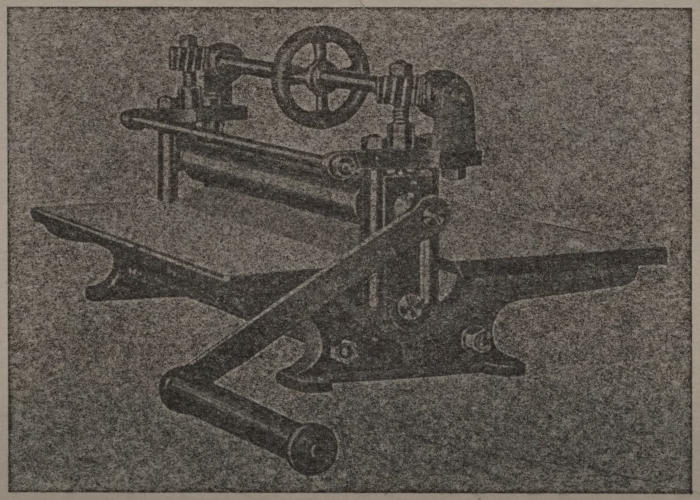
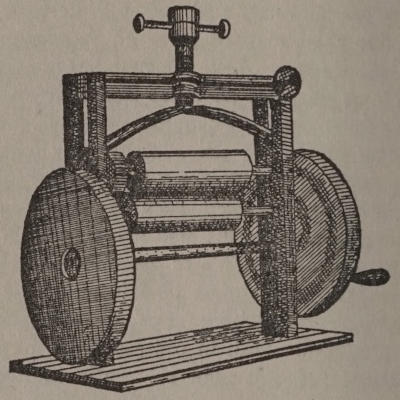
Metal etcher’s presses for transfer are sold at comparatively
high prices in the United States, but second
hand ones may often be found in the larger cities. Small
wooden mangles with maple rolls may be had at fairly
low prices from dealers in laundry supplies, and have
been found to be useful.
Following the style of the German original, italics
have been freely used for the purpose of calling attention
to the most important stages of the process, rather
than for the ordinary purposes of emphasis.
Grateful acknowledgment is made to Mr. E. J. Wall
for assistance in the first draft of the translation, and
also in revision of the proofs.
The Inking-up—The Production of the
Differential Swelling—The
Properties of the Relief and Its Influence on
the Character of the Picture—Effect of Warm Water—Effect
of Ammonia—The Utensils—Brushes—The
Inks—The Support—Removal of the Water from the
Surface of the Print—The Brush Work—Use of Dissolved
Inks—Use of Rollers—Resoaking of the Print
during the Working-up—Removal of the Ink from the
Surface—Failures—Alteration of the Character of the
Picture by the Inking—The Structure of the Ink—Different
Methods of Working—Hard Ink Technique
(Coarse-grain Prints)—Soft Ink Technique—Sketch
Technique—Large Heads—Oil Painting Style—Night
Pictures—Prints with White Margins—The Swelled-grain
Image—Mixing the Inks—Polychrome Bromoils
Bromoil Transfer, by Eugen Guttmann—The Bromoil
Print—The Choice of the Paper—The Machine—Printing—Combination
Printing with One Bromoil—The
Value of Combination Printing—Retouching and
Working-Up—Drying
The Preparation of Bromoil Inks, by Eugen Guttmann—The
Varnish—Powder—Colors—Tools—Practice of
Ink Grinding—Ink Mixing—Permanency—Ink Grinding
Machines
BROMOIL PRINTING AND BROMOIL TRANSFER — PRELIMINARY REMARKS
We all know what great progress photography has
made in the last few years. The most obvious
sign of this advance is the fact that it has gradually
escaped from the practice of literal reproduction of the
objects seen by the lens, and slowly attained to the rank
of a recognized means of artistic expression, so that it
can justly be considered as a new branch which has
grown out of the old tree of reproductive art. This
pleasing development may primarily be ascribed to the
fact that the practice of photography, which was originally
confined almost exclusively to professional workers,
has gradually spread and has become a means of recreation
to the multitude in their leisure hours. It was the
amateur who demanded new methods and apparatus and
thus gave a new impulse to photographic manufacturing.
Improvements of the most fundamental character were
made in optical apparatus, in the construction of cameras
of the most varied types, and in the fabrication of plates
and films. An extraordinary number of novelties has
appeared in these lines in the course of time; modern
photographic apparatus makes possible the solution of
problems which would not have been attempted a few
years ago, and improvements are still appearing.
The situation in the matter of printing processes is
quite different. We are provided with apparatus and
sensitive material for the production of the photographic
negative, in a perfection which leaves nothing to be desired.
To produce a print from the negative, however,
we had until recently no positive processes which were
not well-known to previous generations. This may be
confirmed by a glance at any photographic textbook
written around 1880. The various printing processes,
platinum, bromide, carbon, and gum, which were until
recently the alpha and omega of printing technique, had
been known for decades. Compared with the methods
for the production of negatives, printing methods showed
practically no advance; they remained in complete stagnation.
We can scarcely consider as an exception certain
new methods brought forward in recent years, which
proved unsuccessful and quickly disappeared from
practice.
These facts can only be explained by remembering
that the positive processes, which were available to
photographers and with which they had to be satisfied,
were rather numerous and offered a considerable variety
of effects. Nevertheless, a single characteristic was
common to all previously known photographic printing
processes—their inflexibility. Each of these processes,
in spite of its individual peculiarities, could do nothing
more than exactly reproduce the negative which was
to be printed. It was possible to produce certain modifications
of the negative image as a whole, by printing
it darker or lighter, or by using a harder or softer working
process. Changes on the negative itself for the purpose
of giving a more artistic rendering must, however,
always be very carefully thought out in advance and
effected by retouching, often difficult and not within the
power of every photographer, or by other methods which
change the negative itself. If such modifications of the
negative proved unsuccessful, it was irreparably lost; if
they succeeded, the plate, as a rule, could no longer be
used in any different manner. The possibility of undertaking
radical changes which might realize the artistic
intentions of the worker on the print itself, in order to
save the negative, and especially of planning and carrying
out the deviations from the original negative, which
expressed the worker’s artistic feelings, during the printing,
was not afforded by any previously known printing
methods. A single exception was found in gum printing,
if the production of the image was divided into a
series of partial printings. Each of these phases, however,
was in itself incapable of modification except for
the possibility of doing a certain small amount of retouching;
nevertheless, by means of efficient management
of the single printings and by properly combining them,
beautiful artistic effects could be obtained. This, however,
required an extraordinary amount of practice and
skill, and a very considerable expenditure of time, and
it must also be remembered that the failure of one of
the last printings often destroyed all the previous work.
Also, in gum printing, to have a reasonable expectation
of success, the work must be thought out from the very
beginning and carried out in exact accordance with a
plan from which it was scarcely possible to deviate
during the work, even when it became apparent that
the desired result could not be satisfactorily obtained.
The possibility of planning results during the course
of the printing and carrying them out directly on the
print itself did not previously exist.
The first process to bring us nearer to this ideal and
make possible a freer method of working was oil printing.
The technique of this process consisted in sensitizing
paper which had been coated with a layer of gelatine,
by means of a solution of potassium bichromate, and
of printing it under the negative. The yellowish image
was then washed out; the bichromate had, however, produced
various degrees of tanning of the gelatine, corresponding
to the various densities of the silver deposit
in the negative. The lighter portions, which had been
protected from the action of light by the dense parts
of the negative, retained their original power of swelling
and could therefore later absorb water. The shadows,
however, corresponding to the transparent parts of the
negative, were tanned, had lost their absorptive power,
and had become incapable of taking up water. Consequently,
the high lights swelled up fully in water, the
shadows remained unchanged, and the middle tones
showed various degrees of swelling corresponding to the
gradation of the negative. If the print was blotted off
and greasy inks spread upon it by means of a properly
shaped brush, the inks were entirely repelled by the
swollen high lights which had absorbed water, and completely
retained by the fully tanned shadows, while the
middle tones, in proportion to the amount of tanning,
retained or repelled the greasy ink more or less completely.
In this process, for the first time, there was found a
possibility of changing various parts of the image absolutely
at the worker’s will, even during the progress of
the work. By the use of harder or softer inks it was
possible to color the swollen high lights more deeply,
or to hold back the shadows so that they did not take
up all the ink that was possible. It was possible to
leave certain parts of the print entirely untouched and
work up other parts to the highest degree; in short, oil
printing opened the way to free artistic handling of
the print.
Thus, the oil process was the first photographic printing
process in which we were completely emancipated
from the previous inflexibility which ruled in all printing.
Nevertheless, a number of disadvantages attach to oil
printing which hinder its general use. The most important
shortcoming of this process is that bichromated
gelatine as a printing medium can only reproduce a
comparatively short scale of tone values. The production
of prints from contrasty negatives is therefore impossible,
for the shadows are much overprinted before
details appear in the high lights, or on the other hand,
there is no detail in the lights if the shadows are fully
printed. This difficulty can be only partly overcome
by the most skilful use of inks of various consistency.
It is indeed possible to ink up the lights by the use of
very soft ink, but this does not replace the missing
details; and overprinted shadows, which it is tried to
improve by keeping down the quantity of ink applied,
appear empty. Thus it happens that most of the oil
prints yet exhibited show a certain muddy family likeness,
which, at first, when the process was new, was
considered to be advantageous on account of the novelty
of the effect, but later received deserved criticism. A
second disadvantage of the oil print is the fact that it is
not possible to observe the progress of the printing on
the bichromated gelatine film. The brownish image on
a yellow background is very deceiving, and it is usually
necessary to determine the proper amount of printing
for each individual negative by actual experiment, and
to make additional prints by means of a photometer.
Another inconvenience of other previously known
printing processes, to which oil printing is also subject,
comes from the fact that the great majority of negatives
are now made with small cameras. On account of the
extraordinary perfection of modern objectives, the small
negatives produced by modern hand cameras can be
enlarged practically without limit. The advantages of
a portable camera are so considerable that large and
heavy tripod cameras have practically gone out of use,
except for certain special purposes. On the other hand,
however, direct prints from small negatives are, as a
rule, entirely unsatisfactory from an artistic standpoint.
If we desire to use any of the previously mentioned
positive processes, including oil, to produce artistic effects,
we must first make an enlarged negative. This
requires, in the first place, the production of a glass
transparency from the small negative, from which we
may prepare the desired enlarged working negative.
Various workers held various views as to whether this
requirement were a help or a hindrance, but it was
universally accepted as a necessity. The way from the
plate to the enlarged negative, nevertheless, always remained
uncertain, tedious, and expensive. Simple as it
may appear to be, it includes a whole series of stages
where it is possible to come to grief. At every single
step lurks the danger that undesired changes of gradation
in the negative may result from inaccuracy in exposure
and development, from the use of improperly chosen
sensitive material, and from various other causes, and
even if these factors are all correctly handled, there is
still an unavoidable loss of detail. Therefore the path
from the small original negative to the enlarged negative
necessary in previously used processes is neither simple
nor safe.
Naturally it was also necessary to travel this wearisome
path in working the oil process, when it was desired to
make large prints from small negatives.
When it was announced in England that Welborne
Piper had discovered a process which started from a
finished silver bromide print instead of from a gelatine
film sensitized with bichromate, new vistas were opened.
If the process should prove to be practically useful, we
could consider that all the previously mentioned difficulties
were overcome at a single stroke.
The principle of this process, bromoil printing, is the
removal of the silver image from a finished silver bromide
print by means of a bleaching solution while,
simultaneously with the solution of the silver image, the
gelatine film is tanned in such a way in relation to the
previously present image that the portions of gelatine
which represent the high lights of the image preserve
their capability of swelling, while the shadows of the
image are tanned.
Therefore the bromoil process is a modification of oil
printing, based not upon a bichromated gelatine film,
but upon a completed bromide print. This represents
extraordinary progress. The two previously mentioned
disadvantages of oil printing are completely avoided in
the bromoil process. We now have at our command the
far longer scale of tone values of bromide paper and
we can use the great possibilities of modification allowed
by the highly developed bromide process. The difficulties
of printing are completely removed, for we have at our
command a perfectly visible image as a starting point.
A further advantage which can not be too highly estimated
is inherent in the bromoil process: complete independence
of the size of the original negative.
When I began my investigations in the field of bromoil
printing, the process had, as far as practical value
went, only a purely theoretical existence, as is the case
in the early days of most photographic processes. The
fact that it was possible to produce images on a bleached
bromide print by the application of greasy inks was
well established. The practical application of the process
was absolutely uncertain and only occasionally were
satisfactory results obtained. Most of the prints produced
in this way were flat and muddy. It is easy to
understand that the process could find no widespread
popularity while it was so incompletely worked out.
The researches, which I then began, showed that most
bromide papers took up greasy inks after development
by any method and subsequent bleaching of the image.
The pictures thus obtained, however, were muddy, flat,
and not amenable to control, and therefore were less
satisfactory than the bromide prints from which I had
started. During the course of my work, I have succeeded
in obviating these difficulties, in the first place, by preparing
a satisfactory bleaching solution, next, by determining
what properties bromide paper must possess in
order to give perfect bromoil prints, and, finally, by
working out a series of other necessary conditions, which
I have described in this book and which must be adhered
to if the process is to work smoothly and certainly,
and produce satisfactory results.
The bromoil process, which is now completely mastered,
offers, in brief, the following advantages:
Simplicity, certainty and controllability of the printing
material;
Independence of the size of the negative and easy
production of enlarged artistic prints;
Freedom in the choice of basic stock and its surface;
The possibility of freely producing on the print any
desired deviations from the negative, during the work;
Full mastery of the tone values without dependence
on those of the negative;
Independence of daylight, both in printing and in
working up the print;
The possibility of the most radical alterations of the
print as a whole and in part during the work;
Freedom of choice of colors;
The possibility of preparing polychromatic prints with
any desired choice of colors, and complete freedom in
the handling of the colors;
The possibility of comprehensive and harmonious modifications
of the finished print;
The possibility of producing prints on any desired kind
of non-sensitized paper by the method of transfer.
The description of working methods will be divided
into the following phases:
I.
Production of the bromide print;
II.
Removal of the silver image;
III.
Application of the ink;
IV.
After-treatment of the finished print.
CHAPTER I PRODUCTION OF THE BROMIDE PRINT
Failures in the bromoil process in the great majority
of cases can be ascribed to the fact that the
basic bromide print was not satisfactory. Therefore the
method of preparation of the bromide print or enlargement
deserves the most careful consideration, for the
bromide print is the most important factor in the preparation
of a bromoil print. The beginner, especially, can
not proceed too carefully in making his bromide print.
Because of the extraordinary importance of this point,
we must first define what is here meant by a perfect
bromide print.
In deciding how to produce a satisfactory bromide
print as a basis for a bromoil, we must exclude from
consideration esthetic or artistic grounds.
The bromide print must be technically absolutely perfect,
that is, it must have absolutely clean high lights,
well graded middle tones, and dense shadows. Especial
stress must be laid on the brilliancy of the high lights.
It is best to compare these high lights with an edge of
the paper which has not been exposed and is not fogged
or, even better, with the back of the paper. The highest
lights should show scarcely a trace of a silver precipitate
and must therefore be almost as white as the paper
itself. Negatives which do not allow of the production
of prints as perfect as this should not be used while the
bromoil process is being learned.
This apparently superfluous definition of a perfect
bromide print has to be given in this way, because it
only too often occurs in practice that the worker himself
is not clear as to what is meant by the expression,
perfect bromide print. This may be partly ascribed to
the fact that the silver bromide process—whether rightly
or wrongly need not be determined here—has not been
properly appreciated among amateurs who are striving
for artistic results. Bromide printing has frequently
been considered not to be satisfactory as an artistic
means of expression, and has therefore been considerably
neglected. In many quarters it is considered as just
good enough for beginners.
Nevertheless, the bromide process is per se an uncommonly
flexible method and gives, even with a very
considerable amount of overexposure or underexposure,
that is, even when very badly handled, results which are
considered usable. It is even possible that an improperly
made bromide print, one for instance, which is soft and
foggy, might in some circles be considered as esthetically
more interesting than a perfect print. This is an undeniable
advantage of the process. It may also become
a danger, if an imperfect bromide print is used as a
starting point in the bromoil process. If anyone is not
sure on this point, let him compare his own bromide
prints with such samples as are frequently shown by
manufacturers in window displays and sample books.
He will then see what richness of tones and wealth of
gradation are inherent in the process. If, however, an
imperfect silver bromide print is used as a starting point
for a bromoil, it can not be expected that the latter will
display all the possibilities of this process. If the
bromide print is muddy, the work of inking will be difficult,
and it will be impossible to obtain clean high
lights. If it is underexposed and too contrasty, it can
not be expected that the bromoil will show details in the
high lights which were lacking in the bromide print.
If the worker himself does not know that his silver
bromide print is faulty, he is inclined to ascribe the
difficulties which he finds in making the bromoil print
and his dissatisfaction with the results, to the bromoil
process itself. Most of the unsatisfactory results in
bromoil work must be ascribed to the imperfect quality
of the bromide print which is used, and this is the more
important as this lack is not perceptible to the eye after
the bleaching is completed. Whoever, therefore, desires
to successfully practice bromoil printing, must first decide
impartially and critically whether he actually knows
how to make bromide prints, and must acquire full
mastery of this process.
The technically perfect bromide print made from a
properly graded negative can, as will later be described,
have its gradations changed in the bromoil process without
any difficulty, and thus be made softer or more
contrasty. The advanced bromoil printer who is a
thorough master of the technique of the process will
therefore easily be able to work even with poor negatives;
when making his bromide prints from such
negatives, he will consider the ideas which he intends to
incorporate in the bromoil print and will make his
bromide print harder or softer than the negative and
at the same time retain the necessary cleanness of the
high lights.
The best starting point for a bromoil print, however,
especially for the beginner, is and must be a bromide
print as nearly perfect as possible.
A suggestion for the certain obtaining of such prints
may be added here. When we are working with a negative
with strong high lights, judgment as to the freedom
of the bromide print from fog by comparison with an
unexposed edge is not difficult. This is not the case
with negatives which show no well marked high lights.
In such cases it is advisable to determine what is underexposure
by making test strips in which details in the
high lights and middle tones are lacking and, working
from this point, determine by gradual increase of exposure
the correct time which gives a perfectly clean
print.
The Choice of the Paper.—One of the most important
problems is to find a suitable paper for the
process. Not all of the bromide papers which are on
the market will give satisfactory results. It is only possible
to use papers whose swelling power has not been
too completely removed in process of manufacture by
the use of hardeners. The principle of the bromoil
process is that a tanning of the gelatine shall occur
simultaneously with the bleaching of the silver bromide
image. As we have already remarked, this does not
affect the high lights and leaves them still absorbent,
while the shadows are tanned and therefore become incapable
of taking up water. The half-tones are tanned
or hardened to an intermediate degree and therefore can
take up a certain amount of water. Therefore, in place
of the vanished silver image, we get a totally or partially
invisible tanned image in the gelatine film.
The variously hardened parts of the gelatine film,
corresponding to the various portions of the vanished
bromide image, display the property acquired through
different degrees of tanning by the fact that the portions
of the gelatine which remain unhardened and which
correspond to the high lights of the silver image
formerly present, absorb water greedily. Consequently
they swell up and acquire a certain shininess, because
of their water content; in addition they generally
rise above the other parts of the gelatine film, which
contain little or no water, and give a certain amount
of relief when they are fully swelled. The portions of
the film in which the deep shadows of the bromide image
lay are completely tanned through, can therefore take up
no water, and remain matt and sunken. This graded
swelling of the gelatine film becomes more apparent, the
higher the temperature of the water in which the film is
swollen.
If, however, the paper was strongly tanned in the
process of manufacture, the gelatine has already lost all
or most of its swelling power before it is printed and,
although the bleaching solution in such cases can indeed
remove the silver image, it can no longer develop the
differences of absorptive power which are necessary for
a bromoil print; for, although the bleaching solution can
harden an untanned gelatine layer, it cannot bring back
the lost power of swelling to a film which is already
hardened through and through.
Therefore bromide papers which have already been
very thoroughly hardened in manufacture show no trace
of relief after bleaching, and very slight, if any, shininess
in the lights. This is the case especially with those
white, smooth, matt, heavyweight papers which are
especially used for postcard printing. When such papers
are taken out of the solutions, as a rule, these run off
quickly and leave an almost dry surface. It is generally
not possible to make satisfactory bromoil prints on such
papers. It is true that the image can be inked by protracted
labor; it is, however, muddy and flat and, as a
rule, cannot be essentially improved even by the use of
very warm water. Other types of bromide paper which
have not been so thoroughly hardened may show no relief
after bleaching, yet, after the surface water has been
removed, they do show a certain small amount of shininess
in the high lights when carefully inspected sidewise.
With such papers the necessary differences of swelling
can generally be developed if, as will later be more completely
described, they are soaked in very warm water
or in an ammoniacal solution. It is rare to find in commerce
silver bromide papers which have not been hardened
at all, or only very slightly hardened, in their
manufacture. Such papers, because their films are very
susceptible to mechanical injury, are not likely to stand
the wear and tear of the various baths. On the other
hand, as a rule, they usually produce a strong relief
even in cold water, and therefore tend to produce hard
prints. The greatest adaptability for bromoil printing
may be anticipated from bromide papers which are
moderately hardened during manufacture.
To determine whether a given brand of bromide paper
is suitable for bromoil work, an unexposed sheet of the
paper should be dipped in water at a temperature of
about 30° C. (86° F.) and the behavior of the gelatine
film observed. If this swells up considerably and becomes
slippery and shiny, the paper has the necessary
swelling power and can be used with success.
On account of the great variety of bromide papers
which are on the market, we have a very wide choice as
regards the thickness and color of the paper and the
structure of its surface. It may be remarked here that
papers of any desired surface, even rough and coarse
grained papers, can be used for bromoil printing, as
easily as papers with a smooth surface. The difficulties
experienced with very rough surfaced papers in some
other processes do not exist in bromoil. Because of the
elasticity of its hairs, the brush carries the ink as easily
into the hollows of the surface as to its high points.
The thickness of the paper is of no importance in
bromoil printing, except that the handling of the thicker
papers is easier, because they lie flatter during the work
and distort less on drying; also, as a rule, thick papers
are easier to ink.
Gaslight papers can also be used if their gelatine films
satisfy the above mentioned requirements. Therefore
we have the widest possible choice in the printing materials
for bromoil.
A great number of bromide papers of different manufacturers
are well suited for bromoil printing; it is, however,
advisable to make a preliminary investigation as
to the amount of hardening they have undergone, for
it occasionally happens that different emulsions of the
same brand show quite different grades of hardening,
so that on one occasion it is possible to make bromoil
prints on them without the least difficulty, while the same
paper at another time may absolutely refuse to take the
ink. On account of the great popularity of the bromoil
process in recent years, it can be easily understood that
some manufacturers might seek a wider sale for their
products by claiming for them a special suitability for
this process. It is therefore a wise precaution to previously
test even those brands which are advertised as
specially adapted for bromoil printing, and not to depend
too much on such claims.
Development.—The processes of tanning in the film
of a bromide print, produced by the bleaching of the
silver image, which will be described later, are of an
extremely subtle nature. We must therefore endeavor
to avoid all causes for damage in this process and
especially everything which tends to harden the whole
film even to the slightest degree. Any tanning, which
affects the whole gelatine film, has the same effect as
general fog in a negative. It is well known that almost
all the developers used in photography have more or less
tendency to harden the gelatine film. A very considerable
damage to the bromoil print through the use of a
tanning developer might naturally be imperceptible to
the eye. Yet this may at times manifest itself in a very
undesirable and disturbing form, especially when the
bromide paper has been so much hardened in manufacture
that it possesses only just the necessary qualification
for bromoil printing. It may then happen that the last
remainder of swelling capacity can be taken from the
paper by the use of a tanning developer. However desirable
it might be and however it might simplify the
process to be able to use any desired developer in producing
the bromide print, to avoid trouble it must be
observed that the use of developers which tan the film
may seriously influence the result, even though it is possible
to get some kind of prints in many cases. If the
worker is absolutely sure that the bromide paper which
he is using is not strongly hardened and is therefore well
suited for bromoil printing, he may undertake development
with any one of the ordinary developers which he
prefers.
The developers, which do not exercise a hardening
influence on the gelatine, are the iron developer and
amidol (diamidophenol hydrochloride). As the iron developer
is not really suited to this purpose on account of
certain unpleasant qualities inherent in it, it is advisable
to use amidol for the development of bromide paper for
bromoil printing whenever possible, and the best developer
is composed as follows:
Amidol
1.7
g
12.3
gr.
Sodium sulphite, dry
10
g
77
gr.
Water
1000
ccm
16
oz.
The sodium sulphite is first dissolved in water, and
the easiest way is to pour the necessary quantity of
water into a developing dish and sprinkle the pulverized
or granular dry sodium sulphite into it while the dish
is constantly rocked; solution takes place almost instantly
under these conditions. Larger lumps, which
would stick to the bottom of the dish, must be immediately
stirred up. As soon as the sodium sulphite is
dissolved, the amidol should be added and this will also
dissolve immediately. The addition should be made in
the order described, for, if the amidol is dissolved first,
the solution is often turbid. If dry sodium sulphite
is not available, double the quantity of crystallized
sulphite may be used.
The amidol developer should be freshly prepared each
time that it is used, as it does not keep in solution.
The measurement of the quantities of amidol and sulphite
given above does not need to be made with the
most painstaking care, as small variations in the quantities
are unimportant.
In using amidol developer the greatest care must be
taken to avoid allowing amidol powder, in even the
smallest quantity, to come into contact with the bleached
print ready for bromoil printing. Even the finest particles
of amidol, although invisible to the naked eye,
will produce yellowish brown spots on the gelatine which
penetrate through the film and into the paper itself.
These dots and spots, especially if, as is usual, they occur
in large numbers, will make the print completely useless,
and it is impossible to remove them.
If amidol developer is not available, any other developer
which is desired may be used. As we have
already stated, however, certain possibilities of failure
are to be anticipated, but will not necessarily occur.
Every effort should be made to produce a bromide
print as perfect as possible, with clean high lights.
The best bromide prints or enlargements for bromoil
printing are those which are correctly exposed, but are
not developed out to the greatest possible density. A
print which is thus fully developed is very satisfactory
as a bromide but offers certain difficulties in bromoil
printing, which will be described later. Therefore the
development should be stopped as soon as the lights show
full detail without any fog, but before the shadows have
reached full density. The deepest shadows should then
be of a deep greyish black, but should not be clogged
up. When a bromide print is properly exposed, there
is sufficient time between the appearance of the details
in the lights and the attainment of the deepest possible
black in the shadows to easily select the proper moment
for cessation of development. It is, however, desirable
not to go beyond this stage of development, for the
reason that a very dense silver deposit distributed completely
through the gelatine emulsion to the paper support
is not easily bleached out. When this difficulty
occurs, the bleaching solution is generally, but incorrectly,
blamed for it. If, in spite of this difficulty,
complete bleaching is attained, the shadows of the
image usually retain a yellowish color which cannot be
removed by the baths which follow the bleaching. If
it is intended to ink up the whole surface of such a
print, this discoloration of the shadows is not important,
for it will be completely covered by the ink. But
if the print is to be treated in a sketchy manner, and
some parts of its surface are not to be inked, this cannot
be successfully done on account of the yellowish
coloring of the shadows.
Underexposure must be carefully avoided, for details
which are not present in the bromide print will, of
course, not appear in the bromoil print.
Overexposure will occasionally give usable results, if
the development of the overexposed print is stopped at
the proper point. In such cases, we must usually expect
some deposit in the high lights and consequently
a certain fogging of the image, though this can often
be overcome, at least partly, by swelling the print at
a higher temperature. Perfect prints cannot be expected,
if the basic print is lacking in quality. If the
overexposure is not too great, the print can be improved
to a certain extent by clearing it in very dilute Farmer’s
reducer. Treatment with this reducer has no deleterious
effect on the later processes. The Farmer’s reducer
should only be used for a slight clearing up of too dark
parts of the bromide print; for this purpose the parts
of the moist print which are to be reduced should be gone
over with a brush dipped in very dilute reducer and
immediately plunged into plenty of water, to avoid any
spreading of the reducer into other parts of the image.
Developing fog should naturally be avoided as much
as possible. Fogging of the bromide print is caused by
the formation of a more or less dense silver precipitate
without any relation to the image over the whole surface
of the print. As the bleacher takes effect wherever
metallic silver is present in the film, the result in such
cases is a general tanning of the film, which is detrimental
to the production of the necessary differences
in swelling power in the gelatine. The tanned gelatine
image is then also fogged.
Consequently the best results may be obtained from
very brilliant, but not excessively developed, bromide
prints.
We must also avoid falling into the opposite extreme
in the development of the bromide print, by getting
too thin prints lacking in contrast. In prints which are
too thin, only a very small quantity of metallic silver
has been reduced in the development, and this lies wholly
on the surface of the film. Such prints usually show
full detail, but the contrasts between the lights and the
shadows are too small. Since the tanning produced by
the later bleaching occurs because of the presence of
metallic silver in the film, and since its intensity depends
on the quantity of this silver, we cannot obtain
the necessary difference in swelling power by bleaching
the film of prints which are too thin because of insufficient
development. The result is a weak tanned image
in the gelatine film; bromoil prints thus produced can
consequently only exhibit a very short scale of tone
values, and this cannot be essentially lengthened by
the use of the bromoil process alone. Such bromide
prints may find a special application in combination
transfers, which will be described later. It is also possible,
under certain circumstances, to use incomplete
development as a method for producing soft bromoil
prints from contrasty negatives.
Control of the Silver Bromide Print.—Although
in bromoil printing the most various renderings can be
obtained from a perfect bromide print, by variation of
the temperature of swelling and by proper handling of
the inking, it is also possible, under some circumstances,
to vary the final result by proper treatment during the
making of the bromide print, especially when we are
not dealing with normal negatives. If, for instance,
we have to deal with a very thin negative, it is possible
that even the extreme possibilities offered by the
bromoil process are not sufficient to insure the attainment
of the desired modulation, for, as will later appear,
the possibility of increasing the difference in
swelling in the film is limited by the limited resisting
power of the gelatine. In such cases, we must take
advantage of the accumulation of all possible aids and
therefore, in making the bromide print, do all that is
possible in order to bring out desired objects, which are
only indicated in the negative and do not show sufficient
detail.
Therefore, if we desire to increase the contrast of the
negative in the final print, we should use a harder working
paper and add potassium bromide to the developer.
If we desire to get soft prints from a contrasty negative,
we may use different methods. The simplest way
is the use of a very rapid and consequently soft working
paper. Ordinarily, however, this method is not sufficiently
helpful. We must therefore also use suitable
methods in later steps of the process, such as making
the difference in swelling in the gelatine layer as small
as possible in order to bring down the contrast, or inking
up with soft inks.
A very reliable process for the production of soft
prints or enlargements, even from contrasty negatives,
is the following: the proper exposure for the densest
portions of the negative should be first determined by
means of a trial strip; then a full sized sheet of paper
is exposed for exactly the time which has been determined,
soaked in water until it is perfectly limp, and
then placed in the developer. As soon as the first outlines
of the image appear, the print is placed in a dish
of pure water and allowed to lie there, film down. As
soon as development has ceased, the print is taken out
of water, dipped into the developer for an instant, and
then immediately put back into the water. This method
requires considerable time for full development, but produces
prints or enlargements of especial softness. In
this process, the developer which is absorbed by the film
is soon exhausted in reducing the heavy deposit in the
shadows, so that their development ceases, while enough
developer still remains unexhausted in the other portions
of the image to keep on developing. With very
dense negatives, developer warmed to 25° C. (77° F.)
can be used for the production of soft prints, but it
must be very much diluted and carefully used, for development
proceeds very quickly. Very soft prints may
also be obtained by bathing the exposed bromide prints
for about two minutes in a one per cent solution of
potassium bichromate before development. This solution
is thoroughly washed out of the print, and it is then
developed.
Yet with very hard negatives all these remedies frequently
fail, because the high lights are almost completely
opaque to light because of their density. In
such cases the negative itself must be improved. The
ammonium persulphate reducer usually recommended for
such plates, which acts more strongly on the lights than
on the shadows, is, however, too uncertain in its action
and may imperil the negative. It is better to adopt
Eder’s chlorizing method, which enables one to improve
too contrasty negatives in a convenient and certain
manner. The principle of this process is as follows:
the metallic silver of the negative is converted into
silver chloride, which is again developed. This redevelopment
is accomplished in such a way that the
silver chloride on the surface of the film is first reduced
to metallic silver; if development is continued, the reduction
is continued to the bottom of the film. The
delicate details, lying on the surface of the film, are
thus first developed, while development of the overdense
high lights, in which the silver deposit extends
right through to the glass, is finished only after some
time. It is therefore possible to stop development at
the instant at which the shadows and half-tones are completely
redeveloped, while the overdense high lights are,
for instance, only half developed, and therefore only
half consist of metallic silver, the lower half being still
silver chloride. If the development is interrupted at
this stage and the negative placed in a fixing bath, the
still undeveloped silver chloride is dissolved. The
shadows and half-tones thus retain their original values,
and only the overdense deposits in the shadows are reduced.
If the development is not stopped at this stage,
but is carried through to completion, the negative is
obtained unaltered, and the process can be repeated.
If the second development is stopped too soon, the
negative may be endangered and a very thin negative,
lacking in contrasts, obtained.
The practical application of the chlorizing process is
effected by bleaching the negative in the following
solution:
Cupric sulphate
100
g
1
oz.
Common salt
200
g
2
oz.
Water
1000
ccm
10
oz.
As soon as the negative is completely bleached, which
should be judged not only by transmitted light but
also by examination from the glass side, it should be well
washed and immersed in a slow-acting developer. All
these processes can be carried out in daylight, and the
second development of the negative is best controlled
by frequent examination of the glass side. Development
should be stopped when the shadows and half-tones
are blackened, and there is still a whitish film of
silver chloride in the high lights. Observation of the
negative by looking through it is not advisable, for the
negative very soon appears dense by transmitted light,
because the metallic silver formed in development masks
the silver chloride. As soon as the development is considered
to have gone far enough, the plate should be
rinsed and then fixed and washed in the usual manner.
After a few trials, the judgment of the correct stage at
which to stop development presents no difficulty.
I ordinarily use the chlorizing process in the following
way, which practically excludes any possibility of
failure: the negative is completely bleached in the
solution just mentioned, and then washed for five
minutes. It is then developed in any desired developer
until it shows by transmitted light practically the same
density, though in a brownish color, as it had before
chlorizing. It is then rinsed off, placed in a solution
of hypo, not stronger than two per cent, and carefully
watched by light passing through the plate; it is taken
out as soon as the desired stage is reached, well washed,
and dried. In this modification of the chlorizing
process the condition of the plate can be observed at
every stage. The final negative, to be sure, does not
consist of pure metallic silver, but as a rule of a combination
of silver and silver chloride; but such negatives
are sufficiently permanent for making prints and
enlargements on bromide paper.
It is also advisable to lessen the harsh contrasts in a
normal negative, either by masking the more transparent
parts on the glass side, or by holding them back in
printing or enlarging. Briefly, every possible means
should be employed in order to obtain as good and
harmonious a bromide print as possible.
The beginner is strongly recommended, however, in
his first trials with bromoil, to start as far as possible
with normal negatives and correct, and especially very
clean, bromide prints. The use of this process for the
improvement of the results from difficult negatives
should be left for more expert workers.
It is often desired to provide landscapes with clouds,
and this can be easily attained if enlargements are used
as the basis for bromoil prints. Acceptable results are
given by a process, which has often been recommended.
This is, after blocking out the sky on the negative, to
enlarge the landscape, develop the print and again place
it while still wet on the enlarging screen and expose
for the clouds, disregarding the existing image, and then
develop the clouds.
I might describe here another process for obtaining
clouds, because it is especially suitable for the bromoil
process. If there is no object in the negative which is
cut by the upper edge of the plate, it is extremely easy
to introduce clouds into such a landscape, and at the
same time lengthen out the picture at the top. A cloud
negative suitable for the landscape is chosen, and the
relative exposures for the landscape and clouds found as
accurately as possible by test strips. The landscape
negative is then focused on the enlarging screen so that
there is plenty of paper above the upper edge of the
plate, and then the exposure is made while the upper
part of the paper is covered with a card, which is kept
moving constantly between the light source and the
enlarging screen, so that the upper edge of the plate is
not imaged on the screen. After the exposure is finished,
the paper is shifted down on the screen until the upper
edge of the paper comes at the place which was previously
occupied by the edge of the plate, the landscape
negative is changed for the cloud negative, and the
clouds are exposed on the upper and hitherto unexposed
part of the enlarging paper, while the landscape is protected
from exposure by means of a piece of card, shaped
like the previous one for the sky, and continually moved
to avoid a sharp line of separation. In the subsequent
development a perfectly uniform picture is obtained,
in which there should be no visible trace of its compound
nature.
Obviously, in the preparation of the bromoil print,
it is advisable to employ to the utmost the many possibilities
which bromide printing offers. Thus too thin
parts of a negative may be held back by proper blocking
out on the back and numerous other possible modifications,
which have been described in textbooks and
technical journals, but which cannot be further dealt
with here, may be profitably employed.
Fixation.—The developed bromide print should be
well rinsed and fixed in the usual way. If the rinsing
is omitted or is too superficial, complete or partial
reduction phenomena may occur in the fixing bath, and
make the print unusable.
The bromide print should be left in the hypo solution
for about 10 minutes, and care should be taken, if
several prints are simultaneously treated, that they do
not stick to one another. Then should follow thorough
washing for removal of the hypo; if traces of hypo remain
in the film, the subsequent bleaching is rendered
more difficult, as the image does not disappear but only
turns brownish. While it is feasible to subject the
bromide print to the bleaching process, as soon as it
comes from the washing, an intermediate drying is an
advantage; for the gelatine gains greater resistance by
this drying.
CHAPTER II THE REMOVAL OF THE SILVER IMAGE
Bleaching.—The bleaching process has the purpose
of making the bromide print, correctly prepared
according to the previously described method,
suitable for the bromoil process. To this end the silver
image must be made to disappear and in its place that
condition of the gelatine produced which renders it possible
for it to take up the greasy ink. The bleaching
solution has, therefore, two functions: it must remove
the metallic silver, imbedded in the gelatine film, which
forms the bromide image, and at the same time cause
a tanning of the gelatine film corresponding to the image
that disappears. In the place of the silver image there
then exists an invisible tanned image in the gelatine film.
There are a large number of chemical compounds
known to photographic technique, which enable us to
dissolve out the metallic silver imbedded in the gelatine
film. Such are, for example, the many reducers which
have found practical application. Many of these chemicals
also cause changes in the gelatine simultaneously
with the solution of the silver. But not one of the
hitherto known bleaching solutions possesses the double
power required of it: solution of the silver image and
corresponding tanning of the film. Some produce too
great a tanning which acts upon the whole film, and the
result in inking-up is muddy flat prints, which do not
lend themselves to artistic modification. With other
bleaching solutions a differential tanning of the gelatine
is produced, but at the same time they so alter the
surface of the gelatine that it becomes glossy all over,
and only takes even soft inks with difficulty.
My experiments have led to the compounding of a
bleach which completely fulfils the requirements set for
it; the silver image is quickly and completely removed,
while simultaneously a tanning of the film, strictly
analogous to the disappearing image, is effected; easier
and more certain inking-up is rendered possible, and
besides this the advantage is obtained that the differences
of relief, produced in the gelatine by the bleaching
process, can be influenced to a wide degree by varying
the temperature of the water. The composition of this
bleaching solution, which prepares the gelatine film in
the most perfect manner for the bromoil print, is as
follows, three stock solutions being required:
I.
Cupric sulphate
200
g
2
oz.
Water
1000
ccm
10
oz.
II.
Potassium bromide
200
g
2
oz.
Water
1000
ccm
10
oz.
III.
Cold saturated solution of potassium bichromate.
A concentrated bleach is made by mixing:
Solution I.
3 parts
Solution II.
3 parts
Solution III.
1 part
To every 100 ccm of this mixture should be added 10
drops of pure hydrochloric acid (10 drops to 3½ oz.).
This concentrated bleach will keep indefinitely and
should be diluted before use with three to four times its
volume of water. The use of a more concentrated solution
is not advisable, as irregularities frequently occur
in consequence of too rapid bleaching, especially towards
the margins of the prints.
The color of the concentrated bleach is green, or when
diluted, yellowish; the solution must be absolutely clear.
When the stock solutions are mixed there is usually
some cloudiness, but this is cleared up by the hydrochloric
acid. By standing for a long time at low temperatures
a precipitate is sometimes formed, but this is
of no moment. The compounding of this bleach should
be made with the greatest accuracy. Inaccuracies or
modifications in its composition are serious, because although
the solution does not lose in bleaching power,
yet the invisible tanning action is then often not completed
in the desired manner. Too great an addition
of hydrochloric acid for example, accelerates the process
of bleaching, but the inking-up of prints thus bleached
is frequently difficult. If the bleaching of the shadows
of the bromide prints goes on slowly, the reason as a
rule lies in the fact that the prints were overdeveloped
and have an excessively dense silver deposit.
The bromide prints should be immersed in this bleaching
solution, after previous soaking in cold water. If
they have been correctly made, the image rapidly grows
weaker and after a few minutes its greyish-black color
changes into a pale citron yellow. If the bromide print
was developed too far, the bleaching takes rather longer,
as the shadows, developed right through to the base,
require a lengthy period for solution. If several prints
are to be bleached at once, the best procedure is to
place one print in the solution and turn it film side
down when the first traces of bleaching are noticeable.
Then the next print should be immersed with the film
up and by thus proceeding gradually it is possible to
bleach a large number of sheets simultaneously in the
one dish. Continual movement will prevent the formation
of air bells. If air bells adhere to the film, they
protect those places from the action of the bleach and
dark points or spots of unchanged metallic silver remain,
the subsequent bleaching of which naturally prolongs
the process. The same applies to prints which
lie on top of one another.
With too slow bleaching, the hydrochloric acid may
be gradually increased, at the most to double that prescribed;
one should not hasten the bleaching process
by warming the solution. The bleaching is rapidly
effected in warm solutions; yet generally the film of
moderately hardened papers is so altered that they
swell up too much even in cold water and take the ink
badly or not at all. The dilute bleaching solution will
keep and may be used repeatedly as long as it acts;
when it becomes exhausted, the slowing up of the bleaching
cannot be hastened by the addition of hydrochloric
acid. The chemical reactions in the bleaching bath are,
according to Dr. P. R. von Schrott, as follows:
2CuBr₂ + Ag₂ = 2AgBr + Cu₂Br₂
The cuprous bromide, Cu₂Br₂, which is formed, reduces
the bichromate as follows:
3Cu₂Br₂ + 6CrO₃ = 3CuBr₂ + 3CuCrO₄ + Cr₂O₃.CrO₃
It sometimes happens that bromide prints, in spite of
long immersion in the bleaching solution, apparently
will not bleach and only change their color to brown.
The reason for this usually unimportant phenomenon
is, as a rule, that such prints have not been sufficiently
washed and still contain hypo.
It may also happen that prints which have lain on
top of each other in washing are badly washed in parts;
then the image bleaches, but the film shows dark patches
or streaks at those places which still contain hypo.
Such apparently unbleached prints should be left for
about 10 minutes in the bleaching solution; the disturbing
coloration, whether of the whole picture or only
of parts, disappears completely in the subsequent baths,
even when the image had apparently remained at full
strength.
If such a print, apparently not bleached or spotty, is
immersed in the sulphuric acid bath mentioned below,
the discoloration of the film is quickly removed by its
action; the print then often passes through a phase in
which it appears to be a negative, the secondary image
becoming visible on the yellow ground, and then bleaches
out completely. With such prints it may also happen
that it is only noticed after removal of the stain that
unbleached traces of the silver image still remain. Then
the bleaching must be repeated.
If the color of the bromide print only changes to
brown even after protracted immersion in the bleaching
solution, otherwise retaining full gradation, and remaining
unchanged even in the sulphuric acid bath, though
it bleaches out in the hypo, the print cannot be inked.
The reason for this difficulty is improper composition
of the bleaching solution, or occasionally improper development
and fixation of the bromide print. It may
also be due to excessive use of the bleaching solution;
3 to 4 ccm (50 to 70 minims) of concentrated bleaching
solution should be allowed for every 13 by 18 cm (5 by
7) print.
Obviously all these processes may be carried out by
diffused daylight. The bleached-out prints should be
repeatedly washed, until the drainings are quite clear,
and should then be immersed in the following bath:
Sulphuric acid, pure
10
ccm
77
min.
Water
1000
ccm
16
oz.
In this bath any remaining color disappears quickly and
completely, and prints, which have apparently wholly
or partially resisted bleaching, are also very rapidly
decolorized in this bath. Any spots and streaks also
disappear. If, however, there is anything left, then the
bleaching was not complete, and unreduced metallic
silver remains in the film. After the sulphuric acid
bath the prints should show the pure color of the paper
base; the film side ought to be hardly different from
the back in color. With prints that have been overdeveloped,
a certain slight variation of color remains in
the film, which, however, in no wise prejudices the
inking-up. If there are still some spots, they are usually
due to a slight precipitate lying on the surface of the
film, which can be easily swabbed off. When this point
of colorlessness is reached, and it usually requires only
a few minutes, it is useless to leave the prints longer
in the acid bath. They should be washed in repeated
changes of water and immersed in the following fixing
bath:
Hypo
100
g
1
oz.
Water
1000
ccm
10
oz.
The use of this fixing bath is essential and is based
on the following considerations. During the bleaching
process a secondary silver bromide image is formed in
the gelatine film. This secondary image is not visible
on white and yellowish bromide papers, because it is
whitish-grey. If a bleached print, which has not been
fixed, is exposed for a long time to daylight a distinctly
visible blue-grey image is formed, which naturally is
troublesome in the further operations. This secondary
image of silver bromide is completely removed, however,
by the fixing bath.
The ordinary acid fixing baths can also be used without
disadvantage for fixing. If the sulphuric acid is
not sufficiently washed out, decomposition of the fixing
bath may ensue, which will be made apparent by the
unpleasant smell, and which is prejudicial to the action
of the bath. Care should be taken that the prints do
not stick to one another in the fixing bath and that
they are thoroughly fixed out, as the secondary bromide
image that is not removed will make its appearance
in insufficiently fixed places and may cause darker
patches.
Washing then completes the preliminary preparation
of the prints.
For the sake of completeness it should be mentioned
that the prints may be immersed in the bleaching solution
in the darkroom after the first development, and
can be fixed after the solution of the silver image. This
shortened process is, however, uncertain and can not
be recommended.
The Intermediate Drying.—After the bleaching
process outlined in the previous section the print must
be dried without fail. While drying after the development
and fixation of the bromide print is advisable but
not absolutely necessary, the intermediate drying after
bleaching is of the greatest importance. It is possible
that the later operations may be successful in spite of
neglect of this recommendation. As a rule, however,
various mishaps occur when the intermediate drying is
omitted. In many cases the ink can only be caused
to adhere with difficulty, in others, not at all; sometimes
the inking will proceed up to a certain point and then
suddenly completely stop. Sometimes the image appears
as a negative, that is to say, the ink is taken up by the
high lights and rejected by the shadows. All these
failures will be obviated by the intermediate drying at
this stage. Whether this intermediate drying takes place
rapidly or slowly is practically immaterial; naturally it
ought not to be so prolonged that the gelatine suffers.
The prints thus prepared can either be again soaked
in water and immediately worked up, or kept and treated
at any time. It is very convenient, especially for an
amateur, to have a stock of such ready prepared and
dry prints, because he is then in a position to work
when he finds time and opportunity. The prints, prepared
and dried as has been described, will keep indefinitely.
With correct treatment there can be seen
on the gelatine film of the dry print scarcely a trace of
the bleached-out image; only in the very deepest
shadows a slight coloration of the film, tending to grey,
can sometimes be noticed. It is advisable, therefore,
to mark the print on the paper side before bleaching, as
otherwise it is subsequently difficult to distinguish this.
Before we go any further, the whole preliminary
process is summarized once more:
Development,
Fixation,
Washing,
Bleaching,
Short washing,
Sulphuric acid bath,
Short washing,
Fixation,
Washing,
Intermediate drying.
CHAPTER III THE INKING-UP
The Production of the Differential Swelling.—In
the chapter on the bleaching we fully explained
the processes which take place in the gelatine
film under the action of the bleaching solution, and that
the most important result of the bleaching process, aside
from the disappearance of the silver image, is the formation
of different degrees of swelling corresponding to
the primary image, which in their totality form the
tanned image produced in place of the photochemical
image by the bleaching.
For the success of the bromoil print, it is now of the
utmost importance that the different capabilities of
swelling, now latent in the gelatine film, should be satisfactorily
utilized. It is obviously possible to produce
this swelling in very different degrees. The colder the
water used for the swelling, the smaller the difference
between the lights and shadows, while the warmer the
water the more this difference is accentuated. If, for
example, a print prepared for the bromoil process is
placed in cold water and allowed to swell for some
minutes, the existing capacity for swelling will only be
excited to a slight degree. The high lights of the invisible
image only take up a little water, and when dry
are differentiated from the shadows under oblique visual
examination by a very delicate gloss or not at all. If
this picture is now worked-up with greasy ink, a print
is obtained with a short scale of gradation, and its tone
values are usually less satisfactory than those of the
original bromide print. If, on the other hand, the print
is placed in very warm water, the swelling of the gelatine
reaches a maximum. The high lights are very
much swollen, even the half-tones are somewhat raised,
and the shadows, which do not absorb water, appear
sunken. The result of the swelling in such warm water
in this case is the formation of a very pronounced relief,
that is not only visible, but is almost perceptible to the
touch. If such a picture is inked up, a bromoil print
is obtained, the contrasts of which are much stronger
than those of the original bromide print. Between these
two extremes there is obviously a whole series of intermediate
stages, the suitable employment of which
permits of the most varied gradations.
As already mentioned, the capacity for swelling of
the different makes of bromide papers is not the same
in baths of the same temperature. This fact, however,
argues neither for nor against the usefulness of the
various bromide papers. It makes necessary, to be sure,
a certain care in the use of a paper, the qualities of
which are unknown. If one has to deal with such a
paper, the prepared print should first be soaked in quite
cold water; it should then be removed from the water,
placed on a support, dried in the manner to be later
described, and examined by oblique illumination as to
whether the high lights show by a slight gloss that they
have absorbed water. This will be the case if the image
shows well swollen high lights; if they are not present,
it will hardly be possible to find distinctly glossy places.
In any case one may begin with the inking-up, prepared,
as will be explained later, to increase the swelling if
necessary during the inking-up by immersion in warm
water. If on the other hand, the print, when taken
from the cold water, distinctly shows places where differences
of swelling are shown by a gloss or even a
delicate relief in the film, the work may be proceeded
with, without further trouble.
Under any circumstance one should be careful at first
in the production of the differential swelling. There
should rather be no relief than too pronounced a one;
for differences of swelling that are too small can be
easily and satisfactorily increased during the work; on
the other hand it is scarcely possible again to reduce
too strong a relief. While learning, or when using an
unfamiliar brand of paper, it is therefore advisable to
allow the sheet to swell first in cold water and to carefully
begin the inking-up. Only if this is not satisfactory,
should a warmer bath be used and the inking
again tried. This method is, however, dealt with more
fully in the section of Chapter III, entitled “Different
Methods of Working” (page 85).
The Properties of the Relief and its Influence
on the Character of the Picture.—In order that
the following explanations may be understood, an important
property of the prepared and dried gelatine film
must be mentioned.
The film of the prepared print, in which the differences
of swelling necessary for the formation of the bromoil
print are latent, develops variations of relief when it
is placed in water. Then the untanned high lights absorb
water, as already described, while the hardened
shadows do not absorb it. The result of this process
is the formation of those swellings, which, when they
have attained a certain degree, are characterized by the
formation of a relief.
A definite degree of swelling corresponds to a definite
temperature of water. This swelling disappears again
if the film is dried. The gelatine has, however, acquired
the property of again attaining the same degree of swelling
when immersed in water at any time after drying,
even if the temperature of this water be a good deal
lower. A print, for example, on which a certain relief
has been produced in water at 35° C. (95° F.) and
which has given up this water again because of drying,
again attains the same relief if immersed in ordinary
tap water at 10° C. (50° F.). If, however, this print
after drying is immersed in water at 40° C. (104° F.),
that is in hotter water than that first used, a still higher
relief is obtained, and again in a similar manner, after
drying, it will attain this higher relief when immersed
in water at any lower temperature.
The degree of swelling that is once attained can, therefore,
so far as the resistance of the gelatine film will
permit, be increased, but it cannot be reduced, if the
print as a whole is not subjected to a tanning, as with
formaldehyde, a process that is not easily controllable.
This peculiarity of gelatine makes it necessary to go to
work carefully in the formation of the relief, so as not
to carry the latter too far. If the work is begun on a
too low relief this can be easily increased to the necessary
height, as will be shown later, absolutely without
any regard to any inking up that may have been done.
On the other hand, if the formation of the relief has
once been carried too far, as a rule the print can not
be used, although reduction of the excessive swelling by
a tanning agent may be attempted.
The property of the gelatine film, just described,
offers a further convenience for the bromoil worker; for
he can bring the bleached and dried print to the necessary
degree of relief in water of suitable temperature,
and, if he does not wish to work it up at once, it can
be dried and laid aside until needed. In working-up
such prints he is then, as a rule, relieved of the necessity
of obtaining warm water.
The question how far the swelling of the film has to
go or in other words what kind of a relief should exist,
if any, in order to obtain a harmoniously graduated
bromoil print, is extremely difficult to answer. A few
practical trials quickly give the ability to judge this
correctly. If a well-modulated negative is used, one in
which the differences of gradation between the high
lights and the shadows are not too great, the swollen
gelatine film after drying should show a very delicate
but still noticeable relief; yet the high lights of the
print should scarcely be raised above the shadows, and
should not show too marked a gloss.
The visibility of the relief is essentially determined
by the character of the print. The more contrasty the
bromide print was, the more easily are the different degrees
of swelling made apparent by the formation of
a visible relief. A picture with sharp outlines and great
contrasts, such as an architectural study, easily gives a
distinct relief visible in all its details. Pictures with
softer gradation, as, for instance, delicate portraits, behave
differently. One can not expect a striking relief
in such prints. If this should be forced by warming
the water, the bromoil print may easily attain an undesirable
harshness. With portraits, one should therefore
be satisfied when the outline of the profile against
the background, the contours of the eyes and the mouth,
are raised to a barely visible extent from the gelatine
base. At the same time very dense parts, like a white
collar, a lady’s light dress, lace, etc., may show a very
distinct relief, even when the sharper lines of the face
scarcely stand out in relief. Yet even in such cases
the features can be recognized by the different gloss
of the high lights and shadows under oblique observation.
Naturally some attention must be paid here to the
particular views of the operator. If strong contrasts
are desired, greater differences of swelling must be used;
if, on the other hand, softly modulated effects are sought,
distinct relief must be avoided. In any case it is advisable
not to attain this at once, but to get it as needed
during the working-up by the use of water gradually
increasing in temperature.
It must be laid down as an axiom that the efficiency
of a relief should never be judged by the eye alone, but
should always be carefully tested out by inking-up with
the brush. The degree of swelling is correctly estimated
at the first attempt when, in inking-up, the picture
appears quite clearly after a little hopping, and this
may happen if the character of the image is right, even
though no relief could be seen.
The stronger the relief formed by warming the water,
the more contrasty the bromoil print will be. Nevertheless
there is a certain limit which should not be overstepped.
If the print is warmed in the water bath so
much that an excessive relief, which can almost be felt
with the finger, is formed, in which deeply cut lines
alternate with highly glazed places in relief, then the
high lights are so saturated with water that under no
circumstances will they take ink; even the softest inks
will not adhere to them. Thus we obtain harsh highlights
without details, while the deeply sunken shadows
literally fill up with ink and become sooty. If the
formation of the relief has been driven so far, it is not
advisable to treat the print with ink.
The forcing of the relief to the extreme possible limit
is only justified when working with a flat negative, in
order to obtain as rich a gradation as possible from a
flat print. Also, this should not be done all at once
before the commencement of the inking-up, but effected
gradually during the work. Working in this
way, extraordinarily successful results can be obtained
and the contrast of the bromoil print can be made far
more rich than that of the original bromide print. The
limit lies only in the resisting power of the gelatine film
and the flatter the bromide print was the sooner this
is reached.
The upper limit of temperature permissible for the
water can hardly be defined; it depends entirely on
the hardness of the gelatine film. It may happen that
it is necessary gradually to go almost to the boiling
point. Films that are hardened right through will withstand
even boiling water without forming a relief.
If, in warming the print, the melting point of the
gelatine is approached, those parts which are but slightly
tanned, such as the high lights, and especially any unexposed
edges, begin to show a granular structure, and
finally, when the heating is carried further, to melt.
In the development of the relief great care should be
taken that no part of the print remains dry, and, if the
film is placed face down, air bubbles should be avoided.
If the print is placed face up in the dish, no part of it
should project above the water, as it will then not absorb
enough water; if the swelling has already taken
place and a part of the film projects above the water
(and this frequently happens, as the print, which at
first lies on the bottom of the dish, after some time
rises to the surface), the relief of the exposed parts
goes down after some time, since the water evaporates
from them into the air. Such insufficiently swollen parts,
or those which have dried out, behave exactly as though
they had been tanned more than the other parts of the
surface. They have been able to absorb little or no
water, or have lost the absorbed water by evaporation.
They therefore take the ink, like the tanned shadows,
far more readily than they would if they had retained
the right amount of water, and far more ink adheres
to them than should be the case and than adheres to
the correctly swollen parts of the film. Thus patches
of different form and size are formed at these places by
the stronger adherence of the ink. Yet by renewed
soaking of the print in the water these neglected places
may be easily brought anew to the correct degree of
swelling, and as far as concerns small spots caused by
air bells, can be easily corrected. If larger patches of
the film are insufficiently swollen, after the application
of the ink they are usually much darker than the rest
of the surface, and in such cases it is not always easy
to obtain again the necessary evenness of the ink; it is
then often necessary to ink up the whole print much
more strongly than was originally planned, or to remove
the whole film of ink.
Besides the warm water bath there is also another
means at our command to produce the differences of
swelling. This is the use of ammonia. A. & L. Lumière
and Seyewetz, in a treatise published in 1913, on the
resistance of gelatine to alkalis, found that cold solutions
of ammonia did not attack gelatine but caused it
to swell more.
If a bleached print is immersed in an aqueous one per
cent solution of ammonia, the film attains in a very
short time the highest degree of swelling of which it is
capable, without the gelatine in the high lights being
softened or damaged. The estimation of the height of
the relief, which is so important for the successful carrying
out of the inking, is scarcely possible with the ammonia
bath, as it is extremely difficult to gauge its action.
Therefore, it should only be used in those cases in which
the highest swelling is absolutely necessary, as for instance,
when using papers which have been strongly
hardened in the manufacture, or with prints with very
poor contrasts. A further application is with the transfer
process, in which on the one hand it permits of the
use of very soft inks and on the other hand enables
one to keep the gelatine very resistant. Full details
on the transfer of bromoil prints will be found in a later
chapter. In very extreme cases, one may try to combine
the action of the warm water and the ammonia
bath, and use a warm ammonia bath. The ½ to 3 per
cent solution of sodium carbonate recommended by E.
Guttmann acts even more energetically than the ammonia
solution.
As is obvious from the foregoing remarks, it will be
as well to work usually with water baths and leave the
ammonia bath for a last resource, the more so as in the
swelling of prints in this bath certain troublesome
phenomena may appear, which do not occur when using
the water baths. Sometimes the bleached image reappears
in the ammonia bath in a brown color; sometimes
small white spots appear on the prints which will
not take the ink and which, as can be determined by
examining them by transmitted light, also exist in the
substance of the paper; finally the gelatine film sometimes
swells all over, so that the ink is not taken up
anywhere. Prints which are failures in consequence of
the use of the ammonia bath, should be dried and can
be again treated in a warm water bath.
The Utensils.—For the application of the ink the
following are required:
Brushes.—A best quality oil-printing brush with very
elastic hairs cut on the slant, the so-called stag’s-foot
brush, should be used. To apply the ink, a brush should
be used with a working surface of from 1½ to 2½ cm
(⅝ to 1¼ in.) diameter; by diameter is meant the length
of the longer axis of the elliptical surface produced by the
slanting cut of the brush. For working-up very small
surfaces or for placing accents of color, a brush of about
½ cm (³⁄₁₆ in.) measurement should be used. In certain
cases still smaller brushes may be useful. Such brushes
are only used for working up details; they are only aids
for special work. For the application of the ink generally,
only the larger brushes should be used. It is far
more difficult to apply the ink evenly with small brushes
than with the larger ones, so that their use may cause
needless discouragement.
The application of the ink is effected by placing the
whole working surface of the brush charged with ink
on the print, and then slowly lifting it up; this results
in a deposition of ink corresponding to the working
surface of the brush used. The smaller the brush the
more often it must be applied, and therefore, the greater
the probability of irregular inking, especially in those
parts where the brush marks overlap. Also small
brushes are handled less conveniently than larger ones
and smear easily. The first thing to do in inking a
bromoil is to obtain a good, even, thin film over the
whole surface, to get a general impression of the whole
effect. Only then is one in a position to judge how the
tone values should be varied. The use of too small a
brush unduly protracts this first operation and makes it
difficult.
The brushes should be elastic but not too soft. Too
soft brushes smear, that is to say, they deposit the ink
in a thicker layer at their edges than in the middle and
produce elliptical rings of ink, which must always be
evened out by hopping.
In determining the size of the brush, the size of the
bromoil print must be taken into account. Generally
it is easier to work with brushes of from 1½ to 2½ cm
(⅝ to 1¼ in.) in diameter. For large sizes up to 30 ×
40 cm (12 × 16 in.) brushes of even 4 or 5 cm (1½ or
2 in.) may be used. Such brushes are not cheap, but
are practically indestructible, if they are properly cleaned
every time after use. The brushes are sold in tubular
paper cases; these latter should be preserved and the
brushes, after cleaning, put back into them, so that they
are covered and the hairs do not get ruffled.
In order to preserve the brushes and keep them in
good working order, they must be cleaned as soon as
the work is finished, otherwise the ink left in them sets
and makes the hairs brittle.
Brushes of long swine bristles with cut ends may also
be used; with these especially, clean prints are quickly
attained. They are superior to hair brushes of poor
grade.
The cleaning of the brushes is best effected as follows:
Pour into a deep dish a readily volatile fat solvent,
such as benzol, trichlorethylene, carbon tetrachloride
(carbona), etc.; but not turpentine, for if this be used
the brushes cannot be used sometimes for days. Dip
the brush into the liquid and press out the solvent on
the edges of the dish, and stroke the brush vigorously
on a piece of lintless linen, which should be used for
this purpose only. The solvent can be used, ignoring
the opacity which it soon assumes, as long as it will
dissolve the ink. Only the hairs of the brush should
be dipped in the solvent, but not the binding, as in some
cases the cement with which they are fastened may be
attacked.
The Inks.—Theoretically, any ink prepared with a
fatty medium is suitable for bromoil printing. In order
to give satisfactory results, the inks must satisfy two
conditions: they must have the correct consistency and
their medium must be soluble in benzol. As regards
the consistency of the ink it should be noted that the
prepared film in its swollen condition, that is when the
lights are saturated with water, absolutely repels greasy
inks only when this swelling attains the highest possible
degree; a case which one seldom needs and which will
usually have to be avoided. If this swelling is not
carried to the limit, the high lights, in spite of the water
they hold, will take up the greasy ink, yet usually only
when the ink is very soft. The swollen high lights thus
repel ink of thicker consistency, while they take the
softer inks more easily in proportion as they become
thinner. That the tanned shadows also take hard ink
is natural, for they do not contain, or contain only
to a very small extent, the water which repels the ink.
From these considerations it follows that in many
cases satisfactory results cannot be obtained by using
ink of only one consistency.
The hard or heavy ink should have about the consistency
of table butter, and it should be possible to
spread it into an even smooth film on a glass plate
with light pressure. The soft or light ink should have
about the thickness of honey and should spread under
the knife without noticeable pressure.
Collotype or copper-plate printing inks of various
makes are frequently usable. As a rule, however, they
must be tested as to their usefulness for our process;
their consistency is frequently too hard, and sometimes
they are not taken up by the film or cannot be distributed
well, even when they are considerable diluted
with linseed oil varnish, in spite of an apparently correct
consistency.
The nature of the ink is not only influenced by the
greasy substance used as a medium, but also by the
material of the coloring matter itself. This is why many
inks, in spite of their apparent softness, work tenaciously
or “short,” while sometimes inks of hard consistency
smear.
If occasionally the dilution of an ink of too hard
consistency appears necessary, this is best effected with
linseed oil varnish, which, however, should not contain
any driers. If the work has been begun with a stiff ink
of a certain shade and it is desired to retain this tone
to the end, it is advisable not to use a thin ink for
dilution, but to thin down the stiff ink with varnish.
Inks of too hard nature are not practicable. Such
were necessary in the oil-printing process. In the bromoil
process, which is much less sensitive to the consistency
of the ink, their use merely means a needless
loss of time. An ink of correct consistency is easily
taken up and produces quick drawing without smearing,
while too hard inks are difficult to apply and soon refuse
to take if they are not diluted.
It is extremely simple and advantageous to prepare
the inks oneself, as outlined by E. Guttmann in Chapter
VIII, p. 177. The process recommended by him is to
place the powdered colors on a matt glass plate and rub
up with varnish by means of a muller or pestle. This
procedure is considerably facilitated, if, according to
my suggestion, a few drops of a readily volatile oil-solvent
be added. The ink is thus immediately liquefied
and can be quickly and perfectly rubbed up. The solvent
evaporates during the grinding, which is much
easier than in the old way, and the ink again acquires
the desired character without suffering in any way.
As a palette for the ink the best thing is a piece of
waxed or parchment paper, fastened on a white support,
such as a card. Such a palette has the advantage that
after use it can be discarded without cleaning. Moreover
the color value of the ink can be fairly easily
determined on it. If necessary old negatives, or other
glass, may be used as a palette, and their use also makes
cleaning unnecessary, which is an unpleasant and messy
job.
A small quantity of ink should be taken and distributed
as thinly and evenly as possible on the palette.
A thick layer is not convenient, as then the brush takes
up too much ink and too much is deposited at a time
on the bromoil print. The film of ink should show as
smooth and uniform a surface as possible; thicker ridges
should be avoided, because the brush is thus more
strongly inked in spots and therefore transfers the ink
unevenly to the print. The distributed ink should be
perfectly homogeneous and flexible. A thin layer of ink
sets to a skin on its surface after a short time and then
cannot be used.
This setting also takes place in the body of the ink
and becomes evident by the formation of a delicate skin
or hard crumbly particles on the surface of the ink.
These must always be removed; such hardened inks can
only with difficulty be distributed on the palette.
Finally it should be mentioned that hard inks may be
slightly softened by warming.
The Support.—A stout glass plate or drawing board
should be used as a support, and inclined at an angle
of about 30 degrees by propping up at the top; a damp
and elastic pad must be placed on the glass or board.
This pad is not for the purpose of keeping the print
damp during the working-up, as is usually stated; on
the one hand this is superfluous in view of the possibility
of repeated soaking, which is to be described
later, and on the other hand it would not produce the
desired result. It is erroneous to suppose that the water
which passes from the damp support to the paper side
can equalize the loss of water which the film suffers
by evaporation from its surface. The pad should,
therefore, only be so damp that the bromoil print adheres
firmly to it, when under the brush. The pad
should absorb and hold moisture; but this should not
be imparted to the brush when it touches the pad in
working-up the edges, otherwise water will be carried
on to the print and cause spots. For this reason damp
blotting paper or filter papers should be absolutely rejected
for the pad. If such papers are used for the
damp pad, the brush, which in working the edges must
inevitably touch them, will not only take up water but
also the paper fibers and, transferring them to the print,
cause trouble. Moreover, sheets of paper in a damp
state are difficult to lay smooth and are scarcely usable.
The best material for the pad is the copying sheets
used for copying books, which consist of two layers
of linen with an intermediate film of rubber. Such
sheets have the advantage that when damp they always
remain flat and smooth. A damp piece of linen, doubled
and smoothed out, is also simple and certain. The pad
must lie absolutely flat, because any ridges become most
unpleasantly visible in inking-up, particularly with thin
papers, as the brush always slips from the highest parts
of the ridges and causes inequalities in the print.
Removal of the Water from the Surface of the
Print.—After the prepared print is removed from the
water and laid on the pad, the water adherent to its
surface must be removed. This is best effected in the
following way: Take a large, absorbent, lintless cloth,
spread it smoothly over the print, and press it gently
with the flat of the hand. By repeating this, the water
is easily removed without endangering the film; whether
the drying is complete can be judged by examining it
obliquely. The freedom of the cloth, used for drying
the print, from fluff and lint is of great importance.
If the cloth gives up fibers to the surface of the print,
these cannot be seen at first. In inking-up, innumerable
minute dark spots and lines appear on the film, as the
deposited fibers take the ink very strongly and thus
suddenly become visible. It is frequently erroneously
assumed that such troublesome defects come from the
brush. This is seldom the case; on close examination
these fibers will be seen to be particles of the textile
material. When possible, linen that has been frequently
washed should be used for the drying.
When the water is to be removed from a print that
has already been inked and again soaked, care should
be taken that the cloth is freed from any folds by damping
and subsequent drying, for such folds can, when
pressed on the print, damage the film of ink. Although
this is not of material importance, as such faults can
be easily evened out by hopping, yet these small precautions
avoid unnecessary trouble. Sidewise or wiping
movements of the cloth should be carefully avoided,
especially if the print has already been inked, because
the ink is unnecessarily smeared by the wiping. After
removal of the cloth one should make sure by examining
the print obliquely that the water has been completely
removed from the surface.
It is advisable to keep several cloths ready for drying
off the film, for this will have to be done fairly frequently
during the work. Care should be taken to remove
most carefully every trace of water; water which
is picked up by the brush causes spots, for the drops of
water in the brush keep the ink away from the points
of contact. In such cases it will be seen that white
spots make their appearance in different parts of the
print, continuously shifting their position during the
work. By perfect drying off, these phenomena, which
are in any case not necessarily important as regards the
final result, can be avoided. In drying off a print already
inked-up, the cloth will as a rule remove some ink
from the surface; such cloths should not be used again
until they have been washed, because they may transfer
ink to a place where it is not wanted.
The Brush Work.—The prepared print, lying flat
on the pad, and with its surface freed from adherent
water, should now be inked up.
Before beginning the application of the ink a little
stiff ink, at least as large as the working surface of the
brush, should be placed in a corner of the palette. This
should be spread out flat, thin and free from ridges;
then the knife should be wiped and a little soft ink
spread in another place.
The brush should now be pressed down on the hard
ink already distributed on the glass plate, and the ink
dabbed very carefully from the brush on a clean place
of the palette. One should never go with the brush
direct from the ink itself to the print, as this will form
a spot which it is difficult to work out. It is of the
greatest importance always to work with a brush that
has been well dabbed out and in which the ink is evenly
distributed. If the brush has not been sufficiently
dabbed out it leaves on the print a quantity of small,
much darker and usually linear particles of ink, which
cannot be distributed or are only removable with difficulty.
Such spots must then as a rule be removed
by the method described on page 72.
The whole brush technique is based on the following
principle: if the brush charged with ink is placed on
the print and allowed to remain there for a moment,
and then slowly lifted up, the ink remains on the image.
If it is set down sharply and quickly lifted (the so-called
“hopping”), it removes ink. In the first inking-up of a
print, the swelling of which has been correctly carried
out, the application of the ink may be effected by a gentle
dabbing. A very thin film of ink is thus produced and
almost simultaneously correctly distributed.
The brush should always be held by the extreme end
between two fingers, never by the middle or near the
hairs. The more lightly and more delicately the brush
is managed the better it works.
It is best to begin the work at some characteristic
place of the picture, which is well known to the worker;
the ink should first be spread as delicately and evenly
as possible on a small spot, avoiding, as far as possible,
going over the same place twice with fresh ink. When
the place selected has been covered with a light film
of ink, the surface should be hopped over with light
movements, when, with correct preparation of the print,
the outlines will soon appear. A bromoil print correctly
prepared, and with swelling suitable to the ink used, is
easily recognizable by the fact that the image appears
delicately but distinctly under the very first strokes of
the brush. If this does not happen even after some
time, either the degree of swelling of the print is too
low or there is some fault in the preparation of the
print, such as, for instance, unsuitable paper, a poor
bromide print, errors in bleaching, etc. The longer the
hopping continues, the more distinct the details should
become. Then the application of the ink should be
continued in places adjacent to those already worked up,
until finally the whole surface of the print has been
evenly gone over with ink and the image is visible in
all its details, although still very thin and delicate. It
is advisable to use a rough print from the negative as
a guide.
Beginners usually make the mistake of jumping from
one spot to another without filling up the intervening
parts. This makes the work more difficult. Inking up
should be carried out continuously by passing from those
places already worked on to those not inked up. If it
is noticed that the places which were first inked up
appear too pale compared to their surroundings, since
they have still too little ink, they should be inked up
more strongly. Too dark spots should be evened out
with the brush by removing the excess of ink and depositing
it on the less inked parts. The amount of
ink used on the print is very small; that which is first
taken up by the brush lasts for a long time. It is not
necessary to have frequent recourse to the ink spread
on the palette by the knife, but is much better to take
up, as long as possible, fresh ink from the spot on the
palette on which the brush was dabbed.
On the other hand, however, every application of the
brush to the print should actually deposit some ink on
the print. If those parts touched by the brush do not
increase in intensity, it must be determined whether
the dark places on the palette from which ink is supposed
to be taken, are actually giving up ink; for if the film
of ink remaining on the palette is too thin, fresh ink
must be deposited and distributed on it by the brush.
Care should be taken not to overload the brush with
ink, for then the hairs stick together, distribute the ink
badly on the print and, moreover, frequently leave large
coherent particles of ink on the film, thus causing spots.
As the brush is cut on the slant, it may happen that in
dabbing out the brush on the palette and in the application
of the ink to the print, the front and longer part
of the brush is used more strongly. Then the ink collects
at the back edge of the brush and causes spots
when the brush is used more vigorously.
In many cases it is possible to complete the print
with the hard ink alone. If it is noticed that the hard
ink does not take well on the print and is removed again
in lifting the brush, its consistency is too stiff for the
work. One should not then continue to use it, but
should soften the ink in the following manner: First
place the brush in the hard ink and dab it out well in
another place on the palette. Now dip the ends of the
brush hairs carefully and very lightly into the soft ink
and dab out the very small quantity of the soft ink
taken up by the brush on the same spot, on which the
hard ink has been previously distributed. There is thus
formed on the palette as well as in the brush a mixture
of the two inks. Now try carefully whether the now
softened ink adheres well to the print, by placing the
brush lightly on a light place of the print. If it leaves
behind a light trace of ink without any trouble, the
consistency is correct; but if this does not happen, the
ink must be diluted again in the same way with the
soft ink. If on the other hand the brush leaves behind
a strong trace of ink from a light touch, the ink is too
soft and requires the addition of some hard ink. It is
not advisable to mix the soft and hard inks on the palette
with the knife, as it is very difficult to strike the right
consistency in this way.
This applies to all mixtures and dilutions of the ink
which may be necessary in the course of the work, as
in strengthening a colored ink with black, or in the
preparation of any desired tint by admixture of different
inks, and finally in softening inks with varnish.
In all these cases mixing of the inks on the palette
with the knife puts too much ink into use; also, as long
as the ink is on the palette, one cannot estimate with
the necessary exactitude either the tint or the consistency.
The correct procedure is rather first to go
with the brush to the first color and distribute this on
a clean place, then set the same brush in the second
color and make the mixture on the palette by dabbing.
Then the mixture thus obtained should be tested as
to its shade of consistency by gentle application to the
print, and more of one or the other ink added in the
same way with the brush. It should be noted that
inks of a soft consistency go a very long way; the whole
surface of the brush should never be dipped into such
inks, but only the point of the brush. Softening of the
inks with varnish should be effected in the same way.
When the first inking up is finished, the addition of
ink of the same consistency is continued until the print
is completed or will no longer take ink, which, as has
already been pointed out, is known by the fact that the
newly applied ink no longer adheres, but that the brush
removes it from the print. Then one proceeds to a
further dilution of the ink by taking more soft ink
with the brush and adding it to that already mixed,
and continues the work. The use of the unmixed soft
ink is not even necessary in many cases. If, however,
it proves to be necessary, it should be used, but with
care, for a brush stroke which puts too much soft ink
on any part of the print, especially in the shadows,
causes a patch. The beginner will work most easily and
successfully if he always keeps the applications of ink
as delicate as possible and obtains depth only by a repeated
and even coating of ink, fully distributed every
time. If a place should still turn out to be too dark,
one can try removing the excess of ink, if it be a hard
one, with a clean brush. If a dark patch is formed
by too vigorous application of a mixed or even a soft
ink, another brush should be dipped into the hard ink,
dabbed out, and the spot removed with this brush.
Moreover, such places can as a rule be easily rectified
after the second soaking of the print, which will be
described presently. If the fault cannot be removed in
this way, the ink must be partially or entirely removed,
according to the instructions in Chapter III, page 73,
and the work begun anew. This should be done without
hesitation by the learner if the application of the
ink does not succeed as he desires; the prepared print
can be used for practice like a school slate by washing
it off after each attempt with a solvent of the greasy
medium.
For the application and the hopping off of the ink
for large areas of the print one should always use the
whole working surface of the brush. Smaller surfaces
or outlines should be worked up with the front edge
of the slantingly-cut brush; in laying on the ink one
should never continue with the point, because this bends
and gives unpleasantly sharply defined ink edges. In
order to cover a place with ink very thoroughly, one
should hold the brush firmly, give it a slight twist and
then raise it up straight and slowly. If it is desired to
coat a whole print evenly with ink, it should be applied
in stripes over the whole print, the brush being pushed
forward and not necessarily completely lifted up from
the surface. The brush is pressed down firmly, the
pressure relaxed a little, the brush moved forward half
its width, then pressed again, and so on. In this way
with a little experience there may be produced perfectly
even ink stripes which bring out the outlines of the image
and which are made close together until the whole print
has been gone over, when one begins with the hopping.
With papers with marked structure these stripes are
best made in the direction of the structure and not at
right angles. Especial care should always be taken that
the shadows of the print, which take the ink most easily,
are not too strongly inked up, and one should try by
light hopping to bring out all the desired details at the
very first application of the ink. When the shadows
have once taken too much ink, it is not easy to clear
them up by brush work alone. The inking up of large
deep shadows must always, therefore, be very carefully
done. Such parts of the picture are the most strongly
tanned and therefore take the ink very readily and hold
it very tenaciously. They should therefore never be
touched with a brush freshly charged with ink, but
one should work on the heavier shadows only when
the brush has given up the greater part of its ink to
the less sensitive parts of the image. Even then it
always contains enough ink for the darker parts of the
print. The first application of ink in the shadows,
especially, ought never to be heavy and cannot be kept
too delicate. When the desired details in the shadows
appear to be well defined, they should then be strengthened.
But even this should not be effected by a single
thick coating of ink, but by successive additions of thin
ink films and hopping after each.
Especial emphasis must be laid on the statement that
all details, which it is desired to have in the finished
print, must be brought out by the first application of
the ink. If parts of the image are strongly inked up
before the desired details have appeared, it is difficult
to develop these later. On the other hand, detail,
which has been brought out in the first inking, cannot
be suppressed by any further skilful application of ink,
but only strengthened.
These phenomena can on the other hand be successfully
used to prevent the appearance of undesirable details
in the picture. If for artistic reasons one desires
to suppress detail and work flatly, the parts in question
should be inked up from the start more strongly and
evenly, and the hopping be either entirely omitted or
stopped before the details which are to be omitted are
brought out.
For beginners especially, it is useful in applying the
ink, as well as in hopping, to lift the brush after every
few strokes and examine the results obtained, so as to
decide on further procedure.
One should accustom oneself to examine the print
from time to time at a certain distance, while it is being
worked on; for the correct impression as to whether
the tonal values are correctly chosen, can be gained
only at a greater distance; it is then seen more easily
and clearly whether or not individual parts of the print
carry too much or too little ink.
Particular parts of the print, which one wishes to have
more contrasty, should be gone over after the hopping
with a wiping motion of the brush; the ink is thus removed
from the raised parts of the relief. If one goes
too far in this, the inking can be done over again in the
usual way.
If it is desired to free a brush from the soft ink, it
should be dipped into hard ink specially spread on the
palette for this purpose, and dabbed out well on a
clean place, and this operation repeated two or three
times, using each time another part of the palette. At
the end of this manipulation the brush will practically
no longer contain anything but hard ink.
When one has once learnt the initial steps of brush
technique, in the course of time one fails to notice the
difference between the laying on and the hopping off
of the ink. The hand in time acquires an instinctive
handling of the brush, which takes care at once of both
the application and the distribution of the ink; if the
proper relation between the consistency of the ink and
the degree of swelling of the gelatine has been hit upon,
a simplified handling of the brush comes of itself, because
then the application of the ink is especially easy.
When, with papers of rough surface, the grain of the
paper remains white in the shadows, in spite of hopping,
such places should be treated by going over them with
the inked brush with light pressure with a rotary motion.
Practice teaches that there is always a definite consistency
of ink which corresponds to a definite degree
of swelling and with this the print may be executed
from start to finish. If the operator has learnt by
experience what ink consistency corresponds to the existing
swelling of the film, he will prepare his ink of the
suitable consistency, and is then in a position to carry
out the work uninterruptedly without any new mixing
of the ink.
It is a little difficult for the tyro to answer the question
as to when the application of the ink should be
stopped, that is to say, when the print may be looked
upon as finished. There is frequently a temptation to
consider the print finished when it is very delicate yet
completely visible in all its details. The beginner often
lacks the courage to apply more ink at this stage; he
usually believes also that the print will take no more
ink, because, as has been mentioned above, the part of
the palette from which he has hitherto taken the ink,
gives up no more. Such prints, which recall sketchy
pencil drawings, deceive one during the work, but only
satisfy later if this particular technique is suited to the
character of the picture, which is certainly not always
the case. One must therefore carefully consider during
the work whether one should actually stop.
The second danger lies in the opposite direction, and
is due to the fact that, led on by the constantly increasing
vigor of the image, one cannot rightly decide
when to stop. The danger here is that one is tempted
by the vigor of some part of the picture to make the
other parts also as strong in color, until by such continued
action the print is immersed in the deepest
gloom, which becomes still more gloomy after defatting
the finished print. Such excess must be avoided as a
rule. Experience and taste soon teach one to hit the
happy mean.
The first, delicate and general application of ink,
which may be considered as a guide print, is in many
cases somewhat wearisome, especially when the picture
has large areas of rich, deep shadows. With correct
preliminary treatment of the print there are no real
difficulties in the preparation of such a guide print.
Yet the work, especially with large sizes, is really time-consuming
and also offers, when considered from the
artistic standpoint, but little interest, since the actual
creative work of the operator only begins after the guide
print is finished; only then is he in a position to actually
give expression to his artistic feelings by suitable
inking of the different parts.
Since, therefore, the work in the preparation of the
guide print is actually quite mechanical, it is natural
to make use of any means which enables one to facilitate
and hasten this work.
For this there may be used, but only by the expert
worker, a method based on the following considerations:
If an ink of suitable consistency is dissolved in a
suitable solvent, such as benzol, carbon tetrachloride,
trichlorethylene, etc., the pigment is very evenly disseminated
in this solvent. If the latter again evaporates,
the ink deposits in an even coating, unchanged in
its nature.
It is therefore, possible, in the first application of the
ink, to use such a solvent on the print and by its aid
the wearisome mechanical work of the first inking may
be rapidly and easily carried out.
In practice the method of procedure is as follows:
there is first produced, on the print which is to be worked
up, a relief which is vigorous enough to sufficiently
develop all the detail in the shadows. An ink which
is fairly stiff for this degree of swelling is chosen; the
brush is first dipped in the solvent and then into the
ink, which has been thinly spread on the palette.
After a few dabbings on the palette the ink solution with
which the brush is charged is spread on the print with a
hopping motion and distributed with the same brush
as evenly as possible. If the distribution becomes difficult
in consequence of evaporation of the solvent, the
brush should be again dipped in the solvent, and then
the distribution can be easily completed. The film of
ink thus obtained should be fairly thin, but must not
be quite even.
After the complete evaporation of the solvent, the ink
is worked up with a clean brush, with which the guide
print can be finished without trouble and in the briefest
time.
There are also other variations of this method of
the application of dissolved inks. For instance, one
may first apply some ink with the brush to the print
and then distribute it with a second brush dipped in the
solvent; one may also prepare a solution of the ink in
a dish and paint it on the picture, or bathe the whole
print in a solution of the ink. All these variants, especially
the last two, have, however, certain disadvantages,
so that the procedure first outlined is to be
preferred.
After the guide print is prepared in this way, the
further application of the ink is carried out in the
normal manner.
The solvent is most conveniently chosen so that it is
not too volatile, as for instance heavy benzol. But it
ought not to contain any oil. When placed on the surface
of the hand, it should evaporate fairly slowly, but
without leaving any trace of grease.
Certain failures, which sometimes appear in this
process, must be mentioned. If the film of ink is too
thin, it can be repeated without further trouble in the
same way, with rather more ink. If, on the other hand,
too much ink is applied, a complete image is immediately
formed without any possibility of the shadows being
worked up. In this case the ink must be again removed
by the solvent. If individual parts of the picture are
too dark, from too much ink, it is sufficient to go over
these parts with a brush dipped in the solvent, in order
to clear them up.
If, after evaporation of the solvent, great irregularities
in the distribution of the ink are seen, as for instance,
spots and streaks which cannot be easily worked out,
the print should again be placed in water; after drying
off, the evening-up may be carried out without difficulty.
If in hopping with the second clean brush the image
does not appear at once without trouble, either the relief
was too low, or the ink too soft, or the solvent contained
oil.
The ink can obviously be placed on the bromoil print
not only with the brush but with any other suitable ink
carrier, such as rollers. Yet by this the process is rendered
more mechanical and deprived of all those great
advantages, which distinguish it from all other printing
methods. Especially, the possibility of local treatment
is mostly lost; the unlimited command of the tonal
values and the structure of the ink can only be guaranteed
by the use of the brush. The only offset to this
loss is a gain in speed. Agility, however, is not sought
after in artistic labors. If one wants to prepare a lot
of prints quickly, it is better to use the bromide process,
which is especially suitable for such a task, and thus
save the trouble of the bleaching and the other processes
necessary in making bromoil prints.
Resoaking of the Print During the Working-up.—Resoaking
the print during the inking up, without
regard to the existent film of ink, is one of the most important
aids in the bromoil process.
This procedure is based on the following considerations:
It has already been pointed out that the prepared
gelatine film possesses the property of again assuming
after drying the same degree of relief which was imparted
to it by the warm water bath. When a swollen
print is taken out of the water and placed on the pad
for working up, evaporation immediately begins at the
surface of the film; the gelatine, therefore, continuously
gives up water to the surrounding air during the work,
and more quickly in proportion as the air is drier and
warmer. As has already been mentioned, the damp pad
does not alter this, since the supply of water from the
pad through the paper is not sufficient to restore the
water content of the film. Therefore, while one inks up
one part of the print, all other parts gradually lose their
water; and since it is this water which renders the
gelatine, after its tanning, capable of repelling or taking
the greasy ink, the work gradually becomes more and
more difficult. The gelatine film, which feels smooth
when the film is removed from the water, especially in
the high lights and any exposed margins, becomes gradually
leathery. It may still take ink, but the distribution
of this, and especially the development of the drawing
and the details, become more and more difficult.
If, however, the print, which is partly or entirely inked
up, is again placed in water and this time in cold water,
the gelatine film very rapidly absorbs this and again
attains the same degree of relief that it had at first.
Sometimes it appears as though a marked clearing up
of the image takes place in the water; the high lights
become cleaner, and many details appear in the shadows
which were not visible during the working-up. On the
other hand, with some inks the picture appears to become
weaker under the water. This, however, is only
an illusion and is of no importance, as in drying, or in
again going over the picture with the brush, the image
again attains the previous depth and color and still
greater clearness.
Here also, one must take care that the print is completely
immersed and that no air bells adhere to the film,
since those places to which the water does not have
access do not reswell, and on further work may give
rise to spots. In removing the print from the water
the inked-up surface should not be touched with the
fingers, or finger prints will remain in the ink. The
print should therefore be taken hold of by the edges.
While the print is soaking in the water, the bringing
out of the details, especially in the shadows, may be
facilitated by stroking those parts with the tip of the
finger or a swab of absorbent cotton. In the same way
dirt which has collected on the surface during the work
may be removed. In the latter case one may also use
more vigorous friction, even though the ink film is thus
removed, since the removal of the troublesome particles
is more important than saving the thin film of ink,
which can be easily renewed.
The print is then removed from the water, placed
on the pad, and dried as previously by spreading over
and pressing down a lintless cloth, although because of
the film of ink any wiping action should be avoided.
Then when the brush work is resumed, it can be completed
in an extraordinarily easy manner.
It should be specially noted that the print must be
worked up after this second soaking with the same brush
as before, which need not be recharged with ink. Only
after the print has been hopped in this way, should fresh
ink be applied.
During the work, the bromoil print, as a rule, will
scarcely retain the necessary degree of dampness longer
than a quarter of an hour, and not this long in dry and
warm weather.
The resoaking of the print should be undertaken
without hesitation as often as any difficulty in the distribution
of the ink is met with; for this saves a great
part of the brush work, and almost automatically brings
out contrasts and details. Especially while learning the
process and later with more difficult prints, the work
is most conveniently divided as follows: first application
of the ink and distribution by hopping, as long as it is
easy; resoaking the print; drying off and hopping anew
with the brush not freshly charged with ink; second
application of the ink and hopping of the ink now applied;
another soaking, and so on. The operation may
be repeated as often as desired without the film taking
any harm.
Because of the possibility of always bringing the print
to the correct degree of relief during the brush work
by means of resoaking, there is absolutely no limit to
the size of the bromoil print. One can simply finish a
part of a print of any desired size and then, after another
soaking, go on to the next part and so on until
the whole print is inked.
If the relief of the film corresponds to the desires
of the operator, the bromoil print may be finished completely
in this way. If it is seen that the relief is not
sufficient to give the desired modeling and contrast, the
resoaking may be effected with warmer water than was
used at first. Yet, until the worker has completely
mastered the process, this should be done carefully and
the temperature of the water gradually raised by adding
hot water, in steps of not more than five degrees, until
the requisite relief is attained. The use of a thermometer
is here absolutely essential, for the estimation
of the temperature of the water by the hand is quite
unreliable and may lead to the greatest errors. This
applies to all water baths used in the bromoil process.
At this point it should be noted that a print, which on
account of its characteristics has to be placed at the
beginning in very hot water to attain the necessary relief,
is usually covered with very tiny air bells, which
can easily be overlooked; they must be removed by
wiping under water so as to avoid troublesome spots.
If the relief of the whole print is satisfactory, but,
because of the character of the negative, a few places
in the deep shadows do not show the necessary details,
the desired shadow detail might possibly be attained
by increasing the whole relief, yet at the same time the
relief in the rest of the image would be carried too far.
In such cases, the places which should be relatively
more swollen can be separately more highly swollen
while the rest of the surface of the print retains the
original relief, by pressing on them a cloth soaked in
warm water or a suitably formed swab of absorbent
cotton. A still stronger effect is obtained when such
places are painted with a water-color brush charged with
a one per cent solution of ammonia, either on the film
or, after previously marking the outlines, on the back.
When the relief of the gelatine has been increased
by soaking in water which is warmer than that used for
the first bath, certain precautions must be observed in
removing it from the water. It frequently happens,
when using certain inks, that the water which runs from
the film causes streaks and spots, and that evening these
out is at least troublesome and frequently very difficult.
This action, which does not occur when resoaking in a
bath of the same or a lower temperature, is explained
by the fact that the greasy medium of the ink is liquefied
by the high temperature of the water, and runs down
irregularly or mixes with the water and is carried off
by it. There are thus formed on the film of ink marks
which show the form of the streams of water which
have run off. Such troubles may be avoided by bringing
the support close to the dish in which the print is
soaked, lifting the print out of the water as far as possible
in a horizontal position and placing it in the same
position on the support, and immediately spreading the
previously dried cloth over it and carefully drying. By
observing this precaution, the running off of the water
from the film, which is the cause of this difficulty, is
prevented. Any traces left by the cloth, used for drying
off, can be easily evened out again by the brush.
By making use of this soaking of the print during the
work, the bromoil printer is absolutely unlimited in the
time used for his work and is not driven by any necessity
for haste. He can continue his work in peace and
without hurry, and devote himself to any particular part
of his picture at will, without being afraid that other
parts will meanwhile lose their capacity for being
worked up.
The Removal of the Ink from the Surface.—If,
in the application of the ink, a fault occurs, which
for any reason cannot be corrected with the brush, or
if one sees in the course of the work that the ink film
is not satisfactory in tonal values or shading, the print
would have to be discarded, if it were not possible to
remove the ink without damage to the film. This is
feasible, however, without any special difficulty; one
need not, therefore, throw away such a print, but after
removal of the ink can again ink it up, but this time
with avoidance of the previous fault.
If there are only small faulty places, the ink may be
removed from the print as it lies on the pad, as follows:
Cut a small piece of transparent, waxed paper, or,
lacking this, of thin smooth white paper of approximately
the shape of the overinked spot, but slightly
larger, and place it on the faulty spot, turning up a
little corner so as to be able to lift the paper again.
Then rub with the finger tip carefully and pull off. The
ink is thus removed from the bromoil print and transferred
to the paper. If the removal is not complete,
the operation is repeated with a second piece of waxed
paper. If very small places, as, for instance, the eyes
of a portrait, have to be dealt with, the rubbing should
be done with a round stick, such as a penholder.
By inking again, the part that has been thus removed
may be replaced without any trace of a correction.
If the whole film of ink is to be removed from a bromoil
print, a soft dry cloth or better still a swab of
absorbent cotton should be soaked in benzol or other
solvent, and the picture washed with it. The medium
of the ink is dissolved by the benzol and the ink taken
up by the wiping cloth.
Every stroke must be made with a clean portion of
the swab, which must frequently be soaked again with
benzol, otherwise the ink dissolved by the benzol and
taken up by the swab will be again put down on the
paper. If, after washing with benzol some traces of
ink still remain on the film, the print should be
immersed in water, but only after the benzol has completely
evaporated not only from the film but also from
the fibers of the paper, and it should then be gently
wiped with the finger. Even if the film still shows a
slight tint after this, the working-up may be begun again
successfully, since the traces of the previous inking disappear
under the new application of ink.
This complete removal of the ink with benzol may
also be repeatedly effected. Beginners can, therefore,
use any prepared print several times for experiments.
But experts should not think of washing an unsatisfactory
print with benzol. Those who possess a transfer
machine can remove the film of ink mechanically in the
simplest way by transfer.
If it is desired to remove the ink from very small
portions of the print, this is most easily effected by repeated
use of art-gum, which should be sharpened to
a point. After every application of the art-gum, a fresh
surface of the gum must be used, so that the ink is not
again transferred to the picture. It should be noted,
however, that repeated use of the gum on the same spot
may cause blisters.
Failures.—To assist the beginner, some possible
failures will be here described.
It may happen that during the inking the print becomes
covered with fibers and small hairs of the most
different shapes. This phenomenon may sometimes become
so troublesome that a successful print appears
problematical. It is frequently incorrectly assumed that
these impurities are caused entirely by the brush. Hairs
that have fallen from the brush are always recognizable
as such, for they are straight, relatively thick, lie entirely
on the surface of the film, and can be easily
removed. When there is an excessive appearance of
fibers, they are due to the use of an unsuitable cloth for
drying. The fibers are of the most different shapes,
from dots to recurved and entangled lines.
From the fact that they always appear most strongly
and frequently during the inking up, it is frequently
erroneously assumed that they are caused by the brush
used for the inking, or that dust is deposited from the
air; this is not so. A dirty brush may be to blame;
mostly, however, they are fibers of very different shapes,
which are brought on to the damp and somewhat tacky
gelatine film by the pressure of an unsuitable cloth,
which is not free from lint, and they are held fast by
the gelatine and torn from the cloth as this is lifted.
At first these thin and almost transparent fibers are not
visible. But they take the ink, and thus it happens
that they seem to appear in ever increasing numbers
during the inking. If individual fibers (which may
come from an otherwise suitable cloth), or brush hairs
that have fallen out, have to be removed, this is readily
effected by art-gum, worked to a point with the fingers.
With such a point long fibers can be very easily lifted
from the film, while the tiny cloth fibers cling very
firmly to the film. A small white spot, where the gum
point has touched, remains, as this removed the ink also
from the gelatine. Such points can be completely closed
up by repeatedly going over them with the brush.
Single hairs or fibers lying on the surface may be
allowed to remain, when they occur in places where for
any reason one must not destroy the ink film; they can
be very easily removed from the film with a sharp instrument
in the after treatment of the finished print;
usually they leave scarcely any mark.
If, on the other hand, the fibers have appeared in
large numbers, the print should be immersed in water
and one should try to remove them by gentle friction
with the tip of the finger, which is generally successful,
even if the film of ink is also removed at the same time.
If, however, the fibers adhere so firmly that they cannot
be removed in this way, which is particularly likely to
happen in the shadows, the whole coating of ink must
be removed in the manner outlined in the previous
section, page 73.
The only safeguard against the appearance of this
difficulty is the use of a material as free from lint as
possible for drying the film.
It may happen that the print takes the first hard ink
instantly and very readily, but that even with long
hopping clearness of the details is not obtained; the
picture indeed shows up well, but remains muddy, as
even the high lights retain the ink and become darker
with further application of the ink. Then, as a rule,
the requisite relief has not yet been attained, and the
print must be placed in warmer water. If all the instructions
for the development of the bromide print, the
bleaching and the swelling have been adhered to, and
success is still wanting, then the fault lies in the paper,
which was hardened too much in manufacture. The
bromoil process is based on the fact that the shadows
are tanned more than the high lights, and that then the
tanned places take up more ink than the untanned.
If the whole film was completely hardened from the start,
there cannot be more tanning added by the bleaching,
and the ink will take everywhere, in the lights and in
the shadows.
If the high lights of the picture completely repel any
grade of ink, while this adheres thickly in the shadows,
then the formation of the relief has been forced too far.
If the print takes the ink neither in the high lights
nor the shadows, there is either a fault in the preliminary
preparation, as, for instance, bleaching in too warm a
solution, or one too strongly acidified, or the print has
been acted on too energetically by the ammonia bath.
In the last case the print may be dried and again swollen
in water.
If large or small irregular spots which take the ink
more strongly than the surrounding parts, are formed
during the inking, the reason is either that the prints
have lain one on top of the other in the preliminary
baths, or the film has been prevented from swelling by
air bubbles, or by having risen out of the water. Thus
certain places are less well prepared or are not swollen,
and therefore behave as though they had been more
strongly tanned, that is to say, they take even the first
ink strongly and stand out from their surroundings as
spots and streaks. Sometimes such spots are improved
by putting more ink on the print; if they are not of
large area and are in the less important parts of the
picture, they may be ignored, as they can be removed
from the finished print without special trouble, as will
be explained later. If, however, the spots have a large
area, or occur in an important part of the picture, for
instance, in the eyes of a portrait, it is preferable to
stop further work. As a matter of fact, all such blemishes
may be removed by after treatment of the print,
but the trouble entailed by the correction of large faults
is greater than the work of preparing a new print.
Sometimes darker spots or streaks of irregular outline
show themselves during the work, which from their shape
cannot be ascribed either to air bubbles or to partial
sinking of the relief. Then there are probably irregularities
in the gelatine coating, for which the preliminary
treatment of the bromide print is not responsible.
If the print shows a satisfactory relief, but still takes
the ink badly or not at all, the reason is in the incorrect
composition of the bleaching solution, or the omission
of the intermediate drying after bleaching.
Finally it may happen that the image appears almost
as a negative during inking-up, since the high lights
take the ink quicker than the shadows. This phenomenon
appears when the intermediate drying after bleaching
has been omitted, or if the work has been begun
with too soft an ink. In such cases, if too much ink
has not been applied, the fault can be corrected by
further working-up with a hard ink. If this is of no
use, all the ink must be removed from the faulty places
in the manner already described.
If during the inking-up small irregular white spots in
groups show themselves and shift their places, then there
are drops of water in the brush or on the print. The
print should be dried, the brush also, and the spots
hopped dry and worked over.
Yellow or brown spots and patches, which often appear
during the work, increasing in number and continually
enlarging, or even penetrating through the film
into the fiber of the paper, are to be ascribed to the
fact that particles of amidol were deposited on the film
before the soaking of the print. When these particles
dissolve in water they cause the trouble just described.
If there are merely scattered spots of this kind which
have not penetrated the paper, they may be scraped out
of the finished print and then retouched. The real
remedy, however, is in keeping the amidol carefully
closed and as far as possible not in the same room as
the prepared prints.
Ink streaks, which a print treated with a soft ink
shows when it is taken out of the warm water, only
appear when the print is placed in a slanting or vertical
position; they can be avoided by taking the print from
the water and immediately bringing it into a horizontal
position on the support and rapidly drying, so that the
water cannot run off.
The failures caused by the use of the ammonia bath
were described on page 46.
Alteration of the Character of the Picture by
the Inking.—If the inking is carried out exactly according
to the previous instructions, which have been
given chiefly for the benefit of beginners, the result will
be a picture which, as regards gradation, will be like
the original bromide print before it was bleached. The
finished bromoil print, produced by a perfectly even
application of ink over the whole picture by means of
successive additions, each thoroughly worked over with
the brush, differs from the original bromide print in
coloration, structure, more extended gradation, and
change in the character of its surface. As the worker
is at liberty to stop at any desired stage of the work,
he can obtain from the original bromide print, according
to his taste, a delicate light-toned bromoil or a very rich
and highly modulated print, or any intermediate stage
between these two extremes.
Yet these possibilities by themselves alone would not
justify the conversion of the original bromide print
into a bromoil. The substitution of a new photographic
positive process for an old one is only justified if the
new process accomplishes something essentially different
and above all something better. But absolutely uniform
working over of the bleached bromide print with greasy
inks does not completely fulfil this postulate. Mere
changes of gradation of the whole picture or of its color
can certainly be attained by simpler photographic
methods. The extraordinary advantages of the bromoil
process lie in other directions.
Bromoil printing, for instance, permits us to ink any
individual part of the print more or less, or even not
at all, at will; it is possible to give enormous brilliance
and aerial perspective to the high lights; they may show
when finished every tonal value represented in the negative;
it is also possible to darken them to an extraordinary
extent by the application of more or softer ink.
On the other hand, the shadows may be kept perfectly
light by omitting to ink them or by very delicate treatment,
or, by successive applications of the ink, they may
be strengthened to very great intensity and yet retain
all their details.
The worker has wide opportunity for control in the
local treatment of his prints. His dependence on the
negative is limited to the drawing, while in the treatment
of the tonal values he is absolute master. Most
of the other positive processes are dependent on the
negative for their extremes of depth and of delicacy;
the bromoil process does not know this dependence.
If it is desired to obtain a delicate picture from any
negative, one uses only a little ink, and hops it off
thoroughly; then there may be obtained from even the
most contrasty negative a delicate print, but one thoroughly
worked out in all its details. On the other
hand, there is practically no limit to the continued
application of ink; the film is still capable of taking up
more ink, long after the limits of artistic pictorial effect
have been passed. The result is that in the bromoil
process vigor and depth of the shadows can be produced
in any desired intensity. The most striking advantage
of the process lies, however, in the possibility of changing
the tonal values of any individual portion of the
print at will.
If for example, a negative was used in making the
original bromide print which had been taken without
any attention to the requirements for getting correct
tones, by suitable treatment in making the bromoil one
can obtain an approximately correct print without special
trouble, since one can, for instance, convert an absolutely
clogged-up sky, which is pure white in the bromide
print, to a suitable grey tone by the use of soft
ink, and at the same time lighten foliage which is too
dark; a flat print, wanting in plasticity, may be improved
by making objects in the foreground more vigorous,
and accentuating appropriate parts of the middle
distance. It is easily possible to supply the lacking
aerial perspective of certain kinds of prints. In portrait
work in the bromoil process, skilful workmanship renders
one absolutely independent of the nature of the
background. A light background can be made dark,
a dark one light. In portraits taken out of doors, the
small details of the background that are out of focus
or obtrusive may be omitted, toned down or completely
remodeled. Unpleasing details of the clothing or the
hair can be omitted or so far softened down that they
are no longer disturbing. We are able to accentuate
certain parts of the picture to make them dominant,
while other parts of the image may be treated very
sketchily; in short, the possibilities of control which this
process offers are almost inexhaustible.
I will now try to outline the methods of carrying out
some of these modifications, as far as is possible without
practical demonstration.
The beginner is first of all recommended to use a
proof print from the negative as a check, so that he
may have a clear idea as to what changes he needs to
make, and so that further, in carrying out his ideas, he
does not change neighboring parts of the print which
should remain unchanged. The simplest example of
control is the lightening of the shadows. This is done
by very careful application of the ink, which is stopped
before the shadow parts become too dark. One should
avoid touching such parts later with the brush, when it
is charged with soft ink.
If light portions are to be made darker, the procedure
depends upon the size of the parts involved. Extensive
parts of the picture in high relief, as for instance the
sky, should be gone over as evenly as possible with a
suitable soft ink, and with this, simultaneously, by going
lightly over the lighter places and applying it more
heavily here and there, clouds may be put in. The evenness
of the inking is of the greatest importance here,
as it cannot later be hopped off very much; frequently
in such cases the ink only lies on the surface, without
adhering firmly; if left untouched, it combines intimately
with the surface when the print is dry, but is easily removed
by hopping. It is possible to change the outlines
of neighboring parts of the image; if too dark edges are
formed, they can be easily softened by after treatment
of the finished print. In some cases it may be necessary
to add considerable quantities of varnish or linseed oil
to dilute the ink. The darkening of too light places
may be also effected by dabbing ink with the brush on
the finished dried print, which the print then naturally
takes all over.
If tiny light patches are to be made darker, the point
of the large brush, or if necessary of a very small brush
should be used, avoiding any disturbance of surrounding
parts, as far as possible. Such changes are difficult only
when the bright spots that are to be worked out are in
immediate contact with very dark parts. The process
is much simpler when parts of the print of medium tones,
which are surrounded by lighter parts, are to be darkened.
If, for instance, the eyes of a portrait are to be
darkened, ink should be applied to the whole of the
eye with a small brush, and then hopped off. A tree
trunk, which must be brought out in relief, should be
covered throughout its whole length with soft ink, and
the ink should then be worked over, by hopping it
from the lighter toward the darker parts. In practice,
the bringing together of neighboring tones, which differ
considerably in value, can be easily effected by hopping
off the ink from the darker parts with a brush that has
not been freshly charged with ink, and depositing it
on the lighter parts. The lightening of too dark places
can also be attained by going over them with a perfectly
clean brush that has not been dipped in the ink.
Isolated high lights can be accentuated by touching
them with a pointed water-color brush, dipped in water;
then the film swells and repels the ink. Stained high
lights or too dark middle tones may be lightened by
wetting a brush of proper size by means of a wet cloth
and then lightly hopping with this the places which are
to be corrected. The brush picks up the color, but
must be immediately cleaned by rubbing it on a clean
portion of the palette, after which it may be again wet
and used again. Clouds can be worked into dark parts
of the sky in this way.
The Structure of the Ink.—Independently of the
surface of the paper on which the work is done, the
structure of the coating of ink can be influenced by the
nature of the brush work. If a brush well charged with
ink has its full surface placed firmly on the gelatine
film and then slowly lifted up, an impression of the
surface of the brush remains; the individual hairs or
groups of hairs of the brush have each deposited a
part of the ink that they had taken up, and a very
coarse-grained spot of ink is produced. If we now hop,
that is, dab with quick light blows of the brush, the ink
begins to be distributed, since it is taken away from the
lighter parts and taken up by the shadows. The drawing
of the picture thus appears under the brush, at first
with a very coarse grain and without many details. The
longer one hops and thus distributes the ink, the finer
becomes the grain, and it especially becomes much finer
on the addition of softer ink. The bromoil printer
hence has it completely within his power to limit the
division of the ink to any desired coarseness of grain,
assuming, of course, that he has suited the consistency
of the ink to the degree of relief, and is therefore able
to completely finish the print with the original ink without
adding any softer. Prints may thus be prepared,
which because of their coarse structure, resemble certain
graphic methods. But, when this is intended, the application
of the ink must be carried on as evenly as
possible from the beginning, so that it needs very little
hopping off, for any considerable amount of hopping
unavoidably produces a finer grain. Even if the use
of softer inks is necessary, a coarse structure can be obtained
by suitable brush work. The longer, however,
the ink is distributed by hopping, the finer becomes the
structure of the ink film and the smoother the surface.
The most perfect smoothness is also attainable, if it
is desired for any reason. For this a not too volatile
solvent should be used, such as heavy benzol. The
method of using this is as follows: when the print has
been fully inked and is complete, though still somewhat
coarse-grained, a cloth should be wet with the benzol,
and the brush lightly pressed thereon and then passed
quickly over the desired parts of the picture. At first
a smeared spot is formed on the surface of the print;
by continued gentle hopping the spot is gradually worked
out, and by continued working we get a fineness of
detail, equal to that of printing-out paper. It is true
that even the highest lights acquire a delicate film of
ink, so that a print treated in this way is somewhat
low in key. If the hopping with the brush charged with
benzol is not continued until the finest possible grain
is attained, a misty effect may be produced, with some
suppression of the finest details; a method which is frequently
useful in the production of landscapes.
By suitable ink and brush technique the effect of any
other known photographic printing process may be attained
in bromoil printing, from the rich-in-detail gloss
of collodio-chloride paper to the characteristic effects
of gum-bichromate. Yet the far-reaching possibilities
which bromoil places at our command really only begin
where most of the other processes end.
Different Methods of Working.—In the following
pages some of the different methods of technique,
which the bromoil process permits, will be briefly
sketched. Obviously, however, the description of these
methods cannot be made complete without practical
demonstration. Nor can all conceivable methods of
working be mentioned, as individual treatment of the
process can be varied in many ways.
We will first describe the method of working which
is most suitable for the beginner, because it offers
tolerable certainty to those who have not yet mastered
the process.
The beginner, in order to obtain good results, must
start with a bromide print as clean and well-modeled as
possible, and its high lights should not be fogged in the
least. He should place the print, bleached and prepared
exactly according to the methods detailed in this book,
in water at about 18° C. (65° F.), leave it there for
a few minutes, dry its surface, and begin the application
of the ink with the stiffer ink, which should be thinly
applied and then worked over until the hopping brings
out no further detail. If the drawing of the image
does not quickly appear upon hopping the print, and
the result is only a detailless patch of ink, the original
temperature of the soaking bath must be increased.
Then the print should be again immersed in the water,
left for two minutes, and again dried. The work of
hopping is now continued with the same brush with
which the print was originally treated, and without its
having been again put into the ink. As a rule the mere
placing of the print in water again will have increased
the contrasts, and new details will have appeared, which
can be considerably accentuated by now going over with
the brush. Only when the print has been again worked
over, should fresh ink be carefully applied with the
brush; this should then be distributed by hopping, and
the print again soaked in water. The procedure thus
outlined: application of the ink, hopping, soaking, going
over it with the empty brush, fresh ink application,
hopping, soaking, and so on, is continued as
long as the print gains in strength and depth, without
becoming dull or muddy. If, however, this point
is reached, the inked print should be immersed in
water at a rather higher temperature and left in
it for some minutes. The print is then further
treated with the brush, without fresh inking, and will
soon become much clearer in the high lights. If the
clearing thus obtained is not sufficient, the temperature
of the water bath should be increased by a few degrees,
but not more than 5° C. (9° F.) at a time. As the
high lights become clearer it may happen that the stiff
ink will no longer be taken up. Then it is necessary
to soften it a little. This method of working will
guarantee to the beginner the attainment of good results
with tolerable certainty.
Hard Ink Technique (Coarse-grain Prints).—If it
is desired to prepare a bromoil print of rough surface
and coarser character, the worker must be able to finish
the print exclusively with a relatively hard ink. For
this it is necessary to determine by trial the temperature
of the water bath at which the film of the print acquires
a relief which is absolutely suitable for the stiff ink.
When this degree of relief has been found, the print
should be inked up strongly but evenly from the very
start, so that one is not compelled to go over individual
places several times with the brush. Thus the coarse
structure of the ink is obtained. The use of hog’s
bristle brushes is also efficacious in coarse-grained
work.
Soft Ink Technique.—This method of working is
used on the one hand for the preparation of low-toned
misty effects, on the other hand to obtain fully and
richly modeled prints. In the first case the bromide
print should be correctly exposed, but not completely
developed; while in the second case it should be thoroughly
developed. The print is then, according to the
choice of the operator, either brought at once to a fairly
high relief, or only gradually raised to the same relief
during the application of the ink. Then, in the course
of inking, a point is soon reached at which the stiffer
ink is repelled by the high lights and perhaps also by
the lighter half-tones, and during the hopping is again
taken up by the brush. Then the ink should be carefully
softened with linseed oil or varnish, and the whole
print gone over with the softer ink. Prints which are
executed in the soft ink technique are characterized by
a specially fine velvety surface after defatting.
Sketch Technique.—If one proposes to completely
work up certain parts of a print and leave the rest
treated in a sketchy manner, and possibly to omit some
parts altogether, one should begin by working up the
part which should stand out. Thus, in a portrait, the
head should be first worked up; then proceed systematically,
with the ink remaining in the brush, to sketch
in the clothing and the background, and perhaps leave
unimportant parts of the print completely untouched.
To facilitate the work, disturbing details or a too prominent
background may be removed or reduced on the
bromide print, before bleaching, with dilute Farmer’s
reducer. If, when the work is finished, the parts that
have not been inked are visible through their relief and
glossiness, these traces of the uninked picture completely
disappear in drying, if the original bromide print was
not developed too vigorously. If one contemplates producing
a vignette, it is absolutely unnecessary to obtain
this by the use of masks or vignetters when making the
bromide print. The effects which result from the suitable
treatment of the bromoil print are far more free
and beautiful.
If certain parts of the picture are to be accentuated
and all the rest is to be rendered visible, even if only
sketchily, one may also work in the reverse way. The
whole picture should be given a thin coating of ink,
as even as possible, which should be hopped only just
enough to barely bring out the drawing. Then work
out those parts, to which attention is to be directed,
keeping as closely as possible to the outlines. When
these, the most important parts of the print, are finished,
it is frequently seen that the rest of the picture is too
delicate. This should then be gone over again with the
ink as at first, without completely working it up, until
the correct tonal value is attained. Then the necessary
harmony is obtained by going over the outlines with
the brush.
Large Heads.—The far-reaching possibilities of the
bromoil process offer special advantages for the free
modification of tones in portraits. It is advisable to
take the portraits with a neutral or dark background.
The only exception is when a head is to be done in red
chalk, when a white background is preferable. Starting
from such a negative in bromoil printing the background
may be kept, according to choice, either light or very
dark, or be shaded. One precaution should, however,
be observed in every case; before starting on the head
itself, the background should be worked in lightly from
the margins toward the head, so that no dark line may
be formed when working on the outlines of the portrait.
If this shows during the work, it must be worked down
to harmony with the background at once before it gets
too dark. One can, therefore, from a given negative,
produce at will either a fully worked-up head against
a dark ground, or a light, sketchy image on the light
background of the paper, or any intermediate stage.
If, as previously suggested, parts of the picture are
to be treated sketchily, while others are to be fully
worked up, the parts which should appear sketchy are
allowed to remain coarse-grained, while the structure
gradually becomes finer in passing into the worked-up
portions. No portion, however, should be made perfectly
structureless. Bromoil prints thus worked up are
much more artistic than those pictures which are known
by the name of photo-sketches. The latter usually
show a head, printed with all the gradation and fullness
of detail given by printing-out paper. The tone becomes
gradually lighter toward the edges, where we find some
strong lines, imitating the character of a line drawing,
all surrounded by a perfectly white background. To
the trained eye the technique of such photo-sketches is
abominable, for the contrast between the inimitable
detail of the head and the perfectly blank background
is so great that it cannot be bridged over by the effort
to imitate the manner of an etching. On the other hand,
such problems can be solved in an artistic way with
our process, for the head may always be produced in
a rather coarse grain, so that it dovetails harmoniously
into the sketchily treated surroundings.
Oil-Painting Style.—If it is desired to prepare
portraits which resemble reproductions of oil paintings,
one should proceed as follows: the head should be first
inked in considerably deeper than it should appear in
the final print; then, if the head is on a light background,
it will appear vigorous, even if not much ink
is used. If, however, the background is dark and
heavy, the inked-up head will appear considerably lighter
because of the contrast. For this style of work it is
best to select a warm dark brown ink. When the head
is finished, some very soft ink of the same shade should
be placed very thickly in the corners and margins of the
picture, and this should be worked from all sides towards
the head, which naturally must not be touched with
the soft ink. Finally the blending of the head with
the background should be very carefully done. In the
lower part of the portrait the clothing should blend
into the background in a similar manner; only one must
take care in making the negative that no light pieces
of drapery or accessories are used, because they cannot
be easily completely covered. Any lighter accents,
which may be desired in the background, should be
made by removing the ink with a clean brush. One
may thus make the head stand out in a dark oval, or
attain similar painting effects. Prints prepared in this
way ought not to be defatted, as they then lose their
similarity to oil paintings. They must be left to dry for
several days, in a place free from dust, until the thickly-applied
ink has hardened.
Night Pictures.—Twilight and night effects can be
easily obtained from ordinary negatives by carefully
swelling the bleached print so that the differences of
relief existent in the print are only slightly brought out.
Then the capacity of the lights and shadows for taking
the ink is not so very different, and the gradation is
shorter. A second possibility of obtaining the same
effect is offered by using mainly soft ink, which, as is
well known, adheres to a certain extent even in the high
lights of the print; only the soft ink must be applied
very carefully and thinly in the shadows, so that these
do not become choked up with ink.
In this way one may make night pictures from daylight
exposures, accurately corresponding in tone values
to night exposures. Previous practice has been to use
either underexposed negatives or overexposed prints for
such effects; in both cases the night effects were gloomy,
but false in tone values, and usually without details in
the shadows. In bromoil printing the gradation can
be shortened as described, without loss of drawing, and
one can simulate perfectly the short scale and mysterious
gloom of night. If the too dense sky of the negative
cannot be sufficiently darkened by the use of soft ink,
its inking should be postponed till the print is dry.
Prints with White Margins.—If it is desired to
obtain bromoil prints with margins of the natural paper,
the negative should be masked with clean-cut black
safe-edges of lantern slide binding strips, or one may
use a mask, and print or enlarge on a sheet of bromide
paper large enough to leave unexposed margins of the
desired width. In making enlargements the mask, cut
out of rather thin card, should be pinned on the enlarging
screen over the sheet of bromide paper. After
bleaching such a print the tanned image will appear
slightly depressed within a strongly swollen, white frame
of less tanned gelatine. The inking is done without any
attention being paid to this unprinted edge. In consequence
of its strong relief this gelatine does not take
any ink from the brush, or, at most, a mere trace. When
the print is finished, the ink is easily wiped from the
white margins by means of a damp cloth, which removes
this ink with the greatest ease. The finished and dried
print is enhanced in effect if a plate mark is impressed
in this wide white margin.
The Swelled-Grain Image.—Coarse-grain printing
in bromoil has previously depended on a very carefully
determined relation between the degree of relief of the
film and the consistency of the ink, which had to be so
chosen that the ink was not very easily taken up by
the film. If inking was then skilfully done, the structure
of the face of the brush was visible to a certain
extent all over the print and gave the effect of a more
or less coarse and irregular-grained image. It was obviously
necessary for the success of a print of this type
that no portion of the image should be gone over several
times with the brush, for, if this was done, the structure
was obliterated and the spot in question became smooth.
Since, also, the requirement that the degree of relief
must be rather high for the chosen consistency of the ink
could never be fulfilled by the shadows, since these
always take the color easily, we often obtained an undesired
smoothness of effect in the shadows. For this
reason typical coarse-grain prints could not always be
produced with certainty.
I therefore endeavored to improve the technique of
bromoil in this respect and to work out a grain method
which could be depended upon with certainty in every
case. The basic thought was that the fundamental basis
for making a coarse grain print should be a part of the
film itself, and I endeavored to prepare the latter so
that a grain structure could be produced which should
equally underlie all parts of the image.
Such a grain structure can theoretically be obtained
in the following way: if we allow a properly prepared
uninked bromoil print, which has been brought to the
proper degree of relief, to dry off a little and then spray
it by means of an atomizer with extremely fine liquid
drops, the film will again swell up under every drop,
but only under these; and when we ink up, we obtain
a definite grain effect which, however, only persists if
the inking is completed before the sprayed-on water
grain again dries out. Such a relief grain is not permanent,
because the subsequently swollen portions of the
film cannot retain the difference in swelling. This
process, therefore, has only experimental interest and
practically can be used but rarely.
To make the swelled grain useful, the secondarily
swollen points of the film must permanently retain the
difference in swelling which has been imparted to them.
To attain this end, I start from the fact that portions
of the gelatine which are treated with alkaline
solution will swell much more in a bath of warm water
than spots which have not been thus handled. If, therefore,
the desired grain can be applied to the film by
means of an alkaline solution, all the elements of the
grain will swell up more strongly in the water bath
than their surroundings, and will therefore protrude
above the rest of the film and thus attain and retain
a better degree of swelling than the latent tanned image.
The next step was obviously a practical treatment
of the film by spraying it as evenly as possible with
extremely fine drops of an alkaline solution. It soon
appeared that the greatest attention must be paid to
the type of apparatus with which the spraying was to be
done. Any atomizer whose spray combines fine and
coarse drops is useless. Any atomizer which is worked
by blowing with the mouth or by intermittent blasts
of a pump is unsuitable, for at the instant when the
stream of air is interrupted, a certain quantity of liquid
remains in the mouthpiece and is thrown out by the
next blast of air in the form of coarse drops. Therefore,
only continuously functioning atomizers can be used,
preferably those types which are actuated by double
rubber bellows. Only with such atomizers is it possible
to count with a fair degree of certainty on the production
of a system of uniformly fine drops. Ammonia, which
has previously been generally used in bromoil printing
as a swelling agent, cannot be used to produce such a
grain, because the ammonia gas volatilizes in great part
in its passage through the air. A five per cent solution
of potassium carbonate has been found to be most
satisfactory.
The next question is at what stage of the process
the swelled grain should be produced. Making it on
the dry print is not permissible, because the droplets
are taken up too greedily by the dry film and diffuse
quickly and irregularly. The safest method of working
is to place the bleached and dried print in cold water
until it becomes limp, then blot it off until quite dry on
the surface, and then treat it.
The practical method of producing the swelled grain
is as follows: the print, which has been swelled in cold
water and thoroughly dried off, is placed on a horizontal
support and the atomizer set in action; as soon as it
works with complete uniformity, it is passed back and
forth across the print as evenly as possible under continuous
observation, until the whole print is uniformly
covered with a layer of extremely fine drops. The most
important precaution is the continuous observation of
the print while the spraying is being done, and this is
best done by having the light fall on the print at as
small an angle as possible. The practical way to do
this is as follows: the print is laid on a table near
the window. The operator sits in front of the window
and gets both his eye and the atomizer very slightly
above and in front of the print. Under these conditions
there is a reflection of light in every single drop, which
makes the observation of the distribution of the drops
very easy. At the instant when the whole film seems
to be uniformly covered with dew, the atomizer is quickly
turned away from the print.
It is necessary to be thoroughly familiar with the
action of the atomizer which is being used; with most
atomizers the finest drops, on account of their lightness,
fall downwards not very far from the mouthpiece,
while others project their finest drops to a greater distance.
The sprayed print, which naturally cannot be
touched on the film side, must be left undisturbed for
a certain period, which must be determined by experiment,
for it depends, among other things, on the temperature
of the room and the peculiarities of the paper
which is used. An approximate idea may be had by
considering these points: the longer the potassium
carbonate solution lies on the print, the more the finest
drops evaporate, while somewhat larger drops continue
their action, so that the grain becomes coarser through
longer action. A coarse grain can also be obtained by
the use of coarse drops. If the drops are allowed to
dry completely, the diffusion produced during this longer
time results in an extra swelling of the whole film, without
any grain effect.
After a sufficient time has elapsed, the potassium
carbonate solution is removed from the film by rinsing
or blotting off, and the print is swollen to the necessary
degree. It is obvious that much lower temperatures
must be used for this than if the print had not been
treated with the graining solution, for the drops of the
potassium carbonate solution cover a considerable fraction
of the surface of the print. The fact that the greater
portion of the surface of the print has been affected by
the spray makes it apparent that the alkaline solution
cannot be replaced by a tanning solution, for the greater
portion of the film would become less capable of swelling
if such a solution were used, and therefore the latent
tanned image would be destroyed. When the print is
blotted off after swelling, it should show a scarcely visible
relief when looked at by light falling from the side.
The actual effect of the grain cannot be perceived until
after the inking has been done.
The prints obtained in this way have, if the treatment
has been successful, a very beautiful grained structure
which extends over the lights and shadows quite evenly.
It is possible to work on such a print quite normally
without having to harmonize the degree of relief and
the consistency of the ink with great accuracy. Especially
is it possible to work up any given part of the
print as long as desired with the brush without endangering
the structure; on the contrary, it is improved
by this treatment. For bromoil transfer, there are the
following special advantages: every new transfer has
exactly the same coarseness of grain, if this is imparted
to the film once for all. In combination transfer, the
grain persists in spite of the fact that several impressions
are made on the same paper, because the swelled-grain
elements are re-impressed in the same spots, if the
registration is accurate.
Finally, it might be well to mention a few causes of
failure which frequently occur in the first experiments.
If the print appears to be covered with many small white
spots at a certain distance apart but not in contact, the
grain is too heavy and therefore does not take up enough
ink. In this case, after rinsing, the print may be
sprayed once more, carefully and not too heavily.
Larger white spots on the print show that when the
grain was made large drops were produced by the atomizer.
If such drops are noticed while spraying, the
print should be immediately placed in water, dried off
and sprayed again. If the print shows spots of rather
large area which do not take ink and only show irregular
ink spots here and there, it has been sprayed too long,
that is, too much potash solution was applied, and the
print is then useless as it cannot be corrected. In addition,
such a print may be easily recognized after
swelling, for a coarse grain pattern will be clearly visible
on the film.
This swelled-grain process permits of very beautiful
and characteristic results, yet, like all variations, it
assumes a solid knowledge of the bromoil process, and
must be practically used over and over again before it
can be applied with certainty.
Mixing the Inks.—As has already been mentioned,
we have at our command for bromoil not only black and
brown, but any other color of ink in various shades.
As a rule, however, colored inks are somewhat too
bright to be used pure; moreover, as a rule they can
only be had commercially in a fairly soft consistency.
This is actually no disadvantage, as one is often forced
by the consistency of the ink to do what is counselled
by good taste, that is to tone down the colored ink with
hard black ink. It is not practicable to make a mixture
of hard black ink with the colored with the knife on the
palette, because it is difficult to hit the exact shade with
certainty in this way. It is better when using green,
blue or any other colored ink to mix the inks with the
brush on the bromoil print itself. First one should go
over the whole print very delicately with hard black
ink and almost complete the drawing by hopping. Then
the work should be continued as would be done if we
were mixing hard and soft ink, merely replacing the soft
black ink by the colored one. Then the work should
be continued with the mixed ink; if the exact shade has
not been hit, more or less of one or the other color is
taken up by the brush until the desired color effect is
obtained.
It is immaterial that those parts of the print on which
one has tested the mixture show a little too bright or
too dark a tone. By going over these again with the
final correct color these places, though perhaps only
after resoaking, will reach the proper tone, as the ink
in the brush and that already on the print quickly mix
to a uniform value.
If, in the course of the work, it appears that the
mixture of this and the colored ink, the color tone
adhere properly, it is not advisable to attempt further
softening by the addition of soft black ink. By the
mixture of this and the colored ink, the color tone
already decided on will be altered. In such a case
varnish or linseed oil must be used to soften the mixed
ink.
Polychrome Bromoils.—Prints of two or more
colors have previously been made, aside from the three-color
process printed from three-color separation negatives,
chiefly by the gum-bichromate process, by coating
the print successively in different colors. After each
coating the negative was printed, usually with masks,
and the unnecessary parts of each colored coating were
washed away during development. The preparation of
a polychrome gum print is extremely tedious and uncertain.
Not the least of the difficulties is the fact that in
consequence of the addition of the chromate the color
effect cannot be determined with accuracy until the
print is finished and the chromium salts are removed.
Moreover, as a rule the color layers are perfectly distinct
and the color mixtures formed by their juxtaposition
must be accepted as they happen to come. A
correction of the colors during the work is not easily
effected.
The bromoil process, on the other hand, is in its very
essence preëminently suitable for work in several colors,
and offers all the possibilities which have previously
been lacking. Without any special preliminary preparation
the worker can apply any number of different colors
to one and the same print at one sitting; he can harmonize
them to each other during the progress of the
work, combine neighboring colors by working them into
each other on the print and easily correct any error that
may occur.
It is true that the execution of a bromoil print in polychrome
requires complete mastery of the process; an
indispensable condition is a perfect command of the
handling of brush and ink. Therefore, experiments in
polychrome bromoil printing can only be recommended
to those who have the monochrome process absolutely
at their fingers’ tips.
If a negative is to be printed in several colors, the
worker must first be absolutely clear as to his artistic
scheme and know exactly in what color each individual
part of the print must be executed; he must further be
sure that the chosen colors harmonize with each other.
He will not always be satisfied with the colors to be
found in commerce, but must prepare the necessary inks
for himself.
At first pictures should be chosen which contain
large areas of uniform coloration, and as few colors as
possible should be used. If you are not perfectly
familiar with the print, it is necessary to have a proof as
a guide, so as not to overstep the outlines of the different
parts of the image which are to be individually
colored.
The best way of setting to work is as follows: first
select the color necessary for one or more of the larger
areas of the picture, for instance green for the foliage,
and work up these areas completely, until they have acquired
the requisite vigor and detail. Such parts of the
outlines as are adjacent to lighter, and hence more
strongly swollen parts of the print, need be given no
special attention, for color that does not belong on
them may easily be removed again with the damp cloth,
as previously mentioned. On the other hand it is well
to work carefully with every outline which lies next to
a darker part of the picture which is finally to be of
another color. Here it is best not to apply the ink right
up to the boundary, but to complete the inking with a
small brush only after the adjacent parts are coated
with their own color. If, however, such outlines are
overstepped and the adjacent parts are colored with an
ink that should not be applied to them, this should be
removed with a very wet cloth, twisted to a fine point,
by gentle rubbing. During this the print should remain
on the pad. If the incorrectly inked portions are small
in area the ink may be removed with art-gum.
When the first large areas are finished, the print
should be again soaked in water, as it will probably have
dried somewhat, then dried off, and another part of the
picture dealt with, with a fresh color. If the adjacent
colors are properly chosen, the result, with objects which
have no sharp outlines but merge into one another, will
be that the adjacent parts will spontaneously blend into
a harmonious transition of color. Parts of the picture
which have the same basic color must not be done
throughout in one and the same shade; thus large
stretches of vegetation, which extend into the distance,
should be executed in front in a yellowish green, and
should be shaded back into a bluish green and insensibly
into blue in the distance; such transitions can be
effected without difficulty. If in the shadows there are
small parts which require another color, they should be
inked with a very bright color, which is then reduced
by going over the whole surface at one time.
If it is found that a mistake has been made in any
color, that part of the print may be cleared of ink as
described on page 72, and the work repeated. If it
should finally appear that individual colors are too
glaring or that the whole color scheme is too harsh, it
is possible to go over individual parts or the whole print
with some suitable color, so that the colors already applied
are improved by a slight admixture of this covering
color.
Such a procedure shows most emphatically what advantages
there are in the possibility of mixing and toning
down the colors on the print itself. As a rule, to
tone down too bright colors, these portions or even the
whole print are gone over with black ink, but if necessary
other colors may be used for the same purpose.
Thus, for instance, a picture in which there are brown
roofs, yellowish-green foliage, a sky of a pronounced
blue shade and water of another blue, can be made
harmonious by going over the whole print very lightly
with the blue of the sky. Thus the vegetation will lose
some of its yellowish tone, and all other colors, without
losing their own characteristics, will acquire a certain
unity. If the sky parts of a picture are swollen too
much, their uniform inking is not easy. Then it is
advisable to ink up the sky only on the dry print, as is
suggested on page 112.
Because the tonality of any color, which has already
been applied, can be altered with the brush, polychrome
bromoil printing affords very great possibilities. Obviously
good taste and a sound color sense are indispensable
requisites, for without them there is danger of
producing the undesirable effects characteristic of certain
colored postcards. It may also be remarked that
the colors, after defatting, have a somewhat less pronounced
brilliancy, as they lose their gloss.
In polychrome bromoil printing, the choice of too
small sizes is not to be recommended. The larger the
picture is, the larger also are the areas which may be
uniformly treated and, therefore, the easier it is to keep
within the outlines.
Within the limits of this chapter, it is not possible to
teach polychrome bromoil printing, only to outline its
fundamentals. The unlimited freedom which it offers will
certainly in the course of time produce many excesses in
color. For this, however, we should condemn, not the
process itself, but those who have abused it. In general
it will be as well not to approach too closely the actual
colors of the objects represented, but to work for the attainment
of artistic effects. We must, however, in any
case avoid even the most remote imitation of the painter;
we cannot arrive at the solution of the problem of natural
colors on paper by the polychrome bromoil process.
CHAPTER IV AFTER-TREATMENT OF THE FINISHED PRINT
The film of ink on the dried bromoil print after
the completion of the brush work is as a rule not
very tender, except where much soft ink lies on the
surface. It is not advisable, however, to put the print
under pressure, as for instance in a printing frame, for
under strong pressure the ink may still partially offset
on the adjacent paper, so that the image is damaged.
No pressure should be applied until after the removal
of the fatty medium, which is described later.
When the brush work is completed, the whole surface
of the bromoil print shows a slight gloss, caused by
the fatty medium of the ink. The shadows show a
stronger sheen, especially in those places where there is
more soft ink, for soft inks contain more medium. The
surface of the print, so far as the gloss is concerned, is
like that of a finished gum print. But with the latter
the gloss cannot be removed; when it is desired to get
rid of the unpleasant property of gum prints, that the
shadows are more glossy than the rest of the print, it is
necessary to make the whole print glossy by painting
it with a solution of gum. This is also the case with the
carbon process.
With the bromoil process, on the other hand, it is
easily possible to remove the gloss entirely. The shininess
of a finished bromoil print is especially unpleasant
when seen sideways, but, in certain cases, it imparts
depth to the picture and may be made fairly inoffensive
by glazing the print. Prints which are to keep their
gloss must be exposed to the air for some days, protected
from dust, until the ink has completely hardened. Until
this has happened, the surface of the picture, especially
where the ink is soft, is sensitive and ought not
to be touched.
Defatting the Ink Film.—Before removal of the
fatty medium from the ink, the print must be absolutely
dried out. It must be so dry that it rings sharply when
the finger is snapped against it. Also, the dish in which
the defatting is to be carried out must not contain the
slightest trace of moisture, otherwise trouble will be
caused.
An easily volatile solvent of the fat, such as benzol,
trichlorethylene, carbon tetrachloride, etc., should be
poured into the dish, and the print immersed in the
liquid and allowed to remain for some minutes with
constant rocking. On account of the danger of fire
from the vapors of benzol, no naked flame should be
allowed in the room. Carbon tetrachloride (carbona),
on the other hand, is non-inflammable; its solvent
action, and that of the trichlorethylene, on fats, is much
more rapid than that of benzol.
The film of ink is, as a rule, not damaged by the solvent,
though care should be taken with prints which have
been executed wholly or mostly in soft ink. With such
prints it may happen that the ink is entirely dissolved
in parts, or that irregular sharp lines and streaks are
suddenly formed. Soft ink prints should, therefore, be
allowed to dry for several days before they are defatted.
By the use of very energetic solvents, such, for instance,
as trichlorethylene and carbon tetrachloride, soft ink
prints, as a rule, are completely dissolved. Benzol is,
therefore, to be preferred in all cases.
The print should be removed from the liquid without
touching the ink film, softened by the solvent. This
evaporates fairly quickly, and now the bromoil print
has an absolutely matt surface of great beauty. It is
here naturally assumed that the fatty medium of the ink
is soluble in benzol, which is usually the case.
The solution of the medium from the fatty ink, besides
the removal of the gloss, has also the effect of fixing
the surface of the picture and making it more resistant.
While the film of ink before the defatting is fairly
tender, it afterwards has a stability at least equal to
that of a pencil drawing. The surface of the finished
bromoil print is generally at least as little liable to damage
as the film of prints prepared by other photographic
methods. It seems as if the very minute grains of pigment
contained in the fatty ink are made firmly adherent
by the drying of the somewhat tacky gelatine
film and therefore remain fixed even after the removal
of the fatty medium. It is only from places in which
a specially thick layer of soft ink was deposited, that a
trifle of pigment dust can sometimes be removed by light
friction.
The defatting is therefore a procedure which is advisable
in most cases and only after this is the bromoil
print actually complete. After it has been carried out,
the image consists of pure mineral pigment adhering
firmly to the gelatine. It is self-evident that a print
treated in such a way is absolutely permanent, provided
that the inks used are non-fading, which is almost always
the case. One can also subsequently moisten or
soak the print without any danger if, for example, it is
to be mounted on cardboard.
Retouching the Print.—The defatted bromoil
print is susceptible to the most far-reaching mechanical
modification. The picture now consists, as already mentioned,
entirely of extremely fine particles of pigment
adhering to the film about as strongly as the lines of a
pencil drawing. This pigment can also now be treated
with rubber exactly like a pencil drawing. The ink, as
far as it was put on by degrees, can also be removed by
degrees from any desired place by proper measures.
In the finished bromoil print the deepest shadows are
formed by a comparatively thick layer of pigment, while
the lights have only a very delicate coating of ink. We
are consequently able to diminish the thickness of the
film by proper treatment, removing it layer by layer, so
that the shadows become more transparent, or the film
of ink may be entirely removed, so that the gelatine base
is laid bare.
The best tool for this is a piece of a hard rubber eraser
sharpened to a fine point with sandpaper or a file. It
is also advisable to use a very soft sharpened eraser for
treating very light places.
Every part of the print which is to be lightened should
now be gone over with the point of the rubber in fine
lines very close together. The ink powder, which is
taken up by the rubber, must be removed from time to
time by rubbing the rubber on the sandpaper, or it will
be left on the print again in the form of dark lines. If
gentle rubbing with the eraser does not have the desired
effect, it should be used more energetically. Sometimes
the ink adheres so firmly that the rubber must be used
quite vigorously in order to remove it. On the other
hand, where soft ink has been applied, one must work
very lightly, or more ink may be removed than is
desired.
Important details of the picture may be completely
taken out with the rubber without getting down to the
paper, if the work is done carefully. Thus, for instance,
unsharp figures in the foreground of a street scene, disturbing
details in the background of a portrait, undesirable
details of a landscape, such as telegraph wires, ugly
poles, trees, etc., may be removed almost without leaving
a trace behind. If this treatment does leave visible
marks, they can be easily made to disappear with brush
and ink.
For removing or lightening tiny spots or lines, or for
removing brush hairs and similar imperfections left during
the inking, one may use a sharp lancet or penknife,
or a steel needle set in a handle. Yet in the use of these
sharp instruments one must be careful to scrape the
surface very gently and carefully, or the gelatine film
may be cut, which leaves noticeable marks.
The possibility of removing the ink from the finished
print in layers by the use of an eraser, without leaving
any trace, gives the bromoil printer another means for
modifying the tone values of the print at will. If preconceived
ideas were not fully carried out in the application
of the ink, because tiny places could not be
properly worked out with the brush, or because they
were overlooked, the desired change of tone values can
now be effected; with the aid of the rubber, also, especially
effective lights may be added to the picture.
If, in the application of the ink, large areas were not
quite uniformly treated, they can be corrected now without
trouble. Dark spots of ink can be easily removed
with the rubber, and it is often easier to even out a
rather broken surface with the eraser than with the oil-printing
brush.
Bare spots, white points, and other defects of the
image, or places from which too much ink has been removed
with the eraser or penknife, are best spotted with
water-color of proper shade, or in the case of brownish-black
prints, even with charcoal. The defatted film
takes the water-color easily and places treated with it
remain perfectly matt; on the other hand, retouching
with lead pencil should be avoided whenever possible,
as this always produces a certain shininess, which is
rendered particularly prominent by the dull surface of
the rest of the print. A bromoil print which has not
been defatted may also be retouched in the same way,
but the parts worked up with the rubber are then noticeable.
Filling up spots on such prints is best effected
with oil-printing ink, applied with a water-color brush
dipped in heavy benzol so as to dilute it.
It is thus possible in the bromoil process to produce
very comprehensive changes with rubber, needle and
ink, without destroying the character of the picture.
With some experience this work is done so quickly and
easily that it is not necessary to retouch the negative at
all, even with portraits. The removal of imperfections
in the complexion or the softening of too sharp features
can be effected much more quickly and with more certainty
as to the effect on the finished bromoil print than
on the negative, especially as retouching on the negative
shows up unpleasantly in enlarging.
The possibilities of after-treatment of a bromoil print
are manifold. Thus, for instance, by means of the
eraser very natural appearing clouds can be rubbed into
the cloudless sky of a landscape not taken with an
orthochromatic plate, if in inking the sky is properly
darkened. In the background and subordinate planes of
a portrait, a certain draughtsmanlike character can be
attained by suitable delicate strokes with the rubber.
Ugly lines of the hair or clothing which could not be
suitably dealt with in the inking-up, can now be altered
with a little skill. A dull landscape may be made more
lively by picking out a few lights.
Finally, it may be mentioned that it is also possible
to change the color of the paper base of the print, though
this is best done before the application of the ink. Commercial
bromide papers as a rule are only obtainable in
white or yellowish tints. Another tone may be imparted
to the paper, for instance reddish or bluish for certain
effects; this is effected by swelling the bleached and
fixed bromoil print in a dye solution which has been
found suitable by preliminary trial with white paper.
The paper fibers and the gelatine assume the desired
color and the print after soaking is removed and worked
up as usual; this staining may also be done with
finished prints.
Refatting of the Print.—As already mentioned,
the finished bromoil print shows on its surface places
with different degrees of gloss, since the parts of the
picture which took a good deal of ink, as for instance
the shadows, are more shiny than the rest. In order to
remove these sometimes unpleasant effects; the finished
bromoil print can be immersed in a fat solvent, which
completely removes the glossy medium from the ink
film. After the evaporation of the solvent the bromoil
print has a perfectly matt surface.
Frequently, however, this complete dullness of the
surface does not please the worker, because, especially
with soft ink prints, it causes a marked loss of brilliancy.
It is thus necessary to choose between a brilliant surface
with unequally glossy places, or a uniform matt
surface. I have undertaken experiments to place in the
hands of the bromoil printer a means of imparting to
his prints any desired degree of gloss, after removal of
the unpleasant uneven shininess. Attempts to obtain
brilliancy by the use of ordinary varnishes failed.
Whether the varnish was sprayed on or the print was
immersed, there was always a certain damage to the
surface, since the ink film, which lies rather loosely in
the form of powder on the defatted soft ink prints, combined
irregularly with the varnish and caused some
trouble. I was finally successful with the following plan,
which is a logical consequence of the nature of the bromoil
print and the varnish inks used in making it.
Dissolve from 5 to 10 ccm of linseed oil varnish in
500 ccm of benzol (77 to 154 minims to 16 oz.). Then
the defatted and perfectly flat print is completely immersed
in this solution for one minute and hung up to
dry. Perfect flatness of the print is necessary, otherwise
troublesome markings are formed in drying, which,
however, may be removed without difficulty by repeating
the process. Irregularities may also be caused by supporting
the print by the fingers on the back before hanging
it up; the warmth of the fingers evaporates the solvent
more quickly, so that spots are caused. The print
should only be handled by the edges until it is dry.
After the evaporation of the solvent, the linseed oil
varnish dissolved therein is very evenly distributed
throughout the whole film of ink; this restores to the
ink a part of its varnish which was removed in the defatting,
but more evenly distributed, so that now the
whole print shows a gloss, which is hardly noticeable,
but which considerably increases the brilliancy. If this
gloss is not sufficient, more varnish should be added
to the bath; if it is too strong, more of the solvent is
added. In this way any degree of gloss desired can be
obtained. If it is too strong, it can be removed again with
benzol. When the bromoil print is to be retouched it
should be defatted before retouching and afterward
treated as just described, so that the varnish bath may
also act on the retouched places.
If no retouching is required, then the defatting can
be effected in the varnish bath, which then effects a kind
of equalization, since the shadows rich in varnish give
up the medium, while the other parts of the picture
take it up.
By the use of weak varnish baths for after treatment
of defatted bromoil prints, surfaces of velvety appearance
may be obtained.
Application of Ink to Dry Prints.—When the
gelatine film has been swollen to the highest possible
relief even the very soft inks take only with difficulty
and in consequence frequently irregularly. Sometimes
the formation of such places is unavoidable, especially
when prints with very great contrasts have to be used.
We are then forced to choose a relief which permits the
inking of the darkest parts of the print. The warm
water, or ammonia, bath requisite for this acts so
strongly on the slightly tanned or untanned parts, that
an excessive relief is obtained, and then the ink takes
with difficulty or not at all. This most frequently happens
with skies which are very dense in the negative.
Such parts of the print, resistant while it is wet, can,
however, be inked up without difficulty after the print
has been allowed to dry. Then they are inked up with
a brush, using an ink of the same tint and consistency
as was used in making the bromoil print itself. The
dry gelatine takes the ink quite evenly, and in this way
any desired tone from the most delicate to the darkest
may be obtained. By omitting to ink in suitable places,
clouds may be imitated, and if necessary these may be
worked up by retouching.
With polychrome bromoils, when the skies are too
swollen, one should carefully remove all areas of ink
which project from the landscape into the sky, and this
is also advisable in monochrome work. The best thing
to use for this, especially with complicated outlines, is
a water-color brush dipped in two per cent solution of
ammonia, which easily removes the obtrusive ink from
the gelatine. Larger areas should be carefully rubbed
with a point of wet linen or with the finger tip wrapped
in a wet cloth. In this way the highly swollen parts of
the gelatine are completely freed from ink; then the
print should be dried and the sky inked up as desired
in the manner described above.
The method of applying the ink to the dry film is
valuable for obtaining other effects, as is more fully described
in the next chapter, on bromoil transfer.
In bromoil, photographic printing has been enriched
by a process that can fulfil every wish of the photographer
who is striving for artistic results. It combines
in itself all the advantages of previously known processes,
but surpasses them all in the possibility of general
and local control, and especially in the fact that
control can be effected at will at any desired step of the
process from the beginning to the end, that it need not
extend over the whole print but may be limited to particular
parts, and that the results of the control are visible
immediately, during the work. Not the least important,
however, is the fact that the flexibility of the
process enables one to immediately repair any error
without impairment of the print. When it is further
considered that the bromoil process is independent of the
size of the negative, that it permits the operator to use
any support, any structure, any grain and any color, we
should be warranted in saying that the bromoil process
is the process of the future for amateurs striving for
artistic results.
CHAPTER V TRANSFER METHODS
Simple transfer.—Bromoil prints, which have
been inked up but not defatted, can be effectively
used as print-plates, from which pulls on any desired
plain paper can be taken. The process of making such
transfers is simple and certain and opens a whole series
of new possibilities to the amateur. Briefly the method
is as follows:
The greasy ink on a finished bromoil print lies on a
gelatine film. If the inked print is brought into contact
with any uncoated paper and passed between two
rolls under pressure, the ink transfers from the bromoil
print to the paper. Obviously the picture thus produced
is laterally reversed, which must be kept in view in
preparing bromoil prints for transfer. Bromide enlargements
to be used for transfer should, therefore, be made
reversed.
The bromoil print can again be inked up after this
process and again used for transfer; with bromide papers
with resistant gelatine films this process may be repeated
many times.
The advantages which bromoil transfer offers are as
follows: in the first place we attain the end so often
sought of being able to use any suitable paper for making
photographic prints, which opens a new field for
artistic endeavor. Obviously, also, any desirable oil-printing
ink can be used, so that the whole gamut of
colors is at the command of the operator.
The personal control of the tone values of the print,
which attains its maximum development in bromoil
printing, is equally possible in bromoil transfer.
The picture is obtained on an uncoated paper and,
therefore, the prints are of a character which hitherto
could scarcely be obtained.
The finished prints, if the paper is properly chosen,
can be retouched as much as desired.
From a single bromoil print a whole series of impressions
can be obtained, which may either be all alike or
quite different. They can be made heavy or light, in
one or more colors, or even in polychrome, according
to how the re-inking is done.
The transfer process is also very cheap, as the papers
used are naturally much cheaper than photographic
printing papers. Moreover, one can make the pulls
from small bromoil prints on larger sheets, so that the
picture may be suitably surrounded with white margins.
The following details should be observed in the preparation
of bromoil transfers:
The bromoil print designed to be used as a print-plate
can be made on papers of the characters described
in Chapter I, page 13. The bromide paper need not
necessarily be free from structure, for with the pressure
to which the sheet is subjected in the transfer, the effect
of the structure is lost. The structure of the bromide
paper may also be reduced by passing the bleached print
through the rollers of the transfer machine under heavy
pressure before inking. The bromide print or enlargement
must be kept very clean and free from fog, since
the cleanness of the high lights plays a very important
part in the transfer. The inking is done in the usual
way; only one should use all possible means to obtain
the greatest possible cleanness of the high lights, and
good modulation. After inking-up, any brush hairs and
especially any little particles of ink that are not broken
up must be removed, as the latter are especially troublesome
in the transfer.
The process succeeds best when the bromoil print
has as high a relief as possible. Such a relief facilitates
and requires the use of inks of soft consistency; soft
inks adhere to the gelatine film far less firmly than
harder ones and, therefore, transfer very much more
easily to the transfer paper. A simple experiment makes
this fact very clear: if the tip of the finger is placed
on a part of the bromoil print worked-up with hard
ink, some of the ink sticks to the finger, but at the most
there is formed on the print an impression of the tip of
the finger, as the place touched still retains the greater
part of its ink. If, however, the tip of the finger is
placed on a part of the print worked up with soft ink,
the latter will be almost entirely removed. This may
serve to show why bromoil prints which have been entirely
or chiefly worked up with hard ink cannot be
entirely transferred to the transfer paper. The shadows
especially, when covered with hard ink, are likely to
appear much reticulated in consequence of the imperfect
transfer of the ink.
To obtain with certainty a faultless bromoil transfer,
soft ink should therefore be used; the softening of the
ink must naturally not exceed a certain limit, because
otherwise the high lights will take the ink and a clean
pull cannot be obtained. In order to be able to use a
soft ink successfully, the relief of the bromoil print
must as a rule be kept rather high; hence usually
water baths of suitably high temperature should be
used. It may, however, happen, especially with contrasty
prints, that the gelatine in the high lights becomes
too soft, and if it is not already damaged when taken
from the warm water, it pulls off in inking-up or in the
transfer. In order to avoid this, it is best to use the
ammonia bath described on page 45.
Bromoil prints which are to be used for transfer must,
as already mentioned, always be kept very clean. This is
necessary for the following reasons. In the transfer the
ink on the high lights transfers completely in every case
to the transfer paper, for the high lights are in the
highest relief, and the ink adheres to them very lightly.
On the other hand the ink is generally not completely
removed from the shadows, as they have the lowest
relief and, in consequence of their tanning, the ink adheres
to them more tenaciously. Thus it happens that
the transfer is usually somewhat shorter in gradation
than the original bromoil. Allowance must be made
for this, and the bromoil print should be made considerably
more brilliant than the transfer ought to be, unless
low-toned transfers are intentionally sought.
In order to obtain clean, sharp edges the bromide
print when dry should be cut to the desired size and a
small tab of paper left at one corner, which is useful
for hanging it up in the further processes, whereby any
damage to the film of the picture itself is avoided. This
little tab should be cut off just before inking. If a
plate mark is desired, the print should be made with a
suitable narrow white margin.
The finished bromoil print can be immediately used
for the transfer. If it is not used at once, it remains
fit for transfer until the ink begins to harden.
Any desired kind of paper may theoretically be used
for the transfer; but obviously, the success of the transfer
greatly depends on the choice of the paper. The
finest effects are obtained on matt and absorbent, but
strong and well-made papers, the very best being papers
intended for copper-plate printing. As the ink penetrates
into the fiber of such papers to a certain extent,
they give beautiful transfers with an absolutely matt
surface. Absorbent papers also make it possible to
transfer almost all of the ink from the bromoil. It is
different with sized or highly calendered papers. With
these, the ink only penetrates a very little way because of
the film of size. The ink, therefore, lies chiefly on the
surface of the transfer and appears glossy in the shadows;
also, as it is not sufficiently absorbed by the transfer
paper, the transfer of the ink from the bromoil to
the paper is usually not complete.
It is advisable, when using calendered paper, to remove
the gloss by preliminary dipping in water. Other
kinds of paper also frequently give better transfers, if
they are first moistened; this is most easily done by
dipping them in water and then drying them between
two blotters.
Papers which are inclined to blister because of short
fibers easily split in transfer, as parts of the surface
of the paper adhere to the high lights of the print and
tear away.
Such papers may be made available for transfer, if
they are coated with two per cent wheat starch paste
and allowed to dry (Process of E. Guttmann). This is
prepared by stirring up 2 g (60 gr.) of wheat starch
in a little cold water, and adding to the mixture 100 ccm
(3½ oz.) of actually boiling water, stirring well and
allowing to cool.
The blistering of weak papers must be differentiated
from the sticking to the transfer paper of parts which
are too much swollen; in this case the surface of the
paper remains undamaged, but the gelatine film of the
high lights is torn off and adheres to the transfer paper.
As a rule, this only occurs with those parts that are swollen
too much, when too great pressure is used in the transfer.
The preliminary sizing of the transfer paper with
wheat starch prevents this also. Parts of the gelatine
film which have high relief may also be protected from
sticking to the transfer paper by a slight coat of varnish.
The best machine to use is that described by E.
Guttmann on page 153. It has proved satisfactory in
every way, especially as it permits accurate and easy
regulation of the pressure of the rolls. If such a press
is not available, an ordinary burnisher can be used. The
simultaneous movement of the rolls in burnishers is
produced as a rule by two gear wheels. The inaccurate
fitting of the gear teeth, however, causes periodic irregularities
in the pressure, which cause trouble in the
transfer. In order to prevent this one of the gear wheels
should be removed, so that the simultaneous movement
of the rolls is produced by the pressure alone. A burnisher
is useful for the preparation of transfers only
if it is possible to obtain sufficient pressure on the rolls.
On the other hand it is difficult to obtain with this machine
the necessary regulation of the pressure during
the transfer, which is described in the following paragraph.
The following is the procedure in transferring. A
blanket must first be interposed between the rolls of
the press. The best thing to use for this is two or four
thin smooth cards, which may be covered at top and
underneath with two sheets of thin linoleum. The latter
are not absolutely necessary. The print may now be
introduced into the machine either by entirely removing
the blankets, or by rolling them out far enough so that
the middle sheets can be easily bent away from one
another. The position of the transfer on the transfer
paper should be marked with a pencil, and, if a plate
mark is desired, a piece of cardboard cut to the proper
size should be properly placed on the transfer paper,
and the whole passed through the machine. The transfer
paper, thus prepared, should be laid on a perfectly
flat white blotter, and the bromoil print, which should
be held very carefully by the extreme edges, should be
lowered to the position on the transfer paper previously
marked with the pencil. Any small ink marks thus
caused can be easily worked out later. The back of
the print should be dried with a white blotter and then
a second sheet of the same size as the bottom one placed
on it. The transfer paper with the print lying on it is
thus placed between the two sheets of blotting paper,
so that the water pressed out in the transfer may be
readily absorbed.
If attention is not paid to this precaution, it may
easily happen that the transfer paper, as a result of
partial moistening by means of water pressed out of the
bromoil, may become wrinkled or distorted. Then the
two blotters, with the transfer and the print between
them, are placed between the two middle cards and the
transfer begun. The principle of gradually increasing
the pressure in this, which was introduced by E. Guttmann,
has proved satisfactory in practice. One begins
first with a light pressure, so that the transfer passes
through the rolls with scarcely noticeable resistance.
Then the pressure should be increased a little by tightening
the upper wheel of the machine, and the work
continued in this way until a certain, not very high
pressure of the rolls is obtained, which one soon learns
to estimate with a little experience. One can now, or at
any later stage, take the transfer paper with the adhering
print out of the press and, holding one part of
the print firmly down on the transfer paper, with the
hand or a straight edge, lift the free end carefully, in
order to ascertain whether any and how much of the ink
has been transferred from the print to the transfer paper.
According to the result of this observation, the print
is either entirely lifted off or the transfer continued with
increasing pressure. In this way, with careful management
of the work, one is absolutely certain of obtaining
the best possible results in transferring. Still, my opinion
differs from that of the inventor as to the reason for
the satisfactory action of the gradual increase of the
pressure. What happens is that in the initial passage
under low pressure the print is immediately firmly attached
to the transfer paper, so that its shifting on the
transfer paper, which previously very frequently occurred,
is avoided. When this adherence is once attained,
we can proceed at once to that pressure of the
rolls which is the most favorable for the transfer of the
ink, if we are sure of it. This frequently happens when
one has already made transfers from a print. With
still unknown conditions, naturally the gradual increase
of pressure is advisable.
The print, removed after the completion of the transfer,
can be again inked up immediately or later, and
again transferred. Naturally it must first be immersed
in water, so that it can again take up that which it has
lost in the transfer. In the new inking-up one can use
as desired the same ink or another color, and also alter
the print as seems best. If the bromoil print, which has
been once used for transfer, is to be again used for the
same purpose, it is well to completely remove any
adherent traces of ink by going over it with a swab of
cotton soaked in a solvent. It may then be dried and
can be used again at any desired time.
When transfers have been repeatedly made from a
bromoil print, it may happen that the film blisters. This
phenomenon is usually only noticeable when the print
is again immersed in water after the transfer; as long
as the blisters are not too numerous, they do not cause
much trouble in the transfer. The answer to the question
as to how often a bromoil print can be transferred
depends on the resistance of the gelatine film. In practice
it has been observed that the number of possible
transfers varies between five and twenty-five.
The transfer process can also be used in bromoil printing
as a method to free a print that has been too heavily
inked from the excess of ink; such a print is passed
through the machine together with any completely
smooth paper which is free from folds, until it has given
up its excess of ink to the paper, and it can then be
soaked and inked up anew.
The process of application of ink to the dry print,
outlined in Chapter IV, can also be used to advantage
in the transfer process. Any bare spots on the finished
transfer can be inked up at will, by dabbing on ink of
any tone value with the oil-printing brush; thus the
sky, which may not be satisfactory, may before transfer
be wiped quite clean on the print, the outlines of the
landscape cleared up with a brush dipped in ammonia
water if necessary, and the values of the sky put in on
the finished transfer. This procedure is particularly advisable
in polychrome transfers, with which a blue sky
flecked with clouds can be easily obtained in this way.
The subsequent application of ink to the finished
transfer finally offers the possibility, by tinting the
whole transfer with a very delicate coating of a suitably
chosen ink, of imparting a different mood to the picture.
Thus, for instance, one may give a transfer made on
white paper a faint yellowish tint; it may be effective
to surround the picture with a border of this tint, using
a suitable mask to obtain sharp outlines; this yellowish
tint is only visible in the high lights, as it does not
show in the deep shadows. In similar fashion a darker
tint surrounding the print may be put on with ink and
brush.
It is obvious that the transfer, especially when fresh
from the press, can be easily and thoroughly retouched
with rubber, water-color or charcoal; first of all those
places should be treated from which the ink has been
removed in consequence of the unavoidable touching of
the print with the fingers, or to which the ink has not
transferred for any reason. With transfers fresh from
the press, any places that are too dark can be easily
lightened with the rubber.
The transfer very soon dries. Obviously it does not
require defatting. The inks act better on the absorbent
transfer paper than on the bromoil print itself, as they
sink into the paper instead of remaining on the surface
of a gelatine film. The final result no longer resembles
a bromoil print, but has its own individual character and
is a product which it is difficult to compare with the
bromoil print as regards esthetic effect. The bromoil
print has a certain charm which is lacking in the transfer
and vice versa. In any case the transfer process is
worth attention, since on the one hand it can be of
practical value because of the possibility of the duplication
of bromoil prints, and on the other hand it enables
one to use varieties of paper which were not hitherto
available to the amateur.
Combination Transfer.—In order to render possible
the reproduction of every possible tonal value of
the negative, I have worked out the combination transfer
process outlined in the following paragraphs. The
essence of this process lies in the fact that two or more
transfers can be made on one transfer sheet, which differ
so much in their quality that each of them reproduces
a different series of tone values, which then supplement
one another on the transfer.
This is attained either by executing the two superposable
transfers with inks of different consistency, or by
the use of two prints of different gradation to make
one transfer.
Combination Transfer with One Print-Plate.—The
bromoil print used as the print-plate must be made
on a sheet of bromide paper, which reproduces the tone
values of the negative as closely as possible, without
showing any hardness. The lights must be clean and
all the half-tones present; it is, however, neither necessary
nor desirable that the shadows should be too
dense. In making the bromide print from a moderately
difficult negative one should use the process, outlined on
page 23, or developing slightly and then completing the
development in a dish of water. Bromide prints of this
kind are necessary because they satisfy the most rigorous
requirements in the high lights and half-tones,
while the depth lacking in the shadows is produced by
the repeated transfer.
On the print thus prepared two bromoil prints, differing
entirely from each other in character, are made,
one of which we will call the shadow print (Kraftdruck)
and the other the high light print (Lasurdruck). This
phraseology does not coincide, however, with the similarly
named terms which are familiar in gum printing;
the middle-tone print usual in gum-printing is wanting
here and is also unnecessary, since each of the two partial
prints contains a part of the middle tones, and, therefore,
when added together, they give a picture perfectly
correct in tone.
The shadow print is executed by inking up with a stiff
ink, so adjusted to the relief that only the deep shadows
and a part of the half-tones take the ink, while the delicate
half-tones are lost and the highest lights remain
absolutely uninked. Having suitably adjusted the ink
to the relief, one should also use the corresponding brush
technique, which was described as hard ink technique
on page 87. The use of a hog’s hair brush is advisable.
Perfect cleanness of the high lights, which is very important,
should be assured by the use of art gum.
The shadows must show the full drawing, but ought not
to be overinked. This shadow print should now be
transferred to the transfer paper; when it leaves the
press, the registration marks must be immediately applied,
so that the subsequent transfer may come exactly
in the same place. It may be remarked, that the matching
of the print to the transfer does not offer the slightest
difficulty in practice, and that the registration marks
can often be omitted entirely, especially with prints
which are inked right up to their edges, because bromoils,
in making which rather thick paper is used,
leave a fairly strong impression on the transfer paper,
into which one can fit the print in the subsequent
transfer.
At the same time it is safe to use the following simple
registration arrangement in every case.
When the transfer is taken from the press, draw, by
means of a rule, two parallel lines perpendicular to the
side edges of the print, running over onto the transfer
paper about one centimeter or one-half an inch apart.
Also draw with the rule a line perpendicular to the upper
surface of the print, also running over onto the transfer
paper. In preparing for the next partial print, the side
lines are first to be brought into exact coincidence and
then the upper line. This insures exact coincidence for
the subsequent prints.
After transfer of the shadow print, the bromoil is
again immersed in water, in which it must remain for
some time, so that it again becomes saturated with water.
Only then does it regain the same size as it had at first,
for the expansion caused by the absorption of water is
quite considerable. If the bromoil is not left long
enough in the water before the second printing, it will
be slightly smaller than in the first transfer and the
combination print will not be sharp.
High Light Print.—The inking up of the high
light print is effected with soft ink, so as to produce a
very thin and smooth film of ink; yet here too the high
lights must be kept as clean as possible. Then this
high light print is transferred by means of the above
described registration arrangement, when as a rule the
combination transfer is finished.
It may happen that one has inked up one or other of
the prints too lightly. In this case either the shadow
or the high light print may be repeated, but the amount
of ink applied for this supplementary impression must
be very carefully judged, in order to avoid an overinking
of the combination transfer. By the manner of inking
the constituent prints and judgment in the quantity
of ink applied, the final result may be controlled through
a wide range at will; one can, for instance, by emphasizing
the shadow print rather than the high light
print, get more contrasty effects, or, by emphasizing the
high light print, end with very soft effects.
The order in which the two prints are transferred is
immaterial. In any case, however, care must be taken
that the transfer paper is well dried out after making
the first transfer; for it always takes up some moisture
in the press and then appears slightly wrinkled and
distorted. If the second transfer is made on such a
damp transfer paper, the result will obviously be complete
or partial want of sharpness in the combination
transfer. After the first transfer, therefore, the transfer
paper should be hung up to dry spontaneously, not by
heat, as otherwise it may alter in size.
The process just outlined for combination transfer
from a single print will in most cases perfectly reproduce
the tone values of an ordinary negative. If negatives
with a very long gradation have to be dealt with, then
the following process may be used.
Combination Transfer from Two Prints.—The
underlying idea in using two prints is to overcome the
impossibility of completely reproducing an extended
scale of tones on bromide paper, by the use of two
prints, which are so made that they divide the scale of
tones in such a way that one end of the scale is represented
by one print and the other end by the other.
Therefore we make from the negative one hard print
with well modulated shadows and only the darker half-tones.
This is obtained by short exposure and suitable
development. The high lights should show no deposit of
silver. When master of the process, it is possible to include
more or less of the middle half-tones in this
partial print which is intended for the shadow print, according
to the final result desired, and this can be readily
regulated by the length of the exposure. The fewer
middle tones the shadow print contains, the more contrasty
will be the combination transfer.
The second partial print is the high light print, and
must, therefore, be kept as delicate and soft as possible,
and include all the delicate middle tones up to the
highest lights. The latter may even be very slightly
veiled, yet only so far that after swelling absolutely
pure whites can be obtained. No further demonstration
is needed to prove that a combination of these two partial
prints can include the whole scale of tone values
of the longest-scaled negative; for the partial print destined
for the high light print-plate gives every possible
half-tone, while the other, intended for the shadow print,
imparts full depth to the shadows without burying the
details, and strengthens the half-tones, but does not
affect the clearness of the high lights.
The combination transfer is now prepared from these
two prints, which are transferred in succession to the
transfer paper, the order being immaterial. For this
an accurate superposition of the two partial prints is
absolutely essential. This must be accomplished by
making the two prints of exactly the same size, with
the images in exactly the same position on the paper.
This may be done by masking the negative with black
lantern-slide strips gummed on the film for contact prints
and on the glass for enlargements. The strips must be
absolutely straight and the slightest curvature avoided
in sticking them down. Two prints or enlargements,
prepared from such a negative, can easily be registered.
The desired end may also be obtained by printing or
enlarging the two bromide prints under the same straight-edged
mask. Care must be taken here that the image
occupies exactly the same place in the mask for both
prints. This is easily accomplished with various commercial
printing machines. In enlarging, a mask made
of stiff card can be hinged to the easel. The prints or
enlargements thus made should be very carefully
trimmed along the white margins and the difference in
size ought not to exceed one-tenth of a millimeter (one
two-hundred-fiftieth of an inch). Further, as different
papers have different degrees of expansion, it is necessary
to use the same kind of paper for the two partial
prints, and it is best to take it from the same packet.
It is also necessary to make both prints in the same
direction of the paper fibers, for the expansion is different
with and across the run of the paper.
One of the partial prints is transferred just as in the
previous method. The registration marks are also made
as was previously described, only the pencil marks must
be placed exactly at the same points on the two partial
prints, which can be done by exact measurement. With
this process, also, the registration is not difficult in practice
and the careful worker will find that the impression
in the transfer paper caused by the first partial print,
supplemented by the two lines on the edges, is sufficient.
The inking up of the two partial prints is effected
in the same way as was outlined for the process with
one print-plate.
Both variants of combination transfer offer operators
with a little dexterity a wide range of possibilities. By
suitable treatment of the partial prints the tone gradations
can be controlled at will. The resultant transfer
will be softer or harder, as the shadow or the high light
print predominates; it is possible to omit certain portions
in either of the prints or subsequently print in
more deeply any parts which need special strengthening;
the two prints may also be executed in different
shades of ink, with suitable discretion, and double tones
thus obtained. It is also possible to print in clouds
from a separate negative. Combination transfer is
also well suited for polychrome transfers, since it renders
possible the overlaying of a delicate black impression
with different color tones. Again, since all the possibilities
of control offered by the bromoil process are available,
an almost unlimited new field of activity is given
by combination transfer.
Finally, there is still another field in which the combination
transfer allows remarkable effects. If one has
a negative with excessive contrasts, as for instance, a
dark arch with a vista of a sunny landscape, a satisfactory
print can be made without difficulty by means of
combination transfer. One partial print should be so
made that it reproduces as correctly as possible the
details of the dark part of the negative, in this case the
arch, irrespective of the fact that the sunny landscape
will be partly underexposed. Another partial print is
then exposed for the sunny landscape, when naturally
the details of the arch are completely lost. One may
even go further still, since the two partial prints may be
prepared from two negatives taken from the same standpoint,
the one being exposed for the high lights and the
other for the shadows. A combination transfer, correctly
executed from two such partial prints, gives a
result in which both the darker and the lighter parts of
the negative are reproduced in suitable tone values. It
may also be mentioned that multiple transfer renders
it possible to apply plenty of ink to calendered and,
therefore, non-absorbent papers, and thus permits of the
attainment of deep shadows, full of detail, on such
papers.
In the various kinds of multiple transfer here outlined
principles have been introduced into the transfer
process which have been used in the gum-bichromate
process and many graphic reproduction processes, in
order to produce wide ranges of tone values by several
printings on one print. Yet the means of attaining
this end are novel, namely, either different consistency
of inks with one print-plate, or the use of two different
print-plates for one transfer.
In my first publications on such combination transfer
processes, I mentioned still a third possibility of obtaining
the desired end, namely the preparation of two
partial transfers from one print by using two different
degrees of relief. The process first outlined, using different
consistencies of ink with one print, is, however, to
be preferred to the process in which two reliefs are used,
wherefore the latter was not further proceeded with.
The value of the transfer process has been so increased
by the methods just outlined that it is capable of solving
the most difficult photographic problem, and by its aid
even negatives can be printed, which cannot be satisfactorily
rendered even in bromoil. While hitherto the
transfer process was only an offshoot of the bromoil
process it is, since the introduction of combination transfer,
at least as valuable and in many cases even surpasses
it.
CHAPTER VI OIL vs. BROMOIL
Oil Printing and Bromoil Printing.—Oil printing
and bromoil printing are frequently considered
as two different photographic processes. From this
premise different conclusions have been drawn, thus for
instance, that oil printing is more suitable for certain
subjects and that bromoil printing is to be preferred for
other purposes. There has also been discussion as to
which of the two processes deserves the preference, which
produces the finer artistic effects, and so on.
All these discussions are, however, superfluous, for
the assumptions on which they are based are erroneous.
Oil printing and bromoil printing are actually not two
essentially different techniques. In both cases there is
one and the same process; oil and bromoil printing are
basically identical. This can be proved both theoretically
and practically.
The theoretical considerations are as follows: in most
photographic processes the chemical property of certain
substances of being changed by action of light is used
for the production of the final image. Such photochemical
processes only play a preparatory rôle in oil and
bromoil printing. The production of the final image
is here based on a physical property of the gelatine,
namely on its innate possibility of being tanned or
hardened. In oil and bromoil printing an image is first
formed in the gelatine photochemically. This image is,
however, not the final one; it is merely a means to an
end. Its actual purpose is the attainment of a suitable
tanning of the gelatine. The photochemically produced
image is therefore removed, but in such a way that
simultaneously with the elimination of the image, the
gelatine which carried it is proportionately tanned in
the lights and shadows of the picture. Only by this
tanning is the gelatine made ready for the production
of the final picture. The purpose of these preliminary
steps is the production of the tanned image in the gelatine,
which by itself is invisible or scarcely visible.
After carrying out the preliminary processes the result is
a pure gelatine film, which shows places of greater and
lesser tanning corresponding to the photochemical image
which has disappeared and which, therefore, has greater
or lesser capacity for swelling in these places. If at
this stage there are still chemicals in the film they are of
no value for the further processes.
If a gelatine film thus prepared is swollen in water,
the untanned places suck up water, while the tanned
parts do not take it up. Fatty inks, applied with suitable
brushes, are then repelled by those parts of the gelatine
which hold the water, while the tanned parts of
the film freely take the greasy ink. The final image,
therefore, is not formed until the inking-up of the film
with greasy inks.
This technique may, therefore, be most suitably characterized
by the name “inking-up process.” The usual
names oil print and bromoil print merely designate, although
in terms which are terminologically unsatisfactory,
two methods of preparing the base for the inking-up
process.
Oil and bromoil printing are, therefore, nothing more
than the two methods which have hitherto been at our
disposal for the production of a tanned image in gelatine.
Both methods lead to the same result; only the bromoil
method is by far the more complete technically,
as is shown in the following discussion.
In oil printing, printing is effected direct on a bichromated
gelatine film. The chromate image is only faintly
visible and is not easy to judge. From its nature it has
a very short scale of tones and, therefore, only gives
satisfactory prints from soft harmonious negatives, while
with more contrasty negatives it must inevitably fail;
if with such negatives the high lights are correctly
printed, the shadows have long lost all details; if the
shadows are correctly exposed, the high lights are wanting
in detail. Control of the chromate image is only
possible to a very moderate extent. This chromate
image is washed out and leaves behind as a result the
tanned image in the gelatine, in which all the disadvantages
of the short scale of tones are inherent, and which
besides this can be far less easily inked-up than a tanned
image prepared by the bromoil method.
The process of bromoil printing has been fully explained
in this book; a direct comparison of the two
processes will be made very briefly. A correct print
is prepared on a suitable bromide paper, either by contact
or enlargement. Through the possibility of using
direct enlargement, the enlarged negative, necessary in
oil printing, is done away with. The bromoil image,
in contradistinction to the chromate image is visible,
and can be controlled in the most varied ways to attain
the desired artistic effect. It has a much greater scale
of tones than the chromate image; and this can in addition
be increased in the subsequent processes far beyond
the possible gradation of the bromide print. The
resulting bromide image is then removed by a bleaching
solution containing bichromate, and in this way the
tanned image is formed in the gelatine.
Oil printing and bromoil printing, therefore, lead to
the same result; but the tanned image, obtained by way
of the bromoil print, is qualitatively of much greater
value, for it has a much better gradation.
The opinion is frequently expressed that it is a specific
property of the oil print to give pictures of a peculiarly
artistic character.
It is, however, absolutely erroneous to assume that
the same effect cannot be obtained in a bromoil print.
As already mentioned, the tanned images produced in
the two methods are alike, but the bromoil print may
have a far longer scale of tones.
The rich gradation of the bromoil print is however
not present from the beginning, but is only produced by
allowing it to swell in water of suitable temperature.
The warmer the water used, the longer is the scale of
tones, naturally within definite limits.
In bromoil printing it is therefore entirely at the
choice of the operator whether he will or will not make
use of the long scale of tones which the process can give.
If cold water is used for the soaking, the gradation
of the tanned image is much less than that of the oil
print or the bromide image. By the choice of a suitable
temperature of the water, the short gradation of the oil
print with all its peculiarities can be exactly obtained.
With higher temperatures the gradation may be finally
increased far beyond that of the original bromide image.
If one knows and has mastered the properties of the
tanned image produced by the bromoil print, one may
easily obtain the same effects as with oil printing; one
can, on the other hand, obtain incomparably more than
with the latter. No limitation is imposed on artistic
aims by the imperfection of the tanned image.
The following shows the practical comparison of the
two methods: if we have before us prints with gelatine
films which contain tanned images, of which one has
been produced by the oil process, the other by bromoil,
they behave absolutely alike in the inking-up, for the
bromoil print receives, by soaking in cold water, a
gradation which is just as short as that of the oil print.
The two prints absolutely cannot be differentiated in
practice, and are indistinguishable, if the paper, on which
the gelatine film is supported, or the structure of the
gelatine, does not give one a hint.
In such cases it is impossible to determine from the
finished print whether the picture was made by oil or
bromoil printing. The portfolios of some of my friends
furnish striking proof of this; the authors themselves
can no longer recall by which of the two processes some
of their earlier pictures were made.
Nevertheless the opinion is often held that one can
obtain pictures of much finer artistic quality by means
of oil printing, because the prints thus made have a
characteristic tonality and better treatment of masses.
This opinion may be explained by the fact that oil
printing has been used longer and is better known than
bromoil, and that first class bromoil prints have not
often been exhibited in public until recently. Especially,
it has not been widely known how manifold are
the effects that can be produced by the different methods
of working described in this book.
There is also another explanation. Whoever has
completely mastered any process and has kept in view
a definite artistic purpose, will as a rule find that the
process will give him the results which he desires. It is
now an indisputable fact that even such an imperfect
process as oil printing has many times, because of this
very imperfection, led to results which have been proclaimed
as artistic. If for instance, an oil print is made
from a contrasty negative, the process cannot correctly
reproduce the tone values of the negative. The short
gradation sets a limit to the inking-up, before the tone
values of the negative are fully developed. The result
is then certain to be a gloomy print with heavy masses.
Technically, however, this means nothing more than that
the high lights are not clean and the shadows lack detail.
This does not imply that the resultant picture may not
have an artistic effect. The question is only whether
this effect was actually tried for or whether necessity
was not made a virtue and the imperfections of the
process called an advantage. Without question, the
worker who intentionally strives for a given artistic
effect can attain this easily and certainly by means of
bromoil. If, however, he has no definite aim, but allows
himself to be blindly driven on, as it were, by the
idiosyncrasies of the process, it may happen that he will
obtain quite another result. The greater gradation of
the bromide print may induce him to keep on working
on the picture until he finally obtains a print, which
exactly corresponds in tone values with the gradation
of his contrasty negative, which could not happen with
the oil print. In such cases one often hears the opinion
expressed that the special quality of the oil print
cannot be attained in bromoil, and that a similar result
could be obtained by any process, even printing-out
paper. But the fault does not lie in the bromoil process,
but in the fact that the worker has not mastered it, and
has been carried beyond his aim by its greater possibilities.
Oil printing is satisfactory when one desires a
shorter gradation than is present in the negative; beyond
this, however, it fails. Bromoil printing, on the
contrary, permits on the one hand the shortening of the
tone gradations of the negative to any desired extent, on
the other hand, however, the extension of the gradation
beyond that of the negative. It offers, therefore, to the
artistic aspirant a far greater liberty and in every respect
a technically more perfect and therefore more
effective instrument. By bromoil printing, therefore,
one can prepare at will from a given negative, either a
low-toned picture without detail, or one richly modeled
and full of detail and vigor. Oil printing does not offer
this alternative.
If, in spite of all this, erroneous ideas as to assumed
fundamental differences between oil and bromoil printing,
and particularly as the special suitability of oil
printing for certain effects are still disseminated, the
reason usually lies in the fact that many who have previously
worked in oil have drawn erroneous general conclusions
from their first and naturally imperfect results
in bromoil printing. They overlook the fact that even
the worker experienced in oil printing must first learn
bromoil printing and then practice it thoroughly in order
to master it. The oil printer does not bring to it anything
beyond a brush technique, which is not sufficient
for every bromoil print. Everything else must be
newly acquired; especially an actual mastery of the
technique of bromide printing, which many lack, though
they believe they possess it. Conservative thought
easily overvalues its own possessions and is likely to
show itself somewhat antagonistic to new accomplishments
which cost new efforts. The worker who spares
no trouble to make himself a thorough master of bromoil
printing will be in possession of a technique which
renders feasible, by its extraordinary many-sidedness and
capacity of expression, the solution of the most difficult
problems of artistic photography.
CHAPTER VII BROMOIL TRANSFER
By Eugen Guttmann
The idea of transferring a bromoil print to an
ordinary, uncoated paper was first introduced by
the English and later further worked out by the French.
The Germans turned to this new process comparatively
late, but obtained fine results. Yet the practice of this
beautiful form of artistic photography was limited to a
small circle of adherents, and even to-day, when bromoil
printing, thanks to the instruction of some excellent
textbooks, has become known to almost all artistic
workers, one cannot state that it enjoys wide popularity.
This may well come from the fact that not everyone
has the absolutely necessary printing machine, and that
the substitutes for this machine, such as burnishers and
washing mangles, cannot bring out all that lies in the
process. In addition, when the process was first introduced,
the transfers were never strong enough, and
were mostly muddy and flat. This happened because,
in the first years of the process, strong and vigorous
shadows were not produced on the paper. The English
and French improved this by pigmenting the shadows
of the bromoil print much more strongly than was needed
for this process. They stated that the chromated film
took the ink very readily in the shadows, but parted
with it again very unwillingly. Thence they concluded
that, in order to be able to transfer much ink to the
paper, a surplus of ink must be imparted to the shadows;
they thus corrected the tone values by deepening
the shadows, and contended that they produced their
beautiful transfers in this way. I have never seen an
English transfer, but plenty of the French, which were
said to have been prepared in this way. From my own
experiments extending over a long period, I doubt
whether the depth in the shadows could be attained in
this way, and can only assume that very important particulars
have not been made known in the excellent publications
on this process. A simple reasoning, without
any trial, also leads to the same conclusion. If, for
instance, I overink the shadows by imparting to them
more ink than the tone values require, then I smother
all the details in them and in the transfer I shall obtain a
black, absolutely detailless patch. The English and
French contend, however, that all details, which are
made invisible by overinking the bromoil print, become
visible again in the transfer. They thus explain the
matter approximately as if we were dealing with a
carbon print, in which the whole film is “reversed”
during the development. This is absurd. A moderate
overinking will obviously give better shadows, but this
limitation is of no advantage.
For an important advance in the direction of the production
of vigorous shadows in the transfer we are indebted
to the work of Hanns Benndorf, which was described
in an article, “The Technique of the Bromoil
Transfer Process” (Phot. Rundschau, 1914, Heft 9, 10).
He used the method of printing in superposition common
to all gum printers, since he first pigmented the original
print in a normal manner but with weaker shadows,
printed it and then inked up a second time, treating this
time merely the shadow parts which were to be strengthened,
and then printed it on the first transfer. The
results were actually very good. But the process still
required considerable dexterity; its chief difficulties appear
to me to lie in the fact that in the second pigmenting
it is uncommonly difficult to so bring out the shadows
that they do not appear too deep in the final print, and
the middle tones and high lights are thus out of tone.
The process is very suitable for bringing out individual
parts of the shadows.
On the other hand a considerable advance in the development
of the process was made by Dr. Emil Mayer,
and this consisted of giving to the bromide print by exposure
and development a particular character only
suitable for this purpose. Fuller details of this are given
under the heading “Combination Transfer with one
Print Plate,” page 125.
In most publications on bromoil transfer, directions
are finally given to pass the finished bromoil print quickly
once through the machine with a heavy pressure of the
rolls, and at the most twice. This advice has received
my special attention, because I found that in this way
good as well as bad transfers could be obtained; but I
decidedly could not count on always obtaining equally
good results. I noticed that things went well when I
had a pressure on the rolls which was suitable for the
bromoil print and the structure of the paper. Getting
this correct pressure was pure luck. If the pressure was
too great, then I indeed got all the ink on the paper,
but the shadows were wanting in detail and flat; if on
the other hand it was too weak, the shadows remained
much too grey.
Hence I came to the idea of so adjusting the rolls
that I printed at first with only a light pressure. I then
had as a result a transfer which was absolutely white
in the highest lights, yet showed all the gradations of
the bromoil print in the high lights as well as in the
finest and fine half-tones. The shadows, on the other
hand, were grey and not filled up, for much of their
ink still remained on the bromoil print. Then I again
inked the same bromoil print and printed again as before,
but did not take the paper from the machine, observing
the transfer by carefully lifting the bromoil
print. It was exactly as described above. Now I
allowed the paper (the lower part of which was still
held by the rollers, further details of which will be found
in the section “Printing”) to again come into contact
with the bromoil print, screwed down the central spindle
to increase the pressure, and passed the pack again
through the machine. The result was highly satisfactory.
The highest and the high lights, as well as the
half-tones, remained as they appeared at the first pull,
but the shadows were fully filled up and completely
transferred from the bromoil print to the paper.
Thus I had discovered the principle of printing with
increasing pressure of the rolls. Further experiments
led me to improve the method, and the following instructions
give all necessary explanations and directions.
I must remark that from the start I used a machine
the arrangement of which permitted me to see the print
during the printing, and with which the pressure on the
rollers could be regulated at will.
The transfer is not only a step toward the greater development
of the bromoil print, it is so beautiful in its
results that no other photographic process, with the
exception of gum printing, at all approaches it. By the
transfer process, photography has made its first entry
into the ranks of the graphic arts. No positive process,
other than bromoil transfer and gum printing, has overcome
the oft-bewailed shortcoming of photography, that
there is no sun in the picture, as well as these two processes.
It is even possible in them to use as the highest
light the pure white of the paper. In this respect transfer
still has the advantage of offering a more rapid if
not an easier technique.
Certainly the ordinary bromoil print also gives excellent
results. Its whites are, however, formed by the photographic
film, and this is its only disadvantage. There
is, however, always a difference of beauty between a bromoil
print and its transfer, the appreciation of which is
purely subjective. We can accept it as certain that
feeling in a picture printed in bromoil is attainable by
simpler means than in the more difficult transfer. The
photographic artist will decide for the one or the other
according to the results desired.
The Bromoil Print.—For every transfer there
must be a bromoil print, complete in every part. That
is an indispensable requirement for those who desire to
practise transfer.
That a perfect bromoil print can only be prepared
from a perfect bromide print is generally known. It is
not my province to describe both processes fully, for
that was long since done by various writers in excellent
works. But it is my duty to give some hints as to the
way in which the bromoil print should be prepared in
order to obtain the best possible results by my new
printing technique, which will later be fully described.
The transfer printer must always keep in view the
fact that he must prepare the way for his final artistic
results in all previous phases of the technical preparation
of his print. He will, for this reason, in a careful
and well planned working up of the negative, bring out
the characteristics and feeling of his ideal result by
toning down or suppression of such parts of the picture
as may be necessary, a task which has nothing in common
with the process generally called retouching. He
will also make the bromide print, whether by contact or
enlarging, with greater deliberation and care than is
used in most cases. Too much reliance in this respect
is often placed on the omnipotent technique of bromoil,
which allows us to carry out the most far-reaching alterations
on the print. This can certainly be done; but
perhaps this way is even more difficult than taking every
necessary precaution right from the start and producing
it correctly—in one word: creating it.
Far too little use, for example, is made in enlarging of
bolting cloth, chiffon, or some such open-meshed fabric
which, according to requirements, may be used with wide
or narrow mesh, or even doubled, two pieces in contact
[preferably with the threads at an angle of 45°.—Trans.].
Used with discretion, this gives valuable assistance
in producing an artistic softening of contours and
contrasts. The same purpose is attained in perhaps
even greater perfection, by using the procedure recommended
by L. Vernouille of Vienna. In this method
of enlarging two sheets of tissue paper, of the size of
the enlargement, are laid upon the film side of the bromide
paper, and the exposure is made through these
two sheets. It is important that the time of exposure be
exactly determined; this is about double that of the usual
enlargement. The tissue paper must be perfectly white
and free from imperfections, black specks and folds, etc.
Besides these tricks a slight want of sharpness may
be used to give the desired effect, or also the interposition
of ruled screens between the film and the negative.
If it is desired that the bromoil transfer shall show a
canvas effect similar to that of oil paintings, the simplest
procedure is as follows. A piece of cloth is cut from a
material which has the necessary structure, slightly
larger than the size of the print, and laid flat on a stiff
support such as pressboard. Then a new piece of carbon
paper, such as is used in typewriting, as thin and
free from faults as possible, is cut to the same size, immersed
in water, allowed to drain, and placed smoothly
on the material; a second sheet of pressboard is then
placed on top and the whole subjected to a strong pressure,
say between the rollers of a burnishing machine
or washing mangle; if one has not these, then in a
copying press. The carbon paper shows when dry the
perfect structure of the material. If this structure
paper is now placed between the paper and the negative,
or in enlarging in contact with the paper, the bromide
print shows this structure together with a very
plastic rounded image, and a longer exposure is not
necessary. I consider this procedure better than the
use of the commercial structure screens, since one is free
in the choice of the material from fine lawn to the
coarsest canvas, while among the commercial articles
there is seldom one which is quite satisfactory, and of
course no such variety.
The final size of the picture must be drawn on the
bromide print in pencil before the bleaching, for the
positions of the edges cannot be determined on the
bleached-out print, especially when the bleaching is
complete. After the bleaching and drying are finished,
the pencil marks should be cut through with a sharp
knife on a glass plate, and the print is thus given the
desired size. From this point on, one should be most
careful not to touch the print with the fingers, except
on the back, which can be easily done with a little care,
by always lifting up the edge with a knife.
It is immaterial what bromide paper is used. It may
have any surface, be thick or thin, though thick paper
is to be preferred. For prints and transfers which should
show the greatest possible fineness and modeling, it is
better to choose a smooth bromide paper.
The prepared print is swollen and pigmented as in
making an ordinary bromoil print. It is not necessary,
when planning to make a transfer, to produce a higher
relief by a warm water or ammonia bath, which requires
the use of softer inks and limits artistic freedom in
working up. One’s whole attention must be focused on
a single point: the shadows must be clean, the lights
pure white. If this condition be neglected a good transfer
cannot be expected. Deviations from this fundamental
requirement are only permissible for those who
have absolutely mastered the printing technique, and
who, therefore, can foresee the results with certainty.
One must take into account the fact that the transfer
process has a very marked tendency to lower the tones.
The high lights and fine half-tones always appear somewhat
darker in the transfer than in the bromoil print,
while the shadows, with correct printing, remain the same.
It is, therefore, absolutely necessary to lighten up the
high lights and the fine half-tones just as much as they
lose in brilliancy in the transfer. Obviously no description
is of any value on this point; a few experiments made
for this purpose will quickly put one on the right track.
The fact that the bromoil print is trimmed before being
placed on the pad has caused some nervous souls to
be afraid that water may thus come from the support
through the brush on to the film, but this is not likely
to occur. The pad should be arranged by first laying
on the glass plate a thoroughly wet copying sheet; on
top of this a second sheet is laid, equally wet and with
no air-bubbles between. The water is completely dried
off the surface of the second sheet with the aid of a sheet
of lintless blotting paper, and then one can work all
day long even in summer in the greatest heat without
changing the support; there will always be enough moisture
to produce adhesion between the sheet and the support,
but one will never carry a drop of water on to the
print with the brush.
The Choice of the Paper.—The pigmented gelatine
film gives up its ink when it is brought into contact
with paper under pressure; from which it seems that
theoretically paper of any quality may be used for the
transfer. In practice the matter is not quite so simple,
for every paper surface possesses an individual character
which definitely influences the ink transfer and the final
result.
Papers may be roughly classified as rough, medium
and smooth, obviously with many intermediate grades,
each of which may be divided into sized, half-sized and
unsized sorts. Whether a rough, medium or smooth
structure is to be chosen, must be decided from a purely
artistic point of view, and in this decision the character
of the subject and the effect desired are of equal
importance. It is different, however, as regards sizing.
The quality of the picture frequently depends on a
correct decision on this point. This is at once clear when
we consider that unsized paper is much more porous
than half-sized or fully-sized paper, and thus can remove
the ink much faster and more completely from
the bromoil print. If, for example, a bromoil is transferred
with a certain roll pressure on copper-plate paper,
that is, on a very absorbent porous paper, the ink will be
quickly transferred to it, whereas a sized paper, under
the same conditions, that is, with the same pressure on
the rolls, will take up only a small part of the ink. A
comparison of the two transfers would then show that
the shadows on the copper-plate paper are blocked up
and have lost many details, while those on the sized
paper appear much too light, which is readily understood,
as the porous paper has taken up all the ink, the
sized paper merely a portion of it.
How far these properties of papers can be equalized
or used will be dealt with in the section on “Printing.”
In choosing the paper destined for the transfer, therefore,
attention not only has to be paid to the structure,
which must serve the artistic purpose, but one must be
certain of the amount of sizing; this latter is necessary
so that one may correctly carry out the actual printing
process.
As a basic principle the worker should use only pure
rag paper and avoid all paper containing wood pulp.
Although theoretically it cannot be disputed that any
paper is suitable for transfer, it is also practically accepted
and undoubtedly correct that beautiful prints
can only be prepared on good papers, and the artistic
photographer should not be induced by any consideration
to use other than the best materials.
All the commercial drawing and water-color papers of
all tints and structure, made by reliable firms, can be
recommended. Extraordinarily fine results are obtained
on copper-plate printing paper, which may be obtained
in white and yellowish tints. Equally as good, and
specially suitable for certain effects, are the Japanese
and Chinese papers.
The stock of paper should be kept in a dry place and
free from dust.
Printing should only be effected on dry paper. Damp
paper is used when it is very coarse-grained and rough,
as then the ink is more easily taken in the depressions.
Such sheets are best dampened by immersing them for
some minutes in water, allowing to drain and passing
them through the machine between two sheets of calendered
lintless blotting paper with strong pressure;
they are then immediately ready for printing.
If one has to deal with very absorbent papers, with
which, especially in the pure whites, there is always
danger that in spite of careful printing the gelatine film
may adhere to the surface of the paper and thus spoil
both bromoil print and transfer paper, the paper should
be given a slight sizing. The preparations to be used for
this should be those used by the gum printer: gelatine
hardened with alum, chrome alum or formaldehyde. But
these solutions must be applied warm and then the original
brightness of the paper suffers. It is, therefore,
more advantageous to use the cold preliminary coating
recommended by von Hübl to prevent the sinking-in
of the platinum-iron solution for platinotype; 2 g
(60 gr.) of rice or wheat starch or arrowroot should
be rubbed up with a little water and added with constant
stirring to 100 ccm (3 oz.) of boiling water. When
quite cold the solution should be applied evenly to the
paper with a swab. The application must result in a
slight matt gloss on the paper without any damp places
anywhere. When dry it is ready for use. The longer
the paper is kept after this preliminary preparation,
the better it is.
The beginner will be well advised always to use one
and the same quality of paper until he has succeeded
in attaining full command of the printing technique;
I have already pointed out that papers of different surfaces
take the ink from the bromoils with different degrees
of ease or difficulty. Similar differences also occur
with increase of pressure. When the operator has once
become perfectly familiar with the necessary adjustments
of pressure with one sort of paper, he will be able without
difficulty to estimate the degree of pressure for
other papers. At the start it is advisable to use a good,
half-sized moderately rough drawing or water-color
paper.
It may be remarked that transfers may be made on
silk or other textile fabrics as well as on paper. If
permanent results are desired, care must be taken that
pure fabrics are chosen, that is, such as are not filled,
as is usually the case with silk. As the fillers are usually
metallic salts, they may easily have a destructive
chemical effect on the inks.
The Machine.—In order to obtain a good transfer,
a machine is required which must satisfy to the fullest
extent two requirements: the pressure on the rolls must
be capable of being regulated at will before and during
the printing, and one must be in a position to examine
the condition of the print at any time, without danger
that the bromoil print and the transfer paper will shift.
By pressure on the rolls is meant the distance between
the two cylinder surfaces.
Fig. 1
The autographic metal hand press, model A, as supplied
by the firm of Hugo Carmine, Vienna VII, at
comparatively reasonable prices with different lengths
of rolls, is almost an ideal machine for our purpose. It
is shown in Fig. 1 and consists, as will be seen, of a
massive metal stand, which may easily be screwed to any
table. Through the center goes the lower roll or printing
cylinder, which is prepared of an elastic material,
and this stands at the same height as the two tables
seen on both sides. Above this lower, immovable roll,
there is the upper one, which can be set higher or
lower as required by the central spindle, in the center of
which is the wheel. The central spindle is so arranged
that the upper roll can be raised or lowered by screw
gears at the right and left, the arrangement being such
that absolutely even pressure is exerted at the two ends.
On the right screw gear there is a notch in the form of
an I, which with every half revolution of the central
spindle moves the length of one tooth forwards or backwards,
according to the direction chosen, so that it is
always possible to produce an absolutely determinable
pressure. The rolls, after the setting of the pressure,
are rotated by the handle visible on the right.
This is the whole machine. Its dimensions are determined
by the length of the rolls, and these are chosen
as may be needed. One with 40 cm (16 in.) rolls ought
to be sufficient for most work.
It may be possible to rig up existing burnishers or
washing mangles. Whether good results can be obtained
therewith, I cannot say from my own experience.
The care of the machine is very simple; it needs only
to be oiled from time to time.
Although this, or any other suitable machine, is so
simple in construction, and its manipulation is so easy,
yet one ought not to forget that he who uses it ought
not to be a machine. The printer must be very familiar
with his press, if it is to give its best. Whoever does not
believe this should ask an etcher, who will soon tell him
how much a good printer can add to a copper-plate print.
Printing.—In order to obtain from any bromoil
print one or more pulls on uncoated paper, one requires,
besides a printing machine, also—experience.
Before I proceed with the technical description of the
whole process it will be as well that we become perfectly
clear as to the conditions under which transfer takes place.
Bromoil printing has been described as a direct derivative
of the collotype process, and it is. This very
close relationship, however, is merely because of the common
property of the exposed and swollen chromated
gelatine film, but does not extend to the method of execution,
in which bromoil printing displays an independent
technique. The primary difference lies in the support:
collotype uses a glass plate as the support for the
chromated image, bromoil printing uses paper. This
causes a variation in the subsequent procedure, especially
when the bromoil print is not the final result, but
merely the means for making the transfer. The application
of the ink to the swollen gelatine also is quite
different in collotype and bromoil printing, and the transfer
of the ink to the paper by means of a machine is
done differently, all of which are based on the differences
of the support.
The bromide print, which is taken as the starting
point in bromoil printing, should be made on a paper as
dense in structure as possible; thick paper, therefore,
is advisable, because the film remains damp longer during
the work of pigmenting, and also because all subsequent
manipulations are carried out more easily with thick
than with thin papers. In the collotype process, on the
other hand, the chromated film is carried on glass. When
it comes to printing, it is clear, from what has been said,
that the bromoil print not only contains the moisture
which is absolutely necessary in making it, but also
that which is in the fibers of the paper. The whole of
this dampness is pressed out of the paper fibers and the
film, during the printing, and combines with the ink to
a kind of emulsion. This emulsion-like mass is brought
on to the paper by the machine, not the ink alone, as in
collotype, the chromated film of which holds only that
moisture which is requisite for its swelling, while its
support, the glass, can retain no moisture. It is also
the fact that the amount of moisture in the collotype
film is so small that the formation of this emulsion practically
does not occur. From these comparisons and explanations
it also follows that the printing technique of
the two processes must differ.
I have dealt with these facts with more completeness
because it is commonly assumed that the printing of a
bromoil print must be carried out like that of a collotype
print, and most of the failures result from ignorance
of the differences discussed.
So, while the collotype matrix only gives up its ink,
the bromoil matrix gives up a mixture of ink and water
to the paper. This emulsion is so constituted that it readily
adheres to the paper where it is in the finest state of
division, but where it is thicker it is more difficult to
made it adhere. In other words: the high lights and
the most delicate and medium half-tones readily transfer
to the paper under light pressure, while darker half-tones
and the shadows must receive a stronger pressure,
from which it again follows, that in order to obtain
from a bromoil print a transfer equally good in all its
tones, I must print with gradually increasing pressure.
That is the reason that induced me to use a machine,
with roll pressure which can be varied at will, as I have
described more fully in the chapter on “The Machine.”
The procedure in printing must now be very accurately
described, and takes place as follows:
The pressure which the rolls exert on the bromoil print
and the paper as they pass through must be absolutely
even, at every point. In order to make the pressure
more uniform than the rolls of even a good machine can
give alone, it is necessary to imbed the print and the
paper in a press-pack. This press-pack generally consists
of two pressboards (hard, thick, glazed pasteboard),
at the bottom, an ordinary pasteboard, a copper-plate
blanket, that is a thick felt, and another ordinary
pasteboard. On this pasteboard the bromoil print
is laid, and on this the printing paper. On this
printing paper there are now placed in order another
copper-plate blanket, an ordinary pasteboard and finally
two pressboards. Before, however, we pass a press-pack,
thus prepared, through the rolls, it must be explained
in fuller detail, which is best done from an actual example.
Let us assume that we have a print prepared as described
in the chapter “Bromoil Printing,” ready for
transfer. Its size shall be 16 × 21 cm (6¼ × 8¼ in.).
Our intention is to print this on paper of the dimensions
of 30 × 40 cm (12½ × 16½ in.), and to surround it with
a plate mark. As the size of the paper is 30 × 40 cm
(12½ × 16½ in.), the four pressboards, the three ordinary
pasteboards and the two copper-plate blankets
should be cut exactly 32 × 42 cm.
The two pressboards are accurately superposed
on a table and then the pasteboard and the blanket are
placed on top. On the last, as already stated, another
pasteboard is placed, which must, however, be previously
marked with pencil guide lines, for on it are to be laid
the bromoil, the paper and the plate-mark pattern. As
we wish to surround the print, which is 16 × 21 cm,
with a plate-sunk mark, we must cut a sufficiently large
pressboard to impress this mark. Let us say we wish
to surround our vertical print with a margin which shall
be 1 cm (⅜ in.) wide above and right and left, but 2 cm
(¾ in.) below, then we must cut the pressboard 18 × 24
cm (7½ × 9½ in.). When we have done this we mark
on it with a pencil exactly the position of the 16 × 21
cm bromoil print. Now we find on the 32 × 42 cm
pasteboard the position at which we wish to have the
18 × 24 cm pressboard just cut (as a rule this will be a
little above the center), and fasten it there very lightly
with library paste or mucilage. The 18 × 24 cm pressboard
now lies on the 32 × 42 cm pasteboard. As the
size of the paper is only 30 × 40 cm, this will leave a
margin of 1 cm on all sides, and this future position of
the paper should be accurately marked with the pencil
on the pasteboard. Extreme care having been taken that
all the lines are parallel and the measurements correct,
we can now place in the press-pack the bromide print
and the transfer paper, and proceed to print.
Fig. 2
A = pasteboard
B = the plate-mark pattern
C = the location guides for the transfer paper
D = the location guides for the bromoil print.
The marking of the individual layers may be done
very simply and accurately if it is carried out as shown
in the accompanying diagram. This marking of the
layers has also the advantage that we may use it for all
sizes with slight alterations for individual cases. The
lay-out is very easy. The pasteboard which carries the
plate-mark pattern is cut accurately right-angled and
must be about 2 cm (¾ in.) larger all around than the
transfer paper that is to be used. On this board we now
draw, exactly 2 cm below the upper edge, a sharp line
with ink that will not smear, such as waterproof drawing
ink, stopping exactly also 2 cm from each edge. Then
this line is bisected and the center point marked zero;
right and left of this zero point we now draw equally
distant upright lines, about ½ cm (³⁄₁₆ in.) apart, which
are numbered 1, 2, 3, ... to the ends of the line. Like
divisions are drawn on the plate-mark pattern, or if this
is not to be used, at the place it should occupy. The
bromoil and the transfer paper are now laid down with
the help of these lines so that the upper corners are
equidistant from the zero point, which can be very easily
done. These location guides are also very convenient
in combination printing.
We now have lying in front of us one on top of each
other: two pressboards, an ordinary pasteboard, the
copper-plate blanket and the pasteboard with the plate-mark
pattern and the marks for locating the paper.
Now the bromoil print is lifted from its pad by passing
a knife under its edges, and laid carefully with its
back on the worker’s left hand. Thus the print can
be laid down face up without danger of damage on
the plate-mark pattern, adjusting it by the position
guide before sliding out the hand, all without touching
the face of the print. Great care must be taken that the
print lies absolutely flat. It will adhere to the pasteboard
without any aid except its own moisture. Now
we take the printing paper, hold it at the upper third
of its surface with the two hands and bring the upper
edge to coincide with the pencil lines on the pasteboard
which carries the plate-mark pattern, taking care that
it does not touch this pasteboard. When the edge of
the paper and the pencil lines coincide, the paper is carefully
allowed to drop into position from the top to the
bottom. It now lies on the bromoil print; now, holding
it very gently on the bromoil print with one hand, the
previously prepared copper-plate blanket is spread out
with the other hand over the paper and pasteboard, and
the two pressboards are placed on the cloth in the same
way. Care should be taken that the whole arrangement
is fairly evenly made up, so that none of the edges
of the boards or blankets project beyond others. If this
precaution be omitted it may happen that the transfer
paper is squeezed into wrinkles running from the edges
to the middle, which may even encroach on the print
itself. These squeezed-in wrinkles, which, if the pressure
be great, may appear like sharp cracks, make the
print useless. This whole manipulation is rather difficult
to perform at first, but it is learnt very rapidly, especially
if the first experiments are made with a damp
sheet of paper the size of the bromoil print instead of
the print itself, and one thus becomes expert.
When the press-pack has been made up in the above-described
manner, it should be taken firmly in both
hands, so that nothing can shift, and the upper edge
placed on the machine table and guided between the
rollers, the separation of which must be such that they
just grip the pack without exerting any pressure. This
separation must be determined by experiment. The
pack should then be gently drawn through until about
4 cm (1½ in.) of its lower edge remains protruding.
Shifting is then no longer possible. The rolls should now
be tightened, for which purpose the central spindle
should be given six to eight half revolutions. The exact
pressure cannot be prescribed, but it will always
be better to begin with light pressure. The handle is
again turned and the pack drawn through the press,
until its upper edge sticks out about 4 cm (1½ in.).
This process is repeated four times—twice in each
direction. If, after the fourth revolution, we carefully
lift up the upper layers including the paper—obviously
while the lower edge is still held fast for about 4 cm by
the rolls—we can inspect the first impression and will
see that the high lights and fine half-tones have already
given up all their ink, while the deeper tones still look
very flat. The paper should be allowed to drop back
again gently, and then the other layers. Then the pressure
is increased by giving the central spindle about
three or four half-turns, as, after the first impression,
there is little danger to either bromoil or transfer through
heavier pressure, and the pack is again passed through
the rolls, but only twice, once in each direction. If the
print is now examined again it will be found that
the full half-tones and the lighter shadows are already
transferred, but that the deep shadows do not appear
in full tones. Then the printing is repeated with still
greater roll pressure, three or four more half-turns of
the central spindle; again the pack should only go twice
through the rolls. Another examination should now
show the print in full vigor in all its details. If, however,
it should happen, especially when using rough
papers, that the shadows do not yet appear quite deep
enough, one should print again twice with increased pressure.
All the ink which was on the bromoil print will
now be transferred to the paper; if the printing
was carried out properly the bromoil will look as if it
had not been pigmented at all.
It should never be forgotten that the rolls ought never
to be so strongly screwed down that they can only be
started by great effort; they must always move easily,
and with little muscular effort.Repeated slow passage
of the press-pack through moderately tightened rollers
is always more advantageous than a single printing
under very heavy pressure.
Heavy pressure not only endangers the bromoil, since
the gelatine film, especially in the lights, adheres to the
paper and tears when removed, but the transfer also,
because the water, pressed out quickly and with great
force, is deposited in the ink in the form of fine globules.
After evaporation, which takes place very quickly, these
places show curious, light, circular or elliptical spots,
which produce the general impression of a picture
painted in the pointillist manner—an undesired effect
which, however, may occasionally be satisfactory.
It is very advisable to turn back the central spindle
before finally taking the press-pack out of the machine,
as otherwise one may uselessly and prematurely ruin
the components of the press-pack.
The bromoil can be immediately immersed in water
and again pigmented—as was done at first, or with
different ink. This process may be repeated until the
paper breaks down, with careful treatment in printing
and suitable stout bromide paper, up to twenty times.
If the pressure of the rolls was too great, then the film
shows blisters, which at first, and if they only appear
here and there, are harmless, even when they occur on
important parts of the print. If their number increases,
however, it is better to make a new bromoil.
If the bromoil is to be kept for future work, then it
should be allowed to become bone dry, in order to dissolve
off any grease with benzol or other solvent, exactly
as is done with a bromoil print in defatting. Prints thus
treated can be used again after any lapse of time.
This method of printing is proper for either monochrome
or polychrome impressions.
In conclusion the fact may be mentioned—first published
in France, I believe—that bromoil prints, which
in the course of making have been soaked in ammonia
water, can be more easily transferred, and that there is
less danger of the bromoil print and the paper sticking
together, even with very strongly absorbent papers.
Robert Demachy has stated that transfers can also
be prepared by removing the ink, not by a press, but
with a solvent, such as benzol, by moistening the paper
with this solvent and then bringing it into contact with
the pigmented bromoil. My experiments in this direction
could not be brought to a conclusion, as at the time I
undertook them a suitable solvent was not available. I
had only succeeded in determining that it is very important
that the bromoil print should be allowed to dry
thoroughly—from six to eight hours—and that then
a less volatile solvent than benzol, such as heavy benzine,
or best of all, gasoline or petroleum ether, can be used.
If the bromoil print is laid on a sheet of paper and
moistened with this, then pressure in a printing frame
is sufficient in order to obtain a transfer. A machine is
not required.
The pictures which I have obtained in this way have
not been satisfactory, up to the present time; the
cause of the failure obviously was that I lacked experience
as to the necessary degree of moistening and
the duration of contact. As stated, for lack of materials,
I was obliged to discontinue experiments.
Combination Transfer.—The process just described
permits the transfer of all that was in the bromide
print. If, however, it is a question of improving
the inadequate gradation of a bromide print from a
long-scale negative, we must use other means. Bromide
paper has only a limited scale of tones and therefore
cannot reproduce the full modulation of a negative of
full gradation. If the details in the shadows are to be
retained in such a case, then the high lights will appear
bare; if well-modeled high lights are desired, then we
risk blocked-up shadows.
This difficulty has been largely overcome by Dr. Emil
Mayer, by the introduction of a combination printing
process for bromoil transfer, of which full details will
be found on page 125. He starts from the above-mentioned
fact that bromide paper does not reproduce the
whole scale of tones of the negative, when this is too
long, and therefore divides the tones of the negative
into two parts by exposing one bromide print only for the
shadows and the adjacent half-tones, and a second
merely for the high lights and the lighter half-tones.
He then transfers these two constituent prints in superposition
and thus obtains the full gradation of the negative.
It is thus possible therefore to lengthen the scale
of tones of the negative. If, however, it is merely desired
to extend the scale of tones of the bromide print,
then it is sufficient to make the combination transfer
from one print only, which must, however, be prepared
in a way differing slightly from the usual.
I will not repeat here the theory of the two kinds of
combination transfer, which may be found in an earlier
chapter by Dr. Mayer (page 125), but in giving my
own instructions for the practical performance of the
process, I have essentially adhered also to Dr. Mayer’s
instructions, with his full permission.
Combination Printing from Two Bromoils.—It
has frequently been pointed out in the literature of the
gum process that the best positive transparencies may
be obtained from a long-scale negative by making two
positives from the one negative and then bringing these
two positives into superposition; for this combination,
one positive must be fully exposed and developed
soft, the second, on the other hand, kept hard by a very
short exposure and full development. If these two positives
are laid film to film, “there is obtained,” as von
Hübl wrote as early as 1898, in applying this method
to gum printing (see Eder, Das Pigmentverfahren, der
Gummi-, Oel- und Bromöldruck, Halle, 1917), “a
result which often surpasses, in truth and fidelity to the
original, a normal print from the negative. In such a
combined print the high lights are derived from the
short, the shadow details from the long-scale negative;
the two images supplement each other and reciprocally
increase the brilliancy. It is also possible to make good
defects in the negative or the printing process.”
This same principle is used in our process, although
not exactly as in gum printing. The process itself is
not difficult. It is necessary to make two perfectly
registered bromide prints, which is most easily done by
always placing the printing frame in the same position
in filling, as for instance by fitting the same two sides
into a rigid iron angle fastened on a drawing board, or,
in enlarging, by using a right angled piece of strong,
black card glued to the enlarging easel, and fitting the
paper into this angle. I have prepared a simple and
absolutely certain arrangement for securing registering
prints by having a beveled-edge rectangle cut out of
sheet iron 2 mm (⅟₁₈ in.) thick, the opening being somewhat
smaller than the bromide paper. Thus, for
instance, for 24 × 30 cm (9½ × 12 in.) paper, the cut-out
is only 23 × 29 cm (9⅟₁₆ × 11⅜ in.). Care must be
taken in this work, however, that the bromide paper
for both prints is taken from the same packet, since only
identical papers expand absolutely equally in the baths
and contract equally in drying. Although the paper
used by the manufacturer may be of the same quality,
yet it may not always be handled exactly the same in
coating, so that a registration of the prints may not be
possible when one uses paper prepared at different times.
The first print is now very fully exposed and developed
soft, just long enough so that the high lights and
upper half-tones are well brought out. When this is attained,
development is stopped without paying attention
to the shadows, which will be full of detail, but weak.
The second print is exposed as briefly as is required
for the perfect reproduction of the shadows, with the
use of a hard-working developer. As soon as the shadows
appear in full depth, the print should be rinsed and
fixed. The print then shows, besides the shadows, only
the transition into the half-tones. It is not easy to give
more accurate instructions for the preparation of the
bromide prints, as the work must be carried out differently
according to the negative. Only, as a hint, and
nothing more, it may be stated that in a print where exposure
of about twelve seconds was required for the
complete printing of the high lights and half-tones, the
shadow print needed only about three seconds, or about
one-fourth the exposure. This ratio obviously alters in
accordance with the depth and quality of the shadows
in the negative, and must be left to the feeling and experience
of the worker. When the two prints have been
developed, fixed, washed and dried, they should be
tested for equality of size by measurement with a millimeter
scale. Then rule pencil lines around the edges
of the prints very exactly, and treat them in the usual
way in the bleaching bath, the second fixing and washing.
When thoroughly dry the pictures should be cut
along the pencil lines with absolute accuracy, and their
registration again tested. It is advisable to write on
the back before bleaching “high light print” and
“shadow print.”
Pigmenting is effected as usual. Practically, one
should always begin with the high light print, as this
is intended to give the finest modeling in the high lights
and half-tones, while the shadows are treated so that
they show all the details, but no depth. This order of
working leaves one absolutely free in the treatment of
the fine tones, independent of the depth of the shadows.
These depths are produced in the transfer in any desired
strength by means of the second bromoil. If,
however, the work is started in the reverse way, by
printing the shadows first, then the half-tones and high
lights must be adjusted to the existing depth, which
may produce a dislocation of the tone values, even to a
destruction of the whole desired effect. The best way
is therefore to direct the whole attention in the first
place to the lighter parts of the picture, and to suit the
shadows to these.
When the high light print is completed as desired, the
transfer may be made. The bromoil print is placed on
the location guides, described in the previous chapter
on “Printing.” Then the transfer paper is placed on
its guide and pencil lines very carefully drawn across
the edges of the back, on to the pasteboard. Then it is
printed. The picture will now appear in full beauty as
regards the lighter tones, but obviously as a whole will
be flat, since the shadows are grey and without depth.
Now we proceed to the working up of the shadow
print, which when complete should appear absolutely
bare of high lights and light half-tones. No protective
measures to prevent the sticking of the non-pigmented
parts to the transfer paper are necessary, as these white
portions of the shadow print are already covered from
the first transfer. The print is now placed exactly
on the marks made on the plate-mark pattern before
the first transfer, the first transfer also brought into
the same position by the marks on its back and their
prolongations, which is very simple in practice, and is
then printed. The transfer now shows the full gradation
of the negative, or the sum of the gradations of the two
bromide prints, which, however, will be enhanced in
effect by the plastic softness produced by the double
printing. If it should be necessary to strengthen any
part of the print, to deepen any shadow, we can again
pigment the necessary portion of the proper bromoil
and transfer it to the picture by a third printing, for it
is thoroughly practicable to superimpose as many impressions
as may appear necessary from an artistic
standpoint.
This method of combination printing from two bromoils
is the best attainable result in the present state
of the art, but contains also the germ of future developments,
especially as regards color photography, which
problem appears to me to be most easily solvable in
this, purely artistic, way. Only it is necessary to find
an artist who can conduct the various printings with
such fine color sense that the final result will actually
produce the impression of a work of art in color, not that
of a colored photograph, which has unfortunately
hitherto been the case with all experiments in this direction.
This is obviously nothing more than a hope for
the future. For the present we must content ourselves
with what has actually been attained, which is no more
and no less than to bring us close to our aim, ability to
consider and use the photographic plate merely as a
foundation for our graphic art.
Combination Printing with One Bromoil.—It is
frequently not easy to reproduce perfectly in the transfer
the whole scale of tones present in a given bromide
print; or at least in many cases a high degree of skill
must be employed. It is consequently often very much
simpler to make two transfers from the same bromoil,
one being inked up for the light parts, while the other
is used to fill out and deepen the shadows.
The practical execution of the process is as follows:
the bromide print is swollen in the normal way and pigmented
with a soft ink suitable for the high lights,
the shadows being very lightly inked. The transfer obtained
from this bromoil print shows all the details in
the high lights, with grey shadows. The print is now
immersed in cold water to swell again and then inked
up with a hard ink, so that only the shadows and the
adjacent half-tones are fully worked up. This print
is now transferred to the same paper, so that a transfer
is obtained in which the scale of tones of the bromide
print is considerably lengthened.
A second method of making two transfers from one
bromoil is first to swell it normally, then ink up thoroughly
and transfer. It is then highly swollen with
ammonia and the shadows only treated with hard ink.
The result of the second transfer on the first one is
again full gradation in the print. This method, however,
is not very advisable, as the print cannot be used
again if the second transfer is not successful. It is better
to adhere to the first method, and preferable to use two
inks of different consistency rather than two differing
degrees of relief.
If, however, the combination transfer from a single
bromoil is to give the best possible gradation, the exposure
and development of the bromide print must be
properly done, the process being essentially that of
Benndorf, referred to on page 143.
The bromide print must be fully exposed and developed
very soft; the image then seems flat, and yet every
gradation of tone present in the negative is actually
shown in the bromide print. If a print thus prepared
is treated with inks of two consistencies, the best results
are obtained.
The Value of Combination Printing.—With the
aid of combination transfer it is possible to solve problems
in the bromoil printing process, which were hitherto
unsolvable, and Dr. Mayer correctly remarks at the end
of his treatise: “The transfer process has advanced to
the first place and in future in the hands of the expert,
bromoil printing is likely to be considered as a process
of secondary importance.”
I was early convinced that transfer would replace
bromoil printing and am absolutely of the opinion that
combination transfer will do its share in making my
opinion universal. Still I do not believe that it is necessary
to use combination printing in all cases. I would
especially warn the beginner against using it exclusively;
he should rather endeavor to make simple transfers
starting from a perfect bromide and a perfect bromoil
print, for by this means he will attain much more certainty
in printing technique. Only when he has absolutely
mastered this technique, should he begin experiments
in combination transfer from one bromoil.
Every worker should endeavor to use the technique
of combination transfer for the execution of an artistic
idea, rather than for overcoming technical difficulties in
single transfer.
Then it will, however, always give excellent results.
Aside from the solution of such problems as views from
a dark space into a brilliantly lighted distance, or pictures
of falling water in conjunction with its dark surroundings,
etc., it will be especially useful to the portraitist
in treating his backgrounds.
Combination transfer from two originals will, however,
be most valuable artistically, when there is a question
of combining sharply defined parts of a picture with
softer parts. Thus, for instance in a landscape, we may
make a sharp print and, by the use of bolting cloth,
one with soft outlines; the parts which it is desired to
emphasize will be worked up on the former and artistic
softening added from the latter.
Briefly, the possibilities are so many that they
can hardly be indicated, not to speak of describing them
in full. This is, besides, hardly necessary, for the
worker who has reached full mastery of combination
transfer is necessarily so far advanced artistically, that
he will find out for himself all that is necessary.
Retouching and Working Up.—A good bromide
print can only be prepared from a good negative. So
says the expert bromide printer. The bromoil printer
requires a faultless bromide print as the fundamental
condition. The transferrer, finally, will not use an imperfect
bromoil print for transfer.
I belong to the school which would produce a photographic
picture only by purely photographic means,
without, however, being too orthodox; I would not,
therefore, repeat the whole laborious making of a bromoil
print, because I might not think it photographic
to spot out with water-color a small spot the size of a
pin’s head, or to remove a small particle of ink with the
etching knife. This is actually not retouching, but there
are people who consider these changes as such.
By retouching I mean the justly condemned excessive
“working up” of a positive print, that is a change
of values on the finished print. That should not be done.
Bromoil printing is still that exquisite process which
permits the correction of false tones, the suppression of
undesirable and the emphasis of the most characteristic
details in the most extensive way during the work.
I consider it objectionable to leave all faults which occur
during the long process of picture making, for the sake
of convenience, to be improved on the positive print.
But if it does become necessary to use retouching on the
transfer, it can be done with a soft eraser. An excellent
means of working up larger areas has been described
by Dr. Mayer (see page 123), which consists in working
on the transfer with the same brush and the same
ink as was used in making the bromoil. Thus clouds
may be imitated by pigmenting the white surface and
then working in the clouds with the eraser, etc.
Since, however, this and other improvements can be
carried out, not only as well, but even better on the
bromoil print itself, it is advisable to do so much with
the brush that nothing remains to be done on the transfer.
Drying.—As soon as the transfer leaves the press,
it is finished, but as the ink is very easily smeared it is
advisable to leave it exposed to the air for two or three
days. After the lapse of this time the ink has usually
hardened.
Very heavily inked prints require from eight to ten
days to dry and may be considered as absolutely dry
when the oily sheen which can be seen immediately after
printing, especially in the shadows saturated with ink,
is replaced by a velvety, perfectly matt surface.
Retouching can be begun about one or two hours after
it has left the machine.
A transfer should not be mounted, for it looks best
as it is, if the margin is sufficiently large.
Conclusion.—The technical difficulties of making
a good transfer are not small, and to overcome them
requires a certain degree of skill in the worker, which
other processes do not require to an equal degree. By
“workers” I mean especially amateurs, not those professionally
skilled in the graphic arts. After overcoming
these difficulties, caused chiefly by the materials,
there is a certain feeling of satisfaction in having actually
produced a work of art. By using the different
techniques of bromoil printing: soft ink, hard ink,
sketch, and coarse grain, one can obtain transfers of
such beauty as may confidently be said can be attained
by no other process. There is unlimited possibility of
variation; and this alone assures the bromoil transfer
process preëminence over any other method of printing.
That a transfer can be used as a basis for working up
with pastel and water-color need only be incidentally
mentioned, because such work is outside of pure photography
and it is unnecessary to express an opinion as to
the artistic value of such productions in this place. The
photographer should always adhere to the fundamental
law: Do not forsake photographic methods.
CHAPTER VIII THE PREPARATION OF BROMOIL INKS
By Eugen Guttmann
Everyone who devotes himself to the higher aims
of photography, and studies the works of painters,
must learn to see with the artist’s eye if he will apply
his knowledge in pictorial presentation of his subjects.
In the same way the bromoil printer should become more
familiar with the working tools of the painter, and especially
with the most valuable material at his command,
the ink, than has hitherto been the case.
When we look back on the history of painting, we
note the often-mentioned fact that not only the old
masters of all schools, Italian, German and Dutch, but
also the later generations till about the middle of the
last century, ground their own colors. They did this
not merely to be assured of the most perfect purity and
thus absolute permanency, but also because they wanted
to obtain the greatest possible brilliancy.
As regards the purity of the materials used—the colors
and the mediums—there is no doubt that to-day,
thanks to the high perfection of manufacturing methods,
this can usually be depended upon; but as regards the
brilliancy, no positive instructions of any kind for obtaining
this have come down to us. The painters took
their secrets with them to the grave. But as the result
of exhaustive research, together with advances in the
manufacture of colors, we can assume with some certainty
that the masters of past times attained vigor in
their colors chiefly by the finest possible grinding of the
colors and by a relatively small addition of medium. “It
may sound paradoxical,” says Professor Th. Petruscheffsky
in one of his treatises on the technique of painting,
“but it is, however, true, that in oil painting oil should
be avoided as much as possible.”
The old masters knew this and acted accordingly,
and the modern manufacturer also knows it, and replaces
any excessive quantity of oil in the medium, which is
mixed with the pigments to bring them into a paintable
form, by other substances, for instance turpentine, and
certain resin solutions, which have no binding properties;
during the work these substances evaporate and leave
behind the color with very little medium.
These facts the bromoil printer must know, for he
should also use colors from which he can get the very
best possible results.
The ink is one of the most important parts of his
equipment. This fact was fully recognized by English,
French, and German manufacturers, and inks were obtainable
that left nothing to be desired. At the outbreak
of the war the position of affairs was immediately
altered. It was not possible to use English and French
sources of supply and the German supply gradually
failed. What was furnished as ink for the oil process
was suitable for anything else but that—a soft, smeary
and smearing mess, which did not permit any finer working
up of the picture, and required so high a relief that
individuality in the work was excluded.
These conditions induced me to try and prepare the
necessary inks myself, and after many trials and exhaustive
experimental study of the manufacture of artist
oil colors I finally succeeded in reaching my goal.
Inks and Brushes.—My starting point was a
great desire to make a hard ink, since I recognized that
this consistency was the necessary starting point to be
able to use any degree of relief. I further desired to
attain a mixture of color and medium which should be
as perfectly homogeneous and as fine as possible, and
moreover to provide a palette, which should not only
satisfy all requirements of the bromoil printer, but also
give him only fast colors, perfectly suitable for the transfer
process and soluble in benzol.
Command of a hard ink—which can be suitably softened
to meet any need—is very necessary to the bromoil
printer, if clean shadows are to be obtained. As
already mentioned, it has long been known among
painters that the colors appear purer and more luminous
when they contain as little medium as possible. In order
to be able to apply such stiffly ground colors, the painters
use bristle brushes, which do not produce the same
results as hair brushes. Naturally there is nothing to
prevent the bromoil printer from using bristle brushes,
only they must fulfil certain requirements. The literature
of bromoil printing gives many hints on this point,
but I have not been able to locate a practical use of
these brushes. Some years ago I had made, by a manufacturer
who makes excellent hair brushes for our process,
bristle brushes in stag’s foot shape. The result was
extraordinarily gratifying. These brushes do not drop
their bristles nor do they suffer from the troublesome
breaking off of the points, they do not pick up the dust
and do not smear even when very soft inks are used, because
the bristles, unlike hairs, do not cling together.
They can be easily and thoroughly cleaned and are obviously
very lasting, and in addition cost only a fraction
of what must be paid for really good hair brushes.
As regards the size one is not limited, as with the
hair brushes, to small sizes, since the hog’s bristle
brushes can be made of any desired diameter, even 10,
15 or 20 cm or more (4, 6 or 8 inches or more) so that
the working up of large prints is considerably facilitated.
Two conditions must, however, be carefully observed
for good results. First, these brushes must actually be
made from the very finest cut bristles and, before they
are used, they must be repeatedly and very thoroughly
cleaned, because they are very dirty when purchased.
The principal advantage of these brushes is that they
enable one to use considerably harder inks than is possible
with hair brushes, which results in much greater
clearness of the shadows. When this clearness of the
shadows is obtained, one can always use a hair brush
for working up the finer half-tones and high lights. This
is, however, not necessary, at least in the majority of
cases.
I have not noticed any disadvantage in the use of
these brushes; the gelatine has never been pierced, even
in the highest reliefs.
Although I am averse to anything that may smack of
advertising, yet I will state here the source of these
brushes, because the expert manufacture of these tools,
so important in our handicraft, is not found everywhere
in equal perfection, and because I believe that it will be
of considerable service to those wanting brushes. The
brush manufacturer is Magnus Bühler, Wien VII,
Breitegasse 4, Austria.
Fig. 3
I might add a word here as to the cleaning of brushes
in general, whether hair or bristle. It is usually recommended
to wash out the ink with benzol or similar
solvent, carbon tetrachloride, trichlorethylene, etc. A
really thorough washing is never obtained with these;
and the brushes almost always give up a greater or lesser
quantity of small particles of ink to the new print when
used again. The following process is much better. The
brush to be cleaned should be dipped into lukewarm
water and then rubbed firmly on a piece of ordinary
soap (soft soap is better), so that it takes up as much
soap as possible. Then the soap should be worked up
into a lather on the palm of the hand and washed off.
If this is repeated a second time and the brush is then
rinsed two or three times in lukewarm water, repeatedly
changed, the brush will be far cleaner than can be obtained
in any other way. After it has been well rinsed
and shaken out it should be put into its tube and hung
up by the handle in a place free from dust to dry (see
Fig. 3). This vertical position has the effect of facilitating
the draining of the moisture from the quill base,
where it otherwise collects. Any brush thus treated
will be dry in a few hours. The finest hair brushes are
not damaged at all by this treatment, which is commonly
used by painters.
The Preparation of the Bromoil Inks.—The
preparation of the bromoil inks is very simple. The following
are necessary:
Linseed oil varnish of the thickest consistency;
Powder colors;
A rubbing plate;
A pestle;
A springy spatula (palette knife);
A stiff spatula, the so-called ink knife (putty knife).
The following sections will give the necessary information
as to the properties and nature of each item in
this small arsenal.
The Varnish.—Only such varnish should be used
as is prepared from linseed oil and chemically pure. Its
color should be light to brownish-yellow or at most reddish-brown.
Dark brown or blackish-brown varnish
points to adulteration. The smell is that of linseed oil
and is not exactly pleasant, but it should not smell badly.
In the latter case one may reckon with certainty on the
addition of fish or resinous oil. One principal requisite
of this varnish is that it should be absolutely clear.
The varnish is produced of various consistency, from
quite fluid to quite viscous, and this is one of the principal
properties, to which the bromoil printer must pay
special attention, for every degree of consistency demands
and must have only one definite quantity of
color, otherwise the resultant ink will not satisfy the desired
end. More as to this later.
I used for all my experiments and later for all actual
mixing the linseed oil varnishes, No. 1 and No. 2 (chemically
pure) of the firm of Kast & Ehinger, of Stuttgart,
which have always given me excellent results, without
failures. Excellent also is the somewhat less stiff “collotype
varnish.” But any other varnish, if it only has
the right consistency and is not adulterated, must also
give good inks, though great care must also be taken
as to clearness and color.
Warning should be made against oils similar to varnish,
which can be recognized by a cloudy appearance
and a very unpleasant rancid odor. They harden very
quickly and thus become useless and are very costly.
The stiff varnish is very viscous, like thick syrup.
In the cold it thickens with the formation of a thin skin
on the surface. On a hot water bath, it again obtains
its original character. Well corked up, good varnish will
keep for years; it even becomes better by long storage.
It is most convenient to fill the varnish into small wide-mouthed
bottles, holding from 20 to 40 g (about an
ounce), with ground-in stoppers, as one can note its appearance
at any time through the glass. In taking the
varnish out of the bottle, care must be taken that none
gets on the inside of the neck, or else the bottle can only
be opened with difficulty through the varnish gumming
it up.
Powder Colors.—Only such colors should be used
as are fast both to light and air. The following may be
selected with absolute certainty:
For black: bone black, ivory black, crayon sauce;
For brown: burnt umber, burnt sienna, burnt dark ochre;
For yellow: cadmium, light and dark, yellow ochre, light and dark;
For red: English red, light and dark, Indian red;
For blue: indigo, ultramarine, cobalt blue;
For green: cobalt green, light and dark, Bohemian and Veronese earth;
For white tones: zinc white.
The bromoil printer obviously does not need all these.
One representative of each group will be quite sufficient,
and I should state that when colors are obtainable in
both light and dark shades, the light one should always
be chosen.
The colors must be very finely ground; it will not be
necessary, or only exceptionally, to prepare the powder
colors oneself, for they can be obtained commercially in
every high grade store dealing in painters’ materials.
If, however, this becomes necessary, then the lumps of
color should be crushed on a stone or glass with a flat
muller, and the coarse granular masses thus formed
kneaded with a little water, or, better still, some alcohol
and then thoroughly ground. The mass should be allowed
to dry thoroughly and the process repeated two or
three times. The finer the powder is rubbed up in this
way the finer the tone it will give. The coarse color
powders, often found in drug stores, are not suitable for
our purpose; they are used more for industrial purposes.
Aniline colors, or those brightened with anilines, should
be absolutely avoided, as they stain the gelatine and
thus spoil the print. On the other hand I call the attention
of all bromoil printers to the pastel colors, which
can be used with excellent results. They offer many
advantages over the powder colors, since among the
hundreds of color shades, in which they can be obtained,
it is easy to choose that which is most suited for the
subject. The tints are ready to use, while with the
powder colors the desired tint can only be obtained by
mixtures. These colors have the further advantage of
covering much more strongly, even to obtaining brush
texture; they are somewhat more difficult to apply to
the print, because of the fact that they are mixed with
a medium which is from its nature not so well adapted
to our process. Those, however, who have well mastered
the brush technique, will easily overcome this small
hindrance.
If the pastel colors are used one should only take
those of reliable manufacture, such as those made according
to Mengs’ formulas, which are everywhere
obtainable under the name of Meng’s pastel pencils,
though this does not mean that those of other makes
will not give excellent results.
The Rubbing Plate.—For this we use a thick
plate glass slab, ground on one side, about 15 by 20 cm
(6 × 8 in.).
Pestle or Muller.—A pestle of glass is the best.
The head must be round, not flattish, and have a matt
surface.
Spatulas.—It is necessary to have a flexible spatula
(palette knife) about 1 cm (⅜ in.) wide and a stiff one,
an ink or putty knife, about 4 to 5 cm (1½ to 2 in.) wide.
Now that we have become conversant with all the
necessary materials, I come to the:
Practice of Ink Grinding.—As I have mentioned
above, the purpose of the work is to obtain an ink of
as stiff a character as possible. To this purpose, after
the vessel in which the varnish is kept has been allowed
to stand at least 10 minutes in hot water, or an hour in
winter, we remove from it by means of a wood or glass
rod a very small quantity of the varnish, spread it on
a glass plate and rub it with the pestle so that it covers
a surface of 3 to four qcm (½-¾ sq. in.). To the varnish
thus spread out we add with the flexible spatula
a small quantity, about as much as will lie on the end
of a pocket knife blade, of the powder color and rub
it with the pestle until certain that the color is absolutely
mixed in. If too little color has been taken, more
should be added and rubbed again until a firm doughy
mass is obtained which has a slaty and not oily gloss,
and can scarcely be worked with the pestle. Now with
the springy spatula the whole ink mass is pushed
together from the edges to the middle to make a little
heap, and the ink that remains on the pestle scraped
off and added to it; the whole mass should then be
again worked up with the pestle and this procedure repeated
two or three times. Then the ink is ready. It
must be so hard that a brush set into a small quantity
of the ink that has been taken from the heap with the
stiff spatula and spread out in a thin film, neither takes
up the ink nor gives it up again to white paper. In
order to make it fit for use, one must add to this thin
film one small drop, not more, of pure linseed or poppy
oil, petroleum, light copper-plate printing varnish, or
medium, and mix it well with the ink with the stiff
spatula. Petroleum can be highly recommended for the
softening medium. One can use the ordinary lamp
petroleum, but the so-called purified petroleum is better.
It ought only to be added to the ink drop by drop.
Now the brush will take up and give up the ink. If it
should not be sufficiently soft, the procedure should be
repeated, but always carefully, so that too much linseed
oil is not added and thus the ink made too soft. If we
use the pastel instead of the powder colors it is not
necessary to break these up first. Small pieces broken
from the pencils dissolve readily in the varnish. It
would seem permissible to assume that the whole work
of dilution with linseed oil could be saved by not adding
so much color to the varnish, but by proceeding with
the inking-up as soon as the ink is taken up by the
brush, but this is not the case.
As I have stated above under “Varnish,” every degree
of consistency of the varnish requires a definite
quantity of color. If one adds too little color, the paste
will be too soft for bromoil printing, and cannot be
spread. Too much color is hardly possible with the
stiffest consistency; the limit lies when the color no
longer dissolves in the varnish. Too little, on the other
hand, results in the ink smearing on the print. It is,
therefore, absolutely necessary in using very thick varnish
to absolutely saturate it with color. Not going far enough
in this direction, or the omission of the preliminary
warming of the varnish, are the only sources of failure.
In working with varnish of lighter consistency, it will
be necessary to stop the addition of color as soon as the
slaty gloss appears.
If the grinding of the ink were to require as long as
it takes to read this description, the waste of time would
be considerable. Actually the whole work may be
carried out in two or three minutes if one uses the
methods suggested, and after a little experience is
gained, which soon comes after a few trials. Long before
the water for the bromoil print is hot, the ink will
be ready.
Ink Mixing.—As it is not always possible to use
existing colors, and it is necessary in many cases to alter
the shades for artistic effects, the basic colors must be
diluted with other colors. This can be effected in many
ways, best by adding another color to the predominant
color powder during the mixing. Bone black is specially
valuable for this purpose. This is by itself an unpleasant
color, for it is a discordant brown-black which can
hardly be used alone. If other colors, however, are
added to this bone black it produces beautiful tones.
Thus, for instance, the addition of a minimum of blue
(indigo or ultramarine) gives a deep, velvety black; if
a little more blue is added, we obtain a beautiful blue-black.
A little bone black mixed with burnt umber
gives a fine warm black, and so on.
The tone of crayon sauce is especially beautiful, if it
is used without the addition of any other color, and
especially that quality obtainable under the name of
Sauce Velours is particularly excellent.
Another kind of color mixture is that in which black
is taken as the fundamental color (which is desirable
when it is not desired to mix up ink for each print) and
then instead of diluting the stiff ink with linseed oil or
other diluent, an ordinary good copper-plate ink or
even ordinary oil colors are used. By this method of
working I can shade and soften in one operation, and it
is highly advisable to use it when it is desired to obtain
different tints easily. The method of mixing is very important
and I will therefore give some examples. If
to the stiff black ink (bone black), I add a little indigo
oil color, I have at once a deep black; the addition of
vandyke brown or burnt umber gives a magnificent
brown; a fine dark green is obtained with light cadmium;
this dark green becomes blue-green when I
add a little indigo. An admixture of caput mortuum
shows violet tones; red tube colors, such as Indian or
Pompeian red, ochre, etc., give various reddish brown
nuances. These additions can be varied in manifold
ways, dependent only on what tube colors are at hand.
It is strictly necessary, however, that only the least possible
quantity of tube color should be added, about as
much as the head of a good-sized pin, to keep the ink
from becoming too soft and going beyond the desired
tint. When a suitable shade has been attained, all
further dilution must be effected with linseed oil, petroleum,
etc. When I specially recommended the Mussini
or Fiedler colors, it was because they are prepared with
resin oils and are therefore specially suitable for our
purpose. But all other good oil colors can be used.
When I write briefly only oil colors, I mean obviously
artists’ oil colors, and not others which may be used for
other purposes than for artistic painting.
Finally the black may be diluted with linseed oil to
the usable consistency of hard ink and also diluted on
another part of the palette with oil color or copper-plate
ink of another shade to the consistency of a soft ink,
and then both colors may be mixed either on the print or
in the brush.
Very fine gradations may also be produced as follows:
the bromoil print is pigmented as usual to obtain as
clear shadows and clean high lights as possible, with not
too high a relief. When the print is completely finished,
it should be placed in a 2 per cent cold solution of ammonia,
this allowed to act for two minutes and then
rinsed for one minute in clean water. Then the print,
which is considerably swollen, should be very carefully
dried off, so that no ink comes off on the cloth, and the
latter leaves no imprint of its structure. Now the whole
print is gone over with a clean brush, on which is a very
little pure oil color. By thus using light, transparent
(lasur) colors, and only such ought to be used for this
purpose, the print may be given an extremely delicate
film of ink, through which the first image shines with
full vigor. This gives an effect similar to that which
the gum printer obtains by multiple printing.
According to whether the whole or only parts of the
print are gone over with the “lasur” color, the most
varied effects are obtained, such as deepening of the
shadows, or lowering of the high lights, or both.
It is naturally impossible to describe this process exactly
in print. Much must be left to artistic feeling,
without which hair-raising color discords will probably
be produced. Still, in order to give the beginner
some starting point, it may be mentioned that black,
brown or red tones may be easily treated with inks
shaded towards grey, blue with pure grey, and so on.
The following summary of color mixtures for the beginner
is also given: red-brown is obtained by mixing
bone black, Indian red, and possibly dark alizarin lake;
violet results from bone black with red and blue; dark
green, from black, cadmium and blue; brownish-green,
from black and indigo; bright green, from a little black
with cadmium and indigo; red chalk, from black, brown
and Indian red.
The individual tints will obviously vary considerably,
according as more or less of any given color is taken.
This is entirely a matter of taste and must be left to the
judgment of the individual.
When the stiff ink is ready on the glass plate, it is
advisable to carry out all further manipulations on a
white porcelain palette or tile, because the mixtures can
be much more easily judged in tone and consistency on
these white supports. The mixtures are best made with
the stiff spatula (putty knife).
Permanency.—The permanency of home-made inks
prepared by oneself is satisfactory if they are preserved
from dust and air. My inks have kept for periods exceeding
three months, with the most satisfactory results.
Fig. 4
Ink-Grinding Machines.—For all ordinary purposes
the inks prepared in the manner just described
are perfectly satisfactory. For inks, however, which
must be extremely fine this method of mixing is not
sufficient, therefore, I had a small machine constructed
(Fig. 4), which consists of two rollers turning in opposite
directions. The hand-ground inks are placed on
these rollers and kneaded with strong pressure for two
or three minutes. The whole machine is 25 cm high and
20 cm wide (10 × 8 in.), and can be conveniently
fastened on the corner of any table. The resultant inks
are of a fineness and quality which have not been bettered
by large manufacturers.
Additions to the Inks.—If it is desired that the
inks should dry matt on the bromoil print, so that the
defatting with benzol may be omitted, then one should
add to the home-made inks a small quantity of one of
the following mixtures:
(a) Beeswax 1 g (15 gr.); melt by heat and add
with stirring 20 drops of linseed oil. As it cools a salve-like
mass is formed. Or:
(b) 1 g (15 gr.) kieselguhr (infusorial earth) rubbed
up with linseed oil to a quite thin fluid paste.
It should be noted that these mixtures, in consequence
of their content of linseed oil, make the inks softer.
Books on Photography
Optics for Photographers, by Hans Harting, Ph.D. Translated
by Frank R. Fraprie, S.M., F.R.P.S. 232 pages. Cloth, $2.50.
Chemistry for Photographers, by William R. Flint. 2nd edition.
218 pages. Cloth, $2.50.
Pictorial Composition in Photography, by Arthur Hammond.
234 pages, 49 illustrations. Cloth, $3.50.
Photo-Engraving Primer, by Stephen H. Horgan. 81 pages.
Cloth, $1.50.
Cash from Your Camera. Edited by Frank R. Fraprie, S.M.,
F.R.P.S. 87 pages. Paper, $1.00.
Pictorial Landscape Photography, by the Photo Pictorialists of
Buffalo. 252 pages, 55 illustrations. Cloth, $3.50.
Photographic Amusements, by Walter E. Woodbury. 9th edition.
128 pages, 100 illustrations. Cloth, $1.50.
Practical Color Photography, by E. J. Wall, F.C.S., F.R.P.S.
248 pages. Cloth, $3.00.
Bromoil Printing and Bromoil Transfer, by Dr. Emil Mayer.
Translated by Frank R. Fraprie, S.M., F.R.P.S. 199 pages.
Cloth, $2.50.
PRACTICAL PHOTOGRAPHY SERIES
Edited by Frank R. Fraprie, S.M., F.R.P.S.
Editor of American Photography
1.
The Secret of Exposure.
2.
Beginners’ Troubles.
3.
How to Choose and Use a Lens.
4.
How to Make Prints in Color.
5.
How to Make Enlargements.
6.
How to Make Portraits.
7.
How to Make Lantern Slides.
8.
The Elements of Photography.
9.
Practical Retouching.
10.
Practical Printing Processes.
11.
Modern Development.
Each volume sold separately. Cloth, $1.00; paper, 50 cents.
American Photography Exposure Tables, 101st thousand. Cloth,
35 cents.
Thermo Development Chart. 25 cents.
American Photography, a monthly magazine, representing all that
its name implies. 25 cents a copy. $2.50 a year.
PUBLISHED BY American Photographic Publishing Co.
428 Newbury St., Boston 17, Massachusetts