Contents
The subsequent manipulations with bromide
paper do not differ materially from those with
negatives. The support being paper of course
makes some difference and the fact that while in the
negative we aim to get printing density and printing
color only, in the positive we aim to please the eye,
makes another. But generally speaking, it may be
said that whatever we can do with the negative we
can do with bromide paper, that is, in so far as the
emulsion itself is concerned.
The first operation to be taken up is the reduction
of prints which are too dark. This can best be effected
just after the prints come from the hypo. A few
grains of red prussiate of potash are dissolved in a suitable
quantity of water, the latter being barely tinged,
not of a strong yellow color. If the print is too dense
throughout, it can be immersed without previous
washing in this solution. Reduction should take place
gradually, and this is best accomplished with a weak
reducer. If the tray be rocked gently the reduction
will be quite uniform. If, however, only a portion
of the print needs reduction, this can be effected by
applying the ferricyanide solution locally with a brush
or bit of absorbent cotton. Extreme care is needed
in this operation. In this way unduly deep shadows
can be softened, veiled high lights brightened, or almost
any modification obtained which may be deemed
desirable. When reduction is almost completed quickly
rinse the print in running water and then wash thoroughly.
If the print has been dried, it is only necessary
to soak it for a few moments in a fresh fixing bath,
when the ferricyanide can be applied as before.
Latterly the toning of bromide prints has become
popular. There are many methods and innumerable
formulae. Here we shall concern ourselves with the
sulphide method which best fulfills the three chief
requirements, namely: (1) Certainty of results; (2)
the use of few baths; (3) the production of permanent
prints. Processes which, as regards color, vigor, etc.,
are beyond the control of the worker, are of very little
practical use. Equally so, if the toning involves a
whole string of operations, the final outcome of which
is usually—a spoilt print. And, lastly, a process which—however
satisfactory it may be in other respects—impairs
the undoubted permanency of a black-developed
print is not one worthy of adoption. In one or two
other respects, processes vary chiefly as regards the
depth or intensity which the print must have in order
to produce the most satisfactory result when toned.
Thus, prints to be toned with uranium require to be
distinctly on the pale side, whilst those for sulphide
toning are best a little vigorous. One or two other
methods, on the other hand, require the use of the
costly gold or platinum salts. The latter, except
under exceptional circumstances, are far better employed
in the legitimate form of platinotype or other
platinum paper; bromide prints toned with platinum
will probably cost more, and will never have the absolute
permanence peculiar to the platinum print.
Placed in rough order of merit, the processes available
are: Sulphide toning (hypo-alum toning is a
cheaper, slower, and not quite so effective form of
this method, whilst the thio processes represent sulphide
toning at its best); copper toning; toning by
re-development. These methods differ, not only in
the results which they give, but also as regards the
perfection with which each attains its particular
effect; on the principle of the lady in the play who
spoke the “absolute truth under the circumstances,”
each may claim to be included among the really
serviceable processes.
In the sulphide process, the image which, in a black-developed
print, consists of metallic silver in fine division,
is converted into silver sulphide, a substance
which in the ordinary way is also black, but when
produced in a fine condition on a photographic print
is brown to sepia color. Silver sulphide is a most
permanent substance. Therefore a sulphide-toned
print should be permanent, too, a conclusion which
is fully borne out in practice. A sulphide-toned print
is at least as permanent as the bromide from which
it is made. The image of the latter is susceptible to
practically only one agent likely to come in contact
with it, namely, sulphur fumes from burning gas, which
partially sulphurize it and give rise to iridescent markings
resembling those due to stale paper. Now, as the
sulphide-toned print is the result of this sulphurizing
process carried out with intention to a state of completeness,
the result should be—and proves to be in
practice—immune to this one cause of defacement.
In converting the silver image into one of silver
sulphide, the method is to first act on (bleach) the
silver image with some reagent which will change it
into a compound of silver susceptible to the action of
sulphide. Iodine has been used for this, giving an
image of silver iodide. Bromine gives one of silver
bromide. A mixture of potass bichromate and hydrochloric
acid gives silver chloride, as does also a solution
of chlorine, though in the former case the presence
of the chromium compounds affects the color
obtained. But the best of the lot is a solution of the
two substances potassium ferricyanide and potassium
bromide, which forms an image of silver ferrocyanide
and silver bromide. Both of these are converted into
silver sulphide when treated with a solution of sodium
sulphide. In the case of the hypo-alum process, in
which the prints are toned direct (without bleaching)
in a mixture of hypo and alum, the image is also
changed into silver sulphide, but only to a partial
extent. Theoretically, the method is not so good as
sulphide proper; it is much more inconvenient in
practice except on a commercial scale, while the results
cannot be said to quite equal those by the sulphide
process as regards permanency.
So much by way of theory. We will now give the
formulae for the two solutions required in the sulphide
process. The first of these is the “bleach,” or oxidizing
mixture of bromide and ferricyanide. Within
reasonable limits, the proportions of these salts and the
quantity of each in the solution does not matter very
much. Each chemical can, if desired, be kept in a
separate solution if care be taken to keep the mixture
in the dark,—that is, in a cupboard where it will not
be exposed constantly to daylight. The ferricyanide
suffers in time by exposure to daylight; but, as both
it and the bromide are comparatively cheap and serve
for a large number of prints, there is no need to take excessive
care. The ferricyanide-bromide mixture, however,
keeps very much better than a plain solution of
ferricyanide alone. Formulae which place the salts
in separate solutions are a mistake.
As good a formula as any is: Potass ferricyanide,
300 grains; potass bromide, 100 grains, water 20 ounces;
Ammonium bromide may be used in place of the
potassium salt in the above formula; the difference
is not marked, but the ammonium compound tends
to give a somewhat warmer brown or sepia. In the case
of many formulae, it will be noticed that equal quantities
of bromide and ferricyanide are recommended.
Although, as just stated, variations in the formula are
not at all marked in their effects, a proportion of bromide
over one-quarter of the ferricyanide does tend
towards the yellowish color of which complaints are
now and again heard. I want to make it clear that the
opportunities for going wrong with the bleacher are
very small indeed. Without encouraging the reader
to be careless let it be said that “any old formula”
(of ferricyanide and bromide) for the bleacher will
prove successful. Not so, however, in the case of the
sulphide solution, which requires to be very carefully
made up and used.
Sulphide, not sulphite. The material for the toning
or darkening of the bleached print is the chemical
substance, sodium sulphide, of the formula Na2S·9H2O.
This is purchased as small crystals which greedily absorb
water and rapidly become almost liquid if not
properly corked. Not that this totally unfits the
sulphide for use. Sulphide which has gone liquid will
at all times be found to work perfectly, but it is of
course open to suspicion, and, in any case, it is not
possible to know what is the strength of a solution made
up with such a supply. For this reason, it is best to
make up the sulphide into solution of 20 per cent
strength, and add this to water to make the toning
bath. And it is here that a caution must be noted.
The weak working solution, which is only about 1 to 2
per cent strength, keeps very badly indeed, and should
be made up fresh from the stock solution at the time of
toning each batch of prints. This is one of the most
necessary items to bear in mind in using the sulphide
process.
Sodium sulphide is sold in various degrees of purity,
and the label on the bottle is not always in exact correspondence
with the condition of the substance inside,
but the two forms which must be adhered to for
sulphide toning are the ordinary “pure” and the “pure
for analysis.” The former can be obtained from any
reliable drug store or photographic dealer. It comes in
small lumps, yellowish to greenish in color; when dissolved
in water the solution will be yellow, and will
usually show a deposit which must be filtered off.
This sulphide will give tones which are sepia brown
with most papers. In the case of the “pure-for-analysis”
sulphide, which is the recrystallized variety,
the salt will be pure white and will form a quite colorless
and clear solution in water. The tone given by this
kind of sulphide is usually of a more purplish color.
The distinct difference between the two commercial
varieties of sulphide should not be overlooked, as it
allows the worker to modify the process usefully when
dealing with papers differing (as all papers do) to a
slight extent in their adaptability to sulphide toning.
The purer form has certainly much better keeping
properties than the other, but either, if made up in 20
per cent solution, keeps for a month or two at least—which
is enough for all purposes. The chief difference
between the two is noticed in the diluted or working
solutions. That of the purest sulphide may be kept
and used again, though it is not really good policy to
do so.
The supply of sulphide should therefore be dissolved
as soon as purchased, as follows: Stock sulphide
solution—20 per cent; sodium sulphite 4 ounces; water
to make 20 ounces. The actual toning solution is
made up at the time of treating the prints by mixing
the above stock with water, as follows: Sulphide
toning bath.—Stock 20 per cent solution 3 ounces;
water to make 20 ounces.
This makes a bath which contains about one per
cent real sulphide, corresponding with about a 3 per
cent solution of the sulphide as purchased. If the bath
is much weaker, the tone obtained is usually not quite
so good; while, if it is stronger, there is danger of the
print’s blistering while toning, or afterward in the
washing water. Indeed, some papers need to be toned
in a weaker bath, and require also to be fixed in an
alum-hypo fixing bath (see later), so that the strength
of the toning bath given above may be taken as the
maximum, and used at half or one-third strength, as
circumstances show to be necessary. And, to repeat
the caution once more, the toning bath is to be thrown
away as soon as the prints have been passed through
it. With these points in our mind as to the making up
of the solution, we can come to the process proper.
The prints require to be well washed and free from
hypo before being placed in the bromide-ferricyanide
bleacher, because any hypo in conjunction with the
ferricyanide will form the well-known Farmer’s reducer,
and cause patchiness of the prints. It is immaterial
whether the prints are taken direct through
the toning process or dried in the meantime. Some
workers contend that the toning process is more regular
if the prints are dried before bleaching. In either case,
immersion in the bleacher will cause the fully developed
bromide to disappear, leaving only a faint brown
image behind. In some cases the image is fainter
than in others, the difference appearing to depend
chiefly on the developer employed. Developers with
a liability to stain will give prints which do not bleach
out so completely as those made with cleaner working
developers. But, in all cases, two to three minutes’
action of the bleaching solution will be ample; if all
pure black is not gone in this time, it is a sign that the
bleach is becoming exhausted. The prints should be
kept constantly on the move whilst in the solution,
and turned over and over to ensure equal action. They
are then given quite a brief rinse in running water—half
a minute to a minute—and then transferred to
the sulphide solution, where they should darken to
the full brown or sepia tone in a few seconds. It is
well always to leave them here for twice to three times
the period required to give the full tone. A wash of
half an hour will remove the salts left in the film.
Granted that bleacher and sulphide are in proper
working order, there is one further factor in the
making of sepia prints which is of vital importance,
and that is the proper preparation of the print itself.
A good sulphide tone presupposes a good black and
white bromide. Not only that, defects in the bromide
which may lie latent while the print is untoned come to
light in the sulphide bath. This applies to uneven
fixation (due to omission to keep prints moving in the
hypo bath) and fingering of the surface; while, as regards
the original development of the print, making
the best of a wrong exposure will not do when sulphide
toning is in view. A print that is forced by long development
will suffer in tone, the result being colder
and less satisfactory as regards vigor. Full exposure,
and development which is complete in the normal time
for a perfect black print, are the conditions for a good
sepia tone, and, when a batch of prints is being put
through, it is well to take steps to preserve a uniform
time of development in order to secure an identical
tone throughout.
There are many different formulas for the uranium
toning of bromide prints, and I suppose that most of
them have given good results with the workers who
published their methods. Of those which I have tried,
however, none has yielded the results which I have
been enabled to obtain from my own formula—my
own in that I arrived at it by patient experimenting.
It may be that this formula is not wholly original with
myself. At any rate, I do not claim anything for it
except that it works, with me, better than others I
have tried.
The requirements for toning bromide prints with
uranium are: 1 ounce of uranium nitrate; 1 ounce of
potassium ferricyanide (the red crystals); ½ pound
bottle of acetic acid—c. p. glacial preferred; water;
a supply of blotting paper, to be kept exclusively for
this purpose, and a few absolutely and chemically
clean trays.
The expense attached to these toning processes is
slight. Uranium nitrate costs from forty to sixty cents
per ounce, and an ounce will last a long time. Potassium
ferricyanide costs about twenty cents per pound,
and a pound is ample for a lifetime. Glacial acetic
acid is a little more costly, but a half-pound bottle
will prove a good investment. It is used also, as the
reader will recall, in making acid hypo for acid
fixing.
To prepare the toning baths, dissolve the ounce of
uranium nitrate in 10 ounces of water. The water
should be distilled if this is easily obtainable, and the
solution should be kept in an orange-glass bottle or an
ordinary bottle protected from light by a non-actinic
paper wrapping. Dissolve the ounce of potassium
ferricyanide in 10 ounces of water. Keep this also in
an orange-glass bottle, well corked. There are many
cautions about this particular salt, and it has been
said that it will not keep in solution. In my practice
I find no difficulty whatever in the use of a solution
six months old, despite the difficulties mentioned in
the text-books.
To tone the bromide prints, first note that the prints
should have been developed and fixed and washed just
as usual. It is necessary that prints to be toned shall
contain no trace of hypo. To secure this, the prints
should be specially prepared for toning by being
again thoroughly washed, as any hypo remaining in
the print will cause spots and streakiness. With care
at this stage the toning will give clean and bright
prints, which should be as permanent as the original
bromide print.
I cannot give the reason why, but, as a general rule,
bromide prints tone better if the print has been dried
after washing and rewet just before toning. There
may be a chemical reason for this, but I am inclined
to think that it is a physical one, viz., that the emulsion
is softer after its first washing than after having
been dried and wet, so that it allows toning solution
to get into the film more quickly. This naturally
results in more rapid toning, and quick toning does
not yield as good prints as a slower and more gradual
building up of the color image.
Having the print ready for toning as here outlined,
take 1 dram of the uranium solution, add ½ dram of
acetic acid and then 5 ounces of water. In a separate
graduate put 1 dram of ferricyanide solution and 5
ounces of water. Just before toning, pour these two
solutions together into the third graduate and use
immediately. To proceed, lay the rewetted print
face up in a clean tray and flow the freshly made toning
bath (the two solutions combined) over the print.
The print and tray must be kept in motion by gentle
rocking during the toning operation. The toning
solution tends to throw a red precipitate as it works.
This precipitate should not be permitted to settle on
the face of the print. Some workers tone their prints
face down, but I do not advocate this, as it is important
to take the print from the toning bath at just the right
moment, and, as the toning process is short (six or
seven minutes is usually sufficient even for the deepest
red) you need to watch the print all the time. In the
toning operation note that a constant quiet motion
of the tray, to keep the solution moving over the
print, is essential to success.
I have already given, in an earlier paragraph, the
order in which the colors come. But that order was
for a normal print. Some prints behave differently,
and it is in the control of these unavoidable variations
with different prints that skill and success come.
A print of a half-tone subject against a jet-black
background, a portrait, for instance, will hardly follow
the normal order in the appearance of colors. This
because the half-tones will be brown and even red-brown
before the toning solution has changed the dense
black deposit of the background at all. If the toning
was stopped at this stage, some very pretty effects in
double toning might result.
From this explanation of the toning process, the
discerning reader will perceive the need for caution
in selecting the best kind of a print for uranium toning.
Thus a print which has a bald-headed sky will tone
only in the body of the print, but if there is any tint
at all to the sky, it also will tone, giving an effect not
much to be desired except for sunset or sunrise pictures.
If white high-lights are desired in the toned
print, they must be white originally and not the least
bit fogged. As double-toned effects in a print are not
usually desirable, those prints having deep black shadows
or dark masses will be avoided. The best kind
of print for this method of toning is one fully exposed
and slightly under-developed, since, when the uranium
does take hold of the shadows, it makes for an increase
of contrast.
Experience is the best teacher, and I could not
begin to describe in detail what the reader can himself
ascertain from a few experiments. Some prints needing
contrast should be carried far in the toning solution;
others, not needing contrast, will give better results
if they are toned only through the browns, and so on.
The reader who can spend a Saturday afternoon with
a few bromide prints, varying in character, will learn
more from his experimenting than I could tell him
in many pages. For these experiments waste or
imperfect black prints can be used with practical
economy, the chief object being to watch the progress
of toning and chemical changes.
When the desired tone is reached, remove the
print from the toning solution and wash quickly and
well in running water for fifteen minutes. If washed
too long, the color of the print will fade and a dead
and lifeless print will result. If not washed long
enough, the yellow of the ferricyanide will remain in
the print, robbing its gradations of brightness and
purity of color and impairing the permanency of the
print.
A big advantage in this method of toning is its
wonderful adaptability. There is no hard and fast
rule as to the proportion of the chemicals to the bulk
of water used. Try two drams of each of the two
solutions; then three drams of each, but watch that
the print does not get beyond you in toning. The only
practical difference in my formula and others that
I have seen is that I make my stock solution weaker
than that ordinarily advised and use less of it to a
certain amount of water, because I prefer slow toning
and the accompanying ease of control which the flash-in-the-pan
formula does not admit. Quick toning,
like quick development, tends to block the shadows
in the print, and if you once get bronzed shadows the
print is practically hopeless. Not quite ruined, however,
as a bath in a 5 per cent solution of sodium
carbonate will discharge the color and then, if the
print is faded, it may be redeveloped in an alkaline
developer such as metol-hydro. But before it is retoned
the print must be thoroughly washed, as the
presence of sodium carbonate does not permit the
toning solution to do its work.
Finally, I may say that, while a bath of acetic acid
and water is often advised to stop the toning action
in this method, I have never found it necessary.
All the thin varieties of bromide paper curl badly
in drying. If they are to be kept unmounted it is
well to immerse them in water to which has been
added a few drops of glycerine. This will ensure their
lying flat after drying. A solution of 2 ounces of
glycerine in 25 ounces of water is advised when it is
desired to make bromides on heavy rough paper remain
flat, after drying, for book illustration and similar
purposes.
If one is trying to rush through a bromide print, it
can be trimmed while wet by placing it on a sheet of
stiff paper and cutting through both.
The paper will be found to cockle the mounts badly
in drying. Aside from the glue mountant, formula
for which accompanies the paper, I know no preventive
except to mount the prints while dry with the dry
mounting tissue. As the paper when wet stretches
one way considerably, as much as a third of an inch on
a ten- or twelve-inch length, provision must be made in
trimming, especially if mounts with centers of a given
size are used.
The paper being covered with an emulsion which in
warm weather is very soft while wet, mounting is somewhat
more difficult than with some of the other papers.
My method is to mount not more than half a dozen at
once, placing them face down, one on top of the other,
on a glass or ferrotype plate, blotting off the surface
water and spreading the paste over the top one in the
usual way. I place this on the mount and then stretch
over it smoothly a damp handkerchief or piece of very
thin rubber cloth, rubbing the print down with my
hands, seldom using the squeegee and then very lightly.
By this method abrasion of the surface seldom results
and air-bells are unknown. Owing to the strong
contracting power of the paper in drying, the mounting
paste must be used freely, especially at the edges
of the print.
Apart from the methods of procedure here given,
there are innumerable modifications covering every
detail of contact printing and enlarging on bromide
paper. Most of these have been given careful trial
as published, but few have quite fulfilled the expectations
they created.
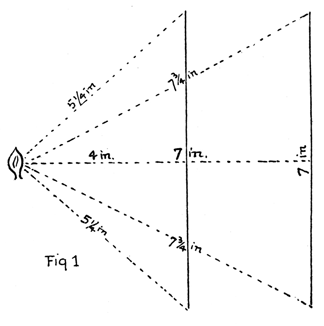 Here
we find that while
the centre of a negative
is four inches
from the light the
extreme edges will
be over five inches
from it, the rule as
to intensities telling
us that the light at
the edges will be
only ¹⁶∕₂₅ of that at
the centre. This
would result in a
marked falling off
of light at the corners, and would necessitate a constant
motion of the printing frame throughout exposure,
which is not wholly satisfactory. The remedy would
be to use a stronger light at a greater distance. But
another reference to Fig. 1 will show that if a
Here
we find that while
the centre of a negative
is four inches
from the light the
extreme edges will
be over five inches
from it, the rule as
to intensities telling
us that the light at
the edges will be
only ¹⁶∕₂₅ of that at
the centre. This
would result in a
marked falling off
of light at the corners, and would necessitate a constant
motion of the printing frame throughout exposure,
which is not wholly satisfactory. The remedy would
be to use a stronger light at a greater distance. But
another reference to Fig. 1 will show that if a 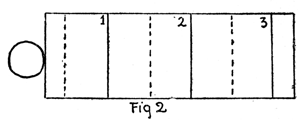 Greater uniformity
in lighting will be
gained if a piece of
white cardboard be
placed immediately
behind the flame.
Some lamps have reflectors, in which case the card
is unnecessary, provided that they reflect the light
uniformly; otherwise such reflectors are worse than
useless.
Greater uniformity
in lighting will be
gained if a piece of
white cardboard be
placed immediately
behind the flame.
Some lamps have reflectors, in which case the card
is unnecessary, provided that they reflect the light
uniformly; otherwise such reflectors are worse than
useless.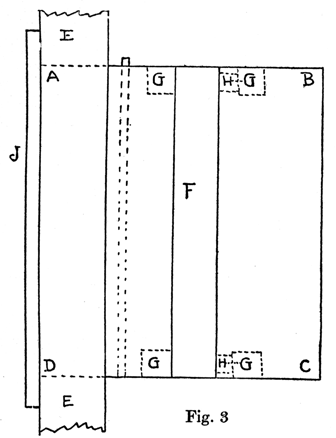 But whatever the
room chosen, all
windows but the
one at which we
are to work must
be blocked up.
This can be done
by heavy dark curtains,
or by specially
constructed
frames covered
with light-tight material
and made to
fit closely in the
windows. If there
are any transoms
these should likewise be covered. White light entering
under the doors can be shut out by placing a rug along
the bottom of the door. Care must be taken that the
window-frames fit closely, as the light from openings
at the windows would soon fog a sheet of bromide
paper if it fell upon it even for a few moments.
But whatever the
room chosen, all
windows but the
one at which we
are to work must
be blocked up.
This can be done
by heavy dark curtains,
or by specially
constructed
frames covered
with light-tight material
and made to
fit closely in the
windows. If there
are any transoms
these should likewise be covered. White light entering
under the doors can be shut out by placing a rug along
the bottom of the door. Care must be taken that the
window-frames fit closely, as the light from openings
at the windows would soon fog a sheet of bromide
paper if it fell upon it even for a few moments.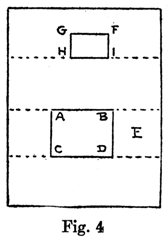 Reverting
to Fig. 3, F is an opening cut
in the side of the negative box two
inches or a little less from the back
of the box, AD, and wide enough to
admit the free passage of a negative
in a kit or other holder. On
the inside of the box are tacked
strips, GGGG, to serve as a guide to the kit when
placing it in the box. An opening similar to F should
be made in the other side of the box to permit lateral
adjustments when we come to use the apparatus,
besides enabling us
to put the negative
in or withdraw it
from either side. A
convenient modification
of the strips,
G, is found by placing
the front ones a short distance further forward, to
wit, toward BC, as they are shown in the cut (Fig. 3),
and tacking to them a piece of watch spring, H, this
then serving both as a guide and as a means of pressing
the kit or negative holder against the other strips,
GG (Fig. 5).
Reverting
to Fig. 3, F is an opening cut
in the side of the negative box two
inches or a little less from the back
of the box, AD, and wide enough to
admit the free passage of a negative
in a kit or other holder. On
the inside of the box are tacked
strips, GGGG, to serve as a guide to the kit when
placing it in the box. An opening similar to F should
be made in the other side of the box to permit lateral
adjustments when we come to use the apparatus,
besides enabling us
to put the negative
in or withdraw it
from either side. A
convenient modification
of the strips,
G, is found by placing
the front ones a short distance further forward, to
wit, toward BC, as they are shown in the cut (Fig. 3),
and tacking to them a piece of watch spring, H, this
then serving both as a guide and as a means of pressing
the kit or negative holder against the other strips,
GG (Fig. 5).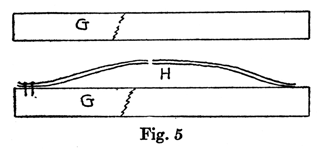
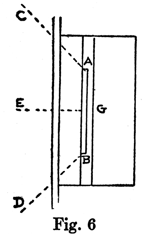 Here
AB represents the negative in place,
CA, DB and EG represent rays of
light entering the box. It will be seen
that the rays CA and DB strike the
ground-glass at an angle, but nevertheless
at an angle which results in
their passing through it in a considerable
degree. They strike the negative
AB, but if the negative were the
full size of the box, to wit FG, it will be
seen that while the section AB would be fully lighted,
the sections AF and BG would receive no oblique rays
at all, and hence the negative would not be even approximately
uniformly lighted. This point is too often
overlooked in the construction of apparatus of this
character, but is necessary in all cases of daylight
enlarging and especially when direct sunlight is used.
Now with the negative box in place, some arrangement
must be made for holding the lens, which can be
the lens used for making the negative. This for enlargements
of a fixed size from negatives of a given
size can be accomplished by simply extending the
section BGGC Fig. 3, to a proper distance and placing
the lens in the end of it; but this permits too little
opportunity for adjustments and is not advisable.
Here
AB represents the negative in place,
CA, DB and EG represent rays of
light entering the box. It will be seen
that the rays CA and DB strike the
ground-glass at an angle, but nevertheless
at an angle which results in
their passing through it in a considerable
degree. They strike the negative
AB, but if the negative were the
full size of the box, to wit FG, it will be
seen that while the section AB would be fully lighted,
the sections AF and BG would receive no oblique rays
at all, and hence the negative would not be even approximately
uniformly lighted. This point is too often
overlooked in the construction of apparatus of this
character, but is necessary in all cases of daylight
enlarging and especially when direct sunlight is used.
Now with the negative box in place, some arrangement
must be made for holding the lens, which can be
the lens used for making the negative. This for enlargements
of a fixed size from negatives of a given
size can be accomplished by simply extending the
section BGGC Fig. 3, to a proper distance and placing
the lens in the end of it; but this permits too little
opportunity for adjustments and is not advisable.
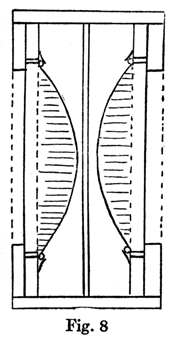 A piece of quarter-inch pine or poplar is cut to a
square about an inch larger than the diameter of the
lenses. In the center of this is sawed out a circular
opening the exact size of the lens. In another board
of the same dimensions is cut a circle a quarter of
an inch less in diameter. These
boards are placed together with
the grain running in opposite directions,
to prevent warping, and
the lens kept in place by a wire
bent in a circle and clamped in
place so as to hold the lens, or
other similar arrangement. See
Fig. 8. The other lens is mounted
in the same way. The two are
mounted with their convex sides
facing each other and a slight distance
apart. It is better to place
between them a thin sheet of finely
ground glass, as this overcomes the
bad effects of slight flaws in the lenses, which are not
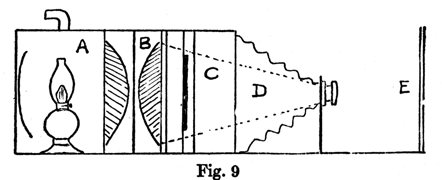
uncommon. The combination is then boxed up.
A piece of quarter-inch pine or poplar is cut to a
square about an inch larger than the diameter of the
lenses. In the center of this is sawed out a circular
opening the exact size of the lens. In another board
of the same dimensions is cut a circle a quarter of
an inch less in diameter. These
boards are placed together with
the grain running in opposite directions,
to prevent warping, and
the lens kept in place by a wire
bent in a circle and clamped in
place so as to hold the lens, or
other similar arrangement. See
Fig. 8. The other lens is mounted
in the same way. The two are
mounted with their convex sides
facing each other and a slight distance
apart. It is better to place
between them a thin sheet of finely
ground glass, as this overcomes the
bad effects of slight flaws in the lenses, which are not
uncommon. The combination is then boxed up.