In the hope that the story contained in these pages shall not have
been recorded in vain, the author begs to offer a few suggestions in
regard to Municipal Emergency Homes. Unless rightly built and rightly
conducted they may prove worse than useless. That the need is great
none can deny, and the institution should be strictly for the purpose
of filling that need. The suggestions contained in the following
paragraphs may solve some of the perplexities which confront the city
wishing to build an institution such as the situation demands.
In every State of the Union, the Legislature should pass a bill
giving cities the right, under home rule, to erect and maintain a
Municipal Emergency Home. Every city ought to pass an ordinance for the
creation and maintenance of such Municipal Emergency Homes, and the
budget of the city should contain an appropriation for its
maintenance, based on the same reasons on which the appropriation is
granted for running the Health Department, Police Department, or any
other Department of the Municipal Government.
The ordinance to be passed by the city council ought to create and
develop a system that will give protection and opportunity to every
honest wandering citizen while sojourning, in search of work, in the
community.
In the cities of New York and Boston, an appropriation is made from
the public treasury for the care and maintenance of their Municipal
Emergency Homes. In Chicago a special budget is created and added to
the appropriation of the Police Department. It should properly have
been added to the Health Department.
A Municipal Emergency Home should not be designed to be a money-making
institution, but merely to provide shelter and food for men and women
who appear temporarily destitute. If it should appear that those
demanding shelter in the Municipal Emergency Home should be afflicted
with any physical illness, it should be the duty of its superintendent
to transfer such individuals to a hospital ward, which may be a part
of the Municipal Emergency Home, or to the city or county hospital
where each man or woman may be thoroughly cured of any illness
which has put them into destitute circumstances or is unfitting them to
perform any kind of labor to make existence possible. The mind of the
community is being educated to see that the adjustment of individuals
to a suitable environment must be quickly but scientifically attempted.
If unfit they must, if possible, be made fit. The idea seems to be
dawning that permanent unfitness must be met with permanent adjustment.
For the present, the Municipal Emergency Home stands, or rather
should stand, on the one hand as a link in the chain of governmental
institutions, not only as a public policy and agency which supports
the individual who either fails in life or is compelled to be one in
the ranks of destitute men because of economic conditions, but as an
institution wherein one may receive temporary relief under the rights
of citizenship. On the other hand, it should stand for the protection
of society from the degradations, annoyances and misdemeanors of
the individual who would thus be a burden upon his fellows and upon
society as a whole. In other words, the Municipal Emergency Home
should be one maintained and conducted strictly by the municipality
as a governmental institution. It should be the tiding-over place for
the man or the woman without a job, a refuge to satisfy immediate
needs, a hospital in certain cases of sickness, an asylum in
case of destitution.
The author believes that there are two factors essential to the success
of a Municipal Emergency Home; first, the co-operation of all public
departments in the city government, and second, the cooperation of the
public itself. When because of politics it has been found difficult
to introduce improvements and progressive ideas in a municipality
for relieving the temporarily distressed, it has become the custom
to recommend religious or private charities for the management of
relief-granting institutions. But no one can question the success and
the need of a Municipal Emergency Home who is willing to investigate
the wonderful success of the New York Municipal Lodging House and
the Buffalo Municipal Lodging House. These are conducted strictly
under city and County supervision and management. As such results as
have been obtained in New York and Buffalo, and which may come into
existence in any large city, under public management, why should
other cities question the popularity and success of a Municipal
Emergency Home under such management or doubt its advantages over
those mismanaged by religious and private charity, the latter not
infrequently run for profit?
The people of our cities may expect, and should forcibly demand from
its public officials, that the money expended in municipal “charities”
should be well adapted, elastic in its application, based upon wise,
scientific conclusions, and on a thorough exhaustive experimentation.
It is safe to say that New York stands in the front rank as the worst
governed city in America. But when such a city creates an appropriation
from its public treasury for the maintenance and management of a
Municipal Emergency Home, there can be no reason to doubt the wisdom
or the success of the experimentation of municipal charities. In fact,
we ought not to speak of municipal charity, but rather to say that the
city appropriates such money from tax-payers as has been earned by
those who are temporarily destitute,—that those housed in such
municipal institutions are but receiving assistance as an interest
on their past earnings. A Municipal Emergency Home should not be
considered as a charitable institution, but as an institution offering
the right to every toiler to receive the hospitality of his fellowmen
in time of need.
If the so-called influential and responsible people of every city would
use half the effort they now use in subscribing, managing
and advertising private charitable institutions to create a public
sentiment so that the city would establish a Municipal Emergency Home
with the most modern features, and if they then would continue in an
advisory and co-operative relation to it, the writer does not hesitate
to express his belief that the advantages, every time, would be on the
side of a Municipal Emergency Home or, as a matter of fact, on any
other so-called charitable institution managed by the community itself
as a governmental function and in a co-operative capacity.
The destitute man or woman who is compelled to apply for temporary
relief at a Municipal Emergency Home comes immediately into the care of
the city and may be turned at once to the protective treatment of which
many stand in need.
It is well to bear in mind the fact that a scientifically managed
Municipal Emergency Home not only raises the standard of other
lodging houses in the city, but to make its influence most effective,
the co-operation of the Health Department is absolutely necessary.
In fact, the most humane, the most scientific and in all respects
the most desirable way to manage a Municipal Emergency Home is
through the direct management and supervision of the city Health
Department,—never under that of the Police Department. The
institution deals with human beings who are out of adjustment
to the community. The homeless, wandering citizen should not be
considered as a derelict, a human monster, a criminal, a vagrant and
what not, to be hounded to death by the brutal police system.
All religious, charitable and private lodging houses also should
be under a rigid inspection of the Health Department of the city,
lest they may become dangerous competitors to a Municipal Emergency
Home by undoing the work accomplished by this exemplary institution.
Because they can be maintained at a low standard of cleanliness and
order, they are sought by the tired, weary, homeless workingman, that
is,—when he has the money! No city should ever countenance
an uninspected sheltering place where human beings are forced to
congregate, where those harbored, in many instances, communicate
disease to the country boy, seeking a job, and teach him lessons in
mendicancy, vice and crime.
All public departments, especially the Health Department, Public
Works, Legal Department, Labor Department, should co-operate with the
Municipal Emergency Home. The Health Department should look after
the physical welfare of the city’s guests, the Department of Public
Works should aid by giving all able-bodied, willing workers
plenty of work on all municipal undertakings, and by paying them the
prevailing scale of union wages in the respective industries. The Legal
Department should care for and protect against the private exploitation
of the homeless men and women, and above all else, shield them from the
undue interference of the police.
As to the co-operation of the great public itself, honest investigators
must find the overwhelming advantages in every respect on the side
of municipal management. If a city maintains and manages a modern
Municipal Emergency Home, charitably-inclined private doners can be
cheerfully advised to leave the entire problem to the city. Thus
the great many charitable and quasi-charitable institutions that
have failed to give relief where relief was most needed will fail
to find support. This is exactly the purpose of all municipal and
governmental undertakings,—firmly and scientifically to undertake
the management of all public affairs, taking it out of the hands of
superficial private organizations whose inadequate system, instead of
doing good to the needy, does much moral harm.
It is most desirable that the great public be aroused and
educated to see that the homeless, wandering citizen needs special
treatment,—that he must, if necessary, be the object of
expert, scientifically-trained solicitude, and that the
public must provide that scientific service. When the public can be
so educated, all applicants for shelter, food, or work (whether they
come from the so-called “tramp,” “bum,” or “hobo,” at the back door, or
from the man on the street who begs a dime, or from the Salvation Army
representative on the street corner, or from others who promiscuously
ask donations for so-called “Lodging Houses”) may safely be referred
to the Municipal Emergency Home where the expert work of the community
is being done, and the task of uplifting humanity and of elevating the
community itself is being carried forward in the right way.
It is quite remarkable that the Poor Law in England had its origin in
an attempt to meet the problems of the homeless, wandering wage-earner.
Yet there, as here, the homeless are rather on the increase, because of
unjust social and industrial conditions.
Nicholl quotes the following, purely utilitarian statement:
“The usual restraints which are sufficient for the well-fed, are
often useless in checking the demands of the hungry stomachs.... Under
such circumstances, it might be considered cheaper to fill empty
stomachs to the point of ready obedience than to compel starving
wretches to respect the roast-beef of their more industrious neighbors.
It might be expedient, from a mere economical point of view, to supply
gratuitously the wants of able-bodied persons, if it could be done
without creating crowds of additional applicants.”
This rudimentary economic advice has not been intelligently understood
either in England or in our country. The people of our cities still
look on while a group of men eat the cold roast beef of their more
fortunate neighbors—calmly look on and take no action.
Eminent scholars and authorities on economic, industrial and legal
questions have well said, many times, that repressive measures and
antagonistic treatment are never sufficient and never will be.
Educational, constructive, scientific work alone will prevail. The
religious and charitable organizations and societies may ask for
police control and supervision, and for the repression of vagrancy in
our cities, but the homeless and wandering wage-earners will be fed,
because we have a Christ-given, common humanity.
It has been said that the “tramp” question, the question of the
homeless, hungry, wandering wage-earner is a woman’s question. It
is. But what made it such? It has been made a woman’s question by
the indifference and ignorance of our communities which have made
no provisions for men and boys, women and girls, who are hungry and
homeless.
Women as well as men have represented the conscience of our communities
in a poor fashion, in a most dangerous fashion, in a criminal fashion,
for they have created just about as many “tramps” with their
petty little charities, as the man who gives dimes on the street for a
night’s shelter. The women should know, the men too, that at the back
doors or on the streets we cannot do the right thing. We can give only
inadequate relief. We can only push a human being down the stairs of
manhood to the level of a parasite.
Let us look at the matter historically. We find that the mendicant of
the Middle Ages stood in much the same relation to the community as the
modern “tramp,” the homeless, wandering wage-earner. One existed, and
the other exists, because of a certain sentimentality which permits
one group of persons to live on the industry of another group. The
community giving, in the mediæval days, was centered in the monastery,
and since the time of Henry VIII the State has assumed that function.
The monastery cared for the mediæval tramp. Let the Modern Twentieth
Century State of Civilization (if such we may call our time) care for
and cure his descendant, the homeless, wandering wage-earner, just
as it takes care of the other needs of the people in the respective
communities.
To be logical, every American city should maintain a Municipal
Emergency Home for the wandering citizen, the homeless wage-earner, in
order to complete the system of governmental institutions and
agencies dealing with the needs of a modern complex society.
Rightfully, and legally, in America, the so-called Overseers of the
Poor, the Boards of Charities and Corrections, are required to relieve
the homeless and destitute at their discretion. In many cities they are
fulfilling this duty toward the men temporarily destitute and homeless
by graciously permitting them to be sheltered at the insanitary,
degrading police stations, to be fed with water concoctions, to sleep
in a dark vermin-infested corner from which they are ordered to move on
in the morning. Perhaps this is acting according to their discretion,
but the result shows that it is unwise to put power into the hands of
private individuals who not only know not the evil they increase but
who could scarcely do otherwise if they knew.
Historically, every modern city should maintain a Municipal Emergency
Home. Logically, it ought to do it. Legally, it must do it. Let it no
longer be a woman’s or a man’s question, but our question, the cities’
question. Let us all say that there must, nay, there shall be in every
community for the homeless, wandering wage-earner, a decent, modern,
sanitary shelter, a fitting meal, a place where the community can
give individual, discriminating, scientific treatment, where there is
an opportunity to get suitable work to make a decent living
possible.
Let everybody then make it his duty to appeal to the civic pride of the
women and men of the community. Let the people of the city instruct
its Mayor and City Council, or else themselves elect a man or a woman
to supervise the management and maintenance of a Municipal Emergency
Home of integrity, of resource, a place of sagacious and scientific
training. Then, and not until then, will the women of our cities be
able to shut their doors, the men their pockets, and point with pride
to the Municipal Emergency Home, which in every American city is as
necessary and as fundamental an institution as a hospital itself. In
fact it is a human psychological hospital, an economic betterment
provider, within the gates and welcome arch of every city.
The name of the institution is significant,—Municipal Emergency
Home. As the gate of the public system of institutions it should
stand, always open and ready to receive the homeless, wandering
wage-earner who may claim its hospitality. From it, he or she may go
forth to renumerative industry, to economic, social and industrial
betterment which is for the benefit of all humanity.
In the following pages, the author wishes to give in detail the chief
aims, objects and principles upon which a model Twentieth Century
Municipal Emergency Home should be maintained:
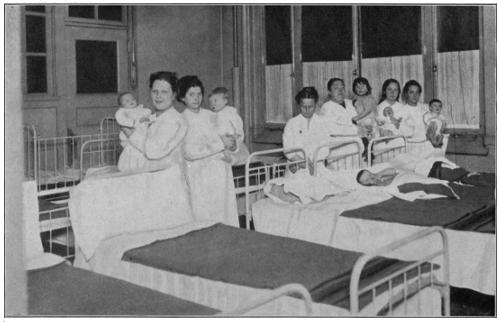
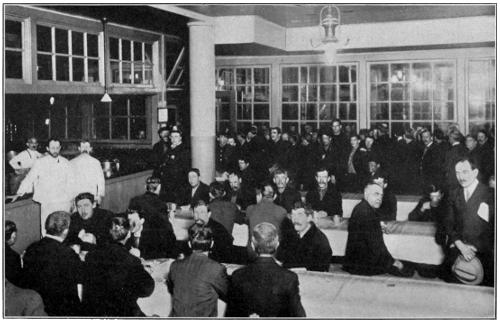
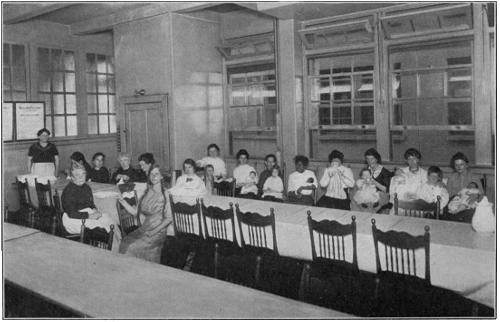
I. It should provide, free under humane and sanitary conditions,
food, lodging and bath, with definite direction for such immediate
relief as is needed for any man or boy, woman or girl, or even
families, stranded in the city where located, as well as for the
convalescent from the hospital. It should be able to give employment
to able-bodied men and boys, women and girls, provide them with the
necessaries of life, and make it possible for them to be economically
independent of the future. This should be the chief aim, object and
principle upon which the maintenance of a model Twentieth Century
Municipal Emergency Home is based.
All consideration of causes, all efforts toward the enforcement of
law or reform in legislation, are secondary to this first duty of
providing a humane clearing-house for a scientific, systematic
and intelligent distribution of the industrial, economic and social
human waste, which gathers and disperses from season to season in the
urban centers of America and tends constantly to fester into idleness,
vice and crime. While the demands of this human clearing-house will
be no small charge upon the respective municipalities, the Municipal
Emergency Home will be primarily an institution of social service,
collecting and regulating the entire human resource of the city for
the mutual benefit of the community or those that serve it and of the
individual that is served.
This idea of connecting, in the most direct fashion possible, the
social strength of a community with the individual weakness of the
stranded man or boy, woman or girl, will be the first purpose of a
Twentieth Century Municipal Emergency Home. To further this end its
location should be easily accessible to the lodging house district of
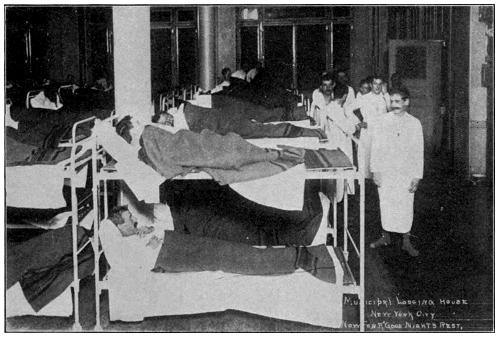
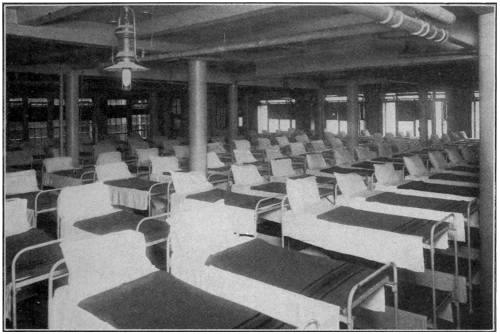
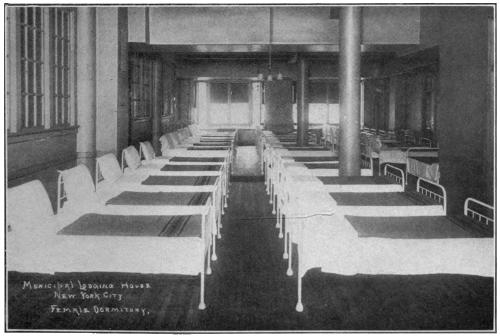
the city. That the building should be sanitary and fireproof, the food
wholesome and nourishing, the beds comfortable and clean, one man to a
bed, not “double deckers,” are matters of course. An isolation ward for
special cases such as men suffering from inebriety, insanity, venereal
disorders, etc., is a prime requisite.
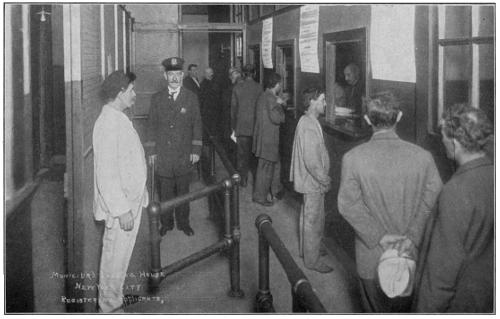
A system of registration by the card system ought to be in use, each
card giving at a glance the significant facts such as name, age,
birthplace, occupation, physical condition, reference,
residence, nearest relative or friend, number of lodgings, disposition
of the case, etc. This card should be filled out by the applicant
himself, in order that the visitor may not be humiliated by an
inquisition of a jail- or charity-like character. The registration
clerk should be a man of good judgment, a man of honor, and with
psychological training whose actions should always be guided by firm
but just and human motives. Thorough physical investigation of each
applicant, and the investigation of the capabilities of each applicant,
should be in all cases intelligently conducted.
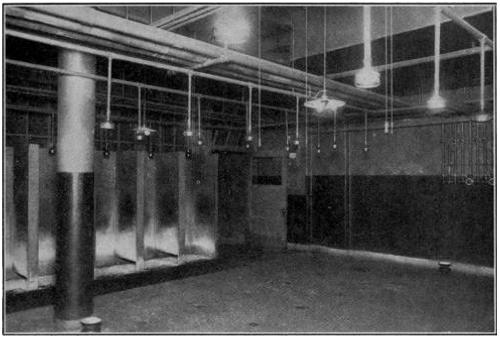
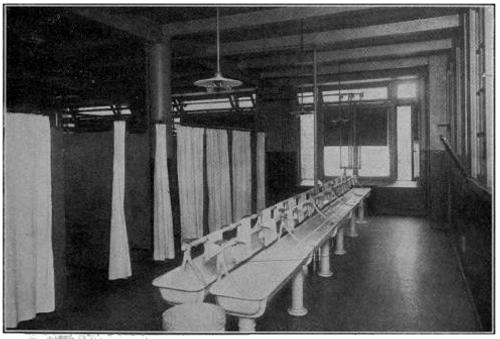
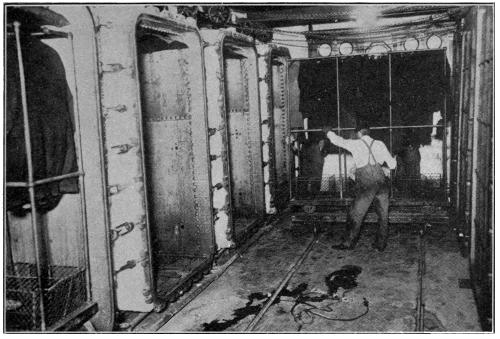
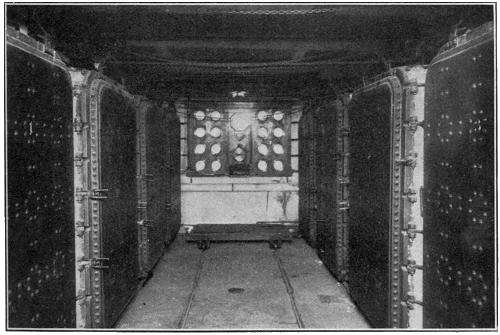
Every visitor’s clothing, including hat and shoes, should be thoroughly
fumigated each night. All visitors should be required to bathe nightly
and only shower baths should be used.
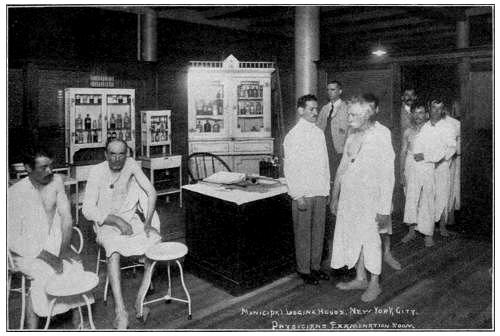
A comprehensive physical examination of each visitor should be made
by competent examiners under the direction of a physician of the
Health Department of the city. All necessary operations, supplies
for simple medicaments, eye-glasses, crutches, bandages, trusses, in
fact every accoutrement and further treatment, if necessary for the
health and comfort of the visitor, should be supplied free. An entry
of the actual physical conditions of each visitor should be made on
his registration card after the first examination, and any change
therefrom noted thereon as it may occur from time to time. All cases of
infectious or chronic contagious diseases of a virulent nature
should be sent at once to the isolation ward. The accuracy and care of
this department is of immediate importance to the health of the entire
community and absolutely essential to the effective and successful
administration of the Home.
Each visitor should be provided with an absolutely clean nightshirt and
a pair of slippers. The dormitories should be in all cases comfortable
and quiet, talking, reading and smoking therein strictly prohibited.
The morning call ought to be given in time to permit each visitor to
dress for breakfast and to be sent to employment if he or she is able,
in time for the day’s work. The visitors desiring to find work in the
town where the Municipal Emergency Home is located should form in
line and pass the superintendent for distribution in accordance with
the facts of each case, clearly stated on each record card, as to the
physical condition, abilities and desires of each applicant for work.
This is the crux of the ministry and the administration of a Twentieth
Century Municipal Emergency Home. Clear-sighted, humane, resourceful,
definite, resolute action is now demanded, and unless this demand is
met with scientific exactness, with intelligent systematic application,
the whole service fails.
The superintendent will have before him the record card of every
visitor containing his original story, the report of his physical
condition, occupation, and such further important facts
as may have been discovered in the course of his relations with
the Home. Immediately at hand will be the employment resources for
that day, the name and address of every labor union headquarters,
every benevolent association, every dispensary and hospital, city
and business directories, railroad and factory directories with the
names and addresses of the respective superintendents under whose
jurisdiction the employment of help may come. Thus the superintendent
will be capable of intelligent co-operation with all agencies, public
and private, that may minister to the varying needs of the stranded men
and boys, women and girls whom he is to distribute and start on their
way to independent, economic usefulness in the community.
Men and women of all ages, nationalities, occupations, misfortunes,
face the superintendent and must be dealt with definitely, but wisely,
after a rapid comprehension of the visitor’s needs, his card record,
and the resources at command. No higher test can be made of human
judgment, courage, right feeling, resource and common sense.
It is at this crucial point in the administration of a Municipal
Emergency Home that one feature of the model home stands out with
commanding significance. This is the Employment Bureau. Daily
opportunity for paid employment is the right arm of the most effective
distribution, and the only genuine work test. Whether this can
be assured or not in any given city, no one can say until it has been
fairly applied and tried. When the employment resources of any city
are thoroughly organized, if there still be men in any considerable
number, able and willing to work, who cannot be given paid employment
and who must suffer enforced idleness for any considerable length of
time, then and not until then, will we know that the present industrial
order has absolutely broken down. After all paid employment has
been thoroughly taken advantage of, coming as it does from private
resources, the respective municipalities should immediately put to work
all able-bodied, willing wage-earners on municipal work of all kinds
for which the city should pay them a decent, living wage, or rather the
prevailing scale of union wages in the respective trades.
There is an increasing number of people in this country—quiet,
hard-working, hard-thinking, plain folk who are determined to know
the facts of our present-day industrial and social system, and while
enjoying the fruits of this present order, are determined to defend
it against assaults. They also purpose to strive mightily in righting
whatever wrongs may be proven to exist. The Municipal Emergency Home
will help to supply these people with the real knowledge of conditions
in the underworld, where millions of honest, able-bodied men and women
are forced to spend their lives in enforced economic idleness and
uselessness.
One of the most significant indications of the power of the Municipal
Emergency Home is the length and depth of its searching influence.
Its hooks will reach clear down to the bottom of the human sewerage,
in the dark channels of life, altogether unknown to the “other half”
of our human society. Without disparaging the splendid work of other
helping agencies in the respective communities, it cannot be denied
that their influence, their hooks of help, hang too high to catch many
worthy persons among the vast army of wandering citizens who are in
direst need. The “Hang-out,” the “Barrel-house,” and the “Free-flops”
receive many times more human drift than Charity Bureaus, Missions and
Workingmen’s Homes. This is seen to be inevitable when the conditions
are rightly understood.
Humankind is but just beginning to understand and appreciate the
everlasting truth of that great clause of Agur’s perfect prayer: “Feed
me with food convenient for me,” and of one of the greatest sayings in
the Gospel of the Kingdom: “For I was hungered and ye gave me meat; I
was thirsty, and ye gave me drink; I was a stranger, and ye took me in;
naked and ye clothed me.”
The stranded man or boy, woman or girl needs food, shelter and a
straightforward, resourceful meeting of the issues of his or her human
life first. After that, if you possess sincerity, faith and
clear vision, it may be your privilege to speak to him or her, with
controlling power, of the ministry and message of the Son of Man.
The sympathetic reader may well ask: “How will stranded men and boys,
women and girls, learn of the existence of a Municipal Emergency
Home, and what will impel the unfortunate woman or girl to accept its
altruistic, humane but vigorous hospitality?”
The answer is easy. It has already been discovered that one of the
chief sanctions, one of the main objects for municipal direction
of such work is being a municipal enterprise, a part of the city
administration, a wing of its manifold governmental functions, it
challenges most effectively the co-operation of all public authorities.
The very first step therefore in this mandatory municipal co-operation
will be the closing of the police stations, these degrading and
unsanitary hells of our barbaric age, to the itinerant or local toilers
who have been either “run in” by the police or forced to find shelter
for the night, and provision for the supply of all such applicants
with tickets of admission and directions to the Municipal Emergency
Home. This will partly relieve the police stations of our cities of one
of their most disagreeable duties, rendered in the past without any
adequate means and under conditions that befouled not only the stations
but which degraded the needy visitors, thereby encouraging
vagrancy, crime and vice, creating disease and, in many cases, causing
untimely deaths.
The second answer to the question is that every policeman will be
required to carry a supply of Municipal Emergency Home tickets in his
pocket to give to all persons discovered in need, and to those found
begging. These must be accompanied by a warning that he or she must
not beg, because of the consequences, and that the city will take care
of their monetary necessities. No police officer should be allowed to
interfere or endanger the liberty of any such temporarily destitute
people. All railroad stations should have, in a conspicuous place, an
advertisement of the Home, calling the stranded wayfarer’s attention to
its existence and location. Such notices will prove a blessing to them
and a saving to the community. All newspapers should co-operate with
the city authorities in printing in the “want ads” column the fact of
the existence of such a Municipal Emergency Home, its location and the
possible positions that may be filled by applying to the superintendent.
A most important step should be to provide every homeless man or
boy, woman or girl who may have been discharged from the house of
correction, from the penitentiaries, hospitals or other institutions,
with the hospitality of the Municipal Emergency Home, thereby pledging
the support and good faith of the city to secure him food,
shelter, an opportunity for honest employment, or the right, for a
period, while enjoying the hospitality of the city, to look about for
such labor as he or she may prefer.
No one who lays any claim to enlightened opinion upon subjects of
this character believes any longer that arrest and incarceration in
a penal or corrective institution is a final answer to the social
obligations of the community in behalf of the so-called casual
vagrant, the wandering citizen, the itinerant wage-worker, or petty
criminal, as they are miscalled. It may be true, perhaps, that a three
or six months’ imprisonment is the only present available means for
“straightening up a drunk” or getting some “evil spirit” out of a young
man’s heart. But at its best it is a very dangerous medicine, and
surely when society leaves a man or boy, woman or girl at the prison
gate, after a jail sentence of greater or less duration, and tells him
or her to shift, each for himself or herself as best they may, it is
simply an invitation and an encouragement to vagrancy, vice, crime and
immorality.
The last important step in this mandatory municipal co-operation
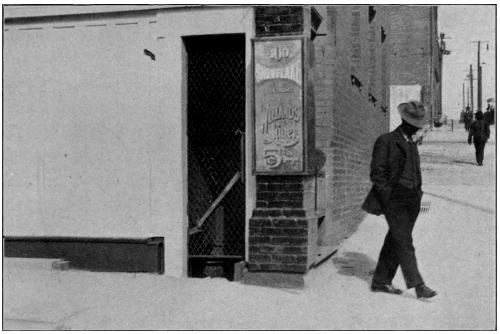
should be a direct attack upon the “barrel-houses,” “free-flops,”
and “hang-outs,” certain cheap lodgings and Missions. To continue a
campaign against vagrancy by an indiscriminate raiding of such resorts
has proven to be a miserable failure. If there is no other free,
accessible and serviceable place for the homeless and indigent
man, boy, woman or girl, they will simply find another center, and the
last may be worse than the first. On the other hand, having understood
and provided for the actual needs of the temporarily unemployed
homeless, we have cut off the base of evil supplies of “the mendicant
army” through the use of tickets to a modern Municipal Emergency Home,
and the co-operation of all other municipal departments and the great
public. Then, and not until then, can a modern Christian community
strike effectively the final blow against these recruiting stations of
vice, immorality, crime and disease.
An intelligent, scientific, systematic and centralized campaign of
publicity must be ceaselessly carried on for this Free Home. Free
tickets of direction and admission must be constantly distributed
through fraternal and charitable societies, labor unions, institutions,
hotels, business offices, churches, clubs, housewives, railroad
conductors, brakemen, and other officials and citizens. As soon as
it is generally known that every applicant, without exception, is
absolutely certain of wholesome food and sanitary shelter free, with
such help next morning as his need demands, the cooperation of the
humane public will be immediate and constant. In this campaign for
publicity the daily press, through news items and editorial comment, should be the most powerful ally for the extension of the
service to the needy.
Two vitally important considerations of administration now claim our
attention. One is the matter of an arbitrary limitation upon the number
of nights one of these unfortunate, homeless, wandering wage-earners
may remain and enjoy the hospitality of the city. The other is the
question of the so-called work-test, so much asked for by charitable
organizations.
This, the greatest of all problems confronting the Municipal Emergency
Home, we must face courageously in the endeavor to demonstrate its
practicability to social service. Either in the name of Christian
Brotherhood, sympathy for unfortunate humanity, or other high and holy
sentiments, men are given to “cant.” So they exploit the institution,
or in the name of preventing pauperization, preserving, a man’s
self-respect, a business administration, and other like high sounding
terms, the institution subtly exploits its charges. This much seems
certain: The arbitrary, lump method of dealing with men is always and
everywhere wrong and inhuman.
A model Municipal Emergency Home should not have an arbitrary
time limit on the extension of its hospitality to the needy. The
injustice of such limitation is manifest in instances such as that of
a visitor suffering from a bruise, wound, broken arm, injured
leg,—of one who is awaiting money from friends, or transportation
home, or to a place where employment is offered, or for the coming
of the first pay-day after being re-established in industry. Neither
should any Municipal Emergency Home have that inhuman, wasteful,
robbing work test. To argue or reason that because one hundred or more
men and boys lined up in front of a desk at five o’clock in the morning
are alike because of the fact of having received a night’s shelter
and two meals and that, therefore, each alike should do three hours’
work on a wood pile, or in the city streets, is to say the least, not
only unscientific, but inhuman exploitation. In every such group there
will be found not only a wide difference in resources and needs, but
a wider difference in men. In such a group will be capable, earnest,
sober and willing workingmen displaced by industrial depression,
disturbances or inventions; all classes of casual laborers, between
jobs; boys seeking their fortunes; victims of child labor; disabled,
sick and aged industrial and social waste; beats, and frequently strays
from the higher walks of professional criminals. All these challenge
intelligent and resourceful discrimination. Surely the true interest of
the community as well as that of the unfortunate, wandering citizen, is
best served by at once sending men, able and willing to work, to paid
employment; separating the boys of tender ages from this human
drift, and starting them home or to steady, profitable employment for
the security of their future; directing the sick, infirm or aged to
such institutions as will best minister to their needs.
The writer’s personal experiences and observations of the lump work
test in operation, as he saw it in the various religious and charitable
lodging houses throughout the country, seem to justify the following
statement:
First. The worthy, average visitor to a Municipal Emergency Home will
work diligently. Those chained by habits of vice will shirk. The
crippled, sick and aged will simply “mark time.” This results in the
most fit man in the group being exploited for the benefit of the least
fit, and in putting upon the backs of those members of the community
least able to bear this burden, part of the charitable charge for the
incompetent and unworthy.
Second. There seems to be little foundation for the idea that a
lump work test conserves a man’s self-respect. On the contrary the
conditions of its application are such as must always be more or less
degrading, and it invariably operates to hold together the good and bad
elements of a group, to the inevitable injury of the good.
Third. Where the lump work test involves some financial benefit for the
institution, the best of superintendents become less eager to
re-establish his most fruitful, most capable, willing-to-work visitors
in paid industry.
Fourth. As an indication of character, the work test is almost
valueless. Men of ordinary sense see through the thin disguise of the
claim that it helps to preserve their self-respect, and recognize its
true lineaments as a subtle exploitation that deprives them of the
opportunity of getting paid employment for that day, or as a penal
service to prevent their frequent return.
Fifth. The quick deterioration of even fairly good workmen through
getting used to a low standard of living by charitable contributions
that lessen the economic pressure and seem to offer escape from the
legitimate costs of life, is apparent to every thoughtful observer.
Hard times, and an empty stomach, make it easy to submit to the kindly
exploitation of a “Flop-house” wood-yard. The loss of self-respect
is forgotten in relief from the necessity of trying to play a man’s
part in the industrial order, until the man that was an independent,
capable, willing, but unfortunate wage earner is transformed into
a half-parasite,—an individual of a special character, a
man whose face is familiar only to charity workers, and to the
charitably-inclined public.
Summing up the effect of these two arbitrary lump restrictions it
seems that they operate always to the injury of the service and are
tolerated for one of three reasons. The first is that they
provide some check upon the number and return of the visitors. The
second is that they provide a subtle means of exploiting helpless men
for the financial benefit of the institutions, and the third, that
the institution thereby escapes the obligations of discriminating and
effective distribution.
Mr. Raymond Robins, the first superintendent of the Chicago Municipal
Lodging House, in substantiation of the above argument says:
“It may be well to say that the Chicago Municipal Lodging House
began operations with both restrictions in force. A three nights’
limit and three hours’ work daily from each able-bodied lodger were
required by the rules. Experience and observation of the results of the
enforcement of these restrictions in Chicago and other cities convinced
the administration that they were cruel and unjust. The substitution
of an employment bureau, effective co-operation with other charitable
and correctional agencies, and daily discriminating distribution,
have enabled the Chicago Municipal Lodging House to abolish both
restrictions entirely. Not only has this substitution not resulted in
overcrowding the house or increasing the number of human parasites
that seek its hospitality, but, on the contrary, the proportion of
the worthy men has steadily risen under the new régime. The ‘Chicago
System’ provides food, lodging, baths and distribution for a maximum of
two hundred lodgers daily at an annual cost to the municipality of ten
thousand dollars.”
In conclusion, let it be understood that the keyword for the
successful administration of a model Municipal Emergency Home
is co-operation,—co-operation in the interior management,
co-operation in all external relations, co-operation with all existing
agencies for human service, co-operation for the creation of new ones
when found to be necessary from time to time; co-operation
with all other sister cities and States in creating a body of approved
information and legislation upon the broadest principles of humanity,
for the service of helping the wandering citizen, the unemployed
masses, of removing the causes, of bettering conditions and of
correcting wrongs throughout the world.
Standing as the collective social action of the whole people for
meeting honestly and scientifically the communal obligation to the
outcast, wandering, unemployed wage-earner, the homeless man and woman,
without special regard for race or class or sect, serving no private
scheme, or ulterior motive, the Twentieth Century Municipal Emergency
Home will be a potent witness to the practical expression in municipal
administrations of that awakening social conscience which is the
growing hope for righteousness in all the nations of the earth.
Following are suggestions for the printed cards to be used both as
advertisement and admission tickets for the needy:
I
THIS TICKET IS GOOD FOR
LODGING, FOOD AND BATH AT THE
MUNICIPAL EMERGENCY HOME
(Location)
__________________
Asst. Supt.
Telephone__________
(Reverse side)
The City of —— is maintaining a Municipal Emergency
Home for the benefit of all wandering citizens,
homeless and indigent men and boys, women and girls
in this City. Lodging, food, a bath and other necessaries
of life are being provided free to every applicant.
Those seeking work are given employment.
The crippled, injured, old or infirm are sent each
morning to hospitals, dispensaries or homes. Each
applicant receives the personal attention of the superintendent,
and upon personal investigation his or her
case is disposed of upon the facts so determined alone.
Employment is given to suit the applicants and only
able-bodied people will be sent to work. All loyal
citizens of the City of —— are earnestly requested to
refer needy, homeless fellow-men to the Municipal
Emergency Home by means of this ticket.
By Authority of ———
II
GET YOUR HELP
FROM THE
MUNICIPAL EMERGENCY HOME
(Location)
SKILLED AND UNSKILLED LABOR CAN BE OBTAINED
WITHOUT CHARGE TO EMPLOYER OR EMPLOYEE
Care Taken to Supply Situations With
Competent Men
__________________
Asst. Supt.
Telephone__________
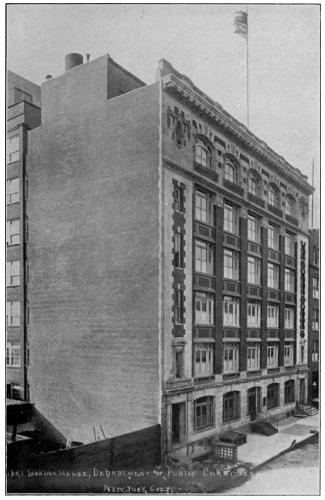
In conclusion, I refer to New York’s Municipal
Emergency Home, as a guide for the technical plans
which too can be improved upon, and are being improved
upon as we understand this great subject
more clearly.
THE END