Brock's fame and Brock's name will never die
in our history. The past one hundred years have
settled that. And in this glory the craggy heights
of Queenston, where in their splendid mausoleum
Brock and Macdonell sleep side by side their last
sleep, will always have its share. Strangely
enough, who ever associates Brock's name with
Detroit? Yet, here was a marvellous achievement:
the left wing of the enemy's army annihilated, its
eloquent and grandiose leader captured and two
thousand five hundred men and abundant military
stores, with the State of Michigan thrown in!
But Britain in those days was so busy doing
things that we a hundred years later can scarcely
realize them. However, so much of our historic
perspective has been settled during the past hundred
years. Perhaps in another hundred years,
when other generations come together to commemorate
the efforts of these men that with Brock and
Macdonell strove to seek and find and do and not
to yield, the skirmish at Queenston may be viewed
in a different light.
Perhaps then the British Constitution will have
bridged the oceans and the "Seven Seas"; perhaps
then Canada will be more British than
Britain itself—the very core, the centre, the heart
of the Empire in territory and population, in
wealth and in influence, in spirit and in vital activities.
Then Queenston Heights may be regarded
not merely as a victory that encouraged Canadians
to fight for their homes but as a far-reaching
world-event.
The year of Queenston, let us remember, was the
year of Salamanca and of Moscow—the most glorious
year in British military annals. But what has
Salamanca to do with Canada? Britain was fighting
alone, not merely for the freedom of Britons but
for the freedom of Europe. Since 1688 she had
been for more than one-half of the one hundred and
twenty-four years actively in arms against France.
Since 1793 there had been peace—and only nominal
peace—against France for only the two years
following the Treaty of Amiens (1801). The generation
approaching maturity in 1812 had been
born and had grown up "in wars and rumours of
wars." In this struggle against France and later
against Napoleon, the Motherland had increased
the National Debt by £500,000,000, or nearly
twenty-five hundred millions of dollars; she had
spent every cent she could gather and taxed her
posterity to this extent. That is what Britain had
done for her children—and for the world at large!
But ever since Jefferson had purchased (1803)
Louisiana from Napoleon the United States had
found she was less dependent on Britain. Accordingly,
Jefferson grew more and more unfriendly.
And now in 1812, the world campaign of Napoleon
had spread to America. He had hoped for this, but
on different lines. He had planned for it, but those
plans had failed.
"The War of 1812-14," as we call it, was merely
a phase, a section, of the greatest struggle in
the history of mankind—the struggle of Britain
against the aggrandisement and cheap ambition of
Napoleon to become the Dictator of Europe and
the civilized world. Brock, though invited to take
a share in the long drawn out contest in Spain,
decided—fortunately for us—to remain in Canada.
The year 1812 was the climax of the war with
Napoleon—the most splendid, as we have said, of
all years in British military annals. Since 1808,
the British forces had been striving to drive the
French from Spain. First under Sir John Moore,
later under Wellington, inch by inch, year by year,
they had beaten them back toward the Pyrenees.
Then on July 22, 1812, just as Brock was struggling
with all his difficulties here in Canada, there
came Wellington's first decisive victory at Salamanca.
The news reached Brock in October and
a day or two before he died he sent the tidings
forward to Proctor—Proctor then struggling with
his Forty-first Regiment to do as much damage as
he could to the enemy hundreds of miles out from
Windsor and Detroit, Proctor who was to be eternally
much abused for faults he never was guilty of,
and to be blamed for Tecumseh's death next year.
With the news of Salamanca went Brock's prophetic
comment: "I think the game nearly up in
Spain"; and within a year the game, Napoleon's
game, was up, not only in Spain but in all Europe.
Within a year Leipsic had been fought and won
and Napoleon was a wanderer on the face of the
earth, to be gathered in and lodged on Elba.
Meanwhile other great events were shaping.
Just a month before Salamanca—in fact, four days
before the United States declared war—Napoleon
had set out on his fatal expedition against Russia.
Two days later he crossed the Niemen. More than
a million Frenchmen were now in arms in Europe;
and Britain was the only active enemy in the field.
What wonder then that Brock, as the civil and
military head of the Government of Upper Canada,
should view with extreme anxiety the situation in
the Province? He had been in Canada for ten
years. He knew that the Motherland could not
furnish any more men. There were fifteen hundred
regular troops in Upper, and two thousand in
Lower Canada. Forty years before there had not
been a single settlement in what is now Ontario
from the Detroit to the Ottawa, from Lake Ontario
to Sault Ste. Marie. Now there were seventy-five
thousand inhabitants; and under a wise Militia
Act they had imposed yearly military service on
themselves; every male inhabitant had to furnish
his own gun and appear on parade or be heavily
fined. Thus there was a volunteer force more or
less trained amounting to about ten thousand men—a
militia that under Brock rendered splendid
service.
But arms were scarce and supplies had to be
brought long distances. The men at Queenston
won their victory with guns that were captured
two months before at Detroit. Throughout the
war, when our mills had been burnt by a ruthless
enemy that made war on women and children and
old men, supplies were brought up the toilsome
course of the St. Lawrence in Durham boats and
bateaux. The devoted militia of the river counties
guarded the frontier, and only once did they lose
a convoy, part of which they afterwards recovered
by a raid into the enemy's territory at Waddington,
N.Y.
In front of Brock was a nation of eight or nine
millions, a nation that believed they could "take
the Canadas without soldiers;" as the United
States Secretary of War said—"we have only to
send officers into the Province and the people, disaffected
towards their own Government, will rally
round our standard." Yet they placed, during the
three years of the war, 527,000 men in the field and
were defeated in thirty-two engagements. The
odds were twenty-six to one against us. That was
Brock's grand bequest to this land—the spirit to
fight against odds that were at first sight positively
overwhelming.
For years sedition and disloyalty had been gaining
ground in Upper Canada. In 1802, Colonel
Talbot classified the inhabitants of the western
part of the Province as (1) those enticed hither by
the free land grants; (2) those that had fled from
the United States for crime; (3) Republicans anticipating
that the colony would shake off its
allegiance to Britain. Lieutenant-Colonel Ernest
Cruikshank, who is justly regarded as the most
eminent authority on the War of 1812-14, believes
that in a large portion of the Province "the recent
immigrants from the United States outnumbered
all the other inhabitants at least two to one. Two-thirds
of the members of the Assembly and one-third
of the magistrates were natives of the United
States."
On the 28th of July, 1812, Brock called together
the Legislature of Upper Canada. In his speech
from the throne he stated that "a few traitors have
already joined the enemy, have been suffered to
come into the country with impunity, and have
been harboured and concealed in the interior."
The peroration should be memorized by every
young Canadian: "We are engaged in an awful
and eventful contest. By unanimity and despatch
in our councils and by vigour in our operations we
may teach the enemy this lesson, that a country
defended by free men, enthusiastically devoted to
their king and constitution, can never be conquered."
He especially desired the suspension of
the Habeas Corpus Act and the passing of an Act
to compel suspected persons to take an oath abjuring
their allegiance to other countries. But Brock,
to use his own words, could "get no good of them.
They, like the magistrates and others in office, evidently
mean to remain passive. The repeal of the
Habeas Corpus will not pass, and if I have recourse
to the law martial, I am told the whole armed
force will disperse. Never was an officer placed
in a more awkward predicament."
The very next day he wrote in much the same
spirit to Colonel Baynes: "The population, believe
me, is essentially bad—a full belief possesses them
all that this Province must inevitably succumb.
This prepossession is fatal to every exertion. Legislators,
magistrates, militia officers, all have
imbibed the idea, and are so sluggish and indifferent
in their respective offices that the artful and
active scoundrel is allowed to parade the country
without interruption and commit all imaginable
mischief. . . . Most of the people have lost all
confidence. I, however, speak loud and look big."
On the same day, moreover, he reported: "The
militia stationed here (at York) volunteered their
services to any part of the Province without the
least hesitation."
Day after day his Legislature wasted their time.
For eight days they discussed a mere party question
of changing a clause in the School Bill. Brock
prorogued Parliament and took the reins in his
own hands. He declared martial law, and soon
after three members of the Legislature, Willcocks,
Markle, and Mallory, deserted and joined the United
States forces.
At once he set out on his expedition to Detroit.
Through the wilds of Upper Canada, by lake and
field, he led his small band of men two hundred
miles. In nineteen days he was back again in his
capital. He had annihilated the left wing of the
enemy's army; he had captured two thousand five
hundred men, thirty-seven cannon and immense
military stores. The State of Michigan practically
remained in our possession till the close of the war.
A hundred years ago Brock spent the last week
in August and the first part of October in strengthening
the defences on the Niagara frontier. He
needed one thousand more regulars, but Sir George
Prevost could not spare another man. He mounted
new batteries with the Detroit cannon. He established
a system of communication and the use of
beacon lights from Lake Erie to Lake Ontario, with
a spur line inland to Pelham Heights. He refitted
his men from the stores captured at Detroit. Ceaseless
activity and eternal vigilance were the very
laws of his life. The motto on his seal is said to
have been "He who guards never sleeps." The
legend may not be correct, but it is so appropriate
that one likes to perpetuate the tradition.
The United States army as a whole was attacking
Canada at three points: its right wing was
trying to force its way up the valley of the Richelieu;
its left wing had been disposed of by Brock
at Detroit; its centre was being strengthened every
day along the Niagara frontier. From the old
French fort at the mouth of the Niagara River to
the village of Buffalo there was on both sides of
the Niagara an uninterrupted scene of fearful and
warlike activity. The heights of Lewiston and the
red beach below were white with the tents of nearly
four thousand soldiers.
From Queenston a small body of British and
Canadian soldiers were watching and waiting.
Then—a hundred years ago—it was much the same
straggling village as to-day. Here the eddying,
foaming, turbulent waters of the Niagara issue
from the narrow, rocky gorge to spread out into a
gentle stream and wind their way to Lake Ontario,
seven miles distant. At the foot of the Canadian
cliff nestles Queenston; at the foot of the sister
cliff opposite is Lewiston in New York State. A
hundred years ago, from the "Heights" a spectator
would have seen the same glorious panorama
of fertile fields and autumn tints; but since June
the whole line of the Niagara River had resounded
with din of preparations to resist a ruthless and
aggressive invader.
But while Brock was absent at Detroit, about
the middle of August, Sir George Prevost, the
British commander-in-chief, had very unwisely
concluded an armistice with General Dearborn,
the terms of which extended only to the right wing
of the United States army. Accordingly, this gave
Major-General Van Rensselaer, who was in command
of the enemy on the Niagara, a splendid
opportunity to array still larger forces against
Brock. Artillery and stores were brought up from
Oswego; thousands of additional troops had been
hurried forward to the enemy; scows and boats
were built for the purpose of crossing the Niagara.
"Major-General Stephen Van Rensselaer," says
Colonel Ernest Cruikshank, the careful historian
of the war, "who held chief command by virtue of
his rank as major-general of the New York State
troops, was an entire novice in all military affairs,
and could scarcely even be termed an amateur
soldier. The last patroon of the manor of Rensselaer-Wyck
and the leading Federalist in the
State, his appointment was a sharp stroke of party
tactics on the part of the Governor, who discovered
in him a prospective and dangerous opponent. The
recent congressional elections had seemed to indicate
that the Federalists had regained the confidence
of the people of New York, and most of their
leaders were uncompromising in their hostility to
the war. If Van Rensselaer accepted the command
his immediate following would be committed to its
prosecution; if he refused his conduct could be
denounced as unpatriotic.
"Stephen was an amiable and benevolent, but
rather dull man of about fifty years of age. On
all strictly military subjects he was compelled to
rely upon the advice of his adjutant-general and
cousin, Colonel Solomon Van Rensselaer, who had
been bred a soldier, had served in the United States
army for ten years, and had held his present
appointment for as many more. He had been
wounded in Wayne's campaign against the
Indians, and possessed the reputation of being a
brave and skilful officer."
The close observer who comes up the Niagara
River will see just after he leaves the wharf of
Niagara-on-the-Lake the far-extending green bastions
of Fort George. A hundred years ago there
was no barn there which a thrifty Government later
allowed to be built within its lines. But a hundred
years ago this morning, on Tuesday, October 13,
it was a fort and Brock's headquarters. For weeks
there had been persistent rainstorms. In the dull
grey foggy chill of the morning, about four o'clock,
there came an alarm that the enemy were crossing
the river at Queenston. In a few minutes, Brock
dashed out of the fort unattended and galloped
headlong up the river road. Macdonell, his young
and faithful aide-de-camp, soon followed. At
Brown's Point, two miles from Queenston, was a
battery manned by the militia of York, among
them such men as John Beverley Robinson and
Archibald Maclean, both afterwards chief justices.
As Brock passed he waved his hand to them; and
very likely it was then he said, "Push on, brave
York Volunteers." And as they advanced to support
their leaders there was plenty of evidence that
the invaders had made a landing. Troops of the
enemy were met under guard—miserable, wounded
wretches.
The mouth of the Niagara Gorge is barely two
hundred yards wide; and this had been selected
as the place at which to cross. Fifteen hundred
United States regulars and nearly three thousand
militia, it was hoped, could be ferried across in
seven trips. At Queenston to oppose them there
were merely two companies of the Forty-ninth
(Brock's regiment) under Captain Dennis, and
three companies of militia. In all, in and about
Queenston there were less than two hundred men.
In less than fifteen minutes ten boats had landed
three hundred men, exactly as they had planned.
When discovered by a sentinel, they were forming
up under the command of Colonel Solomon Van
Rensselaer.
At once from Brown's Point, from Vrooman's
Point, from the gun halfway up Queenston Heights
there belched forth an incessant fire. The Lewiston
batteries opened on the village and soon
reduced several of the houses to ruins.
Meanwhile, Captain Dennis, with forty-six men,
sought out the invaders at the foot of the cliff.
Though they soon took to the cover of the trees
and brush in disorder, many were killed, and
Colonel Van Rensselaer himself received no less
than six wounds.
After dawn, however, they observed how few
men were working the one-gun battery halfway up
Queenston Heights. They ascended by a narrow
fisherman's path, under the command of Lieutenant
Wool, and gained the Heights unopposed.
It was "at this instant Brock rode into the village,
splashed with mud from head to foot. . . .
A striking scene presented itself to his gaze. Battalion
after battalion of troops in rear of the
American batteries in readiness to embark; other
detachments entering their boats, some already on
the river; their guns throwing round and grape
shot into the village, where Dennis still contrived
to maintain a foothold" (Cruikshank).
Brock rode up the slope toward the redan halfway
up the Heights. From the hillside above him
burst a shout and down rushed an overwhelming
body of the invaders. With barely time to spike
the gun with a ramrod, the three officers and the
dozen artillerymen withdrew and left the enemy in
possession.
Fresh troops were now landing to assist the
invaders; and Brock was fully convinced that the
lost position must be recovered at once. He sent
Captain Williams with about seventy men by a
round-about way to attack Wool's left. Seeing
Wool's force driven in, Brock mustered a hundred
and ninety men, including the militia flank companies.
Waving his sword, he led his men up the
steep ascent toward the battery they had lost. As
he moved toward the right of the mountain, a bullet
struck his sword wrist. Within fifty yards of him,
an Ohio rifleman stepped out from a thicket, took
deliberate aim and fired. Shot through the left
breast, he fell. "My fall," he murmured, "must
not be noticed, nor impede my brave companions
from advancing to victory." Mindful of duty,
mindful of others, thus died Sir Isaac Brock, the
hero of Upper Canada.
Three days before, a grateful sovereign had
created him a Knight of the Order of the Bath.
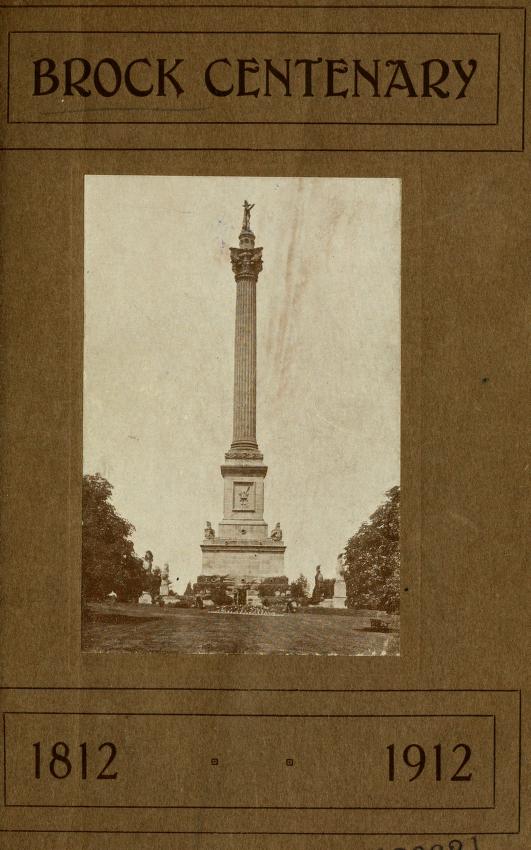
Subsequent generations of Canadians placed over
his remains the noble shaft, that from its commanding
position is the most notable landmark of
the historic battleground he made famous. But he
lives in the hearts of the people whose country he
saved, whose fathers he inspired to resist the
invader. He had found them a panic-stricken
people, he left them vigorous, united, aggressive.
The remaining incidents of that day at Queenston
Heights are well known. Two hours later,
Macdonell, Brock's military secretary and aide,
tried to regain the one-gun battery. A fierce fight
ensued: Macdonell, Dennis and Williams were all
wounded; and the next day the bright young
Scotsman, attorney-general at the age of twenty-seven,
passed away. In life he was united with
Brock, and in death he was not separated. The
bodies of the two heroes rest together under the
Queenston Monument, where the river has been
singing their requiem for a hundred years.
The third stage of the battle was reached at two
o'clock in the afternoon. Then Major-General
Roger Hale Sheaffe advanced from Fort George
along the river road. Turning to the right down
the little Queenston Creek, he led his forces across
the Dr. Hamilton property. On the left he flung
out his Indians under Norton and Brant, and they
moved forward and made trouble.
Ascending the escarpment west of the invading
troops, Sheaffe came upon the terrified invaders,
drawn up near the site of the present monument.
Their left rested on the river verge of the cliff. A
volley or two—and the Canadians found themselves
embarrassed with prisoners. Within a few
days, 958, including stragglers, had surrendered as
prisoners of war. Among these were General Wadsworth,
who had been in command, and Lieutenant-Colonel
Winfield Scott, later to become commander-in-chief
of the United States army and conqueror of
Mexico.
The desire to commemorate the centenary of
Brock's death-day—October 13th, 1912—took form
at a meeting of the United Empire Loyalists' Association
of Canada, held at Toronto on April 11th,
1912, when, on the motion of Mr. John Stewart
Carstairs, B.A., a committee, consisting of Colonel
Ryerson, Lieut.-Colonel W. Hamilton Merritt, Mr.
J. S. Carstairs, and Mr. C. E. MacDonald, barrister,
was appointed to draft a suitable programme
for the celebration of "Brock's Day."
This committee submitted the following report
at a meeting of the Association held on September
17th, 1912, Colonel Ryerson presiding:
"Your Committee begs leave to report that as,
within their knowledge, no action has been taken
by either the Federal or Provincial Government to
celebrate the Centenary of the death of Sir Isaac
Brock on Sunday, October 13th, 1912, they recommend as follows:
"(1) That recommendations be made to both
the Federal Government and to the Provincial Government
of Ontario, that in view of the fact that
General Brock in June, 1812, found himself at the
head of a panic-stricken people in the presence of
a powerful invader, and that a few months later,
when he fell at Queenston Heights, he left that
people united, fearless and invincible, it is believed
that there should be a national demonstration that
will be in effect only less impressive on the public
mind than was the passing away of the man himself
at Queenston Heights a hundred years ago.
[Pg 22]
"(2) That the demonstration might take the form
of a royal salute from every cannon in the land on
Sunday, October 13th. This would be a matter to
be arranged by the Minister of Militia.
"(3) Every church in Canada might be requested
to hold some sort of a memorial service
on Sunday, October 13th.
"(4) On Friday, October 11th, every school in
Canada might appeal to the intellect and imagination
of the coming generation of men and women
by appropriate commemorative exercises.
"(5) Monday, October 14th, could be proclaimed
a national holiday.
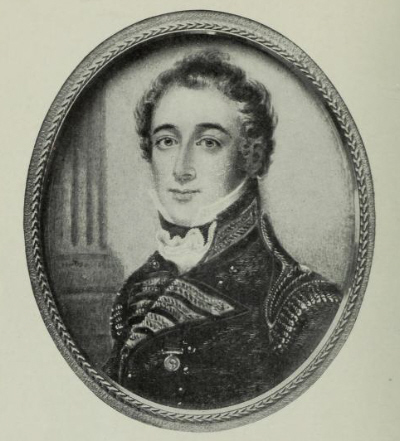
"There is, in the corridor of the Parliament
Buildings at Toronto, the copy of a splendid portrait
of Brock, full of life and action. By some
arrangement with the Minister of Education in
every Province, or even without it, perhaps a copy
of this picture could be placed in every school in
the land.
"(6) As the city of Toronto is very likely to
expropriate the Knox College property, it might
be well to suggest to the city authorities that this
new park should be opened in October with proper
ceremonies and named Brock Park. In this connection,
it might be well to recall that the lower
portion of Spadina Avenue was, until recently,
known as Brock Street.
"(7) It is recommended that these suggestions
shall be brought to the attention of the Federal
and Provincial Governments, and every means
should be taken to convince the authorities that on
October 13th, 1912, our people should hang some
votive offering on the shrine of the hero of Upper
Canada.
"(8) That copies of this report be sent to the
National Council of Women and to the Secretary
of the Imperial Order of the Daughters of the
Empire inviting their concurrence.
"J. S. Carstairs, Chairman."
This Report was adopted tentatively, and in
order to secure as wide as possible a co-operation
from other patriotic Associations, it was agreed,
on the motion of Colonel Denison, seconded by Mr.
C. E. Macdonald, that the Centenary of Sir Isaac
Brock's death, Sunday, October 13th, 1912, be
commemorated by an excursion to Queenston
Heights on the 12th, and that patriotic and historical
societies, clubs and regiments, etc., be asked
to send not more than three delegates to a meeting
to be held on Wednesday, September 25th, at 4.30
o'clock, in the Canadian Foresters' Building, to
discuss a plan of commemoration.
In accordance with this resolution the following
societies were circularized, and asked to co-operate
in the celebration:
Societies: British Empire League; Caledonian
Society; Canadian Club; Canadian Defence
League; Daughters of the Empire, Niagara Falls,
Ont.; Daughters of the Empire, St. Catharines;
Empire Club; Historical Society, Niagara Falls,
Ont.; Historical Society, Niagara-on-the-Lake;
Imperial Order Daughters of the Empire; Irish
Protestant and Benevolent Society, Toronto;
Lundy's Lane Historical Society, Niagara Falls,
Ont.; Ontario Historical Society; St. Andrew's
Society, Toronto; St. Catharines' Historical Society;
St. George's Society, Toronto; Sons of England,
Toronto; Sons of Scotland Benevolent Association,
Toronto; Women's Canadian Historical
Society, Toronto; Women's Canadian Club, Toronto;
Women's Historical Society, Hamilton;
Women's Institute, Queenston; Women's Institute,
Stamford; York Pioneers' Association.
Military: Brig.-General W. H. Cotton, Officer
Commanding 2nd Division; Canadian Army Medical Corps,
Permanent Army Medical Corps, Permanent
Army Service Corps, Royal Canadian
Dragoons, Royal Canadian Engineers, Royal Canadian
Regiment.
Artillery: 2nd Brigade Canadian Field Artillery,
9th Battery Canadian Field Artillery.
Cavalry: Governor-General's Body Guard, 9th
Mississauga Horse.
Infantry: "Queen's Own" Rifles, 10th Regiment
Royal Grenadiers, 12th Regiment York
Rangers, 48th Battalion Highlanders.
Military Associations, Etc.: Canadian Military
Institute, Her Majesty's Army and Navy Veterans,
Imperial South African Service Association, Veterans
of '66 Association, Veterans of '85 Association,
Wolseley Red River Expedition Association,
1870.
In response to the invitation above referred to,
societies and regiments appointed the following
delegates to represent them on the General Committee:—
United Empire Loyalists' Association of Canada:
Colonel G. Sterling Ryerson, President; Colonel
G. T. Denison, Lieut.-Colonel George A. Shaw, Mr.
R. E. A. Land, Vice-Presidents; Mr. J. Stewart
Carstairs, Honorary Secretary; Miss Helen M.
Merrill, Honorary Assistant Secretary; Mr. A. R.
Davis, Honorary Treasurer; Mr. C. E. Macdonald,
Miss Catharine Merritt, Mr. R. S. Neville, K.C.,
Captain Victor Hall, Miss O. V. Widner, Mrs.
F. O. Loft, Mrs. Edmund Phillips, Mrs. Dignam,
Toronto.
Six Nations Indians (United Empire Loyalists):
Warrior F. O. Loft, Mr. Allen W. Johnson.
British Empire League: Colonel G. T. Denison,
Toronto.
Canadian Club: Dr. A. H. U. Colquhoun, President;
Mr. F. D. L. Smith, Toronto.
Canadian Defence League: Colonel Fotheringham,
Dr. J. L. Hughes, Mr. R. E. Kingsford,
Toronto.
Empire Club: Mr. J. Castell Hopkins, Dr. E. K.
Richardson, Toronto.
Imperial Order Daughters of the Empire: Mrs.
A. E. Gooderham, Mrs. E. F. B. Johnstone, Mrs.
John Bruce, Miss Constance Boulton, Toronto.
Sons of Scotland: Dr. Alexander Fraser, Dr.
John Ferguson, Toronto.
[Pg 26]
St. George's Society, Toronto: John W. Gamble
Boyd.
Lundy's Lane Historical Association: Mr. J.
Jackson, Superintendent Queen Victoria Park,
Secretary, Niagara Falls, Ont.
Niagara Historical Society: Miss Janet Carnochan,
Niagara-on-the-Lake; Mrs. Elizabeth Thompson,
Mrs. Charles Lewis Shaw, Toronto.
Ontario Historical Society: Dr. Alexander
Fraser, Secretary, Toronto.
Women's Canadian Historical Society, Toronto:
Miss M. Agnes FitzGibbon, Toronto.
Women's Wentworth Historical Society: Mrs.
John Calder, Hamilton, President.
Governor-General's Body Guard: Lieut.-Colonel
Frank A. Fleming, W. E. L. Coleman, Toronto.
12th Regiment: Major Curran, Toronto.
48th Highlanders: Captain Darling, Adjutant.
'66 Veterans' Association: Captain Geo. Musson,
P. E. Noverre, David Creighton, Lieut.-Colonel
A. E. Belcher, Lieut.-Colonel Geo. A. Shaw,
Toronto.
'85 Veterans' Association: Sergeant A. G. Scovell,
Toronto.
The first meeting of the General Committee thus
formed was held on September 25th, 1912, in the
Canadian Foresters' Building, College Street,
Toronto. There was a large attendance of members.
Colonel Ryerson was appointed Chairman, and
Miss Helen M. Merrill Secretary, of the Committee.
The report from the United Empire Loyalist
Association of Canada, as given above, having been
read to the meeting, resolutions to the following
effect were passed:
(1) That Brock's Day be celebrated by a public
gathering at Queenston Heights.
[Pg 27]
(2) That the various patriotic and historical
societies, local as well as those within easy reach
of Queenston, be invited to send as large delegations
as possible to Brock's Monument on Saturday,
October 12th, 1912, in commemoration of his
death.
(3) That the various patriotic and historical
societies be asked to send wreaths for the purpose
of decorating Brock's Monument on October 12th.
(4) That a special invitation be sent to Mr. J. A.
Macdonell, K.C., Alexandria, Ont., to attend the
celebration as the direct representative of Colonel
John Macdonell, the Attorney-General of Upper
Canada, and Brock's Provincial A.D.C., who fell
with his leader, and whose remains rest beneath
the monument on Queenston Heights.
(5) That the Honourable the Minister of Militia
be asked to order that salutes be fired on October
12th from all saluting points in Canada.
(6) That the churches be asked to arrange that
memorial sermons be preached throughout Canada
on Sunday, October 13th.
(7) That suitable exercises relating to Brock
and 1812 should be held in every school in Canada;
and that this suggestion be not only given publicity
through the newspapers, but that the attention
of the various Ministers of Education in the
Dominion be specially drawn to it.
(8) That the Superintendent-General of Indian
Affairs at Ottawa be asked to take measures to
have the history of Brock and the events of the
1812 war brought specially before the children in
all Indian Schools under the charge of the Dominion
Government.
(9) That a wreath be placed on the picture of
Brock in the Parliament Buildings, Toronto.
(10) That it be suggested to the Dominion Government
to place a wreath on Brock's Monument
in St. Paul's Cathedral, London, England.
An Executive Committee was appointed to further
these resolutions, consisting of the members
of the following special committees:—
Travelling Arrangements, etc.: Colonel Ryerson,
Dr. James L. Hughes, Mr. J. S. Carstairs and Mr.
C. E. Macdonald.
Press: Mr. J. Castell Hopkins, Dr. Alexander
Fraser, Mr. F. D. L. Smith, Miss Helen M. Merrill.
Chairman and Secretary of the Executive Committee:
Colonel Ryerson and Miss Helen M. Merrill.
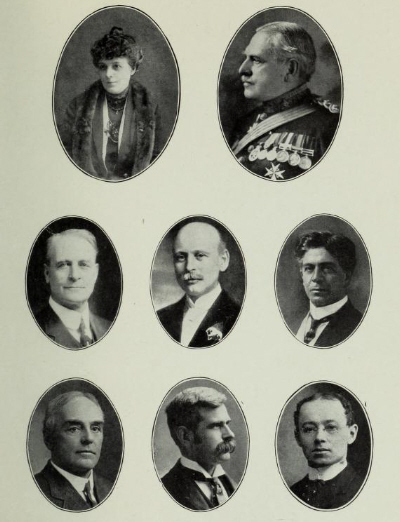
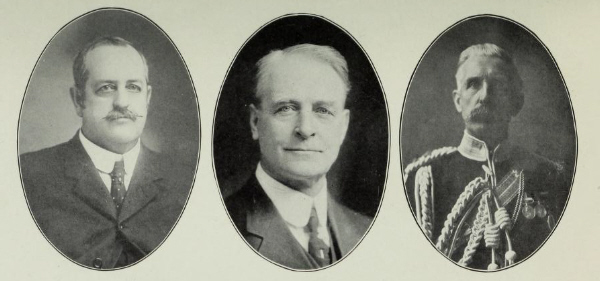
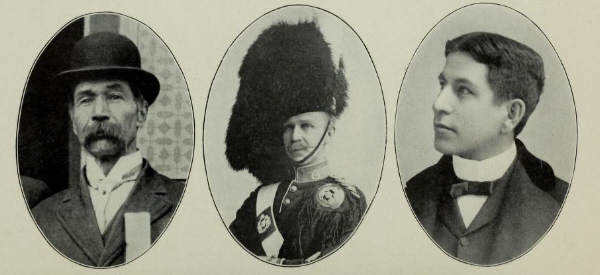
Miss Helen M. Merrill, Honorary Secretary. Colonel George S. Ryerson, Chairman.
James L Hughes. LL.D. J. Castell Hopkins. J. Stewart Carstairs, B.A.
Charles E. Macdonald, Esq. Alexander Fraser, LL.D. F. D. L. Smith, Esq.
EXECUTIVE COMMITTEE.
The General Committee met on October 2nd,
1912, Colonel Ryerson presiding. The reports of
the special committees regarding the arrangements
were very satisfactory, and it was made abundantly
clear that the proposed celebration had
touched a tender chord of public feeling. Travelling
arrangements by train to Niagara Falls and
by electric car thence to Queenston Heights were
approved of. The co-operation of the Women's
Institute, Queenston, was promised in connection
with the decoration of the grounds there; the
Ontario Government consented to police the
grounds, and the Victoria Park Commission to
reopen the restaurant at the Heights for the day.
It was agreed to advise the hotels at Niagara Falls,
Ont., that luncheon would be taken at that town
on arrival of the train, and to arrange with the
electric railway for the conveyance of the visitors
to the Monument. The publicity so generously
afforded by the press was gratefully acknowledged.
A letter from Mr. J. A. Macdonell, K.C., Alexandria,
accepting the Committee's invitation, was
read; and a motion by Mr. F. D. L. Smith that a
bronze tablet to mark the centenary celebration
be placed on Brock's Monument was deferred for
consideration at the next meeting to be held on the
week following.
At the meeting of the General Committee held
on October 9th in the Canadian Foresters' Hall,
Toronto, Colonel Ryerson presiding, the following
report of the Executive Committee was received
and adopted:—
"The Executive Committee met on October 7th
and received satisfactory reports of the progress
made in carrying out the proposals of the
General Committee. A programme for the celebration
at Queenston Heights was drafted, and the
President was requested to arrange with the
Department of Militia that the permanent forces
be sent from Toronto to Queenston Heights to take
part in the proceedings. It was also resolved to
publish an account of the proceedings in connection
with the celebration as an interesting record
of a notable event."
The Executive also reported that all arrangements
had been completed for the journey to
Queenston Heights; that the Militia Department
had ordered that salutes be fired from all saluting
points in Canada on the 12th inst.; that commemorative
church services would be extensively held
on the 13th inst.; that special exercises would be
observed in the public schools in accordance with
letters received from the Honourable R. A. Pyne,
M.P.P., Minister of Education for Ontario, Mr.
Augustus W. Ball, Deputy Minister of Education,
Saskatchewan, Mr. Alexander Robinson, Superintendent
of Education, British Columbia, and from
Mr. R. Fletcher, Deputy Minister of Education,
Manitoba; that a detachment from the permanent
infantry force at Toronto would proceed to Queenston
Heights on the 12th inst.; that the Toronto,
Hamilton and other corps of militia would be
represented, and that large delegations from patriotic,
national and historical societies would take
part; that many wreaths would be sent to the
monument; that the Dominion Government had
ordered its representative in London, England, to
place a wreath on Brock's Memorial in St. Paul's
Cathedral; and that letters from prominent public
men had been received, either regretting their
inability to take part or accepting the invitations
to be present.
This being the last meeting of the General Committee,
it was agreed to refer the suggestion that
a bronze centennial tablet be placed on Brock's
Monument, the striking of a Centennial medal,
and all business connected with the celebration
ceremonies, or arising therefrom, to the Executive
Committee, with full power to dispose of the same.
The meeting then adjourned sine die.
It had been decided to travel by the Grand Trunk
Railway train leaving Toronto at nine o'clock a.m.
(a few only going by steamer from Yonge Street
wharf). The unsettled, rainy weather of the two
previous days had caused some misgiving as to the
number of people who might venture on an open
air demonstration on a cold October day, and the
grey looming skies at dawn on Saturday, the 12th,
held no hidden hope of a silver lining. The
enthusiasm awakened by the name of Brock, however,
was resistless, and betimes the seats in the
waiting train were crowded. The Union Station
witnessed a lively scene—the soldiers in bright
colours, the ladies and gentlemen in gay humour,
and the stirring music of the bagpipes, combining
to enliven and mark the unusual character of the
occasion.
At Hamilton a number of friends joined the
party, and others who could not do so came to the
railway station to express their good wishes. St.
Catharines also gave its contingent. Niagara Falls
was safely reached at 11.45 o'clock.
Shortly afterwards Major Gordon J. Smith,
Brantford, Superintendent of the Six Nation
Indians, and a fine delegation arrived, and
luncheon was served at several of the hotels.
The journey was resumed by electric cars, the
large company arriving at Queenston Heights in
the course of an hour.
During the forenoon the sky had cleared, and
now the sun shone out brightly for a space on a
landscape unsurpassed anywhere for spacious
magnificence and scenic beauty. And crowning
the domed escarpment the stately column spoke
forth a people's patriotism and love, a memorial
to the brave, the scene harmonizing with the
feelings of the great gathering.
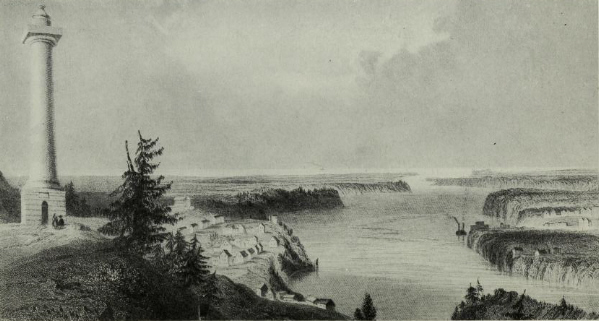
FIRST MONUMENT TO GENERAL BROCK AT QUEENSTON HEIGHTS.
—Ontario Archives.
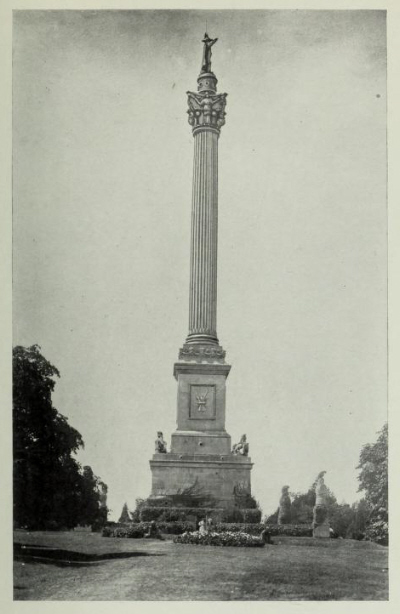
BROCK'S MONUMENT, QUEENSTON HEIGHTS.
—From Nursey's "Story of Isaac Brock" (Briggs).
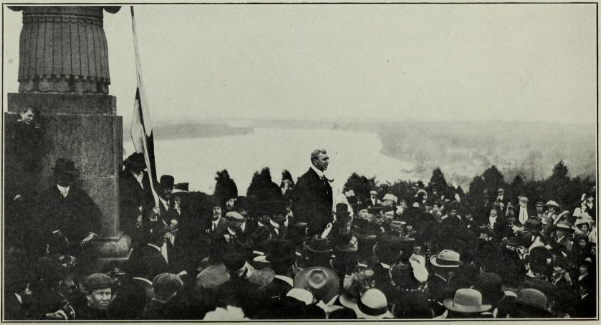
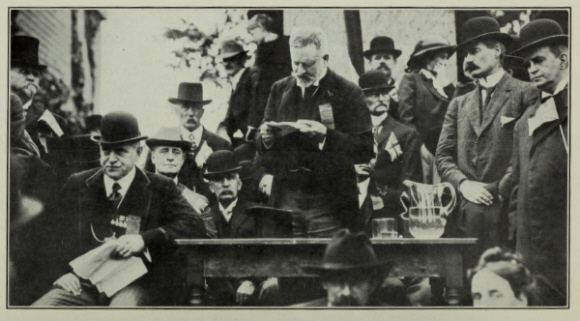
About two thousand people gathered at the foot
of the Monument. Colonel G. Sterling Ryerson,
President of the General Committee and of the
U. E. L. Association, presided. Among those
present were the Hon. R. A. Pyne, M.P.P., Minister
of Education for Ontario, and Mrs. Pyne;
A. Claude Macdonell, M.P., Toronto; W. M. German,
M.P., Welland; Colonel George T. Denison
(U. E. L. and British Empire League); J. A. Macdonell,
K.C., Glengarry; A. MacLean Macdonell,
K.C. (representatives of Colonel the Hon. John
Macdonell, Provincial A.D.C. to General Brock);
Dr. Alexander Dame (a relative of Hon. Colonel
John Macdonell); James L. Hughes, LL.D. (Canadian
Defence League); Doctor Jessop, M.P.P., St.
Catharines; Mr. Evan Fraser, M.P.P., Niagara
Falls, Ont.; Alexander Fraser, LL.D. (Ontario
Historical Society, St. Andrew's Society, and
S.O.S. Association); Mr. F. D. W. Smith (Canadian
Club, Toronto); J. Castell Hopkins (Empire
Club, Toronto); Miss Helen M. Merrill (Honorary
Secretary, Brock Centenary, and U. E. L.);
Miss C. Macdonell; Miss Kate Fraser, Toronto; Mr.
John Stewart Carstairs, B.A. (Honorary Secretary,
U. E. L. Association of Canada); Mr. Charles
E. Macdonald, barrister, Toronto (Honorary Counsellor,
U. E. L. Association of Canada); Chas. R.
McCullough, Hamilton (Union of Canadian Clubs).
Royal Canadian College, Kingston: Colonel
J. H. V. Crowe, Commandant.
Royal Canadian Regiment: Captain J. F. Brown
(in command), Lieutenant J. W. Cox, and sixty-eight
non-coms. and men.
Governor-General's Body Guard: Lieut.-Colonel
Prank A. Fleming, officer commanding; Lieutenant
A. D. Kirkpatrick; A. M. Stretton, Sergt.-Major,
W. O.; S.Q.M.S. W. E. Borlace, Sergeant E.
Pelletier, Mr. W. E. L. Coleman, Robt. D. Cox,
Q.M. Sgt., 1st Cavalry Brigade; Corporal Worsick,
Corporal Douglas; Troopers G. L. Collins, E.
Lightbody, Sewell, Thos. Preston, G. W. C. Clarke,
John S. Kilpatrick, W. Lennox, W. Hill, S. Norse.
9th Mississauga Horse.
St. Catharines Field Battery: Colonel F. King,
Lieut.-Colonel Campbell.
Canadian Engineers.
2nd Regt. Q.O.R., Toronto: Sergeant-Major Geo.
Creighton, Sergeants J. I. Matthews, A. G. Scovell,
R. F. Reed, W. F. Meaforth, Forsyth, Scott; George
Sanderson, E. R. Fitzgerald, retired, New Westminster,
B.C., and others.
10th Regt., "Royal Grenadiers," Toronto:
Edward Johnston, Geo. H. Briggs, Robert Hazelton,
and seventeen men under Captain Campbell.
12th Regt., "York Rangers": Major Curran.
13th Regt., Hamilton: Lieut.-Colonel Moore,
Bt. Lieut.-Colonel Ross, C.O., Major Lester.
19th Regt., St. Catharines: Lieut.-Colonel W. W.
Burleigh and others.
22nd Regt., "Oxford Rifles."
36th "Peel" Regt.: Royal Grafton, Ensign.
48th Regt., "Highlanders," Toronto: Lieut.-Colonel
W. Hendrie, Major J. A. Currie, and
thirty-two non-com. officers and men in charge of
Sergeant Cameron.
91st Regt., Canadian Highlanders, Hamilton:
Lieut.-Colonel John J. Maclaren and others.
York and Simcoe Battalion, Toronto: Corporal
Thos. Laird, N.W.F.F., 1885.
North-West Mounted Police: J. W. Scott.
Ridley College Cadets and Bugle Band.
'66 Veterans' Association: P. E. Noverre, President;
Captain John A. Macdonald, '70; Colonel
Belcher; Major J. Beck, 33rd Huron Regt.; Captain
Geo. Musson, John Robinson, Walter R. Nursey;
Captain John Ford (Chicago Volunteers),
Past-President; Andrew K. Lauder, Captain F. H.
McCallum, A. E. Wheeler.
Niagara District Veteran Volunteers' Association,
St. Catharines: Jamieson Black, President;
C. Chapman, Past-President; Robt. J. Black, Vice-President;
W. H. Drysdale, Treasurer; J. Albert
Mills, Secretary; George Wilson.
His Majesty's Army and Navy Veterans' Association:
Mr. C. H. Robertson.
Canadian Militia Veterans: Captain W. Fahey,
President.
Canadian Baden-Powell Boy Scouts: Ed. Nix,
J. Gordon Rosser, Toronto.
United Empire Loyalist Association of Canada:
Major W. Napier Keefer, Past-President; Mr.
R. E. A. Land, Vice-President; Rev. Canon Alex.
W. Macnab, Honorary Chaplain, and Mrs. Macnab;
Mr. E. M. Chadwick, K.C., Honorary Genealogist;
Mr. A. R. Davis, Honorary Treasurer; Mrs.
Edwards Merrill, Miss Emily Merritt, Miss Catharine
Merritt, Miss Laura Clarke, Captain G. S.
Ryerson, Miss Laura Ryerson, Miss Flora Powel,
Miss J. J. MacCallum (descendant of Laura
Secord), Miss Henrietta Loft, Miss Affa Loft,
Major J. G. Beam (retired, 44th Batt.), Captain
M. S. Boehm (30th Regt.), Mrs. Birdsall (descendant
of Laura Secord), Niagara Falls.
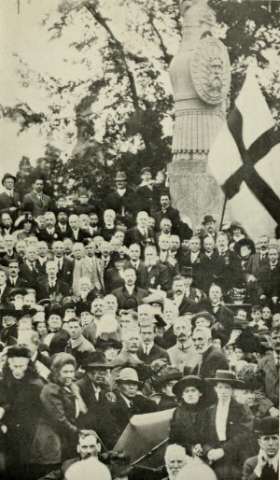
CENTRAL SECTION OF A PANORAMIC PICTURE OF THE GATHERING
AT QUEENSTON HEIGHTS.
Council of the Six Nations Indians, Oshwegan,
Brant County (United Empire Loyalists): Mr.
Gordon J. Smith (Honorary Chief, De-ha-ka-res,
Bear Clan, Mohawk Tribe), Superintendent,
Brantford; Chief Josiah Hill (Sa-ko-ka-ryes, Wolf
Clan), Secretary; Chief William Smith, Interpreter;
Chief J. C. Martin, Speaker; Chief J. S.
Johnson (Ka-nen-kwe-yah), Deputy Speaker;
Chief J. W. M. Elliott (Mohawk); Chief A. G.
Smith (De-ka-nen-ra-neh, Bear Clan, Mohawk);
Chief Elias Lewis (De-ka-ri-ho-gen, Turtle Clan,
Mohawk); Chief Abraham Lewis (Ah-yon-wah-ehs,
Turtle Clan, Mohawk); Chief John A. Gibson
(Seneca); Chief Peter Isaac (Mudturtle Clan,
Seneca); Chief Alexander Hill (Ot-go-taw-yen-toun,
Deer Clan, Onondaga), Fire Keeper; Chief
Lawrence Jonathan (Sha-ko-ken-he, Eel Clan,
Onondaga), Fire Keeper; Chief David Jamieson
(Cayuga); Chief Jacob Isaac (Hon-wa-sha-de-hon,
Oneida); Chief Joseph Powless (Ha-dva-dho-nen-ta,
Wolf Clan, Oneida); Chief Richard Hill (Ra-rih-whi-tyen-tah,
Wolf Clan, Tuscarora); Chief
Elias Carrier (Tuscarora); Warrior Frederick O.
Loft and Mr. Allen W. Johnson, Toronto, Delegates
to Brock Centenary Committee; Chief
Isaiah Sickles (Da-Da-hon-den-wen, Bear Clan,
Oneida); Warrior George Aaron; Daniel McNughton
(Ha-don-da-he-ha); Dennis Palmerston (Tuscarora,
American Indian).
Canadian Club, Toronto: Mr. James M. Sinclair,
Mr. W. J. Clarke, G. Frank Beer, P. H. Jennings,
J. R. Collins.
Empire Club, Toronto: Mr. Fred B. Fetherstonhaugh,
K.C., President; Mr. Richard A. Stapells,
First Vice-President.
British Empire League, Toronto Branch: James
P. Murray.
Sons of Scotland, Toronto: Dr. John Ferguson,
Mr. Evan Hugh Fraser, representing Camp Alexander
Fraser, S.O.S., Toronto.
St. Andrew's Society, Toronto: Captain Herbert
M. Mowat, K.C., U.E.L., Vice-President; Mr. James
Murray, Manager; Mr. T. C. Irving, Manager; Mr.
J. P. Martin, Robert Farquharson.
St. George's Society, Toronto: Mr. John W.
Gamble Boyd.
Centre and South Toronto Liberal Conservative
Association: Mr. Arthur VanKoughnet; Women's
Branch, Mrs. Arthur VanKoughnet.
York Pioneers' Historical Society, Toronto:
Daniel Lamb, President; John W. Millar, Secretary;
John Harvie, J. G. Hughes, Wm. Crocker,
J. C. Moor, J. Hawley, E. Gegg, Josiah Rogers,
John F. Ellis, A. E. Wheeler, W. D. McIntosh,
W. J. Adams.
Knights of Malta and the Grand Chapter of
Ladies of Justice, Toronto: Mr. R. E. A. Land, Mr.
A. G. Horwood, Mrs. A. G. Horwood.
British Women's Society: Miss Perkins.
Imperial Order Daughters of the Empire,
Toronto: Mrs. A. E. Gooderham, Mrs. John Bruce,
Mrs. E. F. B. Johnstone, Miss Constance Boulton,
Mrs. E. Humphreys, Mrs. Wm. Humphreys, Mrs.
E. A. James, Miss Laura Brodigan, Miss Watson,
Miss Maud Watson.
Women's Canadian Historical Society, Toronto:
Miss M. Agnes FitzGibbon, Miss Mickle, Mrs.
Kearn, Mrs. Campbell Meyers, Miss Clara Port,
Miss J. J. MacCallum.
Brant Historical Society, Brantford: His Honour
Judge Hardy, Honorary President; Mr. S. F.
Passmore, President; Miss Isabella Gilkison, Mr.
T. W. Standing, Vice-Presidents; Mrs. J. Y.
Brown, Secretary; Major H. F. Leonard, Curator;
Mr. J. J. Hawkins.
Lundy's Lane Historical Association, Niagara
Falls: Mr. J. Jackson, Secretary.
Thorold and Beaver Dams Historical Society:
T. H. Thompson, President; Miss Amy Ball.
Niagara Historical Society, Niagara-on-the-Lake:
Miss Janet Carnochan, President; Rev. J. C.
Garrett, Mrs. J. C. Garrett, Mrs. Ascher, Mrs.
T. F. Best, Miss M. Ball, Mrs. Bottomley, Miss
Creed. J. Eckersley, H. Macklem, Mrs. Macklem,
Wm. Ryan, J. deW. Randall, Mrs. Randall, E. H.
Shepherd, Mrs. Shepherd, Miss C. Waters, F. Winthrop,
Mrs. Winthrop, Niagara; R. Field, Miss
E. L. Lowery, Mrs. H. Usher, Queenston; Miss
Amy Ball, Thorold; Miss S. Crysler, Niagara
Falls; J. C. Ball, C. A. Case, St. Catharines; J. S.
Carstairs, A. J. Clark, Miss E. Long, Mrs. Charles
Lewis Shaw, Miss Annie Clark, Mr. G. J. Clark,
Toronto.
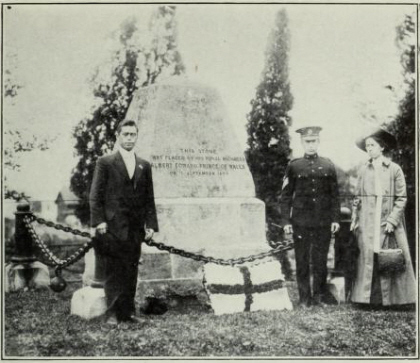
FLORAL TRIBUTE PLACED ON CENOTAPH, WHERE BROCK FELL,
BY THE GUERNSEY SOCIETY, TORONTO.
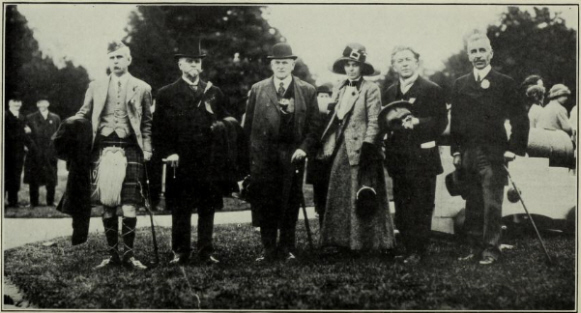
G. J. Birney.Sgt. John I. Matthews. Q.O.R.
Dr. Chas. F. Durand.J. L. Birney.Sgt.-Major Geo. Creighton, Q.O.R.
BROCK CENTENARY CELEBRATION AT QUEENSTON HEIGHTS.
Women's Wentworth Historical Society, Hamilton:
Mrs. John Calder, Miss Calder.
Canadian Club, Hamilton: Mr. C. E. Kelly,
President; G. D. Cadeaur, Secretary; Mr. Harry D.
Petrie.
Women's Canadian Club, Hamilton: Mrs. Harry
D. Petrie.
Women's Institute, Queenston: Mrs. A. A. Ramsay.
Imperial Order Daughters of the Empire, Hamilton:
Mrs. Harry D. Petrie, Miss B. Gaviller.
St. George's Society, London: Mr. N. F. Willmot.
St. George's Society, Guelph: Mr. H. J. B. Leadlay.
Canadian Business Women's Club, Toronto:
Miss H. Williamson, Miss Winnifred Macdonald,
Miss Effie Telfer, Mrs. Anna Fox.
Others present were: Mrs. (Col.) William
Hendrie, Hamilton; D. Macgregor Whyte, artist,
Oban, Scotland; Lieutenant-Colonel Fred W.
Macqueen, Toronto; Wm. Rea, Mrs. Rea, née Jane
Thomas, daughter of Mr. James Thomas, who was
one of the contractors for the erection of Brock's
Monument, and resided at Queenston during the
entire time the Monument was being erected; Rev.
S. A. Laidlaw, Ridgeway; Mr. W. H. Banfield, Mr.
Benj. P. McKay, Mr. H. E. Wilmot, Mr. Samuel
O'Bryen, Miss F. May Simpson, Miss Marjorie
FitzGibbon, Miss Perkins, Miss Lulu Crowther,
Mr. William Moss, Miss J. E. Douglas, Mr. H. B.
Adams, Miss D. F. Waite, Miss Helen J. Sturrock,
Mr. James Young, Mr. John Hawley, Mrs. Rees,
Miss Amelia Rees, Gonnie Rees, A.T.C.M., Toronto;
Mr. Fred Landon, Press Gallery, Ottawa; Mayor
J. deW. Randall, Niagara-on-the-Lake; Mrs. A.
Servos, Miss Mary Servos, St. Catharines; Mrs.
Redhead, Miss Oliver, Niagara; Wm. Milliken,
Toronto, and Dr. Campbell Meyers, Toronto.
The stirring interest taken by the public in the
celebration was in no way made more apparent
than by the large number of costly and beautiful
floral offerings sent to decorate the monument.
Immediately on assembling on the Heights, these
expressive tributes were formally received, one by
one, by Colonel Ryerson. The names of the givers
were announced by Mr. Chas. E. Macdonald, who
also read out the patriotic mottoes and inscriptions.
The wreaths were then carefully placed on
the monument, and so numerous were they that
they almost covered its huge base. The luxuriant
ivy growing on the lower masonry was richly tinted
with autumnal bronze, and on the natural background
thus unexpectedly provided, the delighted
celebrators worked out an effective colour scheme.
It has not been possible to obtain a complete list
of those who brought wreaths with them, but the
following were noted:
A magnificent Cross of St. George, made of oak
leaves, from the Guernsey Society of Guernsey
Island, Brock's birthplace, was placed on the cenotaph
which marks the place where Brock fell, by
Mr. J. L. Burney, whose father was a lieutenant
under Brock and was by his side when the General
was fatally stricken.
J. A. Macdonell, K.C., Glengarry, A. McLean
Macdonell, K.C., Toronto, and Angus Claude Macdonell,
K.C., M.P., Toronto, as representatives of
the family of Colonel the Honourable John
Macdonell, General Brock's aide-de-camp and military
secretary, placed on the monument two handsome
wreaths of laurel leaves, decorated with white and
pink heather and heavily trimmed with purple, one
to the memory of Brock, and one, with the motto
"From Kith and Kin," to the memory of their
kinsman, Colonel Macdonell.
MEMORIAL WREATHS ON THE TOMBS, AT QUEENSTON HEIGHTS, OF MAJOR-GENERAL SIR ISAAC BROCK. Kt., AND
COLONEL JOHN MACDONELL, P.A.D.C., ATTORNEY-GENERAL OF UPPER CANADA.
Placed there by Mr. John Macdonell, K.C., Glengarry, Mr. Angus Claude Macdonell. K.C., M.P., Toronto, and Mr. A. McLean
Macdonell. K.C., Toronto (with the motto, "From kith and kin." on that of the latter).
Colonel George T. Denison placed a wreath from
the British Empire League (England), he being
the President of the Canadian branch.
Mr. J. Murray McCheyne Clark, K.C., LL.B.,
Toronto, sent a wreath on behalf of the Toronto
branch of the British Empire League, of which he
is the President.
Wreaths were sent by the Canadian Club,
Toronto; the Canadian Club, Hamilton; the Caroline
School pupils, Hamilton; Centre and South
Toronto Conservative Club, Ladies' Branch; Governor-General's
Body Guard, Toronto; 91st Regiment
Canadian Highlanders, Hamilton; Imperial
Order Daughters of the Empire, Toronto; Imperial
Order Daughters of the Empire, Hamilton; Chapter
General of Canada Knights of Malta and the
Grand Chapter of Ladies of Justice, Toronto.
Mrs. Fessenden, as founder of Empire Day, sent
a sheaf of crimson carnations tied with the national
colours. To this was attached, with a League of
the Empire brooch, a card bearing this inscription
from Palgrave:
"If the day of a nation's weakness rise,
Of the little counsels that dare not dare,
Of a land that no more on herself relies,—
O breathe of the great ones that were,
Burn out this taint in the air!
The old heart of England restore,
Till the blood of heroes awake and cry on her bosom once more."
Lundy's Lane Historical Society, Niagara Falls,
Ont.; 9th Mississauga Horse; Niagara District
Veteran Volunteers' Association, St. Catharines—Mr.
Jamieson Black, as President, placed a wreath on
the grave as a tribute from St. Catharines. For
many years this Association has placed a wreath
at the foot of the tomb of Brock at their annual
outing at Queenston Heights.
Niagara Falls City, Ontario, Mayor and Aldermen;
Niagara Historical Society, Niagara-on-the-Lake;
Niagara Public Schools; Ontario Historical
Society; St. Andrew's Society, Toronto; St.
George's Society, Toronto; St. George's Society,
Hamilton; Sons of Scotland Benevolent Association;
Sons of Scotland, Camp "Alexander Fraser";
Six Nations Indians (Oshwegan), Brantford;
United Empire Loyalists' Association of Canada,
Toronto; Upper Canada Old Boys' Association,
Toronto; Welland County Teachers' Association;
Women's Canadian Historical Society, Toronto—Wreath
of scarlet gladioli and carnations tied with
scarlet and green, the colors of the Society, the
motto in gold on a green band: "Deeds Speak";
Women's Wentworth Historical Society, Hamilton.
Miss Ball, granddaughter of Captain John Clement
Ball, carried a lithograph of the battle scene
(Queenston Heights) made in 1813 from a sketch
by Major Dennis as he lay wounded on the field,
October 13th, 1812.
In addition to the wreath placed on the monument
the United Empire Loyalists hung a wreath
on the portrait of General Brock in the Parliament
Buildings, Toronto.
The scene presented was unique, and in many
respects a remarkable one. Not the least striking
feature was the character of the gathering.
Descendants of soldiers who fought with Brock
were there, some of them carrying the burden of
years, some barely out of childhood's leash. Others,
and scarcely less interested in the proceedings,
represented loyal and patriotic societies, widely
spread over the Province. The Indian contingent
from the Six Nations occupied a conspicuous place
of honour most worthily, their presence recalling
the signal service rendered by their brave forefathers
at Queenston Heights and in the campaign
generally. The military detachments added colour
to the animated scene. The men of the Royal Canadian
Regiment, of the Governor-General's Body
Guard, of the Forty-eighth Highlanders, the
Queen's Own, the Royal Grenadiers, the Mississauga
Horse, the Ridley College Cadets, and of
other corps, were drawn up on the outside of the
crowd, and beyond them, on the escarpment, the
St. Catharines' Battery, Field Artillery, was stationed.
Over all floated the Union Jack.
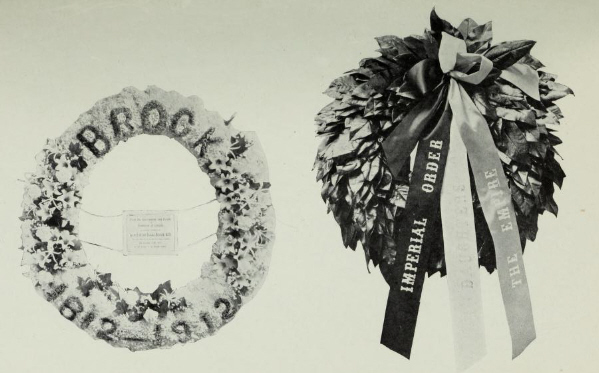
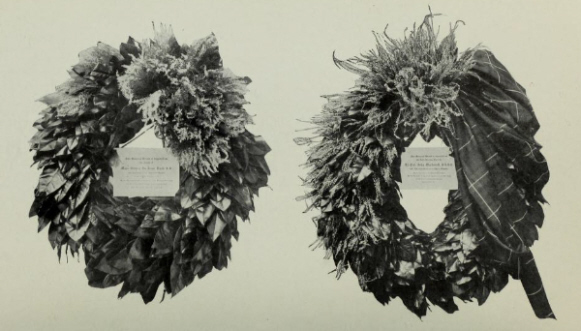
WREATH PLACED ON BROCK'S MONUMENT IN ST. PAUL'S
CATHEDRAL, LONDON, ENG. BY THE
GOVERNMENT OF CANADA. |
WREATH PLACED ON BROCK'S MONUMENT, QUEENSTON
HEIGHTS, BY THE IMPERIAL ORDER OF THE
DAUGHTERS OF THE EMPIRE. |
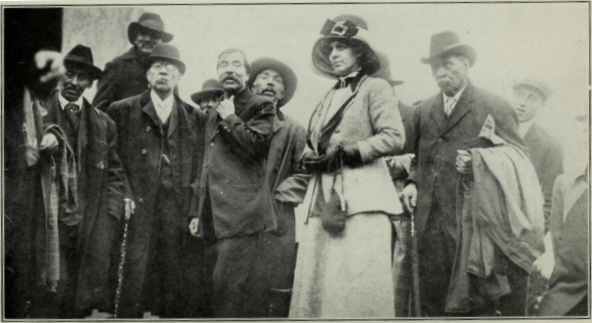
BROCK CENTENARY CELEBRATION AT QUEENSTON HEIGHTS
Conferring tribal membership on Miss Helen M. Merrill, who on adoption into the Oneida Nation received
the name "Kah-ya-tonhs" (One who keeps records).
An incident of the gathering in which much interest
was shown was the unfurling of an old, historic
Union Jack from the top of Brock's Monument by
Miss Helen M. Merrill, Secretary of the Committee.
When the first monument erected to Brock at
Queenston was destroyed (17th April, 1840) a
great indignation meeting was held on the
Heights. Among those present was a British
sailor from one of the ships that conveyed the
Toronto people to the meeting. He had brought
with him a Union Jack, and climbing to the top
of the broken shaft, waved it aloft, amid the cheers
of the assembled patriots. The flag was preserved,
and Mr. Comer, Kingston, Ont., readily
loaned it for this special occasion. Accompanying
Miss Merrill to the top of the monument with the
flag were Misses Marjorie FitzGibbon and Laura
Brodigan and Mr. Allen W. Johnson (Six
Nations).
Several relics of the War of 1812-14 were shown
by their possessors, who held them sacred, among
them a Union Jack, carried by Chief Paudash
(Johnson) of the Mississauga Indians, from the
Ontario Archives Department; early sketches of
the Queenston battlefield, and pictures of officers
who took part in the war.
At the close of the speeches the Six Nation
Indians present formed a Council, and, in recognition
of her services as Honorary Secretary of the
Celebration Committee, conferred on Miss Helen M.
Merrill the honour of tribal membership by the
name "Kah-ya-tonhs"—one who keeps records.
The wreaths having been placed, the programme
of the day was opened by the firing of a general
salute by the 7th St. Catharines Field Battery of
the Royal Canadian Artillery. This was followed
by the playing of a lament for the dead by the
pipers of the Forty-eighth Highlanders and Pipe-Major
Dunbar, piper to Lieut.-Colonel William
Hendrie, of Hamilton.
Letters expressing regret for inability to be
present were read by Colonel Ryerson from the
following gentlemen: The Right Honourable R. L.
Borden, M.P., Prime Minister of Canada; His
Honour Sir John M. Gibson, K.C.M.G., Lieutenant-Governor
of Ontario; Colonel the Honourable
Samuel Hughes, M.P., Minister of Militia, Ottawa;
the Honourable Sir James P. Whitney, Prime Minister
of Ontario; Major-General C. J. Mackenzie,
C.B., C.G.S., Ottawa; Major-General W. D. Otter,
C.V.O., C.B.; Major-General D. A. Macdonald,
C.M.G., Ottawa; Brig.-General F. L. Lessard, C.B.;
Colonel R. W. Rutherford, M.G.O.; Dr. R. A. Falconer,
President, University of Toronto; Hugh
Munro, M.P.P., Glengarry.
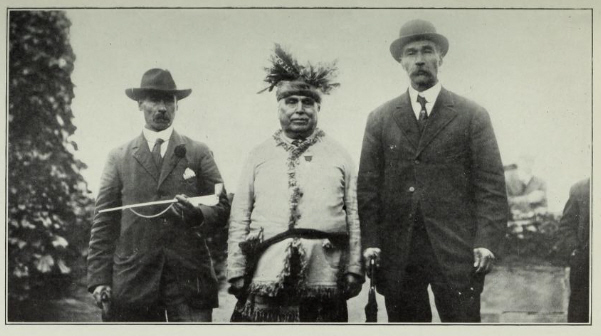
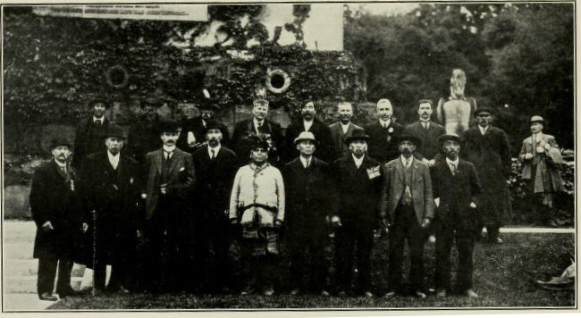
SIX NATION INDIANS CELEBRATING BROCK'S CENTENARY AT QUEENSTON HEIGHTS.
Abram Lewis (holding silver pipe of peace), Chief Alexander Hill, Chief A. G. Smith
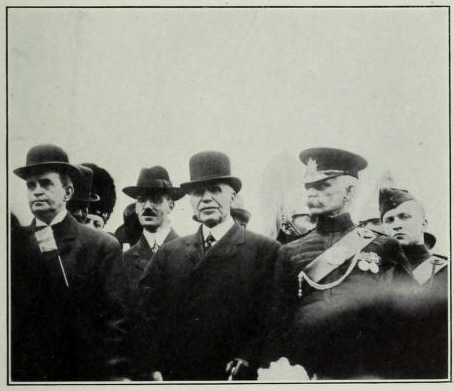
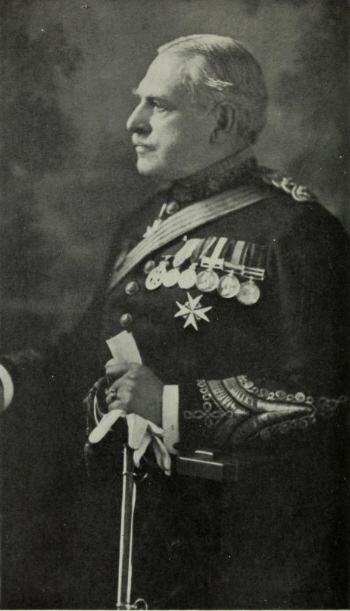
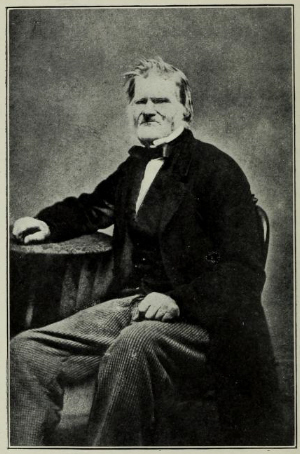
COLONEL GEORGE STERLING RYERSON. CHAIRMAN OF COMMITTEE.