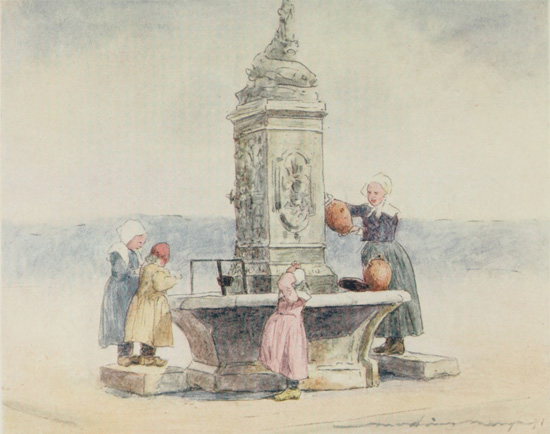
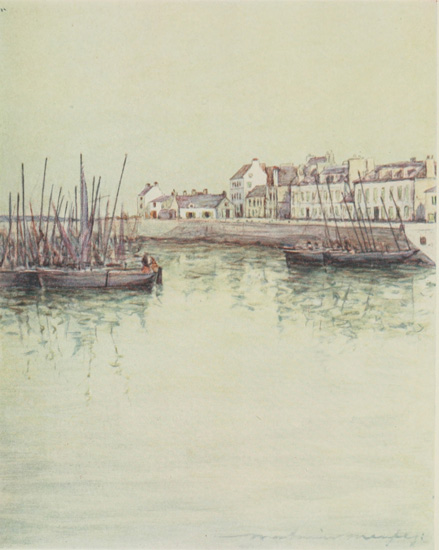
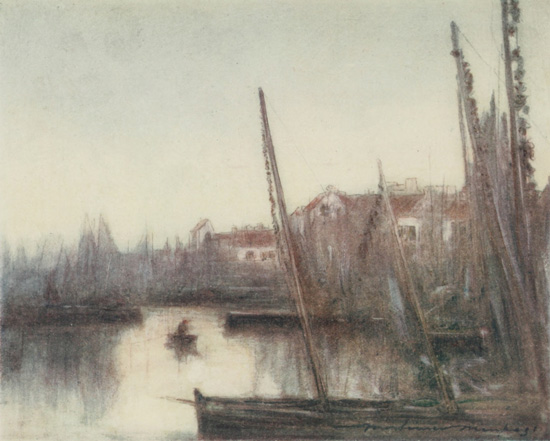
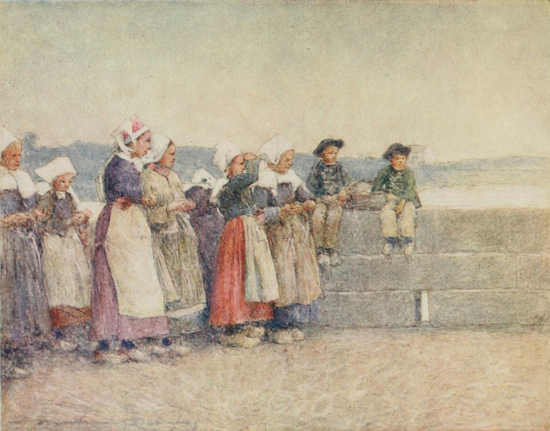
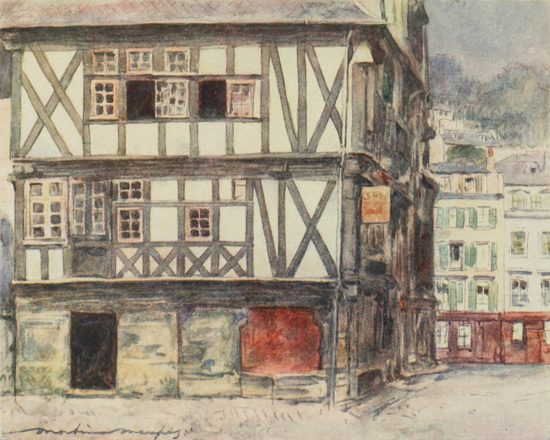
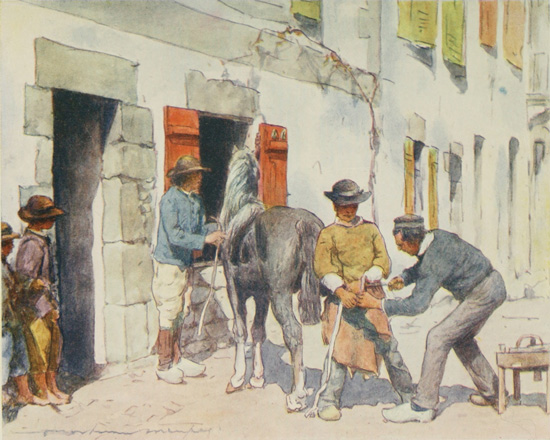
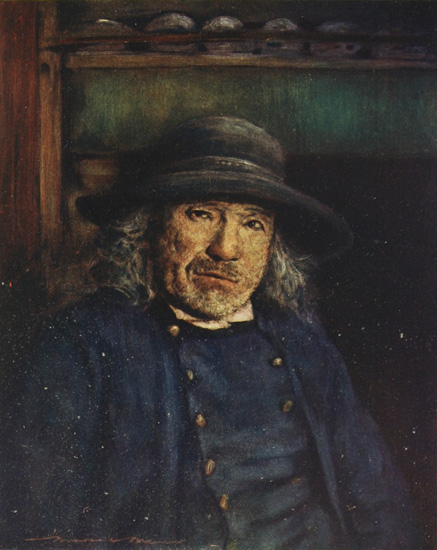
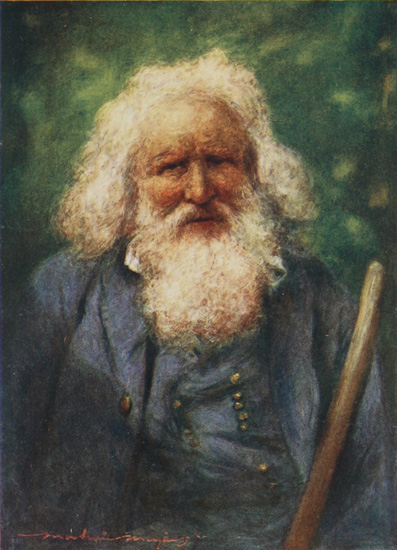
Pont-Aven is associated with agreeable memories.
This village in the South of Finistère draws men
and women from all over Europe, summer after
summer. Many of them stay there throughout the
winter, content to be shut off from the world, allowing
the sweet and gentle lassitude of the place to lull
their cares and troubles. Is it climatic—this soothing
influence—or is it the outcome of a spell woven
over beautiful Pont-Aven by some good-natured
fairy long ago? I have often wondered. Certain
it is that intelligent men, many of them painters,
have been content to spend years in Pont-Aven.
Some time ago Mother and Father, touring in
Brittany, came to this delightful spot, and determined
to spend three weeks there. They stayed
three years.
All my life I have heard stories of this wonderful
place, and of their first visit. It was when my
father had only just begun his career as a painter.
The experience, he says, was a great education.
There he found himself in an amazing nest of
French and American painters, all the newer
lights of the French school. He was free to
work at whatever he liked, yet with unlimited
chances of widening, by daily argument, his
knowledge of technical problems. For the three
years that he remained on this battlefield of creeds
conflicts of opinion raged constantly. Everyone
was frantically devoted to one or another of the
dominating principles of the moderns. There was
a bevy of schools there.
One, called the Stripists, painted in stripes, with
vivid colour as nearly prismatic as possible, all the
scenery around. Then, there were the Dottists,
who painted in a series of dots. There were also
the Spottists—a sect of the Dottists, whose
differentiation was too subtle to be understood.
Men there were who had a theory that you must
ruin your digestion before you could paint a
masterpiece. No physically healthy person, they
declared, could hope to do fine work. They used
to try to bring about indigestion.
One man, celebrated for his painting of pure
saints with blue dresses, over which Paris would
go crazy, never attempted to paint a saint until
he had drunk three glasses of absinthe and bathed
his face in ether. Another decided that he was
going to have, in Paris, an exhibition of merry-go-rounds
which should startle France. He had a
theory that the only way to get at the soul of a
thing was to paint when drunk. He maintained
that the merry-go-rounds whirled faster then.
One day my father went to his studio. He was
dazed. He did not know whether he was standing
on his head or his heels. It was impossible to see
'Black Bess' or any of the pet horses he knew so
well. The pictures were one giddy whirl.
Then, there was the Bitumen school, a group of
artists who never painted anything but white sunlit
houses with bitumen shadows. A year or two
afterwards a terrible thing invariably happened.
Without any warning whatsoever, the pictures
would suddenly slide from off their canvases to
the floor. The bitumen had melted.
The Primitives afforded joy. Their distinctive
mark was a walking-stick, carved by a New
Zealand Maori, which they carried about with
them. It gave them inspiration. So powerful
was the influence of these sticks that even the
head of a Breton peasant assumed the rugged
aspect of the primitive carvings in their paintings.
The most enthusiastic disciple of the sect was a
youth who was continually receiving marvellous
inspirations. Once, after having shut himself up
for three days, he appeared looking haggard and
ravenous. Without a word, he sat down heavily
near a table, called for absinthe, and, groaning,
dropped his head in his hands, and murmured,
'Ah, me! Ah, me!' All beholders were in a
fever to know what the mystery was. After
some minutes of dead silence the young man
rose majestically from his chair, stretched forth one
arm, and, with a far-away look in his eyes, said,
'Friends, last night, when you were all asleep, a
beautiful creature came to me in spirit form, and
taught me the secret of drawing; and I drew this.'
Then he brought out a picture. It was far above
his usual style, and the more credulous envied his
good fortune. Some weeks afterwards, however,
it was discovered by a painter with detective
instincts that the marvellous vision was in reality
a chambre au clair—that is to say, a prism through
which objects are reflected on paper, enabling one
to trace them with great facility.
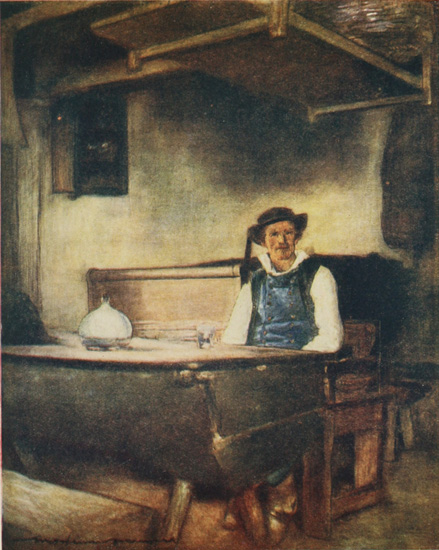
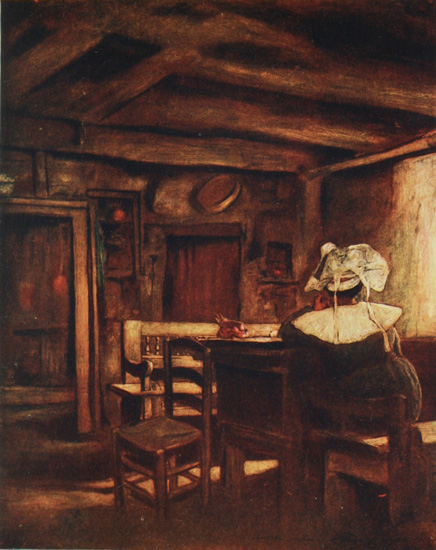
IN AN AUBERGE, PONT-AVEN
Such are the extraordinary people among whom
Mother and Father found themselves on their first
visit to Pont-Aven—geniuses some of them, mere
daubers others, all of them strange and rough and
weird. More like wild beasts they looked than
human beings, Mother told me; for very few
women came to Pont-Aven in the early days, and
those were Bohemians. The artists allowed their
hair and beards to grow long. Day after day they
wore the same old paint-stained suits of corduroys,
battered wide-brimmed hats, loose flannel shirts, and
coarse wooden sabots stuffed with straw.
Mother, who was very young at the time, has
often told me that she will never forget their
arrival at the little Hôtel Gleanec. They were
shown into a salle à manger, where rough men
sat on either side of a long table, serving themselves
out of a common dish, and dipping great slices of
bread into their plates.
Mother was received with great courtesy by
them. She found it very amusing to watch the
gradual change in their appearance day by day—the
donning of linen collars and cuffs and the
general smartening up. Many of the men who
were then struggling with the alphabet of art have
reached the highest rungs of the ladder of fame,
and their names have become almost household
words; others have sunk into oblivion, and are still
amateurs.
The chief hotel in the village was the Hôtel des
Voyageurs, to which Mother and Father soon
migrated. It was kept by a wonderful woman, called
Julia. Originally a peasant girl, she had by untiring
energy become the proprietress of the great establishment.
Her fame as hostess and manager was
bruited all over France. Everyone seemed to
know of Julia, and year after year artists and their
families came back regularly to stay with her. She
is a woman with a strong individuality. She
gathered a large custom among artists, who flocked
to the Hôtel des Voyageurs as much because of
the charm of Mdlle. Julia, and the comfort of her
house, as for the beauty of the scenery.
There was a delightful intimacy among the
guests, most of whom were very intelligent.
Mdlle. Julia took a sincere interest in the career
of each. All went to her with their troubles and
their joys, certain of sympathy and encouragement.
Many are the young struggling painters she has
helped substantially, often allowing them to live on
in the hotel for next to nothing. Many are the
unpaid bills of long standing on the books of this
generous woman. I fear that she has never made
the hotel pay very well, for the elaborate menu and
good accommodation are out of all proportion to
her charges. A strong woman is Mdlle. Julia.
She has been known to lift a full-grown man and
carry him out of doors, landing him ignominiously
in the mud.
There was one man, a retired military officer,
whom no one else could manage. He had come to
stay in Pont-Aven because he could live there for
a few francs a day and drink the rest. He suffered
from hallucinations, and took great pleasure in
chasing timid artists over the countryside, challenging
them to duels, and insulting them in every
way possible. He was the terror of the village.
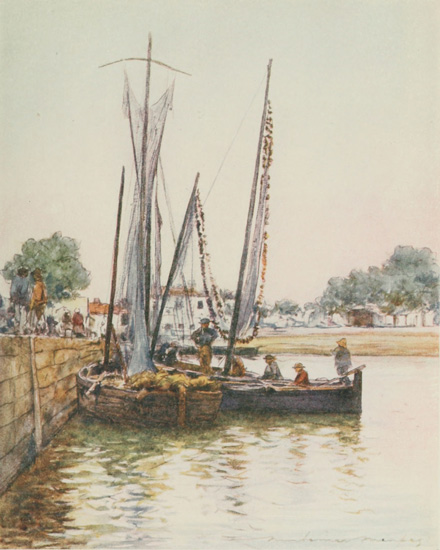
He had a house on the quay, and early one morning
when the snow was thick upon the ground, just
because a small vessel came into the river and
began blowing a trumpet, or making a noise of
some kind, he sprang out of bed in a towering rage,
rushed in his nightshirt into the street, and began
sharpening his sword on a rock, shouting to the
ship's captain to come out and be killed if he dared.
The captain did not dare. The only person of
whom this extraordinary person stood in awe was
Mdlle. Julia. Her he would obey without a
murmur. No one knew why. Perhaps there had
been some contest between them. At any rate,
they understood each other.
The friends of Mdlle. Julia ranged from the Mayor
of the town to Batiste, the butcher, who sat outside
his door all day and watched her every movement.
'If I want to remember where I have been,
and what I did at a certain hour, I have only to
ask Batiste,' she was wont to say.
All the artists worshipped the ground she trod
upon; and well they might, for they would never
have a better friend than she. Her salle à
manger and grand salon were panelled with
pictures, some of which are very valuable to-day.
Tender-hearted she was, and strong-minded, with
no respect for persons. Mother told me that once
when my brother and sister, babies of three and
four years old, were posing for Father on the beach
with only their linen sunbonnets on, their limbs
were somewhat sunburnt and blistered. When
they returned to the hotel, Mdlle. Julia applied
sweet oil and cold cream to the tender skin, and
rated my parents soundly between her tears of
compassion for the little ones. It was of no use
explaining that it was in the cause of art. She
bade them in unmeasured terms to send art to the
Devil, and scolded them as if they were children.
I doubt not she would have reprimanded the King
of England with as little compunction.
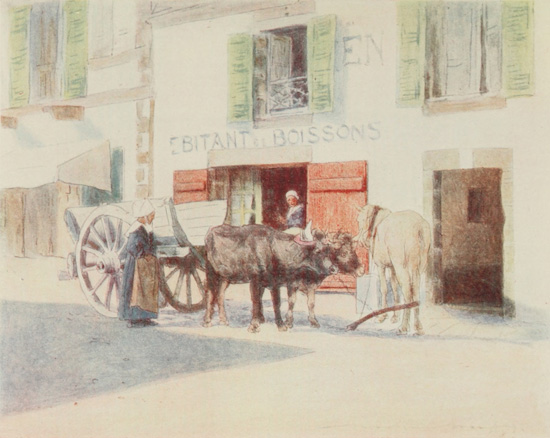
A SAND-CART ON THE QUAY, PONT-AVEN
Mdlle. Julia made the reputation of Pont-Aven
by her own overpowering individuality. If she
went to Paris or elsewhither for a few days,
everyone in the village felt her absence. Things
were not the same. Pont-Aven seemed momentarily
to have lost its charm. The meals were
badly cooked and worse served; the bonnes were
neglectful. All missed the ringing laugh and
cheery presence of Julia. How soon one knew
when she had returned! What a flutter there
was among the bonnes! What a commotion!
How everyone flew hither and thither at her
command! She seemed to fill the hotel with her
presence.
I went to Pont-Aven when I was ten years old,
and I remember well how Mdlle. Julia came to
meet us, driving twenty miles through the deep
snow. What happy days those were in the dear
little village! We lived as wild things, and enjoyed
life to the full. M. Grenier, the schoolmaster,
acted as tutor to us. He was lenient. We spent
our time mainly in rambling over the countryside,
making chocolate in Mdlle. Julia's wood, bird-nesting,
and apple-stealing. M. Grenier taught us
to row, and we learnt all the various intricate
currents and dangerous sandbanks so thoroughly
that after a time we could almost have steered
through that complicated river blindfold. We
learnt how to make boats out of wood, and how
to carve our names in a professional manner on
trees. We became acquainted with a large selection
of Breton ballads and a good deal of rough
botany. More advanced lessons have faded from
my mind. Of actual book-learning we accomplished
very little. Many a time M. Grenier pulled
himself together, brought us new copybooks, fine
pens, his French grammar and readers, and settled
us down in the salon to work; but gradually the
task would pall on both master and scholars, and
before the morning was half over we would be out
in the fields and woods again, 'just for a breath of
fresh air.'
Children have the power of making themselves at
home in a foreign country. Within a week my
brother and I knew everyone in the village. We
became acquainted with all their family affairs and
troubles. In many households we were welcome
at any time of the day. There was the sabot-maker,
whom we never tired of watching as he
cleverly and rapidly transformed a square block of
wood into a rounded, shapely sabot. He was
always busy, and sometimes turned out a dozen
pairs in a day. To my great joy, he presented me
with a beautiful little pair, which I wore painfully,
but with much pride. Although when you become
accustomed to them sabots are comfortable and
sensible gear, at first they are extremely awkward.
Of course, you can kick them off before you enter
a house, and run about in the soft woollen chausson
with a leather sole which is always worn underneath.
Round the hotel doorway there is always
a collection of sabots awaiting their owners. In a
country such as Brittany, where it rains a good
deal, and the roads are often deep in mud, they are
the only possible wear. The sabot is a product of
evolution. In that respect it is like the hansom
cab which is a thing of beauty simply because it
has been thought out with regard to its usefulness
and comfort alone.
Batiste, the butcher, was a great friend of ours.
With morbid fascination we witnessed his slaughter
of pigs and cows. Then, soon we knew where to
get the best crêpes. These are pancakes of a kind,
so thin that you can see through them, made
on a round piece of metal over a blazing fire.
Eaten hot, with plenty of butter and sugar, they
are equal to anything in our English cookery.
There was one particular old lady living down by
the bridge who made crêpes. We saw her mixing
the ingredients, mostly flour and water, and spreading
the dough over the round piece of metal. It
became hard in an instant, and curled up brown
and crisp, as thin as a lace handkerchief. Likewise,
we knew where to buy bowls of milk thick
with cream for one sou. We had to tramp over
several fields and to scale several fences before we
found ourselves in the kitchen of a large farm,
where the housewife was busy pouring milk into
large copper vessels. Seated at the polished
mahogany table, we drank from dainty blue
bowls.
I went back to Pont-Aven recently, and found
it very little changed. We travelled by diligence
from Concarneau; but, as the conveyance left only
once a day, we had several hours to while away.
The Concarneau and Pont-Aven diligence is quaint
and primitive, devoid of springs, and fitted with
extremely narrow and hard seats. We passed
through villages in which every house seemed to
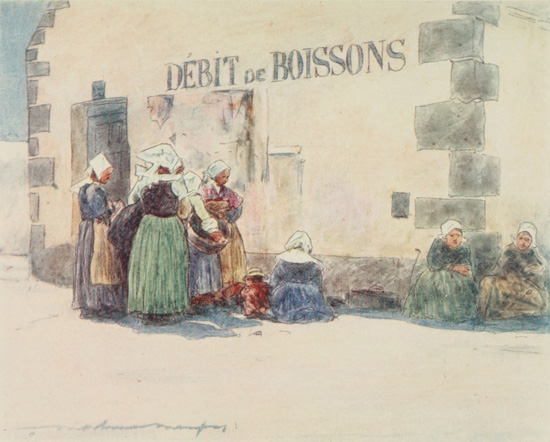
be either a buvette or a débit de boisson. At these
our driver—a man in a blue blouse and a black
felt hat—had to deliver endless parcels, for which
he dived continually under the seat on which we
were sitting. For discharging each commission he
received several glasses of cider and wine. He
stopped at every place to drink and talk with the
host, quite oblivious of his passengers. With every
mile he became more uproarious.
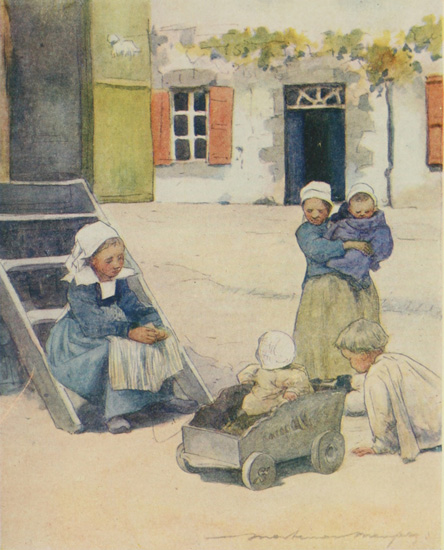
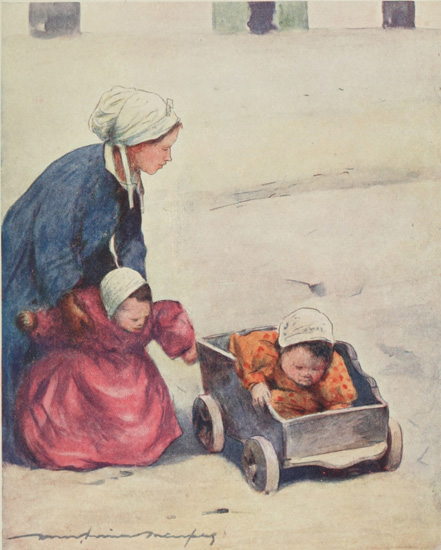
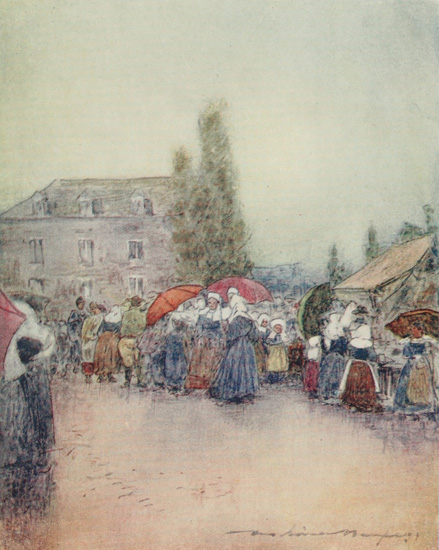
PLAYING ON THE 'PLACE,' PONT-AVEN
Our only travelling companion was an old
woman in the costume of the country, with a
yellow and wrinkled face. On her arm she carried
a large basket and a loaf of bread two yards
long. Ruthlessly she trod on our toes with her
thick black sabots in getting in. Although I
helped her with her basket and her bread, she
never volunteered a word of thanks, but merely
snatched them from my hands. Many Bretons
are scarcely of higher intelligence than the livestock
of the farms. They live in the depths of
the country with their animals, sleeping in the
same room with them, rarely leaving their own
few acres of ground. The women work as hard
as the men, digging in the fields and toiling in the
forests from early morning until night.
At one of the villages where the diligence
stopped, a blacksmith, a young giant, handsome,
dark, came out from the smithy with his dog,
which he was sending to some gentleman with
hunting proclivities in Pont-Aven. The animal—what
is called a chien de la chasse—was attached
by a long chain to the step, and the diligence
started off. The blacksmith stood in the door of
his smithy, and watched the dog disappear with
wistful eyes. The Bretons have a soft spot in
their hearts for animals. The dog itself was the
picture of misery. His moans and howls wrung
one's heart. I never saw an animal more wily.
He tried every conceivable method of slipping his
collar. He pulled at the chain, and wriggled from
one side to another. Once he contrived to work
his ear under the collar, and my fingers itched to
help him. Had the truant escaped, I could not
have informed the driver. Strange that one's
sympathies are always with the weakest! In
novels, an escaping convict, no matter how terrible
his guilt, always has my sympathy, and I am
hostile to the pursuing warder.
As we drew near to Pont-Aven the scenery
became more and more beautiful. On either side
of the road stretched miles and miles of brilliant
mustard-yellow gorse, mingled with patches of
dried reddish bracken, and bordered by rows of
blue-green pines. Here and there one saw great
rocks half-covered with the velvet-green of mosses
thrown hither and thither in happy disorder.
Sometimes ivy takes root in the crevices of the rocks
where a little earth has gathered, and creeps closely
round about them, as if anxious to convey life and
warmth to the cold stone. The sun, like a red
ball, was setting behind the hills, leaving the sky
flecked with clouds of the palest mauves and pinks,
resembling the fine piece of marbling one sometimes
sees inside the covers of modern well-bound
books. Now and then we passed a little ruined
chapel—consecrated, no doubt, to some very
ancient saint (it was impossible to make out the
name), a saint whose cult was evidently lost, for
the little shrine was tumbling to ruins. We saw
by the wayside little niches sheltering sacred fountains,
the waters of which cure certain diseases;
and passed peasants on the roadside, sometimes
on horseback, sometimes walking—large, well-proportioned,
fine-featured men of proud bearing.
In Brittany the poorest peasant is a free and
independent man. He salutes you out of politeness
and good nature; but he does not cringe
as if recognising himself to be lower in the social
scale. The Breton, howsoever poor, is no less
dignified under his blue blouse than his ancestors
were under their steel armour.
A long straight road leads from Concarneau to
Pont-Aven, and at the end of it lies the pretty
village among hills of woods and of rocks bathed
in a light mist. One could almost imagine that
it was a Swiss village in miniature. By the time
we arrived it was night. We could only discern
clean white houses on either side, and water rushing
under a bridge over which we passed. The
Hôtel des Voyageurs looked much the same as
ever, except that over the way a large building
had been added to the annexe. To our great
disappointment, we discovered that Mdlle. Julia
had gone to Paris; but we recognised several of
the bonnes and a hoary veteran called Joseph, who
had been in Julia's service for over twenty years.
Gladly I rushed out next morning. There is
nothing more delightful than to visit a place where
one has been happy for years as a child, especially
such a place as Pont-Aven, which changes little.
My first thought was to see the Bois d'Amour.
I found it quite unchanged. To be sure, I had
some difficulty in finding the old pathway which
led to the wood, so many strange houses and
roadways had been built since we were there;
but at length we found it—that old steep path
with the high walls on either side, on which the
blackberries grew in profusion. There are two
paths in the forest—one, low down, which leads
by the stream, and the other above, carpeted with
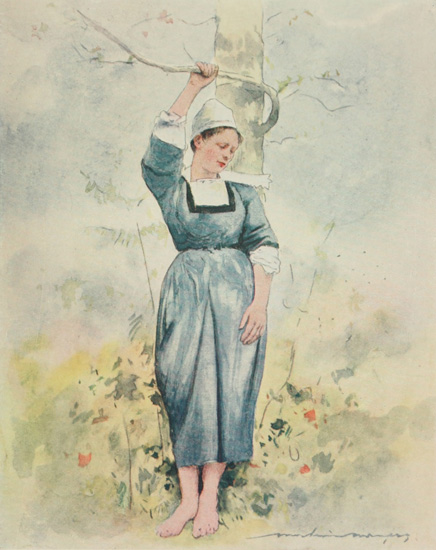
silver leaves. A wonderful wood it is—a joyous
harmony in green and gold. Giant chestnuts fill
the air with their perfumed leaves, forming an
inextricable lattice-work overhead, one branch entwining
with the other, the golden rays of the sun
filtering through. The ground is carpeted with
silver and salmon leaves left from last autumn;
the pines shed thousands of brown cones, and
streams of resin flow down their trunks. It is
well-named the Bois d'Amour. Below runs a
little stream. Now it foams and bounds, beating
itself against a series of obstacles; now it flows
calmly, as if taking breath, clear, silver, and limpid,
past little green islands covered with flowers, and
into bays dark with the black mud beneath. Low-growing
trees and bushes flourish on the banks,
some throwing themselves across the stream as
barricades, over which the laughing water bounds
and leaps unheedingly, scattering diamonds and
topaz in the sunlight. Everything in the Bois
d'Amour seems to join in the joyous song of
Nature. The little stream sings; the trees
murmur and rustle in the wind; and the big
black mill-wheel, glistening with crystal drops,
makes music with the water.
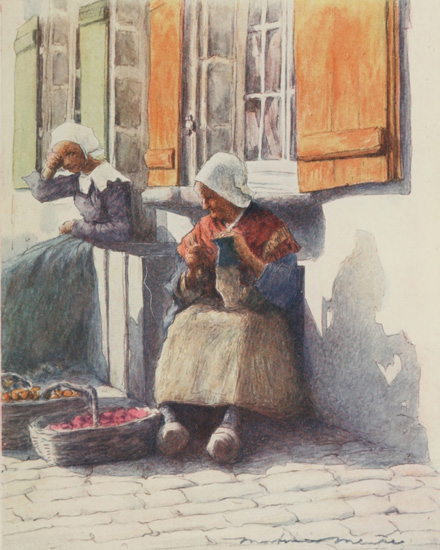
ON THE QUAY AT PONT-AVEN
By the riverside, women are washing their clothes
on square slabs of stone, which stretch across the
water. It was on these stepping-stones, I remember,
that my brother and I lost our shoes and
stockings. At one place the stream is hidden from
sight by thick bushes, and you find yourself in a
narrow green lane, a green alley, walled on either
side and roofed overhead by masses of trees and
bushes, through which the sun filters occasionally
in golden patches. Whenever I walk down that
lane, I think of the song that my bonne Marie
taught me there one day; it comes back as freshly
now as if it had been but yesterday. The refrain
begins, 'Et mon cœur vol, vol et vol, et vol, vers
les cieux.'
One meets the river constantly during this walk,
and every mile or so you come across a little black
mill. The mills in Pont-Aven are endless, and this
saying is an old one: 'Pont-Aven ville de renom,
quatorze moulins, quinze maisons.'
Picturesque little mills they are. The jet-black
wheels form a delightful contrast to the vivid green
round about; and small bridges of stones, loosely
put together and moss-grown here and there, cross
the river at intervals.
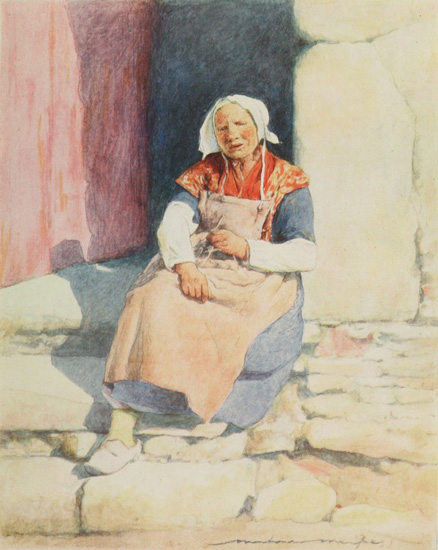
ON THE STEPS OF THE MILL HOUSE, PONT-AVEN
I love this rough, wild country. How variable
it is! You may sit in a wood with the stream at
your feet, and all about you will be great hills
half-covered with gorse and bracken, and here and
there huge blocks of granite, which seem ready to
fall any moment.
The Bois d'Amour is a happy hunting-ground of
artists. This particular view of the mill at which I
gazed so long has been a stock-subject with painters
for many years. You never pass without seeing at
least one or two men with canvases spread and
easels erected, vainly trying to reproduce the
beautiful scene. Artists are plentiful in this
country. Wherever you may wander within a
radius of fifteen miles, you cannot stop at some
attractive prospect without hearing an impatient
cough behind you, and, turning, find yourself
obstructing the view of a person in corduroys and
flannel shirt, with a large felt hat, working, pipe
aglow, at an enormous canvas. The artists, who
are mostly English, are thought very little of by
the people about. I once heard a commercial
traveller talking of Pont-Aven.
'Pshaw!' he said, 'they are all English and
Americans there. Everything is done for the
English. At the Hôtel des Voyageurs even the
cuisine is English. It is unbearable! At the table
the men wear clothes of inconceivable colour and
cut. They talk without gestures, very quickly and
loudly, and they eat enormously. The young
mecs are flat-faced, with long chins, white eye-lashes,
and fair hair. Many are taciturn, morose,
and dreamy. Occasionally they make jokes, but
without energy. They mostly eat without interruption.'
This is the French view, and it is natural.
Pont-Aven does not have the right atmosphere
for the Frenchman: the Bretons and the English
are supreme.
Nothing is more delightful than to spend a
summer there. You find yourself in a colony
of intelligent men, many of them very clever,
as well as pretty young English and American
girls, and University students on 'cramming' tours.
Picnics and river-parties are organized by the
inimitable Mdlle. Julia every day during the
summer, and in the evening there is always dancing
in the big salon. The hotel is full to overflowing
from garret to cellar. Within the last few years
Mdlle. Julia has opened another hotel at Porte
Manec, by the sea, to which the visitors may
transfer themselves whenever they choose, going
either by river or by Mdlle. Julia's own omnibus.
It is built on the same lines as Mme. Bernhardt's
house at Belle Isle, and is situated on a breezy
promontory.
The river lies between Pont-Aven and Porte
Manec, which is at the mouth of the sea. How
beautiful this river is—the dear old browny-gray,
moleskin-coloured river, edged with great rocks
on which the seaweed clings! On the banks are
stretches of gray-green grass bordered by holly-bushes.
The scenery changes constantly. Sometimes
it is rugged and rocky, now sloping up, now
down, now covered with green gorse or a sprinkling
of bushes, now with a wilderness of trees. Here
and there you will see a cleft in the mountain-side,
a little leafy dell which one might fancy the
abode of fairies. Silver streams trickle musically
over the bare brown rocks, and large red toadstools
grow in profusion, the silver cobwebs sparkling with
dew in the gorse.
It is delightful in the marvellous autumn
weather to take the narrow river-path winding
in and out of the very twisty Aven, and wander
onwards to your heart's content, with the steep
hillside at the back of you and the river running
at your feet. You feel as if you could walk on for
ever over this mountainous ground, where the
heather grows in great purple bunches among
huge granite rocks, which, they say, were placed
there by the Druids. Down below flows the river—a
mere silver ribbon now, in wastes of pinky-purple
mud, for it is ebb tide; and now and then
you see the battered hulk of a boat lying on its
side in the mud. On the hill are lines of fir-trees
standing black and straight against the horizon.
Night falls in a bluish haze on the hills and on
the river, confusing the outline of things. At the
foot of the mountains it is almost dark. Through
the open windows and doors of the cottages as
one passes one can see groups round the tables
under the yellow light of candles. One smells the
good soup which is cooking; the noise of spoons
and plates mingles with the voices of the people.
Pewter and brass gleam from the walls. It is a
picture worthy of Rembrandt. The end of the
room is hidden in smoky shadow, now and then
lit up by a flame escaping from the fireplace, showing
an old woman knitting in the ingle-nook, and
an old white-haired peasant drinking cider out of a
blue mug. It is strange to think of these people
living in their humble homes year after year—a
happy little people who have no history.
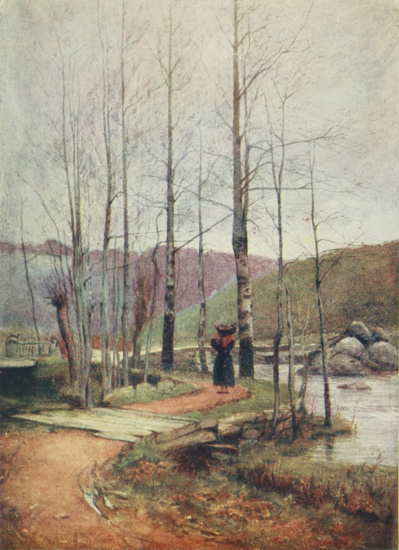
THE BRIDGE, PONT-AVEN
Not far from Pont-Aven is the ruined château of
Rustephan. One approaches it through a wood of
silver birches, under great old trees; cherry-trees
and apple-trees remain in what must once have
been a flourishing orchard. The castle itself has
fallen to decay. The wall which joined the two
towers has broken down, and the steps of the grand
spiral staircase, up which we used to climb, have
crumbled; only the main column, built of granite
sparkling with silver particles, which will not fall
for many a day, stands stout and sturdy. One of
the stately old doorways remains; but it is only that
which leads to the castle keep—the main entrance
must have fallen with the walls centuries ago.
Bits of the old dining-hall are still to be seen—a
huge fireplace, arch-shaped, and a little shrine-like
stone erection in the wall, worn smooth in
parts; one can imagine that it was once a sink for
washing dishes in.
It is a drowsy morning; the sun shines hotly on
the back of the neck; and as one sits on a mound
of earth in the middle of what was once the dining-hall,
one cannot resist dreaming of the romantic
history of Geneviève de Rustephan, the beautiful
lady who lived here long ago. Up in one of the
great rounded towers spotted with orange lichen
and encircled with ivy is a room which must have
been her bedchamber. An ancient chimney-stack
rears itself tall and stately, and where once gray
smoke curled and wreathed, proceeding from the
well-regulated kitchen, long feathery grasses grow.
All round the castle, in what must have been the
pleasure-gardens, the smooth lawns and the bowling-green,
my lady's rose-garden, etc., are now
mounds of earth, covered with straggling grass,
bracken, and blackberry-bushes, and loose typical
Breton stone walls enclosing fields. Horrible to
relate, in the lordly dining-hall, where once the
dainty Geneviève sat, is a fat pig, nozzling in the
earth.
Naturally, Rustephan is haunted. If anyone
were brave enough to penetrate the large hall
towards midnight (so the peasants say), a terrible
spectacle would be met—a bier covered with a
white cloth carried by priests bearing lighted
tapers. On clear moonlight nights, say the
ancients, on the crumbling old terrace, a beautiful
girl is to be seen, pale-faced, and dressed in green
satin flowered with gold, singing sad songs, sobbing
and crying. On one occasion the peasants were
dancing on the green turf in front of the towers,
and in the middle of the most animated part of the
feast there appeared behind the crossbars of a
window an old priest with shaven head and eyes
as brilliant as diamonds. Terrified, the men and
the girls fled, and never again danced in these
haunted regions.
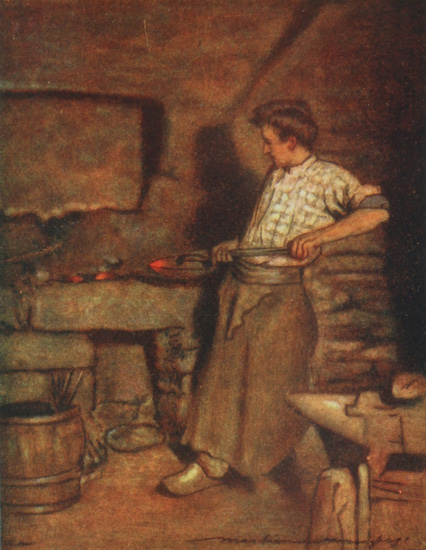
THE VILLAGE FORGE, PONT-AVEN
One feels miserable on leaving Pont-Aven. It
seems as if you had been in a quiet and beautiful
backwater for a time, and were suddenly going out
into the glare and the noise and the flaunting airs
of a fashionable regatta. I can describe the sensation
in no other way. There is something in the
air of Pont-Aven that makes it like no other place
in the world.
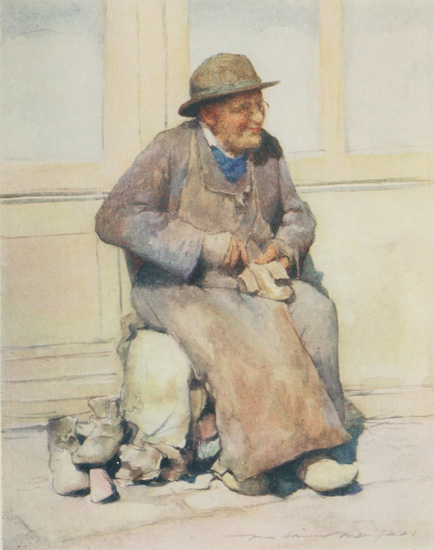
THE VILLAGE COBBLER
CHAPTER XIII QUIMPERLÉ
Quimperlé is known as the Arcadia of Basse
Bretagne, and certainly the name is well deserved.
I have never seen a town so full of trees and
trailing plants and gardens. Every wall is green
with moss and gay with masses of convolvulus and
nasturtium. Flowers grow rampant in Quimperlé,
and overrun their boundaries. Every window-sill
has its row of pink ivy-leafed geraniums, climbing
down and over the gray stone wall beneath; every
wall has its wreaths of trailing flowers.
There are flights of steps everywhere—favourite
caprices of the primitive architects—divided in the
middle by iron railings. Up these steps all the
housewives must go to reach the market. On
either side the houses crowd, one above the other,
with their steep garden walls, sometimes intercepted
by iron gateways, and sometimes covered by blood-red
leaves and yellowing vines. Some are houses
of the Middle Ages, and some of the Renaissance
period, with sculptured porches and panes of
bottle-glass; a few have terraces at the end of the
gardens, over which clematis climbs. Here and
there the sun lights up a corner of a façade, or
shines on the emerald leaves, making them scintillate.
Down the steps a girl in white-winged cap
and snowy apron, with pink ribbon at her neck,
carrying a large black two-handled basket, is coming
on her way from market.
Having scaled this long flight of steps, you find
yourself face to face with the old Gothic church of
St. Michael, a grayish-pink building with one
great square tower and four turrets. The porch is
sculptured in a rich profusion of graceful details.
Here and there yellow moss grows, and there are
clusters of fern in the niches. Inside, the church
was suffused with a purple light shed by the sun
through the stained-glass windows; the ceiling was
of infinite blue. Everything was transformed by
the strange purple light. The beautiful carving
round the walls, the host of straight-backed
praying-chairs, and even the green curtain of the
confessional boxes, were changed to royal purple.
Only the altar, with its snowy-white cloths and red
and gold ornaments, retained its colour. Jutting
forth from the church of St. Michael are arms or
branches connecting it with the village, as if it
were some mother bird protecting the young ones
beneath her wings. Under these wings the houses
of the village cluster.
It is five o'clock in the afternoon, the sociable
hour, when people sit outside their cottage doors,
knitting, gossiping, watching the children play, and
eating the evening meal. Most of the children,
who are many, are very nearly of the same age.
Clusters of fair curly heads are seen in the road.
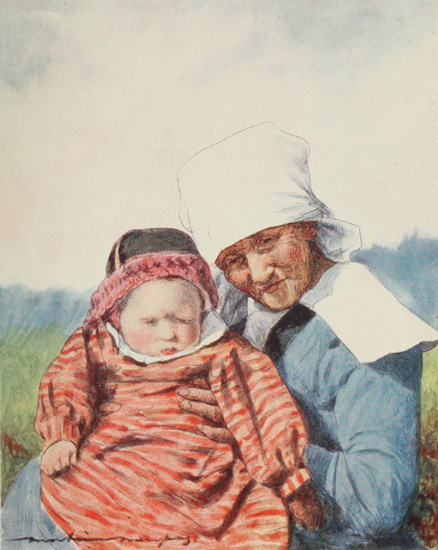
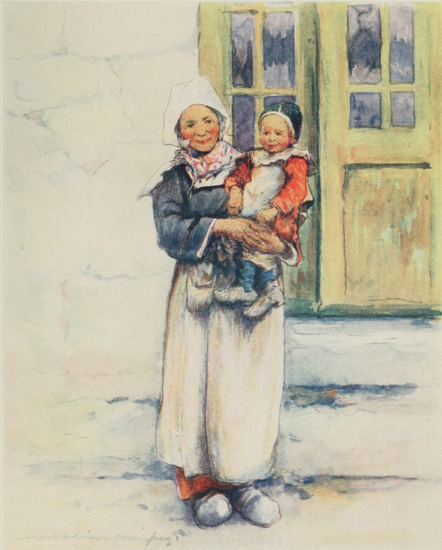
The youngest, the baby, is generally held by some
old woman, probably the grandmother, who has
a shrivelled yellow face—a very tender guardian.
Over the doorways of the shops hang branches
of withered mistletoe. Through the long low
windows, which have broad sills, you catch a glimpse
of rows and rows of bottles. These are wine-shops—no
rarities in a Breton village. Another shop
evidently belonged to the church at one time. It
still possesses a rounded ecclesiastical doorway,
built of solid blocks of stone, and the walls, which
were white originally, are stained green with age.
The windows, as high as your waist from the
ground, have broad stone sills, on which are
arranged carrots and onions, coloured sweets in
bottles, and packets of tobacco. This shop evidently
supplies everything that a human being can
desire. Above it you read: 'Café on sert a boire
et a manger.'
While we were in Quimperlé there were two
musicians making a round of the town. One, with a
swarthy face, was blind, and sang a weird song in a
minor key, beating a triangle. The other, who
looked an Italian, was raggedly dressed in an old fur
coat and a faded felt hat. His musical performance
was a veritable gymnastic feat. In his hands he held
a large concertina, which he played most cleverly;
at his back was a drum with automatic sticks and
clappers, which he worked with his feet. It was
the kind of music one hears at fairs. Wherever
we went we heard it, sometimes so near that we
could catch the tune, sometimes at a distance,
when only the dull boom of the drum was distinguishable.
Whenever I think of Quimperlé this strange
music and the spectacle of those two picturesque
figures come back to memory. The men are
well known in Brittany. They spend their lives
travelling from place to place, earning a hard
livelihood. When I was at school in Quimper I
used to hear the same tune played by the same men
outside the convent walls.
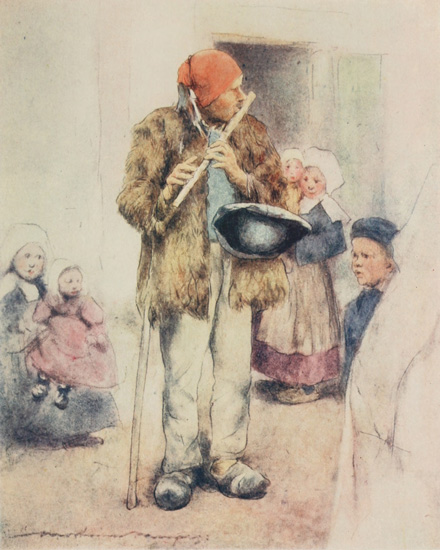
THE BLIND PIPER
Quimperlé is a sleepy place, changing very little
with the years. In spite of the up-to-date railway-station,
moss still grows between the pavings of the
streets. The houses have still their picturesque
wooden gables; the gardens are laden with fruit-trees;
the hills are rich in colour. Flowers that love
the damp grow luxuriantly. It is an arcadian
country. The place is hostile to work. In this
tranquil town, almost voluptuous in its richness of
colour and balminess of atmosphere, you lose yourself
in laziness. There is not a discordant note,
nothing to shock the eye or grate on the senses.
Far from the noise of Paris, the stuffy air of the
boulevards, the never-ending rattle of the fiacres,
and the rasping cries of the camelot, you forget the
seething world outside.
In the Rue du Château, the aristocratic quarter,
are many spacious domains with doorways surmounted
by coats of arms and coronets. Most of
them have closed shutters, their masters having disappeared,
alienated for ever by the Revolution; but
a few great families have returned to their homes.
One sees many women about the church, grave and
sad and prayerful, who still wear black, clinging to
God, the saints, and the priests, as to the only
living souvenirs of better times.
In no other place in Finistère was the Revolution
so sudden and so terrible as in this little town, and
nowhere were the nobility so many and powerful.
This old Rue du Château must have rung with
furious cries on the day when the federators returned
from the fête of the Champs de Mars after
the abolition of all titles and the people took the
law into their own hands. The Bretons are slow
to anger; but when roused they are extremely
violent. They not only attacked the living—the
nobles in their seignorial hotels—but also they
went to the tombs and mutilated the dead with
sabre cuts.
In Quimperlé the painter finds pictures at every
turn. For example, there are clear sinuous streams
crossed by many bridges, not unlike by-canals in
Venice. As you look up the river the bank is
a jumble of sloping roofs, protruding balconies,
single-arched bridges, trees, and clumps of greenery.
The houses on either side, gray and turreted, bathe
their foundations in the stream. Some have steep
garden walls, velvety with green and yellow moss
and lichen; others have terraces and jutting stone
balconies, almost smothered by trailing vines and
clematis, drooping over the gray water. The
stream is very shallow, showing clearly the brown
and golden bed; and on low stone benches at the
edge girls in little close white caps and blue aprons
are busily washing with bare round arms. A pretty
little maid with jet-black hair is cleaning some
pink stuff on a great slab of stone, against a background
of gray wall over which convolvulus and
nasturtium are trailing; a string of white linen
is suspended above her head. This is a delightful
picture. It is a gray day, sunless; but the gray
is luminous, and the reflections in the water are
clear.
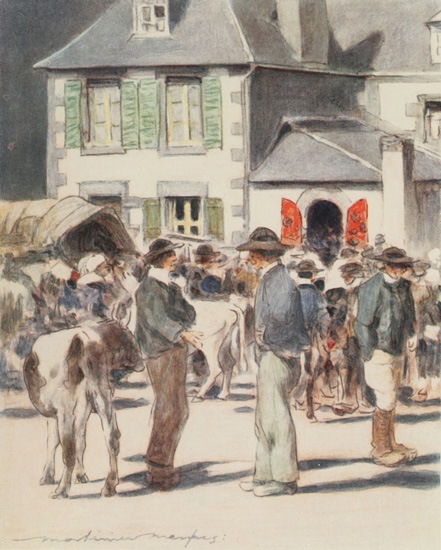
AT THE FOIRE
CHAPTER XIV AURAY
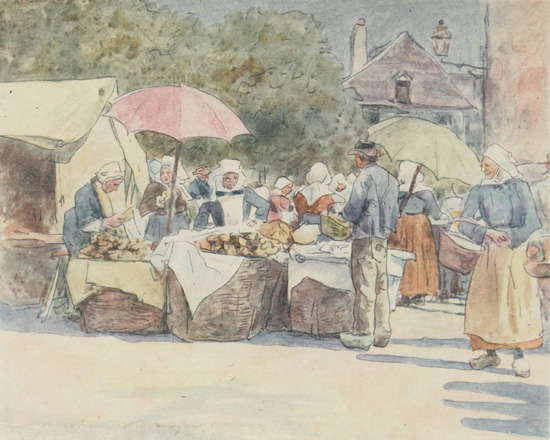
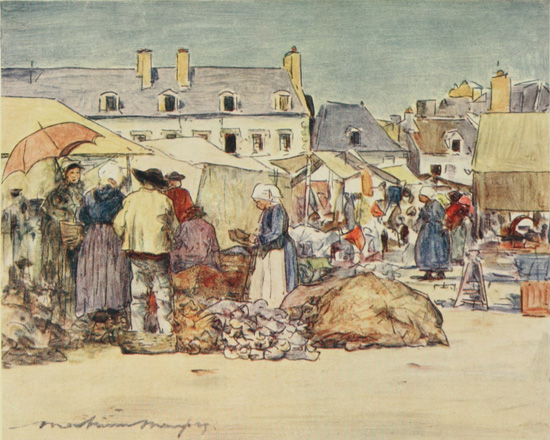
When we arrived in Auray it was market-day,
and chatter filled the streets. There were avenues
of women ranged along the pavement, their round
wicker baskets full of lettuce, cabbages, carrots,
turnips, chestnuts, pears, and what not—women in
white flimsy caps, coloured cross-over shawls, and
sombre black dresses. Their aprons were of many
colours—reds, mauves, blues, maroons, and greens—and
the wares also were of various hues. All the
women knit between the intervals of selling, and
even during the discussion of a bargain, for a purchase
in Brittany is no small matter in the opinion of
housewives, and engenders a great deal of conversation.
All the feminine world of Auray seemed to
have sallied forth that morning. Processions of
them passed down the avenue of market women,
most of them peasants in the cap of Auray, with
snuff-coloured, large-bibbed aprons, carrying bulky
black baskets with double handles.
Now and then one saw a Frenchwoman walking
through the avenue of vegetables, just as good at
bargaining, just as keen-eyed and sharp-tongued, as
her humbler sisters. Sometimes she was pretty,
walking with an easy swinging gait, her baby on
one arm, her basket on the other, in a short trim
skirt and altogether neatly dressed. More often
she was dressed in unbecoming colours, her hair
untidily arranged, her skirt trailing in the mud—a
striking contrast to the well-to-do young Breton
matron, with neatly braided black hair and clean
rosy face, her white-winged lawn cap floating in
the breeze, her red shawl neatly crossed over her
lace-trimmed corsage. In her black velvet-braided
skirt and wooden sabots the Breton is a dainty
little figure, her only lapse into frivolity consisting
of a gold chain at her neck and gold earrings.
Vegetables do not engender much conversation
in a Breton market: they are served out and paid
for very calmly. It is over the skeins of coloured
wool, silks, and laces, that there is much bargaining.
Round these stalls you will see girls and old hags
face to face, and almost nose to nose, their arms
crossed, speaking rapidly in shrill voices.
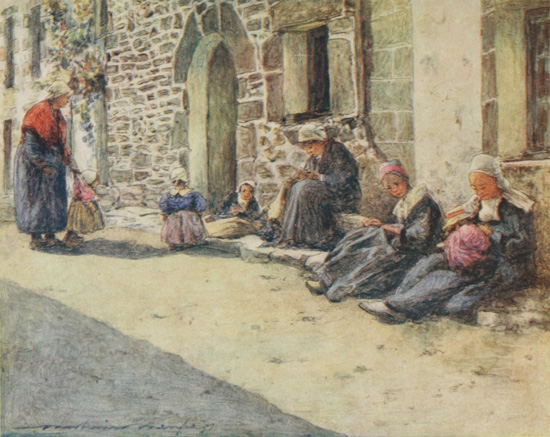
MID-DAY
Just after walking past rows of very ordinary
houses, suddenly you will come across a really fine
old mansion, dating from the seventeenth century,
white-faced, with ancient black beams, gables, and
diamond panes. Then, just as you think that you
have exhausted the resources of the town, and turn
down a moss-grown alley homewards, you find
yourself face to face with another town, typically
Breton, white-faced and gray-roofed, clustering
round a church and surrounded by old moss-grown
walls. This little town is situated far down in a
valley, into which you descend by a sloping green
path. We sat on a stone bench above, and watched
the people as they passed before us. There were
bare-legged school-children in their black pinafores
and red berés, hurrying home to déjeuner, swinging
their satchels; and beggars, ragged and dirty, holding
towards us tin cups and greasy caps, with many
groans and whines. One man held a baby on his
arm, and in the other hand a loaf of bread. The
baby's face was dirty and covered with sores; but
its hair was golden and curly, and the sight of that
fair sweet head nodding over the father's shoulder
as they went down the hill made one's heart ache.
It was terrible to think that an innocent child
could be so put out of touch with decent humanity.
To reach this little town one had to cross a
sluggish river by a pretty gray stone bridge.
Some of the houses were quaint and picturesque,
mostly with two stories, one projecting over
the other, and low windows with broad sills,
bricked down to the ground, on which were
arranged pots of fuchsias, pink and white geraniums,
and red-brown begonias. Nearly every
house had its broad stone stoop, or settle, on which
the various families sat in the warm afternoon
drinking bowls of soup and eating tartines de
beurre.
It is a notably provincial little town, full of
flowers and green trees, and dark, narrow streets,
across which hang audaciously strings of drying
linen. All the children of the community appeared
to be out and about—some skipping, others playing
at peg-tops, and others merely sucking their
fingers and their pinafores in the way that children
have. One sweet child in a red pinafore, her hair
plaited into four little tails tied with red ribbon,
clasped a slice of bread-and-butter (butter side
inwards, of course) to her chest, and was carelessly
peeling an apple with a long knife at the
same time, in such a way as to make my heart
leap.
A happy wedding-party were swinging gaily
along the quay arm in arm, singing some rollicking
Breton chanson, and all rather affected by their
visits to the various débits de boissons. There were
two men and two women—the men fair and
bearded, wearing peaked caps; the women in their
best lace coifs and smartest aprons. As they
passed everyone turned and pointed and laughed.
It was probably a three days' wedding.
A mite of a girl walking gingerly along the
street carried a bottle of ink ever so carefully,
biting her lips in her anxiety to hold it steadily.
Round her neck, on a sky-blue ribbon, hung a
gorgeous silver cross, testifying to good behaviour
during the week. Alack! a tragedy was in store.
The steps leading to the doorway of her home were
steep, and the small person's legs were short and
fat. She tripped and fell, and the ink was spilled—a
large, indelible, angry black spot on the clean
white step. Fearfully and pale-faced, the little
maid looked anxiously about her, and strove to
put the ink back again by means of a dry stick,
staining fingers and pinafore the more. It was of
no avail. Her mother had seen her. Out she
rushed, a pleasant-faced woman in a white lace
cap, now wearing a ferocious expression.
'Monster that thou art!' she cried, lifting the
tearful, ink-bespattered child by the armpits, and
throwing her roughly indoors, whence piteous
sounds of sobbing and wailing ensued.
The child's heart was broken; the silver cross had
lost its charm; and the sun had left the heavens.
The mother, busily bending over her sewing-machine,
looked up at us through the window,
and smiled understandingly.
A LITTLE MOTHER
CHAPTER XV BELLE ISLE
As a rule, a country becomes more interesting as
one draws near to the sea; the colouring is more
beautiful and the people are more picturesque. It
is strange that the salt air should have such a
mellowing effect upon a town and its inhabitants;
but there is no doubt that it has. This seemed
especially remarkable to us, coming straight from
Carnac, that flat, gray, treeless country where the
people are sad and stolid, and one's only interest is
in the dolmens and menhirs scattered over the
landscape—strange blocks of stone about which
one knows little, but imagines much.
When you come from a country such as this,
you cannot but be struck by the warmth and
wealth of colouring which the sea imparts to
everything in its vicinity. Even the men and
women grouped in knots on the pier were more
picturesque, with their sun-bleached, tawny, red-gold
hair, and their blue eyes, than the people
of Carnac. The men were handsome fellows—some
in brown and orange clothing, toned and
stained by the sea; others in deep-blue much bepatched
coats and yellow oilskin trousers. Their
complexions had a healthy reddish tinge—a
warmth of hue such as one rarely sees in Brittany.
The colouring of the Bay of Quiberon on this
particular afternoon was a tender pale mother-of-pearl.
The sky was for the most part a broad, fair
expanse of gray, with, just where the sun was
setting, intervals of eggshell blue and palest lemon-yellows
breaking through the drab; the sands were
silvery; the low-lying ground was a dim gold; the
water was gray, with purple and lemon-yellow
reflections. The whole scene was broad and fair.
The people on the pier and the boats on the water
formed notes of luscious colour. The fishing-boats
at anchor were of a brilliant green, with vermilion
and orange sails and nets a gauzy blue. Ahead,
on the brown rocks, although it was the calmest
and best of weather, white waves were breaking
and sending foam and spray high into the air.
There was everywhere a fresh smell of salt.
CURIOSITY
We were anxious to go across to Belle Isle that
night, and took tickets for a small, evil-smelling
boat, the cargo of which was mostly soldiers. It
was rather a rough crossing, and we lay in the
stuffy cabin longing to go on deck to see the
sunset, which, by glimpses through the portholes,
we could tell to be painting sea and sky in tones of
flame. At last the spirit conquered the flesh, and,
worried with the constant opening and shutting of
doors by the noisy steward, we went on deck. A
fine sight awaited us. From pearly grays and
tender tones we had emerged into the fiery
glories of a sunset sky. Behind us lay the dark
gray-blue sea and the darker sky, flecked by pale
pink clouds. Before us, the sun was shooting
forth broad streaks of orange and vermilion on a
ground of Venetian blue. Towards the horizon the
colouring paled to tender pinks and lemon-yellows.
As the little steamer ploughed on, Belle Isle rose
into sight, a dark purple streak with tracts of
lemon-gold and rosy clouds. The nearer we drew
the lower sank the sun, until at last it set redly
behind the island, picking out every point and
promontory and every pine standing stiff against
the sky.
Each moment the island loomed larger and
darker, orange light shining out here and there
in the mass. We were astonished by its size, for I
had always imagined Belle Isle as being a miniature
place belonging entirely to Mme. Bernhardt.
The entrance to the bay was narrow, and lay
between two piers, with lights on either end; and
it was a strange sensation leaving the grays and
blues and purples, the silvery moonlight, and the
tall-masted boats behind us, and emerging into
this warmth and wealth of colouring. A wonderful
orange and red light shone behind the dark mass of
the island, turning the water of the bay to molten
gold and glorifying the red-sailed fishing-boats at
anchor. As we drew near the shore, piercing
shrieks came from the funnel. There appeared to
be some difficulty about landing. Many directions
were shouted by the captain and repeated by a shrill-voiced
boy before we were allowed to step on shore
over a precarious plank. Once landed, we were
met by a brown-faced, sturdy woman, who picked
up our trunks and shouldered them as if they were
feather-weights for a distance of half a mile or so.
She led the way to the hotel.
Next morning was dismal; but, as we had only
twenty-four hours to spend in Belle Isle, we
hired a carriage to take us to the home of
Mme. Bernhardt, and faced the weather. The
sky was gray; the country flat and bare, though
interesting in a melancholy fashion. The scenery
consisted of mounds of brown overturned earth laid
in regular rows in the fields, scrubby ground half-overgrown
by gorse, clusters of dark pines, and a
dreary windmill here and there. Now and then,
by way of incident, we passed a group of white
houses, surrounded by sad-coloured haystacks, and
a few darkly-clad figures hurrying over the fields
with umbrellas up, on their way to church. The
Breton peasants are so pious that, no matter
how far away from a town or village they may
live, they attend Mass at least once on Sunday.
A small procession passed us on the road—young
men in their best black broadcloth suits, and
girls in bright shawls and velvet-bound petticoats.
This was a christening procession—at least, we
imagined it to be so; for one of the girls carried
a long white bundle under an umbrella. Bretons
are christened within twenty-four hours of birth.
The home of Mme. Bernhardt is a square
fortress-like building, shut up during the autumn,
with a beautifully-designed terrace garden. It is
situated on a breezy promontory, and the great
actress is in sole possession of a little bay wherein
the sea flows smoothly and greenly on the yellow
sands, and the massive purple rocks loom threateningly
on either side with many a craggy peak.
Her dogs, large Danish boarhounds, rushed out,
barking furiously, at our approach; her sheep and
some small ponies were grazing on the scanty
grass.
Our driver was taciturn. He seemed to be
tuned into accord with the desolate day, and would
vouchsafe no more than a grudging 'Oui' or 'Non'
to our many questions, refusing point-blank to tell us
to what places he intended driving us. At length
he stopped the carriage on a cliff almost at the edge
of a precipice. Thoughts that he was perhaps
insane ran through my mind, and I stepped out
hurriedly; but his intention was only to show us
some cavern below. Mother preferred to remain
above-ground; but, led by the driver, I went down
some steps cut in the solid rock, rather slippery
and steep, with on one side a sheer wall of rock,
and the ocean on the other. The rock was dark
green and flaky, with here and there veins of
glistening pink and white mica. Lower and lower
we descended, until it seemed as if we were
stepping straight into the sea, which foamed
against the great rocks, barring the entrance to
the cavern.
A SOLITARY MEAL
The cavern itself was like a colossal railway-arch
towering hundreds of feet overhead; and against
this and the rocks at the entrance the sea beat
with much noise and splash, falling again with a
groan in a mass of spray. Inside the cavern the
tumult was deafening; but never have I seen
anything more beautiful than those waves creaming
and foaming over the green rocks, the blood-red
walls of the cave rising sheer above, flecked with
glistening mica. It was a contrast with the tame,
flat, sad scenery over which we had been driving all
the morning. This was Nature at her biggest and
best, belittling everything one had ever seen or
was likely to see, making one feel small and insignificant.
By-and-by we drove to a village away down in a
hollow, a typical Breton fishing-village with yellow
and white-faced auberges, and rows of boats
moored to the quay, their nets and sails hauled
down on this great day of the week, the Sabbath.
As there was no hotel in the place, we entered a
clean-looking auberge and asked for luncheon.
The kitchen led out of the little salle à manger,
and, as the door was left wide open, we could watch
the preparation of our food. We were to have a
very good soup; we saw the master of the house
bringing in freshly-caught fish, which were grilled
at the open fireplace, and fresh sardines; and
we heard our chicken frizzling on the spit. We
saw the coffee-beans being roasted, and we were
given the most exquisite pears and apples. Small
matter that our room was shared by noisy soldiers,
and that Adolphus (as we had named our driver)
entered and drank before our very eyes more
cognac than was good for him or reasonable on our
bill.
Sunday afternoon in Belle Isle is a fashionable
time. Between three and four people go down to
the quay, clattering over the cobble stones in their
best black sabots, to watch the steamers come in
from Quiberon. You see girls in fresh white caps
and neat black dresses, spruce soldiers, ladies à la
mode in extravagant headgear and loud plaid or
check dresses. On the quay they buy hot chestnuts.
From our hotel we could watch the people
as they passed, and the shopkeepers sitting and
gossiping outside their doors. Opposite us was a
souvenir shop, on the steps of which sat the
proprietor with his boy. Very proud he was of
the child—quite an ordinary spoiled child, much
dressed up. The father followed the boy with his
eyes wherever he went. He pretended to scold
him for not getting out of the way when people
passed, to attract their attention to the child. He
greeted every remark with peals of laughter, and
repeated the witticisms to his friend the butcher
next door, who did not seem to appreciate them.
Every now and then he would glance over to
see if the butcher were amused. French people,
especially Bretons, are devoted to their children.
I was much amused in watching the little bonne
at the hotel who carried our luggage the night
before. She was quaint, compact, sturdy. She
would carry a huge valise on her shoulder, or
sometimes one in either hand. She ordered her
husband about. She dressed her child in a shining
black hat, cleaned its face with her pocket-handkerchief,
straightened its pinafore, and sent
it en promenade with papa, while she herself
stumped off to carry more luggage. There was
apparently no end to her strength. On her way
indoors she paused on the step and cast a loving
glance over her shoulder at the back view of her
husband in his neatly-patched blue blouse and the
little child in the black sarrau walking sedately
down the road. She seemed so proud of the pair
that we could not resist asking the woman if the
child were hers, just to see the glad smile which lit
up her face as she answered, 'Oui, mesdames!' I
have often noticed how lenient Breton women are
to their children. They will speak in a big voice
and frown, and a child imagines that Mother is in
a towering rage; but you will see her turn round
the next moment and smile at the bystander. If
children only knew their power, how little influence
parents would have over them!
The French differ from the British in the matter
of emotion. On the steamer from Belle Isle to
Quiberon there were some soldiers, about to travel
with us, who were being seen off by four or five
others standing on the quay. Slouching, unmilitary
figures they looked, with baggy red
trousers tied up at the bottoms, faded blue coats,
and postmen-shaped hats, yellow, red, or blue pom-pom
on top. One of the men on shore was a
special friend of a soldier who was leaving. I was
on tenter-hooks lest he should embrace him; he
almost did so. He squeezed his hand; he
picked fluff off his clothes; he straightened his
hat. He repeatedly begged that his 'cher ami'
would come over on the following Sunday to
Belle Isle. Tears were very near his eyes; he was
forced to bite his handkerchief to keep them back.
When the boat moved away, and they could join
hands no longer, the soldiers blew kisses over the
water to one another. They opened their arms
wide, shouted affectionate messages, and called one
another by endearing terms. Altogether, they
carried on as if they were neurotic girls rather
than soldiers who had their way to make and
their country to think of.
IN THE BOIS D'AMOUR
There was one man superior to his fellows. He
held the same rank, and wore the same uniform;
but he kept his buttons and his brass belt bright;
he wore silk socks, and carried a gold watch under
his military coat; his face was intelligent.
CHAPTER XVII ST. MALO
When you are nearing the coast of France all
you can see is a long narrow line, without relief,
apparently without design, without character, just
a sombre strip of horizon; but St. Malo is always
visible. A fine needle-point breaks the uninteresting
line: it is the belfry of St. Malo. To left
and right of the town is a cluster of islands, dark
masses of rock over which the waves foam whitely.
St. Malo is magnificently fortified. It is literally
crowned with military defences. It is a mass of
formidable fortresses, rigid angles, and severe gray
walls. It speaks of the seventeenth century, telling
of a time when deeds of prowess were familiar.
The sea, which is flowing, beats furiously against
the walls of defence, protected by the trunks of
great trees planted in the sand. These gigantic
battalions stop the inrush of the water, and would
make landing more arduous to an enemy. They
have a bizarre effect when seen from the distance.
The town defied all the efforts of the English to
capture her. On one occasion they laid mines as
far as the Porte of St. Malo; but the Virgin,
enshrined above the gate, and ever watching over
the people, disclosed the plot by unfolding her
arms and pointing with one hand to the ground
beneath her. The Bretons dug where she pointed,
and discovered their imminent peril. Thus was the
city saved. To-day the shrine receives the highest
honours, and is adorned with the finest and sweetest
flowers.
For one reason at least St. Malo is unique. It
is a town of some thousand inhabitants; yet it is
still surrounded by mediæval walls. Of all the
towns in Brittany, St. Malo is the only one which
still remains narrowly enclosed within walls. It
is surrounded by the sea except for a narrow neck
of land joining the city to the mainland. This is
guarded at low tide by a large and fierce bulldog,
the image of which has been added to St. Malo's
coat of arms. Enclosed within a narrow circle of
walls, and being unable to expand, the town is
peculiar. The houses are higher than usual, and
the streets narrower. There is no waste ground in
St. Malo. Every available inch is built upon. The
sombre streets run uphill and downhill. There is
no town like St. Malo. Its quaint, tortuous streets,
of corkscrew form, culminate in the cathedral,
which, as you draw near, does not seem to be a
cathedral at all, but a strong fort. So narrow are
the streets, and so closely are they gathered round
the cathedral, that it is only when you draw away
to some distance that you can see the beautifully-sculptured
stone tower of many points.
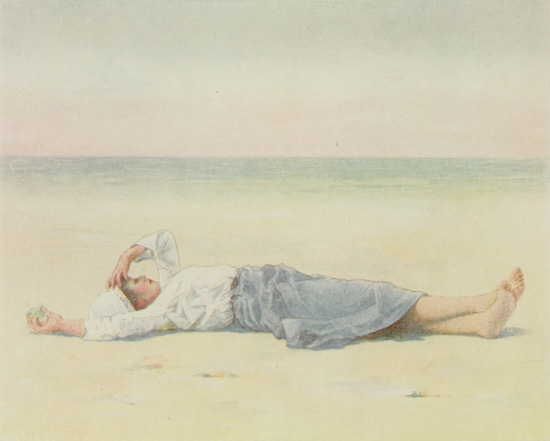
IN THE EYE OF THE SUN
Up and down the steep street the people clatter
in their thick-soled sabots. It is afternoon, and
most of the townspeople have turned out for a
walk, to gaze in the shop windows with their little
ones. The people are rather French; and the
children, instead of being clad in the Breton costume,
wear smart kilted skirts, white socks, and
shiny black sailor hats. Still, there is a subtle
difference between these people and the French.
You notice this directly you arrive. There is
something solid, something pleasant and unartificial,
about them. The women of the middle classes are
much better-looking, and they dress better; the
men are of stronger physique, with straight, clean-cut
features and a powerful look.
Very attractive are these narrow hilly streets,
with their throngs of people and their gay little
shops where the wares are always hung outside—worsted
shawls, scarlet and blue berés, Breton
china (decorated by stubby figures of men and
women and heraldic devices), chaplets, shrines to
the Virgin Mary, many-coloured cards, religious
and otherwise.
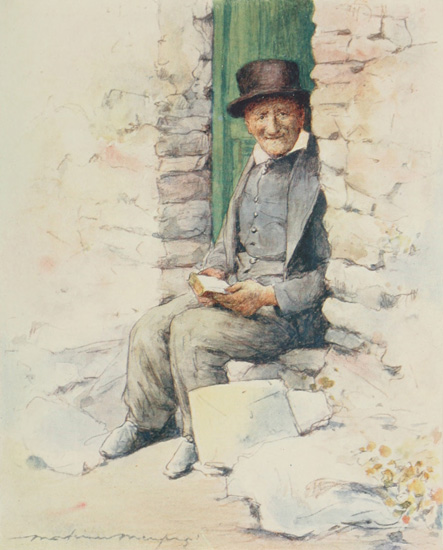
SUNDAY
There are a few houses which perpetuate the
past. You are shown the house of Queen Anne,
the good Duchess Anne, a house with Gothic
windows, flanked by a tower, blackened and
strangely buffeted by the blows of time. Queen
Anne was a marvellous woman, and has left her
mark. Her memory is kept green by the lasting
good that she achieved. From town to town she
travelled during the whole of her reign, for she felt
that to rule well and wisely she must be ever in
close touch with her people. No woman was more
beloved by the populace. Everywhere she went
she was fêted and adored. She ruled her province
with a rod of iron; yet she showed herself to be in
many ways wonderfully feminine. Nothing could
have been finer than the act of uniting Brittany
with France by giving up her crown to France
and remaining only the Duchess Anne. In almost
every town in Brittany there is a Queen Anne
House, a house which the good Queen either built
herself or stayed in. Everywhere she went she
constructed something—a church, a chapel, an
oratory, a calvaire, a house, a tomb—by which she
was to be remembered. There is, for example,
the famous tower which she built, in spite of all
malcontents, not so much in order to add to the
defences of St. Malo as to rebuke the people
for their turbulence and rebellion. Her words
concerning it ring through the ages, and will never
be forgotten:
'Quic en groigneir
Ainsy ser
C'est mon playsir.'
Ever since the tower has gone by the name of
'Quiquengroigne.'
There are three names, three figures, of which
St. Malo is proud; the birthplaces are pointed
out to the stranger fondly. One is that of the
Duchess Anne; another that of Duguay-Trouin;
last, but not least, we have Chateaubriand. Of the
three, perhaps the picturesque figure of Duguay-Trouin
charms one most. From my earliest days
I have loved stories of the gallant sailor, whose
adventures and mishaps are as fascinating as those
of Sinbad. I have always pictured him as a
heroic figure on the bridge of a vessel, wearing
a powdered wig, a lace scarf, and the dress of the
period, winning victory after victory, and shattering
fleets. It is disappointing to realize that this hero
lived in the Rue Jean de Chatillon, in a three-storied,
time-worn house with projecting windows,
lozenge-paned. Of Chateaubriand I know little;
but his birthplace is in St. Malo, for all who come
to see.
What a revelation it is, after winding up the
narrow, steep streets of St. Malo, suddenly to
behold, framed in an archway of the old mediæval
walls, the sea! There is a greeny-blue haze so
vast that it is difficult to trace where the sea ends
and the sky begins. The beach is of a pale yellow-brown
where the waves have left it, and pink as it
meets the water. At a little distance is an island
of russet-brown rocks, half-covered with seaweed;
at the base is a circle of tawny sand, and at the
summit yellow-green grass is growing.
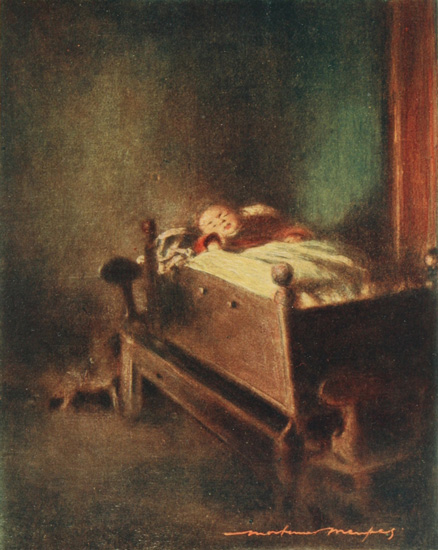
THE CRADLE
CHAPTER XVIII MONT ST. MICHEL
The road to Mont St. Michel is colourless and
dreary. On either side are flat gray marshes, with
little patches of scrubby grass. Here and there a
few sheep are grazing. How the poor beasts can
find anything to eat at all on such barren land is a
marvel. Gradually the scenery becomes drearier,
until at last you are driving on a narrow causeway,
with a river on one side and a wilderness of
treacherous sand on the other.
Suddenly, on turning a corner, you come within
view of Mont St. Michel. No matter how well
prepared you may be for the apparition, no matter
what descriptions you may have read or heard
beforehand, when you see that three-cornered mass
of stone rising from out the vast wilderness of sand,
you cannot but be astonished and overwhelmed.
You are tempted to attribute this bizarre achievement
to the hand of the magician. It is uncanny.
Just now it is low tide, and the Mount lies in the
midst of an immense moving plain, on which three
rivers twist, like narrow threads intersecting it—Le
Conesnon, La Sée, and La Seline. Several
dark islands lie here and there uncovered, and
groups of small boats are left high and dry. It is
fascinating to watch the sea coming up, appearing
like a circle on the horizon, and slipping gently
over the sands, the circle ever narrowing, until the
islands are covered once more, the boats float at
anchor, and the waves precipitate themselves with
a loud booming sound, heard for miles round,
against the double walls that protect the sacred
Mount.
Many are the praises that have been sung of
Mont St. Michel by poets and artists, by historians
and architects. She has been called 'A
poem in stone,' 'Le palais des angles,' 'An
inspiration of the Divine,' 'La cité des livres,'
'Le boulevard de la France,' 'The sacred mount,'
etc. Normandy and Brittany dispute her. She is
in the possession of either, as you will.
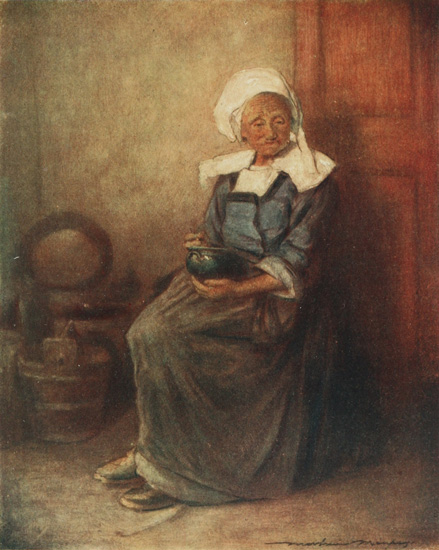
SOUPE MAIGRE
Mont St. Michel is not unlike Gibraltar. As
you come suddenly upon the place, rising from out
the misty grayish-yellow, low-lying marshes, it
appears to be a dark three-cornered mass, surrounded
by stout brownish battlemented walls,
flanked by rounded turrets, against a background
of blue sky. At the base of the Mount lies the
city, the houses built steeply one above the other,
some with brownish lichen-covered roofs, others of
modern slate. Above the city is the monastery—brown
walls, angry and formidable, rising steeply,
with many windows and huge buttresses. Beyond,
on the topmost point, is the grand basilica consecrated
to the archangel, the greenish light of
whose windows you can see clearly. Above all
rises a tall gray spire culminating in a golden
figure.
There is only one entrance to Mont St. Michel—over
a footbridge and beneath a solid stone archway,
from which the figure of the Virgin in a niche
looks down. You find yourself in a narrow, steep
street, black and dark with age, and crowded with
shops and bazaars and cafés. The town appears to
be given up to the amusement and entertainment
of visitors; and, as St. Michael is the guardian
saint of all strangers and pilgrims, I suppose this is
appropriate. Tourists fill the streets and overflow
the hotels and cafés; the town seems to live,
thrive, and have its being entirely for the tourists.
Outside every house hangs a sign advertising
coffee or china or curios, as the case may be, and
so narrow is the street that the signs on either side
meet.
Your first thought on arriving is about getting
something to eat. The journey from St. Malo is
long, and, although the sun is shining and the sky
is azure blue, the air is biting. Of course, everyone
who comes to the Mount has heard of Mme.
Poulard. She is as distinctly an institution as the
very walls and fortresses. All know of her famous
coffee and delicious omelettes; all have heard of
her charm. It is quite an open question whether
the people flock there in hundreds on a Sunday
morning for the sake of Mme. Poulard's
luncheon or for the attractions of Mont St.
Michel itself. There she stands in the doorway
of her hotel, smiling, gracious, affable, handsome.
No one has ever seen Mme. Poulard ruffled or put
out. However many unexpected visitors may
arrive, she greets them all with a smile and
words of welcome.
We were amid a very large stream of guests;
yet she showed us into her great roomy kitchen,
and seated us before the huge fireplace, where a
brace of chickens, steaming on a spit, were being
continually basted with butter by stout, gray-haired
M. Poulard. She found time to inquire
about our journey and our programme for the day,
and directed us to the various show-places of the
Mount.
There is only one street of any importance in
Mont St. Michel, dark and dim, very narrow, no
wider than a yard and a half; a drain runs down
the middle. Here you find yourself in an absolute
wilderness of Poulard. You are puzzled by the
variety and the relations of the Poulards. Poulard
greets you everywhere, written in large black letters
on a white ground.
If you mount some steps and turn a corner
suddenly, Poulard frère greets you; if you go for
a harmless walk on the ramparts, the renowned
coffee of Poulard veuve hits you in the face. Each
one strives to be the right and only Poulard. You
struggle to detach yourselves from these Poulards.
You go through a fine mediæval archway, past
shops where valueless, foolish curios are for sale;
you scramble up picturesque steps, only to be told
once more in glaring letters that POULARD spells
Poulard.
A very picturesque street is the main thoroughfare
of Mont St. Michel, mounting higher and
higher, with tall gray-stone and wooden houses on
either side, the roofs of which often meet overhead.
Each window has its pots of geraniums and its
show of curios and useless baubles. Fish-baskets
hang on either side of the doors. Some of the
houses have terrace gardens, small bits of level
places cut into the rock, where roses grow and
trailing clematis. Ivy mainly runs riot over every
stone and rock and available wall. The houses
are built into the solid rock one above another, and
many of them retain their air of the fourteenth or
the fifteenth century.
You pass a church of Jeanne d'Arc. A bronze
statue of the saint stands outside the door. One
always goes upwards in Mont St. Michel, seeing
the dark purplish-pink mass of the grand old
church above you, with its many spires of sculptured
stone. Stone steps lead to the ramparts. Here
you can lean over the balustrade and look down
upon the waste of sand surrounding Mont St.
Michel. All is absolutely calm and noiseless.
Immediately below is the town, its clusters of
new gray-slate roofs mingling with those covered
in yellow lichen and green moss; also the church of
the village, looking like a child's plaything perched
on the mountain-side. Beyond and all around
lies a sad, monotonous stretch of pearl-gray sand,
with only a darkish, narrow strip of land between
it and the leaden sky—the coast of Normandy.
Sea-birds passing over the country give forth a
doleful wail. The only signs of humanity at all
in the immensity of this great plain are some little
black specks—men and women searching for shellfish,
delving in the sand and trying to earn a
livelihood in the forbidding waste.
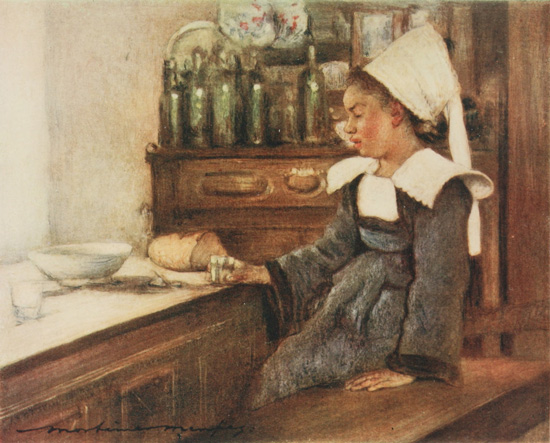
DÉJEUNER
The melancholy of the place is terrible. I
have seen people of the gayest-hearted natures
lean over that parapet and gaze ahead for hours.
This great gray plain has a strange attraction. It
draws out all that is sad and serious from the very
depths of you, forcing you to think deeply, moodily.
Joyous thoughts are impossible. At first you
imagine that the scenery is colourless; but as you
stand and watch for some time, you discover that
it is full of colour. There are pearly greens and
yellows and mauves, and a kind of phosphorescent
slime left by the tide, glistening with all the hues
of the rainbow.
Terribly dangerous are these shifting sands. In
attempting to cross them you need an experienced
guide. The sea mounts very quickly, and mists
overtake you unexpectedly. Many assailants of
the rock have been swallowed in the treacherous
sands.
Being on this great height reminded me of a
legend I had heard of the sculptor Gautier, a man
of genius, who was shut up in the Abbey of Mont
St. Michel and carved stones to keep himself from
going mad—you can see these in the abbey to this
day. For some slight reason François I. threw the
unfortunate sculptor into the black cachot of the
Mount, and there he was left in solitude, to die by
degrees. His hair became quite white, and hung
long over his shoulders; his cheeks were haggard;
he grew to look like a ghost. His youth could no
longer fight against the despair overhanging him;
his miseries were too great for him to bear; he
became almost insane. One day, by a miracle,
Mass was held, not in the little dark chapel under
the crypts, but in the church on high, on the
topmost pinnacle of the Mount. It was a Sunday,
a fête-day. The sun shone, not feebly, as I saw it
that day, but radiantly, the windows of the church
glistening. It was blindingly beautiful. The joy
of life surrounded him; the sweetness and freshness
of the spring was in the air. The irony of men
and things was too great for his poor sorrow-laden
brain. He cleared the parapet, and was dashed to
atoms below. Poor Gautier! It was his only
chance of escape. One realized that as one looked
up at those immense prison walls, black and frowning,
sheer and unscaleable, every window grated
and barred. What chance would a prisoner have?
If it were possible for him to escape from the
prison itself, there would be the town below to
pass through. Only one narrow causeway joins
the island to the mainland, and all round there is
nothing but sea and sandy wastes.
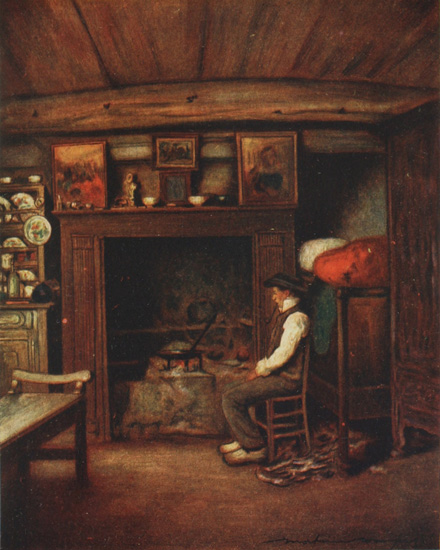
A FARMHOUSE KITCHEN
I was disturbed in my reverie by a loud nasal
voice shouting, 'Par ici, messieurs et dames, s'il
vous plaît.' It was the guide, and willy-nilly we
must go and make the rounds of the abbey among
a crowd of other sightseers. An old blind woman
on the abbey steps, evidently knowing that we were
English by our tread, moistened her lips and drew
in her breath in preparation for a begging whine as
we approached. We passed through a huge red
door of a glorious colour, up a noble flight of wide
steps, with hundreds of feet of wall on either side,
into a lofty chapel, falling to decay, and being
renovated in parts. It was of a ghostly greenish
stone, with fluted pillars of colossal height, ending
in stained-glass windows and a vaulted roof, about
which black-winged bats were flying. Room after
room we passed through, the guide making endless
and monotonous explanations and observations in
a parrot-like voice, until we reached the cloister.
This is the pearl of Mont St. Michel, the wonder
of wonders. It is a huge square court. In the
middle of the quadrangle it is open to the sky, and
the sun shines through in a golden blaze. All
round are cool dim walks roofed overhead by gray
arches supported by small, graceful, rose-coloured
pillars in pairs. This is continued round the whole
length of the court. Let into the wall are long
benches of stone, to which, in olden days, the
monks came to meditate and pray. The ancient
atmosphere has been well preserved; yet the building
is so little touched by time, owing to the careful
renovations of a clever architect, that one almost
expects at any moment to see a brown-robed
monk disturbed in his meditations.
From the quiet courtyard we are taken down
into the very heart of the coliseum—into the
mysterious cells where the damp of the rock
penetrates the solid stone. How gloomy it was
down in these crypts! Even the names of them
made one tremble—'Galerie de l'Aquilon,' 'Petit
Exil,' and 'Grand Exil.' You think of Du Bourg,
tightly fettered hand and foot, being eaten alive
by rats; of the Comte Grilles, condemned to
die of starvation, being fed by a peasant, who
bravely climbed to his window; of a hundred
gruesome tales. There is the chapel where the
last offices of the dead were performed—a cell in
which the light struggled painfully through the
narrow windows, feebly combating with the dark
night of the chamber; and there is the narrow
stairway, in the thickness of the wall, by which the
bodies of the prisoners were taken.
We were shown the cachot and the oubliette
where the living body of the prisoner was attacked
by rats. That, however, was a simple torture
compared with the strait-jacket and the iron
cage. In the oubliette the miserable men could
clasp helpless hands, curse or pray, as the case
might be; but in the iron cage the death agony
was prolonged.
Even now, although the poor souls took wings
long ago, the cachot and the oubliette fill you with
disgust. You feel stifled there. The atmosphere
is vitiated. Even though centuries have passed
since those terrible times, the walls seem to be still
charged with iniquity, with all the sighs exhaled,
with all the smothered cries, with all the tears,
with all the curses of impatient sufferers, with all
the prayers of saints.
It seems impossible to believe, down in the heart
of this world of stone, in the impenetrable darkness,
that the architect that designed this thick and
cruel masonry constructed those airy belfries, those
balustrades of lace, those graceful arches, those
towers and minarets. It is as if he had wished to
shut up the sorrow and the maniacal cries of the
men who had lost their reason in a fair exterior,
attracting the eyes of the world to that which was
beautiful, and making it forget the misery beneath.
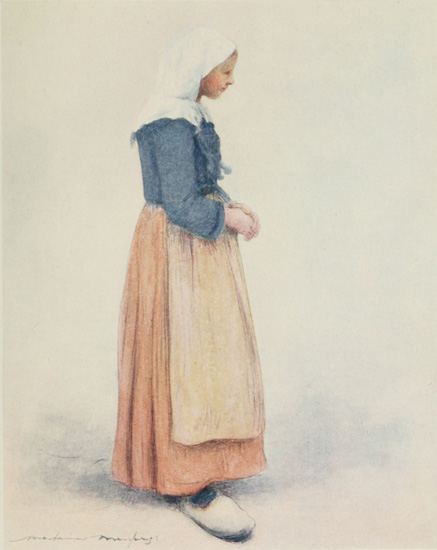
MARIE
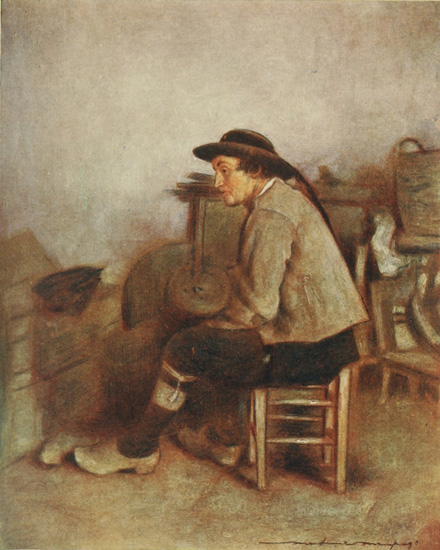
A FARM LABOURER
CHAPTER XIX CHÂTEAU DES ROCHERS
The name of Mme. Sévigné rings through the ages.
Vitré is full of it. Inhabitants will point out, close
to the ruined ramparts, the winter palace where the
spirituelle Marquise received the Breton nobility
and sometimes the Kings of Brittany. To the
south they will show you the Château des Rochers,
the princely country residence maintained by this
famous woman. She was a Breton of the Bretons,
building and planting, often working in the fields
with her farm hands. She loved her Château des
Rochers. It was a joy to leave the town and the
gaieties of Court for the freshness of the fields and
the woods. She especially liked to be there for
the 'Triomphe du mois de Mai'—to hear the
nightingale and the cuckoo saluting spring with
song. With Lafontaine, she found inspiration in
the fields; but, as she preserved a solid fund of
Gaelic humour, she laughed also, and the country
did not often make her melancholy. She felt the
sadness of autumn in her woods; but she never
became morose. She never wearied of her garden.
She had always some new idea with regard to it—some
new plan to lure her from a letter begun or
a book opened. Before reading the memoirs of
Mme. Sévigné it is almost impossible to realize this
side of her nature. Who would have imagined that
this woman of the salons, fêted in Paris, and known
everywhere, would be always longing for her country
home? It is only when you visit the famous
Château des Rochers that you realize to the full
that she was a lover of nature and country habits.
Wandering through the old-world garden, you find
individual touches which bring back the dainty
Marquise vividly to mind. There are the venerable
trees, under which you may wander and imagine
yourself back in the time of Louis XIV. There
are the deep and shady avenues planted by Mme.
Sévigné, and beautiful to this day. The names
come back to you as you walk—'La Solitaire,'
'L'Infini,' 'L'honneur de ma fille'—avenues in
which madame sat to see the sun setting behind
the trees. Very quiet is this garden, with its broad
shady paths, its wide spaces of green, its huge
cedars growing in the grass, and its stiff flower-beds.
There is Mme. Sévigné's sundial, on which she
inscribed with her own hand a Latin verse. There
are the stiff rows of poplars, like Noah's Ark trees,
symmetrical, interlacing one with the other, unnatural
but dainty in design. There is her rose
garden, a rounded and terraced walk planted with
roses. There, too, are the sunny 'Place Madame,'
the 'Place Coulanges,' and 'L'Écho,' where two
people, standing on stones placed a certain distance
apart, can hear the echo plainly. This garden, with
its stiff little rows of trees, its sunny open squares
surrounded by low walls, and its stone vases overgrown
with flowers, brings back the past so vividly
that one asks one's self whether indeed Mme.
Sévigné is there no longer, and glances involuntarily
down the avenues and the by-ways, half expecting
to distinguish the rapid passage of a majestic skirt.
What a splendid life this woman of the seventeenth
century led! She knew well how to regulate mind
and body. The routine of the day at Les Rochers
was never varied, and was designed so perfectly
that there was rarely a jar or a hitch. She rose at
eight, and enjoyed the freshness of the woods until
the hour for matins struck. After that there were
the 'Good-mornings' to be said to everyone on her
estate. She must pick flowers for the table, and
read and work. When her son was no longer with
her she read aloud to broaden the mind of his wife.
At five o'clock her time became her own; and on
fine days, a lacquey following, she wandered down
the pleasant avenues, dreaming visions of the
future, of God and of His providence, sometimes
reading a book of devotions, sometimes a book of
history. On days of storm, when the trees dripped
and the slates fell from the roof,—on days so wet
and gray and wild that you would not turn a dog
out of doors—you would suppose the Marquise to
become morbid and miserable. Not at all. She
realized that she must kill time, and she did so
by a hundred ingenious devices. She deplored
the weather which kept her indoors, but fixed her
thoughts on the morrow. Ladies and gentlemen
often invaded her; all the nobility came to present
their compliments. They assailed her from all
sides. When she resisted them, and strove to shut
herself away from the world, the Duke would come
and carry her away in his carriage.
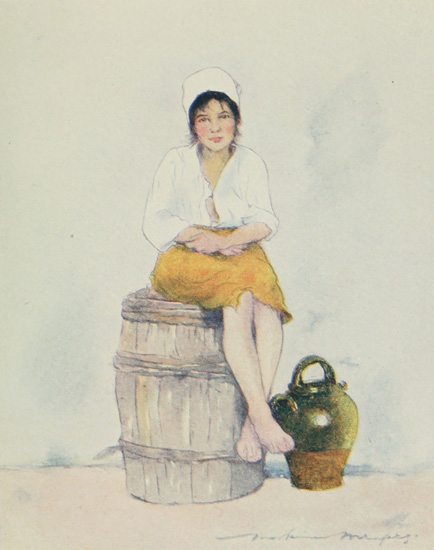
A LITTLE WATER-CARRIER
She always longed to return to her solitude—to
her dear Rochers, where her good priest waited,
at once her administrator, her man of affairs, her
architect, and her friend. Her pride of property
was great, and she was constantly beautifying and
embellishing her country home. Each year saw
some new change. On one occasion six years
passed without her visiting Les Rochers. All her
trees had become big and beautiful; some of them
were forty or fifty feet high. Her joy when she
beheld them gives one an insight into her youthfulness.
How young she was in some things! She often
asked herself whence came this exuberance. She
drew caricatures of the affectations of her neighbours,
and the anxious inquiries of her friends
as to her happiness during her voluntary exile
amused her immensely. In a letter written to her
daughter she said:
'I laugh sometimes at what they call "spending
the winter in the woods." Mme. de C—— said
to me the other day, "Leave your damp Rochers."
I answered her, "Damp yourself—it is your country
that is damp; but we are on a height." It is as
though I said, Your damp Montmartre. These
woods are at present penetrated by the sun whenever
it shines. On the Place Madame when the
sun is at its height, and at the end of the great
avenue when the sun is setting, it is marvellous.
When it rains there is a good room with my
people here, who do not trouble me. I do what
I want, and when there is no one here we are still
better off, for we read with a pleasure which we
prefer above everything.'
The prospect of spending a winter at Les Rochers
did not frighten her in the least. She wrote to her
daughter, saying, 'My purpose to spend the winter
at Les Rochers frightens you. Alas! my daughter,
it is the sweetest thing in the world.'
Mme. Sévigné was always thinking of her
daughter, and of Provence, where she lived. Her
heart went out to her daughter. Everything about
Les Rochers helped her to remember her beloved
child. Even the country itself seemed to bring
back memories, for the nights of July were so
perfumed with orange-blossoms that one might
imagine one's self to be really in Provence.
Mme. Sévigné wrote in a letter to one of her
friends:
'I have established a home in the most beautiful
place in the world, where no one keeps me company,
because they would die of cold. The abbé
goes backwards and forwards over his affairs. I am
there thinking of Provence, for that thought never
leaves me.'
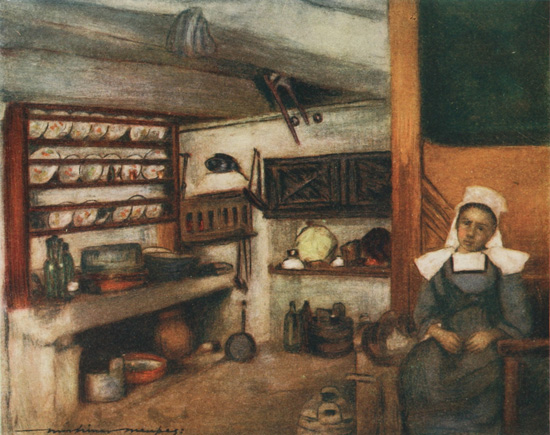
WEARY
The château in which this wonderful woman
lived, whence started so many couriers to Provence,
is an important building, gray, a little heavy with
towers, with high turrets of slate and great windows.
Resembling most houses built in the
Louis XIV. style, it is rather sad in design. At
the side is a chapel surmounted by a cross, a
rotund hexagonal building constructed in 1671
by the Abbot of Coulanges. Inside it is gorgeous
with old rose and gold. One can imagine the
gentle Marquise kneeling here at her devotions.
Visitors are shown the bedroom of Mme.
Sévigné, now transformed into a historical little
sanctuary. The furniture consists of a large four-post
bed, with a covering of gold and blue, embroidered,
it is said, by the Countess of Grignan.
Under a glass case have been treasured all the
accessories of her toilet—an arsenal of feminine
coquetry: brushes, powder-boxes, patch-boxes,
autograph letters, account-books, her own ink-stand,
books written in the clear, delicate, legible
handwriting of the Marquise herself.
The walls are hung with pictures of the family
and intimate friends, some of which are very remarkable.
This room was called by Mme. Sévigné
the 'green room.' It still has a dainty atmosphere.
Here Mme. Sévigné passed a great part of her life.
Under a large window is a marble table where she
is supposed to have written those letters which one
knows almost as well as the fables of Lafontaine.
Mme. Sévigné coloured the somewhat cold though
pure language of the seventeenth century, but
not artificially. She animated it, conveyed warmth
into it, by putting into her writings much that was
feminine, never descending to the 'precious' or to
be a blue-stocking. The books that she loved,
and her correspondence, did not take up so
much of her time that she had to overlook the
details of her domain. Sometimes she had a little
fracas with her cook; often she would be called
away to listen to the complaints of Pilois, her
gardener, a philosopher. She knew how to feel
strongly among people who could feel only their
own misfortunes and disgraces. She had a true
and thoughtful soul. This one can tell by her
letters from Les Rochers, which come to us in
all their freshness, as if they had been written
yesterday.
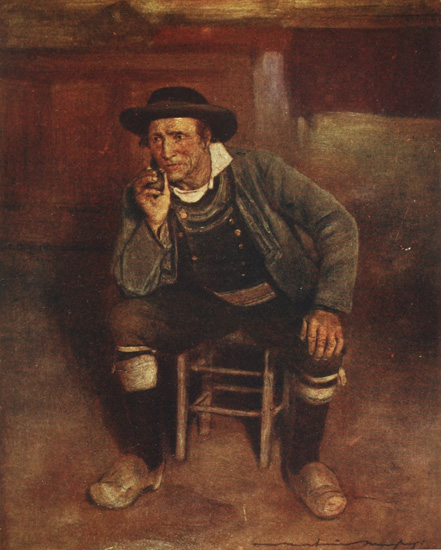
THE MASTER OF THE HOUSE
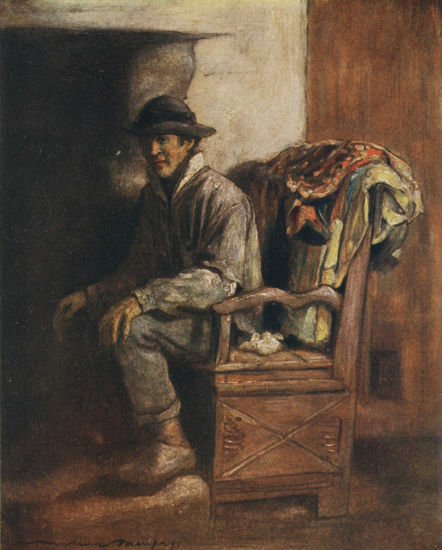
IN THE INGLENOOK