In the humblest village one may reckon on
obtaining good meals, but not always on having
dry sheets. It is not customary to air the latter,
and except in hot dry weather, it is well to be on
one's guard in this matter. Water should never
be drunk. Too frequently it is drawn from the
well in the yard, and is contaminated. Coffee
in out of the way parts, even at such headquarters
as Carhaix, is not coffee at all, but
roast lupin berries.[1] The ordinary charge for
déjeuner at 11.30 is 2.50, with cider and coffee,
and 3 francs for dinner at 7 p.m. But in
second class inns is 50 centimes less. A bed is
usually 1.50 or 2 francs. Sanitary arrangements
are rudimentary. Usually one can rely on freedom
from vermin, but it is well to be provided
with a small bottle of oil of lavender, a preservative
against bugs; but it will be needed
exceptionally only. The commercial traveller
is all pervading. He is sometimes interesting,
occasionally objectionable, if a farceur usually
the latter. On entering a café or railway
carriage, it is customary to raise the hat, so also
in leaving. For Maps get those of the État
Majeur, 57 Brest, 73 Châteaulin, 60 Dinan,
41 Lannion, 88 Lorient, 58 Morlaix, 117
Nantes, 40 Plouguerneau, 74 Pontivy, 87
Pont l'Abbé, 72 Quimper, 90 Redon, 75
Rennes, 59 S. Brieuc, 42 Tréguier, 89 Vannes,
102 Belle Ile, 56 Ouessant. Of these each has
4 sheets, N.W., N.E., S.W., S.E., except
these—102 Belle Ile has a single sheet, S.E.,
Lannion has only N.E., S.W., S.E., 56
Ouessant has only N.E., 87 Pont l'Abbé
only N.E., Tréguier only N.W., S.W., S.E.
Each sheet costs about 25 centimes or 2½d.
The same can be had in colours at 1 franc per
sheet, but there is no great advantage in these
latter.
In this book routes have not been given, as
there is such a diversity of manner of travelling
in these days, some going by train, and some by
bicycle and motor car. For the latter the best
map is that published by the cycling club, as it
gives the roads that are suitable, and the hills are all
indicated. The line adopted in this book has
been to give the chefs-lieux d'arrondissement, and
a few other places that are suitable as centres,
and to indicate what is to be seen within an easy
range all round.
Less details have been given relative to the
Department of Ille-et-Vilaine, at least as to certain
portions of it which do not offer much of
interest to encourage a visit, and with regard to
Loire Inférieure only the truly Breton region
of Guérande and S. Nazaire has been included.
The following list of headquarters is recommended,
whence excursions may be made
radiating on all sides. Places of little moment
and regions that need not occupy a visitor's time
are omitted.
Côtes-du-Nord.—Dinan. Thence Lamballe,
Plancoet, Ploubalay, Dol, Jugon, Becherel.
Guingamp. Thence Belle-Ile, Pontrieux,
Plouagat, Bourbriac.
Lannion. Thence Perros-Guirec, Plestin.
Loudéac. Thence Uzel, Plouguenast, La
Chèze, Mur.
Paimpol. Thence Lézardrieux, Pontrieux,
Plouha and Iles de Bréhat.
Plouaret. Thence Plestin, Begard and
Belle-Ile.
Rostrenen. Thence S. Nicolas du Pélem,
Maël Carhaix, Goarec.
S. Brieuc. Thence Etables, Châtelaudren,
Quintin, Lamballe.
Tréguier. Thence Lézardrieux, La Roche-Derrien.
Finistère.—Audierne. The Cap Sizun.
Brest. Thence S. Rénan, Ploudalmezeau,
Lannilis, Plabennec, and Ouessant.
Châteaulin. Thence Crozon, Le Faou,
Pleyben.
Châteauneuf-le-Faou. Thence Pleyben
and Montagnes Noires.
Huelgoët. The Montagnes d'Arrée.
Landerneau. Thence Daoulas, Ploudiry,
Sizun, and the Montagnes d'Arrée.
Landivisiau. Thence S. Thégonnec, Plouzévédé,
Ploudiry and Sizun.
Lesneven, the coast by Plounéour-trez.
Morlaix. Thence Lanmeur, Taulé, Plouigneau,
S. Thégonnec.
Pont-aven. Concarneau, Fouesnant.
Pont l'Abbé, the Penmarch peninsula.
Ploudalmezeau, Lannilis, and the coast.
S. Pol-de-Léon. Plouescat and the Ile-de-Batz.
Quimper may be made a centre for much,
owing to several lines of railway diverging
from it. Briec, Rosporden, Douarnenez,
Pont Croix, Plougastel S. Germain, Pont
l'Abbé.
Quimperlé. Thence Bannalec, Pont-aven,
Pont Scorff.
Morbihan.—Auray. Thence Pluvigner, Belz,
Carnac, Quiberon.
Baud. Thence Pluvigner, Locminé and the
Blavet River.
Grand-Champ. Thence the Landes de
Lanvaux, and S. Jean de Brévelez.
Hennebont. Thence Pont Scorff, Plonay,
Lorient, Port Louis.
La Faouët. Thence Gourin and Guéméné.
Ploermel. Thence Josselin, Mauron,
Guer, La Trinité-Porhoet.
Pontivy. Thence Cleguerec, Guéméné, the
Blavet valley, Mur, Rohan.
Rochefort-en-Terre. Thence Elven, and
the Lande de Lanvaux, Malestroit, la
Gacelly, Questembert.
Vannes. The Morbihan, and Sarzeau,
Elven and Grand Champ.
Ille-et-Vilaine.—Becherel. Thence Tinténiac,
Hédé.
Dinard. Thence S. Malo, Cancale, S.
Servan, Châteauneuf, Dol.
Dol. Thence Combourg.
Fougères. Thence Louvigné, S. Briac-en-Congles,
S. Aubin-du-Cormier.
Montfort. Thence S. Méen and Montauban.
Redon. Thence Allaire, la Gacilly, Pipriac,
Fougeray, S. Nicolas.
Rennes. Thence Mordelles, Guichen,
Château-Giron, Janzé.
Vitré Thence Châteaubourg and Argentré-du-Plessis.
Loire Inférieure.-Guérande. La Grande
Brière and the Saltmarshes.
Le Croisic. Sea coast and Saltmarshes.
S. Nazaire, mouth of the Loire.
| Arr. | = | Arrondissement. |
| C.N. | = | Côtes-du-Nord (Department). |
| Chl. | = | Chef-lieu. |
| Com. | = | Commune. |
| F. | = | Finistère (Department). |
| I.V. | = | Ille-et-Vilaine (Department). |
| L.I. | = | Loire Inférieure (Department). |
| M. | = | Morbihan (Department). |
| N.D. | = | Notre Dame. |
| P. | = | Pardon. |
| * | = | A convenient staying place whence to make excursions, and where are tolerable inns. |
Argentré (I.V.) chl. arr. Vitré. In the
neighbourhood are many small lakes, forming
one of the arms of the Vilaine, one of the
sources of which is in the forest of Pertré.
The château de Plessis is of the 15th cent. and
has been restored. In it is a portrait of Mme.
de Sevigné by Mignard. The circular chapel
is of the 17th cent.
At Primel is a chapel of the 15th cent. A
calvary is in the parish churchyard.
At Etrelles the church is of the beginning of
the 16th cent.
Arzano (F.) chl. arr. Quimperlé. An uninteresting
place, but some pretty scenery on the
Ellé and Isole. The neighbourhood is best
visited from Quimperlé.
* AUDIERNE (F.) a com. of Pontcroix.
A large fishing village, at the mouth of a tidal
creek, into which flows the insignificant Goujen.
The entrance to the harbour is dangerous. The
river front of the village or town is occupied
almost wholly by buvettes. Sardines are here
tinned. The church, originally dedicated to
S. Rumon, the same as S. Ronan, has been
transferred to the patronage of S. Raymond
Nonnatus. It is well-situated, and of renaissance
period, but has preserved an earlier internal
arcade. The south porch is of the usual
16th cent. type in Lower Brittany, but with
renaissance details. Ships are carved over the
church. The tower with gallery is mean. A
curious recess with stoup outside the W. end,
with broken circle above it. An old house in
the street bears the date 1668. Audierne
swarms with children who pester the visitor
with begging. It is an unattractive place, but
has good inns, and forms a centre for an
interesting district. See also Pont Croix.
At Primelin is the Chapel of S. Tugean
(a Saint Antianus) in a hamlet, surrounded
with trees. It is a noble structure throughout,
in the flamboyant style. A noble south
porch with statues within of six apostles.
The tower without spire is early flamboyant,
and has a curious side turret
with spire. The W. doorway is good with
the four doctors of the church above it. The
N. transept is double, divided by round pillars
surmounted by Doric capitals. The carved
wood roof of the chancel and N. transept
deserve notice. Rich rococo altarpieces.
Paintings (1705) about the baptistery. A
good statue of S. Tugean represents him with
a mad dog on one side and a boy kneeling on
the other. The Saint is patron against hydrophobia.
Outside the chapel is a cell into which
were thrust those who had been bitten, and were
not cured. They were communicated with the
Host, thrust to them at the end of a stick, and
there left to die. S. Tugean's key is preserved
in the church. The P. on the last Sunday in
June is very famous. Near the windmill is a
small dolmen, or rather a kistvaen, the cover
of which has been lifted and propped on small
stones. This was used by lepers to lie in,
expecting a cure.
Plogoff has a church of the 16th cent., but
possesses remains of an earlier period, pillars
with Romanesque capitals. The Chapel of S.
Collodec (Kenan, B. of Duleek) has a pretty
spire, and a carved granite cross. P. 1st Sunday
in July. The Pardon at the Chapel of N.D. de
Bon Voyage is on the 3rd Sunday in July. The
Enfer de Plogoff is a chasm into which the
sea enters. The Pointe du Raz rises 240 feet
above the sea, which is here rarely at rest. It
commands a fine view of the stretch of coast from
the Pointe to S. Mathieu on the north, and to
Penmarch on the south. The Ile de Seine lies
nine miles away to sea, west of the Pointe du
Raz, the passage is dangerous on account of the
currents. It possesses little to attract a visitor,
a couple of menhirs, called the Fistillerien or the
Gossips, and a dolmen.
The Baie des Trépassés takes its name from
the number of dead bodies washed ashore in it
after a wreck. A Byzantine writer speaks of
this bay and tells a curious story about it. He
says that here the boatman was called up at the
dead of night to convey passengers to the Ile
de Seine. He took his oars and launched his
boat, and heard a sound as of people entering
his barque, but saw no one. The boat settled
deep in the water, and he rowed over with his
invisible burden. On reaching the Isle of
Seine, he could hear the passengers disembark,
and coins were cast to him, but still those whom
he had ferried over remained invisible. He had,
in fact, conveyed the souls of the dead to the
Isle of the Dead. And this strange occurrence
took place repeatedly.
The Etang de Laoual is supposed to cover
the cursed city of Is, where Ahes, daughter of
King Grallo, carried on high revelry and
debauch. The wrath of heaven was kindled,
and the sea overwhelmed the city. Remains
of a Roman city remain at Troguer, and this
was the termination of the Roman road from
Carhaix (Vorganium). At the Chapel of S.
They (the Cornish S. Day) the P. is on the
1st Sunday in July.
Cleden-Cap-Sizun. The coast here is bold,
and there are numerous prehistoric monuments.
At Goulien is a menhir 18 ft. high, and there
are remains of a Roman camp.
Beuzec-Cap-Sizun. The church (S. Budoc)
has a fine 16th cent. tower. Near the hamlet
of Kerbanalec is an allée couverte. The holy
well of Ste. Azenora (the Cornish Sennara),
mother of S. Budoc, is supposed to have the
peculiarity of filling with milk the breasts of
any man who drinks thereof. Mothers nursing
their children frequent it. P. at N.D. de la
Clarté on the Sunday after the 15th August.
* AURAY (M.) chl. arr. Lorient. On a
height above the river of Auray and the
harbour. The river is a tidal creek, very
unsavoury when in flow or when left dry. A
large export of pine logs takes place hence to
Cardiff for the mines. There are several old
houses in the town, especially by the bridge.
The halles have a vast roof on bold timber
work. The Church of S. Gildas was built in
1636, and is utterly Italian, except for the
vaulting. The south entrance is not without
merit. The Church of S. Goustan dates from
the 16th century. In the chapel of the Pêre
Eternel is rich carved stall work derived from
the Chartreuse.
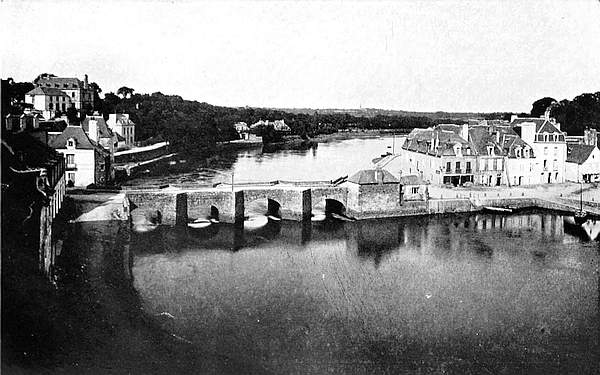
THE BRIDGE, AURAY
Within an easy stroll from Auray is the
Chapel de Ste. Avoye. Here, according to
legend, the Saint, who is the same as the Cornish
S. Ewe, arrived in a stone boat from Britain.
The chapel is surrounded by a few farmhouses
and trees. It is a renaissance structure. The
W. tower consists of only three sides, two bold
buttresses carried up a great height, with a back,
sustaining a pent-house roof, which in turn
supports a spirelet of slate. The arrangement
is probably unique. There was a porch below,
but it has fallen. The tracery has been removed
from the windows, and some good stained glass
sold. Within is a fine but late screen with the
twelve apostles on one side and cardinal virtues
and other allegorical figures on the other. In
the nave is a piece of the so-called "boat of S.
Avoye," in which she is supposed to have come
over. Actually it is, probably, a large grinder
for corn polished within. On it are cut three
symbols, one a cross, one like a T, and the
third like I. Children that are delicate are
placed in the "Boat" to recover strength.
Over the altar is a painting representing S.
Avoye in prison fed by the B. V. Mary.
There are two Pardons, the principal on the
1st S. in May, the second on the 3rd S. in
September. Outside the chapel are stone benches
along the wall. In Breton the Saint is Santez
Avé.
Ste. Anne d'Auray is a great pilgrimage resort,
with a pretentious modern church in nondescript
style intended for renaissance, 1866-75, with
bad glass. In 1623 a peasant dug up an image,
probably of one of the Deæ Matres of Gallo-Roman
times, so common in Brittany, at a place
called Ker-anna. He jumped to the conclusion
that it represented the mother of the B. Virgin.
The Carmelites heard of it and resolved on
making capital out of it; they ran it with great
success and built a convent and church on the
spot in 1645. The statue was destroyed in
1790, but the cult continues unabated. The
Pardon is on the Sunday after July 26, and
attracts vast crowds. In front of the church
is a Santa Scala copied from that at Rome,
and indulgenced with nine years for every step
ascended by pilgrims on their knees. A large
tank receives the miraculous spring of S. Anne,
and is dominated by her statue. The pilgrims
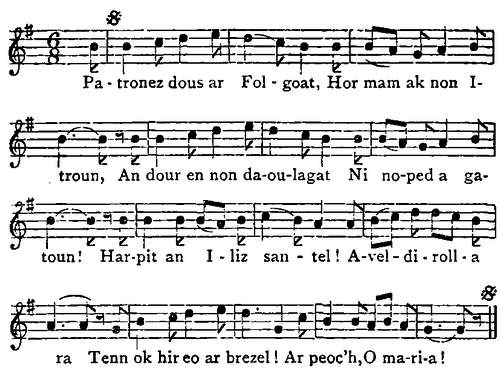
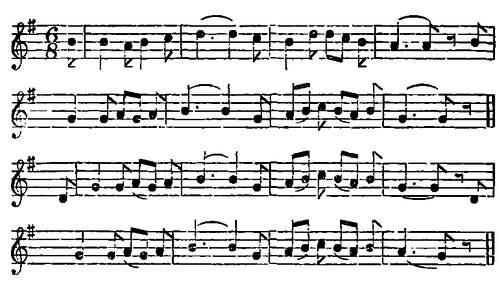
sing lustily the cantique of Ste. Anne d'Auray
to this air:—
There is here a statue of the Duc de Chambord
(1891) in bronze, flanked by those of Bayard,
Du Guesclin, Ste. Geneviève, and Joan of
Arc.
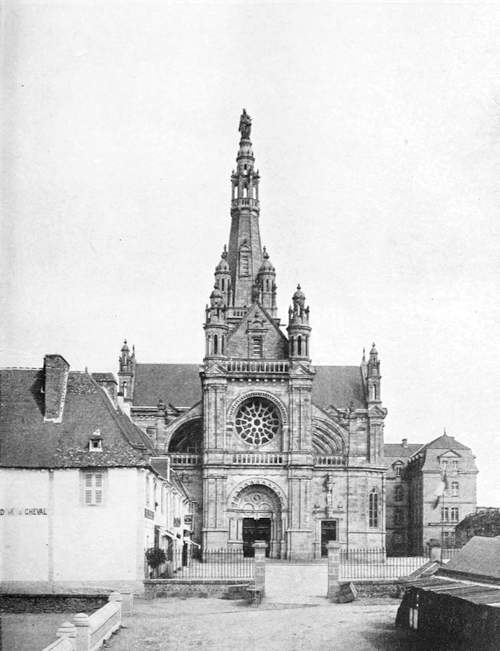
STE. ANNE D'AURAY
The Chartreuse near the Auray railway station
is now a deaf and dumb asylum. It occupies
the site of the battle in which, in 1364, Jean de
Monfort defeated and killed Charles de Blois.
He founded the monastery, but only a small
portion of the old structure remains. Here is
the chapel, on the N. side of the church, in
which rest the bodies of the royalists who had
been landed from English transports at Quiberon,
and whom Hoche and his republican soldiers shot
down in cold blood to the number of 952
between 1st and 25th August 1795. The
butchery took place not far from the Chartreuse,
and the bodies were buried on the spot since
called le Champ des Martyrs. In 1814 they
were transferred to this chapel erected to contain
them. It was completed in 1829. In the
midst of the chapel is the mausoleum of white
marble.
The chapelle expiatoire is situated at a quarter
of an hour's walk from the Chartreuse and is
in the Greek style, and is on the site of the
massacre. Near by is a cross commemorative
of Montfort's victory over Charles de Blois.
Plougoumelin. The parish church modern
and bad. The Chapel of N.D. de Becquerel
has a fine west porch of the Breton commingling
of flamboyant and renaissance. An unfailing
spring issues from under the wall of the apse.
The water is thought to cure diseases of
the mouth. Several lechs are in the parish.
One called the Pierre du Serment is about 4
ft. 6 in. long, is in the churchyard and lies
prostrate. Another is between the parsonage
and the cemetery, and a third, round, with three
hollows sunk in it, is at the presbytère. A
tumulus by the river of Auray at Le Rocher
covers an allée couverte. There are six others,
smaller, in a line with it running from S.W.
to N.E. They have yielded copper vessels and
flint weapons, and belong to the intermediate
age, before alloy was introduced for the
formation of bronze.
Crach. Here in the commune are numerous
prehistoric remains. Rather over a mile from
Auray on the road to Crach is a fine dolmen,
the coverer 22 ft. long, and having on it a
circle of hollows. Other dolmens at Keryn,
Kergleverit, and Parq-er-Gueren, near the Chapel
of S. Jean. Several menhirs on the common.
The Château de Plessisker is of the 17th cent.
P. at Crach on the 1st S. in July. See also
Locmariaquer.
Bain (I.V.) chl. arr. Redon, on the Route
nationale from Rennes to Nantes. In the
cemetery a cross of the 16th cent. Château de
la Noé of the 15th cent. By a little lake are
the remains of a castle converted into a farmhouse.
* BAUD (M.) chl. arr. Pontivy. A district
in which much hemp is grown and cordwaining
is carried on. The women wear coiffes like
sunbonnets, and sabots with leather toe-pieces
and straps neatly embroidered. The church,
a mean structure of 1687, is about to be pulled
down. It is dominated by the far more stately
Chapel of N.D. de la Clarté of the 16th cent.
Vaulted throughout with very peculiar straight
groining and vaulting in the S. aisle. The
chapel has an apse, the tracery has been removed
from the windows and the old stained glass got
rid of to make way for sad modern rubbish.
The tower is later than the chapel and is unfinished.
A huge ducal crown of Brittany is
suspended in the apse. The crown is closed
above, a right claimed by the dukes. P. 2nd
July.
In the woods of the old château of Quinipili
(guide advisable) is the rude granite statue of
the famous Venus of Quinipili removed from
Castannec on the Blavet. It is 6 ft. high, with
the hands crossed over the breast and with a sort
of stole hanging down in front, and a band
about the head on which are cut IIT. The
statue, which received idolatrous worship, was
transferred in 1695 to Quinipili, by Count Pierre
de Lannion, along with a huge granite basin that
stood before it. He set it up on a pedestal in his
grounds and cut a pseudo-classic inscription on
the base. As the original statue was indecent,
he set a sculptor to alter it, and probably the
stole is due to this man's chisel.
Camors. There are two dolmens in the
forest, and an allée couverte at Kerpenru. Of
menhirs, one is on the lande of Penher, three
at Kerguelen, a stone-row of twenty uprights
at Kernoul. Seven menhirs in the wood at
Floranges, and six in the forest of Camors.
At Porhoet-er-Saleu, are the remains of the
castle of Conmore, Count of Poher, and regent
of Domnonia. He is regarded as the Bluebeard
of Brittany, although he was actually only
thrice married, to the sister of Jonas, King of
Domnonia, to that of Meliau, King of Cornouaille,
and lastly to Triphena, daughter of
Weroch, Count of Vannes. This latter marriage
was effected by the persuasion of S. Gildas.
Conmore, however, so ill-treated his wife that she
ran away to her father at Vannes. Gildas, who
was at the time at Castannec, was furious with
Conmore, and local legend asserts, that he came
before this castle, gathered up a handful of earth,
and casting it against the walls cursed it, that
it should never again be inhabited. S. Triphena
is invoked in the neighbourhood by women with
troublesome husbands, and little wooden crosses
may be found on the site of the castle set up by
them in token that they have made a vow to
S. Triphena to rid them of their annoyance.
The church of Camors is dedicated to S. Senan,
abbot of Iniscathy.
Guénin. The church is of 1773. The Chapel
of N.D. de Menez-guen is flamboyant but late,
1577, with alterations made in 1604 and 1751.
It is a cross church with a central tower. One
descends by several steps into the chapel. Lean
and lanky girls go to it and pray for fat to be
laid on. P. 1st S. in July. Pilgrims take water
from the fountain to give to their cattle.
Questinic. Chapel of S. Mathurin, P. 2nd
S. in May. Chapel of Locmaria, renaissance
1574, a cross church with central tower and
spire, and some old glass.
Bieuzy. The station of S. Nicolas des Eaux
gives access to several points of historical and
architectural interest. The train from Auray
to Pontivy cuts by a tunnel through a neck of
land round which the river Blavet makes a great
loop. This loop was occupied in Roman times
by a walled town Sulim, of which numerous
remains have been found; and the sides are so
precipitous that no enemy could attack it, save
on the north. The road from the station to
Bieuzy has been engineered by a great sweep up
the height, but the pedestrian can ascend to the
Chapel of La Trinité by a sharp scramble, and
by clinging to the broom and heather. This
finger of land, almost surrounded by the river on
all sides, was covered with ruins in the beginning
of the 6th cent. S. Gildas came hither from
Rhuys about the year 530, and founded a little
colony of monks where is now the hamlet of
Castannec. Finding that there was a gross
image of Venus among the ruins that the people
worshipped, he and Budoc (Bieuzy) his disciple
threw it down and rolled it along to their
monastery and built their wall over it. The
image remained buried thus under the wall till
the ruin of the monastery by the Northmen, and
perhaps for some time after. Castannec was
never restored to any extent, by the returned
monks of Rhuys. In 1125 Castannec was made
into a parish, and the church was where is now
the Chapel of La Trinité, and it was served by
the monks of Redon, but the population was
small and the revenue insufficient, and was
united to Bieuzy. Then it was that in removing
the remains of the old priory the image of the
Venus was restored to light, and at once received
a religious cult from the peasants, who called it
Groah en Goard, the Woman of la Couarde,
which is the name of the promontory. It was
placed near a large basin scooped out of granite,
and in this women came to bathe, invoking the
assistance of the Venus of Couarde. In 1661
a mission was held at Baud, and the missioners
besought Count Claude of Lannion to destroy
the idol. He had it accordingly rolled down
the hillside into the river. However, the
peasants fished it up and replaced it in 1664.
Then the Bishop of Vannes interfered, and at
his request the Count sent masons to smash it.
They, however, contented themselves with injuring
one arm and one of the breasts and again
rolled it down into the Blavet. In 1695, Pierre
de Lannion, who had succeeded his father, drew
it forth from the water and had it conveyed to
Baud to ornament his château of Quinipili;
and there it remains to the present day with
the granite basin before it, but not in quite the
same condition, for, as has been said already, the
Count employed a sculptor to work the statue
over and give it a more decent appearance.
Near the Chapel of Ste. Trinité a path leads
to the hermitage of S. Gildas. It is advisable
to obtain a child as guide. The Saint with his
disciple Budoc, or Bieuzy, was wont to retire to
a cave under an overhanging rock beside the
Blavet during Lent, and at certain times when
he desired to be private. He built up the face
of the cave and divided it into two parts, one
for himself and one for Bieuzy. A chapel was
added in the Middle Ages, and this was restored
in 1837. It consists of two parts, and is under
the rock in a most picturesque situation. The
bell is attached to the rock. The structure is
of the 15th cent., but the E. window and an
arch are 1st pointed (perhaps the window is
due to the restorer) and there are rude windows
round-headed, that may possibly be of a still
earlier date. An arch divides the chapel into
two with an altar in each. In the outer chapel,
on a pedestal, is the bell-stone of Gildas, a slab
of diorite, on which stands a couple of pebbles,
and when the stone is struck with these it rings.
At Mass on the day of the Pardon, Whitsun-Monday,
and on S. Gildas's day, Jan. 29, the
bell-stone is used for ringing at the Sanctus,
Elevation and Communion. On the left side
of the principal altar is a block of rock and
masonry used for the pain bénit, which is distributed
among the pilgrims. There was another
bell-stone, that of S. Bieuzy himself, but this
was carried away, and broken in the transaction,
by a seigneur of Kervèno in 1660, but the rector
reclaimed it and in 1702 succeeded in recovering
it, and it is now placed in the churchyard of S.
Bieuzy near the cross. The church of Bieuzy
has a modern spire and nave. The choir and
transepts are renaissance of 1560. There are
three superb stained glass windows of this date
in the apse representing the scenes of the Passion;
one subject, the Risen Lord, appearing as a
gardener to the Magdalen, deserves notice.
The S. door of the church is flamboyant with
a flamboyant window above. A S. door, blocked
in the choir, has some lovely flamboyant foliage
on it. There is a picturesque renaissance house
opposite the church. It is worth the visitor
noticing the type of well in all this district.
The structure of granite for the support of the
drum for the chain is very striking, and there
is an excellent example in a yard near the E.
end of the church at Bieuzy. A few yards
from the village is the Holy Well with a niche
for the Saint. The water is sought for those
who are off their heads.
Returning to the station, S. Nicolas des
Eaux is next visited. The chapel is in a
very dilapidated condition. It is a flamboyant
cruciform structure (1524) with a fine double
doorway and with foliage about it, and
with late flamboyant tracery in some of the
windows, but from most it has been hacked
away.
S. Nicodème is perhaps the most beautiful
example of flamboyant in Morbihan. It was
completed in 1539, and a bell bears the date
1507 which is about the date of the spire and
tower. The west entrance under the tower is
peculiarly bold and beautiful, with its lace work
fringed arch. A flight of steps leads down to
the chapel, and on the left is a singular Holy
Well, composed of three gabled structures united
at the back. The date on this well is 1608,
but it is impossible to hold this to be the true
indication of its erection, and must commemorate
a reparation, for the character of the sculpture
and the general design are of a century earlier,
and in its quaintness and originality indicate
the same master hand that had planned and
drawn the marvellous tower and spire. The
three fountains are to (1) S. Gamaliel with an
ox at his side and a biniou player; (2) S.
Nicodemus with a human-headed ox by him;
and (3) S. Abibo with a horseman at his side.
Hard by is an immeasurably inferior Holy Well
to S. Cornelius, constructed in 1790.
The chapel itself is not equal in beauty to
tower and spire. It contains a minstrel gallery
of stone in the N. transept. The altarpieces
are bad rococo. Two little oxen are stuck up
against the N. wall of the chancel to commemorate
the success of an invocation to S.
Cornély. There is a very curious retable at
the side representing the Resurrection. S.
Nicodemus is represented carrying a napkin,
three nails and with a heraldic wreath about
his head. Most of the windows have had their
tracery removed. The Pardon here is very
famous and largely attended. The first Saturday
in August is held as a great fair here, and at
it girls sell their hair. Young women wearing
black caps and not coiffes are such as have
parted with their natural ornament. On the
Sunday following is the Pardon. An angel
descends from the gallery of the spire and sets
fire to a great pile of brushwood and firework
hoops.
Bubry. The church is modern and bad, near
it are two lechs, one with four equal faces, and
the other has a cross pattée on two faces. The
ossuary is full of skulls arranged in order. In
the "place" is a great granite basin fed with
water from the fountain of S. Helen. The
Chapel of S. Yves is five kilometres to the south
of this village, and is in a jumble of flamboyant
and renaissance. The date 1598. This chapel
drew so many pilgrims, and such abundant
donations, that the near-by Seigneur de Kernivinen
became jealous, and going to the chapel
one day of the Pardon, fell on the rector and
boxed his ears, because he refused to give up to
him a share of the spoil. This was in 1630.
He was put into the ecclesiastical court and
condemned to restore 10,000 livres which he
had carried off from the chapel, and to pay a
fine of 2000 which was to be given to the
hospital. P. of Ste. Helene, 4th S. in July.
This is spoken of as well attended.
Melrand. The Chapel of Locmaria is fine.
It has a bold, square tower surmounted by a
spire: it is all of flamboyant work with a few
details showing that the renaissance was at hand.
The E. window, partly hidden by a retable of
1680, contains in twelve tableaux scenes from
the Life and Passion of our Lord. In the N.
transept window is a fine Jesse tree, in one of
the S. transept the angelic salutation. Near
the chapel is a Holy Well of 1574. P. at
Guellouët in Melrand, 1st Sunday in July.
Becherel (I.V.) chl. arr. Montfort. On
high ground. In the church a Romanesque
font. Old gateway, 16th cent. House of the
Little Sisters of the Poor is here. The headquarters
or Mother-House. Les Iffs has a church
of the 15th cent. containing nine windows of
superb stained glass, the finest in the Department.
The tower is of the 16th cent. On a height is
the Château de Montmuran of various dates. In
the chapel, Du Guesclin was dubbed knight in
1354. He married Jeanne de Laval, granddaughter
of the Countess of Montmuran, for
whom he defended the castle against the English.
The E. window of the chapel is good early
flamboyant and contains fine old glass. The
château is very picturesque. The Château
de Caradeuc, partly ancient, in a park with
fine trees, and well kept, has within, among
other paintings, two Murillos.
Begard (C.N.) chl. arr. Guingamp. A
Cistercian abbey was founded here in 1130
by Stephen III., Count of Penthièvre. It
was rebuilt in the 17th century, except the
Romanesque church. It is now a lunatic
asylum. According to local tradition, Begard
was first settled by such ragged hermits that
the place was called after them, a settlement of
"Beggars." A menhir is at Kergouézennic
18 ft. high.
Kermoroch. The chapel of Langoerat,
1373, has in it stained glass and paintings.
There are ruined castles at Perrier and
Leshorz.
Pedernec. A ruined castle at Runangoff.
The Chapel of N.D. de Lorette dates from
1514. A 16th cent. manor house at Kermathaman.
A menhir 25 ft. 6 in. high.
Belle Ile (C.N.) chl. arr. Guingamp.
Prettily situated in the valley of the Guindy.
The church is modern, the old church is turned
into halle. The Chapel of Locmaria is made
into the cemetery chapel. It stands on a rocky
height above the river and the road to Trégrom.
It is late flamboyant, the pillars are surrounded
by stone seats. The W. door has boldly carved
foliage in coarse granite. The roodscreen, with
figures and foliage in the panels of the gallery,
has been removed to the W. end.
Plounevez-Moedec on very high ground,
traversed by the main road from Paris to Brest,
straight as a bowstring. The church has a
2nd pointed arcade and E. windows and
N. aisle. The rest flamboyant. The gallery
at the W. end is one removed from the chapel
of Keramanach, with the vaulting wantonly
taken away. The tower, renaissance, has been
restored recently. The chapel of Keramanach
(S. Fiacre) may be visited equally well from
Belle Ile or from Plouaret. It is late 2nd
pointed with square end, E. window and S.E.
window of same period, as also N. aisle. There
are remains of good stained glass in the windows.
The porch has rich 16th cent. groining. The
W. bell turret has a gallery. The chapel
contains a fine alabaster reredos of the 15th
cent., each panel has been let into a wooden
frame. On the road from Plounevez to Trégrom
is a menhir 30 ft. high.
Locquenvel. Church of 15th and 16th cents.
with stained glass representing the legend of S.
Envel.
Belz (M.) chl. arr. Lorient. In very
desolate country. The road from Auray runs
through plantations of Austrian pine grown for
the Welsh collieries, or over furzy moors. Belz
itself is an utterly uninteresting place, with an
ugly church, and a ruinous but large chapel near
it. Belz lies, however, near the curious inland
sea of Etel, and was formerly head of a pou
or pagus. A mile and a half beyond Belz is
the hamlet of S. Cadou, occupied entirely by
fishermen and their families. The women wear
scarlet petticoats which they take care to display.
A stone causeway 140 ft. leads to the Isle of
S. Cadou and his chapel. S. Cadoc, son of
Gwynllyw, King of Gwent or Monmouthshire,
arrived here about 525 and founded a monastery
and school on the island. To facilitate the
passage and repassage of his pupils he constructed
the causeway, having learned the art
of dyking at Llancarvan. It was here, pacing
it with Gildas, that they discussed the salvability
of Virgil. Cadoc, who loved that author, could
not believe that he was lost, but Gildas held the
harsher view. As they talked, Cadoc turned
over his Virgil to point out some remarkable
passages, probably the prophecy of the Incarnation,
to his friend, when the wind swept the
volume out of his hand into the sea. He slipped
in rushing to recover it, and some pieces of iron
in the causeway are supposed to indicate where
his foot slid. Only with difficulty did Cadoc
recover the precious book. The chapel has
an early Romanesque apse, with rudely carved
capitals to the pillars supporting the chancel
arch. The chapel was much spoiled at its
alteration in 1842. In the S. transept is the
stone bed of S. Cadoc with a receptacle under
it, in which strange sounds are thought to be
heard. These are due to the echo of the waves
and winds. The gallery of the flamboyant
screen has been removed to the W. end. In
the nave are four paintings. (1) S. Cadoc
arriving at the isle; (2) S. Cadoc settling on
it; (3) Pirates land and he protests that he
has nothing; (4) Cadoc departing, with the
inscription:—
Oratoire mon œuvre adieu, dit-il pleurant,
Belz t'oublierai je? Non. Il cingla de céans.
P. S. after 21st Sept. Numerous megalithic
remains are to be found about Belz. A menhir
at Kervoen, another at Mélionec; remains of an
allée couverte 30 ft. long at Kernours; a dolmen
in good condition at Kerlutu; others at Kerhuen,
Kervoen and Kerlourd. At Crubelz in a
tumulus is a chamber of masonry nearly 11 ft.
high. Roman bricks were found in it, and it
would seem to have been constructed in Gallo-Roman
times, but in accordance with earlier
traditions and usages.
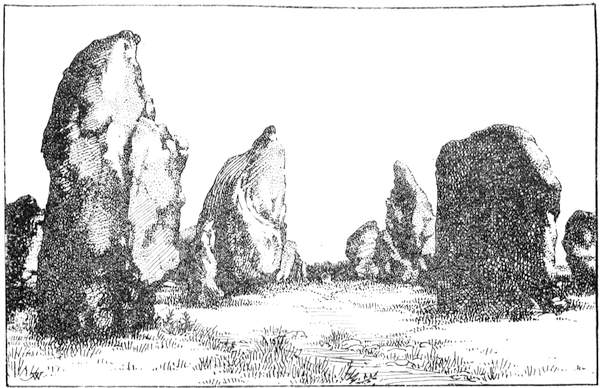
LINES OF ERDEVEN
Locoal, on an arm of the sea of Etel, united
to the mainland by a causeway like that at S.
Cadou. Locoal was a locus penitentiæ of S.
Gudeval or Gurval, Bishop of Aleth. He
scooped out a cave and dwelt therein. Disciples
came to him to the number of 188. To protect
themselves against the high tides they erected
the dykes that still remain. At length, desiring
greater retirement in his extreme old age,
Gudeval retired with seven disciples into the
forest of Camors, where he died in 640. Some
lechs remain; one near the cemetery is 4 ft.
high, with a cross cut on it in relief, surmounted
by a circle and cross. Another on the way
from Locoal to Mendon, 7 ft. 6 in. high, with
two crosses cut on it, bears on it the words
CRUX PROSTLON; it is the tombstone of the wife
of Count Pasquitien, the murderer of King
Solomon. She died in 875. The parish
church was burnt by the Spaniards in 1592,
and again accidentally in 1765.
Etel, at the mouth of the channel that
connects the inland sea with the ocean, is a
small port partly closed by a rock and by
moving sands. Near the village is a dolmen
with seven supporters. A little further on is
one with five.
Erdeven (Ar deven = on the sand-downs).
All this district is covered with wind-blown
sands. The most remarkable prehistoric monument
is the alignment of Kerzerho, which
extends over two miles and a quarter, and is
composed of 1030 stones, with, however, gaps
caused by pilferers. Unhappily the stones are
still being broken up and carried away. The
lines are on the S. and S.E. of the village.
After passing an isolated menhir and a ruined
cairn, the rows are reached running east. Then
comes a gap where the stones have been carried
off to build walls, but presently they reappear,
the blocks smaller. Then ensues another hiatus,
and then another succession of ranges of fine
stones stretching to a tumulus. The northern
line reaches to a tumulus, the Mané Bras. On
the summit are the ruins of two dolmens, with
traces of an enclosing circle of uprights. To the
east of Kerangre is another group of monoliths.
At Mané Groh are two dolmens. The dolmen
of Corcomo is the finest in Morbihan.
Plouhinic. Near Kerfourchen two fallen
dolmens and a menhir. From the windmill to
the west alignments running S.E. Near the
Mill of Gueldra the lines recommence in eight
rows, and may be traced to Kervué and
Kervelhué.
Bourbriac (C.N.) chl. arr. Guingamp.
The church is in part Romanesque, and possesses
a crypt. The windows are of 15th cent. The
tower 1635. At Tanvedou is a tumulus enclosing
a dolmen.
S. Adrien. Chapel of Avangour, 1576, with
marble retable of same period.
Cadout (S. Illtyd). Church of 14th and
15th cents., with a sculptured retable. On high
ground the manor house of Bois-de-la-Roche,
15th cent. restored.
Bréhat (Isle de) (C.N.). Opposite
Roscoff lighthouses. On the Isle of Lavré
the remains of a Celtic monastery have been
traced, consisting of a group of bee-hive huts
and an oblong chapel. One hut is fairly perfect,
and is kept in repair as a sea mark. In the
church is preserved a piece of oriental silk called
the stole of S. Pol de Léon.
* BREST (F.) chl. d'arrond. Was a fishing
village about a mediæval castle on the site of a
Roman camp, till Cardinal Richelieu resolved on
giving to France the command of the seas, when
he fixed on Brest for a great dockyard, 1631.
His undertaking was not followed up by
Mazarin, but Colbert pursued it with energy,
and extensive works were executed. Thanks
to this great minister and to Admiral Duquesne,
Brest became a naval and military port of the
first class. The Breton parliament had not
relished the undertaking, and forbade the delivery
of timber to the royal works, and ordered
the cessation of the forging of cannon, but the
royal will was supreme, and the opposition of
the parliament disregarded. The port was
extended, and the rocks blasted; barracks,
storehouses, workshops, were created, and fine
quays were constructed. Vauban fortified it,
Recouvrance was united to Brest by a turning
bridge. From Brest issued a fleet of 80 ships
of the line under Tourville in the naval campaigns
of 1690 and 1691. In 1694 an Anglo-Dutch
fleet in vain attempted an attack on Brest. In
the 18th cent. its quays and fortifications were
extended. Granite basins were constructed
capable of receiving vessels of 120 guns. Dajot,
whilst engaged on the defences of the place,
constructed the terrace planted with elms, that
gives such a fine view of the harbour. Issuing
from Brest, the fleet commanded by d'Orvilliers
met, July 27, 1778 the English fleet off
Ouessant. A French convoy was guarding a
fleet of vessels laden with grain from America,
when it was attacked by Admiral Howe. The
French were under Admiral Villaret de Joyeuse.
The English fleet, which had been in quest, had
been for four days unable to find the French
owing to fog. The engagement took place on
the 27th July. There were 26 French men-of-war
and 35 English.
After Trafalgar Napoleon abandoned the
ambition of making France a great naval power,
and it was not till under Napoleon III. that
fresh activity was displayed at Brest.
The harbour is perhaps the finest in Europe.
It is 36 kilometres in circumference, and is
entered only through the channel of the Goullet,
illumined by five lighthouses.
The castle of the 13th cent., on a precipitous
rock, is flanked by seven towers; the two largest
are on the N.E., and the entrance is between
them. The tower of Azenore belongs to the end
of the 12th cent., and takes its name from the
mother of S. Budoc, who was daughter of the
Count of Léon, and married to the Count of
Goelo. The tower of Caesar of the 12th cent.,
that des Anglais is of 1374, that de la Madelaine
is of the 15th cent., as is also the donjon.
Brest, apart from its dockyard, is a very
uninteresting place. The Church of S. Louis
(1692-1778) is ugly, with modern stained glass
in the French style representing Breton saints.
But Brest may be made a centre for some interesting
excursions, as to Landevennec, which is
more easily reached from Brest by steamer than
by road.
Landevennec is where a very important
abbey was founded by S. Winwaloe, in French
Guenolé, at the beginning of the 6th century.
The Saint had settled first in the islet of
Tibidy, but finding the place too strait for
him, came to Landevennec, where King Grallo
granted him lands in a warm and sheltered
situation, under a hill that cut off the blasts from
the Atlantic. The ruins are in private grounds,
but visitors are admitted. The abbey church is
of the 11th cent., and is without transepts, but
has a large chapel of a later date built on at
one side. In a crypt is the reputed tomb of
King Grallo. The monastic buildings were
rebuilt in the 17th century. The Grève des
Anglais is so called because it was here that
landed an expedition against Brest which failed,
because betrayed to the French Court by Marlborough
and Godolphin. The consequence
was that eight hundred British soldiers fell into
a trap and were butchered to the last man.
Goueznou. Here is the sole church near
Brest that possesses any archæological value.
But it is a really remarkable edifice. It has the
finest apse in the Department, next to Lampaul-Guimiliau,
containing three great gabled late
flamboyant windows. The church also possesses
a tower with two galleries crowned by a spire.
The porch was begun in 1643, and belongs to
the same family as those of Landerneau and
Trémaouézan. It was finished in 1644, so that
there was no long delay in its completion. The
main body of the church was constructed in
1607-15. About ten paces west of the church
is the monumental fountain of the Saint. It
consists of a tank in an enclosure surrounded by
stone seats for the accommodation of bathers.
On the south side is a small altar surmounted by
a niche, that contains a statue of S. Gouezenou.
P. Ascension Day. Lambezellec, with a modern
church, has a much frequented Pardon on the
2nd S. in August. Plouzané. Lechs and
menhirs. P. Sunday nearest 10th Aug.
Guipavas. The church possesses a porch
enriched internally with statues, 1565.
Le Conquet. Modern church, but with glass
of the 16th cent. preserved in it. In it is the
tomb of Michel de Nobletz, a famous Jesuit,
born 1577, died 1654, whose beatification is
proposed. He laboured in Lower Brittany to
turn the people from their pagan superstitions.
On the promontory of Kermorvan two dolmens
and a circle of upright stones.
Plougonvelen. Fine coast scenery. Here,
in an imposing position above the sea, are the
ruins of the Abbey of S. Mathieu. The
monastery was destroyed at the Revolution.
The church (1152-1208) was much altered in
the 14th and 15th cents. The abbey was
founded in the 6th cent. by S. Tanguy. Near
it is now a lighthouse. Of the parish church
the only portions that are ancient are the porch
and the N. transept. P. Sunday nearest 21st
Sept. Off the promontory can be seen the
clusters of islands leading in a N.W. direction
to Ouessant. Of these the Ile de Banque, le
Guéménés, and the Ile Molène are the principal.
Ouessant and these islands can be reached from
Conquet, a steamer leaving there thrice a week.
The Ile Molène is only three-quarters of a mile
long and about half-a-mile wide, and contains
570 inhabitants. Property in it is minutely subdivided.
It was here that the bodies were
washed ashore after the wreck of the Drummond
Castle on June 16, 1896. The Ile d'Ouessant is
about seven miles long and three broad; plenty
of fresh water is found on the island, that contains
2280 inhabitants. It was here that Paulus
Aurelianus, a native of Glamorganshire, landed
when migrating from Britain at the head of a
considerable party. He, however, did not
remain above two or three years in the island,
and then crossed over to the mainland. The
church Lampaul (Lann-Paul) on Ouessant was
founded by him. The cliffs are abrupt, and the
rocks pierced with caves and natural arches.
The island produces potatoes, and gives good
feed to sheep. It is in process of being
extensively fortified for the protection of
Brest.
Broons (C.N.) chl. arr. Dinan. Bertrand
du Guesclin was born here in 1320. The
castle has completely disappeared, but a column
has been erected on the site in commemoration
of the fact.
Sevignac. The Château of Brondineuf of
the 12th cent. is well preserved.
Cancale (I. V.) chl. arr. S. Malo. A little
port, and a favourite watering place. It is noted
for its oysters. During one part of the year
nearly all the male population is absent on the
banks of Newfoundland engaged in the cod-fisheries.
The rochers de Cancale are a mass of
granite rising precipitously above the sea not
far from the mainland. Much granite is quarried
at Cancale. The church of S. Méen is modern.
* CARHAIX (F.) chl. arr. Châteaulin.
An old Roman town, Vorganium, lies high and
in dreary country. Scanty remains of a Roman
aqueduct are pointed out. The church (S.
Tremor) is modern and good, with a fine East
window; the tower is of 1529-35, with a
West doorway, the carving of foliage on which
is deserving of notice. More interesting is the
church of Plouguer, originally very early in the
11th cent., containing some arches and piers
and clerestory windows. It was enlarged in the
16th cent. (1574), and was ruthlessly mutilated
in the 18th when the flamboyant tracery was
hacked out of the windows, and the screen was
demolished. The tower is remarkably fine,
with bold splayed belfry windows. It was
intended to support a spire which was never
added. There is a handsome old house in the
town of carved stone and timber. P. at S.
Roque last S. but one in August.
Carnoet on very high ground. Here is the
peniti or place of retreat of Gildas with a
chapel, by the river, and high up in a clump of
trees under a camp that dates from the invasion
of Brittany by the Northmen, is a curious chapel
of S. Gildas of late flamboyant melting into
renaissance. It has a W. spirelet, gallery and
two bells, the spirelet sustained on an arch.
Within, sunk in the pavement, is an 11th cent.
sarcophagus, reputed to be the bed of S. Gildas,
who died in 570. In the N. aisle is a range of
six stages of fowl hutches. On the Pardon,
29th Jan., the peasants make offerings of fowls
and horsehair; the former are put into these
hutches where they cluck and cackle through
mass, and then are sold by auction for the benefit
of the chapel and its maintenance. The camp
above is an admirable typical example of the
Norseman fortress, consisting of a tump,
hollowed out in the middle, that sustained a
wooden superstructure; and a base-court.
Cleden-Poher has a large church of the
middle of the 16th cent., but with alterations
made in 1689, at which date the sacristy was
built. It has a fine west porch, and in the
apse a good flamboyant window in six bays with
a column up the centre against which, within,
stands a statue. In a Chapel of N.D. de
Cleden the vault is covered with paintings of the
18th cent. The high altar has a retable into
which are let sculptured panels of the 16th cent.,
and others, representing the seven sacraments,
are about the apse. The venerated image of
N.D. dates from the 14th cent. The Calvary
in the graveyard is of 1575. At the N.E.
corner of the churchyard is an ossuary, transition
between flamboyant and renaissance.
P. 15th Aug.
Treffrin (C.N.) possesses a fine Roman
camp at Kermoisan, with remains of a tower in
it. The Church of N.D. is of 1580, the porch
of 1582, richly decorated, and contains niches
within containing statues of the twelve apostles;
the corbels supporting them are all different in
design.
Locarn. The church is of the 12th cent.
with additions and alterations of the 16th. It
contains the tomb of the patron, S. Harn, in
granite, 14th cent. The east window has stained
glass of 1572 representing scenes of the Passion.
The pulpit is renaissance, syrens occupy the
angles. There is a Holy Well with an early
statue of the Saint above it. A Calvary, the
base ornamented with sculptured dolphins. In
the presbytère is a magnificent silver-gilt processional
cross of the 16th cent. In the parish
are several menhirs, at Quellence Buis, Loquevel,
Grand Follezon, etc., but of no great height.
Le Moustoir (C.N.). Church of 1507, in
the shape of a T. The cornice, on which rests
the vault, represents grotesque figures and groups.
The E. window retains its old glass, representing
the Life of the Virgin. In the tracery
are the four great prophets. On the N. side a
fireplace for heating the water for baptism.
Maël Carhaix (C.N.). On the Place is a
Roman military milestone with inscription stating
that it was erected in the reign of Septimius
Severus. The Church of S. Pierre (1530) has
old stained glass representing the Fathers of the
Church and Bishops. The glass is of the same
date as the church. At Maël Carhaix is the
cave whence issues the spring that supplied
Vorganium with water by an aqueduct.
* CARNAC, com. of Quiberon. Noted for
the vast numbers of its prehistoric monuments.
It lies on the low flat shores of the Baie de
Quiberon, and is a great place for the cultivation
of oysters. To obtain a good general view
of the place it is well to ascend first of all the
Mont S. Michel, a huge cairn piled up over a
natural elevation of granite. It is oblong in
shape and rises to about 60 feet. On the summit
is a chapel of the Archangel, with an old granite
cross. The mound was dug into in 1863 when
a dolmen was discovered that contained over a
hundred polished stone axes, a necklace, and
other objects of the early bronze age. Further
excavation in 1890 has disclosed another dolmen,
in which, along with some stone implements,
were two bronze buttons. The cairn is built up
carefully of stones laid in order over a sheet of
pebbles, and above them more of the same and of
seaweed had been spread, and then above this fresh
stones have been piled. From the summit the
alignments of Carnac can be seen on the north.
To visit these latter the following course should
be pursued. Take the road to Ker Malvezin, and
in a few minutes, on a bit of rising ground on
the left is seen a dolmen on which a cross has
been erected. Very soon after the road traverses
the lines of Le Menec. There are still standing
eleven of these rows and they run from E.N.E.
to W.S.W. The total length is 3510 feet,
and there are 1169 stones in them. The tallest
of them is 13 feet high, but the majority from
3 to 4 feet. It is well to turn to the left and
pursue the rows to the western extremity where
is a semi-circular enclosure, evidently not in its
original condition, and it is doubtful whether it
be not a modern erection made out of stones
pilfered from the rows to form a farm enclosure
attached to the farm of Le Menec.
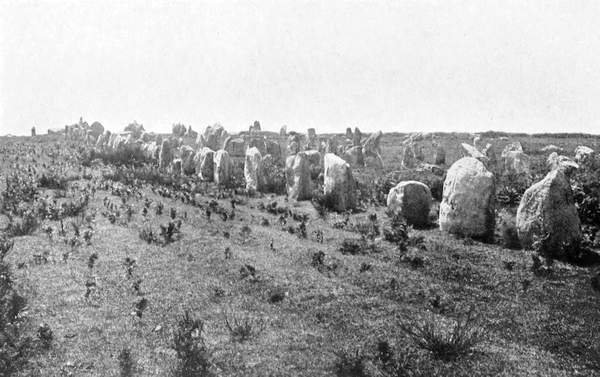
THE LINES OF CARNAC
Having retraced our steps to the road, we
cross it and follow the avenues of upright stones
till we reach and cross another road, that to
Ploemel. The road has broken through the
lines, which continue only a few yards to the
east, and then are brought to a conclusion by
blocking stones, that is to say, slabs set at right
angles to the lines. From this point ensues a gap
for about 345 yards where is a little plantation of
Austrian pines, a stone quarry, and some furzy
enclosures. The lines are not, however, wholly
interrupted; a few upright stones and several
that are prostrate testify that there was some
continuation. We follow a new road through
the plantation and between walls till we come
abruptly on a fresh cluster of stones, and these
the largest we have yet seen. This is the
commencement of the Kermario group. These
started from several tumuli enclosing dolmens,
but of such only one, an allée couverte pertaining
to the southernmost line, remains. The lines
though mutilated are instructive. They start from
this allée couverte and run about 250 yards to a
pair of blocking stones, planted at right angles
to the rows. The Kermario alignments run
N.E. up a hill crowned by a disused windmill
that has been constructed out of the blocks, then
they continue some way till walls and a wood
interrupt their course. Ten rows remain, and
the number of the standing stones is 982. The
largest of the menhirs is prostrate; apparently
it had been purposely thrown down to form a
coverer to a Gallo-Roman grave that has been
discovered beneath it. What is of special
interest is the fact that a Roman camp was
formed in these lines, and that those who constructed
the camp made use of the stones for
their wall of enclosure, breaking up some, and
employing others in their original position where
it served their purpose. From the easternmost
end of the Kermario group occurs an interruption
of about 398 yards, and then we come
upon a third set of stone rows, that of Kerlescant,
which stretches 885 yards, but is much
mutilated about the village. Thirteen lines can
be traced containing 540 stones, but there were
others, some 40, that lie to the north, and are the
poor remains of another series of stone rows.
On the east again the alignment is supposed to
describe a curve towards the north, and then
recommence and run east again to the Crach
estuary. Near the rows is also a ruined allée
couverte. The whole extent of rows cannot be
estimated as short of 4½ miles.
Poor fragments of other alignments remain at
Ste. Barbe, near a couple of windmills by the
station of Plouharnel, and again, and remains of
a stone circle by the dolmen of Keriaval. The
dolmens are very numerous, but not in the commune
of Carnac to the extent that they are in the
adjoining parishes. An enumeration of them
may be omitted here, as at Carnac for a franc
at the Musée Milne may be had a serviceable
little book, "Carnac et ses Monuments," by M.
Le Rouzic, with a map. One word of caution
must however be given—not to accept the wild
theories promulgated relative to dolmens and
alignments. A close and scientific comparative
study of these monuments has led to a pretty
certain determination as to their purposes. The
dolmens and allées couvertes were sepulchres,
family or tribal; and the alignments consist of
stones erected by members of the tribe or
families belonging to the tribe in honour of the
several dead who were laid in the dolmens.
The stone circles were either places where the
dead were burned and funeral feasts were held,
or were places of tribal gatherings for palavers;
generally they served both purposes. Isolated
menhirs were either memorials to the dead, or
boundary marks between tribal lands. All
dolmens were originally buried under cairns or
tumuli.
The parish church at Carnac was rebuilt in
1639 and has a well proportioned tower and
spire, with spirelets at the angles. Above the west
door is a statue of S. Cornelius, who throughout
Lower Brittany is the patron of horned beasts, as
S. Eloi (Eligius, B. of Noyon) is of horses. On
the north side is an extravagant baroque porch,
with a stone crown or baldachin above it. The
fountain of S. Cornély is west of the church. A tramway
now connects Carnac with Belz and Erdeven.
The Pardon of S. Cornély takes place on
Sept. 13, and is a curious sight. Cattle are
brought to the church and offered to S. Cornély,
and those thus offered are sold afterwards by
auction, and are eagerly bought.
Plœmel. East of S. Cado is a menhir standing
and two others fallen; east of S. Laurent
by the roadside a menhir leaning, opposite a
stone cross. In the tumulus of Mané-Bodgad
near Kermarquer, a sepulchral chamber. The
church has been rebuilt and is a despicable
structure. In the cemetery is a lech fallen.
Another found there has been trimmed and set
on the top of the tower.
Plouharnel. The largest dolmen in the
Department is that of Corconneau in this parish.
It measures 6 feet high inside, and is 25 feet
long. Four hundred paces to the east are the
remains of an alignment composed of 21
menhirs. To the south the ground is strewn
with ruined dolmens and menhirs either fallen
or standing, relics of alignments that have been
plundered. At Ste. Barbe, to which allusion
has already been made, some 30 stones remain
of an alignment, and the remains of a stone circle.
At Vieux Moulin are six standing stones, and a
little further the dolmens of Mané-Rémor and
Runmeur. Further north at Kernevez a dolmen
that has had its coverer displaced, and at Cosquer
two or three more. On descending to the
south at Runesto a dolmen half buried, and at
Kerguvat, on the way to Carnac, a dolmen with
a gallery. Between the village and the station
is the tumulus of Rondossec that contains three
dolmens, one of which when explored gave up
two gold torques. The church is modern and
bad.
For Erdeven see under Belz.
Caulnes (C.N.) chl. arr. Dinan. Once a
Roman station. Relics found there are preserved
in the Mairie. The church has undergone
great alterations. The tower was rebuilt
in the 18th cent., but the old W. entrance of
the 16th cent. was preserved.
Guitée. Alignments of quartz blocks standing
on others in which are cavities that have
been found to contain ashes. There are five
rows and run N. and S. One has in it 15
stones fallen, and 7 standing; one of them is 11
feet high. Another, a blocking stone, is 15
feet high. The second row has 12 stones
fallen, and 2 upright; one of the prostrate blocks
measures 15 feet 6 inches. The third line has
11 stones, all prostrate. The fourth line consists
of 7 stones standing and 4 fallen. One of
those erect is 18 feet 6 inches high.
Châteaubourg (I.V.) chl. arr. Vitré.
The church has a renaissance portal. There
are remains of a priory of the 14th cent. converted
into a private house.
Châteaugiron (I.V.) chl. arr. Rennes.
Ruins of a castle. Two towers fairly well
preserved.
Châteaulin (F.) chl. d'arr. Prettily
situated on the Aulne which is canalised, so
as to connect Brest with Nantes. The hills
rise to a considerable height above Châteaulin,
as here the Monts d'Arrée and the Montagnes
Noires draw together, the latter to be prolonged
into the Peninsula of Crozon. But though
prettily planted, there is not much of interest
in the town. The church (S. Idumet) is
modern and unsatisfactory. On a rock on the
right bank of the river is the site of the castle
that has been completely destroyed. The chapel
however remains. The piers and arches are of
the 12th cent. The tower is renaissance and
is beautifully proportioned. The archway into
the churchyard is 16th cent., and the cross and
ossuary of the same period. P. 1st Sunday in
Sept. From Châteaulin the Menez-hom (990
ft.) may be visited for the sake of the view over
the Rade de Brest and the Bay of Douarnenez.
Ste. Marie du Menez-hom is a chapel (1574-91),
with renaissance bell tower. The iron gate to
the churchyard is of 1730, the Calvary of 1544.
S. Nic, most picturesquely situated, has a
quaint granite church of the prevailing style of
fusion of Gothic with renaissance.
S. Ségal (Cadwalader). In this parish the
Chapel of S. Sebastian is of the dimensions of
a church. It possesses some old glass. The
Calvary is of the same type as that at Ste. Marie
du Menez-hom. It consists of a cross with a
double pair of arms beneath; on the topmost are
SS. Mary and John, on the lower Roman
soldiers on horseback. P. Sunday after 22nd
July.
Loperec. The church (S. Bridget) has a
spire of 1668, and an interesting Calvary of 1552.
The porch dates from 1586, with niches containing
statues of the twelve apostles, these
carved in 1615. In the church is some fine
work of the barbaric style of Louis XIV.,
especially the retable of the altar of the Rosary.
P. last Sunday in August.
Cast. Has a Holy Well of the 15th cent.,
much resorted to, especially on the Pardon, 2nd
Sunday in May. At Lelzach are menhirs. The
Mur du Diable is a wall rudely constructed of
blocks not set in mortar, probably prehistoric.
Quéménéven (S. Ouen, who has displaced
S. Eugene, B. of Ardstraw). In this parish is
the Chapel of Kergoat, one of the most renowned
and favourite places of pilgrimage in Lower
Brittany. The great Pardon is on the Sunday
after the 15th August.
* CHÂTEAUNEUF-DU-FAOU (F.)
chl. arr. Châteaulin. A picturesquely situated
town on the Aulne. The well timbered heights
of the Montagnes Noires rise to the south.
The castle has disappeared, and its site is
occupied by the hideous modern chapel of
N.D. des Portes in a parody of Romanesque.
The very interesting 16th cent. chapel was
destroyed to make way for this monstrosity.
However, the beautiful doorway (1430) has
been preserved. The Pardon, very largely attended,
with a procession bearing candles on the
eve, is on the last Sunday in August. The
parish church (S. Theilo, B. of Llandaff) has
been rebuilt and is successful. The tower of
the old church, 17th. cent., remains. The
patron has been relegated to a place of no
consideration in the S. transept to make room
for saints more modern and in the Roman
Martyrology.
Spezet. The interesting Chapel of N.D.
du Crann is of 1502, and possesses seven magnificent
stained glass windows of 1548. There
are chapels of S. Tudy, P. 3rd Sunday in July,
and S. Bridget, P. Sunday after the Ascension.
But the P. at N.D. du Crann, the most
important, is on Trinity Sunday.
Landeleau. The church (S. Theilo) is fine
and has a porch of 1540. P. Monday in
Whitsun Week.
Châteauneuf (I.V.) chl. arr. S. Malo,
on the high road from S. Malo to Dinan. It
is near the estuary of the Rance but is not on
it. The castle has been almost wholly destroyed
and a modern castle built on the site. The
parish church, which is small, has a picturesque
tower and some flamboyant windows.
S. Suliac possesses an interesting church of
the 13th century. It contains the tomb of the
Saint Tysilio, as the Welsh call him, who is the
reputed author of the original History of the
Britons, from which Geoffrey of Monmouth
drew some of the facts which he embroidered
with elaborate fiction. He was the son of
Brocwel, King of Powys. On his father's
death, an elder son succeeded to the principality,
but reigned only two years and died childless.
Thereupon the widow proposed to marry Tysilio,
and take him out of his monastery to become
King of Powys. Tysilio had no inclination
either for the lady or for the crown, and refused.
His sister-in-law was exasperated and so harassed
him and his monastery, that he deemed it expedient
to quit Wales. He came to Brittany
and landed at Aleth (S. Servan) and founded
a monastery where is now Saint Suliac. On
the death of his sister-in-law he returned to
Wales, and became Bishop of S. Asaph in
succession to Asaph, who was his first cousin.
In his old age he seems to have retired to die
in his Breton Monastery.
Châtelaudren (C.N.) chl. arr. S. Brieuc.
The castle, originally a Roman camp, was the
residence of Aldor or Audrien, prince of the
British colonists who settled here. The castle
was destroyed in 1808. It is now in private
grounds, prettily situated above a little tarn.
The parish church is modern, but on the height
above the town is N.D. du Tertre, a church,
2nd pointed but with a flamboyant east
window. There are remains of old glass.
There is a 2nd pointed stone altar of S.
Margaret. The spire was added later and
there are internal buttresses. The wooden ceiling
is covered with paintings. Near the chapel
is a picturesque 16th cent. mansion. In the
parish church alabaster bas reliefs of the 16th
cent. are preserved in the sacristy.
Bocqueho, on the main road to Quintin, has
a flamboyant Chapel of N.D. de Pitié with
stained glass of the period representing scenes
of the Passion.
Chèse, La (C.N.) chl. arr. Loudéac.
There are halles of the 17th cent., and a
church of the 18th.
La Ferrière. The church is partly of the
13th and partly of the 14th cent. The south
chapel is of the 16th, with good glass of 1546
and 1551. Ruins of the abbey of Lantenac,
founded in 1150; a portion of the cloisters
remain, and a chapel of the 15th cent.
Plèmet. Chapel of S. Lubin of the 16th
cent. with contemporary glass. In one window
the legend of S. Lubin; in another the life of
S. John the Baptist.
Cleguerec (M.) chl. arr. Pontivy. Church
modern, but in the churchyard a cross of the
17th cent. In the Chapel of S. Morvan is the
tomb of the Saint, a rude granite sarcophagus.
Near the church, by the roadside, is a lech with
crosses cut on it. In the chapel of the Baptist is
16th cent. glass. Several allées couvertes are in
the parish. One at Parc-er-bé, near the hamlet
of Rotherbaz, 36 ft. long. At Bod-er-Mohet
remains of another, 72 ft. long, divided into compartments
within. Near by a menhir 12 ft. high.
P. at S. Gildas, 1st S. in May. P. at S. Jean,
S. after the 24th June. That at S. Anne 4th
S. in July. Pretty lake at Ste. Brigitte.
Combourg (I.V.) chl. arr. S. Malo.
Church modern and very bad. The castle
belongs to the Châteaubriant family, and is
shown on Wednesdays. It is a structure of
the 14th and 15th cents., and has been carefully
restored. It stands above a little lake in a
picturesque situation, and has good grounds and
trees about it. In the dining-room is a bust
of Françoise de Foix, who was the wife of
the Count of Châteaubriant. The count was
compelled to be at Court, but long refused to
allow his wife to appear there, and only yielded
when Francis I. insisted upon it. The King
fell desperately in love with her, and made her
his mistress. The count was forced to swallow
his rage, but when the fickle king turned to
Mlle. d'Helly, afterwards Duchesse d'Etampes,
then he carried her back to Châteaubriant
where he starved her to death. The castle is
supposed to be haunted by an old Châteaubriant
with a wooden leg and by his black cat. The
author of Réné and Athalie spent much time
here in his youth, and his room and chair are
shown. A ruined dolmen is at Chevot.
S. Leger. Church of the 15th cent. A
prehistoric monument goes by the name of La
Chaise de Saint Leger.
Cugnon. A menhir called La Pierre longue,
20 ft. high.
Concarneau (F.) chl. arr. Quimper. A
fishing port, where sardines are tinned. It is
also a resort of artists. Concarneau is picturesquely
situated on a bay, and is divided into
the New and the Old Town, the former very
modern and uninteresting. The Ville Clos
occupies an islet and is enclosed by walls
flanked by towers. Entrance is obtained by
three gates: the principal is to the west and
is defended by two great towers, and has a drawbridge.
Some parts of the fortifications date
from the 14th century. One large bastion is
attributed to the Duchess Anne. There is an
aquarium in the place, and the studios of the
Breton artists should be visited. The Chapel
of N. Dame de Bon Secours is of the 15th cent.
Two kilometres distant to the N.E. is the
Château de Kerjolet, rebuilt and given to the
Department in 1890 by the Countess Chaveau-Narishkine.
It contains a museum in which
are preserved specimens of all the coiffes and
costumes of Lower Brittany, as well as antiquities
prehistoric and mediæval. The factories
for tinning sardines may be inspected. The
costume about Concarneau is pretty, and the
place is noted for the good looks of the women.
Lanriec. Here is an allée couverte, here is
also a cromlech, or circle of standing stones. P.
2nd Sunday in September.
Trégunc. Numerous prehistoric monuments.
A fine menhir at Ker ar Gallon, another 30 ft.
high. A stone circle 248 ft. in diameter. A
dolmen on the Lande de Kerlan 24 ft. long. P.
de S. Marc, the S. after 25th April. P. de
N.D. de Bon Secours, 3rd S. in September.
P. of S. Philibert, last S. in August, and that
of S. Elizabeth the ensuing Sunday.
Corlay (C.N.) chl. arr. Loudéac. Church
of S. Elouan of 1576. Old Holy Well. The
Chapel of S. Anne was built in 1198, destroyed
in the war of the two Jeannes, and rebuilt in
1485, and dismantled in 1599. On the Lande
de la Justice foundations remain of the old
gallows; allée couverte, called Le Tombeau de
Gargantua, near the hamlet of Faouët, on the
road to Uzel.
Haut Corlay. Near the village is the Men
Bixiquet, a menhir 9 feet high. North of the
Tertre aux Colombs, a rectangular fortification
enclosing tumuli, a vast number of others are
outside.
Plussulien (S. Sulien). The church is of
the 16th cent. The Holy Well of S. Sulien
is of the 16th cent. as well. The Chapel of the
N.D. de Saleon of the 15th cent.
Croisic, Le (L.I.), chl. arr. S. Nazaire.
A little port and bathing place. It is here
that Cæsar stood to watch the naval fight
between Brutus and the Venetian fleet, which
resulted in the complete destruction of the
latter. The Venetii had large vessels with
leather sails, whereas the Romans had galleys.
The success of the latter was wholly due to the
failure of wind to fill the Venetian sails and
enable the great ships to move. By this means
the Roman galleys were enabled to attack each
huge hulk separately, and the Venetian fleet
was thus destroyed piece-meal. After this
Cæsar in cold blood slaughtered all the nobles,
and sold all the population he could lay his
hands on into slavery. Le Croisic lies on a
slight elevation that runs as a ridge banking out
the Loire from the low tract of salt marsh on
the other or inland side. N.D. de la Pitié
(1494-1507) has a N. porch of 1528, and a
tower of the 17th cent. The Chapel of S.
Goustan is partly Romanesque, and has a
miraculous Holy Well near it. A marine hospital
for scrofulous children is at Le Croisic.
Batz, on the same ridge as Le Croisic, is also
a sea-bathing place and in much resort. The
church (S. Winwaloe) is of the 15th and 16th
cents., with a stately tower rebuilt in 1677.
The pillars of the earlier 13th cent. church
remain. The church was restored in 1866.
In Batz is a little museum in which are preserved
the old costumes of the district.
Pouliquen (The White Pool), also a sea-bathing
place. On the rock of Penchâteau is
a chapel containing a 15th cent. alabaster bas-relief.
Crozon (F.) chl. arr. Châteaulin. The
bleak promontory of Crozon spreads out to the
west and forms the headland of Camaret, then
intervenes the bay de la Chèvre, and to the
north the headland of Crozon. The church
(1602-15) contains a retable representing the
martyrdom of the Theban Legion. The spire is
modern. There is a stone circle at Tyahurey
in the midst of a vast lande, a dolmen at
Rostudet, and stone rows at Kercolleoch and
Landaoudec. The coast to Morgat is fine,
much gnawed into by the Atlantic, and full of
caverns. There are, however, good stretches
of sand. Dinant takes its name from the rocks
that shoot up like walls and towers of a fortress.
The bay of Dinant is beautiful, and here also
are many caves, notably that of the Korrigans or
water-sprites. P. Sunday after 29th June.
Camaret is a little port given over to the
sardine fishing and to the tinning. The Chapel
of Rozmadou dates from 1560. At Toulinquel
is a set of stone rows. At Kerloch a little lake.
The Benediction of the Sea takes place on the
3rd Sunday in June.
Lanveoc (S. Fiacc, B. of Sletty). Here are
prehistoric remains. P. Sunday nearest to 26th
July.
Daoulas (F.) chl. arr. Brest. An Augustinian
abbey was founded here in 1170. To
this period belong the body of the church and
portions of the choir. A porch was added in
renaissance times. Glass of the Breton school
of the 16th cent. remains in the church windows.
The cloister is Romanesque, and of
the same date as the foundation of the abbey.
Semi-circular arches rest on columns alternately
single and coupled, and with early foliage in the
capitals, and with ornamented bases. In the
midst of the cloister is a basin also of the 12th
cent. Chapel of B.V.M. 1550, and Chapel
of S. Anne 1667. Daoulas is at the head of
a long tidal creek, between hills, in a pretty
situation. The Kersanton stone, so largely used
for sculpture in the churches of Lower Brittany
in the 16th and 17th cents., is quarried not far
from here.
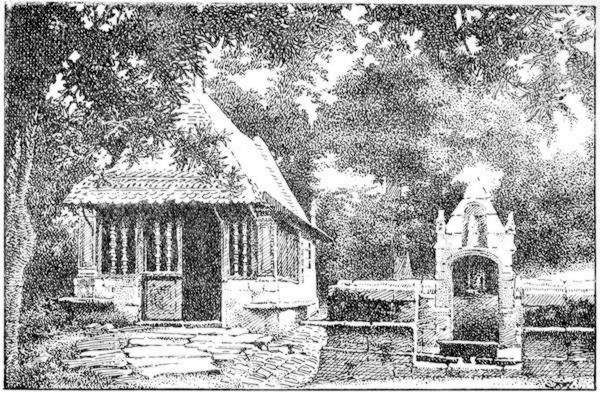
N.D. DE LA FONTAINE, DAOULAS
L'Hôpital Comfront. A commandery of
the Knights of S. John was here. The church
is in the common transition style between flamboyant
and a renaissance, with an open bell
tower for two bells and a side turret, disengaged
with cupola, containing the stair. The west
front has a doorway much like that at Rumengol.
In the church is a statue of S. Barbe of 1511.
P. Easter Monday.
Irvillac. Church with a renaissance tower
and spire. P. des Reliques 3rd Sunday in July.
P. des Marches, with wrestling, 3rd Sunday in
October.
* DINAN (C.N.) chl. d'arrond. In a
picturesque situation, 225 feet above the Rance
which flows through a gorge to the sea, between
granite cliffs broken by bays down which flows
abundant foliage. The town is walled round
on all sides save that on which is the railway
station. Three gates remain, and a postern of
the castle. The original castle stood in a
different position, and was called the Château
de Gan. It has disappeared, and a vulgar
and pretentious modern house occupies its site.
The present castle was erected in 1458 and
1480. Of the twenty-four towers which
originally surrounded the town fifteen remain in
a more or less ruinous condition. Portions of
the wall date from the 13th cent. The most
picturesque portion of the town is the Rue de
Jerzual leading to the old port on the Rance,
in which are many ancient houses. In some
parts are houses with arcades. The Tour de
l'Horloge, singularly picturesque, is of the 15th
cent. The Church of S. Sauveur is in part
Romanesque, the lower portion of the west front
to the bottom of the window, and the S. side of
the nave. But the N. aisle, transepts and choir
are flamboyant inclining to renaissance. The
central slated crown to the tower is singularly
beautiful in outline and proportion. There is
one window in the N. aisle which contains old
glass. A chapel contains the heart of Du
Guesclin. The Church of S. Malo is late
flamboyant of the 16th cent. throughout, except
the S. transept front, which is renaissance. The
W. window is modern, and remarkably bad in
design. The church contained good old glass
of the period, which the curé sold, and has
supplied its place with utter rubbish. The
Chapel of S. Joachim outside the Porte S. Malo is
mainly Romanesque of the 11th cent. It was
chapel to a priory. At Ste. Esprit is a granite
cross sculptured with figures on the site occupied
by the Earl of Lancaster when investing Dinan.
Near this is a large lunatic asylum, with beautiful
grounds, to which admission is accorded. The
chapel built by the lunatics, if architecturally
bad, is effective after its fashion, and well intended.
From the Porte S. Malo a pretty walk,
planted with limes, leads to La Fontaine, a
chalybeate spring in a deep valley. A noble
viaduct connects Dinan with Lanvallay. In
summer an expedition may be made by boat or
steamer to the Chapel of S. Hubert, an expedition
well repaying the trouble. The Château
de la Garraye is of the 16th cent., prettily
situated, falling annually into more complete
ruin. That of La Conninais, however, is kept
up. A tower and the chapel are late flamboyant,
but the main building is a century
later.
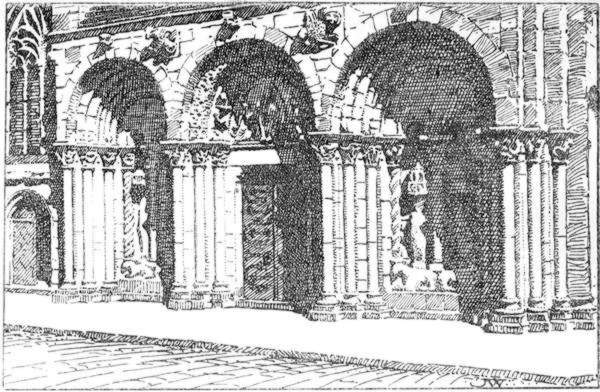
S. SAUVEUR, DINAN
Léhon has a ruined castle on the height, and
by the river the remains of a priory. The church,
of the 13th cent., has been restored; the ugly
east window is modern, and the stained glass is
all bad. In the churchyard is the Romanesque
doorway of the parish church, which was pulled
down when the priory church was put in
order.
Corseul. The ancient capital of the Curiosoliti,
with Roman remains, notably a temple of
Mars, of very peculiar construction, an apsidal
chapel with a huge extended peristyle before it,
like a cloister. The parish church, a wretched
modern structure, contains a Roman cippus.
In a picturesque situation is the Château de
Montfilant, of the 12th cent., with to the N.
traces of a prehistoric camp. In the farmhouse
on the site of the castle are some statues, one of
16th cent., of S. Agatha carrying her amputated
feet, and another of S. Anne of the 17th cent.
S. Helan. The church has some old glass
in the E. window, representing the saint, who
with six other Irish bishops visited S. Remigius
at Rheims in 509. On their way, after
having landed at the mouth of the Rance, they
founded churches along their route up the river.
At La Ganterie on the road to Dol, at the 8½
kilometre milestone, a little to the left is a ruined
allée couverte, on the site of a prehistoric workshop
for tools. The site is interesting not to
the archæologist alone, but also to the mineralogist.
The stones of which the dolmen is
composed are diorite, and the material of which
the tools were fashioned is the silex in the
granite fused by a dyke of diorite which has run
it into flint clots. The tools here fabricated
were of a rude description.
S. Samson. A fine menhir at La Tremblaye,
in a little wood, 30 ft. high, but inclining,
as it was undermined by treasure seekers.
According to popular superstition, if re-erected,
Dinan would perish by a flood. A delightful
walk may be taken from S. Samson to Dinan,
by a road that leads down to the river, and
comes out by the mouth of the glen of La
Fontaine. From it the grand view of Dinan
with its spires and viaduct may be obtained.
The Rance at this point formerly swept round
a rocky peninsula, but this was cut through
and the course rectified, when the river was
canalised. The walk may be extended by
taking in Taden, where are the neglected tombs
of the Count and Countess de la Garaye.
At their own desire they were buried among the
poor, to whom they had devoted their lives, in
the churchyard.
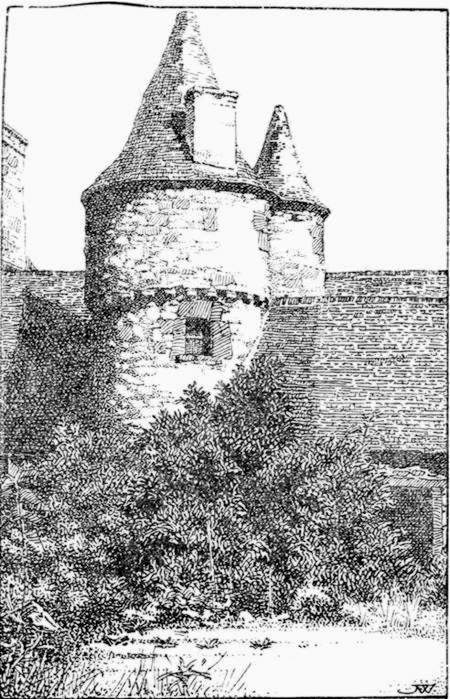
TOWER, DINARD
Trigavou, between this place and Pleslin,
is a wrecked series of alignments. Though a
monument historique, the peasants have been
recently blowing up the stones with gunpowder,
and the remains are in too great disorder to be
planned. In the church on a beam is a carving
that represents a hare which when pursued by
hunters took refuge in the sacred edifice.
Le Hinglé, a walk of a mile and a half from
the station, takes to the Château of Chalonge,
with a tower and picturesque gables. It is
being well restored by the proprietor.
Dinard-Saint Enogat (I.V.) chl. arr.
S. Malo. Picturesquely situated on an indented
coastline opposite S. Malo, and connected by a
tramline with S. Lunaire and S. Briac. It is
a favourite resort for wealthy Americans during
the summer, and has a casino, where those who
like to lose their money may do so. Bathing
is best obtained at S. Lunaire where are good
sands. Scanty remains of a priory founded in
1324. The chapel in ruins contains a colossal
statue of the Virgin and child of the 15th cent.
An old house, traditionally supposed to have
been once occupied by the Black Prince, has a
couple of picturesque towers with conical roofs
and gables. A house quaintly decorated with
numerous statues of saints.
S. Lunaire has an excellent beach. Lodging
houses are extending rapidly along the coast
from Dinard to S. Briac, and in process of time
there will be a continuous line of houses. The
modern church is portentously vulgar, but the
little old church has been happily spared. It
has a low slated tower at the junction of the
transepts. Within is the tomb of the saint,
who was son of Hoel and Pompeia, and born in
South Wales. His father was founder of
Llanhywel in Pembrokeshire, and his mother
lies buried at Langoat near La Roche Derrien.
He was brother of S. Tugdual the founder
of Tréguier, and nephew of S. Brioc. The
story goes that he left his portable altar behind
him in Wales, and that two doves crossed the
sea bringing it to him in their beaks. On his
tomb a dove is represented with the slab in its
beak. The fact on which this legend is
founded is probably that his sisters, crossing
later, brought to him what he had forgotten.
One sister was called Sceva, Ste. Sève as she
is now called. Another story told of him is
that when he settled at this spot on the coast,
with his monks, to his dismay it was discovered
that seed corn had been forgotten. Then
Leonore knelt in prayer, and presently a robin
was seen perched on a stone with an ear of
wheat in its beak which it let fall when
scared. The grains were sown, and on the
following year all the produce of the little
harvest, and eventually all the district round,
derived its wheat from "Robin Redbreast's
Corn."
S. Briac. Situated above a picturesque bay
partly closed by an islet. It has a little port.
The church is modern except the tower, which
is renaissance. An extensive alignment existed
here, extending to the headland above the sea,
but the exigences of builders have almost if not
wholly destroyed it. The saint from whom the
place takes its name was an Irishman, a native
of Ulster, who joined Tugdual and Leonore in
South Wales and followed them to Brittany.
Briac was given a site for a monastery where
now stands the town of Bourgbriac, where is
his Holy Well. He soon made of it a flourishing
school for missionaries, who were sent
throughout the district. After many years he
went on pilgrimage to Rome, and on his way
back halted at Arles, where he remained two
years. Then he returned to Brittany, where
he died at an advanced age about 570, and was
buried at Bourgbriac.
On the further side of the river is Lancieux;
the church contains a Roman cippus but is
otherwise destitute of interest and will shortly
be rebuilt. The vast bay west of Lancieux is
divided in twain by the tongue of land on which
is S. Jacut. Here the tide goes out as much
as 5 kilometres. To the north of the promontory
of S. Jacut are the islands of Les
Ebbiens on which is a battery.
Off Dinard is the fortified isle of Cézambre,
but visitors are not suffered to land there.
Here was a monastery founded by S. Brendan
about 524, and when S. Malo arrived from
South Wales, he was hospitably received by
Festivus, the Irish monk left there in charge.
A Chapel of S. Brendan was much resorted to
by girls in want of husbands, who vowed candles
to the Irish saint if he would supply them with
a suitor. But since the military authorities have
denied access to the island, the damsels have
had to aspire at home.
Dol (I.V.) chl. arr. S. Malo. A dull
town, formerly a cathedral city, and for three
hundred years seat of an archbishop. The few
old houses in the town are not particularly interesting.
The former cathedral, now parish
church (S. Samson), belongs for the most part
to the 13th cent. The west part is flanked by
two towers of the 14th and 15th centuries.
That to the south has retained some remains
of the original Romanesque church. King
John of England burnt the church. At the
crossing of the transepts a third tower of the
13th cent. was begun but never completed.
The N. side of the church formed part of the
fortifications of the town, and the wall of the
chapels of the choir is surmounted by a crenilated
parapet. The choir has a square east end
like an English church, and with a magnificent
2nd pointed or geometrical E. window full of
glass of the same period, badly restored. It
represents the Last Judgment, scenes of the
Passion, and the Life of S. Samson. The
pillars of the nave belong to the original
Romanesque church. After it was burnt they
were retained, but disengaged columns were
grouped about them and bound to the cylinders
by bands of iron. Those in the side aisles are
meaningless, supporting nothing. Behind the
high altar is the Chapel of S. Samson. In the
wall at the side are openings into a chamber into
which the insane were admitted, and kept for a
while enclosed near the tomb of the Saint, in
hopes of a cure. In the N. transept is the
sadly defaced tomb of Bishop Thomas James
(1504) and of his brother, a canon. It was
a peculiarly rich piece of renaissance work, by
the Florentine family of Juste, two brothers of
which were brought to Dol to execute it.
After its completion they settled at Tours. It
was barbarously mutilated at the Revolution.
The S. transept has a rich porch, the statuary
in which has been recently restored.
About a mile and a half out of Dol on the
Combourg road is the Pierre du Champ Dolent,
a menhir 27 feet high above ground and sunk
nearly as many feet beneath the surface. It is
dwarfed by a huge crucifix planted on the top.
Near by is Carfeuntin with a hideous modern
church replacing one of the 13th that has been
wantonly destroyed. Here is the Holy Well
of S. Samson.
Mont Dol is a height rising out of the great
marsh of Dol, that was overflowed by the sea
in 709. This was a prehistoric site and
numerous flint weapons are there found. The
church of the 11th, 12th and 15th centuries
contains curious mural paintings.
Douarnenez (F.) chl. arr. Quimper.
Prettily situated on a tidal creek that has its
mouth almost closed by the Isle of Tristan.
The railway station is high above the town and
the ravine is crossed by a viaduct. The town
itself is given up to sardines and is pervaded by
bad odours. It has a very bad modern church.
That of S. Helene is of the 17th cent. with
glass of the period. The Chapel of S. Michel
is of 1664 and has a painted ceiling. Douarnenez
was the headquarters of the brigand
Fontenelle during the wars of the League.
He had his castle on the island of Tristan
where he crowded his prisoners into the
dungeons so dense that they could not lie
down, and kept them there till they died, in a
condition of indescribable filth. As one died,
he made the rest throw him out at the window
into the sea. Some, who he thought might
ransom themselves, he placed in metal chairs
over slow fires, others he left in bitter winter
weather immersed to their necks in barrels of
cold water. He carried on his barbarities, not
for any cause, though he professed himself to be
a leaguer. He warred on all alike for the sake
of rapine and out of wanton love of slaughter.
He was finally broken on the wheel in 1602.
Douarnenez is connected by rows of houses
with
Ploaré, where is a fine church very late
flamboyant resolving itself into renaissance,
and typical of a style very general throughout
Finistère. A singular feature is to be noted in
the pinnacles about the spire. Two of these
have tall crocketed spirelets, but taste was
changing whilst the tower was approaching
completion, and the two other pinnacles are
truncated Italian lanterns. The tower was
begun in 1555. The side aisles are gabled
over the aisle windows, and as usual in Breton
churches there is no clerestory. The buttresses
are surmounted by pinnacles that are crowned
with cupolas. The cusping has gone from the
tracery, a sure mark of decay of the style.
There is a fine porch with niches, but no
statues. A fireplace and chimney for heating
the water for baptisms, shows that this usage
was carried on to the latter half of the 16th
cent. As we shall see under Le Juch there is
a later example.
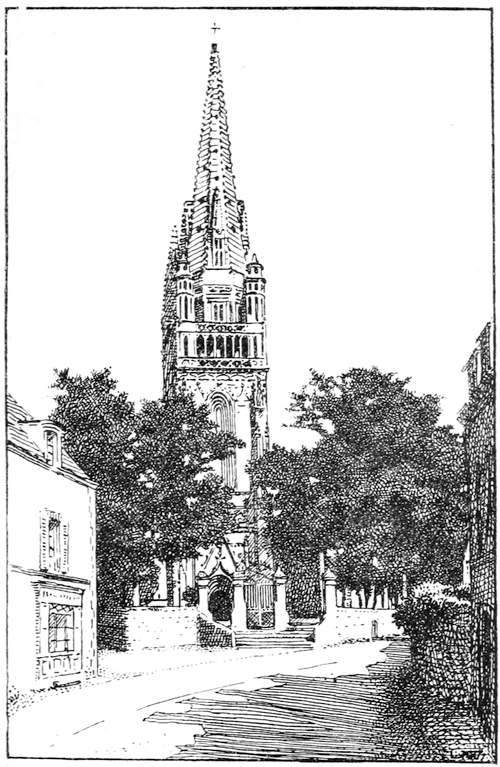
PLOARÉ
Poullan. The church (S. Cadvan) is
flamboyant verging into renaissance. It has
a thin tower with two galleries, and a pretty
porch. The side aisles are peculiarly narrow.
The capitals of the pillars are quaintly carved.
The octagonal vestry is of the 17th cent.
Several dolmens. A menhir near the seamark
at Kermenhir. P. 1st S. in September.
Le Juch. Renaissance tower. Fireplace in
the church for warming the water for baptism, as
late as 1710. The east window has in it 16th
cent. glass representing the Crucifixion.
Guengat. A small late flamboyant church.
Ossuary adjoining the porch 1557. Owing to
the fall of the tower in 1700, the church was
restored in 1706. It contains some fine glass
of the 16th cent. representing the Last Judgment
and the Passion. The date is 1571.
The porch flamboyant. Curious uncouth and
late tracery in two gabled windows beside the
porch. The third has flamboyant tracery. A
Calvary in the churchyard is of the 16th cent.
In the presbytère are preserved a beautiful
chalice, and a processional cross of 1584. P.
de S. Ivy, 2nd S. in May. Patronal feast last
S. in August.
Kerlaz. Church (S. Germain) picturesque
and interesting. It has a crocketed spire with
subsidiary turrets and spirelets partially detached.
The church contains old glass in the east
window representing scenes of the Passion and
S. John the Baptist presenting the donor and
a canon. Font of 1567, tower 1660, Calvary
1645, lychgate 1558.
Elven (M.) chl. arr. Vannes. The Chapel
of S. Germain is of the 16th cent. At the door is
a sarcophagus supposed to be that of S. Germain.
This Germanus is probably not the Great Bishop
of Auxerre, but the nephew of S. Patrick, who
was tutor of S. Brioc, and finally apostle of the
Isle of Man. Elven is a good place whence to
explore the Lande de Lanvaux. This upland
ridge is strewn with prehistoric remains, dolmens
and menhirs, notably La Loge aux Loups, a
dolmen; an allée couverte Le Léty, a menhir
at Carhaix, another at Villeneuve. An allée
couverte at Villepierre, two dolmens in the
wood at Coetby and two menhirs called Baboun
et Baboune at the outskirts of the wood of Lanvaux.
At S. Guyomard a menhir 22 feet
high. At Plaudren beside the road, La Quenouille,
about 18 feet high. Near it numerous
remains of dolmens and fallen menhirs. Another
group at Plaudren, a fallen menhir, 16 feet high,
and two others prostrate of less height, an allée
couverte called Mein-gouarec near a curious
rock shaped like a crouching lion.
Etaples (C.N.) chl. arr. S. Brieuc. A
watering-place in some repute with good sands.
The church is of the 15th cent., but with a
tower of 1786. Etaples is in the ancient county
of Goelo.
Lantec. The parish church (S. Oswald)
is a mean modern structure. How the great
Northumbrian king should come to be here
commemorated is hard to understand. He is
represented over the altar as a chubby, smirking
boy. The Chapel of N.D. de la Cour is a
noble structure of 1460, of the finest and purest
flamboyant, before it became degenerate and
adulterated with Italian detail. Chancel and
side aisles are vaulted. The nave has modern
wood vaulting. The superb east window is
filled with the finest stained glass, silvery in
tone, with the colour set in it as jewels, after
the English school, and entirely different from
the prevailing Breton character of glass which,
like the French, is overladen with colour. The
modern glass in some of the windows is bad
as bad can be. The tracery of the chancel
windows is admirable. There is a second
stained window, old, in the S. transept. In the
chapel is the tomb of Guillaume de Rosmadec,
1608, in kersanton stone. P. 16th August,
when pilgrim fishermen make the circuit of the
chapel barefooted and in their shirts alone.
S. Quay is a watering place.
Le Faou (F.) chl. arr. Châteaulin, at the
head of a long arm of the sea. It is reached
from Henvec station. The church is of the
16th cent. late flamboyant, with a slender unsatisfactory
tower, 1626-40. The porch is of
1593, with statues of the apostles.
Rumengol. The story goes that as King
Grallo was riding with S. Winwaloe from Is,
which had been overwhelmed by the sea, and
reached the hill that commanded the valley, he
saw a fire on the height opposite, and found
that the pagan inhabitants were holding a
sacrifice on the rou-men-goulon, the Red Stone
of the Dawn. He vowed to build there a
church. This is represented in the E. window.
The church is late flamboyant with renaissance
detail. The porch is of the usual type and
contains, over the door, an adoration of the
Magi. A hundred paces to the east is the
Holy Well. In the little structure is a bas-relief
of the Annunciation, and statues of S.
Winwaloe and S. Fiacre. One of the most
largely attended Pardons of Brittany takes place
here on Trinity Sunday, the pilgrims arrive over
night and sleep in the church.
* LE FAOUËT (M.) chl. arr. Pontivy.
Fine timber and slate Halles. The church of
the 16th cent. is of little interest, but the chapels
of Ste. Barbe, S. Fiacre, and S. Nicolas in
Prisiac, are well deserving of a visit and a study.
Ste. Barbe is planted on a rock above a pretty
valley, and is reached by a staircase of stone.
A bridge connects the upper platform with
another chapel, that of S. Michel. The wooden
belfry is on the platform above. The chapel
of Ste. Barbe is of fine flamboyant work, 1489.
The structure is curious: there is no nave, it
is composed of long transepts and a small budding
chancel. It was vaulted in 1512. Some
very fine old glass remains, side by side with
some very villainous modern stuff. Below, in
the valley, is the well of Ste. Barbe. The P. of
Ste. Barbe is on the last Sunday in June.
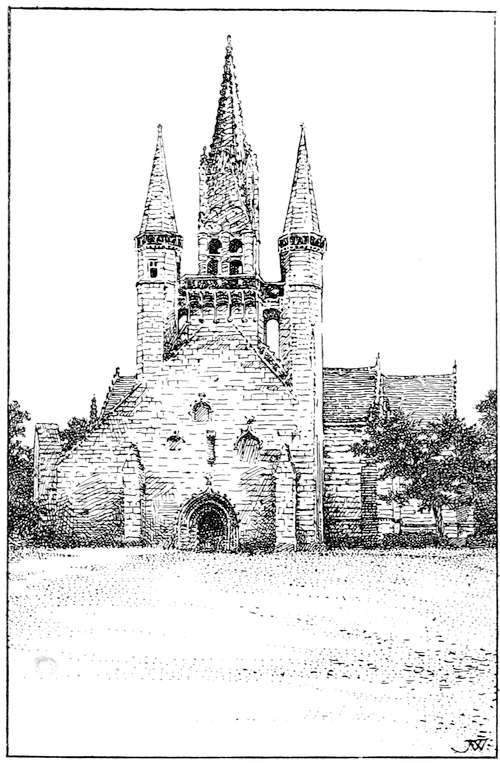
S. FIACRE
S. Fiacre is a superb example of the architecture
of the 15th cent. The main spire, with
its flamboyant gallery, is corbelled out on the
west gable and is tied by two flying buttresses
to two smaller towers with spirelets. The S.
porch is vaulted and has niches within. The
chapel contains very fine glass of 1550, but
falling to pieces and fragments detaching themselves
with every storm. The subjects represented
are the Nativity, the Passion, and the
legend of S. Fiacre. A roodscreen of 1480
has been badly "restored" and painted. The
condition of the magnificent glass is disgraceful.
The chapel is a "monument historique," so that
the curé can do nothing to it, and the State
will do nothing for its preservation. The
foliage carving in granite is admirable for its
boldness. The Chapel of S. Nicolas in Prisiac
has a very fine roodscreen, quite perfect and
untouched, covered with curious paintings; it is,
however, later than that at S. Fiacre. There
is here also some good old glass. The chapel
is in a sad condition of neglect. It possesses a
broken wheel set with bells for ringing by pilgrims
to call the attention of the Saint to their prayers.
Le Faouët may be reached from either Gourin or
Quimperlé. The P. at S. Fiacre is on the 4th
Sunday in July. S. Caradec Trégomel, a splendid
late Gothic chapel, one of the finest monuments
of 15th cent. in Brittany.
* FOUESNANT (F.) chl. arr. Quimper,
with nice sands. A pleasant holiday resort.
The costumes of the women are very pretty.
The church is Romanesque, but was frightfully
maltreated in the 18th cent., when large round-headed
windows were introduced. The tower
was struck by lightning and rebuilt at the same
time. The piers are 11th cent. From above
them rise pilasters that sustain relieving arches
under which are the clerestory windows. The
capitals have byzantine-looking work on them.
The Chapel of Ste. Anne, in the midst of trees,
was built in 1685, and has a tower for two bells
and spire between two detached turrets surmounted
by cupolas. This chapel is the object
of visit when the Pardon takes place on July
28. Peasants and girls in white arrive by water
in boats with their crosses and banners.
S. Evarzec. Here was a commandery of
the Knights of Malta at Moustoir (13th cent.).
A dolmen and menhir.
Goueznach. A ruined allée couverte. Chapel
of N.D. de Bonsecours, P. Sept. 8. Chapel of S.
Cado, P. Sept 25; that of Ste. Barbe, P. June 5.
Benodet. A favourite bathing resort. The
church (S. Thomas à Becket) was erected in
his honour in 1241, seventy-one years after his
death. But it has undergone much alteration
and enlargement. All that remains of the
original church are two bays of the apse. The
foliage of the capitals has all the freshness and
charm of work of that period.
Perguet (S. Bridget) was formerly the
mother church of Benodet, but now the relations
are reversed. Externally, on the N.
side may be seen Romanesque work, and the
small windows of the period. The S. side has
been completely transformed by the addition of
a little ossuary and a porch and a transept of the
16th cent. But on entering the church the
early character of the building becomes manifest.
The arcades of the nave and the chancel arch
are of the 12th cent. The three bays on
the north are bold and rectangular, and, as at
Fouesnant, support relieving arches that enclose
the clerestory windows. This is all 11th cent.
But the chancel arch shows distinct signs of the
coming on of the reign of the pointed style.
The choir is flamboyant. Here also the
Byzantine character of the ornamentation of the
11th cent. capitals may be observed. The east
window contains 16th cent. glass, and represents
the Crucifixion. Among the statues in the
church are S. Bridget and S. Patrick, but the
latter has been altered into S. Paternus. In
this church is a fireplace for warming baptismal
water. The tower is of 1595. On the highway
from Quimper to Benodet is the Holy
Well of N.D. de Drenec. The basin is
surmounted by a niche containing a statue of
Our Lady of Pity. In times of drought the
parishioners of Ergué Armel come here to pray
for rain; but those of Clohars Fouesnant go in
quest of it to Petit Ergué.
La Forest Fouesnant. This pretty little
church is planted near the sea. The spire is
bracketed out above the west gable, and contains
a stone cage for bells. The Calvary is the
earliest in the Department and is of the 16th
cent. In the presbytère is a noble chalice of
the first half of the 16th cent.
* FOUGÈRES (I.V.) chl. d'arrond. Picturesquely
situated on a hill above the Nançon.
Originally a frontier town between Brittany and
France, it has preserved its venerable fortifications,
but they are crowded in by buildings.
The castle was founded in the 11th cent.,
destroyed in 1166, rebuilt in 1176, has been
restored. It is planted on a rock, and was
flanked by ten towers including those that
commanded the entrance. It is divided into
four distinct portions, the avantcour, the main
court, the donjon, and the postern court. The
entrance is between three towers of the 12th
cent. The keep was destroyed in 1630. It
rose in the midst of the second court, flanked
by three towers that still remain, that of
Melusine dates from 1242. The Church of
S. Sulpice was rebuilt in 1410, but the nave
and tower were not completed till 1490. The
slate spire leans. The choir, begun in the 16th
cent., was not completed till 1765. The Church
of S. Leonard was erected 1407-44, but underwent
alterations in 1586-1637, and contains
fragments of old glass. Altogether Fougères
is a most interesting place, and rivals Vitré.
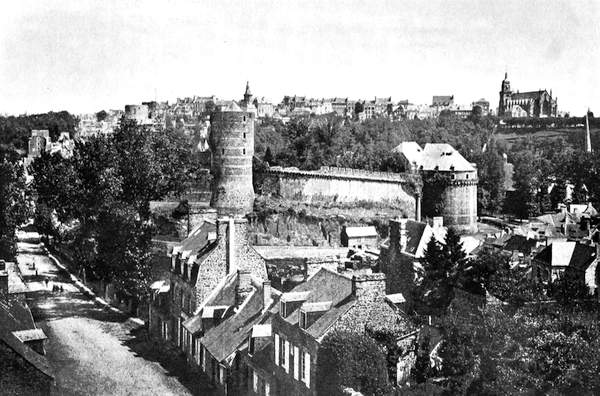
FOUGÈRES
In the Forest of Fougères is a fallen dolmen,
Pierre du Tresor, also an alignment of 80
stones, called Le Cordon des Druides, near the
ruins of a convent founded in 1440.
La Gacilly (M.) chl. arr. Vannes. Near
the town on the road to Malestroit, a menhir 15
ft. high, La Roche Piqué, and near it another
of the same height but fallen. On the Lande
de Signé E. of Gacilly a circular camp and the
slope of the hill is pitted with excavations.
The parish church was formerly chapel to the
castle and was of 14th cent., but was altered
and enlarged 1626-31.
The Chapel of S. Jugon, 4 kilometres W.N.W.
Jugon was a peasant boy who led a devout life.
P. Whitsun-Monday. Peasants take little bags
of seed to have it blessed at the end of Mass.
This is then mingled with what is to be sown.
Cournon. A fine dolmen, La Tablette.
One of the coverers was broken in 1820. W.
is a menhir 9 ft. high, further W. other blocks
that may be the remains of an alignment.
Les Fougerêts. A pretty gorge with grottoes
in the sides called Les Chambres du Coucou.
S. Congard (Cyngar) near Bignac. An
allée couverte measuring 43 ft. long and 4 ft.
6 in. high within. It has five coverers, of which
one only has fallen. A menhir near the wood
of Misny. The Chapel of N.D. de Quimper
is an object of pilgrimage on Whitsun-Monday,
and here, possibly, may still be heard the barking
of the pilgrims, an hysterical phenomenon, that
formerly accompanied the Pardon of Josselin.
At Wesley's revivalist meetings a similar phenomenon
was noticed.
* GUINGAMP (C.N.). A pleasantly situated
town in green surroundings, with the little river
Trieux flowing through it. The finest view of
the town with the towers of the church is from
the garden of the Hôtel de France, whence
water, foliage and old buildings group admirably.
The Church of N.D. de Bonsecours is indebted
to a miraculous image for the lavish expenditure
upon it. This image stands in the N. porch,
and has been accorded a gold crown from the
Pope, and has been profusely "indulgenced."
The church was formerly the chapel of the
Counts of Ponthièvre. It was rebuilt in the
14th and 15th cents. and added to in the 16th.
The church consists of a nave with four aisles,
double transepts and an ambulatory round the
choir. The transept and S. transept front are
of the 12th cent. The central tower and spire
of the 13th. To the same period belong the
tower and turret on the N.W. The arcade on
the N. of the nave is of the 13th cent. On
the S. side the arcade is renaissance. In the
spandrils are the cardinal virtues sculptured in
relief, and corbels support statues. Above the
arcade is a triforium consisting of three ranges.
Above the arcade on the north side the triforium
is of the 14th cent. The choir is composed of
four bays of the 15th cent. The apse is of the
same date. A curious feature is the carrying
of the triforium across the church above the
chancel arch. The transepts are lighted by
rose windows of the 14th cent. The principal
porch containing the miraculous image is closed
by a grating and converted into a chapel; it
contains modern statues of the apostles. The
W. doorway is a magnificent specimen of
renaissance work. Owing to the windows
being all filled with modern coloured glass
overloaded with colour, the interior cannot be
well seen except on sunny days. The vaulting
of the choir is sustained by flying buttresses
within the church. The fine S.W. tower is an
excellent but unfinished work of the renaissance.
In the market-place is a leaden fountain of the
renaissance. A few picturesque old houses
remain. The P. is on the 1st Sunday in July.
A procession with torches takes place on the
Saturday night, and bonfires are lighted in the
Place. After the religious ceremonies follow
dances. N. of Guingamp on a height is the
little Chapel of S. Lambert with some early
11th cent. work, but for the most part it was
transformed in the 18th cent. The abbey of
Ste. Croix is of the 16th cent., but the church
has the piers of the transept of the 13th.
Grâces. The church is entirely flamboyant
of 1508, and a typical specimen. All the aisle
windows are under gables. The baptistery is of
the end of the 16th cent. The relics of Charles
de Blois are preserved here.
Pedernec. A menhir 25 ft. high. On one
face three cup-hollows. The church was rebuilt
in 1847, but the S. side aisle and arcade and a
good rose window in the transept, of the 16th
cent., have been preserved. Also a delicately
carved roodscreen, out of its proper place.
Coadout. An allée couverte at Pen-poul-ar-hus,
destroyed in 1863, except for three
stones, has one much polished. On this,
according to local tradition, S. Illtyd and S.
Briac were wont to meet and pray together, and
it contains hollows supposed to have been worn
by their knees.
Pommeret-le-Vicomte. Remains of a
dolmen at Kerbic, one coverer and four supports
still in situ. The church is of various periods.
The oldest portion is the east end, and is of
the 14th cent. with a large window. The
tower and spire of 1712. In the graveyard a
Calvary of the 15th cent. with a pulpit at its
base. The Chapel of N.D. du Paradis is interesting,
16th cent., with a Calvary of the same
period, with the apostles carved in relief on the
octagonal base.
Gourin (M.) chl. arr. Pontivy. An unattractive
spot with poor hotel accommodation.
Hence conveyances may be had to Le Faouët.
At Kerbiguet a menhir 12 feet high and two
others prostrate. The parish church is of 1500
with a tower of 1745. Numerous chapels are
scattered over the parish: that of S. Hervé to the
N.E. is of the 16th cent. and has stained glass
representing saints, and scenes in our Lord's life.
Langonnet. A menhir at Bodéro, 13 feet
high. The parish church has flamboyant
windows and doorways, but a few pillars of the
12th cent. remain. The tower is modern. On
the S. side of the church is an ossuary. In the
cemetery a lech. The chapel of the Trinity,
1500-68, with fine old glass representing the
Jesse tree, the Passion, and the Last Judgment,
and the Life of the Virgin. The abbey of
Langonnet was founded in 1130 and is on the
bank of the Ellé. It is converted into a
reformatory. Chapel of N.D. de la Pitié, P.
15th Aug.
Le Saint (S. Samuel). Partly Romanesque,
but with flamboyant windows. The chapel of
S. Adrian is an object of pilgrimage.
Grand-Champ (M.) chl. arr. Vannes. On
the north the Lande de Lanvaux, which was
once crowded with megalithic remains. Many
still are to be seen. A fine dolmen is on a
rocky elevation a kilometre N. of Locperet.
The capstone measures 16 feet long. Numerous
menhirs further on in the direction of Croix-de-bois,
perhaps the relics of an alignment.
The church (S. Tugdual) has been destroyed
and replaced by a structure of 1866. At
Locperet is a flamboyant Chapel of S. Bridget.
Another of N.D. de Burgo is of 1528 and
1538, and near it a Holy Well. P. at
Locmaria-Grandchamp on Aug. 10th; at
Moustoir des Fleurs on the 4th S. in
August. At Grand-Champ itself on the 2nd
S. in Sept.
Locqueltas. A menhir, called Le Fuseau de
la Femme de Gargantua, 15 feet high. At
Plaudren another 18 feet high, and bearing the
same name. It is near the road to Josselin
on the Lande. The whole neighbourhood is
strewn with remains of dolmens and with fallen
menhirs.
Guéméné (M.) chl. arr. Pontivy. Anciently
Kemenet-Guegnant, owes its origin to a castle
of Guegnant, nephew of Alan Canhart, who
erected it. The fief passed to the family of
Rohan. The castle was converted into a prison
for English soldiers in 1792. It is now a ruin.
Silfiac. A Chapel of S. Laurent of the
16th cent. with curious carvings; near it the
Holy Well of S. Nodez, which is supposed
to cure corns, and other maladies of the
feet.
Langoelan. A dolmen on the E. of the
hamlet of Villeneuve and in an islet of the
Scorff. The church is flamboyant. Le
Merzer marks the spot where Selyf or Solomon,
King of Devon and Cornwall, coming to
Armorica to see his domains there, encountered
the pagan natives and was murdered by them.
He was son of Geraint, who fell at Langport
in Somersetshire in 522, fighting against the
Saxons. His wife was S. Gwen, sister of
Nonna, mother of S. David, and he was the
father of S. Cuby. The Chapel of S. Solomon
has been destroyed.
* GUÉRANDE (L.I.) chl. arr. S. Nazaire.
An interesting town surrounded by its machicolated
walls of granite, erected in 1431 by
John V., and flanked by ten towers. There
are four gates; that of S. Michel is a veritable
fortress in itself defended by two lofty towers.
The Church of S. Aubin is of the 12th and 16th
cents., and has two porches, and an external
pulpit of stone of the 16th cent. Within the
church the pillars have carved Romanesque
capitals. There is good glass of the 16th cent.
N.D. la Blanche is a graceful chapel, erected
in 1348 by Jean de Montfort. A menhir
with cup-markings at Escoblac. Dolmens at
Kerléour, Kerlo, and Sandun. A circle of
stones at Kerbourg. Guérande is a good place
for a botanist to stay at who desires to study
the flora of the saltmarshes on one hand, and of
the Grande Brière on the other. The production
of salt goes on largely in the salines, and is
carried on by private owners. It requires about
40 consecutive dry days between June and
September to evaporate the water. The annual
production averages 6600 tons. The Grande
Brière is divided into 17 communes, and is a
vast freshwater peat bed occupying the basin of
an ancient lake.
S. Lyphard was a Roman station at the point
where the lake of La Brière formerly discharged
into the sea. The church is of the 11th cent.
The peasants of the Bruyère wear a peculiar
costume, and are true Bretons.
La Guerche (I.V.) chl. arr. Vitré. The
church, of which portions belong to the 13th
and 14th cents., contains some old stained glass.
At 2 kilometres to the S. is the Church of
Rannée, in part Romanesque.
Guichen (I.V.) chl. arr. Redon. Old
chateaux at Gaylieu and Gressillonnoye.
Hédé (I.V.) chl. arr. Rennes. Ruins of
the castle on a rock. The church is Romanesque.
S. Gaudran, good glass of the 17th
cent. in the church, and two silver reliquaries of
the 12th cent.
Hennebont (M.) chl. arr. Lorient. Prettily
situated on the river Blavet. The town is
divided into the Ville Clos within its ancient
walls and the new town. A bridge connects
them. The old town was fortified by Duke
Jean I. (1237-86). It played a signal part in
the War of Succession. Jean de Montfort had
secured the place. At the end of May 1342,
Charles of Blois laid siege to it. Within was
the Countess Jeanne, who held out with determination,
set fire to the camp of the enemy,
and leaving the town unperceived threw herself
into Auray, where she gathered reinforcements
which she introduced into Hennebont without
the feeble Charles being aware what she was
about. At last provisions failed, and the
magistrates insisted on capitulation. The
countess entreated for a couple of days' delay,
and at the last moment saw gleaming in the west
on the sea the sails of an English fleet sent to her
relief. Charles hastily retreated, but again a
few months later laid siege to the place. He
was, however, again repulsed. The parish
church (N.D. de Paradis) on the further side
of the river. It is the principal monument in
Hennebont, and was erected in 1514-24, and is
consequently flamboyant before it sank in debasement.
The W. front is light and graceful and
has a porch and a tower flanked by a couple of
turrets tied to it by galleries sustained on flying
buttresses. The spire rises to 150 feet. The
choir ends in an apse lighted by two stages of
windows. A procession takes place on the
last Sunday in Sept. in commemoration of the
cessation of an epidemic in 1699. The chapel
of S. Antoine is partly Romanesque.
Kervignac. A fine dolmen near the road
from Hennebont to Landévant. On the south,
near Kermadio, is another. A third, small,
near Lopriac. This is one of the most ancient
parishes in the diocese of Vannes. It is mentioned
as early as the 6th cent. At this time a
cloud of locusts came down on the country, and
the Count Weroch, fearing famine, sought
Gunthiern, a refugee king of Gwent, who had
settled at Quimperlé and was in great repute for
his austerities. Gunthiern gave water he had
blessed to the envoys of Weroch, and this
drove the locusts away. In return for this
favour, Weroch granted to Gunthiern the plou
of Vineac. The Chapel of N.D. de la Clarté is
of the 15th cent. That of S. Laurent contains
some remains of the screen. A Holy Well of
S. Gildas is still in request in the hamlet of
Kanden.
* HUELGOAT (F.) chl. arr. Châteaulin.
A picturesquely situated townlet at the extremity
of a lake that discharges amongst masses of
granite down a ravine. The ruinous condition
of the granite is not due to earthquake or to
glacial action as supposed by some, but to its
composition. It contains a large amount of
soluble silicate of potass. This disappears under
the action of the rain and the granite crumbles
away. Huelgoat is four miles from the nearest
railway station. The road is through the valley
of the Argent, between pine-clad hills. The
granite here encounters the schist. The church
is a mean renaissance structure, but the Chapel
of N.D. des Cieux is more interesting. It is
of the 16th cent. and contains some old glass
of the period. A camp on a height above
the town is attributed to King Arthur.
S. Herbot. A chapel in the parish of
Loqeffret is a picturesque structure at the roots
of the Monts d'Arrée. A stream here falls in
a pretty cascade 400 feet over rocks, and at no
great distance from the chapel are the inconsiderable
remains of the renaissance Château de
Rusquec. The Chapel of S. Herbot is actually
a large church and merits attentive study. It
possesses a fine square tower without spire or
pinnacles. The date is 1516. The W. front
is fine. Throughout, the carving of the granite
is admirable, the foliage is treated with great
boldness. The tower of S. Herbot seems to
have served as a model for that of Carhaix,
which is a few years later. On the south is a
deep porch also well sculptured, with the apostles
within, and 24 little statues in the arcade of the
entrance. The date of the porch is 1498.
The apse is flamboyant like the rest of the
church, but the buttresses are later additions in
1618 and 1619. The interior is adorned with
a beautiful renaissance screen and returned stalls,
but no roodloft. On the W. face the twelve
apostles, on that inside the minor prophets and
the sibyls. In the chancel is the tomb of the
Saint, a hermit of whom nothing authentic is
known. It is a work of the 15th cent. There
are some old stained glass windows. That on
the S. at the E. end represents S. Yves between
a rich man and a poor suitor. The date is
1556. The central window contains the story
of the Passion, that on the N., S. Laurence on
the gridiron. The date 1556, which is also
probably that of the central window. Outside
the screen are two altars piled up with cows'
tails. These are offered to the Saint. Formerly
they were hung about the sanctuary. There is
a little ossuary on the W. side of the porch.
The E. window is of earlier character than
the rest in the church, and is of the same
character as that of Pont l'Abbé with a
transom supporting a rose. Most of the
windows testify to the decline of flamboyant,
when the flames assume a tadpole form and
the lights are uncusped. In the churchyard is
a Calvary.
Brennilis has a church with tower and W.
façade of 1485. There are two windows of
good old glass representing the Conception,
S. Christopher, and a monk. Also the life of
the Virgin. The church possesses a processional
cross of 1650.
Janzé (I.V.) chl. arr. Rennes. The
church is partly Romanesque. In the suburbs
a menhir with a hole cut in the face to receive
an image of the B.V.M.
Essé. Here is one of the finest covered
avenues in Brittany. It consists of a main
structure with an ante-chamber, and is divided
within into compartments. The total length is
43 feet.
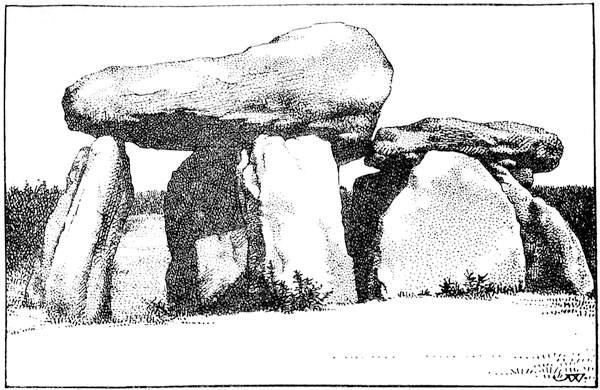
LA ROCHE AUX FÉES, ESSÉ
Josselin (M.) chl. arr. Ploermel. The
capital of the ancient county of Porhoet (Poutre-coet
= the land beyond the wood). The
story goes that once upon a time a workman
here found an image of the Virgin in a bramble
bush. As it soon established its character as
miraculous, a town sprang up about the sanctuary.
Guethenoc, Count of Porhoet, planted a castle
here and called it after his son, who completed
his father's work in 1053. The castle became
the headquarters of the counts and then dukes
of Rohan. The original castle had been
taken in 1168 by Henry II. of England, and
utterly destroyed, but it was rebuilt by Eudes II.
in 1173, and was held throughout the War of
Succession by the partisans of Charles de Blois.
In 1370 it was acquired by Olivier de Clisson,
when fresh fortifications were added, notably the
keep. Alan IX. Viscount, (1429-62) constructed
the beautiful front towards the court.
Richelieu had the towers and about half the
castle blown up, in 1629, and in 1760 the duke
himself pulled down two more towers. What
remains of the castle has been most carefully and
tastefully restored by the present duke, who
graciously allows it to be shown to visitors.
The front to the river which bathes its walls
is furnished with three towers resting on the
rock, and gives some idea of what the castle
must have been when complete. The inner
façade that looks upon what was the Cour
d'honeur is a superb example of domestic
architecture in the 15th cent., already under
the influence of renaissance ideas. The ten
gables of the dormer windows are connected by
a balustrade of the richest design, greatly varied,
but repeating the device of the Rohans, A Plus.
The Church of Notre Dame was originally late
Romanesque, and still retains pillars and a
window of the period, but the bulk of the
church is much posterior. The choir and
lateral chapels and the crossing of the transepts
date from 1390-1407. The rest of the
church is later still. The N. transept was
added in 1491. In this church, in 1351, the
Franco-Breton company of Thirty made their
communion before meeting in deadly combat the
Anglo-Bretons of the same number at the cross
of Mi-voie. They made a vow before the
statue of S. Cadoc that still remains in the
church. In Notre Dame is the tomb of Olivier
de Clisson, 1507, who married Marguerite de
Rohan. An "indulgenced" procession takes
place here on Whitsun-Monday. Formerly it
was accompanied by barking women, taken with
hysterical excitement which made them utter
sounds like the barking of dogs. This phenomenon
first appeared in 1728 and was renewed
annually. Nothing of the sort takes place now.
The bold square tower is of the 17th cent.
with picturesque slate cap. A new tower and
spire are being added at the E. end. This
is well enough, if the old tower be left, and
the grouping will be effective; but if the latter
be pulled down as is proposed, the new spire
will be a poor substitute. Inside the church
on the right hand is a niche containing a skull
to which the peasants make offerings of grain,
to cure headaches. None know whose skull
it is, but it has recently been enclosed in a
wooden silvered bust of S. Laurence.
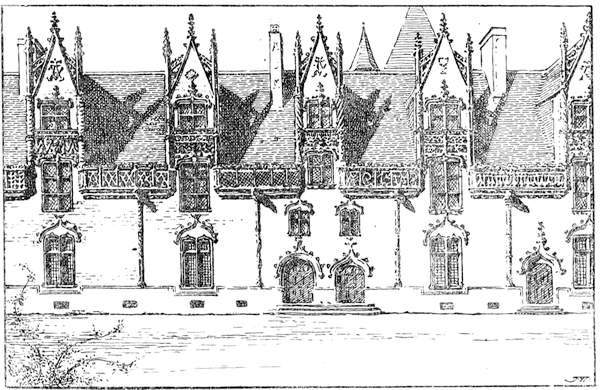
THE COURT, JOSSELIN
The priory church of Ste. Croix is of the 11th
cent. Romanesque. S. Martin's was erected in
the 12th cent. and is now a ruin. In 1793
the Republican garrison of Josselin swept the
country to capture the priests, and was fallen
upon and defeated by the exasperated peasantry.
In 1795 they burned the church of Guegon and
smashed the Calvary, but were again attacked
and driven off by the peasants.
The famous Battle of the Thirty took place
on the Lande de Mi-Voie, between Ploermel
and Josselin. The English-Bretons were under
Captain Bramber or Bemborough, and the
French-Bretons under the Sire de Beaumanoir,
governor of Josselin. Although it has been
regarded as a battle between English and French,
there were actually but three or four of English
nationality on the De Montfort side, the rest
were Gascons, Angevins and Flemings. Success
would perhaps have been with the Anglo-Bretons,
had not one of the French perfidiously
violated the rules laid down before the engagement,
mounted his horse and by this means broke
the Anglo-Breton line.
The country around is well-wooded and
pretty. The town is dirty and ruinous.
Guegon. The church is in the late Romanesque
of the 12th cent., when the style was in
transition to 1st pointed. The south aisle is
of 1560 and late flamboyant. In a window is
stained glass representing the apostles; it is of
1563. The tower and spire were the loftiest in
the diocese, but were struck by lightning in
1705.
S. Servan. To this parish Gobrian, Bishop
of Vannes, retired in 717 and here died in 725.
He was buried in his oratory. A village grew
up about his tomb that bore his name. This is
now a chapelry, and the chapel is of the 11th
cent. with additions of the 15th cent. The
nave is floored, forming an upper chamber which
served as a hospital for the sick seeking health
at the tomb of the Saint.
Jugon (C.N.) chl. arr. Dinan. A prettily
situated town at the junction of two valleys,
each occupied formerly by a lake and dominated
by a strong castle at the fork. One of
the lakes has been drained and the castle has
been destroyed. The church has nave and
S. tower, 2nd pointed and good. There is a
curious W. doorway. Choir and transepts are
flamboyant. The church has been "restored"
in execrable taste. The road from Jugon to
Dinan runs over high and dreary country, moors
only partially reclaimed.
Lamballe (C.N.) chl. arr. S. Brieuc. A
little town in a plain dominated by a ridge of
granite that runs to the east and is crowned at its
W. termination by the beautiful Chapel of Notre
Dame, and by a windmill at the E. termination.
In Lamballe are some picturesque old houses,
and there is a haras for the improvement of the
breed of horses in Brittany. The town possesses
three churches, one of which is Notre Dame, and
was a chapel of the counts of Penthièvre, and is
by far the finest in the town, but it is now only
occasionally that divine service is performed in
it.
The parish church of S. Jean is of the late
middle pointed style, 1425, with an octagonal
tower of 1420 at the base, but much later at the
crown. The church has been atrociously mutilated,
all the tracery cut out of the windows in the
18th cent. to be replaced by an iron framework
to sustain the glass. The Church of S. Martin
was of early Romanesque of the beginning of the
11th cent., but the arches to the east show the
beginning of the pointed style. The S. transept
possesses a good middle pointed geometric
window. The tower was begun in 1551 and
became purely renaissance before completion.
The quaint wooden porch was added in 1519.
The Church of Notre Dame is a magnificent
structure, and richly repays a close study. The
most ancient portions are the N. transept, with
lancet windows, the noble gateway and the W.
front, together with the arcade of the nave.
But the side aisles are late flamboyant. The
choir and S. transept were erected by Charles
de Blois and are admirable examples of 2nd
or middle pointed architecture at its very
best. The choir is vaulted but not the nave.
To sustain the vault on the S. side are buttresses
within the church forming side chapels and
pierced with delicate tracery. There is a double
triforium. The choir has a square end lighted
by a noble E. window, very tall and of only
four lights. The clustered pillars on the S.
side of the choir and the piers sustaining the
central tower are remarkably fine. There is a
little flamboyant screen with a renaissance organ-case
above it in the S. aisle of the choir.
S. Aaron. On the Lande du Chêne-hut is
an allée couverte composed of 13 stones, three of
which are coverers, and two others lie in the
soil. The whole is 30 feet long.
Meslin. Five allées couvertes on the Lande
du Gras. One is in the middle of the Lande,
one just below the mill, a third in the Champ
des Caves, a fourth at Bourdonnais. In the
Lande du Gras is a menhir 10 feet high.
* Landerneau (F.) chl. arr. Brest. An
excellent centre for many interesting excursions.
The town is commercial and thriving. It
possesses a few old houses and a quaint mill.
The Church of S. Houardon has been rebuilt,
but the beautiful tower and superb porch have
been preserved. The date of the porch is 1604,
and the tower is of much the same date. Landerneau
was a great artistic centre in the 16th
and 17th cents., and its architects and sculptors
erected the splendid work in the Elorn valley
and the region around. The style they created
is very original and deserves attention. They
delighted in adorning the churches with noble
porches, bold, and often with the gable crowned
with a spirelet. Within, niches hold statues
of the twelve apostles. When all other detail
is Italian, the foliage remains of flamboyant
character. The second church in Landerneau
is that of S. Thomas à Becket, 1607, small and
uninteresting. To the W. is an ossuary of 1632
converted into a habitation. The valley of the
Elorn presents many scenes of considerable beauty.
The rocks are of white quartz breaking through
the leafy covert of the hills.
Pencran. A steep ascent of a mile leads to
this very interesting church, with fine porch and
two calvaries and a spire. The date of the
porch is 1553. The sculpture here in Kersanton
stone is peculiarly rich and delicate. Among
the groups of figures may be distinguished Adam
and Eve, and the serpent, the expulsion from
Paradise, Cain and Abel, Adam delving whilst
Eve spins, the Ark and the drunkenness of
Noah. In the tymphanum is the Nativity,
much mutilated. Within the church are the
Descent from the Cross and the Mater dolorosa,
groups carved in 1517.
La Roche Maurice. In a most picturesque
situation, the church embowered in trees on a
height above the river, and a ruined castle on a rock
of white quartz. The castle belonged to the dukes
of Rohan whose eldest sons bore the title of
Princes de Léon, on account of the large family
possessions in Léon. The church has a slim
tower with double galleries and two sets of open
bell cages, and is an excellent typical example
of a style very common in the Department of
Finistère. Its date is 1589. The porch with
some fine foliage in Kersanton stone is of 1530-40.
In the churchyard is a good ossuary of
1640. On it is represented Death darting at all
sorts and conditions of men, with the inscription
"Je vous tue tous." At the entrance to the
churchyard are three pillars that support the
cross of Christ and the two thieves. Within
the church the magnificent east window with
its stained glass of 1539 at once arrests the eye.
It represents the story of the Passion and reproduces
that in S. Mathieu at Quimper, and that
in the church of Tourch. After the stained
glass, the screen attracts attention. It is renaissance
and is the sole example left in its
proper position in a parish church in the dioceses
of Léon and Quimper. P. Ascension Day.
But at Pontchrist, a ruined renaissance church
by the river in a picturesque situation, on the
4th S. in July.
La Martyr. This was the scene of the
murder of Solomon, King of Brittany, in 874.
Solomon had assassinated his cousin Erispoe,
who was king, before the altar of the church of
Penpont, and so won the crown for himself. He
was a contemptible creature. He proceeded to
buy off the Northmen and to promise to pay tribute
to Charles the Bald, and undertook to undo all
the ecclesiastical organisation formed by Nominoe
and surrender the jurisdiction over the Breton
sees to the Archbishop of Tours, if the Pope
would absolve him of the murder. But this was
too much for the Bretons to endure, they rose
in revolt, headed by Pasquitien, son of the
assassinated king, and Solomon, finding himself
deserted on all hands, fled with his son towards
the coast, hoping to take refuge in England.
But he was overtaken where is now La Martyr,
where he had taken sanctuary in the church,
dragged forth along with the boy and both were
killed (874). For some unaccountable reason the
Bretons have regarded this despicable murderer
as a saint. The tower of the church belongs to
the 13th cent. The entrance to the churchyard
is by a triumphal arch adorned with
statuary. This is the earliest of the kind in
the country and belongs to the 16th cent. The
porch is remarkable for its style and for the
delicacy and richness of the sculpture. It
belongs to the latter part of the 15th cent.
The ossuary is of 1619 and is attached to the
porch. The interior of the church is of the
14th cent. It had originally a fine screen in
Kersanton stone, that has been destroyed, but the
basement of the parclose screens remains. Four
stained windows of 1567 represent the Passion,
the Crucifixion, the Resurrection, the Noli me
tangere, the apparition of the risen Christ to
His mother, and the Ascension. Also the
death, assumption and coronation of the Virgin,
and a Jesse tree. The Duke and Duchess of
Rohan are represented as the donors. The
church possesses a magnificent reliquary of the
renaissance period. P. on the 2nd S. in July.
A great horse fair follows, lasting three days.
S. Divy. This church possesses a ceiling
painted with a series of subjects from the life of
S. David. P. Sunday after Ascension and 2nd
S. in September.
Dirinon (S. Nonna). The name signifies
the steps of Nonna. The church stands on
very high ground. It is in the usual style of
transition between flamboyant and renaissance
(1588-93). A chapel in the churchyard contains
the tomb of S. Nonna, mother of S. David,
and wife of Sandde, grandson of Ceredig, who
drove the Irish out of S.W. Wales and gave
its name to Cardigan. The tomb, however, is
a work of the 15th cent. At a little distance
from the village is her well (1623). At the
further end of the village is that of S. David.
P. 2nd S. after Trinity.
Plougastel. The costumes of this district
are very picturesque. The men wear blue or
violet jackets and three waistcoats and sashes.
The church is modern, but in the churchyard is
a marvellous Calvary (1602-4) consisting of an
arcade under a platform crowded with statues,
and a frieze surrounds it, carved with subjects in
bas-relief. P. at La Fontaine Blanche, Easter
Monday and the 15th August; at S. Jean on the
24th June. By the Chapel of S. Guénolé is a
rude stone, against which barren women rub
themselves in the hope of becoming mothers.
* LANDIVISIAU (F.) chl. arr. Morlaix.
A small town on the high road from Morlaix to
Brest. It forms an excellent starting point for
several interesting excursions. The church is
modern, but has a tower and spire of 1590,
partaking of the fault of all those in Léon and
Cornouailles of this period. It is thin and
pinched. The date of the superb porch is
1554. It is an interesting study, as it serves as
a link between those of pure flamboyant and
such as are true renaissance. About the great
arch are subjects from the Old Testament.
Within are the twelve apostles; the corbels
supporting them are curious and varied; symbolical.
For instance, one represents two
drunken soldiers carrying off two girls, one
carrying a mirror, another a sceptre, signifying
that damsels with vanity or arrogance fall an
easy prey. In the cemetery outside the town
is an ossuary, date about 1620. In the town is
the Holy Well of S. Divisiau, almost buried
among houses. It supplies a large public
washing basin. Two ranges of an arcade
surmount it, containing ten panels that have
come from some tomb of the 16th cent.
Landivisiau, with its comfortable hotel, is a good
starting-place for excursions to places where the
accommodation is not all that could be desired.
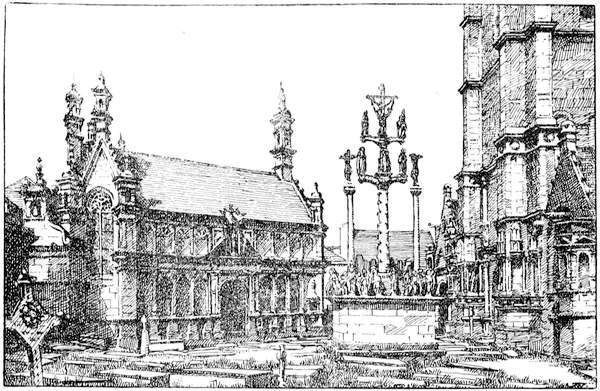
CALVARY AND OSSUARY, S. THÉGONNEC
S. Thégonnec. This place is richly deserving
of a visit with its church, and churchyard
overcrowded with piles of granite, Calvary and
ossuary and triumphal arch. The last mentioned
is of 1587 and is cumbrous but effective. These
triumphal arches first made their appearance at
the close of the Gothic period. This is wholly
Italian in character. The ossuary adjoins it and
belongs to a later period, but is far purer in
design, 1676-7. The façade is very rich and
beautiful. Within in a crypt is a Holy
Sepulchre, life sized figures of 1702. The
Calvary dates from 1610 and represents scenes
of the Passion. The oldest portion of the
church is the west doorway with the little bell-turret
rising above it; this dates from 1563.
At a later date the huge tower was erected on
the south with a porch in its basement, built
between 1599 and 1610, the statues added in
1632. Above the porch is the statue of S.
Thégonnec (To-quessnac, a disciple of Paul
of Léon). The window tracery is modern and
does not faithfully represent the old tracery.
The nave was built in 1777. The furniture of
the church is interesting. The pulpit, though
late, is fine. A niche with shutters painted
with scenes from the Saint's life contains a statue
of the patron. Opposite is another statue of the
B.V.M. with painted shutters. The tower is
heavy, and the effect of chamfering the angles
very unpleasing. To support the gallery the
angles of the tower are very massive, buttresses are
added and between them the wall is reduced,
and the gallery sustained on heavy corbels.
The platform is surmounted by a dome and
lantern and little side pepper-boxes. The
interior effect of the church is rich and harmonious
in gold and colour, if somewhat
barbaric.
Locmelar is reached by ascending a pretty
valley that contains an affluent of the Elorn.
The church is late flamboyant, with apse and
gables. The porch is of the common type of
the period and contains statues of the apostles.
There is a Calvary. The tower dates from
1656. Over a side altar is a painting
representing in a series of groups the legend
of S. Hervé, a blind bard saint who contributed
greatly to the downfall of Conmore,
acting in conjunction with Gildas and
S. Samson.
Bodilis. The tower of this church was
erected when Gothic architecture was in its
decline. It is surmounted by a spire with
spirelets at the angles rising from a gallery.
The porch is of 1570, and is of unusual beauty.
Within are the apostles; below the niches runs
a band of marvellous richness of sculpture and
great variety. The font is surmounted by a
baldachin in Kersanton stone of 1680. P. on
Ascension Day.
S. Servais. This church has an early
renaissance tower with double galleries and two
bell cages, the whole surmounted by a spire and
pinnacles. The body of the church is of the
latter half of the 17th cent. The graveyard
cross has sculptured scenes on it, and there is an
ossuary like that at Landivisiau.
Guimiliau. Annually numerous tourists visit
this village to see its very remarkable ecclesiastical
monuments, its church, porch, sacristy, calvary,
and the little Chapel of Ste. Anne. The porch
rivals that of Bodilis and Landerneau. The
doorway into the porch has a series of biblical
scenes in sculpture in the mouldings. The date
is 1617. The voluted keystone alone proclaims
the abandonment of Gothic for Italian
architecture. To the west side of the porch
is attached an ossuary, the roof supported by
columns. The sacristy was erected in 1683.
The Calvary consists of a mass of masonry,
pierced by arches in the angle buttresses, the
whole sustaining a frieze covered with sculptured
figures, and the platform above crowded with
statues. The whole surmounted by the cross
with SS. Mary and John at the sides. The
groups are very curious and represent soldiers
and peasants of the close of the 16th cent.
The Calvary was erected in 1581. Near the
Calvary is the mortuary chapel of Ste. Anne,
1648. The interior of the church contains a
magnificent baldachino over the font in carved
oak; it was constructed in 1675. The organ
case is of much the same date, the pulpit of
1677. The church possesses two embroidered
banners of 1678. Guimiliau (Vicus Miliai)
has as patron Miliau, King of Cornouaille, who
was basely assassinated by his brother Rivold
in 537, who also mutilated his nephew Melor,
by amputating a hand and a foot, and finally by
having him murdered by his foster-father, whom
he had bribed to do the deed.
There is a Holy Well of S. Miliau outside
the village.
Lampaul-Guimiliau. The great tower of
this church (S. Paul of Léon) was founded in
1573, and is very lofty and surmounted by a
spire which has remained incomplete. The
porch is fifty years older. Within are the
apostles in very quaint niches. The sculpture
of the Holy Water Stoup and of the inner
doorway is remarkably rich. The font is of
1651, and is surrounded and surmounted by a
baldachino of 1650. The pulpit, that is late,
is a fine piece of wood carving. The east end
of the choir terminates in an apse with gables.
The Calvary, triumphal arch, and ossuary belong
to 1668. P. 1st S. in May. At the Chapel
of S. Anne, S. after 15th August.
See also Lambader and Plouneour-Menez.
* LANMEUR (F.) chl. arr. Morlaix.
The church surmounts a crypt that is very
curious and rude, and is attributed to the 10th
cent. In this crypt was once the tomb of S.
Melor (see under Guimiliau), whose body was
transferred in the 9th cent. by refugee Bretons
to Amesbury. There is a fountain in the crypt.
Of the upper church only four piers and a small
door belong to the original building. Near the
church is the Romanesque Chapel of Kernitron
(12th cent.). It is a cross church with a bold
central tower. Some of the windows are late.
The P. of Kernitron is on the 15th August.
S. Jean du Doigt is a complete and interesting
collection of structures such as were wont
to be grouped about a parish church. There is
first the monumental church itself, in the midst
of a graveyard entered by a triumphal arch, a
Holy Well, a Calvary, an ossuary, and an open
oratory, where mass is celebrated before an enormous
crowd on the occasion of the Pardon, and,
finally, the church possesses a rare collection of
precious ornaments, such as belong to no other
parish in the diocese. The triumphal arch is
of the 15th cent. The Holy Well is in the
churchyard, and is a noble renaissance structure
composed of a large basin, with two superposed
vessels, from which heads of angels spout water.
The whole is surmounted by a group representing
the Baptism of Christ. Almost in face of this
is a pretty oratory of 1574, very elaborately and
quaintly sculptured. The tower is surmounted
by spire and spirelets covered with lead. The
east end of the church has in it a noble rose
window. At the foot of the tower is an ossuary,
and a second of 1618 is on the S.W. The S.
porch has a parvise chamber above the doorway.
The interior is rich, and the inner doorway is
surmounted by a statue of the Baptist in a Gothic
niche with wings. The church was commenced
in 1440, and was completed in 1513, so that it
belongs to an excellent period of flamboyant,
of which unfortunately examples are few. Internally
the exaggerated height of the pillars as
compared with the arches deserves notice. The
treasury is extraordinarily rich in chalices,
reliquaries, and a processional cross of the 16th
cent. A reliquary of the finger of S. John is of
1429. The P. is on the 24th June, and draws
vast crowds of pilgrims. The object of the cult
is a finger of the Baptist, which is supposed to
have its nail pared annually. It was stolen from
some chapel in Normandy by a native of Plougasnou,
who successfully conveyed it to his
native village. There is, of course, not a
particle of evidence worth a rush that substantiates
the relic as genuine.
Plougasnou has an interesting church on a
storm-beaten coast. The interior is Romanesque,
but the exterior dates from 1574. It has a
tower of 1582. A curious Chapel of N.D.
de Lorette with caryatides is shaped like an
old Lycian tomb.
Guimaec. Here are two cromlechs or
stone-circles.
Lannilis (F.) chl. arr. Brest. The church
modern and bad. The tower is of 1774, in the
true Léon style, and interesting as showing to
how late a date the style continued. It has two
galleries for four bells, and spire with ample
spirelets. The line is carried on to the sea,
where there is a watering place at Abervach.
The coast is not remarkable, but there are good
sands.
Plouguerneau. On the east is the site of
Tolente, a town that was completely destroyed
by the Northmen in 875. P. of Tréminach
on 1st S. after the 10th Aug. P. of S. Cava
on the last S. in August; at S. Michel on the
last S. in September.
Locbrévelaire. The valley of the Abervach
is here pretty. The place is mainly of interest
to the geologist. The whole hill on which
Locbrévelaire stands is composed of Tertiary
Oligocene, the ruins of granite, and is of a
spongy nature, full of kaolin and with lumps and
bands of quartz undissolved, and much mica. It
is quarried for road-making, but the quartz alone
is of value for that purpose. Almost certainly
below this spongy mass a bed of kaolin would
be found. The church (S. Brevelaire = S.
Brendan) lies on one side of the valley in a lap
of the hills, and opposite are the noble woods
and park of the Château de Liscoat. The
church contains an arcade of the 11th cent.,
very rude. The S. wall is 17th cent. The
tower of the same. There is, in the churchyard
wall, a Holy Well surmounted by a statue of the
Saint. S. Brendan, afterwards Abbot of
Clonfert, was forced to leave Ireland in 520,
owing to his having unintentionally caused the
death of one of his pupils, and he spent seven
years away from it, during which time he
founded a monastery on the island of Cézambre,
opposite S. Malo, and another in a different
part of Brittany. This latter may be Locbrévelaire.
* LANNION (C.N.) chl. d'arr. A picturesquely
situated town on the Guer that reaches
the sea seven kilometres below. The tide
reaches as far as Lannion, and it has a little
port. The Church of S. Jean de Balay consists
of a nave and four aisles under one roof, and
without clerestory and without transepts. It
is lighted through side windows under gables.
These windows are of various periods. One
is of the 14th cent., others of the 16th, and
there are instructive examples of the debased
tracery of the 17th. In the market place are
some picturesque old houses. By the river is
a fine pile of buildings now used as a hospital.
Particularly noticeable is a rich late window,
an attempt—and an expiring one—to design a
rose with flowing and beautiful tracery. In
another twenty or thirty years, as may be seen
in the windows of S. Jean de Balay on the
N. side, the skill was wholly lost. Divided
from Lannion by a deep valley is the Church
of Brévelenz. The east part and crypt are
Romanesque. There is a good early pointed
porch. An ossuary and a mortuary chapel are
in the graveyard. The pinnacles, one a chimney
to the fireplace for heating baptismal water, at
the porch are peculiar.
Loquivy is in a charming situation. The
church (S. David) is interesting. In the
churchyard is a noble renaissance fountain, and
outside the graveyard a Holy Well, flamboyant,
surmounted by a statue of the patron saint of
Wales. The church is of the 16th cent. An
old carved oak retable representing the Adoration
of the Magi and a crowd of other figures is
in the baptistery.
Ploubezre. The church was rebuilt in 1851,
but the fine tower is of 1577. Within have
been preserved two Romano-byzantine capitals
from the old church, and one window of the
14th cent. remains. The chapel of Kerfons is
flamboyant, and is in the form of a T. One
of the gables bears the date 1559. The magnificent
roodscreen is of 1533. It is a beautiful
example of good flamboyant work, with
apostles and other figures on the gallery on one
side, and tracery on the other. The castle of
Coetfrec occupies the summit of a hill above the
Guer. Four towers remain, and the castle is in
a tolerable condition. The court is looked into
by the windows of the state apartments, in one
of these, a fireplace with bold chimney-piece,
remains. The Château de Kergrist is a ruin,
complete. Tonquedec is another old castle in a
most picturesque situation. On the N. is the
donjon, which is reached by a door high up in
the wall. The Chapel of S. Gildas is of 15th
cent., with the legend of the Saint within in
sculptured oak.
Lanvollon (C.N.) chl. arr. S. Brieuc.
Reached by carrier from Châtelaudren, is a dull
town with one curious old house in it at the
junction of two streets; it is of wood and
plaster, the wood covered with carving. The
church (S. Vollon = Foelan) belongs internally
to the 14th cent., and has a good E. window,
but externally the church has been sadly maltreated
by incompetent "restorers."
* LESNEVEN (F.) chl. arr. Brest. An
uninteresting place in itself, but headquarters to
one attending the Pardon at Folgoët. Its fine
halles of the 15th or 16th cent. has been
destroyed to make way for a "place" with a
statue in the midst of a General Floh, of bronze.
When this statue was sent down, and the Mayor
opened the case, to his dismay he found it was
green. So he set his wife, cook, and house-maid
to sandpaper and scrape it, till it shone as
gold, and then had it hoisted to its pedestal, and
it was solemnly unveiled. But the artist, who
beheld it thus burnished, was furious, and complained
to the prefêt and the authorities at Paris,
and orders came to the Mayor to take down the
statue and restore to it the green rust. He was
obliged accordingly to re-erect the scaffold and
crane, and have General Floh transferred to his
own house again, where he expended some
barrels of cider over him to reinvest him in
verdigris. The church is very ugly, but it has
a late renaissance porch in the basement of the
tower on the N. side.
The branch line is carried on to Brignogan,
which is a watering-place, and where there is a
fine menhir 30 ft. high, the most remarkable in
the Department. At Plounéour-trez the church
is new, but the old tower and spire are retained
till they also can be pulled down and replaced
by something more in proportion with the new
church. The windows represent scenes in
Breton history. The coast is not fine, the
sandy shore slopes very gently into the waves.
But the good bathing is an advantage.
Folgoët. This famous pilgrimage church was
founded in the 14th cent. when an imbecile
youth died who could say no other words than
Ave Maria, Salaun a zepre bara, or Salaun
wants bread. A lily grew out of his grave
and it was concluded accordingly that he was
a saint. This was in 1358. At the west end
are two towers. That on the north is admirably
proportioned with spire and angle spirelets of the
period, 1365, when Jean de Montfort laid the
first stone. That on the S. was never finished.
It is surmounted by an upper stage with Ionic
pillasters added in the 17th cent. The S. side
has a noble porch and transept, the E. wall of
which is a continuation of that of the choir.
The E. and S. transept windows are examples
of the geometric style in Brittany, a rose
resting on a transom. Within the stone screen
is formed of three compartments, and though
fine, is certainly inferior to such as are in
wood. A spring wells up under the high
altar and is conveyed to a Holy Well outside.
La Doyenne is a picturesque building with
turrets erected by Anne of Brittany, converted
into Mairie and school. The P. is
on the 7th and 8th September, and begins
with vespers and a procession bearing candles;
many beautiful costumes may be seen on this
occasion.
The processions arrive with banners for High
Mass, singing this hymn.
Patronez dous ar Folgoat, Hor mam ak non
Itroun, An dour en non daoulagat Ni noped a gatoun!
Harpit an Iliz santel! Aveldirolla
ra Tenn ok hir eo ar brezel! Ar peoc'h, O maria!
Goulven. The church is late flamboyant
with a fine renaissance tower and porch within
which are the apostles. Side by side may be
seen a doorway of the earlier and of the later
periods. There is a fine painted 16th cent.
reredos in the church to a side altar. The
gallery of the roodscreen has been made into
a west gallery. About a mile distant is the
Holy Well, with a stone trough at the side in
which patients were placed and given a bath in
the miraculous water. No such an attempt to
recover health has however been made of late
years. There is a chapel at the Peniti of S.
Goulven at a little distance. A double dolmen
at a junction of two lanes has been much injured,
several of the stones that composed one of the
chambers, and perhaps an enclosing circle, have
been employed for the hedge. The P. is on
June 30, the costumes then seen are very rich,
and the parish possesses very fine old embroidered
banners then produced.
Treflez. Tomb of 16th cent. of S. Elfleda
or Ediltruda, daughter of Oswy, King of
Northumberland, and Abbess of Whitby. She
died in 715, but how her body comes to be at
Treflez passes knowledge.
Guiseny. Church of S. Sezni (Setna or in
Cornwall, Sithney) renaissance. There is a N.
late flamboyant porch. Curious early Calvary
with four figures on the branches. P. 3rd Sunday
in September.
Lézardrieux (C.N.) chl. arr. Lannion, on
a little tidal port, between Pampol and Tréguier.
An excursion may be made to the Ile Modez.
See Bréhat.
Locmariaquer (M.) com. in arr. Auray.
A most interesting place that seems to have been
crowded with monuments of the prehistoric dead,
and although destruction has been carried on for
two thousand years, many still remain. Locmariaquer
is situated on a spit of land between
the estuary of Crach and the Rivière de la
Trinité, but it is itself split by the creek of S.
Philibert. The shores that are low are covered
far inland at the high tides, and the sea has
gained considerably on the land. Roman constructions
noted in 1727 are now permanently
under water. A camp in the hamlet of Lannbric
is now eaten into by the waves. The principal
prehistoric monuments are the Mané-er-hroeg,
south of the village; a tumulus containing a
dolmen that was explored in 1863 and yielded
103 polished stone axes, a collar of callais, and
a jade ring. Near it was found a slab on which
are mysterious markings representing cartouches,
celts with handles, and other symbols unexplained.
On the summit of the tumulus were
found coins of Tiberius and Trajan. The
tumulus of Mané Lud to the N.E. of the
village contained two skeletons, one a case of
carnal interment, the other had been burnt.
At the W. end of the tumulus is a sepulchral
chamber led to by a passage, and here also are
carvings. Between this tumulus and the village
is the huge dolmen called Table des Marchands.
On the stone at the back are also carvings.
Close to this is the longest menhir known. It
is 64 ft. long, but was struck by lightning,
thrown down and broken into four pieces. In
a field near the village is the Mein Rutal,
another dolmen of considerable size. West of
the village and near the sea are the remains of
an allée couverte, 74 ft. long, called Les Pierres
plates. On this also are inexplicable carvings,
next to those on Gavr Inis, the most remarkable
in the country. There are smaller dolmens at
Pont-el-leu, Kercadoret-er-Gal, Coetcourzo,
Kerhan, Porher, Kerlud, Locperhet, Pont-er-vel,
Kervéres, Kerdaniel, Kervoch, and Cocordeau;
and menhirs at Kerpenhir, Bronso, Porher,
Mané-er-hroeg, Kerguelvan and Lannbric.
Locmariaquer was a Roman station. P. 1st
Sunday in July; that of S. Philibert on the
3rd Sunday in August.
Locminé (M.) chl. arr. Pontivy (Locus
Monachorum). A considerable district was here
made over to Gildas who founded a monastery
where now stands the village of Moustoir.
Owing to the ravages of the Northmen the
monks of S. Gildas de Rhuys and of Locminé
fled into Berry. They returned in 1001, and
set about restoring their ruined monasteries, but
the old site at Moustoir was not rebuilt upon;
the abbey was transferred to Locminé. The
parish church and the Chapel of S. Columbanus
are side by side, in communication through an
arch. The latter owes its origin to some relics
of S. Columbanus having been brought hither.
The chapel is late flamboyant, but has a 17th
cent. tower, under it an earlier doorway with
mutilated tracery above it. The parish church
has a slated spire, that of S. Columbanus is
surmounted by a small cupola. A quaint ossuary
of good renaissance work is on the N. side.
The east window of the chapel contains 16th
cent. glass representing the life of S. Columbanus
in four groups, but in a very poor condition.
East of the chapel is the beautiful Chapel of
N.D. de Plasquer, of the finest flamboyant
work. The W. doorway has disengaged
pinnacles and some curious carving. The E.
window tracery forms three fleurs-de-lys.
Within is a pretty flamboyant credence in the
N. chapel under the tower. In a corner thrown
aside is a noble carved oak statue of S. Gildas
of the 15th cent. with his symbol, a snarling
dog, at his side. P. 31st June, but that of
Locminé is the Sunday nearest 27th June and
lasts three days.
Remungol has a Holy Well near the church,
a work of the 16th cent.
Lorient, chl. d'arr. A port. The town is
composed of Lorient itself, a fortified place, and
the Faubourg of Kérentrech, where a suspension
bridge crosses the Scorff. Lorient owes its
origin to the East India Company. That
company, created in 1664, was in quest of a
port. The Duc de la Meilleraye offered Port
Louis, and in 1666 royal authority was granted
to the company to form there quays, factories
and storehouses. The village founded by La
Compagnie de l'Orient took thence its name.
The company having got over a financial crisis
in 1669 bought up land in the neighbourhood.
In 1712 the settlement comprised 700 families;
it was raised to be a parish in 1709. In
1717 the company began to build and lay out
quays and form basins on a grand scale, and
in 1739 Lorient attained the dignity of being
accounted a town. In 1745, the company had
reached its highest point of prosperity, and had
become a veritable maritime power, with 35
frigates in the harbour. Its flag was blue
charged with a fleur-de-lys or, and it had as device
Florebo quocunque ferar. English jealousies
were aroused, and in 1746 an English fleet
anchored in the Bay of Pont-du. Seven thousand
men were disembarked under General Sinclair
and summoned the town to surrender. As this
was refused it was besieged, but after a few
days General Sinclair withdrew without having
effected anything. Curiously enough, the garrison
had resolved on surrender, and sent to notify
their purpose to the general, but found that the
English had departed. The company failed,
partly through internal dissension, mainly through
the loss of Bengal, which was secured by the
English in 1753. From this time the fortunes
of the company declined, and at last it became
bankrupt in 1769. It was then that Lorient
passed to the Crown. The town is supremely
uninteresting, and no visitor will stay in it except
under constraint.
Port Louis. The Church of N.D., 1665.
The citadel of the 18th cent., at one time served
as a prison to Louis Napoleon.
Ploemeur. A circle of standing stones 20
ft. in diameter surrounds a tumulus, on the top
of which is a dolmen fallen, thrown down by
clumsy excavators. Near Kerroch a dolmen,
the table sustained by three uprights, and near
it the supporter of another. On the S. some
menhirs, the remains of an alignment. At
Kerpape, near the powder mill, another dolmen.
At the Pointe du Tallut a menhir 12 ft. high,
and near it another fallen. Ploumaur, the Great
Tribe, was one of the largest parishes in the
diocese; it was settled by S. Ninnoc, supposed
to have been a daughter of the King of Brecknock.
Her double monastery for both sexes
was destroyed by the Northmen, and it was not
rebuilt till the 12th cent. The church contains
Romanesque work, but the tower was built in
1686, and the chancel was altered and disfigured
in 1783. P. 1st Sunday in May. The Chapel
of N.D. de Larmor was built in 1506, the
tower and spire added in 1615. It was a great
place of pilgrim resort till S. Anne d'Auray
drew away the seamen who were wont to resort
to Larmor. The benediction of the sea takes
place on the 24th June.
Plouhinec. On the N. near Kerfourches
two ruined dolmens and a menhir. The W.,
near the mill of Keronsine, alignments running
parallel with the coast. Near Kersur a small
menhir and four dolmens. At the mill of
Gueldro the alignments recommence in seven or
eight rows, and run on to Keroué and Kervelhué.
At Magouer a tumulus with a dolmen and a
group of menhirs, most of them fallen, and
others have been split and used for building
purposes.
Kervignac. On the N. a fine dolmen near the
road to Hennebont. Another to the south near
Kermado.
Nostang. S. of the village near the river
Etel an alignment of 19 menhirs. For Ile de
Groix, see under Pont-aven.
Louvigné du Desert (I.V.) chl. arr.
Fougères. Church (S. Padarn) of the 15th
cent. with a tower of 1702. A circle of upright
stones. The Château of Monthorion with
tombs of Raoul II. de Fougères (1194) and
Françoise de Foix in the chapel.
Malestroit (M.) chl. arr. Ploermel. The
castle is on an islet of the Saudraye; it was
constructed in the 11th cent. No traces of it now
remain, or none of any importance. The town,
built under the shadow of the castle, was fortified
in 1463. It was attacked with fury by the
League, but always resisted the enemy, till a
third siege by Mercœur in 1592, but two months
later it was retaken by the Royalists. Now all
the walls are gone. The place retains a number
of old houses, one of these near the parish church
has on it grotesque figures, as a sow spinning, a
hunter playing the horn, with beside him a hare
performing on the biniou; a man beating his wife,
etc. The church (S. Giles) consists of two
churches side by side and in different styles.
One retains remains of a Romanesque original.
The rest is of 1511-31, and some good glass is
in the windows, representing Jesus among the
Doctors, the Baptism, the Passion, etc. The
Chapel of S. M. Magdalen is partly Romanesque.
Matignon (C.M.) chl. arr. Dinan. The
parish church is modern but the Chapel of
S. Germain is the old parish church and has a
Romanesque doorway.
S. Cast, a watering place with good sands.
In 1758, the English fleet under Admiral Howe,
after having bombarded S. Malo and burnt Dol,
disembarked a body of men here. The Duc
d'Aiguillon, then governor of Brittany, hastened
to the spot, and in spite of the fire of the fleet
defeated and almost exterminated the invaders.
A monument marks the site of the windmill in
which the duke watched the engagement.
Pléboulle. The Templar church is of the
16th cent. except the apse which is earlier.
Remains of the octagonal tower of Montbrun
on a rock, commanding a sweep of the river
Frémeur.
Plévenon. In this commune is the noble
headland of Cap Fréhel, of old red sandstone.
Here is a lighthouse. The Fort de Latte is on
a point of rock in the sea 5 kilometres from Cap
Fréhel, and entered by two bridges cast over
precipices 300 ft. deep. Facing the fort is a
rude stone 9 ft. high surmounted by a cross,
probably a menhir.
Mauron (M.) chl. arr. Ploermel. Stands
on high ground, watered by the Yvel and Doeft,
which unite above Ploermel in the pretty lake
of Le Duc. In 1352 the Castle of Mauron
was held by Bentley with a body of Anglo-Bretons.
The Marshal d'Offemont, at the
head of an army of the adherents of Charles de
Blois, resolved on taking the place. Bentley
marched out against him and obtained a complete
victory. Thirteen lords fell, among them the
Marshal and the Viscount de Rohan. A
hundred and forty knights also succumbed.
The Parish Register, 1591, is headed:—"Baptismal
Register of Mauron made after the
Prince of Darkness with the English and the
lancequenects of his company had passed. They
spent the Sunday here, September 8, 1591,
pillaged and plundered all they could lay hands
on in the church, and carried off the baptismal
register—on which account this book is now
begun." The church is modern but retains
some old carving in panels of the 16th
cent. near the porch on the S. side, and in
the sacristy is a painting of the crucifixion of
1682.
S. Lery. A church of the 15th cent.
except the chancel which is modern. In a
chapel of the S. transept of flamboyant date is
some fine old glass representing the marriage
of the Duchess Anne with Charles VIII. of
France. On the north of the nave is the tomb
of S. Lery, and on it the Saint is represented
with a pastoral staff in his hand, a book in the
other, and his feet resting on a hare. S. Lery
was a native of Wales who crossed over to
Armorica and was well received by Judicael.
As he desired a retreat, the Queen turned
Ilogan, an Irish saint, out of his, and gave his
lair warm to Lery, who had no compunction
in receiving it. He died in the 7th cent.
Merdignac (C.N.) chl. arr. Loudéac, stands
on the road from Loudéac to S. Méen. West of
the town is the fortified enclosure of the Vielle
Court. Excavations have shown that the wall
was vitrified.
S. Launeuc near a pretty lake. Here are
the ruins of the Castle of Hardouinaye almost
destroyed, where Gilles de Bretagne was starved
to death in 1450. Gilles had been left by his
father a sum of money, and he complained to his
brother, Duke Francois I., and asked to be
given some fief in the duchy. But Francis
refused his request and threw in his teeth that he
favoured the English rather than the French.
Gilles married the heiress of Châteaubriant and
Dinan. Arthur de Montauban, Marshal of
Brittany, who had desired the heiress for himself,
was thereby made his mortal enemy. He
determined on his destruction, and to effect this
spread calumnies against Gilles, to the effect that
he was purposing to introduce the English into
Brittany, and he obtained leave from Francis to
arrest him in his Castle of Guildo. This he
effected whilst Gilles was engaged on a game of
tennis. He carried him off to Dinan, where
was Francis, who refused to see his brother.
Francis I. requested the parliament of Brittany to
condemn Gilles unheard. At its refusal to do so,
he handed him over to Arthur de Montauban to
make away with, and the Marshal hurried him
away to Hardouinaye and left him to die of
starvation in its dungeon.
Muzillac (M.) chl. arr. Vannes. Church
of Bourg Peaul with side aisles, Romanesque, and
with a slated tower. Chancel 1505. The very
rich and curious Calvary was restored in 1894.
Billiers. Here are the remains of the
Cistercian Abbey of N.D. de Prières, founded
in 1252. The church was pulled down in 1715
to make way for a hideous structure in the taste
of the period.
Noyal Muzillac. The church (S. Noyala)
was rebuilt in 1850, but the transepts and chancel
of the 15th cent. remain. The tower was
struck by lightning in 1630 and rebuilt. The
Château de Keralio, of the 15th cent., is in
ruins.
Montauban (I.V.) chl. arr. Montfort.
A modern church. The castle on the edge
of the forest is of the 14th and 15th cents., and
was once the seat of a powerful family to which
it gave its name.
Montcontour (C.N.) chl. arr. S. Brieuc,
still possesses remnants of its ancient walls. The
church (S. Mathurin) is mainly of the 16th
cent.; the spire is covered with lead. Six
windows retain magnificent old glass representing
the life of the Saviour, that of S. John
Baptist, the legend of S. Barbara, that of S.
Yves, remains of a Jesse tree, and the legend
of S. Mathurin (1535). Montcontour lies on
very high ground, and commands a magnificent
view. S. Mathurin is much sought by pilgrims
who have the highest belief in his powers. The
P. is on the eve of Whitsunday with procession
carrying lights, and on Whitmonday, with
dancing.
Trébry. A dolmen at Ville-Valen, consisting
of four supports and a coverer.
Trédaniel. The Chapel of N.D. du Haut
is mainly of the 14th cent., and has a fine porch
of the 16th.
Montfort (I.V.) chl. d'arr. At the
junction of the Mieu and the Garun. A great
round tower of the 15th cent. and a portion of
wall adjoining are all that remain of the ancient
ramparts. The Church of S. Jean Baptiste is
modern, but contains retables of the 17th cent.
The remains of the Abbey of S. Jacques, founded
in 1152, has a church of the 14th cent. and
buildings of the 18th. In the hospital of S.
Lazare is an altar of the 13th cent. To the
S.E. of the tower on the edge of the forest of
Coulon is a prostrate menhir called Le Grés de
S. Méen.
Mordelles (I.V.) chl. arr. Rennes, on
the Meu.
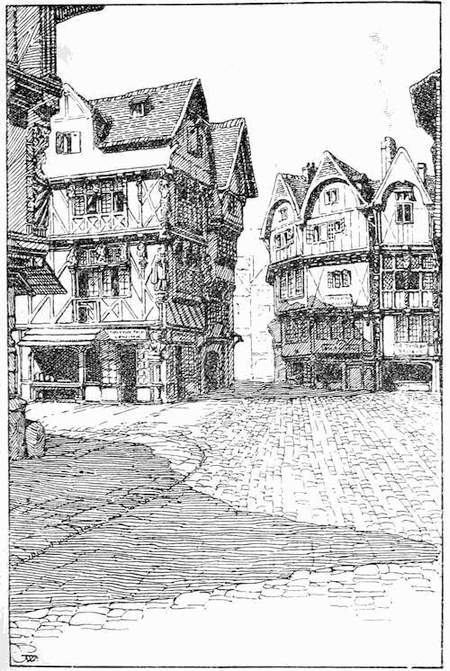
MORLAIX
* MORLAIX (F.) chl. d'arr., is situated in a
deep cleft valley at the junction of the Jarlot
and Qufflent, and has a tidal port. The town
is spanned and dwarfed by the magnificent
viaduct of the railway to Brest. The town has
only one interesting church, S. Melaine (1489-1574).
A flight of steps leads to the west
door. The S. porch is fine. The baldachino
of the font is of 1660, and the organ and gallery
are of about the same date and rich. Morlaix
contains a number of picturesque houses with
galleries about interior courts. The newels of
the stairs are often effectively carved. Admission
to some may be obtained by application at the
door. In the Rue des Nobles is the house of
the Duchesse Anne, erected in 1500. The
church of the Dominican Convent, founded in
1237, is desecrated. A floor has been introduced
at the height of the capitals of the
pillars, the basement is made into a lumber
chamber, and the upper storey into a museum.
It possesses a beautiful window of the 13th
cent., a transom sustaining a rose, lights below
the transom cusped and sustaining trefoils. This
window deserves a study. By descending the
Rue des Vignes and turning to the right, the
Rue des Fontaines is reached where are two
Holy Wells. At N.D. des Fontaines a wall
is enriched with tracery under an arch, above
which is a delicately beautiful rose window.
At this spot, according to legend, S. Drennael,
disciple of Joseph of Arimathea, preached, and
set up an image of the B. Virgin. The chapel,
which formed a portion of a Carmelite church,
has been ruined along with the church. The
tower of S. Mathieu was built in 1548. On
the right bank of the river is the Fontaine des
Anglais that marks the spot where, in 1522,
six hundred English, who had disembarked to
attack the town, were surprised when asleep,
and killed. The town was taken by the English
in 1532. To guard against surprise, the castle
of Le Taureau was constructed on an island at
the entrance to the estuary.
For objects of interest in the neighbourhood,
see under Taulé.
Mur (C.N.) chl. arr. Loudéac. Two
menhirs by the road from Mur to Corlay, one
at Botrain is a rude quartz block, square and
tapering to a point 12 ft. high. The church
is modern. The Chapel of Ste. Suzanne, 1760,
has the legend of the Saint painted on the
ceiling.
Caurel. By the road from Pontivy to
Guingamp, at the hamlet to Belaire, is a menhir
of slaty schist 15 ft. high. On the Lande de
Caurel another slate menhir 10 ft. high, and
five others prostrate. Another on the same
Lande 15 ft. high and shaped like a rectangular
blade, a niche has been cut in it and a cross
planted on the top. On the Lande de Belaire
an allée couverte of slate rock 25 ft. long, composed
of six slabs set on end supporting three
coverers. There are others in ruins hard by.
The church dates from 1654.
S. Guen. Church of the 18th cent. A
Calvary of the 15th cent. with a stone seat at
the foot. The Chapel of S. Tugdual of the
14th cent. contains the remains of a rood
screen.
Paimpol (C.N.) chl. arr. S. Brieuc. An
important fishing place, the headquarters of the
Iceland fleet. The whole of this portion of
Côtes-du-Nord facing east formed anciently the
county of Goelo. The "Icelanders" fleet starts
on February 20, and is absent till the autumn.
As many as 180 vessels leave Paimpol and the
other little ports on the Bay of S. Brieuc for
this annual fishing in the polar seas. The
blessing of the fleet takes place with solemnity
before it departs. Paimpol is the scene of
Pierre Lotti's novel, "Pécheur d'Islande." The
church of 1525 has a fine flamboyant east
window. There are several old houses in the
streets. The isle of Bréhat may be visited, see
under Bréhat.
Kerfot. The oldest parts of the church are
of the 14th cent., but the rest from 1514 to
1682. Remains of the roodscreen have been
converted into a pew.
Kerity. Fine ruins of the Abbey of Beauport,
an unique example in Brittany of a monastic
establishment that has preserved its original
buildings of the 13th cent. All the rest were
rebuilt in the 17th and 18th cents. The
roof of the church has fallen in. The abbey
consists of a series of buildings about a cloister;
on the N. are kitchen and refectory over the
cellars; S. is the church; E. the dormitory
and infirmary of the monks and the chapterhouse;
W. the abbot's house.
Le Palais (M.) chl. arr. Lorient, in the
island of Belle Ile. It has a citadel constructed
by Vauban. The old walls remain. A military
hospital and a reformatory for young criminals
are at Le Palais. The castle of Foulquet
commands the little port of that name. The
church (S. Géran) bears as its dedication the
name of the heroic king of British Domnonia,
who fell at Langport in Somersetshire in 522
fighting the Saxons. He had a fleet in the
Severn, and his wife was the beautiful Enid,
whose story has been revived by Tennyson in
the Idylls of the King. The Bretons having
forgotten who he was have identified him now
with S. Senan of Iniscathy and then with S.
Curig, and represent him as a bishop.
* PERROS GUIREC (C.N.) chl. arr.
Lannion. The church has a Romanesque nave
with semi-circular arches resting on the N. side
on capitals with cable mouldings. The arcade
on the S. side is somewhat later. The chancel
is early pointed, with an extraordinary east
window of the 17th cent., an instance of the
complete extinction of the skill to design and
power to execute stone tracery. There is a
Romanesque S. door. Of the windows one
is middle pointed, one flamboyant, and one
debased 17th cent., all in the S. aisle. The
tower at the W. end and the porch under it
with open tracery are quaint.
N.D. de la Clarté is a delightful example of
flamboyant work at its best, 1414. The little
harbour of Perros Guirec is illumined by five
lighthouses on account of its dangerous character,
and there are five more on the Sept Iles. The
sandy cove of Trestraou has a town built round
its lap that lives only in the bathing season, at
all other times it is uninhabited.
S. Quay. The church has no side aisles
but double transepts, and is good 2nd pointed.
The W. tower is good renaissance of 1732.
Ploumanach, a fishing village among rocks,
is only curious on account of the oratory of S.
Kirec (Curig) on a rock in the bay, surrounded
at every tide. The pillars and pillasters are of
the 11th cent.
Trégastel. The village is situated about a
mile from the coast, which is composed of
masses of weather-worn granite in strange forms,
among and against which modern residences
have been run up for the accommodation of
lodgers during the bathing season. On the
highest point of ground inland a Calvary has
been erected of masses of granite piled up, surmounted
by a cross, whence a fine view is
obtained of the coast and the Sept Iles. The
Church of Trégastel is of the 13th cent. with
work of the 16th, and a very villainous, debased
window at the east end of the 17th cent.
The pretty ossuary adjoining the porch is
renaissance.
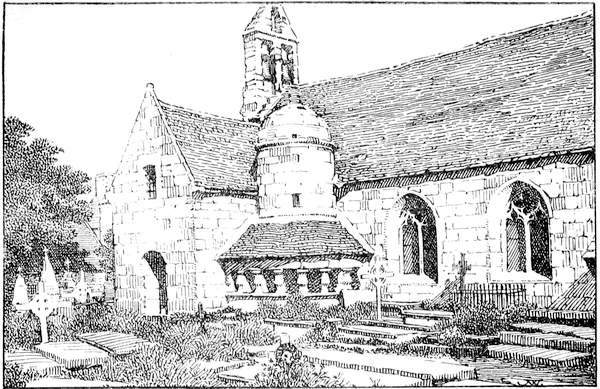
CHURCH AND OSSUARY, TRÉGASTEL
Pleumeur-Bodou. Beside the road from
the village to Ile Grande is a fine menhir 24
ft. high, the summit shaped into a cross, and
the face sculptured with the instruments of the
Passion. In the Ile Grande is an allée couverte,
composed of fourteen supporters and two
coverers. It is surrounded by a circle of
stones. The Chapel of S. Samson is of the
16th cent. with a spirelet on an octagonal
turret. The E. window is flamboyant.
Trébeurden. Nine menhirs within sight of
one another. One is a hundred paces (S.)
from the windmill of Trévern, and is 7 ft.
high; another is on the Lande de Véades of
the same height; a third is a hundred paces
from this, and is 12 ft. high; a fourth at the
Château de Kerrariou, 7 ft. 6 in. high; a fifth
between Kerrariou and the windmill, broken;
a sixth near Bologne, 10 ft. high; a seventh
W. of the preceding and at the edge of the
shore, 10 ft. high; the eighth near Bonne
Nouvelle, 7 ft.; the last is near the peninsula of
Toënnou, about the same height. There is a
fine dolmen on the Ile Milliau, measuring 28 ft.
long, covered by three slabs on eleven supporters;
another is on the shore at Prajou-menhir, half
fallen, 34 ft. long, composed of twenty-one supporters
and four coverers; a third is at Kevellec,
four stones support a single coverer; a fourth in
ruins is near the Chapelle du Christ. The chapel
has a lancet window of the 12th cent. The
parish church is very villainous, 1835.
Trévou-Tréguignec. Three menhirs in the
Ile Balanec, and a partly ruined dolmen near the
modern Château de Boisriou. Seven uprights
support two coverers.
Pipriac (I.V.) chl. arr. Redon. A dull,
uninteresting place.
Guipry. At Fougères is an alignment of
seven upright stones. In the Lande de Godier
is an ancient camp. N.D. de Bon-Port, 1644,
is resorted to by pilgrims.
Saint Just. On the Lande de Cojoux
several megalithic monuments, and on that of
Tréal an allée couverte, called La Grotte aux
Fées, 40 ft. long.
Plancoet (C.N.) chl. arr. Dinan. Pleasantly
situated on the tidal Argenton, which
above the turn flows through a pleasant picturesque
valley. Plancoet (Plou-lann-coet = the
Clan of the Church in the Wood), has a
modern vulgar church. In a little lake 3 kilometres
from the town are the scanty remains of
the Château de la Tour de la Vache, 13th cent.,
consisting of one square tower. From Plancoet
several interesting excursions may be made.
Crehen. The allée couverte of La Ville-Génouan
is 42 ft. long, and is composed of eleven
supporters on the N. and twelve on the S., and five
covering stones. It is the finest example in the
Department, and is in private grounds.
Landebia. The church has been restored.
It possesses a curious bénitier of granite supported
by human figures, and has animals carved
on the bowl. A house has a fine portal of the
16th cent. A Calvary of the same date with
several groups of figures. Another cross dated
1545, called la Croix de S. David. In the
village is a house called Presbytère des Templiers.
The visitor will probably start from Landebia
to visit the Château de la Hunaudaye in the
parish of Plédeliac. The ruins of this magnificent
castle are extensive. The castle dates from
1578, except one tower that is over a century
earlier. It is a pentagon flanked by five towers
at the angles, and surrounded by deep ditches.
Why so strong a pile should have been planted
where the ground does not in any way lend
itself to defence is hard to see. The state
hall and staircase were especially fine, but are
far gone in ruin. The earliest tower has about
the entrance from the court some rude carvings,
executed perhaps by a prisoner on the jamb of
the door on which light fell. The date of this
carving is early 17th cent. Near the hamlet of
Hazardine is a coarse menhir 16 ft. high and 30
ft. in circumference. The ruins of the Abbey of
Saint Aubin des bois are scanty. The chapel
is of the end of the 15th cent.
Pleine-Fougères (I.V.) chl. arr. S.
Malo. Destitute of interest.
Plélan le Petit (C.N.) chl. arr. Dinan.
On high bleak country, mostly moor and only
partially reclaimed.
Pléneuf (C.N.) chl. arr. S. Brieuc, reached
from Lamballe. In the parish is the favourite
seaside resort of Val-André. Except the sea and
the coast, there is nothing of interest at Pléneuf.
Erguy. An old Roman station, Rheginea,
and numerous substructures of Gallo-Roman
times have been uncovered here, also a mosaic
pavement found and destroyed in 1835 by the
boor to whom the land belonged. Numerous
finds of Roman coins are made here. At the
northern headland of the Lande de la Garenne
is a prehistoric coast castle.
Planguenoual. The church is partly Romanesque,
partly 13th cent. The bénitier shows
signs of having been systematically employed as
a knife-sharpener.
* PLESTIN LES GRÈVES (C.N.)
chl. arr. Lannion. Fine sands. The tide
recedes here to a great distance. Plestin (Plou-Jestin)
owes its origin to an Irish emigrant
Efflam, who settled here with a colony of his
countrymen in the 6th cent. He found that a
British settler was there before him, Jestin,
probably the son of Geraint, prince of Devon.
He came to terms with him without a quarrel,
the arrangement being that one should rule the
secular and the other the ecclesiastical tribe.
Plestin before this would seem to have been a
Gallo-Roman town, as numerous remains as
well as coins indicate. The church, much
altered, contains the tomb of S. Efflam, of the
16th cent. The porch is of 1575, and contains
statues of the twelve apostles. The Chapel
of S. Jacut of the 16th cent. has some old glass.
Near the Chapel of S. Efflam (1620) is his
Holy Well.
Plou Miliau was the plebs or tribal land of
Miliau, King of Cornouaille, who was murdered
by his brother Rivold. The church is in
debased Gothic of 1602.
Plouzélambre. The church is of the 15th
and 16th cents., with flamboyant windows.
The tower of 1753. In the church a fine
renaissance carved oak retable, with seven
groups of figures on it, representing scenes of
the Passion. In the churchyard a pretty ossuary
of granite of the 17th cent. An oratory, consisting
of a vault sustained by four columns, is
called Le Réposoir. Ruins of the Château of
Kerbané of the 15th cent.
Trédez. A menhir 13 ft. high, with another
near it that has fallen, that measured 24 ft.
Near the Château de Coatredrez another, 19 ft.
high. At Lan Saliou another of about the same
height. In the church is a triptych representing
a Jesse tree. The font has a fine baldachino of
carved oak, of the 17th cent. The Chapel of
Loquémeau is of the 16th cent., except one
window in the N. transept, of the 14th. The
frieze within is fantastically carved.
Trémel. A menhir at Kerguiniou, 16 ft. high,
and near by a dolmen. The church is of the 16th
cent., with apse; the porch has within statues of
the apostles.
Plufur. Church of 1764; but it retains
remains of a retable of the 16th cent. Sculptured
scenes in relief of the Passion. In the
churchyard is the Chapel of S. Yves, 17th cent.,
with paintings on the ceiling. The Chapel of S.
Nicolas forms a latin cross, and has seven flamboyant
windows.
S. Michel-en-Grèves. The Chapel of S.
Geneviève has an early rude altar, and remains of
a 16th cent. screen.
Pleyben (F.) chl. arr. Châteaulin. The
noble church (S. Germain) of 1564 exhibits
the transition from Gothic to Italian style.
The church is regarded as one of the most
beautiful ecclesiastical monuments in Finistère.
From whatever point of view seen, the grouping
of the towers, though so different in character,
is most pleasing. The principal tower is tall
and square, with a balustrade to the platform on
the summit, and on this platform rises a cupola
crowned by a lantern, and there are four lesser
lanterns at the corners. The tower exhibits the
renaissance style fully developed, yet it was constructed
only twenty years after the rest of the
church, which is instinct with Gothic feeling.
The second tower was raised in 1588-91, and is
in the late flamboyant style. It is graceful and
quaint. The stair to the bellcage is carried up
in a turret detached save for a flying gallery
supported on a couple of arches. The fine porch
dates from 1588-91, and contains statues of the
apostles. It is surrounded by a cordon of
niches, shallow but lofty, and forming an exterior
enrichment. The statuary is stiff, but not
without character. The east end of the church
is an apse, with gables over the windows, which
are flamboyant. That over the high altar
contains old glass representing the story of the
Passion, 1564. The wooden waggon roof of
the church is supported on a cornice quaintly
carved. A curious little box for the holy oils
is in the sacristy. The ossuary of Pleyben is
the earliest in the Department; separate from the
church. It belongs to the 16th cent. The
Calvary of 1650 consists of four great spurs
sustaining a central platform on vault and arches.
The platform is crowded with figures in 28
groups, representing the scenes of the Nativity
and the Passion, and, above all, as the 29th, is
the Crucifixion. The Chapel of Lannelec, two
kilometres distant, is in itself uninteresting, but
contains curious statues and sculptures. The P.
at Pleyben is on the 1st Sunday in August.
* PLOERMEL (M.) chl. d'arr. The town
stands but a little distance from the pretty lake
of Le Duc, surrounded with trees. It occupies
rising ground and has in its midst a magnificent
church (1511-1602) chiefly remarkable for its
collection of 16th century glass. This represents—1.
Jean l'Epervier, Bishop of S. Malo,
kneeling before the B.V.M. and S. Michael;
2. dated 1533 is Pentecost, a superb piece of
colouring; 3. the Life of S. Armel; 4. a
Jesse tree, the finest of all; 5. the Passion;
6. the Death and Assumption of the B.V.M.;
7. a window of 1602 contains diverse subjects;
and 8. the Last Supper. Beside these old
windows some modern glass is "a thing to
shudder at not to see." Indeed the French do
not seem in glass painting to have got beyond
the crude stage of English beginnings forty years
ago. The church is throughout flamboyant,
except the west tower. Under an enormous
arch, that includes a flamboyant window, is a
double entrance to the N., with rich figure
carving over it representing sacred subjects, the
Annunciation, the Nativity, and the Flight into
Egypt, etc. But the buttress on the W. was
carved when the religious Gothic feeling was
dead, and it is covered with renaissance sculpture,
where only buffoonery and paganism find expression.
Syrens, monsters, a cobbler sewing up
his wife's mouth, a woman pulling off her
husband's hat, a sow playing a bagpipe, two
nude figures, one on the back of the other, each
blowing a horn, etc., form the decoration.
At a little distance from the town on the
Vannes road, about a hundred yards on one
side in a pretty situation, is the Holy Well of
S. Armel, of the 17th cent. Ploermel is the
headquarters of the Frères Lammenais, who
carry on the religious instruction of the boys
in almost every parish in Brittany, and in other
parts of France as well, and the colonies, in
opposition to the godless governmental schools.
From Ploermel the visitor will probably go on
to Josselin, which see.
Ploeuc (C.N.) chl. arr. S. Brieuc.
Several menhirs, but some of them are broken.
The church is of 1752. Ploeuc lies high.
Plaintel. A remarkable menhir 15 feet high
planted point downward. Church of 1759.
Plouagat (C.N.) chl. arr. Guingamp,
near Châtelaudren. In the churchyard a Christian
lech bearing the inscription VORMVNI.
Ruins of the priory of N.D. des Fontaines,
some portions of which go back to Romanesque,
but the major portion belongs to the 15th cent.
Goudelin. The Chapel of N.D. de l'Ile
was founded in the 15th cent. and contains a
statue of S. Eligius dressed in Breton bragou-bras.
Lanrodic. Le Vieux Château de Perrun
is a good example of a camp, probably of the
Northmen invaders and devastaters of Brittany
or of the Merovingians. The embankment was
revetted with blocks of quartz not set in mortar.
The new château is a fine mediæval ruin. It is
surrounded by a deep moat and possesses a cylindrical
tower with machicolation. All the rest
of the original castle has disappeared, but in the
midst of the court is a château built at the time
of the renaissance, but that was burnt and gutted
at the Revolution. It has, however, preserved
its façade and some of its fine chimney-pieces.
Among the fallen masses of sculpture may be
seen a fragment of a verse of Virgil. "Quid
pius Æneas tanto dabit indole dignum."
S. Pever. Ruins of the Château of Avauguer
on a promontory above the Trieux and the lake.
The chapel is of the 13th and 14th cents. and
contains remains of an alabaster retable of the
16th cent.
* PLOUARET (C.N.) chl. arr. Lannion,
at the junction of the branch line to Lannion.
A prettily situated little town in a well-wooded
country and with charming walks about it up
the rocky broom-covered valleys. The neighbourhood
teems with objects of interest, and it
makes excellent headquarters for interesting
excursions. The church is curious. It consists
of nave and side-aisles all under one
enormous roof and lighted through aisle windows
under gables. It is flamboyant and has a square
E. end that contains a fine window of geometric
tracery, but not of 2nd pointed date, apparently,
judging from the stiffness and lack of skill in
the treatment. It looks like an attempt of
a flamboyant architect to revive the earlier style.
The tower is dated 1554, when it was begun,
but in style it is later, and is an admirable
example of a renaissance tower at its best period.
The mountain, visible to the south is the
Menezbré, from the top of which the Seven
Saints cursed Conmore, with the result that the
Usurper of Domnonia was deserted on all sides
as one "fey" and was killed in 555.
Loquivy-Plougras. The fine Chapel of S.
Emilion, the largest example of its kind in the
Department, is of the 16th cent. It was begun
in 1516 and the tower added in 1566.
For the beautiful chapel of Keramanachx, see
under Plonevez Moedec, and for Tonquedec, see
Lannion.
Trégrom. At Keranscot is a menhir 19
feet high called Menbras. At 300 paces from
it is another 10 feet high. The church (S.
Brendan of Clonfert) has been judiciously
restored. It is 2nd pointed and is very prettily
situated. The S. aisle was intended to be
vaulted, but only the vaulting shafts remain.
The S. porch has good 2nd pointed mouldings,
and over it is an interesting statue of the
Irish traveller-saint who discovered Madeira
and the Canaries. The W. turret is for
two bells. A quaint four-light square-headed
window lights the baptistery. Brendan was
forced to leave Ireland, owing to his having
accidentally caused the death of a pupil,
and he spent seven years in exile. Following
the sun at midsummer, he reached Iceland, but
did not remain there. The story of his voyages
was embroidered by fancy, and converted into
an Irish version of Sinbad the Sailor; but the
greater part of his time of exile was spent in
Brittany, where he founded two monasteries, one
on the isle of Cézambre opposite S. Malo, and
the other in the land of Heth, the site of which
is not determined, but it was probably Lanvellec,
which is also dedicated to him. The church
there is modern, but in the churchyard is an
elegant 16th cent. ossuary. Near the road from
Plouaret to Keramanach is the curious chapel of
S. Carré, built in 1697. It is a typical example
of the period, all the detail is Italian, but
the Gothic feeling is present in the main lines.
E. of it is the Holy Well of the same period,
well preserved. The P. at S. Carré is on
Whitsunday.
Vieux Marché. The church is a huge
modern flamboyant structure, successful except
for the mean, pinched tower. The flamboyant
doorway of the original church has been inserted
at the west end of the new church, and some
quaint carvings are preserved at the N. doorway.
A pretty walk up the glen of about three miles
leads to the chapel of the Sept-Saints, a cruciform
structure erected in 1702, with a S. transept
over a dolmen that serves as crypt, and
with an altar in it to the Seven Sleepers. At
S. Marcel at some little distance from Plouaret
is a mutilated statue of a Roman horseman
trampling on a half human monster, that receives
a religious cult. Although the heads have been
knocked off, and the clergy set their faces
strongly against this devotion, the peasantry still
have recourse to the image. Those paralysed
are hoisted upon the back of the horse, and quite
as well authenticated cases of cure are produced
there as at some of the approved shrines.
Ploubalay (C.N.) chl. arr. Dinan.
Modern church. Ruins of the Château de
Crochais.
S. Jacut-de-la-Mer. The site of an ancient
abbey founded by Gwethenoc and Jacut, brothers
of S. Winwaloe, at the beginning of the 6th
cent. The brothers in Breton mythology replaced
the Heavenly Twins of classic mythology,
and were wont to be seen when invoked steering
a vessel that was in danger of being overwhelmed
and wrecked at sea. The abbey was given over in
commendam to favourites at court, and the few
monks left in it without supervision led such idle
and worthless lives that the feeling of the country
was roused against them, and when the Revolution
broke out, the peasants tore down the
monastery to its very foundations so as to leave
of it no trace whatever. There is now a conventual
establishment at S. Jacut that receives
boarders for the bathing season. The tower of
Ebihens on an island was built in 1697.
Trégon. An allée couverte called Les Vielles
Hautières is near the high road, and is 48 ft.
long. Fourteen uprights sustain seven capstones.
About 400 paces from this is a fallen dolmen.
A vulgar modern church takes the place of an
early Romanesque structure.
Château de Guildo. The old Castle is a
ruin, in which Gilles de Bretagne was playing
a game of tennis when snatched away, by order
of his brother, Francis I., to be starved to death
at La Hardouinais.
* PLOUDALMEZEAU (F.) chl. arr.
Brest. The church was rebuilt in 1857, but
the tower remains of 1775. Ploudalmezeau is
in the old Pays d'Ach, and the British refugees
swarmed hither, landing in the estuaries of the
Aber Vrach, Aber Benoit, and the Aber Iltut.
P. of S. Bridget, 15th August.
Lampaul Ploudalmezeau. Remains of an
allée couverte, and by the roadside from
Ploudalmezeau a menhir trimmed into shape
and surmounted by a cross between two others
of very early character. The church (S. Pol
de Léon) is very charmingly situated among
trees, and the tower is not of the type of
renaissance so common. It more resembles
that of Pleyben, and is remarkably well proportioned
and dignified. It has a gallery above
the porch, another at the summit of the tower,
and curious flying buttresses support the turrets
at the angles, and a cupola in the centre surmounted
by a lantern on three stages. The
church itself is late flamboyant. The porch
is wide and enriched with Ionic pillars, within
it is vaulted, and the groins meet in a pendant.
A curious statue in the S. transept represents
the Virgin and child. She is trampling on the
Devil, who tauntingly upholds the fatal apple.
Good metal-work encloses the baptistery.
The N. aisle has been rebuilt. There is a
Holy Well, but without character, in the
churchyard.
Landunevez. La Four is a rock rising
200 ft. above the sea, and is supposed to indicate
the point where the Ocean begins and
the Channel ends. Fine ruins of the castle of
Trémazan, where was born Tanguy du Châtel,
who died 1449. He was one of the Generals
of Charles VI. and Charles VII. After the
Battle of Agincourt, things did not run as
smoothly as represented by Shakespeare. The
French Court was torn by factions. At the
head of one was Jean sans Peur, Duke of Burgundy;
at the head of the other the Armagnacs,
the partisans of the Dauphin. In place of combining
against the victorious English, they were
engaged in murderous affrays between themselves.
One night the Burgundians fell on and slaughtered
the Armagnacs in the streets of Paris, and the
Dauphin was only saved by Tanguy du Châtel,
who smuggled him off to Milan. The Constable
of France and the Chancellor were both
murdered, and the massacre lasted three days.
Richard, fourth brother of Duke John V. of
Brittany, at great risk secreted and carried off
Marie d'Anjou, wife of the Dauphin. The
Duke of Brittany entered Paris and put a term
to the horrors that were being perpetrated.
Meanwhile the English were advancing, and
burning the towns on their march. At length
the Duke of Burgundy and the Dauphin agreed
to meet and come to terms at Montereau. But
no sooner were they face to face than they burst
into mutual recrimination. This so exasperated
Tanguy, that with an axe he split the skull of
the Duke. This fresh crime threw the Burgundians
into the arms of the English. The
war was concluded by the Treaty of Amiens,
1423. At Landunevez are a dolmen, and at
Argenton a menhir 18 ft. high. Patronal
feast 3rd Sunday in Sept., P. of Kersaint
Ascension Day and Aug. 15th; P. of S.
Gonvel, 2nd Sunday in Sept., and P. of S.
Samson, 3rd Sunday in July.
Plourin. The church (S. Budoc) is entirely
modern, but excellent, the tower and spire are
specially well proportioned. The E. flamboyant
window is very good. Two old picturesque
houses are near the church. Within the church
is the pulpit from the old church of carved oak
representing scenes from the legend of S. Azenore
and her son Budoc. At Kergraden are two
menhirs, one 30 ft. high, the other 24 ft. P.
Sunday nearest to Aug. 7.
Plouguin. Modern church. The château
of Lesven possesses a painting over the altar
in which is represented S. Gwen, her three
breasts disguised by the central breast being made
into a gilded disc, dressed in the costume of a
lady of the beginning of the 17th cent. presenting
her son Winwaloe to S. Corentin, who gives him
the habit. Fragan, husband of Gwen Teirbron,
is also represented in the painting as a knight in
armour. The parish takes its name from Gwen,
and her husband gives his name to the neighbouring
parish of S. Fragan. In a marsh are
the ruins of an oratory, where, according to local
tradition, Winwaloe as a child practised the ascetic
life. For Lanrivoaré see S. Rénan.
Plouescat (F.) chl. arr. Morlaix. A
menhir, 21 ft. high.
Plounevez Lochrist. In this parish is the
interesting chapel of Lochrist with its 13th cent.
tower, bold and massive, and surmounted by a
spire very different in character from the flimsy
barley-sugar constructions of the 16th cent. and
the beginning of the 17th. The chapel itself is
modern.
Plouguenast (C.N.) chl. arr. Loudéac.
New and bad parish church, but happily the old
one has been left, and contains some old glass,
representing the Crucifixion, Entombment, and
Pentecost. The altar rails are made out of the
old roodloft gallery front, and bear representations
of the apostles. Chapel of the Rosary
16th cent. Château de Touche Brondineuf, a
stronghold of the 15th cent.
Plémy. A menhir, 12 ft. high, near Drény,
on the road to Uzel. Two more of 9 ft. high at
300 paces thence. An old maison forte of the
16th cent. at Vaucles. At Ville Pierre remains
of an Huguenot preaching station, a platform
sustained on cylindrical pillars. Some of the
great nobles of Brittany, casting covetous eyes
on the church property, embraced the reform
and encouraged the Calvinist preachers. But
the people would have none of them.
Langast. The Church (S. Gall) of the 16th
cent. has some old glass in the east window.
Plouha (C.N.) chl. arr. S. Brieuc.
Modern uninteresting church. Four kilometres
off is the Chapel of Kermaria, erected at different
times. The first four arches belong to the 13th
cent. The others as well as the S. porch and
transept are flamboyant. This chapel contains
a Dance of Death, in fresco, but now sadly faded.
There are twenty-two subjects, each figure is
attended by a skeleton. Above the Dance are
eight prophets, seated. The chandeliers are of
hammered iron.
Lanleff has a circular Romanesque church in
ruins. It belongs to the 11th or early 12th
cent. A portion of the external wall has fallen,
exposing the arcade. Much fanciful stuff was
published relative to this church early last century.
It was supposed to have been a pagan
temple. Near it is a well, the water issues
from a three-lobed opening. Above is a stone
marked with seven circles. The story goes
that a woman here sold her child to the devil
for seven pieces of silver, of which these circles
are the memorial.
Plouigneau (F.) chl. arr. Morlaix. A
menhir and a prehistoric camp. P. Ascension
Day followed by dancing and a fair. P. at the
chapel of S. Eloi 3rd Sunday in June.
Plougonven. A calvary of the 17th cent.
A fallen dolmen and three menhirs.
Plouzévede (F.) chl. arr. Morlaix. In
this commune is the very interesting chapel of
Berven, with a beautiful tower. It stands by
the highway from S. Pol de Léon to Lesneven,
which runs mainly over the old Roman road,
and was that taken by S. Paulus Aurelianus
when he came from the land of Ach to the
town that now bears his name. The entrance
to the churchyard is by a triumphal arcade, the
arches separated and sustained by Corinthian
pillars. The beautiful tower and spire were
built in 1567. The rood screen is late, 17th
cent., and on it are four panel paintings. The
tower sustains two galleries and superposed bell
chambers. The whole surmounted by a lantern.
It is of the same type as that of Rorcoff, but is
more elegant. It is later than the church.
Plouvorn. The church is modern, but the
chapel of Lambader is most interesting, as containing
the only 16th cent. flamboyant screen
that has been spared in the department. It is
singularly rich and delicate. The date is 1481.
The tower and spire resemble those of Creisker,
but on a smaller scale and with the same fault.
The chapel has been carefully restored. P. on
Whit-Monday.
S. Vougai. Church (S. Fiacc of Stetty)
of the 16th cent. The château of Kerjean is a
fine example of a late flamboyant and renaissance
castle. After having been in ruins, it has been
repurchased by a descendant of the ancient
family to which it originally belonged, and is
being gradually restored. One wing was destroyed
by fire in the 18th cent., the rest was
wrecked at the Revolution. It is called the
Versailles of Finistère.
Pluvigner (M.) chl. arr. Lorient. This
was the centre of a vast district comprising nine
parishes, that formed the "plou" of Fingar,
an Irish settler, who, after having established
himself here with a number of colonists, returned
to Ireland to fetch more, but was carried by
contrary winds into S. Ives' Bay in Cornwall,
where the native prince Tewdrig fell on him
and murdered most of the party. The place
where he was killed is Gwinear. The church
of Pluvigner is a vast building erected in 1545.
The tower and spire, however, date from
1781. Numerous lechs are in the churchyard,
and one is at the door of the mairie. The
Holy Well of S. Guinger (Fingar) is of the
16th cent., a little way out of the village.
According to the legend Fingar was hunting
when he came to the well, and looking in saw
his face reflected in the water. "On my
word," said he; "I'm an uncommonly handsome
man, too good-looking to be anything but
a saint," and this effected his conversion. He
renounced the world and dedicated his beauty
to religion. The chapel of S. Fiacre is of
1453, with additions of 1640. In the transept
is a richly carved flamboyant altarpiece. The
chapel of S. Beuzy marks the spot where that
favourite disciple of Gildas, flying with a mortal
wound in his head, passed the night on his way
to Rhuys. The chapel is of 1593.
* PONT-AVEN (F.) chl. arr. Quimperlé.
The costume of the women in this district is
peculiarly charming. The broad quilled collars
and the white coiffe, with a pink ribbon behind
the lace, serve to show off a pretty face to advantage.
Pont-aven is a favourite resort of
artists, and some of their work may be seen in a
much frequented hotel there. Moreover, the
scenery about Pont-aven is pleasing, and it
serves as a better headquarters than Concarneau,
where the smell of the sardine pickling is offensive,
and produces in some stomachic trouble.
Pont-aven is picturesquely situated on the Aven,
the same name as our Affon, Awne, and Avon,
and at the foot of two hills crowned with granite
rocks that have been rounded by the action of
the weather, which dissolves the silicate of
potass in it, when the other matters, mica,
felspar, hemblend, and quartz fall away in gravel
and sand. A huge rock in the river facing the
quay is called la Roche Forme. Below Pont-aven
the river widens into an estuary and forms
a port. Near the mouth of the river is the
sanatorium of Kerfarny. There are two menhirs
in the commune, one 15 feet and the other 16
feet high, one at Kérangosquer, and the other on
the lande de Kervéquilen. About four kilometres
down the river is the château du Hénan of the
15th and 16th cents. At Riec are some dolmens.
Nizon. Here are the fine 15th cent. ruins of
the castle of Rustéphan flanked by turrets.
Several dolmens are scattered over the neighbourhood,
and menhirs as well, of which one is
21 feet high.
Nevez. About two miles to the east of the
village are the important remains of the château
of Hénan, of the 15th cent., much altered in
the 16th cent., with a keep some 75 feet high,
machicolated. A dolmen is here whose capstone
measures 45 feet in length, and 27 feet in
breadth, and 6 feet thick. It has been converted
into a smith's shop. At Nizon there are two
Pardons, that of N.D. de Kergomet on the
1st Sunday in May; the other at N.D. de
Trémalo on the 2nd Sunday in September.
At Pont-aven the patronal feast is on the
3rd Sunday in September, and the P. of
S. Mathurin on the 2nd Sunday in May.
At Nevez the patronal feast is on the 2nd
Sunday after Easter; the Pardon de S.
Barbe, the 2nd Sunday in August; that of
S. Nicolas the 1st Sunday of September; that
of Trémorvézen the 2nd Sunday in September.
The P. of S. Mathieu on the last Sunday in
September: that of the Rosary Sunday in
October, and there are fêtes and a fair on the
Monday following. Perhaps the best is that of
Bélon on the river of that name, which flows into
the sea close to the mouth of the Aven. Here
is a grand procession on Sept. 8th, and very
picturesque costumes may be seen. Near Belen
is N.D. de Lanriot, a fine chapel; and in a most
lovely situation is de Moustoir. Between Pont-aven
and de Trinité in a wood is a dolmen. It
is actually in the parish of Moëlan or Maelon, in
which the Pardon of S. Roch is held on Aug. 15,
and that of S. Philibert on the second Sunday
after. Excursions may be made by boat from
Pont-aven to the isles of Glenan, a veritable
archipelago, and to the more distant Ile de Groix.
This was the island to which Gunthiern, the
first settler at Quimperlé, was wont to retire,
and where there is a chapel that contains a
statue of him. He was a native of Southern
Wales, and his name is identical with Vortigern.
But who he really was is very uncertain.
In summer there is communication
daily by a little steamboat with Lorient.
An arm of the sea called le Coureau
separates the isle from the mainland. The
population is composed entirely of fishermen,
and it has a little harbour, the port
Tudy. The island coast is honeycombed
with caves; it also possesses numerous prehistoric
monuments. On the N. the tumulus
of Moustéro and the menhir of Quelhuit,
and the dolmens more or less ruined
of S. Tudy and of Porte Mélite. On the
E. the menhir of the Fort de la Croix.
On the S. the dolmens of Locmaria and S.
Nicolas and the tumulus of Kervédan, surmounted
by a menhir, and near Kervédan on
the shore the remains of an enclosure called the
fort des Romains. As there are hotels on the
island, a day or two can be very comfortably
spent there.
Le Pouldu (the Black Pool) is a bathing
place, where the climate is singularly warm, and
plants that flourish in the south of France here
stand the winter.
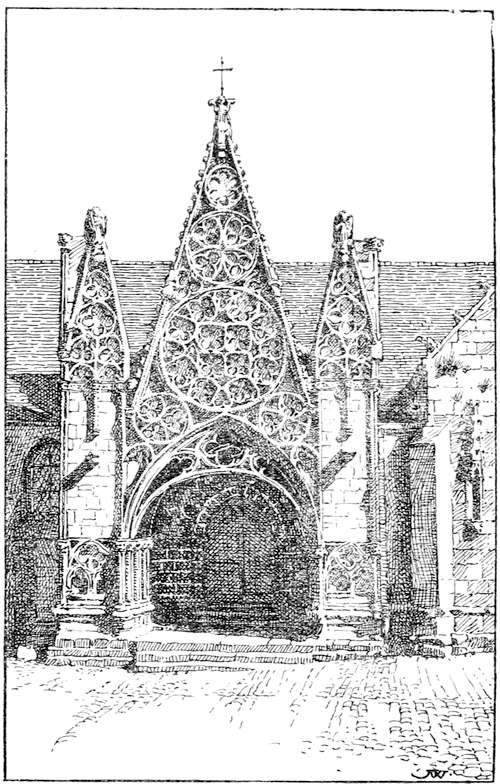
PONT-CROIX
* PONT-CROIX (F.) chl. arr. Quimper.
This little town is far more attractive than
Audierne, and is better suited to stay at for a
visit to the numerous objects of interest in the
peninsula. It is built about a remarkable abbey
church, one of the finest in Finistère, and with
the noblest tower and spire in Brittany. Most
of these towers and spires look like hot-house
growths, and are over-weighted by their spires.
But the tower of Pontcroix is solid and in
perfect proportion to its spire. The church
also presents admirable examples of 2nd pointed
architecture, notably its unique S. porch. The
spire is of the same period. The S. transept
had a window of the same, circ. 1380, but the
tracery has been hacked away and replaced by
feeble weedy flamboyant. Of the other flamboyant
windows, one is well designed, two are
under acute gables. The church has an apse
(flamboyant) with six windows. On entering
the sacred building, the surprised visitor finds
himself in a Romanesque church, but of a late
period, 1160. The pillars are spindly and tall,
and sustain round arches. It is Romanesque at
its last gasp, and without its original vigour and
massiveness. A very ugly feature is the inner
member of the arch, which is sustained on corbels
resting on the capitals. The arcade of the
sanctuary is of the 13th cent. The piers supporting
the central tower were Romanesque, but
were encased at a late period, when the spire
was added. Some stained glass is of the 15th
cent.
A walk or drive may be taken to N.D. de
Confort on the Quimper road; it is 16th cent.
with a graceful spirelet above a double gallery
and a turret at the side to give access to the
bells. The Calvary is of the same period, purer
in design and better in detail than the overcrowded
Calvaries of Guimiliau and Plougastel.
In the chapel is a Wheel of Fortune set with
bells, which the pilgrims set in motion so as to
summon the Saint to hearken to their prayers.
At Meilars is another Calvary, also a dolmen.
Half-way between N.D. de Confort and Poullan
is the admirable Chapel of Kerinec with its Holy
Well and a Calvary consisting of a cross above
a preaching platform. The great charm of this
chapel lies in its interior, which is very beautiful.
Further on is Poullan buried in trees (S.
Cadvan), a transition church between flamboyant
and renaissance, with a thin oblong
tower and a good porch. There is no chancel
arch. Nave and aisles have boarded ceilings.
The granite capitals are rudely carved. The
side aisles very narrow, the pillars tall, sustaining
small pointed arches. An octagonal 17th cent.
baptistery. There is a menhir near the seamark
at Kermenhir, and there are dolmens in
the parish. The country is barren, planted with
Austrian pine, but is being brought under cultivation
by the use of sardine heads as manure.
The coast to Cap Sizun is bold and fine.
Beuzec Cap Sizun. Church (S. Budoc) with
tower of the 16th cent. A fine coast. P. at
N.D. de Confort, 1st Sunday in July. P. of
Kerinec, 3rd Sunday in July. P. at Poullan,
1st Sunday in Sept. P. at N.D. de Clarté in
Beuzec, on the Eve of Rogation Sunday.
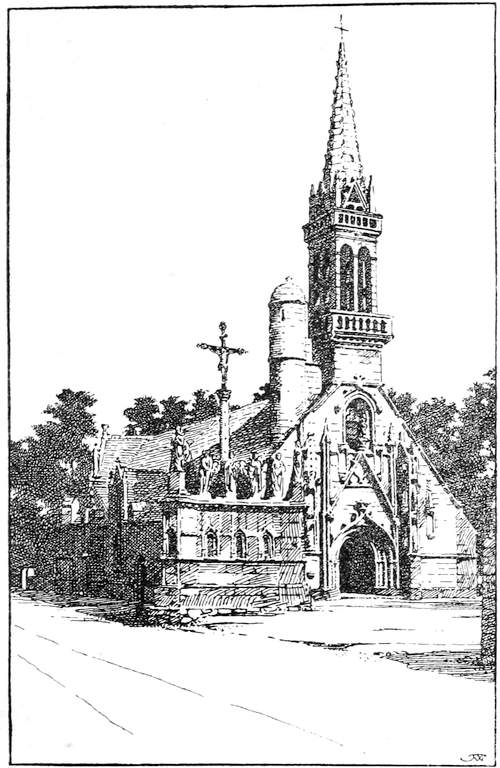
N.D. DE CONFORT
* PONTIVY (M.) chl. d'arr. A busy
town, very modern and vastly ugly in its
modern portion, but with a few picturesque bits
in the old town. In the new Pontivy is the
hideous Church of S. Joseph, about as bad in
architecture as the perversity of ignorance could
design. The church in the old town in decadent
flamboyant, is bad of its kind. The tracery had
been removed from the windows, and has been
replaced by new stuff of no character except
feebleness. The W. tower is octagonal with
a spire surmounting it. The castle has been
in part destroyed, but two faces remain with
singularly low drums of towers. In it is now
the museum. The costume of the neighbourhood
of Pontivy in the women is not remarkable,
but that of the men is picturesque, white jackets
bordered and ornamented with black velvet.
In the cemetery outside Pontivy is a menhir
surmounted by a cross. The spire of N.D. de
la Houssaye beyond the cemetery is an interesting
specimen of the flamboyant architecture of the
beginning of the 15th cent. It was built in
1438, but the tower, which is quite in the
Breton renaissance character, was actually built
as late as 1750. It is curious as showing to
how late a date the Gothic feeling hung on in
Brittany.
Noyal-Pontivy. The church has a 14th
cent. tower and spire. The porch is flamboyant.
On one side within are apostles, on the other,
curious subjects, The Baptism, an Angel holding
a pair of blue breeches whilst Christ is in the
water, a naked man carrying his head upside-down,
and some other subjects not easily made
out. The church has been carefully restored.
The early flamboyant E. window has the date
cut on the splay. The vaulting of nave and
chancel is modern. In the N. transept is fine
old glass representing the Annunciation, Nativity,
Shepherds and Angels, Adoration of Shepherds,
Circumcision, Flight into Egypt, Massacre of
the Innocents; also the Bearing of the Cross,
the Veronica, Crucifixion and Entombment from
another window. In the nave is a curious painted
retable of S. Maurice de Clohars, who d. 1191,
and who was born in this parish. Noyala was
one of the largest parishes in the diocese of
Vannes, and Pontivy was a chapelry in it. S.
Géran, now a daughter church, was probably
originally the head of a plou of Geraint, King
of Domnonia. But now he is forgotten and
replaced by S. Guirec. In this parish the canal
between Nantes and Brest forms a series of
backwaters and lochs. The Chapel of SS.
Dredeneau is near the line and the canal. It
is a cruciform building of flamboyant period,
but of no architectural interest. It however
contains a good 16th cent. statue of S. Bridget,
and statues of the Brothers Dredeneau. According
to the legend they were two princes who
were murdered, and their bodies thrown into a
marsh on the further side of the canal, where
they were found by a pig. The figures are
rude; one holds a book on which is written:
"Ce Saint à combatu jusqu'à la mort pour la
loi de Dieu, et n'a pas craint les menaces des
infidèles parceque sa foi etait fondée sur la
pierre." The Holy Well of the saints is in
very good order and bears their statues. P.
4th Sunday after Easter; at S. Géran, 3rd
Sunday in October; at Noyala, July 6th.
Stival. At the entrance to the village is the
Holy Well of S. Meriadoc, late flamboyant to
renaissance. The church is cross-shaped with a
slated spire, and has no aisles. It has a boarded
and painted roof, and the chancel is covered
with paintings representing the legend of S.
Meriadoc. The fine stained glass is in a deplorable
condition. The E. window contains
a Jesse tree. There are saints in the other
windows. In the churchyard are a large late
cruciform chapel and an ossuary.
Locmalo. The superb Chapel of N.D. de
Quelven is an object of one of the most popular
Pardons in Morbihan, on August 15. W. tower,
transepts and gabled apse are all of late flamboyant.
In the tower is a very fine rose window
to the bell-chamber. The proportions of tower
and spire are not however satisfactory, and the
chapel imposes on one by its rich detail rather
than by its broad features. It resembles S.
Nicodème in Plumilliau, but the tower is very
inferior. There are three porches, one under
the tower and two to the south. The tower
is half a century older than the body of the
church. Choir and transepts are vaulted.
There is a plain stone gallery for the minstrels
in the S. aisle. In two windows in the choir
is fine contemporary glass, a Jesse tree and the
apostles. The rest of the glass is modern garish
rubbish. The granite carving of the church is
poor owing to the coarse quality of the stone.
Pont Scorff (M.) chl. arr. Lorient. The
Scorff divides the town into two parts, the upper
and the lower towns, united by two bridges.
The Church of S. Albin is of 1610 with
additions in 1710. One town was the religious,
the other the secular. The religious one was
Les-Albin (the Court of Albin), and here was
born S. Albinus, who became Bishop of Angers
in 529 and died in 550. P. 1st S. in March.
P. of S. Yves, Sunday after 10th May. P.
of S. Nicodème 3rd Sunday in September.
Quevin (Coet-quen, the white wood). A
menhir 16 ft. high, to the west a Calvary with
fifteen figures. A Holy Well, and Chapel of
S. Eloi, 16th cent., in the village, but altered in
18th cent. The parish church is modern. S.
Nicodème, late flamboyant chapel of 1578. La
Trinité, 16th cent., but with a tower of 1771.
P. 7th Sunday after Trinity.
Port Louis (M.) chl. arr. Lorient. The
Church of N.D. was built in 1665. The
Chapel of S. Pierre contains a statue of S. Elisha
found in the sea at the beginning of the 17th
cent., to which the Pope accorded sundry
indulgences. Port Louis was but a small fishing
village called Locperan till the beginning of the
17th cent. It possesses a citadel and a marine
hospital. P. at Locmalo 26th July.
Questembert (M.) chl. arr. Vannes.
Here, in 888, Alan I., Count of Vannes,
encountered the Northmen and slaughtered
12,000 of them. Hardly 400 escaped to their
ships. In consequence of this victory, Alan
was proclaimed Duke of Brittany. Some
crosses mark the spot where the battle raged.
La Croix Rochue has a weapon like a halbert
cut on it. La Croix Tuaint is marked with
five nail heads and a small cross. La Croix à
la Poèle also has nail heads. The parish church
is modern, 1863. In the churchyard a fine
Calvary. The Chapel of S. Michel is flamboyant.
In the Chapel of N.D., an old Templar church,
is a Romanesque font employed as a bénitier.
The town possesses some old houses and halles
of 1675; also a cylindrical tower with two
heads on it called Quest and his wife.
Quiberon (M.) chl. arr. Lorient. A
favourite watering place on a sandy strip of land,
some twelve miles long, and only one and a half
wide. The sea has gained considerably here.
An alignment of menhirs now leads into the
water. The granite rock is everywhere under
blown sand that shifts with every gale. A
menhir is at the point of Beg-conguel, and there
are remains of a cromlech (stone circle) at
Beg-lann, and ruins of two dolmens at Manémeur.
Two dolmens at Kerniscot, an allée couverte at
Croh-collé, and the remains of an alignment at
the Mill of Kerbournec, and two more dolmens
at Port-blanc. But what is most interesting
here is the prehistoric necropolis at Belle-vue,
Be-ker-Nôz and another in the Isle of Thénec.
The graves are stone chests, in which the
skeletons are crouched, but occasionally extended.
The sand has preserved the bones, which have
lost nothing but their gelatine. An early
Christian cemetery has also been discovered
at Kerné. In 1795 an English squadron disembarked
3000 émigrés here, and they were
joined by numerous peasants. Hoche defeated
them, and swept the peninsula, driving together
all who remained. The prisoners were then
all shot down in cold blood, some at Quiberon,
some at Auray, and the rest at Vannes.
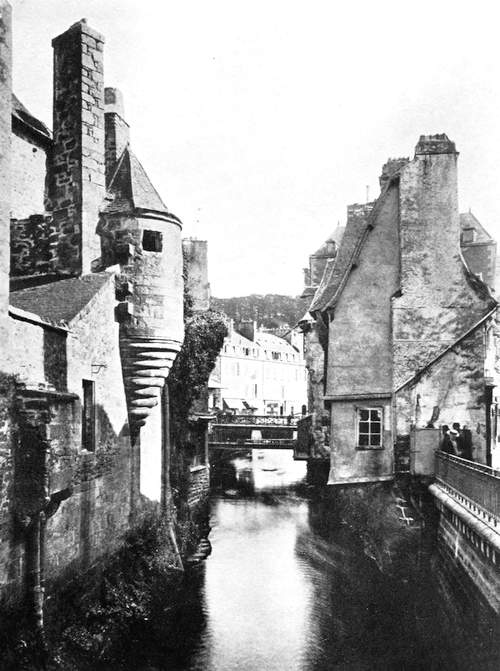
IN QUIMPER
* QUIMPER (F.) chl. d'arr. This
beautiful town is situated at the junction of
the Stier and the Odet, and is the seat of a
bishop. The diocese of S. Pol de Léon has
been united to that of Quimper. It is at a
distance of fifteen miles from the sea, but has
a small port. It is a bright and thriving city,
and is the seat of the manufacture of the Breton
faience, a pretty ware copied from old Rouen,
but with original developments. The old walls
are almost gone. Quimper is dominated on the
south by a lofty well-timbered hill. It has
charming esplanades by the sides of the Odet.
In the town are several old houses. The great
glory of the place is however the Cathedral of
S. Corentin. The choir dates from the end of
the 13th cent. The transepts and nave belong to
the 15th. The twin spires are modern and
excellent. The architect, M. Bigod, took that
of Pontcroix as his pattern, and could not have
done better. The erection of these spires was
due to the town folk consenting to a duty of a
sou a pound being charged on all the butter brought
into market. The choir leans considerably to
the left, and the junction with the transepts is
awkwardly effected. It is said that this
deflection was due to the spongy nature of the
soil which did not allow of the choir being built
in the same axis as the nave. This, however,
does not explain it, as the nave was erected
subsequent to the choir. At the summit of the
W. gable is a statue of King Grallo. This W.
front is fine, but the modern filling in of the
doorway is weak. A S. side entrance is
altogether exquisite. There is, however, nothing
really characteristic of a local school in the
cathedral; it follows the traditions of the Isle of
France, but has not the loftiness, often exaggerated,
of some of those magnificent cathedrals.
The beautiful lady-chapel is in the purest
geometrical style. The choir has an apsidal
termination. The clerestory windows are filled
with old glass representing saints, but the modern
glass is detestable. The third chapel on the N.
side contains memorials of a supposed miracle, a
crucifix that emitted drops of blood when a man
perjured himself before it. The high altar is a
mass of silver gilt, decorated in a style suitable
to a restaurant rather than to a church. There
is a good, restored, bishop's chapel. The
Church of S. Mathieu has been rebuilt and
has a modern spire. The fine stained glass
representing the scenes of the Passion in the east
window has been retained; it is of the 16th cent.
The musée should be visited. Besides containing
an admirable collection of paintings, many
by Breton artists, it has a large group of lay-figures
dressed in the various costumes of
Léon and Cornouaille, representing a marriage.
Nor should the visitor omit a call on M. Villard,
who has an extensive collection of really artistic
photographs of Breton costumes and architecture.
Quimper market should be visited on Saturday,
when various costumes may be seen, the white
quilted collars of the Pont-aven district, and the
curious head dresses of the Bigauden women.
Locmaria is only a stroll down the left bank of
the Odet, and there may be seen a very beautiful
example of a Romanesque church with central
tower, transepts and apse.
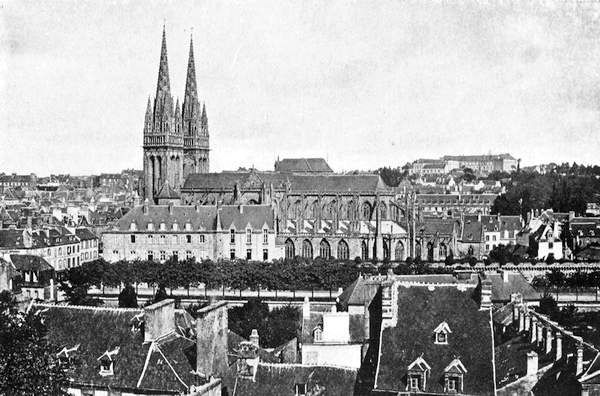
THE CATHEDRAL, QUIMPER
Quimper forms an admirable centre for a
number of excursions, as branch lines run
thence to Pont l'Abbé and to Pont Croix and
Audierne. The great horse fair is on April
15. The patronal feast at the cathedral is
on August 15; the P. at Locmaria is on the
Sunday after December 12.
Plogonnec, a very interesting late flamboyant
church with a renaissance tower. It has magnificent
old glass in the windows, representing the
Last Judgment, the Story of the Cross, the
Transfiguration, and some Celtic Saints, S. Cadoc
with a bell, S. Edern, son of Vortigern, riding
on a stag, and S. Theilo, Bishop of Llandaff,
also mounted on a stag. There is a pretty
flamboyant Chapel of S. Theilo in the parish,
and this last window was removed from it. P.
at S. Thegonnec's Chapel, Ascension Day; at
that of Loretto, 2nd Sunday in August; at that
of S. Albin on the last Sunday in September;
the P. at the parish church on the last Sunday
in July.
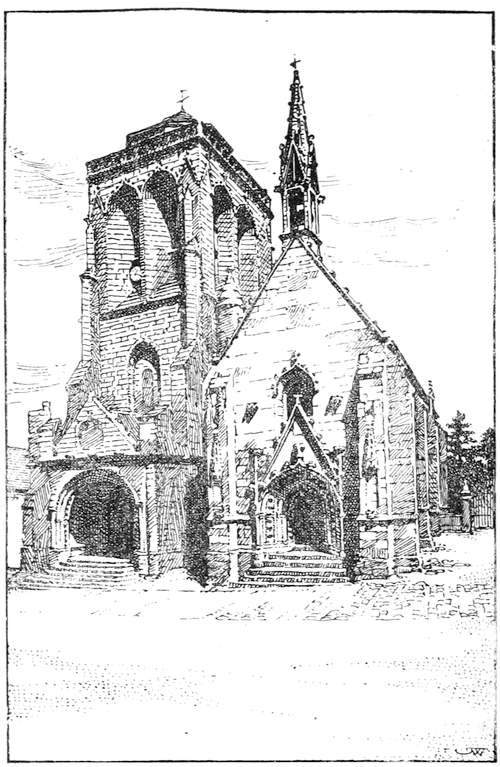
LOCRONAN
Locronan. Once a thriving little town living
on its looms, but since weaving has been done by
steam, its prosperity has gone, and many houses
are in ruins. Those that remain occupied are
all of granite, and some, if not all, old. The
church has the Chapel of S. Ronan on its south
side opening out of it by a couple of arches.
All is flamboyant. The church had a spire
that was struck by lightning in 1806 and fell,
carrying away pinnacles and the lace-like parapet
on the N. side. On this N. side is a little
chapel with a graceful flamboyant window in
the gable, and saints in niches at the sides.
The E. window of the chancel is full of old
glass in confusion, but is about to be restored.
On the pulpit is the legend of S. Ronan in ten
compartments. The mouldings of the arcades
and of the great belfry windows are poor. The
P. is on Trinity Sunday, but every sixth year
is the Grand Tromenie, which is observed with
great concourse of people from all parts. A
procession leaves the church at 2.30 P.M. and
winds with banners and hymn-singing round the
mountain on the slope of which Locronan is
built. Descending a narrow street leads
to the renaissance Chapel of S. Eloi and a
Holy Well of the same date. The tomb of
S. Ronan is in the chapel beside the parish
church.
Plonevez-Porzay has a very villainous modern
church that has replaced one that was old and
full of interest. The porch has however been
preserved. P. 2nd Sunday in August. Ste.
Anne-de-la-Palue in this parish is a great resort
of pilgrims, and the Pardon there is largely
attended. It is on the last Sunday in August.
The P. of N.D. de la Clarté is on the 2nd
Sunday in September.
Quéménéven. The Chapel of Kergoat is an
object of pilgrimage, and the Pardon there is
very greatly thronged, and interesting costumes
may be seen there. The P. is on the Sunday
after August 15.
S. Venec, a chapel half-way between Quimper
and Châteaulin, is interesting. It contains a
statue of the Threebreasted Gwen, and of her
sons, Gwethenoc, represented as a Knight, and
Winwaloe. There are also here a good Calvary
and a pretty Holy Well.
Ergué Gaberic. A fine menhir. A chapel
of the Templars. The P. at Kerdevot is
greatly frequented. It is on the 2nd Sunday
in September.
Pluguffan. Only deserving of a visit on the
occasion of its Pardon, which is on the 2nd
Sunday in September, where fine costumes may
be seen.
* QUIMPERLÉ (F.) chl. d'arr. An interesting
and picturesque town on the Laïta formed
of the junction of the Ellé and the Isole. The
abbey church of Ste. Croix and the town about
it is in the basin, but the Church of S. Michel
and the upper town is on the hillside with steep
streets, some ascended by steps. The buildings
of the abbey have been converted into municipal
offices and Mairie. The church is circular and
Romanesque. A tower had been constructed on
the four central drums, but they showed signs
of giving way, and the tower had to be taken
down and the church rebuilt, but exactly on
the ancient lines. There is a crypt beneath the
lady-chapel. The carved corbels outside the
apse are curious. A fine renaissance retable has
been mutilated and plastered against the west
wall. In the crypt is the tomb of S. Gurlois.
S. Michel stands up boldly on the summit of the
hill, on the right side of the Laïta, sustained on
massive substructures. The nave is 2nd pointed.
There are no aisles to the nave. The grand
central tower and choir with its aisles are
flamboyant. There is an exquisite window of that
style on the N. side and a superb N. porch, but
the E. window is in very bad renaissance. The
east end is supported on two huge buttresses that
are pierced with arches for the roadway. The
west end of the church is built against, with
houses, and does not seem ever to have had a
western entrance.
Some quaint bits of street architecture may
be found by penetrating into the narrow lanes.
The Church of S. Columbanus is in ruins. A
pretty walk out of the town leads to the little
chapel of the Château of Rosgrande, with apse
at each end. It contains a renaissance roodscreen,
with subjects from sacred history and
pagan mythology indiscriminately carved on it.
In the chapel are two 14th cent. statues of S.
Cadoc and S. Yhuel, the grandson of Gildas,
afterwards Bishop of Llandaff, who spent his
youth in Brittany. Fishing and charming walks
are to be had in the valleys of the Ellé and
Isolle. The visitor will find this the best headquarters
for excursions to Le Faouët, 21 kilometres,
and down the river to Pouldu. Patronal
Feast at Quimperlé on the 2nd Sunday in May
and on the 3rd September. P. at Lothea,
Easter Tuesday and Trinity Sunday. Pardon
des Oiseaux at Toulfouen, Whitsun Monday.
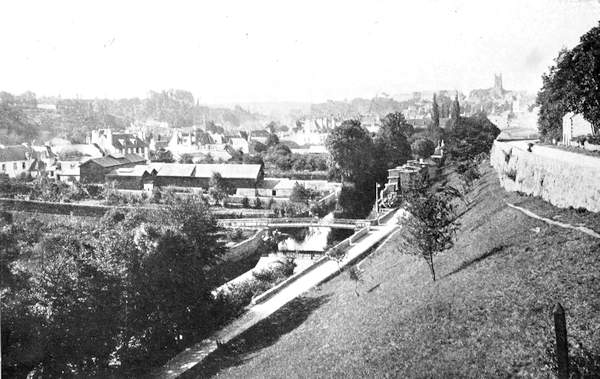
QUIMPERLÉ
The forest of Clohars-Carnoet envelops the
ruins of one of Conmore's castles, but it was
rebuilt in the 15th cent. On the right bank of
the Laïta, in a sheltered position, are the fine
ruins of the Abbey of S. Maurice, founded in
1170. The chapter house is of the 14th cent.
and 15th cent. A chapel that has been restored
contains a good bronze Christ of the 17th cent.
P. Whitsun Monday. P. at Clohars on the
15th August.
* QUINTIN (C.N.) chl. arr. S. Brieuc. In
pretty woodland country. A menhir called La
Roche-longue in a field near the town, 21 ft.
high. The church is modern, but it retains
some old glass. In the street of N.D. is a
granite house of 1611. Another old house
dates from 1560. Remains of the castle built
in the 15th cent., which was replaced by another,
never completed, in the 17th cent. The modern
château contains a fine gallery of family portraits
and Gobelin tapestries. In the cemetery is an
ossuary of the 17th cent.
Redon (I.V.) chl. d'arrond. Above the
junction of the Vilaine and Oust, at the foot of
a hill, commanded by the ruined Château de
Beaumont. Redon was a great abbey founded
by King Nominoe and S. Convoyon. Here
was held the council that deposed the Frank
bishops of Rennes, Nantes and Vannes. The
church was ruined at the Revolution, and all
that remains of it are the W. tower and spire
and the choir with a portion only of the nave.
The tower now stands isolated. The nave is of
the 14th cent. It was originally Romanesque.
A transept is of the 12th cent. and there is a
stunted central tower at the crossing. The
choir ends in an apse and is of the 13th cent.
and is fine. The high altar and the pulpit were
given to the church by Richelieu. On the N.
side of the choir is a fortified chapel of the 15th
cent. In one of the side chapels is a tomb
supposed to be that of Duke Francis I. The
abbey buildings are occupied by the Institute of
S. Sauveur. The cloisters are of the 17th
cent. The canal from Nantes to Brest cuts the
town in two and is crossed by a bridge.
The centre of the chestnut trade, the "marron."
The trees are kept small and pruned, and are
not suffered to exhaust themselves in producing
a superabundance of fruit. The marron is much
larger than the common "châtain."
* RENNES (I.V.). Capital of the Department,
and the ancient capital of the duchy of
Brittany. It is composed of two towns separated
by the Vilaine. On the right bank is the
Upper Town. Rennes was burnt down in
1720, and was rebuilt in the ugly style of the
period, and in grey granite. The river has been
embanked and carried in a straight course
through the town. There are no fine buildings
on the embankments. The most pretentious
structure on the left bank, between the station
and the river, is the lycée, with a chapel in
a nondescript style. Several bridges, all mean
in character, cross the river. On the right bank
are the most important buildings. The cathedral
is a hideous structure commenced in 1787 and
completed in 1844. The two side doors and
the niches at the west end belong to the earlier
building and are renaissance. Within, the arch
has been studiously avoided. Eight enormous
red marble pillars on each side of the nave
sustain the heavy vault and the clerestory.
Their bases are but 6 feet apart. The interior
has been richly decorated with gold and colour,
but nothing can relieve the cumbrousness and
gloom of the internal appearance.
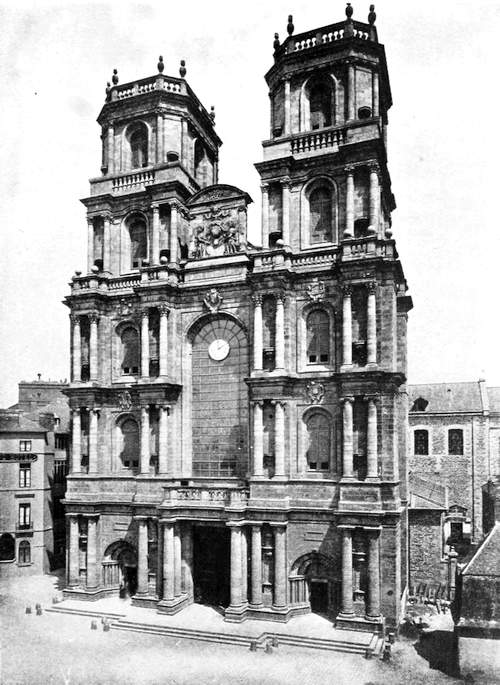
THE CATHEDRAL, RENNES
One of the old gates of the town, the Porte
Mordelaix, remains, but it is not particularly
picturesque, and a few old houses escaped the
fire and have not yet been pulled down. To
the east of the cathedral is the Church of S.
Sauveur, even more ugly than the former. In
a small street opening from the river opposite
the Hotel Moderne is the one architectural gem
possessed by the town, the Chapel of S. Yves,
now desecrated into a store-house. It is of the
end of the 15th cent., and all the details, where
not broken, are of exquisite beauty. Observe
the N. door with its niches and the W. front.
The Church of S. Germain is late and poor
flamboyant, much altered in late renaissance times.
The springing of the nave vaulting remains, and
has been grotesquely finished off with scrolls.
There is fine old glass, but in utter confusion,
in the E. window. The large window of the
S. transept contains fine glass representing the
life of the Virgin below and saints and legendary
incidents above in a series of 24 subjects.
S. Melaine is the church of a once famous
abbey. Transepts and choir-arch are early
Romanesque. The nave is 2nd pointed. The
base of the tower is early 1st pointed, but has
been refaced in the worst taste in baroque times; to
this has been added in modern days an octagonal
lantern and dome, and to complete the unsightliness
and absurdity of the whole composition,
the cupola is surmounted by an enormous gilt
statue of the B. Virgin. Within may be noted
the clumsy junction of the older and newer
work in the second arch on the south side.
The tracery in the side aisles of the nave has
been cut away, but the clerestory windows of
one light are delicate and refined. The clerestory
of the choir is earlier, the E. wall and
window have been reconstructed, and the tracery
in the side aisles restored or modern. In the S.
transept is a wax figure of S. Severina, whose
bones from the Roman catacombs are preserved
in this church. This wax figure receives a
considerable cult. Adjoining the church is the
Thabor with pleasant walks and grounds, on the
highest point of the town. The botanical
gardens adjoin. The Palais de Justice was
begun as the seat of the Parliament of Brittany
in 1618 and was completed in 1654. The
façade is of the Tuscan order. The decoration
of the interior was confided to four eminent
artists in the reign of Louis XIV., and it has
undergone rich decoration of late years. Rennes
possesses good open places, as well as the broad
esplanades by the river banks. Its museums and
library are also well stored. The picture gallery
contains a large collection of paintings, some
really good, a Jordæns, a Paul Veronese, and a
De Crayer.
Retiers (I.V.) chl. arr. Vitré. Four miles
to the S.E. is a menhir called La Pierre de
Richebourg.
La Roche-Derrien (C.N.) chl. arr. S.
Brieuc, is prettily situated on the Jaudy, at the
highest point to which the tide reaches. Of
the castle hardly anything remains. The church
has a spire of late 13th cent. The S. porch,
formerly adorned with statues, is bold. The
church has vast double transepts of 1435, and
flamboyant windows and extraordinary gargoyles.
Inside is a barbarous elaborately carved oak
altarpiece of late renaissance and of no merit.
La Roche was the scene of the battle fought in
1347, when Charles de Blois was taken prisoner
by the English.
Near La Roche is Langoat, the church like
a converted railway station, but it contains the
tomb of Alma Pompeia, the mother of S.
Tugdual, who died in the 6th cent., but the
tomb was erected in 1470. She is represented
on it recumbent; and at the sides are subjects
in bas-relief relative to her story. These have
been reproduced in bad modern glass in the
E. window. In the church may be seen a statue
of S. Tugdual habited as a pope. This is due
to a curious blunder. His monks were wont to
call him Pabu, or father. A late writer of his
legend supposed that this meant that he was
papa—the pope, and so fabricated a story to
explain it, how that Tugdual went to Rome
and arrived when the see was vacant, and was
elected pope; how that after a very few years
he wearied of the burden, and a flying horse was
sent from heaven which conveyed him through
the air back to Brittany.
Prat. The Château of Coatelan is a rectangular
building of the beginning of the 16th
cent., and is an interesting, well-preserved example
of a maison forte of the period. Within
are some good chimney-pieces. At the top of
one of the turrets is an oven for baking bread.
Pommerit Jaudy. On the Coat-nevez, a
conical hill, is a camp, probably of the Northmen
invaders. The château is mainly of the
16th cent, and has granite chimney-pieces.
Cavan. The church (S. Cheron) is of the
15th cent, and has a spire flanked by two stair-turrets
surmounted by domes. This is of
1684.
Berhet. The church (S. Bridget) is modern.
The Chapel of N.D. de Confort has flamboyant
windows, the tracery in those at the side forms
hearts. Within is a carved oak retable representing
the Passion, Resurrection and Assumption.
In the chapel is a Sant-e-roa, or Holy
Wheel, hung with bells, and this is rung during
mass, and by pilgrims desirous of calling the B.V.
Mary's attention to their petitions. Similar
wheels are at Quemperven, Locarn, Laniscat in
the Côtes-du-Nord, at S. Nicolas de Prissiac in
Morbihan, and at N.D. de Confort, near
Pontcroix in Morbihan. P. last Sunday in
September.
* ROCHEFORT EN TERRE (M.)
chl. arr. Vannes. A picturesquely situated
little town on schist rocks above the Arz.
The scenery of the valley is pleasing and it has
become, like Pont-aven, headquarters of artists.
Considerable ruins of the castle exist, and there
are several old houses in the town. Rochefort
was never walled in. Nevertheless it was
furnished with gates in the 18th cent. The
Church of N.D. de la Tronchaye having
been erected on a slope to the south causes
the N. side to appear buried. This side was
altered in 1533. In the choir are oak stalls of
1590 and 1592. S. Roque, on a height near
the town, was erected in 1527 in consequence of
a vow made by the people who were decimated
by a plague. It was ruined at the Revolution,
but has been rebuilt, 1854. A fair is held at
Rochefort on the 2nd Tuesday in every month.
Rochefort affords good quarters whence excursions
may be made to visit the prehistoric
monuments scattered over the Lande de Lanvaux
and Haut Branbien. The menhirs are
for the most part higher than those of Carnac,
but unhappily a great many of them are fallen.
These collections of megalithic remains have
never been properly investigated and planned,
and have not been visited like those of Carnac
and Locmariaquer and Erdeven.
Pluherlin on the Lande de Haut Branbien,
N. of Rochefort, has many of these strewn over
the commune. A menhir 15 feet high is in
the Lande de Lanvaux beside the road to
Pleucadeuc. Great havoc has been wrought
throughout this neighbourhood among the
churches; the interesting old structures have
been wantonly torn down to make place for
the exhibition of the incompetence of Vannes
architects.
Rosporden (F.) chl. arr. Quimper. In a
pretty situation by a lake that is, however,
traversed by the line from Quimper to Vannes,
and that from Rosporden to Carhaix. The
church has a fine tower and well-proportioned
spire of the 13th cent. On the S. side is a
porch, one of the oldest in Finistère. The
church contains a rude statue of Our Lady,
much venerated. It was turned out of the
church into the graveyard in 1870, to make
way for one more artistic; but the parishioners
rose in indignation and forced the curé to replace
it. A statue of S. Barbara is erected on a
fragment of the ancient Calvary that has been
destroyed. P. of S. Eloi, 2nd Sunday in July.
Patronal Feast, Aug. 15.
Rostrenen (C.N.) chl. arr. Guingamp, on
the slope of a hill, with a great square in the
midst, about which are old houses of the
16th and 17th cents. The parish church is
modern, but retains a transept of the 14th cent.
and a choir and tower of the 18th. The
S. porch has in it statues of the apostles.
Glomel. The finest menhir in the Department
is near the hamlet of Menhir, and is 25
feet high. Another is in the Bois de Coatcourcaral,
10 feet high. The church is of the
14th cent. with a flamboyant east window.
Side windows under gables. N.D. de Trégernan
has lost its tower, pulled down in 1842.
The chapel has some good glass in it and
possesses a Calvary.
Kergrist-Moelo. The parish church is of
the 16th cent., with a square pinnacled tower
and a rich porch of 1554.
Saint Aubin d'Aubigné (I.V.) chl. arr.
Rennes. On the line from Dol to Rennes, a
place devoid of interest.
Saint Aubin de Cormier (I.V.) chl. arr.
Fougères. The church has a nave of the 14th
cent. The rest is of the 16th. This was the
scene of the battle fought in 1488, which dealt
the last blow to the independence of Brittany.
The Sire d'Albret at the head of 14,000 men
entered the duchy as one of the suitors for the
hand of Anne of Brittany, and he was supported
by Henry VII. of England. Maximilian, King
of the Romans, another pretender, hastened to
enforce his claims as well. The King of France
sent an army into the duchy which took
Châteaubriant and Fougères and encountered
that of Francis II. of Brittany at S. Aubin on
the 28th July 1488. The French cavalry
broke the ranks of the Breton infantry. Six
thousand of these latter fell. The Duke of
Orleans, afterwards Louis XII. and the Prince
of Orange were taken prisoners. They were
shut up in a cellar still shown under the Hôtel
du Commerce.
Saint Brice-en-Cogles (I.V.) chl. arr.
Fougères. Here are two châteaux, one La
Roche Portal of the time of Henry IV.
* SAINT BRIEUC. Capital of the
DEpartment of Côtes-du-Nord. Is a dull town
situated on the Gouet to which a long descent
leads and where is the tidal port. The estuary
is between steep hills. The city is the seat of
a bishop. It contains a number of picturesque
old houses of carved wood with plaster between.
The cathedral is low and disappointing externally,
but not without dignity within. The only
remains of the earlier church is the wall from
the apse to the transepts that has been pierced
to form chapels. In it are half pillars with
capitals of a Romanesque character. The tower
of S. Brieuc was formerly fortified and still preserves
its loopholes for bowmen, but they have
been blocked. This is of the 13th cent. The apse
is of the 14th cent. with a triforium. The date
is 1335-55. The lady-chapel is of the same
period. The fine rose window of the S. transept
is of the 15th cent., so is the Chapel of S.
Guillaume, composed of two bays separated by
tall cylindrical pillars without capitals but with
the vaulting ribs springing out of them. The
southern tower, with indications of fortification,
belongs to the same century. The rose window
between the towers is of the 16th cent. The
stained glass and mural decorations in the
spandrils of the arches of the apse are bad as
bad can be. The organ case is composed of
panels dated 1540. The plain leaded windows
are far more pleasing than the garish stuff with
which they are being replaced. In the church
is the tomb of S. William, bishop of S. Brieuc.
He was the son of Oliver Pinchon and was born
at Saint Alban near Lamballe. He was elected
bishop in 1220, and soon quarrelled with Pierre
Mauclerc, Duke of Brittany, who drove him
from his see, and he was obliged to take refuge
at Poitiers. He returned to his diocese in
1230, and at once began the rebuilding of
his cathedral, but died in 1234. He was an
amiable, harmless man, and very considerate to
the poor and suffering.
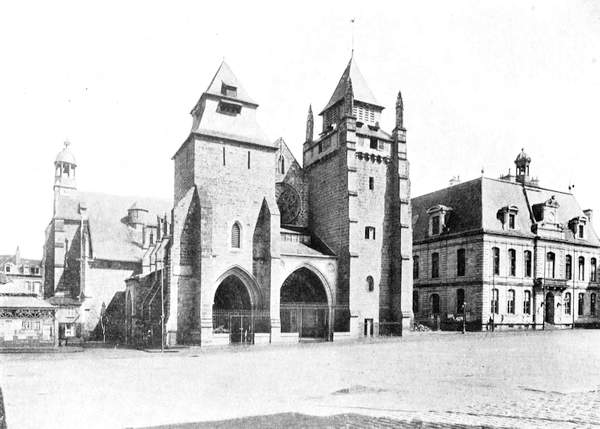
S. BRIEUC
The chapel and fountain of S. Brieuc, on the
height to the N.W., are flamboyant and picturesque.
On the S. side of the altar is a descent
to the cave to which the Saint was wont to retire
for prayer. Brioc was the son of an Irish
occupant of Cardigan and a Saxon wife. He
was educated by the Armorican S. Germain, a
nephew of S. Patrick, who afterwards became
Apostle of the Isle of Man. On the expulsion
of the Irish from S.W. Wales Brioc left with
a large number of followers and arrived at the
mouth of the Gouet, where a kinsman, by
marriage, Rigual had already settled, and he
gave him the land where is now the city of
S. Brieuc, and where had been a Gallo-Roman
town. He died about the middle of the 6th
cent. In the Rue Fardel is a house dated 1572.
The modern churches in the town are architectural
monstrosities. The Chapel of N.D. de
l'Esperance is vastly pretentious, but wretched
architecturally. The clerestory is filled with
stained glass representing Breton Saints. Patronal
Feast, S. Brieuc, 1st May. The valley of
the Gouet may be followed down to the mouth,
and an ascent made to the Tour de Cesson,
which has Roman substructions, but was built
up and altered at various times.
At Ploufragan is an allée couverte, buried
in brambles. The church is modern with a
spindly tower and spire.
At La Méaugon is a fine railway viaduct in
two stages. The church has in one window a
small but admirably drawn representation of the
patron saint S. Meugaint, and a carved granite
Calvary in the churchyard. Some remains of
the screen removed to the west end.
Pledran. A vitrified fort. The vitrification
was done by fires lighted in the depth of
the wall. As the result was not satisfactory,
the face outwards was subsequently banked up.
Saint Jean Brévelay (M.) chl. d'arr
Ploermel. On the side of the road to Vannes,
near Kerdramel, are two menhirs. A kilometre
west of le Moustoir, on the Lande de Coh-Coet,
a large dolmen formed of three blocks only;
the coverer is 18 feet long. It has the ruins
of an allée couverte leading to it. A kilometre
south of it is a menhir 18 feet high. The
natives of this district fled to England from the
Northmen in the 9th cent., and brought back
with them, when returning some relics of S.
John of Beverley, Archbishop of York, who
died in 721.
Plumelec. Between Trégoët and Kersimon
is an allée couverte. In the coppice of Château
Béauce a large dolmen called Migourdy, which
on being explored yielded fragments of a figure
of Venus Anadyomene, and a coin of Diocletian,
showing that it had been utilised for some unknown
purpose in historic times. It is supposed
that the place owes its name to S. Meletius, B.
of London, who died in 624, and that the refugees
to England brought back his relics. But this is
not probable; it must have been called plou after
a founder of the clan, and the title of plou would
hardly have attached to relics. The church is
modern; the Chapel of S. Aubin is of 1513,
and has some curious carving on the capitals, a
fox preaching to geese, etc. Above the N.
transept rises a slated spire.
Guéhenno. A modern church, but the porch
of 1547 has been preserved. In the graveyard
is a fine Calvary of the 16th cent., the finest in
Morbihan. On it are numerous single figures as
well as groups. It was taken down and buried
at the time of the Revolution, so as to preserve
it, and was restored in 1855. The Republican
ruffians burnt the church. P. on 1st Sunday in
September.
Saint Malo (I.V.) chl. d'arr. Occupies
the old island of S. Aaron. It is now united to
Rocabey by an embankment, the Sillon, along
which runs a tramline. The town is walled in
and a pleasant walk is on them; the circuit of
the walls may thus be made. The castle is of
the 15th cent.; it is square with flanking towers.
Six gates give admission to the town, in which
the streets are very narrow and odorous, and the
houses lofty. At the highest point of the island,
but smothered among houses, is the Chapel of
S. Aaron (Aelhaiarn). This Welsh hermit
occupied the island when S. Malo arrived.
The cathedral is of the 14th cent. The
choir is very English in character, with a
square east end. The nave is of the 12th cent.
but W. front and sides have been entirely
Italianised. The fine central spire was added
in 1859, and was the gift to the town of
Napoleon III. The tide at S. Malo rises to
an extraordinary height. At ebb by a causeway
the islets of le Grand and le Petit Bey can be
reached. On the nearest are ruins of a castle,
and the tomb of Châteaubriant. On the further
is a fort that is not occupied. In the offing is
the island of Cézambre. Here S. Brendan,
when obliged to quit Ireland, founded a monastery,
in or about 524; and when S. Malo
arrived about a quarter of a century later, he
was well received by the abbot and monks on it.
There are a cave and a chapel of S. Brendan on
the island. But the Government has extended
the fortifications on Cézambre and no one without
a special authorisation is now allowed to set foot
on the island. In S. Malo there are a little
museum and a passable library in the Hôtel de
Ville. The Breton museum in the Cassino
should be visited. It contains good specimens
of local carved oak, and chambers fitted with
lit-clos, and figures in costume. A flying bridge
invented by a native, who invested all his capital
in it, connects S. Malo with S. Servan. S.
Servan, Dinard, Paramé, are watering places.
S. Servan. The cité marks the site of the
ancient city of Aleth and the substructions of
the early cathedral have been discovered there.
The seat of the bishopric was removed from
Aleth to S. Malo by S. John of the Grate,
the Bishop in 1142. The reason for the change
was the insecurity of Aleth, whereas it was
possible to thoroughly fortify the island of Aaron.
Paramé is a watering place, with a low
shelving shore, facing north and miserably cold
in winter, dusty in summer, and detestable at all
times, except to such as frequent the gaming
tables.
Saint Méen (I.V.) chl. arr. Montfort. A
dull town in uninteresting country. It was the
seat of an abbot, head of an important abbey
in the Middle Ages. In 1554, S. Samson of
Dol, who was engaged in working up a revolt
against Conmore the Regent of Domnonia, sent
his nephew Mevan across the great central forest
to Vannes, probably to consult with Gildas, and
to ascertain whether any assistance could be
obtained from Count Weroch. On his way,
Mevan lighted on a clearing in the forest, where
now stands the little town bearing his name. In
this clearing lived a British colonist, named
Cadvan, who welcomed him and invited him
to establish a lann hard by and take over the
religious charge of his colony. Mevan agreed,
and when Cadvan died, as he had no children,
he bequeathed the whole of his plou to Mevan
as well as the lann already granted. This was
the origin of the abbey, and around the abbey
grew the town. The abbey is now turned into
a petit séminaire. The nave of the church was
pulled down in 1771. The tower belongs to
the end of the 12th cent. The transept is of
the 13th cent. The choir is of the 14th cent.
In the church is the tomb of S. Méen or Mevan,
a granite sarcophagus. A pretty chapel of the
12th cent. turned into a sacristy. A Holy Well
of S. Méen.
* SAINT NAZAIRE (L.I.) chl. d'arr.
Is the seventh most important port in France
and is situated at the extremity of a promontory
of a gneiss rock that runs along the bank of the
Loire. There is nothing of antiquity in the
place, which is wholly modern and built on a
stiff and formal plan, the houses rivalling each
other in ugliness. But there is one curious object
in it, an enormous dolmen in the midst of a
square, that has been spared, and has given its
name to the street leading to it. Five lighthouses
guard the entrance of the Loire. From
S. Nazaire a visit may be paid to La Grande
Brière, a vast turf deposit, once an inland lake.
The peculiar costume has almost disappeared,
only the women retaining their coiffe. The
population of all this district is British, and
the descendants of the very earliest immigrants.
The hair is for the most part fair, the eyes grey
or blue. Formerly the Breton tongue was spoken
throughout this district, but it is now spoken
by only about 400 persons in the neighbourhood
of Batz by Croisic. Curiously enough,
the villagers of Batz regard themselves as of
different blood from the rest, and to be descendants
of Scandinavian pirates who were suffered
to settle there. Till quite recently it was an
unheard of event for a young man of Batz to
marry a girl of what he regarded as the Breton
villages. That in colour of hair and eyes there
should be no distinction does not militate against
the tradition, for the pure blooded Celt is as fair
as the Scandinavian.
Saint Nicolas du Pélem (C.N.) chl. arr.
Guingamp. A menhir in the forest of Kerhuel,
and another near Kerhuel, 9 ft. high. In the
valley of Prat-roury another, fusiform, about 11
ft. high. The old Roman road from Aleth to
Carhaix ran through this parish, and it remains
in fairly perfect condition in several places. On
a height is the camp of Dzillon near Kerimard,
circular with a tump hollowed out within,
certainly a Norseman burh. The Château de
Pélem is in ruins, but two of the towers are
standing. The Church of S. Nicolas has got
very fine restored stained glass of the 14th cent.,
representing in twenty-four medallions scenes from
the gospel story; at the bottom of the window
the donors are represented kneeling. Another
window contains fragments of medallions representing
the life of the Baptist. The roodscreen
was wantonly destroyed in 1861. The
Chapel of S. Eloi has a fine flamboyant east window
with remains of stained glass in it. The
Chapel of Riolon is mainly of the 15th cent., and
has an east window of the renaissance with stained
glass in it representing the Eternal Father seated
in the midst of a rose, surrounded by the
evangelists, the prophets, and angels playing instruments
of music. Another window has
fragments of stained glass in it representing
saints.
Canihuel. A huge menhir called Coz-resto,
23 ft. high, has been split by lightning. It is in
a line with other menhirs at Kergornec, Saint
Gilles-Pligeaux, and Crech Ogel in the old
bourg of Quintin. At Botquelen is another
menhir 13 ft. high.
The parish church was built in 1474, burnt in
1595 and repaired in 1598; it is almost wholly
of the 16th cent. with a flamboyant E. window.
Kerpert. Church of the flamboyant period;
in the E. window glass of the 16th cent.
representing the life of S. Peter; ossuary.
Lanrivain. Ossuary and Calvary of 1548.
On the platform are several figures; there are
three crosses, the principal one sustains a group
of eleven figures carved in one block.
Peumerit-Quintin. Near the hamlet of
Pempoul a ruined allée couverte. The Chapel
of S. Jean du Loch is mainly of the 15th cent.
but retains some portions of the earlier 12th
cent. building.
S. Connan.. Near the Mill of Kerdic a ruined
allée couverte. Dolmen in the Parc-an-Neurn.
S. Gilles Pligeaux. Two menhirs at
Kergornec, one in the Parc-er-Pélem, is 22 ft.
high and leans. The other at four hundred
paces from it, near the bottom of the valley in
Parc-ar-golven, is 13 ft. high. They seem to
belong to a system of which only some remain,
as Crech Ogel in Vieux Bourg, Coz-resto in
Canihuel, and one in the Lande de Bohan in S.
Mayeux. Dolmen called Roc-ar-Velcien, the
table supported by three uprights. The coverer
is almost circular, about 23 ft. in diameter.
The church is of the 16th cent., tower and porch
of 1644. In the cemetery a chapel dedicated to
S. Laurence, with an entombment in the crypt of
terracotta of the 17th cent. Date of chapel 1538.
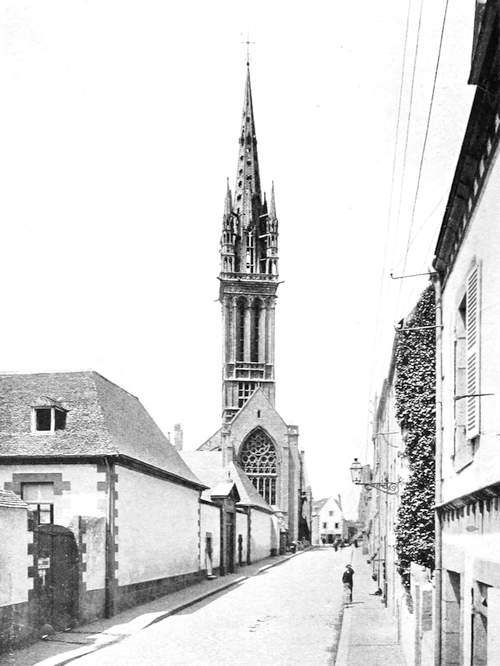
LE KREISKER, S. POL DE LÉON
* S. POL DE LÉON (F.) chl. arr.
Morlaix. An ancient cathedral town, but
the diocese has been united to that of Quimper.
The cathedral has two western towers and
spires and façade of 1st pointed. The nave is
entirely 2nd pointed and has a very beautiful
arcade. The cleristory is quite simple, mostly
with 1st pointed windows. The side aisles
have an arcade under the windows. The
transepts are double, i.e. with aisles to the east,
fine 2nd pointed. The E. aisle of the S.
transept contains very bad flamboyant windows.
The choir, ending in an apse, is flamboyant
1431-50, and contains fine carved oak stalls of
1512. The choir has double aisles, N. and S.
On the N. side is the Chapel of S. Paul, with
his skull, hand, and bell in shrines. The pillars
and vaulting of the S. aisle may be noticed.
The Chapel of Kreisker possesses a tower
and spire that are supposed by Bretons to be the
glory of Finistère. It is badly proportioned;
the spire and spirelets overload the summit of
the tower. It may be regarded as curious and
a clever bit of architecture, but it is not pleasing.
This tower is central. The windows are all
flamboyant but affect an earlier type. The
chapel has triforium and circular cleristory
windows on the S. side but none on the N.
There is a noble N. porch very richly carved.
A very rich W. window. The E. window
contains bad modern glass reproducing old figures
of Breton saints. The S. side has an arcade
under the windows with small lights pierced at
intervals. There is a good piscina in the S.
aisle. The Church of S. Pierre is now turned
into a cemetery chapel. It is 15th cent. but
has a baroque west front. Ossuaries (small) are
in the wall surrounding the cemetery. On the
way to Roscoff, just beyond the railway, is an
allée couverte or dolmen.
Roscoff is a quaint place, with an old house
or two, situated near the sea, and commanding
the Island of Batz. The church has a very
remarkable renaissance tower and spire (1550),
more fantastic than pleasing, with ships carved
on it and cannons or culverins as gargoyles. It
is in three stages with galleries. The church is
late flamboyant. There are two ossuaries; one is
very rich. In the church are preserved the panels of
an alabaster retable of the 15th cent. of Flemish
work. The Chapel of S. Ninian in the street is
in ruins; it was erected by Mary Stuart to commemorate
her landing at Roscoff, 1548. The
hospital dates from 1573. A Chapel of Ste.
Barbe is on a height. P. of Santec, 2nd Sunday
after Trinity. P. of Ste. Barbe, 3rd Monday
in July. P. in the parish church, August 15.
Sibiril. The Château of Keronzéré erected
in 1458 was restored in 1602.
Ile de Batz. It takes a quarter of an hour
to cross from Roscoff to the island, and is only
to be attempted when the sea is calm. The
tide here rises 30 ft. But a visit hardly repays
the trouble. When Paulus Aurelianus, a native
of Glamorganshire, landed on the west coast of
Finistère, he heard that a kinsman, Withur, was
living in these parts, and had made himself count
or chieftain. He went to visit him, and found
him on the Isle of Batz, very old, busy making
a copy of the Gospels with his own hand.
Withur received him cordially, and advised him
to settle among the ruins of an old Roman town
on the mainland. Paulus did so, and hence the
city of S. Pol de Léon. Legend says that
there was a dragon on the island, which S. Paul
tamed by binding his stole about its neck and
then bidding it precipitate itself into the sea.
This is an allegorical way of saying that he
put an end to paganism in Batz. The Toul-ar-Sarpant,
where the dragon is supposed to have
haunted, is pointed out, and the stole of S. Paul,
a piece of Byzantine work, is preserved in the
church. It is a silk tissue, with a blue ground
worked over with white and yellow, to figure
a set of warriors facing each other, with a sort
of turban head-dress and holding falcons on their
wrists, and with a dog between the legs of each
horse. A Romanesque chapel stood on the site
of S. Paul's monastery on the island. This is
called the Peniti; the chapel is ruinous and half-buried
in sand. There is a lighthouse on the
island.
Saint Rénan (F.) chl. arr. Brest. Pleasantly
situated in a woody basin, through which
flows the little stream of the Aberildut. The
church has a Romanesque choir, and a tower and
spire, ill proportioned, of 1772. There are some
old and picturesque houses.
Lanrivoaré. The church has a tower in
two stages and spire of the usual type but erected
in 1727. The church itself is flamboyant.
The chancel is Italian. In the N. transept is a
singularly uncouth flamboyant window. Above
the arches into the choir, transept and nave, the
twelve apostles are painted. On the south side
of the church is a walled-in quadrangular space
where, according to tradition, a whole Christian
population was massacred by pagans. No
certain details exist, and it is probable that the
pagans were the Northmen, who committed
frightful atrocities in Brittany in the 10th cent.
In the midst of the enclosure is the graveyard of
the unnamed saints, laid down with polygonal
and various shaped pieces of granite. It is
enclosed by a dwarf wall overlaid with pieces of
slate. At the east end is a sort of altar sustaining
a cross and some fragments of carving. Before
the altar lie eight rolled boulders. These are popularly
supposed to have been loaves turned into
bread. S. Huarvé asked a woman to give him
bread, and she refused. As a judgment for her
hardheartedness all her loaves were petrified.
Actually these pebbles are "cursing stones,"
and such boulders exist in several chapels in
Ireland, and are used for calling down disease or
destruction on an enemy. The person invoking
the curse, after a certain number of prayers turns
the stone round seven times. That these pebbles
have been so employed is probable, as the under
surfaces of the stones are well rubbed. But
happily this pagan usage is no longer in resort, and
the stones remain with only the childish legend
attached to them to explain their presence. S.
Rivoaré, the patron of the church, was a priest,
brother of Rivanon the mother of S. Huarvé
or Hérvé, the blind bard saint. It is not unusual
to see pilgrims, also the parishioners of
Lanrivoaré enter the enclosure, take off their
shoes and stockings, kneel, and recite prayers
and then pace on the slates thrice about the
burial place, taking care to step on each slab of
slate, and omit none. In the village is a curious
stone cross with a clothed figure of Christ upon
it. A short walk from Lanrivoaré leads to
the ruined Château of Kergroades, situated
in beautiful woods, with avenues of oak and
chestnut. It is difficult to find, and a guide
must be taken. The château is in a charming
position; it is of renaissance architecture throughout,
and the court of honour front is in fair
condition. But the gates are locked and
admission is not easily obtained. The
patronal feast at Lanrivoaré is on the
3rd Sunday in October, and P. at the
Chapel of Lanvennec the 4th Sunday in
September.
Saint Servan (I.V.) chl. arr. S. Malo;
see S. Malo.
Sarzeau (M.) chl. arr. Vannes. Sarzeau
is the principal village or town on the peninsula
that bears its name, which divides the sea of
Morbihan from the ocean. That peninsula is
some 20 miles long and 6 across, but it has been
much diminished in width by the sea which has
eaten away much of the coast. It is granitic
on the west, and schist on the east, and the
granite is of a soft quality, allowing the sea to
decompose and break it up. Thus a parish
church of S. Demetri has been engulfed. A
second was built further inland, and that is
now almost entirely surrounded by the sea and
threatens shortly to disappear in the waves.
Formerly a forest covered the promontory, now
it is sparsely wooded and trees only flourish on
the side toward the inland sea. But the climate is
equable, and vines are cultivated; this is the most
northern point reached by vineyards. Yet wine
can only be made once in about three years, and
is not of a good quality. At Cohports is a
menhir 12 ft. high, and a circle of standing
stones at Croen-Linden, and dolmens, more or
less ruined, at Noédic, Prat-Fetén, Trest, Kergilét,
Brillac, and Kerbley. An allée couverte
30 ft. long at Clos-Rodus. Gildas coming from
Glastonbury about 520 founded a monastery at
Rhuys, and a cell or peniti at Coetlann, afterwards
called the Priory of S. Pabu, but this has
disappeared. In the town is the house in which
Le Sage was born, the author of "Gil Blas" (b.
1668, d. 1747). The church is a horrible
structure, begun in 1670 and ended in 1683.
It was formerly one vast hall, but a couple of
ranges of columns were introduced in 1883
sustaining arcades, and qualifying somewhat the
internal ugliness. Externally, the pinnacles are
composed of little pyramids resting on balls.
The Castle of Sucinio was occupied in 1218
by Duke Pierre de Dreux, and in 1238 their son,
Jean I., confined within it the baron Olivier de
Lanvaux, who had rebelled against him. This
prince was fond of the place and several of his
children were born there. He took in the forest
about the priory of Coetlann or Saint-Pabu, and
the greater part of the castle that now stands was
erected by him. His son John II. continued
the works, and put his treasure in its vaults.
During the War of Succession it was occupied
by Charles de Blois, then taken by Jean de
Montfort, and retaken by Du Guesclin. John
IV. greatly repaired the castle, and within its
walls was born Arthur of Richemond, future
Constable of France. In 1474 the Earls of
Pembroke and Richemond were imprisoned
within its walls. The castle forms an irregular
pentagon. It had eight towers, but of these
only six remain. The entrance to the east is
preceded by a drawbridge, and is defended by
two large towers, one of which contains the
chapel. The castle, occupied in 1795 by the
Royalists, was sold as national property, and the
peasant who purchased it despoiled it of its roof
and staircases, and let it fall into complete ruin.
A fee of one franc per head is charged for
admission, the money being devoted to the relief
of the poor of Sarzeau.
S. Gildas de Rhuys. Near the ocean; here
precipitous cliffs receive the lashing of the
Atlantic rollers. Near the drained marsh of
Kerver is a menhir 12 ft. high. Near the
hamlet of Net four others, and the remains of
an allée couverte 70 ft. long and 12 ft. wide;
at Clos-er-Bé a dolmen called Meen-platt, and
near Largneven a fallen menhir 15 ft. long.
The Abbey of S. Gildas was founded about 520.
Gildas was the son of Cau, prince of Alcluyd
or Dumbarton; Cau and all his family were
driven south by the Picts and Saxons, and took
refuge in N. Wales, where Maelgwn Gwynedd
gave them lands, and the sons for the most part
entered into religion. Not so Hywel, the eldest,
a quarrelsome man, who fell out with King
Arthur, and lost his life in the quarrel. Arthur
was forced to surrender some lands in Radnorshire
to the family as blood-money, and then
Gildas gave him the kiss of peace. Gildas was
a married man and had several sons, amongst
whom the most noted was Kenneth, hermit of
Gower, but who came to Brittany with his
father and became a founder there. When
aged thirty Gildas settled at Rhuys, and here
he wrote his scurrilous letter against the princes
and clergy and people of Britain, reviling in it
in outrageous terms Maelgwn, who had treated
his family with kindness and generosity. Gildas
was on good terms with Weroch, Count of
Vannes, and with Conmore, Regent of Domnonia,
and this latter richly endowed his houses.
This did not prevent Gildas from turning against
him and heading a revolt which caused the death
of his benefactor. It was whilst Gildas was
at Rhuys that he was visited by S. Brendan.
Although the Irish travellers arrived in cold and
snowy weather Gildas refused them hospitality;
but the Irishmen broke down the gates and
forced themselves upon the sour British abbot.
Gildas died in 570, and, according to his desire,
his body was placed in a boat and thrust forth
to sea. Two months after the body was washed
ashore at Arzon, at the extremity of the headland,
on March 11th, on which day a procession
leaves S. Gildas, annually, and visits the site
where it was found. In 818 the monks of
Rhuys were forced by Louis the Pious to adopt
the Rule of S. Benedict and abandon their Celtic
practices. In 919 they were forced to fly from
the Northmen. They hid some of the bones of
Gildas in sand in his tomb, but carried away
most of his relics, and took refuge in Berry.
In 1008, at the request of Geoffroi, Duke of
Brittany, Felix, monk of S. Benoït-sur-Loire,
with six others came to Rhuys to restore the
ruined abbey. He rebuilt the church which
was consecrated in 1032, and much of this
edifice remains. The church, in the form of
a Latin cross, is composed of two distinct parts,
the nave, rebuilt in 1699, and the choir and N.
transept built by S. Felix 1010-32. The choir
is apsidal, with the tomb of Gildas behind the
high altar. It is surrounded by Romanesque
columns with stilted arches, surmounted by small
11th cent. windows. The N. transept also
possesses an apse to the east, and under a low
arcade in the N. wall the tombs of S. Felix
and S. Gulstan. On the N. side of the choir
on the outside let into the wall is a curious
carving representing two knights on horseback
tilting at each other. The Romanesque capitals
rejected when the nave was rebuilt have been
in three cases utilised, by being inverted and
turned into bénitiers; another is thrown outside.
A beautiful statue of Gildas by Vallet stands
over the tomb. It is that of a sweet and placable
saint, not of a rancorous and revengeful
man. In the S. transept, which was destroyed
by a storm and has been rebuilt, is a huge barbaric
retable. The treasury contains a silver bust containing
part of the skull, and reliquaries for arm
and thigh bones of the Saint; some of these
reliquaries are of the 15th cent. There is also
a mitre of the 15th cent. which is erroneously
supposed to have been that of Abelard. The
conventual buildings are of the 18th cent. and
are occupied by a religious order which receives
female paying guests during the season. Abelard,
born in 1079, became a Benedictine monk in
1117, and was elected abbot of S. Gildas de
Rhuys in 1125. But the strictness of his rule
roused the monks against him. "The life of
the monks," he wrote, "was indisciplined and
frightful. The abbey gates were decorated with
the feet of stags, bears and boars. The monks
were roused from their slumbers by no other
signal than the hunter's horn and the baying of
hounds. The natives were barbarous and disorderly."
The community revolted against any
attempt to bring it to discipline, and Abelard
believed that his life was in danger; he accordingly
fled in 1138 and died at Cluny in 1142.
By following the road behind the church,
along the convent walls, the Chapel of S. Bieuzy
is reached, and a path to the right leads to the
little Baie de Portas, where in the rock is an
impression like that of a horse's hoof. Legend
says that Gildas left the Isle of Houat on a flying
horse that landed at this spot. A stair cut in
the rock leads to the Baie de Saint Gildas, where
is a spring and over it a statue of the Saint.
Arzon has a modern church surmounted by a
spire, and two stained glass windows recording
a vow made in 1673 by some sailors of the place
to S. Anne, during the war with Holland. The
Chapel of Er Hroez marks the spot where the
body of Gildas was found. There are circles
of stones at Er-Lannig, and a good many fallen
menhirs. At Graniol is a tumulus containing
an allée couverte. Another at Bilgroéz. The
Butte de Tumiac was explored and a covered
avenue found in it, but was so slovenly dealt
with that the stones have collapsed.
Scaer (F.) chl. arr. Quimperlé. A dull
town, with a vulgar modern church. At S. Jean,
about two miles distant, on a lande, is a fine
menhir. An abundant spring of Ste. Candide
supplies the town, but it has no architectural
character. The Chapel of Coatdry is an object
of resort from all the neighbourhood on the
occasion of the Pardon, 1st Sunday after Trinity,
and again the last Sunday in September, when very
interesting collections of costumes may be seen.
Le Sel (I.V.) chl. arr. Redon, is without
much interest. The church is modern. The
tumulus of Chalonge is covered with trees and
surrounded by a moat.
Sizun (F.) chl. arr. Morlaix. The church
(S. Sulien) has a fine spire of more simple
character than those usually met with in
Finistère. The porch is renaissance. There
are in the parish chapels of S. Cadoc and S.
Illtyd. The great Pardon is on the last
Sunday in July. The P. of S. Cado the last
Sunday in September, and at Loc Ildut on
Corpus Christi Day. The Chapel of S. Cado
is on the Monts d'Arrée.
Commana. A fine allée couverte measuring
50 ft. A dolmen and a menhir. In the
church are some gorgeously barbaric altarpieces,
a mass of carving, gilding and colour, of
very late renaissance or baroque. P. last Sunday
in July. Those interested in prehistoric remains
would do well to investigate the Monts d'Arrée,
over which many are scattered. A map of the
district with the monuments thereon is published
in the Bulletin de la Soc. d'emulation des Côtes-du-Nord,
T. xxxv. (1897).
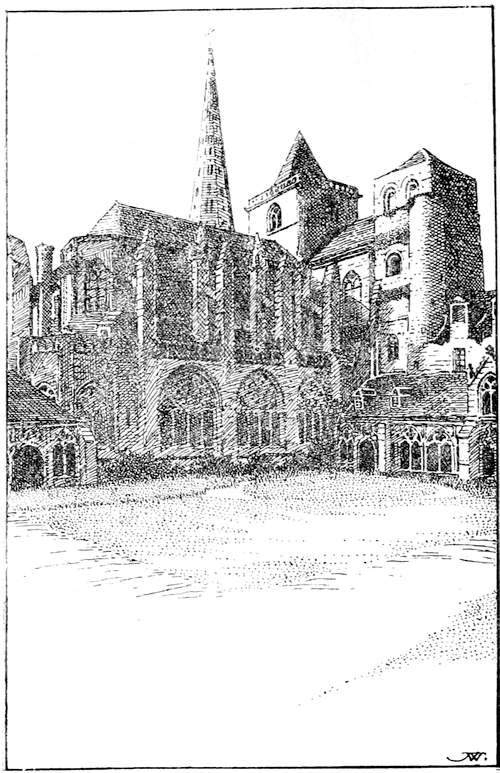
TRÉGUIER CATHEDRAL
Plouneour-Menez. The very interesting
abbey church of le Relecq lies near a tarn,
one of the sources of the river of Morlaix.
The abbey was founded on the site of the
last battle fought between Judnal and Conmore,
usurper of Domnonia, 555. It takes its
name from the "religou" or bones which
were found in great numbers on the battlefield.
The original settler here was S. Tanguy,
disciple of Paul of Léon, but the present
church dates from 1132. The interior is
a most interesting example of 12th century
work. The west front was rebuilt in the 18th
cent. On the N. side are the remains of the
cloister of other monastic buildings. P. 15th
August.
Tinténiac (I.V.) chl. arr. S. Malo.
Reached by a tramline from Rennes. Prettily
situated. The church is modern. There are
some old houses. A menhir called La Roche
du Diable.
At Tréversien is the Château de la Fosse aux
Loups, where the scene is laid of Paul Féval's
novel "Rollan Pied de Fer."
Les Iffs and the Château of Montmuran may
be visited from Tinténiac (see Becherel).
* TRÉGUIER (C.N.) chl. arr. Lannion.
An old cathedral city at the junction of the
Jaudy and the Guindy. The town is on rising
ground but runs down to the water side to a
little point. On the highest ground is the
cathedral, of nave and side aisles and two
transepts. The church was almost altogether
constructed in the 14th cent. It was begun in
1339. It has, however, preserved an 11th cent.
tower on the N. side called de Tour de Hasting.
It has the characteristic round-headed windows
and pillasters of the period. The N. transept
is in this tower and the pillars there with the
Byzantine capitals and round arches proclaim
that they belong to the beginning of the 11th
cent. The bases are rudely carved, and bear
the appearance of having been earlier capitals
reversed and employed as bases. But this is
probably in appearance only. What is of
special interest to the visitor is the fact that
Tréguier cathedral belongs almost wholly to
the Middle Pointed or Geometrical period,
which is not abundantly represented in Brittany.
The W. porch sustains a gallery, and the
entrance is through a double opening, a slender
pillar supporting trefoils and sustains a quatrefoil
between them, all pierced. Above is a 2nd
pointed W. window of no particular merit: a
pair of turrets with spirelets flank the western
façade. The cathedral has three towers, the
northern Romanesque Tour de Hastings, a
central tower of the 14th cent. not finished,
and with a stunted cap on it, and the S. tower,
above the transept of the same date, but furnished
with a naked, ridiculous spire added in the
18th cent. The flamboyant window inserted in
the transept is of the finest quality, as are also
those at the side of the transept. Happily, the
S. front of the cathedral furnishes a good object
lesson in the study of the development of tracery.
Beginning at the W. end of the nave we have
two windows of the earliest description of
tracery, two lights sustaining a circle, all
uncusped. The third window has two trefoil
headed lights sustaining a trefoil, but all rather
clumsy in design. Then we have the fourth
window vastly in advance of the other; each
cusped light sustains a trefoil and both trefoils
support a quatrefoil. It must be mentioned,
by the way, that a S. porch has been converted
into a baptistery, and the tracery in its window
is modern. If we pass on to the choir we have
three windows; the first is very good, geometric
in design, but the second and third are of
supreme richness and beauty, revealing the style
at its very best. Then look at the side clerestory
lights of the S. transept and its large S. window
and we see flamboyant or 3rd pointed also at its
best. Then step within and look at the second
window from the west in the N. aisle of the nave,
and you see flamboyant in its decadence, when
cusping was abandoned. The S. porch is set
below the flamboyant window of the S. transept
and is original, and, it must be admitted, far from
pleasing. It has a vaulted roof, the exterior
being thus treated, and within sustained by three
ribs, between which is open tracery through
which the eye pierces to the vault above. The
doorway into the church has statuary about it
much mutilated. The church within is fine.
It is not over lofty as are the great churches of
the Isle of France and Normandy. The pillars
of the nave vary, and the moulding of the first
two arches is richer than the others. The
triforium is plain till it reaches choir and S.
transept, where it is greatly enriched. The
clerestory windows are tall and good. The
Romanesque pillars and stilted arches in the N.
transept should not be passed over. The choir
ends in an apse, and is seated with carved oak
stalls. According to the cathedral accounts, these
were presented in 1648, but in style they appear
much older. On the gospel side of the high
altar is a statue of S. Tugdual, the founder of
the see, with the appropriate inscription, "Etsi
aliis non sum apostolus, sed tamen vobis sum.
Scitis quod precepta dederim vobis per Dominum
Jesum." S. Tugdual was son of Hoel and
Pompeia; Hoel was the son of Emyr the
Armorican, who fled from Brittany to South
Wales in the 5th cent. Here he founded a
Church, Llanhowell, near Solva in Pembrokeshire,
a very early curious structure resting on
cyclopean foundations, probably as old as the 5th
cent. Tugdual and his mother came over to
Armorica, and first settled with S. Brioc, the
uncle of Tugdual, at Trebabu, not far from Brest.
But Brioc returned to Wales, where a plague
was raging, to comfort the panic-stricken inhabitants,
and when he came back to Trebabu,
the monks refused to receive him, preferring
the rule of a young man to one advanced in
age, whereupon Brioc departed and founded S.
Brieuc. Tréguier when Tugdual settled there
was undoubtedly an ancient fortress, standing in
the fork between two rivers. He must have
been a man of extraordinary energy, for he
scattered "lanns" or ecclesiastical centres
throughout Northern Brittany. But though
Tugdual was the apostle to this district and the
founder of the church, he has been completely
eclipsed by S. Yves, whose monument has been
reconstructed in the nave. It had been smashed
to pieces at the Revolution. The reconstruction
is eminently successful. S. Yves is, perhaps,
the most popular saint in Brittany. He was
born at Kermartin, near Tréguier, in 1253, and
became ecclesiastical judge in the diocese. His,
at that time, unheard of probity in refusing
bribes, and his consideration for sick and poor
gained general respect. He died on May 19th,
1303, on which day his Pardon at Tréguier is
celebrated. Every peasant who considers that
he has been wronged, who nurses a grievance,
who is engaged in a lawsuit, has recourse to S.
Yves, as promptly as he who has a sick horse
flees to S. Eloi. On the N. side of the
church is the Chapel du Dûc, opening out of
the aisle by three arches. An altarpiece is
made up of fragments of old carved oak. N.
of the choir, entered either through a door in
the Tour de Hastings or through a gateway east
of the church, is the cloister. This was erected
in 1468, and is therefore flamboyant, but without
weakness. The tower of S. Michel, 15th
cent., stands outside the town on a height. The
church has been pulled down. There are some
old houses in the city, notably at the port, where
is an eminently picturesque group of two towers
and two houses; one in the street is a study in
slated fronts.
The chapel of the old manor house of
Kermartin now serves as parish church to
Minihi Tréguier. It is of the 15th cent. In
the sacristy is preserved a fragment of the
breviary of S. Yves.
Portblanc, in the parish of Penvenan, is
hoping to develop into a watering-place. The
situation is very pleasing, the sea is studded with
islands and bristles with rocks. The largest
island is that of S. Gildas, to which that
Saint occasionally retired. It is rocky and has
been planted with Austrian pines. On it is a
chapel of the Saint. There is an abundant
freshwater spring in the sands between the
coast and the island, only accessible at low tides.
On the island is a dolmen, called Le Lit de S.
Gildas; it consists of four uprights sustaining a
coverer that measures 7 ft. by 4 ft. Near this is
a rocking-stone. On another islet the musical
composer Ambrose Thomas built himself a
château, that is completely surrounded by the
waves at high tide. Portblanc was at one
time far more important than it is now. It is
alluded to in Richard II. act ii. sc. i. On
the road from Penvenan, opposite to the entrance
of a château, is a small menhir, 8 ft high, built
into the hedge. Another 13 ft high is near the
village of Penvenan. There is also a demi-dolmen
in the parish. Penvenan church is
modern and execrable, but the little chapel at
Portblanc is interesting. Internally it possesses
an arcade that appears to be Romanesque, but as
pillars and arches are thickly plastered with
whitewash it is not easy to determine their
period. There is a N. transept, the wall of
which spreads outward at the base, battering
considerably. The W. front and S. front and
the E. end of the chapel are flamboyant. The
soil reaches to the very eaves at the east end.
Plougrescent, a fallen menhir 19 ft. long, is
near Maznoë. The parish church is modern
and very creditable. But the main object of
interest in the parish is the chapel of S. Gonery.
The tower is early 1st pointed, and was never
completed. Above it is now a leaning wood
and lead spirelet. The chapel consists of a
single nave, with chancel and two chapels, one
on each side of the chancel. The glory of the
chapel is its magnificent painted ceiling in ten
lower ranges, representing on one side the
incidents of the Nativity, on the other those of the
Passion. Above these ten more compartments
give the life of Our Lord in glory. These
subjects are curious; the most remarkable perhaps
is the reception of Adam and Eve into Heaven
by Christ. In the body of the church is a noble
carved oak buffet, to serve as cupboard to the
relics of S. Gonery. It has on it the Twelve
Apostles and the Annunciation. The church,
with the exception of the tower, is 15th cent.,
and the paintings are of the same period.
Unhappily through neglect of attention to the
roof, those near the tower are seriously injured
by the wet. On the N. side of the chancel
is the fine renaissance monument of Bishop
Guillaume de Halgoët, 1599; on it is a
recumbent figure of the prelate. Some fragments
of stained glass are in the windows representing
the Annunciation and Christ on the Cross.
The S. porch is bold and curious, a pent-house
roof sustained on huge granite corbels. Under
the tower are the tomb and the "boat" of S.
Gonery. The tomb is reached by descending
under a structure of the 17th cent. Those
afflicted with fever obtain earth from it which
they tie up in little packets, and return
when well. Consequently several of those little
parcels of earth may be seen on the tomb. On
the opposite side is the boat, in which S. Gonery
and his mother Libouban came over from Britain.
It is a curiously shaped stone trough, and
probably actually was the sarcophagus of the
Saint. It nearly resembles the stone coffins
of the Merovingian period and of the 11th cent.
Statues of S. Gonery and of S. Libouban are
one on each side of the altar, the latter erroneously
marked as N.D. de Bon Secours; the
statue of the Virgin is of alabaster, and of the
15th cent., and stands on an altar in the S.
chapel. The seacoast at Plougrescent is bold
and fine with noble cliffs. The day of S. Gonery
is July 18, but the P. is on the 4th S. in July.
Trinité-Porhoet (M.) chl. arr. Ploermel.
This place takes its name from the county of
Porhoet, which was formed after the expulsion
of the Northmen in the 10th cent. Josselin
afterwards became the seat of the Count. There
was a priory here founded by the monks of S.
Jacut, in or about 1050. The old parish
church was pulled down in 1806 and 1807 to
serve for the construction of the halles. La
Trinité, which was the priory church, is now
that of the parish. It retains some Romanesque
pillars and arches. The choir was partly
rebuilt in 1742 and 1787, when also the tower
and transepts were erected. This church is an
object of pilgrimage. The P. is on Trinity
Sunday.
Taulé (F.) chl. arr. Morlaix. On the line
to S. Pol-de-Léon. Near this is Loquenolé
(S. Winwaloe), with a most interesting church
containing some of the earliest work in Brittany,
very early 11th cent., and possibly of 10th.
Observe the curious rude sculpture.
Henvic has in its church paintings representing
the story of S. Maudetus (Mawes) and his
sister S. Juvetta.
Uzel (C.N.) chl. arr. Loudéac, is not a
place of much interest. The church is of the
17th cent., altered in the 18th. The Chapel of
Bonne Nouvelle is of the 16th cent. Some ruins
of the old château of Uzel remain, and there is a
house of 1620.
Merléac has a Chapel of S. Jacques of the
14th cent. at the village of Saint Léon. The
central east window is perhaps the finest in the
Department; the tracery is all in granite, and it
contains stained glass representing eight scenes in
the Life of the Virgin, and eight scenes from that
of S. Jacques. There are other windows representing
the Conception and the Assumption.
The ceiling is painted (15th cent.) with subjects
from the Life of our Lord and the legend of S.
James, and a procession of angels forming a
concert on seventeen instruments of music. For
a study of the shapes of musical instruments of
the 15th cent. this chapel should be visited.
Quillio. The church contains the woodwork
transported thither from the abbey of Bon-repos.
Above the altar is a suspended Pyx.
Grâce. An allée couverte at the hamlet of
Bois, running N. and S. and 18 ft. long. It is
composed of blocks of quartz. There are eight
supporters on each side and five coverers, but only
one of these latter is in place.
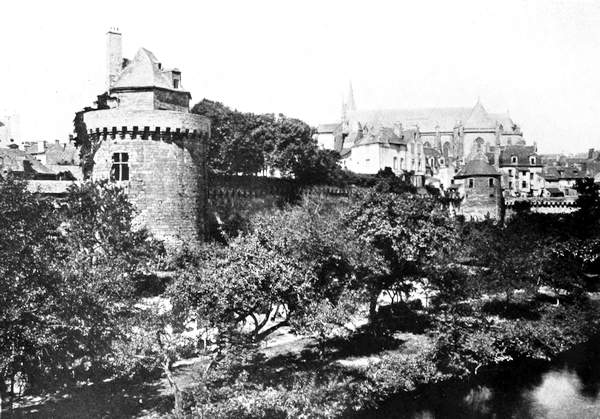
VANNES
* VANNES (M.) chl. d'arr. Capital of the
Department, and seat of a bishop. The town is
not remarkably picturesque. The walls remain
in places but built into, and only two gates with
flanking towers have been spared. The cathedral
is very disappointing, and there are few picturesque
old houses. Vannes was the capital of
the warlike Veneti, whom Cæsar crushed in B.C.
57, when he butchered all the chiefs and leading
nobles, and sold their families into slavery. It
became a Roman town, called Duriorigum, and
six Roman roads struck over the country from
it to Locmariaquer, Hennebont, Corseul, Rennes,
Rieux, and Arzal. A Roman necropolis has
been found on the site of the artillery barracks.
At the beginning of the 5th cent. many towns
dropped their particular names and assumed those
of the peoples to which they formed centres,
and then the place took the name which it has
since borne in Breton, Gweneth. Christianity
having made some progress among the Veneti, in
465 Perpetuus, metropolitan of Tours, assembled
a council at Vannes, and consecrated to it a
bishop, Paternus. The city remained Gallo-Roman;
but throughout the 5th and 6th cents.
British emigrants arrived in such numbers, that
in 590, Regalis, the bishop, complained that he
was, as it were, imprisoned within the walls of the
town by them. These colonists had their own
laws, princes, and ecclesiastical system, and
would not recognise the bishop. In 496 we
hear of an Eusebius, king or governor of the
town. An alliance was entered into between
the Armoricans and the Franks, and Clovis and
his successors were recognised as overlords.
Whether the British chieftain Weroch got into
the city and established himself there is doubtful,
but his son Macliau did so, on his death.
Macliau was in orders, and married. On the
death of the bishop he induced the clergy and
people to elect him as their bishop, and to
satisfy their prejudices dismissed his wife. No
sooner, however, was he firmly seated on the
episcopal throne, than he sent for his wife and
children. About eight years later his brother
Canao, secular chief of the Bretons, revolted
against the Franks, whereupon Macliau proclaimed
himself Count as well as Bishop. He
was killed along with two of his sons in 577.
Pepin occupied the city in 753, and Louis the
Pious visited it at the head of an army in 818.
In 843 Nominoe, governor of Brittany, shook off
the yoke of Frank allegiance. Then came the
invasion of the Northmen, and the disappearance
of the Counts of Vannes, till 937, when Alan
II., Barbetorte, friend of Athelstan, was recognised
as Count, and transmitted the title to
his descendants. The town walls were rebuilt
in 1270. In less than a century the War of
Succession broke out and Vannes had to stand
four sieges in one year, 1342. John IV., conqueror
at Auray in 1364, repaired the walls, and
extended them. The cathedral church of S.
Peter was burnt by the Northmen in the 10th
cent. and was rebuilt in the 11th at the same
time as the abbey church of S. Gildas de Rhuys.
But the tower was added in the 13th cent. and
the whole of the nave and transepts, the former in
1452-76 and the latter in 1504-27, consequently
in the flamboyant style. The nave has no side
aisles, but chapels between the buttresses. In
1537 Archdeacon Jean Danialo who had been
in Rome, returned enthusiastic in favour of pagan
architecture, and to show the canons what he
admired, constructed the circular Chapel of the
B. Sacrament on the north side, a beautiful
structure for its style. But at the same time the
chapter was building its cloisters, and they are
full flamboyant tending to renaissance. The
apsidal Chapel of N.D. and S. Vincent was
erected at the same time also, and is thoroughly
Italian. In the meantime the old Romanesque
choir showed signs of falling, and was pulled
down in 1770 and the present choir was built
and finished in 1776. Then the chapter set to
work to transform the nave. All the tracery
was hacked out of the windows, and a plain
barrel vault was added. The W. tower has had
a spire added to it recently, and the W. front was
"restored" in feeble style in 1868-73. Then
the architect was entrusted with filling the
windows with tracery; and he, not comprehending
the character of the nave, inserted tracery of a
century earlier in style. The N. transept had
a fine doorway, but it has been blocked up for a
hideous baroque retable and altar to stand against
it. Thus the church, never very fine, has lost
much of its character and interest. In the N.
transept is the tomb of S. Vincent Ferrier, and
above it his bust in silver. Vincent was born
at Valence in 1357, and in 1374 entered his
novitiate among the Dominicans. He was sent
to Barcelona and Lerida to give lessons in philosophy,
but threw up the study and devoted himself
to preaching, and rambled through France,
Spain, Italy, England, Scotland and Ireland, as
a revivalist preacher, but, of course, in such
countries as did not understand his tongue, the
effect of his sermons was lost. He spent two
years in Brittany, where he cannot have been of
any use, as the peasants could not comprehend
French. He died at Vannes on the 5th April
1419, but the Pardon is on the 1st Sunday in
September. The other churches of Vannes are
not worth looking at. That of S. Paternus was
built in 1727. The Museum of Archæology of
the Societé Polymathique du Morbihan contains
many interesting objects from the dolmens and
tumuli of the Morbihan.
Vannes is situated at the distance of 5 kilometres
from the Morbihan, the inland sea that
gives its name to the Department. Almost every
day two little steamers leave the port for the
islets, but the time of starting depends on the
tide. The Gulf of the Morbihan is some 8
miles long and about 15 miles wide. It communicates
with the sea by a narrow mouth only
three-quarters of a mile across. It is nowhere
deep; from 45 to 60 ft. is its depth. It is
studded with low islands, of which at the outside
forty are inhabited and some fifty are cultivated.
The inhabitants live by fishing, and all the men
are sailors.
This inland sheet of water is cut off from the
ocean by two great crab's claws, the peninsula
of Sarzeau and that of Locmariaquer. The
scenery is by no means bold; sandy shores and
low islets, and mud banks at the fall of the tide.
The archipelago is, however, very interesting because
of the numerous prehistoric remains on the
islands.
The Isle of Arz is about two miles long.
Here was formerly a priory dependent on S.
Gildas, and it possesses a Romanesque church,
unhappily repaired and remodelled at various
epochs. Near the little Cap de Brohel and in
the islet of Boëdic are megalithic monuments.
At Penraz, south-east of the village, is half of a
cromlech or circle of stones 60 ft. in diameter.
At Cap Brohel, ruined dolmens and fallen
menhirs; at Pen-lious three fallen dolmens and
some menhirs. P. 8th September.
Ile aux Moines is separated from the Ile
d'Arz by a channel 60 ft. deep at low tide. The
ancient name of the island was Crialeis, in Breton
it is Ines Menah or Izenah. The prehistoric
monuments in it are: the great circle of stones at
Kergonan, of which only half remains; the fine
dolmen of Penhap, some menhirs, and the ruined
dolmens of Broel, Vigie, Kerno, Roh-vras,
Roh-vihan, Niol and Pon-niol. The island was
granted by Erespoe to the monks of Redon, but
after the devastation by the Northmen it was
lost to the monks of Redon. The church is
modern and is dedicated to S. Michael. P. 29th
September. The island was colonised after the
Northmen had swept it of its inhabitants, by
settlers from Rhuys. The costume of the
women is almost the same, but of a more
antique cut and character. All the islands in
this inland sea, like the mainland have sunk at
least 16 ft. since prehistoric times. In the little
islet of Er Lannig are two cromlechs, or circles
of standing stones; one is half submerged, and
the other completely under water, even at low
tides.
Gavrinis lies to the east of the Ile aux
Moines. Although less important than those
already described, it is the most interesting of all
in the Morbihan, on account of its tumulus, 25
ft. high, that covers a fine covered gallery, the
stones of which are elaborately carved with
mysterious signs like the tattoo-marks of New
Zealanders. A gallery 40 ft. long leads to the
central chamber, which is 5 ft. high and 6 ft.
6 in. wide. The blocks are of a fine grained
granite, not of the island, but brought from a
distance, with the exception of two, that are of
quartz, and these are unsculptured. Such as are
carved, were clearly so dealt with before they
were erected in place, as the working passes
round the edges.
Er-lanic is situated half a kilometre to the
south-east of Gavrinis, and here are the two
cromlechs already mentioned, one dipping into
the sea, the other already in deep water. They
are juxtaposed, forming an 8, and lie on the
S. E. of the island. The first circle consists of
180 stones, but several are fallen, and it can only
be seen complete when the tide is out. One
stone is 16 ft. high. The second circle can
only be seen at low tides.
Ile longue contains a cairn that also covers a
gallery. It has not been fully examined.
Saint Avée. The church is poor and uninteresting,
but in the churchyard is a curious
cross, with platform from which, according to
local tradition, capital sentences were pronounced.
On one side is the crucifix, on the other the
B.V.M. On the sides S. John the Baptist
and S. Peter. In the church are two windows
middle pointed. There is a lech in the churchyard
at the east end of the church. But
what is of far higher value than the parish church
is the remarkable chapel in the Bourg-bas, which
is flamboyant (1475-94), except the N. transept
that is 2nd pointed. Between the nave and
the choir and transepts is a tall crucifix enriched
with niches, with railing and gates at the side, a
totally unusual description of roodscreen. The
crucifix is certainly of 1500. The transepts
contain four altars with their original retables.
The first on the N. side has very rude carving
representing the Crucifixion, Christ in Glory,
and the B. Virgin crowned (?) with a dove by her.
The second and third are plain with graceful
border of foliage. The fourth is a splendid bit of
alabaster work, probably Flemish, and represents
a virgin saint, the Crucifixion, a saint, Christ
giving benediction, S. Avée (?), a Queen-saint,
S. Mary Magdalen and a Mermaid. There are
some early statues in the chapel, an admirable
S. Lucy of the 15th cent., the drapery splendidly
executed. Such early statues are very rare.
Another is of S. Columbanus. Some fragments
of old glass are in the windows. In the churchyard
is a very curious carved Calvary of unique
character, also a Holy Well. The E. window
of the chancel is flamboyant of a later character
than the rest. In the N. transept is one
flamboyant, the tracery forming a fleur-de-lys.
The others are middle pointed. The chapel
has a slate spirelet. S. of the chapel by the
roadside is a lech with a crucifix planted on top
of it. The camp of La Villeneuve is of undetermined
date. To reach it the road to
Josselin must be taken and diverged from to
the left to Mangolorian. Near this hamlet is
the camp on a steep hill, almost impracticable on
all sides but the west, where it is defended by two
ranges of ditches and by two walls. The camp
is called either Villeneuve or Kastel-Kerneué.
The Vallon de Poignan is within an easy stroll
from Vannes. The road to Pontivy is followed as
far as the Chapel of S. Guen, and then a lane
to the right leads to some curious rocks, one of
which is fancifully called a Druid altar. The
road to Josselin is then entered, and a lane to
the right conducts to the picturesque, rocky
valley of Poignan, at the end of an avenue of oaks.
Plescop. Of little interest; it has a couple of
lechs in the churchyard, and a flamboyant chapel,
without much character, to S. Amon, possibly
the father of S. Samson, who came from the
neighbourhood of Vannes, but usually supposed
to have been a returned crusader who asked at
Plescop for milk, and as he was refused, cursed
the place that its cows should never yield good
milk and butter. As he was found dead in a
furze-brake next morning he has received cult as
a saint. Part of his skull is in a carved oak
bust in the chapel, but is not exposed to veneration,
as authenticating documents are non-extant.
P. 4th Sunday in October.
Surzur. Three menhirs 15 ft. high are near
the hamlet of Begard, and two ruined allées
couvertes are in the coppice of Talhoet. A
dolmen and two fallen menhirs near it at the
hamlet of Vinihy. The parish church of S.
Symphorian is a Romanesque building but altered
later. The arcades, the doors and windows are
semi-circular. There is a central tower at the
crossing of the transepts surmounted by a slate
spire. The Chapel of N.D. de Recouvrance is
of the 16th cent.
S. Nolff. The church is partly of the 16th
cent. It has been restored not wisely but too
well. The Chapel of S. Anne, 1493, has a fine
east window with stained glass representing Our
Lord and seven saints. The other windows
are filled with glaring modern glass.
Sulniac. The parish church dates from
several periods. Four pillars and arches are
Romanesque, as well as a window near the
porch; the other windows and arcades are
later. The nave was rebuilt in fancy Romanesque
in 1893.
* VITRÉ (I.V.) chl. d'arr. A very picturesque
town, rivalling Fougères in objects of
interest. It stands on a hill above the Vilaine,
and notwithstanding the destruction of a portion
of its ramparts, is one of the French towns that
has best retained the features of the Middle
Ages. But on the side of the railway station all
is modern and uninteresting. To see the old
Vitré it is necessary to enter and pursue the
ancient and narrow streets, which form an inextricable
tangle. The houses are mostly slated in
front. On the N. side the town assumes a
feudal character. Here the walls stand on the
black schist rock, and are only pierced by a
single postern that gives access to a steep descent
by steps into the valley. The castle, on a
triangular plan, was founded at the close of the
11th cent. and was reconstructed in the 14th
and 15th. The entrance is flanked by two
towers. The castle is used partly as a prison
and partly as a museum. The Church of Notre
Dame is of the 15th and 16th cents., and has a
tower crowned with a spire of the 18th cent.
Outside the church is a stone pulpit. There is
some old glass of the renaissance period: the
entry into Jerusalem, the Adoration of the
Shepherds, a representation of the burning of
the tower of the church in 1704. The church
also contains a remarkable triptych of the 16th
cent., representing in 32 little groups on enamelled
copper scenes from the New Testament.
On the back is an inscription in rhyme. The
church of S. Martin is modern; the old church
is in the cemetery and dates in part from the
16th century.
Château des Roches was formerly the residence
of Mme. de Sévigné, who lived in it
repeatedly between 1654 and 1690. It consists
of two blocks of buildings of the 16th cent., and
is situated in a pretty park. Visitors are only
admitted to the grounds, to the chapel, and to the
room of Mme. de Sévigné, which contains copies
of family portraits in the private apartments and
some objects believed to have belonged to the
marquise; among others a book of accounts for
the garden signed by her. The bed and chairs
are of wood painted white and covered with
yellow silk damask.
Champeaux. The church is of the 14th
and 19th cents., and has fine glass of the
renaissance (1530-5) and tombs of the same
period. About a mile and a half S.W. a
menhir 12 ft. high called La Haute Pierre.
Pont l'Abbé (F.) chl. arr. Quimper. Here
one is in the midst of the Bigauden country.
Observe the curious and ugly way of wearing
the hair and the coiffes. There are many folds of
skirts fastened round the waists. The women
are remarkably plain, and have staring eyes and
expose their teeth. The church has fine 2nd
pointed east and west windows. The tower
was pulled partly down by Louis XIV. to
punish the people for the Revolt of the Papier
timbré. Some old houses. Fine cloister. The
château of the 13th cent. has been transformed
into a mairie. It retains a large tower, and
buildings of the 17th cent. Outside the town
to the S.W. is the château of Kernuz, transformed
by the proprietor into a museum of flints,
bronze and jade weapons, and gold ornaments
found in the cairns and dolmens of the neighbourhood.
The whole peninsula, ending in the
Pointe de Penmarch (the Horse's Head),
abounds in prehistoric monuments. Two dolmens
are near the road, in the parish of
Plomeur, which has an ugly modern church.
Penmarch was once a thriving seaport,
rivalling Nantes, but for various causes declined,
and is now reduced to a couple of hamlets. The
church (S. Non = Ninidh, an Irish Bishop) is
an interesting late flamboyant structure, the
tracery in the windows affecting the forms of
fleurs-de-lys. Beneath the E. window is a
treasury surmounted by a gallery. At the
junction of the chancel with the nave is a spirelet
supported by turrets, connected with it by flying
buttresses. At the S.W. a pretty little triumphal
arch and gable. The church was begun in 1308.
Inside the church a fireplace for heating the
baptismal water. A mile and a half off is
S. Guénolé, the tower of the church alone
remaining, 1488. A little apse has been built
out at the east end. It contains some curious
statues. Here is a bathing establishment, with
comfortable quarters. Kerity has some old
maisons fortes, and a ruined church.
Tronoen. A chapel of the same date as that at
Penmarch, with a fine Calvary. Two stages of
sculptured groups.
Lambour. A flamboyant church, with colonade
of the 13th cent.
Loctudy. A Romanesque church, with an
Italian 18th cent. façade. It much resembles
S. Gildas de Rhuys. It has been restored.
Ile Tudy may be visited, but does not contain
much of interest.