"The Rusty Buckles."
The 2nd Dragoon Guards (Queen's Bays) got their name of "The Bays" in
1767 when they were mounted on bay horses—a thing which distinguished
them from other regiments, which, with the exception of the Scots
Greys, had black horses. Their nickname, "The Rusty Buckles," though
lending itself to a ready explanation, is doubtful as to its origin;
but one thing is certain that the rust remained on the buckles only
because the fighting was so strenuous and prolonged that there was no
time to clean it off.
"The Royal Irish."
The 4th Dragoon Guards received this title in 1788, in recognition of
its long service in Ireland since 1698. The regiment also has the name
of the "Blue Horse" from the blue facings of the uniform.
"The Green Horse."
The 5th Dragoon Guards were given this name in 1717 when their facings
were changed from buff to green. Some time later, after Salamanca, they
were also called the "Green Dragoon Guards."
"Tichborne's Own."
The 6th Dragoon Guards, or Carabiniers, have been known as "Tichborne's
Own" ever since the trial of Arthur Orton, as Sir Roger Tichborne had
served for some time in the regiment. The name of "Carabiniers" has
distinguished them ever since 1692, when they were armed with long
pistols or "carabins." With these weapons they did signal work in
Ireland in 1690-1.
"Scots Greys."
This regiment, the 2nd Dragoons, has been known by many names: "Second
to None," "The Old Greys," "Royal Regiment of Scots Dragoons," (in
1681, when they were commanded by the famous Claverhouse); "The Grey
Dragoons" in 1700, the "Scots Regiment of White Horses," the "Royal
Regiment of North British Dragoons" in 1707, the "2nd Dragoons" in
1713, and the "2nd Royal North British Dragoons" in 1866.
Associated with them and all their different names is the memorable cry
of "Scotland for ever"—that wild shout they raised as they charged the
French infantry at Waterloo. At Ramillies they captured the colours of
the French Régiment du Roi and by this gained the right to wear
grenadier caps instead of helmets. "Bubbly Jocks" is a nickname
frequently used among themselves—a name derived from the fact that
their dress in its general effect is not unlike that of the "Bubbly
Jock" or turkey cock.
"Lord Adam Gordon's Life Guards."
The 3rd Hussars received this nickname from the fact that when Lord
Adam Gordon commanded the regiment in Scotland he kept it there for
such a long time—"for life" so to speak. When it was raised, in
1685, the regiment was called "The Queen Consort's Regiment of
Dragoons." In 1691 it was known as "Leveson's Dragoons." In the time of
the George's it was called variously "King's Own Dragoons" and "Bland's
Horse." In 1818 it was made a "Light Dragoon" regiment, and it was not
until 1861 that it became Hussars.
"Paget's Irregular Horse."
The 4th Hussars received this title on its return from foreign service,
when it was remarked that its drill was less regular than that of the
other regiments. In 1685 it was called the "Princess Ann of Denmark's
Regiment of Dragoons." Like the 3rd it was formed into a regiment of
Hussars in 1861.
"The Red Breasts."
The 5th Lancers, or Royal Irish, are called "Red Breasts" because of
their scarlet facings. In 1689 they were known as the "Royal Irish
Dragoons," having been raised to assist at the siege of Londonderry in
1688. They became the "5th Royal Irish Lancers" in 1858. This regiment
has also been called the "Daily Advertisers," but the derivation of
this name is somewhat obscure.
"The Delhi Spearmen."
The 9th Lancers received this name from the rebels of the Indian
Mutiny, against whom they used their long lances with such deadly
effect. In 1830 they were known as the "Queen's Royal Lancers," and
"Wynne's Dragoons."
"The Cherry Pickers."
The 11th Hussars were dubbed "Cherry Pickers" because some of their men
during the Peninsular War were taken prisoners in a fruit garden while
supposed to be on outpost duty. They are known also as "Prince Albert's
Own" from the fact that they formed part of the Prince's escort from
Dover to Canterbury when he arrived in England in 1840 as the late
Queen's chosen Consort. One hears them sometimes referred to as the
"Cherubims," from their crimson overalls, busby bag, and crimson and
white plume.
"The Supple 12th."
It was at Salamanca that the 12th Lancers received this honoured name,
because of their dash and rapid movements.
"The Fighting 15th."
It was at Emsdorf that the 15th Hussars won this name, and their feat
of arms on that field gained them the privilege to wear on their
helmets the following inscription: "Five battalions of French defeated
and taken by this Regiment with their colours and nine pieces of cannon
at Emsdorf, 16th July, 1760." In 1794, at Villiers-en-Couché, they
charged with the Austrian Leopold Hussars against vastly superior
numbers to protect the person of the Austrian Emperor. In recognition
of this the then Kaiser presented each of the eight surviving officers
with a medal. In 1799 they received the Royal honour of decking their
helmets with scarlet feathers. The "Fighting 15th" are also known in
history as "Elliot's Light Horse."
"The Dumpies."
The 20th Hussars, together with the 19th and 21st, received the name of
"Dumpies" from the fact that the regiment when formed of volunteers
from the disbanded Bengal European Cavalry of the East India Company
were short and dumpy. Though nowadays there is many a giant among the
20th, the name of "Dumpies" still survives.
"The Mudlarks."
The Royal Engineers received this name from the nature of their
ordinary business in war. In 1722 they were called the "Soldier
Artificers Corps"; and, in 1813, "The Royal Sappers and Miners."
"The Gunners."
The Royal Artillery have held this name from their regular formation in
1793. Formerly, after the rebellion in Scotland, they were known as the
"Royal Regiment of Artillery," and, though not in any way formed into a
regiment, they date still further back, one might say even to the early
days when guns were made of wood and leather. That was before 1543,
when the first gun was cast in England. In 1660 the master gunner was
called the "Chief Fire Master". The Honourable Artillery Company was
founded in 1537 and is the oldest Volunteer Corps in Great Britain.
"The Sandbags."
The Grenadier Guards gained this peculiar name from their special
privilege of working in plain clothes for wages at coal or gravel
heaving, and for this same reason they were often called "Coalheavers."
They seem to have got this name in Flanders, where they excelled at
trench work. Another of their nicknames is "Old Eyes." In 1657 they
were known as the "Royal Regiment of Guards," and in 1660 as the
"King's Regiment of Guards."
"The Coldstreamers."
The Coldstream Guards received their name in 1666 when Monk marched
them from Coldstream to assist Charles II to regain his throne. They
have been called the "Nulli Secundus Club," in memory of the
fact that Charles, before he hit on the name "Coldstream Guards,"
wished to call them the "2nd Foot Guards," a thing to which they
strongly objected, saying that they were "second to none."
"The Jocks."
The origin of this name for the Scots Guards is obvious. History is a
little uncertain about their record, as their papers were burnt by
accident in 1841; but this is certain, that they were raised as Scots
Guards in 1639 and were called later the "Scots Fusilier Guards" and
the "3rd Foot Guards," after which, in 1877, they resumed the name of
"Scots Guards."
"Pontius Pilate's Bodyguard."
This strange nickname of the Royal Scots Regiment is based on an
equally strange story. As long ago as 1637, when most other regiments
were as yet unborn, a dispute arose between the Royal Scots and the
Picardy Regiment on the point of priority in age. The Picardy Regiment
claimed to have been on duty the night after the Crucifixion. But the
Royal Scots met this with a withering volley. "Had we been on duty
then," they said, "we should not have slept at our post." This incident
caused some wag to dub the Royal Scots "Pontius Pilate's Bodyguard,"
and the name has stuck to them ever since. There is another tradition
that this regiment represents the body of Scottish Archers, who for
many centuries formed the guard of the French Kings. It fought in the
seven years' war under Gustavus Adolphus of Sweden, and was
incorporated in the British Army in 1633. Since then, whenever war has
been declared, every man of "Pontius Pilate's Bodyguard" has been among
the last to stay at home.
"The Lions."
The Royal Lancaster Regiment bears upon its colour the Lions of
England, disposed, as in Trafalgar Square, one at each quarter. This
distinction was given them by the Prince of Orange, as they were the
first regiment to join him in 1688 when he landed at Torbay. They have
also been called "Barrell's Blues" from their Commander and their blue
facings. They received the title of "King's Own" from George I., in
1715, and our late King Edward became their Colonel-in-Chief in 1903.
Our present King is now the Colonel-in-Chief.
"Kirke's Lambs."
The Royal West Surrey Regiment (The Queen's) derived this name from
Kirke and from the Paschal Lamb in each of the four corners of its
colour. The name has also an ironical derivation from the fact that
they were employed to enforce the cruelties of "Bloody Judge Jeffreys."
Another nickname of theirs is the "First Tangerines," because they were
raised in 1661 as the "Tangiers Regiment of Foot," for the purpose of
garrisoning Tangiers, at that time a British possession. John
Churchill, Duke of Marlborough, began his career in this Regiment.
Another nickname, "Sleepy Queen's" is derived from a slight omission of
theirs at Almeida, when, through some oversight, they allowed General
Brennier to escape. But they have so far lived this down that now,
ut lucus a non lucendo, they are called "sleepy" because they
are always very wide awake.
"The Shiners."
The Northumberland Fusiliers deserve that name because they are always
so spic-and-span. They also deserve the name of "Fighting Fifth"
because they have many a time proved their right to it. At the battle
of Kirch Denkern (1761) they captured a whole regiment of French
infantry, and, in the following year, at Wilhelmsthal, they took twice
their own number prisoners. They have also the name of "Lord
Wellington's Body Guard" because, in 1811, they were attached to
Headquarters. Another name is "The Old and Bold." On St. George's day
the "Fighting Fifth" wear roses in their caps, but the origin of this
is not clear, unless it may be that one of their badges is "St. George
and the Dragon," and another "The Rose and Crown." They also wear the
white feathers of the French Grenadiers on the anniversary of the
battle of La Vigie, when Comte de Grasse attempted to relieve the
Island of St. Lucia in the West Indies. On that occasion the "Old and
Bold" took the white plumes from the caps of their defeated opponents,
the French Grenadiers. To-day, the white in the red and white hackle
now worn by them refers back to that terrible death-struggle. The 5th
is the only foot regiment which has the distinction of a red and white
pompon. It is worth recording here that they formed part of a force
which repulsed overwhelming numbers of the enemy on the heights of El
Bodon (1811) during the investment of Ciudad Rodrigo. The Iron Duke
spoke of this achievement as "a memorable example of what can be done
by steadiness, discipline and confidence."
"The Elegant Extracts."
The word sounds like a fashionable chemical compound, but its real
meaning is derived from the fact that the officers of the Royal
Fusiliers—except 2nd Lieutenants and Ensigns, of which at the time
they had none—were "extracted" from other corps. In the eighteenth
century they were known as the "Hanoverian White Horse." Those who have
lived to remember the Crimean War will remember also that brave song,
"Fighting with the 7th Royal Fusiliers"—a song which became so popular
that the regiment could have been recruited four times over had it been
necessary.
"The Leather Hats."
The King's (Liverpool) Regiment gained their name from their head-gear.
They were raised by James II. in 1685. In the American War an officer
and 40 men of the "Leather Hats" captured a fort held by 400 of the
enemy. It is interesting to know that this regiment has an allied
regiment of the Australian Commonwealth—the 8th Australian Infantry
Regiment.
"The Holy Boys."
The Norfolk Regiment has had this name ever since the Peninsular War.
In that campaign the Spaniards, seeing the figure of Britannia on the
cross-belts of the 9th, thought that it was a representation of the
Virgin Mary. There is another story to the effect that they derive
their name from their reputed practice of selling their Bibles to buy
drink during the Peninsular War. But this I do not believe. Another
name for them is the "Fighting Ninth"—a title which no one can refuse
to believe. Their bravery at the siege of St. Sebastian might alone
justify it.
"The Springers."
The Lincolnshire Regiment received this nickname during the American
War because they were remarkable in their readiness to spring into
action when called upon. It was the first infantry regiment to enter
Boer territory during the late South African War. Their other name of
"Lincolnshire Poachers" has no satisfactory derivation.
"The Bloody Eleventh."
There are two stories to account for this nickname of the Devonshire
Regiment. One is that at Salamanca they were in a very sanguinary
condition after the battle. The other is that when they were in Dublin
in 1690 the regiment's contractor supplied bad meat, on which they
swore that if he did so again they would hang the butcher. There was no
improvement in the meat, so they hanged the delinquent in front of his
own shop on one of his own meat-hooks. It is no doubt the first story
that is the true one. Another name for the Devonshires is "One and
All." It was a man in this regiment who wounded Napoleon at Toulon in
1793.
"The Old Dozen."
The Suffolk Regiment won glory for itself at the siege of Gibraltar. It
also behaved with the greatest gallantry at Minden, and that is why on
the 1st of August (Minden Day) the "Old Dozen" parade with a rose in
the head-dress of each man. In connection with this they are also
called the "Minden Boys."
"The Peacemakers."
The Bedfordshire Regiment were first known as the "Peacemakers" because
at that time there were no battles on its colours. For the same reason
no doubt they were also called "Bloodless Lambs." Another nickname of
theirs is "The Old Bucks"—a title justified by their hard fighting in
the Netherlands under William III. and also under Marlborough.
"The Bengal Tigers."
The Leicestershire Regiment gets its name from the Royal Green Tiger on
its badge. This distinction was given it for a brilliant achievement in
the Nepal War of 1814, when they captured a Standard bearing a tiger.
They are also called "Lily Whites," from their white facings.
"The Green Howards."
The Yorkshire Regiment was commanded by Colonel Howard, and has green
facings. They are also called "Howard's Garbage," and must not be
confused with the 24th Foot, also once commanded by a Colonel Howard,
and styled "Howard's Greens."
"The Earl of Mar's Grey Breeks."
The Royal Scots Fusiliers received this name from the colour of their
breeches at the time the regiment was raised in 1678. "The Grey Breeks"
wear a white plume in their head-dress—an honour bestowed in
recognition of their services during the Boer War.
"The Lightning Conductors."
There is some doubt as to how the Cheshire Regiment acquired this name.
But it may be connected in some way with the fact that at Dettingen,
when George II. was attacked by the French Cavalry, they formed round
him under an oak tree and drove the enemy off. In remembrance of this
occasion the oak leaf is worn by them at all inspections and reviews in
obedience to the wish of George II. when he plucked a leaf from the
tree and handed it to the Commander. They are also known as the "Two
Twos" from their number, the 22nd. Another of their names is "The Red
Knights," because, when recruiting at Chelmsford in 1795, red jackets,
breeches and waistcoats were served out to them instead of the proper
uniform. This regiment, under the name of the "Soulsburg Grenadiers,"
was under Wolfe when he was mortally wounded at Quebec.
"The Nanny Goats."
The Royal Welsh Fusiliers are known as "Nanny Goats" or "Royal Goats"
because they always have a goat, with shields and garlands on its
horns, marching bravely at the head of the drum. This has been their
custom for over a hundred years. A glance at the back of their tunics
reveals a small piece of silk known as a "flash." It has been there
ever since the days when its office was to keep the powdered pigtail
from soiling the tunic. The King is Colonel-in-Chief of the "Nanny
Goats."
"Howard's Greens."
The South Wales Borderers were at one time commanded by a Colonel
Howard. It was a company of this regiment which achieved immortal glory
at Rorke's Drift, which they defended against 3,000 Zulus. In Africa
they gained no less than eight V.C.'s. On the Queen's colour of each
battalion may be seen a silver wreath. This was bestowed by Queen
Victoria in memory of Lieutenants Melville and Coghill, who died to
save the colours at Isandlhwana.
"The Botherers."
The King's Own Scottish Borderers—the only regiment that was allowed
to beat up for recruits in Edinburgh without asking the Lord Provost's
permission—were called "Botherers," partly on this account and partly
by corruption from "Borderers." They bear also the name of "Leven's
Regiment," from the remarkable fact that in 1689 they were raised by
the Earl of Leven in Edinburgh, in the space of four hours. They are
also known as the "K.O.B.s."
"The Cameronians."
The 1st Battalion of the Scottish Rifles are the descendants of the
Glasgow Cameronian Guard which was raised during the Revolution of 1688
from the Cameronians, a strict set of Presbyterians founded by
Archibald Cameron, the martyr. The 2nd Battalion is known as "Sir
Thomas Graham's Perthshire Grey Breeks." It received this name from the
fact that when Lord Moira ordered the regiment to be equipped and
trained as a Light Infantry Corps, their uniforms consisted of a red
jacket faced with buff, over a red waistcoat, with buff tights and
Hessians for the officers, and light grey pantaloons for the men. Both
battalions now wear dark green doublets and tartan "trews."
"The Slashers."
The Gloucestershire Regiment derives its name of "Slashers" from its
achievements in the battle of the White Plains in 1777. There is
another story, however, that the name arose from a report that, on one
occasion, a magistrate having refused shelter to the women of the
regiment during a severe winter, some of the officers disguised
themselves as Indians and slashed off both his ears. In Torres Straits
there is a reef which is marked on the charts as the "Slashers' Reef"
because, after the Khyber Pass disaster of 1842, the "Slashers" were on
the way from Australia to India when the transport conveying them
grounded on this reef. Their other name of the "Old Braggs" is derived
from their Commander, General Braggs, of 1734. In regard to this there
is the tradition of an order given by a wag of a Colonel when the "Old
Braggs" were brigaded with other regiments with Royal Titles. The order
runs:
"Neither Kings nor Queens nor Royal Marines,
But 28th Old Braggs;
Brass before and brass behind;
Ne'er feared a foe of any kind,—
Shoulder arms!"
"The Vein Openers."
The Worcestershire Regiment were dubbed "The Vein Openers" by the
people of Boston, (U.S.A.) in 1770, because they were the first to draw
blood in the preliminary disturbances before the war. After the
Peninsular War they were called "Old and Bold." Another name for them
is "Star of the Line," from the eight-pointed star on their pouches—a
distinction peculiarly their own. The 2nd Battalion were known as the
"Saucy Greens" from the colour of their facings and, presumably, their
extreme sauciness.
"The Young Buffs."
The 1st Battalion of the East Surrey Regiment derived their nickname
from a peculiar royal mistake. At the battle of Dettingen, King George
II., mistaking them for the "3rd Buffs," called out "Bravo Old Buffs!"
Being reminded that they were not the "Old Buffs" but the 31st, His
Majesty at once corrected his cry to "Bravo, Young Buffs!" and the name
has stuck to the battalion ever since. The 2nd Battalion was raised at
Glasgow in 1756 and takes its name of "Glasgow Greys" from that and the
facings of the uniform.
"The Red Feathers."
The 2nd Battalion of the Duke of Cornwall's Light Infantry gained their
nickname by a signal act of defiant heroism. During the American War of
Independence they learned that the enemy had marked them down as men to
whom no quarter was to be given. On this the Light Company, wishing to
restrict the full force of this threat to themselves, and to prevent
others suffering by mistake, stained their plume feathers red as a
distinguishing mark. For this fine act they were authorised to wear a
red feather, and this honour is perpetuated in the red cloth of the
helmet and cap badge and the red pughri worn on foreign service. Their
other nickname "The Lacedæmonians" has a dash of grim humour in its
origin. During the same war, at the time of all times when the men were
under a withering fire, their Colonel made a long speech to them—all
about the Lacedæmonians, a brave race enough, but terribly ignorant of
rifle fire.
"The Havercake Lads."
The West Riding Regiment (The Duke of Wellington's) is said to have
derived its nickname from the fact that the recruiting sergeants in the
old days carried an oat cake on the points of their swords. There is a
joke among "The Havercakes" as old as their first recruiting sergeant.
This enterprising man was in the habit of addressing the Yorkshire
crowd as follows: "Come, my lads; don't lose your time listening to
what them foot sojers says about their ridgements. List in my
ridgement and you'll be all right. Their ridgements are obliged to
march on foot, but my ridgement is the gallant 33rd, the First
Yorkshire West Riding Ridgement, and when ye join headquarters
ye'll be all mounted on horses."
The 2nd Battalion is known as "The Immortals," from the fact that in
the Indian wars under Lord Lake every man bore the marks of wounds.
They were also called "The Seven and Sixpennies" from their number
(76th) and from the fact that seven and sixpence represented a
lieutenant's pay.
"The Orange Lilies."
The 1st Battalion of the Royal Sussex Regiment was named "The Orange
Lilies" from their early facings, orange, a mark of favour from William
III., in 1701, and the white plume taken from the Roussillon French
Grenadiers at Quebec in 1759. They were originally called "The Belfast
Regiment" then "The Prince of Orange's Own." The orange facings were
replaced by blue in 1832, and the white plumes disappeared in 1810; but
the white (Roussillon) plume is still a badge of the Royal Sussex.
"The Pump and Tortoise."
The 1st Battalion South Staffordshire Regiment earned half their
nickname from their extreme sobriety and the other half from the slow
way they set about their work when actually stationed at Malta. The 2nd
Battalion is known as "The Staffordshire Knots."
"Sankey's Horse."
The 2nd Battalion Dorsetshire Regiment, under Colonel Sankey in 1707,
arrived at Almanza during the battle mounted on mules, hence the term
"Sankey's Horse," applied to a foot regiment. They were the first
King's regiment to land in India, in memory of which they have for
their motto "Primus in Indis." In 1742 the regiment was popularly known
as "The Green Linnets" from the "sad green" facings of its uniform. The
2nd Battalion acquired the name of "The Flamers" from their large share
in the destruction of the town and stores of New London, together with
twelve privateers, by fire in 1781.
"The Excellers."
This name was fastened upon the 1st Battalion South Lancashire Regiment
from its number (XL the 40th). It is also known as "The Fighting
Fortieth." Until its amalgamation with the 82nd it had the honour of
being next to the Royal Scots in the number of battle honours on its
colour.
"The 1st Invalids."
The 1st Battalion Welsh Regiment is set down in old Army Lists under
this name because it was first raised as a regiment of Invalids, in
1719. In George II's, time it was known as "Wardour's Regiment." The
nickname of the 2nd Battalion is a curious play on words—or rather
figures. They are called the "Ups and Downs" because their number
(69th) reads the same when inverted. The 69th are also called "The Old
Agamemnons," a fancy title bestowed on them by Lord Nelson at St.
Vincent after the name of his ship, on which a detachment was serving
as marines.
"The Black Watch."
The Royal Highlanders won this honoured name from the sombre colour of
their tartan some ten years before their Highland Companies were formed
into a regiment known as "The Highland Regiment." Its first Colonel,
Lord Crawford, being a lowlander, had no family tartan, so, it is said,
this special tartan was devised. The bright colours in the various
tartans are said to have been extracted, leaving only the dark green
ground. The French, under the impression that in their own mountainous
country they ran wild and naked, called them "Sauvages d'Ecosse." The
red hackle in their bonnets was won at Guildermalsen in 1794.
"The Cauliflowers."
The Loyal North Lancashire Regiment have this nickname from the former
colour of the facings of the 1st Battalion. They are also called "The
Lancashire Lads." After Quebec the 47th were nicknamed "Wolfe's Own"
and to this day the officers of both battalions wear a black worm in
their lace gold as a sign of sorrow for their general's death. This is
the only regiment that is officially styled "Loyal," the 2nd Battalion
having been known prior to 1881 as the 81st (Loyal Lincoln Volunteers).
"The Steelbacks."
This is the name applied to the Northamptonshire Regiment because of
the unflinching way in which they took their floggings. While under
Wellington in the Peninsular War one, Hovenden, a private, was flogged
for breach of discipline. At the twentieth stroke he fainted and this
so disgusted his comrades that on his recovery they cut him dead. Much
annoyed at this Hovenden marched up to the Colonel and called him a
fool, and for this he was ordered to be flogged again. That night the
regiment was attacked by the French, and Hovenden, evading the guard,
arrived on the battlefield in time to see his Colonel captured by the
enemy. With his musket he shot down the captors and then liberated the
Colonel and bound up his wounds. After this he returned to make sure of
his flogging, but was struck by a bullet and killed.
The Northamptonshires have also the honoured name, "Heroes of
Talavera," because they turned the tide of battle on that victorious
day.
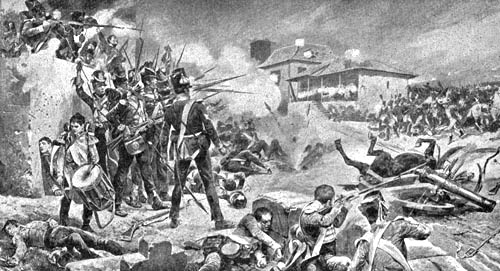
THE "DIE HARDS" AT ALBUERA.
From a Painting by R Caton Woodville
"The Blind Half Hundred."
The 1st Battalion Royal West Kent Regiment suffered greatly from
ophthalmia in Egypt in 1801, hence this nickname. They were called also
"The Dirty Half Hundred" because the men, when in action in hot
weather, used to wipe their faces with their black cuffs, with obvious
results. Another of their names is "The Devil's Royals," and yet
another "The Gallant 50th"—this last because at Vimiera, in 1807, 900
of them routed 5,307 of the enemy.
"The Kolis."
The King's Own Yorkshire Light Infantry derive their name of "Kolis"
from their initials. The name often takes the corrupted form of
"Coalies."
"The Die-Hards."
The 1st Battalion Duke of Cambridge's Own (Middlesex Regiment) were
styled "Die Hards" from the memorable words of Inglis at Albuera: "Die
hard, my men; die hard!"—words which were endorsed by Stanley at
Inkerman when he said: "Die hard! Remember Albuera!" The 2nd Battalion
are called "The Pothooks," from their number (77).
"The Royal American Provincials."
This distinguished popular name was bestowed on the King's Royal Rifle
Corps because they were raised in America.
"The Bloodsuckers."
The Manchester Regiment appear to have acquired this name from general
and warlike reasons. The 1st Battalion displayed great courage and
steadiness in the defence of Ladysmith. The 2nd Battalion was formerly
the "Minorca Regiment" and became part of the Line in 1804 as the 97th
(Queen's German) Regiment, becoming later the 96th Foot.
"The Strada Reale Highlanders."
The Gordon Highlanders (92nd and 75th) would propound a riddle to you:
What is the difference between the 92nd and the 75th? The answer is
that the 92nd are real Highlanders, and the 75th are Real(e)
Highlanders.
"The Cia mar tha's."
The Cameron Highlanders owe this nickname to Sir Allen Cameron, who
raised the regiment. It was his word to everybody: "Cia mar tha!" (How
d'ye do!)
"The Garvies."
The Connaught Rangers are called "Garvies" because their recruits, when
first the regiment was raised, were both lean and raw. Now a "garvie"
is a small herring.
"The Blue Caps."
At the time of the relief of Cawnpore, a despatch of Nana Sahib was
intercepted, containing a reference to those "blue-capped English
soldiers who fought like devils." These "Blue-Caps" were the Madras
Fusiliers, then a "John Company" regiment, but now the 1st Battalion
Royal Dublin Fusiliers. The name was later stamped in perpetuity by
Havelock, at the bridge of Charbagh. The question was put to him by
Outram as to who could possibly carry the bridge under so deadly a
fire. "My Blue Caps!" replied Havelock, and his faith in them was
justified, for they carried it against overwhelming odds. The Bombay
Fusiliers (another "John Company" regiment) now the 2nd Battalion Royal
Dublin Fusiliers, have an equally distinguished record. They have been
known as "The Old Toughs."
BRITISH REGIMENTS AT THE FRONT