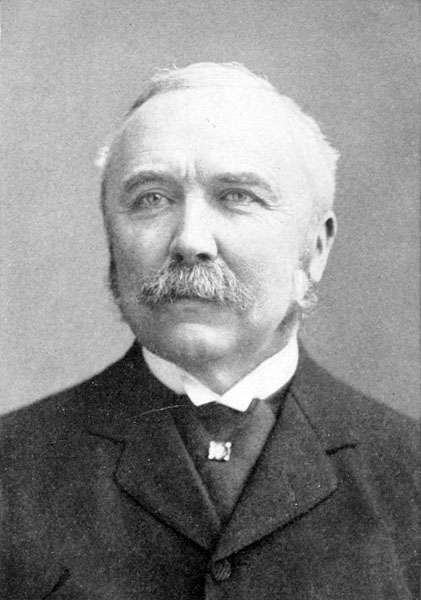
Mr. Chamberlain was once described by an
unfriendly critic as the Rabagas of English
political life. We all remember Rabagas, the
hero of Sardou's masterpiece of dramatic satire,
who begins his public career and wins fame
among certain classes as a leveler and a demagogue
of the most advanced views, an unsparing
enemy of the aristocracy, a man who will
make no terms with the privileged orders, and
will bow to no sovereign but the sovereign people.
Now, I have said that it was an unfriendly
critic who likened Mr. Chamberlain to Sardou's
creation, but it was not in the earlier career
of the real or the imaginary politician that the
resemblance was especially to be traced. Rabagas
is brought by tempting conditions under
the influence of the privileged classes, the aristocracy,
and the reigning sovereign of the small
state in which he lives; and his leveling and
revolutionary tendencies melt away under the
genial influence of his new associations. He
becomes, before long, the admirer of the aristocracy
and the Prime Minister of the Prince,
and is ready to devote all his energies to the
defense of the privileged orders, to the repression
of the vile democracy, and the silencing
of Radical orators.
In this contrast between the earlier and the
later parts of the political career the malevolent
critic, no doubt, found the materials for his
comparison between Rabagas and Mr. Chamberlain.
For there can be no denying that Mr.
Chamberlain began his public life as an eloquent,
an unsparing, and apparently a convinced
champion of democracy against the aristocracy,
the privileged orders, and the Conservative
party, and that he is now a leading member of
a Conservative Government, and goes further
than most of his colleagues would be likely to
go in his hostility to Radical measures and to
Radical men.
Moreover, Mr. Chamberlain, who during the
earlier part of his public life belonged to the
party most strenuously opposed to all unnecessary
wars, and especially wars which had annexation
for their object, has been the chief Ministerial
promoter of the late war in South Africa,
a war which had for its object the subjugation
of two independent republics in order to bring
them under the Imperial flag of England. No
one, therefore, could have been much surprised
when the unfriendly critic fancied that he could
discover at least a certain superficial resemblance
between the career of Rabagas and the
career of Mr. Chamberlain.
I have been a close observer of much of Mr.
Chamberlain's public life, and for some time we
were thrown a good deal into Parliamentary
and political association. He came into the
House of Commons not very long before I had
the honor of obtaining a seat there, and his
fame had preceded him so far that his entrance
into Parliament was looked upon by everybody
as a coming event, in the days when he had
not yet been elected to represent the constituency
of Birmingham. Birmingham was at that
time one of the most thoroughly Radical cities
in England. John Bright once said that as the
sea, wherever you dip a cup into it, will be
found to be salt, so the constituency of Birmingham,
wherever you test it, will be found
to be Radical. Birmingham could claim the
merit of being one of the best organized municipalities
in England. Its popular educational
institutions were excellent; its free libraries
might have won the admiration of a citizen of
Boston, Massachusetts; its police arrangements
were efficient; its sanitation might well have
been the envy of London, and the general intelligence
of its citizens was of the highest order.
Now, it was in this enlightened, progressive, and
capable community that Mr. Chamberlain won
his first fame. He is not a Birmingham man
by birth. He was, I believe, born and brought
up on the south side of London, and was educated
at University College School, London.
But at an early age he settled in Birmingham,
and became a member of his father's manufacturing
firm there. Very soon he rose to great
distinction as a public speaker and as a member
of the local corporation, and three times
was elected chief magistrate of Birmingham.
We began soon to hear a great deal of him
in London. It must have been clear to anybody
who knew anything of Birmingham that
a man could not have risen to such distinction
in that city without great intelligence and
a marked capacity for public life. All this time
he was known as a Radical of the Radicals.
The Liberal party in London began to look
upon him as a coming man, and as a coming
man who was certain to take his place, and
that probably a leading place, in the advanced
Radical division of the Liberals. His political
speeches showed him to be a democrat of the
leveling order—a democrat, that is to say, of
views much more extreme than had ever been
professed by John Bright or Richard Cobden.
He was an unsparing assailant of the aristocracy
and the privileged classes, and, indeed,
went so far in his Radicalism that the Conservatives
in general regarded him as a downright
Republican.
I can well remember the sensation which his
first speech in the House of Commons created
among the ranks of the Tories after his election
to Parliament as one of the representatives of
Birmingham. The good Tories made no effort
to conceal their astonishment at the difference
between the real Chamberlain as they saw and
heard him and the Chamberlain of their earlier
imaginings. I talked with many of them at the
time, and was made acquainted with their emotions.
Judging from his political speeches, they
had set him down as a wild Republican, and
they expected to see a rough and shaggy man,
dressed with an uncouth disregard for the ways
of society, a sort of Birmingham Orson who
would probably scowl fiercely at his opponents
in the House and would deliver his opinions in
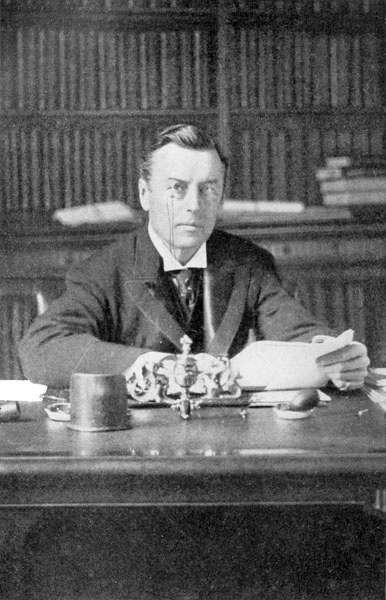
tones of thunder. The man who rose to address
the House was a pale, slender, delicate looking,
and closely shaven personage, very neatly
dressed, with short and carefully brushed hair,
and wearing a dainty eyeglass constantly fixed
in his eye. "He looks like a ladies' doctor,"
one stout Tory murmured. "Seems like the
model of a head clerk at a West End draper's,"
observed another. Certainly there was nothing
of the Orson about this well-dressed, well-groomed
representative of the Birmingham
democracy. Mr. Chamberlain's speech made a
distinct impression on the House. It was admirably
delivered, in quietly modulated tones,
the clear, penetrating voice never rising to the
level of declamation, but never failing to reach
the ear of every listener. The political opinions
which it expressed were such as every one
might have expected to come from so resolute
a democrat, but the quiet, self-possessed
delivery greatly astonished those who had expected
to see and hear a mob orator. Mr.
Chamberlain's position in the House was assured
after that first speech. Even among the
Tories everybody felt satisfied that the new
man was a man of great ability, gifted with a
remarkable capacity for maintaining his views
with ingenious and plausible argument, a man
who could hold his own in debate with the
best, and for whom the clamors of a host of
political opponents could have no terrors.
I may say at once that Mr. Chamberlain has,
ever since that time, proved himself to be one
of the ablest debaters in the House of Commons.
He is not and never could be an orator
in the higher sense, for he wants altogether
that gift of imagination necessary to the composition
of an orator, and he has not the culture
and the command of ready illustration
which sometimes lift men who are not born
orators above the mere debater's highest level.
But he has unfailing readiness, a wide knowledge
of public affairs, a keen eye for all the
weak points of an opponent's case, and a flow
of clear and easy language which never fails to
give expression, at once full and precise, to all
that is in his mind. He was soon recognized,
even by his extreme political opponents, as one
of the ablest men in the House of Commons,
and it seemed plain to every one that, when
the chance came for the formation of a Liberal
Ministry, the country then being in the hands
of a Tory Government, Mr. Chamberlain would
beyond question find a place on the Treasury
Bench.
Meanwhile Mr. Chamberlain's democratic
views seemed to have undergone no modification.
He was as unsparing as ever in his
denunciation of the aristocracy and the privileged
classes, and he was especially severe
upon the great landowners, and used to propound
schemes for buying them out by the
State and converting their land into national
property. His closest ally and associate in
Parliamentary politics was Sir Charles Dilke,
who had entered the House of Commons some
years before Mr. Chamberlain, and who was
then, as he is now, an advanced and determined
Radical. Sir Charles Dilke, in fact, was
at that time supposed to be something very
like a Republican, at least in theory, and he
had been exciting great commotion in several
parts of the country by his outspoken complaints
about the vast sums of money voted
every year for the Royal Civil List. It was
but natural that Sir Charles Dilke and Mr.
Chamberlain should become close associates,
and there was a general conviction that the
more advanced section of the Liberal party
was destined to take the command in Liberal
politics.
Outside the range of strictly English politics
there was a question arising which threatened
to make a new division in the Liberal
party. This was the question of Home Rule
for Ireland as it presented itself under the
leadership of Charles Stewart Parnell. For
years the subject of Home Rule had been the
occasion, under the leadership of Mr. Butt,
of nothing more formidable to the House of
Commons than an annual debate and division.
Once in every session Mr. Butt brought forward
a motion calling for a measure of Home
Rule for Ireland, and, after some eloquent
speeches made in favor of the motion by Irish
members, a few speeches were delivered on the
other side by the opponents of Home Rule,
Liberals as well as Tories, and then some leading
member of the Government went through
the form of explaining why the motion could
not be accepted. A division was taken, and Mr.
Butt's motion was found to have the support
of the very small Irish Nationalist party, as it
then was, and perhaps half a dozen English or
Scotch Radicals; and the whole House of Commons,
except for these, declared against Home
Rule. About the time, however, of Mr. Chamberlain's
entrance on the field of politics a
great change had taken place in the conditions
of the Home Rule question. Charles Stewart
Parnell had become in fact, although not yet
in name, the leader of the Irish National party,
and Parnell's tactics were very different indeed
from those of his nominal leader, Mr. Butt.
Butt was a man who had great reverence for
old constitutional forms and for the traditions
and ways of the House of Commons, and he had
faith in the power of mere argument to bring
the House some time or other to see the
justice of his cause. Parnell was convinced
that there was only one way of compelling the
House of Commons to pay any serious attention
to the Irish demand, and that was by
making it clear to the Government and the
House that until they had turned their full
attention to the Irish national claims, they
should not be allowed to turn their attention
to any other business whatever. Therefore he
introduced that policy of obstruction which
has since become historical, and which for a
time literally convulsed the House of Commons.
Now, I am not going again into the
oft-told tale of Home Rule and the obstruction
policy, and I touch upon the subject here
only because of its direct connection with the
career of Mr. Chamberlain. Sir Charles Dilke
and Mr. Chamberlain supported Mr. Parnell in
most of his assaults upon the Tory Government.
It was Parnell's policy to bring forward
some motion, during the discussion of the estimates
for the army and navy or for the civil
service, which should raise some great and
important question of controversy connected
only in a technical sense with the subject formally
before the House, and thus to raise a
prolonged debate which had the effect of postponing
to an indefinite time the regular movement
of business. Thus he succeeded in stopping
all the regular work of the House until
the particular motion in which he was concerned
had been fully discussed and finally settled,
one way or the other. It was by action
of this kind that he succeeded in prevailing
upon the House of Commons to condemn the
barbarous system of flogging in the army and
the navy, and finally to obtain its abolition. In
this latter course he was warmly supported by
Mr. Chamberlain and Sir Charles Dilke, and
by many other Liberal members.
But it was not only in obstructive motions
which concerned the common interests of the
country that Parnell obtained the support of
Sir Charles Dilke and Mr. Chamberlain. These
two men boldly and vigorously maintained him
in his policy of obstruction when it only professed
to concern itself with Irish national questions.
They identified themselves so thoroughly
with his Irish policy that it became a familiar
joke in the House of Commons to describe
Dilke and Chamberlain as the Attorney-General
and the Solicitor-General of the Home
Rule party. I was then a member of the
House, and had been elected Vice-President of
the Irish party, Parnell being, of course, the
President. Naturally, I was brought closely
into association with Mr. Chamberlain, and I
had for many years been a personal friend of
Sir Charles Dilke. Again and again I heard
Mr. Chamberlain express his entire approval of
the obstructive policy adopted by Parnell, and
declare that that was the only way by which
Parnell could compel the House of Commons
to give a hearing to the Irish claims. Mr.
Chamberlain, indeed, expressed, on more than
one occasion, in speeches delivered during a
debate in the House, just the same opinion
as to Parnell's course which I had heard him
utter in private conversation. In one of these
speeches I remember well his generous declaration
that he was sorry he had not had an opportunity
of expressing that opinion to the House
of Commons long before. Now, of course, I
always thought, and still think, that all this was
much to the credit of Mr. Chamberlain's political
intelligence, courage, and manly feeling,
and I regarded him as one of the truest English
friends the Home Rule cause had ever
made. I had the opportunity, on more than
one occasion, of hearing Dilke and Chamberlain
define their respective positions on the
subject of Home Rule. Dilke regarded Home
Rule as an essential part of a federal system,
which he believed to be absolutely necessary to
the safety, strength, and prosperity of the British
Empire. He would have made it a Federal
system, by virtue of which each member of the
Imperial organization governed its own domestic
affairs in its own way, while the common
wishes and interests of the Empire were represented,
discussed, and arranged in a central
Imperial Parliament. Therefore, even if the
Irish people had not been themselves awakened
to the necessity for a Home Rule Legislature
in Ireland, Dilke would have been in favor of
urging on them the advantages of such an
arrangement. This, in point of fact, is the system
which has made the Canadian and the
Australasian provinces what they are at this
day, contented, loyal, and prosperous members
of the Imperial system. Chamberlain was not
so convinced an advocate of the general system
of Home Rule as Dilke, but he was always emphatic
in his declarations that, if the large majority
of the Irish people desired Home Rule,
their desire should be granted to them by the
Imperial Parliament.
When I first entered the House of Commons,
the Conservative party was in office. About a
year after, the general election of 1880 came
on, almost in the ordinary course of events,
and the result of the appeal to the country was
that the Liberals came back to power with a
large majority. Mr. Gladstone was at the head
of the Liberal party, and he became Prime
Minister. Everybody assumed that two such
prominent Radicals as Dilke and Chamberlain
could not be overlooked by the new Prime
Minister in his arrangements to form an administration.
I think I am entitled to say, as a
positive fact, that Dilke and Chamberlain entered
into an understanding between themselves
that unless one at least of them was
offered a place in the Cabinet, neither would
accept office of any kind. Of course when a
new Government is in process of formation all
these arrangements are matters of private discussion
and negotiation with the men at the
head of affairs; and the result of interchange
of ideas in this instance was that Chamberlain
became President of the Board of Trade, with
a seat in the Cabinet, and Dilke accepted the
office of Under-Secretary for Foreign Affairs,
without a place in the inner Ministerial circle.
This was done, not only with Dilke's cordial
consent, but at his express wish, for it was his
strong desire that the higher place in the
administration should be given to his friend.
Now, at this time Mr. Gladstone was not a
convinced Home Ruler. I know that the importance
of the question was entering his mind
and was absorbing much of his attention. I
know that he was earnestly considering the
subject, and that his mind was open to conviction;
but I know also that he was not yet
convinced. Chamberlain, therefore, would apparently
have had nothing to gain if he merely
desired to conciliate the favor of his leader by
still putting himself forward as the friend and
the ally of the Home Rule party. But he continued,
when in office, to be just as openly our
friend as he had been in the days when he was
only an ordinary member of the House of Commons.
There were times when, owing to the
policy of coercion pursued in Ireland by the
then Chief Secretary to the Lord-Lieutenant,
the relations between the Liberal Government
and the Home Rule party were severely strained.
We did battle many a time as fiercely against
Mr. Gladstone's Government as ever we had
done against the Government of his Tory predecessor.
Yet Mr. Chamberlain always remained
our friend and our adviser, always stood by us
whenever he could fairly be expected to do so
in public, and always received our confidences
in private. When Mr. Parnell and other members
of our party were thrown into Dublin
prison, Mr. Chamberlain did his best to obtain
justice and fair treatment for them and for the
Home Rule cause and for the Irish people.
Many American readers will probably have
a recollection of what was called the Kilmainham
Treaty—the "Treaty" being an arrangement
which it was thought might be honorably
agreed upon between Mr. Gladstone and the
leaders of the Irish party, and by virtue of which
an improved system of land-tenure legislation
was to be given to Ireland, on the one hand,
and every effort was to be made to restore
peace to Ireland on the other. I do not intend
to go into this old story at any length, my only
object being to record the fact that the whole
arrangements were conducted between Mr.
Chamberlain and Mr. Parnell, and that Chamberlain
was still understood to be the friend of
Ireland and of Home Rule. These negotiations
led to the resignation of office by the late
Mr. William Edward Forster, Chief Secretary
to the Lord-Lieutenant of Ireland; and then
came the important question, Who was likely
to be put in Mr. Forster's place? I believe
that, as a matter of fact, the place was offered,
in the first instance, to Sir Charles Dilke, but
was declined by him on the ground that he was
not also offered a seat in the Cabinet, and Dilke
was convinced that unless he had a seat in the
Cabinet he could have no chance of pressing
successfully on the Government his policy of
Home Rule for Ireland.
Mr. Chamberlain then had reason to believe
that the office would be tendered to him, and
he was willing to accept it and to do the best
he could. I know that he believed that the
place was likely to be offered to him and that
he was ready to undertake its duties, for he
took the very frank and straightforward course
of holding a conference with certain Irish Nationalist
members to whom he made known
his views on the subject. The Irish members
whom he consulted understood clearly from
him that if he went to Ireland in the capacity
of Chief Secretary he would go as a Home
Ruler and would expect their co-operation and
their assistance. There was no secret about
this conference. It was held within the precincts
of the House of Commons, and Mr.
Chamberlain's action in suggesting and conducting
it was entirely becoming and proper
under the conditions. For some reason or other,
which I at least have never heard satisfactorily
explained, the office of Chief Secretary was
given, after all, to the late Lord Frederick Cavendish.
Then followed the terrible tragedy of
the Phoenix Park, Dublin, when Lord Frederick
and Mr. Thomas Burke, his official subordinate,
were murdered in the open day by a gang of
assassins. When the news of this appalling
deed reached London, Mr. Parnell and I went
at once, and as a matter of course, to consult
with Sir Charles Dilke and Mr. Chamberlain
as to the steps which ought to be taken in
order to vindicate the Irish people from any
charge of sympathy with so wanton and so
atrocious a crime. We saw both Dilke and
Chamberlain and consulted with them, and I
can well remember being greatly impressed by
the firmness with which Mr. Chamberlain declared
that nothing which had happened would
prevent him from accepting the office of Chief
Secretary in Ireland if the opportunity were
offered to him. I go into all this detail with
the object of making it clear to the reader that,
up to this time, Mr. Chamberlain had the full
confidence of the Irish Nationalist party and
was understood by them to be in thorough sympathy
with them as to Ireland's demand for
Home Rule.
Mr. Chamberlain did not, however, become
Irish Secretary, but retained his position as
President of the Board of Trade, and many
foreign troubles began in Egypt and other
parts of the world which diverted the attention
of Parliament and the public for a while from
questions of purely domestic policy. Mr. Gladstone,
however, succeeded in carrying through
Parliament a sort of new reform bill which reconstructed
the constituencies, expanded the
electorate, and, in fact, set up in the three countries
something approaching nearly to the old
Chartist idea of equal electoral division and
universal suffrage. The foreign troubles, however,
were very serious, the Government lost its
popularity, and at last was defeated on one of
its financial proposals and resigned office. The
Tories came into power for a short time. Mr.
Chamberlain stumped the country in his old
familiar capacity as a Radical politician of the
extreme school, and he started a scheme of
policy which was commonly described afterwards
as the unauthorized programme, in which
he advocated, among other bold reforms, a peasant
proprietary throughout the country by the
compulsory purchase of land, the effect of which
would be to endow every deserving peasant
with at least three acres and a cow. The Tories
were not able to do anything in office, owing
to the combined attacks made upon them by
the Radicals and the Irish Home Rulers, and
in 1886 another dissolution of Parliament took
place and a general election came on. The
effect of the latest reform measure introduced
by Mr. Gladstone now told irresistibly in Mr.
Gladstone's favor, and the newly arranged constituencies
sent him back into office and into
power. Mr. Chamberlain once again joined
Mr. Gladstone's Government, and became President
of the Local Government Board.
Then comes a sudden change in the story.
The extension of the suffrage gave, for the
first time, a large voting power into the hands
of the majority of the Irish people, for in Ireland
up to that date the right to vote had been
enjoyed only by the landlord class and the well-to-do
middle class; and the result of the new
franchise was that Ireland sent into Parliament
an overwhelming number of Home Rule Representatives
to follow the leadership of Parnell.
Gladstone then became thoroughly satisfied
that the vast majority of the Irish people were
in favor of Home Rule, and he determined to
introduce a measure which should give to Ireland
a separate domestic Parliament. Thereupon
Mr. Chamberlain suddenly announced
that he could not support such a measure of
Home Rule, and it presently came out that he
could not support any measure of Home Rule.
He resigned his place in Mr. Gladstone's Government,
and he became from that time not
only an opponent of Home Rule but a proclaimed
Conservative and anti-Radical. When
a Tory Government was formed, after the defeat
of Mr. Gladstone's first Home Rule measure,
Mr. Chamberlain became a member of the
Tory Government, and he is one of the leading
members of a Tory Government at this day.
Now, it is for this reason, I suppose, that the
unfriendly critic, of whom I have already spoken
more than once, thought himself justified in
describing Mr. Chamberlain as the Rabagas of
English political life. It is, indeed, hard for
any of us to understand the meaning of Mr.
Chamberlain's sudden change. At the opening
of 1886 he was, what he had been during
all his previous political life, a flaming democrat
and Radical. In the early months of 1886
he was a flaming Tory and anti-Radical. During
several years of frequent association with
him in the House of Commons I had always
known him as an advocate of Home Rule for
Ireland, and all of a sudden he exhibited himself
as an uncompromising opponent of Home
Rule. Many English Liberal members objected
to some of the provisions of Mr. Gladstone's
first Home Rule Bill, but when these
objections were removed in Mr. Gladstone's
second Home Rule Bill they returned at once
to their places under his leadership. But Mr.
Chamberlain would have nothing to do with
any manner of Home Rule measure, and when
he visited the province of Ulster in the north
of Ireland he delighted all the Ulster Orangemen
by the fervor of his speeches against Home
Rule. Moreover, it may fairly be asked why
an English Radical and democrat of extreme
views must needs become an advocate of Toryism
all along the line simply because he has
ceased to be in favor of Home Rule for Ireland.
These are questions which I, at least, cannot
pretend to answer.
Of course we have in history many instances
of conversions as sudden and as complete, about
the absolute sincerity of which even the worldly
and cynical critic has never ventured a doubt.
There was the conversion of Constantine the
Great, and there was the sudden change brought
about in the feelings and the life of Ignatius of
Loyola. But then somehow Mr. Chamberlain
does not seem to have impressed on his contemporaries,
either before or after his great
change, the idea that he was a man cast exactly
in the mold of a Constantine or an Ignatius.
Only of late years has he been dubbed with the
familiar nickname of "Pushful Joe," but he was
always set down as a man of personal ambition,
determined to make his way well on in the
world. We had all made up our minds, somehow,
that he would be content to push his fortunes
on that side of the political field to which,
up to that time, he had proclaimed himself to
belong, and it never occurred to us to think of
him as the associate of Tory dukes, as a leading
member of a Tory Government, and as the
champion of Tory principles. Men have in all
ages changed their political faith without exciting
the world's wonder. Mr. Gladstone began
as a Tory, and grew by slow degrees into a
Radical. Two or three public men in our own
days who began as moderate Liberals have
gradually turned into moderate Tories. But
Mr. Chamberlain's conversion was not like any
of these. It was accomplished with a suddenness
that seemed to belong to the days
when miracles were yet worked upon the earth.
Mr. Chamberlain may well feel proud in the
consciousness that the close attention of the
political world will follow with eager curiosity
his further career.
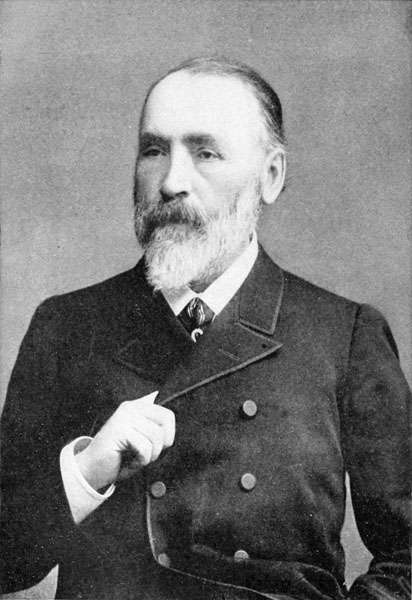
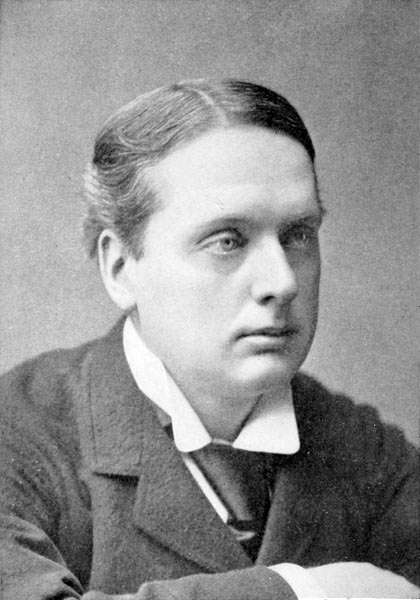
Photograph copyright by Elliott & Fry
HENRY LABOUCHERE